Shortcut Trick
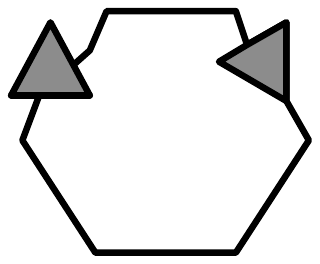
When a plane slices a cube perpendicular to its main body diagonal, the shape of the cross-section changes based on the cut's position.
If the slice is made close to a vertex, it forms an equilateral triangle.
As the plane moves toward the exact center of the cube, it begins to intersect more faces.
At the very center of the cube, the perpendicular plane symmetrically slices through exactly 6 faces.
Since the plane cuts 6 sides evenly, the resulting maximum cross-section is a perfect regular Hexagon.
∴ The correct answer is Hexagon.

Alternate Method
Given:
⇒ A cube is sliced by a plane perpendicular to one of its body diagonals.
Body Diagonal
Hexagonal
Cross-Section
Concept Used:
⇒ Let the side of the cube be a. We can position the cube in a 3D coordinate system with vertices ranging from (0, 0, 0) to (a, a, a).
⇒ The main body diagonal connects the origin (0, 0, 0) to the opposite furthest vertex (a, a, a).
⇒ A 3D plane that is perpendicular to this body diagonal will have the linear equation: x + y + z = k.
Calculation:
⇒ To determine the shape, we must locate where this plane intersects the outer edges of the cube.
⇒ The largest possible slice occurs when the plane passes directly through the midpoint of the diagonal, giving us k = 1.5a.
⇒ Substituting k = 1.5a, the plane x + y + z = 1.5a cuts through exactly 6 of the 12 edges of the cube.
⇒ The intersection coordinates on the edges are: (a, 0.5a, 0), (0.5a, a, 0), (0, a, 0.5a), (0, 0.5a, a), (0.5a, 0, a), and (a, 0, 0.5a).
⇒ Connecting these six intersecting midpoints creates a perfectly symmetrical, closed 6-sided polygon.
⇒ Because all edge lengths and angles of this polygon are identical, the final cross-section is a regular hexagon.
∴ The correct answer is Hexagon.

Additional Information
Triangular Cross-section
If a cube is sliced by a plane passing near a vertex and cutting through three adjacent intersecting edges, the resulting cross-section shape is an equilateral triangle.
Rectangular Cross-section
If the slicing plane passes completely through two parallel and diagonally opposite edges of the cube, the resulting cross-section is a rectangle with an area equal to a2√2.
Body Diagonal Length
The body diagonal represents the maximum distance inside a cube. For a cube having side length 'a', the body diagonal is calculated directly as a√3.