National Defence Academy (NDA) · Topic Collection

Quantitative Aptitude PYQs

Arithmetic, number systems, percentages, ratios, profit and loss, time and work, algebra, geometry, mensuration, and trigonometry.

2520 Total Questions21 Official PapersYears: 2015–2025Search in Quantitative Aptitude
Showing questions 1101–1120 of 2520Page 56 of 100
NDA Mathematics 18 Apr 2021 Official Paper (Previous Year Paper)·Mathematics
View full paper

Question 1101

National Defence Academy (NDA) 2021• Mathematics• Mathematics

Consider the following

Statements:

  1. The null set is a subset of every set.
  2. Every set is a subset of itself.
  3. If a set has 10 elements, then its power set will have 1024 elements.

Which of the above statements are correct?

  1. AOption (a)

    1 and 2 only

  2. BOption (b)

    2 and 3 only

  3. COption (c)

    1 and 3 only

  4. DOption (d)

    1, 2 and 3

View answer & explanation

Correct answer

Answer: (d)D.

1, 2 and 3

Why this answer is correct

Concept:

  1. The null set is a subset of every set. (ϕ ⊆ A)
  2. Every set is a subset of itself. (A ⊆ A)
  3. The number of subsets of a set with n elements is 2n.


Explanation:

  1. The null set is a subset of every set - The intersection of two sets is a subset of each of the original sets.

So if {} is the empty set and A is any set then {} intersect A is {} which means {} is a subset of A and {} is a subset of {}.

You can prove it by contradiction. Let's say that you have the empty set {} and a set A. 2. Every set is a subset of itself. (A ⊆ A) 3. If n = 10 then  210 = 1024

So, all three statements are true.
NDA Mathematics 18 Apr 2021 Official Paper (Previous Year Paper)·Mathematics
View full paper

Question 1102

National Defence Academy (NDA) 2021• Mathematics• Mathematics

Let R be a relation defined as xRy if and only if 2x + 3y = 20, where x, y ∈ N. How many elements of the form (x, y) are there in R?

  1. AOption (a)

    2

  2. BOption (b)

    3

  3. COption (c)

    4

  4. DOption (d)

    6

View answer & explanation

Correct answer

Answer: (b)B.

3

Why this answer is correct

Concept:

If x ∈  R then we express it by writing xRy and say that " x is related to y with relation R"

Thus, (x, y) ∈ R ⇔ xRy

Calculation:

Given

2x + 3y = 20

The relation R can be written as

R = {(1,6), (4, 4), (7, 2)}

There are 3 elements in the form (x, y) are there in R.

NDA Mathematics 18 Apr 2021 Official Paper (Previous Year Paper)·Mathematics
View full paper

Question 1103

National Defence Academy (NDA) 2021• Mathematics• Mathematics

Consider the following

Statements:

  1. A function f : Z → Z, defined by f(x) = x + 1, is one-one as well as onto.
  2. A function f : N → N, defined by f(x) = x + 1, is one-one but not onto.

Which of the above statements is/are correct?

  1. AOption (a)

    1 only

  2. BOption (b)

    2 only

  3. COption (c)

    Both 1 and 2

  4. DOption (d)

    Neither 1 nor 2

View answer & explanation

Correct answer

Answer: (c)C.

Both 1 and 2

Why this answer is correct

Concept:

Onto Functions - 

A function f from X to Y is onto (or surjective), if and only if for every element y ∈ Y there is an element x ∈ X with f(x) = y.

In words: “Each element in the co-domain of f has a pre-image” 

Mathematical Description: f : X →Y is onto ⇔ \(\rm \forall \) y \(\rm \exists \)x, f(x) = y 

One-to-one Correspondence

A function f is a one-to-one correspondence (or bijection), if and only if it is both one-to-one and onto

In words: “No element in the co-domain of f has two (or more) pre images” (one-to-one) and “Each element in the co-domain of f has a pre-image” (onto).

Calculation:

1. A function f : Z → Z, defined by f(x) = x + 1, is one-one as well as onto.

f(x) = x + 1,

calculate f(x1) :

 f(x1) = x1 + 1

calculate f(x2) :

 f(x2) = x2 + 1

Now, f(x1) = f(x2) 

⇒ x1 + 1 =  x2 + 1

⇒ x1 =  x2 

So, f is one-one function.

Consider f(x) = y

y = x + 1

x = y - 1

f(y-1) = y - 1 + 1 = y

f is onto. 2. A function f : N → N, defined by f(x) = x + 1, is one-one but not onto.

f(x) = x + 1,

calculate f(x1) :

 f(x1) = x1 + 1

calculate f(x2) :

 f(x2) = x2 + 1

Now, f(x1) = f(x2) 

⇒ x1 + 1 =  x2 + 1

⇒ x1 =  x2 

So, f is one-one function.

Clearly, f(x) = x + 1 ≥ 2 for all x ∈ N

So, f(x) does not assume values 1.

 f is not an onto function.

So, Both 1 and 2 are correct.

NDA Mathematics 18 Apr 2021 Official Paper (Previous Year Paper)·Mathematics
View full paper

Question 1104

National Defence Academy (NDA) 2021• Mathematics• Mathematics

Consider the following in respect of a complex number z:

  1. \(\rm {\overline{\left(z^{-1}\right)}}=(\bar{z})^{-1}\)
  2. zz-1 = |z|2

Which of the above is/are correct?

  1. AOption (a)

    1 only

  2. BOption (b)

    2 only

  3. COption (c)

    Both 1 and 2

  4. DOption (d)

    Neither 1 nor 2

View answer & explanation

Correct answer

Answer: (a)A.

1 only

Why this answer is correct

Concept:

Consider z = a + ib

Multiplicative identity z.z-1 = 1

zz̅ = a2 + b2 = (a + ib) (a - ib)

Explanation

Given:

1. \(\rm {\overline{\left(z^{-1}\right)}}=(\bar{z})^{-1}\)

consider z = a - ib

⇒ z-1 = \(\rm \frac 1 z = \frac 1 {a - ib}\) =\(\rm \frac{a + ib}{a^{2} + b^{2}}\)

⇒ \(\rm \overline{z^{-1}}\) = \(\rm \frac{a - ib}{a^{2} + b^{2}}\)      ....(1)

⇒ \(\rm \overline{z}\) = a + ib

⇒ (\(\rm \overline{z}\))-1 = \(\rm \frac 1 {\bar{z}} = \frac 1 {a +ib}\)= \(\rm \frac{a - ib}{a^{2} + b^{2}}\)      ....(2)

from eq(1) and (2)

Statement 1 is correct. 

2. zz-1 = |z|2

consider z = a - ib

⇒ z-1 = \(\rm \frac{a + ib}{a^{2} + b^{2}}\)

⇒ z.z-1 = (a - ib)\(\rm \frac{a + ib}{a^{2} + b^{2}}\) = \(\rm \frac{a^{2} + b^{2}}{a^{2} + b^{2}} =1\)

Statement 2 is not correct

NDA Mathematics 18 Apr 2021 Official Paper (Previous Year Paper)·Mathematics
View full paper

Question 1105

National Defence Academy (NDA) 2021• Mathematics• Mathematics
  1. The difference of Z and its conjugate is an imaginary number.
  2. The sum of Z and its conjugate is a real number.
  1. AOption (a)

    1 only

  2. BOption (b)

    2 only

  3. COption (c)

    Both 1 and 2

  4. DOption (d)

    Neither 1 nor 2

View answer & explanation

Correct answer

Answer: (c)C.

Both 1 and 2

Why this answer is correct

Concept:

Let z = x + iy be a complex number,

Where x is called the real part of the complex number or Re (z) and y is called the Imaginary part of the complex number or Im (z)

Conjugate of z = z̅ = x - iy  

Calculation:

  1. The difference of Z and its conjugate is an imaginary number.

Consider z = a + ib           ....(i)

conjugate of z = z̅ = a - ib      ....(ii)

eq(i) - eq (ii)

z - z̅ = a + ib - a + ib

⇒ 2ib

Thus it is clear that the difference of z and its conjugate is an imaginary number. 2. The sum of Z and its conjugate is a real number.

eq (i) + eq(ii)

z + z̅ = a + ib + a - ib

⇒ 2a

Thus it is clear that the sum of Z and its conjugate is a real number.

So, Both 1 and 2 are correct.

NDA Mathematics 18 Apr 2021 Official Paper (Previous Year Paper)·Mathematics
View full paper

Question 1106

National Defence Academy (NDA) 2021• Mathematics• Mathematics

What is the modulus of the complex number i2n + 1(-i)2n - 1, where n ∈ N and i = √-1?

  1. AOption (a)

    1

  2. BOption (b)
    • 1
  3. COption (c)

    √2

  4. DOption (d)

    2

View answer & explanation

Correct answer

Answer: (a)A.

1

Why this answer is correct

Concept:

Iota power:

  • i2 = -1, i3 = -i, i4 = 1, i4n = 1
  • Number of the form 2n is always even, n ∈ N
  • Numebr of the form 2n +1 or 2n - 1 is always odd, n ∈ N
  • (-a)2n -1 = -(a)2n -1

Calculation:

Let,

Z = i2n + 1(-i)2n - 1

⇒ Z = i2n+1 × (i)2n-1 × (-1)2n-1

⇒ Z =  i2n +1+2n-1 ×(-1)2n-1

⇒ Z = i4n × (-1)          [∵ (-1)2n-1 = -1]

⇒ Z = (-1)4n ×

⇒ Z = i4n × (-1)

⇒ Z = -(i)4n × (-1)

⇒  Z = 1 × (-1)         [∵ i4n = 1] 

⇒ Z = -1

⇒ |Z| = |-1| = 1

Hence, the modulus of the complex number i2n + 1(-i)2n - 1 is 1.

NDA Mathematics 18 Apr 2021 Official Paper (Previous Year Paper)·Mathematics
View full paper

Question 1107

National Defence Academy (NDA) 2021• Mathematics• Mathematics

If α and β are the roots of the equation 4x2 + 2x - 1 = 0, then which one of the following is correct?

  1. AOption (a)

    β = -2α2 - 2α

  2. BOption (b)

    β = 4α3 - 3α

  3. COption (c)

    β = α2 - 3α

  4. DOption (d)

    β = -2α2 + 2α

View answer & explanation

Correct answer

Answer: (b)B.

β = 4α3 - 3α

Why this answer is correct

Concept:

General Quadratic Equation

ax2 + bx + c = 0

  • Product of roots (αβ) = c/a
  • Sum of roots (α + β) = - b/a
  • Formula to find Roots,  \(\displaystyle \rm x = {-b \pm \sqrt{b^2-4ac} \over 2a}\)
  • sin 3θ = 3 sinθ - 4 sin3θ

Calculation:

Given: 4x2 + 2x - 1 = 0

a = 4, b = 2, c = -1

\(\displaystyle x = {-b \pm \sqrt{b^2-4ac} \over 2a}\)

⇒ \(\displaystyle x = {-2 \pm \sqrt{2^2-4(4)(-1)} \over 2(4)}\)

⇒ \(\displaystyleα = {-1 + \sqrt{5} \over 4}\) and \(\displaystyle β = {-1 - \sqrt{5} \over 4}\)

As we know that \(\displaystyle sin\ 18° = {-1 + \sqrt{5} \over 4}\) and \(\displaystyle sin\ 54° = {1 + \sqrt{5} \over 4}\)

So, We can say that α = sin18° and β = - sin54°      ------(i)

Now, using the formula, sin 3θ = 3 sinθ - 4 sin3θ 

On putting θ = 18° in the above trigonometric formula, we get 

⇒ sin 54° = 3 sin18° - 4 sin318°      ------(ii)

From (i) and (ii), we get 

⇒ - β = 3α - 4α3

⇒ β = 4α3 - 3α

∴ The correct relation is β = 4α3 - 3α.

NDA Mathematics 18 Apr 2021 Official Paper (Previous Year Paper)·Mathematics
View full paper

Question 1108

National Defence Academy (NDA) 2021• Mathematics• Mathematics

If one root of 5x2 + 26x + k = 0 is reciprocal of the other, then what is the value of k?

  1. AOption (a)

    2

  2. BOption (b)

    3

  3. COption (c)

    5

  4. DOption (d)

    8

View answer & explanation

Correct answer

Answer: (c)C.

5

Why this answer is correct

Concept: 

Let us consider the standard form of a quadratic equation, ax2 + bx + c =0

Let α and β be the two roots of the above quadratic equation. 

The sum of the roots is given by:  \({\rm{α }} + {\rm{β }} = - \frac{{\rm{b}}}{{\rm{a}}} = - \frac{{{\rm{coefficient;of;x}}}}{{{\rm{coefficient;of;}}{{\rm{x}}^2}}}\) 

The product of the roots is given by:  \({\rm{α β }} = \frac{{\rm{c}}}{{\rm{a}}} = \frac{{{\rm{constant;term}}}}{{{\rm{coefficient;of;}}{{\rm{x}}^2}}}\)


Calculation:

Let the roots of 5x2 + 26x + k = 0 are α and β

Given one root is reciprocal of the other So, α = 1/β 

⇒ α.β = 1    ----(i)

Compare with general equation ax2 + bx + c = 0

a = 5, b = 26, c = k

According to the concept used

⇒ α.β = k/5    ----(ii)

From (i) and (ii), we get 

k/5 = 1

∴The value of k is 5.

NDA Mathematics 18 Apr 2021 Official Paper (Previous Year Paper)·Mathematics
View full paper

Question 1109

National Defence Academy (NDA) 2021• Mathematics• Mathematics

In how many ways can a team of 5 players be selected from 8 players so as not to include a particular player?

  1. AOption (a)

    42

  2. BOption (b)

    35

  3. COption (c)

    21

  4. DOption (d)

    20

View answer & explanation

Correct answer

Answer: (c)C.

21

Why this answer is correct

Concept:

Combination Formula

nCr = \(\rm \frac{n!}{r! (n - r)!}\)

Calculation:

A particular player should not be included 

We have to select 5 players from (8 - 1) = 7 players.

⇒  required number of ways =  7C5

\(⇒ \frac{7!}{5! (7-5)!}\) = 21

∴ The required number of ways is 21.

NDA Mathematics 18 Apr 2021 Official Paper (Previous Year Paper)·Mathematics
View full paper

Question 1110

National Defence Academy (NDA) 2021• Mathematics• Mathematics

What is the coefficient of the middle term in the expansion of (1 + 4x + 4x2)5?

  1. AOption (a)

    8064

  2. BOption (b)

    4032

  3. COption (c)

    2016

  4. DOption (d)

    1008

View answer & explanation

Correct answer

Answer: (a)A.

8064

Why this answer is correct

Concept:

General term: General term in the expansion of (x + y)n is given by

\({T_{\left( {r; + ;1} \right)}} = ;{;^n}{C_r} \times {x^{n - r}} \times {y^r}\)

Middle terms: The middle terms is the expansion of (x + y) n depends upon the value of n.

  • If n is even, then the total number of terms in the expansion of (x + y) n is n +1. So there is only one middle term i.e. \(\left( {\frac{n}{2} + 1} \right){{\rm{;}}^{th}}\) term is the middle term.

\({T_{\left( {\frac{n}{2}; + ;1} \right)}} = ;{;^n}{C_{\frac{n}{2}}} \times {x^{\frac{n}{2}}} \times {y^{\frac{n}{2}}}\)

  • If n is odd, then the total number of terms in the expansion of (x + y) n is n + 1. So there are two middle terms i.e. \({\left( {\frac{{n; + ;1}}{2}} \right)^{th}};\)and \({\left( {\frac{{n; + ;3}}{2}} \right)^{th}}\) are two middle terms.

(1−x)n=∑k=0n(nk)1n−k(−x)k(1−x)n=∑k=0n(nk)1n−k(−x)k(1−x)n=∑k=0n(nk)1n−k(−x)

Calculation:

Given:

(1 + 4x + 4x2)5

⇒ [(1 + 2x)2]5

⇒ (1+ 2x)10 

Here n = 10 (n is even number)

∴ Middle term = \(\left( {\frac{n}{2} + 1} \right) = \left( {\frac{10}{2} + 1} \right) \) = 6th term 

Middle Term, T6 =  T5 + 1 = 10C5 (1)5 (2x)5

⇒ \(\frac {10!}{5!5!}\)× 32x5

⇒ 8064 x5

∴ The coefficient of the middle term in the expansion of (1 + 4x + 4x2)5  is 8064.

NDA Mathematics 18 Apr 2021 Official Paper (Previous Year Paper)·Mathematics
View full paper

Question 1111

National Defence Academy (NDA) 2021• Mathematics• Mathematics

If \(\rm tan:x=-\dfrac{3}{4}\) and x is in the second quadrant, then what is the value of sin x ⋅ cos x?

  1. AOption (a)

    \(\dfrac{6}{25}\)

  2. BOption (b)

    \(\dfrac{12}{25}\)

  3. COption (c)

    \(-\dfrac{6}{25}\)

  4. DOption (d)

    \(-\dfrac{12}{25}\)

View answer & explanation

Correct answer

Answer: (d)D.

\(-\dfrac{12}{25}\)

Why this answer is correct

Concept:

tan x = \(\rm \frac{Perpendicular}{Base}\) = \(\rm \frac{P}{B}\) 

sin x = \(\rm \frac{Perpendicular}{Hypotenuse}\) = \(\rm \frac{P}{H}\) 

cos x = \(\rm \frac{Base}{Hypotenuse}\) = \(\rm \frac{B}{H}\) 

By Pythagoras theorem

Hypotenuse2 = Perpendicular2 + Base2 


Calculation:

Given:

\(\rm tan:x=-\dfrac{3}{4}\)

P= 3, B = - 4

By Pythagoras theorem

H2 = P2 + B2

=  32  + (-4)2

Hypotenuse(H) = 5

sin x  = \(\rm \frac{3}{5}\)

cos x = \(\rm \frac{-4}{5}\)

sin x . cos x = \(\rm \frac{3}{5} . \rm \frac{-4}{5}\) = \(\rm \frac{-12}{25}\)

NDA Mathematics 18 Apr 2021 Official Paper (Previous Year Paper)·Mathematics
View full paper

Question 1112

National Defence Academy (NDA) 2021• Mathematics• Mathematics

What is the value of the following?

\(\rm cosec\left(\dfrac{7\pi}{6}\right)sec\left(\dfrac{5\pi}{3}\right)\)

  1. AOption (a)

    \(\dfrac{4}{3}\)

  2. BOption (b)

    4

  3. COption (c)

    -4

  4. DOption (d)

    \(-\dfrac{4}{\sqrt3}\)

View answer & explanation

Correct answer

Answer: (c)C.

-4

Why this answer is correct

Concept:

sec (360° -  θ) = sec θ;   

cosec (180° + θ) = - cosec θ

Calculation:

\(\rm cosec\left(\dfrac{7\pi}{6}\right)sec\left(\dfrac{5\pi}{3}\right)\)

= cosec (210∘) sec (300∘)

=  cosec(180∘ + 30∘) sec(360∘ - 60∘)

= - cosec 30∘ sec 60∘

= - 2 (2)

= - 4


Additional Information

sin (360° -  θ) = - sin θ            

cos (360° -  θ) = cos θ      

tan (360° -  θ*)* = - tan θ      

cosec (360° -  θ) = - cosec θ        

sec (360° -  θ) = sec θ   

cot (360° -  θ*)* = - cot θ

sin (180° + θ) = - sin θ


cos (180° + θ) = - cos θ

tan (180° + θ) = tan θ

cosec (180° + θ) = -cosec θ

sec (180° + θ) = - sec θ

cot (180° + θ) = cot θ


sin (90° - θ) = cos θ

cos (90° - θ) = sin θ

tan (90° - θ) = cot θ

cosec (90° - θ) = sec θ

sec (90° - θ) = cosec θ

cot (90° - θ) = tan θ

NDA Mathematics 18 Apr 2021 Official Paper (Previous Year Paper)·Mathematics
View full paper

Question 1113

National Defence Academy (NDA) 2021• Mathematics• Mathematics

If the determinant \(\left| {\begin{array}{*{20}{c}} x&1&3\ 0&0&1\ 1&x&4 \end{array}} \right| = 0\) then what is x equal to?

  1. AOption (a)

    02 or 2

  2. BOption (b)

    -3 or 3

  3. COption (c)

    -1 or 1

  4. DOption (d)

    3 or 4

View answer & explanation

Correct answer

Answer: (c)C.

-1 or 1

Why this answer is correct

Concept:

Let A = \(\rm \begin{vmatrix} a_{1} & a_{2} & a_{3}\ b_{1} & b_{2} & b_{3}\ c_{1} & c_{2} & c_{3} \end{vmatrix}\)

Then determinant is given by:

det(A) = a1 (b2 c3 - b3 c2) - a2 (b1 c3 - b3 c1) + a3 (b1 c2 - b2 c1)

Calculation:

Given:

\(\left| {\begin{array}{*{20}{c}} x&1&3\ 0&0&1\ 1&x&4 \end{array}} \right| = 0\)

⇒ x(0 - x) - 1(0 - 1) + 3(0 - 0) = 0

⇒ -x2 + 1  = 0

⇒ x2 = 1

∴ x = 1 or -1

NDA Mathematics 18 Apr 2021 Official Paper (Previous Year Paper)·Mathematics
View full paper

Question 1114

National Defence Academy (NDA) 2021• Mathematics• Mathematics

What is the value of the following?

tan 31° tan 33° tan 35° _ _ _ _ _ tan 57° tan 59°

  1. AOption (a)

    -1

  2. BOption (b)

    0

  3. COption (c)

    1

  4. DOption (d)

    2

View answer & explanation

Correct answer

Answer: (c)C.

1

Why this answer is correct

Concept:

tan A = cot (90- A) 

cot A = \(\rm \frac{1}{tan A}\) --- (2) or tan A × cot A = 1

Calculation:

Given,

tan 31° tan 33° ..... tan 47°tan49° ...... tan 57° tan 59°

By using the above formula

tan 31° tan 33° .....tan(90° - 47°) tan(90° - 49°) ......tan (90° - 31°) 

tan 31° tan 33° .....tan(90° - 47°) tan(90° - 49°) ......tan (90° - 31°) 

tan 31° tan 33°....cot 43°cot 45°....cot 33°cot 31° 

Since, tan θ × cot θ = 1 

Therefore,

tan 31° tan 33° ..... tan 47°tan49° ...... tan 57° tan 59° = 1

NDA Mathematics 18 Apr 2021 Official Paper (Previous Year Paper)·Mathematics
View full paper

Question 1115

National Defence Academy (NDA) 2021• Mathematics• Mathematics

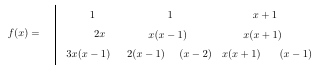
If 

 then what is f(-1) + f(0) + f(1) equal to?

  1. AOption (a)

    0

  2. BOption (b)

    1

  3. COption (c)

    100

  4. DOption (d)

    -100

View answer & explanation

Correct answer

Answer: (a)A.

0

Why this answer is correct

Concept:

Let A = \(\rm \begin{vmatrix} a_{1} & a_{2} & a_{3}\ b_{1} & b_{2} & b_{3}\ c_{1} & c_{2} & c_{3} \end{vmatrix}\)

det(A) = a1 (b2 c3 - b3 c2) - a2 (b1 c3 - b3 c1) + a3 (b1 c2 - b2 c1)

Calculation:

Given:

\(f(-1) = \rm \left| {\begin{array}{*{20}{c}} 1&-1&{0}\ {-2}&{{2}}&{0}\ {6}&{12}&0 \end{array}} \right|= 1(0 - 0) + 1(0 - 0) + 0(-24 - 12) = 0\)

\(f(0) = \rm \left| {\begin{array}{*{20}{c}} 1&0&{1}\ {0}&{{0}}&{0}\ {0}&{4}&0 \end{array}} \right|= 1(0 - 0) - 0(0 - 0) + 1(0 - 0) = 0\) 

\(f(1) = \rm \left| {\begin{array}{*{20}{c}} 1&1&{2}\ {2}&{{0}}&{2}\ {0}&{0}&0 \end{array}} \right| = 1(0 - 0) -1(0 - 0) + 2(0 - 0) = 0\) 

Now;

f(-1) + f(0) + f(1) = 0

NDA Mathematics 18 Apr 2021 Official Paper (Previous Year Paper)·Mathematics
View full paper

Question 1116

National Defence Academy (NDA) 2021• Mathematics• Mathematics

The equation \(sin^{-1}x-cos^{-1}x=\frac{\pi}{6}\) has

  1. AOption (a)

    no solution

  2. BOption (b)

    unique solution

  3. COption (c)

    two solutions

  4. DOption (d)

    infinite number of solutions

View answer & explanation

Correct answer

Answer: (b)B.

unique solution

Why this answer is correct

Concept:

sin-1x + cos-1x = \(\rm \frac{\pi}{2} \)

cos (30∘ ) = \(\rm \frac{\sqrt{3}}{2}\)

Calculation:

Given

⇒ \(sin^{-1}x-cos^{-1}x=\frac{\pi}{6}\)

⇒ sin-1x + cos-1x - 2 cos-1x = \(\rm \frac{\pi}{6}\)

⇒ \(\rm \frac{\pi}{2} \)- 2 cos-1x = \(\rm \frac{\pi}{6}\)

⇒ 2 cos-1x  = \(\rm \frac{\pi}{2} - \rm \frac{\pi}{6}\)

⇒ cos-1x = \(\rm \frac{\pi}{6}\)

⇒ x = \(\rm \frac{\sqrt{3}}{2}\)

∴ The equation has unique solution.

NDA Mathematics 18 Apr 2021 Official Paper (Previous Year Paper)·Mathematics
View full paper

Question 1117

National Defence Academy (NDA) 2021• Mathematics• Mathematics

What is the value of the following?

(sin 24° + cos 66°)(sin 24° - cos 66°)

  1. AOption (a)

    -1

  2. BOption (b)

    0

  3. COption (c)

    1

  4. DOption (d)

    2

View answer & explanation

Correct answer

Answer: (b)B.

0

Why this answer is correct

Concept:

cos (90∘ - θ ) = sin θ 

sin (90∘ - θ ) = cos θ 

Calculation:

= (sin 24° + cos 66°)(sin 24° - cos 66°)

= (sin 24∘ + sin (90∘ - 66∘)) (sin 24∘ - sin (90∘ - 66∘)) 

= (sin 24∘ + sin 24∘) (sin 24∘ - sin 24∘) 

= (sin 24∘ + sin 24∘) × 0

= 0

NDA Mathematics 18 Apr 2021 Official Paper (Previous Year Paper)·Mathematics
View full paper

Question 1118

National Defence Academy (NDA) 2021• Mathematics• Mathematics

A chord subtends an angle 120° at the centre of a unit circle. What is the length of the chord?

  1. AOption (a)

    √2 - 1 units

  2. BOption (b)

    √3 - 1 units

  3. COption (c)

    √2 units

  4. DOption (d)

    √3 units

View answer & explanation

Correct answer

Answer: (d)D.

√3 units

Why this answer is correct

Concept:

Length of chord = 2r sin(\(\rm \frac{θ }{2}\)​)

Where r = radius of the circle

And θ = Angle subtended by the chord at the centre.

Calculation:

Given: r = 1 and angle = 120°

Now, Length of chord = 2 (1) sin(\(\rm \frac{120^{∘} }{2}\)​)

⇒ 2 sin (60∘)

⇒ 2 x \(\rm \frac{√{3}}{2}\) 

⇒ √3 units

∴ The length of chord is √3 units.

NDA Mathematics 18 Apr 2021 Official Paper (Previous Year Paper)·Mathematics
View full paper

Question 1119

National Defence Academy (NDA) 2021• Mathematics• Mathematics

What is (1 + cot θ - cosec θ)(1 + tan θ + sec θ) equal to?

  1. AOption (a)

    1

  2. BOption (b)

    2

  3. COption (c)

    3

  4. DOption (d)

    4

View answer & explanation

Correct answer

Answer: (b)B.

2

Why this answer is correct

Concept:

Trigonometry Formula

cot θ = \(\rm \frac{cos θ }{sin θ }\)

tan θ = \(\rm \frac{sin θ }{cos θ }\)

cosec θ = \(\rm \frac{1 }{sin θ }\)

sec θ = \(\rm \frac{1}{cos θ }\)

sin2 θ + cos2 θ = 1

(sin θ + cos θ)2 = sin2 θ + cos2 θ + 2 sin θ cos θ 


Calculation:

To Find: Value of (1 + cot θ - cosec θ)(1 + tan θ + sec θ)

= (1 + \(\rm \frac{cos θ }{sin θ }\) - \(\rm \frac{1 }{sin θ }\)) (1 + \(\rm \frac{sin θ }{cos θ }\) + \(\rm \frac{1}{cos θ }\))

= \(\rm \frac{(sin θ + cos θ - 1) ( sin θ + cos θ + 1)}{sin θ : cosθ }\)

= \(\rm \frac{( sin θ + cos θ )^{2} - 1}{ sin θ cos θ }\)

= \(\rm \frac{sin^{2}θ + cos^{2}θ + 2 sin θ cos θ - 1}{sinθ : cos θ }\)

= \(\rm \frac{1 + 2 sin θ cos θ - 1}{sinθ : cos θ }\)

= \(\rm \frac{2 sin θ cos θ }{sinθ : cos θ }\)

= 2

NDA Mathematics 18 Apr 2021 Official Paper (Previous Year Paper)·Mathematics
View full paper

Question 1120

National Defence Academy (NDA) 2021• Mathematics• Mathematics

What is \(\rm \frac{1+tan^2\theta}{1+cot^2\theta}-\left(\frac{1-tan\theta}{1-cot\theta}\right)^2\)equal to?

  1. AOption (a)

    0

  2. BOption (b)

    1

  3. COption (c)

    2 tanθ

  4. DOption (d)

    2 cotθ

View answer & explanation

Correct answer

Answer: (a)A.

0

Why this answer is correct

Concept:

Trigonometry Formula

sec2 θ = 1 + tan2 θ

cosec2 θ = 1 + cot2 θ

cot θ = \(\rm \frac{1}{tan \theta }\)

sec θ = \(\rm \frac{1}{cos \theta }\)

cosec θ = \(\rm \frac{1}{sin \theta }\)


Calculation:

\(\rm \frac{1+tan^2\theta}{1+cot^2\theta}-\left(\frac{1-tan\theta}{1-cot\theta}\right)^2\)

\(= \frac{sec^2θ}{cosec^2θ}-\left(\frac{1-tanθ}{1-\frac{1}{tan θ }}\right)^2\)

\(= \rm \frac{\frac{1}{cos^{2}θ}}{\frac{1}{sin^{2}θ}} - \left (\frac{1 - tanθ}{\frac{tan θ - 1}{tan θ }} \right )^{2}\)

\(\rm = \frac{sin^{2}θ }{cos^{2} θ } - \left (\frac{1 - tanθ}{\frac{- (1 - tan θ )}{tan θ }} \right )^{2}\)

= tan2 θ - (-tan θ)2

= tan2 θ - tan2 θ 

= 0

How should I prepare for Quantitative Aptitude in National Defence Academy (NDA)?

Solving previous year questions by topic helps identify recurring concepts, question patterns, and frequently asked sub-topics. Attempt each question, review the step-by-step explanation, and note down key formulas or facts for quick revision before the exam.