Previous Year Paper

NDA Mathematics 18 Apr 2021 Official Paper (Previous Year Paper)

Held in 2021

120 questions150 minutes
With answers
Free

Paper last updated:

Practise under exam conditions

Take this paper as a timed mock test. Review your answers after you submit.

Attempt timed test

Questions & answers

Read the paper at your pace. Open an explanation when you need it.

Mathematics (120 questions)

Question 1

What is C(n, 1) + C(n, 2) + _ _ _ _  _ + C(n, n) equal to

  1. AOption (a)

    2 + 22 + 23 + _ _ _ _ _  + 2n

  2. BOption (b)

    1 + 2 + 22 + 23 + _ _ _ _ _ + 2n

  3. COption (c)

    1 + 2 + 22 + 23 + _ _ _ _ _ _ + 2n - 1

  4. DOption (d)

    2 + 22 + 23 + _ _ _ _ _ + 2n - 1

View answer & explanation

Correct answer

Answer: (c)C.

1 + 2 + 22 + 23 + _ _ _ _ _ _ + 2n - 1

Why this answer is correct

Concept:

(1 + x)n = nC0 × 1(n-0) × x 0+ nC1 × 1(n-1) × x 1 + nC2  × 1(n-2) × x2 + …. + nCn  × 1(n-n) × xn

nth  term of the G.P. is an = arn−1

Sum of n terms = s = a(rn−1)(r−1)a (r^n-1)\over(r- 1); where r >1

Sum of n terms = s = a(1−rn)(1−r)a (1- r^n)\over(1- r); where r <1

Calculation:

C(n, 1) + C(n, 2) + _ _ _ _  _ + C(n, n) 

⇒ nC1 + nC2 + ... + nCn 

⇒ nC0 + nC1 + nC2 + ... + nCn - nC0

⇒ (1 + 1)n - nCo 

⇒ 2n - 1 = 2n−12−1\rm 2^n - 1\over 2-1 = 1 × 2n−12−1\rm 2^n - 1\over 2-1

Comparing it with a G.P sum = a × rn−1r−1\rm r^n - 1\over r-1, we get a = 1 and r = 2

∴ 2n - 1 = 1 + 2 + 22 + ... +2n-1 which will give us n terms in total.

Question 2

What is the sum of the coefficients of first and last terms in the expansion of (1 + x)2n, where n is a natural number?

  1. AOption (a)

    1

  2. BOption (b)

    2

  3. COption (c)

    n

  4. DOption (d)

    2n

View answer & explanation

Correct answer

Answer: (b)B.

2

Why this answer is correct

Concept:

nCr=n!(r!(n−r)!)\rm ^n C_r = {n!\over(r!(n - r)!)}

(1 + x)n = nC0 × 1(n-0) × x 0+ nC1 × 1(n-1) × x 1 + nC2  × 1(n-2) × x2 + …. + nCn  × 1(n-n) × xn


Calculation:

Given expansion is (1 + x)2n

⇒ 2nC0 ×1(2n-0) × x0 +  2nC1 ×1(2n-1) × x1 + ... +  2nC2n ×1(2n-2n) × x2n

First term = 2nC0 ×1 × 1 = 1

Last term =  2nC2n ×1 × x2n = 1 × x2n = x2n

⇒ Sum = 1 + x2n

Coefficient of 1 = 1, coefficient of x2n = 1

∴ sum of the coefficients = 1 + 1 = 2.

Question 3

If the first term of an AP is 2 and the sum of the first five terms is equal to one-fourth of the sum of the next five terms, then what is the sum of the first ten terms?

  1. AOption (a)

    -500

  2. BOption (b)

    -250

  3. COption (c)

    500

  4. DOption (d)

    250

View answer & explanation

Correct answer

Answer: (b)B.

-250

Why this answer is correct

Concept:

Let us consider sequence a1, a2, a3 …. an is an A.P.

Common difference “d”= a2 – a1 = a3 – a2 = …. = an – an – 1

nth term of the A.P.= an = a + (n – 1) d

Sum of the first n terms (S) =  n2[2a+(n−1)d)]\frac{n}{2}[2a+(n-1)d)]

Also, S =  (n/2)(a + l)

Where,

a = First term,

d = Common difference,

n = number of terms,

an = nth term,

l = Last term

<br>

Calculation:

Given, a1 = 2      ...(1)

S5 = 141\over4(S10 - S5)

⇒ 4S5 = S10 - S5

⇒ 4S5 + S5 = S10

⇒ 5S5 = S10

⇒ 5 × 525\over2[2a1 + (n5 - 1)d] = 10210 \over2 [2a1 + (n10 - 1)d]

[∵ n5 = 5 और n10 = 10]

⇒ 5 × 525\over2[a1 + a1 + 4d] = 10210 \over2 [a1 + a1 + 9d]

⇒ 5 × [2a1 + 4d] = 2 × [2a1 + 9d]

⇒ 10a1 + 20d = 4a1 + 18d

⇒ 6a1 = 2d

⇒ a1 = −d3\rm-d\over3

∴ d = -3a1 = - 3 × 2 = - 6

Hence,

S10 = 10210 \over2 [a1 + a1 + 9d]

⇒ 5[2a1 + 9d]

⇒ 5[4 - 54] = -250

∴ S10 = 5 × (-50) = - 250.

Question 4

Consider the following statements:

  1. If each term of a GP is multiplied by same non-zero number, then the resulting sequence is also a GP.
  2. If each term of a GP is divided by same non-zero number, then the resulting sequence is also a GP.

Which of the above statements is/are correct?

  1. AOption (a)

    1 only

  2. BOption (b)

    2 only

  3. COption (c)

    Both 1 and 2

  4. DOption (d)

    Neither 1 nor 2

View answer & explanation

Correct answer

Answer: (c)C.

Both 1 and 2

Why this answer is correct

Concept:

Multiplying or dividing with a non-zero number does not change the common ratio of the G.P


Calculation:

Multiplying or dividing with a non-zero number does not change the common ratio of the G.P

Let us consider sequence a1, a2, a3 …. an is a G.P.

Common ratio = r = a2a1\rm a_2\over a_1  = a3a2\rm a_3\over a_2  = anan−1\rm a_n\over a_{n-1}

If each term is multiplied/ divided by the same non-zero number it will be the same r value. So, the sequence will not change.

Question 5

How many 5-digit prime numbers can be formed using the digits 1, 2, 3, 4, 5 if the repetition of digits is not allowed?

  1. AOption (a)

    5

  2. BOption (b)

    4

  3. COption (c)

    3

  4. DOption (d)

    0

View answer & explanation

Correct answer

Answer: (d)D.

0

Why this answer is correct

Concept:

Prime number: Prime number are those which are divisible by itself and 1.

Calculation:

Not a single five-digit prime number can be formed using the digits 1, 2, 3, 4, 5(without repetition).

This is because if one adds the digits, the result obtained will be = 1 + 2 + 3 + 4 + 5 = 15 which is divisible by 3.

Hence, any number obtained as a permutation of these 5 digits will be at least divisible by 3 and cannot be a prime number.

Question 6

If f(x + 1) = x2 - 3x + 2, then what is f(x) equal to?

  1. AOption (a)

    x2 - 5x + 4

  2. BOption (b)

    ​x2 - 5x + 6

  3. COption (c)

    ​x2 + 3x + 3

  4. DOption (d)

    ​x2 - 3x + 1

View answer & explanation

Correct answer

Answer: (b)B.

​x2 - 5x + 6

Why this answer is correct

Concept:

To get the value of any function at any point with respect to some other function, we need to manipulate the given function/ point in such a way that we get the function that is needed.


Calculation:

Given, f(x + 1) = x2 - 3x + 2

f(x + 1) = x2 - 2x - x + 2......[-3x = -2x - x]

f(x + 1) = x(x - 2) - 1(x - 2)

f(x + 1) = (x - 2)(x - 1)

f(x + 1) = (x + 1 - 3)(x + 1 - 2).......[-2 = 1 - 3 & -1 = 1 - 2]

Now replace (x + 1) terms with (x)

∴ f(x) = (x - 3)(x - 2)

f(x) = x2 -3x - 2x + 6

f(x) = x2 - 5x + 6

Additional Information

This problem can also be solved by putting (x - 1) in place of x.

Question 7

If x2, x, -8 are in AP, then which one of the following is correct?

  1. AOption (a)

    x ∈  {-2}

  2. BOption (b)

    x ∈  {4}

  3. COption (c)

    x ∈  {-2, 4}

  4. DOption (d)

    x ∈  {-4, 2}

View answer & explanation

Correct answer

Answer: (c)C.

x ∈  {-2, 4}

Why this answer is correct

Concept:

Let us consider sequence a1, a2, a3 …. an is an A.P.

Common difference “d”= a2 – a1 = a3 – a2 = …. = an – an-1


Calculation:

Since x2, x, -8 are in A.P we can write,

x - x2 = - 8 - x

⇒ x2 - 2x - 8 = 0

⇒ x2 - 4x + 2x - 8 = 0

⇒ x(x - 4) + 2(x - 4) = 0

⇒ (x - 4)(x + 2) = 0

⇒ x = -2, 4

∴ x ∈  {-2, 4}

Question 8

The third term of a GP is 3. What is the product of its first five terms?

  1. AOption (a)

    81

  2. BOption (b)

    243

  3. COption (c)

    729

  4. DOption (d)

    Cannot be determined due to insufficient data

View answer & explanation

Correct answer

Answer: (b)B.

243

Why this answer is correct

Concept:

Let us consider sequence a1, a2, a3 …. an is a G.P.

Common ratio = r = a2a1\rm a_2\over a_1  = a3a2\rm a_3\over a_2  = anan−1\rm a_n\over a_{n-1}


Calculation:

Consider,

(a = 3) be the 3rd term of the G.P series,

So, we can write the five terms as,

ar2\rm a\over r^2, ar\rm a\over r, a, ar, ar2

So, the product of the five terms (P) will be,

P = ar2\rm a\over r^2 × ar\rm a\over r × a × ar × ar2 = a5

Since,

a = 3,

∴ The product of the first five terms (P) = 35 = 243

Question 9

The element in the ith row and the jth column of a determinant of third order is equal to 2(i + j). What is the value of the determinant?

  1. AOption (a)

    0

  2. BOption (b)

    2

  3. COption (c)

    4

  4. DOption (d)

    6

View answer & explanation

Correct answer

Answer: (a)A.

0

Why this answer is correct

Concept:

If all the elements of a row or column are zeroes, then the value of the determinant is zero.

To evaluate the determinant row or column operation is done.


Calculation:

The determinant can be written as,

[2(1+1)2(1+2)2(1+3) 2(2+1)2(2+2)2(2+3) 2(3+1)2(3+2)2(3+3)]\begin{bmatrix} 2(1+1) & 2(1+2) &2(1+3) \ 2(2+1) &2(2+2) & 2(2+3)\ 2(3+1)&2(3+2) & 2(3+3) \end{bmatrix}

= 2×[1+11+21+3 2+12+22+3 3+13+23+3]2\times \begin{bmatrix} 1+1 &1+2 & 1+3\ 2+1 & 2+2 &2+3 \ 3+1 & 3+2 & 3+3 \end{bmatrix}

R3 → R3 - R1 and R2 → R2 - R1

= 2×[1+11+21+3 111 222]2\times \begin{bmatrix} 1+1 &1+2 & 1+3\ 1 & 1 &1 \ 2 & 2 & 2 \end{bmatrix}

R3 → R3 -2R2

= 2×[1+11+21+3 111 000]2\times \begin{bmatrix} 1+1 &1+2 & 1+3\ 1 & 1 &1 \ 0 & 0 & 0 \end{bmatrix}

= 0

So, the value of the determinant is 0

Question 10

With the numbers 2, 4, 6, 8, all the possible determinants with these four different elements are constructed. What is the sum of the values of all such determinants?

  1. AOption (a)

    128

  2. BOption (b)

    64

  3. COption (c)

    32

  4. DOption (d)

    0

View answer & explanation

Correct answer

Answer: (d)D.

0

Why this answer is correct

Concept:

Number of ways of arranging n object = n!

Calculation:

Given numbers are 2, 4, 6 & 8.

We can form determinant of order 2.

We know that the number of ways of arranging n object = n!

Number of determinants = 4! = 4 × 3 × 2 × 1 = 24

Let's form some determinants from the given numbers.

∣26 84∣\begin{vmatrix} 2 & \rm 6 \ 8 & 4 \end{vmatrix} = 2 × 4 - 6 × 8 = 8 - 48 = - 40

∣62 48∣\begin{vmatrix} 6 & \rm 2 \ 4 & 8 \end{vmatrix} = 48 - 8 = 40

∣28 64∣\begin{vmatrix} 2 & \rm 8 \ 6 & 4 \end{vmatrix} = 8 - 48 = - 40

∣64 28∣\begin{vmatrix} 6 & \rm 4 \ 2 & 8 \end{vmatrix} = 48 - 8 = 40

∣48 62∣\begin{vmatrix} 4 & \rm 8 \ 6 & 2 \end{vmatrix} = 8 - 48 = - 40

∣84 26∣\begin{vmatrix} 8 & \rm 4 \ 2 & 6 \end{vmatrix} = 48 - 8 = 40

∣46 82∣\begin{vmatrix} 4 & \rm 6 \ 8 & 2 \end{vmatrix} = 8 - 48 = - 40

∣82 46∣\begin{vmatrix} 8 & \rm 2 \ 4 & 6 \end{vmatrix} = 48 - 8 = - 40

Hence, we can see that we are getting the pattern where the other value will neutralize each determinant value.

Accordingly, the sum of the values of all determinants = 0

∴ The required sum is zero.

Question 11

What is the radius of the circle 4x2 + 4y2 - 20x + 12y - 15 = 0?

  1. AOption (a)

    14 units

  2. BOption (b)

    10.5 units

  3. COption (c)

    7 units

  4. DOption (d)

    3.5 units

View answer & explanation

Correct answer

Answer: (d)D.

3.5 units

Why this answer is correct

Concept:

The general form of the equation of a circle is:

x2 + y2 + 2gx + 2fy + c = 0

The centre of the circle is (-g, -f).

The radius of the circle is √g2+f2−c√{g^{2}+f^{2}-c}.

Calculation:

Given equation of a circle is, 

4x2 + 4y2 - 20x + 12y - 15 = 0

x2 + y2 - 5x + 3y - 15/4 = 0

On comparing from the general equation of circle

2g = 5, or g = 5/2

2f = 3 or f = 3/2 & c = -15/4

By using the above formula

Radius = √254+94−(−154)√{\frac{25}{4}+\frac{9}{4}-(-\frac{15}{4})}

Radius = √25+9+154=√494√{\frac{25+9+15}{4}} =√ \frac{49}{4}  = √12.25

Radius = 3.5

Alternate Method

Given equation of a circle is, 

4x2 + 4y2 - 20x + 12y - 15 = 0

⇒ [4x2 - 20x] + [4y2 + 12y] - 15 = 0

⇒ [(2x)2 - 2 . 2x . 5 + 52 - 52] + [(2y)2 + 2 . 2y . 3 + 32 - 32] - 15 = 0

⇒ [(2x - 5)2 - 52] + [(2y + 3)2 - 32] - 15 = 0

⇒ (2x - 5)2  + (2y + 3)2 - 15 - 25 - 9 = 0

⇒ (2x - 5)2 + (2y +3)2 = 49

⇒ 4(x - 525\over2)2 + 4(y + 323\over2)2 = 49

⇒ (x - 525\over2)2 + (y + 323\over2)2 = (727\over2)2

∴ The radius of the circle = 727\over2units = 3.5 units

Question 12

A parallelogram has three consecutive vertices (-3, 4), (0, -4) and (5, 2). The fourth vertex is

  1. AOption (a)

    (2, 10)

  2. BOption (b)

    (2, 9)

  3. COption (c)

    (3, 9)

  4. DOption (d)

    (4, 10)

View answer & explanation

Correct answer

Answer: (a)A.

(2, 10)

Why this answer is correct

Concept:

ABCD is a parallelogram P, Q, R and S are mid-points of AB, BC, CD and DA respectively. Then PR and SQ bisect each other.

Calculation:

Applying the mid-point theorem,

x+02=5−32\rm {{x+0}\over2}={{5-3}\over2}

⇒ x = 2

y−42=4+22{{y-4}\over2}={{4+2}\over2}

⇒ y = 10

So, the 4th coordinate is (2, 10)

Question 13

If the lines y + px = 1 and y - qx = 2 are perpendicular, then which one of the following is correct?

  1. AOption (a)

    pq + 1 = 0

  2. BOption (b)

    p + q + 1 = 0

  3. COption (c)

    pq - 1 = 0

  4. DOption (d)

    p - q + 1 = 0

View answer & explanation

Correct answer

Answer: (c)C.

pq - 1 = 0

Why this answer is correct

Concept:

Slope intercept form of a straight line ⇔ y = mx + c

Where m is the slope and c is the y-intercept

When two lines are perpendicular, the product of their slope is -1. If m is the slope of a line, then the slope of a line perpendicular to it is -1/m.


Calculation:

Given equations are, y + px = 1 and y - qx = 2 which can be written as,

y = - px + 1 and y = qx + 2 

So, m1 (slope of 1st line)= -p and m2 (slope of 2nd line)= q

As they are perpendicular m1 × m2 = - 1

⇒ - pq = - 1

⇒ pq - 1 = 0

Question 14

If A, B and C are in AP, then the straight line Ax + 2By + C = 0 will always pass through a fixed point. The fixed point is

  1. AOption (a)

    (0, 0)

  2. BOption (b)

    (-1, 1)

  3. COption (c)

    (1, -2)

  4. DOption (d)

    (1, -1)

View answer & explanation

Correct answer

Answer: (d)D.

(1, -1)

Why this answer is correct

Concept:

Let us consider sequence a1, a2, a3 …. an is an A.P.

Common difference “d”= a2 – a1 = a3 – a2 = …. = an – an-1


Calculation:

Given A, B, C are in AP.

So we can write 2B = A + C

A - 2B + C = 0                           …(i)

Given equation of straight line is Ax + 2By + C = 0   …(ii)

Comparing (i) and (ii)

x = 1, y = -1

So (1, -1) lies on the line.

Question 15

If the image of the point (-4, 2) by a line mirror is (4, -2), then what is the equation of the line mirror?

  1. AOption (a)

    y = x

  2. BOption (b)

    y = 2x

  3. COption (c)

    4y = x

  4. DOption (d)

    y = 4x

View answer & explanation

Correct answer

Answer: (b)B.

y = 2x

Why this answer is correct

Concept:

For knowing the equation of the line mirror its slope needs to be determined first.

When two lines are perpendicular, the product of their slope is -1. If m is the slope of a line, then the slope of a line perpendicular to it is -1/m.

The slope of a line passing through the distinct points (x1, y1) and (x2, y2) is m =  (y2−y1)(x2−x1)\rm { (y_2 - y_1)}\over{(x_2 - x_1 )}

Equation of line is (y – y1) = m(x – x1)


Calculation:

The line mirror is perpendicular to the line joining the two points. So, for the point,

x = 4−42{4-4}\over 2 = 0

y = 2−22{2-2}\over 2 = 0

(x, y) = (0, 0)

Slope of the line joining (-4, 2) and (4, -2) = −2−24−(−4){-2-2}\over{4-(-4)} = −12-1\over 2

As the mirror is perpendicular to this line so, m × (−12-1\over 2) = - 1

m = 2

Hence, the equation of line mirror is, y−0x−0\rm{y-0}\over{x-0} = 2

∴ y = 2x

Question 16

tan−1x+cot−1x=π2\rm tan^{-1}x+cot^{-1}x=\frac{\pi}{2} holds, when

  1. AOption (a)

    x ∈ R

  2. BOption (b)

    x ∈ R - (-1, 1) only

  3. COption (c)

    x ∈ R - {0} only

  4. DOption (d)

    x ∈ R - [-1, 1] only

View answer & explanation

Correct answer

Answer: (a)A.

x ∈ R

Why this answer is correct

Concept:

tan−1(x)+tan−1(y)\rm tan^{-1}(x)+tan^{-1}({y}) = tan−1x+y1−x×y\rm tan^{-1}\frac{x+y}{1-x\times y}

cot−1x=\rm cot^{-1}x= tan−1(1x)\rm tan^{-1}({1\over x})

Calculation:

Given, tan−1x+cot−1x=π2\rm tan^{-1}x+cot^{-1}x=\frac{\pi}{2}

⇒ tan−1(x)+tan−1(1x)=π2\rm tan^{-1}(x)+tan^{-1}({1\over x})=\frac{\pi}{2}

⇒ tan−1(x)+tan−1(1x)=π2\rm tan^{-1}(x)+tan^{-1}({1\over x})=\frac{\pi}{2}

⇒ tan−1x+1x1−x×1x=π2\rm tan^{-1}\frac{x+\frac{1}{x}}{1-x\times \frac{1}{x}} = \frac{\pi}{2}

⇒ tan−1x+1x0=π2\rm tan^{-1}\frac{x+\frac{1}{x}}{0} = \frac{\pi}{2}

⇒ tan−1x+1x0=π2\rm tan^{-1}\frac{x+\frac{1}{x}}{0} = \frac{\pi}{2}

⇒ tan−1(∞)=π2\rm tan^{-1}({\infty}) = \frac{\pi}{2}

This is true for all x ∈ R

Question 17

If tan⁡A=17\tan A=\dfrac{1}{7}, then what is cos 2A equal to?

  1. AOption (a)

    2425\dfrac{24}{25}

  2. BOption (b)

    1825\dfrac{18}{25}

  3. COption (c)

    1225\dfrac{12}{25}

  4. DOption (d)

    625\dfrac{6}{25}

View answer & explanation

Correct answer

Answer: (a)A.

2425\dfrac{24}{25}

Why this answer is correct

Concept:

cos 2θ = (1−tan2θ)(1+tan2θ)\rm {(1 - tan^2\theta ) \over (1 + tan^2\theta)}


Calculation:

We know,

cos 2θ = (1−tan2θ)(1+tan2θ)\rm {(1 - tan^2\theta ) \over (1 + tan^2\theta)}

So, putting the value of tan A we can write,

cos 2A = (1−tan2A)(1+tan2A)\rm {(1 - tan^2A) \over (1 + tan^2A)}

∴ cos 2A  =  1−1721+172\rm \frac{1-\frac{1}{7}^2}{1+\frac{1}{7}^2}

∴ cos 2A  = 49−17249+172\rm \frac{\frac{49-1}{7^2}}{\frac{49+1}{7^2}}

∴ cos 2A  = 485048 \over50

∴ cos 2A  = 242524\over25

Question 18

The sides of a triangle are m, n and m2+n2+mn\rm \sqrt{m^2+n^2+mn}. What is the sum of the acute angles of the triangle?

  1. AOption (a)

    45°

  2. BOption (b)

    60°

  3. COption (c)

    75°

  4. DOption (d)

    90°

View answer & explanation

Correct answer

Answer: (b)B.

60°

Why this answer is correct

Concept:

Cosine Rule of Triangle:

The square of the length of any side of a given triangle is equal to the sum of the squares of the length of the other sides minus twice the product of the other two sides multiplied by the cosine of angle included between them.

Consider, a, b, and c are lengths of the side of a triangle ABC as shown, then;

cos(x)=b2+c2−a22bccos(x)=\frac{b^2+c^2-a^2}{2bc}

cos(y)=a2+c2−b22accos(y)=\frac{a^2+c^2-b^2}{2ac}

cos(z)=a2+b2−c22abcos(z)=\frac{a^2+b^2-c^2}{2ab}

Calculation:

Let m = n = 1 unit

Then,

 m2+n2+mn Rightarrow12+12+1=3\rm \sqrt{m^2+n^2+mn} \ \\Rightarrow\rm \sqrt{1^2+1^2+1}= \sqrt 3 

Using cosine rule;

cos⁡θ=12+12−322×1×1\rm \cos θ = {1^2+ 1^2 - {\sqrt 3}^2\over2\times 1 \times 1}

⇒ cos θ = -1/2

∴ θ = 120° 

Now, the sum of the acute angles of the triangle = 180° - 120° = 60°

Question 19

What is the area of the triangle ABC with sides a = 10cm  and c = 4cm angle B = 30°?

  1. AOption (a)

    16 cm2

  2. BOption (b)

    12 cm2

  3. COption (c)

    10 cm2

  4. DOption (d)

    8 cm2

View answer & explanation

Correct answer

Answer: (c)C.

10 cm2

Why this answer is correct

Concept:

Area of a triangle = 121\over 2 × base × altitude

Area of ΔABC = 12(a⋅b⋅sin C)\rm {1\over2} (a \cdot b\cdot sin \ C)


Calculation:

Area of a triangle = 121\over 2 × base × altitude

= 121\over 2 × c × a sin∠CBA

= 121\over 2 × 10 cm × 4cm sin 30° 

= 5 × 4 × 121\over 2 (as sin 30° = 121\over 2)

= 10 cm2

Question 20

Consider the following statements:

  1. A = {1, 3, 5} and B = {2, 4, 7} are equivalent sets.
  2. A = {1, 5, 9} and B = {1, 5, 5, 9, 9} are equal sets.

Which of the above statements is/are correct?

  1. AOption (a)

    1 only

  2. BOption (b)

    2 only

  3. COption (c)

    Both 1 and 2

  4. DOption (d)

    Neither 1 nor 2

View answer & explanation

Correct answer

Answer: (c)C.

Both 1 and 2

Why this answer is correct

Concept:

Equivalent set: Two sets A and B are said to be equivalent if they have the same number of elements (cardinality), regardless of what the elements are. , i.e n(A) = n(B).

Equal set: Two sets A and B are said to be equal if they have exactly the same elements. The repetition of elements does not matter in sets because a set is defined as a collection of distinct objects, so repeated elements are generally ignored.

If A = B, then n(A) = n(B) and for any x ∈ A, x ∈ B too.

Calculation:

  1. A = {1, 3, 5} and B = {2, 4, 7} are equivalent sets. → True

Set A has three elements: 1, 3, and 5. Set B also has three elements: 2, 4, and 7. Since both sets have three elements, they are indeed equivalent sets.

  1. A = {1, 5, 9} and B = {1, 5, 5, 9, 9} are equal sets. → True

Set A contains the elements 1, 5, and 9. Set B also contains the elements 1, 5, and 9 (despite some elements being repeated, duplicates are not considered in set theory). Since both sets have the same elements, they are equal.

Therefore, both statements are correct:

Statement 1 is correct: A and B are equivalent sets.

Statement 2 is correct: A and B are equal sets.

Hence, The correct answer is "Both 1 and 2".

Source:- https://ncert.nic.in/textbook/pdf/kemh101.pdf, Page No. 7-8.

Question 21

Consider the following statements:

  1. The null set is a subset of every set.
  2. Every set is a subset of itself.
  3. If a set has 10 elements, then its power set will have 1024 elements.

Which of the above statements are correct?

  1. AOption (a)

    1 and 2 only

  2. BOption (b)

    2 and 3 only

  3. COption (c)

    1 and 3 only

  4. DOption (d)

    1, 2 and 3

View answer & explanation

Correct answer

Answer: (d)D.

1, 2 and 3

Why this answer is correct

Concept:

  1. The null set is a subset of every set. (ϕ ⊆ A)
  2. Every set is a subset of itself. (A ⊆ A)
  3. The number of subsets of a set with n elements is 2n.


Explanation:

  1. The null set is a subset of every set - The intersection of two sets is a subset of each of the original sets.

So if {} is the empty set and A is any set then {} intersect A is {} which means {} is a subset of A and {} is a subset of {}.

You can prove it by contradiction. Let's say that you have the empty set {} and a set A.

2. Every set is a subset of itself. (A ⊆ A) 3. If n = 10 then  210 = 1024

So, all three statements are true.

Question 22

Let R be a relation defined as xRy if and only if 2x + 3y = 20, where x, y ∈ N. How many elements of the form (x, y) are there in R?

  1. AOption (a)

    2

  2. BOption (b)

    3

  3. COption (c)

    4

  4. DOption (d)

    6

View answer & explanation

Correct answer

Answer: (b)B.

3

Why this answer is correct

Concept:

If x ∈  R then we express it by writing xRy and say that " x is related to y with relation R"

Thus, (x, y) ∈ R ⇔ xRy

Calculation:

Given

2x + 3y = 20

The relation R can be written as

R = {(1,6), (4, 4), (7, 2)}

There are 3 elements in the form (x, y) are there in R.

Question 23

Consider the following statements:

  1. A function f : Z → Z, defined by f(x) = x + 1, is one-one as well as onto.
  2. A function f : N → N, defined by f(x) = x + 1, is one-one but not onto.

Which of the above statements is/are correct?

  1. AOption (a)

    1 only

  2. BOption (b)

    2 only

  3. COption (c)

    Both 1 and 2

  4. DOption (d)

    Neither 1 nor 2

View answer & explanation

Correct answer

Answer: (c)C.

Both 1 and 2

Why this answer is correct

Concept:

Onto Functions - 

A function f from X to Y is onto (or surjective), if and only if for every element y ∈ Y there is an element x ∈ X with f(x) = y.

In words: “Each element in the co-domain of f has a pre-image” 

Mathematical Description: f : X →Y is onto ⇔ ∀\rm \forall  y ∃\rm \exists x, f(x) = y 

One-to-one Correspondence

A function f is a one-to-one correspondence (or bijection), if and only if it is both one-to-one and onto

In words: “No element in the co-domain of f has two (or more) pre images” (one-to-one) and “Each element in the co-domain of f has a pre-image” (onto).

Calculation:

1. A function f : Z → Z, defined by f(x) = x + 1, is one-one as well as onto.

f(x) = x + 1,

calculate f(x1) :

 f(x1) = x1 + 1

calculate f(x2) :

 f(x2) = x2 + 1

Now, f(x1) = f(x2) 

⇒ x1 + 1 =  x2 + 1

⇒ x1 =  x2 

So, f is one-one function.

Consider f(x) = y

y = x + 1

x = y - 1

f(y-1) = y - 1 + 1 = y

f is onto.

2. A function f : N → N, defined by f(x) = x + 1, is one-one but not onto.

f(x) = x + 1,

calculate f(x1) :

 f(x1) = x1 + 1

calculate f(x2) :

 f(x2) = x2 + 1

Now, f(x1) = f(x2) 

⇒ x1 + 1 =  x2 + 1

⇒ x1 =  x2 

So, f is one-one function.

Clearly, f(x) = x + 1 ≥ 2 for all x ∈ N

So, f(x) does not assume values 1.

 f is not an onto function.

So, Both 1 and 2 are correct.

Question 24

Consider the following in respect of a complex number z:

1. (z−1)‾=(zˉ)−1\rm {\overline{\left(z^{-1}\right)}}=(\bar{z})^{-1} 2. zz-1 = |z|2

Which of the above is/are correct?

  1. AOption (a)

    1 only

  2. BOption (b)

    2 only

  3. COption (c)

    Both 1 and 2

  4. DOption (d)

    Neither 1 nor 2

View answer & explanation

Correct answer

Answer: (a)A.

1 only

Why this answer is correct

Concept:

Consider z = a + ib

Multiplicative identity z.z-1 = 1

zz̅ = a2 + b2 = (a + ib) (a - ib)

Explanation

Given:

1. (z−1)‾=(zˉ)−1\rm {\overline{\left(z^{-1}\right)}}=(\bar{z})^{-1}

consider z = a - ib

⇒ z-1 = 1z=1a−ib\rm \frac 1 z = \frac 1 {a - ib} =a+iba2+b2\rm \frac{a + ib}{a^{2} + b^{2}}

⇒ z−1‾\rm \overline{z^{-1}} = a−iba2+b2\rm \frac{a - ib}{a^{2} + b^{2}}      ....(1)

⇒ z‾\rm \overline{z} = a + ib

⇒ (z‾\rm \overline{z})-1 = 1zˉ=1a+ib\rm \frac 1 {\bar{z}} = \frac 1 {a +ib}= a−iba2+b2\rm \frac{a - ib}{a^{2} + b^{2}}      ....(2)

from eq(1) and (2)

Statement 1 is correct. 

2. zz-1 = |z|2

consider z = a - ib

⇒ z-1 = a+iba2+b2\rm \frac{a + ib}{a^{2} + b^{2}}

⇒ z.z-1 = (a - ib)a+iba2+b2\rm \frac{a + ib}{a^{2} + b^{2}} = a2+b2a2+b2=1\rm \frac{a^{2} + b^{2}}{a^{2} + b^{2}} =1

Statement 2 is not correct

Question 25

  1. The difference of Z and its conjugate is an imaginary number.
  2. The sum of Z and its conjugate is a real number.
  1. AOption (a)

    1 only

  2. BOption (b)

    2 only

  3. COption (c)

    Both 1 and 2

  4. DOption (d)

    Neither 1 nor 2

View answer & explanation

Correct answer

Answer: (c)C.

Both 1 and 2

Why this answer is correct

Concept:

Let z = x + iy be a complex number,

Where x is called the real part of the complex number or Re (z) and y is called the Imaginary part of the complex number or Im (z)

Conjugate of z = z̅ = x - iy  

Calculation:

  1. The difference of Z and its conjugate is an imaginary number.

Consider z = a + ib           ....(i)

conjugate of z = z̅ = a - ib      ....(ii)

eq(i) - eq (ii)

z - z̅ = a + ib - a + ib

⇒ 2ib

Thus it is clear that the difference of z and its conjugate is an imaginary number.

2. The sum of Z and its conjugate is a real number.

eq (i) + eq(ii)

z + z̅ = a + ib + a - ib

⇒ 2a

Thus it is clear that the sum of Z and its conjugate is a real number.

So, Both 1 and 2 are correct.

Question 26

What is the modulus of the complex number i2n + 1(-i)2n - 1, where n ∈ N and i = √-1?

  1. AOption (a)

    1

  2. BOption (b)
    • 1
  3. COption (c)

    √2

  4. DOption (d)

    2

View answer & explanation

Correct answer

Answer: (a)A.

1

Why this answer is correct

Concept:

Iota power:

  • i2 = -1, i3 = -i, i4 = 1, i4n = 1
  • Number of the form 2n is always even, n ∈ N
  • Numebr of the form 2n +1 or 2n - 1 is always odd, n ∈ N
  • (-a)2n -1 = -(a)2n -1

Calculation:

Let,

Z = i2n + 1(-i)2n - 1

⇒ Z = i2n+1 × (i)2n-1 × (-1)2n-1

⇒ Z =  i2n +1+2n-1 ×(-1)2n-1

⇒ Z = i4n × (-1)          [∵ (-1)2n-1 = -1]

⇒ Z = (-1)4n ×

⇒ Z = i4n × (-1)

⇒ Z = -(i)4n × (-1)

⇒  Z = 1 × (-1)         [∵ i4n = 1] 

⇒ Z = -1

⇒ |Z| = |-1| = 1

Hence, the modulus of the complex number i2n + 1(-i)2n - 1 is 1.

Question 27

If α and β are the roots of the equation 4x2 + 2x - 1 = 0, then which one of the following is correct?

  1. AOption (a)

    β = -2α2 - 2α

  2. BOption (b)

    β = 4α3 - 3α

  3. COption (c)

    β = α2 - 3α

  4. DOption (d)

    β = -2α2 + 2α

View answer & explanation

Correct answer

Answer: (b)B.

β = 4α3 - 3α

Why this answer is correct

Concept:

General Quadratic Equation

ax2 + bx + c = 0

  • Product of roots (αβ) = c/a
  • Sum of roots (α + β) = - b/a
  • Formula to find Roots,  x=−b±b2−4ac2a\displaystyle \rm x = {-b \pm \sqrt{b^2-4ac} \over 2a}
  • sin 3θ = 3 sinθ - 4 sin3θ

Calculation:

Given: 4x2 + 2x - 1 = 0

a = 4, b = 2, c = -1

x=−b±b2−4ac2a\displaystyle x = {-b \pm \sqrt{b^2-4ac} \over 2a}

⇒ x=−2±22−4(4)(−1)2(4)\displaystyle x = {-2 \pm \sqrt{2^2-4(4)(-1)} \over 2(4)}

⇒ α=−1+54\displaystyleα = {-1 + \sqrt{5} \over 4} and β=−1−54\displaystyle β = {-1 - \sqrt{5} \over 4}

As we know that sin 18°=−1+54\displaystyle sin\ 18° = {-1 + \sqrt{5} \over 4} and sin 54°=1+54\displaystyle sin\ 54° = {1 + \sqrt{5} \over 4}

So, We can say that α = sin18° and β = - sin54°      ------(i)

Now, using the formula, sin 3θ = 3 sinθ - 4 sin3θ 

On putting θ = 18° in the above trigonometric formula, we get 

⇒ sin 54° = 3 sin18° - 4 sin318°      ------(ii)

From (i) and (ii), we get 

⇒ - β = 3α - 4α3

⇒ β = 4α3 - 3α

∴ The correct relation is β = 4α3 - 3α.

Question 28

If one root of 5x2 + 26x + k = 0 is reciprocal of the other, then what is the value of k?

  1. AOption (a)

    2

  2. BOption (b)

    3

  3. COption (c)

    5

  4. DOption (d)

    8

View answer & explanation

Correct answer

Answer: (c)C.

5

Why this answer is correct

Concept: 

Let us consider the standard form of a quadratic equation, ax2 + bx + c =0

Let α and β be the two roots of the above quadratic equation. 

The sum of the roots is given by:  α+β=−ba=−coefficient;of;xcoefficient;of;x2{\rm{α }} + {\rm{β }} = - \frac{{\rm{b}}}{{\rm{a}}} = - \frac{{{\rm{coefficient;of;x}}}}{{{\rm{coefficient;of;}}{{\rm{x}}^2}}} 

The product of the roots is given by:  αβ=ca=constant;termcoefficient;of;x2{\rm{α β }} = \frac{{\rm{c}}}{{\rm{a}}} = \frac{{{\rm{constant;term}}}}{{{\rm{coefficient;of;}}{{\rm{x}}^2}}}


Calculation:

Let the roots of 5x2 + 26x + k = 0 are α and β

Given one root is reciprocal of the other So, α = 1/β 

⇒ α.β = 1    ----(i)

Compare with general equation ax2 + bx + c = 0

a = 5, b = 26, c = k

According to the concept used

⇒ α.β = k/5    ----(ii)

From (i) and (ii), we get 

k/5 = 1

∴The value of k is 5.

Question 29

In how many ways can a team of 5 players be selected from 8 players so as not to include a particular player?

  1. AOption (a)

    42

  2. BOption (b)

    35

  3. COption (c)

    21

  4. DOption (d)

    20

View answer & explanation

Correct answer

Answer: (c)C.

21

Why this answer is correct

Concept:

Combination Formula

nCr = n!r!(n−r)!\rm \frac{n!}{r! (n - r)!}

Calculation:

A particular player should not be included 

We have to select 5 players from (8 - 1) = 7 players.

⇒  required number of ways =  7C5

⇒7!5!(7−5)!⇒ \frac{7!}{5! (7-5)!} = 21

∴ The required number of ways is 21.

Question 30

What is the coefficient of the middle term in the expansion of (1 + 4x + 4x2)5?

  1. AOption (a)

    8064

  2. BOption (b)

    4032

  3. COption (c)

    2016

  4. DOption (d)

    1008

View answer & explanation

Correct answer

Answer: (a)A.

8064

Why this answer is correct

Concept:

General term: General term in the expansion of (x + y)n is given by

T(r;+;1)=;;nCr×xn−r×yr{T_{\left( {r; + ;1} \right)}} = ;{;^n}{C_r} \times {x^{n - r}} \times {y^r}

Middle terms: The middle terms is the expansion of (x + y) n depends upon the value of n.

  • If n is even, then the total number of terms in the expansion of (x + y) n is n +1. So there is only one middle term i.e. (n2+1);th\left( {\frac{n}{2} + 1} \right){{\rm{;}}^{th}} term is the middle term.

T(n2;+;1)=;;nCn2×xn2×yn2{T_{\left( {\frac{n}{2}; + ;1} \right)}} = ;{;^n}{C_{\frac{n}{2}}} \times {x^{\frac{n}{2}}} \times {y^{\frac{n}{2}}}

  • If n is odd, then the total number of terms in the expansion of (x + y) n is n + 1. So there are two middle terms i.e. (n;+;12)th;{\left( {\frac{{n; + ;1}}{2}} \right)^{th}};and (n;+;32)th{\left( {\frac{{n; + ;3}}{2}} \right)^{th}} are two middle terms.

(1−x)n=∑k=0n(nk)1n−k(−x)k(1−x)n=∑k=0n(nk)1n−k(−x)k(1−x)n=∑k=0n(nk)1n−k(−x)

Calculation:

Given:

(1 + 4x + 4x2)5

⇒ [(1 + 2x)2]5

⇒ (1+ 2x)10 

Here n = 10 (n is even number)

∴ Middle term = (n2+1)=(102+1)\left( {\frac{n}{2} + 1} \right) = \left( {\frac{10}{2} + 1} \right)  = 6th term 

Middle Term, T6 =  T5 + 1 = 10C5 (1)5 (2x)5

⇒ 10!5!5!\frac {10!}{5!5!}× 32x5

⇒ 8064 x5

∴ The coefficient of the middle term in the expansion of (1 + 4x + 4x2)5  is 8064.

Question 31

If tan:x=−34\rm tan:x=-\dfrac{3}{4} and x is in the second quadrant, then what is the value of sin x ⋅ cos x?

  1. AOption (a)

    625\dfrac{6}{25}

  2. BOption (b)

    1225\dfrac{12}{25}

  3. COption (c)

    −625-\dfrac{6}{25}

  4. DOption (d)

    −1225-\dfrac{12}{25}

View answer & explanation

Correct answer

Answer: (d)D.

−1225-\dfrac{12}{25}

Why this answer is correct

Concept:

tan x = PerpendicularBase\rm \frac{Perpendicular}{Base} = PB\rm \frac{P}{B} 

sin x = PerpendicularHypotenuse\rm \frac{Perpendicular}{Hypotenuse} = PH\rm \frac{P}{H} 

cos x = BaseHypotenuse\rm \frac{Base}{Hypotenuse} = BH\rm \frac{B}{H} 

By Pythagoras theorem

Hypotenuse2 = Perpendicular2 + Base2 


Calculation:

Given:

tan:x=−34\rm tan:x=-\dfrac{3}{4}

P= 3, B = - 4

By Pythagoras theorem

H2 = P2 + B2

=  32  + (-4)2

Hypotenuse(H) = 5

sin x  = 35\rm \frac{3}{5}

cos x = −45\rm \frac{-4}{5}

sin x . cos x = 35.−45\rm \frac{3}{5} . \rm \frac{-4}{5} = −1225\rm \frac{-12}{25}

Question 32

What is the value of the following?

cosec(7π6)sec(5π3)\rm cosec\left(\dfrac{7\pi}{6}\right)sec\left(\dfrac{5\pi}{3}\right)

  1. AOption (a)

    43\dfrac{4}{3}

  2. BOption (b)

    4

  3. COption (c)

    -4

  4. DOption (d)

    −43-\dfrac{4}{\sqrt3}

View answer & explanation

Correct answer

Answer: (c)C.

-4

Why this answer is correct

Concept:

sec (360° -  θ) = sec θ;   

cosec (180° + θ) = - cosec θ

Calculation:

cosec(7π6)sec(5π3)\rm cosec\left(\dfrac{7\pi}{6}\right)sec\left(\dfrac{5\pi}{3}\right)

= cosec (210∘) sec (300∘)

=  cosec(180∘ + 30∘) sec(360∘ - 60∘)

= - cosec 30∘ sec 60∘

= - 2 (2)

= - 4


Additional Information

sin (360° -  θ) = - sin θ            

cos (360° -  θ) = cos θ      

tan (360° -  θ*)* = - tan θ      

cosec (360° -  θ) = - cosec θ        

sec (360° -  θ) = sec θ   

cot (360° -  θ*)* = - cot θ

sin (180° + θ) = - sin θ


cos (180° + θ) = - cos θ

tan (180° + θ) = tan θ

cosec (180° + θ) = -cosec θ

sec (180° + θ) = - sec θ

cot (180° + θ) = cot θ


sin (90° - θ) = cos θ

cos (90° - θ) = sin θ

tan (90° - θ) = cot θ

cosec (90° - θ) = sec θ

sec (90° - θ) = cosec θ

cot (90° - θ) = tan θ

Question 33

If the determinant \(\left| {\begin{array}{*{20}{c}} x&1&3\ 0&0&1\ 1&x&4 \end{array}} \right| = 0\) then what is x equal to?

  1. AOption (a)

    02 or 2

  2. BOption (b)

    -3 or 3

  3. COption (c)

    -1 or 1

  4. DOption (d)

    3 or 4

View answer & explanation

Correct answer

Answer: (c)C.

-1 or 1

Why this answer is correct

Concept:

Let A = ∣a1a2a3 b1b2b3 c1c2c3∣\rm \begin{vmatrix} a_{1} & a_{2} & a_{3}\ b_{1} & b_{2} & b_{3}\ c_{1} & c_{2} & c_{3} \end{vmatrix}

Then determinant is given by:

det(A) = a1 (b2 c3 - b3 c2) - a2 (b1 c3 - b3 c1) + a3 (b1 c2 - b2 c1)

Calculation:

Given:

\(\left| {\begin{array}{*{20}{c}} x&1&3\ 0&0&1\ 1&x&4 \end{array}} \right| = 0\)

⇒ x(0 - x) - 1(0 - 1) + 3(0 - 0) = 0

⇒ -x2 + 1  = 0

⇒ x2 = 1

∴ x = 1 or -1

Question 34

What is the value of the following?

tan 31° tan 33° tan 35° _ _ _ _ _ tan 57° tan 59°

  1. AOption (a)

    -1

  2. BOption (b)

    0

  3. COption (c)

    1

  4. DOption (d)

    2

View answer & explanation

Correct answer

Answer: (c)C.

1

Why this answer is correct

Concept:

tan A = cot (90- A) 

cot A = 1tanA\rm \frac{1}{tan A} --- (2) or tan A × cot A = 1

Calculation:

Given,

tan 31° tan 33° ..... tan 47°tan49° ...... tan 57° tan 59°

By using the above formula

tan 31° tan 33° .....tan(90° - 47°) tan(90° - 49°) ......tan (90° - 31°) 

tan 31° tan 33° .....tan(90° - 47°) tan(90° - 49°) ......tan (90° - 31°) 

tan 31° tan 33°....cot 43°cot 45°....cot 33°cot 31° 

Since, tan θ × cot θ = 1 

Therefore,

tan 31° tan 33° ..... tan 47°tan49° ...... tan 57° tan 59° = 1

Question 35

If 

 then what is f(-1) + f(0) + f(1) equal to?

  1. AOption (a)

    0

  2. BOption (b)

    1

  3. COption (c)

    100

  4. DOption (d)

    -100

View answer & explanation

Correct answer

Answer: (a)A.

0

Why this answer is correct

Concept:

Let A = ∣a1a2a3 b1b2b3 c1c2c3∣\rm \begin{vmatrix} a_{1} & a_{2} & a_{3}\ b_{1} & b_{2} & b_{3}\ c_{1} & c_{2} & c_{3} \end{vmatrix}

det(A) = a1 (b2 c3 - b3 c2) - a2 (b1 c3 - b3 c1) + a3 (b1 c2 - b2 c1)

Calculation:

Given:

\(f(-1) = \rm \left| {\begin{array}{*{20}{c}} 1&-1&{0}\ {-2}&{{2}}&{0}\ {6}&{12}&0 \end{array}} \right|= 1(0 - 0) + 1(0 - 0) + 0(-24 - 12) = 0\)

\(f(0) = \rm \left| {\begin{array}{*{20}{c}} 1&0&{1}\ {0}&{{0}}&{0}\ {0}&{4}&0 \end{array}} \right|= 1(0 - 0) - 0(0 - 0) + 1(0 - 0) = 0\) 

\(f(1) = \rm \left| {\begin{array}{*{20}{c}} 1&1&{2}\ {2}&{{0}}&{2}\ {0}&{0}&0 \end{array}} \right| = 1(0 - 0) -1(0 - 0) + 2(0 - 0) = 0\) 

Now;

f(-1) + f(0) + f(1) = 0

Question 36

The equation sin−1x−cos−1x=π6sin^{-1}x-cos^{-1}x=\frac{\pi}{6} has

  1. AOption (a)

    no solution

  2. BOption (b)

    unique solution

  3. COption (c)

    two solutions

  4. DOption (d)

    infinite number of solutions

View answer & explanation

Correct answer

Answer: (b)B.

unique solution

Why this answer is correct

Concept:

sin-1x + cos-1x = π2\rm \frac{\pi}{2}

cos (30∘ ) = 32\rm \frac{\sqrt{3}}{2}

Calculation:

Given

⇒ sin−1x−cos−1x=π6sin^{-1}x-cos^{-1}x=\frac{\pi}{6}

⇒ sin-1x + cos-1x - 2 cos-1x = π6\rm \frac{\pi}{6}

⇒ π2\rm \frac{\pi}{2} - 2 cos-1x = π6\rm \frac{\pi}{6}

⇒ 2 cos-1x  = π2−π6\rm \frac{\pi}{2} - \rm \frac{\pi}{6}

⇒ cos-1x = π6\rm \frac{\pi}{6}

⇒ x = 32\rm \frac{\sqrt{3}}{2}

∴ The equation has unique solution.

Question 37

What is the value of the following?

(sin 24° + cos 66°)(sin 24° - cos 66°)

  1. AOption (a)

    -1

  2. BOption (b)

    0

  3. COption (c)

    1

  4. DOption (d)

    2

View answer & explanation

Correct answer

Answer: (b)B.

0

Why this answer is correct

Concept:

cos (90∘ - θ ) = sin θ 

sin (90∘ - θ ) = cos θ 

Calculation:

= (sin 24° + cos 66°)(sin 24° - cos 66°)

= (sin 24∘ + sin (90∘ - 66∘)) (sin 24∘ - sin (90∘ - 66∘)) 

= (sin 24∘ + sin 24∘) (sin 24∘ - sin 24∘) 

= (sin 24∘ + sin 24∘) × 0

= 0

Question 38

A chord subtends an angle 120° at the centre of a unit circle. What is the length of the chord?

  1. AOption (a)

    √2 - 1 units

  2. BOption (b)

    √3 - 1 units

  3. COption (c)

    √2 units

  4. DOption (d)

    √3 units

View answer & explanation

Correct answer

Answer: (d)D.

√3 units

Why this answer is correct

Concept:

Length of chord = 2r sin(θ2\rm \frac{θ }{2}​)

Where r = radius of the circle

And θ = Angle subtended by the chord at the centre.

Calculation:

Given: r = 1 and angle = 120°

Now, Length of chord = 2 (1) sin(120∘2\rm \frac{120^{∘} }{2}​)

⇒ 2 sin (60∘)

⇒ 2 x √32\rm \frac{√{3}}{2} 

⇒ √3 units

∴ The length of chord is √3 units.

Question 39

What is (1 + cot θ - cosec θ)(1 + tan θ + sec θ) equal to?

  1. AOption (a)

    1

  2. BOption (b)

    2

  3. COption (c)

    3

  4. DOption (d)

    4

View answer & explanation

Correct answer

Answer: (b)B.

2

Why this answer is correct

Concept:

Trigonometry Formula

cot θ = cosθsinθ\rm \frac{cos θ }{sin θ }

tan θ = sinθcosθ\rm \frac{sin θ }{cos θ }

cosec θ = 1sinθ\rm \frac{1 }{sin θ }

sec θ = 1cosθ\rm \frac{1}{cos θ }

sin2 θ + cos2 θ = 1

(sin θ + cos θ)2 = sin2 θ + cos2 θ + 2 sin θ cos θ 


Calculation:

To Find: Value of (1 + cot θ - cosec θ)(1 + tan θ + sec θ)

= (1 + cosθsinθ\rm \frac{cos θ }{sin θ } - 1sinθ\rm \frac{1 }{sin θ }) (1 + sinθcosθ\rm \frac{sin θ }{cos θ } + 1cosθ\rm \frac{1}{cos θ })

= (sinθ+cosθ−1)(sinθ+cosθ+1)sinθ:cosθ\rm \frac{(sin θ + cos θ - 1) ( sin θ + cos θ + 1)}{sin θ : cosθ }

= (sinθ+cosθ)2−1sinθcosθ\rm \frac{( sin θ + cos θ )^{2} - 1}{ sin θ cos θ }

= sin2θ+cos2θ+2sinθcosθ−1sinθ:cosθ\rm \frac{sin^{2}θ + cos^{2}θ + 2 sin θ cos θ - 1}{sinθ : cos θ }

= 1+2sinθcosθ−1sinθ:cosθ\rm \frac{1 + 2 sin θ cos θ - 1}{sinθ : cos θ }

= 2sinθcosθsinθ:cosθ\rm \frac{2 sin θ cos θ }{sinθ : cos θ }

= 2

Question 40

What is 1+tan2θ1+cot2θ−(1−tanθ1−cotθ)2\rm \frac{1+tan^2\theta}{1+cot^2\theta}-\left(\frac{1-tan\theta}{1-cot\theta}\right)^2equal to?

  1. AOption (a)

    0

  2. BOption (b)

    1

  3. COption (c)

    2 tanθ

  4. DOption (d)

    2 cotθ

View answer & explanation

Correct answer

Answer: (a)A.

0

Why this answer is correct

Concept:

Trigonometry Formula

sec2 θ = 1 + tan2 θ

cosec2 θ = 1 + cot2 θ

cot θ = 1tanθ\rm \frac{1}{tan \theta }

sec θ = 1cosθ\rm \frac{1}{cos \theta }

cosec θ = 1sinθ\rm \frac{1}{sin \theta }


Calculation:

1+tan2θ1+cot2θ−(1−tanθ1−cotθ)2\rm \frac{1+tan^2\theta}{1+cot^2\theta}-\left(\frac{1-tan\theta}{1-cot\theta}\right)^2

=sec2θcosec2θ−(1−tanθ1−1tanθ)2= \frac{sec^2θ}{cosec^2θ}-\left(\frac{1-tanθ}{1-\frac{1}{tan θ }}\right)^2

=1cos2θ1sin2θ−(1−tanθtanθ−1tanθ)2= \rm \frac{\frac{1}{cos^{2}θ}}{\frac{1}{sin^{2}θ}} - \left (\frac{1 - tanθ}{\frac{tan θ - 1}{tan θ }} \right )^{2}

=sin2θcos2θ−(1−tanθ−(1−tanθ)tanθ)2\rm = \frac{sin^{2}θ }{cos^{2} θ } - \left (\frac{1 - tanθ}{\frac{- (1 - tan θ )}{tan θ }} \right )^{2}

= tan2 θ - (-tan θ)2

= tan2 θ - tan2 θ 

= 0

Question 41

What is the interior angle of a regular octagon of side length 2 cm?

  1. AOption (a)

    π2\dfrac{\pi}{2}

  2. BOption (b)

    3π4\dfrac{3\pi}{4}

  3. COption (c)

    3π5\dfrac{3\pi}{5}

  4. DOption (d)

    3π8\dfrac{3\pi}{8}

View answer & explanation

Correct answer

Answer: (b)B.

3π4\dfrac{3\pi}{4}

Why this answer is correct

Concept:

The interior angle of a regular polygon is given by:  

(n−2)×180∘n\rm (n - 2) \times \frac{180^{\circ}}{n}

Where, n = number of sides

Interior Angle = 180°- Exterior Angle

Calculation:

Regular Octagon has 8 sides

so, n = 8

Interior Angle

= (n−2)×180∘n\rm (n - 2) \times \frac{180^{\circ}}{n}

= (8−2)×180∘8\rm (8 - 2) \times \frac{180^{\circ}}{8}

= 6×180∘8\rm 6 \times \frac{180^{\circ}}{8}

= 3π4\dfrac{3\pi}{4}

Question 42

If 7 sinθ + 24 cosθ = 25, then what is the value of (sin θ + cos θ)?

  1. AOption (a)

    1

  2. BOption (b)

    2625\dfrac{26}{25}

  3. COption (c)

    65\dfrac{6}{5}

  4. DOption (d)

    3125\dfrac{31}{25}

View answer & explanation

Correct answer

Answer: (d)D.

3125\dfrac{31}{25}

Why this answer is correct

Concept:

sin⁡θ=PerpendicularHypotenuse\rm \sin \theta = \frac{Perpendicular}{Hypotenuse}

cos⁡θ=BaseHypotenuse\rm \cos \theta = \frac{Base}{Hypotenuse}

sin2 θ + cos2 θ = 1 

Calculation:

7 sinθ + 24 cosθ = 25

Dividing by 25 on both the sides, we get

725\rm \frac{7}{25}sinθ + 2425\rm \frac{24}{25}cosθ = 1      ....(i)

We know that,

sin2 θ + cos2 θ = 1  

sin θ.sin θ + cos θ.cos θ = 1      ....(ii)

On comparing equ (i) and (ii)

sin θ = 725\rm \frac{7}{25} 

cos θ = 2425\rm \frac{24}{25}

Now, (sinθ + cosθ) 

= 725\rm \frac{7}{25}+ 2425\rm \frac{24}{25}

= 3125\rm \frac{31}{25}

Question 43

A ladder 6 m long reaches a point 6 m below the top of a vertical flagstaff. From the foot of the ladder, the elevation of the top of the flagstaff is 75°. What is the height of the Flagstaff?

  1. AOption (a)

    11 m

  2. BOption (b)

    9 m

  3. COption (c)

    (6 + √3) m

  4. DOption (d)

    (6 + 3√3) m

View answer & explanation

Correct answer

Answer: (d)D.

(6 + 3√3) m

Why this answer is correct

Formula Used:

For a right-angle triangle:

Sin θ = P/H

Cos θ = B/H

Tan θ = P/B

Here, P = perpendicular, B = base & H = hypotenuses

And, H2 = B2+ P2

  1. tan(A + B) = (tanA + tanB)/(1 - tanA.tanB)


Calculation:

Length of the ladder CD = 5 mFrom given data, the triangle diagram can be drawn as

DB = Height of flagstaff

AC = Ladder = 6 m = DA = 6 m.

∠DCB = 75°

∠ABC = 90°

Now, ∠BDC = 180° - (90° + 75°) = 15° .

Then, ∠ADC = ∠ACD { Since, ΔADC is isosceles triangle}

⇒ ∠ACD = 15°

Hence,

⇒ ∠ACB = ∠DCB - ∠ACD = 75° - 15° = 60°

Now Δ ABC can be separately drawn as,

Since, ∆ABC is right angle tringle

⇒ sin 60° = AB/AC

⇒ (√3/2) = AB/6

⇒ AB = 3√3 m .

Hence, Height of flagstaff = DB = BA + AD = 3√3 + 6 m

Question 44

The shadow of a tower is found to be x meter longer, when the angle of elevation of the sun changes from 60° to 45°. If the height of the tower is 5(3 + √3) m, then what is x equal to?

  1. AOption (a)

    8 m

  2. BOption (b)

    10 m

  3. COption (c)

    12 m

  4. DOption (d)

    15 m

View answer & explanation

Correct answer

Answer: (b)B.

10 m

Why this answer is correct

Calculation:

Let AB be the tower and let AC and AD be its shadows when the angles of elevation of the sum are 60o and 45o, respectively. Then, ∠ACB = 60o, ∠ADB = 45o, CD  = x m

Let AB = 5(3 + √3) m and AC = y meter

In Δ\rm \Delta  CAB, We have,

tan60∘=ABAC\rm tan 60^{\circ} = \frac{AB}{AC}

√3 = 5(3+√3)AC\rm \frac{5(3 + √3 )}{AC}

AC = 5(3+√3)√3\rm \frac{5(3 + √3 )}{√3 }

On rationalizing, we get

AC = 5(3+√3)√3\rm \frac{5(3 + √3 )}{√3 }(\times\)(\rm \frac{√3 }{√3 }\)

= 5(3√3+3)3\rm \frac{5(3 √3 + 3)}{3 }

In Δ\rm \Delta  DAB, We have, 

tan45∘=ABAD\rm tan45^{\circ} = \frac{AB}{AD}

1 = ABAD\rm \frac{AB}{AD}

AB = AD

AD = 5(3 + √3) 

x + y = 5(3 + √3) 

x + 5(3√3+3)3\rm \frac{5(3 √3 + 3)}{3 } =  5(3 + √3) 

x =  5(3 + √3) - 5(3√3+3)3\rm \frac{5(3 √3 + 3)}{3 }

x = 10 m

Question 45

If 3cosθ = 4sinθ, then what is the value of tan (45° + θ)?

  1. AOption (a)

    10

  2. BOption (b)

    7

  3. COption (c)

    72\dfrac{7}{2}

  4. DOption (d)

    74\dfrac{7}{4}

View answer & explanation

Correct answer

Answer: (b)B.

7

Why this answer is correct

Concept:

tan(A+B)=tanA+tanB1−tanA×tanB\rm tan (A + B) = \frac{tan A + tan B }{1 - tan A\times tan B }

sinθcosθ=tanθ\rm \frac{sin \theta }{cos \theta } = tan \theta

Calculation:

3 cos θ = 4 sin θ

34=sinθcosθ\rm \frac{3}{4} = \frac{sin \theta }{cos \theta }

34=tanθ\rm \frac{3}{4} = tan \theta

tan(45∘+θ)=tan45∘+tanθ1−tan45∘×tanθ\rm tan (45^{\circ} + \theta) = \frac{tan 45^{\circ} + tan \theta }{1 - tan 45^{\circ}\times tan \theta }

= 1+341−1×34\rm \frac{1 + \frac{3}{4} }{1 - 1 \times \frac{3}{4}}

= 1+341−34\rm \frac{1 + \frac{3}{4} }{1 - \frac{3}{4}}

= 7414\rm \frac{\frac{7}{4}}{\frac{1}{4}}

= 7

Question 46

The smallest positive integer n for which

(1−i1+i)n2=1\rm \left(\frac{1-i}{1+i}\right)^{n^2}=1

where i = √-1, is

  1. AOption (a)

    2

  2. BOption (b)

    4

  3. COption (c)

    6

  4. DOption (d)

    8

View answer & explanation

Correct answer

Answer: (a)A.

2

Why this answer is correct

Concept:

(i)2 = 1

(-i)4 = 1

Calculation:

(1−i1+i)n2=1\rm \left(\frac{1-i}{1+i}\right)^{n^2}=1

On rationalizing,

(1−i1+i×1−i1−i)n2\rm \left (\frac{1 - i}{1 + i} \times \frac{1 - i}{1 - i} \right )^{n^{2}}= 1

((1−i)21−i2)n2\rm \left (\frac{(1 - i)^{2}}{1 - i^{2}} \right )^{n^{2}} = 1

(1+i2−2i1−(−1))n2\rm \left (\frac{1 + i^{2} - 2i}{1 - (-1)} \right )^{n^{2}} = 1

(1−1−2i1+1)n2\rm \left (\frac{1 - 1 - 2i}{1 + 1} \right )^{n^{2}} = 1

(−2i2)n2\rm \left (\frac{- 2i}{2} \right )^{n^{2}}= 1

(−i)n2\rm \left (- i \right )^{n^{2}}  = 1

if we put n = 2 then, 

(−i)n2\rm \left (- i \right )^{n^{2}}  = 1

Satisfy the equation.

Hence, Option 1 is correct.

Question 47

The value of x, satisfying the equation  logcosx sinx=1log_{cos x} ~sin x = 1, where 0<x<π20<x<\dfrac{\pi}{2}, is

  1. AOption (a)

    π12\dfrac{\pi}{12}

  2. BOption (b)

    π3\dfrac{\pi}{3}

  3. COption (c)

    π4\dfrac{\pi}{4}

  4. DOption (d)

    π6\dfrac{\pi}{6}

View answer & explanation

Correct answer

Answer: (c)C.

π4\dfrac{\pi}{4}

Why this answer is correct

Concept:

Change of base rule:

logb (M) = loga(M)loga(b)\rm \frac{log_{a}(M)}{log_{a}(b)}

Calculation:

 logcos x sin x = 1

logsinxlogcosx\rm \frac{log sin x}{log cos x} = 1

log sin x = log cos x

sin x = cos x 

The smallest positive value of x for which sin x = cos x is x = π4\dfrac{\pi}{4}

Question 48

If Δ is the value of the determinant

\(\left| {\begin{array}{*{20}{c}} {{a_1}}&{{b_1}}&{{c_1}}\ {{a_2}}&{{b_2}}&{{c_2}}\ {{a_3}}&{{b_3}}&{{c_3}} \end{array}} \right|\)

then what is the value of the following determinant?

\(\left| {\begin{array}{*{20}{c}} {{pa_1}}&{{b_1}}&{{qc_1}}\ {{pa_2}}&{{b_2}}&{{qc_2}}\ {{pa_3}}&{{b_3}}&{{qc_3}} \end{array}} \right|\)

(p ≠ 0 or 1, q ≠ 0 or 1)

  1. AOption (a)

    pΔ

  2. BOption (b)

    qΔ

  3. COption (c)

    (p + q)Δ

  4. DOption (d)

    pqΔ

View answer & explanation

Correct answer

Answer: (d)D.

pqΔ

Why this answer is correct

Concept:

Using Scalar Multiple Property:

If all the elements of a row (or column) of a determinant are multiplied by a non-zero constant, then the determinant gets multiplied by the same constant.

Calculation:

Δ = \(\left| {\begin{array}{*{20}{c}} {{a_1}}&{{b_1}}&{{c_1}}\ {{a_2}}&{{b_2}}&{{c_2}}\ {{a_3}}&{{b_3}}&{{c_3}} \end{array}} \right|\)

Column 1 of all elements is multiplied by p then given matrices is also multiplied by p

pΔ = (\left| {\begin{array}{*{20}{c}} {{pa_1}}&{{b_1}}&{{c_1}}\ {{pa_2}}&{{b_2}}&{{c_2}}\ {{pa_3}}&{{b_3}}&{{c_3}} \end{array}} \right|\)

Again, column 3 of all elements is multiplied by q then given matrices is also multiplied by q

pqΔ = \(\left| {\begin{array}{*{20}{c}} {{pa_1}}&{{b_1}}&{{qc_1}}\ {{pa_2}}&{{b_2}}&{{qc_2}}\ {{pa_3}}&{{b_3}}&{{qc_3}} \end{array}} \right|\)

Question 49

If C0, C1, C2, _ _ _ _ _, Cn are the coefficients in the expansion of (1 + x)n, then what is the value of C1 + C2 + C3 + _ _ _ _ _ + Cn?

  1. AOption (a)

    2n

  2. BOption (b)

    2n - 1

  3. COption (c)

    2n - 1

  4. DOption (d)

    2n - 2

View answer & explanation

Correct answer

Answer: (b)B.

2n - 1

Why this answer is correct

Concept:

(1 + x)n = C0 + x. C1 + x2. C2 + ...... + xnCn

Calculation:

Let S = C1 + C2 + C3 + _ _ _ _ _ + Cn

⇒ S = nC1 + nC2 + nC3 + _ _ _ _ _ + nCn

⇒ S = 1 + nC1 + nC2 + nC3 + _ _ _ _ _ + nCn - 1

⇒ S = nC0 + nC1 + nC2 + nC3 + _ _ _ _ _ + nCn - 1          ----(1)

As we know, (1 + x)n = C0 + x. C1 + x2. C2 + ...... + x nCn

Put x = 1, we get

⇒ (1 + x)n =  nC0 + nC1 + nC2 + nC3 + .... + nCn = 2n      -----(2)

From equation (1) and (2), we get

S = nC0 + nC1 + nC2 + nC3 + _ _ _ _ _ + nCn - 1

∴ The value of C1 + C2 + C3 + _ _ _ _ _ + Cn is 2n - 1.

Question 50

If a + b + c = 4 and ab + bc + ca = 0, then what is the value of the following determinant?

\(\left| {\begin{array}{*{20}{c}} {{a}}&{{b}}&{{c}}\ {{b}}&{{c}}&{{a}}\ {{c}}&{{a}}&{{b}} \end{array}} \right|\)

  1. AOption (a)

    32

  2. BOption (b)

    -64

  3. COption (c)

    -128

  4. DOption (d)

    64

View answer & explanation

Correct answer

Answer: (b)B.

-64

Why this answer is correct

Concept:

a3 + b3 + c3 - 3abc = (a + b + c)(a2 + b2 + c2 - ab - bc - ca) 

(a + b + c)2 = a2 + b2 + c2 + 2(ab + bc + ca)

Calculation:

Let Δ  = \(\left| {\begin{array}{*{20}{c}} {{a}}&{{b}}&{{c}}\ {{b}}&{{c}}&{{a}}\ {{c}}&{{a}}&{{b}} \end{array}} \right|\) 

= a (cb - a2) - b (b2 - ca) + c (ba - c2)

= abc - a3 - b3 + abc + abc - c3

= -[a3 + b3 + c3 - 3abc]

= -(a + b + c)(a2 + b2 + c2 - ab - bc - ca)      ....(i)

As we know,

(a + b + c)2 = a2 + b2 + c2 + 2(ab + bc + ca)

⇒ 42 = a2 + b2 + c2 + 2 × 0 

⇒ 16 = a2 + b2 + c2

From equ (i)

Δ = -[4 × (16 - 0)]

= - 64

Question 51

The number of integer values of k, for which the equation 2sinx = 2k + 1 has a solution, is

  1. AOption (a)

    zero

  2. BOption (b)

    one

  3. COption (c)

    two

  4. DOption (d)

    four

View answer & explanation

Correct answer

Answer: (c)C.

two

Why this answer is correct

Concept:

The minimum and maximum value of a sin x + b cos x 

-a2+b2\rm \sqrt{a^{2} + b^{2}} ≤ a sin x + b cos x ≤ a2+b2\rm \sqrt{a^{2} + b^{2}}

Calculation:

As we know, -a2+b2\rm \sqrt{a^{2} + b^{2}} ≤ a sin x + b cos x ≤ a2+b2\rm \sqrt{a^{2} + b^{2}}

⇒ -22+02\rm \sqrt{2^{2} + 0^{2}} ≤  2sin x + 0 cos x ≤ 22+02\rm \sqrt{2^{2} + 0^{2}}

⇒ -2 ≤ 2sin x ≤ 2

⇒ -2 ≤ 2k + 1 ≤ 2

⇒ -3 ≤ 2k ≤ 1

⇒ -1.5 ≤ k ≤ 0.5

k = 0, -1 

Hence, Option 3 is correct.

Question 52

If a1, a2, a3, _ _ _ _ _, a9 are in GP, then what is the value of the following determinant?

\(\left| {\begin{array}{*{20}{c}} {{ln:a_1}}&{{ln:a_2}}&{{ln:a_3}}\ {{ln:a_4}}&{{ln:a_5}}&{{ln:a_6}}\ {{ln:a_7}}&{{ln:a_8}}&{{ln:a_9}} \end{array}} \right|\)

  1. AOption (a)

    0

  2. BOption (b)

    1

  3. COption (c)

    2

  4. DOption (d)

    4

View answer & explanation

Correct answer

Answer: (a)A.

0

Why this answer is correct

Concept:

Let us consider sequence a1, a2, a3 …. an is a G.P.

So, common ratio = r=ap+1ap\rm r = \frac{a_{p + 1}}{a_{p}} , Where p ∈ Positive Integer

Logarithmic formula: log a - log b = logalogb\rm \frac{log a}{log b}

Properties of Determinants:

  • Determinant evaluated across any row or column is same.
  • If all the elements of a row or column are zeroes, then the value of the determinant is zero.
  • The determinant of an Identity matrix is 1.
  • If rows and columns are interchanged then the value of the determinant remains the same (value does not change).
  • If any two-row or two-column of a determinant are interchanged the value of the determinant is multiplied by -1.
  • If two rows or two columns of a determinant are identical the value of the determinant is zero.


Calculation:

Let r be the common ratio of the given GP

Now,

\(\left| {\begin{array}{*{20}{c}} {{ln:a_1}}&{{ln:a_2}}&{{ln:a_3}}\ {{ln:a_4}}&{{ln:a_5}}&{{ln:a_6}}\ {{ln:a_7}}&{{ln:a_8}}&{{ln:a_9}} \end{array}} \right|\)

Apply, C2 →  C2 - C1 and C3→ C3 - C2

= \(\left| {\begin{array}{*{20}{c}} {{\ln:a_1}}&{{\ln:a_2 - \ln a_1}}&{{\ln:a_3 - \ln a _2}}\ {{\ln:a_4}}&{{\ln:a_5 - \ln a_4}}&{{\rm ln:a_6 - \ln a_5}}\ {{\rm ln:a_7}}&{\rm{ln:a_8 - \ln a_7}}&{\rm{ln:a_9 -\ln a_8}} \end{array}} \right|\)

= \(\left| {\begin{array}{*{20}{c}} {{\ln:a_1}}&{{\ln r}}&{{\ln r }}\ {{\ln:a_4}}&{{\ln r }}&{{\ln r}}\ {{\ln:a_7}}&{{\ln r }}&{{\ln r}} \end{array}} \right|\)      [Since ap+1ap=r\rm \frac{a_{p + 1}}{a_{p}} = r and log ap + 1 - log ap = logap+1ap=logr\rm log \frac{a_{p + 1}}{a_{p}} = log r]

= 0                                  [Since C3 = C2]

Question 53

If the roots of the quadratic equation x2 + 2x + k = 0 are real, then

  1. AOption (a)

    k < 0

  2. BOption (b)

    k ≤ 0

  3. COption (c)

    k < 1

  4. DOption (d)

    k ≤ 1

View answer & explanation

Correct answer

Answer: (d)D.

k ≤ 1

Why this answer is correct

Concept:

The general form of quadratic equation: ax2 + bx + c = 0

The discriminant of the equation is D = b2 - 4ac 

  • D > 0, roots are unequal and real
  • D < 0, roots are imaginary
  • D = 0, roots are real and equal
  • D ≥ 0, roots are real

Calculation:

Given : x2 + 2x + k = 0

On comparing with general form

a = 1, b = 2, c = k

According to the question roots are real

D ≥  0

⇒ b2 - 4ac ≥ 0

⇒ 22 - 4 × 1 × k ≥ 0

⇒ 4 - 4k ≥ 0

⇒ 4 ≥ 4k

⇒ 1 ≥ k

∴ k ≤  1

Question 54

If n = 100!, then what is the value of the following?

1log2n+1log3n+1log4n+.....+1log100n\rm \dfrac{1}{log_2n}+\dfrac{1}{log_3n}+\dfrac{1}{log_4n}+{.....}+\dfrac{1}{log_{100}n}

  1. AOption (a)

    0

  2. BOption (b)

    1

  3. COption (c)

    2

  4. DOption (d)

    3

View answer & explanation

Correct answer

Answer: (b)B.

1

Why this answer is correct

Concept:

Product rule: The log of a product equals the sum of two logs.

log⁡a(mn)=;log⁡am+;log⁡an{\log _a}\left( {mn} \right) = ;{\log _a}m + ;{\log _a}n

Change of base rule: log⁡mn=;1log⁡nm{\log _m}n = ;\frac{1}{{{{\log }_n}m}}

Calculation:

1log2n+1log3n+1log4n+.....+1log100n\rm \dfrac{1}{log_2n}+\dfrac{1}{log_3n}+\dfrac{1}{log_4n}+{.....}+\dfrac{1}{log_{100}n}

= logn2 + logn3 + logn4 + ..... + logn100

= logn [2 × 3 × 4 × .... × 100]

= logn 100!

= log100! 100! 

= 1

Question 55

If Z = 1 + i, where i = √-1, then what is the modulus of z+2z?\rm z+\frac{2}{z}?

  1. AOption (a)

    1

  2. BOption (b)

    2

  3. COption (c)

    3

  4. DOption (d)

    4

View answer & explanation

Correct answer

Answer: (b)B.

2

Why this answer is correct

Concept:

i2 = -1 

Calculation:

Given z = 1 + i

We have to find the modulus of z + 2Z\rm \frac{2}{Z}

⇒ (1 + i) + 21+i\rm \frac{2}{1 + i}

On rationalizing the second term, we get

⇒ (1 + i) + 21+i\rm \frac{2}{1 + i}(\times\)(\rm \frac{1 - i}{1 - i}\)

⇒ (1 + i) + 2×(1−i)1−i2\rm \frac{2\times (1 - i)}{1 - i^{2}}

⇒ (1 + i) + 2×(1−i)1−(−1)\rm \frac{2\times (1 - i)}{1 - (-1)}

⇒ (1 + i) + 2×(1−i)2\rm \frac{2\times (1 - i)}{2}

⇒ 1 + i + 1 - i

⇒ 2

∴ The modulus of z+2z=2\rm z+\frac{2}{z} = 2.

Question 56

If A and B are two matrices such that AB is of order n × n, then which one of the following is correct?

  1. AOption (a)

    A and B should be square matrices of same order.

  2. BOption (b)

    Either A or B should be a square matrix.

  3. COption (c)

    Both A and B should be of same order

  4. DOption (d)

    Orders of A and B need not be the same.

View answer & explanation

Correct answer

Answer: (d)D.

Orders of A and B need not be the same.

Why this answer is correct

Dimension Property of Matrix:

One property that is unique to matrices is the dimension property.

This property has two parts:

Part 1: The product of two matrices will be defined if the number of columns in the first matrix is equal to the number of rows in the second matrix.

Part 2: If the product is defined, the resulting matrix will have the same number of rows as the first matrix and the same number of columns as the second matrix.

Explanation:

Let A be a matrix of order [a × b]    ----(i)

And B be a matrix of order [b × d]   ----(ii)

Since we have to find the multiplication of A and B 

So we let the column of A = Row of B  [which is b] 

From the properties of multiplication 

The order of AB will be [a × d] 

But, According to the question, the order of AB is [n × n]

i.e The value of a and d should be n

i.e a = d = n     ----(iii)

Now, From (i), (ii), and (iii), we get

The order of A = [n × b]

The order of B = [b × n]

Here the order of A and B are not the same 

But it can be the same when b = n

Here, We can say that to satisfy the above question the order of two matrices need not be the same.

Question 57

How many matrices of different orders are possible with elements comprising all prime numbers less than 30?

  1. AOption (a)

    4

  2. BOption (b)

    3

  3. COption (c)

    8

  4. DOption (d)

    6

View answer & explanation

Correct answer

Answer: (a)A.

4

Why this answer is correct

Concept:

Prime Numbers = A number that is divisible only by itself and 1 (e.g. 2, 3, 5, 7, 11)

The order of the matrix is defined by m × n

For an matrix m × n we have mn elements

Calculation:

All prime numbers less than 30 = 2, 3, 5, 7, 11, 13, 17, 19, 23, 29

Total number of  elements = 10

Since matrices of different orders are possible with elements comprising all prime numbers less than 30.

Since we have 10 elements the order of matrix can be as follows:

Total 4 matrices will be formed which will,

A = [5 × 2]

B = [2 × 5]

C = [10 × 1]

D = [1 × 10]

Hence Option 1 is correct.

Question 58

Let \(A = \left| {\begin{array}{*{20}{c}} p&q\ r&s \end{array}} \right|\)

where p, q, r and s are any four different prime numbers less than 20. What is the maximum value of the determinant?

  1. AOption (a)

    215

  2. BOption (b)

    311

  3. COption (c)

    317

  4. DOption (d)

    323

View answer & explanation

Correct answer

Answer: (c)C.

317

Why this answer is correct

Concept:

Suppose A is a square matrix of 2 rows and 2 columns

A=[ab cd]\rm A = \begin{bmatrix} a & b\ c & d \end{bmatrix}

The determinant is; |A| = [ad - bc]

Calculation:

\(A = \left| {\begin{array}{*{20}{c}} p&q\ r&s \end{array}} \right|\)

p, q, r and s are any four different prime numbers less than 20.

Here we have to find the maximum value of the determinant so we have to take maximum value for p and s and minimum value for q and r

All prime numbers less than 20 = 2, 3, 5, 7, 11, 13, 17, 19

So, p = 17, q = 2, r = 3 and s = 19

\(\rm A = \left| {\begin{array}{*{20}{c}} 17&2\3&19 \end{array}} \right|\)

|A| = [17 ×\times 19 - 2 ×\times 3]

= 323 - 6

= 317

Question 59

If A and B are square matrices of order 2 such that det(AB) = det(BA), then which one of the following is correct?

  1. AOption (a)

    A must be a unit matrix.

  2. BOption (b)

    B must be a unit matrix.

  3. COption (c)

    Both A and B must be unit matrices.

  4. DOption (d)

    A and B need not be unit matrices.

View answer & explanation

Correct answer

Answer: (d)D.

A and B need not be unit matrices.

Why this answer is correct

Explanation:

If A and B are square matrices of order 2 such that det(AB) = det(BA)

This property is true regardless of whether A and B are unit matrices or not. Therefore, the condition det(AB) = det(BA) does not imply that either A or B must be a unit matrix.

∴ Option 4 is correct 

Additional Information Properties of determinants:

  • The determinant of a diagonal matrix is the product of the diagonal entries.
  • If A and B are both n×n matrices, then det(AB) = det(A) det(B).
  • For a n×n matrix A, det(kA) = kn det(A).
  • The determinant of a square matrix is the same as the determinant of its transpose.

Question 60

What is cot 2x cot 4x - cot 4x cot 6x - cot 6x cot 2x equal to

  1. AOption (a)

    -1

  2. BOption (b)

    0

  3. COption (c)

    1

  4. DOption (d)

    2

View answer & explanation

Correct answer

Answer: (c)C.

1

Why this answer is correct

Concept:

cot(A+B)=cotAcotB−1cotA+cotB\rm cot (A + B) = \dfrac{cot A cot B - 1}{cot A + cot B}

Calculation:

Given,

(cot 2x ∙ cot 4x) - (cot 4x ∙ cot 6x) - (cot 6x ∙ cot 2x)

⇒ (cot 2x ∙ cot 4x) - cot 6x [cot 4x + cot 2x]

⇒ (cot 2x ∙ cot 4x) - cot (2x + 4x) [cot 4x + cot 2x]

⇒ (cot 2x ∙ cot 4x) -  (cot2x.cot4x−1cot2x+cot4x)(\rm \dfrac{cot 2x .cot 4x - 1}{cot 2x + cot 4x})× [cot 4x + cot 2x]

⇒ (cot 2x ∙ cot 4x) - (cot 2x ∙ cot 4 x - 1)

⇒ (cot 2x ∙ cot 4x) - (cot 2x ∙ cot 4x) + 1

⇒ 1

Question 61

If M is the mean of n observations x1 - k, x2 - k, x3 - k, _ _ _, xn - k, where k is any real number, then what is the mean of x1, x2, x3, _ _ _, xn?

  1. AOption (a)

    M

  2. BOption (b)

    M + k

  3. COption (c)

    M - k

  4. DOption (d)

    kM

View answer & explanation

Correct answer

Answer: (b)B.

M + k

Why this answer is correct

Concept:

For the observations x1,x2,x3,..........,xn\rm x_1 ,x_2 ,x_3 ,..........,x_n

Mean (x‾\rm\overline x) = x1+x2+x3+..........+xnn\rm {x_1 +x_2 + x_3 +..........+x_n\over n}

Calculation:

Given mean of the n observation is M

M = x1−k+x2−k+x3−k+..........+xn−kn\rm x_1 - k +x_2 - k+ x_3 - k +..........+x_n-k\over n

M = (x1+x2+x3+..........+xn)−nkn\rm (x_1 +x_2 + x_3 +..........+x_n)-nk\over n

M = x1+x2+x3+..........+xnn−nkn\rm {x_1 +x_2 + x_3 +..........+x_n\over n}-{nk\over n}

M = x1+x2+x3+..........+xnn\rm {x_1 +x_2 + x_3 +..........+x_n\over n} - k

M + k = x1+x2+x3+..........+xnn\rm {x_1 +x_2 + x_3 +..........+x_n\over n}

∴ The required mean of x1, x2, x3, _ _ _, xn = M + k

Question 62

What is the sum of deviations of the variate values 73, 85, 92, 105, 120 from their mean?

  1. AOption (a)

    -2

  2. BOption (b)

    -1

  3. COption (c)

    0

  4. DOption (d)

    5

View answer & explanation

Correct answer

Answer: (c)C.

0

Why this answer is correct

Concept:

For the observations x1,x2,x3,..........,xn\rm x_1 ,x_2 ,x_3 ,..........,x_n

Mean (x‾\rm\overline x) = x1+x2+x3+..........+xnn\rm {x_1 +x_2 + x_3 +..........+x_n\over n}

Deviation of the observation from the mean = xi - x‾\rm\overline x

where i ∈ [1, n]

Calculation:

Mean = 73+85+92+105+1205\rm {73+85+92+105+120\over 5}

x‾\rm\overline x = 4755\rm {475\over 5} = 95

ValueMeanDeviation of the value
739573 - 95 = -22
859585 - 95 = -10
929592 - 95 = -3
10595105 - 95 = 10
12095120 - 95 = 25


The sum of the deviation = -22 +(-10) + (-3) + 10 + 25 = 0

Question 63

Let x be the HM and y be the GM of two positive numbers m and n. If 5x = 4y, then which one of the following is correct?

  1. AOption (a)

    5m = 4n

  2. BOption (b)

    2m = n

  3. COption (c)

    4m = 5n

  4. DOption (d)

    m = 4n

View answer & explanation

Correct answer

Answer: (d)D.

m = 4n

Why this answer is correct

Concept:

For any n numbers x1,x2,x3,..........,xn\rm x_1 ,x_2 ,x_3 ,..........,x_n

GM = x1×x2×x3×..........×xnn\rm \sqrt[n]{x_1\times x_2\times x_3\times ..........\times x_n}

HM = [1x1+1x2+1x3+..........+1xnn]−1\rm {\left[{1\over x_1}+{1\over x_2}+{1\over x_3}+..........+{1\over x_n}\over n\right]}^{-1}

Calculation:

GM of m and n = y

mn\rm \sqrt{mn} = y

HM of m and n = x

[1m+1n2]−1\rm {\left[{1\over m}+{1\over n}\over 2\right]}^{-1} = x

2mnm+n\rm {2mn\over m+ n} = x

Now given 5x = 4y

10mnm+n\rm {10mn\over m+ n} = 4mn\rm 4\sqrt{mn}

10mn\rm 10\sqrt{mn} = 4(m + n)

100mn = 16(m2 + n2 + 2mn)

16m2 + 16n2 - 68mn = 0

16mn+16nm−68=0\rm16{m\over n}+16{n\over m} -68= 0

Let mn\rm m\over n = t

16t + 16t\rm 16\over t - 68 = 0

16t2 - 68t + 16 = 0

t = 68±(−68)2−4(16)(16)2×16\rm {68 \pm \sqrt{(-68)^2-4(16)(16)} \over 2\times16}

t = 68±4624−102432\rm {68 \pm \sqrt{4624-1024} \over 32}

t = 68±6032\rm {68 \pm60\over 32} = 4 or 14\rm 1\over 4

mn\rm m\over n = 4 or 14\rm 1\over 4

∴ m = 4n or n = 4m

Question 64

If the mean of a frequency distribution is 100 and the coefficient of variation is 45%, then what is the value of the variance?

  1. AOption (a)

    2025

  2. BOption (b)

    450

  3. COption (c)

    45

  4. DOption (d)

    4.5

View answer & explanation

Correct answer

Answer: (a)A.

2025

Why this answer is correct

Concept:

Coefficient of variation = Standard Deviation Mean\rm\text{Standard Deviation} \over\text{ Mean}

Variance = (Standard Deviation)2

Calculation:

Given coefficient of variation = 45% = 0.45

And mean = 100

As Coefficient of variation = Standard Deviation Mean\rm\text{Standard Deviation} \over\text{ Mean}

0.45 = Standard Deviation100\rm\text{Standard Deviation} \over100

Standard Deviation = 100 × 0.45

SD = 45

∴ Variance = 452 = 2025

Question 65

Let two events A and B be such that P(A) = L and P(B) = M. Which one of the following is correct?

  1. AOption (a)

    P(A∣B)<L+M−1MP(A|B)<\dfrac{L+M-1}{M}

  2. BOption (b)

    P(A∣B)>L+M−1MP(A|B)>\dfrac{L+M-1}{M}

  3. COption (c)

    P(A∣B)≥L+M−1MP(A|B)\ge\dfrac{L+M-1}{M}

  4. DOption (d)

    P(A∣B)=L+M−1MP(A|B)=\dfrac{L+M-1}{M}

View answer & explanation

Correct answer

Answer: (c)C.

P(A∣B)≥L+M−1MP(A|B)\ge\dfrac{L+M-1}{M}

Why this answer is correct

Concept:

P(A∣B)=P(A∩B)P(B)\rm P(A|B)=\dfrac{P(A∩ B)}{P(B)}

P(A ∪ B) = P(A) + P(B) - P(A ∩ B)

Calculation:

Given P(A) = L and P(B) = M

Here P(A ∪ B) ≤ 1 (∵ Max value of probability is 1)

P(A) + P(B) - P(A ∩ B) ≤ 1

L + M - P(A ∩ B) ≤ 1

P(A ∩ B) ≥ L + M - 1

Now P(A∣B)=P(A∩B)P(B)\rm P(A|B)=\dfrac{P(A∩ B)}{P(B)}

P(A∣B)≥L+M−1M\rm P(A|B)\geq\dfrac{L+M-1}{M}

Question 66

For which of the following sets of numbers do the mean, median and mode have the same value?

  1. AOption (a)

    12, 12, 12, 12, 24

  2. BOption (b)

    6, 18, 18, 18, 30

  3. COption (c)

    6, 6, 12, 30, 36

  4. DOption (d)

    6, 6, 6, 12, 30

View answer & explanation

Correct answer

Answer: (b)B.

6, 18, 18, 18, 30

Why this answer is correct

Calculation:

Option 2 has 

Mean = 6+18+18+18+3056+18+18+18+30\over5  = 18

Median = 18 {As it is the middle value of the arrangement}

Mode = 18 {As it appears the most}

∴ Mean = Median = Mode

Option 2 is correct

Question 67

The mean of 12 observations is 75. If two observation are discarded, then the mean of the remaining observations is 65. What is the mean of the discarded observations?

  1. AOption (a)

    250

  2. BOption (b)

    125

  3. COption (c)

    120

  4. DOption (d)

    Cannot be determined due to insufficient data

View answer & explanation

Correct answer

Answer: (b)B.

125

Why this answer is correct

Calculation:

Let the discarded values be x and y 

Sum of all the 12 values = 12 × mean

S1 = 12 × 75 = 900

Sum of the 10 values after discarding = 10 × new mean

S2 = 10 × 65 = 650

Now 650 + x + y = 900

x + y = 900 - 650 = 250

Average of x and y =x+y2\rm x+y\over2

Average = 2502\rm 250\over2 = 125

Question 68

If k is one of the roots of the equation x(x + 1) + 1 = 0, then what is its other root?

  1. AOption (a)

    1

  2. BOption (b)

    -k

  3. COption (c)

    k2

  4. DOption (d)

    -k2

View answer & explanation

Correct answer

Answer: (c)C.

k2

Why this answer is correct

Concept:

For a quadratic equation ax2 + bx + c = 0

The sum of the roots = −ba\rm-{b\over a}

The product of the roots = ca\rm{c\over a}

Calculation:

Let the other root be β  

Given equation is x(x + 1) + 1 = 0

⇒ x2 + x + 1 = 0

a = 1, b = 1 and c = 1

As k is the root of the equation

⇒ k2 + k + 1 = 0

⇒ k2 = -1 - k     .....(i)

The sum of the roots = −11-{1\over1} = -1

⇒ β + k = -1

⇒ β = -1 - k      .....(ii)

From equation (i) and (ii), we get

⇒ β = k2

∴ The other root = k2


<sup>

 </sup>

Given equation is x(x + 1) + 1 = 0

Factor of (x2 + x + 1) = 0

x=;−1;±;12−4;×1;×12;×1=;−1;±i32{\rm{x}} = {\rm{;}}\frac{{ - 1{\rm{;}} \pm {\rm{;}}\sqrt {{1^2} - 4{\rm{;}} \times 1{\rm{;}} \times 1} }}{{2{\rm{;}} \times 1}} = {\rm{;}}\frac{{ - 1{\rm{;}} \pm {\rm{i}}\sqrt 3 }}{2}

⇒x=;−1+i32;or;;−1−i32⇒ {\rm{x}} = {\rm{;}}\frac{{ - 1 + {\rm{i}}\sqrt 3 }}{2}{\rm{;or;;}}\frac{{ - 1 - {\rm{i}}\sqrt 3 }}{2}

⇒ x = ω or ω2

Consider k = ω 

∴ The other root = ω2 = k2

Question 69

The geometric mean of a set of observations is computed as 10. The geometric mean obtained when each observations xi is replaced by 3xi4\rm 3x_i^4 is

  1. AOption (a)

    810

  2. BOption (b)

    900

  3. COption (c)

    30000

  4. DOption (d)

    81000

View answer & explanation

Correct answer

Answer: (c)C.

30000

Why this answer is correct

Concept:

If GM of series xi = a, then 

  • GM of λxi = λa
  • GM of xin\rm {x_i}^n = an
<br>

Calculation:

Given GM of xi = 10

Then GM of xi4\rm {x_i}^4 = 104 = 10000

Now GM of 3xi4\rm 3{x_i}^4 = 3 × 10000 = 30000

Question 70

If P(A∪B)=56,P(A∩B)=13:and:P(Aˉ)=12\rm P(A\cup B)=\dfrac{5}{6}, P(A\cap B)=\dfrac{1}{3}:and:P(\bar A)=\dfrac{1}{2}, then which of the following is/are correct?

  1. A and B are independent events.
  2. A and B are mutually exclusive events.

Select the correct answer using the code given below.

  1. AOption (a)

    1 only

  2. BOption (b)

    2 only

  3. COption (c)

    Both 1 and 2

  4. DOption (d)

    Neither 1 nor 2

View answer & explanation

Correct answer

Answer: (a)A.

1 only

Why this answer is correct

Concept:

For any events A and B

  • P(A ∪ B) = P(A) + P(B) - P(A ∩ B)
  • Events are independent if P(A ∩ B) = P(A) × P(B)
  • Events are mutually exclusive if P(A ∩ B) = 0
  • P(Aˉ\rm\bar A) = 1 - P(A)


Calculation:

Given P(A∪B)=56,P(A∩B)=13:and:P(Aˉ)=12\rm P(A\cup B)=\dfrac{5}{6}, P(A∩ B)=\dfrac{1}{3}:and:P(\bar A)=\dfrac{1}{2}

P(A) = 1 - 121\over2 = 121\over2

P(A ∪ B) = P(A) + P(B) - P(A ∩ B)

56=12+P(B)−13\rm{5\over6} = {1\over2}+P(B)-{1\over3}

P(B) = 232\over3

Given P(A ∩ B) ≠ 0

P(A ∩ B) = P(A) × P(B) = 12×23=13{1\over2}\times{2\over3} = {1\over3}

∴ A and B are independent events and are not mutually exclusive events.

Only statement 1 is correct.

Question 71

The average of a set of 15 observations is recorded, but later it is found that for one observation, the digit in the tens place was wrongly recorded as 8 instead of 3. After correcting the observation, the average is

  1. AOption (a)

    reduced by 13\dfrac{1}{3}

  2. BOption (b)

    increased by 103\dfrac{10}{3}

  3. COption (c)

    reduced by 103\dfrac{10}{3}

  4. DOption (d)

    reduced by 50

View answer & explanation

Correct answer

Answer: (c)C.

reduced by 103\dfrac{10}{3}

Why this answer is correct

Formula Used:

Average = Xin\frac{X_i}{n}

Here, Xi is the sum of observation and n is the number of reading

Calculation:

Let the average initially be x

Then the sum of the observations = 15x

As the tens digit is recorded 5 more, therefore the sum is 50 more than the correct sum. 

Correct sum of the observations = 15x - 50

The correct average = 15x−5015\rm 15x-50\over15 = x - 10310\over3

∴ The average is reduced by 10310\over3

Question 72

A coin is tossed twice. If E and F denote occurrence of head on first toss and second toss respectively, then what is P(E ∪ F) equal to?

  1. AOption (a)

    14\dfrac{1}{4}

  2. BOption (b)

    12\dfrac{1}{2}

  3. COption (c)

    34\dfrac{3}{4}

  4. DOption (d)

    13\dfrac{1}{3}

View answer & explanation

Correct answer

Answer: (c)C.

34\dfrac{3}{4}

Why this answer is correct

Concept:

For the independent events A and B, 

  • P(A ∪ B) = P(A) + P(B) - P(A ∩ B)
  • P(A ∩ B) = P(A) × P(B)


Calculation:

Probability of getting head on first toss P(E) = 121\over2

Probability of getting head on first toss P(F) = 121\over2

Since the events are independent P(E ∩ F) = P(E) × P(F)

P(E ∩ F) = 121\over2 × 121\over2 = 141\over4

P(E ∪ F) = P(E) + P(F) - P(E ∩ F)

P(E ∪ F) = 121\over2 + 121\over2 - 141\over4

P(E ∪ F) = 343\over4

Question 73

In a binomial distribution, the mean is 23\dfrac{2}{3} and variance is 59\dfrac{5}{9}. What is the probability that random variable D = 2?

  1. AOption (a)

    536\dfrac{5}{36}

  2. BOption (b)

    2536\dfrac{25}{36}

  3. COption (c)

    2554\dfrac{25}{54}

  4. DOption (d)

    25216\dfrac{25}{216}

View answer & explanation

Correct answer

Answer: (d)D.

25216\dfrac{25}{216}

Why this answer is correct

Concept:

For the binomial distribution of probability

  • Mean = np
  • Variance = npq

Where n is the total number of cases, p is probability of favorable cases and q is probability of unfavorable cases(1 - p)

Calculation:

Given mean = np = 232\over3 and variance = npq = 595\over9

variancemean\rm variance \over mean = 5923{5\over9}\over{2\over3}

q = 565\over6

p = 1 - q = 161\over6

np = 232\over3

n = 4

∴ The probability that random variable D = 2

P = nC2p2qn−2\rm {^nC_2}p^2q^{n-2}

P = 4C2×(16)2×(56)2\rm {^4C_2}\times\left({1\over6}\right)^2\times\left({5\over6}\right)^2

P = 6×136×2536\rm 6\times{1\over36}\times{25\over36}

P = 2521625\over216

Question 74

If the mode of the scores 10, 12, 13, 15, 15, 13, 12, 10, x is 15, then what is the value of x?

  1. AOption (a)

    10

  2. BOption (b)

    12

  3. COption (c)

    13

  4. DOption (d)

    15

View answer & explanation

Correct answer

Answer: (d)D.

15

Why this answer is correct

Concept:

The mode of the n observation is the number that has the highest frequency.

Calculation:

Given scores 10, 12, 13, 15, 15, 13, 12, 10, x and mode = 15

Frequency of score '12' = 2

Frequency of score '15' = 2

As Mode = 15, its frequency has to be more than 2, if the value of x = 15

Then the frequency of score 15 = 3 & is highest.

So, x should be '15'

Question 75

If A and B are two events such that P(A)=34:and:P(B)=58\rm P(A)=\dfrac{3}{4} :and: P(B)=\dfrac{5}{8}, then consider the following statements:

  1. The minimum value of P(A ∪ B) is 34.\dfrac{3}{4}.
  2. The maximum value of P(A ∩ B) is 58.\dfrac{5}{8}.

Which of the above statements is/are correct?

  1. AOption (a)

    1 only

  2. BOption (b)

    2 only

  3. COption (c)

    Both 1 and 2

  4. DOption (d)

    Neither 1 nor 2

View answer & explanation

Correct answer

Answer: (c)C.

Both 1 and 2

Why this answer is correct

Concept:

For any two events A and B

  • The minimum value of P(A ∪ B) = max [P(A), P(B)]
  • The maximum value of P(A ∩ B) = min [P(A), P(B)]


Calculation:

Given P(A)=34:and:P(B)=58\rm P(A)=\dfrac{3}{4} :and: P(B)=\dfrac{5}{8}

P(A) > P(B)

∴ The minimum value of P(A ∪ B) = 34\dfrac{3}{4}

The maximum value of P(A ∩ B) = 58\dfrac{5}{8}

Hence both 1 and 2 are correct

Question 76

What is the derivative of ex with respect to xe?

  1. AOption (a)

    xexexe\dfrac{xe^x}{ex^e}

  2. BOption (b)

    exxe\dfrac{e^x}{x^e}

  3. COption (c)

    xexxe\dfrac{xe^x}{x^e}

  4. DOption (d)

    exexe\dfrac{e^x}{ex^e}

View answer & explanation

Correct answer

Answer: (a)A.

xexexe\dfrac{xe^x}{ex^e}

Why this answer is correct

Concept:

The differentiation of f(x) wrt g(x) = f′(x)g′(x)\rm f'(x)\over g'(x)

f(x) and g(x) be the function of x

Calculation:

f(x) = ex 

f'(x) = ddxex=ex\rm {d\over dx}e^x = e^x

g(x) = xe 

g'(x) = ddxxe=exe−1\rm {d\over dx}x^e = ex^{e-1}

Required derivative D = f′(x)g′(x)\rm f'(x)\over g'(x)

D = exexe−1\rm e^x\over ex^{e-1} = xexexe\rm xe^x\over ex^e

Question 77

If a differentiable function f(x) satisfies lim⁡x→−1f(x)+1x2−1=−32\mathop {\lim }\limits_{x \to - 1} \dfrac{f(x)+1}{x^2-1}=-\dfrac{3}{2} then what is lim⁡x→−1f(x)\mathop {\lim }\limits_{x \to - 1} f(x) equal to?

  1. AOption (a)

    −32-\dfrac{3}{2}

  2. BOption (b)

    -1

  3. COption (c)

    0

  4. DOption (d)

    1

View answer & explanation

Correct answer

Answer: (b)B.

-1

Why this answer is correct

Calculation:

Given: lim⁡x→−1f(x)+1x2−1=−32\rm\mathop {\lim }\limits_{x \to - 1} \dfrac{f(x)+1}{x^2-1}=-\dfrac{3}{2}

Denominator becomes zero on putting the limits

∴ The numerator must also be zero to have a certain value of the given limit, i.e.,

lim⁡x→−1[f(x)+1]=0\rm \mathop {\lim }\limits_{x \to - 1} [f(x)+1]=0

lim⁡x→−1f(x)\rm \mathop {\lim }\limits_{x \to - 1} f(x) + 1 = 0

lim⁡x→−1f(x)\rm \mathop {\lim }\limits_{x \to - 1} f(x) = -1

Question 78

If the function \(\rm f\left( x \right) = \left{ {\begin{array}{*{20}{c}} {a + bx,;;}&{x < 1}\ {5,}&{x = 1}\ {b - ax,}&{x > 1} \end{array}} \right.\) is continuous, then what is the value of (a + b)?

  1. AOption (a)

    5

  2. BOption (b)

    10

  3. COption (c)

    15

  4. DOption (d)

    20

View answer & explanation

Correct answer

Answer: (a)A.

5

Why this answer is correct

Concept:

For the function to be continuous:

LHL = RHL = f(x)

Where LHL = lim⁡α→0\rm\mathop {\lim }\limits_{α \to 0}f(x - α) and RHL = lim⁡α→0\rm\mathop {\lim }\limits_{α \to 0}f(x + α)

Calculation:

Given that f(x) is continuous function

LHL = f(x) = RHL

lim⁡α→0\rm\mathop {\lim }\limits_{α \to 0} f(1 - α) = f(1)

lim⁡α→0\rm\mathop {\lim }\limits_{α \to 0} [a + b(1 - α)] = 5

lim⁡α→0\rm\mathop {\lim }\limits_{α \to 0} [a + b - bα] = 5

a + b = 5

Question 79

Consider the following statements in respect of the function f(x) = sin x:

  1. f(x) increases in the interval (0, π).
  2. f(x) decreases in the interval (5π2,3π).\left(\dfrac{5\pi}{2},3\pi\right).

Which of the above statements is/are correct?

  1. AOption (a)

    1 only

  2. BOption (b)

    2 only

  3. COption (c)

    Both 1 and 2

  4. DOption (d)

    Neither 1 nor 2

View answer & explanation

Correct answer

Answer: (b)B.

2 only

Why this answer is correct

Concept:

The function f(x):

  • Increases for the values x of having f'(x) > 0
  • Decreases for the values of x having f'(x) < 0


Calculation:

Given function is f(x) = sin x

∴ f'(x) = cos x

For x ∈ (0, π2π\over2), cos x > 0 and for x ∈ (π2π\over2, π), cos x < 0

∴ For x ∈ (0, π), f(x) increases to max at π2π\over2 and then decreases to min at π.

For x ∈ (5π2,3π)\left(\dfrac{5\pi}{2},3\pi\right), cos x < 0

∴ f(x) decreases for x ∈ (5π2,3π)\left(\dfrac{5\pi}{2},3\pi\right)

statement 2 is correct Only.

Question 80

What is the domain of the function f(x) = 3x?

  1. AOption (a)

    (-∞, ∞)

  2. BOption (b)

    (0, ∞)

  3. COption (c)

    [0, ∞)

  4. DOption (d)

    (-∞, ∞) - {0}

View answer & explanation

Correct answer

Answer: (a)A.

(-∞, ∞)

Why this answer is correct

Concept:

The domain is the set of all possible value of x which have a finite value of f(x).

Calculation:

Given function f(x) = 3x

The function will have a finite value for all x ∈ (-∞, ∞)

Mistake PointsThe range of the given function will be from (0,∞). 0, when x = -∞, and ∞ when x = ∞.

Question 81

If the general solution of a differential equation is y2 + 2cy - cx + c2 = 0, where c is an arbitrary constant, then what is the order of the differential equation?

  1. AOption (a)

    1

  2. BOption (b)

    2

  3. COption (c)

    3

  4. DOption (d)

    4

View answer & explanation

Correct answer

Answer: (a)A.

1

Why this answer is correct

Concept:

Order of a differential equation is the highest order of derivative that occurs in the differential equation.

Degree of a differential equation is the highest power of the highest order derivative that occurs in the equation, after all the derivatives are converted into rational and radical free form.


Calculation:

y2 + 2cy - cx + c2 = 0

⇒ (y + c)2 = cx

⇒ 2(y + c)y' = c

⇒ c = 2yy′1−2y′\rm \frac{2yy'}{1-2y'}

Substituting this in the given equation, we get:

(y + 2yy′1−2y′\rm \frac{2yy'}{1-2y'})2 = 2yy′1−2y′\rm \frac{2yy'}{1-2y'}x

⇒ y2 = 2xyy'(1 - 2y')

⇒ y2 - 2xyy' + 4xy(y')2 = 0

The highest derivative in it is y', therefore its order is 1.

And, the highest power of this derivative in the equation is 2, therefore its degree is 2.

Question 82

What is the degree of the following differential equation?

x=1+d2ydx2\rm x=\sqrt{1+\frac{d^2y}{dx^2}}

  1. AOption (a)

    1

  2. BOption (b)

    2

  3. COption (c)

    3

  4. DOption (d)

    Degree is not defined

View answer & explanation

Correct answer

Answer: (a)A.

1

Why this answer is correct

Concept:

Order of a differential equation is the highest order of derivative that occurs in the differential equation.

Degree of a differential equation is the highest power of the highest order derivative that occurs in the equation, after all the derivatives are converted into rational and radical free form.


Calculation:

Getting rid of the radicals by raising both the sides to power 2 will give us:

x2=1+(d2ydx2)1\rm x^2=1+(\frac{d^2y}{dx^2})^1

The highest derivative in it is d2ydx2\rm \frac{d^2y}{dx^2}, therefore its order is 2.

∴ The highest power of this derivative in the equation is 1, therefore its degree is 1.

Question 83

Which one of the following differential equations has the general solution y = aex + be-x?

  1. AOption (a)

    d2ydx2+y=0\rm \frac{d^2y}{dx^2}+y=0

  2. BOption (b)

    d2ydx2−y=0\rm \frac{d^2y}{dx^2}-y=0

  3. COption (c)

    d2ydx2+y=1\rm \frac{d^2y}{dx^2}+y=1

  4. DOption (d)

    dydx−y=0\rm \frac{dy}{dx}-y=0

View answer & explanation

Correct answer

Answer: (b)B.

d2ydx2−y=0\rm \frac{d^2y}{dx^2}-y=0

Why this answer is correct

Concept:

  • Differential Equation: A differential equation is an equation that relates one or more functions and their derivatives.
  • e.g. dydx\rm \frac{dy}{dx} + x = 2y + 3, etc.
  • ddxef(x)=ddxf(x)ef(x)\rm \dfrac{d}{dx}e^{f(x)}=\dfrac{d}{dx}f(x)e^{f(x)}


Calculation:

y = aex + be-x

⇒ dydx=ddxaex+ddxbe−x\rm \frac{dy}{dx}=\frac{d}{dx}ae^x +\frac{d}{dx}be^{-x}

⇒ dydx\rm \frac{dy}{dx} = aex - be-x

⇒ ddx(dydx)=ddx(aex−be−x)\rm \frac{d}{dx}\left(\frac{dy}{dx}\right)=\frac{d}{dx}(ae^x -be^{-x})

⇒ d2ydx2\rm \frac{d^2y}{dx^2} = aex + be-x = y

∴ The general solution of y = aex + be-x is d2ydx2\rm \frac{d^2y}{dx^2} - y = 0.

Question 84

What is the solution of the following differential equation?

ln⁡(dydx)+y=x\rm \ln\left(\frac{dy}{dx}\right)+y = x

  1. AOption (a)

    ex + ey = c

  2. BOption (b)

    ex + y = c

  3. COption (c)

    ex - ey = c

  4. DOption (d)

    ex - y = c

View answer & explanation

Correct answer

Answer: (c)C.

ex - ey = c

Why this answer is correct

Formula Used:

If lnx = n, then x = en

**∫**ex dx = ex + c

Calculation:

ln⁡(dydx)+y=x\rm \ln\left(\frac{dy}{dx}\right)+y= x

⇒ ln⁡(dydx)\rm \ln\left(\frac{dy}{dx} \right) = x - y

⇒ dydx\rm \frac{dy}{dx} = ex - y = exey\rm \frac{e^x}{e^y}, which is in variable separable form.

⇒ ex dx = ey dy

Integrating both sides, we get:

⇒ ex = ey + c

∴ The solution of the differential equation is ex - ey = c.

Question 85

What is ∫e(2ln⁡x+ln⁡x2)dx\rm \int e^{\left(2\ln x+\ln x^2\right)}dx equal to?

  1. AOption (a)

    x44+c\rm \frac{x^4}{4}+c

  2. BOption (b)

    x33+c\rm \frac{x^3}{3}+c

  3. COption (c)

    2x55+c\rm \frac{2x^5}{5}+c

  4. DOption (d)

    x55+c\rm \frac{x^5}{5}+c

View answer & explanation

Correct answer

Answer: (d)D.

x55+c\rm \frac{x^5}{5}+c

Why this answer is correct

Concept:

  • eln x = x.
  • ∫ xn dx = xn+1n+1+c\rm \frac{x^{n+1}}{n+1}+c.


Calculation:

Let I = ∫e(2ln⁡x+ln⁡x2)dx\rm \int e^{\left(2\ln x+\ln x^2\right)}dx

⇒ I = ∫e(ln⁡x2+ln⁡x2)dx\rm \int e^{\left(\ln x^2+\ln x^2\right)}dx

⇒ I = ∫e2ln⁡x2dx\rm \int e^{2\ln x^2}dx

⇒ I = ∫eln⁡x4dx\rm \int e^{\ln x^4}dx

⇒ I = ∫ x4 dx

∴ The value of the integral ∫e(2ln⁡x+ln⁡x2)dx\rm \int e^{\left(2\ln x+\ln x^2\right)}dx is x55+c\rm \frac{x^5}{5}+c.

Question 86

Consider the following measures of central tendency for a set of N numbers:

  1. Arithmetic mean.
  2. Geometric mean.

Which of the above uses/use all the data?

  1. AOption (a)

    1 only.

  2. BOption (b)

    2 only.

  3. COption (c)

    Both 1 and 2.

  4. DOption (d)

    Neither 1 nor 2.

View answer & explanation

Correct answer

Answer: (c)C.

Both 1 and 2.

Why this answer is correct

Concept:

Arithmetic Mean (A. M.): The Arithmetic Mean of a set of n numbers is given by:

A. M. = ∑ain\rm \frac{\sum a_i}{n}.

Geometric Mean (G. M.): The Geometric Mean of a set of n numbers is given by:

G. M. = ∏ain\rm \sqrt[n]{\prod a_i}.

Calculation:

Both the Arithmetic and Geometric Means use all the data for their calculations.

Question 87

The numbers of Science, Arts and Commerce graduates working in a company are 30, 70 and 50 respectively. If these figures are represented by a pie chart, then what is the angle corresponding to Science graduates?

  1. AOption (a)

    36°

  2. BOption (b)

    72°

  3. COption (c)

    120°

  4. DOption (d)

    168°

View answer & explanation

Correct answer

Answer: (b)B.

72°

Why this answer is correct

Concept:

In a pie chart, the central angle of each slice of the pie is proportional to its value as compared to the total value.

θ = Value of Slice.Total Value.×360∘\rm \frac{\text{Value of Slice.}}{\text{Total Value.}}\times360^\circ


Calculation:

Angle corresponding to the Science graduates = θ = Number of Science graduates.Total number of graduates.×360∘\rm \frac{\text{Number of Science graduates.}}{\text{Total number of graduates.}}\times360^\circ.

= 3030+70+50×360∘\rm \frac{30}{30+70+50}\times360^\circ

= 30150×360∘\rm \frac{30}{150}\times360^\circ

= 72°.

Question 88

For a histogram based on a frequency distribution with unequal class intervals, the frequency of a class should be proportional to:

  1. AOption (a)

    the height of the rectangle.

  2. BOption (b)

    the area of the rectangle.

  3. COption (c)

    the width of the rectangle.

  4. DOption (d)

    the perimeter of the rectangle.

View answer & explanation

Correct answer

Answer: (b)B.

the area of the rectangle.

Why this answer is correct

Concept:

  • When constructing a histogram with non-uniform (unequal) class widths, we must ensure that the areas of the rectangles are proportional to the class frequencies.
  • Remember that the histogram differs from a bar chart in that it is the area of the bar that denotes the value, not the height. This means that we would need to consider the widths in order to determine the height of each rectangle.


Calculation:

From the definition of histogram, it is clear that the frequency of a class is proportional to the area of the rectangle, and NOT to its height.

Question 89

The co-efficient of correlation is independent of:

  1. AOption (a)

    change of scale only.

  2. BOption (b)

    change of origin only.

  3. COption (c)

    both change of scale and change of origin.

  4. DOption (d)

    neither change of scale nor change of origin.

View answer & explanation

Correct answer

Answer: (c)C.

both change of scale and change of origin.

Why this answer is correct

Concept:

Co-efficient of Correlation (r):

In simple linear regression analysis, the co-efficient of correlation is a statistic which indicates an association between the independent variable and the dependent variable. The co-efficient of correlation is represented by "r" and its value lies between -1.00 and +1.00.

  • When the co-efficient of correlation is positive, such as +0.80, it means the dependent variable is increasing/decreasing when the independent variable is increasing/decreasing. A negative value indicates an inverse association; the dependent variable is increasing/decreasing when the independent variable is decreasing/increasing.
  • A co-efficient of correlation of +0.8 or -0.8 indicates a strong correlation between the independent variable and the dependent variable. An r of +0.20 or -0.20 indicates a weak correlation between the variables. When the co-efficient of correlation is 0.00, there is no correlation.
  • r = ∑(xi−xˉ)(yi−yˉ)∑(xi−xˉ)2∑(yi−yˉ)2\rm \frac{\sum\left(x_i-\bar x\right)\left(y_i-\bar y\right)}{\sqrt{\sum\left(x_i-\bar x\right)^2\sum\left(y_i-\bar y\right)^2}}.


Calculation:

From the properties/nature of the co-efficient of correlation, we know that the correlation coefficient is independent of the choice of origin and scale.

Question 90

The following tables gives the frequency distribution of number of peas per pea pod of 198 pods:

Number of peas1234567
Frequency43376502681
<br>

What is the median of this distribution?

  1. AOption (a)

    3

  2. BOption (b)

    4

  3. COption (c)

    5

  4. DOption (d)

    6

View answer & explanation

Correct answer

Answer: (a)A.

3

Why this answer is correct

Concept:

Median of 'n' observations is the value at the central position when the data is arranged in ascending or descending order.

  • For, odd n, median is the value at the (n+12)\rm \left(\frac{n+1}{2}\right) position.
  • For even n, median is the mean of values at (n2)\rm \left(\frac{n}{2}\right) and (n2+1)\rm \left(\frac{n}{2}+1\right) position.


Calculation:

Writing the cumulative frequencies, we get

Number of peas1234567
Frequency43376502681
Cumulative Frequency437113163189197198


Since n = 198 is even, the median will be the mean of the values at (1982)\rm \left(\frac{198}{2}\right) = 99th position and 99 + 1 = 100th position.

From the above table, both the 99th and 100th values are 3.

Therefore, the median of the above data is 3.

Question 91

If lim⁡x→aax−xaxx−aa=−1\rm\mathop {\lim }\limits_{x \to a} \frac{a^x -x^a}{x^x -a^a}= - 1, then what is the value of a?

  1. AOption (a)

    -1

  2. BOption (b)

    0

  3. COption (c)

    1

  4. DOption (d)

    2

View answer & explanation

Correct answer

Answer: (c)C.

1

Why this answer is correct

Concept:


Indeterminate Forms: Any expression whose value cannot be defined, like 00\rm \frac00, ±∞∞\rm \pm \frac{\infty}{\infty}, 00, ∞0 etc.

  • L'Hospital's Rule: For the differentiable functions f(x) and g(x), the lim⁡x→cf(x)g(x)\rm\mathop {\lim }\limits_{x \to c} \frac{f(x)}{g(x)}, if f(x) and g(x) are both 0 or ±∞ (i.e. an Indeterminate Form) is equal to the lim⁡x→cf′(x)g′(x)\rm\mathop {\lim }\limits_{x \to c}\frac{f'(x)}{g'(x)} if it exists.
  • For the indeterminate form ∞ - ∞, first rationalize by multiplying with the conjugate and then divide the terms by the highest power of the variable to get terms so that 1x\rm \frac1{x} → 0 as x → ∞.
  • For the indeterminate form 00\rm \frac00, first try to rationalize by multiplying with the conjugate, or simplify by cancelling some terms in the numerator and denominator. Else, use the L'Hospital's rule.


Calculation:

lim⁡x→aax−xaxx−aa\rm\mathop {\lim }\limits_{x \to a} \frac{a^x -x^a}{x^x -a^a}

= aa−aaaa−aa\rm \frac{a^a - a^a}{a^a - a^a}

= 00\frac00, an indeterminate form.

Applying L'Hospital's rule, we get:

lim⁡x→aax−xaxx−aa\rm\mathop {\lim }\limits_{x \to a} \frac{a^x -x^a}{x^x -a^a}

= lim⁡x→aaxlog⁡a−axa−1xx(log⁡x+1)\rm\mathop {\lim }\limits_{x \to a} \frac{a^x\log a -ax^{a-1}}{x^x(\log x +1)}

= aalog⁡a−a⋅aa−1aa(log⁡a+1)\rm \frac{a^a\log a -a\cdot a^{a-1}}{a^a(\log a +1)}

= log⁡a−1log⁡a+1\rm \frac{\log a -1}{\log a +1}

According to the question, log⁡a−1log⁡a+1\rm \frac{\log a -1}{\log a +1} = -1.

⇒ log a - 1 = - log a - 1

⇒ 2 log a = 0

⇒ a = 1.

Question 92

A particle starts from origin with a velocity (in m/s) given by the equation dxdt=x+1\rm \frac{dx}{dt}=x+1. The time (in seconds) taken by the particle to traverse a distance of 24 m is:

  1. AOption (a)

    ln 24

  2. BOption (b)

    ln 5

  3. COption (c)

    2 ln 5

  4. DOption (d)

    2 ln 4

View answer & explanation

Correct answer

Answer: (c)C.

2 ln 5

Why this answer is correct

Formula Used:

∫1xdx=lnx+c\int \frac {1}{x} dx = lnx + c

At t = 0, Distance covered (x) = 0

Distance covered by the particle (x) = 24 m 

Calculation:

The given differential equation dxdt=x+1\rm \frac{dx}{dt}=x+1 is in variable separable form.

On separating the variables, we get

⇒ (1x+1)dx=dt\rm \left(\frac{1}{x+1}\right)dx = dt

On integrating both sides, we get:

⇒ ln (x + 1) = t + C    ---(i)

According to the question at t = 0, x = 0.

⇒ ln (0 + 1) = 0 + C

⇒ C = 0

Now, From (i), we get 

⇒ ln (x + 1) = t 

Again according to the question

⇒ t = ln (24 + 1)

⇒ t = ln 25

⇒ t = ln 52

∴ The required time is 2 ln 5.

Question 93

What is ∫0af(a−x)f(x)+f(a−x) dx\rm \int_0^a \frac{f(a-x)}{f(x)+f(a-x)}\ dx  equal to?

  1. AOption (a)

    a

  2. BOption (b)

    2a

  3. COption (c)

    0

  4. DOption (d)

    a2\rm \frac{a}{2}

View answer & explanation

Correct answer

Answer: (d)D.

a2\rm \frac{a}{2}

Why this answer is correct

Concept:

Definite Integrals:

∫abf(x) dx=∫abf(a+b−x) dx\rm \int_a^bf(x)\ dx=\int_a^bf(a+b-x)\ dx.

If f(x) = f(2a - x), then ∫02af(x) dx=2∫0af(x) dx\rm \int_0^{2a}f(x)\ dx=2\int_0^af(x)\ dx.

A function f(x) is:

  • Even, if f(-x) = f(x). And ∫−a  af(x) dx=2∫0af(x) dx\rm \int_{-a}^ {\ \ a}f(x)\ dx=2\int_{0}^af(x)\ dx.
  • Odd, if f(-x) = -f(x). And ∫−a  af(x) dx=0\rm \int_{-a}^ {\ \ a}f(x)\ dx=0.
  • Periodic, if f(np ± x) = f(x), for some number p and n ∈ Z.

Calculation:

We know that ∫abf(x) dx=∫abf(a+b−x) dx\rm \int_a^bf(x)\ dx=\int_a^bf(a+b-x)\ dx.

Let I = ∫0af(a−x)f(x)+f(a−x) dx\rm \int_0^a \frac{f(a-x)}{f(x)+f(a-x)}\ dx

⇒ ∫0af[(a+0)−(a−x)]f[(a+0)−x]+f[(a+0)−(a−x)] dx\rm \int_0^a \frac{f[(a+0)-(a-x)]}{f[(a+0)-x]+f[(a+0)-(a-x)]}\ dx

⇒ ∫0af(x)f(a−x)+f(x) dx\rm \int_0^a \frac{f(x)}{f(a-x)+f(x)}\ dx

⇒ 2I = ∫0af(a−x)f(x)+f(a−x) dx\rm \int_0^a \frac{f(a-x)}{f(x)+f(a-x)}\ dx + ∫0af(x)f(a−x)+f(x) dx\rm \int_0^a \frac{f(x)}{f(a-x)+f(x)}\ dx

⇒ 2I = ∫0a1 dx\rm \int_0^a 1\ dx

⇒ 2I = a.

∴ I = a2\rm\frac a2.

Question 94

What is lim⁡x→2x3+x2x2+3x+2\rm\mathop {\lim }\limits_{x \to 2}\frac{x^3 + x^2}{x^2 + 3x + 2} equal to?

  1. AOption (a)

    0

  2. BOption (b)

    1

  3. COption (c)

    2

  4. DOption (d)

    3

View answer & explanation

Correct answer

Answer: (b)B.

1

Why this answer is correct

Explanation

Given

lim⁡x→2x3+x2x2+3x+2\rm\mathop {\lim }\limits_{x \to 2} \frac{x^3 + x^2}{x^2 + 3x + 2}

as x → 2 [ Substituting x = 2 ]

= 23+2222+3⋅2+2\rm \frac{2^3 + 2^2}{2^2 + 3\cdot2 + 2}

= 1212\frac{12}{12}

= 1.

∴ Limit value is 1

Additional Information Continuity of a function:

  • A function f(x) is said to be continuous at a point x = a in its domain, if lim⁡x→af(x)\rm\mathop {\lim }\limits_{x \to a}f(x) exists or if its graph is a single unbroken curve at that point.
  • f(x) is continuous at x = a ⇔ lim⁡x→a+f(x)=lim⁡x→a−f(x)=lim⁡x→af(x)=f(a)\rm\mathop {\lim }\limits_{x \to a^+}f(x)=\rm\mathop {\lim }\limits_{x \to a^- }f(x)=\rm\mathop {\lim }\limits_{x \to a}f(x)=f(a).

Question 95

If ∫0a[f(x)+f(−x)]dx=∫−a  ag(x) dx\rm \int_0^a \left[f(x)+f(-x)\right]dx=\int_{-a}^{\ \ a} g(x)\ dx , then what is g(x) equal to?

  1. AOption (a)

    f(x)

  2. BOption (b)

    f(-x) + f(x)

  3. COption (c)

    -f(x)

  4. DOption (d)

    None of the above.

View answer & explanation

Correct answer

Answer: (a)A.

f(x)

Why this answer is correct

Concept:

Definite Integrals:

∫abf(x) dx=∫abf(a+b−x) dx\rm \int_a^bf(x)\ dx=\int_a^bf(a+b-x)\ dx.

If f(x) = f(2a - x), then

∫02af(x) dx=2∫0af(x) dx\rm \int_0^{2a}f(x)\ dx=2\int_0^af(x)\ dx.

A function f(x) is:

  • Even, if f(-x) = f(x). And ∫−a  af(x) dx=2∫0af(x) dx\rm \int_{-a}^ {\ \ a}f(x)\ dx=2\int_{0}^af(x)\ dx.
  • Odd, if f(-x) = -f(x). And ∫−a  af(x) dx=0\rm \int_{-a}^ {\ \ a}f(x)\ dx=0.
  • Periodic, if f(np ± x) = f(x), for some number p and n ∈ Z.

Calculation:

∫0a[f(x)+f(−x)].dx=∫−aag(x).dx\rm\int_0^a[f(x)+f(-x)].dx=\int_{-a}^ag(x).dx

=∫−a0g(x).dx+∫0ag(x).dx\rm =\int^0_{-a}g(x).dx+\int_0^ag(x).dx

=∫0ag(−x).dx+∫0ag(x).dx\rm =\int_0^ag(-x).dx+\int_0^ag(x).dx

∫0a[g(x)+g(−x)].dx\rm \int_0^a[g(x)+g(-x)].dx

∴ f(x) = g(x)

Question 96

What is the area bounded by y=16−x2\rm y=\sqrt{16-x^2}, y ≥ 0 and the x-axis?

  1. AOption (a)

    16π square units.

  2. BOption (b)

    8π square units.

  3. COption (c)

    4π square units.

  4. DOption (d)

    2π square units.

View answer & explanation

Correct answer

Answer: (b)B.

8π square units.

Why this answer is correct

Concept:

  • The area under the function y = f(x) from x = a to x = b and the x-axis is given by the definite integral ∣∫abf(x) dx∣\rm \left|\int_a^b f(x)\ dx\right|, for curves which are entirely on the same side of the x-axis in the given range.
  • If the curves are on both the sides of the x-axis, then we calculate the areas of both the sides separately and add them.
  • Definite integral: If ∫ f(x) dx = g(x) + C, then ∫abf(x) dx=[g(x)]ab\rm \int_a^b f(x)\ dx = [ g(x)]_a^b = g(b) - g(a).
  • ∫a2−x2 dx=x2a2−x2+a22sin⁡−1xa+C\rm \int {\sqrt{a^2-x^2}}\ dx = \frac{x}{2}\sqrt{a^2-x^2}+\frac{a^2}{2}\sin^{-1}\frac{x}{a}+C.


Calculation:

Let's first find the points where the curve meets the x-axis (y = 0).

⇒ y=16−x2=0\rm y=\sqrt{16-x^2}=0

⇒ x = ±4

Now, since the curve y=16−x2\rm y=\sqrt{16-x^2} is entirely on one side of the x-axis in the given range x = -4 to x = 4, we have:

The required area = ∫−4  442−x2 dx\rm \int_{-4}^{\ \ 4} \sqrt{4^2-x^2}\ dx.

= [x242−x2+422sin⁡−1x4]−4   4\rm \left[\frac{x}{2}\sqrt{4^2-x^2}+\frac{4^2}{2}\sin^{-1}\frac{x}{4}\right]_{-4}^{\ \ \ 4}

= [4242−42+422sin⁡−144]−[−4242−(−4)2+422sin⁡−1−44]\rm \left[\frac{4}{2}\sqrt{4^2-4^2}+\frac{4^2}{2}\sin^{-1}\frac{4}{4}\right] - \left[\frac{-4}{2}\sqrt{4^2-(-4)^2}+\frac{4^2}{2}\sin^{-1}\frac{-4}{4}\right]

= 8π2+8π2\rm 8\frac{\pi}{2}+8\frac{\pi}{2}

= 8π square units.

Question 97

The curve y = -x3 + 3x2 + 2x - 27 has the maximum slope at:

  1. AOption (a)

    x = -1

  2. BOption (b)

    x = 0

  3. COption (c)

    x = 1

  4. DOption (d)

    x = 2

View answer & explanation

Correct answer

Answer: (c)C.

x = 1

Why this answer is correct

Concept:

Slope of a curve y = f(x) at a point is the value of its first derivative at that point.

i.e. m = f'(x).

Maxima/Minima of a function y = f(x):

  • Relative (Local) maxima are the points where the function f(x) changes its direction from increasing to decreasing.
  • Relative (Local) minima are the points where the function f(x) changes its direction from decreasing to increasing.
  • At the points of relative (local) maxima or minima, f'(x) = 0.
  • At the points of relative (local) maxima, f''(x) < 0.
  • At the points of relative (local) minima, f''(x) > 0.


Calculation:

The slope of the curve y = -x3 + 3x2 + 2x - 27 will be given by:

m = y' = ddx(−x3+3x2+2x−27)\rm\frac{d}{dx}\left(-x^3 + 3x^2 + 2x - 27\right) = -3x2 + 6x + 2.

In order to maximize the slope, we must have m' = 0 and m'' < 0.

Now, m' = 0.

⇒ ddx(−3x2+6x+2)\rm\frac{d}{dx}\left(-3x^2 + 6x+2\right) = -6x + 6 = 0.

⇒ x = 1.

And m'' = -6 < 0.

Therefore, the slope is maximum at x = 1.

Question 98

A 24 cm long wire is bent to form a triangle with one of the angles as 60°. What is the altitude of the triangle having the greatest possible area?

  1. AOption (a)

    4√3 cm.

  2. BOption (b)

    2√3 cm.

  3. COption (c)

    6 cm.

  4. DOption (d)

    3 cm.

View answer & explanation

Correct answer

Answer: (a)A.

4√3 cm.

Why this answer is correct

Concept:

The area of a triangle with a fixed perimeter is maximum when it is equilateral.


Calculation:

Using the property mentioned above, the area is maximum when the triangle is equilateral.

Height of the triangle = 32a=328=43\rm \frac{\sqrt3}{2}a=\frac{\sqrt3}{2}8=4\sqrt3 cm.

Additional Information

Area of a triangle is s(s−a)(s−b)(s−c)\rm\sqrt{s(s-a)(s-b)(s-c)} (Heron's formula), where s = (a + b + c)/2.

Since we are trying to maximize the Area, we can say that we are trying to maximize s(s - a)(s - b)(s - c).

Since s is a constant (because the perimeter is a fixed quantity), this is equivalent to maximizing (s - a)(s - b)(s - c).

Note that (s - a) + (s - b) + (s - c) = 3s - (a + b + c) = 3s - 2s = s, which is a constant.

So, by AM-GM inequality, a product xyz is maximum, if sum x + y + z is a constant, when x = y = z.

∴ (s - a) = (s - b) = (s - c)

⇒ a = b = c, or the triangle is equilateral.

Question 99

If f(x) = e|x|, then which one of the following is correct?

  1. AOption (a)

    f'(0) = 1.

  2. BOption (b)

    f'(0) = -1.

  3. COption (c)

    f'(0) = 0.

  4. DOption (d)

    f'(0) does not exist.

View answer & explanation

Correct answer

Answer: (d)D.

f'(0) does not exist.

Why this answer is correct

Concept:

  • Differentiability of a Function: A function f(x) is differentiable at x = a in its domain if its derivative is continuous at a.

This means that f'(a) must exist, or equivalently: lim⁡x→a+f′(x)=lim⁡x→a−f′(x)=lim⁡x→af′(x)=f′(a)\rm \lim_{x\to a^+}f'(x)=\lim_{x\to a^-}f'(x)=\lim_{x\to a}f'(x)=f'(a).

  • The Modulus Function '| |' is defined as: \( \rm |x|=\left{\begin{matrix}\rm \ \ \ x, &\rm x \ge 0\ \rm -x, &\rm x<0\\end{matrix}\right.\).


Calculation:

Using the definition of Modulus Function, we have:

f(x) = ex, x ≥ 0.

And, f(x) = e-x, x < 0.

Using the first principle of derivatives, we find that:

lim⁡x→0+f′(x)=lim⁡x→0ex\rm \lim_{x\to 0^+}f'(x)=\lim_{x\to 0}e^x = 1

And, lim⁡x→0−f′(x)=lim⁡x→0−e−x\rm \lim_{x\to 0^-}f'(x)=\lim_{x\to 0}-e^{-x} = -1.

Since lim⁡x→a+f′(x)≠lim⁡x→a−f′(x)\rm \lim_{x\to a^+}f'(x)\neq\lim_{x\to a^-}f'(x), the given function is not differentiable at x = 0, or, f'(0) does not exist.

Question 100

What is ∫dxsec⁡x+tan⁡x\rm \int \frac{dx}{\sec x+\tan x} equal to?

  1. AOption (a)

    ln (sec x) + ln |sec x + tan x| + c

  2. BOption (b)

    ln (sec x) - ln |sec x + tan x| + c

  3. COption (c)

    sec x tan x - ln |sec x - tan x| + c

  4. DOption (d)

    ln |sec x + tan x| - ln |sec x| + c

View answer & explanation

Correct answer

Answer: (d)D.

ln |sec x + tan x| - ln |sec x| + c

Why this answer is correct

Concept:

  • 1 + tan2 x = sec2 x.
  • ∫tan⁡x dx\rm \int \tan x\ dx = ln |sec x| + C.
  • ∫sec⁡x dx\rm \int \sec x\ dx = ln |sec x + tan x| + C.


Calculation:

Let I = ∫dxsec⁡x+tan⁡x\rm\int \frac{dx}{\sec x+\tan x}.

By rationalizing the denominator of the integrand we get:

⇒ I = ∫(sec⁡x−tan⁡x)(sec⁡x+tan⁡x)⋅(sec⁡x−tan⁡x) dx\rm \int \frac{(\sec x - \tan x)}{(\sec x+\tan x) \cdot (\sec x -\tan x)}\ dx

⇒ I = ∫(sec⁡x−tan⁡x)(sec⁡2x−tan⁡2x) dx\rm \int \frac{(\sec x - \tan x)}{(\sec^2 x-\tan^2 x)}\ dx

As we know that, sec2 x - tan2 x = 1, therefore:

⇒ I = ∫(sec⁡x−tan⁡x) dx\rm \int (\sec x -\tan x) \ dx

⇒ I = ∫sec⁡x dx−∫tan⁡x dx\rm \int \sec x \ dx - \int \tan x \ dx

∴ I = ln |sec x + tan x| - ln |sec x| + C.

Question 101

What is ∫dxsec2(tan−1x)\int \dfrac{dx}{sec^2({tan}^{-1}x)} equal to?

  1. AOption (a)

    sin-1 x + c

  2. BOption (b)

    tan-1 x + c

  3. COption (c)

    sec-1 x + c

  4. DOption (d)

    cos-1 x + c

View answer & explanation

Correct answer

Answer: (b)B.

tan-1 x + c

Why this answer is correct

FORMULA USED:

sec2 x - tan2 x = 1

ddxtan(x)=sec2(x)\frac{d}{dx}tan(x)=sec^2(x)

∫dx1+x2=tan⁡−1x+C\smallint \frac{{dx}}{{1 + {x^2}}} = {\tan ^{ - 1}}x + C

where C is a constant

CALCULATION:

Let I=∫dxsec2(tan−1x)I = ∫ \dfrac{dx}{sec^2({tan}^{-1}x)}

As we know that,

sec2 x - tan2 x = 1

⇒ I=∫dx1+tan2(tan−1x)I = ∫ \dfrac{dx}{1 + tan^2({tan}^{-1}x)}

⇒ I=∫dx1+[tan(tan−1x)]2I = ∫ \dfrac{dx}{1 + [tan({tan}^{-1}x)]^2}

⇒ I=∫dx1+x2I = ∫ \dfrac{dx}{1 + x^2}

As we know,

∫dx1+x2=tan⁡−1x+C\smallint \frac{{dx}}{{1 + {x^2}}} = {\tan ^{ - 1}}x + C where C is constant.

⇒ I=∫dxsec2(tan−1x)=tan−1x+CI = ∫ \dfrac{dx}{sec^2({tan}^{-1}x)} = tan^{-1} x + C

Hence, option 2 is correct.

Alternate Method We have,

I=∫dxsec2(tan−1x)I = ∫ \dfrac{dx}{sec^2({tan}^{-1}x)} .... (1)

Consider, tan-1(x) = θ .... (2)

Hence, x = tan θ

⇒ dx = sec2 (θ) dθ

From equation (1),

I=∫sec2(θ)dθsec2(θ)I = ∫ \dfrac{sec^2 (θ) dθ}{sec^2({θ})}

or, I = ∫dθ = θ + c .... (3)

Hence, from equation (1) & (3),

I = tan-1 x + c

Question 102

If x + y = 20 and P = xy, then what is the maximum value of P?

  1. AOption (a)

    100

  2. BOption (b)

    96

  3. COption (c)

    84

  4. DOption (d)

    50

View answer & explanation

Correct answer

Answer: (a)A.

100

Why this answer is correct

CONCEPT:

Second Derivative Test: Let f be a function defined on an interval I.

  • Calculate f’(x)
  • Solve f’(x) = 0 and find the roots of f'(x) = 0. Suppose x = c is the root of f’(x) = 0.
  • Calculate f’’(x) and put x = c to get the value of f’’(c).
  • If f’’(c) < 0 then x = c is a point of local maxima.
  • If f’’(c) > 0 then x = c is a point of local minima.
  • If f’’(c) = 0 then we need to use the first derivative test.

Note:

Maxima and Minima on a closed Interval:

Let f(x) be a given function defined on [a, b].Let the local minimum value of f(x) be m and let the local maximum value of f(x) be M. Then

Minimum value of f(x) on [a, b] is the smallest of m, f(a) and f(b)

Maximum value of f(x) on [a, b] is the greatest of M, f(a) and f(b)

CALCULATION:

Given: x + y = 20 and P = xy

⇒ P = x ⋅ (20 - x) = 20x - x2

⇒ P(x) = 20x - x2

⇒ P'(x) = 20 - 2x

If P'(x) = 0 ⇒ 20 - 2x = 0 ⇒ x = 10

By substituting x = 10 in the equation x + y = 20 we get, y = 10

⇒ P''(x) = - 2

⇒ P''(x = 10) = - 2 < 0

So, x = 10 is the point of maxima

So, the maximum value of P = xy = 10 × 10 = 100

Hence, option 1 is correct.

Question 103

What is the derivative of sin(ln x) + cos(ln x) with respect to x at x = e?

  1. AOption (a)

    cos1−sin1e\dfrac{cos 1-sin1}{e}

  2. BOption (b)

    sin1−cos1e\dfrac{sin1-cos1}{e}

  3. COption (c)

    cos1+sin1e\dfrac{cos1+sin1}{e}

  4. DOption (d)

    1

View answer & explanation

Correct answer

Answer: (a)A.

cos1−sin1e\dfrac{cos 1-sin1}{e}

Why this answer is correct

CONCEPT:

  • d(sin⁡x)dx=cos⁡x\frac{{d\left( {\sin x} \right)}}{{dx}} = \cos x
  • d(cos⁡x)dx=;−sin⁡x\frac{{d\left( {\cos x} \right)}}{{dx}} = ; - \sin x
  • d(ln⁡x)dx=1x\frac{{d\left( {\ln x} \right)}}{{dx}} = \frac{1}{x}

CALCULATION:

Let f(x) = sin(ln x) + cos(ln x)

As we know that, d(sin⁡x)dx=cos⁡x,d(cos⁡x)dx=;−sin⁡x and d(ln⁡x)dx=1x\frac{{d\left( {\sin x} \right)}}{{dx}} = \cos x, \frac{{d\left( {\cos x} \right)}}{{dx}} = ; - \sin x \ and \ \frac{{d\left( {\ln x} \right)}}{{dx}} = \frac{1}{x}

⇒ f′(x)=cos⁡(ln⁡x)x−sin⁡(ln⁡x)xf'\left( x \right) = \frac{{\cos \left( {\ln x} \right)}}{x} - \frac{{\sin \left( {\ln x} \right)}}{x}

⇒ f′(e)=cos⁡(ln⁡e)e−sin⁡(ln⁡e)ef'\left( e \right) = \frac{{\cos \left( {\ln e} \right)}}{e} - \frac{{\sin \left( {\ln e} \right)}}{e}

As we know that, ln(e) = 1

⇒ f′(e)=cos1−sin1ef'(e) = \frac{cos1 - sin1}{e}

Hence, option 1 is correct.

Question 104

If x = et cost and y = et sint, then what is dxdy\dfrac{dx}{dy} at t = 0 equal to?

  1. AOption (a)

    0

  2. BOption (b)

    1

  3. COption (c)

    2e

  4. DOption (d)

    -1

View answer & explanation

Correct answer

Answer: (b)B.

1

Why this answer is correct

CONCEPT:

  • d(ex)dx=ex\frac{{d\left( {{e^x}} \right)}}{{dx}} = {e^x}
  • d(sin⁡x)dx=cos⁡x\frac{{d\left( {\sin x} \right)}}{{dx}} = \cos x
  • d(cos⁡x)dx=;−sin⁡x\frac{{d\left( {\cos x} \right)}}{{dx}} = ; - \sin x

Parametric Differentiation:

If x = f(t), y = g(t), where t is a parameter, then dxdy=f′(t)g′(t)\frac{{dx}}{{dy}} = \frac{{f'\left( t \right)}}{{g'\left( t \right)}}

CALCULATION:

Given: x = et cost and y = et sint

First let's find out dx/dt

⇒ dxdt=etcost−etsint\frac{dx}{dt} =e^t cos t -e^t sin t

Now let's find out dy/dt

⇒ dydt=etsint+etcost\frac{dy}{dt} = e^t sint + e^t cos t

⇒ dxdy=etcost − etsintetsint + etcost\frac{dx}{dy} =\frac{e^t cos t \ - \ e^t sin t}{e^t sint \ + \ e^t cos t}

⇒ [dydx]t=0=1−00+1=1{\left[ {\frac{{dy}}{{dx}}} \right]_{t= 0}} = \frac{1 - 0}{0+1} = 1

Hence, correct option is 2.

Question 105

What is the maximum value of sin 2x ⋅ cos 2x?

  1. AOption (a)

    12\dfrac{1}{2}

  2. BOption (b)

    1

  3. COption (c)

    2

  4. DOption (d)

    4

View answer & explanation

Correct answer

Answer: (a)A.

12\dfrac{1}{2}

Why this answer is correct

CONCEPT:

Second Derivative Test: Let f be a function defined on an interval I.

  • Calculate f’(x)
  • Solve f’(x) = 0 and find the roots of f'(x) = 0. Suppose x = c is the root of f’(x) = 0.
  • Calculate f’’(x) and put x = c to get the value of f’’(c).
  • If f’’(c) < 0 then x = c is a point of local maxima.
  • If f’’(c) > 0 then x = c is a point of local minima.
  • If f’’(c) = 0 then we need to use the first derivative test.

Note:

Maxima and Minima on a closed Interval:

Let f(x) be a given function defined on [a, b].Let the local minimum value of f(x) be m and let the local maximum value of f(x) be M. Then

Minimum value of f(x) on [a, b] is the smallest of m, f(a) and f(b)

Maximum value of f(x) on [a, b] is the greatest of M, f(a) and f(b)

CALCULATION:

Let f(x) = sin 2x ⋅ cos 2x

⇒ f'(x) = 2 cos2 2x - 2 sin2 2x

⇒ f'(x) = 2 ⋅ (cos2 2x - sin2 2x)

As we know that, cos 2x = cos2 x - sin2 x

⇒ f'(x) = 2cos 4x

If f'(x) = 0 then 2cos 4x = 0 ⇒ x = π/8

⇒ f''(x) = - 8 sin4x

⇒ f''(x) = - 8 < 0

So, x = π/8 is the point of maxima.

So, the maximum value of f(x) = sin 2x ⋅ cos 2x is given by f(π/8) = sin (π/4) ⋅ cos(π/4) = 1/2

Hence, correct option is 1.

Question 106

Consider the following statements in respect of the points (p, p - 3), (q + 3, q) and (6, 3):

  1. The points lie on a straight line.
  2. The points always lie in the first quadrant only for any value of p and q.

Which of the above statements is/are correct?

  1. AOption (a)

    1 only

  2. BOption (b)

    2 only

  3. COption (c)

    Both 1 and 2

  4. DOption (d)

    Neither 1 nor 2

View answer & explanation

Correct answer

Answer: (a)A.

1 only

Why this answer is correct

CONCEPT:

The three points A (x1, y1), B (x2, y2) and C (x3, y3) are said to be collinear if the area of Δ ABC is zero i.e \(\left| {\begin{array}{*{20}{c}} {{x_1}}&{{y_1}}&1\ {{x_2}}&{{y_2}}&1\ {{x_3}}&{{y_3}}&1 \end{array}} \right| = 0\)

CALCULATION:

Given: (p, p - 3), (q + 3, q) and (6, 3) are three points in a 2D plane.

Statement 1: The points lie on a straight line.

As we know that, if three points A (x1, y1), B (x2, y2) and C (x3, y3) are said to be collinear if the area of Δ ABC is zero i.e \(\left| {\begin{array}{*{20}{c}} {{x_1}}&{{y_1}}&1\ {{x_2}}&{{y_2}}&1\ {{x_3}}&{{y_3}}&1 \end{array}} \right| = 0\)

Let A = (p, p - 3), B = (q + 3, q) and C = (6, 3)

⇒ \(\left| {\begin{array}{*{20}{c}} {{p}}&{{p-3}}&1\ {{q+3}}&{{q}}&1\ {{6}}&{{3}}&1 \end{array}} \right| = p (q - 3) - (p-3)(q+3 - 6) + 1(3q+9-6q) \)

⇒ \(\left| {\begin{array}{*{20}{c}} {{p}}&{{p-3}}&1\ {{q+3}}&{{q}}&1\ {{6}}&{{3}}&1 \end{array}} \right| = 0\)

So, as we can see that area of triangle ABC = 0 for any value of p and q.

Hence, statement 1 is true.

Statement 2: The points always lie in the first quadrant only for any value of p and q.

As we can see that, for any value of p and q it is not necessary that the points lies in the first quadrant only.

Hence, statement 2 is false.

Hence, the correct option is 1.

Question 107

What is the acute angle between the lines x - 2 = 0 and √3x - y - 2 = 0?

  1. AOption (a)

    0°

  2. BOption (b)

    30°

  3. COption (c)

    45°

  4. DOption (d)

    60°

View answer & explanation

Correct answer

Answer: (b)B.

30°

Why this answer is correct

Concept:

Let θ be the angle between two lines of slope m1 and m2, then the acute angle between the lines is given by:

tan⁡θ=∣m2−m11+m1⋅ m2∣\tan θ = \left| {\frac{{{m_2} - {m_1}}}{{1 + {m_1} \cdot \ {m_2}}}} \right|

Calculations:

Consider, the slope of the line (x - 2 = 0) is m1

So, m1 = ∞ .

And, the slope of the line (√3x - y - 2 = 0) is m2

So, m2 = √3.

Now, the angle between the given lines is θ.

⇒ tan⁡θ=∣m2−m11+m1⋅ m2∣\tan θ = \left| {\frac{{{m_2} - {m_1}}}{{1 + {m_1} \cdot \ {m_2}}}} \right|

⇒ tan⁡θ=∣m2m1−11m1+m2∣\tan θ = \left| {\frac{{\frac{{{m_2}}}{{{m_1}}} - 1}}{{\frac{1}{{{m_1}}} + {m_2}}}} \right|

⇒ tan θ=13tan \ θ = \frac{1}{\sqrt 3}

⇒ θ = 30°

Hence, the correct option is 2.

Alternate Method

For line 1:x – 2 = 0Hence, x = 2

Since it is a vertical line, the slope is undefined.

Hence, θ1 = 90°

For line 2:

√3x - y - 2 = 0

Compare this equation with, y = mx + c

It becomes, y = √3x + 2

Hence, m = √3 = tan θ2

Hence, θ2 = tan−13tan^{-1}{\sqrt 3} = 60°

Now, the graph of intersection between two lines can be drawn as

Hence, acute angle between the lines = θ1 – θ2 = 90° – 60° = 30°

Question 108

The point of intersection of diagonals of a square ABCD is at the origin and one of its vertices is at A(4, 2). What is the equation of the diagonal BD?

  1. AOption (a)

    2x + y = 0

  2. BOption (b)

    2x - y = 0

  3. COption (c)

    x + 2y = 0

  4. DOption (d)

    x - 2y = 0

View answer & explanation

Correct answer

Answer: (a)A.

2x + y = 0

Why this answer is correct

Concept:

The equation of a line passing through the point (x1, y1) and having the slope ‘m’ is given as:

y – y1 = m ⋅ (x – x1)

Calculations:

Given: The point of intersection of diagonals of a square ABCD is at the origin and one of its vertices is at A(4, 2).

So, the diagonal AC passes through the origin

As we know that, the slope of the line joining the points (x1, y1) and (x2, y2) is: m=y2;−;y1x2−x1m = \frac{{{y_2}; - ;{y_1}}}{{{x_2} - {x_1}}}

The slope of line AC is given by

2 − 04 − 0 = 12\frac{2\ -\ 0}{4\ -\ 0}\ =\ \frac{1}{2}

In square ABCD, the diagonals AC and BD are perpendicular to each other.

⇒ Slope of AC × slope of BD  = - 1.

So, the slope of BD is - 2.

As we know that, the equation of a line passing through the point (x1, y1) and having the slope ‘m’ is given as:

y – y1 = m ⋅ (x – x1)

The equation of BD whose slope is - 2 and passes through origin is given by:

y - 0 = (-2) ⋅ (x - 0)

⇒ 2x + y = 0. 

Hence, the correct option is 1.

Question 109

If any point on a hyperbola is (3tan θ, 2sec θ), then what is the eccentricity of the hyperbola?

  1. AOption (a)

    32\dfrac{3}{2}

  2. BOption (b)

    52\dfrac{5}{2}

  3. COption (c)

    112\dfrac{\sqrt{11}}{2}

  4. DOption (d)

    132\dfrac{\sqrt{13}}{2}

View answer & explanation

Correct answer

Answer: (d)D.

132\dfrac{\sqrt{13}}{2}

Why this answer is correct

CONCEPT:

The eccentricity of a hyperbola of the form y2a2−x2b2=1\frac{{{y^2}}}{{{a^2}}} - \frac{{{x^2}}}{{{b^2}}} = 1 is given by: e=1+b2a2e = \sqrt {1 + \frac{{{b^2}}}{{{a^2}}}}

CALCULATION:

Given: The point (3tan θ, 2sec θ) lies on the hyperbola.

As we can see that, if we substitute x = 3tan θ and y = 2sec θ in the expression y24−x29\frac{y^2}{4}-\frac{x^2}{9}  we get

⇒ y24−x29=sec2 θ−tan2 θ=1\frac{y^2}{4}-\frac{x^2}{9} = sec^2 \ \theta - tan^2 \ \theta = 1

So, we can say that, the point (3tan θ, 2sec θ) lies on the hyperbola y24−x29=1\frac{y^2}{4}-\frac{x^2}{9} = 1

As we know that, eccentricity of the hyperbola of the form y2a2−x2b2=1\frac{{{y^2}}}{{{a^2}}} - \frac{{{x^2}}}{{{b^2}}} = 1 is given by: e=1+b2a2e = \sqrt {1 + \frac{{{b^2}}}{{{a^2}}}}

Here, a2 = 4 and b2 = 9

⇒ e=1+94=132e = \sqrt {1 + \frac{{{9}}}{{{4}}}} = \frac{\sqrt {13}}{2}

Hence, correct option is 4.

Question 110

Consider the following with regard to eccentricity (e) of a conic section:

  1. e = 0 for circle
  2. e = 1 for parabola
  3. e < 1 for ellipse

Which of the above statements is/are correct?

  1. AOption (a)

    1 and 2 only

  2. BOption (b)

    2 and 3 only

  3. COption (c)

    1 and 3 only

  4. DOption (d)

    1, 2 and 3

View answer & explanation

Correct answer

Answer: (d)D.

1, 2 and 3

Why this answer is correct

CONCEPT:

Eccentricity:

The constant ratio of distance of point lying on conic from the focus to its perpendicular distance from directrix is called the eccentricity of a conic section and is denoted by e.

  • For an ellipse: e < 1
  • For a parabola: e = 1
  • For a hyperbola: e > 1
  • For a circle: e = 0
  • For a pair of straight lines: e = ∞

CALCULATION:

As we know that, eccentricity of a circle is 0 i.e e = 0 for a circle.

So, statement 1 is correct.

We also know that, eccentricity of a parabola is equal to 1 i.e e = 1 for a parabola.

So, statement 2 is also correct.

We also know that, eccentricity of an ellipse is always less than 1 i.e e < 1 for an ellipse.

So, statement 3 is also correct.

Hence, correct option is 4.

Question 111

What is the angle between the two lines having direction ratios (6, 3, 6) and (3, 3, 0)?

  1. AOption (a)

    π6\dfrac{\pi}{6}

  2. BOption (b)

    π4\dfrac{\pi}{4}

  3. COption (c)

    π3\dfrac{\pi}{3}

  4. DOption (d)

    π2\dfrac{\pi}{2}

View answer & explanation

Correct answer

Answer: (b)B.

π4\dfrac{\pi}{4}

Why this answer is correct

CONCEPT:

The angle θ between two lines whose direction ratios are proportional to a1, b1, c1 and a2, b2, c2 respectively is given by: cos⁡θ=∣a1a2+b1b2+c1c2a12+b12+c12;a22+b22+c22∣\cos θ = \left| {\frac{{{a_1}{a_2} + {b_1}{b_2} + {c_1}{c_2}}}{{\sqrt {a_1^2 + b_1^2 + c_1^2} ;\sqrt {a_2^2 + b_2^2 + c_2^2} }}} \right|

CALCULATION:

Here, we have to find the angle between the two lines having direction ratios (6, 3, 6) and (3, 3, 0).

Here, a1 = 6, b1 = 3, c1 = 6, a2 = 3, b2 = 3 and c2 = 0

As we know that, if θ is the angle between two lines having direction ratios proportional to a1, b1, c1 and a2, b2, c2 is given by: cos⁡θ=∣a1a2+b1b2+c1c2a12+b12+c12;a22+b22+c22∣\cos θ = \left| {\frac{{{a_1}{a_2} + {b_1}{b_2} + {c_1}{c_2}}}{{\sqrt {a_1^2 + b_1^2 + c_1^2} ;\sqrt {a_2^2 + b_2^2 + c_2^2} }}} \right|

⇒ cos⁡θ=∣6⋅3+3⋅3+6⋅062+32+62;32+32+02∣\cos θ = \left| {\frac{{6 \cdot 3 + 3 \cdot 3 +6 \cdot 0}}{{\sqrt {6^2 + 3^2 + 6^2} ;\sqrt {3^2 + 3^2 + 0^2} }}} \right|

⇒ cosθ=12cos θ = \frac{1}{\sqrt 2}

⇒ θ = π/4

Hence, correct option is 2.

Question 112

If l, m, n are the direction cosines of the line x - 1 = 2(y + 3) = 1 - z, then what is l4 + m4 + n4 equal to?

  1. AOption (a)

    1

  2. BOption (b)

    1127\dfrac{11}{27}

  3. COption (c)

    1327\dfrac{13}{27}

  4. DOption (d)

    4

View answer & explanation

Correct answer

Answer: (b)B.

1127\dfrac{11}{27}

Why this answer is correct

Concept:

If a, b, c are the direction ratios of a line passing through the point (x1, y1, z1), then the equation of the line is given by: x−x1a=y−y1b=z−z1c\frac{{x - {x_1}}}{a} = \frac{{y - {y_1}}}{b} = \frac{{z - {z_1}}}{c}

If a, b, c are the direction ratios of a line then the direction cosine of the line is given by: l=aa2+b2+c2m=ba2+b2+c2,n=ca2+b2+c2\rm l= \frac{a}{\sqrt{a^{2}+b^{2}+c^{2}}} m=\frac{b}{\sqrt{a^{2}+b^{2}+c^{2}}},n=\frac{c}{\sqrt{a^{2}+b^{2}+c^{2}}}

Calculation

Given: l, m, n are the direction cosines of the line x - 1 = 2(y + 3) = 1 - z

The given equation of lines can be re-written as x−11=y+312=z−1−1\frac{{x - 1}}{1} = \frac{{y + 3}}{\frac{1}{2}} = \frac{{z - 1}}{-1}

So, by comparing the equation x−11=y+312=z−1−1\frac{{x - 1}}{1} = \frac{{y + 3}}{\frac{1}{2}} = \frac{{z - 1}}{-1} with x−x1a=y−y1b=z−z1c\frac{{x - {x_1}}}{a} = \frac{{y - {y_1}}}{b} = \frac{{z - {z_1}}}{c} we get

⇒ a = 1, b = 1/2 and c = - 1

As we know, if a, b, c are the direction ratios of a line, then the direction cosine of the line is given by: l=aa2+b2+c2m=ba2+b2+c2,n=ca2+b2+c2\rm l= \frac{a}{\sqrt{a^{2}+b^{2}+c^{2}}} m=\frac{b}{\sqrt{a^{2}+b^{2}+c^{2}}},n=\frac{c}{\sqrt{a^{2}+b^{2}+c^{2}}}

The direction cosine of the given line is:

⇒l=23,m=13,n=−23\Rightarrow \rm l= \frac{2}{3}, m=\frac{1}{3},n=\frac{-2}{3}

⇒ l4 + m4 + n4  = 1681+181+1681=3381=1127\frac{16}{81}+\frac{1}{81}+\frac{16}{81} =\frac{33}{81}=\frac{11}{27} 

Hence, the correct option is 2.

Question 113

What is the projection of the line segment joining A(1, 7, -5) and B(-3, 4, -2) on y-axis?

  1. AOption (a)

    5

  2. BOption (b)

    4

  3. COption (c)

    3

  4. DOption (d)

    2

View answer & explanation

Correct answer

Answer: (c)C.

3

Why this answer is correct

Concept:

The projection of any point on (a, b, c) on x -axis is (a, 0, 0), y-axis is (0, b, 0) and z-axis is (0, 0, c).

Calculation:

The projection of A(1, 7, -5) on y-axis is (0, 7, 0) and projection of B(-3, 4, -2) on y-axis is (0, 4, 0).

Let C = (0 ,7, 0), D = (0, 4, 0) and O = (0, 0, 0) is the origin

⇒ OC = 7 and OD = 4

Let the projection of line segment AB is m = OD - OC.

⇒ m = OD - OC = 7 - 4 = 3

Hence, correct option is 3.

Question 114

What is the number of possible values of k for which the line joining the points (k, 1, 3) and (1, -2, k + 1) also passes through the point (15, 2, -4)?

  1. AOption (a)

    Zero

  2. BOption (b)

    One

  3. COption (c)

    Two

  4. DOption (d)

    Infinite

View answer & explanation

Correct answer

Answer: (c)C.

Two

Why this answer is correct

CONCEPT:

  • The direction ratios of the line joining the points (x1, y1, z1) and (x2, y2, z2) is given by: a = x2 - x1, b = y2 - y1 and c = z2 - z1
  • If a, b, c are the direction ration ratios of a line passing through the point (x1, y1, z1), then the equation of line is given by: x−x1a=y−y1b=z−z1c\frac{{x - {x_1}}}{a} = \frac{{y - {y_1}}}{b} = \frac{{z - {z_1}}}{c}

CALCULATION:

Given: The line joining the points (k, 1, 3) and (1, -2, k + 1) also passes through the point (15, 2, -4)

As we know that, the direction ratios of the line joining the points (x1, y1, z1) and (x2, y2, z2) is given by: a = x2 - x1, b = y2 - y1 and c = z2 - z1

So, the direction ratios of the line joining the points (k, 1, 3) and (1, -2, k + 1) is: a = 1 - k, b = - 3 and c = k - 2

As we know, if a, b, and c are the direction ratio ratios of a line passing through the point (x1, y1, z1), then the equation of a line is given by: x−x1a=y−y1b=z−z1c\frac{{x - {x_1}}}{a} = \frac{{y - {y_1}}}{b} = \frac{{z - {z_1}}}{c}

So, the equation of the line with direction ratios a, b, c and passing through the point (k, 1, 3) is given by: x−k1−k=y−1−3=z−3k−2\frac{{x - k}}{1 - k} = \frac{{y - 1}}{- 3} = \frac{{z - 3}}{k - 2}

∵ It is given that, the line represented by x−k1−k=y−1−3=z−3k−2\frac{{x - k}}{1 - k} = \frac{{y - 1}}{- 3} = \frac{{z - 3}}{k - 2} also passes through the point (15, 2, -4)

So, substitute x = 15, y = 2 and z = - 4 in the equation x−k1−k=y−1−3=z−3k−2\frac{{x - k}}{1 - k} = \frac{{y - 1}}{- 3} = \frac{{z - 3}}{k - 2}

⇒ 15−k1−k=2−1−3=−4−3k−2\frac{{15 - k}}{1 - k} = \frac{{2 - 1}}{- 3} = \frac{{-4 - 3}}{k - 2}

⇒ 15−k1−k=1−3\frac{{15 - k}}{1 - k} = \frac{{1}}{- 3}

⇒ - 45 + 3k = 1 - k

⇒ k = 23/2

⇒ 1−3=−7k−2\frac{{1}}{- 3} = \frac{{-7}}{k - 2}

⇒ k - 2 = 21

⇒ k = 23

So, there are two possible values of k as shown above.

Hence, correct option is 3

Question 115

The foot of the perpendicular drawn from the origin to the plane x + y + z = 3 is

  1. AOption (a)

    (0, 1, 2)

  2. BOption (b)

    (0, 0, 3)

  3. COption (c)

    (1, 1, 1)

  4. DOption (d)

    (-1, 1, 3)

View answer & explanation

Correct answer

Answer: (c)C.

(1, 1, 1)

Why this answer is correct

CONCEPT:

Perpendicular distance of a plane ax + by + cz + d = 0 from a point P (x1, y1, z1) is given by: d=∣ax1+by1+cz1+da2+b2+c2∣d = \left| {\frac{{a{x_1} + b{y_1} + c{z_1} + d}}{{\sqrt {{a^2} + {b^2} + {c^2}} }}} \right|

CALCULATION:

Let A(x, y, z) be the foot of the perpendicular drawn from the origin to the plane x + y + z = 3.

As we know that, the perpendicular distance of a plane ax + by + cz + d = 0 from a point P (x1, y1, z1) is given by: d=∣ax1+by1+cz1+da2+b2+c2∣d = \left| {\frac{{a{x_1} + b{y_1} + c{z_1} + d}}{{\sqrt {{a^2} + {b^2} + {c^2}} }}} \right|

So, the distance between the origin and the plane x + y + z - 3 = 0 is given by: d=∣0+0+0−312+12+12∣=33=3d = \left| {\frac{{0 + 0 + 0 - 3}}{{\sqrt {{1^2} + {1^2} + {1^2}} }}} \right| = \frac{3}{\sqrt 3} = \sqrt 3

So, this means that the length of the line joining the points origin and A is √3

As we can see that from the given options, if A = (1, 1, 1) then the distance between the points origin and A is √3

Hence, correct option is 3.

Question 116

A vector r⃗=ai^+bj^\vec r=a \hat i+b \hat j is equally inclined to both x and y axes. If the magnitude of the vector is 2 units, then what are the values of a and b respectively?
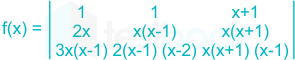
  1. AOption (a)

    12,12\dfrac{1}{2}, \dfrac{1}{2}

  2. BOption (b)

    12,12\dfrac{1}{\sqrt2}, \dfrac{1}{\sqrt2}

  3. COption (c)

    √2, √2

  4. DOption (d)

    2, 2

View answer & explanation

Correct answer

Answer: (c)C.

√2, √2

Why this answer is correct

CONCEPT:

The scalar product of two vectors a⃗ and b⃗\vec a \ and \ \vec b is given by a⃗⋅;b⃗=∣a⃗∣×∣b⃗∣cos⁡θ\vec a \cdot ;\vec b = \left| {\vec a} \right| \times \left| {\vec b} \right|\cos θ

CALCULATION:

Given: Vector r⃗=ai^+bj^\vec r=a \hat i+b \hat j is equally inclined to both x and y axes and the magnitude of the vector is 2 units.

i.e ∣r⃗∣=2|\vec r| = 2

⇒ a2+b2=2\sqrt {a^2 + b^2} = 2

⇒ a2 + b2 = 4 --------(1)

∵ The vector r⃗=ai^+bj^\vec r=a \hat i+b \hat j is equally inclined to both x and y axes

Let θ be the angle between the vector r⃗=ai^+bj^\vec r=a \hat i+b \hat j and both the x and y axes.

⇒ cos θ=a2=b2cos \ \theta = \frac{a}{2} = \frac{b}{2}

⇒ a = b

So, by substituting a = b in equation (1), we get

⇒ 2b2 = 4 ⇒ b = √2

So, a = b = √2

Hence, correct option is 3

Question 117

Consider the following statements in respect of a vector c⃗=a⃗+b⃗\vec c=\vec a+\vec b, where ∣a⃗∣=∣b⃗∣≠0|\vec a|=|\vec b|\ne0:

1. c⃗\vec c is perpendicular to (a⃗−b⃗).(\vec a-\vec b). 2. c⃗\vec c is perpendicular to a⃗×b⃗.\vec a \times \vec b.

Which of the above statement is/are correct?

  1. AOption (a)

    1 only

  2. BOption (b)

    2 only

  3. COption (c)

    Both 1 and 2

  4. DOption (d)

    Neither 1 nor 2

View answer & explanation

Correct answer

Answer: (c)C.

Both 1 and 2

Why this answer is correct

CONCEPT:

  • The scalar triple product of three vectors is zero if any two of them are equal
  • If a⃗\vec a  is perpendicular to the vectors b⃗\vec b then a⃗⋅b⃗=0\vec a \cdot \vec b = 0

CALCULATION:

Given:  c⃗=a⃗+b⃗\vec c=\vec a+\vec b, where ∣a⃗∣=∣b⃗∣≠0|\vec a|=|\vec b|\ne0

Statement 1: c⃗\vec c is perpendicular to (a⃗−b⃗).(\vec a-\vec b).

First let's find out c⃗⋅(a⃗−b⃗)=(a⃗+b⃗)⋅(a⃗−b⃗)\vec c \cdot (\vec a-\vec b) = (\vec a + \vec b) \cdot (\vec a-\vec b)

⇒ (a⃗+b⃗)⋅(a⃗−b⃗)=∣a⃗∣2−a⃗⋅b⃗+b⃗⋅a⃗−∣b⃗∣2(\vec a + \vec b) \cdot (\vec a-\vec b) = |\vec a|^2 - \vec a \cdot \vec b + \vec b \cdot \vec a - |\vec b|^2

As we know that, a⃗⋅b⃗=b⃗⋅a⃗\vec a \cdot \vec b = \vec b \cdot \vec a

⇒ (a⃗+b⃗)⋅(a⃗−b⃗)=∣a⃗∣2−∣b⃗∣2(\vec a + \vec b) \cdot (\vec a-\vec b) = |\vec a|^2 - |\vec b|^2

∵ It is given that ∣a⃗∣=∣b⃗∣≠0|\vec a|=|\vec b|\ne0

⇒ (a⃗+b⃗)⋅(a⃗−b⃗)=∣a⃗∣2−∣b⃗∣2=0(\vec a + \vec b) \cdot (\vec a-\vec b) = |\vec a|^2 - |\vec b|^2 = 0

⇒ c⃗⋅(a⃗−b⃗)=0\vec c \cdot (\vec a-\vec b) = 0

Hence, statement 1 is true.

Statement 2: c⃗\vec c is perpendicular to a⃗×b⃗.\vec a \times \vec b.

First let's find out c⃗⋅(a⃗×b⃗)=(a⃗+b⃗)⋅(a⃗×b⃗)\vec c \cdot (\vec a \times \vec b) = (\vec a + \vec b) \cdot (\vec a \times \vec b)

⇒ (a⃗+b⃗)⋅(a⃗×b⃗)=a⃗⋅(a⃗×b⃗)+b⃗⋅(a⃗×b⃗)(\vec a + \vec b) \cdot (\vec a \times \vec b) = \vec a \cdot (\vec a \times \vec b) + \vec b \cdot (\vec a \times \vec b)

As we know that, the scalar triple product of three vectors is zero if any two of them are equal

⇒ (a⃗+b⃗)⋅(a⃗×b⃗)=0(\vec a + \vec b) \cdot (\vec a \times \vec b) = 0

Hence, statement 2 is true.

Hence, the correct option is 3.

Question 118

If a⃗:and:b⃗\vec a :and: \vec b are two vectors such that ∣a⃗+b⃗∣=∣a⃗−b⃗∣=4,|\vec a + \vec b|= |\vec a - \vec b|=4, then which one of the following is correct?

  1. AOption (a)

    a⃗:and:b⃗\vec a :and: \vec b must be unit vectors.

  2. BOption (b)

    a⃗\vec a must be parallel to b⃗.\vec b.

  3. COption (c)

    a⃗\vec a must be perpendicular to b⃗.\vec b.

  4. DOption (d)

    a⃗\vec a must be equal to b⃗.\vec b.

View answer & explanation

Correct answer

Answer: (c)C.

a⃗\vec a must be perpendicular to b⃗.\vec b.

Why this answer is correct

CONCEPT:

The scalar product of two vectors a⃗ and b⃗\vec a \ and \ \vec b is given by a⃗⋅;b⃗=∣a⃗∣×∣b⃗∣cos⁡θ\vec a \cdot ;\vec b = \left| {\vec a} \right| \times \left| {\vec b} \right|\cos θ

If the vectors a⃗ and b⃗\vec a \ and \ \vec b  are perpendicular then a⃗⋅;b⃗=0\vec a \cdot ;\vec b = 0

CALCULATION:

Given: a⃗:and:b⃗\vec a :and: \vec b are two vectors such that ∣a⃗+b⃗∣=∣a⃗−b⃗∣=4|\vec a + \vec b|= |\vec a - \vec b|=4

⇒ ∣a⃗+b⃗∣2=∣a⃗−b⃗∣2|\vec a + \vec b|^2= |\vec a - \vec b|^2

⇒ (a⃗+b⃗)⋅(a⃗+b⃗)=(a⃗−b⃗)⋅(a⃗−b⃗)(\vec a + \vec b) \cdot (\vec a + \vec b) = (\vec a - \vec b) \cdot (\vec a - \vec b)

⇒ ∣a⃗∣2+a⃗⋅b⃗+b⃗⋅a⃗+∣b⃗∣2=∣a⃗∣2−a⃗⋅b⃗−b⃗⋅a⃗+∣b⃗∣2|\vec a|^2 + \vec a \cdot \vec b + \vec b \cdot \vec a + |\vec b|^2 = |\vec a|^2 - \vec a \cdot \vec b - \vec b \cdot \vec a + |\vec b|^2

∵ a⃗⋅b⃗=b⃗⋅a⃗\vec a \cdot \vec b = \vec b \cdot \vec a

⇒ ∣a⃗∣2+2a⃗⋅b⃗+∣b⃗∣2=∣a⃗∣2−2a⃗⋅b⃗+∣b⃗∣2|\vec a|^2 + 2\vec a \cdot \vec b + |\vec b|^2 = |\vec a|^2 - 2\vec a \cdot \vec b + |\vec b|^2

⇒ 4a⃗⋅b⃗=04\vec a \cdot \vec b = 0

⇒ a⃗⋅b⃗=0\vec a \cdot \vec b = 0

So, a⃗\vec a  must be perpendicular to b⃗.\vec b.

Hence, correct option is 3.

Question 119

If a⃗,b⃗:and:c⃗\vec a, \vec b:and : \vec c are coplanar, then what is (2a⃗×3b⃗)⋅4c⃗+(5b⃗×3c⃗)⋅6a⃗(2\vec a\times 3\vec b)\cdot4\vec c+(5\vec b\times 3\vec c)\cdot6\vec a equal to?

  1. AOption (a)

    114

  2. BOption (b)

    66

  3. COption (c)

    0

  4. DOption (d)

    -66

View answer & explanation

Correct answer

Answer: (c)C.

0

Why this answer is correct

CONCEPT:

Properties of Scalar Triple Product

  • [a b c] = [b c a] = [c a b]
  • [a b c] = - [b a c] = - [c b a] = - [a c b]
  • [(a + b) c d] = [a c d] + [b c d]
  • [λa, b c] = λ [a b c]
  • Three non-zero vectors a⃗,;b⃗;and;c⃗\vec a,;\vec b;and;\vec c are coplanar if and only if [a b c] = 0

CALCULATION:

Given: a⃗,b⃗:and:c⃗\vec a, \vec b:and : \vec c are coplanar i.e [a⃗ b⃗ c⃗]=0[\vec a \ \vec b \ \vec c] = 0

⇒ (2a⃗×3b⃗)⋅4c⃗=[2a⃗ 3b⃗ 4c⃗](2\vec a\times 3\vec b)\cdot4\vec c = [2\vec a \ 3\vec b \ 4\vec c] and (5b⃗×3c⃗)⋅6a⃗=[5b⃗ 3c⃗ 6a⃗](5\vec b\times 3\vec c)\cdot6\vec a = [5\vec b \ 3\vec c \ 6\vec a]

⇒ (2a⃗×3b⃗)⋅4c⃗+(5b⃗×3c⃗)⋅6a⃗=[2a⃗ 3b⃗ 4c⃗]+[5b⃗ 3c⃗ 6a⃗](2\vec a\times 3\vec b)\cdot4\vec c+(5\vec b\times 3\vec c)\cdot6\vec a = [2\vec a \ 3\vec b \ 4\vec c] + [5\vec b \ 3\vec c \ 6\vec a]

As we know that, [a b c] = [b c a] = [c a b]

⇒ (2a⃗×3b⃗)⋅4c⃗+(5b⃗×3c⃗)⋅6a⃗=[2a⃗ 3b⃗ 4c⃗]+[6a⃗ 5b⃗ 3c⃗](2\vec a\times 3\vec b)\cdot4\vec c+(5\vec b\times 3\vec c)\cdot6\vec a = [2\vec a \ 3\vec b \ 4\vec c] + [6\vec a \ 5\vec b \ 3\vec c]

As we know that, [λa, b c] = λ [a b c]

⇒ [2a⃗ 3b⃗ 4c⃗]+[6a⃗ 5b⃗ 3c⃗]=24[a⃗ b⃗ c⃗]+90[a⃗ b⃗ c⃗] [2\vec a \ 3\vec b \ 4\vec c] + [6\vec a \ 5\vec b \ 3\vec c] = 24 [\vec a \ \vec b \ \vec c] + 90 [\vec a \ \vec b \ \vec c]

As we know that, vectors a⃗,;b⃗;and;c⃗\vec a,;\vec b;and;\vec c are coplanar if and only if [a b c] = 0

⇒ [2a⃗ 3b⃗ 4c⃗]+[6a⃗ 5b⃗ 3c⃗]=0 [2\vec a \ 3\vec b \ 4\vec c] + [6\vec a \ 5\vec b \ 3\vec c] = 0

⇒ (2a⃗×3b⃗)⋅4c⃗+(5b⃗×3c⃗)⋅6a⃗=0(2\vec a\times 3\vec b)\cdot4\vec c+(5\vec b\times 3\vec c)\cdot6\vec a = 0

Hence, correct option is  3.

Question 120

Consider the following statements:

  1. The cross product of two unit vectors is always a unit vector.
  2. The dot product of two unit vectors is always unity.
  3. The magnitude of sum of two unit vectors is always greater than the magnitude of their difference.

Which of the above statements are not correct?

  1. AOption (a)

    1 and 2 only

  2. BOption (b)

    2 and 3 only

  3. COption (c)

    1 and 3 only

  4. DOption (d)

    1, 2 and 3

View answer & explanation

Correct answer

Answer: (d)D.

1, 2 and 3

Why this answer is correct

Concept:

The cross product of two vectors a⃗ and b⃗\vec a \ and \ \vec b is given by a⃗×b⃗=∣a⃗∣⋅∣b⃗∣sin⁡θ;n^\vec a \times \vec b = \left| {\vec a} \right| \cdot \left| {\vec b} \right|\sin θ ;\hat n and ∣a⃗×b⃗∣=∣a⃗∣⋅∣b⃗∣sin⁡θ;|\vec a \times \vec b| = \left| {\vec a} \right| \cdot \left| {\vec b} \right|\sin θ ;

The scalar product of two vectors a⃗ and b⃗\vec a \ and \ \vec b is given by a⃗⋅;b⃗=∣a⃗∣×∣b⃗∣cos⁡θ\vec a \cdot ;\vec b = \left| {\vec a} \right| \times \left| {\vec b} \right|\cos θ

If a⃗\vec a is a unit vector then ∣a⃗∣=1|\vec a| = 1

Calculations:

Statement 1: The cross product of two unit vectors is always a unit vector.

Let a⃗\vec a and b⃗\vec b are two unit vectors.

i.e ∣a⃗∣=1 and ∣b⃗∣=1|\vec a| = 1 \ and \ |\vec b| = 1

As we know that, the cross product of two vectors a⃗ and b⃗\vec a \ and \ \vec b is given by a⃗×b⃗=∣a⃗∣⋅∣b⃗∣sin⁡θ;n^\vec a \times \vec b = \left| {\vec a} \right| \cdot \left| {\vec b} \right|\sin θ ;\hat n and ∣a⃗×b⃗∣=∣a⃗∣⋅∣b⃗∣sin⁡θ;|\vec a \times \vec b| = \left| {\vec a} \right| \cdot \left| {\vec b} \right|\sin θ ;

⇒ ∣a⃗×b⃗∣=∣a⃗∣⋅∣b⃗∣sin⁡θ;=sinθ|\vec a \times \vec b| = \left| {\vec a} \right| \cdot \left| {\vec b} \right|\sin θ ; = sin θ

The range of sin θ is [-1, 1]

So, it is not necessarily true that the cross product of two unit vectors is always a unit vector.

Hence, statement 1 is false.

Statement 2: The dot product of two unit vectors is always unity.

Let a⃗\vec a and b⃗\vec b are two unit vectors.

i.e ∣a⃗∣=1 and ∣b⃗∣=1|\vec a| = 1 \ and \ |\vec b| = 1

As we know that, the scalar product of two vectors a⃗ and b⃗\vec a \ and \ \vec b is given by a⃗⋅;b⃗=∣a⃗∣×∣b⃗∣cos⁡θ\vec a \cdot ;\vec b = \left| {\vec a} \right| \times \left| {\vec b} \right|\cos θ  

⇒ ∣a⃗⋅;b⃗∣=cos θ|\vec a \cdot ;\vec b |= cos \ θ

The range of cos θ is [-1, 1].

So, it is not necessarily true that the dot product of two unit vectors is always a unit vector.

Hence, statement 2 is false.

Statement 3: The magnitude of sum of two unit vectors is always greater than the magnitude of their difference.

Let a⃗ =i^ and  b⃗=j^\vec a \ = \hat i \ and \ \ \vec b = \hat j 

As we can see that, the vectors  a⃗\vec a and b⃗\vec b are two unit vectors

⇒  ∣i^+j^∣=2|\hat i + \hat j| = \sqrt 2 and ∣i^−j^∣=2|\hat i - \hat j| = \sqrt 2

⇒ ∣a⃗+b⃗∣=∣a⃗−b⃗∣|\vec a + \vec b| = |\vec a - \vec b|

So, statement 3 is also false.

Hence, the correct option is 4.

120 questions in the full paper