Previous Year Paper

NDA Mathematics 19 April 2015 Official Paper (Previous Year Paper)

Held in 2015

120 questions150 minutes
With answers
Free

Paper last updated:

Practise under exam conditions

Take this paper as a timed mock test. Review your answers after you submit.

Attempt timed test

Questions & answers

Read the paper at your pace. Open an explanation when you need it.

Mathematics (120 questions)

Question 1

Let X be the set of all persons living in a city. Persons x, y in X are said to be related as x < y if y at least 5 years older than x. which one of the following is correct?

  1. AOption (a)

    The relation is an equivalence relation on X.

  2. BOption (b)

    The relation is transitive but neither reflexive nor symmetric.

  3. COption (c)

    The relation is reflexive but neither transitive nor symmetric.

  4. DOption (d)

    The relation is symmetric but neither transitive nor reflexive.

View answer & explanation

Correct answer

Answer: (b)B.

The relation is transitive but neither reflexive nor symmetric.

Why this answer is correct

Concept:

Let R be a binary relation on a set A.

1. Reflexive: Each element is related to itself.

  • R is reflexive if for all x ∈ A, xRx.

2. Symmetric: If any one element is related to any other element, then the second element is related to the first.

  • R is symmetric if for all x, y ∈ A, if xRy, then yRx.

3. Transitive: If any one element is related to a second and that second element is related to a third, then the first element is related to the third.

  • R is transitive if for all x, y, z ∈ A, if xRy and yRz, then xRz.
  1. R is an equivalence relation if A is nonempty and R is reflexive, symmetric and transitive.

Calculation:

Given: x < y if y at least 5 years older than x

⇒ y ≥ x + 5

For Reflexive: (x, x) should ∈R for all x ∈ X

Now, x cannot be 5 years older than himself. So the relation is not reflexive.

For Symmetric: If (x, y) ∈ R ⇒(y, x) ∈ R

(x, y) ∈ R ⇒ y is at least 5 years older than x.

(y, x) ∈ R ⇒ x is at least 5 years older than y. This contradicts the above statement. Hence the relation is not symmetric

For Transitive: If (x, y) ∈ R and (y, z) ∈ R ⇒ (x, z) ∈ R.

(x, y) ∈ R ⇒ y is at least 5 years older than x.

(y, z) ∈ R ⇒ z is at least 5 years older than y.

Then, (x, z) ∈ R ⇒ z is at least 5 years older than x.

Since, z is at least 10 years older than x. The relation is transitive.
Question 2

Which one of the following matrices is an elementary matrix?

  1. AOption (a)

    \left[ {\begin{array}{*{20}{c}} 1&0&0\ 0&0&0\ 0&0&1 \end{array}} \right]

  2. BOption (b)

    \left[ {\begin{array}{*{20}{c}} 1&5&0\ 0&1&0\ 0&0&1 \end{array}} \right]

  3. COption (c)

    \left[ {\begin{array}{*{20}{c}} 0&2&0\ 1&0&0\ 0&0&1 \end{array}} \right]

  4. DOption (d)

    \left[ {\begin{array}{*{20}{c}} 1&0&0\ 0&1&0\ 0&5&2 \end{array}} \right]

View answer & explanation

Correct answer

Answer: (b)B.

\left[ {\begin{array}{*{20}{c}} 1&5&0\ 0&1&0\ 0&0&1 \end{array}} \right]

Why this answer is correct

Concept:

  • Elementary matrix: An elementary matrix is a matrix which differs from the identity matrix by one single elementary row operation
  • An elementary matrix has each diagonal element 1.

Calculation:

Let's check option b,

Let E = \left[ {\begin{array}{*{20}{c}} 1&5&0\ 0&1&0\ 0&0&1 \end{array}} \right]

Apply R1 → R1 – 5R2

\Rightarrow {\rm{E;}} = \left[ {\begin{array}{*{20}{c}} 1&0&0\ 0&1&0\ 0&0&1 \end{array}} \right] = ;{{\rm{I}}_{3{\rm{;}} \times 3}}

We can see that option B converted in to an identity matrix by one elementary operation.

Hence Option B is correct.

Shortcut Method:

We know that an elementary matrix has each diagonal element 1.

Only B has diagonal element is 1. (By Definition)

So, Option B is correct.

Question 3

Consider the following statements in respect of the given equation:

(x2+2)2+8x2=6x(x2+2){\left( {{x^2} + 2} \right)^2} + 8{x^2} = 6x\left( {{x^2} + 2} \right)

  1. All the roots of the equation are complex.
  2. The sum of all the roots of the equation is 6.

Which of the above statements is/are correct?

  1. AOption (a)

    1 only

  2. BOption (b)

    2 only

  3. COption (c)

    Both 1 and 2

  4. DOption (d)

    Neither 1 nor 2

View answer & explanation

Correct answer

Answer: (b)B.

2 only

Why this answer is correct

Concept:

Let us consider the standard form of a quadratic equation, ax2 + bx + c =0

Where a, b and c are constants with a ≠ 0

  • x=;−b;±;b2−4ac2a{\bf{x}} = ;\frac{{ - {\bf{b}}; \pm ;\sqrt {{{\bf{b}}^2} - 4{\bf{ac}}} }}{{2{\bf{a}}}}

Calculation:

Given:

(x2+2)2+8x2=6x(x2+2){\left( {{x^2} + 2} \right)^2} + 8{x^2} = 6x\left( {{x^2} + 2} \right)

Let x2 + 2 = t

⇒ t2 + 8x2 = 6xt

⇒ t2 - 6xt + 8x2 = 0

⇒ t2 - 4xt - 2xt + 8x2 = 0

⇒ t (t – 4x) – 2x (t – 4x) = 0

⇒ (t – 2x) (t – 4x) = 0

Now, putting the value of t in above equation, we get

⇒ (x2 + 2 – 2x) (x2 + 2 – 4x) = 0

Now, (x2 – 2x + 2) = 0 and (x2 – 4x + 2) = 0

⇒ x2 – 2x + 2 = 0

x=;−(−2);±;(−2)2−4;×1×22;×1=;2;±;−42=;2;±;2i2=1;±i{\rm{x}} = {\rm{;}}\frac{{ - \left( { - 2} \right){\rm{;}} \pm {\rm{;}}\sqrt {{{\left( { - 2} \right)}^2} - 4{\rm{;}} \times 1 \times 2} }}{{2{\rm{;}} \times 1}} = {\rm{;}}\frac{{2{\rm{;}} \pm {\rm{;}}\sqrt { - 4} }}{2} = {\rm{;}}\frac{{2{\rm{;}} \pm {\rm{;}}2{\rm{i}}}}{2} = 1{\rm{;}} \pm {\rm{i}}

Roots are imaginary.

Now,

⇒ (x2 – 4x + 2) = 0

x=;−(−4);±;(−4)2−4;;×;1;×;22;;×;1=;4;±;82=;4;±;222=2;±2{\rm{x}} = {\rm{;}}\frac{{ - \left( { - 4} \right){\rm{;}} \pm {\rm{;}}\sqrt {{{\left( { - 4} \right)}^2} - 4{\rm{;}} ;\times ;1 ;\times; 2} }}{{2{\rm{;}}; \times ;1}} = {\rm{;}}\frac{{4{\rm{;}} \pm {\rm{;}}\sqrt 8 }}{2} = {\rm{;}}\frac{{4{\rm{;}} \pm {\rm{;}}2\sqrt 2 }}{2} = 2{\rm{;}} \pm \sqrt 2

Roots are real.

We can say that not all roots of the equation are complex.

So statement 1st is wrong.

Now,

Sum of all the roots = (1 + i) + (1 – i) + (2 + √2) + (2 - √2) = 6

So statement 2nd is true.

Question 4

In solving a problem that reduces to a quadratic equation, one student makes a mistake in the constant term and obtains 8 and 2 for roots. Another student makes a mistake only in the coefficient of first-degree term and finds -9 and -1 for roots.

The correct equation is

  1. AOption (a)

    x2 – 10x + 9 = 0

  2. BOption (b)

    x2 + 10x + 9 = 0

  3. COption (c)

    x2 – 10x + 16 = 0

  4. DOption (d)

    x2 – 8x – 9 = 0

View answer & explanation

Correct answer

Answer: (a)A.

x2 – 10x + 9 = 0

Why this answer is correct

Concept:

Standard form of a quadratic equation can be written as:

  • ax2 + bx + c = x2 – (sum of roots) x + (product of roots) = 0

Calculation:

Let f(x) = x2 – (sum of roots) x + (product of roots) = 0

Given: one student makes a mistake in the constant term and obtains 8 and 2 for roots.

That means 1st student obtain correct sum of roots

∴ Sum of roots = 8 + 2 = 10

Given: Another student makes a mistake only in the coefficient of first-degree term and finds -9 and -1 for roots.

That means 2nd student obtain correct product of roots

∴ Product of roots = -9 × -1 = 9

Now,

f(x) = x2 – 10x + 9 = 0

Question 5

If A = ;\left[ {\begin{array}{*{20}{c}} 2&7\ 1&5 \end{array}} \right] then what is A + 3A-1 equal to?

Where A is the matrix of order 2.

  1. AOption (a)

    3I

  2. BOption (b)

    5I

  3. COption (c)

    7I

  4. DOption (d)

    None of the above

View answer & explanation

Correct answer

Answer: (c)C.

7I

Why this answer is correct

Concept:

  • If \({\rm{A}} = \left[ {\begin{array}{*{20}{c}} {{{\rm{a}}{11}}}&{{{\rm{a}}{12}}}\ {{{\rm{a}}{21}}}&{{{\rm{a}}{22}}} \end{array}} \right]\) then determinant of A is given by: |A| = (a­11 × a22) – (a12 – a21).
  • A−1=;Adj;(A)∣A∣{{\rm{A}}^{ - 1}} = {\rm{;}}\frac{{{\rm{Adj;}}\left( {\rm{A}} \right)}}{{\left| {\rm{A}} \right|}}

Note:

For 2 × 2 matrix,

Let A = \(\left[ {\begin{array}{{20}{c}} {\rm{a}}&b\ {\rm{c}}&{\rm{d}} \end{array}} \right]\) than Adj A = \(\left[ {\begin{array}{{20}{c}} {\rm{d}}&{ - b}\ { - {\rm{c}}}&{\rm{a}} \end{array}} \right]\) 

Note: Interchange the diagonal elements and change the sign of remaining elements**.**

Calculation:

Given: A = ;\left[ {\begin{array}{*{20}{c}} 2&7\ 1&5 \end{array}} \right]

⇒ |A| = 10 – 7 = 3

We know that for 2 × 2 matrix, interchanging the diagonal elements and changing the sign of remaining elements gives an adjoint matrix.

\therefore {\rm{Adj;}}\left( {\rm{A}} \right){\rm{;}} = \left[ {\begin{array}{*{20}{c}} 5&{ - 7}\ { - 1}&2 \end{array}} \right]

Now,

{{\rm{A}}^{ - 1}} = {\rm{;}}\frac{{{\rm{Adj;}}\left( {\rm{A}} \right)}}{{\left| {\rm{A}} \right|}} = ;\frac{{\left[ {\begin{array}{*{20}{c}} 5&{ - 7}\ { - 1}&2 \end{array}} \right]}}{3}

\Rightarrow 3{{\rm{A}}^{ - 1}} = {\rm{;}}\left[ {\begin{array}{*{20}{c}} 5&{ - 7}\ { - 1}&2 \end{array}} \right]

We have to find the value of A + 3A-1

⇒ A + 3A-1 = \(\left[ {\begin{array}{{20}{c}} 2&7\ 1&5 \end{array}} \right] + ;\left[ {\begin{array}{{20}{c}} 5&{ - 7}\ { - 1}&2 \end{array}} \right] = ;\left[ {\begin{array}{{20}{c}} 7&0\ 0&7 \end{array}} \right] = 7\left[ {\begin{array}{{20}{c}} 1&0\ 0&1 \end{array}} \right]\) 

∴ A + 3A-1 = 7I

Question 6

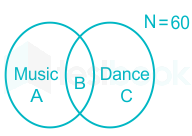
In a class of 60 students, 45 students like music, 50 students like dancing, 5 students like neither. Then the number of students in the class who like both music and dancing is

  1. AOption (a)

    35

  2. BOption (b)

    40

  3. COption (c)

    50

  4. DOption (d)

    55

View answer & explanation

Correct answer

Answer: (b)B.

40

Why this answer is correct

Calculation:

Total number of students in class = 60

Students who like music = A + B = 45     …. (1)

Students who like dancing = B + C = 50     …. (2)

Students who like nothing =5

Students who like both music and dancing = B

We know that A + B + C + 5 = 60

From equation 1st,

⇒ 45 + C + 5 = 60

⇒ C = 10

Put the value of C in equation 2nd, we get

⇒ B = 40

Hence, 40 students like both music and dancing.

Question 7

If log10 2, log10(2x-1) and log10(2x+ 3) are three consecutive terms of an AP, then the value of x is

  1. AOption (a)

    1

  2. BOption (b)

    log5 2

  3. COption (c)

    log2 5

  4. DOption (d)

    log10 5

View answer & explanation

Correct answer

Answer: (c)C.

log2 5

Why this answer is correct

Concept:

Logarithm properties

  1. Product rule: The log of a product equals the sum of two logs.

log⁡a(mn)=;log⁡am+;log⁡an{\log _{\rm{a}}}\left( {{\rm{mn}}} \right) = {\rm{;}}{\log _{\rm{a}}}{\rm{m}} + {\rm{;}}{\log _{\rm{a}}}{\rm{n}}

  1. Quotient rule: The log of a quotient equals the difference of two logs.

log⁡amn=;log⁡am−;log⁡an{\log _{\rm{a}}}\frac{{\rm{m}}}{{\rm{n}}} = {\rm{;}}{\log _{\rm{a}}}{\rm{m}} - {\rm{;}}{\log _{\rm{a}}}{\rm{n}}

  1. Power rule: In the log of a power the exponent becomes a coefficient.

log⁡amn=nlog⁡am{\log _{\rm{a}}}{{\rm{m}}^{\rm{n}}} = {\rm{n}}{\log _{\rm{a}}}{\rm{m}}

  • If a, b, c are in A.P ⇔ b = a;+;c2\frac{{{\rm{a;}} + {\rm{;c}}}}{2} or 2b = a + c

Calculation:

Given: log10 2, log10 (2x - 1) and log10 (2x + 3) are three consecutive terms of an AP

We know that if a, b, c are in A.P than 2b = a + c

⇒ 2 × log10 (2x- 1) = log10 2 + log10 (2x + 3)

⇒ log10 (2x- 1)2 = log10 (2 × (2x + 3))

⇒ (2x- 1)2 = 2 × (2x+ 3)

Let 2x = t

⇒ (t - 1)2 = 2 × (t + 3)

⇒ t2 – 2t + 1 = 2t + 6

⇒ t2 – 4t - 5 = 0

⇒ t2 – 5t + t - 5 = 0

⇒ t (t – 5) + 1 (t – 5) = 0

⇒ (t – 5) (t + 1) = 0

∴ t = 5, -1

⇒ 2x ≠ -1         (∵2x > 0)

Now,

⇒ 2x = 5

∴ x = log2 5

Question 8

The matrix \left[ {\begin{array}{*{20}{c}} 0&{ - 4 + i}\ {4 + i}&0 \end{array}} \right] is

  1. AOption (a)

    symmetric

  2. BOption (b)

    skew-symmetric

  3. COption (c)

    Hermitian

  4. DOption (d)

    Skew-Hermitian

View answer & explanation

Correct answer

Answer: (d)D.

Skew-Hermitian

Why this answer is correct

Concept:

1. Symmetric Matrix: Square matrix A is said to be symmetric if the transpose of matrix A is equal to matrix A itself ⇔ AT = A or A’ = A

2. Skew-Symmetric Matrix or Anti-symmetric: Square matrix A is said to be skew-symmetric if transpose of matrix A is equal to negative of matrix A ⇔ AT = −A

3. Hermitian Matrix:  A Hermitian matrix is a complex square matrix that is equal to its own conjugate transpose ⇔ AT=;Aˉ{{\bf{A}}^{\bf{T}}} = ;{\bf{\bar A}}

4. Skew-Hermitian: AT=−Aˉ{{\bf{A}}^{\bf{T}}} = - {\bf{\bar A}}

  1. Let z = x + iy be a complex number.
  • Conjugate of z =

Image unavailable

 = x – iy

Calculation:

Let A = \left[ {\begin{array}{*{20}{c}} 0&{ - 4 + i}\ {4 + i}&0 \end{array}} \right]

Now, transpose of matrix A

 AT = \left[ {\begin{array}{*{20}{c}} 0&{4 + i}\ { - 4 + i}&0 \end{array}} \right]

⇒ AT ≠ A

∴ given matrix is not symmetric

AT = \left[ {\begin{array}{*{20}{c}} 0&{4 + i}\ { - 4 + i}&0 \end{array}} \right] \ne - {\rm{A}}

∴ given matrix is not skew-symmetric.

Now, Conjugate of matrix A

\({\rm{\bar A}} = ;\left[ {\begin{array}{{20}{c}} 0&{\overline { - 4 + i} }\ {\overline {4 + i} }&0 \end{array}} \right] = ;\left[ {\begin{array}{{20}{c}} 0&{ - 4 - i}\ {4 - i}&0 \end{array}} \right] = ; - \left[ {\begin{array}{*{20}{c}} 0&{4 + i}\ { - ;4 + i}&0 \end{array}} \right]\)


⇒Aˉ=−;AT \Rightarrow {\rm{\bar A}} = - ;{{\rm{A}}^{\rm{T}}}

∴ given matrix is skew-hermitian matrix.

Question 9

Let Z be the set of integers and aRb, where a, b ∈ Z if and only if (a - b) is divisible by 5.

Consider the following statements:

  1. The relation R partitions Z into five equivalent classes
  2. Any two equivalent classes are either equal or disjoint

Which of the above statements is/are correct?

  1. AOption (a)

    1 only

  2. BOption (b)

    2 only

  3. COption (c)

    Both 1 and 2

  4. DOption (d)

    Neither 1 nor 2

View answer & explanation

Correct answer

Answer: (c)C.

Both 1 and 2

Why this answer is correct

Concept:

Let R be a binary relation on a set A.

1. Reflexive: Each element is related to itself.

  • R is reflexive if for all x ∈ A, xRx.

2. Symmetric: If any one element is related to any other element, then the second element is related to the first.

  • R is symmetric if for all x, y ∈ A, if xRy, then yRx.

3. Transitive: If any one element is related to a second and that second element is related to a third, then the first element is related to the third.

  • R is transitive if for all x, y, z ∈ A, if xRy and yRz, then xRz.
  1. R is an equivalence relation if A is nonempty and R is reflexive, symmetric and transitive.

Calculation:

A relation is defined on Z such that aRb ⇒ (a − b) is divisible by 5,

For Reflexive: (a, a) ∈ R.

Since, (a − a) = 0 is divisible by 5. 

Therefore, the relation is reflexive.

For symmetric: If (a, b) ∈ R ⇒ (b, a) ∈ R.

(a, b)∈ R ⇒ (a − b) is divisible by 5.

Now, (b − a) = − (a − b) is also divisible by 5.

Therefore, (b, a) ∈ R

Hence, the relation is symmetric.

For Transitive: If (a, b) ∈ R and (b, a) ∈ R ⇒ (a, c) ∈ R.

(a, b) ∈ R ⇒ (a − b) is divisible by 5.

(b, c) ∈ R ⇒ (b − c) is divisible by 5.

Then,

(a − c) = (a – b + b −c)

(a − c)  = (a − b) + (b − c)

We know that (a − b) is divisible by 5 and (b − c) is divisible by 5 then (a − c) is also divisible by 5.  Therefore, (a, c) ∈ R.

Hence, the relation is transitive.
∴ the relation is equivalent.

Now, depending upon the remainder obtained when dividing (a−b) by 5 we can divide the set Z into 5 equivalent classes and they are disjoint i.e., there are no common elements between any two classes.

Question 10

If z=−2(1;+;2i)3;+;i{\rm{z}} = {\rm{}} - \frac{{2\left( {1; + ;2{\rm{i}}} \right)}}{{3; + ;{\rm{i}}}} Where i=−1i = \sqrt { - 1} then the argument θ (-π < θ ≤ π) of z is

  1. AOption (a)

    3π4\frac{{3\pi }}{4}

  2. BOption (b)

    π4\frac{\pi }{4}

  3. COption (c)

    5π6\frac{{5\pi }}{6}

  4. DOption (d)

    −3π4- \frac{{3\pi }}{4}

View answer & explanation

Correct answer

Answer: (d)D.

−3π4- \frac{{3\pi }}{4}

Why this answer is correct

Concept:

Let z = x + iy be a complex number.

  • Modulus of z = ∣z∣=;x2+y2=;Re(z)2+;Im;(z)2\left| {\rm{z}} \right| = {\rm{;}}\sqrt {{{\rm{x}}^2} + {{\rm{y}}^2}} = {\rm{;}}\sqrt {{\rm{Re}}{{\left( {\rm{z}} \right)}^2} + {\rm{;Im;}}{{\left( {\rm{z}} \right)}^2}}
  • arg (z) = arg (x + iy) = tan⁡−1(yx){\tan ^{ - 1}}\left( {\frac{{\rm{y}}}{{\rm{x}}}} \right)

Calculation:

Given:

z=;−2(1+2i)3+i{\rm{z}} = {\rm{;}} - \frac{{2\left( {1 + 2{\rm{i}}} \right)}}{{3 + {\rm{i}}}}

⇒z=;−2(1+2i)3+i×3−i3−i\Rightarrow {\rm{z}} = {\rm{;}} - \frac{{2\left( {1 + 2{\rm{i}}} \right)}}{{3 + {\rm{i}}}} \times \frac{{3 - {\rm{i}}}}{{3 - {\rm{i}}}}

⇒z=−2(3+6i−i−2i2)32−i2 \Rightarrow {\rm{z}} = {\rm{}} - \frac{{2\left( {3 + 6{\rm{i}} - {\rm{i}} - 2{{\rm{i}}^2}} \right)}}{{{3^2} - {{\rm{i}}^2}}}                 (∵ (a + b) (a – b) = (a2 – b2))

⇒z=−2(3+5i+2)9+1=;−2(5+5i)10=;−1−i\Rightarrow {\rm{z}} = {\rm{}} - \frac{{2\left( {3 + 5{\rm{i}} + 2} \right)}}{{9 + 1}} = ; - \frac{{2\left( {5 + 5{\rm{i}}} \right)}}{{10}} = ; - 1 - i

Here z lies in 3rd quadrant,

∴ Argument θ = -π + tan-1 (1/1) = -π + π/4 = -3π/4

Question 11

If m and n are the roots of the equation (x + p) (x + q) – k = 0, then the roots of the equation

(x – m) (x - n) + k = 0 are

  1. AOption (a)

    P and q

  2. BOption (b)

    1/p and 1/q

  3. COption (c)

    -p and -q

  4. DOption (d)

    P + q and p - q

View answer & explanation

Correct answer

Answer: (c)C.

-p and -q

Why this answer is correct

Concept:

Let us consider the standard form of a quadratic equation, ax2 + bx + c =0

Let α and β be the two roots of the above quadratic equation. 

  • The sum of the roots of a quadratic equation are:

α+β=−ba=−coefficient;of;xcoefficient;of;x2{\rm{\alpha }} + {\rm{\beta }} = - \frac{{\rm{b}}}{{\rm{a}}} = - \frac{{{\rm{coefficient;of;x}}}}{{{\rm{coefficient;of;}}{{\rm{x}}^2}}}

  • The product of the roots is given by:

αβ=ca=constant;termcoefficient;of;x2{\rm{\alpha \beta }} = \frac{{\rm{c}}}{{\rm{a}}} = \frac{{{\rm{constant;term}}}}{{{\rm{coefficient;of;}}{{\rm{x}}^2}}}

Calculation:

(x + p) (x + q) – k = 0

⇒ x2 + (p + q) x + pq – k = 0

Given m and n are the roots of this equation

So,

Sum of roots = m + n = − (p + q)    …. (1)

Product of the roots = mn = pq − k

⇒ pq = mn + k      …. (2)

Consider, (x−m) (x−n) + k = 0

⇒ x2− (m + n) x + mn + k = 0

From equation 1 and 2,

⇒ x2+ (p + q) x + pq = 0

⇒ x2+ px + qx + pq = 0

⇒ x (x + p) + q(x + p) = 0

⇒ (x + p) (x + q) = 0

∴ x = -p, -q

Hence, the roots of the new equation are −p, −q

Question 12

What is the sum of the series 0.5 + 0.55 + 0.555 + … to n terms?

  1. AOption (a)

    59[;n−29(1−110n)]\frac{5}{9}\left[ {;n - \frac{2}{9}\left( {1 - \frac{1}{{{{10}^n}}}} \right)} \right]

  2. BOption (b)

    19[5−29(1−110n)]\frac{1}{9}\left[ {5 - \frac{2}{9}\left( {1 - \frac{1}{{{{10}^n}}}} \right)} \right]

  3. COption (c)

    19[n−59(1−110n)]\frac{1}{9}\left[ {n - \frac{5}{9}\left( {1 - \frac{1}{{{{10}^n}}}} \right)} \right]

  4. DOption (d)

    59[n−19(1−110n)]\frac{5}{9}\left[ {n - \frac{1}{9}\left( {1 - \frac{1}{{{{10}^n}}}} \right)} \right]

View answer & explanation

Correct answer

Answer: (d)D.

59[n−19(1−110n)]\frac{5}{9}\left[ {n - \frac{1}{9}\left( {1 - \frac{1}{{{{10}^n}}}} \right)} \right]

Why this answer is correct

Concept:

Let us consider sequence a1, a2, a3 …. an is an G.P.

  • Common ratio = r = \(\frac{{{{\rm{a}}_2}}}{{{{\rm{a}}_1}}} = \frac{{{{\rm{a}}3}}}{{{{\rm{a}}2}}} = \ldots = \frac{{{{\rm{a}}{\rm{n}}}}}{{{{\rm{a}}{{\rm{n}} - 1}}}}\)
  • nth  term of the G.P. is an = arn−1
  • Sum of n terms = s = a;(rn−1)r−;1\frac{{{\rm{a;}}\left( {{{\rm{r}}^{\rm{n}}} - 1} \right)}}{{{\rm{r}} - {\rm{;}}1}}; where r >1
  • Sum of n terms = s = a;(1−;rn)1−;r\frac{{{\rm{a;}}\left( {1 - {\rm{;}}{{\rm{r}}^{\rm{n}}}} \right)}}{{1 - {\rm{;r}}}}; where r <1

Calculation:

Let S = 0.5 + 0.55 + 0.555 + … to n terms

⇒ S = 5 [0.1 + 0.11 + 0.111 + … to n terms]

⇒ S = (5/9) × [0.9 + 0.99 + 0.999 + … to n terms]

⇒ S = (5/9) × [(1 - 0.1) + (1 - 0.01+ (1 - 0.001) + … to n terms]

⇒ S = (5/9) × [(1 + 1 + 1 + … to n terms) – (0.1 + 0.01 + 0.001 + … to n terms)]

⇒ S = (5/9) × [n – (0.1 + 0.01 + 0.001 + … to n terms)]      …. (1)

Let S1 = 0.1 + 0.01 + 0.001 + … to n terms

Sequence is in GP,

Here a = 0.1 = 1/10 and r = 0.1 = 1/10 < 1

Sum = a;(1−;rn)1−;r\frac{{{\rm{a;}}\left( {1 - {\rm{;}}{{\rm{r}}^{\rm{n}}}} \right)}}{{1 - {\rm{;r}}}}

∴S1=;110(1−;110n)(1;−;110;)=19(1−;110n)\therefore {{\rm{S}}_1} = ;\frac{{\frac{1}{{10}}\left( {1 - ;\frac{1}{{{{10}^n}}}} \right)}}{{\left( {1; - ;\frac{1}{{10}};} \right)}} = \frac{1}{9}\left( {1 - ;\frac{1}{{{{10}^n}}}} \right)          

Put the value of S1 in equation 1st,

∴;S;=59[n−19(1−110n)]\therefore {\rm{;S;}} = \frac{5}{9}\left[ {{\rm{n}} - \frac{1}{9}\left( {1 - \frac{1}{{{{10}^{\rm{n}}}}}} \right)} \right]

Question 13

If 1, ω, ω2 are the cube roots of unity, then the value of (1 + ω) (1 + ω2) (1 + ω4) (1 + ω8) is

  1. AOption (a)

    -1

  2. BOption (b)

    0

  3. COption (c)

    1

  4. DOption (d)

    2

View answer & explanation

Correct answer

Answer: (c)C.

1

Why this answer is correct

Concept:

If 1, ω, ω2 are the cube roots of unity

i). 1 + ω + ω2 = 0

ii). ω3 = 1

Calculation:

We have to find the value of (1 + ω) (1 + ω2) (1 + ω4) (1 + ω8)

⇒ (1 + ω) (1 + ω2) (1 + ω4) (1 + ω8)

= [(1 + ω) (1 + ω2)] × [(1 + ω3 × ω) (1 + (ω3)2 ω2)]

= [(1 + ω) (1 + ω2)] × [(1 + ω) (1 + ω2)]      (∵ω3 = 1)

= (1 + ω + ω2 + ω3) × (1 + ω + ω2 + ω3)

= (0 + 1) × (0 + 1)

= 1 × 1 = 1

Question 14

Let A = {1, 2, 3, 4, 5, 6, 7, 8, 9, 10}. Then the number of subsets of A containing exactly two elements is

  1. AOption (a)

    20

  2. BOption (b)

    40

  3. COption (c)

    45

  4. DOption (d)

    90

View answer & explanation

Correct answer

Answer: (c)C.

45

Why this answer is correct

Concept:

Combination: Selecting r objects from given n objects.

  • The number of selections of r objects from the given n objects is denoted by ;nCr;{{\rm{;}}^{\rm{n}}}{{\rm{C}}_{\rm{r}}}{\rm{;}}
  • ;nCr=n!r!(n;−;r)!{{\rm{;}}^{\rm{n}}}{{\rm{C}}_{\rm{r}}}{\rm{}} = {\rm{}}\frac{{{\rm{n}}!}}{{{\rm{r}}!\left( {{\rm{n;}} - {\rm{;r}}} \right)!}}

Note: Use combinations if a problem calls for the number of ways of selecting objects.

Calculation:

Number of elements in A = 10

Number of subsets of A containing exactly two elements = Number of ways we can select 2 elements from 10 elements

⇒ Number of ways we can select 2 elements from 10 elements = 10C2 = 45

∴ Number of subsets of A containing exactly two elements = 45

Question 15

What is the square root of i, where i=−1 i = \sqrt { - 1} ?

  1. AOption (a)

    1+i2\frac{{1 + {\rm{i}}}}{2}

  2. BOption (b)

    1−i2\frac{{1 - {\rm{i}}}}{2}

  3. COption (c)

    1+i2\frac{{1 + {\rm{i}}}}{{\sqrt 2 }}

  4. DOption (d)

    None of the above

View answer & explanation

Correct answer

Answer: (c)C.

1+i2\frac{{1 + {\rm{i}}}}{{\sqrt 2 }}

Why this answer is correct

Concept:

Equality of complex numbers.

  • Two complex numbers z1 = x1+ iy1 and z2 = x2 + iy2 are equal if and only if x1 = x2 and y1 = y2

Or Re (z1) = Re (z2) and Im (z1) = Im (z2).

Calculation:

Let √i = x + iy

Squaring both sides, we get

⇒ i  = (x + iy)2

⇒ i  = x2 + i2xy + (iy)2

⇒ x2 – y2 + i2xy = i

Compare real and imaginary parts,

∴ x2 – y2 = 0 and 2xy = 1

2xy = 1 ⇒ y = 1/2x       …. (1)

Now, x2 – y2 = 0

⇒ x2 – (1/4x2 ) = 0

⇒ 4x4 – 1 = 0

⇒ x4 = 1/4

∴ x = ± (1/√2)

Put the value of x in equation 1st,

∴ y = ± (1/√2)

So, square root of i = √i = x + iy =  1+i2\frac{{1 + {\rm{i}}}}{{\sqrt 2 }}

Alternate method:

i=;2;×;i;×;12=;2;×;i2;×;12\sqrt {\rm{i}} = {\rm{;}}\sqrt {2{\rm{;}} \times {\rm{;i;}} \times {\rm{;}}\frac{1}{2}} = {\rm{;}}\sqrt {2{\rm{;}} \times {\rm{;}}\frac{{\rm{i}}}{{\sqrt 2 }}{\rm{;}} \times {\rm{;}}\frac{1}{{\sqrt 2 }}}

⇒i=(12)2−(12)2+;(2;×;i2;×;12)\Rightarrow \sqrt {\rm{i}} = \sqrt {{{\left( {\frac{1}{{\sqrt 2 }}} \right)}^2} - {{\left( {\frac{1}{{\sqrt 2 }}} \right)}^2} + {\rm{;}}\left( {2{\rm{;}} \times {\rm{;}}\frac{{\rm{i}}}{{\sqrt 2 }}{\rm{;}} \times {\rm{;}}\frac{1}{{\sqrt 2 }}} \right)}

⇒i=(12)2+(i2)2+;(2;×;i2;×;12)\Rightarrow \sqrt {\rm{i}} = \sqrt {{{\left( {\frac{1}{{\sqrt 2 }}} \right)}^2} + {{\left( {\frac{{\rm{i}}}{{\sqrt 2 }}} \right)}^2} + {\rm{;}}\left( {2{\rm{;}} \times {\rm{;}}\frac{{\rm{i}}}{{\sqrt 2 }}{\rm{;}} \times {\rm{;}}\frac{1}{{\sqrt 2 }}} \right)}        (∵ i2 = 1)

⇒i=(12+;i2)2=;±(12+;i2)\Rightarrow \sqrt {\rm{i}} = \sqrt {{{\left( {\frac{1}{{\sqrt 2 }} + {\rm{;}}\frac{{\rm{i}}}{{\sqrt 2 }}} \right)}^2}} = {\rm{;}} \pm \left( {\frac{1}{{\sqrt 2 }} + {\rm{;}}\frac{{\rm{i}}}{{\sqrt 2 }}} \right)                 (∵ (a + b) 2 = a2 + b2 + 2ab)

Question 16

The decimal number (127.25)10, when converted to binary number, takes the form

  1. AOption (a)

    (1111111.11)2

  2. BOption (b)

    (1111110.01)2

  3. COption (c)

    (1110111.11)2

  4. DOption (d)

    (1111111.01)2

View answer & explanation

Correct answer

Answer: (d)D.

(1111111.01)2

Why this answer is correct

Convert decimal to binary

Conversion steps:

  • Divide the number by 2.
  • Get the integer quotient for the next iteration.
  • Get the remainder for the binary digit.
  • Repeat the steps until the quotient is equal to 0.

Calculation:

Division by 2QuotientRemainder
127/2631
63/2311
31/2151
15/271
7/231
3/211


∴ 12710 = (1111111)2

Now,

0.25 × 2 = 0.5 → 0

0.5 × 2 = 1 → 1

Hence (127.25)10 = (1111111.01)2

Question 17

Consider the following in respect of two non-singular matrices A and B of the same order:

a. Det (A+ B) = det A + det B

b. (A + B)-1 = A-1 + B-1

Which of the above is/are correct?

  1. AOption (a)

    1 only

  2. BOption (b)

    2 only

  3. COption (c)

    Both 1 and 2

  4. DOption (d)

    Neither 1 nor 2

View answer & explanation

Correct answer

Answer: (d)D.

Neither 1 nor 2

Why this answer is correct

Concept:

A square matrix is nonsingular if its determinant is nonzero.

If \({\rm{A}} = \left[ {\begin{array}{*{20}{c}} {{{\rm{a}}{11}}}&{{{\rm{a}}{12}}}\ {{{\rm{a}}{21}}}&{{{\rm{a}}{22}}} \end{array}} \right]\) then determinant of A is given by:

|A| = (a­11 × a22) – (a12 × a21).

A−1=;Adj;(A)∣A∣{{\rm{A}}^{ - 1}} = {\rm{;}}\frac{{{\rm{Adj;}}\left( {\rm{A}} \right)}}{{\left| {\rm{A}} \right|}}

Note:

For 2 × 2 matrix,

Let A = \left[ {\begin{array}{*{20}{c}} {\rm{a}}&{\rm{b}}\ {\rm{c}}&{\rm{d}} \end{array}} \right] 

than, Adj A = \left[ {\begin{array}{*{20}{c}} {\rm{d}}&{ - {\rm{b}}}\ { - {\rm{c}}}&{\rm{a}} \end{array}} \right] 

Note: Interchange the diagonal elements and change the sign of the remaining elements**.**

Calculation:

Let {\rm{A;}} = \left[ {\begin{array}{*{20}{c}} 2&1\ 1&1 \end{array}} \right] and,

{\rm{B;}} = {\rm{;}}\left[ {\begin{array}{*{20}{c}} 2&1\ 1&2 \end{array}} \right]

Now,

 \({\rm{A}} + {\rm{B}} = \left[ {\begin{array}{{20}{c}} 2&1\ 1&1 \end{array}} \right] + \left[ {\begin{array}{{20}{c}} 2&1\ 1&2 \end{array}} \right] = {\rm{;}}\left[ {\begin{array}{*{20}{c}} 4&2\ 2&3 \end{array}} \right]{\rm{;}}\)

{\rm{A;}} = \left[ {\begin{array}{*{20}{c}} 2&1\ 1&1 \end{array}} \right]

⇒ det A = (2 – 1) = 1

{\rm{B;}} = {\rm{;}}\left[ {\begin{array}{*{20}{c}} 2&1\ 1&2 \end{array}} \right]

⇒ det B = (4 – 1) = 3

det A + det B = 1 + 3 = 4

{\rm{A}} + {\rm{B}} = \left[ {\begin{array}{*{20}{c}} 4&2\ 2&3 \end{array}} \right]

⇒ det (A + B) = (12 – 4) = 8

∴ det (A+ B) ≠  det A + det B

Statement 1st is wrong.

We know that for 2 × 2 matrix, interchange the diagonal elements and change the sign of remaining elements gives adjoint matrix.

{\rm{adj;}}\left( {\rm{A}} \right){\rm{;}} = \left[ {\begin{array}{*{20}{c}} 1&{ - 1}\ { - 1}&2 \end{array}} \right]

{\rm{adj;}}\left( {\rm{B}} \right){\rm{;}} = {\rm{;}}\left[ {\begin{array}{*{20}{c}} 2&{ - 1}\ { - 1}&2 \end{array}} \right]

{\rm{adj;}}\left( {{\rm{A}} + {\rm{B}}} \right) = \left[ {\begin{array}{*{20}{c}} 3&-2\ -2&4\end{array}} \right]

We know that, A−1=;Adj;(A)∣A∣{{\rm{A}}^{ - 1}} = {\rm{;}}\frac{{{\rm{Adj;}}\left( {\rm{A}} \right)}}{{\left| {\rm{A}} \right|}}

\( \Rightarrow {{\rm{A}}^{ - 1}} = {\rm{;}}\frac{{\left[ {\begin{array}{{20}{c}} 1&{ - 1}\ { - 1}&2 \end{array}} \right]}}{1} = {\rm{;}}\left[ {\begin{array}{{20}{c}} 1&{ - 1}\ { - 1}&2 \end{array}} \right]\)

\( \Rightarrow {{\rm{B}}^{ - 1}} = {\rm{;}}\frac{{\left[ {\begin{array}{{20}{c}} 2&{ - 1}\ { - 1}&2 \end{array}} \right]}}{3} = {\rm{;}}\left[ {\begin{array}{{20}{c}} {\frac{2}{3}}&{ - \frac{1}{3}}\ { - \frac{1}{3}}&{\frac{2}{3}} \end{array}} \right]\)

Now,

\({{\rm{A}}^{ - 1}} + {\rm{;}}{{\rm{B}}^{ - 1}} = {\rm{;}}\left[ {\begin{array}{{20}{c}} 1&{ - 1}\ { - 1}&2 \end{array}} \right] + {\rm{;}}\left[ {\begin{array}{{20}{c}} {\frac{2}{3}}&{ - \frac{1}{3}}\ { - \frac{1}{3}}&{\frac{2}{3}} \end{array}} \right] = {\rm{;}}\left[ {\begin{array}{*{20}{c}} {\frac{5}{3}}&{ - \frac{4}{3}}\ { - \frac{4}{3}}&{\frac{8}{3}} \end{array}} \right]\)

\({\left( {{\rm{A}} + {\rm{B}}} \right)^{ - 1}} = {\rm{;}}\frac{{{\rm{adj;}}\left( {{\rm{A}} + {\rm{B}}} \right)}}{{\det \left( {{\rm{A}} + {\rm{B}}} \right)}} = {\rm{;}}\frac{{\left[ {\begin{array}{{20}{c}} 3&-2\ -2&4 \end{array}} \right]}}{8} = {\rm{;}}\left[ {\begin{array}{{20}{c}} {\frac{3}{8}}&{\frac{-2}{8}}\ {\frac{-2}{8}}&{\frac{4}{8}} \end{array}} \right] = {\rm{;}}\left[ {\begin{array}{*{20}{c}} {\frac{3}{8}}&{\frac{-1}{4}}\ {\frac{-1}{4}}&{\frac{1}{2}} \end{array}} \right]\)

∴ (A + B)-1 ≠ A-1 + B-1

Statement 2nd is wrong.

Question 18

If \({\rm{X}} = \left[ {\begin{array}{{20}{c}} 3&{ - 4}\ 1&{ - 1} \end{array}} \right],{\rm{;B}} = \left[ {\begin{array}{{20}{c}} 5&2\ { - 2}&1 \end{array}} \right]{\rm{;and;A}} = \left[ {\begin{array}{*{20}{c}} {\rm{p}}&{\rm{q}}\ {\rm{r}}&{\rm{s}} \end{array}} \right]\)

Satisfy the equation AX = B, then the matrix A is equal to

  1. AOption (a)

    \left[ {\begin{array}{*{20}{c}} { - 7}&{26}\ 1&{ - 5} \end{array}} \right]

  2. BOption (b)

    \left[ {\begin{array}{*{20}{c}} 7&{26}\ 4&{17} \end{array}} \right]

  3. COption (c)

    \left[ {\begin{array}{*{20}{c}} { - 7}&{ - 4}\ {26}&{13} \end{array}} \right]

  4. DOption (d)

    \left[ {\begin{array}{*{20}{c}} { - 7}&{26}\ { - 6}&{23} \end{array}} \right]

View answer & explanation

Correct answer

Answer: (a)A.

\left[ {\begin{array}{*{20}{c}} { - 7}&{26}\ 1&{ - 5} \end{array}} \right]

Why this answer is correct

Concept:

  • If \({\rm{A}} = \left[ {\begin{array}{*{20}{c}} {{{\rm{a}}{11}}}&{{{\rm{a}}{12}}}\ {{{\rm{a}}{21}}}&{{{\rm{a}}{22}}} \end{array}} \right]\) then determinant of A is given by: |A| = (a­11 × a22) – (a12 – a21).
  • A−1=;Adj;(A)∣A∣{{\rm{A}}^{ - 1}} = {\rm{;}}\frac{{{\rm{Adj;}}\left( {\rm{A}} \right)}}{{\left| {\rm{A}} \right|}}
  • A A-1 = I

Note:

For 2 × 2 matrix,

Let A = \(\left[ {\begin{array}{{20}{c}} {\rm{a}}&{\rm{b}}\ {\rm{c}}&{\rm{d}} \end{array}} \right]\) than Adj A = \(\left[ {\begin{array}{{20}{c}} {\rm{d}}&{ - {\rm{b}}}\ { - {\rm{c}}}&{\rm{a}} \end{array}} \right]\) 

Note: Interchange the diagonal elements and change the sign of remaining elements**.**

Calculation:

AX = B

Post multiple by X-1, we get

⇒ AX X-1 = B X-1

⇒ AI = B X-1                        (∵A A-1 = I)

⇒ A = B X-1      …. (1)

{\rm{X}} = \left[ {\begin{array}{*{20}{c}} 3&{ - 4}\ 1&{ - 1} \end{array}} \right]

det (X) = (-3 + 4) = 1

We know that for 2 × 2 matrix, interchange the diagonal elements and change the sign of remaining elements gives adjoint matrix.

{\rm{adj;}}\left( {\rm{x}} \right){\rm{;}} = \left[ {\begin{array}{*{20}{c}} { - 1}&4\ { - 1}&3 \end{array}} \right]

We know that, x−1=;Adj;(x)∣x∣{{\rm{x}}^{ - 1}} = {\rm{;}}\frac{{{\rm{Adj;}}\left( {\rm{x}} \right)}}{{\left| {\rm{x}} \right|}}

\( \Rightarrow {{\rm{x}}^{ - 1}} = {\rm{;}}\frac{{\left[ {\begin{array}{{20}{c}} { - 1}&4\ { - 1}&3 \end{array}} \right]}}{1} = {\rm{;}}\left[ {\begin{array}{{20}{c}} { - 1}&4\ { - 1}&3 \end{array}} \right]\)

Put in equation 1st,

A = B X-1     

⇒ A = \(\left[ {\begin{array}{{20}{c}} 5&2\ { - 2}&1 \end{array}} \right] \times {\rm{;}}\left[ {\begin{array}{{20}{c}} { - 1}&4\ { - 1}&3 \end{array}} \right] = {\rm{;;}}\left[ {\begin{array}{{20}{c}} { - 5 - 2}&{20 + 6}\ {2 - 1}&{ - 8 + 3} \end{array}} \right] = {\rm{;;}}\left[ {\begin{array}{{20}{c}} { - 7}&{26}\ 1&{ - 5} \end{array}} \right]\)

Question 19

What is \mathop \sum \limits_{{\rm{r;}} = {\rm{;}}0}^1 {{\rm{;}}^{{\rm{n}} + {\rm{r}}}}{{\rm{C}}_{\rm{ n}}} equal to?

  1. AOption (a)

    n + 2C1

  2. BOption (b)

    n + 2Cn

  3. COption (c)

    n + 3Cn

  4. DOption (d)

    n + 2Cn - 1

View answer & explanation

Correct answer

Answer: (a)A.

n + 2C1

Why this answer is correct

Concept:

  • nCn = 1
  • nC1 = n

Calculation:

We have to find the value of \mathop \sum \limits_{{\rm{r;}} = {\rm{;}}0}^1 {{\rm{;}}^{{\rm{n}} + {\rm{r}}}}{{\rm{C}}_{\rm{n}}}

⇒ \mathop \sum \limits_{{\rm{r;}} = {\rm{;}}0}^1 {{\rm{;}}^{{\rm{n}} + {\rm{r}}}}{{\rm{C}}_{\rm{n}}}

⇒ n+0Cn + n+1Cn

⇒ nCn + n+1Cn 

⇒ 1 + (n + 1)

⇒ (n + 2)

∴  The value of \mathop \sum \limits_{{\rm{r;}} = {\rm{;}}0}^1 {{\rm{;}}^{{\rm{n}} + {\rm{r}}}}{{\rm{C}}_{\rm{ n}}} is n + 2C1.

Question 20

How many words can be formed using all the letters of the word ‘NATION’ so that all the three vowels should never come together?

  1. AOption (a)

    354

  2. BOption (b)

    348

  3. COption (c)

    288

  4. DOption (d)

    None of the above

View answer & explanation

Correct answer

Answer: (c)C.

288

Why this answer is correct

Concept:

  • Suppose a set of n objects has n1 of one kind of object, n2 of a second kind, n3 of a third kind, and so on with n = n1 + n2 + n3  +...+ nk then the number of distinguishable  permutations of the n objects is  = \(\frac{{{\rm{n}}!}}{{{{\rm{n}}_1}! \times {{\rm{n}}_2}! \times {{\rm{n}}3}! \ldots \ldots \ldots {{\rm{n}}{\rm{k}}}!}}\)

Calculation:

The given word is 'NATION'

Number of letters repeating in the word =2N

Vowels in the word are {A, I, O}

Total number of words that can be formed from given word 'NATION' = 6!2!=360\frac{{6!}}{{2!}} = 360

Consider A, I, O as one group

Then the no. of words formed by this group and remaining letters is 4!

The three vowels can be arranged among themselves in 3! Ways

∴ Number of words where all the vowels come together = (4!)(3!)2\rm \frac {(4!) (3!)}{2} =72

Number of words formed so that all the three vowels are never together = Total number of words formed using all the letters in the word NATION − Number of words where all the vowels come together

Thus, the number of words formed so that all the three vowels are never together = 360 – 72 = 288

Question 21

(x3 – 1) can be factorized as

Where ω is one of the cube roots of unity.

  1. AOption (a)

    (x – 1)(x - ω) (x + ω2)

  2. BOption (b)

    (x – 1) (x - ω) (x - ω2)

  3. COption (c)

    (x – 1) (x + ω) (x + ω2)

  4. DOption (d)

    (x – 1) (x + ω) (x – ω2)

View answer & explanation

Correct answer

Answer: (b)B.

(x – 1) (x - ω) (x - ω2)

Why this answer is correct

Concept:

  1. Let us consider the standard form of a quadratic equation, ax2 + bx + c =0

Where a, b and c are constants with a ≠ 0

  • x=;−b;±;b2−4ac2a{\rm{x}} = {\rm{;}}\frac{{ - {\rm{b;}} \pm {\rm{;}}\sqrt {{{\rm{b}}^2} - 4{\rm{ac}}} }}{{2{\rm{a}}}}
  1. x3 – y3 = (x – y) (x2 + y2 + xy)
  2. Cube root of unity:
  • ω=;−1+i32;{\rm{\omega }} = {\rm{;}}\frac{{ - 1 + {\rm{i}}\sqrt 3 }}{2}{\rm{;}}
  • ω2=−1−i32{{\rm{\omega }}^2} = \frac{{ - 1 - {\rm{i}}\sqrt 3 }}{2}
  • ω3 = 1


Calculation:

We know that x3 – y3 = (x – y) (x2 + xy + y2)

∴ (x3 – 1) = (x – 1) (x2 + x + 1)       …. (1)

Now, Factor of (x2 + x + 1)

x=;−1;±;12−4;×1;×12;×1=;−1;±i32{\rm{x}} = {\rm{;}}\frac{{ - 1{\rm{;}} \pm {\rm{;}}\sqrt {{1^2} - 4{\rm{;}} \times 1{\rm{;}} \times 1} }}{{2{\rm{;}} \times 1}} = {\rm{;}}\frac{{ - 1{\rm{;}} \pm {\rm{i}}\sqrt 3 }}{2}

⇒x=;−1+i32;or;;−1−i32\Rightarrow {\rm{x}} = {\rm{;}}\frac{{ - 1 + {\rm{i}}\sqrt 3 }}{2}{\rm{;or;;}}\frac{{ - 1 - {\rm{i}}\sqrt 3 }}{2}

⇒ x = ω or ω2

∴ (x2 + x + 1) = (x – ω) (x – ω2)

Putting the value in equation 1,

(x3 – 1) = (x – 1) (x2 + x + 1)

⇒ (x3 – 1) = (x – 1) (x – ω) (x – ω2)

Question 22

What is [sin⁡π6+i(1−cos⁡π6)sin⁡π6−i(1−cos⁡π6)]3{\left[ {\frac{{\sin \frac{{\rm{\pi }}}{6} + {\rm{i}}\left( {1 - \cos \frac{{\rm{\pi }}}{6}} \right)}}{{\sin \frac{{\rm{\pi }}}{6} - {\rm{i}}\left( {1 - \cos \frac{{\rm{\pi }}}{6}} \right)}}} \right]^3} where i=−1,{\rm{i}} = \sqrt { - 1} , equal to?

  1. AOption (a)

    1

  2. BOption (b)

    i

  3. COption (c)

    -1

  4. DOption (d)

    -i

View answer & explanation

Correct answer

Answer: (b)B.

i

Why this answer is correct

Concept:

  1. Euler's Formula on Complex Numbers:
  • eix = cos x + i sin x
  • e-ix = cos x - i sin x
  1. Trigonometry formulas:
  • 1 – cos θ = 2 sin2 (θ/2)
  • sin θ = 2 sin (θ/2) cos (θ/2

Calculation:

We have to find the value of [sin⁡π6+i(1−cos⁡π6)sin⁡π6−i(1−cos⁡π6)]3{\left[ {\frac{{\sin \frac{{\rm{\pi }}}{6} + {\rm{i}}\left( {1 - \cos \frac{{\rm{\pi }}}{6}} \right)}}{{\sin \frac{{\rm{\pi }}}{6} - {\rm{i}}\left( {1 - \cos \frac{{\rm{\pi }}}{6}} \right)}}} \right]^3}

⇒[sin⁡π6+i(1−cos⁡π6)sin⁡π6−i(1−cos⁡π6)]3=;[2×sin⁡π12×cos⁡π12+i(;2sin⁡2π12)2×sin⁡π12×cos⁡π12−i(;2sin⁡2π12)]3; \Rightarrow {\left[ {\frac{{\sin \frac{{\rm{\pi }}}{6} + {\rm{i}}\left( {1 - \cos \frac{{\rm{\pi }}}{6}} \right)}}{{\sin \frac{{\rm{\pi }}}{6} - {\rm{i}}\left( {1 - \cos \frac{{\rm{\pi }}}{6}} \right)}}} \right]^3} = {\rm{;}}{\left[ {\frac{{2 \times \sin \frac{{\rm{\pi }}}{{12}} \times \cos \frac{{\rm{\pi }}}{{12}} + {\rm{i}}\left( {{\rm{;}}2{{\sin }^2}\frac{{\rm{\pi }}}{{12}}} \right)}}{{2 \times \sin \frac{{\rm{\pi }}}{{12}} \times \cos \frac{{\rm{\pi }}}{{12}} - {\rm{i}}\left( {{\rm{;}}2{{\sin }^2}\frac{{\rm{\pi }}}{{12}}} \right)}}} \right]^3}{\rm{;}}

=;[2×sin⁡π12×(cos⁡π12+isin⁡π12)2×sin⁡π12×(cos⁡π12−isin⁡π12)]3 = {\rm{;}}{\left[ {\frac{{2 \times \sin \frac{{\rm{\pi }}}{{12}} \times \left( {\cos \frac{{\rm{\pi }}}{{12}} + {\rm{i}}\sin \frac{{\rm{\pi }}}{{12}}} \right)}}{{2 \times \sin \frac{{\rm{\pi }}}{{12}} \times \left( {\cos \frac{{\rm{\pi }}}{{12}} - {\rm{i}}\sin \frac{{\rm{\pi }}}{{12}}} \right)}}} \right]^3}

=;[(cos⁡π12+isin⁡π12)(cos⁡π12−isin⁡π12)]3= {\rm{;}}{\left[ {\frac{{\left( {\cos \frac{{\rm{\pi }}}{{12}} + {\rm{i}}\sin \frac{{\rm{\pi }}}{{12}}} \right)}}{{\left( {\cos \frac{{\rm{\pi }}}{{12}} - {\rm{i}}\sin \frac{{\rm{\pi }}}{{12}}} \right)}}} \right]^3}                          (∵eix = cos x + i sin x and e-ix = cos x - i sin x)

=;[eiπ12e−iπ12]3=[eiπ12;×;eiπ12]3=[eiπ6;]3=;eiπ2= {\rm{;}}{\left[ {\frac{{{{\rm{e}}^{\frac{{{\rm{i\pi }}}}{{12}}}}}}{{{{\rm{e}}^{\frac{{ - {\rm{i\pi }}}}{{12}}}}}}} \right]^3} = {\left[ {{{\rm{e}}^{\frac{{{\rm{i\pi }}}}{{12}}}}{\rm{;}} \times {\rm{;}}{{\rm{e}}^{\frac{{{\rm{i\pi }}}}{{12}}}}} \right]^3} = {\left[ {{{\rm{e}}^{\frac{{{\rm{i\pi }}}}{6}}}{\rm{;}}} \right]^3} = {\rm{;}}{{\rm{e}}^{\frac{{{\rm{i\pi }}}}{2}}}             

= cos (π/2) + i sin (π/2) = 0 + i  = i

Question 23

\({\rm{A}} = \left[ {\begin{array}{{20}{c}} {{\rm{x}} + {\rm{y}}}&{\rm{y}}\ {2{\rm{x}}}&{{\rm{x}} - {\rm{y;}}} \end{array}} \right]\), \({\rm{B}} = \left[ {\begin{array}{{20}{c}} 2\ { - 1} \end{array}} \right]\) and {\rm{C}} = \left[ {\begin{array}{*{20}{c}} 3\ 2 \end{array}} \right] If AB = C, then what is A2 equal to?

  1. AOption (a)

    \left[ {{\rm{;}}\begin{array}{*{20}{c}} 6&{ - 10}\ 4&{26} \end{array}} \right]

  2. BOption (b)

    \left[ {\begin{array}{*{20}{c}} { - 10}&5\ 4&{24} \end{array}} \right]

  3. COption (c)

    \left[ {\begin{array}{*{20}{c}} { - 5}&{ - 6}\ { - 4}&{ - 20} \end{array}} \right]

  4. DOption (d)

    \left[ {\begin{array}{*{20}{c}} { - 5}&{ - 7}\ { - 5}&{20} \end{array}} \right]{\rm{}}

View answer & explanation

Correct answer

Answer: (a)A.

\left[ {{\rm{;}}\begin{array}{*{20}{c}} 6&{ - 10}\ 4&{26} \end{array}} \right]

Why this answer is correct

Concept:

Step to find matrix multiplication:

First make sure the number of columns of first matrix is equal to number of rows of second matrix.

Multiply elements of each row of first matrix to elements of each column of second matrix.

Let A = [aij]m × p & B = [bij]p × n then AB = [cij]m × n where \({{\rm{c}}{{\rm{ij}}}} = \mathop \sum \limits{{\rm{k}} = 1}^{\rm{p}} \left( {{{\rm{a}}{{\rm{ik}}}}{{\rm{b}}{{\rm{kj}}}}} \right)\).


Calculation:

Given: \({\rm{A}} = \left[ {\begin{array}{{20}{c}} {{\rm{x}} + {\rm{y}}}&{\rm{y}}\ {2{\rm{x}}}&{{\rm{x}} - {\rm{y;}}} \end{array}} \right]\), \({\rm{B}} = \left[ {\begin{array}{{20}{c}} 2\ { - 1} \end{array}} \right]\) and {\rm{C}} = \left[ {\begin{array}{*{20}{c}} 3\ 2 \end{array}} \right] and AB = C

So, \({\rm{AB}} = \left[ {\begin{array}{{20}{c}} {{\rm{x}} + {\rm{y}}}&{\rm{y}}\ {2{\rm{x}}}&{{\rm{x}} - {\rm{y;}}} \end{array}} \right] \times \left[ {\begin{array}{{20}{c}} 2\ { - 1} \end{array}} \right]\) 

\Rightarrow {\rm{AB}} = \left[ {\begin{array}{*{20}{c}} {2\left( {{\rm{x}} + {\rm{y}}} \right) - {\rm{y}}}\ {2\left( {2{\rm{x}}} \right) - \left( {{\rm{x}} - {\rm{y}}} \right)} \end{array}} \right]

\Rightarrow {\rm{AB}} = \left[ {\begin{array}{*{20}{c}} {2{\rm{x}} + {\rm{y}}}\ {3{\rm{x}} + {\rm{y}}} \end{array}} \right]{\rm{;}}

On comparing, the elements with matrix C we get,

2x + y = 3     ...1)

3x + y = 2     ...2)

Subtracting (1) from (2)

x = -1

Putting x = -1  in equation (1)

So, y = 5

So, {\rm{A}} = \left[ {\begin{array}{*{20}{c}} 4&5\ { - 2}&{ - 6} \end{array}} \right]

\({{\rm{A}}^2} = \left[ {\begin{array}{{20}{c}} 4&5\ { - 2}&{ - 6} \end{array}} \right] \times \left[ {\begin{array}{{20}{c}} 4&5\ { - 2}&{ - 6} \end{array}} \right]\)

\Rightarrow {{\rm{A}}^2} = \left[ {\begin{array}{*{20}{c}} {4 \times 4 + 5 \times \left( { - 2} \right)}&{4 \times 5 + 5 \times \left( { - 6} \right)}\ {\left( { - 2} \right) \times 4 + \left( { - 6} \right) \times \left( { - 2} \right)}&{\left( { - 2} \right) \times 5 + \left( { - 6} \right) \times \left( { - 6} \right)} \end{array}} \right]

\Rightarrow {{\rm{A}}^2} = \left[ {\begin{array}{*{20}{c}} 6&{ - 10}\ 4&{26} \end{array}} \right]

Question 24

The value of \left| {\begin{array}{*{20}{c}} 1&1&1\ 1&{1 + {\rm{x}}}&1\ 1&1&{1 + {\rm{y}}} \end{array}} \right| is

  1. AOption (a)

    x + y

  2. BOption (b)

    x – y

  3. COption (c)

    xy

  4. DOption (d)

    1 + x + y

View answer & explanation

Correct answer

Answer: (c)C.

xy

Why this answer is correct

Concept:

Elementary row or column transformations do not change the value of the determinant of a matrix.

Calculation:

\left| {\begin{array}{*{20}{c}} 1&1&1\ 1&{1 + {\rm{x}}}&1\ 1&1&{1 + {\rm{y}}} \end{array}} \right|

Applying R2 → R2 – R1, R3 → R3 – R1, we get

= \left| {\begin{array}{*{20}{c}} 1&1&1\ 0&{\rm{x}}&0\ 0&0&{\rm{y}} \end{array}} \right|

Now, Expanding along C1

= 1 (xy – 0) – 0 + 0 = xy

Question 25

If A = { x : x is a multiple of 3} and B = (x : x is a multiple of 4} and C = {x : x is a multiple of 12}, then which one of the following is a null set?

where A \ B: Set A with the elements that are not in set B removed. This is also known as the set difference between A and B.

  1. AOption (a)

    (A \ B) ∪ C

  2. BOption (b)

    (A \ B) \ C

  3. COption (c)

    (A ∩ B)∩ C

  4. DOption (d)

    (A ∩ B) \ C

View answer & explanation

Correct answer

Answer: (d)D.

(A ∩ B) \ C

Why this answer is correct

Concept:

  • Null set is the set that does not contain anything.
  • In mathematical sets, the null set, also called the empty set,
  • It is symbolized or { }.

Calculation:

Given:

A = {x : x is a multiple of 3}

∴ A = {3, 6, 9, 12, 15, 18, 24…}

B = {x : x is a multiple of 4}

∴ B = {4, 8, 12, 16, 20, 24, 28, 32 ...}

C = {x : x is a multiple of 12}

∴ C = {12, 24, 36, 48, 60, 72, 84, 96 ...}

Now,

A∩B = {12, 24 ...} = C

∴ (A∩B) \ C = { } = Null set

Question 26

If (11101011)2 is converted to decimal system, then the resulting number is

  1. AOption (a)

    235

  2. BOption (b)

    175

  3. COption (c)

    160

  4. DOption (d)

    126

View answer & explanation

Correct answer

Answer: (a)A.

235

Why this answer is correct

Concept:

Convert Binary to Decimal:

For binary numbers with n digits;

Dn-1 …. D3D2D1D0

The decimal number is equal to the sum of binary digits (Dn) times their power of 2 (2n)

Decimal = D0 × 20 + D1 × 21 + D2 × 22 + ….

Calculation:

We have to find the value of (11101011)2

(11101011)2 = 1 × 27 + 1 × 26 +1 × 25 + 0 + 1 × 23 + 1 × 21 + 1 × 20

⇒ 128 + 64 + 32 + 8 + 2 + 1 = 235

(11101011)2 = 23510

Question 27

What is the real part of (sin x + icos x)3

  1. AOption (a)

    –cos 3x

  2. BOption (b)

    –sin 3x

  3. COption (c)

    sin 3x

  4. DOption (d)

    cos 3x

View answer & explanation

Correct answer

Answer: (b)B.

–sin 3x

Why this answer is correct

Concept:

Euler's Formula on Complex Numbers:

  • eix = cos x + i sin x
  • e-ix = cos x - i sin x

Calculation:

(sin x + icos x)3

Take i common, we get

(sin x + icos x)3

= i3(sin⁡xi+;cos⁡x)3{{\rm{i}}^3}{\left( {\frac{{\sin {\rm{x}}}}{{\rm{i}}} + {\rm{;}}\cos {\rm{x}}} \right)^3}

= -i  × (-i sin x + cos x)3                

(∵ i3 = -i and 1/i = -i)

= -i × (cos x - i sin x) 3

=−i;×(e−ix)3= {\rm{}} - {\rm{i;}} \times {\rm{}}{\left( {{{\rm{e}}^{ - {\rm{ix}}}}} \right)^3}       

=−i;×;e−i3x;= {\rm{}} - {\rm{i;}} \times {\rm{;}}{{\rm{e}}^{ - {\rm{i}}3{\rm{x}}}}{\rm{;}}

(∵e-ix = cos x - i sin x)

= -i (cos 3x – i sin 3x)

= (-i cos 3x + i2 sin 3x)

= -sin3x – i cos 3x

∴ Real part = -sin 3x

Question 28

If {\rm{E}}\left( {\rm{\theta }} \right) = \left[ {\begin{array}{*{20}{c}} {\cos {\rm{\theta }}}&{\sin {\rm{\theta }}}\ { - \sin {\rm{\theta ;}}}&{\cos {\rm{\theta }}} \end{array}} \right] then E(α) E(β) is equal to

  1. AOption (a)

    E(α β)

  2. BOption (b)

    E(α - β)

  3. COption (c)

    E(α + β)

  4. DOption (d)

    -E(α + β)

View answer & explanation

Correct answer

Answer: (c)C.

E(α + β)

Why this answer is correct

Concept:

Step to find matrix multiplication:

First make sure the number of columns of first matrix is equal to number of rows of second matrix.

Multiply elements of each row of first matrix to elements of each column of second matrix.

Let A = [aij]m × p & B = [bij]p × n then AB = [cij]m × n where \({{\rm{c}}{{\rm{ij}}}} = \mathop \sum \limits{{\rm{k}} = 1}^{\rm{p}} \left( {{{\rm{a}}{{\rm{ik}}}}{{\rm{b}}{{\rm{kj}}}}} \right)\).

Calculation:

Given: {\rm{E}}\left( {\rm{\theta }} \right) = \left[ {\begin{array}{*{20}{c}} {\cos {\rm{\theta }}}&{\sin {\rm{\theta }}}\ { - \sin {\rm{\theta ;}}}&{\cos {\rm{\theta }}} \end{array}} \right]

To find: E(α) E(β)

{\rm{E}}\left( {\rm{\alpha }} \right) = \left[ {\begin{array}{*{20}{c}} {\cos {\rm{\alpha }}}&{\sin {\rm{\alpha }}}\ { - \sin {\rm{\alpha ;}}}&{\cos {\rm{\alpha }}} \end{array}} \right]

{\rm{E}}\left( {\rm{\beta }} \right) = \left[ {\begin{array}{*{20}{c}} {\cos {\rm{\beta }}}&{\sin {\rm{\beta }}}\ { - \sin {\rm{\beta ;}}}&{\cos {\rm{\beta }}} \end{array}} \right]

Now,

E(α)E(β) = 

\(\left[ {\begin{array}{{20}{c}} {\cos {\rm{\alpha }}}&{\sin {\rm{\alpha }}}\ { - \sin {\rm{\alpha ;}}}&{\cos {\rm{\alpha }}} \end{array}} \right] \times \left[ {\begin{array}{{20}{c}} {\cos {\rm{\beta }}}&{\sin {\rm{\beta }}}\ { - \sin {\rm{\beta ;}}}&{\cos {\rm{\beta }}} \end{array}} \right]\)

\left[ {\begin{array}{*{20}{c}} {\cos {\rm{\alpha }} \times \cos {\rm{\beta }} + \sin {\rm{\alpha }} \times \left( { - \sin {\rm{\beta }}} \right)}&{\cos {\rm{\alpha }} \times \sin {\rm{\beta }} + \sin {\rm{\alpha }} \times \cos {\rm{\beta }}}\ {\left( { - \sin {\rm{\alpha }}} \right) \times \cos {\rm{\beta }} + \cos {\rm{\alpha }} \times \left( { - \sin {\rm{\beta }}} \right)}&{\left( { - \sin {\rm{\alpha }}} \right) \times \sin {\rm{\beta }} + \cos {\rm{\alpha }} \times \cos {\rm{\beta }}} \end{array}} \right]


\left[ {\begin{array}{*{20}{c}} {\cos \left( {{\rm{\alpha }} + {\rm{\beta }}} \right)}&{\sin \left( {{\rm{\alpha }} + {\rm{\beta }}} \right)}\ { - \sin \left( {{\rm{\alpha }} + {\rm{\beta }}} \right)}&{\cos \left( {{\rm{\alpha }} + {\rm{\beta }}} \right)} \end{array}} \right]

E(α) E(β) = E(α +β)

Question 29

Let A = {x, y, z} and B = {p, q, r, s}. What is the number of distinct relations from B to A?

  1. AOption (a)

    4096

  2. BOption (b)

    4094

  3. COption (c)

    128

  4. DOption (d)

    126

View answer & explanation

Correct answer

Answer: (a)A.

4096

Why this answer is correct

Concept:

Let set A has n (A) elements and set B has n (B) elements.

Number of distinct relations from A to B = 2Number of elements in set A × Number of elements in set B

Calculation:

Let A = {x, y, z} and B = {p, q, r, s}.

Number of elements in set A = n (A) = 3

Number of elements in set B = n (B) = 4

∴ Number of distinct relations from B to A = 2n (B) × n (A) = 24 × 3 = 212 = 4096

Question 30

If 2p + 3q = 18 and 4p2 + 4pq – 3q2 – 36 = 0 then what is (2p + q) equal to?

  1. AOption (a)

    6

  2. BOption (b)

    7

  3. COption (c)

    10

  4. DOption (d)

    20

View answer & explanation

Correct answer

Answer: (c)C.

10

Why this answer is correct

Calculation:

Given: 2p + 3q = 18 and 4p2 + 4pq – 3q2 – 36 = 0

To find: (2p + q)

2p + 3q = 18

⇒ 2p = 18 – 3q

4p2 + 4pq – 3q2 – 36 = 0     ...1)

Put the value of 2p in equation (1) we get,

⇒ (18 – 3q)2 + 2(18 – 3q)(q) – 3q2 – 36 = 0

⇒ (324 + 9q2 – 108q) + 36q – 6q2 – 3q2 – 36 = 0

⇒ 288 – 72q = 0

⇒ q = 4

Now, 2p = 18 – 3(4)

⇒ 2p = 6

So, 2p + q = 6 +4

= 10

Question 31

Let θ be a positive angle. If the number of degrees in θ is divided by the number of radians in θ, then an irrational number 180 / π results. If the number of degrees in θ is multiplied by the number of radians in θ, then an irrational number 125π / 9 results. The angle θ must be equal to

  1. AOption (a)

    30°

  2. BOption (b)

    45°

  3. COption (c)

    50°

  4. DOption (d)

    60°

View answer & explanation

Correct answer

Answer: (c)C.

50°

Why this answer is correct

Calculation:

Let number of degree in θ be x and let the number of radians in θ be y.

So, we have given,

xy=180∘π\frac{{\rm{x}}}{{\rm{y}}} = \frac{{180^\circ }}{{\rm{\pi }}}     ...1)

xy=125∘π9{\rm{xy}} = \frac{{125^\circ {\rm{\pi }}}}{9}     ...2)

x=180∘π×y{\rm{x}} = \frac{{180^\circ }}{{\rm{\pi }}} \times {\rm{y}}

Putting the value of x in equation (2) we get,

180∘π×y×y=125∘π9\frac{{180^\circ }}{{\rm{\pi }}} \times {\rm{y}} \times {\rm{y}} = \frac{{125^\circ {\rm{\pi }}}}{9}

⇒y2=125π2180×9 \Rightarrow {{\rm{y}}^2} = \frac{{125{{\rm{\pi }}^2}}}{{180 \times 9}}

⇒y2=25π29×4×9 \Rightarrow {{\rm{y}}^2} = \frac{{25{{\rm{\pi }}^2}}}{{9 \times 4 \times 9}}

⇒ y = 5π / 18

Now, x=180∘π×y{\rm{x}} = \frac{{180^\circ }}{{\rm{\pi }}} \times {\rm{y}} 

⇒x=180∘π×5π18 \Rightarrow {\rm{x}} = \frac{{180^\circ }}{{\rm{\pi }}} \times \frac{{5{\rm{\pi }}}}{{18}}

⇒ x = 50°

Question 32

In a triangle ABC, a = (1 + √3) cm, b = 2 cm and angle C = 60°, then the other two angles are

  1. AOption (a)

    45° and 75°

  2. BOption (b)

    30° and 90°

  3. COption (c)

    105° and 15°

  4. DOption (d)

    100° and 20°

View answer & explanation

Correct answer

Answer: (a)A.

45° and 75°

Why this answer is correct

Concept:

Consider a triangle ABC,

Cosine rule:

cos⁡C=a2+b2−c22ab\cos {\rm{C}} = \frac{{{{\rm{a}}^2} + {{\rm{b}}^2} - {{\rm{c}}^2}}}{{2{\rm{ab}}}}

Sine rule:

asin⁡A=bsin⁡B=csin⁡C\frac{{\rm{a}}}{{\sin {\rm{A}}}} = \frac{{\rm{b}}}{{\sin {\rm{B}}}} = \frac{{\rm{c}}}{{\sin {\rm{C}}}}

Calculation:

Given: a = (1 + √ 3) cm, b = 2 cm and ∠C = 60°

We know that, cos⁡C=a2+b2−c22ab\cos {\rm{C}} = \frac{{{{\rm{a}}^2} + {{\rm{b}}^2} - {{\rm{c}}^2}}}{{2{\rm{ab}}}}

⇒cos⁡60∘=(1+3)2+22−c22(1+3)(2) \Rightarrow \cos 60^\circ = \frac{{{{\left( {1 + \sqrt 3 } \right)}^2} + {2^2} - {{\rm{c}}^2}}}{{2\left( {1 + \sqrt 3 } \right)\left( 2 \right)}}

⇒ 2(1 + √3) = 1 + 3 + 2√3 + 4 – c2

⇒ c2 = 6

⇒ c = √6

Using sin rule we get,

asin⁡A=bsin⁡B=csin⁡C\frac{{\rm{a}}}{{\sin {\rm{A}}}} = \frac{{\rm{b}}}{{\sin {\rm{B}}}} = \frac{{\rm{c}}}{{\sin {\rm{C}}}}

⇒1+3sin⁡A=2sin⁡B=6sin⁡60∘ \Rightarrow \frac{{1 + \sqrt 3 }}{{\sin {\rm{A}}}} = \frac{2}{{\sin {\rm{B}}}} = \frac{{\sqrt 6 }}{{\sin 60^\circ }}

⇒ sin B = (2 / √6) × sin 60°

⇒sin⁡B=12 \Rightarrow \sin {\rm{B}} = \frac{1}{{\sqrt 2 }}

⇒ B = 45°

Now, sum of all angles of triangles = 180°

⇒ A + B + C = 180°

⇒ A = 180° – 45° – 60°

⇒ A = 75°

Hence, other angles are 45° and 75°.

Direction: Let α be the root of the equation 25 cos2 θ + 5 cosθ – 12 = 0, where (π /2) < α < π

Question 33

Based on Passage: View directions & passage

What is tan α equal to?

  1. AOption (a)

    -3 / 4

  2. BOption (b)

    3 / 4

  3. COption (c)

    -4 / 3

  4. DOption (d)

    -4 / 5

View answer & explanation

Correct answer

Answer: (a)A.

-3 / 4

Why this answer is correct

Concept:

Let ax2 + bx + c = 0 be a quadratic equation, then the roots of the equation is given as:

x=−b±b2−4ac2a{\rm{x}} = \frac{{ - {\rm{b}} \pm \sqrt {{{\rm{b}}^2} - 4{\rm{ac}}} }}{{2{\rm{a}}}}

Calculation:

Given: 25 cos2 θ + 5 cos θ – 12 = 0, where π2<α<π\frac{{\rm{\pi }}}{2} < {\rm{\alpha }} < {\rm{\pi }}

To find: tan α

25 cos2 θ + 5 cos θ – 12 = 0

⇒cos⁡θ=−5±52−4(25)(−12)2(25) \Rightarrow \cos {\rm{\theta }} = \frac{{ - 5 \pm \sqrt {{5^2} - 4\left( {25} \right)\left( { - 12} \right)} }}{{2\left( {25} \right)}}

⇒cos⁡θ=−5±3550 \Rightarrow \cos {\rm{\theta }} = \frac{{ - 5 \pm 35}}{{50}}

⇒ cos θ = -4 / 5 or cos θ = 3 / 5

Now, π2<α<π\frac{{\rm{\pi }}}{2} < {\rm{\alpha }} < {\rm{\pi }}. So, cos α is negative.

∴ cos α = -4 / 5

So, cos α = -4 / 5, where α is in second quadrant.

∴ sin α should be positive.

sin⁡α=1−cos⁡2α\sin {\rm{\alpha }} = \sqrt {1 - {{\cos }^2}{\rm{\alpha }}}

⇒sin⁡α=1−1625 \Rightarrow \sin {\rm{\alpha }} = \sqrt {1 - \frac{{16}}{{25}}}

⇒ sin α = 3 / 5

Now, tan⁡α=sin⁡αcos⁡α\tan {\rm{\alpha }} = \frac{{\sin {\rm{\alpha }}}}{{\cos {\rm{\alpha }}}} 

⇒ tan α = -3 / 4

Question 34

Based on Passage: View directions & passage

What is sin 2α equal to?

  1. AOption (a)

    24/25

  2. BOption (b)

    -24/25

  3. COption (c)

    -5/12

  4. DOption (d)

    -21/25

View answer & explanation

Correct answer

Answer: (b)B.

-24/25

Why this answer is correct

Concept:

Formulas used:

  • sin 2α = 2(sin α)(cos α)

Calculation:

To find: sin 2α

We know that sin 2α = 2(sin α)(cos α)

⇒sin2α=2×35×−45\Rightarrow sin 2 \alpha=2 \times \frac35 \times \frac{-4}{5}

⇒sin2α=−2425\Rightarrow sin 2 \alpha=\frac{-24}{25}

Question 35

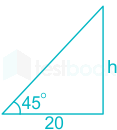
The angle of elevation of the top of a tower from a point 20 m away from its base is 45 °. What is the height of the tower?

  1. AOption (a)

    10 m

  2. BOption (b)

    20 m

  3. COption (c)

    30 m

  4. DOption (d)

    40 m

View answer & explanation

Correct answer

Answer: (b)B.

20 m

Why this answer is correct

Concept:

Angle of elevation: The term angle of elevation denotes the angle from the horizontal upward to an object. An observer's line of sight would be above the horizontal.

The term angle of depression denotes the angle from the horizontal downward to an object. An observer's line of sight would be below the horizontal.

Note that the angle of elevation and the angle of depression are congruent.

Calculation:

Given: Angle of elevation = θ = 45° and point is 20 m away from base.

Let the height of tower be h.

Rough diagram:

Now, tan⁡θ=h20\tan {\rm{\theta }} = \frac{{\rm{h}}}{{20}}

⇒ 20 tan (45°) = h

⇒ h = 20 m

So, the height of tower is 20 m.

Question 36

The equation tan⁡−1(1+x)+tan⁡−1(1−x)=π2{\tan ^{ - 1}}\left( {1 + {\rm{x}}} \right) + {\tan ^{ - 1}}\left( {1 - {\rm{x}}} \right) = \frac{{\rm{\pi }}}{2} is satisfied by

  1. AOption (a)

    x = 1

  2. BOption (b)

    x = -1

  3. COption (c)

    x = 0

  4. DOption (d)

    x = ½

View answer & explanation

Correct answer

Answer: (c)C.

x = 0

Why this answer is correct

Concept:

Formulas used:

  • tan⁡−1A+tan⁡−1B=tan⁡−1(A+B)1−AB){\tan ^{ - 1}}{\rm{A}} + {\tan ^{ - 1}}{\rm{B}} = {\tan ^{ - 1}}\left( {\frac{{{\rm{A}} + {\rm{B}})}}{{1 - {\rm{AB}}}}} \right) where A > 0, B > 0 & AB < 1


Calculation:

Given: tan⁡−1(1+x)+tan⁡−1(1−x)=π2{\tan ^{ - 1}}\left( {1 + {\rm{x}}} \right) + {\tan ^{ - 1}}\left( {1 - {\rm{x}}} \right) = \frac{{\rm{\pi }}}{2}

We now that, tan⁡−1A+tan⁡−1B=tan⁡−1(A+B)1−AB){\tan ^{ - 1}}{\rm{A}} + {\tan ^{ - 1}}{\rm{B}} = {\tan ^{ - 1}}\left( {\frac{{{\rm{A}} + {\rm{B}})}}{{1 - {\rm{AB}}}}} \right) where A > 0, B > 0 & AB < 1

tan⁡−1(1+x)+tan⁡−1(1−x)=π2{\tan ^{ - 1}}\left( {1 + {\rm{x}}} \right) + {\tan ^{ - 1}}\left( {1 - {\rm{x}}} \right) = \frac{{\rm{\pi }}}{2}

⇒tan⁡−1(1+x+1−x1−(1+x)(1−x))=tan⁡−1(10) \Rightarrow {\tan ^{ - 1}}\left( {\frac{{1 + {\rm{x}} + 1 - {\rm{x}}}}{{1 - \left( {1 + {\rm{x}}} \right)\left( {1 - {\rm{x}}} \right)}}} \right) = {\tan ^{ - 1}}\left( {\frac{1}{0}} \right)

⇒21−1+x2=10 \Rightarrow \frac{2}{{1 - 1 + {{\rm{x}}^2}}} = \frac{1}{0}

⇒ x2 = 0

⇒ x = 0

Question 37

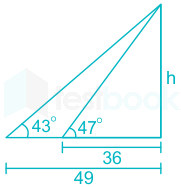
The angles of elevation of the top of a tower standing on a horizontal plane from two points on a line passing through the foot of the tower at distances 49 m and 36 m are 43° and 47° respectively. What is the height of the tower?

  1. AOption (a)

    40 m

  2. BOption (b)

    42 m

  3. COption (c)

    45 m

  4. DOption (d)

    47 m

View answer & explanation

Correct answer

Answer: (b)B.

42 m

Why this answer is correct

Concept:

Angle of elevation: The term angle of elevation denotes the angle from the horizontal upward to an object. An observer's line of sight would be above the horizontal.

The term angle of depression denotes the angle from the horizontal downward to an object. An observer's line of sight would be below the horizontal.

Note that the angle of elevation and the angle of depression are congruent.

Calculation:

Let the height of tower be h.

Rough diagram:

Now, tan⁡47∘=h36\tan 47^\circ = \frac{{\rm{h}}}{{36}}     ...1)

And also, tan⁡43∘=h49\tan 43^\circ = \frac{{\rm{h}}}{{49}}

⇒tan⁡(90∘−47∘)=h49 \Rightarrow \tan \left( {90^\circ - 47^\circ } \right) = \frac{{\rm{h}}}{{49}}

⇒cot⁡47∘=h49 \Rightarrow \cot 47^\circ = \frac{{\rm{h}}}{{49}}     ...2)

Multiplying (1) and (2) we get,

tan⁡47∘×cot⁡47∘=h36×h49\tan 47^\circ \times \cot 47^\circ = \frac{{\rm{h}}}{{36}} \times \frac{{\rm{h}}}{{49}}

⇒ 49 × 36 = h2

⇒ h = 7 × 6

⇒ h = 42 m

Hence, the height of the tower is 42 m.

Question 38

(1 – sin A + cos A) 2 is equal to

  1. AOption (a)

    2(1 – cos A)(1 + sin A)

  2. BOption (b)

    2(1 – sin A)(1 + cos A)

  3. COption (c)

    2(1 – cos A)(1 – sin A)

  4. DOption (d)

    None of the above

View answer & explanation

Correct answer

Answer: (b)B.

2(1 – sin A)(1 + cos A)

Why this answer is correct

Concept:

sin2A + cos2A = 1

(a + b)2 = a2 + b2 + 2ab

Calculation:

(1 – sin A + cos A)2 = [(1 – sin A) + cos A]2

= (1 – sin A) 2 + cos2A + 2(1 – sin A) cos A

= 1 + sin2A − 2sin A + cos2A + 2(1 – sin A) cos A

= 1 + (sin2A + cos2A) − 2sin A + 2(1-sin A) cos A

= 1 + 1 − 2sin A + 2(1 – sin A) cos A

= 2 − 2sin A + 2(1 – sin A) cos A

= 2(1 – sin A) + 2(1 – sin A) cos A

= 2(1 – sin A) (1 + cos A)

Alternate Method We have to find value of,

(1 – sin A + cos A) 2

Using Formula:

(a + b + c)2 = a2 + b2 + c2 + 2ab + 2ac + 2bc

⇒ 1 + sin2 A + cos2 A - 2sin A - 2sin A cos A + 2cos A

⇒ 1 + 1 - 2sin A - 2sin A cos A + 2cos A

⇒ 2 - 2sin A - 2sin A cos A + 2cos A

⇒ 2[(1 - sin A) + cos A(1 - sin A )]

Hence,

(1 – sin A + cos A) 2 = 2(1 – sin A)(1 + cos A)

Question 39

What is cos⁡θ1−tan⁡θ+sin⁡θ1−cot⁡θ\frac{{\cos {\rm{\theta }}}}{{1 - \tan {\rm{\theta }}}} + \frac{{\sin {\rm{\theta }}}}{{1 - \cot {\rm{\theta }}}} equal to?

  1. AOption (a)

    sin θ - cos θ 

  2. BOption (b)

    sin θ + cos θ

  3. COption (c)

    2sin θ

  4. DOption (d)

    2cos θ

View answer & explanation

Correct answer

Answer: (b)B.

sin θ + cos θ

Why this answer is correct

Formula Used:

tanθ=1cotθ=sinθcosθtan θ=\frac{1}{cot θ}=\frac{sinθ}{cosθ}

a2 - b2 = (a - b) (a + b)

Calculation:

We have to find the value of,

cos⁡θ1−tan⁡θ+sin⁡θ1−cot⁡θ\frac{{\cos {\rm{θ }}}}{{1 - \tan {\rm{θ }}}} + \frac{{\sin {\rm{θ }}}}{{1 - \cot {\rm{θ }}}}

tan θ & cot θ can be written as,​

cos⁡θ1−(sinθcosθ)+sin⁡θ1−(cosθsinθ)\frac{{\cos {\rm{θ }}}}{{1 - (\frac{sin \theta}{cos\theta}})} + \frac{{\sin {\rm{θ }}}}{{1 - (\frac{cos \theta}{sin\theta}})}

⇒ cos θcos θ−sin θcos θ+sin θsin θ−cos θsin θ\frac{cos \ \theta }{\frac{cos\ \theta-sin\ \theta}{cos\ \theta}}+\frac{sin \ \theta }{\frac{sin\ \theta-cos\ \theta}{sin\ \theta}}

⇒ cos⁡2θcos⁡θ−;sin⁡θ+;sin⁡2θsin⁡θ−;cos⁡θ\frac{{{{\cos }^2}{\rm{θ }}}}{{\cos {\rm{θ }} - {\rm{;}}\sin {\rm{θ }}}} + {\rm{;}}\frac{{{{\sin }^2}{\rm{θ }}}}{{\sin {\rm{θ }} - {\rm{;}}\cos {\rm{θ }}}}

⇒ cos⁡2θcos⁡θ−;sin⁡θ−(;sin⁡2θcos⁡θ−;sin⁡θ)\frac{{{{\cos }^2}{\rm{θ }}}}{{\cos {\rm{θ }} - {\rm{;}}\sin {\rm{θ }}}} -( {\rm{;}}\frac{{{{\sin }^2}{\rm{θ }}}}{{\cos {\rm{θ }} - {\rm{;}}\sin {\rm{θ }}}})

⇒ cos2θ−sin2θcosθ−sinθ=(cosθ+sinθ)(cosθ−sinθ)(cosθ−sinθ)\frac{cos^2\theta-sin^2\theta}{cos\theta -sin\theta }=\frac{(cos\theta +sin\theta)(cos\theta -sin\theta)}{(cos\theta -sin\theta)}

Hence,

cos⁡θ1−tan⁡θ+sin⁡θ1−cot⁡θ\frac{{\cos {\rm{θ }}}}{{1 - \tan {\rm{θ }}}} + \frac{{\sin {\rm{θ }}}}{{1 - \cot {\rm{θ }}}} = (sin θ + cos θ)

Consider the following statement and answer the questions

Consider, x=4tan⁡−1(15),;y=;tan⁡−1(170);and;z=;tan⁡−1(199)x = 4{\tan ^{ - 1}}\left( {\frac{1}{5}} \right),;y = ;{\tan ^{ - 1}}\left( {\frac{1}{{70}}} \right);and;z = ;{\tan ^{ - 1}}\left( {\frac{1}{{99}}} \right)

Question 40

Based on Passage: View directions & passage

What is x equal to?

  1. AOption (a)

    tan⁡−1(60119){\tan ^{ - 1}}\left( {\frac{{60}}{{119}}} \right)

  2. BOption (b)

    tan⁡−1(120119){\tan ^{ - 1}}\left( {\frac{{120}}{{119}}} \right)

  3. COption (c)

    tan⁡−1(90169){\tan ^{ - 1}}\left( {\frac{{90}}{{169}}} \right)

  4. DOption (d)

    tan⁡−1(170169){\tan ^{ - 1}}\left( {\frac{{170}}{{169}}} \right)

View answer & explanation

Correct answer

Answer: (b)B.

tan⁡−1(120119){\tan ^{ - 1}}\left( {\frac{{120}}{{119}}} \right)

Why this answer is correct

Concept:

2tan⁡−1x=tan⁡−1(2x1−x2);,;−1<x<12 {\tan ^{ - 1}}x = {\tan ^{ - 1}}\left( {\frac{{2x}}{{1 - {x^2}}}} \right);,; - 1 < x < 1

Calculation:

Given:

 x=4tan⁡−1(15)x = 4{\tan ^{ - 1}}\left( {\frac{1}{5}} \right)

⇒x=4tan⁡−1(15)=2×2×;tan⁡−1(15)\Rightarrow x = 4{\tan ^{ - 1}}\left( {\frac{1}{5}} \right) = 2 \times 2 \times ;{\tan ^{ - 1}}\left( {\frac{1}{5}} \right)

As we know, 2×tan⁡−1x=tan⁡−1(2x1−x2);,;−1<x<12 \times {\tan ^{ - 1}}x = {\tan ^{ - 1}}\left( {\frac{{2x}}{{1 - {x^2}}}} \right);,; - 1 < x < 1

⇒x=4tan⁡−1(15)=2×(tan⁡−1(251−(15)2))=2×tan⁡−1(512)\Rightarrow x = 4{\tan ^{ - 1}}\left( {\frac{1}{5}} \right) = 2 \times \left( {{{\tan }^{ - 1}}\left( {\frac{{\frac{2}{5}}}{{1 - {{\left( {\frac{1}{5}} \right)}^2}}}} \right)} \right) = 2 \times {\tan ^{ - 1}}\left( {\frac{5}{{12}}} \right)

As we know, 2×tan⁡−1x=tan⁡−1(2x1−x2);,;−1<x<12 \times {\tan ^{ - 1}}x = {\tan ^{ - 1}}\left( {\frac{{2x}}{{1 - {x^2}}}} \right);,; - 1 < x < 1

⇒x=4tan⁡−1(15)=2×tan⁡−1(512)=tan⁡−1(561−(512)2)=tan⁡−1(120119)\Rightarrow x = 4{\tan ^{ - 1}}\left( {\frac{1}{5}} \right) = 2 \times {\tan ^{ - 1}}\left( {\frac{5}{{12}}} \right) = {\tan ^{ - 1}}\left( {\frac{{\frac{5}{6}}}{{1 - {{\left( {\frac{5}{{12}}} \right)}^2}}}} \right) = {\tan ^{ - 1}}\left( {\frac{{120}}{{119}}} \right)

Hence option 2 is the correct answer.

Question 41

Based on Passage: View directions & passage

What is x – y equal to?

  1. AOption (a)

    tan−1(828845){\rm{ta}}{{\rm{n}}^{ - 1}}\left( {\frac{{828}}{{845}}} \right)

  2. BOption (b)

    tan−1(82878450){\rm{ta}}{{\rm{n}}^{ - 1}}\left( {\frac{{8287}}{{8450}}} \right)

  3. COption (c)

    tan−1(82818450){\rm{ta}}{{\rm{n}}^{ - 1}}\left( {\frac{{8281}}{{8450}}} \right)

  4. DOption (d)

    tan−1(82878471){\rm{ta}}{{\rm{n}}^{ - 1}}\left( {\frac{{8287}}{{8471}}} \right)

View answer & explanation

Correct answer

Answer: (c)C.

tan−1(82818450){\rm{ta}}{{\rm{n}}^{ - 1}}\left( {\frac{{8281}}{{8450}}} \right)

Why this answer is correct

Concept:

tan⁡−1x−tan⁡−1y=;tan⁡−1(x−y1+xy),;if;x>0;and;y>0{\tan ^{ - 1}}x - {\tan ^{ - 1}}y = ;{\tan ^{ - 1}}\left( {\frac{{x - y}}{{1 + xy}}} \right),;if;x > 0;and;y > 0

Calculation:

Given: x=4tan⁡−1(15),;y=;tan⁡−1(170);and;z=;tan⁡−1(199)x = 4{\tan ^{ - 1}}\left( {\frac{1}{5}} \right),;y = ;{\tan ^{ - 1}}\left( {\frac{1}{{70}}} \right);and;z = ;{\tan ^{ - 1}}\left( {\frac{1}{{99}}} \right)

From previous question, we get x=tan⁡−1(120119)x = {\tan ^{ - 1}}\left( {\frac{{120}}{{119}}} \right)

⇒x−y=;;tan⁡−1(120119)−;tan⁡−1(170)\Rightarrow x - y = ;;{\tan ^{ - 1}}\left( {\frac{{120}}{{119}}} \right) - ;{\tan ^{ - 1}}\left( {\frac{1}{{70}}} \right)

As we know that, tan⁡−1x−tan⁡−1y=;tan⁡−1(x−y1;+;xy),;if;x>0;and;y>0{\tan ^{ - 1}}x - {\tan ^{ - 1}}y = ;{\tan ^{ - 1}}\left( {\frac{{x - y}}{{1; + ;xy}}} \right),;if;x > 0;and;y > 0

⇒x−y=;;tan⁡−1(120119)−;tan⁡−1(170)=tan⁡−1(120119−1701+120119×170)=tan⁡−1(82818450)\Rightarrow x - y = ;;{\tan ^{ - 1}}\left( {\frac{{120}}{{119}}} \right) - ;{\tan ^{ - 1}}\left( {\frac{1}{{70}}} \right) = {\tan ^{ - 1}}\left( {\frac{{\frac{{120}}{{119}} - \frac{1}{{70}}}}{{1 + \frac{{120}}{{119}} \times \frac{1}{{70}}}}} \right) = {\tan ^{ - 1}}\left( {\frac{{8281}}{{8450}}} \right)

Question 42

Based on Passage: View directions & passage

What is x – y + z equal to?

  1. AOption (a)

    π/2

  2. BOption (b)

    π/3

  3. COption (c)

    π/6

  4. DOption (d)

    π/4

View answer & explanation

Correct answer

Answer: (d)D.

π/4

Why this answer is correct

Concept:

tan⁡−1x−tan⁡−1y=;tan⁡−1(x−y1+xy),;if;x>0;and;y>0{\tan ^{ - 1}}x - {\tan ^{ - 1}}y = ;{\tan ^{ - 1}}\left( {\frac{{x - y}}{{1 + xy}}} \right),;if;x > 0;and;y > 0

Calculation:

Given: x=4tan⁡−1(15),;y=;tan⁡−1(170);and;z=;tan⁡−1(199)x = 4{\tan ^{ - 1}}\left( {\frac{1}{5}} \right),;y = ;{\tan ^{ - 1}}\left( {\frac{1}{{70}}} \right);and;z = ;{\tan ^{ - 1}}\left( {\frac{1}{{99}}} \right)

From previous question, we get x−y=tan⁡−1(82818450)=tan⁡−1(4950)x - y = {\tan ^{ - 1}}\left( {\frac{{8281}}{{8450}}} \right) = {\tan ^{ - 1}}\left( {\frac{{49}}{{50}}} \right)

⇒x−y+z=;tan⁡−1(4950)+;tan⁡−1(199)\Rightarrow x - y + z = ;{\tan ^{ - 1}}\left( {\frac{{49}}{{50}}} \right) + ;{\tan ^{ - 1}}\left( {\frac{1}{{99}}} \right)

⇒x−y+z=;tan⁡−1(4950)+;tan⁡−1(199)=tan⁡−1(4950+1991−4950×199)=π4\Rightarrow x - y + z = ;{\tan ^{ - 1}}\left( {\frac{{49}}{{50}}} \right) + ;{\tan ^{ - 1}}\left( {\frac{1}{{99}}} \right) = {\tan ^{ - 1}}\left( {\frac{{\frac{{49}}{{50}} + \frac{1}{{99}}}}{{1 - \frac{{49}}{{50}} \times \frac{1}{{99}}}}} \right) = \frac{\pi }{4}

For the next three (3) items that follow:

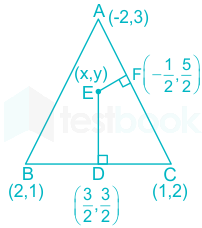
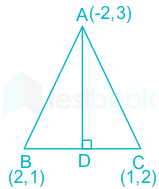
Consider the triangle ABC with vertices A(-2, 3), B(2, 1) and C(1, 2).

Question 43

Based on Passage: View directions & passage

What is the circumcenter of the triangle ABC?

  1. AOption (a)

    (-2, -2)

  2. BOption (b)

    (2, 2)

  3. COption (c)

    (-2, 2)

  4. DOption (d)

    (2, -2)

View answer & explanation

Correct answer

Answer: (a)A.

(-2, -2)

Why this answer is correct

Concept:

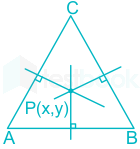
The circumcenter of a triangle is defined as the point where the perpendicular bisectors of the sides of that particular triangle intersects.

Calculation:

Mid-point of BC =(2;+;12,1+22)=(32,32)= \left( {\frac{{2{\rm{;}} + {\rm{;}}1}}{2},\frac{{1 + 2}}{2}} \right) = \left( {\frac{3}{2},\frac{3}{2}} \right)

Slope of BC =(2−1)(1−2)=−1= \frac{{\left( {2 - 1} \right)}}{{\left( {1 - 2} \right)}} = - 1

DE is perpendicular on BC,

∴ Slope of DE × Slope of BC = -1

⇒ Slope of DE × -1 = -1

⇒ Slope of DE = 1

Now, equation of ED,

(y - 3/2) = 1(x - 3/2)

⇒ 2y - 3 = 2x - 3

∴ x = y       ---(1)

Now, mid-point of AC =(−2;+;12,3+22)=(−12,52)= \left( {\frac{{ - 2{\rm{;}} + {\rm{;}}1}}{2},\frac{{3 + 2}}{2}} \right) = \left( {\frac{{ - 1}}{2},\frac{5}{2}} \right)

Slope of AC =(3;−;2)(−2;−;1)=−13= \frac{{\left( {3{\rm{;}} - {\rm{;}}2} \right)}}{{\left( { - 2{\rm{;}} - {\rm{;}}1} \right)}} = - \frac{1}{3}

EF is perpendicular on AC,

∴ Slope of EF × Slope of AC = -1

⇒ Slope of EF × (-1/3) = -1

⇒ Slope of EF = 3

Now, equation of EF,

 (y - 5/2) = 3(x + 1/2)

⇒ 2y - 5 = 6x + 3

⇒ 2y - 6x = 8       ---(2)

Solving equations (1) and (2),

2x - 6x = 8 (∵ y = x)

⇒ -4x = 8

∴ x = -2

From equation 1st,

y = x = -2

∴ Circumcentre of the triangle ABC is (x, y) = (-2, -2)

Question 44

Based on Passage: View directions & passage

What is the centroid of the triangle ABC?

  1. AOption (a)

    (13,1)\left( {\frac{1}{3},1} \right)

  2. BOption (b)

    (13,2)\left( {\frac{1}{3},2} \right)

  3. COption (c)

    (1,23)\left( {1,\frac{2}{3}} \right)

  4. DOption (d)

    (12,;3)\left( {\frac{1}{2},{\rm{;}}3} \right)

View answer & explanation

Correct answer

Answer: (b)B.

(13,2)\left( {\frac{1}{3},2} \right)

Why this answer is correct

Concept:

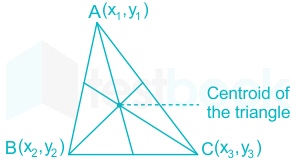
Centroid of a Triangle: The point where the three medians of the triangle intersect.

Let’s consider a triangle. If the three vertices of the triangle are A(x1, y1), B(x2, y2), C(x3, y3).

Centroid of a triangle = (x1+;x2+;x33,y1+;y2+;y33)\left( {\frac{{{{\rm{x}}_1} + {\rm{;}}{{\rm{x}}_2} + {\rm{;}}{{\rm{x}}_3}}}{3},\frac{{{{\rm{y}}_1} + {\rm{;}}{{\rm{y}}_2} + {\rm{;}}{{\rm{y}}_3}}}{3}} \right)


Calculation:

Vertices are given as A(-2, 3), B(2, 1) and C(1, 2).

Centroid of a triangle = (−2;+;2+;13,3;+;1+;23)=(13,;2)\left( {\frac{{ - 2{\rm{;}} + {\rm{;}}2 + {\rm{;}}1}}{3},\frac{{3{\rm{;}} + {\rm{;}}1 + {\rm{;}}2}}{3}} \right) = \left( {\frac{1}{3},{\rm{;}}2} \right)

Question 45

Based on Passage: View directions & passage

What is the foot of the altitude from the vertex A of the triangle ABC?

  1. AOption (a)

    (1, 4)

  2. BOption (b)

    (-1, 3)

  3. COption (c)

    (-2, 4)

  4. DOption (d)

    (-1, 4)

View answer & explanation

Correct answer

Answer: (d)D.

(-1, 4)

Why this answer is correct

Calculation:

Slope of BC =(2−1)(1−2)=−1= \frac{{\left( {2 - 1} \right)}}{{\left( {1 - 2} \right)}} = - 1

Equation of BC,

(y - 1) = -1 (x - 2)

⇒ y - 1 = -x + 2

⇒ y + x = 3       ---(1)

AD is perpendicular on BC,

∴ Slope of AD × Slope of BC = -1

⇒ Slope of AD × -1 = -1

⇒ Slope of AD = 1

Now, equation of AD,

(y - 3) = 1 (x + 2)

⇒ y - x = 5       ---(2)

Adding equation 1st and 2nd, we get

⇒ y + x + y - x = 3 + 5

⇒ 2y = 8

∴ y = 4

Put the value of y in equation 1st,

4 + x = 3

∴ x = -1

Now, foot of the altitude from the vertex A is (-1, 4)

Question 46

The point on the parabola y2 = 4αx nearest to the focus has its abscissa

  1. AOption (a)

    x = 0

  2. BOption (b)

    x = a

  3. COption (c)

    x = a/2

  4. DOption (d)

    x = 2a 

View answer & explanation

Correct answer

Answer: (a)A.

x = 0

Why this answer is correct

Concept:

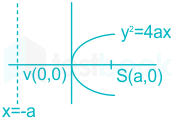
Parabola: The locus of a point which moves such that its distance from a fixed point is equal to its distance from a fixed straight line. (Eccentricity = e =1)

Equationy2 = 4ax; (a > 0)
Vertex(0, 0)
Focus(a, 0)
Equation of the directrixx = -a
Equation of the axisy = 0
Length of Latus rectum4a
Focal distance of the point (x, y)x + a
Diagram


Calculation:

Let P(x, y) be the required point on the parabola which is nearest to the focus.

Then D = (x−a)2+y2\sqrt {{{\left( {{\rm{x}} - {\rm{a}}} \right)}^2} + {{\rm{y}}^2}}  

We have,

y2 = 4αx

=(x−a)2+4ax=;(x+a)2= \sqrt {{{\left( {{\rm{x}} - {\rm{a}}} \right)}^2} + 4{\rm{ax}}} = {\rm{;}}\sqrt {{{\left( {{\rm{x}} + {\rm{a}}} \right)}^2}}

D = (x + a)

Now, the distance will be shortest when x = 0.

Question 47

A line passes through (2, 2) and is perpendicular to the line 3x + y = 3. Its y-intercept is

  1. AOption (a)

    3/4

  2. BOption (b)

    4/3

  3. COption (c)

    1/3

  4. DOption (d)

    3

View answer & explanation

Correct answer

Answer: (b)B.

4/3

Why this answer is correct

Concept:

  • Slope intercept form of line: y = mx + c, Where ‘m’ is the slope of the line and ‘c’ is the y-intercept.
  • The "point-slope" form of the equation of a straight line is: y - y1 = m(x - x1)
  • When two lines are perpendicular, the product of their slope is -1.
  • If m is the slope of a line, then the slope of a line perpendicular to it is -1/m.


Calculation:

Given: 3x + y = 3

⇒ y = -3x + 3

The slope of line = m = -3

Then the slope of a line perpendicular to it is -1/m = 1/3

The equation of line passing through (2, 2) with slope "1/3" is

y - 2 = (1/3) (x - 2)

⇒ 3y - 6 = x - 2

⇒ 3y = x + 4

⇒y=;13x+;43\Rightarrow {\rm{y}} = {\rm{;}}\frac{1}{3}{\rm{x}} + {\rm{;}}\frac{4}{3}

So, the y-intercept of line is 4/3

Question 48

The hyperbola x2a2−y2b2=1\frac{{{{\rm{x}}^2}}}{{{{\rm{a}}^2}}} - \frac{{{{\rm{y}}^2}}}{{{{\rm{b}}^2}}} = 1 passes through the point (35,;1)\left( {3\sqrt 5 ,{\rm{;}}1} \right) and the length of its latus rectum is 43\frac{4}{3} units. The length of the conjugate is

  1. AOption (a)

    2 units

  2. BOption (b)

    3 units

  3. COption (c)

    4 units

  4. DOption (d)

    5 units

View answer & explanation

Correct answer

Answer: (c)C.

4 units

Why this answer is correct

Concept:

Hyperbola: The locus of a point which moves such that its distance from a fixed point is greater than its distance from a fixed straight line. (Eccentricity = e > 1)

Equation;x2a2−y2b2=1\frac{{;{{\bf{x}}^2}}}{{{{\bf{a}}^2}}} - \frac{{{{\bf{y}}^2}}}{{{{\bf{b}}^2}}} = 1;x2a2+y2b2=1\frac{{;{{\bf{x}}^2}}}{{{{\bf{a}}^2}}} + \frac{{{{\bf{y}}^2}}}{{{{\bf{b}}^2}}} = 1
Equation of Transverse axisy = 0x = 0
Equation of Conjugate axisx = 0y = 0
Length of Transverse axis2a2b
Length of Conjugate axis2b2a
Vertices(± a, 0)(0, ± b)
Focus(± ae, 0)(0, ± be)
Directrixx = ± a/ey = ± b/e
Centre(0, 0)(0, 0)
Eccentricity1+b2a2\sqrt {1 + \frac{{{{\rm{b}}^2}}}{{{{\rm{a}}^2}}}} 1+a2b2\sqrt {1 + \frac{{{{\rm{a}}^2}}}{{{{\rm{b}}^2}}}}
Length of Latus rectum2b2a\frac{{2{{\rm{b}}^2}}}{{\rm{a}}}2a2b\frac{{2{{\rm{a}}^2}}}{{\rm{b}}}
Focal distance of the point (x, y)ex ± aey ± a


Calculation:

Given the hyperbola x2a2−y2b2=1\frac{{{{\rm{x}}^2}}}{{{{\rm{a}}^2}}} - \frac{{{{\rm{y}}^2}}}{{{{\rm{b}}^2}}} = 1 passes through the point (35,;1)\left( {3\sqrt 5 ,{\rm{;}}1} \right)

⇒(35)2a2−1b2=1\Rightarrow \frac{{{{\left( {3\sqrt 5 } \right)}^2}}}{{{{\rm{a}}^2}}} - \frac{1}{{{{\rm{b}}^2}}} = 1

⇒45a2−1b2=1\Rightarrow \frac{{45}}{{{{\rm{a}}^2}}} - \frac{1}{{{{\rm{b}}^2}}} = 1       ---(1)

Now length of latus rectum = 2b2a\frac{{2{{\rm{b}}^2}}}{{\rm{a}}}

⇒2b2a=43\Rightarrow \frac{{2{{\rm{b}}^2}}}{{\rm{a}}} = \frac{4}{3}

∴a=3b22\therefore {\rm{a}} = \frac{{3{{\rm{b}}^2}}}{2}       ---(2)

Putting the value of 'a' in equation (1),

⇒45(3b22)2−1b2=1\Rightarrow \frac{{45}}{{{{\left( {\frac{{3{{\rm{b}}^2}}}{2}} \right)}^2}}} - \frac{1}{{{{\rm{b}}^2}}} = 1

⇒20b4−1b2=1\Rightarrow \frac{{20}}{{{{\rm{b}}^4}}} - \frac{1}{{{{\rm{b}}^2}}} = 1

⇒ 20 - b2 = b4

⇒ b4 + b2 - 20 = 0

⇒ b4 + 5b2 - 4b2 - 20 = 0

⇒ b2 (b2 + 5) - 4(b2 + 5) = 0

⇒ (b2 - 4) (b2 + 5) = 0

⇒ (b2 - 4) = 0

⇒ b2 = 4

∴ b = 2

Now length of conjugate axis = 2b = 2(2) = 4

Question 49

The perpendicular distance between the straight lines 6x + 8y + 15 = 0 and 3x + 4y + 9 = 0 is

  1. AOption (a)

    3/2 units

  2. BOption (b)

    3/10 unit

  3. COption (c)

    3/4 unit

  4. DOption (d)

    2/7 unit

View answer & explanation

Correct answer

Answer: (b)B.

3/10 unit

Why this answer is correct

Concept:

Distance between parallel lines:

  • The distance between the lines y = mx + c1 and y = mx + c2 is ∣c1−c2∣1;+;m2\frac{{\left| {{{\rm{c}}_1} - {{\rm{c}}_2}} \right|}}{{\sqrt {1{\rm{;}} + {\rm{;}}{{\rm{m}}^2}} }}
  • The distance between the lines ax + by + c1 = 0 and ax + by + c2 = 0 is ∣c1−c2∣a2+b2\frac{{\left| {{{\rm{c}}_1} - {{\rm{c}}_2}} \right|}}{{\sqrt {{{\rm{a}}^2} + {{\rm{b}}^2}} }}


Calculation:

Given lines are 6x + 8y + 15 = 0 and 3x + 4y + 9 = 0

⇒ 6x + 8y + 15 = 0

Take 2 common from above equation, we get

⇒ 3x + 4y + 15/2 = 0       ---(1)

And 3x + 4y + 9 = 0       ---(2)

Equation 1 and 2 are parallel to each other.

∴ The distance between the lines = ∣152;−;9∣32+42=(32)5=310\frac{{\left| {\frac{{15}}{2}{\rm{;}} - {\rm{;}}9} \right|}}{{\sqrt {{3^2} + {4^2}} }} = \frac{{\left( {\frac{3}{2}} \right)}}{5} = \frac{3}{{10}}

Alternate MethodParallel lines have the same slope and will never intersect.

Two lines y = m1x + c1

and y = m2x + c2

are said to be parallel if:

m1 = m2

Example : 

Line 1: 3x + 4y = 1

Line 2: 3x + 4y = 5

Application:

We have,

Line 1: 6x + 8y + 15 = 0

And, Line 2: 3x + 4y + 9 = 0

Line 2 can also be written as,

6x + 8y + 18 = 0

Since, both the line are parallel, hence its graph will be similar to:

We have,

c2 - c1 = 18 - 15 = 3

a2 + b2 = 62 + 82 = 100

Using formula of distance between straight lines,

D = ∣c2−c1∣a2+b2=∣3∣100=310\frac{|c_2-c_1|}{\sqrt{a^2+b^2}}=\frac{|3|}{\sqrt{100}}=\frac{3}{10} units

Question 50

The area of a triangle, whose vertices are (3, 4), (5, 2) and the point of intersection of the lines x = a and y = 5, is 3 square units. What is the value of a?

  1. AOption (a)

    2

  2. BOption (b)

    3

  3. COption (c)

    4

  4. DOption (d)

    5

View answer & explanation

Correct answer

Answer: (d)D.

5

Why this answer is correct

Concept:

Area of a triangle whose vertices are (x1, y1), (x2, y2) and (x3, y3), is given by the expression

Area = (1/2) [x1 (y2 - y3) + x2 (y3 - y1) + x3(y1 - y2)]

Whose expression can be written in the form of a determinant as:


{\rm{Area}} = {\rm{;}}\frac{1}{2}\left| {\begin{array}{*{20}{c}} {{{\rm{x}}_1}}&{{{\rm{y}}_1}}&1\ {{{\rm{x}}_2}}&{{{\rm{y}}_2}}&1\ {{{\rm{x}}_3}}&{{{\rm{y}}_3}}&1 \end{array}} \right|

Calculation:

A(3, 4)B(5, 2) intersection of x = a and y = 5 is (a, 5)

Given the area of a triangle = 3

\Rightarrow \frac{1}{2}\left| {\begin{array}{*{20}{c}} 3&4&1\ 5&2&1\ {\rm{a}}&5&1 \end{array}} \right| = 3

\Rightarrow \left| {\begin{array}{*{20}{c}} 3&4&1\ 5&2&1\ {\rm{a}}&5&1 \end{array}} \right| = 6

Expanding R1, we get

⇒ 3 (2 - 5) - 4 (5 - a) + 1 (25 - 2a) = 6

⇒ -9 - 20 + 4a + 25 - 2a = 6

⇒ 2a = 10

∴ a = 5

Question 51

The length of perpendicular from the origin to a line 5 units and the line makes an angle 120° with the positive direction of x-axis. The equation of the line is

  1. AOption (a)

    x+3y=5{\rm{x}} + \sqrt 3 {\rm{y}} = 5

  2. BOption (b)

    3;x+y=10\sqrt 3 {\rm{;x}} + {\rm{y}} = 10

  3. COption (c)

    3;x−y=10\sqrt 3 {\rm{;x}} - {\rm{y}} = 10

  4. DOption (d)

    None of the above

View answer & explanation

Correct answer

Answer: (b)B.

3;x+y=10\sqrt 3 {\rm{;x}} + {\rm{y}} = 10

Why this answer is correct

Concept:

Equation of a Straight Line in Normal Form: x cos α + y sin α = p,

Where p be the length of the normal drawn from the origin to a line, which subtends an angle α with the positive direction of x-axis as follows.

Calculation:

Here p = 5

And α = 30°

Now, equation of line,

x cos α + y sin α = p

⇒ x cos 30° + y sin 30° = 5

⇒ x (√3/2) + y (1/2) = 5

⇒ √3x + y = 10

Question 52

The equation of the line joining the origin to the point of intersection of the lines xa+yb=1\frac{{\rm{x}}}{{\rm{a}}} + \frac{{\rm{y}}}{{\rm{b}}} = 1 and xb+ya=1\frac{{\rm{x}}}{{\rm{b}}} + \frac{{\rm{y}}}{{\rm{a}}} = 1 is

  1. AOption (a)

    x - y = 0

  2. BOption (b)

    x + y = 0

  3. COption (c)

    x = 0

  4. DOption (d)

    y = 0

View answer & explanation

Correct answer

Answer: (a)A.

x - y = 0

Why this answer is correct

Calculation:

Given lines are xa+yb=1\frac{{\rm{x}}}{{\rm{a}}} + \frac{{\rm{y}}}{{\rm{b}}} = 1 and xb+ya=1\frac{{\rm{x}}}{{\rm{b}}} + \frac{{\rm{y}}}{{\rm{a}}} = 1

xa+yb=1\frac{{\rm{x}}}{{\rm{a}}} + \frac{{\rm{y}}}{{\rm{b}}} = 1       ---(1)

xb+ya=1\frac{{\rm{x}}}{{\rm{b}}} + \frac{{\rm{y}}}{{\rm{a}}} = 1       ---(2)

Subtract equation 1 - 2, we get

(xa+yb)−(xb+ya)=1−1\left( {\frac{{\rm{x}}}{{\rm{a}}} + \frac{{\rm{y}}}{{\rm{b}}}} \right) - \left( {\frac{{\rm{x}}}{{\rm{b}}} + \frac{{\rm{y}}}{{\rm{a}}}} \right) = 1 - 1

⇒(xa−xb)+(yb−ya)=0\Rightarrow \left( {\frac{{\rm{x}}}{{\rm{a}}} - \frac{{\rm{x}}}{{\rm{b}}}} \right) + \left( {\frac{{\rm{y}}}{{\rm{b}}} - \frac{{\rm{y}}}{{\rm{a}}}} \right) = 0

⇒x(1a−1b)−y(1a−1b)=0\Rightarrow {\rm{x}}\left( {\frac{1}{{\rm{a}}} - \frac{1}{{\rm{b}}}} \right) - {\rm{y}}\left( {\frac{1}{{\rm{a}}} - \frac{1}{{\rm{b}}}} \right) = 0

⇒(x−y)(1a−1b)=0\Rightarrow \left( {{\rm{x}} - {\rm{y}}} \right)\left( {\frac{1}{{\rm{a}}} - \frac{1}{{\rm{b}}}} \right) = 0

∴ x - y = 0

The projections of a directed line segment on the coordinate axes are 12, 4, 3 respectively.

Question 53

Based on Passage: View directions & passage

What is the length of the line segment?

  1. AOption (a)

    19 units

  2. BOption (b)

    17 units

  3. COption (c)

    15 units

  4. DOption (d)

    13 units

View answer & explanation

Correct answer

Answer: (d)D.

13 units

Why this answer is correct

Concept:

  • Let a⃗=x;i⃗+y;j⃗+z;k⃗{\rm{\vec a}} = {\rm{x;\vec i}} + {\rm{y;\vec j}} + {\rm{z;\vec k}}


Magnitude of vector of a = ∣a⃗∣=;x2+;y2+z2\left| {{\rm{\vec a}}} \right| = {\rm{;}}\sqrt {{{\rm{x}}^2} + {\rm{;}}{{\rm{y}}^2} + {{\rm{z}}^2}}


Calculation:

Let the line segment be represented in vector form as a⃗=x;i⃗+y;j⃗+z;k⃗{\rm{\vec a}} = {\rm{x;\vec i}} + {\rm{y;\vec j}} + {\rm{z;\vec k}}

Here x = 12, y = 4 and z = 3

∴ a⃗=12;i⃗+4;j⃗+3;k⃗{\rm{\vec a}} = 12{\rm{;\vec i}} + 4{\rm{;\vec j}} + 3{\rm{;\vec k}}

Length of the line segment = ∣a⃗∣=;122+;42+92=;144+16+9=;169=13\left| {{\rm{\vec a}}} \right| = {\rm{;}}\sqrt {{{12}^2} + {\rm{;}}{4^2} + {9^2}} = ;\sqrt {144 + 16 + 9} = ;\sqrt {169} = 13

Question 54

Based on Passage: View directions & passage

What are the direction cosines of the line segment?

  1. AOption (a)

    {12/13, 4/13, 3/13}

  2. BOption (b)

    {12/13, -4/13, 3/13}

  3. COption (c)

    {12/13, -4/13, -3/13}

  4. DOption (d)

    {-12/13, -4/13, 3/13}

View answer & explanation

Correct answer

Answer: (a)A.

{12/13, 4/13, 3/13}

Why this answer is correct

Concept:

  • Relation between direction cosines and direction ratios


l=;±aa2+;b2+;c2;,;m=;±ba2+;b2+;c2;;and;n=;±ca2+;b2+;c2;{\rm{l}} = {\rm{;}}\frac{{ \pm {\rm{a}}}}{{\sqrt {{{\rm{a}}^2} + {\rm{;}}{{\rm{b}}^2} + {\rm{;}}{{\rm{c}}^2}} {\rm{;}}}},{\rm{;m}} = {\rm{;}}\frac{{ \pm {\rm{b}}}}{{\sqrt {{{\rm{a}}^2} + {\rm{;}}{{\rm{b}}^2} + {\rm{;}}{{\rm{c}}^2}} {\rm{;}}}}{\rm{;and;n}} = {\rm{;}}\frac{{ \pm {\rm{c}}}}{{\sqrt {{{\rm{a}}^2} + {\rm{;}}{{\rm{b}}^2} + {\rm{;}}{{\rm{c}}^2}} {\rm{;}}}}

Where l, m, n are the direction cosines and a, b, c are the direction ratios.

Calculation:

We know that direction cosines is l=;±aa2+;b2+;c2;,;m=;±ba2+;b2+;c2;;and;n=;±ca2+;b2+;c2;{\rm{l}} = {\rm{;}}\frac{{ \pm {\rm{a}}}}{{\sqrt {{{\rm{a}}^2} + {\rm{;}}{{\rm{b}}^2} + {\rm{;}}{{\rm{c}}^2}} {\rm{;}}}},{\rm{;m}} = {\rm{;}}\frac{{ \pm {\rm{b}}}}{{\sqrt {{{\rm{a}}^2} + {\rm{;}}{{\rm{b}}^2} + {\rm{;}}{{\rm{c}}^2}} {\rm{;}}}}{\rm{;and;n}} = {\rm{;}}\frac{{ \pm {\rm{c}}}}{{\sqrt {{{\rm{a}}^2} + {\rm{;}}{{\rm{b}}^2} + {\rm{;}}{{\rm{c}}^2}} {\rm{;}}}}

Here a = 12, b = 4 and c = 3

Now,

a2+;b2+;c2=;122+;42+92=;144+16+9=;169=13;\sqrt {{{\rm{a}}^2} + {\rm{;}}{{\rm{b}}^2} + {\rm{;}}{{\rm{c}}^2}} = ;\sqrt {{{12}^2} + {\rm{;}}{4^2} + {9^2}} = ;\sqrt {144 + 16 + 9} = ;\sqrt {169} = 13;

l=;1213;,;m=;413;;and;n=;313;{\rm{l}} = {\rm{;}}\frac{{12}}{{13{\rm{;}}}},{\rm{;m}} = {\rm{;}}\frac{4}{{13{\rm{;}}}}{\rm{;and;n}} = {\rm{;}}\frac{3}{{13{\rm{;}}}}

∴ Direction cosines of the line segment = {12/13, 4/13, 3/13}

Directions: For the next two (2) items that follow:

From the point P(3, -1, 11), a perpendicular is drawn on the line L given by the equation (x)/2 = (y - 2)/3 = (z - 3)/4 . Let Q be the foot of the perpendicular.

Question 55

Based on Passage: View directions & passage

what are the direction ratios of the line segment PQ?

  1. AOption (a)

    {1, 6, 4}

  2. BOption (b)

    {-1, 6, -4}

  3. COption (c)

    {-1, -6, 4}

  4. DOption (d)

    {2, -6, 4}

View answer & explanation

Correct answer

Answer: (b)B.

{-1, 6, -4}

Why this answer is correct

Concept:

If two lines are perpendicular, then dot product of direction ratios will be zero.

Calculation:

Let, Line L:  x2=y−23;=z−34=λ\frac{{\rm{x}}}{2} = \frac{{{\rm{y}} - 2}}{{3{\rm{;}}}} = \frac{{{\rm{z}} - 3}}{4} = {\rm{\lambda }}

⇒ x = 2λ, and

y - 2 = 3λ ⇒ y = 3λ + 2,

Also, z – 3 = 4λ ⇒ z = 4λ + 3

∴ Q = (2λ, 3λ + 2, 4λ + 3)

Direction ratios of PQ = 2λ – 3, 3λ + 2 – (-1), 4λ + 3 – 11                   (∵ P = (3, -1, 11))

⇒ 2λ – 3, 3λ + 3, 4λ - 8

Here, Direction ratios of line L = 2, 3, 4                                                    (∵ L:  x2=y−23;=z−34\frac{{\rm{x}}}{2} = \frac{{{\rm{y}} - 2}}{{3{\rm{;}}}} = \frac{{{\rm{z}} - 3}}{4} )

As line L is perpendicular to PQ, dot product of direction ratios will be zero

2(2λ – 3) + 3(3λ + 3) + 4(4λ – 8) = 0

⇒ 4λ – 6 + 9λ + 9 + 16λ – 32 = 0

⇒ 29λ – 29 = 0

⇒ λ = 1.

∴ Direction ratios of PQ = 2(1) – 3, 3(1) + 3, 4(1) – 8

⇒ -1, 6, -4

Hence, option (b) is correct.

Question 56

Based on Passage: View directions & passage

What is the length of the line segment PQ?

  1. AOption (a)

    47;\sqrt {47} {\rm{;}} units

  2. BOption (b)

    7 units

  3. COption (c)

    53\sqrt {53} units

  4. DOption (d)

    8 units

View answer & explanation

Correct answer

Answer: (c)C.

53\sqrt {53} units

Why this answer is correct

Concept:

Direction ratios are a, b, c then Magnitude = a2+b2+c2\sqrt {{{\rm{a}}^2} + {{\rm{b}}^2} + {{\rm{c}}^2}}

Calculation:

We have,

Direction ratios of PQ = 2(1) – 3, 3(1) + 3, 4(1) – 8

⇒ -1, 6, -4

∴ Length = magnitude of PQ = (−1)2+(6)2+(−4)2\sqrt {{{\left( { - 1} \right)}^2} + {{\left( 6 \right)}^2} + {{\left( { - 4} \right)}^2}}

=1+36+16= \sqrt {1 + 36 + 16}

=53= \sqrt {53}

Hence, option (c) is correct.

Directions: For the next two (2) items that follow:

A triangular plane ABC with centroid (1, 2, 3) cuts the coordinate axes at A, B, C respectively.

Question 57

Based on Passage: View directions & passage

What are the intercepts made by the plane ABC on the axes?

  1. AOption (a)

    3, 6, 9

  2. BOption (b)

    1, 2, 3

  3. COption (c)

    1, 4, 9

  4. DOption (d)

    2, 4, 6

View answer & explanation

Correct answer

Answer: (a)A.

3, 6, 9

Why this answer is correct

Concept:

Centroid = x1+x2+x33,;y1+y2+y33,;z1+z2+z33\frac{{{{\rm{x}}_1} + {{\rm{x}}_2} + {{\rm{x}}_3}}}{3},{\rm{;}}\frac{{{{\rm{y}}_1} + {{\rm{y}}_2} + {{\rm{y}}_3}}}{3},{\rm{;}}\frac{{{{\rm{z}}_1} + {{\rm{z}}_2} + {{\rm{z}}_3}}}{3}

Calculation:

Let, A = (a, 0, 0)

B = (0, b, 0)

C = (0, 0, c)

(1, 2, 3) = a+0+03,0+b+03,0+0+c3\frac{{{\rm{a}} + 0 + 0}}{3},\frac{{0 + {\rm{b}} + 0}}{3},\frac{{0 + 0 + {\rm{c}}}}{3}

a+0+03=1\frac{{{\rm{a}} + 0 + 0}}{3} = 1

⇒a=3\Rightarrow {\rm{a}} = 3

0+b+03=2\frac{{0 + {\rm{b}} + 0}}{3} = 2

⇒b=6\Rightarrow {\rm{b}} = 6

0+0+c3=3\frac{{0 + 0 + {\rm{c}}}}{3} = 3

⇒c=9\Rightarrow {\rm{c}} = 9

∴ (a, b, c) = (3, 6, 9)

Hence, option (a) is correct.

Question 58

Based on Passage: View directions & passage

What is the equation of the plane ABC?

  1. AOption (a)

    X + 2y + 3z = 1

  2. BOption (b)

    3x + 2y + z = 3

  3. COption (c)

    2x + 3y + 6z = 18

  4. DOption (d)

    6x + 3y + 2z = 18

View answer & explanation

Correct answer

Answer: (d)D.

6x + 3y + 2z = 18

Why this answer is correct

Concept:

Equation of plane in intercept form: xa+yb+zc=1\frac{{\rm{x}}}{{\rm{a}}} + \frac{{\rm{y}}}{{\rm{b}}} + \frac{{\rm{z}}}{{\rm{c}}} = 1

Calculation:

We have,

(a, b, c) = (3, 6, 9)

∴ Equation of plane = xa+yb+zc=1\frac{{\rm{x}}}{{\rm{a}}} + \frac{{\rm{y}}}{{\rm{b}}} + \frac{{\rm{z}}}{{\rm{c}}} = 1

⇒ x3+y6+z9=1\frac{{\rm{x}}}{3} + \frac{{\rm{y}}}{6} + \frac{{\rm{z}}}{9} = 1

⇒6x+3y+2z=18\Rightarrow 6{\rm{x}} + 3{\rm{y}} + 2{\rm{z}} = 18

Hence, option (d) is correct.

Directions: For the next two (2) items that follow:

A point P(1, 2, 3) is one vertex of a cuboid formed by the coordinate planes and the planes passing through P and parallel to the coordinate planes.

Question 59

Based on Passage: View directions & passage

What is the length of one of the diagonals of the cuboid?

  1. AOption (a)

    10\sqrt {10} units

  2. BOption (b)

    14\sqrt {14} units

  3. COption (c)

    4 units

  4. DOption (d)

    5 units

View answer & explanation

Correct answer

Answer: (b)B.

14\sqrt {14} units

Why this answer is correct

Concept:

A = (x1,y1,z1)\left( {{{\rm{x}}_1},{{\rm{y}}_1},{{\rm{z}}_1}} \right) and B = (x2,y2,z2)\left( {{{\rm{x}}_2},{{\rm{y}}_2},{{\rm{z}}_2}} \right), then length AB = (x2−x1)2+(y2−y1)2+(z2−z1)2\sqrt {{{\left( {{{\rm{x}}_2} - {{\rm{x}}_1}} \right)}^2} + {{\left( {{{\rm{y}}_2} - {{\rm{y}}_1}} \right)}^2} + {{\left( {{{\rm{z}}_2} - {{\rm{z}}_1}} \right)}^2}}

Calculation:

Let, O is the origin, O = (0, 0, 0)

P = (1, 2, 3)

Length of diagonal of cuboid = length of OP

= (1−0)2+(2−0)2+(3−0)2\sqrt {{{\left( {1 - 0} \right)}^2} + {{\left( {2 - 0} \right)}^2} + {{\left( {3 - 0} \right)}^2}}

⇒ 1+4+9\sqrt {1 + 4 + 9}

⇒ 14\sqrt {14}

Hence, option (b) is correct.

Question 60

Based on Passage: View directions & passage

What is the equation of the plane passing through P(1, 2, 3) and parallel to xy-plane?

  1. AOption (a)

    x+y=3{\rm{x}} + {\rm{y}} = 3

  2. BOption (b)

    x−y=−1{\rm{x}} - {\rm{y}} = {\rm{}} - 1

  3. COption (c)

    z=3{\rm{z}} = 3

  4. DOption (d)

    x+2y+3z=14{\rm{x}} + 2{\rm{y}} + 3{\rm{z}} = 14

View answer & explanation

Correct answer

Answer: (c)C.

z=3{\rm{z}} = 3

Why this answer is correct

Concept:

Any plane parallel to xy-plane is given by z = k

Calculation:

Plane parallel to xy-plane is z = k

Now, the plane passing through P(1, 2, 3),

 So, it will satisfy z = k

∴ The equation of the plane is z = 3

Hence, option (c) is correct.

Question 61

If G(x)=(25−x2{\rm{G}}\left( {\rm{x}} \right) = \sqrt {(25 - {{\rm{x}}^2}}  then what is lim⁡x→1G(x)−G(1)x−1;\mathop {\lim }\limits_{{\rm{x}} \to 1} \frac{{{\rm{G}}\left( {\rm{x}} \right) - {\rm{G}}\left( 1 \right)}}{{{\rm{x}} - 1}}{\rm{;}}equal to?

  1. AOption (a)

    −126;;- \frac{1}{{2\sqrt 6 {\rm{;;}}}}

  2. BOption (b)

    15\frac{1}{5}

  3. COption (c)

    −16- \frac{1}{{\sqrt 6 }}

  4. DOption (d)

    16\frac{1}{{\sqrt 6 }}

View answer & explanation

Correct answer

Answer: (a)A.

−126;;- \frac{1}{{2\sqrt 6 {\rm{;;}}}}

Why this answer is correct

Concept:

L-Hospital Rule: Let f(x) and g(x) be two functions

Suppose that we have one of the following cases,

  1. lim⁡x→af(x)g(x)=;00\mathop {\lim }\limits_{{\rm{x}} \to {\rm{a}}} \frac{{{\rm{f}}\left( {\rm{x}} \right)}}{{{\rm{g}}\left( {\rm{x}} \right)}} = {\rm{;}}\frac{0}{0}
  2. lim⁡x→af(x)g(x)=;∞∞\mathop {\lim }\limits_{{\rm{x}} \to {\rm{a}}} \frac{{{\rm{f}}\left( {\rm{x}} \right)}}{{{\rm{g}}\left( {\rm{x}} \right)}} = {\rm{;}}\frac{\infty }{\infty }

Then we can apply L-Hospital Rule ⇔ lim⁡x→af(x)g(x)=;lim⁡x→af′(x)g′(x)\mathop {\lim }\limits_{{\bf{x}} \to {\bf{a}}} \frac{{{\bf{f}}\left( {\bf{x}} \right)}}{{{\bf{g}}\left( {\bf{x}} \right)}} = ;\mathop {\lim }\limits_{{\bf{x}} \to {\bf{a}}} \frac{{{\bf{f}}'\left( {\bf{x}} \right)}}{{{\bf{g}}'\left( {\bf{x}} \right)}}

Calculation:

lim⁡x→1G(x)−G(1)x−1;=limx→1(25−x2)−(25−1);;x−1\mathop {\lim }\limits_{{\rm{x}} \to 1} \frac{{{\rm{G}}\left( {\rm{x}} \right) - {\rm{G}}\left( 1 \right)}}{{{\rm{x}} - 1}}{\rm{;}} = \mathop {{\rm{lim}}}\limits_{{\rm{x}} \to 1} \frac{{\sqrt {\left( {25 - {{\rm{x}}^2}} \right)} - \sqrt {\left( {25 - 1} \right)} {\rm{;;}}}}{{{\rm{x}} - 1}}

Here, we have 0/0 form, so applying L-Hospital Rule,

limx→1(25−x2)−(25−1);;x−1=limx→11(−2x)2(25−x2)1\mathop {{\rm{lim}}}\limits_{{\rm{x}} \to 1} \frac{{\sqrt {\left( {25 - {{\rm{x}}^2}} \right)} - \sqrt {\left( {25 - 1} \right)} {\rm{;;}}}}{{{\rm{x}} - 1}} = \mathop {{\rm{lim}}}\limits_{{\rm{x}} \to 1} \frac{{\frac{{1\left( { - 2{\rm{x}}} \right)}}{{2\sqrt {\left( {25 - {{\rm{x}}^2}} \right)} }}}}{1}

=limx→1−x(25−x2) = \mathop {{\rm{lim}}}\limits_{{\rm{x}} \to 1} \frac{{ - {\rm{x}}}}{{\sqrt {\left( {25 - {{\rm{x}}^2}} \right)} }}

=−124= - \frac{1}{{\sqrt {24} }}

=−126= - \frac{1}{{2\sqrt 6 }}

Hence, option (a) is correct.

Question 62

Consider the following statements:

  1. y=ex+e−x2{\rm{y}} = \frac{{{{\rm{e}}^{\rm{x}}} + {{\rm{e}}^{ - {\rm{x}}}}}}{2} is an increasing function on [0, ∞).
  2. y=ex−e−x2{\rm{y}} = \frac{{{{\rm{e}}^{\rm{x}}} - {{\rm{e}}^{ - {\rm{x}}}}}}{2} is an increasing function on (-∞, ∞).

Which of the above statements is/are correct?

  1. AOption (a)

    1 only

  2. BOption (b)

    2 only

  3. COption (c)

    Both 1 and 2

  4. DOption (d)

    Neither 1 nor 2

View answer & explanation

Correct answer

Answer: (c)C.

Both 1 and 2

Why this answer is correct

Concept:

If f′(x) > 0 at each point in an interval, then the function is said to be increasing on interval.

If f′(x) < 0 at each point in an interval, then the function is said to be decreasing on the interval.

Calculation:

1.Let, ;f(x)=ex+e−x2{\rm{;f}}\left( {\rm{x}} \right) = \frac{{{{\rm{e}}^{\rm{x}}} + {{\rm{e}}^{ - {\rm{x}}}}}}{2}

=ex+1ex2= \frac{{{{\rm{e}}^{\rm{x}}} + \frac{1}{{{{\rm{e}}^{\rm{x}}}}}}}{2}

=e2x+12ex= \frac{{{{\rm{e}}^{2{\rm{x}}}} + 1}}{{2{{\rm{e}}^{\rm{x}}}}}

=12(ex+e−x)= \frac{1}{2}\left( {{{\rm{e}}^{\rm{x}}} + {{\rm{e}}^{ - {\rm{x}}}}} \right)

f’(x) = 12(ex−e−x)\frac{1}{2}\left( {{{\rm{e}}^{\rm{x}}} - {{\rm{e}}^{ - {\rm{x}}}}} \right)

f’(x) > 0, on [0, ∞)

So, this statement is correct.

  1. Let, ;f(x)=ex−e−x2{\rm{;f}}\left( {\rm{x}} \right) = \frac{{{{\rm{e}}^{\rm{x}}} - {{\rm{e}}^{ - {\rm{x}}}}}}{2}

=ex−1ex2 = \frac{{{{\rm{e}}^{\rm{x}}} - \frac{1}{{{{\rm{e}}^{\rm{x}}}}}}}{2}

=e2x−12ex= \frac{{{{\rm{e}}^{2{\rm{x}}}} - 1}}{{2{{\rm{e}}^{\rm{x}}}}}

=12(ex−e−x)= \frac{1}{2}\left( {{{\rm{e}}^{\rm{x}}} - {{\rm{e}}^{ - {\rm{x}}}}} \right)

f’(x) = 12(ex+e−x)\frac{1}{2}\left( {{{\rm{e}}^{\rm{x}}} + {{\rm{e}}^{ - {\rm{x}}}}} \right)

f’(x) > 0, on (∞, ∞)

So, this statement is also correct.

Hence, option (c) is correct.

Alternate Method Using the concept of Hyperbolic Trigonometric Function:

cosh(x)=ex+e−x2cosh(x)=\frac{e^x+e^{-x}}{2}

And, sinh(x)=ex−e−x2sinh(x)=\frac{e^x-e^{-x}}{2}

The graph of hyperbolic sine and cosine function can be drawn as,

From graph it is clear that,

Both are increasing functions Hence, both the statements are correct.

Question 63

For each non-zero real number x, let f(x)=x∣x∣;{\rm{f}}\left( {\rm{x}} \right) = \frac{{\rm{x}}}{{\left| {\rm{x}} \right|}}{\rm{;}}the range of f is

  1. AOption (a)

    A null set

  2. BOption (b)

    A set consisting of only one element

  3. COption (c)

    A set consisting of two elements

  4. DOption (d)

    A set consisting of infinitely many elements

View answer & explanation

Correct answer

Answer: (c)C.

A set consisting of two elements

Why this answer is correct

Concept:

{\rm{f}}\left( {\rm{x}} \right) = \left| {\rm{x}} \right| = \left{ {\begin{array}{*{20}{c}} { - x,;;x < 0}\ {x,;;x \ge 0} \end{array}} \right.

Calculation:

For (x<0),\left( {{\rm{x}} < 0} \right),

f(x)=x∣x∣{\rm{f}}\left( {\rm{x}} \right) = \frac{{\rm{x}}}{{\left| {\rm{x}} \right|}}

=x−x= \frac{{\rm{x}}}{{ - {\rm{x}}}}

=−1= - 1

For (x>0),\left( {{\rm{x}} > 0} \right),

f(x)=x∣x∣{\rm{f}}\left( {\rm{x}} \right) = \frac{{\rm{x}}}{{\left| {\rm{x}} \right|}}

=xx= \frac{{\rm{x}}}{{\rm{x}}}

= 1

∴ Range of f is a set consisting of two elements.

Hence, option (c) is correct.

Question 64

Consider the following statements:

  1. f(x) = [x], where [.] is the greatest integer function, is discontinuous at x = n, where n ϵ Z.
  2. f(x) = cot x is discontinuous at x = nπ, where n ϵ Z.  

Which of the above statements is/are correct?

  1. AOption (a)

    1 only

  2. BOption (b)

    2 only

  3. COption (c)

    Both 1 and 2

  4. DOption (d)

    Neither 1 nor 2

View answer & explanation

Correct answer

Answer: (c)C.

Both 1 and 2

Why this answer is correct

Concept:

  • The greatest integer function is discontinuous at all the integers.
  • For function to be continuous it should be first defined

Calculation:

Statement (1) is correct as the greatest integer function is discontinuous at all the integers.

  1. f(x) = cot x

⇒ f(x) = cos x /sin x

At x = nπ, sin x = 0

∴ cot x is not defined at x = nπ

Hence, cot x is discontinuous at x = nπ

So this statement (2) is correct.

Hence, option (3) is correct.

Question 65

What is the derivative of tan⁡−1(1;+x2−;1x){\tan ^{ - 1}}\left( {\frac{{\sqrt {1{\rm{;}} + {{\rm{x}}^2}} - {\rm{;}}1}}{{\rm{x}}}} \right) with respect to tan-1 x ?

  1. AOption (a)

    0

  2. BOption (b)

    ½

  3. COption (c)

    1

  4. DOption (d)

    x

View answer & explanation

Correct answer

Answer: (b)B.

½

Why this answer is correct

Concept:

tan⁡2θ+1=sec⁡2θ{\tan ^2}{\rm{\theta }} + 1 = {\sec ^2}{\rm{\theta }}

cos⁡2θ=1−2sin⁡2θ;andsin⁡2θ=2sin⁡θ2cos⁡θ2\cos 2{\rm{\theta }} = 1 - 2{\sin ^2}{\rm{\theta ;and}}\sin 2{\rm{\theta }} = 2\sin \frac{{\rm{\theta }}}{2}\cos \frac{{\rm{\theta }}}{2}

tan⁡−1(tan⁡θ)=θ{\tan ^{ - 1}}\left( {\tan {\rm{\theta }}} \right) = {\rm{\theta }}

Calculation:

Let, u = tan⁡−1(1;+x2−;1x){\tan ^{ - 1}}\left( {\frac{{\sqrt {1{\rm{;}} + {{\rm{x}}^2}} - {\rm{;}}1}}{{\rm{x}}}} \right) and v = tan-1 x

Now, consider x = tan θ ⇒ θ = tan-1x

u=tan⁡−1(1+tan⁡2θ−;1tan⁡θ){\rm{u}} = {\tan ^{ - 1}}\left( {\frac{{\sqrt {1 + {{\tan }^2}{\rm{\theta }}} - {\rm{;}}1}}{{\tan {\rm{\theta }}}}} \right)                               (∵ tan⁡2θ+1=sec⁡2θ{\tan ^2}{\rm{\theta }} + 1 = {\sec ^2}{\rm{\theta }})

⇒tan⁡−1(secθ−;1tan⁡θ) \Rightarrow {\tan ^{ - 1}}\left( {\frac{{{\rm{sec\theta }} - {\rm{;}}1}}{{\tan {\rm{\theta }}}}} \right)

⇒tan⁡−1(1cos⁡θ−;1sin⁡θcos⁡θ)\Rightarrow {\tan ^{ - 1}}\left( {\frac{{\frac{1}{{\cos {\rm{\theta }}}} - {\rm{;}}1}}{{\frac{{\sin {\rm{\theta }}}}{{\cos {\rm{\theta }}}}}}} \right)

⇒tan⁡−1(1−cos⁡θsinθ)\Rightarrow {\tan ^{ - 1}}\left( {\frac{{1 - \cos {\rm{\theta }}}}{{{\rm{sin\theta }}}}} \right)

⇒tan⁡−1(2sin⁡2θ22sin⁡θ2cos⁡θ2) \Rightarrow {\tan ^{ - 1}}\left( {\frac{{2{{\sin }^2}\frac{{\rm{\theta }}}{2}}}{{2\sin \frac{{\rm{\theta }}}{2}\cos \frac{{\rm{\theta }}}{2}}}} \right)                     (∵ cos⁡2θ=1−2sin⁡2θ;andsin⁡2θ=2sin⁡θ2cos⁡θ2\cos 2{\rm{\theta }} = 1 - 2{\sin ^2}{\rm{\theta ;and}}\sin 2{\rm{\theta }} = 2\sin \frac{{\rm{\theta }}}{2}\cos \frac{{\rm{\theta }}}{2})

⇒tan⁡−1(sin⁡θ2cos⁡θ2) \Rightarrow {\tan ^{ - 1}}\left( {\frac{{\sin \frac{{\rm{\theta }}}{2}}}{{\cos \frac{{\rm{\theta }}}{2}}}} \right)

⇒tan⁡−1(tan⁡θ2) \Rightarrow {\tan ^{ - 1}}\left( {\tan \frac{{\rm{\theta }}}{2}} \right)

=θ2= \frac{{\rm{\theta }}}{2}                                                         (∵ tan⁡−1(tan⁡θ)=θ{\tan ^{ - 1}}\left( {\tan {\rm{\theta }}} \right) = {\rm{\theta }})

∴ u = tan⁡−1x2\frac{{{{\tan }^{ - 1}}{\rm{x}}}}{2}

dudx=12(11+x2)\frac{{{\rm{du}}}}{{{\rm{dx}}}} = \frac{1}{2}\left( {\frac{1}{{1 + {{\rm{x}}^2}}}} \right)                     …. (1)

dvdx=d(tan⁡−1x)dx\frac{{{\rm{dv}}}}{{{\rm{dx}}}} = \frac{{{\rm{d}}\left( {{{\tan }^{ - 1}}{\rm{x}}} \right)}}{{{\rm{dx}}}}

=11+x2= \frac{1}{{1 + {{\rm{x}}^2}}}                                   …. (2)

Now, from (1) and (2),

dudxdvdx=dudv\frac{{\frac{{{\rm{du}}}}{{{\rm{dx}}}}}}{{\frac{{{\rm{dv}}}}{{{\rm{dx}}}}}} = \frac{{{\rm{du}}}}{{{\rm{dv}}}}

=12(11+x2);(11+x2);= \frac{{\frac{1}{2}\left( {\frac{1}{{1 + {{\rm{x}}^2}}}} \right){\rm{;}}}}{{\left( {\frac{1}{{1 + {{\rm{x}}^2}}}} \right){\rm{;}}}}

=12= \frac{1}{2}

Hence, option (b) is correct.

Question 66

If f(x)=log⁡e(1+x1−x),;g(x)=3x+x31+3x2{\rm{f}}\left( {\rm{x}} \right) = {\log _{\rm{e}}}\left( {\frac{{1 + {\rm{x}}}}{{1 - {\rm{x}}}}} \right),{\rm{;g}}\left( {\rm{x}} \right) = \frac{{3{\rm{x}} + {{\rm{x}}^3}}}{{1 + 3{{\rm{x}}^2}}} and g ∘ f(t) = g (f (t)), then what is g ∘ f(e−1e+1){\rm{f}}\left( {\frac{{{\rm{e}} - 1}}{{{\rm{e}} + 1}}} \right) equal to?

  1. AOption (a)

    2

  2. BOption (b)

    1

  3. COption (c)

    0

  4. DOption (d)

    1/2

View answer & explanation

Correct answer

Answer: (b)B.

1

Why this answer is correct

Concept:

If f(x)=x,;and;g(x)=x2{\rm{f}}\left( {\rm{x}} \right) = {\rm{x}},{\rm{;and;g}}\left( {\rm{x}} \right) = {{\rm{x}}^2} Then, gof(x) = [f(x)]2 = [x]2

Calculation:

Given:

f(x)=log⁡e(1+x1−x),;g(x)=3x+x31+3x2{\rm{f}}\left( {\rm{x}} \right) = {\log _{\rm{e}}}\left( {\frac{{1 + {\rm{x}}}}{{1 - {\rm{x}}}}} \right),{\rm{;g}}\left( {\rm{x}} \right) = \frac{{3{\rm{x}} + {{\rm{x}}^3}}}{{1 + 3{{\rm{x}}^2}}}

f(e−1e+1){\rm{f}}\left( {\frac{{{\rm{e}} - 1}}{{{\rm{e}} + 1}}} \right)

=log⁡e(1+e−1e+11−e−1e+1) = {\log _{\rm{e}}}\left( {\frac{{1 + \frac{{{\rm{e}} - 1}}{{{\rm{e}} + 1}}}}{{1 - \frac{{{\rm{e}} - 1}}{{{\rm{e}} + 1}}}}} \right)

=log⁡e(2e2)= {\log _{\rm{e}}}\left( {\frac{{2{\rm{e}}}}{2}} \right)

= 1

gof(x)=3f(x)+(f(x))31+3(f(x))2{\rm{gof}}\left( {\rm{x}} \right) = \frac{{3{\rm{f}}\left( {\rm{x}} \right) + {{\left( {{\rm{f}}\left( {\rm{x}} \right)} \right)}^3}}}{{1 + 3{{\left( {{\rm{f}}\left( {\rm{x}} \right)} \right)}^2}}}

\( = \frac{{3{{\log }{\rm{e}}}\left( {\frac{{1 + {\rm{x}}}}{{1 - {\rm{x}}}}} \right) + {{\left( {{{\log }{\rm{e}}}\left( {\frac{{1 + {\rm{x}}}}{{1 - {\rm{x}}}}} \right)} \right)}^3}}}{{1 + 3{{\left( {{{\log }_{\rm{e}}}\left( {\frac{{1 + {\rm{x}}}}{{1 - {\rm{x}}}}} \right)} \right)}^2}}}\)

Now, g ∘ f(e−1e+1)=3f(e−1e+1)+(f(e−1e+1))31+3(f(e−1e+1))2{\rm{f}}\left( {\frac{{{\rm{e}} - 1}}{{{\rm{e}} + 1}}} \right) = \frac{{3{\rm{f}}\left( {\frac{{{\rm{e}} - 1}}{{{\rm{e}} + 1}}} \right) + {{\left( {{\rm{f}}\left( {\frac{{{\rm{e}} - 1}}{{{\rm{e}} + 1}}} \right)} \right)}^3}}}{{1 + 3{{\left( {{\rm{f}}\left( {\frac{{{\rm{e}} - 1}}{{{\rm{e}} + 1}}} \right)} \right)}^2}}}

=3(1)+(1)31+3(1)2 = \frac{{3\left( 1 \right) + {{\left( 1 \right)}^3}}}{{1 +3 {{\left( 1 \right)}^2}}}

=44= \frac{4}{4}

= 1

Hence, option (2) is correct.

Given a function

 {\rm{f}}\left( {\rm{x}} \right) = \left{ {\begin{array}{*{20}{c}} { - 1}&{{\rm{if}}}&{{\rm{x}} \le 0}\ {{\rm{ax}} + {\rm{b}}}&{{\rm{if}}}&{0 < {\rm{x}} < 1}\ 1&{{\rm{if}}}&{{\rm{x}} \ge 1} \end{array}} \right.; Where a, b are constants. The function continuous everywhere.

Question 67

Based on Passage: View directions & passage

What is the value of a?

  1. AOption (a)

    -1

  2. BOption (b)

    0

  3. COption (c)

    1

  4. DOption (d)

    2

View answer & explanation

Correct answer

Answer: (d)D.

2

Why this answer is correct

Concept:

A function f(x) is said to be continuous at a point x = a, in its domain if lim⁡x→af(x)=f(a)\mathop {\lim }\limits_{{\rm{x}} \to {\rm{a}}} {\rm{f}}\left( {\rm{x}} \right) = {\rm{f}}\left( {\rm{a}} \right) exists or its graph is a single unbroken curve.

f(x) is Continuous at x = a ⇔ lim⁡x→a+f(x);=;lim⁡x→a−f(x);=;lim⁡x→af(x)\mathop {\lim }\limits_{{\rm{x}} \to {{\rm{a}}^ + }} {\rm{f}}\left( {\rm{x}} \right){\rm{;}} = {\rm{;}}\mathop {\lim }\limits_{{\rm{x}} \to {{\rm{a}}^ - }} {\rm{f}}\left( {\rm{x}} \right){\rm{;}} = {\rm{;}}\mathop {\lim }\limits_{{\rm{x}} \to {\rm{a}}} {\rm{f}}\left( {\rm{x}} \right)


Calculation:

Given: {\rm{f}}\left( {\rm{x}} \right) = \left{ {\begin{array}{*{20}{c}} { - 1}&{{\rm{if}}}&{{\rm{x}} \le 0}\ {{\rm{ax}} + {\rm{b}}}&{{\rm{if}}}&{0 < {\rm{x}} < 1}\ 1&{{\rm{if}}}&{{\rm{x}} \ge 1} \end{array}} \right.

Given function continuous everywhere.

Let’s check the continuity at x tends to zero,

lim⁡x→0+f(x);=;lim⁡x→0−f(x);=;lim⁡x→0f(x)\mathop {\lim }\limits_{{\rm{x}} \to {0^ + }} {\rm{f}}\left( {\rm{x}} \right){\rm{;}} = {\rm{;}}\mathop {\lim }\limits_{{\rm{x}} \to {0^ - }} {\rm{f}}\left( {\rm{x}} \right){\rm{;}} = {\rm{;}}\mathop {\lim }\limits_{{\rm{x}} \to 0} {\rm{f}}\left( {\rm{x}} \right)

⇒lim⁡x→0−f(x);=;lim⁡x→0f(x)\Rightarrow \mathop {\lim }\limits_{{\rm{x}} \to {0^ - }} {\rm{f}}\left( {\rm{x}} \right){\rm{;}} = {\rm{;}}\mathop {\lim }\limits_{{\rm{x}} \to 0} {\rm{f}}\left( {\rm{x}} \right)

⇒lim⁡x→0−−1;=;lim⁡x→0ax+b\Rightarrow \mathop {\lim }\limits_{{\rm{x}} \to {0^ - }} - 1{\rm{;}} = {\rm{;}}\mathop {\lim }\limits_{{\rm{x}} \to 0} {\rm{ax}} + {\rm{b}}

∴ b = -1       ---(1)

Now check the continuity at x tends to one,

lim⁡x→1+f(x);=;lim⁡x→1−f(x);=;lim⁡x→1f(x)\mathop {\lim }\limits_{{\rm{x}} \to {1^ + }} {\rm{f}}\left( {\rm{x}} \right){\rm{;}} = {\rm{;}}\mathop {\lim }\limits_{{\rm{x}} \to {1^ - }} {\rm{f}}\left( {\rm{x}} \right){\rm{;}} = {\rm{;}}\mathop {\lim }\limits_{{\rm{x}} \to 1} {\rm{f}}\left( {\rm{x}} \right)

⇒lim⁡x→1+f(x);=;lim⁡x→1f(x)\Rightarrow \mathop {\lim }\limits_{{\rm{x}} \to {1^ + }} {\rm{f}}\left( {\rm{x}} \right){\rm{;}} = {\rm{;}}\mathop {\lim }\limits_{{\rm{x}} \to 1} {\rm{f}}\left( {\rm{x}} \right)

⇒lim⁡x→1+1;=;lim⁡x→1ax+b\Rightarrow \mathop {\lim }\limits_{{\rm{x}} \to {1^ + }} 1{\rm{;}} = {\rm{;}}\mathop {\lim }\limits_{{\rm{x}} \to 1} {\rm{ax}} + {\rm{b}}

⇒ a + b = 1

From equation 1st,

⇒ a - 1 = 1

∴ a = 2

Question 68

Based on Passage: View directions & passage

What is the value of b?

  1. AOption (a)

    -1

  2. BOption (b)

    1

  3. COption (c)

    0

  4. DOption (d)

    2

View answer & explanation

Correct answer

Answer: (a)A.

-1

Why this answer is correct

Concept:

A function f(x) is said to be continuous at a point x = a, in its domain if lim⁡x→af(x)=f(a)\mathop {\lim }\limits_{{\rm{x}} \to {\rm{a}}} {\rm{f}}\left( {\rm{x}} \right) = {\rm{f}}\left( {\rm{a}} \right) exists or its graph is a single unbroken curve.

f(x) is Continuous at x = a ⇔ lim⁡x→a+f(x);=;lim⁡x→a−f(x);=;lim⁡x→af(x)\mathop {\lim }\limits_{{\rm{x}} \to {{\rm{a}}^ + }} {\rm{f}}\left( {\rm{x}} \right){\rm{;}} = {\rm{;}}\mathop {\lim }\limits_{{\rm{x}} \to {{\rm{a}}^ - }} {\rm{f}}\left( {\rm{x}} \right){\rm{;}} = {\rm{;}}\mathop {\lim }\limits_{{\rm{x}} \to {\rm{a}}} {\rm{f}}\left( {\rm{x}} \right)

Calculation:

Given: {\rm{f}}\left( {\rm{x}} \right) = \left{ {\begin{array}{*{20}{c}} { - 1}&{{\rm{if}}}&{{\rm{x}} \le 0}\ {{\rm{ax}} + {\rm{b}}}&{{\rm{if}}}&{0 < {\rm{x}} < 1}\ 1&{{\rm{if}}}&{{\rm{x}} \ge 1} \end{array}} \right.

Given function continuous everywhere.

Let’s check the continuity at x tends to zero,

lim⁡x→0+f(x);=;lim⁡x→0−f(x);=;lim⁡x→0f(x)\mathop {\lim }\limits_{{\rm{x}} \to {0^ + }} {\rm{f}}\left( {\rm{x}} \right){\rm{;}} = {\rm{;}}\mathop {\lim }\limits_{{\rm{x}} \to {0^ - }} {\rm{f}}\left( {\rm{x}} \right){\rm{;}} = {\rm{;}}\mathop {\lim }\limits_{{\rm{x}} \to 0} {\rm{f}}\left( {\rm{x}} \right)

⇒lim⁡x→0−f(x);=;lim⁡x→0f(x)\Rightarrow \mathop {\lim }\limits_{{\rm{x}} \to {0^ - }} {\rm{f}}\left( {\rm{x}} \right){\rm{;}} = {\rm{;}}\mathop {\lim }\limits_{{\rm{x}} \to 0} {\rm{f}}\left( {\rm{x}} \right)

⇒lim⁡x→0−−1;=;lim⁡x→0ax+b\Rightarrow \mathop {\lim }\limits_{{\rm{x}} \to {0^ - }} - 1{\rm{;}} = {\rm{;}}\mathop {\lim }\limits_{{\rm{x}} \to 0} {\rm{ax}} + {\rm{b}}

∴ b = -1       ---(1)

Question 69

Consider the following functions:

  1. f(x) = x3, x ϵ R
  2. f(x) = sin x, 0 < x < 2π
  3. f(x) = ex, x ϵ R

Which of the above functions have inverse defined on their ranges?

  1. AOption (a)

    1 and 2 only

  2. BOption (b)

    2 and 3 only

  3. COption (c)

    1 and 3 only

  4. DOption (d)

    1, 2 and 3

View answer & explanation

Correct answer

Answer: (a)A.

1 and 2 only

Why this answer is correct

Concept:

Steps to finding the inverse of a function:

  1. First, replace f(x) with y
  2. Replace every x with a y and replace every y with an x

Example: f(x) = x

Let, f(x) = y ⇒ f-1(y) = x. Now, determine f-1(x) by replacing every y with x

Calculation:

  1. f(x) = x3

⇒ y = x3

⇒ x = y(1/3)

∴ f-1(x) = x(1/3)

Which is defined at x ϵ R

  1. f(x) = sin x

⇒ y = sin x

⇒ x = sin-1 y

∴ f-1(x)= sin-1 x

Which is also defined, when 0 < x < 2π

  1. f(x) = ex

⇒ y = ex

Taking log,

ln y = x

∴ f-1(x) = ln x

Here, x ϵ R

But log takes only positive values

So this is not correct.

Hence, option (a) is correct.

For the next two (2) items that follow:

The integral ∫dxacosx+bsin⁡x\smallint \frac{{{\rm{dx}}}}{{{\rm{acosx}} + {\rm{b}}\sin {\rm{x}}}} is of the form 1rln⁡[tan⁡(x+a2)]\frac{1}{{\rm{r}}}\ln \left[ {\tan \left( {\frac{{{\rm{x}} + {\rm{a}}}}{2}} \right)} \right]

Question 70

Based on Passage: View directions & passage

What is r equal to?

  1. AOption (a)

    a2 + b2

  2. BOption (b)

    a2+b2\sqrt {{{\rm{a}}^2} + {{\rm{b}}^2}}

  3. COption (c)

    a + b

  4. DOption (d)

    a2−b2\sqrt {{{\rm{a}}^2} - {{\rm{b}}^2}}

View answer & explanation

Correct answer

Answer: (b)B.

a2+b2\sqrt {{{\rm{a}}^2} + {{\rm{b}}^2}}

Why this answer is correct

Concept:

Sin (A + B) = sin (A) cos (B) + cos (A) sin (B)

∫cosec;xdx=−ln⁡∣cosec;x+cot⁡x∣+c=ln⁡∣tan⁡(x2)∣+cb\smallint {\rm{cosec;xdx}} = - \ln \left| {{\rm{cosec;x}} + \cot {\rm{x}}} \right| + {\rm{c}} = \ln \left| {\tan \left( {\frac{{\rm{x}}}{2}} \right)} \right| + {\rm{c}}b


Calculation:

I=∫dxacosx+bsin⁡x{\rm{I}} = \smallint \frac{{{\rm{dx}}}}{{{\rm{acosx}} + {\rm{b}}\sin {\rm{x}}}}

Let, a = r sin α and b = r cos α

∴ I=∫dxacosx+bsin⁡x{\rm{I}} = \smallint \frac{{{\rm{dx}}}}{{{\rm{acosx}} + {\rm{b}}\sin {\rm{x}}}}

=∫dxrsinαcosx+rcosαsin⁡x = \smallint \frac{{{\rm{dx}}}}{{{\rm{rsin\alpha cosx}} + {\rm{rcos\alpha }}\sin {\rm{x}}}}

=∫dxr(sin⁡(α+x)) = \smallint \frac{{{\rm{dx}}}}{{{\rm{r}}\left( {\sin \left( {{\rm{\alpha }} + {\rm{x}}} \right)} \right)}}

=1r∫cosec;(α+x)dx = \frac{1}{{\rm{r}}}\smallint {\rm{cosec;}}\left( {{\rm{\alpha }} + {\rm{x}}} \right){\rm{dx}}

=1rln⁡∣tan⁡(α+x2)∣ = \frac{1}{{\rm{r}}}\ln \left| {\tan \left( {\frac{{{\rm{\alpha }} + {\rm{x}}}}{2}} \right)} \right|

We have, a = r sin α and b = r cos α

Squaring and adding,

a2+b2=r2(sin⁡2α+cos⁡2α){{\rm{a}}^2} + {{\rm{b}}^2} = {{\rm{r}}^2}\left( {{{\sin }^2}{\rm{\alpha }} + {{\cos }^2}{\rm{\alpha }}} \right)

⇒r=a2+b2 \Rightarrow {\rm{r}} = \sqrt {{{\rm{a}}^2} + {{\rm{b}}^2}}

Hence, option (b) is correct.

Question 71

Based on Passage: View directions & passage

What is α equal to?

  1. AOption (a)

    tan⁡−1(ab){\tan ^{ - 1}}\left( {\frac{{\rm{a}}}{{\rm{b}}}} \right)

  2. BOption (b)

    tan⁡−1(ba){\tan ^{ - 1}}\left( {\frac{{\rm{b}}}{{\rm{a}}}} \right)

  3. COption (c)

    tan⁡−1(a+ba−b){\tan ^{ - 1}}\left( {\frac{{{\rm{a}} + {\rm{b}}}}{{{\rm{a}} - {\rm{b}}}}} \right)

  4. DOption (d)

    tan⁡−1(a−ba+b){\tan ^{ - 1}}\left( {\frac{{{\rm{a}} - {\rm{b}}}}{{{\rm{a}} + {\rm{b}}}}} \right)

View answer & explanation

Correct answer

Answer: (a)A.

tan⁡−1(ab){\tan ^{ - 1}}\left( {\frac{{\rm{a}}}{{\rm{b}}}} \right)

Why this answer is correct

Calculation:

We have, a = r sin α and

b = r cos α

∴ab=rsinαrcosα\therefore \frac{{\rm{a}}}{{\rm{b}}} = \frac{{{\rm{rsin\alpha }}}}{{{\rm{rcos\alpha }}}}

⇒ab=tan⁡α\Rightarrow \frac{{\rm{a}}}{{\rm{b}}} = \tan {\rm{\alpha }}

⇒α=tan⁡−1(ab) \Rightarrow {\rm{\alpha }} = {\tan ^{ - 1}}\left( {\frac{{\rm{a}}}{{\rm{b}}}} \right)

Hence, option (1) is correct.

For the next two (2) items that follow:

Consider the function

Question 72

Based on Passage: View directions & passage

f(x)=x2−1x2+1{\rm{f}}\left( {\rm{x}} \right) = \frac{{{{\rm{x}}^2} - 1}}{{{{\rm{x}}^2} + 1}} where x ϵ R

At what value of x does f(x) attain minimum value?

  1. AOption (a)

    -1

  2. BOption (b)

    0

  3. COption (c)

    1

  4. DOption (d)

    2

View answer & explanation

Correct answer

Answer: (b)B.

0

Why this answer is correct

Concept:

Following steps to finding minima using derivatives.

Find the derivative of the function.

Set the derivative equal to 0 and solve. This gives the values of the maximum and minimum points.

Now we have find the second derivative.

If f"(x) Is greater than 0 then the function is said to be minima

Quotient Rule: ddx[f(x)g(x)]=g(x);f′(x)−f(x);g′(x)[g(x)]2\frac{{\rm{d}}}{{{\rm{dx}}}}\left[ {\frac{{{\rm{f}}\left( {\rm{x}} \right)}}{{{\rm{g}}\left( {\rm{x}} \right)}}} \right] = \frac{{{\rm{g}}\left( {\rm{x}} \right){\rm{;f'}}\left( {\rm{x}} \right) - {\rm{f}}\left( {\rm{x}} \right){\rm{;g'}}\left( {\rm{x}} \right)}}{{{{\left[ {{\rm{g}}\left( {\rm{x}} \right)} \right]}^2}}}

Calculation:

Here, f(x)=x2−1x2+1{\rm{f}}\left( {\rm{x}} \right) = \frac{{{{\rm{x}}^2} - 1}}{{{{\rm{x}}^2} + 1}}

⇒f′(x)=2x(x2+1)−2x(x2−1)(x2+1)2 \Rightarrow {\rm{f'}}\left( {\rm{x}} \right) = \frac{{2{\rm{x}}\left( {{{\rm{x}}^2} + 1} \right) - 2{\rm{x}}\left( {{{\rm{x}}^2} - 1} \right)}}{{{{\left( {{{\rm{x}}^2} + 1} \right)}^2}}}

=4x(x2+1)2=0= \frac{{4{\rm{x}}}}{{{{\left( {{{\rm{x}}^2} + 1} \right)}^2}}} = 0

⇒ x = 0

Now,

f′′(x)=4((x2+1)2)−4x(4x3+4x)(x2+1)4{\rm{f''}}\left( {\rm{x}} \right) = \frac{{4\left( {{{\left( {{{\rm{x}}^2} + 1} \right)}^2}} \right) - 4{\rm{x}}\left( {4{{\rm{x}}^3} + 4{\rm{x}}} \right)}}{{{{\left( {{{\rm{x}}^2} + 1} \right)}^4}}}

⇒f′′(0)=41>0 \Rightarrow {\rm{f''}}\left( 0 \right) = \frac{4}{1} > 0

∴ Minimum value of f(x) exist at x = 0

Hence, option (b) is correct.

Question 73

Based on Passage: View directions & passage

f(x)=x2−1x2+1{\rm{f}}\left( {\rm{x}} \right) = \frac{{{{\rm{x}}^2} - 1}}{{{{\rm{x}}^2} + 1}} where x ϵ R

What is the minimum value of f(x)?

  1. AOption (a)

    0

  2. BOption (b)

    ½

  3. COption (c)

    -1

  4. DOption (d)

    2

View answer & explanation

Correct answer

Answer: (c)C.

-1

Why this answer is correct

Calculation:

Given: f(x)=x2−1x2+1{\rm{f}}\left( {\rm{x}} \right) = \frac{{{{\rm{x}}^2} - 1}}{{{{\rm{x}}^2} + 1}} 

Minimum value of f(x) exist at x = 0

Minimum value of f(x)

⇒ f(0) = (0 - 1)/(0 + 1)

= -1

Hence, option (c) is correct.

For the next two (2) items that follow:

Consider the function

Question 74

Based on Passage: View directions & passage

{\rm{f}}\left( {\rm{x}} \right) = \left{ {\begin{array}{*{20}{c}} {\frac{{{\rm{\alpha }}\cos {\rm{x}}}}{{{\rm{\pi }} - 2{\rm{x}}}}}&{{\rm{if}}}&{{\rm{x}} \ne \frac{{\rm{\pi }}}{2}}\ 3&{{\rm{if}}}&{{\rm{x}} = \frac{{\rm{\pi }}}{2}} \end{array}} \right. which is continuous at x=π2{\rm{x}} = \frac{{\rm{\pi }}}{2} where α is a constant.

What is the value of α?

  1. AOption (a)

    6

  2. BOption (b)

    3

  3. COption (c)

    2

  4. DOption (d)

    1

View answer & explanation

Correct answer

Answer: (a)A.

6

Why this answer is correct

Concept:

A function f(x) is said to be continuous at a point x = a, in its domain if lim⁡x→af(x)=f(a)\mathop {\lim }\limits_{{\rm{x}} \to {\rm{a}}} {\rm{f}}\left( {\rm{x}} \right) = {\rm{f}}\left( {\rm{a}} \right) exists or its graph is a single unbroken curve.

f(x) is Continuous at x = a ⇔ lim⁡x→a+f(x);=;lim⁡x→a−f(x);=;lim⁡x→af(x)\mathop {\lim }\limits_{{\rm{x}} \to {{\rm{a}}^ + }} {\rm{f}}\left( {\rm{x}} \right){\rm{;}} = {\rm{;}}\mathop {\lim }\limits_{{\rm{x}} \to {{\rm{a}}^ - }} {\rm{f}}\left( {\rm{x}} \right){\rm{;}} = {\rm{;}}\mathop {\lim }\limits_{{\rm{x}} \to {\rm{a}}} {\rm{f}}\left( {\rm{x}} \right)

L-Hospital Rule: Let f(x) and g(x) be two functions

Suppose that we have one of the following cases,

  1. lim⁡x→af(x)g(x)=;00\mathop {\lim }\limits_{{\rm{x}} \to {\rm{a}}} \frac{{{\rm{f}}\left( {\rm{x}} \right)}}{{{\rm{g}}\left( {\rm{x}} \right)}} = {\rm{;}}\frac{0}{0}
  2. lim⁡x→af(x)g(x)=;∞∞\mathop {\lim }\limits_{{\rm{x}} \to {\rm{a}}} \frac{{{\rm{f}}\left( {\rm{x}} \right)}}{{{\rm{g}}\left( {\rm{x}} \right)}} = {\rm{;}}\frac{\infty }{\infty }

Then we can apply L-Hospital Rule ⇔ lim⁡x→af(x)g(x)=;lim⁡x→af′(x)g′(x)\mathop {\lim }\limits_{{\bf{x}} \to {\bf{a}}} \frac{{{\bf{f}}\left( {\bf{x}} \right)}}{{{\bf{g}}\left( {\bf{x}} \right)}} = ;\mathop {\lim }\limits_{{\bf{x}} \to {\bf{a}}} \frac{{{\bf{f}}'\left( {\bf{x}} \right)}}{{{\bf{g}}'\left( {\bf{x}} \right)}}

Calculation:

Here, {\rm{f}}\left( {\rm{x}} \right) = \left{ {\begin{array}{*{20}{c}} {\frac{{{\rm{\alpha }}\cos {\rm{x}}}}{{{\rm{\pi }} - 2{\rm{x}}}}}&{{\rm{if}}}&{{\rm{x}} \ne \frac{{\rm{\pi }}}{2}}\ 3&{{\rm{if}}}&{{\rm{x}} = \frac{{\rm{\pi }}}{2}} \end{array}} \right.

RHL =

lim⁡x→π2+f(x)=lim⁡x→π2+αcos⁡xπ−2x\mathop {\lim }\limits_{{\rm{x}} \to {{\frac{{\rm{\pi }}}{2}}^ + }} {\rm{f}}\left( {\rm{x}} \right) = \mathop {\lim }\limits_{{\rm{x}} \to {{\frac{{\rm{\pi }}}{2}}^ + }} \frac{{{\rm{\alpha }}\cos {\rm{x}}}}{{{\rm{\pi }} - 2{\rm{x}}}}

We have 0/0 form

Applying L-Hospitals rule,

lim⁡x→π2+−αsin⁡x−2=α2\mathop {\lim }\limits_{{\rm{x}} \to {{\frac{{\rm{\pi }}}{2}}^ + }} \frac{{ - {\rm{\alpha }}\sin {\rm{x}}}}{{ - 2}} = \frac{{\rm{\alpha }}}{2}

Now, RHL = f(x = π/2)

∴ α/2 = 3

⇒ α = 6

Hence, option (a) is correct.

Question 75

Based on Passage: View directions & passage

{\rm{f}}\left( {\rm{x}} \right) = \left{ {\begin{array}{*{20}{c}} {\frac{{{\rm{\alpha }}\cos {\rm{x}}}}{{{\rm{\pi }} - 2{\rm{x}}}}}&{{\rm{if}}}&{{\rm{x}} \ne \frac{{\rm{\pi }}}{2}}\ 3&{{\rm{if}}}&{{\rm{x}} = \frac{{\rm{\pi }}}{2}} \end{array}} \right. which is continuous at x=π2{\rm{x}} = \frac{{\rm{\pi }}}{2} where α is a constant.

What is lim⁡x→0f(x)\mathop {\lim }\limits_{{\rm{x}} \to 0} {\rm{f}}\left( {\rm{x}} \right) equal to

  1. AOption (a)

    0

  2. BOption (b)

    3

  3. COption (c)

    3π\frac{3}{{\rm{\pi }}}

  4. DOption (d)

    6π\frac{6}{{\rm{\pi }}}

View answer & explanation

Correct answer

Answer: (d)D.

6π\frac{6}{{\rm{\pi }}}

Why this answer is correct

Calculation:

We have, f(x)=αcos⁡xπ−2x{\rm{f}}\left( {\rm{x}} \right) = \frac{{{\rm{\alpha }}\cos {\rm{x}}}}{{{\rm{\pi }} - 2{\rm{x}}}}

lim⁡x→0f(x)=limx→0αcos⁡xπ−2x\mathop {\lim }\limits_{{\rm{x}} \to 0} {\rm{f}}\left( {\rm{x}} \right) = \mathop {{\rm{lim}}}\limits_{{\rm{x}} \to 0} \frac{{{\rm{\alpha }}\cos {\rm{x}}}}{{{\rm{\pi }} - 2{\rm{x}}}}

=απ = \frac{{\rm{\alpha }}}{{\rm{\pi }}}

α = 6

∴ lim⁡x→0f(x)=6π\mathop {\lim }\limits_{{\rm{x}} \to 0} {\rm{f}}\left( {\rm{x}} \right) = \frac{6}{{\rm{\pi }}}

Hence, option (3) is correct.

For the next two (2) items that follow:

Consider the line x=3;y{\rm{x}} = \sqrt 3 {\rm{;y}} and the circle x2 + y2 = 4

Question 76

Based on Passage: View directions & passage

What is the area of the region in the first quadrant enclosed by the x-axis the line x=3{\rm{x}} = \sqrt 3  and the circle?

  1. AOption (a)

    π3−32\frac{{\rm{\pi }}}{3} - \frac{{\sqrt 3 }}{2}

  2. BOption (b)

    π2−32\frac{{\rm{\pi }}}{2} - \frac{{\sqrt 3 }}{2}

  3. COption (c)

    π3−12\frac{{\rm{\pi }}}{3} - \frac{1}{2}

  4. DOption (d)

    None of the above

View answer & explanation

Correct answer

Answer: (a)A.

π3−32\frac{{\rm{\pi }}}{3} - \frac{{\sqrt 3 }}{2}

Why this answer is correct

Concept:

  • Equation of circle: x2 + y2 = r2, r = radius
  • ∫a2−x2dx=12xa2−x2+a22sin⁡−1(xa)+c\smallint \sqrt {{{\rm{a}}^2} - {{\rm{x}}^2}} {\rm{dx}} = \frac{1}{2}{\rm{x}}\sqrt {{{\rm{a}}^2} - {{\rm{x}}^2}} + \frac{{{{\rm{a}}^2}}}{2}{\sin ^{ - 1}}\left( {\frac{{\rm{x}}}{{\rm{a}}}} \right) + {\rm{c}}


Calculation:

Circle x2 + y2 = 4

⇒ x2 + y2 = 22

∴ Radius of circle = 2

Here, x=3;y{\rm{x}} = \sqrt 3 {\rm{;y}}

Substitute value of y in equation of circle

x2 + y2 = 4

(3;y)2+y2=4{\left( {\sqrt 3 {\rm{;y}}} \right)^2} + {{\rm{y}}^2} = 4

⇒3y2+y2=4 \Rightarrow 3{{\rm{y}}^2} + {{\rm{y}}^2} = 4

⇒ y2 = 1

⇒ y = ±1

In first quadrant y = 1

x = √3

So, A (√3, 1)

We have, x2 + y2 = 4 ⇒ y=4−x2{\rm{y}} = \sqrt {4 - {{\rm{x}}^2}}

x = √3 and x = 2

∴ Area enclosed by the x-axis the line x = √3 and the circle = A (ABC) = \mathop \smallint \nolimits_{\sqrt 3 }^2 {\rm{ydx}}

= \mathop \smallint \nolimits_{\sqrt 3 }^2 \sqrt {4 - {{\rm{x}}^2}} {\rm{dx}}

= \mathop \smallint \nolimits_{\sqrt 3 }^2 \sqrt {{{\left( 2 \right)}^2} - {{\rm{x}}^2}} {\rm{dx}}

=[12x22−x2+222sin⁡−1(x2)]32 = \left[ {\frac{1}{2}{\rm{x}}\sqrt {{2^2} - {{\rm{x}}^2}} + \frac{{{2^2}}}{2}{{\sin }^{ - 1}}\left( {\frac{{\rm{x}}}{2}} \right)} \right]_{\sqrt 3 }^2

=[12(2)4−4;+2sin⁡−1(22)−(12(34−3)+2sin⁡−1(32))] = \left[ {\frac{1}{2}\left( 2 \right)\sqrt {4 - 4} {\rm{;}} + 2{{\sin }^{ - 1}}\left( {\frac{2}{2}} \right) - \left( {\frac{1}{2}\left( {\sqrt 3 \sqrt {4 - 3} } \right) + 2{{\sin }^{ - 1}}\left( {\frac{{\sqrt 3 }}{2}} \right)} \right)} \right]

=2π2−32−2π3 = \frac{{2{\rm{\pi }}}}{2} - \frac{{\sqrt 3 }}{2} - \frac{{2{\rm{\pi }}}}{3}

=2π6−32 = \frac{{2{\rm{\pi }}}}{6} - \frac{{\sqrt 3 }}{2}

=π3−32= \frac{{\rm{\pi }}}{3} - \frac{{\sqrt 3 }}{2}

Hence, option (1) is correct.

Question 77

Based on Passage: View directions & passage

What is the area of the region in the first quadrant enclosed by the x-axis the line x=3;y;{\rm{x}} = \sqrt 3 {\rm{;y;}}and the circle?

  1. AOption (a)

    π3\frac{{\rm{\pi }}}{3}

  2. BOption (b)

    π6\frac{{\rm{\pi }}}{6}

  3. COption (c)

    π3−32\frac{{\rm{\pi }}}{3} - \frac{{\sqrt 3 }}{2}

  4. DOption (d)

    None of the above

View answer & explanation

Correct answer

Answer: (a)A.

π3\frac{{\rm{\pi }}}{3}

Why this answer is correct

Concept:

Equation of circle: x2 + y2 = r2, r = radius

∫a2−x2dx=12xa2−x2+a22sin⁡−1(xa)+c\smallint \sqrt {{{\rm{a}}^2} - {{\rm{x}}^2}} {\rm{dx}} = \frac{1}{2}{\rm{x}}\sqrt {{{\rm{a}}^2} - {{\rm{x}}^2}} + \frac{{{{\rm{a}}^2}}}{2}{\sin ^{ - 1}}\left( {\frac{{\rm{x}}}{{\rm{a}}}} \right) + {\rm{c}}

Calculation:

Circle x2 + y2 = 4

⇒ x2 + y2 = 22

∴ Radius of circle = 2

Here, x=3;y;{\rm{x}} = \sqrt 3 {\rm{;y;}}

Substitute value of y in equation of circle

x2 + y2 = 4

(3;y)2+y2=4{\left( {\sqrt 3 {\rm{;y}}} \right)^2} + {{\rm{y}}^2} = 4

⇒3y2+y2=4 \Rightarrow 3{{\rm{y}}^2} + {{\rm{y}}^2} = 4

⇒y2=1 \Rightarrow {{\rm{y}}^2} = 1

⇒ y = ±1

In first quadrant y = 1

x = √3y

⇒ x = √3

So, A (√3, 1)

Now, Area of region (OAC) = A (triangle AOB) + A (ABC)

A (triangle AOB) = 1/2 × (√3) × (1) = √3/2

We have, x2 + y2 = 4 ⇒ y=4−x2{\rm{y}} = \sqrt {4 - {{\rm{x}}^2}}

x = √3 and x = 2

∴ A (ABC) = \mathop \smallint \nolimits_{\sqrt 3 }^2 {\rm{ydx}}

= \mathop \smallint \nolimits_{\sqrt 3 }^2 \sqrt {4 - {{\rm{x}}^2}} {\rm{dx}}

= \mathop \smallint \nolimits_{\sqrt 3 }^2 \sqrt {{{\left( 2 \right)}^2} - {{\rm{x}}^2}} {\rm{dx}}

=[12x22−x2+222sin⁡−1(x2)]32 = \left[ {\frac{1}{2}{\rm{x}}\sqrt {{2^2} - {{\rm{x}}^2}} + \frac{{{2^2}}}{2}{{\sin }^{ - 1}}\left( {\frac{{\rm{x}}}{2}} \right)} \right]_{\sqrt 3 }^2

=[12(2)4−4;+2sin⁡−1(22)−(12(34−3)+2sin⁡−1(32))]= \left[ {\frac{1}{2}\left( 2 \right)\sqrt {4 - 4} {\rm{;}} + 2{{\sin }^{ - 1}}\left( {\frac{2}{2}} \right) - \left( {\frac{1}{2}\left( {\sqrt 3 \sqrt {4 - 3} } \right) + 2{{\sin }^{ - 1}}\left( {\frac{{\sqrt 3 }}{2}} \right)} \right)} \right]

=2π2−32−2π3 = \frac{{2{\rm{\pi }}}}{2} - \frac{{\sqrt 3 }}{2} - \frac{{2{\rm{\pi }}}}{3}

=2π6−32= \frac{{2{\rm{\pi }}}}{6} - \frac{{\sqrt 3 }}{2}

=π3−32 = \frac{{\rm{\pi }}}{3} - \frac{{\sqrt 3 }}{2}

So, Area of region (OAC) = A (triangle AOB) + A (ABC)

=32+π3−32= \frac{{\sqrt 3 }}{2} + \frac{{\rm{\pi }}}{3} - \frac{{\sqrt 3 }}{2}

=π3 = \frac{{\rm{\pi }}}{3}

Hence, option (1) is correct.

For the next two (2) items that follow:

Consider the curves y = sin x and y = cos x

Question 78

Based on Passage: View directions & passage

What is the area of the region bounded by the above two curves and the lines x = 0 and x=π4{\rm{x}} = \frac{{\rm{\pi }}}{4} ?

  1. AOption (a)

    2−1\sqrt 2 - 1

  2. BOption (b)

    2+1\sqrt 2 + 1

  3. COption (c)

    2\sqrt 2

  4. DOption (d)

    2

View answer & explanation

Correct answer

Answer: (a)A.

2−1\sqrt 2 - 1

Why this answer is correct

Concept:

Area of region bounded by f(x) and lines x = a, x = b is given by, {\rm{A}} = \mathop \smallint \nolimits_{\rm{a}}^{\rm{b}} {\rm{f}}\left( {\rm{x}} \right){\rm{dx}} 


Calculation:

Here, curves are y = sin x and y = cos x

And the lines x = 0 and x=π4{\rm{x}} = \frac{{\rm{\pi }}}{4} 

In between x = 0 to x = π/4, cos x is greater than sin x

{\rm{A}} = \mathop \smallint \nolimits_0^{\frac{{\rm{\pi }}}{4}} \cos {\rm{x}} - \sin {\rm{xdx}} = \left[ {\sin {\rm{x}} + \cos {\rm{x}}} \right]_0^{\frac{{\rm{\pi }}}{4}}

=[12+12−1]= \left[ {\frac{1}{{\sqrt 2 }} + \frac{1}{{\sqrt 2 }} - 1} \right]

=2−1= \sqrt 2 - 1


Hence, option (1) is correct.

Question 79

Based on Passage: View directions & passage

What is the area of the region bounded by the above two curves and the lines x=π4{\rm{x}} = \frac{{\rm{\pi }}}{4} and =π2= \frac{{\rm{\pi }}}{2} ?

  1. AOption (a)

    2−1\sqrt 2 - 1

  2. BOption (b)

    2+1\sqrt 2 + 1

  3. COption (c)

    222\sqrt 2

  4. DOption (d)

    2

View answer & explanation

Correct answer

Answer: (a)A.

2−1\sqrt 2 - 1

Why this answer is correct

Calculation:

In between x = π/4 to x = π/2 , sin x is greater than cos x


{\rm{A}} = \mathop \smallint \nolimits_{\frac{{\rm{\pi }}}{4}}^{\frac{{\rm{\pi }}}{2}} \sin {\rm{x}} - \cos x{\rm{dx}} = \left[ { - \sin {\rm{x}} - \cos {\rm{x}}} \right]_{\frac{{\rm{\pi }}}{4}}^{\frac{{\rm{\pi }}}{2}}

=−[sin⁡x+cos⁡x]π4π2 = - \left[ {\sin {\rm{x}} + \cos {\rm{x}}} \right]_{\frac{{\rm{\pi }}}{4}}^{\frac{{\rm{\pi }}}{2}}

=−[1−(12+12)] = - \left[ {1 - \left( {\frac{1}{{\sqrt 2 }} + \frac{1}{{\sqrt 2 }}} \right)} \right]

=2−1 = \sqrt 2 - 1

Hence, option (1) is correct.

For the next two (2) items that follow:

Consider the function

f(x) = 0.75x4 – x3 – 9x2 + 7

Question 80

Based on Passage: View directions & passage

What is the maximum value of the function?

  1. AOption (a)

    1

  2. BOption (b)

    3

  3. COption (c)

    7

  4. DOption (d)

    9

View answer & explanation

Correct answer

Answer: (c)C.

7

Why this answer is correct

Concept:

Following steps to finding maxima and minima using derivatives.

Find the derivative of the function.

Set the derivative equal to 0 and solve. This gives the values of the maximum and minimum points.

Now we have to find the second derivative.

  • If f"(x) is less than 0 then the given function is said to be maxima
  • If f"(x) Is greater than 0 then the function is said to be minima


Calculation:

Here, f(x) = 0.75x4 – x3 – 9x2 + 7

f’(x) = 4(0.75) x3 – 3x2 – 18x

Set f’(x) = 0

⇒ 3x3 – 3x2 – 18x = 0

⇒ 3x (x2 – x – 6) = 0

⇒ 3x ((x - 3)(x + 2)) = 0

⇒ x = 0, OR x = 3 OR x = -2

Now,

f’’(x) = 9x2 – 6x – 18

f’’ (0) = -18 < 0

∴ Maximum value obtain at x = 0

So, f (0) = 0.75(0)4 – 03 – 9(0)2 + 7

⇒ 7

Hence, option (3) is correct.

Question 81

Based on Passage: View directions & passage

consider the following statements:

  1. The function attains local minima at x = -2 and x = 3.
  2. The function increases in the interval (-2, 0).

Which of the above statements is/are correct?

  1. AOption (a)

    1 only

  2. BOption (b)

    2 only

  3. COption (c)

    Both 1 and 2

  4. DOption (d)

    Neither 1 nor 2

View answer & explanation

Correct answer

Answer: (c)C.

Both 1 and 2

Why this answer is correct

Concept:

If f′(x) > 0, then f is increasing on the interval, and if f′(x) < 0, then f is decreasing on the interval.


Calculation:

Here, f(x) = 0.75x4 – x3 – 9x2 + 7

f’(x) = 4(0.75) x3 – 3x2 – 18x

Set f’(x) = 0

⇒ 3x3 – 3x2 – 18x = 0

⇒ 3x (x2 – x – 6) = 0

⇒ 3x ((x - 3)(x + 2)) = 0

⇒ x = 0, OR x = 3 OR x = -2

Now,

Statement 1. f’’(x) = 9x2 – 6x – 18

f’’(-2) = 9(-2)2 – 6(-2) – 18

= 30 > 0

And,

f’’(3) = 9(3)2 – 6(3) – 18

= 45 > 0

So, statement (1) is correct.

Statement 2.

As the value of f’’(-2) to f’’(3) is 30 to 45 (which is increasing)

The function is increasing in the interval (-2, 3) 

So, We can say that the function is increasing in the interval of (-2, 0)

So, statement (2) is also correct.

Hence, option (3) is correct.

For the next three (3) items that follow:

Consider the parametric equation

Question 82

Based on Passage: View directions & passage

x=a(1−t2)1+t2,;y=2at1+t2{\rm{x}} = \frac{{{\rm{a }}\left( {1 - {{\rm{t}}^2}} \right)}}{{1 + {{\rm{t}}^2}}},{\rm{;y}} = \frac{{2{\rm{at}}}}{{1 + {{\rm{t}}^2}}}

What does the equation represent?

  1. AOption (a)

    It represents a circle of diameter a

  2. BOption (b)

    It represents a circle of radius a

  3. COption (c)

    It represents a parabola

  4. DOption (d)

    None of the above

View answer & explanation

Correct answer

Answer: (b)B.

It represents a circle of radius a

Why this answer is correct

Concept:

Standard Form of the equation of a circle, (x – h) 2 + (y – k) 2 = r2

If the parametric form satisfies the given equation, then it is a circle.

Calculation:

x2+y2=(a(1−t2)1+t2)2+(2at1+t2)2=a2(1+t4−2t2)(1+t2)2;+a2(4t2)(1+t2)2{{\rm{x}}^2} + {{\rm{y}}^2} = {\left( {\frac{{{\rm{a }}\left( {1 - {{\rm{t}}^2}} \right)}}{{1 + {{\rm{t}}^2}}}} \right)^2} + {\left( {\frac{{2{\rm{at}}}}{{1 + {{\rm{t}}^2}}}} \right)^2} = \frac{{{{\rm{a}}^2}\left( {1 + {{\rm{t}}^4} - 2{{\rm{t}}^2}} \right)}}{{{{\left( {1 + {{\rm{t}}^2}} \right)}^2}{\rm{;}}}} + \frac{{{{\rm{a}}^2}\left( {4{{\rm{t}}^2}} \right)}}{{{{\left( {1 + {{\rm{t}}^2}} \right)}^2}}}

⇒x2+y2=a2(1+t4−2t2+4t2)(1+t2)2;=a2(1+t4+2t2)(1+t2)2;=a2(1+t2)2(1+t2)2=a2 \Rightarrow {{\rm{x}}^2} + {{\rm{y}}^2} = \frac{{{{\rm{a}}^2}\left( {1 + {{\rm{t}}^4} - 2{{\rm{t}}^2} + 4{{\rm{t}}^2}} \right)}}{{{{\left( {1 + {{\rm{t}}^2}} \right)}^2}{\rm{;}}}} = \frac{{{{\rm{a}}^2}\left( {1 + {{\rm{t}}^4} + 2{{\rm{t}}^2}} \right)}}{{{{\left( {1 + {{\rm{t}}^2}} \right)}^2}{\rm{;}}}} = \frac{{{{\rm{a}}^2}{{\left( {1 + {{\rm{t}}^2}} \right)}^2}}}{{{{\left( {1 + {{\rm{t}}^2}} \right)}^2}}} = {{\rm{a}}^2}

⇒x2+y2=a2\Rightarrow {{\rm{x}}^2} + {{\rm{y}}^2} = {{\rm{a}}^2}

Which represents the equation of circle with h = 0, k = 0, r = a

i.e. radius: r = a

Question 83

Based on Passage: View directions & passage

x=a(1−t2)1+t2,;y=2at1+t2{\rm{x}} = \frac{{{\rm{a }}\left( {1 - {{\rm{t}}^2}} \right)}}{{1 + {{\rm{t}}^2}}},{\rm{;y}} = \frac{{2{\rm{at}}}}{{1 + {{\rm{t}}^2}}}

What is dydx\frac{{{\rm{dy}}}}{{{\rm{dx}}}} equal to?

  1. AOption (a)

    yx\frac{{\rm{y}}}{{\rm{x}}}

  2. BOption (b)

    −yx- \frac{{\rm{y}}}{{\rm{x}}}

  3. COption (c)

    xy\frac{{\rm{x}}}{{\rm{y}}}

  4. DOption (d)

    −xy- \frac{{\rm{x}}}{{\rm{y}}}

View answer & explanation

Correct answer

Answer: (d)D.

−xy- \frac{{\rm{x}}}{{\rm{y}}}

Why this answer is correct

Concept:

For any given parametric equation, differentiating w.r.t ‘x’ using chain rule:

Chain Rule: ddx[f(g(x))]=;f′(g(x))g′(x)\frac{{\rm{d}}}{{{\rm{dx}}}}\left[ {{\rm{f}}\left( {{\rm{g}}\left( {\rm{x}} \right)} \right)} \right] = {\rm{;f'}}\left( {{\rm{g}}\left( {\rm{x}} \right)} \right){\rm{g'}}\left( {\rm{x}} \right)

Calculation:

x2+y2=a2{{\rm{x}}^2} + {{\rm{y}}^2} = {{\rm{a}}^2}

Differentiating w.r.t ‘x’:

⇒ddx(x2+y2)=ddxa2 \Rightarrow \frac{{\rm{d}}}{{{\rm{dx}}}}({{\rm{x}}^2} + {{\rm{y}}^2}) = \frac{{\rm{d}}}{{{\rm{dx}}}}{{\rm{a}}^2}

⇒2x+2ydydx=0 \Rightarrow 2{\rm{x}} + 2{\rm{y}}\frac{{{\rm{dy}}}}{{{\rm{dx}}}} = 0

⇒dydx=−xy \Rightarrow \frac{{{\rm{dy}}}}{{{\rm{dx}}}} = - \frac{{\rm{x}}}{{\rm{y}}}

Question 84

Based on Passage: View directions & passage

x=a(1−t2)1+t2,;y=2at1+t2{\rm{x}} = \frac{{{\rm{a }}\left( {1 - {{\rm{t}}^2}} \right)}}{{1 + {{\rm{t}}^2}}},{\rm{;y}} = \frac{{2{\rm{at}}}}{{1 + {{\rm{t}}^2}}}

What is d2ydx2\frac{{{{\rm{d}}^2}{\rm{y}}}}{{{\rm{d}}{{\rm{x}}^2}}} equal to?

  1. AOption (a)

    a2y2\frac{{{{\rm{a}}^2}}}{{{{\rm{y}}^2}}}

  2. BOption (b)

    a2x2\frac{{{{\rm{a}}^2}}}{{{{\rm{x}}^2}}}

  3. COption (c)

    −a2x2 - \frac{{{{\rm{a}}^2}}}{{{{\rm{x}}^2}}}

  4. DOption (d)

    −a2y3- \frac{{{{\rm{a}}^2}}}{{{{\rm{y}}^3}}}

View answer & explanation

Correct answer

Answer: (d)D.

−a2y3- \frac{{{{\rm{a}}^2}}}{{{{\rm{y}}^3}}}

Why this answer is correct

Concept:

Using the Chain Rule: ddx[f(g(x))]=;f′(g(x))g′(x)\frac{{\rm{d}}}{{{\rm{dx}}}}\left[ {{\rm{f}}\left( {{\rm{g}}\left( {\rm{x}} \right)} \right)} \right] = {\rm{;f'}}\left( {{\rm{g}}\left( {\rm{x}} \right)} \right){\rm{g'}}\left( {\rm{x}} \right)

d2ydx2=ddx(dydx)\frac{{{{\rm{d}}^2}{\rm{y}}}}{{{\rm{d}}{{\rm{x}}^2}}} = \frac{{\rm{d}}}{{{\rm{dx}}}}\left( {\frac{{{\rm{dy}}}}{{{\rm{dx}}}}} \right)


Calculation:

d2ydx2=ddx(dydx)=ddx(−xy)=−xddx(1y)+1yddx(−x)=−x(−1y2)dydx+(−1y)\frac{{{{\rm{d}}^2}{\rm{y}}}}{{{\rm{d}}{{\rm{x}}^2}}} = \frac{{\rm{d}}}{{{\rm{dx}}}}\left( {\frac{{{\rm{dy}}}}{{{\rm{dx}}}}} \right) = \frac{{\rm{d}}}{{{\rm{dx}}}}\left( { - \frac{{\rm{x}}}{{\rm{y}}}} \right) = - {\rm{x}}\frac{{\rm{d}}}{{{\rm{dx}}}}\left( {\frac{1}{{\rm{y}}}} \right) + \frac{1}{{\rm{y}}}\frac{{\rm{d}}}{{{\rm{dx}}}}\left( { - {\rm{x}}} \right) = - {\rm{x}}\left( { - \frac{1}{{{{\rm{y}}^2}}}} \right)\frac{{{\rm{dy}}}}{{{\rm{dx}}}} + \left( { - \frac{1}{{\rm{y}}}} \right)

⇒d2ydx2=xy2dydx−1y \Rightarrow \frac{{{{\rm{d}}^2}{\rm{y}}}}{{{\rm{d}}{{\rm{x}}^2}}} = \frac{{\rm{x}}}{{{{\rm{y}}^2}}}\frac{{{\rm{dy}}}}{{{\rm{dx}}}} - \frac{1}{{\rm{y}}}

Replacingdydx=−xy;from;previous;question{\rm{Replacing}}\frac{{{\rm{dy}}}}{{{\rm{dx}}}} = - \frac{{\rm{x}}}{{\rm{y}}}{\rm{;from;previous;question}}

⇒d2ydx2=xy2(−xy)−1y=−x2y3−1y=−x2+y2y3 \Rightarrow \frac{{{{\rm{d}}^2}{\rm{y}}}}{{{\rm{d}}{{\rm{x}}^2}}} = \frac{{\rm{x}}}{{{{\rm{y}}^2}}}\left( { - \frac{{\rm{x}}}{{\rm{y}}}} \right) - \frac{1}{{\rm{y}}} = - \frac{{{{\rm{x}}^2}}}{{{{\rm{y}}^3}}} - \frac{1}{{\rm{y}}} = - \frac{{{{\rm{x}}^2} + {{\rm{y}}^2}}}{{{{\rm{y}}^3}}}

Using equation of circle: x2 + y2 = a2

⇒d2ydx2=−a2y3 \Rightarrow \frac{{{{\rm{d}}^2}{\rm{y}}}}{{{\rm{d}}{{\rm{x}}^2}}} = \frac{{ - {{\rm{a}}^2}}}{{{{\rm{y}}^3}}}

Question 85

Consider the following statements:

  1. The general solution of dydx=f(x)+x\frac{{{\rm{dy}}}}{{{\rm{dx}}}} = {\rm{f}}\left( {\rm{x}} \right) + {\rm{x}} is of the form y = g(x) + c, where c is an arbitrary constant.
  2. The degree of (dxdy)2=f(x){\left( {\frac{{{\rm{dx}}}}{{{\rm{dy}}}}} \right)^2} = {\rm{f}}\left( {\rm{x}} \right) is 2.

Which of the above statements is/are correct?

  1. AOption (a)

    1 only

  2. BOption (b)

    2 only

  3. COption (c)

    Both 1 and 2

  4. DOption (d)

    Neither 1 nor 2

View answer & explanation

Correct answer

Answer: (c)C.

Both 1 and 2

Why this answer is correct

Concept:

∫f′(x)=f(x)+C2\smallint {\rm{f'}}\left( {\rm{x}} \right) = {\rm{f}}\left( {\rm{x}} \right) + {{\rm{C}}_2}

Degree: The degree of a differential equation is the power of the highest derivative occurring in it, after the Equation has been expressed in a form free from radicals as far as the derivatives are concerned

Calculation:

dydx=f(x)+x\frac{{{\rm{dy}}}}{{{\rm{dx}}}} = {\rm{f}}\left( {\rm{x}} \right) + {\rm{x}}

∫dy=∫(f(x)+x)dx=g(x)+C=y\smallint {\rm{dy}} = \smallint \left( {{\rm{f}}\left( {\rm{x}} \right) + {\rm{x}}} \right){\rm{dx}} = {\rm{g}}\left( {\rm{x}} \right) + {\rm{C}} = {\rm{y}}

Where, g’(x) = f(x) + c

Therefore, statement 1 is true

Degree is the power of the highest derivative i.e.

power;ofdydx=2{\rm{power;of}}\frac{{{\rm{dy}}}}{{{\rm{dx}}}} = 2

Degree = 2

Statement 2 is true as here the ordinary differential equation is having the dependent variable as y and the independent variable as x.

(dxdy)2=f(x){\left( {\frac{{{\rm{dx}}}}{{{\rm{dy}}}}} \right)^2} = {\rm{f}}\left( {\rm{x}} \right))

⇒ (dydx)2=1f(x)=h(x){\left( {\frac{{{\rm{dy}}}}{{{\rm{dx}}}}} \right)^2} =\frac{1}{f(x)} = h (x)

Both statements are true.

Question 86

What is ∫dxx2+a2\smallint \frac{{{\rm{dx}}}}{{\sqrt {{{\rm{x}}^2} + {{\rm{a}}^2}} }} equal to?

  1. AOption (a)

    ln⁡∣x+x2+a2a∣+c\ln |\frac{x+\sqrt{x^2+a^2}}{a}|+c

  2. BOption (b)

    ln⁡∣x−x2+a2a∣+c\ln |\frac{x-\sqrt{x^2+a^2}}{a}|+c

  3. COption (c)

    ln⁡∣x2+x2+a2a∣+c\ln |\frac{x^2+\sqrt{x^2+a^2}}{a}|+c

  4. DOption (d)

    None of the above

View answer & explanation

Correct answer

Answer: (a)A.

ln⁡∣x+x2+a2a∣+c\ln |\frac{x+\sqrt{x^2+a^2}}{a}|+c

Why this answer is correct

Concept:

Using substitution when x is replaced by g

dgdx=g′\frac{{{\rm{dg}}}}{{{\rm{dx}}}} = {\rm{g'}}

Thus replacing dx accordingly

Calculation:

Replace x by ag

dxdg=ddg(ag)=a\frac{{{\rm{dx}}}}{{{\rm{dg}}}} = \frac{{\rm{d}}}{{{\rm{dg}}}}\left( {{\rm{ag}}} \right) = {\rm{a}}

⇒dx=a;dg \Rightarrow {\rm{dx}} = {\rm{a;dg}}

∫dxx2+a2=a∫dga2g2+a2=;a∫dgag2+12=;∫dgg2+12\smallint \frac{{{\rm{dx}}}}{{\sqrt {{{\rm{x}}^2} + {{\rm{a}}^2}} }} = {\rm{a}}\smallint \frac{{{\rm{dg}}}}{{\sqrt {{{\rm{a}}^2}{{\rm{g}}^2} + {{\rm{a}}^2}} }} = {\rm{;a}}\smallint \frac{{{\rm{dg}}}}{{{\rm{a}}\sqrt {{{\rm{g}}^2} + {1^2}} }} = {\rm{;}}\smallint \frac{{{\rm{dg}}}}{{\sqrt {{{\rm{g}}^2} + {1^2}} }}

Replacing g by tan v

dgdv=sec⁡2v\frac{{{\rm{dg}}}}{{{\rm{dv}}}} = {\sec ^2}{\rm{v}}

⇒∫dg;;g2+12;;;;=∫sec⁡2vdv;;tan2v+12;;;;∫sec⁡2vdvsec⁡v;;;;=∫sec⁡v;dv=ln∣sec⁡v+tan⁡v∣+C \Rightarrow \smallint \frac{{{\rm{dg}}}}{{{\rm{;;}}\sqrt {{{\rm{g}}^2} + {1^2}} {\rm{;;;;}}}} = \smallint \frac{{{{\sec }^2}{\rm{vdv}}}}{{{\rm{;;}}\sqrt {{\rm{ta}}{{\rm{n}}^2}{\rm{v}} + {1^2}} {\rm{;;;;}}}}\smallint \frac{{{{\sec }^2}{\rm{vdv}}}}{{\sec {\rm{v;;;;}}}} = \smallint \sec {\rm{v;dv}} = {\rm{ln}}\left| {\sec {\rm{v}} + \tan {\rm{v}}} \right| + C

⇒ln⁡∣1+tan⁡2v+tan⁡v∣=ln⁡∣1+(xa)2+xa∣=ln⁡∣a2+x2+xa∣+C \Rightarrow \ln \left| {\sqrt {1 + {{\tan }^2}{\rm{v}}} + \tan {\rm{v}}} \right| = \ln \left| {\sqrt {1 + {{\left( {\frac{{\rm{x}}}{{\rm{a}}}} \right)}^2}} + \frac{{\rm{x}}}{{\rm{a}}}} \right| = \ln \left| {\frac{{\sqrt {{{\rm{a}}^2} + {{\rm{x}}^2}} + {\rm{x}}}}{{\rm{a}}}} \right| + C

Mistake Points

∫dxx2+a2\large{\smallint \frac{{{\rm{dx}}}}{{\sqrt {{{\rm{x}}^2} + {{\rm{a}}^2}} }}} = ln⁡∣a+x2−a2a∣+c\large\ln \left| {\frac{{{\rm{a}} + \sqrt {{{\rm{x}}^2 - a^2}}}}{{\rm{a }}}} \right| + {\rm{c}}

Direction: Consider the integral:

{{\rm{I}}_{\rm{m}}} = \mathop \smallint \nolimits_0^{\rm{\pi }} \frac{{\sin 2{\rm{mx}}}}{{\sin {\rm{x}}}}{\rm{dx}},

where m is a positive integer.

Question 87

Based on Passage: View directions & passage

What is I1 equal to?

  1. AOption (a)

    0

  2. BOption (b)

    1 / 2

  3. COption (c)

    1

  4. DOption (d)

    2

View answer & explanation

Correct answer

Answer: (a)A.

0

Why this answer is correct

Calculation:

Given: {{\rm{I}}_{\rm{m}}} = \mathop \smallint \nolimits_0^{\rm{\pi }} \frac{{\sin 2{\rm{mx}}}}{{\sin {\rm{x}}}}{\rm{dx}}

To find: I1

So, {{\rm{I}}_1} = \mathop \smallint \limits_0^{\rm{\pi }} \frac{{\sin 2{\rm{x}}}}{{\sin {\rm{x}}}}{\rm{dx}}

\Rightarrow {{\rm{I}}_1} = \mathop \smallint \limits_0^{\rm{\pi }} \frac{{2\sin {\rm{x}}\cos {\rm{x}}}}{{\sin {\rm{x}}}}{\rm{dx}}

\Rightarrow {{\rm{I}}_1} = 2\mathop \smallint \limits_0^{\rm{\pi }} \cos {\rm{xdx}}

⇒I1=2[sin⁡x]0π \Rightarrow {{\rm{I}}_1} = 2\left[ {\sin {\rm{x}}} \right]_0^{\rm{\pi }}

⇒ I1 = 2[0 – 0]

⇒ I1 = 0

Question 88

Based on Passage: View directions & passage

What is I2 + I3 equal to?

  1. AOption (a)

    4

  2. BOption (b)

    2

  3. COption (c)

    1

  4. DOption (d)

    0

View answer & explanation

Correct answer

Answer: (d)D.

0

Why this answer is correct

Concept:

Definite Integral properties: \mathop \smallint \limits_{\rm{a}}^{\rm{b}} {\rm{f}}\left( {\rm{x}} \right){\rm{;dx}} = \mathop \smallint \limits_{\rm{a}}^{\rm{b}} {\rm{f}}\left( {{\rm{a}} + {\rm{b}} - {\rm{x}}} \right){\rm{dx}}

Calculation:

Given: {{\rm{I}}_{\rm{m}}} = \mathop \smallint \nolimits_0^{\rm{\pi }} \frac{{\sin 2{\rm{mx}}}}{{\sin {\rm{x}}}}{\rm{dx}}

To find: I2 + I3

{{\rm{I}}_{\rm{m}}} = \mathop \smallint \limits_0^{\rm{\pi }} \frac{{\sin 2{\rm{mx}}}}{{\sin {\rm{x}}}}{\rm{dx}}     ...1)

Using property,

{{\rm{I}}_{\rm{m}}} = \mathop \smallint \limits_0^{\rm{\pi }} \frac{{\sin 2{\rm{m\pi }} - 2{\rm{mx}})}}{{\sin \left( {{\rm{\pi }} - {\rm{x}}} \right)}}{\rm{dx}}

\Rightarrow {{\rm{I}}_{\rm{m}}} = - \mathop \smallint \limits_0^{\rm{\pi }} \frac{{\sin 2{\rm{mx}}}}{{\sin {\rm{x}}}}{\rm{dx}}     ...2)

Adding (1) and (2) we get,

⇒ 2Im = 0

⇒ Im = 0

So, I2 + I3 = 0

Question 89

Based on Passage: View directions & passage

What is Im is equal to?

  1. AOption (a)

    0

  2. BOption (b)

    1

  3. COption (c)

    m

  4. DOption (d)

    2 m

View answer & explanation

Correct answer

Answer: (a)A.

0

Why this answer is correct

Concept:

Definite Integral properties: \mathop \smallint \limits_{\rm{a}}^{\rm{b}} {\rm{f}}\left( {\rm{x}} \right){\rm{;dx}} = \mathop \smallint \limits_{\rm{a}}^{\rm{b}} {\rm{f}}\left( {{\rm{a}} + {\rm{b}} - {\rm{x}}} \right){\rm{;dx}}

Calculation:

Given: {{\rm{I}}_{\rm{m}}} = \mathop \smallint \nolimits_0^{\rm{\pi }} \frac{{\sin 2{\rm{mx}}}}{{\sin {\rm{x}}}}{\rm{dx}}

To find: Im

{{\rm{I}}_{\rm{m}}} = \mathop \smallint \limits_0^{\rm{\pi }} \frac{{\sin 2{\rm{mx}}}}{{\sin {\rm{x}}}}{\rm{dx}}     ...1)

Using property,

{{\rm{I}}_{\rm{m}}} = \mathop \smallint \limits_0^{\rm{\pi }} \frac{{\sin 2{\rm{m\pi }} - 2{\rm{mx}})}}{{\sin \left( {{\rm{\pi }} - {\rm{x}}} \right)}}{\rm{dx}}

\Rightarrow {{\rm{I}}_{\rm{m}}} = - \mathop \smallint \limits_0^{\rm{\pi }} \frac{{\sin 2{\rm{mx}}}}{{\sin {\rm{x}}}}{\rm{dx}}     ...2)

Adding (1) and (2) we get,

⇒ 2Im = 0

⇒ Im = 0

Question 90

Based on Passage: View directions & passage

Consider the following:

1. \({{\rm{I}}{\rm{m}}} - {{\rm{I}}{{\rm{m}} - 1}}\) is equal to 0 2. \({{\rm{I}}{2{\rm{m}}}} > {\rm{;}}{{\rm{I}}{\rm{m}}}\)

Which of the above is/are correct?

  1. AOption (a)

    1 only

  2. BOption (b)

    2 only

  3. COption (c)

    Both 1 and 2

  4. DOption (d)

    Neither 1 nor 2

View answer & explanation

Correct answer

Answer: (a)A.

1 only

Why this answer is correct

Calculation:

We know, Im = 0

So, Im – Im-1 = 0

Hence, statement (1) is correct.

I2m = Im = 0

Hence, statement (2) is incorrect.

Given that:

ddx(1+x2+x41+x+x2)=Ax+B.\frac{d}{{dx}}\left( {\frac{{1 + {x^2} + {x^4}}}{{1 + x + {x^2}}}} \right) = Ax + B.

Question 91

Based on Passage: View directions & passage

What is the value of A?

  1. AOption (a)

    -1

  2. BOption (b)

    1

  3. COption (c)

    2

  4. DOption (d)

    4

View answer & explanation

Correct answer

Answer: (c)C.

2

Why this answer is correct

Calculation:

Given:

ddx(1+x2+x41+x+x2)=Ax+B.\frac{d}{{dx}}\left( {\frac{{1 + {x^2} + {x^4}}}{{1 + x + {x^2}}}} \right) = Ax + B.      .... (1)

Now,

(x2 + x + 1) (x2 - x + 1) = (x2 + 1)2 - x2    [∵ (a + b) (a – b) = a2 – b2]

= x4 + 2x2 + 1 – x2 = x4 + x2 + 1

So, factor of x4 + x2 + 1 is (x2 + x + 1) (x2 - x + 1)

LHS=ddx(x4+x2+1x2+x+1){\rm{LHS}} = \frac{{\rm{d}}}{{{\rm{dx}}}}\left( {\frac{{{{\rm{x}}^4} + {{\rm{x}}^2} + 1}}{{{{\rm{x}}^2} + {\rm{x}} + 1}}} \right)

=ddx[(x2+x+1)×(x2−x+1)(x2+x+1)]=ddx(x2−x+1)=2x−1= \frac{{\rm{d}}}{{{\rm{dx}}}}\left[ {\frac{{\left( {{{\rm{x}}^2} + {\rm{x}} + 1} \right) \times \left( {{{\rm{x}}^2} - {\rm{x}} + 1} \right)}}{{\left( {{{\rm{x}}^2} + {\rm{x}} + 1} \right)}}} \right] = \frac{{\rm{d}}}{{{\rm{dx}}}}\left( {{{\rm{x}}^2} - {\rm{x}} + 1} \right) = 2{\rm{x}} - 1

Compare with equation 1st,

∴ a = 2 and b = -1

Question 92

Based on Passage: View directions & passage

What is the value of B?

  1. AOption (a)

    -1

  2. BOption (b)

    1

  3. COption (c)

    2

  4. DOption (d)

    4

View answer & explanation

Correct answer

Answer: (a)A.

-1

Why this answer is correct

Calculation:

Given:

ddx(1+x2+x41+x+x2)=Ax+B.\frac{d}{{dx}}\left( {\frac{{1 + {x^2} + {x^4}}}{{1 + x + {x^2}}}} \right) = Ax + B.      .... (1)

Now,

(x2 + x + 1) (x2 - x + 1) = (x2 + 1)2 - x2    [∵ (a + b) (a – b) = a2 – b2]

= x4 + 2x2 + 1 – x2 = x4 + x2 + 1

So, factor of x4 + x2 + 1 is (x2 + x + 1) (x2 - x + 1)

LHS=ddx(x4+x2+1x2+x+1){\rm{LHS}} = \frac{{\rm{d}}}{{{\rm{dx}}}}\left( {\frac{{{{\rm{x}}^4} + {{\rm{x}}^2} + 1}}{{{{\rm{x}}^2} + {\rm{x}} + 1}}} \right)

=ddx[(x2+x+1)×(x2−x+1)(x2+x+1)]=ddx(x2−x+1)=2x−1= \frac{{\rm{d}}}{{{\rm{dx}}}}\left[ {\frac{{\left( {{{\rm{x}}^2} + {\rm{x}} + 1} \right) \times \left( {{{\rm{x}}^2} - {\rm{x}} + 1} \right)}}{{\left( {{{\rm{x}}^2} + {\rm{x}} + 1} \right)}}} \right] = \frac{{\rm{d}}}{{{\rm{dx}}}}\left( {{{\rm{x}}^2} - {\rm{x}} + 1} \right) = 2{\rm{x}} - 1

Compare with equation 1st,

∴ a = 2 and b = -1

Given that

Question 93

Based on Passage: View directions & passage

limx→∞(2+x21+x;−Ax−B)=3\mathop {{\rm{lim}}}\limits_{x \to \infty } \left( {\frac{{2 + {x^2}}}{{1 + x;}} - Ax - B} \right) = 3

What is the value of A?

  1. AOption (a)

    -1

  2. BOption (b)

    1

  3. COption (c)

    2

  4. DOption (d)

    3

View answer & explanation

Correct answer

Answer: (b)B.

1

Why this answer is correct

Concept:

Limit at infinity:

Let f(x) and g(x) be polynomial functions with degrees p and q respectively. To calculate the limit lim⁡x→∞f(x)g(x)=L\displaystyle\lim_{x\to\infty}\dfrac{f(x)}{g(x)} = L we will consider three different cases as follows:

  1. If p > q then L=∞L = \infty.
  2. If p < q then L=0L = 0.
  3. If p = q then L=kL = k where k is a constant.


Calculation:

Open the bracket and express the given limit as follow:

\begin{align*} \lim_{x\to\infty}\left(\dfrac{2+x^2}{1+x} - Ax - B\right) &= 3\ \lim_{x\to\infty}\left(\dfrac{2+x^2 - Ax(1+x) - B(1+x)}{1+x}\right) &= 3\ \lim_{x\to\infty}\left(\dfrac{2+x^2-Ax-Ax^2-B-Bx}{1+x}\right) &=3\ \lim_{x\to\infty}\left(\dfrac{(1-A)x^2-(A+B)x +2-B}{1+x}\right) &=3\ \end{align*}

Now observe that for the above limit to be well defined the degree of numerator and denominator should be the same.

That implies the coefficient of x2 should be 0.

So, 1 - A = 0

Therefore, A = 1.

Question 94

Based on Passage: View directions & passage

limx→∞(2+x21+x;−Ax−B)=3\mathop {{\rm{lim}}}\limits_{x \to \infty } \left( {\frac{{2 + {x^2}}}{{1 + x;}} - Ax - B} \right) = 3

What is the value of B?

  1. AOption (a)

    -4

  2. BOption (b)

    1

  3. COption (c)

    2

  4. DOption (d)

    3

View answer & explanation

Correct answer

Answer: (a)A.

-4

Why this answer is correct

Concept:

Limit at infinity:

Let f(x) and g(x) be polynomial functions with degrees p and q respectively. To calculate the limit lim⁡x→∞f(x)g(x)=L\displaystyle\lim_{x\to\infty}\dfrac{f(x)}{g(x)} = L we will consider three different cases as follows:

  1. If p > q then L=∞L = \infty.
  2. If p < q then L=0L = 0.
  3. If p = q then L=kL = k where k is a constant.

Calculation:

We have already found that the value of A = 1.

Therefore, the given limit becomes,

\begin{align*} \lim_{x\to\infty}\left(\dfrac{2+x^2}{1+x} - x - B\right) &= 3\ \lim_{x\to\infty}\left(\dfrac{2+x^2-x(1+x)-B(1+x)}{1+x}\right) &= 3\ \lim_{x\to\infty}\left(\dfrac{-(1+B)x + 2-B}{1+x}\right) &= 3 \end{align*}

Now divide both numerator and denominator by x and take the limit as x→∞x\to\infty.

\begin{align*} \lim_{x\to\infty}\left(\dfrac{-(1+B)x + 2-B}{1+x}\right) &= 3 \end{align*}

  • ( 1+ B) = 3

Therefore, B = -4.

Question 95

What is the solution of the differential equation.

ydx−xdyy2=0\frac{{ydx - xdy}}{{{y^2}}} = 0 ?

Where c is an arbitrary constant.

  1. AOption (a)

    xy = c

  2. BOption (b)

    y = cx

  3. COption (c)

    x + y = c

  4. DOption (d)

    x – y = c

View answer & explanation

Correct answer

Answer: (b)B.

y = cx

Why this answer is correct

Concept:

Variable separable differential equations:

For any given differential equation if we can separate the functions with different variables then we can express the equation in the form: f(x)dx=g(y)dyf(x)dx = g(y)dy

The solution of the differential equation can be obtained by integrating both sides.

Rules of Logarithms:

For any two non zero real numbers the following rules hold:

ln⁡a+ln⁡b=ln⁡ab\ln{a}+\ln{b} = \ln {ab}

ln⁡a−ln⁡b=ln⁡(ab)\ln a-\ln b=\ln{\left(\dfrac{a}{b}\right)}

ln⁡a=ln⁡b  ⟹  a=b\ln a = \ln b \implies a = b

Calculation:

ydx−xdyy2=0\frac{{ydx - xdy}}{{{y^2}}} = 0

⇒ ydx - xdy = 0

Observe that now we can separate the variables.

Therefore,dxx=dyy\dfrac{dx}{x} = \dfrac{dy}{y}

Integrate on both sides,

\begin{align*} \int\dfrac{dx}{x} &= \int\dfrac{dy}{y}\ \ln x &= \ln y + c_1\ \ln y - \ln x &= -c_1\ \ln \left(\dfrac{y}{x}\right) &= \ln c \end{align*}

As c is an arbitrary constant, we can write ln c = -c1

Taking antilog on both sides we get:

\begin{align*} \dfrac{y}{x} &= c\ y&= cx \end{align*}

Therefore, the general solution is y = cx.

Question 96

What is the solution of the differential equation sin⁡(dxdy)−a=0\sin \left( {\frac{{dx}}{{dy}}} \right) - a= 0 ?

Where c is an arbitrary constant.

  1. AOption (a)

    y = xsin-1 a + c

  2. BOption (b)

    x = ysin-1 a + c

  3. COption (c)

    y = x + xsin-1 a + c

  4. DOption (d)

    y = sin-1 a + c

View answer & explanation

Correct answer

Answer: (b)B.

x = ysin-1 a + c

Why this answer is correct

Concept:

Variable separable differential equations:

For any given differential equation if we can separate the functions with different variables then we can express the equation in the form: f(x)dx=g(y)dyf(x)dx = g(y)dy

The solution of the differential equation can be obtained by integrating both sides.


Calculation:

Given

\begin{align*} \sin\left(\dfrac{dx}{dy}\right) - a &= 0\ \sin\left(\dfrac{dx}{dy}\right) &= a\ \dfrac{dx}{dy} &= \sin^-{1}(a)\ dx &= \sin^{-1}a \ dy \end{align*}

Now integrate on both sides.

\begin{align*} \int dx &= \sin^{-1}a\int dy\ x &= y\sin^{-1}a + c \end{align*}


Therefore, the solution of the given differential equation is x=ysin⁡−1a+cx = y\sin^{-1}a +c.

Question 97

What is the solution of the differential equation

dxdy+xy−y2=0\frac{{dx}}{{dy}} + \frac{x}{y} - {y^2} = 0 ?

Where c is an arbitrary constant.

  1. AOption (a)

    xy = x4 + c

  2. BOption (b)

    xy = y4 + c

  3. COption (c)

    4xy = y4 + c

  4. DOption (d)

    3xy = y3 + c

View answer & explanation

Correct answer

Answer: (c)C.

4xy = y4 + c

Why this answer is correct

Concept:

Linear differential equation:

A differential equation of the form dxdy+Px=Q\dfrac{dx}{dy}+Px=Q where P and Q are the functions of y or constants.

General solution of a linear differential equation:

The general solution of a linear differential equation of the form dxdy+Px=Q\dfrac{dx}{dy} + Px=Q is given by:

I.F×x=∫(I.F)Q,dy\displaystyle I.F \times x=\int (I.F)Q, dy

where I.F is known as Integrating Factor and it is calculated as follows: I.F=e∫P,dyI.F = e^{\int P, dy}


Calculation:

Express the given integral in the standard linear form of differential equation as:

dxdy+1yx=y2\dfrac{dx}{dy} + \dfrac{1}{y}x = y^2

Comparing with the standard form we get P=1yP = \dfrac{1}{y} and Q=y2Q = y^2.

The integrating factor is calculated as:

\begin{align*} I.F &= e^{\int \frac{dy}{y}}\ &= e^{\ln y}\ &= y \end{align*}

Therefore, the general solution is given by:

\begin{align*} I.F \times x &= \int (I.F)Q, dy\ yx &= \int y(y^2), dy\ yx &= \int y^3, dy\ yx &= \dfrac{y^4}{4} + c \end{align*}

Rearranging the terms, the general solution is given by 4yx=y4+c4yx = y^4+c.

Question 98

What is ∫xexdx(x+1)2\smallint \frac{{x{e^x}dx}}{{{{\left( {x + 1} \right)}^2}}} equal to?

Where c is the constant of integration.

  1. AOption (a)

    (x + 1)2ex + c

  2. BOption (b)

    (x + 1)ex + c

  3. COption (c)

    exx+1+c\frac{{{e^x}}}{{x + 1}} + c

  4. DOption (d)

    ex(x+1)2;+c\frac{{{e^x}}}{{{{\left( {x + 1} \right)}^2};}} + c

View answer & explanation

Correct answer

Answer: (c)C.

exx+1+c\frac{{{e^x}}}{{x + 1}} + c

Why this answer is correct

Concept:

Integration by parts:

For any two function f(x) and g(x), the integration of the product of two functions is given by: ∫f(x)g(x) dx=f(x)∫g(x) dx−∫f′(x)(∫g(x) dx),dx∫ f(x)g(x)\ dx = f(x)∫ g(x)\ dx - ∫ f'(x)\left(∫ g(x)\ dx\right), dx

In other terms, if u and v are both functions of x then: ∫u,dv=uv−∫v,du∫ u ,dv = uv - ∫ v, du


Calculation:

We have

I = ∫xexdx(x+1)2\smallint \frac{{x{e^x}dx}}{{{{\left( {x + 1} \right)}^2}}}

Let ex(x+1)=t\frac{{{e^x}}}{{{{\left( {x + 1} \right)}}}} = t

 (1+x)ddxex−exddx(1+x)(1+x)2dx=dt⇒(1+x)ex−ex(1+x)2dx=dt⇒ex(1+x)2dx=dt\frac{(1+x)\frac{d}{dx}e^x - e^x\frac{d}{dx}(1+x)}{(1+x)^2}dx = dt \\ \Rightarrow \frac{(1+x)e^x - e^x}{(1+x)^2}dx = dt\Rightarrow \frac{e^x}{(1+x)^2}dx = dt 

Hence, 

I = ∫ dt

I = t + c

I = exx+1+c\frac{{{e^x}}}{{x + 1}} + c

Question 99

The adjacent sides of AB and AC of a triangle ABC are represented by the vectors -2i + 3j + 2k and -4i + 5j + 2k respectively. The area of the triangle ABC is

  1. AOption (a)

    6 square units

  2. BOption (b)

    5 square units

  3. COption (c)

    4 square units

  4. DOption (d)

    3 square units

View answer & explanation

Correct answer

Answer: (d)D.

3 square units

Why this answer is correct

Concept:

Magnitude of a vector:

Magnitude of a vector aˉ=ai+bj+ck\bar a = ai+bj+ck is given by ∣aˉ∣=a2+b2+c2|\bar a| = \sqrt{a^2+b^2+c^2}.

Area of triangle:

If the vectors aˉ\mboxandbˉ\bar a\mbox{ and } \bar b form adjacent sides of the triangle then the area of the triangle is given by: A=12∣aˉ×bˉ∣A = \dfrac{1}{2}|\bar a\times \bar b|

Cross product of the vectors:

For two vectors aˉ=ai+bj+ck\bar a = ai+bj+ck and bˉ=di+ej+fk\bar b = di+ej+fk the cross product is given by: aˉ×bˉ=∣ijk abc def∣\bar a\times \bar b = \begin{vmatrix} i & j & k\ a & b & c\ d & e & f \end{vmatrix}


Calculation:

Let the vectors be aˉ=−2i+3j+2k\bar a = -2i+3j+2k and bˉ=−4i+5j+2k\bar b = -4i+5j+2k.

First we will calculate the cross product as follow:

\begin{align*} \bar a\times \bar b &= \begin{vmatrix} i & j & k\ -2 & 3 & 2\ -4 & 5 & 2 \end{vmatrix}\ &= i(6-10) - j(-4+8) + k(-10+12)\ &= -4i-4j+2k \end{align*}

Therefore, the magnitude of the cross product is:

\begin{align*} |\bar a\times \bar b| &= \sqrt{16+16+4}\ &= 6 \end{align*}

Using the formula for the area of the triangle, the area is given by:

\begin{align*} A &= \dfrac{1}{2}|\bar a\times \bar b|\ &= \dfrac{1}{2}\times 6\ &= 3 \end{align*}

Thus, the area of the triangle is 3 square units.

Question 100

A force F⃗=3i^+4;j^−3;k^\vec F = 3\hat i + 4;\hat j - 3;\hat k is applied at the point P, whose position vector is r⃗=2i^−2j^−3k^\vec r = 2\hat i - 2\hat j - 3\hat k. What is the magnitude of the moment of the force about the origin?

  1. AOption (a)

    23 units

  2. BOption (b)

    19 units

  3. COption (c)

    18 units

  4. DOption (d)

    21 units

View answer & explanation

Correct answer

Answer: (a)A.

23 units

Why this answer is correct

Concept:

Moment = r⃗×F⃗\vec r \times \vec F, Where r is position vector and F is applied force.

Cross product of two vectors:

a⃗=x11^+y1j^+z1k^ b⃗=x21^+y2j^+z2k^ a⃗×b⃗=∣i^jk^ x1y1z1 x2y2z2∣\begin{array}{l} \vec{a}=x_{1} \hat{1}+y_{1} \hat{j}+z_{1} \hat{k}\ \vec{b}=x_{2} \hat{1}+y_{2} \hat{j}+z_{2} \hat{k} \ \vec{a} \times \vec{b}=\left|\begin{array}{ccc} \hat{i} & j & \hat{k} \ x_{1} & y_{1} & z_{1} \ x_{2} & y_{2} & z_{2} \end{array}\right| \end{array}


Calculation: 

F⃗=3i^+4;j^−3;k^\vec F = 3\hat i + 4;\hat j - 3;\hat k and r⃗=2i^−2j^−3k^\vec r = 2\hat i - 2\hat j - 3\hat k

Moment = r⃗×F⃗\vec r \times \vec F

=∣ijk^ 2−2−3 34−3∣ =i^[(−2)(−3)−(−3)(4)]−j^[(−3)(2)−(3)(3)]+k^[(2)(4)−(−2)(3)] =i^(6+12)−j^(−6+9)+k^(8+6) =18i^−3j^+14k^\begin{aligned} &=\left|\begin{array}{ccc} i & j & \hat{k} \ 2 & -2 & -3 \ 3 & 4 & -3 \end{array}\right|\ &\begin{array}{l} = \hat{i}[(-2)(-3)-(-3)(4)]-\hat{j}[(-3)(2)-(3)(3)] +\hat{k}[(2)(4)-(-2)(3)] \end{array}\ &=\hat{i}(6+12)-\hat{j}(-6+9)+\hat{k}(8+6)\ &=18 \hat{i}-3 \hat{j}+14 \hat{k} \end{aligned}

Now, magnitude ∣r⃗×F⃗∣|\vec r \times \vec F| = √((18)2 + (-3)2  + (14)2)

= √(324 + 9 + 196)

= √529

= 23  

Hence, option (1) is correct.

Question 101

Given that the vector α⃗;and;β⃗\vec \alpha {\rm{;and;}}\vec \beta  are non-collinear. The values of x and y for which u⃗−;v;→=;w⃗\vec u - ;\overrightarrow {v;} = ;\vec w holds true if u⃗=2xα⃗+yβ⃗,\vec u = 2x\vec \alpha + y\vec \beta, v⃗=2yα⃗+3xβ⃗\vec v = 2y\vec \alpha + 3{\rm{x}}\vec \beta  and w⃗=2α⃗−5β⃗\vec w = 2\vec \alpha - 5\vec \beta , are

  1. AOption (a)

    x = 2, y = 1

  2. BOption (b)

    x = 1, y = 2

  3. COption (c)

    x = -2, y = 1

  4. DOption (d)

    x = -2, y = -1

View answer & explanation

Correct answer

Answer: (a)A.

x = 2, y = 1

Why this answer is correct

Calculation:

Here,

u⃗=2xα⃗+yβ⃗,\vec u = 2x\vec α + y\vec β, v⃗=2yα⃗+3xβ⃗\vec v = 2y\vec α + 3{\rm{x}}\vec β  and w⃗=2α⃗−5β⃗\vec w = 2\vec α - 5\vec β

We also have u⃗−;v;→=;w⃗\vec u - ;\overrightarrow {v;} = ;\vec w

 2xα⃗+yβ⃗−(2yα⃗+3xβ⃗)=2α⃗−5β⃗ ⇒2xα⃗+yβ⃗−2yα⃗−3xβ⃗=2α⃗−5β⃗ ⇒2α⃗(x−y)+β⃗(y−3x)=2α⃗−5β⃗ 2x\vec α + y\vec β - (2y\vec α + 3x\vec β) = 2\vec α -5\vec β \ \Rightarrow 2x\vec α + y\vec β - 2y\vec α - 3x\vec β = 2\vec α -5\vec β \ \Rightarrow 2\vec α (x-y) + \vec β(y - 3x) = 2\vec α -5\vec β

Now, equating α  and β components, we get

2α⃗(x−y)=2α⇒x−y=1 ⇒x=1+y...(1) And β⃗(y−3x)=−5β⃗⇒y−3x=−5⇒y−3(1+y)=−5 ⇒y−3−3y=−5⇒−2y=−2⇒y=1 So,x=1+1=22\vec α (x-y) = 2\alpha \Rightarrow x - y =1\ \Rightarrow x =1+y...(1)\ And\ \vec β(y - 3x) = -5\vec β\Rightarrow y-3x =-5\Rightarrow y-3(1+y)=-5\ \Rightarrow y-3-3y=-5\Rightarrow -2y=-2\Rightarrow y =1\ So, x =1+1=2

Hence, option (1) is correct.

Question 102

if ∣a⃗∣=7,;∣b⃗∣=11\left| {\vec a} \right| = 7,;\left| {\vec b} \right| = 11 and ∣a⃗+b⃗;∣=103\left| {\vec a + \vec b;} \right| = 10\sqrt 3 , then ∣a⃗−b⃗∣\left| {\vec a - \vec b} \right| is equal to

  1. AOption (a)

    40

  2. BOption (b)

    10

  3. COption (c)

    4104\sqrt {10}

  4. DOption (d)

    2102\sqrt {10}

View answer & explanation

Correct answer

Answer: (d)D.

2102\sqrt {10}

Why this answer is correct

Concept:

Let a⃗\vec {a} and b⃗\vec {b} be the two vectors,

Dot product of two vectors  = a⃗.b⃗=∣a⃗∣.∣b⃗∣cosθ\vec{a}.\vec{b} = |\vec{a}|.|\vec{b}| cos θ

∣a⃗+b⃗∣2=∣a⃗∣2+∣b⃗∣2+2a⃗⋅b⃗ =∣a⃗∣2+∣b⃗∣2+2∣a⃗∣⋅∣b⃗∣cosθ\begin{aligned} |\vec{a}+\vec{b}|^{2} &=|\vec{a}|^{2}+|\vec{b}|^{2}+2 \vec{a} \cdot \vec{b} \ &=|\vec{a}|^{2}+|\vec{b}|^{2}+2 |\vec{a}| \cdot |\vec{b}| cos θ \end{aligned}

∣a⃗−b⃗∣2=∣a⃗∣2+∣b⃗∣2−2a⃗⋅b⃗ =∣a⃗∣2+∣b⃗∣2+2a⃗⋅b⃗−4a⃗⋅b⃗ =∣a⃗+b⃗∣2−4a⃗⋅b⃗\begin{aligned} |\vec{a}-\vec{b}|^{2} &=|\vec{a}|^{2}+|\vec{b}|^{2}-2 \vec{a} \cdot \vec{b} \ &=|\vec{a}|^{2}+|\vec{b}|^{2}+2 \vec{a} \cdot \vec{b}-4 \vec{a} \cdot \vec{b} \ &=|\vec{a}+\vec{b}|^{2}-4 \vec{a} \cdot \vec{b} \end{aligned}

Calculation:

Given:

∣a⃗∣=7,;∣b⃗∣=11\left| {\vec a} \right| = 7,;\left| {\vec b} \right| = 11  and ∣a⃗+b⃗;∣=103\left| {\vec a + \vec b;} \right| = 10\sqrt 3

∣a⃗+b⃗∣2=∣a⃗∣2+∣b⃗∣2+2∣a⃗∣⋅∣b⃗∣cosθ\⇒2∣a⃗∣⋅∣b⃗∣cosθ=∣a⃗+b⃗∣2−∣a⃗∣2−∣b⃗∣2 ⇒2(7)(11)cosθ=(103)2−72−112=300−49−121 ⇒154cosθ=130\begin{aligned} |\vec{a}+\vec{b}|^{2} =|\vec{a}|^{2}+|\vec{b}|^{2}+2 |\vec{a}| \cdot |\vec{b}| cos θ \end{aligned}\⇒ 2 |\vec{a}| \cdot |\vec{b}| cosθ = |\vec{a}+\vec{b}|^{2} -|\vec{a}|^{2}-|\vec{b}|^{2}\ ⇒ 2(7)(11)cos θ =(10\sqrt 3)^2 -7^2 -11^2 =300-49-121\ ⇒ 154cosθ =130

⇒ cos θ = 130/154 = 65/77


∣a⃗−b⃗∣2=∣a⃗+b⃗∣2−4∣a⃗∣∣b⃗∣cosθ =(103)2−4(7)(11)(65/77)3ˉ00−260=40⇒∣a⃗−b⃗∣=402ˉ10\begin{aligned} |\vec{a}-\vec{b}|^{2} &= |\vec{a}+\vec{b}|^{2}-4 |\vec{a}| |\vec{b}|cos \theta \end{aligned}\ =(10\sqrt 3)^2 - 4(7)(11)(65/77)\=300-260 = 40\Rightarrow |\vec{a}-\vec{b}|=\sqrt 40 \=2\sqrt 10

Hence, option (4) is correct.

Question 103

Let α, β, γ be distinct real numbers. The points with position vectors and αi^+βj^+γk^,;βi^+;γj^+αk^\alpha \hat i + \beta \hat j + \gamma \hat k,;\beta \hat i+;\gamma \hat j + \alpha \hat k and γi^+αj^+βk^\gamma \hat i + \alpha \hat j + \beta \hat k

  1. AOption (a)

    are collinear

  2. BOption (b)

    form an equilateral triangle

  3. COption (c)

    form a scalene triangle

  4. DOption (d)

    form a right-angled triangle

View answer & explanation

Correct answer

Answer: (b)B.

form an equilateral triangle

Why this answer is correct

Concept:

Consider position vector of points A and B are a and b then AB = b⃗−a⃗\vec{b}-\vec{a}

Calculation:

Let, A, B and C are three distinct points and a, b and c are position vectors respectively

a⃗=αi^+βj^+γk^ b⃗=βi^+rj^+αk^ cˉ=γi^+αȷ^+βk^ AB=b⃗−a⃗=(β−α)i^+(γ−β)ȷ^+(α−γ)k^ ∣AB∣=(β−α)2+(γ−β)2+(α−γ)2\begin{aligned} \vec{a} &=\alpha \hat{i}+\beta \hat{j}+\gamma \hat{k} \ \vec{b} &=\beta \hat{i}+r \hat{j}+\alpha \widehat{k} \ \bar{c} &=\gamma \hat{i}+\alpha \hat{\jmath}+\beta \hat{k} \ A B = & \vec{b}-\vec{a} =(\beta-\alpha) \hat{i}+(\gamma-\beta) \hat{\jmath}+(\alpha-\gamma) \hat{k} \ |A B| &=\sqrt{(\beta-\alpha)^{2}+(\gamma-\beta)^{2}+(\alpha-\gamma)^{2}} \end{aligned}

BC=c⃗−b⃗=(γ−β)i^+(α−γ)j^+(β−α)k^ ∣BC∣=(γ−β)2+(α−γ)2+(β−α)2 AC=c⃗−a⃗=(γ−α)i^+(α−β)j^+(β−γ)k^ ∣AC∣=(γ−α)2+(α−β)2+(β−γ)2\begin{aligned} BC=\vec{c}-\vec{b} &=(\gamma-\beta) \hat{i}+(\alpha-\gamma) \hat{j}+(\beta-\alpha) \hat{k} \ |B C| &=\sqrt{(\gamma-\beta)^{2}+(\alpha-\gamma)^{2}+(\beta-\alpha)^{2}} \ AC=\vec{c}-\vec{a} &=(\gamma-\alpha) \hat{i}+(\alpha-\beta) \hat{j}+(\beta-\gamma) \hat{k} \ |A C| &=\sqrt{(\gamma-\alpha)^{2}+(\alpha-\beta)^{2}+(\beta-\gamma)^{2}} \end{aligned}

So, |AB| = |BC| = |AC|

The points form the equilateral triangle.

Hence, option (2) is correct.

Question 104

If a⃗+b⃗+c⃗=0⃗,\vec a + \vec b + \vec c = \vec 0, then which of the following is/are correct?

  1. a⃗,;b⃗,;c⃗\vec a,;\vec b,;\vec c are coplanar.
  2. a⃗×b⃗=b⃗×c⃗=c⃗×a⃗\vec a \times \vec b = \vec b \times \vec c = \vec c \times \vec a

Select the correct answer using the code given below.

  1. AOption (a)

    1 only

  2. BOption (b)

    2 only

  3. COption (c)

    Both 1 and 2

  4. DOption (d)

    Neither 1 nor 2

View answer & explanation

Correct answer

Answer: (c)C.

Both 1 and 2

Why this answer is correct

Concept:

  • a⃗×(b⃗+c⃗)=(a⃗×b⃗)+(a⃗×c⃗)\vec{a} × (\vec{b} + \vec{c}) = (\vec{a} × \vec{b}) + (\vec{a} × \vec{c})
  • a⃗×a⃗=b⃗×b⃗=c⃗×c⃗=0\vec{a} × \vec{a} = \vec{b} × \vec{b} =\vec{c} × \vec{c} = 0
  • a⃗,b⃗\vec {a}, \vec {b}  and c⃗\vec {c} are said to be coplanar if any one of them say a⃗\vec {a} is a linear combination of b⃗\vec {b} and c⃗\vec {c} i.e., a⃗\vec {a} = αb⃗\vec {b} + βc⃗\vec {c}


Calculation:

Given: a⃗+b⃗+c⃗=0⃗,\vec a + \vec b + \vec c = \vec 0,

⇒ a = - b - c

⇒ a = (-1)b + (-1)c

vector a is linear combination of  b and c so, a, b c are coplanar 

Now, as it is given that a + b + c = 0 ⇒ a = − (b + c).

So, a × b = − (b + c) × b = −c × b = b × c

And, c × a = c × − (b + c) = −c × b = b × c

Also, a × b = b × c = c × a

Hence, option (3) is correct.

Question 105

If ∣a⃗+b⃗∣=∣a⃗−b⃗∣\left| {\vec a + \vec b} \right| = \left| {\vec a - \vec b} \right|, then which one of the following is correct?

  1. AOption (a)

    a⃗=λb⃗\vec a = \lambda \vec b for some scalar λ

  2. BOption (b)

    a⃗\vec a is parallel to b⃗\vec b

  3. COption (c)

    a⃗\vec a is perpendicular to b⃗\vec b

  4. DOption (d)

    a⃗=b⃗=0⃗\vec a = \vec b = \vec 0

View answer & explanation

Correct answer

Answer: (c)C.

a⃗\vec a is perpendicular to b⃗\vec b

Why this answer is correct

Concept: a⃗⋅b⃗\begin{array}{l} \vec{a} \cdot \vec{b} \end{array} = |a||b| cos θ 

If θ = 90° then a⃗⋅b⃗=0\begin{array}{l} \vec{a} \cdot \vec{b}=0 \end{array} i.e.,a⃗\vec{a} perpendicular to b⃗\vec{b}

Calculation:

Given:

∣a⃗+b⃗∣=∣a⃗−b⃗∣\left| {\vec a + \vec b} \right| = \left| {\vec a - \vec b} \right|

Squaring both sides,

∣a⃗+b⃗∣2=∣a⃗−b⃗∣2\left| {\vec a + \vec b} \right|^2 = \left| {\vec a - \vec b} \right|^2

⇒(a⃗⋅a⃗+b⃗⋅b⃗+2a⃗⋅b⃗)=(a⃗⋅a⃗+b⃗⋅b⃗−2a⃗⋅b⃗) ⇒a⃗⋅b⃗=−a⃗⋅b⃗ ⇒a⃗⋅b⃗+a⃗⋅b⃗=0 ⇒2a⃗⋅b⃗=0 ⇒a⃗⋅b⃗=0\begin{array}{l} \Rightarrow(\vec{a} \cdot \vec{a}+\vec{b} \cdot \vec{b}+2 \vec{a} \cdot \vec{b})=(\vec{a} \cdot \vec{a}+\vec{b} \cdot \vec{b}-2 \vec{a} \cdot \vec{b}) \ \Rightarrow \vec{a} \cdot \vec{b}=-\vec{a} \cdot \vec{b} \ \Rightarrow \vec{a} \cdot \vec{b}+\vec{a} \cdot \vec{b}=0 \ \Rightarrow 2 \vec{a} \cdot \vec{b}=0 \ \Rightarrow \vec{a} \cdot \vec{b}=0 \end{array}

∴ a⃗\vec{a} perpendicular to b⃗\vec{b}


Hence, option (3) is correct.

Question 106

The mean and the variance of 10 observations are given to be 4 and 2 respectively. If every observation is multiplied by 2, the mean and the variance of the new series will be respectively.

  1. AOption (a)

    8 and 20

  2. BOption (b)

    8 and 4

  3. COption (c)

    8 and 8

  4. DOption (d)

    80 and 40

View answer & explanation

Correct answer

Answer: (c)C.

8 and 8

Why this answer is correct

Concept:

If every observation is multiplied by a number, then the mean is also multiplied by the same number 

 Variance =σ2=∑(xi−xˉ)2n\text { Variance }=\sigma^{2}=\frac{\sum\left(x_{i}-\bar{x}\right)^{2}}{\text {} n}

If every observation is multiplied by a number, new variance = (number)2 × old variance


Calculation:

Here, mean (x̅) = 4 and variance (σ2) = 2

Number of observation (n) = 10

New mean = 2 × (mean)

= 2 × 4

⇒ 8

New var = (number)2 × old variance

⇒ 22 × 2

⇒ 8

Hence, option (3) is correct.

Question 107

Which one of the following measures of central tendency is used in construction of index numbers?

  1. AOption (a)

    Harmonic mean

  2. BOption (b)

    Geometric mean

  3. COption (c)

    Median

  4. DOption (d)

    Mode

View answer & explanation

Correct answer

Answer: (b)B.

Geometric mean

Why this answer is correct

Concept:

Consider data set X, comprised of n elements 

\begin{array}{c} X=\left{x_{1}, x_{2}, \ldots, x_{n}\right} \ \end{array}

Geometric mean  =(x1×x2×…xn)1/n\ =\left(x_{1} \times x_{2} \times \ldots x_{n}\right)^{1 / n}

In statistics, the three most common measures of central tendency are the mean, median, and mode.

But geometric mean is use in construction of index numbers.

Hence, option (2) is correct.

Question 108

The correlation coefficient between two variables X and Y is found to be 0.6. All the observations on X and Y are transformed using the transformations U = 2 – 3X and V = 4Y + 1. The correlation coefficient between the transformed variables U and V will be

  1. AOption (a)

    -0.5

  2. BOption (b)

    +0.5

  3. COption (c)

    -0.6

  4. DOption (d)

    +0.6 

View answer & explanation

Correct answer

Answer: (c)C.

-0.6

Why this answer is correct

Concept:

  • Corr(a + bX, c +dY) = Corr(bX, dY), Where, var (X) = b & var (Y) = d
  • Corr(aX, bY) = (ab)Corr (X, Y) where a, b, c, and d are constants
  • Corr⁡(X,Y)=Corr⁡(X,Y)Var⁡(X)Var⁡(Y) \begin{aligned} \operatorname{Corr}(X, Y) &=\frac{\operatorname{Corr} (X,Y)}{\sqrt{\operatorname{Var}(X) \operatorname{Var}(Y)}} \ \end{aligned}


Calculation:

Given:

Corr⁡(X,Y)=0.6 Corr⁡(U,V)=Corr⁡(U,V)Var⁡(U)Var⁡(V) =Corr⁡(2−3X,4Y+1)(−3)242 =Corr⁡(−3X,4Y)12  =(−3×4)Corr⁡(X,Y)12=(−12)Corr⁡(X,Y)12&=−1212×0.6 =−0.6\begin{aligned} \operatorname{Corr}(X, Y) &=0.6 \ \operatorname{Corr}(U, V) &=\frac{\operatorname{Corr} (U,V)}{\sqrt{\operatorname{Var}(U) \operatorname{Var}(V)}} \ &=\frac{\operatorname{Corr}(2-3 X, 4Y+1)}{\sqrt{(-3)^{2}} \sqrt{4^{2}}} \ &=\frac{\operatorname{Corr} (-3 X, 4Y)}{12} \ \ &=\frac{(-3\times 4)\operatorname{Corr} ( X, Y)}{12} \\ &=\frac{(-12)\operatorname{Corr} ( X, Y)}{12} \&=\frac{-12}{12}\times{0.6} \ &=-0.6 \end{aligned}


Hence, option (3) is correct.

Question 109

Which of the following statements is/are correct in respect of regression coefficients?

  1. It measures the degree of linear relationship between two variables
  2. It gives the value by which one variable changes for a unit change in the other variable.

Select the correct answer using the code given below.

  1. AOption (a)

    1 only

  2. BOption (b)

    2 only

  3. COption (c)

    Both 1 and 2

  4. DOption (d)

    Neither 1 nor 2

View answer & explanation

Correct answer

Answer: (b)B.

2 only

Why this answer is correct

Concept:

Regression variable tells about the degree of dependence of one variable on the other 

Calculation:

When the regression line is linear: y = ax + b

This tells about dependency of variables and not the linear relationship

So, statement (1) is not correct but (2) is correct.

Hence, option (2) is correct.

Question 110

A set of annual numerical data, comparable over the years, is given for the last 12 years.

Consider the following statements:

  1. The data is best represented by a broken line graph, each corner (turning point) representing the data of one year.
  2. Such a graph depicts the chronological change and also enables one to make a short-term forecast.

Which of the above statements is/are correct?

  1. AOption (a)

    1 only

  2. BOption (b)

    2 only

  3. COption (c)

    Both 1 and 2

  4. DOption (d)

    Neither 1 nor 2

View answer & explanation

Correct answer

Answer: (c)C.

Both 1 and 2

Why this answer is correct

Calculation:

(image 1)

  1. From graph it is easy representing the data of the year using corner points 

So, it is correct

  1. And from such graph we can make short term forecast

So this statement is also correct.


Hence, option (3) is correct.

Question 111

Two men hit at a target with probabilities 1/2 and 1/3 respectively. What is the probability that exactly one of them hits the target?

  1. AOption (a)

    1/2

  2. BOption (b)

    1/3

  3. COption (c)

    1/6

  4. DOption (d)

    2/3

View answer & explanation

Correct answer

Answer: (a)A.

1/2

Why this answer is correct

Concept:

P(A̅) = 1- P(A)

Calculation:

Here, let probability of a man hitting target P(A) = 1/2 and

Probability of another man hitting target P(B) = 1/3

So, probability of a man not hitting target = P(A̅) = 1 - 1/2 = 1/2 and 

Probability of another man not hitting target = P(B̅) = 1 - 1/3 = 2/3

Now, required probability = P(A)P(B̅) + P(B)P(A̅)

⇒(12)(23)+(13)(12) ⇒26+16 ⇒12\begin{array}{l} \Rightarrow\left(\frac{1}{2}\right)\left(\frac{2}{3}\right)+\left(\frac{1}{3}\right)\left(\frac{1}{2}\right) \ \Rightarrow \frac{2}{6}+\frac{1}{6} \ \Rightarrow \frac{1}{2} \end{array}

Hence, option (1) is correct.

Question 112

Two similar boxes Bi (i = 1, 2) contain (i + 1) red and (5 – i – 1) black balls. One box is chosen at random and two balls are drawn randomly. What is the probability that both the balls are of different colours?

  1. AOption (a)

    1/2

  2. BOption (b)

    3/10

  3. COption (c)

    2/5

  4. DOption (d)

    3/5

View answer & explanation

Correct answer

Answer: (d)D.

3/5

Why this answer is correct

Concept:

  • nCrn_{C_{r}} → choosing or selecting r elements from n elements.
  • nCr=n!(n−r)!(r)!n_{C_{r}}=\frac{n !}{(n-r) !(r) !}
  • nC1=nn_{C_{1}} = n


Calculation:

Clearly, B1​ has 2 red and 3 black balls whereas B2​ has 3 red and 2 black balls.

P(B1) = P(B2) = 1/2 

We need probability of getting both the balls of different colours

i.e., Required probability, P = P(B1)P(B)P(R) + P(B2)P(B)P(R)

Here for bag 1, we need to select 1 black and 1 red out of 3 black and 2 red balls respectively 

Similarly, for bag 2

P = P(B1)P(B)P(R) + P(B2)P(B)P(R) 

⇒ 12×3C1×2C15C2+12×3C1×2C15C2\frac{1}{2} × \frac{{ }^{3} C_{1} ×{ }^{2} C_{1}}{{ }^{5} C_{2}}+\frac{1}{2} × \frac{{ }^{3} C_{1} × { }^{2} C_{1}}{{ }^{5} C_{2}} 

(∵ Choosing one black and red out of 3 and 2 respectively from the B1 of 5 balls

Similarly, from B2 of 5 balls choosing one black and red out of 2 and 3 respectively.)

 ⇒12×2×35×42+12×3×25×42⇒ \frac{1}{2} × \frac{2 × 3}{\frac{5 × 4}{2}}+\frac{1}{2} × \frac{3 × 2}{\frac{5 × 4}{2}}    (∵​5C2=5×42×15_{C_{2}} = \frac{5\times 4}{2\times 1} and nC1=nn_{C_{1}} = n)​

⇒ 3/10 + 3/10

⇒ 6/10

⇒ 3/5

Hence, option (4) is correct.​

Question 113

In an examination, the probability of a candidate solving a question is 1/2. out of given 5 questions in the examination, what is the probability that the candidate was able to solve at least 2 questions?

  1. AOption (a)

    1/64

  2. BOption (b)

    3/16

  3. COption (c)

    1/2

  4. DOption (d)

    13/16

View answer & explanation

Correct answer

Answer: (d)D.

13/16

Why this answer is correct

Concept:

  • P(X=r)=ncr(p)r(q)n−rP(X=r)=n_{c_{r}}(p)^{r}(q)^{n-r}
  • Required probability = 1 - Not required probability


Calculation:

Here number of attempt (n) = 5

p = 1/2 and q = 1/2

P(X is greater than equal to 2) = 1 - P (X < 2) = 1 - P(X = 0) - P(X = 1)

∴ Required probability = 1 - P(X = 0) - P(X = 1)

 1−5C0(12)0(12)5−5C1(12)1(12)4 ⇒1−(12)5−5(12)5 ⇒1−(12)5[1+5] ⇒1−632 ⇒1316\begin{array}{l} \quad 1-{ }^{5} C_{0}\left(\frac{1}{2}\right)^{0}\left(\frac{1}{2}\right)^{5}-{ }^{5} C_{1}\left(\frac{1}{2}\right)^{1}\left(\frac{1}{2}\right)^{4} \ \Rightarrow 1-\left(\frac{1}{2}\right)^{5}-5\left(\frac{1}{2}\right)^{5} \ \Rightarrow 1-\left(\frac{1}{2}\right)^{5}[1+5] \ \Rightarrow 1-\frac{6}{32} \ \Rightarrow \frac{13}{16} \end{array}

Hence, option (4) is correct.

Question 114

If A ⊆ B, then which one of the following is not correct?

  1. AOption (a)

    P;(A∩Bˉ)=0P;\left( {A \cap \bar B} \right) = 0

  2. BOption (b)

    P;(A∣B)=P(A)P(B)P;{\rm{(}}A{\rm{|}}B) = \frac{{P\left( A \right)}}{{P\left( B \right)}}

  3. COption (c)

    P;(B∣A)=P(B)P(A)P;{\rm{(}}B{\rm{|}}A) = \frac{{P\left( B \right)}}{{P\left( A \right)}}

  4. DOption (d)

    P(A∣(A∪B))=P(A)P(B)P{\rm{(}}A{\rm{|}}\left( {A \cup B} \right)) = \frac{{P\left( A \right)}}{{P\left( B \right)}}

View answer & explanation

Correct answer

Answer: (c)C.

P;(B∣A)=P(B)P(A)P;{\rm{(}}B{\rm{|}}A) = \frac{{P\left( B \right)}}{{P\left( A \right)}}

Why this answer is correct

Concept:

  • A ⊆ B⇒ A ∪ B = B & A ∩ B = A
  • P(A/B) = P(A ∩ B)/P(B)


Calculation:

1. A ⊆ B⇒  A ∩ B = A

So,  P;(A∩Bˉ)=0P;\left( {A \cap \bar B} \right) = 0

2. P(A/B) = P(A ∩ B)/P(B)

= P(A)/P(B)  (∵A ∩ B = A)

  1. P(B/A) = P(B ∩ A)/P(A)

= P(A)/P(A)  (∵A ∩ B = A)

So it is incorrect 

Hence, option (3) is correct.

Question 115

The mean and the variance in a binomial distribution are found to be 2 and 1 respectively. The probability P(X = 0) is

  1. AOption (a)

    1/2

  2. BOption (b)

    1/4

  3. COption (c)

    1/8

  4. DOption (d)

    1/16

View answer & explanation

Correct answer

Answer: (d)D.

1/16

Why this answer is correct

Concept:

  • Mean = np
  • Variance = npq
  • P(X=r)=ncr(p)r(q)n−rP(X=r)=n_{c_{r}}(p)^{r}(q)^{n-r}


Calculation:

Here, mean = np = 2 and 

Variance = npq = 1

(npq)/(np) = 1/2

⇒ q = 1/2

Now, p + q = 1

∴ p = 1/2

n(1/2) = 2   (∵ np = 2)

⇒ n = 4

P(X=r)=ncr(p)r(q)n−rP(X=r)=n_{c_{r}}(p)^{r}(q)^{n-r}

P(x=0)=4C0(12)0(12)4 =(1)(1)(116) =(116)\begin{aligned} P(x=0) &={ }^{4} C_{0}\left(\frac{1}{2}\right)^{0}\left(\frac{1}{2}\right)^{4} \ &=(1)(1)\left(\frac{1}{16}\right) \ &=\left(\frac{1}{16}\right) \end{aligned}

Hence, option (4) is correct.

Question 116

The mean of five numbers is 30. If one number is excluded, their mean becomes 28. The excluded number is

  1. AOption (a)

    28

  2. BOption (b)

    30

  3. COption (c)

    35

  4. DOption (d)

    38

View answer & explanation

Correct answer

Answer: (d)D.

38

Why this answer is correct

Concept:

Mean: It is the sum of all observations upon a number of observations.

If x1, x2, x3, …., xn are the observations, then mean is given as:

X′ˉ=x1+x2+...+xnn\bar{X'}=\frac{x_1+x_2+...+x_n}{n}

Calculation:

Given: Mean X̅ = 30

New mean be X′ˉ=28\bar{X'}=28

So, X′ˉ=x1+x2+...+x44\bar{X'}=\frac{x_1+x_2+...+x_4}{4}

⇒28=x1+x2+...+x44\Rightarrow 28=\frac{x_1+x_2+...+x_4}{4}

⇒112 = x1 + x2 + ⋯ + x4

Now, Xˉ=x1+x2+...+x55\bar{X}=\frac{x_1+x_2+...+x_5}{5}

⇒30=x1+x2+...+x55\Rightarrow 30=\frac{x_1+x_2+...+x_5}{5}

⇒ 150 = x1 + x2 + ⋯ + x5

⇒ 150 = 112 + x5

⇒ 38 = x5

The excluded number is 38.

Question 117

If A and B events such that P;(A∪B)=34,;P;(A∩B)=14P;\left( {A \cup B} \right) = \frac{3}{4},;P;\left( {A \cap B} \right) = \frac{1}{4} and P(Aˉ)=23P\left( {\bar A} \right) = \frac{2}{3}, then what is P(B) equal to?

  1. AOption (a)

    1/3

  2. BOption (b)

    2/3

  3. COption (c)

    1/8

  4. DOption (d)

    2/9

View answer & explanation

Correct answer

Answer: (b)B.

2/3

Why this answer is correct

Concept:

Formulas Used:

  • P(A̅) = 1 - P(A)
  • P(A ∪ B) = P(A)+ P(B) - P(A ∩ B)


Calculation:

Given: P;(A∪B)=34,;P;(A∩B)=14P;\left( {A ∪ B} \right) = \frac{3}{4},;P;\left( {A ∩ B} \right) = \frac{1}{4} and P(A̅) =23= \frac{2}{3}

To find: P(B)

We know, P(A ∪ B) = P(A) + P(B) - P(A ∩ B)

⇒ P(B) = P(A ∪ B) + P(A ∩ B) - P(A)

⇒ P(B) = P(A ∪ B) + P(A ∩ B) - (1 - P(A))

⇒P(B)=34+14−(1−23)\Rightarrow P(B)=\frac{3}{4}+\frac{1}{4}-(1-\frac{2}{3})

⇒P(B)=1−13\Rightarrow P(B)=1-\frac{1}{3}

⇒P(B)=23\Rightarrow P(B)=\frac{2}{3}

Question 118

The ‘less than’ ogive curve and the ‘more than’ ogive curve intersect at

  1. AOption (a)

    Median

  2. BOption (b)

    Mode

  3. COption (c)

    Arithmetic mean

  4. DOption (d)

    None of the above

View answer & explanation

Correct answer

Answer: (a)A.

Median

Why this answer is correct

Concept:

Ogive: The graph of a cumulative frequency distribution is known as a cumulative frequency curve or ogive. Since there are two types of cumulative frequency distribution e.g., “ less than” and “ more than” cumulative frequencies, we can have two types of ogives. 

  1. Less than’ Ogive: In ‘less than’ ogive, the less than cumulative frequencies are plotted against the upper-class boundaries of the respective classes. It is an increasing curve having slopes upwards from left to right.
  2. More than’ Ogive: In more than ogive, the more than cumulative frequencies are plotted against the lower class boundaries of the respective classes. It is a decreasing curve and slopes downwards from left to right.

The graphs for less than ogive and more than ogive are drawn. If the point at which the two curves intersect is P, then abscissa of point P gives the value of median.

Question 119

In throwing of two dice, the number of exhaustive events that ‘5’ will never appear on any one of the dice is

  1. AOption (a)

    5

  2. BOption (b)

    18

  3. COption (c)

    25

  4. DOption (d)

    36

View answer & explanation

Correct answer

Answer: (c)C.

25

Why this answer is correct

Concept:

A dice rolled n times or n dice are rolled, total number of outcomes is given as 6n.

Calculation:

Given: Two dice are rolled.

Let,

S: Event of throwing two dice.

E: Event that '5' never appear on any one of the dice.

Total number of outcomes = n(S) = 62 = 36

Favourable outcomes = n(E) = n(S) = number of cases in which '5' appears

Cases in which '5' appears ={(1,5), (2,5), (3,5), (4,5), (5,5), (6,5), (5,1), (5,2), (5,3) (5,4), (5,6)}

Number of cases in which '5' appears = 11

Favourable outcomes = n(E) = 36 - 11

= 25

Question 120

Two cards are drawn successively without replacement from a well-shuffled pack of 52 cards. The probability of drawing two aces is

  1. AOption (a)

    1/26

  2. BOption (b)

    1/221

  3. COption (c)

    4/223

  4. DOption (d)

    1/13

View answer & explanation

Correct answer

Answer: (b)B.

1/221

Why this answer is correct

Concept:

Probability: It is a measure of the likelihood of an event to occur.

Probability of an event to occur, P(E) = Favourable outcomes/Total Outcomes 

Note: If two events are independent then, the probability of occurring both of them is the product of the probability of both events.


Calculation:

For drawing the first card, we have a total 52 cards and 4 cards are ace.

So, the probability for drawing one card = 452\frac{4}{52}

Now, for drawing the second card without replacement. We have 51 cards and 3 ace cards.

SO, the probability for drawing the second card = 351\frac{3}{51}

Hence, the required probability = 452×351\frac{4}{52}\times \frac{3}{51}

=1221\frac{1}{221}

120 questions in the full paper