An identity matrix is a given square matrix of any order which contains on its main diagonal elements with a value of one, while the rest of the matrix elements are equal to zero.
I=[1001]
Calculation:
Given that,
A2=[12a01]
A3=A2×A=[13a01]
Therefore, the value of A100 - A50 - 2A25
⇒ [1100a01]−[150a01]−2[125a01]
⇒ [1100a01]−[150a01]−2[125a01]
⇒ [150a01]−[250a02]
⇒ −2[1001]
∴ A100 - A50 - 2A25 = -2I
Alternate Method\()
A=[1a01]⇒ |A| = 1 - 0 = 1
⇒ A100 - A50 - 2A25
⇒ (1)100 - 150 - 2(1)25
⇒ 1 - 1 - 2
⇒ -2
⇒ -2I
Question 12
If a−ba−b−c−ab−a+b−c−a−b−a−b+c−kabc=0 (a ≠ 0, b ≠ 0, c ≠ 0)then what is the value of k?
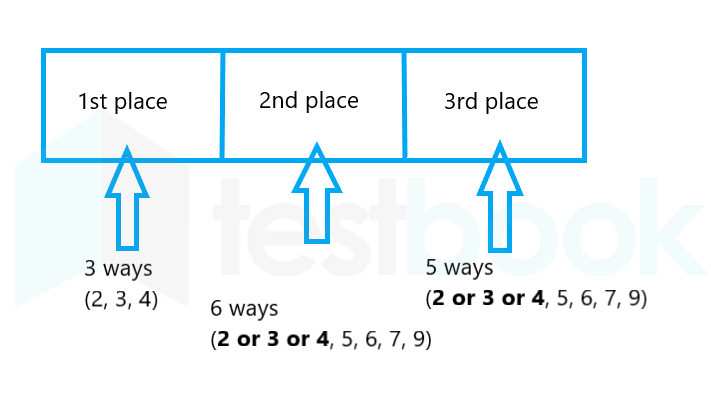
How many 4 - letter words (with or without meaning) containing two vowels can be constructed using only the letters (without repetition) of the word 'LUCKNOW'?
If n is a positive integer and r is a whole number, such that r < n, then P(n, r) represents the number of all possible arrangements or permutations of n distinct objects taken r at a time.
It can be represented as nPr = (n−r)!n!.
The combination is defined as “An arrangement of objects where the order in which the objects are selected does not matter.”
nCr = r!(n−r)!n! , when n < r
Where n = distinct object to choose from
C = Combination
r = spaces to fill
Calculation:
Vowels = 2
Consonants = 5
Total Alphabets = 7
Since 4 letter words must include 2 vowels, we don't need to select them, and the rest of the 2 letters will be taken from 5 consonants.
Number of ways of selecting 2 letters from 5 consonants = 5C2 = 10
Arrangement of all 4 letters will be given by 4! = 24 ways
Total number of arrangements = 5C2 × 4! = 10 × 24 = 240 ways
∴ The total number of words that can be formed is 240.
Question 19
Suppose 20 distinct points are placed randomly on a circle. Which of the following statements is/are correct?
The number of straight lines that can be drawn by joining any two of these points is 380.
The number of triangles that can be drawn by joining any three of these points is 1140.
Select the correct answer using the code given below.
Consider a regular polygon with 10 sides. What is the number of triangles that can be formed by joining the vertices which have no common side with any of the sides of the polygon?
A quadratic equation can be written in a standard form as
ax2 + bx + c = 0
x=2a−b±b2−4ac
Concept Used:
Algebraically, the absolute value of a number equals the nonnegative square root of its square
i.e Modulus of that number.
Calculation:
Given equation:
x4 - 10x2 + 9 = 0.
⇒ x2 = 210±100−4×9
⇒ x2 = 210±64
⇒ x2 = 210±8
Case I. Take positive sign
x2 = 9
⇒ x = ± 3
Case II. Take negative sign
x2 = 1
⇒ x = ± 1
∴ The sum of the absolute values of the roots = 3 + 1 + |-3| + |-1| = 8.
Question 27
Consider the expansion of (1 + x)n. Let p, q, r and s be the coefficients of first, second, nth and (n + 1)th terms respectively. What is (ps + qr) equal to?
An identity matrix is a given square matrix of any order which contains on its main diagonal elements with a value of one, while the rest of the matrix elements are equal to zero.
Let p, q and 3 be respectively the first, third and fifth terms of an AP. Let d be the common difference. If the product (pq) is minimum, then what is the value of d?
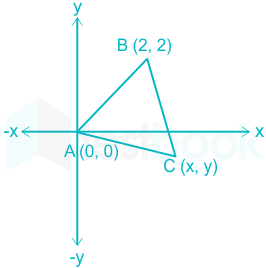
Non-Collinear Points: The set of points that do not lie on the same line are called non-collinear points. We cannot draw a single straight line through these points.
Formula Used:
a3 - b3 = (a - b) (a2 + ab + b2)
Calculation:
Given equation x3 -8 = 0
⇒ x3 - 23 = 0
⇒ (x - 2) (x2 + 2x + 4) = 0
⇒ x - 2 = 0 or x2 + 2x + 4 = 0
⇒ x = 2 or x = -1 + i√3 or x = -1 - i√3
We can take these three points on complex plane
So, we can write 1st point as 2 + i.0, -1 + i√3, -1 - i√3
The three points on complex plain is (2, 0), (-1,√3), (-1, -√3)
Case I.
Equation of line passes through (-1,√3), (-1, -√3) is
(y - √3) = (2√3/0) (x + 1)
⇒ x + 1 = 0
And this line does not passes through (2, 0).
∴ These points (roots) are not collinear.
Case 2.
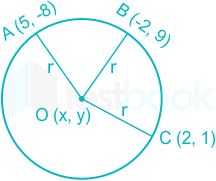
We know that these points are non-collinear it means they will definitely pass through a circle
Let the equation of circle be (x - a)2 + (y - b)2 = r2
Now, According to our assumption
(2 - a)2 + (0 - b)2 = r2 ----(i)
(-1 - a)2 + (√3 - b)2 = r2 ----(ii)
(-1 - a)2 + (-√3 - b)2 = r2 ----(iii)
On solving (i), (ii) and (iii), we get
a = 0, b = 0 and r = 2
Hence the equation of circle is (x - 0)2 + (y - 0)2 = 22
∴ The roots represents a circle but radius of circle is 2.
Question 35
Let the equation sec x.cosec x = p have a solution, where p is a positive real number. What should be the smallest value of p?
If f'(x) changes the sign from positive to negative while the graph of the function passes through x = a then x = a is said to be a point local maxima.
If f''(a) < 0 then x = a is a point of local maxima.
Calculation:
Let f(θ) = sinθ + sinθ cosθ
⇒ f(θ) = sinθ + 21 sin 2θ
⇒ f'(θ) = cosθ + 21 cos 2θ × 2
⇒ f'(θ) = cosθ + cos 2θ
Put f'(θ) = 0
⇒ cosθ + 2cos2θ - 1 = 0
⇒ 2cos2θ + 2cosθ - cosθ - 1 = 0
⇒ 2cosθ (cosθ + 1) - 1(cosθ + 1) = 0
⇒ (cosθ + 1) (2cosθ - 1) = 0
⇒ cosθ = 1/2, cosθ = -1
⇒ θ = π/3, π
According to the given range 0 < θ < 2π
θ = π/3
At this value of θ = π/3, the function can be maximum and minimum
So, we have to check second derivatives
f"(θ) = - sinθ - 2sin2θ
at θ = π/3
f"(π/3 ) ≤ 0
So, we can say that θ = π/3 is a point of local maxima.
Question 37
Consider the following statements in respect of sets:
The union over the intersection of sets is distributive.
The complement of the union of two sets is equal to the intersection of their complements.
If the difference between the two sets is equal to the empty set, then the two sets must be equal.
The complement of the union of two sets is equal to the intersection of
their complements and the complement of the intersection of two sets
is equal to the union of their complements.
Explanation:
**Statement:**1
The union over the intersection of sets is distributive.
A ∩ (B ∪ C) = (A ∩ B) ∪ (A ∩ C)
A ∪ (B ∩ C) = (A ∪ B) ∩ (A ∪ C)
Statement 1 is correct
**Statement:**2
According to De Morgan law,
(A U B)' = A' ∩ B'
Hence, statement 2 is correct.
Statement:3
If A and B are two sets, then their difference is given by
A - B or B - A.
If A = {2, 3, 4} and B = {2, 3, 4, 5, 6}
A - B means elements of A that are not the elements of B i.e,
in the above example A - B = ϕ
But here, A and B are not equal sets so statement 3 is incorrect
Also, B - A = {5, 6} ≠ ϕ
Additional Information
In general, B - A = {x : x ∈ B, and x ∉ A}
If A - B is the empty set, then we can show that A is a subset of B
If B - A is also the empty set, then we can also show that B is a subset of A
Question 38
Consider three sets X, Y and Z having 6, 5 and 4 elements respectively. All these 15 elements are distinct. Let S = (X - Y) ∪ Z. How many proper subsets does S have?
Suppose set A consists of first 250 natural numbers that are multiple of 3 and set B consists of first 200 even natural numbers. How many elements does A ∪ B have?
The value i or the concept of i is used in explaining and expressing complex numbers. Complex numbers are numbers with a real and imaginary part. The imaginary part is defined with the help of i. Basically, “i” is the imaginary part which is also called iota.
Value of i is √-1 A negative value inside a square root signifies an imaginary value. All the basic arithmetic operators are applicable to imaginary numbers. On squaring an imaginary number, we obtain a negative value.
i2 = -1, i3 = -i, i4 = 1
Calculation:
Given
i = √-1
⇒ i2 = -1
⇒ i-2n
⇒ (i2)-n
⇒ (-1)-n
Since, n = 0, 1, 2, 3, ...
When n = even then i-2n = 1
When n = odd then i-2n = -1
∴ Total possible values of the i-2n for n ϵ Z is two which are - 1 and 1.
Question 49
If x=b−ca, y=c−ab, z=a−bc then what is the value of the following?
Direction cosines are the cosines of the angles made by a directed line segment with the coordinate axes.
The sum of the square of direction cosine is always 1.
Direction Ratio:
If a, b, c are three numbers proportional to the direction cosine l, m, n of a straight line, then a, b, c are called its direction ratios.
They are also called direction numbers or direction components.
Direction cosines of a line are unique but direction ratios of a line in no way unique but can be infinite.
Explanation:
Statement: 1
The direction cosines for any line must be unique. However, there are infinitely many sets of direction ratios since direction ratios are just a set of any three numbers proportional to the direction cosines.
Statement: 2
We know that the sum of the squares of the direction cosines is equal to one which can be equal to the sum of the direction cosines (l + m + n) for certain lines like 1x=0z=0z
as, l = 1, m = 0, n = 0 and (l + m + n = 1) so statement 2 is also correct.
Question 63
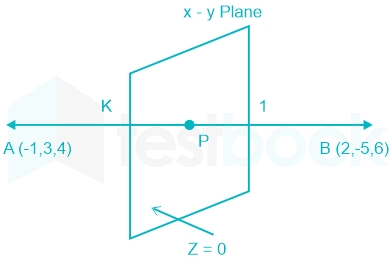
The xy-plane divides the line segment joining the points (-1, 3, 4) and (2, -5, 6)
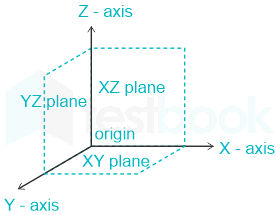
Octant: An octant in geometry is one of the eight divisions of a
Euclidean three-dimensional coordinate system defined by the signs
of the coordinates.
Explanation:
Let the radius of the sphere be r, then the distance of its center from
coordinate planes which it is touching should be equal to radius a.
Hence, its center is (r, r).
Also,
There are 8 quadrant in 3D, so for a given radius there will be 8
possible sphere touching all the 3 coordinate planes.
Question 65
ABCDEFGH is a cuboid with base ABCD. Let A(0, 0, 0), B(12, 0, 0), C(12, 6, 0) and G(12, 6, 4) be the vertices. If α is the angle between AB and AG; β is the angle between AC and AG, then what is the value of cos 2α + cos 2β?
If a,b and c be three vectors such that a,b and c are co-planar.
a.(b×c) = 0
2.Vector a×b is perpendicular to both vector a and b.
Calculation:
We have,
(a×b)×c = d (Let)
⇒ d is ⊥ to both a×b and c.
But a×b is ⊥ to a and b.
So, d or (a×b)×c will be coplanar to vector a and b.
∴ Statement (1) is correct.
For statement 2:
Statement 2 is only possible when the vector d is parallel or anti-parallel to vector a×b, which is not possible as per the above explanation for statement 1. So, this statement 2 is incorrect.
So, the best answer will be option 1.
Question 70
If the position vectors of A and B are (√2 - 1)î - ĵ and î + (√2 + 1)ĵ respectively, then what is the magnitude of AB?
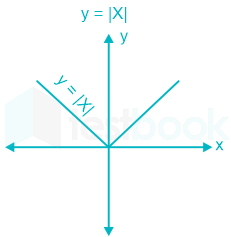
f(x) = \rm \left{\begin{matrix} x & x > 0\ -x & x < 0 \end{matrix}\right.
Greatest Integer Function:
Greatest Integer Function [x] indicates an integral part of the real number x which is the nearest and smaller integer to x. It is also known as the floor of x
In general, If n≤ x ≤ n+1 Then [x] = n (n ∈ Integer)
This means if x lies in [n, n+1) then the Greatest Integer Function of x will be n.
Continuity of function at any point:
limx→a−f(x)=limx→a+f(x)=limx→af(x)
A function f(x) is differentiable at x = a, if LHD = RHD
If we let Δx and Δy be the distances (along the x and y axes, respectively) between two points on a curve, then the slope given by the above definition,
m = ΔxΔy
Formula Used:
cos-1 (cos x) = -x , -π ≤ x ≤ 0
cos-1 (cos x) = x , 0 < x ≤ π
Calculation:
y = cos-1 (cos x)
Since, x = -π/4 which belongs to -π to 0
So, y = - x
⇒ dy/dx = -1
Since on reducing the equation from y = cos-1 (cos x) it becomes y = -x.
As x belongs (-π to 0 )
So Slope is d/dx [y = -x]
So Slope "m" = -1.
∴ The slope of the tangent of y = cos-1 (cos x) at x = −4π is -1.
Question 81
What is the integral of f(x) = 1 + x2 + x4 with respect to x2?
(i) Integration or Anti Differentiation or Primitive:
If f & F are function of x such that F' (x) = f(x) then the function F is called a Primitive or Antiderivative or Integral of f(x) w.r.t. x and is written symbolically as
∫F(x)dx=f(x)+c or ∫f′(x)dx=f(x)+c , Where c = Constant of integration
(ii) ∫abf′(x)dx = f(b) - f(a)
Here, f(a) is the lower limit value of the integral and f(b) is the upper limit value of the integral.
Calculation:
According to the question we have to find the value of ∫14f′(x)dx
⇒ ∫14f′(x)dx = [f(x)]14 (Integration is the 'inverse' of differentiation)
DEGREE OF DIFFERENTIAL EQUATION: The exponent of the highest order differential coefficient, when the differential equation is expressed as a polynomial in all the differential coefficient.
Calculation:
According to the question
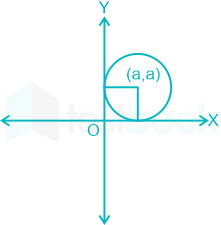
Center of circle = (a, a), Radius of circle = a
So, The equation of circle = (x − a)2 +(y − a)2 = a2 -----(1)
On differentiating with respect to x, we get
2(x - a) + 2(y - a) dxdy = 0 ⇒ x + y dxdy = a(1 + dxdy)
⇒ a=1+dxdyx+ydxdy ----(2)
From (i), On expanding the equation of circle, we get
The above inequality is the lower bound of the intersection of two events E and F. This relation is called the Principle of Inclusion-Exclusion (for two events).
If you think of this intuitively, the left-hand side P(E ∩ F) represents the probability of both events E and F happening together. In the worst case, this can't be higher than the sum of the probabilities of E and F occurring individually (i.e., P(E) + P(F)), less the probability of at least one of them happening (which is 1). So, the relation holds true that the intersection should be greater than or equal to the sum of probabilities of two events E and F, minus 1.
(2) P(E ∪ F) = P(E) + P(F) + P(E ∩ F)
The correct formula -
P(E ∪ F) = P(E) + P(F) - P(E ∩ F)
The above equation is the formula for the probability of the union of two events E and F. The original relation stated was incorrect because the plus sign before the last term P(E ∩ F) should be a minus sign.
This formula tells us the total probability of either event E, event F, or both happening is equal to the sum of their individual probabilities minus the probability of them both occurring (since we double-counted that in the sum).
(3) P(E ∪ F) ≤ P(E) + P(F)
The above inequality is the upper bound on the union of two events E and F. Essentially, this is stating that the probability of either E happening, or F happening, or both, is naturally less than or equal to the sum of their individual probabilities.
If E,F are mutually exclusive (cannot occur at the same time), the sign becomes equality instead of inequality.
So, statement 1 and 3 are correct. Hence option (3) is correct.
Question 102
If P(A|B) < P(A), then which one of the following is correct?
When the measure of central tendency is available in the form of mean, which one of the following is the most reliable and accurate measure of variability?
Dispersion is the extent to which values in a distribution differ from the average of the distribution. To quantify the extent of the variation, there are certain measures namely:
Measures of Dispersion From Average:
The mean deviation (MD) of a series is the arithmetic average of the deviation of various items from a measure of central tendency (mean, median, and mode).
Standard Deviation (S. D.): One of the most stable measures of variability, it is the most important and commonly used measure of dispersion. It measures the absolute dispersion or variability of a distribution. Standard deviation is the positive square root of the mean of the squared deviations of observations from their mean. It is denoted by S.D. or σx.
Measures Based Upon Spread of Values:
Range: It is the simplest measure of variability both from the point of view of calculation and understanding. It is the difference between the largest and the smallest observations in the data. For example, the range of scores 2, 5, 6, 4, 12, 10, 9 and 8 is 12-2 = 10.
Interquartile range (IQR) is a measure of variability, based on dividing a data set into quartiles. It divides a rank-ordered data set into four equal parts. Q1 is the mid-value in the first half of the rank-ordered data, Q2 is the score that has exactly two quarters (median). Q3 is the mid-value in the second half of the rank-ordered data.
For example, consider the number 3, 4, 6, 9, 11, 12, 14, 15.
Q1 is the middle value in the first half of the data set.
The middle value is the average of the two middle values; that is, Q1 = 24+6 = 5.
Q3 is the middle value in the second half of the data set.
i. e. Q3 = 212+14 = 13
Semi Quartile Range = 2Q3−Q1 = 213−5 = 4
Question 104
A problem is given to three students A, B and C, whose probabilities of solving the problem independently are 21, 43 and p respectively. If the probability that the problem can be solved is 3229, then what is the value of p?
3-digit numbers are formed using the digits 1, 3, 7 without repetition of digits. A number is randomly selected. What is the probability that the number is divisible by 3?