Let one focus of the hyperbola H:a2x2−b2y2=1 beat (10,0) and and the corresponding directrix be x=109. If e and l respectively and the length of the latus rectum of H, then 9 (e2 + l) is equal ro:
Let f : R→R be a twice differentiable function such that (sinx cosy)(f(2x+2y) – f(2x – 2y)) = (cosx siny)(f(2x+2y) + f(2x – 2y)), for all x, y∈R . If f′(0)=21 , then the value of 24f′′(35π) is:
An arithmetic progression is a sequence of numbers in which the difference between consecutive terms is constant, called the common difference (d).
The sum of first n terms of an A.P. is given by Sn=2n[2a+(n−1)d], where a is the first term.
Calculation:
Sum of first 12 odd terms in A.P. is
S12=212[2a+(12−1)×2d]=6[2a+22d]
Equate to the given sum,
6[2a+22d]=−572a⇒12a+132d=−572a
Multiply both sides by 5,
60a+660d=−72a⇒132a+660d=0⇒132a+132×5d=0⇒a=−5d
Now, sum of first n terms Sn = 0
2n(2a+(n−1)d)=0⇒2n(2(−5d)+(n−1)d)=0
⇒2n(−10d+nd−d)=0⇒2n(nd−11d)=0⇒2nd(n−11)=0
Since d ≠ 0 and n ≠ 0 ,
n−11=0⇒n=11
Hence, the correct answer is Option 1.
Question 9
If the function f(x) = 2x3 – 9ax2 + 12a2x + 1, where a > 0, attains its local maximum and local minimum values at p and q, respectively, such that p<sub>2</sub> = q, then f(3) is equal to:
Finding local maxima and minima of a cubic function:
To find local maxima and minima of a cubic function, first differentiate the function and find the critical points by setting the derivative equal to zero.
The critical points correspond to values of xx
where the function attains local maxima or minima.
Use given conditions on the critical points to find the parameters and evaluate the function at required points.
Calculation:
Given,
f(x)=2x3−9ax2+12a2x+1
First derivative,
f′(x)=6x2−18ax+12a2
Set f′(x)=0 to find critical points:
6x2−18ax+12a2=0
Dividing by 6:
x2−3ax+2a2=0
Let the roots be p and q. Then, by Vieta's formulas,
p+q=3a
pq=2a2
Given condition,
p2=q
Substitute q=p2:
p+p2=3a
p⋅p2=p3=2a2
From sum,
a=3p+p2
From product,
a2=2p3
Squaring the sum and equating to product:
(3p+p2)2=2p3
Solving for p gives p=2.
Then,
a=32+4=2
Finally, evaluate f(3):
f(3)=2(3)3−9(2)(3)2+12(2)2(3)+1
=54−162+144+1=37
∴ The correct answer is Option 4.
Question 10
Let z be a complex number such that ∣z∣=1. . If k+zˉ2+k2z=kz,k∈R, then the maximum distance of k + ik2 from the circle ∣z−(1+2i)∣=1 is:
Let the vertices Q and R of the triangle PQR lie on the line 5x+3=2y−1=3z+4, QR = 5 and the coordinates of the point P be (0, 2, 3). If the area of the triangle PQR is nm then:
Let ABCD be a tetrahedron such that the edges AB, AC and AD are mutually perpendicular. Let the areas of the triangles ABC, ACD and ADB be 5, 6 and 7 square units respectively. Then the area (in square units) of the ΔBCD is equal to :
Area of Tetrahedron from Areas of Perpendicular Triangles:
In a tetrahedron where edges AB, AC, and AD are mutually perpendicular, the area of the face opposite to vertex A (i.e., triangle BCD) is related to the areas of the triangles ABC, ACD, and ADB.
These three triangles form right-angled faces and their areas can be used to find the area of the face BCD using Pythagorean relation in three dimensions.
The relation for the area of triangle BCD is,
Ar(△BCD)=Ar(△ABC)2+Ar(△ACD)2+Ar(△ADB)2
Calculation:
Given,
Ar(△ABC)=5,Ar(△ACD)=6,Ar(△ADB)=7
⇒ Ar(△BCD)=52+62+72=25+36+49=110
∴ The area of triangle BCD is 110, hence the correct answer is Option 3.
Question 19
)Let \(a \in \mathbf{R} and A be a matrix of order 3x3 such that det(A) = -4 and A + I = [1a1210a12], where I is the identity matrix of order 3 x 3.
If det ((a + 1)adj((a–1)A)) is 2m3n, m, n ∈ {0,1,2,…..20}, then m + n is equal to :
Let the focal chord PQ of the parabola y2 = 4x make an angle of 60° with the positive x-axis, where P lies in the first quadrant. If the circle, whose one diameter is PS, S being the focus of the parabola, touches the y-axis at the point (0,α), then 5α2 is equal to :
The focal chord of the parabola y2=4axpasses through points on the parabola making a certain angle with the x-axis.
The circle with one diameter as the focal chord touches the y-axis at a certain point.
The tangent of the given angle and the coordinates of the point P on the parabola can be used to find the parameter t.
The equation of the circle with diameter PS and its intersection with the y-axis is used to find α
Calculation:
Given,
The parabola: y2=4x
Focal chord PQ makes an angle of 60∘ with positive x-axis.
Using slopem=tan60∘=3
tan60∘=t2−12t−0=3⟹t=3
Coordinates of P: (3,23)
Circle with diameter PS and focus S:
(x−1)(x−3)+(y−0)(y−23)=0
At x = 0,
(−1)(−3)+y(y−23)=0⟹3+y2−23y=0⟹(y−3)2=0⟹y=3=α
Calculate 5α2:
5α2=5(3)2=5×3=15
∴ The correct answer is Option 1.
Mathematics Section B (5 questions)
Question 21
Let [.] denote the greatest integer function. If \int_{0}^{3} \left[ \frac{1}{e^{x-1}} \right] dx = \alpha - \log_e 2, \text{ then } \alpha^3 \text{ is equal to } ____.
The area between curves can be found by integrating the difference of the functions over the given interval.
Use definite integrals and apply limits appropriately to find the enclosed area.
Calculation:
Given region: (x,y):∣4−x2∣≤y≤x2,y≤4,x≥0
Area calculation involves three integrals:
A=∫044+y,dy−∫024−y,dy−∫24y,dy
Evaluating each integral:
∫044+y,dy=[32(4+y)3/2]04=32(83/2−43/2)
∫024−y,dy=[32(4−y)3/2]02=32(23/2−43/2)
∫24y,dy=[32y3/2]24=32(43/2−23/2)
Substitute the values:
A=32(162−8)+32(22−8)−32(8−22)
=3402−48=6802−16
Given:α802−β=6802−16
Comparing terms,
α=6,β=16
α+β=6+16=22
Hence, the correct answer is 22.
Question 24
Three distinct numbers are selected randomly from the set {1,2,3,……,40}. If the probability, that the selected numbers are in an increasing G.P. is nm, gcd(m,n) = 1, then m + n is equal to ____.
Three distinct numbers are selected randomly from the set {1,2,3,…,40}.
The selected numbers are in increasing Geometric Progression (G.P.).
The probability of this event is m/n where \gcd(m,n) = 1
gcd(m,n) 4= 1.
Calculation:
Total number of ways to select 3 distinct numbers from 40 numbers = (403) = 9880
Let the three numbers in increasing G.P. be: a, ar, ar2, where a, r ∈ N
r>1 (since increasing).
Since all numbers are distinct integers between 1 and 40,
⇒ 1 ≤ a< ar < ar2 ≤ 40
Since r is the common ratio, for the sequence to be an increasing G.P. with integers, r must be a positive integer greater than 1
For r=2:
⇒ a ≤ 2240=10
So possible a=1,2,…,10 → 10 sequences
For r = 3
⇒ a ≤ 40/9 ≈ 4
So Possible a= 1, 2, 3, 4 → 4 sequences
For r = 4
⇒ a ≤ 40/16 = 2.5
Possible a = 1, 2
a= 1,2 → 2 sequences
For r = 5
⇒ a ≤ 40/25 = 1.6
Possible a = 1
a=1 → 1 sequence
For r = 6
⇒ a ≤ 40/36 = 1.11
Possible a= 1 → 1 sequence
For r ≥7 a ≤ r240 < 1, no sequences.
Total number of favorable sequences = 10 + 4 + 2 + 1 + 1 = 18
⇒ Now P = (340)18=988018=49409
Here, gcd(94940) = 1 so
⇒ m/n = 9/4940
and m + n = 9 + 4940 = 4949
Hence, the Correct answer is 4949.
Question 25
The absolute difference between the squares of the radii of the two circles passing through the point (–9, 4) and touching the lines x + y = 3 and x – y = 3, is equal to _____.
(f) Cycloheptatrienyl anion: Has 8 π-electrons → does not follow Hückel’s rule → Not Aromatic
(g) 4n π-electron system (non-planar rectangle) → Not Aromatic
(h) Cyclopropyl cation: Has 2 π-electrons → satisfies Hückel’s rule for n = 0 → Aromatic
Therefore, the correct answer is: a, c, d, e, h are aromatic and b, f, g are not aromatic.
Question 27
An optically active alkyl halide C4 H9 Br [A] reacts with hot KOH dissolved in ethanol and forms alkene [B] as major product which reacts with bromine to give dibromide [C]. The compound [C] is converted into a gas [D] upon reacting with alcoholic NaNH2 . During hydration 18 gram of water is added to 1 mole of gas [D] on warming with mercuric sulphate and dilute acid at 333 K to form compound [E]. The IUPAC name of compound [E] is :
The halogens include Fluorine (F), Chlorine (Cl), Bromine (Br), and Iodine (I).
Covalent Radius: Increases down the group due to the addition of new shells (F < Cl < Br < I).
Ionic Radius: Also increases as you go down the group (F− < Cl− < Br− < I−).
First Ionization Energy: Decreases down the group due to increasing atomic size (F > Cl > Br > I).
Electron Affinity: Typically increases down the group, but fluorine shows an irregularity—it has lower electron affinity than chlorine despite being smaller.
EXPLANATION:
Electron Affinity: The irregularity arises because fluorine is very small, and adding an extra electron leads to high electron–electron repulsion, reducing the energy released.
All other properties—covalent radius, ionic radius, and first ionization energy—follow regular trends down the group without deviation in the first four elements.
Therefore, the correct answer is: B only
Question 29
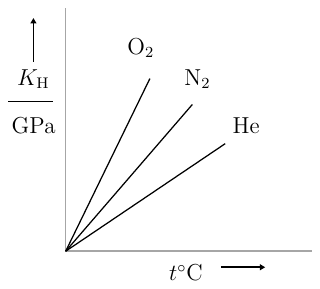
Which of the following graph correctly represents the plots of KH at 1 bar gases in water versus temperature ?
Henry’s Law Constant (KH): It relates the solubility of a gas in a liquid to the pressure of the gas above the liquid.
According to Henry's Law: C = KH × P, where C is the concentration (solubility), P is the partial pressure, and KH is Henry’s constant.
Temperature Dependence: Solubility of gases in liquids generally decreases with increase in temperature, hence KH values typically increase with temperature.
The increase in KH with temperature is not linear and varies for different gases. Light gases like He show a steeper increase.
EXPLANATION:
Among the options, only graph 4 shows the correct qualitative trend: Henry’s constant (KH) increases with temperature for all gases.
Also, gases like He (non-polar and light) exhibit lower solubility and hence higher KH, followed by N2 and CH4.
This trend is consistent with the observation that lighter gases have higher Henry’s constants and are less soluble in water.
Therefore, the correct answer is: Option 4
Question 30
According to Bohr’s model of hydrogen atom, which of the following statement is incorrect?
AOption (a)
Radius of 3rd orbit is nine times larger than that of 1st orbit.
BOption (b)
Radius of 8th orbit is four times larger than that of 4th orbit.
COption (c)
Radius of 6th orbit is three time larger than that of 4th orbit.
DOption (d)
Radius of 4th orbit is four times larger than that of 2nd orbit.
Radius of 6th orbit is three time larger than that of 4th orbit.
Why this answer is correct
CONCEPT:
Bohr’s Model and Radius of Electron Orbits
r ∝ n²
rₙ = r₁ × n²
According to Bohr’s model of the hydrogen atom, the radius of the nth orbit is proportional to the square of the principal quantum number n:
This means the radius of orbit n can be expressed as:
where r₁ is the radius of the first orbit (ground state).
EXPLANATION:
Radius of 3rd orbit relative to 1st orbit:
r₃ / r₁ = (3)² / (1)² = 9 / 1 = 9
Statement 1 is correct.
Radius of 8th orbit relative to 4th orbit:
r₈ / r₄ = (8)² / (4)² = 64 / 16 = 4
Statement 2 is correct.
Radius of 6th orbit relative to 4th orbit:
r₆ / r₄ = (6)² / (4)² = 36 / 16 = 2.25
Statement 3 says “three times larger”, but the actual ratio is 2.25.
Therefore, Statement 3 is incorrect.
Radius of 4th orbit relative to 2nd orbit:
r₄ / r₂ = (4)² / (2)² = 16 / 4 = 4
Statement 4 is correct.
Therefore, the incorrect statement is: Radius of 6th orbit is three times larger than that of 4th orbit (Option 3).
Question 31
Two vessels A and B are connected via stopcock. The vessel A is filled with a gas at a certain pressure. The entire assembly is immersed in water and is allowed to come to thermal equilibrium with water. After opening the stopcock the gas from vessel A expands into vessel B and no change in temperature is observed in the thermometer. Which of the following statement is true?
AOption (a)
dw=0
BOption (b)
dq=0
COption (c)
dU=0
DOption (d)
The pressure in the vessel B before opening the stopcock is zero.
The pressure in the vessel B before opening the stopcock is zero.
Why this answer is correct
CONCEPT:
Free Expansion of Gas and Thermodynamic Changes
When a gas expands into a vacuum (free expansion), there is no external pressure opposing the expansion, i.e., Pext = 0.
In free expansion:
No work is done by the gas (dw = 0) because the external pressure is zero.
No heat is exchanged with the surroundings (dq = 0) if the system is insulated or thermally isolated.
For an ideal gas undergoing free expansion, the internal energy (ΔU) remains unchanged since internal energy depends only on temperature and temperature is constant.
EXPLANATION:
In the problem, two vessels A and B are connected with a stopcock.
Initially, vessel A contains gas at certain pressure, and vessel B is evacuated (pressure in B is zero).
Upon opening the stopcock, gas expands freely into vessel B (vacuum), so Pext = 0.
Since the assembly is immersed in water and allowed to equilibrate, temperature remains constant.
Therefore, no work is done (dw = 0), no heat is exchanged (dq = 0), and internal energy change is zero (ΔU = 0).
Hence, the pressure in vessel B before opening the stopcock must be zero.
The correct answer is The pressure in the vessel B before opening the stopcock is zero.
Question 32
A solution is made by mixing one mole of volatile liquid A with 3 moles of volatile liquid B. The vapour pressure of pure A is 200 mm Hg and that of the solution is 500 mm Hg. The vapour pressure of pure B and the least volatile component of the solution, respectively, are :
Raoult's law states that the total vapor pressure of an ideal solution is the sum of the partial vapor pressures of each component.
The partial vapor pressure of each component is equal to the vapor pressure of the pure component multiplied by its mole fraction in the solution.
Mathematically, Ptotal = PΔ0 × XΔ + PB0 × XB
The component with the higher vapor pressure is the more volatile component.
The least volatile component has the lower vapor pressure.
EXPLANATION:
Given:
Moles of volatile liquid Δ = 1
Moles of volatile liquid B = 3
Vapor pressure of pure Δ (PΔ0) = 200 mm Hg
Total vapor pressure of solution (Psolution) = 500 mm Hg
Mole fractions:
XΔ = 1 / (1 + 3) = 1/4 = 0.25
XB = 3 / (1 + 3) = 3/4 = 0.75
Therefore, vapor pressure of pure B is 600 mm Hg.
Comparing vapor pressures:
PΔ0 = 200 mm Hg
PB0 = 600 mm Hg
B has the higher vapor pressure, so B is the more volatile component.
Δ, having the lower vapor pressure, is the least volatile component.
Therefore, the vapor pressure of pure B is 600 mm Hg, and the least volatile component of the solution is A.
Question 33
CaCO3(s) + 2HCl(aq) → CaCl2(aq) + CO2(g) H2O(l) Consider the above reaction, what mass of CaCl2 will be formed if 250 mL of 0.76 M HCl reacts with 1000 g of CaCO3 ?
(Given : Molar mass of Ca, C, O, H and Cl are 40, 12, 16, 1 and 35.5 g mol–1, respectively)
Stoichiometry and Limiting Reactant in Chemical Reactions
CaCO3(s) + 2HCl(aq) → CaCl2(aq) + CO2(g) + H2O(l)
The reaction between calcium carbonate and hydrochloric acid is a typical acid-carbonate reaction:
Mole ratio between CaCO3 and HCl is 1:2.
The limiting reactant determines the amount of product formed.
Molar masses are used to convert between moles and grams.
EXPLANATION:
Given:
Mass of CaCO3 = 1000 g
Concentration of HCl = 0.76 M (moles per liter)
Volume of HCl = 250 mL = 0.250 L
Molar masses (g/mol): Ca = 40, C = 12, O = 16, H = 1, Cl = 35.5
Calculate moles of CaCO3:
Molar mass of CaCO3 = 40 + 12 + (16 × 3) = 100 g/mol
Moles of CaCO3 = 1000 g / 100 g/mol = 10 mol
Calculate moles of HCl:
Moles of HCl = Molarity × Volume = 0.76 mol/L × 0.250 L = 0.19 mol
Determine limiting reactant:
Reaction requires 2 moles of HCl per mole of CaCO3.
Moles of HCl required for 10 moles CaCO3 = 10 × 2 = 20 moles.
Available moles of HCl = 0.19 moles < 20 moles required, so HCl is limiting reactant.
Calculate moles of CaCl2 formed (equal to moles of CaCO3 reacted):
Moles of CaCl2 formed = moles of HCl / 2 = 0.19 / 2 = 0.095 mol
Calculate molar mass of CaCl2:
Ca = 40, Cl = 35.5 × 2 = 71, Total = 40 + 71 = 111 g/mol
Calculate mass of CaCl2 produced:
Mass = moles × molar mass = 0.095 × 111 = 10.545 g
Therefore, the mass of CaCl2 formed is 10.545 g.
Question 34
If equal volumes of AB2 and XY (both are salts) aqueous solutions are mixed, which of the following combination will give a precipitate of AY2 at 300 K?
When equal volumes are mixed molarity reduce to half.
CONCEPT:
When two salt solutions AB2 and XY are mixed, precipitation of AY2 will occur if the ionic product (Qsp) exceeds the solubility product constant (Ksp).
Qsp is calculated as:
Qsp = [A+][Y−]2
Since equal volumes of solutions are mixed, the concentration of ions is halved due to dilution.
EXPLANATION:
For precipitation QSP=[A+2][Y−]2>KSP(1),QSP=(1.8×10⁻³)(25×10−4)2<KSP(2),QSP=(10−4)(0.4×10⁻³)2<KSP(3),QSP=(10−2)(10−2)2>KSP(4),QSP=(21.5×10⁻⁴)(21.5×10⁻³)2<KSP
Conclusion:
Only option 3 gives Qsp > Ksp, so precipitation of AY2 occurs.
Question 35
Among SO2 , NF3 , NH3 , XeF2 , ClF3 and SF4 , the hybridization of the molecule with non-zero dipole moment and highest number of lone-pairs of electrons on the central atom is
Hybridization, Molecular Geometry, and Dipole Moment
Hybridization describes the mixing of atomic orbitals on the central atom to form new hybrid orbitals in a molecule.
The presence of lone pairs affects molecular geometry and the resultant dipole moment.
Dipole moment depends on the geometry and the difference in electronegativities; molecules with symmetrical geometry or lone pairs arranged symmetrically often have zero dipole moment.
Hybridizations considered here are sp², sp³, sp³d, and sp³d² corresponding to trigonal planar, tetrahedral, trigonal bipyramidal, and octahedral geometries, respectively.
Lone pairs on the central atom create asymmetry, often leading to non-zero dipole moments.
EXPLANATION:
Molecule
Hybridization
Dipole Moment
Lone Pairs on Central Atom
SO2
sp²
Non-zero
1
NF3
sp³
Non-zero
1
NH3
sp³
Non-zero
1
XeF2
sp³d
Zero
3
ClF3
sp³d
Non-zero
2
SF4
sp³d
Non-zero
1
Among molecules with non-zero dipole moment, ClF3 has the highest number of lone pairs (2) on the central atom.
Its hybridization is sp³d.
Therefore, the correct answer is: sp³d (Option 4).
Question 36
Given below are two statements :
Statement (I) : Vanillin
will react with NaOH and also with Tollen’s reagent.
Statement (II) : Vanillin
will undergo self aldol condensation very easily. In the light of the above statements, choose the most appropriate answer from the options given below :
AOption (a)
Statement I is incorrect but Statement II is correct
BOption (b)
Statement I is correct but Statement II is incorrect
Statement I is correct but Statement II is incorrect
Why this answer is correct
CONCEPT:
Vanillin is an aromatic aldehyde with a phenolic -OH group and a methoxy (-OCH3) group attached to the benzene ring.
The phenolic group (-OH attached to benzene) is acidic and soluble in NaOH due to phenol's acidic nature.
Tollen's reagent detects aldehyde groups (-CHO) by oxidizing them to carboxylic acids, giving a silver mirror. Vanillin contains an aldehyde group, so it reacts with Tollen's reagent.
Self-aldol condensation requires the presence of acidic alpha-hydrogen atoms adjacent to the carbonyl group to form enolate ions under basic conditions.
Vanillin lacks alpha-hydrogen atoms adjacent to the aldehyde group because the carbonyl carbon is directly bonded to the aromatic ring, thus it does not undergo self-aldol condensation easily.
EXPLANATION:
Phenolic group soluble in NaOH
Benzaldehyde derivative react with Tollen’s reagent.
Vanillin does not give self-aldol reaction due to lack of acidic H for condensation.
Statement I: Vanillin will react with NaOH due to the acidic phenolic -OH group which forms phenolate ions soluble in NaOH.
It also reacts with Tollen's reagent because of the aldehyde (-CHO) group, which is oxidized to carboxylate ions, producing the silver mirror effect.
Statement II: Vanillin will not undergo self-aldol condensation easily because it lacks acidic alpha-hydrogens required to form the enolate ion necessary for aldol condensation.
Therefore, Statement I is correct but Statement II is incorrect.
Question 37
Identify the correct statement among the following:
AOption (a)
All naturally occurring amino acids except glycine contain one chiral centre.
BOption (b)
All naturally occurring amino acids are optically active.
COption (c)
Glutamic acid is the only amino acid that contains a –COOH group at the side chain.
DOption (d)
Amino acid, cysteine easily undergo dimerization due to the presence of free SH group.
Amino acid, cysteine easily undergo dimerization due to the presence of free SH group.
Why this answer is correct
CONCEPT:
Most naturally occurring amino acids contain one chiral center, except glycine, which has two hydrogen atoms attached to the alpha carbon, making it achiral.
Some amino acids, like isoleucine and threonine, contain two chiral centers.
Optical activity arises from chirality, so glycine is optically inactive, whereas other amino acids with chiral centers are optically active.
Glutamic acid and aspartic acid both contain a –COOH group in their side chains (carboxylic acid groups), so glutamic acid is not unique in this feature.
Cysteine contains a thiol (-SH) group in its side chain, which can form disulfide bonds by dimerization or oxidation, contributing to protein structure stabilization.
EXPLANATION:
Statement 1: Incorrect. While most amino acids have one chiral center, isoleucine has two chiral centers, and glycine has none.
Statement 2: Incorrect. Glycine is achiral and thus optically inactive.
Statement 3: Incorrect. Both glutamic acid and aspartic acid have –COOH groups on their side chains.
Statement 4: Correct. Cysteine contains a free thiol (-SH) group that readily undergoes dimerization to form disulfide bonds.
Therefore, the correct statement is: Amino acid cysteine easily undergoes dimerization due to the presence of free SH group.
Question 38
The correct order of basic nature on aqueous solution for the bases NH3 , H2 N–NH2 , CH3 CH2 NH2 , (CH3CH2 )2NH and (CH3CH2)3 N is :
The basicity of amines in aqueous solution depends on the availability of the lone pair of electrons on the nitrogen atom to accept a proton (H+).
Alkyl groups like ethyl (CH3CH2–) are electron-donating via +I (inductive) effect, which increases electron density on nitrogen and hence increases basicity.
However, steric hindrance and solvation effects influence basicity. Primary and secondary amines are generally more basic than tertiary amines in aqueous solution due to better solvation of the protonated form.
Hydrazine (H2N–NH2) shows slightly different basicity due to electron interaction between the two nitrogen atoms.
EXPLANATION:
NH3 (Ammonia): Least basic among the given due to no alkyl groups.
H2N–NH2 (Hydrazine): Slightly more basic than NH3 because the lone pair on one nitrogen can be delocalized to some extent.
CH3CH2NH2 (Ethylamine, primary amine): More basic due to +I effect of ethyl group increasing electron density.
(CH3CH2)2NH (Diethylamine, secondary amine): Generally most basic as two alkyl groups donate electrons, increasing basicity.
(CH3CH2)3N (Triethylamine, tertiary amine): Less basic than secondary amine because of steric hindrance and poor solvation.
Therefore, the correct order of basicity is:
NH2–NH2,<NH3<CH3CH2NH2<(CH3CH2)3N<(CH3CH2)2NH
Question 39
Given below are two statements :
Statement (I) : The metallic radius of Al is less than that of Ga.
Statement (II) : The ionic radius of Al3+ is less than that of Ga3+.
In the light of the above statements, choose the most appropriate answer from the options given below :
AOption (a)
Both Statement I and Statement II are incorrect
BOption (b)
Statement I is incorrect but Statement II is correct
COption (c)
Statement I is correct but Statement II is incorrect
Statement I is incorrect but Statement II is correct
Why this answer is correct
ONCEPT:
Metallic radius refers to the size of an atom in a metallic state, influenced by electron shielding and effective nuclear charge.
Gallium (Ga) has filled 3d10 subshell electrons that poorly shield the nucleus, leading to a stronger effective nuclear charge on the outer electrons, causing contraction in atomic size.
Due to this d-electron poor shielding, Ga has a smaller metallic radius than Al, despite being below it in the periodic table.
Ionic radius depends on the number of electrons and nuclear charge after ionization. Both Al3+ and Ga3+ lose three electrons.
Since Ga has more protons and poor shielding, its ionic radius is larger than that of Al3+.
EXPLANATION:
\implies \text{The metallic radius order of Al & Ga is} \ \mathrm{B} < \mathrm{Ga} < \mathrm{Al} < \mathrm{In} < \mathrm{Tl} \ \underbrace{\mathrm{Ga} < \mathrm{Al}}_{\text{(due to poor shielding of d-subshell electrons)}} \ \implies \text{The ionic radius order of } \mathrm{Al}^{+3} & \mathrm{Ga}^{+3} \text{ is} \ \mathrm{B}^{+3} < \mathrm{Al}^{+3} < \mathrm{Ga}^{+3} < \mathrm{In}^{+3} < \mathrm{Tl}^{+3}
Statement I: Metallic radius of Al is less than that of Ga — This is incorrect. The order is Ga < Al due to d-electron poor shielding in Ga causing contraction.
Statement II: Ionic radius of Al3+ is less than Ga3+ — This is correct. Ga3+ has larger ionic radius because the poor shielding effect expands the size compared to Al3+.
Therefore, the correct answer is: Statement I is incorrect but Statement II is correct.
Question 40
Given below are two statements :
Statement (I) : In octahedral complexes, when Δo < P high spin complexes are formed. When Δo > P low spin complexes are formed. Statement (II) : In tetrahedral complexes because of Δo < P, low spin complexes are rarely formed. In the light of the above statements, choose the most appropriate answer from the options given below :
AOption (a)
Statement I is correct but Statement II is incorrect.
BOption (b)
Both Statement I and Statement II are incorrect
COption (c)
Statement I is incorrect but Statement II is correct
In coordination chemistry, Δo (octahedral crystal field splitting energy) is the energy difference between the higher and lower sets of d-orbitals in an octahedral complex.
P refers to the pairing energy, which is the energy required to pair two electrons in the same orbital.
For octahedral complexes (coordination number 6):
If Δo < P, electrons prefer to occupy higher energy orbitals unpaired → high spin complexes.
If Δo > P, electrons pair in lower energy orbitals → low spin complexes.
In tetrahedral complexes (coordination number 4):
The crystal field splitting energy Δt is smaller than Δo and always less than the pairing energy (Δt < P).
Therefore, tetrahedral complexes are almost always high spin because electrons occupy orbitals singly to minimize pairing.
Low spin tetrahedral complexes are rare.
Explanation:-
Statement I: Correct. It accurately describes the relationship between Δo and P in octahedral complexes and the formation of high spin or low spin complexes.
Statement II: Correct. It correctly states that because Δo < P in tetrahedral complexes, low spin complexes are rarely formed.
Therefore, both Statement I and Statement II are correct.
Question 41
Choose the correct tests with respective observations.
(A) CuSO4 (acidified with acetic acid) + K4 [Fe(CN)6 ] → Chocolate brown precipitate.
(B) FeCl3 + K4 [Fe(CN)6] → Prussian blue precipitate.
(C) ZnCl2 + K4 [Fe(CN)6], neutralised with NH4 OH → White or bluish white precipitate.
(D) MgCl2 + K4 [Fe(CN)6 ] → Blue precipitate.
(E) BaCl2 + K4 [Fe(CN)6 ], neutralised with NaOH → White precipitate.
Choose the correct answer from the options given below :
Potassium ferrocyanide, K4[Fe(CN)6], reacts with various metal salts to form characteristic precipitates based on the metal ion involved.
The nature and color of the precipitate help in identifying metal ions qualitatively.
Specific reactions:
CuSO4 (acidified with acetic acid): Reacts with K4[Fe(CN)6] to form a chocolate brown precipitate of Cu2[Fe(CN)6].
FeCl3: Reacts with K4[Fe(CN)6] to form Prussian blue precipitate, Fe4[Fe(CN)6]3.
ZnCl2 (neutralized with NH4OH): Forms white or bluish white precipitate K2Zn3[Fe(CN)6]2.
MgCl2 and BaCl2: Do not give such characteristic precipitates with K4[Fe(CN)6].
EXPLANATION:
2CuSO4+K4[Fe(CN)6]CH3COOHCu2[Fe(CN)6]↓+2K2SO4(Chocolate brown ppt.)4FeCl3+3K4[Fe(CN)6]→Fe4[Fe(CN)6]3↓+12KCl(Prussian Blue ppt.)3ZnCl2+2K4[Fe(CN)6]NH4OHK2Zn3[Fe(CN)6]2↓+6KCl(White or bluish white ppt.)
Option A: Correct. CuSO4 with K4[Fe(CN)6] gives chocolate brown precipitate.
Option B: Correct. FeCl3 with K4[Fe(CN)6] gives Prussian blue precipitate.
Option C: Correct. ZnCl2 neutralized with NH4OH reacts with K4[Fe(CN)6] to give white/bluish white precipitate.
Option D: Incorrect. MgCl2 does not give blue precipitate with K4[Fe(CN)6].
Option E: Incorrect. BaCl2 neutralized with NaOH does not give white precipitate with K4[Fe(CN)6].
Therefore, the correct tests with respective observations are A, B, and C only.
Question 42
On complete combustion 1.0 g of an organic compound (X) gave 1.46 g of CO2 and 0.567 g of H2 O. The empirical formula mass of compound (X) is _________ g. (Given molar mass in g mol–1 C : 12, H : 1, O : 16)
(p) Acyl chloride (CH3−CH2−C=O−Cl): Has the best leaving group (Cl–), so it hydrolyzes fastest.
(q) Acid anhydride (CH3−CH2−C=O−O−C=O−CH3): Next best leaving group (carboxylate), hydrolyzes slower than acyl chloride.
(r) Ester (CH3−CH2−C=O−O−CH2−CH3): Alkoxy leaving group, less reactive than anhydrides.
(s) Amide (CH3−CH2−C=O−NH2): Amide group is poor leaving group, so hydrolyzes slowest.
Therefore, the correct order of rate of hydrolysis is p > q > r > s
Question 45
A molecule with the formula AX4Y has all it’s elements from p-block. Element A is rarest, monoatomic, non-radioactive from its group and has the lowest ionization enthalpy value among A, X and Y. Elements X and Y have first and second highest electronegativity values respectively among all the known elements. The shape of the molecule is :
The molecular formula AX4Y indicates a central atom A bonded to four atoms X and one atom Y.
Element A is described as rarest, monoatomic, non-radioactive p-block element with the lowest ionization enthalpy among A, X, and Y — this corresponds to Xenon (Xe), a noble gas.
Elements X and Y have the first and second highest electronegativities among all elements — these are Fluorine (F) and Oxygen (O), respectively.
The compound formed is XeOF4, where Xenon is bonded to four fluorines and one oxygen.
The shape of XeOF4 is determined by the VSEPR theory. Xenon has 6 electron pairs (5 bonding pairs and 1 lone pair), resulting in a square pyramidal molecular geometry.
EXPLANATION:
Xenon (Xe) is rare, monoatomic, non-radioactive noble gas with lower ionization energy than F and O.
Fluorine (F) has the highest electronegativity; Oxygen (O) has the second highest electronegativity.
In XeOF4, Xe is bonded to 4 fluorines and 1 oxygen, with one lone pair on Xe.
This arrangement leads to square pyramidal molecular geometry according to VSEPR theory.
Therefore, the shape of the molecule AX4Y (XeOF4) is square pyramidal.
Chemistry Section B (5 questions)
Question 46
A transition metal (M) among Mn, Cr, Co and Fe has the highest standard electrode potential (M3+/M2+). It forms a metal complex of the type [M(CN)6 ]4–. The number of electrons present in the eg orbital of the complex is ________.
The standard electrode potential (M³⁺/M²⁺) indicates the tendency of a metal ion to be reduced from +3 to +2 oxidation state.
Among Mn, Cr, Co, and Fe, cobalt (Co) has the highest standard electrode potential for the M³⁺/M²⁺ couple.
The complex [M(CN)₆]⁴⁻ is a coordination complex with a strong field ligand (CN⁻), causing large crystal field splitting and usually leading to low-spin configurations.
In an octahedral field, the d-orbitals split into t₂g (lower energy) and eg (higher energy) orbitals.
For low-spin d⁷ configuration of Co(II) in [Co(CN)₆]⁴⁻, electrons fill t₂g orbitals first, with the remaining electron occupying one eg orbital.
EXPLANATION:
Co has highest standard electrode potential (M+3/M+2) among Mn, Cr, Co, Fe
Complex is [Co(CN)6 ]4– and its splitting is as follows.
electron in eg orbital is one.
Complex: [Co(CN)₆]⁴⁻ with strong field CN⁻ ligands causes low-spin configuration.
Electronic configuration: Co(II) is d⁷; in low-spin octahedral complex, t₂g orbitals are fully filled (6 electrons) and one electron occupies eg orbital.
Number of electrons in eg orbital: 1
Therefore, the number of electrons present in the eg orbital of the complex is 1.
Question 47
Consider the following electrochemical cell at standard condition.
\(\mathrm{Au(s)}|\mathrm{QH}_2,\mathrm{Q}|\mathrm{NH}4\mathrm{X}(0.01\mathrm{M})||\mathrm{Ag}^+(1\mathrm{M})|\mathrm{Ag(s)} \ E{\text{cell}} = +0.4\mathrm{V} \ \text{The couple } \mathrm{QH}_2/\mathrm{Q} \text{ represents quinhydrone electrode, the half cell reaction is given below} \ \)
\left[ \text{Given: } E_{\mathrm{Ag}^+/\mathrm{Ag}}^0 = +0.8\mathrm{V} \text{ and } \frac{2.303\mathrm{RT}}{\mathrm{F}} = 0.06\mathrm{V} \right] \ \text{The } pK_b \text{ value of the ammonium halide salt } (\mathrm{NH}_4\mathrm{X}) \text{ used here is } ____. \text{(nearest integer)}
The molar mass of a compound is the sum of the atomic masses of all the atoms present in one molecule of that compound.
The mass of a given number of moles is calculated using:
Mass = Number of moles × Molar mass
If the question asks in the form of scientific notation (like ×10–1 g), then adjust the final answer accordingly.
EXPLANATION:
Given: 0.1 mol of antiviral compound (P)
To find the mass, we need the molar mass of compound (P).
From the structure, count the atoms:
C = 10, H = 11, N = 2, O = 4, F = 1, I = 1
Using atomic masses:
C: 12 × 10 = 120
H: 1 × 11 = 11
N: 14 × 2 = 28
O: 16 × 4 = 64
F: 19 × 1 = 19
I: 127 × 1 = 127
Molar mass = 372 gm
So,545 0.1 mole has = 372 ×10–1 gm
Total molar mass = 120 + 11 + 28 + 64 + 19 + 127 = 369 g/mol (However, based on structure and solution, it's approximated to 372 g/mol)
Now, mass of 0.1 mol = 0.1 × 372 = 37.2 g
In the form of ×10–1 g, write:
37.2 g = 372 × 10–1 g
Therefore, the answer is 372.
Question 49
Consider the following equilibrium, CO(g) + 2H2 (g) CH3 OH(g) 0.1 mol of CO along with a catalyst is present in a 2 dm3 flask maintained at 500 K. Hydrogen is introduced into the flask until the pressure is 5 bar and 0.04 mol of CH3 OH is formed. The Kp is _________ × 10–3 (nearest integer). Given : R = 0.08 dm3 bar K–1 mol–1 Assume only methanol is formed as the product and the system follows ideal gas behaviour.
In a zero-order reaction, the rate of the reaction is independent of the concentration of the reactant.
The integrated rate law for a zero-order reaction is:
[A]t = -Kt + [A]0
The half-life of a zero-order reaction is directly proportional to the initial concentration:
t1/2 ∝ [A]0
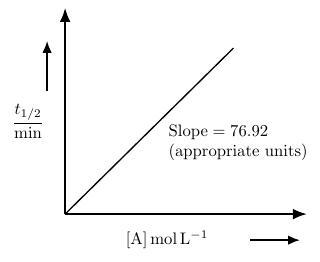
The rate constant (K) can be determined from the slope of a graph of t1/2 vs [A]0:
Slope = 1 / 2K
EXPLANATION:
Given:
Initial concentration [A]0 = 2.5 mol L−1
Slope = 76.92 (from graph)
Since the graph is t1/2 vs [A]0 and it is linear, the reaction is of zero order.
Using the relation:
Slope = 1 / 2K → K = 1 / (2 × 76.92)
K = 1 / 153.84 ≈ 0.0065 min−1
Now apply the zero-order integrated rate law:
[A]t = -Kt + [A]0
[A]10 = - (1 / (2 × 76.92)) × 10 + 2.5
[A]10 ≈ -0.065 + 2.5 = 2.435 mol L−1
Convert to ×10−3 mol L−1:
2.435 mol L−1 = 2435 × 10−3 mol L−1
Therefore, the concentration of A at 10 minutes is 2435 × 10−3 mol L−1.
Physics Section A (20 questions)
Question 51
A light wave is propagating with plane wave fronts of the type x + y + z = constant. The angle made by the direction of wave propagation with the x-axis is :
The direction of propagation of light is perpendicular to the wave front and is symmetric about x, y, and z axis.
Angle made by the light with x, y & z axis is same.
Thus, cosα = cosβ = cosγ (α, β, and γ are the angles made by light with x, y, and z axes respectively)
Also, cos²α + cos²β + cos²γ = 1 [Sum of direction cosines]
⇒ α = cos⁻¹(1/√3)
Question 52
The equation for real gas is given by (P+V2a)(V−b)=RT , where P,V,T and R are the pressure, volume, temperature and gas constant, respectively. The dimension of ab–2 is equivalent to that of :
Therefore, [a] = [P][V²] = M L⁻¹ T⁻² L⁶ = M L⁵ T⁻²
[b] = [V] = L³
[ab⁻²] = M L⁵ T⁻² L⁻⁶ = M L⁻¹ T⁻²
⇒ Dimension of energy density
Question 53
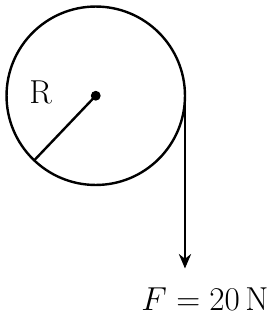
A cord of negligible mass is wound around the rim of a wheel supported by spokes with negligible mass. The mass of wheel is 10 kg and radius is 10 cm and it can freely rotate without any friction. Initially the wheel is at rest. If a steady pull of 20 N is applied on the cord, the angular velocity of the wheel, after the cord is unwound by 1 m, would be :
A slanted object AB is placed on one side of convex lens as shown in the diagram. The image is formed on the opposite side. Angle made by the image with principal axis is :
Since the size of the object is small with respect to the location, hence
dv = m² du ⇒ dv = 4 × 1 = 4 cm
hi = m h0 ⇒ hi(dy) = 2 × 2 = 4 cm
Therefore, Angle made with principle a×is = -45°
Question 55
Consider two infinitely large plane parallel conducting plates as shown below. The plates are uniformly charged with a surface charge density +σ and −2σ.The force experienced by a point charge +q placed at the mid point between two plates will be
Since charge q is at midpoint, the net electric field Enet is vector sum:
⇒ Enet = E1 (rightward) + E2 (rightward, since Plate 2's field points toward it)
⇒ Enet = (σ / 2ε0) + (σ / ε0) = (3σ) / (2ε0)
Force on point charge q:
⇒ F = q × Enet
⇒ F = q × (3σ) / (2ε0)
∴ Force on charge q = (3σ q) / (2ε0)
Question 56
A river is flowing from west to east direction with speed of 9 km h–1. If a boat capable of moving at a maximum speed of 27 km h–1 in still water, crosses the river in half a minute, while moving with maximum speed at an angle of 150° to direction of river flow, then the width of the river is :
Time taken to cross = 30 seconds = 30 / 3600 hr = 1 / 120 hr
Perpendicular velocity, V⊥ = 27 / 2 km/hr
⇒ Width of river = V⊥ × time
⇒ Width = (27 / 2) × (1 / 120) km
⇒ Width = (27 × 1000) / (2 × 120) m
⇒ Width = 112.5 m
∴ Width of the river is 112.5 m
Question 57
A point charge +q is placed at the origin. A second point charge +9q is placed at (d, 0, 0) in Cartesian coordinate system. The point in between them where the electric field vanishes is :
A zener diode with 5V zener voltage is used to regulate an unregulated dc voltage input of 25 V. For a 400 resistor connected in series, the zener current is found to be 4 times load current. The load current (IL) and load resistance (RL) are :
A square Lamina OABC of length 10 cm is pivoted at 'O'. Forces act at Lamina as shown in figure. If Lamina remains stationary, then the magnitude of F is :
For rotational equilibrium, the net torque about the pivot must be zero.
Torque = Force × perpendicular distance from pivot.
Explanation
The square lamina of side 10,cm is pivoted at point O.
Forces of 10,N act at different points producing clockwise and anticlockwise torques about O.
Calculations
Taking moments about point O:
The forces at A and B produce clockwise moments.
The forces at C and the unknown force F produce anticlockwise moments.
Balancing torques for equilibrium:
F×10=10×10
⇒F=10,N
Thus, the magnitude of the force F required for equilibrium is 10,N.
Question 64
Let B1 be the magnitude of magnetic field at center of a circular coil of radius R carrying current I. Let B2 be the magnitude of magnetic field at an axial distance 'x' from the center. For x R=3:4,B1B2 is :
Energy levels in hydrogen-like atoms are proportional to the atomic number divided by the square of the principal quantum number
E = k × Z2 / n2 (where k is a constant)
Excited states correspond to n values greater than 1
Explanation:
From the given data:
⇒ For 1st excited state, n = 2
⇒ For 2nd excited state, n = 3
∴ Only statements A and B are correct.
Question 66
Moment of inertia of a rod of mass 'M' and length 'L' about an axis passing through its center and normal to its length is ′α′.. Now the rod is cut into two equal parts and these parts are joined symmetrically to form a cross shape. Moment of inertia of cross about an axis passing through its center and normal to plane containing cross is :
Moment of inertia for each half, α' (single part) = (M/2) × (ℓ/2)2 / 12
⇒ α' = (M/2) × (ℓ2 / 4) / 12 = (M × ℓ2) / 96
Total moment of inertia, α' = 2 × (M × ℓ2 / 96) = (M × ℓ2) / 48
⇒ α' = α / 4
∴ Correct option is (2).
Question 67
A spherical surface separates two media of refractive indices 1 and 1.5 as shown in figure. Distance of the image of an object 'O', is : (C is the center of curvature of the spherical surface and R is the radius of curvature)
Expressed as force per unit area per velocity gradient.
⇒ Dimensional formula: [M1 L-1 T-1].
Intensity (I):
Power delivered per unit area perpendicular to wave propagation.
SI unit is watt per square meter (W/m2).
⇒ Dimensional formula: [M1 L0 T-3].
Pressure gradient:
Represents the rate of change of pressure with distance.
Its unit is pascal per meter (Pa/m).
⇒ Dimensional formula: [M L-2 T-2].
Compressibility (K):
Defined as the fractional change in volume per unit increase in pressure.
Inverse of bulk modulus (elastic modulus of volume).
⇒ Dimensional formula: [M-1 L1 T2].
Question 69
A small bob of mass 100 mg and charge +10 μC is connected to an insulating string of length 1 m. It is brought near to an infinitely long non conducting sheet of charge density 'σ' as shown in figure. If string subtends an angle of 45° with the sheet at equilibrium the charge density of sheet will be :
(Given, ϵ0 = 8.85 × 10⁻¹²mF and acceleration due to gravity, g = 10 m/s2)
A monochromatic light is incident on a metallic plate having work function ϕ . An electron, emitted normally to the plate from a point A with maximum kinetic energy, enters a constant magnetic field, perpendicular to the initial velocity of electron. The electron passes through a curve and hits back the plate at a point B. The distance between A and B is :
(Given : The magnitude of charge of an electron is e and mass is m, h is Planck's constant and c is velocity of light. Take the magnetic field exists throughout the path of electron)
A vessel with square cross–section and height of 6 m is vertically partitioned. A small window of 100 cm2 with hinged door is fitted at a depth of 3 m in the partition wall. One part of the vessel is filled completely with water and the other side is filled with the liquid having density 1.5 × 10³ kg/m3. What force one needs to apply on the hinged door so that it does not get opened ?
A steel wire of length 2 m and Young's modulus 2.0 × 10¹¹ Nm–2 is stretched by a force. If Poisson ratio and transverse strain for the wire are 0.2 and 10–3 respectively, then the elastic potential energy density of the wire is ____ × 105 (in SI units)
If the measured angular separation between the second minimum to the left of the central maximum and the third minimum to the right of the central maximum is 30° in a single slit diffraction pattern recorded using 628 nm light, then the width of the slit is ____ μm.
Now plug in λ = 628 × 10-9 m and solve numerically to find a.
⇒ a ≈ 6.07 µm
Question 74
γA is the specific heat ratio of monoatomic gas A having 3 translational degrees of freedom. γB is the specific heat ratio of polyatomic gas B having 3 translational, 3 rotational degrees of freedom and 1 vibrational mode. If γBγA=(1+n1) , then the value of n is ______.
A person travelling on a straight line moves with a uniform velocity v1 for a distance x and with a uniform velocity v2 for the next 23x distance. The average velocity in this motion is 750m/s. If v1 is 5 m/s then v2 = _____ m/s.