Official Paper

JEE Main 22 January 2025 Shift 1 (Previous Year Paper)

75 questions · 180 minutes · with answers · free

Mathematics Section A (20 questions)

1

The number of non-empty equivalence relations on the set {1,2,3} is : 

  1. ((a))

    6

  2. ((b))

    7

  3. ((c))

    5

  4. ((d))

    4

Show Answer
Answer: ((c))

5

Concept Used:

The number of equivalence relations on a set is equivalent to the number of ways the set can be partitioned. For a set containing n elements, this number is represented by the Bell number Bn.

Calculation:

⇒ Partitions of A = {1, 2, 3} are:

⇒ 1. {{1}, {2}, {3}}

⇒ 2. {{1, 2}, {3}}

⇒ 3. {{1, 3}, {2}}

⇒ 4. {{2, 3}, {1}}

⇒ 5. {{1, 2, 3}}

⇒ Number of partitions = 5

⇒ Bell number B3 = 5

⇒ Number of equivalence relations = 5

The empty relation is not included

∴ The maximum number of equivalence relations on A = {1, 2, 3} is 5

Hence option 3 is correct

2

Let ƒ : R → R be a twice differentiable function such that ƒ(x + y) = ƒ(x) ƒ(y) for all x, y ∈ R. If ƒ'(0) = 4a and ƒ staisfies ƒ''(x) – 3a ƒ'(x) – ƒ(x) = 0, a > 0, then the area of the region

R = {(x,y) | 0 ≤ y ≤ ƒ(ax), 0 ≤ x ≤ 2} is :

  1. ((a))

    e2 – 1

  2. ((b))

    e4 + 1

  3. ((c))

    e4 – 1

  4. ((d))

    e2 + 1

Show Answer
Answer: ((a))

e2 – 1

Calculation 

f(x + y) = f(x).f(y) 

⇒ f(x) = eλx f′(0) = 4a 

⇒ f′(x) = λeλx ⇒ λ = 4a

So, f(x) = e4ax

f′′(x) – 3af′(x) – f (x) = 0 

⇒ λ2 – 3aλ – 1 = 0 

⇒ 16a2 – 12a2 – 1 = 0 ⇒ 4a2 = 1 ⇒ (\mathrm{a}=\frac{1}{2})

F(x) = e2x

Area = (\int_{0}^{2} \mathrm{e}^{\mathrm{x}} \mathrm{dx}=\mathrm{e}^{2}-1)

Hence option 1 is correct

3

Let the triangle PQR be the image of the triangle with vertices (1,3), (3,1) and (2, 4) in the line x + 2y = 2. If the centroid of ΔPQR is the point (α, β), then 15(α - β) is equal to :

  1. ((a))

    24

  2. ((b))

    19 

  3. ((c))

    21

  4. ((d))

    22

Show Answer
Answer: ((d))

22

Calculation 

Let ‘G’ be the centroid of Δ formed by (1, 3) (3, 1) & (2, 4)

(\mathrm{G} \cong\left(2, \frac{8}{3}\right))

Image of G w.r.t. x + 2y – 2 = 0

(\frac{α-2}{1}=\frac{β-\frac{8}{3}}{2}=-2 \frac{\left(2+\frac{16}{3}-2\right)}{1+4})

= (\frac{-2}{5}\left(\frac{16}{3}\right))

⇒ (α=\frac{-32}{15}+2=\frac{-2}{15}, β=\frac{-32 \times 2}{15}+\frac{8}{3}=\frac{-24}{15})

15(α – β) = – 2 + 24 = 22

Hence option 4 is correct

4

Let z1, z2 and z3 be three complex numbers on the circle |z| = 1 with arg(z1) = (\frac{-\pi}{4}), arg(z2) = 0, arg(z3) = (\frac{\pi}{4}). If (\left|Z_{1} \bar{Z}{2}+Z{2} \bar{Z}{3}+Z{3} \bar{Z}_{1}\right|^{2}) = (α+β \sqrt{2}, α, β \in Z), then the value of α2 + β2 is :

  1. ((a))

    24

  2. ((b))

    41

  3. ((c))

    31

  4. ((d))

    29

Show Answer
Answer: ((d))

29

Calculation

Given:

( Z_{1}=e^{-i\pi/4}, Z_{2}=1, Z_{3}=e^{i\pi/4} )

( |z_{1}\overline{z}{2}+z{2}\overline{z}{3}+z{3}\overline{z}_{1}|^{2} = |e^{-i\frac{\pi}{4}}\times1+1\times e^{-i\frac{\pi}{4}}+e^{i\frac{\pi}{4}}\times e^{i\frac{\pi}{4}}|^{2} )

( = |e^{-i\frac{\pi}{4}}+e^{-i\frac{\pi}{4}}+e^{i\frac{\pi}{4}}|^{2} )

( = |2e^{-i\frac{\pi}{4}}+1|^{2} )

( = |\sqrt{2}-\sqrt{2}i+i|^{2} )

( = (\sqrt{2})^{2}+(1-\sqrt{2})^{2} = 2+1+2-2\sqrt{2} = 5-2\sqrt{2} )

( \alpha=5, \beta=-2 )

( \Rightarrow \alpha^{2}+\beta^{2}=29 )

Hence option (4) 29 is correct

5

Using the principal values of the inverse trigonometric functions the sum of the maximum and the minimum values of 16((sec–1x)2 + (cosec–1x)2) is :

  1. ((a))

    24π2

  2. ((b))

    18π2

  3. ((c))

    31π2

  4. ((d))

    22π2

Show Answer
Answer: ((d))

22π2

Calculation 

16(sec–1 x)2 + (cosec–1 x)2

(\operatorname{Sec}^{-1} \mathrm{x}=\mathrm{a} \in[0, π]-\left{\frac{π}{2}\right})

(\operatorname{cosec}^{-1} \mathrm{x}=\frac{π}{2}-\mathrm{a})

= (16\left[\mathrm{a}^{2}+\left(\frac{π}{2}-\mathrm{a}\right)^{2}\right]=16\left[2 \mathrm{a}^{2}-π \mathrm{a}+\frac{π^{2}}{4}\right])

(\max ]_{a=π}=16\left[2 π^{2}-π^{2}+π \frac{2}{4}\right]=20 π^{2})

(\min ]_{a=\frac{π}{4}}=16\left[\frac{2 \times π^{2}}{16}-\frac{π^{2}}{4}+\frac{π^{2}}{4}\right]=2 π^{2})

Sum = 22π2 

Hence option 4 is correct

6

A coin is tossed three times. Let X denote the number of times a tail follows a head. If μ and σ2 denote the mean and variance of X, then the value of 64(μ + σ2) is :

  1. ((a))

    51 

  2. ((b))

    48 

  3. ((c))

    32

  4. ((d))

    64 

Show Answer
Answer: ((b))

48 

Calculation 

HHH → 0

HHT → 0

HTH → 1

HTT → 0

THH → 1

THT → 1

TTH → 1

TTT → 0

Probability distribution

(\begin{array}{c|c|c} \mathrm{x}{\mathrm{i}} & 0 & 1 \ \hline \mathrm{P}\left(\mathrm{x}{\mathrm{i}}\right) & 1 / 2 & 1 / 2 \end{array})

(\mu=\sum \mathrm{x}{\mathrm{i}} \mathrm{p}{\mathrm{i}}=\frac{1}{2})

(\sigma^{2}=\sum x_{i}^{2} p_{i}-\mu^{2})

= (\frac{1}{2}-\frac{1}{4}=\frac{1}{4})

(64\left(\mu+\sigma^{2}\right)=64\left(\frac{1}{2}+\frac{1}{4}\right)=48)

Hence option 2 is correct

7

Let a1, a2, a3 ..... be a G.P. of increasing positive terms. If a1a5 = 28 and a2 + a4 = 29, the a6 is equal to

  1. ((a))

    628 

  2. ((b))

    526 

  3. ((c))

    784 

  4. ((d))

    812

Show Answer
Answer: ((c))

784 

Calculation

a1 .a5 = 28 ⇒ a.ar4 = 28 ⇒ a2 r4 = 28 …(1)

a2 + a4 = 29 ⇒ ar + ar3 = 29 

⇒ ar(1 + r2) = 29 

a2 r2 (1 + r2)2 = (29)2 …(2) 

By Eq. (1) & (2)

(\frac{\mathrm{r}^{2}}{\left(1+\mathrm{r}^{2}\right)^{2}}=\frac{28}{29 \times 29})

⇒ (\frac{\mathrm{r}}{1+\mathrm{r}^{2}}=\frac{\sqrt{28}}{29} \Rightarrow \mathrm{r}=\sqrt{28})

∵ a2 r4 = 28 ⇒ a2 × (28)2 = 28 

⇒ (a=\frac{1}{\sqrt{28}})

∴ (a_{6}=a r^{5}=\frac{1}{\sqrt{28}} \times(28)^{2} \sqrt{28}=784)

Hence option 3 is correct

8

Let L1 : (\frac{x-1}{2}=\frac{y-2}{3}=\frac{z-3}{4}) and L: (\frac{x-2}{3}=\frac{y-4}{4}=\frac{z-5}{5}) be two lines. Then which of the following points lies on the line of the shortest distance between L1 and L2 ?

  1. ((a))

    (\left(-\frac{5}{3},-7,1\right))

  2. ((b))

    (\left(2,3, \frac{1}{3}\right))

  3. ((c))

    (\left(\frac{8}{3},-1, \frac{1}{3}\right))

  4. ((d))

    (\left(\frac{14}{3},-3, \frac{22}{3}\right))

Show Answer
Answer: ((d))

(\left(\frac{14}{3},-3, \frac{22}{3}\right))

Calculation

P(2λ + 1, 3λ + 2, 4λ + 3) on L1

Q(3µ + 2, 4µ + 4, 5µ + 5) on L2

Dr’s of PQ = 3µ – 2λ + 1, 4µ – 3λ + 2, 5µ – 4λ + 2

PQ ⊥ L

⇒ (3µ – 2λ + 1)2 + (4µ – 3λ + 2)3 + (5µ – 4λ + 2)4 = 0

38µ – 29λ + 16 = 0 …(1)

PQ ⊥ L

⇒ (3µ – 2λ + 1)3 + (4µ – 3λ + 2)4 + (5µ – 4λ + 2)5 = 0

50µ – 38λ + 21 = 0 …(2)

By (1) & (2) 

(λ=\frac{1}{3} ; \mu=\frac{-1}{6})

∴ (\mathrm{P}\left(\frac{5}{3}, 3, \frac{13}{3}\right) & \ \mathrm{Q}\left(\frac{3}{2}, \frac{10}{3}, \frac{25}{6}\right))

Line PQ 

(\begin{array}{ccc} \frac{x-\frac{5}{3}}{\frac{1}{6}} & \frac{y-3}{\frac{-1}{3}} & \frac{z-\frac{13}{3}}{\frac{1}{6}} \end{array})

(\frac{x-\frac{5}{3}}{1}=\frac{y-3}{-2}=\frac{z-\frac{13}{3}}{1})

(\text { Point }\left(\frac{14}{3},-3, \frac{22}{3}\right))

lies on the line PQ 

Hence option 4 is correct

9

The product of all solutions of the equation (\mathrm{e}^{5\left(\log _{\mathrm{e}} \mathrm{x}\right)^{2}+3}=\mathrm{x}^{8}, \mathrm{x}>0), is

  1. ((a))

    e8/5

  2. ((b))

    e6/5 

  3. ((c))

    e

  4. ((d))

    e

Show Answer
Answer: ((a))

e8/5

Calculation

(\rm \mathrm{e}^{5(ℓ n x)^{2}+3}=\mathrm{x}^{8})

⇒ (\ln \mathrm{e}^{5(ℓ \mathrm{n} x)^{2}+3}=\ln \mathrm{x}^{8})

⇒ 5(ℓnx)2 + 3 = 8ℓnx

(ℓnx = t)

⇒ 5t2 – 8t + 3 = 0

(\mathrm{t}{1}+\mathrm{t}{2}=\frac{8}{5})

(\ell \operatorname{nx}{1} x{2}=\frac{8}{5})

x1 x2 = e8/5

Hence option 1 is correct

10

If (\sum_{\mathrm{r}=1}^{\mathrm{n}} \mathrm{~T}{\mathrm{r}}=\frac{(2 \mathrm{n}-1)(2 \mathrm{n}+1)(2 \mathrm{n}+3)(2 \mathrm{n}+5)}{64}), then (\lim {\mathrm{n} \rightarrow \infty} \sum{\mathrm{r}=1}^{\mathrm{n}}\left(\frac{1}{T{\mathrm{r}}}\right)) is equal to :

  1. ((a))

    1

  2. ((b))

    0

  3. ((c))

    (\frac{2}{3})

  4. ((d))

    (\frac{1}{3})

Show Answer
Answer: ((c))

(\frac{2}{3})

Calculation

Tn = Sn – Sn–1

⇒ (\mathrm{T}_{\mathrm{n}}=\frac{1}{8}(2 \mathrm{n}-1)(2 \mathrm{n}+1)(2 \mathrm{n}+3))

⇒ (\frac{1}{T_{n}}=\frac{8}{(2 n-1)(2 n+1)(2 n+3)})

(\lim {n \rightarrow \infty} \sum{r=1}^{n} \frac{1}{T_{r}}=\lim {n \rightarrow \infty} 8 \sum{r=1}^{n} \frac{1}{(2 n-1)(2 n+1)(2 n+3)})

= (\lim _{n \rightarrow \infty} \frac{8}{4} \sum\left(\frac{1}{(2 n-1)(2 n+1)}-\frac{1}{(2 n+1)(2 n+3)}\right))

= (\lim _{\mathrm{n} \rightarrow \infty} 2\left[\left(\frac{1}{1.3}-\frac{1}{3.5}\right)+\left(\frac{1}{3.5}-\frac{1}{5.7}\right)+\ldots\right])

= (\frac{2}{3})

Hence option 3 is correct

11

From all the English alphabets, five letters are chosen and are arranged in alphabetical order. The total number of ways, in which the middle letter is ‘M’, is : 

  1. ((a))

    14950 

  2. ((b))

    6084 

  3. ((c))

    4356 

  4. ((d))

    5148 

Show Answer
Answer: ((d))

5148 

Calculation 

= (\underbrace{12 \mathrm{C}{2}}{\substack{\text { Sclection of two } \ \text { letters before } \mathrm{M}}} \times \underbrace{{ }^{13} \mathrm{C}{2}}{\substack{\text { Selection of two } \ \text { letters after } \mathrm{M}}}=5148)

Hence option 4 is correct

12

Let x = x(y) be the solution of the differential equation y2dx + (\left(x-\frac{1}{y}\right))dy = 0. If x(1) = 1, then x(\left(\frac{1}{2}\right)) is:

  1. ((a))

    (\frac{1}{2}) + e

  2. ((b))

    (\frac{3}{2}) + e

  3. ((c))

    3 - e

  4. ((d))

    3 + e

Show Answer
Answer: ((c))

3 - e

Calculation

(\frac{\mathrm{dx}}{\mathrm{dy}}+\left(\frac{1}{\mathrm{y}^{2}}\right) \mathrm{x}=\frac{1}{\mathrm{y}^{3}})

(\text { I.F. }=\mathrm{e}^{\int \frac{1}{{y}^{2}} \mathrm{dy}}=\mathrm{e}^{-\frac{1}{y}})

⇒ (x \cdot e^{-\frac{1}{y}}=\int\left(e^{-\frac{1}{y}}\right) \cdot \frac{1}{y^{3}} d y)

Put (-\frac{1}{y}=t)

(+\frac{1}{\mathrm{y}^{2}} \mathrm{dy}=\mathrm{dt})

(x \cdot e^{-\frac{1}{y}}=-\int t \cdot e^{t} d t)

(x \cdot e^{-\frac{1}{y}}=-t e^{t}+e^{t}+C)

(x \cdot e^{-\frac{1}{y}}=\frac{+1}{y} e^{-\frac{1}{y}}+e^{-\frac{1}{y}}+C)

x = 1, y = 1 

(\frac{1}{\mathrm{e}}=\frac{1}{\mathrm{e}}+\frac{1}{\mathrm{e}}+\mathrm{C})

⇒ (\mathrm{C}=-\frac{1}{\mathrm{e}})

Put y = (\frac{1}{2})

(\frac{\mathrm{x}}{\mathrm{e}^{2}}=\frac{2}{\mathrm{e}^{2}}+\frac{1}{\mathrm{e}^{2}}-\frac{1}{\mathrm{e}})

x = 3 – e

Hence option 3 is correct
13

Let the parabola y = x2 + px – 3, meet the coordinate axes at the points P, Q and R. If the circle C with centre at (–1, –1) passes through the points P, Q and R, then the area of ΔPQR is :

  1. ((a))

    4

  2. ((b))

    6

  3. ((c))

    7

  4. ((d))

    5

Show Answer
Answer: ((b))

6

Calculation

y = x2 + px – 3

Let P(α, 0), Q(β, 0), R(0, –3)

Circle with centre (–1, –1) is (x + 1)2 + (y + 1)2 = r2

Passes through (0, –3)

12 + (–2)2 = r2]

r2 = 5

(x + 1)2 + (y + 1)2 = 5

Put y = 0

(x + 1)2 = 5 – 1

(x + 1)2 = 4

x + 1 = ±2

x = 1 or x = –3 

P(1, 0) and Q(–3, 0)

Area of ΔPQR = (\frac{1}{2}\left|\begin{array}{ccc} 1 & 0 & 1 \ -3 & 0 & 1 \ 0 & -3 & 1 \end{array}\right|=6)

Hence option 2 is correct

14

A circle C of radius 2 lies in the second quadrant and touches both the coordinate axes. Let r be the radius of a circle that has centre at the point (2, 5) and intersects the circle C at exactly two points. If the set of all possible values of r is the interval (α, β), then 3β – 2α is equal to :

  1. ((a))

    15 

  2. ((b))

    14 

  3. ((c))

    12 

  4. ((d))

    10

Show Answer
Answer: ((a))

15 

Calculation. 

S1 : (x + 2)2 + (y – 2)2 = 22

S2 : (x – 2)2 + (y – 5)2 = r2

Both circle intersect at two points 

∴ |r1 – r2| < c1 c2 < r1 + r2

|r – 2| < 5 < 2 + r 

⇒ 3 < r < 7

r ∈ (3, 7)

α = 3, β = 7

3β – 2α = 15

Hence option 1 is correct

15

Let for ƒ(x) = 7tan8 x + 7tan6 x – 3tan4 x – 3tan2 x, (\mathrm{I}{1}=\int{0}^{\pi / 4} f(\mathrm{x}) \mathrm{dx}) and (\mathrm{I}{2}=\int{0}^{\pi / 4} \mathrm{x} f(\mathrm{x}) \mathrm{d} \mathrm{x}). Then 7I1 + 12I2 is equal to :

  1. ((a))

  2. ((b))

    π

  3. ((c))

    1

  4. ((d))

    2

Show Answer
Answer: ((c))

1

Calculation 

f(x) = (7tan6 x – 3tan2 x)(sec2 x)

(I_{1}=\int_{0}^{\pi / 4}\left(7 \tan ^{6} x-3 \tan ^{2} x\right)\left(\sec ^{2} x\right) d x)

Put tanx = t

(I_{1}=\int_{0}^{1}\left(7 t^{6}-3 t^{2}\right) d t=\left[t^{7}-t^{3}\right]_{0}^{1}=0)

(I_{2}=\int_{0}^{\pi / 4} x \underbrace{\left(7 \tan ^{6} x-3 \tan ^{2} x\right)\left(\sec ^{2} x\right)}_{\mathrm{II}} d x)

= (\left[x\left(\tan ^{7} x-\tan ^{3} x\right)\right]{0}^{\pi / 4}-\int{0}^{\pi / 4}\left(\tan ^{7} x-\tan ^{3} x\right) d x)

= (0-\int_{0}^{\pi / 4} \tan ^{3} x\left(\tan ^{2} x-1\right)\left(1+\tan ^{2} x\right) d x)

Put tanx = t

= (-\int_{0}^{1}\left(t^{5}-t^{3}\right) d t=-\left[\frac{t^{6}}{6}-\frac{t^{4}}{4}\right]=\frac{1}{12})

7I1 + 12I2 = 1 

Hence option 3 is correct

16

Let f(x) be a real differentiable function such that f(0) = 1 and f(x + y) = f(x)f'(y) + f'(x) f(y) for all x, y ∈ R. Then (\sum_{n=1}^{100}) loge f(n) is equal to :

  1. ((a))

    2384 

  2. ((b))

    2525

  3. ((c))

    5220 

  4. ((d))

    2406

Show Answer
Answer: ((b))

2525

Calculation 

f(x + y) = f(x) f′(y) + f′(x) f(x)

Put = x = y = 0

f(0) = f(0)f′(0) + f′(0)f(0) 

f′(0) = (\frac{1}{2})

Put y = 0

f(x) = f(x) f′(0) + f′(x)f(0)

(f(x)=\frac{1}{2} f(x)+f^{\prime}(x))

(\mathrm{f}^{\prime}(\mathrm{x})=\frac{\mathrm{f}(\mathrm{x})}{2})

(\frac{d y}{d x}=\frac{y}{2} \Rightarrow \int \frac{d y}{y}=\int \frac{d x}{2})

⇒ (\ell n y=\frac{x}{2}+c)

∵ f (0) = 1 ⇒ C = 0 

(\ell \mathrm{ny}=\frac{\pi}{2} \Rightarrow \mathrm{f}(\mathrm{x})=\mathrm{e}^{\mathrm{x} / 2})

(\ell n \ \mathrm{f}(\mathrm{n})=\frac{\mathrm{n}}{2})

(\sum_{\mathrm{n}=1}^{100} \ell \mathrm{f}(\mathrm{n})=\frac{1}{2} \sum_{\mathrm{n}=1}^{100} \mathrm{n}=\frac{5050}{2})

= 2525

Hence option 2 is correct

17

Let A = {1, 2, 3,.......,10} and

(\mathrm{B}=\left{\frac{\mathrm{m}}{\mathrm{n}}: \mathrm{m}, \mathrm{n} \in \mathrm{~A}, \mathrm{~m}<\mathrm{n} \text { and } \operatorname{gcd}(\mathrm{m}, \mathrm{n})=1\right}).

Then n(B) is equal to :

  1. ((a))

    31 

  2. ((b))

    36 

  3. ((c))

    37 

  4. ((d))

    29

Show Answer
Answer: ((a))

31 

Concept:

Counting reduced proper fractions:

  • Set A: A = {1, 2, 3, …, 10}.
  • Set B: B = {m/n : m,n ∈ A, m < n, gcd(m,n)=1}.
  • Key idea: For a fixed denominator n, the number of integers
  • 1 ≤ m < n with gcd(m,n)=1 equals φ(n).
  • Important terms: Euler's totient function φ(n),
  • reduced fraction, distinct fractions.
  • Therefore: n(B) = Σn=210 φ(n).


Calculation:

A = {1, 2, ….10}

(\mathrm{B}\left{\frac{\mathrm{~m}}{\mathrm{n}}=\mathrm{m}, \mathrm{n} \in \mathrm{~A}, \mathrm{~m}<\mathrm{n}, \operatorname{gcd}(\mathrm{~m}, \mathrm{n})=1\right})

n(B)

(\mathrm{n}=2 \quad\left{\frac{1}{2}\right})

⇒ φ(2) = 1

(\mathrm{n}=3 \quad\left{\frac{1}{3}, \frac{2}{3}\right})

⇒ φ(3) = 2

(\mathrm{n}=4 \quad\left{\frac{1}{4}, \frac{3}{4}\right})

⇒ φ(4) = 2

(\mathrm{n}=5 \quad\left{\frac{1}{5}, \frac{2}{5}, \frac{3}{5}, \frac{4}{5}\right})

⇒ φ(5) = 4

(\mathrm{n}=6 \quad\left{\frac{1}{6}, \frac{5}{6}\right})

⇒ φ(6) = 2

(\mathrm{n}=7 \quad\left{\frac{1}{7}, \frac{2}{7}, \frac{3}{7}, \frac{4}{7}, \frac{5}{7}, \frac{6}{7}\right})

⇒ φ(7) = 6

(\mathrm{n}=8 \quad\left{\frac{1}{8}, \frac{3}{8}, \frac{5}{8}, \frac{7}{8}\right})

⇒ φ(8) = 4

(\mathrm{n}=9 \quad\left{\frac{1}{9}, \frac{2}{9}, \frac{4}{9}, \frac{5}{9}, \frac{7}{9}, \frac{8}{9}\right})  

⇒ φ(9) = 6 

(\mathrm{n}=10 \quad\left{\frac{1}{10}, \frac{3}{10}, \frac{7}{10}, \frac{9}{10}\right})

⇒ φ(10) = 4

Hence n(B) = 31

∴ n(B) = 31.

18

The area of the region, inside the circle ((x-2 \sqrt{3})^{2}+y^{2}) = 12 and outside the parabola (y^{2}=2 \sqrt{3} x) is

  1. ((a))

    6π – 8

  2. ((b))

    3π – 8

  3. ((c))

    6π – 16

  4. ((d))

    3π + 8

Show Answer
Answer: ((c))

6π – 16

Calculation

(y^{2}=2 \sqrt{3} x)

((x-2 \sqrt{3})^{2}+y^{2}=(2 \sqrt{3})^{2})

(A=\frac{π r^{2}}{2}-2 \int_{0}^{2 \sqrt{3}} \sqrt{2 \sqrt{3} x} d x)

(\frac{π(12)}{2}-2 \sqrt{2 \sqrt{3}} \frac{\left(\mathrm{x}^{3 / 2}\right)_{0}^{2 / 3}}{3 / 2})

= 6π – 16

Hence option 3 is correct

19

Two balls are selected at random one by one without replacement from a bag containing 4 white and 6 black balls. If the probability that the first selected ball is black, given that the second selected ball is also black, is (\rm \frac{m}{n}), where gcd(m, n) = 1, then m + n is equal to :

  1. ((a))

    14 

  2. ((b))

    4

  3. ((c))

    11

  4. ((d))

    13

Show Answer
Answer: ((a))

14 

Calculation

(P=\frac{\frac{6}{10} \times \frac{5}{9}}{\frac{4}{10} \times \frac{6}{9}+\frac{6}{10} \times \frac{5}{9}}=\frac{5}{9})

m = 5, n = 9

m + n = 14

20

Let the foci of a hyperbola be (1, 14) and (1, –12). If it passes through the point (1, 6), then the length of its latus-rectum is :

  1. ((a))

    (\frac{25}{6})

  2. ((b))

    (\frac{24}{5})

  3. ((c))

    (\frac{288}{5})

  4. ((d))

    (\frac{144}{5})

Show Answer
Answer: ((c))

(\frac{288}{5})

Calculation


be = 13, b = 5

a2 = b2 (e2 – 1)

= b2 e2 – b2

= 169 – 25 = 144

(\ell(\mathrm{LR})=\frac{2 \mathrm{a}^{2}}{\mathrm{~b}}=\frac{2 \times 144}{5}=\frac{288}{5})

Hence option 3 is correct
Mathematics Section B (5 questions)

21

Let the function, 

(f(x)=\left{\begin{array}{ll} -3 a x^{2}-2, & x<1 \ a^{2}+b x, & x \geq 1 \end{array}\right.)

Be differentiable for all x ∈ R, where a > 1, b ∈ R. If the area of the region enclosed by y = f(x) and the line y = – 20 is α + β√3 , α, β, ∈ Z, then the value of α + β is ________.

22

If (\sum_{r=0}^{5} \frac{{ }^{11} C_{2 r+1}}{2 r+2}=\frac{m}{n}), ​gcd(m, n) = 1, then m – n is equal to ________.

23

Let A be a square matrix of order 3 such that det(A) = –2 and det (3adj(–6adj(3A))) = 2m+n. 3mn, m > n. Then 4m + 2n is equal to _____.

24

Let L1 : (\frac{x-1}{3}=\frac{y-1}{-1}=\frac{z+1}{0}) and L2 (\frac{x-2}{2}=\frac{y}{0}=\frac{z+4}{α}), α ∈ R, be two lines, which intersect at the point B. If P is the foot of perpendicular from the point A(1, 1, –1) on L2 , then the value of 26 α(PB)2 is ________.

25

Let (\overrightarrow{\mathrm{c}}) be the projection vector of (\overrightarrow{\mathrm{b}}=\lambda \hat{\mathrm{i}}+4 \hat{\mathrm{k}}, \lambda>0), on the vector (\vec{a}=\hat{i}+2 \hat{j}+2 \hat{k} . \text { If }|\vec{a}+\vec{c}|=7), then the area of the parallelogram formed by the vectors (\overrightarrow{\mathrm{b}}) and (\overrightarrow{\mathrm{c}}) ________.

Chemistry Section A (20 questions)

26

A solution of aluminium chloride is electrolysed for 30 minutes using a current of 2A. The amount of the aluminium deposited at the cathode is ___ .

[Given : molar mass of aluminium and chlorine are 27 g mol–1 and 35.5 g mol–1 respectively, Faraday constant = 96500 C mol–1].

  1. ((a))

    1.660 g

  2. ((b))

    1.007 g

  3. ((c))

    0.336 g 

  4. ((d))

    0.441 g

Show Answer
Answer: ((c))

0.336 g 

CONCEPT:

Faraday's Laws of Electrolysis

  • Faraday's first law of electrolysis states that the amount of substance deposited at an electrode is directly proportional to the quantity of electricity passed through the electrolyte.
  • The relationship can be expressed as:

m = (ItM)/(nF)

where m is the mass of the substance deposited, I is the current, t is the time, M is the molar mass of the substance, n is the number of electrons transferred per ion, and F is the Faraday constant.

EXPLANATION:

  • For the electrolysis of aluminium chloride (AlCl3), the reaction at the cathode is:

Al3+ + 3e- → Al

  • Given data:
  • Current (I) = 2A
  • Time (t) = 30 minutes = 30 × 60 = 1800 seconds
  • Molar mass of Aluminium (M) = 27 g mol-1
  • Faraday constant (F) = 96500 C mol-1
  • In the reaction, the number of electrons (n) transferred per ion is 3.
  • Using the formula:

m = (ItM)/(nF)

m = (2 × 1800 × 27)/(3 × 96500)

m = (97200)/(289500)

m = 0.336 g

Therefore, the amount of aluminium deposited at the cathode is 0.336 g.

27

Which of the following statement is not true for radioactive decay ? 

  1. ((a))

    Amount of radioactive substance remained after three half lives is (\frac{1}{8})th of original amount.

  2. ((b))

    Decay constant does not depend upon temperature.

  3. ((c))

    Decay constant increases with increase in temperature. 

  4. ((d))

    Half life is ln 2 times of (\frac{1}{\text { rate constant }})

Show Answer
Answer: ((c))

Decay constant increases with increase in temperature. 

CONCEPT:

Radioactive Decay

  • Radioactive decay is a process by which the nucleus of an unstable atom loses energy by emitting radiation. The decay constant (λ) is a probability rate constant that quantifies the likelihood of decay of an atom per unit time.
  • Key characteristics of radioactive decay:
  • The decay constant (λ) is independent of temperature.
  • The half-life (t1/2) of a radioactive substance is the time required for half of the radioactive atoms to decay. The relationship between half-life and decay constant is given by:

t1/2 = ln(2) / λ

EXPLANATION:

  • Statement 1: Amount of radioactive substance remained after three half-lives is 1/8 of the original amount.
  • This is true. After one half-life, half of the original amount remains. After three half-lives, (1/2)3 = 1/8 of the original amount remains.
  • Statement 2: Decay constant does not depend upon temperature.
  • This is true. The decay constant is a fundamental property of the radioactive substance and is not affected by temperature.
  • Statement 3: Decay constant increases with increase in temperature.
  • This is not true. The decay constant is independent of temperature.
  • Statement 4: Half life is ln(2) times of 1/rate constant.
  • This is true. The half-life (t1/2) is given by t1/2 = ln(2) / λ, where λ is the decay constant.

Therefore, the statement that is not true for radioactive decay is: Decay constant increases with increase in temperature.

28

How many different stereoisomers are possible for the given molecule ? 

  1. ((a))

    3

  2. ((b))

    1

  3. ((c))

    2

  4. ((d))

    4

Show Answer
Answer: ((d))

4

CONCEPT:

Stereoisomers and Geometrical Isomerism

  • Stereoisomers are compounds that have the same molecular formula and connectivity of atoms but differ in the spatial arrangement of atoms.
  • Geometrical isomerism occurs in compounds with restricted rotation around a double bond or ring, resulting in cis-trans isomers.
  • Each chiral center or double bond contributes to possible isomerism.

EXPLANATION:

It has 4 stereoisomers (\left[\begin{array}{ll} \mathrm{R} \text { cis } & \mathrm{R} \text { trans } \ \mathrm{Scis} & \mathrm{Strans} \end{array}\right])

  • Two factors contribute to stereoisomerism here:
  • The double bond between the third and fourth carbon introduces cis and trans isomers.
  • The chiral carbon (second carbon with -CH3, -CH=CH-CH3, -OH, and -H as substituents) introduces R and S configurations.
  • Combining these, the molecule can exhibit the following configurations:
  • Cis with R configuration
  • Cis with S configuration
  • Trans with R configuration
  • Trans with S configuration
  • Hence, the molecule has 4 possible stereoisomers.

Therefore, the total number of stereoisomers for the given molecule is 4.

29

Which of the following electronegativity order is incorrect?

  1. ((a))

    Al < Mg < B < N 

  2. ((b))

    Al < Si < C < N

  3. ((c))

    Mg < Be < B < N

  4. ((d))

    S < Cl < O < F

Show Answer
Answer: ((a))

Al < Mg < B < N 

EXPLANATION:​.

Electronegativity

  • Electronegativity is a measure of the tendency of an atom to attract a bonding pair of electrons. The Pauling scale is the most commonly used scale for electronegativity.
  • The electronegativity values (on the Pauling scale) for some elements are as follows:
  • | | Li | Be | B | C | N | O | F | | --- | --- | --- | --- | --- | --- | --- | --- | | (E.N.) = On pauling scale | 1 | 1.5 | 2 | 2.5 | 3 | 3.5 | 4.0 |

For elements in the second period and third period:

  • | | Na | Mg | Al | Si | P | S | Cl | | --- | --- | --- | --- | --- | --- | --- | --- | | (E.N.) = | 0.9 | 1.2 | 1.5 | 1.8 | 2.1 | 2.5 | 3.0
    |


Therefore, the electronegativity order that is incorrect is: Al < Mg < B < N

30

Lanthanoid ions with 4f7 configuration are :

(A) Eu2+

(B) Gd3+

(C) Eu3+

(D) Tb3+

(E) Sm2+

Choose the correct answer from the options given below :

  1. ((a))

    (A) and (B) only

  2. ((b))

    (A) and (D) only

  3. ((c))

    (B) and (E) only

  4. ((d))

    (B) and (C) only 

Show Answer
Answer: ((a))

(A) and (B) only

CONCEPT:

Electronic Configuration of Lanthanoids

  • Lanthanoids are a series of 15 elements from lanthanum (La) to lutetium (Lu) in the periodic table, characterized by the filling of the 4f orbitals.
  • The general electron configuration of lanthanoids is [Xe] 4fn 5dx 6s2.
  • The common oxidation states of lanthanoids include +2, +3, and sometimes +4.
  • Key electron configurations:
  • Europium (Eu): [Xe] 4f7 6s2
  • Gadolinium (Gd): [Xe] 4f7 5d1 6s2
  • Terbium (Tb): [Xe] 4f9 6s2
  • Samarium (Sm): [Xe] 4f6 6s2

EXPLANATION:

  • To determine which ions have a 4f7 configuration, we must consider the electron loss when forming the given ions:
  • Europium (Eu):
  • Eu2+: [Xe] 4f7 (Loses 2 electrons from 6s2)
  • Eu3+: [Xe] 4f6 (Loses 2 electrons from 6s2 and 1 electron from 4f7)
  • Gadolinium (Gd):
  • Gd3+: [Xe] 4f7 (Loses 2 electrons from 6s2 and 1 electron from 5d1)
  • Terbium (Tb):
  • Tb3+: [Xe] 4f8 (Loses 2 electrons from 6s2 and 1 electron from 4f9)
  • Samarium (Sm):
  • Sm2+: [Xe] 4f6 (Loses 2 electrons from 6s2)

Therefore, the lanthanoid ions with a 4f7 configuration are Eu2+ and Gd3+.

31

Match List-I with List-II 

List-IList-II
(A)Al3+ < Mg2+ < Na+ < F(I)Ionisation Enthalpy
(B)B < C < O < N(II)Metallic character
(C)B < Al < Mg < K(III)Electronegativity
(D)Si < P < S < Cl(IV)Ionic radii
  1. ((a))

    A-IV, B-I, C-III, D-II 

  2. ((b))

    A-II, B-III, C-IV, D-I

  3. ((c))

    A-IV, B-I, C-II, D-III

  4. ((d))

    A-III, B-IV, C-II, D-I

Show Answer
Answer: ((c))

A-IV, B-I, C-II, D-III

EXPLANATION:

Trends in the Periodic Table

  • Ionic Radii: The size of the ionic radii decreases as the positive charge of the ion increases.
  • Order: Al3+ < Mg2+ < Na+ < F-
  • Ionisation Enthalpy: The energy required to remove an electron from an atom in its gaseous state. It generally increases across a period from left to right.
  • Order: B < C < O < N
  • Metallic Character: The degree to which an element exhibits metallic properties, which decreases across a period and increases down a group.
  • Order: B < Al < Mg < K
  • Electronegativity: The tendency of an atom to attract electrons in a chemical bond. It generally increases across a period from left to right.
  • Order: Si < P < S < Cl
List-IList-II
(A) Al3+ < Mg2+ < Na+ < F-(IV) Ionic Radii
(B) B < C < O < N(I) Ionisation Enthalpy
(C) B < Al < Mg < K(II) Metallic Character
(D) Si < P < S < Cl(III) Electronegativity

The correct matching is  A-IV, B-I, C-II, D-III

32

Which of the following acids is a vitamin ? 

  1. ((a))

    Adipic acid

  2. ((b))

    Aspartic acid

  3. ((c))

    Ascorbic acid

  4. ((d))

    Saccharic acid

Show Answer
Answer: ((c))

Ascorbic acid

CONCEPT:

Vitamins and their Chemical Names

  • Vitamins are essential nutrients required by the body to function properly. Each vitamin has a specific chemical name.
  • Ascorbic acid is the chemical name for Vitamin C.

EXPLANATION:

  • Adipic acid: This is not a vitamin, but a dicarboxylic acid commonly used in the production of nylon.
  • Aspartic acid: This is not a vitamin, but an amino acid involved in the synthesis of proteins.
  • Ascorbic acid: This is Vitamin C, an essential nutrient for the repair of tissues and the enzymatic production of certain neurotransmitters.
  • Saccharic acid: This is not a vitamin, but an oxidized derivative of glucose.

Therefore, the acid that is a vitamin is ascorbic acid (Vitamin C).

The correct answer is: (3) Ascorbic acid

33

A liquid when kept inside a thermally insulated closed vessel at 25°C was mechanically stirred from outside. What will be the correct option for the following thermodynamic parameters ? 

  1. ((a))

    ΔU > 0, q = 0, w > 0

  2. ((b))

    ΔU = 0, q = 0, w = 0

  3. ((c))

    ΔU < 0, q = 0, w > 0

  4. ((d))

    ΔU = 0, q < 0, w > 0

Show Answer
Answer: ((a))

ΔU > 0, q = 0, w > 0

CONCEPT:

First Law of Thermodynamics

  • The first law of thermodynamics states that the change in internal energy (ΔU) of a system is equal to the heat added to the system (q) plus the work done on the system (w):
  • ΔU = q + w
  • In a thermally insulated (adiabatic) system, there is no heat exchange with the surroundings, so:
  • q = 0
  • When work is done on the system (for example, by mechanically stirring the liquid), the work done (w) is positive, which increases the internal energy (ΔU) of the system.

EXPLANATION:

  • Since the vessel is thermally insulated, there is no heat exchange with the surroundings:
  • q = 0
  • The work is done on the liquid by mechanically stirring it, so:
  • w > 0
  • According to the first law of thermodynamics:
  • ΔU = q + w
  • Since q = 0, we have ΔU = w
  • When w > 0, ΔU > 0

Therefore, the correct option for the thermodynamic parameters is  ΔU > 0, q = 0, w > 0​

34

Radius of the first excited state of Helium ion is given as :

a0 → radius of first stationary state of hydrogen atom.

  1. ((a))

    (r=\frac{a_{0}}{2})

  2. ((b))

    (r=\frac{a_{0}}{4})

  3. ((c))

    r = 4a0

  4. ((d))

    r = 2a0

Show Answer
Answer: ((d))

r = 2a0

CONCEPT:

Bohr's Model of the Atom

  • In Bohr's model, the radius of the ( n )th orbit of an atom is given by:
  • (r_n = \frac{n^2 a_0}{Z})
  • where:
  • ( rn ) = radius of the ( n )th orbit
  • ( a0 ) = Bohr radius (radius of the first stationary state of the hydrogen atom)
  • ( n ) = principal quantum number
  • ( Z ) = atomic number of the element
  • For the first excited state, ( n = 2 ).

APPLICATION TO HELIUM ION (He+):

  • For the Helium ion (He+), the atomic number ( Z ) is 2.
  • For the first excited state, ( n = 2 ).
  • Substituting these values into the formula for the radius:
  • (r = \frac{n^2 a_0}{Z} \ = \frac{(2)^2 a_0}{2} \ = \frac{4 a_0}{2} \ = 2 a_0)

Therefore, the radius of the first excited state of the Helium ion is r = 2a0

35

Given below are two statements :

Statement I : CH3 – O – CH2 – Cl will undergo SN1 reaction though it is a primary halide. 

Statement II : 

 will not undergo SN2 reaction very easily though it is a primary halide.

In the light of the above statements, choose the most appropriate answer from the options given below :

  1. ((a))

    Statement I is incorrect but Statement II is correct. 

  2. ((b))

    Both Statement I and Statement II are incorrect

  3. ((c))

    Statement I is correct but Statement II is incorrect

  4. ((d))

    Both Statement I and Statement II are correct. 

Show Answer
Answer: ((d))

Both Statement I and Statement II are correct. 

CONCEPT:

SN1 and SN2 Reactions

  • SN1 Mechanism: This is a two-step mechanism where the rate-determining step involves the formation of a carbocation intermediate. It is favored by:
  • Stable carbocations (tertiary > secondary > primary).
  • Polar protic solvents.
  • SN2 Mechanism: This is a single-step mechanism involving a backside attack by the nucleophile. It is favored by:
  • Less steric hindrance (methyl > primary > secondary; tertiary is unfavorable).
  • Polar aprotic solvents.

EXPLANATION:

CH3 – O – CH2 – Cl will undergo SN1 mechanism because (\mathrm{CH}{3}-\mathrm{O}-\stackrel{+}{\mathrm{C}} \mathrm{H}{2})  is highly stable. 

  • Statement I: CH3–O–CH2–Cl undergoes the SN1 mechanism even though it is a primary halide because the intermediate carbocation (CH3–O–CH2+) formed is stabilized by resonance with the oxygen atom.
  • Statement II: CH3–C(CH3)2–CH2–Cl (neopentyl chloride) does not undergo the SN2 mechanism easily due to significant steric hindrance around the reactive center, which obstructs the nucleophilic backside attack.
  • Both statements are correct based on the mechanisms and the structural properties of the molecules.

Therefore, both Statement I and Statement II are correct.

36

Given below are two statements :

Statement I : One mole of propyne reacts with excess of sodium to liberate half a mole of H2 gas.

Statement II : Four g of propyne reacts with NaNH2 to liberate NH3 gas which occupies 224 mL at STP.

In the light of the above statements, choose the most appropriate answer from the options given below:

  1. ((a))

    Statement I is correct but Statement II is incorrect.

  2. ((b))

    Both Statement I and Statement II are incorrect

  3. ((c))

    Statement I is incorrect but Statement II is correct

  4. ((d))

    Both Statement I and Statement II are correct.

Show Answer
Answer: ((a))

Statement I is correct but Statement II is incorrect.

CONCEPT:

Reactions of Propyne with Sodium and Sodium Amide

  • When alkynes react with metallic sodium in the presence of liquid ammonia, they release hydrogen gas. The number of moles of H2 gas liberated depends on the available acidic hydrogen atoms in the molecule.
  • Reaction with sodium amide (NaNH2) leads to the formation of a sodium salt of the alkyne and releases ammonia (NH3) gas. This reaction is used to identify terminal alkynes.

EXPLANATION:

  • Statement I: One mole of propyne (CH3–C≡CH) reacts with an excess of sodium (Na) to liberate 0.5 moles of hydrogen gas (H2), as each terminal hydrogen in the alkyne contributes to the reaction. This statement is correct.
  • Statement II: Four grams of propyne contain 0.1 moles of propyne (molecular weight = 40 g/mol). When reacted with NaNH2, this amount of propyne will release 0.1 moles of NH3 gas, which occupies 2240 mL at STP (not 224 mL as stated). Hence, this statement is incorrect.
  • (\frac{4}{40}=0.1 \text { mole } \quad \frac{0.1 \mathrm{~mole}}{2240 \mathrm{~mole}})
  • Statement I is correct but Statement II is incorrect

Therefore, Statement I is correct, but Statement II is incorrect.

37

A vessel at 1000 K contains CO2 with a pressure of 0.5 atm. Some of CO2 is converted into CO on addition of graphite. If total pressure at equilibrium is 0.8 atm, then KP is :

  1. ((a))

    0.18 atm

  2. ((b))

    1.8 atm

  3. ((c))

    0.3 atm

  4. ((d))

    3 atm

Show Answer
Answer: ((b))

1.8 atm

CONCEPT:

Equilibrium Constant (KP) for Gas Reactions

  • The equilibrium constant, KP, is calculated using the partial pressures of the gases involved in the reaction at equilibrium.
  • For a reaction:

aA(g) + bB(g) ⇌ cC(g) + dD(g)

KP = (PC)c (PD)d / (PA)a (PB)b

where P represents the partial pressure of the gases at equilibrium.

  • Pure solids and liquids do not appear in the expression for KP.

EXPLANATION:

  • The given reaction is:

CO2(g) + C(s) ⇌ 2CO(g)

  • CO2 is the reactant gas.
  • Graphite (C) is a solid and does not appear in KP expression.
  • CO is the product gas.
  • Initial pressure of CO2 is 0.5 atm.
  • Let 'x' be the pressure change due to the conversion of CO2 to CO at equilibrium:
  • Pressure of CO2 at equilibrium: (0.5 - x) atm
  • Pressure of CO at equilibrium: 2x atm
  • (\begin{array}{lc} \mathrm{CO}_{2}(\mathrm{~g})+\mathrm{C}(\mathrm{~s}) & \rightleftharpoons 2 \mathrm{CO}(\mathrm{~g}) \ 0.5 & - \ 0.5-\mathrm{x} & 2 \mathrm{x} \end{array})
  • Given: Total pressure at equilibrium is 0.8 atm:
  • (0.5 - x) + 2x = 0.8
  • Solving for x: 0.5 + x = 0.8
  • x = 0.3
  • Equilibrium pressures:
  • PCO2 = 0.5 - 0.3 = 0.2 atm
  • PCO = 2(0.3) = 0.6 atm
  • Plugging these values into the KP expression:
  • KP = (PCO)2 / (PCO2)
  • KP = (0.6)]2 / 0.2
  • KP = 0.36 / 0.2
  • KP = 1.8 atm

Therefore, the correct answer is 1.8 atm

38

The IUPAC name of the following compound is :​

  1. ((a))

    2-Carboxy-5-methoxycarbonylhexane.

  2. ((b))

    Methyl-6-carboxy-2,5-dimethylhexanoate.

  3. ((c))

    Methyl-5-carboxy-2-methylhexanoate.

  4. ((d))

    6-Methoxycarbonyl-2,5-dimethylhexanoic acid.

Show Answer
Answer: ((d))

6-Methoxycarbonyl-2,5-dimethylhexanoic acid.

CONCEPT:

IUPAC Nomenclature of Organic Compounds

  • The IUPAC name of a compound is determined based on the longest carbon chain containing the principal functional group.
  • Priority is given to functional groups in the following order: carboxylic acid (-COOH) > ester (-COOR) > ketone (-C=O) > alcohol (-OH) > amine (-NH2) > alkene > alkyne > alkane.
  • Substituents are named and numbered to give the lowest possible position numbers to the functional groups and substituents.

EXPLANATION:

  • The given compound contains two functional groups:
  • A carboxylic acid (-COOH) group, which has the highest priority.
  • An ester group (-COOCH3) as a substituent.
  • The longest carbon chain containing the carboxylic acid group has six carbons (hexane). The main chain is numbered from the carboxylic acid carbon to give substituents the lowest possible numbers.
  • The substituents on the chain are:
  • A methoxycarbonyl (-COOCH3) group at position 6.
  • Methyl groups at positions 2 and 5.
  • The compound's name is written as: 6-Methoxycarbonyl-2,5-dimethylhexanoic acid.

Therefore, the IUPAC name of the compound is: 6-Methoxycarbonyl-2,5-dimethylhexanoic acid.

39

Which of the following electrolyte can be sued to obtain H2S2O8 by the process of electrolysis?

  1. ((a))

    Dilute solution of sodium sulphate

  2. ((b))

    Dilute solution of sulphuric acid

  3. ((c))

    Concentrated solution of sulphuric acid 

  4. ((d))

    Acidified dilute solution of sodium sulphate.

Show Answer
Answer: ((c))

Concentrated solution of sulphuric acid 

CONCEPT:

Electrolysis of Sulfuric Acid

  • During electrolysis, an electrolyte is decomposed into its constituent ions through the application of an electrical current.
  • H2S2O8 (peroxodisulfuric acid) can be produced by the electrolysis of concentrated sulfuric acid solutions.
  • At the anode, the half-reaction is:

2 HSO4- → H2S2O8 + 2e-

EXPLANATION:

  • To efficiently produce H2S2O8, a concentrated solution of sulfuric acid is required because:
  • In a concentrated solution, the concentration of HSO4- ions is high enough to facilitate the formation of peroxodisulfuric acid at the anode.
  • Dilute solutions of sulfuric acid or sodium sulfate do not provide the necessary ion concentrations for this reaction.

Therefore, the correct answer is: (3) Concentrated solution of sulfuric acid.

40

The compounds which give positive Fehling’s test are : 

(A) 

(B) 

(C) HOCH2–CO–(CHOH)3–CH2–OH

(D) 

(E) 

Choose the CORRECT answer from the options given below :

  1. ((a))

    (A), (C) and (D) Only

  2. ((b))

    (A), (D) and (E) Only

  3. ((c))

    (C), (D) and (E) Only

  4. ((d))

    (A), (B) and (C) Only

Show Answer
Answer: ((c))

(C), (D) and (E) Only

CONCEPT:

Fehling's Test

  • Fehling's test is used to detect the presence of reducing sugars and aldehydes.
  • Compounds with an aldehyde group (-CHO) or α-hydroxy ketones give a positive Fehling's test, resulting in the formation of a red precipitate of cuprous oxide (Cu2O).
  • Ketones and aromatic aldehydes (like benzaldehyde) generally do not give a positive Fehling's test.

EXPLANATION:

  • Compound (A): Benzaldehyde (C6H5CHO) is an aromatic aldehyde and does not give a positive Fehling's test.
  • Compound (B): Acetophenone (C6H5COCH3) is a ketone and does not give a positive Fehling's test.
  • Compound (C): Glucose derivative (HOCH2–CO–(CHOH)3–CH2OH) contains an α-hydroxy aldehyde functional group and gives a positive Fehling's test.
  • Compound (D): Propionaldehyde (CH3CH2CHO) is an aliphatic aldehyde and gives a positive Fehling's test.
  • Compound (E): Phenylacetaldehyde (C6H5CH2CHO) is an aliphatic aldehyde and gives a positive Fehling's test.

Therefore, the compounds (C), (D), and (E) give a positive Fehling's test.

41

In which of the following complexes the CFSE, Δ0 will be equal to zero?

  1. ((a))

    [Fe(NH3)6]Br2

  2. ((b))

    [Fe(en)3]Cl3

  3. ((c))

    K4[Fe(CN)6]

  4. ((d))

    K3[Fe(SCN)6]

Show Answer
Answer: ((d))

K3[Fe(SCN)6]

CONCEPT:

Crystal Field Stabilization Energy (CFSE)

  • CFSE is the energy difference between the energy of an electron configuration in the ligand field and in an isotropic field.
  • It depends on:
  • The splitting of d-orbitals (t2g and eg) in the crystal field.
  • The number of electrons in these orbitals.
  • CFSE is calculated as:

CFSE = [(number of electrons in t2g) × (-0.4Δ0)] + [(number of electrons in eg) × (+0.6Δ0)]

EXPLANATION:

For complex K3 [Fe(SCN)6] 

Calculation of CFSE

= (–0.4 × 3 + 0.6 × 2) Δ0

= 0 Δ0

  • [Fe(NH3)6]Br2:
  • Fe2+ (d6) forms a high-spin complex due to NH3 being a weak field ligand. This results in CFSE ≠ 0.
  • [Fe(en)3]Cl3:
  • Fe3+ (d5) forms a low-spin complex due to en (ethylenediamine) being a strong field ligand. CFSE ≠ 0.
  • K4[Fe(CN)6]:
  • Fe2+ (d6) forms a low-spin complex due to CN- being a strong field ligand. CFSE ≠ 0.
  • K3[Fe(SCN)6]:
  • SCN- is a weak field ligand, and Fe3+ (d5) forms a high-spin complex. The electron configuration is t2g3 eg2, resulting in:
  • CFSE = [-0.4(3) + 0.6(2)]Δ0
  • CFSE = 0

Therefore, in K3[Fe(SCN)6], the CFSE (Δ0) is equal to zero.

42

Arrange the following solutions in order of their increasing boiling points.

(i) 10–4 M NaCl

(ii) 10–4 M Urea

(iii) 10–3 M NaCl

(iv) 10–2 M NaCl

  1. ((a))

    (ii) < (i) < (iii) < (iv)

  2. ((b))

    (ii) < (i) ≅ (iii) < (iv) 

  3. ((c))

    (i) < (ii) < (iii) < (iv)

  4. ((d))

    (iv) < (iii) < (i) < (ii) 

Show Answer
Answer: ((a))

(ii) < (i) < (iii) < (iv)

CONCEPT:

Boiling Point Elevation

  • The boiling point elevation (ΔTb) of a solution is directly proportional to the molal concentration (m) of the solute and the van't Hoff factor (i).
  • The formula is given by:

ΔTb = i × Kb × m

where Kb is the ebullioscopic constant of the solvent.

  • For ionic compounds, the van't Hoff factor (i) represents the number of particles the compound dissociates into in solution.
  • For non-electrolytes like urea, i = 1.

EXPLANATION:

ΔTb = i Kb . m . ∝ i.C.

where C = concentration 

Optionsi.C.
(i)2 × 10⁻⁴
(ii)1 × 10–4
(iii)2 × 10⁻³
(iv)2 × 10⁻²


B.P. order (ii) < (i) < (iii) < (iv)

Therefore, the correct answer is (ii) < (i) < (iii) < (iv).

43

The products formed in the following reaction sequence are : 

  1. ((a))

  2. ((b))

  3. ((c))

  4. ((d))

Show Answer
Answer: ((c))

CONCEPT:

Aromatic Substitution and Diazotization

  • Bromination in AcOH: Bromine in acetic acid selectively introduces a bromine atom at the para position relative to the nitro group (-NO2) due to its electron-withdrawing nature.
  • Reduction: The nitro group (-NO2) is reduced to an amino group (-NH2) using Sn and HCl.
  • Diazotization: Amino groups react with NaNO2 and HCl at low temperatures (273 K) to form diazonium salts (-N2+).
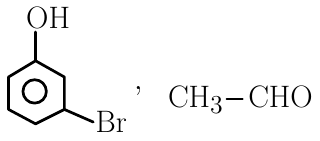
  • Reaction with Ethanol: Diazonium salts react with ethanol (EtOH) to form aldehydes, specifically acetaldehyde (CH3CHO), as a product of the Etard reaction mechanism.

EXPLANATION:

  • Step 1: Bromination
  • The nitrobenzene reacts with Br2 in acetic acid (AcOH) to produce para-bromo nitrobenzene.
  • Step 2: Reduction
  • Para-bromo nitrobenzene is reduced with Sn and HCl to form para-bromo aniline (p-bromoaniline).
  • Step 3: Diazotization
  • p-Bromoaniline reacts with NaNO2 and HCl at 273 K to form para-bromo benzene diazonium chloride.
  • Step 4: Reaction with Ethanol
  • The diazonium salt reacts with ethanol (EtOH), forming para-bromo benzene and acetaldehyde (CH3CHO).

Therefore, the products formed are para-bromo benzene and acetaldehyde (CH3CHO).

44

From the magnetic behaviour of [NiCl4]2– (paramagnetic) and [Ni(CO)4] (diamagnetic), choose the correct geometry and oxidation state.

  1. ((a))

    [NiCl4]2– : NiII, square planar

    [Ni(CO)4] : Ni(0), square planar

  2. ((b))

    [NiCl4]2–  : NiII, tetrahedral

    [Ni(CO)4] : Ni(0), tetrahedral

  3. ((c))

    [NiCl4]2–  : NiII, tetrahedral

    [Ni(CO)4]  : NiII, square planar

  4. ((d))

    [NiCl4]2–  : Ni(0), tetrahedral

    [Ni(CO)4]  : Ni(0), square planar

Show Answer
Answer: ((b))

[NiCl4]2–  : NiII, tetrahedral

[Ni(CO)4] : Ni(0), tetrahedral

CONCEPT:

Magnetic Behaviour and Geometries

  • The magnetic behaviour of a complex can often be used to infer its geometry and the oxidation state of the central metal ion.
  • [NiCl4]2−:
  • Ni2+ has the electronic configuration [Ar] 3d8.
  • In a tetrahedral field, the 3d orbitals do not experience significant splitting, retaining unpaired electrons and leading to a paramagnetic nature.
  • This suggests a tetrahedral geometry.
  • [Ni(CO)4]:
  • Ni in zero oxidation state (Ni(0)) has the electronic configuration [Ar] 3d10.
  • In a tetrahedral field, the d orbitals become fully paired in the presence of strong field ligands (like CO), leading to a diamagnetic nature.
  • This suggests a tetrahedral geometry.

EXPLANATION:

  • [NiCl4]2−:
  • Oxidation state of Ni is +2.
  • Ni2+ electronic configuration: [Ar] 3d8.
  • If the geometry is tetrahedral, the hybridization is sp3.
  • With 2 unpaired electrons, it exhibits paramagnetism.
  • [Ni(CO)4]:
  • Oxidation state of Ni is 0.
  • Ni(0) electronic configuration: [Ar] 3d10.
  • If the geometry is tetrahedral, the hybridization is sp3.
  • With no unpaired electrons, it exhibits diamagnetism.

Therefore, the correct answer is [NiCl4]2−: Ni2+, tetrahedral, [Ni(CO)4]: Ni(0), tetrahedral

45

The incorrect statements regarding geometrical isomerism are :

(A) Propene shows geometrical isomerism.

(B) Trans isomer has identical atoms/groups on the opposite sides of the double bond.

(C) Cis-but-2-ene has higher dipole moment than trans-but-2-ene.

(D) 2-methylbut-2-ene shows two geometrical isomers.

(E) Trans-isomer has lower melting point that cis isomer.

Choose the CORRECT answer from the options given below :

  1. ((a))

    (A), (D) and (E) only 

  2. ((b))

    (C), (D) and (E) only

  3. ((c))

    (B) and (C) only

  4. ((d))

    (A) and (E) only

Show Answer
Answer: ((a))

(A), (D) and (E) only 

CONCEPT:

Geometrical Isomerism

  • Geometrical isomerism (cis-trans isomerism) occurs in compounds with restricted rotation around a double bond or in cyclic structures.
  • Cis-isomer: Identical groups are on the same side of the double bond.
  • Trans-isomer: Identical groups are on opposite sides of the double bond.
  • Properties such as dipole moment and melting point differ for cis and trans isomers:
  • Cis-isomers usually have higher dipole moments due to group orientation.
  • Trans-isomers generally have higher melting points due to better packing in the solid state.

EXPLANATION:

  • (A) Propene does not show geometrical isomerism:
  • Geometrical isomerism requires two different groups on each carbon of the double bond, which propene (CH3–CH=CH2) lacks.

Incorrect

  • (B) Trans-isomer has identical groups on opposite sides:
  • This is true; geometrical isomers differ based on the position of groups around the double bond.

Correct

  • (C) Cis-but-2-ene has a higher dipole moment than trans-but-2-ene:

(dipole moment only)

  • In cis-isomer, the dipoles of substituent groups add up, while in trans-isomer, the dipoles cancel out.

Correct

  • (D) 2-Methylbut-2-ene shows two geometrical isomers:

 (does not show GI) 

  • This is incorrect as 2-methylbut-2-ene does not have two different groups on each carbon of the double bond.

Incorrect

  • (E) Trans-isomer has a lower melting point than cis-isomer:

 (Melting point) 

  • Trans-isomers generally have a higher melting point due to better packing in the solid state.

Incorrect

Therefore, the incorrect statements are: (A), (D), and (E).

Chemistry Section B (5 questions)

46

Some CO2 gas was kept in a sealed container at a pressure of 1 atm and at 273 K. This entire amount of CO2 gas was later passed through an aqueous solution of Ca(OH)2. The excess unreacted Ca(OH)2 was later neutralized with 0.1 M of 40 mL HCl. If the volume of the sealed container of CO2 was x, then x is _____ cm3 (nearest integer).

[Given : The entire amount of CO2 (g) reacted with exactly half the initial amount of Ca(OH)2 present in the aqueous solution.]

47

In Carius method for estimation of halogens, 180 mg of an organic compound produced 143.5 mg of AgCl. The percentage composition of chlorine in the compound is _______ %.

[Given : molar mass in g mol–1 of Ag : 108, Cl = 35.5]

48

The number of molecules/ions that show linear geometry among the following is _______ . 

(\mathrm{SO}{2}, \mathrm{BeCl}{2}, \mathrm{CO}{2}, \mathrm{~N}{3}^{-}, \mathrm{NO}{2}, \mathrm{~F}{2} \mathrm{O}, \mathrm{XeF}{2}, \mathrm{NO}{2}^{+}, \mathrm{I}{3}^{-}, \mathrm{O}{3})

49

A → B

The molecule A changes into its isomeric form B by following a first order kinetics at a temperature of 1000 K. If the energy barrier with respect to reactant energy for such isomeric transformation is 191.48 kJ mol–1 and the frequency factor is 1020, the time required for 50%, molecules of A to become B is ______ picoseconds (nearest integer).

[R = 8.314 J K–1 mol–1]

50

Consider the following sequence of reactions : 

Molar mass of the product formed (A) is ________g mol–1.

Physics Section A (20 questions)

51

Given below are two statements :

Statement I : In a vernier callipers, one vernier scale division is always smaller than one main scale division.

Statement II : The vernier constant is given by one main scale division multiplied by the number of vernier scale division.

In the light of the above statements, choose the correct answer from the options given below.

  1. ((a))

    Both Statement I and Statement II are false.

  2. ((b))

    Statement I is true but Statement II is false.

  3. ((c))

    Both Statement I and Statement II are true.

  4. ((d))

    Statement I is false but Statement II is true. 

Show Answer
Answer: ((b))

Statement I is true but Statement II is false.

Concept:

Vernier Caliper

  • Vernier Caliper is a precision instrument that can be used to measure internal and external distances accurately.
  • A vernier caliper consists of two main parts:
  • the main scale engraved on a solid L-shaped frame and the vernier scale that can slide along the main scale.
  • It works on the principle of vernier and can measure the dimensions to an accuracy of 0.02 mm.

Parts of a Vernier caliper:

  • Outside jaws: Used to measure the external diameter or width of an object
  • Inside jaws: Used to measure the internal diameter of an object
  • Locking screw: to lock the jaws
  • Adjusting screw: to take an accurate measurement of the workpiece.


Explanation:

In general one vernier scale division is smaller than one main scale division but in some modified cases it may be not correct.

Also least count is given by one main scale division / number of vernier scale division for normal vernier calliper.

52

A line charge of length (\frac{\mathrm{'a'}}{2}) is kept at the center of an edge BC of a cube ABCDEFGH having edge length ‘a’ as shown in the figure. If the density of line is λC per unit length, then the total electric flux through all the faces of the cube will be ____. (Take, ∈0 as the free space permittivity) 

  1. ((a))

    (\frac{\lambda \mathrm{a}}{8 \in_{0}})

  2. ((b))

    (\frac{\lambda \mathrm{a}}{16 \epsilon_{0}})

  3. ((c))

    (\frac{\lambda \mathrm{a}}{2 \epsilon_{0}})

  4. ((d))

    (\frac{\lambda \mathrm{a}}{4 \in_{0}})

Show Answer
Answer: ((a))

(\frac{\lambda \mathrm{a}}{8 \in_{0}})

Calculation:

Total charge inside the cube

= (\frac{\lambda \frac{\mathrm{a}}{2}}{4}=\frac{\lambda \mathrm{a}}{8})

∴ (\phi=\frac{\mathrm{q}{\mathrm{in}}}{\varepsilon{0}}=\frac{\lambda \mathrm{a}}{8 \varepsilon_{0}})

53

Sliding contact of a potentiometer is in the middle of the potentiometer wire having resistance RP = 1Ω as shown in the figure. An external resistance of Re = 2Ω is connected via the sliding contact. The curent through the circuit is

  1. ((a))

    0.3 A

  2. ((b))

    1.35 A

  3. ((c))

    1.0 A

  4. ((d))

    0.9 A

Show Answer
Answer: ((c))

1.0 A

Calculation:

The circuit can be considered as 

∴ Req = 0.5 + (\frac{0.5 \times 2}{2+0.5}=\left(\frac{5}{10}+\frac{10}{25}\right) \Omega)

= (\frac{45}{50}=\frac{9}{10}=0.9)

∴ i = (\frac{0.9}{0.9}=1 \mathrm{~A})

54

Given below are two statements : one is labelled as Assertion (A) and the other is labelled as Reason (R).

Assertion (A) : If Young’s double slit experiment is performed in an optically denser medium than air, then the consecutive fringes come closer.

Reason (R) : The speed of light reduces in an optically denser medium than air while its frequency does not change.

In the light of the above statements, choose the most appropriate answer from the options given below :

  1. ((a))

    Both (A) and (R) are true and (R) is the correct explanation of (A) 

  2. ((b))

    (A) is false but (R) is true.

  3. ((c))

    Both (A) and (R) are true but (R) is not the correct explanation of (A) 

  4. ((d))

    (A) is true but (R) is false.

Show Answer
Answer: ((a))

Both (A) and (R) are true and (R) is the correct explanation of (A) 

CONCEPT:

Young's double-slit experiment

  • Young’s double-slit experiment helped in understanding the wave nature of light.
  • The original Young’s double-slit experiment used diffracted light from a single monochromatic source of light.
  • The light that comes from the monochromatic source is passed into two slits to be used as two coherent sources.
  • At any point on the screen at a distance ‘y’ from the center, the waves travel distances l1 and l2 to create a path difference of Δl at that point.
  • If there is a constructive interference on the point then the bright fringe occurs.
  • If there is a destructive interference on the point then the dark fringe occurs.
  • The distance of the nth bright fringe from the central fringe is given as,

(⇒ y=\frac{nλ D}{d})

Where d = distance between slits, D = distance between slits and screen, and λ = wavelength

Explanation:

β (fringe width) = (\frac{λ \mathrm{D}}{\mathrm{~d}})

In denser medium, λ ↓ ⇒ β ↓

⇒ fringe come closer 

Also, µ = (\frac{c}{V} ) ⇒ V = (\frac{c}{μ})

Frequency remains same, 

⇒ μ = (\frac{\lambda_{\text {vac. }} \mathrm{f}}{\lambda_{\text {med }} \mathrm{f}}) ⇒ (\lambda_{\text {med }}) = (\frac{\lambda_{\mathrm{vac} .}}{\mu})

55

Two spherical bodies of same materials having radii 0.2 m and 0.8 m are placed in same atmosphere. The temperature of the smaller body is 800 K and temperature of bigger body is 400 K. If the energy radiate from the smaller body is E, the energy radiated from the bigger body is (assume, effect of the surrounding to be negligible)

  1. ((a))

    256 E

  2. ((b))

    E

  3. ((c))

    64 E

  4. ((d))

    16 E 

Show Answer
Answer: ((b))

E

Calculation:

We know that

(\frac{\mathrm{d} \theta}{\mathrm{dt}}=\sigma \mathrm{eAT}^{4} \Rightarrow \mathrm{P} \propto \mathrm{AT}^{4})

(\frac{\mathrm{P}{\text {smaller }}}{\mathrm{P}{\text {larger }}}=\frac{(0.2)^{2} \times 800^{4}}{(0.8)^{2} \times 400^{4}})

(\frac{1}{16} \times 16=1)

∴ Plarger = Psmaller 

56

An amount of ice of mass 10–3 kg and temperature –10°C is transformed to vapour of temperature 110° by applying heat. The total amount of work required for this conversion is,

(Take, specific heat of ice = 2100 Jkg–1K–1, specific heat of water = 4180 Jkg–1K–1, specific heat of steam = 1920 Jkg–1K–1, Latent heat of ice = 3.35 × 10⁵ Jkg–1 and Latent heat of steam = 2.25 × 10⁶ Jkg–1)

  1. ((a))

    3022 J

  2. ((b))

    3043 J

  3. ((c))

    3003 J

  4. ((d))

    3024 J 

Show Answer
Answer: ((b))

3043 J

Calculation:

(\rm\Delta Q_{1}=m \times S_{1} \times \Delta T=10^{-3} \times 2100 \times 10=21 \mathrm{~J})

(\rm\Delta \mathrm{Q}{2}=\mathrm{m} \times \mathrm{L}{\mathrm{f}}=10^{-3} \times 3.35 \times 10^{5}=335 \mathrm{~J})

(\rm\Delta Q_{3}=m \times S_{w} \times \Delta T=10^{-3} \times 4180 \times 100=418 \mathrm{~J})

(\rm \Delta \mathrm{Q}{4}=\mathrm{m} \times \mathrm{L}{\mathrm{v}}=10^{-3} \times 2.25 \times 10^{6}=2250 \mathrm{~J})

(\rm\Delta Q_{5}=\mathrm{m} \times \mathrm{S}_{\mathrm{v}} \times \Delta \mathrm{T}=10^{-3} \times 1920 \times 10=19.2 \mathrm{~J})

(\rm \Delta Q_{\mathrm{net}}=3043.2 \mathrm{~J})

57

An electron in the ground state of the hydrogen atom has the orbital radius of 5.3 × 10⁻¹¹ m while that for the electron in third excited state is 8.48 × 10⁻¹⁰ m. The ratio of the de Broglie wavelengths of electron in the ground state to that in excited state is

  1. ((a))

    4

  2. ((b))

    9

  3. ((c))

    3

  4. ((d))

    16

Show Answer
Answer: ((a))

4

Concept:

de Broglie wavelength:

  • Louis de Broglie theorized that not only light possesses both wave and particle properties, but rather particles with mass - such as electrons - do as well.
  • The wavelength of material waves is also known as the de Broglie wavelength.
  • de Broglie wavelength can be calculated from Planks constant h divided by the momentum of the particle.

(\lambda = \frac {h}{mv})

where λ is de Broglie wavelength, h is Plank's constant, and mv is the momentum.

  • If different particles have the same velocity, then the wavelength is inversely proportional to the mass of that particle.

Calculation:

(\lambda=\frac{\mathrm{h}}{\mathrm{mv}})

(\mathrm{mvr}=\frac{\mathrm{nh}}{2 \pi})

(\mathrm{mv}=\frac{\mathrm{nh}}{2 \pi \mathrm{r}})

(\lambda=\frac{2 \pi \mathrm{rh}}{\mathrm{nh}})

(\lambda \propto \frac{\mathrm{r}}{\mathrm{n}})

(\frac{\lambda_{1}}{\lambda_{4}}=\frac{r_{1} n_{4}}{n_{1} r_{4}}=\frac{5.3 \times 10^{-11} \times 4}{1 \times 84.8 \times 10^{-11}})

(\frac{\lambda_{1}}{\lambda_{4}}=\frac{1}{4})

58

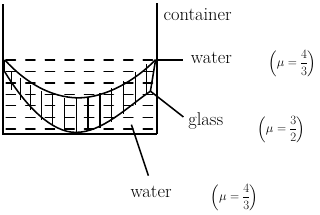
In the diagram given below, there are three lenses formed. Considering negligible thickness of each of them as compared to [R1] and [R2], i.e., the radii of curvature for upper and lower surfaces of the glass lens, the power of the combination is 

  1. ((a))

    (-\frac{1}{6}\left(\frac{1}{\left|\mathrm{R}{1}\right|}+\frac{1}{\left|\mathrm{R}{2}\right|}\right))

  2. ((b))

    (-\frac{1}{6}\left(\frac{1}{\left|\mathrm{R}{1}\right|}-\frac{1}{\left|\mathrm{R}{2}\right|}\right))

  3. ((c))

    (\frac{1}{6}\left(\frac{1}{\left|\mathrm{R}{1}\right|}+\frac{1}{\left|\mathrm{R}{2}\right|}\right))

  4. ((d))

    (\frac{1}{6}\left(\frac{1}{\left|R_{1}\right|}-\frac{1}{\left|R_{2}\right|}\right))

Show Answer
Answer: ((b))

(-\frac{1}{6}\left(\frac{1}{\left|\mathrm{R}{1}\right|}-\frac{1}{\left|\mathrm{R}{2}\right|}\right))

Calculation:

⇒ peq = p1 + p2 + p3  

⇒ p1 = (\left(\frac{1}{3\left|\mathrm{R}_{1}\right|}\right))

⇒ p2 = (\left(\frac{1}{2}\right)\left(\frac{1}{-\left|R_{1}\right|}-\frac{1}{-\left|R_{2}\right|}\right))

⇒ p2 = (\frac{1}{2}\left(\frac{1}{\left|\mathrm{R}{2}\right|}-\frac{1}{\left|\mathrm{R}{1}\right|}\right))

⇒ p3 = (\left(\frac{1}{3}\right)\left(\frac{1}{-\left|\mathrm{R}{2}\right|}-\frac{1}{\infty}\right)=-\frac{1}{3\left|\mathrm{R}{2}\right|})

⇒ peq = (\frac{1}{3}\left(\frac{1}{\left|\mathrm{R}{1}\right|}-\frac{1}{\left|\mathrm{R}{2}\right|}\right)-\frac{1}{2}\left(\frac{1}{\left|\mathrm{R}{1}\right|}-\frac{1}{\left|\mathrm{R}{2}\right|}\right))

=  (-\frac{1}{6}\left(\frac{1}{\left|\mathrm{R}{1}\right|}-\frac{1}{\left|\mathrm{R}{2}\right|}\right))

59

An electron is made to enters symmetrically between two parallel and equally but oppositely charged metal plates, each of 10 cm length. The electron emerges out of the field region with a horizontal component of velocity 106 m/s. If the magnitude of the electric between the plates is 9.1 V/cm, then the vertical component of velocity of electron is

(mass of electron = 9.1 × 10⁻³¹ kg and charge of electron = 1.6 × 10⁻¹⁹ C)

  1. ((a))

    1 × 10⁶ m/s

  2. ((b))

    0

  3. ((c))

    16 × 106 m/s

  4. ((d))

    16 × 104 m/s

Show Answer
Answer: ((d))

16 × 104 m/s

Calculation:

⇒ t = (\frac{\ell}{V_{x}}=\frac{10 × 10^{-2}}{10^{6}}=10^{-7})

⇒ Vy = uy + ayt

⇒ Vy = 0 + (\frac{\mathrm{eE}}{\mathrm{~m}} × 10^{-7})

⇒ Vy = (\frac{1.6 × 10^{-19}}{9.1 × 10^{-31}} × 9.1 × 10^{-2} × 10^{-7})

⇒ Vy =  16 × 104

60

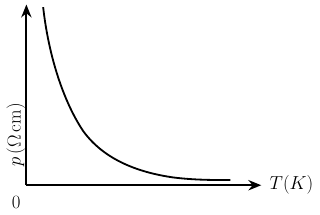
Which of the following resistivity (ρ) v/s temperature (T) curves is most suitable to be used in wire bound standard resistors? 

  1. ((a))

  2. ((b))

  3. ((c))

  4. ((d))

Show Answer
Answer: ((a))

Explanation:

Resistivity is independent of temperature for wire-bound resistors

61

A closed organ and an open organ tube filled by two different gases having same bulk modulus but different densities ρ1 and ρ2 respectively. The frequency of 9th harmonic of closed tube is identical with 4th harmonic of open tube. If the length of the closed tube is 10 cm and the density ratio of the gases is ρ1 : ρ2 = 1 : 16, then the length of the open tube is :

  1. ((a))

    (\frac{20}{7} \mathrm{~cm})

  2. ((b))

    (\frac{15}{7} \mathrm{~cm})

  3. ((c))

    (\frac{20}{9} \mathrm{~cm})

  4. ((d))

    (\frac{15}{9} \mathrm{~cm})

Show Answer
Answer: ((c))

(\frac{20}{9} \mathrm{~cm})

Calculation:

9th harmonic of closed pipe = (\frac{9 V_{1}}{4 \ell_{1}})

4th harmonic of open pipe = (\frac{2 \mathrm{~V}{2}}{\ell{2}})

∴ (\frac{9 \mathrm{~V}{1}}{4 \ell{1}}=\frac{2 \mathrm{~V}{2}}{\ell{2}})

∴ (\frac{9}{4 \ell_{1}} \sqrt{\frac{\mathrm{~B}}{\rho_{1}}}=\frac{2}{\ell_{2}} \sqrt{\frac{\mathrm{~B}}{\rho_{2}}} \Rightarrow \frac{\ell_{2}}{\ell_{1}}=\frac{8}{9} \sqrt{\frac{\rho_{1}}{\rho_{2}}})

(\ell_{2}=\ell_{1} \times \frac{8}{9} \times \frac{1}{4}=\frac{20}{9} \mathrm{~cm})

62

A uniform circular disc of radius ‘R’ and mass ‘M’ is rotating about an axis perpendicular to its plane and passing through its centre. A small circular part of radius R/2 is removed from the original disc as shown in the figure. Find the moment of inertia of the remaining part of the original disc about the axis as given above. 

  1. ((a))

    (\frac{7}{32} \mathrm{MR}^{2})

  2. ((b))

    (\frac{9}{32} \mathrm{MR}^{2})

  3. ((c))

    (\frac{17}{32} \mathrm{MR}^{2})

  4. ((d))

    (\frac{13}{32} \mathrm{MR}^{2})

Show Answer
Answer: ((d))

(\frac{13}{32} \mathrm{MR}^{2})

Calculation:

(\mathrm{I}=\frac{\mathrm{MR}^{2}}{2}-\left[\frac{\frac{\mathrm{M}}{4}\left(\frac{\mathrm{R}}{2}\right)^{2}}{2}+\frac{\mathrm{M}}{4}\left(\frac{\mathrm{R}}{2}\right)^{2}\right])

(\mathrm{I}=\frac{13}{32} \mathrm{MR}^{2})

63

A small point of mass m is placed at a distance 2R from the centre ‘O’ of a big uniform solid sphere of mass M and radius R. The gravitational force on ‘m’ due to M is F1 . A spherical part of radius R/3 is removed from the big sphere as shown in the figure and the gravitational force on m due to remaining part of M is found to be F2. The value of ratio F1 : F2 is  

  1. ((a))

    16 : 9

  2. ((b))

    11 : 10

  3. ((c))

    12 : 11

  4. ((d))

    12 : 9

Show Answer
Answer: ((c))

12 : 11

Calculation: 

(\mathrm{F}_{1}=\frac{\mathrm{GMm}}{(2 \mathrm{R})^{2}}\quad\quad...(1))

(\mathrm{F}_{2}=\frac{\mathrm{GMm}}{(2 \mathrm{R})^{2}}-\left(\frac{\mathrm{G}\left(\frac{\mathrm{M}}{27}\right) \mathrm{m}}{\left(\frac{4 \mathrm{R}}{3}\right)^{2}}\right))

(\mathrm{F}_{2}=\frac{11}{48} \frac{\mathrm{GMm}}{\mathrm{R}^{2}}\quad\quad...(2))

F1 : F2 = 12 : 11

64

The work functions of cesium (Cs) and lithium (Li) metals are 1.9 eV and 2.5 eV, respectively. If we incident a light of wavelength 550 nm on these two metal surface, then photo-electric effect is possible for the case of

  1. ((a))

    Li only

  2. ((b))

    Cs only

  3. ((c))

    Neither Cs nor Li

  4. ((d))

    Both Cs and Li

Show Answer
Answer: ((b))

Cs only

CONCEPT:

  • Photoelectric effect: When the light of a sufficiently small wavelength is incident on the metal surface, electrons are ejected from the metal instantly. This phenomenon is called the photoelectric effect.

Photo-electric cell

  • The photo-electric cell works on the principle of the photoelectric effect.
  • The photo-electric cell consists of an evacuated glass tube containing two electrodes emitter (C) and Collector (A).
  • The emitter is always kept at a negative potential.
  • The collector is made of a metal rod and is always kept at a positive potential.
  • When the light of frequency more than the threshold frequency of material of emitter is made incident on the emitter, photo-emission takes place.
  • Then the photo­electrons are attracted to the collector which is positive with respect to the emitter. Thus current flows in the circuit. If the intensity of incident radiation is increased the photoelectric current increases.

Calculation:

The energy of incident light is E = (\frac{1240}{\lambda}=\frac{1240}{550} \simeq 2.25) eV

Thus it is less than 2.5 eV (Li) and greater than 1.9 eV (Cs).

Photoelectric effect only can be possible for Cs.

65

If B is magnetic field and μ0 is permeability of free space, then the dimensions of (B/μ0) is

  1. ((a))

    MT–2A–1

  2. ((b))

    L–1 A

  3. ((c))

    LT–2A–1

  4. ((d))

    ML2T–2A–1

Show Answer
Answer: ((b))

L–1 A

Explanation:

We know that 

B = μ0ni

(\left[\frac{\mathrm{B}}{\mu_{0}}\right]=[\mathrm{ni}]=\mathrm{L}^{-1} \mathrm{~A}^{1})

66

A bob of mass m is suspended at a point O by a light string of length l and left to perform vertical motion (circular) as shown in figure. Initially, by applying horizontal velocity v0 at the point ‘A’. the string becomes slack when, the bob reaches at the point ‘D’. The ratio of the kinetic energy of the bob at the points B and C is ______. 

  1. ((a))

    2

  2. ((b))

    1

  3. ((c))

    4

  4. ((d))

    3

Show Answer
Answer: ((a))

2

Cakculation:

(\frac{1}{2} \mathrm{mv}{\mathrm{A}}^{2}=\frac{1}{2} \mathrm{mv}{\mathrm{B}}^{2}+\mathrm{mgh})

⇒ (\frac{1}{2} m(5 g \ell)=\frac{1}{2} \mathrm{mv}_{\mathrm{B}}^{2}+\mathrm{mg} \frac{\ell}{2})

⇒ (\frac{5 \mathrm{mg} \ell}{2}-\frac{\mathrm{mg} \ell}{2}=\mathrm{KE}_{\mathrm{B}})

⇒ (\mathrm{KE}_{\mathrm{B}}=2 \mathrm{mg} \ell)

(\frac{1}{2} \mathrm{mv}{\mathrm{C}}^{2}=\frac{1}{2} \mathrm{mv}{\mathrm{D}}^{2}+\mathrm{mg} \frac{\ell}{2})

⇒ (\mathrm{KE}{\mathrm{C}}=\frac{1}{2} \mathrm{mg} \ell+\mathrm{mg} \frac{\ell}{2}=\mathrm{mg} \ell \Rightarrow \frac{\mathrm{KE}{\mathrm{B}}}{\mathrm{KE}_{\mathrm{C}}}=2)

67

Given below are two statements :

Statement-I : The equivalent emf of two nonideal batteries connected in parallel is smaller than either of the two emfs.

Statement-II : The equivalent internal resistance of two nonideal batteries connected in parallel is smaller than the internal resistance of either of the two batteries.

In the light of the above statements, choose the correct answer from the options given below.

  1. ((a))

    Statement-I is true but Statement-II is false

  2. ((b))

    Both Statement-I and Statement-II are false

  3. ((c))

    Both Statement-I and Statement-II are true

  4. ((d))

    Statement-I is false but Statement-II is true

Show Answer
Answer: ((d))

Statement-I is false but Statement-II is true

CONCEPT:

Cell:

  • The cell converts chemical energy into electrical energy.
  • Cells are of two types:
  1. Primary cell: This type of cell cannot be recharged.
  2. Secondary cell: This type of cell can be recharged.
  • For a cell of emf E and internal resistance r,

⇒ E - V = Ir

Where I = current, and V = potential difference across external resistance

Cells in series:

  • If the number of cells are connected end to end that the positive terminal of one cell is connected to the negative terminal of the succeeding cell then it is called a series arrangement of cells.
  • The equivalent emf of cells in series arrangement is given as,

⇒ Eeq = E1 + E2 +...+ En

  • The equivalent internal resistance of cells in a series arrangement is given as,

⇒ req = r1 + r2 +...+ rn

Cells in parallel:

  • If the number of cells is connected such that the positive terminals are connected together at one point and the negative terminals of these cells are connected together at another point then it is called a parallel arrangement of cells.
  • The equivalent emf of cells in a parallel arrangement is given as,

(⇒ E_{eq}=\frac{E_1/r_1+E_2/r_2+E_3/r_3+...+E_n/r_n}{1/r_1+1/r_2+1/r_3+...+1/r_n})

  • The equivalent internal resistance of cells in a parallel arrangement is given as,

(⇒ \frac{1}{r_{eq}}=\frac{1}{r_1}+\frac{1}{r_2}+\frac{1}{r_3}+...+\frac{1}{r_n})

Calculation:

(\rm \frac{\frac{\varepsilon_{1}}{r_{1}}+\frac{\varepsilon_{2}}{r_{2}}}{\frac{1}{r_{1}}+\frac{1}{r_{2}}}=\varepsilon)

68

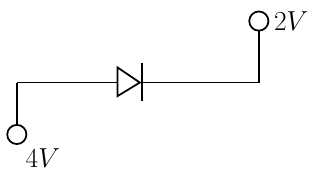
Which of the following circuits represents a forward biased diode ? 

(A) 

(B) 

(C) 

(D) 

(E) 

Choose the correct answer from the options given below :

  1. ((a))

    (B), (D) and (E) only 

  2. ((b))

    (A) and (D) only

  3. ((c))

    (B), (C) and (E) only

  4. ((d))

    (C) and (E) only

Show Answer
Answer: ((c))

(B), (C) and (E) only

Explanation:

Forward Biased:

  • The diode is said to be forward-biased when the P region is connected to a more positive terminal and N region is connected to the negative terminal of the battery.
  • A forward-biased diode offers very little resistance to the flow of current and hence a large current flow through the diode.
  • When forward biased, the diode acts as an ON switch.

Reversed Biased:

  • A diode is said to be reversed biased when the P terminal is connected to lower potential than the N terminal
  • A reverse-biased diode offers very large resistance to the flow of current and hence a small minority of current flows through the diode

How to identify forward and reversed biased diode:

  1. If the input voltage is greater than the other end voltage, then it is forward-biased and vice-versa.
  2. If the voltage at the p-section is greater than the n-section, then is forward biased and vice-versa.
69

A parallel-plate capacitor of capacitance 40μF is connected to a 100 V power supply. Now the intermediate space between the plates is filled with a dielectric material of dielectric constant K = 2. Due to the introduction of dielectric material, the extra charge and the change in the electrostatic energy in the capacitor, respectively, are - 

  1. ((a))

    2 mC and 0.2 J

  2. ((b))

    8 mC and 2.0 J

  3. ((c))

    4 mC and 0.2 J 

  4. ((d))

    2 mC and 0.4 J 

Show Answer
Answer: ((c))

4 mC and 0.2 J 

CONCEPT:

Capacitor:

  • The capacitor is a device in which electrical energy can be stored.
  • In a capacitor two conducting plates are connected parallel to each other and carrying charges of equal magnitudes and opposite sign and separated by an insulating medium.
  • The space between the two plates can either be a vacuum or an electric insulator such as glass, paper, air, or semi-conductor called a dielectric.​

​Parallel plate capacitor:

  • A parallel plate capacitor consists of two large plane parallel conducting plates separated by a small distance.
  • The space between the two plates can either be a vacuum or an electric insulator such as glass, paper, air, or semi-conductor called a dielectric.​
  • The electric field intensity at the outer region of the parallel plate capacitor is always zero whatever be the charge on the plate.
  • The electric field intensity in the inner region between the plates of a parallel plate capacitor remains the same at every point.
  • The electric field intensity in the inner region between the plates of a parallel plate capacitor is given as,

(\Rightarrow E=\frac{σ}{\epsilon_o}=\frac{Q}{A\epsilon_o})

  • The potential difference between the plates is given as,

(\Rightarrow V=\frac{Qd}{A\epsilon_o})

  • The capacitance C of the parallel plate capacitor is given as,

(\Rightarrow C=\frac{Q}{V}=\frac{A\epsilon_o}{d})

Where A = area of the plates, d = distance between the plates, Q = charge on the plates, and σ = surface charge density

Calculation:

Δq = (KC - C)V

= 40 × 10-6 × 100

= 4000 × 10-3 = 4mC

(\Delta \mathrm{U}=\frac{1}{2} \mathrm{C}^{\prime} \mathrm{V}^{2}-\frac{1}{2} \mathrm{CV}^{2}=\frac{1}{2}(\mathrm{~K}-1) \mathrm{CV}^{2})

= (\frac{1}{2} \mathrm{CV}^{2}(2-1))

= (\frac{1}{2} \mathrm{CV}^{2}=\frac{1}{2} \times 40 \times 10^{-6} \times 10000)

= 0.2 J

70

Given is a thin convex lens of glass (refractive index μ) and each side having radius of curvature R. One side is polished for complete reflection. At what distance from the lens, an object be placed on the optic axis so that the image gets formed on the object itself.

  1. ((a))

    R/μ

  2. ((b))

    R/(2μ–3)

  3. ((c))

    μR

  4. ((d))

    R/(2μ–1)

Show Answer
Answer: ((d))

R/(2μ–1)

Calculation:

Peq = 2P + Pm

(-\frac{1}{\mathrm{f}{\mathrm{Q}}}=\frac{2}{\mathrm{f}{\ell}}-\frac{1}{\mathrm{f}_{\mathrm{m}}})

= (\frac{4(\mu-1)}{R}-\frac{2}{-R}=\frac{1}{R}(4 \mu-4+2))

(-\frac{1}{\mathrm{f}_{\mathrm{eq}}}=\frac{1}{\mathrm{R}}(4 \mu-2))

⇒ (\frac{1}{f_{e q}}=\frac{-1}{R}(4 \mu-2))

(\mathrm{f}_{\mathrm{eq}}=\frac{\mathrm{R}}{2})

R = (2 f_{\mathrm{eq}}=-2\left(\frac{\mathrm{R}}{4 \mu-2}\right)=\frac{-\mathrm{R}}{(2 \mu-1)})

Physics Section B (5 questions)

71

Two soap bubbles of radius 2 cm and 4 cm, respectively, are in contact with each other. The radius of curvature of the common surface, in cm, is ______ . 

72

The driver sitting inside a parked car is watching vehicles approaching from behind with the help of his side view mirror, which is a convex mirror with radius of curvature R = 2 m. Another car approaches him from behind with a uniform speed of 90 km/hr. When the car is at a distance of 24 m from him, the magnitude of the acceleration of the image of the side view mirror is ‘a’. The value of 100a is ______ m/s2.

73

Three conductions of same length having thermal conductivity k1 , k2 and k3 are connected as shown in figure. 

Area of cross sections of 1st and 2nd conductor are same and for 3rd conductor it is double of the 1st conductor. The temperatures are given in the figure. In steady state condition, the value of θ is __________ °C.

(Given : k1 = 60 Js–1m–1K–1, k2 = 120 Js–1m–1K–1, k3 = 135 Js–1m–1K–1)

74

The position vectors of two 1 kg particles, (A) and (B), are given by 

(\overrightarrow{\mathrm{r}}{\mathrm{A}}=\left(α{1} \mathrm{t}^{2} \hat{\mathbf{i}}+α_{2} \hat{\mathrm{j}}+α_{3} \mathrm{t} \hat{\mathrm{k}}\right) \mathrm{m})

and (\overrightarrow{\mathrm{r}}{\mathrm{B}}=\left(β{1} \mathrm{t} \hat{\mathrm{i}}+β_{2} \mathrm{t}^{2} \hat{\mathbf{j}}+β_{3} \hat{\mathrm{k}}\right) \mathrm{m}), respectively ; 

1 = 1 m/s2, α2 = 3n m/s, α3 = 2 m/s, β1 = 2 m/s, β2 = –1 m/s2, β3 = 4p m/s), where t is time, n and p are constants, At t = 1s, (\left|\overrightarrow{\mathrm{V}}{\mathrm{A}}\right|=\left|\overrightarrow{\mathrm{V}}{\mathrm{B}}\right|) and velocities (\overrightarrow{\mathrm{V}}{\mathrm{A}}) and (\overrightarrow{\mathrm{V}}{\mathrm{B}}) of the particles are orthogonal to each other. At t = 1 s, the magnitude of angular momentum of particle (A) with respect to the position of particle (B) is √L kgm2s–1. The value of L is _____.

75

A particle is projected at an angle of 30° from horizontal at a speed of 60 m/s. The height traversed by the particle in the first second is h0 and height traversed in the last second, before it reaches the maximum height, is h1. The ratio h0 : h1 is ______.

[Take, g = 10 m/s2]

Attempt this paper under real exam conditions

Timed interface, section switching, instant scoring, and question-by-question analytics — free.

Start Timed Attempt