IBPS RRB Office Assistant (Clerk) · Topic Collection

Quantitative Aptitude PYQs

Arithmetic, number systems, percentages, ratios, profit and loss, time and work, algebra, geometry, mensuration, and trigonometry.

1935 Total Questions49 Official PapersYears: 2018–2025Search in Quantitative Aptitude
Showing questions 101–120 of 1935Page 6 of 97
SBI Clerk Prelims Memory Based Paper (Held On: 22 February 2025 Shift 3) (Previous Year Paper)·Numerical Ability
View full paper

Question 101

IBPS RRB Office Assistant (Clerk) 2025• Numerical Ability• Numerical Ability

Directions: Study the given table carefully and answer the given questions. 

The following table shows the number of mobile covers sold by three persons A, B, and C in three different months March, April, and May.

PersonMarchAprilMay
A947292
B12099102
C886570

If out of the total mobile covers sold by C in March, the ratio of blue color mobile cover and black color mobile cover sold were 4: 7, then find the number of black color mobile cover sold by C in March. 

  1. AOption (a)

    56

  2. BOption (b)

    63

  3. COption (c)

    70

  4. DOption (d)

    35

  5. EOption (e)

    48

View answer & explanation

Correct answer

Answer: (a)A.

56

Why this answer is correct

We are given:

Total mobile covers sold by C in March = 88.

The ratio of blue color mobile covers to black color mobile covers sold by C in March is 4:7.

Let the number of blue color mobile covers be 4x, and the number of black color mobile covers be 7x.

4x + 7x = 88

11x = 88

x = 88 / 11 = 8

Black color mobile covers = 7x = 7 × 8 = 56

Thus, the number of black color mobile covers sold by C in March is 56.
SBI Clerk Prelims Memory Based Paper (Held On: 22 February 2025 Shift 3) (Previous Year Paper)·Numerical Ability
View full paper

Question 102

IBPS RRB Office Assistant (Clerk) 2025• Numerical Ability• Numerical Ability

Directions: Study the given table carefully and answer the given questions. 

The following table shows the number of mobile covers sold by three persons A, B, and C in three different months March, April, and May.

PersonMarchAprilMay
A947292
B12099102
C886570

Find the ratio of number of mobile covers sold by A and B together in March to the number of mobile covers sold by C in May and March together. 

  1. AOption (a)

    97:71 

  2. BOption (b)

    23:77 

  3. COption (c)

    107:79 

  4. DOption (d)

    97:79 

  5. EOption (e)

    71:77

View answer & explanation

Correct answer

Answer: (c)C.

107:79 

Why this answer is correct

A's sales in March = 94

B's sales in March = 120

Total =94 + 120 = 214 

C's sales in May = 70

C's sales in March = 88

Total =70 + 88 = 158 

The ratio of the number of mobile covers sold by A and B together in March to the number of mobile covers sold by C in May and March together is:

Ratio = A and B in March / C in May and March = 214 / 158

Simplify the ratio by dividing both numbers by 2:

214 / 158 = 107 / 79

Thus, the ratio is 107:79.

SBI Clerk Prelims Memory Based Paper (Held On: 22 February 2025 Shift 3) (Previous Year Paper)·Numerical Ability
View full paper

Question 103

IBPS RRB Office Assistant (Clerk) 2025• Numerical Ability• Numerical Ability

The length and breadth of a rectangle are in the ratio 5:3.  The perimeter of the rectangle is equal to the perimeter of a square.  The side of the square is equal to the radius of a circle. What is the area of the circle if the breadth of the rectangle is 12 cm?

  1. AOption (a)

    121π cm²

  2. BOption (b)

    196π cm²

  3. COption (c)

    225π cm²

  4. DOption (d)

    256π cm²

  5. EOption (e)

    289π cm²

View answer & explanation

Correct answer

Answer: (d)D.

256π cm²

Why this answer is correct

Shortcut Trick

Breadth 3 units = 12 cm → 1 unit = 4 cm.

Length = 5 × 4 = 20 cm.

Side of Square = (Length + Breadth) ÷ 2 = (20 + 12) ÷ 2 = 16 cm.

Radius of Circle = Side of Square = 16 cm.

Area of Circle = π × (16)2 = 256π cm2.

∴ The correct answer is 256π cm2.

Alternate Method

Given: Ratio L:B = 5:3, Breadth = 12 cm, Perimeterrect = Perimetersq, Sidesq = Radiuscircle.

Formula Used: Perimeter of rectangle = 2(L + B); Perimeter of square = 4 × Side; Area of circle = πr2.

⇒ 3 units = 12 cm

⇒ 1 unit = 4 cm

⇒ Length = 5 × 4 = 20 cm

⇒ Perimeter of rectangle = 2(20 + 12) = 64 cm

⇒ Perimeter of square = 64 cm

⇒ 4 × Side = 64 ⇒ Side = 16 cm

⇒ Radius (r) = 16 cm

⇒ Area of circle = π × (16)2 = 256π cm2

∴ The correct answer is 256π cm2.

Additional Information

Rectangle Properties

Perimeter = 2(l + b) and Area = l × b. Diagonal d = √(l2 + b2).

Square Properties

Perimeter = 4a and Area = a2. Diagonal d = a√2.

Circle Properties

Circumference = 2πr and Area = πr2. Diameter D = 2r.

SBI Clerk Prelims Memory Based Paper (Held On: 22 February 2025 Shift 3) (Previous Year Paper)·Numerical Ability
View full paper

Question 104

IBPS RRB Office Assistant (Clerk) 2025• Numerical Ability• Numerical Ability

Four positive numbers, a, b, c, and d, are related in a specific way.  The first number, a, is to the second number, b, as 3 is to 5.  Interestingly, the ratio between b and c is the same as the ratio between c and d.  Furthermore, the ratio of a to d is given as 3 to 8.  Given that d has a value of 16, determine the numerical value of b.

  1. AOption (a)

    8

  2. BOption (b)

    10

  3. COption (c)

    12

  4. DOption (d)

    15

  5. EOption (e)

    5

View answer & explanation

Correct answer

Answer: (b)B.

10

Why this answer is correct

Shortcut Trick

Given ratio a : d = 3 : 8 and d = 16.

⇒ a = (3/8) × 16 = 6.

Given a : b = 3 : 5. Since a = 6 (which is 2 × 3), then b = 2 × 5 = 10.

Checking consistency: Since b/c = c/d, then c2 = b × d = 10 × 16 = 160, which is valid for positive numbers.

∴ The correct answer is 10.

Alternate Method

Given: a : b = 3 : 5, b/c = c/d, a : d = 3 : 8, and d = 16.

⇒ From ratio a : d = 3 : 8 and d = 16:

⇒ a/16 = 3/8

⇒ a = (3 × 16) ÷ 8 = 6

⇒ Now using ratio a : b = 3 : 5:

⇒ 6/b = 3/5

⇒ 3 × b = 6 × 5

⇒ 3b = 30

⇒ b = 10

∴ The correct answer is 10.

Additional Information

Continued Proportion

When a, b, c are in continued proportion, then a/b = b/c, which implies b2 = ac. Here b is the mean proportional.

Ratio Scaling

If a : b = m : n, and the value of a is known, then b = (a × n) ÷ m.

Compound Ratio

The compound ratio of a : b and c : d is (a × c) : (b × d).

SBI Clerk Prelims Memory Based Paper (Held On: 22 February 2025 Shift 3) (Previous Year Paper)·Numerical Ability
View full paper

Question 105

IBPS RRB Office Assistant (Clerk) 2025• Numerical Ability• Numerical Ability

Average score of the 3/4th of the class is 80% of the class average. Find the ratio of average score of the remaining class to that of entire class.

  1. AOption (a)

    3 : 7

  2. BOption (b)

    7 : 3

  3. COption (c)

    4 : 9

  4. DOption (d)

    9 : 4

  5. EOption (e)

    8 : 5

View answer & explanation

Correct answer

Answer: (e)E.

8 : 5

Why this answer is correct

Shortcut Trick

Let total students = 4 and class average = 100.

Total score = 4 × 100 = 400.

Score of 3 students = 3 × 80% of 100 = 3 × 80 = 240.

Score of remaining 1 student = 400 − 240 = 160.

Ratio = 160 : 100 = 8 : 5.

∴ The correct answer is 8 : 5.

Alternate Method

Given:

⇒ Let total number of students = n

⇒ Let Entire Class Average = A

⇒ Total Score = n × A

Calculations:

⇒ Number of students in 3/4th group = (3/4)n

⇒ Average of this group = 80% of A = 0.8A

⇒ Total score of this group = (3/4)n × 0.8A = 0.6nA

⇒ Remaining students = n − (3/4)n = (1/4)n

⇒ Total score of remaining students = nA − 0.6nA = 0.4nA

⇒ Average of remaining students = 0.4nA ÷ (1/4)n = 0.4A × 4 = 1.6A

⇒ Required Ratio = 1.6A : A = 1.6 : 1 = 16 : 10

⇒ Simplified Ratio = 8 : 5

∴ The correct answer is 8 : 5.

Additional Information

Weighted Average Formula

Total Average (Av) = (n1a1 + n2a2) ÷ (n1 + n2), where n is the quantity and a is the average.

Deviation Method

The sum of deviations of individual groups from the total average must be zero: n1(a1 − Av) + n2(a2 − Av) = 0.

SBI Clerk Prelims Memory Based Paper (Held On: 27 February 2025 Shift 1) (Previous Year Paper)·Numerical Ability
View full paper

Question 106

IBPS RRB Office Assistant (Clerk) 2025• Numerical Ability• Numerical Ability

A product costs 6000 Rs. It is sold at a 20% loss. From the selling price, a new product is bought and sold at a 40% profit. What is the overall profit (in Rs) on the whole transaction?

  1. AOption (a)

    120 Rs

  2. BOption (b)

    240 Rs

  3. COption (c)

    360 Rs

  4. DOption (d)

    480 Rs

  5. EOption (e)

    720 Rs

View answer & explanation

Correct answer

Answer: (e)E.

720 Rs

Why this answer is correct

Shortcut Trick

Net change percentage = a + b + (a × b) ÷ 100

Here, a = −20% (loss) and b = +40% (profit).

Net profit% = −20 + 40 + (−20 × 40) ÷ 100 = 20 − 8 = 12%.

Overall profit = 12% of 6000 = 0.12 × 6000 = 720.

∴ The correct answer is 720 Rs.

Alternate Method

Given → Initial Cost Price (CP1) = 6000 Rs, Loss% = 20%, Profit% on second item = 40%. Formulas: SP = CP × (100 ± Gain/Loss)% ÷ 100 | Overall Profit = Final SP − Initial CP.

⇒ Selling Price of first product (SP1) = 6000 × (100 − 20) ÷ 100 = 6000 × 0.8 = 4800 Rs.

⇒ Cost Price of second product (CP2) = SP1 = 4800 Rs.

⇒ Selling Price of second product (SP2) = 4800 × (100 + 40) ÷ 100 = 4800 × 1.4 = 6720 Rs.

⇒ Overall Profit = Final SP − Initial CP = 6720 − 6000 = 720 Rs.

∴ The correct answer is 720 Rs.

Additional Information

Successive Percentage Change

When a value is changed by x% and then the resulting value is changed by y%, the net change is (x + y + xy/100)%.

Profit and Loss Basics

Profit occurs when SP > CP. Loss occurs when CP > SP. Both are always calculated on the CP unless stated otherwise.

SBI Clerk Prelims Memory Based Paper (Held On: 27 February 2025 Shift 1) (Previous Year Paper)·Numerical Ability
View full paper

Question 107

IBPS RRB Office Assistant (Clerk) 2025• Numerical Ability• Numerical Ability

A invests ₹2400 for 12 months. After 8 months, B joins with an investment of ₹x. After one year, the profit of B is 3/11 of the total profit. Find the value of x.

  1. AOption (a)

    ₹1800

  2. BOption (b)

    ₹2700

  3. COption (c)

    ₹2200

  4. DOption (d)

    ₹2400

  5. EOption (e)

    ₹1900

View answer & explanation

Correct answer

Answer: (b)B.

₹2700

Why this answer is correct

Shortcut Trick

Ratio of Profit of B to Total = 3 : 11, so ratio of Profit A : B = (11 − 3) : 3 = 8 : 3.

Ratio of Investments × Time = Profit Ratio.

(2400 × 12) ÷ (x × 4) = 8 ÷ 3.

(600 × 12) ÷ x = 8 ÷ 3 ⇒ 7200 ÷ x = 8 ÷ 3.

x = (7200 × 3) ÷ 8 = 900 × 3 = 2700.

∴ The correct answer is ₹2700.

Alternate Method

Given → Investment of A = ₹2400, Time of A = 12 months, Time of B = 12 − 8 = 4 months. Profit of B = 3/11 of Total. Formulas: Profit Ratio = (InvestmentA × TimeA) : (InvestmentB × TimeB).

⇒ Total Profit = 11 units, B Profit = 3 units, A Profit = 11 − 3 = 8 units. ⇒ (2400 × 12) ÷ (x × 4) = 8 ÷ 3 ⇒ 28800 ÷ 4x = 8 ÷ 3 ⇒ 7200 ÷ x = 8 ÷ 3 ⇒ 8x = 21600 ⇒ x = 2700.

∴ The correct answer is ₹2700.

Additional Information

Partnership Concept

When multiple persons invest capital for different time periods, the profit is distributed in the ratio of the product of their capital and time.

Investment Formula

Investment = Profit ÷ Time. If the profit ratio and time ratio are known, the investment ratio can be calculated directly.

SBI Clerk Prelims Memory Based Paper (Held On: 27 February 2025 Shift 1) (Previous Year Paper)·Numerical Ability
View full paper

Question 108

IBPS RRB Office Assistant (Clerk) 2025• Numerical Ability• Numerical Ability

Directions: Read the data carefully and answer the following questions. 

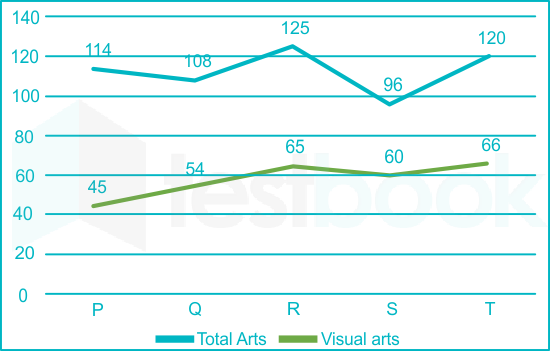
The line graph represents the sum of Fine Art and Visual Art and only Visual Art across 5 exhibitions.

Total Arts = Fine Arts + Visual Arts

The number of fine arts in T is what percent of the total number of arts in same exhibition?

  1. AOption (a)

    45%

  2. BOption (b)

    40%

  3. COption (c)

    60%

  4. DOption (d)

    55%

  5. EOption (e)

    30%

View answer & explanation

Correct answer

Answer: (a)A.

45%

Why this answer is correct

General Solution:

The given data represents the Total Arts and Visual Arts across 5 exhibitions (P, Q, R, S, T). From this, we can derive the Fine Arts for each exhibition using the formula:

Fine Arts = Total Arts − Visual Arts

Using the formula above, we calculate the Fine Arts for each exhibition:

Exhibition P:

Fine Arts = 114 − 45 = 69

Exhibition Q:

Fine Arts = 108 − 54 = 54

Exhibition R:

Fine Arts = 125 − 65 = 60

Exhibition S:

Fine Arts = 96 − 60 = 36

Exhibition T:

Fine Arts = 120 − 66 = 54

Thus,

ExhibitionTotal ArtsVisual ArtsFine Arts
P1144569
Q1085454
R1256560
S966036
T1206654


Calculations:

The formula to calculate the percentage is:

Percentage = (Part / Whole) × 100

Here:

Part = Fine Arts in T = 54

Whole = Total Arts in T = 120

Substitute the values into the formula:

Percentage = (54 / 120) × 100 = 45%.

Thus, the correct answer is 45%

SBI Clerk Prelims Memory Based Paper (Held On: 27 February 2025 Shift 1) (Previous Year Paper)·Numerical Ability
View full paper

Question 109

IBPS RRB Office Assistant (Clerk) 2025• Numerical Ability• Numerical Ability

Directions: Read the data carefully and answer the following questions. 

The line graph represents the sum of Fine Art and Visual Art and only Visual Art across 5 exhibitions.

Total Arts = Fine Arts + Visual Arts

The total number of arts in T is equal to the sum of the visual arts in which one of the following pairs?

  1. AOption (a)

    S and T

  2. BOption (b)

    P and R

  3. COption (c)

    Q and T

  4. DOption (d)

    Q and R

  5. EOption (e)

    P and S

View answer & explanation

Correct answer

Answer: (c)C.

Q and T

Why this answer is correct

General Solution:

The given data represents the Total Arts and Visual Arts across 5 exhibitions (P, Q, R, S, T). From this, we can derive the Fine Arts for each exhibition using the formula:

Fine Arts = Total Arts − Visual Arts

Using the formula above, we calculate the Fine Arts for each exhibition:

Exhibition P:

Fine Arts = 114 − 45 = 69

Exhibition Q:

Fine Arts = 108 − 54 = 54

Exhibition R:

Fine Arts = 125 − 65 = 60

Exhibition S:

Fine Arts = 96 − 60 = 36

Exhibition T:

Fine Arts = 120 − 66 = 54

Thus,

ExhibitionTotal ArtsVisual ArtsFine Arts
P1144569
Q1085454
R1256560
S966036
T1206654


Calculations:

From the table:

Total Arts in T = 120

We need to check the sum of Visual Arts for each pair of exhibitions and see which one equals 120.

Pair 1: S and T

Visual Arts in S = 60

Visual Arts in T = 66

Total = 60 + 66 = 126

126 ≠ 120 → Not a match.

Pair 2: P and R

Visual Arts in P = 45

Visual Arts in R = 65

Total = 45 + 65 = 110

110 ≠ 120 → Not a match.

Pair 3: Q and T

Visual Arts in Q = 54

Visual Arts in T = 66

Total = 54 + 66 = 120

120 = 120 → Match!

Pair 4: Q and R

Visual Arts in Q = 54

Visual Arts in R = 65

Total = 54 + 65 = 119

119 ≠ 120 → Not a match.

Pair 5: P and S

Visual Arts in P = 45

Visual Arts in S = 60

Total = 45 + 60 = 105

105 ≠ 120 → Not a match.

The pair Q and T has a sum of Visual Arts equal to the Total Arts in Exhibition T.

SBI Clerk Prelims Memory Based Paper (Held On: 27 February 2025 Shift 1) (Previous Year Paper)·Numerical Ability
View full paper

Question 110

IBPS RRB Office Assistant (Clerk) 2025• Numerical Ability• Numerical Ability

Directions: Read the data carefully and answer the following questions. 

The line graph represents the sum of Fine Art and Visual Art and only Visual Art across 5 exhibitions.

Total Arts = Fine Arts + Visual Arts

Find the ratio of the number of fine arts in R and T together to the number of total arts in P.

  1. AOption (a)

    5:6

  2. BOption (b)

    2:3

  3. COption (c)

    1:1

  4. DOption (d)

    6:5

  5. EOption (e)

    3:2

View answer & explanation

Correct answer

Answer: (c)C.

1:1

Why this answer is correct

General Solution:

The given data represents the Total Arts and Visual Arts across 5 exhibitions (P, Q, R, S, T). From this, we can derive the Fine Arts for each exhibition using the formula:

Fine Arts = Total Arts − Visual Arts

Using the formula above, we calculate the Fine Arts for each exhibition:

Exhibition P:

Fine Arts = 114 − 45 = 69

Exhibition Q:

Fine Arts = 108 − 54 = 54

Exhibition R:

Fine Arts = 125 − 65 = 60

Exhibition S:

Fine Arts = 96 − 60 = 36

Exhibition T:

Fine Arts = 120 − 66 = 54

Thus,

ExhibitionTotal ArtsVisual ArtsFine Arts
P1144569
Q1085454
R1256560
S966036
T1206654


Calculations:

From the table:

Fine Arts in R and T together:

Fine Arts in R = 60

Fine Arts in T = 54

Total Fine Arts in R and T = 60 + 54 = 114

Total Arts in P = 114

The ratio of the number of Fine Arts in R and T together to the number of Total Arts in P is:

Ratio = Fine Arts in R and T / Total Arts in P = 114 / 1 = 1:1

Thus, the correct answer is 1:1.

SBI Clerk Prelims Memory Based Paper (Held On: 27 February 2025 Shift 1) (Previous Year Paper)·Numerical Ability
View full paper

Question 111

IBPS RRB Office Assistant (Clerk) 2025• Numerical Ability• Numerical Ability

Directions: Read the data carefully and answer the following questions. 

The line graph represents the sum of Fine Art and Visual Art and only Visual Art across 5 exhibitions.

Total Arts = Fine Arts + Visual Arts

Find the total number of fine arts in P and R together.

  1. AOption (a)

    115

  2. BOption (b)

    129

  3. COption (c)

    108

  4. DOption (d)

    123

  5. EOption (e)

    None of these

View answer & explanation

Correct answer

Answer: (b)B.

129

Why this answer is correct

General Solution:

The given data represents the Total Arts and Visual Arts across 5 exhibitions (P, Q, R, S, T). From this, we can derive the Fine Arts for each exhibition using the formula:

Fine Arts = Total Arts − Visual Arts

Using the formula above, we calculate the Fine Arts for each exhibition:

Exhibition P:

Fine Arts = 114 − 45 = 69

Exhibition Q:

Fine Arts = 108 − 54 = 54

Exhibition R:

Fine Arts = 125 − 65 = 60

Exhibition S:

Fine Arts = 96 − 60 = 36

Exhibition T:

Fine Arts = 120 − 66 = 54

Thus,

ExhibitionTotal ArtsVisual ArtsFine Arts
P1144569
Q1085454
R1256560
S966036
T1206654


Calculations:

From the table, we know the Fine Arts for each exhibition:

Exhibition P: Fine Arts = 69

Exhibition R: Fine Arts = 60

To find the total number of Fine Arts in P and R together, we add the Fine Arts of P and R:

Total Fine Arts (P + R) = 69 + 60 = 129

Thus, the total number of Fine Arts in P and R together is 129.

SBI Clerk Prelims Memory Based Paper (Held On: 27 February 2025 Shift 1) (Previous Year Paper)·Numerical Ability
View full paper

Question 112

IBPS RRB Office Assistant (Clerk) 2025• Numerical Ability• Numerical Ability

In a factory 50% of the workers are above 45 years and of these 60 % are female and the rest are male. If there are 1200 female workers above 45 years then find the total number of workers in the factory?

  1. AOption (a)

    4500

  2. BOption (b)

    4600

  3. COption (c)

    4000

  4. DOption (d)

    4100

  5. EOption (e)

    4200

View answer & explanation

Correct answer

Answer: (c)C.

4000

Why this answer is correct

Shortcut Trick

Let total workers be 100%.

Workers above 45 years = 50%.

Female workers above 45 = 60% of 50% = 30%.

Given, 30% = 1200 ⇒ 1% = 40.

Total workers = 100% = 100 × 40 = 4000.

∴ The correct answer is 4000 workers.

Alternate Method

Given: Female workers above 45 = 1200; % Above 45 = 50%; % Female in that group = 60%.

Formula: Total Workers × % Above 45 × % Female = 1200

⇒ Let Total workers be x.

⇒ x × (50/100) × (60/100) = 1200

⇒ x × (1/2) × (3/5) = 1200

⇒ x × (3/10) = 1200

⇒ x = (1200 × 10) ÷ 3

⇒ x = 400 × 10 = 4000

∴ The correct answer is 4000 workers.

Additional Information

Successive Percentage Change

When percentages are applied sequentially on a base value, the effective percentage is P1 × P2 / 100.

Base Value Concept

Always identify the base (100%) correctly; in this case, females are 60% of the 50% subset, not the whole population.

SBI Clerk Prelims Memory Based Paper (Held On: 27 February 2025 Shift 1) (Previous Year Paper)·Numerical Ability
View full paper

Question 113

IBPS RRB Office Assistant (Clerk) 2025• Numerical Ability• Numerical Ability

Rakesh invested Rs. 12000 in two different schemes. First at 10% per annum, rest at 20% per annum and thus in 4 years the total interest from both the amounts collected was Rs. 6720. What was the amount lent out @ 20% per annum?

  1. AOption (a)

    Rs. 4600

  2. BOption (b)

    Rs. 4400

  3. COption (c)

    Rs. 4800

  4. DOption (d)

    Rs. 5000

  5. EOption (e)

    None of these

View answer & explanation

Correct answer

Answer: (c)C.

Rs. 4800

Why this answer is correct

Shortcut Trick

Overall interest rate per annum = (6720 ÷ 4) × 100 ÷ 12000 = 14%.

Using Alligation: (Scheme 1: 10%) vs (Scheme 2: 20%) with Mean (14%).

Ratio of investments = (20 − 14) : (14 − 10) = 6 : 4 = 3 : 2.

Amount @ 20% = (2 ÷ 5) × 12000 = 4800.

∴ The correct answer is Rs. 4800.

Alternate Method

Given: Total Principal (P) = Rs. 12000, Total SI = Rs. 6720, Time (T) = 4 years, R1 = 10%, R2 = 20%.

Formula: SI = (P × R × T) ÷ 100

⇒ Let the amount lent at 20% be Rs. x.

⇒ Amount lent at 10% = (12000 − x).

⇒ [(12000 − x) × 10 × 4] ÷ 100 + [x × 20 × 4] ÷ 100 = 6720

⇒ (12000 − x) × 40 + 80x = 672000

⇒ 480000 − 40x + 80x = 672000

⇒ 40x = 672000 − 480000

⇒ 40x = 192000

⇒ x = 192000 ÷ 40 = 4800

∴ The correct answer is Rs. 4800.

Additional Information

Simple Interest (SI)

The interest remains constant every year on the original principal. SI = (P × R × T) ÷ 100.

Alligation in Interest

When a sum is divided into two parts with different rates, the ratio of parts = (Rate2 − Avg Rate) : (Avg Rate − Rate1).

Effective Annual Rate

If interest is calculated for multiple years, the total percentage interest is R × T%.

SBI Clerk Prelims Memory Based Paper (Held On: 27 February 2025 Shift 1) (Previous Year Paper)·Numerical Ability
View full paper

Question 114

IBPS RRB Office Assistant (Clerk) 2025• Numerical Ability• Numerical Ability

Mohan is 12 years younger than Krishna. Mohan's age is 40% of the sum of his and Krishna's age.  what will be Mohan's age after 8 years? 

  1. AOption (a)

    24 years

  2. BOption (b)

    36 years

  3. COption (c)

    32 years

  4. DOption (d)

    30 years

  5. EOption (e)

    31 years

View answer & explanation

Correct answer

Answer: (c)C.

32 years

Why this answer is correct

Shortcut Trick

Ratio of Mohan's age to (Mohan + Krishna) = 40% = 2 : 5.

If Mohan = 2 units and Sum = 5 units, then Krishna = 5 − 2 = 3 units.

Difference = 3 − 2 = 1 unit → 12 years.

Mohan's current age = 2 × 12 = 24 years.

Mohan's age after 8 years = 24 + 8 = 32 years.

∴ The correct answer is 32 years.

Alternate Method

Given: Krishna = Mohan + 12

Formula: Mohan = 0.40 × (Mohan + Krishna)

⇒ M = 0.4(M + M + 12)

⇒ M = 0.4(2M + 12)

⇒ M = 0.8M + 4.8

⇒ 0.2M = 4.8

⇒ M = 4.8 ÷ 0.2 = 24 years

⇒ Age after 8 years = 24 + 8 = 32 years

∴ The correct answer is 32 years.

Additional Information

Age Difference Property

The difference between the ages of two persons remains constant throughout their lives, regardless of the number of years passed.

Percentage to Ratio Conversion

Always convert percentages to simple fractions (e.g., 40% = 2/5) to solve ratio-based age problems faster without using variables.

SBI Clerk Prelims Memory Based Paper (Held On: 27 February 2025 Shift 1) (Previous Year Paper)·Numerical Ability
View full paper

Question 115

IBPS RRB Office Assistant (Clerk) 2025• Numerical Ability• Numerical Ability

The length of a rectangle is four times its breadth. If its length is increased by 20 cm. and breadth is increased by 30 cm, the area of the rectangle is increased by 880 cm2. Find the length of the rectangle.

  1. AOption (a)

    12 cm

  2. BOption (b)

    10 cm

  3. COption (c)

    15 cm

  4. DOption (d)

    8 cm

  5. EOption (e)

    6 cm

View answer & explanation

Correct answer

Answer: (d)D.

8 cm

Why this answer is correct

Shortcut Trick

Let breadth = x and length = 4x.

New Area − Old Area = 880

(4x + 20)(x + 30) − 4x2 = 880

120x + 20x + 600 = 880 ⇒ 140x = 280 ⇒ x = 2 cm.

Length = 4 × 2 = 8 cm.

∴ The correct answer is 8 cm.

Alternate Method

Given: Length (L) = 4 × Breadth (B); Lnew = L + 20; Bnew = B + 30; Area Increase = 880 cm2.

Formula: Area of Rectangle = Length × Breadth

⇒ Original Area = 4x × x = 4x2

⇒ New Area = (4x + 20)(x + 30) = 4x2 + 120x + 20x + 600

⇒ (4x2 + 140x + 600) − 4x2 = 880

⇒ 140x + 600 = 880

⇒ 140x = 280

⇒ x = 2 cm

⇒ Length = 4x = 4 × 2 = 8 cm

∴ The correct answer is 8 cm.

Additional Information

Perimeter of Rectangle

The total boundary length of a rectangle is given by 2 × (Length + Breadth).

Diagonal of Rectangle

The distance between opposite corners is calculated using Pythagoras theorem: d = √(L2 + B2).

Area Change Percentage

If length increases by a% and breadth by b%, net area change % = a + b + (a × b)/100.

SBI Clerk Prelims Memory Based Paper (Held On: 27 February 2025 Shift 1) (Previous Year Paper)·Numerical Ability
View full paper

Question 116

IBPS RRB Office Assistant (Clerk) 2025• Numerical Ability• Numerical Ability

What will come in place of the question mark?

√4 × 100% of 26 = 13 × ?

  1. AOption (a)

    3

  2. BOption (b)

    3.5

  3. COption (c)

    1

  4. DOption (d)

    2

  5. EOption (e)

    4

View answer & explanation

Correct answer

Answer: (e)E.

4

Why this answer is correct

Concept used:

We have to follow the BODMAS rule

Calculation:

√4 × 100% of 26 = 13 × ?

⇒ 2 × 1 of 26 = 13 × ?

⇒ 2 × 26 = 13 × ?

⇒ 52/13 = ?

⇒ ? = 4

∴ The value of ? is 4

SBI Clerk Prelims Memory Based Paper (Held On: 27 February 2025 Shift 1) (Previous Year Paper)·Numerical Ability
View full paper

Question 117

IBPS RRB Office Assistant (Clerk) 2025• Numerical Ability• Numerical Ability

What will come in place of the question mark (?) in the following question?

50% of 250 + 125 = ? – 50

  1. AOption (a)

    250

  2. BOption (b)

    325

  3. COption (c)

    300

  4. DOption (d)

    200

  5. EOption (e)

    450

View answer & explanation

Correct answer

Answer: (c)C.

300

Why this answer is correct

Concept:

We have to follow the BODMAS rule

Calculation:

50% of 250 + 125 = ? – 50

⇒ 125 + 125 + 50 = ?

⇒ 250 + 50 = ?

⇒ 300 = ?

∴ 300 will come in place of question mark.

SBI Clerk Prelims Memory Based Paper (Held On: 27 February 2025 Shift 1) (Previous Year Paper)·Numerical Ability
View full paper

Question 118

IBPS RRB Office Assistant (Clerk) 2025• Numerical Ability• Numerical Ability

What will come in place of the question mark (?) in the following question?

24% of 120 + 35% of 560 = ?

  1. AOption (a)

    225.6

  2. BOption (b)

    224.8

  3. COption (c)

    324.8

  4. DOption (d)

    224.5

  5. EOption (e)

    226.8

View answer & explanation

Correct answer

Answer: (b)B.

224.8

Why this answer is correct

Calculation:

24% of 120 + 35% of 560 = ?

⇒ 28.8 + 196 = ?

⇒ 224.8 = ?

∴ 224.8 will come in place of the question mark

SBI Clerk Prelims Memory Based Paper (Held On: 27 February 2025 Shift 1) (Previous Year Paper)·Numerical Ability
View full paper

Question 119

IBPS RRB Office Assistant (Clerk) 2025• Numerical Ability• Numerical Ability

What should come in the place of (?) in the following question

√1296 - √576 = √? + 3 × 2

  1. AOption (a)

    12

  2. BOption (b)

    14

  3. COption (c)

    17

  4. DOption (d)

    9

  5. EOption (e)

    None of these

View answer & explanation

Correct answer

Answer: (e)E.

None of these

Why this answer is correct

Concept:

Follow BODMAS rule to solve this question, as per the order given below, 

Calulation:

√1296 - √576 = √? + 3 × 2

⇒ 36 – 24 = √? + 6

⇒ 12 = √? + 6

⇒ √? = 6

⇒ ? = 36

∴ The value of ? is 36

SBI Clerk Prelims Memory Based Paper (Held On: 27 February 2025 Shift 1) (Previous Year Paper)·Numerical Ability
View full paper

Question 120

IBPS RRB Office Assistant (Clerk) 2025• Numerical Ability• Numerical Ability

What will come in the place of the question mark ‘?’ in the following question?

{(219 + 24) × 3}1/2 = ?/5

  1. AOption (a)

    130

  2. BOption (b)

    133

  3. COption (c)

    137

  4. DOption (d)

    135

  5. EOption (e)

    139

View answer & explanation

Correct answer

Answer: (d)D.

135

Why this answer is correct

Concept used:

Calculation:

{(219 + 24) × 3}1/2 = ?/5

⇒ {243 × 3}1/2 = ?/5

⇒ {729}1/2 = ?/5

⇒ 27 = ?/5

⇒ ? = 135

∴ The value of ? is 135.

How should I prepare for Quantitative Aptitude in IBPS RRB Office Assistant (Clerk)?

Solving previous year questions by topic helps identify recurring concepts, question patterns, and frequently asked sub-topics. Attempt each question, review the step-by-step explanation, and note down key formulas or facts for quick revision before the exam.