IBPS RRB Office Assistant (Clerk) · Topic Collection

Quantitative Aptitude PYQs

Arithmetic, number systems, percentages, ratios, profit and loss, time and work, algebra, geometry, mensuration, and trigonometry.

1935 Total Questions49 Official PapersYears: 2018–2025Search in Quantitative Aptitude
Showing questions 1–20 of 1935Page 1 of 97
SBI Clerk Prelims Memory Based Paper (Held On: 22 February 2025 Shift 1) (Previous Year Paper)·Numerical Ability
View full paper

Question 1

IBPS RRB Office Assistant (Clerk) 2025• Numerical Ability• Numerical Ability

A and B entered into a partnership where A invested ₹x and B invested ₹(x + 500) for one year. At the end of the year, the profit of A is 1/6th less than the profit of B. What is the value of x?

  1. AOption (a)

    ₹1000

  2. BOption (b)

    ₹1500

  3. COption (c)

    ₹2000

  4. DOption (d)

    ₹2500

  5. EOption (e)

    ₹3000

View answer & explanation

Correct answer

Answer: (d)D.

₹2500

Why this answer is correct

Shortcut Trick

Profit ratio of A : B is derived from the statement 1/6th less: If B = 6, then A = 6 − 1 = 5.

Ratio of profits PA : PB = 5 : 6. Since time is the same (1 year), Profit ratio = Investment ratio.

Difference in ratio parts = 6 − 5 = 1 unit. Given investment difference = ₹500.

∴ 1 unit = ₹500. Value of x (A's investment) = 5 units = 5 × 500 = ₹2500.

∴ The correct answer is ₹2500.

Alternate Method

Given: A's Investment = ₹x, B's Investment = ₹(x + 500), Time = 1 year.

Formulas: Profit = Investment × Time | Profit Ratio = (I1 × T1) : (I2 × T2)

⇒ Let B's profit be PB. Then A's profit PA = PB − (1/6)PB = (5/6)PB.

⇒ PA / PB = 5 / 6.

⇒ Since time is equal, x / (x + 500) = 5 / 6.

⇒ 6x = 5(x + 500) ⇒ 6x = 5x + 2500.

⇒ x = 2500.

∴ The correct answer is ₹2500.

Additional Information

Partnership Ratios

When the time period for all partners is the same, the profit is distributed solely in the ratio of their investments.

Fractional Change

If a value is 1/n less than another, it is represented as (1 − 1/n) of that value, or (n − 1)/n.
SBI Clerk Prelims Memory Based Paper (Held On: 22 February 2025 Shift 1) (Previous Year Paper)·Numerical Ability
View full paper

Question 2

IBPS RRB Office Assistant (Clerk) 2025• Numerical Ability• Numerical Ability

A mixture of 70 litres contains milk and water in the ratio 3:7. Then, x litres of milk is added, and 56 litres of water is added. After this, the ratio of milk to water becomes 4:5. What is the value of x?

  1. AOption (a)

    60 litres

  2. BOption (b)

    71 litres

  3. COption (c)

    64 litres

  4. DOption (d)

    56 litres

  5. EOption (e)

    63 litres

View answer & explanation

Correct answer

Answer: (e)E.

63 litres

Why this answer is correct

Shortcut Trick

Initial Milk = 3/10 × 70 = 21 litres; Initial Water = 7/10 × 70 = 49 litres.

New Water = 49 + 56 = 105 litres.

Ratio 4:5 means 5 units = 105 litres → 1 unit = 21 litres.

New Milk = 4 units = 4 × 21 = 84 litres.

Value of x = 84 − 21 = 63 litres.

∴ The correct answer is 63 litres.

Alternate Method

Given: Initial Volume = 70 litres, Ratio M:W = 3:7, Water added = 56 litres, New ratio = 4:5.

Calculations:

⇒ Initial Milk = 70 × (3 / (3 + 7)) = 21 litres

⇒ Initial Water = 70 − 21 = 49 litres

⇒ Final Water = 49 + 56 = 105 litres

⇒ Let final Milk be Mf. Then Mf / 105 = 4 / 5

⇒ Mf = (4/5) × 105 = 4 × 21 = 84 litres

⇒ x = Final Milk − Initial Milk = 84 − 21 = 63 litres

∴ The correct answer is 63 litres.

Additional Information

Ratio Distribution

To divide a quantity Q in ratio a:b, the parts are Q × a/(a+b) and Q × b/(a+b).

Mixture Alligation

When adding a pure component (like 100% milk), the concentration changes based on the weighted average of the components.

Constant Quantity Concept

If only one component is added, the other component remains proportionally constant relative to its own previous absolute value.

SBI Clerk Prelims Memory Based Paper (Held On: 22 February 2025 Shift 1) (Previous Year Paper)·Numerical Ability
View full paper

Question 3

IBPS RRB Office Assistant (Clerk) 2025• Numerical Ability• Numerical Ability

The ratio of the ages of A and B is 6:5, and the age of C is 5 years less than twice the age of B. The difference between the ages of C and A is 11 years. What is the age of A?

  1. AOption (a)

    24 years

  2. BOption (b)

    30 years

  3. COption (c)

    36 years

  4. DOption (d)

    42 years

  5. EOption (e)

    18 years

View answer & explanation

Correct answer

Answer: (a)A.

24 years

Why this answer is correct

Shortcut Trick

Let the common ratio for A and B be x. Ages are 6x and 5x.

C age → 2 × 5x − 5 = 10x − 5.

Difference (C − A) → (10x − 5) − 6x = 11 ⇒ 4x = 16 ⇒ x = 4.

Age of A → 6 × 4 = 24 years.

∴ The correct answer is 24 years.

Alternate Method

Given: Ratio of A:B = 6:5. Age of C = 2 × B − 5. C − A = 11.

Calculations:

⇒ Let age of A = 6x and age of B = 5x.

⇒ Age of C = 2(5x) − 5 = 10x − 5.

⇒ According to the problem: C − A = 11

⇒ (10x − 5) − 6x = 11

⇒ 4x − 5 = 11

⇒ 4x = 16

⇒ x = 4

⇒ Age of A = 6 × 4 = 24.

∴ The correct answer is 24 years.

Additional Information

Ratio to Actual Value

If ratio is a:b, actual values are ax and bx where x is the highest common factor (HCF).

Age Problems Logic

Always define the ages of all individuals in terms of a single variable to simplify linear equations.

Difference Property

The difference between the ages of two people remains constant throughout their lives.

SBI Clerk Prelims Memory Based Paper (Held On: 22 February 2025 Shift 1) (Previous Year Paper)·Numerical Ability
View full paper

Question 4

IBPS RRB Office Assistant (Clerk) 2025• Numerical Ability• Numerical Ability

An article is sold at a selling price (SP) of Rs 2400 after a discount of 20% on the marked price (MP). If the profit earned is 20% of the marked price, what will be the profit if the article is sold at Rs 2700?

  1. AOption (a)

    Rs 600

  2. BOption (b)

    Rs 700

  3. COption (c)

    Rs 800

  4. DOption (d)

    Rs 900

  5. EOption (e)

    Rs 450

View answer & explanation

Correct answer

Answer: (d)D.

Rs 900

Why this answer is correct

Shortcut Trick

Discount = 20% ⇒ SP = 80% of MP ⇒ 2400 = 0.8 × MP ⇒ MP = 3000.

Profit = 20% of MP = 0.2 × 3000 = 600.

CP = SP − Profit = 2400 − 600 = 1800.

New SP = 2700.

New Profit = New SP − CP = 2700 − 1800 = 900.

∴ The correct answer is Rs 900.

Alternate Method

Given → SP1 = 2400, Discount = 20%, Profit = 20% of MP, SP2 = 2700. Formulas → MP = SP ÷ (1 − D%), CP = SP − Profit.

⇒ MP = 2400 ÷ (1 − 0.20) = 2400 ÷ 0.8 = 3000. ⇒ Profitinitial = 20% of 3000 = 600. ⇒ CP = SP1 − Profitinitial = 2400 − 600 = 1800. ⇒ New Profit = SP2 − CP = 2700 − 1800 = 900.

∴ The correct answer is Rs 900.

Additional Information

Relationship between MP and CP

Marked Price is the price listed on the label, and Discount is always calculated on the Marked Price. Profit is calculated on the Cost Price unless stated otherwise.

Mark-up Percentage

Mark-up % = [(MP − CP) ÷ CP] × 100. It represents how much higher the MP is relative to the CP.

SBI Clerk Prelims Memory Based Paper (Held On: 22 February 2025 Shift 1) (Previous Year Paper)·Numerical Ability
View full paper

Question 5

IBPS RRB Office Assistant (Clerk) 2025• Numerical Ability• Numerical Ability

A boat travels upstream and downstream in a river. The ratio of the boat's upstream speed to its downstream speed is 2:3. The total time taken by the boat to cover 180 km both upstream and downstream is 7.5 hours. What is the downstream speed of the boat?

  1. AOption (a)

    75 km/h

  2. BOption (b)

    88 km/h

  3. COption (c)

    60 km/h

  4. DOption (d)

    54 km/h

  5. EOption (e)

    None of these

View answer & explanation

Correct answer

Answer: (c)C.

60 km/h

Why this answer is correct

Shortcut Trick

Ratio of Upstream Speed (U) to Downstream Speed (D) is 2 : 3.

Total time = (Distance ÷ U) + (Distance ÷ D) ⇒ 7.5 = (180 ÷ 2x) + (180 ÷ 3x).

7.5 = 90/x + 60/x ⇒ 7.5 = 150/x ⇒ x = 150 ÷ 7.5 = 20.

Downstream Speed = 3x = 3 × 20 = 60 km/h.

∴ The correct answer is 60 km/h.

Alternate Method

Given: Upstream Speed : Downstream Speed = 2 : 3. Total Distance = 180 km. Total Time = 7.5 hours.

Formula Used: Time = Distance ÷ Speed

⇒ Let Upstream Speed = 2x and Downstream Speed = 3x.

⇒ Total Time = (180 ÷ 2x) + (180 ÷ 3x) = 7.5

⇒ 90/x + 60/x = 7.5

⇒ 150/x = 7.5

⇒ x = 150 ÷ 7.5 = 20

⇒ Downstream Speed = 3 × 20 = 60 km/h.

∴ The correct answer is 60 km/h.

Additional Information

Speed in Still Water

It is the average of downstream and upstream speeds: B = (D + U) ÷ 2.

Speed of Current (Stream)

It is half the difference between downstream and upstream speeds: S = (D − U) ÷ 2.

Average Speed for Round Trip

Average Speed = (2 × U × D) ÷ (U + D), which is also equal to Total Distance ÷ Total Time.

SBI Clerk Prelims Memory Based Paper (Held On: 22 February 2025 Shift 1) (Previous Year Paper)·Numerical Ability
View full paper

Question 6

IBPS RRB Office Assistant (Clerk) 2025• Numerical Ability• Numerical Ability

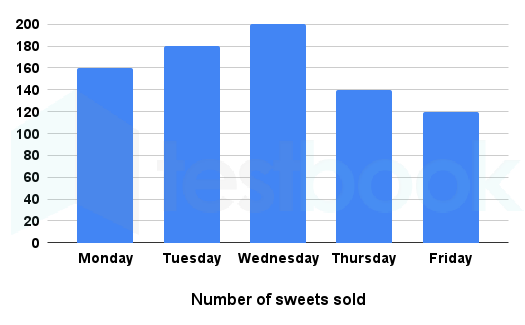
The bar graphs show the number of sweet sold in a shop on five days [ Monday, Tuesday, Wednesday, Thursday and Friday] of week.

Number of sweet sold on Monday is _____ less than the number of sweet sold on Tuesday and Number of sweet sold on Wednesday is ____ more than the number of sweet sold on Friday. Find which of the following satisfy the blank?

  1. AOption (a)

    40, 80

  2. BOption (b)

    20, 60

  3. COption (c)

    40, 60

  4. DOption (d)

    50, 60

  5. EOption (e)

    20, 80

View answer & explanation

Correct answer

Answer: (e)E.

20, 80

Why this answer is correct

Calculation:

Difference between Monday and Tuesday

⇒ 180 - 160 = 20

So, the number of sweets sold on Monday is 20 less than on Tuesday.

Difference between Wednesday and Friday

⇒ 200 - 120 = 80

So, the number of sweets sold on Wednesday is 80 more than on Friday.

∴ The correct answer is: 20, 80.

SBI Clerk Prelims Memory Based Paper (Held On: 22 February 2025 Shift 1) (Previous Year Paper)·Numerical Ability
View full paper

Question 7

IBPS RRB Office Assistant (Clerk) 2025• Numerical Ability• Numerical Ability

The bar graphs show the number of sweet sold in a shop on five days [ Monday, Tuesday, Wednesday, Thursday and Friday] of week.

Number of sweet sold on Thursday is [x + 45]. Find the value of x? 

  1. AOption (a)

    70

  2. BOption (b)

    80

  3. COption (c)

    95

  4. DOption (d)

    75

  5. EOption (e)

    105

View answer & explanation

Correct answer

Answer: (c)C.

95

Why this answer is correct

Calculation:

Number of sweets sold on Thursday = x + 45

From the provided data, the number of sweets sold on Thursday = 140

⇒ x + 45 = 140

⇒ x = 140 - 45

⇒ x = 95

∴ The value of x is 95.

SBI Clerk Prelims Memory Based Paper (Held On: 22 February 2025 Shift 1) (Previous Year Paper)·Numerical Ability
View full paper

Question 8

IBPS RRB Office Assistant (Clerk) 2025• Numerical Ability• Numerical Ability

The bar graphs show the number of sweet sold in a shop on five days [ Monday, Tuesday, Wednesday, Thursday and Friday] of week.

Ratio number of sweet sold on Friday and Saturday is 4:7. Find the number of sweet sold on Saturday?

  1. AOption (a)

    240

  2. BOption (b)

    260

  3. COption (c)

    290

  4. DOption (d)

    210

  5. EOption (e)

    285

View answer & explanation

Correct answer

Answer: (d)D.

210

Why this answer is correct

Calculation:

Number of sweets sold on Friday = 120

Ratio of sweets sold on Friday to Saturday = 4 : 7

We need to find the number of sweets sold on Saturday.

Since the number of sweets sold on Friday is given as 120:

⇒ 4x = 120

⇒ x = 120 / 4

⇒ x = 30

Now, the number of sweets sold on Saturday:

⇒ 7x = 7 × 30

⇒ 210

∴ The number of sweets sold on Saturday is 210.

SBI Clerk Prelims Memory Based Paper (Held On: 22 February 2025 Shift 1) (Previous Year Paper)·Numerical Ability
View full paper

Question 9

IBPS RRB Office Assistant (Clerk) 2025• Numerical Ability• Numerical Ability

The bar graphs show the number of sweet sold in a shop on five days [ Monday, Tuesday, Wednesday, Thursday and Friday] of week.

Find the difference between number of sweet sold on Wednesday and Thursday together and number of sweet sold on Monday and Tuesday together?

  1. AOption (a)

    4

  2. BOption (b)

    6

  3. COption (c)

    70

  4. DOption (d)

    0

  5. EOption (e)

    50

View answer & explanation

Correct answer

Answer: (d)D.

0

Why this answer is correct

Calculation:

Total sweets sold on Wednesday and Thursday

⇒ 200 + 140 = 340

Total sweets sold on Monday and Tuesday

⇒ 160 + 180 = 340

Required difference

⇒ 340 - 340 = 0

∴ The difference between the number of sweets sold on Wednesday and Thursday together and Monday and Tuesday together is 0.

SBI Clerk Prelims Memory Based Paper (Held On: 22 February 2025 Shift 1) (Previous Year Paper)·Numerical Ability
View full paper

Question 10

IBPS RRB Office Assistant (Clerk) 2025• Numerical Ability• Numerical Ability

The bar graphs show the number of sweet sold in a shop on five days [ Monday, Tuesday, Wednesday, Thursday and Friday] of week.

Only 40% and 60% sweet sold at shop on Monday and Tuesday out of total sweet made. Find the total number of unsold sweet on Monday and Tuesday together?

  1. AOption (a)

    560

  2. BOption (b)

    360

  3. COption (c)

    320

  4. DOption (d)

    270

  5. EOption (e)

    280

View answer & explanation

Correct answer

Answer: (b)B.

360

Why this answer is correct

Calculation:

Number of sweets sold on Monday = 160

Only 40% of the total sweets made were sold on Monday.

Total sweets made on Monday:

⇒ (160 × 100) / 40

⇒ 16000 / 40 = 400

Unsold sweets on Monday:

⇒ 400 - 160 = 240

Number of sweets sold on Tuesday = 180

Only 60% of the total sweets made were sold on Tuesday.

Total sweets made on Tuesday:

⇒ (180 × 100) / 60

⇒ 300

Unsold sweets on Tuesday:

⇒ 300 - 180 = 120

Total unsold sweets = Unsold sweets on Monday + Unsold sweets on Tuesday

⇒ 240 + 120 = 360

∴ The total number of unsold sweets on Monday and Tuesday together is 360.

SBI Clerk Prelims Memory Based Paper (Held On: 22 February 2025 Shift 1) (Previous Year Paper)·Numerical Ability
View full paper

Question 11

IBPS RRB Office Assistant (Clerk) 2025• Numerical Ability• Numerical Ability

What should come in place of the question mark (?) in the following question?

162 + (5/8) of 344 + ? = 500

  1. AOption (a)

    19

  2. BOption (b)

    23

  3. COption (c)

    29

  4. DOption (d)

    31

  5. EOption (e)

    17

View answer & explanation

Correct answer

Answer: (c)C.

29

Why this answer is correct

Given:

162 + (5/8) of 344 + ? = 500

Concept used:

Follow the BODMAS rule according to the table given below:

Calculation:

162 + (5/8) of 344 + ? = 500

⇒ 256 + (5/8) of 344 + ? = 500

⇒ 256 + 215 + ? = 500

⇒ ? = 500 - 471

⇒ ? = 29

∴ 29 should come in place of the question mark (?).

SBI Clerk Prelims Memory Based Paper (Held On: 22 February 2025 Shift 1) (Previous Year Paper)·Numerical Ability
View full paper

Question 12

IBPS RRB Office Assistant (Clerk) 2025• Numerical Ability• Numerical Ability

What should come in place of the question mark '?' in the following question?

10% of 450 - (8 × 5) = ? × 5

  1. AOption (a)

    8.2

  2. BOption (b)

    2

  3. COption (c)

    1

  4. DOption (d)

    5

  5. EOption (e)

    None of these

View answer & explanation

Correct answer

Answer: (c)C.

1

Why this answer is correct

Given:

10% of 450 - (8 × 5) = ? × 5

Concept used:

Follow the BODMAS rule according to the table given below:

Calculation:

10% of 450 - (8 × 5) = ? × 5

⇒ 45 - 40 = ? × 5

⇒ 5 = ? × 5

⇒ ? = 1

∴ The value of '?' is 1.

SBI Clerk Prelims Memory Based Paper (Held On: 22 February 2025 Shift 1) (Previous Year Paper)·Numerical Ability
View full paper

Question 13

IBPS RRB Office Assistant (Clerk) 2025• Numerical Ability• Numerical Ability

What should come in place of the question mark (?) in the following question?

78 ÷ 6 × 5 + √625 = ? × 9

  1. AOption (a)

    9

  2. BOption (b)

    8

  3. COption (c)

    10

  4. DOption (d)

    7

  5. EOption (e)

    6

View answer & explanation

Correct answer

Answer: (c)C.

10

Why this answer is correct

Given:

78 ÷ 6 × 5 + √625 = ? × 9

Concept used:

Follow the BODMAS rule according to the table given below:

Calculation:

78 ÷ 6 × 5 + √625 = ? × 9

⇒ 13 × 5 + 25 = ? × 9

⇒ 65 + 25 = ? × 9

⇒ ? × 9 = 90

⇒ ? = 10

∴ 10 should come in place of the question mark (?).

SBI Clerk Prelims Memory Based Paper (Held On: 22 February 2025 Shift 1) (Previous Year Paper)·Numerical Ability
View full paper

Question 14

IBPS RRB Office Assistant (Clerk) 2025• Numerical Ability• Numerical Ability

What should come in place of the question mark (?) in the following question?

122 × 5 - √400 + ? × 5 = 850

  1. AOption (a)

    20

  2. BOption (b)

    25

  3. COption (c)

    30

  4. DOption (d)

    35

  5. EOption (e)

    40

View answer & explanation

Correct answer

Answer: (c)C.

30

Why this answer is correct

Given:

122 × 5 - √400 + ? × 5 = 850

Concept used:

Follow the BODMAS rule according to the table given below:

Calculation:

122 × 5 - √400 + ? × 5 = 850

⇒ 144 × 5 - 20 + ? × 5 = 850

⇒ 720 - 20 + ? × 5 = 850

⇒ ? × 5 = 150

⇒ ? = 30

∴ 30 should come in place of the question mark (?).

SBI Clerk Prelims Memory Based Paper (Held On: 22 February 2025 Shift 1) (Previous Year Paper)·Numerical Ability
View full paper

Question 15

IBPS RRB Office Assistant (Clerk) 2025• Numerical Ability• Numerical Ability

What will come in the place of the question mark ‘?’ in the following question?

20 - 102 = 41 - ?2

  1. AOption (a)

    12

  2. BOption (b)

    10

  3. COption (c)

    7

  4. DOption (d)

    11

  5. EOption (e)

    9

View answer & explanation

Correct answer

Answer: (d)D.

11

Why this answer is correct

Given:

20 - 102 = 41 - ?2 

Concept used:

Follow the BODMAS rule according to the table given below:

Calculation:

20 - 102 = 41 - ?2 

⇒ 20 - 100 = 41 - ?2

⇒ -80 = 41 - ?2

⇒ ?2 = 121

⇒ ? = 11

∴ The value of ? is 11.

SBI Clerk Prelims Memory Based Paper (Held On: 22 February 2025 Shift 1) (Previous Year Paper)·Numerical Ability
View full paper

Question 16

IBPS RRB Office Assistant (Clerk) 2025• Numerical Ability• Numerical Ability

What will come in the place of the question mark ‘?’ in the following question?

5656 ÷ 28 × 11 - 333 = ?

  1. AOption (a)

    1789

  2. BOption (b)

    1989

  3. COption (c)

    1889

  4. DOption (d)

    2089

  5. EOption (e)

    None of these

View answer & explanation

Correct answer

Answer: (c)C.

1889

Why this answer is correct

Given:

5656 ÷ 28 × 11 - 333 = ?

Concept used:

Follow the BODMAS rule according to the table given below:

Calculation:

5656 ÷ 28 × 11 - 333 = ?

⇒ 202 × 11 - 333 = ?

⇒ 2222 - 333 = ?

⇒ ? = 1889

∴ The value of ? is 1889.

SBI Clerk Prelims Memory Based Paper (Held On: 22 February 2025 Shift 1) (Previous Year Paper)·Numerical Ability
View full paper

Question 17

IBPS RRB Office Assistant (Clerk) 2025• Numerical Ability• Numerical Ability

What should come in the place of the question mark ‘?’ in the following question?

90 × 20% of 105 ÷ 3 = ?

  1. AOption (a)

    630

  2. BOption (b)

    600

  3. COption (c)

    615

  4. DOption (d)

    610

  5. EOption (e)

    None of these

View answer & explanation

Correct answer

Answer: (a)A.

630

Why this answer is correct

Given:

90 × 20% of 105 ÷ 3 = ?

Concept Used:

Follow the BODMAS rule according to the table given below:

Calculation:

90 × 20% of 105 ÷ 3 = ?

⇒ 90 × (1/5) × 105/3 = ?

⇒ 18 × 35 = ?

⇒ ? = 630

∴ The value of ‘?’ Is 630.

Hint

20% = 1/5

SBI Clerk Prelims Memory Based Paper (Held On: 22 February 2025 Shift 1) (Previous Year Paper)·Numerical Ability
View full paper

Question 18

IBPS RRB Office Assistant (Clerk) 2025• Numerical Ability• Numerical Ability

What should come in the place of the question mark ‘?’ in the following question?

440 + 1825 ÷ 25 + 102 = 215 + ?

  1. AOption (a)

    375

  2. BOption (b)

    400

  3. COption (c)

    425

  4. DOption (d)

    450

  5. EOption (e)

    None of these

View answer & explanation

Correct answer

Answer: (b)B.

400

Why this answer is correct

Given:

440 + 1825 ÷ 25 + 102 = 215 + ?

Concept Used:

Follow the BODMAS rule according to the table given below:

Calculation:

440 + 1825 ÷ 25 + 102 = 215 + ?

⇒ 440 + (1825/25) + 102 = 215 + ?

⇒ 440 + 73 + 102 - 215 = ?

⇒ ? = 400

∴ The value of ‘?’ Is 400.

SBI Clerk Prelims Memory Based Paper (Held On: 22 February 2025 Shift 1) (Previous Year Paper)·Numerical Ability
View full paper

Question 19

IBPS RRB Office Assistant (Clerk) 2025• Numerical Ability• Numerical Ability

What will come in the place of the question mark ‘?’ in the following question?

(4/9) of (729/2) + 400 = ?

  1. AOption (a)

    462

  2. BOption (b)

    662

  3. COption (c)

    562

  4. DOption (d)

    362

  5. EOption (e)

    262

View answer & explanation

Correct answer

Answer: (c)C.

562

Why this answer is correct

Given:

(4/9) of (729/2) + 400 = ?

Concept used:

Follow the BODMAS rule according to the table given below:

Calculation:

(4/9) of (729/2) + 400 = ?

⇒ 81 × 2 + 400 = ?

⇒ 162 + 400 = ?

⇒ ? = 562

∴ The value of ? is 562.

SBI Clerk Prelims Memory Based Paper (Held On: 22 February 2025 Shift 1) (Previous Year Paper)·Numerical Ability
View full paper

Question 20

IBPS RRB Office Assistant (Clerk) 2025• Numerical Ability• Numerical Ability

What will come in the place of the question mark '?' in the following question?

 378 + ?1/2 = 25% of 2400 - 192

  1. AOption (a)

     784

  2. BOption (b)

     900

  3. COption (c)

     576

  4. DOption (d)

     400

  5. EOption (e)

     625

View answer & explanation

Correct answer

Answer: (b)B.

 900

Why this answer is correct

Given :

 378 + ?1/2 = 25% of 2400 - 192

 Calculation :

  378 + ?1/2  = 25% of 2400 - 192

 ⇒ 378 + ?1/2 = (2400 × 1 / 4 ) - 192

 ⇒ 378 + ?1/2 = 600 - 192

 ⇒ ?1/2  = 408 - 378

 ⇒ ?1/2  = 30

 ⇒ (?)2×1/2 = 302

 ⇒ ? = 900

 Hence,900 will come in the place of '?'.

PreviousPage 1 of 97Next Page

How should I prepare for Quantitative Aptitude in IBPS RRB Office Assistant (Clerk)?

Solving previous year questions by topic helps identify recurring concepts, question patterns, and frequently asked sub-topics. Attempt each question, review the step-by-step explanation, and note down key formulas or facts for quick revision before the exam.