IBPS Probationary Officer (PO) · Topic Collection

Quantitative Aptitude PYQs

Arithmetic, number systems, percentages, ratios, profit and loss, time and work, algebra, geometry, mensuration, and trigonometry.

1305 Total Questions38 Official PapersYears: 2021–2026Search in Quantitative Aptitude
Showing questions 541–560 of 1305Page 28 of 66
IBPS PO Prelims Memory Based Paper (Held On: 20 October 2024 Shift 2) (Previous Year Paper)·Quantitative Aptitude
View full paper

Question 541

IBPS Probationary Officer (PO) 2024• Quantitative Aptitude• Quantitative Aptitude

What will come in place of question mark (?) in the following number series?

500, 501, 1004, 3015, 12064, ?

  1. AOption (a)

    63250

  2. BOption (b)

    603250

  3. COption (c)

    60325

  4. DOption (d)

    503250

  5. EOption (e)

    None of these

View answer & explanation

Correct answer

Answer: (c)C.

60325

Why this answer is correct

500 × 1 + 1 = 501

501 × 2 + 2 = 1004

1004 × 3 + 3 = 3015

3015 × 4 + 4 = 12064

By observing the pattern,

12064 × 5 + 5 = ?

⇒ ? = 60325

∴ The value of ? is 60325

IBPS PO Prelims Memory Based Paper (Held On: 20 October 2024 Shift 2) (Previous Year Paper)·Quantitative Aptitude
View full paper

Question 542

IBPS Probationary Officer (PO) 2024• Quantitative Aptitude• Quantitative Aptitude

What will come in place of question mark (?) in the following number series?

18, 21, 27, 39, ?, 111

  1. AOption (a)

    63

  2. BOption (b)

    36

  3. COption (c)

    66

  4. DOption (d)

    60

  5. EOption (e)

    None of these

View answer & explanation

Correct answer

Answer: (a)A.

63

Why this answer is correct

Calculation:

The series follows the following pattern

18 + 3 = 21

21 + 6 = 27

27 + 12 = 39

39 + 24 = 63

63 + 48 = 111

∴ The missing number is 63.

IBPS PO Prelims Memory Based Paper (Held On: 20 October 2024 Shift 2) (Previous Year Paper)·Quantitative Aptitude
View full paper

Question 543

IBPS Probationary Officer (PO) 2024• Quantitative Aptitude• Quantitative Aptitude

What will come in the place of the question mark ‘?’ in the following question?

2 , 7 , 14 , 24 , ? , 57

  1. AOption (a)

    38

  2. BOption (b)

    49

  3. COption (c)

    45

  4. DOption (d)

    35

  5. EOption (e)

    None of these

View answer & explanation

Correct answer

Answer: (a)A.

38

Why this answer is correct

Given:

2 , 7 , 14 , 24 , ? , 57 

Calculation:

Difference between first and second number = 7 - 2 = 5

Difference between second and third number = 14 - 7 = 7

Difference between third and fourth number = 24 - 14 = 10

Difference of difference between (second and third, first and second) number = 7 - 5 = 2

Difference of difference between (third and fourth, second and third) = 10 - 7 = 3

As, we can see the numbers are in sequence of 2, 3, 4

∴ Next number is 24 + (10 + 4) = 38.

IBPS PO Prelims Memory Based Paper (Held On: 20 October 2024 Shift 2) (Previous Year Paper)·Quantitative Aptitude
View full paper

Question 544

IBPS Probationary Officer (PO) 2024• Quantitative Aptitude• Quantitative Aptitude

What will come in place of question mark (?) in the following number series?

400, 200, 100, ?, 25, 12.5

  1. AOption (a)

    50

  2. BOption (b)

    70

  3. COption (c)

    75

  4. DOption (d)

    80

  5. EOption (e)

    40

View answer & explanation

Correct answer

Answer: (a)A.

50

Why this answer is correct

Given:

The number series:

400, 200, 100, ?, 25, 12.5

Concept Used:

Number series following a fixed pattern.

Calculation;

The given number series follows the pattern:

400 × 0.5 = 200

200 × 0.5 = 100

100 × 0.5 = 50

50 × 0.5 = 25

25 × 0.5 = 12.5

∴ The number in place of “?” in the given number series is 50

IBPS PO Prelims Memory Based Paper (Held On: 20 October 2024 Shift 2) (Previous Year Paper)·Quantitative Aptitude
View full paper

Question 545

IBPS Probationary Officer (PO) 2024• Quantitative Aptitude• Quantitative Aptitude

What should come in place of the question mark '?' in the following number series?

1722, 2188, 2732, 3360, ?

  1. AOption (a)

    4072

  2. BOption (b)

    4081

  3. COption (c)

    4075

  4. DOption (d)

    4084

  5. EOption (e)

    4078

View answer & explanation

Correct answer

Answer: (e)E.

4078

Why this answer is correct

The correct answer is: 5


Given:

1722, 2188, 2732, 3360, ?

Calculation:

the series follows the following pattern:

123 - 6 = 1722

133 - 9 = 2188

143 - 12 = 2732

153 - 15 = 3360

163 - 18 = 4078


∴ 4078 will come in place of ?

IBPS PO Prelims Memory Based Paper (Held On: 20 October 2024 Shift 2) (Previous Year Paper)·Quantitative Aptitude
View full paper

Question 546

IBPS Probationary Officer (PO) 2024• Quantitative Aptitude• Quantitative Aptitude

What will come in place of question mark (?) in the following number series?

320, 162, 84, 46, 28, ?

  1. AOption (a)

    16

  2. BOption (b)

    22

  3. COption (c)

    14

  4. DOption (d)

    18

  5. EOption (e)

    20

View answer & explanation

Correct answer

Answer: (e)E.

20

Why this answer is correct

Calculation:

The pattern of the number series is-

⇒ 320 ÷ 2 + 2 =162

⇒ 162 ÷ 2 + 3 = 84

⇒ 84 ÷ 2 + 4 = 46

⇒ 46 ÷ 2 + 5 = 28 

⇒ 28 ÷ 2 + 6 = 20

∴ The value of ? is 20

IBPS PO Prelims Memory Based Paper (Held On: 20 October 2024 Shift 2) (Previous Year Paper)·Quantitative Aptitude
View full paper

Question 547

IBPS Probationary Officer (PO) 2024• Quantitative Aptitude• Quantitative Aptitude

Kabir sold his old washing machine for Rs. 10500 which he bought 6 months before, on that washing machine he incurred a loss of 20%. To gain 20% profit at what price he needs to sell the washing machine.

  1. AOption (a)

    16550

  2. BOption (b)

    17240

  3. COption (c)

    18000

  4. DOption (d)

    17650

  5. EOption (e)

    15750

View answer & explanation

Correct answer

Answer: (e)E.

15750

Why this answer is correct

Shortcut Trick

Loss of 20% means Selling Price (SP1) = 100% − 20% = 80%.

Profit of 20% means New Selling Price (SP2) = 100% + 20% = 120%.

According to the question, 80% corresponds to Rs. 10500.

New SP (120%) = (10500 ÷ 80) × 120 = 10500 × (3 ÷ 2).

New SP = 5250 × 3 = 15750.

∴ The correct answer is Rs. 15750.

Alternate Method

Given → Initial SP = Rs. 10500, Initial Loss = 20%, Target Profit = 20%.

Formulas: CP = [SP × 100] ÷ [100 − Loss%]; New SP = [CP × (100 + Gain%)] ÷ 100.

⇒ Step 1: Calculate CP = (10500 × 100) ÷ (100 − 20) = (10500 × 100) ÷ 80 = Rs. 13125.

⇒ Step 2: Calculate New SP = 13125 × (120 ÷ 100) = 13125 × 1.2.

⇒ Step 3: New SP = Rs. 15750.

∴ The correct answer is Rs. 15750.

Additional Information

Cost Price (CP) and Selling Price (SP)

CP is the price at which an article is purchased. SP is the price at which it is sold.

Profit and Loss Percentage

Profit% = (Profit ÷ CP) × 100. Loss% = (Loss ÷ CP) × 100. Both are always calculated on CP unless stated otherwise.

IBPS PO Prelims Memory Based Paper (Held On: 20 October 2024 Shift 2) (Previous Year Paper)·Quantitative Aptitude
View full paper

Question 548

IBPS Probationary Officer (PO) 2024• Quantitative Aptitude• Quantitative Aptitude

Directions: Study the following information carefully and answer the questions.

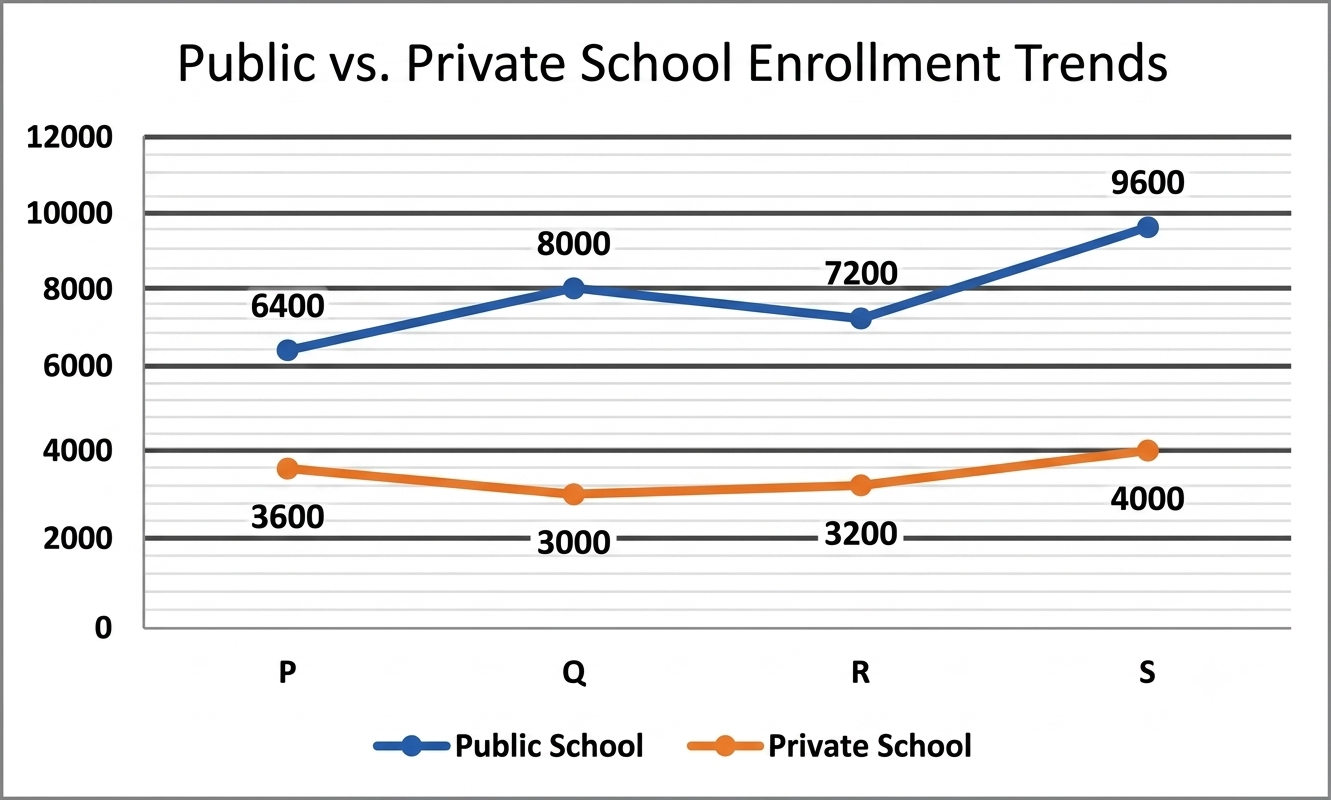
The line graph below shows the number of students studying in public school and in private schools in four cities P, Q , R and S.

Find the ratio between the total number of students (public + private) in City P, City Q, and City S together to the total number of students in private schools in City Q and City R together.

  1. AOption (a)

    112: 53

  2. BOption (b)

    123:18

  3. COption (c)

    173:31

  4. DOption (d)

    151:14

  5. EOption (e)

    None of these

View answer & explanation

Correct answer

Answer: (c)C.

173:31

Why this answer is correct

Compute total students in each required city:

City P total = Public + Private = 6400 + 3600 = 10000

City Q total = 8000 + 3000 = 11000

City S total = 9600 + 4000 = 13600

Sum of totals for P, Q and S:

⇒ 10000 + 11000 + 13600 = 34600

Total private students in Q and R:

Q (private) = 3000

R (private) = 3200

⇒ Sum = 3000 + 3200 = 6200

Required ratio:

⇒ (Total of P + Q + S) : (Private in Q + R) = 34600 : 6200 ⇒ 173 : 31

Hence, the correct answer is 173:31.

IBPS PO Prelims Memory Based Paper (Held On: 20 October 2024 Shift 2) (Previous Year Paper)·Quantitative Aptitude
View full paper

Question 549

IBPS Probationary Officer (PO) 2024• Quantitative Aptitude• Quantitative Aptitude

Directions: Study the following information carefully and answer the questions.

The line graph below shows the number of students studying in public school and in private schools in four cities P, Q , R and S.

The total number of students in public schools in City P and City R together is how much less than the total number of students (public + private) in City R and City S together?

  1. AOption (a)

    6,200

  2. BOption (b)

    38,000

  3. COption (c)

    10,400

  4. DOption (d)

    29,100

  5. EOption (e)

    None of these

View answer & explanation

Correct answer

Answer: (c)C.

10,400

Why this answer is correct

Given values:

Public School, City P = 6400

Public School, City R = 7200

Private School, City R = 3200

Public School, City S = 9600

Private School, City S = 4000

Compute totals:

Public (P + R) = 6400 + 7200 = 13600

Total (R public + R private) = 7200 + 3200 = 10400

Total (S public + S private) = 9600 + 4000 = 13600

Total (R + S) = 10400 + 13600 = 24000

Required difference:

Difference = 24000 − 13600 = 10400

Hence, the correct answer is 10,400.

IBPS PO Prelims Memory Based Paper (Held On: 20 October 2024 Shift 2) (Previous Year Paper)·Quantitative Aptitude
View full paper

Question 550

IBPS Probationary Officer (PO) 2024• Quantitative Aptitude• Quantitative Aptitude

Directions: Study the following information carefully and answer the questions.

The line graph below shows the number of students studying in public school and in private schools in four cities P, Q , R and S.

The total number of students in public schools in City Q and City S together is what percent of the total students in private schools in the same cities?

  1. AOption (a)

    3 (169/11)%

  2. BOption (b)

    251 (3/7)%

  3. COption (c)

    25 (50/13%

  4. DOption (d)

    196 (1/5)%

  5. EOption (e)

    None of these

View answer & explanation

Correct answer

Answer: (b)B.

251 (3/7)%

Why this answer is correct

Totals for Cities Q and S:

Public (Q) = 8000

Public (S) = 9600

⇒ Total Public (Q + S) = 8000 + 9600 = 17600

Private (Q) = 3000

Private (S) = 4000

⇒ Total Private (Q + S) = 3000 + 4000 = 7000

Required percentage:

Percentage = (Total Public (Q+S) ÷ Total Private (Q+S)) × 100

⇒ (17600 ÷ 7000) × 100 = (176 ÷ 70) × 100 = (88 ÷ 35) × 100

⇒ 88 × 100 ÷ 35 = 8800 ÷ 35 ≈ 251.43%

Hence, the correct answer is 251 (3/7)%.

IBPS PO Prelims Memory Based Paper (Held On: 20 October 2024 Shift 2) (Previous Year Paper)·Quantitative Aptitude
View full paper

Question 551

IBPS Probationary Officer (PO) 2024• Quantitative Aptitude• Quantitative Aptitude

Directions: Study the following information carefully and answer the questions.

The line graph below shows the number of students studying in public school and in private schools in four cities P, Q , R and S.

Out of the total students in public and private schools in City R, 54% and 28% respectively were awarded for their performances. Find the total percentage of students in City R who were not awarded for their performances. 

  1. AOption (a)

    54%

  2. BOption (b)

    57%

  3. COption (c)

    48%

  4. DOption (d)

    49%

  5. EOption (e)

    56%

View answer & explanation

Correct answer

Answer: (a)A.

54%

Why this answer is correct

City R:

Public school students = 7200

Private school students = 3200

Awarded in Public school = 54% of 7200

Awarded in Private school = 28% of 3200

Awarded (Public) = 54% × 7200 = 0.54 × 7200 = 3888

Awarded (Private) = 28% × 3200 = 0.28 × 3200 = 896

Total Awarded = 3888 + 896 = 4784

Total students in City R = 7200 + 3200 = 10400

Not awarded = 10400 − 4784 = 5616

Percentage not awarded = (5616 ÷ 10400) × 100 = 0.54 × 100 = 54%

Hence, the correct answer is 54%.

IBPS PO Prelims Memory Based Paper (Held On: 20 October 2024 Shift 2) (Previous Year Paper)·Quantitative Aptitude
View full paper

Question 552

IBPS Probationary Officer (PO) 2024• Quantitative Aptitude• Quantitative Aptitude

Directions: Study the following information carefully and answer the questions.

The line graph below shows the number of students studying in public school and in private schools in four cities P, Q , R and S.

Find the average number of students in private schools across all four cities.

  1. AOption (a)

    3450

  2. BOption (b)

    3780

  3. COption (c)

    3810

  4. DOption (d)

    3920

  5. EOption (e)

    3640

View answer & explanation

Correct answer

Answer: (a)A.

3450

Why this answer is correct

Private school students:

P = 3600

Q = 3000

R = 3200

S = 4000

Total private school students = 3600 + 3000 + 3200 + 4000 = 13,800

Average = Total ÷ 4 = 13,800 ÷ 4 = 3,450

Hence, the correct answer is 3,450.

IBPS PO Prelims Memory Based Paper (Held On: 20 October 2024 Shift 2) (Previous Year Paper)·Quantitative Aptitude
View full paper

Question 553

IBPS Probationary Officer (PO) 2024• Quantitative Aptitude• Quantitative Aptitude

There are 37 students in a class and the average of the age of the class is 16 years. If the age of the lady teacher is also included then the average increased by 6 months. Find the age of the lady teacher.

  1. AOption (a)

    33 years

  2. BOption (b)

    34 years

  3. COption (c)

    36 years

  4. DOption (d)

    35 years

  5. EOption (e)

    37 years

View answer & explanation

Correct answer

Answer: (d)D.

35 years

Why this answer is correct

Shortcut Trick

Age of Teacher = Original Average + (New Total Members × Increase in Average)

Total students = 37; After teacher joins, Total members = 37 + 1 = 38

Increase in average = 6 months = 0.5 years

⇒ Teacher age = 16 + (38 × 0.5) = 16 + 19 = 35 years

∴ The correct answer is 35 years.

Alternate Method

Given: Number of students = 37; Average age = 16 years; New Average = 16.5 years.

Formula: Total Sum = Average × Number of items

⇒ Total age of 37 students = 37 × 16 = 592 years

⇒ Total members including teacher = 37 + 1 = 38

⇒ New average = 16 years + 6 months = 16.5 years

⇒ Total age of 38 members = 38 × 16.5 = 627 years

⇒ Age of Lady Teacher = Total (38) − Total (37)

⇒ Age = 627 − 592 = 35 years

∴ The correct answer is 35 years.

Additional Information

Inclusion/Exclusion Rule

When a new person joins and the average increases, the new person age = Old Average + (New Total Count × Rise in Average).

Weighted Average

Used when two groups are combined: Combined Average = (n1x1 + n2x2) ÷ (n1 + n2).

IBPS PO Prelims Memory Based Paper (Held On: 20 October 2024 Shift 2) (Previous Year Paper)·Quantitative Aptitude
View full paper

Question 554

IBPS Probationary Officer (PO) 2024• Quantitative Aptitude• Quantitative Aptitude

Speed of boat A travelling in still water is 15 km/hr. Speed of boat B is 40% of twice of speed of boat A in still water. A is travelling upstream and B is travelling downstream, find the time(in hours) for boats to meet if the river is 108 km long.

  1. AOption (a)

    2

  2. BOption (b)

    3

  3. COption (c)

    4

  4. DOption (d)

    none of these

  5. EOption (e)

    cannot be determined

View answer & explanation

Correct answer

Answer: (c)C.

4

Why this answer is correct

Shortcut Trick

Speed of Boat A in still water (uA) = 15 km/hr

Speed of Boat B in still water (uB) = 40% of (2 × 15) = 12 km/hr

When one boat travels upstream and the other travels downstream, the relative speed of the boats is simply the sum of their speeds in still water, because the stream speed (v) cancels out: (uA − v) + (uB + v) = uA + uB = 15 + 12 = 27 km/hr

Meeting time = Distance ÷ Relative Speed = 108 ÷ 27 = 4 hours

∴ The correct answer is 4 hours.

Alternate Method

Given:

Speed of boat A in still water (uA) = 15 km/hr

Speed of boat B in still water (uB) = 40% of (2 × 15) = 0.40 × 30 = 12 km/hr

Total distance between boats = 108 km

Let the speed of the stream be v km/hr.

Formula Used:

Upstream speed of Boat A = uA − v = 15 − v

Downstream speed of Boat B = uB + v = 12 + v

Relative speed = Speed of A + Speed of B

Time to meet = Total Distance ÷ Relative Speed

Calculations:

⇒ Relative Speed = (15 − v) + (12 + v)

⇒ Relative Speed = 15 + 12 = 27 km/hr

⇒ Time to meet = 108 ÷ 27

⇒ Time to meet = 4 hours

∴ The correct answer is 4 hours.

Additional Information

Relative Speed in Rivers

When two boats move towards each other, one going upstream and the other going downstream, the effect of the stream speed cancels out completely. The relative speed is simply the sum of their individual speeds in still water (u1 + u2).

Upstream and Downstream Formulas

Downstream speed (D) = u + v and Upstream speed (U) = u − v, where u is the speed of the boat in still water and v is the speed of the stream.

Finding Boat and Stream Speeds

Speed of boat in still water u = (D + U) ÷ 2, and Speed of stream v = (D − U) ÷ 2.
IBPS PO Prelims Memory Based Paper (Held On: 20 October 2024 Shift 2) (Previous Year Paper)·Quantitative Aptitude
View full paper

Question 555

IBPS Probationary Officer (PO) 2024• Quantitative Aptitude• Quantitative Aptitude

Find the approximate value of x in the following question.

x2 - (6.11 ×  56.13) = (28.9 ×  36.02) + (47.8 ×  32.2)

  1. AOption (a)

    42

  2. BOption (b)

    62

  3. COption (c)

    54

  4. DOption (d)

    48

  5. EOption (e)

    64

View answer & explanation

Correct answer

Answer: (c)C.

54

Why this answer is correct

Solution:

x2 - (6.11 ×  56.13) = (28.9 ×  36.02) + (47.8 ×  32.2)

x2 - (6 ×  56) = (29 ×  36 + 48 ×  32)

x2 - 336 = 1044 + 1536

x2 - 336 = 2580

x2 = 2580 + 336

x2 = 2916

x = √2916

x = 54

IBPS PO Prelims Memory Based Paper (Held On: 20 October 2024 Shift 2) (Previous Year Paper)·Quantitative Aptitude
View full paper

Question 556

IBPS Probationary Officer (PO) 2024• Quantitative Aptitude• Quantitative Aptitude

What approximate value should come in place the of question mark ? in the following question?

3.038 × 2.934 ÷ 242.93 = 9.03 × 3.03 × 80.99 × 2.994 ÷ ?

  1. AOption (a)

    3

  2. BOption (b)

    9

  3. COption (c)

    27

  4. DOption (d)

    81

  5. EOption (e)

    243

View answer & explanation

Correct answer

Answer: (d)D.

81

Why this answer is correct

Given expression is,

3.038 × 2.934 ÷ 242.93 = 9.03 × 3.03 × 80.99 × 2.994 ÷ ?

We can write the given values as:

3.03, 2.93 and 2.99 ≈ 3, 242.93 ≈ 243

9.03 ≈ 9 and 80.99 ≈ 81

Given expression is:

⇒ 38 × 34 ÷ 243 = 9 × 3 × 81 × 34 ÷ ?

⇒ 38 × 34 ÷ 35 = 32 × 3 × 34 × 34 ÷ ?

⇒ 3(8 + 4 – 5) = 3(2 + 1 + 4 + 4) ÷ ?

⇒ 37 = 311 ÷ ?

⇒ ? = 311 ÷ 37

⇒ ? = 3(11 – 7)

⇒ ? = 34

⇒ ? = 81

IBPS PO Prelims Memory Based Paper (Held On: 20 October 2024 Shift 2) (Previous Year Paper)·Quantitative Aptitude
View full paper

Question 557

IBPS Probationary Officer (PO) 2024• Quantitative Aptitude• Quantitative Aptitude

What should come in place of question mark (?) in the following questions? (You do not have to calculate the exact value.)

99.67 + 202.15 ÷ 1.97 – 32.20 = ?% of 1300.03

  1. AOption (a)

    2

  2. BOption (b)

    18

  3. COption (c)

    11

  4. DOption (d)

    13

  5. EOption (e)

    20

View answer & explanation

Correct answer

Answer: (d)D.

13

Why this answer is correct

Rules of Approximation:

  1. If a number has digits to the right of the decimal less than 5, then just drop the digits to the right of the decimal. The number so obtained will be the approximated value.
  2. If a number has digits to the right of the decimal more than 5, then just drop the digits to the right of the decimal and raise the remaining number by '1'.The number so obtained will be the approximated value.

Concept:

Follow BODMAS rule to solve this question, as per the order given below-

Step - 1: Parts of an equation enclosed in 'Brackets' must be solved first and following BODMAS rule in the bracket-

Step - 2: Any mathematical 'Of' or 'Exponent' must be solved next.

Step - 3: Next, the parts of the equation that contain 'Division' and 'Multiplication' are calculated.

Step - 4: Last but not least, the parts of the equation that contain 'Addition' and 'Subtraction' should be calculated.

Since we need to find out the approximate value, we can write these values to their nearest integers.

Calculation:

Given Expression,

99.67 + 202.15 ÷ 1.97 – 32.20 = ?% of 1300.03

We can also write values as:

99.67 ≈ 100, 202.15 ≈ 202, 1.97 ≈ 2, 32.20 ≈ 32, 1300.03 ≈ 1300

Given expression becomes,

⇒ 100 + 202 ÷ 2 – 32 = ?% of 1300

⇒ 100 + 101 – 32 = ?% of 1300

⇒ 201 – 32 = ?% of 1300

⇒ 169 = ?% of 1300

⇒ ? = (169 × 100)/1300

⇒ ? ≈ 13

IBPS PO Prelims Memory Based Paper (Held On: 20 October 2024 Shift 2) (Previous Year Paper)·Quantitative Aptitude
View full paper

Question 558

IBPS Probationary Officer (PO) 2024• Quantitative Aptitude• Quantitative Aptitude

What approximate value should come in place of the question mark (?) in the following question?

(484.30 ÷ 11.11) × 4.87 – 5.85 % of 700 = ? × 2.01 + 4.4

  1. AOption (a)

    80

  2. BOption (b)

    89

  3. COption (c)

    91

  4. DOption (d)

    60

  5. EOption (e)

    87

View answer & explanation

Correct answer

Answer: (e)E.

87

Why this answer is correct

Follow BODMAS rule to solve this question, as per the order given below,

Step-1- Parts of an equation enclosed in 'Brackets' must be solved first, and in the bracket,

Step-2- Any mathematical 'Of' or 'Exponent' must be solved next,

Step-3- Next, the parts of the equation that contain 'Division' and 'Multiplication' are calculated,

Step-4- Last but not the least, the parts of the equation that contain 'Addition' and 'Subtraction' should be calculated.

Given Expression,

(484.30 ÷ 11.11) × 4.87 – 5.85 % of 700 = ? × 2.01 + 4.4

We can also write values as:

484.30 ≈ 484, 11.11 ≈ 11, 4.87 ≈ 5, 2.01 ≈ 2, 4.4 ≈ 4, 5.85 ≈ 6

Given expression becomes,

⇒ (484 ÷ 11) × 5 – 6 % of 700 = ? × 2 + 4

⇒ 44 × 5 – 6/100 × 7 = ? × 2 + 4

⇒ 220 – 42 = ? × 2 + 4

⇒ 178 = ? × 2 + 4

⇒ ? × 2 = 174

⇒ ? ≈ 87

IBPS PO Prelims Memory Based Paper (Held On: 20 October 2024 Shift 2) (Previous Year Paper)·Quantitative Aptitude
View full paper

Question 559

IBPS Probationary Officer (PO) 2024• Quantitative Aptitude• Quantitative Aptitude

Find the approximate value which should replace the question mark (?) in the following question.

√1765 ÷ √200 + (12.02 × 1.99 × 7.09)] = ? × 3 – 12

  1. AOption (a)

    51

  2. BOption (b)

    61

  3. COption (c)

    71

  4. DOption (d)

    81

  5. EOption (e)

    41

View answer & explanation

Correct answer

Answer: (b)B.

61

Why this answer is correct

Follow BODMAS rule to solve this question, as per the order given below,

Step-1- Parts of an equation enclosed in 'Brackets' must be solved first, and in the bracket,

Step-2- Any mathematical 'Of' or 'Exponent' must be solved next,

Step-3- Next, the parts of the equation that contain 'Division' and 'Multiplication' are calculated,

Step-4- Last but not least, the parts of the equation that contain 'Addition' and 'Subtraction' should be calculated.

Given expression is,

√1765 ÷ √200 + (12.02 × 1.99 × 7.09)] = ? × 3 – 12

Taking Approximate values,

√1765 ≈ √1764, √200 ≈ √196, 12.02 ≈ 12, 1.99 ≈ 2, 7.09 ≈ 7

⇒ 42 ÷ 14 + (12 × 2 × 7) = ? × 3 – 12  

⇒ 3 × ? = 171 + 12 = 183

∴ ? = 61

IBPS PO Prelims Memory Based Paper (Held On: 20 October 2024 Shift 2) (Previous Year Paper)·Quantitative Aptitude
View full paper

Question 560

IBPS Probationary Officer (PO) 2024• Quantitative Aptitude• Quantitative Aptitude

Kamal and Raju started a partnership for total of 3.5 years in such a way that initially Kamal invested Rs. 7500 for 24 months after that Kamal withdraws his amount and Raju invests certain capital for the remaining time. The profit Raju received after 3.5 years is Rs. 1400 out of total profit of Rs. 3000.What was the amount Raju invested.

  1. AOption (a)

    Rs. 9000

  2. BOption (b)

    Rs. 7500

  3. COption (c)

    Rs. 8400

  4. DOption (d)

    Rs. 8750

  5. EOption (e)

    Rs. 8000

View answer & explanation

Correct answer

Answer: (d)D.

Rs. 8750

Why this answer is correct

Shortcut Trick

Profit ratio Kamal : Raju = (3000 − 1400) : 1400 = 1600 : 1400 = 8 : 7.

Time ratio = 24 months : (42 − 24) months = 24 : 18 = 4 : 3.

Investment ratio = (Profit ÷ Time) ⇒ (8 ÷ 4) : (7 ÷ 3) = 2 : 7/3 = 6 : 7.

Since 6 units = Rs. 7500, then 1 unit = Rs. 1250.

Raju investment = 7 × 1250 = Rs. 8750.

∴ The correct answer is Rs. 8750.

Alternate Method

Given → Kamal Investment (Ck) = Rs. 7500, Time (Tk) = 24 months. Total time = 3.5 years = 42 months. Raju Time (Tr) = 42 − 24 = 18 months. Total profit = Rs. 3000, Raju Profit (Pr) = Rs. 1400.
Formulas: Profit Ratio = (Investment1 × Time1) : (Investment2 × Time2)

Steps:
⇒ Profit of Kamal (Pk) = Total Profit − Raju Profit = 3000 − 1400 = Rs. 1600.
⇒ Ratio of profits (Pk / Pr) = (Ck × Tk) / (Cr × Tr).
⇒ 1600 / 1400 = (7500 × 24) / (X × 18).
⇒ 8 / 7 = (7500 × 4) / (X × 3).
⇒ 8 × 3 × X = 7 × 7500 × 4.
⇒ 24X = 210000.
⇒ X = 210000 / 24 = Rs. 8750.

∴ The correct answer is Rs. 8750.

Additional Information

Partnership Basic Concept

In a partnership, the profit is distributed among partners in the ratio of the product of their invested capital and the duration of investment.

Investment Calculation

If profits and time periods are known, the investment ratio can be found by Investment = Profit ÷ Time.

How should I prepare for Quantitative Aptitude in IBPS Probationary Officer (PO)?

Solving previous year questions by topic helps identify recurring concepts, question patterns, and frequently asked sub-topics. Attempt each question, review the step-by-step explanation, and note down key formulas or facts for quick revision before the exam.