Previous Year Paper

IBPS PO Prelims Memory Based Paper (Held On: 20 October 2024 Shift 2) (Previous Year Paper)

Held in 2024

100 questions60 minutes
With answers
Free

Paper last updated:

Practise under exam conditions

Take this paper as a timed mock test. Review your answers after you submit.

Attempt timed test

Questions & answers

Read the paper at your pace. Open an explanation when you need it.

Reasoning Ability (35 questions)

Direction: Read the following information carefully and answer the questions based on given information.

Eight persons C, D, J, O, Q, T, W and Y sit around a rectangular table such that four persons sit at the corner face towards the centre and four persons sit at each side of the table face away from the centre but not necessarily in same order. J sits second to the left of O. Y sits opposite to W. C sits third to the left of D. J and Q sits immediate left to each other. J does not sit opposite to D. Y and D sits immediate left to each other. T faces neither away from centre nor sits opposite to C.

Question 1

Who among the following sit second to the left of one who sits opposite to Q?

  1. AOption (a)

    T

  2. BOption (b)

    Y

  3. COption (c)

    D

  4. DOption (d)

    J

  5. EOption (e)

    W

View answer & explanation

Correct answer

Answer: (b)B.

Y

Why this answer is correct

Here, persons are C, D, J, O, Q, T, W and Y.

  1. J sits second to the left of O.

  2. J and Q sit immediate left to each other.  

  3. Y sits opposite to W.

  4. Y and D sit immediate left to each other.

  5. C sits third to the left of D.

  6. J does not sit opposite to D. Therefore, case 1(b) and case 2(b) are eliminated.

  7. T faces neither away from centre nor sits opposite to C.  Therefore, case 2(a) is eliminated. Hence, the final arrangement is as follows

Since, C sits opposite to Q and Y sits second to the left of C.

Hence, the correct answer is Y.

Question 2

Find the odd one out.

  1. AOption (a)

    D

  2. BOption (b)

    T

  3. COption (c)

    J

  4. DOption (d)

    Q

  5. EOption (e)

    O

View answer & explanation

Correct answer

Answer: (d)D.

Q

Why this answer is correct

Here, persons are C, D, J, O, Q, T, W and Y.

  1. J sits second to the left of O.

  2. J and Q sit immediate left to each other.  

  3. Y sits opposite to W.

  4. Y and D sit immediate left to each other.

  5. C sits third to the left of D.

  6. J does not sit opposite to D. Therefore, case 1(b) and case 2(b) are eliminated.

  7. T faces neither away from centre nor sits opposite to C.  Therefore, case 2(a) is eliminated. Hence, the final arrangement is as follows

Since, all person except Q faces towards the centre whereas Q faces away from the centre.

Hence, the odd one is Q.

Question 3

Which of the following statement(s) is/are correct regarding C?

  1. AOption (a)

    C and O sits immediate left to each other.

  2. BOption (b)

    C sits opposite to Q.

  3. COption (c)

    Only two persons sit between C and Y.

  4. DOption (d)

    W sits second to the left of C.

  5. EOption (e)

    All of these.

View answer & explanation

Correct answer

Answer: (b)B.

C sits opposite to Q.

Why this answer is correct

Here, persons are C, D, J, O, Q, T, W and Y.

  1. J sits second to the left of O.

  2. J and Q sit immediate left to each other.  

  3. Y sits opposite to W.

  4. Y and D sit immediate left to each other.

  5. C sits third to the left of D.

  6. J does not sit opposite to D. Therefore, case 1(b) and case 2(b) are eliminated.

  7. T faces neither away from centre nor sits opposite to C.  Therefore, case 2(a) is eliminated. Hence, the final arrangement is as follows

Hence, the correct statement is C sits opposite to Q.

Question 4

What is the position of J with respect to Y?

  1. AOption (a)

    Third to the right.

  2. BOption (b)

    Fourth to the left.

  3. COption (c)

    Second to the left.

  4. DOption (d)

    Third to the left.

  5. EOption (e)

    Immediate right

View answer & explanation

Correct answer

Answer: (d)D.

Third to the left.

Why this answer is correct

Here, persons are C, D, J, O, Q, T, W and Y.

  1. J sits second to the left of O.

  2. J and Q sit immediate left to each other.  

  3. Y sits opposite to W.

  4. Y and D sit immediate left to each other.

  5. C sits third to the left of D.

  6. J does not sit opposite to D. Therefore, case 1(b) and case 2(b) are eliminated.

  7. T faces neither away from centre nor sits opposite to C.  Therefore, case 2(a) is eliminated. Hence, the final arrangement is as follows

Hence, J sits third to the left of Y.

Question 5

Which of the following statement(s) is/are incorrect?

A) C sits second to the right to Y.

B) J and T sits opposite to each other.

C) D sits fourth to the right of O.

  1. AOption (a)

    Both A and C

  2. BOption (b)

    Only B

  3. COption (c)

    Only A

  4. DOption (d)

    All of these

  5. EOption (e)

    None of these

View answer & explanation

Correct answer

Answer: (e)E.

None of these

Why this answer is correct

Here, persons are C, D, J, O, Q, T, W and Y.

  1. J sits second to the left of O.

  2. J and Q sit immediate left to each other.  

  3. Y sits opposite to W.

  4. Y and D sit immediate left to each other.

  5. C sits third to the left of D.

  6. J does not sit opposite to D. Therefore, case 1(b) and case 2(b) are eliminated.

  7. T faces neither away from centre nor sits opposite to C.  Therefore, case 2(a) is eliminated. Hence, the final arrangement is as follows

Since, C sits second to the right to Y. Therefore, statement A is correct.

J and T sits opposite to each other. Therefore, statement B is correct.

D sits fourth to the right of O. Therefore, statement C is correct.

Hence, the correct answer is None of these.

Question 6

Directions

In the following question assuming the given statement to be true,find which of the conclusion among the given conclusions is/are definitely true and then give your answers accordingly.

Statements: B ≥ F ≥ P ≥ K = V > R < Q ≤ T

Conclusions:

I. P > T

II. F < Q

  1. AOption (a)

    Only conclusion I follows

  2. BOption (b)

    Either conclusion I or II follows

  3. COption (c)

    Both conclusion I and II follows

  4. DOption (d)

    Only conclusion II follows

  5. EOption (e)

    Neither conclusion I nor II follows

View answer & explanation

Correct answer

Answer: (e)E.

Neither conclusion I nor II follows

Why this answer is correct

Given Statement: B ≥ F ≥ P ≥ K = V > R < Q ≤ T

Conclusions:

I. P > T → False (As P ≥ K = V > R < Q ≤ T therefore, no definite relation can be drawn. Hence, does not follow).

II. F < Q → False (As F ≥ P ≥ K = V > R < Q therefore, no definite relation can be drawn. Hence, does not follow).

Hence, the correct answer is neither conclusion I nor II follows.

Question 7

Directions

In the following question assuming the given statement to be true,find which of the conclusion among the given conclusions is/are definitely true and then give your answers accordingly.

Statement: H ≤ J ≤ M = S < U < X ≥ A ≥ E

Conclusions:

I. M < A

II. S ≥ A

  1. AOption (a)

    Only conclusion II follows

  2. BOption (b)

    Neither conclusion I nor II follows

  3. COption (c)

    Both conclusions I and II follow

  4. DOption (d)

    Either conclusion I or II follows

  5. EOption (e)

    Only conclusion I follows

View answer & explanation

Correct answer

Answer: (d)D.

Either conclusion I or II follows

Why this answer is correct

Given statement: H ≤ J ≤ M = S < U < X ≥ A ≥ E

Conclusions:

I. M < A → False (As M = S < U < X ≥ A  therefore, no definite relation can be drawn. Hence, does not follow).   

II. S ≥ A → False (As M = S < U < X ≥ A  therefore, no definite relation can be drawn. Hence, does not follow).   

Since, both conclusion I and II are complementary to each other.

Therefore, either conclusion I or II follows.

Hence. the correct answer is either conclusion I or II follows.

Question 8

Directions

In the following question assuming the given statement to be true,find which of the conclusion among the given conclusions is/are definitely true and then give your answers accordingly.

Statements: L ≤ O < Q, Z < V > Y, F ≥ Z ≥ C, O ≤ A < Y

Conclusions:

I. Q > Y

II. V > L

  1. AOption (a)

    Either conclusion I or II follows

  2. BOption (b)

    Both conclusions I and II follow

  3. COption (c)

    Only conclusion I follows

  4. DOption (d)

    Neither conclusion I nor II follows

  5. EOption (e)

    Only conclusion II follows

View answer & explanation

Correct answer

Answer: (e)E.

Only conclusion II follows

Why this answer is correct

Given statements: L ≤ O < Q, Z < V > Y, F ≥ Z ≥ C, O ≤ A < Y

Conclusions:

I. Q > Y → False (As Q > O ≤ A < Y therefore, no definite relation can be drawn between Q and Y. Hence, does not follow).

II. V > L → True (As V > Y ≥ A ≥ O ≥ L its clear V > L. Hence, follows).

Hence, the correct answer is only conclusion II follows.

Question 9

Directions

In the following question assuming the given statement to be true,find which of the conclusion among the given conclusions is/are definitely true and then give your answers accordingly.

Statements: I ≥ M > R, P ≤ S ≤ T, R < K = P, V ≤ L < T

Conclusions:

I. T > M

II. K  ≤ L

  1. AOption (a)

    Neither conclusion I nor II follows

  2. BOption (b)

    Either conclusion I or II follows

  3. COption (c)

    Only conclusion I follows

  4. DOption (d)

    Both conclusions I and II follow

  5. EOption (e)

    Only conclusion II follows

View answer & explanation

Correct answer

Answer: (a)A.

Neither conclusion I nor II follows

Why this answer is correct

Given Statements: I ≥ M > R, P ≤ S ≤ T, R < K = P, V ≤ L < T

Conclusions:

I. T > M → False (As M > R < K = P ≤ S ≤ T therefore, no definite relation can be drawn between T and M. Hence, does not follow.)

II. K  ≤ L → False (As K = P ≤ S ≤ T > L therefore, no definite relation can be drawn between K and L. Hence, does not follow.)

Hence, the correct answer is Neither conclusion I nor II follows.

Direction: Read the following information carefully and answer the questions based on given information.

Seven boxes D, F, H, K, M, R and U contains seven different fruits which are Apple, Banana, Grapes, Guava, Kiwi, Mango and Orange are placed one over another but not necessarily in same order. Box R placed three boxes above the box which contains Grapes. More than three boxes are placed between Box M and Box K which contains Orange. Only one box placed between Box D and the one which contains Guava. Box U placed just below the box which contains Banana. Box F placed just above the box K. As many boxes placed above the box which contains Mango as many placed below the box which contains Orange. The box contains Banana placed three boxes below the box D. M does not like Apple.

Question 10

In a certain way four of the five are alike find the one which does not follow the same pattern?

  1. AOption (a)

    M - Guava

  2. BOption (b)

    D - Kiwi

  3. COption (c)

    U - Banana

  4. DOption (d)

    K - Grapes

  5. EOption (e)

    U - Mango

View answer & explanation

Correct answer

Answer: (e)E.

U - Mango

Why this answer is correct

Here boxes are D, F, H, K, M, R and U; fruits are Apple, Banana, Grapes, Guava, Kiwi, Mango and Orange.

  1. As many boxes placed above the box which contains Mango as many placed below the box which contains Orange.

  2. More than three boxes are placed between Box M and Box K which contains Orange.

  3. Box F placed just above the box K.

Case – 1Case – 2Case – 3Case – 4
BoxesFruitsBoxesFruitsBoxesFruitsBoxesFruits
FMangoMMMango
KOrangeMMango
F
MangoFKOrangeF
MKOrangeKOrange


  1. The box contains Banana placed three boxes below the box D.

  2. Only one box placed between Box D and the one which contains Guava. Therefore, case 1 is eliminated.

  3. Box R placed three boxes above the box which contains Grapes.

Case – 2(a)Case – 2(b)Case – 3Case – 4
BoxesFruitsBoxesFruitsBoxesFruitsBoxesFruits
DMangoRMangoMMMango
MMDMangoD
RGuavaDR
BananaGrapesRGuavaGuava
GuavaFBananaBanana
FGrapesFBananaKOrangeFGrapes
KOrangeKOrangeGrapesKOrange


  1. Box U placed just below the box which contains Banana. Therefore, case 2(b), case 3 and case 4 are eliminated.

  2. M does not like Apple. Hence, the final arrangement is as follows

BoxesFruits
DMango
MKiwi
RGuava
HBanana
UApple
FGrapes
KOrange


Since, each pair represents boxes placed adjacent to each other whereas between Box U and the box that contains Mango three boxes are placed.

Hence, the correct answer is U - Mango.

Question 11

Which of the following box placed just above the box that contains Grapes?

  1. AOption (a)

    Box H

  2. BOption (b)

    The box that contains Apple.

  3. COption (c)

    Box M

  4. DOption (d)

    Box U

  5. EOption (e)

    Both 2 and 4

View answer & explanation

Correct answer

Answer: (e)E.

Both 2 and 4

Why this answer is correct

Here boxes are D, F, H, K, M, R and U; fruits are Apple, Banana, Grapes, Guava, Kiwi, Mango and Orange.

  1. As many boxes placed above the box which contains Mango as many placed below the box which contains Orange.

  2. More than three boxes are placed between Box M and Box K which contains Orange.

  3. Box F placed just above the box K.

Case – 1Case – 2Case – 3Case – 4
BoxesFruitsBoxesFruitsBoxesFruitsBoxesFruits
FMangoMMMango
KOrangeMMango
F
MangoFKOrangeF
MKOrangeKOrange


  1. The box contains Banana placed three boxes below the box D.

  2. Only one box placed between Box D and the one which contains Guava. Therefore, case 1 is eliminated.

  3. Box R placed three boxes above the box which contains Grapes.

Case – 2(a)Case – 2(b)Case – 3Case – 4
BoxesFruitsBoxesFruitsBoxesFruitsBoxesFruits
DMangoRMangoMMMango
MMDMangoD
RGuavaDR
BananaGrapesRGuavaGuava
GuavaFBananaBanana
FGrapesFBananaKOrangeFGrapes
KOrangeKOrangeGrapesKOrange


  1. Box U placed just below the box which contains Banana. Therefore, case 2(b), case 3 and case 4 are eliminated.

  2. M does not like Apple. Hence, the final arrangement is as follows

BoxesFruits
DMango
MKiwi
RGuava
HBanana
UApple
FGrapes
KOrange


Since, box U that contains Apple placed just the box F that contains Grapes.

Hence, the correct answer is Both 2 and 4.

Question 12

How many boxes are placed above the box that contains Kiwi?

  1. AOption (a)

    As many boxes placed below the box U.

  2. BOption (b)

    As many boxes placed between Box M and Box R.

  3. COption (c)

    As many boxes placed above the box R.

  4. DOption (d)

    As many boxes placed below the box F.

  5. EOption (e)

    None

View answer & explanation

Correct answer

Answer: (d)D.

As many boxes placed below the box F.

Why this answer is correct

Here boxes are D, F, H, K, M, R and U; fruits are Apple, Banana, Grapes, Guava, Kiwi, Mango and Orange.

  1. As many boxes placed above the box which contains Mango as many placed below the box which contains Orange.

  2. More than three boxes are placed between Box M and Box K which contains Orange.

  3. Box F placed just above the box K.

Case – 1Case – 2Case – 3Case – 4
BoxesFruitsBoxesFruitsBoxesFruitsBoxesFruits
FMangoMMMango
KOrangeMMango
F
MangoFKOrangeF
MKOrangeKOrange


  1. The box contains Banana placed three boxes below the box D.

  2. Only one box placed between Box D and the one which contains Guava. Therefore, case 1 is eliminated.

  3. Box R placed three boxes above the box which contains Grapes.

Case – 2(a)Case – 2(b)Case – 3Case – 4
BoxesFruitsBoxesFruitsBoxesFruitsBoxesFruits
DMangoRMangoMMMango
MMDMangoD
RGuavaDR
BananaGrapesRGuavaGuava
GuavaFBananaBanana
FGrapesFBananaKOrangeFGrapes
KOrangeKOrangeGrapesKOrange


  1. Box U placed just below the box which contains Banana. Therefore, case 2(b), case 3 and case 4 are eliminated.

  2. M does not like Apple. Hence, the final arrangement is as follows

BoxesFruits
DMango
MKiwi
RGuava
HBanana
UApple
FGrapes
KOrange


Hence, the correct answer is as many boxes placed below the box F.

Question 13

Which box placed three boxes below the box that contains Guava?

  1. AOption (a)

    Box U

  2. BOption (b)

    The box that contains Grapes.

  3. COption (c)

    Box K

  4. DOption (d)

    Box D

  5. EOption (e)

    None of these

View answer & explanation

Correct answer

Answer: (b)B.

The box that contains Grapes.

Why this answer is correct

Here boxes are D, F, H, K, M, R and U; fruits are Apple, Banana, Grapes, Guava, Kiwi, Mango and Orange.

  1. As many boxes placed above the box which contains Mango as many placed below the box which contains Orange.

  2. More than three boxes are placed between Box M and Box K which contains Orange.

  3. Box F placed just above the box K.

Case – 1Case – 2Case – 3Case – 4
BoxesFruitsBoxesFruitsBoxesFruitsBoxesFruits
FMangoMMMango
KOrangeMMango
F
MangoFKOrangeF
MKOrangeKOrange


  1. The box contains Banana placed three boxes below the box D.

  2. Only one box placed between Box D and the one which contains Guava. Therefore, case 1 is eliminated.

  3. Box R placed three boxes above the box which contains Grapes.

Case – 2(a)Case – 2(b)Case – 3Case – 4
BoxesFruitsBoxesFruitsBoxesFruitsBoxesFruits
DMangoRMangoMMMango
MMDMangoD
RGuavaDR
BananaGrapesRGuavaGuava
GuavaFBananaBanana
FGrapesFBananaKOrangeFGrapes
KOrangeKOrangeGrapesKOrange


  1. Box U placed just below the box which contains Banana. Therefore, case 2(b), case 3 and case 4 are eliminated.

  2. M does not like Apple. Hence, the final arrangement is as follows

BoxesFruits
DMango
MKiwi
RGuava
HBanana
UApple
FGrapes
KOrange


Hence, the correct answer is the box that contains Grapes.

Question 14

Which of the following statement(s) is/are incorrect?

  1. AOption (a)

    Box D contains Mango.

  2. BOption (b)

    Two boxes placed between the box M and the one that contains Apple.

  3. COption (c)

    As many boxes are placed above the box that contains Banana as many below it.

  4. DOption (d)

    None of these.

  5. EOption (e)

    All of these.

View answer & explanation

Correct answer

Answer: (d)D.

None of these.

Why this answer is correct

Here boxes are D, F, H, K, M, R and U; fruits are Apple, Banana, Grapes, Guava, Kiwi, Mango and Orange.

  1. As many boxes placed above the box which contains Mango as many placed below the box which contains Orange.

  2. More than three boxes are placed between Box M and Box K which contains Orange.

  3. Box F placed just above the box K.

Case – 1Case – 2Case – 3Case – 4
BoxesFruitsBoxesFruitsBoxesFruitsBoxesFruits
FMangoMMMango
KOrangeMMango
F
MangoFKOrangeF
MKOrangeKOrange


  1. The box contains Banana placed three boxes below the box D.

  2. Only one box placed between Box D and the one which contains Guava. Therefore, case 1 is eliminated.

  3. Box R placed three boxes above the box which contains Grapes.

Case – 2(a)Case – 2(b)Case – 3Case – 4
BoxesFruitsBoxesFruitsBoxesFruitsBoxesFruits
DMangoRMangoMMMango
MMDMangoD
RGuavaDR
BananaGrapesRGuavaGuava
GuavaFBananaBanana
FGrapesFBananaKOrangeFGrapes
KOrangeKOrangeGrapesKOrange


  1. Box U placed just below the box which contains Banana. Therefore, case 2(b), case 3 and case 4 are eliminated.

  2. M does not like Apple. Hence, the final arrangement is as follows

BoxesFruits
DMango
MKiwi
RGuava
HBanana
UApple
FGrapes
KOrange


Since, all the given statements are correct.

Hence, the correct answer is None of these.

Question 15

Which of the following statement(s) is/are correct regarding Box H?

A) Box H placed just below the box U.

B) Box H contains Banana.

C) Box M placed two boxes above the Box H.

  1. AOption (a)

    Only A

  2. BOption (b)

    Only C

  3. COption (c)

    Both A and B

  4. DOption (d)

    Both B and C

  5. EOption (e)

    Both A and C

View answer & explanation

Correct answer

Answer: (d)D.

Both B and C

Why this answer is correct

Here boxes are D, F, H, K, M, R and U; fruits are Apple, Banana, Grapes, Guava, Kiwi, Mango and Orange.

  1. As many boxes placed above the box which contains Mango as many placed below the box which contains Orange.

  2. More than three boxes are placed between Box M and Box K which contains Orange.

  3. Box F placed just above the box K.

Case – 1Case – 2Case – 3Case – 4
BoxesFruitsBoxesFruitsBoxesFruitsBoxesFruits
FMangoMMMango
KOrangeMMango
F
MangoFKOrangeF
MKOrangeKOrange


  1. The box contains Banana placed three boxes below the box D.

  2. Only one box placed between Box D and the one which contains Guava. Therefore, case 1 is eliminated.

  3. Box R placed three boxes above the box which contains Grapes.

Case – 2(a)Case – 2(b)Case – 3Case – 4
BoxesFruitsBoxesFruitsBoxesFruitsBoxesFruits
DMangoRMangoMMMango
MMDMangoD
RGuavaDR
BananaGrapesRGuavaGuava
GuavaFBananaBanana
FGrapesFBananaKOrangeFGrapes
KOrangeKOrangeGrapesKOrange


  1. Box U placed just below the box which contains Banana. Therefore, case 2(b), case 3 and case 4 are eliminated.

  2. M does not like Apple. Hence, the final arrangement is as follows

BoxesFruits
DMango
MKiwi
RGuava
HBanana
UApple
FGrapes
KOrange


Since, Box H placed just above the box U. Therefore, statement A is incorrect.

Box H contains Banana. Therefore, statement B is correct.

Box M placed two boxes above the Box H. Therefore, statement C is correct.

Hence, the correct answer is Both B and C.

Question 16

If it is possible to make a meaningful word from the second, third, sixth and seventh letters of the word "FOUNDATION", then which of the following letter is the first letter of that word? If more than one such word can be made, then give "X" as the answer, and if no such word can be formed then give "Z" as the answer.

  1. AOption (a)

    O

  2. BOption (b)

    T

  3. COption (c)

    A

  4. DOption (d)

    X

  5. EOption (e)

    Z

View answer & explanation

Correct answer

Answer: (c)C.

A

Why this answer is correct

Given Word:- FOUNDATION

The second letter is 'O', the third letter is 'U', the sixth letter is 'A' and the seventh letter is 'T'.

The possible meaningful word formed with letters O, U, A and T is Auto.

Hence, the first letter of the word is "A".

Direction: Read the following information carefully and answer the questions based on given information.

Eight persons A, E, H, K, N, R, V and X are living in three different cities which are Chennai, Delhi and Mumbai but not necessarily in same order. At least two persons and at max three persons live on a particular city. Neither K nor H lives in Chennai. X and R lives in different cities. E and A live in the same city but not in Mumbai. Only one person lives with H in the same city. N and R lives in different cities but none of them lives in Delhi. K and V lives in same city. R and A live in different cities. V and X live in different cities. H doesn't live in Mumbai.

Question 17

Which of the following city does R live in?

  1. AOption (a)

    Chennai

  2. BOption (b)

    Delhi

  3. COption (c)

    Mumbai

  4. DOption (d)

    Either Mumbai or Chennai.

  5. EOption (e)

    Cannot be determined.

View answer & explanation

Correct answer

Answer: (c)C.

Mumbai

Why this answer is correct

Here, persons are A, E, H, K, N, R, V and X; cities are Chennai, Delhi and Mumbai.

  1. K and V lives in same city.

  2. Neither K nor H lives in Chennai.                         

  3. Only one person lives with H in the same city.

CitiesCase – 1Case – 2
PersonsPersons
Chennai
DelhiK, VH
MumbaiHK, V


  1. N and R lives in different cities but none of them lives in Delhi.

  2. X and R lives in different cities.

  3. E and A live in the same city but not in Mumbai.

CitiesCase – 1(a)Case – 1(b)Case – 2(a)Case – 2(b)
PersonsPersonsPersonsPersons
ChennaiN, E, AR, E, AE, A, NE, A, R
DelhiK, V, XK, V, XH, XH, X
MumbaiH, RH, NK, V, RK, V, N


  1. R and A lives in different cities. Therefore, case 1(b) and case 2(b) are eliminated.

  2. V and X lives in different cities. Therefore, case 1(a) is eliminated. Hence, the final arrangement is as follows

CitiesPersons
ChennaiE, A, N
DelhiH, X
MumbaiK, V, R


Hence, R lives in Mumbai.

Question 18

Which of the following statement(s) is/are incorrect?

A) Least number of persons live in Delhi.

B) K lives with X.

C) N lives in Mumbai.

  1. AOption (a)

    Only A

  2. BOption (b)

    Both A and C

  3. COption (c)

    Both B and C

  4. DOption (d)

    All of these

  5. EOption (e)

    None of these

View answer & explanation

Correct answer

Answer: (c)C.

Both B and C

Why this answer is correct

Here, persons are A, E, H, K, N, R, V and X; cities are Chennai, Delhi and Mumbai.

  1. K and V lives in same city.

  2. Neither K nor H lives in Chennai.                         

  3. Only one person lives with H in the same city.

CitiesCase – 1Case – 2
PersonsPersons
Chennai
DelhiK, VH
MumbaiHK, V


  1. N and R lives in different cities but none of them lives in Delhi.

  2. X and R lives in different cities.

  3. E and A live in the same city but not in Mumbai.

CitiesCase – 1(a)Case – 1(b)Case – 2(a)Case – 2(b)
PersonsPersonsPersonsPersons
ChennaiN, E, AR, E, AE, A, NE, A, R
DelhiK, V, XK, V, XH, XH, X
MumbaiH, RH, NK, V, RK, V, N


  1. R and A lives in different cities. Therefore, case 1(b) and case 2(b) are eliminated.

  2. V and X lives in different cities. Therefore, case 1(a) is eliminated. Hence, the final arrangement is as follows

CitiesPersons
ChennaiE, A, N
DelhiH, X
MumbaiK, V, R


Since, Only two persons live in Delhi. Therefore, statement A is correct.

K and X live in different cities. Therefore, statement B is incorrect.

N lives in Chennai. Therefore, statement C is incorrect.

Hence, the correct answer is Both B and C.

Question 19

Which of the following statement(s) is/are correct?

  1. AOption (a)

    K and V lives in different cities.

  2. BOption (b)

    E and N lives in same city.

  3. COption (c)

    X lives in Delhi.

  4. DOption (d)

    R and V lives in Delhi.

  5. EOption (e)

    More than one option.

View answer & explanation

Correct answer

Answer: (e)E.

More than one option.

Why this answer is correct

Here, persons are A, E, H, K, N, R, V and X; cities are Chennai, Delhi and Mumbai.

  1. K and V lives in same city.

  2. Neither K nor H lives in Chennai.                         

  3. Only one person lives with H in the same city.

CitiesCase – 1Case – 2
PersonsPersons
Chennai
DelhiK, VH
MumbaiHK, V


  1. N and R lives in different cities but none of them lives in Delhi.

  2. X and R lives in different cities.

  3. E and A live in the same city but not in Mumbai.

CitiesCase – 1(a)Case – 1(b)Case – 2(a)Case – 2(b)
PersonsPersonsPersonsPersons
ChennaiN, E, AR, E, AE, A, NE, A, R
DelhiK, V, XK, V, XH, XH, X
MumbaiH, RH, NK, V, RK, V, N


  1. R and A lives in different cities. Therefore, case 1(b) and case 2(b) are eliminated.

  2. V and X lives in different cities. Therefore, case 1(a) is eliminated. Hence, the final arrangement is as follows

CitiesPersons
ChennaiE, A, N
DelhiH, X
MumbaiK, V, R


Since, K and V lives in the Mumbai. Therefore, statement first is incorrect.

E and N lives in Chennai. Therefore, statement second is correct.

X lives in Delhi. Therefore, statement third is correct.

R and V lives in Mumbai. Therefore, statement fourth is incorrect.

Hence, the correct answer is more than one option.

Question 20

Who among the following person lives in the same city with X?

  1. AOption (a)

    R

  2. BOption (b)

    K

  3. COption (c)

    H

  4. DOption (d)

    N

  5. EOption (e)

    None of these

View answer & explanation

Correct answer

Answer: (c)C.

H

Why this answer is correct

Here, persons are A, E, H, K, N, R, V and X; cities are Chennai, Delhi and Mumbai.

  1. K and V lives in same city.

  2. Neither K nor H lives in Chennai.                         

  3. Only one person lives with H in the same city.

CitiesCase – 1Case – 2
PersonsPersons
Chennai
DelhiK, VH
MumbaiHK, V


  1. N and R lives in different cities but none of them lives in Delhi.

  2. X and R lives in different cities.

  3. E and A live in the same city but not in Mumbai.

CitiesCase – 1(a)Case – 1(b)Case – 2(a)Case – 2(b)
PersonsPersonsPersonsPersons
ChennaiN, E, AR, E, AE, A, NE, A, R
DelhiK, V, XK, V, XH, XH, X
MumbaiH, RH, NK, V, RK, V, N


  1. R and A lives in different cities. Therefore, case 1(b) and case 2(b) are eliminated.

  2. V and X lives in different cities. Therefore, case 1(a) is eliminated. Hence, the final arrangement is as follows

CitiesPersons
ChennaiE, A, N
DelhiH, X
MumbaiK, V, R


Hence, H and X lives in the same city.

Direction: Read the following information carefully and answer the questions based on given information.

Seven persons B, G, L, P, S, U and Z live on a seven floor building from bottom to top and like seven different colours which are Black, Blue, Green, Pink, Red, White and Yellow but not necessarily in same order. Not more than one person likes any particular colour. Only two persons live between B and the one who likes Black colour. S lives two floors above the one who likes Red colour. Three persons live between the one who likes Green colour and U who lives just above the floor of B. G likes Red colour. L lives just below the person who likes Yellow colour but does not like Blue colour. Only one person lives between the one who likes Black colour and the one who likes White colour. Z does not like Yellow colour. P lives just below the floor of the person who likes Pink colour. The person who likes Blue colour lives below the floor of the one who likes Yellow colour. As many persons live above the floor of the G as many below him.

Question 21

Which of the following statement(s) is/are correct?

  1. AOption (a)

    Only two persons live below the floor of the one who likes Black colour.

  2. BOption (b)

    S lives two floors below the one who likes Red colour.

  3. COption (c)

    The person who likes Green colour lives on top floor.

  4. DOption (d)

    U lives just above the floor of the one likes White colour.

  5. EOption (e)

    P likes Yellow colour.

View answer & explanation

Correct answer

Answer: (c)C.

The person who likes Green colour lives on top floor.

Why this answer is correct

Here, persons are B, G, L, P, S, U and Z and colours are Black, Blue, Green, Pink, Red, White and Yellow.

  1. Three persons live between the one who likes Green colour and U who lives just above the floor of B.

  2. Only two persons live between B and the one who likes Black colour.

  3. Only one person lives between the one who likes Black colour and the one who likes White colour.

Case – 1Case – 2Case – 3
PersonsColoursPersonsColoursPersonsColours
GreenBlack
Green
BlackUWhite
BlackB
UWhite
UWhiteB
BGreen


  1. P lives just below the floor of the person who likes Pink colour.

  2. G likes Red colour.

  3. As many persons live above the floor of the G as many below him. Therefore, case 1 and case 3 are eliminated.

Case – 2(a)Case – 2(b)
PersonsColoursPersonsColours
GreenGreen
Pink
PBlackBlack
GRedGRed
UWhiteUWhite
BBPink
P


  1. The person who likes Blue colour lives below the floor of the one who likes Yellow colour.

  2. Z does not like Yellow colour.

  3. L lives just below the person who likes Yellow colour but does not like Blue colour. Therefore, case 2(a) is eliminated.

PersonsColours
ZGreen
SYellow
LBlack
GRed
UWhite
BPink
PBlue


Hence, the correct statement is The person who likes Green colour lives on top floor.

Question 22

Which of the following statement(s) is/are correct regarding S?

A) S and the person who likes Black colour lives on adjacent floor.

B) Two persons live between S and G.

C) S lives three floors above the floor of U.

  1. AOption (a)

    Only A

  2. BOption (b)

    Only B

  3. COption (c)

    Both A and B

  4. DOption (d)

    Both A and C

  5. EOption (e)

    All of these

View answer & explanation

Correct answer

Answer: (d)D.

Both A and C

Why this answer is correct

Here, persons are B, G, L, P, S, U and Z and colours are Black, Blue, Green, Pink, Red, White and Yellow.

  1. Three persons live between the one who likes Green colour and U who lives just above the floor of B.

  2. Only two persons live between B and the one who likes Black colour.

  3. Only one person lives between the one who likes Black colour and the one who likes White colour.

Case – 1Case – 2Case – 3
PersonsColoursPersonsColoursPersonsColours
GreenBlack
Green
BlackUWhite
BlackB
UWhite
UWhiteB
BGreen


  1. P lives just below the floor of the person who likes Pink colour.

  2. G likes Red colour.

  3. As many persons live above the floor of the G as many below him. Therefore, case 1 and case 3 are eliminated.

Case – 2(a)Case – 2(b)
PersonsColoursPersonsColours
GreenGreen
Pink
PBlackBlack
GRedGRed
UWhiteUWhite
BBPink
P


  1. The person who likes Blue colour lives below the floor of the one who likes Yellow colour.

  2. Z does not like Yellow colour.

  3. L lives just below the person who likes Yellow colour but does not like Blue colour. Therefore, case 2(a) is eliminated.

PersonsColours
ZGreen
SYellow
LBlack
GRed
UWhite
BPink
PBlue


Since, S and the person who likes Black colour lives on adjacent floor. Therefore, statement A is correct. 

One person lives between S and G. Therefore, statement B is incorrect.

S lives three floors above the floor of U. Therefore, statement C is correct.

Hence, the correct answer is both A and C.

Question 23

In some way four of the five are alike find the one which does not follow the same pattern?

  1. AOption (a)

    Z - Yellow

  2. BOption (b)

    L - Red

  3. COption (c)

    U - Pink

  4. DOption (d)

    S - White

  5. EOption (e)

    B - Blue

View answer & explanation

Correct answer

Answer: (d)D.

S - White

Why this answer is correct

Here, persons are B, G, L, P, S, U and Z and colours are Black, Blue, Green, Pink, Red, White and Yellow.

  1. Three persons live between the one who likes Green colour and U who lives just above the floor of B.

  2. Only two persons live between B and the one who likes Black colour.

  3. Only one person lives between the one who likes Black colour and the one who likes White colour.

Case – 1Case – 2Case – 3
PersonsColoursPersonsColoursPersonsColours
GreenBlack
Green
BlackUWhite
BlackB
UWhite
UWhiteB
BGreen


  1. P lives just below the floor of the person who likes Pink colour.

  2. G likes Red colour.

  3. As many persons live above the floor of the G as many below him. Therefore, case 1 and case 3 are eliminated.

Case – 2(a)Case – 2(b)
PersonsColoursPersonsColours
GreenGreen
Pink
PBlackBlack
GRedGRed
UWhiteUWhite
BBPink
P


  1. The person who likes Blue colour lives below the floor of the one who likes Yellow colour.

  2. Z does not like Yellow colour.

  3. L lives just below the person who likes Yellow colour but does not like Blue colour. Therefore, case 2(a) is eliminated.

PersonsColours
ZGreen
SYellow
LBlack
GRed
UWhite
BPink
PBlue


Since, each pair represents persons living on the adjacent floor whereas between S and the one who likes White colour two persons live in.

Hence, the correct answer is S - White.

Question 24

How many persons live between the one who likes Yellow colour and U?

  1. AOption (a)

    As many persons live between S and L

  2. BOption (b)

    As many persons live below the floor of the one who likes Pink colour.

  3. COption (c)

    As many persons live between the one who likes Red colour and the one who likes Black colour.

  4. DOption (d)

    As many persons live between B and L.

  5. EOption (e)

    As many persons live above the floor of the one who likes Green colour.

View answer & explanation

Correct answer

Answer: (d)D.

As many persons live between B and L.

Why this answer is correct

Here, persons are B, G, L, P, S, U and Z and colours are Black, Blue, Green, Pink, Red, White and Yellow.

  1. Three persons live between the one who likes Green colour and U who lives just above the floor of B.

  2. Only two persons live between B and the one who likes Black colour.

  3. Only one person lives between the one who likes Black colour and the one who likes White colour.

Case – 1Case – 2Case – 3
PersonsColoursPersonsColoursPersonsColours
GreenBlack
Green
BlackUWhite
BlackB
UWhite
UWhiteB
BGreen


  1. P lives just below the floor of the person who likes Pink colour.

  2. G likes Red colour.

  3. As many persons live above the floor of the G as many below him. Therefore, case 1 and case 3 are eliminated.

Case – 2(a)Case – 2(b)
PersonsColoursPersonsColours
GreenGreen
Pink
PBlackBlack
GRedGRed
UWhiteUWhite
BBPink
P


  1. The person who likes Blue colour lives below the floor of the one who likes Yellow colour.

  2. Z does not like Yellow colour.

  3. L lives just below the person who likes Yellow colour but does not like Blue colour. Therefore, case 2(a) is eliminated.

PersonsColours
ZGreen
SYellow
LBlack
GRed
UWhite
BPink
PBlue


Since, two persons live between S who likes Yellow colour and U and same number of persons live between L  and B.

Hence, the correct answer is As many persons live between B and L.

Question 25

Who among the following person likes Black colour?

  1. AOption (a)

    S

  2. BOption (b)

    L

  3. COption (c)

    U

  4. DOption (d)

    B

  5. EOption (e)

    P

View answer & explanation

Correct answer

Answer: (b)B.

L

Why this answer is correct

Here, persons are B, G, L, P, S, U and Z and colours are Black, Blue, Green, Pink, Red, White and Yellow.

  1. Three persons live between the one who likes Green colour and U who lives just above the floor of B.

  2. Only two persons live between B and the one who likes Black colour.

  3. Only one person lives between the one who likes Black colour and the one who likes White colour.

Case – 1Case – 2Case – 3
PersonsColoursPersonsColoursPersonsColours
GreenBlack
Green
BlackUWhite
BlackB
UWhite
UWhiteB
BGreen


  1. P lives just below the floor of the person who likes Pink colour.

  2. G likes Red colour.

  3. As many persons live above the floor of the G as many below him. Therefore, case 1 and case 3 are eliminated.

Case – 2(a)Case – 2(b)
PersonsColoursPersonsColours
GreenGreen
Pink
PBlackBlack
GRedGRed
UWhiteUWhite
BBPink
P


  1. The person who likes Blue colour lives below the floor of the one who likes Yellow colour.

  2. Z does not like Yellow colour.

  3. L lives just below the person who likes Yellow colour but does not like Blue colour. Therefore, case 2(a) is eliminated.

PersonsColours
ZGreen
SYellow
LBlack
GRed
UWhite
BPink
PBlue


Hence, L likes Black colour.

Direction: Read the following information carefully and answer the questions based on given information.

Astha starts walking from point A towards the east direction and after walking for 5 Km she reached at point B. From here, she takes a left turn and walks for 4 Km and reaches at point C. Then, she takes right turn and walks for 2 Km to reach at point D. After that she takes another right turn and walks for 9 Km to reach at point E. Then, she takes another right turn and walks for 4 Km to reach at point F. From here, she takes right turn and walks for 6 Km to reach at point G. Then, she takes left turn and walks for 3 Km and reached her destination at point H.

Question 26

Which of the following statement(s) is/are correct?

  1. AOption (a)

    Point H is in South direction with respect to point A.

  2. BOption (b)

    Point G is in Southeast direction with respect to point B.

  3. COption (c)

    Point C is in east direction with respect to point D.

  4. DOption (d)

    Point H is in southwest direction with respect to point C.

  5. EOption (e)

    All are correct.

View answer & explanation

Correct answer

Answer: (d)D.

Point H is in southwest direction with respect to point C.

Why this answer is correct

  1. Astha starts walking from point A towards the east direction and after walking for 5 Km she reached at point B.

  2. From here, she takes a left turn and walks for 4 Km and reaches at point C.

  3. Then, she takes right turn and walks for 2 Km to reach at point D.

  4. After that she takes another right turn and walks for 9 Km to reach at point E.

  5. Then, she takes another right turn and walks for 4 Km to reach at point F.

  6. From here, she takes right turn and walks for 6 Km to reach at point G. Then, she takes left turn and walks for 3 Km and reached her destination at point H.

Point H is in North direction with respect to point A. Therefore, statement first is incorrect.

Point G is in Northwest direction with respect to point B. Therefore, statement second is incorrect.

Point C is in west direction with respect to point D. Therefore, statement third is incorrect.

Point H is in southwest direction with respect to point C.Therefore, statement fourth is correct.

Hence, the correct statement is Point H is in southwest direction with respect to point C.

Question 27

In a certain way four of the five are alike find the one which does not follow the same pattern?

  1. AOption (a)

    HD

  2. BOption (b)

    AG

  3. COption (c)

    FB

  4. DOption (d)

    GE

  5. EOption (e)

    BD

View answer & explanation

Correct answer

Answer: (d)D.

GE

Why this answer is correct

  1. Astha starts walking from point A towards the east direction and after walking for 5 Km she reached at point B.

  2. From here, she takes a left turn and walks for 4 Km and reaches at point C.

  3. Then, she takes right turn and walks for 2 Km to reach at point D.

  4. After that she takes another right turn and walks for 9 Km to reach at point E.

  5. Then, she takes another right turn and walks for 4 Km to reach at point F.

  6. From here, she takes right turn and walks for 6 Km to reach at point G. Then, she takes left turn and walks for 3 Km and reached her destination at point H.

Since, each pair represents first point is in Southwest to the second point whereas in GE point G is in Northwest to point E.

Hence, the odd one is GE.

Question 28

What is the direction of the point D with respect to point F?

  1. AOption (a)

    Same as that of point G with respect to point E.

  2. BOption (b)

    Same as that of point H with respect to point F.

  3. COption (c)

    Same as that of point C with respect to point A.

  4. DOption (d)

    Same as that of point B with respect to point G.

  5. EOption (e)

    Same as that of point H with respect to point B.

View answer & explanation

Correct answer

Answer: (c)C.

Same as that of point C with respect to point A.

Why this answer is correct

  1. Astha starts walking from point A towards the east direction and after walking for 5 Km she reached at point B.

  2. From here, she takes a left turn and walks for 4 Km and reaches at point C.

  3. Then, she takes right turn and walks for 2 Km to reach at point D.

  4. After that she takes another right turn and walks for 9 Km to reach at point E.

  5. Then, she takes another right turn and walks for 4 Km to reach at point F.

  6. From here, she takes right turn and walks for 6 Km to reach at point G. Then, she takes left turn and walks for 3 Km and reached her destination at point H.

Since, point D is in Northeast direction with respect to point F and Point C is in Northeast direction with respect to point A.

Hence, the correct answer is Same as that of point C with respect to point A.

Question 29

Directions

In the question below are given three statements followed by two conclusions numbered I and II. You have to take the given statements to be true even if they seem to be at variance from commonly known facts. Read both the conclusions and then decide which of the given conclusions logically follows from the given statements disregarding commonly known facts.

Statements:

Some English are Grammar.

Only Grammar are Vocabulary.

All English are Literature.

Conclusions:

I. Some Vocabulary can be English.

II. No Vocabulary is English.

  1. AOption (a)

    Either conclusion I or II follows

  2. BOption (b)

    Only conclusion I follows

  3. COption (c)

    Both conclusions I and II follow

  4. DOption (d)

    Only conclusion II follows

  5. EOption (e)

    Neither conclusion I nor II follows

View answer & explanation

Correct answer

Answer: (d)D.

Only conclusion II follows

Why this answer is correct

The least possible Venn diagram for the given statements is as follows:

Conclusions:

I. Some Vocabulary can be English. → False (As in the given statement there is clearly mention Only Grammar are Vocabulary so no other things can be it. Hence, does not follow)

II. No Vocabulary is English. → True (As in the given statement there is clearly mention Only Grammar are Vocabulary so no other things can be it. Hence, follows)

Hence, the correct answer is Only conclusion II follows.

Question 30

Directions

In the question below are given three statements followed by two conclusions numbered I and II. You have to take the given statements to be true even if they seem to be at variance from commonly known facts. Read both the conclusions and then decide which of the given conclusions logically follows from the given statements disregarding commonly known facts.

Statements: 

Some Red are Green.

Only Violet are Black.

No Green is Violet.

Conclusions:

I. Some Red can be Violet.

II. Some Red can be Black.

  1. AOption (a)

    Only conclusion I follows

  2. BOption (b)

    Either conclusion I or II follows

  3. COption (c)

    Both conclusions I and II follows

  4. DOption (d)

    Only conclusion II follows

  5. EOption (e)

    Neither conclusion I nor II follows

View answer & explanation

Correct answer

Answer: (a)A.

Only conclusion I follows

Why this answer is correct

The least possible Venn diagram for the given statements is as follows:

Conclusions:

I. Some Red can be Violet. → True (As there is no direct relation between Red and Violet is given therefore, it can be possible but not certain. Hence, follows.)

II. Some Red can be Black. → False (As there is clearly given in the statement only Violet are Black so no other thing can be Black. Hence, does not follow.)

Hence, the correct answer is Only conclusion I follows.

Question 31

Directions

In the question below are given three statements followed by two conclusions numbered I and II. You have to take the given statements to be true even if they seem to be at variance from commonly known facts. Read both the conclusions and then decide which of the given conclusions logically follows from the given statements disregarding commonly known facts.

Statements: 

Some Scooters are Cars.

Each Bus is Truck.

All Trucks are Scooters.

Conclusions:

I. Some Buses are Scooters.

II. Some Cars are Trucks.

  1. AOption (a)

    Both conclusions I and II follow

  2. BOption (b)

    Only conclusion I follows

  3. COption (c)

    Either conclusion I or II follows

  4. DOption (d)

    Only conclusion II follows

  5. EOption (e)

    Neither conclusion I nor II follows

View answer & explanation

Correct answer

Answer: (b)B.

Only conclusion I follows

Why this answer is correct

The least possible Venn diagram for the given statements is as follows:

Conclusions:

I. Some Buses are Scooters. → True (From the given diagram it is clear. Hence, follows.)

II. Some Cars are Trucks.  → False (As there is no direct relation between the two is given so it can be possible but not definite. Hence, does not follow.)

Hence, the correct answer is only conclusion I follows.

Question 32

How many such pairs of digits are there in the number "96437216583" each of which has as many digits between them in the number (both in forward and backward direction) as they have between them in the Number Series?

  1. AOption (a)

    Four

  2. BOption (b)

    Six

  3. COption (c)

    Nine

  4. DOption (d)

    Eleven

  5. EOption (e)

    More than eleven

View answer & explanation

Correct answer

Answer: (c)C.

Nine

Why this answer is correct

Pairs in the forward direction → 2 - 5, 6 - 8

Pairs in Backward direction → 1 - 6, 2 - 6, 1 - 2, 3 - 4 , 3 - 5, 3 - 6, 5 - 6.

Hence, there are nine such pairs.

Direction: Read the following information carefully and answer the questions based on given information.

In a family of nine persons, there are three married couples and there is no single parent. L is the uncle of M who is sister – in – law of V. S is the father of H who is the brother – in – law of D. B is the granddaughter of R. P’s father has only one sister. H has only one son. M is not the mother of P. B is not the child of D. R has no siblings.

Question 33

How is V related to H?

  1. AOption (a)

    Sister

  2. BOption (b)

    Brother

  3. COption (c)

    Wife

  4. DOption (d)

    Sister - in - law

  5. EOption (e)

    Cannot be determined

View answer & explanation

Correct answer

Answer: (c)C.

Wife

Why this answer is correct

Here, family members are B, D, H, L, M, P, R, S and V.

  1. S is the father of H who is the brother – in – law of D.

  2. H has only one son.

  3. L is the uncle of M who is sister – in – law of V.

  4. B is the granddaughter of R.

  5. P’s father has only one sister.

  6. M is not the mother of P. (Since, by combining these conditions case 2 is eliminated).

Since, case 1 leads to more than nine members therefore, case 1 is eliminated.

  1. B is not the child of D.

  2. R has no siblings. Hence, the final arrangement is as follows

Hence, V is the wife of H.

Question 34

Which of the following statement(s) is/are incorrect?

  1. AOption (a)

    R is the wife of S

  2. BOption (b)

    L is the the brother of S

  3. COption (c)

    B is the daughter of V.

  4. DOption (d)

    P is the son of D.

  5. EOption (e)

    None of these.

View answer & explanation

Correct answer

Answer: (d)D.

P is the son of D.

Why this answer is correct

Here, family members are B, D, H, L, M, P, R, S and V.

  1. S is the father of H who is the brother – in – law of D.

  2. H has only one son.

  3. L is the uncle of M who is sister – in – law of V.

  4. B is the granddaughter of R.

  5. P’s father has only one sister.

  6. M is not the mother of P. (Since, by combining these conditions case 2 is eliminated).

Since, case 1 leads to more than nine members therefore, case 1 is eliminated.

  1. B is not the child of D.

  2. R has no siblings. Hence, the final arrangement is as follows

Hence, the incorrect statement is P is the son of D.

Question 35

Which of the following statement(s) is/are correct?

A) R is the wife of L.

B) L is the father of V.

C) P is the son of H.

  1. AOption (a)

    Only C

  2. BOption (b)

    Both A and B

  3. COption (c)

    Only A

  4. DOption (d)

    Both A nor C

  5. EOption (e)

    Only B

View answer & explanation

Correct answer

Answer: (a)A.

Only C

Why this answer is correct

Here, family members are B, D, H, L, M, P, R, S and V.

  1. S is the father of H who is the brother – in – law of D.

  2. H has only one son.

  3. L is the uncle of M who is sister – in – law of V.

  4. B is the granddaughter of R.

  5. P’s father has only one sister.

  6. M is not the mother of P. (Since, by combining these conditions case 2 is eliminated).

Since, case 1 leads to more than nine members therefore, case 1 is eliminated.

  1. B is not the child of D.

  2. R has no siblings. Hence, the final arrangement is as follows

Since, R is the wife of S. Therefore, statement A is incorrect.

L is the uncle of V's husband. Therefore, statement B is incorrect.

P is the son of H. Therefore, statement C is correct.

Hence, the correct answer is Only C.

English Language (30 questions)

Question 36

Directions: In each of the questions below, four sentences are given that may or may not contain an error. Choose the one that is grammatically as well as contextually correct and meaningful. If all the sentences are correct, mark 'All are correct as your answer'.

  1. AOption (a)

    Last night, we seen a movie that was incredibly exciting.

  2. BOption (b)

    The conference offers several workshops that can help professionals to enhance their skills.

  3. COption (c)

    She was so tired that she could not hardly keep her eyes open.

  4. DOption (d)

    Everyone in the group want to take a break and relax for a while.

  5. EOption (e)

    All are correct.

View answer & explanation

Correct answer

Answer: (b)B.

The conference offers several workshops that can help professionals to enhance their skills.

Why this answer is correct

The correct answer is option 2.

Key Points

To answer this question, let's break down each sentence to identify the grammatically and contextually correct ones:

  • 1) Last night, we seen a movie that was incredibly exciting.
  • This sentence describes an event that happened last night.
  • The sentence is erroneous because the correct past tense form of "see" is "saw," not "seen."
  • The correct sentence would be: "Last night, we saw a movie that was incredibly exciting."
  • 2) The conference offers several workshops that can help professionals to enhance their skills.
  • This sentence describes the offerings of a conference.
  • This sentence is grammatically and contextually correct.
  • 3) She was so tired that she could not hardly keep her eyes open.
  • This sentence describes someone's level of tiredness.
  • The sentence is erroneous because "could not hardly" is a double negative. The correct form should be "could hardly."
  • The correct sentence would be: "She was so tired that she could hardly keep her eyes open."
  • 4) Everyone in the group want to take a break and relax for a while.
  • This sentence describes the desire of a group.
  • The sentence is erroneous because the subject "everyone" is singular, so the verb should be "wants," not "want."
  • The correct sentence would be: "Everyone in the group wants to take a break and relax for a while."
  • So, out of the given sentences, only sentence 2 is grammatically and contextually correct, while sentences 1, 3, and 4 are erroneous.
  • Therefore, the correct answer is "option 2."

Question 37

Directions: In each of the questions below, four sentences are given that may or may not contain an error. Choose the one that is grammatically as well as contextually correct and meaningful. If all the sentences are correct, mark 'All are correct as your answer'.

  1. AOption (a)

    Jane's dedication to her work has been appreciated by everyone in the office.

  2. BOption (b)

    The dog, who was very playful, quickly became a favorite among the neighborhood children.

  3. COption (c)

    My brother and me went to the same university.

  4. DOption (d)

    Many of the books in the library needs to be updated with the latest information.

  5. EOption (e)

    All are correct.

View answer & explanation

Correct answer

Answer: (a)A.

Jane's dedication to her work has been appreciated by everyone in the office.

Why this answer is correct

The correct answer is option 1.

Key Points

To answer this question, let's break down each sentence to identify the grammatically and contextually correct ones:

  • 1. Jane's dedication to her work has been appreciated by everyone in the office.
  • This sentence describes Jane's dedication and how it is appreciated.
  • This sentence is grammatically and contextually correct.
  • 2. The dog, who was very playful, quickly became a favorite among the neighborhood children.
  • This sentence describes a playful dog that became a favorite.
  • The sentence is erroneous because the relative pronoun "who" should be "which" when referring to animals in non-personified contexts.
  • The correct sentence would be: "The dog, which was very playful, quickly became a favorite among the neighborhood children."
  • 3. My brother and me went to the same university.
  • This sentence describes siblings attending the same university.
  • The sentence is erroneous because "me" should be "I" when used as the subject of the sentence.
  • The correct sentence would be: "My brother and I went to the same university."
  • 4. Many of the books in the library needs to be updated with the latest information.
  • This sentence describes the need to update library books.
  • The sentence is erroneous because "needs" should be "need" to agree with the plural subject "books."
  • The correct sentence would be: "Many of the books in the library need to be updated with the latest information."
  • So, out of the given sentences, only sentence 1 is grammatically and contextually correct, while sentences 2, 3, and 4 are erroneous.
  • Therefore, the correct answer is "option 1."

Question 38

Directions: In each of the questions below, four sentences are given that may or may not contain an error. Choose the one that is grammatically as well as contextually correct and meaningful. If all the sentences are correct, mark 'All are correct as your answer'.

  1. AOption (a)

    She gave me a book which title was very intriguing.

  2. BOption (b)

    The team captains, as well as the entire committee, approve the new rules.

  3. COption (c)

    Every morning, she wakes up early and go for a long run.

  4. DOption (d)

    The equipment, which were delivered yesterday, needs to be checked for damages.

  5. EOption (e)

    All are correct.

View answer & explanation

Correct answer

Answer: (b)B.

The team captains, as well as the entire committee, approve the new rules.

Why this answer is correct

The correct answer is option 2.

Key Points

To answer this question, let's break down each sentence to identify the grammatically and contextually correct ones:

  • 1) She gave me a book which title was very intriguing.
  • This sentence attempts to describe a book.
  • The sentence is erroneous because the correct relative pronoun is “whose,” not “which.”
  • The correct sentence would be: “She gave me a book whose title was very intriguing.”
  • 2) The team captains, as well as the entire committee, approve the new rules.
  • This sentence discusses approval of new rules.
  • This sentence is grammatically and contextually correct. The subject “team captains” is plural, so “approve” is correct. The phrase “as well as” does not alter the subject–verb agreement.
  • 3) Every morning, she wakes up early and go for a long run.
  • This sentence describes a daily routine.
  • The sentence is erroneous because the verb should be “goes” to agree with the singular subject “she.”
  • The correct sentence would be: “Every morning, she wakes up early and goes for a long run.”
  • 4) The equipment, which were delivered yesterday, needs to be checked for damages.
  • This sentence refers to equipment delivery.
  • The sentence is erroneous because “equipment” is an uncountable noun and requires singular verb agreement. It should be “which was delivered yesterday.”
  • The correct sentence would be: “The equipment, which was delivered yesterday, needs to be checked for damages.”
  • So, out of the given sentences, only sentence 2 is grammatically and contextually correct, while sentences 1, 3, and 4 are erroneous.
  • Therefore, the correct answer is option 2.

Question 39

Directions: In each of the questions below, four sentences are given that may or may not contain an error. Choose the one that is grammatically as well as contextually correct and meaningful. If all the sentences are correct, mark 'All are correct as your answer'.

  1. AOption (a)

    Although it was raining, but we decided to go to the beach.

  2. BOption (b)

    Neither the teacher nor the students are aware of the changes in the schedule.

  3. COption (c)

    Many people believes that exercising early in the morning is the best way to start the day.

  4. DOption (d)

    The project, which was very important to the company, were completed on time.

  5. EOption (e)

    All are correct.

View answer & explanation

Correct answer

Answer: (b)B.

Neither the teacher nor the students are aware of the changes in the schedule.

Why this answer is correct

The correct answer is option 2.

Key Points

To answer this question, let's break down each sentence to identify the grammatically and contextually correct ones:

  • 1. Although it was raining, but we decided to go to the beach.
  • This sentence is incorrect because "although" and "but" should not be used together. The correct sentence would be: "Although it was raining, we decided to go to the beach."
  • 2. Neither the teacher nor the students are aware of the changes in the schedule.
  • This sentence is correct. It correctly uses the correlative conjunction "neither... nor" and maintains subject-verb agreement.
  • 3. Many people believes that exercising early in the morning is the best way to start the day.
  • This sentence is incorrect because the verb "believes" should be "believe" to agree with the plural subject "people". The correct sentence would be: "Many people believe that exercising early in the morning is the best way to start the day."
  • 4. The project, which was very important to the company, were completed on time.
  • This sentence is incorrect because the verb "were" should be "was" to agree with the singular subject "project". The correct sentence would be: "The project, which was very important to the company, was completed on time."
  • 5. All are correct.
  • This option is incorrect because not all sentences are correct.

Question 40

Directions: In each of the questions below, four sentences are given that may or may not contain an error. Choose the one that is grammatically as well as contextually correct and meaningful. If all the sentences are correct, mark 'All are correct as your answer'.

  1. AOption (a)

    The government has granted permission to prosecute the public servant.

  2. BOption (b)

    She was located using SMS messages because the phone signal were not strong enough for phone calls.

  3. COption (c)

    Everyone want to go to heaven, but nobody want to die.

  4. DOption (d)

    The team is hoping to repeat again their success of last season.

  5. EOption (e)

    All are correct.

View answer & explanation

Correct answer

Answer: (a)A.

The government has granted permission to prosecute the public servant.

Why this answer is correct

The correct answer is 'The government has granted permission to prosecute the public servant' i.e. this sentence is grammatically and contextually correct.

Key Points

  • Let us explore the grammatical errors in the sentences:
  • In Option 2, the use of the plural form of the verb 'were' is incorrect.
  • We know that a singular subject takes a singular verb. (एक एकवचन रूप विषय एक एकवचन रूप क्रिया लेता है)
  • In the given sentence, ''the phone signal'' is a singular subject.
  • Therefore, the singular form of the verb 'was' should be used in place of the plural form of the verb 'were'.
  • Correct Sentence: She was located using SMS messages because the phone signal was not strong enough for phone calls.
  • In Option 3, the use of the plural form of the verb 'want' is incorrect.
  • We know that sentences with pronouns such as ''anybody, anyone, no one, somebody, someone, everybody, everyone, nothing, and nobody'' are treated as singular subjects and will therefore use a singular verb. (सर्वनाम वाले वाक्य जैसे ''anybody, anyone, no one, somebody, someone, everybody, everyone, nothing, and nobody'' को एकवचन विषय माना जाता है और इसलिए एकवचन क्रिया का उपयोग किया जाएगा)
  • Therefore, the singular form of the noun 'wants' should be used in place of the plural form of the verb 'want'.
  • Correct Sentence: Everyone wants to go to heaven, but nobody wants to die.
  • In Option 4, the words 'repeat' and 'again' are used side by side, thus the sentence is corrupted by redundancy. ('repeat' के साथ 'again' शब्द का प्रयोग निरर्थक है इस प्रकार वाक्य अतिरेक से दूषित हो जाता है)
  • The word 'repeat' means something that occurs or is done again.
  • The word 'again' is included in the meaning of 'repeat'.
  • So both 'repeat' and 'again' can't be used in a single sentence.
  • Therefore, we can say that using the word 'again' along with 'repeat' is redundant. ('repeat' के साथ 'again' शब्द का प्रयोग निरर्थक है)
  • Correct Sentence: The team is hoping to repeat their success of last season.

Hence, the correct answer is option 1.

Directions: Read the given passage carefully to answer the following questions. Each question will have five alternatives as its answer. Choose the correct option as your answer.

On an overcast Wednesday afternoon, Dr. Anil Shah found himself in the laboratory, engrossed in a chemical experiment that had the potential to revolutionise solar energy. The walls of the lab, covered with charts and graphs, seemed to pulsate with possibilities. His primary objective was to create an ultra-thin solar cell that could capture energy more efficiently than existing technology. Dr. Shah believed that the key to achieving this lay in the unique properties of quantum dots—nanoparticles that had the potential to absorb light and convert it into electrical energy with minimal losses. The means to harness the power of quantum dots, however, was elusive. He had spent months refining a chemical solution that acted as a stabilising agent, allowing the dots to maintain their integrity when exposed to solar radiation. As the clock ticked away, Dr. Shah meticulously mixed a solution of gallium arsenide with a carefully measured quantity of phosphine gas. To enhance the reaction, he introduced a catalyst made from a rare earth element, hoping this new approach would yield better results. His net of hopes and hypotheses hung delicately on the outcome of this experiment. After the solutions were mixed, he placed the resulting compound on a thin, flexible substrate and positioned it under a high-intensity solar simulator. For a few tense moments, nothing happened. Then, almost imperceptibly at first, the experimental solar cell began to register higher energy conversion efficiency on the monitor. Dr. Shah’s heart raced as he observed the numbers. The preliminary results were promising, showing a 25% increase in efficiency compared to traditional solar cells. Dr. Shah knew that this was just the beginning. He would need to conduct further experiments, replicate the results, and optimise the process before it could be scaled for commercial use. But in that moment, standing alone in the lab with the soft hum of the equipment surrounding him, he felt a surge of hope. This breakthrough, however small, was a step toward a future where clean, renewable energy was not just a dream, but a means by which the world could thrive. In his mind, he captured the essence of his journey—a journey through the ___________ of science, driven by curiosity and sustained by perseverance. The net was cast wide, but with each experiment, he was one step closer to a sustainable, energy-efficient world.

Question 41

According to the passage, what was Dr. Anil Shah’s primary objective in his experiment?

  1. AOption (a)

    To create a new type of catalyst

  2. BOption (b)

    To develop an ultra-thin solar cell

  3. COption (c)

    To measure the efficiency of gallium arsenide

  4. DOption (d)

    To synthesize a new chemical compound

  5. EOption (e)

    To increase the surface area of solar panels

View answer & explanation

Correct answer

Answer: (b)B.

To develop an ultra-thin solar cell

Why this answer is correct

The correct answer is Option 2.


Key Points

  • Dr. Anil Shah's primary objective was clearly stated as creating an ultra-thin solar cell that could capture energy more efficiently than existing technology.
  • The passage describes in detail his focus on achieving higher energy conversion efficiency using quantum dots and a new stabilizing agent solution.
  • None of the other options, such as creating a new type of catalyst or synthesizing a new chemical compound, were indicated as his primary objective in the passage.

Therefore, the correct answer is Option 2.

Question 42

Which substance did Dr. Shah introduce as a catalyst in his experiment?

  1. AOption (a)

    Phosphine gas

  2. BOption (b)

    A rare earth element

  3. COption (c)

    Gallium arsenide

  4. DOption (d)

    Quantum dots

  5. EOption (e)

    Carbon nanotubes

View answer & explanation

Correct answer

Answer: (b)B.

A rare earth element

Why this answer is correct

The correct answer is Option 2.


Key Points

  • The passage specifically mentions that Dr. Shah introduced a catalyst made from a rare earth element to enhance the reaction.
  • Phosphine gas and gallium arsenide were part of the chemical solution he prepared, but they were not the catalyst.
  • Quantum dots and carbon nanotubes were not mentioned as catalysts in the passage.

Therefore, the correct answer is Option 2.

Question 43

What was the preliminary increase in efficiency shown by Dr. Shah’s experimental solar cell?

  1. AOption (a)

    15%

  2. BOption (b)

    20%

  3. COption (c)

    25%

  4. DOption (d)

    30%

  5. EOption (e)

    35%

View answer & explanation

Correct answer

Answer: (c)C.

25%

Why this answer is correct

The correct answer is Option 3.


Key Points

  • The passage states that the preliminary results showed a 25% increase in efficiency for Dr. Shah's experimental solar cell compared to traditional solar cells.
  • This specific figure, 25%, is mentioned in relation to the increase in energy conversion efficiency.
  • Other percentages like 15%, 20%, 30%, and 35% were not mentioned in the passage.

Therefore, the correct answer is Option 3.

Question 44

According to the passage, which of the given statements is correct?

A) Dr. Shah’s experiment involved the use of a high-intensity solar simulator.

B) The primary objective of the experiment was to reduce the cost of solar cells.

C) The results showed a 50% increase in efficiency.

  1. AOption (a)

    Only A

  2. BOption (b)

    Only B

  3. COption (c)

    Only C

  4. DOption (d)

    A and B

  5. EOption (e)

    B and C

View answer & explanation

Correct answer

Answer: (a)A.

Only A

Why this answer is correct

The correct answer is Option 1.


Key Points

  • Statement A: Dr. Shah’s experiment involved the use of a high-intensity solar simulator.
  • This statement is correct as it accurately reflects the context provided in the passage.
  • Statement B: The primary objective of the experiment was to reduce the cost of solar cells.
  • This statement is incorrect because the passage mentions that Dr. Shah’s primary objective was to create an ultra-thin solar cell with higher efficiency, not to reduce costs.
  • Statement C: The results showed a 50% increase in efficiency.
  • This statement is incorrect as the passage specifies that the results showed a 25% increase in efficiency.

Therefore, the correct answer is: ‘Only A’.

Question 45

According to the passage, which of the following statements is incorrect?

A) Dr. Shah mixed gallium arsenide with phosphine gas in his experiment.

B) The results of the experiment were not promising.

C) The lab walls were covered with charts and graphs.

  1. AOption (a)

    Only A

  2. BOption (b)

    Only B

  3. COption (c)

    Only C

  4. DOption (d)

    A and B

  5. EOption (e)

    B and C

View answer & explanation

Correct answer

Answer: (b)B.

Only B

Why this answer is correct

The correct answer is Option 2.


Key Points

  • Statement A: Dr. Shah mixed gallium arsenide with phosphine gas in his experiment.
  • This statement is correct as it accurately reflects the experiment described in the passage.
  • Statement B: The results of the experiment were not promising.
  • This statement is incorrect as the passage clearly states that the preliminary results were promising, showing a 25% increase in efficiency.
  • Statement C: The lab walls were covered with charts and graphs.
  • This statement is correct according to the description of the lab in the passage.

Therefore, the correct answer is: ‘Only B’.

Question 46

What will fit in the blank taken from the passage: ‘In his mind, he captured the essence of his journey—a journey through the ___________ of science, driven by curiosity and sustained by perseverance.’

  1. AOption (a)

    uncertainties

  2. BOption (b)

    marvels

  3. COption (c)

    depths

  4. DOption (d)

    intricacies

  5. EOption (e)

    revelations

View answer & explanation

Correct answer

Answer: (d)D.

intricacies

Why this answer is correct

The correct answer is 'intricacies'.


Key Points

  • The word "intricacies" means the complex details of something.
  • The context of the passage is about the detailed and complicated nature of scientific research and experiments.
  • The other options: "uncertainties," "marvels," "depths," and "revelations" do not capture this complexity as appropriately.

​Therefore, the correct answer is 'Option 4'.

Complete Sentence: In his mind, he captured the essence of his journey—a journey through the intricacies of science, driven by curiosity and sustained by perseverance.

Additional Information

  • Uncertainties (अनिश्चितताएँ): means situations where outcomes are unknown.
  • Marvels (चमत्कार): means wonderful or astonishing things.
  • Depths (गहराईयाँ): means the deep parts of something.
  • Revelations (प्रकाशन): means the act of revealing or disclosing something.

Question 47

Which of the following words is similar in meaning to "means" in the context of the passage?

  1. AOption (a)

    Objective

  2. BOption (b)

    Approach

  3. COption (c)

    Device

  4. DOption (d)

    Barrier

  5. EOption (e)

    Resource

View answer & explanation

Correct answer

Answer: (b)B.

Approach

Why this answer is correct

The correct answer is: Approach.

Key Points

  • The word "means" refers to a method or way of achieving something. (साधन)
  • Example: Effective communication is a vital means of resolving conflicts.
  • "Approach" refers to a way of dealing with a situation or problem. (दृष्टिकोण)
  • Example: Her approach to teaching is very interactive and engaging.
  • Hence, we can infer that the word "means" in the context of the passage is similar in meaning to "approach".

Therefore, the correct answer is: Approach.

Additional Information

Here are the other options explained along with their Hindi meanings and example sentences:

  • Objective (उद्देश्य): A goal or purpose that is aimed for.
  • Example: His objective is to become a successful entrepreneur.
  • Device (यंत्र): A tool or gadget used for a specific purpose.
  • Example: The new device can help monitor your heart rate and blood pressure.
  • Barrier (बाधा): An obstacle that prevents movement or access.
  • Example: Lack of education can act as a barrier to progress.
  • Resource (संसाधन): A source of supply or support.
  • Example: Water is a vital natural resource that needs to be conserved.

Question 48

Which of the following words is similar in meaning to "net" as used in "His net of hopes and hypotheses hung delicately on the outcome of this experiment"?

  1. AOption (a)

    Mesh

  2. BOption (b)

    Framework

  3. COption (c)

    Collection

  4. DOption (d)

    Capture

  5. EOption (e)

    Lattice

View answer & explanation

Correct answer

Answer: (c)C.

Collection

Why this answer is correct

The correct answer is: Collection.

Key Points

  • The word "net" in the context of the passage refers to a conceptual aggregate or a gathering of hopes and hypotheses. (जाल)
  • Example: His net of connections helped him secure the funding for his project.
  • "Collection" refers to the act or process of gathering or accumulating items or concepts together. (संग्रह)
  • Example: She has a remarkable collection of ancient artefacts.
  • Hence, we can infer that "collection" is similar in meaning to "net" in this context.

Therefore, the correct answer is: Collection.

Additional Information

Here are the other options explained along with their Hindi meanings and example sentences:

  • Mesh (जाल): A material made of a network of wire or thread.
  • Example: The window is covered with a fine mesh to keep out insects.
  • Framework (ढांचा): A basic structure underlying a system, concept, or text.
  • Example: They developed a framework for the new policy.
  • Capture (पकड़ना): The act of catching or seizing something.
  • Example: The camera can capture stunning images in low light.
  • Lattice (जाली): A structure of crossed wooden or metal strips, typically used as a screen or support for climbing plants.
  • Example: The garden was surrounded by a beautiful lattice fence.

Question 49

Directions

Select the phrase from the options below that should replace the underlined phrase in the sentence to make it grammatically and contextually correct. If the sentence is already correct, select 'No correction required' as your answer.**

Overexploitation, also called overharvesting, referring to harvesting a renewable resource to the point of diminishing returns.

  1. AOption (a)

    refer to harvesting a renewable

  2. BOption (b)

    referred to harvesting a renewable

  3. COption (c)

    refers to harvesting a renewable

  4. DOption (d)

    referred to harvest a renewable

  5. EOption (e)

    No correction required

View answer & explanation

Correct answer

Answer: (c)C.

refers to harvesting a renewable

Why this answer is correct

The correct answer is "Option 3".

Key Points

  • The correct phrase to be substituted in the above sentence is "refers to harvesting a renewable".
  • The given sentence is in the simple present tense, and the subject of the given sentence is "overexploitation" which is singular.
  • So, the singular form of the verb should be used i.e. "refers" instead of "referring" to maintain subject-verb agreement.
  • Hence, "refers to harvesting a renewable" is the correct phrase to be substituted.

Therefore, the correct answer is "Option 3".

Correct Sentence: "Overexploitation, also called overharvesting, refers to harvesting a renewable resource to the point of diminishing returns."

Additional Information

  • "refer to harvesting a renewable" is not appropriate here because "refer" is a plural verb form.
  • "referred to harvesting a renewable" is not appropriate here because "referred" is used in the past tense.
  • "referred to harvest a renewable" is not appropriate here because "referred" is used in the past tense and we need "harvesting" (gerund form) to act as a noun and indicate the ongoing or continuous nature of the action.

Question 50

Directions

Select the phrase from the options below that should replace the underlined phrase in the sentence to make it grammatically and contextually correct. If the sentence is already correct, select 'No correction required' as your answer.**

Upon hearing the news of his accident in the local market, we immediately rushed to the hospital without informing anyone.

  1. AOption (a)

    After we heard the news

  2. BOption (b)

    While hearing the news

  3. COption (c)

    Since we have heard the news

  4. DOption (d)

    On hearing the news

  5. EOption (e)

    No correction required

View answer & explanation

Correct answer

Answer: (e)E.

No correction required

Why this answer is correct

The correct answer is '5' i.e. No correction required.

Key Points

  • The phrase "Upon hearing the news" is grammatically correct and means "as soon as we heard the news".
  • "Upon" can be followed by a gerund (-ing form) to indicate that one action happened immediately after another.
  • Therefore, "Upon hearing the news of his accident" correctly describes the situation before the action "we immediately rushed to the hospital."
  • The sentence is also contextually appropriate because the people rushed to the hospital immediately after receiving the news.

Correct sentence: Upon hearing the news of his accident in the local market, we immediately rushed to the hospital without informing anyone.

Therefore, the correct answer is '5' i.e. No correction required.

Additional Information

  • Option 1 – After we heard the news: Grammatically possible, but it unnecessarily changes the original concise and correct construction.
  • Option 2 – While hearing the news: Incorrect in context because "while" suggests that the two actions were happening simultaneously.
  • Option 3 – Since we have heard the news: Incorrect because "since" changes the intended meaning and tense relationship.
  • Option 4 – On hearing the news: Grammatically correct and similar in meaning to the original, but no correction is required because the original phrase is already correct.
  • Option 5 – No correction required: Correct. ✓

Question 51

Directions

Select the phrase from the options below that should replace the underlined phrase in the sentence to make it grammatically and contextually correct. If the sentence is already correct, select 'No correction required' as your answer.**

Data accumulated during service operation will allow the companies to make constantly vehicle improvements to better meet local needs and specifications.

  1. AOption (a)

    make constant to

  2. BOption (b)

    to make constant

  3. COption (c)

    to made constant

  4. DOption (d)

    constantly make

  5. EOption (e)

    No correction required

View answer & explanation

Correct answer

Answer: (b)B.

to make constant

Why this answer is correct

The correct answer is "Option 2".

Key Points

  • The correct phrase to be substituted in the above sentence is "to make constant".
  • In the given sentence, "to make constant" is grammatically correct because it uses the infinitive form of the verb "to make" followed by the adjective "constant."
  • "Vehicle" is a noun so we need an adjective before it but "constantly" is an adverb.
  • Hence, "to make constant" is the correct phrase to be substituted.

Therefore, the correct answer is "Option 2".

Correct Sentence: "Data accumulated during service operation will allow the companies to make constant vehicle improvements to better meet local needs and specifications."

Additional Information

  • "make constant to" is incorrect because it uses "to" inappropriately after "constant." when using an infinitive after a verb, we typically use "to" before the infinitive form of the verb. Example: "to make," "to go," etc.
  • "to made constant" is incorrect because "made" is the past tense form, which is not suitable here.
  • "Constantly make" is incorrect because it suggests that the action of making improvements is ongoing which is different from the actual meaning of the sentence.

Question 52

Directions

Select the phrase from the options below that should replace the underlined phrase in the sentence to make it grammatically and contextually correct. If the sentence is already correct, select "No correction required."**

The management decided to shut the branch as the expenses incurred were higher than the revenue generated, and it was affecting profitability adverse.

  1. AOption (a)

    adversely affecting profitability

  2. BOption (b)

    adverse profitability effects

  3. COption (c)

    profitability affecting adversely

  4. DOption (d)

    adversely profitably affecting

  5. EOption (e)

    No correction required

View answer & explanation

Correct answer

Answer: (a)A.

adversely affecting profitability

Why this answer is correct

The correct answer is '1' i.e. adversely affecting profitability.

Key Points

  • The original phrase ‘affecting profitability adverse’ is incorrect because the adverb 'adversely' is required to modify the verb 'affecting'. The adjective 'adverse' cannot be used in this context.
  • The correct phrase is ‘adversely affecting profitability’, which accurately conveys that profitability was being negatively impacted.
  • The other options are not correct in this context.

Hence, the correct answer is option 1.

Correct sentence: The management decided to shut the branch as the expenses incurred were higher than the revenue generated, and it was adversely affecting profitability.

Question 53

Directions

In the following sentence, four words given in bold are marked as A, B, C, and D, which are possible pairs to be interchanged. Choose the pair(s) of words that need to be interchanged to make the sentence grammatically correct and meaningful. If no interchange is required, mark option 5 i.e., "No interchange required" as your answer.**

Basic first aid education bystanders (A) students to act fostering (B) in emergencies, transforming empowers (C) into potential lifesavers and swiftly (D) a caring society.

  1. AOption (a)

    B-C

  2. BOption (b)

    A-C and D-B

  3. COption (c)

    A-D and B-C

  4. DOption (d)

    A-C

  5. EOption (e)

    No interchange required

View answer & explanation

Correct answer

Answer: (b)B.

A-C and D-B

Why this answer is correct

The correct answer is option 2.

Key Points

To answer this question, first, let's look at the given sentence this way:

Basic first aid education ________ students to act ________ in emergencies, transforming ________ into potential lifesavers and ________ a caring society.

  • Now, let's understand the meanings of the marked words:
  • (A) Bystanders - individuals who are present at an event or incident but are not directly involved or taking part in it (साक्षी)
  • For Example -
  • The bystanders watched in horror as the accident unfolded before their eyes.
  • (B) Fostering - promoting the development or growth of something; nurturing or encouraging (प्रोत्साहन)
  • For Example -
  • The teacher focused on fostering a sense of creativity and curiosity among her students.
  • (C) Empowers - giving someone the authority or power to do something; enabling or strengthening (बल देना)
  • For Example -
  • The new initiative empowers women in rural areas by providing them with financial literacy training and resources to start their own businesses.
  • (D) Swiftly - quickly or promptly; with great speed or efficiency (त्वरित)
  • For Example -
  • The emergency response team arrived swiftly at the scene of the accident to provide medical assistance to the injured.
  • After understanding the meanings of the marked words, we can conclude that, in the given sentence, swapping "bystanders (A)" and "empowers (C)" and the words "fostering (B)" and "swiftly (D)" would make the sentence more grammatically correct and contextually meaningful. Here, "bystanders" refers to individuals who are present at an event but are not directly involved. In the context of the sentence, basic first aid education should empower students to act, not bystanders. Also, the word "fostering" fits appropriately in the context of basic first aid education nurturing or encouraging a caring society.
  • Hence, the correct answer is "A-C and D-B."
  • The correct sentence after the rearrangement would be: "Basic first aid education empowers students to act swiftly in emergencies, transforming bystanders into potential lifesavers and fostering a caring society."

Question 54

Directions

In the following sentence, four words given in bold are marked as A, B, C, and D, which are possible pairs to be interchanged. Choose the pair(s) of words that need to be interchanged to make the sentence grammatically correct and meaningful. If no interchange is required, mark option 5 i.e., "No interchange required" as your answer.**

Despite technological (A) leaps, road safety shouldn't be compromised (B) by risky behaviours like using phones while driving, emphasizing (C) the need for responsible civic (D) behaviour.

  1. AOption (a)

    B-C

  2. BOption (b)

    A-D and B-C

  3. COption (c)

    A-C

  4. DOption (d)

    B-A and D-C

  5. EOption (e)

    No interchange required

View answer & explanation

Correct answer

Answer: (e)E.

No interchange required

Why this answer is correct

The correct answer is option 5.

Key Points

To answer this question, first, let's look at the given sentence this way:

Despite ________ leaps, road safety shouldn't be ________ by risky behaviours like using phones while driving, ________ the need for responsible ________ behaviour.

  • Now, let's understand the meanings of the marked words:
  • (A) Technological - relating to technology or the application of scientific knowledge for practical purposes (तकनीकी)
  • For Example -
  • The technological advancements in renewable energy have led to more sustainable solutions for power generation.
  • (B) Compromised - to undermine or weaken something, typically by exposing it to danger or risk (खतरे में डालना)
  • For Example -
  • The integrity of the data was compromised when the system was hacked, leading to unauthorized access to sensitive information.
  • (C) Emphasizing - giving special importance or prominence to something; highlighting or stressing a particular aspect (जोर देना)
  • For Example -
  • The speaker kept emphasizing the need for teamwork to achieve success in the project.
  • (D) Civic - relating to the duties, rights, and responsibilities of citizens within a community or society (नागरिक)
  • For Example -
  • Participating in local clean-up initiatives is a civic duty that helps to improve the environment for everyone.
  • After understanding the meanings of the marked words, we can conclude that all the marked words are given in their correct places and there is no need for rearrangement.
  • Hence, the correct answer is "No interchange required."

Question 55

Directions

In the following sentence, 4 words are given in bold. Two or more of these words are incorrectly placed and need to be interchanged. If there is no need for interchanging then ‘No Error’ can be selected.**

Researchers believe that hardwired (A) may have an underpinning (B) in our brains being Darwinism (C) to see faces in nondescript (D) objects.

  1. AOption (a)

    CBAD

  2. BOption (b)

    DCBA

  3. COption (c)

    BACD

  4. DOption (d)

    ABDC

  5. EOption (e)

    No Error

View answer & explanation

Correct answer

Answer: (a)A.

CBAD

Why this answer is correct

The correct answer is CBAD

Key Points

From the context of the sentence, we can see that it is talking about researchers and their beliefs about humans seeing faces in faceless things. 

  • Now let's look at the meaning of the words:
WordMeaning
Hardwiredmake (a pattern of behavior or belief) standard or instinctive
Underpinninga set of ideas, motives, or devices that justify or form the basis for something
Darwinismthe theory of the evolution of species by natural selection advanced by Charles Darwin
Nondescriptlacking distinctive or interesting features or characteristics


  • Now let's assume that the emboldened words in the sentence are replaced with blanks:
  • Researchers believe that _________may have an __________in our brains being _________to see faces in __________objects.
  • The first blank requires a noun that can represent the concept that the researchers believe in. 
  • 'Hardwired' is a verb (an action) and thus is not something that can make the brain 'see' things, it is just the action taken by the nun making the brain see things.
  • The third blank requires a verb in the past tense, one that can represent the action happening on the brain that is making it 'see faces'. 
  • 'Darwinism' is a concept, a system of belief and is not something one can 'be', it is something one can believe in.
  • Hence, the terms 'Darwinism' and 'hardwired' need to be interchanged in order to make the sentence grammatically and contextually correct.

Thus, the correct answer will be: Researchers believe that Darwinism may have an underpinning in our brains being hardwired to see faces in nondescript objects.

Question 56

Directions

In the following sentence, four words given in bold are marked as (A), (B), (C), and (D), which are possible pairs to be interchanged. Choose the pair(s) of words that need to be interchanged to make the sentence grammatically correct and meaningful. If no interchange is required, mark option 5 i.e., "No interchange required" as your answer.**

The profoundly (A) but impactful nature of resonate (B) cases, such as the U.S. government's battle against Microsoft led by Bill Gates, can infrequent (C) reshape entire sectors and antitrust (D) globally.

  1. AOption (a)

    A-C

  2. BOption (b)

    A-B, D-C

  3. COption (c)

    C-A, B-D

  4. DOption (d)

    B-D

  5. EOption (e)

    No interchange required

View answer & explanation

Correct answer

Answer: (c)C.

C-A, B-D

Why this answer is correct

The correct answer is option 3.

 Key Points To answer this question, let's first understand the meanings of the marked words:

  • Profoundly - deeply or significantly; to a great extent (गहराई से)
  • For Example -
  • The news of their engagement profoundly affected her, bringing tears of joy to her eyes.
  • Resonate - to evoke a strong and sympathetic response or reaction; to have a lasting impact (सहमति या प्रतिक्रिया पैदा करना)
  • For Example -
  • The speech on unity and equality resonated with the audience, inspiring them to take action.
  • Infrequent - not happening often; rare or occurring at irregular intervals (अस्वाभाविक)
  • For Example -
  • Earthquakes are infrequent in this region, but when they do occur, they can be quite devastating.
  • Antitrust - relating to laws and regulations designed to prevent or control monopolistic practices and unfair competition in business 
  • For Example -
  • The antitrust laws are in place to ensure fair competition and protect consumers from monopolies.
  • After understanding the meanings of the marked words, we can conclude that in the given sentence, "profoundly" should be interchanged with "infrequent" because it would make more sense to describe the idea of something happening rarely or seldom
  • Similarly, "resonate" should be interchanged with "antitrust" because "antitrust" is the appropriate term when discussing legal actions against companies like Microsoft for monopolistic practices, making the sentence more contextually accurate.
  • Hence, the correct answer is "C-A, B-D."


The correct sentence after the rearrangement would be: "The infrequent but impactful nature of antitrust cases, such as the U.S. government's battle against Microsoft led by Bill Gates, can profoundly reshape entire sectors and resonate globally."

Question 57

Directions

In the following sentence, four words given in bold are marked as (A), (B), (C), and (D), which are possible pairs to be interchanged. Choose the pair(s) of words that need to be interchanged to make the sentence grammatically correct and meaningful. If no interchange is required, mark option 5 i.e., "No interchange required" as your answer.**

Despite resilient (A) predictions of virtual retail's pre-pandemic (B) during the lockdown, physical retail has proven initial (C), with foot traffic in high streets, malls, and shopping centres returning to dominance (D) levels.

  1. AOption (a)

    B-C

  2. BOption (b)

    D-B

  3. COption (c)

    A-C, D-B

  4. DOption (d)

    B-C, A-D

  5. EOption (e)

    No interchange required

View answer & explanation

Correct answer

Answer: (c)C.

A-C, D-B

Why this answer is correct

The correct answer is option 3.

 Key Points To answer this question, let's first understand the meanings of the marked words:

  • Resilient - the ability to withstand or recover from difficult conditions or setbacks (सहनशीलता)
  • For Example -
  • Despite the economic downturn, the company's resilient business model allowed it to thrive.
  • Pre-pandemic - referring to the period before the outbreak of the COVID-19 pandemic (पैंडेमिक से पहले)
  • For Example -
  • The travel industry was booming in the pre-pandemic era, but it faced significant challenges during the lockdowns.
  • Initial - relating to the beginning or starting point of something (प्रारंभिक)
  • For Example -
  • The initial stages of a project require careful planning and organization.
  • Dominance - the state of being in control, more powerful, or having a commanding position in a particular field or context (प्रमुखता)
  • For Example -
  • The company's dominance in the tech market was unchallenged for many years.
  • After understanding the meanings of the marked words, we can conclude that in the given sentence, "initial" should be swapped with "resilient" because physical retail endured and bounced back, demonstrating resilience.
  • Also, "pre-pandemic" should be replaced with "dominance" to convey that foot traffic levels returned to their previous high, indicating a resurgence in physical retail's prominence.
  • Hence, the correct answer is "A-C, D-B."


The correct sentence after the rearrangement would be: "Despite initial predictions of virtual retail's dominance during the lockdown, physical retail has proven resilient, with foot traffic in high streets, malls, and shopping centres returning to pre-pandemic levels."

Question 58

Direction: Evaluate the following word, accompanied by three sentences containing it. Determine the sentence(s) that accurately convey the meaning of the given word.

Cue

A. She took it as a cue to leave the party when the music stopped.

B. The signal person used a bright-coloured cue to divert the traffic.

C. He racked the balls and passed the cue stick to his friend.

  1. AOption (a)

    Only A

  2. BOption (b)

    Both A & C

  3. COption (c)

    Only B

  4. DOption (d)

    All A, B & C

  5. EOption (e)

    None of these

View answer & explanation

Correct answer

Answer: (b)B.

Both A & C

Why this answer is correct

The correct answer is option 2.

Key Points

  • To answer this question, let's first understand the meaning of the word given in the question:
  • Cue: A signal or prompt that triggers an action, OR a long stick used to strike balls in games like billiards. (संकेत, इशारा, संकेत देने वाली वस्तु)
  • Now, let's examine the given sentences:
  • Sentence A: She took it as a cue to leave the party when the music stopped.
  • This sentence correctly uses the word "cue" to describe a signal or indication to take an action (in this case, to leave the party).
  • Sentence B: The signal person used a bright-coloured cue to divert the traffic.
  • This sentence incorrectly uses the word "cue" because the word does not refer to a physical object used to divert traffic.
  • Sentence C: He racked the balls and passed the cue stick to his friend.
  • This sentence correctly uses the word "cue" to describe the stick used in billiards or similar games.
  • So, both Sentence A and Sentence C correctly use the word "cue" in their respective contexts.

Therefore, the correct answer is "Both A & C."

Question 59

Direction: Evaluate the following word, accompanied by three sentences containing it. Determine the sentence(s) that accurately convey the meaning of the given word.

Outfit

A. The company decided to outfit all employees with new computers.

B. She wore her favourite outfit to the interview.

C. The sailors finished preparing to outfit the ship for the long voyage.

  1. AOption (a)

    Only A

  2. BOption (b)

    Only B

  3. COption (c)

    Both A & C

  4. DOption (d)

    All A, B & C

  5. EOption (e)

    None of these

View answer & explanation

Correct answer

Answer: (d)D.

All A, B & C

Why this answer is correct

The correct answer is option 4.

Key Points

  • To answer this question, let's first understand the meaning of the word given in the question:
  • Outfit:
  • (Verb): To provide with a set of equipment or clothes.
  • (Noun): A set of clothes worn together, especially for a particular occasion or purpose.
  • Now, let's examine the given sentences:
  • Sentence A: The company decided to outfit all employees with new computers.
  • This sentence correctly uses the word "outfit" as a verb to describe the act of equipping employees with new computers.
  • Sentence B: She wore her favourite outfit to the interview.
  • This sentence correctly uses the word "outfit" as a noun to describe a set of clothes worn for a specific occasion, in this case, an interview.
  • Sentence C: The sailors finished preparing to outfit the ship for the long voyage.
  • This sentence correctly uses the word "outfit" as a verb to describe the act of equipping the ship with necessary supplies for the voyage.
  • So, all three sentences correctly use the word "outfit" to illustrate different contexts of equipping or clothing.

Therefore, the correct answer is "All A, B, and C."

Question 60

Below a word is given followed by three sentences that consist of that word. Identify the sentence/s which best expresses the meaning of the word. Choose option 5 (None of these) if the word is not suitable in any of the sentences.

Instigate

A. She decided to instigate what the big secret her family shielded her from was. 

B. The plan was to catch him off guard and instigate him.

C. The school decided to instigate the previous year's syllabus.

  1. AOption (a)

    Only B

  2. BOption (b)

    Only C

  3. COption (c)

    Both A and C

  4. DOption (d)

    Only A

  5. EOption (e)

    None of these

View answer & explanation

Correct answer

Answer: (a)A.

Only B

Why this answer is correct

The correct answer is Option 1

 Key Points

  • The verb "instigate" generally means to provoke or stir up, incite someone to do something, often something harmful or illegal.
  • In the sentence "The plan was to catch him off guard and instigate him", instigate is used correctly as it suggests that there is a plan to provoke the individual or stimulate some type of action or response.
  • his indeed matches one of the primary meanings of the term "instigate."

Directions: Rearrange the following sentences in the proper sequence to form a meaningful paragraph and then answer the questions given below.

<br>

A. However, the rise of some "so-called" gurus has also led to skepticism, with critics pointing to commercialization and alleged misconduct.

B. Consequently, individuals in the West often approach these figures with a blend of reverence and cautious scrutiny.

C. Many spiritual leaders from India have gained a significant following across the globe, particularly in Western countries.

D. This dual perception reflects a complex interplay of genuine spiritual seeking and concerns about exploitation.

E. They are often seen as purveyors of ancient wisdom, offering practices like yoga and meditation that promise inner peace and self-discover

Question 61

Which of the following should be the FIRST sentence after rearrangement?

  1. AOption (a)

    A

  2. BOption (b)

    C

  3. COption (c)

    E

  4. DOption (d)

    B

  5. EOption (e)

    D

View answer & explanation

Correct answer

Answer: (b)B.

C

Why this answer is correct

The correct answer is Option 2 (C).


Key Points

  • The paragraph aims to describe the journey of a spiritual leader from India and how they are perceived in the West, moving from general introduction to specific nuances of perception.
  • Sentence C is the first sentence as it broadly introduces the subject of Indian spiritual leaders and their global following:
  • "Many spiritual leaders from India have gained a significant following across the globe, particularly in Western countries."
  • Sentence E follows as it elaborates on the initial positive perception of these leaders:
  • "They are often seen as purveyors of ancient wisdom, offering practices like yoga and meditation that promise inner peace and self-discovery."
  • Sentence A is the third sentence because it introduces a contrasting, skeptical viewpoint using "However," indicating a shift from the generally positive perception:
  • "However, the rise of some "so-called" gurus has also led to skepticism, with critics pointing to commercialization and alleged misconduct."
  • Sentence D is the fourth as it synthesizes the contrasting positive and negative views, explaining them as a "dual perception":
  • "This dual perception reflects a complex interplay of genuine spiritual seeking and concerns about exploitation."
  • Sentence B is the fifth (last) as it concludes by describing the resulting approach taken by individuals in the West due to this dual perception, using "Consequently":
  • "Consequently, individuals in the West often approach these figures with a blend of reverence and cautious scrutiny."
  • The correct sequence is C E A D B.


Coherent paragraph after rearrangement:

"Many spiritual leaders from India have gained a significant following across the globe, particularly in Western countries. They are often seen as purveyors of ancient wisdom, offering practices like yoga and meditation that promise inner peace and self-discovery. However, the rise of some "so-called" gurus has also led to skepticism, with critics pointing to commercialization and alleged misconduct. This dual perception reflects a complex interplay of genuine spiritual seeking and concerns about exploitation. Consequently, individuals in the West often approach these figures with a blend of reverence and cautious scrutiny."

Question 62

Which of the following should be the SECOND sentence after rearrangement?

  1. AOption (a)

    D

  2. BOption (b)

    B

  3. COption (c)

    C

  4. DOption (d)

    A

  5. EOption (e)

    E

View answer & explanation

Correct answer

Answer: (e)E.

E

Why this answer is correct

The correct answer is Option 5 (E).


Key Points

  • The paragraph aims to describe the journey of a spiritual leader from India and how they are perceived in the West, moving from general introduction to specific nuances of perception.
  • Sentence C is the first sentence as it broadly introduces the subject of Indian spiritual leaders and their global following:
  • "Many spiritual leaders from India have gained a significant following across the globe, particularly in Western countries."
  • Sentence E follows as it elaborates on the initial positive perception of these leaders:
  • "They are often seen as purveyors of ancient wisdom, offering practices like yoga and meditation that promise inner peace and self-discovery."
  • Sentence A is the third sentence because it introduces a contrasting, skeptical viewpoint using "However," indicating a shift from the generally positive perception:
  • "However, the rise of some "so-called" gurus has also led to skepticism, with critics pointing to commercialization and alleged misconduct."
  • Sentence D is the fourth as it synthesizes the contrasting positive and negative views, explaining them as a "dual perception":
  • "This dual perception reflects a complex interplay of genuine spiritual seeking and concerns about exploitation."
  • Sentence B is the fifth (last) as it concludes by describing the resulting approach taken by individuals in the West due to this dual perception, using "Consequently":
  • "Consequently, individuals in the West often approach these figures with a blend of reverence and cautious scrutiny."
  • The correct sequence is C E A D B.


Coherent paragraph after rearrangement:

"Many spiritual leaders from India have gained a significant following across the globe, particularly in Western countries. They are often seen as purveyors of ancient wisdom, offering practices like yoga and meditation that promise inner peace and self-discovery. However, the rise of some "so-called" gurus has also led to skepticism, with critics pointing to commercialization and alleged misconduct. This dual perception reflects a complex interplay of genuine spiritual seeking and concerns about exploitation. Consequently, individuals in the West often approach these figures with a blend of reverence and cautious scrutiny."

Question 63

Which of the following should be the THIRD sentence after rearrangement?

  1. AOption (a)

    E

  2. BOption (b)

    A

  3. COption (c)

    B

  4. DOption (d)

    D

  5. EOption (e)

    C

View answer & explanation

Correct answer

Answer: (b)B.

A

Why this answer is correct

The correct answer is Option 2 (A).


Key Points

  • The paragraph aims to describe the journey of a spiritual leader from India and how they are perceived in the West, moving from general introduction to specific nuances of perception.
  • Sentence C is the first sentence as it broadly introduces the subject of Indian spiritual leaders and their global following:
  • "Many spiritual leaders from India have gained a significant following across the globe, particularly in Western countries."
  • Sentence E follows as it elaborates on the initial positive perception of these leaders:
  • "They are often seen as purveyors of ancient wisdom, offering practices like yoga and meditation that promise inner peace and self-discovery."
  • Sentence A is the third sentence because it introduces a contrasting, skeptical viewpoint using "However," indicating a shift from the generally positive perception:
  • "However, the rise of some "so-called" gurus has also led to skepticism, with critics pointing to commercialization and alleged misconduct."
  • Sentence D is the fourth as it synthesizes the contrasting positive and negative views, explaining them as a "dual perception":
  • "This dual perception reflects a complex interplay of genuine spiritual seeking and concerns about exploitation."
  • Sentence B is the fifth (last) as it concludes by describing the resulting approach taken by individuals in the West due to this dual perception, using "Consequently":
  • "Consequently, individuals in the West often approach these figures with a blend of reverence and cautious scrutiny."
  • The correct sequence is C E A D B.


Coherent paragraph after rearrangement:

"Many spiritual leaders from India have gained a significant following across the globe, particularly in Western countries. They are often seen as purveyors of ancient wisdom, offering practices like yoga and meditation that promise inner peace and self-discovery. However, the rise of some "so-called" gurus has also led to skepticism, with critics pointing to commercialization and alleged misconduct. This dual perception reflects a complex interplay of genuine spiritual seeking and concerns about exploitation. Consequently, individuals in the West often approach these figures with a blend of reverence and cautious scrutiny."

Question 64

Which of the following should be the FOURTH sentence after rearrangement?

  1. AOption (a)

    E

  2. BOption (b)

    D

  3. COption (c)

    C

  4. DOption (d)

    A

  5. EOption (e)

    B

View answer & explanation

Correct answer

Answer: (b)B.

D

Why this answer is correct

The correct answer is Option 2 (D).


Key Points

  • The paragraph aims to describe the journey of a spiritual leader from India and how they are perceived in the West, moving from general introduction to specific nuances of perception.
  • Sentence C is the first sentence as it broadly introduces the subject of Indian spiritual leaders and their global following:
  • "Many spiritual leaders from India have gained a significant following across the globe, particularly in Western countries."
  • Sentence E follows as it elaborates on the initial positive perception of these leaders:
  • "They are often seen as purveyors of ancient wisdom, offering practices like yoga and meditation that promise inner peace and self-discovery."
  • Sentence A is the third sentence because it introduces a contrasting, skeptical viewpoint using "However," indicating a shift from the generally positive perception:
  • "However, the rise of some "so-called" gurus has also led to skepticism, with critics pointing to commercialization and alleged misconduct."
  • Sentence D is the fourth as it synthesizes the contrasting positive and negative views, explaining them as a "dual perception":
  • "This dual perception reflects a complex interplay of genuine spiritual seeking and concerns about exploitation."
  • Sentence B is the fifth (last) as it concludes by describing the resulting approach taken by individuals in the West due to this dual perception, using "Consequently":
  • "Consequently, individuals in the West often approach these figures with a blend of reverence and cautious scrutiny."
  • The correct sequence is C E A D B.


Coherent paragraph after rearrangement:

"Many spiritual leaders from India have gained a significant following across the globe, particularly in Western countries. They are often seen as purveyors of ancient wisdom, offering practices like yoga and meditation that promise inner peace and self-discovery. However, the rise of some "so-called" gurus has also led to skepticism, with critics pointing to commercialization and alleged misconduct. This dual perception reflects a complex interplay of genuine spiritual seeking and concerns about exploitation. Consequently, individuals in the West often approach these figures with a blend of reverence and cautious scrutiny."

Question 65

Which of the following should be the FIFTH sentence after rearrangement?

  1. AOption (a)

    C

  2. BOption (b)

    A

  3. COption (c)

    B

  4. DOption (d)

    E

  5. EOption (e)

    D

View answer & explanation

Correct answer

Answer: (c)C.

B

Why this answer is correct

The correct answer is Option 3 (B).


Key Points

  • The paragraph aims to describe the journey of a spiritual leader from India and how they are perceived in the West, moving from general introduction to specific nuances of perception.
  • Sentence C is the first sentence as it broadly introduces the subject of Indian spiritual leaders and their global following:
  • "Many spiritual leaders from India have gained a significant following across the globe, particularly in Western countries."
  • Sentence E follows as it elaborates on the initial positive perception of these leaders:
  • "They are often seen as purveyors of ancient wisdom, offering practices like yoga and meditation that promise inner peace and self-discovery."
  • Sentence A is the third sentence because it introduces a contrasting, skeptical viewpoint using "However," indicating a shift from the generally positive perception:
  • "However, the rise of some "so-called" gurus has also led to skepticism, with critics pointing to commercialization and alleged misconduct."
  • Sentence D is the fourth as it synthesizes the contrasting positive and negative views, explaining them as a "dual perception":
  • "This dual perception reflects a complex interplay of genuine spiritual seeking and concerns about exploitation."
  • Sentence B is the fifth (last) as it concludes by describing the resulting approach taken by individuals in the West due to this dual perception, using "Consequently":
  • "Consequently, individuals in the West often approach these figures with a blend of reverence and cautious scrutiny."
  • The correct sequence is C E A D B.


Coherent paragraph after rearrangement:

"Many spiritual leaders from India have gained a significant following across the globe, particularly in Western countries. They are often seen as purveyors of ancient wisdom, offering practices like yoga and meditation that promise inner peace and self-discovery. However, the rise of some "so-called" gurus has also led to skepticism, with critics pointing to commercialization and alleged misconduct. This dual perception reflects a complex interplay of genuine spiritual seeking and concerns about exploitation. Consequently, individuals in the West often approach these figures with a blend of reverence and cautious scrutiny."

Quantitative Aptitude (35 questions)

Question 66

What will come in place of question mark (?) in the following number series?

500, 501, 1004, 3015, 12064, ?

  1. AOption (a)

    63250

  2. BOption (b)

    603250

  3. COption (c)

    60325

  4. DOption (d)

    503250

  5. EOption (e)

    None of these

View answer & explanation

Correct answer

Answer: (c)C.

60325

Why this answer is correct

500 × 1 + 1 = 501

501 × 2 + 2 = 1004

1004 × 3 + 3 = 3015

3015 × 4 + 4 = 12064

By observing the pattern,

12064 × 5 + 5 = ?

⇒ ? = 60325

∴ The value of ? is 60325

Question 67

What will come in place of question mark (?) in the following number series?

18, 21, 27, 39, ?, 111

  1. AOption (a)

    63

  2. BOption (b)

    36

  3. COption (c)

    66

  4. DOption (d)

    60

  5. EOption (e)

    None of these

View answer & explanation

Correct answer

Answer: (a)A.

63

Why this answer is correct

Calculation:

The series follows the following pattern

18 + 3 = 21

21 + 6 = 27

27 + 12 = 39

39 + 24 = 63

63 + 48 = 111

∴ The missing number is 63.

Question 68

What will come in the place of the question mark ‘?’ in the following question?

2 , 7 , 14 , 24 , ? , 57

  1. AOption (a)

    38

  2. BOption (b)

    49

  3. COption (c)

    45

  4. DOption (d)

    35

  5. EOption (e)

    None of these

View answer & explanation

Correct answer

Answer: (a)A.

38

Why this answer is correct

Given:

2 , 7 , 14 , 24 , ? , 57 

Calculation:

Difference between first and second number = 7 - 2 = 5

Difference between second and third number = 14 - 7 = 7

Difference between third and fourth number = 24 - 14 = 10

Difference of difference between (second and third, first and second) number = 7 - 5 = 2

Difference of difference between (third and fourth, second and third) = 10 - 7 = 3

As, we can see the numbers are in sequence of 2, 3, 4

∴ Next number is 24 + (10 + 4) = 38.

Question 69

What will come in place of question mark (?) in the following number series?

400, 200, 100, ?, 25, 12.5

  1. AOption (a)

    50

  2. BOption (b)

    70

  3. COption (c)

    75

  4. DOption (d)

    80

  5. EOption (e)

    40

View answer & explanation

Correct answer

Answer: (a)A.

50

Why this answer is correct

Given:

The number series:

400, 200, 100, ?, 25, 12.5

Concept Used:

Number series following a fixed pattern.

Calculation;

The given number series follows the pattern:

400 × 0.5 = 200

200 × 0.5 = 100

100 × 0.5 = 50

50 × 0.5 = 25

25 × 0.5 = 12.5

∴ The number in place of “?” in the given number series is 50

Question 70

What should come in place of the question mark '?' in the following number series?

1722, 2188, 2732, 3360, ?

  1. AOption (a)

    4072

  2. BOption (b)

    4081

  3. COption (c)

    4075

  4. DOption (d)

    4084

  5. EOption (e)

    4078

View answer & explanation

Correct answer

Answer: (e)E.

4078

Why this answer is correct

The correct answer is: 5


Given:

1722, 2188, 2732, 3360, ?

Calculation:

the series follows the following pattern:

123 - 6 = 1722

133 - 9 = 2188

143 - 12 = 2732

153 - 15 = 3360

163 - 18 = 4078


∴ 4078 will come in place of ?

Question 71

What will come in place of question mark (?) in the following number series?

320, 162, 84, 46, 28, ?

  1. AOption (a)

    16

  2. BOption (b)

    22

  3. COption (c)

    14

  4. DOption (d)

    18

  5. EOption (e)

    20

View answer & explanation

Correct answer

Answer: (e)E.

20

Why this answer is correct

Calculation:

The pattern of the number series is-

⇒ 320 ÷ 2 + 2 =162

⇒ 162 ÷ 2 + 3 = 84

⇒ 84 ÷ 2 + 4 = 46

⇒ 46 ÷ 2 + 5 = 28 

⇒ 28 ÷ 2 + 6 = 20

∴ The value of ? is 20

Question 72

Kabir sold his old washing machine for Rs. 10500 which he bought 6 months before, on that washing machine he incurred a loss of 20%. To gain 20% profit at what price he needs to sell the washing machine.

  1. AOption (a)

    16550

  2. BOption (b)

    17240

  3. COption (c)

    18000

  4. DOption (d)

    17650

  5. EOption (e)

    15750

View answer & explanation

Correct answer

Answer: (e)E.

15750

Why this answer is correct

Shortcut Trick

Loss of 20% means Selling Price (SP1) = 100% − 20% = 80%.

Profit of 20% means New Selling Price (SP2) = 100% + 20% = 120%.

According to the question, 80% corresponds to Rs. 10500.

New SP (120%) = (10500 ÷ 80) × 120 = 10500 × (3 ÷ 2).

New SP = 5250 × 3 = 15750.

∴ The correct answer is Rs. 15750.

Alternate Method

Given → Initial SP = Rs. 10500, Initial Loss = 20%, Target Profit = 20%.

Formulas: CP = [SP × 100] ÷ [100 − Loss%]; New SP = [CP × (100 + Gain%)] ÷ 100.

⇒ Step 1: Calculate CP = (10500 × 100) ÷ (100 − 20) = (10500 × 100) ÷ 80 = Rs. 13125.

⇒ Step 2: Calculate New SP = 13125 × (120 ÷ 100) = 13125 × 1.2.

⇒ Step 3: New SP = Rs. 15750.

∴ The correct answer is Rs. 15750.

Additional Information

Cost Price (CP) and Selling Price (SP)

CP is the price at which an article is purchased. SP is the price at which it is sold.

Profit and Loss Percentage

Profit% = (Profit ÷ CP) × 100. Loss% = (Loss ÷ CP) × 100. Both are always calculated on CP unless stated otherwise.

Directions: Study the following information carefully and answer the questions.

The line graph below shows the number of students studying in public school and in private schools in four cities P, Q , R and S.

Question 73

Find the ratio between the total number of students (public + private) in City P, City Q, and City S together to the total number of students in private schools in City Q and City R together.

  1. AOption (a)

    112: 53

  2. BOption (b)

    123:18

  3. COption (c)

    173:31

  4. DOption (d)

    151:14

  5. EOption (e)

    None of these

View answer & explanation

Correct answer

Answer: (c)C.

173:31

Why this answer is correct

Compute total students in each required city:

City P total = Public + Private = 6400 + 3600 = 10000

City Q total = 8000 + 3000 = 11000

City S total = 9600 + 4000 = 13600

Sum of totals for P, Q and S:

⇒ 10000 + 11000 + 13600 = 34600

Total private students in Q and R:

Q (private) = 3000

R (private) = 3200

⇒ Sum = 3000 + 3200 = 6200

Required ratio:

⇒ (Total of P + Q + S) : (Private in Q + R) = 34600 : 6200 ⇒ 173 : 31

Hence, the correct answer is 173:31.

Question 74

The total number of students in public schools in City P and City R together is how much less than the total number of students (public + private) in City R and City S together?

  1. AOption (a)

    6,200

  2. BOption (b)

    38,000

  3. COption (c)

    10,400

  4. DOption (d)

    29,100

  5. EOption (e)

    None of these

View answer & explanation

Correct answer

Answer: (c)C.

10,400

Why this answer is correct

Given values:

Public School, City P = 6400

Public School, City R = 7200

Private School, City R = 3200

Public School, City S = 9600

Private School, City S = 4000

Compute totals:

Public (P + R) = 6400 + 7200 = 13600

Total (R public + R private) = 7200 + 3200 = 10400

Total (S public + S private) = 9600 + 4000 = 13600

Total (R + S) = 10400 + 13600 = 24000

Required difference:

Difference = 24000 − 13600 = 10400

Hence, the correct answer is 10,400.

Question 75

The total number of students in public schools in City Q and City S together is what percent of the total students in private schools in the same cities?

  1. AOption (a)

    3 (169/11)%

  2. BOption (b)

    251 (3/7)%

  3. COption (c)

    25 (50/13%

  4. DOption (d)

    196 (1/5)%

  5. EOption (e)

    None of these

View answer & explanation

Correct answer

Answer: (b)B.

251 (3/7)%

Why this answer is correct

Totals for Cities Q and S:

Public (Q) = 8000

Public (S) = 9600

⇒ Total Public (Q + S) = 8000 + 9600 = 17600

Private (Q) = 3000

Private (S) = 4000

⇒ Total Private (Q + S) = 3000 + 4000 = 7000

Required percentage:

Percentage = (Total Public (Q+S) ÷ Total Private (Q+S)) × 100

⇒ (17600 ÷ 7000) × 100 = (176 ÷ 70) × 100 = (88 ÷ 35) × 100

⇒ 88 × 100 ÷ 35 = 8800 ÷ 35 ≈ 251.43%

Hence, the correct answer is 251 (3/7)%.

Question 76

Out of the total students in public and private schools in City R, 54% and 28% respectively were awarded for their performances. Find the total percentage of students in City R who were not awarded for their performances. 

  1. AOption (a)

    54%

  2. BOption (b)

    57%

  3. COption (c)

    48%

  4. DOption (d)

    49%

  5. EOption (e)

    56%

View answer & explanation

Correct answer

Answer: (a)A.

54%

Why this answer is correct

City R:

Public school students = 7200

Private school students = 3200

Awarded in Public school = 54% of 7200

Awarded in Private school = 28% of 3200

Awarded (Public) = 54% × 7200 = 0.54 × 7200 = 3888

Awarded (Private) = 28% × 3200 = 0.28 × 3200 = 896

Total Awarded = 3888 + 896 = 4784

Total students in City R = 7200 + 3200 = 10400

Not awarded = 10400 − 4784 = 5616

Percentage not awarded = (5616 ÷ 10400) × 100 = 0.54 × 100 = 54%

Hence, the correct answer is 54%.

Question 77

Find the average number of students in private schools across all four cities.

  1. AOption (a)

    3450

  2. BOption (b)

    3780

  3. COption (c)

    3810

  4. DOption (d)

    3920

  5. EOption (e)

    3640

View answer & explanation

Correct answer

Answer: (a)A.

3450

Why this answer is correct

Private school students:

P = 3600

Q = 3000

R = 3200

S = 4000

Total private school students = 3600 + 3000 + 3200 + 4000 = 13,800

Average = Total ÷ 4 = 13,800 ÷ 4 = 3,450

Hence, the correct answer is 3,450.

Question 78

There are 37 students in a class and the average of the age of the class is 16 years. If the age of the lady teacher is also included then the average increased by 6 months. Find the age of the lady teacher.

  1. AOption (a)

    33 years

  2. BOption (b)

    34 years

  3. COption (c)

    36 years

  4. DOption (d)

    35 years

  5. EOption (e)

    37 years

View answer & explanation

Correct answer

Answer: (d)D.

35 years

Why this answer is correct

Shortcut Trick

Age of Teacher = Original Average + (New Total Members × Increase in Average)

Total students = 37; After teacher joins, Total members = 37 + 1 = 38

Increase in average = 6 months = 0.5 years

⇒ Teacher age = 16 + (38 × 0.5) = 16 + 19 = 35 years

∴ The correct answer is 35 years.

Alternate Method

Given: Number of students = 37; Average age = 16 years; New Average = 16.5 years.

Formula: Total Sum = Average × Number of items

⇒ Total age of 37 students = 37 × 16 = 592 years

⇒ Total members including teacher = 37 + 1 = 38

⇒ New average = 16 years + 6 months = 16.5 years

⇒ Total age of 38 members = 38 × 16.5 = 627 years

⇒ Age of Lady Teacher = Total (38) − Total (37)

⇒ Age = 627 − 592 = 35 years

∴ The correct answer is 35 years.

Additional Information

Inclusion/Exclusion Rule

When a new person joins and the average increases, the new person age = Old Average + (New Total Count × Rise in Average).

Weighted Average

Used when two groups are combined: Combined Average = (n1x1 + n2x2) ÷ (n1 + n2).

Question 79

Speed of boat A travelling in still water is 15 km/hr. Speed of boat B is 40% of twice of speed of boat A in still water. A is travelling upstream and B is travelling downstream, find the time(in hours) for boats to meet if the river is 108 km long.

  1. AOption (a)

    2

  2. BOption (b)

    3

  3. COption (c)

    4

  4. DOption (d)

    none of these

  5. EOption (e)

    cannot be determined

View answer & explanation

Correct answer

Answer: (c)C.

4

Why this answer is correct

Shortcut Trick

Speed of Boat A in still water (uA) = 15 km/hr

Speed of Boat B in still water (uB) = 40% of (2 × 15) = 12 km/hr

When one boat travels upstream and the other travels downstream, the relative speed of the boats is simply the sum of their speeds in still water, because the stream speed (v) cancels out: (uA − v) + (uB + v) = uA + uB = 15 + 12 = 27 km/hr

Meeting time = Distance ÷ Relative Speed = 108 ÷ 27 = 4 hours

∴ The correct answer is 4 hours.

Alternate Method

Given:

Speed of boat A in still water (uA) = 15 km/hr

Speed of boat B in still water (uB) = 40% of (2 × 15) = 0.40 × 30 = 12 km/hr

Total distance between boats = 108 km

Let the speed of the stream be v km/hr.

Formula Used:

Upstream speed of Boat A = uA − v = 15 − v

Downstream speed of Boat B = uB + v = 12 + v

Relative speed = Speed of A + Speed of B

Time to meet = Total Distance ÷ Relative Speed

Calculations:

⇒ Relative Speed = (15 − v) + (12 + v)

⇒ Relative Speed = 15 + 12 = 27 km/hr

⇒ Time to meet = 108 ÷ 27

⇒ Time to meet = 4 hours

∴ The correct answer is 4 hours.

Additional Information

Relative Speed in Rivers

When two boats move towards each other, one going upstream and the other going downstream, the effect of the stream speed cancels out completely. The relative speed is simply the sum of their individual speeds in still water (u1 + u2).

Upstream and Downstream Formulas

Downstream speed (D) = u + v and Upstream speed (U) = u − v, where u is the speed of the boat in still water and v is the speed of the stream.

Finding Boat and Stream Speeds

Speed of boat in still water u = (D + U) ÷ 2, and Speed of stream v = (D − U) ÷ 2.
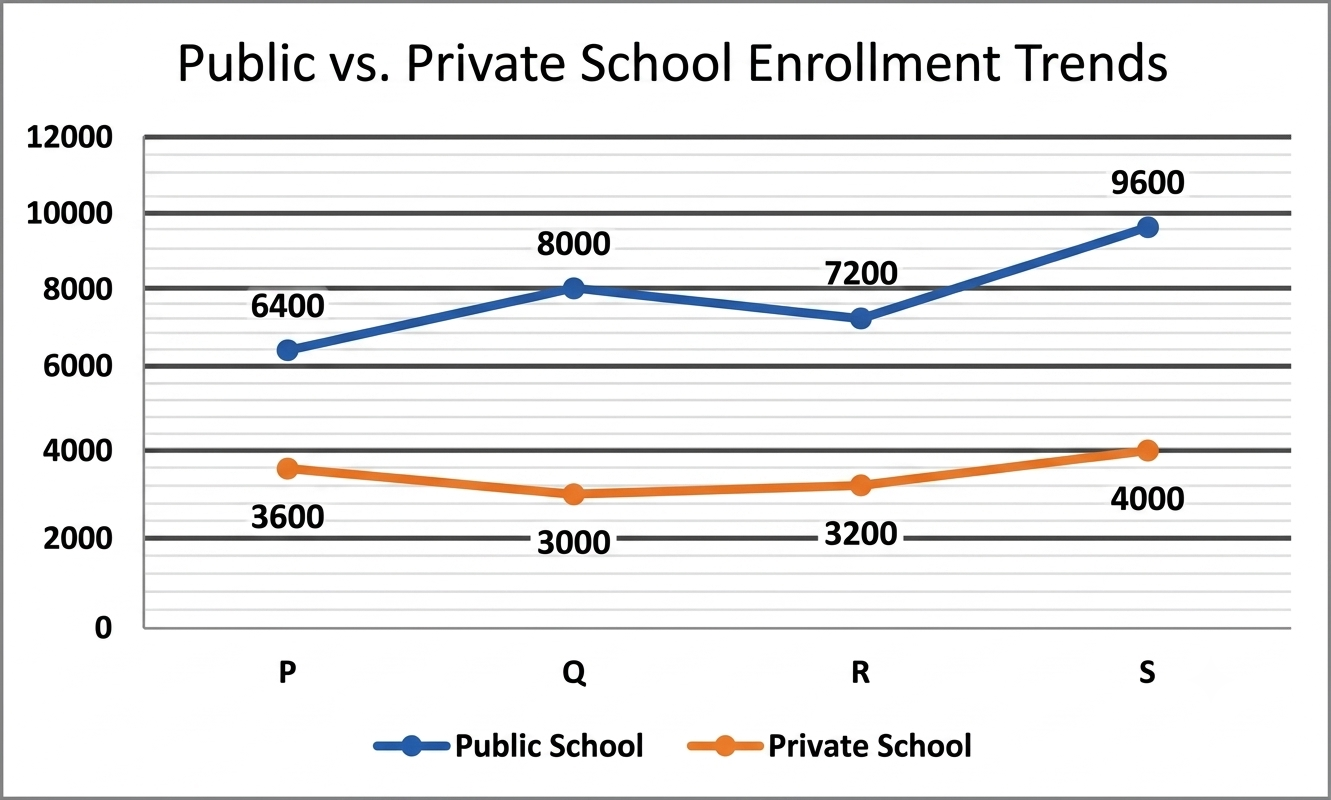
Question 80

Find the approximate value of x in the following question.

x2 - (6.11 ×  56.13) = (28.9 ×  36.02) + (47.8 ×  32.2)

  1. AOption (a)

    42

  2. BOption (b)

    62

  3. COption (c)

    54

  4. DOption (d)

    48

  5. EOption (e)

    64

View answer & explanation

Correct answer

Answer: (c)C.

54

Why this answer is correct

Solution:

x2 - (6.11 ×  56.13) = (28.9 ×  36.02) + (47.8 ×  32.2)

x2 - (6 ×  56) = (29 ×  36 + 48 ×  32)

x2 - 336 = 1044 + 1536

x2 - 336 = 2580

x2 = 2580 + 336

x2 = 2916

x = √2916

x = 54

Question 81

What approximate value should come in place the of question mark ? in the following question?

3.038 × 2.934 ÷ 242.93 = 9.03 × 3.03 × 80.99 × 2.994 ÷ ?

  1. AOption (a)

    3

  2. BOption (b)

    9

  3. COption (c)

    27

  4. DOption (d)

    81

  5. EOption (e)

    243

View answer & explanation

Correct answer

Answer: (d)D.

81

Why this answer is correct

Given expression is,

3.038 × 2.934 ÷ 242.93 = 9.03 × 3.03 × 80.99 × 2.994 ÷ ?

We can write the given values as:

3.03, 2.93 and 2.99 ≈ 3, 242.93 ≈ 243

9.03 ≈ 9 and 80.99 ≈ 81

Given expression is:

⇒ 38 × 34 ÷ 243 = 9 × 3 × 81 × 34 ÷ ?

⇒ 38 × 34 ÷ 35 = 32 × 3 × 34 × 34 ÷ ?

⇒ 3(8 + 4 – 5) = 3(2 + 1 + 4 + 4) ÷ ?

⇒ 37 = 311 ÷ ?

⇒ ? = 311 ÷ 37

⇒ ? = 3(11 – 7)

⇒ ? = 34

⇒ ? = 81

Question 82

What should come in place of question mark (?) in the following questions? (You do not have to calculate the exact value.)

99.67 + 202.15 ÷ 1.97 – 32.20 = ?% of 1300.03

  1. AOption (a)

    2

  2. BOption (b)

    18

  3. COption (c)

    11

  4. DOption (d)

    13

  5. EOption (e)

    20

View answer & explanation

Correct answer

Answer: (d)D.

13

Why this answer is correct

Rules of Approximation:

  1. If a number has digits to the right of the decimal less than 5, then just drop the digits to the right of the decimal. The number so obtained will be the approximated value.
  2. If a number has digits to the right of the decimal more than 5, then just drop the digits to the right of the decimal and raise the remaining number by '1'.The number so obtained will be the approximated value.

Concept:

Follow BODMAS rule to solve this question, as per the order given below-

Step - 1: Parts of an equation enclosed in 'Brackets' must be solved first and following BODMAS rule in the bracket-

Step - 2: Any mathematical 'Of' or 'Exponent' must be solved next.

Step - 3: Next, the parts of the equation that contain 'Division' and 'Multiplication' are calculated.

Step - 4: Last but not least, the parts of the equation that contain 'Addition' and 'Subtraction' should be calculated.

Since we need to find out the approximate value, we can write these values to their nearest integers.

Calculation:

Given Expression,

99.67 + 202.15 ÷ 1.97 – 32.20 = ?% of 1300.03

We can also write values as:

99.67 ≈ 100, 202.15 ≈ 202, 1.97 ≈ 2, 32.20 ≈ 32, 1300.03 ≈ 1300

Given expression becomes,

⇒ 100 + 202 ÷ 2 – 32 = ?% of 1300

⇒ 100 + 101 – 32 = ?% of 1300

⇒ 201 – 32 = ?% of 1300

⇒ 169 = ?% of 1300

⇒ ? = (169 × 100)/1300

⇒ ? ≈ 13

Question 83

What approximate value should come in place of the question mark (?) in the following question?

(484.30 ÷ 11.11) × 4.87 – 5.85 % of 700 = ? × 2.01 + 4.4

  1. AOption (a)

    80

  2. BOption (b)

    89

  3. COption (c)

    91

  4. DOption (d)

    60

  5. EOption (e)

    87

View answer & explanation

Correct answer

Answer: (e)E.

87

Why this answer is correct

Follow BODMAS rule to solve this question, as per the order given below,

Step-1- Parts of an equation enclosed in 'Brackets' must be solved first, and in the bracket,

Step-2- Any mathematical 'Of' or 'Exponent' must be solved next,

Step-3- Next, the parts of the equation that contain 'Division' and 'Multiplication' are calculated,

Step-4- Last but not the least, the parts of the equation that contain 'Addition' and 'Subtraction' should be calculated.

Given Expression,

(484.30 ÷ 11.11) × 4.87 – 5.85 % of 700 = ? × 2.01 + 4.4

We can also write values as:

484.30 ≈ 484, 11.11 ≈ 11, 4.87 ≈ 5, 2.01 ≈ 2, 4.4 ≈ 4, 5.85 ≈ 6

Given expression becomes,

⇒ (484 ÷ 11) × 5 – 6 % of 700 = ? × 2 + 4

⇒ 44 × 5 – 6/100 × 7 = ? × 2 + 4

⇒ 220 – 42 = ? × 2 + 4

⇒ 178 = ? × 2 + 4

⇒ ? × 2 = 174

⇒ ? ≈ 87

Question 84

Find the approximate value which should replace the question mark (?) in the following question.

√1765 ÷ √200 + (12.02 × 1.99 × 7.09)] = ? × 3 – 12

  1. AOption (a)

    51

  2. BOption (b)

    61

  3. COption (c)

    71

  4. DOption (d)

    81

  5. EOption (e)

    41

View answer & explanation

Correct answer

Answer: (b)B.

61

Why this answer is correct

Follow BODMAS rule to solve this question, as per the order given below,

Step-1- Parts of an equation enclosed in 'Brackets' must be solved first, and in the bracket,

Step-2- Any mathematical 'Of' or 'Exponent' must be solved next,

Step-3- Next, the parts of the equation that contain 'Division' and 'Multiplication' are calculated,

Step-4- Last but not least, the parts of the equation that contain 'Addition' and 'Subtraction' should be calculated.

Given expression is,

√1765 ÷ √200 + (12.02 × 1.99 × 7.09)] = ? × 3 – 12

Taking Approximate values,

√1765 ≈ √1764, √200 ≈ √196, 12.02 ≈ 12, 1.99 ≈ 2, 7.09 ≈ 7

⇒ 42 ÷ 14 + (12 × 2 × 7) = ? × 3 – 12  

⇒ 3 × ? = 171 + 12 = 183

∴ ? = 61

Question 85

Kamal and Raju started a partnership for total of 3.5 years in such a way that initially Kamal invested Rs. 7500 for 24 months after that Kamal withdraws his amount and Raju invests certain capital for the remaining time. The profit Raju received after 3.5 years is Rs. 1400 out of total profit of Rs. 3000.What was the amount Raju invested.

  1. AOption (a)

    Rs. 9000

  2. BOption (b)

    Rs. 7500

  3. COption (c)

    Rs. 8400

  4. DOption (d)

    Rs. 8750

  5. EOption (e)

    Rs. 8000

View answer & explanation

Correct answer

Answer: (d)D.

Rs. 8750

Why this answer is correct

Shortcut Trick

Profit ratio Kamal : Raju = (3000 − 1400) : 1400 = 1600 : 1400 = 8 : 7.

Time ratio = 24 months : (42 − 24) months = 24 : 18 = 4 : 3.

Investment ratio = (Profit ÷ Time) ⇒ (8 ÷ 4) : (7 ÷ 3) = 2 : 7/3 = 6 : 7.

Since 6 units = Rs. 7500, then 1 unit = Rs. 1250.

Raju investment = 7 × 1250 = Rs. 8750.

∴ The correct answer is Rs. 8750.

Alternate Method

Given → Kamal Investment (Ck) = Rs. 7500, Time (Tk) = 24 months. Total time = 3.5 years = 42 months. Raju Time (Tr) = 42 − 24 = 18 months. Total profit = Rs. 3000, Raju Profit (Pr) = Rs. 1400. Formulas: Profit Ratio = (Investment1 × Time1) : (Investment2 × Time2)

Steps: ⇒ Profit of Kamal (Pk) = Total Profit − Raju Profit = 3000 − 1400 = Rs. 1600. ⇒ Ratio of profits (Pk / Pr) = (Ck × Tk) / (Cr × Tr). ⇒ 1600 / 1400 = (7500 × 24) / (X × 18). ⇒ 8 / 7 = (7500 × 4) / (X × 3). ⇒ 8 × 3 × X = 7 × 7500 × 4. ⇒ 24X = 210000. ⇒ X = 210000 / 24 = Rs. 8750.

∴ The correct answer is Rs. 8750.

Additional Information

Partnership Basic Concept

In a partnership, the profit is distributed among partners in the ratio of the product of their invested capital and the duration of investment.

Investment Calculation

If profits and time periods are known, the investment ratio can be found by Investment = Profit ÷ Time.

Question 86

A and B together do some work in 10 days, B and C together do the same work in 25 days and C and A together do the same work in 50 days, then, In how many days will the three of them together complete same the work?

  1. AOption (a)

    25 days

  2. BOption (b)

    25/2 days

  3. COption (c)

    25/8 days

  4. DOption (d)

    25/12 days

  5. EOption (e)

    None of these

View answer & explanation

Correct answer

Answer: (b)B.

25/2 days

Why this answer is correct

Shortcut Trick

Total Work = LCM(10, 25, 50) = 50 units.

Efficiency of (A+B) = 5, (B+C) = 2, (C+A) = 1.

Sum of efficiencies 2(A+B+C) = 5 + 2 + 1 = 8 → (A+B+C) = 4.

Time taken = Total Work ÷ Efficiency = 50 ÷ 4 = 12.5 days.

∴ The correct answer is 25/2 days.

Alternate Method

Given:

Time taken by (A + B) = 10 days

Time taken by (B + C) = 25 days

Time taken by (C + A) = 50 days

Formula Used:

Efficiency = Total Work ÷ Time

Calculations:

PersonDaysTotal WorkEfficiency
(A + B)10505
(B + C)252
(C + A)501

⇒ Total efficiency of 2(A + B + C) = 5 + 2 + 1 = 8

⇒ Efficiency of (A + B + C) = 8 ÷ 2 = 4

⇒ Days taken by (A + B + C) together = 50 ÷ 4

⇒ Days = 25/2 days

∴ The correct answer is 25/2 days.

Additional Information

Combined Work Formula

When pairs (A+B, B+C, C+A) are given, the sum of their individual efficiencies equals 2 × (A+B+C) efficiency.

Work and Wages

Wages are always distributed in the ratio of the efficiency of the workers or the amount of work done.

Pipes and Cisterns

This concept is identical to Time & Work, where an inlet pipe has positive efficiency and an outlet pipe has negative efficiency.

Directions: Study the following information carefully and answer the questions.

The table below shows the marks obtained by three students (A, B, C) in Sociology, along with the ratio of Sociology to History marks and the average of Polity and Sociology marks.

StudentSociology MarksRatio (Sociology : History)Average (Polity + Sociology)
A724 : 366
B847 : 678
C605 : 454

Question 87

If the ma×imum marks in each subject are 100, what is the difference between the percentage of total marks scored by Student B and the average percentage marks scored by Students A and C?

  1. AOption (a)

    18%

  2. BOption (b)

    19%

  3. COption (c)

    16%

  4. DOption (d)

    15%

  5. EOption (e)

    14%

View answer & explanation

Correct answer

Answer: (b)B.

19%

Why this answer is correct

General Solution:

Given Data:

StudentSociology (S)Ratio S : HAverage (Polity + Sociology)
A724 : 366
B847 : 678
C605 : 454


Find History marks (H) using ratio S : H = a : b ⇒ H = S × (b ÷ a):

Student A: S = 72, ratio 4 : 3 ⇒ H = 72 × (3 ÷ 4) = 72 × 0.75 = 54

Student B: S = 84, ratio 7 : 6 ⇒ H = 84 × (6 ÷ 7) = 84 × (6/7) = 72

Student C: S = 60, ratio 5 : 4 ⇒ H = 60 × (4 ÷ 5) = 60 × 0.8 = 48

Find Polity marks (P) from average (P + S) ÷ 2 = given ⇒ P = 2 × (given average) − S:

Student A: Average = 66, S = 72 ⇒ P = 2 × 66 − 72 = 132 − 72 = 60

Student B: Average = 78, S = 84 ⇒ P = 2 × 78 − 84 = 156 − 84 = 72

Student C: Average = 54, S = 60 ⇒ P = 2 × 54 − 60 = 108 − 60 = 48

Thus,

StudentSociology (S)History (H)Polity (P)
A725460
B847272
C604848


Calculations:

Total marks (B) = 84 + 72 + 72 = 228 → % = (228 / 300) × 100 = 76%

Total marks (A) = 72 + 54 + 60 = 186 → % = 62%

Total marks (C) = 60 + 48 + 48 = 156 → % = 52%

Average % (A & C) = (62 + 52) / 2 = 57%

Difference = 76 − 57 = 19%

Hence, the correct answer is 19%.

Question 88

What is the ratio of total History marks of all students to the total Polity marks of all students?

  1. AOption (a)

    27:29

  2. BOption (b)

    29:30

  3. COption (c)

    12:13

  4. DOption (d)

    15:17

  5. EOption (e)

    None of these

View answer & explanation

Correct answer

Answer: (b)B.

29:30

Why this answer is correct

General Solution:

Given Data:

StudentSociology (S)Ratio S : HAverage (Polity + Sociology)
A724 : 366
B847 : 678
C605 : 454


Find History marks (H) using ratio S : H = a : b ⇒ H = S × (b ÷ a):

Student A: S = 72, ratio 4 : 3 ⇒ H = 72 × (3 ÷ 4) = 72 × 0.75 = 54

Student B: S = 84, ratio 7 : 6 ⇒ H = 84 × (6 ÷ 7) = 84 × (6/7) = 72

Student C: S = 60, ratio 5 : 4 ⇒ H = 60 × (4 ÷ 5) = 60 × 0.8 = 48

Find Polity marks (P) from average (P + S) ÷ 2 = given ⇒ P = 2 × (given average) − S:

Student A: Average = 66, S = 72 ⇒ P = 2 × 66 − 72 = 132 − 72 = 60

Student B: Average = 78, S = 84 ⇒ P = 2 × 78 − 84 = 156 − 84 = 72

Student C: Average = 54, S = 60 ⇒ P = 2 × 54 − 60 = 108 − 60 = 48

Thus,

StudentSociology (S)History (H)Polity (P)
A725460
B847272
C604848


Calculations:

History total = 54 + 72 + 48 = 174

Polity total = 60 + 72 + 48 = 180

Ratio = 174 : 180 = 29 : 30

Hence, the correct answer is 29:30.

Question 89

If student A's Polity marks were increased by 20% and student B's Sociology marks were decreased by 25%, what would be new total marks of students A and B in Polity, History, and Sociology combined?

  1. AOption (a)

    410

  2. BOption (b)

    390

  3. COption (c)

    405

  4. DOption (d)

    425

  5. EOption (e)

    None of these

View answer & explanation

Correct answer

Answer: (c)C.

405

Why this answer is correct

General Solution:

Given Data:

StudentSociology (S)Ratio S : HAverage (Polity + Sociology)
A724 : 366
B847 : 678
C605 : 454


Find History marks (H) using ratio S : H = a : b ⇒ H = S × (b ÷ a):

Student A: S = 72, ratio 4 : 3 ⇒ H = 72 × (3 ÷ 4) = 72 × 0.75 = 54

Student B: S = 84, ratio 7 : 6 ⇒ H = 84 × (6 ÷ 7) = 84 × (6/7) = 72

Student C: S = 60, ratio 5 : 4 ⇒ H = 60 × (4 ÷ 5) = 60 × 0.8 = 48

Find Polity marks (P) from average (P + S) ÷ 2 = given ⇒ P = 2 × (given average) − S:

Student A: Average = 66, S = 72 ⇒ P = 2 × 66 − 72 = 132 − 72 = 60

Student B: Average = 78, S = 84 ⇒ P = 2 × 78 − 84 = 156 − 84 = 72

Student C: Average = 54, S = 60 ⇒ P = 2 × 54 − 60 = 108 − 60 = 48

Thus,

StudentSociology (S)History (H)Polity (P)
A725460
B847272
C604848


Calculations:

Given Changes:

Student A: Polity marks ↑ 20%

Student B: Sociology marks ↓ 25%

Student A:

Original P = 60 ⇒ New P = 60 + (20% of 60) = 60 + 12 = 72

S (unchanged) = 72

H (unchanged) = 54

Student B:

Original S = 84 ⇒ New S = 84 − (25% of 84) = 84 − 21 = 63

P (unchanged) = 72

H (unchanged) = 72

Find new totals:

Student A total = S + H + P = 72 + 54 + 72 = 198

Student B total = S + H + P = 63 + 72 + 72 = 207

Combined total:

198 + 207 = 405

Final Answer:

StudentSociologyHistoryPolityTotal
A725472198
B637272207
Combined Total405


Hence, the correct answer is 405.

Question 90

The marks of student D in Sociology, History, and Polity are 25% more than the respective marks of student C. If a fourth subject, Economics, is introduced, and student D's marks in Economics are 150% of his marks in History, what is the overall average of student D in all four subjects?

  1. AOption (a)

    74.45

  2. BOption (b)

    73.25

  3. COption (c)

    70.25

  4. DOption (d)

    72.55

  5. EOption (e)

    71.25

View answer & explanation

Correct answer

Answer: (e)E.

71.25

Why this answer is correct

General Solution:

Given Data:

StudentSociology (S)Ratio S : HAverage (Polity + Sociology)
A724 : 366
B847 : 678
C605 : 454


Find History marks (H) using ratio S : H = a : b ⇒ H = S × (b ÷ a):

Student A: S = 72, ratio 4 : 3 ⇒ H = 72 × (3 ÷ 4) = 72 × 0.75 = 54

Student B: S = 84, ratio 7 : 6 ⇒ H = 84 × (6 ÷ 7) = 84 × (6/7) = 72

Student C: S = 60, ratio 5 : 4 ⇒ H = 60 × (4 ÷ 5) = 60 × 0.8 = 48

Find Polity marks (P) from average (P + S) ÷ 2 = given ⇒ P = 2 × (given average) − S:

Student A: Average = 66, S = 72 ⇒ P = 2 × 66 − 72 = 132 − 72 = 60

Student B: Average = 78, S = 84 ⇒ P = 2 × 78 − 84 = 156 − 84 = 72

Student C: Average = 54, S = 60 ⇒ P = 2 × 54 − 60 = 108 − 60 = 48

Thus,

StudentSociology (S)History (H)Polity (P)
A725460
B847272
C604848


Calculations:

Given (from previous results for Student C):

Sociology (C) = 60

History (C) = 48

Polity (C) = 48

Find D's marks (25% more than C):

Multiplier for 25% more = 1.25

Sociology (D) = 60 × 1.25 = 75

History (D) = 48 × 1.25 = 60

Polity (D) = 48 × 1.25 = 60

Economics marks for D (135% of History):

Economics (D) = 150% of 60 = 1.5 × 60 = 90

Overall average across four subjects:

Total = 75 + 60 + 60 + 90 = 285

Average = 285 ÷ 4 = 71.25

Hence, the correct answer is 71.25.

Question 91

If the ratio of Sociology to History marks for a fourth student D is the same as student B, and the ratio of Polity to Sociology marks for student D is the same as student C, then what is the ratio of student D's marks in History to Polity?

  1. AOption (a)

    15:14

  2. BOption (b)

    14:13

  3. COption (c)

    12:13

  4. DOption (d)

    17:14

  5. EOption (e)

    None of these

View answer & explanation

Correct answer

Answer: (a)A.

15:14

Why this answer is correct

General Solution:

Given Data:

StudentSociology (S)Ratio S : HAverage (Polity + Sociology)
A724 : 366
B847 : 678
C605 : 454


Find History marks (H) using ratio S : H = a : b ⇒ H = S × (b ÷ a):

Student A: S = 72, ratio 4 : 3 ⇒ H = 72 × (3 ÷ 4) = 72 × 0.75 = 54

Student B: S = 84, ratio 7 : 6 ⇒ H = 84 × (6 ÷ 7) = 84 × (6/7) = 72

Student C: S = 60, ratio 5 : 4 ⇒ H = 60 × (4 ÷ 5) = 60 × 0.8 = 48

Find Polity marks (P) from average (P + S) ÷ 2 = given ⇒ P = 2 × (given average) − S:

Student A: Average = 66, S = 72 ⇒ P = 2 × 66 − 72 = 132 − 72 = 60

Student B: Average = 78, S = 84 ⇒ P = 2 × 78 − 84 = 156 − 84 = 72

Student C: Average = 54, S = 60 ⇒ P = 2 × 54 − 60 = 108 − 60 = 48

Thus,

StudentSociology (S)History (H)Polity (P)
A725460
B847272
C604848


Calculations:

Given:

Sociology : History ratio for student D = same as student B = 7 : 6

Polity : Sociology ratio for student D = same as student C = 48 : 60 = 4 : 5

Assume Sociology marks for student D = 35x

From S : H = 7 : 6 ⇒ History = 30x

From P : S = 4 : 5 ⇒ Polity = (4/5) × Sociology = (4/5) × 35x = 28x

Find required ratio H : P

H : P = 30x : 28x = 30 : 28 = 15 : 14

Hence, the correct answer is 15:14.

Question 92

The marks of student A in History are what percentage of the total marks of all three students in Polity?

  1. AOption (a)

    15%

  2. BOption (b)

    30%

  3. COption (c)

    40%

  4. DOption (d)

    25%

  5. EOption (e)

    20%

View answer & explanation

Correct answer

Answer: (b)B.

30%

Why this answer is correct

General Solution:

Given Data:

StudentSociology (S)Ratio S : HAverage (Polity + Sociology)
A724 : 366
B847 : 678
C605 : 454


Find History marks (H) using ratio S : H = a : b ⇒ H = S × (b ÷ a):

Student A: S = 72, ratio 4 : 3 ⇒ H = 72 × (3 ÷ 4) = 72 × 0.75 = 54

Student B: S = 84, ratio 7 : 6 ⇒ H = 84 × (6 ÷ 7) = 84 × (6/7) = 72

Student C: S = 60, ratio 5 : 4 ⇒ H = 60 × (4 ÷ 5) = 60 × 0.8 = 48

Find Polity marks (P) from average (P + S) ÷ 2 = given ⇒ P = 2 × (given average) − S:

Student A: Average = 66, S = 72 ⇒ P = 2 × 66 − 72 = 132 − 72 = 60

Student B: Average = 78, S = 84 ⇒ P = 2 × 78 − 84 = 156 − 84 = 72

Student C: Average = 54, S = 60 ⇒ P = 2 × 54 − 60 = 108 − 60 = 48

Thus,

StudentSociology (S)History (H)Polity (P)
A725460
B847272
C604848


Calculations:

From previous results:

History (A) = 54

Polity: A = 60, B = 72, C = 48

Total Polity marks = 60 + 72 + 48 = 180

Percentage = (History(A) ÷ Total Polity) × 100 = (54 ÷ 180) × 100 = 0.3 × 100 = 30%

Hence, the correct answer is 30%.

Question 93

The ratio of the sum of half of A's present age and B's present age to B's present age is 5 : 4. If the average age of A, B and C is 40 years and the age of C after 15 years is 25% more than his present age. Find the present age of B ?

  1. AOption (a)

     40

  2. BOption (b)

     50

  3. COption (c)

     55

  4. DOption (d)

     60

  5. EOption (e)

     75

View answer & explanation

Correct answer

Answer: (a)A.

 40

Why this answer is correct

Shortcut Trick

Ratio of (A/2 + B) : B = 5 : 4 → 4(A/2 + B) = 5B → 2A + 4B = 5B → 2A = B.

C after 15 years is 125% of present C → 15 years = 25% of C → C = 60 years.

Total age (A+B+C) = 40 × 3 = 120 years.

A + B = 120 − 60 = 60 years. Substitute A = B/2 → B/2 + B = 60 → 3B/2 = 60 → B = 40 years.

∴ The correct answer is 40 years.

Alternate Method

Given: Ratio ((A/2) + B) / B = 5/4, Average(A,B,C) = 40, C + 15 = 1.25 × C.

Step 1: Calculate present age of C

⇒ C + 15 = 1.25C

⇒ 0.25C = 15

⇒ C = 15 / 0.25 = 60 years.

Step 2: Calculate Sum of A and B

⇒ A + B + C = 40 × 3 = 120

⇒ A + B = 120 − 60 = 60 years.

Step 3: Relate A and B using the ratio

⇒ (A/2 + B) / B = 5/4

⇒ 4(A/2 + B) = 5B

⇒ 2A + 4B = 5B

⇒ B = 2A or A = B/2.

Step 4: Solve for B

⇒ B/2 + B = 60

⇒ 3B/2 = 60

⇒ B = (60 × 2) / 3 = 40 years.

∴ The correct answer is 40 years.

Additional Information

Average Age Concept

The sum of ages is always equal to the average multiplied by the number of individuals (Sum = Avg × n).

Percentage and Age

If an age increases by x% over 't' years, then (x/100) × Present Age = 't'. Here 25% of C = 15.

Ratio Proportions

Cross-multiplication is the most efficient way to simplify linear ratios involving two variables.

Question 94

A sum amounts to Rs. 7776 at 20% p.a. for 2 years,if it is compounded annually. If the same sum is invested at 10% p.a. compound interest for the same time period and thrice the sum is invested at 7% p.a. simple interest for 5 years, then find the sum of interest received.

  1. AOption (a)

    Rs. 8000

  2. BOption (b)

    Rs. 7404

  3. COption (c)

    Rs. 5704

  4. DOption (d)

    Rs. 6704

  5. EOption (e)

    Rs. 6804

View answer & explanation

Correct answer

Answer: (e)E.

Rs. 6804

Why this answer is correct

Shortcut Trick

Effective Rate of Interest for 20% CI (2 years) = 20 + 20 + (20 × 20)/100 = 44%.

Principal = 7776 ÷ 1.44 = ₹5400.

CI (10% for 2 years) = 21% of 5400 = 1134.

SI (7% for 5 years on 3P) = 35% of (3 × 5400) = 5670.

Total Interest = 1134 + 5670 = ₹6804.

∴ The correct answer is ₹6804.

Alternate Method

Given: Amount1 = ₹7776, R1 = 20%, T1 = 2 years (CI); R2 = 10%, T2 = 2 years (CI); R3 = 7%, T3 = 5 years (SI on 3P).

Formula: Amount = P(1 + r/100)n | SI = (P × R × T)/100

⇒ 7776 = P(1 + 20/100)2

⇒ 7776 = P(6/5)2 ⇒ 7776 = P × 36/25

⇒ P = (7776 × 25) ÷ 36 = 216 × 25 = ₹5400.

⇒ Interest1 (CI at 10% for 2 yrs) = 5400 × [(1.1)2 − 1] = 5400 × 0.21 = ₹1134.

⇒ Interest2 (SI at 7% for 5 yrs on 3P) = (3 × 5400 × 7 × 5) ÷ 100 = 16200 × 0.35 = ₹5670.

⇒ Total Interest = 1134 + 5670 = ₹6804.

∴ The correct answer is ₹6804.

Additional Information

Effective Rate of Compound Interest

For 2 years, effective rate = x + y + (xy/100). For 10%, it is 10 + 10 + 1 = 21%.

Simple Interest Calculation

SI is always calculated on the Principal amount. SI = (P × R × T) ÷ 100.

Compound Interest vs Simple Interest

Difference for 2 years = P(R/100)2. CI is always greater than or equal to SI for the same period and rate.

Question 95

A rectangle consists of length ,breadth and diagonal (x + 41) cm, x cm and (x + 49) cm respectively. If the square whose side is 6 cm less than the breadth of the rectangle. Find the difference between the area of the rectangle and area of the square.

  1. AOption (a)

    1786 cm 2

  2. BOption (b)

    1878 cm 2

  3. COption (c)

    1827 cm 2

  4. DOption (d)

    1872 cm 2

  5. EOption (e)

    1828 cm 2

View answer & explanation

Correct answer

Answer: (d)D.

1872 cm 2

Why this answer is correct

Shortcut Trick

Using Pythagoras triplet logic for Diagonal (x + 49), Length (x + 41), and Breadth (x):

(x + 49)2 − (x + 41)2 = x2 ⇒ (2x + 90)(8) = x2 ⇒ x2 − 16x − 720 = 0.

Solving the quadratic, factors of 720 with difference 16 are 36 and 20. ∴ Breadth (x) = 36 cm.

Length = 36 + 41 = 77 cm. Square side = 36 − 6 = 30 cm.

Difference = (77 × 36) − (30 × 30) = 2772 − 900 = 1872 cm2.

∴ The correct answer is 1872 cm2.

Alternate Method

Given: Length (L) = x + 41, Breadth (B) = x, Diagonal (D) = x + 49. Square side (a) = x − 6.

Formula Used: L2 + B2 = D2; Area of Rectangle = L × B; Area of Square = a2.

⇒ (x + 41)2 + x2 = (x + 49)2

⇒ x2 + 82x + 1681 + x2 = x2 + 98x + 2401

⇒ x2 − 16x − 720 = 0

⇒ (x − 36)(x + 20) = 0 ⇒ x = 36 cm (as length cannot be negative)

⇒ Area of Rectangle = (36 + 41) × 36 = 77 × 36 = 2772 cm2

⇒ Area of Square = (36 − 6)2 = 302 = 900 cm2

⇒ Difference = 2772 − 900 = 1872 cm2

∴ The correct answer is 1872 cm2.

Additional Information

Pythagoras Theorem

In a right-angled triangle, the square of the hypotenuse is equal to the sum of the squares of the other two sides: a2 + b2 = c2.

Rectangle Properties

The diagonal of a rectangle of length 'L' and breadth 'B' is given by √(L2 + B2). The area is L × B.

Quadratic Roots

For x2 + bx + c = 0, identify two numbers that multiply to 'c' and add up to 'b' for quick factorisation.

Question 96

If income of P is doubled and his expenditure remains the same, then he saves Rs. 40000 more than his original savings. What will be the saving of Q if his income is 15% more than the original income of P and he spends Rs. 20000?

  1. AOption (a)

    Rs. 20000

  2. BOption (b)

    Rs. 22000

  3. COption (c)

    Rs. 26000

  4. DOption (d)

    Rs. 28000

  5. EOption (e)

    Rs. 32000

View answer & explanation

Correct answer

Answer: (c)C.

Rs. 26000

Why this answer is correct

Shortcut Trick

Let Income of P be I and Expenditure be E. Original Saving = I − E.

New Income = 2I. New Saving = 2I − E.

Increase in Saving = (2I − E) − (I − E) = I. Given I = ₹40000.

Income of Q = 115% of ₹40000 = ₹46000.

Saving of Q = Income − Expenditure = 46000 − 20000 = ₹26000.

∴ The correct answer is ₹26000.

Alternate Method

Given: Original Income of P = I, Expenditure = E.

Formula Used: Saving = Income − Expenditure

⇒ Original Saving = I − E

⇒ New Income = 2I

⇒ New Saving = 2I − E

⇒ (2I − E) − (I − E) = 40000

⇒ I = 40000

⇒ Income of Q = 1.15 × 40000 = 46000

⇒ Expenditure of Q = 20000

⇒ Saving of Q = 46000 − 20000 = 26000

∴ The correct answer is ₹26000.

Additional Information

Income-Expenditure Relation

The fundamental relation is Income = Expenditure + Savings. If expenditure is constant, any change in income reflects directly in savings.

Percentage Change

To calculate a value increased by x%, use Original Value × (1 + x/100).

Question 97

Directions

Each of the questions given below consists of a question and 2 statements numbered I and II. You have to decide whether the data is sufficient to answer the question. Read both Statements carefully and then answer the questions.**

How much amount Rajesh will get at the end of two years if the rate of interest is compounded annually?

Statement I. Rahul invests the same amount of money under simple interest at the rate of 10% per annum and receives a total amount of Rs.3120 at the end of 3 years.

Statement II. The difference between the simple interest and compound interest on the same sum of money at the same rate of interest at the end of 2 years is Rs. 24.

  1. AOption (a)

    The data in statement I alone is sufficient to answer the question, while the data in statement II alone is not sufficient to answer the question.

  2. BOption (b)

    The data in statement II alone is sufficient to answer the question, while the data in statement I alone is not sufficient to answer the question.

  3. COption (c)

    The data in statement I alone or in statement II alone is sufficient to answer the question.

  4. DOption (d)

    The data in both statements I and II are not sufficient to answer the question.

  5. EOption (e)

    The data in both statements I and II together are necessary to answer the question.

View answer & explanation

Correct answer

Answer: (e)E.

The data in both statements I and II together are necessary to answer the question.

Why this answer is correct

Shortcut Trick

From Statement I: Amount = P + (P × R × T)/100 ⇒ 3120 = P(1 + 30/100) ⇒ Principal (P) = ₹2400.

From Statement II: CI − SI = PR2/1002 ⇒ 24 = P × (R/100)2. (Provides relation between P and R).

Using P from I in II: 24 = 2400 × (R/100)2 ⇒ (R/100)2 = 1/100 ⇒ Rate (R) = 10%.

Both P and R are needed to find Rajesh's CI amount: A = 2400 × (1.1)2 = ₹2904.

∴ The correct answer is ₹2904.

Alternate Method

Given: Time (T) = 2 years, Rahul's Amount = ₹3120, Time for Rahul = 3 years, Rahul's Rate = 10%, Difference CI−SI = ₹24.

Formula Used: Amount (SI) = P(1 + RT/100); Difference (2yr) = PR2/1002; Amount (CI) = P(1 + R/100)T

⇒ From Statement I: 3120 = P × (1 + (10 × 3)/100) ⇒ 3120 = 1.3P ⇒ P = ₹2400.

⇒ From Statement II: Difference = P(R/100)2 ⇒ 24 = 2400 × (R/100)2.

⇒ (R/100)2 = 24/2400 = 1/100 ⇒ R/100 = 1/10 ⇒ R = 10%.

⇒ Rajesh's Amount = P(1 + R/100)2 = 2400(1 + 10/100)2 = 2400 × 1.21.

⇒ Total Amount = ₹2904.

∴ The correct answer is ₹2904.

Additional Information

CI and SI Difference (2 Years)

The difference between Compound Interest and Simple Interest for 2 years is given by D = P(R/100)2.

CI and SI Difference (3 Years)

The difference for 3 years is given by D = [P(R/100)2] × [(300 + R)/100].

Effective Rate for CI

For 2 years at R%, the effective CI rate is (2R + R2/100)%. For 10%, it is 21%.

Question 98

Directions

Each of the questions given below consists of a question and 2 statements numbered I and II. You have to decide whether the data is sufficient to answer the question. Read both Statements carefully and then answer the questions.**

During 2017, 2018, and 2019 the profits of Idea company changed by what percent from 2018 to 2019?

Statement I. The increase in profits of Idea Company from the year 2017 to the year 2018 was the same as the increase from the year 2017 to 2019.

Statement II. For Idea company the profits for the year 2017 were Rs. 20,000 crore and the profits for the year 2019 were Rs. 21,000 crores.

  1. AOption (a)

    The data in statement I alone is sufficient to answer the question, while the data in statement II alone is not sufficient to answer the question.

  2. BOption (b)

    The data in statement II alone is sufficient to answer the question, while the data in statement I alone is not sufficient to answer the question.

  3. COption (c)

    The data in statement I alone or in statement II alone is sufficient to answer the question.

  4. DOption (d)

    The data in both statements I and II are not sufficient to answer the question.

  5. EOption (e)

    The data in both statements I and II together are necessary to answer the question.

View answer & explanation

Correct answer

Answer: (a)A.

The data in statement I alone is sufficient to answer the question, while the data in statement II alone is not sufficient to answer the question.

Why this answer is correct

Shortcut Trick

From Statement I: Increase (2018 − 2017) = Increase (2019 − 2017).

This implies Profit 2018 = Profit 2019.

Therefore, the percentage change from 2018 to 2019 is 0%.

Statement II provides 2017 and 2019 values but lacks 2018 data, making it insufficient.

∴ The correct answer is 0%.

Alternate Method

Given: Profits for years 2017, 2018, and 2019. Required to find % change from 2018 to 2019.

Evaluating Statement I:

⇒ Let Profits be P2017, P2018, and P2019.

⇒ Increase (2017 to 2018) = P2018 − P2017

⇒ Increase (2017 to 2019) = P2019 − P2017

⇒ P2018 − P2017 = P2019 − P2017

⇒ P2018 = P2019

⇒ Percentage change = [(P2019 − P2018) ÷ P2018] × 100 = 0%.

⇒ Statement I is sufficient.

Evaluating Statement II:

⇒ P2017 = ₹20,000 crore, P2019 = ₹21,000 crore.

⇒ P2018 is unknown. We cannot calculate the change from 2018 to 2019.

⇒ Statement II is not sufficient.

∴ The correct answer is 0%.

Additional Information

Percentage Change

Percentage change is calculated as [(New Value − Old Value) ÷ Old Value] × 100. If Old = New, % change is always 0.

Data Sufficiency Logic

In data sufficiency, if a statement allows you to find a unique numerical value or a definite relationship (like equality), it is considered sufficient.

Question 99

Direction: Each question below is followed by two statements I and II. You have to determine whether the data given in the statement is sufficient for answering the question. You should use the data and your knowledge of Mathematics to choose the best possible answer.

Two trains are travelling in opposite direction to each other. What will be the distance (in km) just before 69 minutes of meeting each other?

Statement I. Initially, the distance between the trains is 219 km.

Statement II. The speeds of two trains are 29 m/s and 36 m/s respectively.

  1. AOption (a)

    The statement I alone is sufficient to answer the question but, statement II alone is not sufficient.

  2. BOption (b)

    The statement II alone is sufficient to answer the question but, statement I alone is not sufficient.

  3. COption (c)

    Both the statements I and II together are needed to answer the question.

  4. DOption (d)

    Either statement I alone or statement II alone is sufficient to answer the question.

  5. EOption (e)

    Neither statement I nor statement II is sufficient to answer the question.

View answer & explanation

Correct answer

Answer: (b)B.

The statement II alone is sufficient to answer the question but, statement I alone is not sufficient.

Why this answer is correct

Shortcut Trick

The distance just before meeting depends only on the Relative Speed and the Remaining Time.

Relative Speed (Opposite Direction) = 29 + 36 = 65 m/s.

Distance = Speed × Time ⇒ 65 m/s × (69 × 60) seconds.

Since only the speeds (Statement II) and time (69 min) are required, Statement II alone is sufficient.

∴ The correct answer is 269.1 km.

Alternate Method

Given:

Time (t) = 69 minutes

Speed1 (S1) = 29 m/s, Speed2 (S2) = 36 m/s

Formula Used:

Relative Speed (Opposite) = S1 + S2

Distance = Relative Speed × Time

Calculations:

⇒ Relative Speed = 29 + 36 = 65 m/s

⇒ Relative Speed in km/h = 65 × (18/5) = 13 × 18 = 234 km/h

⇒ Distance before 69 mins = Speed × Time = 234 × (69/60) km

⇒ Distance = 234 × 1.15 = 269.1 km

∴ The correct answer is 269.1 km.

Additional Information

Relative Speed

When two objects move in opposite directions, their Relative Speed is the sum of their individual speeds (S1 + S2).

Distance Before Meeting

The distance between two objects 't' time before they meet is always equal to (Relative Speed × t), regardless of the total initial distance.

Unit Conversion

To convert m/s to km/h, multiply by 18/5. To convert minutes to hours, divide by 60.

Question 100

10 litres of solution taken out from mixture of solution and water and filled again with water. This process is repeated for two times. The ratio between the solution and water in the resultant mixture is 81 : 19. Find the quantity of water in the resultant mixture.

  1. AOption (a)

    21 litres

  2. BOption (b)

    25 litres

  3. COption (c)

    12 litres

  4. DOption (d)

    15 litres

  5. EOption (e)

    19 litres

View answer & explanation

Correct answer

Answer: (e)E.

19 litres

Why this answer is correct

Shortcut Trick

Ratio of Remaining Solution to Total Mixture = (1 − x/V)n

Given Solution : Water = 81 : 19 ⇒ Solution : Total Mixture = 81 : (81 + 19) = 81 : 100

√(81/100) = 9/10 (since process is done twice)

1 unit (10 − 9) = 10 litres → Total Capacity = 10 × 10 = 100 litres

Water in resultant mixture = (19/100) × 100 = 19 litres.

∴ The correct answer is 19 litres.

Alternate Method

Given: Volume replaced (x) = 10 litres, Number of times (n) = 2, Final Ratio (Sol:Wat) = 81:19

Formula: Final Solution = Initial Solution × (1 − x/V)n

⇒ 81/100 = (1 − 10/V)2

⇒ √(81/100) = 1 − 10/V

⇒ 9/10 = 1 − 10/V

⇒ 10/V = 1 − 9/10 = 1/10

⇒ V = 100 litres (Total Capacity)

⇒ Water in Resultant Mixture = (19 / (81+19)) × 100

⇒ Water = (19/100) × 100 = 19 litres

∴ The correct answer is 19 litres.

Additional Information

Replacement Formula

Quantity of pure liquid left = Total × (1 − replaced quantity/Total)n, where n is the number of operations.

Alligation in Replacement

Replacement problems can be simplified by tracking the ratio of the remaining original component to the total volume.

100 questions in the full paper