Previous Year Paper

IBPS PO Prelims Memory Based Paper (Held on:4 December 2021 Shift 3) (Previous Year Paper)

Held in 2021

100 questions60 minutes
With answers
Free

Paper last updated:

Practise under exam conditions

Take this paper as a timed mock test. Review your answers after you submit.

Attempt timed test

Questions & answers

Read the paper at your pace. Open an explanation when you need it.

English Language (30 questions)

Question 1

Given below is a word, followed by three sentences which consist of that word. Identify the sentence(s) which best express(es) the meaning of the word. Choose option 5 ‘None of these’ if the word is not suitable in any of the sentences. 


ALLUSION


A. There are lots of literary echoes and allusions in the novel, but they don't do anything for the tired texture of the prose.

B. He made some allusion to the years they lived apart.

C. The video game is designed to give the allusion that you are in control of an airplane.

  1. AOption (a)

    Both A and C

  2. BOption (b)

    Both A and B

  3. COption (c)

    Only B

  4. DOption (d)

    Both B and C

  5. EOption (e)

    None of these

View answer & explanation

Correct answer

Answer: (b)B.

Both A and B

Why this answer is correct

The correct answer is option 2), i.e., Both A and B

Key Points 

The meaning of 'Allusion' is ' the act of making an indirect reference to something'. It is a noun.

Its synonyms are – ‘reference to, citation of, implication, insinuation, etc ‘

  • In sentence A, it has been used correctly as ‘allusions in the novel’ means references in the novel that properly fits the context of the sentence.
  • In sentence B, it has been used correctly as ‘ allusion to the years’ means reference to the years they lived apart, which makes sense in the context of the sentence.
  • In sentence C, the ‘allusion that you are in control of an airplane’ is erroneous as the meaning that is conveyed by the sentence is that the video games create a simulation that gives a false impression of the real world. So, the correct word here should be ‘illusion’ which means ‘a deceptive appearance or impression or an instance or misinterpreted perception of a sensory experience’

Additional Information

  • Literary – concerning the writing, study, or content of literature, especially of the kind valued for quality of form
  • Echoes –  the repetition in the structure and content of one speaker's utterance by another.
  • Prose - written or spoken language in its ordinary form, without metrical structure.

Hence, both A and B best express the meaning of the word.
Question 2

Given below is a word, followed by three sentences which consist of that word. Identify the sentence(s) which best express(es) the meaning of the word. Choose option 5 ‘None of these’ if the word is not suitable in any of the sentences.

Borne

A. She was borne up to the ambulance.

B. His version of events just isn't borne out by the facts.

C. These matters are beyond the borne of our understanding.

  1. AOption (a)

    Only A

  2. BOption (b)

    Only B

  3. COption (c)

    A, B and C

  4. DOption (d)

    A and B

  5. EOption (e)

    None of these

View answer & explanation

Correct answer

Answer: (d)D.

A and B

Why this answer is correct

The correct answer is 'A and B'.

Key Points

  • The word 'Borne' means carried or moved by a particular thing.
  • Example: The boat has borne away.
  • By understanding the meaning of the given word we can get that:
  • Sentence A is correct as it is talking about a person being carried to the ambulance.
  • Sentence B is correct as it is about someone's story not being carried out well due to facts.
  • Sentence C is incorrect as the word borne does not make any sense as per the context of the sentence.
  • Hence, the correct answer is option 4.

Question 3

Given below is a word, followed by three sentences which consist of that word. Identify the sentence(s) which best express(es) the meaning of the word. Choose option 5 ‘None of these’ if the word is not suitable in any of the sentences.

Corroborate

A. Recent research seems to corroborate his theory.

B. Employment trends corroborate the dismal economic picture.

C. There was no one to corroborate her story about the disturbance in the lounge.

  1. AOption (a)

    Only B

  2. BOption (b)

    A and C

  3. COption (c)

    A, B and C

  4. DOption (d)

    B and C

  5. EOption (e)

    None of these

View answer & explanation

Correct answer

Answer: (c)C.

A, B and C

Why this answer is correct

The correct answer is 'A, B and C'.

Key Points

  • The meaning of the word 'corroborate' is to add proof to an account, statement, idea, etc. with new information.
  • Example: If you're going to be my witness, your story must corroborate my story.
  • By understanding the meaning of the given word we can get that:
  • Sentence A is correct as it talks about recent research which has added new information to a theory.
  • Sentence B is correct as the employment trends work as proof against the dismal economy.
  • Sentence C is correct as it talks about the subject's story about the disturbance in the lounge and that there was no witness or no one to provide proofs regarding the disturbance.
  • Hence, option 3 is the correct answer.

Read the passage given below and answer the questions that follow. 

It is well accorded that COVID-19 extracts a huge toll on the mental health of patients and leaves behind a slew of neurological sequelae in its wake. However, what is alarming is the wide gamut of mental and neurological disorders seen even in those with milder symptoms. Such patients frequently reported being anxious, depressed and having difficulty in sleeping. A higher incidence of frank psychosis manifesting as disorganization of thought processes and personality disorders was also reported. Many survivors of COVID-19 had to battle substance abuse in its immediate aftermath. There was a steep increase in the amount of alcohol consumed by regular drinkers. Persons who had stopped smoking and consuming alcohol resumed their habit in disconcerting numbers. 

The occurrence of neurodegenerative disorders like Parkinsonism is concerning as this would bring long-term disability in the form of impaired mobility and memory decline. It has been hypothesized that the causative mechanism for many of the neurological conditions due to COVID-19 may be the direct invasion of the nervous system by the virus, an increased tendency to blood clotting or an exaggerated immune response by the body. Various other factors like pre-existing psychiatric illness, prolonged quarantine, perceived lack of organizational support, and social stigma are risk factors. Anxiety, Nervousness, and Post-traumatic stress disorder are often fuelled by fear of infecting other family members, physical distancing, loneliness, and ________ at home in cramped quarters. 

The pandemic has radically transformed the way businesses function and services delivered. Remote working disrupts a healthy-work life balance. Face to face contact and human interactions which were considered so essential for emotional well-being has taken a backseat. Lack of comforting physical contact like shaking hands and hugging friends is stressful and disconcerting. Online classes and home-schooling have placed a gargantuan burden both on students and parents. Lack of access to reliable computer hardware and spotty internet connections, particularly in rural areas and in the economically backward have created a new class divide. Children have been deprived of co-curricular activities, participation in group events and sports which is essential for their holistic development. Mental stress and fatigue have increased manyfold due to the rigours imposed by virtual learning.

Question 4

According to the passage, what is alarming considering COVID-19's toll on mental health? 

  1. AOption (a)

    The rise of the black fungus wrecking havoc on patients with mild immunity. 

  2. BOption (b)

    The steep increase in the amount of alcohol consumption by regular drinkers. 

  3. COption (c)

    The rise of virtual learning and work from home. 

  4. DOption (d)

    The wide range of mental and neurological disorders in patients with milder symptoms. 

  5. EOption (e)

    None of the above.

View answer & explanation

Correct answer

Answer: (d)D.

The wide range of mental and neurological disorders in patients with milder symptoms. 

Why this answer is correct

The correct answer is: The wide range of mental and neurological disorders in patients with milder symptoms.  

Key Points

Reading the given passage we find that: 

'However, what is alarming is the wide gamut of mental and neurological disorders seen even in those with milder symptoms.'

Thus from the given sentence, it is clear that the correct answer is option 4.

Question 5

What is the synonym of the word gargantuan mentioned in the passage?

  1. AOption (a)

    Puny 

  2. BOption (b)

    Miniscule 

  3. COption (c)

    Tepid

  4. DOption (d)

    Enormous 

  5. EOption (e)

    Opulent

View answer & explanation

Correct answer

Answer: (d)D.

Enormous 

Why this answer is correct

The correct answer is: Enormous 

Key Points

Let's look at the meaning of the given word. 

  • Gargantuan: Enormous.

Thus from the above meaning, it is clear that the correct answer is Enormous. 

Additional Information

  • Puny: small and weak.
  • Miniscule: extremely small, tiny.
  • Tepid: slightly warm; lukewarm.
  • Opulent: costly and luxurious.

Question 6

Choose the most appropriate option to fill in the blank for the sentence given below. 

Anxiety, Nervousness, and Post-traumatic stress disorder are often fuelled by fear of infecting other family members, physical distancing, loneliness, and ________ at home in cramped quarters.

  1. AOption (a)

    Freedom 

  2. BOption (b)

    Luxury 

  3. COption (c)

    Independence

  4. DOption (d)

    Confinement

  5. EOption (e)

    Consent

View answer & explanation

Correct answer

Answer: (d)D.

Confinement

Why this answer is correct

The correct answer is: Confinement. 

Key Points

Let's look at the meaning of the correct answer. 

  • Confinement: The action of confining or the state of being confined.
  • The given sentence talks about state of confinement people experience while staying home.

Therefore the correct answer is Confinement**.**

Question 7

What is the hypothesis behind the many neurological conditions arising due to COVID-19?

  1. AOption (a)

    A direct invasion of the nervous system by the virus. 

  2. BOption (b)

    An increased tendency to blood clotting. 

  3. COption (c)

    An exaggerated immune response by the body. 

  4. DOption (d)

    All of the above 

  5. EOption (e)

    None of the above. 

View answer & explanation

Correct answer

Answer: (d)D.

All of the above 

Why this answer is correct

The correct answer is: All of the above. 

Key Points

Reading the given passage we find the following lines:  

  • 'It has been hypothesized that the causative mechanism for many of the neurological conditions due to COVID-19 may be the direct invasion of the nervous system by the virus, an increased tendency to blood clotting or an exaggerated immune response by the body.'
  • Thus from the given points, we find that direct invasion of the nervous system, increased tendency to blood clotting, and an exaggerated immune response by the body all arise due to the neurological conditions due to COVID-19.

Therefore the correct answer is All of the above.

Question 8

What is the synonym of the word function given in the passage?

  1. AOption (a)

    Conjugate

  2. BOption (b)

    Break 

  3. COption (c)

    Impede

  4. DOption (d)

    Operate

  5. EOption (e)

    Conclude

View answer & explanation

Correct answer

Answer: (d)D.

Operate

Why this answer is correct

The correct answer is Operate. 

Key Points

Let's look at the meaning of the given word and the correct option: 

  • Function: Work or operate in a particular way.
  • Operate: Control the functioning of something.

Thus from the given meaning, it is clear that the correct answer is Operate. 

Additional Information

  • Conjugate: Become temporarily united (biological term).
  • Impede: Delay or prevent by obstructing.

Question 9

Choose the statement that is false according to the passage.

  1. AOption (a)

    COVID patients frequently reported difficulty in sleeping

  2. BOption (b)

    Smoking and consumption of alcohol decreased due to prolonged quarantine. 

  3. COption (c)

    Disorders like Parkinsonism occurring during COVID is a cause of concern. 

  4. DOption (d)

    Prolonged quarantine is a risk factor that can be associated with COVID related neurological conditions. 

  5. EOption (e)

    None of the above.

View answer & explanation

Correct answer

Answer: (b)B.

Smoking and consumption of alcohol decreased due to prolonged quarantine. 

Why this answer is correct

The correct answer is: Smoking and consumption of alcohol decreased due to prolonged quarantine. 

Key Points

Reading the passage we find that:  

  • **'**There was a steep increase in the amount of alcohol consumed by regular drinkers. Persons who had stopped smoking and consuming alcohol resumed their habit in disconcerting numbers.'

Here from the given sentence, it is clear that the statement given in the option is false. 

Therefore the correct answer is Smoking and consumption of alcohol decreased due to prolonged quarantine.

Question 10

Choose the statement that is true according to the passage.

  1. AOption (a)

    People are able to enjoy the work life balance due to work from home. 

  2. BOption (b)

    Spending time inside has given people an opportunity for self reflection. 

  3. COption (c)

    Less exposure to the pollution of the outside world is a blessing for many. 

  4. DOption (d)

    The imposed virtual learning has increased the mental stress and fatigue in students. 

  5. EOption (e)

    None. 

View answer & explanation

Correct answer

Answer: (d)D.

The imposed virtual learning has increased the mental stress and fatigue in students. 

Why this answer is correct

The correct answer is: The imposed virtual learning has increased the mental stress and fatigue in students. 

Key Points

Reading the sentence we find that:  

'Mental stress and fatigue have increased manyfold due to the rigours imposed by virtual learning.'

Thus from the given line, it is clear that virtual learning has increased mental stress and fatigue in students. 

All the other points mentioned in the options are wrong and is not mentioned in the passage.

Question 11

How did the pandemic transform the way businesses are run? 

  1. AOption (a)

    Remote working has disrupted the work-life balance. 

  2. BOption (b)

    There is a constant need to be readily available for work. 

  3. COption (c)

    Face to face contact and human interactions have taken a back seat. 

  4. DOption (d)

    Both 1 and 3

  5. EOption (e)

    None of the above.

View answer & explanation

Correct answer

Answer: (d)D.

Both 1 and 3

Why this answer is correct

The correct answer is: Both 1 and 3.

Key Points

Reading the passage we find that:  

  • 'Remote working disrupts a healthy-work life balance. Face to face contact and human interactions which were considered so essential for emotional well-being has taken a backseat. Lack of comforting physical contact like shaking hands and hugging friends is stressful and disconcerting.'

Therefore the correct answer is Both 1 and 3 as we see both the points are mentioned in the passage.

Question 12

What is the synonym of the word accord ?

  1. AOption (a)

    Transpose

  2. BOption (b)

    Expel

  3. COption (c)

    Reject 

  4. DOption (d)

    Agreement

  5. EOption (e)

    Admit

View answer & explanation

Correct answer

Answer: (d)D.

Agreement

Why this answer is correct

The correct answer is Agreement. 

Key Points

Let's look at the meaning of the given word.

  • Accord: Be harmonious or consistent with.
  • Agreement: Having the same opinion about something.

Thus from the given meanings, it is clear that the correct answer is Agreement.  

Additional Information

Transpose: Cause two things to exchange places

Question 13

In the following question, an idiomatic expression or a proverb is highlighted. Select the alternative which best describes its use in the sentence.

Hercules's lock of hair was his Achilles heel.

  1. AOption (a)

    Weakness that could result in failure

  2. BOption (b)

    A desirable quality

  3. COption (c)

    A hated quality

  4. DOption (d)

    A wonderful characteristic

  5. EOption (e)

    The strongest ability

View answer & explanation

Correct answer

Answer: (a)A.

Weakness that could result in failure

Why this answer is correct

The correct answer is Weakness that could result in failure.

Key Points

  • 'Achilles heal' means 'weakness or vulnerable point that can lead to failure'.
  • For example, The country's dependence on imported oil could prove to be its Achilles' heel if prices keep on rising.

Therefore, option 1 is the correct answer.

Question 14

In the following questions, an idiomatic expression and its four meanings are given. Find out the correct meaning of the idiomatic expression.

To be in the doldrums

  1. AOption (a)

    to be in a tough spot

  2. BOption (b)

    to be caught lying 

  3. COption (c)

    to be caught in a hurricane

  4. DOption (d)

    to be misunderstood

  5. EOption (e)

    to be in low spirits

View answer & explanation

Correct answer

Answer: (e)E.

to be in low spirits

Why this answer is correct

The idiom, 'to be in the doldrums' means 'to be depressed, low spirited or sluggish'. The use of the idiom can be seen in the following sentence: Harry has been in the doldrums ever since he lost his job as a print journalist.

Question 15

In the given question, four words are printed in bold and are numbered A, B, C, and D. Of these, the positions of two of these words may be incorrect and need to be exchanged to make the sentence correct. Find the two words which need to be exchanged. In case the given sentence is correct, your answer is (E), i.e. No improvement.

Union minister M.J. Akbar newspapers (A) to take legal action against several women journalists (B) who had accused (C) him of sexual harassment at two threatened (D) where he had been an editor.

  1. AOption (a)

    Both A-B and C-D

  2. BOption (b)

    Only C-D

  3. COption (c)

    Only A-B

  4. DOption (d)

    Only A-D

  5. EOption (e)

    No improvement

View answer & explanation

Correct answer

Answer: (d)D.

Only A-D

Why this answer is correct

The correct answer is Option 4) i.e. Only A-D.

Key Points

  • If we go through the given statement, it is not correct since it does not make any sense.
  • Though it may seem that with some changes, the sentence would imply something.
  • Here, we have to understand the context of the statement which is talking about the action to be taken by the Union Minister against others.
  • Now, coming to the options, Option 1 can be ruled out since it is clear that with this option being implemented, the resultant statement would not make any sense whatsoever.❌
  • With Option 2 also, the same may be said since it also does not make any sense.❌
  • Option 3 can be ruled out since it does imply anything.❌
  • Option 4 is the right pick since if we interchange the words according to this option, the resultant statement will make sense.​ 'Threatened' should be used along with the term 'legal action', and with further part of the sentence 'two newspapers' fitting in well.
<br>

Correct sentence: Union minister M.J. Akbar threatened to take legal action against several women journalists who had accused him of sexual harassment at two newspapers where he had been the editor.✔️

Question 16

Directions

In the following sentence, 4 words are given in bold. Two or more of these words are incorrectly placed and need to be interchanged. If there is no need for interchanging then ‘No Error’ can be selected.**

Vikram was very demolishing (A) with his handling of the chinaware (B), he ended up reckless (C) most of the pieces before they even turned up (D). No Error (E)

  1. AOption (a)

    ABDC

  2. BOption (b)

    BACD

  3. COption (c)

    CBAD

  4. DOption (d)

    DCBA

  5. EOption (e)

    No Error

View answer & explanation

Correct answer

Answer: (c)C.

CBAD

Why this answer is correct

The correct answer is CBAD

Key Points

From the context of the sentence, we can see that Vikram was a certain way because of which something happened to chinaware. 

  • Let's look at the meaning of the words:


WordMeaning
Demolishingdestruct or destroy
Chinawaredishes made of china (a fine white or translucent vitrified ceramic material)
Recklesswithout thinking or caring about the consequences of an action
Turned uparrive


  • Now let's assume that the emboldened words in the sentence have been replaced with blank spaces:
  • Vikram was very __________with his handling of the ___________, he ended up __________most of the pieces before they even __________.
  • The first blank requires an adjective that can be used to describe the kind of person Vikram is in terms of handling something. 
  • 'Reckless' is an adjective that describes someone who is careless and does not give much thought to how they do things.
  • The third blank requires a verb that can describe the action taken by Vikram on the chinaware. 
  • 'Demolishing' is a verb that describes destroying something or destructing it, which is very much possible if a person is careless or irresponsible.
  • Hence, the terms 'demolishing' and 'reckless' need to be interchanged in order to make the sentence grammatically and contextually correct.
  • Thus, The correct sentence will be: Vikram was very reckless with his handling of the chinaware, he ended up demolishing most of the pieces before they even turned up.

So, the correct  answer is CBAD

Question 17

In the following question, a sentence is given with four words marked as (A), (B), (C) and (D). These words may or may not be placed in their correct order. Four options with different arrangements of these words have been provided. Mark the option with the correct arrangement as the answer. If no rearrangement is required, mark option (5) as your answer. 

The article (A) was a page five hopefully (B) and filler (C) will be forgotten (D) in a couple of days.

  1. AOption (a)

    A-C

  2. BOption (b)

    B-C

  3. COption (c)

    C-D

  4. DOption (d)

    B-D

  5. EOption (e)

    No rearrangement

View answer & explanation

Correct answer

Answer: (b)B.

B-C

Why this answer is correct

The correct answer is B-C.

Key Points

  • Let us look at the given sentence in the following manner -

The ____ (A) was a page five ____ (B) and ____ (C) will be ____ (D) in a couple of days.

  • To understand which word belongs in which blank we need to know its meaning as enlisted below -


WordMeaning
articlea piece of writing included with others in a newspaper, magazine, or other publication.
hopefullyin a hopeful manner.
filleran item serving only to fill space or time in a newspaper, broadcast, or recording.
forgottenfail to remember.


  • From the above meanings it is clear that
  • page five hopefully is an incorrect phrase.
  • and filler will be is also incorrect.
  • So, B and C should be interchanged to make the sentence correct.

Therefore the correct sentence is - The article was a page five filler and hopefully will be forgotten in a couple of days.

Question 18

In the following question, a sentence is given with four words marked as (A), (B), (C) and (D). These words may or may not be placed in their correct order. Four options with different arrangements of these words have been provided. Mark the option with the correct arrangement as the answer. If no rearrangement is required, mark option (5) as your answer. 

After  entertainment (A) the army (B), he restarted his leaving (C) career on the west coast with movie (D) and television roles.

  1. AOption (a)

    A-B

  2. BOption (b)

    B-C

  3. COption (c)

    C-D

  4. DOption (d)

    A-C

  5. EOption (e)

    No rearrangement

View answer & explanation

Correct answer

Answer: (d)D.

A-C

Why this answer is correct

The correct answer is A-C.

Key Points

  • Let us look at the given sentence in the following manner -

After ____ (A) the ____ (B), he restarted his ____ (C) career on the west coast with ____ (D) and television roles.

  • To understand which word belongs in which blank we need to know its meaning as enlisted below-


WordMeaning
entertainmentan event, performance, or activity designed to entertain others.
armyan organized military force equipped for fighting on land.
leavingdepart from permanently.
moviea cinema film.


  • From the above meanings it is clear that
  • After  entertainment  maybe a correct phrase but it does not fit the context of the sentence.
  • he restarted his leaving career  is an incorrect phrase.
  • So, A and C should be interchanged to make the sentence correct.

Therefore the correct sentence is - After leaving the army, he restarted his entertainment career on the west coast with movie and television roles.

Hint

  • To maintain continuity the indefinite pronoun 'someone' should be followed by another indefinite pronoun.
  • Hence, anyone should come after someone.

Question 19

In the following question, a sentence is given with four words marked as (A), (B), (C) and (D). These words may or may not be placed in their correct order. Four options with different arrangements of these words have been provided. Mark the option with the correct arrangement as the answer. If no rearrangement is required, mark option (5) as your answer. 

He helped (A) her up and she tried (B) to stand, but her legs (C) felt like rubber (D).

  1. AOption (a)

    C-D

  2. BOption (b)

    D-B

  3. COption (c)

    B-A

  4. DOption (d)

    A-D

  5. EOption (e)

    No rearrangement

View answer & explanation

Correct answer

Answer: (e)E.

No rearrangement

Why this answer is correct

The correct answer is No rearrangement.

Key Points

  • Let us look at the given sentence in the following manner -

He ____ (A) her up and she ____ (B) to stand, but her ____ (C) felt like ____ (D).

  • To understand which word belongs in which blank we need to know its meaning as enlisted below -


WordMeaning
helpedmake it easier or possible for (someone) to do something by offering one's services or resources.
triedmake an attempt or effort to do something.
legseach of the limbs on which a person or animal walks and stands.
rubbera tough elastic polymeric substance made from the latex of a tropical plant or synthetically.


  • From the above meanings it is clear that all words are in their correct places.
  • The sentence implies that someone tried to stand up with the help of another person but her legs were not cooperating.
  • So, there is no rearrangement of the words.

Directions: Below, a passage is given with five blanks labelled (A)- (E). Below the passage, five options are given for each blank. Choose the word that fits each blank most appropriately in the context of the passage, and mark the corresponding answer.

Tiny plastic particles washed off products like synthetic clothing and car tyres account for up to a third of the plastic polluting oceans, __ (A) __ eco-systems and human health, a top conservationist body warned.

Unlike the __ (B) __ images of country-sized garbage patches floating in the oceans, the micro plastic particles that wash off textiles and roadways leave the waterways looking __ (C) __.

But they constitute a significant part of the “plastic soup” clogging our waters — accounting for between 15% and 31% of the estimated 9.5 million tones of plastic released into the oceans each year, according to the International Union for Conservation of Nature (IUCN).

In its report “Primary Micro plastics in the Oceans”, the IUCN found that in many developed countries in North America and Europe, which have __ (D) __ waste management, tiny plastic particles are in fact a bigger source of marine plastic pollution than plastic waste.

In addition to car tyres and synthetic textiles, such particles stem from everything from marine coatings and road markings, to city dust and the micro beads in cosmetics. “Plastic waste is not all there is to ocean plastics,” IUCN chief Inger Andersen said in a statement, insisting that “we must look far beyond waste management if we are to __ (E) __ ocean pollution in its entirety”.

Question 20

Which of the following words most appropriately fits the blank labelled (D)?

  1. AOption (a)

    Effective

  2. BOption (b)

    Coherent

  3. COption (c)

    Rational

  4. DOption (d)

    Forcible

  5. EOption (e)

    Productive

View answer & explanation

Correct answer

Answer: (a)A.

Effective

Why this answer is correct

The given sentence talks about the waste management of Europe and North America. So here the correct word that should be used is ‘effective’ which means successful in producing the desired or intended result. So option 1 is the correct answer.

Question 21

Which of the following words most appropriately fits the blank labelled (C)?

  1. AOption (a)

    Unmarked

  2. BOption (b)

    Flawless

  3. COption (c)

    Pristine

  4. DOption (d)

    Unblemished

  5. EOption (e)

    Sterile

View answer & explanation

Correct answer

Answer: (c)C.

Pristine

Why this answer is correct

Here the given sentence talks about the face of waterways. So out of the given options, ‘pristine’ which means clean and fresh is the correct word that should be used here. So option 3 is the correct answer.

Question 22

Which of the following words most appropriately fits the blank labelled (A)?

  1. AOption (a)

    Deciding

  2. BOption (b)

    Striking

  3. COption (c)

    Modifying

  4. DOption (d)

    Impacting

  5. EOption (e)

    Acting

View answer & explanation

Correct answer

Answer: (d)D.

Impacting

Why this answer is correct

Here the given sentence talks about the plastic particles that are polluting the ocean and thus affecting the human life and eco systems. So here the correct word that should be used is ‘impacting’ which means have a strong effect on someone or something. Thus, option 4 is the correct answer.

Question 23

Which of the following words most appropriately fits the blank labelled (B)?

  1. AOption (a)

    Horrifying

  2. BOption (b)

    Shocking

  3. COption (c)

    Repelling

  4. DOption (d)

    Bewildering

  5. EOption (e)

    Offensive

View answer & explanation

Correct answer

Answer: (b)B.

Shocking

Why this answer is correct

Key Points

  • The given sentence here talks about the images of countryside garbage patches floating in the ocean which was something bad to see. So to express this correct word is ‘shocking’ which means causing a feeling of surprise and dismay.
  • So option 2 is the correct answer.

Mistake Points

  • The word 'horrifying' also mean 'very shocking' but since the context of the given sentence focuses on the images of countryside garbage patches floating in the ocean, the word 'shocking' fits more appropriately.

Additional Information

  • Let's look into the meaning of the words given in the options:
  • Repelling: Be repulsive or distasteful to.
  • Example: Her arrogance repels many people.
  • Bewildering: To confuse someone.
  • ​Example: The instructions completely bewildered me.
  • Offensive: Causing someone to feel resentful, upset, or annoyed.
  • ​Example: The allegations made are deeply offensive to us.

Question 24

Which of the following words most appropriately fits the blank labelled (E)?

  1. AOption (a)

    Post

  2. BOption (b)

    Communicate

  3. COption (c)

    Convey

  4. DOption (d)

    Speech

  5. EOption (e)

    Address

View answer & explanation

Correct answer

Answer: (e)E.

Address

Why this answer is correct

Here the given sentence talks about the strategy that needs to be followed for proper waste management. So the most suitable word that should fit here is ‘address’ which means to focus on a particular issue. So option 5 is the correct answer.

Question 25

In the following question, two columns are given containing three phrases each. In the first column, phrases are A, B, and C, and in the second column, the phrases are D, E, and F. A phrase from the first column may or may not connect with a phrase from the second column to make a grammatically and contextually correct sentence. There are five options, four of which display the sequence(s) in which the phrases can be joined to form a grammatically and contextually correct sentence. If none of the options forms a correct sentence after combination, select ‘None of these’ as your answer.

Column 1)Column 2)
A) Local officials in 15 areas around the capital were also askedD) was built to protect the land of the natives.
B) Volvo cars are understandably superior to theirE) to remove anything lying in the streets that could be used as projectiles.
C) Kohli remains the highest run scorer inF) indeed needed but wasn't given to the poor in time.
  1. AOption (a)

    A-F

  2. BOption (b)

    C-D

  3. COption (c)

    A-E

  4. DOption (d)

    B-D

  5. EOption (e)

    B-E

View answer & explanation

Correct answer

Answer: (c)C.

A-E

Why this answer is correct

The correct answer is A-E.

Key Points

We need to join the sentence segments in column 1 with those in column 2 to create sentences that are contextually and grammatically correct. Let us see how the parts of the sentence can join.

  • PART A joins with PART E to make a contextually correct sentence. Part A states that the local officials were asked to do something and Part E explains what they were asked to do.(remove anything lying in the streets that could be used as projectiles)
  • Rest of the combinations don't make sense.

In the given options, the correct answer is A-E reflected in option 3, making it the correct answer.

Additional Information

  • Superior: higher in rank, status, or quality
  • Projectile: a missile for a weapon (such as a firearm)
  • Indeed: really or certainly, often used to emphasize something

Confusion Points

Note: In the street vs On the street

  • 'In the street' is used to describe an action taking place on the surface of the street itself, in the space between houses or sidewalks.
  • 'On the street' is used to describe a location that is not physically in the middle of the street, but is at the side of the street, or even a house or a building beside a specific street.

The given sentence implies removal of things lying (describing an action) around which could be used as projectiles. So, the correct usage is 'in the street'.

Question 26

In the following question, two columns are given containing three phrases each. In the first column, phrases are A, B, and C, and in the second column, the phrases are D, E, and F. A phrase from the first column may or may not connect with a phrase from the second column to make a grammatically and contextually correct sentence. There are five options, four of which display the sequence(s) in which the phrases can be joined to form a grammatically and contextually correct sentence. If none of the options forms a correct sentence after combination, select ‘None of these’ as your answer.

Column 1)Column 2)
A) We talk and plan and dream about nothing butD) a big part of who I am and I have no desire to trade any of it away.
B) There were many people in his dream, andE) excited to see her dressed up for the occasion.
C) Everything I found in books that pleased me I retained in my memoryF) he thought he should remember them.
  1. AOption (a)

    B -E and C-F

  2. BOption (b)

    A-E, B-F and C-D

  3. COption (c)

    A-F and C-D

  4. DOption (d)

    B-F

  5. EOption (e)

    None of these

View answer & explanation

Correct answer

Answer: (d)D.

B-F

Why this answer is correct

The correct answer is B-F

Key Points

We need to join the sentence segments in column 1 with those in column 2 to create sentences that are contextually and grammatically correct. Let us see how the parts of the sentence can join.

  • PART B & PART F can be used to form a single sentence as PART B talks of a dream and PART F justifies it by stating that he should remember them.
  • PART A has the subject 'we', but none of the options in column 2 actually have a plural subject.
  • PART C is a complete sentence itself and would require a conjunction in the next part. PART B has a conjunction but B and C can't be formed together.(both belong to the same column)
  • PART B has a conjunction which means the next part of B should start with a noun or pronoun. PART F stars with the pronoun 'he'. So, B & F go together.

In the given options, the correct answer is B-F reflected in option 4, making it the correct answer.

Additional Information

  • Pleased: happy or satisfied about something
  • Desire: the feeling of wanting something very much; a strong wish
  • Excited: feeling or showing happiness and enthusiasm; not calm
  • Occasion: a particular time when something happens
  • Remember: to have somebody/something in your mind or to bring somebody/something back into your mind

Question 27

In the following question, two columns are given containing three phrases each. In the first column, phrases are A, B, and C, and in the second column, the phrases are D, E, and F. A phrase from the first column may or may not connect with a phrase from the second column to make a grammatically and contextually correct sentence. There are five options, four of which display the sequence(s) in which the phrases can be joined to form a grammatically and contextually correct sentence. If none of the options forms a correct sentence after combination, select ‘None of these’ as your answer.

Column 1)Column 2)
(A) The Consumer Protection Act should be implemented more strictly(D) as there are many dark sides to it
once you enter into this
(B) The music industry is now saturated with too many singers(E) so that the businessmen become
alert and are compelled to stop the unfair practice
C) The showbiz business is not all rosy as it seems(F) and the lifetime of a singer is hence reduced to one or two songs only
  1. AOption (a)

    A-F

  2. BOption (b)

    B-F, C-D

  3. COption (c)

    A-E, B-F and C-D

  4. DOption (d)

    B-F, C-E

  5. EOption (e)

    None of these

View answer & explanation

Correct answer

Answer: (c)C.

A-E, B-F and C-D

Why this answer is correct

The correct answer is A-E, B-F and C-D.


We need to join the sentence segments in column 1 with those in column 2 to create sentences that are contextually and grammatically correct. Let us see how the parts of the sentence can join.

  • Part A and Part E: Part A  talks about the strict implementation of The Consumer Protection Act and Part E justifies its implementation by saying "so that the businessmen become alert and are compelled to stop unfair trade practice". Hence, these two fragments can be combined together to form a sentence both meaningful and grammatically correct. This pair is correct.
  • Part B talks about the music industry being saturated with too many singers and Part F shows the effect of having so many singers by saying that the lifetime of a singer is hence reduced to one or two songs only. These two fragments can also be combined in order to form a meaningful statement both contextually and grammatically correct.
  • Part C talks about the showbiz business not being as rosy as it seems and Part D specifies the dark sides to it once you enter into this. Thus, These two fragments can be combined to form a grammatically and contextually correct sentence. This pair is hence correct.

In the given options, the correct answers A-E, B-F and C-D are reflected in option 3, making it the correct answer.

  • Saturated: to fill a place or a thing completely so that no more can be added
  • Implement: to start using a plan or system
  • Rosy: pleasant in appearance or full of good possibilities

Question 28

In the following sentence, a part is underlined. Below are given alternatives to the underlined part, which may improve the sentence. Choose the correct alternative. In case no improvement is needed, choose the alternative that indicates 'No improvement’.

The new captain's poker face made them unable for gauge his mood.

A.unable in gauge his mood

B. unable to assess his mood

C. unable to gauge his mood

  1. AOption (a)

    Only A

  2. BOption (b)

    Only C

  3. COption (c)

    Only B

  4. DOption (d)

    Both B and C

  5. EOption (e)

    No improvement

View answer & explanation

Correct answer

Answer: (d)D.

Both B and C

Why this answer is correct

The underlined part of the sentence is grammatically incorrect. The preposition 'for’ used here is wrong. The correct preposition should be 'to’.

Gauge means to judge or assess (a situation, mood, etc.). Hence 'assess’ is a synonym of 'gauge’.

Both choices B and C are correct.

Hence the correct answer is option 4.

Question 29

In the following sentence, a word has been emboldened. Select the best alternative for the bold word from the given options. 

<br>

I was shocked at the audacity and brazenness of the gangsters.

  1. AOption (a)

    Cowardice

  2. BOption (b)

    Insolence

  3. COption (c)

    Presumption

  4. DOption (d)

    Brevity

  5. EOption (e)

    Heed

View answer & explanation

Correct answer

Answer: (b)B.

Insolence

Why this answer is correct

The correct answer is Insolence.

Key Points

We have to choose the word which is similar to the emboldened word and replace it.

  • Audacity: willingness to take bold risks; rude or disrespectful behaviour; impudence.
  • Insolence: rude and disrespectful behaviour

Additional Information

Let's take a look at the meaning and usage of the words given in the question and options-

  • Cowardice: lack of bravery
  • He openly accused his opponents of cowardice.
  • Presumption: an idea that is taken to be true on the basis of probability
  • The woman completed her workday even though there was a presumption that she was to be fired.
  • Brevity: concise and exact use of words in writing or speech.
  • ​You did a good job on the brevity of this newsletter this week.
  • Heed: pay close attention to
  • The union failed to heed warnings that strike action would lead to the closure of the factory.

Therefore, from the given options, the best alternative for the emboldened word is 'Insolence'.

Question 30

Direction: In the following question, out of four alternatives, select the word which can replace the underlined word given in the question. In case no replacement is needed, select 'None of these'.

<br>

Those who follow world affairs would not be entirely wise to consign colonialism to the proverbial dustbin of history, as it remains a relevant factor in understanding the problems and the dangers of the world.

  1. AOption (a)

    Announce

  2. BOption (b)

    Circulate

  3. COption (c)

    Indicate

  4. DOption (d)

    Assign

  5. EOption (e)

    None of these

View answer & explanation

Correct answer

Answer: (d)D.

Assign

Why this answer is correct

The correct answer is 'Assign'.

Key Points

  • The word "consign" means put someone or something in (a place) in order to be rid of it or them and "assign" means designate or set (something) aside for a specific purpose.
  • Therefore, "consign" can be replaced with "assign" in the sentence, without changing its meaning.
  • Hence, 4 is the correct option.

Additional Information

  • Let's look at the meanings of all the other words given in the option:
  • Announce: make a formal public statement about a fact, occurrence, or intention
  • Circulate: move continuously or freely through a closed system or area
  • Indicate: point out; show

Numerical Ability (35 questions)

Question 31

What should come in place of the question mark '?' in the following number series?

64, 62, 65, 60, 67, ?

  1. AOption (a)

    50

  2. BOption (b)

    62

  3. COption (c)

    64

  4. DOption (d)

    56

  5. EOption (e)

    66

View answer & explanation

Correct answer

Answer: (d)D.

56

Why this answer is correct

The series follows the following pattern:

64 – 2 = 62

62 + 3 = 65

65 – 5 = 60

60 + 7 = 67

67 – 11 = 56 

Important point:

subtraction and addition is done by prime numbers in this series

Question 32

What should come in place of the question mark '?' in the following number series?

6, 8, 11, 16, 23, ?

  1. AOption (a)

    32

  2. BOption (b)

    36

  3. COption (c)

    34

  4. DOption (d)

    28

  5. EOption (e)

    42

View answer & explanation

Correct answer

Answer: (c)C.

34

Why this answer is correct

Given:

The number series:

6, 8, 11, 16, 23, ?

Concept Used:

Prime numbers = 2, 3, 5, 7, 11,....

A prime number is a number that does not any other factor other than 1 and the number itself.

Calculation:

The series follows the following pattern:

6 + 2 = 8

8 + 3 = 11

11 + 5 = 16

16 + 7 = 23

23 + 11 = 34

∴ The required number in the place of "?" in the given series is 34

prime number has been added to each number

Question 33

What should come in place of the question mark '?' in the following number series?

8.5, 9.5, 21, 66, ?, 1345

  1. AOption (a)

    258

  2. BOption (b)

    268

  3. COption (c)

    274

  4. DOption (d)

    284

  5. EOption (e)

    278

View answer & explanation

Correct answer

Answer: (b)B.

268

Why this answer is correct

The series follows the following pattern:

8.5 × 1 + 1 = 9.5

9.5 × 2 + 2 = 21

21 × 3 + 3 = 66

66 × 4 + 4 = 268

268 × 5 + 5 = 1345

Question 34

What should come in place of the question mark '?' in the following number series?

29, 30, 26, 35, ?, 44

  1. AOption (a)

    31

  2. BOption (b)

    23

  3. COption (c)

    27

  4. DOption (d)

    15

  5. EOption (e)

    19

View answer & explanation

Correct answer

Answer: (e)E.

19

Why this answer is correct

The series follows the following pattern:

29 + 12 = 30

30 - 22 = 26

26 + 32 = 35

35 - 42 = 19

19 + 52 = 44

Question 35

What should come in place of the question mark '?' in the following number series?

77, 76, 84, 57, ?, – 4

  1. AOption (a)

    81

  2. BOption (b)

    100

  3. COption (c)

    121

  4. DOption (d)

    144

  5. EOption (e)

    169

View answer & explanation

Correct answer

Answer: (c)C.

121

Why this answer is correct

The series follows the following pattern:

77 – 1 = 76

76 + 8 = 84

84 – 27 = 57

57 + 64 = 121

121 – 125 = – 4

∴ The missing term in the series is 121.

Question 36

What should come in place of the question mark '?' in the following number series?

0.25, 1.25, 4.5, ?, 70, 355

  1. AOption (a)

    16.25

  2. BOption (b)

    16

  3. COption (c)

    16.75

  4. DOption (d)

    16.5

  5. EOption (e)

    17.25

View answer & explanation

Correct answer

Answer: (d)D.

16.5

Why this answer is correct

The series follows the following pattern:

0.25 × 1 + 1 = 1.25

1.25 × 2 + 2 = 4.5

4.5 × 3 + 3 = 16.5

16.5 × 4 + 4 = 70

70 × 5 + 5 = 355

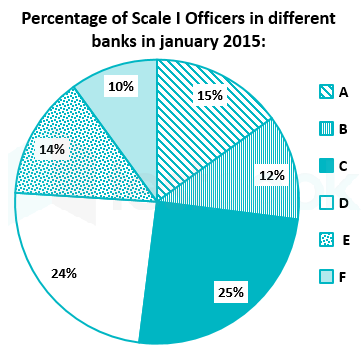
Directions: Read the pie chart carefully and answer the following questions. Pie chart represent the percentage of scale I officer in different banks in January 2015. Total number of Scale I officers are 400. 


Note: No new employees joined the given banks or left the given banks from January 2015 to December 2015.

Question 37

What is the average number of scale I officers in Banks D, E and F?

  1. AOption (a)

    63

  2. BOption (b)

    65

  3. COption (c)

    64

  4. DOption (d)

    67

  5. EOption (e)

    68

View answer & explanation

Correct answer

Answer: (c)C.

64

Why this answer is correct

Percentage of Scale 1 officers in Banks D, E, and F are 24%, 14%, and 10% respectively.

∴ Average number of Scale 1 officers in Banks D, E and F

= [24 + 14 + 10] / 3 × 1 / 100 × 400

= 16 × 4

= 64

Question 38

In January 2015, the number of male Scale I Officers in Bank B was three times the number of female Scale I Officers in the same bank. If in Bank D, the number of female Scale I Officers was the same as that in bank B; what was the number of male Scale I Officers in Bank D?

  1. AOption (a)

    80

  2. BOption (b)

    78

  3. COption (c)

    82

  4. DOption (d)

    84

  5. EOption (e)

    76

View answer & explanation

Correct answer

Answer: (d)D.

84

Why this answer is correct

Number of scale I officers in Bank B in January 2015 = 12 / 100 × 400 = 48

Number of scale I officers in Bank D in January 2015 = 24 / 100 × 400 = 96

Suppose the number of female Scale I Officers in the same bank = p

⇒ Number of male Scale I Officers in Bank B = 3p

p + 3p = 48

⇒ p = 12

Number of female Scale I Officers in bank B = 12

⇒ Number of female Scale I Officers in bank D = 12

∴ Number of male Scale I Officers in bank D = 96 - 12 = 84

Question 39

In January 2015, 32% of the total number of scale I officers in Banks B, D, and E together were unmarried. If the respective ratio between the number of unmarried officers in these banks was 3 : 2 : 3, what was the number of unmarried Scale I officers in Bank D?

  1. AOption (a)

    18

  2. BOption (b)

    24

  3. COption (c)

    14

  4. DOption (d)

    20

  5. EOption (e)

    16

View answer & explanation

Correct answer

Answer: (e)E.

16

Why this answer is correct

Number of scale I officers in Bank B in January 2015 = 12 / 100 × 400 = 48

Number of scale I officers in Bank D in January 2015 = 24 / 100 × 400 = 96

Number of scale I officers in Bank E in January 2015 = 14 / 100 × 400 = 56

⇒ Number of unmarried scale I officers in Banks B, D and E together = (48 + 96 + 56) × 32 / 100

= 64

∴ Number of unmarried Scale I officers in Bank D = 64 × 2 / 8 = 16

Question 40

In December 2014, 4% of the candidates who applied for a job as Scale 1 officer were recruited in Bank A. If Bank A had 44 Scale I officers in 2014, what was the number of candidates who applied for the job?

  1. AOption (a)

    240

  2. BOption (b)

    450

  3. COption (c)

    400

  4. DOption (d)

    250

  5. EOption (e)

    300

View answer & explanation

Correct answer

Answer: (c)C.

400

Why this answer is correct

Number of Scale 1 officer in bank A in January 2015 = 400 × 15 / 100 = 60

⇒ Number of Scale 1 officer recruited in December 2014 = 60 - 44 = 16

Given: In December 2014, 4% of the candidates who applied for a job as Scale 1 officer were recruited in Bank A.

∴ Number of candidates who applied for the job = 16 / 4 × 100 = 400

Question 41

In January 2016, some Scale I Officers resigned from Bank C and all of them joined Bank B. If the resultant respective ratio between the number of Scale I Officers in Bank C and that in Bank B is 24 : 13, what is the number of Scale I Officers who resigned from Bank C?

  1. AOption (a)

    3

  2. BOption (b)

    6

  3. COption (c)

    7

  4. DOption (d)

    4

  5. EOption (e)

    5

View answer & explanation

Correct answer

Answer: (d)D.

4

Why this answer is correct

Number of scale I officers in Bank B in January 2015 = 12 / 100 × 400 = 48

Number of scale I officers in Bank C in January 2015 = 25 / 100 × 400 = 100

Suppose ‘a’ number of Scale I Officers resigned from Bank C and all of them joined Bank B in January 2016.

⇒ (100 - a) : (48 + a) = 24 : 13

⇒ 1300 - 13a = 1152 + 24a

⇒ 37a = 148

⇒ a = 4

∴ Number of Scale I Officers who resigned from Bank C = 4

Question 42

In the given question, two equations numbered l and II are given. Solve both the equations and mark the appropriate answer.

I. x2 + 7x + 10 = 0 

II. y2 + 5y + 4 = 0

  1. AOption (a)

    x > y

  2. BOption (b)

    x < y

  3. COption (c)

    x ≥ y

  4. DOption (d)

    x ≤ y

  5. EOption (e)

    x = y or relationship between x and y cannot be established.

View answer & explanation

Correct answer

Answer: (e)E.

x = y or relationship between x and y cannot be established.

Why this answer is correct

I. x2 + 7x + 10 = 0 

⇒ x2 + 5x + 2x + 10 = 0

⇒ x(x + 5) + 2(x + 5) = 0

⇒ (x + 2) (x + 5) = 0

⇒ x = -2, -5

II. y2 + 5y + 4 = 0

⇒ y2 + 4y + y + 4 = 0

⇒ y(y + 4) + 1 (y + 4) = 0

⇒ (y + 4) (y + 1) = 0

⇒ y = -4, -1

Value of xValue of yRelation
-2-4x > y
-2-1x < y
-5-4x < y
-5-1x < y


∴ x = y or the relationship between x and y cannot be established.

Question 43

In the given question, two equations numbered l and II are given. Solve both the equations and mark the appropriate answer.

I. x2 + 35x + 306 = 0

II. y2 + 41y + 408 = 0

  1. AOption (a)

    x > y

  2. BOption (b)

    x < y

  3. COption (c)

    x ≥ y

  4. DOption (d)

    x ≤ y

  5. EOption (e)

    x = y or relationship between x and y cannot be established.

View answer & explanation

Correct answer

Answer: (e)E.

x = y or relationship between x and y cannot be established.

Why this answer is correct

Calculations:

I. x2 + 35x + 306 = 0

⇒ x2 + 17x + 18x + 306 = 0

⇒ x(x + 17) + 18(x + 17) = 0

⇒ (x + 17) (x + 18) = 0

⇒ x = -17, -18

II. y2 + 41y + 408 = 0

⇒ y2 + 17y + 24y + 408 = 0

⇒ y(y + 17) + 24(y + 17) = 0

⇒ (y + 17) (y + 24) = 0

⇒ y = -17, -24

Value of xValue of yRelation
-17-17x = y
-17-24x > y
-18-17x < y
-18-24x > y
<br>

∴ x = y or relationship between x and y cannot be established.

Question 44

In the given question, two equations numbered l and II are given. Solve both the equations and mark the appropriate answer.

I. x2 - 19x + 60 = 0

II. y2 - 20y + 99 = 0

  1. AOption (a)

    x > y

  2. BOption (b)

    x < y

  3. COption (c)

    x ≥ y

  4. DOption (d)

    x ≤ y

  5. EOption (e)

    x = y or relationship between x and y cannot be established

View answer & explanation

Correct answer

Answer: (e)E.

x = y or relationship between x and y cannot be established

Why this answer is correct

i. x2 - 19x + 60 = 0

⇒ x2 - 15x - 4x + 60 = 0

⇒ (x - 15) (x - 4) = 0

⇒ x = 15, 4

ii. y2 - 20y + 99 = 0

⇒ y2 - 11y - 9y + 99 = 0

⇒ (y - 11) (y - 9) = 0

⇒ y = 11, 9

Value of XValue of YRelation
1511x > y
159x > y
411x < y
49x < y


Hence, Relation between x and y can’t be determine here.

Question 45

In the given question, two equations numbered l and II are given. Solve both the equations and mark the appropriate answer.

I. x2 - 28x + 195 = 0

II. y2 - 21y + 108 = 0

  1. AOption (a)

    x > y

  2. BOption (b)

    x < y

  3. COption (c)

    x ≥ y

  4. DOption (d)

    x ≤ y

  5. EOption (e)

    x = y or relationship between x and y cannot be established.

View answer & explanation

Correct answer

Answer: (a)A.

x > y

Why this answer is correct

i. x2 - 28x + 195 = 0

⇒ x2 - 15x - 13x + 195 = 0

⇒ (x - 15) (x - 13) = 0

⇒ x = 13, 15


ii. y2 - 21y + 108 = 0

⇒ y2 - 12y - 9y + 108 = 0

⇒ (y - 12) (y - 9) = 0

⇒ y = 9, 12


Value of XValue of YRelation
139x > y
1312x > y
159x > y
1512x > y


Hence, x > y.

Question 46

In the given question, two equations numbered l and II are given. Solve both the equations and mark the appropriate answer.

I. x2 + 19x + 78 = 0

II. 45y2 + 83y + 28 = 0

  1. AOption (a)

    x > y

  2. BOption (b)

    x < y

  3. COption (c)

    x ≥ y

  4. DOption (d)

    x ≤ y

  5. EOption (e)

    x = y or relationship between x and y cannot be established.

View answer & explanation

Correct answer

Answer: (b)B.

x < y

Why this answer is correct

I. x2 + 19x + 78 = 0

⇒ x2 + 6x + 13x + 78 = 0

⇒ x (x + 6) + 13 (x + 6) = 0

⇒ (x + 6) (x + 13) = 0

⇒ x = -13, -6

II. 45y2 + 83y + 28 = 0

⇒ 45y2   + 63y + 20y + 28 = 0

⇒ 9y (5y + 7) + 4 (5y + 7) = 0

⇒ (5y + 7) (9y + 4) = 0

⇒ y = -7/5, -4/9

Comparison between x and y (via Tabulation):
Value of xValue of yRelation
-6-4/9x < y
-6-1.4x < y
-13-4/9x < y
-13-1.4x < y


∴ x < y

Question 47

In the given question, two equations numbered l and II are given. Solve both the equations and mark the appropriate answer.

I. x2 + 31x + 240 = 0

II. 5y2 + 60y + 135 = 0

  1. AOption (a)

    x > y

  2. BOption (b)

    x < y

  3. COption (c)

    x ≥ y

  4. DOption (d)

    x ≤ y

  5. EOption (e)

    x = y or relationship between x and y cannot be established.

View answer & explanation

Correct answer

Answer: (b)B.

x < y

Why this answer is correct

I. x2 + 31x + 240 = 0

⇒ x2 + 15x + 16x + 240 = 0

⇒ x (x + 15) + 16(x + 15) = 0

⇒ (x + 15) (x + 16) = 0

⇒ x = -15, -16

II. 5y2 + 60y + 135 = 0

⇒ 5y2   + 45y + 15y + 135 = 0

⇒ 5y (y + 9) + 15 (y + 9) = 0

⇒ (y + 9) (5y + 15) = 0

⇒ y = -9, -3


Value of xValue of yRelation
- 15- 9x < y
- 15- 3x < y
- 16- 9x < y
- 16- 3x < y


Hence, x < y

Question 48

The average monthly savings of Shifa for the first 5 months is Rs. 2120, for the next 3 months is Rs. 4260 and for the remaining months of the year is Rs. 3140. Now, the average monthly expenditure for the complete year is Rs. 11000. Find the total income of the year

  1. AOption (a)

    Rs. 170,520

  2. BOption (b)

    Rs. 174,680

  3. COption (c)

    Rs. 180,950

  4. DOption (d)

    Rs. 167,940

  5. EOption (e)

    Rs. 190,360

View answer & explanation

Correct answer

Answer: (d)D.

Rs. 167,940

Why this answer is correct

Shortcut Trick

Total Savings = (5 × 2120) + (3 × 4260) + (4 × 3140)

Total Savings = 10600 + 12780 + 12560 = Rs. 35940

Total Expenditure = 12 × 11000 = Rs. 132000

Total Income = Total Savings + Total Expenditure = 35940 + 132000 = Rs. 167,940

∴ The correct answer is Rs. 167,940.

Alternate Method

Given: Average savings for 5, 3, and 4 months; average expenditure for 12 months.

Formula Used: Total = Average × Number of Months; Income = Savings + Expenditure

⇒ Savings(1-5) = 5 × 2120 = Rs. 10,600

⇒ Savings(6-8) = 3 × 4260 = Rs. 12,780

⇒ Savings(9-12) = 4 × 3140 = Rs. 12,560

⇒ Total Annual Savings = 10600 + 12780 + 12560 = Rs. 35,940

⇒ Total Annual Expenditure = 12 × 11000 = Rs. 132,000

⇒ Total Annual Income = 132000 + 35940 = Rs. 167,940

∴ The correct answer is Rs. 167,940.

Additional Information

Weighted Average Savings

The combined average for the year can be found using (n1x1 + n2x2 + n3x3) ÷ (n1 + n2 + n3).

Income Expenditure Relation

In financial math, Income = Expenditure + Savings. This applies to both monthly and annual totals.

Average Concept

Average = Total Sum ÷ Number of observations. To find the sum, multiply the average by the count.

Question 49

In a class, 60% speak Hindi and 70% speak English. If 28% of the students can’t speak any of the two languages, then what % of the students in the class can speak both the languages?

  1. AOption (a)

    55%

  2. BOption (b)

    56%

  3. COption (c)

    58%

  4. DOption (d)

    60%

  5. EOption (e)

    62%

View answer & explanation

Correct answer

Answer: (c)C.

58%

Why this answer is correct

Shortcut Trick

Total students speaking at least one language = 100% − 28% = 72%.

Speaking both languages = (Hindi % + English %) − Total speaking %.

⇒ (60% + 70%) − 72% = 130% − 72% = 58%.

∴ The correct answer is 58%.

Alternate Method

Given: Students speaking Hindi (n(H)) = 60%, English (n(E)) = 70%, Neither = 28%.

Formula Used: n(H ∪ E) = n(H) + n(E) − n(H ∩ E)

⇒ Total Students = 100%

⇒ Students speaking at least one language n(H ∪ E) = 100% − 28% = 72%

⇒ 72% = 60% + 70% − n(H ∩ E)

⇒ 72% = 130% − n(H ∩ E)

⇒ n(H ∩ E) = 130% − 72% = 58%

∴ The correct answer is 58%.

Additional Information

Venn Diagram for Two Sets

The union of two sets A and B is given by n(A ∪ B) = n(A) + n(B) − n(A ∩ B), representing students in at least one category.

Complement of a Set

The percentage of students who do neither activity is 100% − n(A ∪ B).

Only Category Calculations

To find students speaking only Hindi, subtract the intersection from the Hindi total: n(H) − n(H ∩ E).

Question 50

Two equal glasses are filled with alcohol and water respectively. First glass is filled with (2/5) of alcohol and second glass is filled with (1/4) of alcohol. Then, the glasses are filled up with water and the resultant mixture is put into a big Jug. Find the ratio of alcohol and water in the jug.

  1. AOption (a)

    13 : 27

  2. BOption (b)

    23 : 25

  3. COption (c)

    17 : 19

  4. DOption (d)

    14 : 25

  5. EOption (e)

    18 : 17

View answer & explanation

Correct answer

Answer: (a)A.

13 : 27

Why this answer is correct

Shortcut Trick

Equate the total capacity of both glasses by taking LCM of denominators (5 and 4) = 20 units.

Glass 1: Alcohol = 2/5 × 20 = 8 units, Water = 20 − 8 = 12 units.

Glass 2: Alcohol = 1/4 × 20 = 5 units, Water = 20 − 5 = 15 units.

Total: Alcohol = 8 + 5 = 13 units, Water = 12 + 15 = 27 units.

∴ The correct answer is 13 : 27.

Alternate Method

Given: Two equal glasses. Glass 1 alcohol fraction = 2/5. Glass 2 alcohol fraction = 1/4.

Formula: Ratio = (Sum of Alcohol) : (Sum of Water)

⇒ Let the capacity of each glass be 1 unit.

⇒ Total Alcohol = 2/5 + 1/4 = (8 + 5) / 20 = 13/20

⇒ Total Water in Glass 1 = 1 − 2/5 = 3/5

⇒ Total Water in Glass 2 = 1 − 1/4 = 3/4

⇒ Total Water = 3/5 + 3/4 = (12 + 15) / 20 = 27/20

⇒ Required Ratio = (13/20) : (27/20) = 13 : 27

∴ The correct answer is 13 : 27.

Additional Information

Mixture Equality Principle

When two mixtures of equal volume are mixed, the final concentration is the arithmetic mean of the individual concentrations of the components.

Alligation Method

Used to find the ratio in which two mixtures are mixed to get a desired concentration. In this question, since quantities are equal, the ratio of mixing is 1 : 1.

Compound Ratio

The compound ratio of a : b and c : d is (a × c) : (b × d). This is useful when dealng with successive dilutions or multiple vessels of different sizes.

Question 51

A train met with an accident 100 km from station P. It completes the remaining journey at 2/3 of the previous speed and reached 42 min late at station Q. If the accident had taken place 40 km further, it would have been only 22 min late. Then, what is the original speed of the train?

  1. AOption (a)

    60 km/hr

  2. BOption (b)

    40 km/hr

  3. COption (c)

    30 km/hr

  4. DOption (d)

    36 km/hr

  5. EOption (e)

    None of these

View answer & explanation

Correct answer

Answer: (a)A.

60 km/hr

Why this answer is correct

Shortcut Trick

Difference in delay = 42 − 22 = 20 min.

This 20 min difference is caused by covering the 40 km extra distance at original speed instead of reduced speed.

Speed ratio = 3 : 2 → Time ratio = 2 : 3. Difference = 1 unit.

1 unit = 20 min ⇒ Original time for 40 km = 2 units = 40 min = 2/3 hr.

Original Speed = Distance ÷ Time = 40 ÷ (2/3) = 60 km/hr.

∴ The correct answer is 60 km/hr.

Alternate Method

Given: Accident 1 at 100 km, Delay = 42 min. Accident 2 at 140 km, Delay = 22 min. Reduced speed = 2/3 of original speed.

Formula: Time = Distance / Speed | Delay = Timeslow − Timenormal

⇒ Let original speed be s and normal time to cover 40 km be t.

⇒ Reduced speed = (2/3)s, so slow time = t ÷ (2/3) = 1.5t.

⇒ Reduction in delay = (Timeslow − Timenormal) for 40 km distance.

⇒ 42 − 22 = 1.5t − t

⇒ 20 min = 0.5t

⇒ t = 40 min = 40/60 hr = 2/3 hr.

⇒ Original speed s = Distance / t = 40 / (2/3) = 60 km/hr.

∴ The correct answer is 60 km/hr.

Additional Information

Speed-Time Inversity

When distance is constant, speed and time are inversely proportional. If speed becomes a/b, time becomes b/a of the original time.

Accident Case Logic

The difference in time delay is solely due to the distance shifted between the two potential accident spots being covered at different speeds.

Question 52

A Man rows to a place 63 km far and comes back in 16 hours. He finds that he can row 18 km with the flow in the same time taken to row 14 km against the flow. What is the speed of the stream?

  1. AOption (a)

    1 km/hr

  2. BOption (b)

    2 km/hr

  3. COption (c)

    2.5 km/hr

  4. DOption (d)

    4 km/hr

  5. EOption (e)

    5 km/hr

View answer & explanation

Correct answer

Answer: (a)A.

1 km/hr

Why this answer is correct

Shortcut Trick

Ratio of Downstream speed (D) to Upstream speed (U) = 18 : 14 = 9 : 7.

Let speed D = 9x and U = 7x. Total time = 63/9x + 63/7x = 7/x + 9/x = 16/x.

Given 16/x = 16 hours ⇒ x = 1.

Downstream speed = 9 km/hr, Upstream speed = 7 km/hr.

Speed of stream = (9 − 7) ÷ 2 = 1 km/hr.

∴ The correct answer is 1 km/hr.

Alternate Method

Given: Total distance = 63 km, Total time = 16 hours, Ratio of speeds = 18:14.

Formula Used: Speed = Distance ÷ Time; Speed of stream = (Downstream − Upstream) ÷ 2.

⇒ Ratio of Downstream Speed (D) : Upstream Speed (U) = 18 : 14 = 9 : 7.

⇒ Let D = 9x and U = 7x.

⇒ Total time = (Distance ÷ D) + (Distance ÷ U) = 16.

⇒ 63 ÷ 9x + 63 ÷ 7x = 16.

⇒ 7/x + 9/x = 16 ⇒ 16/x = 16 ⇒ x = 1.

⇒ Downstream speed = 9 km/hr and Upstream speed = 7 km/hr.

⇒ Speed of stream = (9 − 7) ÷ 2 = 2 ÷ 2 = 1 km/hr.

∴ The correct answer is 1 km/hr.

Additional Information

Speed in Still Water

The speed of the boat in still water is the average of downstream and upstream speeds: B = (D + U) ÷ 2.

Speed of Stream

The speed of the current or stream is half the difference between downstream and upstream speeds: S = (D − U) ÷ 2.

Time and Speed Relation

When distance is constant, time is inversely proportional to speed: T1 ÷ T2 = S2 ÷ S1.

Question 53

A and B entered into a partnership by investing Rs. 8000 and Rs. 6000 respectively. After 8 months, A withdrew half his investment while B invested 1.5 times more of his investment more and C joined the partnership with Rs. 12000. Find the profit share of C after 1 year if A got Rs. 8000 as profit.

  1. AOption (a)

    Rs. 5400 

  2. BOption (b)

    Rs. 4500

  3. COption (c)

    Rs. 5000

  4. DOption (d)

    Rs. 4800

  5. EOption (e)

    Rs. 6000

View answer & explanation

Correct answer

Answer: (d)D.

Rs. 4800

Why this answer is correct

Shortcut Trick

Ratio of Profit Share = (Investment × Time period).

A's ratio = (8000 × 8) + (4000 × 4) = 64000 + 16000 = 80000.

B's ratio = (6000 × 8) + (15000 × 4) = 48000 + 60000 = 108000.

C's ratio = (12000 × 4) = 48000.

Simplified ratio A : B : C = 80 : 108 : 48 = 20 : 27 : 12.

Since 20 units = Rs. 8000, 1 unit = Rs. 400. Share of C = 12 × 400 = Rs. 4800.

∴ The correct answer is Rs. 4800.

Alternate Method

Given → Initial Investments: A = Rs. 8000, B = Rs. 6000. Time = 1 year (12 months). Changes occur after 8 months. Formulas: Profit Ratio = (I1 × T1) : (I2 × T2) : (I3 × T3)

⇒ A's total investment-month = (8000 × 8) + (4000 × 4) = 80000. ⇒ B's total investment-month = (6000 × 8) + (6000 + 1.5 × 6000) × 4 = 48000 + 15000 × 4 = 108000. ⇒ C's total investment-month = 12000 × (12 − 8) = 12000 × 4 = 48000. ⇒ Profit Ratio A : B : C = 80000 : 108000 : 48000 = 20 : 27 : 12. ⇒ Given A's profit = Rs. 8000. ⇒ 20 units = 8000 ⇒ 1 unit = 400. ⇒ C's profit = 12 units = 12 × 400 = 4800.

∴ The correct answer is Rs. 4800.

Additional Information

Partnership Basics

In a partnership, the profit is distributed in the ratio of the product of Investment and Time.

Investment Changes

If an investor changes their capital during the period, calculate the equivalent capital for 1 month by summing (Amount × Duration) for each phase.

Directions: Read the given pie and table carefully and answer the following questions.

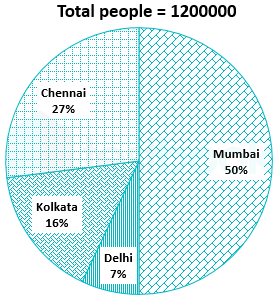
The pie chart shows the percentage distribution of people who found COVID – 19 positive in four major cities of India from 1st July to 31st August 2020 and the table shows the number of people who tested positive in July from these cities.

CityJuly
Mumbai230068
Delhi48149
Kolkata83468
Chennai147890

Question 54

Number of people from Delhi who tested positive in July is what percent of total positive tested people of that city?

  1. AOption (a)

    56%

  2. BOption (b)

    57.32%

  3. COption (c)

    62.58%

  4. DOption (d)

    60%

  5. EOption (e)

    59.86%

View answer & explanation

Correct answer

Answer: (b)B.

57.32%

Why this answer is correct

No. of people tested positive in July = 48149

Total people tested positive = 7% of 1200000 = 84000.

∴ Required percentage = (48149 ÷ 84000) × 100 = 57.32%

Question 55

What is the average of the number of people in August from Mumbai and the number of people in July from Chennai who tested positive?

  1. AOption (a)

    258911

  2. BOption (b)

    324526

  3. COption (c)

    242478

  4. DOption (d)

    278562

  5. EOption (e)

    None of these

View answer & explanation

Correct answer

Answer: (a)A.

258911

Why this answer is correct

Number of people tested positive in August from Mumbai = (50% of 1200000) – 230068 = 369932

Number of people tested positive in July from Chennai = 147890

∴ Required average = (369932 + 147890)/2 = 258911

Question 56

Total numbers of cases in July are how much more or less than the total number of cases in August of all four cities?

  1. AOption (a)

    509575

  2. BOption (b)

    690425

  3. COption (c)

    180850

  4. DOption (d)

    245689

  5. EOption (e)

    None of these

View answer & explanation

Correct answer

Answer: (c)C.

180850

Why this answer is correct

Total number of case in July = 230068 + 48149 + 83468 + 147890 = 509575

Total number of case in August = 1200000 – 509575 = 690425

∴ Difference = 690425 – 509575 = 180850

Question 57

Total peoples tested positive in Delhi is what percent of the total number of people tested positive in Mumbai?

  1. AOption (a)

    11%

  2. BOption (b)

    14% 

  3. COption (c)

    16%

  4. DOption (d)

    18%

  5. EOption (e)

    19%

View answer & explanation

Correct answer

Answer: (b)B.

14% 

Why this answer is correct

Total people tested positive in Delhi = 7% of 1200000 = 84000

Total people tested positive in Mumbai = 50% of 1200000 = 600000

∴ Required percent = (84000 ÷ 600000) × 100 = 14%

Question 58

If the recovery rate is 70% and the death rate is 10% of total tested cases in Chennai at the end of July. How many active cases are on 1st August, if no case is found on that day?

  1. AOption (a)

    32593

  2. BOption (b)

    21500

  3. COption (c)

    15320

  4. DOption (d)

    29578

  5. EOption (e)

    None of these

View answer & explanation

Correct answer

Answer: (d)D.

29578

Why this answer is correct

People recovered in the month of July = 70% of 147890 = 103523

People Died in the month of July = 10% of 147890 = 14789

∴ Active cases = 147890 – 103523 – 14789 = 29578

Question 59

The cost of printing a book increased from Rs. 96 to Rs. 120 from the year 2013 to 2018, such that the total money spent on printing books by a printing press increased in the ratio 5 ∶ 6. If the printing press printed 200 books in the year 2013, how many books did they print in the year 2018?

  1. AOption (a)

    176

  2. BOption (b)

    192

  3. COption (c)

    216

  4. DOption (d)

    252

  5. EOption (e)

    223

View answer & explanation

Correct answer

Answer: (b)B.

192

Why this answer is correct

Shortcut Trick

Total Expenditure ratio = 5 : 6

Cost per book ratio = 96 : 120 = 4 : 5

Number of books ratio = (Total Expenditure / Cost per book) = (5/4) : (6/5) = 25 : 24

Given 25 units = 200 books ⇒ 1 unit = 8 books

Number of books in 2018 = 24 units = 24 × 8 = 192 books

∴ The correct answer is 192 books.

Alternate Method

Given:

Cost per book (2013) = Rs. 96 | Cost per book (2018) = Rs. 120

Books printed (2013) = 200

Ratio of Total Expenditure (2013 : 2018) = 5 : 6

Calculations:

⇒ Total Expenditure (2013) = Cost × Quantity = 96 × 200 = Rs. 19200

⇒ According to ratio: 5 units = Rs. 19200

⇒ 1 unit = 19200 ÷ 5 = Rs. 3840

⇒ Total Expenditure (2018) = 6 units = 6 × 3840 = Rs. 23040

⇒ Number of books (2018) = Total Expenditure ÷ Cost per book

⇒ Number of books (2018) = 23040 ÷ 120

⇒ Number of books (2018) = 192

∴ The correct answer is 192 books.

Additional Information

Expenditure Relation

Total Expenditure = Price per unit × Consumption (Quantity). If Price increases, to keep expenditure constant, consumption must decrease.

Ratio Product Rule

If A : B is the ratio of prices and X : Y is the ratio of quantities, then the ratio of total costs is (A × X) : (B × Y).

Question 60

What is the total compound interest on Rs. 45000 for 3 years when the sum is divided into a ratio of 4 : 5 and rate of interest on a small sum is 10% and 20% on the large sum? (Compounded annually)

  1. AOption (a)

    Rs. 20010

  2. BOption (b)

    Rs. 24820

  3. COption (c)

    Rs. 25630

  4. DOption (d)

    Rs. 26400

  5. EOption (e)

    None of these

View answer & explanation

Correct answer

Answer: (b)B.

Rs. 24820

Why this answer is correct

Shortcut Trick

Total sum ₹45,000 is divided into 4 : 5 ratio.

Small sum = 4/9 × 45,000 = ₹20,000; Large sum = 5/9 × 45,000 = ₹25,000.

CI on ₹20,000 @ 10% for 3 years (Multiplying Factor 1.331) = 20,000 × 0.331 = ₹6,620.

CI on ₹25,000 @ 20% for 3 years (Multiplying Factor 1.728) = 25,000 × 0.728 = ₹18,200.

Total CI = 6,620 + 18,200 = ₹24,820.

∴ The correct answer is ₹24820.

Alternate Method

Given: Total Principal = ₹45,000, Ratio = 4 : 5, Time = 3 years.

Formula Used: CI = P[(1 + R/100)T − 1]

⇒ Sum 1 (P1) = 45,000 × (4 / (4 + 5)) = 45,000 × 4/9 = ₹20,000

⇒ Sum 2 (P2) = 45,000 × (5 / (4 + 5)) = 45,000 × 5/9 = ₹25,000

⇒ CI1 = 20,000 × [(1 + 10/100)3 − 1] = 20,000 × [1.331 − 1] = 20,000 × 0.331 = ₹6,620

⇒ CI2 = 25,000 × [(1 + 20/100)3 − 1] = 25,000 × [1.728 − 1] = 25,000 × 0.728 = ₹18,200

⇒ Total CI = CI1 + CI2 = 6,620 + 18,200 = ₹24,820

∴ The correct answer is ₹24820.

Additional Information

Effective Rate of Interest for 3 years

For 10%, effective rate is 33.1%. For 20%, effective rate is 72.8%. Calculated using [3R + 3R2/100 + R3/10000]%.

Difference between CI and SI

For 3 years, Difference = PR2(300 + R) / 1003.

Amount in Compound Interest

Amount (A) = P(1 + R/100)n, where n is the number of years.

Question 61

A alone can do a piece of work in 15 days, while B alone can do it in 20 days. They work together for 6 days and the rest of the work is done by C in 6 days. If they get Rs 800 for the whole work, how should they divide the money?

  1. AOption (a)

    Rs. 320, Rs. 240 and Rs. 240

  2. BOption (b)

    Rs. 640, Rs. 280 and Rs. 260

  3. COption (c)

    Rs. 320, Rs. 420 and Rs. 360

  4. DOption (d)

    Rs. 360, Rs. 420 and Rs. 240

  5. EOption (e)

    Rs. 320, Rs. 240 and Rs. 720

View answer & explanation

Correct answer

Answer: (a)A.

Rs. 320, Rs. 240 and Rs. 240

Why this answer is correct

Shortcut Trick

Ratio of work done determines the division of money.

Work ratio A : B : C = (6/15) : (6/20) : (remaining work).

A = 6/15 × 800 = ₹320 | B = 6/20 × 800 = ₹240 | C = 800 − (320 + 240) = ₹240.

∴ The correct answer is ₹320, ₹240 and ₹240.

Alternate Method

Given: A finishes in 15 days, B in 20 days. Together they work for 6 days. C finishes the rest in 6 days. Total wage = ₹800.

PersonDaysTotal WorkEfficiency
A15604
B203

⇒ Work done by A and B in 6 days = (4 + 3) × 6 = 7 × 6 = 42 units.

⇒ Remaining work done by C = 60 − 42 = 18 units.

⇒ Ratio of work done A : B : C = (4 × 6) : (3 × 6) : 18 = 24 : 18 : 18 = 4 : 3 : 3.

⇒ A share = (4/10) × 800 = ₹320.

⇒ B share = (3/10) × 800 = ₹240.

⇒ C share = (3/10) × 800 = ₹240.

∴ The correct answer is ₹320, ₹240 and ₹240.

Additional Information

Work and Wages Rule

Wages are distributed in the ratio of the actual work done by each person. If everyone works for the same duration, wages are proportional to their efficiencies.

Efficiency Formula

Efficiency = 1 ÷ Time taken. Total Work = Efficiency × Time.

Combined Work

If A and B work together, their combined efficiency is the sum of their individual efficiencies.

Question 62

If a 50 liters mixture of milk and water is in the ratio of 3 : 2. After removal of 10 liters mixture, 12 liters milk and 12 liters water is added into the mixture. Find the final ratio of water and milk in the mixture. 

  1. AOption (a)

    9 : 7

  2. BOption (b)

    7 : 9

  3. COption (c)

    3 : 2

  4. DOption (d)

    2 : 3

  5. EOption (e)

    1 : 1

View answer & explanation

Correct answer

Answer: (b)B.

7 : 9

Why this answer is correct

Shortcut Trick

Remaining Mixture = 50 − 10 = 40 liters.

In 40 liters, Milk = 40 × (3/5) = 24 liters and Water = 40 × (2/5) = 16 liters.

New Milk = 24 + 12 = 36 liters; New Water = 16 + 12 = 28 liters.

Final Ratio of Water to Milk = 28 : 36 = 7 : 9.

∴ The correct answer is 7 : 9.

Alternate Method

Given: Initial Mixture = 50 liters, Ratio M:W = 3:2.

⇒ After removing 10 liters, Remaining Mixture = 50 − 10 = 40 liters.

⇒ Quantity of Milk in remaining 40L = (3 / (3+2)) × 40 = (3/5) × 40 = 24 liters.

⇒ Quantity of Water in remaining 40L = (2 / (3+2)) × 40 = (2/5) × 40 = 16 liters.

⇒ After adding 12L Milk, Final Milk = 24 + 12 = 36 liters.

⇒ After adding 12L Water, Final Water = 16 + 12 = 28 liters.

⇒ Final Ratio Water : Milk = 28 : 36.

⇒ Dividing both by 4: 28/4 : 36/4 = 7 : 9.

∴ The correct answer is 7 : 9.

Additional Information

Mixture Removal Property

When a part of a mixture is removed, the ratio of components in the remaining mixture stays the same as the initial ratio.

Alligation Method

Used to find the proportion in which two or more ingredients at a given price/concentration must be mixed to produce a mixture of a desired price/concentration.

Replacement Formula

Final Quantity = Initial Quantity × (1 − x/V)n, where x is quantity removed/replaced and V is total volume.

Question 63

A shopkeeper gives discounts of 10% on the T.V.. The marked price of T.V. is Rs. 8000. After allowing discount, a shopkeeper gain 20 %. Find the cost price of a T.V.

  1. AOption (a)

    Rs. 7500

  2. BOption (b)

    Rs. 8500

  3. COption (c)

    Rs. 3500

  4. DOption (d)

    Rs. 4050

  5. EOption (e)

    Rs. 6000

View answer & explanation

Correct answer

Answer: (e)E.

Rs. 6000

Why this answer is correct

Shortcut Trick

Ratio of Cost Price (CP) to Marked Price (MP) is given by CP : MP = (100 − Discount%) : (100 + Profit%).

CP : MP = (100 − 10) : (100 + 20) = 90 : 120 = 3 : 4.

Given Marked Price = Rs. 8000, so 4 units = 8000.

1 unit = 2000.

Cost Price = 3 units = 3 × 2000 = Rs. 6000.

∴ The correct answer is Rs. 6000.

Alternate Method

Given: MP = Rs. 8000, Discount = 10%, Profit = 20%.

Formulas: SP = MP × (100 − D%) ÷ 100 | CP = SP × 100 ÷ (100 + P%).

⇒ Selling Price (SP) = 8000 × (100 − 10) ÷ 100

⇒ SP = 8000 × 90 ÷ 100 = Rs. 7200.

⇒ Cost Price (CP) = 7200 × 100 ÷ (100 + 20)

⇒ CP = 7200 × 100 ÷ 120 = 60 × 100 = Rs. 6000.

∴ The correct answer is Rs. 6000.

Additional Information

Relationship between CP and MP

The direct formula linking CP and MP is CP/MP = (100 − D%)/(100 + G%), which saves time in exams by bypassing SP calculation.

Profit and Discount Calculations

Profit is always calculated on Cost Price, whereas Discount is always calculated on Marked Price.

Question 64

Five dice are tossed together. What is the probability of getting different faces in all of the dice?

  1. AOption (a)

    6!/66

  2. BOption (b)

    6!/65

  3. COption (c)

    5!/65

  4. DOption (d)

    5!/66

  5. EOption (e)

    6!/55

View answer & explanation

Correct answer

Answer: (b)B.

6!/65

Why this answer is correct

Shortcut Trick

Total possible outcomes for 5 dice = 65.

Favorable outcomes for getting different faces = 6P5 = 6 × 5 × 4 × 3 × 2 = 720.

Since 6! = 6 × 5 × 4 × 3 × 2 × 1 = 720, the numerator is 6!.

Probability = 6! / 65.

∴ The correct answer is 6!/65.

Alternate Method

Given: Number of dice = 5. Each die has faces labeled {1, 2, 3, 4, 5, 6}.

Formula Used: Probability (P) = (Favorable Outcomes) / (Total Outcomes)

⇒ Total outcomes for 5 dice = 6 × 6 × 6 × 6 × 6 = 65

⇒ For all faces to be different, the first die can show any of 6 faces, the second any of the remaining 5, the third any of the remaining 4, and so on.

⇒ Favorable outcomes = 6 × 5 × 4 × 3 × 2 = 720

⇒ Note that 6! = 6 × 5 × 4 × 3 × 2 × 1 = 720

⇒ Probability = 6! / 65

∴ The correct answer is 6!/65.

Additional Information

Permutations and Combinations

When order matters and items are distinct, use nPr = n! / (n−r)!. In this case, 6P5 represents picking 5 distinct faces out of 6.

Total Outcomes of Dice

For 'n' standard dice tossed together, the total number of outcomes in the sample space is always 6n.

Probability Range

Probability of any event E always lies between 0 and 1 (0 ≤ P(E) ≤ 1).

Question 65

A circular pavement was to be built around a square park of side 18 m. The maximum width of pavement is 5 m. Calculate the cost of cementing the pavement at Rs. 15 per m2.

  1. AOption (a)

    Rs. 5000

  2. BOption (b)

    Rs. 4750

  3. COption (c)

    Rs. 4360

  4. DOption (d)

    Rs. 4380

  5. EOption (e)

    None of these

View answer & explanation

Correct answer

Answer: (d)D.

Rs. 4380

Why this answer is correct

Given:

Side of square = 18 m

Formula used:

Area of square = Side2

Area of circle = πr2

Calculation:

Area of square = Side2

⇒ Area of square park = 18 × 18 = 324 m2

Side of square = 18

⇒ Diameter of circle = 18 + 5 + 5 = 28 m

⇒ Radius of circle = 28 / 2 = 14

⇒ Area of circle = πr2 = (22 / 7) × 14 × 14 = 616 m2

Area of the pavement = 616 – 324 = 292 m2

Cost of cementing the pavement is Rs. 15 per m2

∴ Total cost of cementing the pavement = 292 × 15 = Rs. 4380

Reasoning Ability (35 questions)

Directions: Answer the questions based on the information given below.

Julie starts her journey from point ‘Z’ and walks 10km east to reach point ‘Y’ then she turns to her left and walks 3km to reach point ‘R’ and then she turns to her left again and walks 12km to reach point ‘S’. Again, she turns to her left and walks 3km to reach point ‘E’. Finally, she took to her right and moves for another 4km to reach point J.

Question 66

Point E is in which direction with respect to the point R?

  1. AOption (a)

    South west

  2. BOption (b)

    North west

  3. COption (c)

    North east

  4. DOption (d)

    North

  5. EOption (e)

    South east

View answer & explanation

Correct answer

Answer: (a)A.

South west

Why this answer is correct

As per the given information,

  1. Julie starts her journey from point ‘Z’ and walks 10km east to reach point ‘Y’

  2. then she turns to her left and walks 3km to reach point ‘R’ and,

  3. then she turns to her left again and walks 12km to reach point ‘S’.

  4. Again, she turns to her left and walks 3km to reach point ‘E’.

  5. Finally, she took to her right and moves for another 4km to reach point J.

Therefore, the final diagram is 

Hence, Point E is in the Southwest direction with respect to point R.

Question 67

If point K is southwest of Y and 8km south of point Z then what is the shortest distance (Approx) between point K and point Y?

  1. AOption (a)

    10 km

  2. BOption (b)

    13 Km

  3. COption (c)

    8 Km

  4. DOption (d)

    11 Km

  5. EOption (e)

    15 Km

View answer & explanation

Correct answer

Answer: (b)B.

13 Km

Why this answer is correct

As per the given information,

  1. Julie starts her journey from point ‘Z’ and walks 10km east to reach point ‘Y’


  1. then she turns to her left and walks 3km to reach point ‘R’ and,

  2. then she turns to her left again and walks 12km to reach point ‘S’.

  3. Again, she turns to her left and walks 3km to reach point ‘E’.

  4. Finally, she took to her right and moves for another 4km to reach point J.

Therefore, the final diagram is 

As per the question


Hence, 13Km is the shortest distance between point K and point Y.

Question 68

Which among the following is to the northwest of Point Z?

  1. AOption (a)

    Point J

  2. BOption (b)

    Point E

  3. COption (c)

    Point S

  4. DOption (d)

    Point R

  5. EOption (e)

    Point Y

View answer & explanation

Correct answer

Answer: (c)C.

Point S

Why this answer is correct

As per the given information,

  1. Julie starts her journey from point ‘Z’ and walks 10km east to reach point ‘Y’


  1. then she turns to her left and walks 3km to reach point ‘R’ and,

  2. then she turns to her left again and walks 12km to reach point ‘S’.

  3. Again, she turns to her left and walks 3km to reach point ‘E’.

  4. Finally, she took to her right and moves for another 4km to reach point J.

Therefore, the final diagram is 


Hence, Point S is to the northwest of Point Z.

Question 69

In the given word ‘MOTIVATION’ if the vowels are changed to the next letters and the consonants are changed to the previous letters as per the alphabetical series, then which letter/letters are repeated more than once?

  1. AOption (a)

    One 

  2. BOption (b)

    Two

  3. COption (c)

    Three

  4. DOption (d)

    Four

  5. EOption (e)

    None

View answer & explanation

Correct answer

Answer: (c)C.

Three

Why this answer is correct

Given : MOTIVATION

After changing the vowels to the next letter and the consonants to the previous letter;

LPSJUBSJPM

Hence, there are two letters (P, S, J) in the given words which are repeated more than once.

Question 70

If 2 is added to each even digit and 1 is subtracted from each odd digit in the number 945217, then what will be the sum of number/numbers not repeated in the new number?

  1. AOption (a)

    6

  2. BOption (b)

    8

  3. COption (c)

    4

  4. DOption (d)

    5

  5. EOption (e)

    7

View answer & explanation

Correct answer

Answer: (b)B.

8

Why this answer is correct

Given: 945217

By adding 2 in the even digits and subtracting 1 from the odd digits, we will get,

Number945217
operation-1+2-1+2-1-1
New Number864406

Here can clearly says that 8 and 0 are not repeated.

Therefore, sum of the number = 8 + 0 = 8

Hence, "8" is the correct answer.

Question 71

How many pair of letters are there in the word “EFFECTIVE” which has as many letters (in both forward and backward direction) in between as they have in English alphabet series?

  1. AOption (a)

    One

  2. BOption (b)

    Two

  3. COption (c)

    Three

  4. DOption (d)

    Four

  5. EOption (e)

    None of these

View answer & explanation

Correct answer

Answer: (d)D.

Four

Why this answer is correct

According to the given question,

The forward pairs are - EF, TV

The Backward pairs are - EF, CF 

Hence, there are four pairs.

Directions: Study the following information carefully and answer the questions that follow:

Nine boxes A, B, C, D, E, F, G, H, and I are kept one above the other not necessarily in the same order.

Three boxes are kept between A and B. Equal number of boxes are kept above and below A. Number of boxes kept above B is same as the number of boxes kept below C. Only two boxes are kept between C and I. One box is kept between A and G, which is not kept immediate above I. No box is kept between F and D, which is not kept above F. E is placed below H, which is kept immediate below D.

Question 72

How many boxes are kept between F and A?

  1. AOption (a)

    None

  2. BOption (b)

    Two

  3. COption (c)

    One

  4. DOption (d)

    Three

  5. EOption (e)

    More than three

View answer & explanation

Correct answer

Answer: (b)B.

Two

Why this answer is correct

  1. Equal number of boxes are kept above and below A
  2. Three boxes are kept between A and B
Case 1Case 2
B
AA
B
<br>
  1. The number of boxes kept above B is the same as the number of boxes kept below C.
  2. Only two boxes are kept between C and I.
Case 1Case 2
BC
I
AA
I
CB
<br>
  1. One box is kept between A and G, which is not kept immediate above I.
Case 1Case 1.1Case 2
BBC
G
I
AAA
II
GG
CCB
<br>
  1. No box is kept between F and D, which is not kept above F → D is kept immediately below F
  2. E is placed below H, which is kept immediate below D → Case 1 and Case 2 gets canceled because the given statement will not be satisfied.

So, the final arrangement will be

Case 1.1
B
F
D
H
A
I
G
E
C
<br>

Hence, only two boxes are kept between Fand A.

Question 73

Which box is kept immediately below H?

  1. AOption (a)

    I

  2. BOption (b)

    F

  3. COption (c)

    D

  4. DOption (d)

    E

  5. EOption (e)

    None of these

View answer & explanation

Correct answer

Answer: (e)E.

None of these

Why this answer is correct

  1. Equal number of boxes are kept above and below A
  2. Three boxes are kept between A and B
Case 1Case 2
B
AA
B
<br>
  1. The number of boxes kept above B is the same as the number of boxes kept below C.
  2. Only two boxes are kept between C and I.
Case 1Case 2
BC
I
AA
I
CB
<br>
  1. One box is kept between A and G, which is not kept immediate above I.
Case 1Case 1.1Case 2
BBC
G
I
AAA
II
GG
CCB
<br>
  1. No box is kept between F and D, which is not kept above F → D is kept immediately below F
  2. E is placed below H, which is kept immediate below D → Case 1 and Case 2 gets canceled because the given statement will not be satisfied.

So, the final arrangement will be

Case 1.1
B
F
D
H
A
I
G
E
C
<br>

Hence, A is kept immediately below H.

Question 74

Four of the following five are alike in a certain way and so form a group, find the one which does not belong to the group.

  1. AOption (a)

    AG

  2. BOption (b)

    BD

  3. COption (c)

    FH

  4. DOption (d)

    IC

  5. EOption (e)

    DA

View answer & explanation

Correct answer

Answer: (d)D.

IC

Why this answer is correct

  1. Equal number of boxes are kept above and below A
  2. Three boxes are kept between A and B
Case 1Case 2
B
AA
B
<br>
  1. The number of boxes kept above B is the same as the number of boxes kept below C.
  2. Only two boxes are kept between C and I.
Case 1Case 2
BC
I
AA
I
CB
<br>
  1. One box is kept between A and G, which is not kept immediate above I.
Case 1Case 1.1Case 2
BBC
G
I
AAA
II
GG
CCB
<br>
  1. No box is kept between F and D, which is not kept above F → D is kept immediately below F
  2. E is placed below H, which is kept immediate below D → Case 1 and Case 2 gets canceled because the given statement will not be satisfied.

So, the final arrangement will be

Case 1.1
B
F
D
H
A
I
G
E
C
<br>

There are two boxes between I and C, whereas there is only one box between other pairs.

Hence, IC does not belong to the group.

Question 75

Which of the following pairs represent the lowermost and the topmost box?

  1. AOption (a)

    EF

  2. BOption (b)

    EB

  3. COption (c)

    CB

  4. DOption (d)

    CF

  5. EOption (e)

    None of these

View answer & explanation

Correct answer

Answer: (c)C.

CB

Why this answer is correct

  1. Equal number of boxes are kept above and below A
  2. Three boxes are kept between A and B
Case 1Case 2
B
AA
B
<br>
  1. The number of boxes kept above B is the same as the number of boxes kept below C.
  2. Only two boxes are kept between C and I.
Case 1Case 2
BC
I
AA
I
CB
<br>
  1. One box is kept between A and G, which is not kept immediate above I.
Case 1Case 1.1Case 2
BBC
G
I
AAA
II
GG
CCB
<br>
  1. No box is kept between F and D, which is not kept above F → D is kept immediately below F
  2. E is placed below H, which is kept immediate below D → Case 1 and Case 2 gets canceled because the given statement will not be satisfied.

So, the final arrangement will be

Case 1.1
B
F
D
H
A
I
G
E
C
<br>

Hence, CB represent the lowermost box and topmost box.

Question 76

Which of the following statement is / are true?

  1. AOption (a)

    Only one box is kept between F and A

  2. BOption (b)

    All of the given statements are true

  3. COption (c)

    Three boxes are kept between E and H

  4. DOption (d)

    I is kept immediately below G

  5. EOption (e)

    None of the given statement is true

View answer & explanation

Correct answer

Answer: (c)C.

Three boxes are kept between E and H

Why this answer is correct

  1. Equal number of boxes are kept above and below A
  2. Three boxes are kept between A and B
Case 1Case 2
B
AA
B
<br>
  1. The number of boxes kept above B is the same as the number of boxes kept below C.
  2. Only two boxes are kept between C and I.
Case 1Case 2
BC
I
AA
I
CB
<br>
  1. One box is kept between A and G, which is not kept immediate above I.
Case 1Case 1.1Case 2
BBC
G
I
AAA
II
GG
CCB
<br>
  1. No box is kept between F and D, which is not kept above F → D is kept immediately below F
  2. E is placed below H, which is kept immediate below D → Case 1 and Case 2 gets canceled because the given statement will not be satisfied.

So, the final arrangement will be

Case 1.1
B
F
D
H
A
I
G
E
C
<br>

Hence, three boxes are kept between E and H.

Question 77

Direction: In the question below are given three statements followed by two conclusions numbered I and II. You have to take the given statements to be true even if they seem to be at variance with commonly known facts. Read all the conclusions and then decide which of the given conclusions logically follows from the given statements disregarding commonly known facts.

Statements:

Some A are B.

All B are C.

Only a few D are C.

Conclusions:

I. Some D are not A.

II. Some D are not B.

  1. AOption (a)

    Only conclusion I follows

  2. BOption (b)

    Only conclusion II follows

  3. COption (c)

    Both conclusion I and II follow

  4. DOption (d)

    Either conclusion I or II follows

  5. EOption (e)

    Neither conclusion I nor II follows

View answer & explanation

Correct answer

Answer: (b)B.

Only conclusion II follows

Why this answer is correct

The least possible diagram for the given statements is as follows:

Conclusions:

I. Some D are not A → False (as there is no direct relation between D and A, it is possible but not definite. So, it is false)

II. Some D are not B → True (as Only a few D are C, and All B are C, some part of D which is not C will not be B. So, it is true)

Hence, Only conclusion II follows.

Confusion PointsPlease note that according to the statement given 'Only a few D are C.' some D will definitely not be C and those D which are not C can not be B either.

Hence, the conclusion 'Some D are not B ' is true.

Question 78

Direction: In the question below are given three statements followed by two conclusions numbered I and II. You have to take the given statements to be true even if they seem to be at variance with commonly known facts. Read all the conclusions and then decide which of the given conclusions logically follows from the given statements disregarding commonly known facts.

Statements:

Some Sparrow are Parrot

Only a few Parrot are Camel.

All Camel are Goats.

Conclusions:

I. All Sparrow are Parrot.

II. Some Parrot are not Camel.

  1. AOption (a)

    Only conclusion I follows

  2. BOption (b)

    Only conclusion II follows

  3. COption (c)

    Both conclusion I and II follow

  4. DOption (d)

    Either conclusion I or II follows

  5. EOption (e)

    Neither conclusion I nor II follows

View answer & explanation

Correct answer

Answer: (b)B.

Only conclusion II follows

Why this answer is correct

The least possible diagram for the given statements is as follows;

Conclusions:

I. All Sparrow are Parrot → False (as Some Sparrow are Parrot and about the remaining part of Sparrow and Parrot, we cannot say definite relation whether it is true or not. So, it is false)

II. Some Parrot are not Camel → True (as Only a few Parrot are Camel → Some Parrot are Camel and Some Parrot are not Camel. So, it is true)

Hence, Only conclusion II follows.

Question 79

Direction: In the question below are given three statements followed by two conclusions numbered I and II. You have to take the given statements to be true even if they seem to be at variance with commonly known facts. Read all the conclusions and then decide which of the given conclusions logically follows from the given statements disregarding commonly known facts.

Statements:

Only a few Bus is Car.

Some Car is Train.

Some Train is Truck.

Conclusions:

I. Some Car is Truck.

II. All Bus being Car is a possibility.

  1. AOption (a)

    Only I follow

  2. BOption (b)

    Only II follow

  3. COption (c)

    Both I and II follows

  4. DOption (d)

    Either I or II follows

  5. EOption (e)

    Neither I nor II follows

View answer & explanation

Correct answer

Answer: (e)E.

Neither I nor II follows

Why this answer is correct

The least possible Venn diagram for the given statements is as follows:

Conclusions:

I. Some Car is Truck → False (As there is no direct relation between Car and Truck it is possible but not definite. So, it is false)

II. All Bus being Car is a possibility → False (As only a few Bus is Car means some Bus is Car and some Bus is not Car and possibility of all Bus being Car is false. So, it is false)

Hence, Neither I nor II follows.

Directions: Study the following information carefully and answer the questions that follow:

Seven persons A, C, P, L, J, K, F are sitting around a circular table but not necessarily in the same order. Only two of them are facing inside. Three persons are sitting between F and P when counted from the right of F.  L is sitting second to the left of K who is facing inside. L is not an immediate neighbor of A or F. Both the immediate neighbors of K are facing in opposite direction as that of K. The person sitting adjacent to both J and P is facing outside. A is sitting to the immediate left of F and facing outside. J is an immediate neighbor of neither F nor P. L is sitting to the immediate left of P.

Question 80

Who is sitting to the immediate right of J?

  1. AOption (a)

    P

  2. BOption (b)

    C

  3. COption (c)

    F

  4. DOption (d)

    L

  5. EOption (e)

    A

View answer & explanation

Correct answer

Answer: (d)D.

L

Why this answer is correct

Persons : A, C, P, L, J, K, F

Only 2 are facing inside and rest are facing outside.

1) A is sitting to the immediate left of F and facing outside.

⇒ Here direction of F is not known, hence we will make following cases :

Case 1 : F is facing inside.

Case 2 : F is facing outside.

  1. Three persons are sitting between F and P when counted from the right of F.

⇒ We will place P according to the condition given.

Case 1 :

Case 2 :

  1. L is sitting to the immediate left of P.

 L is not an immediate neighbor of A or F.

⇒ We get that in case 1, P faces inside and in case 2, P faces outside. 

Case 1 :

Case 2 :

  1. J is an immediate neighbor of neither F nor P.

⇒ We get the position of J from above hint.

Case 1 :

Case 2 : 

5) L is sitting second to the left of K who is facing inside. Both the immediate neighbors of K are facing in opposite direction as that of K.

⇒ We get the position of K from above hint.

Case 1 :

We can see that in case 1, both the immediate neighbors of K are not facing in opposite direction as that of K. Hence case 1 gets eliminated.

Case 2 :

6) The person sitting adjacent to both J and P is facing outside.

⇒ We get that L is facing outside and C is facing inside. (As the only person left was C and two persons were facing inside). Hence we get completed circular arrangement as shown below :

We can see from final diagram, L is sitting to the immediate right of J.

Question 81

How many persons are sitting between K and P?

  1. AOption (a)

    1

  2. BOption (b)

    2

  3. COption (c)

    4

  4. DOption (d)

    3

  5. EOption (e)

    Either 2 or 3 persons

View answer & explanation

Correct answer

Answer: (e)E.

Either 2 or 3 persons

Why this answer is correct

Persons : A, C, P, L, J, K, F

Only 2 are facing inside and rest are facing outside.

1) A is sitting to the immediate left of F and facing outside.

⇒ Here direction of F is not known, hence we will make following cases :

Case 1 : F is facing inside.

Case 2 : F is facing outside.

  1. Three persons are sitting between F and P when counted from the right of F.

⇒ We will place P according to the condition given.

Case 1 :

Case 2 :

  1. L is sitting to the immediate left of P.

 L is not an immediate neighbor of A or F.

⇒ We get that in case 1, P faces inside and in case 2, P faces outside. 

Case 1 :

Case 2 :

  1. J is an immediate neighbor of neither F nor P.

⇒ We get the position of J from above hint.

Case 1 :

Case 2 : 

5) L is sitting second to the left of K who is facing inside. Both the immediate neighbors of K are facing in opposite direction as that of K.

⇒ We get the position of K from above hint.

Case 1 :

We can see that in case 1, both the immediate neighbors of K are not facing in opposite direction as that of K. Hence case 1 gets eliminated.

Case 2 :

6) The person sitting adjacent to both J and P is facing outside.

⇒ We get that L is facing outside and C is facing inside. (As the only person left was C and two persons were facing inside). Hence we get completed circular arrangement as shown below :

We can see that either 2 or 3 persons are sitting between K and P depending upon direction of counting.

Question 82

If A and L interchange their positions, who will be sitting to the third left of L?

  1. AOption (a)

    P

  2. BOption (b)

    K

  3. COption (c)

    A

  4. DOption (d)

    L

  5. EOption (e)

    None of these

View answer & explanation

Correct answer

Answer: (c)C.

A

Why this answer is correct

Persons : A, C, P, L, J, K, F

Only 2 are facing inside and rest are facing outside.

1) A is sitting to the immediate left of F and facing outside.

⇒ Here direction of F is not known, hence we will make following cases :

Case 1 : F is facing inside.

Case 2 : F is facing outside.

  1. Three persons are sitting between F and P when counted from the right of F.

⇒ We will place P according to the condition given.

Case 1 :

Case 2 :

  1. L is sitting to the immediate left of P.

 L is not an immediate neighbor of A or F.

⇒ We get that in case 1, P faces inside and in case 2, P faces outside. 

Case 1 :

Case 2 :

  1. J is an immediate neighbor of neither F nor P.

⇒ We get the position of J from above hint.

Case 1 :

Case 2 : 

5) L is sitting second to the left of K who is facing inside. Both the immediate neighbors of K are facing in opposite direction as that of K.

⇒ We get the position of K from above hint.

Case 1 :

We can see that in case 1, both the immediate neighbors of K are not facing in opposite direction as that of K. Hence case 1 gets eliminated.

Case 2 :

6) The person sitting adjacent to both J and P is facing outside.

⇒ We get that L is facing outside and C is facing inside. (As the only person left was C and two persons were facing inside). Hence we get completed circular arrangement as shown below :

We can see that if A and L interchange their positions then A will be sitting third left of L.

Question 83

Four of the following five are alike in a way and hence form a group. Choose the one that does not belong to the group.

  1. AOption (a)

    F

  2. BOption (b)

    K

  3. COption (c)

    J

  4. DOption (d)

    L

  5. EOption (e)

    A

View answer & explanation

Correct answer

Answer: (b)B.

K

Why this answer is correct

Persons : A, C, P, L, J, K, F

Only 2 are facing inside and rest are facing outside.

1) A is sitting to the immediate left of F and facing outside.

⇒ Here direction of F is not known, hence we will make following cases :

Case 1 : F is facing inside.

Case 2 : F is facing outside.

  1. Three persons are sitting between F and P when counted from the right of F.

⇒ We will place P according to the condition given.

Case 1 :

Case 2 :

  1. L is sitting to the immediate left of P.

 L is not an immediate neighbor of A or F.

⇒ We get that in case 1, P faces inside and in case 2, P faces outside. 

Case 1 :

Case 2 :

  1. J is an immediate neighbor of neither F nor P.

⇒ We get the position of J from above hint.

Case 1 :

Case 2 : 

5) L is sitting second to the left of K who is facing inside. Both the immediate neighbors of K are facing in opposite direction as that of K.

⇒ We get the position of K from above hint.

Case 1 :

We can see that in case 1, both the immediate neighbors of K are not facing in opposite direction as that of K. Hence case 1 gets eliminated.

Case 2 :

6) The person sitting adjacent to both J and P is facing outside.

⇒ We get that L is facing outside and C is facing inside. (As the only person left was C and two persons were facing inside). Hence we get completed circular arrangement as shown below :

We can see that among the given options, only K is facing inside.

Hence, K is the odd one out.

Question 84

Who is sitting to the fifth right of F?

  1. AOption (a)

    A

  2. BOption (b)

    L

  3. COption (c)

    P

  4. DOption (d)

    K

  5. EOption (e)

    C

View answer & explanation

Correct answer

Answer: (e)E.

C

Why this answer is correct

Persons : A, C, P, L, J, K, F

Only 2 are facing inside and rest are facing outside.

1) A is sitting to the immediate left of F and facing outside.

⇒ Here direction of F is not known, hence we will make following cases :

Case 1 : F is facing inside.

Case 2 : F is facing outside.

  1. Three persons are sitting between F and P when counted from the right of F.

⇒ We will place P according to the condition given.

Case 1 :

Case 2 :

  1. L is sitting to the immediate left of P.

 L is not an immediate neighbor of A or F.

⇒ We get that in case 1, P faces inside and in case 2, P faces outside. 

Case 1 :

Case 2 :

  1. J is an immediate neighbor of neither F nor P.

⇒ We get the position of J from above hint.

Case 1 :

Case 2 : 

5) L is sitting second to the left of K who is facing inside. Both the immediate neighbors of K are facing in opposite direction as that of K.

⇒ We get the position of K from above hint.

Case 1 :

We can see that in case 1, both the immediate neighbors of K are not facing in opposite direction as that of K. Hence case 1 gets eliminated.

Case 2 :

6) The person sitting adjacent to both J and P is facing outside.

⇒ We get that L is facing outside and C is facing inside. (As the only person left was C and two persons were facing inside). Hence we get completed circular arrangement as shown below :

From the final arrangement we can see that, C is sitting to the fifth right of F.

Study the following information and answer the given questions.

Eight members of a family are living in a house, in which two are married couples. N is the father of D. E is married to N. G and D are siblings. C is married to G. N has no son. K is the father of E. Q is the only son of C. A is the brother-in-law of N.

Question 85

Who among the following is the son-in-law of N?

  1. AOption (a)

    G

  2. BOption (b)

    K

  3. COption (c)

    C

  4. DOption (d)

    Q

  5. EOption (e)

    None of these

View answer & explanation

Correct answer

Answer: (c)C.

C

Why this answer is correct

The table is drawn describing symbols and their meanings,

  1. N is the father of D. E is married to N. G and D are siblings. C is married to G. N has no son.

  2. Eight members of a family are living in a house, in which two are married couples. K is the father of E. Q is the only son of C. A is the brother-in-law of N.

Therefore, the final arrangement will be,

Hence, C is the son-in-law of N.

Question 86

How K is related to D?

  1. AOption (a)

    Father

  2. BOption (b)

    Uncle

  3. COption (c)

    Grand Mother

  4. DOption (d)

    Grand Father

  5. EOption (e)

    None of these

View answer & explanation

Correct answer

Answer: (d)D.

Grand Father

Why this answer is correct

The table is drawn describing symbols and their meanings,

  1. N is the father of D. E is married to N. G and D are siblings. C is married to G. N has no son.

  2. Eight members of a family are living in a house, in which two are married couples. K is the father of E. Q is the only son of C. A is the brother-in-law of N.

Therefore, the final arrangement will be,

Hence, K is the grandfather of D.

Question 87

Which of the following statement is true?

  1. AOption (a)

    K is the mother of A

  2. BOption (b)

    D and C are Siblings

  3. COption (c)

    Q is the son of A

  4. DOption (d)

    N is the husband of E

  5. EOption (e)

    None is correct

View answer & explanation

Correct answer

Answer: (d)D.

N is the husband of E

Why this answer is correct

The table is drawn describing symbols and their meanings,

  1. N is the father of D. E is married to N. G and D are siblings. C is married to G. N has no son.

  2. Eight members of a family are living in a house, in which two are married couples. K is the father of E. Q is the only son of C. A is the brother-in-law of N.

Therefore, the final arrangement will be,

Hence, N is the husband of E is the correct option.

Directions: Study the following information carefully and answer the questions that follow:

Five persons T, N, R, C and G went to the market on different days of a week from Monday to Friday, but not necessarily in the same order. They wore different types of cloths among Cotton, Silk, Wool, Leather and Linen. Additional information about them is given below.

Three persons went to the market between the persons who wore Cotton and Leather. T wore Silk cloth and went on one of the days after C. C did not wear Linen. Two persons went to the market between R and N. R and G did not wear Leather. The number of persons who went to the market before N is more than the number of persons went to the market after N. C did not go to the market on Monday.

Question 88

Who went to the market on Monday?

  1. AOption (a)

    C

  2. BOption (b)

    R

  3. COption (c)

    G

  4. DOption (d)

    N

  5. EOption (e)

    None of these

View answer & explanation

Correct answer

Answer: (c)C.

G

Why this answer is correct

Persons : T, N, R, C, G

Days : Monday to Friday

Cloths : Cotton, Silk, Wool, Leather, Linen.

1) Five persons T, N, R, C and G went to the market on different days of a week from Monday to Friday, but not necessarily in the same order. 

⇒ We can draw the following table according to the information given.

DaysPersonsCloths
Monday
Tuesday
Wednesday
Thursday
Friday


  1. The number of persons who went to the market before N is more than the number of persons went to the market after N.

⇒ We can draw the following cases : 

Case 1:
DaysPersonsCloths
Monday
Tuesday
Wednesday
ThursdayN
Friday
Case 2:
DaysPersonsCloths
Monday
Tuesday
Wednesday
Thursday
FridayN


  1. Two persons went to the market between R and N.

⇒ We can place R in both the cases as shown below:

Case 1:
DaysPersonsCloths
MondayR
Tuesday
Wednesday
ThursdayN
Friday
Case 2:
DaysPersonsCloths
Monday
TuesdayR
Wednesday
Thursday
FridayN


  1. Three persons went to the market between the persons who wore Cotton and Leather. R and G did not wear Leather.

⇒ We get to know that persons wearing Cotton and Leather must have gone on either Monday or Friday. Thus from Case 2 we have one more case. 

Case 1:
DaysPersonsCloths
MondayRCotton
Tuesday
Wednesday
ThursdayN
FridayLeather
Case 2:
DaysPersonsCloths
MondayCotton
TuesdayR
Wednesday
Thursday
FridayNLeather
Case 2A:
DaysPersonsCloths
MondayLeather
TuesdayR
Wednesday
Thursday
FridayNCotton


  1. T wore Silk cloth and went on one of the days after C. R and G did not wear Leather. C did not go to the market on Monday.

⇒ Here Case 1 and Case 2A gets eliminated as G is wearing Leather in these cases.

Case 1:
DaysPersonsCloths
MondayRCotton
TuesdayC
WednesdayTSilk
ThursdayN
FridayGLeather
Case 2:
DaysPersonsCloths
MondayGCotton
TuesdayR
WednesdayC
ThursdayTSilk
FridayNLeather
Case 2A:
DaysPersonsCloths
MondayGLeather
TuesdayR
WednesdayC
ThursdayTSilk
FridayNCotton


5) C did not wear Linen.

⇒ We get that R wore Linen and C wore Wool. Thus we get completed arrangement as shown below.

Case 2:
DaysPersonsCloths
MondayGCotton
TuesdayRLinen
WednesdayCWool
ThursdayTSilk
FridayNLeather


We can see that, G went to the market on Monday.

Question 89

C wore which type of cloth?

  1. AOption (a)

    Leather

  2. BOption (b)

    Linen

  3. COption (c)

    Cotton

  4. DOption (d)

    Wool

  5. EOption (e)

    Either 1 or 2

View answer & explanation

Correct answer

Answer: (d)D.

Wool

Why this answer is correct

Persons : T, N, R, C, G

Days : Monday to Friday

Cloths : Cotton, Silk, Wool, Leather, Linen.

1) Five persons T, N, R, C and G went to the market on different days of a week from Monday to Friday, but not necessarily in the same order. 

⇒ We can draw the following table according to the information given.

DaysPersonsCloths
Monday
Tuesday
Wednesday
Thursday
Friday


  1. The number of persons who went to the market before N is more than the number of persons went to the market after N.

⇒ We can draw the following cases : 

Case 1:
DaysPersonsCloths
Monday
Tuesday
Wednesday
ThursdayN
Friday
Case 2:
DaysPersonsCloths
Monday
Tuesday
Wednesday
Thursday
FridayN


  1. Two persons went to the market between R and N.

⇒ We can place R in both the cases as shown below:

Case 1:
DaysPersonsCloths
MondayR
Tuesday
Wednesday
ThursdayN
Friday
Case 2:
DaysPersonsCloths
Monday
TuesdayR
Wednesday
Thursday
FridayN


  1. Three persons went to the market between the persons who wore Cotton and Leather. R and G did not wear Leather.

⇒ We get to know that persons wearing Cotton and Leather must have gone on either Monday or Friday. Thus from Case 2 we have one more case. 

Case 1:
DaysPersonsCloths
MondayRCotton
Tuesday
Wednesday
ThursdayN
FridayLeather
Case 2:
DaysPersonsCloths
MondayCotton
TuesdayR
Wednesday
Thursday
FridayNLeather
Case 2A:
DaysPersonsCloths
MondayLeather
TuesdayR
Wednesday
Thursday
FridayNCotton


  1. T wore Silk cloth and went on one of the days after C. R and G did not wear Leather. C did not go to the market on Monday.

⇒ Here Case 1 and Case 2A gets eliminated as G is wearing Leather in these cases.

Case 1:
DaysPersonsCloths
MondayRCotton
TuesdayC
WednesdayTSilk
ThursdayN
FridayGLeather
Case 2:
DaysPersonsCloths
MondayGCotton
TuesdayR
WednesdayC
ThursdayTSilk
FridayNLeather
Case 2A:
DaysPersonsCloths
MondayGLeather
TuesdayR
WednesdayC
ThursdayTSilk
FridayNCotton


5) C did not wear Linen.

⇒ We get that R wore Linen and C wore Wool. Thus we get completed arrangement as shown below.

Case 2:
DaysPersonsCloths
MondayGCotton
TuesdayRLinen
WednesdayCWool
ThursdayTSilk
FridayNLeather

We can see that, C wore Wool.

Question 90

How many persons went to the market between T and N?

  1. AOption (a)

    One

  2. BOption (b)

    Two

  3. COption (c)

    Zero

  4. DOption (d)

    Three

  5. EOption (e)

    Four

View answer & explanation

Correct answer

Answer: (c)C.

Zero

Why this answer is correct

Persons : T, N, R, C, G

Days : Monday to Friday

Cloths : Cotton, Silk, Wool, Leather, Linen.

1) Five persons T, N, R, C and G went to the market on different days of a week from Monday to Friday, but not necessarily in the same order. 

⇒ We can draw the following table according to the information given.

DaysPersonsCloths
Monday
Tuesday
Wednesday
Thursday
Friday


  1. The number of persons who went to the market before N is more than the number of persons went to the market after N.

⇒ We can draw the following cases : 

Case 1:
DaysPersonsCloths
Monday
Tuesday
Wednesday
ThursdayN
Friday
Case 2:
DaysPersonsCloths
Monday
Tuesday
Wednesday
Thursday
FridayN


  1. Two persons went to the market between R and N.

⇒ We can place R in both the cases as shown below:

Case 1:
DaysPersonsCloths
MondayR
Tuesday
Wednesday
ThursdayN
Friday
Case 2:
DaysPersonsCloths
Monday
TuesdayR
Wednesday
Thursday
FridayN


  1. Three persons went to the market between the persons who wore Cotton and Leather. R and G did not wear Leather.

⇒ We get to know that persons wearing Cotton and Leather must have gone on either Monday or Friday. Thus from Case 2 we have one more case. 

Case 1:
DaysPersonsCloths
MondayRCotton
Tuesday
Wednesday
ThursdayN
FridayLeather
Case 2:
DaysPersonsCloths
MondayCotton
TuesdayR
Wednesday
Thursday
FridayNLeather
Case 2A:
DaysPersonsCloths
MondayLeather
TuesdayR
Wednesday
Thursday
FridayNCotton


  1. T wore Silk cloth and went on one of the days after C. R and G did not wear Leather. C did not go to the market on Monday.

⇒ Here Case 1 and Case 2A gets eliminated as G is wearing Leather in these cases.

Case 1:
DaysPersonsCloths
MondayRCotton
TuesdayC
WednesdayTSilk
ThursdayN
FridayGLeather
Case 2:
DaysPersonsCloths
MondayGCotton
TuesdayR
WednesdayC
ThursdayTSilk
FridayNLeather
Case 2A:
DaysPersonsCloths
MondayGLeather
TuesdayR
WednesdayC
ThursdayTSilk
FridayNCotton


5) C did not wear Linen.

⇒ We get that R wore Linen and C wore Wool. Thus we get completed arrangement as shown below.

Case 2:
DaysPersonsCloths
MondayGCotton
TuesdayRLinen
WednesdayCWool
ThursdayTSilk
FridayNLeather


We can see that, No one went to the market between T and N.

Question 91

Who went to the market at the first and last respectively?

  1. AOption (a)

    R, C

  2. BOption (b)

    G, N

  3. COption (c)

    T, N

  4. DOption (d)

    G, R

  5. EOption (e)

    C, N

View answer & explanation

Correct answer

Answer: (b)B.

G, N

Why this answer is correct

Persons : T, N, R, C, G

Days : Monday to Friday

Cloths : Cotton, Silk, Wool, Leather, Linen.

1) Five persons T, N, R, C and G went to the market on different days of a week from Monday to Friday, but not necessarily in the same order. 

⇒ We can draw the following table according to the information given.

DaysPersonsCloths
Monday
Tuesday
Wednesday
Thursday
Friday


  1. The number of persons who went to the market before N is more than the number of persons went to the market after N.

⇒ We can draw the following cases : 

Case 1:
DaysPersonsCloths
Monday
Tuesday
Wednesday
ThursdayN
Friday
Case 2:
DaysPersonsCloths
Monday
Tuesday
Wednesday
Thursday
FridayN


  1. Two persons went to the market between R and N.

⇒ We can place R in both the cases as shown below:

Case 1:
DaysPersonsCloths
MondayR
Tuesday
Wednesday
ThursdayN
Friday
Case 2:
DaysPersonsCloths
Monday
TuesdayR
Wednesday
Thursday
FridayN


  1. Three persons went to the market between the persons who wore Cotton and Leather. R and G did not wear Leather.

⇒ We get to know that persons wearing Cotton and Leather must have gone on either Monday or Friday. Thus from Case 2 we have one more case. 

Case 1:
DaysPersonsCloths
MondayRCotton
Tuesday
Wednesday
ThursdayN
FridayLeather
Case 2:
DaysPersonsCloths
MondayCotton
TuesdayR
Wednesday
Thursday
FridayNLeather
Case 2A:
DaysPersonsCloths
MondayLeather
TuesdayR
Wednesday
Thursday
FridayNCotton


  1. T wore Silk cloth and went on one of the days after C. R and G did not wear Leather. C did not go to the market on Monday.

⇒ Here Case 1 and Case 2A gets eliminated as G is wearing Leather in these cases.

Case 1:
DaysPersonsCloths
MondayRCotton
TuesdayC
WednesdayTSilk
ThursdayN
FridayGLeather
Case 2:
DaysPersonsCloths
MondayGCotton
TuesdayR
WednesdayC
ThursdayTSilk
FridayNLeather
Case 2A:
DaysPersonsCloths
MondayGLeather
TuesdayR
WednesdayC
ThursdayTSilk
FridayNCotton


5) C did not wear Linen.

⇒ We get that R wore Linen and C wore Wool. Thus we get completed arrangement as shown below.

Case 2:
DaysPersonsCloths
MondayGCotton
TuesdayRLinen
WednesdayCWool
ThursdayTSilk
FridayNLeather


We can see that G and N went to the market at first and last respectively.

Question 92

Which of the following statement is false?

  1. AOption (a)

    R did not go on Friday.

  2. BOption (b)

    C did not wear Leather.

  3. COption (c)

    One person went to the market between the persons who wore Wool and Leather.

  4. DOption (d)

    N went on Thursday.

  5. EOption (e)

    C and T went to the market on consecutive days.

View answer & explanation

Correct answer

Answer: (d)D.

N went on Thursday.

Why this answer is correct

Persons : T, N, R, C, G

Days : Monday to Friday

Cloths : Cotton, Silk, Wool, Leather, Linen.

1) Five persons T, N, R, C and G went to the market on different days of a week from Monday to Friday, but not necessarily in the same order. 

⇒ We can draw the following table according to the information given.

DaysPersonsCloths
Monday
Tuesday
Wednesday
Thursday
Friday


  1. The number of persons who went to the market before N is more than the number of persons went to the market after N.

⇒ We can draw the following cases : 

Case 1:
DaysPersonsCloths
Monday
Tuesday
Wednesday
ThursdayN
Friday
Case 2:
DaysPersonsCloths
Monday
Tuesday
Wednesday
Thursday
FridayN


  1. Two persons went to the market between R and N.

⇒ We can place R in both the cases as shown below:

Case 1:
DaysPersonsCloths
MondayR
Tuesday
Wednesday
ThursdayN
Friday
Case 2:
DaysPersonsCloths
Monday
TuesdayR
Wednesday
Thursday
FridayN


  1. Three persons went to the market between the persons who wore Cotton and Leather. R and G did not wear Leather.

⇒ We get to know that persons wearing Cotton and Leather must have gone on either Monday or Friday. Thus from Case 2 we have one more case. 

Case 1:
DaysPersonsCloths
MondayRCotton
Tuesday
Wednesday
ThursdayN
FridayLeather
Case 2:
DaysPersonsCloths
MondayCotton
TuesdayR
Wednesday
Thursday
FridayNLeather
Case 2A:
DaysPersonsCloths
MondayLeather
TuesdayR
Wednesday
Thursday
FridayNCotton


  1. T wore Silk cloth and went on one of the days after C. R and G did not wear Leather. C did not go to the market on Monday.

⇒ Here Case 1 and Case 2A gets eliminated as G is wearing Leather in these cases.

Case 1:
DaysPersonsCloths
MondayRCotton
TuesdayC
WednesdayTSilk
ThursdayN
FridayGLeather
Case 2:
DaysPersonsCloths
MondayGCotton
TuesdayR
WednesdayC
ThursdayTSilk
FridayNLeather
Case 2A:
DaysPersonsCloths
MondayGLeather
TuesdayR
WednesdayC
ThursdayTSilk
FridayNCotton


5) C did not wear Linen.

⇒ We get that R wore Linen and C wore Wool. Thus we get completed arrangement as shown below.

Case 2:
DaysPersonsCloths
MondayGCotton
TuesdayRLinen
WednesdayCWool
ThursdayTSilk
FridayNLeather


We know from above arrangement that N went on Friday. Hence, N went on Thursday is false.

Question 93

Direction: In the following questions, assuming the given statements to be true, find which of the two conclusions I and II given them is/are definitely follow.

Statement: P ≤ Q < S = T ≥ U ≥ W < Z

Conclusion:

I. S > W

II. W = T

  1. AOption (a)

    Only conclusion II is true

  2. BOption (b)

    Either conclusion I or II is true

  3. COption (c)

    Both conclusion I and II are true

  4. DOption (d)

    Neither conclusion I nor II is true

  5. EOption (e)

    Only conclusion I is true

View answer & explanation

Correct answer

Answer: (b)B.

Either conclusion I or II is true

Why this answer is correct

Statement:

P ≤ Q < S = T ≥ U ≥ W < Z

Conclusion:

I. S > W: False: As, P ≤ Q < S = T ≥ U ≥ W < Z. so, the relation between S and W is S ≥ W.

II. W = T: False: As, P ≤ Q < S = T ≥ U ≥ W < Z. so, the relation between T and W is T ≥ W.

As S = T, Both form complementary pairs.

Therefore, either I or II follows.

Question 94

Direction: In the given question, assuming the given statements to be true, find which of the conclusions I and II given below the statements is/are definitely true.

Statements:

 H > G < C, E ≥ K < D ≤ B, E = C

Conclusions:

I.G ≤ D

II. G>D

  1. AOption (a)

    If only conclusion I follows 

  2. BOption (b)

    If only conclusion II follows 

  3. COption (c)

    If either conclusion I or conclusion II follows 

  4. DOption (d)

    If neither conclusion I nor conclusion II follows 

  5. EOption (e)

    If both conclusions follow

View answer & explanation

Correct answer

Answer: (c)C.

If either conclusion I or conclusion II follows 

Why this answer is correct

Given Statement: 

H > G < C, E ≥ K < D ≤ B, E = C

On combining: 

\()H > G < C = E ≥ K < D ≤ B

Conclusions:

 I. G ≤ D→ False (No definite information regarding G and D).

  II. G > D → False (No definite information regarding G and D).

On combining conclusions I and II, G can be greater than, smaller than, and equal to D,

Hence Either conclusion I and II follow.

Question 95

Directions

In the following question assuming the given statements to be true, find which of the conclusion among the given conclusions is/ are definitely true and then give your answers accordingly

Statements: H ≤ X ≤ R = O > T; Y = F ≥ R > D 

Conclusions:

I. H > Y

II. Y > H

  1. AOption (a)

    Only I is true

  2. BOption (b)

    Only II is true

  3. COption (c)

    Either I or II is true

  4. DOption (d)

    Both I and II is true

  5. EOption (e)

    Neither I nor II is true

View answer & explanation

Correct answer

Answer: (e)E.

Neither I nor II is true

Why this answer is correct

Given statements: H ≤ X ≤ R = O > T; Y = F ≥ R > D 

Conclusions:

I. H > Y → False (as H ≤ X ≤ R ≤ F = Y, thus H ≤ Y)

II. Y > H → False (as H ≤ X ≤ R ≤ F = Y, thus H ≤ Y)

After combining the statement we are getting 

H ≤ X ≤ R≤ F = Y

H≤Y

that is why either or case is not possible because it leads to a common conclusion.

Hence, Neither I nor II is true.

Directions: Study the following information carefully and answer the questions that follow:

Six persons P, Q, R, S, T and U were born in three different months May, September and November, on two different dates- 9 and 16 not necessarily in the same order.

P was born after R but not on the same date as that of R. Number of persons born before S is equal to the number of persons born after T.  Q and U were born in the same month. T was born in a month having even number of days. Two persons were born between R and T.

Question 96

Who was born on 16th November?

  1. AOption (a)

    R

  2. BOption (b)

    P

  3. COption (c)

    Q

  4. DOption (d)

    U

  5. EOption (e)

    Either Q or U

View answer & explanation

Correct answer

Answer: (e)E.

Either Q or U

Why this answer is correct

Persons : P, Q, R, S, T, U

 Months : May, September, November

 Dates : 9, 16

1) Six persons P, Q, R, S, T and U were born in three different months May, September and November, on two different dates- 9 and 16 not necessarily in the same order.

⇒ We can draw following table according to the information given.

Months (No of days)DatesPersons
May (31)9
May (31)16
September (30)9
September (30)16
November (30)9
November (30)16


  1. Number of persons born before S is equal to the number of persons born after T. T was born in a month having even number of days.

⇒ T can be born in September or November. Thus we can have the following cases :

Case 1:
Months (No of days)DatesPersons
May (31)9
May (31)16
September (30)9T
September (30)16S
November (30)9
November (30)16
Case 2:
Months (No of days)DatesPersons
May (31)9
May (31)16
September (30)9S
September (30)16T
November (30)9
November (30)16
Case 3:
Months (No of days)DatesPersons
May (31)9
May (31)16S
September (30)9
September (30)16
November (30)9T
November (30)16
Case 4:
Months (No of days)DatesPersons
May (31)9S
May (31)16
September (30)9
September (30)16
November (30)9
November (30)16T


  1. Two persons were born between R and T.

⇒ We can place R according to the condition given. Case 3 will be eliminated as it is not possible to place R in case 3.

Case 1:
Months (No of days)DatesPersons
May (31)9
May (31)16
September (30)9T
September (30)16S
November (30)9
November (30)16R
Case 2:
Months (No of days)DatesPersons
May (31)9R
May (31)16
September (30)9S
September (30)16T
November (30)9
November (30)16
Case 4:
Months (No of days)DatesPersons
May (31)9S
May (31)16
September (30)9R
September (30)16
November (30)9
November (30)16T


  1. P was born after R but not on the same date as that of R.

⇒ We can place P according to the condition given. Case 1 is eliminated as there is no suitable place for P. From Case 2 we get one more case as shown below :

Case 2A:
Months (No of days)DatesPersons
May (31)9R
May (31)16
September (30)9S
September (30)16T
November (30)9
November (30)16P
Case 2:
Months (No of days)DatesPersons
May (31)9R
May (31)16P
September (30)9S
September (30)16T
November (30)9
November (30)16
Case 4:
Months (No of days)DatesPersons
May (31)9S
May (31)16
September (30)9R
September (30)16P
November (30)9
November (30)16T


  1. Q and U were born in the same month.

⇒ This is possible only in case 2.


Case 2:
Months (No of days)DatesPersons
May (31)9R
May (31)16P
September (30)9S
September (30)16T
November (30)9
November (30)16


No further information is given for Q and U, hence Q and U can be born on either 9th or 16th of November. Thus Case 2 will be our final solution.

Case 2:
Months (No of days)DatesPersons
May (31)9R
May (31)16P
September (30)9S
September (30)16T
November (30)9Q/ U
November (30)16U/ Q


We can see that, either Q or U must have born on 16th November.

Question 97

Who was born immediately before R?

  1. AOption (a)

    P

  2. BOption (b)

    Q

  3. COption (c)

    S

  4. DOption (d)

    T

  5. EOption (e)

    No one

View answer & explanation

Correct answer

Answer: (e)E.

No one

Why this answer is correct

Persons : P, Q, R, S, T, U

 Months : May, September, November

 Dates : 9, 16

1) Six persons P, Q, R, S, T and U were born in three different months May, September and November, on two different dates- 9 and 16 not necessarily in the same order.

⇒ We can draw following table according to the information given.

Months (No of days)DatesPersons
May (31)9
May (31)16
September (30)9
September (30)16
November (30)9
November (30)16


  1. Number of persons born before S is equal to the number of persons born after T. T was born in a month having even number of days.

⇒ T can be born in September or November. Thus we can have the following cases :

Case 1:
Months (No of days)DatesPersons
May (31)9
May (31)16
September (30)9T
September (30)16S
November (30)9
November (30)16
Case 2:
Months (No of days)DatesPersons
May (31)9
May (31)16
September (30)9S
September (30)16T
November (30)9
November (30)16
Case 3:
Months (No of days)DatesPersons
May (31)9
May (31)16S
September (30)9
September (30)16
November (30)9T
November (30)16
Case 4:
Months (No of days)DatesPersons
May (31)9S
May (31)16
September (30)9
September (30)16
November (30)9
November (30)16T


  1. Two persons were born between R and T.

⇒ We can place R according to the condition given. Case 3 will be eliminated as it is not possible to place R in case 3.

Case 1:
Months (No of days)DatesPersons
May (31)9
May (31)16
September (30)9T
September (30)16S
November (30)9
November (30)16R
Case 2:
Months (No of days)DatesPersons
May (31)9R
May (31)16
September (30)9S
September (30)16T
November (30)9
November (30)16
Case 4:
Months (No of days)DatesPersons
May (31)9S
May (31)16
September (30)9R
September (30)16
November (30)9
November (30)16T


  1. P was born after R but not on the same date as that of R.

⇒ We can place P according to the condition given. Case 1 is eliminated as there is no suitable place for P. From Case 2 we get one more case as shown below :

Case 2A:
Months (No of days)DatesPersons
May (31)9R
May (31)16
September (30)9S
September (30)16T
November (30)9
November (30)16P
Case 2:
Months (No of days)DatesPersons
May (31)9R
May (31)16P
September (30)9S
September (30)16T
November (30)9
November (30)16
Case 4:
Months (No of days)DatesPersons
May (31)9S
May (31)16
September (30)9R
September (30)16P
November (30)9
November (30)16T


  1. Q and U were born in the same month.

⇒ This is possible only in case 2.


Case 2:
Months (No of days)DatesPersons
May (31)9R
May (31)16P
September (30)9S
September (30)16T
November (30)9
November (30)16


No further information is given for Q and U, hence Q and U can be born on either 9th or 16th of November. Thus Case 2 will be our final solution.

Case 2:
Months (No of days)DatesPersons
May (31)9R
May (31)16P
September (30)9S
September (30)16T
November (30)9Q/ U
November (30)16U/ Q


We can see from above table, R was born first, hence No one was born immediately before R.

Question 98

What is the square root of sum of the dates on which R and P were born?

  1. AOption (a)

    16

  2. BOption (b)

    4

  3. COption (c)

    5

  4. DOption (d)

    9

  5. EOption (e)

    25

View answer & explanation

Correct answer

Answer: (c)C.

5

Why this answer is correct

Persons : P, Q, R, S, T, U

 Months : May, September, November

 Dates : 9, 16

1) Six persons P, Q, R, S, T and U were born in three different months May, September and November, on two different dates- 9 and 16 not necessarily in the same order.

⇒ We can draw following table according to the information given.

Months (No of days)DatesPersons
May (31)9
May (31)16
September (30)9
September (30)16
November (30)9
November (30)16


  1. Number of persons born before S is equal to the number of persons born after T. T was born in a month having even number of days.

⇒ T can be born in September or November. Thus we can have the following cases :

Case 1:
Months (No of days)DatesPersons
May (31)9
May (31)16
September (30)9T
September (30)16S
November (30)9
November (30)16
Case 2:
Months (No of days)DatesPersons
May (31)9
May (31)16
September (30)9S
September (30)16T
November (30)9
November (30)16
Case 3:
Months (No of days)DatesPersons
May (31)9
May (31)16S
September (30)9
September (30)16
November (30)9T
November (30)16
Case 4:
Months (No of days)DatesPersons
May (31)9S
May (31)16
September (30)9
September (30)16
November (30)9
November (30)16T


  1. Two persons were born between R and T.

⇒ We can place R according to the condition given. Case 3 will be eliminated as it is not possible to place R in case 3.

Case 1:
Months (No of days)DatesPersons
May (31)9
May (31)16
September (30)9T
September (30)16S
November (30)9
November (30)16R
Case 2:
Months (No of days)DatesPersons
May (31)9R
May (31)16
September (30)9S
September (30)16T
November (30)9
November (30)16
Case 4:
Months (No of days)DatesPersons
May (31)9S
May (31)16
September (30)9R
September (30)16
November (30)9
November (30)16T


  1. P was born after R but not on the same date as that of R.

⇒ We can place P according to the condition given. Case 1 is eliminated as there is no suitable place for P. From Case 2 we get one more case as shown below :

Case 2A:
Months (No of days)DatesPersons
May (31)9R
May (31)16
September (30)9S
September (30)16T
November (30)9
November (30)16P
Case 2:
Months (No of days)DatesPersons
May (31)9R
May (31)16P
September (30)9S
September (30)16T
November (30)9
November (30)16
Case 4:
Months (No of days)DatesPersons
May (31)9S
May (31)16
September (30)9R
September (30)16P
November (30)9
November (30)16T


  1. Q and U were born in the same month.

⇒ This is possible only in case 2.


Case 2:
Months (No of days)DatesPersons
May (31)9R
May (31)16P
September (30)9S
September (30)16T
November (30)9
November (30)16


No further information is given for Q and U, hence Q and U can be born on either 9th or 16th of November. Thus Case 2 will be our final solution.

Case 2:
Months (No of days)DatesPersons
May (31)9R
May (31)16P
September (30)9S
September (30)16T
November (30)9Q/ U
November (30)16U/ Q


R and P were born on the dates, 9th and 16th respectively. Sum of 9 and 16 is 25. Its square root is 5.

Question 99

How many persons were born between P and U?

  1. AOption (a)

    2

  2. BOption (b)

    3

  3. COption (c)

    4

  4. DOption (d)

    1

  5. EOption (e)

    Cannot be determined

View answer & explanation

Correct answer

Answer: (e)E.

Cannot be determined

Why this answer is correct

Persons : P, Q, R, S, T, U

 Months : May, September, November

 Dates : 9, 16

1) Six persons P, Q, R, S, T and U were born in three different months May, September and November, on two different dates- 9 and 16 not necessarily in the same order.

⇒ We can draw following table according to the information given.

Months (No of days)DatesPersons
May (31)9
May (31)16
September (30)9
September (30)16
November (30)9
November (30)16


  1. Number of persons born before S is equal to the number of persons born after T. T was born in a month having even number of days.

⇒ T can be born in September or November. Thus we can have the following cases :

Case 1:
Months (No of days)DatesPersons
May (31)9
May (31)16
September (30)9T
September (30)16S
November (30)9
November (30)16
Case 2:
Months (No of days)DatesPersons
May (31)9
May (31)16
September (30)9S
September (30)16T
November (30)9
November (30)16
Case 3:
Months (No of days)DatesPersons
May (31)9
May (31)16S
September (30)9
September (30)16
November (30)9T
November (30)16
Case 4:
Months (No of days)DatesPersons
May (31)9S
May (31)16
September (30)9
September (30)16
November (30)9
November (30)16T


  1. Two persons were born between R and T.

⇒ We can place R according to the condition given. Case 3 will be eliminated as it is not possible to place R in case 3.

Case 1:
Months (No of days)DatesPersons
May (31)9
May (31)16
September (30)9T
September (30)16S
November (30)9
November (30)16R
Case 2:
Months (No of days)DatesPersons
May (31)9R
May (31)16
September (30)9S
September (30)16T
November (30)9
November (30)16
Case 4:
Months (No of days)DatesPersons
May (31)9S
May (31)16
September (30)9R
September (30)16
November (30)9
November (30)16T


  1. P was born after R but not on the same date as that of R.

⇒ We can place P according to the condition given. Case 1 is eliminated as there is no suitable place for P. From Case 2 we get one more case as shown below :

Case 2A:
Months (No of days)DatesPersons
May (31)9R
May (31)16
September (30)9S
September (30)16T
November (30)9
November (30)16P
Case 2:
Months (No of days)DatesPersons
May (31)9R
May (31)16P
September (30)9S
September (30)16T
November (30)9
November (30)16
Case 4:
Months (No of days)DatesPersons
May (31)9S
May (31)16
September (30)9R
September (30)16P
November (30)9
November (30)16T


  1. Q and U were born in the same month.

⇒ This is possible only in case 2.


Case 2:
Months (No of days)DatesPersons
May (31)9R
May (31)16P
September (30)9S
September (30)16T
November (30)9
November (30)16


No further information is given for Q and U, hence Q and U can be born on either 9th or 16th of November. Thus Case 2 will be our final solution.

Case 2:
Months (No of days)DatesPersons
May (31)9R
May (31)16P
September (30)9S
September (30)16T
November (30)9Q/ U
November (30)16U/ Q


As the position of U is not fixed, we cannot determine how many persons were born between P and U.

Question 100

Who was born in a month having odd number of days?

  1. AOption (a)

    S

  2. BOption (b)

    T

  3. COption (c)

    Q

  4. DOption (d)

    U

  5. EOption (e)

    R

View answer & explanation

Correct answer

Answer: (e)E.

R

Why this answer is correct

Persons : P, Q, R, S, T, U

 Months : May, September, November

 Dates : 9, 16

1) Six persons P, Q, R, S, T and U were born in three different months May, September and November, on two different dates- 9 and 16 not necessarily in the same order.

⇒ We can draw following table according to the information given.

Months (No of days)DatesPersons
May (31)9
May (31)16
September (30)9
September (30)16
November (30)9
November (30)16


  1. Number of persons born before S is equal to the number of persons born after T. T was born in a month having even number of days.

⇒ T can be born in September or November. Thus we can have the following cases :

Case 1:
Months (No of days)DatesPersons
May (31)9
May (31)16
September (30)9T
September (30)16S
November (30)9
November (30)16
Case 2:
Months (No of days)DatesPersons
May (31)9
May (31)16
September (30)9S
September (30)16T
November (30)9
November (30)16
Case 3:
Months (No of days)DatesPersons
May (31)9
May (31)16S
September (30)9
September (30)16
November (30)9T
November (30)16
Case 4:
Months (No of days)DatesPersons
May (31)9S
May (31)16
September (30)9
September (30)16
November (30)9
November (30)16T


  1. Two persons were born between R and T.

⇒ We can place R according to the condition given. Case 3 will be eliminated as it is not possible to place R in case 3.

Case 1:
Months (No of days)DatesPersons
May (31)9
May (31)16
September (30)9T
September (30)16S
November (30)9
November (30)16R
Case 2:
Months (No of days)DatesPersons
May (31)9R
May (31)16
September (30)9S
September (30)16T
November (30)9
November (30)16
Case 4:
Months (No of days)DatesPersons
May (31)9S
May (31)16
September (30)9R
September (30)16
November (30)9
November (30)16T


  1. P was born after R but not on the same date as that of R.

⇒ We can place P according to the condition given. Case 1 is eliminated as there is no suitable place for P. From Case 2 we get one more case as shown below :

Case 2A:
Months (No of days)DatesPersons
May (31)9R
May (31)16
September (30)9S
September (30)16T
November (30)9
November (30)16P
Case 2:
Months (No of days)DatesPersons
May (31)9R
May (31)16P
September (30)9S
September (30)16T
November (30)9
November (30)16
Case 4:
Months (No of days)DatesPersons
May (31)9S
May (31)16
September (30)9R
September (30)16P
November (30)9
November (30)16T


  1. Q and U were born in the same month.

⇒ This is possible only in case 2.


Case 2:
Months (No of days)DatesPersons
May (31)9R
May (31)16P
September (30)9S
September (30)16T
November (30)9
November (30)16


No further information is given for Q and U, hence Q and U can be born on either 9th or 16th of November. Thus Case 2 will be our final solution.

Case 2:
Months (No of days)DatesPersons
May (31)9R
May (31)16P
September (30)9S
September (30)16T
November (30)9Q/ U
November (30)16U/ Q


Hence, we can see that among the given options, R was born in a month having odd number of days.

100 questions in the full paper