Previous Year Paper

IBPS PO Prelims Memory Based Paper (Held on:4 December 2021 Shift 1) (Previous Year Paper)

Held in 2021

100 questions60 minutes
With answers
Free

Paper last updated:

Practise under exam conditions

Take this paper as a timed mock test. Review your answers after you submit.

Attempt timed test

Questions & answers

Read the paper at your pace. Open an explanation when you need it.

English Language (30 questions)

Read the following passage carefully and answer the questions given below it. Certain words have been highlighted for your attention.

Most people spend (on average) half of their day tapping away at their hand-held devices. Either, surfing the net or checking notifications. Facebook ranks the highest in all social networking platforms, followed by Twitter, Instagram and so forth.

Social media is addictive- which is why so many people are 'hooked'. Often referred to as Social networking addiction, this phrase is often used to describe someone who spends too much time on Facebook, Twitter, Instagram and other channels. A blog post, Instagram post, tweet, or youtube video can be produced easily by anyone and shared, which can then be viewed by millions for free. Psychologists and scientists have now taken the time to study social media in terms of why they believe it interferes with aspects of our daily life.There is no official medical term that identifies addiction and social networking. It cannot be deemed as a disease or disorder as the cases are not severe and the habit can easily be maintained or prevented. Furthermore, instead of spending long periods of time on social media, we dip into and out of these sites all day long. We check for updates from friends and family as well as news and information. However, the behavior associated with the excessive use of these channels has become the subject of much public and sociological debate.We actively post, like, comment and share personal posts. Not only that, we tend to share and reshare expressions (of either negative or positive) contagiously. But, why?

Scientists believed some years ago that, dopamine was simply a pleasure chemical in the brain. Recent studies have shown that; dopamine actually produces the desire in people to 'want' by drawing out the need for us to -seek and search. Creating the ultimate drive to find what is that what we want.

Dopamine is spontaneous. It’s stimulated by unpredictability and small bits of information as well as reward cues which are the same conditions that social media presents to all users. In addition, the pull of dopamine is so strong that recent studies have shown that tweeting, for example, can be harder to resist than cigarettes and alcohol!

Researchers at Chicago University studied the effects of social media. They concluded quite quickly that people presented higher levels of addiction to social media than the need to smoke or drink. Media cravings ranked higher.

And, let’s not forget oxytocin, many call it the cuddle chemical because the brain releases pleasure chemicals that transpire usually when you kiss and hug- or tweet. It is also known as the hormone that builds the strong yet unique bond between mothers and their babies. Oxytocin is now regarded as the human stimulant of empathy, generosity, trust, and more. These are factors which many advertisers and marketers play on when promoting a brand or business over social media.

Nevertheless, problems have arisen most commonly with school kids - whereby mobile phone devices have been confiscated because exam results have fallen severely due to lack of attention on homework or studies. Schools in many westernized countries have had to take drastic action - banning smartphones, iPad and most portable devices from school premises- as it is claimed to be a huge distraction. Whereas, other schools use it for educational purposes and as a rewards system for their pupils.

Research has also indicated unsurprisingly that Facebook is the most common activity that university students switch to, when studying. Worryingly, it has also found that those who most engage in this type of internet browsing tend to have lower levels of educational achievement.

Also, there have been many cases of students posting or sharing content that is unethical, which has caused parents and academic institutions to limit the use of these online networking channels.

Question 1

Which is the most common activity that university students switch to when studying?

  1. AOption (a)

    Youtube

  2. BOption (b)

    Facebook

  3. COption (c)

    Twitter

  4. DOption (d)

    Whatsapp

  5. EOption (e)

    All of the above

View answer & explanation

Correct answer

Answer: (b)B.

Facebook

Why this answer is correct

The correct answer is 'Facebook'.

Key Points

  • As stated in the passage:
  • 'Facebook is the most common activity that university students switch to when studying'.
  • Thus, making option 2 the correct answer.

Question 2

Why is there no real medical term​ that identifies addiction and social networking?

  1. AOption (a)

    Research is not yet done on the subject

  2. BOption (b)

    It cannot be deemed as a disease or disorder as cases are not severe

  3. COption (c)

    The habit can easily be maintained or prevented

  4. DOption (d)

    1 and 2

  5. EOption (e)

    2 and 3

View answer & explanation

Correct answer

Answer: (e)E.

2 and 3

Why this answer is correct

The correct answer is 2 and 3.

Key Points

  • As mentioned in the passage: 'There is no official medical term that identifies addiction and social networking because it cannot be deemed as a disease or disorder as cases are not severe and the habit can easily be maintained or prevented'.
  • Thus making option 5 the correct answer.

Question 3

What stands true about Dopamine in the present scenario?

  1. AOption (a)

    It creates the ultimate drive to find what is that what we want.

  2. BOption (b)

    It’s stimulated by unpredictability and small bits of information as well as reward cues.

  3. COption (c)

    Dopamine was simply a pleasure chemical in the brain

  4. DOption (d)

    1 and 2

  5. EOption (e)

    2 and 3

View answer & explanation

Correct answer

Answer: (d)D.

1 and 2

Why this answer is correct

The correct answer is 1 and 2.

Key Points

  • As mentioned in the above passage:
  • 'Scientists believed some years ago that, dopamine was simply a pleasure chemical in the brain' eliminating option 3 as the correct answer.
  • While 'Recent studies have shown that; dopamine actually produces the desire in people to 'want' by drawing out the need for us to -seek and search. Creating the ultimate drive to find what is that what we want' makes option 1 the correct answer.

Also,

  • 'It’s stimulated by unpredictability and small bits of information as well as reward cues which are the same conditions that social media presents to all users' making option 2 also the correct answer.
  • Thus, option 4 is the correct answer.

Question 4

Why is Oxytocin regarded as the cuddle chemical?

  1. AOption (a)

    The brain releases pleasure chemicals that transpire usually when you kiss and hug- or tweet.

  2. BOption (b)

    It builds the strong yet unique bond between mothers and their babies.

  3. COption (c)

    It produces the desire in people to “want” by drawing out the need for us to -seek and search.

  4. DOption (d)

    1 and 2

  5. EOption (e)

    2 and 3

View answer & explanation

Correct answer

Answer: (d)D.

1 and 2

Why this answer is correct

The correct answer is '1 and 2'

Key Points

  • As mentioned in the above passage:
  • 'Many call it the cuddle chemical because the brain releases pleasure chemicals that transpire usually when you kiss and hug- or tweet. It is also known as the hormone that builds the strong yet unique bond between mothers and their babies. Oxytocin is now regarded as the human stimulant of empathy, generosity, trust, and more
  • Thus, making option 4 the correct answer.

Question 5

Which of the following words is the most similar in meaning to the word ‘contagiously’ as given in the passage?

  1. AOption (a)

    Assail

  2. BOption (b)

    Ambivalent

  3. COption (c)

    Arboreal

  4. DOption (d)

    Malignant

  5. EOption (e)

    Cogent

View answer & explanation

Correct answer

Answer: (d)D.

Malignant

Why this answer is correct

The correct answer is 'Malignant'.

Key Points

  • 'Contagiously' means (an emotion, feeling, or attitude) likely to spread to and affect others.
  • Out of the options mentioned above:
  • 'Assail' means to criticize strongly.
  • 'Ambivalent' means having mixed feelings or contradictory ideas about something or someone.
  • 'Arboreal' is related to trees.
  • 'Cogent' means clear, logical, and convincing.
  • While 'Malignant' means very virulent or infectious which is the most similar to the word Contagiously making option 4 the correct answer.

Question 6

Which of the following words is the most opposite in meaning to the word ‘confiscated’ as given in the passage?

  1. AOption (a)

    Cognizant

  2. BOption (b)

    Covet

  3. COption (c)

    Expiate

  4. DOption (d)

    Pithy

  5. EOption (e)

    Relinquish

View answer & explanation

Correct answer

Answer: (e)E.

Relinquish

Why this answer is correct

The correct answer is 'Relinquish'.

Key Points

  • 'Confiscated' means to steal or seize.
  • Out of the options mentioned above:
  • 'Cognizant' means having knowledge or awareness.
  • 'Covet' means yearning to possess.
  • 'Expiate' means to make amends or reparation for (guilt or wrongdoing).
  • 'Pithy' means terse and vigorously expressive.
  • While 'Relinquish' means voluntarily cease to keep or claim or give up which is the opposite of the word Confiscated making option 5 the correct answer.

Question 7

What were the conclusions taken out by the researchers at Chicago University on studying the effects of social media?

  1. AOption (a)

    People presented higher levels of addiction to social media than the need to smoke or drink.

  2. BOption (b)

    Levels of addiction of smoking and drinking were higher than that of media craving.

  3. COption (c)

    There was a higher rate of media cravings.

  4. DOption (d)

    1 and 2

  5. EOption (e)

    1 and 3

View answer & explanation

Correct answer

Answer: (e)E.

1 and 3

Why this answer is correct

The correct answer is 1 and 3.

Key Points

  • As mentioned in the above passage:
  • 'Researchers at Chicago University studied the effects of social media. They concluded quite quickly that people presented higher levels of addiction to social media than the need to smoke or drink. Media cravings ranked higher'.
  • Thus, option 1 and option 3 are the correct options making option 5 the right answer.

Question 8

What actions are taken by schools for students regarding mobile phone devices as mentioned in the passage?

  1. AOption (a)

    Punish students who bring mobile phones to schools.

  2. BOption (b)

    Use it for educational purposes and as a rewards system for their pupils.

  3. COption (c)

    Banning smartphones, iPad and most portable devices from school premises.

  4. DOption (d)

    1 and 2

  5. EOption (e)

    2 and 3

View answer & explanation

Correct answer

Answer: (e)E.

2 and 3

Why this answer is correct

The correct answer is 2 and 3.

Key Points

  • As mentioned in the above passage:
  • 'Schools in many westernized countries have had to take drastic action- banning smartphones, iPad, and most portable devices from school premises- as it is claimed to be a huge distraction. Whereas, other schools use it for educational purposes and as a rewards system for their pupils'.
  • Thus, option 5 is the correct answer as it includes both options 2 and 3.

Question 9

What does the phrase 'Social Networking Addiction' mean?

  1. AOption (a)

    Stalking People Socially

  2. BOption (b)

    Creating Fake profiles for fun

  3. COption (c)

    Finding your Friend Circle Online

  4. DOption (d)

    Someone who spends too much time on social websites

  5. EOption (e)

    Someone who is an introvert socially

View answer & explanation

Correct answer

Answer: (d)D.

Someone who spends too much time on social websites

Why this answer is correct

The correct answer is 'Someone who spends too much time on social websites'.

Key Points

  • Of all the options mentioned above,
  • Option 1, Option 2, Option 3 are the activities that can be done by a person who is socially active.
  • Option 5 is the phrase that is totally opposite to Social Addiction.
  • Hence, Option 4, i.e., Someone who spends too much time on social websites fits the best to the meaning of Social Networking Addiction making it the correct answer.

Question 10

Which of the below sentences summarizes the key idea of the passage?

  1. AOption (a)

    The Psychology of Social Addiction

  2. BOption (b)

    The Addiction in Students

  3. COption (c)

    The Science behind Addiction

  4. DOption (d)

    Beliefs of Scientists for Social Life

  5. EOption (e)

    None of the above

View answer & explanation

Correct answer

Answer: (a)A.

The Psychology of Social Addiction

Why this answer is correct

The correct answer is 'The Psychology of Social Addiction'.

Key Points

  • The passage can be divided into four subheadings:
  • It begins with the Science behind Social Addiction talking about how it interferes with the basic aspects of our life.
  • It continues telling that there is no medical term that identifies addiction and social networking.
  • Furthermore, it talks about Dopamine and Oxytocin and how they contribute to social media addiction.
  • The passage ends with a brief discussion of addiction in students nowadays.
  • Thus, all these subsections can be put together into one major heading which would be 'The Psychology of Social Addiction' making option 1 the correct answer.

Direction: The following sentences form a paragraph. The sentences are - A, B, C, D, E and F. Sentence E is fixed and its position cannot be changed. The rest of the sentences are not given in their proper order. Read the sentences and answer the following questions.

A. So a person that has integrity will act and behave as per set values and beliefs they hold dear.

B. There is a famous saying which perfectly describes integrity.

C. The word ‘integrity’ itself has a Latin origin.

D. “Honesty is telling the truth to other people; integrity is telling the truth to myself.”

E. So it refers to the sense of completeness and togetherness one enjoys when they live their lives honestly and morally.

F. It is derived from the word ‘integer’ and means to feel whole, i.e., a complete person.

Question 11

Which sentence should be the sixth sentence in the paragraph?

  1. AOption (a)

    F

  2. BOption (b)

    A

  3. COption (c)

    D

  4. DOption (d)

    C

  5. EOption (e)

    B

View answer & explanation

Correct answer

Answer: (b)B.

A

Why this answer is correct

The correct answer is A.

Key Points

  • The given paragraph is about integrity.
  • Sentence B talks about a famous phrase that describes integrity.
  • Sentence D mentions the phrase "Honesty is telling the truth to other people; integrity is telling the truth to myself.”
  • Sentence C talks about the main word that the phrase focuses on.
  • Sentence F is a continuation of sentence C as it talks more about the origin of the word integrity i.e., from where that word is derived from.
  • Sentence E is at the correct place so it follows sentence F.
  • After explaining the meaning of integrity, sentence A talks about how a person who has integrity should act.
  • So, sentence A should be the sixth sentence after rearranging the paragraph.
  • The correct sequence is BDCFEA.

Additional Information

  • The word morally is an adverb form of the word moral that means with reference to the principles of right and wrong behaviour.
  • For example, He believed the war was morally justified.

Question 12

Which sentence should be the fourth sentence in the paragraph?

  1. AOption (a)

    F

  2. BOption (b)

    B

  3. COption (c)

    C

  4. DOption (d)

    D

  5. EOption (e)

    A

View answer & explanation

Correct answer

Answer: (a)A.

F

Why this answer is correct

The correct answer is F.

Key Points

  • The given paragraph is about integrity.
  • Sentence B talks about a famous phrase that describes integrity.
  • Sentence D mentions the phrase "Honesty is telling the truth to other people; integrity is telling the truth to myself.”
  • Sentence C talks about the main word that the phrase focuses on.
  • Sentence F is a continuation of sentence C as it talks more about the origin of the word integrity i.e., from where that word is derived.
  • Sentence E is at the correct place so it follows sentence F.
  • After explaining the meaning of integrity, sentence A talks about how a person who has integrity should act.
  • So, sentence F should be the fourth sentence after rearranging the paragraph as it continues sentence C in describing the origins of the word.
  • The correct sequence is BDCFEA.

Additional Information

  • The word togetherness is the noun form of the word together that means a state or feeling of closeness and happiness among people who are together as friends, family members.
  • For example, The way they were defending their lives shows togetherness.

Question 13

Which sentence should be the third sentence in the paragraph?

  1. AOption (a)

    A

  2. BOption (b)

    B

  3. COption (c)

    C

  4. DOption (d)

    D

  5. EOption (e)

    F

View answer & explanation

Correct answer

Answer: (c)C.

C

Why this answer is correct

The correct answer is C.

Key Points

  • The given paragraph is about integrity.
  • Sentence B talks about a famous phrase that describes integrity.
  • Sentence D mentions the phrase "Honesty is telling the truth to other people; integrity is telling the truth to myself.”
  • Sentence C talks about the main word that the phrase focuses on.
  • Sentence F is a continuation of sentence C as it talks more about the origin of the word integrity i.e., from where that word is derived from.
  • Sentence E is at the correct place so it follows sentence F.
  • After explaining the meaning of integrity, sentence A talks about how a person who has integrity should act.
  • So, sentence C should be the third sentence after rearranging the paragraph as it explains more on the word mentioned in the phrase in sentence D.
  • The correct sequence is BDCFEA.

Additional Information

  • The word completeness is the noun form of the word complete which means the state or condition of having all the necessary or appropriate parts.
  • ​​For example, For the sake of completeness, all names are given in full.

Question 14

Which sentence should be the second sentence in the paragraph?

  1. AOption (a)

    B

  2. BOption (b)

    F

  3. COption (c)

    C

  4. DOption (d)

    A

  5. EOption (e)

    D

View answer & explanation

Correct answer

Answer: (e)E.

D

Why this answer is correct

The correct answer is D.

Key Points

  • The given paragraph is about integrity.
  • Sentence B talks about a famous phrase that describes integrity.
  • Sentence D mentions the phrase "Honesty is telling the truth to other people; integrity is telling the truth to myself.”
  • Sentence C talks about the main word that the phrase focuses on.
  • Sentence F is a continuation of sentence C as it talks more about the origin of the word integrity i.e., from where that word is derived from.
  • Sentence E is at the correct place so it follows sentence F.
  • After explaining the meaning of integrity, sentence A talks about how a person who has integrity should act.
  • So, sentence D should be the second sentence after rearranging the paragraph as it mentions the phrase that was mentioned in sentence B.
  • The correct sequence is BDCFEA.

Additional Information

  • The word perfectly is an adverb of the word perfect that means in a manner or way that could not be better. 
  • ​For example, They're perfectly suited.

Question 15

Which sentence should be the first sentence in the paragraph?

  1. AOption (a)

    A

  2. BOption (b)

    B

  3. COption (c)

    C

  4. DOption (d)

    D

  5. EOption (e)

    F

View answer & explanation

Correct answer

Answer: (b)B.

B

Why this answer is correct

The correct answer is B.

Key Points

  • The given paragraph is about integrity.
  • Sentence B talks about a famous phrase that describes integrity.
  • Sentence D mentions the phrase "Honesty is telling the truth to other people; integrity is telling the truth to myself.”
  • Sentence C talks about the main word that the phrase focuses on.
  • Sentence F is a continuation of sentence C as it talks more about the origin of the word integrity i.e., from where that word is derived.
  • Sentence E is at the correct place so it follows sentence F.
  • After explaining the meaning of integrity, sentence A talks about how a person who has integrity should act.
  • So, sentence B should be the first sentence after rearranging the paragraph as it introduces the topic of the paragraph i.e., integrity.
  • The correct sequence is BDCFEA.

Additional Information

  • The word integrity means the quality of being honest and having strong moral principles.
  • ​For example, A gentleman of complete integrity.

Question 16

Directions

In each of the questions given below, three words are given in bold. These three words may or may not be in their correct positions. The sentence is then followed by options with the correct combination of words that should replace each other in order to make the sentence grammatically and contextually correct. Find the correct combination of words that replace each other. If the sentence is correct as it is, select '5' as your option.

Approved (A) on Saturday said (B) a third coronavirus vaccine for domestic use, Prime Minister Mikhail Mishustin Russia (C) on state TV.

  1. AOption (a)

    ACB

  2. BOption (b)

    CAB

  3. COption (c)

    BAD

  4. DOption (d)

    ABC

  5. EOption (e)

    None of the above. 

View answer & explanation

Correct answer

Answer: (b)B.

CAB

Why this answer is correct

The correct answer is CAB

Key Points

  • 'Approved' is a verb and is not a physical entity that can 'do' something or take any action as it by itself is an action. Thus, this blank requires a noun, this could be 'Russia'.
  • 'Said' is not an action a country can take, it has to be replaced by a doable action like 'approved'.
  • 'Russia' is not something that can be 'on' state TV, it is not an action that can be done by Prime Minister Mikhail Mishustin. The blank requires a verb, like 'said'.

Thus, the correct sentence will be: Russia on Saturday approved a third coronavirus vaccine for domestic use, Prime Minister Mikhail Mishustin said on state TV.

Question 17

Directions

In each of the questions given below, three words are given in bold. These three words may or may not be in their correct positions. The sentence is then followed by options with the correct combination of words that should replace each other in order to make the sentence grammatically and contextually correct. Find the correct combination of words that replace each other. If the sentence is correct as it is, select '5' as your option.

It is mind (A) that people should keep in asserted (B) the importance of adherence to COVID-19 appropriate behaviour (C).

  1. AOption (a)

    BAC

  2. BOption (b)

    CAB

  3. COption (c)

    ABC

  4. DOption (d)

    CBA

  5. EOption (e)

    None of the above

View answer & explanation

Correct answer

Answer: (a)A.

BAC

Why this answer is correct

The correct answer is BAC

Key Points

  • 'Mind' is not something that can be done, the blank requires a verb. Thus, 'asserted' is appropriate for the blank.
  • 'Asserted' is an action, it is not a physical entity in which something can be 'kept'. This blank requires a noun. Thus, the appropriate word is 'mind'.
  • 'Behaviour' can be appropriate, and since it has been established that A and B need to be interchanged, blank C remains unchanged.

Thus, the correct sentence will be: It is asserted that people should keep in mind the importance of adherence to COVID-19 appropriate behaviour.

Question 18

Directions

In each of the questions given below, three words are given in bold. These three words may or may not be in their correct positions. The sentence is then followed by options with the correct combination of words that should replace each other in order to make the sentence grammatically and contextually correct. Find the correct combination of words that replace each other. If the sentence is correct as it is, select '5' as your option.

The AstraZeneca company is going to vaccine (A) in Japan doses of the coronavirus produce (B) enough for 40 million people (C), the executive director of the Japanese department of the firm said.

  1. AOption (a)

    CAB

  2. BOption (b)

    ACB

  3. COption (c)

    ABC

  4. DOption (d)

    BAC

  5. EOption (e)

    None of the above

View answer & explanation

Correct answer

Answer: (d)D.

BAC

Why this answer is correct

The correct answer is BAC

Key Points

  • 'Vaccine' is a noun, it is not an action that someone can 'do'. The blank requires a verb in the present tense.  Thus, the correct answer is 'produce'.
  • 'Produce' is a verb it cannot be a type of something, it is an action and hence cannot have 'doses'. 'Product' is the noun form and can be a type of coronavirus vaccine. The blank requires a noun and thus the answer is 'vaccine'.
  • We've already established that A and B will be interchanged and also '40 million' is a quality that can be used to describe people. Thus, the answer will be 'people'.

Hence, the final sentence will be: The AstraZeneca company is going to produce in Japan doses of the coronavirus vaccine enough for 40 million people, the executive director of the Japanese department of the firm said.

Question 19

In each of the questions given below, three words are given in bold. These three words may or may not be in their correct position. The sentence is then followed by options with the correct combination of words that should replace each other in order to make the sentence grammatically and contextually correct. Find the correct combination of words that replace each other. If the sentence is correct as it is, select ‘5’ as your option.

The received (A) birthday party was the best surprise (B) Andrew could have gift. (C)

  1. AOption (a)

    ABC

  2. BOption (b)

    BAC

  3. COption (c)

    BCA

  4. DOption (d)

    CAB

  5. EOption (e)

    No Rearrangement

View answer & explanation

Correct answer

Answer: (c)C.

BCA

Why this answer is correct

The correct answer is option 3 i.e. BCA

We can look at the sentence in the following way:

The _______ (A) birthday party was the best _______ (B) Andrew could have _______ (C). 

  • Received: Given or presented with something. A 'birthday party' is not an object that can be 'received'.
  • Surprise: An unexpected or astonishing thing - object or event.
  • Gift: A present that is willingly given to someone without any payment. The sentence requires a verb in the past tense and 'gift' is in the present tense. 

Hence, we need to replace B with A and then replace C with A in order to make the sentence contextually correct. 

Correct Sentence: The surprise (B) birthday part was the best gift (C) Andrew could have received. (A).

Question 20

In each of the questions given below, three words are given in bold. These three words may or may not be in their correct position. The sentence is then followed by options with the 4 placements of words. Find the correct placement. If the sentence is correct as it is, select ‘5’ as your option.

The blared (A) parlour’s owner night (B) really loud music all tattoo (C) long.

  1. AOption (a)

     BCA

  2. BOption (b)

    ABC

  3. COption (c)

    CAB

  4. DOption (d)

    BAC

  5. EOption (e)

    No Rearrangement

View answer & explanation

Correct answer

Answer: (c)C.

CAB

Why this answer is correct

The correct answer is option 3 i.e. CAB

We can look at the sentence in the following way:

The _______ (A) parlor's owner _______ (B) really loud music all _______ (C) long. 

  • Blared: Made or caused a loud noise. 'Blared' is a verb (an action), it is grammatically and contextually incorrect to say "blared parlour".
  • Night: The time between the sunset and the sunrise every day. 'Night' is a noun and not a verb, so it cannot cause loud music.
  • Tattoo: An ink mark made on the body that is permanent and is done by puncturing the skin. A 'tattoo' is a noun and not a time period (like night) during which one can do anything. 

Hence, we need to replace A with B and then replace B with C, thereby making CAB the correct answer.

Correct Sentence: The tattoo (A) parlour's owner blared (B) really loud music all night (C) long.

Question 21

Read the following sentence and determine whether there is an error in it. The error, if any, will be in one part of the sentence. If the sentence is error-free, then select ‘No Error’ as your answer.

Psychiatrists feel that having a knowledge of (A)/ the physical and mental changes that occurs in one's body (B)/ and the reasons behind them **(C)/**has become essential for all teenagers. (D)

  1. AOption (a)

    A

  2. BOption (b)

    B

  3. COption (c)

    C

  4. DOption (d)

    D

  5. EOption (e)

    No error

View answer & explanation

Correct answer

Answer: (b)B.

B

Why this answer is correct

The correct answer is the physical and mental changes that occurs in one's body- the error lies in this part only.

Key Points

For the sentence to be grammatically correct the word 'occurs' should be replaced with 'occur'.

The corrected form of the sentence is:

PartGrammatical mistakeCorrected Part
B'the physical and mental changes that occurs in one's body' is the grammatically incorrect part. Here the words 'physical and mental' are joined by 'and', as they refer to one entity that is the body we use 'occur'.the physical and mental changes that occur in one's body
<br>

Therefore, option 2) is the correct answer.

Thus, the correct sentence is: Psychiatrists feel that having a knowledge of the physical and mental changes that occur in one's body and the reasons behind them has become essential for all teenagers.

Additional Information

According to the subject and verb concord(agreement), when two singular nouns joined by 'and' refer to the same person or thing, the verb used is singular.

For e.g. The secretary and treasurer has been arrested.

Question 22

Read the following sentence and determine whether there is an error in it. The error, if any, will be in one part of the sentence. If the sentence is error-free, then select ‘No Error’ as your answer.

As these books on science are (A)/ published only in English, (B)/ we seldom or ever (C)/ find them in regional languages. (D)

  1. AOption (a)

    A

  2. BOption (b)

    B

  3. COption (c)

    C

  4. DOption (d)

    D

  5. EOption (e)

    No error

View answer & explanation

Correct answer

Answer: (c)C.

C

Why this answer is correct

The correct answer is we seldom or ever- the error lies in this part only.

Key Points

For the sentence to be grammatically correct the word ever should be replaced with never.

The corrected form of the sentence is:

PartGrammatical mistakeCorrected Part
C'we seldom or ever' is the grammatically incorrect part. Seldom is an adverb meaning “not often” or “rarely” and, “ever” is an adverb meaning 'at all times; always'. So seldom or ever cannot be used together.we seldom or never
<br>

Therefore, option 3) is the correct answer.

Thus, the correct sentence is: As these books on science are published only in English, we seldom or never find them in regional languages.

Additional Information

The use of “Seldom or never”: The word “Seldom” is an adverb and when a sentence begins with “seldom”, the law of inversion will be followed. For e.g.

  • Seldom or never he comes to my recital. [Incorrect]
  • Seldom or ever he comes to my recital. [Incorrect]
  • Seldom, if ever does he come to my recital. [Correct]
  • Seldom or never does he come to my recital. [Correct]
<br>

Important Points

We can either use “Seldom or never” or “Seldom, if ever”, but we cannot use “Seldom or ever”.

Question 23

In the following question, some parts of the sentence may have an error. The error, if any, will be in one part of the sentence. Find out which part of the sentence has an error and select the appropriate option. If a sentence is free from errors select ‘No error’ as your answer.

One evening of each week (A) / was set apart by him (B) / for the reception of whomsoever (C) / chose to visit him. (D) / No error (E)

  1. AOption (a)

    (A)

  2. BOption (b)

    (B)

  3. COption (c)

    (C)

  4. DOption (d)

    (D)

  5. EOption (e)

    (E)

View answer & explanation

Correct answer

Answer: (c)C.

(C)

Why this answer is correct

The correct answer is option 3.

Key Points

  • Whomsoever is an object pronoun and works like him, her and them.
  • Whosoever is a subject pronoun and works like he, she and they.
  • The given sentence states that the subject 'him', has set apart one evening of each week if anyone chose to visit him.
  • In such sentences we always say if they/he/she chose to visit him and not if them/him/her chose to visit him.
  • So, we must use 'whosoever' to maintain the subject-verb agreement.
  • Therefore, the error lies in part C of the sentence.

The correct sentence will be: One evening of each week was set apart by him for the reception of whosoever chose to visit him.

Question 24

Read the sentence below to find out if there is any error in it. The error, if any, will be in one part of the sentence. The letter of that part is the answer. If there is no error the answer is (5). (Ignore errors in punctuation if any)

Reports of researchers mysterious (A)/ falling ill at the Wuhan Institute in late 2019, (B) /and other reports of a researcher (C)/ who has reportedly gone missing. (D)/ No Error (E)

  1. AOption (a)

    A

  2. BOption (b)

    B

  3. COption (c)

    C

  4. DOption (d)

    D

  5. EOption (e)

    E

View answer & explanation

Correct answer

Answer: (a)A.

A

Why this answer is correct

The Correct answer is option A

Key Points 

  • The error in part A of a sentence, the error is in usage 'Mysterious'
  • Here, we need to use the adverb form of 'mysterious'
  • Hence we need to replace 'Mysterious' with 'Mysteriously'
<br>

Correct answer - Reports of researchers mysteriously falling ill at the Wuhan Institute in late 2019, and other reports of a researcher who has reportedly gone missing.

Additional Information

  • Adverbs usually end with 'ly'.
  • If any additional information is given regarding verbs then it is considered as an adverb.
  • In the given sentence the adverb Mysteriously Describes the verb falling.

Question 25

In the following sentence, some parts have errors and some are correct. Find out which part has an error and mark it as your answer. If there is no error, mark ‘No error’ as your answer.

Populist politics among the world has (A)/ sought to privilege national sovereignty (B)/ over universal values and commitments, (C)/ slacking off efforts to tackle critical challenges that are transnational. (D)/ No error (E)

  1. AOption (a)

    Only A

  2. BOption (b)

    C and D

  3. COption (c)

    Only C

  4. DOption (d)

    D and B

  5. EOption (e)

    No error 

View answer & explanation

Correct answer

Answer: (a)A.

Only A

Why this answer is correct

The correct answer is Only A. 

Key Points

  • The error lies in Part A in the wrong usage of the preposition 'among' which is used to refer to when 'surrounded by somebody/something or in the middle of somebody/something'.
  • The correct preposition to be used here is 'around' as we are referring populist politics of many different parts or areas.
  • Therefore, the correct sentence is 'Populist politics around the world has sought to privilege national sovereignty over universal values and commitments, slacking off efforts to tackle critical challenges that are transnational'
<br>

Therefore the correct answer is Only A.

Question 26

Given below is a word, followed by three sentences that consist of that word. Identify the sentences(s) that best express(es) the meaning of the word.

Wind

A. That noise you can hear is the tape winding back.

B. The blow to my stomach knocked the wind out of me.

C. The sails flapped in the wind.

  1. AOption (a)

    Only B

  2. BOption (b)

    A and C

  3. COption (c)

    B and C

  4. DOption (d)

    Only C

  5. EOption (e)

    All of the above

View answer & explanation

Correct answer

Answer: (e)E.

All of the above

Why this answer is correct

The correct answer is 'All of the above'.

Key Points

  • Let's understand the different ways in which the word 'wind' can be used:
  • A current of air moving approximately horizontally, especially one strong enough to be felt.
  • Example: There isn't enough wind to fly a kite.
  • To make it difficult or temporarily impossible for someone to breathe, usually by hitting them in the stomach.
  • To turn or cause something to turn.
  • Example: Wind up your watch every day.
  • By understanding the different meanings of the word 'wind' we can get that the usage of the word in all the given statements is correct.
  • Hence, option 5 is the correct answer.

Question 27

Given below is a word, followed by three sentences that consist of that word. Identify the sentences(s) that best express(es) the meaning of the word.

Fellow

A. He seemed like a decent fellow.

B. He's a fellow of the Royal Institute of Chartered Surveyors.

C. A member of staff was sacked for stealing from fellow employees.

  1. AOption (a)

    Only A

  2. BOption (b)

    Only B

  3. COption (c)

    A and B

  4. DOption (d)

    A and C

  5. EOption (e)

    All of the above

View answer & explanation

Correct answer

Answer: (e)E.

All of the above

Why this answer is correct

The correct answer is 'All of the above'.

Key Points

  • Let's understand the different ways in which the word 'fellow' can be used:
  • Used to refer to someone who has the same job or interests as you, or is in the same situation as you.
  • Example: She introduced me to some of her fellow students.
  • A man, used especially in the past by people in a higher social class.
  • Example: He was an extremely obliging fellow.
  • A member of a group of teachers of high rank at a particular college or university or of particular academic societies.
  • Example: Georgia's a fellow of Clare College, Cambridge.
  • By understanding the different meanings in which the word 'fellow', we can get that the usage of the word in all the given statements is correct.
  • Hence, option 5 is the correct answer.

Question 28

Given below is a word, followed by three sentences that consist of that word. Identify the sentences(s) that best express(es) the meaning of the word. Choose option 5 ‘None of the above’ if the word is not suitable in any of the sentences.

Ascent

A. She made her first successful ascent of Everest last year.

B. She nodded her ascent to the proposal..

C. His ascent to power was rapid and unexpected.

  1. AOption (a)

    Only C

  2. BOption (b)

    Only A

  3. COption (c)

    A and C

  4. DOption (d)

    B and C

  5. EOption (e)

    None of the above

View answer & explanation

Correct answer

Answer: (c)C.

A and C

Why this answer is correct

The correct answer is 'A and C'.

Key Points

  • The word 'ascent' can be used to refer:
  • The act of climbing or moving upwards.
  • Example: The cart began its gradual ascent up the hill.
  • The fact of starting to become successful.
  • Example: His rapid ascent in the social scale was surprising.
  • By understanding the different meanings of the word 'ascent' we can get that the usage of the word in statement A and C is correct.
  • Sentence B is incorrect because it is talking about an approval of an idea, plan, or request, therefore the word 'ascent' is inappropriate according to the context of the given sentence.
  • Hence, option 3 is the correct answer.

Question 29

Direction: A sentence/part of the sentence is emboldened. Five alternatives are given to the embolden part which will improve the sentence. Choose the correct alternative and choose the option corresponding to it. In case no improvement is needed, click the option corresponding to ‘No improvement required’.

He slapped the team into action and they headed for the town at a more leisure pace.

  1. AOption (a)

    many leisurely

  2. BOption (b)

    ​many leisured

  3. COption (c)

    more leisure paced

  4. DOption (d)

    more leisurely pace

  5. EOption (e)

    No improvement required

View answer & explanation

Correct answer

Answer: (d)D.

more leisurely pace

Why this answer is correct

The correct answer is more leisurely pace.

​

Key Points

  • In the sentence, more leisure pace is grammatically incorrect.
  • In the emboldened part, the word leisure is a noun that is followed by another noun pace.
  • Here, the adjective of leisure i.e. leisurely which means acting, proceeding, or done without haste must be used to describe the noun pace.
  • So, more leisurely pace is the correct solution.
<br>

So, the correct sentence is,  He slapped the team into action and they headed for the town at a more leisurely pace.

Additional Information

  • many is incorrect because it is a determiner that means a large number of people or things.
  • ​many leisured is also grammatically incorrect.
  • paced is a verb that means to walk at a steady speed, especially without a particular destination and as an expression of anxiety or annoyance so it is contextually incorrect for the given sentence.

Question 30

In the following sentence, a part of the sentence is underlined. Below are given alternatives to the underlined part, which may improve the sentence. Choose the correct alternative. In case no improvement is needed, choose the alternative that indicates 'No improvement'.

Although both the United States and China are formidable world powers, India should side with the later.

  1. AOption (a)

    India should side along the later

  2. BOption (b)

    India should side with the latter

  3. COption (c)

    India should side along the latter

  4. DOption (d)

    India should be siding with the later

  5. EOption (e)

    No Improvement

View answer & explanation

Correct answer

Answer: (b)B.

India should side with the latter

Why this answer is correct

The correct answer is Option (2) i.e. India should side with the latter

Key Points

  • The word ‘later’ means ‘at a time in the near future’ and is unsuitable in this sentence. The correct word to be used here is ‘latter’ which means ‘denoting the second or second mentioned of two people or things.’
  • Hence ‘latter’ should be used in place of ‘later’ to make the sentence grammatically correct.
  • Among the given choices, only option 2 replaces the given underlined part most appropriately.
  • Hence, Option B is the correct answer.
<br>

Correct sentence: Although both the United States and China are formidable world powers, India should side with the latter.

<br>

Additional Information


  • Along(preposition): moving in a constant direction on (a road, path, or any more or less horizontal surface).
  • Ex: "soon we were driving along a narrow road"
  • There is no such word as 'side along'.
  • Side with: to agree with or support the opinions or actions of (someone).
  • Here, in the sentence, India needs to support someone's opinion, Hence, Side with should be used here.

Numerical Ability (35 questions)

Direction: Read the following table carefully and answer the following questions:

CompanyTotal employeesTotal workersMale to female ratio
EmployeesWorkers
A28000100003 : 42 : 3
B2500060002 : 32 : 1
C2200080005 : 61 : 3
D3000050002 : 14 : 1
E4000040005 : 31 : 1

Question 31

Find the average male employees of five companies.

  1. AOption (a)

    15600

  2. BOption (b)

    16400

  3. COption (c)

    15400

  4. DOption (d)

    16600

  5. EOption (e)

    14400

View answer & explanation

Correct answer

Answer: (c)C.

15400

Why this answer is correct

Total number of male employees of five companies =

= 28000 × 3/7 + 25000 × 2/5 + 22000 × 5/11 + 30000 × 2/3 + 40000 × 5/8

= 12000 + 10000 + 10000 + 20000 + 25000

= 77000

Required average = 77000/5 = 15400

Question 32

What is the ratio between the number of female workers and female employees of five companies?

  1. AOption (a)

    1 : 5

  2. BOption (b)

    1 : 4

  3. COption (c)

    2 : 5

  4. DOption (d)

    1 : 3

  5. EOption (e)

    2 : 3

View answer & explanation

Correct answer

Answer: (b)B.

1 : 4

Why this answer is correct

Total number of female employees of five companies =

= 28000 × 4/7 + 25000 × 3/5 + 22000 × 6/11 + 30000 × 1/3 + 40000 × 3/8

= 16000 + 15000 + 12000 + 10000 + 15000

= 68000

Total number of female workers of five companies =

= 10000 × 3/5 + 6000 × 1/3 + 8000 × ¾ + 5000 × 1/5 + 4000 × ½

= 6000 + 2000 + 6000 + 1000 + 2000

= 17000

Required ratio = 17000: 68000 = 1 : 4

Question 33

The male workers are approximately what percent of the total workers of five companies? 

  1. AOption (a)

    45%

  2. BOption (b)

    42%

  3. COption (c)

    38%

  4. DOption (d)

    52%

  5. EOption (e)

    48%

View answer & explanation

Correct answer

Answer: (e)E.

48%

Why this answer is correct

Total number of male workers of five companies =

= 10000 × 2/5 + 6000 × 2/3 + 8000 × 1/4 + 5000 × 4/5 + 4000 × ½

= 4000 + 4000 + 2000 + 4000 + 2000

= 16000

Total workers of five companies =

= 10000 + 6000 + 8000 + 5000 + 4000 = 33000

Required percentage =

= 16000/33000 × 100

= 48.48% ≈ 48%

Question 34

Find the difference between the female employees of company D and female workers of the same company.

  1. AOption (a)

    8000

  2. BOption (b)

    7000

  3. COption (c)

    10000

  4. DOption (d)

    9000

  5. EOption (e)

    12000

View answer & explanation

Correct answer

Answer: (d)D.

9000

Why this answer is correct

Female employees of company D =

= 30000 × 1/3 = 10000

Female workers of company D =

= 5000 × 1/5 = 1000

Required difference = 10000 – 1000 = 9000

Question 35

The female workers of five companies are how much percent more than the male workers of five companies?

  1. AOption (a)

    3.33%

  2. BOption (b)

    8.5%

  3. COption (c)

    12.5%

  4. DOption (d)

    6.25%

  5. EOption (e)

    16.66%

View answer & explanation

Correct answer

Answer: (d)D.

6.25%

Why this answer is correct

CompanyTotal workersMale to female ratio (Workers)Number of workers
MaleFemale
A100002 : 340006000
B60002 : 140002000
C80001 : 320006000
D50004 : 140001000
E40001 : 120002000
1600017000


Total number of female workers of five companies =

= 10000 × 3/5 + 6000 × 1/3 + 8000 × ¾ + 5000 × 1/5 + 4000 × ½

= 6000 + 2000 + 6000 + 1000 + 2000

= 17000

Total number of male workers of five companies =

= 10000 × 2/5 + 6000 × 2/3 + 8000 × 1/4 + 5000 × 4/5 + 4000 × ½

= 4000 + 4000 + 2000 + 4000 + 2000

= 16000

Required percentage = (17000 - 16000)/16000 × 100

⇒ Required percentage = (1000)/16000 × 100

⇒ Required percentage = 1/16 × 100

⇒ ? = 6.25%

Question 36

In the given question, two equations numbered l and II are given. Solve both the equations and mark the appropriate answer.

I. x2 – 37x + 330 = 0

II. y2 – 28y + 195 = 0

  1. AOption (a)

    x > y

  2. BOption (b)

    x < y

  3. COption (c)

    x ≥ y

  4. DOption (d)

    x ≤ y

  5. EOption (e)

    x = y or relationship between x and y cannot be established.

View answer & explanation

Correct answer

Answer: (c)C.

x ≥ y

Why this answer is correct

I. x2 – 37x + 330 = 0

⇒ x2 – 15x – 22x + 330 = 0

⇒ x (x – 15) – 22 (x – 15) = 0

⇒ (x – 15) (x – 22) = 0

⇒ x = 15, 22

II. y2 – 28y + 195 = 0

⇒ y2 – 13y – 15y + 195 = 0

⇒ y (y – 13) – 15 (y – 13) = 0 

⇒ (y – 13) (y – 15) = 0

⇒ y = 13, 15  


Value of xValue of yRelation
1513x > y
1515x = y
2213x > y
2215x > y


Hence, x ≥ y

Question 37

Direction: In the following questions two equations numbered I and II are given. You have to solve both the equations and find relation between x and y.

I. x2 + 14x + 48 = 0

II. y2 + 12y + 32 =0

  1. AOption (a)

    x ≥ y

  2. BOption (b)

    x > y

  3. COption (c)

    Relationships cannot be established between x and y

  4. DOption (d)

    x ≤ y

  5. EOption (e)

    y > x

View answer & explanation

Correct answer

Answer: (c)C.

Relationships cannot be established between x and y

Why this answer is correct

I. x2 + 14x + 48 = 0

⇒ x2 + 8x + 6x + 48 = 0

⇒ x(x + 8) + 6(x + 8) = 0

⇒ (x + 6) (x + 8) = 0

⇒ x = -6, -8

II. y2 + 12y + 32 = 0

⇒ y2 + 8y + 4y + 32 = 0

⇒ y(y + 8) + 4(y + 8) = 0

⇒ (y + 4) (y + 8) = 0

⇒ y= - 4,- 8

Value of xValue of yRelation
-6-4x < y
-6-8x > y
-8-4x < y
-8-8x = y


∴ Relationship between x and y can't be established

Question 38

In the given question, two equations numbered l and II are given. You have to solve both the equations and mark the appropriate answer.

I. 16x2 – 32x + 15 = 0

II. 16y2 – 48y + 35 = 0

  1. AOption (a)

    x > y

  2. BOption (b)

    x < y

  3. COption (c)

    x ≥ y

  4. DOption (d)

    x ≤ y

  5. EOption (e)

    x = y or no relationship could be established

View answer & explanation

Correct answer

Answer: (d)D.

x ≤ y

Why this answer is correct

I. 16x2 – 32x + 15 = 0

⇒ 16x2 – 12x – 20x + 15 = 0

⇒ 4x(4x – 3) – 5(4x – 3) = 0

⇒ (4x – 3) (4x – 5) = 0

Thus, x = 3/4 or 5/4

II. 16y2 – 48y + 35 = 0

⇒ 16y2 – 20y – 28y + 35 = 0

⇒ 4y(4y – 5) – 7(4y – 5) = 0

⇒ (4y – 5) (4y – 7) = 0

Thus, y = 5/4 or 7/4

So, when x = 3/4, for y = 5/4, then x < y and when x = 3/4, for y = 7/4, then x < y

And when x = 5/4, for y = 5/4, then x = y and when x = 5/4, for y = 7/4, then x < y

∴ We can observe that x ≤ y

Question 39

In the given question, two equations numbered l and II are given. Solve both the equations and mark the appropriate answer.

I. x2 – 35x + 294 = 0

II. y2 – 68y + 1140 = 0

  1. AOption (a)

    x > y

  2. BOption (b)

    x < y

  3. COption (c)

    x ≥ y

  4. DOption (d)

    x ≤ y

  5. EOption (e)

    x = y or relationship between x and y cannot be established.

View answer & explanation

Correct answer

Answer: (b)B.

x < y

Why this answer is correct

I. x2 – 35x + 294 = 0

⇒ x2 – 21x – 14x + 294 = 0

⇒ x (x – 21) – 14 (x – 21) = 0

⇒ (x – 21) (x – 14) = 0

⇒ x = 21, 14


II. y2 – 68y + 1140 = 0

⇒ y2 – 38y – 30y + 1140 = 0

⇒ y (y – 38) – 30 (y – 38) = 0

⇒ (y – 38) (y – 30) = 0

⇒ y = 38, 30


Value of xValue of yRelation
2138x < y
2130x < y
1438x < y
1430x < y


Hence x < y

Question 40

In the given question, two equations numbered l and II are given. Solve both the equations and mark the appropriate answer.

I. x2 - 12x + 35 = 0

II. y2 - 25y + 126 = 0

  1. AOption (a)

    x > y

  2. BOption (b)

    x < y

  3. COption (c)

    x ≥ y

  4. DOption (d)

    x ≤ y

  5. EOption (e)

    x = y or relationship between x and y cannot be established.

View answer & explanation

Correct answer

Answer: (d)D.

x ≤ y

Why this answer is correct

i. x2 - 12x + 35 = 0

⇒ x2 - 5x - 7x + 35 = 0

⇒ (x - 5) (x - 7) = 0

⇒ x = 5, 7

ii. y2 - 25y + 126 = 0

⇒ y2 - 7y - 18y + 126 = 0

⇒ (y - 7) (y - 18) = 0

⇒ y = 7, 18

Value of XValue of YRelation
57x < y
518x < y
77x = y
718x < y


Hence, x ≤ y.

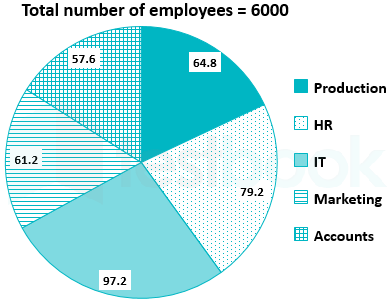
Directions: Degree- wise breakup of employees working in various department of an organisation and the ratio to men to women.

Respective ratio of men to women in each department

DepartmentMenWomen
Production54
HR2013
IT54
Marketing710
Accounts1517

Question 41

What is the number of men working in the marketing department?

  1. AOption (a)

    240

  2. BOption (b)

    360

  3. COption (c)

    420

  4. DOption (d)

    720

  5. EOption (e)

    500

View answer & explanation

Correct answer

Answer: (c)C.

420

Why this answer is correct

Total number of employees working in marketing department = (61.2/360) × 6000 = 1020

∴ Total number of men working in the marketing department = 1020 × (7/17) = 420

Question 42

What is the respective ratio of the number of women working in the Marketing department and the number of men working in the Hr department?

  1. AOption (a)

    3 : 4

  2. BOption (b)

    4 : 5

  3. COption (c)

    7 : 5

  4. DOption (d)

    4 : 7

  5. EOption (e)

    9 : 4

View answer & explanation

Correct answer

Answer: (a)A.

3 : 4

Why this answer is correct

Total number of employees working in marketing department = (61.2/360) × 6000 = 1020

Total number of women working in the marketing department = 1020 × (10/17) = 600

Total number of employees working in HR department = (79.2/360) × 6000 = 1320

Total number of men working in the HR department = 1320 × (20/33) = 800

∴ Required ratio = 600 : 800

⇒ 3 : 4

Question 43

The number of men working in the IT department of the Organisation is approximately what percent of the total number of employees working in that department?

  1. AOption (a)

    24%

  2. BOption (b)

    56%

  3. COption (c)

    40%

  4. DOption (d)

    72%

  5. EOption (e)

    50%

View answer & explanation

Correct answer

Answer: (b)B.

56%

Why this answer is correct

total number of employees working in IT department = (97.2/360) × 6000 = 1620

total number of men working in the IT department of the Organisation = (5/9) × 1620 = 900

∴ Required percentage = (900/1620) × 100 = 55.55% ≈ 56%

Question 44

The number of women working in the Production department of the Organisation is what percent of the total number of employees working in all the department together?

  1. AOption (a)

    4%

  2. BOption (b)

    6%

  3. COption (c)

    5%

  4. DOption (d)

    7%

  5. EOption (e)

    8%

View answer & explanation

Correct answer

Answer: (e)E.

8%

Why this answer is correct

Total number of employees working in Production department = (64.8/360) × 6000 = 1080

Total number of women working in the Production department = 1080 × (4/9) = 480

Totla number of employees working in organisation = 6000

∴ required percentage = (480/6000) × 100 = 8%

Question 45

What is the total number of women working in the organisation?

  1. AOption (a)

    2450

  2. BOption (b)

    2830

  3. COption (c)

    2520

  4. DOption (d)

    2480

  5. EOption (e)

    3320

View answer & explanation

Correct answer

Answer: (b)B.

2830

Why this answer is correct

Total number of women working in Production department = (64.8/360) × 6000 × (4/9) = 480

Total number of women working in HR department = (79.2/360) × 6000 × (13/33) = 520

Total number of women working in IT department = (97.2/360) × 6000 × (4/9) = 720

Total number of women working in Marketing department = (61.2/360) × 6000 × (10/17) = 600

Total number of women working in Accounts department = (57.6/360) × 6000 × (17/32) = 510

∴ total number of women working in the organisation = 480 + 520 + 720 + 600 + 510 = 2830

Directions: Read the following data carefully and answer the questions given below:

There are 6300 students in Manipur University in the academic year 2020. The ratio of the boys to the girls in the University is 5 : 4. All the students are enrolled in different indoor activities (Chess, Carom, Debating, Painting, and Quiz) and one student is enrolled in only one indoor activity. The number of boys enrolled in the Painting is 621. The ratio of the number of boys who enrolled in Chess to the number of boys who enrolled in Carom is 5 : 3. 36% of the students are enrolled in Quiz. The number of boys enrolled in Debating is 25% of the total number of boys. The number of girls enrolled in Quiz is 640 which is 150 less than the number of girls enrolled in Carom. The number of girls enrolled in Chess is 186 more than the number of boys enrolled in the same activity. The total number of students enrolled in Painting is 816.

Question 46

Find the percentage of students of the university who are enrolled in Chess. (approximately)

  1. AOption (a)

    10%

  2. BOption (b)

    20%

  3. COption (c)

    15%

  4. DOption (d)

    25%

  5. EOption (e)

    None of the above

View answer & explanation

Correct answer

Answer: (a)A.

10%

Why this answer is correct

Calculation:

Total number of students = 6300

Number of boys = 5/9 × 6300

⇒ 3500

∴ number of girls = (6300 - 3500)

⇒ 2800

Number of boys enrolled in Painting = 621

Number of students enrolled in Quiz = 36% of 6300 = 2268

Number of girls enrolled in Quiz = 640

∴ number of boys enrolled in quiz = 2268 – 640

⇒ 1628

Number of boys enrolled in Debating = 25% of 3500

⇒ 875

∴ Number of girls enrolled in Carom = 640 + 150 = 790

Number of students enrolled in Painting = 816

∴ Number of girls enrolled in painting = 816 – 621 = 195

Number of boys enrolled in Chess and Carom together = 3500 – (875 + 621 + 1628) = 376

∴ Number of boys enrolled in Chess = 5/(5 + 3) × 376

⇒ 235

Number of girls enrolled in Chess = 235 + 186 = 421

Number of boys enrolled in Carom = 376 – 235 = 141

Number of girls enrolled in Debating = 2800 – (640 + 790 + 195 + 421) = 754

Indoor ActivityNo. of boysNo. of girlsTotal students
Chess235421656
Carom141790931
Debating8757541629
Painting621195816
Quiz16286402268
<br>

∴ total number of students enrolled in Chess = 656

∴ Required percentage = 656/6300 × 100

⇒ 10.41% ≈ 10%

The percentage of students from the university who are enrolled in Chess is approximately 10%.

Question 47

Find the ratio of the number of boys enrolled in Carom to the number of girls enrolled in the same activity.

  1. AOption (a)

    151 : 790

  2. BOption (b)

    141 : 790

  3. COption (c)

    2 : 9

  4. DOption (d)

    23 : 17

  5. EOption (e)

    59 : 31

View answer & explanation

Correct answer

Answer: (b)B.

141 : 790

Why this answer is correct

Calculation:

Total number of students = 6300

Number of boys = 5/9 × 6300

⇒ 3500

∴ number of girls = (6300 - 3500)

⇒ 2800

Number of boys enrolled in Painting = 621

Number of students enrolled in Quiz = 36% of 6300 = 2268

Number of girls enrolled in Quiz = 640

∴ number of boys enrolled in quiz = 2268 – 640

⇒ 1628

Number of boys enrolled in Debating = 25% of 3500

⇒ 875

∴ Number of girls enrolled in Carom = 640 + 150 = 790

Number of students enrolled in Painting =816

∴ Number of girls enrolled in painting = 816 – 621 = 195

Number of boys enrolled in Chess and Carom together = 3500 – (875 + 621 + 1628) = 376

∴ Number of boys enrolled in Chess = 5/(5 + 3) × 376

⇒ 235

Number of girls enrolled in Chess = 235 + 186 = 421

Number of boys enrolled in Carom = 376 – 235 = 141

Number of girls enrolled in Debating = 2800 – (640 + 790 + 195 + 421) = 754

Indoor ActivityNo. of boysNo. of girlsTotal students
Chess235421656
Carom141790931
Debating8757541629
Painting621195816
Quiz16286402268
<br>

∴ required Ratio = 141 : 790

The ratio of the number of boys enrolled in Carom to the number of girls enrolled in the same activity is 141 : 790.

Question 48

The difference in the number of boys and girls who are enrolled in painting is what percentage of the total number of students who are enrolled in Debating? (approximately)

  1. AOption (a)

    20%

  2. BOption (b)

    34%

  3. COption (c)

    26%

  4. DOption (d)

    38%

  5. EOption (e)

    None of the above

View answer & explanation

Correct answer

Answer: (c)C.

26%

Why this answer is correct

Calculation:

Total number of students = 6300

Number of boys = 5/9 × 6300

⇒ 3500

∴ number of girls = (6300 - 3500)

⇒ 2800

Number of boys enrolled in Painting = 621

Number of students enrolled in Quiz = 36% of 6300 = 2268

Number of girls enrolled in Quiz = 640

∴ number of boys enrolled in quiz = 2268 – 640

⇒ 1628

Number of boys enrolled in Debating = 25% of 3500

⇒ 875

∴ Number of girls enrolled in Carom = 640 + 150 = 790

Number of students enrolled in Painting = 816

∴ Number of girls enrolled in painting = 816 – 621 = 195

Number of boys enrolled in Chess and Carom together = 3500 – (875 + 621 + 1628) = 376

∴ Number of boys enrolled in Chess = 5/(5 + 3) × 376

⇒ 235

Number of girls enrolled in Chess = 235 + 186 = 421

Number of boys enrolled in Carom = 376 – 235 = 141

Number of girls enrolled in Debating = 2800 – (640 + 790 + 195 + 421) = 754

Indoor ActivityNo. of boysNo. of girlsTotal students
Chess235421656
Carom141790931
Debating8757541629
Painting621195816
Quiz16286402268
<br>

Difference in number of boys and girls enrolled in Painting = 621 – 195

⇒ 426

∴ Required percentage = 426/1629 × 100

⇒ 26.15% ≈ 26%

The difference in the number of boys and girls who are enrolled in painting is approximately 26% of the total number of students who are enrolled in Debating.

Question 49

Find the number of girls who are enrolled in Debating.

  1. AOption (a)

    875

  2. BOption (b)

    141

  3. COption (c)

    640

  4. DOption (d)

    790

  5. EOption (e)

    754

View answer & explanation

Correct answer

Answer: (e)E.

754

Why this answer is correct

Calculation:

Total number of students = 6300

Number of boys = 5/9 × 6300

⇒ 3500

∴ number of girls = (6300 - 3500)

⇒ 2800

Number of boys enrolled in Painting = 621

Number of students enrolled in Quiz = 36% of 6300 = 2268

Number of girls enrolled in Quiz = 640

∴ number of boys enrolled in quiz = 2268 – 640

⇒ 1628

Number of boys enrolled in Debating = 25% of 3500

⇒ 875

∴ Number of girls enrolled in Carom = 640 + 150 = 790

Number of students enrolled in Painting = 816

∴ Number of girls enrolled in painting = 816 – 621 = 195

Number of boys enrolled in Chess and Carom together = 3500 – (875 + 621 + 1628) = 376

∴ Number of boys enrolled in Chess = 5/(5 + 3) × 376

⇒ 235

Number of girls enrolled in Chess = 235 + 186 = 421

Number of boys enrolled in Carom = 376 – 235 = 141

Indoor ActivityNo. of boysNo. of girlsTotal students
Chess235421656
Carom141790931
Debating8757541629
Painting621195816
Quiz16286402268


Number of girls enrolled in Debating = 2800 – (640 + 790 + 195 + 421)

⇒ 754

The number of girls who are enrolled in Debating is 754.

Question 50

The total number of girls in Quiz is approximately what percent of the total number of students in Quiz?

  1. AOption (a)

    18%

  2. BOption (b)

    72%

  3. COption (c)

    62%

  4. DOption (d)

    28%

  5. EOption (e)

    36%

View answer & explanation

Correct answer

Answer: (d)D.

28%

Why this answer is correct

Calculation:

Total number of students = 6300

Number of boys = 5/9 × 6300

⇒ 3500

∴ number of girls = (6300 - 3500)

⇒ 2800

Number of boys enrolled in Painting = 621

Number of students enrolled in Quiz = 36% of 6300 = 2268

Number of girls enrolled in Quiz = 640

∴ number of boys enrolled in quiz = 2268 – 640

⇒ 1628

∴ Required percentage = 640/2268 × 100

⇒ 28.21% ≈ 28%

The total number of girls in Quiz is approximately 28% of the total number of students in Quiz.

Question 51

10 years ago, respective ratio of the age of mother and daughter was 4 : 1. 10 years later, the respective ratio of the age of mother and daughter will become 2 : 1. At present, what is the sum of their age?

  1. AOption (a)

    55 years

  2. BOption (b)

    65 years 

  3. COption (c)

    70 years

  4. DOption (d)

    75 years

  5. EOption (e)

    77 years

View answer & explanation

Correct answer

Answer: (c)C.

70 years

Why this answer is correct

Shortcut Trick

Ratio 10 years ago = 4 : 1 (Difference = 3)

Ratio 10 years later = 2 : 1 (Difference = 1)

Equating differences: Multiply second ratio by 3 → 6 : 3

Change in units = 6 − 4 = 2 units for 20 years (10 ago to 10 later)

1 unit = 10 years. Total units 10 years ago = 4 + 1 = 5 units.

Sum 10 years ago = 5 × 10 = 50 years. Present sum = 50 + 10 + 10 = 70 years.

∴ The correct answer is 70 years.

Alternate Method

Given: Ratio 10 years ago = 4 : 1, Ratio 10 years later = 2 : 1.

⇒ Let ages 10 years ago be 4x and 1x.

⇒ Ages 10 years later = (4x + 20) and (x + 20).

⇒ (4x + 20) / (x + 20) = 2 / 1

⇒ 4x + 20 = 2x + 40

⇒ 2x = 20 ⇒ x = 10

⇒ Present age of Mother = 4(10) + 10 = 50 years.

⇒ Present age of Daughter = 1(10) + 10 = 20 years.

⇒ Sum = 50 + 20 = 70 years.

∴ The correct answer is 70 years.

Additional Information

Ratio Difference Method

When the age gap remains constant, the numerical difference between the ratio parts must be made equal to simplify calculations.

Present Age Calculation

Always remember to add or subtract the time offset from the variable "x" to reach the Present Age from past or future ratios.

Question 52

The income of Aman is Rs. 30,000 per month and his expenditure is Rs. 20,000 per month. In the next month, his income increases by Rs. 10,000 per month, and expenditure increases to Rs. 25,000 per month. In the next month, his savings increases by what percent?

  1. AOption (a)

    55%

  2. BOption (b)

    25%

  3. COption (c)

    100%

  4. DOption (d)

    12.5%

  5. EOption (e)

    None of these

View answer & explanation

Correct answer

Answer: (e)E.

None of these

Why this answer is correct

Shortcut Trick

Initial Savings = 30,000 − 20,000 = ₹10,000

New Income = 30,000 + 10,000 = ₹40,000

New Savings = 40,000 − 25,000 = ₹15,000

Percentage Increase = [(15,000 − 10,000) ÷ 10,000] × 100 = 50%

∴ The correct answer is 50%.

Alternate Method

Given:

Initial Income (I1) = ₹30,000, Initial Expenditure (E1) = ₹20,000

New Income (I2) = 30,000 + 10,000 = ₹40,000, New Expenditure (E2) = ₹25,000

Formula Used:

Savings = Income − Expenditure

Percentage Increase = (Increase ÷ Original Value) × 100

Calculations:

⇒ Initial Savings (S1) = 30,000 − 20,000 = ₹10,000

⇒ New Savings (S2) = 40,000 − 25,000 = ₹15,000

⇒ Increase in Savings = 15,000 − 10,000 = ₹5,000

⇒ Percentage Increase = (5,000 ÷ 10,000) × 100

⇒ Percentage Increase = 0.5 × 100 = 50%

∴ The correct answer is 50%.

Additional Information

Income-Expenditure Relation

Income is always the sum of Expenditure and Savings (I = E + S). Any change in one affects at least one other component.

Percentage Change

Percentage change = [(Final Value − Initial Value) ÷ Initial Value] × 100. Always ensure the denominator is the original/base value.

Base Shift

If expenditure increases at a higher rate than income, the savings percentage increase might be lower or even negative depending on the initial values.
Question 53

There is 80% increase in an amount in 8 years at simple interest. What will be the compound interest on Rs. 15,000 after 3 years at the same rate of interest?

  1. AOption (a)

    Rs. 4,565

  2. BOption (b)

    Rs. 5,000

  3. COption (c)

    Rs. 4,550

  4. DOption (d)

    Rs. 4,695

  5. EOption (e)

    Rs. 4,965

View answer & explanation

Correct answer

Answer: (e)E.

Rs. 4,965

Why this answer is correct

Shortcut Trick

Rate of interest (R) = 80% ÷ 8 years = 10% per annum.

For 3 years at 10% rate, effective CI rate = 33.1%.

CI = 33.1% of ₹15,000 = 150 × 33.1 = ₹4,965.

∴ The correct answer is ₹4,965.

Alternate Method

Given: Increase in 8 years = 80%; Principal (P) = ₹15,000; Time (n) = 3 years.

Formula: SI = (P × R × T) ÷ 100 and CI = P[(1 + R/100)n − 1]

⇒ Let Principal be 100, then SI = 80 in 8 years.

⇒ R = (80 × 100) ÷ (100 × 8) = 10% per annum.

⇒ For Compound Interest: P = ₹15,000, R = 10%, n = 3 years.

⇒ Amount (A) = 15000 × (1 + 10/100)3

⇒ A = 15000 × (11/10) × (11/10) × (11/10)

⇒ A = 15 × 1331 = ₹19,965.

⇒ CI = A − P = 19965 − 15000 = ₹4,965.

∴ The correct answer is ₹4,965.

Additional Information

Effective Rate for Compound Interest

For 10% interest rate, effective CI rate for 2 years is 21% and for 3 years is 33.1%.

CI and SI Difference

Difference for 2 years = PR2/1002. Difference for 3 years = [PR2(300 + R)] ÷ 1003.

Successive Percentage Method

Net change for two years at r% = (r + r + r2/100)%.

Question 54

In a class, there are certain numbers of students. Their average age is 12 years. If two students leave the class, their ages are 23 years and 25 years respectively. Then the average age of the class becomes 11 years. Find the number of students in the class.

  1. AOption (a)

    25

  2. BOption (b)

    28

  3. COption (c)

    30

  4. DOption (d)

    26

  5. EOption (e)

    35

View answer & explanation

Correct answer

Answer: (d)D.

26

Why this answer is correct

Shortcut Trick

Initial average of n students = 12 years.

Total age of 2 students leaving = 23 + 25 = 48 years.

Effective age loss compared to initial average = 48 − (2 × 12) = 48 − 24 = 24 years.

Due to this loss of 24 years, the average of remaining (n − 2) students drops by 12 − 11 = 1 year.

Number of remaining students = 24 ÷ 1 = 24.

Initial students (n) = 24 + 2 = 26.

∴ The correct answer is 26 students.

Alternate Method

Given: Initial average = 12 years, Ages of students leaving = 23 years and 25 years, Final average = 11 years.

Formula Used: Total Age = Number of students × Average age

⇒ Let the initial number of students be n.

⇒ Initial total age = 12n

⇒ New total age after 2 students leave = 12n − (23 + 25) = 12n − 48

⇒ New average = (New total age) ÷ (n − 2) = 11

⇒ 12n − 48 = 11 × (n − 2)

⇒ 12n − 48 = 11n − 22

⇒ 12n − 11n = 48 − 22

⇒ n = 26

∴ The correct answer is 26 students.

Additional Information

Basic Average Formula

Average = Sum of all observations ÷ Total number of observations.

Average Deviation Method

When members leave or join, the change in total sum = (New Average − Old Average) × New Quantity + (Difference in value of replaced item).

Weighted Average

Combined average of two groups = (n1x1 + n2x2) ÷ (n1 + n2), where n is quantity and x is average.

Question 55

A school has 45% girls. If 80% of girls score more than 75% marks and 70% of the boys have score more than 75% marks. If a student is selected at random and is found to have more than 75% marks, find the probability of it being a boy.

  1. AOption (a)

    77/149

  2. BOption (b)

    75/149

  3. COption (c)

    Cannot be determined

  4. DOption (d)

    11/20

  5. EOption (e)

    9/20

View answer & explanation

Correct answer

Answer: (a)A.

77/149

Why this answer is correct

Shortcut Trick Assume total students = 100. Girls = 45, Boys = 55. Students with > 75% marks: Girls = 80% of 45 = 36; Boys = 70% of 55 = 38.5. Total students with > 75% marks = 36 + 38.5 = 74.5. Probability (Boy | > 75% marks) = 38.5 ÷ 74.5 = 385/745 = 77/149. ∴ The correct answer is 77/149. Alternate Method

Given: Percentage of Girls (G) = 45%, Percentage of Boys (B) = 55%. Conditional Probabilities: P(>75%|G) = 80/100, P(>75%|B) = 70/100. Formula Used: Bayes Theorem: P(B|>75%) = [P(B) × P(>75%|B)] ÷ [P(G) × P(>75%|G) + P(B) × P(>75%|B)] ⇒ Numerator = 0.55 × 0.70 = 0.385 ⇒ Denominator = (0.45 × 0.80) + (0.55 × 0.70) ⇒ Denominator = 0.360 + 0.385 = 0.745 ⇒ Required Probability = 0.385 ÷ 0.745 ⇒ Probability = 385/745 = 77/149 ∴ The correct answer is 77/149. Additional Information Bayes Theorem It describes the probability of an event based on prior knowledge of conditions that might be related to the event. Conditional Probability P(A|B) is the probability of event A occurring given that B has already occurred. P(A|B) = P(A ∩ B) / P(B). Total Probability Rule The total probability of an outcome is the weighted average of its conditional probabilities across all mutually exclusive events.

Question 56

What should come in place of the question mark '?' in the following number series?

46, ?, 284, 345, 378, 391

  1. AOption (a)

    187

  2. BOption (b)

    180

  3. COption (c)

    190

  4. DOption (d)

    175

  5. EOption (e)

    192

View answer & explanation

Correct answer

Answer: (a)A.

187

Why this answer is correct

46       187     284      345     378      391 

     +141     +97     +61      +33     +13

              -44     -36       -28       -20

                     +8      +8        +8

Question 57

What should come in place of the question mark '?' in the following number series?

9, 19, 40, 83, ?, 345, 696

  1. AOption (a)

    162

  2. BOption (b)

    170

  3. COption (c)

    175

  4. DOption (d)

    166

  5. EOption (e)

    None of these

View answer & explanation

Correct answer

Answer: (b)B.

170

Why this answer is correct

The given series,

⇒ 9 × 2 + 1 = 19

⇒ 19 × 2 + 2 = 40

⇒ 40 × 2 + 3 = 83

⇒ 83 × 2 + 4 = 170 = ?

⇒ 170 × 2 + 5 = 345

⇒ 345 × 2 + 6 = 696

Question 58

What should come in place of question mark ‘?’ in the following number series?

17, 35, 106, ?, 2126

  1. AOption (a)

    378

  2. BOption (b)

    590

  3. COption (c)

    312

  4. DOption (d)

    425

  5. EOption (e)

    531

View answer & explanation

Correct answer

Answer: (d)D.

425

Why this answer is correct

As per the series given in the question, it is clear that it follows a pattern of:

17 × 2 + 1 = 35

35 × 3 + 1 = 106

106 × 4 + 1 = 425

425 × 5 + 1 = 2126

∴ Considering the above mention pattern, the missing term in the series is 425.

Question 59

What will come in place of question mark (?) in the following number series?

7, 13, ?, 49, 97, 193

  1. AOption (a)

    27

  2. BOption (b)

    23

  3. COption (c)

    25

  4. DOption (d)

    29

  5. EOption (e)

    34

View answer & explanation

Correct answer

Answer: (c)C.

25

Why this answer is correct

The pattern of the number series is -

7 × 2 - 1 = 13

13 × 2 - 1 = 25

25 × 2 - 1 = 49

49 × 2 - 1 = 97

97 × 2 - 1 = 193

Hence 25 will come in place of question mark.

Question 60

What will come in place of question mark (?) in the following number series?

17, 52, 158, 477, ?, 4310

  1. AOption (a)

    1433

  2. BOption (b)

    1432

  3. COption (c)

    1435

  4. DOption (d)

    1434

  5. EOption (e)

    None of these

View answer & explanation

Correct answer

Answer: (c)C.

1435

Why this answer is correct

The pattern of the number series is -

17 × 3 + 1 = 52

52 × 3 + 2 = 158

158 × 3 + 3 = 477

477 × 3 + 4 = 1435

Hence 1435 will come in place of question mark.

Question 61

A alone can complete a work in 25 days and B alone can do the same work in 20 days. A started the work and after working 7 days B joined A to finish the remaining work. In how many days, the total work will be finished?

  1. AOption (a)

    8 days

  2. BOption (b)

    15 days

  3. COption (c)

    9 days

  4. DOption (d)

    12 days

  5. EOption (e)

    None of these

View answer & explanation

Correct answer

Answer: (b)B.

15 days

Why this answer is correct

Shortcut Trick

Assume Total Work = 100 units (LCM of 25 and 20).

Efficiency of A = 100 ÷ 25 = 4 units/day; Efficiency of B = 100 ÷ 20 = 5 units/day.

Work done by A in first 7 days = 7 × 4 = 28 units.

Remaining work = 100 − 28 = 72 units. Days taken by (A + B) = 72 ÷ 9 = 8 days.

Total Days = 7 + 8 = 15 days.

∴ The correct answer is 15 days.

Alternate Method

Given: A finishes in 25 days, B finishes in 20 days. A starts and works for 7 days before B joins.

Formula Used: Total Work = Time × Efficiency

PersonDaysTotal WorkEfficiency
A251004
B205

⇒ Work done by A alone in 7 days = 7 × 4 = 28 units

⇒ Remaining Work = 100 − 28 = 72 units

⇒ Combined efficiency of A + B = 4 + 5 = 9 units/day

⇒ Time taken to finish remaining work = 72 ÷ 9 = 8 days

⇒ Total time = Initial 7 days + Remaining 8 days = 15 days

∴ The correct answer is 15 days.

Additional Information

Efficiency and Time Relation

Efficiency is inversely proportional to the time taken. If time ratio is x : y, the efficiency ratio is y : x.

Pipes and Cisterns

This logic is identical to inlet pipes. If an outlet pipe is present, its efficiency is taken as negative.

Work and Wages

Wages are distributed in the ratio of work done or the ratio of efficiencies if all work for the same duration.

Question 62

A shopkeeper purchased two types of wheat costing Rs. 220 per kg and Rs. 300 per kg. In what ratio should he mix the wheat so that he could sell the mixture at the rate of Rs. 360 per kg in order to earn the profit of 25%?

  1. AOption (a)

    4 : 15

  2. BOption (b)

    2 : 17

  3. COption (c)

    4 : 17

  4. DOption (d)

    3 : 16

  5. EOption (e)

    3 : 17 

View answer & explanation

Correct answer

Answer: (e)E.

3 : 17 

Why this answer is correct

Shortcut Trick

Cost Price of mixture = 360 ÷ 1.25 = ₹288 per kg.

Apply Alligation: (Type 2 − Mean) : (Mean − Type 1)

Ratio = (300 − 288) : (288 − 220) = 12 : 68

Simplified Ratio = 3 : 17

∴ The correct answer is 3 : 17.

Alternate Method

Given: CP1 = ₹220/kg, CP2 = ₹300/kg, SPmix = ₹360/kg, Profit = 25%.

Formula Used: CP = [SP × 100] ÷ [100 + Profit%]; Ratio = (CP2 − CPm) : (CPm − CP1)

⇒ Mean CP = (360 × 100) ÷ 125

⇒ Mean CP = 360 ÷ 1.25 = ₹288 per kg

⇒ Required Ratio = (300 − 288) : (288 − 220)

⇒ Ratio = 12 : 68

⇒ Ratio = 3 : 17

∴ The correct answer is 3 : 17.

Additional Information

Alligation Rule

It is used to find the ratio in which two ingredients at given prices must be mixed to produce a mixture at a given price. Always ensure all values (CP1, CP2, Mean) are Cost Prices.

Profit and Loss Relation

When Selling Price (SP) and Profit% are known, Cost Price (CP) is calculated as CP = SP ÷ (1 + P/100).

Weighted Average

The mean price can also be verified using the formula: Cm = (n1c1 + n2c2) ÷ (n1 + n2).

Question 63

The speed of train A and train B is 93 km/hr and 51 km/hr, respectively. When both the trains are running in the opposite direction, they cross each other in 18 seconds. The length of train B is half of the length of train A. If train A crosses a bridge in 42 seconds, then find the length of the bridge.

  1. AOption (a)

    610 m

  2. BOption (b)

    480 m

  3. COption (c)

    605 m

  4. DOption (d)

    240 m

  5. EOption (e)

    485 m

View answer & explanation

Correct answer

Answer: (c)C.

605 m

Why this answer is correct

Shortcut Trick

Relative speed in opposite direction = 93 + 51 = 144 kmph = 144 × (5/18) = 40 m/s.

Total distance (Length A + Length B) = 40 × 18 = 720 m.

Since B = A/2, then A + A/2 = 720 ⇒ 1.5A = 720 ⇒ A = 480 m.

Distance covered by A in 42s = (93 × 5/18) × 42 = 1085 m.

Length of bridge = 1085 − 480 = 605 m.

∴ The correct answer is 605 m.

Alternate Method

Given: Speed of Train A = 93 km/hr, Speed of Train B = 51 km/hr, Crossing time = 18 s, Bridge crossing time = 42 s.

Formula Used: Relative Speed = S1 + S2 (Opposite); Distance = Speed × Time; 1 km/hr = 5/18 m/s.

⇒ Relative Speed = (93 + 51) × (5/18) = 144 × (5/18) = 40 m/s.

⇒ Let Length of Train A = 2x and Train B = x.

⇒ Total Length = 2x + x = 40 × 18 ⇒ 3x = 720 ⇒ x = 240 m.

⇒ Length of Train A = 2 × 240 = 480 m.

⇒ Speed of Train A in m/s = 93 × (5/18) = 15.5 × (5/3) = 25.833... or 310/12 = 155/6 m/s.

⇒ Total Distance for bridge crossing = Length A + Bridge = (155/6) × 42.

⇒ 480 + Bridge = 155 × 7 = 1085 m.

⇒ Bridge = 1085 − 480 = 605 m.

∴ The correct answer is 605 m.

Additional Information

Relative Speed Concept

When two objects move in the opposite direction, relative speed is S1 + S2. When they move in the same direction, it is |S1 − S2|.

Crossing a Bridge/Platform

When a train crosses a stationary object of length L, the total distance covered is the sum of the length of the train and the length of the object.

Unit Conversion

To convert km/hr to m/s, multiply by 5/18. To convert m/s to km/hr, multiply by 18/5.

Question 64

R, S and T started a business by investing Rs. 25000, Rs. 15000 and Rs.30000 respectively. If the total profit earned is Rs. 58800 and it is decided that one-third of the profit will be divided into their investment ratio and rest of the amount will be invested in another work, then what is the share of T?

  1. AOption (a)

    4200

  2. BOption (b)

    8000

  3. COption (c)

    7400

  4. DOption (d)

    8400

  5. EOption (e)

    None of these

View answer & explanation

Correct answer

Answer: (d)D.

8400

Why this answer is correct

Shortcut Trick

Investment ratio R : S : T = 25000 : 15000 : 30000 = 5 : 3 : 6.

Total shareable profit = 1/3 × 58800 = 19600.

Sum of ratio parts = 5 + 3 + 6 = 14 units.

14 units = 19600 ⇒ 1 unit = 1400.

T's share = 6 units = 6 × 1400 = 8400.

∴ The correct answer is 8400.

Alternate Method

Given → Investments: R = 25000, S = 15000, T = 30000. Total Profit = 58800. Formulas: Profit Ratio = Investment Ratio × Time Ratio | Share = (Individual Ratio ÷ Total Ratio) × Shareable Profit.

⇒ Calculate the ratio of investments of R, S, and T = 25 : 15 : 30 = 5 : 3 : 6. ⇒ The amount to be divided among them = 1/3 × 58800 = 19600. ⇒ Sum of the ratios = 5 + 3 + 6 = 14. ⇒ Share of T = (Ratio of T ÷ Sum of Ratios) × Dividable Profit. ⇒ Share of T = (6 ÷ 14) × 19600 = 6 × 1400 = 8400.

∴ The correct answer is 8400.

Additional Information

Partnership Basics

When time periods are the same, the profit is divided directly in the ratio of the capitals invested.

Working vs Sleeping Partner

A working partner often receives a percentage of the profit as a salary or management fee before the remaining profit is split.

Question 65

A shopkeeper wants to make a profit of 20% on an article after selling it, while he gives a cash discount of 20%. Further allows 4 more articles for free after purchase of one dozen articles to his premium customer. How much per cent above the cost price he must mark his article?

  1. AOption (a)

    85%

  2. BOption (b)

    90%

  3. COption (c)

    110%

  4. DOption (d)

    80%

  5. EOption (e)

    100%

View answer & explanation

Correct answer

Answer: (e)E.

100%

Why this answer is correct

Shortcut Trick

Net discount involves both cash discount and free articles: 1 dozen = 12 articles.

Total articles given = 12 + 4 = 16. Effective discount ratio = (12 ÷ 16) × 0.80 = 0.60.

Net selling price factor (0.60 MP) must equal profit factor (1.20 CP).

MP ÷ CP = 1.20 ÷ 0.60 = 2 ÷ 1.

Markup percentage = (2 − 1) ÷ 1 × 100% = 100%.

∴ The correct answer is 100%.

Alternate Method

Given → Profit = 20%, Cash Discount = 20%, Free Articles = 4 on 12. Formulas: Total Discount% = (1 − (Selling Price ÷ Marked Price)) × 100 | MP × (1 − D1) × (Paid Qty ÷ Total Qty) = CP × (1 + P%)

⇒ Let Marked Price of 1 article be 100. ⇒ Customer pays for 12 articles, gets 16. Total revenue = 12 × 100 × (1 − 0.20) = 12 × 80 = 960. ⇒ This revenue is the Selling Price of 16 articles. SP per article = 960 ÷ 16 = 60. ⇒ Profit is 20%, so 1.20 × CP = 60 ⇒ CP = 60 ÷ 1.20 = 50. ⇒ Markup = MP − CP = 100 − 50 = 50. ⇒ Markup% = (50 ÷ 50) × 100 = 100%.

∴ The correct answer is 100%.

Additional Information

Successive Discounts with Free Items

When 'x' articles are bought and 'y' are given free, the discount% = [y ÷ (x + y)] × 100. If an additional cash discount d% is given, net multiplier = (1 − d/100) × [x ÷ (x + y)].

CP and MP Relationship

The ratio of MP to CP can be expressed as: MP ÷ CP = (100 + Profit%) ÷ (100 − Net Discount%).

Reasoning Ability (35 questions)

Direction: Study the information given below carefully and answer the questions that follow.

There are 10 members in the family who are sitting at some distance from each other in a park. N is 4 m in the west of M, who is 5 m in the north of O. Q is 12 m in the west of R. T is 3 m in the west of S, which is 12 m in the south of R. O is 6 m in the east of V, which is 2 m in the north of P, which is 8 m in the west of U. T is 1 m in the south of U.

Question 66

In which direction is U with respect to M?

  1. AOption (a)

    North

  2. BOption (b)

    East

  3. COption (c)

    South-East

  4. DOption (d)

    North-West

  5. EOption (e)

    None of these

View answer & explanation

Correct answer

Answer: (c)C.

South-East

Why this answer is correct

According to the given information, we get the following figure,

So, U is in the south-east of M.

Hence, ‘South-East’ is the correct answer.

Question 67

What is the shortest distance between N and Q?

  1. AOption (a)

    6 m

  2. BOption (b)

    3 m

  3. COption (c)

    7 m

  4. DOption (d)

    8 m

  5. EOption (e)

    5 m

View answer & explanation

Correct answer

Answer: (e)E.

5 m

Why this answer is correct

According to the given information, we get the following figure,

Shortest distance between N and Q = √ (42 + 32) = √ (16 + 9) = √ 25 = 5

Hence, ‘5 m’ is the correct answer.

Question 68

Suppose an imaginary line is drawn from N to line VO such that it makes a perpendicular. The imaginary line meets VO at point Y. Then what is the perimeter of the quadrilateral NYOM?

  1. AOption (a)

    14 m

  2. BOption (b)

    18 m

  3. COption (c)

    20 m

  4. DOption (d)

    24 m

  5. EOption (e)

    None of the above

View answer & explanation

Correct answer

Answer: (b)B.

18 m

Why this answer is correct

According to the given information, we get the following figure,

So, the perimeter of quadrilateral NYOM = 2 × (L + B) = 2 × (5 + 4) = 2 × 9 = 18 m.

Hence, ‘18 m’ is the correct answer.

​Directions: Study the following information carefully and answer the questions given below:

A certain number of persons are sitting in a linear row facing the north. Three persons are sitting between X and T, who is sitting adjacent to Q. X is on the left of Q. H is sitting 2nd to the right of Q. Two persons are sitting between H and S who is sitting at one of the ends. S is not sitting adjacent to Q, who is sitting 2nd to the right of L. L is sitting exactly in the middle of the row. J is sitting 6th from the left end. X is not sitting to the right of J. Two persons are sitting between J and R. Two persons are sitting between X and K.

Question 69

How many persons are sitting between X and S?

  1. AOption (a)

    Four

  2. BOption (b)

    Nine

  3. COption (c)

    Eleven

  4. DOption (d)

    One

  5. EOption (e)

    None of These

View answer & explanation

Correct answer

Answer: (b)B.

Nine

Why this answer is correct

1)Three persons are sitting between X and T, who are sitting adjacent to Q.

  1. H is sitting 2nd to the right of Q. X is in left of Q.

  2. Two persons are sitting between H and S who is sitting at one of the ends.

  3. S is not sitting adjacent to Q, who is sitting 2nd to the right of L.

  4. L is sitting exactly in the middle of the row.

  5. J is sitting 6th from the left end.

  6. X is not sitting to the right of J.Hence, Case-1 will be elliminated.

  7. Two persons are sitting between J and R.

  8. Two persons are sitting between X and K.

Therefore the final arrangement is, 

Hence, the persons are sitting between X and S are nine.

Question 70

How many persons are sitting in the row?

  1. AOption (a)

    18

  2. BOption (b)

    10

  3. COption (c)

    17

  4. DOption (d)

    15

  5. EOption (e)

    Cannot Be Determined

View answer & explanation

Correct answer

Answer: (d)D.

15

Why this answer is correct

1)Three persons are sitting between X and T, who are sitting adjacent to Q.

  1. H is sitting 2nd to the right of Q. X is on the left of Q.

  2. Two persons are sitting between H and S who is sitting at one of the ends.

  3. S is not sitting adjacent to Q, who is sitting 2nd to the right of L.

  4. L is sitting exactly in the middle of the row.

  5. J is sitting 6th from the left end.

  6. X is not sitting to the right of J.Hence, Case-1 will be eliminated.


  1. Two persons are sitting between J and R.

  2. Two persons are sitting between X and K.

Therefore the final arrangement is, 

Hence, persons are sitting in the row are 15.

Question 71

How many persons are sitting to the left of Q?

  1. AOption (a)

    Nine

  2. BOption (b)

    Three

  3. COption (c)

    Ten

  4. DOption (d)

    Five

  5. EOption (e)

    None of These

View answer & explanation

Correct answer

Answer: (a)A.

Nine

Why this answer is correct

1)Three persons are sitting between X and T, who are sitting adjacent to Q.

  1. H is sitting 2nd to the right of Q. X is on the left of Q.

  2. Two persons are sitting between H and S who is sitting at one of the ends.

  3. S is not sitting adjacent to Q, who is sitting 2nd to the right of L.

  4. L is sitting exactly in the middle of the row.

  5. J is sitting 6th from the left end.

  6. X is not sitting to the right of J.Hence, Case-1 will be eliminated.

  7. Two persons are sitting between J and R.

  8. Two persons are sitting between X and K.

Therefore the final arrangement is, 

Hence**, the person is sitting to the left of Q is nine.**

Question 72

What is the position of H with respect to T?

  1. AOption (a)

    5th to the Left

  2. BOption (b)

    3rd to the Right

  3. COption (c)

    5th to the Right

  4. DOption (d)

    2nd to the left

  5. EOption (e)

    None of These

View answer & explanation

Correct answer

Answer: (b)B.

3rd to the Right

Why this answer is correct

1)Three persons are sitting between X and T, who are sitting adjacent to Q.

  1. H is sitting 2nd to the right of Q. X is on the left of Q.

  2. Two persons are sitting between H and S who is sitting at one of the ends.

  3. S is not sitting adjacent to Q, who is sitting 2nd to the right of L.

  4. L is sitting exactly in the middle of the row.

  5. J is sitting 6th from the left end.

  6. X is not sitting to the right of J.Hence, Case-1 will be eliminated.

  7. Two persons are sitting between J and R.

  8. Two persons are sitting between X and K.

Therefore the final arrangement is, 

Hence, the position of H with respect to T is 3rd to the right.

Question 73

Who sits exactly in the middle of K and L?

  1. AOption (a)

    R

  2. BOption (b)

    J

  3. COption (c)

    X

  4. DOption (d)

    T

  5. EOption (e)

    None of These

View answer & explanation

Correct answer

Answer: (c)C.

X

Why this answer is correct

1)Three persons are sitting between X and T, who are sitting adjacent to Q.

  1. H is sitting 2nd to the right of Q. X is on the left of Q.

  2. Two persons are sitting between H and S who is sitting at one of the ends.

  3. S is not sitting adjacent to Q, who is sitting 2nd to the right of L.

  4. L is sitting exactly in the middle of the row.

  5. J is sitting 6th from the left end.

  6. X is not sitting to the right of J.Hence, Case-1 will be eliminated.

  7. Two persons are sitting between J and R.

  8. Two persons are sitting between X and K.

Therefore the final arrangement is, 

Hence, X sits exactly in the middle of K and L.

Question 74

Directions

-** Relationship between different elements is shown in the statements below. These Statements are followed by 2 Conclusions. Mark your answer on the basis of given statements and conclusions.

Statements: A < B ≤ C > D; C > E ≥ F; E > B

Conclusions: 

i) A < F

ii) D < B

  1. AOption (a)

    Only conclusion i) follows

  2. BOption (b)

    Only conclusion ii) follows

  3. COption (c)

    Either conclusion i) or conclusion ii) follows

  4. DOption (d)

    Both conclusions follow

  5. EOption (e)

    None Follows

View answer & explanation

Correct answer

Answer: (e)E.

None Follows

Why this answer is correct

Correct Answer:- (5)

Given Statement: A < B ≤ C > D; C > E ≥ F; E > B

i) A < F: False ( A < B ≤ C > E ≥ F; There is no clear relation between A and F, hence can not conclude anything.)

ii) D < B: False ( B ≤ C > D; There is no clear relation between B and D, hence can not conclude anything.)

Hence, the correct answer is None follows.

Question 75

Directions

In the following question assuming the given statements to be true, find which of the conclusion(s) among given conclusions is/are definitely true and then give your answers accordingly.

Statement: B > C = D ; E < F ; B ≤ A; D ≤ E

Conclusions:

I. A > C

II. B = D

  1. AOption (a)

    Only conclusion I follows

  2. BOption (b)

    Only conclusion II follows

  3. COption (c)

    Either conclusion I or II follows

  4. DOption (d)

    Both conclusion I and III follows

  5. EOption (e)

    None follows

View answer & explanation

Correct answer

Answer: (a)A.

Only conclusion I follows

Why this answer is correct

Given statement: B > C = D ; E < F ; B ≤ A; D ≤ E

On Combining: A ≥ B > C = D ≤ E < F

Conclusions:

I. A > C - True ( as, A ≥ B > C; so A > C is true )

II. B = D - False ( as, B > C = D; So B > D )

Hence, only conclusion I follows

Question 76

Directions

In the following question assuming the given statements to be true, find which conclusion among the given conclusions is/are definitely true and then give your answers accordingly.

Statement:

R ≥ T = Q < M; S ≥ R

Conclusions:

I. M < R

II. S ≥ Q

  1. AOption (a)

    Only I is True

  2. BOption (b)

    Only II is True

  3. COption (c)

    Either I or II is true

  4. DOption (d)

    Both conclusions I and II are True

  5. EOption (e)

    None is True

View answer & explanation

Correct answer

Answer: (b)B.

Only II is True

Why this answer is correct

Given:

R ≥ T = Q < M; S ≥ R

On Combining:

S ≥ R ≥ T = Q < M

Conclusions:

I. M < R → False (as R ≥ T = Q < M; therefore,the relationship between M and R cannot be determined)

II. S ≥ Q → True (as S ≥ R ≥ T = Q; therefore S ≥ Q)

Hence, only conclusion II is true.

Question 77

DIRECTIONS: In the following question assuming the given statements to be true, find which of the conclusion among given conclusions is / are definitely true and then give your answers accordingly.

Statement: M > N < O ≤ P; S ≥ R > Q = P

Conclusion:

I. S ≥ M

II. S < M

  1. AOption (a)

    Only I is true

  2. BOption (b)

    Only II is true

  3. COption (c)

    Either I or II is true

  4. DOption (d)

    Neither I nor II is true

  5. EOption (e)

    Both I and II are true

View answer & explanation

Correct answer

Answer: (c)C.

Either I or II is true

Why this answer is correct

Given statements: M > N < O ≤ P; S ≥ R > Q = P

On combining: M > N < O < P = Q < R ≤ S

I. S ≥ M → False (as M > N < O < P = Q < R ≤ S) thus clear relation between S and M cannot be determined.

II. S < M → False (as M > N < O < P = Q < R ≤ S) thus clear relation between S and M cannot be determined.

A number can be either equal, less, or greater than another number.

Here, S ≥ M (S is greater than or equal to M).

S < M (S is smaller than M).

One statement must be true but can't say which statement.

Hence, Either I or II follows.

Question 78

Direction: In the following question assuming the given statement to be true. Find which of the following conclusion(s) among given conclusions is/are definitely true then give your answer accordingly.

Statement: A > B, D ≤ E, D ≥ C ≤ B

Conclusion:

I. C < A

II. E ≥ C

  1. AOption (a)

    Only I is true

  2. BOption (b)

    Only II is true

  3. COption (c)

    Both I and II are true

  4. DOption (d)

    None is true

  5. EOption (e)

    Either I or II is true

View answer & explanation

Correct answer

Answer: (c)C.

Both I and II are true

Why this answer is correct

Given Statements: A > B, D ≤ E, D ≥ C ≤ B

On combining: A > B ≥ C ≤ D ≤ E

Conclusions:

I. C < A → True (as A > B ≥ C → A > C)

II. E ≥ C → True (as C ≤ D ≤ E → C ≤ E)

Hence, both I and II are true

Direction: Study the following information carefully and answer the given questions.

Six persons P, Q, R, S, T, and U are living in a three-storey building such that ground floor is numbered as 1, above it is floor 2 then top floor is numbered as 3. Each of the floor has 2 flats in it as flat-X and flat-Y. Flat-X of floor-2 is immediately above flat-X of floor-1 and immediately below flat-X of floor-3. In the same way flat-Y of floor-2 is immediately above flat-Y of floor-1 and immediately below flat-Y of floor-3. Flat-X is in west of flat-Y. They all are from different cities.

The one who is from Kolkata lives immediately above U in the same flat. S lives to the west of U. P and the one who is from Kolkata do not live on the same floor. Neither S nor Q is from Bangalore. U is either from Pune or from Agra. There is one floor between Q and the one who is from Delhi who lives above Q. T does not live in flat Y. The one who is from Mumbai lives on the same floor on which the one who is from Agra lives. P lives on an odd numbered floor in flat X.

Question 79

Which of the following does not belong to the group?

  1. AOption (a)

    T

  2. BOption (b)

    P

  3. COption (c)

    R

  4. DOption (d)

    S

  5. EOption (e)

    Q

View answer & explanation

Correct answer

Answer: (d)D.

S

Why this answer is correct

Six persons: P, Q, R, S, T and U

Floors: 1, 2, and 3

Flat: X and Y

(1) P lives on an odd numbered floor in flat X. Therefore, we get two the following two cases here.

Case (I)Case (II)
FloorFlat - XFlat - YFlat - XFlat - Y
3P
2
1P


(2) The one who is from Kolkata lives immediately above U  in the same flat. .

(3) S lives to the west of U.

(4) P and the one who is from Kolkata do not live on the same floor.

Case (I)Case (II)
FloorFlat - XFlat - YFlat - XFlat - Y
3P(Kolkata)
2(Kolkata)SU
1SUP


(5) T does not live in flat Y.

(6) There is one floor between Q and the one who is from Delhi who lives above Q. Since, only flat Y of floor 3 is left for Q in case (I), case (I) eliminates here.

Case (II)
FloorFlat - XFlat - Y
3T (Delhi)(Kolkata)
2SU
1PQ


(7) Neither S nor Q is from Bangalore.

(8) U is either from Pune or from Agra (implies, P is from Bangalore).

(9) The one who is from Mumbai lives on the same floor on which the one who is from Agra lives (implies, S is from Mumbai and U is from Agra). Thus, the final arrangement is as follows:

Case (II)
FloorFlat - XFlat - Y
3T (Delhi)R (Kolkata)
2S (Mumbai)U (Agra)
1P (Bangalore)Q (Pune)


We can see that, all T, R, P, and Q live in odd numbered floor and thus forms a group.

Hence, S does not belong to that group.

Question 80

Who among the following lives to the east of T?

  1. AOption (a)

    The one who is from Agra

  2. BOption (b)

    U

  3. COption (c)

    R

  4. DOption (d)

    The one who is from Pune

  5. EOption (e)

    No one

View answer & explanation

Correct answer

Answer: (c)C.

R

Why this answer is correct

Six persons: P, Q, R, S, T and U

Floors: 1, 2, and 3

Flat: X and Y

(1) P lives on an odd numbered floor in flat X. Therefore, we get two the following two cases here.

Case (I)Case (II)
FloorFlat - XFlat - YFlat - XFlat - Y
3P
2
1P


(2) The one who is from Kolkata lives immediately above U  in the same flat. .

(3) S lives to the west of U.

(4) P and the one who is from Kolkata do not live on the same floor.

Case (I)Case (II)
FloorFlat - XFlat - YFlat - XFlat - Y
3P(Kolkata)
2(Kolkata)SU
1SUP


(5) T does not live in flat Y.

(6) There is one floor between Q and the one who is from Delhi who lives above Q. Since, only flat Y of floor 3 is left for Q in case (I), case (I) eliminates here.

Case (II)
FloorFlat - XFlat - Y
3T (Delhi)(Kolkata)
2SU
1PQ


(7) Neither S nor Q is from Bangalore.

(8) U is either from Pune or from Agra (implies, P is from Bangalore).

(9) The one who is from Mumbai lives on the same floor on which the one who is from Agra lives (implies, S is from Mumbai and U is from Agra). Thus, the final arrangement is as follows:

Case (II)
FloorFlat - XFlat - Y
3T (Delhi)R (Kolkata)
2S (Mumbai)U (Agra)
1P (Bangalore)Q (Pune)


Hence, R lives to the east of T.

Question 81

Who lives on the bottom most floor?

  1. AOption (a)

    The one who is from Pune

  2. BOption (b)

    U

  3. COption (c)

    P

  4. DOption (d)

    S

  5. EOption (e)

    Both 1 and 3

View answer & explanation

Correct answer

Answer: (e)E.

Both 1 and 3

Why this answer is correct

Six persons: P, Q, R, S, T and U

Floors: 1, 2, and 3

Flat: X and Y

(1) P lives on an odd numbered floor in flat X. Therefore, we get two the following two cases here.

Case (I)Case (II)
FloorFlat - XFlat - YFlat - XFlat - Y
3P
2
1P


(2) The one who is from Kolkata lives immediately above U  in the same flat. .

(3) S lives to the west of U.

(4) P and the one who is from Kolkata do not live on the same floor.

Case (I)Case (II)
FloorFlat - XFlat - YFlat - XFlat - Y
3P(Kolkata)
2(Kolkata)SU
1SUP


(5) T does not live in flat Y.

(6) There is one floor between Q and the one who is from Delhi who lives above Q. Since, only flat Y of floor 3 is left for Q in case (I), case (I) eliminates here.

Case (II)
FloorFlat - XFlat - Y
3T (Delhi)(Kolkata)
2SU
1PQ


(7) Neither S nor Q is from Bangalore.

(8) U is either from Pune or from Agra (implies, P is from Bangalore).

(9) The one who is from Mumbai lives on the same floor on which the one who is from Agra lives (implies, S is from Mumbai and U is from Agra). Thus, the final arrangement is as follows:

Case (II)
FloorFlat - XFlat - Y
3T (Delhi)R (Kolkata)
2S (Mumbai)U (Agra)
1P (Bangalore)Q (Pune)


Hence, the one who is from Pune and P both live on bottom most floors.

Question 82

Which of the following combination is the correct?

  1. AOption (a)

    T - Mumbai

  2. BOption (b)

    Q - Delhi

  3. COption (c)

    Q - Banglore

  4. DOption (d)

    S - Mumbai

  5. EOption (e)

    R - Agra

View answer & explanation

Correct answer

Answer: (d)D.

S - Mumbai

Why this answer is correct

Six persons: P, Q, R, S, T and U

Floors: 1, 2, and 3

Flat: X and Y

(1) P lives on an odd numbered floor in flat X. Therefore, we get two the following two cases here.

Case (I)Case (II)
FloorFlat - XFlat - YFlat - XFlat - Y
3P
2
1P


(2) The one who is from Kolkata lives immediately above U  in the same flat. .

(3) S lives to the west of U.

(4) P and the one who is from Kolkata do not live on the same floor.

Case (I)Case (II)
FloorFlat - XFlat - YFlat - XFlat - Y
3P(Kolkata)
2(Kolkata)SU
1SUP


(5) T does not live in flat Y.

(6) There is one floor between Q and the one who is from Delhi who lives above Q. Since, only flat Y of floor 3 is left for Q in case (I), case (I) eliminates here.

Case (II)
FloorFlat - XFlat - Y
3T (Delhi)(Kolkata)
2SU
1PQ


(7) Neither S nor Q is from Bangalore.

(8) U is either from Pune or from Agra (implies, P is from Bangalore).

(9) The one who is from Mumbai lives on the same floor on which the one who is from Agra lives (implies, S is from Mumbai and U is from Agra). Thus, the final arrangement is as follows:

Case (II)
FloorFlat - XFlat - Y
3T (Delhi)R (Kolkata)
2S (Mumbai)U (Agra)
1P (Bangalore)Q (Pune)


Hence, S - Agra is the correct combination.

Question 83

Who among the following lives in Flat Y?

  1. AOption (a)

    P

  2. BOption (b)

    T

  3. COption (c)

    S

  4. DOption (d)

    Q

  5. EOption (e)

    The one who lives in Delhi

View answer & explanation

Correct answer

Answer: (d)D.

Q

Why this answer is correct

Six persons: P, Q, R, S, T and U

Floors: 1, 2, and 3

Flat: X and Y

(1) P lives on an odd numbered floor in flat X. Therefore, we get two the following two cases here.

Case (I)Case (II)
FloorFlat - XFlat - YFlat - XFlat - Y
3P
2
1P


(2) The one who is from Kolkata lives immediately above U  in the same flat. .

(3) S lives to the west of U.

(4) P and the one who is from Kolkata do not live on the same floor.

Case (I)Case (II)
FloorFlat - XFlat - YFlat - XFlat - Y
3P(Kolkata)
2(Kolkata)SU
1SUP


(5) T does not live in flat Y.

(6) There is one floor between Q and the one who is from Delhi who lives above Q. Since, only flat Y of floor 3 is left for Q in case (I), case (I) eliminates here.

Case (II)
FloorFlat - XFlat - Y
3T (Delhi)(Kolkata)
2SU
1PQ


(7) Neither S nor Q is from Bangalore.

(8) U is either from Pune or from Agra (implies, P is from Bangalore).

(9) The one who is from Mumbai lives on the same floor on which the one who is from Agra lives (implies, S is from Mumbai and U is from Agra). Thus, the final arrangement is as follows:

Case (II)
FloorFlat - XFlat - Y
3T (Delhi)R (Kolkata)
2S (Mumbai)U (Agra)
1P (Bangalore)Q (Pune)


Hence, Q lives in Flat - Y.

Question 84

If 2 is added to each even digit and 1 is subtracted from each odd digit in the number 621754, then what will be the sum of number/numbers not repeated in the new number?

  1. AOption (a)

    5

  2. BOption (b)

    8

  3. COption (c)

    6

  4. DOption (d)

    4

  5. EOption (e)

    10

View answer & explanation

Correct answer

Answer: (b)B.

8

Why this answer is correct

Given: 621754

By adding 2 in the even digits and subtracting 1 from the odd digits, we will get,

Number621754
operation+2+2-1-1-1+2
New Number840646

Here can clearly says that 8 and 0 are not repeated.

Therefore, sum of the number = 8 + 0 = 8

Hence, "8" is the correct answer.

Question 85

In the word ‘LAVISLY’, replace each vowel with the next letter in the alphabetical series and each consonant with the previous letter in the Alphabetical Series. How many letters occur more than once in this newly formed word?

  1. AOption (a)

    One

  2. BOption (b)

    Two

  3. COption (c)

    Three

  4. DOption (d)

    Four

  5. EOption (e)

    Zero

View answer & explanation

Correct answer

Answer: (a)A.

One

Why this answer is correct

Given word: LAVISLY

After replacing each vowel with the next letter in the alphabetical series and each consonant with the previous letter in the Alphabetical Series, we get:

GivenLAVISLY
After ReplacementKBUJRKX


Here, one letter, K occurred twice.

Hence, one is the correct answer.

Direction: Study the following information carefully and answer the given questions.

Fourteen people are sitting in 2 rows, 7 in each. P, Q, R, S, T, U, and V in row 1 facing south and  A, B, C, D, E, F, and G in row 2 facing north but not necessarily in the same order. People in both rows face each other.

U is sitting third from on of the extreme ends. Two persons are sitting between the one facing U and D. Three persons are sitting between the immediate neighbor of the one who is facing D and S. E is facing the immediate neighbor of S. A is sitting to the immediate right of E. P and Q does not sit at any of the ends. Two persons are sitting between the one who is facing the immediate neighbor of P and A. At least three persons are sitting between the one facing A and Q. B is facing the one who is sitting second to the left of Q. R is neither facing E nor B. C is sitting fourth to the left of G. V is sitting to second to the right of T.

Question 86

How many people are sitting between S and P?

  1. AOption (a)

    One

  2. BOption (b)

    Two

  3. COption (c)

    Three

  4. DOption (d)

    Four

  5. EOption (e)

    No one

View answer & explanation

Correct answer

Answer: (c)C.

Three

Why this answer is correct

Fourteen People: P, Q, R, S, T, U, and V in row 1 facing south and A, B, C, D, E, F, and G in row 2 facing north.

(1) U is sitting third from on of the extreme ends.

(2) Two persons are sitting between the one facing U and D.

(3) Three persons are sitting between the immediate neighbor of the one who is facing D and S.

(4) E is facing the immediate neighbor of S.

(5) A is sitting to the immediate right of E.

(6) P and Q do not sit at any of the ends.

(7) Two persons are sitting between the one who is facing the immediate neighbor of P and A.

(8) At least three persons are sitting between the one facing A and Q. Since, Q cannot sit at any end case I eliminates.

(9) B is facing the one who is sitting second to the left of Q. 

(10) R is neither facing E nor B.

(11) C is sitting fourth to the left of G. So, we left with only F in the row which is facing north.

(12) V is sitting to second to the right of T. Therefore the final seating arrangement is as follows:

Hence, three people are sitting between S and P.

Question 87

Who is facing Q?

  1. AOption (a)

    A

  2. BOption (b)

    B

  3. COption (c)

    D

  4. DOption (d)

    F

  5. EOption (e)

    E

View answer & explanation

Correct answer

Answer: (c)C.

D

Why this answer is correct

Fourteen People: P, Q, R, S, T, U, and Vin row 1 facing south and A, B, C, D, E, F, and G in row 2 facing north.

(1) U is sitting third from on of the extreme ends.

(2) Two persons are sitting between the one facing U and D.

(3) Three persons are sitting between the immediate neighbor of the one who is facing D and S.

(4) E is facing the immediate neighbor of S.

(5) A is sitting to the immediate right of E.

(6) P and Q do not sit at any of the ends.

(7) Two persons are sitting between the one who is facing the immediate neighbor of P and A.

(8) At least three persons are sitting between the one facing A and Q. Since, Q cannot sit at any end case I eliminates.

(9) B is facing the one who is sitting second to the left of Q. 

(10) R is neither facing E nor B.

(11) C is sitting fourth to the left of G. So, we left with only F in the row which is facing north.

(12) V is sitting to second to the right of T. Therefore the final seating arrangement is as follows:

Hence, D is facing Q.

Question 88

____ is sitting second to the right of U.

  1. AOption (a)

    T

  2. BOption (b)

    S

  3. COption (c)

    Q

  4. DOption (d)

    P

  5. EOption (e)

    V

View answer & explanation

Correct answer

Answer: (d)D.

P

Why this answer is correct

Fourteen People: P, Q, R, S, T, U, and Vin row 1 facing south and A, B, C, D, E, F, and G in row 2 facing north.

(1) U is sitting third from on of the extreme ends.

(2) Two persons are sitting between the one facing U and D.

(3) Three persons are sitting between the immediate neighbor of the one who is facing D and S.

(4) E is facing the immediate neighbor of S.

(5) A is sitting to the immediate right of E.

(6) P and Q do not sit at any of the ends.

(7) Two persons are sitting between the one who is facing the immediate neighbor of P and A.

(8) At least three persons are sitting between the one facing A and Q. Since, Q cannot sit at any end case I eliminates.

(9) B is facing the one who is sitting second to the left of Q. 

(10) R is neither facing E nor B.

(11) C is sitting fourth to the left of G. So, we left with only F in the row which is facing north.

(12) V is sitting to second to the right of T. Therefore the final seating arrangement is as follows:

Hence, P is sitting second to the right of U.

Question 89

Which of the following person does not sit at any of the ends.

  1. AOption (a)

    R

  2. BOption (b)

    S

  3. COption (c)

    A

  4. DOption (d)

    C

  5. EOption (e)

    Q

View answer & explanation

Correct answer

Answer: (e)E.

Q

Why this answer is correct

Fourteen People: P, Q, R, S, T, U, and Vin row 1 facing south and A, B, C, D, E, F, and G in row 2 facing north.

(1) U is sitting third from on of the extreme ends.

(2) Two persons are sitting between the one facing U and D.

(3) Three persons are sitting between the immediate neighbor of the one who is facing D and S.

(4) E is facing the immediate neighbor of S.

(5) A is sitting to the immediate right of E.

(6) P and Q do not sit at any of the ends.

(7) Two persons are sitting between the one who is facing the immediate neighbor of P and A.

(8) At least three persons are sitting between the one facing A and Q. Since, Q cannot sit at any end case I eliminates.

(9) B is facing the one who is sitting second to the left of Q. 

(10) R is neither facing E nor B.

(11) C is sitting fourth to the left of G. So, we left with only F in the row which is facing north.

(12) V is sitting to second to the right of T. Therefore the final seating arrangement is as follows:

Hence, Q does not sit at any end of the row.

Question 90

Which of the following statement is true regarding B?

  1. AOption (a)

    B sits at the end of the row.

  2. BOption (b)

    B is an immediate neighbour of F.

  3. COption (c)

    Two persons sit between B and G.

  4. DOption (d)

    B does not faces V

  5. EOption (e)

    None of the statement is true.

View answer & explanation

Correct answer

Answer: (b)B.

B is an immediate neighbour of F.

Why this answer is correct

Fourteen People: P, Q, R, S, T, U, and Vin row 1 facing south and A, B, C, D, E, F, and G in row 2 facing north.

(1) U is sitting third from on of the extreme ends.

(2) Two persons are sitting between the one facing U and D.

(3) Three persons are sitting between the immediate neighbor of the one who is facing D and S.

(4) E is facing the immediate neighbor of S.

(5) A is sitting to the immediate right of E.

(6) P and Q do not sit at any of the ends.

(7) Two persons are sitting between the one who is facing the immediate neighbor of P and A.

(8) At least three persons are sitting between the one facing A and Q. Since, Q cannot sit at any end case I eliminates.

(9) B is facing the one who is sitting second to the left of Q. 

(10) R is neither facing E nor B.

(11) C is sitting fourth to the left of G. So, we left with only F in the row which is facing north.

(12) V is sitting to second to the right of T. Therefore the final seating arrangement is as follows:

Hence, B is an immediate neighbour of F is true.

Question 91

Direction: In the question below are given three statements followed by three conclusions I, II, and III. You have to take the given statements to be true even if they seem to be at variance from commonly known facts, Read all the given conclusions and then decide which of the following conclusions logically follows from the given statements disregarding commonly known facts.

Statements:

Some Glass are Cup.

Only a few Cup are Plate.

Only Plate is Bottle.

Conclusions:

I. All Glass are Plate.

II. Some Cup are not Bottles.

III. Some Cup are not Plates.

  1. AOption (a)

    Only Conclusion I follows

  2. BOption (b)

    Only Conclusion II follows

  3. COption (c)

    Only Conclusion III follows

  4. DOption (d)

    Both Conclusion I and II follows

  5. EOption (e)

    Both Conclusion II and III follows

View answer & explanation

Correct answer

Answer: (e)E.

Both Conclusion II and III follows

Why this answer is correct

The least possible Venn diagram is:

Conclusions:

I. All Glass are Plate → False (This is possible but not definite, as no direct relationship between the two is given).

II. Some Cup are not Bottles → True (As, Only Plate is Bottle is given which means All Bottles are Plate and Bottles will not have any positive relationship with any other element except with Plates, so Some Cups are not Bottles is true).

III. Some Cup are not Plates → True (As, Only a few Cup are Plates is given, which means Some Cup are Plates and Some Cups are not Plates, so this is definitely true).

Hence, Both Conclusion II and III follows.

Question 92

Direction: In the question below, there are three statements followed by two conclusions numbered I and II. You have to take the given statements to be true even if they seem to be at variance with commonly known facts. Read all the conclusions and then decide which of the given conclusions logically follows from the given statements disregarding the commonly known facts.

Statements:

Each plant is grass.

No green is tree.

Every grass are green.

Conclusions:

I. No grass is tree.

II. Some green are plant.

  1. AOption (a)

    Only conclusion I follows

  2. BOption (b)

    Only conclusion II follows

  3. COption (c)

    Both I and II follow

  4. DOption (d)

    Neither I nor II follows

  5. EOption (e)

    Either I or II follows

View answer & explanation

Correct answer

Answer: (c)C.

Both I and II follow

Why this answer is correct

The least possible Venn diagram for the given statements is as follows,

Conclusion:

I. No grass is tree → True

II. Some green are plant → True

Hence, both I and II follow.

Question 93

Directions

In the following questions three statements are given below followed by two conclusions numbered I and II. You have to take the given statements to be true even if they seem to be at variance from commonly known facts. Read both the conclusions and decide which of the given conclusions logically follows from the given statements.

Statements:

I. Only a few leaves are petals.

II. Only leaves are flowers.

III. None of the petals are stems.

Conclusions:

I. Some flowers are stems.

II. No petal is flowers.

  1. AOption (a)

    Only conclusion I is true

  2. BOption (b)

    Only conclusion II is true

  3. COption (c)

    Both conclusions I and II are true

  4. DOption (d)

    Either conclusion I or II is true

  5. EOption (e)

    Neither of the conclusions is true

View answer & explanation

Correct answer

Answer: (b)B.

Only conclusion II is true

Why this answer is correct

The least possible diagram is as follows:

Conclusions:

I. Some flowers are stem. → False (As there is no direct relation between flowers and stem. So, some flowers are stem is false.)

II. No petal is flowers. → True (As the relation of flowers is only limited to leaves. So, no petal is flowers is true.)

Hence, only conclusion II is true.

Mistake Points Only A are B’ means that B can not be linked positively with any other object.

Question 94

Directions

In the following question below some statements are given followed by some conclusions. Taking the given statements to be true even if they seem to be at variance from commonly known facts, read all the conclusions and then decide which of the given conclusions logically follows the given statements.

Statement:

Some finger are nails.

Only a few nails are toe.

Only toe is poly.

Conclusion:

I. Some nail is poly.

II. Some finger is toe.

  1. AOption (a)

    Only conclusion I follows

  2. BOption (b)

    Either conclusion I or II follows

  3. COption (c)

    Only conclusion II follows

  4. DOption (d)

    Both conclusions I and II follow

  5. EOption (e)

    Neither conclusion I nor II follow

View answer & explanation

Correct answer

Answer: (e)E.

Neither conclusion I nor II follow

Why this answer is correct

The least possible Venn diagrams as follows,

Conclusion:

I. Some nail is poly → False (because only toe can be poly)

II. Some finger is toe → False (because only nails can be toe)

Hence neither I nor II conclusion follow.

Question 95

Directions

In the question below are given three statements followed by three conclusions I, II and III. You have to take the given statements to be true even if they seem to be at variance from commonly known facts. Read all the conclusions and then decide which of the given conclusions logically follows from the given statements disregarding commonly known facts.

Statements:

All black are green.

Only a few greens are good.

Some good are bad.

Conclusions:

I. No black is good.

II. No green is bad.

III. Some black are good.

  1. AOption (a)

    Only I follows

  2. BOption (b)

    Either I or III follows

  3. COption (c)

    Only II follows

  4. DOption (d)

    Both I and II follow

  5. EOption (e)

    None follows

View answer & explanation

Correct answer

Answer: (b)B.

Either I or III follows

Why this answer is correct

The least possible Venn diagram for the given statements is as follows:   

Conclusion:

I. No black is good → False (It is possible but not definite)

II. No green is bad → False (It is possible but not definite)

III. Some black are good → False (It is possible but not definite)

Conclusion I and III forms complementary pair.

Thus, either conclusion I or conclusion III follow.

Direction: Read the following information carefully and answer the given questions:

There are nine people A, B, C, D, E, F, G, H and I who all live in different cities such as Mumbai, Kolkata, and Jaipur but not necessarily in the same order. Not more than three people live in the same city and at least two people live in the same city. A neither live in Mumbai nor in Kolkata. D and G are friends but live in different cities but none of them lives in Jaipur. Either H or F lives in Kolkata. B and G live in the same city but it's not Mumbai. D, E and I are friends and the two of them live in the same city. E and H live in the same city but not Mumbai.

Question 96

Which of the following group will live in Kolkata?

  1. AOption (a)

    A, B, E

  2. BOption (b)

    F, C, H

  3. COption (c)

    A, D, G

  4. DOption (d)

    C, D, I

  5. EOption (e)

    B, G, F

View answer & explanation

Correct answer

Answer: (e)E.

B, G, F

Why this answer is correct

There are 9 people:  A, B, C, D, E, F, G, H and I

Three different cities: Mumbai, Kolkata, and Jaipur

1). A neither lives in Mumbai or Kolkata.

With this statement, We know A will live in Jaipur.

2). D and G are friends but live in different cities but none of them lives in Jaipur.

D and G will live in the same city but none of them lives in Jaipur means either they will live in Mumbai or Kolkata.

CityName of person
Case ICase II
JaipurAA
MumbaiDG
KolkataGD
<br>

3). Either H or F lives in Kolkata.

4). B and G live in the same city but it's not Mumbai.

As we know G will live in Mumbai or Kolkata but with this statement, We know G will not live in Mumbai so she will live in Kolkata.

Here Case II eliminates as G will not live in Mumbai and case I Split into one more Case I.I

CityName of Person
Case ICase I.I
JaipurAA
MumbaiDD
KolkataG, H, BG, F, B


5). I, E and D are friends and the two of them live in the same city.

We already know that D lives in Mumbai so either E or I live in Mumbai.

6). E and H live in the same city but not Mumbai. 

Here, Case I.I eliminate as E does not live in Mumbai, E and H live in the same city, and there is no place in Kolkata.

So, E and H live in Jaipur.

As C is left so she will live in Mumbai and Since E lives in Jaipur so I will live in Mumbai.

So, The final arrangement is:

CityName of person
JaipurA, E, H
MumbaiC, D, I
KolkataB, G, F
<br>

B, G and F live in Kolkata.

Mistake Points Kindly read the statement carefully, " I, E and D are friends and the two of them live in the same city." In solution, I and D both are living in the same city.

Question 97

Which of the following is true?

  1. AOption (a)

    A lives in Jaipur.

  2. BOption (b)

    B lives in Mumbai.

  3. COption (c)

    C lives in Kolkata

  4. DOption (d)

    I lives in Kolkata

  5. EOption (e)

    D lives in Jaipur

View answer & explanation

Correct answer

Answer: (a)A.

A lives in Jaipur.

Why this answer is correct

There are 9 people:  A, B, C, D, E, F, G, H and I

Three different cities: Mumbai, Kolkata, and Jaipur

1). A neither lives in Mumbai or Kolkata.

With this statement, We know A will live in Jaipur.

2). D and G are friends but live in different cities but none of them lives in Jaipur.

D and G will live in the same city but none of them lives in Jaipur means either they will speak in Mumbai or Kolkata.

CityName of person
Case ICase II
JaipurAA
MumbaiDG
KolkataGD
<br>

3). Either H or F lives in Kolkata.

4). B and G live in the same city but it's not Mumbai.

As we know G will live in Mumbai or Kolkata but with this statement, We know G will not live in Mumbai so she will live in Kolkata.

Here Case II eliminates as G will not live in Mumbai and case I Split into one more Case I.I

CityName of Person
Case ICase I.I
JaipurAA
MumbaiDD
KolkataG, H, BG, F, B


5). I, E and D are friends and the two of them live in the same city.

We already know that D lives in Mumbai so either E or I live in Mumbai.

6). E and H live in the same city but not Mumbai. 

Here, Case I.I eliminate as E does not live in Mumbai, E and H live in the same city, and there is no place in Kolkata.

So, E and H live in Jaipur.

As C is left so she will live in Mumbai and Since E lives in Jaipur so I will live in Mumbai.

So, The final arrangement is:

CityName of person
JaipurA, E, H
MumbaiC, D, I
KolkataB, G, F
<br>

A lives in Jaipur is true.

Question 98

C lives in Mumbai along with?

  1. AOption (a)

    A

  2. BOption (b)

    I

  3. COption (c)

    E

  4. DOption (d)

    H

  5. EOption (e)

    B

View answer & explanation

Correct answer

Answer: (b)B.

I

Why this answer is correct

There are 9 people:  A, B, C, D, E, F, G, H and I

Three different cities: Mumbai, Kolkata, and Jaipur

1). A neither lives in Mumbai or Kolkata.

With this statement, We know A will live in Jaipur.

2). D and G are friends but live in different cities but none of them lives in Jaipur.

D and G will live in the same city but none of them lives in Jaipur means either they will speak in Mumbai or Kolkata.

CityName of person
Case ICase II
JaipurAA
MumbaiDG
KolkataGD
<br>

3). Either H or F lives in Kolkata.

4). B and G live in the same city but it's not Mumbai.

As we know G will live in Mumbai or Kolkata but with this statement, We know G will not live in Mumbai so she will live in Kolkata.

Here Case II eliminates as G will not live in Mumbai and case I Split into one more Case I.I

CityName of Person
Case ICase I.I
JaipurAA
MumbaiDD
KolkataG, H, BG, F, B


5). I, E and D are friends and the two of them live in the same city.

We already know that D lives in Mumbai so either E or I live in Mumbai.

6). E and H live in the same city but not Mumbai. 

Here, Case I.I eliminate as E does not live in Mumbai, E and H live in the same city, and there is no place in Kolkata.

So, E and H live in Jaipur.

As C is left so she will live in Mumbai and Since E lives in Jaipur so I will live in Mumbai.

So, The final arrangement is:

CityName of person
JaipurA, E, H
MumbaiC, D, I
KolkataB, G, F
<br>

C lives in Mumbai along with I.

Question 99

Which of the following combination is correct?

  1. AOption (a)

    D - Jaipur

  2. BOption (b)

    G - Jaipur

  3. COption (c)

    F - Kolkata

  4. DOption (d)

    H - Mumbai

  5. EOption (e)

    B - Mumbai

View answer & explanation

Correct answer

Answer: (c)C.

F - Kolkata

Why this answer is correct

There are 9 people:  A, B, C, D, E, F, G, H and I

Three different cities: Mumbai, Kolkata, and Jaipur

1). A neither lives in Mumbai or Kolkata.

With this statement, We know A will live in Jaipur.

2). D and G are friends but live in different cities but none of them lives in Jaipur.

D and G will live in the same city but none of them lives in Jaipur means either they will speak in Mumbai or Kolkata.

CityName of person
Case ICase II
JaipurAA
MumbaiDG
KolkataGD
<br>

3). Either H or F lives in Kolkata.

4). B and G live in the same city but it's not Mumbai.

As we know G will live in Mumbai or Kolkata but with this statement, We know G will not live in Mumbai so she will live in Kolkata.

Here Case II eliminates as G will not live in Mumbai and case I Split into one more Case I.I

CityName of Person
Case ICase I.I
JaipurAA
MumbaiDD
KolkataG, H, BG, F, B


5). I, E and D are friends and the two of them live in the same city.

We already know that D lives in Mumbai so either E or I live in Mumbai.

6). E and H live in the same city but not Mumbai. 

Here, Case I.I eliminate as E does not live in Mumbai, E and H live in the same city, and there is no place in Kolkata.

So, E and H live in Jaipur.

As C is left so she will live in Mumbai and Since E lives in Jaipur so I will live in Mumbai.

So, The final arrangement is:

CityName of person
JaipurA, E, H
MumbaiC, D, I
KolkataB, G, F
<br>

 F - Kolkata is the correct combination.

Question 100

Find the odd one out?

  1. AOption (a)

    A - I

  2. BOption (b)

    C - D

  3. COption (c)

    B - A

  4. DOption (d)

    C - G

  5. EOption (e)

    I - G

View answer & explanation

Correct answer

Answer: (b)B.

C - D

Why this answer is correct

There are 9 people:  A, B, C, D, E, F, G, H and I

Three different cities: Mumbai, Kolkata, and Jaipur

1). A neither lives in Mumbai or Kolkata.

With this statement, We know A will live in Jaipur.

2). D and G are friends but live in different cities but none of them lives in Jaipur.

D and G will live in the same city but none of them lives in Jaipur means either they will speak in Mumbai or Kolkata.

CityName of person
Case ICase II
JaipurAA
MumbaiDG
KolkataGD
<br>

3). Either H or F lives in Kolkata.

4). B and G live in the same city but it's not Mumbai.

As we know G will live in Mumbai or Kolkata but with this statement, We know G will not live in Mumbai so she will live in Kolkata.

Here Case II eliminates as G will not live in Mumbai and case I Split into one more Case I.I

CityName of Person
Case ICase I.I
JaipurAA
MumbaiDD
KolkataG, H, BG, F, B


5). I, E and D are friends and the two of them live in the same city.

We already know that D lives in Mumbai so either E or I live in Mumbai.

6). E and H live in the same city but not Mumbai. 

Here, Case I.I eliminate as E does not live in Mumbai, E and H live in the same city, and there is no place in Kolkata.

So, E and H live in Jaipur.

As C is left so she will live in Mumbai and Since E lives in Jaipur so I will live in Mumbai.

So, The final arrangement is:

CityName of person
JaipurA, E, H
MumbaiC, D, I
KolkataB, G, F


All of the following except C - D belongs to different city.

C - D is the odd one out.

100 questions in the full paper