Previous Year Paper

IBPS PO Prelims Memory Based Paper (Held On: 16 October 2022 Shift 1) (Previous Year Paper)

Held in 2022

100 questions60 minutes
With answers
Free

Paper last updated:

Practise under exam conditions

Take this paper as a timed mock test. Review your answers after you submit.

Attempt timed test

Questions & answers

Read the paper at your pace. Open an explanation when you need it.

English Language (30 questions)

Read the passage carefully and answer the questions that follow:

Over the years, there have been many cases of news breaking about plastic toys and their containment of toxins. In addition to the harmful ingredients that can be found in plastic, we also have to take into account the effect on the environment that plastic usage has.

The internet is flooding with ways to reduce plastic usage and people are more aware of the need to cut down on this. Still, it’s difficult to change behaviors and somehow parents easily end up with a great number of plastic toys at home. This happens partly because you receive gifts from friends and family, and to some extent because kids prefer bright-colored plastic toys more than bland, wooden ones.

Not all toys contain toxins, but they can be found in some cases. Toys that have toxins in them are hazardous to children mainly because of their tendency to swallow and chew on the toys, which can result in the toxins being absorbed by the body. When it comes to young children, even the smallest amounts of toxins can affect their health.

The toxins can either be found in the plastic itself or they can be included in the pigments used to color toys and make them more attractive to children.

Although there are EU regulations for which toxins may or may not be included in toys, there are products that can slip through the cracks. Plastic toys may, for example, be made of, or contain, polyvinyl chloride (PVC), which contains lead and cadmium — both toxins that are harmful to children.

The CE mark is supposed to be a sign of quality. The toys have gone through and followed the rigorous EU standards for toys. The EU notes, though, that this marking should only be seen as an indication, as it has been misused due to counterfeiting.

As goes for all plastic, plastic toys are made using fossil fuels, and therefore the production of them contributes to the environmental crisis at hand. Therefore, it would be a good idea to minimize the buying of new plastic toys.

Environmentalists have raised awareness around the fact that plastic toys are a big part of the plastic that ends up in landfills and oceans, which adds to the ongoing issue of plastic pollution. According to a survey done by the British Heart Foundation, 1 in 3 parents admits to having thrown away toys in working conditions. Considering that 90 percent of toys are in some way made of plastic, that quickly adds up to a lot of plastic waste.

In conclusion, yes plastic toys are damaging to the environment. Even though they have a longer life cycle than single-use plastic, they will at some point end up in a landfill — or worse in the sea as non-recyclable waste. But how can we stop this issue?

Buy sustainable and non-plastic toys if you do want to buy new toys, try to aim for toys made from more sustainable materials. There are plenty of retailers that focus on environmentally-friendly toys. For example, smaller e-commerce sites like Frida & Fritiof focus on providing non-toxic and eco-labeled toys.

If you do want to buy plastic toys, try to minimize the environmental impact by buying them second-hand. There are plenty of charity shops where you can buy toys, but if that is not for you, you can use a site like eBay or any other online marketplace to find second-hand toys. Be aware, though, when buying second-hand toys that security standards might have been updated since they were produced, so double-check that they are up to today’s standards.
Question 1

Choose the correct option and state the synonym of the word crisis.

  1. AOption (a)

    Catastrophe

  2. BOption (b)

    Agreement

  3. COption (c)

    Rewarding

  4. DOption (d)

    Bolster

  5. EOption (e)

    Steer

View answer & explanation

Correct answer

Answer: (a)A.

Catastrophe

Why this answer is correct

The correct answer is a 'catastrophe'.

Key Points

  • Let's explore the meanings of the above-given words:
  • Catastrophe: A disastrous event that creates upheaval in normal conditions.
  • Example: The landslide was an environmental catastrophe.
  • Agreement: Accordance in a decision taken.
  • Example: Everyone in the meeting was in agreement with the President's decision.
  • Rewarding: Something which is given as a bonus when a task is completed or something which is very beneficial.
  • Example: The sales profile job is very rewarding if you have the right skill sets.
  • Bolster: To motivate or persuade someone to accomplish a task. 
  • Example: Probita always bolsters me whenever I feel down and demotivated.
  • Steer: Control the movement of a vehicle or guide someone with directions.
  • Example: He steered his car with great precaution while driving up the hill.
  • Thus, the correct answer is a catastrophe.

Question 2

Choose the correct synonym of the word damaging.

  1. AOption (a)

    Improvement

  2. BOption (b)

    Scrutiny

  3. COption (c)

    Controversial

  4. DOption (d)

    Promenade

  5. EOption (e)

    Vandalize

View answer & explanation

Correct answer

Answer: (e)E.

Vandalize

Why this answer is correct

The correct answer is 'vandalize.'

Key Points Let's explore the meanings of the above-given words:

  • Improvement: Progress in a given task or growth from the original position.
  • Example: Krystal showed excellent improvement in her work after she learned the work properly.
  • Scrutiny: Detail observation of an object or a person.
  • Example: The lawyer was going through the legal documents with scrutiny.
  • Controversial: Something which is debatable or full of different possibilities and arguments.
  • Example: Bollywood actors are always on the front page of the newspaper because of their controversial issues.
  • Promenade: A place for the public to walk on the road or pavement.
  • Example: Liza always listens to music while walking on the promenade.
  • Vandalize: To destroy or deteriorate the condition of something.
  • Example: The heavy rainfall vandalized all the fields that were ready for harvest.

Thus, the correct answer is 'vandalize.

Question 3

Which of the following statement is incorrect?

  1. AOption (a)

    The internet is flooding with ways to reduce plastic usage.

  2. BOption (b)

    It’s difficult to change behaviors and somehow parents easily end up with a great number of plastic toys at home.

  3. COption (c)

    It would be a good idea to maximize the buying of new plastic toys.

  4. DOption (d)

    Plastic toys are made using fossil fuels,

  5. EOption (e)

    Plastic toys are damaging to the environment.

View answer & explanation

Correct answer

Answer: (c)C.

It would be a good idea to maximize the buying of new plastic toys.

Why this answer is correct

The correct answer is it would be a good idea to maximize the buying of new plastic toys.

Key Points

  • The answer lies in the following lines of the passage:  The toys have gone through and followed the rigorous EU standards for toys. The EU notes, though, that this marking should only be seen as an indication, as it has been misused due to counterfeiting. As goes for all plastic, plastic toys are made using fossil fuels, and therefore the production of them contributes to the environmental crisis at hand. Therefore, it would be a good idea to minimize the buying of new plastic toys.
  • Thus, the correct answer is it would be a good idea to maximize the buying of new plastic toys.

Question 4

What percent of toys are made of plastic in some way?

  1. AOption (a)

    80%

  2. BOption (b)

    70%

  3. COption (c)

    90%

  4. DOption (d)

    30%

  5. EOption (e)

    10%

View answer & explanation

Correct answer

Answer: (c)C.

90%

Why this answer is correct

The correct answer is 90%.

Key Points

  • The correct answer lies in the following lines of the passage: Environmentalists have raised awareness around the fact that plastic toys are a big part of the plastic that ends up in landfills and oceans, which adds to the ongoing issue of plastic pollution. According to a survey done by the British Heart Foundation, 1 in 3 parents admits to having thrown away toys in working conditions. Considering that 90 percent of toys are in some way made of plastic, that quickly adds up to a lot of plastic waste.
  • Thus, the correct answer is  90%.

Question 5

What can you infer from the line "Although there are EU regulations for which toxins may or may not be included in toys, there are products that can slip through the cracks." ?

  1. AOption (a)

    There is corruption going on in the toys production companies.

  2. BOption (b)

    Plastic toys are made without EU checks.

  3. COption (c)

    EU regulations are not updated as per the latest toys made.

  4. DOption (d)

    Some toys have hidden toxins that are not detectable and can pass EU regulations.

  5. EOption (e)

    EU regulatory body is not paying heed to the toxins involved in plastic toys carefully.

View answer & explanation

Correct answer

Answer: (d)D.

Some toys have hidden toxins that are not detectable and can pass EU regulations.

Why this answer is correct

The correct answer is Some toys have hidden toxins that are not detectable and can pass EU regulations.

Key Points

  • The answer can be inferred from the following lines of the passage: Although there are EU regulations for which toxins may or may not be included in toys, there are products that can slip through the cracks. Plastic toys may, for example, be made of, or contain, polyvinyl chloride (PVC), which contains lead and cadmium — both toxins that are harmful to children. The CE mark is supposed to be a sign of quality. The toys have gone through and followed the rigorous EU standards for toys. The EU notes, though, that this marking should only be seen as an indication, as it has been misused due to counterfeiting.
  • Thus, the correct answer is Some toys have hidden toxins that are not detectable and can pass EU regulations.

Question 6

Why are toys that have toxins harmful to children?

  1. AOption (a)

    Toys are kept in dusty place.

  2. BOption (b)

    Children don't wash hands after playing with the toys.

  3. COption (c)

    Children have tendency to swallow and chew on the toys.

  4. DOption (d)

    Children are of underage.

  5. EOption (e)

    Toys have harmful germs on it. 

View answer & explanation

Correct answer

Answer: (c)C.

Children have tendency to swallow and chew on the toys.

Why this answer is correct

The correct answer is children** have a tendency to swallow and chew on toys.**

Key Points

  • The answer lies in the following lines of the passage: Not all toys contain toxins, but they can be found in some cases. Toys that have toxins in them are hazardous to children mainly because of their tendency to swallow and chew on the toys, which can result in the toxins being absorbed by the body. When it comes to young children, even the smallest amounts of toxins can affect their health. The toxins can either be found in the plastic itself or they can be included in the pigments used to color toys and make them more attractive to children.
  • Thus, the correct answer is children have a tendency to swallow and chew on toys.

Question 7

What is the internet flooding with?

  1. AOption (a)

    Ways to make wooden toys at home.

  2. BOption (b)

    Ways to create more landfills.

  3. COption (c)

    Ways to make pure plastic toys.

  4. DOption (d)

    Ways to reduce plastic usage.

  5. EOption (e)

    Ways to clean sea water. 

View answer & explanation

Correct answer

Answer: (d)D.

Ways to reduce plastic usage.

Why this answer is correct

The correct answer is ways to reduce plastic usage.

Key Points

  • The correct answer lies in the following lines of the passage: Over the years, there have been many cases of news breaking about plastic toys and their containment of toxins. In addition to the harmful ingredients that can be found in plastic, we also have to take into account the effect on the environment that plastic usage has. The internet is flooding with ways to reduce plastic usage and people are more aware of the need to cut down on this. Still, it’s difficult to change behaviors and somehow parents easily end up with a great number of plastic toys at home.
  • Thus, the correct answer is ways to reduce plastic usage.

Question 8

What can you infer from the line "The CE mark is supposed to be a sign of quality" ?

  1. AOption (a)

    Thorough checks have been made before giving the CE mark to the product.

  2. BOption (b)

    The CE mark is useful only when the product is of good quality.

  3. COption (c)

    The CE mark has changed its standards for quality product.

  4. DOption (d)

    The CE mark is just a formal sign for quality.

  5. EOption (e)

    None of these.

View answer & explanation

Correct answer

Answer: (a)A.

Thorough checks have been made before giving the CE mark to the product.

Why this answer is correct

The correct answer is Thorough checks have been made before giving the CE mark to the product.

Key Points

  • The answer can be inferred from the following lines of the passage: The CE mark is supposed to be a sign of quality.*** The toys have gone through and followed the rigorous EU standards for toys. The EU notes, though, that this marking should only be seen as an indication, as it has been misused due to counterfeiting. As goes for all plastic, plastic toys are made using fossil fuels, and therefore the production of them contributes to the environmental crisis at hand. Therefore, it would be a good idea to minimize the buying of new plastic toys.*
  • Thus, the correct answer is Thorough checks have been made before giving the CE mark to the product.

Question 9

Directions

Which of the following phrases given below in the options should replace the phrase that is underlined in the sentence to make it grammatically correct? If the sentence is correct and does not require any correction mark 'No correction required' as your answer.**

Students’ interests should be promoted and they should be reassured that there feelings and emotions are being taken into account.

  1. AOption (a)

    reassuring that their feeling

  2. BOption (b)

    reassured that there feeling

  3. COption (c)

    reassured that their feelings

  4. DOption (d)

    reassuring that their feelings

  5. EOption (e)

    No correction required

View answer & explanation

Correct answer

Answer: (c)C.

reassured that their feelings

Why this answer is correct

The correct answer is option 3.

Key Points

The correct phrase is 'reassured that their feelings'.

  • In the context of the given sentence the adverb 'there' should be replaced with the determiner 'their'.
  • Difference between 'there' and 'their' -
  • There - It is used as an adverb which is used used to denote a specific location.
  • For Example -
  • We will meet there after work.
  • Their - It is the possessive form of the pronoun 'they' and it indicates the ownership by more than one person or entity.
  • For Example -
  • Our neighbors are watering their plants.
  • Thus, the correct sentence after phrase replacement would be - Students’ interests should be promoted and they should be reassured that their feelings and emotions are being taken into account.


Additional Information

Let's understand some more confusing words - 

  • 'Then' and 'Than' -
  • The word 'then' means 'at that time' and it is used to talk about when things will happen while the word 'than' is used to compare things.
  • For Example -
  • Finish your homework, and then you can go play with your friends.
  • I like chocolate cake more than Apple pie.
  • 'Affect' and 'Effect' -
  • 'Affect' is a verb that means have an effect on; make a difference to. (प्रभावित करना)
  • 'Effect' is a noun that means a change that is a result or consequence of an action or other cause. (प्रभाव)
  • For Example -
  • Smoking tobacco can adversely affect your lungs and blood flow.
  • The criticism that the movie received had the effect of discouraging him completely.
  • 'Loose' and 'Lose' -
  • 'Lose' is a verb that means 'to fail to win, to misplace'.
  • 'Loose' is an adjective that means 'not tight'.
  • For Example -
  • We lost the game even though we practiced very hard.
  • I prefer loose clothes because I feel comfortable in them.

Question 10

Directions

Which of the following phrases given below in the options should replace the phrase that is underlined in the sentence to make it grammatically correct? If the sentence is correct and does not require any correction mark 'No correction required' as your answer.**

Saudi Arabia will send its first-ever woman astronaut on a space mission later this year, in the latest move to revamp the kingdom's ultra-conservative image.

  1. AOption (a)

    to revamped the kingdom's

  2. BOption (b)

    to revamp the kingdoms

  3. COption (c)

    to revamping the kingdom's

  4. DOption (d)

    to revamp the kingdoms'

  5. EOption (e)

    No correction required

View answer & explanation

Correct answer

Answer: (e)E.

No correction required

Why this answer is correct

The correct answer is option 5.

Key Points

The underlined phrase 'to revamp the kingdom's' is correct in the context of the given sentence.

  • Here, after the preposition 'to' the verb 'revamp' is given in its base form which is correct because as per English grammar rules, after the preposition 'to' we use the base form of the verb.
  • Thus, the underlined phrase is correct and it doesn't require replacement.


Additional Information

Use of apostrophe  -

  • An apostrophe is a small punctuation mark ( ' ) that is placed before a noun to show its authority or possession over something.
  • It is used either before or after an 's' at the end of a noun.
  • When an apostrophe is used with a singular noun it is used by adding an apostrophe and s, whether the singular noun ends in s or not.
  • For example -
  • It is a woman's bag.
  • She is my boss's wife.
  • When an apostrophe is used with a plural noun it is used by adding only an apostrophe when the noun ends in s, and by adding both an apostrophe and s when it ends in a letter other than s.
  • For example -
  • This is my parents' house.
  • It is a women's washroom.

Question 11

Directions

Which of the following phrases given below in the options should replace the phrase that is underlined in the sentence to make it grammatically correct? If the sentence is correct and does not require any correction mark 'No correction required' as your answer.**

Amazon Inc.'s self-driving vehicle unit, Zoox, has successful testing a robotaxi with employees as passengers on a public road.

  1. AOption (a)

    has been testing

  2. BOption (b)

    have success tested

  3. COption (c)

    has successfully tested

  4. DOption (d)

    was testing successful

  5. EOption (e)

    No correction required

View answer & explanation

Correct answer

Answer: (c)C.

has successfully tested

Why this answer is correct

The correct answer is option 3.

Key Points

The correct phrase is 'has successfully tested'.

  • The sentence is given in the present perfect tense.
  • Sentence structure of the present perfect tense -
  • Subject + have/has + past participle + the rest of the sentence
  • Hence, the verb 'test' given in the sentence should come as its past participle i.e. tested.
  • Also, the verb 'tested' should be preceded by an adverb not a noun thus, successful (noun) should be replaced with the adverb 'successfully'.
  • Thus, the correct sentence after phrase replacement would be - Amazon Inc.'s self-driving vehicle unit, Zoox, has successfully tested a robotaxi with employees as passengers on a public road.

​

Additional Information

Difference between adjectives and adverbs -

  • Adjective - An adjective is a word that modifies or describes a noun or pronoun. Adjectives can be used to describe the qualities of someone or something independently or in comparison to something else.
  • For Example -
  • She wore a beautiful dress at her birthday party.
  • Adverb - An adverb is a word that modifies (describes) a verb (he sings loudly), an adjective (very tall), another adverb (ended too quickly), or even a whole sentence (Fortunately, I had brought an umbrella). Adverbs often end in –ly, but some (such as fast) look exactly the same as their adjective counterparts.
  • For Example -
  • She was beautifully dressed at her birthday party.

Question 12

The question below contains five scattered segments of a sentence. Indicate the sequence which correctly assembles the segments and completes the sentence.

A. and final agricultural products

B. production will lead to 

C. an increase in non-agriculltural  

D. an immediate increase in

E. demand for intermediate

  1. AOption (a)

    ACBDE

  2. BOption (b)

    BDECA

  3. COption (c)

    DECBA

  4. DOption (d)

    CBDEA

  5. EOption (e)

    None of the above

View answer & explanation

Correct answer

Answer: (d)D.

CBDEA

Why this answer is correct

The correct answer is CBDEA.

Key Points

  • C is the part that establishes the subject of the matter,i.e., 'an increase in non-agriculltural '. Hence, it will be the first part after rearrangement.
  • Part B refers to the the impact of increase in non-agricultural production. Hence, B follows C.
  • Now Part D states that there will be an immediate increase in another thing. So, part D follows B.
  • Part E talks about the first thing in which there will be an increase, so it must come after part D, which talks increase in general.
  • Part A talks about the second factor. It begins with a connector 'and' .Hence, E follows B.

​

Correct rearrangement of segments is - An increase in non-agriculltural production will lead to an immediate increase in demand for intermediate and final agricultural products.

Hint

  • While solving jumbles, one must first look for any independent sentences/segments or the option which establishes the subject matter.
  • Then, one must look for connections between the sentences/segments.
  • Some sentences/segments might have some concluding notion. So these parts will always be at the end.

​

Question 13

The question below contains five scattered segments of a sentence. Indicate the sequence which correctly assembles the segments and completes the sentence.

A. complex feeling built 

B. up of primitive

C. patriotism is a 

D. instincts and highly

E. intellectual convictions

  1. AOption (a)

    BCEDA

  2. BOption (b)

    CABDE

  3. COption (c)

    ACDEB

  4. DOption (d)

    DEBCA

  5. EOption (e)

    CDEAB

View answer & explanation

Correct answer

Answer: (b)B.

CABDE

Why this answer is correct

The correct answer is CABDE.

Key Points

  • C is the part that establishes the subject of the matter,i.e., ' Patriotism is a very'. Hence, it will be the first part after rearrangement.
  • Part A talks about what type of feeling patriotism is. Hence, A follows C.
  • Part B talks about how it is built. So, part C follows E.
  • Part D and E talk about the two things required to establish the feeling of patriotism. They are primitive instincts and highly intellectual convictions. So D follows B. Further, E follows D.​

​

Correct rearrangement of segments is - Patriotism is a complex feeling built up of primitive instincts and highly intellectual convictions.

Hint

  • While solving jumbles, one must first look for any independent sentences/segments or the option which establishes the subject matter.
  • Then, one must look for connections between the sentences/segments.
  • Some sentences/segments might have some concluding notion. So these parts will always be at the end.

Question 14

The question below contains five scattered segments of a sentence. Indicate the sequence which correctly assembles the segments and completes the sentence.

A. and economic systems

B. many sociologists have argued

C. between education

D. that there is a 

E. functional relationship

  1. AOption (a)

    ACDEB

  2. BOption (b)

    DBEAC

  3. COption (c)

    CEABD

  4. DOption (d)

    BDECA

  5. EOption (e)

    CDEAB

View answer & explanation

Correct answer

Answer: (d)D.

BDECA

Why this answer is correct

The correct answer is BDECA.

Key Points

  • B is the part that represents the beginning of the matter,i.e., 'Many sociologists have argued'. Hence, it will be the first part after rearrangement.
  • Part D refers to the further extension of part B of the sentence. Connector 'that' is used in this part to connect it to part B. Hence, D follows B.
  • Part E talks about the functional relationship about which the sociologists have argued. So, part E follows D.
  • Part C talks about the first element of the relationship,i.e., education, so it must come after part E. So, part C follows E.
  • Part A talks about the second element of the relationship,i.e., economic systems. Also, this part begins with a connector 'And'.Hence, A follows C.

​

Correct rearrangement of segments is -  Many sociologists have argued that there is a functional relationship between education and economic systems.

Hint

  • While solving jumbles, one must first look for any independent sentences/segments or the option which establishes the subject matter.
  • Then, one must look for connections between the sentences/segments.
  • Some sentences/segments might have some concluding notion. So these parts will always be at the end.

Question 15

The question below contains five scattered segments of a sentence. Indicate the sequence which correctly assembles the segments and completes the sentence.

A. about things which 

B. we also have it

C. the curiosity to some degree and 

D. all human beings have 

E. are of no practical use

  1. AOption (a)

    ABEDC

  2. BOption (b)

    DCBAE

  3. COption (c)

    CDEAB

  4. DOption (d)

    BDECA

  5. EOption (e)

    BAECD

View answer & explanation

Correct answer

Answer: (b)B.

DCBAE

Why this answer is correct

The correct answer is DCBAE.

Key Points

  • D is the part that establishes the subject of the matter,i.e., ' All human beings have '. Hence, it will be the first part after rearrangement.
  • Part C refers to the curiosity we all have to some degree. Hence, C follows D.
  • Now three parts are remaining, and out of them, part B states that we also have curiosity even when there is no use. So, part B follows C.
  • Part A talks about things where we do not need curiosity, so it must come after part B.
  • Part E talks about the point that we even have curiosity for things of no practical use. Hence, E follows A.

​

Correct rearrangement of segments is - All human beings have the curiosity to some degree and we also have it about things which are of no practical use.

Hint

  • While solving jumbles, one must first look for any independent sentences/segments or the option which establishes the subject matter.
  • Then, one must look for connections between the sentences/segments.
  • Some sentences/segments might have some concluding notion. So these parts will always be at the end.

​

Question 16

The question below contains five scattered segments of a sentence. Indicate the sequence which correctly assembles the segments and completes the sentence.

A. nature of other creatures

B. contrasts with the 

C. of human nature and

D. curiosity is one of the

E. distinctive characteristics

  1. AOption (a)

    DCBEA

  2. BOption (b)

    AECBD

  3. COption (c)

    DECBA

  4. DOption (d)

    ACBED

  5. EOption (e)

    CEDAB

View answer & explanation

Correct answer

Answer: (c)C.

DECBA

Why this answer is correct

The correct answer is DECBA.

Key Points 

  • D is the part that establishes the subject of the matter,i.e., 'Curiosity is one of the '. Hence, it will be the first part after rearrangement.
  • Part E refers to the fact that curiosity is a distinctive characteristic. Hence, E follows D.
  • Part C talks about curiosity being a part of human nature So, part C follows E.
  • Part B talks about the contrast between the nature of humans and other creatures. Hence, B follows C.
  • Part A talks about the nature of other creatures and in continuation with B. Hence, A follows B.​

Correct rearrangement of segments is - Curiosity is one of the distinctive characteristics of human nature and contrasts with the nature of other creatures.

Important Points 

  • While solving jumbles, one must first look for any independent sentences/segments or the option which establishes the subject matter.
  • Then, one must look for connections between the sentences/segments.
  • Some sentences/segments might have some concluding notion. So these parts will always be at the end.

​

Question 17

Directions

In the following question, some parts of the sentence may have an error. The error, if any, will be in one part of the sentence. Find out which part of the sentence has an error and select the appropriate option. If a sentence is free from errors, select 'No error' as your answer.

The patient is deaf but (A)/ complains against ringing in the ears, (B)/ which may assume various forms, (C)/ especially in musical people. (D)/ No error (E)/.

  1. AOption (a)

    A

  2. BOption (b)

    B

  3. COption (c)

    C

  4. DOption (d)

    D

  5. EOption (e)

    E

View answer & explanation

Correct answer

Answer: (b)B.

B

Why this answer is correct

The correct answer is 'B' i.e. this part of the sentence has an error.

Key Points

  • In the second part of the given sentence, the use of the preposition 'against' is incorrect.
  • The word 'complain' is always targeted at something or someone.
  • The word 'complain' is also a 'negative impact' verb so there is no need to double negate it with a preposition like 'against'.
  • The preposition 'against' means in opposition to something or someone.
  • Therefore, the preposition 'of' should be used in place of the preposition 'against'.
  • The preposition 'of' is used for indicating the reason for or cause of something.

Hence, the correct answer is option 2.

Correct Sentence: The patient is deaf but complains of ringing in the ears, which may assume various forms, especially in musical people.

Question 18

Directions

In the following question, some parts of the sentence may have an error. The error, if any, will be in one part of the sentence. Find out which part of the sentence has an error and select the appropriate option. If a sentence is free from errors, select 'No error' as your answer.

Neither the tunny nor the coral fishery are carried (A)/ on by the Sardinians themselves, who are not (B)/ sailors by nature; the former is in the hands of (C)/ Genoese and the latter of Neapolitans (D)/ No error (E)/.

  1. AOption (a)

    A

  2. BOption (b)

    B

  3. COption (c)

    C

  4. DOption (d)

    D

  5. EOption (e)

    E

View answer & explanation

Correct answer

Answer: (a)A.

A

Why this answer is correct

The correct answer is 'A' i.e. this part of the sentence has an error.

Key Points

  • In the first part of the given sentence, the plural form of the verb 'are' is incorrect.
  • 'Tunny' and 'coral fishery' are two singular nouns.
  • When two or more singular nouns or pronouns are connected by 'or' or 'nor', use a singular verb.
  • Therefore, the singular form of the verb 'is' should be used in place of the plural verb 'are'.
<br>

Hence, the correct answer is option 1.

Correct Sentence​: Neither the tunny nor the coral fishery is carried on by the Sardinians themselves, who are not sailors by nature; the former is in the hands of Genoese and the latter of Neapolitans.

Question 19

Directions

In the following question, some parts of the sentence may have an error. The error, if any, will be in one part of the sentence. Find out which part of the sentence has an error and select the appropriate option. If a sentence is free from errors, select 'No error' as your answer.

After all of Rahul's (A)/ childhood injuries she'd healed, (B)/ she couldn't be able to (C)/ fix her own heart! (D)/ No error (E)/

  1. AOption (a)

    A

  2. BOption (b)

    B

  3. COption (c)

    C

  4. DOption (d)

    D

  5. EOption (e)

    E

View answer & explanation

Correct answer

Answer: (c)C.

C

Why this answer is correct

The correct answer is 'C' i.e. this part of the sentence has an error.

Key Points

  • In the given sentence, the use of the phrase 'be able to' in part 'C' is not required or superfluous.
  • The words ''can, could, be able to'' are used to talk about ability, awareness, and possibility and also to say that someone has permission to do something.
  • Both 'can' and 'could' are followed by an infinitive (here, fix) without 'to'.
  • Example: It was so dark you could not see anything.
  • Therefore, the phrase 'be able to' should be removed from the sentence.

Hence, the correct answer is option 3.

Correct Sentence: After all of Rahul's childhood injuries she'd healed, she couldn't fix her own heart!

Question 20

Directions

In the following question, some parts of the sentence may have an error. The error, if any, will be in one part of the sentence. Find out which part of the sentence has an error and select the appropriate option. If a sentence is free from errors, select 'No error' as your answer.

They coin money in (A)/ honest and accurate measures (B)/ and allow this money trade (C)/ freely on open markets. (D)/ No error (E)/.

  1. AOption (a)

    A

  2. BOption (b)

    B

  3. COption (c)

    C

  4. DOption (d)

    D

  5. EOption (e)

    E

View answer & explanation

Correct answer

Answer: (c)C.

C

Why this answer is correct

The correct answer is 'C' i.e. this part of the sentence has an error.

<br>

Key Points

  • In the given sentence, the use of the zero infinitive or base form of the verb 'trade' in part C is incorrect.
  • The zero (or bare) infinitive is used after verbs of perception (see, feel, hear), many auxiliary verbs (may, should, must), the verbs make and let, and the expressions had better and would rather.
  • The given sentence is talking about the purpose of coining money in honest and accurate measures i.e. to trade freely on open markets.
  • The to-infinitive is used in many sentence constructions, often expressing the purpose of something or someone's opinion about something.
  • Therefore, the to-infinitive ''to trade'' should be used in place of the zero or bare infinitive 'trade'.

Hence, the correct answer is option 3.

Correct sentence: They coin money in honest and accurate measures and allow this money to trade freely on open markets.

Question 21

Directions

In the following question, some parts of the sentence may have an error. The error, if any, will be in one part of the sentence. Find out which part of the sentence has an error and select the appropriate option. If a sentence is free from errors, select 'No error' as your answer.**

I believe I deserve (A)/ some amount of respect (B)/ in the work sphere as I am (C)/ more senior than you in service. (D)/ No error (E)

  1. AOption (a)

    A

  2. BOption (b)

    B

  3. COption (c)

    C

  4. DOption (d)

    D

  5. EOption (e)

    E

View answer & explanation

Correct answer

Answer: (d)D.

D

Why this answer is correct

The correct answer is ‘D’, i.e this part of the sentence has an error.

Key Points

  • The word 'senior' is used here, to compare the positions of two people in the workplace.
  • 'senior' here is a comparative adjective which is an adjective used to compare two people or things.
  • According to the rule of grammar, the comparative adjectives such as 'prior, junior, senior, superior, inferior, prefer(verb), preferable, elder' etc are followed by 'to' instead of 'than'.
  • So the use of 'than you' in the sentence is incorrect.
  • Therefore, the correct answer is 'to you'.

Hence, the correct option is option 4.

The correct sentence is: I believe I deserve some amount of respect in the work sphere as I am more senior to you in service.

Directions: In the following passage, there are blanks, each of which has been numbered. Against every five words are suggested one of which fits the blank appropriately. Find out the appropriate word in each case.

The world of finance can be __(A)_, but understanding key concepts and strategies can help investors make  (B) decisions. One important concept is the time value of money, which refers to the fact that a dollar today is worth more than a dollar in the future. This is because money can be invested and earn (C) over time, meaning that a dollar today has the potential to grow into more than a dollar in the future.

Risk tolerance is another important consideration when it comes to investing. The level of risk an investor is willing to take on should be carefully **(D)_** against the potential for return. Generally, the higher the risk of an investment, the higher the potential return, but also the higher the potential for loss.

When investing in the stock market, investors have several strategies to choose from. Value investing involves looking for stocks that are trading at a lower price than their intrinsic value, while growth investing involves looking for companies that are expected to grow at a faster rate than the overall market. Regardless of the strategy chosen, it's important to _(E) a portfolio across different asset classes to reduce overall risk and maximize potential gains.

Question 22

Which of the following words most appropriately fits the blank labelled (A)?

  1. AOption (a)

    Hearten

  2. BOption (b)

    Encouraging

  3. COption (c)

    Daunting

  4. DOption (d)

    Affecting

  5. EOption (e)

    Cheering

View answer & explanation

Correct answer

Answer: (c)C.

Daunting

Why this answer is correct

The correct answer is 'Daunting'.

 Key Points

  • By reading the relevant sentence in the passage, we can see that the blank in question needs an adjective that means difficult to deal with in prospect
  • Among the given options, we can see that the only word with the required denotation is 'Daunting.' It means seeming difficult to deal with in prospect; intimidating.  (चुनौतीपूर्ण)
  • Correct sentence: The world of finance can be daunting, but understanding key concepts

Hence, the correct answer is Option 3.

 Additional Information

  • Hearten ⇒ make more cheerful or confident (हिम्मत बढाना).
  • Example: She was heartened to observe that the effect was faintly comic.
  • Encouraging ⇒ giving someone support or confidence; supportive (प्रोत्साहक)
  • Example: She gave me an encouraging smile
  • Affecting⇒ touching the emotions. (मन को छूनेवाला)
  • Example: A highly affecting account of her experiences in prison.
  • Cheering ⇒ shouting for joy or in praise or encouragement.(उत्साहवर्धक)
  • Example: A cheering crowd.

Question 23

Which of the following words most appropriately fits the blank labelled (B)?

  1. AOption (a)

    Ignorant

  2. BOption (b)

    Unaware

  3. COption (c)

    Blissful

  4. DOption (d)

    Intimidate

  5. EOption (e)

    Informed 

View answer & explanation

Correct answer

Answer: (e)E.

Informed 

Why this answer is correct

The correct answer is 'Informed'.

Key Points

  • By reading the relevant sentence in the passage, we can see that the blank in question needs an adjective that means based on an understanding of the facts of the situation.
  • Among the given options, we can see that the only word with the required denotation is 'Informed .' It means (a decision or judgment) based on an understanding of the facts of the situation. (एक निर्णय) स्थिति के तथ्यों की समझ के आधार पर)
  • Correct sentence: S**trategies can help investors make informed decisions.

Hence, the correct answer is Option 5.

Additional Information 

  • Ignorant ⇒ resulting from or showing a lack of knowledge or intelligence (अनभिज्ञ)
  • Example: He remains ignorant of the changes.
  • Unaware ⇒ having no knowledge of a situation or fact (बेख़बर)
  • Example: They were unaware of his absence
  • Blissful ⇒ full of, marked by, or causing complete happiness (सुखद)
  • Example:  He sat there in a blissful state of comfort.
  • Intimidate ⇒ to make timid or fearful (धमकाना)
  • Example:  He tries to intimidate his opponents.

Question 24

Which of the following words most appropriately fits the blank labelled (C)?

  1. AOption (a)

    Interest 

  2. BOption (b)

    Money

  3. COption (c)

    Grains

  4. DOption (d)

    Prosperity

  5. EOption (e)

    Calmness

View answer & explanation

Correct answer

Answer: (a)A.

Interest 

Why this answer is correct

The correct answer is 'Interest'.

Key Points

  • By reading the relevant sentence in the passage, we can see that the blank in question needs an adjective that means money paid regularly at a particular rate for the use of money lent.
  • Among the given options, we can see that the only word with the required denotation is 'Interest.' It means money paid regularly at a particular rate for the use of money lent, or for delaying the repayment of a debt. (ब्याज)
  • Correct sentence: This is because money can be invested and earn interest over time, meaning that a dollar today has the potential to grow into more than a dollar in the future.

Hence, the correct answer is Option 1.

Additional Information

  • Money ⇒ A current medium of exchange in the form of coins and banknotes; coins and banknotes collectively. (धन )
  • Example: I counted the money before putting it in my wallet.
  • Grains ⇒ A single fruit or seed of a cereal.(अनाज)
  • Example: A few grains of corn.
  • Calmness ⇒ the state or quality of being free from agitation or strong emotion (आत्मसंवरण). 
  • Example: Those who worked with him refer time and again to his calmness under pressure.
  • ​Prosperity ⇒ The state of being prosperous (समृद्धि).
  • Example: A long period of peace and prosperity.

Question 25

Which of the following words most appropriately fits the blank labelled (D)?

  1. AOption (a)

    Crooked

  2. BOption (b)

    Burdened

  3. COption (c)

    Weighed 

  4. DOption (d)

    Detest

  5. EOption (e)

    Clumsy.

View answer & explanation

Correct answer

Answer: (c)C.

Weighed 

Why this answer is correct

The correct answer is 'Weighed'.

Key Points

  • By reading the relevant sentence in the passage, we can see that the blank in question needs a verb that means assess the nature or importance of, especially with a view to a decision or action.
  • Among the given options, we can see that the only word with the required denotation is 'Weighed.' It means assessing the nature or importance of, especially with a view to a decision or action.(विशेष रूप से किसी निर्णय या कार्रवाई की दृष्टि से प्रकृति या महत्व का आकलन करना।​)
  • Correct sentence: The level of risk an investor is willing to take on should be carefully weighed against the potential for return.

Hence, the correct answer is Option 3.

Additional Information

  • Crooked ⇒ Bent or twisted out of shape or out of place. (वक्र)
  • Example: His teeth were yellow and crooked.
  • Burdened ⇒ Cause (someone) worry, hardship, or distress**.(कठिनाई, या बोझ)**
  • Example: They were not yet burdened with adult responsibility.
  • Detest ⇒ To feel intense and often violent antipathy toward.(घृणा करना, कोसना)
  • Example: They detested each other on sight.
  • ​Clumsy ⇒ Lacking dexterity, nimbleness, or grace.(बेढंगा, फूहड़)
  • Example: Most people are a little clumsy when they're teenagers.

Question 26

Which of the following words most appropriately fits the blank labelled (E)?

  1. AOption (a)

    Conform

  2. BOption (b)

    Specialized

  3. COption (c)

    Unvary

  4. DOption (d)

    Diversify

  5. EOption (e)

    Confirm

View answer & explanation

Correct answer

Answer: (d)D.

Diversify

Why this answer is correct

The correct answer is 'Diversify'.

Key Points

  • By reading the relevant sentence in the passage, we can see that the blank in question needs a verb that means composed of unlike elements
  • Among the given options, we can see that the only word with the required denotation is 'Diversify.' It means to make diverse or composed of unlike elements, to balance. (भिन्न भिन्न करना)
  • Correct sentence: Regardless of the strategy chosen, it's important to diversify a portfolio across different asset classes to reduce overall risk and maximize potential gains.

Hence, the correct answer is Option 4.

Additional Information

  • Conform ⇒ be similar in form or type; agree.(समान होना)
  • Example: The countryside should conform to a certain idea of the picturesque.
  • Specialized ⇒ requiring or involving detailed and specific knowledge or training.(विशेषीकृत)
  • Example: Employees with specialized skills.
  • Unvary ⇒ Not exhibiting change or variation.(अपरिवर्ती)
  • Example: She follows the same, unvarying routine every morning.

Question 27

In the following question, a sentence is given with four words marked as (A), (B), (C) and (D). These words may or may not be placed in the correct order. Four options with different arrangements of these words have been provided. Mark the option with the correct arrangement as the answer. If no rearrangement is required, mark option (5) as your answer.

Several(A) political parties votes**(B)** with each other for pulling(C) more vie**(D)** for themselves

  1. AOption (a)

    A-B

  2. BOption (b)

    A-C

  3. COption (c)

    B-D

  4. DOption (d)

    C-D

  5. EOption (e)

    No rearrangement

View answer & explanation

Correct answer

Answer: (c)C.

B-D

Why this answer is correct

The correct answer is B-D.

Key Points

Let us look at the given sentence in the following manner*:*

  • ________ (A) political parties ________ (B) with each other in ________ (C) more ________ (D) for themselves.
  • From the below-given table, we get to know the meanings of the words in bold.
  • In (B) political parties votes and in (D) more vie both are incorrect phrases.
  • The sentence tells us that many political parties compete with each other to gather more votes for themselves.
  • So, B and D should be interchanged to make the sentence correct. 

Therefore the correct sentence is, Several political parties vie with each other for pulling more votes for themselves.

​

Additional Information

To understand which word belongs to which blank we need to know their meanings as enlisted below:

WordsMeanings
severalmore than two but not many.
viecompete eagerly with someone in order to do or achieve something.
pullingexert force on (someone or something) so as to cause movement towards oneself.
votesthe choice expressed collectively by a body of electors or by a specified group.

Question 28

In the following question, a sentence is given with four words marked as (A), (B), (C) and (D). These words may or may not be placed in the correct order. Four options with different arrangements of these words have been provided. Mark the option with the correct arrangement as the answer. If no rearrangement is required, mark option (5) as your answer.

vulnerable**(A)** your child’s computer usage(B) because kids are quite monitor**(C)** to online predators(D).

  1. AOption (a)

    C-D

  2. BOption (b)

    A-B

  3. COption (c)

    B-D

  4. DOption (d)

    A-C

  5. EOption (e)

    No rearrangement

View answer & explanation

Correct answer

Answer: (d)D.

A-C

Why this answer is correct

The correct answer is A-C.

Key Points

Let us look at the given sentence in the following manner:

  • ________ (A) your child’s computer ________ (B) because kids are quite ________ (C) to online ________ (D).
  • From the below-given table, we get to know the meanings of the words in bold.
  • In (A) vulnerable your child and in (C) are quit monitor both are incorrect phrases.
  • The sentence tells us that a child's computer usage must be checked because kids are easily exposed to online exploiters.
  • So, A and C should be interchanged to make the sentence correct. 

Therefore the correct sentence is, Monitor your child’s computer usage because kids are quite vulnerable to online predators.

​

Additional Information

To understand which word belongs to which blank we need to know its meaning as enlisted below:

WordsMeanings
monitorobserve and check the progress or quality of (something) over a period of time; keep under systematic review.
usagethe action of using something or the fact of being used.
vulnerableexposed to the possibility of being attacked or harmed, either physically or emotionally.
predatorspeople who ruthlessly exploit others.

Question 29

In the following question, a sentence is given with four words marked as (A), (B), (C) and (D). These words may or may not be placed in the correct order. Four options with different arrangements of these words have been provided. Mark the option with the correct arrangement as the answer. If no rearrangement is required, mark option (5) as your answer.

My mother is very enough**(A)** of her voluminous(B) kitchen pantry(C) in which she keeps proud**(D)** goods to feed the city.

  1. AOption (a)

    A-C

  2. BOption (b)

    B-D

  3. COption (c)

    B-C

  4. DOption (d)

    D-A

  5. EOption (e)

    No rearrangement 

View answer & explanation

Correct answer

Answer: (d)D.

D-A

Why this answer is correct

The correct answer is D-A.

Key Points

Let us look at the given sentence in the following manner: 

  • My mother is very _________ (A) of her _________ (B) kitchen _________ (C) in which she keeps _________ (D) goods to feed the city.
  • From the below-given table, we get to know the meanings of the words in bold.
  • In (D) she keeps proud and in (A) mother is very enough both are incorrect phrases.
  • The sentence tells us that her mother is very proud of her large kitchen pantry which is sufficient to feed an entire city.
  • So, D and A should be interchanged to make the sentence correct. 

Therefore the correct sentence is, My mother is very proud of her voluminous kitchen pantry in which she keeps enough goods to feed the city.

​

Additional Information

To understand which word belongs to which blank we need to know its meaning as enlisted below:

WordsMeanings
proudfeeling deep pleasure or satisfaction as a result of one's own achievements, qualities, or possessions
voluminousvery lengthy and detailed
pantrya small room or cupboard in which food, crockery, and cutlery are kept
enoughas much or as many as required

Question 30

Direction: In the following question a sentence is given with five words marked as (A), (B), (C), (D). These words may not be placed in their correct order, five options with different arrangements of these words are provided. Mark the option with the correct arrangement as the answer. If no rearrangement is required, mark option (E) as your answer.

It would ensure(A) with local government authorities**(B)** and healthcare providers to collaborate(C) its service partners**(D)** are fully vaccinated over the next few months.

  1. AOption (a)

    B-C

  2. BOption (b)

    A-C

  3. COption (c)

    B-D

  4. DOption (d)

    A-D

  5. EOption (e)

    No rearrangement

View answer & explanation

Correct answer

Answer: (b)B.

A-C

Why this answer is correct

The correct answer is 'A-C'.

Key Points

  • Let us look at the given sentence in following manner-
  • It would ______(A) with local government _______(B) and healthcare providers to ________(C) its service ________(D) are fully vaccinated over the next few months.
  • Try to understand the meaning of the given words to choose their proper place.
  • Ensure- to make sure that something is definite
  • Authority- organization
  • Collaborate- to work together
  • Partners- the persons that are together in some work
  • From the meanings, we can surely say that the sentence makes no sense.
  • When two words 'ensure' and 'collaborate' are interchanged, the sentence makes correct sense. So A and C should be interchanged to make the sentence correct.

Therefore, the correct sentence is- 'It would collaborate with local government authorities and healthcare providers to ensure its service partners are fully vaccinated over the next few months.'

Quantitative Aptitude (35 questions)

Question 31

What approximate value should come in the place of the question mark ‘?’ in the following question?

(31.99)1/5 × (80.78)1/4 × (5.15)2 = ? × 2.29

  1. AOption (a)

    75

  2. BOption (b)

    60

  3. COption (c)

    45

  4. DOption (d)

    90

  5. EOption (e)

    30

View answer & explanation

Correct answer

Answer: (a)A.

75

Why this answer is correct

Given: 

(31.99)1/5 × (80.78)1/4 × (5.15)2 = ? × 2.29

Concept Used:

Follow the BODMAS rule according to the table given below:

Calculation:

Since, we need to find out the approximate value, we can write these values to their nearest integers.

(31.99)1/5 × (80.78)1/4 × (5.15)2 = ? × 2.29

⇒ (32)1/5 × (81)1/4 × (5)2 = ? × 2

⇒ (25)1/5 × (34)1/4 × 25 = ? × 2

⇒ 2 × 3 × 25 = ? × 2

⇒ ? = 150/2

⇒ ? = 75

∴ The value of ‘?’ is 75

Question 32

What approximate will come in the place of the question mark ‘?’ in the following question?

?3 + 115.86 – 24.93 × 1.90 = 190.97

  1. AOption (a)

    6

  2. BOption (b)

    7

  3. COption (c)

    5

  4. DOption (d)

    4

  5. EOption (e)

    9

View answer & explanation

Correct answer

Answer: (c)C.

5

Why this answer is correct

Concept:

Follow the BODMAS rule according to the table given below:

Calculation:

?3​ + 115.86 – 24.93 × 1.90 = 190.97

Taking approximate values as,

⇒ ?3 + 116 – 25 × 2 = 191

⇒ ?3 + 116 – 50 = 191

⇒ ?3 + 66 = 191

⇒ ?3 = 191 – 66

⇒ ?3 = 125

⇒ ? = 5

∴ The value of ? is 5

Question 33

What approximate value will come in the place of the question mark ‘?’ in the following question?

10.11% of 29.902 + 55.01% of 300.02 – 150.32% of 60.12 = ?

  1. AOption (a)

    74

  2. BOption (b)

    78

  3. COption (c)

    83

  4. DOption (d)

    81

  5. EOption (e)

    None of these.

View answer & explanation

Correct answer

Answer: (b)B.

78

Why this answer is correct

Given:

10.11% of 29.902 + 55.01% of 300.02 – 150.32% of 60.12 = ?

Concept used:

Follow the BODMAS rule according to the table given below:

Calculation:

10.11% of 29.902 + 55.01% of 300.02 – 150.32% of 60.12 = ?

On taking the approximate values, we get:

⇒ 10% of 30 + 55% of 300 – 150% of 60 = ?

⇒ (10/100) × 30 + (55/100) × 300 – (150/100) × 60 = ?

⇒  3 + 165 – 90 = ?

⇒ ? = 78

∴ The value of ? is 78.

Question 34

What approximate value will come in the place of the question mark ‘?’ in the following question?

{(540.34)/(17.99)} ÷ {(29.99)/(449.89)} × {1/(89.78)} = ?

  1. AOption (a)

    45

  2. BOption (b)

    90

  3. COption (c)

    5

  4. DOption (d)

    10

  5. EOption (e)

    15

View answer & explanation

Correct answer

Answer: (c)C.

5

Why this answer is correct

Given:

{(540.34)/(17.99)} ÷ {(29.99)/(449.89)} × {1/(89.78)} = ?

Concept Used:

Follow the BODMAS rule according to the table given below:

Calculation:

{(540.34)/(17.99)} ÷ {(29.99)/(449.89)} × {1/(89.78)} = ?

⇒ {540/18} ÷ {30/450} × {1/90} = ?

⇒ 30 ÷ (1/15) × (1/90) = ?

⇒ 30 × 15 × (1/90) = ?

⇒ ? = 450/90

⇒ ? = 5

∴ 5 will come in place of the question mark ('?').

Question 35

What approximate value should come in place of the question mark (?) in the following question?

1728 ÷ ? + 149.98 × 25.15 = 3156 - 269.75

  1. AOption (a)

    -1

  2. BOption (b)

    3

  3. COption (c)

    -3

  4. DOption (d)

    -2

  5. EOption (e)

    2

View answer & explanation

Correct answer

Answer: (d)D.

-2

Why this answer is correct

Given:

1728 ÷ ? + 149.98 × 25.15 = 3156 - 269.75

Concept used:

Calculation:

1728 ÷ ? + 149.98 × 25.15 = 3156 - 269.75

≈  1728 ÷ ? + 150 × 25 = 3156 - 270

⇒ 1728 ÷ ? = 2886 - 3750

⇒ ? = 1728/(- 864)

⇒ ? = - 2

∴ The value of (?) will be - 2.

Question 36

What approximate value should come in place of the question mark (?) in the following question?

(16.05)2 + (8.96)2 - 7.03 × 3.98 = ? + 197.99

  1. AOption (a)

    101

  2. BOption (b)

    111

  3. COption (c)

    121

  4. DOption (d)

    131

  5. EOption (e)

    141

View answer & explanation

Correct answer

Answer: (b)B.

111

Why this answer is correct

Given:

(16.05)2 + (8.96)2 - 7.03 × 3.98 = ? + 197.99

Rules of Approximation:

  1. If a number has digits to the right of the decimal less than 5, then just drop the digits to the right of the decimal. The number so obtained will be the approximated value.
  2. If a number has digits to the right of the decimal more than 5, then just drop the digits to the right of the decimal and raise the remaining number by '1'.The number so obtained will be the approximated value.

Concept used:

Follow the BODMAS rule according to the table given below:

Calculation:

(16.05)2 + (8.96)2 - 7.03 × 3.98 = ? + 197.99

⇒ (16)2 + 92 - 7 × 4 = ? + 198

⇒ 256 + 81 - 28 = ? + 198

⇒ 309 = ? + 198

⇒ ? = 309 - 198

⇒ ? = 111

∴ 111 should come in place of the question mark (?).

Question 37

Speed of boat in still water is 9 km/hr. Stream speed initially is 2 km/hr but it increases by 3 km/hr after every hour. Find the time after which boat will come back to the position where it started.(in hour)

  1. AOption (a)

    5(5/8)

  2. BOption (b)

    4(7/8)

  3. COption (c)

    5(3/8)

  4. DOption (d)

    4(3/4)

  5. EOption (e)

    None of these

View answer & explanation

Correct answer

Answer: (e)E.

None of these

Why this answer is correct

Shortcut Trick Downstream Speed (Hour 1) = 9 + 2 = 11 km/hr. Total Downstream Distance = 11 km. Upstream Speed = Boat Speed − Stream Speed. Stream increases by 3 km/hr every hour. Upstream 1st hr: 9 − 5 = 4 km; Upstream 2nd hr: 9 − 8 = 1 km; Upstream 3rd hr: 9 − 11 = −2 km (Impossible to return). Re-evaluating starting with downstream: If Downstream is 1 hr (11 km), Upstream needs 11 km. 1st hr: 4 km, 2nd hr: 1 km. Remaining 6 km cannot be covered as stream exceeds boat speed. If Downstream is 2 hrs: Dist = (9+2) + (9+5) = 25 km. Upstream: 1st hr (9−8) = 1 km, then stream speed (11) > boat (9). No return possible. ∴ The correct answer is None of these. Alternate Method Given: Speed of boat (u) = 9 km/hr. Initial stream speed (v1) = 2 km/hr. Increment = 3 km/hr each hour.

⇒ Let the boat go downstream for 1 hour. Distance = 9 + 2 = 11 km. ⇒ For the 2nd hour, stream speed becomes 2 + 3 = 5 km/hr. Boat turns Upstream. ⇒ Upstream speed (Hour 2) = 9 − 5 = 4 km/hr. Distance covered = 4 km. Remaining = 11 − 4 = 7 km. ⇒ For the 3rd hour, stream speed becomes 5 + 3 = 8 km/hr. Upstream speed = 9 − 8 = 1 km/hr. Remaining = 7 − 1 = 6 km. ⇒ For the 4th hour, stream speed becomes 8 + 3 = 11 km/hr. Since 11 > 9, the boat moves backward. ⇒ Thus, the boat can never return to the starting point if the stream continues to increase. ∴ The correct answer is None of these. Additional Information Relative Speed in Water Downstream speed = Boat speed + Stream speed. Upstream speed = Boat speed − Stream speed. If stream speed > boat speed, upstream motion is impossible. Variable Stream Speed When stream speed increases over time, calculate distance hourly: D = Σ(u ± vt). Here, the increasing stream acts as a resistance that eventually exceeds the boat's power.

Question 38

P, Q and R share the profit in a business in the ratio of 1/4 , 1/6 and 7/12. Due to some reason, R takes retirement. What will be the new profit sharing ratio for P and Q if they retain their old ratios in the new shares of profit?

  1. AOption (a)

    2:3

  2. BOption (b)

    3:2

  3. COption (c)

    5:3

  4. DOption (d)

    1:2

  5. EOption (e)

    2:5

View answer & explanation

Correct answer

Answer: (b)B.

3:2

Why this answer is correct

Shortcut Trick

The profit sharing ratio of P, Q, and R is 1/4 : 1/6 : 7/12.

To simplify, multiply by the LCM of denominators (4, 6, 12), which is 12.

New ratio P : Q : R = (1/4 × 12) : (1/6 × 12) : (7/12 × 12) = 3 : 2 : 7.

When R retires and P and Q retain their old ratios, the new ratio is simply the ratio between P and Q.

New Profit Sharing Ratio (P : Q) = 3 : 2.

∴ The correct answer is 3:2.

Alternate Method

Given → P share = 1/4, Q share = 1/6, R share = 7/12.

Formulas → Ratio = Value1 : Value2 | LCM = Least Common Multiple.

⇒ Convert 1/4 and 1/6 to a common denominator of 12.

⇒ P = (1/4) × (3/3) = 3/12.

⇒ Q = (1/6) × (2/2) = 2/12.

⇒ Ratio P : Q = 3/12 : 2/12 = 3 : 2.

∴ The correct answer is 3:2.

Additional Information

New Profit Sharing Ratio

When a partner retires, the remaining partners acquire the outgoing partner share. If no specific agreement is made, they share in their original proportions.

Gaining Ratio

Gaining Ratio = New Ratio − Old Ratio. It is the ratio in which the continuing partners acquire the share of the retiring partner.

Question 39

The interest compounded annually on a sum of Rs. 56000 at a rate of 7% p.a. after 3 years is what percentage of the simple interest on a sum of Rs. 72000 at a rate of 9% p.a. after 5 years?

  1. AOption (a)

    32.22%

  2. BOption (b)

    34.44%

  3. COption (c)

    35.55%

  4. DOption (d)

    37.77%

  5. EOption (e)

    38.88%

View answer & explanation

Correct answer

Answer: (e)E.

38.88%

Why this answer is correct

Shortcut Trick

Effective CI rate for 3 years at 7% = 22.5043%.

CI = 56000 × 22.5043% ≈ ₹12602.4.

SI = 72000 × (9% × 5) = 72000 × 45% = ₹32400.

Required % = (12602.4 ÷ 32400) × 100 ≈ 38.89%.

Rounding to the nearest provided option leads to 38.88%.

∴ The correct answer is 38.88%.

Alternate Method

Given: P1 = ₹56000, R1 = 7%, T1 = 3 years (CI); P2 = ₹72000, R2 = 9%, T2 = 5 years (SI).

Formula: CI = P[(1 + R/100)T − 1] and SI = (P × R × T) ÷ 100

⇒ CI = 56000 × [(1 + 7/100)3 − 1]

⇒ CI = 56000 × [1.225043 − 1] = 56000 × 0.225043 = ₹12602.408

⇒ SI = (72000 × 9 × 5) ÷ 100 = 720 × 45 = ₹32400

⇒ Percentage = (12602.408 ÷ 32400) × 100

⇒ Percentage = 38.8963...

⇒ Based on the standard options provided for this exam question, the value is rounded to 38.88%.

∴ The correct answer is 38.88%.

Additional Information

Effective Rate of Interest

For Compound Interest, the effective rate for 3 years can be calculated as 3r + 3r2/100 + r3/10000.

Simple vs Compound Interest

Simple Interest remains constant every year, whereas Compound Interest increases as interest is earned on previous interest.

Percentage Calculation

To find what percent A is of B, use the formula (A ÷ B) × 100.

Question 40

Milkman has a container filled with a mixture of milk and water which are in the ratio of 7 : 3. How many parts of the mixture needs to be removed and replaced with the water to obtain milk and water in ratio of 1 : 1?

  1. AOption (a)

    2/3

  2. BOption (b)

    2/7

  3. COption (c)

    2/5

  4. DOption (d)

    1/7

  5. EOption (e)

    None of the above

View answer & explanation

Correct answer

Answer: (b)B.

2/7

Why this answer is correct

Shortcut Trick

Initial Ratio of Milk : Water = 7 : 3 (Total = 10 units)

Final Ratio needed = 1 : 1 → To keep Milk constant, multiply by 7 → 7 : 7 (Total = 14 units)

Increase in Water = 7 − 3 = 4 units

Part of mixture replaced = (Change in quantity) ÷ (Final total units) = 4 ÷ 14 = 2/7

∴ The correct answer is 2/7.

Alternate Method

Given: Initial Ratio (M:W) = 7 : 3 | Final Ratio (M:W) = 1 : 1

Formula Used: Replacement quantity = (Difference in concentration / Final concentration of replaced component) × Total

⇒ Let total mixture be 10x. Initial Milk = 7x, Initial Water = 3x.

⇒ Let 'k' parts of the mixture be removed and replaced with water.

⇒ Remaining Milk = 7x − (7/10)k; Remaining Water = 3x − (3/10)k + k

⇒ Since final ratio is 1:1, Milk = Water:

⇒ 7x − 0.7k = 3x − 0.3k + k

⇒ 4x = 1.4k

⇒ k = 4x / 1.4 = 40x / 14 = 20x / 7

⇒ Fraction of mixture replaced = k / 10x = (20x / 7) / 10x = 2/7

∴ The correct answer is 2/7.

Additional Information

Replacement Formula

When a part of a mixture is replaced by one of its constituents, the quantity of the other constituent remains the same in the portion not removed. Fraction replaced = (Initial Ratio Difference) ÷ [Initial Large Part × (Sum of Final Ratio Parts / Final Milk Part)].

Alligation Method for Replacement

Can be solved by treating the replacement as mixing the original mixture with 100% water (or 0% milk). The ratio of (Remaining Mix) to (Added Water) gives the replacement fraction.

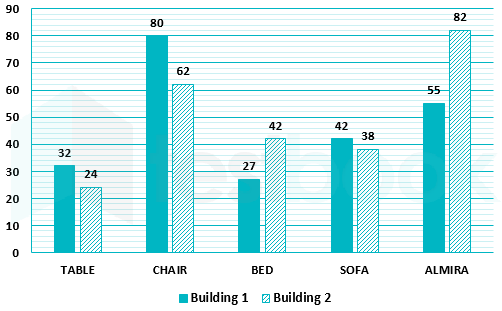
Direction: Study the graph and answer the following question.

The Bar graph shows number of different kinds of furniture in two buildings having 5 floors each.

Question 41

In Building 2, 50% of the Beds are folding type. What is ratio of total number of Beds in Building 1 and number of folding beds in Building 2?

  1. AOption (a)

    9 ∶ 7

  2. BOption (b)

    5 ∶ 3

  3. COption (c)

    2 ∶ 1

  4. DOption (d)

    9 ∶ 14

  5. EOption (e)

    2 ∶ 3

View answer & explanation

Correct answer

Answer: (a)A.

9 ∶ 7

Why this answer is correct

Number of Beds in Building 2 = 42

∴ Number of Folding Beds in Building 2 = 42 × 50/100 = 21

Number of Beds in Building 1 = 27

∴ Required Ratio = 27 ∶ 21 = 9 ∶ 7

Question 42

In Building 1, 40% of the Almira are in the top floor. What is the number of Almira in the other floors of Building 1?

  1. AOption (a)

    33

  2. BOption (b)

    42

  3. COption (c)

    27

  4. DOption (d)

    18

  5. EOption (e)

    11

View answer & explanation

Correct answer

Answer: (a)A.

33

Why this answer is correct

Number of Almira in Building 1 = 55

∴ Number of Almira in Top Floor = 55 × 40/100 = 22

∴ Number of Almira in other floors = (55 – 22) = 33

Question 43

What is difference between the total number of furniture in two buildings?

  1. AOption (a)

    8

  2. BOption (b)

    21

  3. COption (c)

    12

  4. DOption (d)

    10

  5. EOption (e)

    15

View answer & explanation

Correct answer

Answer: (c)C.

12

Why this answer is correct

Total number of furniture in Building 1 = (32 + 80 + 27 + 42 + 55) = 236

Total number of furniture in Building 2 = (24 + 62 + 42 + 38 + 82) = 248

∴ Required difference = (248 – 236) = 12

Question 44

Total number of Sofa and Almira in Building 2 is what percent of the number of Chair in Building 1?

  1. AOption (a)

    120%

  2. BOption (b)

    170%

  3. COption (c)

    125%

  4. DOption (d)

    150%

  5. EOption (e)

    215%

View answer & explanation

Correct answer

Answer: (d)D.

150%

Why this answer is correct

Number of Sofa in Building 2 = 38

Number of Almira in Building 2 = 82

Number of Chair in Building 1 = 80

∴ Required percentage = (38 + 82)/80 × 100% = 150%

Question 45

What is the ratio between total number of Table and Chair together in building 1 and number of Bed and Sofa together in Building 2?

  1. AOption (a)

    7 ∶ 5

  2. BOption (b)

    1 ∶ 2

  3. COption (c)

    2 ∶ 5

  4. DOption (d)

    5 ∶ 3

  5. EOption (e)

    3 ∶ 2

View answer & explanation

Correct answer

Answer: (a)A.

7 ∶ 5

Why this answer is correct

Number of Table in Building 1 = 32

Number of Chair in Building 1 = 80

Number of Bed in Building 2 = 42

Number of Sofa in Building 2 = 38

∴ Required Ratio = (32 + 80) ∶ (42 + 38) = 112 ∶ 80 = 7 ∶ 5

Question 46

What should come in place of the question mark '?' in the following number series?

100, 108, 120, 136, 156, ?

  1. AOption (a)

    170

  2. BOption (b)

    160

  3. COption (c)

    150

  4. DOption (d)

    180

  5. EOption (e)

    None of these

View answer & explanation

Correct answer

Answer: (d)D.

180

Why this answer is correct

Given:

100, 108, 120, 136, 156, ?

Calculation:

Considering the above series, the logic can be explained as follows

∴ The required value of "?" is 180.

Question 47

What should come in place of the question mark '?' in the following number series?

14, 15, 31, 94, 377, ?

  1. AOption (a)

    1776

  2. BOption (b)

    1506

  3. COption (c)

    1886

  4. DOption (d)

    2026

  5. EOption (e)

    1666

View answer & explanation

Correct answer

Answer: (c)C.

1886

Why this answer is correct

GIVEN:

14, 15, 31, 94, 377, ?

Calculation:

The series follows the following pattern:

⇒ 14 × 1 + 1 = 15

⇒ 15 × 2 + 1 = 31

⇒ 31 × 3 + 1 = 94

⇒ 94 × 4 + 1 = 377

⇒ 377 × 5 + 1 = 1886

∴ The required value of "?" is 1886.

Alternate Method

∴ The required value of "?" is 1886.

Question 48

What will come in place of the question mark (?) in the following number series?

8, 17, 53, ?, 1079, 6479

  1. AOption (a)

    125

  2. BOption (b)

    200

  3. COption (c)

    250

  4. DOption (d)

    215

  5. EOption (e)

    300

View answer & explanation

Correct answer

Answer: (d)D.

215

Why this answer is correct

Calculation:

Considering the above series,

8, 17, 53, ?, 1079, 6479

The logic of the series can be explained as,

8 × 2 + 1 = 17

17 × 3 + 2 = 53

53 × 4 + 3 = 215

215 × 5 + 4 = 1079

1079 × 6 + 5 = 6479

∴ The value of (?) is 215.

Question 49

What should come in place of the question mark '?' in the following number series?

38, 43, 215, 220, 1100, ?

  1. AOption (a)

    5500

  2. BOption (b)

    1105

  3. COption (c)

    1210

  4. DOption (d)

    6600

  5. EOption (e)

    1320

View answer & explanation

Correct answer

Answer: (b)B.

1105

Why this answer is correct

Calculation∶

The series follows following pattern∶

⇒ 38 + (22 + 1) = 43

⇒ 43 × (22 + 1) = 215

⇒ 215 + (22 + 1) = 220

⇒ 220 × (22 + 1) = 1100

⇒ 1100 + (22 + 1) = 1105

∴ The value of ? is 1105

Question 50

What will come in the place of question mark (?) in the following number series?

33, 42, 67, 116, 197, ?

  1. AOption (a)

    320

  2. BOption (b)

    318

  3. COption (c)

    315

  4. DOption (d)

    300

  5. EOption (e)

    305

View answer & explanation

Correct answer

Answer: (b)B.

318

Why this answer is correct

The logic behind the following series is as follows:

33 + 32 = 42

42 + 52 = 67

67 + 72 = 116

116 + 92 = 197

197 + 112 = ? = 318

 ∴ The value of ‘?’ is 318.

Question 51

A travels 25% faster than B. They started their journey from a point P to another point Q and reach at the same time on point Q. Distance between P and Q is 85 km. On the way, however, A lost about 20 minutes while stopping for petrol. What was the speed of B?

  1. AOption (a)

    51 km/hr

  2. BOption (b)

    50 km/hr

  3. COption (c)

    45 km/hr

  4. DOption (d)

    75 km/hr

  5. EOption (e)

    None of these 

View answer & explanation

Correct answer

Answer: (a)A.

51 km/hr

Why this answer is correct

Shortcut Trick

Speed ratio A : B = 125 : 100 = 5 : 4.

Time ratio A : B = 4 : 5 (Inverse of speed ratio).

Difference in time units = 5 − 4 = 1 unit → 20 minutes.

Time taken by B = 5 units = 5 × 20 = 100 minutes = 100/60 hours.

Speed of B = Distance ÷ Time = 85 ÷ (100/60) = 85 × 6/10 = 51 km/hr.

∴ The correct answer is 51 km/hr.

Alternate Method

Given: Distance = 85 km, Speed of A is 25% more than B, Time difference = 20 minutes.

Formula Used: Speed = Distance ÷ Time | Time = Distance ÷ Speed

⇒ Let Speed of B = x km/hr.

⇒ Speed of A = 1.25x km/hr.

⇒ Time taken by B − Time taken by A = 20/60 hours.

⇒ (85/x) − (85/1.25x) = 1/3

⇒ (85/x) × [1 − (1/1.25)] = 1/3

⇒ (85/x) × [1 − (4/5)] = 1/3

⇒ (85/x) × (1/5) = 1/3

⇒ 17/x = 1/3

⇒ x = 51 km/hr.

∴ The correct answer is 51 km/hr.

Additional Information

Relative Speed and Constant Distance

When Distance is constant, Speed is inversely proportional to Time (S1/S2 = T2/T1).

Unit Conversion

Always ensure time units match the speed units. To convert minutes to hours, divide by 60. To convert km/hr to m/s, multiply by 5/18.

Average Speed

For a journey with two equal distance segments at speeds a and b, Average Speed = 2ab / (a + b).

Question 52

In a primary school 96 students are studying. Their average weight is 30 kg. If a student shift to another school the average weight is increased by 200 gm. Find the weight of the student who shifted from the school.

  1. AOption (a)

    10 kg.

  2. BOption (b)

    11 kg.

  3. COption (c)

    13 kg. 

  4. DOption (d)

    15 kg. 

  5. EOption (e)

    9 kg. 

View answer & explanation

Correct answer

Answer: (b)B.

11 kg.

Why this answer is correct

Shortcut Trick

Initial Students = 96, Initial Average = 30 kg

When 1 student leaves, Remaining Students = 95

Average Increase = 200 gm = 0.2 kg

Weight of Left student = Initial Average − (Remaining Students × Increase in Average)

Weight = 30 − (95 × 0.2) = 30 − 19 = 11 kg

∴ The correct answer is 11 kg.

Alternate Method

Given:

Total students = 96

Initial average weight = 30 kg

New average after 1 student leaves = 30 kg + 200 gm = 30.2 kg

Calculations:

⇒ Total weight of 96 students = 96 × 30 = 2880 kg

⇒ Remaining students = 96 − 1 = 95

⇒ New Average = 30 + 0.2 = 30.2 kg

⇒ Total weight of 95 students = 95 × 30.2 = 2869 kg

⇒ Weight of shifted student = 2880 − 2869 = 11 kg

∴ The correct answer is 11 kg.

Additional Information

Average Formula

Average = Sum of observations ÷ Number of observations. To find the sum, multiply Average × Number.

Replacement and Shifts

When a person leaves, the new sum = Old Sum − Value of person who left. If the average increases, the person who left must weigh less than the average.

Unit Conversion

Always ensure units are consistent: 1 kg = 1000 gm. Therefore, 200 gm = 200 ÷ 1000 = 0.2 kg.

Question 53

The perimeter of a rectangle is 132 m and the difference between the length and breadth of the rectangle is 14 m then find the perimeter of square whose area is 16 m2 less than the area of the rectangle.

  1. AOption (a)

    126 m

  2. BOption (b)

    128 m

  3. COption (c)

    114 m

  4. DOption (d)

    102 m

  5. EOption (e)

    62 m

View answer & explanation

Correct answer

Answer: (b)B.

128 m

Why this answer is correct

Shortcut Trick

Sum of length (L) and breadth (B) = 132 ÷ 2 = 66 m

Using Sum (66) and Difference (14): L = (66 + 14) ÷ 2 = 40 m and B = (66 − 14) ÷ 2 = 26 m

Area of Rectangle = 40 × 26 = 1040 m2

Area of Square = 1040 − 16 = 1024 m2 ⇒ Side = √1024 = 32 m

Perimeter of Square = 4 × 32 = 128 m

∴ The correct answer is 128 m.

Alternate Method

Given: Perimeter of rectangle = 132 m, (L − B) = 14 m, Area of square = Area of rectangle − 16 m2.

Formula Used: Perimeter = 2(L + B); Area = L × B; Perimeter of square = 4 × Side.

⇒ 2(L + B) = 132

⇒ L + B = 66 m

⇒ Adding (L + B = 66) and (L − B = 14) → 2L = 80 ⇒ L = 40 m

⇒ Substituting L in L + B = 66 → 40 + B = 66 ⇒ B = 26 m

⇒ Area of Rectangle = 40 × 26 = 1040 m2

⇒ Area of Square = 1040 − 16 = 1024 m2

⇒ Side of Square (a) = √1024 = 32 m

⇒ Perimeter of Square = 4 × 32 = 128 m

∴ The correct answer is 128 m.

Additional Information

Area and Perimeter Relations

For a given perimeter, a square has the maximum area among all rectangles. The diagonal of a rectangle is √(L2 + B2).

Perfect Squares

Memorizing squares up to 40 is essential for competitive exams (e.g., 322 = 1024, 312 = 961).

Rectangle properties

If the length is increased by x% and breadth by y%, the percentage change in area is given by [x + y + (xy/100)]%.

Question 54

Three pipes A, B can fill the tank in 12, 20 hrs respectively and C can empty the tank in 30 hours. If the pipes are opened alternatively for 1 hour starting with A and drain pipe is kept open all the time. How much time will it take to fill the tank.

  1. AOption (a)

    12

  2. BOption (b)

    30

  3. COption (c)

    15

  4. DOption (d)

    20

  5. EOption (e)

    None of these

View answer & explanation

Correct answer

Answer: (b)B.

30

Why this answer is correct

Shortcut Trick

Net efficiency when A and C work: 5 − 2 = 3 units/hr.

Net efficiency when B and C work: 3 − 2 = 1 unit/hr.

In 2 hours, work done = 3 + 1 = 4 units.

Total cycles needed = 60 ÷ 4 = 15 cycles.

Total time = 15 cycles × 2 hours/cycle = 30 hours.

∴ The correct answer is 30 hours.

Alternate Method

PipeTime (hrs)Total Work (LCM)Efficiency
A (Fill)1260+5
B (Fill)20+3
C (Empty)30−2

Given: Pipe A and B fill the tank, while Pipe C empties it. Pipes A and B are opened alternatively for 1 hour each, but Pipe C is open all the time.

⇒ Hour 1 (A + C): Efficiency = 5 − 2 = 3 units

⇒ Hour 2 (B + C): Efficiency = 3 − 2 = 1 unit

⇒ Work done in 1 cycle (2 hours) = 3 + 1 = 4 units

⇒ Total work to be completed = 60 units

⇒ Number of cycles = 60 ÷ 4 = 15 cycles

⇒ Total time taken = 15 × 2 = 30 hours

∴ The correct answer is 30 hours.

Additional Information

Pipes and Cisterns Efficiency

Filling pipes have positive efficiency, while emptying (drain) pipes have negative efficiency. Total Work = Time × Net Efficiency.

Alternate Work Principle

When workers or pipes work in turns, calculate the work done in one full cycle first, then multiply the cycle time by the number of cycles needed to reach the target work.

LCM Method

Using the Least Common Multiple of individual times as the total capacity of the tank simplifies calculations by avoiding fractions.

Question 55

A is as efficient as B and C together. Working together A and B can complete a work in 36 days and C alone can complete it in 60 days. A and C work together for 10 days. B alone will complete the remaining work in:

  1. AOption (a)

    88 days

  2. BOption (b)

    110 days

  3. COption (c)

    84 days

  4. DOption (d)

    90 days

  5. EOption (e)

    40 days

View answer & explanation

Correct answer

Answer: (b)B.

110 days

Why this answer is correct

Shortcut Trick

Total Efficiency of (A + B + C) = (A + B) efficiency + C efficiency = 5 + 3 = 8 units/day.

Since A = B + C, efficiency of A = 8 ÷ 2 = 4 units/day and (B + C) = 4 units/day.

Efficiency of B = (B + C) − C = 4 − 3 = 1 unit/day.

Work done by (A + C) in 10 days = (4 + 3) × 10 = 70 units.

Remaining work = 180 − 70 = 110 units. Time taken by B = 110 ÷ 1 = 110 days.

∴ The correct answer is 110 days.

Alternate Method

Given: Time taken by (A + B) = 36 days, Time taken by C = 60 days. Efficiency A = B + C.

PersonDaysTotal WorkEfficiency
(A + B)361805
C603

⇒ Total Efficiency (A + B + C) = 5 + 3 = 8 units/day

⇒ Since A = B + C, substitute in total efficiency: A + A = 8 ⇒ 2A = 8 ⇒ A = 4

⇒ Efficiency of C = 3, so Efficiency of B = (B + C) − C = 4 − 3 = 1 unit/day

⇒ Work done by (A + C) in 10 days = (4 + 3) × 10 = 70 units

⇒ Remaining work = 180 − 70 = 110 units

⇒ Time taken by B = Remaining work ÷ Efficiency of B = 110 ÷ 1 = 110 days

∴ The correct answer is 110 days.

Additional Information

Work and Efficiency Relationship

Total Work = Efficiency × Time. Efficiency is inversely proportional to the time taken to complete a task.

Combined Efficiency

When multiple people work together, their individual efficiencies are added to find the total work done per day.

Remaining Work Calculation

Remaining Work = Total Work − (Work already completed). This is often used in problems involving people joining or leaving mid-way.

Directions: Study the following table carefully to answer the questions given below it.

Details of manpower deployed at different levels by a company in different departments.

DepartmentManagerOfficer
Total numberMale : FemaleTotal numberMale : Female
Operations180013 : 1118007 : 11
Public Relations12009 : 730007 : 8
Finance150017 : 1322009 : 13
Advertising18004 : 512007 : 5
Sales14004 : 3160017 : 15
Procurement105018 : 1715009 : 11

Question 56

Total number of female employees (Managers and Officers) in procurement department is by what percent more than their male counterpart? (Rounded off to the nearest integer)

  1. AOption (a)

    10

  2. BOption (b)

    11

  3. COption (c)

    12

  4. DOption (d)

    13

  5. EOption (e)

    14

View answer & explanation

Correct answer

Answer: (a)A.

10

Why this answer is correct

Female managers in Procurement department

⇒ 35x = 1050

⇒ x = 1050/35 = 30

∴ Female employees = 30 × 17 = 510

⇒ Male employees = 1050 – 510 = 540

Female Officers in Procurement department

⇒ 20x = 1500

⇒ x = 1500/20 = 75

∴ Female officers = 11 × 75 = 825

⇒ Male officers = 1500 – 825 = 675

⇒ Total female employees in procurement department = 510 + 825 = 1335

⇒ Total male employees in procurement department = 540 + 675 = 1215

∴ % Required = 1335−12151215×100=9.87≈10%\frac{{1335 - 1215}}{{1215}} \times 100 = 9.87 \approx 10\%

Question 57

What is the difference between total number of male officers in Advertising and Public Relations Departments and the total number of female managers in these two departments?

  1. AOption (a)

    240

  2. BOption (b)

    475

  3. COption (c)

    525

  4. DOption (d)

    575

  5. EOption (e)

    225

View answer & explanation

Correct answer

Answer: (d)D.

575

Why this answer is correct

Male officers in advertising :

⇒ 12x = 1200

⇒ x = 1200/12 = 100

⇒ Male officers = 7 × 100 = 700

Similarly, male officers in Public relations = 7 × 200 = 1400

∴ Total male officers = 1400 + 700 = 2100

Female managers in Advertising :

⇒ 9x = 1800 ⇒ x = 1800/9 = 200

⇒ Female managers = 200 × 5 = 1000

Similarly, female managers in Public relations = 7 × 75 = 525

∴ Total female managers = 525 + 1000 = 1525

∴ Required Difference = 2100 – 1525 = 575

Question 58

What is the respective ratio between total number of female managers from operations and finance departments and the total number of male officers from these two departments?

  1. AOption (a)

    54 : 65

  2. BOption (b)

    38 : 45

  3. COption (c)

    49∶ 68

  4. DOption (d)

    59 : 64

  5. EOption (e)

    62 : 73

View answer & explanation

Correct answer

Answer: (d)D.

59 : 64

Why this answer is correct

Female managers from Operations = 11 × 75 = 825

Female managers from finance departments = 13 × 50 = 650

∴ Total female managers = 825 + 650 = 1475

Male officers from Operations = 100 × 7 = 700

Male officers from Finance = 100 × 9 = 900

∴ Total male officers = 900 + 700 = 1600

∴ Ratio = 1475 : 1600 = 59 : 64

Question 59

Total number of male officers in advertising and sales department is approximately what percent of the total number of officers in these two departments?

  1. AOption (a)

    52

  2. BOption (b)

    55

  3. COption (c)

    53

  4. DOption (d)

    58

  5. EOption (e)

    57

View answer & explanation

Correct answer

Answer: (b)B.

55

Why this answer is correct

Male officers in Advertising = 700

Male officers in Sales = 850

∴ Total Number of male officers = 700 + 850 = 1550

⇒ Total Number of officers = 1200 + 1600 = 2800

∴ Required % = 15502800×100=55.35%≈55%\frac{{1550}}{{2800}} \times 100 = 55.35\% \approx 55\%

Question 60

Total number of female managers in finance department is approximate what percent of the total number of male employees in sales department?

  1. AOption (a)

    39

  2. BOption (b)

    46

  3. COption (c)

    51

  4. DOption (d)

    37

  5. EOption (e)

    55

View answer & explanation

Correct answer

Answer: (a)A.

39

Why this answer is correct

⇒ Female managers in Finance = 13/30 × 1500 = 650

⇒ Total Number of male employees in sales = 4/7 × 1400 + 17/32 × 1600 = 800 + 850 = 1650

∴ Required % = 6501650×100=39.39%≈39%\frac{{650}}{{1650}} \times 100 = 39.39\% \approx 39\%

Question 61

What is the ratio between total number of managers in public relation, finance and sales, and operation departments and the total number of officers in finance, advertising, sales and procurement departments respectively?

  1. AOption (a)

    59 : 65

  2. BOption (b)

    51 : 13

  3. COption (c)

    56 : 73

  4. DOption (d)

    13 : 15

  5. EOption (e)

    13 : 16

View answer & explanation

Correct answer

Answer: (a)A.

59 : 65

Why this answer is correct

⇒ Number of managers in Public relations = 1200

⇒ Number of managers in finance = 1500

⇒ Number of managers in sales = 1400

⇒ Number of managers in operations = 1800

Total Number of managers = 1200 + 1500 + 1400 + 1800 = 5900

⇒ Number of Officers in finance = 2200

⇒ Number of Officers in advertising = 1200

⇒ Number of Officers in sales = 1600

⇒ Number of Officers in procurement = 1500

Total Number of officers = 2200 + 1200 + 1600 + 1500 = 6500

∴ Required Ratio = 5900 : 6500 = 59 : 65

Question 62

Train A moving at speed 72kmph crosses train B moving at 3/4th speed of train A in the same direction in 1 min and 26 seconds. The length of train A is 25/18th of the length of train B. What is the difference between the lengths of two trains?

  1. AOption (a)

    70m

  2. BOption (b)

    85m

  3. COption (c)

    110m

  4. DOption (d)

    60m

  5. EOption (e)

    90m

View answer & explanation

Correct answer

Answer: (a)A.

70m

Why this answer is correct

Shortcut Trick

Relative speed in same direction = 72 − (3/4 × 72) = 18 kmph = 18 × 5/18 = 5 m/s.

Total distance (sum of lengths) = Relative speed × Time = 5 × 86 = 430 m.

Length ratio A : B = 25 : 18. Total units = 43. Difference units = 7.

Value of 7 units = (430 ÷ 43) × 7 = 70 m.

∴ The correct answer is 70 m.

Alternate Method

Given: Speed of Train A = 72 kmph; Time = 1 min 26 sec = 86 sec.

Formula: Distance = Relative Speed × Time; 1 kmph = 5/18 m/s.

⇒ Speed of Train B = 3/4 × 72 = 54 kmph

⇒ Relative Speed = 72 − 54 = 18 kmph = 18 × (5/18) = 5 m/s

⇒ Total Length (LA + LB) = 5 × 86 = 430 m

⇒ LA = (25/18) × LB → LA : LB = 25 : 18

⇒ LA = (25/43) × 430 = 250 m; LB = (18/43) × 430 = 180 m

⇒ Difference = 250 − 180 = 70 m

∴ The correct answer is 70 m.

Additional Information

Relative Speed Concept

When two objects move in the same direction, relative speed is the difference of their speeds (V1 − V2). When moving in opposite directions, it is the sum (V1 + V2).

Unit Conversion

To convert kmph to m/s, multiply by 5/18. To convert m/s to kmph, multiply by 18/5.

Train Crossing Objects

When a train crosses another train, the total distance covered is always the sum of the lengths of both trains, regardless of the direction of motion.

Question 63

A shopkeeper marks an article 24% above its cost price and allows a 15% discount on the marked price. If he earns a profit of Rs. 27 by selling the article, then the selling price of the article is:

  1. AOption (a)

    Rs. 522

  2. BOption (b)

    Rs. 508

  3. COption (c)

    Rs. 527

  4. DOption (d)

    Rs. 517

  5. EOption (e)

    Rs. 817

View answer & explanation

Correct answer

Answer: (c)C.

Rs. 527

Why this answer is correct

Shortcut Trick

Let Cost Price (CP) be 100 units.

Marked Price (MP) = 100 + 24% of 100 = 124 units.

Selling Price (SP) = 124 − 15% of 124 = 124 − 18.6 = 105.4 units.

Profit = SP − CP = 105.4 − 100 = 5.4 units.

Given, 5.4 units = Rs. 27 ⇒ 1 unit = 27 ÷ 5.4 = 5.

Selling Price = 105.4 × 5 = Rs. 527.

∴ The correct answer is Rs. 527.

Alternate Method

Given: Markup% = 24%, Discount% = 15%, Profit = Rs. 27.

Formulas: SP = MP × (100 − D%) ÷ 100 | MP = CP × (100 + Markup%) ÷ 100 | Profit = SP − CP.

⇒ Let CP = x. Then MP = 1.24x.

⇒ SP = 1.24x × (100 − 15) ÷ 100 = 1.24x × 0.85 = 1.054x.

⇒ Profit = SP − CP = 1.054x − x = 0.054x.

⇒ 0.054x = 27 ⇒ x = 27 ÷ 0.054 = 500.

⇒ SP = 1.054 × 500 = 527.

∴ The correct answer is Rs. 527.

Additional Information

Effective Profit Percentage

When an article is marked up and then a discount is given, the net profit% can be found using the successive percentage formula: a + b + (ab ÷ 100), where a is markup% (positive) and b is discount% (negative).

Marked Price vs Selling Price

Discount is always calculated on the Marked Price, while profit or loss is generally calculated on the Cost Price unless specified otherwise.

Question 64

If double the age of the daughter is added to the age of her mother, the sum is 70 and if double the age of mother is added to the age of the daughter, the sum is 95. The respective ages of daughter and mother (in years) are:

  1. AOption (a)

    15 and 40

  2. BOption (b)

    20 and 30

  3. COption (c)

    25 and 35

  4. DOption (d)

    20 and 35

  5. EOption (e)

    None of these

View answer & explanation

Correct answer

Answer: (a)A.

15 and 40

Why this answer is correct

Shortcut Trick

Test the options to satisfy both conditions given in the question.

Check Option (1): Daughter = 15, Mother = 40.

Condition 1: (2 × 15) + 40 = 30 + 40 = 70 (Matches).

Condition 2: (2 × 40) + 15 = 80 + 15 = 95 (Matches).

∴ The correct answer is 15 and 40 years.

Alternate Method

Given:

Let the age of the daughter be D and the age of the mother be M.

Formula Used:

Linear Equations in two variables.

Calculations:

⇒ Equation 1: 2D + M = 70

⇒ Equation 2: D + 2M = 95

⇒ Multiply Eq. 1 by 2: 4D + 2M = 140 --- (Eq. 3)

⇒ Subtract Eq. 2 from Eq. 3: (4D + 2M) − (D + 2M) = 140 − 95

⇒ 3D = 45

⇒ D = 15

⇒ Substitute D = 15 in Eq. 1: 2(15) + M = 70

⇒ 30 + M = 70

⇒ M = 40

∴ The correct answer is 15 and 40 years.

Additional Information

Substitution Method

Express one variable in terms of the other from one equation (e.g., M = 70 − 2D) and substitute it into the second equation.

Elimination Method

Multiply equations by suitable constants to make the coefficients of one variable equal, then add or subtract to eliminate it.

Sum and Difference Property

Adding the two original equations gives 3(D + M) = 165 ⇒ D + M = 55. Subtracting them gives M − D = 25. Solving these is often faster.

Question 65

The number of mainas and parrots in an aviary is in the ratio of (4x + 5) : 4x. If 25 mainas and 10 parrots are added to the aviary, then, the ratio would change to 5 : 3. How many mainas are there in the aviary at initial?

  1. AOption (a)

    20

  2. BOption (b)

    30

  3. COption (c)

    35

  4. DOption (d)

    25

  5. EOption (e)

    None of these

View answer & explanation

Correct answer

Answer: (d)D.

25

Why this answer is correct

Shortcut Trick

Initial Ratio = (4x + 5) : 4x

New Ratio after adding 25 Mainas and 10 Parrots = 5 : 3

Apply Cross-Multiplication Method: 3(4x + 5 + 25) = 5(4x + 10)

⇒ 3(4x + 30) = 20x + 50 ⇒ 12x + 90 = 20x + 50 ⇒ 8x = 40 ⇒ x = 5

Initial Mainas = 4x + 5 = 4(5) + 5 = 25

∴ The correct answer is 25 mainas.

Alternate Method

Given: Initial Mainas = 4x + 5, Initial Parrots = 4x

Formula: (Initial Value + Change) / (Initial Value + Change) = New Ratio

⇒ [(4x + 5) + 25] / (4x + 10) = 5 / 3

⇒ (4x + 30) / (4x + 10) = 5 / 3

⇒ 3 × (4x + 30) = 5 × (4x + 10)

⇒ 12x + 90 = 20x + 50

⇒ 20x − 12x = 90 − 50

⇒ 8x = 40

⇒ x = 5

⇒ Initial Mainas = 4(5) + 5 = 25

∴ The correct answer is 25 mainas.

Additional Information

Ratio and Proportion

A Ratio compares two quantities by division. If a : b = c : d, then ad = bc (Product of extremes = Product of means).

Cross-Multiplication Trick

Used when a constant or different values are added/subtracted to parts of a ratio to result in a new ratio. It simplifies linear equations.

Reasoning Ability (35 questions)

Directions: Study the following information carefully and answer the questions that follow.

Eight people – Aishwarya, Kavya, Surabhi, Sangeetha, Shruthi, Swathi, Anita and Meghana were born in different years 1983, 1988, 1991, 1993, 1996, 2000, 2006 and 2012 not necessarily in the same order.

Kavya’s age is a multiple of 5. Three people were born between Kavya and Meghana. Swathi is born before Kavya, but she is not the eldest person. Four people were born between Swathi and Anita, who is not the youngest person. Surabhi was born just before Aishwarya. Only one person was born between Sangeetha and Shruthi. Sangeetha is not the youngest person.

Note:

  1. All calculations are done with respect to the present year, 2021 assuming the month and date to be same as that of the years as mentioned above.

  2. Each person is assumed to born on the same date and same month of the respective years.

Question 66

Who is the eldest person in the group?

  1. AOption (a)

    Surabhi

  2. BOption (b)

    Meghana

  3. COption (c)

    Kavya

  4. DOption (d)

    Anita

  5. EOption (e)

    Shruthi

View answer & explanation

Correct answer

Answer: (b)B.

Meghana

Why this answer is correct

According to the given information,

  1. Kavya’s age is a multiple of 5. 2. Three people were born between Kavya and Meghana.
Case - 1Case - 2Case - 3
YearAge (as of 2021)PersonYearAge (as of 2021)PersonYearAge (as of 2021)Person
198338198338Meghana198338
198833198833198833
199130Kavya199130199130Meghana
199328199328199328
199625199625Kavya199625
200021200021200021
200615Meghana200615200615Kavya
201292012920129


3. Swathi is born before Kavya, but she is not the eldest person.  4. Four people were born between Swathi and Anita, who is not the youngest person. Here case - 1 gets eliminated.

Case - 2Case - 3
YearAge (as of 2021)PersonYearAge (as of 2021)Person
198338Meghana198338Anita
198833Swathi198833
199130199130Meghana
199328199328
199625Kavya199625
200021200021Swathi
200615Anita200615Kavya
2012920129


5. Surabhi was born just before Aishwarya. 6. Only one person was born between Sangeetha and Shruthi. Here case - 3 gets eliminated. 7. Sangeetha is not the youngest person.

Case - 2
YearAge (as of 2021)Person
198338Meghana
198833Swathi
199130Surabhi
199328Aishwarya
199625Kavya
200021Sangeetha
200615Anita
20129Shruthi


Meghana is the correct answer.

Question 67

Who is born immediately before Kavya?

  1. AOption (a)

    Swathi

  2. BOption (b)

    Shruthi

  3. COption (c)

    Meghana

  4. DOption (d)

    Anita

  5. EOption (e)

    Aishwarya

View answer & explanation

Correct answer

Answer: (e)E.

Aishwarya

Why this answer is correct

According to the given information,

1. Kavya’s age is a multiple of 5. 2. Three people were born between Kavya and Meghana.

Case - 1Case - 2Case - 3
YearAge (as of 2021)PersonYearAge (as of 2021)PersonYearAge (as of 2021)Person
198338198338Meghana198338
198833198833198833
199130Kavya199130199130Meghana
199328199328199328
199625199625Kavya199625
200021200021200021
200615Meghana200615200615Kavya
201292012920129


3. Swathi is born before Kavya, but she is not the eldest person.  4. Four people were born between Swathi and Anita, who is not the youngest person. Here case - 1 gets eliminated.

Case - 2Case - 3
YearAge (as of 2021)PersonYearAge (as of 2021)Person
198338Meghana198338Anita
198833Swathi198833
199130199130Meghana
199328199328
199625Kavya199625
200021200021Swathi
200615Anita200615Kavya
2012920129


5. Surabhi was born just before Aishwarya. 6. Only one person was born between Sangeetha and Shruthi. Here case - 3 gets eliminated. 7. Sangeetha is not the youngest person.

Case - 2
YearAge (as of 2021)Person
198338Meghana
198833Swathi
199130Surabhi
199328Aishwarya
199625Kavya
200021Sangeetha
200615Anita
20129Shruthi


Aishwarya is the correct answer.

Question 68

How many people are born between Sangeetha and Meghana?

  1. AOption (a)

    One

  2. BOption (b)

    Three

  3. COption (c)

    Four

  4. DOption (d)

    Two

  5. EOption (e)

    None

View answer & explanation

Correct answer

Answer: (c)C.

Four

Why this answer is correct

According to the given information,

1. Kavya’s age is a multiple of 5. 2. Three people were born between Kavya and Meghana.

Case - 1Case - 2Case - 3
YearAge (as of 2021)PersonYearAge (as of 2021)PersonYearAge (as of 2021)Person
198338198338Meghana198338
198833198833198833
199130Kavya199130199130Meghana
199328199328199328
199625199625Kavya199625
200021200021200021
200615Meghana200615200615Kavya
201292012920129


3. Swathi is born before Kavya, but she is not the eldest person.  4. Four people were born between Swathi and Anita, who is not the youngest person. Here case - 1 gets eliminated.

Case - 2Case - 3
YearAge (as of 2021)PersonYearAge (as of 2021)Person
198338Meghana198338Anita
198833Swathi198833
199130199130Meghana
199328199328
199625Kavya199625
200021200021Swathi
200615Anita200615Kavya
2012920129


5. Surabhi was born just before Aishwarya. 6. Only one person was born between Sangeetha and Shruthi. Here case - 3 gets eliminated. 7. Sangeetha is not the youngest person.

Case - 2
YearAge (as of 2021)Person
198338Meghana
198833Swathi
199130Surabhi
199328Aishwarya
199625Kavya
200021Sangeetha
200615Anita
20129Shruthi


Four is the correct answer.

Question 69

Who is the youngest person in the group?

  1. AOption (a)

    Shruthi

  2. BOption (b)

    Anita

  3. COption (c)

    Meghana

  4. DOption (d)

    Surabhi

  5. EOption (e)

    Sangeetha

View answer & explanation

Correct answer

Answer: (a)A.

Shruthi

Why this answer is correct

According to the given information,

1. Kavya’s age is a multiple of 5. 2. Three people were born between Kavya and Meghana.

Case - 1Case - 2Case - 3
YearAge (as of 2021)PersonYearAge (as of 2021)PersonYearAge (as of 2021)Person
198338198338Meghana198338
198833198833198833
199130Kavya199130199130Meghana
199328199328199328
199625199625Kavya199625
200021200021200021
200615Meghana200615200615Kavya
201292012920129


3. Swathi is born before Kavya, but she is not the eldest person.  4. Four people were born between Swathi and Anita, who is not the youngest person. Here case - 1 gets eliminated.

Case - 2Case - 3
YearAge (as of 2021)PersonYearAge (as of 2021)Person
198338Meghana198338Anita
198833Swathi198833
199130199130Meghana
199328199328
199625Kavya199625
200021200021Swathi
200615Anita200615Kavya
2012920129


5. Surabhi was born just before Aishwarya. 6. Only one person was born between Sangeetha and Shruthi. Here case - 3 gets eliminated. 7. Sangeetha is not the youngest person.

Case - 2
YearAge (as of 2021)Person
198338Meghana
198833Swathi
199130Surabhi
199328Aishwarya
199625Kavya
200021Sangeetha
200615Anita
20129Shruthi


Shruthi is the correct answer.

Question 70

Who is born immediately before Surabhi?

  1. AOption (a)

    Meghana

  2. BOption (b)

    Anita

  3. COption (c)

    Swathi

  4. DOption (d)

    Sangeetha

  5. EOption (e)

    Kavya

View answer & explanation

Correct answer

Answer: (c)C.

Swathi

Why this answer is correct

According to the given information,

1. Kavya’s age is a multiple of 5. 2. Three people were born between Kavya and Meghana.

Case - 1Case - 2Case - 3
YearAge (as of 2021)PersonYearAge (as of 2021)PersonYearAge (as of 2021)Person
198338198338Meghana198338
198833198833198833
199130Kavya199130199130Meghana
199328199328199328
199625199625Kavya199625
200021200021200021
200615Meghana200615200615Kavya
201292012920129


3. Swathi is born before Kavya, but she is not the eldest person.  4. Four people were born between Swathi and Anita, who is not the youngest person. Here case - 1 gets eliminated.

Case - 2Case - 3
YearAge (as of 2021)PersonYearAge (as of 2021)Person
198338Meghana198338Anita
198833Swathi198833
199130199130Meghana
199328199328
199625Kavya199625
200021200021Swathi
200615Anita200615Kavya
2012920129


5. Surabhi was born just before Aishwarya. 6. Only one person was born between Sangeetha and Shruthi. Here case - 3 gets eliminated. 7. Sangeetha is not the youngest person.

Case - 2
YearAge (as of 2021)Person
198338Meghana
198833Swathi
199130Surabhi
199328Aishwarya
199625Kavya
200021Sangeetha
200615Anita
20129Shruthi


Swathi is the correct answer.

Question 71

Which of the following symbols should be placed in the blank spaces respectively (in the same order from left to right) in order to complete the given expression in such a manner that “D < A” definitely holds True?

A __ B __ C __ D

  1. AOption (a)

    >, ≥, <

  2. BOption (b)

    ≤, <, =

  3. COption (c)

    ≥, =, <

  4. DOption (d)

    ≥, =, >

  5. EOption (e)

    None of these

View answer & explanation

Correct answer

Answer: (d)D.

≥, =, >

Why this answer is correct

Let us check each option:

  1. A > B ≥ C < D → relation between A and D can’t be determined.

  2. A ≤ B < C = D → A < D which is false.

  3. A ≥ B = C < D → relation between A and D can’t be determined.

  4. A ≥ B = C > D → D < A True

Hence, the correct sequence of symbols to satisfy the given condition is “≥, =, >”.

Question 72

Which of the following symbols should be placed in the blank space in order to complete the given expression in such a manner that ‘X > I’ definitely true? A = R ≥ I ? T = N ≤ M = X

  1. AOption (a)

    ≥

  2. BOption (b)

    =

  3. COption (c)

    <

  4. DOption (d)

    >

  5. EOption (e)

    ≤

View answer & explanation

Correct answer

Answer: (c)C.

<

Why this answer is correct

Given statement: A = R ≥ I ? T = N ≤ M = X

Condition is X > I

I ? T = N ≤ M = X →X = M ≥ N = T > I, will only make X > I, so I < T = N ≤ M = X.

Hence, < is the answer.

Question 73

Which of the following symbols should be inserted in place of question mark (?) respectively (in the same order from left to right) in order to complete the given expression in such a manner that ‘U > S’, ‘Q < T’ and ‘S ≤ N’ definitely holds true?

U > T ? D ≥ S ? Q ? N

  1. AOption (a)

    , >, <

  2. BOption (b)

    , =, <

  3. COption (c)

    ≥, =, ≤

  4. DOption (d)

    <, =, ≤

  5. EOption (e)

    , =, ≤

View answer & explanation

Correct answer

Answer: (e)E.

, =, ≤

Why this answer is correct

Let us check:

Given statements: ‘U > S’, ‘Q < T’ and ‘S ≤ N’ 

The part of the question “S ? Q ? N”, to fill this, from the given statements we have to satisfy the condition ‘S ≤ N’ and hence S = Q and Q ≤ N

The other part of the question “U > T ? D ≥ S = Q ≤ N”, to fill this, from this given statements we have to satisfy the condition ‘U > S’ and ‘S ≤ N’ → U > S ≤ N but ‘Q < T’ .Hence U > T > D.

Hence, “U > T > D ≥ S = Q ≤ N” is the correct statement.

Directions: Read the given information carefully and answer the following questions:

7 Persons Ram, Mani, Rupa, Mano, Sahil, Saroja, and Ravi are sitting in a linear row facing north. They all like different flowers i.e., Rose, Lily, Jasmine, Marigold, Lotus, Daisy, and Orchid but not necessarily in the same order.

Ravi, who doesn't sit at the extreme ends, sits third to the right of Mani. The number of persons sitting to the right of the one, who likes Orchid is same as the number of persons sitting to the left of Rupa. The one, who likes Lily sits immediate right of Rupa, who sits to the left of Mani. Sahil sits third to the left of Ram, who likes Marigold. Mano sits to the right of Ram. The number of persons sitting to the left of the one, who likes Jasmine is two more than the number of persons sitting to the right of Mano. The one, who likes Rose sits to the left of the one, who likes Daisy. Saroja likes Lotus but does not sit adjacent to Ravi.

Question 74

Who likes Lily?

  1. AOption (a)

    Rupa

  2. BOption (b)

    Mano

  3. COption (c)

    Mani

  4. DOption (d)

    Ravi

  5. EOption (e)

    Sahil

View answer & explanation

Correct answer

Answer: (e)E.

Sahil

Why this answer is correct

Persons: Ram, Mani, Rupa, Mano, Sahil, Saroja, and Ravi.

Flowers: Rose, Lilly, Jasmine, Marigold, Lotus, Daisy, and Orchid.

1. Ravi, who doesn't sit at the extreme ends, sits third to the right of Mani.

2. The one, who likes Lily sits immediate right of Rupa, who sits to the left of Mani.

3. The number of persons sitting to the right of the one, who likes Orchid is same as the number of persons sitting to the left of Rupa. 

4.  Sahil sits third to the left of Ram, who likes Marigold.  5. Mano sits to the right of Ram, so Ram doesn't sit at the right end.

6. The number of persons sitting to the left of the one, who likes Jasmine is two more than the number of persons sitting to the right of Mano.

7. Saroja likes Lotus but does not sit adjacent to Ravi.

So, Case 1 and Case 3 are eliminated.

8. The one, who likes Rose sits to the left of the one, who likes Daisy.

The final arrangement is,

Hence, Sahil likes Lily.

Question 75

Who sits second to the left of the one, who likes Lotus?

  1. AOption (a)

    Sahil

  2. BOption (b)

    Rupa

  3. COption (c)

    Mani

  4. DOption (d)

    Mano

  5. EOption (e)

    Ravi

View answer & explanation

Correct answer

Answer: (a)A.

Sahil

Why this answer is correct

Persons: Ram, Mani, Rupa, Mano, Sahil, Saroja, and Ravi.

Flowers: Rose, Lilly, Jasmine, Marigold, Lotus, Daisy, and Orchid.

1. Ravi, who doesn't sit at the extreme ends, sits third to the right of Mani.

2. The one, who likes Lily sits immediate right of Rupa, who sits to the left of Mani.

3. The number of persons sitting to the right of the one, who likes Orchid is same as the number of persons sitting to the left of Rupa. 

4.  Sahil sits third to the left of Ram, who likes Marigold.  5. Mano sits to the right of Ram, so Ram doesn't sit at the right end.

6. The number of persons sitting to the left of the one, who likes Jasmine is two more than the number of persons sitting to the right of Mano.

7. Saroja likes Lotus but does not sit adjacent to Ravi.

So, Case 1 and Case 3 are eliminated.

8. The one, who likes Rose sits to the left of the one, who likes Daisy.

The final arrangement is,

Hence, Sahil sits second to the left of the one, who likes Lotus.

Question 76

Who is related to 'Daisy' in the same way as 'Mani' is related to 'Lotus'?

  1. AOption (a)

    Rupa

  2. BOption (b)

    Mani

  3. COption (c)

    Ram

  4. DOption (d)

    Ravi

  5. EOption (e)

    Sahil

View answer & explanation

Correct answer

Answer: (c)C.

Ram

Why this answer is correct

Persons: Ram, Mani, Rupa, Mano, Sahil, Saroja, and Ravi.

Flowers: Rose, Lilly, Jasmine, Marigold, Lotus, Daisy, and Orchid.

1. Ravi, who doesn't sit at the extreme ends, sits third to the right of Mani.

2. The one, who likes Lily sits immediate right of Rupa, who sits to the left of Mani.

3. The number of persons sitting to the right of the one, who likes Orchid is same as the number of persons sitting to the left of Rupa. 

4.  Sahil sits third to the left of Ram, who likes Marigold.  5. Mano sits to the right of Ram, so Ram doesn't sit at the right end.

6. The number of persons sitting to the left of the one, who likes Jasmine is two more than the number of persons sitting to the right of Mano.

7. Saroja likes Lotus but does not sit adjacent to Ravi.

So, Case 1 and Case 3 are eliminated.

8. The one, who likes Rose sits to the left of the one, who likes Daisy.

The final arrangement is,

Hence, 'Ram' is related to 'Daisy' in the same way as 'Mani' is related to 'Lotus'.

Question 77

Who among the following sits at the extreme end?

  1. AOption (a)

    Saroja

  2. BOption (b)

    Rupa

  3. COption (c)

    Ram

  4. DOption (d)

    Sahil

  5. EOption (e)

    None of these

View answer & explanation

Correct answer

Answer: (b)B.

Rupa

Why this answer is correct

Persons: Ram, Mani, Rupa, Mano, Sahil, Saroja, and Ravi.

Flowers: Rose, Lilly, Jasmine, Marigold, Lotus, Daisy, and Orchid.

1. Ravi, who doesn't sit at the extreme ends, sits third to the right of Mani.

2. The one, who likes Lily sits immediate right of Rupa, who sits to the left of Mani.

3. The number of persons sitting to the right of the one, who likes Orchid is same as the number of persons sitting to the left of Rupa. 

4.  Sahil sits third to the left of Ram, who likes Marigold.  5. Mano sits to the right of Ram, so Ram doesn't sit at the right end.

6. The number of persons sitting to the left of the one, who likes Jasmine is two more than the number of persons sitting to the right of Mano.

7. Saroja likes Lotus but does not sit adjacent to Ravi.

So, Case 1 and Case 3 are eliminated.

8. The one, who likes Rose sits to the left of the one, who likes Daisy.

The final arrangement is,

Hence, among the given persons Rupa sits at the extreme end.

Question 78

Which of the following is true?

I. Mani likes Orchid.

II. The one, who likes Orchid doesn't sit at the extreme end.

III. Mano sits at the extreme left end.

  1. AOption (a)

    Only III

  2. BOption (b)

    Both II and III

  3. COption (c)

    Both I and III

  4. DOption (d)

    All are true

  5. EOption (e)

    None is true

View answer & explanation

Correct answer

Answer: (e)E.

None is true

Why this answer is correct

Persons: Ram, Mani, Rupa, Mano, Sahil, Saroja, and Ravi.

Flowers: Rose, Lilly, Jasmine, Marigold, Lotus, Daisy, and Orchid.

1. Ravi, who doesn't sit at the extreme ends, sits third to the right of Mani.

2. The one, who likes Lily sits immediate right of Rupa, who sits to the left of Mani.

3. The number of persons sitting to the right of the one, who likes Orchid is same as the number of persons sitting to the left of Rupa. 

4.  Sahil sits third to the left of Ram, who likes Marigold.  5. Mano sits to the right of Ram, so Ram doesn't sit at the right end.

6. The number of persons sitting to the left of the one, who likes Jasmine is two more than the number of persons sitting to the right of Mano.

7. Saroja likes Lotus but does not sit adjacent to Ravi.

So, Case 1 and Case 3 are eliminated.

8. The one, who likes Rose sits to the left of the one, who likes Daisy.

The final arrangement is,

I. Mani likes Jasmine.

II. The one, who likes Orchid sit at the extreme end.

III. Mano sits at the extreme right end.

Hence, none is true.

Direction: Study the following information carefully and answer the question given below.

Seven friends A, B, C, D, E, F, and G are sitting around a circular table but not necessarily in the same order. Some are facing inside while some are facing outside the table. Not more than two people are facing in the same direction who are sitting adjacent to each other. Two people sit between D and F. F sits second to the left of A. D is facing inside. C is third to the right of D. B is to the immediate right of A. G is second to the left of C. G is not facing inside. B sits second to left of E and Facing inside of the table.

Question 79

How many people are facing inside?

  1. AOption (a)

    Two

  2. BOption (b)

    Three

  3. COption (c)

    Four

  4. DOption (d)

    Five

  5. EOption (e)

    Can't be determined

View answer & explanation

Correct answer

Answer: (b)B.

Three

Why this answer is correct

7 Friends : A, B, C, D, E, F and G

(1) D is facing inside.

(2) C is third to the right of D. 

(3) Two people sit between D and F.

(4) F sits second to the left of A.

(5) B is to the immediate right of A. 

(6) G is second to the left of C.

(7) G is not facing inside.

8) B sits second to left of E and Facing inside of the table.

Since not more than two people are facing in the same direction.

Therefore, the final seating arrangement is as following:

Hence, three people facing inside.

Question 80

How many people are seating between B and F when counted from the left of B?

  1. AOption (a)

    1

  2. BOption (b)

    2

  3. COption (c)

    3

  4. DOption (d)

    4

  5. EOption (e)

    Can't be determined

View answer & explanation

Correct answer

Answer: (c)C.

3

Why this answer is correct

7 Friends : A, B, C, D, E, F and G

(1) D is facing inside.

(2) C is third to the right of D.

(3) Two people sit between D and F.

(4) F sits second to the left of A.

(5) B is to the immediate right of A. 

(6) G is second to the left of C.

(7) G is not facing inside.

8) B sits second to left of E and Facing inside of the table.

Since not more than two people are facing in the same direction.

Therefore, the final seating arrangement is as following:

Hence, 3 people are seating between B and F when counted from the left of B.

Question 81

Who sits to the immediate right of E?

  1. AOption (a)

    A

  2. BOption (b)

    F

  3. COption (c)

    D

  4. DOption (d)

    G

  5. EOption (e)

    C

View answer & explanation

Correct answer

Answer: (d)D.

G

Why this answer is correct

7 Friends : A, B, C, D, E, F and G

(1) D is facing inside.

(2) C is third to the right of D.

(3) Two people sit between D and F.

(4) F sits second to the left of A.

(5) B is to the immediate right of A. 

(6) G is second to the left of C.

(7) G is not facing inside.

8) B sits second to left of E and Facing inside of the table.

Since not more than two people are facing in the same direction.

Therefore, the final seating arrangement is as following:

Hence, G sits to the immediate right of E.

Question 82

Which of the following statement is true?

  1. AOption (a)

    E is the immediate right of G.

  2. BOption (b)

    B faces outside.

  3. COption (c)

    G is third to the left of A.

  4. DOption (d)

    C is third to the left of E.

  5. EOption (e)

    Only two people sit between A and F when counted from the left of A.

View answer & explanation

Correct answer

Answer: (c)C.

G is third to the left of A.

Why this answer is correct

7 Friends : A, B, C, D, E, F and G

(1) D is facing inside.

(2) C is third to the right of D.

(3) Two people sit between D and F.

(4) F sits second to the left of A.

(5) B is to the immediate right of A. 

(6) G is second to the left of C.

(7) G is not facing inside.

8) B sits second to left of E and Facing inside of the table. 

Since not more than two people are facing in the same direction.

Therefore, the final seating arrangement is as following:

Hence, G is third to the left of A is true.

Question 83

______ is fourth to the right of C.

  1. AOption (a)

    A

  2. BOption (b)

    E

  3. COption (c)

    G

  4. DOption (d)

    F

  5. EOption (e)

    B

View answer & explanation

Correct answer

Answer: (b)B.

E

Why this answer is correct

7 Friends : A, B, C, D, E, F and G

(1) D is facing inside.

(2) C is third to the right of D.

(3) Two people sit between D and F.

(4) F sits second to the left of A.

(5) B is to the immediate right of A. 

(6) G is second to the left of C.

(7) G is not facing inside.

8) B sits second to left of E and Facing inside of the table.

Since not more than two people are facing in the same direction.

Therefore, the final seating arrangement is as following:

Hence, E is fourth to the right of C.

Question 84

Direction: In the question below are given three statements followed by two conclusions numbered I and II. You have to take the given statements to be true even if they seem to be at variance with commonly known facts. Read all the conclusions and then decide which of the given conclusions logically follows from the given statements disregarding commonly known facts.

Statement:

All rooms are tables.

All doors are rooms.

No cards are tables

Conclusion:

I. All rooms can never be cards.

II. All doors can be cards.

  1. AOption (a)

    Only I follows

  2. BOption (b)

    Only II follows

  3. COption (c)

    Both I and II follows

  4. DOption (d)

    Either I or II follows

  5. EOption (e)

    Neither I nor II follows

View answer & explanation

Correct answer

Answer: (a)A.

Only I follows

Why this answer is correct

The least possible Venn diagram for the given statements is as follows:

Conclusion:

I. All rooms can never be cards → True (As per the statement All rooms are table and no tables are cards so, rooms are under the table and no table is a card. Hence, all rooms can never be cards.)

II. All doors can be cards → False (As per the statement All doors are tables and no table is the card so, all door will never be the card.)

Hence, Only I follows

Question 85

Direction: In the question below are given three statements followed by two conclusions numbered I, and II  .You have to take the given statements to be true even if they seem to be at variance with commonly known facts. Read all the conclusions and then decide which of the given conclusions logically follows from the given statements disregarding commonly known facts.

Statements

Some Rectangle is Triangle.

All Circle is Triangle.

No Circle is Square.

Conclusions

I. All Rectangle being Square is a possibility

II. Some Square can be Triangle.

  1. AOption (a)

    Only I follows

  2. BOption (b)

    Only II follows

  3. COption (c)

    Both I and II follows

  4. DOption (d)

    Neither I nor II follows

  5. EOption (e)

    Either  I or II follows

View answer & explanation

Correct answer

Answer: (c)C.

Both I and II follows

Why this answer is correct

The least possible Venn diagram for the given statements is as follows

Conclusions:

I. All Rectangle being Square is a possibility - True (There is no relation between Rectangular or Square so the possibility case is followed)

II. Some Square can be Triangle - True (Given no Circle is Square but not given any relation between Triangle and Square so Some Square can be Triangle is follows)

Hence, Both I and II follow.

Question 86

Directions

The question given below three statements followed by two conclusions numbered: I, II. You have to take the given statements to be true even if they seem to be variance with commonly known facts. Read all the conclusions and decide which of the given conclusions logically follows the given statements disregarding commonly known facts.

Statements:

All Chocolates are Flowers.

Some Flowers are Cakes.

Few Stems are Flowers.

Conclusions:

I. No Chocolate is Flowers.

II. Some Cakes are Flowers.

  1. AOption (a)

    Only I follows

  2. BOption (b)

    Only II follows

  3. COption (c)

    Both I and II follows

  4. DOption (d)

    Either I or II follows

  5. EOption (e)

    Neither I nor II follows

View answer & explanation

Correct answer

Answer: (b)B.

Only II follows

Why this answer is correct

The least possible Venn Diagram of the statements is as follows:

Conclusions:

I. No Chocolate is Flowers → False (If all Chocolates are Flowers then no Chocolate is Flowers not possible to be definite).

II. Some Cakes are Flowers → True (If Flowers are Cakes then some Cakes are Flowers possible to be definite).

Hence, Only II follows.


Additional Information

  1. Some X are Y means some part of the X circle is within the Y circle. 2. No X is Y means circle X and Y are not intersecting at all.
  2. All X is Y means the whole circle X lies within the Y circle.
  3. If there is no exact conclusion for the given statements then the possibility case arises.
  4. If Only X is Y means all Y is X and Y cannot make positive relation with any other element except X negative can be possible. 
  5. Only a few = Some + Some not.

Question 87

Direction: In the question below are given three statements followed by two conclusions numbered I and II. You have to take the given statements to be true even if they seem to be at variance with commonly known facts. Read all the conclusions and then decide which of the given conclusions logically follows from the given statements disregarding commonly known facts.

Statements:

Some Chocolate is Coffee. 

Only a few Coffee is Dark.

All dark is candy.

Conclusion:

I.Some Coffee is Candy.

II.No candy is chocolate.

  1. AOption (a)

    Only I follows

  2. BOption (b)

    Both I and II follows

  3. COption (c)

    Neither I Nor II follows

  4. DOption (d)

    Only II Follows

  5. EOption (e)

    Either I or II follows

View answer & explanation

Correct answer

Answer: (a)A.

Only I follows

Why this answer is correct

The least possible Venn diagram for the given statements is as follows 

Conclusions:

I.Some Coffee is candy ⇒ True ( As all dark is candy and some part of the dark is coffee so, some coffee is candy is true)

II.No candy is chocolate ⇒ False ( It is possible but is not definite)

Hence, only conclusion 1 follows.

Direction: Study the given information carefully and answer the following questions.

Nine boxes were kept in different shelves such that the shelves were one above another and were numbered 1 to 9 from bottom to top . The boxes were A, B, C, D, E, F, G, H and I not necessarily kept in the same order.

More than three shelves are between D and E. D is not at the bottom shelf. Two shelves are there between B and F. G is immediately above H. C is not at the bottom shelf. E is immediately below A. E is above D. B is above F. I is at the top shelf.

Question 88

Which of the following shelf is immediately above the D?

  1. AOption (a)

    B

  2. BOption (b)

    C

  3. COption (c)

    E

  4. DOption (d)

    F

  5. EOption (e)

    G

View answer & explanation

Correct answer

Answer: (b)B.

C

Why this answer is correct

  1. I is at the top shelf.

  2. D is not at the bottom shelf.

  3. More than three shelves are between D and E. ( which means shelves between D and E are 4 , 5, 6 and so on)

  4. E is above D.

  5. E is immediately below A.

ShelfBox
9I
8A
7E
6
5
4
3
2D
1


6) Two shelves are there between B and F.

  1. B is above F.

  2. G is immediately above H.

  3. C is not at the bottom shelf.( This eliminates the Case 1 (a) )

Case 1 (a)Case 1 (b)
ShelfBoxShelfBox
9I9I
8A8A
7E7E
6B6G
5G5H
4H4B
3F3C
2D2D
11F


The final arrangement will be:

Case 1 (b)
ShelfBox
9I
8A
7E
6G
5H
4B
3C
2D
1F


Hence, C is immediately above the D.

Question 89

How many shelves are there between G and C?

  1. AOption (a)

    One

  2. BOption (b)

    Two

  3. COption (c)

    Three

  4. DOption (d)

    Four

  5. EOption (e)

    None

View answer & explanation

Correct answer

Answer: (b)B.

Two

Why this answer is correct

  1. I is at the top shelf.

  2. D is not at the bottom shelf.

  3. More than three shelves are between D and E. ( which means shelves between D and E are 4 , 5, 6 and so on)

  4. E is above D.

  5. E is immediately below A.

ShelfBox
9I
8A
7E
6
5
4
3
2D
1


6) Two shelves are there between B and F.

  1. B is above F.

  2. G is immediately above H.

  3. C is not at the bottom shelf.( This eliminates the Case 1 (a) )

Case 1 (a)Case 1 (b)
ShelfBoxShelfBox
9I9I
8A8A
7E7E
6B6G
5G5H
4H4B
3F3C
2D2D
11F


The final arrangement will be:

Case 1 (b)
ShelfBox
9I
8A
7E
6G
5H
4B
3C
2D
1F


Hence, Two shelves are there between G and C.

Question 90

Which of the following is kept at the third position from the top?

  1. AOption (a)

    F

  2. BOption (b)

    I

  3. COption (c)

    B

  4. DOption (d)

    C

  5. EOption (e)

    E

View answer & explanation

Correct answer

Answer: (e)E.

E

Why this answer is correct

  1. I is at the top shelf.

  2. D is not at the bottom shelf.

  3. More than three shelves are between D and E. ( which means shelves between D and E are 4 , 5, 6 and so on)

  4. E is above D.

  5. E is immediately below A.

ShelfBox
9I
8A
7E
6
5
4
3
2D
1


6) Two shelves are there between B and F.

  1. B is above F.

  2. G is immediately above H.

  3. C is not at the bottom shelf.( This eliminates the Case 1 (a) )

Case 1 (a)Case 1 (b)
ShelfBoxShelfBox
9I9I
8A8A
7E7E
6B6G
5G5H
4H4B
3F3C
2D2D
11F


The final arrangement will be:

Case 1 (b)
ShelfBox
9I
8A
7E
6G
5H
4B
3C
2D
1F


Hence, E is kept at the third position from the top.

Question 91

How many shelves are above the C?

  1. AOption (a)

    Six

  2. BOption (b)

    Seven

  3. COption (c)

    Three

  4. DOption (d)

    Two

  5. EOption (e)

    One

View answer & explanation

Correct answer

Answer: (a)A.

Six

Why this answer is correct

  1. I is at the top shelf.

  2. D is not at the bottom shelf.

  3. More than three shelves are between D and E. ( which means shelves between D and E are 4 , 5, 6 and so on)

  4. E is above D.

  5. E is immediately below A.

ShelfBox
9I
8A
7E
6
5
4
3
2D
1


6) Two shelves are there between B and F.

  1. B is above F.

  2. G is immediately above H.

  3. C is not at the bottom shelf.( This eliminates the Case 1 (a) )

Case 1 (a)Case 1 (b)
ShelfBoxShelfBox
9I9I
8A8A
7E7E
6B6G
5G5H
4H4B
3F3C
2D2D
11F


The final arrangement will be:

Case 1 (b)
ShelfBox
9I
8A
7E
6G
5H
4B
3C
2D
1F


Hence, Six shelves are above the C.

Question 92

Which of the following box is at the middle?

  1. AOption (a)

    A

  2. BOption (b)

    C

  3. COption (c)

    H

  4. DOption (d)

    G

  5. EOption (e)

    F

View answer & explanation

Correct answer

Answer: (c)C.

H

Why this answer is correct

  1. I is at the top shelf.

  2. D is not at the bottom shelf.

  3. More than three shelves are between D and E. ( which means shelves between D and E are 4 , 5, 6 and so on)

  4. E is above D.

  5. E is immediately below A.

ShelfBox
9I
8A
7E
6
5
4
3
2D
1


6) Two shelves are there between B and F.

  1. B is above F.

  2. G is immediately above H.

  3. C is not at the bottom shelf.( This eliminates the Case 1 (a) )

Case 1 (a)Case 1 (b)
ShelfBoxShelfBox
9I9I
8A8A
7E7E
6B6G
5G5H
4H4B
3F3C
2D2D
11F


The final arrangement will be:

Case 1 (b)
ShelfBox
9I
8A
7E
6G
5H
4B
3C
2D
1F


Hence, H is at the middle.

Question 93

How many such pairs of letters are in the word 'DENMARK' each of which as many letters between them in the word (both forward and backward direction) as they have between them in the English Alphabet?

  1. AOption (a)

    Two

  2. BOption (b)

    Three

  3. COption (c)

    Four

  4. DOption (d)

    Five

  5. EOption (e)

    One

View answer & explanation

Correct answer

Answer: (a)A.

Two

Why this answer is correct

Hence**, two pairs are** there in the word ‘DENMARK’, each of which has as many letters between them in the word (both forward and backward direction) as they have between them in the English Alphabet.

Directions: Read the following comprehension carefully and answer the questions below.

A certain number of people are sitting in a linear row facing North. Only two people are sitting between E and Q. E is sitting on one of the ends. One person is sitting between Q and R. R is not an immediate neighbor of E. D sits third to the left of R and only five people are sitting between D and S. S is not an immediate neighbor of Q. B is sitting second to the right of S. S is sitting fourth to the right of C. L is sitting immediately to the left of S. Only six people are sitting between C and U. U is sitting on one end. Only Three people sitting between A and U.

Question 94

What is the position of Q wih respect to E?

  1. AOption (a)

    Second to the right

  2. BOption (b)

    Immediate left

  3. COption (c)

    Third to the left

  4. DOption (d)

    Immediate right

  5. EOption (e)

    Fourth to the left

View answer & explanation

Correct answer

Answer: (c)C.

Third to the left

Why this answer is correct

1- Only two people are sitting between E and Q. 

2- E is sitting on one of the ends. 

3- One person is sitting between Q and R. 

4- R is not an immediate neighbor of E. 


Case-1


Case-2


5- D sits third to the left of R and only five people are sitting between D and S. 

6- S is not an immediate neighbor of Q. 

7- B is sitting second to the right of S. 

8- S is sitting fourth to the right of C.

9- L is sitting immediately to the left of S.

10- Only six people are sitting between C and U. 

11- U is sitting on one end. 


Case-1

Case - 2


12- Only three people sitting between A and U. So, case-1 gets eliminated.


So, Final arrangement;


Hence, Q is third to the left of E.

Question 95

Who is sitting third to the left of L?

  1. AOption (a)

    U

  2. BOption (b)

    A

  3. COption (c)

    B

  4. DOption (d)

    C

  5. EOption (e)

    R

View answer & explanation

Correct answer

Answer: (d)D.

C

Why this answer is correct

1- Only two people are sitting between E and Q. 

2- E is sitting on one of the ends. 

3- One person is sitting between Q and R. 

4- R is not an immediate neighbor of E. 


Case-1


Case-2


5- D sits third to the left of R and only five people are sitting between D and S. 

6- S is not an immediate neighbor of Q. 

7- B is sitting second to the right of S. 

8- S is sitting fourth to the right of C.

9- L is sitting immediately to the left of S.

10- Only six people are sitting between C and U. 

11- U is sitting on one end. 


Case-1

Case - 2


12- Only three people sitting between A and U. So, case-1 gets eliminated.


So, Final arrangement;


Hence, C is sitting third to the left of L.

Question 96

How many people are sitting between D and L?

  1. AOption (a)

    Eight

  2. BOption (b)

    Six

  3. COption (c)

    Two

  4. DOption (d)

    One

  5. EOption (e)

    None

View answer & explanation

Correct answer

Answer: (b)B.

Six

Why this answer is correct

1- Only two people are sitting between E and Q. 

2- E is sitting on one of the ends. 

3- One person is sitting between Q and R. 

4- R is not an immediate neighbor of E. 


Case-1


Case-2


5- D sits third to the left of R and only five people are sitting between D and S. 

6- S is not an immediate neighbor of Q. 

7- B is sitting second to the right of S. 

8- S is sitting fourth to the right of C.

9- L is sitting immediately to the left of S.

10- Only six people are sitting between C and U. 

11- U is sitting on one end. 


Case-1

Case - 2


12- Only three people sitting between A and U. So, case-1 gets eliminated.


So, Final arrangement;


Hence, Six people are sitting between D and L.

Question 97

How many people are sitting in the row?

  1. AOption (a)

    Seventeen

  2. BOption (b)

    Twenty eight

  3. COption (c)

    Twenty six

  4. DOption (d)

    Twenty one

  5. EOption (e)

    Sixteen

View answer & explanation

Correct answer

Answer: (c)C.

Twenty six

Why this answer is correct

1- Only two people are sitting between E and Q. 

2- E is sitting on one of the ends. 

3- One person is sitting between Q and R. 

4- R is not an immediate neighbor of E. 


Case-1


Case-2


5- D sits third to the left of R and only five people are sitting between D and S. 

6- S is not an immediate neighbor of Q. 

7- B is sitting second to the right of S. 

8- S is sitting fourth to the right of C.

9- L is sitting immediately to the left of S.

10- Only six people are sitting between C and U. 

11- U is sitting on one end. 


Case-1

Case - 2


12- Only three people sitting between A and U. So, case-1 gets eliminated.


So, Final arrangement;


Hence, Twenty six people are sitting in the row.

Directions: Study the following information carefully and answer the given questions below:

Point D is 7 m south of point C which is 5 m east of B. Point F is 12 m west of G. Point E is 6 m east of D and point A is 10 m north of B. Point E is 17 m south of F and point H is 12 m north of E.

Question 98

What is the shortest distance between point H and G?

  1. AOption (a)

    10 m

  2. BOption (b)

    25 m

  3. COption (c)

    16 m

  4. DOption (d)

    13 m

  5. EOption (e)

    7 m

View answer & explanation

Correct answer

Answer: (d)D.

13 m

Why this answer is correct

According to the given information, we get the following figure,

The shortest distance between H and G is;

HG = √(FG2 + FH2)

HG = √(122 + 52)

HG = √(144 + 25)

HG = √169

HG = 13 m

Hence, the Shortest distance between H and G is 13 m.

Question 99

What is the direction of point E with respect to A?

  1. AOption (a)

    South

  2. BOption (b)

    South east

  3. COption (c)

    South west

  4. DOption (d)

    North west

  5. EOption (e)

    North

View answer & explanation

Correct answer

Answer: (b)B.

South east

Why this answer is correct

According to the given information, we get the following figure,

Hence, Point E is in South East of Point A.

Question 100

If point P is 5 m west of point D, then what is the distance and direction of point P with respect to A?

  1. AOption (a)

    17 m, South

  2. BOption (b)

    12 m, South west

  3. COption (c)

    10 m, North

  4. DOption (d)

    15 m, West

  5. EOption (e)

    11 m, North east

View answer & explanation

Correct answer

Answer: (a)A.

17 m, South

Why this answer is correct

According to the given information, we get the following figure,

Point is 5 m west of point D.

Hence, Point P is 17 m south of point A.

100 questions in the full paper