Previous Year Paper

IBPS PO Mains Memory Based Paper (Held on: 18 November 2018 (Previous Year Paper)

Held in 2018

155 questions180 minutes
With answers
Free

Paper last updated:

Practise under exam conditions

Take this paper as a timed mock test. Review your answers after you submit.

Attempt timed test

Questions & answers

Read the paper at your pace. Open an explanation when you need it.

Reasoning & Computer Aptitude (45 questions)

Directions: Study the following information to answer the question given below:

@ M 3 6 P % 9 K T Q 5 C $ 8 A # 7 D S * H 2 W Z

Step: 1 – Those Numbers which are immediately preceded by the symbol and immediately followed by an Alphabet are written at the right end in ascending order.

Step: 2 – After completing the step -1, Interchange the Odd number with the previous element in the series to form the step -2

Step: 3 – After completing the step - 2, Alphabets which are immediately followed by a symbol are written between sixth and seventh element from the right end; in alphabetical order from left to right.

Question 1

If all the symbols are removed from the step -3, then which of the following element will be in the Middle of the series?

  1. AOption (a)

    A

  2. BOption (b)

    C

  3. COption (c)

    D

  4. DOption (d)

    P

  5. EOption (e)

    S

View answer & explanation

Correct answer

Answer: (a)A.

A

Why this answer is correct

Given Input: @ M 3 6 P % 9 K T Q 5 C $ 8 A # 7 D S * H 2 W Z

Step 1: @ M 3 6 P % K T Q 5 C $ A # D S * H 2 W Z 7 8 9

Step 2: @ 3 M 6 P % K T 5 Q C $ A # D **S *** H 2 W 7 Z 9 8

Step 3: @ 3 M 6 % K T 5 Q $ # D * H A C P S 2 W 7 Z 9 8

Now, After removed the all symbols from the step -3, we get

3 M 6 K T 5 Q D H A C P S 2 W 7 Z 9 8

Thus, A is the element which is present in the Middle of the series.

Hence, the answer is A.

Question 2

How many numbers are immediately followed and immediately preceded by an alphabet in step -3?

  1. AOption (a)

    One

  2. BOption (b)

    Two

  3. COption (c)

    Three

  4. DOption (d)

    None

  5. EOption (e)

    More than three

View answer & explanation

Correct answer

Answer: (c)C.

Three

Why this answer is correct

Given Input: @ M 3 6 P % 9 K T Q 5 C $ 8 A # 7 D S * H 2 W Z

Step 1: @ M 3 6 P % K T Q 5 C $ A # D S * H 2 W Z 7 8 9

Step 2: @ 3 M 6 P % K T 5 Q C $ A # D **S *** H 2 W 7 Z 9 8

Step 3: @ 3 M 6 % K T 5 Q $ # D * H A C P S 2 W 7 Z 9 8

Thus, numbers which are immediately followed and immediately preceded by an alphabet in step-3 is:

@ 3 M 6 % K T 5 Q $ # D * H A C P S 2 W 7 Z 9 8

Hence, there are three numbers.

Question 3

Which of the following element is seventh to the right of the element which is Tenth from the left end in step -3?

  1. AOption (a)

    Z

  2. BOption (b)

    P

  3. COption (c)

    D

  4. DOption (d)

    W

  5. EOption (e)

    H

View answer & explanation

Correct answer

Answer: (b)B.

P

Why this answer is correct

Given Input: @ M 3 6 P % 9 K T Q 5 C $ 8 A # 7 D S * H 2 W Z

Step 1: @ M 3 6 P % K T Q 5 C $ A # D S * H 2 W Z 7 8 9

Step 2: @ 3 M 6 P % K T 5 Q C $ A # D **S *** H 2 W 7 Z 9 8

Step 3: @ 3 M 6 % K T 5 Q $ # D * H A C P S 2 W 7 Z 9 8

Seventh to the right of the element which is Tenth from the left end means = (10 + 7) = 17th from the left end.

Thus, P is 17th from the left end.

Question 4

A statement is given below in the question followed by three courses of actions numbered I, II and III. On the basis of the information given, you have to assume everything in the statement to be true, and then decide which of the following suggested courses of actions logically follow(s) for pursuing.

Statement: Jet Airways has defaulted on salary payments again. The cash-strapped airline on Wednesday sought over 10 more days from its employees to pay balance 25 per cent of their salaries for August. Jet Airways had paid 50 per cent of August salaries to its employees on September 11 and the rest was to be paid on Wednesday. But it could pay only half of the balance amount. 

Courses of action:

I. The cash-strapped airline, which is struggling to meet its cost of operations, had earlier attempted to cut salaries of its employees, but the move was met with stiff resistance that forced it to defer the plan. 

II. Jet Airways will today remit half of the second installment of pending emoluments of its pilots, AMEs and senior management for August 2018.

III. While the management regrets the attendant inconvenience, it also appreciates the continued support and understanding of its employees.

  1. AOption (a)

    Only III follows

  2. BOption (b)

    Neither II nor III follows

  3. COption (c)

    Only I follows

  4. DOption (d)

    All except III and I

  5. EOption (e)

    All I, II and III follow

View answer & explanation

Correct answer

Answer: (d)D.

All except III and I

Why this answer is correct

The given sentence is about the cash-strapped defaulter Jet Airways which is again in light because of the fact that it has again failed in paying salaries to its employees.

A course of action is something that needs to be done considering the present scenario in mind.

From the courses of actions discussed we understand that none of the courses of action mentioned is strong keeping the scenario in mind. But since, we don’t have ‘None follows’ as an option choice, thus, we must look for the course of action which is even slightly close to the actions that could have been followed keeping the given context in mind.

The Course of action I talks about past and is not relevant.

The Course of action III is a general statement and does not give any indication of any action relevant to the given context.

The Course of action II is the most appropriate choice which is close to the given context. Though it talks about the current present it is still a course of action followed by the organisation in the immediate interval of time. It gives the indication that following the cash crunch, Jet Airways is still working on it and will remit the second instalment of salaries of employees from some departments.

Thus, the correct answer is option 4.

Question 5

Direction: In the following question, a given question is followed by information in three statements. You have to decide the data in which statement(s) is sufficient to answer the question and mark your answer accordingly.

Seven persons: A, B, C, D, E, F and G are standing in straight line at equidistant. All of them are facing north. Each of them gets different marks among 116, 130, 131, 136, 145, 150 and 180. What is the position of A from the left end and how many marks does he get?

I. G is sitting third to the right of one, who gets 145 marks but neither of them are sitting at the extreme end. The marks of C is in prime number. The difference in the marks of E and D is 20.

II. F sits immediate left of B. The one, who gets lowest marks, sit at an extreme left end. D is not adjacent to G. The marks of B is 5 less than that of E’s marks.A does not get highest marks. The one, who gets 150 marks, sits immediate right of C.

III. A gets more marks than F but not G. The one, who gets 150 marks, sits at the extreme right end. E is not at extreme left end. D is adjacent to A, who is second to the left of C. D’s marks are less than C’s marks. Neither B nor D is adjacent to C. B is to the left of D but not at any extreme end.

  1. AOption (a)

    All the statements are required.

  2. BOption (b)

    Only I and II are sufficient.

  3. COption (c)

    Only II is sufficient.

  4. DOption (d)

    Both I and III and II and III together are sufficient.

  5. EOption (e)

    Insufficient data.

View answer & explanation

Correct answer

Answer: (d)D.

Both I and III and II and III together are sufficient.

Why this answer is correct

Seven persons: A, B, C, D, E, F and G.

Number of marks: 116, 130, 131, 136, 145, 150 and 180.

All of them are facing north.

From statement I:

G is sitting third to the right of one, who gets 145 marks but neither of them are sitting at the extreme end. The marks of C is in prime number. The difference in the marks of E and D is 20.

Position of A cannot be determined here.

Therefore, statement I is not sufficient to answer the question.

From statement II:

F sits immediate left of B. The one, who gets lowest marks, sit at an extreme left end. D is not adjacent to G. The marks of B is 5 less than that of E’s marks. C is not adjacent to G. A does not get highest marks. The one, who gets 150 marks, sits immediate right of C.

Position of A cannot be determined here.

Therefore, statement II is not sufficient to answer the question.

From statement III:

A gets more marks than F but not G. The one, who gets 150 marks, sits at the extreme right end. E is not at any extreme end. D is adjacent to A, who is second to the left of C. D’s marks are less than C’s marks. Neither B nor D is adjacent to C. B is not to the left of D or at any extreme end.

Position of A cannot be determined here.

Therefore, statement III is not sufficient to answer the question.

On combining I and II,

So, we cannot determine the position of A from the left end.

Therefore, statements I and II are not sufficient to answer the question.

On combining I and III,

A is fourth from the left end and gets 136 marks.

Therefore, statements I and III together are sufficient to answer the question.

On combining II and III,

A is fourth from the left end and gets 136 marks.

Therefore, statements II and III are sufficient to answer the question.

Hence, both I and III or II and III together are required to answer the question.

Question 6

Direction: In the following question, a given question is followed by information in three statements. You have to decide the data in which statement(s) is sufficient to answer the question and mark your answer accordingly.

Six persons namely viz. P, Q, R, S, T and U are playing six different games namely viz. Riptide, Mini militia, PUBG, Pokemongo, Shadowgun and Mario, not necessarily in same order. Each of them gets different google points among 21, 24, 36, 45, 77 and 98. Who among the following plays PUBG and how many points does he get?

I. R plays Mini militia. The difference in the points of P and one, who plays Shadowgun is 21 points. S has the lowest google points.

II. T does not play shadowgun. The average of R and T’s points is 30 points. The one, who plays Riptide does not have maximum points. Q’s points are less than one, who plays Riptide. The one, who plays Pokemongo has more points only than one, who plays Mario.

III. The one, who plays, Pokemongo has 24 points. S does not play PUBG. Neither U nor Q plays Pokemongo or Riptide. The one, who plays PUBG does not have 36 points. P has more points than that of Q. The one, who plays Riptide does not have lowest or highest google points.

  1. AOption (a)

    All the statements are required.

  2. BOption (b)

    Only I and II are sufficient.

  3. COption (c)

    Only I and II or I and III together.

  4. DOption (d)

    Only II and III are sufficient.

  5. EOption (e)

    Insufficient data.

View answer & explanation

Correct answer

Answer: (c)C.

Only I and II or I and III together.

Why this answer is correct

SWixpersons: P, Q, R, S, T and U.

Six different games: Riptide, Mini militia, PUBG, Pokemongo, Shadowgun and Mario.

Different google points: 21, 24, 36, 45, 77 and 98.

From statement I:

R plays Mini militia. The difference in the points of P and one, who plays Shadowgun is 21 points. S has the lowest google points..

PersonsGamesNo. of points
P
Q
RMini Militia
S21
T
U


Hence, statement I alone is not sufficient to answer the question.

From statement II: T does not play shadowgun. The average of R and T’s points is 30 points. The one, who plays Riptide does not have maximum points. Q’s points are less than one, who plays Riptide. The one, who plays Pokemongo has more points only than one, who plays Mario.

PersonsGamesNo. of points
P
Q
R24/36
S
T× Shadowgun36/24
U


Hence, statement II alone is not sufficient to answer the question.

From statement III: The one, who plays, Pokemongo has 24 points. S does not play PUBG. Neither U nor Q plays Pokemongo or Riptide. The one, who plays PUBG does not have 36 points. P has more points than that of Q. The one, who plays Riptide does not have lowest or highest google points.

PersonsGamesNo. of points
P
Q× Pokemongo, × Riptide
R
S× PUBG
T
U× Pokemongo, × Riptide


Therefore, Statement III alone is not sufficient to answer the question.

On combining I and II,

PersonsGamesNo. of points
PRiptide77
QPUBG45
RMini Militia36
SMario21
TPokemongo24
UShadowgun98


Therefore, statements I and II together are sufficient to answer the question.

On combining I and III,

PersonsGamesNo. of points
PRiptide77
QPUBG45
RMini Militia36
SMario21
TPokemongo24
UShadowgun98


Therefore, statements I and III together are sufficient to answer the question.

On combining II and III,

PetsonsGamesNo. of points
P
Q× pokemongo, × Riptide
R24/36
S
T× Shadowgun36/24
U× Riptide, × pokemongo


Therefore, statements II and III together are not sufficient to answer the question.

Hence, statement I and II or I and III together are required.

Direction: Study the following information carefully and answer the questions given below

Six people A, B, C, D, E, and F are sitting around a triangular table. Three of them are sitting on the corners and three are sitting on the edges. These people own six different pets i.e. Dog, Pigeon, Fish, Rabbit, Cat, and Duck but not necessarily in the same order. 

The people sitting on the corners are facing outward and the people sitting on the edges are facing inward. D is sitting second to the right of the person who owns a Fish. The person who owns a Pigeon is sitting between C and B. A owns either a Dog or a Cat. C is sitting third to the right of the person who owns a Duck. The one who owns a Cat is sitting second to the left of the person who owns a Rabbit but to the immediate left of the one who owns a Dog. C is the not the immediate neighbour of E. E is sitting second to the left of A on one of the edges and he owns either a Pigeon or a Duck.

Question 7

Who is sitting to the immediate right of the person who owns a Cat?

  1. AOption (a)

    B

  2. BOption (b)

    A

  3. COption (c)

    C

  4. DOption (d)

    E

  5. EOption (e)

    F

View answer & explanation

Correct answer

Answer: (d)D.

E

Why this answer is correct

People = A, B, C, D, E, and F

Pets = Dog, Pigeon, Fish, Rabbit, Cat, and Duck

  1. E is sitting second to the left of A on one of the edges and he owns either a Pigeon or a Duck.

(Just like the circular arrangement, in this arrangement also we can randomly place E on any of the edges and then accordingly place A.)

  1. The people sitting on the corners are facing outward and the people sitting on the edges are facing inward.

  2. C is sitting third to the right of the person who owns a Duck.

  3. The person who owns a Pigeon is sitting between C and B.

  4. C is the not the immediate neighbour of E.

(The above statements imply that C is either second to the left of E or third to the left of E.

If we place C second to the left of E, then there is no way possible that we can place B such that there is only one person between C and B. Hence, it means C is not sitting second to the left of E.

C is sitting third to the left of E at the corner and it further implies that E owns a Duck.)

  1. A owns either a Dog or a Cat.

(As A does not own a Pigeon, implies B is not sitting to the immediate left to A. It further implies, B is sitting to the immediate left of E. The person to the immediate right of B owns a Pigeon.)

  1. The one who owns a Cat is sitting second to the left of the person who owns a Rabbit but to the immediate left of the one who owns a Dog.

(Owner of the Cat is second to the left of the owner of Rabbit, implies they both are sitting at the edges or they both are sitting at the corners.

Now, the person who owns Cat is sitting to the immediate left of the person who owns the Dog, implies, neither B nor C owns the Cat.

Which means the person who is to the immediate left of A owns the Cat and A owns the Dog.)

  1. D is sitting second to the right of the person who owns a Fish.

(There is only one way for this to be possible, i.e., if D is the owner of the Cat and C, is the owner of the Fish.

Also, as only F is left to be placed, we can say F owns the Pigeon as it is the only place left.

Now, only Rabbit is left to be mapped, thus B owns Rabbit.)

Clearly, E is sitting to the immediate right of the person who owns a Cat.

Question 8

Who among the following is sitting on the corners?

  1. AOption (a)

    ADB

  2. BOption (b)

    FAD

  3. COption (c)

    BCD

  4. DOption (d)

    CFD

  5. EOption (e)

    None of the above

View answer & explanation

Correct answer

Answer: (c)C.

BCD

Why this answer is correct

People = A, B, C, D, E, and F

Pets = Dog, Pigeon, Fish, Rabbit, Cat, and Duck

  1. E is sitting second to the left of A on one of the edges and he owns either a Pigeon or a Duck.

(Just like the circular arrangement, in this arrangement also we can randomly place E on any of the edges and then accordingly place A.)

  1. The people sitting on the corners are facing outward and the people sitting on the edges are facing inward.

  2. C is sitting third to the right of the person who owns a Duck.

  3. The person who owns a Pigeon is sitting between C and B.

  4. C is the not the immediate neighbour of E.

(The above statements imply that C is either second to the left of E or third to the left of E.

If we place C second to the left of E, then there is no way possible that we can place B such that there is only one person between C and B. Hence, it means C is not sitting second to the left of E.

C is sitting third to the left of E at the corner and it further implies that E owns a Duck.)

  1. A owns either a Dog or a Cat.

(As A does not own a Pigeon, implies B is not sitting to the immediate left to A. It further implies, B is sitting to the immediate left of E. The person to the immediate right of B owns a Pigeon.)

  1. The one who owns a Cat is sitting second to the left of the person who owns a Rabbit but to the immediate left of the one who owns a Dog.

(Owner of the Cat is second to the left of the owner of Rabbit, implies they both are sitting at the edges or they both are sitting at the corners.

Now, the person who owns Cat is sitting to the immediate left of the person who owns the Dog, implies, neither B nor C owns the Cat.

Which means the person who is to the immediate left of A owns the Cat and A owns the Dog.)

  1. D is sitting second to the right of the person who owns a Fish.

(There is only one way for this to be possible, i.e., if D is the owner of the Cat and C, is the owner of the Fish.

Also, as only F is left to be placed, we can say F owns the Pigeon as it is the only place left.

Now, only Rabbit is left to be mapped, thus B owns Rabbit.)

Clearly, B, C, and D are sitting at the corner seats.

Question 9

Who is the owner of the Rabbit?

  1. AOption (a)

    C

  2. BOption (b)

    B

  3. COption (c)

    D

  4. DOption (d)

    F

  5. EOption (e)

    None of the above

View answer & explanation

Correct answer

Answer: (b)B.

B

Why this answer is correct

People = A, B, C, D, E, and F

Pets = Dog, Pigeon, Fish, Rabbit, Cat, and Duck

  1. E is sitting second to the left of A on one of the edges and he owns either a Pigeon or a Duck.

(Just like the circular arrangement, in this arrangement also we can randomly place E on any of the edges and then accordingly place A.)

  1. The people sitting on the corners are facing outward and the people sitting on the edges are facing inward.

  2. C is sitting third to the right of the person who owns a Duck.

  3. The person who owns a Pigeon is sitting between C and B.

  4. C is the not the immediate neighbour of E.

(The above statements imply that C is either second to the left of E or third to the left of E.

If we place C second to the left of E, then there is no way possible that we can place B such that there is only one person between C and B. Hence, it means C is not sitting second to the left of E.

C is sitting third to the left of E at the corner and it further implies that E owns a Duck.)

  1. A owns either a Dog or a Cat.

(As A does not own a Pigeon, implies B is not sitting to the immediate left to A. It further implies, B is sitting to the immediate left of E. The person to the immediate right of B owns a Pigeon.)

  1. The one who owns a Cat is sitting second to the left of the person who owns a Rabbit but to the immediate left of the one who owns a Dog.

(Owner of the Cat is second to the left of the owner of Rabbit, implies they both are sitting at the edges or they both are sitting at the corners.

Now, the person who owns Cat is sitting to the immediate left of the person who owns the Dog, implies, neither B nor C owns the Cat.

Which means the person who is to the immediate left of A owns the Cat and A owns the Dog.)

  1. D is sitting second to the right of the person who owns a Fish.

(There is only one way for this to be possible, i.e., if D is the owner of the Cat and C, is the owner of the Fish.

Also, as only F is left to be placed, we can say F owns the Pigeon as it is the only place left.

Now, only Rabbit is left to be mapped, thus B owns Rabbit.)

Clearly, B is the owner of the Rabbit.

Direction: Study the following information carefully and answer the question given below:

Five persons A, G, K, L and S purchase some items one After other. Two persons bought between A and the one who bought Chair. S does not buy wallet. G purchase immediately before K but none of them bought Chair. Three persons bought between the one who purchase chair and the one who purchase table. Only two persons bought between the one who purchase wallet and the one who purchase table. Bag is purchased immediately before perfume. Only two persons bought between L and the one who purchase perfume.

Question 10

Who among the following purchase table?

  1. AOption (a)

    L

  2. BOption (b)

    K

  3. COption (c)

    G

  4. DOption (d)

    S

  5. EOption (e)

    A

View answer & explanation

Correct answer

Answer: (d)D.

S

Why this answer is correct

  1. Bag is purchased immediately before perfume.

  2. Only two persons bought between L and the one who purchase perfume.

DAYCase 1Case 2Case 3
PersonItemPersonItemPersonItem
Day 1BagL
Day 2PerfumeL
Day 3Bag
Day 4BagPerfume
Day 5LPerfume


  1. Three persons bought between the one who purchase chair and the one who purchase table. (thus, case 1 and case 2 considered as false)
DAYCase 3
PersonItem
Day 1L
Day 2
Day 3Bag
Day 4Perfume
Day 5


  1. Only two persons bought between the one who purchase wallet and the one who purchase table.

  2. Two persons bought between A and the one who bought Chair.

  3. G purchase immediately before K but none of them bought Chair.

  4. S does not buy wallet.

DAYCase 3
PersonItem
Day 1LChair
Day 2Gwallet
Day 3KBag
Day 4APerfume
Day 5STable


Thus, S purchase table.

Question 11

Who among the following bought item between S and K?

  1. AOption (a)

    L

  2. BOption (b)

    G

  3. COption (c)

    A

  4. DOption (d)

    Either 1 or 2

  5. EOption (e)

    Can’t Say

View answer & explanation

Correct answer

Answer: (c)C.

A

Why this answer is correct

  1. Bag is purchased immediately before perfume.

  2. Only two persons bought between L and the one who purchase perfume.

DAYCase 1Case 2Case 3
PersonItemPersonItemPersonItem
Day 1BagL
Day 2PerfumeL
Day 3Bag
Day 4BagPerfume
Day 5LPerfume


  1. Three persons bought between the one who purchase chair and the one who purchase table. (thus, case 1 and case 2 considered as false)
DAYCase 3
PersonItem
Day 1L
Day 2
Day 3Bag
Day 4Perfume
Day 5


  1. Only two persons bought between the one who purchase wallet and the one who purchase table.

  2. Two persons bought between A and the one who bought Chair.

  3. G purchase immediately before K but none of them bought Chair.

  4. S does not buy wallet.

DAYCase 3
PersonItem
Day 1LChair
Day 2Gwallet
Day 3KBag
Day 4APerfume
Day 5STable


Thus, A bought item between S and K.

Question 12

In the question below, a statement is given followed by three courses of actions numbered I, II and III. On the basis of the information given, you have to assume everything in the statement to be true, and then decide which of the suggested course of action logically follow (s) for pursuing.

Statement: Tesla and its CEO Elon Musk have agreed to pay a total of $40 million and make a series of concessions to settle a government lawsuit alleging Musk duped investors with misleading statements about a proposed buyout of the company. The settlement with the Securities and Exchange Commission allows Musk to remain CEO of the electric car company but requires him to relinquish his role as chairman for at least three years. 

Courses of action:

I. Tesla must hire an independent chairman to oversee the company, something that should please a number of shareholders who have criticised Tesla's board for being too beholden to Musk. 

II. The deal could remove one cloud that hangs over Tesla. Investors fretted about the company's ability to cope without Musk, a charismatic entrepreneur whose penchant for coming up with revolutionary ideas has drawn comparisons to one of Silicon Valley's most revered visionaries, Apple co-founder Steve Jobs. 

III. Besides paying a fine and stripping Musk of his chairman's title, Tesla also must appoint two more directors who have no ties to the company or its management. Musk will be allowed to remain on the board.

  1. AOption (a)

    Only III follows

  2. BOption (b)

    Neither II nor III follows

  3. COption (c)

    None follows

  4. DOption (d)

    All except II follow

  5. EOption (e)

    All I, II and III follow

View answer & explanation

Correct answer

Answer: (d)D.

All except II follow

Why this answer is correct

A course of action is something that needs to be done considering the present scenario in mind. From the statement, it is evident that Tesla’s CEO Elon Musk is relinquishing (giving up) his role as chairman for at least three years following the lawsuit alleging Musk duped investors with misleading statements about a proposed buyout of the company.

Following the given course of actions and the statement we comprehend that following Musk’s resignation, what can be the further possible actions in this regard. Thus, the course of action (I) and (III) are relevant to the given statement thus, option 4 must be the answer choice.

Both the course of actions I and III perfectly bring out the possible actions that can be taken by Tesla following the given conditions. I and III bring out the idea of bringing some change by hiring a new Chairman and two directors respectively following the present scenario. As both of them are in the same direction as the given statement so they have to be marked as answer choices.

Course of action (II) states about the condition of investors and is no course of action and thus, it can be rejected.

Thus, the correct answer is option 4.

Question 13

In the question below a statement is given followed by two courses of action numbered I and II. A course of action is a step or administrative decision to be taken for improvement, follow-up or further action in regard to the problem, policy, etc. On the basis of the information given in the statement to be true, decide which of the suggested courses of action logically follow(s) for pursuing.

Statement- There was a heavy storm just after the monsoon and before the elections, bringing misfortune to many people.

Course of action

  1. The election should be postponed to give time to restore the normalcy of the place and then campaigns should start.
  2. The government should provide special aid to those who are affected.
  1. AOption (a)

    Only I follows.

  2. BOption (b)

    Only II follows.

  3. COption (c)

    Either I or II follows

  4. DOption (d)

    Neither I nor II follows

  5. EOption (e)

    Both I and II follow.

View answer & explanation

Correct answer

Answer: (e)E.

Both I and II follow.

Why this answer is correct

1 follows because holding the election at this juncture would not be a good decision and some time should be given to help the people get back to their normal state and then the campaigns should start to serve the purpose of elections in the best possible way.

2 follows too as the people have been severely affected by the storm and they need help to recuperate.

Thus option 5 is the correct answer.

Directions: Study the following information and answer the question given below:

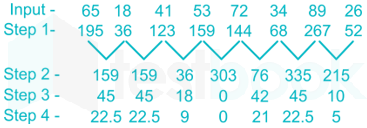
An input-output is given in different steps. Some mathematical operations are done in each step. No mathematical operation is repeated in the next step.

As per the rules followed in the steps given above, find out in each of the following questions the appropriate step for the given input.

Input: 25 22 93 56 17 74 39

Question 14

What is the sum of the numbers at both the ends in step-3 of the given arrangement?

  1. AOption (a)

    36

  2. BOption (b)

    63

  3. COption (c)

    60

  4. DOption (d)

    55

  5. EOption (e)

    None of the above

View answer & explanation

Correct answer

Answer: (b)B.

63

Why this answer is correct

In step 1, the odd numbers of the given input are multiplying by 3 and the even numbers are multiplying by 2.

In step 2, first number of step 1 and second number of step 1 are subtract and thus found the first number of step 2. Again, the second number of step 1 and third number of step 1 are added and thus found the second number of step 2 and so on.

In step 3, the digits of the first number are multiplying to get the first number of step 3. Similarly, the second number is calculated.

In step 4, half of the number of step 3.

Thus, we get the final output.

Applying the same method in the given input, we get:

Thus, the sum of the numbers at both the ends in step-3 is 63.

Question 15

Which element is 2nd to the right of the one which is 4th to the left element in step 1?

  1. AOption (a)

    112

  2. BOption (b)

    44

  3. COption (c)

    148

  4. DOption (d)

    75

  5. EOption (e)

    None of these

View answer & explanation

Correct answer

Answer: (c)C.

148

Why this answer is correct

In step 1, the odd numbers of the given input are multiplying by 3 and the even numbers are multiplying by 2.

In step 2, first number of step 1 and second number of step 1 are subtract and thus found the first number of step 2. Again, the second number of step 1 and third number of step 1 are added and thus found the second number of step 2 and so on.

In step 3, the digits of the first number are multiplying to get the first number of step 3. Similarly, the second number is calculated.

In step 4, half of the number of step 3.

Thus, we get the final output.

Applying the same method in the given input, we get:

Thus, 148 is 2nd to the right of the one which is 4th to the left element in step 1.

Question 16

What is the product of the numbers which is 3rd from the right end and 3rd from the left end in final step of the given arrangement?

  1. AOption (a)

    189

  2. BOption (b)

    72

  3. COption (c)

    13.5

  4. DOption (d)

    180

  5. EOption (e)

    No such step

View answer & explanation

Correct answer

Answer: (a)A.

189

Why this answer is correct

In step 1, the odd numbers of the given input are multiplying by 3 and the even numbers are multiplying by 2.

In step 2, first number of step 1 and second number of step 1 are subtract and thus found the first number of step 2. Again, the second number of step 1 and third number of step 1 are added and thus found the second number of step 2 and so on.

In step 3, the digits of the first number are multiplying to get the first number of step 3. Similarly, the second number is calculated.

In step 4, half of the number of step 3.

Thus, we get the final output.

Applying the same method in the given input, we get:

Thus, the products of the numbers which is 3rd from the right end and 3rd from the left end in final step is 189.

Question 17

What is the difference between the element which is sixth from the left in step 4 and first from the right in step 2?

  1. AOption (a)

    235

  2. BOption (b)

    196

  3. COption (c)

    423

  4. DOption (d)

    543

  5. EOption (e)

    None of these

View answer & explanation

Correct answer

Answer: (a)A.

235

Why this answer is correct

In step 1, the odd numbers of the given input are multiplying by 3 and the even numbers are multiplying by 2.

In step 2, first number of step 1 and second number of step 1 are subtract and thus found the first number of step 2. Again, the second number of step 1 and third number of step 1 are added and thus found the second number of step 2 and so on.

In step 3, the digits of the first number are multiplying to get the first number of step 3. Similarly, the second number is calculated.

In step 4, half of the number of step 3.

Thus, we get the final output.

Applying the same method in the given input, we get:

The difference between the element which is sixth from the left in step 4 and first from the right in step 2 is 235.

Question 18

Direction: Study the following information carefully and answer the question given below.

A certain number of persons sit in a row adjacent to each other. Some of them like different fruits and others like different flowers. Six persons sit between the one who likes mango and the one who likes apple. The one who likes rose sit third to the left of the one who likes apple. Two persons sit between the one who likes rose and the one who likes marigold, who is not a neighbour of the one who likes mango. Only one person sits to the right of the one who likes marigold. No one sits to the right of the one who likes mango.

Note: The one who likes fruit faces South and the one who likes flower faces North.

How many persons are there in the row?

  1. AOption (a)

    Twelve

  2. BOption (b)

    Thirteen

  3. COption (c)

    Fourteen

  4. DOption (d)

    Fifteen

  5. EOption (e)

    More than fifteen

View answer & explanation

Correct answer

Answer: (d)D.

Fifteen

Why this answer is correct

  1. No one sits to the right of the one who likes mango.

  2. Six persons sit between the one who likes mango and the one who likes apple.

  3. The one who likes rose sit third to the left of the one who likes apple.

  4. Two persons sit between the one who likes rose and the one who likes marigold, who is not a neighbour of the one who likes mango.

  5. Only one person sits to the right of the one who likes marigold.

Hence, there are fifteen persons in that row.

Directions: Study the following information and answer the question given below:

Six persons are born in six different years. Their ages are calculated with respect to 2018. They like six different fruits Cherry, Orange, Apple, Mango, Banana and Grapes, but not necessarily in the same order. None of them is More than 90 years old.

Note: If the person age is considered as last two digits of the person Birth year, then it will be at any sequence. For example, A’s age is considered as last two digit of B’s birth year-1947, and then A’s age is either 47 or 74.

The one who is third youngest among them likes Apple. Manika was elder than Charu. The age difference between Tarun and the one who likes cherry is 21 years. Visakha age was sum of all the digits of birth year of the one who like cherry. The one who likes Mango is 5 years elder than Visakha. Only one person born was before Arko. Arko age was equal to the last two digits of the birth year of the one who likes Mango. The difference between Ages of Arko and Viraj was 24 years. The one who likes Banana born immediately before the one who likes Grapes. Tarun was born in 1983.

Question 19

Who among the following persons likes Orange?

  1. AOption (a)

    None of those given as options

  2. BOption (b)

    Arko

  3. COption (c)

    The one who likes Banana

  4. DOption (d)

    The one who was 56 years old

  5. EOption (e)

    The one who was born on 2000

View answer & explanation

Correct answer

Answer: (e)E.

The one who was born on 2000

Why this answer is correct

Person: Viraj, Tarun, Arko, Visakha, Charu and Manika.

Fruit: Cherry, Orange, Apple, Mango, Banana and Grapes.

  1. Tarun was born in 1983.
PersonBirth YearAgeFruits
Tarun198335


  1. The age difference between Tarun and the one who likes cherry is 21 years.
PersonCase ICase II
Birth YearAgeFruitsBirth YearAgeFruits
Tarun198335198335
196256Cherry200414Cherry


  1. Visakha age was sum of all the digits of birth year of the one who like cherry.

  2. The one who like Mango is 5 years elder than Visakha.

PersonCase ICase II
Birth YearAgeFruitsBirth YearAgeFruits
Tarun198335198335
196256Cherry200414Cherry
Visakha200018201206
199523Mango200711Mango


  1. Arko age was equal to the last two digits of the Birth year of the one who like Mango.
PersonCase ICase IICase III
Birth YearAgeFruitsBirth YearAgeFruitsBirth YearAgeFruits
Tarun198335198335198335
196256Cherry200414Cherry196256Cherry
Visakha200018201206200018
199523Mango200711Mango200723Mango
Arko195959201107194870


  1. The difference between Ages of Arko and Viraj was 24 years.

  2. Only one person was born before Arko. (From this statement case II and case III is eliminated).

PersonCase ICase IICase III
Birth YearAgeFruitsBirth YearAgeFruitsBirth YearAgeFruits
Tarun198335198335198335
196256Cherry200414Cherry196256Cherry
Visakha200018201206200018
199523Mango200711Mango200723Mango
Arko195959201107194870
Viraj193583198731197246


  1. The one who is third youngest among them likes Apple.

  2. The one who likes Banana born immediately before the one who likes Grapes.

PersonCase I
Birth YearAgeFruits
Tarun198335Apple
196256Cherry
Visakha200018
199523Mango
Arko195959Grapes
Viraj193583Banana


  1. Manika was elder than Charu.
PersonCase I
Birth YearAgeFruits
Tarun198335Apple
Manika196256Cherry
Visakha200018
Charu199523Mango
Arko195959Grapes
Viraj193583Banana


After filling the gaps, we get the final data:

PersonCase I
Birth YearAgeFruits
Tarun198335Apple
Manika196256Cherry
Visakha200018Orange
Charu199523Mango
Arko195959Grapes
Viraj193583Banana

Question 20

What is the age of the one who likes Apple?

  1. AOption (a)

    31 years

  2. BOption (b)

    46 years

  3. COption (c)

    59 years

  4. DOption (d)

    35 years

  5. EOption (e)

    None of those given as options

View answer & explanation

Correct answer

Answer: (d)D.

35 years

Why this answer is correct

Person: Viraj, Tarun, Arko, Visakha, Charu and Manika.

Fruit: Cherry, Orange, Apple, Mango, Banana and Grapes.

  1. Tarun was born in 1983.
PersonBirth YearAgeFruits
Tarun198335


  1. The age difference between Tarun and the one who likes cherry is 21 years.
PersonCase ICase II
Birth YearAgeFruitsBirth YearAgeFruits
Tarun198335198335
196256Cherry200414Cherry


  1. Visakha age was sum of all the digits of birth year of the one who like cherry.

  2. The one who like Mango is 5 years elder than Visakha.

PersonCase ICase II
Birth YearAgeFruitsBirth YearAgeFruits
Tarun198335198335
196256Cherry200414Cherry
Visakha200018201206
199523Mango200711Mango


  1. Arko age was equal to the last two digits of the Birth year of the one who like Mango.
PersonCase ICase IICase III
Birth YearAgeFruitsBirth YearAgeFruitsBirth YearAgeFruits
Tarun198335198335198335
196256Cherry200414Cherry196256Cherry
Visakha200018201206200018
199523Mango200711Mango200723Mango
Arko195959201107194870


  1. The difference between Ages of Arko and Viraj was 24 years.

  2. Only one person was born before Arko. (From this statement case II and case III is eliminated).

PersonCase ICase IICase III
Birth YearAgeFruitsBirth YearAgeFruitsBirth YearAgeFruits
Tarun198335198335198335
196256Cherry200414Cherry196256Cherry
Visakha200018201206200018
199523Mango200711Mango200723Mango
Arko195959201107194870
Viraj193583198731197246


  1. The one who is third youngest among them likes Apple.

  2. The one who likes Banana born immediately before the one who likes Grapes.

PersonCase I
Birth YearAgeFruits
Tarun198335Apple
196256Cherry
Visakha200018
199523Mango
Arko195959Grapes
Viraj193583Banana


  1. Manika was elder than Charu.
PersonCase I
Birth YearAgeFruits
Tarun198335Apple
Manika196256Cherry
Visakha200018
Charu199523Mango
Arko195959Grapes
Viraj193583Banana


After filling the gaps, we get the final data:

PersonCase I
Birth YearAgeFruits
Tarun198335Apple
Manika196256Cherry
Visakha200018Orange
Charu199523Mango
Arko195959Grapes
Viraj193583Banana


Hence, Tarun likes Apple and he is 35 years old.

Question 21

What will be the sum of ages of the youngest and the eldest person among them?

  1. AOption (a)

    99 years

  2. BOption (b)

    87 years

  3. COption (c)

    101 years

  4. DOption (d)

    97 years

  5. EOption (e)

    None of those given as options

View answer & explanation

Correct answer

Answer: (c)C.

101 years

Why this answer is correct

Person: Viraj, Tarun, Arko, Visakha, Charu and Manika.

Fruit: Cherry, Orange, Apple, Mango, Banana and Grapes.

  1. Tarun was born in 1983.
PersonBirth YearAgeFruits
Tarun198335


  1. The age difference between Tarun and the one who likes cherry is 21 years.
PersonCase ICase II
Birth YearAgeFruitsBirth YearAgeFruits
Tarun198335198335
196256Cherry200414Cherry


  1. Visakha age was sum of all the digits of birth year of the one who like cherry.

  2. The one who like Mango is 5 years elder than Visakha.

PersonCase ICase II
Birth YearAgeFruitsBirth YearAgeFruits
Tarun198335198335
196256Cherry200414Cherry
Visakha200018201206
199523Mango200711Mango


  1. Arko age was equal to the last two digits of the Birth year of the one who like Mango.
PersonCase ICase IICase III
Birth YearAgeFruitsBirth YearAgeFruitsBirth YearAgeFruits
Tarun198335198335198335
196256Cherry200414Cherry196256Cherry
Visakha200018201206200018
199523Mango200711Mango200723Mango
Arko195959201107194870


  1. The difference between Ages of Arko and Viraj was 24 years.

  2. Only one person was born before Arko. (From this statement case II and case III is eliminated).

PersonCase ICase IICase III
Birth YearAgeFruitsBirth YearAgeFruitsBirth YearAgeFruits
Tarun198335198335198335
196256Cherry200414Cherry196256Cherry
Visakha200018201206200018
199523Mango200711Mango200723Mango
Arko195959201107194870
Viraj193583198731197246


  1. The one who is third youngest among them likes Apple.

  2. The one who likes Banana born immediately before the one who likes Grapes.

PersonCase I
Birth YearAgeFruits
Tarun198335Apple
196256Cherry
Visakha200018
199523Mango
Arko195959Grapes
Viraj193583Banana


  1. Manika was elder than Charu.
PersonCase I
Birth YearAgeFruits
Tarun198335Apple
Manika196256Cherry
Visakha200018
Charu199523Mango
Arko195959Grapes
Viraj193583Banana


After filling the gaps, we get the final data:

PersonCase I
Birth YearAgeFruits
Tarun198335Apple
Manika196256Cherry
Visakha200018Orange
Charu199523Mango
Arko195959Grapes
Viraj193583Banana


The sum of ages of the youngest and the eldest person among them is = 18 + 83 = 101 years.

Hence, the answer is 101 years.

Question 22

According to the given information, which of the following statements is/are true?

I) The youngest one likes Orange.

II) Charu is the fifth eldest among them.

III) One who was born on 1989 likes Grapes.

  1. AOption (a)

    Only I

  2. BOption (b)

    Both I and III

  3. COption (c)

    Only III

  4. DOption (d)

    Both I and II

  5. EOption (e)

    All of the above

View answer & explanation

Correct answer

Answer: (d)D.

Both I and II

Why this answer is correct

Person: Viraj, Tarun, Arko, Visakha, Charu and Manika.

Fruit: Cherry, Orange, Apple, Mango, Banana and Grapes.

  1. Tarun was born in 1983.
PersonBirth YearAgeFruits
Tarun198335


  1. The age difference between Tarun and the one who likes cherry is 21 years.
PersonCase ICase II
Birth YearAgeFruitsBirth YearAgeFruits
Tarun198335198335
196256Cherry200414Cherry


  1. Visakha age was sum of all the digits of birth year of the one who like cherry.

  2. The one who like Mango is 5 years elder than Visakha.

PersonCase ICase II
Birth YearAgeFruitsBirth YearAgeFruits
Tarun198335198335
196256Cherry200414Cherry
Visakha200018201206
199523Mango200711Mango


  1. Arko age was equal to the last two digits of the Birth year of the one who like Mango.
PersonCase ICase IICase III
Birth YearAgeFruitsBirth YearAgeFruitsBirth YearAgeFruits
Tarun198335198335198335
196256Cherry200414Cherry196256Cherry
Visakha200018201206200018
199523Mango200711Mango200723Mango
Arko195959201107194870


  1. The difference between Ages of Arko and Viraj was 24 years.

  2. Only one person was born before Arko. (From this statement case II and case III is eliminated).

PersonCase ICase IICase III
Birth YearAgeFruitsBirth YearAgeFruitsBirth YearAgeFruits
Tarun198335198335198335
196256Cherry200414Cherry196256Cherry
Visakha200018201206200018
199523Mango200711Mango200723Mango
Arko195959201107194870
Viraj193583198731197246


  1. The one who is third youngest among them likes Apple.

  2. The one who likes Banana born immediately before the one who likes Grapes.

PersonCase I
Birth YearAgeFruits
Tarun198335Apple
196256Cherry
Visakha200018
199523Mango
Arko195959Grapes
Viraj193583Banana


  1. Manika was elder than Charu.
PersonCase I
Birth YearAgeFruits
Tarun198335Apple
Manika196256Cherry
Visakha200018
Charu199523Mango
Arko195959Grapes
Viraj193583Banana


After filling the gaps, we get the final data:

PersonCase I
Birth YearAgeFruits
Tarun198335Apple
Manika196256Cherry
Visakha200018Orange
Charu199523Mango
Arko195959Grapes
Viraj193583Banana


Hence, both I and II are true.

Question 23

Statement is followed by five Conclusions I, II, III, IV and V. You have to consider the statements to be true, even if they seem to be at variance from commonly known facts. You are to decide which of the given conclusions can definitely be drawn from the given statements and indicate your answer accordingly

Statement: The eighth largest country in the world by population, Bangladesh is shedding the least developing country (LDC) label and is within striking distance of middle-income status. While grassroots development, the readymade garment industry and the phenomenon of mega-non-governmental organisations deserve credit, so does the stewardship of Sheikh Hasina and her two consecutive five-year terms as Prime Minister since January 2009.

Conclusion:

I. Bangladesh is working on population control programs.

II. Sheikh Hasina is a successful Prime Minister of Bangladesh.

III. Bangladesh is soon to be a fast developing country.

IV. Before January 2009, Bangladesh was a poor country.

V. Development in a country increases Per capita income of the country.

  1. AOption (a)

    Only I and II follow

  2. BOption (b)

    Only I, III and IV follow

  3. COption (c)

    Only II, III and V follow

  4. DOption (d)

    Only I, III, IV and V doesn’t follow

  5. EOption (e)

    All except III follow

View answer & explanation

Correct answer

Answer: (d)D.

Only I, III, IV and V doesn’t follow

Why this answer is correct

  1. Bangladesh is working on population control programs- this statement is false, as there is no mention of population control.
  2. Sheikh Hasina is a successful Prime Minister of Bangladesh- this statement is true, Sheikh Hasina is Prime Minister of Bangladesh from last 2 terms from which it can be safely concluded that she is a successful Prime Minister. Also, the statement glorifies her contribution to the development of Bangladesh.
  3. Bangladesh is soon to be a fast developing country- this statement is false, as there is no mention of the development phase. The statement talks about the income status of Bangladesh which is not related to development.
  4. Before January 2009, Bangladesh was a poor country- this statement is false, as there is no mention how Bangladesh was before the terms of Sheikh Hasina.
  5. Development in a country increases Per capita income of the country- this statement is false, as there is no mention about the relationship between development and per capita income so it cannot be concluded.

Hence, only I, III, IV and V doesn’t follow is the correct answer.

Question 24

An assumption is something supposed or taken for granted.  In the question, a statement is given. You have to consider the following assumption and decide which of the assumption is implicit in the statement**.**

Statement:

Finance Minister Arun Jaitley, on Thursday, proposed to double the expenditure on the government’s flagship Digital India programme to ₹ 3,073 crores for the next fiscal against ₹ 1,425.63 crores in 2017-18, a move that has largely been welcomed by the industry. “Global economy is transforming into a digital economy thanks to the development of cutting-edge technologies in digital space – machine learning, artificial intelligence, Internet of things, 3D printing and the like,” Mr Jaitley said.

Assumptions:

  1. Digital India Program is a successful programme of Indian Government.
  2. Machine learning and artificial intelligence are important for a country’s progress.
  3. Finance Minister Mr. Arun Jaitley is famous between industrialists.
  1. AOption (a)

    Only I

  2. BOption (b)

    Only II

  3. COption (c)

    Only III

  4. DOption (d)

    All except III

  5. EOption (e)

    All follow

View answer & explanation

Correct answer

Answer: (d)D.

All except III

Why this answer is correct

  1. Digital India Program is a successful programme of Indian Government- this statement is true, as Finance minister has proposed to double the expenditure, so it can be assumed that the program is successful.
  2. Machine learning and artificial intelligence are important for a country’s progress- this statement is true, as they are helping in the change of Global economy into the digital economy which will help in effective business between countries. So it can be assumed.
  3. Finance Minister Mr. Arun Jaitley is famous between industrialists- this statement is false, in the statement it is mentioned that his move was appreciated but there is no mention of fame of Mr. Arun Jaitley between industrialists, So it cannot be assumed.

Hence, all except III follows.

Directions: Study the following information carefully and answer the questions given below

Eight people M, N, O, P, Q, R, S, and T are sitting around a circular table facing the centre. Age of each of the person is different from the other. Based on their age or arrangement in the circular table, these people are then made to sit around a square table, which has four seats on its edges and four seats at the corners.

Circular arrangement:

R is sitting second to the right of T and third to the left of the person who is 7 years younger than the person sitting opposite to him. O is sitting third to the left of S, who is one of the immediate neighbours of M. Average age of R, S, and M is 21 years and the age of S is twice the age of R. Q is sitting third to the right of P, whose age is numerically 25% more than that of the person who is to his immediate left. The person who is 20 years old is sitting third to the right of M. Q is 4 years older than T but three years younger than the person who is to his immediate left. Either T or N is sitting opposite to O who is 6 years older than the person sitting opposite to him.

Square arrangement:

People whose age is an even number are sitting at the edges and the people whose age is an odd number are sitting at the corners. N and P are the immediate neighbours of M. The person who is three years younger than S is facing south-east. The oldest person is facing either south direction or north-west. Q is one of the immediate neighbours of O. The youngest person is facing either north or north-east.

Question 25

What is the age of the person who is sitting third to the right of R in the circular arrangement?

  1. AOption (a)

    20

  2. BOption (b)

    21

  3. COption (c)

    19

  4. DOption (d)

    28

  5. EOption (e)

    18

View answer & explanation

Correct answer

Answer: (e)E.

18

Why this answer is correct

People: M, N, O, P, Q, R, S, and T

Arrangements: Circular and square

  1. The person who is 20 years old is sitting third to the right of M.

(As it is a circular arrangement, we can randomly place M and then accordingly place the person who is 20 years old.)

  1. O is sitting third to the left of S, who is one of the immediate neighbours of M.

(Implies, S is either to the left of M or to the right of him.)

  1. Either T or N is sitting opposite to O who is 6 years older than the person sitting opposite to him.

(If we place S to the immediate left of M, then O would be opposite to M. Which is not true, implies S is to the immediate right of M and O is second to the left of M.)

  1. Q is sitting third to the right of P, whose age is numerically 25% more than that of the person who is to his immediate left.

(There is only one way for this to be possible i.e. if Q is to the immediate left of M and P opposite to M.

Also, the person sitting to the immediate left of P is 20 years old, implies P is 25 years old.)

  1. R is sitting second to the right of T and third to the left of the person who is 7 years younger than the person sitting opposite to him.

(If T is sitting opposite to O then we cannot place R second to the right of T, as P is already there. So, T is to the immediate left of P and R is to the immediate right of R (as it is the only possibility.)

It also implies, R is third to the left of M which further implies M is 18 years old (25 – 7 = 18).)

  1. Q is 4 years older than T but three years younger than the person who is to his immediate left.

(Clearly, T is 20 years old implies, Q is 24 years old.

O is to the immediate left of Q, implies O is 27 years old.

Also, as N is 6 years younger than O, implies N is 21 years old.)

  1. The average age of R, S, and M is 21 years and the age of S is twice the age of R.

(Implies total age of R, S, and M is 63 years. Which means the total age of R and S is 45 years (as M is 18 years old.)

Also, S = 2R

And, R + S = 45

Implies, R = 15 years and S = 30 years)

Square arrangement:

  1. People whose age is an even number are sitting at the edges and the people whose age is an odd number are sitting at the corners.

  2. The youngest person is facing either north or north-east.

(R is the youngest person and his age is 15 years which is odd. Implies, R is facing north-east.)

  1. The oldest person is facing either south direction or north-west.

(S is the oldest person and he is 30 years old, which is an even number. Implies, he is sitting on the edge facing south.)

  1. The person who is three years younger than S is facing south-east.

(O is three years younger than S as O is 27 years old. Hence, he is facing south-east.)

  1. Q is one of the immediate neighbours of O.

(Implies, Q is to the immediate left of O.)

  1. N and P are the immediate neighbours of M.

(Age of N and P are 21 and 25 years old respectively. Implies they are at the corners which further implies M is facing west.

Age of T is 20 years, which is even. Hence T is facing north as it is the only position left for him.)

Clearly, M is sitting third to the right of R and he is 18 years old.

Question 26

The person who is sitting second to the left of Q in the circular arrangement is facing which direction in the square arrangement?

  1. AOption (a)

    North

  2. BOption (b)

    North-East

  3. COption (c)

    East

  4. DOption (d)

    South-East

  5. EOption (e)

    South-West

View answer & explanation

Correct answer

Answer: (b)B.

North-East

Why this answer is correct

People: M, N, O, P, Q, R, S, and T

Arrangements: Circular and square

  1. The person who is 20 years old is sitting third to the right of M.

(As it is a circular arrangement, we can randomly place M and then accordingly place the person who is 20 years old.)

  1. O is sitting third to the left of S, who is one of the immediate neighbours of M.

(Implies, S is either to the left of M or to the right of him.)

  1. Either T or N is sitting opposite to O who is 6 years older than the person sitting opposite to him.

(If we place S to the immediate left of M, then O would be opposite to M. Which is not true, implies S is to the immediate right of M and O is second to the left of M.)

  1. Q is sitting third to the right of P, whose age is numerically 25% more than that of the person who is to his immediate left.

(There is only one way for this to be possible i.e. if Q is to the immediate left of M and P opposite to M.

Also, the person sitting to the immediate left of P is 20 years old, implies P is 25 years old.)

  1. R is sitting second to the right of T and third to the left of the person who is 7 years younger than the person sitting opposite to him.

(If T is sitting opposite to O then we cannot place R second to the right of T, as P is already there. So, T is to the immediate left of P and R is to the immediate right of R (as it is the only possibility.)

It also implies, R is third to the left of M which further implies M is 18 years old (25 – 7 = 18).)

  1. Q is 4 years older than T but three years younger than the person who is to his immediate left.

(Clearly, T is 20 years old implies, Q is 24 years old.

O is to the immediate left of Q, implies O is 27 years old.

Also, as N is 6 years younger than O, implies N is 21 years old.)

  1. The average age of R, S, and M is 21 years and the age of S is twice the age of R.

(Implies total age of R, S, and M is 63 years. Which means the total age of R and S is 45 years (as M is 18 years old.)

Also, S = 2R

And, R + S = 45

Implies, R = 15 years and S = 30 years)

Square arrangement:

  1. People whose age is an even number are sitting at the edges and the people whose age is an odd number are sitting at the corners.

  2. The youngest person is facing either north or north-east.

(R is the youngest person and his age is 15 years which is odd. Implies, R is facing north-east.)

  1. The oldest person is facing either south direction or north-west.

(S is the oldest person and he is 30 years old, which is an even number. Implies, he is sitting on the edge facing south.)

  1. The person who is three years younger than S is facing south-east.

(O is three years younger than S as O is 27 years old. Hence, he is facing south-east.)

  1. Q is one of the immediate neighbours of O.

(Implies, Q is to the immediate left of O.)

  1. N and P are the immediate neighbours of M.

(Age of N and P are 21 and 25 years old respectively. Implies they are at the corners which further implies M is facing west.

Age of T is 20 years, which is even. Hence T is facing north as it is the only position left for him.)

Clearly, R is sitting second to the left of Q in the circular arrangement and he is facing North-East in the square arrangement

Question 27

Who is facing the south-west direction in the square arrangement?

  1. AOption (a)

    M

  2. BOption (b)

    N

  3. COption (c)

    P

  4. DOption (d)

    T

  5. EOption (e)

    Can’t be determined

View answer & explanation

Correct answer

Answer: (e)E.

Can’t be determined

Why this answer is correct

People: M, N, O, P, Q, R, S, and T

Arrangements: Circular and square

  1. The person who is 20 years old is sitting third to the right of M.

(As it is a circular arrangement, we can randomly place M and then accordingly place the person who is 20 years old.)

  1. O is sitting third to the left of S, who is one of the immediate neighbours of M.

(Implies, S is either to the left of M or to the right of him.)

  1. Either T or N is sitting opposite to O who is 6 years older than the person sitting opposite to him.

(If we place S to the immediate left of M, then O would be opposite to M. Which is not true, implies S is to the immediate right of M and O is second to the left of M.)

  1. Q is sitting third to the right of P, whose age is numerically 25% more than that of the person who is to his immediate left.

(There is only one way for this to be possible i.e. if Q is to the immediate left of M and P opposite to M.

Also, the person sitting to the immediate left of P is 20 years old, implies P is 25 years old.)

  1. R is sitting second to the right of T and third to the left of the person who is 7 years younger than the person sitting opposite to him.

(If T is sitting opposite to O then we cannot place R second to the right of T, as P is already there. So, T is to the immediate left of P and R is to the immediate right of R (as it is the only possibility.)

It also implies, R is third to the left of M which further implies M is 18 years old (25 – 7 = 18).)

  1. Q is 4 years older than T but three years younger than the person who is to his immediate left.

(Clearly, T is 20 years old implies, Q is 24 years old.

O is to the immediate left of Q, implies O is 27 years old.

Also, as N is 6 years younger than O, implies N is 21 years old.)

  1. The average age of R, S, and M is 21 years and the age of S is twice the age of R.

(Implies total age of R, S, and M is 63 years. Which means the total age of R and S is 45 years (as M is 18 years old.)

Also, S = 2R

And, R + S = 45

Implies, R = 15 years and S = 30 years)

Square arrangement:

  1. People whose age is an even number are sitting at the edges and the people whose age is an odd number are sitting at the corners.

  2. The youngest person is facing either north or north-east.

(R is the youngest person and his age is 15 years which is odd. Implies, R is facing north-east.)

  1. The oldest person is facing either south direction or north-west.

(S is the oldest person and he is 30 years old, which is an even number. Implies, he is sitting on the edge facing south.)

  1. The person who is three years younger than S is facing south-east.

(O is three years younger than S as O is 27 years old. Hence, he is facing south-east.)

  1. Q is one of the immediate neighbours of O.

(Implies, Q is to the immediate left of O.)

  1. N and P are the immediate neighbours of M.

(Age of N and P are 21 and 25 years old respectively. Implies they are at the corners which further implies M is facing west.

Age of T is 20 years, which is even. Hence T is facing north as it is the only position left for him.)

The exact position of N and P are not known.

Question 28

What is the average age of the immediate neighbours of T in the circular arrangement?

  1. AOption (a)

    25

  2. BOption (b)

    19

  3. COption (c)

    23

  4. DOption (d)

    20

  5. EOption (e)

    28

View answer & explanation

Correct answer

Answer: (c)C.

23

Why this answer is correct

People: M, N, O, P, Q, R, S, and T

Arrangements: Circular and square

  1. The person who is 20 years old is sitting third to the right of M.

(As it is a circular arrangement, we can randomly place M and then accordingly place the person who is 20 years old.)

  1. O is sitting third to the left of S, who is one of the immediate neighbours of M.

(Implies, S is either to the left of M or to the right of him.)

  1. Either T or N is sitting opposite to O who is 6 years older than the person sitting opposite to him.

(If we place S to the immediate left of M, then O would be opposite to M. Which is not true, implies S is to the immediate right of M and O is second to the left of M.)

  1. Q is sitting third to the right of P, whose age is numerically 25% more than that of the person who is to his immediate left.

(There is only one way for this to be possible i.e. if Q is to the immediate left of M and P opposite to M.

Also, the person sitting to the immediate left of P is 20 years old, implies P is 25 years old.)

  1. R is sitting second to the right of T and third to the left of the person who is 7 years younger than the person sitting opposite to him.

(If T is sitting opposite to O then we cannot place R second to the right of T, as P is already there. So, T is to the immediate left of P and R is to the immediate right of R (as it is the only possibility.)

It also implies, R is third to the left of M which further implies M is 18 years old (25 – 7 = 18).)

  1. Q is 4 years older than T but three years younger than the person who is to his immediate left.

(Clearly, T is 20 years old implies, Q is 24 years old.

O is to the immediate left of Q, implies O is 27 years old.

Also, as N is 6 years younger than O, implies N is 21 years old.)

  1. The average age of R, S, and M is 21 years and the age of S is twice the age of R.

(Implies total age of R, S, and M is 63 years. Which means the total age of R and S is 45 years (as M is 18 years old.)

Also, S = 2R

And, R + S = 45

Implies, R = 15 years and S = 30 years)

Square arrangement:

  1. People whose age is an even number are sitting at the edges and the people whose age is an odd number are sitting at the corners.

  2. The youngest person is facing either north or north-east.

(R is the youngest person and his age is 15 years which is odd. Implies, R is facing north-east.)

  1. The oldest person is facing either south direction or north-west.

(S is the oldest person and he is 30 years old, which is an even number. Implies, he is sitting on the edge facing south.)

  1. The person who is three years younger than S is facing south-east.

(O is three years younger than S as O is 27 years old. Hence, he is facing south-east.)

  1. Q is one of the immediate neighbours of O.

(Implies, Q is to the immediate left of O.)

  1. N and P are the immediate neighbours of M.

(Age of N and P are 21 and 25 years old respectively. Implies they are at the corners which further implies M is facing west.

Age of T is 20 years, which is even. Hence T is facing north as it is the only position left for him.)

P and N are the immediate neighbours of T in the circular arrangement and their ages are 25 and 21 respectively. Hence, their average age is 23.
Question 29

What is the age of the person who is sitting third to the right of R in the square arrangement?

  1. AOption (a)

    30

  2. BOption (b)

    27

  3. COption (c)

    15

  4. DOption (d)

    18

  5. EOption (e)

    None of the above

View answer & explanation

Correct answer

Answer: (d)D.

18

Why this answer is correct

People: M, N, O, P, Q, R, S, and T

Arrangements: Circular and square

  1. The person who is 20 years old is sitting third to the right of M.

(As it is a circular arrangement, we can randomly place M and then accordingly place the person who is 20 years old.)

  1. O is sitting third to the left of S, who is one of the immediate neighbours of M.

(Implies, S is either to the left of M or to the right of him.)

  1. Either T or N is sitting opposite to O who is 6 years older than the person sitting opposite to him.

(If we place S to the immediate left of M, then O would be opposite to M. Which is not true, implies S is to the immediate right of M and O is second to the left of M.)

  1. Q is sitting third to the right of P, whose age is numerically 25% more than that of the person who is to his immediate left.

(There is only one way for this to be possible i.e. if Q is to the immediate left of M and P opposite to M.

Also, the person sitting to the immediate left of P is 20 years old, implies P is 25 years old.)

  1. R is sitting second to the right of T and third to the left of the person who is 7 years younger than the person sitting opposite to him.

(If T is sitting opposite to O then we cannot place R second to the right of T, as P is already there. So, T is to the immediate left of P and R is to the immediate right of R (as it is the only possibility.)

It also implies, R is third to the left of M which further implies M is 18 years old (25 – 7 = 18).)

  1. Q is 4 years older than T but three years younger than the person who is to his immediate left.

(Clearly, T is 20 years old implies, Q is 24 years old.

O is to the immediate left of Q, implies O is 27 years old.

Also, as N is 6 years younger than O, implies N is 21 years old.)

  1. The average age of R, S, and M is 21 years and the age of S is twice the age of R.

(Implies total age of R, S, and M is 63 years. Which means the total age of R and S is 45 years (as M is 18 years old.)

Also, S = 2R

And, R + S = 45

Implies, R = 15 years and S = 30 years)

Square arrangement:

  1. People whose age is an even number are sitting at the edges and the people whose age is an odd number are sitting at the corners.

  2. The youngest person is facing either north or north-east.

(R is the youngest person and his age is 15 years which is odd. Implies, R is facing north-east.)

  1. The oldest person is facing either south direction or north-west.

(S is the oldest person and he is 30 years old, which is an even number. Implies, he is sitting on the edge facing south.)

  1. The person who is three years younger than S is facing south-east.

(O is three years younger than S as O is 27 years old. Hence, he is facing south-east.)

  1. Q is one of the immediate neighbours of O.

(Implies, Q is to the immediate left of O.)

  1. N and P are the immediate neighbours of M.

(Age of N and P are 21 and 25 years old respectively. Implies they are at the corners which further implies M is facing west.

Age of T is 20 years, which is even. Hence T is facing north as it is the only position left for him.)

Clearly, M is sitting third to the right of R and his age is 18 years.

Question 30

Read the following passage and make an inference about the character's feelings. 

A ten-year comparison between the United States and the Soviet Union in terms of crop yields per acre revealed that when only planted acreage is compared, Soviet yields were equal to 68% of United States yields. When total agricultural acreage is compared, however, Soviet yield was 114% of United States Yield.

From the information above, which of the following can be most reliably inferred about the United States and Soviet agricultural during the ten-year period?

  1. AOption (a)

    A higher percentage of total agricultural acreage was fallow in the United States than in the Soviet Union.

  2. BOption (b)

    The United States had more fallow acreage than planted acreage.

  3. COption (c)

    Fewer total acres of available agricultural land were fallow in the Soviet Union than in the United States.

  4. DOption (d)

    The Soviet Union had more planted acreage than fallow acreage.

  5. EOption (e)

    The Soviet Union produced a greater volume of crops than the United States produced.

View answer & explanation

Correct answer

Answer: (a)A.

A higher percentage of total agricultural acreage was fallow in the United States than in the Soviet Union.

Why this answer is correct

If crop yields per planted acre was less in the Soviet Union than it was in the United States, yet crop yield per total agricultural acreage was greater in the Soviet Union than it was in the United States, the percentage of the total acreage that was left fallow must have been lower in the Soviet Union than in the United States.

Therefore, option 1 is the correct answer since the information provided in the paragraph is given in terms of yield per acre. No conclusion can be drawn about the actual acreage, so option 2,3 and 4 are incorrect. Similarly, it is impossible to determine the total volume of crops produced in the Soviet Union, so option 5 is incorrect.

Question 31

Below a question is given with two statements (I) and (II). These statements may be either independent causes or may be effects of independent causes or a common cause. One of these statements may be the effect of the other statement. Read both the statements and decide which of the following answer choice correctly depicts the relationship between these two statements.

I. The staff of the factory called off the strike they were holding protesting against the low wages.

II. The staff of the factory went on a strike, anticipating a threat to their jobs.

  1. AOption (a)

    Statement (I) is the cause and statement (II) is the effect.

  2. BOption (b)

    Statement (II) is the cause and statement (I) is the effect.

  3. COption (c)

    Both the statements (I) and (II) are independent causes.

  4. DOption (d)

    Both the statements (I) and (II) are effects of independent causes.

  5. EOption (e)

    Both the statements (I) and (II) are effects of some common cause.

View answer & explanation

Correct answer

Answer: (d)D.

Both the statements (I) and (II) are effects of independent causes.

Why this answer is correct

Going on a strike and calling off a strike cannot be for the same cause. They must be effects of independent causes.

Directions: Study the following information to answer the given questions:

A, B, C and D are the corners of a rectangular field such that A is to the North of B. C is 0.2 km to the East of A. The longer side of the rectangular field is 2 km. E, F, G and H are the corners of another rectangular field such that E is 1.6 km to the west of G. H is 1.2 km to the south of G and in the East of F.

Rectangle field EFGH intersects the line joining AB and CD at KL and IJ respectively. It is also known that K is 0.9 km towards the East of E and J is 0.4 km towards the North of D.

Question 32

If the person “X” wants to reach the point E from Point D, then which of the following will be the correct direction to reach his destination?

  1. AOption (a)

    X walks 400 m to the north from point D and then he takes left turn and walks 1100 m and then he takes left turn and walk 1200 m to reach point E.

  2. BOption (b)

    X walks 1600 m to the north of point D, then he takes right turn and walks 500 m to reach point and the he takes right turn and walk 1200 m and then he takes right turn and walk 1600 m to reach point E.

  3. COption (c)

    X walks 400 m to the north from point D and then he takes left turn and walk 200 m and then he takes right turn and walk 1200 m and finally he takes right turn and walk 900 m to reach the point E

  4. DOption (d)

    X walks 1600 m to the north of point D, then he takes left turn and walks 1000 m to reach point E.

  5. EOption (e)

    X walks 200 m west from point D and then he takes right turn and walks 400 m then he takes left turn and walk 900 m and finally he takes right turn and walk 1200 m to reach point E.

View answer & explanation

Correct answer

Answer: (e)E.

X walks 200 m west from point D and then he takes right turn and walks 400 m then he takes left turn and walk 900 m and finally he takes right turn and walk 1200 m to reach point E.

Why this answer is correct

Only option ‘5’ is the correct direction to reach his destination.

Question 33

What will be the minimum possible distance to reach point L from point C?

  1. AOption (a)

    LJDBAC

  2. BOption (b)

    LJHGIC

  3. COption (c)

    LKAC

  4. DOption (d)

    LFEKAC

  5. EOption (e)

    LFEKIC

View answer & explanation

Correct answer

Answer: (c)C.

LKAC

Why this answer is correct

Hence, the minimum possible distance to reach point L from point C is LKAC.

Question 34

A statement is given below in the question followed by three courses of actions numbered I, II and III. On the basis of the information given, you have to assume everything in the statement to be true, and then decide which of the following suggested courses of actions logically follow(s) for pursuing.

Statement: Hindustan Unilever and Nestlé plan to selectively increase prices of their products to take into account higher crude oil and petrol costs, the rupee’s depreciation against the dollar and more expensive commodities such as wheat. If crude remains where it is and if the rupee has depreciated, of course, there are headwinds as far as costs are concerned.

I. Nestlé India’s logistics providers are looking to renegotiate rates after record-high petrol and diesel prices. Nestlé declined to comment on when and by how much prices would increase. 

II. Nestlé commented that HUL had dropped prices in November after the Goods & Services Tax was introduced last year and an increase in prices now would likely not hurt consumers. 

III. Petrol prices have crossed Rs 90 a litre in Mumbai on increasing global prices of crude oil, of which India is a net importer, further impacted by the falling rupee. Crude derivatives, which are key inputs for FMCG companies, and petroleum derivatives used in packaging material including bottles and tubes, have also become more expensive.

  1. AOption (a)

    Only III follows

  2. BOption (b)

    Neither II nor III follows

  3. COption (c)

    None follows

  4. DOption (d)

    All except III and I

  5. EOption (e)

    ​All I, II and III follow

View answer & explanation

Correct answer

Answer: (b)B.

Neither II nor III follows

Why this answer is correct

The given sentence is about Hindustan Unilever and Nestlé planning to selectively increase prices of their products because of the increasing crude oil and petrol costs.

A course of action is something that needs to be done considering the present scenario in mind.

Let us look at the courses of action given:

The course of action I is perfectly relevant and brings out the idea that in order to initiate with the process of increasing the prices the Nestlé India’s logistics providers, are looking to renegotiate rates. Though the process is not stated it gives a glimpse of a possible action taken in the context of the given statement.

The course of action II does not state any course of action and is thus rejected.

The course of action III states a reason as to why the prices are being increased and do not state any course of action.

Thus, the correct answer is option 2.

Question 35

The question given below consists of a statement, followed by three arguments numbered I, II and III. You have to decide which of the arguments is/are ‘strong’ arguments and which is/are ‘weak’ arguments and accordingly choose your answer from the alternatives given below each question.

Statement: Kuwait has proposed setting up an international protection mission for Palestinians. A draft UN Security Council (UNSC) resolution presented by Kuwait calls for measures to guarantee the safety and protection of Palestinian civilians" in the occupied Palestinian territories and Gaza Strip".

Would setting up an international peace mission help to stop the ongoing issue?

Arguments:

I. Yes, more than 100 Palestinians have been killed in Israeli firing in the last two months.

II. No, Kuwait has no role to play in the ongoing war and must not interfere.

III. No, Palestinians should be provided safety within the territories only and a new mission will result in more mass killings.

  1. AOption (a)

    None is strong.

  2. BOption (b)

    Only I and II are strong.

  3. COption (c)

    Only II and III are strong.

  4. DOption (d)

    Only I is strong.

  5. EOption (e)

    All are strong.

View answer & explanation

Correct answer

Answer: (d)D.

Only I is strong.

Why this answer is correct

The correct answer is option 4, i.e. Only 'I' is strong.

For marking the correct answer choice, some background information is mandatory regarding the ongoing issue. Kuwait has circulated a draft UN Security Council resolution on setting up an international protection mission for Palestinians. Highlighting Washington's isolation on the Israeli-Palestinian issue, Kuwait - a non-permanent Security Council member representing Arab countries - hopes to win a high number of votes in favour of its proposal.

From this, we can understand that the most appropriate answer choice is option 4 as it deals with the outrage of the war that more than 100 Palestinians have been killed so far. ‘II’ is irrelevant and the reason has been already stated above. ‘III’ is also vague and does not support the given statement.

Thus, the correct answer is option 4.

Directions: Study the information carefully and answer the questions given below.

There are three floors in a given building such that floor 2 is above floor 1 and floor 3 is above floor 2. In the building, there are two flats on each floor such that Flat A is in the west of Flat B. The area of each room of a flat is the same.

In the building, each Flat has an area of 576 sq sq ft and each flat has a certain number of rooms and no two flats have the same number of rooms.

 The area of each rooms of one of the flats on the even number floor is 64sq sq ft. Total rooms on floor number third is seven. The flat which has rooms of an area of 72 sq sq ft is on odd number floor. Area of each rooms of the flat which is exactly below 9 room’s flat is 288 sq sq ft. There is only one floor between the flat whose each room area is 192 sq sq ft and the flat whose rooms area is 72 sq sq ft. There is no flat on the west of the flat having 6 rooms.

Question 36

What is the area of a room in Flat A on floor 2?

  1. AOption (a)

    82 sq ft

  2. BOption (b)

    72 sq ft

  3. COption (c)

    96 sq ft

  4. DOption (d)

    64 sq ft

  5. EOption (e)

    None of these

View answer & explanation

Correct answer

Answer: (c)C.

96 sq ft

Why this answer is correct

  1. There is only one floor between the flat who’s each room area is 192 sq ft and the flat whose each rooms area is 72 sq ft.

  2. Total rooms on floor number third is seven.

(Thus, in the other flat of third floor has four rooms.

And the area of each room of that flat is 144 sq ft)

FloorCase 1Case 2
Flat A/ NumFlat BFlat AFlat B
3rd Floor192 sq ft/3 Room144 sq ft /4 Room144 sq ft/4 Room192 sq ft/3 Room
2nd Floor
1st Floor72 sq ft/8 Room72 sq ft/8 Room


  1. Area of each rooms of the flat which is exactly below 9 room’s flat is 288 sq ft.

  2. There is no flat on the west of the flat having 6 rooms.

(Thus, case 2 is not valid and the flat having 6 room placed in Flat A)

FloorCase 2
Flat AFlat B
3rd Floor192 sq ft/3 Room144 sq ft/4 Room
2nd Floor6 Room9 Room
1st Floor72 sq ft /8 Room288 sq ft/2 Room


Thus, the area of a room in Flat A on floor 2 is 96 sq ft.

Question 37

What is the area of each room of flat B on floor 3rd?

  1. AOption (a)

    144 sq ft

  2. BOption (b)

    142 sq ft

  3. COption (c)

    138 sq ft

  4. DOption (d)

    136 sq ft

  5. EOption (e)

    None of these

View answer & explanation

Correct answer

Answer: (a)A.

144 sq ft

Why this answer is correct

  1. There is only one floor between the flat who’s each room area is 192 sq ft and the flat whose each rooms area is 72 sq ft.

  2. Total rooms on floor number third is seven.

(Thus, in the other flat of third floor has four rooms.

And the area of each room of that flat is 144 sq ft)

FloorCase 1Case 2
Flat A/ NumFlat BFlat AFlat B
3rd Floor192 sq ft/3 Room144 sq ft /4 Room144 sq ft/4 Room192 sq ft/3 Room
2nd Floor
1st Floor72 sq ft/8 Room72 sq ft/8 Room


  1. Area of each rooms of the flat which is exactly below 9 room’s flat is 288 sq ft.

  2. There is no flat on the west of the flat having 6 rooms.

(Thus, case 2 is not valid and the flat having 6 room placed in Flat A)

FloorCase 2
Flat AFlat B
3rd Floor192 sq ft/3 Room144 sq ft/4 Room
2nd Floor6 Room9 Room
1st Floor72 sq ft /8 Room288 sq ft/2 Room

Thus, the area of each room of flat B on floor 3rd is 144 sq ft.

Question 38

How many rooms are there on the 2nd floor?

  1. AOption (a)

    12

  2. BOption (b)

    14

  3. COption (c)

    11

  4. DOption (d)

    15

  5. EOption (e)

    None of these

View answer & explanation

Correct answer

Answer: (d)D.

15

Why this answer is correct

  1. There is only one floor between the flat who’s each room area is 192 sq ft and the flat whose each rooms area is 72 sq ft.

  2. Total rooms on floor number third is seven.

(Thus, in the other flat of third floor has four rooms.

And the area of each room of that flat is 144 sq ft)

FloorCase 1Case 2
Flat A/ NumFlat BFlat AFlat B
3rd Floor192 sq ft/3 Room144 sq ft /4 Room144 sq ft/4 Room192 sq ft/3 Room
2nd Floor
1st Floor72 sq ft/8 Room72 sq ft/8 Room


  1. Area of each rooms of the flat which is exactly below 9 room’s flat is 288 sq ft.

  2. There is no flat on the west of the flat having 6 rooms.

(Thus, case 2 is not valid and the flat having 6 room placed in Flat A)

FloorCase 2
Flat AFlat B
3rd Floor192 sq ft/3 Room144 sq ft/4 Room
2nd Floor6 Room9 Room
1st Floor72 sq ft /8 Room288 sq ft/2 Room


There are 15 rooms on the 2nd floor.

Question 39

Which of the following statements is/are true?

  1. AOption (a)

    Total number of rooms on the 1st floor is 10.

  2. BOption (b)

    Area of each room is 94 sq ft of flat A on floor 1.

  3. COption (c)

    Total number of rooms of Flat A is 15.

  4. DOption (d)

    All are correct

  5. EOption (e)

    None is correct

View answer & explanation

Correct answer

Answer: (a)A.

Total number of rooms on the 1st floor is 10.

Why this answer is correct

  1. There is only one floor between the flat who’s each room area is 192 sq ft and the flat whose each rooms area is 72 sq ft.

  2. Total rooms on floor number third is seven.

(Thus, in the other flat of third floor has four rooms.

And the area of each room of that flat is 144 sq ft)

FloorCase 1Case 2
Flat A/ NumFlat BFlat AFlat B
3rd Floor192 sq ft/3 Room144 sq ft /4 Room144 sq ft/4 Room192 sq ft/3 Room
2nd Floor
1st Floor72 sq ft/8 Room72 sq ft/8 Room


  1. Area of each rooms of the flat which is exactly below 9 room’s flat is 288 sq ft.

  2. There is no flat on the west of the flat having 6 rooms.

(Thus, case 2 is not valid and the flat having 6 room placed in Flat A)

FloorCase 2
Flat AFlat B
3rd Floor192 sq ft/3 Room144 sq ft/4 Room
2nd Floor6 Room9 Room
1st Floor72 sq ft /8 Room288 sq ft/2 Room

Only option 1 is true.

Question 40

How many rooms are there in that building?

  1. AOption (a)

    32

  2. BOption (b)

    34

  3. COption (c)

    31

  4. DOption (d)

    28

  5. EOption (e)

    None of these

View answer & explanation

Correct answer

Answer: (a)A.

32

Why this answer is correct

  1. There is only one floor between the flat who’s each room area is 192 sq ft and the flat whose each rooms area is 72 sq ft.

  2. Total rooms on floor number third is seven.

(Thus, in the other flat of third floor has four rooms.

And the area of each room of that flat is 144 sq ft)

FloorCase 1Case 2
Flat A/ NumFlat BFlat AFlat B
3rd Floor192 sq ft/3 Room144 sq ft /4 Room144 sq ft/4 Room192 sq ft/3 Room
2nd Floor
1st Floor72 sq ft/8 Room72 sq ft/8 Room


  1. Area of each rooms of the flat which is exactly below 9 room’s flat is 288 sq ft.

  2. There is no flat on the west of the flat having 6 rooms.

(Thus, case 2 is not valid and the flat having 6 room placed in Flat A)

FloorCase 2
Flat AFlat B
3rd Floor192 sq ft/3 Room144 sq ft/4 Room
2nd Floor6 Room9 Room
1st Floor72 sq ft /8 Room288 sq ft/2 Room


There are 32 rooms in that building.

Question 41

Statement: Syrian President Bashar al-Assad has revealed during an interview that a direct clash between the US and Russia in Syria was narrowly avoided "by the wisdom of the Russian leadership". 

Which of the following objection(s) might be a probable reason(s) for such a revelation by Syrian President Bashar al-Assad?

I. Adding that Syria needs Russian support, Assad said, "At the same time we need to avoid the American foolishness in order to be able to stabilise our country".

II. Adding that Syria needs American support, Assad said, "At the same time we need to avoid the American foolishness in order to be able to stabilise our country".

III. Adding that Syria needs Russian support, Assad said, "At the same time we need to avoid the Russian foolishness in order to be able to stabilise our country".

IV. Adding that Syria needs American support, Assad said, "At the same time we need to avoid the Russian foolishness in order to be able to stabilise our country".

  1. AOption (a)

    Only II

  2. BOption (b)

    Only I

  3. COption (c)

    Only IV

  4. DOption (d)

    Only III

  5. EOption (e)

    None of these

View answer & explanation

Correct answer

Answer: (b)B.

Only I

Why this answer is correct

The correct answer is option 2, i.e. Only I.

From the statement, we get the idea that the Syrian President is praising Russia for its wisdom which helped in avoiding the clash. Thus, from the options, we must focus that Syria needs Russian support and at the same time must avoid the foolishness of the US, in order to avoid any more clash. Thus, the most appropriate answer is option 2 and the rest of the options can be eliminated.

Since the options are very close, effective reading of the statement and proper scanning of all the option choices is very important to mark the right answer choice.

Direction: Study the following information carefully and answer the question given below:

Eight athletes of India Vinesh Phogat, Deepak Kumar, Shardul Vihan, Lakshay Sheoran, Kiran Nadar, Saurav Ghosal, Saina Nehwal, and Rohit Kumar are going to participate in eight different events of 2018 Asian Games. The events will start from 28th August to 4th September 2018. Not more than one event will occur on the same day.

Vinesh Phogat is not going to participate in the event in September. There are five athletes who will attend the event between Lakshay Sheoran and Saurav Ghosal who is not participating in the last day of the event. Not more than one athlete will participate in the event between Vinesh Phogat and Lakshay Sheoran. Shardul Vihan will attend the event immediately before Saurav Ghosal. There is only one person who will attend the event between Deepak Kumar and Shardul Vihan. There are more than two persons between Vinesh Phogat and Kiran Nadar. Rohit Kumar will attend the event before Vinesh Phogat but not on 28th August.

Question 42

Who among the following will attend the event on 1st September?

  1. AOption (a)

    Saina Nehwal

  2. BOption (b)

    Saurav Ghosal

  3. COption (c)

    Rohit Kumar

  4. DOption (d)

    Kiran Nadar

  5. EOption (e)

    Deepak Kumar

View answer & explanation

Correct answer

Answer: (a)A.

Saina Nehwal

Why this answer is correct

Eight people: Vinesh Phogat, Deepak Kumar, Shardul Vihan, Lakshay Sheoran, Kiran Nadar, Saurav Ghosal, Saina Nehwal, and Rohit Kumar

Days of Event: 28th August to 4th September.

  1. Vinesh Phogat is not going to participate in the event in September.

  2. Not more than one athlete will participate in the event between Vinesh Phogat and Lakshay Sheoran.

  3. Rohit Kumar will attend the event before Vinesh Phogat but not on 28th August.

  4. There are five athletes who will go to participate the event between Lakshay Sheoran and Saurav Ghosal who is not participating in the last day of the event.

MonthDatePerson
August28thLakshay Sheoran
29thRohit Kumar
30thVinesh Phogat
31st
September1st
2nd
3rdSaurav Ghosal
4th


  1. Shardul Vihan will attend the event immediately before Saurav Ghosal.

(Hence, Shardul Vihan will attend a event on 2nd September)

  1. There is only one person who will attend the event between Deepak Kumar and Shardul Vihan.

  2. There are more than two persons between Vinesh Phogat and Kiran Nadar. 

MonthDatePerson
August28thLakshay Sheoran
29thRohit Kumar
30thVinesh Phogat
31stDeepak Kumar
September1st
2ndShardul Vihan
3rdSaurav Ghosal
4thKiran Nadar


The final arrangement will be:

MonthDatePerson
August28thLakshay Sheoran
29thRohit Kumar
30thVinesh Phogat
31stDeepak Kumar
September1stSaina Nehwal
2ndShardul Vihan
3rdSaurav Ghosal
4thKiran Nadar


Hence, Saina Nehwal will attend the event on 1st September.

Question 43

Who among the following will attend the event on 29th August?

  1. AOption (a)

    Deepak Kumar

  2. BOption (b)

    Rohit Kumar

  3. COption (c)

    Vinesh Phogat

  4. DOption (d)

    Saurav Ghosal

  5. EOption (e)

    Saina Nehwal

View answer & explanation

Correct answer

Answer: (b)B.

Rohit Kumar

Why this answer is correct

Eight people: Vinesh Phogat, Deepak Kumar, Shardul Vihan, Lakshay Sheoran, Kiran Nadar, Saurav Ghosal, Saina Nehwal, and Rohit Kumar

Days of Event: 28th August to 4th September.

  1. Vinesh Phogat is not going to participate in the event in September.

  2. Not more than one athlete will participate in the event between Vinesh Phogat and Lakshay Sheoran.

  3. Rohit Kumar will attend the event before Vinesh Phogat but not on 28th August.

  4. There are five athletes who will go to participate the event between Lakshay Sheoran and Saurav Ghosal who is not participating in the last day of the event.

MonthDatePerson
August28thLakshay Sheoran
29thRohit Kumar
30thVinesh Phogat
31st
September1st
2nd
3rdSaurav Ghosal
4th


  1. Shardul Vihan will attend the event immediately before Saurav Ghosal.

(Hence, Shardul Vihan will attend a event on 2nd September)

  1. There is only one person who will attend the event between Deepak Kumar and Shardul Vihan.

  2. There are more than two persons between Vinesh Phogat and Kiran Nadar. 

MonthDatePerson
August28thLakshay Sheoran
29thRohit Kumar
30thVinesh Phogat
31stDeepak Kumar
September1st
2ndShardul Vihan
3rdSaurav Ghosal
4thKiran Nadar


The final arrangement will be:

MonthDatePerson
August28thLakshay Sheoran
29thRohit Kumar
30thVinesh Phogat
31stDeepak Kumar
September1stSaina Nehwal
2ndShardul Vihan
3rdSaurav Ghosal
4thKiran Nadar


Hence, Rohit Kumar will attend the event on 29th August.

Question 44

How many persons will attend the event between Deepak Kumar and Saina Nehwal?

  1. AOption (a)

    One

  2. BOption (b)

    Two

  3. COption (c)

    Three

  4. DOption (d)

    Four

  5. EOption (e)

    None

View answer & explanation

Correct answer

Answer: (e)E.

None

Why this answer is correct

Eight people: Vinesh Phogat, Deepak Kumar, Shardul Vihan, Lakshay Sheoran, Kiran Nadar, Saurav Ghosal, Saina Nehwal, and Rohit Kumar

Days of Event: 28th August to 4th September.

  1. Vinesh Phogat is not going to participate in the event in September.

  2. Not more than one athlete will participate in the event between Vinesh Phogat and Lakshay Sheoran.

  3. Rohit Kumar will attend the event before Vinesh Phogat but not on 28th August.

  4. There are five athletes who will go to participate the event between Lakshay Sheoran and Saurav Ghosal who is not participating in the last day of the event.

MonthDatePerson
August28thLakshay Sheoran
29thRohit Kumar
30thVinesh Phogat
31st
September1st
2nd
3rdSaurav Ghosal
4th


  1. Shardul Vihan will attend the event immediately before Saurav Ghosal.

(Hence, Shardul Vihan will attend a event on 2nd September)

  1. There is only one person who will attend the event between Deepak Kumar and Shardul Vihan.

  2. There are more than two persons between Vinesh Phogat and Kiran Nadar. 

MonthDatePerson
August28thLakshay Sheoran
29thRohit Kumar
30thVinesh Phogat
31stDeepak Kumar
September1st
2ndShardul Vihan
3rdSaurav Ghosal
4thKiran Nadar


The final arrangement will be:

MonthDatePerson
August28thLakshay Sheoran
29thRohit Kumar
30thVinesh Phogat
31stDeepak Kumar
September1stSaina Nehwal
2ndShardul Vihan
3rdSaurav Ghosal
4thKiran Nadar


Hence, three is no one between Deepak Kumar and Saina Nehwal.

Question 45

Kiran Nadar will attend the event on which of the following dates?

  1. AOption (a)

    31st August

  2. BOption (b)

    1st September

  3. COption (c)

    29th August

  4. DOption (d)

    4th September

  5. EOption (e)

    None of these

View answer & explanation

Correct answer

Answer: (d)D.

4th September

Why this answer is correct

Eight people: Vinesh Phogat, Deepak Kumar, Shardul Vihan, Lakshay Sheoran, Kiran Nadar, Saurav Ghosal, Saina Nehwal, and Rohit Kumar

Days of Event: 28th August to 4th September.

  1. Vinesh Phogat is not going to participate in the event in September.

  2. Not more than one athlete will participate in the event between Vinesh Phogat and Lakshay Sheoran.

  3. Rohit Kumar will attend the event before Vinesh Phogat but not on 28th August.

  4. There are five athletes who will go to participate the event between Lakshay Sheoran and Saurav Ghosal who is not participating in the last day of the event.

MonthDatePerson
August28thLakshay Sheoran
29thRohit Kumar
30thVinesh Phogat
31st
September1st
2nd
3rdSaurav Ghosal
4th


  1. Shardul Vihan will attend the event immediately before Saurav Ghosal.

(Hence, Shardul Vihan will attend a event on 2nd September)

  1. There is only one person who will attend the event between Deepak Kumar and Shardul Vihan.

  2. There are more than two persons between Vinesh Phogat and Kiran Nadar. 

MonthDatePerson
August28thLakshay Sheoran
29thRohit Kumar
30thVinesh Phogat
31stDeepak Kumar
September1st
2ndShardul Vihan
3rdSaurav Ghosal
4thKiran Nadar


The final arrangement will be:

MonthDatePerson
August28thLakshay Sheoran
29thRohit Kumar
30thVinesh Phogat
31stDeepak Kumar
September1stSaina Nehwal
2ndShardul Vihan
3rdSaurav Ghosal
4thKiran Nadar


Hence, Kiran Nadar will attend the event on 4th September.

General Awareness (40 questions)

Question 46

UN member countries are expected to present their Voluntary National Review (VNR) on implementation of ________.

  1. AOption (a)

    Millennium Development Goals (MDGs)

  2. BOption (b)

    Sustainable Development Goals (SDGs)

  3. COption (c)

    Greenhouse-gas-emissions mitigation

  4. DOption (d)

    Nuclear disarmament

  5. EOption (e)

    None of the above

View answer & explanation

Correct answer

Answer: (b)B.

Sustainable Development Goals (SDGs)

Why this answer is correct

  • UN member countries are expected to present their Voluntary National Review (VNR) on the implementation of Sustainable development Goals (SDGs). The VNRs thus serve as a basis for international review of the progress of SDGs.
  • SDGs are a collection of 17 global goals set by the United Nations General Assembly in 2015. The SDGs are part of Resolution 70/1 of the United Nations General Assembly: "Transforming our World: the 2030 Agenda for Sustainable Development.

Question 47

Public Credit Registry (PCR) committee is headed by ________.

  1. AOption (a)

    Sekar Karnam

  2. BOption (b)

    Rashesh Shah

  3. COption (c)

    Sriram Kalyanaraman

  4. DOption (d)

    YM Deosthalee

  5. EOption (e)

    None of the above

View answer & explanation

Correct answer

Answer: (d)D.

YM Deosthalee

Why this answer is correct

  • The Reserve Bank of India has constituted a 10-member High-Level Task Force on Public Credit Registry (PCR) to suggest a roadmap for developing a transparent, comprehensive and near-real-time PCR for India.
  • Public Credit Registry (PCR) committee is headed by YM Deosthalee.
Important CommitteesDetails
R Gandhi CommitteeReviewing norms related to stock exchanges, clearing corporations, depository participants etc.
YM Deosthalee CommitteeRecommendations regarding a Public Credit Registry in India to gather information regarding the borrowers in the country
M Vinod Kumar CommitteeSmoothening of the GST tax structure in the country
Janak Raj CommitteeAdvising regarding the monetary policy of the country

Question 48

Under the Benami Transactions Informants Reward Scheme, 2018, a person can get reward up to Rs.​________ for giving specific information in prescribed manner.

  1. AOption (a)

    10 lakh

  2. BOption (b)

    1 crore

  3. COption (c)

    2 crore

  4. DOption (d)

    50 lakh

  5. EOption (e)

    None of the above

View answer & explanation

Correct answer

Answer: (b)B.

1 crore

Why this answer is correct

  • With the objective of obtaining people’s participation in the Income Tax Department’s efforts to unearth black money and to reduce tax evasion, a new reward scheme titled “Benami Transactions Informants Reward Scheme, 2018”, has been issued by the Income Tax Department.
  • Under the Benami Transactions Informants Reward Scheme, 2018, a person can get reward up to Rs. 1 crore for giving specific information in a prescribed manner.

Question 49

Rashtriya Gram Swaraj Abhiyan was launched to strengthen ________.

  1. AOption (a)

    Self Help Groups (SHG)

  2. BOption (b)

    Panchayat Raj System

  3. COption (c)

    Rural Education System

  4. DOption (d)

    Irrigation Facilities

  5. EOption (e)

    None of the above

View answer & explanation

Correct answer

Answer: (b)B.

Panchayat Raj System

Why this answer is correct

  • Prime Minister Narendra Modi launched Rashtriya Gram Swaraj Abhiyan at Ramnagar in tribal-dominated district of Madhya Pradesh on the occasion of National Panchayati Raj Day that seeks to strengthen the country’s Panchayati Raj system and address critical gaps that hinder its success.
  • The Central government scheme aims at making rural local bodies self-sustainable, financially stable and more efficient.

Question 50

Who among the following has been recently awarded as 'British Indian of the Year'?

  1. AOption (a)

    Ratika Puri Kapur

  2. BOption (b)

    Lakshmi Mittal

  3. COption (c)

    Ishwar Sharma

  4. DOption (d)

    Sukchandan Kaur

  5. EOption (e)

    None of the above

View answer & explanation

Correct answer

Answer: (c)C.

Ishwar Sharma

Why this answer is correct

  • Ishwar Sharma who is the under-11 UK national yoga champion has been named as the British Indian of the Year for his achievements in the field.
  • He has won many titles in both individual and artistic yoga, most recently a gold medal representing Great Britain at the World Student Games 2018 in Winnipeg, Canada, in June.

Question 51

________ has been adjudged first among states for its performance under the Pradhan Mantri Surakshit Matritav Abhiyan (PMSMA) in the country.

  1. AOption (a)

    Kerala

  2. BOption (b)

    Himachal Pradesh

  3. COption (c)

    Maharashtra

  4. DOption (d)

    Punjab

  5. EOption (e)

    None of the above

View answer & explanation

Correct answer

Answer: (b)B.

Himachal Pradesh

Why this answer is correct

  • Himachal Pradesh has been adjudged first among states for its performance under the Pradhan Mantri Surakshit Matritav Abhiyan (PMSMA) in the country.
  • The Pradhan Mantri Surakshit Matritva Abhiyan has been launched by the Ministry of Health & Family Welfare. The program aims to provide assured, comprehensive and quality antenatal care, free of cost, universally to all pregnant women on the 9th of every month.

Question 52

Recently which High Court accorded the status of “legal person or entity” to animals in the State?

  1. AOption (a)

    Delhi High Court

  2. BOption (b)

    Kerala High Court

  3. COption (c)

    Maharashtra High Court

  4. DOption (d)

    Uttarakhand High Court

  5. EOption (e)

    None of the above

View answer & explanation

Correct answer

Answer: (d)D.

Uttarakhand High Court

Why this answer is correct

Uttarakhand High Court accorded the status of “legal person or entity” to animals in the State, saying “they have a distinct persona with corresponding rights, duties and liabilities of a living person.

Uttarakhand High Court SeatNainital
Established9 November 2000
Chief JusticeMr. Justice Ramesh Ranganathan

Question 53

The Reserve Bank of India has asked banks authorised to deal in foreign exchange to share data with the ________.

  1. AOption (a)

    Department of Financial Services

  2. BOption (b)

    Ministry of External Affairs

  3. COption (c)

    Directorate of Revenue Intelligence (DRI)

  4. DOption (d)

    Directorate of Enforcement (ED)

  5. EOption (e)

    None of the above

View answer & explanation

Correct answer

Answer: (c)C.

Directorate of Revenue Intelligence (DRI)

Why this answer is correct

  • The Reserve Bank of India (RBI) has asked banks authorised to deal in foreign exchange (Authorised Dealer-I Banks) to share data with the Directorate of Revenue Intelligence (DRI).
  • The Directorate of Revenue Intelligence is India's chief anti-smuggling intelligence, investigations and operations agency.

Question 54

Election Commission of India organised an event as part of its mission ‘leave no voter behind,’ with the special focus on ________.

  1. AOption (a)

    Service Voters

  2. BOption (b)

    Senior Citizen

  3. COption (c)

    Persons with Disabilities

  4. DOption (d)

    First time voter

  5. EOption (e)

    None of the above

View answer & explanation

Correct answer

Answer: (c)C.

Persons with Disabilities

Why this answer is correct

  • The Election Commission of India (ECI) organized a two-day “National Consultation on Accessible Elections,” on 3rd July 2018 in New Delhi.
  • The event was a part of the ECI’s pursuit of its mission ‘leave no voter behind,’ with the special focus on “Persons with Disabilities” (PwD).
  • During the inaugural session, a dedicated portal for the ECI’s ‘Systematic Voters Education and Electoral Participation’ (SVEEP) initiative was also launched.

Question 55

Recently Government of India signed a loan agreement worth 200 million dollars with the World Bank for ________.

  1. AOption (a)

    Swachha Bharat Mission

  2. BOption (b)

    Swajal Yojana

  3. COption (c)

    POSHAN Abhiyaan

  4. DOption (d)

    Swavalamban Yojana

  5. EOption (e)

    None of the above

View answer & explanation

Correct answer

Answer: (c)C.

POSHAN Abhiyaan

Why this answer is correct

  • The Government of India has signed a loan agreement worth 200 million dollars with the World Bank for the National Nutrition Mission -POSHAN Abhiyaan. (PM’s Overarching Scheme for Holistic Nourishment)
  • The POSHAN scheme was launched by Prime Minister Narendra Modi in March 2018 at Jhunjhunu, Rajasthan.
  • The POSHAN scheme aims to ensure holistic development and adequate nutrition for pregnant women, mothers, and children.

Question 56

National Mission for Clean Ganga (NMCG) launched “Ganga Vriksharopan Abhiyan” in which of the following states?

  1. AOption (a)

    Uttarakhand, Uttar Pradesh, Odisha, Bihar and Chhatisgarh

  2. BOption (b)

    Uttarakhand, Sikkim, Odisha, Jharkhand and Bihar

  3. COption (c)

    Uttarakhand, Uttar Pradesh, Odisha, Jharkhand and West Bengal.

  4. DOption (d)

    Uttarakhand, Uttar Pradesh, Bihar, Jharkhand and West Bengal.

  5. EOption (e)

    None of the above

View answer & explanation

Correct answer

Answer: (d)D.

Uttarakhand, Uttar Pradesh, Bihar, Jharkhand and West Bengal.

Why this answer is correct

  • National Mission for Clean Ganga (NMCG) launched  “Ganga Vriksharopan Abhiyan” in five main stem Ganga basin states – Uttarakhand, Uttar Pradesh, Bihar, Jharkhand, and West Bengal.
  • The drive was launched on the 9th of July and the week up to 15th July was observed as ‘Shubharambh Saptah’.

Question 57

Which of the following bank has been ranked as the best PSU bank in the overall digital transactions category in India?

  1. AOption (a)

    State Bank of India

  2. BOption (b)

    Punjab National Bank

  3. COption (c)

    Union Bank of India

  4. DOption (d)

    Central Bank of India

  5. EOption (e)

    None of the above

View answer & explanation

Correct answer

Answer: (b)B.

Punjab National Bank

Why this answer is correct

Punjab National Bank has been ranked as the best PSU bankin the overall digital transactions category in India.

Punjab National BankPublic Sector Bank
HeadquartersNew Delhi
TaglineThe name you can bank upon
FounderLala Lajpat Rai

Question 58

Petroleum Minister launched ________ initiative to promote Compressed Bio-Gas as an alternative green transport fuel.

  1. AOption (a)

    SAHAJ

  2. BOption (b)

    SWAYAM

  3. COption (c)

    SATAT

  4. DOption (d)

    SAMARTH

  5. EOption (e)

    None of the above

View answer & explanation

Correct answer

Answer: (c)C.

SATAT

Why this answer is correct

Dharmendra Pradhan, Union Minister of Petroleum and Natural Gas & Skill Development and Entrepreneurship launched an innovative initiative on 1st October, 2018, with PSU Oil Marketing Companies (OMCs, i.e. IOC, BPCL and HPCL) to set up Compressed Bio-Gas (CBG) production plants and make available CBG in the market for use in automotive fuels named as SATAT.

SATAT InitiativeSustainable Alternative Towards Affordable Transportation
Significance1. To boost the availability of more affordable transport fuels. 2. Better use of agricultural residue, cattle dung, and municipal solid waste. 3. To provide an additional revenue source to farmers.

Question 59

National Bank for Agriculture and Rural Development (NABARD) and ________ have joined hands to provide collateral-free credit through Joint Liability Groups (JLG) in Telangana.

  1. AOption (a)

    Bank of India

  2. BOption (b)

    Corporation Bank

  3. COption (c)

    Vijaya Bank

  4. DOption (d)

    State Bank of India

  5. EOption (e)

    None of the above

View answer & explanation

Correct answer

Answer: (d)D.

State Bank of India

Why this answer is correct

  • State Bank of India and National Bank for Agriculture and Rural Development have joined hands to provide collateral-free credit through Joint Liability Groups in Telangana.
  • The two signed a MoU, along with seven NGOs from Nizamabad, Medak and Warangal districts, for the promotion and credit linkage of 2,000 Joint Liability Groups (JLGs) during the current year.

Question 60

Under the new RBI rules, banks will have to file for insolvency proceedings against loan defaulters with ________ crore or more if a resolution plan is not implemented within 180 days of the initial occurrence of the default.

  1. AOption (a)

    Rs 200

  2. BOption (b)

    Rs 2,000

  3. COption (c)

    Rs 1,500

  4. DOption (d)

    Rs 1,000

  5. EOption (e)

    None of the above

View answer & explanation

Correct answer

Answer: (b)B.

Rs 2,000

Why this answer is correct

  • Under the new RBI rules, banks will have to file for insolvency proceedings against loan defaulters with Rs 2,000 crore or more if a resolution plan is not implemented within 180 days of the initial occurrence of default.
  • The Reserve Bank of India abolished half a dozen existing loan-restructuring mechanism and instead provided for a strict 180-day timeline for banks to agree on a resolution plan in case of a default or else refer the account for bankruptcy.

Question 61

Which Indian naval ship has become the first-ever warship ship to enter port of Sabang in Indonesia?

  1. AOption (a)

    INS Arihant

  2. BOption (b)

    INS Sumitra

  3. COption (c)

    INS Vikrant

  4. DOption (d)

    INS Ashtadharini

  5. EOption (e)

    None of the above

View answer & explanation

Correct answer

Answer: (b)B.

INS Sumitra

Why this answer is correct

  • Indian naval ship INS Sumitra became the first-ever warship to enter the port of Sabang in Indonesia.
  • The Ship was deployed in Malacca Strait.
  • INS Sumitra is the fourth and last Saryu class patrol vessel of the Indian Navy, designed and constructed by Goa Shipyard Limited.​

Question 62

In which of the following language Medini Puraskar Yojana awards have been given?

  1. AOption (a)

    Urdu

  2. BOption (b)

    Tamil

  3. COption (c)

    Hindi

  4. DOption (d)

    Marathi

  5. EOption (e)

    None of the above

View answer & explanation

Correct answer

Answer: (c)C.

Hindi

Why this answer is correct

Medini Puraskar YojanaTo encourage original Hindi writing
Given byEnvironment ministry
FieldSubjects related to the environment including pollution and climate change.
Prize- Rs. 1 lakh first prize - Rs. 75,000 as second prize - Rs. 50,000 as third prize

Question 63

Headquarters of Karur Vysya Bank is located in ________.

  1. AOption (a)

    Maharashtra

  2. BOption (b)

    Kerala

  3. COption (c)

    Tamil Nadu

  4. DOption (d)

    Assam

  5. EOption (e)

    None of the above

View answer & explanation

Correct answer

Answer: (c)C.

Tamil Nadu

Why this answer is correct

Karur Vysya BankIndian old private-sector bank
Founded1916 by Mr. M.A Venkatarama Chettiar and Mr. Athi Krishna Chettiar
HeadquartersKarur, Tamil Nadu
TaglineSmart Way to Bank

Question 64

Which of the following Public Sector Bank (PSB) was first to become the repository participant in CSDL?

  1. AOption (a)

    State Bank of India

  2. BOption (b)

    Bank of India

  3. COption (c)

    Bank of Baroda

  4. DOption (d)

    Allahabad Bank

  5. EOption (e)

    None of the above

View answer & explanation

Correct answer

Answer: (c)C.

Bank of Baroda

Why this answer is correct

The correct answer is: Bank of Baroda

Key Points

Bank of Baroda has signed an agreement with CDSL Commodity Repository (CCRL), thus becoming the first public sector bank to become the repository participant for pledge finance under the repository ecosystem for registered/accredited warehouses.

Additional Information

Central Depository Services Limited (CSDL)A Depository facilitates the holding of securities in electronic form and enables securities transactions to be processed by book entry.
Certificate of commencement of business from SEBIIn February 1999

Question 65

Which of the following is nodal ministry for Swachh Bharat Mission- Gramin?

  1. AOption (a)

    Ministry of Drinking Water and Sanitation

  2. BOption (b)

    Ministry of Rural Development

  3. COption (c)

    Ministry of Health and Family Welfare

  4. DOption (d)

    Ministry of Urban Development

  5. EOption (e)

    None of the above

View answer & explanation

Correct answer

Answer: (a)A.

Ministry of Drinking Water and Sanitation

Why this answer is correct

Swachh Bharat Mission has two sub-missions 

  1. SBM-Urban
  2. SBM-Gramin
Swachh Bharat Mission SloganOne step towards cleanliness
Launched on2 October 2014
Nodal ministry- In Urban Area- Ministry of Housing and Urban Affairs - In Rural Area- Ministry of Drinking Water and Sanitation

Question 66

Which among the following banks has recently launched Multi Option Payments Acceptance Device (MOPAD) for accepting digital payments in an integrated platform?

  1. AOption (a)

    Bank of Maharashtra

  2. BOption (b)

    State Bank of India 

  3. COption (c)

    Bank of Baroda

  4. DOption (d)

    Yes Bank 

  5. EOption (e)

    Kotak Mahindra Bank 

View answer & explanation

Correct answer

Answer: (b)B.

State Bank of India 

Why this answer is correct

  • The State Bank of India has launched the MOPAD (Multi Option Payments Acceptance Device) device in order to accept digital payments.
  • This device will allow the merchants to accept payments in various platforms such as UPI, Bharat QR Code, SBI Buddy Wallet etc.
  • Customers will be able to make payments across these platforms with the help of a single POS Machine maintained by the merchants.

Question 67

Kharchi Puja is a famous Hindu festival in which among the following states in India?

  1. AOption (a)

    Mizoram 

  2. BOption (b)

    Manipur 

  3. COption (c)

    Tripura

  4. DOption (d)

    Andhra Pradesh 

  5. EOption (e)

    Uttar Pradesh 

View answer & explanation

Correct answer

Answer: (c)C.

Tripura

Why this answer is correct

  • Kharchi Puja is a famous Hindu festival that takes place in the Indian State of Tripura, in the month of July or August every year.
  • During this puja, fourteen gods forming the dynasty deity of Tripuri people are worshipped.
  • It is observed in Agartala in the temple premises of the fourteen gods.

Question 68

The first ever government-run e-waste recycling plant of the country is going to come up in which among the following cities in India?

  1. AOption (a)

    Delhi 

  2. BOption (b)

    Mumbai 

  3. COption (c)

    Kochi

  4. DOption (d)

    Bengaluru

  5. EOption (e)

    Mysore 

View answer & explanation

Correct answer

Answer: (d)D.

Bengaluru

Why this answer is correct

  • The Central government has decided to set up the first ever e-waste recycling plant in the country in Bengaluru, Karnataka.
  • It will come up within a period of four months.
  • Bengaluru is the third largest source of e-waste in the country after Delhi and Mumbai and generates around 92000 tonnes of e-waste annually.

Question 69

Which among the following states has recently launched the 'One Person, One Car' policy for ministers and bureaucrats in the state?

  1. AOption (a)

    West Bengal

  2. BOption (b)

    Telangana 

  3. COption (c)

    Andhra Pradesh 

  4. DOption (d)

    Karnataka 

  5. EOption (e)

    Kerala

View answer & explanation

Correct answer

Answer: (a)A.

West Bengal

Why this answer is correct

  • The West Bengal Government has recently announced the 'one person, one car' policy for all the ministers and the bureaucrats working in the state.
  • This rule has been implemented in order to cut the costs incurred by the government.
  • The government has also decided that the domestic air travels of all the ministers and the bureaucrats should only be in the Economy Class.

Question 70

The 10th Edition of the Defence Expo was held in which among the following states in 2018?

  1. AOption (a)

    Telangana

  2. BOption (b)

    Madhya Pradesh

  3. COption (c)

    Uttar Pradesh

  4. DOption (d)

    Tamil Nadu

  5. EOption (e)

    Kerala

View answer & explanation

Correct answer

Answer: (d)D.

Tamil Nadu

Why this answer is correct

  • The 10th Edition of the Defence Expo was organized in Tamil Nadu in April 2018.
  • The event was arranged in order to showcase the military manufacturing potential of the country to the world.
  • It was aimed at improving the defence cooperation of the country with the foreign countries.

Question 71

The Union Government has allocated ________ for the Digital India Program of the Government for the year 2018-19.  

  1. AOption (a)

    Rs 3520 crores 

  2. BOption (b)

    Rs 3075 crores

  3. COption (c)

    Rs 3689 crores

  4. DOption (d)

    Rs 3073 crores

  5. EOption (e)

    Rs 3156 crores 

View answer & explanation

Correct answer

Answer: (d)D.

Rs 3073 crores

Why this answer is correct

  • The Union Budget 2018 has allocated Rs 3073 crores towards the Digital India Project of the government.
  • The Finance Minister also said that under this program, NITI Aayog would make arrangements to undertake research in the area of artificial intelligence.

Question 72

The Nelson Mandela Day 2018 has been dedicated towards the elimination of ________ from the world.

  1. AOption (a)

    Hunger

  2. BOption (b)

    Drug trafficking 

  3. COption (c)

    Human Trafficking 

  4. DOption (d)

    Poverty 

  5. EOption (e)

    Both 1 and 4

View answer & explanation

Correct answer

Answer: (d)D.

Poverty 

Why this answer is correct

  • The Nelson Mandela Foundation has decided to dedicate the Nelson Mandela Day 2018 towards the eradication of poverty from the world.
  • The Nelson Mandela Day is observed every year on 18th July.
  • It was first conceptualized by the United Nations in the year 2009.

Question 73

According to the Electoral Bonds Scheme 2018, the validity of Electoral Bonds has been defined as ________. 

  1. AOption (a)

    15 days

  2. BOption (b)

    45 days

  3. COption (c)

    30 days

  4. DOption (d)

    50 days

  5. EOption (e)

    60 days

View answer & explanation

Correct answer

Answer: (a)A.

15 days

Why this answer is correct

  • The Government of India has notified the Electoral Bonds Scheme 2018 in which it has been mentioned that the validity of the bonds will be 15 days from the date of issue.
  • Any Indian citizen can purchase these bonds.
  • The bonds can only be received the political parties registered under Section 29A of the Representation of the People Act 1951.
  • However, it is also required that the said political party should receive not less than one percent vote in the last election to the Parliament or the State Legislature.

Question 74

The first ever engineless train of India, Train 18, has been rolled out in ________ in October 2018. 

  1. AOption (a)

    Chennai

  2. BOption (b)

    New Delhi

  3. COption (c)

    Mumbai

  4. DOption (d)

    Kochi

  5. EOption (e)

    Kolkata

View answer & explanation

Correct answer

Answer: (a)A.

Chennai

Why this answer is correct

  • The first ever engineless train of India, Train 18 has been rolled out in Chennai, Tamil Nadu.
  • The train has been developed by the Integral Coach Factory, Chennai.
  • It is a semi-high speed train and also India's first intercity electric multiple unit that work like a self-propelled train.

Question 75

The Union Government has recently decided to rename an airport as Maharaja Bir Bikram Manikya Kishore Airport. The airport is situated in which among the following states in India?

  1. AOption (a)

    Tripura

  2. BOption (b)

    Telangana

  3. COption (c)

    Andhra Pradesh

  4. DOption (d)

    Arunachal Pradesh

  5. EOption (e)

    Uttar Pradesh

View answer & explanation

Correct answer

Answer: (a)A.

Tripura

Why this answer is correct

  • The Agartala Airport in Tripura has recently been renamed as the Maharaja Bir Bikram Manikya Kishore Airport by the Government of India.
  • It is to pay respect to the erstwhile ruler of the state who also donated land to develop this airport in 1942.
  • It is the second busiest airport in the north-east region of the country.

Question 76

Which among the following states has recently launched 'I am not afraid of English' initiative in order to promote English from Class I itself in the primary schools of the state?

  1. AOption (a)

    Haryana

  2. BOption (b)

    Uttar Pradesh

  3. COption (c)

    Punjab

  4. DOption (d)

    Tamil Nadu

  5. EOption (e)

    Karnataka

View answer & explanation

Correct answer

Answer: (a)A.

Haryana

Why this answer is correct

  • The Haryana Government has decided to roll out the 'I am not afraid of English' initiative in order to promote the use of English in the state primary schools from Class I.
  • The program is aimed at the development of the capacity of the teachers to enable them to help the students learn, read and write English without any kind of fear.

Question 77

The Union Government has decided to launch the MicroDot technology in order to check ________. 

  1. AOption (a)

    Vehicle theft 

  2. BOption (b)

    Human trafficking 

  3. COption (c)

    Drug Abuse 

  4. DOption (d)

    Child Porn 

  5. EOption (e)

    Data Theft 

View answer & explanation

Correct answer

Answer: (a)A.

Vehicle theft 

Why this answer is correct

  • The Union Government has decided to implement the MicroDot technology in order to check the incidents of vehicle thefts in the country.
  • Under this, the automobile manufacturers will be asked to spray thousands of small dots laser etched with the vehicle identification number throughout the body of the vehicle, including the engine.
  • This way, it would be easier to track any vehicle at any point of time.
  • As of now, more than 2 lakh vehicles are stolen in India every year with Delhi topping the charts in such cases.

Question 78

An Emerging Market Economy is the one that has both the characteristics of a developed economy and a developing country. It can be classified on the basis of certain ________ factors. 

  1. AOption (a)

    Educational

  2. BOption (b)

    Socio-Economic 

  3. COption (c)

    Military

  4. DOption (d)

    Political and governance 

  5. EOption (e)

    Both 2 and 3

View answer & explanation

Correct answer

Answer: (b)B.

Socio-Economic 

Why this answer is correct

  • An Emerging Market Economy can be classified on the basis of certain socio-economic factors.
  • It is basically an economy which is advancing towards a developed economy but certain characteristics of a developing economy still exists in an emerging economy.
  • This type of economy has low to middle per capita income.

Question 79

Which among the following has launched a VOIP based telecom service, WINGS, in August 2018?

  1. AOption (a)

    Bharat Sanchar Nigam Limited 

  2. BOption (b)

    Vodafone Idea Limited

  3. COption (c)

    Reliance Jio

  4. DOption (d)

    Bharti Airtel 

  5. EOption (e)

    MTNL 

View answer & explanation

Correct answer

Answer: (a)A.

Bharat Sanchar Nigam Limited 

Why this answer is correct

  • BSNL has launched the VOIP based telecom service, WINGS, in August 2018.
  • There will be no need for SIM or cable wiring in this service since it is a VOIP service.
  • The users can do unlimited audio/video calling with the help of WINGS service.
  • This service is going to be launched in phases in India by BSNL.

Question 80

According to the report released by the Airports Council International, which among the following airports has been named as the busiest airport in terms of passenger traffic for the year 2017?

  1. AOption (a)

    Denver International Airport

  2. BOption (b)

    Incheon International Airport

  3. COption (c)

    Henley International Airport

  4. DOption (d)

    Hartsfield-Jackson Atlanta International Airport

  5. EOption (e)

    Beijing International Airport

View answer & explanation

Correct answer

Answer: (d)D.

Hartsfield-Jackson Atlanta International Airport

Why this answer is correct

  • The Hartsfield-Jackson Atlanta International Airport has been named as the busiest airport in the world, as per the reports of the Airports Council International.
  • Nearly 104 million passengers travelled through this airport in the year 2017.
  • The ACI has also concluded that the passenger traffic through this airport has fallen by 0.3% in the year 2017.

Question 81

According to the Economic Survey 2017-18, five states in India account for 70% of the total exports from the country. Which among the following is NOT one of the states?

  1. AOption (a)

    Andhra Pradesh

  2. BOption (b)

    Gujarat

  3. COption (c)

    Maharashtra

  4. DOption (d)

    Madhya Pradesh 

  5. EOption (e)

    Both 1 and 4

View answer & explanation

Correct answer

Answer: (e)E.

Both 1 and 4

Why this answer is correct

  • According to the Economic Survey 2017-18, five states account 70% of the total exports from the country.
  • These five states are - Maharashtra, Gujarat, Telangana, Karnataka, Tamil Nadu.
  • This is the first time that the government has compiled the data of the individual exports from the states in the country.
  • The data shows a correlation between the exports from a state and its standard of living.

Question 82

According to the Union Budget 2018-19 presented by the Union Finance Minister, the agriculture exports from India have the potential to reach ________ per year as against the current $30 billion per year. 

  1. AOption (a)

    $500 billion 

  2. BOption (b)

    $100 billion

  3. COption (c)

    $150 billion

  4. DOption (d)

    $200 billion 

  5. EOption (e)

    $350 billion 

View answer & explanation

Correct answer

Answer: (b)B.

$100 billion

Why this answer is correct

  • The Union Finance Minister has announced in the Budget that India has the potential to reach $100 billion in agriculture exports from the country.
  • The current agri-exports per year are around $30 billion.
  • In order to realize this potential, the government has decided to implement state-of-the-art leasing facilities in the 42 mega food parks coming up in the country.

Question 83

The Gross Domestic Product of a country is defined as which among the following?

  1. AOption (a)

    It is the value of all the goods and services produced by the citizens of a country, both domestic and non-residents, in a financial year. 

  2. BOption (b)

    It is the total value of the finished goods and services produced by the skilled citizens of a country in a financial year. 

  3. COption (c)

    It is the total value of the goods and services produced in a country in a financial year. 

  4. DOption (d)

    It is the total value of the finished goods and services produced outside a country in a financial year. 

  5. EOption (e)

    It is the total value of the finished goods and services minus depreciation produced in a country in a financial year. 

View answer & explanation

Correct answer

Answer: (c)C.

It is the total value of the goods and services produced in a country in a financial year. 

Why this answer is correct

  • The Gross Domestic Product is defined as the total value of the finished goods and services produced within the boundary of a country in a financial year.
  • The GDP of India has expected to expand by 7.5% for the FY 2019-20.

Question 84

The Voluntary National Review Report is published by the government regarding the progress towards achievement of the Sustainable Development Goals in the country. This report is prepared by which among the following?

  1. AOption (a)

    The Ministry of Finance 

  2. BOption (b)

    The Ministry of Corporate Affairs

  3. COption (c)

    Central Statistics Office 

  4. DOption (d)

    The Ministry of Parliamentary Affairs

  5. EOption (e)

    NITI Aayog 

View answer & explanation

Correct answer

Answer: (e)E.

NITI Aayog 

Why this answer is correct

  • NITI Aayog prepares the Voluntary National Review Report (VNRR) with respect to the progress of the Sustainable Development Goals in India.
  • SDGs are the objectives aimed at elimination of hunger, poverty and ensuring peace and prosperity for all.
  • The VNRR is submitted to the United Nations High Level Political Forum.

Question 85

Which among the following states has launched a project 'Sulabh Jal Scheme' in order to provide the cheapest drinking water in the world?

  1. AOption (a)

    Bihar

  2. BOption (b)

    Uttar Pradesh

  3. COption (c)

    Madhya Pradesh

  4. DOption (d)

    Maharashtra

  5. EOption (e)

    Sikkim 

View answer & explanation

Correct answer

Answer: (a)A.

Bihar

Why this answer is correct

  • The Bihar Government has launched the cost-effective and innovative, 'Sulabh Jal Scheme' in order to provide the cheapest drinking water in the world.
  • Under this scheme, French technology is used in order to make contaminated water purified at the cost of only 50 paise per litre.
  • The project is being implemented with active participation from the private players in coordination with the state government.

English Language (35 questions)

Read the given passage carefully and select the best answer to each question out of the five given alternatives.

A working group of behavioural scientists including Abigail Sussman, associate professor of marketing at the University of Chicago Booth School of Business, show in a new paper that financial mistakes happen when consumers fail to examine all of their choices when making monetary decisions. For instance, many homebuyers don't compare and shop when applying for a mortgage; they simply go with the first financial institution they contact.

All too often, individuals 'focus on limited local trade-offs, instead of broad outcomes, leading to inefficient spending, borrowing and investment outcomes,' the researchers said in the paper. Social context also plays a role. Individuals may look to the choices others make for guidance, and they may be motivated to make choices in part based on how others perceive their decisions.

Trust is another factor. Consumers sometimes either have too much trust in financial advisers who may be motivated by their own self-interests, or too little trust, which may lead them to squirrel money away in low-return savings accounts instead of investing in the stock market. Meanwhile, distrust of institutions and social stigma may deter people from claiming financial benefits to which they are entitled such as welfare, disability and unemployment insurance benefits.

These less-than-stellar money choices help contribute to the nation's $14.5 trillion in household liabilities, which include consumer mortgages, credit card debt and other loans. The paper, 'Behaviorally Informed Policies for Household Financial Decisionmaking,' provides solutions that institutions and employers can implement to help the public make better financial choices. For instance, they can improve retirement outcomes through automatic enrollments in 401(k) plans, 'which simplifies the decision about whether to save or forestall procrastination,' according to the paper.

In addition, the federal government can help individuals save for short-term needs by reminding and encouraging IRS tax filers with a history of receiving refunds to make concrete plans about depositing this money into savings accounts. Credit card companies, for example, could facilitate better decision-making by providing visualization tools to help consumers see the effects of compound interest. Credit cardholders would benefit also from real-time notifications about just-incurred charges and upcoming and ongoing fees.

Question 86

Which of the below sentences summarises the theme of the passage?

  1. AOption (a)

    Consumers are making investments and monetary decisions based on facts, thorough research of the markets, careful analysis and guidance from seasoned financial experts.

  2. BOption (b)

    A new study shows how to make concrete plans about depositing money into savings accounts.

  3. COption (c)

    A new paper shows how consumers are making bad investments and monetary decisions as they fail to look up the actual facts, do thorough research of the markets, careful analysis and seek guidance from seasoned financial experts.

  4. DOption (d)

    The paper, 'Behaviorally Informed Policies for Household Financial Decision making,' provides suggestions as to how credit card companies can facilitate better decision making by providing visualization tools to help consumers see the effects of compound interest.

  5. EOption (e)

    Distrust of institutions and social stigma may deter people from claiming financial benefits to which they are entitled such as welfare, disability and unemployment insurance benefits.

View answer & explanation

Correct answer

Answer: (c)C.

A new paper shows how consumers are making bad investments and monetary decisions as they fail to look up the actual facts, do thorough research of the markets, careful analysis and seek guidance from seasoned financial experts.

Why this answer is correct

The correct answer is option 3, i.e. 'A new paper shows how consumers are making bad investments and monetary decisions as they fail to look up the actual facts, do thorough research of the markets, do careful analysis and seek guidance from seasoned financial experts.'

The passage is talking about a paper that was published by the University of Chicago Booth School of Business that shows that consumers nowadays are making bad financial decisions because they do not do proper and thorough research and end up in debt and thus, provides different solutions as to improve this current situation.

Option 1, i.e., 'Consumers are making investments and monetary decisions based on facts, thorough research of the markets, careful analysis and guidance from seasoned financial experts.', goes completely against the theme of the passage and is therefore rejected.

Option 2, i.e., 'A new study shows how to make concrete plans about depositing money into savings accounts.', made an aspect of the passage but that is not all that the new study shows and is therefore rejected as it provides very little information.

Option 4, i.e., 'The paper, 'Behaviorally Informed Policies for Household Financial Decision making,' provides suggestions as to how credit card companies can facilitate better decision making by providing visualization tools to help consumers see the effects of compound interest.', also made an aspect of the passage but cannot be said as the central theme of the passage. It is just one of the many solutions that the paper has put forward and is, therefore, rejected.

Option 5, i.e., 'Distrust of institutions and social stigma may deter people from claiming financial benefits to which they are entitled such as welfare, disability and unemployment insurance benefits.', can also be rejected for the same reason option 4 got rejected. It is just one of the many reasons by people make bad financial decisions.

The only option that conveys the theme of the passage is option 3, making it the correct answer.

Question 87

Which of the following words is the most similar in meaning to the word ‘forestall’ as given in the passage?

  1. AOption (a)

    Pecuniary

  2. BOption (b)

    Intercept

  3. COption (c)

    Ordinance

  4. DOption (d)

    Inquiry

  5. EOption (e)

    Grievance

View answer & explanation

Correct answer

Answer: (b)B.

Intercept

Why this answer is correct

The correct answer is option 2, i.e., 'Intercept'.

'Forestall' means 'to prevent' or 'to obstruct'.

'Pecuniary' means 'financial' or 'monetary'.

'Intercept' means 'to stop' or 'to obstruct'.

'Ordinance' means 'an authoritative order'.

'Inquiry' means 'to investigate'.

'Grievance' means 'complain'.

The sentence suggests that the automatic enrollments in 401(k) plans would simplify the decision about whether to save or stop hesitating in spending money wisely.

The only word that carries the same meaning is 'intercept', making option 2 the correct answer.

Question 88

Which of the following words is the most opposite in meaning to the word ‘incurred’ as given in the passage?

  1. AOption (a)

    Litigant

  2. BOption (b)

    Allegation

  3. COption (c)

    Persisted

  4. DOption (d)

    Avoid

  5. EOption (e)

    Stumble

View answer & explanation

Correct answer

Answer: (d)D.

Avoid

Why this answer is correct

The correct answer is option 4, i.e., 'Avoid'.

'Incurred' means 'become subject to something as a result of one's own behaviour or actions.'.

'Allegation' means 'claim'.

'Persisted' means 'continued'.

'Avoid' means 'to keep away from doing something'.

'Stumble' means 'to trip'.

The sentence suggests that credit card holders would benefit from real-time notifications about whatever money they have spent themselves and upcoming and ongoing fees.

The word that carries the exact opposite meaning is 'avoid', making option 4 the correct answer.

Question 89

Which of the following can be correctly inferred from the passage?

  1. AOption (a)

    Consumers tend to have too much trust in financial advisers who may be just thinking about their own personal profit rather than providing their customers with good deals.

  2. BOption (b)

    People's financial decisions and judgements may be clouded by the fact as to how their peers will perceive their decisions.

  3. COption (c)

    Incredulity for financial institutions and social stigma may discourage people from asserting financial benefits to which they are entitled.

  4. DOption (d)

    Trust issues can make people deposit money in ​low-return savings accounts instead of investing in the stock market.

  5. EOption (e)

    All of the above.

View answer & explanation

Correct answer

Answer: (e)E.

All of the above.

Why this answer is correct

The correct answer is option 5, i.e. 'All of the above'.

All these can be inferred directly or indirectly from the passage itself, making option 5 the correct answer.

Read the given passage carefully and select the best answer to each question out of the five given alternatives.

Despite facing challenges at the domestic level along with a rapidly transforming global landscape, the U.S. economy is still the largest and most important in the world. The U.S. economy represents about 20% of the total global output and is still larger than that of China. Moreover, according to the IMF, the U.S. has the sixth highest per capita GDP (PPP). The U.S. economy features a highly-developed and technologically-advanced services sector, which accounts for about 80% of its output. The U.S. economy is dominated by services-oriented companies in areas such as technology, financial services, healthcare and retail. Large U.S. corporations also play a major role on the global stage, with more than a fifth of companies on the Fortune Global 500 coming from the United States. 

Even though the services sector is the main engine of the economy, the U.S. also has an important manufacturing base, which represents roughly 15% of output. The U.S. is the second largest manufacturer in the world and a leader in higher-value industries such as automobiles, aerospace, machinery, telecommunications and chemicals. Meanwhile, agriculture represents less than 2% of output. However, large amounts of arable land, advanced farming technology and generous government subsidies make the U.S. a net exporter of food and the largest agricultural exporting country in the world.

The U.S. economy maintains its powerhouse status through a combination of characteristics. The country has access to abundant natural resources and a sophisticated physical infrastructure. It also has a large, well-educated and productive workforce. Moreover, the physical and human capital is fully leveraged in a free-market and business-oriented environment. The government and the people of the United States both contribute to this unique economic environment. The government provides political stability, a functional legal system, and a regulatory structure that allow the economy to flourish. The general population, including a diversity of immigrants, brings a solid work ethic, as well as a sense of entrepreneurship and risk-taking to the mix. Economic growth in the United States is constantly being driven forward by ongoing innovation, research and development as well as capital investment.

Question 90

Which of the below sentences summarizes the theme of the passage?

  1. AOption (a)

    The U.S. economy is one of the least important in the world.

  2. BOption (b)

    Economic growth in the United States is constantly being driven forward by ongoing innovation, research and development as well as capital investment. 

  3. COption (c)

    The U.S. has a large, well-educated and productive workforce that helps in maintaining its powerhouse status.

  4. DOption (d)

    Over the past several decades, the U.S. current account balance has been heavily influenced by international trade flows, with the ongoing trade deficit resulting in a consistent current account deficit.

  5. EOption (e)

    The diversity in the culture of the United States, including a diversity of immigrants, helps in bringing out solid work ethic and is the sole reason for the U.S being the largest economy in the world.

View answer & explanation

Correct answer

Answer: (b)B.

Economic growth in the United States is constantly being driven forward by ongoing innovation, research and development as well as capital investment. 

Why this answer is correct

The correct answer is option 2, i.e., 'Economic growth in the United States is constantly being driven forward by ongoing innovation, research and development as well as capital investment.'

The passage talks about how the U.S. economy is the largest and the most important in the world and how it is constantly growing economically because of the rise of new technology, innovation, research and capital investment in all sectors.

Option 1, i.e., 'The U.S. economy is one of the least important in the world.' is factually distorted and is therefore rejected.

Option 3, i.e., 'The U.S. has a large, well-educated and productive workforce that helps in maintaining its powerhouse status.' does make an aspect of the passage but the passage does not entirely revolve around it and is therefore rejected.

Option 4, i.e, 'Over the past several decades, the U.S. current account balance has been heavily influenced by international trade flows, with the ongoing trade deficit resulting in a consistent current account deficit.' is completely out of context as nowhere does the passage talks about 'international trade flow', omitting this option as well.

Option 5, i.e., 'The diversity in the culture of the United States, including a diversity of immigrants, helps in bringing out solid work ethic and is the sole reason for the U.S being the largest economy in the world.' is an exaggerated and factually distorted sentence and is therefore rejected.

The only option that conveys the theme of the passage correctly is option 2, making it the correct answer.

Question 91

Which of the following words is the most similar in meaning to the word ‘arable’ as given in the passage?

  1. AOption (a)

    Infertile

  2. BOption (b)

    Determine

  3. COption (c)

    Typical

  4. DOption (d)

    Intervention

  5. EOption (e)

    Productive

View answer & explanation

Correct answer

Answer: (e)E.

Productive

Why this answer is correct

The correct answer is option 5, i.e, 'Productive'.

'Arable' means 'land suitable for growing crops'.

'Infertile' means 'sterile'.

'Determine' means 'to control'.

'Typical' means 'classic'.

'Intervention' means 'involvement'.

'Productive' means 'fertile' or 'fruitful'.

The sentence suggests that large amounts of fertile land, advanced farming technology and generous government subsidies make the U.S. a net exporter of food and the largest agricultural exporting country in the world.

Therefore the word that carries the most similar meaning is 'productive', making option 5 as the correct answer.

Question 92

Which of the following words is the most opposite in meaning to the word ‘flourish’ as given in the passage?

  1. AOption (a)

    Oversee

  2. BOption (b)

    Authority

  3. COption (c)

    Primary

  4. DOption (d)

    Wither

  5. EOption (e)

    Often

View answer & explanation

Correct answer

Answer: (d)D.

Wither

Why this answer is correct

The correct answer is option 4, i.e, 'Wither'.

'Flourish' means 'to grow' or 'to prosper'.

'Oversee' means 'to supervise'.

'Authority' means 'power'.

'Primary' means 'main'.

'Wither' means 'to fade' or 'to perish'.

'Often' means 'frequently'.

The sentence suggests that the government provides political stability, a functional legal system, and a regulatory structure that allow the economy to grow.

The word that carries the most opposite meaning is 'wither', making option 4 as the correct answer.

Question 93

Which of the following cannot be inferred from the passage?

  1. AOption (a)

    The U.S. economy is governed by services-oriented companies in areas such as technology, financial services, healthcare and retail.

  2. BOption (b)

    Either the government or the people of the United States only contribute to the unique economic environment of the U.S.

  3. COption (c)

    The U.S. has access to ample natural resources, an advanced physical infrastructure and a large, well-educated and productive workforce.

  4. DOption (d)

    Not less than a fifth of large U.S. corporations are on the Fortune Global 500.

  5. EOption (e)

    All of the above.

View answer & explanation

Correct answer

Answer: (b)B.

Either the government or the people of the United States only contribute to the unique economic environment of the U.S.

Why this answer is correct

The correct answer is option 2, i.e., 'Either the government or the people of the United States only contribute to the unique economic environment of the U.S.'

All the other options can be directly or indirectly inferred from the passage.

The passage says that 'The government and the people of the United States both contribute to this unique economic environment.' and not 'Either the government or the people of the United States only contribute to the unique economic environment of the U.S.'.

Option 2 is factually distorted and is, therefore, the correct answer.

Read the given passage carefully and select the best answer to each question out of the five given alternatives.

Despite recent job gains, rising wages and falling unemployment, almost a quarter of Americans said they still have no emergency savings, according to an annual Bankrate.com report that released on Wednesday. The number of Americans who said they have no money readily available in either a checking, savings or money market account fell to a seven-year low of 23%, down from 24% last year, the study found. The poll was conducted in June by research firm SSRS, using a national sample of 1,006 people.

"People are not making headway in savings, largely in part because they don’t prioritise saving," said Greg McBride, the Chief financial analyst at Bankrate.com. The percentage of Americans with some savings, but not enough to cover three months worth of expenses, rose to 22% from 20% last year, the report said. And the percentage with enough to cover expenses for three to five months ticked up to 18% from 17% last year. Still, only 29% of Americans have enough emergency savings to cover at least six months of expenses—a financial planning norm. This is down from 31% in 2017.

U.S. economic growth has not led to greater savings. Less than one in three Americans has enough savings to cover 6 months expenses. “Despite the enormous wealth gains we have seen in the stock market and in the housing market, that wealth is very unevenly distributed,” said Torsten Slok, the Chief international economist at Deutsche Bank AG in New York. That disparity, he said, is overriding any gains made in the job sector. 

The median family simply has fewer resources, Slok said, pointing to a 2017 report he authored on U.S. income and wealth inequality. About a third of U.S. families have no wealth—or negative wealth—outside the value of their home. “It's obviously not good from a vulnerability perspective,” he said. But the majority of Americans don't seem to be worried about their financial situation. Sixty-two per cent of people said that they are somewhat or very comfortable with their emergency savings. Shockingly, about one in five Americans with no emergency savings at all said they felt comfortable, too.  

McBride said they are kidding themselves. "In some cases, it’s just denial. They’ve never been out of work, had a big medical expense or experienced a significant event that threatened their emergency savings."

Question 94

Which of the below sentences summarises the theme of the passage?

  1. AOption (a)

    A report said that Americans are still not saving enough money for emergencies, despite a period of increased commercial activity in the country.

  2. BOption (b)

    U.S. economic growth has led to greater savings.

  3. COption (c)

    The wealth in America is very unevenly distributed and that is the main reason for increasing poverty in the country.

  4. DOption (d)

    According to an annual Bankrate.com report that released on Wednesday, the Northeast has the highest percentage of Americans who claim to have enough saved to cover six months of bills.

  5. EOption (e)

    Millennials don't feel very or somewhat comfortable with their emergency savings.

View answer & explanation

Correct answer

Answer: (a)A.

A report said that Americans are still not saving enough money for emergencies, despite a period of increased commercial activity in the country.

Why this answer is correct

The correct answer is option 1, i.e., 'A report said that Americans are still not saving enough money for emergencies, despite a period of increased commercial activity in the country.'

The passage is talking about how a report released on Wednesday by Bankrate.com reveals that most people of America have no emergency savings despite the booming economy.

Option 2, i.e., 'U.S. economic growth has led to greater savings.' goes completely against the theme of the passage and is therefore rejected.

Option 3, i.e., 'The wealth in America is very unevenly distributed and that is the main reason for increasing poverty in the country.' is completely out of context and is not at all related to the passage. Therefore, it gets rejected as well.

Option 4, i.e., 'According to an annual Bankrate.com report that released on Wednesday, the Northeast has the highest percentage of Americans who claim to have enough saved to cover six months of bills.' is also completely out of context and no such information is provided in the passage, omitting this option as well.

Option 5, i.e., 'Millennials don't feel very or somewhat comfortable with their emergency savings.' is factually distorted and therefore gets rejected.

The only option that conveys the theme of the passage correctly is option 1, making it the correct answer.

Question 95

Which of the following words is the most similar in meaning to the word ‘disparity’ as given in the passage?

  1. AOption (a)

    Inflammation

  2. BOption (b)

    Inconsistency

  3. COption (c)

    Valuations

  4. DOption (d)

    Anticipated

  5. EOption (e)

    Stimulus

View answer & explanation

Correct answer

Answer: (b)B.

Inconsistency

Why this answer is correct

The correct answer is option 2, i.e., 'Inconsistency'.

'Disparity' means 'a great difference'.

'Inflammation' means 'swelling'.

'Inconsistency' means 'unpredictability' or 'variabilty'.

'Valuations' means 'an estimation of the worth of something'.

'Anticipated' means 'expected'.

'Stimulus' means 'encouragement' or 'stimulant'.

The sentence suggests that the inconsistency in the ​distribution of wealth is overriding any gains made in the job sector.

Therefore, the word that carries the most similar meaning is 'inconsistency', making option 2 the correct answer.

Question 96

Which of the following words is the most opposite in meaning to the word ‘readily’ as given in the passage?

  1. AOption (a)

    Neutral

  2. BOption (b)

    Countenance

  3. COption (c)

    Strengthen

  4. DOption (d)

    Reluctantly

  5. EOption (e)

    Anchored

View answer & explanation

Correct answer

Answer: (d)D.

Reluctantly

Why this answer is correct

The correct answer is option 4, i.e., 'Reluctantly'.

'Readily' means 'without any hesitation'.

'Neutral' means 'impartial'.

'Countenance' means 'a person's face or his facial expression'.

'Strengthen' means 'to make stronger'.

'Reluctantly' means 'unwillingly' or 'with hesitation'.

'Anchored' means 'secured'.

The sentence suggests that many Americans said they have no money willingly available in either a checking, savings or money market account.

Therefore, the word that is the most opposite is 'reluctantly', making option 4 the correct answer.

Question 97

Which of the following can be inferred from the passage?

  1. AOption (a)

    Majority of Americans are really worried about their financial situation and are looking for new plans to save as much money as they can.

  2. BOption (b)

    Only about a third of U.S. families have wealth—or negative wealth—outside the value of their home.

  3. COption (c)

    According to McBride, people don't bother to save enough money because the majority of them have never experienced a significant event that threatened their emergency savings.

  4. DOption (d)

    According to Mr Greg, Americans are not making headway in savings because they don’t prioritise saving money, which is good from the vulnerability perspective

  5. EOption (e)

    None of the above.

View answer & explanation

Correct answer

Answer: (c)C.

According to McBride, people don't bother to save enough money because the majority of them have never experienced a significant event that threatened their emergency savings.

Why this answer is correct

The correct answer is option 3, i.e., 'According to McBride, people don't bother to save enough money because the majority of them have never experienced a significant event that threatened their emergency savings.'

All the other options except option 3 are incorrect.

The only option that can be correctly inferred from the passage is option 3 as it is clearly mentioned in the last paragraph of the passage.

Read the given passage carefully and select the best answer to each question out of the five given alternatives.

The rupee is finally getting a breather. After getting knocked down badly since the beginning of 2018, the currency is getting some relief as the market approaches the year-end. The currency tumbled to its all-time low of 74.48 in early October and has recovered sharply from there over the last few weeks. The rupee has reversed higher by about 4 per cent from the record lows and is currently trading at 71.65.

A strong surge in crude oil prices and foreign portfolio investors (FPI) pulling out money from the Indian debt segment have been keeping the rupee under pressure since the beginning of this year. Crude oil (WTI) prices surged from around 58perbarrelinFebruaryto58 per barrel in February to 77 in October increasing the concerns of India’s trade and current account deficit widening. FPIs have pulled out 7.7billionfromdebtand7.7 billion from debt and 5.2 billion from equities this year. Apart from these two factors, the strength in the US dollar and the rate hikes from the US Federal Reserve have also been weighing on the rupee.

However, things have turned around over the last few weeks. A sharp downward reversal in crude oil prices has helped the rupee recover from record lows. Crude oil (WTI) prices have been falling sharply over the last six consecutive weeks. WTI crude has plummeted about 28 per cent, wiping out all the gains made through this year, from around 77inOctobertotest77 in October to test 55 per barrel last week. The prices have bounced from there and are currently trading at $57. This has helped the rupee recover from its all-time low of 74.48 to the current levels of 71.65.

So, how far can the rupee strengthen against the US dollar? A study on the rupee over the last 10 years indicates that the current recovery can extend further in the coming weeks. A Fibonacci retracement study on five different legs of the movements (from a high to new low) in the rupee from 2008 shows a specific trend. The rupee has always retraced to a level in between the 50 per cent and the 61.8 per cent Fibonacci retracement support.

Question 98

Which of the below sentences summarises the crux of the passage?

  1. AOption (a)

    A strong surge in crude oil prices pulling out money from the Indian debt segment have been keeping the rupee under pressure since the beginning of this year.

  2. BOption (b)

    The rupee is finally getting some relief after tumbling to its all-time low of 74.48 with the sharp downward reversal in prices of crude oil being one of the major reason behind it finally getting a breather.

  3. COption (c)

    The currency tumbled to its all-time low of 74.48 in early October.

  4. DOption (d)

    After getting knocked down badly since the beginning of 2018, the currency is deteriorating even further as the market approaches the year-end.

  5. EOption (e)

    The crude oil prices increased from 57perbarrelto77 per barrel to 77 per barrel increasing the concerns of India’s trade.

View answer & explanation

Correct answer

Answer: (b)B.

The rupee is finally getting some relief after tumbling to its all-time low of 74.48 with the sharp downward reversal in prices of crude oil being one of the major reason behind it finally getting a breather.

Why this answer is correct

The correct answer is option 2, i.e., 'The rupee is finally getting some relief after tumbling to its all-time low of 74.48 with the sharp downward reversal in prices of crude oil being one of the major reason behind it finally getting a breather.'

The passage talks about how the Indian currency after getting knocked down badly since the beginning of 2018 with its all-time low of 74.48, is getting some relief as it is currently trading at 71.65, with the sudden drop in the prices of crude oil, being one of the reasons behind it.

Option 1, i.e., 'A strong surge in crude oil prices pulling out money from the Indian debt segment have been keeping the rupee under pressure since the beginning of this year.' did make an aspect of the passage but did not revolve around it entirely, omitting this option.

Option 3, i.e., 'The currency tumbled to its all-time low of 74.48 in early October.' gets rejected as it provides us with very little information.

Option 4, i.e., 'After getting knocked down badly since the beginning of 2018, the currency is deteriorating even further as the market approaches the year-end.' is factually distorted and is therefore rejected.

Option 5, i.e., 'The crude oil prices increased from 57perbarrelto77 per barrel to 77 per barrel increasing the concerns of India’s trade.' again just made an aspect of the passage but did not revolve around it entirely, omitting this option as well.

The only option that conveys the theme of the passage is option 2, making it the correct answer.

Question 99

Which of the following words is the most similar in meaning to the word ‘plummeted’ as given in the passage?

  1. AOption (a)

    Juncture

  2. BOption (b)

    Delegated

  3. COption (c)

    Nosedive

  4. DOption (d)

    Blinkered

  5. EOption (e)

    Enforce

View answer & explanation

Correct answer

Answer: (c)C.

Nosedive

Why this answer is correct

The correct answer is option 3, i.e., 'Nosedive'.

'Plummeted' means 'to drop straight down at high speed'.

'Juncture' means 'a particular point in time'.

'Delegated' means 'assigned'.

'Nosedive' means 'to dive' or 'to drop'.

'Blinkered' means 'narrow-minded'. 

'Enforce' means 'to impose'.

The sentence suggests that WTI crude has dropped about 28 per cent.

The word that carries the most similar meaning is 'nosedive', making option 3 the correct answer.

Question 100

Which of the following can be inferred from the passage?

  1. AOption (a)

    A massive drop in crude oil prices has helped the rupee recover from record lows.

  2. BOption (b)

    The strength in the US dollar and the rate hikes from the US Federal Reserve have been responsible for the downfall of the Indian currency.

  3. COption (c)

    The foreign portfolio investors (FPI) pulling out money from the Indian debt segment has been keeping the rupee under pressure.

  4. DOption (d)

    WTI crude has massively dropped, wiping out all the gains it made through this year.

  5. EOption (e)

    All of the above.

View answer & explanation

Correct answer

Answer: (e)E.

All of the above.

Why this answer is correct

The correct answer is option 5, i.e., 'All of the above'.

All the sentences mentioned above can be directly or indirectly inferred from the passage.

Read the given passage carefully and select the best answer to each question out of the five given alternatives.

The Finance Ministry’s warning to potential investors in bitcoin and other cryptocurrencies has come at a time when a new, seemingly attractive investment area has opened up that few have enough information about. The price of bitcoin, the most popular of all cryptocurrencies, not only shot up by well over 1000% over the course of the last year but also fluctuated wildly. One of the main reasons for this volatility is speculation and the entry into the market of a large number of people lured by the prospect of quick and easy profits. The government’s caution comes on top of three warnings issued by the Reserve Bank of India since 2013. Investment in bitcoin and other cryptocurrencies increased tremendously in India over the past year, but most new users know close to nothing of the technology, or how to verify the genuineness of a particular cryptocurrency. A number of investors, daunted by the high price of bitcoin, have put their money into less well-established and often spurious cryptocurrencies, only to lose it all. Even some private cryptocurrency operators in India have gone on record saying that as many as 90% of the currencies are scams.

The use value of cryptocurrencies — both as a medium of exchange and as a store of value — is still being explored. Global tech firms such as IBM are developing their own cryptocurrency platforms to speed up cross-border transactions in a secure and transparent manner. At the same time, countries like South Korea and the U.S. are intensifying regulatory scrutiny of the market. South Korea, where bitcoin became something of a craze, recently proposed legislation to either heavily regulate exchanges or ban them. In the U.S., in November, a court ordered a popular cryptocurrency platform to hand over information related to 14,000 accounts to the Internal Revenue Service, undermining the anonymity the digital currencies offer. In all this, India must be careful to differentiate between cryptocurrencies and the blockchain technology they are based on. Cryptocurrencies may or may not emerge as a useful tool, especially since the government may not want to encourage the proliferation of anonymous, non-fiat currencies as its anti-black money fight intensifies. But blockchains, basically digital ledgers of financial transactions that are immutable and instantly updated across the world, are worth looking at as aids to ease doing business. They have the potential to greatly streamline payment mechanisms and make them transparent.

Question 101

Which of the below sentences summarizes the theme of the passage?

  1. AOption (a)

    Cryptocurrencies have the potential to greatly streamline payment mechanisms and make them transparent, without involving the bank or the government which makes it really appealing to the public.

  2. BOption (b)

    Bitcoin is the safest cryptocurrency and has millions of users all around the world including people from South Korea and the U.S., the two superpowers.

  3. COption (c)

    Governments all around the world are in the need for investor awareness on cryptocurrencies as its uses are still being explored and also it would not want to encourage the proliferation of anonymous, non-fiat currencies as its anti-black money fight intensifies.

  4. DOption (d)

    Some private cryptocurrency operators in India has said that as many as 90% of the currencies are scams.

  5. EOption (e)

    The price of bitcoin, the most popular of all cryptocurrencies, not only fell down by well over 1000% over the course of the last year but also fluctuated wildly.

View answer & explanation

Correct answer

Answer: (c)C.

Governments all around the world are in the need for investor awareness on cryptocurrencies as its uses are still being explored and also it would not want to encourage the proliferation of anonymous, non-fiat currencies as its anti-black money fight intensifies.

Why this answer is correct

The correct answer is option 3, i.e., 'Governments all around the world are in the need for investor awareness on cryptocurrencies as its uses are still being explored and also it would not want to encourage the proliferation of anonymous, non-fiat currencies as its anti-black money fight intensifies.'

The passage talks about how uses of cryptocurrencies such as bitcoins are still being explored and how people are lured by quick and easy profit but fall into losing all their money. The government is trying to protect the people from these scams and also doesn't want to encourage the proliferation of anonymous, non-fiat currencies as its anti-black money fight intensifies.

Option 1, i.e., 'Cryptocurrencies have the potential to greatly streamline payment mechanisms and make them transparent, without involving the bank or the government which makes it really appealing to the public.' makes an aspect of the passage but does not revolve around it directly and is, therefore, rejected.

Option 2, i.e., 'Bitcoin is the safest cryptocurrency and has millions of users all around the world including people from South Korea and the U.S., the two superpowers.' is just a very general sentence and cannot be termed as the theme of the passage.

Option 4, i.e., 'Some private cryptocurrency operators in India has said that as many as 90% of the currencies are scams.' also gets rejected for the same reason option 1 got rejected.

Option 5, i.e., 'The price of bitcoin, the most popular of all cryptocurrencies, not only fell down by well over 1000% over the course of the last year but also fluctuated wildly.' is factually distorted and therefore gets rejected.

The only option that conveys the theme of the passage correctly is option 3, making it the right answer.

Question 102

Which of the following words is the most opposite in meaning to the word ‘daunted’ as given in the passage?

  1. AOption (a)

    Discourage

  2. BOption (b)

    Unfortunate

  3. COption (c)

    Biased

  4. DOption (d)

    Hearten

  5. EOption (e)

    Haunting

View answer & explanation

Correct answer

Answer: (d)D.

Hearten

Why this answer is correct

The correct answer is option 4, i.e., 'Hearten'.

'Daunted' means 'to discourage someone'.

'Discourage' means 'to dishearten someone'.

'Unfortunate' means 'unlucky'.

'Biased' means 'partial'.

'Hearten' means 'to encourage'.

'Haunting' means 'soul-stirring'.

The sentence suggests that a number of investors, discouraged by the high price of bitcoin, have put their money into less well-established and often spurious cryptocurrencies, only to lose it all.

The word that conveys the most opposite meaning is 'hearten', making option 4 the correct answer.

Question 103

Which of the following cannot be inferred from the passage?

  1. AOption (a)

    People get intimidated by the high price of bitcoin and put their money into less well-established and often spurious cryptocurrencies and end up losing all of it.

  2. BOption (b)

    One of the main reasons for the unpredictability of the price of bitcoin is guesswork and its usage by a large number of people who are tempted by the prospect of quick and easy profits.

  3. COption (c)

    Global tech firms such as IBM has developed their own cryptocurrency platforms to speed up cross-border transactions in a secure and transparent manner.

  4. DOption (d)

    South Korea and the U.S. are increasing regulatory inspection of the market.

  5. EOption (e)

    None of the above.

View answer & explanation

Correct answer

Answer: (c)C.

Global tech firms such as IBM has developed their own cryptocurrency platforms to speed up cross-border transactions in a secure and transparent manner.

Why this answer is correct

The correct answer is option 3, i.e., 'Global tech firms such as IBM has developed their own cryptocurrency platforms to speed up cross-border transactions in a secure and transparent manner.'

All the other options can be inferred directly or indirectly.

The passage says that 'Global tech firms such as IBM are developing their own cryptocurrency platforms to speed up cross-border transactions in a secure and transparent manner.'

Therefore, the correct answer is option 3.

Read the given passage carefully and select the best answer to each question out of the five given alternatives.

Indian households are traditionally known to spirit away their surpluses in land, property and gold, depriving the economy of capital for more productive uses. Therefore, data presented in RBI’s latest Annual Report showing that households sharply raised their financial savings in FY18 is cause for celebration. Gross financial savings recorded a jump from 9.1% of gross national disposable income in FY17, to 11.1% in FY18, the highest reading in the last seven years. But the data hides some disquieting trends too.

In FY17, bank deposits absorbed 70% of the incremental financial savings of households or 6.3% of their disposable income. Savings in hard currency were negative as demonetisation forced householders to ferret out their cash holdings and park it with banks. Had this trend continued, that would have meant more resources for lending to government and industry.

But RBI data shows that, in FY18, households went right back to hoarding cash in their mattresses. The proportion of disposable income that went into bank deposits plummeted from 6.3% to 2.9% in FY18. Savings in hard currency shot up from a negative 2% to a positive 2.8% in FY18. The shift becomes clearer in money terms. FY17 saw savers draw down their cash holdings by ₹3.1 lakh crore, to deposit ₹9.4 lakh crore into banks. In FY18, they halved their bank deposits to ₹4.7 lakh crore but added ₹4.7 lakh crore in hard currency.

Bank deposits in FY18 fell below pre-demonetisation levels. In the six years to FY16, savers put an average ₹5.8 lakh crore into bank deposits every year. One can only speculate as to why they did this. Expectations of higher inflation and dismal interest rates on deposits may have prompted savers to sit on cash while they re-evaluated their options. Or, faith in the banking system may have been shaken by scary news on bad loans, bail-ins and mega fraud.

While banks were losers, market-linked products reaped a bonanza. ‘Shares and debentures’, a category of financial savings, saw a significant jump in FY18. This includes investments in shares and bonds issued by both the private and public sectors and units of mutual funds. Market instruments bagged 0.9% of income in FY18, up from 0.2-0.3% in the previous 6 years.

Question 104

Which of the below sentences summarizes the theme of the passage?

  1. AOption (a)

    Data presented in RBI’s latest Annual Report showing that households sharply raised their financial savings in FY18 is cause for celebration.

  2. BOption (b)

    The government needs more resources and industry for FY18.

  3. COption (c)

    While banks were losers, market-linked products reaped a bonanza. ‘Shares and debentures’, a category of financial savings, saw a significant jump in FY18.

  4. DOption (d)

    The proportion of disposable income that went into bank deposits plummeted from 6.3% to 2.9% in FY18.

  5. EOption (e)

    FY18 deposits fell below pre-demonetisation levels, savers halved deposits to ₹4.7 lakh cr. but added the same sum in currency.

View answer & explanation

Correct answer

Answer: (e)E.

FY18 deposits fell below pre-demonetisation levels, savers halved deposits to ₹4.7 lakh cr. but added the same sum in currency.

Why this answer is correct

The correct answer is option 5, i.e., 'FY18 deposits fell below pre-demonetisation levels, savers halved deposits to ₹4.7 lakh cr. but added the same sum in currency.'

The passage talks about how the data presented in RBI’s latest Annual Report is hiding discrepancies like in FY18 the deposits fell below pre-demonetisation levels, savers halved their deposited money and many households went right back to hoarding cash in their mattresses.

Option 1, i.e., 'Data presented in RBI’s latest Annual Report showing that households sharply raised their financial savings in FY18 is cause for celebration.' does make an aspect of the passage but does not revolve around it entirely and is therefore rejected.

Option 2, i.e., 'The government needs more resources and industry for FY18.' is a completely out of context sentence and is therefore rejected.

Option 3, i.e., 'While banks were losers, market-linked products reaped a bonanza. ‘Shares and debentures’, a category of financial savings, saw a significant jump in FY18.' gets rejected for the same reason option 1 got rejected.

Option 4, i.e., 'The proportion of disposable income that went into bank deposits plummeted from 6.3% to 2.9% in FY18.' also gets rejected for the reason option 1 got rejected.

The only option that conveys the theme of the passage is option 5, making it the correct answer.

Question 105

Which of the following words is the most similar in meaning to the word ‘dismal’ as given in the passage?

  1. AOption (a)

    Aversion

  2. BOption (b)

    Depressing

  3. COption (c)

    Liabilities

  4. DOption (d)

    Embraced

  5. EOption (e)

    Affluent

View answer & explanation

Correct answer

Answer: (b)B.

Depressing

Why this answer is correct

The correct answer is option 2, i.e., 'Depressing'.

'Dismal' means 'causing a mood of gloom or sadness'.

'Aversion' means 'a strong dislike'.

'Depressing' means 'heart-breaking'.

'Liabilities' means 'accountability'.

'Embraced' means 'hold someone closely in one's arms'.

'Affluent' means 'wealthy'.

The sentence suggests that the expectations of higher inflation and depressing interest rates on deposits may have prompted savers to sit on cash while they re-evaluated their options.

Therefore the word that conveys the most similar meaning is 'depressing', making option 2 the correct answer.

Question 106

Which of the following can be inferred from the passage?

  1. AOption (a)

    Demonetisation made savings in hard currency next to impossible and made people take out all their cash and deposit it in banks.

  2. BOption (b)

    Faith in the banking system may have been restored by scary news on bad loans, bail-ins and mega fraud.

  3. COption (c)

    Continued demonetisation would have meant more resources for lending to government and industry.

  4. DOption (d)

    Both 1 and 3

  5. EOption (e)

    All 1, 2 and 3

View answer & explanation

Correct answer

Answer: (d)D.

Both 1 and 3

Why this answer is correct

The correct answer is option 4, i.e., 'Both 1 and 3'.

Both of them can be inferred from the second paragraph of the passage.

The passage says 'faith in the banking system may have been shaken by scary news on bad loans, bail-ins and mega fraud.', making option 2 incorrect.

Therefore, the correct option is option 4, as both sentences 1 and 3 can be directly inferred from the passage.

Rearrange the following sentences in the right order so that they make a grammatically correct and meaningful paragraph and answer the following questions.

A: The highlights from the report are as follows.

B: Policymakers, however, lag behind, not exploiting AI for national security, public services, or other priorities.

C: Thanks to the increasingly digital economy, fuelled by improving education and globalisation, the Indian consumer is unknowingly the country’s biggest beneficiary of recent advances in AI, notes the report.

D: From various appliances powered by AI to using a range of online services such as Amazon Marketplace and Netflix that learn from consumers’ online behaviour to make intelligent product and service recommendations, consumers are readily engaged with the proliferation of AI in India, whether they appreciate it or not.

E: With China making rapid progress in artificial intelligence (AI)-based research, it is imperative that India view AI as a critical element of its national security strategy, recommends an August 2016 report titled India and the Artificial Intelligence Revolution.

F: The report advocates spurring AI-based innovation and establishing AI-ready infrastructure as prerequisites for preparing India’s jobs and skills markets for an AI-based future and securing its strategic interests.

Question 107

Which of the followings sentences can be inserted between the first and the second sentence after rearrangement without changing the meaning of the paragraph?

  1. AOption (a)

    AI is said to be the next revolution after the industrial revolution.

  2. BOption (b)

    Learning is the capacity to receive information and the rules to process such information.

  3. COption (c)

    The report is authored by Shashi Shekhar Vempati of Carnegie Endowment for International Peace.

  4. DOption (d)

    Self-correction is a feature of AI that mimics the human capacity of rectifying mistakes.

  5. EOption (e)

    AI technology can be used inside railway tunnels.

View answer & explanation

Correct answer

Answer: (c)C.

The report is authored by Shashi Shekhar Vempati of Carnegie Endowment for International Peace.

Why this answer is correct

The correct answer is option 3.

Key Points

  • The sequence after rearrangement is 'EFACDB'.
  • After rearrangement, the first sentence will be 'Sentence E'.
  • The first sentence of a paragraph usually introduces the main theme, character or topic of the paragraph. The above paragraph is about a report on the future of AI in India.
  • Sentence E introduces us to the report and its subject matter.
  • The next sentence will be F.
  • It logically follows the first sentence and elaborates on the subject matter of the report.
  • The sentence that can be inserted between the two without changing the meaning of the passage is given in option 3.
  • The sentence tells us the name of the author of the report.
  • This meaningfully fits between the two sentences.

Question 108

Which of the following sentences is not out of context with reference to the correctly rearranged passage? 

  1. AOption (a)

    Recent film projects show how virtual reality can be optimized for creative story telling.

  2. BOption (b)

    Scientists have recently established that the sun will form a nebula when it dies.

  3. COption (c)

    Investment on technological advancement is the need of the hour in India.

  4. DOption (d)

    The infrastructure for AI revolution in India has been neglected by policymakers.

  5. EOption (e)

    The number of broadband subscribers stood at 460.24 million in July this year.

View answer & explanation

Correct answer

Answer: (d)D.

The infrastructure for AI revolution in India has been neglected by policymakers.

Why this answer is correct

The correct answer is option 4.

Key Points

  • The sequence after rearrangement is 'EFACDB'
  • The paragraph discusses a report on AI policy in India in the wake of China making rapid progress in the field.
  • The report discusses the growth of AI in India and the areas where public policy needs to be strengthened.
  • The sentence which is not out of context is given in option 4. It talks about infrastructure as a field where policy needs to be strengthened for better implementation of AI.

Question 109

Which of the following is the correct order of sentences after rearrangement?

  1. AOption (a)

    EFACDB

  2. BOption (b)

    EACBDF

  3. COption (c)

    CEABDF

  4. DOption (d)

    FABCDE

  5. EOption (e)

    CEADBF

View answer & explanation

Correct answer

Answer: (a)A.

EFACDB

Why this answer is correct

The correct answer is option 1.

Key Points

  • The sequence after rearrangement is 'EFACDB'.
  • After rearrangement, the first sentence will be 'Sentence E'. The first sentence of a paragraph usually introduces the main theme, character or topic of the paragraph.
  • The above paragraph is about a report on the future of AI in India. Sentence E introduces us to the report and its subject matter.
  • The next sentence will be F. It logically follows the first sentence and elaborates on the subject matter of the report.
  • The rest of the sentences talk about key points of the report.
  • Therefore the third sentence would be A which declares what is contained in the sentences that will follow it.
  • The next sentence would be C. Sentence C and D both talk about how AI technology benefits users. This fact is introduced in sentence C. Sentence A talks about highlights of the report and sentence C contains the word 'notes the report'. This is a linker between the two sentences.
  • The next sentence would be Sentence D as it talks about how exactly people have been engaged with AI technology.
  • The last sentence would be B which talks about the drawback of policymakers.
  • Therefore the correct sequence is EFACDB.

Question 110

Which of the followings sentences can be inserted between the fourth and fifth sentence after rearrangement without changing the meaning of the paragraph?

  1. AOption (a)

    The common consumers are the most disadvantaged section when it comes to AI technology.

  2. BOption (b)

    Customers are rapidly engaged in utilizing AI-powered applications.

  3. COption (c)

    India is yet to see the commercial use of AI technology.

  4. DOption (d)

    AI based appliance have not been released in India.

  5. EOption (e)

    None of these

View answer & explanation

Correct answer

Answer: (b)B.

Customers are rapidly engaged in utilizing AI-powered applications.

Why this answer is correct

The correct answer is option 2.

Key Points

  • The sequence after rearrangement is 'EFACDB'.
  • After rearrangement, the first sentence will be Sentence E.
  • The first sentence of a paragraph usually introduces the main theme, character or topic of the paragraph. The above paragraph is about a report on the future of AI in India. Sentence E introduces us to the report and its subject matter.
  • The next sentence will be F. It logically follows the first sentence and elaborates on the subject matter of the report. The rest of the sentences talk about key points of the report. Therefore the third sentence would be A which declares what is contained in the sentences that will follow it.
  • The next sentence would be C. Sentence C and D both talk about how AI technology benefits users. This fact is introduced in sentence C. Sentence A talks about highlights of the report and sentence C contains the word 'notes the report'. This is a linker between the two sentences. The next sentence would be Sentence D as it talks about how exactly people have been engaged with AI technology.
  • The sentence that can be inserted between C and D is given in option 2. It talks about how consumers are rapidly using AI technology on a daily basis. Both C and D also mention the same thing.
  • Rest of the options make the opposite assertion.

Read the following passage carefully and answer the questions given below.

At the pinnacle of the global financial crisis in 2008 when liquidity crunch hit the Indian credit market, the then finance minister P. Chidambaram constituted a liquidity management committee _______ by the then finance secretary Arun Ramanathan. The decision raised hands as liquidity management is a key function of the RBI. (One of the meetings of that committee was held in the head office of a public sector bank in Bandra-Kurla Complex in Mumbai.) 

An ‘annoyed and upset’ Duvvuri Subbarao,/(1) the then governor of RBI, /(2) calling up the finance minister to say that /(3) he would not participate /(4) in the meeting./(5) Mr. Subbarao himself penned /(1) leading the Reserve Bank of India through /(2) the incident down in his memoir /(3)  five turbulent years./(4) — Who Moved My Interest Rate - /(5) 

The point is, even in such _______ economic circumstances, Mr. Chidambaram did not take specific policy-related issues to the RBI board. But now times have changed. In the last two board meetings of the central bank, /(1) specific issues such as bank capital, debt restructuring scheme, /(2) liquidity for non-banking finance companies and reviewing prompt corrective action framework, (3) apart from the economic capital framework, was discussed. /(4)

A statement issued by RBI after the November 19 board meeting, among other things, said, “The Board, while deciding to retain the CRAR at 9%, agreed to extend the transition period for implementing the last tranche of 0.625% under the Capital Conservation Buffer (CCB), by one year i.e. up to March 31, 2020.”

On the issue of debt recast scheme for /(1) the restructuring of stressed standard assets of MSMEs./(2) micro, medium and small enterprises, /(3) the board ‘advised’ that the RBI should consider a scheme for /(4)  On capital, it was clear that the decision was taken by the board. Clearly, the government wants the board to be more _______. However, the board has members from the corporate world who have a stake in the financial markets, which poses a serious conflict of interest.

The RBI board will discuss the issue of liquidity problems of NBFCs in the next board meeting on December 14, apart from governance issues, and corporate borrowers will be an obvious beneficiary if steps are taken to address the issue

Question 111

Fill the blank in the following sentence with the most appropriate word.

At the pinnacle of the global financial crisis in 2008 when liquidity crunch hit the Indian credit market, the then finance minister P. Chidambaram constituted a liquidity management committee _______ by the then finance secretary Arun Ramanathan.

  1. AOption (a)

    Handed

  2. BOption (b)

    Followed

  3. COption (c)

    Completed

  4. DOption (d)

    Compelled

  5. EOption (e)

    Headed

View answer & explanation

Correct answer

Answer: (e)E.

Headed

Why this answer is correct

The correct answer is option 5. 

The sentence tells us that the head of the liquidity management committee is Arun Ramanathan. 

Therefore, the correct word is 'headed'.

The phrase 'headed by' means 'controlled or led by'.

The meaning of the other words are:

Handed: chiefly using or designed for use by the hand specified.

Compelled: Forced

Completed: Finished

Followed: Go after

Question 112

In the following sentence, correct the emboldened phrase if it is incorrect. If the phrase is correct, select ‘no improvement needed’ as your answer.

The decision raised hands as liquidity management is a key function of the RBI.​

  1. AOption (a)

    Raised eyebrows

  2. BOption (b)

    Raising hands

  3. COption (c)

    Raising

  4. DOption (d)

    Raised opinions

  5. EOption (e)

    No improvement needed

View answer & explanation

Correct answer

Answer: (a)A.

Raised eyebrows

Why this answer is correct

The correct answer is option 1.

The sentence conveys the meaning that people were not too sure of the decision to make a liquidity management committee headed by a government minister.

This means people held a negative opinion about the judgment and/or were shocked by it. 

Raising eyebrows means to elicit shock, surprise, or offence, typically through unconventional actions or words. The phrase typically suggests negative attention or judgment.

Raising hands means to literally hold one's hand in the air. This phrase is typically used in academic settings, as students raise their hands to indicate that they want to answer or ask a question. This does not apply to the given context.

Question 113

The following sentence may or may not contain an error in one of its parts. Identify the part containing the error. If the sentence is correct, select ‘no error’ as your answer.

An ‘annoyed and upset’ Duvvuri Subbarao,/(1) the then governor of RBI, /(2) calling up the finance minister to say that /(3) he would not participate /(4) in the meeting./(5)

  1. AOption (a)

    1

  2. BOption (b)

    2

  3. COption (c)

    3

  4. DOption (d)

    4

  5. EOption (e)

    5

View answer & explanation

Correct answer

Answer: (c)C.

3

Why this answer is correct

The correct answer is option 3.

The sentence describes an incident that happened in the past. This is clear from the context in which it appears in the paragraph. Also, the phrase 'the then governor of RBI' points to the fact that we are talking about a time when Mr. Subbarao was the governor of RBI.

Therefore, the word 'calling' is incorrect. The correct word would be 'called'.

The correct sentence will be 'An ‘annoyed and upset’ Duvvuri Subbarao, the then governor of RBI, called up the finance minister to say that he would not participate in the meeting'.

Question 114

Rearrange the jumbled sentence to make a grammatically correct and meaningful sentence.

Mr. Subbarao himself penned /(1) leading the Reserve Bank of India through /(2) the incident down in his memoir /(3)  five turbulent years./(4) — Who Moved My Interest Rate - /(5) ​

  1. AOption (a)

    13542

  2. BOption (b)

    13452

  3. COption (c)

    13524

  4. DOption (d)

    13245

  5. EOption (e)

    13425

View answer & explanation

Correct answer

Answer: (c)C.

13524

Why this answer is correct

The correct answer is option 3.

The sentence talks about Mr. Subbarao's memoir and what effect it had in the Reserve Bank of India.

The first part of the sentence would be (1), as it introduces us to Mr. Subbarao and the fact that he penned down or wrote something. This something is an incident which he wrote in his memoir. This information is given to us in the next part which is (3). It is obvious that the next part would contain the name of the memoir.

Therefore the next part would be (5). We know that this is the name of the memoir because the first letter of each word is written in the upper case.

The next part is (2) which tells us what happened when the incident was written in the memoir.

The last part of the sentence will be (4) which tells us what exactly the RBI was lead through (five turbulent years).

Question 115

Fill the blank in the following sentence with the most appropriate word.

The point is, even in such _______ economic circumstances, Mr. Chidambaram did not take specific policy-related issues to the RBI board.

  1. AOption (a)

    Orderly

  2. BOption (b)

    Reposing

  3. COption (c)

    Tranquil

  4. DOption (d)

    Tumultuous

  5. EOption (e)

    Serene 

View answer & explanation

Correct answer

Answer: (d)D.

Tumultuous

Why this answer is correct

The correct answer is option 4.

We have 'the' in the preceding sentence that the RBI went through 'five turbulent years'.

Thus we can deduce that the blank before 'economic circumstances' would be filled by an adjective that describes the circumstances as turbulent.

The correct word is 'tumultuous' which means 'confused, or disorderly'.

The meanings of the other words are as follows:

Orderly: Neatly and methodically arranged.

Reposing: Lying down in rest

Tranquil: Free from disturbances

Serene: Peaceful and untroubled

Question 116

The following sentence may or may not contain an error in one of its parts. Identify the part containing the error. If the sentence is correct, select ‘no error’ as your answer.

In the last two board meetings of the central bank, /(1) specific issues such as bank capital, debt restructuring scheme, /(2) liquidity for non-banking finance companies and reviewing prompt corrective action framework, (3) apart from the economic capital framework, was discussed. /(4)

  1. AOption (a)

    1

  2. BOption (b)

    2

  3. COption (c)

    3

  4. DOption (d)

    4

  5. EOption (e)

    No error

View answer & explanation

Correct answer

Answer: (d)D.

4

Why this answer is correct

The correct answer is option 4.

The sentences lists various issues that were discussed in various meetings. The verb must agree with the subject which is plural. The form of the verb 'was' is incorrect. It should be 'were'.

If the sentence would have been about just one issue then the subject would have been singular and 'was' would have been correct.

Question 117

Rearrange the jumbled sentence to make a grammatically correct and meaningful sentence

On the issue of debt recast scheme for /(1) the restructuring of stressed standard assets of MSMEs./(2) micro, medium and small enterprises, /(3) the board ‘advised’ that the RBI should consider a scheme for /(4)

  1. AOption (a)

    1342

  2. BOption (b)

    4321

  3. COption (c)

    2413

  4. DOption (d)

    3214

  5. EOption (e)

    2134

View answer & explanation

Correct answer

Answer: (a)A.

1342

Why this answer is correct

The correct answer is option 1.

The sentence talks about the debt recast scheme for micro, medium and small enterprises. This is introduced to us in part 1. Therefore the first part of the sentence will be 1.

Part 1 ends with 'scheme for', naturally it should be followed by the beneficiary of the scheme which is mentioned in part 3.

The next part will be 4 which tells us what exactly happened on the matter of the scheme (which is that the board advised the RBI).

The last part would obviously be 2 as it tells us what the advice was.

Therefore, the correct sequence will be 1342.

The correct sentence is 'On the issue of the debt recast scheme for micro, medium and small enterprises, the board 'advised' that the RBI should consider a scheme for the restructuring of stressed standard assets of MSMEs. ​

Question 118

Fill the blank in the following sentence with the most appropriate word.

Clearly, the government wants the board to be more _______.

  1. AOption (a)

    Hands-at 

  2. BOption (b)

    Hands-down

  3. COption (c)

    Hands-on

  4. DOption (d)

    Hands-up

  5. EOption (e)

    Hands-about

View answer & explanation

Correct answer

Answer: (c)C.

Hands-on

Why this answer is correct

The correct answer is option 3.

The issue is clearly about a power struggle between the RBI and the government-controlled board. The government wants the board to be more actively involved. The correct phrase would, therefore, be 'hands-on' which means 'involving or offering active participation rather than theory'.

​'Hands-at' and 'hands-about' are not phrases in the English language.

The phrase 'hands-up' means 'used as an instruction to raise one's hands in surrender or to signify assent or participation'.

The phrase 'hands-down' means 'easily and decisively'.

Question 119

Which of the following is the correct meaning of the emboldened word in the given sentence?

However, the board has members from the corporate world who have a stake in the financial markets, which poses a serious conflict of interest

  1. AOption (a)

    A horse race in which all owners of the racehorses running contribute to the price money.

  2. BOption (b)

    Support (a plant) with a stake or stakes.

  3. COption (c)

    A share or interest in a business, situation, or system.

  4. DOption (d)

    A long vertical rod used in basket-making.

  5. EOption (e)

    A territorial division of the Mormon church under the jurisdiction of a president.

View answer & explanation

Correct answer

Answer: (c)C.

A share or interest in a business, situation, or system.

Why this answer is correct

The correct answer is option 3.

The word stake has many meanings. Here it means that the members of the board from the corporate world have a share or interest in the financial market.

Examples of 'Stake' carrying the other meanings would make it more clear.

Option 1: "the horse is to run in the Craven Stakes"

Option 2: "the gladioli were staked in gaudy ranks"

Question 120

Which of the following is closest in meaning to the word ‘beneficiary’?​

  1. AOption (a)

    Recipient 

  2. BOption (b)

    Giver 

  3. COption (c)

    Payer

  4. DOption (d)

    Organiser

  5. EOption (e)

    Patron

View answer & explanation

Correct answer

Answer: (a)A.

Recipient 

Why this answer is correct

The correct answer is option 1.

The word ‘beneficiary’ means ‘a person who derives advantage from something, especially a trust, will, or life insurance policy’.

The word most similar to this is ‘recipient’ which means ‘a person or thing that receives or is awarded something’.

The meanings of some of the other words are as follows:

Giver: a person who gives something.

Payer: a person or organization that gives someone money that is due for work done, goods received, or a debt incurred.

Organiser: a person who arranges an event or activity.

Patron: a person who gives financial or other support to a person, organisation, or cause.

Data Analysis & Interpretation (35 questions)

Direction: There are 5 villages A, B, C, D and E. Each village has a windmill that works on a turbine. Each of these turbines have different capacity to produce the electricity. The mills of villages A, B, C, D and E can produce 1.2L kWh/week, 1L kWh/week , 0.8L kWh/week, 1.5L kWh/week and 2L kWh/week of electricity respectively. Every week the efficiency of the turbine of these windmills changes due to different speed of wind. In 1st week, the efficiencies of the turbines of windmills of villages A, B, C, D and E were 50%, 80%, 60%, 70% and 60%. In 2nd week, the efficiencies of the turbines of the windmills of villages A, B, C, D and E were 90%, 60%, 80%, 70% and 80%. In 3rd week, the efficiencies of the turbines of the windmills of villages A, B, C, D and E were 80%, 60%, 90%, 100% and 80%. In 4th week, the efficiencies of the turbines of the windmills of villages A, B, C, D and E were 100%, 90%, 80%, 80% and 90%. The number of households in each village is 360, 350, 400, 600 and 450 respectively. The produced electricity when transmitted gets wasted in the form of line losses, 25%, 40%, 30%, 20% and 15% of total produced electricity gets wasted in villages A, B, C, D and E respectively. (1 kWh = 1 unit of electricity consumption.) (Electricity Produced = Electricity Consumed + Losses)

Study the given information carefully and answer the following questions.

Question 121

If equal amount of electricity is consumed by each household then find per day consumption of electricity by each household in village C in 2nd week.

  1. AOption (a)

    18 units

  2. BOption (b)

    20 units

  3. COption (c)

    16 units

  4. DOption (d)

    12 units

  5. EOption (e)

    15 units

View answer & explanation

Correct answer

Answer: (c)C.

16 units

Why this answer is correct

Amount of electricity produced by windmill in village C in 2nd week = 0.8 × 0.8 = 0.64L kWh

Since 30% of the produced electricity is wasted due to line losses.

⇒ Amount of electricity used for consumption = 0.64 × 0.7 = 0.448L kWh = 44800 kWh

Since there are 400 households in village C.

∴ Per day consumption of electricity by each household = 44800/ (400 × 7) = 16 kWh = 16 units

Question 122

What is the difference between the electricity produced by villages B and C together in the 2nd week and the electricity produced by villages A and E together in the 4th week?

  1. AOption (a)

    1.76L kWh

  2. BOption (b)

    1.16L kWh

  3. COption (c)

    1.24L kWh

  4. DOption (d)

    1.80L kWh

  5. EOption (e)

    1.96L kWh

View answer & explanation

Correct answer

Answer: (a)A.

1.76L kWh

Why this answer is correct

Electricity produced by villages B and C together in 2nd week = 1 × 0.6 + 0.8 × 0.8 = 1.24L kWh

Electricity produced by villages A and E together in 4th week = 1.2 × 1 + 2 × 0.9 = 3L kWh

∴ Required difference = 3 – 1.24 = 1.76L kWh

Question 123

Consumption of electricity by each household in village A in 3rd week is how much percentage more than the Consumption of electricity by each household in village D in 4th week?

  1. AOption (a)

    20%

  2. BOption (b)

    30%

  3. COption (c)

    15%

  4. DOption (d)

    25%

  5. EOption (e)

    18%

View answer & explanation

Correct answer

Answer: (d)D.

25%

Why this answer is correct

Amount of electricity produced by windmill in village A in 3rd week = 1.2 × 0.8 = 0.96L kWh

Since 25% of the produced electricity is wasted due to line losses

⇒ Amount of electricity used for consumption = 0.96 × 0.75 = 0.72L kWh = 72000 kWh

Since there are 360 households in village A

⇒ Consumption of electricity by each household in village A in 3rd week = 72000/360 = 200 kWh = 200 units

Amount of electricity produced by windmill in village D in 4th week = 1.5 × 0.8 = 1.2L kWh

Since 20% of the produced electricity is wasted due to line losses

⇒ Amount of electricity used for consumption = 1.2 × 0.8 = 0.96L kWh = 96000 kWh

Since there are 600 households in village D

⇒ Consumption of electricity by each household in village D in 4th week = 96000/600 = 160 kWh = 160 units

∴ Required percentage = [200 – 160] /160 = 25%

Question 124

There is variable tariff rate for electricity consumption in village D. Upto 500 units per month, the rate is Rs. 5 per units and beyond that rate is Rs. 6 per unit. Find the amount of bill generated from each house in village D. (1 Month = 4 weeks)

  1. AOption (a)

    Rs. 3140

  2. BOption (b)

    Rs. 3340

  3. COption (c)

    Rs. 3650

  4. DOption (d)

    Rs. 3440

  5. EOption (e)

    Rs. 3320

View answer & explanation

Correct answer

Answer: (b)B.

Rs. 3340

Why this answer is correct

Total electricity produced in village D in 4 weeks = 1.5 × (0.7 + 0.7 + 1.0 + 0.8) = 4.80L kWh

Since 20% of the produced electricity is wasted due to line losses

⇒ Amount of electricity used for consumption = 4.80 × 0.8 = 3.84L kWh

Since there are 600 households in village D

⇒ Per month consumption of electricity by each household = 384000/(600) = 640 kWh = 640 units

Upto 500 units per month, the rate is Rs. 5 per units and beyond that rate is Rs. 6 per unit.

∴ Amount of bill generated from each house = 500 × 5 + 140 × 6 = Rs. 3340

Question 125

Find the amount of loss occurred due to wastage of electricity in line losses in village B taking all four week if the cost of production of a unit of electricity is Rs. 2.5.

  1. AOption (a)

    Rs. 250000

  2. BOption (b)

    Rs. 260000

  3. COption (c)

    Rs. 270000

  4. DOption (d)

    Rs. 320000

  5. EOption (e)

    Rs. 290000

View answer & explanation

Correct answer

Answer: (e)E.

Rs. 290000

Why this answer is correct

Total electricity produced in village B in 4 weeks = 1 × (0.8 + 0.6 + 0.6 + 0.9) = 2.9L kWh

Since 40% of the produced electricity is wasted due to line losses.

⇒ Amount of electricity wasted = 2.9 × 0.4 = 1.16L kWh

∴ Amount of loss occurred due to wastage of electricity = 1.16 × 100000 × 2.5 = Rs. 290000

Direction: The line graph below shows the expenditure as a percentage of income of five persons in two months. Study the data carefully and answer the questions.

(Monthly income = Monthly Expenditure + Monthly savings)

Question 126

What is the monthly income of A in the month of November?

Statement I:

The difference between monthly savings of A in November and October is 20% of A’s monthly income in October.

Statement II:

Monthly savings of B in November is 40% of monthly savings of A in October.

  1. AOption (a)

    Statement I is sufficient to answer the question.

  2. BOption (b)

    Statement II is sufficient to answer the question.

  3. COption (c)

    Either Statement I or statement II is sufficient to answer the question.

  4. DOption (d)

    Neither Statement I nor statement II is sufficient to answer the question.

  5. EOption (e)

    Both Statements I and II are necessary to answer the question.

View answer & explanation

Correct answer

Answer: (d)D.

Neither Statement I nor statement II is sufficient to answer the question.

Why this answer is correct

Statement I:

Suppose monthly income of A in October be Rs. x and monthly income of A in November be Rs. Y.

⇒ Monthly savings of A in October = 0.7x

⇒ Monthly savings of A in November = 0.4y

As given in the statement,

⇒ 0.7x – 0.4y = 0.2x

⇒ x/y = 4/5

Nothing can be drawn from this.

Statement II:

Suppose monthly income of A in Oct. be Rs. p

⇒ Monthly savings of A in October = 0.7p

⇒ Monthly savings of B in November = 0.4 × 0.7p = Rs. 0.28p

Nothing can be drawn from this.

∴ Neither Statement I nor statement II is sufficient to answer the question.

Question 127

Find the difference between the monthly income of C in October and November.

Statement I:

The difference between the monthly savings of C in October and November is Rs. 12000 where saving of C in October is more than November.

Statement II:

The difference between the monthly expenditure of C in October and November is Rs. 10000 where expenditure of C in October is more than November.

  1. AOption (a)

    Statement I is sufficient to answer the question.

  2. BOption (b)

    Statement II is sufficient to answer the question.

  3. COption (c)

    Either Statement I or statement II is sufficient to answer the question.

  4. DOption (d)

    Neither Statement I nor statement II is sufficient to answer the question.

  5. EOption (e)

    Both Statements I and II are necessary to answer the question.

View answer & explanation

Correct answer

Answer: (e)E.

Both Statements I and II are necessary to answer the question.

Why this answer is correct

Suppose monthly income of C in October be Rs. x and monthly income of C in November be Rs. y

⇒ Monthly expenditure of C in October = 0.6x

⇒ Monthly savings of C in October = x – 0.6x = 0.4x

⇒ Monthly expenditure of C in November = 0.75y

⇒ Monthly expenditure of C in November = y – 0.75y = 0.25y

Statement I:

The difference between the monthly savings of C in October and November is Rs. 12000 where saving of C in october is more than november.

⇒ 0.4x – 0.25y = 12000       ---- (1)

Statement II:

The difference between the monthly expenditure of C in October and November is Rs. 10000.

⇒ 0.6x – 0.75y = 10000      ---- (2)

From equation 1 and 2, we can get the values of x and y. Hence, the difference between monthly income of C in October and November can also be drawn.

∴ Both Statements I and II are necessary to answer the question.

Question 128

If D spends 25% of monthly income in November in mutual funds, then find the amount spend by D in November in mutual funds.

Statement I:

D’s income in November is 30% more than the C’s income in October.

Statement II:

C’s monthly savings in October is Rs. 4800.

  1. AOption (a)

    Statement I is sufficient to answer the question.

  2. BOption (b)

    Statement II is sufficient to answer the question.

  3. COption (c)

    Either Statement I or statement II is sufficient to answer the question.

  4. DOption (d)

    Neither Statement I nor statement II is sufficient to answer the question.

  5. EOption (e)

    Both Statements I and II are necessary to answer the question.

View answer & explanation

Correct answer

Answer: (e)E.

Both Statements I and II are necessary to answer the question.

Why this answer is correct

Statement II:

C’s monthly savings in October = Rs. 4800

⇒ C’s monthly income in October = 4800/0.4 = Rs. 12000

Statement I:

D’s income in November = 1.3 × C’s income in October = 1.3 × 12000 = Rs. 15600

⇒ Amount spend by D in November in mutual funds = 15600 × 0.25 = Rs. 3900

∴ Both Statements I and II are necessary to answer the question.

Question 129

Find the amount of money saved by E in the month of November.

Statement I:

The amount of money expended by E in both the months together is Rs. 15000.

Statement II:

E spend Rs. 4000 in rent, Rs. 2500 in food, Rs. 2000 in Entertainment and Rs. 500 in other expenses in November.

  1. AOption (a)

    Statement I is sufficient to answer the question.

  2. BOption (b)

    Statement II is sufficient to answer the question.

  3. COption (c)

    Either Statement I or statement II is sufficient to answer the question.

  4. DOption (d)

    Neither Statement I nor statement II is sufficient to answer the question.

  5. EOption (e)

    Both Statements I and II are necessary to answer the question.

View answer & explanation

Correct answer

Answer: (b)B.

Statement II is sufficient to answer the question.

Why this answer is correct

Statement II:

Total amount of expenditure by E in November = 4000 + 2500 + 2000 + 500 = Rs. 9000

Since E’s expenditure is 30% in November.

⇒ Amount of money saved by E in November = [9000/0.3] × 0.7 = Rs. 21000

 Statement II is sufficient to answer the question

Question 130

Find the sum of incomes of A and B in October.

Statement I:

The ratio of expenditure of A and B in October is 5 : 7.

Statement II:

Difference of incomes of A and B in October is Rs. 4000.

  1. AOption (a)

    Statement I is sufficient to answer the question.

  2. BOption (b)

    Statement II is sufficient to answer the question.

  3. COption (c)

    Either Statement I or statement II is sufficient to answer the question.

  4. DOption (d)

    Neither Statement I nor statement II is sufficient to answer the question.

  5. EOption (e)

    Both Statements I and II are necessary to answer the question.

View answer & explanation

Correct answer

Answer: (e)E.

Both Statements I and II are necessary to answer the question.

Why this answer is correct

Suppose the incomes of A and B in October are ‘x’ and ‘y’.

Statement I:

The ratio of expenditure of A and B in October is 5 ∶ 7.

⇒ Expenditure of A in October = 0.3x

Expenditure of B in October = 0.35y

⇒ 0.3x ∶ 0.35y = 5 ∶ 7

⇒ x ∶ y = 5 ∶ 6

Statement II:

Difference of incomes of A and B in October is Rs. 4000.

From statement I

⇒ x ∶ y = 5 ∶ 6

⇒ Income of A in October = 20000

Income of B in October = 24000

⇒ Sum of incomes of A and B in October = 20000 + 24000 = Rs. 44000

∴ Both Statements I and II are necessary to answer the question.

Question 131

Given below are three quantities named 1, 2 and 3. Based on the given information, you have to determine the relation among the three quantities. You should use the given data and knowledge of Mathematics to choose between the possible answer. The options represent the relations among three quantities.

A. <

B. >

C. ≤

D. ≥

E. =

Quantity 1: Sumit invested Rs. X for 2 years at the rate of R% per annum simple interest. The interest obtained is Rs. 450 less than the interest obtained when the same sum is invested for 2 years at the rate of (R + 9)% per annum simple interest. Find the value of X.

Quantity 2: Ankit invested Rs. Y for 2 years at the rate of 10% per annum compounded annually. The interest obtained is 795 less than the compound interest received by him when he invested a sum of Rs. 3000 for 2 years at the rate of 20% per annum compounded annually**.** Find the value of Y.

Quantity 3: Difference of CI and SI obtained on a sum of Rs. Z when invested for 2 years at 10% per annum is Rs. 20. Find the value of Z.

  1. AOption (a)

    A, E

  2. BOption (b)

    B, D

  3. COption (c)

    E, B

  4. DOption (d)

    A, B

  5. EOption (e)

    E, A

View answer & explanation

Correct answer

Answer: (c)C.

E, B

Why this answer is correct

Shortcut Trick

Quantity 1: Difference in interest = X × 2 × 9 / 100 = 450 ⇒ 18X = 45000 ⇒ X = 2500.

Quantity 2: CI1 = 3000 × (0.44) = 1320. CI2 = 1320 − 795 = 525. Y × (0.21) = 525 ⇒ Y = 2500.

Quantity 3: Difference = Z × (R/100)2 ⇒ 20 = Z × (10/100)2 ⇒ 20 = Z/100 ⇒ Z = 2000.

Relation: Quantity 1 = Quantity 2 > Quantity 3.

∴ The correct answer is E, B.

Alternate Method

Quantity 1: Simple Interest formula SI = (P × R × T) / 100.

⇒ Interest difference = [X × (R+9) × 2 / 100] − [X × R × 2 / 100] = 450

⇒ (2XR + 18X − 2XR) / 100 = 450 ⇒ 18X = 45000 ⇒ X = 2500

Quantity 2: Compound Interest for 2 years.

⇒ Case 1: P = 3000, R = 20%, T = 2. CI = 3000[(1 + 20/100)2 − 1] = 3000[1.44 − 1] = 1320

⇒ Case 2: CI on Y = 1320 − 795 = 525

⇒ Y[(1 + 10/100)2 − 1] = 525 ⇒ Y(0.21) = 525 ⇒ Y = 2500

Quantity 3: CI − SI for 2 years = P(R/100)2

⇒ 20 = Z(10/100)2 ⇒ 20 = Z(1/100) ⇒ Z = 2000

Comparison: Q1 = 2500, Q2 = 2500, Q3 = 2000. So Q1 = Q2 and Q2 > Q3.

∴ The correct answer is E, B.

Additional Information

CI vs SI Difference

For 2 years, Difference = P(R/100)2. For 3 years, Difference = P(R/100)2 × (3 + R/100).

Effective Rate of Interest

For 2 years CI, effective rate = x + y + (xy/100)%. For 10%, it is 21%. For 20%, it is 44%.

Question 132

Given below are three quantities named 1, 2 and 3. Based on the given information, you have to determine the relation among the three quantities. You should use the given data and knowledge of Mathematics to choose between the possible answer. The options represent the relations among three quantities.

A. <

B. >

C. ≤

D. ≥

E. =

Quantity 1: There is a square field of side 4 meter. A flower bed is to be prepared in its centre, leaving a gravelled path of uniform length around the flowerbed. The cost of preparing the flowerbed and gravelling the path is Rs. 100 and Rs. 200 per square meter respectively. If the total cost is Rs. 1756 then find the double of  width of gravelled path.

Quantity 2: The height of a cone is 45 cm. A small cone is cut from it parallel to the base. If the ratio of volume of small cone and the remaining part is 8 : 19 then what is the height from the base from where the cone was cut?

Quantity 3: A cylindrical container of radius 60 cm and height 150 cm is filled with ice cream. 10 cones of equal volume need to be prepared from the whole ice-cream. These cones has hemispherical top and the height of the conical portion is 4 times the radius of hemisphere. Find radius of the hemisphere.

  1. AOption (a)

    E, A

  2. BOption (b)

    B, E

  3. COption (c)

    A, C

  4. DOption (d)

    B, A

  5. EOption (e)

    E, C

View answer & explanation

Correct answer

Answer: (d)D.

B, A

Why this answer is correct

Shortcut Trick Quantity 1: Area of square is 16. If width is x, bed side is 4 − 2x. Cost = 100 × (4 − 2x)2 + 200 × [16 − (4 − 2x)2] = 1756 ⇒ (4 − 2x)2 = 14.44 ⇒ 4 − 2x = 3.8 ⇒ 2x = 0.2 m. Quantity 2: Ratio of small cone to total cone = 8 : (8 + 19) = 8 : 27. Height ratio = 3√(8 : 27) = 2 : 3. Height of small cone = (2/3) × 45 = 30 cm. Height from base = 45 − 30 = 15 cm. Quantity 3: Volume of cylinder = π × 602 × 150 = 540000π. Cone volume = πr2h/3 + 2πr3/3 = 2πr3. Total volume of 10 cones = 20πr3 = 540000π ⇒ r3 = 27000 ⇒ r = 30 cm. Comparing values: Quantity 1 (0.2) < Quantity 2 (15) < Quantity 3 (30) ⇒ Quantity 1 < Quantity 2 and Quantity 2 < Quantity 3. ∴ The correct answer is B, A.Alternate Method Given: Quantity 1: Square of side 4 m, Cost rates Rs. 100 and Rs. 200/m2, total cost Rs. 1756. Quantity 2: Height of cone = 45 cm, Ratio of volumes = 8 : 19. Quantity 3: Cylinder with R = 60 cm, H = 150 cm, 10 ice-cream cones with hemispherical top, h = 4r.

Calculations: Quantity 1: Let width of gravelled path be x meters. Side of the inner flowerbed = 4 − 2x Area of flowerbed = (4 − 2x)2 Area of gravelled path = 16 − (4 − 2x)2 ⇒ Total Cost = 100 × (4 − 2x)2 + 200 × [16 − (4 − 2x)2] = 1756 ⇒ 100(4 − 2x)2 + 3200 − 200(4 − 2x)2 = 1756 ⇒ 3200 − 100(4 − 2x)2 = 1756 ⇒ 100(4 − 2x)2 = 1444 ⇒ (4 − 2x)2 = 14.44 ⇒ 4 − 2x = 3.8 ⇒ 2x = 0.2 m Therefore, double the width of the path = 2x = 0.2 m. Quantity 2: Ratio of volume of small cone to total cone = 8 : (8 + 19) = 8 : 27 ⇒ (Height of small cone / Height of total cone)3 = 8 / 27 ⇒ Height of small cone / 45 = 2 / 3 ⇒ Height of small cone = 30 cm ⇒ Height from the base from where the cone was cut = 45 − 30 = 15 cm. Quantity 3: Volume of cylindrical container = π × R2 × H = π × 602 × 150 = 540000π cm3 Volume of one ice cream cone = Volume of conical part + Volume of hemispherical part ⇒ V = (1/3)πr2h + (2/3)πr3 Given h = 4r: ⇒ V = (1/3)πr2(4r) + (2/3)πr3 = (4/3)πr3 + (2/3)πr3 = 2πr3 Volume of 10 such cones = 10 × 2πr3 = 20πr3 Equating total volume: ⇒ 20πr3 = 540000π ⇒ r3 = 27000 ⇒ r = 30 cm Comparing the three quantities: Quantity 1 (0.2 m = 20 cm) < Quantity 2 (15 cm) is False (Comparing in their respective units as specified: Q1 = 0.2, Q2 = 15, Q3 = 30). Thus, Q1 (0.2) < Q2 (15) and Q2 (15) < Q3 (30). Since the symbols represent Relations (Quantity 1 [Relation 1] Quantity 2 [Relation 2] Quantity 3): Q1 < Q2 (represented by A) and Q2 < Q3 (represented by A). Looking at the options, the standard pattern comparison yields Quantity 1 < Quantity 2 < Quantity 3. With option format representing Q2 vs Q1 and Q3 vs Q2, i.e., Q2 > Q1 (B) and Q3 > Q2 (A). ∴ The correct answer is B, A.Additional Information Cone Volume Ratio When a cone is cut parallel to the base, the ratio of the volumes of the smaller cone to the larger cone is equal to the ratio of the cubes of their corresponding heights: V1/V2 = (h1/h2)3. Ice Cream Cone Mensuration A standard ice-cream cone consists of a cone topped by a hemisphere. The total volume is given by V = (1/3)πr2h + (2/3)πr3.

Question 133

Given below are three quantities named 1, 2 and 3. Based on the given information, you have to determine the relation among the three quantities. You should use the given data and knowledge of Mathematics to choose between the possible answer. The options represent the relations among three quantities.

A. <

B. >

C. ≤

D. ≥

E. =

Quantity 1: A shopkeeper earns 20% profit by selling an item at Rs. P. If he increases the selling price by Rs. 90, he can make a profit of 35%. Find the value of P.

Quantity 2: A shopkeeper earns x% profit even after allowing a discount of Rs. 126. Find the cost price of the article if the (x + 15)% profit is earned if no discount is offered.

Quantity 3: When an article is sold for Rs. 984, the profit percentage is 4 times as much as when it is sold for Rs. 861. Find the cost price of the article.

  1. AOption (a)

    A, B

  2. BOption (b)

    A, E

  3. COption (c)

    B, A

  4. DOption (d)

    C, B

  5. EOption (e)

    E, A

View answer & explanation

Correct answer

Answer: (a)A.

A, B

Why this answer is correct

Shortcut Trick

Quantity 1: Difference in profit % = 35% − 20% = 15% → 15% of CP = ₹90 → CP = ₹600. P (SP at 20% profit) = 1.2 × 600 = ₹720.

Quantity 2: Discount (₹126) accounts for the difference in profit % = (x+15)% − x% = 15%. So, 15% of CP = ₹126 → CP = ₹840.

Quantity 3: Let CP be C. (984 − C) = 4 × (861 − C) ⇒ 3C = 4 × 861 − 984 = 2460 → C = ₹820.

Comparison: Q1 (720) < Q2 (840) and Q2 (840) > Q3 (820). Relations are < and >.

∴ The correct answer is A, B.

Alternate Method

Quantity 1:

⇒ Let Cost Price be CP.

⇒ 1.35 × CP − 1.20 × CP = 90 ⇒ 0.15 × CP = 90 ⇒ CP = 600.

⇒ P = 1.20 × 600 = ₹720.

Quantity 2:

⇒ SP with discount = CP × (1 + x/100) = MP − 126.

⇒ SP without discount = MP = CP × (1 + (x+15)/100).

⇒ Difference = MP − (MP − 126) = 126.

⇒ CP × (15/100) = 126 ⇒ CP = (126 × 100) ÷ 15 = ₹840.

Quantity 3:

⇒ Profit 1 = 984 − CP; Profit 2 = 861 − CP.

⇒ (984 − CP) / CP × 100 = 4 × [(861 − CP) / CP × 100].

⇒ 984 − CP = 4 × (861 − CP) ⇒ 984 − CP = 3444 − 4CP.

⇒ 3CP = 2460 ⇒ CP = ₹820.

Comparison: 720 < 840 (A) and 840 > 820 (B).

∴ The correct answer is A, B.

Additional Information

Profit and Loss Percentage

Profit % is always calculated on the Cost Price (CP) unless stated otherwise. Profit % = (SP − CP)/CP × 100.

Discount and Marked Price

Discount is the difference between Marked Price (MP) and Selling Price (SP). Discount % = (MP − SP)/MP × 100.

Relationship between CP and MP

MP/CP = (100 + Profit%)/(100 − Discount%). This is a vital ratio for solving markup-discount problems quickly.

Question 134

Given below are three quantities named 1, 2 and 3. Based on the given information, you have to determine the relation among the three quantities. You should use the given data and knowledge of Mathematics to choose between the possible answer. The options represent the relations among three quantities.

A. <

B. >

C. ≤

D. ≥

E. =

Quantity 1: x, y and z are three positive numbers and (x + y + z) = 1, then find the least value of (1/x + 3/y + 5/z).

Quantity 2: If the polynomial (x3 – 3x2 + px – q) is divided by (x2 – 3x – 4) then the remainder is (x – 8) then find the value of (6p + 5q).

Quantity 3: 22

  1. AOption (a)

    A, C

  2. BOption (b)

    E, C

  3. COption (c)

    A, E

  4. DOption (d)

    A, B

  5. EOption (e)

    B, E

View answer & explanation

Correct answer

Answer: (e)E.

B, E

Why this answer is correct

Shortcut Trick For Quantity 1, use Cauchy-Schwarz Inequality: (∑ai2/xi) ≥ (∑ai)2 / ∑xi. Value = (12/x + (√3)2/y + (√5)2/z) ≥ (1 + √3 + √5)2 / (x + y + z) = (1 + 1.732 + 2.236)2 ≈ 24.68. For Quantity 2, use Remainder Theorem: Let f(x) = x3 − 3x2 + px − q. Dividend = Divisor × Quotient + Remainder. x3 − 3x2 + px − q = (x − 4)(x + 1)Q(x) + (x − 8). At x = 4: 64 − 48 + 4p − q = −4 ⇒ 4p − q = −20. At x = −1: −1 − 3 − p − q = −9 ⇒ p + q = 5. Solving: p = −3, q = 8. (6p + 5q) = 22. ∴ The correct answer is Q1 > Q2 = Q3. Alternate Method Quantity 1: Given x + y + z = 1. To find the least value of (1/x + 3/y + 5/z). ⇒ By Titu's Lemma: (12/x + (√3)2/y + (√5)2/z) ≥ (1 + √3 + √5)2 / (x + y + z) ⇒ Min Value = (1 + 1.732 + 2.236)2 / 1 = (4.968)2 ≈ 24.68 Quantity 2: Let f(x) = x3 − 3x2 + px − q. Divisor g(x) = x2 − 3x − 4 = (x − 4)(x + 1). ⇒ f(4) = Remainder at 4 = 4 − 8 = −4 ⇒ 43 − 3(4)2 + 4p − q = −4 ⇒ 64 − 48 + 4p − q = −4 ⇒ 4p − q = −20 ... (i) ⇒ f(−1) = Remainder at −1 = −1 − 8 = −9 ⇒ (−1)3 − 3(−1)2 − p − q = −9 ⇒ −1 − 3 − p − q = −9 ⇒ p + q = 5 ... (ii) ⇒ Adding (i) and (ii): 5p = −15 ⇒ p = −3. Then q = 5 − (−3) = 8. ⇒ 6p + 5q = 6(−3) + 5(8) = −18 + 40 = 22 Quantity 3: Given as 22. ⇒ Comparison: 24.68 > 22 and 22 = 22. So, Q1 > Q2 and Q2 = Q3. ∴ The correct answer is B, E. Additional Information Cauchy-Schwarz Inequality It states that (∑ai2)(∑bi2) ≥ (∑aibi)2. A useful form for minimizing sums is ∑(ui2/vi) ≥ (∑ui)2 / ∑vi. Polynomial Division Lemma If f(x) = g(x)Q(x) + R(x), then for any root 'r' of the divisor g(x), the value f(r) must equal R(r). Comparison of Quantities Standard notations: A represents (<), B represents (>), C represents (≤), D represents (≥), and E represents (=).

Question 135

Given below are three quantities named 1, 2 and 3. Based on the given information, you have to determine the relation among the three quantities. You should use the given data and knowledge of Mathematics to choose between the possible answer. The options represents the relations among three quantities.

A. <

B. >

C. ≤

D. ≥

E. =

Shivam and Pankaj can do a piece of work in 20 days. Mridul and Pankaj can do the same work in 24 days. Pankaj can complete the same work in 60 days. Shivam started the work and worked for 12 days, then Mridul worked for 14 days, then Pankaj worked for x days.

Quantity 1: A can do some work in 20 days and B can do the same work in (x + 5) days. Find the number of days taken by A and B together to complete the work.

Quantity 2: P can do some work in (x – 5) days while Q can do the same work in x days. Find the number of days taken by P and Q together to complete the work.

Quantity 3: The value of x.

  1. AOption (a)

    A, C

  2. BOption (b)

    B, D

  3. COption (c)

    B, A

  4. DOption (d)

    A, B

  5. EOption (e)

    E, C

View answer & explanation

Correct answer

Answer: (c)C.

B, A

Why this answer is correct

Shortcut Trick Total Work = LCM(20, 24, 60) = 120 units. Efficiencies: (S+P) = 6, (M+P) = 5, P = 2 → S = 4, M = 3. Work done: (4 × 12) + (3 × 14) + (2 × x) = 120 → 48 + 42 + 2x = 120 → 2x = 30 → x = 15. Q1: (20 × 20)/(20 + 20) = 10 days; Q2: (10 × 15)/(10 + 15) = 6 days; Q3: 15. ∴ The correct answer is B, A. Alternate Method Person Days Total Work Efficiency Shivam + Pankaj 20 120 6 Mridul + Pankaj 24 5 Pankaj 60 2 ⇒ Efficiency of Pankaj = 2 units/day ⇒ Efficiency of Shivam = 6 − 2 = 4 units/day ⇒ Efficiency of Mridul = 5 − 2 = 3 units/day ⇒ Work done by Shivam (12 days) = 12 × 4 = 48 units ⇒ Work done by Mridul (14 days) = 14 × 3 = 42 units ⇒ Remaining work for Pankaj = 120 − (48 + 42) = 30 units ⇒ Quantity 3 (x) = 30 ÷ 2 = 15 days ⇒ Quantity 1: A = 20, B = 15 + 5 = 20. Together = (20 × 20) ÷ (20 + 20) = 10 days ⇒ Quantity 2: P = 15 − 5 = 10, Q = 15. Together = (10 × 15) ÷ (10 + 15) = 6 days ⇒ Relations: Q1 (10) > Q2 (6) and Q2 (6) < Q3 (15). (B and A) ∴ The correct answer is B, A. Additional Information Combined Efficiency If A can do work in 'a' days and B in 'b' days, their combined work per day is (1/a + 1/b) and total time is (a × b)/(a + b). LCM Method Total work is assumed as the Least Common Multiple of individual time periods to keep efficiencies as integers. Comparison of Quantities The symbols > (Quantity 1 > Quantity 2) and < (Quantity 2 < Quantity 3) are represented by codes B and A respectively.

Direction: There are 40 flats in a society, the water supply (24 hours) to all these flats is provided from a large tank of a capacity of 60000 litres. The tank gets only filled when it becomes fully empty.

In November: 40% of the flats were occupied and each flat uses 25 litres/hr. If the tank was filled at the starting of the month, then the tank should be filled … (A) … times in November.

In December: 50% of the flats were occupied. The tank is filled after every 150 hrs. The rate of use of water per hour by each flat in November is … (B) … percentage more than the rate of use of water per hour by each flat in December.

In January: 50% of the total occupied flats in January consumed 12 litres/hr and the remaining 50% consumed the same amount of water per hour as in December. The tank gets emptied in a total of 125 hrs. In January, … (C) … flats were occupied.

In February: The cost of water charged per litre is Rs. 0.1 per litre. The monthly bill of water for each flat is Rs. 1612.8. If all the flats are occupied in February then the tank will get emptied in each … (D) … hours.

Question 136

Find the approximate value in place of A to the nearest decimal.

  1. AOption (a)

    4

  2. BOption (b)

    3

  3. COption (c)

    2

  4. DOption (d)

    5

  5. EOption (e)

    6

View answer & explanation

Correct answer

Answer: (d)D.

5

Why this answer is correct

Number of occupied flats in November = 40 × 0.4 = 16

Since each flat uses 25 litres/hr;

∴ Amount of water used in whole month = 16 × 25 × 24 × 30 = 288000 litres

∴ Number of times the tank should be filled = 288000/60000 = 4.8 i.e. 5 times

∴ A = 5

Question 137

Find the value in place of B.

  1. AOption (a)

    20

  2. BOption (b)

    30

  3. COption (c)

    25

  4. DOption (d)

    10

  5. EOption (e)

    15

View answer & explanation

Correct answer

Answer: (c)C.

25

Why this answer is correct

Number of occupied flats in November = 40 × 0.5 = 20

Since the tank is filled after each 150 hrs;

∴ Amount of water used per hour (including all the flats) = 60000/150 = 400 litres

∴ Rate of use of water per hour by each flat in December = 400/20 = 20 litres/hr

Since the rate of use of water per hour by each flat in November was 25 litres/hr;

∴ Required percentage = [25 – 20]/20 = 25%

∴ B = 25

Question 138

Find the value in place of C.

  1. AOption (a)

    25

  2. BOption (b)

    32

  3. COption (c)

    24

  4. DOption (d)

    30

  5. EOption (e)

    20

View answer & explanation

Correct answer

Answer: (d)D.

30

Why this answer is correct

Since the tank gets emptied in total 125 hrs;

∴ Amount of water used per hour (including all the flats) = 60000/125 = 480 litres

Suppose there are total ‘x’ occupied flats;

As per the given condition:

⇒ x/2 × 12 + x/2 × 20 = 480

⇒ 16x = 480

⇒ x = 30

∴ C = 30

Question 139

Find the value in place of D.

  1. AOption (a)

    75

  2. BOption (b)

    62.5

  3. COption (c)

    60

  4. DOption (d)

    80

  5. EOption (e)

    57.5

View answer & explanation

Correct answer

Answer: (b)B.

62.5

Why this answer is correct

The cost of water charged per litre is Rs. 0.1 per litre and the monthly bill for each flat is Rs. 1612.8

∴ The total amount of water consumed by each flat in the whole month = 1612.8/0.1 = 16128 litres

∴ Rate of use of water per hour by each flat in February = 16128/[24 × 28] = 24 litres/hr

The number of days in February is 28.

Since all the flats are occupied in February;

∴ Number of hours in which the tank will get emptied = 60000/[40 × 24] = 62.5 hours

∴ D = 62.5

Question 140

In a mixture, there are 200 litres of milk and 40 litres of water. ___ litres of mixture is drawn and ___ litres of pure water is added. Now, the milk in the mixture is 64 litres more than the water.

Which of the following options satisfies the two blanks in the question?

A. 48, 64

B. 36, 66

C. 54, 60

D. 78, 14

  1. AOption (a)

    Only A

  2. BOption (b)

    Only B

  3. COption (c)

    Only C

  4. DOption (d)

    Only D

  5. EOption (e)

    Both A and C

View answer & explanation

Correct answer

Answer: (e)E.

Both A and C

Why this answer is correct

Shortcut Trick

Initial Ratio of Milk to Water = 200 : 40 = 5 : 1.

For Option A (48, 64): Milk removed = 48 × (5/6) = 40; Water removed = 8. New Milk = 160, New Water = 32 + 64 = 96. Difference = 160 − 96 = 64. (Satisfied)

For Option C (54, 60): Milk removed = 54 × (5/6) = 45; Water removed = 9. New Milk = 155, New Water = 31 + 60 = 91. Difference = 155 − 91 = 64. (Satisfied)

∴ The correct answer is Both A and C.

Alternate Method

Given: Initial Milk = 200 litres, Initial Water = 40 litres. Total Mixture = 240 litres.

Ratio = 200 : 40 = 5 : 1.

Let X litres of mixture be drawn and Y litres of water be added.

⇒ Milk remaining = 200 − (5/6)X

⇒ Water remaining = (40 − (1/6)X) + Y

⇒ Equation: (200 − 5X/6) − (40 − X/6 + Y) = 64

⇒ 160 − 4X/6 − Y = 64

⇒ 2X/3 + Y = 96

Check Option A (48, 64): 2(48)/3 + 64 = 32 + 64 = 96 (Correct)

Check Option C (54, 60): 2(54)/3 + 60 = 36 + 60 = 96 (Correct)

∴ The correct answer is Both A and C.

Additional Information

Mixture Removal Principle

When a quantity of mixture is removed, the individual components are removed in the same ratio as they exist in the original mixture.

Replacement Method

Final Quantity = Initial Quantity × (1 − x/V)n, used for repeated replacement of a single component with another.

Question 141

John travels at (x – 20) km/hr, he takes (y + 5) hours to cover A km. He travels (x + 10) km/hr, he takes (y – 1) hours to cover A km. He travels at (x – 15) km/hr, he takes (y + 3) hours to cover A km.

From the given statement which of the following can be determined?

A. Value of A.

B. Value of x.

C. Value of y.

D. Find the distance covered by him when he travels at (x + 5) km/hr for (y + 4) hours.

  1. AOption (a)

    Only A and D

  2. BOption (b)

    Only B and C

  3. COption (c)

    All of them

  4. DOption (d)

    Only A, B and C

  5. EOption (e)

    None

View answer & explanation

Correct answer

Answer: (c)C.

All of them

Why this answer is correct

Shortcut Trick

Since the Distance (A) is constant, Speed × Time = A.

(x − 20)(y + 5) = (x + 10)(y − 1) = (x − 15)(y + 3) = A.

Three unique equations with three variables (x, y, A) allow us to solve for all values.

Once x, y, and A are known, any expression like (x + 5)(y + 4) can also be determined.

∴ The correct answer is All of them.

Alternate Method

Given: Three scenarios for covering distance A.

Formula: Distance = Speed × Time

⇒ (x − 20)(y + 5) = A ... (i)

⇒ (x + 10)(y − 1) = A ... (ii)

⇒ (x − 15)(y + 3) = A ... (iii)

⇒ From (i) and (ii): xy + 5x − 20y − 100 = xy − x + 10y − 10

⇒ 6x − 30y = 90 → x − 5y = 15 ... (iv)

⇒ From (ii) and (iii): xy − x + 10y − 10 = xy + 3x − 15y − 45

⇒ 4x − 25y = 35 ... (v)

⇒ Solving (iv) and (v): Multiply (iv) by 4 → 4x − 20y = 60

⇒ (4x − 20y) − (4x − 25y) = 60 − 35 → 5y = 25 → y = 5

⇒ x − 5(5) = 15 → x − 25 = 15 → x = 40

⇒ A = (40 − 20)(5 + 5) = 20 × 10 = 200 km

⇒ D = (40 + 5) × (5 + 4) = 45 × 9 = 405 km

∴ The correct answer is All of them.

Additional Information

Constant Distance Relationship

When distance is constant, speed is inversely proportional to time (S1T1 = S2T2).

Linear Equations in Two Variables

A system of two independent linear equations with two variables always yields a unique solution for those variables.

Average Speed for Constant Distance

If a journey is split into two equal distances with speeds S1 and S2, Average Speed = 2S1S2 ÷ (S1 + S2).

Question 142

Marked price of an article is 40% more than the cost price. A shopkeeper allows X% discount and earns ________% profit, if a shopkeeper allows 2X% discount he earns ________% profit.

Which of the following options satisfies the two blanks in the question?

A. 12, 4

B. 26, 12

C. 19, 10

D. 33, 26

E. 32, 20

  1. AOption (a)

    Only B

  2. BOption (b)

    Both B and C

  3. COption (c)

    Both A and C

  4. DOption (d)

    Only D

  5. EOption (e)

    Both B and D

View answer & explanation

Correct answer

Answer: (e)E.

Both B and D

Why this answer is correct

Shortcut Trick

Let CP = 100, then MP = 140. Use multiplier: SP = MP × (100 − Discount%) ÷ 100.

Profit% = SP − 100. Relation: Profit% = 40 − 1.4 × Discount%.

Check B: X = 10% ⇒ Profit = 40 − 14 = 26; 2X = 20% ⇒ Profit = 40 − 28 = 12. (Satisfies)

Check D: X = 5% ⇒ Profit = 40 − 7 = 33; 2X = 10% ⇒ Profit = 40 − 14 = 26. (Satisfies)

Checking A and C: Values do not satisfy the linear ratio of discount doubling.

∴ The correct answer is Both B and D.

Alternate Method

Given → MP = 1.4 × CP. Let CP = 100, MP = 140. Formulas: SP = MP − Discount | Profit = SP − CP | Discount = MP × (Discount% ÷ 100).

⇒ Case 1: Profit1 = 140 − (140 × X ÷ 100) − 100 = 40 − 1.4X. ⇒ Case 2: Profit2 = 140 − (140 × 2X ÷ 100) − 100 = 40 − 2.8X. ⇒ For Option B: 26 = 40 − 1.4X ⇒ 1.4X = 14 ⇒ X = 10. Then Profit2 = 40 − 2.8(10) = 12. ⇒ For Option D: 33 = 40 − 1.4X ⇒ 1.4X = 7 ⇒ X = 5. Then Profit2 = 40 − 2.8(5) = 26.

∴ The correct answer is Both B and D.

Additional Information

Marked Price and Discount

The Marked Price (MP) is the price printed on the label. Discount is always calculated on MP: SP = MP × (100 − D%) ÷ 100.

Markup Percentage

It is the percentage by which the CP is increased to reach MP: Markup% = (MP − CP) ÷ CP × 100.

Question 143

A cylindrical vessel of diameter 24 cm is filled with sufficient quantity of water. The water level increases by _______  cm when a solid spherical ball of radius _______ cm is completely immersed into it.

Which of the following options satisfies the two blanks in the question?

A. 3, 18

B. 2, 6

C. 16, 12

D. 8, 16

E. 6.75, 9

  1. AOption (a)

    Only C

  2. BOption (b)

    Only E

  3. COption (c)

    Only D

  4. DOption (d)

     B , C and E

  5. EOption (e)

    Both A and E

View answer & explanation

Correct answer

Answer: (d)D.

 B , C and E

Why this answer is correct

Shortcut Trick

Volume of water displaced = Volume of immersed sphere.

π × r2 × h = (4/3) × π × R3 ⇒ 122 × h = (4/3) × R3.

Simplified relation: 108 × h = R3, where h is level rise and R is sphere radius.

Check B: 108 × 2 = 216 = 63 (Matches); Check C: 108 × 16 = 1728 = 123 (Matches); Check E: 108 × 6.75 = 729 = 93 (Matches).

∴ The correct answer is B, C and E.

Alternate Method

Given: Diameter of cylinder = 24 cm ⇒ Radius (r) = 12 cm.

Formula: Volume of Cylinder (rise) = πr2h | Volume of Sphere = (4/3)πR3.

⇒ π × 12 × 12 × h = (4/3) × π × R3

⇒ 144 × h = (4/3) × R3

⇒ h = (4 × R3) ÷ (3 × 144) ⇒ h = R3 ÷ 108

⇒ Case B: R = 6, h = 63/108 = 216/108 = 2 (Correct)

⇒ Case C: R = 12, h = 123/108 = 1728/108 = 16 (Correct)

⇒ Case E: R = 9, h = 93/108 = 729/108 = 6.75 (Correct)

∴ The correct answer is B, C and E.

Additional Information

Archimedes Principle in Mensuration

When a solid is fully immersed in a liquid, the volume of liquid displaced is exactly equal to the volume of the solid.

Cylinder and Sphere Formulas

Volume of Cylinder = πr2h; Volume of Sphere = (4/3)πR3; Total Surface Area of Cylinder = 2πr(r + h).

Question 144

A person sells the article at 20% profit. Had he purchased it for Rs.________ less and sold for Rs. ________  less then he would have gained 10% more profit. The cost price of the article is Rs. 500.

Which of the following options satisfies the two blanks in the question?

A. 200, 180

B. 100, 112

C. 150, 145

D. 50, 20

  1. AOption (a)

    Only A

  2. BOption (b)

    Only B

  3. COption (c)

    Only C

  4. DOption (d)

    Only D

  5. EOption (e)

    Both C and D

View answer & explanation

Correct answer

Answer: (c)C.

Only C

Why this answer is correct

Shortcut Trick

Initial Cost Price (CP1) = 500. Initial Profit = 20%. Initial SP1 = 500 × 1.2 = 600.

New Profit = 20% + 10% = 30%. New CP2 = 500 − x. New SP2 = 600 − y.

Equation: (500 − x) × 1.3 = 600 − y ⇒ 650 − 1.3x = 600 − y ⇒ 1.3x − y = 50.

Check Option C (150, 145): 1.3(150) − 145 = 195 − 145 = 50. (Satisfied)

Check Option D (50, 20): 1.3(50) − 20 = 65 − 20 = 45. (Not Satisfied)

∴ The correct answer is Only C.

Alternate Method

Given → Original CP = 500, Original Profit = 20%, New Profit = 30%. Formulas: SP = CP × (100 + P%) ÷ 100

⇒ Original SP = 500 + (20% of 500) = 500 + 100 = 600. ⇒ Let less CP = x and less SP = y. ⇒ New CP = 500 − x. New SP = 600 − y. ⇒ New Profit = 20% + 10% = 30%. ⇒ (600 − y) = (500 − x) × 130/100 ⇒ 600 − y = 1.3 × (500 − x) ⇒ 600 − y = 650 − 1.3x ⇒ 1.3x − y = 50. ⇒ For Option C: 1.3(150) − 145 = 195 − 145 = 50. This matches.

∴ The correct answer is Only C.

Additional Information

Cost Price & Selling Price

CP is the price at which an item is bought. SP is the price at which it is sold. Profit = SP − CP.

Percentage Increase in Profit

When the question states '10% more profit', it usually refers to an addition to the existing profit percentage (20% + 10% = 30%).

Question 145

The height of a conical tank is 15 m. A vertical pole of height 12 m is placed 4 m away from its centre such that it touches its surface.

From the given statement which of the following can be determined?

A. Radius of the base of the cone.

B. Lateral height of the cone.

C. Surface area of the base of the cone.

D. Volume of the cone.

  1. AOption (a)

    Only A and C

  2. BOption (b)

    Only B and C

  3. COption (c)

    All of them

  4. DOption (d)

    Only A, C and D

  5. EOption (e)

    Only A and D

View answer & explanation

Correct answer

Answer: (c)C.

All of them

Why this answer is correct

Shortcut Trick

By using Similar Triangles property: (Height of Cone) ÷ (Radius of Cone) = (Height of Pole) ÷ (Radius − Distance from center).

Let Radius be R: 15 ÷ R = 12 ÷ (R − 4) ⇒ 15R − 60 = 12R ⇒ 3R = 60 ⇒ R = 20 m.

Since Radius (R) and Height (H) are both known, all properties (Slant height, Area, Volume) can be calculated.

∴ The correct answer is All of them.

Alternate Method

Given: Height of conical tank (H) = 15 m, Height of pole (h) = 12 m, Distance of pole from center (d) = 4 m.

Formula Used: ΔABC ∼ ΔADE (Similar Triangles) | Volume = (1/3)πR2H | Slant Height (L) = √(R2 + H2).

⇒ Let Radius of the base be R.

⇒ From property of similar triangles: H / R = h / (R − d)

⇒ 15 / R = 12 / (R − 4)

⇒ 15(R − 4) = 12R ⇒ 15R − 60 = 12R

⇒ 3R = 60 ⇒ R = 20 m (Statement A determined).

⇒ Lateral (Slant) height L = √(202 + 152) = √(400 + 225) = 25 m (Statement B determined).

⇒ Base Area = πR2 = π × 202 = 400π m2 (Statement C determined).

⇒ Volume = (1/3) × π × 202 × 15 = 2000π m3 (Statement D determined).

∴ The correct answer is All of them.

Additional Information

Volume of a Cone

The volume is exactly one-third of a cylinder with the same base and height: V = (1/3)πr2h.

Slant Height and Pythagorean Triplets

The radius, height, and slant height form a right-angled triangle: l = √(r2 + h2). Common triplets include (3,4,5) and (15,20,25).

Curved Surface Area (CSA)

The area of the lateral surface of a cone is given by the formula CSA = πrl.

Question 146

X and Y started a business for a year. X’s investment is half of Y’s investment. After 4 months, Y left and after 2 more months, Z joined with Rs. P amount. Profit share received by X and Z is same and Y’s initial investment is Rs. 24000. Y received Rs. 250 per month as salary out of the total profit of Rs. Q.

From the given statement which of the following can be determined?

A. Value of P.

B. Value of Q if Y received total Rs. 25000

C. Profit share of X

  1. AOption (a)

    Only A and C

  2. BOption (b)

    Only B and C

  3. COption (c)

    All of them

  4. DOption (d)

    Only A and B

  5. EOption (e)

    None

View answer & explanation

Correct answer

Answer: (d)D.

Only A and B

Why this answer is correct

Shortcut Trick

Ratio of Profit Share = Investment × Time Period.

Given Y investment = 24000, X investment = 12000. X stays 12 months, Y stays 4 months, Z stays 6 months.

X profit = 12000 × 12 = 144000 units; Y profit = 24000 × 4 = 96000 units.

Since Profit X = Profit Z, then P × 6 = 144000 ⇒ P = 24000. So A is determined.

If Y total = Salary + Profit Share = 25000, and Salary = 250 × 4 = 1000, then Profit Share Y = 24000. Since ratio X:Y:Z = 144:96:144, total profit Q can be found. So B is determined.

Without knowing the total profit Q initially, the specific Profit share of X (numerical value) cannot be determined unless B is given. Thus, only A and B are determinable independently or through conditions.

∴ The correct answer is Only A and B.

Alternate Method

Given → Y investment = 24000; X investment = 12000; Time X = 12 months; Time Y = 4 months; Time Z = 6 months. Formulas: Profit Share = (Investment × Time) | Total Income = Profit Share + Salary.

⇒ Calculate P: 12000 × 12 = P × 6 ⇒ 144000 = 6P ⇒ P = 24000. (A is determined) ⇒ Ratio of profits X : Y : Z = 144000 : 96000 : 144000 = 3 : 2 : 3. ⇒ Salary of Y = 250 × 4 = 1000. ⇒ If Total Y = 25000, then Profit share Y = 25000 − 1000 = 24000. ⇒ Since 2 units = 24000, then 1 unit = 12000. Total profit Q = (3+2+3) × 12000 + 1000 (salary) = 97000. (B is determined) ⇒ Profit share of X cannot be determined as a specific value unless Q or Y total is given first. Statement C alone is just a variable.

∴ The correct answer is Only A and B.

Additional Information

Partnership Basics

In a partnership, the profit is distributed in the ratio of the product of capital and time: P1 : P2 = C1 × T1 : C2 × T2.

Working Partner Salary

A partner who manages the business is a working partner and may receive a salary, which is deducted from the gross profit before distributing the remaining profit according to investment ratios.

Question 147

Two places are X km apart. Two boats start from each place at the same time towards each other. One is going upstream and another downstream. The speeds of two boats are 12 km/hr and 15 km/hr. Both the boats meet after 4 hours.

From the given statement which of the following can be determined?

A. Speed of the current.

B. Value of X.

C. If both the boats travel upstream (Faster boat is behind the slower one) then after how much time will they meet?

D. If both the boats travel downstream (Faster boat is behind the slower one) then after how much time will they meet?

  1. AOption (a)

    Only C and D

  2. BOption (b)

    Only B and C

  3. COption (c)

    All of them

  4. DOption (d)

    Only A, B and C

  5. EOption (e)

    Only B, C and D

View answer & explanation

Correct answer

Answer: (e)E.

Only B, C and D

Why this answer is correct

Shortcut Trick

When two boats move towards each other (one upstream, one downstream), the speed of the current (v) cancels out.

Relative Speed = (u1 − v) + (u2 + v) = u1 + u2 = 12 + 15 = 27 km/hr.

Distance (X) = Relative Speed × Time = 27 × 4 = 108 km. (Determines B)

When moving in the same direction (both upstream or both downstream), relative speed = Difference in still water speeds = 15 − 12 = 3 km/hr. (Determines C and D)

∴ The correct answer is Only B, C and D.

Alternate Method

Given: Speed of Boat 1 (u1) = 12 km/hr, Speed of Boat 2 (u2) = 15 km/hr, Time (t) = 4 hours.

Let Speed of Current be v km/hr.

⇒ Downstream speed = (u + v), Upstream speed = (u − v).

⇒ Relative Speed (Towards) = (12 − v) + (15 + v) = 27 km/hr.

⇒ X (Distance) = 27 × 4 = 108 km. (B is determined)

⇒ Relative Speed (Same direction, Upstream) = (15 − v) − (12 − v) = 3 km/hr. (C is determined)

⇒ Relative Speed (Same direction, Downstream) = (15 + v) − (12 + v) = 3 km/hr. (D is determined)

⇒ v cannot be calculated from the given data as it cancels out in all relative speed equations. (A is NOT determined)

∴ The correct answer is Only B, C and D.

Additional Information

Relative Speed in Streams

When two boats move in opposite directions in the same stream, the current speed cancels out: Relative Speed = u1 + u2.

Same Direction Relative Speed

When moving in the same direction, the current speed also cancels out: Relative Speed = |u1 − u2|.

Current Speed Calculation

The speed of current v = (Downstream speed − Upstream speed) ÷ 2, which requires specific individual boat data not available here.

Question 148

Puneet and Vimal invested Rs. A and Rs. B in simple and compound interest respectively. The amount invested by Puneet becomes Rs. 26000 in 3 years and that invested by Vimal becomes Rs. 25920 in 3 years. The difference of rate of interests on the investments by Vimal and Puneet is 10%. Ratio of A and B is 4 : 3.

From the given statement which of the following can be determined?

A. Sum of rate of interests on the investments by Vimal and Puneet.

B. Value of A.

C. Value of B.

D. Difference of interest amounts obtained by Vimal and Puneet.

  1. AOption (a)

    Only A and D

  2. BOption (b)

    Only B and C

  3. COption (c)

    All of them

  4. DOption (d)

    Only A, B and C

  5. EOption (e)

    None

View answer & explanation

Correct answer

Answer: (c)C.

All of them

Why this answer is correct

Shortcut Trick

Let Puneet's rate be R% (SI) and Vimal's rate be (R + 10)% (CI).

Using Ratio A : B = 4 : 3 → A = 4k, B = 3k.

Puneet (SI): 4k × (1 + 3R/100) = 26000 | Vimal (CI): 3k × (1 + (R+10)/100)3 = 25920.

Divide equations to find R, then substitute to find A, B, and Interest values.

∴ The correct answer is All of them.

Alternate Method

Given: Puneet (SI): Principal = A, Time = 3 years, Amount = ₹26000. Vimal (CI): Principal = B, Time = 3 years, Amount = ₹25920. A : B = 4 : 3. Difference in Rates = 10%.

Formula Used: Amount (SI) = P(1 + RT/100); Amount (CI) = P(1 + R/100)T

⇒ Let A = 4x and B = 3x. Let Puneet's rate be R%, then Vimal's rate is (R + 10)%.

⇒ 4x(1 + 3R/100) = 26000 → x(1 + 0.03R) = 6500 ... (Eq 1)

⇒ 3x(1 + (R + 10)/100)3 = 25920 → x(1.1 + 0.01R)3 = 8640 ... (Eq 2)

⇒ Dividing Eq 2 by Eq 1: (1.1 + 0.01R)3 / (1 + 0.03R) = 8640 / 6500 = 1.3292...

⇒ By solving, we find R = 10%. Vimal's rate = 20%.

⇒ Substituting R = 10 in Eq 1: x(1 + 0.3) = 6500 ⇒ 1.3x = 6500 ⇒ x = 5000.

⇒ A = 4 × 5000 = ₹20000; B = 3 × 5000 = ₹15000.

⇒ Sum of rates = 10 + 20 = 30% (Determines A). Values of A & B (Determines B, C).

⇒ Interest Puneet = 26000 − 20000 = ₹6000. Interest Vimal = 25920 − 15000 = ₹10920 (Determines D).

∴ The correct answer is All of them.

Additional Information

Simple Interest (SI) Formula

SI = (P × R × T) / 100, where P is principal, R is rate per annum, and T is time in years.

Compound Interest (CI) Amount

Amount = P(1 + r/100)n. CI = Amount − Principal.

Ratio and Proportion

If A : B = x : y, we can assume A = xk and B = yk to simplify multi-variable equations.

Question 149

There are 15 balls of three colors Red, Blue and Green in a box. The number of balls of all three colors is different. The difference of Red and Blue color balls is equal to the difference of Blue and Green color balls. If a ball is drawn at random from the box then the probability of getting a Green ball is always more than 0.2. What can be the possible number of Green balls in the box?

A. 4

B. 7

C. 5

D. 8

E. 3

  1. AOption (a)

    A, D and E

  2. BOption (b)

    A, B and C

  3. COption (c)

    B, D and E

  4. DOption (d)

    A, B and D

  5. EOption (e)

    A, B, D and E

View answer & explanation

Correct answer

Answer: (d)D.

A, B and D

Why this answer is correct

Shortcut Trick Let balls be R, B, and G. Total = 15. Given: R − B = B − G ⇒ 2B = R + G. Substitute R + G in R + B + G = 15 ⇒ 2B + B = 15 ⇒ 3B = 15 ⇒ B = 5. Since B = 5 and counts are distinct, G cannot be 5. Total R + G = 10. Probability P(G) > 0.2 ⇒ G/15 > 0.2 ⇒ G > 3. Possible G: 4, 6, 7, 8, 9 (Excluding 5). ∴ The correct answer is A, B and D. Alternate Method

Given: Total balls = 15. R, B, G are distinct. Formula: Probability = Favorable Outcomes ÷ Total Outcomes ⇒ R − B = B − G → R + G = 2B ⇒ (R + G) + B = 15 ⇒ 2B + B = 15 ⇒ B = 5 ⇒ R + G = 10. Since counts are different, G ≠ 5 and G ≠ R (so G ≠ 5). ⇒ Condition: P(G) > 0.2 ⇒ G/15 > 1/5 ⇒ G > 3. ⇒ Since R + G = 10 and R > 0, then G < 10. Possible G are {4, 6, 7, 8, 9} excluding 5. ⇒ Checking options: A (4) is valid, B (7) is valid, C (5) is invalid (B is 5), D (8) is valid, E (3) is invalid (G > 3). ∴ The correct answer is A, B and D. Additional Information Arithmetic Progression in Counts When the difference between consecutive terms is equal (R-B = B-G), the numbers are in Arithmetic Progression, where the middle term is the average of the extremes. Probability Constraints Probability P(A) = n(A)/n(S). If P(A) > k, then n(A) > k × n(S) must be satisfied alongside other logical constraints like distinctness.

The radar graph below shows the percentage of literate population in 3 villages A, B and C in 3 different years. Study the data carefully and answer the question.

Question 150

In village B, the ratio of total population in the year 2008, 2012 and 2016 was 3: 5: 6 and the average population of total literates in 2008, 2012 and 2016 was 1752. Find the population of village B in the year 2016?

  1. AOption (a)

    4150

  2. BOption (b)

    4200

  3. COption (c)

    4320

  4. DOption (d)

    4440

  5. EOption (e)

    4260

View answer & explanation

Correct answer

Answer: (c)C.

4320

Why this answer is correct

Since the ratio of total population in the year 2008, 2012 and 2016 was 3: 5: 6;

Suppose the population of village B in the year 2008, 2012 and 2016 be 3x, 5x & 6x respectively;

According to the graph:

The percentage of literates in village B in the year 2008, 2012 and 2016 were 40%, 50% and 60% respectively and average population of total literates in 2008, 2012 and 2016 was 1752;

∴ Total number of literates in Village B in all 3 years = 1752 × 3 = 5256

⇒ 3x × 0.4 + 5x × 0.5 + 6x × 0.6 = 5256

⇒ 1.2x + 2.5x + 3.6x = 5256

⇒ 7.3x = 5256

⇒ x = 720

∴ Population of village B in 2016 = 720 × 6 = 4320

Question 151

In village A, total number of literates in all three 3 years together were 9600. Difference of number of literates in the year 2012 and 2008 respectively was 600 while the difference of number of literates in the year 2016 and 2012 respectively was 1200. Find the population of village A in 2012.

  1. AOption (a)

    3000

  2. BOption (b)

    4000

  3. COption (c)

    6000

  4. DOption (d)

    5000

  5. EOption (e)

    7000

View answer & explanation

Correct answer

Answer: (d)D.

5000

Why this answer is correct

Given:

Village200820122016
A50%60%80%

Calculation:

Suppose the total population in the year 2008, 2012 and 2016 was x, y and z respectively;

∴ 0.6y – 0.5x = 600      ---- (1)

0.8z – 0.6y = 1200      ---- (2)

0.5x + 0.6y + 0.8z = 9600      ---- (3)

(1) + (2) : 0.8z - 0.5x = 1800      ----(4)

(2) + (3) : 0.5x + 1.6z = 10800      ----(5)

(2) + (1) :  2.4z = 12600

Or, z = 5250

Putting z in (2) we will get y = 5000

∴ Population of village A in 2012 = 5000

Question 152

The number of literates in village C in 2008 was 1500 more than the number of illiterates. Find the percentage change in literate population of village C in 2012 if the number of illiterates in 2012 decreases by 500 as compared to 2008.

  1. AOption (a)

    150%

  2. BOption (b)

    122.23%

  3. COption (c)

    166.67%

  4. DOption (d)

    183.34%

  5. EOption (e)

    133.34%

View answer & explanation

Correct answer

Answer: (b)B.

122.23%

Why this answer is correct

According to the table:

The percentage of literate in village C in 2008 were 60% and that in 2012 were 80%;

Suppose total population of village C in 2008 was ‘x’;

Since the number of literates in village C in 2008 was 1500 more than the number of illiterates;

∴ 0.6x – 0.4x = 1500

⇒ 0.2x = 1500

⇒ x = 7500

∴ Number of illiterates in village C in 2008 = 7500 × 0.4 = 3000

Since the number of illiterates in 2012 decreases by 500 as compared to 2008;

∴ Number of illiterates in village C in 2012 = 3000 – 500 = 2500

∴ Population of village C in 2012 = 2500/0.2 = 12500

∴ Number of literates in village C in 2012 = 12500 × 0.8 = 10000

∴ Percentage change in literate population of village C in 2012 = [10000 – 4500]/4500 = 122.23%

Question 153

The number of illiterates in village C in 2016 was 1600 only. If the ratio of literate people in village C and B in 2016 was 6 : 5 then find the number of illiterates in village B in 2016.

  1. AOption (a)

    6000

  2. BOption (b)

    10000

  3. COption (c)

    9000

  4. DOption (d)

    5000

  5. EOption (e)

    8000

View answer & explanation

Correct answer

Answer: (e)E.

8000

Why this answer is correct

Since the number of illiterates in village C in 2016 was 1600 only;

∴ Total population of village C in 2016 = 1600/0.1 = 16000

∴ Number of literates in village C in 2016 = 16000 × 0.9 = 14400

Since the ratio of literate people in village C and B in 2016 was 6 : 5;

∴ Number of literates in village B in 2016 = 14400 × 5/6 = 12000

∴ Number of illiterates in village B in 2016 = 12000 × [0.4/0.6] = 8000

Question 154

Given series:

5, 7, 17, 55, 225, 1131

Base on the above series, what will come in place of question mark?

2, _ , _ , _ , _ , ?

  1. AOption (a)

    651

  2. BOption (b)

    565

  3. COption (c)

    453

  4. DOption (d)

    771

  5. EOption (e)

    None of these

View answer & explanation

Correct answer

Answer: (d)D.

771

Why this answer is correct

5, 7, 17, 55, 225, 1131

Observing the pattern of the series:

7 = 5 × 1 + 2

17 = 7 × 2 + 3

55 = 17 × 3 + 4

225 = 55 × 4 + 5

1131 = 225 × 5 + 6

Applying the same pattern in the given series:

2 × 1 + 2 = 4

4 × 2 + 3 = 11

11 × 3 + 4 = 37

37 × 4 + 5 = 153

153 × 5 + 6 = 771

Hence, 771 will come in place of question mark.

Question 155

Given series:

4, 2, 2, 3, 6, 15, …………………………….. 2835

If 2835 is the nth term of the series then find the value of n.

  1. AOption (a)

    9

  2. BOption (b)

    10

  3. COption (c)

    11

  4. DOption (d)

    8

  5. EOption (e)

    12

View answer & explanation

Correct answer

Answer: (b)B.

10

Why this answer is correct

4

4 × 1/2 = 2

2 × 1 = 2

2 × 3/2 = 3

3 × 2 = 6

6 × 5/2 = 15

15 × 3 = 45

45 × 7/2 = 157.5

157.5 × 4 = 630

630 × 9/2 = 2835

Hence, 2835 is the 10th term.

155 questions in the full paper