Previous Year Paper

DSSSB TGT Social Studies Female 9 Oct 2021 (Shift 3) (Previous Year Paper)

Held in 2021

200 questions120 minutes
With answers
Free

Paper last updated:

Practise under exam conditions

Take this paper as a timed mock test. Review your answers after you submit.

Attempt timed test

Questions & answers

Read the paper at your pace. Open an explanation when you need it.

General Ability (20 questions)

Question 1

Two figures given on the left side of (∶∶) are related with some logic/rule/relation. Select the missing figure on the right of (∶∶) from the given alternatives based on the same logic/rule/relation.  

  1. AOption (a)

  2. BOption (b)

  3. COption (c)

  4. DOption (d)

View answer & explanation

Correct answer

Answer: (b)B.

Why this answer is correct

In the following figure, we need to observe the patterns, which are running through each figure. 

  • Pattern of lines: In the first box the line joins in the north direction, while in the next figure it is joining towards the west direction, i.e. it has been rotated anticlockwise. Thus, if the joint in fourth figure is facing west, it should face the north direction.


  • Pattern of circles: In the first box the circles on the two lines open facing in the south direction, while in the next figure it is opening towards the east direction, i.e., it has been rotated anticlockwise. Thus, if the joint in fourth figure is facing east, it should face the south direction.

​   

  • Thus, the following box will contain the pattern made in Option 2.

Hence, the correct answer is "**Option 2".

Question 2

Five candidates C1, C2, C3, C4 and C5 were appointed to a company on five different days of the same week from Monday to Friday (not necessarily in the same order). C5 was appointed before C3. C3 was appointed before C2. C5 was appointed before C1. C4 was appointed on Thursday.

Who was appointed on Monday?

  1. AOption (a)

    C3

  2. BOption (b)

    C5

  3. COption (c)

    C2

  4. DOption (d)

    C1

View answer & explanation

Correct answer

Answer: (b)B.

C5

Why this answer is correct

Given: 

Five candidates C1, C2, C3, C4 and C5 were appointed to a company on five different days of the same week from Monday to Friday.

1) C5 was appointed before C3.


2) C3 was appointed before C2.

Case 4 eliminated. Case 1, Case 2 and Case 3 are considered.


3)  C5 was appointed before C1. C4 was appointed on Thursday.

   Case 2 and Case 3 is eliminated. only Case 1 considered.


Hence, "C5" was appointed on Monday.

Question 3

In a certain code language, 'TO + ME' is written as '53', 'COD + IN' is written as '45'. What is the code for 'INTO + OF' in that code language?

  1. AOption (a)

    78

  2. BOption (b)

    79

  3. COption (c)

    72

  4. DOption (d)

    80

View answer & explanation

Correct answer

Answer: (b)B.

79

Why this answer is correct

The logic followed here is:

Number = Addition of positional values of all the alphabets.


Hence, the correct answer is ' 79'.

Question 4

Dinesh starts walking from his home and walks 28 metre straight. He turns to the right and walks 18 metre. He turns to the left and walks 10 metre. He turns to the right at an angle of 90 degree and walks 15 metre. He turns to the right and walks 21 metre. He turns to the left at an angle of 90 degree and walks 5 metre. He turns to the right at an angle of 90 degree and walks 50 metre. If now he is facing, the south direction, then in which direction would he start walking from his home?

  1. AOption (a)

    East

  2. BOption (b)

    South

  3. COption (c)

    North

  4. DOption (d)

    West

View answer & explanation

Correct answer

Answer: (c)C.

North

Why this answer is correct

Drawing the diagram according to the given information,


Therefore, now he is facing, the south direction, he starts walking from 'north' direction from his home.

Hence, the correct answer is Option (3).

Question 5

From the given answer figures, select the one in which the question figure is  hidden/embedded.

  1. AOption (a)

  2. BOption (b)

  3. COption (c)

  4. DOption (d)

View answer & explanation

Correct answer

Answer: (b)B.

Why this answer is correct

Hence, the correct answer is 'Option 2'.

Question 6

Arrange the given words in the sequence in which they occur in the dictionary.

1.Vaccinee

  1. Vacuolar
  2. Vacation
  3. Vacuity
  4. Vacated
  1. AOption (a)

    53142

  2. BOption (b)

    53124

  3. COption (c)

    51324

  4. DOption (d)

    51342

View answer & explanation

Correct answer

Answer: (a)A.

53142

Why this answer is correct

According to the sequence in the dictionary:

  1. Vacated
  2. Vacation

1.Vaccinee

  1. Vacuity
  2. Vacuolar

Hence, "53142 " is the correct answer.

Question 7

Which answer figure will complete the pattern in the question figure?

  1. AOption (a)

  2. BOption (b)

  3. COption (c)

  4. DOption (d)

View answer & explanation

Correct answer

Answer: (d)D.

Why this answer is correct

In the following figure, we need to observe the patterns, which are running through each figure:

  • Pattern of Trapezium 

:  In the consecutive boxes the trapezium is transferred to the consecutive corner in a clockwise manner. Thus, in the following box the trapezium will be in the upper right corner.

​      


  • Pattern of triangles     : In the consecutive boxes the 2 triangles at the left side are mirror images in the figure. Thus, in the following box the 2 triangles are at right side will also be mirror images​.

​      

  • Thus, the following box will contain the pattern made in Option 4.

​ Hence, the correct answer is "Option 4".

Question 8

How many roads are both radio and picture?

  1. AOption (a)

    24

  2. BOption (b)

    17

  3. COption (c)

    5

  4. DOption (d)

    19

View answer & explanation

Correct answer

Answer: (c)C.

5

Why this answer is correct

Roads which are both radio and picture are highlighted below:


Hence, there are 5 roads in both radio and picture.

Therefore, the correct answer is '5'.

Question 9

If 'A' means '+', 'B' means '-', 'C' means '×' and 'D' means '÷', then which of the following equation is correct?

I. 36 D 9 C 16 A 5 B 2 = 67

II. 3 C 24 D 6 B 12 A 50 = 50

  1. AOption (a)

    Neither I nor II

  2. BOption (b)

    Only I

  3. COption (c)

    Only II

  4. DOption (d)

    Both I and II

View answer & explanation

Correct answer

Answer: (d)D.

Both I and II

Why this answer is correct

Decoding the information, 

Signs+-×÷
AlphabetsABCD


Given:

'A' means '+', 'B' means '-', 'C' means '×' and 'D' means '÷'.

After replacing the signs from left to right and using the BODMAS rule,

  1. 36 D 9 C 16 A 5 B 2 = 67

After replacing the signs: 36 ÷ 9 × 16+ 5 - 2 

⇒ 36 ÷ 9 × 16 + 5 - 2 

⇒ 4 × 16 + 5 - 2 

⇒ 64 + 5 - 2 

⇒ 67

II. 3 C 24 D 6 B 12 A 50 = 50

After replacing the signs: 3 × 24 ÷ 6 -12 + 50

⇒ 3 × 24 ÷ 6 -12 + 50

⇒ 3× 4 - 12 + 50

⇒ 12 - 12 + 50

⇒ 50

Hence, 'Both I and II' are correct answer.

Question 10

Point B is 18 km east of point A. Point C is 5 km north of point B. Point C is 24 km east of point D. Point D is 7 km south of point E. If a man is standing at point C, then how far is he from point E?

  1. AOption (a)

    7 km

  2. BOption (b)

    24 km

  3. COption (c)

    25 km

  4. DOption (d)

    32 km

View answer & explanation

Correct answer

Answer: (c)C.

25 km

Why this answer is correct

Drawing the diagram according to the given information,


If a man is standing at point C, then the image will be like

By Pythagoras theorem:

(CD)2 + (DE)2 = (CE)2

(24)2+ (7)2 = (CE)2 

576 + 49 = (CE)2 

625 = (CE)2

25 = CE

Therefore, the correct answer is 'option 3'.

Question 11

In the following question below are given some statements followed by some conclusions based on those statements. Taking the given statements to be true even if they seem to be at variance from commonly known facts. सभी निष्कर्षों को पढ़ें और फिर तय करें कि दिए गए निष्कर्षों में से कौन सा निष्कर्ष तार्किक रूप से दिए गए कथनों का अनुसरण करता है।

Statements:

I. Some X are Z.

II. Some Z are W.

III. No Z is V.

Conclusions:

I. Some X are W.

II. Some W are not V.

III. Some X are not V.

  1. AOption (a)

    Both conclusion II and III follows

  2. BOption (b)

    Only conclusion I follows

  3. COption (c)

    All conclusion follows

  4. DOption (d)

    Both conclusion I and II follows

View answer & explanation

Correct answer

Answer: (a)A.

Both conclusion II and III follows

Why this answer is correct

Statements:

I. Some X are Z.

II. Some Z are W.

III. No Z is V.

The least possible diagram for the given statements is as follows:


Conclusions:

I. Some X are W→ False (No direct relationship given X and W. So, it may be possible but not definite)

II. Some W are not V→ True (because the part of W which is in Z will never be V, as no Z is V) 

III. Some X are not V→ True (because  the part of X which is in Z will never be V, as Z is V).

Hence, "Both conclusion II and III follows".

Question 12

In the following question, select the odd word from the given alternatives. 

  1. AOption (a)

    Odd

  2. BOption (b)

    Vowel

  3. COption (c)

    Prime

  4. DOption (d)

    Even

View answer & explanation

Correct answer

Answer: (b)B.

Vowel

Why this answer is correct

The Logic followed here is:

1.Odd - It is the property of a number.

2.Vowel - It is the property of an alphabet.

3.Prime - It is the property of a number.

4.Even - It is the property of a number.

All other are properties of number while Vowel is the property of an alphabet.

Hence, the odd word from the given alternatives is Vowel.

Therefore, the correct answer is 'Vowel'.

Question 13

In the following question, select the related words from the given alternatives.

Fan ∶ Blade ∶∶ Cycle ∶ ?

  1. AOption (a)

    Nib

  2. BOption (b)

    Steering

  3. COption (c)

    Cockpit

  4. DOption (d)

    Pedal

View answer & explanation

Correct answer

Answer: (d)D.

Pedal

Why this answer is correct

The Logic followed here is:

Fan - Blade is a major part of fan.

Cycle - Pedal is a major part of cycle.

So, Fan ∶ Blade ∶∶ Cycle ∶ Pedal

Hence, the correct answer is ' option 4'.

Question 14

In the following question, select the missing number from the given series.

600, 591, 573, 537, 465, ?

  1. AOption (a)

    362

  2. BOption (b)

    321

  3. COption (c)

    288

  4. DOption (d)

    345

View answer & explanation

Correct answer

Answer: (b)B.

321

Why this answer is correct

The logic followed here is:


 Hence, the correct answer is ' 321'.

Question 15

In the following question below are given some statements followed by some conclusions based on those statements. Taking the given statements to be true even if they seem to be at variance from commonly known facts. Read all the conclusions and then decide which of the given conclusion logically follows the given statements.

Statements:

I. Some P are T.

II. No T is Z.

Conclusions:

I. No P is Z.

II. Some Z are not P.

  1. AOption (a)

    Only conclusion II follows

  2. BOption (b)

    Only conclusion I follows

  3. COption (c)

    Neither conclusion follows

  4. DOption (d)

    Both conclusion I and II follows

View answer & explanation

Correct answer

Answer: (c)C.

Neither conclusion follows

Why this answer is correct

Statements:

I. Some P are T.

II. No T is Z.

The least possible diagram for the given statements is as follows:


Conclusions:

I. No P is Z→ False (No direct relationship given between P and Z).

II. Some Z are not P → False (No direct relationship given Z don't relate to P).

Hence, "Neither conclusion follows".

Question 16

Based on the given Venn diagram, which of the following statement is correct?

I. The number of pens which are both bats and balls is 17.

II. The number of bats which are neither balls nor pens is 77.

  1. AOption (a)

    Neither I nor II

  2. BOption (b)

    Only I

  3. COption (c)

    Only II

  4. DOption (d)

    Both I and II

View answer & explanation

Correct answer

Answer: (d)D.

Both I and II

Why this answer is correct

Statements:

 I. The number of pens which are both bats and balls is 17.


 II. The number of bats which are neither balls nor pens is 77.


 ⇒The number of bats which are neither balls nor pens:

⇒28+49 = 77

Hence, the correct answer is ' Both I and II '.

Question 17

A series is given with one term missing. Select the correct alternative from the given ones that will complete the series.

ATG, FQL, ?, PKV, UHA

  1. AOption (a)

    KMQ

  2. BOption (b)

    LNQ

  3. COption (c)

    KNQ

  4. DOption (d)

    KNR

View answer & explanation

Correct answer

Answer: (c)C.

KNQ

Why this answer is correct

The pattern followed here is:


Hence, the correct answer is 'KNQ'.

Question 18

In the following question, select the related letter pair from the given alternatives.

TQL ∶ QMG ∶∶ ?

  1. AOption (a)

    SHU ∶ VDP

  2. BOption (b)

    JKW ∶ GGR

  3. COption (c)

    FMG ∶ CIA

  4. DOption (d)

    DNV ∶ ALQ

View answer & explanation

Correct answer

Answer: (b)B.

JKW ∶ GGR

Why this answer is correct

The pattern followed here is:

TQL ∶ QMG


Now, let us check each option:

1. SHU ∶ VDP 


2. JKW ∶ GGR 


3. FMG ∶ CIA


4. DNV ∶ ALQ 


Only JKW ∶ GGR matches the pattern of given letter pair.

 Hence, 'JKW ∶ GGR' is the correct answer.

Question 19

A team of six members is to be selected from five men M1, M2, M3, M4 and M5 and five women W1, W2, W3, W4 and W5. M2 has to be selected with W4. W1 has to be selected with M3. W3 has to be selected with W2. M1 cannot be selected with M5 or W5. W4 cannot be selected with M4 or M3.

Which of the following members can be selected?

  1. AOption (a)

    M2, M3, W1, W2, W3, W4

  2. BOption (b)

    M2, M5, W2, W3, W4, W5

  3. COption (c)

    M1, M2, M3, M4, W1, W4

  4. DOption (d)

    M1, M2, M3, W1, W4, W5

View answer & explanation

Correct answer

Answer: (b)B.

M2, M5, W2, W3, W4, W5

Why this answer is correct

A team of six members is to be selected from five men M1, M2, M3, M4 and M5 and five women W1, W2, W3, W4 and W5.

The given conditions are;

  • M2 has to be selected with W4.
  • W1 has to be selected with M3.
  • W3 has to be selected with W2.
  • M1 cannot be selected with M5 or W5.
  • W4 cannot be selected with M4 or M3.

Now, check options, 

Option 1- M2, M3, W1, W2, W3, W4 → False 

As per the given condition, W4 and M4 or M3 can not be selected together. So, this pair is not possible.

Option 2- M2, M5, W2, W3, W4, W5 → True 

It satisfy all the given conditions. So, it is the correct pair.

Option 3-  M1, M2, M3, M4, W1, W4 → False

As per the given conditions, W4 cannot be selected with M4 or M3. So, this pair is not possible.

Option 4- M1, M2, M3, W1, W4, W5 → False 

As per the given conditions, W4 cannot be selected with M4 or M3. So, this pair is not possible.

Hence, the correct pair is "M2, M5, W2, W3, W4, W5".

Question 20

Eight persons A, B, C, D, E, F, G and H have different ages. The age of E is not the least. The age of C is less than the age of D, but more than the age of A. The age of G is more than the age of D. The age of only two persons is less than the age of B. The age of only three persons is more than the age of F. The age of H is more than the age of C, but less than the age of D. The age of E is less than the age of B.

Which of the following statement is correct?

I. The age of A is less than the age of B.

II. The age of only four persons is more than the age of C.

  1. AOption (a)

    Both I and II

  2. BOption (b)

    Only I

  3. COption (c)

    Neither I nor II

  4. DOption (d)

    Only II

View answer & explanation

Correct answer

Answer: (a)A.

Both I and II

Why this answer is correct

Eight persons A, B, C, D, E, F, G and H have different ages. 

1) The age of E is not the least.

Case 1 → E > _ > _ > _ >_ > _ > _ > _ 

Case 2 → _ > E > _ > _ > _ > _ >_ > _      

Case 3 → > _ > E > _ > > _ > _ > _ 

Case 4 → _ > _ > _ > E >_ > _ > _ > _ 

Case 5 → _ > _ > _ > _ >E > _ > _ > _ 

Case 6 → _ > _ > _ > _ >_ > E> _ > _ 

Case 7 → _ > _ > _ > _ >_ > _ > E > _ 

2)  The age of C is less than the age of D, but more than the age of A. The age of G is more than the age of D.

Case 1 → E > G > D > C >A> _ > _ > _ 

Case 2 → _ > E > G > D > C > A >_ > _

Case 3 → _> _ > E > G >D > C > A > _

Case 4 → _ > _ > _ > E >G > D > C > A

Case 5 → G > D > C > A >E > _ > _ > _

Case 6 → G > D > C > A >_ > E > _ > _ 

Case 7 → G > D > C > A >_ > _ > E > _ 

3)  The age of only two persons is less than the age of B.

Case 2, Case 3, Case 6 and Case 7 are eliminated.

Case 1 → E > G > D > C >A> B > _ > _

Case 4 → B > _ > _ > E >G > D > C > A

Case 5 → G > D > C > A >E > B > _ > _

4)  The age of only three persons is more than the age of F. The age of H is more than the age of C, but less than the age of D. The age of E is less than the age of B.

Case 4 and Case 5 are eliminated.

Case 1 → F > G > D > H > C > B > E > A 

Statement: 

I. The age of A is less than the age of B. → True

As, F > G > D > H > C > B > E > A 

II. The age of only four persons is more than the age of C. → True

 As,**  F >** G > D > H > C > B > E > A 

Hence, the correct answer is ' Both I and II ' .

General Awareness (20 questions)

Question 21

Which of the following statement is correct?

I. Evaporation of water may take place in absence of sunlight.

II. Water vapour gets added to air by evaporation and transpiration.

  1. AOption (a)

    Neither I nor II

  2. BOption (b)

    Only II

  3. COption (c)

    Only I

  4. DOption (d)

    Both I and II

View answer & explanation

Correct answer

Answer: (d)D.

Both I and II

Why this answer is correct

The correct answer is Both I and II.

Key Points

  • Evaporation:
  • It is a type of vaporization that occurs on the surface of a liquid as it changes into the gas phase.
  • The surrounding gas must not be saturated with the evaporating substance.
  • When the molecules of the liquid collide, they transfer energy to each other based on how they collide with each other.
  • Evaporation of water may take place in absence of sunlight.
  • Transpiration is the process by which moisture is carried through plants from roots to small pores on the underside of leaves, where it changes to vapor and is released to the atmosphere. Transpiration is essentially evaporation of water from plant leaves.

Question 22

Who among the following was the son of Chandragupta Maurya?

  1. AOption (a)

    Bimbisara

  2. BOption (b)

    Ashoka

  3. COption (c)

    Bindusara

  4. DOption (d)

    Ajatashatru

View answer & explanation

Correct answer

Answer: (c)C.

Bindusara

Why this answer is correct

The correct answer is Bindusara.

Key Points

  • Bindusara was the second Mauryan emperor of India.
  • He was the son of the dynasty's founder Chandragupta, and the father of Ashoka.
  • As per estimates, Bindusara ascended the throne around 297 BCE.
  • Bindusara was also known by the name Amritghata.
  • To the Greeks, he was known as Amitrochates.

Additional Information 

PersonDynastyYear
AjatashatruHaryanka dynasty492 BCE to 460 BCe
AshokaMaurya dynastyBorn -304 BC,Died -232 BC
BimbisaraHaryanka dynastyBorn -558 BC,Died -491 BC

Question 23

Valency of magnesium is ________.

  1. AOption (a)

    1

  2. BOption (b)

    3

  3. COption (c)

    4

  4. DOption (d)

    2

View answer & explanation

Correct answer

Answer: (d)D.

2

Why this answer is correct

The correct answer is 2.

Key Points

  • Valency of magnesium is 2.
  • Magnesium is a chemical element with symbol Mg and atomic number 12.
  • It is a shiny grey solid which bears a close physical resemblance to the other five elements in the second column of the periodic table.
  • The valency of a Magnesium (Mg) atom is +2.
  • The number of electrons present in the outermost orbit of an atom is called Valency.
  • We know the outer electronic configuration of Magnesium is 1s2, 2s2, 2p6, 3s2.
  • As every atom tries to reach the octet configuration and thereby having a full outer shell.
  • | Shell | Electrons | | --- | --- | | K Shell | 2 | | L Shell | 8 | | M Shell | 18 |

Question 24

Who has been awarded 'Nelson Mandela World Humanitarian Award 2021'?

  1. AOption (a)

    Amina Hydari

  2. BOption (b)

    Paramjit Khurana

  3. COption (c)

    Ravi Gaikwad

  4. DOption (d)

    Rumana Sinha Sehgal

View answer & explanation

Correct answer

Answer: (d)D.

Rumana Sinha Sehgal

Why this answer is correct

The correct answer is Rumana Sinha Sehgal.

Key Points

  • Rumana Sinha Sehgal won the Nelson Mandela World Humanitarian Award 2021 by the Diplomatic Mission Global Peace in April 2021.
  • Rumana Sinha Sehgal, a Software engineer turned entrepreneur from Hyderabad won the Nelson Mandela World Humanitarian Award 2021 by the Diplomatic Mission Global Peace.

Additional InformationNelson Mandela Award:

  • The United Nations Nelson Rolihlahla Mandela Prize is awarded every five years by the United Nations on Mandela Day to two individuals.
  • One woman and one man from different geographic regions.
  • This is awarded in recognition of their dedicated service to humanity.
  • It was established in 2014 by a UN General Assembly resolution in honour of Nelson Mandela.

Question 25

What is the average daily balance that a bank is required to maintain with the Reserve Bank as a share of such per cent of its Net demand and time liabilities (NDTL) that the Reserve Bank may notify from time to time in the Gazette of India called?

  1. AOption (a)

    Cash Reserve Ratio

  2. BOption (b)

    Reverse Repo Rate

  3. COption (c)

    Repo Rate

  4. DOption (d)

    Bank Rate

View answer & explanation

Correct answer

Answer: (a)A.

Cash Reserve Ratio

Why this answer is correct

The correct answer is Cash Reserve Ratio.

Key Points

  • The Cash Reserve Ratio (CRR) refers to the share of Net Demand and Time Liabilities that banks have to hold as balances with the RBI.
  • The objective of CRR is to keep inflation under control.
  • During high inflation in the economy, the central bank raises the CRR to lower the bank’s loanable funds.
  • The current Cash Reserve Ratio is 4.00% (as of June 2021).
  • The current Reverse repo rate is 3.35% (as of June 2021).
  • The Central bank has the authority to regulate monetary policies.
  • The Ministry of Finance has the authority to regulate fiscal policies.

Additional Information

  • Repo Rate:- It is a rate at which the central bank (RBI) lends money to its clients against the government securities.
  • Reverse Repo- It is the rate at which the central bank (RBI) borrows money from its clients.
  • Reverse Repo is used in India as a tool in which banks will give their surplus fund to RBI for a short-term period and earn money.
  • The repo rate is always higher than the reverse repo rate.
  • Repo and Reverse repo rates are decided by the Monitory policy committee (MPC) of RBI.

​Bank rate:

  • Bank rate is a rate at which the Reserve Bank of India (RBI) provides the loan to commercial banks without keeping any security.
  • There is no agreement on repurchase that will be drawn up or agreed upon with no collateral as well.
  • The RBI allows short-term loans with the presence of collateral.
  • This is known as Repo Rate.
  • Bank Rates in India is determined by the RBI.
  • It is usually higher than a Repo Rate on account of its ability to regulate liquidity.

Question 26

From which country's constitution the provision of fundamental rights has been borrowed?

  1. AOption (a)

    United states of America

  2. BOption (b)

    Canada

  3. COption (c)

    Ireland

  4. DOption (d)

    Australia

View answer & explanation

Correct answer

Answer: (a)A.

United states of America

Why this answer is correct

The correct answer is United states of America.

Key Points

  • The concept of Fundamental Rights has been borrowed from the Constitution of the United States of America.
  • | Country | Provision borrowed | | --- | --- | | Constitution of the United States of America | - Preamble - Fundamental Rights - The federal structure of government - Independence of the Judiciary and separation of power among the three branches of government - Judicial review - Equal protection under  law | | French Constitution | - Republic and the ideals of Liberty, Equality, and Fraternity in the Preamble | | Constitution of South Africa | - Procedure for amendment - Election of Rajya Sabha members | | Constitution of Japan | - Procedure Established by Law - | | Australia | - Concurrent list, freedom of trade, - commerce and intercourse, - and a joint sitting of the two houses of Parliament. | | Ireland | - ​Directive Principles of State Policy - Method of Election of the president - Members nomination to the Rajya Sabha by the President | | Cananda | - Centrifugal form of federalism where the centre is stronger than the states. - Residuary powers vest with the centre - Centre appoints the Governors at the states - Advisory jurisdiction of the supreme court |

Question 27

Which country will host the 2023 Men's Hockey World Cup?

  1. AOption (a)

    Australia

  2. BOption (b)

    India

  3. COption (c)

    Japan

  4. DOption (d)

    Canada

View answer & explanation

Correct answer

Answer: (b)B.

India

Why this answer is correct

The correct answer is India.

Key Points

  • India will host the 2023 Men's Hockey World Cup from 13th to 29th of January 2023.
  • India will now host this tournament for the fourth time in history.
  • The world cup is conducted once every four years.
  • Tournaments associated with hockey are Rene Frank Trophy, Essande Champions Cup, Agha Khan cup, Beighton Cup, Bombay Gold Cup, Dhyan Chand Trophy, Gurmeet Trophy, Gura Nanak Cup, Indira Gold Cup, Sahni Trophy, Tommy Eman Gold Cup, Ranjit Singh Gold Cup, Scindia Gold Cup, Gyanuati Devi Trophy.
  • Spain and the Netherlands have been named as the co-hosts of the 2022 Women's World Cup scheduled to be held from 1st to 22nd of July 2022.
  • The decisions were made during FIH's Executive Board Meeting in Lausanne, Switzerland on 9 Nov 2019.

Additional Information

  • Odisha will host the 2023 Men's Hockey World Cup from the 13th to the 29th of January 2023.
  • For the first time, a country with the same city would be hosting successive editions of the premier tournament in the sport making it even more special.
  • This time, Bhubaneswar which hosted the 2018 WC would share hosting rights with the Biju Patnaik Hockey Stadium in Rourkela.

Question 28

Aihole was the capital of __________.

  1. AOption (a)

    Chalukyas

  2. BOption (b)

    Chola

  3. COption (c)

    Chandela

  4. DOption (d)

    Pallavas

View answer & explanation

Correct answer

Answer: (a)A.

Chalukyas

Why this answer is correct

The correct answer is Chalukyas.

Key Points

  • The capital of the Chalukyas was Aihole.
  • Aihole in Karnataka state, India, is known as the Cradle of Indian architecture.
  • It was the first capital of Chalukyas where they built numerous temples dating back to the 6th century.
  • The Hindu temples at Aihole reflect a "meeting and fragmentation of styles".
  • The early temples at Aihole may also be a window into the more ancient Indian society.
  • The capital of the Chalukyas was Aihole.

Additional InformationChalukya Dynasty​

  • ​It lasted from 543 A.D. to 755 A.D.
  • Pulakeshin I was the founder of the Chalukya dynasty.
  • He established a small kingdom with Vatapi or Badami as its capital.
  • Kirtivarman II was the last of the rulers of the Chalukyas.
  • He was defeated by Dantidurga, the founder of the Rashtrakuta dynasty.

Question 29

Gingee fort is situated in which state/UT of India?

  1. AOption (a)

    Karnataka

  2. BOption (b)

    Gujarat

  3. COption (c)

    Puducherry

  4. DOption (d)

    Ladakh

View answer & explanation

Correct answer

Answer: (c)C.

Puducherry

Why this answer is correct

The correct answer is Puducherry.

Key Points

Gingee Fort:

  • Gingee Fort or Senji Fort in Tamil Nadu, India is one of the surviving forts in Tamil Nadu, India. It lies in Villupuram District, 160 kilometres from the state capital, Chennai, and is close to the Union Territory of Puducherry.
  • Gingee Fort or Senji Fort is one of the oldest and most heavily fortified complexes in Villupuram District of Tamil Nadu.
  • It was built by the Konar Dynasty around 1190 AD.
  • Chhatrapati Shivaji ranked it as the "most impregnable fortress in India".
  • It was called the "Troy of the East" by the British.
  • The Bijapur Nawabs who held the fort from about 1660 to 1677 AD called it Badshabad.
  • The Mughals captured the fort in 1698 A.D. and named it Nusratgadh in honor of Nusrat Jung.

Question 30

Which of the following statement is correct?

I. The Western Ghats are higher than the Eastern Ghats.

II. The height of the Western Ghats progressively increases from north to south.

  1. AOption (a)

    Neither I nor II

  2. BOption (b)

    Only II

  3. COption (c)

    Only I

  4. DOption (d)

    Both I and II

View answer & explanation

Correct answer

Answer: (d)D.

Both I and II

Why this answer is correct

The correct answer is Both I and II.

Key Points

Western Ghats:

  • There are different local names of Western Ghats: Sahyadri in Maharashtra Nilgiri hills in Karnataka and Tamil Nadu Anaimalai Hills and Cardamom hills in Kerala.
  • The Western Ghats is an elevated and continuous range of mountains.
  • The average elevation of Western Ghats is about 1,500 m.
  • Western Ghat is the origin of various Peninsular rivers.at
  • The Western Ghats is a mountain range that runs parallel to the West Coast of the Indian Peninsula.
  • The Western Ghats runs through the states of Maharashtra, Gujarat, Goa, Kerala, Karnataka, and Tamil Nadu.
  • The height of the Western Ghats progressively increases from north to south.
  • The highest peaks include the Anai Mudi (2,695 metre) and the Doda Betta (2,637 meters).
  • The Western Ghats is one of the eight biological hot spots of the world.

Eastern Ghats:

  • Eastern Ghat is discontinuous and low-height mountain ranges
  • Rivers like Krishna, Kaveri, Mahanadi, Godavari erode the Eastern Ghats.
  • Javadi Hills, Palconda range, Nallamala hills, Mahendragiri hills make some of the important mountainous hills of Eastern Ghats.

Question 31

Which of the following is correct regarding medium industry in India?

I. Investment in Plant and Machinery or Equipment is not more than Rs.10 crore.

II. Annual turnover is not more than Rs. 250 crore.

  1. AOption (a)

    Only I

  2. BOption (b)

    Only II

  3. COption (c)

    Both I and II

  4. DOption (d)

    Neither I nor II

View answer & explanation

Correct answer

Answer: (b)B.

Only II

Why this answer is correct

The correct answer is Only II.

Key Points

  • Micro, Small and Medium Enterprises:
  • Worldwide, MSMEs have been accepted as the engine of economic growth and for promoting equitable development.
  • They constitute over 90% of total enterprises in most of the economies and are credited with generating the highest rates of employment growth.
  • With low investment requirements, operational flexibility, and the capacity to develop appropriate indigenous technology.
  • MSMEs have the power to propel India to new heights.
  • Hence, it seems like there is a silent revolution happening in India powered by MSMEs.
  • As per the Micro, Small and Medium Enterprises Development Act, 2006 (MSMED Act, 2006)
  • Micro enterprise, - investment in Plant and Machinery does not exceed Rs.25 lakhs.
  • Small enterprise - investment in Plant and Machinery is more than Rs.25 lakhs but does not exceed Rs.5 crore.
  • Medium enterprise - investment in Plant and Machinery is more than Rs.5 crore but does not exceed Rs.10 crores.

Additional Information

  • Revised Classification applicable w.e.f 1st July 2020​ 
  • ​Micro:- 
  • Investment in Plant and Machinery or Equipment: Not more than Rs.1 crore.
  • Annual Turnover; not more than Rs. 5 crores.
  • Small:-
  • Investment in Plant and Machinery or Equipment: Not more than Rs.10 crore.
  • Annual Turnover; not more than Rs. 50 crore.
  • Medium:-
  • ​Investment in Plant and Machinery or Equipment: Not more than Rs.50 crore.
  • Annual Turnover; not more than Rs. 250 crore.

Question 32

Which of the following country has won the first ICC World Test Championship title?

  1. AOption (a)

    New Zealand

  2. BOption (b)

    Australia

  3. COption (c)

    England

  4. DOption (d)

    India

View answer & explanation

Correct answer

Answer: (a)A.

New Zealand

Why this answer is correct

The correct answer is New Zealand.

Key Points

  • New Zealand has become ICC World Test Champions after beating India.
  • They defeated India by 8 wickets in Southampton on 23 June 2021.
  • This is their first-ever ICC title.
  • Kyle Jamieson (NZ) has been adjudged as the “Player of the match”, while Kane Williamson (NZ) is the “Player of the series”.
  • New Zealand: 
  • Capital - Wellington.
  • Currency - New Zealand dollar.
  • Prime Minister - Jacinda Ardern.
  • National Sport - Rugby.

Additional Information

 About IIC World Test Champions

  • A nine-team global tournament, the WTC is a two-year competition that sees an undisputed World Test champion crowned at the end of a league campaign and a showpiece decider.
  • There are nine teams in the competition: the defending champions New Zealand, India, Australia, England, Pakistan, South Africa, West Indies, Sri Lanka, and Bangladesh.
  • In the 2019-2021 cycles, every Test series was worth 120 points, with those points divided equally across the matches.
  • The team would gain 24 points for winning a Test in a five-match series compared to 60 points for winning a Test in a two-match series.
  • All teams play the same amount of series, it was originally planned for the two teams that collected the most points at the end of the cycle to progress to the final.
  • With the COVID pandemic causing major changes to the Test program, it was decided that the percentage of available points collected would determine the standings.

Question 33

In June 2021, who has launched "Early Cyclone Detection Technique"?

  1. AOption (a)

    IIT Mumbai

  2. BOption (b)

    IIT Kanpur

  3. COption (c)

    IIT Kharagpur

  4. DOption (d)

    IIT Delhi

View answer & explanation

Correct answer

Answer: (c)C.

IIT Kharagpur

Why this answer is correct

The correct answer is IIT Kharagpur.

Key Points

  • In June 2021, IIT Kharagpur launched the "Early Cyclone Detection Technique".

Introduction:

  • Indian Institute of Technology (IIT) Kharagpur has developed an early cyclone detection technique that will help in early detection of the development or strengthening of tropical cyclones in North Indian Ocean region.

About Cyclone Detection Technique:

  • IIT developed this technique using Eddy detection technique.
  • It will investigate formative stages and advance detection time of tropical cyclogenesis.
  • This technique was studied under Climate Change Program with the Department of Science and Technology support.
  • The technique was developed with the aim of identifying initial traces of pre-cyclonic eddy vortices in the atmospheric column.
  • It also seeks to track its spatiotemporal evolution.
  • Researchers used a coarser grid resolution of 27 kilometers to identify the characteristics of eddy vortices.

How is this technique different?

  • Earlier, remote sensing techniques were used to detect cyclones earliest.
  • But this detection was possible only after the development low-pressure system over warm ocean surfaces.
  • The new technique is based on cyclonic eddies which are prominent features of vertical atmospheric columns inducing and developing into a cyclonic depression over a warm ocean surface.
  • They could be used to detect the prediction of cyclones at an early stage.
  • Thus, a larger time gap between the detection and impact of cyclones could help in preparation activities.

Question 34

Which of the following pair of Festival - State is NOT correct?

I. Onam - Kerala

II. Hornbill - Tamil Nadu

  1. AOption (a)

    Only I

  2. BOption (b)

    Neither I nor II

  3. COption (c)

    Both I and II

  4. DOption (d)

    Only II

View answer & explanation

Correct answer

Answer: (d)D.

Only II

Why this answer is correct

The correct answer is Only II.

 Key Points

  • Onam-Kerala
  • Hornbill- Nagaland

Additional Information

  • Some of the famous Fair and Festival of India
  • Andhra Pradesh-Dasara, Ugadi, Deccan Festival, Brahmotsavam
  • Arunachal Pradesh-Reh, Boori Boot, Myoko, Dree, Pongtu, Losar, Murung, Solang, Mopin, Monpa festival
  • Assam-Ambubachi, Bhogali Bihu, Baishagu, Dehing Patkai
  • Bihar-Chhath Puja, Bihula
  • Chhattisgarh-Maghi Purnima, Bastar Dussehra
  • Goa-Sunburn festival, Ladain, Mando
  • Gujarat-Navratri, Janmashtami, Kutch Utsav, Uttarayana, Modhera Dance Festival
  • Himachal Pradesh-Rakhadumni, Gochi Festival
  • Haryana-Baisakhi
  • Jammu and Kashmir-Har Navami, Chhari, Bahu Mela, Dosmoche,
  • Jharkhand-Karam Utsav, Holi, Rohini, Tusu
  • Karnataka-Mysore Dasara, Ugadi
  • Kerala-Onam, Vishu
  • Madhya Pradesh-Lok-rang Utsav, Tejaji, Khujaraho festival
  • Meghalaya-Nongkrem festival, Khasis festival, Wangla
  • Maharashtra-Ganesh Utsav, Gudi Padva
  • Manipur-Yaoshang, Sajibu Cheiraoba, Porag, Chavang Kut
  • Mizoram-Chapcharkut Festival
  • Nagaland-Hornbill festival, Moatsu Festival
  • Odisha-Rath Yatra, Raja Parba, Nukahai
  • Punjab-Lohri, Baisakhi
  • Rajasthan-Gangaur, Teej, Bundi, Baneshwar Fair
  • Sikkim-Losar, Saga Dawa
  • Tamil Nadu-Pongal, Thaipusam, Natyanjali Festival
  • Telangana-Bonalu, Bathukamma
  • Tripura-Kharchi Puja
  • West Bengal-Durga Puja
  • Uttaranchal-Ganga Dussehra
  • Uttar Pradesh-Ram Navmi, Ganga Mahotsav, Navaratri, Khichdi

Question 35

Which of the following state of India is the largest producer of bauxite?

  1. AOption (a)

    Odisha

  2. BOption (b)

    Madhya Pradesh

  3. COption (c)

    Karnataka

  4. DOption (d)

    West Bengal 

View answer & explanation

Correct answer

Answer: (a)A.

Odisha

Why this answer is correct

The correct answer is Odisha.

Key Points

  • Odisha is the largest Bauxite producing state in the country. It almost produces more than half of the country’s total production.
  • Bauxite is the principal ore of aluminum production and very important non-ferrous metal.
  • India is having 3896 million tonnes of bauxite resources which is sufficient for both domestic and export demands.
  • Kalahandi and Koraput is the main bauxite belt in Odisha. It also extends up to Andhra Pradesh.

Additional Information

StateBauxite reserves in percentage
Odisha51%
Andhra Pradesh16%
Gujarat9%
Jharkhand6%
Maharashtra5%
Madhya Pradesh4%
Chhattisgarh4%

Question 36

In June 2021, which of the following has launched 'CREST', to provide academic and taught leadership in innovation, entrepreneurship and risk capital?

  1. AOption (a)

    IIT Delhi

  2. BOption (b)

    IIT Madras

  3. COption (c)

    IIT Kanpur

  4. DOption (d)

    IIT Mumbai

View answer & explanation

Correct answer

Answer: (b)B.

IIT Madras

Why this answer is correct

The correct answer is IIT Madras.

Key Points

  • IIT Madras has launched a ‘Centre for Research on Start-Ups and Risk Financing’ (CREST) to provide academic and thought leadership in innovation, entrepreneurship, and risk capital.
  • It would also create a data repository on Indian startups and ventures.
  • This information resource will be made accessible for researchers and policymakers that can result in top-tier publications.

The Vision of CREST

  • To be globally recognized as a leading centre of research engaged in scholarly research in the areas of creation, development, and financing of innovation, start-ups, and entrepreneurship.
  • Cross country collaborative research, resulting in the use of unique data sets on start-ups and venture capital that increases the chances of breakthrough findings.
  • Evidence synthesis on the start-up and innovation ecosystem to inform policymakers and practitioners.
  • The key mission of CREST would be to engage in scholarly research.
  • The creation of entrepreneurship specific language models will facilitate a better understanding of the entities in the ecosystem.

Question 37

Which pair of Non-Metal - Atomicity is correct?

I. Nitrogen - Diatomic

II. Phosphorus - Tetra -atomic

  1. AOption (a)

    Neither I nor II

  2. BOption (b)

    Both I and II

  3. COption (c)

    Only II

  4. DOption (d)

    Only I

View answer & explanation

Correct answer

Answer: (b)B.

Both I and II

Why this answer is correct

The correct answer is Both I and II.

Key Points

  • Atomicity:
  • The present number of atoms in any molecule of an element is called its atomicity.
  • For example, Nitrogen is Diatomic, Sulphur is Polyatomic, oxygen is diatomic & helium is monoatomic. Hence both statements are correct.
  • Types of Atomicity:
  • Monoatomic:
  • When an element consists of a single atom.
  • Example - all kinds of metals in nature.
  • Diatomic:
  • The element consists of two atoms.
  • Example - all types of gases.
  • Triatomic:
  • The element consists of three atoms.
  • Tetra-atomic:
  • The element consists of four atoms**.**
  • Example- Phosphorus
  • Poly-atomic:
  • The element consists of more than two atoms.

Question 38

In which method of soil conservation the bare ground between plants is covered with a layer of organic matter like straw?

  1. AOption (a)

    Contour barriers

  2. BOption (b)

    Terrace farming

  3. COption (c)

    Shelter belts

  4. DOption (d)

    Mulching 

View answer & explanation

Correct answer

Answer: (d)D.

Mulching 

Why this answer is correct

The correct answer is Mulching.

Key Points

  • Mulching is a practice of covering the topsoil surface with organic materials like straw, grass, stones inorganic materials like plastics, etc.
  • organic matter in order to retain soil moisture.

Mulching is a protective layer of a material that is spread on top of the surface of the soil.

Mulching helps in the conservation of soil moisture, improving the fertility of the soil, and reducing weed growth.

Additional Information

  • Contour barriers are contour strips that intercept downslope flowing water and soil particles. These barriers slow down the water movement and reduce its erosive force.
  • Contour ploughing is the farming practice of plowing or planting across a slope following the contours of hills and slopes.
  • These contour lines create a water break which reduces the formation of rills and gullies during times of heavy water run-off; which is a major cause of soil erosion.
  • The water break also allows more time for the water to settle into the soil.
  • In contour ploughing, the ruts made by the plough run perpendicular rather than parallel to slopes, generally resulting in furrows that curve around the land and are level.​
  • ‘Shelter belts’ is a reference to planting lines of trees.
  • Shelterbelts are rows of trees, usually along fence lines.
  • They are planted mainly to protect animals or crops from cold winds, but also to give shade in hot weather.
  • In regions such as Canterbury where there is a lot of cultivated land, shelterbelts also reduce wind erosion.
  • Shelter belts are a series of trees or shrubs that are grown in a form of the horizontal line adjacent to the field.
  • A series of trees planted to grow in the edges of a field in order to protect the fields from high-speed winds.

Question 39

There are _________ fundamental duties in constitution of India. 

  1. AOption (a)

    6

  2. BOption (b)

    11

  3. COption (c)

    10

  4. DOption (d)

    5

View answer & explanation

Correct answer

Answer: (b)B.

11

Why this answer is correct

The correct answer is 11.

Key Points

There are 11 fundamental duties, according to Article 51A, that are to be obeyed by all the citizens of the country:

  • To abide by the Indian Constitution and respect its ideals and institutions, the National Anthem, and the National Flag.
  • To follow the Noble ideals that inspired the national struggle for freedom.
  • To protect and uphold the sovereignty, integrity, and unity of the country.
  • To defend the nation and render national services when asked to do so.
  • To promote the spirit of Brotherhood and fraternity in the country.
  • To strive for excellence.
  • To protect the environment of the nation.
  • To value and preserve the rich heritage of the country's composite culture.
  • To safeguard public property and to deny violence.
  • To generate a scientific rationale for every thought.
  • To provide opportunities for education to children between the age of 6 and 14.

Additional Information

Fundamental Duties were added to the constitution in 1976.

  • It is inspired by the Constitution of the erstwhile USSR.
  • It was recommended by the Sardar Swaran Singh Committee.
  • Its need and necessity were felt during the operation of the internal emergency (1975-1977).

Question 40

'Gulamgiri' was written by _________.

  1. AOption (a)

    Ishwarchandra Vidyasagar

  2. BOption (b)

    Jyotirao phule

  3. COption (c)

    Pandita Ramabai

  4. DOption (d)

    Shri Narayana Guru

View answer & explanation

Correct answer

Answer: (b)B.

Jyotirao phule

Why this answer is correct

The correct answer is Jyotirao phule.

Key Points

  • Mahatma Jyotiba Phule wrote "Gulamgiri" in 1873 for the downtrodden section of society, to make them realize the discrimination and oppression of the caste system.
  • Gulamgiri talks about Brahminical supremacy and hegemonies in the social structure of Indian society.
  • It criticized the institution of the caste system.
  • Mahatma Jyotiba Phule and their work:
  • In 1848 he started the first Girl School in Budhawar Peth, Pune.
  • In 1851 he started the first school for untouchables in Pune.
  • In 1873 he formed Satyashodhak Samaj to focus on the rights of depressed groups such as women, the untouchables.

Additional Information

Books by Pandita Ramabai:

  • The high-caste Hindu woman

Books by Ishwarchandra Vidyasagar:

  • Barnaparichay or Barna Parichay (1855),
  • Vetal pancavimsati (1847; “Twenty-five Tales of a Goblin”);
  • Shakuntala (1854), which was based on a famous play by the Sanskrit poet and dramatist Kalidasa;
  • Sitar vanavas (1860; “The Exile of Sita”

Books by Shri Narayana Guru:

  • Vinayaka ashtakam
  • Gajendramoksham Vanchipattu ​

Arithmetic Ability (20 questions)

Question 41

What is the value of :

(116)2+(32)−2+(8)−2\left(\frac{1}{16}\right)^2+(32)^{-2}+(8)^{-2}

  1. AOption (a)

    211024\frac{ 21 } { 1024 }

  2. BOption (b)

    13512\frac{ 13} { 512 }

  3. COption (c)

    25512\frac{ 25 } {512 }

  4. DOption (d)

    251088\frac{ 25 } { 1088 }

View answer & explanation

Correct answer

Answer: (a)A.

211024\frac{ 21 } { 1024 }

Why this answer is correct

Given:

(116)2+(32)−2+(8)−2\left(\frac{1}{16}\right)^2+(32)^{-2}+(8)^{-2}

Calculation:

(116)2+(32)−2+(8)−2\left(\frac{1}{16}\right)^2+(32)^{-2}+(8)^{-2}

⇒ 1/256 + 1/1024 + 1/64

⇒ 4/1024 + 1/1024 + 16/1024

⇒ (4 + 1 + 16)/1024

⇒ 21/1024

Therefore, (116)2+(32)−2+(8)−2\left(\frac{1}{16}\right)^2+(32)^{-2}+(8)^{-2} = 21/1024 is correct answer.

Question 42

Which one is the largest among the fractions (2/5), (3/4), (4/7) and (2/3)?

  1. AOption (a)

    2/3

  2. BOption (b)

    3/4

  3. COption (c)

    4/7

  4. DOption (d)

    2/5

View answer & explanation

Correct answer

Answer: (b)B.

3/4

Why this answer is correct

Given:

Fractions are (2/5), (3/4), (4/7) and (2/3)

Calculation:

⇒ 2/5 = 0.4

⇒ 3/4 = 0.75

⇒ 4/7 = 0.514

⇒ 2/3 = 0.667

∴ 3/4  = 0.75 is largest fraction.

Question 43

Which of the following statement is correct?

I. Length of a rectangle is 15 cm more than its breadth. If its perimeter is 70 cm, then area of this rectangle is 250 cm2.

II. Radius of base and slant height of a cone are 10 cm and 21 cm respectively. Curved surface area of this cone is 660 cm2.

  1. AOption (a)

    Only II

  2. BOption (b)

    Neither I nor II

  3. COption (c)

    Both I and II

  4. DOption (d)

    Only I

View answer & explanation

Correct answer

Answer: (c)C.

Both I and II

Why this answer is correct

Given:

Length of rectangle = breadth + 15

Perimeter of rectangle = 70 cm

Radius of cone = 10 cm

Slant height of cone = 21 cm

Formula Used:

Perimeter of rectangle = 2(l + b)

Area of rectangle = l x b

Curved surface area of cone = πrl

Calculation:

Case I. Length of a rectangle is 15 cm more than its breadth. If its perimeter is 70 cm, then area of this rectangle:-

Perimeter of cone = 2(l + b) = 70

⇒ 2(b + 15 + b) = 70

⇒ 2b + 15 = 35

⇒ 2b = 20

⇒ b = 10 cm

So, l = b + 15 = 10 + 15 = 25 cm

Area of rectangle = l x b

⇒ 25 x 10 

⇒ 250 cm2

Case II. Radius of base and slant height of a cone are 10 cm and 21 cm respectively. Curved surface area of this cone:-

Curved surface area of cone = πrl

⇒ 22/7 x 10 x 21

⇒ 22 x 10 x 3

⇒ 660 cm2

∴ Both cases  I and II are correct.

Question 44

A person borrows some money for 5 years at a certain rate of simple interest. If the ratio of principal and total interest is 5 ∶ 2 respectively, then what is the annual rate of interest?

  1. AOption (a)

    7 percent

  2. BOption (b)

    8 percent

  3. COption (c)

    12 percent

  4. DOption (d)

    10 percent

View answer & explanation

Correct answer

Answer: (b)B.

8 percent

Why this answer is correct

Given:

Time = 5 years

Ratio of principal and total interest = 5 ∶ 2

Formula Used:

SI = PRT/100

Calculation:

Let, Principal = 5x and Interest = 2x

SI = PRT/100

⇒ R = SI x 100/PT

⇒ R = (2x) x 100/(5x) x 5

⇒ R = 2 x 4

⇒ R = 8%

∴  Annual rate of interest = 8%.

Question 45

If 45 percent of p = 18 percent of 75, then what is the value of p? 

  1. AOption (a)

    30

  2. BOption (b)

    40

  3. COption (c)

    10

  4. DOption (d)

    20

View answer & explanation

Correct answer

Answer: (a)A.

30

Why this answer is correct

Given:

⇒ 45% of p = 18% of 75

Calculation:

⇒ 45% of p = 18% of 75

⇒ p = 18% x 75/45%

⇒ p = 18 x 75/45

⇒ p = 2 x 15

⇒ p = 30

∴ The value of p is 30.

Question 46

If x ∶ y = 2 ∶ 1, then what is the value of 4x ∶ 2y?

  1. AOption (a)

    4 ∶ 1

  2. BOption (b)

    5 ∶ 2

  3. COption (c)

    3 ∶ 1

  4. DOption (d)

    4 ∶ 3

View answer & explanation

Correct answer

Answer: (a)A.

4 ∶ 1

Why this answer is correct

Given:

x ∶ y = 2 ∶ 1

Formula Used:

Componendo-dividendo rule -

If P/Q = R/S then (P + Q)/(P - Q) = (R + S)/(R - S)

Calculation:

x ∶ y = 2 ∶ 1

⇒ 4x : 2y = 8 : 2 

⇒ 4 : 1

∴ 4x : 2y = 4 : 1

Question 47

There are 150 men in a group. They have food for 15 days. After 10 days, 100 more men join the group. Remaining food will last for how many days?

  1. AOption (a)

    3 days

  2. BOption (b)

    2 days

  3. COption (c)

    5 days

  4. DOption (d)

    4 days

View answer & explanation

Correct answer

Answer: (a)A.

3 days

Why this answer is correct

Given:

There are 150 men in a group. They have food for 15 days. After 10 days, 100 more men join the group.

Concept Used:

m1d1 = m2d2

Calculation:

After 10 days remaining food = 150 x 5 = 750 units

As 100 more men joined the group, so number of men now = 250

 let remaining food for d2 days then,

m1d1 = m2d2

⇒ 750 = d2 x 250

⇒ d2 = 750/250

⇒ d2 = 3 days.

∴ The Remaining food will last in 3 days.

Question 48

A man buys 13 pens for a rupee. How many pens should he sell for a rupee to earn a profit of 30 percent? (cost price of all pens is same. Selling price of all pens is same.)

  1. AOption (a)

    15

  2. BOption (b)

    8

  3. COption (c)

    5

  4. DOption (d)

    10

View answer & explanation

Correct answer

Answer: (d)D.

10

Why this answer is correct

Given:

Cost of 13 pens = 1 rupee

Profit% = 30%

Formula Used:

SP = CP x (100 + profit%)/100

Calculation:

Cost price of a pen = 1/13

Selling price of a pen = CP x (100 + profit%)/100

⇒ 1/13 x 130/100

⇒ 10/100

⇒ 1/10

∴ He should sell 10 pens for a rupee to earn a profit of 30 percent.

Question 49

If 2n = 1024\sqrt{1024}, then what is the value of n?

  1. AOption (a)

    4

  2. BOption (b)

    7

  3. COption (c)

    6

  4. DOption (d)

    5

View answer & explanation

Correct answer

Answer: (d)D.

5

Why this answer is correct

Given:

2n = √1024√{1024}

Formula Used:

If an = am then n = m

Calculation:

2n = √1024√{1024}

⇒ 2n = √ 210

⇒ 2n = 25  

⇒ n = 5

∴ The value of n is 5.

Question 50

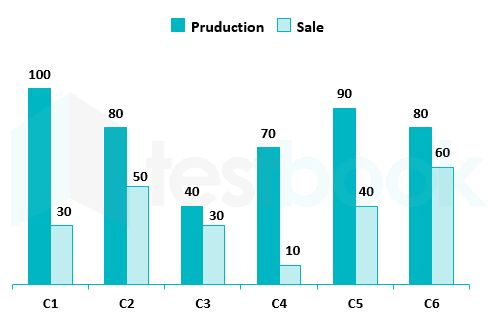
The bar graph given below shows the production and sales of car by different companies.

Unsold Cars = Production - Sale

Which of the following statement is correct?

I. The difference between the unsold car of C1 and the unsold car of C4 is 60.

II. The sum of the unsold car of C3 and the unsold car of C5 is 60.

  1. AOption (a)

    Only II

  2. BOption (b)

    Only I

  3. COption (c)

    Both I and II

  4. DOption (d)

    Neither I nor II

View answer & explanation

Correct answer

Answer: (a)A.

Only II

Why this answer is correct

Given:

Formula Used:

Unsold Cars = Production - Sale

Calculation:

Company NameProductionSaleUnsold Cars
C11003070
C2805030
C3403010
C4701060
C5904050
C6806020


I. The difference between the unsold car of C1 and the unsold car of C4 :-

⇒ 70 - 60 = 10

II. The sum of the unsold car of C3 and the unsold car of C5 :-

⇒ 10 + 50 = 60

∴ Only case II is correct.

Question 51

For what value of A, 367A is divisible by 8?

  1. AOption (a)

    4

  2. BOption (b)

    8

  3. COption (c)

    2

  4. DOption (d)

    6

View answer & explanation

Correct answer

Answer: (c)C.

2

Why this answer is correct

Given:

Number = 367A

Concept Used:

A number will be divisible by 8 when its last 3 digits are divisible by 8.

Calculation:


Value of ANumberDivisibility with 8
43674674 is not divisible by 8 so 3674 is also not divisible by 8.
83678678 is not divisible by 8 so 3678 is also not divisible by 8.
23672672 is divisible by 8 so 3672 is also divisible by 8.
63676676 is not divisible by 8 so 3676 is also not divisible by 8.


∴ The value of A is 2.

Question 52

Marked price and selling price of an article are Rs. 7600 and Rs. 6688 respectively. What is the discount percentage?

  1. AOption (a)

    10 percent

  2. BOption (b)

    8 percent

  3. COption (c)

    12 percent

  4. DOption (d)

    16 percent

View answer & explanation

Correct answer

Answer: (c)C.

12 percent

Why this answer is correct

Given:

Marked Price = Rs.  7600

Selling Price = Rs. 6688

Formula Used:

Discount% = (MP - SP)/MP x 100%

Calculation:

Discount% = (MP - SP)/MP x 100%

⇒ (7600 - 6688)/7600 x 100%

⇒ 912/7600 x 100%

⇒ 912/76 %

⇒ 12%

So, Discount% is 12.

Question 53

The distance between place C and D is 270 km. An express train leaves place C at 6 : 00 p.m. and runs at a speed of 18 km/hr. The train stops on the way for 40 minutes. At what time the train reaches at place D?

  1. AOption (a)

    8 : 20 am

  2. BOption (b)

    8 : 50 am

  3. COption (c)

    9 : 40 am

  4. DOption (d)

    10 : 20 am

View answer & explanation

Correct answer

Answer: (c)C.

9 : 40 am

Why this answer is correct

Given:

Distance between place C and D is 270 km.  An express train leaves place C at 6 : 00 p.m. and runs at a speed of 18 km/hr. The train stops on the way for 40 minutes.

Formula Used:

Speed = distance/time

Calculation:

Time taken by train without any stoppage = distance/time

⇒ 270/18 = 15 hours

But train stops on the way for 40 minutes

∴ Total time = 15 hour 40 min

Reaching time = 6 : 00 p.m. + 15 hour 40 min = 09 : 40 a m.

∴ The train reaches at place D at 09 : 40 a.m.

Question 54

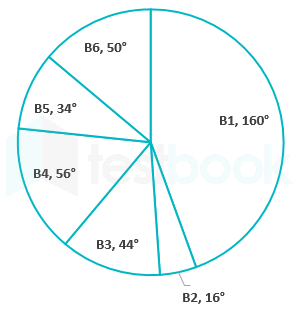
The pie chart given below shows the amount spent by a distributer on publishing of six books. The total amount spent on all these six books is Rs. 72000. The amount spent on a particular book is shown in terms of degree with respect to the total amount spent on all these six book.

Which of the following statement is correct?

I. Ratio of amount spent on book B2 to the amount spent on book B3 is 11 ∶ 4.

II. The amount spent on book B1 is Rs. 20000 more than the amount spent on book B6.

  1. AOption (a)

    Only II

  2. BOption (b)

    Only I

  3. COption (c)

    Both I and II

  4. DOption (d)

    Neither I nor II

View answer & explanation

Correct answer

Answer: (d)D.

Neither I nor II

Why this answer is correct

Given:

Formula Used:


Calculation:

BookAmountExpense
B172000 x 160/36032000
B272000 x 16/3603200
B372000 x 44/3608800
B472000 x 56/36011200
B572000 x 34/3606800
B672000 x 50/36010000


I. Ratio of amount spent on book B2 to the amount spent on book B3:-

⇒ 3200 : 8800 

⇒ 4 : 11

II. The amount spent on book B1 is Rs. 20000 more than the amount spent on book B6:-

⇒ 32000 - 10000

⇒ 22000

∴ Neither I nor II follow.

Question 55

If 37.5 percent of X = 7/8 of Y, then what is X ∶ Y?

  1. AOption (a)

    3 ∶ 7

  2. BOption (b)

    3 ∶ 5

  3. COption (c)

    5 ∶ 3

  4. DOption (d)

    7 ∶ 3

View answer & explanation

Correct answer

Answer: (d)D.

7 ∶ 3

Why this answer is correct

Given:

⇒ 37.5% of X = 7/8 of Y

Calculation:

⇒ 37.5% of X = 7/8 of Y

⇒ 37.5 x X/100 = 7 x Y/8

⇒ X/Y = 7 x 100/8 x 37.5

⇒ X/Y = 700/300

⇒ X/Y = 7/3

∴  X : Y is 7 : 3.

Question 56

Rohan spends some part of his income and saves the remaining part. The ratio of his expenditure and saving is 4 ∶ 5 respectively. If Rohan's income is Rs. 72000, then what will be his expenditure?

  1. AOption (a)

    Rs. 16000

  2. BOption (b)

    Rs. 32000

  3. COption (c)

    Rs. 24000

  4. DOption (d)

    Rs. 40000

View answer & explanation

Correct answer

Answer: (b)B.

Rs. 32000

Why this answer is correct

Given:

Ratio of expenditure and saving of Rohan = 4 ∶ 5

Formula Used:

Income = expenditure + saving

Calculation:

Let, expenditure of Rohan = 4x 

and saving of Rohan = 5x

According to question;

⇒ 4x + 5x = 72000

⇒ 9x = 72000

⇒ x = 72000/9

⇒ x = 8000

Expenditure of Rohan = 4 x 8000 = 32000

∴ Expenditure of Rohan is Rs. 32000.

Question 57

What is the Highest Common Factor of 30, 120 and 160?

  1. AOption (a)

    20

  2. BOption (b)

    5

  3. COption (c)

    10

  4. DOption (d)

    15

View answer & explanation

Correct answer

Answer: (c)C.

10

Why this answer is correct

Given:

Number are 30, 120 and 160

Formula Used:

Product of all common factors of numbers is the HCF of those numbers.

HCF = Product of common factors

Calculation: 

⇒ 30 = 2 x 3 x 5

⇒ 120 = 2 x 2 x 2 x 3 x 5

⇒ 160 = 2 x 2 x 2 x 2 x 2 x 5

HCF = Product of common factors = 2 x 5 = 10

∴ The Highest Common Factor of 30, 120 and 160 is 10.

Question 58

A car crosses a 480 metres wide road in 32 seconds. What is the speed of car?

  1. AOption (a)

    54 km/hr

  2. BOption (b)

    60 km/hr

  3. COption (c)

    42 km/hr

  4. DOption (d)

    48 km/hr

View answer & explanation

Correct answer

Answer: (a)A.

54 km/hr

Why this answer is correct

Given:

Distance = 480 m

Time = 32 sec

Formula Used:

Speed = distance/time

m/sec = 18/5 kmph

Calculation:

Speed = distance/time

⇒ 480/32

⇒ 15 m/sec

⇒ 15 x 18/5 kmph

⇒ 3 x 18 kmph

⇒ 54 kmph

∴ The speed of car is 54 kmph.

Question 59

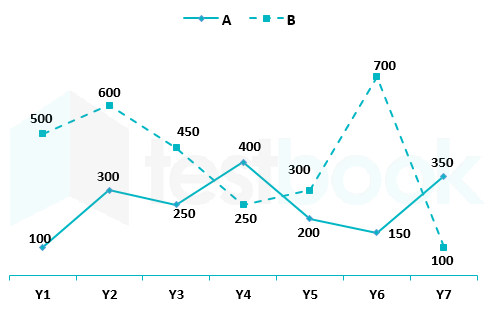
The line chart given below shows the number of students appearing in examination from two schools in different years.

What is the average number of student appearing in examination from school A and school B in year Y2?

  1. AOption (a)

    500

  2. BOption (b)

    700

  3. COption (c)

    450

  4. DOption (d)

    600

View answer & explanation

Correct answer

Answer: (c)C.

450

Why this answer is correct

Given:

Formula Used:

Average = Sum of observations/total number of observations

Calculation:

Average number of student appearing in examination from school A and school B in year Y2:-

⇒ (600 + 300)/2

⇒ 900/2

⇒ 450

∴ The average number of student appearing in examination from school A and school B in year Y2 is 450.

Question 60

Perimeter of a rectangle is 20 cm more than the double of its length. If length of the rectangle is 25 cm, then what is the area of this rectangle?

  1. AOption (a)

    500 cm2

  2. BOption (b)

    125 cm2

  3. COption (c)

    250 cm2

  4. DOption (d)

    325 cm2

View answer & explanation

Correct answer

Answer: (c)C.

250 cm2

Why this answer is correct

Given:

Perimeter = 2 x length + 20

Length = 25 cm

Formula Used:

Area of Rectangle = l x b

Perimeter of Rectangle = 2(l + b)

Calculation:

Perimeter = 2 x length + 20

⇒ 2 x 25 + 20

⇒ 50 + 20

⇒ 70 cm

Perimeter of Rectangle = 2(l + b)

⇒ 2(l +b) = 70

⇒ l + b = 35

⇒ b = 35 - 25 = 10 cm

Area of Rectangle = l x b

⇒ 25 x 10 

⇒ 250 cm2

So, Area of rectangle is 250 cm2 .

General English (20 questions)

Question 61

In the following question, out of the given four alternatives, select the alternative which best expresses the meaning of the Idiom/Phrase.

Rain on your parade

  1. AOption (a)

    Spoil someone's plans

  2. BOption (b)

    Extremely happy

  3. COption (c)

    A wasted opportunity

  4. DOption (d)

    To be dismissed

View answer & explanation

Correct answer

Answer: (a)A.

Spoil someone's plans

Why this answer is correct

The correct answer is 'Spoil someone's plans'.

Key Points

  • Rain on your parade is an idiom which means prevent someone from enjoying an event or spoil someone's plans.(किसी की योजना को बिगाड़ना)
  • ​For example- She rained on our parade by chaperoning our school dance.

Therefore, the correct answer is 'Option 1'.

Question 62

Find the part of the given sentence that has an error in it. If there is no error, choose 'No error'.

We found that 69 percent of employees (1)/reported experiencing some (2)/incivility in the previously year (3)/.No error (4)

  1. AOption (a)

    3

  2. BOption (b)

    1

  3. COption (c)

    4

  4. DOption (d)

    2

View answer & explanation

Correct answer

Answer: (a)A.

3

Why this answer is correct

The correct answer is '3'.

Key Points

  • The given sentence is of Past tense.
  • In this sentence, previous is an adjective and previously is an adverb.
  • We should use previous instead of previously.
  • So the correct sentence will be-We found that 69 percent of employees reported experiencing some incivility in the previous year.

Therefore, the correct answer is 'Option 1'.

Question 63

Select the most appropriate option to substitute the underlined segment in the given sentence. If no substitution is required, select 'No improvement' as your answer.

He was robbed on his way home but he realized that most clouds have rainbow lining.

  1. AOption (a)

    every cloud has a silver lining

  2. BOption (b)

    No improvement

  3. COption (c)

    most cloudy has a silver lining

  4. DOption (d)

    every cloud has a rainbow lining

View answer & explanation

Correct answer

Answer: (a)A.

every cloud has a silver lining

Why this answer is correct

The correct answer is 'Every cloud has a silver lining'.

Key Points

  • Every cloud has a silver lining is a phrase which means even a very bad situation has a positive or hopeful side.(निराशापूर्ण स्थिति में भी आशा की किरण होती है)
  • We have to use every cloud has a silver lining instead of most clouds have rainbow lining.
  • So, the correct sentence will be- He was robbed on his way home but he realized that every cloud has a silver lining.

Therefore, the correct answer is **'Option 1'.**​

Question 64

In the given question, four words are given out of which one word is correctly spelt.

Choose the correctly spelt word.

  1. AOption (a)

    Convimeint

  2. BOption (b)

    Conveneint

  3. COption (c)

    Convenient

  4. DOption (d)

    Convinient

View answer & explanation

Correct answer

Answer: (c)C.

Convenient

Why this answer is correct

The correct answer is 'Convenient'.

Key Points

  • Convenient is an adjective which means suitable or practical for a particular purpose. (विशेष उद्देश्‍य की दृष्टि से उपयुक्त या व्‍यावहारिक)
  • For example- I found the new system much convenient.

​Therefore, the correct answer is 'Option 3'.

Question 65

In the given question, four words are given out of which one word is correctly spelt.

Choose the correctly spelt word.

  1. AOption (a)

    Acident

  2. BOption (b)

    Accdent

  3. COption (c)

    Accident

  4. DOption (d)

    Accedent

View answer & explanation

Correct answer

Answer: (c)C.

Accident

Why this answer is correct

The correct answer is 'Accident'.

Key Points

  • Accident is a noun which means an unpleasant event that happens unexpectedly and causes damage, injury or death.(दुर्घटना)
  • ​For example- Ram met an accident yesterday.

​Therefore, the correct answer is 'Option 3'.

Question 66

A sentence has been given with a blank to be filled with an appropriate word. Choose the correct alternative.

The teacher said that my handwriting was __________.

  1. AOption (a)

    stout

  2. BOption (b)

    dearth

  3. COption (c)

    glowing

  4. DOption (d)

    appalling

View answer & explanation

Correct answer

Answer: (d)D.

appalling

Why this answer is correct

The correct answer is 'Appalling'.

Key Points

  • The given sentence is of Past tense.
  • Appalling is an adjective which means very bad, shocking etc.(बहुत बुरा)
  • For example- She suffered appalling injuries.
  • From the above options, appalling is an appropriate fill up.
  • So, the sentence will be- The teacher said that my handwriting was appalling.

Therefore, the correct answer is 'Option 4'.

Additional Information

  • Stout means strong and thick. (मज़बूत और मोटा)
  • Dearth means a lack of something. (किसी वस्‍तु की कमी)
  • Glowing means saying that something or somebody is very good. (व्‍यक्ति या वस्‍तु के लिए प्रशंसापूर्ण)

Question 67

A sentence has been given with a blank to be filled with an appropriate word. Choose the correct alternative.

The car didn't ________ the old lady crossing the road.

  1. AOption (a)

    seen

  2. BOption (b)

    seeing

  3. COption (c)

    saw

  4. DOption (d)

    see

View answer & explanation

Correct answer

Answer: (d)D.

see

Why this answer is correct

The correct answer is 'See'.

Key Points

  • The given sentence is of Past Indefinite tense.
  • The structure of Past tense-
  • Affirmative sentence- Subject + Verb 2nd form + Object
  • Negative sentence- Subject + did not + verb 1st form + Object
  • From the above option, see (verb 1st form) is the appropriate fill up according to the structure.
  • So, the sentence will be -The car didn't see the old lady crossing the road.

Therefore, the correct answer is 'Option 4'.

Additional Information

  • In Past continuous tense, Subject + was/were + Verb 1st form + ing + Object is used.
  • In Past perfect tense, Subject + had + verb 3rd form + object is used.

Question 68

Choose the word that means the same as the given word.

Retreat

  1. AOption (a)

    Withdrawal

  2. BOption (b)

    Uninterested

  3. COption (c)

    Brazen

  4. DOption (d)

    Unbiased

View answer & explanation

Correct answer

Answer: (a)A.

Withdrawal

Why this answer is correct

The correct answer is 'withdrawal'.

Key Points

  • Retreat means to move backwards etc. (पीछे हटना)
  • ​For example- The enemy was forced to retreat.
  • ​Withdrawal means moving or being moved back or away from a place.(कहीं से पीछे, दूर हटने या किसी को हटाने की क्रिया)
  • ​For example- Forces made a strategic withdrawal.
  • From the above options, Withdrawal is the appropriate synonym for Retreat.

Therefore, the correct answer is 'Option 1'.

Additional Information

  • Uninterested means having or showing no interest in somebody or something.(किसी व्यक्ति या वस्‍तु में रुचिहीन)
  • Brazen means without embarrassment etc. (बेशर्म, लज्जाहीन)
  • Unbiased showing no prejudice for or against something. ( निष्पक्ष)

Question 69

Rearrange the parts of the sentence in the correct order.

P : Paris has for centuries been regarded

Q : world, a magnet for artists and intellectuals

R : and a place where new ideas originate and art reigns supreme

S : as the main cultural powerhouse of the Western

  1. AOption (a)

    PQSR

  2. BOption (b)

    QRSP

  3. COption (c)

    RSPQ

  4. DOption (d)

    PSQR

View answer & explanation

Correct answer

Answer: (d)D.

PSQR

Why this answer is correct

The correct answer is 'PSQR'.

Key Points

  • First statement is P because it is introductory statement.
  • Second statement is S because it tells us about the characteristic of Paris.
  • Third statement is Q because in it western world are interconnected.
  • Fourth statement is R  lastly.

Therefore, the correct answer is 'Option 4'.

The correct sequence is - Paris has for centuries been regarded as the main cultural powerhouse of the Western world, a magnet for artists and intellectuals and a place where new ideas originate and art reigns supreme.

Question 70

Choose the word that is opposite in meaning to the given word.

Benevolence

  1. AOption (a)

    Acrimonious

  2. BOption (b)

    Accrual

  3. COption (c)

    Compel 

  4. DOption (d)

    Courtesy

View answer & explanation

Correct answer

Answer: (a)A.

Acrimonious

Why this answer is correct

The correct answer is 'Acrimonious'.

Key Points

  • Benevolence is an adjective which means quality of being kind and helpful.(परोपकरी, हितकामना)
  • ​For example- I didn't offer to give my benevolence.
  • ​Acrimonious is an adjective which means angry and including strong accusations.(क्रोधपूर्ण और कटुतायुक्त)
  • ​For example- There followed an acrimonious debate.
  • From the above options, Acrimonious is an appropriate antonyms of Benevolence.

Therefore, the correct answer is 'Option 1'.

Additional Information

  • Accrual means increase of something over time.(समय के साथ किसी चीज का बढ़ना)
  • Compel means to force somebody to do something. (कुछ करने के लिए किसी को बाध्य या विवश करना)
  • Courtesy means polite and pleasant behaviour that shows respect for other people.(शिष्‍ट व्‍यवहार)

Question 71

Select the most appropriate option to substitute the underlined segment in the given sentence. If no substitution is required, select 'No improvement' as your answer.

She cannot walk nor drive.

  1. AOption (a)

    can may walk

  2. BOption (b)

    can walk

  3. COption (c)

    can neither walk

  4. DOption (d)

    No improvement

View answer & explanation

Correct answer

Answer: (c)C.

can neither walk

Why this answer is correct

The correct answer is 'Can neither walk'.

Key Points

  • Neither......nor(न तो न ही) is a conjunction.
  • For example- He is neither smart nor intelligent.
  • So, the sentence will be - She can neither walk nor drive.

Therefore, the correct answer is 'Option 3'.

Additional Information

  • Conjunction is a word that is used for joining other words, phrases or sentences.
  • For example- Neither...nor, not only.....but also, either.....or etc.

Question 72

Choose the word that can substitute the given sentence.

An expression used by many people

  1. AOption (a)

    Profundity

  2. BOption (b)

    Remark

  3. COption (c)

    Dogma

  4. DOption (d)

    Platitude 

View answer & explanation

Correct answer

Answer: (d)D.

Platitude 

Why this answer is correct

The correct answer is 'Platitude'.

Key Points

  • Platitude means an expression or statement that has been made very often before and is therefore not interesting.(कथन या उक्ति विगत में अत्यधिक प्रयोग के कारण निरर्थक तथा उबाऊ)
  • ​For example- He delivered a long prose of platitude.

​Therefore, the correct answer is 'Option 4'.

Additional Information

  • Dogma means a belief or set of beliefs that people are expected to accept as true without questioning.(निर्धारित सिद्घांत जिन्‍हें प्रश्‍न किए बिना स्‍वीकारना होता है)
  • Profundity means great depth of insight or knowledge.(ज्ञान की महान गहराई)
  • Remark means to say or write something.(कुछ कहना या लिखना)

Question 73

Find the part of the given sentence that has an error in it. If there is no error, choose 'No error'.

The researchers found that the overall risk (1)/ of UTIs was 16 percent low in(2)/ vegetarians than in non-vegetarians(3)/.No error (4)

  1. AOption (a)

    4

  2. BOption (b)

    3

  3. COption (c)

    1

  4. DOption (d)

    2

View answer & explanation

Correct answer

Answer: (d)D.

2

Why this answer is correct

The correct answer is '2'

Key Points 

  • The given sentence is talking about the comparison between vegetarian and non vegetarian.
  • We should use comparative form of low i.e. lower with than.
  • So, sentence will be- The researchers found that the overall risk of UTIs was 16 percent lower than vegetarians in non-vegetarians.

Therefore, the correct answer is 'Option 4'.

Additional Information 

  • There are 3 types of degree-
  • Positive degree- It doesn't make any comparison.
  • Comparative degree- It makes comparison between two persons or things.
  • Superlative degree- It makes comparison between one and all.

Question 74

In the following question, out of the given four alternatives, select the alternative which best expresses the meaning of the Idiom/Phrase.

To cry halves

  1. AOption (a)

    In deep troubles

  2. BOption (b)

    A heaven on land

  3. COption (c)

    To demand an unrealistic thing

  4. DOption (d)

    To claim an equal share

View answer & explanation

Correct answer

Answer: (d)D.

To claim an equal share

Why this answer is correct

The correct answer is 'To claim an equal share'.

Key Points

  • To claim an equal share is an idiom which means to claim an equal share.(समान हिस्से का दावा करना)
  • For example- Ram is ready to cry halves in his father's property.

Therefore, the correct answer is 'Option 4'.

Question 75

Rearrange the parts of the sentence in correct order.

The origin of the word

P : applied to the speech of disreputable

Q : and criminal classes in London

R : appeared in print around 1800,

S : slang it self is obscure; it first

  1. AOption (a)

    QSPR

  2. BOption (b)

    SQRP

  3. COption (c)

    SQPR

  4. DOption (d)

    SRPQ

View answer & explanation

Correct answer

Answer: (d)D.

SRPQ

Why this answer is correct

The correct answer is 'SRPQ'.

Key Points

  • First statement is S because it is introductory statement.
  • Second statement is R because it is talking about origin of slang.
  • Third statement is P because is talks about the use of slang in speech.
  • Fourth statement is Q lastly.

Therefore, the correct answer is 'Option 4'.

The correct sequence is- The origin of the word slang itself is obscure; it first appeared in print around 1800, applied to the speech of disreputable and criminal classes in London.

Read the following information carefully and answer the given questions.

Keratin is a protein that is the key structural building block for hair, skin and nails. Keratin is found in humans and animals alike in forms ranging from hooves to soft flexible skin. This shows you how strong and delicate keratin can be. When the outer layer of keratin becomes damaged it affects the new cells that are no longer being protected beneath it. This causes damage in the form of dry, brittle hair or rough and cracked skin.

Reversing this damage can be achieved with a keratin hair treatment. Keratin is used to smooth and fill in the damage of the hair's cuticle layer. Keratin is unlike a perm or relaxer in that it doesn't actually change the hair's disulfide bonds making it a semi-permanent treatment that lasts around 3 months, depending on the hair's texture.

A Keratin treatment creates a barrier from heat and humidity so it can be a great treatment for clients that have perfectly healthy hair but are looking to have their natural curl and frizz smoothed out and protected from the elements. A keratin treatment will not remove the curl completely but it will cut your clients straightening time in half, if not more.

Much talk has been made about the safety of keratin treatments. Not all treatments are considered equal. Tests found dangerously high levels of formaldehyde in the Brazilian Keratin Treatment (BKT) brand, about 10 times higher than what is registered as safe. A safer option is Keratin Shot by Salerm Cosmetics, a favourite among professional stylists. Keratin treatments are also safe to use on hair that has been previously highlighted or coloured.

Question 76

For how many months does keratin treatment lasts? 

  1. AOption (a)

    6 months

  2. BOption (b)

    3 months

  3. COption (c)

    2 months

  4. DOption (d)

    4 months

View answer & explanation

Correct answer

Answer: (b)B.

3 months

Why this answer is correct

The correct answer is '3 months'.

Key Points

  • According to the passage, keratin treatment is a semi-permanent treatment that lasts around 3 months.
  • This is mentioned in the second paragraph of the passage.

Therefore, the correct answer is 'Option 2'.

Question 77

Which of the following statements is NOT correct as per the given passage? 

  1. AOption (a)

    Keratin treatment helps in controlling frizzy hair.

  2. BOption (b)

    Keratin treatment is safe for the hair, irrespective of high levels of formaldehyde.

  3. COption (c)

    Keratin treatment is a semi-permanent treatment.

  4. DOption (d)

    Keratin treatment also helps in revitalizing damaged hair.

View answer & explanation

Correct answer

Answer: (b)B.

Keratin treatment is safe for the hair, irrespective of high levels of formaldehyde.

Why this answer is correct

The correct answer is 'Keratin treatment is safe for the hair, irrespective of high levels of formaldehyde'.

Key Points

  • According to the passages, some tests of keratin treatment found dangerously high levels of formaldehyde in the Brazilian Keratin Treatment (BKT) brand, about 10 times higher than what is registered as safe.
  • So, second option is incorrect.
  • All other statements are mentioned in the second and third paragraph of the passage.

Therefore, the correct answer is 'Option 2'.

Question 78

Which of the following questions is not answered by the given passage? 

  1. AOption (a)

    What is a keratin treatment?

  2. BOption (b)

    How hair feels after keratin treatment?

  3. COption (c)

    What are the side-effects of going for keratin treatment?

  4. DOption (d)

    How keratin treatment work?

View answer & explanation

Correct answer

Answer: (c)C.

What are the side-effects of going for keratin treatment?

Why this answer is correct

The correct answer is 'What are the side-effects of going for keratin treatment?'

Key Points

  • What is a keratin treatment ? is mentioned in the second paragraph of the passage.
  • How hair feels after keratin treatment ? and how keratin treatment work ? is mentioned in the third paragraph of the passage.
  • What are the side-effects of going for keratin treatment? is not mentioned in the passage.

Therefore, the correct answer is 'Option 3'.

Question 79

What is the antonym of the word 'delicate'?

  1. AOption (a)

    Frail

  2. BOption (b)

    Coarse

  3. COption (c)

    Silky

  4. DOption (d)

    Light

View answer & explanation

Correct answer

Answer: (b)B.

Coarse

Why this answer is correct

The correct answer is 'Coarse'.

Key Points

  • Delicate means easy to damage or break. (नाज़ुक, आसानी से टूट जाने वाला)
  • ​For example- I noticed her delicate fingers.
  • Coarse means consisting of large pieces; rough, not smooth. (मोटे ढेलों वाला; खुरदुरा)
  • ​For example- The man was brutish and coarse.
  • From the above options, coarse is the appropriate antonym of delicate.

Therefore, the correct answer is 'Option 2'.

Additional Information

  • Frail means week or not healthy.(दुर्बल या अस्‍वस्‍थ)
  • Silky means smooth, soft and shiny. (चिकना, कोमल और चमकदार)
  • Light means that allows you to see something.(प्रकाश, रोशनी)

Question 80

What is the primary purpose of the given passage?

  1. AOption (a)

    To analyze the benefits of keratin treatment

  2. BOption (b)

    To give a brief idea about hair growth

  3. COption (c)

    To persuade the readers to go for keratin treatment

  4. DOption (d)

    To introduce the keratin treatment to the readers

View answer & explanation

Correct answer

Answer: (d)D.

To introduce the keratin treatment to the readers

Why this answer is correct

The correct answer is 'To introduce the keratin treatment to the readers'

Key Points 

  • The whole passage is based on the hair treatment by keratin protein.
  • It gives us the reader about how keratin treatment works to keep hair healthy.

Therefore, the correct answer is 'Option 4'.

General Hindi (20 questions)

Question 81

निम्नलिखित वाक्यांश के लिए उचित शब्द का चयन कीजिए।

वह वस्तु जिसके आर-पार न देखा जा सके

  1. AOption (a)

    आदिप्रवर्तक

  2. BOption (b)

    अपारदर्शी

  3. COption (c)

    समदर्शी

  4. DOption (d)

    पारदर्शी

View answer & explanation

Correct answer

Answer: (b)B.

अपारदर्शी

Why this answer is correct

'वह वस्तु जिसके आर-पार न देखा जा सके' वाक्यांश के लिए उचित शब्द है - अपारदर्शी

Mistake Points

  • सर्वप्रथम मत को प्रवर्तित करने वाला - आदिप्रवर्तक
  • वह जो सभी को समान दृष्टि से देखता हो - समदर्शी
  • जिसमें से आर-पार देखा जा सके - पारदर्शी

Key Points

  • अनेक शब्दों के लिए एक शब्द को प्रयुक्त करना ही वाक्यांश के लिए एक शब्द कहलाता है।

Important Pointsकुछ महत्वपूर्ण वाक्यांश के लिए एक शब्द:-​

  • परंपरा से चली आ रही कथा - अनुश्रुति
  • पहाड़ के ऊपर की सपाट जमीन - अधित्यका
  • जो दुख या भय से पीड़ित हो - कातर
  • जो दूसरे की उन्नति देखकर जलता हो - ईर्ष्यालु
  • जिसने अपना ऋण पूरा चुका दिया हो - उऋण
  • अपने लिए किए हुए उपकार को याद रखने वाला - कृतज्ञ
  • जहां धरती और आकाश मिलते हुए दिखाई देते हैं - क्षितिज

Question 82

निम्नलिखित प्रश्न में, दिए गए चार विकल्पों में से, उस विकल्प का चयन करें जो दिए गए मुहावरे के अर्थ को सर्वश्रेष्ठ रूप से व्यक्त करता है।

अँगूठी का नगीना

  1. AOption (a)

    कठोर बात कहना

  2. BOption (b)

    सुन्दर और सजीला

  3. COption (c)

    तिरस्कारपूर्वक मना करना

  4. DOption (d)

    धारण करना

View answer & explanation

Correct answer

Answer: (b)B.

सुन्दर और सजीला

Why this answer is correct

'अँगूठी का नगीना' मुहावरे के अर्थ को सर्वश्रेष्ठ रूप से व्यक्त करता है - सुन्दर और सजीला

  • वाक्य प्रयोग - अरे दूल्हा तो देखो ! बिल्कुल "अँगूठी का नगीना है"।

Mistake Points

  • अँगारे उगलना - कठोर बात कहना

           वाक्य प्रयोग - वह बातें क्या कर रहा था, मानो "अँगारे उगल रहा था"। 

  • अँगूठा दिखाना - निराश करना या तिरस्कारपूर्वक मना करना।

           वाक्य प्रयोग - जब मैंने पिता जी को नई साइकिल लेने के लिए पैसे मांगे तब उन्होंने मुझे "अँगूठा दिखाया"।

  • परशुराम का रूप धारण करना - अत्यन्त क्रुद्ध होना

           वाक्य प्रयोग - अपने बेटे का घटिया व्यवहार देखकर उसके पिताजी ने "परशुराम का रूप धारण कर लिया"।

Key Points

  • मुहावरा एक ऐसा वाक्य होता है
  • जो वाक्य की रचना करने पर अपना एक अलग अर्थ या विशेष अर्थ प्रकट करता है
  • इनका प्रयोग करने से भाषा,आकर्षक, प्रभावपूर्ण तथा रोचक बन जाती है।

Important Pointsकुछ महत्वपूर्ण मुहावरा, अर्थ और उनके वाक्य प्रयोग-

  • अढाई दिन की हुकूमत - कुछ दिनों की शानो-शौकत

           वाक्य प्रयोग - जनाब, जरा होशियारी से काम लें। यह "अढाई दिन की हुकूमत जाती रहेगी"।

  • इज्जत मिट्टी में मिलाना - प्रतिष्ठा या सम्मान नष्ट करना

          वाक्य प्रयोग - रामू की शराब की आदत ने उसके परिवार की "इज्जत मिट्टी में मिला दी हैं"।

  • उधेड़बुन में पड़ना या रहना - फिक्र या चिन्ता करना

           वाक्य प्रयोग - माता-पिता अपने बच्चों के भविष्य के लिए हमेशा "उधेड़बुन में पड़े रहते हैं"।

  • कफ़न को कौड़ी न होना - बहुत गरीब होना

          वाक्य प्रयोग - राजू बातें तो राजाओं की-सी करता हैं, पर "कफ़न को कौड़ी नहीं हैं"।

  • गुदड़ी का लाल - गरीब के घर में गुणवान का उत्पन्न होना

          वाक्य प्रयोग - अपने वंश में प्रेमचन्द सचमुच "गुदड़ी के लाल थे"।

Question 83

दिए गए शब्द का विलोम शब्द ज्ञात कीजिए।

अनुयायी

  1. AOption (a)

    अत्यल्प

  2. BOption (b)

    विरोधी

  3. COption (c)

    अधिगम्य

  4. DOption (d)

    अधीन

View answer & explanation

Correct answer

Answer: (b)B.

विरोधी

Why this answer is correct

'अनुयायी' शब्द का विलोम शब्द है - विरोधी

  • अनुयायी - अनुसरण करनेवाला, अनुचर।
  • विरोधी- विरोध करनेवाला, हित के प्रतिकूल चलने वाला।

Key Pointsअत्यल्प- 

  • अर्थ: बहुत थोड़ा, बहुत ही कम, अति न्यून।
  • विलोम शब्द - 'अत्यधिक'
  • अर्थ: हद से ज़्यादा।

अधिगम्य-

  • अर्थ: जिस तक अधिगम या पहुँच हो सके।
  • विलोम शब्द - 'अनधिगम्य'
  • अर्थ: अधिगमन के योग्य न हो।

अधीन-

  • अर्थ: आश्रित, विवश, लाचार, जो किसी के वश में हो। 
  • विलोम शब्द - 'अनधीन'
  • अर्थ: जो किसी के वश में न हो

Important Pointsकुछ अन्य महत्वपूर्ण विलोम शब्द:- 

  • शब्द - विलोम
  • दुर्लभ - सुलभ
  • निरक्षर - साक्षर
  • नूतन - पुरातन
  • क्षणिक - शाश्वत
  • उत्कर्ष - अपकर्ष
  • विधवा - सधवा
  • शयन - जागरण
  • स्वाधीन - पराधीन
  • मितव्यय - अपव्यय

Question 84

दिए गए वाक्य में उपयुक्त विराम चिह्न का चयन कीजिए।

जब भी राम आता है तुम भी आ जाते हो ।

  1. AOption (a)

    ;

  2. BOption (b)

    ,

  3. COption (c)

    ...

  4. DOption (d)

    :

View answer & explanation

Correct answer

Answer: (a)A.

;

Why this answer is correct

वाक्य में उपयुक्त विराम चिह्न है- जब भी राम आता है तुम भी आ जाते हो।

  • अर्द्ध विराम चिह्न - (;)
  • विराम चिह्न का प्रयोग**-** जब भी राम आता है**;** तुम भी आ जाते हो।

अर्द्ध विराम-

  • जब किसी वाक्य को कहते हुए बीच में हल्का सा विराम लेना हो पर वाक्य को खत्म न किया जाये,
  • तो वहाँ पर अर्द्ध विराम (;) चिह्न का प्रयोग किया जाता है।

जैसे-

  • राम तो अच्छा लड़का है**;** किन्तु उसकी संगत कुछ ठीक नहीं है।
  • जिसे मैंने अपना दोस्त समझा**;** वही आस्तीन का सांप निकला।

Key Points 

  • अल्पविराम चिह्न - ( , )
  • लोप चिह्न- (…)
  • उप विराम चिह्न -  ( : )

Important Points 

अल्पविराम- - जहाँ पर अर्द्धविराम की तुलना में कम देर रुकना हो तो अल्पविराम चिह्न का प्रयोग किया जाता है। - इसे ( , ) चिह्न के रूप में दर्शाया जाता है। जैसे- - आशा, तुम वहां जाओ। - मैंने बहुत परिश्रम किया, किन्तु सफल न हो पाया। लोप चिह्न- - जब वाक्य या अनुच्छेद में कुछ अंश छोड़ कर लिखना हो तो लोप चिह्न (…) का प्रयोग किया जाता है। जैसे- - श्याम ने मोहन को गली दी … । - मैं सामान उठा दूंगा पर … । उप विराम- - जब किसी वाक्य को अलग दिखाना होता है, तब उप विराम का प्रयोग किया जाता है। उप विराम का चिह्न ( : ) होता है। जैसे- - प्रदूषण : एक अभिशाप। - विज्ञान : वरदान या अभिशाप।

Question 85

निम्नलिखित में से कौन-सा शब्द युग्म सहीं नही हैं?

  1. AOption (a)

    रोना - धोना

  2. BOption (b)

    हिसाब - किताब

  3. COption (c)

    चलते - चलते

  4. DOption (d)

    भाग - दौड़

View answer & explanation

Correct answer

Answer: (c)C.

चलते - चलते

Why this answer is correct

शब्द युग्म सहीं नही हैं- चलते - चलते

  • पूर्ण पुनरुक्त शब्द- 'चलते - चलते'
  • प्रति-ध्वन्यात्मक पुनरुक्त शब्द- 'रोना - धोना, हिसाब - किताब, भाग - दौड़'

पूर्ण पुनरुक्त शब्द-

  • जब शब्द युग्म में पहली इकाई (शब्द) ही दूसरी इकाई के रूप में ज्यों की त्यों आती है, वहाँ पूर्ण पुनरुक्त शब्द होते हैं।
  • जैसे - धीरे-धीरे, डाल-डाल, द्वार-द्वार आदि।

Key Pointsपुनरुक्त शब्द के प्रकार-

  1. पूर्ण पुनरुक्त शब्द
  2. अपूर्ण पुनरुक्त शब्द
  3. प्रति-ध्वन्यात्मक पुनरुक्त शब्द
  4. भिन्नात्मक पुनरुक्त शब्द

Important Pointsप्रति-ध्वन्यात्मक पुनरुक्त शब्द-

  • जहाँ शब्द युग्म में दूसरा शब्द पहले की प्रतिध्वनि होता है वहाँ प्रति-ध्वन्यात्मक पुनरुक्त शब्द होते हैं।
  • जैसे- चाय-वाय, झट-पट, खट-पट, खाना-वाना।

Additional Informationपुनरुक्त शब्द-

  • जब एक ही शब्द वाक्य में लगातार दो बार प्रयुक्त होकर विशेष अर्थ दर्शाता है तो उसे पुनरुक्त शब्द कहते हैं।
  • जैसे - ​धीरे-धीरे, आना-जाना, गड़-गड़, रुक-रुक आदि।

Question 86

दिए गए वाक्य में उपयुक्त विराम चिह्न का चयन कीजिए।

रीता ने कहा अनीता अच्छी है।

  1. AOption (a)

    (),

  2. BOption (b)

    ," "

  3. COption (c)

    ... ()

  4. DOption (d)

    ; " "

View answer & explanation

Correct answer

Answer: (b)B.

," "

Why this answer is correct

वाक्य में उपयुक्त विराम चिह्न है - रीता ने कहा अनीता अच्छी है।

  • अल्पविराम चिह्न- ( , )
  • अवतरण चिह्न-  (" ")
  • विराम चिह्न का प्रयोग - रीता ने कहा**, "अनीता अच्छी है"**।

अल्पविराम-

  • जहाँ पर अर्द्धविराम की तुलना में कम देर रुकना हो तो अल्पविराम चिह्न का प्रयोग किया जाता है।
  • इसे ( , ) चिह्न के रूप में दर्शाया जाता है।
  • जैसे-
  • हाँ, तुम जाना चाहते हो जाओ।
  • मैं आज खाना नहीं खाऊंगा, क्योंकि मेरा मन नहीं है।

अवतरण चिह्न-

  • किसी महत्वपूर्ण कथन को ज्यों-का-त्यों लिखने के लिए जिस संकेत चिह्न का प्रयोग किया जाता है उसे अवतरण चिह्न कहते हैं।
  • इस चिन्ह को उद्धरण चिह्न या उपरिविराम के नाम से भी जाना जाता है।
  • जैसे-
  • गांधी जी ने कहा, “सदा सत्य बोलो”
  • सुभाष चंद्र बोस ने कहा था, “तुम मुझे खून दो, मैं तुम्हें आजादी दूंगा।”

Key Points

  • लोप चिह्न- (…)
  • **कोष्ठक-**चिह्न - ()
  • अर्द्ध विराम चिह्न- ( ; )

Important Points

लोप चिह्न- - जब वाक्य या अनुच्छेद में कुछ अंश छोड़ कर लिखना हो तो लोप चिह्न (…) का प्रयोग किया जाता है। जैसे- - महेश ने सुरेश को ..... कहकर गाली दी।​ - भारत की राजधानी ...... है। कोष्ठक-चिह्न-​ - वाक्य के बीच में आए शब्दों अथवा पदों का अर्थ स्पष्ट करने के लिए कोष्ठक का प्रयोग किया जाता है। कोष्ठक चिह्न का () होता है। जैसे- - ​लता मंगेशकर भारत की कोकिला (मीठा गाने वाली) हैं। - दशहरे  के अवसर पर दशानन (रावण) का वध होता है। अर्द्ध विराम- - जब किसी वाक्य को कहते हुए बीच में हल्का सा विराम लेना हो पर वाक्य को खत्म न किया जाये, - तो वहाँ पर अर्द्ध विराम (;) चिह्न का प्रयोग किया जाता है। जैसे- - मुझे यहाँ से जाना है; फिर घर जाना है; फिर घूमने जाना है। - जो मेहनती होता है; उसके रास्ते में उतनी ज्यादा कठिनाईयां आती हैं।

Question 87

निम्नलिखित वाक्यों में से मिश्र वाक्य ज्ञात कीजिए। 

  1. AOption (a)

    प्याला नीचे गिरा और टूट गया।

  2. BOption (b)

    प्याला नीचे गिरते ही टूट गया।

  3. COption (c)

    प्याला जैसे ही नीचे गिरा टूट गया।

  4. DOption (d)

    प्याला नीचे गिरा इसलिए टूट गया।

View answer & explanation

Correct answer

Answer: (c)C.

प्याला जैसे ही नीचे गिरा टूट गया।

Why this answer is correct

मिश्र वाक्य है - प्याला जैसे ही नीचे गिरा टूट गया।

  • (यहां पर 'जैसे' शब्द दो उपवाक्य को जोड़ रहा हैं। इनमें से एक उपवाक्य प्रधान है एवं दूसरा उपवाक्य आश्रित है।)

मिश्र वाक्य-

  • ऐसे वाक्य जिनमें सरल वाक्य के साथ-साथ कोई दूसरा उपवाक्य भी हो, वे वाक्य मिश्र वाक्य कहलाते हैं।
  • पहचान के लिए- कि, जो, क्योंकि, जितना, उतना, जैसा, वैसा, जब, तब, जहाँ, वहाँ, जिधर, उधर, अगर/यदि, तो, यद्यपि, तथापि आदि का प्रयोग किया जाता है।

उदाहरण-

  • यदि परिश्रम करोगे तो उत्तीर्ण हो जाओगे।
  • मैं जानता हूँ कि तुम्हारे अक्षर अच्छे नहीं बनते।

Key Points 

  • प्याला नीचे गिरा और टूट गया। (सयुंक्त वाक्य)
  • प्याला नीचे गिरते ही टूट गया। (सरल वाक्य)
  • प्याला नीचे गिरा इसलिए टूट गया। (सयुंक्त वाक्य)

Important Points 

सरल वाक्य- - ऐसा वाक्य जिसमे एक ही क्रिया एवं एक ही कर्ता होता है या जिस वाक्य में एक ही उद्देश्य एवं एक ही विधेय होता है, वे वाक्य सरल वाक्य कहलाते हैं। उदाहरण- - मीना नाचती है। - अमित खाना खाता है। सयुंक्त वाक्य- - ऐसा वाक्य जिसमे दो या दो से अधिक उपवाक्य हो एवं सभी उपवाक्य प्रधान हों, ऐसे वाक्य को सयुंक्त वाक्य कहते हैं। - पहचान के लिए- और, एवं, तथा, या, अथवा, इसलिए, अतः, फिर भी, तो, नहीं तो, किन्तु, परन्तु, लेकिन, पर आदि का प्रयोग करके जोड़ा जाता है। उदाहरण- - मैं आया और वह गया। - मैंने बहुत परिश्रम किया इसलिए सफल हो गया।

Question 88

दिए गए वाक्य का काल ज्ञात कीजिए।

जीवेश मैदान में घूम रहा था।

  1. AOption (a)

    आसन्न भूतकाल

  2. BOption (b)

    संदिग्ध भूतकाल

  3. COption (c)

    अपूर्ण भूतकाल

  4. DOption (d)

    पूर्ण भूतकाल

View answer & explanation

Correct answer

Answer: (c)C.

अपूर्ण भूतकाल

Why this answer is correct

'जीवेश मैदान में घूम रहा था।' वाक्य का काल है - अपूर्ण भूतकाल

  • (यहाँ 'रहा था।' अंत में आया है तथा वाक्य में क्रिया  शुरू या खत्म होने का पता नही चल रहा है, अत: यह अपूर्ण भूतकाल के अंतर्गत आएगा।)

अपूर्ण भूतकाल

  • क्रिया के जिस रूप से कार्य के भूतकाल में शुरू होने का पता चले लेकिन खत्म होने का पता न चले, उसे अपूर्ण भूतकाल कहते हैं।
  • जिन वाक्यों के अंत में रहा था, रही थी, रहे थे आदि आते हैं, वे अपूर्ण भूतकाल होते हैं।
  • जैसे-
  • मोहन मैदान में घूम रहा था।
  • वह हॉकी खेल रहा था।
  • सुनील पढ़ रहा था।

Key Points भूतकाल के प्रकार-

  1. सामान्य भूतकाल
  2. आसन्न भूतकाल
  3. पूर्ण भूतकाल
  4. अपूर्ण भूतकाल
  5. संदिग्ध भूतकाल
  6. हेतुहेतुमद् भूतकाल

Important Points 

संदिग्ध भूतकाल- - भूतकाल की क्रिया के जिस रूप से उसके भूतकाल में पूरा होने में संदेह हो, उसे संदिग्ध भूतकाल कहते हैं। - जिन वाक्यों के अंत में गा, गे, गी आदि आते हैं वे संदिग्ध भूतकाल होते हैं। उदाहरण- - डॉक्टर ने दवाई दे दी होगी। - संगीता गाना गा चुकी होगी। पूर्ण भूतकाल- - क्रिया के जिस रूप से यह ज्ञात हो कि कार्य पहले ही पूरा हो चुका है, उसे पूर्ण भूतकाल कहते हैं। - पूर्ण भूतकाल में क्रिया के साथ ‘था, थी, थे, चुका था, चुकी थी, चुके थे आदि लगता है। उदाहरण- - बारिश रुक गई थी। - सीमा खाना खा चुकी थी। आसन्न भूतकाल- - क्रिया के जिस रूप से हमें यह पता चले की क्रिया अभी कुछ समय पहले ही पूर्ण हुई है उसे आसन्न भूतकाल कहते हैं - आसन्न भूतकाल की क्रिया में हूँ, हैं, है, हो लगता है। उदाहरण- - मैने केला खाया हैं। - मैं अभी ऑफिस से आया हूँ।

Question 89

दिए गए वाक्य मे निजवाचक सर्वनाम ज्ञात कीजिए।

सफलता पाने के लिए तुम्हें स्वयं कठोर परिश्रम करना पड़ेगा।

  1. AOption (a)

    करना

  2. BOption (b)

    तुम्हें

  3. COption (c)

    के लिए

  4. DOption (d)

    स्वयं

View answer & explanation

Correct answer

Answer: (d)D.

स्वयं

Why this answer is correct

'सफलता पाने के लिए तुम्हें स्वयं कठोर परिश्रम करना पड़ेगा।' वाक्य मे निजवाचक सर्वनाम है - स्वयं

निजवाचक सर्वनाम-

  • जिन सर्वनाम शब्दों का प्रयोग वक्ता स्वयं के लिए करता है उन्हें निजवाचक सर्वनाम कहते हैं।
  • निजवाचक सर्वनाम के अंतर्गत आप, अपना, स्वयं, ख़ुद आदि शब्द आते हैं।

उदाहरण-

  • मैं स्वयं पर भरोसा करता हूँ।
  • मुझे अपना सामान वापस चाहिए।
  • आप भला तो जग भला।

Key Points

  • क्रिया - 'करना'
  • सम्प्रदान कारक- 'के लिए'
  • मध्यम पुरुषवाचक सर्वनाम -  'तुम्हें'

Important Point

क्रिया- - किसी वाक्य में प्रयुक्त वह शब्द जिसके द्वारा किसी काम का करना या होना पाया जाता है उसे क्रिया कहते हैं। - जैसे - नाचना, चलना, खेलना, आना, जाना, कूदना आदि। - सुरेश खेल रहा है। मध्यम पुरुषवाचक सर्वनाम- - जिन सर्वनाम शब्दों का प्रयोग बोलने वाला व्यक्ति सुनने वाले व्यक्ति के लिए करता है, उन सर्वनाम शब्दों को मध्यम पुरुषवाचक सर्वनाम कहते हैं। - मध्यम पुरुषवाचक सर्वनाम में तू, तुम, तुझे, तुम्हें, तेरा, आप, आपका, आपके, आपको इत्यादि सर्वनाम शब्द आते हैं। उदाहरण- - तुम लोग कहां थे? - तेरा नाम क्या है? - मुझे आपको कुछ बताना है। सम्प्रदान- - सम्प्रदान का अर्थ ‘देना’ होता है। - जब वाक्य में किसी को कुछ दिया जाए या किसी के लिए कुछ किया जाए तो वहां पर सम्प्रदान कारक होता है। - सम्प्रदान कारक के विभक्ति चिन्ह के लिए या को हैं। उदाहरण- - विकास तुषार को किताबें देता है। - नरेश मीना के लिए फल लाया है।

Question 90

दिए गए कारक का परसर्ग ज्ञात कीजिए।

संप्रदान

  1. AOption (a)

    के लिए से

  2. BOption (b)

    के लिए को

  3. COption (c)

    के लिए में

  4. DOption (d)

    के लिए पर

View answer & explanation

Correct answer

Answer: (b)B.

के लिए को

Why this answer is correct

संप्रदान कारक का परसर्ग है - 'के लिए, को'

सम्प्रदान कारक-

  • सम्प्रदान का अर्थ ‘देना’ होता है।
  • जब वाक्य में किसी को कुछ दिया जाए या किसी के लिए कुछ किया जाए तो वहां पर सम्प्रदान कारक होता है।
  • सम्प्रदान कारक के विभक्ति चिन्ह के लिए या को हैं।

उदाहरण-

  • विकास तुषार को किताबें देता है।
  • नरेश मीना के लिए फल लाया है।

Key Points हिन्दी में आठ कारक’ हैं -

कारकविभक्तियाँ
1. कर्ताने
2. कर्मको
3. करणसे, द्वारा
4. सम्प्रदानको, के लिये, हेतु
5. अपादानसे (अलग होने के अर्थ में)
6. सम्बन्धका, की, के, रा, री, रे
7. अधिकरणमें, पर
8. सम्बोधनहे! अरे! ऐ! ओ! हाय!

Confusion Pointsकरण और अपादान कारक में अंतर-

  • करण और अपादान दोनों ही कारकों में ‘से’ चिन्ह का प्रयोग होता है।
  • परन्तु अर्थ के आधार पर दोनों में अंतर होता है।
  • करण कारक में जहाँ पर ‘से’ का प्रयोग साधन के लिए होता है
  • वहीं पर अपादान कारक में अलग होने के लिए किया जाता है।

Important Points 

अधिकरण कारक- - अधिकरण का अर्थ होता है – आश्रय। - संज्ञा का वह रूप जिससे क्रिया के आधार का बोध हो उसे अधिकरण कारक कहते हैं। - इसकी विभक्ति में और पर होती है। - भीतर, अंदर, ऊपर, बीच आदि शब्दों का प्रयोग इस कारक में किया जाता है। उदाहरण- - पुस्तक मेज पर है। - वीर सिपाही युद्धभूमि में मारा गया। सम्बन्ध कारक- - संज्ञा या सर्वनाम का वह रूप जो हमें किन्हीं दो वस्तुओं के बीच संबंध का बोध कराता है, वह संबंध कारक कहलाता है। - सम्बन्ध कारक के विभक्ति चिन्ह का, के, की, ना, ने, नो, रा, रे, री आदि हैं। उदाहरण- - यह मानव का घर है। - राजा दशरथ के चार बेटे थे। - यह सुनील की किताब है। अपादान कारक- - जब संज्ञा या सर्वनाम के किसी रूप से किन्हीं दो वस्तुओं के अलग होने का बोध होता है, तब वहां अपादान कारक होता है। - अपादान कारक का भी विभक्ति चिन्ह 'से' (अलगाव) होता है। उदाहरण- - पेड़ से आम नीचे गिर गया। - सुरेश छत से गिर गया। करण कारक- - वह साधन जिससे क्रिया होती है, वह करण कहलाता है। यानि, जिसकी सहायता से किसी काम को अंजाम दिया जाता वह करण कारक कहलाता है। - करण कारक के दो विभक्ति चिन्ह होते है- से और के द्वारा। उदाहरण- - बच्चे गाड़ियों से खेल रहे हैं। - सुनील ने अपनी पत्नी के द्वारा खाना बनवाया।

Question 91

निम्नलिखित वाक्यों में से सरल वाक्य ज्ञात कीजिए।

  1. AOption (a)

    राम फल खाता है।

  2. BOption (b)

    राम ने फल खाया इसलिए वह अब रो नहीं रहा।

  3. COption (c)

    राम के द्वारा फल खाया जाता है।

  4. DOption (d)

    जैसे ही राम रोया, तो उसको फल खिलाया।

View answer & explanation

Correct answer

Answer: (a)A.

राम फल खाता है।

Why this answer is correct

सरल वाक्य है - राम फल खाता है।

  • (यहाँ पर एक ही उद्देश्य अर्थात कर्ता है जो की 'राम' है एवं एक ही विधेय अर्थात क्रिया है जो की ‘फल खाता है’ है।)

सरल वाक्य-

  • ऐसा वाक्य जिसमे एक ही क्रिया एवं एक ही कर्ता होता है या जिस वाक्य में एक ही उद्देश्य एवं एक ही विधेय होता है, वे वाक्य सरल वाक्य कहलाते हैं।
  • जैसे- 
  • अमित खाना खाता है।
  • परिश्रमी लोग सफल हो गए।

Mistake Points 

  • सरल वाक्य- राम के द्वारा फल खाया जाता है। (बोर्ड ने विकल्प 1 को ही सही माना है।)
  • संयुक्त वाक्य- राम ने फल खाया इसलिए वह अब रो नहीं रहा।
  • मिश्रित वाक्य- जैसे ही राम रोया, तो उसको फल खिलाया।

Key Points संरचना के आधार पर वाक्य के तीन भेद होते हैं-

  1. सरल वाक्य
  2. संयुक्त वाक्य
  3. मिश्रित वाक्य

Important Points

मिश्रित वाक्य- - जिस वाक्य में एक प्रधान उपवाक्य तथा एक या एक से अधिक आश्रित उपवाक्य हों उसे मिश्रित वाक्य कहते हैं। - यह सभी आपस में कि, जो, की, इतना, उतना, इधर, उधर, कब, कितना, जब ,तब, जैसा, वैसा, वह आदि शब्दों से जुड़े होते हैं। जैसे- - अमित ने वह घर खरीदा जो उसके चाचा का था। - जब दुर्घटना की खबर सुनी, तब मन दुखी हो गया। संयुक्त वाक्य- - वह वाक्य जो दो या दो से अधिक स्वतंत्र साधारण वाक्यों या प्रधान उपवाक्यों के मेल से बना हो उसे संयुक्त वाक्य कहते हैं। - संयुक्त वाक्य में प्रयुक्त सभी वाक्य संयोजक शब्दों (और, एवं, तथा, या, अथवा, इसलिए, अतः, फिर भी, तो, नहीं तो, किन्तु, परन्तु, लेकिन, पर) से जुड़े हुए रहते हैं, - लेकिन यह कोई आवश्यक शर्त नहीं है, क्योंकि बिना संयोजक शब्दों के भी संयुक्त वाक्य हो सकता है। जैसे- - वह सुबह गया और शाम को लौट आया। - उसने बहुत परिश्रम किया किन्तु सफल नहीं हो सका।

Question 92

निम्नलिखित प्रश्न में, दिए गए चार विकल्पों में से, उस विकल्प का चयन करें जो दिए गए मुहावरे के अर्थ को सर्वश्रेष्ठ रूप से व्यक्त करता है।

पंख न मारना

  1. AOption (a)

    पंख घायल होना

  2. BOption (b)

    पंख विहीन होना

  3. COption (c)

    धरती पर पैर रखना

  4. DOption (d)

    पहुँच न होना

View answer & explanation

Correct answer

Answer: (d)D.

पहुँच न होना

Why this answer is correct

'पंख न मारना' मुहावरे के अर्थ को सर्वश्रेष्ठ रूप से व्यक्त करता है - पहुँच न होना

  • वाक्य प्रयोग - अयोध्या में विवादित ढांचें तक चिड़िया तक "पंख नहीं मार सकेगी" का प्रशासन का दावा था जो अंतत: गलत साबित हुआ।

Mistake Points

  • धरती पर पैर  रखना - बहुत अभिमान करना

          वाक्य प्रयोग- उसने विश्वविद्यालय प्रवेश परीक्षा क्या पास की, वह "धरती पर पैर नहीं रख रहा है"।

Key Points

  • मुहावरा एक ऐसा वाक्य होता है
  • जो वाक्य की रचना करने पर अपना एक अलग अर्थ या विशेष अर्थ प्रकट करता है
  • इनका प्रयोग करने से भाषा,आकर्षक, प्रभावपूर्ण तथा रोचक बन जाती है।

Important Points कुछ महत्वपूर्ण मुहावरा, अर्थ और उनके वाक्य प्रयोग-

  • अंन्धे के हाथ बटेर लगना - अनायास ही मिलना

          वाक्य प्रयोग- राजेश हाईस्कूल परीक्षा में प्रथम आया, उसके लिए तो "अन्धे के हाथ बटेर लग गई"।

  • ईंट से ईंट बजाना - नष्ट-भ्रष्ट कर देना

          वाक्य प्रयोग- असामाजिक तत्त्व रात - दिन "ईंट से ईंट बजाने" की सोचा करते हैं।

  • कलेजे पर साँप लोटना - ईर्ष्या से कुढ़ना

          वाक्य प्रयोग- भारतवर्ष की उन्नति देखकर चीन के "कलेजे पर साँप लोटता है"।

  • ख्याली पुलाव पकाना - कल्पनाएँ करना

           वाक्य प्रयोग- मूर्ख व्यक्ति ही सदैव ख्याली पुलाव पकाते हैं, क्योंकि वे कुछ करने से पहले ही अपने "ख्यालों में खो जाते हैं"।

  • गड़े मुर्दे उखाड़ना - पुरानी बातों पर प्रकाश डालना

          वाक्य प्रयोग- आजकल पाकिस्तान "गड़े मुर्दे उखाड़ने" की कोशिश कर रहा है, मगर भारत बड़े सब्र से काम ले रहा है।

Question 93

दिए गए शब्दों की संधि ज्ञात कीजिए।

वाक् + ईश

  1. AOption (a)

    वाकीश

  2. BOption (b)

    वागीश

  3. COption (c)

    वागिश

  4. DOption (d)

    वाकिश

View answer & explanation

Correct answer

Answer: (b)B.

वागीश

Why this answer is correct

'वाक् + ईश' शब्दों की संधि है - वागीश

  • वाक् + ईश = वागीश (क् + ई = गी) व्यंजन संधि
  • अन्य सभी विकल्प में वर्तनी सम्बन्धित त्रुटि है।

Key Pointsव्यंजन संधि का नियम-

  • जब किसी वर्ग के पहले वर्ण (क्, च्, ट्, त्, प्) का मिलन किसी वर्ग के तीसरे या चौथे वर्ण से या (य्, र्, ल्, व्, ह) से या किसी स्वर से हो जाये, तो क् को ग् , च् को ज् , ट् को ड् , त् को द् और प् को ब् में बदल दिया जाता है।

उदाहरण-

  • दिक् + अम्बर = दिगम्बर
  • दिक् + गज = दिग्गज
  • षट् + आनन = षडानन
  • सत् + आशय = सदाशय

Important Pointsव्यंजन संधि:-

  • जब संधि करते समय व्यंजन के साथ स्वर या कोई व्यंजन के मिलने से जो रूप में परिवर्तन होता है, उसे ही व्यंजन संधि कहते हैं।

उदाहरण-

  • सम् + गम  = संगम
  • उत् + मूलन = उन्मूलन
  • जगत् + ईश = जगदीश
  • तत् + अनन्तर = तदनन्तर

Question 94

निम्नलिखित में से कौन-सा शब्द देशज शब्द है?

  1. AOption (a)

    मुफ्त

  2. BOption (b)

    कटोरा

  3. COption (c)

    असर

  4. DOption (d)

    चाय

View answer & explanation

Correct answer

Answer: (b)B.

कटोरा

Why this answer is correct

देशज शब्द है- कटोरा

देशज शब्द-

  • वे शब्द जिनकी उत्पत्ति के मूल का पता न हो परन्तु वे प्रचलन में हों। ऐसे शब्द देशज शब्द कहलाते हैं।
  • ये शब्द आम तौर पर क्षेत्रीय भाषा में प्रयोग किये जाते हैं।
  • जैसे- लोटा, डोंगा, डिबिया, खिचड़ी, खिड़की, पगड़ी, अंटा, चसक, चिड़िया, जूता, ठेठ, ठुमरी, तेंदुआ, फुनगी, कलाई इत्यादि।

Mistake Points

  • फारसी शब्द- मुफ्त
  • अरबी शब्द- असर
  • चीनी शब्द- चाय

Key Points 

  • विदेशी भाषाओं से हिंदी में आये शब्दों को विदेशी शब्द कहा जाता है।
  • इन विदेशी भाषाओं में मुख्यतः अरबी, फारसी, तुर्की, अंग्रेजी व पुर्तगाली शामिल है।

Important Points फारसी शब्द-

  • आराम, अफसोस, शादी, किनारा, गिरफ्तार, नमक, दुकान, हफ़्ता, जवान, दारोगा, आवारा,
  • काश, बहादुर, जहर, मुफ़्त, जल्दी, खूबसूरत, बीमार, शादी, अनार, चश्मा, गिरह इत्यादि।

अरबी शब्द-

  • ईमान, उम्र, एहसान, औरत,औलाद, दफ्तर, दुकान, दुनिया, दौलत,
  • मुसाफिर, मशहूर, राय, लिहाज, लफ्ज, लिफाफा, वकील, शराब, हिम्मत आदि।

चीनी शब्द-

  • लीची, तूफान, पटाखा आदि।

Question 95

निम्नलिखित में से कौन-सा शब्द युग्म सहीं नही हैं?

  1. AOption (a)

    आना - बुलाना

  2. BOption (b)

    दिन - रात

  3. COption (c)

    सच - झूठ

  4. DOption (d)

    पाप - पुण्य

View answer & explanation

Correct answer

Answer: (a)A.

आना - बुलाना

Why this answer is correct

शब्द युग्म सहीं नही हैं - आना - बुलाना

  • आना- 
  • ​वक्ता के स्थान की ओर चलना।
  • विलोम शब्द - 'जाना'
  • अर्थ: गमन, प्रस्थान करना​
  • बुलाना- 
  • ​किसी को पास आने के लिए आवाज़ देना, पुकारना।​

Key Pointsदिन-

  • अर्थ: दिवस, प्रमान, वासर, अह्न। 
  • विलोम शब्द - 'रात'
  • अर्थ: ​निशा, रजनी।

सच-

  • अर्थ: यथार्थ, वास्तविक, सत्य, मिथ्यारहित, सच्चा। 
  • विलोम शब्द - 'झूठ'
  • अर्थ: मिथ्या, असत्य।

पाप- 

  • अर्थ: गुनाह, अपराध, कसूर, अनिष्ट।
  • विलोम शब्द - 'पुण्य'
  • अर्थ: पवित्र, शुद्ध।

Important Pointsकुछ अन्य महत्वपूर्ण विलोम शब्द:-

  • शब्द - विलोम
  • ज्येष्ठ - कनिष्ठ
  • एकाग्र - चंचल
  • कुख्यात - विख्यात
  • अनभ्यस्त - अभ्यस्त
  • प्राचीन - अर्वाचीन
  • अतिवृष्टि - अनावृष्टि
  • निरालम्ब - अवलम्ब
  • कर्मण्य - अकर्मण्य

एक गद्यांश दिया गया है। गद्यांश के आधार पर पाँच प्रश्न दिए गए हैं। गद्यांश को ध्यानपूर्वक पढ़ें तथा प्रत्येक प्रश्न में चार विकल्पों में से सही विकल्प चुने।

भारत एक लोकतान्त्रिक देश है। भारत के इतिहास में 15 जून 2005 का दिन अहम माना जाता हैं। इस दिन सूचना का अधिकार अधिनियम 2005 पारित हुआ था। सूचना के अधिकार अधिनियम के अनुच्छेद 6(3) के अनुसार कोई भी लोक सूचना अधिकारी आपका आवेदन लेने से मना नहीं कर सकता है। एक लोकत��त्र में पारदर्शी शासन व्यवस्था की यह निशानदेही होती हैं, कि उनके सभी नागरिकों को शासन व्यवस्था की सम्पूर्ण गतिविधियों की सूचना प्राप्त करने का मौलिक अधिकार हो इस अधिकार का मुख्य उद्देश्य प्रत्येक जागरूक नागरिक को उनकी इच्छित सूचनाएँ आसानी से उपलब्ध करवाना हैं। सूचना प्राप्ति के इस एक्ट को संक्षिप्त में RTI अर्थात् राईट टू इनफार्मेशन भी कहा जाता हैं। स्वीडन पहला ऐसा देश था जिसने सूचना के अधिकार को लागू किया। स्वीडन में यह अधिकार प्रत्यक्ष संवैधानिक प्रावधानों के द्वारा 1766 में नागरिकों को सौंपा गया। सूचना का अधिकार कानून लागू होने के बाद भारत विश्व का 55 वाँ ऐसा देश हो गया है, जहाँ देशवासियों को कानून के माध्यम से किसी भी विभाग, केन्द्र अथवा परियोजना से किसी भी प्रकार का सूचना प्राप्त करने का अधिकार प्राप्त हो गया है। 1992 में विश्व बैंक ने 'प्रशासन और विकास' नामक दस्तावेज जारी किया था। इसमें प्रशासन के सात पहलूओं या तत्वों का उल्लेख किया गया था। जिनमें से एक पारदर्शिता और सूचना भी था। केन्द्र सरकार के सभी विभागों के लिए 629 डाकघरों को केन्द्रीय सहायक लोक सूचना अधिकारी बनाया गया है। यह लोक प्रशासन में गोपनीयता के विपरीत है।

Question 96

किस देश में सबसे पहले इस अधिकार को लागू किया गया था?

  1. AOption (a)

    रूस

  2. BOption (b)

    भारत

  3. COption (c)

    जापान

  4. DOption (d)

    स्वीडन

View answer & explanation

Correct answer

Answer: (d)D.

स्वीडन

Why this answer is correct

स्वीडन देश में सबसे पहले इस अधिकार को लागू किया गया था।

  • गद्यांश के अनुसार-
  • ​सूचना प्राप्ति के इस एक्ट को संक्षिप्त में RTI अर्थात राईट टू इनफार्मेशन भी कहा जाता हैं।
  • स्वीडन पहला ऐसा देश था जिसने सूचना के अधिकार को लागू किया।
  • स्वीडन में यह अधिकार प्रत्यक्ष संवैधानिक प्रावधानों के द्वारा 1766 में नागरिकों को सौंपा गया।

Key Pointsस्वीडन-

  • यह यूरोपीय महाद्वीप में उत्तर में स्केंडिनेविया प्रायद्वीप में स्थित एक देश है।
  • स्टॉकहोल्म इसकी राजधानी और सबसे बड़ा शहर है। स्वीडिश भाषा इसकी मुख्य और राजभाषा है।
  • यहाँ एक संवैधानिक और लोकतान्त्रिक राजतन्त्र है।
  • स्वीडन के पश्चिम एवं उत्तर में नॉर्वे, पूर्व में फ़िनलैंड तथा दक्षिण में डेनमार्क स्थित हैं।

Additional Informationरूस-

  • रूस पूर्वी यूरोप और उत्तरी एशिया में फैले ट्रांसकॉन्टिनेंटल देश।
  • मॉस्को, राजधानी, यूरोप का सबसे बड़ा शहर है, जबकि सेंट पीटर्सबर्गदूसरा सबसे बड़ा शहर और देश का सांस्कृतिक केंद्र है।
  • रूसी सबसे बड़े स्लाव और यूरोपीय राष्ट्र हैं, रूसी भाषा, सबसे अधिक बोली जाने वाली स्लाव भाषा और यूरोप में सबसे अधिक बोली जाने वाली मूल भाषा।
  • रूस के साथ जिन देशों की सीमाएँ मिलती हैं उनके नाम हैं - (वामावर्त) - नार्वे, फ़िनलैण्ड, एस्टोनिया,
  • लातविया, लिथुआनिया, पोलैण्ड, बेलारूस, यूक्रेन, जॉर्जिया, अज़रबैजान, कजाकिस्तान, चीन, मंगोलिया और उत्तर कोरिया।

भारत-

  • भारत दक्षिण एशिया में स्थित भारतीय उपमहाद्वीप का सबसे बड़ा देश है।
  • भारत भौगोलिक दृष्टि से विश्व का सातवाँ सबसे बड़ा देश है,
  • जबकि जनसंख्या के दृष्टिकोण से चीन के बाद दूसरा सबसे बड़ा देश है।
  • भारत के पश्चिम में पाकिस्तान, उत्तर-पूर्व में चीन (तिब्बत), नेपाल और भूटान, पूर्व में बांग्लादेश और म्यान्मार स्थित हैं।
  • हिन्द महासागर में इसके दक्षिण पश्चिम में मालदीव, दक्षिण में श्रीलंका और दक्षिण-पूर्व में इंडोनेशिया से भारत की सामुद्रिक सीमा लगती है।

जापान-

  • जापान  एशिया महाद्वीप के पूर्व में स्थित एक द्वीप देश है।
  • जापान चार बड़े और अनेक छोटे द्वीपों का एक समूह है।
  • ये द्वीप एशिया के पूर्वी समुद्रतट, यानी उत्तर पश्चिम प्रशांत महासागर में स्थित हैं।
  • यह पश्चिम में जापान सागर से घिरा है, और उत्तर में ओखोटस्क सागर से लेकर दक्षिण में पूर्वी चीन सागर और ताइवान तक फैला हुआ है।
  • इसके निकटतम पड़ोसी चीन, कोरिया (उत्तर और दक्षिण कोरिया) तथा रूस हैं।

एक गद्यांश दिया गया है। गद्यांश के आधार पर पाँच प्रश्न दिए गए हैं। गद्यांश को ध्यानपूर्वक पढ़ें तथा प्रत्येक प्रश्न में चार विकल्पों में से सही विकल्प चुने।

भारत एक लोकतान्त्रिक देश है। भारत के इतिहास में 15 जून 2005 का दिन अहम माना जाता हैं। इस दिन सूचना का अधिकार अधिनियम 2005 पारित हुआ था। सूचना के अधिकार अधिनियम के अनुच्छेद 6(3) के अनुसार कोई भी लोक सूचना अधिकारी आपका आवेदन लेने से मना नहीं कर सकता है। एक लोकतंत्र में पारदर्शी शासन व्यवस्था की यह निशानदेही होती हैं, कि उनके सभी नागरिकों को शासन व्यवस्था की सम्पूर्ण गतिविधियों की सूचना प्राप्त करने का मौलिक अधिकार हो इस अधिकार का मुख्य उद्देश्य प्रत्येक जागरूक नागरिक को उनकी इच्छित सूचनाएँ आसानी से उपलब्ध करवाना हैं। सूचना प्राप्ति के इस एक्ट को संक्षिप्त में RTI अर्थात् राईट टू इनफार्मेशन भी कहा जाता हैं। स्वीडन पहला ऐसा देश था जिसने सूचना के अधिकार को लागू किया। स्वीडन में यह अधिकार प्रत्यक्ष संवैधानिक प्रावधानों के द्वारा 1766 में नागरिकों को सौंपा गया। सूचना का अधिकार कानून लागू होने के बाद भारत विश्व का 55 वाँ ऐसा देश हो गया है, जहाँ देशवासियों को कानून के माध्यम से किसी भी विभाग, केन्द्र अथवा परियोजना से किसी भी प्रकार का सूचना प्राप्त करने का अधिकार प्राप्त हो गया है। 1992 में विश्व बैंक ने 'प्रशासन और विकास' नामक दस्तावेज जारी किया था। इसमें प्रशासन के सात पहलूओं या तत्वों का उल्लेख किया गया था। जिनमें से एक पारदर्शिता और सूचना भी था। केन्द्र सरकार के सभी विभागों के लिए 629 डाकघरों को केन्द्रीय सहायक लोक सूचना अधिकारी बनाया गया है। यह लोक प्रशासन में गोपनीयता के विपरीत है।

Question 97

केन्द्र सरकार ने सभी विभागों के लिए कितने डाकघरों को केन्द्रीय सहायक लोक सूचना अधिकारी बनाया था?

  1. AOption (a)

    692

  2. BOption (b)

    24

  3. COption (c)

    629

  4. DOption (d)

    199

View answer & explanation

Correct answer

Answer: (c)C.

629

Why this answer is correct

केन्द्र सरकार ने सभी विभागों के लिए 629 डाकघरों को केन्द्रीय सहायक लोक सूचना अधिकारी बनाया था।

  • गद्यांश के अनुसार-
  • इसमें प्रशासन के सात पहलुओं या तत्वों का उल्लेख किया गया था। जिनमें से एक पारदर्शिता और सूचना भी था।
  • केन्द्र सरकार के सभी विभागों के लिए 629 डाकघरों को केन्द्रीय सहायक लोक सूचना अधिकारी बनाया गया है।
  • यह लोक प्रशासन में गोपनीयता के विपरीत है।​

Key Pointsप्रशासन-

  • प्रशासन से संबंधित, प्रशासन का।

पारदर्शिता-

  • खुलापन, सूचना की आसानी से प्राप्ति और उत्तरदायित्व।

गोपनीयता-

  • दूसरों के समक्ष प्रकट न करने योग्य।

Question 98

गद्यांश के अनुसार, भारत के इतिहास में कौन-सा दिन अहम माना जाता है?

  1. AOption (a)

    15 जून 1992

  2. BOption (b)

    14 जुलाई 1992

  3. COption (c)

    15 जून 2005

  4. DOption (d)

    14 जुलाई 1766

View answer & explanation

Correct answer

Answer: (c)C.

15 जून 2005

Why this answer is correct

गद्यांश के अनुसार, भारत के इतिहास में 15 जून 2005 दिन अहम् माना जाता है।

  • गद्यांश के अनुसार-
  • ​भारत एक लोकतान्त्रिक देश है।
  • भारत के इतिहास में 15 जून 2005 का दिन अहम् माना जाता हैं।
  • इस दिन सूचना का अधिकार अधिनियम 2005 पारित हुआ था।

Key Pointsलोकतान्त्रिक-

  • जो लोकतंत्र या जनतंत्र के सिद्धांतों के अनुसार हो, प्रजातंत्रीय, लोकतंत्रात्मक।

Question 99

उपर्युक्त गद्यांश का उपयुक्त शीर्षक क्या होगा? 

  1. AOption (a)

    केन्द्र सरकार

  2. BOption (b)

    सूचना का अधिकार

  3. COption (c)

    जागरूक नागरिक

  4. DOption (d)

    लोक प्रशासन में गोपनीयता

View answer & explanation

Correct answer

Answer: (b)B.

सूचना का अधिकार

Why this answer is correct

उपर्युक्त गद्यांश का उपयुक्त शीर्षक सूचन��� का अधिकार होगा।

  • गद्यांश के अनुसार:-
  • केन्द्र सरकार के सभी विभागों के लिए केन्द्रीय सहायक लोक सूचना का अधिकार के बारे में उल्लेख किया गया है।

Key Pointsजागरूक-

  • जागता हुआ, जो जाग्रत अवस्था में हो।

प्रशासन-

  • प्रशासन से संबंधित, प्रशासन का।

गोपनीयता-

  • दूसरों के समक्ष प्रकट न करने योग्य।

Question 100

विश्व बैंक ने किस नाम से दस्तावेज जारी किया था?

  1. AOption (a)

    नागरिक और अधिकार

  2. BOption (b)

    प्रशासन और विकास

  3. COption (c)

    संवैधानिक और प्रशासन

  4. DOption (d)

    विकास और प्रत्यक्ष

View answer & explanation

Correct answer

Answer: (b)B.

प्रशासन और विकास

Why this answer is correct

विश्व बैंक ने प्रशासन और विकास ��ाम से दस्तावेज जारी किया था।

  • गद्यांश के अनुसार:-
  • ​1992 में विश्व बैंक ने 'प्रशासन और विकास' नामक दस्तावेज जारी किया था।
  • इसमें प्रशासन के सात पहलुओं या तत्वों का उल्लेख किया गया था।
  • जिनमें से एक पारदर्शिता और सूचना भी था ।

Key Points

  • प्रशासन- प्रशासन से संबंधित, प्रशासन का।

Additional Informationअधिकार-

  • किसी को अपने पद, योग्यता, कानून आदि के आधार पर मिली हुई शक्ति।

संवैधानिक-

  • संविधान से संबंध रखने वाला।

प्रत्यक्ष-

  • स्पष्ट दिखाई पड़नेवाला।

Discipline 1 (20 questions)

Question 101

When did the Chauri Chaura incident happen?

  1. AOption (a)

    7 February, 1922

  2. BOption (b)

    5 February, 1922

  3. COption (c)

    4 February, 1922

  4. DOption (d)

    6 February, 1922

View answer & explanation

Correct answer

Answer: (c)C.

4 February, 1922

Why this answer is correct

The correct answer is 4 February 1922.

  • The Chauri Chaura incident occurred at Chauri Chaura in the Gorakhpur district (Uttar Pradesh) on  4 February 1922, when a large group of protesters, participating in the Non-cooperation movement, clashed with police, who opened fire.
  • As the incident turned violent Mahatma Gandhi has called off the ‘Non-cooperation Movement’ on 12 February 1922, as a direct result of this incident.
  • The Non-cooperation Movement was started by Mahatma Gandhi in 1920 after the Jallianwala Bagh Massacre to drive the British out of the country.

Source: CLick

Question 102

Which of the following statements is correct about the Abolition of the Zamindari System in India?

I. Zamindari Abolition bills were introduced in 1949.

II. This faced apprehension from Jawaharlal Nehru and G.B Pant.

III. It aimed to restabilise the Zamindari system.

  1. AOption (a)

    II and III

  2. BOption (b)

    Only I

  3. COption (c)

    I and II

  4. DOption (d)

    I and III

View answer & explanation

Correct answer

Answer: (c)C.

I and II

Why this answer is correct

Zamindari System:

  • The Zamindari System was introduced by Lord Cornwallis in 1793. It came under his Permanent Settlement Act.
  • It is one of the major oppressive policies introduced by the Britishers.
  • Under this system, the Zamindar and Britishers came to a mutual agreement with each other.
  • Zamindars were provided with ‘ownership rights’ of the land in return for hefty amounts as tax.
  • This system is extremely exploitative to the peasants. They suffer the worst and also face hardships.

Key Points

  • The zamindari abolition act was introduced in 1949 in many provinces in India.
  • It was introduced in many provinces such as U.P., Madhya Pradesh, Madras, Assam, Bihar, and Bombay.
  • This faced apprehension from Jawaharlal Nehru and G.B Pant because there was no concrete legislation in place to handle such issues.
  • It does not aim to re-establish zamindari in any form but tries to distribute the land among the poor peasants so that proper livelihood can be ensured for them.

Hence, Only I and II are correct.

Question 103

Who approved the motion that declared the third estate to be the National assembly in France?

  1. AOption (a)

    Calonne

  2. BOption (b)

    Robespierre

  3. COption (c)

    Sieyes

  4. DOption (d)

    Cavour

View answer & explanation

Correct answer

Answer: (c)C.

Sieyes

Why this answer is correct

The correct answer is Sieyes.

Key Points

  • On 17 June 1789, the Communes approved the motion made by Sieyes that declared themselves the National assembly.
  • The third estate now believed themselves to be a legitimate authority equal to that of a king.
  • The National Assembly existed from June 13, 1789, to July 9, 1789.
  • The Assembly called themselves the "National Assembly" since they represented at least 96% of the nation.

 Thus, we can say that Sieyes approved the motion that declared the third estate to be the National assembly in France.

Additional Information

  • The third estate during the French Revolution included peasant farmers to the bourgeoisie the wealthy business class. The third estate was 96% of the total population of France.

Question 104

Which of the following statements is NOT correct regarding the French Revolution? 

I. French Revolution took place during the reign of Louis XV.

II. It was a series of events.

III. Financial Crisis was one of the reasons for the revolution.

  1. AOption (a)

    I and II

  2. BOption (b)

    I and III

  3. COption (c)

    II and III

  4. DOption (d)

    Only I

View answer & explanation

Correct answer

Answer: (d)D.

Only I

Why this answer is correct

Key Points

  • French revolution:
  • It was a series of events that happened in France during the 16th century.
  • The French society was divided into three estates, i.e., clergy, nobility and commoners. There were vast differences in wealth distribution and also inequalities exist deeply.
  • The French revolution happened during the Louis XVI's regime.
  • It's Causes:
  • Social inequality was prevalent in French society.
  • The nobility was exempted from paying the taxes and the third estate had to pay the majority of the taxes.
  • King and his wife have luxurious lifestyles and the king’s court men are also corrupt.
  • Economic drain also happened due to war leading to hyperinflation that ruined the financial situation in the country.
  • Impact of French revolution:
  • End of social division in French society.
  • Declaration of rights of man.
  • Revolutionary ideas like equality, fraternity, freedom and good governance finds place in France.
  • End of Monarchy.

Hence, Only I is the correct option.

Question 105

The power to govern India was passed from the East India Company to the British Crown through an Act of _________.

  1. AOption (a)

    1862

  2. BOption (b)

    1859

  3. COption (c)

    1860

  4. DOption (d)

    1858

View answer & explanation

Correct answer

Answer: (d)D.

1858

Why this answer is correct

Key Points

The Government of India Act, 1858:

  • It was the act that transferred the power from the British India Company to the British crown in India.
  • This act was passed in 1858 in the British Parliament.
  • Lord Palmerston, then-Prime Minister of the United Kingdom, introduced this bill so that transfer of power can take place.
  • They cited East India Company’s inefficiencies as the basis to pass the bill.
  • The major factor was the Indian rebellion of 1857 that compelled the Britishers to enact this act.
  • Queen Victoria, the – then monarch of Britain, became the title “Empress of India” as a result of this Act.

Question 106

When was Satara annexed under the Doctrine of Lapse?

  1. AOption (a)

    1848

  2. BOption (b)

    1855

  3. COption (c)

    1838

  4. DOption (d)

    1858

View answer & explanation

Correct answer

Answer: (a)A.

1848

Why this answer is correct

The correct answer is 1848.

Key Points

  • The Doctrine of Lapse was an annexation policy adopted by the Britishers in India to expand their control.
  • The doctrine declared that if an Indian ruler died without a male heir, his kingdom would 'lapse'.
  • Lapse here meant that the kingdom would become part of the Company's territory.
  • This policy was devised by Lord Dalhousie.
  • Satara in 1848, Sambalpur in 1850, Udaipur (1852), Jhansi (1853) and Nagpur (1854) were annexed using the doctrine of lapse.

 Thus, we can say that Satara was annexed under the Doctrine of Lapse in 1848.

Question 107

What was the slogan of the 1917 revolution of Russia?

  1. AOption (a)

    Freedom, Peace, Equality and Democracy

  2. BOption (b)

    Peace, Land, Bread and Democracy

  3. COption (c)

    Democracy, Peace, Land and Dignity

  4. DOption (d)

    Equality, Freedom, Bread and Home

View answer & explanation

Correct answer

Answer: (b)B.

Peace, Land, Bread and Democracy

Why this answer is correct

Key Points

Russian revolution:

  • It is a series of revolutions that took place in the early 20th century.
  • It started in 1905 and ended in 1917.
  • It ended the monarchy in Russia. As a result, it brought forth the first constitutionally communist state in the world.
  • The slogan of the Russian revolution was "Peace, Land, Bread, and Democracy”.
  • It was announced when the Bolsheviks declared their success in the October Revolution.

Important Points

  • Two major events of the Russian revolution are - 
  • February revolution overthrew the imperial government.
  • October revolution that placed Bolsheviks in power.
  • Causes of Russian Revolution:
  • Widespread discontent among the social classes.
  • Agitation among the people and revolutionaries.
  • The weak leadership of Nicholas II.
  • Losses in the FIrst World War.
  • The event of Bloody Sunday happened in 1905.
  • Effects of Russian Revolution:
  • The civil war happened from 1918 to 1920.
  • Czar and his family were killed that led to the end of czarist rule.
  • Bolshevik control of the government.
  • The Russian economy is in ruins.

Question 108

John Kay invented flying shuttle in _______ to speed up the process of weaving.

  1. AOption (a)

    1724

  2. BOption (b)

    1733

  3. COption (c)

    1740

  4. DOption (d)

    1755

View answer & explanation

Correct answer

Answer: (b)B.

1733

Why this answer is correct

One of the most important inventions during the Industrial revolution was the flying shuttle. It revolutionaries the weaving industries. 

Key Points

  • John Kay invented the flying shuttle in 1733.
  • This machine or instrument allowed the single weaver to weave much wider fabrics.
  • This machine allows weaving of fabric in large amounts as well as makes the process mechanized.
  • Automatic machines looms are a logical extension of flying shuttles.
  • It saves time as well as the labour force.
  • A single operator can weave the cloth easily as opposed to early times when two people are required to weave a single cloth.

Additional Information

  • John Kay:
  • He was an English inventor.
  • His important invention was the flying shuttle.
  • He played a key role in revolutionizing the industrial revolution as well as the textile industry also.
  • He received a patent for his invention flying shuttle. Kay called this invention a "wheeled shuttle".

Question 109

_______ was the slogan of Anti-Simon Agitation.

  1. AOption (a)

    Simon, Stay Here

  2. BOption (b)

    We want Home Rule

  3. COption (c)

    Simon, Go Back

  4. DOption (d)

    Bring Irwin Back

View answer & explanation

Correct answer

Answer: (c)C.

Simon, Go Back

Why this answer is correct

Key Points

  • Simon Commission:
  • Simon commission is also known as Indian statutory Commission.
  • It consists of seven members of Parliament including the chairman.
  • It was appointed by the British government in 1927.
  • John Simon was the chairman of the commission.
  • It was set up to review the workings of Government of India Act, 1919 and suggest further changes.
  • “Simon, Go Back” was the famous slogan that came as an Anti-Simon slogan.
  • It was widely criticised in India as there was no Indian representative in the commission.

Question 110

Who opened fire in Jallianwala Bagh on 13 April, 1919?

  1. AOption (a)

    Alexander Muddiman

  2. BOption (b)

    John Carnac

  3. COption (c)

    John Saunders

  4. DOption (d)

    General Dyer

View answer & explanation

Correct answer

Answer: (d)D.

General Dyer

Why this answer is correct

  • Jallianwala Bagh Massacre:
  • It is also known as the Massacre of Amritsar.
  • This incident occurred on April 13, 1919.
  • On Baisakhi Day, British forces opened fire on unarmed Indians at Jallianwala Bagh which resulted in killing hundreds of people there.
  • The people were there to discuss and protest against implementation of the Rowlatt Act, which eventually gave power to the British government to detain any person without trial.
  • Brigadier-General Reginald Edward Dyer ordered his soldiers to open fire on the peaceful protestors, killing them brutally.

Additional Information

PersonalityDescription
Alexander Muddiman- He was a British administrator in India. - The Muddiman Committee was led by him in 1924.
John Carnac- He was a British officer who served as Commander-in-Chief of India.
John Saunders- He was mistakenly killed by Bhagat Singh, Rajguru, Sukhdev and Chandrashekhar Azad. - They conspired to kill James Scott but killed John Saunders on 17th December, 1927.
General Dyer- He was a British General who was responsible for the Jallianwala Bagh massacre. - He has been famously called "the Butcher of Amritsar". - He was assassinated by Sardar Udham Singh in 1940.

Question 111

Which cause converted the Russian semi-Feudal system into a socialist system?

I. Limited industrialization in Russia

II. Well-organized technology used in agriculture.

  1. AOption (a)

    Only I

  2. BOption (b)

    Both I and II

  3. COption (c)

    Neither I nor II

  4. DOption (d)

    Only II

View answer & explanation

Correct answer

Answer: (a)A.

Only I

Why this answer is correct

The Russian semi-feudal system depended on the Serbs and responsible vassals who were under the rule of the monarchy.

Important Points

  • Industrialisation in Russia did not start until the 1800s.
  • It led to rising of factories and no proper working conditions.
  • Consequently, Labour discontentment rose which led to the desire of the working class to take over the means of production.

Additional Information Industrialisation was only on a limited scale. There was not enough technological advancement that would have allowed the agriculturalists to use advanced machinery for agriculture.

Hence, only I that is limited industrialisation caused the conversion of the Russian semi-Feudal system into a socialist system.

Question 112

In which revolution the October Manifesto had been issued?

  1. AOption (a)

    1905 Russian Revolution

  2. BOption (b)

    1926 coup d'état

  3. COption (c)

    Liberal Revolution of 1895

  4. DOption (d)

    1851 Chilean Revolution

View answer & explanation

Correct answer

Answer: (a)A.

1905 Russian Revolution

Why this answer is correct

  • Russian revolution: 
  • It is a series of revolutions that took place in the early 20th century.
  • It started in 1905 and ended in 1917.
  • It ended the monarchy in Russia. As a result, it brought forth the first constitutionally communist state in the world.
  • Two major events of Russian revolution are:
  • February revolution that overthrew the imperial government.
  • October revolution that placed Bolsheviks in power.

Key Points

  • The October Manifesto:
  • It was officially called "The Manifesto on the Improvement of the State Order".
  • It served as a precursor to the Russian Empire's first Constitution.
  • It was adopted in the following year of the Russian Revolution in 1906.
  • It was issued by Tsar Nicholas II.

Additional Information

ProtestsDescription
1926 coup d'état- It is known as ‘28 May Revolution’. - It happened in Portugal.
Liberal Revolution of 1895- It took place in Ecuador. - It paved the way for the birth of modern Ecuador. - It was led by Eloy Alfaro.
1851 Chilean Revolution- It is an attempt by Chilean liberals to power. - It was an attempt to overthrow the conservative government.

Question 113

Who organised Bardoli Satyagraha?

  1. AOption (a)

    Gopal Krishna Gokhale

  2. BOption (b)

    Chandrasekhar Azad

  3. COption (c)

    Lala Lajpat Rai

  4. DOption (d)

    Sardar Vallabhbhai Patel

View answer & explanation

Correct answer

Answer: (d)D.

Sardar Vallabhbhai Patel

Why this answer is correct

The correct answer is Sardar Vallabhbhai Patel.

Key Points

  • The Bardoli Satyagraha was a major episode of civil disobedience and the Indian Independence Movement.
  • It took place in Gujarat in February 1928.
  • The Satyagraha was organised by Sardar Vallabhbhai Patel.
  • He led the movement in Bardoli, a taluka in Gujarat against the enhancement of land revenue.
  • The success of the movement made Patel one of the most influential leaders in the independence movement.
  • The struggle was widely publicised and generated immense sympathy in many parts of India.

 Thus, we can say that Sardar Vallabhbhai Patel organised Bardoli Satyagraha.

Question 114

________ was set up in 1938 under the leadership of Jawaharlal Nehru.

  1. AOption (a)

    Trade and Commerce Society

  2. BOption (b)

    National Society of Planning

  3. COption (c)

    National Planning Committee

  4. DOption (d)

    National Committee for Trade

View answer & explanation

Correct answer

Answer: (c)C.

National Planning Committee

Why this answer is correct

Key Points

  • National Planning Commission:
  • Socio-economic planning became significant in the 20th century.
  • After the great depression of the 1930's, it was observed that the USSR was exempted from the effects of great depression. This aspect of planning attracted the whole world to the USSR.
  • The National Planning Commission was set up in 1938.
  • It was set up under the leadership of Jawaharlal Nehru.
  • It consists of fifteen members.
  • It highlighted the importance of social and economic objectives for the nation to chart their development.
  • The National Planning Committee appointed several sub committees that study different aspects of the national economy.
  • It was the first attempt by people of India to examine the economic problems of the nation.

Question 115

The list of grievances drawn during the French revolution was known as _________.

  1. AOption (a)

    Lettres de cachet

  2. BOption (b)

    Lettres de doleances

  3. COption (c)

    Cahiers de doleances

  4. DOption (d)

    Cahiers de cachet

View answer & explanation

Correct answer

Answer: (c)C.

Cahiers de doleances

Why this answer is correct

  • French revolution:
  • It was a series of events that happened in France during the 16th century.
  • The French society was divided into three estates, i.e., clergy, nobility and commoners. There were vast differences in wealth distribution and also inequalities exist deeply.
  • The French revolution happened during the Louis XVI's regime.
  • It's Causes:
  • Social inequality was prevalent in French society.
  • The nobility was exempted from paying the taxes and the third estate had to pay the majority of the taxes.
  • King and his wife have luxurious lifestyles and the king’s court men are also corrupt.
  • Economic drain also happened due to war leading to hyperinflation that ruined the financial situation in the country.

Key PointsCahiers de doléances:

  • It was the lists of grievances that are specified by the third Estates in France.
  • It happened between March and April 1789.
  • This document presents the view of common people to the king.
  • It presents the criticisms of government waste, indirect taxes, church taxes and corruption, and the hunting rights of the aristocracy.

Question 116

In 1923, Swaraj party was set up by ________.

I. C. R. Das

II. Motilal Nehru

  1. AOption (a)

    Only II

  2. BOption (b)

    Neither I nor II

  3. COption (c)

    Only I

  4. DOption (d)

    Both I and II

View answer & explanation

Correct answer

Answer: (d)D.

Both I and II

Why this answer is correct

  • The Swaraj Party:
  • It was established on 1 January, 1923 by C. R. Das and Motilal Nehru and they were known as pro-changers.
  • CR Das was the president and Motilal Nehru was the secretary. Hence, Both I and II are the correct option.
  • It was established by the name ‘Congress-Khilafat Swaraj Party’.
  • They emphasize on the importance of political freedom from the British Raj.
  • They were inspired by the concept of ‘Swaraj’, which means self-rule.
  • They opposed the Mahatma's suspension of all civil disobedience movement on 12 February 1922.
  • They wanted to enter the legislative council and obstruct the British government from day to day working.
  • N C Kelkar, Huseyn Shaheed Suhrawardy and Subhas Chandra Bose are some of the prominent leaders of the Swaraj Party.

Question 117

______of Toulouse replaced Calonne in 1788.

  1. AOption (a)

    Chamberlain

  2. BOption (b)

    Archbishop

  3. COption (c)

    Bishop

  4. DOption (d)

    Pope

View answer & explanation

Correct answer

Answer: (b)B.

Archbishop

Why this answer is correct

An archbishop is a bishop of higher rank or position in several Christian churches. 

Important Points

  • Calonne was deposed in May 1788 and replaced by Brienne, who sought to implement a number of changes comparable to Calonne's.
  • This resulted in Brienne's dismissal from the government.
  • Brienne travelled to Rome after becoming a cardinal in late **1788.**​

Additional Information

  • The Lord Chamberlain is always a member of the Privy Council, is normally a lord, and held a Cabinet position prior to 1782.
  • A bishop is a member of a religious organisation who has been ordained or appointed to a position of leadership and control.
  • The Catholic Church is led by the Pope. The Bishop of Rome is his formal title.

​Hence, the Archbishop of Toulouse replaced Calonne in 1788.

Question 118

The First Five-Year Plan of the USSR was implemented in Which year?

  1. AOption (a)

    1924

  2. BOption (b)

    1928

  3. COption (c)

    1920

  4. DOption (d)

    1932

View answer & explanation

Correct answer

Answer: (b)B.

1928

Why this answer is correct

Socio-economic planning became significant in the 20th century. After the great depression of the 1930's, it was observed that the USSR was exempted from the effects of great depression. This aspect of planning attracted the whole world to the USSR.

Key Points

  • The first five-year plan of the USSR was implemented in 1928.
  • This plan was created to start the process of rapid industrialization in the USSR.
  • Modern machinery was adopted to maximize production efficiency.
  • This plan was not all about economics. It was a revolution to transform all aspects of society.

Question 119

The Storming of the ______ occurred on July 14, 1789.

  1. AOption (a)

    Bastille

  2. BOption (b)

    Tennis Court

  3. COption (c)

    Fort Garrison

  4. DOption (d)

    Palace of Versailles

View answer & explanation

Correct answer

Answer: (a)A.

Bastille

Why this answer is correct

Key Points

  • The Storming of the Bastille occurred on July 14, 1789.
  • It happened in Paris, France.
  • The Bastille was a Paris prison. It was the symbol of resentment among the people of France.
  • On July 14, 1789, an agitated group of people from the third estate who had separated from the Estate general, attacked the Bastille.
  • The mob took control of all the ammunition and freed the prisoners from there.

Additional Information 

  • French revolution:
  • It was a series of events that happened in France during the 16th century.
  • The French society was divided into three estates, i.e., clergy, nobility and commoners.
  • There were vast differences in wealth distribution and also inequalities exist deeply.
  • The French revolution happened during the Louis XVI's regime.
  • The Storming of the Bastille was a significant event during the French revolution.

Question 120

The treaty of Brest-Litovsk was signed between _________.

  1. AOption (a)

    Russia and Germany

  2. BOption (b)

    Austria and Ottoman Empire

  3. COption (c)

    France and Germany

  4. DOption (d)

    USA and Turkey

View answer & explanation

Correct answer

Answer: (a)A.

Russia and Germany

Why this answer is correct

The correct answer is Russia and Germany.

Key Points

  • The treaty of Brest-Litovsk was a peace treaty signed between Russia and the Central powers.
  • The Central powers included Germany, Austria- Hungary, Bulgaria, and the Ottoman Empire.
  • It was signed on March 3, 1918.
  • The treaty of Brest-Litovsk ended Russia's participation in World War I.

 Thus, we can say that the treaty of Brest- Litovsk was signed between Russia and Germany.

Confusion Points

  • The treaty of Brest-Litovsk was signed between Russia and the Central powers, which included Germany.

Discipline 2 (20 questions)

Question 121

Which of the following is NOT a socialist philosopher?

  1. AOption (a)

    Robert Owen

  2. BOption (b)

    Charles Fourier

  3. COption (c)

    David Ricardo

  4. DOption (d)

    Saint Simon

View answer & explanation

Correct answer

Answer: (c)C.

David Ricardo

Why this answer is correct

The correct answer is David Ricardo.

Key Points

  • Socialists are people who believe in the philosophy of Socialism.
  • Socialism is a social and economic doctrine that calls for public rather than private ownership or control of the property.
  • Socialist ideology asserts the moral and economic superiority of an economy.
  • Early socialist philosophers and political theorists included Charles Fourier, Jean Jacques Rousseau.
  • A few other socialists include Robert Owen, Saint Simon and Marcus Thrane etc.

 Thus, we can say that David Ricardo is not a socialist philosopher.

Question 122

On 26 June, 1945, the Charter of the United Nations was signed. It was signed in ________.

  1. AOption (a)

    New York

  2. BOption (b)

    Chicago

  3. COption (c)

    Denver

  4. DOption (d)

    San Francisco

View answer & explanation

Correct answer

Answer: (d)D.

San Francisco

Why this answer is correct

The correct answer is San Francisco.

Key Points

  • The Charter of the United Nations is the founding document of the United Nations.
  • It was signed on 26 June 1945 in San Francisco.
  • The United Nations Charter is both a multilateral treaty and the constituent instrument of the United Nations.
  • The Charter establishes the purposes, governing structure and the overall framework of the UN system.
  • It mandates the UN and its member states to maintain international peace and security.

 Thus, we can say that on 26 June 1945, the Charter of the United Nations was signed in San Francisco.

Question 123

In context of World War II, in which year did Britain and France declared war on Germany?

  1. AOption (a)

    1940

  2. BOption (b)

    1939

  3. COption (c)

    1937

  4. DOption (d)

    1938

View answer & explanation

Correct answer

Answer: (b)B.

1939

Why this answer is correct

The correct answer is 1939.

Key Points

  • World War II was a conflict that involved virtually every part of the world from 1939 to 1945.
  • The main belligerents were the Axis powers- Germany, Italy and Japan, and the Allies- France, Great Britain, the United States and the Soviet Union and to a lesser extent, China.
  • On September 1, 1939, in response to Hitler's invasion of Poland, Britain and France both declared war on Germany.
  • The state was declared to the British public on an 11 am radio broadcast by Prime Minister Neville Chamberlain.

 Thus, we can say that in the context of World War II, Britain and France declared war on Germany in 1939.

Question 124

The tropical cyclone 'Baguio' is associated with which country?

  1. AOption (a)

    China

  2. BOption (b)

    Philippines

  3. COption (c)

    Argentina

  4. DOption (d)

    Japan

View answer & explanation

Correct answer

Answer: (b)B.

Philippines

Why this answer is correct

The correct answer is the Philippines.

Key Points

  • The term Cyclone is defined as the rapid inward circulation of air masses about a low-pressure center that is circling counter-clockwise in the northern hemisphere and clockwise in the southern.
  • A tropical cyclone is a generic term for a non-frontal synoptic scale low-pressure system over tropical and sub-tropical waters with organized convection.
  • Baguio is a local term for a tropical cyclone in the Philippines.
  • The term arose after a 1911 storm in the city of Baguio.

 Thus, we can say that the tropical cyclone 'Baguio' is associated with the Philippines.

Question 125

Mein Kampf is the autobiography of________.

  1. AOption (a)

    Benito Mussolini

  2. BOption (b)

    Adolf Hitler

  3. COption (c)

    Joseph Stalin

  4. DOption (d)

    Vladimir Lenin

View answer & explanation

Correct answer

Answer: (b)B.

Adolf Hitler

Why this answer is correct

The correct answer is Adolf Hitler.

Key Points

  • Mein Kampf is a 1925 autobiographical manifesto by Adolf Hitler.
  • It was published in two volumes in 1925 and 1927.
  • Adolf Hitler was the German dictator from 1933 until his death in 1945.
  • It promoted the key components of Nazism: a rascist world view and an agressive foreign policy.
  • Hitler began writing Mein Kampf in 1924 in Landsberg prison, following his conviction for high treason for attempting to overthrow the German Republic in November 1923.

 Thus, we can say that Mein Kampf is the autobiography of Adolf Hitler.

Question 126

Its surface is dry, hot and volcanic. Its rotation period is about 243 days. The given statements are referring to which planet?

  1. AOption (a)

    Jupiter

  2. BOption (b)

    Mercury

  3. COption (c)

    Venus

  4. DOption (d)

    Mars

View answer & explanation

Correct answer

Answer: (c)C.

Venus

Why this answer is correct

The correct answer is Venus.

Key Points

  • Venus is the second planet from the Sun and Earth's closest planetary neighbor.
  • It is also called Earth's twin because of the similarity of size and density.
  • The surface of Venus is hot, dry and volcanic.
  • The surface temperatures of Venus are about 475 degrees celsius and the surface is rusty in colour.
  • The rotation period of Venus is about 243 Earth days.

 Thus, we can say that Venus's surface is dry, hot and volcanic and its rotation period is about 243 days.

Question 127

Wind rose is a diagram used for representing climatic data. Maximum how many lines can be drawn from the centre in this diagram?

  1. AOption (a)

    Twelve

  2. BOption (b)

    Sixteen

  3. COption (c)

    Ten

  4. DOption (d)

    Twenty

View answer & explanation

Correct answer

Answer: (b)B.

Sixteen

Why this answer is correct

The correct answer is Sixteen.

Key Points

  • The wind rose is the time-honoured method of graphically presenting the wind conditions, directions and speed, over a period of time at a specific location.
  • Presented in a circular manner, the wind rose shows the frequency of winds blowing from particular directions over a specific period.
  • It usually has eight radiating lines whose lengths are proportional to wind frequency.
  • The maximum number of lines drawn from the centre can be sixteen.
  • The wind roses are set up in a circle just like a compass.

 Thus, we can say that in wind rose, maximum of sixteen lines can be drawn from the centre in this diagram.

Question 128

Which of the following phenomena is NOT involved in the hydrological cycle?

  1. AOption (a)

    Transpiration

  2. BOption (b)

    Decomposition

  3. COption (c)

    Precipitation

  4. DOption (d)

    Condensation

View answer & explanation

Correct answer

Answer: (b)B.

Decomposition

Why this answer is correct

The correct answer is Decomposition.

Key Points

  • The water cycle is called the hydrological cycle.
  • It is a cycle that involves the continuous circulation of water in the Earth-atmosphere system.
  • Out of the many processes involved in the water cycle, the most important are:
  • Evaporation,
  • Transpiration,
  • Condensation,
  • Precipitation, and
  • Runoff.
  • Transpiration is the evaporation of water through minute pores or stomata present in the plants.
  • The transition process from the vapour state to the liquid state is called condensation.
  • By condensation, water vapour in the atmosphere is released to form precipitation.

 Thus, we can say that decomposition is not involved in the hydrological cycle.

Question 129

Which of the following statements is correct in context of World War I?

I. The Anglo-French entente was signed in 1904.

II. Anglo-Russian Entente was formed in 1907.

  1. AOption (a)

    Only II

  2. BOption (b)

    Neither I nor II

  3. COption (c)

    Only I

  4. DOption (d)

    Both I and II

View answer & explanation

Correct answer

Answer: (d)D.

Both I and II

Why this answer is correct

The correct answer is Both I and II.

Key Points

  • The Anglo-French agreement was signed on April 8, 1904.
  • It ended antagonisms between Great Britain and France and pave the way for their diplomatic cooperation against German pressures in the decade preceding World War I.
  • The Anglo-Russian Entente was formed in 1907.
  • It was a pact in which Britain and Russia settled their colonial disputes in Persia, Afghanistan and Tibet.
  • The agreement led to the formation of the Triple Entente.

 Thus, we can say that the Anglo-French entente was signed in 1904 and the Anglo-Russian entente in 1907.

Question 130

Which of the following is a cause for World War II?

I. Failure of Collective Security System

II. Failure of Disarmament

  1. AOption (a)

    Neither I nor II

  2. BOption (b)

    Only II

  3. COption (c)

    Only I

  4. DOption (d)

    Both I and II

View answer & explanation

Correct answer

Answer: (d)D.

Both I and II

Why this answer is correct

The correct answer is Both I and II.

Key Points

  • World War II was a global war that lasted from 1939 to 1945.
  • The principal belligerents were the Axis powers- Germany, Italy and Japan - and the Allies- Great Britain, the United States, France, the Soviet Union and to a lesser extent, China.
  • There are many different causes of World War II. Some of them were:
  • Failure of peace efforts
  • Rise of Fascism
  • Failure of Collective Security System
  • Failure of Disarmament
  • The worldwide Great Depression
  • Failure of appeasement

 Thus, we can say that the failure of the collective security system and disarmament are the cause of World War II.

Question 131

Which of the following is a type of ecological pyramid?

I. Number pyramid

II. Biomass pyramid

  1. AOption (a)

    Only II

  2. BOption (b)

    Neither I nor II

  3. COption (c)

    Both I and II

  4. DOption (d)

    Only I

View answer & explanation

Correct answer

Answer: (c)C.

Both I and II

Why this answer is correct

The correct answer is Both I and II.

Key Points

  • An ecological pyramid is a graphical depiction meant to illustrate the relationship between different living organisms at different tropical levels in an ecosystem.
  • There are three types of ecological pyramids:
  • Number pyramid,
  • Biomass pyramid, and
  • Energy pyramid
  • The pyramid of Numbers represents the total number of individuals present at each tropical level.
  • It was first coined by Elton in 1972.
  • The pyramid of Biomass indicates the total mass of organisms in a particular tropic level.

 Thus, we can say that Number pyramid and Biomass pyramid are the types of ecological pyramids.

Question 132

Plate tectonic theory is based on which of the following major scientific concepts?

I. Concept of continental drift

II. Concept of sea-floor spreading

  1. AOption (a)

    Neither I nor II

  2. BOption (b)

    Both I and II

  3. COption (c)

    Only II

  4. DOption (d)

    Only I

View answer & explanation

Correct answer

Answer: (b)B.

Both I and II

Why this answer is correct

The idea of plate tectonics holds that the Earth's outer shell is separated into many plates that glide over the mantle, the rocky inner layer above the core. In comparison to the Earth's mantle, the plates operate as hard and solid shells. 

Important Points

Concept of continental drift:

  • Continental drift is the large-scale horizontal movement of continents relative to one another and ocean basins across one or more geologic time periods.
  • Continental drift theory was proposed by Alfred Wegener in 1912.
  • This idea was a crucial antecedent to the creation of plate tectonics theory, which integrates it.
  • According to this theory, the supercontinent, Pangaea, began to split some two hundred million years back.

Pangaea first split into 2 big continental masses known as Gondwanaland and Laurasia forming the southern and northern modules respectively.

Later, Gondwanaland and Laurasia continued to break into several smaller continents that exist today.

Concept of sea-floor spreading:

  • The geologic process of seafloor spreading occurs when tectonic plates—large slabs of Earth's lithosphere—split away from one another.
  • Seafloor spreading occurs at divergent plate boundaries.
  • As tectonic plates slowly move away from each other, heat from the mantle’s convection currents makes the crust more plastic and less dense.
  • The less-dense material rises, often forming a mountain or elevated area of the seafloor.

Therefore Plate tectonic theory is based on Concept of continental drift and the concept of sea floor spreading.

Question 133

Which of the following zones of the earth is called the zone of low velocity?

  1. AOption (a)

    Upper mantle

  2. BOption (b)

    Lower crust

  3. COption (c)

    Upper crust

  4. DOption (d)

    Inner core

View answer & explanation

Correct answer

Answer: (a)A.

Upper mantle

Why this answer is correct

The crust, mantle, outer core, and inner core are the four primary layers that make up the planet.  

Important Points

  • The majority of mantle research is done by monitoring the distribution of seismic waves, which are shock waves produced by earthquakes.
  • Body wave velocity varies depending on density, temperature, and rock type.
  • The upper mantle extends from just beneath the crust to the lower mantle.
  • The upper mantle has a thickness of between 200 and 250 kilometers.
  • The mantle near the crust has a temperature of 900 to 1600 degrees Fahrenheit. At higher depths, the temperature rises.
  • This is made up of fluid and moveable rock. The movement of the Earth's crust's tectonic plates is fueled by this fluidity.
  • The change from Solid to Fluid form of this layer makes it a zone of lower velocity for body waves.

Additional Information

  • lower crust: it is the lower layer of the earth's topmost layer
  • upper crust: it is the upper layer of the eath's topmost layer
  • inner core: it is the lower layer of the earth's innermost layer and is solidified.

Therefore, the upper mantle of the earth is called the zone of low velocity.

Question 134

Which of the following factors does NOT control the density of seawater?

  1. AOption (a)

    Area

  2. BOption (b)

    Salinity

  3. COption (c)

    Pressure

  4. DOption (d)

    Temperature

View answer & explanation

Correct answer

Answer: (a)A.

Area

Why this answer is correct

The density of a fluid is defined as the ratio of a fluid's mass to its volume. 

Important Points

  • The area of density of seawater is limited by its adjoining coastline and international boundaries.
  • It does not expand or contract and is not involved in calculating the density of any fluid.

Additional Information

These are the factors that contribute to the density of the seawater:

  • Salinity is the salt content in the water
  • Pressure under the sea multiplies with the atmospheric pressure at sea level and the depth of the ocean and its weight.
  • The temperature of the ocean water depends on latitudinal location and ocean current temperatures which result in expansion or contraction of the volume.

​Hence, Area does not control the density of seawater.

Question 135

In the context of the fascist dictatorship in Italy, which of the following statements are correct?

I. Public safety law was implemented for the security of the state before personal liberty.

II. Investments in military production were too high as compared to Germany.

III. Persecution of Jews was not an oppressive feature of fascism.

  1. AOption (a)

    I and III

  2. BOption (b)

    Only I

  3. COption (c)

    II and III

  4. DOption (d)

    Only II

View answer & explanation

Correct answer

Answer: (b)B.

Only I

Why this answer is correct

Fascism is totalitarian rule by a dictator of a state and has some standard features across all states. Yet, there are certain peculiarities that make the brand of fascism in one state different from another. 

Important Points

  • Nothing is above the interest of the state.
  • Public safety laws were hence implemented in the interest of the state that the dictator deemed appropriate as against the safeguarding of personal liberty of the people which is a key feature in countries practicing liberal democracy.
  • The fascist movement born in Italy after the First World War desired a revolutionary dictatorship, which would transform Italy into a new civilization, using force when required.
  • Yet, the impact of fascism on Italy was not uniform.
  • From the perspective of the Italian population, how fascist rule was experienced varied according to social class, political orientation, gender, sexual orientation, and ethnic origin.
  • For large numbers of Italians, an oppressive fascist regime brought economic hardship and/or a loss of basic human rights.

Additional Information

  • Investments in military production were higher in Germany.
  • Persecution of Jews was a feature of the German form of Fascism.

Therefore Only statement I is correct in the context of Italian Fascism.

Question 136

In which year, United Nations was officially formed?

  1. AOption (a)

    1947

  2. BOption (b)

    1945

  3. COption (c)

    1948

  4. DOption (d)

    1946

View answer & explanation

Correct answer

Answer: (b)B.

1945

Why this answer is correct

The correct answer is 1945.

Key Points

  • United Nations is an international organization founded in 1945.
  • United Nations was officially formed in 1945.
  • Currently, it is made up of 193 member states, the UN and its work are guided b the purposes and principles contained in its founding charter.
  • The UN's membership has grown form 51 member states in 1945 to the current 193.
  • All UN member states are members of the General Assembly.

 Thus, we can say that the United Nations was officially formed in 1945.

Question 137

Charles Fourier and Saint Simon were the real pioneers of ________.

  1. AOption (a)

    socialism

  2. BOption (b)

    capitalism

  3. COption (c)

    feudalism

  4. DOption (d)

    Fascism

View answer & explanation

Correct answer

Answer: (a)A.

socialism

Why this answer is correct

The correct answer is socialism.

Key Points

  • Charles Fourier was a French theorist who advocated a system known as Fourierism.
  • Utopian socialism is the term used to describe the first current modern socialism.
  • Saint Simon was one of the founding fathers of socialism.
  • Charles Fourier and Saint Simon were the real pioneers of socialism.
  • Socialism is a social and economic doctrine that calls for public rather than private ownership of property and natural resources.

 Thus, we can say that Charles Fourier and Saint Simon were the real pioneers of socialism.

Question 138

Which of the following statements is correct regarding parallels of latitude?

I. All parallels of latitude run East-West.

II. Parallels of latitude are small circles on the earth's surface.

III. They are measured from 0 degrees to 180 degree.

  1. AOption (a)

    Only II

  2. BOption (b)

    I and III

  3. COption (c)

    I and II

  4. DOption (d)

    I, II and III

View answer & explanation

Correct answer

Answer: (c)C.

I and II

Why this answer is correct

An imaginary line around the Earth parallel to the equator is known as a parallel of latitude. 

Important Points

  • The imaginary lines of parallels of latitude run East-West.
  • Parallels of latitudes are tiny circles on the surface of the globe.
  • They are measured from 0 degrees to 90 degrees both in the north and the south from the Equator.
  • The characteristics of latitudes are it is located at an angle,
  • it ranges from 0  at the equator to 90 degrees.
  • They provide south-north location preference
  • The lines of constant latitude run east-west as it circles parallel to the equator
  • They work precisely with longitude to figure out the  location of features on the surface of the earth

Additional Information

  • They are not measured from 0 degrees to 180 degrees.

Hence, both statements I and II are correct regarding parallels of latitude.

Question 139

The transfer of heat energy through the movement of a mass of substance from one place to another place is called ______.

  1. AOption (a)

    Conduction

  2. BOption (b)

    Convection

  3. COption (c)

    Condensation

  4. DOption (d)

    Radiation

View answer & explanation

Correct answer

Answer: (b)B.

Convection

Why this answer is correct

Heat may be transferred via any substance made up of atoms and molecules. 

Important Points

  • The process of heat transmission through the bulk movement of molecules inside fluids such as gases and liquids is known as convection.
  • Thermal expansion occurs when a fluid is heated from below. The fluid's density decreases.
  • Colder fluid is denser, as we all know. The less-dense, hotter section of the fluid rises due to buoyancy.
  • It is replaced with a cooler, denser fluid. When this component heats up and rises to be replaced by the cooler top layer, the process is repeated.
  • Convection is used to transmit heat in this way.

Additional Information

  • Conduction: When there is a difference in temperature potential between contiguous locations, heat is directly conveyed through the material of a substance without the material moving.
  • Radiation: Ionization is caused by the release of energy as electromagnetic waves or moving subatomic particles, particularly high-energy particles.
  • Condensation: The process by which the physical state of matter transitions from gaseous to liquid is known as condensation.

Therefore, the transfer of heat energy through the movement of a mass of a substance from one place to another place is called Convection

Question 140

______ were against private property as a source of profit. 

I. Socialist

II. Mercantilist

  1. AOption (a)

    Both I and II

  2. BOption (b)

    Only I

  3. COption (c)

    Only II

  4. DOption (d)

    Neither I nor II

View answer & explanation

Correct answer

Answer: (b)B.

Only I

Why this answer is correct

The correct answer is Only I.

Key Points

  • Socialism is a social and economic doctrine that lays emphasis on public rather than private ownership of property and natural resources.
  • Socialists were against private property as a source of profit.
  • It also emphasises economic activity through planning rather than market forces.
  • Charles Fourier and Saint Simon are considered to be pioneers of socialism.
  • Under socialism, any surplus or profit is shared equally.

 Thus, we can say that socialists were against private property as a source of profit.

Discipline 3 (20 questions)

Question 141

Which of the following statements is correct regarding the Indian tropical moist deciduous forest?

I. The average annual rainfall is more than 250 cm.

II. Teak is one of the dominant species.

III. They are found in the north-eastern parts of the peninsula.

  1. AOption (a)

    Only II

  2. BOption (b)

    I and III

  3. COption (c)

    Only I

  4. DOption (d)

    II and III

View answer & explanation

Correct answer

Answer: (d)D.

II and III

Why this answer is correct

The Indian Tropical deciduous forests are also called Monsoon forest. 

Important PointsImportant features of tropical deciduous forests:

  • The places where these woods are situated have a long dry season followed by a strong rainfall season.
  • Deciduous forests are divided into two categories: Mixture of Trees and Grasses in Moist Deciduous Forests and Forests of Dry Deciduous Trees
  • Tropical deciduous woods are situated in the Equator belt between the tropics of Cancer and Capricorn, as the name implies.
  • Tropical deciduous woods may be found in the following states: Madhya Pradesh, Uttar Pradesh, Chattisgarh, Odisha, Maharashtra and North Eastern Peninsula.
  • The humidity in these woodlands ranges from 80 to 90 percent.
  • Tropical deciduous woodlands have an average temperature of 30 degrees Celsius.
  • Teak is a dominant species of the Indian tropical moist deciduous forest.

Additional Information

  • In deciduous forests, rainfall ranges from 70 to 200 cm and not more than 250 cm.

Hence, Only II and III statements are correct regarding the Indian moist deciduous forest.

Question 142

Chotanagpur Plateau does not covers which of the following state of India?

  1. AOption (a)

    Madhya Pradesh

  2. BOption (b)

    West Bengal

  3. COption (c)

    Odisha

  4. DOption (d)

    Jharkhand

View answer & explanation

Correct answer

Answer: (a)A.

Madhya Pradesh

Why this answer is correct

The correct answer is Madhya Pradesh.

Key Points

  • Chotanagpur plateau is a continental plateau in eastern India.
  • It covers much of Jharkhand, as well as adjacent areas of Bihar, Odisha, West Bengal and Chhattisgarh.
  • The total area of the plateau is approximately 65,000 square kilometres.
  • The Indo-Gangetic plains lie north and east of the plateau, and the basin of the Mahanadi River lies to the south.

 Thus, we can say that the Chotanagpur plateau does not cover Madhya Pradesh.

Question 143

Which state of India is the third largest producer of paper in the country?

  1. AOption (a)

    Gujarat

  2. BOption (b)

    West Bengal

  3. COption (c)

    Maharashtra

  4. DOption (d)

    Tamil Nadu

View answer & explanation

Correct answer

Answer: (b)B.

West Bengal

Why this answer is correct

The correct answer is West Bengal.

Key Points

  • The Paper industry in India is agro-based and it requires more land to be brought under plantations of eucalyptus and other trees apposite for making of paper.
  • The Government of India describes the paper industry as a 'Core industry'.
  • Maharashtra is the largest producer of paper in India and Andhra Pradesh, the second.
  • West Bengal is the third-largest producer of paper in the country.

 Thus, we can say that West Bengal is the third-largest producer of paper in the country.

Question 144

Zemu glacier is located in which state of India?

  1. AOption (a)

    Arunachal Pradesh

  2. BOption (b)

    Sikkim

  3. COption (c)

    Himachal Pradesh

  4. DOption (d)

    Uttarakhand

View answer & explanation

Correct answer

Answer: (b)B.

Sikkim

Why this answer is correct

The correct answer is Sikkim.

Key Points

  • Zemu Glacier is the largest glacier in eastern India.
  • It is located in Sikkim.
  • It is about 26 kilometres in length and is located at the base of Kanchenjunga.
  • The glacier is the source of water for numerous rivers.

 Thus, we can say that the Zemu glacier is located in Sikkim.

Question 145

Nagarjuna-Sagar Dam is built across which river?

  1. AOption (a)

    Brahmani

  2. BOption (b)

    Pennar

  3. COption (c)

    Mahanadi

  4. DOption (d)

    Krishna

View answer & explanation

Correct answer

Answer: (d)D.

Krishna

Why this answer is correct

The correct answer is Krishna.

Key Points

  • Nagarjuna-Sagar Dam is located in Nalgonda District across the river Krishna.
  • The dam has a storage capacity of 11,472 million cubic metres.
  • World’s largest masonry dam protected with 26 gates measuring 124.663m in height, Nagarjuna Sagar Dam located in Nalgonda District is built across River Krishna.
  • The dam has a storage capacity of nearly 11,472 million cubic meters with an irrigation capacity for 9.81 lac acres of land.
  • The dam measure 150m tall and 16 km in length while also being a major tourist attraction.
  • It is among the first irrigation projects started by the Indian Government as an element of the Green Revolution.
  • It is amongst the first irrigation projects started by the Indian government as an element of the Green revolution.

Additional InformationRiver Krishna - 

  • Krishna is the second largest east-flowing river on the peninsula.
  • Its basin extends over Andhra Pradesh, Telangana, Maharashtra,& Karnataka.
  • The Krishna river originates from the Western Ghats near Jor village of Satara district of Maharashtra.
  • The total length of River Krishna is 1400km.

Godavari river

  • The Godavari river is the largest river system in Peninsular India.
  • The Godavari basin extends over the States of Maharashtra, Andhra Pradesh, Chhattisgarh, and Odisha in addition to smaller parts in Madhya Pradesh, Karnataka, and Puducherry (Yanam).
  • The other names for the Godavari River are The Vriddh (Old) Ganga or the Dakshin (South) Ganga.
  • Tributaries: Pravara, Purna, Manjira, Penganga, Wardha, Wainganga, Pranhita (combined flow of Wainganga, Penganga, Wardha), Indravati, Maner, and the Sabri.
  • The longest tributary- The Manjira.
  • The largest tributary- The Pranhitha.

Mahanadi river 

  • The Mahanadi river system is the third-largest river system in peninsular India.
  • It drains an area of around 141,600 square kilometres (54,700 sq mi) and has a total course of 858 kilometres (533 mi).
  • It is the largest river in Odisha state.
  • The river is bounded by the Central India hills on the north, by the Eastern Ghats on the south and east, and by the Maikala range on the west.
  • The river originates in the northern foothills of Dandakaranya, Raipur District of Chhattisgarh.
  • The river is one of the major rivers of the peninsular rivers, in water potential and flood-producing capacity.
  • The river is also known as the Sorrow of Orissa.
  • The Mahanadi River flows through the states of Chhattisgarh and Odisha, Jharkhand, Maharashtra, and Madhya Pradesh.
  • Left bank Tributaries of the Mahanadi river are The Seonath, the Hasdeo, the Mand, and the Ib.
  • Right bank Tributaries of the Mahanadi river are The Ong, the Tel, and the Jonk.
  • Major projects on the Mahanadi River are The Hirakud Dam, The Gangrel Dam and The Dhudhwa Dam.

Question 146

A road tunnel called 'Jawahar tunnel' is situated under which pass?

  1. AOption (a)

    Shipki-La pass

  2. BOption (b)

    Chang-La pass

  3. COption (c)

    Banihal pass

  4. DOption (d)

    Pensi La pass

View answer & explanation

Correct answer

Answer: (c)C.

Banihal pass

Why this answer is correct

The correct answer is the Banihal pass.

Key Points

  • Jawahar tunnel, also known as banihal tunnel is a road tunnel in the Indian union territory of Jammu and Kashmir.
  • Jawahar tunnel is situated under the Banihal tunnel.
  • The tunnel was constructed by Alfred Kunz and C. Barsel.
  • It is situated in the Pir-Panjal range.
  • The length of the tunnel is 2.85 kilometres.

 Thus, we can say that a road tunnel called 'Jawahar tunnel' is situated under the Banihal pass.

Question 147

As per the 2011 census, which is the least populous state in India?

  1. AOption (a)

    Assam

  2. BOption (b)

    Sikkim

  3. COption (c)

    Jharkhand

  4. DOption (d)

    Arunachal Pradesh

View answer & explanation

Correct answer

Answer: (b)B.

Sikkim

Why this answer is correct

The correct answer is Sikkim.

Key Points

  • According to the state census 2011, the most populated state in India is Uttar Pradesh.
  • The least populated state in the country is Sikkim with a population of 60,7688.
  • Mizoram is the second least populous state in India.
  • Sikkim is a state in northeast India.
  • It borders the Tibet autonomous region of China in the north and northeast, Bhutan in the east, Province no.1 of Nepal in the west and West Bengal in the south.

 Thus, we can say that as per the 2011 census, Sikkim is the least populous state in India.

Question 148

The unevenness of population distribution can be analysed by different criteria. Some of the bases are ________.

I. Habitability

II. Scale of concentration

III. Hemisphere

  1. AOption (a)

    II and III

  2. BOption (b)

    I, II and III

  3. COption (c)

    I and III

  4. DOption (d)

    I and II

View answer & explanation

Correct answer

Answer: (b)B.

I, II and III

Why this answer is correct

The pattern in which people dwell across the world is known as population distribution. The unevenness in the population distribution as a result of a combination of causes. Some locations are densely inhabited, while others are sparsely populated.

Key Points

The unevenness of population distribution can be analysed by a few of the following different criteria:

  • Habitability: The ability of a place to have good enough conditions that makes it habitable.
  • Scale of Concentration: The density and distribution of the population are measured by the Scale of Concentration.
  • Hemisphere: On a hemispheric level, roughly 90% of the world's population resides in the northern hemisphere, whereas less than 10% of the population lives in the southern hemisphere. This is how hemispheric comparisons are used to denote unevenness of population distribution.

Hence, Habitability, Scale of concentration and Hemisphere are some of the bases to analyse unevenness of population distribution.

Question 149

The second most important staple food in India is _______.

  1. AOption (a)

    Rice

  2. BOption (b)

    Bajra

  3. COption (c)

    Maize

  4. DOption (d)

    Wheat

View answer & explanation

Correct answer

Answer: (d)D.

Wheat

Why this answer is correct

The correct answer is Wheat.

Key Points

  • The staple diet of India includes rice and wheat.
  • Rice is the first most important staple food in India.
  • The second most important staple food in India is wheat.
  • Wheat is the main cereal crop in India.
  • The total area under the crop is about 29.8 million hectares in the country.

 Thus, we can say that the second most important staple food in India wheat.

Question 150

The tsunami's energy flux is dependent on _________.

I. Wave height

II. Wave speed

  1. AOption (a)

    Only II

  2. BOption (b)

    Both I and II

  3. COption (c)

    Only I

  4. DOption (d)

    Neither I nor II

View answer & explanation

Correct answer

Answer: (b)B.

Both I and II

Why this answer is correct

The rate of energy transmission across a surface is referred to as energy flux.  

Important Points

  • As a tsunami leaves the deep water of the open ocean and travels into the shallower water near the coast, it transforms.
  • If you read the "The physics of a tsunami" section, you will know that a tsunami travels at a speed that is related to the water depth - hence, as the water depth decreases, the tsunami slows.
  • The tsunami's energy flux, which is dependent on both its wave speed and wave height, remains nearly constant.
  • Consequently, as the tsunami's speed diminishes, its height grows.
  • This is called shoaling. Because of this shoaling effect, a tsunami that is unnoticeable at sea may grow to be several meters or more in height near the coast.

The energy flux of a Tsunami forming on the waves is dependent:

  • on its wave height and
  • on its wave speed.

Hence, the Tsunami's energy flux is dependent on wave height and wave speed.

Question 151

Which country has the largest rail network in the world?

  1. AOption (a)

    China

  2. BOption (b)

    India

  3. COption (c)

    Canada

  4. DOption (d)

    The United States

View answer & explanation

Correct answer

Answer: (d)D.

The United States

Why this answer is correct

Rail travel is the most efficient and cost-effective mode of long-distance passenger and freight transportation.   

Important Points

  • The United States' railway roads, with a total length of 228,000 kilometres, are considered the world's biggest and most extensive network.
  • However, freight railway lines account for around 80% of the network, leaving passenger routes at 35,000 km, which is less than in many of the nations farther down the list.
  • While Amtrak primarily serves the requirements of passengers, the US freight rail network, which is predominantly controlled by private corporations, is shared by behemoths like the Union Pacific Railroad and the BNSF Railway. 

Additional Information

  • China- has the second largest network in the world after the USA.
  • India- has the fourth-largest network in the world
  • Canada- has the fifth largest network in the world.

Hence, the United States has the largest rail network in the world.

Question 152

Which of the following statements is correct regarding the map scale?

I. Representative fraction method of representing the scale is completely independent of the unit of measurement.

II. Vernier scale and diagonal scale are types of map scales.

  1. AOption (a)

    Neither I nor II

  2. BOption (b)

    Only I

  3. COption (c)

    Both I and II

  4. DOption (d)

    Only II

View answer & explanation

Correct answer

Answer: (c)C.

Both I and II

Why this answer is correct

The ratio of a distance on the map to the comparable distance on the ground is the scale of a map. The curvature of the Earth's surface complicates this simple notion, forcing scale to fluctuate throughout a map.  

Important Points

  • A way of scale is stated as a fraction on a map or plan that shows the ratio between a unit distance on the map or plan and the distance measured in the same units on the ground.
  • Hence, it is independent of any unit of measurement.
  • On a graded scale, a vernier scale is a device for measuring accurately the fractional portion of the smallest division.
  • A diagonal Scale is a scale in which minor parts are divided into smaller parts by using diagonals.
  • The formula for calculating the value, which should of course have the same unit of measurement, is Scale = Map distance ÷ Distance on the ground.
  • Scale Factor = Distance on the ground ÷ Map distance.
  • A representative fraction is a type of scale representation that visually looks very similar to a representative fraction (RF).  However, representative fraction avoids the use of units in detailing the scale of a map.
  • For example, a scale that has an RF of 1:100 means that every one unit on the map equals one hundred of the same units on the ground.

​Therefore, both statements I and II are correct regarding the map scale.

Question 153

Which of the following is correctly matched?

I. Golden fibre revolution - Jute

II. Silver fibre revolution - Cotton

III. Yellow revolution - Oil-seeds

  1. AOption (a)

    Only II

  2. BOption (b)

    I, II and III

  3. COption (c)

    I and II

  4. DOption (d)

    II and III

View answer & explanation

Correct answer

Answer: (b)B.

I, II and III

Why this answer is correct

A crop grown for its economic worth rather than for the grower's personal use. Government initiative by imposing policies, allowing loan benefits, facilitating research in the field of agricultural sciences and introduction of new technologies in the form of HYV seeds, Chemical fertilizers and machineries, helps enhance the harvest both in quality and quantity. Such agricultural path breaking moments are referred as revolutions. 

Important Points

  • Golden Fibre revolution: Jute: 
  • Jute is a golden, soft, long, and silky natural fibre with a golden, soft, long, and silky sheen.
  • It is the cheapest fibre obtained from the plant's stem skin.
  • Jute is characterised as a golden fibre because of its vibrant colours and great monetary worth.
  • Silver Fibre revolution: Cotton: From the white to dull white colour of the fibre cotton the accelerated production of cotton got its name as Silver revolution.
  • Yellow revolution: The Yellow Revolution was started in order to improve the country's edible oilseed output in order to fulfil local demand.

​Hence, the pair I, II and III are correct.

Question 154

In India, the National Green Highway Policy was launched in _______.

  1. AOption (a)

    2010

  2. BOption (b)

    2005

  3. COption (c)

    2015

  4. DOption (d)

    2018

View answer & explanation

Correct answer

Answer: (c)C.

2015

Why this answer is correct

The road ministry has adopted a "green highways policy" that sets aside 1% of the total cost of national highway construction projects for the scheduled planting of trees, encompassing both current NH portions and new routes that would be added to the network.

Important Points

  • A "green roads policy" has been finalised by the road ministry, which will put "tree-line" 140,000 kilometres of national roadways.
  • According to this policy, 1% of the total cost of national highway improvement projects must be made aside for scheduled tree planting, which would include both current NH portions and new routes that would be added to the network.
  • Following a series of evaluations that revealed concerns about the poor quality and lack of maintenance of green cover along most national roads, the Ministry of Road Transport and Highways (MoRTH) has created the new Green Highways (Plantation and Maintenance) Policy, 2015.

Additional Information

  • The National Green Highway policy was not launched in 2010, 2005 or 2018.

​Hence, in India, the National Green Highway Policy was launched in 2015.

Question 155

Which of the following are the components of disaster reduction and management?

I. Hazard analysis

II. Vulnerability analysis

III. Risk analysis

  1. AOption (a)

    I, II and III

  2. BOption (b)

    l and Ill

  3. COption (c)

    I and II

  4. DOption (d)

    II and III

View answer & explanation

Correct answer

Answer: (a)A.

I, II and III

Why this answer is correct

Disaster risk management is the use of disaster risk reduction policies and techniques to avoid new disaster risk, decrease current catastrophe risk, and manage residual risk, all of which contribute to disaster resilience and loss reduction.  

Important Points

  • Hazard analysis: In disaster management, hazard assessment is the first stage in risk assessment. Hazard assessment assists us in identifying dangers, understanding their nature and behaviour, and planning and preparing for potential calamities.
  • Vulnerability analysis: The process of recognizing hazards that can impact healthcare institution and the adjoining community is defined as Hazard Vulnerability Analysis.
  • Risk analysis: Disaster risk assessment is a technique for determining the nature and scope of such a risk by examining hazards and assessing existing vulnerabilities that, when combined, might possibly affect exposed people, property, services, livelihoods, and the environment on which they rely.

Hence, the components Hazard analysis, Vulnerability analysis and risk analysis are part of disaster reduction and management.

Question 156

Which soil gets its colour from the presence of ferric oxide?

  1. AOption (a)

    Black soil

  2. BOption (b)

    Red soil

  3. COption (c)

    Alluvial soil

  4. DOption (d)

    Desert soil

View answer & explanation

Correct answer

Answer: (b)B.

Red soil

Why this answer is correct

A black or dark brown substance made composed of organic remnants, clay, and rock particles that forms the top layer of the ground in which plants grow. 

Important Points

Red Soil:

  • Weathering of ancient crystalline igneous and metamorphic rocks produces red soil.
  • It has a crimson color due to its high iron content.
  • It is mostly found on India's Deccan plateau.
  • When the iron contents of the rock/soil react with oxygen and moisture in the air the soil turns red from the rust that is formed under the process of oxidation. This is where it gets its red colour from.

Additional Information

  • Black soil: Weathering or shattering of igneous rocks, as well as the cooling or solidification of lava from volcano eruptions, produce black soil.
  • Alluvial soil: Owing to its great porosity, alluvial soil is one of the best soils, needing the least amount of water. Alluvial soil can be anything from drift sand to rich, loamy soil to silt clays.
  • Dessert soil: They're sandy and porous, and they're prone to eroding. They are unable to keep water, irrigation is not viable in these places.

​Hence, Red soil gets its colour from the presence of ferric oxide.

Question 157

Which of the following pairs of 'Local wind - Region' is correct?

I. Santa Ana - Japan

II. Chinook - USA

III. Foehn - Switzerland

  1. AOption (a)

    Only III

  2. BOption (b)

    II and III

  3. COption (c)

    Only I

  4. DOption (d)

    I and II

View answer & explanation

Correct answer

Answer: (b)B.

II and III

Why this answer is correct

A local wind is a movement of air that occurs in a regular pattern in a specific location.  

Important Points

  • Chinooks
  • These are winds that are commonly referred to as föhn winds by meteorologists and climatologists in North America's western interior.
  • Föhns can be found on the leeward side of any adjacent mountain range, regardless of their name.
  • Chinook winds may be found over most of interior western North America, especially in the Rocky Mountain area.
  • Foehn
  • This is a wind that blows in Switzerland. In the lee of a mountain range, a föhn or foehn is a sort of dry, warm, down-slope wind.
  • The Föhn brings moist breezes from the Mediterranean Sea through the Alps and Central Europe experiences a milder temperature.

Additional Information

  • The Santa Ana winds, which originate inland and influence coastal Southern California and northern Baja California and not Japan, are powerful, highly dry downslope winds.

Hence, only the local wind and region pairs of II and III are correct.

Question 158

Which of the following institutional factors influence the agriculture of any region? 

I. Ownership

II. Land tenancy

  1. AOption (a)

    Neither I nor II

  2. BOption (b)

    Only II

  3. COption (c)

    Only I

  4. DOption (d)

    Both I and II

View answer & explanation

Correct answer

Answer: (d)D.

Both I and II

Why this answer is correct

Agriculture is the study or practise of farming, which includes soil cultivation for crop growth and animal raising for food, wool, and other goods.  

Important Points

  • There are multiple factors that affect the agriculture of any region, especially geographically.
  • However, the ownership of the land and land tenancy have great influence on agriculture of any region.
  • If the owner is the tenant then the incentive to work is higher and lesser chances of being monetarily exploited.
  • When the owner and the tenant are  different it might affect the produce negatively.

Hence, both ownership and land tenancy influence the agriculture of any region.

Question 159

Which of the following assumptions are correct regarding the development of least cost theory of industrial location? 

I. Raw materials occurs at only a few locations.

II. Labour supply is immobile.

III. Market exists only in specific places.

  1. AOption (a)

    I and II

  2. BOption (b)

    I and III

  3. COption (c)

    I, II and III

  4. DOption (d)

    II and III

View answer & explanation

Correct answer

Answer: (c)C.

I, II and III

Why this answer is correct

Alfred Weber developed a least-cost theory of industrial placement that attempts to explain and forecast the industry's macro-scale locational pattern. It highlights that businesses want a location with the lowest transportation and labour costs.  

Important Points

The assumptions employed to develop the least cost theory of industrial location.

  • The study unit is a single nation with a single consumption centre. (III. A market exists only at specific places.)
  • Water, sand, clay, and other natural resources are all around us.
  • Some natural resources, such as iron ore, gasoline, and others, are found only in specific areas. (I. Raw materials occur at only a few locations.)
  • Labour isn't everywhere, but it does have a set position and isn't mobile. (II. Labour supply is immobile.)
  • The climate is similar to that of the rest of the world.

​Hence, assumptions I, II and III are correct regarding the development of the least-cost theory of industrial location

Question 160

The construction of a building should take place at least _______ away from the sea coast as a preventive measure against floods.

  1. AOption (a)

    150 metre

  2. BOption (b)

    250 metre

  3. COption (c)

    350 metre

  4. DOption (d)

    500 metre

View answer & explanation

Correct answer

Answer: (b)B.

250 metre

Why this answer is correct

A big volume of water flowing beyond its customary bounds, particularly across ordinarily dry ground. 

Important Points

  • Floods can occur in coastal areas or regions close to river.
  • Generally the lands are flooded by the high tide in rivers or seas, Tsunami in seas and heavy rainfall in river.
  • It is recommended to construct buildings at least 250m away from the sea coast as a prevention against floods.

Additional Information

  • 150m away is not safe enough a distance to construct buildings away from sea as a preventive measure.
  • 350m and 500m is not the minimum distance recommended but this obviously helps to prevent against impacts of flood.

​Hence, the construction of a building should take place at least 250m away from the coast as a preventive measure against floods.

Discipline 4 (20 questions)

Question 161

In which of the following year, did the Janata Party became the ruling party in the centre in India?

  1. AOption (a)

    1966

  2. BOption (b)

    1968

  3. COption (c)

    1977

  4. DOption (d)

    1991

View answer & explanation

Correct answer

Answer: (c)C.

1977

Why this answer is correct

The correct answer is '1977'.

 Key Points

  • The Janata Party's rise to power in 1977 marked a significant political transition in India. Prior to that, the Indian National Congress had been the dominant political force since the country gained independence from British colonial rule.
  • The Janata Party was formed by a coalition of several opposition parties, including the Bharatiya Lok Dal, the Bharatiya Jana Sangh, the Socialist Party, and factions of the Congress party that had broken away. The coalition aimed to provide an alternative to the Congress party, which had faced criticism for issues like corruption and the imposition of the Emergency in 1975.
  • The general elections held in 1977 were significant as they followed the lifting of the Emergency, a period of authoritarian rule imposed by then Prime Minister Indira Gandhi. The Janata Party campaigned on a platform of restoring democracy and promoting social justice.
  • The elections resulted in a resounding victory for the Janata Party, securing a majority of seats in the Lok Sabha (the lower house of Parliament) and forming the government at the centre. Morarji Desai, a senior leader of the Janata Party, was elected as the Prime Minister of India.

Question 162

Which of the following combinations of money supply is characterized as broad money?

  1. AOption (a)

    M3 and M4

  2. BOption (b)

    M2 

  3. COption (c)

    M4 

  4. DOption (d)

    M1 and M2

View answer & explanation

Correct answer

Answer: (a)A.

M3 and M4

Why this answer is correct

Money is defined differently in each country, although most contain at least one measure for narrow money and another for wide money. Money is a means of exchange, and any medium that may be used to exchange commodities and services is referred to as a medium of exchange. 

Important Points

  • Broad money is defined as M3 and M4. M4 is the least liquid of the three.
  • M3 is the most often used money supply metric. Aggregate monetary resources is another name for it.
  • M4 money supply, for example, is defined as a combination of notes and coins in circulation (M0) plus bank accounts. It encompasses bank accounts as well as notes and coins in circulation, it is a larger definition.

Additional Information

  • Narrow money is defined as M1 and M2.
  • M1 is the most liquid and transaction-friendly currency. M2 is a money supply estimate that incorporates all of the variables of M1 as well as "near money."
  • Cash and checking deposits are classified as M1, whereas savings accounts, money market securities, mutual funds, and other time deposits are classified as near money.

Hence, M3 and M4 combinations of the money supply are characterized as broad money.

Question 163

Which article of Indian constitution is related with the term of office of Governor?

  1. AOption (a)

    156

  2. BOption (b)

    162

  3. COption (c)

    148

  4. DOption (d)

    160

View answer & explanation

Correct answer

Answer: (a)A.

156

Why this answer is correct

The Indian Constitution contains 448 articles (originally 395 articles were there). The Legislatures, Executive, Schedules, Parts of the Indian Constitution, Constitutional Bodies, Statutory Bodies, Fundamental Rights, and more are all included in each set of articles. 

Important Points

Article 156 of the Indian Constitution of 1949. Governor's term of office

  • The Governor is appointed by the President and serves at his discretion.
  • The Governor may quit his post by writing to the President under his hand.
  • A Governor shall serve for a period of five years from the date he takes office.
  • Provided, however, that a Governor shall continue to maintain office until his successor takes office, notwithstanding the expiry of his term.

Additional Information

  • Article 162: According to Article 162, the State executive's powers extend to all topics over which the State has the capacity or authority to legislate/make laws, and are thus not limited to those matters over which the States have previously legislated.
  • Article 160: In specific circumstances, the Governor's powers are discharged. In any scenario, the President may make such provisions as he sees proper for the discharge of the responsibilities of the Governor of a State.
  • Article 148: India's Comptroller and Auditor General. The President shall appoint a Comptroller and Auditor General of India by warrant under his hand and seal, and the Comptroller and Auditor General of India shall only be removed from office in the same manner and on the same grounds as a Supreme Court Judge.

​Hence, article 156 of the Indian constitution is related to the term of office of Governor

Question 164

Which of the following is a type of treasury bill issued by the government of India?

  1. AOption (a)

    300-day treasury bill

  2. BOption (b)

    265-day treasury bill

  3. COption (c)

    91-day treasury bill

  4. DOption (d)

    120-day treasury bill

View answer & explanation

Correct answer

Answer: (c)C.

91-day treasury bill

Why this answer is correct

9Treasury bills, often known as T-bills, are money market and short-term debt instruments issued by the Indian government. They are now available in three tenors. 

Important Points

  • Treasury Bills are essentially mechanisms allowing the Central Government to borrow money for a short period of time (less than a year).
  • In 1917, India first introduced the  Treasury Bills.
  • The active T-Bills at the moment are 91-day T-Bills, 182-day T-Bills, and 364-day T-Bills.
  • The 91-day T-Bills are auctioned weekly, while the 182-day T-Bill auction is held on the Wednesday before Non-reporting Friday and the 364-day T-Bill sale is held on the Wednesday before Reporting Friday.
  • The government also launched 14-day interim treasury notes in 1997.
  • T-Bill auctions are held by the RBI.

Additional Information

  • There are no 300-day, 265-day or 120-day treasury bills issued by the Indian government.

​Hence, the 91-Day Treasury bill was issued by the government of India.

Question 165

Which of the following is a technique of privatization?

I. Private sale of shares

II. Sale of government assets

  1. AOption (a)

    Only I

  2. BOption (b)

    Both I and II

  3. COption (c)

    Neither I nor II

  4. DOption (d)

    Only II

View answer & explanation

Correct answer

Answer: (b)B.

Both I and II

Why this answer is correct

It refers to the transfer of public-sector firms' ownership, management, and control to the private sector.  

Important Points

  • Privatization can refer to a variety of things, including the transfer of service from the public to the private sector.
  • When a heavily regulated private corporation or industry becomes less organised, it is often referred to as deregulation.
  • Services and operations provided by the government may also be (denationalised) privatised.
  • In these cases, private enterprises are charged with putting government plans into action or delivering government support that was formerly the domain of state-owned businesses. Law enforcement, revenue collecting, and jail management are only a few examples.

Hence, both privatisation of shares and sale of government assets are techniques of privatisation.

Question 166

________ was the founder of the Bahujan Samaj Party (BSP).

  1. AOption (a)

    Mulayam Singh Yadav

  2. BOption (b)

    Akhilesh Yadav

  3. COption (c)

    Mayawati

  4. DOption (d)

    Kanshi Ram

View answer & explanation

Correct answer

Answer: (d)D.

Kanshi Ram

Why this answer is correct

The correct answer is Kanshi Ram.

Key Points

  • Bahujan Samaj Party was formed in 1984 under the leadership of Kanshi Ram.
  • The party seeks to represent and secure power for the Bahujan samaj which includes the Dalits, the Adivasis, OBCs and religious minorities.
  • The party has its main base in the state of Uttar Pradesh.
  • It stands for the cause of securing the interests and welfare of Dalits and oppressed people.

 Thus, we can say that Kanshi Ram was the founder of the Bahujan Samaj Party (BSP).

Question 167

The concurrent list of Indian constitution consists of items numbered 1 to _________.

  1. AOption (a)

    47

  2. BOption (b)

    66

  3. COption (c)

    55

  4. DOption (d)

    97

View answer & explanation

Correct answer

Answer: (a)A.

47

Why this answer is correct

The Concurrent List of the Indian constitution contains a list of items on which state and centre can make law.

Mistake Points

  • The concurrent list of the Indian constitution consists of 47 items but after the 42nd Constitutional Amendment 1976 then subjects increased to 52

Key Points

  • Under Seventh Schedule, Article 248 deals with the power-sharing between state and centre.
  • Article 248, contains a list divided into three-part containing a number of Subjects over which legislative power of state and centre.
Union List- List over which only the Parliament make laws - originally  97 subjects. Now: 100 subjects.
State List- List over which the legislative assembly make laws - After the 42nd Constitutional Amendment subjects were reduced from 66 to 61.
Concurrent List- List over which legislative assembly and parliament both can make law but whenever conflict arises then law made by parliament prevails. - After the 42nd Constitutional Amendment under which Five subjects were transferred from the state list to concurrent. - the number increased 47 to 52.
  • The Subjects transferred from state to concurrent List were the following: 
  • Education
  • Forests
  • Protection of wild animals and birds
  • Weights and measures and
  • Administration of justice, constitution and organisation of all courts except the Supreme Court and the High Court.​
  • The idea of ‘Concurrent List’ in the Indian Constitution was borrowed from the Constitution of Australia.

Therefore, the concurrent list of the Indian constitution consists of 47 items but after the 42nd Constitutional Amendment, the subject increased to 52.    

Important Points

  • ​The number of subjects in the Union List and Concurrent List has increased but grown while subjects under the State List have gradually reduced.
  • In the Concurrent List, there are three subjects on which both the Union and state governments can charge taxes.
  • The State List contains 20 subjects on which state legislatures have sole authority to collect taxes.

Question 168

Which of the following items are part of the concurrent list of Indian constitution?

  1. AOption (a)

    Marriage and divorce

  2. BOption (b)

    Animal husbandry

  3. COption (c)

    Armed forces

  4. DOption (d)

    Citizenship

View answer & explanation

Correct answer

Answer: (a)A.

Marriage and divorce

Why this answer is correct

The Correct answer is Marriage and divorce.

The Concurrent List of the Indian constitution contains a list of items on which state and centre can make law.

Key Points

  • Under Seventh Schedule, Article 248 deals with the power-sharing between state and centre.
  • Article 248, contains a list divided into three-part containing a number of Subjects over which legislative power of state and centre.
Listimportant Subjects
Union List- Defence of India - Indian Naval, Military, air force. - Relationship with other nation - War and peace - Ports and Communication - Railways - Banking and Insurance - Highways - Citizenship
State List- Public order - Police - Local government - Public health and sanitation - Fisheries - Hospitals and dispensaries - Betting and gambling - Taxes on lands and buildings - Tolls
Concurrent List- Education - Forests - Protection of wild animals and birds - Weights and measures - Marriage and divorce - Administration of justice, constitution and organisation of all courts except the Supreme Court and the High Court.
  • The Centre and state both can make law on the subjects included in the Concurrent list but whenever conflict arises then central law prevails over state law.
  • After the 42nd Constitutional Amendment 1976, under which Five subjects were transferred from the state list to concurrent then its number increased from 47 to 52.

Therefore, Marriage and divorce is part of the concurrent list of the Indian constitution.  

Important Points

  • The idea of ‘Concurrent List’ in the Indian Constitution was borrowed from the Constitution of Australia.
  • The Five subjects transferred from state to concurrent List after the 42nd Constitutional Amendment were the following: 
  • Education
  • Forests
  • Protection of wild animals and birds
  • Weights and measures and
  • Administration of justice, constitution and organisation of all courts except the Supreme Court and the High Court.

Question 169

Which of the following statements is NOT correct regarding the federal system?

  1. AOption (a)

    The main authority of power is the central government.

  2. BOption (b)

    The nature of power is permanent.

  3. COption (c)

    The constituent units have their own well-defined power.

  4. DOption (d)

    The power is inherent in the constituent units.

View answer & explanation

Correct answer

Answer: (a)A.

The main authority of power is the central government.

Why this answer is correct

The federal system under which form of government is shared between a central authority and the country's different constituent parts.

Key Points

  • There should be different levels of government, i.e., Central government, State government, Panchayat, and Municipalities.
  • Although several levels of government supervise the same people their jurisdiction power is divided in terms of legislation, taxation, and administration.
  • Changes in matters related to power cannot be amended unilaterally, it should be done according to constitutional provisions and nature necessitate the agreement of both levels of government.
  • Independent Judiciary decided if their conflict raises related to power and jurisdiction of the levels of government.
  • The federal system has two goals: to preserve and promote national unity while also accommodating regional variety.

Hence, in the federal system power dissolution between different levels of government so, the main authority of power is the central government is the wrong statement. 

Important Points

The two different ways to achieve federations can achieve: 

  • pooling sovereignty and retaining identity they can increase their security. For example, USA, Switzerland, and Australia
  • a large country decides to divide its power between the constituent States and the national government. For Example India, Spain, and Belgium

Question 170

DRABC is a primary assessment and action plan for a first aid situation after a disaster. Which of the following is the correct expansion of 'DRABC'?

  1. AOption (a)

    Dressing, Revive, Approach, Behold, Calming

  2. BOption (b)

    Damage, Restore, Alleviate, Boost, Counsel

  3. COption (c)

    Danger, Response, Airway, Breathing, Circulation

  4. DOption (d)

    Dehydrate, Reach, Assist, Bandage, Care

View answer & explanation

Correct answer

Answer: (c)C.

Danger, Response, Airway, Breathing, Circulation

Why this answer is correct

DRABC can be used to identify serious abnormalities in the body's essential systems. The circulatory, neural, and respiratory systems are the most important in the human body. 

Important PointsIn first aid, DRABC stands for:

  • Danger: Taking stock of the situation and ensuring that everyone involved is safe.
  • Response: AVPU (Alert Verbal Pain Responsive) is used to assess the patient's state of awareness. The emergency roll is included.
  • Airway: Examining the flow of air in and out. The chin raise, rescue breathing, and abdominal compressions are all included.
  • Breathing: Ascertaining that the patient's respiration is sufficient. PROP (Position Reassurance Oxygen Positive pressure ventilation) is included.
  • Circulation: Ensure that the patient's heart is beating and that the blood flow is normal.

DRABC is the acronym for the steps in the primary survey procedure that every first aider must complete when they initially come across a casualty.

Question 171

Which of the following parties is the oldest political party in India?

  1. AOption (a)

    Indian National Congress

  2. BOption (b)

    Bharatiya Janata Party

  3. COption (c)

    Nationalist Congress Party

  4. DOption (d)

    Bahujan Samaj Party

View answer & explanation

Correct answer

Answer: (a)A.

Indian National Congress

Why this answer is correct

A political party is a group of persons organized to contest the election and exercise political power in a legitimate manner. 

Key Point

Political PartyImportant facts
Indian National Congress- The Indian National Congress, sometimes known as the Congress, is a broad-based Indian political party that was founded in 1885. - After India's independence, Indian National Congress become a political party, dominating Indian politics for the next 20 years. - In 1969, the Indian National Congress's first major splits happens and it is divided into two factions: - Indian National Congress(R): led by Indira Gandhi - Indian National Congress(O): led by Kamaraj
Bharatiya Janata Party- The Bharatiya Janata Party (BJP) has its roots in the Bharatiya Jana Sangh (BJS). - In 1997, Bharatiya Jana Sangh merged with the Janata party along with four other parties. - **After the disintegration of the Janata Party, the BJS emerged as a party with a different name the BJP on April 5, 1980.
Nationalist Congress Party- The party was created in response to the removal of members from the Indian National Congress because they questioned Sonia Gandhi's nationality as an Indian. - **Sarad Pawar, P.A. Sangma, and Tariq Anwar formed the Nationalist Congress Party on 25 May 1999. - Later on, P.A. Sangma left this party in 2012.
Bahujan Samaj Party- Bahujan Samaj Party established itself as an influential political force in north India. - Kanshi Ram, a Dalit leader, launched the BSP on April 14, 1984. - It gathered support within the Bahujan Samaj, or majority portions of society, which mostly consisted of marginalized groups like Dalits, tribal communities, OBCs, and religious minorities.

Hence, Indian National Congress is the oldest political party in India. 

Important Points

  • The Election Commission of India gives recognition to Political parties in India.
  • From 1947 to 1967, the Congress Party dominated the Indian political system.
  • In 1967, the result of the fourth general election, congress domination comes to end after the Congress party was voted out of power in eight states.

Question 172

The per capita income of a nation is determined by the _______.

I. Size of population

II. Size of the economy

  1. AOption (a)

    Both I and II

  2. BOption (b)

    Neither I nor II

  3. COption (c)

    Only II

  4. DOption (d)

    Only I

View answer & explanation

Correct answer

Answer: (a)A.

Both I and II

Why this answer is correct

The correct answer is Both Statements I and II are true.

Key Points

Statement I: Size of population influences per capita income because,-

  • Per capita income is calculated by dividing the total income of a nation by its population.
  • A larger population can dilute the per capita income, as the same total income is spread over more individuals.
  • If the population increases faster than the economy, per capita income may decrease, indicating lower living standards.
  • Conversely, a smaller population may lead to higher per capita income if the economy is robust, as there are fewer individuals sharing the same income.
  • Therefore, the size of the population is a critical factor in determining per capita income.

Statement II: Size of the economy is crucial in determining per capita income as well. 

  • The total economic output (GDP) of a nation directly impacts the per capita income.
  • A larger economy generally indicates more resources, jobs, and income opportunities available to the population.
  • Economic growth typically leads to higher total income, which, when divided by the population, increases per capita income.
  • If the economy is stagnant or shrinking, even a large population may experience lower per capita income due to fewer resources being available for distribution.
  • Thus, the size and health of the economy are essential components in determining overall per capita income levels.

Additional Information

  • Per capita income is often used as an indicator of a country's economic health and standard of living.
  • It helps compare economic performance between nations by providing a normalized figure that accounts for population size.
  • High per capita income generally correlates with better access to education, healthcare, and overall quality of life.
  • Factors like income inequality can also affect the interpretation of per capita income, as it may not reflect the distribution of wealth among the population.

Question 173

Who is known as the Father of Green Revolution in India?

  1. AOption (a)

    Durgesh Patel

  2. BOption (b)

    M.S. Swaminathan

  3. COption (c)

    Sam Pitroda

  4. DOption (d)

    Verghese Kurien

View answer & explanation

Correct answer

Answer: (b)B.

M.S. Swaminathan

Why this answer is correct

In India, the green revolution was a time when agriculture productivity was greatly enhanced by adopting high-yielding varieties and modern tools and techniques such as tractors, insecticides, fertilisers, irrigation systems, and so on. 

Important Points

  • Mankombu Sambasivan Swaminathan, an Indian agronomist, agricultural scientist, plant geneticist, administrator, and humanitarian, is a global green revolution leader.
  • For his leadership and participation in introducing and further improving high-yielding wheat and rice varieties, he has been dubbed the principal architect of India's green revolution.
  • In the 1960s, Swaminathan's combined scientific work with Norman Borlaug, driving a mass movement with farmers and other scientists and backed by public policy, spared India and Pakistan from famine-like circumstances.
  • In 1987, he received the world's first World Food Prize.
  • He has been dubbed "the Father of Economic Ecology" by the United Nations Environment Programme.

Additional Information

  • Durgesh Patel was known as the father of the pink revolution- in India.
  • Satyan Sam Pitroda is recognised as the "Father of India's Computer and IT Revolution" because, as an advisor to Prime Minister Rajiv Gandhi, he assisted him in introducing computerization to India.
  • Verghese Kurien is known as the Father of the White Revolution of India, Milkman of India. Indian Milk Man.

​Therefore, M.S. Swaminathan is known as the Father of the Green Revolution in India.

Question 174

Mamta Banerjee is associated with which of the following party?

  1. AOption (a)

    Communist Party of India (Marxist)

  2. BOption (b)

    Bahujan Samaj Party

  3. COption (c)

    All India Trinamool Congress

  4. DOption (d)

    Bharatiya Janata Party

View answer & explanation

Correct answer

Answer: (c)C.

All India Trinamool Congress

Why this answer is correct

Mamata Banerjee has been the ninth and current Chief Minister of West Bengal as the first woman to hold the position, since May 20, 2011.

 Key Points

  • Mamta Banerjee established the All India Trinamool Congress on January 1, 1998.
  • Before creating her own party, she was a member of the Congress party for 26 years.
  • West Bengal is a stronghold for the party.
  • The All India Trinamool Congress also contest in the assembly elections in Kerala, Manipur, Tripura, Assam, Haryana, Arunachal Pradesh, and Odisha.
  • All India Trinamool Congress is the fifth-largest party in the Lok Sabha with 22 seats in the 2019 general election.
  • In 2016 the Election Commission recognized TMC as a national political party.

Therefore, Mamta Banerjee has been associated with the All India Trinamool Congress.

Important Points

  • All India Trinamool Congress in its first election in 1998 is part of the National Democratic Alliance, as part of the Vajpayee Government.
  • In the 2001 General elections, the TMC won 60 seats in alliance with the Indian National Congress, becoming the principal opposition party in Lok Sabha.
  • In the 2004 Lok Sabha election and 2006 West Bengal Legislative Assembly election, suffered a big setback and subsequently left the National Democratic Alliance.

Question 175

Which of the following pairs of 'Political party - Symbol' is correct?

I. All India Trinamool Congress - Flower and Grass

II. Communist Party of India - Spectacles

  1. AOption (a)

    Only I

  2. BOption (b)

    Neither 1 nor II

  3. COption (c)

    Only II

  4. DOption (d)

    Both I and II

View answer & explanation

Correct answer

Answer: (a)A.

Only I

Why this answer is correct

The symbol assigned to a political party is known as an election symbol.

Key Points

National Political party and its Symbol: 

Political PartyElection Symbol
All India Trinamool CongressFlower and Grass
Bahujan Samaj PartyElephant
Bhartiya Janata partyLotus
Communist Party of IndiaEars of Corn and Sickle
Communist Party of IndiaHammer, Sickle and Star
Indian National CongressHand
Nationalist Congress PartyClock
Rashtriya Janata DalLatern

Hence, only All India Trinamool Congress - Flower and Grass is the correct option. 

Important Points

  • The elections symbols are used by the parties during their election campaigning and indicated on Electronic Voting Machine for the voter to cast their votes to the associated party.
  • Elections Symbols were introduced while kipping in mind about the illiterate voters.
  • The recognition of political parties, as well as the allotment of symbols, is governed by the rules of the Election Symbols (Reservation and Allotment) Order, 1968.
  • The Election Commission of India is the only authority to decide the allotment of symbols, issues on a dispute or a merger of the political parties.
  • In 1971, Sadiq Ali and another vs.ECI Upheld the validity of the authority of the Election Commission of India.

Question 176

Which of the following is NOT an instrument of monetary policy in India?

  1. AOption (a)

    Bank rate

  2. BOption (b)

    Reverse repo rate

  3. COption (c)

    Call money rate

  4. DOption (d)

    Liquidity adjustment facility

View answer & explanation

Correct answer

Answer: (c)C.

Call money rate

Why this answer is correct

Monetary policy is the utilization of monetary tools under the control of the central bank to regulate magnitudes such as interest rates, money supply, and credit availability in order to achieve the ultimate goal of economic policy.

Key Points

  • Reserve Bank of India Act of 1934 mentioned the responsibility of The Reserve Bank of India (RBI) to manage the monetary policy of India.
  • RBI employed direct and indirect instruments to manage the monetary policy.
  • The instruments are used by RBI as a part of their monetary policies are mentioned in the chart:
Instruments of RBI
Repo Rate
Reverse repo rate
Liquidity adjustment facility
Bank rate
Cash Reserve Ratio
Statutory Liquidity Ratio
Market Stabilisation Scheme
Open Market Operations
Corridor

Hence, the Call money rate is NOT an instrument of monetary policy in India. 

Important Points

  • The call money rate at which short-term funds are borrowed and lent in the money market.
  • Banks' day-to-day cash requirements are handled through call money.
  • When Banks run short on funds borrowed for a period of 1-14 days from other commercial banks.
  • Call money rate is when a bank borrows money for a single day.
  • Notice money is money borrowed for more than one day but no more than 14 days.

Question 177

Which of the following statements are NOT correct regarding the concept of democracy?

I. Society based on an equal opportunity

II. Protection of minority rights by placing checks on majority rule

III. Rule by the rich and advantaged people

  1. AOption (a)

    I, II and III

  2. BOption (b)

    I and III

  3. COption (c)

    II and III

  4. DOption (d)

    Only III

View answer & explanation

Correct answer

Answer: (d)D.

Only III

Why this answer is correct

Democracy is a type of government in which the people rule directly or indirectly through elected representatives, whether through direct participation or indirect participation.

Key Points

  • Democracy is a Greek word.
  • The Greek word demokratia is composed of the words demos (many or people) and Kratos (meaning rule or power)
  • Democracy means rule by the demos, demos standing for the many of the people.
  • Democracy is a contested concept in political science due to different conceptualizations by scholars, leaders, thinkers.

Features of Democracy are following:

  • Authority and Power lie with people.
  • Government based on the consent of the people.
  • The main basis of democracy is liberty and equality, special emphasis is laid on political equality (one vote and one value).
  • An Equal opportunity for Citizens under which citizens are given a level playing field to occupy public office.
  • Citizens are empowered with rights.
  • Protection of minority rights by placing checks on majority rule
  • Independent judiciary is the hallmark of a democratic government.

Therefore, the Rule by the rich and advantaged people is Not correct regarding the concept of democracy.

Important Points

  • Alexis de Tocqueville in his book Democracy in America points out the tranny of the majority in a democracy.
  • Rule by the rich and advantaged people that are few in number is known as an oligarchy.

Question 178

The Gini Index is the measurement of ________.

  1. AOption (a)

    distribution of income

  2. BOption (b)

    economic development

  3. COption (c)

    population

  4. DOption (d)

    agricultural growth

View answer & explanation

Correct answer

Answer: (a)A.

distribution of income

Why this answer is correct

The Gini Index was created in 1912 by Italian statistician Corrado Gini and is frequently used as a measure of economic inequality. 

Important Points

  • The Gini Index, often known as the Gini Coefficient, is a measure of income equality across nations.
  • The Lorenz Curve is used to calculate a common economic assessment of a country's income distribution.

Additional Information

  • Economic development is defined as the process through which the general population's overall health, well-being, and academic level increase.
  • The population of an area is measured by counting heads in that per square area. As per the Malthusian theory, it is counted as a geometric progression.
  • As per the Malthusian theory, agricultural growth is counted as an arithmetic progression.

​Hence, the Ginni Index is the measurement of the distribution of income.

Question 179

Quantitative restrictions are important means of restricting imports and exports. Which of the following is a type of Import Quota?

I. Unilateral quota

II. Income quota

III. Mixing quota

IV. Tariff quota

  1. AOption (a)

    I, III and IV

  2. BOption (b)

    Only IV

  3. COption (c)

    I and II

  4. DOption (d)

    I, II and III

View answer & explanation

Correct answer

Answer: (a)A.

I, III and IV

Why this answer is correct

The term "import quota" refers to a physical limit on the number of various products that can be imported from other nations in a year. Import quotas can be set either in terms of quantity or in terms of product value.

Key Points

  • There are Five types of Import Quotas mentioned under WTO regulation of imports and exports:
The Tariff Quota- The government of the importing country is authorized to import a fixed quantity of an item tax-free or at a reduced rate of duty. - The government can impose a higher rate of duty in case imports are in excess of this fixed limit. - Another benefit of this quota is its flexibility.
The Unilateral Quota- A country imposes an absolute restriction on the quantity of a commodity that can be imported in a given time period. - imposed without prior negotiation with other governments.
Mixing Quota- Domestic producers in the quota-fixing country are required to employ domestic raw materials in a certain proportion alongside imported raw materials. - limits the amount of foreign-made raw materials that can be (imported and) utilized in domestic manufacturing.
Bilateral Quota- the import quota is fixed after negotiations between the importing and exporting countries. - The bilateral quotas are also known as agreed quotas.
Licensing of Imports- Under this quota, importers must have a license from authorities for importing any quantity within the stipulated quotas. - Licenses are dispersed among established importers based on their percentage of the country's import trend.

Therefore, Unilateral quota, Mixing quota, Tariff quota are different types of Import Quota.

Important Points

  • Article XI of the GATT 1994 deals with quantitative restrictions on trade between the nations.
  • This article covers any prohibitions or limits on the importation or exportation of commodities, other than tariffs or other taxes, that are imposed or maintained by WTO member countries.

Question 180

A non-performing asset (NPA) is a loan or an advance where ________.

I. the instalment of principal or interest thereon remains overdue for two crop seasons for short duration crops.

II. the bill remains overdue for a period of more than 90 days in the case of bills purchased and discounted.

  1. AOption (a)

    Only I

  2. BOption (b)

    Only II

  3. COption (c)

    Neither I nor II

  4. DOption (d)

    Both I and II

View answer & explanation

Correct answer

Answer: (d)D.

Both I and II

Why this answer is correct

A Non-Performing Asset (NPA) is a loan or an advance where the instalment of principal or interest thereon remains overdue for two crop seasons for short duration crops. Key Points

  • A Non-Performing Asset (NPAs) is a loan or advance for which the principal or interest payment has been late for 90 days or more. The bank's revenue stream would get weaker as the amount of non-performing assets (NPAs) increases.
  • It empowers RBI to direct lenders to move against significant defaulters was impeding banks' ability.
  • It authorizes the RBI to provide orders to banks to commence procedures in the event of loan repayment default.
  • The RBI provide instructions to banks on how to resolve stressed assets from time to time, and it may name authorities or committees to advise banks on how to resolve stressed assets.
  • Hence, a Non-Performing Asset (NPA) is a loan or an advance where the instalment of principal or interest thereon remains overdue for two crop seasons for short duration crops and the bill remains overdue for a period of more than 90 days in the case of bills purchased and discounted.

Additional InformationSome Factors behind NPAs are listed below in the table. 

The historical roots may be traced back to 1969 when banks were nationalised. It opened the door for political favours, favouritism, and rent-seeking to be used as justifications for bank loans.
Increased NPAs include weakening credit underwriting criteria, debt restructuring, and poor PSB governance, among others.
India goes through a tremendous credit boom from 2003 to 2004. Credit growth was remarkable, with an average annual rate of 18.69 per cent compared to nominal GDP growth rates of 12.62 per cent. Credit booms are usually followed by banking system stress.
Due to a slowdown in GDP growth due to covid, the impact of court rulings on the mining, electricity, and steel sectors, delays in environmental clearances, and a drop in global commerce, most corporations' profits have decreased. This has impacted their ability to repay loans and is the leading cause of public sector bank NPAs.
Banks' wait-and-see strategy has been blamed for rising NPAs since they allow deteriorating asset classes to worsen in the goal of reviving them, and they frequently provide restructuring options to corporations.
Recently, there have been large-scale frauds that have contributed to the rise in nonperforming assets (NPAs). Over 11,000 businesses had defaulted on their debts as of December 2018.

Discipline 5 (10 questions)

Question 181

Which of the following articles of Indian Constitution is NOT included under Right to Freedom?

  1. AOption (a)

    Article 18

  2. BOption (b)

    Article 21A

  3. COption (c)

    Article 19 

  4. DOption (d)

    Article 20

View answer & explanation

Correct answer

Answer: (a)A.

Article 18

Why this answer is correct

Article related to the Right to Freedom enshrined in Part III of Indian Constitution from Article 19-22. These rights are essential for the development of the personality of individuals.      

Key Points

ArticleProvision
Article 19Protection of freedom of speech and expression, Assembly, Association, Movement, Residence and Profession
Article 20Protection in Respect of Conviction for Offences
Article 21Right to life and personal liberty
Article 21ARight to elementary education
Article 22Protection against arrest and detention in certain cases
  • Article 18 of the Indian Constitution deals with the Abolition of titles to establish equality within Indian polity.
  • Article 18(1): No title, not being a military or an academic distinction, will be conferred by the State.
  • Article 18 (2): No citizen of India will accept any title from any of the foreign States.
  • Article 18(3): No person who is not a citizen of India will, while he holds any office of the profit or trust under the State, accept without the consent of the President any title from any foreign States.
  • Article 18(4): No person holding any office of the profit or trust under the State shall, without the consent of the President, accept any of the presents, emolument, or the office of any kind from or under any foreign States.

Hence, Article 18 of the Indian Consitution does NOT come under the Right of Freedom.

 Additional Information

  • Under Article 18 No Exemption is given to Foreigner and only prohibited hereditary noble titles.
  • During Commencement of Constitution Article 19 Originally contain Seven Subclause but it was reduced to Six Subclause after the 44th Amendment Act, 1978.
  • After the 44th Amendment Act 1978, RIght to Property is removed from the Fundamental Right.
  • In Balaji Raghavan v. Union of India, 1996 Supreme Court upheld the Constitutional validity of the National Awards and added that awards by state cannot be used by a recipient as a title as suffixes or prefixes.

Question 182

Which schedule of the Indian Constitution has the provisions related to the states and the union territories?

  1. AOption (a)

    Second

  2. BOption (b)

    Third

  3. COption (c)

    Fourth

  4. DOption (d)

    First

View answer & explanation

Correct answer

Answer: (d)D.

First

Why this answer is correct

Schedules of the Indian Constitution are essentially tables that contain information not mentioned in the articles

Key Points 

  • The schedule was first mentioned and taken from The Government of India Act of 1935, which contains Ten Schedules.
  • There were initially eight schedules in the Indian Constitution then over time added four more schedules, now it twelve.
Schedules of Indian ConstitutionDetails
First Schedulethe list of states and union territories and their territories
Second ScheduleSalaries of Public Offices, Judges, and the Comptroller and Auditor General of India
Third Schedulethe Forms of Oaths or Affirmations
Fourth Scheduleprovisions as to the allocation of seats in the Council of States
FifthSchedulethe Administration and Control of Scheduled Areas and Scheduled Tribes
Sixth Schedulethe Administration of Tribal Areas in the States of Assam, Meghalaya, Tripura, and Mizoram
Seventh Schedulethe Union list, State list, and the concurrent list
Eight Schedulethe list of recognized languages
Ninth Schedulevalidation of certain Acts and Regulations
Tenth Scheduledisqualification of Member on grounds of defection
Eleventh Schedulethe powers, authority, and responsibilities of Panchayats
twelfth Schedulethe powers, authority, and responsibilities of Municipalities

Therefore, the First  Schedule of the Indian Constitution has provisions related to the states and the union territories. 

Additional Information

  • The Tenth Schedule was added after the 52nd Amendment Act of 1985.
  • The Eleventh Schedule was added to the Indian Constitution after the 73rd Amendment Act of 1992.
  • The Twelfth Schedule becomes the part after the 74th Amendment Act of 1992.

Question 183

Which of the following directive principles of state policy is NOT mentioned in the constitution of India?

  1. AOption (a)

    Equal justice and free legal aid

  2. BOption (b)

    Organisation of agriculture and animal husbandry

  3. COption (c)

    Promotion of rural banks

  4. DOption (d)

    Separation of judiciary from executive

View answer & explanation

Correct answer

Answer: (c)C.

Promotion of rural banks

Why this answer is correct

Directive Principles of State Policy (DPSP) are instructions/guidelines mentioned in the Constitution of India for both the central and state governments.

Key Points

  • DPSP is crucial governance of India because it brings the moral obligation for the government to fulfill these aspirations.
  • The Irish Republic inspired the concept of Directive Principles of State Policy.
  • They were enshrined in our Constitution to promote economic justice and social justice.
Article Related to DPSP
Article 38: Promoting the welfare of the society by securing a social order permeated by justice
Article 39: To secure - Right of adequate means of livelihood - Equitable distribution of material resources within society for the common good - Prevention of concentration of wealth and means of production in hands of few - Equal pay for equal work for men and women - Protection of workers and children's health and strength from forced maltreatment - Possibilities for a child's healthy development
Article 39A: To promote equal justice and to provide free legal aid to the poor.
Article 40: To organize village panchayats and empower them as self-regulator
Article 41: To secure the right to work, to education, and to public assistance in cases of unemployment, old age, sickness, and disablement.
Article 42: Make Rules and Regulations for fair and humane working conditions and maternity leave.
Article 43: To secure a living wage, a decent standard of living and social and cultural opportunities for all workers.
Article 43A: To secure the participation of workers in the management of industries
Article 43B: Promotion of cooperative societies
Article 44: Envision a uniform civil code for all Indians.
Article 45: To provide care for children until 6 years of age.
Article 48: To organize agriculture and animal husbandry on modern scientific lines
Article 48A: To protect and improve the environment and to safeguard forests and wildlife
Article 49: To protect monuments, places, and objects of artistic or historic interest
Article 50: Separation of the judiciary from the executive
Article 51: To promote international peace and security

Therefore, the Promotion of rural banks is NOT mentioned in the DPSP of the Indian Constitution. 

Additional Information

  • DPSP in the Indian Constitution envisions social and economic democracy and it is a moral obligation for the state to implement these provisions.
  • In the Minerva Mills case, Supreme Court held that Constitution is founded on the bedrock of balance between FRs and DPSPs. Therefore FRs enjoys supremacy over the DPSPs but it doesn't mean that DPSPs cannot be implemented.
  • DPSP is Non-justiciable in nature which means it cannot be enforced through the Court of Law.

Question 184

Which of the following are the types of representative democracy? 

I. Presidential democracy

II. Parliamentary democracy

  1. AOption (a)

    Both I and II

  2. BOption (b)

    Only I

  3. COption (c)

    Neither I nor II

  4. DOption (d)

    Only II

View answer & explanation

Correct answer

Answer: (a)A.

Both I and II

Why this answer is correct

Representative democracy is a type of democracy where people elect politicians to create and vote on laws, regulations, and other government matters on their behalf.

Key Points

  • It is also known as indirect democracy, commonly used in larger countries where direct democracy would be impossible to operate because of the large number of people.
  • There are two primary types of democratic representative democracy: presidential democracy and parliamentary democracy.
  • In a presidential democracy, the president is the head of an executive branch that is independent of the legislature.
  • The head of the government and the head of the state is the same person in this country and the executive branch is not accountable to the legislative.
  • In a parliamentary democracy, more power is vested in the legislative than the executive which means the executive is accountable to the legislature.
  • It is also known as the Cabinet form of Government and Responsible Government.

Therefore, Presidential democracy and Parliamentary democracy is the type of representative democracy. 

Additional Information

Difference between Presidential democracy and Parliamentary democracy: 

BasisPresidential democracyParliamentary democracy
Dissolution of PowerThe executive has more powerBetween executive and legislature
Appointment of MinisterShould be any personShould be Member of Parliament
Head of GovernmentPresidentPresident and Prime Minister
ExampleThe USA and South KoreaUK and India

Question 185

Which of the following was a member of the constituent assembly of India?

I. Jawaharlal Nehru

II. Sardar Vallabhbhai Patel

  1. AOption (a)

    Only II

  2. BOption (b)

    Neither I nor II

  3. COption (c)

    Only I

  4. DOption (d)

    Both I and II

View answer & explanation

Correct answer

Answer: (d)D.

Both I and II

Why this answer is correct

A constituent assembly is a body revising the constitution of the nation.

Key Points 

  • The Constituent Assembly of India was elected by Provincial Assembly.
  • M.N. Roy suggested the proposal of a constituent Assembly in 1934.
  • Under the presidency of Jawahar Lal Nehru at the Lucknow session in April 1936, it became an official demand of the Indian National Congress.
  • Elections for the Constituent Assembly were held for the first time after the Cabinet Mission Plan of 1946.
  • The Constituent Assembly had a total of 389 members, with 292 representing provinces, 93 representing princely states, and four from the chief commissioner.
  • The Constituent Assembly appointed a total of 22 committees to deal with different tasks of constitution-making.
  • some important committees are listed below:
CommitteeHeaded By
Constituent assembly chairmanB. R. Ambedkar
Union Power CommitteeJawaharlal Nehru
Union Constitution CommitteeJawaharlal Nehru
Provincial Constitution CommitteeVallabhbhai Patel
Advisory Committee on Fundamental Rights, Minorities and Tribal and Excluded AreasVallabhbhai Patel
Rules of Procedure CommitteeRajendra Prasad
States CommitteeJawaharlal Nehru
Steering CommitteeRajendra Prasad

Therefore, Jawaharlal Nehru and Sardar Vallabhbhai Patel were members of the Constituent Assembly.

Additional Information

  • The Constituent Assembly of India was established to draft a constitution for India but Its member was elected indirectly.
  • Muslims and Sikhs were given special representation as minorities because the Assembly was not elected by universal adult suffrage.
  • The inaugural session of the Assembly was held in New Delhi on December 9, 1946, and the last session was held on January 24, 1950.

Question 186

Which of the following Indian states has unicameral legislature?

  1. AOption (a)

    Bihar

  2. BOption (b)

    Odisha

  3. COption (c)

    Uttar Pradesh

  4. DOption (d)

    Maharashtra

View answer & explanation

Correct answer

Answer: (b)B.

Odisha

Why this answer is correct

Unicameral legislature describes a parliamentary system that has a one-house legislative system whereas a bicameral legislature has a two-house i.e., Upper house and Lower house.

 Key Points

  • Indian parliamentary system has a Bicameral legislature system, at the centre level, it is Raj Shaba and Lok Shaba and at the state level, it is known as Legislative Assembly and Legislative Council.
  • Article 169 of the Indian Constitution mentioned the status of the legislative system about the state that the state can also have a Legislative Council.
  • There are six states that have a Legislative Council: Andhra Pradesh, Telengana, Uttar Pradesh, Bihar, Maharashtra, Karnataka.
  • The creation and abolition of the Legislative council can be passed by a simple majority in the parliament whereas if the legislative assembly of the concerned state, required a special majority.
  • The resolution related to the Legislative Council of Odisha is Pending with the central Government.
  • Therefore, Odisha has No Legislative Council.

Additional Information

  • The Jammu and Kashmir Legislative Council was recently abolished by the J&K Reorganisation Bill, 2019, which downgraded J&K to the Union Territories of J&K and Ladakh.
  • According to Article 171 of the Constitution, the Legislative Council of a state must have at least 40 members and not more than one-third of the entire strength of the State Assembly.
  • The Rajya Sabha and the Legislative is a permanent Chamber which means it can't be dissolved and is a permanent body.

Question 187

The Preamble of Indian constitution provides liberty of ________.

I. Thought

II. Expression

III. Belief

  1. AOption (a)

    Only I

  2. BOption (b)

    I and II

  3. COption (c)

    ll and III

  4. DOption (d)

    I, II and III

View answer & explanation

Correct answer

Answer: (d)D.

I, II and III

Why this answer is correct

A preamble is a statement that represents the philosophy and goal of the document. A constitution preamble lays out the framer's intentions, the historical background and the nation's values and principles. 

Key Points

  • According to the preamble, India's constitution enacted India into a "Sovereign Democratic Republic"  to ensure the well-defined objectives outlined in the preamble.
  • It was adopted by Constituent Assembly on 26 November 1949, based on the Objective Resolution moved by Jawaharlal Nehru in the Constituent Assembly On December 13, 1946.
  • keywords in the preamble of the Indian Constitution:
  • SOVEREIGN
  • SOCIALIST
  • DEMOCRATIC
  • REPUBLIC
  • JUSTICE
  • LIBERTY
  • EQUALITY
  • FRATERNITY
  • The word 'liberty' means the absence of restraints on individuals' activities from the state which have been guaranteed in the constitution through the Fundamental Rights under Article 19-22.
  • The preamble of the Indian constitution mentioned Liberty of thought, expression, belief, faith, and worship.

Additional Information

  • Liberty, Equality, and Fraternity create a trinity that cannot be divorced from each other.
  • The Supreme court of India in the Kesavananda Bharati Case mentions that preamble is the part of the Constitution.
  • The Supreme Court held in the 1995 case of Union Government Vs LIC of India that the Preamble is an integral part of the Constitution but is not enforceable in a court of law.

Question 188

King Mahendra launched the Royal Democratic Constitution of Nepal in ________.

  1. AOption (a)

    1960

  2. BOption (b)

    1950

  3. COption (c)

    1965

  4. DOption (d)

    1959

View answer & explanation

Correct answer

Answer: (d)D.

1959

Why this answer is correct

The Royal Democratic Constitution of Nepal is the first-ever constitution that was adopted in 1959. 

Key Points

  • After the death of King Tribhuvan death in 1955**,** his son Mahendra Bir Bikram shah succeeded the throne.
  • King Mahendra was critical of democratic principles within the country.
  • Due to Civil disobedience campaigns in February 1959, he was ready to hold the election in Nepal.
  • King Mahendra drafted a constitution a week before the election and delivered presented to the nation.
  • Royal Democratic Constitution was granted by king Mahendra rather than the constituent assembly
  • Thus, the Royal Democratic Constitution of Nepal was adopted in 1959. ​

Additional Information

  • B.P. Koirala became the first Prime Minister of Nepal after winning the first national election with a clear mandate of 74 seats out of 109.
  • ​The Royal Constitution envisioned a constitutional monarchy with a parliamentary structure.
  • It established representational institutions but it also gave the King unrestricted and overwhelming authority in all areas.
  • If any party have no majority in the parliament then the king can dissolve the house and carried out the function of the executive.

Question 189

In which of the following years, was the 'Declaration of rights of man' took place in France?

  1. AOption (a)

    1788

  2. BOption (b)

    1789

  3. COption (c)

    1777

  4. DOption (d)

    1798

View answer & explanation

Correct answer

Answer: (b)B.

1789

Why this answer is correct

The French Revolution was a movement that shook France from 1787 until 1799, climaxing in 1789 and ending the monarchy in France.

 Key Points

  • There are various causes of the Revolution which are mentioned below:
  • loss of peasant support for the feudal system
  • an expanding bourgeoisie that was excluded from political power
  • a fiscal crisis exacerbated by participation in the American Revolution
  • widespread acceptance of the philosophes' reformist writings
  • crop failures in 1788
  • In 1789, Louis XVI called a meeting of the Estates-General, which included clergy, nobles, and the Third Estate (commoners) in Tennis Court.
  • On August 4, 1789, the assembly drafted a new constitution, which included the Declaration of Man's and Citizen's Rights.
  • A short-lived constitutional monarchy was also formed under the Constitution of 1791.

Therefore, the Declaration of Man's and Citizen's Rights was adopted by the assembly in 1789. 

Additional Information

  • Although 17th-century theorists such as René Descartes, Benedict de Spinoza, and John Locke, Montesquieu's, Voltaire, Rousseau writing inspired the French Revolution.
  • The Jacobins wanted to get rid of Christianity in France.
  • Later on, Bolsheviks loved the French Revolution, particularly the Jacobins, the radical French revolutionaries who started the Reign of Terror.
  • The 'Declaration of rights of man' was Not extended the fundamental right to women in french society.

Question 190

Which of the following reasons contributed to Bolivia's water war?

I. The government of Bolivia gave the control of municipal water supply in Cochabamba city to a multi-national company.

II. Many people received monthly water bills of Rs. 1000 in a country where the average income is around Rs. 5000 a month.

  1. AOption (a)

    Neither I nor Il

  2. BOption (b)

    Only I

  3. COption (c)

    Both I and II

  4. DOption (d)

    Only II

View answer & explanation

Correct answer

Answer: (c)C.

Both I and II

Why this answer is correct

Bolivia's water war was a series of protests that started from Cochabamba city of Bolivia then affected the whole country from November 1999 to April 2000.  

Key Points

Reasons behind the contribution to Bolivia's water war

  • Rural and urban water supplies have been among the worst in Latin America.
  • The quality of water has also been a serious problem.
  • Servicio Municipal de Agua Potable y Alcantarillado Sanitario (SEMAPA) owned by a state company unable to fulfill the demands.
  • External factor, World Bank recommend the Bolivian government to privatize its water utilities.
  • In 1999, the government passed the “Water Supply and Sanitation Law,” which created the legal framework necessary for private sector participation (PSP) and eliminated all government subsidies.
  • The government granted Cochabamba to the multi-national company its water utilities for a 40-year lease to Aguas del Tunari (AdT).
  • The company increased the water tariff by an average of 35 percent while some households experienced increases of up to 200 percent.

After an increase in tariff, massive public protests erupted against the privatization of Cochabamba’s water utilities which is known as Bolivia's water war. 

​Therefore, both statements are correct.

 Important Points

  • In urban areas, protests happen due to increases in water rates/tariffs.
  • In rural communities about the new law's effects on traditional rights and availability to water for agricultural and domestic usage.​
  • Major impacts of  Bolivia's water war are the following:
  • resistance against the privatization of water and of water services​
  • Toady countries give preference to grassroots participation in the formulation of regulations and policies concerning water resources.

Teaching Methodology (10 questions)

Question 191

Which of the following combination is correct about the Piaget's stages of cognitive development?

I. Children begin to engage in logical thinking - Formal operations stage

II. Children can think abstractly - Concrete operations stage

  1. AOption (a)

    Only II

  2. BOption (b)

    Only I

  3. COption (c)

    Both I and II

  4. DOption (d)

    Neither I nor II

View answer & explanation

Correct answer

Answer: (d)D.

Neither I nor II

Why this answer is correct

Jean Piaget was a Swiss psychologist. He is well known for his work on child development. He has greatly emphasized the education of children. Piaget's theory of cognitive development is his well-established theory.

Key Points

StageAgeFeatures
Sensorimotor0 -2 years- Understanding of the world through sensory and motor contact. - Object permanence and separation anxiety develops during this stage.
Pre-operation2 – 6 years- Symbols are used to represent objects. - There is absence of proper logic formation. - Egocentrism happens at this stage.
Concrete operational7 – 12 years- Logical thinking about the concrete objects. - Understanding of concepts attached to concrete objects.
Formal operation12 years and adults- Can reason abstractly and think in hypothetical terms.

Hence, Neither I nor II is correct.

Question 192

As a teacher how you can make teaching learning activities more meaningful by situating them in an authentic context?

I. Before starting the lesson "our environment" you can take your class out on a walk near the school and on returning ask each child to list the living and non-living things they observed.

II. You can invite local artists/artisians to demonstrate their works before students or allow students to visit their workshops.

  1. AOption (a)

    Both I and II

  2. BOption (b)

    Only II

  3. COption (c)

    Neither I nor II

  4. DOption (d)

    Only I

View answer & explanation

Correct answer

Answer: (a)A.

Both I and II

Why this answer is correct

Important Points

Authentic learning:

  • Authentic learning is an instructional approach that allows students to explore, discuss and meaningfully construct subjects under study, concepts and relations between two entities.
  • It revolves around real-world problems and situations that are related to learners.
  • This helps students to better prepare themselves for college, career, and adulthood in general.

Key Points

As a teacher, one can make teaching-learning activities more meaningful by situating them in an authentic context such as:

  • I. Before starting the lesson "our environment" you can take your class out on a walk near the school and on returning ask each child to list the living and nonliving things they observed.
  • II. You can invite local artists/artisans to demonstrate their works before students or allow students to visit their workshops.

Hence, Both I and II are correct.

Question 193

Which of the following are the status indicators of Gender?

I. Sex ratio

II. Health

III. Participation in the workforce

  1. AOption (a)

    I, II and Ill

  2. BOption (b)

    Il and III

  3. COption (c)

    I and II

  4. DOption (d)

    Only I

View answer & explanation

Correct answer

Answer: (a)A.

I, II and Ill

Why this answer is correct

Gender indicators were used to measure women's empowerment and progress toward gender equality between men and women.

 Key Points

  • Gender indicators include women's and men's status, gender roles, and relationships in social, economic, cultural, and political life.
  • It helps us to understand the gender issues by Indicating which prioritized should be taken into consideration to understanding issues related to gender.
  • Gender indicators might be quantitative (for example, male and female wage rates or school enrolment rates for girls and boys, number of women in the workforce, percentages of women and men in parliament, etc) and qualitative ( women‟s experiences of the constraints or advantages of working in the informal sector, men's and women's views on the causes and consequences of domestic violence, etc.)
  • Three levels of indicators cover international comparisons, specific regional circumstances, and national monitoring.

Gender indicators Domain.  

DomainIndicators
Domain 1Economic structures, participation in productive activities, and access to resources
Domain 2Education
Domain 3Health and related services
Domain 4Public life and decision making
Domain 5Human rights of women and girl children

Hence, the Sex ratio, health, participation in the workforce are comes under the gender Indicator domain.

Important Points

  • Gender Indicators help us to highlight key issues in countries which can resolve by policy intervention.
  • They enable better planning and actions by evaluating policies to achieve their goal.
  • It can be used for holding institutions accountable for their commitments to gender equality.

Question 194

Which of the following is a characteristic of Assessment for Learning?

I. It is descriptive in nature and is not judgemental but evaluative.

Il. It expects students to make errors and directs them to examine these errors in order to improve their learning.

III. It involves students in structured self and peer examination of their work.

  1. AOption (a)

    II and III

  2. BOption (b)

    Only II

  3. COption (c)

    Only III

  4. DOption (d)

    I, II and III

View answer & explanation

Correct answer

Answer: (d)D.

I, II and III

Why this answer is correct

Assessments are not only used for measuring students’ performance rather nowadays, they are being used to describe the idea that assessments can be employed in service of learning. ‘Assessment for learning’ has become a common phrase. Here students become active in the learning process and ‘think like a teacher’.

Key Points

Assessment designers strive to create assessments that show a high degree of fidelity to the following five traits:

  • It provides descriptive feedback to children for realising their strengths and weaknesses.
  • It provides a chance to the learners to reflect on their performance, as it realizes the role of motivation and self-esteem of students learning.
  • Clarify for your students what good performance is (goals, criteria, standards).  Define the expectation.
  • Encourage ‘time and effort’ on challenging learning tasks.
  • Deliver high-quality feedback information that helps learners self-correct.
  • Encourage positive motivational beliefs and self-esteem.
  • Encourage interaction and dialogue around learning (peer and teacher-student).
  • Facilitate the development of self-assessment and reflection in learning.
  • Give learners choice in assessment – content, and processes.
  • Involve students in decision-making about assessment policy and practice.
  • Support the development of learning communities.
  • Help teachers adapt teaching to student needs.

Hence, the characteristic of Assessment for Learning from the given statements are, 

  • I. It is descriptive in nature and is not judgemental but is evaluative.
  • Il. It expects students to make errors and directs them to examine these errors in order to improve their learning.
  • III. It involves students in structured self and peer examination of their work.

Hence, I, II, III are correct answers.

Question 195

As a teacher while using literature, attention must be paid to which of the following points?

I. Not complete but partial understanding of study material is required

II. Opportunities should not be provided for creativity

  1. AOption (a)

    Both I and II

  2. BOption (b)

    Only I

  3. COption (c)

    Neither I nor II

  4. DOption (d)

    Only II

View answer & explanation

Correct answer

Answer: (b)B.

Only I

Why this answer is correct

Key Points

  • As a teacher, while using literature, attention must be paid to not complete but partial understanding of study material is required.
  • Great excitement for or interest in a subject or cause.
  • A mental ability that involves using the imagination to produce original ideas.
  • An ability to adapt to new situations and to see their possibilities; willingness to find innovative relationships.
  • ​The ideal teacher of literature seeks the center of knowledge, which he understands in metaphysical or theological terms.
  • As it will help in developing analytical skills in the students.
  • It will make students independent in their learning process rather than being dependent on the teacher.

Hence, this is a correct statement.

Additional Information

  • Opportunities should not be provided for creativity is wrong on the part of the teacher as it obstructs the path of student’s cognitive development and hampers their creative side. This statement is wrong.

Hence, Only I is correct.

Question 196

Diorama is one of the Learning resource used in the social sciences class. Which of the following cannot be presented through Diorama?

I. Life in Desserts

II. Oasis in Sahara Desert

  1. AOption (a)

    Only I

  2. BOption (b)

    Both I and II

  3. COption (c)

    Neither I nor II

  4. DOption (d)

    Only II

View answer & explanation

Correct answer

Answer: (c)C.

Neither I nor II

Why this answer is correct

Key Points 

Diorama: 

  • It is a model that represents a three-dimensional figure in a scene.
  • It is either exhibited in the museum or either used as a miniature.
  • It is a 19th-century mobile theatre device.
  • These are widely used in the American educational school system.
  • They are usually made to represent historical events, ecological biomes, cultural scenes, or visually depict literature.
  • For example, Life in Deserts and Oasis in the Sahara Desert can be easily presented through Diorama.

Hence, Neither I nor II is the correct answer.

Question 197

Which of the following groups are at risk to remain out of school?

I. Girl child

II. Children who are gifted and creative

  1. AOption (a)

    Only II

  2. BOption (b)

    Only I

  3. COption (c)

    Both I and II

  4. DOption (d)

    Neither I nor II

View answer & explanation

Correct answer

Answer: (c)C.

Both I and II

Why this answer is correct

Efficient and effective education systems are those that combine equity with equality. They provide all the children with opportunities for a good education system and infrastructure.

Key Points

  • Girl children and children who are gifted and creative are the two most vulnerable groups which show high dropout rates not only in school but in higher education setup as well.
  • As per the 2011 Census, the total literacy rate in India stands at 74.00 percent and the rate of literacy among women is 65.46 percent. The percentage of female literacy in the country was 54.16 percent in 2001.
  • Some of the main reasons which act as barriers to girl child education are poverty, gender bias, gender-based violence as well as lack of proper sanitation facilities in schools, etc.
  • In India as per the census, 2011 female literacy rates have increased from 18.33 percent in 1951 to 74.00 percent in 2011.
  • Over the years studies show that students from low socio-economic backgrounds, minority groups, and households where education is not a priority, tend to have higher dropout rates.
  • Access to education is a basic fundamental right.
  • Intellectually gifted children do not show differences in creative potential compared to non-gifted children.
  • High verbal ability children showed significantly higher scores on verbal creative potential.

Hence, Both I and II are correct.

Question 198

_________ are the categories of imitative behaviour.

I. The modelling effect

II. The eliciting effect

  1. AOption (a)

    Neither I nor II

  2. BOption (b)

    Both I and II

  3. COption (c)

    Only II

  4. DOption (d)

    Only I

View answer & explanation

Correct answer

Answer: (b)B.

Both I and II

Why this answer is correct

Imitative behaviour is employed by learners when trying to copy others in order to improve their performance and learning. 

Key Points

  • Imitation behaviour is a natural tendency of learners to repeat the observed actions and gestures of others.
  • It is commonly employed by children and they delight in imitating.
  • Learners Imitate only those individuals who they treat as models, models include special personalities depending on their area.
  • For example, cricketers Imitate Sachin Tendulkar, Wasim Akram, Footballer Imitate Ronaldo, Messi.

There are three categories of imitative behaviour: 

CategoriesDescriptions
Modelling Effects- acquiring new knowledge by observing models. - Direct instruction is not required. - sometimes known as observational learning or social learning.
Inhibitory Effects- consciously or unconsciously suppresses or restrains an impulse, a desire, or a behavioural activity. - For Example, to change an attitude about something or someone
Eliciting Effects- the observer behaves in a similar fashion to the model's reactions rather than copying them. - behaviour or action that is a result of a stimulus that is not voluntary

Therefore, the modelling effect and eliciting effect are the categories of imitative behaviour.

Important Points

  • Dis-inhibitory Effect is opposite to Inhibitory behaviour occurs when a observes the model engaged in the occurrence of a conditioned response after extinction trials have removed the response generated by the presentation of a new stimulus.

Question 199

Which of the following combination of appropriate aids and appliances - student's disability is NOT correct?

I. Braille - Hearing Impairment

II. Mobility aids (walker etc.) - Motor and Physical Disabilities

  1. AOption (a)

    Both I and II

  2. BOption (b)

    Neither I nor II

  3. COption (c)

    Only I

  4. DOption (d)

    Only II

View answer & explanation

Correct answer

Answer: (c)C.

Only I

Why this answer is correct

Disability is any condition of the body or mind that makes it more difficult for the person to perform day-to-day tasks and makes interaction difficult with other people.

Key Points 

  • Braille 
  • It is a tactile writing system that is used by visually impaired persons.
  • It was developed by Louis Braille in the 1800s.
  • It is a combination of six dots per cell. These dots are arranged in two vertical rows.
  • Braille is a system of raised dots that help blind and deaf-blind persons to read and understand easily.
  • They use it with their fingers by sensing the impressions of the raised dots.
  • It is not a language but rather a system of code that helps in learning many languages like English, Arabic, Chinese, Spanish, and many more.
  • It is not used by people with hearing impairment. They have separate devices that aid in hearing.

Additional Information 

  • Motor and Physical Disabilities
  • When there is loss or limited movement of body parts and their functioning leads to the motor or physical disability.
  • Poor stamina, weak muscles, lack of control, or total paralysis are the result of motor and physical disabilities.
  • Mobility aids like walkers, wheelchairs, crutches, stairlifts, etc help people with such disabilities.

Hence, Only I is correct.

Question 200

_______are the classical dances. 

I. Kathak

II. Bharat natyam

III. Odissi

IV. Manipuri

  1. AOption (a)

    I and III

  2. BOption (b)

    II and IV

  3. COption (c)

    I, II, III and IV

  4. DOption (d)

    I, II and IV

View answer & explanation

Correct answer

Answer: (c)C.

I, II, III and IV

Why this answer is correct

Performing arts are an integral part of Indian tradition and culture. Classical dances are one such part of performing arts. It brings forth India’s rich cultural heritage. 

Key Points

Classical DanceFeatures
Kathak- It originated In North India. - The roots of this dance form lie in Sanskrit text, ‘Natya Shastra’. - The four main Gharanas, or schools of kathak are Jaipur, Lucknow, Raigarh and the Benares gharanas. - Eminent personalities associated with Kathak include Bhanuji, Janaki Prasad, Ishwari Prasad, Pandit Birju Maharaj and Raja Chakradhar Singh.
Bharatnatyam- It almost 2000-year-old dance form and also the oldest surviving classical dance in India. - It originates in the state of Tamil Nadu in southern India. - Rukmini Devi Arundale was the eminent Bharatnatyam dancer.
Odissi- It originated from the state of Odisha, India. - It is a highly stylised dance form based on the Natyashastra. - Famous personalities associated with Odissi dance form are Sonal Mansingh, Kumkum Mohanty, Raghunath Dutta, Deba Prasad Das and Pankaj Charan Das.
Manipuri- It is one of the major dance forms in India. - It is noted for its ‘Ras leela’ theme. - It finds its origin in the North-Eastern state of Manipur. - Guru Bipin Singh, Darshana Jhaveri, Nayana, Ranjana and Suverna, Charu Mathur and Devyani Chalia are eminent Manipuri dancers.

Hence, I, II, III, IV are correct answer.

200 questions in the full paper