Previous Year Paper

DSSSB TGT Social Studies Female 1 Oct 2021 (Shift 3) (Previous Year Paper)

Held in 2021

200 questions120 minutes
With answers
Free

Paper last updated:

Practise under exam conditions

Take this paper as a timed mock test. Review your answers after you submit.

Attempt timed test

Questions & answers

Read the paper at your pace. Open an explanation when you need it.

General Ability (20 questions)

Question 1

In the following question below are given some statements followed by some conclusions based on those statements. Taking the given statements to be true even if they seem to be at variance from commonly known facts. Read all the conclusions and then decide which of the given conclusion logically follows the given statements.

Statements:

I. All J are Z.

ll. Some Z are T.

Conclusions:

I. Some J are T.

II. All T are Z.

  1. AOption (a)

    Only conclusion I follows 

  2. BOption (b)

    Neither conclusion follows 

  3. COption (c)

    Both conclusion I and II follows 

  4. DOption (d)

    Only conclusion II follows 

View answer & explanation

Correct answer

Answer: (b)B.

Neither conclusion follows 

Why this answer is correct

Statements:

I. All J are Z.

ll. Some Z are T.

The least possible diagram for the given statements is as follows:

Conclusions:

I. Some J are T → False (Because there is no direct relation between J and T, thus it is possible but not definite, so it is false)

II. All T are Z → False (Because 'Some Z are T', thus All T are E is possible but not definite, so it is false)

Hence, the correct answer is "Neither conclusion follows".

Question 2

A series is given with one term missing. Select the correct alternative from the given ones that will complete the series.

NVG, ITK, DRO, ?, TNW

  1. AOption (a)

    YPS

  2. BOption (b)

    XQU

  3. COption (c)

    XPS

  4. DOption (d)

    YPU

View answer & explanation

Correct answer

Answer: (a)A.

YPS

Why this answer is correct

The logic follows here is:

Thus, the missing term is 'YPS'.

Hence, the correct answer is "YPS".

Question 3

What is the total number of cats? 

  1. AOption (a)

    108

  2. BOption (b)

    41

  3. COption (c)

    28

  4. DOption (d)

    135

View answer & explanation

Correct answer

Answer: (d)D.

135

Why this answer is correct

As per the given information,

The shaded by part represents 'the total number of cats' = 41 + 39 + 27 + 28 = 135

Hence, the correct answer is "135".

Question 4

By folding the given paper, which of the following cube can be made?

  1. AOption (a)

    I, II, III and IV

  2. BOption (b)

    II, III and IV

  3. COption (c)

    I and IV

  4. DOption (d)

    I, II and III

View answer & explanation

Correct answer

Answer: (c)C.

I and IV

Why this answer is correct

The logic follows here is:

Two opposite faces are never together or adjacent to each other.

There is a pattern in which unfolded dice occur opposite to each other.

FaceOpposite
BA
ZC

Clearly, A is adjacent to both C and Z. Thus, cube I and IV can be made. 


Hence, the correct answer is "I and IV".

Question 5

A girl walks 100 metre towards east. She turns to left and walks 120 metre. She turns to the right and walks 50 metre. She turns to the right and walks 200 metre. She turns to the left and walks 40 metre. She turns to the left and walks 20 metre. Finally, she turns to the left and walks 110 metre. How far and in which direction is she now from the starting point? 

  1. AOption (a)

    100 metre North-West  

  2. BOption (b)

    80 metre North-East 

  3. COption (c)

    80 metre South-West 

  4. DOption (d)

    100 metre South-East 

View answer & explanation

Correct answer

Answer: (d)D.

100 metre South-East 

Why this answer is correct

As per the given information,

  • A girl walks 100 metre towards east. She turns to left and walks 120 metre. She turns to the right and walks 50 metre. She turns to the right and walks 200 metre.

  • She turns to the left and walks 40 metre. She turns to the left and walks 20 metre. Finally, she turns to the left and walks 110 metre.

Now, 

Distance between AH is calculated by using Pythagoras theorem:


→ (AH)2 = (AQ)2 + (QH)2 

→ (AH)2 = (80)2 + (60)2 

→ (AH)2 = 6400 + 3600

→ (AH)2 = 10000

→ AH = 100 metre

Clearly, the girl is '100km South -East' metre far from the starting point.

Hence, the correct answer is "100 km South-East".

Question 6

If ‘-' means ‘+’, ‘÷' means ‘×’, '×' means ‘-' and ‘+’ means ‘÷’, then which of the following equation is correct?

  1. AOption (a)

    50 - 30 + 10 ÷ 8 × 32 = 42

  2. BOption (b)

    50 + 25 - 8 ÷ 20 × 12 = 140

  3. COption (c)

    25 × 6 - 30 ÷ 8 + 12 = 51

  4. DOption (d)

    50 - 24 + 28 ÷ 4 × 8 = 30

View answer & explanation

Correct answer

Answer: (a)A.

50 - 30 + 10 ÷ 8 × 32 = 42

Why this answer is correct

Decoding the information,

Sign-÷×+
Means+×-÷


On checking each option and replacing the sign from left to right and using BODMAS rule, we get  

1) 50 - 30 + 10 ÷ 8 × 32 = 42

⇒ 50 + 30 ÷ 10 × 8 - 32 = 42

⇒ 50 + 3 × 8 - 32 = 42

⇒ 50 + 24 - 32 = 42

⇒ 74 - 32 = 42

⇒ 42 = 42

2) 50 + 25 - 8 ÷ 20 × 12 = 140

⇒  50 ÷ 25 + 8 × 20 - 12 = 140

⇒  2 + 8 × 20 - 12 = 140

⇒  2 + 160 - 12 = 140

⇒ 162 - 12 = 140

⇒ 150 ≠ 140

3) 25 × 6 - 30 ÷ 8 + 12 = 51

⇒  25 - 6 + 30 × 8 ÷ 12 = 51

⇒  25 - 6 + 20 = 51

⇒  45 - 6 = 51

⇒  39 ≠ 51

4) 50 - 24 + 28 ÷ 4 × 8 = 30

⇒  50+ 24 ÷ 28 × 4 - 8 = 30

⇒  50+ 0.85 × 4 - 8 = 30

⇒  50 + 3.4 - 8 = 30

⇒  53.4 - 8 = 30

⇒  45.4 ≠ 30

Hence, the correct answer is "50 - 30 + 10 ÷ 8 × 32 = 42".

Question 7

In the following question, select the odd word from the given alternatives. 

  1. AOption (a)

    Dog

  2. BOption (b)

    Horse

  3. COption (c)

    Cow

  4. DOption (d)

    Stable

View answer & explanation

Correct answer

Answer: (d)D.

Stable

Why this answer is correct

According to the given information:

Dog, Horse, and Cow are the names of the animal.

Whereas,

'Stable' is a building for livestock animals such as cows or horses to live in.

Thus, 'Stable' is different from others and does not belong to that group.

Hence, the correct answer is "Stable".

Question 8

Based on the given venn diagram, which of the following statement is correct?

I. The number of classes which are neither boys nor girls is 45.

ll. The number of boys which are girls is 33.

  1. AOption (a)

    Both I and II

  2. BOption (b)

    Only I

  3. COption (c)

    Neither I nor II

  4. DOption (d)

    Only II

View answer & explanation

Correct answer

Answer: (b)B.

Only I

Why this answer is correct

As per the given information,

I. The number of classes which are neither boys nor girls is 45.

→ The shaded part represents 'the number of classes which are neither boys nor girls' = 45

Thus, the given statement is true.

ll. The number of boys which are girls is 33.

→ The shaded part represents 'the number of boys which are girls' = 35 + 33 = 68 ≠ 33

Thus, the given statement is not true.

Hence, the correct answer is "Only I".

Question 9

In the following question, select the related letters from the given alternatives.

VB : TZ :: NZ : ?

  1. AOption (a)

    MX

  2. BOption (b)

    LW

  3. COption (c)

    LX

  4. DOption (d)

    MW

View answer & explanation

Correct answer

Answer: (c)C.

LX

Why this answer is correct

The logic follows here is:

  • VB : TZ

Similarly,

  • NZ : ?

Hence, the correct answer is "LX".

Question 10

In the following question, select the wrong figure from the given series. 

  1. AOption (a)

  2. BOption (b)

  3. COption (c)

  4. DOption (d)

View answer & explanation

Correct answer

Answer: (c)C.

Why this answer is correct

The logic follows here is:

All the figures have two symbols i.e a triangle and a circle, such that

  • The triangle is rotating 90° in clockwise and changing its position from one corner to other in a clockwise direction.
  • The circle is moving toward the opposite side following the same path.

​The logic is followed by all the other options except figure (D).

  • Figure A to Figure B →

  • Figure B to Figure C →

​

  • Figure C to Figure D →

​

Here, Figure D is not following the logic.Thus, it is the wrong figure.

Hence, the correct answer is "option (4)".

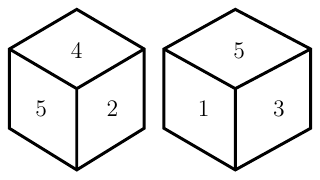
Question 11

Two positions of a dice are given below. What will come opposite to face containing '2'? 

  1. AOption (a)

    4

  2. BOption (b)

    3

  3. COption (c)

    1

  4. DOption (d)

    6

View answer & explanation

Correct answer

Answer: (c)C.

1

Why this answer is correct

For this question, the relation is given below :

  • From figures (I) and (II), '5' is common.

Now, we take the clockwise direction from '5' in figures (I) and (II) respectively.

  1. In figure (I), moving in clockwise direction from 5 we have '4' and '2' respectively.
  2. In figure (II), moving in clockwise direction from 5 we have '3' and '1' respectively.

​Therefore, we have:

Figure (I)Figure (II)
55
43
21

Thus,

  • 5 is opposite to 6.
  • 4 is opposite to 3.
  • 2 is opposite to 1​

Clearly, '1' is opposite to the face containing 2.

Hence, the correct answer is '1'.

Question 12

Eight persons A, B,C, D, E, F, G and H sit in a row facing towards the north (not necessarily in the same order). D sits third to the right of C. F sits second to the right of G. E sits to the immediate left of H. Two persons sits between A and D. One person sits between B and H.

Which of the following statements are correct?

I. One person sits between D and G.

ll. E sits third to the left of B.

IlI. F sits at an extreme end.

  1. AOption (a)

    I and II

  2. BOption (b)

    I and III

  3. COption (c)

    II and III

  4. DOption (d)

    I, II and III

View answer & explanation

Correct answer

Answer: (d)D.

I, II and III

Why this answer is correct

As per the question,

Eight persons A, B,C, D, E, F, G and H sit in a row facing towards the north (not necessarily in the same order).

  • D sits third to the right of C.

  • Two persons sits between A and D.

  • E sits to the immediate left of H.

  • One person sits between B and H.

There are two possibilities:

  • F sits second to the right of G.

Here, Case II will be eliminated as it contradicts the given condition.

Therefore, the final arrangement is:

Now,

I. One person sits between D and G → True

ll. E sits third to the left of B → True

IlI. F sits at an extreme end → True

Thus, all the given statements I, II, and III are true.

Hence, the correct answer is "I, II and III".

Question 13

In a certain code language, ‘You are bad’ is written as ‘@ # Ȯ’, ‘l know bad persons’ is written as ‘# $&, ‘You know me’ is written as '@^. What is the code for ‘me are bad’ in that code language?&nbsp$;

  1. AOption (a)

    ^ &

  2. BOption (b)

    # ^

  3. COption (c)

    ^ # Ȯ 

  4. DOption (d)

    * Ȯ

View answer & explanation

Correct answer

Answer: (c)C.

^ # Ȯ 

Why this answer is correct

The logic follows here is:

WordCode
You@
areȮ
bad#
I$/&
know*
persons$/&
me^


Thus, code for 'me are bad' is '^ # Ȯ '

  • me → ^
  • are → Ȯ
  • bad  → #

Hence, the correct answer is "^ # Ȯ".

Question 14

A series is given with one term wrong. Select that wrong term from the given alternatives.

16, 48, 24, 75, 34, 104, 46, 135, 70

  1. AOption (a)

    46

  2. BOption (b)

    34

  3. COption (c)

    48

  4. DOption (d)

    70

View answer & explanation

Correct answer

Answer: (d)D.

70

Why this answer is correct

Given Series : 16, 48, 24, 75, 34, 104, 46, 135, 70 

The logic followed here is:

Thr given series consists of two different number series such that:

Series I → 

"Next number in the Series I is obtained by adding consecutive even number starting from '8', to the previous number.

According to the logic, a consecutive even number is added to the previous numbers but in the given series even number i.e. '24' is added to the 4th term i.e. '46' which gives the wrong term of the series which is "70".

Therefore, the wrong term in the series is 70.

Series II → 

"Next number in the Series II is obtained by adding consecutive odd number starting from '27', from the previous number.

  • Thus, the correct series is:

Hence, the correct answer is "70".

Question 15

In the following question below are given some statements followed by some conclusions based on those statements. Taking the given statements to be true even if they seem to be at variance from commonly known facts. Read all the conclusions and then decide which of the given conclusion logically follows the given statements.

Statements:

I. All A are B.

II. Some B are C.

III. No C is D.

Conclusions:

I. Some A are not D.

ll. Some B are not D.

Ill. Some A are C.

  1. AOption (a)

    All conclusion follows  

  2. BOption (b)

    Only conclusion II follows 

  3. COption (c)

    Both conclusion I and III follows

  4. DOption (d)

    Both conclusion II and III follows 

View answer & explanation

Correct answer

Answer: (b)B.

Only conclusion II follows 

Why this answer is correct

Statements:

I. All A are B.

II. Some B are C.

III. No C is D.

The least possible diagram for the given statements is as follows:

Conclusions:

I. Some A are not D→ False (Because there is no direct relation between A and D so it is possible but not definite, so it is false)

ll. Some B are not D  → True (Because 'Some B are C' and 'No C is D', so some B that are C are not D, so it is definitely true)

Ill. Some A are C → False (Because there is no direct relation between A and C so it is possible but not definite, so it is false)

Hence, the correct answer is "Only conclusion II follows".

Question 16

The time in a clock is 3:00 am. If the hour hand points towards the west, then towards which direction is the minute hand pointing?

  1. AOption (a)

    South

  2. BOption (b)

    East

  3. COption (c)

    North

  4. DOption (d)

    West

View answer & explanation

Correct answer

Answer: (a)A.

South

Why this answer is correct

As per the given information,

The time in a clock is 3:00 am. If the hour hand points towards the west such that:

Clearly, the minute hand is pointing in 'South' direction.

Hence, the correct answer is "South".

Question 17

Arrange the given words in the sequence in which they occur in the dictionary.

  1. Xebecs
  2. Xanthic
  3. Xennial
  4. Xenons
  5. Xenias
  1. AOption (a)

    21534

  2. BOption (b)

    21345

  3. COption (c)

    21543

  4. DOption (d)

    21354

View answer & explanation

Correct answer

Answer: (a)A.

21534

Why this answer is correct

The arrangement of all the given words in the order in which they appear in an English dictionary is as shown below:

The letter X is common in all words, so we will start arranging the word from the second letter as per alphabetical order.

  1. Xanthic
  2. Xebecs
  3. Xenias 
  4. Xennial
  5. Xenons

Hence, the correct answer is "21534​".

Question 18

A team of four members is to be selected among eight members A, B, C, D, E, F, G and H. C has to be selected with H. B has to be selected with E. F cannot be selected with A. G cannot be selected with H. Which of the following members can be selected? 

  1. AOption (a)

    BCEF

  2. BOption (b)

    ACGH

  3. COption (c)

    ABCD

  4. DOption (d)

    BEAG

View answer & explanation

Correct answer

Answer: (d)D.

BEAG

Why this answer is correct

According to the given information:

A team of four members is to be selected among eight members A, B, C, D, E, F, G and H.

  • C has to be selected with H.
  • B has to be selected with E.

Possible cases:

Case ICase II
C HB E


  • G cannot be selected with H.

Possible cases:

Case ICase II
C H GB E G


  • F cannot be selected with A.

Possible cases:

Case ICase II
ABAB
C H FC H AB E G FB E G A


Here, a team of four members is to be selected so team BEGF or BEGA can be selected.

So, from the given options team 'BEAG' can be selected.

Hence, the correct answer is "BEAG".

Alternate Method 

According to the given information:

A team of four members is to be selected among eight members A, B, C, D, E, F, G and H.

  • C has to be selected with H.
  • B has to be selected with E.
  • G cannot be selected with H.
  • F cannot be selected with A.

On checking each option:

1) BCEF

→ Here, C and H are not selected together which contradicts the condition that 'C has to be selected with H'. Thus, this combination is not possible.

2) ACGH

→ Here, G and H are selected together which contradicts the condition that 'G cannot be selected with H'. Thus, this combination is not possible.

3) ABCD

→ Here, C and H are not selected together which contradicts the condition that 'C has to be selected with H'. Thus, this combination is not possible.

4) BEAG

→ This combination possible because it follows the given conditions that 'B has to be selected with E' ,'G cannot be selected with H' and 'F cannot be selected with A'.

Thus, team 'BEAG' can be selected.

Hence, the correct answer is "BEAG".

Question 19

In the following question, a group of letters is given. The letters of each group are related with the letters of the same group by some Logic/Rule/Relation. From the given alternatives, select a group of letters which follows the same Logic/Rule/Relation.

(XG, CK, HO)

  1. AOption (a)

    (LT, QX, VB) 

  2. BOption (b)

    (QS, VW, AB) 

  3. COption (c)

    (DN, HR, MV) 

  4. DOption (d)

    (AF, FJ, KM) 

View answer & explanation

Correct answer

Answer: (a)A.

(LT, QX, VB) 

Why this answer is correct

The logic follows here is:

  • (XG, CK, HO)

1) (LT, QX, VB) 

Clearly, (QW, PX, OY) follow the same logic as given in the question.

2) (QS, VW, AB) 

3) (DN, HR, MV)

4) (AF, FJ, KM) 

Hence, the correct answer is " (LT, QX, VB)".

Question 20

Seven cars C1, C2,C3, C4, C5, C6 and C7 have different prices. The price of C1 is more than the price of C4 and C5. The price of C3 is less than the price of C2. The price of only two cars is more than the price of C5. The price of C1 is not the highest. The price of C4 is more than the price of C2. The price of only one car is less than the price of C7.

Which of the following statement is correct?

i. The price of C1 is more than the price of C6.

Il. The price of C7 is more than the price of C3.

  1. AOption (a)

    Only I

  2. BOption (b)

    Neither I nor II

  3. COption (c)

    Both I and II

  4. DOption (d)

    Only II

View answer & explanation

Correct answer

Answer: (d)D.

Only II

Why this answer is correct

As per given question,

Seven cars C1, C2,C3, C4, C5, C6 and C7 have different prices.

  • The price of only two cars is more than the price of C5.
  • The price of only one car is less than the price of C7.

__ > __ > C5 > __ > __ > C7 > __    ---------(i)

  • The price of C1 is more than the price of C4 and C5.

​C1 > C4, C5    ---------(ii)

  • The price of C4 is more than the price of C2.
  • The price of C3 is less than the price of C2.

 C4 > C2 > C3  ---------(iii)

  • The price of C1 is not the highest.

On combining equation (i), (ii) and (iii) we get:

 C6 > C1 > C5 > C4 > C2 > C7 > C3

Now,

i. The price of C1 is more than the price of C6 → False

Il. The price of C7 is more than the price of C3 → True

Hence, the correct answer is "Only II".

General Awareness (20 questions)

Question 21

Which of the following is NOT an example of Alkali metal? 

  1. AOption (a)

    Magnesium 

  2. BOption (b)

    Sodium 

  3. COption (c)

    Potassium 

  4. DOption (d)

    Lithium 

View answer & explanation

Correct answer

Answer: (a)A.

Magnesium 

Why this answer is correct

The correct answer is Magnesium.

Key Points

  • Group 1 elements in the Periodic table are known as Alkali metals
  • When reacting with water, form Alkalis i.e. strong base which can neutralize the acid.
  • Lithium(Li),
  • Sodium(Na),
  • Francium (Fr),
  • Potassium (K),
  • Rubidium (Rb),
  • Cesium (Cs)
  • Hence Magnesium is NOT alkali metal.

Additional Information

GroupMeaningElements
Alkaline earth metalsWhen they react with water, they form Alkaline solutions (hydroxides)Calcium (Ca), Strontium (Sr), Beryllium (Be), Magnesium (Mg), Barium (Ba), and Radium (Ra).
Noble gasesThey don’t react with anything. Also called inert gases.Helium (He), Neon (Ne), Argon (Ar), Krypton (Kr), Xenon (Xe), Radon (Rn).
HalogensNon-metals and react with the metal to form the salt. Halogen=salt producing in GreekFluorine (F), chlorine (Cl), bromine (Br), Iodine (I), and Astatine (At).

Question 22

Which of the following is correct regarding GDP deflator?  

  1. AOption (a)

    Nominal GDP + Real GDP 

  2. BOption (b)

    Nominal GDP / Real GDP 

  3. COption (c)

    Nominal GDP × Real GDP

  4. DOption (d)

    Real GDP / Nominal GDP 

View answer & explanation

Correct answer

Answer: (b)B.

Nominal GDP / Real GDP 

Why this answer is correct

The correct answer is Nominal GDP / Real GDP.

Key Points

  • The GDP deflator, also called the implicit price deflator, is a measure of inflation.
  • It is the ratio of the value of goods and services an economy produces in a particular year at current prices to that of prices that prevailed during the base year.
  • GDP deflator = Nominal GDP / Real GDP
  • This ratio helps show the extent to which the increase in the gross domestic product has happened on account of higher prices rather than an increase in output.
  • Since the deflator covers the entire range of goods and services produced in the economy, as against the limited commodity baskets for the wholesale or consumer price indices, it is seen as a more comprehensive measure of inflation.

Additional Information

  • Real vs nominal GDP -GDP price deflator measures the difference between real GDP and nominal GDP.
  • Nominal GDP does not adjust for inflation, so changes in nominal GDP reflect both changes in production quantity and price level.
  • On the other hand, Real GDP adjusts for inflation and measures the value of all goods and services produced by an economy at constant prices (of a base year)
  • As a result, nominal GDP will most often be higher than real GDP in an expanding economy.
  • The formula to find the GDP price deflator: GDP price deflator = (nominal GDP ÷ real GDP) x 100.

Question 23

Which of the following is an indirect tax?

I. Corporation tax for firms

II. Excise tax

  1. AOption (a)

    Only I

  2. BOption (b)

    Neither I nor II

  3. COption (c)

    Only II

  4. DOption (d)

    Both I and II

View answer & explanation

Correct answer

Answer: (c)C.

Only II

Why this answer is correct

The correct answer is Only II.

Key Points

  • Indirect tax refers to the tax that is levied on goods and services.
  • Excise tax
  • Custom tax
  • Service tax
  • Market tax/vat
  • Entertainment tax
  • Hence statement 2 is correct.

Additional Information

  • A direct tax is a type of tax that is levied on an individual or organization's income or profits.
  • Wealth Tax
  • Property Tax
  • Corporate Tax
  • Income Tax

Question 24

Which of the following statement is correct?

I. Wheat requires moderate temperature and rainfall during growing season.

Il. Jute is also known as the ‘Golden Fibre’.

  1. AOption (a)

    Only I

  2. BOption (b)

    Only II

  3. COption (c)

    Neither I nor II

  4. DOption (d)

    Both I and II

View answer & explanation

Correct answer

Answer: (d)D.

Both I and II

Why this answer is correct

The correct answer is Both I and II.

Key Points

  • Wheat requires moderate temperature and rainfall during growing season and bright sunshine at the time of harvest.
  • Hence statement 1 is correct.
  • It thrives best in well drained loamy soil. Wheat is grown extensively in USA, Canada, Argentina, Russia, Ukraine, Australia and India. In India it is grown in winter.
  • Jute is known as golden fibre because of its shiny brown colour.
  • Hence statement 2 is correct.
  • Jute is the crop of hot and humid climates.
  • It requires a high temperature (24o C to 35o C) and heavy rainfall of 120 to 150 cm.

Question 25

By which amendment in the constitution of India, ‘Right to Property’ has been removed from the category of fundamental rights? 

  1. AOption (a)

    77th

  2. BOption (b)

    40th

  3. COption (c)

    44th

  4. DOption (d)

    42nd

View answer & explanation

Correct answer

Answer: (c)C.

44th

Why this answer is correct

The correct answer is 44th.

Key Points

  • 44th amendment in the constitution of India, ‘Right to Property’ has been removed from the category of fundamental rights.
  • The property right was deleted from the list of Fundamental Rights by the 44thAmendment Act, 1978. It is made a legal right under Article 300-A in Part XII of the Constitution.
  • It is not an exclusive legal right offered to citizens. Hence, Option 2 is correct.
  • Amendments for this purpose are made to article 19 and article 31 is deleted.
  • It is ensured that the removal of property from the list of fundamental rights would not affect the right of minorities to establish and administer educational institutions of their choice.
  • The 44thAmendment Act, 1978 inserted Article 300A in a new chapter IV of Part XII of the Constitution, thereby depriving the ‘right to property of its ‘fundamental right’ status.
  • Article 300 A of the constitution of India says that a person shall not be deprived of his property save by the authority of the law of the Lok Sabha.

Additional Information

  • 77th Amendment Act extended reservations for promotion in employment for Scheduled Castes and Tribes (SCs and STs).
  • The 40th Amendment Act of 1976 was applied to Article 297 of the constitution of India.
  • The 42nd Amendment of the Constitution of India was enacted in the year 1976.
  • It is officially known as the Constitution Act, 1976.
  • It was enacted during the Emergency by the Indian National Congress Head Indira Gandhi.
  • It is considered as the most controversial Constitutional Amendments in Indian history.
  • Added three new Directive Principles viz., equal justice and free legal aid, the participation of workers in the management of industries and protection of the environment, forests, and wildlife.

Question 26

What is the number of neutrons in an element 818X\rm^{18}_8X?

  1. AOption (a)

    10

  2. BOption (b)

    9

  3. COption (c)

    8

  4. DOption (d)

    18

View answer & explanation

Correct answer

Answer: (a)A.

10

Why this answer is correct

The correct answer is 10.

Key Points

  • Number of protons in an atom = Z
  • Number of electrons in an atom = Z
  • Number of nucleons in an atom = A
  • Number of neutrons in an atom = N = A – Z
  • Hence for X 
  • Z = 8
  • A = 18
  • No of neutrons = A – Z = 10

Additional Information

  • ATOMIC NUMBER: It is defined as the number of protons present in the nucleus. It is denoted by letter Z.
  • MASS NUMBER: The total number of protons and neutrons present in a nucleus is called the mass number of the element. It is denoted by letter A.

Question 27

Which of the following is largest freshwater lake of India? 

  1. AOption (a)

    Bhimtal

  2. BOption (b)

    Wular

  3. COption (c)

    Dal

  4. DOption (d)

    Loktak

View answer & explanation

Correct answer

Answer: (b)B.

Wular

Why this answer is correct

The correct answer is Wular.

Key Points

  • Wular Lake is the largest freshwater lake in India, which is situated at Bandipora District of Indian state Jammu & Kashmir.
  • Wular Lake is the 2nd largest fresh-water lake of Asia too, situated under the Haramuk Mountain range.
  • Wular Lake is spread around a total area of 200 square km covering almost 24 km in length while its breadth is 10 km.
  • River Jhelum is the main source of water for Wular Lake.
  • ‘Zaina Lank’ name small island also situated in its centre.

Additional Information

  • Bhimtal is a town and a nagar panchayat, near Nainital city in Nainital district in the state of Uttarakhand, India.
  • Dal is a lake in Srinagar, the summer capital of Jammu and Kashmir.
  • Loktak Lake is the largest freshwater lake in Manipur.

Question 28

Vardhamana Mahavira was ______ tirthankara of the Jainas. 

  1. AOption (a)

    22nd

  2. BOption (b)

    24th

  3. COption (c)

    21st

  4. DOption (d)

    23rd

View answer & explanation

Correct answer

Answer: (b)B.

24th

Why this answer is correct

The correct answer is 24th.

Key Points

  • Vardhamana Mahavira:
  • Vardhamana Mahavira was the 24th Tirthankara of the Jain tradition.
  • He was born at Kundagrama near Vaisali to Kshatriya parents Siddhartha and Trisala.
  • Bimbisara was the contemporary of Vardhamana Mahavira.
  • At the age of thirty, he became an ascetic and wandered for twelve years.
  • In the 13th year of his penance, he attained the highest spiritual knowledge called Kevala Gnana.

Additional Information

  • The three principles of Jainism, also known as Triratnas (three gems), are:
  • Right faith
  • Right knowledge
  • Right conduct.
  • Mahavira regarded all objects, both animate and inanimate, have souls and various degrees of consciousness.
  • He advocated a very holy and ethical code of life.
  • Even the practice of agriculture was considered sinful as it causes injury to the earth, worms, and animals.

Question 29

Which of the following statement is correct?

I. By-products of waste water treatment are sludge biogas. 

Il. Sewage is a solid waste.

  1. AOption (a)

    Only II

  2. BOption (b)

    Neither I nor II

  3. COption (c)

    Both I and II

  4. DOption (d)

    Only I

View answer & explanation

Correct answer

Answer: (d)D.

Only I

Why this answer is correct

The correct answer is Only I.

Key Points

  • Biogas and sludge are the products of wastewater treatment.
  • Hence statement 1 is correct.
  • Sewage is liquid waste which may contain solid contaminants such as faeces.
  • Hence statement 2 is incorrect.

Additional Information

  • The biogas forms due to the microbial degradation of the waste and sludge are the end by-product of the wastewater treatment.
  • The main by-product from wastewater treatment plants is sewage sludge which is usually treated in the same or another wastewater treatment plant.
  • Biogas can be another by-product if anaerobic treatment processes are used.

Question 30

Who composed Buddhacharita?

  1. AOption (a)

    Jaydev

  2. BOption (b)

    Banabhatta

  3. COption (c)

    Kalidas

  4. DOption (d)

    Ashvaghosha

View answer & explanation

Correct answer

Answer: (d)D.

Ashvaghosha

Why this answer is correct

The correct answer is Ashvaghosha.

Key Points

  • Ashvaghosha was a Sarvastivada Buddhist philosopher and poet.
  • He was born in Saketa in northern India.
  • Though Pali language literature was popular in Buddhism, Ashvaghosha wrote in Classical Sanskrit.
  • Buddhacharita written by Ashvaghosha is an epic on the life of the Buddha.
  • He also wrote Saundarananda, with the theme of the conversion of Nanda, Buddha's half-brother, so that he might reach salvation.
  • He is also thought to be the author of the Sutralankara.

Additional Information

  • Jaidev was the court poet of Bengal and the famous Sanskrit poet of the 12th century.
  • He composed the book Geet Govind, an important text of the Bhakti Movement.
  • It was composed in the 12th century.
  • Banabhatta is the author of Kadambari.
  • He was the court poet of Harsha who wrote his biography called Harshacharita.
  • Kalidas is a pioneer of Sanskrit literature - Shakuntala and Meghdutum are his famous plays.
  • Mahakavi Kalidas was known as the Shakespeare of India.
  • Malavikagnimitra is also written by Kalidas.

Question 31

Which article of Indian constitution is related to the fundamental duties of Indian citizens? 

  1. AOption (a)

    Article 50-A 

  2. BOption (b)

    Article 51-A 

  3. COption (c)

    Article 50-B 

  4. DOption (d)

    Article 51-B 

View answer & explanation

Correct answer

Answer: (b)B.

Article 51-A 

Why this answer is correct

The correct answer is Article 51-A.

Key Points

  • Article 51-A of Indian constitution is related to the fundamental duties of Indian citizens.
  • Fundamental Duties were added to the constitution in 1976.
  • It is inspired by the Constitution of the erstwhile USSR.
  • It was recommended by the Sardar Swaran Singh Committee.
  • Its need and necessity were felt during the operation of the internal emergency (1975-1977).

Additional Information

  • There are 11 fundamental duties, according to Article 51A, that are to be obeyed by all the citizens of the country:
  • To abide by the Indian Constitution and respect its ideals and institutions, the National Anthem, and the National Flag.
  • To follow the Noble ideals that inspired the national struggle for freedom.
  • To protect and uphold the sovereignty, integrity, and unity of the country.
  • To defend the nation and render national services when asked to do so.
  • To promote the spirit of Brotherhood and fraternity in the country.
  • To strive for excellence.
  • To protect the environment of the nation.
  • To value and preserve the rich heritage of the country's composite culture.
  • To safeguard public property and to deny violence.
  • To generate a scientific rationale for every thought.
  • To provide opportunities for education to children between the age of 6 and 14.

Question 32

“Losoong’ festival is celebrated in which state of India? 

  1. AOption (a)

    Nagaland 

  2. BOption (b)

    Mizoram

  3. COption (c)

    Sikkim

  4. DOption (d)

    Assam

View answer & explanation

Correct answer

Answer: (c)C.

Sikkim

Why this answer is correct

The correct answer is Sikkim.

Key Points

  • Losoong Festival is one of the most important festivals in Sikkim.
  • Losoong Festival is celebrated on the occasion of the end of the harvest season and at the end of the tenth month of Tibetan year in the rural Sikkim.
  • During this festival, the Chaam dances by the people of Sikkim are performed.

Additional Information

  • Sikkim is the northeastern state of India.
  • It borders Tibet in the north and northeast, Bhutan in the east, Nepal in the west, and West Bengal in the south.
  • The Capital of Sikkim is Gangtok.
  • It was founded by the Namgyal dynasty in the 17th century.
  • Kangchenjunga the highest peak of India and third highest on Earth is in the State of Sikkim.
  • Sikkim became a state of India by the 36th Amendment Act, 1975 on 26th April, 1975
Rivers1. Teesta 2. Rangit
National Park1. Khangchendzonga National Parks 2. Fambong Lho Wildlife Sanctuary 3. Singba Rhododendron Sanctuary 4. Kyongnosla Alpine Sanctuary 5. Maenam Wildlife Sanctuary 6. Varsey Rhododendron Sanctuary
Festivals1. Saga Dawa 2. Lhabab Dunchen 3. Losar Festival 4. Phang Lhabsol 5. Bumchu 6. Losoong 7. Tihaar
Famous Personalities1. Baichung Bhutia (Indian footballer) 2. Danny Denzongpa (Bollywood Actor)
Mountain Passes1. Nathula Pass 2. Jelep La Pass
Lakes1. Tsomgo Lake 2. Cholamu Lake

Question 33

Which of the following is largest state of India in terms of area?

  1. AOption (a)

    West Bengal

  2. BOption (b)

    Rajasthan

  3. COption (c)

    Uttar Pradesh

  4. DOption (d)

    Maharashtra

View answer & explanation

Correct answer

Answer: (b)B.

Rajasthan

Why this answer is correct

The correct answer is Rajasthan.

Key Points

  • Rajasthan is the largest state of India in terms of area.
  • It covers an area of 342,239 sq. km and has a population of 6.85 crores as per the 2011 census.
  • Uttar Pradesh is the largest state of India in terms of population.

Additional Information 

  • Area wise states-
S.noStates
1.Rajasthan
2.Madhya Pradesh
3.Maharashtra
4.Uttar Pradesh
  • Population wise states-
S.noStates
1.Uttar Pradesh
2.Maharashtra
3.Bihar
4.West Bengal

Question 34

Who has won the French open 2021 Men's singles title? 

  1. AOption (a)

    Rafale Nadal  

  2. BOption (b)

    Stefanos Tsitsipas 

  3. COption (c)

    Novak Djokovic 

  4. DOption (d)

    Roger Federer 

View answer & explanation

Correct answer

Answer: (c)C.

Novak Djokovic 

Why this answer is correct

The correct answer is Novak Djokovic.

Key Points

  • Novak Djokovic won the French Open in 2021.
  • He is from Serbia.
  • He is currently ranked as world No. 1 by the Association of Tennis Professionals (ATP).
  • He has won a joint record of 20 Grand Slam men's singles titles, including a record nine Australian Open titles.

Additional Information 

  • French Open is a Grand Slam level tennis tournament played on outdoor clay courts.
  • Winners of French Open 2021-​
EventsWinnerRunner Up
Men's SinglesNovak Djokovic (Serbia)Stefanos Tsitsipas (Greece)
Women's SinglesBarbora Krejcikova (Czech Republic)Anastasia Pavlyuchenko (Russia)
Men's DoublesPierre-Hugues Herbert(France) Nicolas Mahut (France)Alexander Bublik (Kazakhstan) Andrey Golubev (Kazakhstan)
Women's DoublesBarbora Krejcikova (Czech Republic) Katerina Siniakova (Czech Republic)Bethanie Mattek-Sands (America) Iga swiatek (Poland)
Mixed DoublesDesirae Krawczyk (America) Joe Salisbury (United Kingdom)Elena Vesnina (Russia) Aslan Karatsev (Russia)

Question 35

In which state, India’s first forest healing centre has been opened?  

  1. AOption (a)

    Manipur

  2. BOption (b)

    Madhya Pradesh

  3. COption (c)

    Karnataka

  4. DOption (d)

    Uttrakhand

View answer & explanation

Correct answer

Answer: (d)D.

Uttrakhand

Why this answer is correct

The correct answer is Uttrakhand.

Key Points

  • The First Forest Healing center of the country was inaugurated on 7 March 2021 at Ranikhet in Kalika, Uttarakhand.
  • The forest healing centre has been developed by the Research Wing of Uttarakhand Forest Department after research on the healing properties of the forests and its revitalizing impact on overall health and well-being.
  • It involves many activities like forest walking, tree-hugging, etc.

Question 36

In June 2021, the tenure of CEO of NITI Aayog ______ was extended by one year.

  1. AOption (a)

    V.K. Saraswat

  2. BOption (b)

    Rajiv kumar

  3. COption (c)

    Amitabh kant

  4. DOption (d)

    V.K. Paul

View answer & explanation

Correct answer

Answer: (c)C.

Amitabh kant

Why this answer is correct

The correct answer is Amitabh kant.

Key Points

  • In June 2021, the tenure of CEO of NITI Aayog Amitabh kant was extended by one year.
  • Amitabh Kant was the former CEO of the NITI Aayog.
  • Currently, Parameswaran Iyer is the CEO of NITI Aayog.(Dec 2022)
  • Suman Bery is the current Vice Chairman of the NITI Aayog.
  • Amitabh Kant is an IAS officer of the 1980 batch.

Additional Information

  • The National Institution for Transforming India, also called NITI Aayog, was formed via a resolution of the Union Cabinet on January 1, 2015.
  • NITI Aayog is the premier policy ‘Think Tank’ of the Government of India, providing both directional and policy inputs.
  • Chairperson - Shri Narendra Modi, Hon'ble Prime Minister.

Question 37

Priyanka Mohite has become first Indian woman to scale mount Annapurna. She belongs to which state of India?

  1. AOption (a)

    Maharashtra

  2. BOption (b)

    Uttar Pradesh

  3. COption (c)

    Punjab

  4. DOption (d)

    Uttrakhand

View answer & explanation

Correct answer

Answer: (a)A.

Maharashtra

Why this answer is correct

The correct answer is Maharashtra.

Key Points

  • Priyanka Mohite has become first Indian woman to scale mount Annapurna.
  • She belongs to Maharashtra, India.
  • Priyanka Mohite has climbed:
  • The world's highest peak Mount Everest (8,849 m) in 2013
  • Mount Lhotse (8,516 m) in 2018
  • Mount Makalu (8,485 m)
  • In April 2021, she had scaled Mt Annapurna (8,091 m), the 10th highest mountain peak in the world and had become the first Indian woman climber to achieve the feat.
  • In May 2022, she climbed Mount Kanchenjunga (8,586 m).

Additional Information

  • Mount Annapurna is the tenth highest mountain in the world at 8,091 meters (26,545 ft).
  • It is in the Annapurna massif of Nepal Himalayas.
  • It includes many peaks over 7,000 meters.
  • Mt. Everest is the highest peak in the world with a height of 8840 meters above the mean sea level.
  • It is known as Sagarmatha in Nepal and Chomolungma in Tibet.
  • It is named after a Surveyor General of India George Everest.

Question 38

Which of the following statement is correct?

I. Most of the Ashoka’'s inscriptions were in Prakrit language.

Il. Kalinga is the ancient name of coastal Orissa.

  1. AOption (a)

    Neither I nor II

  2. BOption (b)

    Both I and II

  3. COption (c)

    Only II

  4. DOption (d)

    Only I

View answer & explanation

Correct answer

Answer: (b)B.

Both I and II

Why this answer is correct

The correct answer is Both I and II.

Key Points

  • Most of the scripts of Asoka are written in three languages – Prakrit, Greek and Aramaic.
  • Prakrit inscriptions are mainly written in the Kharosthi and Brahmi scripts.
  • Hence statement 1 is correct.
  • The ancient name of coastal Orissa was Kalinga.
  • The Kalinga was invaded by the Mauryan emperor Ashoka in 261 BCE in the Kalinga War.
  • Orissa and Utkalam are also the old names of Odisha.
  • Hence statement 2 is correct.

Additional Information

  • Ashoka (273 BC-232 BC): 
  • He was the greatest Mauryan ruler, Governor of Taxila and Ujjain.
  • He was the son of Bindusara.
  • His rule extended to the whole of the sub-continent which included Afghanistan, Baluchistan, Kashmir, and the valleys of Nepal except the extreme south.
  • Under Ashoka, the Mauryan Empire reached its climax.
  • Ashoka fought the Kalinga War in 261 BC. Later, he was moved by the massacre in this war and, therefore, abandoned the policy of physical occupation in favor of the policy of cultural conquest.
  • He embraced Buddhism under Upagupta.
  • He sent his son Mahendra and daughter Sanghamitra to Ceylon (Sri Lanka) as Buddhist missionaries with a sapling of the original peepal tree.
  • He inaugurated Dhamma Yatras from the 11th year of his reign by visiting Bodh Gaya and also appointed Dhamma Mahamatras (officer of righteousness to spread the message of Dhamma).

Question 39

Which city will host the 2024 Olympic games? 

  1. AOption (a)

    Munich

  2. BOption (b)

    Los Angeles

  3. COption (c)

    Paris

  4. DOption (d)

    London

View answer & explanation

Correct answer

Answer: (c)C.

Paris

Why this answer is correct

The correct answer is Paris.

Key Points

  • The host city of the 2024 Summer Olympics is Paris, France.
  • The Motto is Made for Sharing.
  • Skateboarding, sport climbing, surfing, and breaking have been confirmed as the additional sports proposed for inclusion at the Paris Olympic Games in 2024.
  • Los Angeles, California, United States will host the 2028 Summer Olympics.
  • The Tokyo Summer Olympic Games will be held from July 23 to August 8, 2021.
  • They were originally set to take place from July 24 to August 9, 2020, but were postponed because of the COVID-19 pandemic.

Additional Information 

  • Host cities for Summer and Winter Olympic Games:
  • Summer Olympic Games
  • The 2020 Summer Olympic Games were held in Tokyo, Japan
  • The 2024 Summer Olympic Games will be held in Paris
  • Winter Olympic Games
  • The 2022 Winter Olympic Games were held in Beijing, China
  • The 2026 Winter Olympic Games will be held in Italy

Question 40

Which of the following is NOT a world Heritage site? 

  1. AOption (a)

    Humayun’s Tomb, Delhi

  2. BOption (b)

    Sun Temple, Konark

  3. COption (c)

    Elephanta Caves

  4. DOption (d)

    Gateway of India

View answer & explanation

Correct answer

Answer: (d)D.

Gateway of India

Why this answer is correct

The correct answer is **Gateway of India.**​

Key Points

  • The Gateway of India is located in Mumbai.
  • It is NOT a world Heritage site.
  • It was constructed in 1924.
  • The main objective behind the construction of the Gateway of India was to commemorate the visit of King George V and Queen Mary to Bombay (Mumbai).
  • In March 1911, Sir George Sydenham Clarke, who was then the Governor of Bombay, laid down the monument's foundation.
  • The architectural design of the Gateway of India was done by the architect George Wittet.

Additional Information

  • There are 40 World heritage sites in India and they are as follows:(Dec 2022)
  1. Taj Mahal, Agra
  2. Khajuraho, Madhya Pradesh
  3. Hampi, Karnataka
  4. Ajanta Caves, Maharashtra
  5. Ellora Caves, Maharashtra
  6. Sun Temple, Konark, Odisha
  7. Red Fort Complex, Delhi
  8. Sanchi, Madhya Pradesh
  9. Chola Temples, Tamil Nadu
  10. Group of Monuments at Mahabalipuram, Tamil Nadu
  11. Humayun’s Tomb, New Delhi
  12. Jantar Mantar, Jaipur, Rajasthan
  13. Agra Fort, Uttar Pradesh
  14. Fatehpur Sikri, Uttar Pradesh
  15. Rani Ki Vav, Patan, Gujarat
  16. Group of Monuments at Pattadakal, Karnataka
  17. Elephanta Caves, Maharashtra
  18. Nalanda Mahavihara (Nalanda University), Bihar
  19. Chhatrapati Shivaji Maharaj Terminus (formerly Victoria Terminus), Maharashtra
  20. Mountain Railways of India
  21. Qutub Minar and its Monuments, New Delhi
  22. Champaner-Pavagadh Archaeological Park, Gujarat
  23. Hill Forts of Rajasthan
  24. Churches and Convents of Goa
  25. Rock Shelters of Bhimbetka, Madhya Pradesh
  26. The Victorian and Art Deco Ensemble of Mumbai
  27. The Pink City - Jaipur
  28. The Historic City of Ahmedabad
  29. Capitol Complex, Chandigarh
  30. Kaziranga Wild Life Sanctuary, Assam
  31. Sundarbans National Park, West Bengal
  32. Great Himalayan National Park, Himachal Pradesh
  33. Manas Wild Life Sanctuary, Assam
  34. Keoladeo National Park, Bharatpur, Rajasthan
  35. Nanda Devi and Valley of Flowers National Parks, Uttarakhand
  36. Western Ghats
  37. Mahabodhi Temple Complex at Bodh Gaya, Bihar
  38. Khangchendzonga National Park
  39. Kakatiya Rudreshwara (Ramappa) Temple
  40. Dholavira: A Harappan City

Arithmetic Ability (20 questions)

Question 41

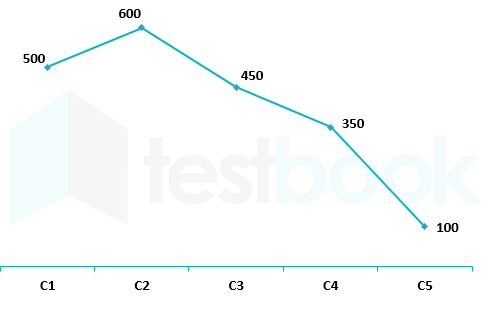
The line chart given below shows the number mobile sold by 5 different companies.

What is the difference of number of mobiles sold by C3 and C5?

  1. AOption (a)

    250

  2. BOption (b)

    200

  3. COption (c)

    300

  4. DOption (d)

    350

View answer & explanation

Correct answer

Answer: (d)D.

350

Why this answer is correct

Given

The number of mobiles sold by C3 = 450

The number of mobiles sold by C5 = 100

Solution

The difference of the number of mobiles sold by C3 and C5 = 450 - 100

⇒ 350

Question 42

A train of length 110 metre is moving with a speed of 36 kilometre/hour. The time taken by the train to cross a bridge of length 122 metre is:

  1. AOption (a)

    23.2 seconds

  2. BOption (b)

    24.2 seconds

  3. COption (c)

    11.0 seconds

  4. DOption (d)

    16.4 seconds

View answer & explanation

Correct answer

Answer: (a)A.

23.2 seconds

Why this answer is correct

Given:

A train of length 110 metres is moving with the speed of 36 kilometre/hour.

Bridge of length 122 metre

Formula used:

Speed = Distance/Time

Calculation:

Speed = 36 km/hr

Convert into km/hr to m/sec

⇒ 36 × (5/18)

⇒ 10 m/sec

Total distance = Length of train + Length of Bridge

⇒ 110 + 122

⇒ 232 m

Time = distance/time

⇒ 232/10

⇒ 23.2 sec

∴ The time taken by the train to cross a bridge of length 122 metre is 23.2 sec.

Question 43

Suresh sells a car at the loss of 36 percent. What will be the ratio of cost price to selling price?

  1. AOption (a)

    16 ∶ 15

  2. BOption (b)

    20 ∶ 13

  3. COption (c)

    5 ∶ 4

  4. DOption (d)

    25 ∶ 16

View answer & explanation

Correct answer

Answer: (d)D.

25 ∶ 16

Why this answer is correct

Given

Loss% = 36%

Formula

C.P - S.P = loss

Solution

Let the C.P be 100x

Then,

S.P = 100x - 36x

⇒ 64x

The ratio of cost price to the selling price:

⇒ 100x : 64x or 25 : 16

Question 44

Two taps A and B can fill a tank alone in 6 hours and 9 hours respectively while a third tap C alone can empty the same tank in 18 hours. If all the three taps are opened together, then in how many hours the tank will be filled?

  1. AOption (a)

    5 hours

  2. BOption (b)

    3.5 hours

  3. COption (c)

    6 hours

  4. DOption (d)

    4.5 hours

View answer & explanation

Correct answer

Answer: (d)D.

4.5 hours

Why this answer is correct

Shortcut Trick

Total capacity of the tank = LCM(6, 9, 18) = 18 units

Efficiency of filling Tap A = 18 ÷ 6 = 3 units/h

Efficiency of filling Tap B = 18 ÷ 9 = 2 units/h

Efficiency of emptying Tap C = 18 ÷ (−18) = −1 units/h

Time taken together = Total capacity ÷ Combined efficiency = 18 ÷ (3 + 2 − 1) = 18 ÷ 4 = 4.5 hours

∴ The correct answer is 4.5 hours.

Alternate Method

Given:

Time taken by tap A to fill the tank = 6 hours

Time taken by tap B to fill the tank = 9 hours

Time taken by tap C to empty the tank = 18 hours

Concept Used:

Total Capacity = LCM of individual times

Efficiency = Total Capacity ÷ Time

TapTime (hours)Total Capacity (units)Efficiency (units/h)
A6183
B92
C18−1

Calculations:

⇒ Total efficiency of A, B and C together = 3 + 2 − 1 = 4 units/h

⇒ Time taken by all taps together = Total Capacity ÷ Total Efficiency

⇒ Time taken = 18 ÷ 4 = 4.5 hours

∴ The correct answer is 4.5 hours.

Additional Information

Pipes & Cisterns

If a pipe can fill a tank in x hours, its efficiency is considered positive (+1/x). If an outlet pipe empties the tank in y hours, its efficiency is considered negative (−1/y).

Work & Wages

Wages are distributed in the ratio of the total work done by each person. If workers work for the same number of days, the ratio of their wages equals the ratio of their individual efficiencies.

Alternate Day Work

When persons or pipes operate on alternate days/hours, find the combined work of one complete cycle (e.g., 2 hours for 2 pipes) and scale it up to reach close to the total work.

Question 45

Which is the smallest three-digit number that when increased by 6 becomes divisible by both 4 and 6? 

  1. AOption (a)

    114

  2. BOption (b)

    116

  3. COption (c)

    112

  4. DOption (d)

    102

View answer & explanation

Correct answer

Answer: (d)D.

102

Why this answer is correct

Given:

The smallest three-digit number when increased by 6 becomes divisible by both 4 and 6.

Concept:

LCM of 4 and 6.

Multiples of of the LCM of 4 and 6.

Solution:

As per the question,

The smallest three-digit number which is divisible by 4 and 6 will be the multiple of their LCM.

LCM of 4 and 6 is 12

The multiples of 12 are as follows,

12, 24, 36, 48, 60, 72, 84, 96, 108

A three-digit multiple of LCM of 4 and 6 is 108.

Subtracting 6 from 108 we will get,

108 - 6 = 102.

Therefore, 102 is the smallest three-digit number when increased by 6 and becomes divisible by both 4 and 6.

Hence, option 4 is correct.

Question 46

Rs. 10000 is divided among P, Q and R in the ratio of 7 ∶ 8 ∶ 10 respectively. What is the share of Q?

  1. AOption (a)

    Rs. 3200

  2. BOption (b)

    Rs. 2400

  3. COption (c)

    Rs. 2800

  4. DOption (d)

    Rs. 4000

View answer & explanation

Correct answer

Answer: (a)A.

Rs. 3200

Why this answer is correct

Given:

Rs. 10000 is divided among P, Q, and R in the ratio of 7 ∶ 8 ∶ 10 respectively.

Concept:

The sum of the proportion of P, Q, and R will be equal to Rs. 10000

Solution:

As per the question,

Rs. 10000 is divided among P, Q, and R in the ratio of 7 ∶ 8 ∶ 10 respectively.

Let us assume the amount Rs. 10000 is divided as 7x, 8x, and 10x among P, Q, and R respectively.

Now,

7x + 8x + 10x = 10000

25x = 10000

x = 400

The share of Q i.e. 8x is 8(400) = Rs. 3200

Hence, option 1 is correct.

Question 47

what is the value of 13 + 23 + ......... 103 ?

  1. AOption (a)

    3025

  2. BOption (b)

    2755

  3. COption (c)

    3315

  4. DOption (d)

    2305

View answer & explanation

Correct answer

Answer: (a)A.

3025

Why this answer is correct

Given:

The given cubic sum is as follows,

 13 + 23 + ......... 103

Concept:

The sum of the cube of the first n natural number is [n(n+1)2]2{[\frac{n(n+1)}{2}]}^2

Solution:

As per the given cubic sum n = 10

Substituting the value of n in [n(n+1)2]2{[\frac{n(n+1)}{2}]}^2 we will get,

[n(n+1)2]2=[10×112]2{[\frac{n(n+1)}{2}]}^2={[\frac{10\times 11}{2}]}^2

552=302555^2=3025

Hence, option 1 is correct.

Question 48

If 6/7 of 35 percent of a number is 330, then what is the number?

  1. AOption (a)

    1210

  2. BOption (b)

    1200

  3. COption (c)

    1100

  4. DOption (d)

    1150

View answer & explanation

Correct answer

Answer: (c)C.

1100

Why this answer is correct

Given:

6/7 of 35 percent of a number is 330.

Concept:

The a % of a number X is a100×X\frac{a}{100}\times X

Solution:

Let the number be x

35 percent of the number x is,

35x100\frac{35x}{100}

67\frac{6}{7} of 35 percent of the number x will be,​

67×35x100\frac{6}{7}\times\frac{35x}{100}

As per the question,

6/7 of 35 percent of a number is 330,​

67×35x100=330\frac{6}{7}\times\frac{35x}{100}=330

x = 1100

Hence, option 3 is correct.

Question 49

Which of the following statement is correct?

I. If side of a cube is 45 cm, then total surface area of this cube is 12150 cm2.

Il. Radius of base and height of a cylinder are 7 cm and 12 cm respectively. Total surface area of this cylinder is 682 cm2.

  1. AOption (a)

    Only I

  2. BOption (b)

    Neither I nor II

  3. COption (c)

    Only II

  4. DOption (d)

    Both I and II

View answer & explanation

Correct answer

Answer: (a)A.

Only I

Why this answer is correct

Given:

I. If the side of a cube is 45 cm, then the total surface area of this cube is 12150 cm2.

Il. The radius of the base and height of the cylinder is 7 cm and 12 cm respectively. The total surface area of this cylinder is 682 cm2. 

Concept:

The total surface area of a cube having a side as "a" unit is "6a2" square unit.

The total surface area of a cylinder having a radius of the base and height as "r" unit and "h" unit respectively is 2πr(r+h)2 \pi r(r+h) square unit.

Solution:

As per the data given in the question,

I. If the side of a cube is 45 cm, then the total surface area of this cube is 12150 cm2.

The total surface area of a cube having a side of 45 cm is,

6a2 = 6 x (45)2 = 12150 cm2.

Statement I is correct.

Il. The radius of the base and height of the cylinder is 7 cm and 12 cm respectively. The total surface area of this cylinder is 682 cm2. 

The total surface area of a cylinder having a radius of the base and height as 7 cm and 12 cm respectively is,

 2πr(r+h)=2×227×7(7+12)=44×19=836 cm22 \pi r(r+h)=2 \times \frac{22}{7}\times 7(7+12)=44 \times19=836 \ cm^2

Statement II is incorrect. 

Hence, option 1 is correct.

Question 50

Length of the one diagonal of a rhombus is 30 cm. If the area of the rhombus is 300 cm2, then what will be length of the other diagonal?

  1. AOption (a)

    15 cm

  2. BOption (b)

    25 cm

  3. COption (c)

    20 cm

  4. DOption (d)

    18 cm

View answer & explanation

Correct answer

Answer: (c)C.

20 cm

Why this answer is correct

Given:

The length of the one diagonal of a rhombus is 30 cm.

The area of the rhombus is 300 cm2.

Concept:

The area of a rhombus with diagonals as D1 and D2 is 12×D1×D2\frac{1}{2}× D_1× D_2 square units.

Solution:

As per the question,

The length of the one diagonal of a rhombus is 30 cm.

Let us assume the other diagonal is D2 cm.

Now,

The area of the rhombus is 300 cm2 = 12×D1×D2\frac{1}{2}× D_1× D_2

1/2 × 30 × D2 = 300

⇒ D2 = 20cm

Hence, option 3 is correct.

Question 51

What is the value of positive square root of 54 + 14√5 ?

  1. AOption (a)

    2 + 2√5

  2. BOption (b)

    8 + √5

  3. COption (c)

    7 + √5

  4. DOption (d)

    3 + 2√5

View answer & explanation

Correct answer

Answer: (c)C.

7 + √5

Why this answer is correct

Given:

The value of the positive square root of 54 + 14√5 .

Concept:

The algebraic identity,

(a+b)2 = a2 + b2 + 2ab

Solution:

The number is given as,

 54 + 14√5 

Simplifying the number as follows,

49 + 5 + 14√5

(7)2 + (√5)2 + 2x7x√5

Comparing the above with,

a2 + b2 + 2ab

a = 7

b = √5

Therefore,  54 + 14√5 can be expressed as (7 + √5)2

Now, the positive square of 54 + 14√5 will be the square root of,

 (7+5)2=7+5 \sqrt{(7+\sqrt5)^2}=7+\sqrt5 

 Hence, option 3 is correct.

Question 52

The angles of a triangle are in the ratio 7 ∶ 6 ∶ 5. What is the largest angle of the triangle?

  1. AOption (a)

    70 degree

  2. BOption (b)

    90 degree

  3. COption (c)

    105 degree

  4. DOption (d)

    75 degree

View answer & explanation

Correct answer

Answer: (a)A.

70 degree

Why this answer is correct

Given:

The angles of a triangle are in the ratio 7 ∶ 6 ∶ 5.

Concept:

The angle sum property of a triangle states that the sum of all three angles of a triangle is 180o .

Solution:

As per the question,

The angles of a triangle are in the ratio 7 ∶ 6 ∶ 5

Using the angle sum property of the triangle, we have

7x + 6x + 5x = 180o 

18x = 180o 

x = 10o

The largest angle of the triangle is 7x i.e., 70o .

Hence,, option 1 is correct.

Question 53

The pie chart given below shows the amount spent by a house wife on 8 different articles. The total amount spent on all these 8 articles is Rs. 40000. Amount spent on a particular article is shown as a percentage of total amount spent on all these 8 articles.

Which of the following statement is correct?

I. The total amount spent by a house wife on articles W and R is Rs. 7600.

Il. The sum of central angle formed by sector S and T are 105.2 degree.

  1. AOption (a)

    Neither I nor II

  2. BOption (b)

    Only I

  3. COption (c)

    Only II

  4. DOption (d)

    Both I and II

View answer & explanation

Correct answer

Answer: (b)B.

Only I

Why this answer is correct

Given:

The pie chart given below shows the amount spent by a housewife on 8 different articles. The total amount spent on all these 8 articles is Rs. 40000. Amount spent on a particular article is shown as a percentage of the total amount spent on all these 8 articles.

Concept:

The % of a number X is a100×X\frac{a}{100}\times X.

The total central angle in a pie chart is 360o.

Solution:

As per the question,

Statement - I

The total amount spent by a housewife on articles W and R is Rs. 7600.

Percent that articles W and R holds is 6% and 13% respectively.

Percent (W + R) = 19%

19% of Rs. 40000 is as follows,

(19/100)x40000 = Rs. 7600

Therefore, Statement - I is correct.

Statement - II

The sum of the central angle formed by sector S and T are 105.2 degrees. 

The percentage acquired by S and T is 15% and 17% respectively.

Percent (S + T) = 32%

32% of the total angle formed at the center of the pie chart i.e., 360o is as follows,

32% of 360o is as follows,

(32/100)x360 = 115.2o

Therefore, Statement - II is incorrect.

Hence, option 2 is correct.

Question 54

A runner starts running from a point at 6:00 am at the speed of 5 km/hr. Second runner starts from the same point at 8:00 am in the same direction with a speed of 10 km/hr. At what time will the second runner will overtake the first runner?  

  1. AOption (a)

    1:00 pm

  2. BOption (b)

    10:00 am

  3. COption (c)

    12:00 pm

  4. DOption (d)

    11:00 am

View answer & explanation

Correct answer

Answer: (b)B.

10:00 am

Why this answer is correct

Given:

A runner starts running from a point at 6:00 am at the speed of 5 km/hr. The second runner starts from the same point at 8:00 am in the same direction with a speed of 10 km/hr.

Concept:

The relation between distance, speed, and time is as follows,

Speed=DistanceTimeSpeed=\frac{Distance}{Time}

Solution:

The distance covered by the runner in 2 hours who started from a point at 6:00 am 

Distance = Speed x Time = 5 x 2 = 10 km

The time taken by the second runner to cover the distance of 10 km is as follows,

10km10km/hr−5km/hr=2 hr\frac{10km}{10km/hr-5km/hr}=2 \ hr

Since the second runner started at 8:00 am, so time at which the second runner will overtake the first runner will be,

8:00 am + 2 = 10:00 am.

Hence, option 2 is correct.

Question 55

The bar graph given below shows the birth rate and death rate of 6 different states.

Which of the following statement is correct?

I. The birth rate of state A is 16.66 percent of birth rate of state D.

Il. The ratio of birth rate of state E to the death rate of state E are 5 ∶ 3.

  1. AOption (a)

    Both I and II

  2. BOption (b)

    Only II

  3. COption (c)

    Only I

  4. DOption (d)

    Neither I nor II

View answer & explanation

Correct answer

Answer: (a)A.

Both I and II

Why this answer is correct

Given:

The bar graph given below shows the birth rate and death rate of 6 different states.

Concept:

For given two numbers A and B,

As compared to B, A will be AB×100\frac{A}{B}\times100

Solution:

As per the question,

Statement - I

The birth rate of state A is 16.66 percent of the birth rate of state D.

The birth rate of State A is 1.5.

The birth rate of State D is 9.

As compared to State D, the birth rate of State A is as follows

(1.5/9)x100 = 16.66%

Therefore, Statement - I is correct.

Statement - II

The ratio of the birth rate of state E to the death rate of state E is 5 ∶ 3. 

The birth rate of State E is 7.5.

The death rate of State E is 4.5.

The ratio is as follows, 7.5 : 4.5 = 5 : 3

Therefore, Statement - II is correct.

Hence, option 1 is correct.

Question 56

If (5 + 3√2)2 = 43 + Q√2, then what is the value of Q?

  1. AOption (a)

    40

  2. BOption (b)

    20

  3. COption (c)

    30

  4. DOption (d)

    15

View answer & explanation

Correct answer

Answer: (c)C.

30

Why this answer is correct

Given:

(5 + 3√2)2 = 43 + Q√2.

Concept:

The algebraic identity 

(a + b)2 = a2 + b2 + 2ab

Solution:

The given expression is as follows,

(5 + 3√2)2 = 43 + Q√2

25 + 18 + 30√2 = 43 + Q√2

43 + 30√2 = 43 + Q√2

Comparing the above, we will get

Q = 30

Hence, option 3 is correct.

Question 57

If the ratio of marked price and selling price of an article is 3 ∶ 2 respectively, then what is the discount percentage?  

  1. AOption (a)

    33.33 percent

  2. BOption (b)

    75 percent

  3. COption (c)

    50 percent

  4. DOption (d)

    60 percent

View answer & explanation

Correct answer

Answer: (a)A.

33.33 percent

Why this answer is correct

Given:

The ratio of the marked price and selling price of an article is 3 ∶ 2 respectively.

Concept:

Discount = Marked Price - Selling Price

Discount % = DiscountMarked Price×100\frac{Discount}{Marked \ Price}\times100

Solution:

According to the question,

The ratio of the marked price and selling price of an article is 3 ∶ 2 respectively.

Assume the marked price as 3x and the selling price as 2x.

Discount = Marked Price - Selling Price = 3x - 2x = x

Discount % = DiscountMarked Price×100\frac{Discount}{Marked \ Price}\times100

Discount % = x3x×100=33.33%\frac{x}{3x}\times100=33.33\%

Hence, option 1 is correct.

Question 58

If P percent of P is 225, then what is the value of P2?

  1. AOption (a)

    20500

  2. BOption (b)

    22550

  3. COption (c)

    20050

  4. DOption (d)

    22500

View answer & explanation

Correct answer

Answer: (d)D.

22500

Why this answer is correct

Given:

The P percent of P is 225.

Concept:

The a % of a value X is a100×X\frac{a}{100}\times X

Solution:

As per the question,

P percent of P is P100×P\frac{P}{100}\times P

 P100×P=225\frac{P}{100}\times P=225

P2=22500P^2=22500

Hence, option 4 is correct.

Question 59

The sum of a natural number and its positive square root is 182. What is the value of the number?

  1. AOption (a)

    169

  2. BOption (b)

    125

  3. COption (c)

    121

  4. DOption (d)

    144

View answer & explanation

Correct answer

Answer: (a)A.

169

Why this answer is correct

Given:

The sum of a natural number and its positive square root is 182.

Concept:

The algebraic identity,

(a + b)2 = a2 + b2 + 2ab

Solution:

Let the number be x, so the positive square root will be x\sqrt x

As per the question,

The sum of a natural number and its positive square root is 182.

x+x=182x+\sqrt x=182

Let x = y2 and x\sqrt x = y

y2 + y = 182

y2 + y - 182 = 0

y2 + 14y - 13y - 182 = 0

(y + 14)x(y - 13) = 0

y = -14 and 13

Since y = x\sqrt x i.e., a positive square root.

So y will be taken as 13.

And, x = y2 = 132 = 169

Hence, option 1 is correct.

Question 60

What is that yearly rate of simple interest at which a sum of money becomes three times of itself in 40 years?

  1. AOption (a)

    5 percent

  2. BOption (b)

    6 percent

  3. COption (c)

    5.60 percent

  4. DOption (d)

    7.5 percent

View answer & explanation

Correct answer

Answer: (a)A.

5 percent

Why this answer is correct

Given

Time = 40 years

Principal = 3x

Formula

S.I = PRT/100

Solution

Let the initial principal be x.

Then the principal after 40 years = 3x

So, the interest of 2x(3x - x) is earned in 40 years.

⇒ 2x =( x × r × 40)/100

⇒ r = 200/40 = 5%

General English (20 questions)

Question 61

Choose the word that means the same as the given word.

Cogent

  1. AOption (a)

    Feeble

  2. BOption (b)

    Dreamy

  3. COption (c)

    Convincing

  4. DOption (d)

    Indecisive

View answer & explanation

Correct answer

Answer: (c)C.

Convincing

Why this answer is correct

The correct answer is Option 3.

Key Points

  • The given word "Cogent" means something that is clear, logical, lucid and convincing.
  • From the given options Option 3 closely resembles the given word.
  • Convincing means the capacity to make someone believe
  • Convincing and Cogent convey the same meaning.

Thus, Option 3 which is 'Convincing' is the correct answer.

Additional Information

  • Let's have a look at the other options.
  • Feeble: weak, having no strength.
  • Dreamy: having pleasantly unreal quality.
  • Indecisive: having no clear meaning or result.

Question 62

Select the most appropriate option to substitute the underlined segment in the given sentence. If no substitution is required, select ‘No improvement’ as your answer.

Neither does she not her parents like that person.

  1. AOption (a)

    nor her parents like 

  2. BOption (b)

    not her parents liked

  3. COption (c)

    No improvement

  4. DOption (d)

    nor her parent like

View answer & explanation

Correct answer

Answer: (a)A.

nor her parents like 

Why this answer is correct

The correct option is Option 1.

Key Points

  • In the given sentence 'not her parents like' is the erroneous part, in that place 'nor her parents like' will come.
  • In grammar there are correlative conjunctions which always come in pair like Either...or, Neither...nor, Not only...but also.
  • In such correlative conjunctions the verb depends on the latter subject 
  • For ex: Neither Sam nor his friends are coming to the party.

Therefore, the correct answer is Option 1 nor her parents like.

Question 63

Select the most appropriate option to substitute the underlined segment in the given sentence. If no substitution is required, select ‘No improvement’ as your answer.

The soup was as thick as molasses.

  1. AOption (a)

    so thick as

  2. BOption (b)

    as thicker much 

  3. COption (c)

    as thickest such 

  4. DOption (d)

    No improvement 

View answer & explanation

Correct answer

Answer: (d)D.

No improvement 

Why this answer is correct

The correct option is Option 4.

Key Points

  • The given sentence is of comparative degree which is comparing soup with molasses.
  • The comparison is taking place between like entities so 'as thick as' is the correct phrase for comparison
  • Hence 'The soup was as thick as molasses is correct.

Hence the answer is Option 4 No improvement.

Question 64

Choose the word that is opposite in meaning to the given word.

Sterling

  1. AOption (a)

    Sapid 

  2. BOption (b)

    Atrocious

  3. COption (c)

    Legal

  4. DOption (d)

    Valid

View answer & explanation

Correct answer

Answer: (b)B.

Atrocious

Why this answer is correct

The correct answer is Option 2. 

Key Points

  • The meaning of the word Sterling is exceptional, of the highest quality or order, the cream of the lot.
  • The meaning of the word Atrocious is dreadful, of the worst quality.
  • As opposite of Sterling is asked and hence Atrocious is the correct option as the meaning as opposite in nature.

Hence the correct answer is Option 2 Atrocious.

Additional Information

  • Let's have a look at the other words given. 
  • Sapid: Having pleasant and strong taste.
  • Legal: Abiding by law.
  • Valid: Legally binding, correct.

Question 65

In the following question, out of the given four alternatives, select the alternative which best expresses the meaning of the Idiom/Phrase.

All the rage

  1. AOption (a)

    To instigate

  2. BOption (b)

    To issue shares

  3. COption (c)

    Very popular

  4. DOption (d)

    Escaping by a narrow margin  

View answer & explanation

Correct answer

Answer: (c)C.

Very popular

Why this answer is correct

The correct answer is Option 3.

Key Points

  • The phrase 'All the rage' means to be very popular at a particular time.
  • This phrase is used to a cult, person or thing that is very popular and famous.
  • For ex: Bitcoin has had all the rage among young investors who want to make a quick buck.
  • Therefore, the correct answer is Option 3 Very popular.

Additional Information

  • Let's understand the meaning of other given phrases.
  • ​To instigate: to put in motion
  • Escaping by a narrow margin: To be saved by small margin.

Question 66

Rearrange the parts of the sentence in correct order.

The revival of calligraphy

P: artistic reaction against the

Q: in Great Britain at the end of the

R:19th century was part of a broader

S: mechanization of manual crafts

  1. AOption (a)

    PSRQ

  2. BOption (b)

    SPRQ

  3. COption (c)

    QRPS

  4. DOption (d)

    QRSP

View answer & explanation

Correct answer

Answer: (c)C.

QRPS

Why this answer is correct

The correct option is Option 3.

Key Points

  • This paragraph talks about calligraphy as the introducing statement is about revival of calligraphy.
  • After the introducing statement place where calligraphy is reviving should be mentioned which is given in Q.
  • R speaks about the time when calligraphy revival takes place.
  • P gives more idea about the situation
  • S gives a comparison between artistic reaction which is calligraphy against mechanization of manual crafts.
  • The whole paragraph reads The revival of calligraphy artistic reaction against the in Great Britain at the end of the 19th century was part of a broader mechanization of manual crafts. ​


​Hence the answer is Option 3 QRPS.

Question 67

A sentence has been given with a blank to be filled with an appropriate word. Choose the correct alternative.

We _______ make the nature of our planet whole and healthy again.

  1. AOption (a)

    could

  2. BOption (b)

    can

  3. COption (c)

    ought

  4. DOption (d)

    have

View answer & explanation

Correct answer

Answer: (b)B.

can

Why this answer is correct

The correct option is Option 2.

Key Points

  • Here the blank is to be filled with an appropriate modal verb.
  • Modal verbs accompany the main verb.
  • Examples of modal verbs are can, could, may, might, should, shall, ought to, need to and many more.
  • In the given sentence modal verb of ability is to filled and the tense of the sentence is Simple Present tense.
  • The ability to make planet whole and healthy again.
  • Can is the correct option for this particular sentence
  • Hence the correct sentence structure will be " We can make the nature of out planet whole and healthy again."

Hence the correct answer is Option 2 Can

Question 68

Rearrange the parts of the sentence in the correct order.

P: was embedded in the very mosaic

Q: of India since its very inception

R: most observers and traveller accounts

S: suggest that pluralism, diversity, multiformity

  1. AOption (a)

    SPRQ

  2. BOption (b)

    RSPQ

  3. COption (c)

    SQRP

  4. DOption (d)

    QSPR

View answer & explanation

Correct answer

Answer: (b)B.

RSPQ

Why this answer is correct

The correct option is Option 2.

Key Points

  • Out of the given sentences, only R can be the opening sentence, as it speaks about observers and travellers.
  • Sentence S gives the suggestion of the observers and travellers mentioned in the sentence R.
  • Sentence P gives continuity to S, which is followed by Q, which concludes the passage.
  • Hence, the correct flow of the passage is as follows: "Most observers and traveller accounts suggest that pluralism, diversity, multiformity was embedded in the very mosaic of India since its very inception."

Hence the correct answer is Option 2: RSPQ.

Question 69

In the given question, four words are given out of which one word is correctly spelt. Choose the correctly spelt word.

  1. AOption (a)

    Geometricaly

  2. BOption (b)

    Geomettrically

  3. COption (c)

    Geometrricaly

  4. DOption (d)

    Geometrically

View answer & explanation

Correct answer

Answer: (d)D.

Geometrically

Why this answer is correct

The correct option is Option 4

Key Points

  • The correct spelling is Geometrically.
  • The word Geometrically means involvement of various shapes, geometrical figures like square, circles, etc.


Hence the correct answer is Option 4 Geometrically.

Question 70

Choose the word that can substitute the given sentence.

Leadership chosen on the basis of intellectual criteria

  1. AOption (a)

    Meritocracy

  2. BOption (b)

    Plutocracy

  3. COption (c)

    Democracy

  4. DOption (d)

    Theocracy

View answer & explanation

Correct answer

Answer: (a)A.

Meritocracy

Why this answer is correct

The correct answer is: Option 1 i.e. Meritocracy.

Key Points

  • The word "Meritocracy" refers to a system in which progress is based on ability and talent rather than on class privilege or wealth. (योग्यता तंत्र)
  • Example: In a true meritocracy, the most capable people are selected for important positions regardless of their background.
  • "Leadership chosen on the basis of intellectual criteria" implies a merit-based system where individuals are selected according to their abilities and merits rather than other factors. (बुद्धिमत्ता पर आधारित नेतृत्व)
  • Example: Her promotion was based on meritocracy, as she proved her skills and expertise consistently.

Therefore, the correct answer is: Meritocracy.

Additional Information

Here are the other options explained along with their Hindi meanings and example sentences:

  • Plutocracy (धनिकतंत्र): A society that is ruled or controlled by people of great wealth or income.
  • Example: Some critics argue that modern democracies are becoming plutocracies, where the wealthy have undue influence.
  • Democracy (लोकतंत्र): A system of government by the whole population, typically through elected representatives.
  • Example: India is the world's largest democracy.
  • Theocracy (धर्मतंत्र): A system of government in which priests rule in the name of God or a god.
  • Example: Iran is often cited as an example of a theocracy.

Question 71

In the given question, four words are given out of which one word is correctly spelt. Choose the correctly spelt word.

  1. AOption (a)

    Necesary

  2. BOption (b)

    Neccessary

  3. COption (c)

    Necessary

  4. DOption (d)

    Neseccary

View answer & explanation

Correct answer

Answer: (c)C.

Necessary

Why this answer is correct

The correct answer is Option 3

Key Points

  • The correct spelling is Necessary
  • The word Necessary means need, urgency.


Hence the correct answer is Option 3 Necessary

Question 72

Find the part of the given sentence that has an error in it. If there is no error, choose ‘No error’.

Restriction on access to pastures (1)/ has had even (2)/ greatest impacts on health of livestock. (3)/No error (4)

  1. AOption (a)

    1

  2. BOption (b)

    2

  3. COption (c)

    3

  4. DOption (d)

    4

View answer & explanation

Correct answer

Answer: (c)C.

3

Why this answer is correct

The correct answer is 'greatest impacts on health of livestock.'

Key Points

  • This sentence lacks the use of the correct article before the noun phrase 'greatest impacts on health of livestock.'
  • In English, articles (the, a, an) are used before a noun or a noun phrase. They provide a type of reference, specificity, or quantity to the noun.
  • 'Greatest impacts' implies a comparative or superlative degree of impact.
  • In this case, 'the' would be the appropriate article to use before 'greatest impacts' as it's specific and singular.
  • Similarly, 'on health of livestock' is a specific reference to the health of a particular group (livestock). It should therefore be 'on the health of livestock.'
  • Applying these corrections, the sentence should read: "Restriction on access to pastures has had even the greatest impacts on the health of livestock."

Therefore, the correct answer is Option 3.

Question 73

In the following question, out of the given four alternatives, select the alternative which best expresses the meaning of the Idiom/Phrase.

New York minute

  1. AOption (a)

    A senseless chatter 

  2. BOption (b)

    A very short time 

  3. COption (c)

    A very significant person 

  4. DOption (d)

    Very insignificant amount 

View answer & explanation

Correct answer

Answer: (b)B.

A very short time 

Why this answer is correct

The correct option is Option 2.

Key Points

  • The idiom New York minute means a very short time.
  • It is used for things which are transitory, fleeting. 
  • For example: Holidays always feel like New York minute.

Hence the correct answer is Option 2 A very short time.

Question 74

Find the part of the given sentence that has an error in it. If there is no error, choose ‘No error’.

Corporate messaging that dilutes (1)/ the definition of harassment can (2)/ have unintended side effects (3)/. No error (4)

  1. AOption (a)

    2

  2. BOption (b)

    1

  3. COption (c)

    3

  4. DOption (d)

    4

View answer & explanation

Correct answer

Answer: (d)D.

4

Why this answer is correct

The correct option is Option 4

Key Points

  • The phrase 'Corporate messaging that dilutes' (1) is correct. It's a compound noun 'corporate messaging' that is modified by a relative clause 'that dilutes.'
  • The verb 'dilutes' (meaning to weaken or lessen in strength, value, or quality) is referring to "the definition of harassment' and is also used correctly in this context.
  • 'The definition of harassment can' (2) is also grammatically correct. It contains a noun phrase 'the definition of harassment' which is a specific type of harassment that is being referenced. The modal verb 'can' is used correctly to express possibility.
  • 'Have unintended side effects' (3) is also correct. The verb 'have' properly agrees with the plural subject 'side effects.'
  • The adjective 'unintended' correctly modifies the noun 'side effects.'
  • All parts of the sentence are grammatically correct and make logical sense when put together, thus no errors are present in the sentence.

Therefore, the correct answer is Option 4.

Question 75

A sentence has been given with a blank to be filled with an appropriate word. Choose the correct alternative.

You need to apply this conditioner on ________ hair.

  1. AOption (a)

    damp

  2. BOption (b)

    shrewd

  3. COption (c)

    pale

  4. DOption (d)

    wary

View answer & explanation

Correct answer

Answer: (a)A.

damp

Why this answer is correct

The correct answer is Option 1

Key Points

  • The given sentence speaks of application of conditioner on hair. Out of the given option damp perfectly conveys the meaning as conditioners are applied on damp hair.
  • The meaning of the word Damp is slightly wet, moist. Application of conditioner on damp hair even spreads fluids like conditioners equally.
  • For ex. For colour to spread equally on the canvas damp it by sprinkling some water.
  • Rest all the other words do not fit the context of the sentence and hence can be eliminated.

Therefore the correct option is Option 1 Damp

Additional Information

  • Let's have a look at some other words given 
  • Shrewd: Sharp-witted
  • Pale: Light in colour of shade.
  • wary: cautious.

Direction: Read the following information carefully and answer the given questions.

The recent death of the last male northern white rhinoceros and the imminent extinction of the vaquita porpoise is a stark reminder we are not going to win every battle to save endangered species in the wild. We can rescue some from total extinction and have already but only with the help of zoos and aquariums. Wildlife populations are increasingly under stress from human activities and their impact on the environment. Population growth, habitat destruction and wildlife poaching whether for sustenance or profit are among the largest threats contributing to their extinction.

Rhino horn, for example, fetches upwards of US$60,000 per kilogram in countries where it is prized as a cure and status symbol. But this is bogus. Rhino horn is made of keratin, like our fingernails, and cannot cure disease. We need a planet-wide shift in thinking about how we value the wildlife resources within the limited intact ecosystems that remain. But many species cant wait that long.

If we accept that we will lose some battles to save species in the wild, how do we make sure we don't lose the war on extinction in the long term? One option is to establish populations in zoos and aquariums. When carefully managed, these populations serve as safety nets against species extinction. They buy us time until we sort out the human side of the extinction equation.

Captive populations have restocked wild populations and saved many species from extinction. The Puerto Rican toad, California condor, Scimitar-horned oryx, Amur leopard and the black-footed ferret wouldn't exist if it weren't for their captive-bred ancestors. In Canada, captive breeding helped save the Vancouver Island marmot. Wildlife biologists like myself continue to work with species declared extinct in the wild - the Kihansi spray toad, Panamanian golden frog, Micronesian kingfisher and Hawaiian crow. But we will have to wait until the threats, such as habitat loss and invasive species, that led to their extinction in the wild are neutralized before they can be reintroduced$.

Question 76

Based on Passage: View directions & passage

What is the central idea of the passage? 

  1. AOption (a)

    To scrutinize the growing extinction of wild animals. 

  2. BOption (b)

    To understand if keeping wild animals in a forest is a good idea or not. 

  3. COption (c)

    To understand the idea of keeping the wild animals in captivity. 

  4. DOption (d)

    To deduce an idea to curb the extinction of wild animals in a zoo.

View answer & explanation

Correct answer

Answer: (c)C.

To understand the idea of keeping the wild animals in captivity. 

Why this answer is correct

The correct option is Option 3

Key Points

  • After reading the passage the idea of animal extinction due to human activities is understood.
  • The third paragraph clear states the solution by saying "If we accept that we will lose some battles to save species in the wild, how do we make sure we don't lose the war on extinction in the long term? One option is to establish populations in zoos and aquariums. When carefully managed, these populations serve as safety nets against species extinction. They buy us time until we sort out the human side of the extinction equation."
  • The fourth paragraph mentions the result by saying "Captive populations have restocked wild populations and saved many species from extinction. The Puerto Rican toad, California condor, Scimitar-horned oryx, Amur leopard and the black-footed ferret wouldn't exist if it weren't for their captive-bred ancestors. In Canada, captive breeding helped save the Vancouver Island marmot. Wildlife biologists like myself continue to work with species declared extinct in the wild - the Kihansi spray toad, Panamanian golden frog, Micronesian kingfisher and Hawaiian crow. But we will have to wait until the threats, such as habitat loss and invasive species, that led to their extinction in the wild are neutralized before they can be reintroduced."

Hence the correct answer is Option 3 To understand the idea of keeping the wild animals in captivity.

Question 77

Based on Passage: View directions & passage

What is the tone of the given passage? 

  1. AOption (a)

    Humanistic

  2. BOption (b)

    Dogmatic

  3. COption (c)

    Bitter

  4. DOption (d)

    Sarcastic

View answer & explanation

Correct answer

Answer: (a)A.

Humanistic

Why this answer is correct

The correct option is Option 1.

Key Points

  • Let's first have a look at the words given in the options
  1. Humanistic: Relating to humans
  2. Dogmatic: Having bias
  3. Bitter: Harsh
  4. Sarcastic: insulting in a funny way.
  • The main theme of the passage is animal extinction due to human activities and revival of endangered species with human intervention.
  • That's why we can say the tone of this passage is related to humans and hence the tone of this passage is Humanistic.

Hence the correct answer is Option 1 Humanistic.

Question 78

Based on Passage: View directions & passage

Which of the following question is not answered by the given passage? 

  1. AOption (a)

    What is the horn of Rhino made of? 

  2. BOption (b)

    What are the reasons for accelerated extinction of wildlife? 

  3. COption (c)

    What are the benefits of saving wild animals from extinction? 

  4. DOption (d)

    How captivity of wild animals helped in saving them from extinction? 

View answer & explanation

Correct answer

Answer: (c)C.

What are the benefits of saving wild animals from extinction? 

Why this answer is correct

The correct option is Option 3.

Key Points

  • The given passage talks about the extinction of animal species due to human activities and the effects of human activities on the animals and their habitat.
  • Option 1 is clearly mentioned in the passage that horn of Rhino are made of keratin.
  • Option 2 is also mentioned in the passage that human activities are the reason behind the acceleration for extinction of wildlife.
  • Option 4 is also mentioned that captivity of wild animals have helped a lot in protection of wildlife and it is revived the population of the extinct species.
  • Option 3 is nowhere mentioned in the given passage.

Hence the correct option is Option 3 What are the benefits of saving wild animals from extinction?

Question 79

Based on Passage: View directions & passage

As per the given passage, where is the keratin protein present in our body? 

  1. AOption (a)

    Teeth

  2. BOption (b)

    Skin

  3. COption (c)

    Ear lobe

  4. DOption (d)

    Fingernails

View answer & explanation

Correct answer

Answer: (d)D.

Fingernails

Why this answer is correct

The correct option is Option 4.

Key Points

  • Keratin is a protein which is found in hair and nails.
  • In the given passage it is mentioned in second paragraph "Rhino horn, for example, fetches upwards of US$60,000 per kilogram in countries where it is prized as a cure and status symbol. But this is bogus. Rhino horn is made of keratin, like our fingernails, and cannot cure disease. We need a planet-wide shift in thinking about how we value the wildlife resources within the limited intact ecosystems that remain. But many species cant wait that long.

Hence then correct option is Option 4 Fingernails.$

Question 80

Based on Passage: View directions & passage

Which of the following is NOT the synonym of the given word ‘bogus’? 

  1. AOption (a)

    Authentic

  2. BOption (b)

    Pretend

  3. COption (c)

    Spurious

  4. DOption (d)

    Sham

View answer & explanation

Correct answer

Answer: (a)A.

Authentic

Why this answer is correct

The correct option is Option 1.

Key Points

  • The word Bogus means spurious, fake, misleading.
  • Out of the given options only Authentic conveys the opposite meaning which means real, original, true.
  • Hence Authentic is not the synonym of Bogus

Hence the correct answer is Option 1 Authentic.

Additional Information

  • Let's have a look at some other words mentioned.
  • Pretend: To be what you are not, fake a behaviour.
  • Spurious: not genuine
  • Sham: fake act, scam.

General Hindi (20 questions)

Question 81

दिए गए वाक्य में उपयुक्त विराम चिह्न का चयन कीजिए।

सूर्योदय हो गया चिड़ियाँ चहकने लगी।

  1. AOption (a)

    ^

  2. BOption (b)

    " "

  3. COption (c)

    ;

  4. DOption (d)
View answer & explanation

Correct answer

Answer: (c)C.

;

Why this answer is correct

सूर्योदय हो गया चिड़ियाँ चहकने लगी। दिए गए वाक्य में उपयुक्त विराम चिह्न( ; ) है। 

Key Points

  • विराम चिह्न - वाक्य को लिखते अथवा पढ़ते समय विराम को प्रकट करने के लिए लगाये जाने वाले चिह्नों को विराम चिह्न कहते है।
  • उदाहरण - सूर्योदय हो गया; चिड़ियाँ चहकने लगी।

Additional Informationअन्य उदाहरण -

हंस पद (^)जब किसी वाक्य में कोई शब्द छूट जाता है तब इसका प्रयोग करते है।तुम मुझे ^ दो मई तुम्हे आजादी दूंगा ख़ून
उद्धरण चिह्न (" ")किसी महान व्यक्ति की उक्ति या किसी खास बात पर जोर डालने के लिए इसका प्रयोग करते है।" रघुपति राघव राजा राम"
योजक (-)इसका प्रयोग दो शब्दों को जोड़ने के लिए होता है।माता - पिता

Question 82

निम्नलिखित वाक्यों में से सरल वाक्य ज्ञात कीजिए।  

  1. AOption (a)

    श्याम काम करता तो अवश्य उन्नति करता। 

  2. BOption (b)

    श्याम के काम करने पर वह अवश्य उन्नति करता। 

  3. COption (c)

    श्याम काम करता और अवश्य उन्नति करता। 

  4. DOption (d)

    जब श्याम काम करता तब वह अवश्य उन्नति करता। 

View answer & explanation

Correct answer

Answer: (b)B.

श्याम के काम करने पर वह अवश्य उन्नति करता। 

Why this answer is correct

श्याम के काम करने पर वह अवश्य उन्नति करता। सरल वाक्य का उदाहरण है।  

Key Points

  • सरल वाक्य - जिन वाक्यों में केवल एक ही उद्देश्य और विधेय हो।
  • उदाहरण - राम खाना खता है

Additional Information

वाक्यपरिभाषाउदाहरण
मिश्र वाक्यजिन वाक्यों में एक प्रधान वाक्य हो और अन्य आश्रित उपवाक्य हो।श्याम काम करता तो अवश्य उन्नति करता।  ।
संयुक्त वाक्यजिन वाक्यों में दो या दो से अधिक स्वतंत्र साधारण वाक्य या प्रधान उपवाक्य हो।श्याम काम करता और अवश्य उन्नति करता।

Question 83

दिए गए शब्दों में शुद्ध वर्तनी का चयन कीजिए। 

  1. AOption (a)

    गरिषठ

  2. BOption (b)

    गरिष्ठ

  3. COption (c)

    गरिष्ट

  4. DOption (d)

    गरीष्ठ

View answer & explanation

Correct answer

Answer: (b)B.

गरिष्ठ

Why this answer is correct

गरिष्ठ शब्द की वर्तनी शुद्ध है।

Key Points

  • शुद्ध वर्तनी - जिस शब्द में जितने वर्ण या अक्षर जिस अनुक्रम में प्रयुक्त होते है उन्हें उसी क्रम में लिखना ही वर्तनी है।
  • उदाहरण - अहार-आहार, अत्याधिक-अत्यधिक, अलोचना-आलोचना आदि।

Additional Informationअन्य उदाहरण -

अशुद्धशुद्ध
पतंजलीपतंजलि
निस्वार्थनिःस्वार्थ
सप्ताहिकसाप्ताहिक
अहिल्याअहल्या

Question 84

दिए गए वाक्य का कारक ज्ञात कीजिए।

मालिक ने नौकरों को कपड़े दिए।

  1. AOption (a)

    करण

  2. BOption (b)

    संप्रदान

  3. COption (c)

    कर्ता

  4. DOption (d)

    कर्म

View answer & explanation

Correct answer

Answer: (b)B.

संप्रदान

Why this answer is correct

मालिक ने नौकरों को कपड़े दिए। संप्रदान कारक का उदाहरण है। 

Key Points

  • संप्रदान कारक - सम्प्रदान का अर्थ देना होता है, इसका परसर्ग 'के लिए' अथवा 'को' है।
  • उदाहरण - राम गरीबो को फल देता है।

Additional Informationअन्य उदाहरण -

करणकर्ता जिस माध्यम या साधन से क्रिया करता है। परसर्ग - ' से','केद्वारा'वह कलम से पत्र लिखता ह��।
कर्तासंज्ञा या सर्वनाम के जिस रूप से क्रिया करने वाले का बोध होता है। परसर्ग - 'ने'राम ने खाना खाया।
कर्मजिसपर वाक्य में की गई क्रिया का प्रभाव पड़ता है। परसर्ग -'को'सीता ने गीता को बुलाया।

Question 85

दिए गए शब्द का उपसर्ग ज्ञात कीजिए।

अपभ्रंश

  1. AOption (a)

    अप्प

  2. BOption (b)

    अप

  3. COption (c)

    भ्रंश

  4. DOption (d)

    आ

View answer & explanation

Correct answer

Answer: (b)B.

अप

Why this answer is correct

अपभ्रंश  शब्द का उपसर्ग अप है। 

Key Points

  • अप + भ्रंश = अपभ्रंश
  • उपसर्ग की परिभाषा - वह अव्यय जो शब्द के पहले लगकर उसका अर्थ बदल दे।

Additional Information

उपसर्ग के अन्य उदाहरणआ+जन्म, आ+कंठ, आ+काश, आ+राम, आ+भार, आ+जीवन,प्र +हार= प्रहार, अव+गुण= अवगुण

Question 86

निम्नलिखित वाक्यांश के लिए शब्द का चयन कीजिए।

जो कहा गया है

  1. AOption (a)

    सृजित

  2. BOption (b)

    अनुमोदित

  3. COption (c)

    रचित

  4. DOption (d)

    कथित

View answer & explanation

Correct answer

Answer: (d)D.

कथित

Why this answer is correct

जो कहा गया है वाक्यांश के लिए शब्द है कथित।  

Key Points

  • वाक्यांश के लिए एक शब्द की परिभाषा - अनेक शब्दों के लिय एक शब्द को प्रयुक्त करना।
  • उदाहरण - जो अपनी बात से टले नहीं - अटल

Additional Informationअन्य उदाहरण -

स्वीकार कर लेनाअनुमोदित
जो रचा या बनाया गया होसृजित
बनाया हुआरचित

Question 87

निम्नलिखित वाक्यों में से मिश्र वाक्य ज्ञात कीजिए।

  1. AOption (a)

    वे नेता यहाँ आये और उनको सम्मान मिला।

  2. BOption (b)

    नेता यहाँ आये और उनको सम्मान मिला।

  3. COption (c)

    नेता के यहाँ आने पर उन्हें सम्मान मिला।

  4. DOption (d)

    जब नेता यहाँ आये तब उनको सम्मान मिला।

View answer & explanation

Correct answer

Answer: (d)D.

जब नेता यहाँ आये तब उनको सम्मान मिला।

Why this answer is correct

जब नेता यहाँ आये तब उनको सम्मान मिला। मिश्र वाक्य का उदाहरण है। 

Key Points

  • मिश्र वाक्य - जिन वाक्यों में एक प्रधान वाक्य हो और अन्य आश्रित उपवाक्य हो।
  • उदाहरण -  जो लड़का कमरे में बैठा है वह मेरा भाई है।

Additional Information

सरल वाक्यजिन वाक्यों में केवल एक ही उद्देश्य और विधेय हो।नेता के यहाँ आने पर उन्हें सम्मान मिला।
संयुक्त वाक्यजिन वाक्यों में दो या दो से अधिक स्वतंत्र साधारण वाक्य या प्रधान उपवाक्य हो।नेता यहाँ आये और उनको सम्मान मिला।

Question 88

दिए गए वाक्य का वर्तमान काल ज्ञात कीजिए।

अनीता गीत गा रही है।

  1. AOption (a)

    संदिग्ध वर्तमान काल

  2. BOption (b)

    सामान्य वर्तमान काल

  3. COption (c)

    पूर्ण वर्तमान काल

  4. DOption (d)

    अपूर्ण वर्तमान काल

View answer & explanation

Correct answer

Answer: (d)D.

अपूर्ण वर्तमान काल

Why this answer is correct

अनीता गीत गा रही है। वाक्य का काल अपूर्ण वर्तमान काल है। 

Key Points

  • अपूर्ण वर्तमान काल - क्रिया के जिस रूप से कार्य के होते रहने का बोध होता है।
  • उदाहरण - राम पढ़ रहा है।

Additional Informationअन्य उदाहरण -

संदिग्ध वर्तमान कालक्रिया का वह रूप जिसमे वर्तमान में क्रिया के होने में संदेह का बोध हो।अब वह आ रहा होगा।
सामान्य वर्तमान कालजिस क्रिया से क्रिया के सामान्य रूप का वर्तमान में होने का पता चलता है, उसे सामान्य वर्तमान काल कहते हैं।हम पढाई कर रहे हैं।
पूर्ण वर्तमान कालजो कार्य अभी समाप्त हुआ है।हम खाना खा चुके है।

Question 89

निम्नलिखित प्रश्न में, दिए गए चार विकल्पों में से, उस विकल्प का चयन करें जो दिए गए मुहावरे के अर्थ को सर्वश्रेष्ठ रूप से व्यक्त करता है।

जिल्लत उठाना

  1. AOption (a)

    जल्दबाजी करना

  2. BOption (b)

    गर्व करना

  3. COption (c)

    अपमानित होना

  4. DOption (d)

    सम्मान प्राप्त होना

View answer & explanation

Correct answer

Answer: (c)C.

अपमानित होना

Why this answer is correct

जिल्लत उठाना मुहावरे का अर्थ है अपमानित होना।

Key Points

  • मुहावरा - जिल्लत उठाना
  • अर्थ - अपमानित होना
  • वाक्य प्रयोग - वहाँ जाकर जिल्लत उठाने से अच्छा है घर पर रहो।

Additional Informationअन्य विकल्प -

मुहावराअर्थवाक्य प्रयोग
सीना चौड़ा होनागर्व करनाआज बेटे ने मेरा सीना चौड़ा कर दिया।
सत्कार होनासम्मान प्राप्त होनाआज मेरा उसके कॉलेज में सत्कार हुआ।

Question 90

निम्नलिखित में से कौन-सा शब्द संज्ञा हैं?

  1. AOption (a)

    क्रोधित

  2. BOption (b)

    क्रोध

  3. COption (c)

    क्रुध्द

  4. DOption (d)

    क्रोधी

View answer & explanation

Correct answer

Answer: (b)B.

क्रोध

Why this answer is correct

क्रोध शब्द संज्ञा है। 

Key Points

  • संज्ञा शब्द - किसी व्यक्ति, जाती,गुण,भाव, स्थान,द्रव्य आदि के नाम को संज्ञा कहते है।
  • क्रोध शब्द भाववाचक संज्ञा का है।

Additional Information

भाववाचक संज्ञा के अन्य उदाहरणउत्साह, बचपन,सुन्दरता, बुढ़ापा, मिठास आदि।

Question 91

दिए गए शब्द युग्म का सही शब्द युग्म ज्ञात कीजिए।

अभिराम : अविराम

  1. AOption (a)

    निरंतर : भोजन

  2. BOption (b)

    सुंदर : बिना रुके

  3. COption (c)

    बिना रुके : निरंतर

  4. DOption (d)

    भोजन : सुंदर

View answer & explanation

Correct answer

Answer: (b)B.

सुंदर : बिना रुके

Why this answer is correct

अभिराम : अविराम  का शि शब्द युग्म है सुंदर : बिना रुके।

Key Points

  • समरूप भिन्नार्थक शब्द - जो शब्द सुनने में एक जैसे लगते है किन्तु उनका अर्थ अलग अलग होता है।
  • उदाहरण -नियति -नियत,  भाग्य- निर्धारित

Additional Informationअन्य उदाहरण -

अविराम-आहारनिरंतर : भोजन
आहार, अभिरामभोजन : सुंदर

Question 92

दिए गए शब्द का समास ज्ञात कीजिए।

​प्रतिदिन

  1. AOption (a)

    करण तत्पुरुष

  2. BOption (b)

    कर्म तत्पुरुष

  3. COption (c)

    अव्ययीभाव समास

  4. DOption (d)

    द्विगु समास

View answer & explanation

Correct answer

Answer: (c)C.

अव्ययीभाव समास

Why this answer is correct

प्रतिदिन  शब्द का समास अव्ययीभाव समास है। 

Key Points

  • अव्ययीभाव समास की परिभाषा - जिस समास का प्रथम पद प्रधान हो तथा समस्त पद क्रिया विशेषण हो उसे अव्ययीभाव समास कहते है।
  • उदाहरण - प्रति  + दिन =प्रतिदिन,यथा + शक्ति = यथाशक्ति, आ + मरण =आमरण आदि।

Additional Informationअन्य उदाहरण -


करण तत्पुरुषवह समास जिसमे उत्तर पद प्रधान हो तत्पुरुष समास कहलाता है। जिस समास में करण कारक के परसर्ग का प्रयोग हो उसे करण तत्पुरुष कहते है।रेखांकित = रेखा से अंकित
कर्म तत्पुरुषजिस समास में कर्म तत्पुरुष के परसर्ग का प्रयोग हो उसे कर्म तत्पुरुष कहते है।परलोकगमन = परलोक को गमन
द्विगु समासजिस समास का प्रथम पद संख्यावाची हो।चौराहा = चार रहो का समूह

Question 93

निम्नलिखित प्रश्न में, दिए गए चार विकल्पों में से, उस विकल्प का चयन करें जो दिए गए मुहावरे के अर्थ को सर्वश्रेष्ठ रूप से व्यक्त करता है।

अंक में भरना

  1. AOption (a)

    उत्तरदायित्व लेना

  2. BOption (b)

    प्यार से गोद में लेना

  3. COption (c)

    ऋण से मुक्त होना

  4. DOption (d)

    कलाकारी करना

View answer & explanation

Correct answer

Answer: (b)B.

प्यार से गोद में लेना

Why this answer is correct

अंक में भरना मुहावरे का अर्थ है प्यार से गोद में लेना।

Key Points

  • मुहावरा -अंक में भरना
  • अर्थ -  प्यार से गोद में लेना
  • वाक्य प्रयोग - उसने अपनी बेटी को अंक में भर लिया।

Additional Informationअन्य उदाहरण -

मुहावराअर्थवाक्य प्रयोग
कर्ज उतरनाऋण से मुक्त होनाआज उसका वर्षों का कर्ज उतर गया।
ओढ़ लेनाउत्तरदायित्व अपने ऊपर लेनाउसने उसकी जिम्मेदारी ओढ़ ली।

Question 94

दिए गए वाक्य में उपयुक्त शब्द का चयन करके रिक्त स्थान की पूर्ति कीजिए।

चेहरा हमारे विचारों का ______ है।

  1. AOption (a)

    मन

  2. BOption (b)

    उल्लंघन

  3. COption (c)

    दर्पण

  4. DOption (d)

    असत्य

View answer & explanation

Correct answer

Answer: (c)C.

दर्पण

Why this answer is correct

चेहरा हमारे विचारों का ______ है। रिक्त स्थान में दर्पण प्रयुक्त होगा   

Key Points

  • दर्पण का अर्थ है आईना।
  • दर्पण के अन्य अर्थ -आरसी, मुकुर आदि

Additional Informationअन्य विकल्प -

मन का अर्थअंतरात्मा
उल्लंघन का अर्थअवज्ञा करना
असत्य का अर्थजूठ

Question 95

दिए गए वाक्य में उपयुक्त विराम चिह्न का चयन कीजिए।

आह कितना सुहावना मौसम है

  1. AOption (a)

    ' '

  2. BOption (b)

    !

  3. COption (c)
  4. DOption (d)

    ()

View answer & explanation

Correct answer

Answer: (b)B.

!

Why this answer is correct

आह कितना सुहावना मौसम है  वाक्य में प्रयुक्त विराम चिह्न(!) होगा।

Key Points

  • विराम चिह्न - वाक्य को लिखते अथवा पढ़ते समय विराम को प्रकट करने के लिए लगाये जाने वाले चिह्नों को विराम चिह्न कहते है।
  • उदाहरण - आह कितना सुहावना मौसम है!

Additional Informationअन्य विकल्प -

उद्धरण चिह्न (' ')किसी महान व्यक्ति की उक्ति या किसी खास बात पर जोर डालने के लिए इसका प्रयोग करते है।तुलसीदास जी ने 'रामचरितमानस' की रचना की है।
योजक (-)इसका प्रयोग दो शब्दों को जोड़ने के लिए होता है।माता - पिता
कोष्ठक ()मुख्य  वाक्य का अंग होते हुए भी जिसको प्रथक किया जाये उसे कोष्ठक में रखते है।अपनी सामर्थ्य (शक्ति )हर कोई जानता है।

निर्देशः एक गद्यांश दिया गया है। गद्यांश के आधार पर पाँच प्रश्न दिए गए हैं। गद्यांश को ध्यानपूर्वक पढ़ें तथा प्रत्येक प्रश्न में चार विकल्पों में से सही विकल्प चुने।

ताजमहल को भारत में प्रेम के प्रतीक के रूप में देखा जाता है व इसे खूबसूरती के नायाब का हीरा कहा जाता है। ताजमहल भारत के उत्तर प्रदेश राज्य के यमुना आगरा जिले में स्थित है। इतिहास के अनुसार इब्राहिम लोदी ने इस शहर को सन् 1504 में बसाया था। ताजमहल का निर्माण 1632 ई० मुग़ल सम्राट शाहजहां ने अपनी पत्नी मुमताज महल के मकबरा रानी की याद में करवाया था। ताजमहल 17 वीं शताब्दी में, मुगल सम्राट शाहजहां के द्वारा बनवाया गया, यह भारत की बहुत ही सुन्दर ऐतिहासिक स्मारक है। इसका निर्माण कार्य सन 1632 ई० में शुरू होकर 1653 ई० में समाप्त हुआ था। ताजमहल मुगल सम्राटों की नगरी आगरा में नदी मुमताज महल के दाहिने किनारे पर स्थित है। ताजमहल को बनाने में 28 प्रकार के पत्थरों का इस्तेमाल किया गया है व ताजमहल की ऊँचाई 73 मीटर है। 1983 में यूनेस्को द्वारा ताजमहल को एक हेरिटेज साइट घोषित किया गया था। ताजमहल विश्व की सात अद्भुत कलाकृतियों में से एक है। यह भारत में मुगल स्थापत्य कला की एक शानदार कृति है। ताजमहल को बनने में 22 वर्षों का समय लगा था। ताजमहल के मुख्य भवन के बाहर बहुत सुंदर और ऊँचा दरवाजा हैं, जिसे 'बुलंद दरवाजा' भी कहा जाता हैं। यह वास्तुकला का एक अद्भुत उदाहरण है और भारत का गौरव है। यह प्रेम और पवित्र स्मृतियों का अमर प्रतीक हैं। यह भारतीय और विदेशियों के आकर्षण का केन्द्र है।

Question 96

Based on Passage: View directions & passage

उपर्युक्त गद्यांश का उपयुक्त शीर्षक क्या होगा?  

  1. AOption (a)

    वास्तुकला

  2. BOption (b)

    आकर्षण का केन्द्र

  3. COption (c)

    ऐतिहासिक स्मारक

  4. DOption (d)

    मुगल स्थापत्य कला

View answer & explanation

Correct answer

Answer: (c)C.

ऐतिहासिक स्मारक

Why this answer is correct

उपर्युक्त गद्यांश का उपयुक्त शीर्षक ऐतिहासिक स्मारक होगा।

  • गद्यांश के अनुसार:-
  • भारत की बहुत ही सुन्दर ऐतिहासिक स्मारक ताजमहल का उल्लेख किया गया है। ​

Key Points

  • ऐतिहासिक - इतिहास से संबंध रखनेवाला।
  • ​स्मारक - स्मरण हेतु बनाई गई कोई रचना।

Additional Informationवास्तुकला:-

  • अर्थ: इमारत, मकान आदि बनाने की कला, आर्किटेक्चर।

आकर्षण:-

  • अर्थ: विशेष प्रकार का खिंचाव, लगाव।

स्थापत्य:-

  • अर्थ: भवन निर्माण से संबंधित विद्या।

Question 97

Based on Passage: View directions & passage

ताजमहल का निर्माण कब हुआ था? 

  1. AOption (a)

    1983 ई०

  2. BOption (b)

    1504 ई०

  3. COption (c)

    1653 ई०

  4. DOption (d)

    1632ई०

View answer & explanation

Correct answer

Answer: (d)D.

1632ई०

Why this answer is correct

ताजमहल का निर्माण 1632 ई० हुआ था।

  • गद्यांश के अनुसार:-
  • ताजमहल 17वीं शताब्दी में, मुगल सम्राट शाहजहां के द्वारा बनवाया गया,
  • यह भारत की बहुत ही सुन्दर ऐतिहासिक स्मारक है।
  • इसका निर्माण कार्य सन् 1632 ई० में शुरू होकर 1653 ई० में समाप्त हुआ था। ​

Key Pointsसम्राट:-

  • अर्थ: राजा, नृपति, भूपति, नरपति, महीप, राव, भूप, भूपाल, नरेश।

ऐतिहासिक:-

  • अर्थ: इतिहास से संबंध रखनेवाला।

​स्मारक:- 

  • अर्थ: स्मरण हेतु बनाई गई कोई रचना।

Question 98

Based on Passage: View directions & passage

इसे बनाने में कितने प्रकार के पत्थरों का इस्तेमाल किया गया है?

  1. AOption (a)

    22

  2. BOption (b)

    28

  3. COption (c)

    12

  4. DOption (d)

    73

View answer & explanation

Correct answer

Answer: (b)B.

28

Why this answer is correct

इसे बनाने में 28 प्रकार के पत्थरों का इस्तेमाल किया गया है। 

  • गद्यांश के अनुसार:-
  • ताजमहल मुगल सम्राटों की नगरी आगरा में नदी मुमताज महल के दाहिने किनारे पर स्थित है।
  • ताजमहल को बनाने में 28 प्रकार के पत्थरों का इस्तेमाल किया गया है व ताजमहल की ऊँचाई 73 मीटर है।
  • 1983 में यूनेस्को द्वारा ताजमहल को एक हेरिटेज साइट घोषित किया गया था। ​

Key Points

  • युनेस्को विश्व विरासत स्थल ऐसे विशेष स्थानों (जैसे वन क्षेत्र, पर्वत, झील, मरुस्थल, स्मारक, भवन, या शहर इत्यादि) को कहा जाता है,
  • जो विश्व विरासत स्थल समिति द���वारा चयनित होते हैं, और यही समिति इन स्थलों की देखरेख युनेस्को के तत्वाधान में करती है।

Question 99

Based on Passage: View directions & passage

किसके द्वारा ताजमहल को हेरिटेज साईट घोषित किया गया था?

  1. AOption (a)

    अंग्रेजों

  2. BOption (b)

    ग्रीक

  3. COption (c)

    मुग़ल सम्राट

  4. DOption (d)

    यूनेस्को

View answer & explanation

Correct answer

Answer: (d)D.

यूनेस्को

Why this answer is correct

यूनेस्को द्वारा ताजमहल को हेरिटेज साईट घोषित किया गया था।

  • गद्यांश के अनुसार:-
  • ​ताजमहल को बनाने में 28 प्रकार के पत्थरों का इस्तेमाल किया गया है व ताजमहल की ऊँचाई 73 मीटर है।
  • 1983 में यूनेस्को द्वारा ताजमहल को एक हेरिटेज साइट घोषित किया गया था।
  • ताजमहल विश्व की सात अद्भुत कलाकृतियों में से एक है। यह भारत में मुगल स्थापत्य कला की एक शानदार कृति है।

Key Points

  • संयुक्त राष्ट्र शैक्षिक, वैज्ञानिक तथा सांस्कृतिक संगठन (यूनेस्को) संयुक्त राष्ट्र का एक घटक निकाय है।
  • इसका कार्य शिक्षा, प्रकृति तथा समाज विज्ञान, संस्कृति तथा संचार के माध्यम से अंतर्राष्ट्रीय शांति को बढ़ावा देना है।
  • संयुक्त राष्ट्र की इस विशेष संस्था का गठन 16 नवम्बर 1945 को हुआ था।
  • यूनेस्को के 195 सदस्य देश हैं और 8 सहयोगी सदस्य देश और दो पर्यवेक्षक सदस्य देश हैं।
  • इसके कुछ सदस्य स्वतंत्र देश भी नहीं हैं। इसका मुख्यालय पेरिस (फ्रांस) में है।

Additional Informationग्रीक:-

  • यूनान यूरोप महाद्वीप में स्थित देश है। यहां के लोगों को यूनानी अथवा यवन कहते हैं।
  • अंग्रेजी तथा अन्य पश्चिमी भाषाओं में इन्हें ग्रीक कहा जाता है।
  • यहाँ के निवासी अपने देश को “एल्लास” कहते हैं।

हेरिटेज साइट:-

  • दुनिया की अजीबोगरीब और बेहतरीन प्राकृतिक-गैरप्राकृतिक व सांस्कृतिक धरोहरों को वर्ल्ड हेरिटेज साइट का दर्जा दिया जाता है।

मुग़ल:-

  • अर्थ: मंगोल वंशज जो तातार देश में बसकर मुसलमान बन गए थे।

सम्राट:-

  • अर्थ: राजा, नृपति, भूपति, नरपति, नृप, महीप, राव, भूप, भूपाल, नरेश।

Question 100

Based on Passage: View directions & passage

ताजमहल को किस नाम से भी जाना जाता है?  

  1. AOption (a)

    वास्तुकला

  2. BOption (b)

    अद्भुत कला

  3. COption (c)

    सम्राटों की नगरी

  4. DOption (d)

    नायाब का हीरा

View answer & explanation

Correct answer

Answer: (d)D.

नायाब का हीरा

Why this answer is correct

ताजमहल को नायाब का हीरा नाम से भी जाना जाता है।

  • गद्यांश के अनुसार:-
  • ​'ताजमहल' को भारत में प्रेम के प्रतीक के रूप में देखा जाता है
  • व इसे खूबसूरती के नायाब का हीरा कहा जाता है।
  • ताजमहल भारत के उत्तर प्रदेश राज्य के यमुना आगरा जिले में स्थित है।

Key Points

  • नायाब - जो जल्दी न मिले,अप्राप्य, दुर्लभ।

Additional Informationवास्तुकला:-

  • अर्थ: इमारत, मकान आदि बनाने की कला, आर्किटेक्चर।

अद्भुत:-

  • अर्थ: आश्चर्यजनक, विचित्र, अनोखा, विलक्षण।

सम्राट:-

  • अर्थ: राजा, नृपति, भूपति, नरपति, नृप, महीप, राव, भूप, भूपाल, नरेश।

नगरी:-

  • अर्थ: शहर या नगर के नाम के साथ जुड़ने वाला उत्तर पद।

Discipline 1 (20 questions)

Question 101

Who was the last ruler before the onset of the French Revolution?

  1. AOption (a)

    Louis XVI

  2. BOption (b)

    Louis XVII

  3. COption (c)

    Louis XV

  4. DOption (d)

    Louis XIV

View answer & explanation

Correct answer

Answer: (a)A.

Louis XVI

Why this answer is correct

Louis XVI was the last ruler of France before the French Revolution started in 1789.

Important Points 

 Louis XVI succeeded his grandfather Louis XV to the throne of France in 1774 at the age of 20.

  • Louis XV had fought many wars and had had a corrupt system of governance. This meant that Louis XVI inherited a kingdom saddled with a significant amount of debt.
  • When he came onto the throne he did not have the personal charisma or political acumen to enforce reforms necessary to shore up the finances of the country.
  • He ceded a lot of political control to factions in his court as well as the judiciary and provided financial support to the American War of Independence of 1776 which further depleted the finances.
  • As a result at the brink of bankruptcy he was forced to call for a meeting of the Estates-General - the representative assembly of the clergy, nobility, and commoners in 1789, and this set in motion the course of the French Revolution.
  • The representatives of the people set up a parliament - the National Assembly - and Louis XVI was forced to accept the authority of this body after public demonstrations which resulted in the storming of the Bastille prison on 14 July 1789.
  • This further reduced the powers of the king and he attempted to flee Paris during which he was caught.
  • This incident reduced any remaining credibility he had as the monarch.
  • Louis XVI pinned his hopes on a war with Austria which he hoped would lead to a military disaster and provide a way for the restoration of his authority.
  • After his intentions and machinations were uncovered he was tried for treason by the parliament. He was found guilty and sentenced to death and was guillotined in Paris on 21 January 1793.
  • The French Revolution is one of the most crucial events in the history of humanity.
  • Many ideas which are at the foundations of liberal democracy common in the modern world were born at that time like liberty, equality, and fraternity.
  • It ended feudalism and paved the way for enshrining individual freedoms as some of the most critical elements in the modern world.
  • It also inspired nationalist struggles across the world including India’s struggle for independence against the British.
  • Many historians argue that the idea of the nation-state can also be traced back to the French Revolution.

Thus, we can conclude that Louis XVI was the last ruler before the onset of the French Revolution.

Key Points

  • Louis XVII was the younger son of Louis XVI who became the heir to the throne in 1789 after his older brother died of tuberculosis.
  • He held that title until 1791 when the new constitution accorded him the title of Prince Royal.
  • After the guillotining of Louis XVI in 1793, Louis XVII succeeded him to the throne of France.
  • But France was then a republic and therefore he never actually ruled France.
  • He died of illness at the age of 10 in 1795.
  • From September 1, 1715, until his death in 1774, Louis XV (15 February 1710 – 10 May 1774), known as Louis the Beloved, was King of France.
  • At the age of five, he succeeded his great-grandfather Louis XIV. His almost 59-year reign (from 1715 to 1774) was the second-longest in French history, after only his predecessor, Louis XIV, who reigned for 72 years (from 1643 to 1715).
  • His rule has been widely criticized by historians, who point to allegations of his corruption embarrassing the monarchy and his wars draining the budget while yielding little benefit.
  • From 14 May 1643 until his death in 1715, Louis XIV (5 September 1638 – 1 September 1715) reigned as King of France.
  • With a reign of 72 years and 110 days, he holds the record for the longest reign of any sovereign king in history.
  • France under Louis XIV typified Europe's period of absolutism. Louis XIV, a believer in the divine right of monarchs, continued his forefathers' work of establishing a centralized kingdom ruled from the capital.
  • He rose to become one of France's most powerful rulers, establishing an absolute monarchy that lasted until the French Revolution.

Question 102

On the basis of period, the peasant movements in India can be divided into phases.

  1. AOption (a)

    Three

  2. BOption (b)

    Two

  3. COption (c)

    One

  4. DOption (d)

    Four

View answer & explanation

Correct answer

Answer: (a)A.

Three

Why this answer is correct

Agrarian crisis based leading to uprising or Peasant movements in India (not just the colonial period but overall till recent times) can be divided into three categories depending on time period. 

Important Points

The phasing of peasant movements in India can depend on the specific factors one uses to define periods or phases, such as types of grievances, types of mobilization, geographic distribution, or key events in Indian history.

However, a common method divides the peasant movements into three main phases:

  • Pre-Colonial Phase: This phase includes movements that occurred before the British rule was firmly established, i.e., from the beginning of the East India Company’s influence until the early 19th century.
  • Colonial Phase: This phase consists of the movements during the British Raj, from the early 19th century until the independence of India in 1947.
  • It includes a wide variety of movements, often in response to taxes, land policies, or other exploitative practices of the colonial regime.
  • Important movements during this period include the Deccan Riots, Indigo Revolt, the Revolt of 1857 (which had significant peasant involvement), and others.
  • Post-Independence Phase: This phase includes movements that happened after India's independence in 1947 until the present day.
  • The issues here are more varied, encompassing everything from land rights, caste oppression, agrarian distress, price rise, and more.

So, in this context, the answer is Three phases.

Question 103

Where was Louis XVI kept as a virtual prisoner?

  1. AOption (a)

    Luxembourg Palace

  2. BOption (b)

    Chateau of Chantilly

  3. COption (c)

    Palace of Versailles

  4. DOption (d)

    Tuileries Palace

View answer & explanation

Correct answer

Answer: (d)D.

Tuileries Palace

Why this answer is correct

After some three years later of the Storing of the Bastille people of Paris targetted Louis XVI and put him on virtual arrest on the 10th  of August 1792 in the Tuileries Palace.

Important Points

  • Louis XVI was to live in the Tuileries Palace as a virtual prisoner.
  • There was no real change in his lifestyle as a king. The extravagant life was intact except that he was not allowed to go out hunting.
  • Parisian newspapers reported that the new hobby of the king was to walk around the Castle.

Key Points The following palaces and their importance in respect to the French Revolution-

  • The Luxembourg Palace served as a precursor to the Louvre Museum in the 18th century before it was used as a prison during the French Revolution.
  • The Chateau de Chantilly, first built in 1560, was a part of which was destroyed during the French Revolution. It was rebuilt in the 1870s. It comprises the Petit Chateau (the part that was destroyed) and Musee Conde which is a gallery and is the second largest collection of Painting in France after the Louvre.
  • The Palace of Versailles was built by Louis XIII in 1623 for the purpose of a hunting lodge. To the members of the third Estate, it became important because it represented the extravagant life of the royalty and their failure as rulers as the French Revolution began.​

Question 104

During the French revolution, when did Napoleon ascend to power?

  1. AOption (a)

    1797

  2. BOption (b)

    1799

  3. COption (c)

    1800

  4. DOption (d)

    1798

View answer & explanation

Correct answer

Answer: (b)B.

1799

Why this answer is correct

The correct option is 1799.

Important Points

Napolean:

  • Consulate Period: 1799-1804 (Enlightened Reform)
  • He took power on December 25, 1799, with the constitution giving supreme power to Napoleon.
  • As First Consul, Napoleon behaved more as an absolute ruler than as a revolutionary statesman.
  • He sought to govern France by demanding loyalty to the state, rewarding ability, and creating an effective hierarchical bureaucracy. However, wealth determined status.
  • Napoleon may be thought of as the last and most eminent of the enlightened despots

Additional Information

  • In 1804, Napoleon Bonaparte crowned himself Emperor of France. He set out to conquer neighboring European countries, dispossessing dynasties and creating kingdoms where he placed members of his family.
  • Napoleon saw his role as a modernizer of Europe. He introduced many laws such as the protection of private property and a uniform system of weights and measures provided by the decimal system. Initially, many saw Napoleon as a liberator who would bring freedom for the people. But soon the Napoleonic armies came to be viewed everywhere as an invading force.
  • He was finally defeated at Waterloo in 1815. Many of his measures that carried the revolutionary ideas of liberty and modern laws to other parts of Europe had an impact on people long after Napoleon had left.
  • The ideas of liberty and democratic rights were the most important legacy of the French Revolution. These spread from France to the rest of Europe during the nineteenth century, where feudal systems were abolished.
  • Colonized peoples reworked the idea of freedom from bondage into their movements to create a sovereign nation-state.
  • Tipu Sultan and Raja Rammohan Roy are two examples of individuals who responded to the ideas coming from revolutionary France.

Question 105

In which year, was the Indian National Congress formed?

  1. AOption (a)

    1886

  2. BOption (b)

    1888

  3. COption (c)

    1885

  4. DOption (d)

    1887

View answer & explanation

Correct answer

Answer: (c)C.

1885

Why this answer is correct

In the year 1885, the Indian National Congress formed

  • The Congress was founded on 28 December 1885.
  • The Indian National Congress was founded by A.O Hume who was a Member of the Imperial Civil Service and a noted political reformer, ornithologist, and botanist who worked in British India.
  • He was sometimes referred to as Pope of Indian ornithology as he built up a personal collection of bird specimens as well as wrote extensively on his own observation as well as critical reviews of all the ornithological works of the time.
  • The Indian National Congress which was established by A.O Hume had Womesh Chandra Banerjee as the first president of Congress and the first meeting was held in Bombay in December 1885.
  • Lord Dufferin was the viceroy of India when the Indian National Congress was formed.

Question 106

In which year did the Russian revolution started?

  1. AOption (a)

    1919

  2. BOption (b)

    1915

  3. COption (c)

    1913

  4. DOption (d)

    1917

View answer & explanation

Correct answer

Answer: (d)D.

1917

Why this answer is correct

The Russian revolution started in the year of 1917.

Important Points

  • The 1917 Russian Revolution overthrew the imperial government and established the Bolsheviks in power.
  • Increased government corruption, Tsar Nicholas II's reactionary policies, and Russia's disastrous losses in World War I all contributed to widespread discontent and economic suffering that led to the revolutionary Russian revolution.
  • The February Revolution and the October Revolution are the two main events of the 1917 Russian Revolution.
  • The February Revolution, which overthrew Tsar Nicholas II, arose spontaneously from a series of increasingly violent protests and rioting in Petrograd's streets (present-day St. Petersburg).

Additional Information 

  • Though the February Revolution was a popular movement, it did not necessarily reflect the aspirations of the majority of Russians because it was confined to the city of Petrograd.
  • However, most of those who rose to power after the February Revolution, both in the Provisional Government (the temporary government that replaced the tsar) and the Petrograd Soviet (a powerful local council representing workers and soldiers in Petrograd), favored rule that was at least partially based on the Constitution.
  • The October Revolution (also known as the Bolshevik Revolution) brought in the Soviet Union by overthrowing the temporary provisional government.
  • The October Revolution, on the other hand, was a far more planned event, orchestrated by a small group of individuals.
  • The Bolsheviks, who launched the coup, had barely six months to plan it.

Therefore the correct answer is 1917, as it is the year of the starting of the Russian revolution.

Question 107

Which of the following statements is correct regarding Tebhaga Movement?

  1. This movement was organized by the Kisan Sabha.
  2. It was against Jotedars and moneylenders
  3. It was led by Swami Sadanand
  1. AOption (a)

    2 and 3

  2. BOption (b)

    Only 1

  3. COption (c)

    1 and 2

  4. DOption (d)

    1 and 3

View answer & explanation

Correct answer

Answer: (c)C.

1 and 2

Why this answer is correct

Of the two categories of Peasant movements in India, the Tebhaga movement comes under the first category. It was led by small and marginal peasants during the colonial period.

Important Points

 The Tebhaga movement was led by the Communists of the Bengal Provincial Krishak Sabha.

  • It was a militant movement led from 1946-47.
  • The movement started in North Bengal and included districts- Dinajpur, Rangpur (now in Bangladesh), Jalpaiguri, and Malda.
  • They were protesting against the share-cropping or Bargadari system.
  • The lands were shared by Peasants and rich landlords who fooled the Peasants cheated them monetarily and sometimes occupied their land forcefully.
  • Sharecropping peasants had to give half of their produce to the landlord.
  • The movement spread to 19 districts of Bengal.
  • The movement was withdrawn when large-scale violence outbreaks were witnessed in Jalpaiguri, Jessore, Dinajpur between the Bargadars/Sharecroppers and Jotedars/ Landlords.**
  • It marked a conscious departure from the Congress and Gandhian ideology flavored movements that were earlier noticeable in the country.
  • The movement was led by the All India Kisan Sabha, the peasant wing of CPI.

Thus, we can say that statements 1 and 2 are correct regarding Tebhaga Movement.

Key Points

 Swami Sadananda was a favorite, sometimes claimed to be the first, a disciple of Swami Vivekananda.

  • He was part of the Ramkrishna Mission Movement started by Swami Vivekananda.
  • He joined the Baranagar Math to serve the other disciples of Vivekananda.

Question 108

Who among the following formed the Indian Association in 1876?

  1. Surendra Nath Banerjee
  2. Anand Mohan Bose
  1. AOption (a)

    Only 1

  2. BOption (b)

    Both 1 and 2

  3. COption (c)

    Only 2

  4. DOption (d)

    Neither 1 nor 2

View answer & explanation

Correct answer

Answer: (b)B.

Both 1 and 2

Why this answer is correct

The correct option is Both 1 and 2.

  • The Indian Association was the first avowed nationalist organization founded in British India by Surendra Nath Banerjee and Ananda Mohan Bose in 1876.
  • The objectives of this Association were "promoting by every legitimate means the political, intellectual and material advancement of the people".
  • The Association attracted educated Indians and civics leaders from all parts of the country and became an important forum for India's aspirations for independence.
  • It later merged with the Indian National Congress.

Additional Information

  • India was the people of India – all the people irrespective of class, color, caste, creed, language, or gender. And the country, its resources, and systems were meant for all of them.
  • The British were exercising control over the resources of India and the lives of its people, and until this control was ended India could not be for Indians.
  • This consciousness began to be clearly stated by the political associations formed after 1850, especially those that came into being in the 1870s and 1880s. Most of these were led by English-educated professionals such as lawyers.
  • The more important ones were the Poona Sarvajanik Sabha, the Indian Association, the Madras Mahajan Sabha, the Bombay Presidency Association, and of course the Indian National Congress.

Question 109

Who was one of the founding members of Poona Sarvajanik Sabha?

  1. AOption (a)

    Dadabhai Naoroji

  2. BOption (b)

    Jawaharlal Nehru

  3. COption (c)

    M.G. Ranade

  4. DOption (d)

    Dinshaw Petit

View answer & explanation

Correct answer

Answer: (c)C.

M.G. Ranade

Why this answer is correct

  • Poona Sarvajanik Sabha was a socio-political organization in British India that started with the aim of working as a mediating body between the government and people of India and to popularise the peasants' legal rights.
  • It is formed on April 2, 1870.
  • M. G. Ranade founded the 'Poona Sarvajanik Sabha' to represent the Government, the aspiration of the people.
  • Ganesh Vasudeo Joshi was a prominent leader of the Sabha.
  • It started as an elected body of 95 members elected by 6000 persons.
  • The organization was a precursor to the Indian National Congress which started with its first session from Maharashtra itself.
  • The first President of the Pune Sarvajanik Sabha was the Shrimant Shrinivasrao Pant Pratinidhi.
  • Rao Bahadur Vizirungum Aya Mudliar was appointed as Chairman of the Managing Committee.
  • Many eminent personalities such as Bal Gangadhar Tilak, Gopal Hari Deshmukh, Maharshi Annasaheb Patwardhan, etc. served as the Presidents of the organization.

Question 110

Which of the following statements is correct regarding the ‘Decembrist Uprising 1825'?

I. Participants were peasants and workers of the society.

II. Participants were young men who has served as officers in the Tsar's army.

  1. AOption (a)

    Only II

  2. BOption (b)

    Only I

  3. COption (c)

    Both I and II

  4. DOption (d)

    Neither I nor II

View answer & explanation

Correct answer

Answer: (a)A.

Only II

Why this answer is correct

The Decembrist Uprising of 1825 happened in Russia after the unexpected death of Emperor Alexander I when Russian soldiers - a force of about 3000 - tried to stage a coup against the new Emperor Nicholas I.

Important Points

  • After the death of Emperor Alexander I the next in line to the throne was Constantine.
  • But he had renounced his claim to the throne.
  • His younger brother Nicholas decided to crown himself Emperor Nicholas I before he was formally confirmed to the title.
  • Some officers in the Tsar’s army led a force of about 3000 men to an uprising that took place in the Senate Square of St. Petersburg on December 26, 1825.
  • As this uprising happened in December the rebels were termed Decembrists.
  • The rebels tried to mount a coup in favor of Constantine for a constitutional monarchy.
  • But there was a lot of conflict among their leaders and Emperor Nicholas’s army started firing on them with heavy artillery which defeated the rebels.
  • Many of the rebels were tried and sentenced to death or prison or exile to Siberia.
  • This attempted coup happened as a part of a wave of liberalism going across Europe with ideas of human rights, representative government, and democracy.
  • The Russian army officers exposed to these ideas in Western Europe had come back to Russia and wanted to implement these ideas there as well.
  • The Decembrists represented the military's higher echelons, whose yearning for more liberty mirrored the human desire for greater autonomy and personal responsibility in their own affairs.

Therefore, we can say that Participants were young men who has served as officers in the Tsar's army.

Question 111

Duma was constituted during the period of which Emperor of Russia?

  1. AOption (a)

    Nicholas I

  2. BOption (b)

    Nicholas II

  3. COption (c)

    Nicholas III

  4. DOption (d)

    Nicholas IV

View answer & explanation

Correct answer

Answer: (b)B.

Nicholas II

Why this answer is correct

The correct option is Nicholas II.

As a result of the 1905 revolution, the Duma was established by Tsar Nicholas II in his October Manifesto (October 30, 1905), which promised that it would be a representative assembly and that its approval would be necessary for the enactment of legislation.

Important Points

  • During the 1905 Revolution, the Tsar allowed the creation of an elected consultative Parliament or Duma.
  • During the revolution, there existed a large number of trade unions and factory committees made up of factory workers.
  • After 1905, most committees and unions worked unofficially, since they were declared illegal. Severe restrictions were placed on political activity.
  • The Tsar dismissed the first Duma within 75 days and the re-elected second Duma within three months. He did not want any questioning of his authority or any reduction in his power. He changed the voting laws and packed the third Duma with conservative politicians. Liberals and revolutionaries were kept out.
  • In 1914, war broke out between two European alliances – Germany, Austria and Turkey (the Central powers) and France, Britain and Russia (later Italy and Romania).
  • Each country had a global empire and the war was fought outside Europe as well as in Europe. This was the First World War. In Russia, the war was initially popular and people rallied around Tsar Nicholas II.
  • As the war continued, though, the Tsar refused to consult the main parties in the Duma. Support wore thin.
  • Anti-German sentiments ran high, as can be seen in the renaming of St Petersburg – a German name – as Petrograd. The Tsarina Alexandra’s German origins and poor advisers, especially a monk called Rasputin, made the autocracy unpopular.

Additional Information

  • In 1914, Tsar Nicholas II ruled Russia and its empire.
  • Besides the territory around Moscow, the Russian empire included current-day Finland, Latvia, Lithuania, Estonia, parts of Poland, Ukraine and Belarus. It stretched to the Pacific and comprised today’s Central Asian states, as well as Georgia, Armenia and Azerbaijan.
  • The majority religion was Russian Orthodox Christianity – which had grown out of the Greek Orthodox Church – but the empire also included Catholics, Protestants, Muslims and Buddhists.

Question 112

The industrial revolution first occurred in ________

  1. AOption (a)

    Germany

  2. BOption (b)

    Britain

  3. COption (c)

    Spain

  4. DOption (d)

    France

View answer & explanation

Correct answer

Answer: (b)B.

Britain

Why this answer is correct

A revolutionary period in the history of the world that witnessed the rapid development of industry was characterized by the use of steam power, the growth of factories, and the mass production of manufactured goods.

Important Points

  • The shift to new industrial methods in Great Britain, continental Europe, and the United States occurred between roughly 1760 and 1820 and 1840 in the period known as the Industrial Revolution.
  • Industrial Revolution, in modern history, the process of change from an agrarian and handicraft economy to one dominated by industry and machine manufacturing.
  • These technological changes introduced novel ways of working and living and fundamentally transformed society.
  • This process began in Britain in the 18th century and from there spread to other parts of the world.
  • Although used earlier by French writers, the term Industrial Revolution was first popularized by the English economic historian Arnold Toynbee (1852–83) to describe Britain’s economic development from 1760 to 1840.

Additional Information Industrial Revolution spread to the rest of Continental Europe later than Britain. 

Hence, the Industrial Revolution first occurred in Britain.

Question 113

The policy of annexation is extensively applied if the kingdom doesn't have a natural heir and if the British disapproved of the adopted heir. From the given options, select the policy discussed here:

  1. AOption (a)

    Doctrine of Lapse

  2. BOption (b)

    Commercial Policy

  3. COption (c)

    Paramountcy Policy

  4. DOption (d)

    Subsidiary Alliance

View answer & explanation

Correct answer

Answer: (a)A.

Doctrine of Lapse

Why this answer is correct

After the Battle of Plassey and Battle of Buxar, the English East India Company gained Diwani/ Revenue and Faujdari/ Judicial powers and responsibilities as governors of Bengal first and then in its other areas of commercial purpose primarily as a trading company only.

  • It soon was lending money, providing military support, implementing taxation and administrative policies to govern and exploit these newly occupied lands.
  • This entire governing system was controlled only by the British East India Company and hence, is referred to as the Company State or Company Raj.

​ 

Important Points

The Doctrine of Lapse-

  • The policy was a brainchild of Lord Dalhousie who was the governor from 1848 to 1856.
  • Any princely state or territory that comes directly under British rule will be annexed in absence of a natural male heir to the throne.
  • The long-standing convention of Indian monarchs choosing their own successor was replaced.
  • The States that suffered under Doctrine of Lapse include-

Key PointsCommercial Policy-

  • The Commercial Policy of East India Company was driven by the requirements of the British Industry.
  • The Trade brought huge profits to British merchants and revenues to the company and administration in India.
  • The import of opium was particularly. They traded extensively on Opium in the colonies.

Paramountcy Policy-

  • This was introduced by Lord Hastings, Governor-General from 1813 to 1823, as a new policy in India, under which the Company claimed to be Supreme or have Paramount authority.
  • This allowed them to claim to have more powers over the Indian States.

Subsidiary Alliance-

  • This was started by French East Indian Company Governor Dupleix.
  • It was a tributary alliance between an Indian State and a European East India Company**.**
  • Dupleix in the late 1740s established treaties with the Nizam of Hyderabad and other Princes of Carnatic.

Question 114

On 29th March, 1857 ______ opened fire on his European officers.

  1. AOption (a)

    Mangal Pandey

  2. BOption (b)

    Nana Saheb 

  3. COption (c)

    Tantia Tope

  4. DOption (d)

    Wajid Ali Shah

View answer & explanation

Correct answer

Answer: (a)A.

Mangal Pandey

Why this answer is correct

The correct answer is Mangal Pandey.

Key Points

  • Mangal Pandey was an Indian soldier who joined the army of the British East India Company in 1849.
  • He was made a sepoy (soldier) in the 6th Company of the 34th Native Infantry which included many Brahmans.
  • Pandey attempted to incite his fellow sepoys to rise up against their British officers, attacked two of those officers, attempted to shoot himself after having been restrained, and was eventually overpowered and arrested.
  • He attacked his European Officers on 29 March 1857.
  • This attack was the first major event of what came to be known as the Sepoy Mutiny.
  • In India, this uprising is often called the First War of Independence.
  • In India, Mangal Pandey has been remembered as a freedom fighter against the Britishers.

 Thus, we can say that Mangal Pandey opened fire on hid European officers on 29th March 1857.

Question 115

The Swadeshi Movement started as a reaction to the ________

  1. AOption (a)

    partition of Bengal

  2. BOption (b)

    khilafat movement

  3. COption (c)

    formation of Muslim League

  4. DOption (d)

    Non-cooperation movement

View answer & explanation

Correct answer

Answer: (a)A.

partition of Bengal

Why this answer is correct

The Swadeshi Movement:

  • ​The Swadeshi Movement had its genesis in the anti-partition movement which was started to oppose the British decision to partition Bengal.

Key Points

The Partition Of Bengal 

  • In 1874, Assam was sliced away from Bengal and put under a Chief Commissioner.
  • Initially, Lord Curzon proposed the partitioning of the province as an administrative measure solely.
  • The idea of using the Bengal partition as a political tool to undermine the growing nationalism in Bengal and other parts of India occurred later.
  • As per Curzon, after the partition, the two provinces would be Bengal (including modern West Bengal, Odisha and Bihar) and Eastern Bengal and Assam.
  • Bengal would have a Hindu majority and Eastern Bengal and Assam would have a Muslim majority population. Its capital would remain Calcutta.

​The Congress’s Position:

  • ​The Indian National Congress, meeting in 1905 under the presidentship of Gokhale, resolved to
  1. condemn the partition of Bengal and the reactionary policies of Curzon, and
  2. support the anti-partition and Swadeshi Movement of Bengal.
  • The militant nationalists led by Tilak, Lajpat Rai, Bipin Chandra Pal and Aurobindo Ghosh wanted the movement to be taken outside Bengal to other parts of the country and go beyond a boycott of foreign goods to become a fullfledged political mass struggle with the goal of attaining swaraj.
  • But the Moderates, dominating the Congress at that time, were not willing to go that far.
  • However, a big step forward was taken at the Congress session held at Calcutta (1906) under the presidentship of Dadabhai Naoroji, where it was declared that the goal of the Indian National Congress was “self-government or swaraj.
  • The Moderate-Extremist dispute over the pace of the movement and techniques of struggle reached a deadlock at the Surat session of the Indian

National Congress (1907) where the party split with serious consequences for the Swadeshi Movement.

Question 116

Which of the following pairs of ‘Rulers - Year of becoming king’ is correct?

I. Louis XVI - 1774

II. Louis XV - 1778

III. Louis XIV - 1779

  1. AOption (a)

    Only I

  2. BOption (b)

    Only III

  3. COption (c)

    I and II

  4. DOption (d)

    Only II

View answer & explanation

Correct answer

Answer: (a)A.

Only I

Why this answer is correct

The correct option is Only I.

Key Points

  • In 1774, Louis XVI of the Bourbon family of kings ascended the throne of France.
  • He was 20 years old and married to the Austrian princess Marie Antoinette.
  • He was the king of France before the fall of the monarchy during the French Revolution.
  • Louis XVI was born on August 23, 1754, and died in January 1793 in Paris.
  • He was the last king of France, who ruled from 1774-94.
  • The monarchy was abolished in 1792 and later he and his queen consort, Marie Antoinette was guillotined on charges of counterrevolution.
  • Louis XVI was the last Bourbon king of France who was executed in 1793 for treason.

 Thus, we can say that Louis XVI became the ruler of France in 1774.

Confusion Points

  • Louis XV became the king of France on 1 September 1715 until his death in 1774.
  • Louis XIV was the king of France from 14 May 1643 until his death in 1715.

Question 117

Before the Russian revolution, the Russian working class was largely concentrated in _____.

  1. AOption (a)

    Construction industries

  2. BOption (b)

    Mining industries

  3. COption (c)

    Textile industries

  4. DOption (d)

    Coal industies

View answer & explanation

Correct answer

Answer: (c)C.

Textile industries

Why this answer is correct

The Russian Transformation was a period of political and social revolution that began during the First World War in the former Russian Empire. Beginning in 1917 with the fall of the Romanov family and ending in 1923 with the formation of the Soviet Union by the Bolsheviks.

Important Points

  • Prior to the 1917 revolution, Russia had a strong textile sector that ranked fourth in the world in terms of output after the United Kingdom, the United States, and Germany.
  • The majority of its equipment was imported from the United Kingdom.
  • Russian mill owners were reliant on managers and engineers from the United Kingdom and other Western European nations to supply machinery, put up equipment, monitor its usage, and educate Russian workers in a variety of procedures until they established their own local competence.

Additional Information

  • Mining, Construction and Coal industries characterised the Industrial Revolution in Britain.

Hence, the Textile industries are where the Russian working class was concentrated before the Russian Revolution in 1917.

Question 118

In the Soviet Union, landlordism was abolished in _________

  1. AOption (a)

    1918

  2. BOption (b)

    1917

  3. COption (c)

    1915

  4. DOption (d)

    1916

View answer & explanation

Correct answer

Answer: (b)B.

1917

Why this answer is correct

Being a Land Lord in Russia allowed them to own Serfs. 

  • Serfdom meant the subjugation of a serf that is comparable to a slave along with the land to which it is attached.
  • A serf could only be sold along with the land to which it was attached.

Important Points

  • The Tsarist/ Czarist regime came to an end in Russia with the rise of class struggle started by the proletariats in the February Revolution which ended Feudalism, Serfdoms, and Landlordism in Russia.
  • This finally led to the November Revolution Mensheviks versus Bolsheviks on 7th November 1917.

Thus, we can say that In the Soviet Union, landlordism was abolished in 1917.

Key Points In 1914, the First World War began on 28th July with the immediate cause being the assassination of Archduke Franz Ferdinand in the Sarajevo incident.

  • In 1918, the First World War ended on 11th November. The victorious side was the Allied Powers which imposed huge penalties and Treaty of Versailles on the losing alliance which resulted in greater humiliation and cause of the beginning of the Second World War.

Question 119

Who was not able to join the founding session of the Indian National Congress?

  1. AOption (a)

    Pherozeshah Mehta

  2. BOption (b)

    Surendra Nath Banerjee

  3. COption (c)

    MG. Ranade

  4. DOption (d)

    A. O. Hume

View answer & explanation

Correct answer

Answer: (b)B.

Surendra Nath Banerjee

Why this answer is correct

The correct option is Surendra Nath Banerjee.

Key Points

  • The Indian National Congress was formed in 1885.
  • The Indian National Congress convened its first session in Bombay from 28 to 31 December 1885 at the initiative of retired Civil Service officer Allan Octavian Hume.
  • The Indian National Congress was established when 72 delegates from all over the country met at Bombay in December 1885.
  • The early leadership – Dadabhai Naoroji, Pherozeshah Mehta, Badruddin Tyabji, W.C. Bonnerji, Surendranath Banerji, Romesh Chandra Dutt, S. Subramania Iyer, among others – was largely from Bombay and Calcutta.
  • A retired British official, A.O. Hume, also played a part in bringing Indians from the various regions together.
  • Surendranath Banerjee, the founder of the Indian National Association, did not join the founding session of INC.

 Thus, we can say that Surendra Nath Banerjee was not able to join the founding session of the Indian National Congress.

Question 120

In which year, did Louis XVI flee to Paris?

  1. AOption (a)

    1794

  2. BOption (b)

    1791

  3. COption (c)

    1793

  4. DOption (d)

    1792

View answer & explanation

Correct answer

Answer: (b)B.

1791

Why this answer is correct

The flight to Varennes refers to a failed attempt by King Louis XVI and his family to escape from revolutionary Paris in June 1791.

  • Factors behind the king’s decision to flee included his lack of faith in the revolution and the Constitution of 1791 his personal religious beliefs advice from Mirabeau and urging from his wife.
  • The escape was planned over the preceding month by Count Axel von Fersen, a Swedish general and favourite of Marie Antoinette, who planned to sneak the royal family out of Paris to the loyalist stronghold at Montmedy, in north-eastern France.
  • The royal family’s escape attempt encountered several delays that put them hours behind schedule and contributed to their eventual discovery and arrest.
  • The king and his family were arrested at Varennes and returned to Paris. While the National Assembly took no immediate action, radicals demanded the abolition of the monarchy and the formation of a republic.

Discipline 2 (20 questions)

Question 121

During the inter-war years, Japan left the League of nations. Which of the following is a correct reason for it?

  1. AOption (a)

    Failure of disarmament

  2. BOption (b)

    Military dispute

  3. COption (c)

    War debt

  4. DOption (d)

    Non-recognition of Manchukuo regime

View answer & explanation

Correct answer

Answer: (d)D.

Non-recognition of Manchukuo regime

Why this answer is correct

The correct option is Non-recognition of Manchukuo regime.

 Important Points

  1. The third period of League history, the period of conflict, opened with the Mukden Incident, a sudden attack made on September 18, 1931, by the Japanese army on the Chinese authorities in Manchuria.
  2. This was clearly an act of war in violation of the Covenant. Japan declared at first that the troops would be withdrawn but later (February 1932) created a puppet state of Manchukuo, claiming that this removed any legal ground for League intervention. This was the first major test of the Covenant system, and no more difficult circumstances could be imagined.
  3. Many of the smaller members of the League, and League supporters everywhere, called for the strict application of the Covenant and an economic boycott of Japan. The chief Council members were themselves in the grip of economic crisis, however, and the cooperation of the United States and the U.S.S.R. was certain to be refused.
  4. Economic sanctions were never seriously envisaged. After long negotiations, in which the United States did give its support, even permitting a U.S. delegate to sit with the Council through one session, a commission of inquiry was appointed. Reaching Manchuria in April 1932, the commission found the new state of Manchukuo already established.
  5. Nevertheless, the commission drew up a full report, concluding that Manchuria should be returned to Chinese sovereignty, with various safeguards for the rights and needs of Japan. The conclusions of this report were unanimously adopted by the Assembly (February 1933). Japan rejected them and a month later withdrew from the League.

Additional Information League of Nations

  • The First World War encouraged the world to invest in an international organisation to deal with conflict.
  • Many believed that such an organisation would help the world to avoid war. As a result, the League of Nations was born. However, despite its initial success, it could not prevent the Second World War (1939-45). Many more people died and were wounded in this war than ever before. The UN was founded as a successor to the League of Nations. It was established in 1945 immediately after the Second World War.
  • The organisation was set up through the signing of the United Nations Charter by 51 states. It tried to achieve what the League could not between the two world wars. The UN’s objective is to prevent international conflict and to facilitate cooperation among states. It was founded with the hope that it would act to stop the conflicts between states escalating into war and, if war broke out, to limit the extent of hostilities.
  • Furthermore, since conflicts often arose from the lack of social and economic development, the UN was intended to bring countries together to improve the prospects of social and economic development all over the world.

Question 122

In which year, the United States of America entered in World War II?

  1. AOption (a)

    1941

  2. BOption (b)

    1943

  3. COption (c)

    1942

  4. DOption (d)

    1940

View answer & explanation

Correct answer

Answer: (a)A.

1941

Why this answer is correct

The correct option is 1941.

Important Points

  • Germany, a powerful empire in the early years of the twentieth century, fought the First World War (1914-1918) alongside the Austrian empire and against the Allies (England, France and Russia.)
  • The Allied Powers were initially led by the UK and France.
  • In 1941 they were joined by the USSR and USA.
  • They fought against the Axis Powers, namely Germany, Italy and Japan.
  • The USA had resisted involvement in the war.
  • It was unwilling to once again face all the economic problems that the First World War had caused.
  • But it could not stay out of the war for long.
  • Japan was expanding its power in the east. It had occupied French Indo-China and was planning attacks on US naval bases in the Pacific.
  • Japan was expanding its power in the east. It had occupied French Indo-China and was planning attacks on US naval bases in the Pacific.
  • When Japan extended its support to Hitler and bombed the US base at Pearl Harbor (in 1941), the US entered the Second World War.

Question 123

The ‘Sima’ layer of the earth is composed of _______.

  1. AOption (a)

    Silica and Manganese  

  2. BOption (b)

    Selenium and Aluminium

  3. COption (c)

    Silica and Magnesium

  4. DOption (d)

    Selenium and Iron

View answer & explanation

Correct answer

Answer: (c)C.

Silica and Magnesium

Why this answer is correct

The correct option is Silica and Magnesium.

Important Points

 Interior of the Earth:

  • Just like an onion, the earth is made up of several concentric layers with one inside another.
  • The uppermost layer over the earth’s surface is called the crust.
  • It is the thinnest of all the layers.
  • It is about 35 km. on the continental masses and only 5 km. on the ocean floors.
  • The main mineral constituents of the continental mass are silica and alumina. It is thus called sial (si-silica and al-alumina).
  • The oceanic crust mainly consists of silica and magnesium; it is therefore called sima (si-silica and ma-magnesium).
  • Just beneath the crust is the mantle which extends up to a depth of 2900 km below the crust.
  • The innermost layer is the core with a radius of about 3500 km.
  • It is mainly made up of nickel and iron and is called nife (ni - nickel and fe - ferrous i.e. iron).
  • The central core has very high temperature and pressure.

Question 124

The transfer of heat through the molecules of matter in any body is called _________.

  1. AOption (a)

    Advection

  2. BOption (b)

    Convection

  3. COption (c)

    Radiation

  4. DOption (d)

    Conduction

View answer & explanation

Correct answer

Answer: (d)D.

Conduction

Why this answer is correct

The correct option is Conduction.

Key Points 

  • There are three distinct modes of heat transfer :
  • conduction;
  • convection; and
  • radiation
  • ​Conduction is the mechanism of transfer of heat between two adjacent parts of a body because of their temperature difference.
  • Conduction occurs in solids, liquids and gases. However, solids transfer the energy most efficiently since the molecules are closer together.
  • For liquids and gases, the density of the particles are generally lower than those of solids and the particles are farther apart, so the energy transfer is less efficient.
  • Conduction of heat occurs when molecules increase in temperature.

 Thus, we can say that the transfer of heat through the molecules of matter in any body is called Conduction.

Additional Information

  • Advection is the horizontal movement of a mass of fluid such as air or an ocean current.
  • Convection is a process by which heat is transferred by the movement of a heated liquid such as air or water.
  • The third mechanism for heat transfer needs no medium; it is called radiation and the energy so radiated by electromagnetic waves is called radiant energy.

Question 125

Which of the following was done by Germany before World War II?

I. It annexed Austria in 1938.

II. It dismembered Czechoslovakia in 1935.

  1. AOption (a)

    Neither I nor II

  2. BOption (b)

    Only I

  3. COption (c)

    Only II

  4. DOption (d)

    Both I and II

View answer & explanation

Correct answer

Answer: (b)B.

Only I

Why this answer is correct

Germany was being ruled by Adolf Hitler who assumed the title of Fuhrer and governed the nation through Totalitarianism.

  • In a Totalitarian State, the individual dictator holds absolute power to rule and presents his political desires as the objectives and requirements of the state.
  • Hitler introduced several anti-semitic policies. 
  • He incited sentiments among people against Jews.
  • They were considered the National enemies.
  • It was promoted that Germany needed more 'Living Space'/Lebensraum because the Jewish population occupied a great fraction of German land. This was taken forward to execute Hitler's expansionist tendencies.

 Important Points

Lebensraum 

  • It is German for the word 'Living Space'.
  • It basically meant Hitler's policy of expansion in Eastern Europe which was rooted in Colonial aspirations in actuality but for the record, he pushed this project to unite the German-speaking population and the German-speaking Lands in a single unit.
  • To materialize this goal he needed to occupy Czechoslovakia, Austria, and Poland.
  • The Anschluss of Austria with Germany was prohibited under the Treaty of Versailles.
  • Hitler was adamant to flout the clauses of the Treaty of Versailles which he considered as an insult to the Germans. He had attempted Anschluss in 1934.
  • Again, in 1938 Hitler's military had grown stronger and Italy led by Mussolini had signed the Anti-Comintern Pact in 1937.
  • Hitler used the Austrian Nazi Party to create a state of chaos and with the excuse to restore order he created pressure on the Austrian Chancellor Schuschnigg and made him accept the Anschluss as the only option for Austria.

Therefore, the answer is option 2 that is only Austrian Annexation was complete by 1938.

Key Points

  • In 1938, the annexation of Sudetenland left the rest of Czechoslovakia comparatively much weaker because the military fortifications were in Sudetenland.
  • The process of occupying Czechoslovakia began in 1938 but the process of dismembering it was completed as late as 1945.

Additional Information

  • The German and Soviet Intention to occupy Poland into the Second World War. 
  • Hitler occupied the Danzig Polish Corridor.
  • The allied powers sent a series of threats.
  • Hitler was only prepared for a short time war and did not anticipate the opening of multiple fronts and the beginning of a Second World War.

Question 126

Fascism emerged in which country?

  1. AOption (a)

    France

  2. BOption (b)

    Greece

  3. COption (c)

    Spain

  4. DOption (d)

    Italy

View answer & explanation

Correct answer

Answer: (d)D.

Italy

Why this answer is correct

Fascism is a type of authoritarian hyper nationalist ideology characterised by brutal suppression of dissent, dictatorial control, and strict social and economic regimentation.

Important Points

  • Following the end of World War I in the early twentieth century, the movement gained traction in Italy before expanding to other European countries.
  • Benito Mussolini was the Fascist dictator of Italy who joined hands with other Fascist forces during World War 2.

Additional Information

  • France, Greece and Spain saw the rise of Fascism following Italy and Germany led by Mussolini and Hitler, respectively.

​Hence, we can say Fascism emerged in Italy.

Question 127

In context of Marxism philosophy, which of the following is correct?

I. There cannot be a peaceful transformation from capitalism to socialism.

ll. The working class will seize state power by revolution.

  1. AOption (a)

    Only II

  2. BOption (b)

    Neither I nor II

  3. COption (c)

    Both I and II

  4. DOption (d)

    Only I

View answer & explanation

Correct answer

Answer: (c)C.

Both I and II

Why this answer is correct

By Marxist Philosophy we mean all the philosophies that are inspired by Marxist thought.

  • Throughout history, various economic systems have caused resentment in people and one class has overthrown the other.
  • The roots of one economic stage are laid in the former stage. For instance, Feudalism had the roots of Capitalism in it.
  • On overthrowing Feudalism, we had Capitalism.

Important Points Marxist standpoint is clear regarding change of economic stage and class struggle for occupying the means of production.

  • The means of production lies with the capitalists and has to be taken over by the proletariats in a revolution by class struggle alone.
  • The question that remains that if the revolution will be bloodless or bloody-
  • While the Marxists have always been in support of a non-violent revolution, it is inevitable for the Capitalists who own the means of production will not use capital to charge violence against the proletariat.
  • In the face of violence, the proletariat has no option other than to retaliate with violent revolution. Parliamentary revolution alone will not pave the way to change of status quo.

Therefore, both the statements related to Marxist philosophy are correct.

Question 128

Karl Marx was a______ thinker.

I. Mercantilist

II. Socialist

  1. AOption (a)

    Both I and II

  2. BOption (b)

    Only II

  3. COption (c)

    Only I

  4. DOption (d)

    Neither I nor II

View answer & explanation

Correct answer

Answer: (b)B.

Only II

Why this answer is correct

The correct option is Only II.

Important Points

 Karl Marx:

  • Karl Marx was born on 5 May 1818 in Trier, part of the Rhineland province of Prussia in Germany.
  • Karl Marx was from Germany but spent most of his intellectually productive years in exile in Britain.
  • His radical political views led him to be exiled from Germany, France and Austria.
  • Though Marx had studied philosophy he was not a philosopher.
  • He was a social thinker who advocated an end to oppression and exploitation. He believed that scientific socialism would achieve this goal.
  • To that end he engaged in a critical analysis of capitalist society to expose its weaknesses and bring about its downfall.
  • Marx argued that human society had progressed through different stages.
  • These were: primitive communism, slavery, feudalism and capitalism.
  • Capitalism was the latest phase of human advancement, but Marx believed that it would give way to socialism.

Additional Information

His philosophies

  1. Marx believed that capitalism was nevertheless a necessary and progressive stage of human history because it created the preconditions for an egalitarian future free from both exploitation and poverty. Capitalist society would be transformed by its victims, i.e. the working class, who would unite to collectively bring about a revolution to overthrow it and establish a free and equal socialist society. In order to understand the working of capitalism, Marx undertook an elaborate study of its political, social and specially its economic aspects.
  2. Marx placed great emphasis on economic structures and processes because he believed that they formed the foundations of every social system throughout human history.

Question 129

What is the revolution period of the Mars?

  1. AOption (a)

    4333 days

  2. BOption (b)

    88 days

  3. COption (c)

    365 days

  4. DOption (d)

    687 days

View answer & explanation

Correct answer

Answer: (d)D.

687 days

Why this answer is correct

The correct option is 687 days.

Important Points

  • MARS - One orbit around the sun - 687 days One spin on axis - 1 day, number of moons - 02.
  • MERCURY - One orbit around sun - 88 days, One spin on axis - 59 days.
  • EARTH - One orbit around the sun - 365 days. One spin on axis - 1 day Number of moons - 1.
  • JUPITER - One orbit around the sun - 11 years, 11 months (4333 days= 11.87 yrs.) about 12 years. One spin on axis - 9 hours, 56 minutes, number of moons - about 53.

Additional Information

  • Mars is the fourth planet from the Sun and orbits the Sun at an average distance of approximately 141 million miles (225 million km).
  • Mars rotates on its axis, completing one revolution every 24.6 hours.
  • The axis of Mars is tilted at 25 degrees and 12 minutes relative to its orbital plane about the Sun.
  • This produces seasons on the surface of Mars, similar to the seasons on Earth.
  • Mars completes one orbital revolution around the Sun every 1.88 Earth years.
  • Two small natural satellites, Demos and Phobos, orbit Mars. Mars has no magnetic field to protect the surface from radiation from the Sun.

Question 130

Name the dictated treaty imposed on Germany after the First World war.

  1. AOption (a)

    The treaty of Neuilly

  2. BOption (b)

    The treaty of Trianon

  3. COption (c)

    The treaty of St. Gemain

  4. DOption (d)

    Treaty of Versailles

View answer & explanation

Correct answer

Answer: (d)D.

Treaty of Versailles

Why this answer is correct

The correct option is the Treaty of Versailles.

Important Points

  • The defeat of Imperial Germany and the abdication of the emperor gave an opportunity to parliamentary parties to recast German polity.
  • A National Assembly met at Weimar and established a democratic constitution with a federal structure.
  • Deputies were now elected to the German Parliament or Reichstag, on the basis of equal and universal votes cast by all adults including women.
  • This republic, however, was not received well by its own people largely because of the terms it was forced to accept after Germany’s defeat at the end of the First World War.
  • The peace treaty at Versailles with the Allies was a harsh and humiliating peace.
  • Germany lost its overseas colonies, a tenth of its population, 13 percent of its territories, 75 percent of its iron, and 26 percent of its coal to France, Poland, Denmark, and Lithuania.
  • The Allied Powers demilitarised Germany to weaken its power.
  • The War Guilt Clause held Germany responsible for the war and damages the Allied countries suffered.
  • Germany was forced to pay compensation amounting to £6 billion.
  • The Allied armies also occupied the resource-rich Rhineland for much of the 1920s.
  • Many Germans held the new Weimar Republic responsible for not only the defeat in the war but the disgrace at Versailles.

Question 131

Which of the following rocks are formed due to the metamorphism of sandstones?

  1. AOption (a)

    Slates

  2. BOption (b)

    Marble

  3. COption (c)

    Quartzites

  4. DOption (d)

    Gneiss

View answer & explanation

Correct answer

Answer: (c)C.

Quartzites

Why this answer is correct

Rocks are solidified minerals that form part of the lithosphere of the Earth. When rocks weather they form soil and when soils or minerals in soil solidify they form rocks. Rocks are primarily categorized based on formative processes and they are-

  • **Sedimentary Rocks-**gradual accumulation of layers of sediments creates pressure and solidifies to form Sedimentary Rocks. This process is called Lithification.
  • **Igneous Rocks-**are crystallized formations from cooling and fractional crystallization of molten magma. These are available in areas like mid-oceanic ridge, volcanic islands or intra-plate hot spots.
  • Metamorphic Rocks- Rocks that are sedimentary or igneous and go through heat or pressure ultimately become metamorphosed to form metamorphic rocks. In areas dominant with orogenic forces these rocks are predominant. It is often difficult to recognize the original rock the composition and fabric of which has been altered.

Important Points

 Quartzite-

  • It was originally a Quartz Sandstone.
  • In Orogenic belts, Sandstones go through heat and pressure to finally form Quartzites.
  • Quartzites are available in
  • Pink and Red shades because of varying amounts of iron content (Hematite).
  • Pure Quartzites are white to grey in color.
  • Its availability in yellow, green, blue, and orange are due to other mineral contents.

Thus, we can say that Quartzite is formed due to the metamorphism of sandstones.

Key Points Slate-

  • It is originally derived from Shale, a sedimentary rock.
  • The formative process involves low-grade metamorphosis of shale which is composed of clay or volcanic ash.

Marble-

  • It is metamorphosed form of Limestone.
  • It is recrystallized carbonate minerals, like calcite or dolomite.
  • It is used in stone masonry in its limestone formations and as marble stone, it is used for sculpture and as a building material.

Gneiss-

  • It is derived from both sedimentary and igneous rock.
  • It is a common and widely distributed metamorphic rock formed under high temperature and pressure.
  • Schist is formed at a lower temperature and pressure than Gneiss.
  • It appears with a banded texture of alternate darker and lighter color bands without any separate cleavage. ​

Question 132

Which of the following local winds is prevalent in north and south polar regions?

  1. AOption (a)

    Yamo

  2. BOption (b)

    Blizzard

  3. COption (c)

    Zonda

  4. DOption (d)

    Foehn

View answer & explanation

Correct answer

Answer: (b)B.

Blizzard

Why this answer is correct

A local wind is a movement of air that occurs in a regular pattern in a specific location. They might be tens of kilometres long or hundreds of miles long.

Important Points

  • Blizzards are polar winds that are cold, fierce, and powdery (pick dry snow from the ground).
  • They may be found in the north and south polar areas, as well as Canada, the United States, and Siberia.
  • These winds reach the southern states of the United States because there is no east-west mountain barrier.​

Additional Information

  • Yamo is a warm and dry wind that flows down steep valleys in Japan.
  • Zonda is a dry, dirt carrying polar maritime air, often occurring on the Eastern slope of the Andes in Argentina. Zonda is a regional term for Foehn.
  • In the Alps, Foehn is a hot breeze of local significance. On the leeward side of a mountain range, a strong, gusty, dry, and warm wind emerges.

Hence, Blizzard is prevalent in North and South Polar regions.

Question 133

The World War I was started in which year?

  1. AOption (a)

    1912

  2. BOption (b)

    1913

  3. COption (c)

    1914

  4. DOption (d)

    1915

View answer & explanation

Correct answer

Answer: (c)C.

1914

Why this answer is correct

The World War I was the first global war fought in different war fronts and many battles all over the world by different countries across continents and their colonies too participated. There were two sides involved in the war: Triple Entente and Triple Alliance.

Important Points The First World War, sometimes known as the Great War, was a global conflict that lasted from July 28, 1914, to November 11, 1918.

Additional InformationThe World  War I did not begin in 1912 or 1913. By 1915, it had already started and battles were being fought in different fronts in all over the world.

Hence, The World War I started in 1914.

Question 134

Which of the following statements is correct regarding secondary seismic waves (S waves)?

I. They are also called longitudinal waves.

II. These waves cannot pass through liquid materials.

III. Their speed is lower than surface waves.

  1. AOption (a)

    Only II

  2. BOption (b)

    II and III

  3. COption (c)

    I, II and III

  4. DOption (d)

    I and II

View answer & explanation

Correct answer

Answer: (a)A.

Only II

Why this answer is correct

The correct answer is option 2.

Key Points

  • They are also called longitudinal waves.
  • Incorrect Explanation: S Waves are not called longitudinal waves; they are referred to as shear or transverse waves.
  • The confusion might come from the different types of seismic waves.
  • The primary seismic waves (P waves) are longitudinal, meaning they move particles in the direction of wave propagation, compressing and expanding the material they travel through, much like sound waves.
  • In contrast, S Waves move the ground perpendicular (or transverse) to the direction of wave propagation, which makes them shear waves.
  • They cause particles to move up and down or side to side relative to the direction of wave travel.
  • These waves cannot pass through liquid materials.
  • Correct Explanation: This statement is accurate.
  • S Waves are unable to travel through liquids.
  • The reason behind this is their transverse or shear nature. Shear waves require the medium they travel through to be rigid enough to support the shear stress — essentially, the medium needs to be able to "bounce back" after being sheared.
  • Liquids do not have this property; they do not resist shear stress. When S Waves reach the liquid outer core of the Earth, they are absorbed because the liquid iron and nickel cannot support the shear movement.
  • This property of S Waves provides important clues about the Earth's internal structure, including the liquid nature of the outer core.
  • Their speed is lower than surface waves.
  • Incorrect Explanation: This statement is not accurate in a general sense.
  • S Waves travel slower than P Waves but are typically faster than surface waves.
  • The speed of seismic waves depends on the type and density of the medium they are traveling through.
  • P Waves, being longitudinal, are the fastest seismic waves and travel through both solids and liquids. S Waves, being transverse, travel only through solids and are slower than P Waves due to the rigidity requirement of the medium.
  • Surface waves, which travel along the Earth's surface, have the lowest velocity because they cause more displacement of Earth's materials and expend more energy, which slows them down.
  • here are two main types of surface waves, Love waves and Rayleigh waves, both of which generally travel slower than S Waves.

Hence, only II is correct

Question 135

In 1796, Nebular Hypothesis about the origin of the earth was given by ______.

  1. AOption (a)

    Jean Brunhes

  2. BOption (b)

    B. R. S Morgan

  3. COption (c)

    C.T.C chamberlin

  4. DOption (d)

    Laplace

View answer & explanation

Correct answer

Answer: (d)D.

Laplace

Why this answer is correct

In the study of cosmogony, the nebular hypothesis is the most commonly accepted explanation for explaining the birth and development of the Solar System (as well as other planetary systems).

Important Points

  • It implies that the Solar System is made up of gas and dust that orbits the Sun.
  • Immanuel Kant devised the idea and published it in his Universal Natural History and Theory of the Heavens (1755).
  • It was later refined by Pierre Laplace in 1796.
  • The process of planetary system formation, which was first applied to the Solar System, is now assumed to be at work across the cosmos.

Additional Information

  • Jean Brunhes was a famous french geographer who was an exponent of systematic geography as against the other side of exponents of regional geography.
  • BRS Morgan is an exponent of Physical Geography.
  • CTC Chamberlin has contributions in the field of Geomorphology.

Hence, in 1796, the Nebular Hypothesis was given by Laplace.

Question 136

Which of the following statement is correct?

I. The Utopian Socialists were scientific in their outlook.

II. The Utopian Socialists were concerned about social justice.

  1. AOption (a)

    Only II

  2. BOption (b)

    Neither I nor II

  3. COption (c)

    Both I and II

  4. DOption (d)

    Only I

View answer & explanation

Correct answer

Answer: (a)A.

Only II

Why this answer is correct

The correct answer is only II.

Key Points

  • The term 'Utopia' denotes a vision of an ideal and flawless society.
  • Utopian Socialism refers to the ideas of Welsh manufacturer and social reformer Robert Owen and French philosophers Henri de Saint-Simon and Charles Fourier.
  • Utopian Socialism denoted the belief that society can and must voluntarily transition away from capitalism into a society run by cooperation and harmony.
  • The ideas proposed by Utopian Socialists were ethical in nature.
  • They believed that a clear conscience and good morals could transcend class warfare and allow owners and workers to live and work communally.
  • The Utopian Socialists were concerned about social justice.

 Thus, we can say that Utopian Socialists were not scientific in their outlook and were concerned with social justice.

Question 137

Prairies grassland is found in ______.

  1. AOption (a)

    North america

  2. BOption (b)

    Australia

  3. COption (c)

    Africa

  4. DOption (d)

    South America

View answer & explanation

Correct answer

Answer: (a)A.

North america

Why this answer is correct

Grasslands occur when there is insufficient regular rainfall to allow forest development but not so little that a desert develops.

 Important Points

  • North America is home to the bulk of "prairie" terrain.
  • The Interior Lowlands, which encompasses much of the Great Plains as well as the wetter, hillier territory to the east-region of Canada, the United States, and Mexico.
  • It is known as the temperate grasslands.

 Additional Information

  • Grasslands in Australia are commonly referred as Grasslands and sometimes as Savanah in the North.
  • Grasslands in Africa are called Savannas.
  • The temperate grasslands of South America are referred by different names in different regions – paramos, puna, pampas and campos and the Patagonian steppe.
  • Hence, Prairie grassland occurs in North America.

Question 138

Which wind is known as snow eater?

  1. AOption (a)

    Tramontane

  2. BOption (b)

    Loo

  3. COption (c)

    Sirocco

  4. DOption (d)

    Chinook

View answer & explanation

Correct answer

Answer: (d)D.

Chinook

Why this answer is correct

A local wind is a movement of air that occurs in a regular pattern in a specific location. They might be tens of kilometres long or hundreds of miles long.

Important Points

  • Chinook is a warm, dry, gusty westerly wind that flows down the eastern slopes of the Rocky Mountains and across the western grasslands.
  • The chinook, which comes from a Native American name that means "snow eater," is a type of wind that may be found in many places of the world where long mountain chains lay at right angles to the prevailing wind.​

Additional Information

  • A northern wind is referred to as a Tramontane.
  • Sirocco, scirocco, ghibli, jugo, or, less commonly, siroc is a Mediterranean wind that originates in the Sahara and may reach hurricane-force speeds in North Africa and Southern Europe, particularly during the summer.
  • The Loo is a powerful, dusty, windy, hot, and dry summer wind from the west that sweeps over North India and Pakistan's Indo-Gangetic Plain.

Hence, Chinook is called Snow-eater.

Question 139

Rainfall occurs in which layer of the earth's atmosphere?

  1. AOption (a)

    Troposphere

  2. BOption (b)

    Thermosphere

  3. COption (c)

    Stratoshphere

  4. DOption (d)

    Mesosphere

View answer & explanation

Correct answer

Answer: (a)A.

Troposphere

Why this answer is correct

The correct answer is Troposphere.

Key Points 

  • The troposphere is the Earth's initial and lowest layer of the atmosphere, containing 75 per cent of the planetary atmosphere's total mass, 99 per cent of the overall mass of water vapour and aerosols, and is where most meteorological occurrences occur.
  • The troposphere's temperature drops at high altitudes due to inversion layers that form at the tropopause, the atmospheric boundary that separates the troposphere from the stratosphere.
  • Low air temperatures lower the saturation vapour pressure, or the quantity of atmospheric water vapour in the upper troposphere, at higher altitudes.
  • The troposphere's average height is **13 km.**​
  • The atmosphere is a gaseous blanket that covers the Earth. Earth's gravitational attraction keeps it close to the planet's surface.

Additional Information

  • The thermosphere is the part of the atmosphere above the mesosphere and below the height at which the atmosphere loses its continuous medium features. The thermosphere is characterised by a gradual increase in temperature as it rises in altitude.
  • The stratosphere is a layer of the atmosphere that extends from the tip of the troposphere to roughly 50 kilometres and contains the ozone layer. It is located between the troposphere and the mesosphere.
  • Between the thermosphere and the stratosphere is the mesosphere. The term "meso" refers to the topmost layer of the atmosphere when all of the gases are mingled together.

Hence, the troposphere is the layer where rain occurs in the Earth's atmosphere.

Question 140

The ideas of scientific socialism are also known as _______.

  1. AOption (a)

    Marxism

  2. BOption (b)

    Fascism

  3. COption (c)

    Anarcho-primitivism

  4. DOption (d)

    Capitalism

View answer & explanation

Correct answer

Answer: (a)A.

Marxism

Why this answer is correct

The correct answer is Marxism.

Key Points

  • Freidrich Engels called his version of Marxism "scientific socialism".
  • His version made the Marxist theory more rigid and deterministic than Marx had intended.
  • Marx's historical materialism became a variant of philosophical materialism- i.e., the doctrine that only physical matter and its motions are real.
  • Scientific socialism refers to a method for understanding and predicting social, economic and material phenomena by examining their historical trends through the use of the scientific method.
  • Scientific socialists view social and political developments as being largely determined by economic conditions and thus believe that social relations and notions of morality are context-based relative to their specific stages of economic development.
  • The ideas of scientific socialism are referred to as Marxism as it was derived by Freidrich Engels and was modified from the concept of Marxism.

 Thus, we can say that the ideas of scientific socialism are also known as Marxism.

Additional Information

  • Marxism is a social, political and economic philosophy named after Karl Marx.
  • It examines the effect of capitalism on labour, productivity and economic development.

Discipline 3 (20 questions)

Question 141

Which of the following pair of disasters is correctly matched?

I. Slow on-set disaster - Sea level rise

II. Rapid on-set disaster - Lava flow

  1. AOption (a)

    Both I and II

  2. BOption (b)

    Neither I nor II

  3. COption (c)

    Only I

  4. DOption (d)

    Only II

View answer & explanation

Correct answer

Answer: (a)A.

Both I and II

Why this answer is correct

The correct answer is both I and II.

Key Points

  • Disaster refers to a "serious disruption of the functioning of a community or a society involving widespread human, material, economic or environmental losses and impacts, which exceeds the ability of the affected community or society to cope using its own resources".
  • A slow on-set disaster is defined as one that emerges gradually over time.
  • Slow on-set disasters can be associated with e.g., drought, desertification, sea-level rise, epidemic disease.
  • Rapid or sudden on-set disaster is the one triggered by a hazardous event that emerges quickly or unexpectedly.
  • Sudden onset disasters can be associated with e.g., earthquake, volcanic eruption, flash flood, chemical explosion, critical infrastructure failure, transport accident.

 Thus, we can say that the above pairs of disasters are correctly matched.

Question 142

Which of the following characteristics of simple subsistence agriculture are correct?

I. The cultivated patches are usually very small.

II. It is also known as shifting cultivation.

III. A number of different crops are simultaneously grown in the same plot.

  1. AOption (a)

    I, II and III

  2. BOption (b)

    I and II

  3. COption (c)

    I and III

  4. DOption (d)

    II and III

View answer & explanation

Correct answer

Answer: (a)A.

I, II and III

Why this answer is correct

The correct answer is I, II and III.

Key Points

  • Subsistence farming is a form of farming in which nearly all the crops or livestock raised are used to maintain the farmer and the farmer's family, leaving little, if any, surplus for sale or trade.
  • There are two types of subsistence farming:
  1. Primitive subsistence farming
  2. Intensive subsistence farming
  • Primitive subsistence farming is also called simple subsistence farming.
  • It is the oldest form of agriculture and is still relevant in some parts of the world.
  • This type of farming is done on a self-sufficient basis and farmers grow food only for themselves and their families.
  • The main characteristics of simple subsistence farming are:
  • The cultivated patches are very small usually only 0.5 to 1 hectare.
  • This type of farming is also called shifting cultivation.
  • Cultivation is down with primitive tools such as sticks and hoes.
  • A number of different crops are simultaneously grown in the same plot.

 Thus, we can say that the above characteristics of simple subsistence farming are correct.

Question 143

Which of the following woods is NOT found in the Himalayan forests of India?

  1. AOption (a)

    Ebony

  2. BOption (b)

    Silver-fir

  3. COption (c)

    Blue-pine

  4. DOption (d)

    White willow

View answer & explanation

Correct answer

Answer: (a)A.

Ebony

Why this answer is correct

Natural vegetation refers to plants that have not been manufactured or processed by humans in any way. The varieties of natural vegetation are influenced by precipitation, soil, atmosphere, and geography.

Important Points

  • The Indian ebony tree is endemic to central India and is also known in Chhattisgarh as kendu and tendu.
  • The Indian beedi, or traditional cigarette of India, is made from tendu leaves.
  • It is a popular and highly sought-after dark, sturdy, and high-quality wood for furniture and woodwork.
  • It may be found in the Indian state of Karnataka.
  • The climate in the Himalayas is different from Central India. It is not favourable to the growth of ebony trees.

Additional Information

  • Silver-fir, Blue-Pine, White willow all grow on the Himalayan mountain.

Hence, Ebony is not found in the Himalayan forests.

Question 144

In 1980, which country adopted the ‘One-child policy’ to regulate its population?

  1. AOption (a)

    India

  2. BOption (b)

    Russia

  3. COption (c)

    China

  4. DOption (d)

    Japan

View answer & explanation

Correct answer

Answer: (c)C.

China

Why this answer is correct

The correct answer is China.

Key Points

  • The one-child policy, the official program was initiated by the central government of China in 1980.
  • It was a population planning initiative in China implemented between 1980 and 2015.
  • The purpose of the policy was to limit the great majority of family units in the country to one child each.
  • The policy was enacted to address the growth rate of China's population.
  • A few consequences of the policy are given below:
  • The birth rate decreased after 1980.
  • The fertility rate decreased after 1980.
  • The overall rate of natural increase (difference between birth and death rate) declined.
  • The gender ratio of China was skewed as people preferred to abort or abandon their female babies.

 Thus, we can say that in 1980, China had adopted the 'One-child policy' to regulate its population.

Question 145

Which of the following combination of rivers is correctly sequenced according to the descending order of their area in India?

  1. AOption (a)

    Brahmaputra-Narmada- Ganga

  2. BOption (b)

    Godavari-indus-Narmada

  3. COption (c)

    Ganga-Indus-Mahanadi

  4. DOption (d)

    indus-Ganga-Kaveri

View answer & explanation

Correct answer

Answer: (c)C.

Ganga-Indus-Mahanadi

Why this answer is correct

A river is a ribbon-shaped stream of water that flows downwards due to gravity's influence. Depending on the slope, India has both east and west-flowing rivers. ​ The Glacial rivers are perennial while the rivers rising from areas of high rainfall, as is in Peninsular India, are seasonal.

Important Points The area of a river with the longest course will be the highest. In descending order we place them longest to least long.

  • Ganga is 2525 km long.
  • Indus is 1114 km long.
  • Mahanadi is 890 km long.

 Additional Information

The combinations of other rivers are not in descending order. The length of the rivers are as follows:

RIVER**LENGTH (**In km) in India
Godavari1465
Narmada1312
Brahmaputra916
Kaveri800

Hence, Ganga-Indus-Mahanadi is correctly sequenced in descending order of their area flowing through India.

Question 146

Which of the following rivers of India drains into the Bay of Bengal?

  1. AOption (a)

    Sabaramati

  2. BOption (b)

    Godavari

  3. COption (c)

    Narmada

  4. DOption (d)

    Tapi

View answer & explanation

Correct answer

Answer: (b)B.

Godavari

Why this answer is correct

The Bay of Bengal is in the northeastern part of the Indian Ocean, bordered by India on the west and northwest, Bangladesh on the north, and Myanmar and India's Andaman and Nicobar Islands on the east. Many of India's major rivers run west to east before flowing into the Bay of Bengal.

Important Points

  • The Godavari, India's second-longest river after the Ganga and third largest, drains approximately 10% of the country's entire geographical area.
  • Trimbakeshwar, Nashik, Maharashtra, is its source.
  • It runs east for 1,465 kilometres (910 miles), draining Maharashtra, Telangana, Andhra Pradesh, Chhattisgarh.
  • The river eventually flows into the Bay of Bengal via a vast network of tributaries.
  • It is one of the biggest river basins in the Indian subcontinent, measuring up to 312,812 square kilometres, with only the Ganga and Indus rivers having greater drainage basins.

Additional Information

  • The Sabarmati River is one of India's major west-flowing rivers. It starts in the Aravalli Range of Rajasthan's Udaipur District and flows into the Arabian Sea's Gulf of Khambhat.
  • The Narmada River is India's fifth longest river and the country's longest west-flowing river. The Narmada River starts on the Amarkantak Plateau in Anuppur district, Madhya Pradesh, and runs westward before emptying into the Arabian Sea via the Gulf of Khambhat.
  • The Tapi (or Tapti) river is located in central India, to the south of the Narmada river, and runs west before flowing into the Arabian Sea.

Hence the Godavari is the only river amongst the ones mentioned that flows into the Bay of Bengal.

Question 147

Which country has the second largest road network in the world?

  1. AOption (a)

    India

  2. BOption (b)

    Russia

  3. COption (c)

    China

  4. DOption (d)

    Australia

View answer & explanation

Correct answer

Answer: (a)A.

India

Why this answer is correct

India has the second-largest road network in the world after the U.S.A.(4,120,000 miles in length). The length of the road network is 3,481,725 miles.

Additional Information

  • Russia is the seventh-largest with 610,186 miles in length.
  • China is the third largest with 2,605,409 miles in length.
  • Australia is the ninth largest with 571,796 miles in length.

Hence, India has the second-largest road network in the world.

Question 148

The location of an industry is largely dependent on which of the following factors?

I. Raw material

II. Climate

  1. AOption (a)

    Both I and II

  2. BOption (b)

    Only II

  3. COption (c)

    Neither I nor II

  4. DOption (d)

    Only I

View answer & explanation

Correct answer

Answer: (a)A.

Both I and II

Why this answer is correct

The correct answer is both I and II.

Key Points

  • Industrial locations are complex in nature.
  • These are influenced by the availability of raw material, labor, capital, power, and market.
  • We can classify the factors for the location of industries in Geographical and Non-Geographical factors.
  • Geographical factors include 
  • raw material;
  • climate;
  • labour;
  • transport;
  • power;
  • technology.
  • Non-Geographical factors include 
  • capital investment;
  • availability of loans;
  • investment climate;
  • government policies.

 Thus, we can say that raw material and climate are both factors on which the location of an industry depends.

Question 149

The season of retreating monsoon in India starts from the month of ______.

  1. AOption (a)

    November

  2. BOption (b)

    September

  3. COption (c)

    October

  4. DOption (d)

    August

View answer & explanation

Correct answer

Answer: (c)C.

October

Why this answer is correct

The south-west monsoon winds weaken and begin to depart from the sky of North India during the months of October and November. The retreating monsoon is the name given to this period of the monsoon.

Important Points

  • The retreating monsoon season lasts three months, beginning in October on the peninsula and ending in December on the farthest south-eastern tip.
  • With the arrival of the retreating monsoon, the sky clears and the clouds dissipate.
  • Tropical cyclones with high winds form in the Bay of Bengal.
  • The months of October and November are particularly prone to strong cyclones.

Hence the season of retreating monsoon in India starts from the month of October.

Question 150

Which of the following statements is correct regarding the methods of Environmental Impact Assessment (EIA)?

I. Ad hoc method is used in the situation where time is a constraint or there is a lack of information.

II. The matrix technique is a qualitative environmental impact assessment method.

  1. AOption (a)

    Only I

  2. BOption (b)

    Both I and II

  3. COption (c)

    Neither I nor II

  4. DOption (d)

    Only II

View answer & explanation

Correct answer

Answer: (b)B.

Both I and II

Why this answer is correct

The correct answer is both I and II.

Key Points

  • Environmental Impact Assessment (EIA) is a process of evaluating the environmental impacts of a proposed project, taking into account inter-related socio-economic, cultural and human-health impacts, both beneficial and adverse.
  • UNEP defines Environmental Impact Assessment (EIA) as a tool used to identify the environmental, social and economic impacts of a project prior to decision-making.
  • Important methodologies for assessing the impacts of any developmental activity on the environment are given below:
  • Ad hoc method
  • Matrix method
  • Checklist method
  • Network method
  • Overlay method
  • Environment Index using factor analysis
  • Cost/Benefit analysis
  • Predictive or Simulation methods
  • The ad hoc method is used in a situation where time is a constraint or there is a lack of information.
  • The matrix technique is a qualitative environmental impact assessment method.

 Thus, we can say that both statements, I and II are correct.

Question 151

Which of the following pairs of ‘Ocean currents - Ocean’ is correct?

I. Gulf stream - Atlantic Ocean

II. Labrador current - Pacific Ocean

III. Peru current - Indian Ocean

  1. AOption (a)

    I and III

  2. BOption (b)

    I, II and III

  3. COption (c)

    II and III

  4. DOption (d)

    Only I

View answer & explanation

Correct answer

Answer: (d)D.

Only I

Why this answer is correct

Ocean current is a continuous general flow of ocean water in a specific direction caused by gravity, wind friction, and variations in water density in various sections of the ocean.

Important Points

  • The Gulf Stream, along with its northern extension, the North Atlantic Drift, is a warm and rapid Atlantic ocean current that begins in the Gulf of Mexico and runs to the point of Florida before crossing the Atlantic Ocean as the North Atlantic Current.
  • The Labrador Current is a cold current in the North Atlantic Ocean that flows south from the Arctic Ocean through the coast of Labrador, across Newfoundland, and continues south along Canada's east coast towards Nova Scotia where it joins the warm, northward-moving Gulf Stream.
  • The Peru Current, sometimes known as the Humboldt Current, is a chilly, low-salinity ocean current that moves north along South America's western coast.

Thus of the pairs in question only the Gulf Stream - Atlantic Ocean pair is correct.

Question 152

Which of the following have been identified as the problems of Iron and Steel industry in India?

I. It requires huge amount of capital.

II. The high cost of coking coal. 

III. Growing competition in the International market.

  1. AOption (a)

    I and III

  2. BOption (b)

    II and III

  3. COption (c)

    I and II

  4. DOption (d)

    I, II and III

View answer & explanation

Correct answer

Answer: (d)D.

I, II and III

Why this answer is correct

The correct answer is I, II, and III.

Key Points

  • The iron and steel industry is the basic industry since all other industries- heavy, medium, and light, depend on it for their machinery.
  • The production and consumption of steel are often regarded as the index of a country's development.
  • Though India is an important iron and steel producing country in the world yet, we are not able to perform to our full potential because:
  • High costs and limited availability of coking coal
  • Lower productivity of labor
  • Irregular supply of energy
  • Poor infrastructure
  • Huge amount of capital
  • Growing competition in the International market

 Thus, we can say that the problems of the Iron and steel industry in India are mentioned above.

Question 153

Which of the following gases is NOT involved in the production of acid rains?

  1. AOption (a)

    Sulphur dioxide

  2. BOption (b)

    Hydrogen bromide

  3. COption (c)

    Nitrous oxide

  4. DOption (d)

    Nitrogen dioxide

View answer & explanation

Correct answer

Answer: (b)B.

Hydrogen bromide

Why this answer is correct

The correct answer is Hydrogen bromide.

Key Points

  • The enormous release of acidic pollutants such as sulfur dioxide and nitrogen oxides after their oxidation in the atmosphere combines with water vapor in the atmosphere to form sulphuric and nitric acid and finally fall as rain, snow, or fog.
  • this phenomenon is called Acid rain.
  • Acid rain is defined as rain or snow whose pH is less than 5.6
  • In acid-sensitive regions, acid deposition can reduce the pH of surface waters and lower biodiversity.
  • The highest acidic precipitation recorded was in the Netherlands (average annual pH = 3.78 in 1966).
  • Acid rain has adverse effects and excess acidity can change ecosystems considerably.

 Thus, we can say that hydrogen bromide is not involved in the production of acid rains.

Question 154

The height of water of tsunami waves above mean sea level in the near shore zone is called ______.

  1. AOption (a)

    Flow depth

  2. BOption (b)

    inundation distance

  3. COption (c)

    Tsunami height

  4. DOption (d)

    Tsunami run-up

View answer & explanation

Correct answer

Answer: (d)D.

Tsunami run-up

Why this answer is correct

A tsunami is a series of waves in a body of water caused by the displacement of a large amount of water, typically in an ocean or large lake, as a result of earthquakes, volcanic eruptions, or other underwater explosions (including detonations, landslides, glacier calving, meteorite impacts, and other disturbances) above or below water.

Important Points

  • The water level might surge many metres as the tsunami moves inland.
  • The tsunami run-up is the highest vertical height of water above sea level in the nearshore zone achieved by a tsunami.
  • Run-up is a more destructive force than the massive tsunami waves because it surges inland and destroys everything in its path.
  • In severe circumstances, the water level has risen to more than 15 metres (50 feet) for distant-originated tsunamis and more than 30 metres (100 feet) for tsunami waves created near the earthquake's epicentre.

Additional Information

  • Flow depth refers to the depth of water caused by a tsunami as measured onshore in various locations.
  • The horizontal distance inland that a tsunami penetrates, generally measured perpendicular to the shoreline, is referred to as inundation distance.
  • Tsunami height is the difference in elevation between the highest local watermark and the elevation of sea level at the time of the tsunami.

Hence the height of water of tsunami waves above the mean sea level in the nearshore zone is called tsunami run-up.

Question 155

The Greater Himalaya and the Lesser Himalaya are separated by the _________.

  1. AOption (a)

    indus Suture

  2. BOption (b)

    Main Central Thrust

  3. COption (c)

    Himalayan Front Fault

  4. DOption (d)

    Main Boundary Thrust

View answer & explanation

Correct answer

Answer: (b)B.

Main Central Thrust

Why this answer is correct

A suture zone is a continuous zone of strong deformation that connects separate terranes or tectonic units with differing plate tectonic, metamorphic, and paleogeographic histories.

Important Points

  • The Main Central Thrust is a prominent geological fault that runs across the Himalayas, where the Indian Plate has pushed beneath the Eurasian Plate.

Additional Information

  • Suture Zone of the Indus (ISZ): A suture zone is a continuous zone of strong deformation that connects separate terranes or tectonic units with differing plate tectonic, metamorphic, and paleogeographic histories.
  • Himalayan Front Fault is a geological fault that runs along the tectonic plate border between India and Europe.
  • The Lesser Himalaya and the Sub Himalaya are separated by the Main Boundary Thrust. Although the MBT is not the active plate boundary, it has been reactivated locally, with a different sensation of displacement in some circumstances.

Hence, The Greater Himalayas and the Lesser Himalayas are separated by the Main Central Thrust.

Question 156

Rabi crops are sown from ______.

  1. AOption (a)

    April to November

  2. BOption (b)

    September to October

  3. COption (c)

    December to February

  4. DOption (d)

    October to December

View answer & explanation

Correct answer

Answer: (d)D.

October to December

Why this answer is correct

India has many crops that have different cropping seasons divided into three - rabi, kharif and zaidi.

Important Points

  • Rabi crops are sown in the winter months of October through December.
  • They are harvested from April to June.
  • Wheat, barley, peas, gram and mustard are all key rabi crops.
  • Though these crops are farmed all across India, states in the north and northwestern sections of the country, such as Punjab, Haryana, Himachal Pradesh, Jammu and Kashmir, Uttarakhand, and Uttar Pradesh are crucial for wheat and other rabi crop production

Hence rabi crops are sown from October to December.

Question 157

Which of the following are the oldest folded mountain in India?

  1. AOption (a)

    Aravalli Range

  2. BOption (b)

    Vindhya Range

  3. COption (c)

    Satpura Range

  4. DOption (d)

    Himalayan Range

View answer & explanation

Correct answer

Answer: (a)A.

Aravalli Range

Why this answer is correct

A mountain range is a group or chain of mountains that are near together and formed by orogenic forces.

Important Points

  • The Aravalli Range (sometimes called Aravali) is a mountain range in Northern-Western India.
  • It runs roughly 670 kilometers (430 miles) from Delhi to Gujarat, going through southern Haryana and Rajasthan.
  • Guru Shikhar, at 1,722 meters, is the tallest summit (5,650 ft).
  • The Aravalli Range, which dates back to the Proterozoic era, is considered the world's oldest fold mountain system.

Additional Information

  • Vindhya and Satpura ranges run parallel to each other and separate peninsular India from the mainland.
  • The Himalayas protect the Indian subcontinent from the North East as a natural barrier providing geopolitical benefits to the country.
  • Vindhya, Satpura are block mountains.
  • Himalayas is young-fold mountain.

Hence, Aravallis is the oldest folded mountain in India.

Question 158

Which state of India is the largest producer of rice?

  1. AOption (a)

    West bengal

  2. BOption (b)

    Haryana

  3. COption (c)

    Odisha

  4. DOption (d)

    Bihar

View answer & explanation

Correct answer

Answer: (a)A.

West bengal

Why this answer is correct

West Bengal is the largest producer of rice in India.

 Important Points

  • West Bengal is the largest rice producer in India with a total rice production of 146.05 lakh tons.
  • It is the highest rice-producing state in India with a yield of 2600 kilograms per hectare.
  • Whereas in the World ranking of highest rice producer, China leads at rank 1 followed by India at rank 2.

Additional Information State-wise ranking of rice production in the country

RankState
1West Bengal
2Uttar Pradesh
3Andhra Pradesh
4Punjab
5Tamil Nadu

Question 159

Which of the following is a biological disaster?

  1. AOption (a)

    Soil erosion

  2. BOption (b)

    Eutrophication

  3. COption (c)

    Nuclear explosion

  4. DOption (d)

    Cold waves

View answer & explanation

Correct answer

Answer: (b)B.

Eutrophication

Why this answer is correct

The correct option is Eutrophication.

Eutrophication is the natural aging of a lake by nutrient enrichment of its water. In a young lake the water is cold and clear, supporting little life. With time, streams draining into the lake introduce nutrients such as nitrogen and phosphorus, which encourage the growth of aquatic organisms.

Important Points

  • As the lake’s fertility increases, plant and animal life burgeons, and organic remains begin to be deposited on the lake bottom. Over the centuries, as silt and organic debris pile up, the lake grows shallower and warmer, with warm-water organisms supplanting those that thrive in a cold environment.
  • Marsh plants take root in the shallows and begin to fill in the original lake basin. Eventually, the lake gives way to large masses of floating plants (bog), finally converting into land.
  • Depending on climate, size of the lake and other factors, the natural aging of a lake may span thousands of years. However, pollutants from man’s activities like effluents from the industries and homes can radically accelerate the aging process. This phenomenon has been called Cultural or Accelerated Eutrophication.

Additional Information

  • During the past century, lakes in many parts of the earth have been severely eutrophied by sewage and agricultural and industrial wastes. The prime contaminants are nitrates and phosphates, which act as plant nutrients.
  • They overstimulate the growth of algae, causing unsightly scum and unpleasant odors, and robbing the water of dissolved oxygen vital to other aquatic life. At the same time, other pollutants flowing into a lake may poison whole populations of fish, whose decomposing remains further deplete the water’s dissolved oxygen content. In such fashion, a lake can literally choke to death.
  • Heated (thermal) waste waters flowing out of electricity-generating units, e.g., thermal power plants, constitute another important category of pollutants. Thermal wastewater eliminates or reduces the number of organisms sensitive to high temperature and may enhance the growth of plants and fish in extremely cold areas but, only after causing damage to the indigenous flora and fauna.

Question 160

Which is the only riverine major seaport of India?

  1. AOption (a)

    Paradwip

  2. BOption (b)

    Mumbai port

  3. COption (c)

    Kolkata port

  4. DOption (d)

    Kochi port

View answer & explanation

Correct answer

Answer: (c)C.

Kolkata port

Why this answer is correct

The correct answer is Kolkata port.

Key Points

  • The Kolkata port (KoPT) is the first major and only riverine port in India.
  • It is located on the left bank of the Hugli river in Kolkata, West Bengal.
  • It is the oldest operating port in India.
  • The port has two distinct dock systems:
  • ​Kolkata docks at Kolkata
  • a deep water dock at Haldia Dock Complex, Haldia
  • Riverine ports are ports located on the riverfront.
  • They are different from seaports because they are located in coastal areas.

 Thus, we can say that Kolkata port is the only major riverine seaport of India.

Discipline 4 (20 questions)

Question 161

There are four alternative measures of money supply. Which among the following is correct?

  1. AOption (a)

    M4 = currency held by the public + total post office deposits

  2. BOption (b)

    M3 = time deposits of banks held by the public + savings deposits with post office

  3. COption (c)

    M1 = currency held by the public + demand deposits of the public + Other Deposits

  4. DOption (d)

    M2 = demand deposits of the public + savings deposits with post office

View answer & explanation

Correct answer

Answer: (c)C.

M1 = currency held by the public + demand deposits of the public + Other Deposits

Why this answer is correct

The correct answer is option 3.

 Important Points

  • Money supply, like money demand, is a stock variable. The total stock of money in circulation among the public at a particular point in time is called money supply. RBI publishes figures for four alternative measures of money supply, viz. M1, M2, M3, and M4. They are defined as follows
  • M1 = CU + DD +  + Other Deposits
  • M2 = M1 + Savings deposits with Post Office savings banks
  • M3 = M1 + Net time deposits of commercial banks
  • M4 = M3 + Total deposits with Post Office savings organizations (excluding National Savings Certificates)
  • M1 is the money supply that is composed of currency, demand deposits, other liquid deposits—which includes savings deposits.
  • M1 includes the most liquid portions of the money supply because it contains currency and assets that either is or can be quickly converted to cash.
  • Where CU is currency (notes plus coins) held by the public and DD is net demand deposits held by commercial banks.
  • The word ‘net’ implies that only deposits of the public held by the banks are to be included in the money supply.
  • The interbank deposits, which a commercial bank holds in other commercial banks, are not to be regarded as part of the money supply.
  • M1 and M2 are known as narrow money.
  • M3 and M4 are known as broad money.
  • These gradations are in decreasing order of liquidity.
  • M1 is the most liquid and easiest for transactions whereas M4 is the least liquid of all.
  • M3 is the most commonly used measure of the money supply. It is also known as aggregate monetary resources1.

Question 162

_______ duty is based on the value of the commodity imported or exported.

  1. AOption (a)

    Transit

  2. BOption (b)

    Specific

  3. COption (c)

    Compound

  4. DOption (d)

    Ad-Valorem

View answer & explanation

Correct answer

Answer: (d)D.

Ad-Valorem

Why this answer is correct

The correct option is Ad-Valorem.

  • A tariff is a tax imposed by one country on the goods and services imported from another country.
  • There are two types of tariffs:
  • A specific tariff is levied as a fixed fee based on the type of item, such as a $1,000 tariff on a car.
  • An ad-valorem tariff is levied based on the item's value, such as 10% of the value of the vehicle.

Important Points

 A tariff may be specific, ad valorem, or compound—i.e., a combination of both.

  • A specific duty is a levy of a given amount of money per unit of the import, such as $1 per yard or per pound.
  • An ad valorem duty, on the other hand, is calculated as a percentage of the value of the import.
  • Ad valorem rates furnish a constant degree of protection at all price levels (if prices change at the same rate at home and abroad), while the real burden of specific rates varies inversely with changes in the prices of the imports.
  • A specific duty, however, penalizes more severely the lower grades of an imported commodity.
  • This difficulty can be partly avoided by an elaborate and detailed classification of imports on the basis of the stage of finishing (e.g., raw materials or finished goods), but such a procedure makes for extremely long and complicated tariff schedules.
  • Specific duties are easier to administer than ad valorem rates, for the latter often raise administrative problems, especially concerning the valuation of imported articles.

Additional Information

  • A better method of measuring the height of a tariff wall is to convert all duties into ad valorem figures (based on the value of the goods) and then to estimate the weighted-average rate. The weighting should reflect the relative impact of the different imports; a tariff on foodstuffs, for example, maybe far more significant than a tariff on luxuries consumed by a small group of people.

Mistake Points

  • A transit duty, or transit tax, is a tax levied on commodities passing through a customs area enroute to another country.
  • This type of duty is levied on commodities that originate in one country, cross another, and are consigned to a third.
  • As the name implies, transit duties are levied by the country through which the goods pass.

Question 163

Which of the following is a type of representation in a representative democracy?

I. Territorial representation

II. Functional representation

  1. AOption (a)

    Only I

  2. BOption (b)

    Both I and II

  3. COption (c)

    Neither I nor II

  4. DOption (d)

    Only II

View answer & explanation

Correct answer

Answer: (b)B.

Both I and II

Why this answer is correct

The correct option is Both I and II.

Important Points

  • Representative democracy is a form of democracy in which people vote for representatives who then vote on policy initiatives as opposed to direct democracy, a form of democracy in which people vote on policy initiatives directly.
  • Functional representation in legislative or other political bodies is based on the economic and social groups of a community.
  • Territorial representation refers to the system wherein one representative is elected from an area defined by territorial limits. In our country, we follow an area-based system of representation.

Thus, both Territorial representation & Functional representation are a type of representation in a representative democracy.

Question 164

Which of the following statements are correct regarding elections in India?

I. Only two major parties contest elections in India.

II. Elections to the panchayats are not held.

  1. AOption (a)

    Only I

  2. BOption (b)

    Only II

  3. COption (c)

    Both I and II

  4. DOption (d)

    Neither I nor II

View answer & explanation

Correct answer

Answer: (d)D.

Neither I nor II

Why this answer is correct

The correct option is Neither I nor II.

Important Points

 In a democracy, any group of citizens is free to form a political party.

  • In this formal sense, there are a large number of political parties in each country.
  • More than 750 parties are registered with the Election Commission of India.
  • But not all these parties are serious contenders in the elections.
  • Usually, only a handful of parties are effectively in the race to win elections and form the government. Major parties that contest elections in India:
  • Nationalist Congress Party. ​​​
  • Indian National Congress.
  • Communist Party of India (Marxist)
  • Communist Party of India.
  • Bharatiya Janata Party.
  • Bahujan Samaj Party.
  • All India Trinamool Congress.
  • The Gram Panchayat is divided into wards and each ward is represented by a Ward Member or Commissioner, also referred to as a Panch or Panchayat Member, who is directly elected by the villagers.
  • The Panchayat is chaired by the president of the village, known as a Sarpanch.
  • Thus, we can say elections to the panchayats are held.

 Additional Information

  • A political party is a group of people who come together to contest elections and hold power in the government. They agree on some policies and programs for the society with a view to promoting the collective good.
  • Parties contest elections. In most democracies, elections are fought mainly among the candidates put up by political parties. Parties select their candidates in different ways.
  • In some countries, such as the USA, members and supporters of a party choose its candidates. Now more and more countries are following this method. In other countries like India, top party leaders choose candidates for contesting elections.

Question 165

In India, the minimum age of voting was reduced to 18 in which year?

  1. AOption (a)

    1986

  2. BOption (b)

    1989

  3. COption (c)

    1987

  4. DOption (d)

    1985

View answer & explanation

Correct answer

Answer: (b)B.

1989

Why this answer is correct

Universal adult franchise was adopted by the Indian Constitution since its inception. Our forefathers have believed in equal rights irrespective of age, class, gender, creed, caste, race, religion, etc. Equal participation rights in the political as well as public sphere were granted to all citizens of India. It echoes the true spirit of democracy. 

Key Points

Sixty-first Amendment: 

  • The 61st Constitution amendment was passed in 1989.
  • This amendment lowered the voting age of elections to the Lok Sabha and to the Legislative Assemblies of States from 21 years to 18 years.
  • Part XV of the Indian constitution deals with elections and their commission.
  • Article 326 deals with elections to the House of the People and to the Legislative Assemblies of States to be on the basis of adult suffrage.

Hence, In India, the minimum age of voting was reduced to 18 in 1988.

Question 166

Which of the following cannot be considered as features of democracy?

  1. AOption (a)

    Autonomy

  2. BOption (b)

    Equality

  3. COption (c)

    Aristocracy

  4. DOption (d)

    Liberty

View answer & explanation

Correct answer

Answer: (c)C.

Aristocracy

Why this answer is correct

Democracy is a form of government in which the rulers are elected by the people. The process of election should be fair, on the basis of universal adult franchise and people should be governed on the basis of fundamental rules which are laid down in the constitution. 

  • The word ‘Democracy’ originated from the Greek root word 'Demos' and Crescia. Demos means 'common people' and Cressey means 'rule'.

Key Points

Features of democracy:

  • Rule of law
  • Free and fair electoral competition
  • One person and one vote
  • Respect for rights
  • Autonomy
  • Liberty
  • Equality
  • A prohibition from humanized discrimination
  • Dignity of citizen

Hence, Aristocracy cannot be considered a feature of democracy.

Question 167

Which of the following statements Is correct regarding the ‘Neo-Classical Views of Economic Development’?

I. It considers economic development as the removal of poverty and inequality.

II. It is believed that growth occurs as a result of the long-term effects of capital formation.

  1. AOption (a)

    Both I and II

  2. BOption (b)

    Only I

  3. COption (c)

    Only II

  4. DOption (d)

    Neither I nor II

View answer & explanation

Correct answer

Answer: (c)C.

Only II

Why this answer is correct

The correct option is Only II.

Important Points

 Neoclassical economics

  • It is primarily concerned with the efficient allocation of limited productive resources. It also considers the growth of the resources in the long term, which will allow for expanding the production of goods and services.
  • Neoclassical economics integrates the cost of production theory from classical economics with the concepts of utility maximization and marginalism.
  • Classical economics states that the cost of production drives the value of a good or service. Neoclassical economics emphasizes demand as a key driver of the value of a product or service.

Additional Information

  • Classical economics emerged in the 18th century. It includes the work of Adam Smith, David Ricardo, and many other economists. The value and distribution theory of classical economics states that the value of a product or service depends on its cost of production. The cost of production is determined by the factors of production, which include labour, capital, land, and entrepreneurship.
  • Neoclassical economics is derived from classical economics with the introduction of marginalism.
  • It is stated that people make decisions based on margins (for example, marginal utility, marginal cost, and marginal rate of substitution).
  • The process is known as the “marginal revolution.”
  • Neoclassical economics emphasizes the choices (demand) of consumers.
  • Personal preferences, allocation of resources, and some other factors can influence consumer demand.
  • Thus, in neoclassical economics, the value of products and services is above their costs of production.
  • There are several major differences between classical economics and neoclassical economics. In terms of their theories, classical economics states that the price of a product is independent of its demand. The production and other factors that impact the supply of that product are the key drivers.

Question 168

Direct democracy is based on direct, unmediated and continuous participation of _______  in the tasks of government.

  1. AOption (a)

    entrepreneurs

  2. BOption (b)

    media

  3. COption (c)

    ministers

  4. DOption (d)

    citizens

View answer & explanation

Correct answer

Answer: (d)D.

citizens

Why this answer is correct

The correct option is citizens.

Important Points

Democracies fall into two basic categories, direct and representative.

  • In a direct democracy, all citizens, without the intermediary of elected or appointed officials, can participate in making public decisions.
  • Such a system is clearly only practical with relatively small numbers of people – in a community organization or tribal council, for example, the local unit of a trade union, where members can meet in a single room to discuss issues and arrive at decisions by consensus or majority vote.
  • Modern society, with its size and complexity, offers few opportunities for direct democracy.
  • Today, the most common form of democracy, whether for a town of 50,000 or nations of 1 billion, is a representative democracy, in which citizens elect officials to make political decisions, formulate laws, and administer programs for the public good.

Additional Information

  • In India, there is a representative democracy. Every citizen has the important right to vote for her/his representative. People elect their representatives to all levels from Panchayats, Municipal Boards, State Assemblies, and Parliament.
  • There has increasingly been a feeling that democracy ought to involve people more regularly and should not just mean casting a vote every five years. Both the concepts of participatory democracy and decentralized governance have thus become popular.
  • Participatory democracy is a system of democracy in which the members of a group or community participate collectively in the taking of major decisions.

Question 169

Which of the following precautionary measures should be taken to avoid and mitigate disastrous effects of seismic events?

I. Curbing deforestation and massive quarrying.

II. Restricting urban growth in the hilly areas.

III. High rise building construction in rural areas.

  1. AOption (a)

    I and II

  2. BOption (b)

    II and III

  3. COption (c)

    Only II

  4. DOption (d)

    I, II and III

View answer & explanation

Correct answer

Answer: (a)A.

I and II

Why this answer is correct

When natural tension in the bedrock of the earth changes rapidly that the rock mass breaks and when these shock waves hit the surface, it is felt as a vibration. These are called seismic events.

Important Points

  • Earthquakes are a famous and typical example of seismic events.
  • The instruments used to detect and record earthquakes are called seismographs, or seismometers.
  • An earthquake is basically the shaking of the earth’s crust. It is caused due to the energy release and it triggers waves that travel in all directions.
  • The focus or hypocenter or seismic focus: It is the point within the earth’s crust where an earthquake originates.
  • Epicenter: It is the point vertically above the focus on the earth’s surface.
  • Seismic waves are of two types – Body waves and surface waves.

Key Points 

Precautionary measures that should be taken to avoid disastrous effects of seismic events like earthquakes are:

  • Curbing deforestation and massive quarrying.
  • Restricting urban growth in the hilly areas.
  • The infrastructure of buildings should be such that they are earthquake resilient.

Hence, high-rise building construction in rural areas is not a precautionary measure that should be taken to avoid and mitigate the disastrous effects of seismic events.

Question 170

The activities of the producers in this sector are closely connected with natural resources. This sector is _______.

I. Primary sector

II. Tertiary sector

  1. AOption (a)

    Only II

  2. BOption (b)

    Both I and II

  3. COption (c)

    Only I

  4. DOption (d)

    Neither I nor II

View answer & explanation

Correct answer

Answer: (c)C.

Only I

Why this answer is correct

The correct answer is Only I.

Key Points

  • There are three sectors of economic activities:
  • Primary sector;
  • Secondary sector; and
  • Tertiary sector
  • In the primary sector, the activities of the producers are closely connected with natural resources.
  • When a good is produced by exploiting natural resources, it is an activity of the primary sector.
  • Since most natural products are obtained from agriculture, dairy, fishing, forestry, this sector is also called agriculture and related sector.

 Thus, we can say that the activities of the producers are closely connected with natural resources in the primary sector.

Additional Information

  • Tertiary Sector is the activities that help in the development of the primary and secondary sectors.
  • Transport, banking, storage, communication, trade are examples of tertiary activities.
  • This sector is also called the service sector.

Question 171

The ratio of liquid assets to demand and time liabilities in India is known as the _______.

  1. AOption (a)

    Solvency Ratio

  2. BOption (b)

    Marginal Standard Facility

  3. COption (c)

    Minimum Support Price

  4. DOption (d)

    Statutory Liquidity Ratio

View answer & explanation

Correct answer

Answer: (d)D.

Statutory Liquidity Ratio

Why this answer is correct

The correct answer is the Statutory Liquidity Ratio.

Key Points

  • Statutory Liquidity Ratio is the ratio of liquid assets, which all the commercial banks have to keep in the form of cash, gold, and unencumbered approved securities equal to not more than 40% of their total demand and time deposits liabilities.
  • This term is used by the Indian government.
  • The word 'statutory' indicates that it is mandatorily and legally required.
  • The Reserve Bank of India (RBI) Act states that every commercial bank in India has to keep a certain amount of time deposits as well as demand deposits as liquid assets in its independent and own vault.

 Thus, we can say that the ratio of liquid assets to demand and time liabilities in India is known as the Statutory Liquidity Ratio.

Additional Information

  • SLR is part of the Credit Control system.
  • Apart from Statutory Liquidity Ratio (SLR), Credit Control consists of:
  • Bank rate
  • Cash Reserve Ratio (CRR)
  • Repo Rate
  • Reverse Repo Rate (RRR)

Question 172

The gross enrolment ratio (GER) is associated with which sector?

  1. AOption (a)

    Agriculture

  2. BOption (b)

    Transport

  3. COption (c)

    Education

  4. DOption (d)

    Industry

View answer & explanation

Correct answer

Answer: (c)C.

Education

Why this answer is correct

The correct option is Education.

Important Points

  • Gross Enrolment Ratio determines the number of students enrolled in school at several different grade levels.
  • The data is defined as the percentage of student enrolment in primary and secondary school on a gender basis.

Additional Information

  • Gross enrolment ratio (GER): Total enrolment in a specific level of education, regardless of age, is expressed as a percentage of the eligible official school-age population corresponding to the same level of education in a given school year.
  • School-age Population: Population of the age group which officially corresponds to the relevant level of education.

Question 173

Which of the following party systems is followed in India?

  1. AOption (a)

    Single party system 

  2. BOption (b)

    Multi-party system 

  3. COption (c)

    Two-party system

  4. DOption (d)

    Three-party system

View answer & explanation

Correct answer

Answer: (b)B.

Multi-party system 

Why this answer is correct

The correct answer is a Multi-party system.

Key Points

  • In India, a multi-party system is followed.
  • In a multi-party system, several parties compete for power and more than two parties have a reasonable chance of coming to power either on their own strength or in alliance with others.
  • In this system, the government is formed by a coalition.
  • When several parties in a multi-party system join hands for the purpose of contesting elections and winning power, it is called an alliance or a front.

 Thus, we can say that in India, a multi-party system is followed.

Additional Information

  • A one-party system is followed in China.
  • A Two-party system is followed in the United States.

Question 174

Superintendence, direction and control of elections in India is vested in ______.

  1. AOption (a)

    National Company Law Appellate Tribunal

  2. BOption (b)

    Election Commission of India

  3. COption (c)

    State Public Service Commission

  4. DOption (d)

    Supreme Court of India

View answer & explanation

Correct answer

Answer: (b)B.

Election Commission of India

Why this answer is correct

Superintendence, direction, and control of elections in India are vested in the Election Commission of India.

Important Points

  • The Election Commission of India is an autonomous constitutional authority responsible for administering Union and State election processes in India.
  • The body administers elections to the Lok Sabha, Rajya Sabha, and State Legislative Assemblies in India, and the offices of the President and Vice President in the country.

Key Points

  • Part XV of the Indian constitution deals with elections and establishes a commission for these matters.
  • The Election Commission was established in accordance with the Constitution on 25th January 1950.
  • Article 324 to 329 of the constitution deals with powers, function, tenure, eligibility, etc of the commission and the member.

The framework of the election commission.

Therefore the correct answer is the election commission.

Question 175

Which national party of India has ‘Elephant’ as its symbol?

  1. AOption (a)

    Bahujan Samaj Party

  2. BOption (b)

    Indian National Congress

  3. COption (c)

    Bhartiya Janta Party

  4. DOption (d)

    Communist Party of India

View answer & explanation

Correct answer

Answer: (a)A.

Bahujan Samaj Party

Why this answer is correct

The correct answer is Bahujan Samaj Party.

Key Points

  • Bahujan Samaj Party is a national party of India.
  • It was formed in 1984 by Kanshi Ram.
  • The symbol of the Bahujan Samaj Party is an 'Elephant'.
  • The party seeks to represent and secure power for the Bahujan samaj which includes the Dalits, Adivasis, OBCs, and religious minorities.
  • The party draws inspiration from the ideas of Sahu Maharaj, Mahatma Phule, Periyar Ramaswami Naicker, and Babasaheb Ambedkar.
  • The party has its main base in the states of Uttar Pradesh and a substantial presence in neighboring states like Madhya Pradesh, Chattisgarh, Jharkhand, Delhi, and Punjab.
  • Bahujan Samaj Party stands for the cause of securing the interests and welfare of Dalits and the oppressed people.

 Thus, we can say that the Bahujan Samaj Party has the symbol of an 'Elephant'.

Additional Information

  • The symbol of the Indian National Congress is a 'hand'.
  • The symbol of the Bhartiya Janta Party is a 'lotus'.
  • The symbol of the Communist Party of India is 'Ears of Corn and Sickle'.

Question 176

Indian Federalism has ______ features.

  1. AOption (a)

    authoritarian

  2. BOption (b)

    majoritarian

  3. COption (c)

    unitarian

  4. DOption (d)

    totalitarian

View answer & explanation

Correct answer

Answer: (c)C.

unitarian

Why this answer is correct

Federalism in India

  • India is a federal system but with more tilt towards a unitary system of government.
  • It is sometimes considered a quasi-federal system as it has features of both a federal and a unitary system.
  • Article 1 of the Indian Constitution states, ‘India, that is Bharat, shall be a union of states.
  • The word federation is not mentioned in the constitution.
  • India is a holding together type of Federation in which some States have more power than others.
  • Indian federalism resembles the Canadian model.
  • Article 1 describes India as a Union of states.
  • It is not a result of an agreement between states and states have no right to secede from the federation.
  • It’s an Indestructible union of destructible states.
  • Different scholars have different opinions on the federal structure of India.
  • K.C. Wheare described it as “Quasi federalism”.
  • Granville Austin called it “Cooperative federalism” (need for national integrity and unity).
  • Morris Jones defined it as 'Bargaining Federalism'.
  • Ivor Jenning described it as "Federalism with Centralizing tendency".

Question 177

Which of the following is a type of Public Distribution System (PDS)?

I. Universal Public Distribution System

II. Targeted Public Distribution System

  1. AOption (a)

    Both I and II

  2. BOption (b)

    Neither I nor II

  3. COption (c)

    Only II

  4. DOption (d)

    Only I

View answer & explanation

Correct answer

Answer: (a)A.

Both I and II

Why this answer is correct

The correct option is Both I and II.

Important Points

The public Distribution System (PDS) is the most important step taken by the Government of India (GoI) towards ensuring food security.

  • In the beginning, the coverage of PDS was universal with no discrimination between the poor and the non-poor.
  • Over the years, the policy related to PDS has been revised to make it more efficient and targeted.
  • In 1992, Revamped Public Distribution System (RPDS) was introduced in 1,700 blocks in the country. The target was to provide the benefits of PDS to remote and backward areas.
  • From June 1997, in a renewed attempt, the Targeted Public Distribution System (TPDS) was introduced to adopt the principle of targeting the ‘poor in all areas'. It was for the first time that a differential price policy was adopted for the poor and nonpoor.

Additional Information

  • The food procured by the Food Corporation of India (FCI) is distributed through government-regulated Fair Price (Ration) Shops among the poorer section of the society. This is called the Public Distribution System (PDS).
  • The public distribution system is a government-sponsored chain of shops entrusted with the work of distributing basic food and non-food commodities to the needy sections of society at very cheap prices.
  • With a network of more than 400,000 Fair Price Shops (FPS), the Public Distribution System (PDS) in India is perhaps the largest distribution machinery of its type in the world.
  • There are three kinds of ration cards: (a) Antyodaya cards for the poorest of the poor; (b) BPL cards for those below poverty line; and (c) APL cards for all others .

Question 178

Which of the following is a nationalised bank in India?

  1. AOption (a)

    Bandhan Bank

  2. BOption (b)

    Bank of Baroda

  3. COption (c)

    Axis Bank

  4. DOption (d)

    Kotak Mahindra Bank

View answer & explanation

Correct answer

Answer: (b)B.

Bank of Baroda

Why this answer is correct

The correct answer is Bank of Baroda.

Key Points

  • After 1969, Commercial banks were classified into:
  • Public Sector Banks
  • Private Sector Banks
  • Public Sector Banks are called Nationalised Banks.
  • Nationalized Banks are government-owned banks, where a majority state (i.e. more than 50%) is held by the Ministry of Finance of the government of India or State Ministry of Finance of various State Governments of India.
  • As of today, there are 12 nationalized states in India. They are as follows:
  1. Bank of Baroda
  2. Bank of India
  3. Bank of Maharashtra
  4. Canara Bank
  5. Central bank of India
  6. Indian Bank
  7. Indian Overseas Bank
  8. Punjab & Sind Bank
  9. Punjab National Bank
  10. State Bank of India
  11. UCO Bank
  12. Union Bank of India

 Thus, we can say that the Bank of Baroda is a nationalized bank.

Additional Information

  • State Bank of India (SBI) is the largest public sector bank in India. It was nationalized in 1955.

Question 179

Which of the following statements is correct regarding Indian Federalism according to K.C. Wheare?

  1. AOption (a)

    a federal state with subsidiary unitary principle

  2. BOption (b)

    a centralized government with subsidiary unitary principle

  3. COption (c)

    a centralized government with no federal principle

  4. DOption (d)

    a unitary state with subsidiary federal principle

View answer & explanation

Correct answer

Answer: (d)D.

a unitary state with subsidiary federal principle

Why this answer is correct

On the basis of the relationship between the center and the units, the governments may be classified as unitary and federal.

  • In a unitary government, all the powers of government are vested in the central government whereas, in a federal government, the powers of government are divided between the center and the units.
  • K.C. Wheare remarked, "Indian Union is a unitary state with subsidiary federal features rather than a federal state with subsidiary unitary features."

Important Points

  • Indian Constitution despite having adopted federal features does not claim to establish India into a federation of states.
  • In the words of K.C. Wheare, India's system of Government is federal in character and unitary in spirit.
  • A federal government has an agreement and there are certain essential features that ensure its proper working. They are:
  1. A written constitution
  2. Division of powers
  3. Independence of judiciary

Additional Information

  • During recent periods, Governments of most States have combined different forms stated above. For instance, the British Government combines Monarchy, Democracy, and Parliamentary forms.
  • India is the Democratic Republic with a Parliamentary form of government and with Unitary and Federal features.

Question 180

Which of the following is the issuing authority of coins in India?

  1. AOption (a)

    Reserve Bank of India

  2. BOption (b)

    commercial banks of India

  3. COption (c)

    Government of India

  4. DOption (d)

    Corporate entities

View answer & explanation

Correct answer

Answer: (c)C.

Government of India

Why this answer is correct

Important Points

  • In India, coins are minted by the Government of India. They have the sole right over this.
  • Coins were distributed through the RBI distribution center.
  • The responsibility for coinage vests with the government of India through the Coinage Act, 1906.
  • Coins are minted at the four mints: Alipore (South Kolkata), Saifabad (Hyderabad), Cherlapally (Hyderabad), and Noida (Uttar Pradesh).

Confusion Points

  • The Reserve Bank of India (RBI) prints and manages only note currency in India.

Hence, the Government of India is the issuing authority of coins in India.

Discipline 5 (10 questions)

Question 181

‘Composition of Panchayats’ is included in which of the following parts of the Indian Constitution?

  1. AOption (a)

    Part X

  2. BOption (b)

    Part XII

  3. COption (c)

    Part IX

  4. DOption (d)

    Part XI

View answer & explanation

Correct answer

Answer: (c)C.

Part IX

Why this answer is correct

The correct answer is Part IX.

Key Points

  • There are 25 parts to the Indian constitution.
  • Part IX was added to the Constitution by 73rd amendment in 1992.
  • It contains a new schedule, 'schedule eleven'.
  • It contains 29 subjects related to the Panchayati Raj.
  • Part IX has Articles 243-243 (O).
  • Part IX-A was added by the 74th amendment in 1992, containing the 'twelfth schedule'.
  • It contains 18 subjects related to municipalities.

 Thus, we can say that Part IX of the Indian Constitution deals with the 'Composition of Panchayats'.

Confusion Points

  • Part X of the Indian Constitution deals with the Scheduled Tribal Areas.
  • Part XII deals with the distribution of Revenue between the Union and the States, Appointment of the Finance Commission, contracts liabilities etc.
  • Part XI deals with relations between Union and States.

Question 182

Which of the following articles is NOT included in Part V of the Indian Constitution?

  1. AOption (a)

    The President of India

  2. BOption (b)

    Governors of States

  3. COption (c)

    Election of Vice President

  4. DOption (d)

    Attorney General of India

View answer & explanation

Correct answer

Answer: (b)B.

Governors of States

Why this answer is correct

Important Points

Part V of the Constitution of India deals with the Union government.

Part VThe UnionArticles
Chapter 1The ExecutiveArticle 52 to 78
Chapter 2ParliamentArticle 79 to 122
Chapter 3The legislative power of PresidentArticle 123
Chapter 4The Union JudiciaryArticle 124 to 147
Chapter 5The Comptroller and Auditor General of IndiaArticle 148 to 151

Mistake Points

  • Governors of the state are included in Part VI of the Constitution.
  • Article 152 to 162 of the Constitution deals with the Governor.

Hence, Governors of States are NOT included in Part V of the Indian Constitution.

Question 183

‘Abolition of untouchability’ is included in which of the following fundamental rights?

  1. AOption (a)

    Right to Constitutional Remedies

  2. BOption (b)

    Right against exploitation

  3. COption (c)

    Right to freedom

  4. DOption (d)

    Right to equality

View answer & explanation

Correct answer

Answer: (d)D.

Right to equality

Why this answer is correct

Important Points

  • There are six fundamental rights provided in the Constitution of India.
  • Part III and Article 12 – 35 deal with fundamental rights in the Constitution of India.
  • Right to equality - Articles 14-18
  • Right to freedom - Articles 19-22
  • Right against exploitation - Articles 23-24
  • Right to freedom of religion - Articles 25-28
  • Cultural and educational rights - Articles 29-30
  • Right to constitutional remedies - Article 32 and 226

Key Points

Right to Equality finds its mention under Article 14 to 18 of the Constitution.

  • Article 14 refers to equality before the law.
  • Article 15 refers to the prohibition of discrimination on grounds of religion, caste, race, sex or place of birth.
  • Article 16 refers to equal opportunities in public employment.
  • Article 17 refers to the abolition of Untouchability.
  • Article 18 refers to the abolition of titles.

Hence, ‘Abolition of untouchability’ is included in the Right to equality.

Question 184

‘Equality before law’ is envisaged in which part of the Indian Constitution?

  1. AOption (a)

    Part I

  2. BOption (b)

    Part III

  3. COption (c)

    Part V

  4. DOption (d)

    Part II

View answer & explanation

Correct answer

Answer: (b)B.

Part III

Why this answer is correct

Equality before Law: This term is taken from the constitution of England which means;

  • Equal treatment for all persons before the court. That is, the law will be blind, it will not see who is standing in the dock; rich or poor.
  • There shall not be any privilege for any particular person. It means, everyone will get the same punishment for the same crime.
  • No person (be it rich or poor, white or black, minister or servant) shall be above the law. It means the law will be the same for both the minister and the servant.

Important Points

Article 12 to 35 contained in Part III of the Constitution deal with Fundamental Rights. These are:

  • Right to equality, including equality before the law, prohibition of discrimination on grounds of religion, race, caste, sex, or place of birth, and equality of opportunity in matters of employment.
  • Right to freedom of speech and expression, assembly, association or union, movement, residence, and right to practice any profession or occupation (some of these rights are subject to security of the State, friendly relations with foreign countries, public order, decency, or morality).
  • Right against exploitation, prohibiting all forms of forced labor, child labor, and traffic in human beings.
  • Right to freedom of conscience and free profession, practice, and propagation of religion.
  • Right of any section of citizens to conserve their culture, language or script, and right of minorities to establish and administer educational institutions of their choice; and
  • Right to constitutional remedies for enforcement of Fundamental Rights.

Thus, we can say that ‘Equality before law’ is envisaged in Part III of the Indian Constitution.

Shortcut Trick  Tricks to remember 22 parts of the Indian Constitution:

U Can Fly Directly From US to UP to Meet Child of Shyam & Reeta Fruits Taste Sweet To Eat So Only Eat Maggie As Tasty Snack

TRICKSPART OF CONSTITUTIONPROVISION IN EACH PART
UPart- IUnion & its Territory
CanPart- IICitizenship
FlyPart- IIIFundamental Right
DirectlyPart- IVDirective Principles of state policy
FromPart- IV-AFundamental Duties (added by 42nd CAA, 1976)
UPart- VUnion Government
SPart- VIState Government
Part- VIIWhich deals with Part-B states was deleted by the 7th constitutional amendment act, 1956
UPart- VIIIUnion Territories
PPart- IXPanchayats
MeetPart- IX-AMunicipalities (added by 74th CAA, 1992)
ChildPart- IX BCo-operative societies (added by 97th CAA, 2011)
Shyam &Part- XScheduled & Tribal Areas
ReetaPart- XIRelations between Union & States
FruitPart- XIIFinance, Property, Contracts & Suits
TastePart- XIIITrade, Commerce, and Intercourse within the territory of India
SweetPart- XIVServices under the Union and state
ToPart- XIV-ATribunals
EatPart- XVElections
SoPart- XVISpecial Provisions relating to certain classes
OnlyPart- XVIIOfficial Language
EatPart- XVIIIEmergency Provisions
MaggiePart- XIXMiscellaneous
AsPart-XXAmendment of the constitution
TastyPart- XXITemporary, Transitional, and special provisions
SnackPart- XXIIShort title, Commencement, Authoritative Texts in Hindi and Repeals

Question 185

Article 26 of the Indian Constitution deals with which of the following?

  1. AOption (a)

    Freedom as to payment of taxes for promotion of any particular religion

  2. BOption (b)

    Protection of certain rights regarding freedom of speech, etc.

  3. COption (c)

    Freedom to manage religious affairs

  4. DOption (d)

    Protection of interests of minorities

View answer & explanation

Correct answer

Answer: (c)C.

Freedom to manage religious affairs

Why this answer is correct

There are six fundamental rights provided in the Constitution of India. Part III and Article 12 – 35 deal with fundamental rights in the Constitution of India.

Key Points

Right to freedom of religion - Articles 25-28 

  • The right to freedom of religion finds its mention under Articles 25-28.
  • Article 25 refers to the freedom of conscience and free profession, practice, and propagation of religion.
  • Article 26 refers to the freedom to manage religious affairs.
  • Article 27 refers to freedom as to the payment of taxes for the promotion of any particular religion.
  • Article 28 refers to freedom as to attendance at religious instruction or religious worship in certain educational institutions.

Additional Information

Six fundamental rights provided in the Constitution of India are: 

Fundamental RightArticles
Right to equalityArticles 14-18
Right to freedomArticles 19-22
Right against exploitationArticles 23-24
Right to freedom of religionArticles 25-28
Cultural and educational rightsArticles 29-30
Right to constitutional remediesArticle 32 and 226

Hence, Article 26 of the Indian Constitution deals with the freedom to manage religious affairs.

Question 186

The Royal Constitution envisaged a _________  system under a constitutional monarchy. Choose the most appropriate alternative regarding political structure in Nepal.

  1. AOption (a)

    socialist

  2. BOption (b)

    autocratic

  3. COption (c)

    parliamentary

  4. DOption (d)

    communist

View answer & explanation

Correct answer

Answer: (c)C.

parliamentary

Why this answer is correct

A constitutional monarch in a parliamentary democracy is a hereditary symbolic head of state (who may be an emperor, king, or queen, prince or grand duke) who mainly performs representative and civic roles but does not exercise executive or policymaking power.

Important Points 

  • When the entire bloc of Nepali Congress ministers resigned over police brutality in November 1951, King Tribhuvan, appointed a new government, excluding the conservative Rana power bloc.
  • But the political leaders due to their inadequate socialization in democratic norms and practices and greed for power could not bring political stability.
  • Between 1951 and 1959, there was a succession of short-lived governments ruling under terms of the interim constitution or under the direct command of the King.
  • As soon as the king found a ministry uncooperative or unable to function because of deep contradictions among the members, he replaced it with members who had a smaller political base.
  • Upon King Tribhuvan's death in 1955, his son Mahendra Bir Bikram Shah succeeded him.
  • King Mahendra who was publicly opposed to democracy in principle carried on as before, experimenting with types of councils or ministries that would do his will behind a democratic facade.
  • He, however, came under pressure from large-scale civil disobedience campaigns to hold elections in February 1959.
  • A week before the election, the King drafted a constitution and presented it as a gift to the nation.
  • The most significant feature of this Royal Constitution is that it was granted by the king rather than drawn up by a constituent assembly as had been specified in the 1951 constitution.
  • The Royal Constitution envisaged a parliamentary system under a constitutional monarchy.
  • It provided for representative institutions like the bicameral legislature, the offices of the prime minister, and the council of ministers.
  • But at the same time, it conferred unlimited and overriding authority on the King in every sphere.
  • The King could suspend the operation of the cabinet and perform its function himself if he determined that no person could command a majority in the lower house.
  • Moreover, the king had control over the army and foreign affairs and could invoke emergency powers to suspend all or part of the constitution.
  • The King was, thus, both the effective and ceremonial head of the state.

Thus, it is clear that the correct option is parliamentary.

Question 187

Article 76 of the Indian Constitution deals with which of the following provision?

  1. AOption (a)

    Composition of the house of people

  2. BOption (b)

    Duration of Houses of Parliament

  3. COption (c)

    Special address by the President

  4. DOption (d)

    Attorney-General of India

View answer & explanation

Correct answer

Answer: (d)D.

Attorney-General of India

Why this answer is correct

Key Points

  • Attorney General of India is part of the Union Executive of India. AG is the highest law officer of India.
  • Article 76 talks about the office of the Attorney General of India.
  • AG is the chief legal advisor to the government of India.
  • AG is not considered a government servant.
  • The remuneration of the Attorney General is determined by the President.

Hence, Article 76 of the Indian Constitution deals with the provision of the Attorney-General of India.

Additional Information

Eligibility: 

  • She/ He must be qualified to be appointed as Supreme Court judge.
  • Must be a citizen of India.
  • Served as a Judge of the High Court for 5 years as an advocate.
  • Should be an eminent jurist in the President's opinion.
  • Appointment: Appointed by the President on the advice of the government.
  • The tenure of AG is not fixed by the Constitution.
  • AG holds office during the pleasure of the government. She/He can be removed by the President any time.

Important Points

Functions of Attorney General:

  • Performs legal duties on behalf of the Government of India.
  • Right to participate in the proceedings of the Parliament and though he/she does not have the right to vote.
  • Appears on behalf of the Government of India in all cases in the apex court.
  • AG is assisted by two Solicitor Generals and four Additional Solicitor Generals.
  • Shri R. Venkataramani is the present Attorney General of India (since October 2022).

Question 188

Article ______ is associated with right to education in the Indian Constitution.

  1. AOption (a)

    31 A

  2. BOption (b)

    21 A

  3. COption (c)

    22

  4. DOption (d)

    21

View answer & explanation

Correct answer

Answer: (b)B.

21 A

Why this answer is correct

Important Points

  • Right to Education became an act on April 1, 2010.
  • The Eighty-sixth Amendment Act, 2002 inserted Article 21-A in the Constitution of India.
  • Article 21-A provides free and compulsory education of all children in the age group of six to fourteen years as a Fundamental Right.
  • The right to education serves as a foundational step to ensure that every child has his or her right to quality elementary education.
  • Article 21-A and the RTE Act came into effect on 1 April 2010.
  • The title of the RTE Act incorporates the words ‘free and compulsory’.

The Constitution (Eighty-sixth Amendment) Act, 2002 inserted Article 21-A in the Constitution of India to provide free and compulsory education of all children in the age group of six to fourteen years as a Fundamental Right in such a manner as the State may, by law, determine.

Question 189

‘Chaco War’ was fought between which of the following two countries?

  1. AOption (a)

    Brazil and Chile

  2. BOption (b)

    Argentina and Paraguay

  3. COption (c)

    Peru and Chile

  4. DOption (d)

    Bolivia and Paraguay

View answer & explanation

Correct answer

Answer: (d)D.

Bolivia and Paraguay

Why this answer is correct

The correct option is Bolivia and Paraguay.

Important Points

  • Chaco War, (1932–35), the costly conflict between Bolivia and Paraguay.
  • Hostile incidents began as early as 1928 over the Chaco Boreal, a wilderness region of about 100,000 square miles (259,000 square km) north of the Pilcomayo River and west of the Paraguay River that forms part of the Gran Chaco.
  • The conflict stemmed from the outcome of the War of the Pacific (1879–84), in which Chile defeated Bolivia and annexed that country’s entire coastal region.

Additional Information 

  • On Dec. 5, 1928, Paraguay initiated a series of clashes, which led to a full-scale war in spite of inter-American arbitration efforts. Both belligerents moved more troops into the Chaco, and by 1932 war was definitely underway.
  • In June the Bolivians seized Paraguayan positions in the northern Chaco and launched a successful attack in the central Chaco against Fortín Boquerón.
  • In August Paraguay ordered mobilization and sent forces under General José Estigarribia in their first major offensive against Fortín Boquerón, which fell at the end of September.
  • Kundt was recalled by Bolivia, and he concentrated his forces in the south to attack Fortín Nanawa, where there was heavy fighting for several months.

Question 190

Part II of the Indian Constitution consists of which of the following features?

  1. AOption (a)

    The union Terrtories

  2. BOption (b)

    The States

  3. COption (c)

    Citizenship

  4. DOption (d)

    Fundamental Duties

View answer & explanation

Correct answer

Answer: (c)C.

Citizenship

Why this answer is correct

The correct answer is citizenship.

Key Points

  • There are 25 parts to the Indian constitution.
  • Part II of the Indian Constitution deals with various provisions related to citizenship.
  • Part II consists of Articles 5 to 11. They are stated as follows:
  • Article 5: Citizenship at the commencement of the Constitution
  • Article 6: Rights of citizenship of certain persons who have migrated to India from Pakistan
  • Article 7: Rights of citizenship of certain migrants to Pakistan
  • Article 8: Rights of citizenship of certain persons of Indian origin residing outside India
  • Article 9: Persons voluntarily acquiring citizenship of a foreign State not to be citizens
  • Article 10: Continuance of the rights of citizenship
  • Article 11: Parliament to regulate the right of citizenship by law

 Thus, we can say that the Part II of the Constitution of India consists of provisions related to citizenship.

Additional Information

  • A Constitution is the supreme law of a country, containing fundamental rules governing the politics and society in a country.

Confusion Points

  • Part VIII deals with Union Territories.
  • Part VI deals with the Government at the state level.
  • Part IV A (Article 51A) contains the Fundamental duties of the citizens.

Teaching Methodology (10 questions)

Question 191

Which of the following are the strategies to enhance the motivation level of the learners?

I. Build on strengths first

II. Offer choices

III. Facilitate creativity

IV. Provide a secure environment

  1. AOption (a)

    II, III and IV

  2. BOption (b)

    I, II, III and IV

  3. COption (c)

    II and IV

  4. DOption (d)

    I and II

View answer & explanation

Correct answer

Answer: (b)B.

I, II, III and IV

Why this answer is correct

The concept of motivation focuses on explaining what “moves” behavior. The term motivation is derived from the Latin word ‘movere’, referring to the movement of activity. Motivation is one of the determinants of behavior. Instincts, drives, needs, goals, and incentives come under the broad cluster of motivation.

Key Points

The strategies to enhance the motivation level of the learners are as follows:

  • Using students’ ideas and contributions.
  • Structuring the whole content and learning environment.
  • Probing.
  • Build on the learner’s strengths first.
  • Offer choices.
  • Facilitate creativity.
  • Provide a secure environment.

Hence all are correct here to enhance the motivation level of the learners.

Question 192

The curricular components in social sciences include which of the following?

I. Key processes in geography

II. Interrelationships between people, environment, and resources

III. Historical interpretation skills

IV. Values based on the constitution

  1. AOption (a)

    I, II and IV

  2. BOption (b)

    I, II, III and IV

  3. COption (c)

    I and III

  4. DOption (d)

    II, III and IV

View answer & explanation

Correct answer

Answer: (b)B.

I, II, III and IV

Why this answer is correct

  • Social Science is an academic field that deals with human behavior in its social and cultural environment. This discipline is dedicated to examining society.
  • Some social-science majors include History, Geography, Psychology, Political Science, Economics, Sociology, Linguistics, Anthropology, etc.
  • Social sciences have a qualitative approach.

Key Points

The curricular components in social sciences include: 

  • Key processes in geography.
  • Interrelationships between people, environment, and resources.
  • Historical interpretation skills.
  • Values based on the constitution.
  • Understanding human behavior.
  • Establishing the relationship between society and the economy.

Hence, The curricular components in social sciences include all of the given points.

Additional Information

Curricular components in social sciences aim at:

  • To understand human societies.
  • To develop an understanding of the contemporary environment.
  • Judicious use of natural resources.
  • Appreciate one’s culture, heritage, tradition, and value system.

Question 193

Which of the following combination of question - type question is NOT correct?

I. What would have gandhiji done had lived today? - Hypothetical question

II. If you were the manager of a bank? Provocative question

  1. AOption (a)

    Only II

  2. BOption (b)

    Both I and II

  3. COption (c)

    Only I

  4. DOption (d)

    Neither I nor II

View answer & explanation

Correct answer

Answer: (b)B.

Both I and II

Why this answer is correct

Important PointsA hypothetical question is one that is based on speculation, personal belief, or hypothesis rather than facts. It isn't grounded in reality. It mostly deals with potential acts and events, as well as something that hasn't happened yet but could happen. This type of question frequently needs the questioner to set up hypothetical parameters for the things he believes.

A  hypothetical question is one that is based on speculation rather than facts. They're usually used to elicit opinions and beliefs regarding hypothetical circumstances or conditions. Examples-

  • What would you do if you are given 24 million all by yourself?
  • If you were a robot, what would you want to do?
  • If you are offered 3 wishes, what would they be?

Key Points A provocative question is one that is intended to be difficult to answer. These questions may be different from others in that they aim to elicit an emotional response, thinking, or an emotion in someone, or instigate a specific thought or sensation.

Provocative inquiries can be closed or open-ended, hypothetical, probing, or direct, but they should never be leading or loaded.Examples-

  • Which is worse: forgetting everything or never remembering anything new?
  • “Forgiveness is a gift to yourself.” What happens when you hear this.?

Therefore both the statements are not correct as they are not the correct examples of the hypothetical question nor provocative question.

Question 194

Which of the following are the sources and forms of Gender Discrimination?

I. Division of labour inside the house

II. Appointment, Promotion, Placement

III. Laws and Rules

  1. AOption (a)

    I, II and III

  2. BOption (b)

    II and III

  3. COption (c)

    Only III

  4. DOption (d)

    Only II

View answer & explanation

Correct answer

Answer: (a)A.

I, II and III

Why this answer is correct

Important Points

  • Gender discrimination, often known as sexual discrimination, is when someone (or a group of people) is denied opportunities, privileges, or rewards because of their gender.
  • Gender discrimination is the practice of considering a person's gender when choosing who gets a job or a promotion.
  • Gender discrimination occurs when gender is a role in other judgments about work prospects or rewards.

Sources and forms of gender discrimination are as follows-

  • Division of labor inside the house- Boys and girls face various forms of unequal gender norms in the household.
  • Appointment, promotion, and Placement- Gender discrimination in hiring and other circumstances, there is a particular form of sexual discrimination called sexual harassment. This form of discrimination involves inappropriate words or actions of a sexual nature directed at one employee by another.
  • Laws and rules prevailing in society are unfavorable for women as opposed to men.

 Additional InformationWhile the majority of discrimination claims allege that a woman (or women) was discriminated against in favor of a man (or men), males have also claimed to have been discriminated against on the basis of gender. "Reverse discrimination" is the term used to describe these situations.

Therefore the correct answer is all of the above.

Question 195

If a teacher wants to use drama as a linguistic activity, then which characteristics need to be included?

I. Freedom

II. Enjoyment

  1. AOption (a)

    Only II

  2. BOption (b)

    Only I

  3. COption (c)

    Both I and II

  4. DOption (d)

    Neither I nor II

View answer & explanation

Correct answer

Answer: (c)C.

Both I and II

Why this answer is correct

Drama is a powerful tool that can be used as a language teaching tool. It involves students of a class in a meaningful activity.

Important Points

  • Drama can foster language skills in the students like reading, writing, listening, and speaking.
  • These are the essential skills that need to be inculcated by the students in the early stages.
  • It provides an atmosphere of fun and enjoyment that will help in students’ emotional development.
  • Such kind of role-playing activity keeps students at the front stage and provides them experiential learning.
  • Drama is a technique used for linguists’ activity.
  • It engages feelings and attention that enriches the learners’ experience of handling a particular language.
  • It employs language skills in a natural way.
  • It integrates verbal and non-verbal communication.
  • Language competence becomes important and can be learned in a guided manner through the help of a teacher or mentor in a classroom setup.

Therefore freedom and enjoyment should be included if a teacher wants to use drama as a linguistic activity.

Question 196

Which of the following combination is correct?

I. Convergent questions - More than one appropriate answer

II. Divergent questions - Only one appropriate answer

  1. AOption (a)

    Only I

  2. BOption (b)

    Only II

  3. COption (c)

    Both I and II

  4. DOption (d)

    Neither I nor II

View answer & explanation

Correct answer

Answer: (d)D.

Neither I nor II

Why this answer is correct

Important Points

Convergent questions:

  • These types of questions have fixed or one response only.
  • These questions consist of statements of questions with a fixed set of responses or options.
  • They are pre-coded types of questions.
  • They are often identified as low level and knowledge-based questions

Divergent questions:

  • It consists of questions that require short or lengthy answers by the respondents.
  • It is also known as an open-ended question.
  • It has many appropriate answers to one question.
  • It promotes high-level skills of thinking and making judgments.
  • It helps in improving cognitive skills.

Hence, none of the combinations is correct.

Question 197

Which of the following are the causes of delayed speech?

I. Mental Retardation

II. Hearing Impairment

III. Behavioural Disorders

  1. AOption (a)

    I, II and III

  2. BOption (b)

    only I

  3. COption (c)

    Only III

  4. DOption (d)

    II and III

View answer & explanation

Correct answer

Answer: (a)A.

I, II and III

Why this answer is correct

Speech can be defined as the motor of communication that involves understanding and utterance in verbal form. A person is considered to have speech delay, if speech development is significantly below the norm for a person of that same age. 

Key Points

A delay in speech can be due to many reasons but some generally seen causes are as follows:

  • Mental retardation
  • Hearing loss
  • Psychosocial deprivation
  • Autism
  • Elective mutism
  • Cerebral palsy

Additional Information

Some of the speech disorders are:

  • Childhood Apraxia of speech
  • Dysarthria
  • Orofacial Myofunctional Disorder
  • Speech Sound Disorder
  • Stuttering

Hence, Mental Retardation, Hearing Impairment, and Behavioural Disorders are causes of delayed speech.

Question 198

Clay is a material of visual arts and crafts. What is the importance of clay?

I. It enhances creativity

II. It develops the fine motor skills 

III. It helps in handling eye-hand co-ordination

IV. It improves concentration or builds interest in art activities

  1. AOption (a)

    II, III and IV

  2. BOption (b)

    I, II and IV

  3. COption (c)

    I, II, III and IV

  4. DOption (d)

    I, II and III

View answer & explanation

Correct answer

Answer: (c)C.

I, II, III and IV

Why this answer is correct

Clay is a soft, smooth and earth material that is widely used in pottery and other materials. It can be moulded into infinite shapes and sizes. Clay art modelling is an important part of experiential learning. 

Key Points

Importance of Clay art modelling :

  • It is therapeutically beneficial.
  • It enhances creativity.
  • It improves connections in the brain and helps develop fine motor skills.
  • It helps to develop visualisation and interpretative skills.
  • It helps develop hand-eye coordination.
  • Fun and enjoying.
  • It encourages trial and error.
  • Enhances personality and develops an interest in creative activities.

Hence, all the statements are true here.

Question 199

Which of the following statement is NOT correct?

  1. AOption (a)

    Summative assessment is outcome oriented.

  2. BOption (b)

    Summative assessment is used to determine a student's overall performance in a certain prescribed course

  3. COption (c)

    In formative assessment, grades do not carry much weight.

  4. DOption (d)

    Formative assessment is more formal.

View answer & explanation

Correct answer

Answer: (d)D.

Formative assessment is more formal.

Why this answer is correct

Assessment can be defined as the process of collecting, reviewing, and using data, for the purpose of improvement in the current performance. 

Key Points

Formative Assessment:

  • This type of assessment can be done before, during, and after the lessons.
  • It provides scope for diagnostics evaluation.
  • It provides feedback to teachers to know the effectiveness of teaching.
  • Informative assessment, grades do not carry much weight.
  • The informal question-answer session is common during this phase.

Additional Information

Summative Assessment:

  • This type of assessment is done at the end of the course of instruction.
  • It is outcome-oriented.
  • It provides a clear picture as to how previously set objectives are accomplished.
  • The main objective is to assign grades to the student.
  • It is used to determine a student's overall performance in a certain prescribed course.
  • This type of assessment judges the achievement of students.

Hence, the statement is NOT correct that the formative assessment is more formal.

Question 200

“Conducting election in the school for electing student's council.” This above statement represents which Teaching Learning strategy used in a Social Sciences class?

  1. AOption (a)

    Experiential learning

  2. BOption (b)

    Story telling

  3. COption (c)

    Problem solving

  4. DOption (d)

    Concept mapping

View answer & explanation

Correct answer

Answer: (a)A.

Experiential learning

Why this answer is correct

Important Points

Experiential learning: 

  • It is an engaged learning process. Also known as “Learn by doing”.
  • It is different from rote learning.
  • Here, the learner's role is active in nature.
  • Some famous proponents of experiential learning are John Dewey, Kurt Lewin, and Jean Piaget.
  • It makes learning an experience and goes beyond the four walls of the classroom and moves further to bring a more involved way of learning.
  • It provides room for creativity.
  • It encourages introspection.
  • It makes it easier to understand difficult or abstract concepts.
  • It prepares for adult life or the future.
  • For example, ‘Conducting an election in the school for electing the student's council.’

Hence, “Conducting election in the school for electing student's council.” This statement represents the Experiential learning Teaching Learning strategy used in a Social Sciences class.

Additional Information

Storytelling- It is an art of sharing stories that are rooted in one’s social and cultural sphere. - It is a powerful means to influence, teach and inspire students. - It brings forth culture and history that unites everybody. - It provides an opportunity to learn from another person's experience and perspective.
Problem-solving- It is a process of finding solutions to difficult or complex issues. - It helps in identifying and exploiting opportunities in the environment. - It helps in better cognitive processes.
Concept mapping- A concept map is a pictorial diagram that presents the information in a clear and conscious manner. - Relationships between ideas and concepts are established visually. - It helps in organizing one’s thoughts in a logical and systematic way. - It promotes the integration of prior knowledge and new knowledge.

200 questions in the full paper