Previous Year Paper

DSSSB TGT Social Studies Female 1 Oct 2021 (Shift 2) (Previous Year Paper)

Held in 2021

200 questions120 minutes
With answers
Free

Paper last updated:

Practise under exam conditions

Take this paper as a timed mock test. Review your answers after you submit.

Attempt timed test

Questions & answers

Read the paper at your pace. Open an explanation when you need it.

General Ability (20 questions)

Question 1

If a mirror is placed on the line AB, then which of the given answer figures will be the correct image of the question figure?

  1. AOption (a)

  2. BOption (b)

  3. COption (c)

  4. DOption (d)

View answer & explanation

Correct answer

Answer: (c)C.

Why this answer is correct

The logic follows here is:

When the mirror is held on the shaded line, the left side and right side changed vice-versa where the top and bottom remain the same.

Thus, the correct mirror image of the given figure when the mirror is placed on the line AB:

Hence, the correct answer is "Option (3)".

Additional Information

In Mirror image left side and right side changed vice-versa where top and bottom remain the same.

Reflection of an object into the water is its water image. It appears by inverting an object vertically i.e. upside down.

The water image of the figure looks like mirror image of the figure in case the mirror is horizontally at the bottom of the figure.

Water image is just a reflection where top and bottom part of the images changed where left and right side of the image remain same.

Question 2

In the following question, a set of letters is given. By what logic/rule/relationship does the letters of each group belong to the letters of the same group. Select one group of letters from the given alternatives following the same logic/rule/relation.

(LT, KU, JV)

  1. AOption (a)

    (NZ, MY, LX)

  2. BOption (b)

    (QW, PX, OY)

  3. COption (c)

    (SF, TE, UD)

  4. DOption (d)

    (BD, AE, ZG)

View answer & explanation

Correct answer

Answer: (b)B.

(QW, PX, OY)

Why this answer is correct

The logic follows here is:

  • (LT, KU, JV)

1) (NZ, MY, LX)

2) (QW, PX, OY)

Clearly, (QW, PX, OY) follows the same logic as given in the question.

3) (SF, TE, UD)

4) (BD, AE, ZG)

Hence, the correct answer is "(QW, PX, OY)".

Question 3

Seven persons A, B, C, D, E, F and G are sitting around a circular table facing the center (not necessarily in the same order). Two persons sit between C and D. F sits second to the left of C. A sits immediate right of E. G sits third to the right of B.

How many persons sit between D and G?

  1. AOption (a)

    3

  2. BOption (b)

    2

  3. COption (c)

    1

  4. DOption (d)

    0

View answer & explanation

Correct answer

Answer: (c)C.

1

Why this answer is correct

According to the given information:

Seven persons A, B, C, D, E, F and G are sitting around a circular table facing the center (not necessarily in the same order).

  • Two persons sit between C and D. F sits second to the left of C.

There are two possibilities:

  • A sits immediate right of E.
  • G sits third to the right of B.

​There are three possibilities:

Here, Case I and Case III will be eliminated as it contradicts the condition.

Therefore, the final arrangement will be:

Clearly, '1' person sit between D and G.

Hence, the correct answer is "1"

Question 4

In a certain code language, 'COURSES' is written as '315211819519'. What is the code for 'DIAGRAM' in that code language?

  1. AOption (a)

    491718113

  2. BOption (b)

    491818113

  3. COption (c)

    49171813

  4. DOption (d)

    481718113

View answer & explanation

Correct answer

Answer: (a)A.

491718113

Why this answer is correct

The logic follows here is:

Positional values of the letters are written.

  • 'COURSES' is written as '315211819519':

Similarly,

  • 'DIAGRAM' will be written as:

Hence, the correct answer is "491718113".

Question 5

If 124 A 80 B 16 = 129 and 88 A 96 B 8 = 100, then 256 A 45 B 5 = ?

  1. AOption (a)

    280

  2. BOption (b)

    270

  3. COption (c)

    265

  4. DOption (d)

    245

View answer & explanation

Correct answer

Answer: (c)C.

265

Why this answer is correct

The logic follows here is,

1st number A 2nd number B 3rd number = 4th number

1st number + ( 2nd number ÷ 3rd number) = 4th number

As per the given question,

  • 124 A 80 B 16 = 129

→ 124 + (80 ÷ 15) = 124 + 5 = 129 = 4th number

  • 88 A 96 B 8 = 100

​→ 88 + (96 ÷ 8) = 88 + 12 = 100 = 4th number

Similarly,

  • 256 A 45 B 5 = ?

​​**→ 256 + (45 ÷ 5) = 256 + 9 = 265 = 4th number**

Hence, the correct answer is "265".

Question 6

In the following question, select the number that should come in place of the question mark (?) from the given alternatives.

691510
124618
16816?
  1. AOption (a)

    4

  2. BOption (b)

    0

  3. COption (c)

    36

  4. DOption (d)

    28

View answer & explanation

Correct answer

Answer: (b)B.

0

Why this answer is correct

The logic follows here is:

The sum of the numbers in each row is equals to 40. 

​ROW I [6 9 15 10]

→ 6 + 9 + 15 + 10 

→ 40

​ROW II [12 4 6 18]

→ 12 + 4 + 6 + 18

→ 40

​ROW III [16 8 16 ?]

→ 16 + 8 + 16 + ? = 40

→  40 + ? = 40

→ ​? = 0​

Thus, the missing term is '0'.

Hence, the correct answer is "0".

Question 7

In the following question, select the related letter pair from the given alternatives.

BVL : EYP :: ?

  1. AOption (a)

    DOW : GRB

  2. BOption (b)

    ZAQ : CDT

  3. COption (c)

    PYN : SCR

  4. DOption (d)

    XCJ : AFN

View answer & explanation

Correct answer

Answer: (d)D.

XCJ : AFN

Why this answer is correct

The logic follows here is:

  • BVL : EYP

Similarly,

  • XCJ : AFN

Hence, the correct answer is "XCJ : AFN".

Question 8

In the following question, select the odd word from the given alternatives.

  1. AOption (a)

    Crow

  2. BOption (b)

    Bat

  3. COption (c)

    The pigeon

  4. DOption (d)

    Parrot

View answer & explanation

Correct answer

Answer: (b)B.

Bat

Why this answer is correct

The logic follows here is:

All the words Crow, Bat, and The Pigeon are all types of birds.

Whereas,

Bat is a mammal. So, it is different from others.

Hence, the correct answer is "Bat".

Additional Information 

TypesExamples
Birdsowls, penguins, parrots, crows, pigeon
Mammalsbats, humans, elephant
Amphibiansfrogs, toads
Reptileslizards, snakes, turtles
Fishsharks, eels

Question 9

If a mirror is placed on the line AB, then which of the given answer figures will be the correct image of the question figure?

  1. AOption (a)

  2. BOption (b)

  3. COption (c)

  4. DOption (d)

View answer & explanation

Correct answer

Answer: (c)C.

Why this answer is correct

When the mirror is held downside or horizontally at the bottom of the figure then the reflection of the figure in the mirror appears by inverting the figure vertically i.e. upside down.

Thus the correct mirror image of the given figure when the mirror is placed on the line AB is :

Hence, the correct answer is "Option 3".

Additional Information

In Mirror image left side and right side changed vice-versa where top and bottom remain same.

Reflection of an object into the water is its water image. It appears by inverting an object vertically i.e. upside down.

The water image of the figure looks like mirror image of the figure in case the mirror is horizontally at the bottom of the figure.

Water image is just a reflection where top and bottom part of the images changed where left and right side of the image remain same.

Question 10

In the question below are given some statements followed by some conclusions based on those statements. Take the given statements to be true even if they seem to be at variance from commonly known facts. Read all the conclusions and then decide which of the given conclusions logically follows from the given statements.

Statement:

I. All E are F.

II. Some E are P.

Conclusion:

I. Some F is P.

II. Some P is not E.

  1. AOption (a)

    Only conclusion I follows.

  2. BOption (b)

    None of the conclusions follow.

  3. COption (c)

    Only conclusion II follows.

  4. DOption (d)

    Both conclusions I and II follow.

View answer & explanation

Correct answer

Answer: (a)A.

Only conclusion I follows.

Why this answer is correct

Statement:

I. All E are F.

II. Some E are P.

The least possible diagram for the given statements is as follows:

Conclusion:

I. Some F is P → True (Because 'All E are F' and 'Some E are P', so some E that are P are also F, so it is definitely true)

II. Some P is not E → False (Because 'Some E are P', so Some P is not E is possible but not definite, so it is false)

Hence, the correct answer is "Only conclusion I follows".

Question 11

A sequence is given, one of which the term is incorrect. Select the wrong term from the given alternatives.

IQ26, EU35, AY45, WC53, SG62

  1. AOption (a)

    AY45

  2. BOption (b)

    1Q26

  3. COption (c)

    EU35

  4. DOption (d)

    SG62

View answer & explanation

Correct answer

Answer: (a)A.

AY45

Why this answer is correct

The logic follows here is:

Thus, the wrong term is 'AY45'.

Hence, the correct answer is "AY45".

Question 12

The question below consists of some statements followed by some conclusions based on those statements. Consider the given statements to be true even if they seem to be at variance from commonly known facts. Read all the conclusions and then decide which of the given conclusions logically follows from the given statements.

Statement:

I. All D are G.

II. No G is F.

III. All F are C.

Conclusion:

I. Some C are not G.

Ii. No D is F.

Iii. No D is C.

  1. AOption (a)

    Both conclusions I and II follow.

  2. BOption (b)

    All conclusions follow.

  3. COption (c)

    Only conclusion I follows.

  4. DOption (d)

    Both conclusions II and III follow.

View answer & explanation

Correct answer

Answer: (a)A.

Both conclusions I and II follow.

Why this answer is correct

Statement:

I. All D are G.

II. No G is F.

III. All F are C.

The least possible diagram for the given statements is as follows:

Conclusion:

I. Some C are not G → True (Because 'No G is F' and 'All F are C', so some C that are F are not G, so it is definitely true)

II. No D is F → True (Because 'All D are G' and 'No G is F', so No D is F is definitely true)

III. No D is C → False (Because there is no direct relation between D and C so it is possible but not definite, so it is false)

Hence, the correct answer is "Both conclusions I and II follow".

Question 13

Five persons P, Q, R, S and T have different salaries. The salary of S is more than the salary of only two persons. The salary of R is more than the salary of T. P's salary is more than Q's salary but less than T's salary.

How many people's salary is less than the salary of R?

  1. AOption (a)

    2

  2. BOption (b)

    4

  3. COption (c)

    3

  4. DOption (d)

    1

View answer & explanation

Correct answer

Answer: (b)B.

4

Why this answer is correct

As per the question,

Five persons P, Q, R, S and T have different salaries.

  • The salary of S is more than the salary of only two persons.


-----(1)

  • The salary of R is more than the salary of T.
  • P's salary is more than Q's salary but less than T's salary.


 ------(2)

On combining both (1) and (2) we get:

​Clearly, '4' people's salary is less than the salary of R.

Hence, the correct answer is "4".

Question 14

A series is given in which one term is wrong. Choose the wrong term from the given alternatives.

P5, J10, D20, X40, Q80

  1. AOption (a)

    J10

  2. BOption (b)

    X40

  3. COption (c)

    D20

  4. DOption (d)

    Q80

View answer & explanation

Correct answer

Answer: (d)D.

Q80

Why this answer is correct

The logic follows here is:

Thus, the wrong term is 'Q80'.

Hence, the correct answer is "Q80".

Question 15

Which answer figure will complete the pattern in the question figure?

  1. AOption (a)

  2. BOption (b)

  3. COption (c)

  4. DOption (d)

View answer & explanation

Correct answer

Answer: (d)D.

Why this answer is correct

The logic follows here is:

The first figure is made by combining the second figure and the third figure in each row.

1) In the I row, the first figure is made by combining the second figure and the third figure.

  1. In the III row, the first figure is made by combining the second figure and the third figure.

Similarly,

  1. In the II row, the first figure will be made by combining the second figure and the third figure.

So, the first figure in II Row will be:

Hence, the correct answer is "option 4".

Question 16

How many uneducated are not youths?

  1. AOption (a)

    5

  2. BOption (b)

    29

  3. COption (c)

    35

  4. DOption (d)

    34

View answer & explanation

Correct answer

Answer: (d)D.

34

Why this answer is correct

As per the given information,

The shaded by part represents 'uneducated that are not youths' = 29 + 5 = 34

Hence, the correct answer is "34".

Question 17

A, B, C, D and E are standing in a field facing north. A is at a distance of 70 meters to the right of B. E is at a distance of 20 meters to the right of A. B is 100 meters to the left of D. C is 60 meters to the left of E. What is the distance between B and C?

  1. AOption (a)

    30 meters

  2. BOption (b)

    20 meters

  3. COption (c)

    50 meters

  4. DOption (d)

    40 meters

View answer & explanation

Correct answer

Answer: (a)A.

30 meters

Why this answer is correct

As per the question,

A, B, C, D and E are standing in a field facing north.

  • A is at a distance of 70 meters to the right of B.

  • E is at a distance of 20 meters to the right of A.

  • B is 100 meters to the left of D.

  • C is 60 meters to the left of E.

​

Clearly, the distance between B and C is '30 meters'.

Hence, the correct answer is "30 meters".

Question 18

Based on the given Venn diagram, which of the following statements is correct?

I. The total number of poets is 191.

II. The number of the car which is the rat is 41.

  1. AOption (a)

    Only II

  2. BOption (b)

    Both I and II

  3. COption (c)

    Neither I nor II

  4. DOption (d)

    Only I

View answer & explanation

Correct answer

Answer: (d)D.

Only I

Why this answer is correct

As per the given information,

I. The total number of poets is 191.

→ The shaded part represents 'the total number of poets' 

= 51 + 41 + 71 + 28 

=191

Thus, the given statement is true.

II. The number of the car which is the rat is 41.

→ The shaded part represents 'the number of the car which is the rat'

= 41 + 8 → 49 ≠ 41

Thus, the given statement is not true.

Hence, the correct answer is "Only I".

Question 19

Seven games G1, G2, G3, G4, G5, G6 and G7 were played on seven different days of the same week from Monday to Sunday (not necessarily in the same order). Three games were played between G2 and G5. Two games were played between G6 and G4. G3 was played on Tuesday. G2 was played after G4. G7 was played on Friday. G6 was played after G2.

Which of the following statement is correct?

I. No game was played between G2 and G6.

II. G1 was played immediately before G5.

  1. AOption (a)

    Only II

  2. BOption (b)

    Only I

  3. COption (c)

    Both I and II

  4. DOption (d)

    Neither I nor II

View answer & explanation

Correct answer

Answer: (c)C.

Both I and II

Why this answer is correct

As per the given question:

Seven games G1, G2, G3, G4, G5, G6 and G7 were played on seven different days of the same week from Monday to Sunday (not necessarily in the same order).

  • G3 was played on Tuesday.
  • G7 was played on Friday.
DaysGames
Monday
TuesdayG3
Wednesday
Thursday
FridayG7
Saturday
Sunday


  • Three games were played between G2 and G5.

​There are two possibilities:

DaysGames
Case ICase II
Monday
TuesdayG3G3
WednesdayG2G5
Thursday
FridayG7G7
Saturday
SundayG5G2


  • Two games were played between G6 and G4.
  • G2 was played after G4.
DaysGames
Case ICase II
MondayG4G6
TuesdayG3G3
WednesdayG2G5
ThursdayG6G4
FridayG7G7
Saturday
SundayG5G2


  • G6 was played after G2.
DaysGames
Case ICase II
MondayG4G6
TuesdayG3G3
WednesdayG2G5
ThursdayG6G4
FridayG7G7
Saturday
SundayG5G2


Here, Case II will be eliminated as it contradicts the given condition.

Therefore, the final arrangement will be:


DaysGames
MondayG4
TuesdayG3
WednesdayG2
ThursdayG6
FridayG7
SaturdayG1
SundayG5


I. No game was played between G2 and G6 → TRUE

II. G1 was played immediately before G5 → TRUE

Thus, both the given statement is true.

Hence, the correct answer is "Both I and II".

Question 20

One morning, a man starts walking towards the sun. He turns to the right. He again turns to the right. He turns to the left. Finally he turns to the right. In which direction is he facing now?

  1. AOption (a)

    South

  2. BOption (b)

    North

  3. COption (c)

    East

  4. DOption (d)

    West

View answer & explanation

Correct answer

Answer: (d)D.

West

Why this answer is correct

According to the given information:

One morning, a man starts walking towards the sun i.e. towards EAST. He turns to the right. He again turns to the right. He turns to the left. Finally he turns to the right.

Thus, the following diagram can be drawn,

Clearly, the man is facing 'West' direction.

Hence, the correct answer is "West".

General Awareness (20 questions)

Question 21

In which of the following archaeological sites was the 'Great Bath' found?

  1. AOption (a)

    Kalibanga

  2. BOption (b)

    Mohenjodaro

  3. COption (c)

    Harappa

  4. DOption (d)

    Lothal

View answer & explanation

Correct answer

Answer: (b)B.

Mohenjodaro

Why this answer is correct

The correct answer is Mohenjodaro.

Key Points

  • In Mohenjodaro, 'Great Bath' was found.
  • ​Mohenjo-Daro was discovered in 1922 by R. D. Bannerjee.
  • It is situated on the bank of river Indus in Larkana district of Punjab (Pakistan).
  • In Sindhi language, it means “mound of the dead”.
  • Important findings are the great bath granary, bronze dancing girl, a seal of Pasupathi Mahadeva, a steatite statue of beard man, a piece of woven cotton.

Important Points

  • Kalibangan ​
  • It was excavated by Ghose in 1953.
  • It was situated on Rajasthan on the bank of Ghaggar river.
  • Important findings are fire altar, camel's bones, and wooden plough.
  • Lothal
  • ​It was excavated by R.Rao in 1953.
  • It was situated in Gujarat on Bhogva river near Gulf of Cambay.
  • Important findings are first manmade port, dockyard, rice husk, fire altars, chess playing.
  • Harappa
  • ​It was excavated by Daya Ram Sahni in 1921.
  • It is situated on the bank of river Ravi in Montgomery district of Punjab (Pakistan).
  • Important findings are sandstone statues of human anatomy, granaries, bullock carts.

Question 22

Which of the following statement is correct?

I. Godavari is the largest peninsular river.

II. The total length of Kaveri river is about 800 km.

  1. AOption (a)

    Only I

  2. BOption (b)

    Both I and II

  3. COption (c)

    Neither I nor II

  4. DOption (d)

    Only II

View answer & explanation

Correct answer

Answer: (b)B.

Both I and II

Why this answer is correct

The correct answer is option 2

Key Points

  • Kaveri
  • ​It rises on the Brahmagiri Hill of the Western Ghats in southwestern Karnataka state.
  • Harangi, Hemavati, Kabini, Arkavati, Bhavani, Lakshmana Tirtha and Noyyal are the major tributaries of Kaveri River.
  • The total length of Kaveri river is about 800 km.
  • It flows through the states of Karnataka and Tamil Nadu, and descends the Eastern Ghats in a series of great falls.
  • Godavari
  • It rises from Trimbakeshwar in the Nashik district of Maharashtra.
  • It is also known as the Ganga of South India.
  • It is the second-longest river in India.
  • It is the largest peninsular river.
  • Its length is about 1500 km.
  • Due to its length and the area it covers, it is also known as the ‘Dakshin Ganga’.
  • Flows through the states of Maharashtra, Chhattisgarh, Telangana, and Andhra Pradesh.
  • Purna, Pranhita, Indravati, and Sabari rivers are major left-bank tributaries.
  • Pravara, Manjira, and Manair rivers are major right bank tributaries.

Question 23

Which of the following statement is correct?

I. CO2 is not a greenhouse gas.

II. Water which is purified and fit for drinking is known as potable water.

  1. AOption (a)

    Both I and II

  2. BOption (b)

    Only II

  3. COption (c)

    Only I

  4. DOption (d)

    Neither I nor II

View answer & explanation

Correct answer

Answer: (b)B.

Only II

Why this answer is correct

The correct answer is Only II.

Key Points

Statement 1: Water which is purified and fit for drinking is known as potable water.

  • The term "potable" refers to water that is safe to drink or to use for food preparation.
  • This water has been treated and purified to remove pathogens, harmful chemicals, and other contaminants that could pose health risks.
  • Therefore, this statement is correct.

Statement 2: CO2 is not a greenhouse gas.

  • The greenhouse effect is the process by which radiations from the sun are absorbed by the greenhouse gases and not reflected back into space.
  • This insulates the surface of the earth and prevents it from freezing.
  • Due to the increased levels of greenhouse gases, the temperature of the earth has increased to a very high level due to various factors.
  • This has led to several drastic effects.
  • The greenhouse gases are Carbon dioxide (CO2) methane (CH4), Nitrous oxide (N2O), Fluorinated gases, ozone (O3), water vapour (H2O).
  • The main gas of greenhouse gases is carbon dioxide (CO2).
  • Carbon dioxide enters the atmosphere through burning fossil fuels (coal, natural gas, and oil), solid waste, trees, and other biological materials, and also as a result of certain chemical reactions (e.g., manufacture of cement).
  • Carbon dioxide is removed from the atmosphere when it is absorbed by plants as part of the biological carbon cycle.

Additional Information

  • Fluorinated gases like hydrofluorocarbons, perfluorocarbons (PFCs), sulfur hexafluoride (SF6), and nitrogen trifluoride are synthetic, powerful greenhouse gases that are emitted from a variety of industrial processes.
  • The Kyoto Protocol was an international treaty which extended the 1992 United Nations Framework Convention on Climate Change that commits state parties to reduce greenhouse gas emissions, based on the scientific consensus that global warming is occurring

Question 24

Which of the following is the oldest Veda?

  1. AOption (a)

    Yajurveda

  2. BOption (b)

    Rigveda

  3. COption (c)

    Atharvaveda

  4. DOption (d)

    Samveda

View answer & explanation

Correct answer

Answer: (b)B.

Rigveda

Why this answer is correct

The correct answer is Rigveda.

Key Points

  • Rigveda is the oldest Veda.
  • It has 1028 hymns called ‘Suktas’.
  • It is a collection of 10 books called ‘Mandalas.’
  • It is the oldest form of Veda and the oldest known Vedic Sanskrit text (1800 – 1100 BCE).
  • The meaning of the word ‘Rigveda’ is Praise Knowledge.
  • It has 10600 verses.
  • The meters used to form hymns are Gayatri, Anushtubh, Trishtubh, and Jagati.

Additional Information

  • Samaveda
  • It is known as the Veda of melodies and chants.
  • Samaveda dates back to 1200-800 BCE.
  • This Veda is related to public worship.
  • There are 1549 verses (except 75 verses, all have been taken from Rigveda).
  • There are two Upanishads embedded in Samaveda – Chandogya Upanishad and Kena Upanishad.
  • The Samaveda is considered the root of Indian classical music and dance.
  • Yajurveda
  • It stands to mean ‘Worship Knowledge’.
  • It dates back to 1100-800 BCE; corresponding with Samaveda.
  • It compiles ritual-offering mantras/chants.
  • These chants were offered by the priest alongside a person who used to perform a ritual (in most cases yajna fire.)
  • It has two types – Krishna (Black/Dark) & Shukla (White/Bright).
  • Atharvaveda
  • The daily procedures of life are very well enumerated in this Veda.
  • The Atharva Veda is the "knowledge storehouse of atharvaṇas, the procedures for everyday life".
  • It has 730 hymns/suktas and 6000 mantras.
  • It includes three primary Upanishads – Mundaka Upanishad, the Mandukya Upanishad, and the Prashna Upanishad

Question 25

Meenakshi temple is located in which state of India?

  1. AOption (a)

    Tamil Nadu

  2. BOption (b)

    Andhra Pradesh

  3. COption (c)

    Kerala

  4. DOption (d)

    Karnataka

View answer & explanation

Correct answer

Answer: (a)A.

Tamil Nadu

Why this answer is correct

The correct answer is Tamil Nadu.

Key Points

  • Meenakshi Amman Temple is located on the Southern Bank of the Vaigai River in the temple city of Madurai, in Tamil Nadu.
  • It is also known as Meenakshi-Sundareshwara Temple.
  • It was built by King Kulasekara Pandya.
  • It is devoted to Thirukamottam Udaya aaludaiya nachiyar Meenakshi (the form of Parvati) and to her consort, Sundareshwar, the form of Shiva.
  • The temple is in the centre of the ancient temple town of Madurai mentioned in the Tamil Sangam literature, with the temple goddess mentioned in the texts of the 6th century CE.
  • It is a complex made in accordance with the Shilpa Shastra and has 5 main entrances with 14 gateway towers or 'gopurams', golden 'Vimanas', holy sanctums and shrines
  • This temple belongs to the Paadal Petra Sthalam.

Additional Information

StateFamous Temples
Tamil NaduMeenakshi Amman Temple, Brihadisvara Temple, Ramanathaswamy Temple, Kapaleeshwarar Temple
Andhra PradeshTirumala Venkateswara Temple, Kanaka Durga Temple, Mallikarjuna Jyotirlinga, Simhachalam Temple
KeralaSabarimala Temple, Guruvayur Temple, Padmanabhaswamy Temple, Chottanikkara Temple
KarnatakaVirupaksha Temple, Mookambika Temple, Udupi Sri Krishna Matha, Dharmasthala Manjunatha Temple

Question 26

The Ninth Schedule to the Indian Constitution was added by _______.

  1. AOption (a)

    8th amendment

  2. BOption (b)

    9th amendment

  3. COption (c)

    First amendment

  4. DOption (d)

    42nd amendment

View answer & explanation

Correct answer

Answer: (c)C.

First amendment

Why this answer is correct

The correct answer is First amendment.

Key Points

  • The Ninth Schedule to the Indian Constitution was added by the first amendment.
  • The 12 schedules are as under-
ScheduleDescription
FirstList of States & Union Territories
SecondSalary of President, Governors, Chief Judges, Judges of High Court and Supreme Court, Comptroller and Auditor General.
ThirdForms of Oaths and affirmations
FourthAllocate seats for each state of India in Rajya Sabha
FifthAdministration and control of scheduled areas and tribes.
SixthProvisions for the administration of Tribal Area in Assam, Meghalaya, Tripura, Mizoram & Arunachal Pradesh
SeventhGives allocation of powers and functions between Union & States. It contains 3 lists Union List, States, Concurrent List
EighthList of 22 languages of India recognized by Constitution
NinthIt contains acts & orders related to land tenure, land tax, railways, and industries.
TenthIt contains provisions of disqualification of grounds of defection.
EleventhIt contains provisions of Panchayati Raj.
TwelfthIt contains provisions of Municipal Corporation.

Question 27

Which of the following statement is correct?

I. Buddha taught that karma has no effect on our lives.

II. Buddha belonged to a small clan called 'Shakya'.

  1. AOption (a)

    Both I and II

  2. BOption (b)

    Only I

  3. COption (c)

    Neither I nor II

  4. DOption (d)

    Only II

View answer & explanation

Correct answer

Answer: (d)D.

Only II

Why this answer is correct

The correct answer is Only II.

Key Points

  • Buddha was born in the Shakya clan.
  • He was born into the royal family of the Sakya clan who ruled from Kapilvastu, in Lumbini which is situated near the Indo-Nepal Border.
  • He was born as Siddhartha Gautama.
  • At the age of 29, Gautama left home and rejected his life of riches and embraced a lifestyle of asceticism or extreme self-discipline.
  • After 49 consecutive days of meditation, Gautama attained Bodhi (enlightenment) under a pipal tree at Bodhgaya a village in Bihar.
  • Buddha gave his first sermon in the village of Sarnath, near the city of Benares in UP.
  • He died at the age of 80 in 483 BCE at Kushinagar, Uttar Pradesh. The event is known as Mahaparinibban or Mahaparinirvana.
  • He is believed to be the eighth of the ten incarnations of Lord Vishnu (Dashavatar).
  • Gautam Buddha taught that the consequences of our activities (karma); regardless of whether positive or negative; influence us in this life and eternity.
  • Hence, as per Buddha, Karma has effect on our lives.

Question 28

Cultivation of grapes is called ________.

  1. AOption (a)

    Pisciculture

  2. BOption (b)

    Viticulture

  3. COption (c)

    Horticulture

  4. DOption (d)

    Sericulture

View answer & explanation

Correct answer

Answer: (b)B.

Viticulture

Why this answer is correct

The correct answer is Viticulture.

Key Points

  • Cultivation of grapes is called Viticulture.
  • It is ​with a focus on growth and production.
  • When the grapes are being used specifically for wine production, the study of grapes can also be called viniculture.
  • Both viticulture and viniculture fall under the umbrella of horticulture.
  • The most common grapevine-Vitis vinifera has been cultivated and fermented by humans since the neolithic era.

Additional Information

  • Pisciculture is the artificial reproduction, rearing, and transplantation of fish. It is also known as fish farming. 
  • It is the principal form of aquaculture whereas other methods can be considered as the framework of marine culture.
  • In this process, the commercial production of fish in tanks or enclosures is done and pisciculture takes place typically for food.
  • Various fish species like cabbage, tilapia catfish, salmon, etc. are cultured in this way.
  • Sericulture
  • It is the known form of reproduction and nourishment of silkworms which is done typically for the production of silk which is used in the textile manufacturing industry.
  • Horticulture is a science, as well as, an art of production, utilisation and improvement of horticultural crops, such as fruits and vegetables, spices and condiments, ornamental, plantation, medicinal and aromatic plants.
  • Horticultural crops require intense care in planting, carrying out intercultural operations, manipulation of growth, harvesting, packaging, marketing, storage and processing.

Question 29

In which year did Leander Paes win the bronze medal in the Olympics?

  1. AOption (a)

    1996

  2. BOption (b)

    2000

  3. COption (c)

    1988

  4. DOption (d)

    1992

View answer & explanation

Correct answer

Answer: (a)A.

1996

Why this answer is correct

The correct answer is 1996.

Key Points

  • In 1996, Leander Paes won the bronze medal in the Olympics.
  • Leander Paes
  • ​He is an Indian former professional tennis player.
  • He holds the record for the most doubles wins in the Davis Cup.
  • He won eight men's doubles and ten mixed doubles Grand Slam titles.
  • He won a bronze medal for India in men's singles at the 1996 Atlanta Olympic Games. He competed in consecutive Olympics from 1992 to 2016.
  • It made him the first Indian and the only tennis player to compete in seven Olympic Games.
  • Awards won by him-
  • Major Dhyan Chand Khel Ratna award, India's highest sporting honor, in 1996–97
  • the Arjuna Award in 1990
  • the Padma Shri award in 2001
  • the Padma Bhushan prize in January 2014

Question 30

'Karnam Malleswari' is related to which sport?

  1. AOption (a)

    Boxing

  2. BOption (b)

    Chess

  3. COption (c)

    Weightlifting

  4. DOption (d)

    Football

View answer & explanation

Correct answer

Answer: (c)C.

Weightlifting

Why this answer is correct

The correct answer is Weightlifting.

Key Points

  • Karnam Malleswari is an Indian weightlifter.
  • Karnam has won 29 medals in international events. Her four sisters also practise weight lifting
  • During her ten years career, she has won 11 gold and three silver medals besides the prestigious Olympic bronze.
  • The Delhi government has appointed Olympic medallist Karnam Malleswari as the first Vice Chancellor of Delhi Sports University.
  • Malleswari is the first Indian woman weightlifter to bring home an Olympic medal.
  • She created history at the Sydney Olympics in 2000 by lifting 110 kilogram and 130 kilogram in the ''snatch'' and ''clean and jerk'' categories.

Additional Information

Important Indian weightlifters:

Ragala Venkat RahulPardeep SinghVikas Thakur
Sudhir Kumar ChitradurgaMohammed AsdullahSukhen Dey
Saikhom Mirabai ChanuKhumukcham Sanjita ChanuPunam Yadav
Yumnam ChanuPratima KumariKunjarani Devi

Question 31

"Tappa" is the regional music of which state?

  1. AOption (a)

    Rajasthan

  2. BOption (b)

    Punjab

  3. COption (c)

    Himachal Pradesh

  4. DOption (d)

    Uttar Pradesh

View answer & explanation

Correct answer

Answer: (b)B.

Punjab

Why this answer is correct

The correct answer is Punjab.

Key Points

  • Tappa folk music
  • It is a form of semi-classical music.
  • Tappa is originated from the folk songs of the camel riders in Punjab.
  • Its style of music was introduced to the imperial court of the Mughal Emperor.
  • Tappe was sung by songstresses, which is known as baigees.
  • It is a speciality of Gwalior Gharana.
  • Tappa is believed to be originated from the musical talent of Ghulam Nabi Shori.
  • The special feature of Tappa is the energetic Taan and uneven rhythmic accent.

Additional Information

  • Punjab (Dec 2022)
  • Capital: Chandigarh
  • Chief Minister: Bhagwant Mann
  • Governor: Banwarilal Purohit
  • State Bird: Baaz
  • State Animal: Blackbuck
  • State Tree: Sheesham
  • State Flower: Gladiolus
  • Some of the other folk music of Punjab:
  • Jugni
  • Mahia
  • Sadda
  • Jhokan

Question 32

The “Surakshit Hum Surakshit Tum” campaign has been launched by ________.

  1. AOption (a)

    RBI

  2. BOption (b)

    NITI Aayog

  3. COption (c)

    IRDA

  4. DOption (d)

    SBI

View answer & explanation

Correct answer

Answer: (b)B.

NITI Aayog

Why this answer is correct

The correct answer is NITI Aayog.

Key Points

  • NITI Aayog and Piramal Foundation have launched 'Surakshit Hum Surakshit Tum Abhiyaan' in 112 aspirational districts.
  • They will assist district administrations in providing home-care support to COVID-19 patients who are asymptomatic or having mild symptoms.
  • It will be led by district magistrates in partnership with over 1000 local NGOs, which will enlist and train over 1 lakh volunteers.

Important Points

  • NITI Aayog:
  • NITI Aayog is not a constitutional body.
  • It was established on January 1, 2015.
  • It is formed in place of the Planning Commission.
  • The ex-officio president of this is the Prime Minister.
  • It is the premier policy ‘Think Tank’ of the Government of India, providing both directional and policy inputs.
  • Formed On: 1 January 2015.
  • Headquarters: New Delhi.
  • Chairperson: Narendra Modi.

Additional Information

  • The Reserve Bank of India (RBI) is India's central bank and regulatory body and is responsible for the issue and supply of the Indian rupee and the regulation of the Indian banking system.
  • It also manages the country's main payment systems and works to promote its economic development.
  • Bharatiya Reserve Bank Note Mudran is one of the specialised divisions of RBI through which it mints Indian bank notes and coins.
  • Insurance Regulatory and Development Authority of India:-
  • It is a statutory body formed under an Act of Parliament, i.e., Insurance Regulatory and Development Authority Act, 1999 (IRDAI Act 1999) for overall supervision and development of the Insurance sector in India.
  • The key objective includes the promotion of competition so as to enhance customer satisfaction through increased consumer choice and fair premiums while ensuring the financial security of the Insurance market.
  • State Bank of India is an Indian multinational, public sector banking and financial services statutory body.
  • It is headquartered in Mumbai, Maharashtra.
  • SBI is the 43rd largest bank in the world and ranked 236th in the Fortune Global 500 list of the world's biggest corporations of 2019.

Question 33

As per the 2011 census, which of the following states has the highest population in India?

  1. AOption (a)

    Maharashtra

  2. BOption (b)

    Uttar Pradesh

  3. COption (c)

    West Bengal

  4. DOption (d)

    Bihar

View answer & explanation

Correct answer

Answer: (b)B.

Uttar Pradesh

Why this answer is correct

The correct answer is Uttar Pradesh.

Key Points

  • As per the census 2011, Uttar Pradesh is the most populous state in India with a population of 19.98 Crores.
  • The 15th Census of India was started on 1st April 2010 with a slogan of "Our Census Our Future".
  • The total population of India as per the Census 2011 is 1210.19 million.
  • The Census was first started under British Viceroy Lord Mayo in 1872.

Additional Information

Key Highlights of the Census 2011:

State with the highest population densityBihar
State with the lowest populationSikkim
State with the highest sex-ratioKerala
State with the highest literacyKerala
State with the lowest literacyBihar
UT with least populationLakshadweep
State with the lowest sex-ratioHaryana
State with the lowest population densityArunachal Pradesh

Question 34

Which of the following statement is correct?

I. 1 kWh = 3.6 × 10⁶ J.

II. The SI unit of electric current is the ampere.

  1. AOption (a)

    Both I and II

  2. BOption (b)

    I only

  3. COption (c)

    II only

  4. DOption (d)

    Neither I nor II

View answer & explanation

Correct answer

Answer: (a)A.

Both I and II

Why this answer is correct

This is correct answer is Both I and II.

Key Points

  • Kilowatt-hour (kWh) and joules (J) are units of energy.

1 kW = 1000 W

1 watt(W) = 1 J/sec

Therefore, 1 kW = 1000 J/sec

 And, 1 hour = 3600 sec

So, 1 kWh = (1000 J/sc) × 3600 sec

= 3.6 × 10⁶ J.

  • The SI unit of electric current is 'ampere'  (A) Ampere is a fundamental unit in the S.I system. The ampere is defined on the basis of the force acting between two current-carrying, parallel conductors.
  • If Charge (Q) = 1 coulomb (C) , t = 1 second (s) ,  then i = 1 ampere (A) , thus

1 ampere = 1 coulomb / second

1A = 1 Cs-1

<sup>

Additional Information</sup>

  • Electric current: The flow of charge in a conductor under a potential difference maintained between the ends of the conductor constitutes an 'electric current' in the conductor. In other words, The rate of flow of charge is called 'electric current.
  • Thus, if in an electric circuit, an amount of charge Q flows in t second then the electric current (I) in the circuit is given by:

I = Q/t

  • We know that in metals the electric current is the flow of electrons. 1 electron carries 1.6 ×  10-19 C of charge. Hence for 1 C of charge, 1/ (1.6 × 10-19) = 6.25 × 1018 electrons should flow in 1 second.
  • Thus 1 ampere = 6.25 × 1018 electrons per second.

Question 35

Part IV of the Constitution of India deals with the ________.

  1. AOption (a)

    Fundamental Rights

  2. BOption (b)

    Citizenship

  3. COption (c)

    Union and its territories

  4. DOption (d)

    Directive Principles of State Policy

View answer & explanation

Correct answer

Answer: (d)D.

Directive Principles of State Policy

Why this answer is correct

The corrrect answer is Directive Principles of State Policy.

Key Points

  • Part IV of the Constitution of India deals with the Directive Principles of State Policy.
  • The DPSP is mentioned in Part IV of the Constitution of India (Article 36–51).
  • The concept of DPSP had been taken from the Irish Constitution.
  • It is non-enforceable by the court and it is non-justiciable in nature.
  • Some important provisions of the DPSP are: Living Wage etc for workers (Article 43), Equal justice and free legal aid (Article 39A), Promotion of international peace and security (Article 51), uniform civil code for citizens (Article 44), protection of forests and wildlife (Article 48A) etc.

Additional Information 

ProvisionsParts of Constitutions
Fundamental RightsPart III
CitizenshipPart II
Union and its territoriesPart I

Question 36

The combustion of coal is an example of which reaction?

  1. AOption (a)

    Double displacement reaction

  2. BOption (b)

    Displacement reaction

  3. COption (c)

    Combination Reaction

  4. DOption (d)

    Decomposition Reaction

View answer & explanation

Correct answer

Answer: (c)C.

Combination Reaction

Why this answer is correct

The correct answer is a Combination Reaction. Explanation:

  • The combustion of coal is an example of a Combination Reaction.
  • A combination reaction is a reaction where two or more elements or compounds combine to form a single compound. Such reactions are represented by equations of the following form: 
  • X + Y → XY.
  • The combination of two or more elements to form one compound is called a combination reaction.

Additional Information 

Other types of Chemical Reactions:

  • Decomposition reaction:
  • The opposite of a combination reaction, a complex molecule breaks down to make simpler ones. Such reactions are represented by equations of the following form: AB → A + B.
  • Precipitation reaction: 
  • Two solutions of soluble salts are mixed resulting in an insoluble solid (precipitate) forming. Such reactions are represented by equations of the following form: A + Soluble salt B  → Precipitate + soluble salt C.
  • Neutralization reaction: 
  • An acid and a base react with each other. Generally, the product of this reaction is salt and water. Such reactions are represented by equations of the following form: Acid + Base → Salt + Water.
  • Combustion reaction: 
  • Oxygen combines with a compound to form carbon dioxide and water. These reactions are exothermic, meaning they give off heat. Such reactions are represented by equations of the following form: A + O2 → H2O + CO2.
  • Displacement reaction: 
  • One element takes place with another element in the compound. Such reactions are represented by equations of the following form: A + BC → AC + B.
  • Double displacement reaction:
  • Double displacement reactions occur when a part of two ionic compounds is exchanged and makes two new components.
  • Double displacement reactions take place mostly in aqueous solutions wherein the ions precipitate and exchange of ions takes place.

Question 37

Which country hosted the G20 Culture Ministers' meeting in July 2021?

  1. AOption (a)

    Italy

  2. BOption (b)

    India

  3. COption (c)

    Russia

  4. DOption (d)

    Germany

View answer & explanation

Correct answer

Answer: (a)A.

Italy

Why this answer is correct

The correct answer is Italy.

Key Points

  • The first G20 Culture Ministers Meeting was held in Rome, Italy.
  • This was a major two-day event that took place during the Italian G20 presidency.
  • The Colosseum and Palazzo Barberini hosted the G20 Summit in Rome.
  • Meenakashi Lekhi, the Minister of State for Culture of India participated in the G20 Culture Ministers’ Meeting on behalf of the Government of India.
  • The main topic of discussion were:
  • Protection of Cultural Heritage;
  • Addressing the Climate Crisis through Culture;
  • Building Capacity through Training and Education;
  • Digital Transition and New Technologies for Culture;
  • Culture and Creative Sectors as drivers for growth.

Additional Information

  • G20 is an international forum for global economic cooperation.
  • It has 20 members, and these countries are as follows-
  • Argentina, Australia, Brazil, Canada, China, France, Germany, India, Indonesia, Italy, Japan, Republic of Korea, Mexico, Russia, Saudi Arabia, South Africa, Turkey, United Kingdom, United States, and the European Union.
  • G20 members account for 85 per cent of the world economy, 75 per cent of global trade, and two-thirds of the world's population.
  • G20 was formed in 1999 and its present chairman is Joko Widodo.
  • Canadian finance minister Paul Martin was chosen as the first chairman and German finance minister Hans Eichel hosted the inaugural meeting.

Question 38

What is the reverse side of the Mahatma Gandhi (New) series of Rs 10?

  1. AOption (a)

    Sun Temple, Konark

  2. BOption (b)

    Red Fort

  3. COption (c)

    Mangalyaan

  4. DOption (d)

    Rani Ki Vav

View answer & explanation

Correct answer

Answer: (a)A.

Sun Temple, Konark

Why this answer is correct

The correct answer is Sun Temple, Konark.

Key Points

  • Sun Temple, Konark is the reverse side of the Mahatma Gandhi (New) series of Rs 10.
  • The Reserve Bank of India will shortly issue ₹ 10 denomination banknotes in the Mahatma Gandhi (New) Series, bearing signature of Dr. Urjit R. Patel, Governor, Reserve Bank of India.
  • The new denomination has motif of Sun Temple, Konark on the reverse, depicting the country's cultural heritage.
  • The base colour of the note is Chocolate Brown.
  • The note has other designs, geometric patterns aligning with the overall colour scheme, both at the obverse and reverse.

Additional Information 

PictureDomination
Red FortRs 500
MangalyaanRs 2,000
Rani Ki VavRs 100

Question 39

Which of the following is correct with respect to personal disposable income?

  1. AOption (a)

    Personal Income + Personal Tax Payment + Non-Tax Payment

  2. BOption (b)

    Personal Income - Personal Tax Payment - Non-Tax Payment

  3. COption (c)

    Personal Income - Personal Tax Payment + Non-Tax Payment

  4. DOption (d)

    Personal Income + Personal Tax Payment - Non-Tax Payment

View answer & explanation

Correct answer

Answer: (b)B.

Personal Income - Personal Tax Payment - Non-Tax Payment

Why this answer is correct

The correct answer is Personal Income - Personal Tax Payment - Non-Tax Payment

Key Points

  • Personal disposable income(DPI):
  • It is the amount of money that an individual or household has to spend or save after income taxes have been deducted.
  • It is also known as disposable income.
  • At the macro level, disposable personal income is closely monitored as one of the key economic indicators used to gauge the overall state of the economy.
  • Formula:
  • Personal disposable income = personal income – personal tax payment – non-tax payment

Additional Information

  • Significance:
  • Disposable income is the portion of income available to an income earner after all income taxes are deducted.
  • It is used by analysts to measure consumer spending, payment ability, probable future savings, and the overall health of a nation’s economy.
  • Disposable income can be used to determine the financial reserves of households and the money available to be spent on goods and services.

Question 40

Padma Awards 2021: Which of the following combinations of a number of awards is correct?

I. Padmavibhushan - 8

II. Padma Shri - 100

  1. AOption (a)

    Only I

  2. BOption (b)

    Only II

  3. COption (c)

    Both I and II

  4. DOption (d)

    Neither I nor II

View answer & explanation

Correct answer

Answer: (d)D.

Neither I nor II

Why this answer is correct

The correct answer is Neither I nor II.

Key Points

List of Padma Awardees 2021:

  • Padma Vibhushan- 7
  • Padma Bhushan -10
  • Padma Shri Awardees -102
  • Of these, 29 of the awardees are women, 16 Posthumous awardees and 1 transgender awardee

Additional Information

​Padma Awards

  • The Padma Awards are one of the highest civilian honors of India announced annually on the eve of Republic Day.
  • The Awards are given in three categories:
  • Padma Vibhushan (for exceptional and distinguished service)
  • Padma Bhushan (distinguished service of higher order) and
  • Padma Shri (distinguished service)
  • The award seeks to recognize achievements in all fields of activities or disciplines where an element of public service is involved.

Arithmetic Ability (20 questions)

Question 41

The table given below shows the income and savings of six companies.

CompanyRevenueSavings
P200100
Q400300
R30050
S800200
T600150
U500350

Expenditure = Revenue - Savings

Which of the following statement is correct?

I. The average expenditure of all the companies is 275.

II. The ratio of expenditure of company P to that of company U is 3 : 2.

  1. AOption (a)

    Only II

  2. BOption (b)

    Only I

  3. COption (c)

    Both I and II

  4. DOption (d)

    Neither I nor II

View answer & explanation

Correct answer

Answer: (b)B.

Only I

Why this answer is correct

Given:

CompanyRevenueSavings
P200100
Q400300
R30050
S800200
T600150
U500350


Formula Used:

Expenditure = Revenue - Savings

Average = sum of observations/total number of observations

Calculation:

CompanyRevenueSavingExpenditure
P200100100
Q400300100
R30050250
S800200600
T600150450
U500350150


1) Average Expenditure:

Average = sum of observations/total number of observations

⇒ (100 + 100 + 250 + 600 + 450 + 150)/6 = 1650/6 = 275

The average expenditure of all the companies is 275.

2) Ratio of expenditure of company P to that of company U:

Company;PCompany;U  Expenditure→100:150 ⇒2:3 \begin{matrix} & &Company;P & &Company;U \ \ &Expenditure\rightarrow &100 &: &150\ &\Rightarrow &2 &: &3\ \end{matrix}\\ \text{}

The ratio of expenditure of company P to that of company U is 2 : 3.

So, Case 1 is correct but case 2 is incorrect.

Question 42

Three numbers A, B and C are in the ratio 5 ∶ 4 ∶ 3 respectively. If the value of C is 18 less than the sum of A and B, then what is the value of B?

  1. AOption (a)

    15

  2. BOption (b)

    18

  3. COption (c)

    12

  4. DOption (d)

    9

View answer & explanation

Correct answer

Answer: (c)C.

12

Why this answer is correct

Given:

Ratio of A, B, C = 5 : 4 : 3

Calculation:

Let, 

A = 5x 

B = 4x 

C = 3x

According to question,

Value of C = (A + B) - 18

⇒ 3x = (5x + 4x) - 18

⇒ 3x = 9x - 18

x = 3

∴ The value of B = 4 × 3 = 12

Question 43

The radius of the base and height of a solid cone are 28 cm and 14 cm respectively. The cone is melted to form a solid spherical ball whose diameter is 7 cm. Is. How many such solid balls can be made?

  1. AOption (a)

    16

  2. BOption (b)

    32

  3. COption (c)

    36

  4. DOption (d)

    64

View answer & explanation

Correct answer

Answer: (d)D.

64

Why this answer is correct

Given:

Radius of Cone = 28 cm

Height of cone =  14 cm

Diameter of Ball = 7 cm

Formula Used:

Volume of Cone = n × Volume of sphere

1/3πr2h = n ×  4/3πR3

Calculation:

Volume of Cone = n × Volume of sphere

1/3πr2h = n ×  4/3πR3

⇒ 1/3 × 22/7 × 28 × 28 × 14 = n × 4/3 × 22/7 × 7/2 × 7/2 × 7/2

⇒ (22 × 28 × 28 × 2) = n × (11 × 7 × 7)/3

⇒ n = (22 × 28 × 28 × 2)/(11 × 7 × 7) = 2 × 4 × 4 × 2 = 64

So, 64 solid balls can be made.

Question 44

20% of the selling price of a table is equal to 1/5 of the cost price of the table. What is the loss percentage?

  1. AOption (a)

    8 percent

  2. BOption (b)

    10 percent

  3. COption (c)

    0 percent

  4. DOption (d)

    5 percent

View answer & explanation

Correct answer

Answer: (c)C.

0 percent

Why this answer is correct

Given:

20% of the selling price of a table is equal to 1/5 of the cost price of the table.

Formula Used:

Loss% = (CP - SP)/CP × 100

Calculation:

Let, Selling Price = SP

Cost Price = CP

According to Question:-

SP × 20% = CP × 1/5

SP × 20/100 = CP × 1/5

SP × 1/5 = CP × 1/5

SP = CP 

Loss % = (SP - CP)/CP × 100 = (CP - CP)/CP × 100 = 0/CP × 100 = 0%

∴ Loss% is 0%

Question 45

After a discount of 15%, an article is sold for Rs.2720. What is the marked price of the article?

  1. AOption (a)

    Rs 3000

  2. BOption (b)

    Rs 3300

  3. COption (c)

    Rs 3200

  4. DOption (d)

    3400 रुपये

View answer & explanation

Correct answer

Answer: (c)C.

Rs 3200

Why this answer is correct

Given:

Selling Price = 2720 Rs.

Discount% = 15%

Formula Used:

Marked Price = Selling Price/(100 - discount) × 100 

Calculation:

Marked Price = Selling Price/(100 - discount) × 100 

⇒ 2720/(100 - 15) × 100 = 2720/85 × 100 = 2720 × 20/17

⇒ 160 × 20 = Rs 3200

∴ Marked Price is Rs 3200

Question 46

What is the value of (75+25)×(57+27)140\frac{(7\sqrt5+2\sqrt5)\times(5\sqrt7+2\sqrt7)}{\sqrt{140}}?

  1. AOption (a)

    35/4

  2. BOption (b)

    35/2

  3. COption (c)

    63/4

  4. DOption (d)

    63/2

View answer & explanation

Correct answer

Answer: (d)D.

63/2

Why this answer is correct

35/√Given:

(7√5+2√5)×(5√7+2√7)√140\frac{(7√5+2√5)\times(5√7+2√7)}{√{140}}

Calculation:

(7√5+2√5)×(5√7+2√7)√140\frac{(7√5+2√5)\times(5√7+2√7)}{√{140}}

⇒ (7√5 + 2√5) × (5√7 + 2√7)/√140

⇒ √5(7 + 2) × √7 (5 + 2)/√140

⇒ 63√35/√140 = 63/√4 = 63/2

∴ (7√5+2√5)×(5√7+2√7)√140\frac{(7√5+2√5)\times(5√7+2√7)}{√{140}} = 63/2  is correct answer.

Question 47

X alone can do a piece of work in 30 days. Y alone can do the same work in 48 days. Starting from X on the first day, they work one day in turn. In how many days will the work be completed?

  1. AOption (a)

    147/4 days

  2. BOption (b)

    510/13 days

  3. COption (c)

    480/13 days

  4. DOption (d)

    148/5 days

View answer & explanation

Correct answer

Answer: (a)A.

147/4 days

Why this answer is correct

Shortcut Trick

Total Work = LCM(30, 48) = 240 units.

Efficiency of X = 240/30 = 8; Efficiency of Y = 240/48 = 5.

Work in 1 cycle (2 days) = 8 + 5 = 13 units.

In 18 cycles (36 days), Work = 18 × 13 = 234 units; Remaining = 240 − 234 = 6 units.

Time for remaining work (by X) = 6/8 = 3/4 days.

Total time = 36 + 3/4 = 147/4 days.

∴ The correct answer is 147/4 days.

Alternate Method

Given:

Time taken by X = 30 days

Time taken by Y = 48 days

Formula used: Efficiency = Total Work ÷ Time

PersonsTimeWork (LCM)Efficiency
X302408
Y485

Combined efficiency of X + Y = 13 units/2-days

⇒ Total work to be done = 240 units

⇒ Work done in 18 cycles (36 days) = 18 × 13 = 234 units

⇒ Remaining work = 240 − 234 = 6 units

⇒ X will work on the 37th day

⇒ Time taken by X = Remaining Work ÷ Efficiency of X = 6 ÷ 8 = 3/4 day

⇒ Total time = 36 + 3/4 = 147/4 days

∴ The correct answer is 147/4 days.

Additional Information

Alternate Day Work

In alternate work, tasks are done in cycles. If A starts on day 1 and B on day 2, one cycle represents the sum of their efficiencies over 2 days.

Time and Efficiency

Efficiency is inversely proportional to the time taken to complete a task. Total Work = Time × Efficiency.

Remaining Work Calculation

Time for remaining work = Remaining Units ÷ Efficiency of the person whose turn it is to work.

Question 48

The ratio of copper and zinc in brass is 15 : 10.  What will be the quantity of copper in 250 kg of brass?

  1. AOption (a)

    150 kg

  2. BOption (b)

    145 kg

  3. COption (c)

    130 kg

  4. DOption (d)

    120 kg

View answer & explanation

Correct answer

Answer: (a)A.

150 kg

Why this answer is correct

Given:

The ratio of copper and zinc in brass is 15 : 10.

Quantity of brass = 250 kg

Concept Used:

If any amount M is divided in a:b then,

I part = M × a/(a + b)

II part = M  × b/(a + b)

Calculation:

Quantity of copper in Brass :-

M × a/(a + b) = 250 × 15/(15 + 10) = 250 × 15/25 = 150 kg

∴ The quantity of copper in the brass = 150 kg.

Question 49

A student was asked to multiply a number by 3/5. By mistake, he divided it by 3/5. If the result was 576 more than the correct number, what is the number?

  1. AOption (a)

    180

  2. BOption (b)

    360

  3. COption (c)

    540

  4. DOption (d)

    720

View answer & explanation

Correct answer

Answer: (c)C.

540

Why this answer is correct

Shortcut Trick

Assume the number is the LCM of the denominators 3 and 5, which is 15 units.

Correct Value = 15 × (3/5) = 9 units.

Incorrect Value = 15 ÷ (3/5) = 15 × (5/3) = 25 units.

Difference in units = 25 − 9 = 16 units.

Given: 16 units = 576 ⇒ 1 unit = 576 ÷ 16 = 36.

Original Number = 15 units = 15 × 36 = 540.

∴ The correct answer is 540.

Alternate Method

Given:

Multiplier factor = 3/5

Mistaken operation = Division by 3/5

Difference in result = 576

Formula Used:

Division by a fraction is equivalent to multiplication by its reciprocal. If the number is x, Error = |(x × reciprocal) − (x × factor)|.

Correct Result (3/5x)

Incorrect Result (5/3x)

Difference = 576 Total Number (x) = 540

Calculations:

⇒ Let the required number be x.

⇒ Correct result = x × (3/5) = 3x/5

⇒ Incorrect result = x ÷ (3/5) = x × (5/3) = 5x/3

⇒ According to the question: 5x/3 − 3x/5 = 576

⇒ Take LCM of 3 and 5 (which is 15): (25x − 9x) / 15 = 576

⇒ 16x / 15 = 576

⇒ 16x = 576 × 15

⇒ x = (576 × 15) ÷ 16

⇒ x = 36 × 15

⇒ x = 540

∴ The correct answer is 540.

Additional Information

Error Percentage Calculation

To find the percentage error, use the formula: Error % = (Difference / Correct Value) × 100.

Reciprocal Rule

Dividing any number by a fraction a/b is mathematically identical to multiplying that number by its reciprocal b/a.

LCM Method for Fractions

Assuming the unknown variable as the LCM of denominators avoids complex decimal or fraction calculations in competitive exams.

Question 50

What is the value of 0.0196\sqrt{0.0196}?

  1. AOption (a)

    0.14

  2. BOption (b)

    0.0014

  3. COption (c)

    1.4

  4. DOption (d)

    0.014

View answer & explanation

Correct answer

Answer: (a)A.

0.14

Why this answer is correct

Given:

√0.0196

Calculation:

⇒ √0.0196 = √196 × 10-4 

⇒ 14 × 10-2 = 0.14

∴ √0.0196 = 0.14 is correct answer.

Question 51

The bar diagram given below shows the cost price and loss value of 8 articles.

Selling Price = Cost Price - Loss

What is the average of the selling price of articles A1, A5 and A8?

  1. AOption (a)

    400

  2. BOption (b)

    250

  3. COption (c)

    350

  4. DOption (d)

    300

View answer & explanation

Correct answer

Answer: (a)A.

400

Why this answer is correct

Formula Used:

Selling Price = Cost Price - Loss

Average = Sum of all observations/total number of observations

Calculation:

ArticleCost PricelossSelling Price
A1800200600
A2600100500
A31200300900
A41002080
A5900500400
A6500150350
A7400250150
A8300100200

Average SP of A1, A5 and A8 = (600 + 400 + 200)/3 = 400

∴ Average selling price of A1, A5 and A8 is Rs. 400

Question 52

If M = 120 and N = 150, then by what percent M is less than N?

  1. AOption (a)

    15 percent

  2. BOption (b)

    10 percent

  3. COption (c)

    20 percent

  4. DOption (d)

    25 percent

View answer & explanation

Correct answer

Answer: (c)C.

20 percent

Why this answer is correct

Given:

M = 120

N = 150

Formula Used:

Less% = (N - M)/N × 100%

Calculation:

Less% = (N - M)/N × 100%

⇒ (150 - 120)/150 × 100%

⇒ 30/150 × 100%

⇒ 100/5% = 20%

Question 53

If the number 8686A5 is divisible by 11, then what is the value of A?

  1. AOption (a)

    5

  2. BOption (b)

    3

  3. COption (c)

    0

  4. DOption (d)

    1

View answer & explanation

Correct answer

Answer: (d)D.

1

Why this answer is correct

Given:

Number 8686A5 is divisible by 11.

Formula Used:

Divisibility rule of 11: 

Difference of sum of odd places and even places is divisible by 11 or 0.

Calculation:

Sum of odd place digits = 8 + 8 + A = 16 + A

Sum of even place digits = 6 + 6 + 5 = 17

If we put  A = 1 in given number then difference even and odd places digit will be zero.

∴  A = 1 is correct answer.

Question 54

A bike covers a distance of 1152 km in 16 hours. What is its speed?

  1. AOption (a)

    10 m/s

  2. BOption (b)

    20 m/s

  3. COption (c)

    16 m/s

  4. DOption (d)

    30 m/s

View answer & explanation

Correct answer

Answer: (b)B.

20 m/s

Why this answer is correct

Given:

Distance = 1152 km

Time = 16 hours

Formula Used:

Speed = Distance/time

kmph = 5/18 m/sec

Calculation:

Speed = Distance/time = 1152/16 = 72kmph

⇒ 72 × 5/18m/sec 

⇒ 4 × 5 m/sec = 20m/s

Question 55

The radius of a circle is increased by 20 percent. By what percent will its area increase?

  1. AOption (a)

    44 percent

  2. BOption (b)

    30 percent

  3. COption (c)

    40 percent

  4. DOption (d)

    50 percent

View answer & explanation

Correct answer

Answer: (a)A.

44 percent

Why this answer is correct

Given:

The radius of a circle is increased by 20 percent.

Formula Used:

Area of Circle = πr2

calculation:

Let Initial radius of circle = r

Increment in radius = 20%

New radius = 120r/100 = 6r/5

Initial Area = πr2

New area = π(6r/5)2 = π36r2/25

% increase in area = (π36r2/25 - πr2)/πr2 × 100% 

⇒ [πr2(36 - 25)/25]/πr2  × 100%  = 11/25  × 100%  = 44%

∴ Area of circle will increase 44%.

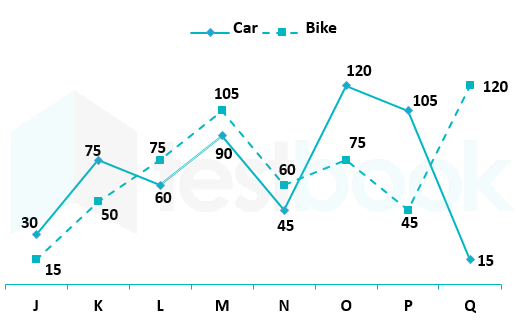
Question 56

The line diagram given below shows the production of cars and bikes by 8 different companies.

T1 = Difference between total bikes and total cars manufactured by all the companies together

T2 = Average of production of bike and car by company P

What is the value of T2/T1?

  1. AOption (a)

    20

  2. BOption (b)

    25

  3. COption (c)

    5

  4. DOption (d)

    15

View answer & explanation

Correct answer

Answer: (d)D.

15

Why this answer is correct

Formula Used:

Average = sum of all observation/total number of observations

Calculation:

Total Bikes manufactured = 15 + 50 + 75 + 105 + 60 + 75 +45 + 120 = 545

Total cars manufactured = 30 + 75 + 60 + 90 + 45 +120 +105 +15 = 540

⇒ T1 = Difference between total bikes and cars = 545 - 540 = 5 

T2 = Average of production of bike and car by company P

Average = sum of all observation/total number of observations = (105 + 45)/2 =150/2 = 75

T2/T1 = 75/5 = 15

∴ The value of T2/T1 is 15.

Question 57

What is the unit digit of 384221?

  1. AOption (a)

    6

  2. BOption (b)

    2

  3. COption (c)

    8

  4. DOption (d)

    4

View answer & explanation

Correct answer

Answer: (d)D.

4

Why this answer is correct

Given:

384221

Concept Used:

Unit digit of 4 

Unit digit for power of 4,

⇒ 6 if power is even and 4 if power is odd

Calculation:

Here, in 384221 power is odd.

∴ The unit digit will be 4.

Question 58

If a certain sum of money doubles itself in 7 years 4 months at simple interest, what will be the annual rate of interest?

  1. AOption (a)

    15.18 percent

  2. BOption (b)

    14.28 percent

  3. COption (c)

    13.64 percent

  4. DOption (d)

    16.22 percent

View answer & explanation

Correct answer

Answer: (c)C.

13.64 percent

Why this answer is correct

Given:

A certain sum of money doubles itself in 7 years 4 months at simple interest.

Formula Used;

If sum of money becomes n times of itself in T years at simpe interest, then the annual rate of interest will be R% = ( n - 1)/T × 100%

Calculation:

R% = (n - 1)/T × 100%

T = 7 + 1/3 years = 22/3

⇒ (2 -1)/(22/3) × 100% = 3/22 × 100% = 300/22% 

⇒ 13.6363% ⇒ 13.64%

∴ 13.64% is correct answer.

Question 59

A boat covers 25 km in 5 hours in still water. It can cover 45 km downstream and 10 km against the stream in 15 hours. What is the speed of the stream?

  1. AOption (a)

    4 km/h

  2. BOption (b)

    3 km/h

  3. COption (c)

    2 km/h

  4. DOption (d)

    5 km/h

View answer & explanation

Correct answer

Answer: (a)A.

4 km/h

Why this answer is correct

Given:

A boat covers 25 km in 5 hours in still water. It can cover 45 km downstream and 10 km against the stream in 15 hours.

Formula Used:

Total time taken by boat = d1/(Y + X) = d2/(Y - X)

Calculation:

Total time taken by boat = T

Distance covered in downstream (d1) = 45 km

Distance covered in upstream (d2) = 10 km

Speed of boat in still water (Y) = 25/5 = 5 kmph

Let speed of stream (X) = x kmph

Total time taken by boat =  d1/(Y + X) = d2/(Y - X)

⇒ 15 = 45/(5 + x) + 10/(5 - x)

​⇒ 3 = 9/(5 + x) + 2/(5 - x)

​⇒ 3 = [9(5 - x) + 2(5 + x)/(5 + x) (5 - x)]

​⇒ 3 = (45 - 9x + 10 + 2x)/(25 - x2)

​⇒ 75 - 3x2 = (-7x + 55)

​⇒ 3x2 - 7x + 55 - 75 = 0

​⇒ 3x2 - 7x - 20 = 0

​⇒ 3x2 - 12x + 5x - 20 = 0

​⇒ 3x(x - 4) + 5(x - 4) = 0

​⇒ (3x + 5)(x - 4) = 0

​⇒ x = 4, -5/3​

As speed can not be negative so x = 4 is correct.

∴ Speed of the stream is 4 kmph.

Question 60

The value of the area of ​​a rectangle is 6 times the value of its length. If the length is 2 cm more than the width. Then what is the area of ​​the rectangle?

  1. AOption (a)

    42 cm2

  2. BOption (b)

    48 cm2

  3. COption (c)

    36 cm2

  4. DOption (d)

    38 cm2

View answer & explanation

Correct answer

Answer: (b)B.

48 cm2

Why this answer is correct

Shortcut Trick

Area = Length × Breadth

Given: Area = 6 × Length

∴ Breadth = 6 cm

Since Length is 2 cm more than Breadth, Length = 6 + 2 = 8 cm

Area = 8 × 6 = 48 cm2

∴ The correct answer is 48 cm2.

Alternate Method

Given:

Area of Rectangle (A) = 6 × Length (L)

Length (L) = Width (W) + 2

Formula Used:

Area of Rectangle = Length × Width

Calculations:

⇒ L × W = 6 × L

⇒ W = 6 cm

⇒ L = W + 2 = 6 + 2 = 8 cm

⇒ Area = L × W = 8 × 6

⇒ Area = 48 cm2

∴ The correct answer is 48 cm2.

Additional Information

Perimeter of Rectangle

The total boundary length is given by the formula P = 2 × (L + W).

Diagonal of Rectangle

The distance between opposite corners is d = √(L2 + W2).

Square Properties

A square is a special rectangle where L = W; Area = Side2 and Perimeter = 4 × Side.

General English (20 questions)

Question 61

Find the part of the given sentence that has an error in it. If there is no error, choose 'No error'.

An avoidance response (1)/ can do real damage (2)/to womens careers (3)/.No error (4)

  1. AOption (a)

    2

  2. BOption (b)

    3

  3. COption (c)

    1

  4. DOption (d)

    4

View answer & explanation

Correct answer

Answer: (b)B.

3

Why this answer is correct

The correct answer is "3".

Key Points

  • The error lies in the use of "womens".
  • The possessive form of "women" is "women's", so the correct sentence is "to women's careers".
  • The apostrophe shows the possessive relationship between "women" and "careers".
  • Thus, **"**to womens careers " has an error.

Correct Sentence: An avoidance response can do real damage to women's careers.

Question 62

In the given question, four words are given out of which one word is correctly spelt.

Choose the correctly spelt word.

  1. AOption (a)

    Respect

  2. BOption (b)

    Rispect

  3. COption (c)

    Respectt

  4. DOption (d)

    Recpect

View answer & explanation

Correct answer

Answer: (a)A.

Respect

Why this answer is correct

The correct answer is "Respect"

Key Points

  • The correctly spelt word is "Respect".
  • Respect is a noun that refers to a feeling of admiration or esteem for someone or something. It involves recognizing the worth or value of a person, entity, or idea and treating it accordingly**(मान सम्मान).**
  • Respect can also refer to a specific instance of being honored, such as showing respect for someone's opinions or achievements. In a broader sense, respect can also refer to the idea of treating others with dignity and tolerance, regardless of differences.
  • Thus, the correct spelling is "Respect"

Correct answer: Respect

Question 63

Find the part of the given sentence that has an error in it. If there is no error, choose 'No error'.

The food supply chain rely(1)/ on a complex web (2)/of interconnected infrastructure (3)/.No error (4)

  1. AOption (a)

    4

  2. BOption (b)

    3

  3. COption (c)

    1

  4. DOption (d)

    2

View answer & explanation

Correct answer

Answer: (c)C.

1

Why this answer is correct

The correct answer is "1"

Key Points

  • The error lies in the part "The food supply chain rely"
  • The subject of the sentence, "the food supply chain," is plural, so the verb "relies" should be in the third-person plural form to match.

Correct Sentence: The food supply chain relies on a complex web of interconnected infrastructure.

Question 64

Choose the word that is opposite in meaning to the given word.

Inevitable

  1. AOption (a)

    Fated

  2. BOption (b)

    Obligatory

  3. COption (c)

    Evadable

  4. DOption (d)

    Voluntary

View answer & explanation

Correct answer

Answer: (c)C.

Evadable

Why this answer is correct

The correct answer is "Evadable"

Key Points

  • In the above sentence we have to choose the word that is opposite in meaning to the word "Inevitable".
  • Inevitable refers to something that cannot be avoided or prevented from happening. It implies that the outcome is certain and cannot be changed.(अपरिहार्य)
  • For example, death is an inevitable event for all living beings. No one can escape it, and it is certain to happen at some point.
  • Evadable refers to something that can be avoided, sidestepped, or escaped from. It suggests that there is a choice to be made, and the outcome is not predetermined(

टालने योग्य).

  • For example, getting a traffic ticket can be evadable if you obey the speed limit and follow traffic laws.
  • As per the above explanation, the correct answer is "Evadable".

Correct answer: Evadable

Additional Information

  • Fated refers to something that is believed to be predetermined by fate, destiny, or a higher power. It suggests that the outcome is inevitable and cannot be changed by human action(भाग्य).
  • For example, some people believe that their future is fated and that they cannot change the course of their lives, no matter what they do.
  • Obligatory refers to something that is required or necessary, often by moral or ethical standards, social norms, or legal obligations. It suggests that there is a duty or responsibility to fulfill(अनिवार्य).
  • For example, paying taxes is an obligatory responsibility for all citizens. It is required by law, and there is a moral and ethical duty to fulfill this obligation.
  • Voluntary refers to something that is done by choice, without coercion or obligation. It suggests that the action is freely undertaken and that there is a choice to participate or not(स्वैच्छिक).
  • For example, donating to charity is a voluntary act. No one is obligated to do so, and it is a choice that is freely made.

Question 65

Select the most appropriate option to substitute the underlined segment in the given sentence. If no substitution is required, select 'No improvement' as your answer.

No sooner had she finished her dance when the audience clapped.

  1. AOption (a)

    No improvement

  2. BOption (b)

    dance than the

  3. COption (c)

    dance where the

  4. DOption (d)

    dance then the

View answer & explanation

Correct answer

Answer: (b)B.

dance than the

Why this answer is correct

The correct answer is "dance than the"

Key Points

  • The use of "when" is wrong in the above sentence.
  • The general rule is that when using the phrase "no sooner," you should use "than" to connect the two clauses in the sentence.
  • "No sooner" is used to indicate that something happened immediately after something else, so using "than" helps to emphasize the quick succession of events. This construction conveys a sense of immediacy and is often used to express surprise or amazement.

Correct Sentence: No sooner had she finished her dance than the audience clapped.

Question 66

A sentence has been given with a blank to be filled with an appropriate word. Choose the correct alternative.

Your business plan is ________ and lacks a deep understanding.

  1. AOption (a)

    explicit

  2. BOption (b)

    superficial

  3. COption (c)

    superior

  4. DOption (d)

    logical

View answer & explanation

Correct answer

Answer: (b)B.

superficial

Why this answer is correct

The correct answer is "superficial"

Key Points

  • In the above sentence we have to choose the most appropriate word to complete the sentence.
  • The most appropriate word to fill in is "superficial".
  • A "superficial" business plan lacks a deep understanding, meaning that it only covers the surface level details and doesn't delve into the complexities of the business( सतही​).
  • Thus, the correct answer is "superficial"

Correct Sentence: Your business plan is superficial and lacks a deep understanding.

Additional Information

  • Explicit" means clear and straightforward, and does not convey the meaning of lacking a deep understanding**(स्पष्ट).**
  • "Superior" means better or of higher quality, and does not accurately convey the idea that the business plan is shallow and lacks understanding(श्रेष्ठ).
  • "Logical" means reasonable and based on sound reasoning, and does not accurately convey the meaning of lacking a deep understanding(तार्किक).

Question 67

In the given question, four words are given out of which one word is correctly spelt.

Choose the correctly spelt word.

  1. AOption (a)

    Toomorrow

  2. BOption (b)

    Tomorrow

  3. COption (c)

    Tommorow

  4. DOption (d)

    Tomorow

View answer & explanation

Correct answer

Answer: (b)B.

Tomorrow

Why this answer is correct

The correct answer is "Tomorrow"

Key Points

  • The correct spelling of the word is "Tomorrow".
  • Tomorrow is a noun that refers to the day after today. It is used to talk about a future time period, usually the next 24-hour day**(कल)**.
  • It is often used in phrases like "see you tomorrow" or "what are you doing tomorrow?" to indicate a future event or plan.
  • The word "tomorrow" is important in making plans and organizing our time, as it provides a way to describe a specific future time period.

Correct answer: Tomorrow

Question 68

Choose the word that means the same as the given word.

Humanity

  1. AOption (a)

    Notion

  2. BOption (b)

    Mankind

  3. COption (c)

    Apathy

  4. DOption (d)

    Adulation

View answer & explanation

Correct answer

Answer: (b)B.

Mankind

Why this answer is correct

The correct answer is "Mankind"

Key Points

  • Let's understand the meaning of the given word.
  • Humanity refers to the qualities of being human, such as kindness, compassion, and empathy(मानवता).
  • ]Example: "The disaster brought out the best in humanity as people from all over the world came together to help those in need."
  • Mankind is a term used to refer to all of human beings collectively(मानवता).
  • Example: "The advancement of science and technology has greatly improved the lives of mankind."
  • Thus, as per the above explanation, the correct answer is "Mankind"

Correct answer: Mankind.

Additional Information

  • The notion is a concept, idea, or belief(धारणा).
  • Example: "The notion that all animals are equal is a central tenet of animal rights activism."
  • Apathy is a lack of interest, enthusiasm, or concern(उदासीनता).
  • Example: "The constant news of war and conflict has led to a general feeling of apathy among the population."
  • Adulation is excessive admiration or praise(प्रशंसा).
  • Example: "The singer received adulation from fans for their powerful performance."

Question 69

Rearrange the parts of the sentence in the correct order.

P: at its peak, the Mongol Empire covered

Q: some 9 million square miles of

R: territory, making it the largest

S: contiguous land empire in world history

  1. AOption (a)

    PRQS

  2. BOption (b)

    QPRS

  3. COption (c)

    QPSR

  4. DOption (d)

    PQRS

View answer & explanation

Correct answer

Answer: (d)D.

PQRS

Why this answer is correct

The correct answer is "​PQRS".

Key Points

  • The first sentence must be a general statement, a fact, and that best starts the paragaph.
  • P will be the first statement because this sentence provides the context that the Mongol Empire reached its largest size at some point in its history.
  • Q follows P, as this sentence further gives an estimate of the size of the Mongol Empire at its largest.
  • R follows Q, as connects the Q and tells us about  the size of the Mongol Empire is significant and noteworthy.
  • S follows R, as this sentence provides the historical context for the significance of the size of the Mongol Empire, namely that it is the largest contiguous land empire in world history.
  • Thus, The correct arrangement of the sentence is "PQRS".

Correct arrangement:  At its peak, the Mongol Empire covered some 9 million square miles of territory, making it the largest contiguous land empire in world history.

Question 70

A sentence has been given with a blank to be filled with an appropriate word. Choose the correct alternative.

I did not find a correlation _______ plastic bag reuse and income or political leaning.

  1. AOption (a)

    before

  2. BOption (b)

    in

  3. COption (c)

    between

  4. DOption (d)

    among

View answer & explanation

Correct answer

Answer: (c)C.

between

Why this answer is correct

The correct answer is "between"

Key Points

  • In the above question, we have to choose the most appropriate preposition.
  • The most appropriate preposition to fill in the blank is "between"
  • Between" is the correct preposition to use here, as it expresses the relationship between two distinct entities, in this case plastic bag reuse and income or political leaning.
  • "In" would suggest a relationship within a single entity, which is not the case here.
  • "Before" and "among" are not appropriate prepositions for this context as they do not express a relationship between two things.
  • Thus, the correct answer is "between"

Correct Sentence: I did not find a correlation between plastic bag reuse and income or political leaning.

Question 71

In the following question, out of the given four alternatives, select the alternative which best expresses the meaning of the Idiom/Phrase.

Go under the knife

  1. AOption (a)

    To have a medical operation

  2. BOption (b)

    To harass

  3. COption (c)

    Pretend to not know something

  4. DOption (d)

    To play the fool

View answer & explanation

Correct answer

Answer: (a)A.

To have a medical operation

Why this answer is correct

The correct answer is "To have a medical operation"

Key Points

  • Go under the knife is an idiom that means **"undergoing surgery or medical operation"(**एक चिकित्सा ऑपरेशन करने के लिए).
  • Example: I am very afraid of going under the knife.
  • Thus, the meaning that best expresses the given idiom is "To have a medical operation".

Correct answer: To have a medical operation

Question 72

Rearrange the parts of the sentence in correct order.

Never sponsored by great political

P: the millennium preceding the Common Era

Q: through inherent efficiency and because the Aramaeans

R: power, the Aramaic script and language succeeded

S: were vigorous traders and extensive travellers in

  1. AOption (a)

    RQSP

  2. BOption (b)

    SPRQ

  3. COption (c)

    QSPR

  4. DOption (d)

    SQRP

View answer & explanation

Correct answer

Answer: (a)A.

RQSP

Why this answer is correct

The correct answer is "​RQSP".

Key Points

  • The first statement must be that best connects the given starting of the sentence.
  • R will come next to the starting of the para as this sentence is the main idea of the paragraph and it provides the reason for the success of the Aramaic script and language.
  • Q follows R, as this sentence explains the cause of the success of the Aramaic script and language, which was due to both its efficiency and the actions of the Aramaeans.
  • S follows Q, as this sentence provides additional details on the actions of the Aramaeans that contributed to the success of the Aramaic script and language.
  • P follows S, as this sentence provides the historical context for the success of the Aramaic script and language, specifying that it happened in the millennia preceding the Common Era.
  • The correct arrangement of the sentence is "RQSP"

Correct arrangement: Never sponsored by great political power, the Aramaic script and language succeeded through inherent efficiency and because the Aramaeans were vigorous traders and extensive travelers in the millennium preceding the Common Era.

Question 73

In the following question, out of the given four alternatives, select the alternative which best expresses the meaning of the Idiom/Phrase.

To beat a retreat

  1. AOption (a)

    To leave quickly

  2. BOption (b)

    To ask for time to decide

  3. COption (c)

    To hide from what one has done

  4. DOption (d)

    To take important decisions

View answer & explanation

Correct answer

Answer: (a)A.

To leave quickly

Why this answer is correct

The correct answer is "To leave quickly"

Key Points

  • "To beat a retreat" is an idiom meaning to retreat, withdraw, or abandon a plan or position, often in the face of opposition or difficulty(जल्दी निकल जाना).
  • Example: The company decided to beat a retreat on their plans to expand into new markets due to economic uncertainties.
  • Thus, the meaning of the given idiom is "To leave quickly"

Correct answer: To leave quickly

Question 74

Choose the word that can substitute the given sentence.

A study of interrelationship of organism and their environments

  1. AOption (a)

    Environment

  2. BOption (b)

    Ecology

  3. COption (c)

    Biotech

  4. DOption (d)

    Biology

View answer & explanation

Correct answer

Answer: (b)B.

Ecology

Why this answer is correct

The correct answer is "Ecology"

Key Points

  • Let's understand the given one words.
  • Environment: Refers to the natural and man-made surroundings in which people, animals and plants live and interact(पर्यावरण).
  • Example: The environment is being polluted by the release of toxic chemicals from factories.
  • Ecology: The scientific study of the relationships between living organisms and their environment(पारिस्थितिकी).
  • Example: The ecology of the Amazon rainforest is complex and interdependent.
  • Biotech: Refers to the application of biological sciences, particularly genetics and biochemistry, to the development of technology and products(जैव प्रौद्योगिकी).
  • Example: Biotech companies are working on developing new drugs and therapies to treat diseases.
  • Biology: The scientific study of living organisms and their processes, including behavior, growth, reproduction, and evolution.(जीव विज्ञान)
  • Example: Biology is the study of life, including the study of cells, genes, and ecosystems.
  • Thus, from the above explanation it is clear that the most appropriate word for the given group of words is "Ecology".

Correct answer: Ecology

Question 75

Select the most appropriate option to substitute the underlined segment in the given sentence. If no substitution is required, select 'No improvement' as your answer.

Much well-known writers in regional languages got their works translated.

  1. AOption (a)

    Much good-known

  2. BOption (b)

    Many poorly-known

  3. COption (c)

    No improvement

  4. DOption (d)

    Many well-known

View answer & explanation

Correct answer

Answer: (d)D.

Many well-known

Why this answer is correct

The correct answer is "Many well-known"

Key Points

  • In the above sentence the use of "Much" is wrong.
  • "Much" is a non-countable noun, and is not appropriate to use with countable nouns like "writers".
  • "Many" is a countable noun, and is a more appropriate word to use with countable nouns like "writers".
  • So, here "Many" should be used instead of "Much"

Correct Sentence: Many well-known writers in regional languages got their works translated.


​

Read the following information carefully and answer the given questions.

Philosophy of education, philosophical reflection on the nature, aims, and problems of education. The philosophy of education is Janus-faced, looking both inward to the parent discipline of philosophy and outward to educational practice. (In this respect it is like other areas of "applied" philosophy, such as the philosophy of law, the philosophy of science, and the philosophy of medicine, including bioethics). This dual focus requires it to work on both sides of the traditional divide between theory and practice, taking as its subject matter both basic philosophical issues (e.g., the nature of knowledge) and more specific issues arising from educational practice (e.g., the desirability of standardized testing). These practical issues, in turn, have implications for a variety of long-standing philosophical problems in epistemology, metaphysics, ethics, and political philosophy. In addressing these many issues and problems, the philosopher of education strives for conceptual clarity, argumentative rigour, and informed valuation.

The history of philosophy of education is an important source of concerns and issues-as is the history of education itself-for setting the intellectual agenda of contemporary philosophers of education. Equally relevant is the range of contemporary approaches to the subject. Although it is not possible here to review systematically either that history or those contemporary approaches, brief sketches of several key figures are offered next.

The Western philosophical tradition began in ancient Greece, and philosophy of education began with it. The major historical figures developed philosophical views of education that were embedded in their broader metaphysical, epistemological, ethical, and political theories. The introduction by Socrates of the "Socratic method" of questioning (see dialectic) began a tradition in which reasoning and the search for reasons that might justify beliefs, judgments, and actions was (and remains) fundamental; such questioning in turn eventually gave rise to the view that education should encourage in all students and persons, to the greatest extent possible, the pursuit of the life of reason. This view of the central place of reason in education has been shared by most of the major figures in the history of philosophy of education, despite the otherwise substantial differences in their other philosophical views.

Question 76

Why the history of philosophy of education is an important source of concerns and issues?

  1. AOption (a)

    To get conceptual clarity, argumentative rigour, and informed valuation.

  2. BOption (b)

    For setting the intellectual agenda of contemporary philosophers of education.

  3. COption (c)

    To get the brief sketches of several key figures.

  4. DOption (d)

    Because analyzing the differences between two philosophical ideas can be challenging.

View answer & explanation

Correct answer

Answer: (b)B.

For setting the intellectual agenda of contemporary philosophers of education.

Why this answer is correct

The correct answer is "For setting the intellectual agenda of contemporary philosophers of education."

Key Points

  • Refer to the lines: The history of philosophy of education is an important source of concerns and issues-as is the history of education itself-for setting the intellectual agenda of contemporary philosophers of education. Equally relevant is the range of contemporary approaches to the subject.
  • The passage suggests the history of philosophy of education is an important source of concerns and issues for setting the intellectual agenda of contemporary philosophers of education.

Correct answer: For setting the intellectual agenda of contemporary philosophers of education

Question 77

What does the phrase 'Janus-faced' implies here?

  1. AOption (a)

    Having no real meaning

  2. BOption (b)

    Having no point of view on any matter

  3. COption (c)

    Having more than one face

  4. DOption (d)

    Having different faces for different approaches

View answer & explanation

Correct answer

Answer: (d)D.

Having different faces for different approaches

Why this answer is correct

The correct answer is "​Having different faces for different approaches".

Key Points

  • Let's consider the following statements from the passage. 
  • ​The philosophy of education is Janus-faced, looking both inward to the parent discipline of philosophy and outward to educational practice. (In this respect it is like other areas of "applied" philosophy, such as the philosophy of law, the philosophy of science, and the philosophy of medicine, including bioethics).
  • From the above statement it is clear that the phrase "janus-face" implies here is "Having different faces for different approaches"

Correct answer: Having different faces for different approaches.

Question 78

Which of the following statements is/are true as per the given passage?

I. The philosophy of education began with the western philosophical tradition which began in ancient Greece.

II. The philosopher of education doesn't strive for conceptual clarity.

  1. AOption (a)

    Only II

  2. BOption (b)

    Both I and II

  3. COption (c)

    Neither I nor II

  4. DOption (d)

    Only I

View answer & explanation

Correct answer

Answer: (d)D.

Only I

Why this answer is correct

The correct answer is "Only I"

Key Points

  • Let's consider the following statements from the passage.
  • In addressing these many issues and problems, the philosopher of education strives for conceptual clarity, argumentative rigour, and informed valuation.
  • The Western philosophical tradition began in ancient Greece, and the philosophy of education began with it.
  • From the above statements, it is clear that the statement I is true, as The philosophy of education began with the western philosophical tradition which began in ancient Greece. and Statement II is false as, according to the passage the philosopher of education strives for conceptual clarity.
  • Thus, the correct answer is Only I.

Question 79

What can be the suitable title for the given passage?

  1. AOption (a)

    Philosophical tradition

  2. BOption (b)

    Philosophical views

  3. COption (c)

    Philosophy of education

  4. DOption (d)

    What is philosophy?

View answer & explanation

Correct answer

Answer: (c)C.

Philosophy of education

Why this answer is correct

The correct answer is "Philosophy of education"

Key Points

  • The most suitable title is "Philosophy of education".
  • The most appropriate title of the passage is "Philosophy of Education". This is because the main focus and content of the passage is about the concept of philosophy of education and its history, aims, and problems. The passage also briefly touches on the relationship between philosophy and education, as well as the importance of reasoning in education.

Correct answer: Philosophy of education

Question 80

Identify the correct synonym of the word 'rigour'?

  1. AOption (a)

    Benign

  2. BOption (b)

    Precision

  3. COption (c)

    Omission

  4. DOption (d)

    Laxity

View answer & explanation

Correct answer

Answer: (b)B.

Precision

Why this answer is correct

The correct answer is "Precision"

Key Points

  • Let's understand the meaning of the given words.
  • Rigour: Strictness, severity, or meticulous attention to detail(कठोरता).
  • Example: "The math exam was marked with rigour to ensure accuracy."
  • Precision: Exactness, accuracy, or meticulous attention to detail(शुद्धता,कठोरता).
  • Example: "The surgeon performed the operation with precision."
  • Thus, as per the above explanation the correct synonym of the word "Rigour" is "Precision".

Correct answer: Precision

Additional Information 

  • Benign: Gentle, kind, or harmless.(सौम्य)
  • Example: "The old man had a benign smile on his face."
  • Laxity: Looseness, carelessness, or neglect(ढिलाई).
  • Example: "The coach was concerned about the laxity in the team's defense."
  • Omission: Failure to include or act on something, or leaving something out(चूक).
  • Example: "The editor's job was to catch any omissions in the manuscript before publication."

General Hindi (20 questions)

Question 81

दिए गए शब्द युग्म का सही शब्द युग्म ज्ञात कीजिए।

अलि : आली

  1. AOption (a)

    तुरंत : टिकठी

  2. BOption (b)

    टिकठी : भौंरा

  3. COption (c)

    भौंरा : सखी

  4. DOption (d)

    सखी : तुरंत

View answer & explanation

Correct answer

Answer: (c)C.

भौंरा : सखी

Why this answer is correct

अलि : आली शब्द युग्म का सही शब्द युग्म का विकल्प भौंरा : सखी होगा।

  • अलि के अन्य अर्थ - भँवरा, भृंग, मिलिंद, मधुप, मधुकर, चंचरीक, शिलीमुख आदि।
  • आली के अन्य अर्थ -सहेली, सहचरी, संगिनी, आली आदि।

Key Pointsअन्य विकल्पों का विश्लेषण -

शब्द युग्मअर्थ युग्म
तुरंत : टिकठीअतिशीघ्र : अरथी
टिकठी : भौंराअरथी : अलि
सखी : तुरंतआली : अतिशीघ्र

Question 82

निम्नलिखित वाक्यों में से सरल वाक्य ज्ञात कीजिए।

  1. AOption (a)

    सुषमा आई तो वह चली गई थी।

  2. BOption (b)

    सुषमा आकर चली गई।

  3. COption (c)

    सुषमा आई और चली गई।

  4. DOption (d)

    जब सुषमा आई, वह चली गई।

View answer & explanation

Correct answer

Answer: (b)B.

सुषमा आकर चली गई।

Why this answer is correct

सुषमा आकर चली गई वाक्य सरल वाक्य का सही विकल्प होगा। 

  • सरल वाक्य - ऐसे वाक्य जिसमे एक क्रिया और एक ही कर्ता होता है, उसे सरल वाक्य या साधारण वाक्य कहते है।

Key Pointsअन्य विकल्पों का विश्लेषण -

  • सुषमा आई तो वह चली गई थी - मिश्र वाक्य।
  • सुषमा आई और चली गई - मिश्र वाक्य।
  • जब सुषमा आई, वह चली गई - मिश्र वाक्य।

Additional Informationरचना के आधार पर वाक्य तीन प्रकार के होते है -

वाक्यपरिभाषाउदाहरण
सरल वाक्यऐसे वाक्य जिसमे एक क्रिया और एक ही कर्ता होता है, उसे सरल वाक्य या साधारण वाक्य कहते है।सुषमा आकर चली गई।
संयुक्त वाक्यऐसा वाक्य जिसमे दो वाक्य किसी सयोजक शब्द द्वारा जुड़े हुए हो ऐसे वाक्य को संयुक्त वाक्य कहते है।नैना गा सकती थी लेकिन उसे माइक नहीं मिला।
मिश्रित वाक्यजिन वाक्यों में एक मुख्य उपवाक्य हो और अन्य गौण उपवाक्य हों उन्हें मिश्रित वाक्य कहते है।जिधर विश्वास है उधर भगवान है।

Question 83

दिए गए वाक्य में उपयुक्त विराम चिह्न का चयन कीजिए।

अरे भाई तुम यहाँ बैठ जाओ।

  1. AOption (a)

    ,

  2. BOption (b)

    ;

  3. COption (c)

    !

  4. DOption (d)
View answer & explanation

Correct answer

Answer: (c)C.

!

Why this answer is correct

वाक्य मे विस्मयादिबोधक विराम चिह्न (!) का प्रयोग होगा।

  • अतः वाक्य निम्न प्रकार होगा -
  • अरे! भाई तुम यहाँ बैठ जाओ।
  • विस्मयादिबोधक विराम चिह्न (!) - हर्ष, शोक, घृणा, भय, विस्मय आदि भावों के सूचक शब्दों या वाक्यों के अंत में इसका प्रयोग किया जाता है।

Key Pointsअन्य विकल्पों का विश्लेषण -

विराम चिह्नपरिभाषाउदाहरण
अर्द्ध विराम (;)जब एक ही प्रधान उपवाक्य पर अनेक आश्रित उपवाक्य हो तब इसका प्रयोग किया जाता है।सूर्योदय हुआ; अन्धकार दूर हुआ।
योजक चिह्न (-)दो शब्दों को जोड़ने के लिए इसका प्रयोग किया जाता है।माता-पिता
अल्प विराम (,)वाक्य मे थोड़े समय के ठहराव के लिए इसका प्रयोग किया जाता है।रुको, मत जाओ।

Additional Informationविराम चिह्न - विराम शब्द का शाब्दिक अर्थ होता है ठहराव।

अपनी बात कहने के लिए उसे समझाने के लिए, किसी कथन पर बल देने के लिए आश्चर्य आदि भावों की अभिव्यक्ति के लिए, कहीं कम समय के लिए तो कहीं अधिक समय के लिए ठहरने के लिए इसका प्रयोग किया जाता है। 

हिन्दी में निम्न विराम चिह्न प्रयुक्त होते है -

  • अल्प विराम (,)
  • अर्द्ध विराम (;)
  • अपूर्ण विराम (:)
  • पूर्ण विराम (।)
  • प्रश्न सूचक चिह्न (?)
  • सम्बोधन चिह्न (!)
  • विस्मय सूचक चिह्न (!)
  • अवतरण चिह्न/उद्धरण चिह्न/उपरिविराम – (i) इकहरा (‘ ’ )(ii) दुहरा (‘‘ ’’)
  • योजक चिह्न/समासचिह्न (–)
  • निदेशक (——-)
  • विवरण चिह्न (:——)
  • हंसपद/विस्मरण चिह्न (ˆ)
  • संक्षेपण/लाघव चिह्न (0)
  • तुल्यता सूचक/समता सूचक (=)
  • कोष्ठक ( ) { } [ ]
  • लोप चिह्न (…….)
  • इतिश्री/समाप्ति सूचक चिह्न -(0- — —)
  • विकल्प चिह्न( /)
  • पुनरुक्ति चिह्न (’’ ’’)
  • संकेत चिह्न(*)

Question 84

दिए गए वाक्य में उचित परसर्ग का चयन करके रिक्त स्थान की पूर्ति कीजिए।

लोटा छत ______ गिरा।

  1. AOption (a)

    में

  2. BOption (b)

    से

  3. COption (c)

    के लिए

  4. DOption (d)

    को

View answer & explanation

Correct answer

Answer: (b)B.

से

Why this answer is correct

वाक्य मे से परिसर्ग रिक्त स्थान की पूर्ति करेगा 

  • अतः वाक्य निम्न प्रकार होगा -
  • लोटा छत से गिरा।
  • वाक्य मे अपादान कारक का प्रयोग हो रहा है।

Key Pointsअन्य विकल्पों का विश्लेषण -

निम्न शब्दों मे कारक -

  • मे - अधिकरण कारक
  • को - कर्म कारक
  • के लिए - सम्प्रदान कारक

Question 85

निम्नलिखित शब्द का पर्यायवाची नहीं है, ज्ञात कीजिए।

धन

  1. AOption (a)

    दौलत

  2. BOption (b)

    रत्नवती

  3. COption (c)

    संपत्ति

  4. DOption (d)

    सम्पदा

View answer & explanation

Correct answer

Answer: (b)B.

रत्नवती

Why this answer is correct

धन शब्द का पर्यायवाची रत्नवती नहीं है।

  • रत्नवती धरती का पर्यायवाची है।
  • रत्नवती के अन्य पर्यायवाची शब्द - धरा, धरती, पृथ्वी, भू, भूमि, धरणी, वसुंधरा, अचला, मही, वसुधा, ज़मीन आदि।

Key Pointsअन्य विकल्प दौलत, संपत्ति तथा सम्पदा ये सभी धन के पर्यायवाची है। 

  • पर्यायवाची - पर्यायवाची शब्द दो शब्दों से मिलकर बना है – पर्याय + वाची।
  • यहाँ पर पर्याय का अर्थ होता है – समान और वाची का अर्थ होता है – बोले जाने वाले।
  • अर्थात् जिन शब्दों का अर्थ एक जैसा होता है, पर्यायवाची शब्द कहलाते है।

कुछ पर्यायवाची शब्दों के उदाहरण -

शब्दपर्यायवाची
असुरदैत्य, दानव, राक्षस, निशाचर, रजनीचर आदि।
अतिथिमेहमान, अभ्यागत, आगन्तुक, पाहूना आदि।
अनुपमअपूर्व, अतुल, अनोखा, अदभुत, अनन्य आदि।

Question 86

दिए गए शब्दों में शुद्ध वर्तनी का चयन कीजिए।

  1. AOption (a)

    स्मसान

  2. BOption (b)

    सामसन

  3. COption (c)

    श्मशान

  4. DOption (d)

    शम्शान

View answer & explanation

Correct answer

Answer: (c)C.

श्मशान

Why this answer is correct

श्मशान शब्द शुद्ध वर्तनी शब्द का सही विकल्प है। 

  • श्मशान का अर्थ - शव या मुर्दे जलाने का स्थान।

Key Points

  • वर्तनी की परिभाषा -  वर्तनी का दूसरा नाम वर्ण -विन्यास भी होता है।
  • सार्थक ध्वनियों का वो समूह होता है, वह शब्द कहलाता है।
  • शब्द में प्रयुक्त ध्वनियों को जिस क्रम से उच्चारित किया जाता है, लिखने में भी उसी क्रम से विन्यस्त करने का नाम वर्तनी या वर्ण विन्यास है।

Question 87

दिए गए वाक्य में उपयुक्त विराम चिह्न का चयन कीजिए।

तुम बैठे बैठे क्यों रो रहे हो

  1. AOption (a)
    • ?
  2. BOption (b)

    ;?

  3. COption (c)

    :- I

  4. DOption (d)
    • ;
View answer & explanation

Correct answer

Answer: (a)A.
  • ?

Why this answer is correct

वाक्य मे विराम चिह्न का सही विकल्प - ? होगा।

  • अतः वाक्य निम्न प्रकार से होगा -
  • तुम बैठे-बैठे क्यों रो रहे हो?
  • योजक चिह्न (-)  - दो शब्दों को जोड़ने के लिए इसका प्रयोग किया जाता है।
  • प्रश्नवाचक चिह्न (?) - प्रश्न सूचक वाक्यों के अन्त में इसका प्रयोग किया जाता है।

Key Points अन्य विकल्पों का विश्लेषण -  

विराम चिह्नपरिभाषाउदाहरण
पूर्ण विराम (I)साधारण, मिश्र या संयुक्त वाक्य की समाप्ति पर इसका प्रयोग किया जाता है।वह खाना खाता है।
अर्द्ध विराम (;)जब एक ही प्रधान उपवाक्य पर अनेक आश्रित उपवाक्य हो, तब इसका प्रयोग किया जाता है।सूर्योदय हुआ; अन्धकार दूर हुआ
विवरण चिह्न (:-)किसी कही हुई बात को स्पष्ट करने या उसका विवरण प्रस्तुत करने के लिए वाक्यके अन्त में इसका प्रयोग होता है।पुरुषार्थ चार हैं:- धर्म, अर्थ, काम और मोक्ष।

Additional Information

विराम चिह्न - विराम शब्द का शाब्दिक अर्थ होता है ठहराव।

अपनी बात कहने के लिए उसे समझाने के लिए, किसी कथन पर बल देने के लिए आश्चर्य आदि भावों की अभिव्यक्ति के लिए, कहीं कम समय के लिए तो कहीं अधिक समय के लिए ठहरने के लिए इसका प्रयोग किया जाता है। 

हिन्दी में निम्न विराम चिह्न प्रयुक्त होते है -

  • अल्प विराम (,)
  • अर्द्ध विराम (;)
  • अपूर्ण विराम (:)
  • पूर्ण विराम (।)
  • प्रश्न सूचक चिह्न (?)
  • सम्बोधन चिह्न (!)
  • विस्मय सूचक चिह्न (!)
  • अवतरण चिह्न/उद्धरण चिह्न/उपरिविराम – (i) इकहरा (‘ ’ )(ii) दुहरा (‘‘ ’’)
  • योजक चिह्न/समासचिह्न (–)
  • निदेशक (——-)
  • विवरण चिह्न (:——)
  • हंसपद/विस्मरण चिह्न (ˆ)
  • संक्षेपण/लाघव चिह्न (0)
  • तुल्यता सूचक/समता सूचक (=)
  • कोष्ठक ( ) { } [ ]
  • लोप चिह्न (…….)
  • इतिश्री/समाप्ति सूचक चिह्न -(0- — —)
  • विकल्प चिह्न( /)
  • पुनरुक्ति चिह्न (’’ ’’)
  • संकेत चिह्न(*)

Question 88

दिए गए शब्द का उपसर्ग ज्ञात कीजिए।

उपवन

  1. AOption (a)

    वन

  2. BOption (b)

    उ

  3. COption (c)

    उप

  4. DOption (d)

    अप

View answer & explanation

Correct answer

Answer: (c)C.

उप

Why this answer is correct

उपवन शब्द मे उपसग का सही विकल्प उप होगा। 

  • उपवन = उप + वन।
  • मूल शब्द - वन।
  • उपसर्ग - उप।

Key Pointsअन्य सभी विकल्प असंगत होगे। 

  • उ उपसर्ग से बना शब्द -
  • उधर = उ 'उपसर्ग' तथा धर 'मूल शब्द'।
  • अप उपसर्ग से बना शब्द -
  • अपमान = अप 'उपसर्ग' तथा मान 'मूल शब्द'।

उपसर्ग = उप (समीप) + सर्ग (सृष्टि करना) - किसी शब्द के समीप आ कर नया शब्द बनाना।

उपसर्ग ऐसे शब्दांश होते है जो किसी शब्द के पूर्व जुड़ कर उसके अर्थ में परिवर्तन कर देते हैं या उसके अर्थ में विशेषता ला देते है।

Question 89

निम्नलिखित वाक्यों में से संयुक्त वाक्य ज्ञात कीजिए।

  1. AOption (a)

    गार्ड के हरी झंडी दिखाने पर ट्रेन चल पड़ी।

  2. BOption (b)

    जब गार्ड ने हरी झंडी दिखाई तब ट्रेन चल पड़ी।

  3. COption (c)

    जैसे ही गार्ड ने हरी झंडी दिखाई वैसे ही ट्रेन चल पड़ी।

  4. DOption (d)

    गार्ड ने हरी झंडी दिखाई और ट्रेन चल पड़ी।

View answer & explanation

Correct answer

Answer: (d)D.

गार्ड ने हरी झंडी दिखाई और ट्रेन चल पड़ी।

Why this answer is correct

गार्ड ने हरी झंडी दिखाई और ट्रेन चल पड़ी वाक्य संयुक्त वाक्य का सही विकल्प होगा। 

  • संयुक्त वाक्य - ऐसा वाक्य जिसमे दो वाक्य किसी सयोजक शब्द द्वारा जुड़े हुए हो ऐसे वाक्य को संयुक्त वाक्य कहते है।

Key Pointsअन्य विकल्पों का विश्लेषण - 

  • गार्ड के हरी झंडी दिखाने पर ट्रेन चल पड़ी - मिश्रित वाक्य।
  • जब गार्ड ने हरी झंडी दिखाई तब ट्रेन चल पड़ी - मिश्रित वाक्य।
  • जैसे ही गार्ड ने हरी झंडी दिखाई वैसे ही ट्रेन चल पड़ी - मिश्रित वाक्य।

Additional Informationरचना के आधार पर वाक्य तीन प्रकार के होते है - 

वाक्यपरिभाषाउदाहरण
सरल वाक्यऐसे वाक्य जिसमे एक क्रिया और एक ही कर्ता होता है, उसे सरल वाक्य या साधारण वाक्य कहते है।सुषमा आकर चली गई।
संयुक्त वाक्यऐसा वाक्य जिसमे दो वाक्य किसी सयोजक शब्द द्वारा जुड़े हुए हो ऐसे वाक्य को संयुक्त वाक्य कहते है।नैना गा सकती थी लेकिन उसे माइक नहीं मिला।
मिश्रित वाक्यजिन वाक्यों में एक मुख्य उपवाक्य हो और अन्य गौण उपवाक्य हों उन्हें मिश्रित वाक्य कहते है।जिधर विश्वास है उधर भगवान है।

Question 90

निम्नलिखित प्रश्न में, दिए गए चार विकल्पों में से, उस विकल्प का चयन करें जो दिए गए मुहावरे के अर्थ को सर्वश्रेष्ठ रूप से व्यक्त करता है।

काजल की कोठरी

  1. AOption (a)

    शोभा बढ़ाना

  2. BOption (b)

    असमर्थता स्वीकार करना

  3. COption (c)

    बेचैनी से इंतजार करना

  4. DOption (d)

    कलंकित होने का स्थान

View answer & explanation

Correct answer

Answer: (d)D.

कलंकित होने का स्थान

Why this answer is correct

काजल की कोठरी मुहावरे के अर्थ को सर्वश्रेष्ठ रूप से विकल्प कलंकित होने का स्थान व्यक्त करता है।

  • वाक्य प्रयोग - जुए के अड्डे में जाकर तुम अब बदनामी मिलेगी ही मिलेगी, काजल की कोठरी में जाने पर मुंह पर कालिख लग ही जाती है।

Key Pointsअन्य विकल्पों का विश्लेषण -

मुहावराअर्थवाक्य प्रयोग
चार चाँद लगानाशोभा बढ़ानामंदिर मे पुताई करने के बाद उस पर झालर लगाकर तुमने तो चार चाँद ही लगा दिए।
घुटने टेक देनाअसमर्थता स्वीकार करनाभारतीय सैनिकों के आगे अच्छे अच्छों ने घुटने टेक दिए
घड़ियां गिननाबेचैनी से इंतजार करनाकिशोरी लाल को देखकर जब सभी डॉक्टरों ने जवाब दे दिया, तब घरवाले मौत की घड़ियां गिनने लगे।

Question 91

दिए गए वाक्य में क्रिया ज्ञात कीजिए।

राम विद्यालय से लौट आया।

  1. AOption (a)

    अकर्मक

  2. BOption (b)

    सामान्य

  3. COption (c)

    संयुक्त

  4. DOption (d)

    सकर्मक

View answer & explanation

Correct answer

Answer: (c)C.

संयुक्त

Why this answer is correct

राम विद्यालय ���े लौट आया वाक्य मे क्रिया का उचित विकल्प संयुक्त होगा। 

  • यहाँ लौटना और आना दो क्रिया के संयुक्त मेल के कारण संयुक्त क्रिया बनी है।
  • संयुक्त क्रिया -  तो जब दो तरह की क्रिया मिलकर किसी तीसरे नई क्रिया का अविष्कार करती हो, तो वह नई किया संयुक्त क्रिया के नाम से जानी जाएगी।

Key Pointsअन्य विकल्पों का विश्लेषण -

क्रियापरिभाषाउदाहरण
सामान्य क्रियाजब वाक्य में एक क्रिया का पता चले तो उसे सामान्य क्रिया कहते है।मै नाचता हू।
सकर्मक क्रियाजिस क्रिया का प्रभाव कर्ता पर न पडकर कर्म पर पड़ता है, तो उसे सकर्मक क्रिया कहते है।वह एक पत्र लिखता है।
अकर्मक क्रियाजिन क्रियाओं को कर्म की जरूरत नहीं पडती या जो क्रिया प्रश्न पूछने पर कोई उत्तर नहीं देती उन्हें अकर्मक क्रिया कहते है।सोना चमकता है।

Additional Informationक्रिया - जिस शब्द से किसी कार्य का होना या करना समझा जाय, उसे क्रिया कहते है।

जैसे - खाना, पीना, गाना , रहना, जाना आदि।

Question 92

दिए गए वाक्य का काल ज्ञात कीजिए।

बस छूट गई होगी।

  1. AOption (a)

    हेतु हेतु भूतकाल

  2. BOption (b)

    अपूर्ण भूतकाल

  3. COption (c)

    पूर्ण भूतकाल

  4. DOption (d)

    संदिग्ध भूतकाल

View answer & explanation

Correct answer

Answer: (d)D.

संदिग्ध भूतकाल

Why this answer is correct

बस छूट गई होगी वाक्य के काल का सही विकल्प संदिग्ध भूतकाल होगा।

  • संदिग्ध भूतकाल - इसमें यह सन्देह बना रहता है कि भूतकाल में कार्य पूरा हुआ या नही।

Key Pointsअन्य विकल्पों का विश्लेषण -

कालपरिभाषाउदाहरण
हेतु हेतु भूतकालजहाँ भूतकाल में किसी कार्य के न हो सकने का वर्णन कारण के साथ दो वाक्यों में दिया गया हो, वहाँ हेतु हेतु भूतकाल होता है।मैं आगरा जाती तो ताजमहल देखती।
अपूर्ण भूतकालक्रिया के जिस रूप से यह पता चलता है कि कार्य भूतकाल में पूरा नहीं हुआ था अपितु नियमित रूप से जारी रहा उसे अपूर्ण भूतकाल कहते है।राधा खाना बना रही थी।
पूर्ण भूतकालक्रिया के जिस रूप से यह ज्ञात हो कि कार्य पहले ही पूरा हो चुका है, उसे पूर्ण भूतकाल कहते है।अंग्रेजों ने भारत पर राज किया था।

Additional Informationकाल - क्रिया के जिस रूप से कार्य करने या होने के समय का ज्ञान होता है उसे ‘काल’ कहते है।

काल तीन प्रकार होते है

  • वर्तमान काल।
  • भूतकाल।
  • भविष्यत काल।

Question 93

दिए गए शब्द का विलोम शब्द ज्ञात कीजिए।

गौण

  1. AOption (a)

    अगुण

  2. BOption (b)

    प्रमुख

  3. COption (c)

    विद्युच्छक्ति

  4. DOption (d)

    अवगुण

View answer & explanation

Correct answer

Answer: (b)B.

प्रमुख

Why this answer is correct

गौण का विलोम शब्द प्रमुख होता है।

  • गौण का अर्थ - द्वितीयक।
<br>

Key Pointsअन्य विकल्पों का विश्लेषण -

शब्दविलोम शब्द
गुणअगुण
प्रसन्नअप्रसन्न
उचितअनुचित

Additional Informationविलोम शब्द - जब किसी शब्द का उल्टा या विपरीत अर्थ दिया जाता है उस शब्द को विलोम शब्द कहते हैं

Question 94

दिए गए शब्दों की संधि ज्ञात कीजिए।

विद्युत् + शक्ति

  1. AOption (a)

    विद्युछशक्ति

  2. BOption (b)

    विदुतशक्ति

  3. COption (c)

    विद्युच्छक्ति

  4. DOption (d)

    विद्युतशक्ति

View answer & explanation

Correct answer

Answer: (c)C.

विद्युच्छक्ति

Why this answer is correct

विद्युत् + शक्ति की संधि का सही विकल्प विद्युच्छक्ति होगा।

  • विद्युच्छक्ति = विद्युत् + शक्ति (व्यंजन संधि)
  • व्यंजन संधि - व्यंजन के बाद यदि किसी स्वर या व्यंजन के आने से उस व्यंजन में जो परिवर्तन होता है, वह ‘व्यंजन संधि’ कहलाता है।

Important Points

  • विद्युत् + शक्ति = विद्युच्छक्ति
  • इस संधि के लिए निम्नलिखित नियम है।
  • त् / द् + श = च्छ

जैसे - 

  • उद् + शासन = उच्छासन
  • जगत् + शांति  = जगाच्छंति

Key Pointsसंधि -  संधि का शाब्दिक अर्थ मेल या समझौता होता हैl

जब दो वर्णों का मिलन अत्यंत निकट कारण होता है तब उनमे कोई न कोई परिवर्तन होता है और वही परिवर्तन संधि के नाम से जाना जाता हैl 

संधि के तीन भेद होते है -

संधिपरिभाषाउदाहरण
स्वर संधिस्वर के बाद स्वर के मेल से उनमें जो विकार-सहित परिवर्तन होता है, उसे ‘स्वर संधि’ कहते हैपरम + अणु = परमाणु
व्यंजन संधिव्यंजन के बाद यदि किसी स्वर या व्यंजन के आने से उस व्यंजन में जो परिवर्तन होता है, वह ‘व्यंजन संधि’ कहलाता है।विद्युच्छक्ति = विद्युत् + शक्ति
विसर्ग संधिविसर्ग के बाद किसी स्वर अथवा व्यंजन के आने से विसर्ग में जो परिवर्तन होता है, वह ‘विसर्ग संधि’ कहलाता है।निः + चल = निश्चल

Question 95

निम्नलिखित प्रश्न में, दिए गए चार विकल्पों में से, उस विकल्प का चयन करें जो दिए गए मुहावरे के अर्थ को सर्वश्रेष्ठ रूप से व्यक्त करता है।

गन्ध तक न आना

  1. AOption (a)

    ध्वस्त करना

  2. BOption (b)

    नष्ट करना

  3. COption (c)

    बात को बढ़ा-चढ़ाकर कहना

  4. DOption (d)

    प्रकट न होना

View answer & explanation

Correct answer

Answer: (d)D.

प्रकट न होना

Why this answer is correct

गन्ध तक न आना मे मुहावरे के अर्थ को सर्वश्रेष्ठ रूप से विकल्प प्रकट न होना व्यक्त करता है।

  • वाक्य प्रयोग - सीता शिक्षक भर्ती परीक्षा की तैयारी कर रही थी इसकी उसने किसी को गन्ध तक न आने दी।

Key Pointsअन्य विकल्पों का विश्लेषण -

मुहावराअर्थवाक्य प्रयोग
पछाड़ देनाध्वस्त करनासायना नेहवाल ने सभी खिलाडियों को पछाड़ दिया।
भंग करनानष्ट करनाउस बम ने कुछ ही समय मे पूरी इमारत भंग कर दी।
डींग हांकनाबात को बढ़ा-चढ़ाकर कहनामधुमिता सारा दिन डींग हांकती रहती है।

Additional Informationमुहावरा - से वाक्यांश, जो सामान्य अर्थ का बोध न कराकर किसी विलक्षण अर्थ की प्रतीति कराये, मुहावरा कहलाता है।

एक गद्यांश दिया गया है। गद्यांश के आधार पर पाँच प्रश्न दिए गए हैं। गद्यांश को ध्यानपूर्वक पढ़ें तथा प्रत्येक प्रश्न में चार विकल्पों में से सही विकल्प चुने।

ध्वनि प्रदूषण व औद्योगिक या गैर-औद्योगिक क्रियाएं हैं जो मनुष्य, पौधो और पशुओं के स्वास्थ्य पर बहुत से आयामों से विभिन्न ध्वनि स्त्रोतों के द्वारा आवाज पैदा करके प्रभावित करती है। ध्वनि प्रदूषण उस स्थिति में उत्पन्न होता है जब पर्यावरण में आवाज का स्तर सामान्य स्तर से बहुत अधिक होता है। ध्वनि का प्रसार औद्योगिक और गैर-औद्योगिक स्त्रोतों के कारण हुआ है। ध्वनि के औद्योगिक स्त्रोतों में तेज गति से काम करने वाली उच्च तकनीकी की बड़ी मशीनें और बहुत से उद्योगों में ऊंची आवाज पैदा करने वाली मशीनें शामिल हैं। भारत में बहुत अधिक ध्वनि प्रदूषण शहरीकरण, आधुनिक सभ्यता, औद्योगिकीकरण आदि के द्वारा बढ़ा है। आज शोरगुल के कई स्त्रोत हो जाने से ये हमारे मुख्य चिंता का विषय बन गया है। पर्यावरण सुरक्षा अधिनियम 1996 के अन्तर्गत ध्वनि प्रदूषण नियंत्रण नियम 2000 को ध्वनि प्रदूषण की बढ़ती हुई समस्या को नियंत्रित करने के लिये शामिल किया है। परिवहन के सभी साधन कम या अधिक मात्रा में ध्वनि उत्पन्न करते हैं। पश्चिमी देशों में ध्वनि-प्रदूषण रोकने के लिए ध्वनि-विहीन वाहन बनाए गए हैं। मनुष्य की श्रवण क्षमता 80 डेसिबल होती है इससे ज्यादा की आवाज मनुष्य बर्दाश्त नहीं कर सकता है। 0 से 25 डेसिबल पर शांति तक की आवाज से शान्ति का वातावरण रहता है। ध्वनि प्रदूषण ने इसके स्त्रोत, प्रभाव और ध्वनि प्रदूषण को रोकने के उपायों के बारे में सामान्य जागरुकता की तत्काल आवश्यकता का निर्माण किया है।

Question 96

उपर्युक्त गद्यांश का उपयुक्त शीर्षक क्या होगा?

  1. AOption (a)

    तत्काल आवश्यकता

  2. BOption (b)

    आधुनिक सभ्यता

  3. COption (c)

    ध्वनि प्रदूषण

  4. DOption (d)

    सामान्य जागरुकता

View answer & explanation

Correct answer

Answer: (c)C.

ध्वनि प्रदूषण

Why this answer is correct

उपर्युक्त गद्यांश का उपयुक्त शीर्षक ध्वनि प्रदूषण होगा।

  • गद्यांश के अनुसार:-
  • ​पर्यावरण में ध्वनि प्रदूषण से होने वाली समस्याओं और प्रभावों का उल्लेख किया गया।

Key Pointsतत्काल:-

  • अर्थ: तुरंत, तत्क्षण, अतिशीघ्र, उसी समय, फ़ौरन।

आधुनिक:-

  • अर्थ: आजकल का, वर्तमान काल का, नये ज़माने का।

सभ्यता:-

  • अर्थ: सभ्य होने की अवस्था भाव, शिष्टता, तहज़ीब, अदब।

जागरुकता:-

  • अर्थ: जागते रहने की अवस्था, जाग्रतावस्था।

Question 97

किन देशों ने ध्वनि विहीन वाहन बनाये हैं?

  1. AOption (a)

    पूर्वी देशों

  2. BOption (b)

    दक्षिणी देशों

  3. COption (c)

    पश्चिमी देशों

  4. DOption (d)

    उत्तरी देशों

View answer & explanation

Correct answer

Answer: (c)C.

पश्चिमी देशों

Why this answer is correct

पश्चिमी देशों ने ध्वनि विहीन वाहन बनाये हैं।

  • गद्यांश के अनुसार:-
  • ​परिवहन के सभी साधन कम या अधिक मात्रा में ध्वनि उत्पन्न करते हैं।
  • पश्चिमी देशों में ध्वनि-प्रदूषण रोकने के लिए ध्वनि-विहीन वाहन बनाए गए हैं।
  • मनुष्य की श्रवण क्षमता 80 डेसिबल होती है इससे ज्यादा की आवाज मनुष्य बर्दास्त नहीं कर सकता है।

Key Pointsविहीन:-

  • अर्थ: रहित, बगैर, बिना, छोड़ा हुआ।

बर्दास्त:-

  • अर्थ: सहन करने का भाव, सहन करने की शक्ति, सहनशीलता।

देश:-

  • अर्थ: वतन, मुल्क, राष्ट्र, प्रांत, प्रदेश, राज्य।

एक गद्यांश दिया गया है। गद्यांश के आधार पर पाँच प्रश्न दिए गए हैं। गद्यांश को ध्यानपूर्वक पढ़ें तथा प्रत्येक प्रश्न में चार विकल्पों में से सही विकल्प चुने।

ध्वनि प्रदूषण व औद्योगिक या गैर-औद्योगिक क्रियाएं हैं जो मनुष्य, पौधो और पशुओं के स्वास्थ्य पर बहुत से आयामों से विभिन्न ध्वनि स्त्रोतों के द्वारा आवाज पैदा करके प्रभावित करती है। ध्वनि प्रदूषण उस स्थिति में उत्पन्न होता है जब पर्यावरण में आवाज का स्तर सामान्य स्तर से बहुत अधिक होता है। ध्वनि का प्रसार औद्योगिक और गैर-औद्योगिक स्त्रोतों के कारण हुआ है। ध्वनि के औद्योगिक स्त्रोतों में तेज गति से काम करने वाली उच्च तकनीकी की बड़ी मशीनें और बहुत से उद्योगों में ऊंची आवाज पैदा करने वाली मशीनें शामिल हैं। भारत में बहुत अधिक ध्वनि प्रदूषण शहरीकरण, आधुनिक सभ्यता, औद्योगिकीकरण आदि के द्वारा बढ़ा है। आज शोरगुल के कई स्त्रोत हो जाने से ये हमारे मुख्य चिंता का विषय बन गया है। पर्यावरण सुरक्षा अधिनियम 1996 के अन्तर्गत ध्वनि प्रदूषण नियंत्रण नियम 2000 को ध्वनि प्रदूषण की बढ़ती हुई समस्या को नियंत्रित करने के लिये शामिल किया है। परिवहन के सभी साधन कम या अधिक मात्रा में ध्वनि उत्पन्न करते हैं। पश्चिमी देशों में ध्वनि-प्रदूषण रोकने के लिए ध्वनि-विहीन वाहन बनाए गए हैं। मनुष्य की श्रवण क्षमता 80 डेसिबल होती है इससे ज्यादा की आवाज मनुष्य बर्दाश्त नहीं क��� सकता है। 0 से 25 डेसिबल पर शांति तक की आवाज से शान्ति का वातावरण रहता है। ध्वनि प्रदूषण ने इसके स्त्रोत, प्रभाव और ध्वनि प्रदूषण को रोकने के उपायों के बारे में सामान्य जागरुकता की तत्काल आवश्यकता का निर्माण किया है।

Question 98

किस स्थिति में ध्वनि प्रदूषण की स्थिति उत्पन्न होती है?

  1. AOption (a)

    अधिक से सामन्य स्तर पर

  2. BOption (b)

    अधिक से अधिक स्तर

  3. COption (c)

    सामान्य से अधिक स्तर

  4. DOption (d)

    सामान्य से सामान्य स्तर

View answer & explanation

Correct answer

Answer: (c)C.

सामान्य से अधिक स्तर

Why this answer is correct

सामान्य से अधिक स्तर में ध्वनि प्रदूषण की स्थिति उत्पन्न होती है।

  • गद्यांश के अनुसार:-
  • ​ध्वनि प्रदूषण उस स्थिति में उत्पन्न होता है
  • जब पर्यावरण में आवाज का स्तर सामान्य स्तर से बहुत अधिक होता है।
  • ध्वनि का प्रसार औद्योगिक और गैर-औद्योगिक स्त्रोतों के कारण हुआ है।

Key Pointsसामान्य:- 

  • अर्थ: जिसमें कोई विशेषता न हो, साधारण, मामूली, आम।

प्रसार:- 

  • अर्थ: एक स्थान से दूसरे स्थान पर पहुँचाना, विस्तार, फैलाव, संचार।

औद्योगिक:-

  • अर्थ: जिसका संबंध किसी उद्योग से हो।

Question 99

भारत में अधिक ध्वनि की स्थिति किसके कारण उत्पन्न हुई है?

  1. AOption (a)

    औद्योगिकीकरण

  2. BOption (b)

    पशु-पक्षी

  3. COption (c)

    मनुष्य

  4. DOption (d)

    आंदोलन

View answer & explanation

Correct answer

Answer: (a)A.

औद्योगिकीकरण

Why this answer is correct

भारत में अधिक ध्वनि की स्थिति औद्योगिकीकरण के कारण उत्पन्न हुई है।

  • गद्यांश के अनुसार:-
  • भारत में बहुत अधिक ध्वनि प्रदूषण शहरीकरण, आधुनिक सभ्यता, औद्योगिकीकरण आदि के द्वारा बढ़ा है।
  • आज शोरगुल के कई स्त्रोत हो जाने से ये हमारे मुख्य चिंता का विषय बन गया है। ​

Key Points

  • औद्योगिकीकरण - उद्योग हेतु नए कारखाने आदि खोलने की क्रिया।

Additional Informationपशु:-

  • अर्थ: जानवर, चतुष्पद, चौपाया, मवेशी, डंगर, ढोर, मवेशी।

पक्षी:-

  • अर्थ: परिन्दा, पंछी, द्विज, खग, चिड़िया, अंडज, विहंग।

मनुष्य:-

  • अर्थ: जन, मनुज, पुरुष, नर, मर्त्य, मानव।

आंदोलन:-

  • अर्थ: किसी नीतिपूर्ण बात को मनवाने के लिए या निश्चित उद्देश्य की पूर्ति हेतु शासक 
  • या व्यवस्था पर दबाव व्यक्त करने के लिए की जाने वाली सामूहिक गतिविधि।

Question 100

मनुष्य की श्रवण क्षमता कितनी डेसिबल होती हैं?

  1. AOption (a)

    80

  2. BOption (b)

    24

  3. COption (c)

    0

  4. DOption (d)

    70

View answer & explanation

Correct answer

Answer: (a)A.

80

Why this answer is correct

मनुष्य की श्रवण क्षमता 80 डेसिबल होती हैं।

  • गद्यांश के अनुसार:-
  • मनुष्य की श्रवण क्षमता 80 डेसिबल होती है इससे ज्यादा की आवाज मनुष्य बर्दास्त नहीं कर सकता है।
  • 0 से 25 डेसिबल पर शांति तक की आवाज से शान्ति का वातावरण रहता है। ​

Key Pointsडेसिबल:-

  • अर्थ: ध्वनि तंरगों की तीव्रता का मापक या इकाई।

श्रवण:-

  • अर्थ: सुनने की क्रिया या भाव।

बर्दास्त:-

  • अर्थ: सहन करने का भाव, सहन करने की शक्ति, सहनशीलता।

Discipline 1 (20 questions)

Question 101

The book 'The Development of Capitalism in Russia' is written by ________.

  1. AOption (a)

    Fyodor Tyutchev

  2. BOption (b)

    Yuri Samarin

  3. COption (c)

    Aleksey Khomyakov

  4. DOption (d)

    Vladimir Lenin

View answer & explanation

Correct answer

Answer: (d)D.

Vladimir Lenin

Why this answer is correct

The correct answer is Vladimir Lenin.

Key Points

  • The book 'The Development of Capitalism in Russia' is written by Vladimir Lenin.
  • It was published in 1899.
  • He began work on his work when in prison and completed it in the village of Shushenkoye where he lived in exile.
  • In this work, Lenin argued that capitalism was rapidly destroying the peasant commune.
  • It was a major contribution to Marxist economic theory.

 Thus, we can say that the book 'Development of Capitalism in Russia' is written by Vladimir Lenin.

Additional Information

  • Vladimir Lenin was a Russian revolutionary, politician and political theorist.
  • He served as the first head of the government of Soviet Russia from 1917 to 1924.

Question 102

During the Russian Revolution, a council of workers' representatives was also designated as ________.

  1. AOption (a)

    Duma

  2. BOption (b)

    Boyar

  3. COption (c)

    Soviet

  4. DOption (d)

    Zemstvo

View answer & explanation

Correct answer

Answer: (c)C.

Soviet

Why this answer is correct

The correct answer is Soviet.

Key Points

  • Russian Revolution was a period of political and social revolution that took place In Russia which began during the First World War.
  • During the Russian Revolution, a council of workers' representatives was called Soviet.
  • The term "Soviet" is derived from the Russian word meaning council or assembly.
  • They were political or governmental bodies of the late Russian Empire, primarily associated with the Russian Revolution.

 Thus, we can say that during the Russian Revolution, a council of workers' representatives was also designated as Soviet.

Question 103

Who was the Viceroy of India when the partition of Bengal was announced?

  1. AOption (a)

    Lord Irwin

  2. BOption (b)

    Lord Dufferin

  3. COption (c)

    Lord Curzon

  4. DOption (d)

    Lord Dalhousie

View answer & explanation

Correct answer

Answer: (c)C.

Lord Curzon

Why this answer is correct

The correct answer is Lord Curzon.

Key Points

  • The Partition of Bengal was announced on 20 July 1905 by Lord Curzon.
  • It was implemented on 16 October 1905 and was undone six years later.
  • The partition separated the largely Muslim eastern areas from largely Hindu areas.
  • Partition barely lasted half a decade and was annulled in 1911.
  • Lord Curzon was the Viceroy of India from 1898 to 1905.
  • He played an important role in British policymaking.

 Thus, we can say that Lord Curzon was the Viceroy of India when the partition of Bengal was announced.

Question 104

Which of the following were the causes of the French Revolution?

I. Financial crisis

II. Elite revolution

III. The Origin of Marie Antoinette

  1. AOption (a)

    Only III

  2. BOption (b)

    Only I

  3. COption (c)

    I & II

  4. DOption (d)

    II & III

View answer & explanation

Correct answer

Answer: (c)C.

I & II

Why this answer is correct

The correct answer is I & II.

Key Points

  • The French Revolution was a revolutionary movement that shook France from 1787 and 1799.
  • There were various reasons for the Revolution.
  • The financial crisis, Elite revolution, economic crisis were among a few causes of the revolution.
  • Throughout the 18th century, France participated in a series of expensive wars primarily against its long-term rival, Britain.
  • France's involvement in the American war was expensive, costing France about 1.066 million French livres.
  • This was worsened by the economic crisis and pushed the nation towards bankruptcy.
  • The Age of Enlightenment was an intellectual and philosophical movement that dominated the world of ideas in Europe during the 18th Revolution.
  • These thinkers like John Locke, Jean Jacques Rousseau questioned the absolute authority of monarchs and divisions of society like the Estates General.

 Thus, we can say that the causes of French Revolution was financial crisis and elite revolution.

Question 105

After the 1905 revolution in Russia, how long did widespread repression last when many revolutionaries were arrested and the labour force was disbanded?

  1. AOption (a)

    1912

  2. BOption (b)

    1913

  3. COption (c)

    1911

  4. DOption (d)

    1908

View answer & explanation

Correct answer

Answer: (c)C.

1911

Why this answer is correct

The correct answer is 1911.

Key Points

  • The Russian Revolution of 1905 was a wave of mass political and social unrest that spread through vast areas of the Russian Empire.
  • It included worker strikes, peasant unrest and military mutinies.
  • After the 1905 revolution, widespread repression lasted till 1911.
  • Many revolutions were arrested thereby and the labour force was disbanded.

 Thus, we can say that after the 1905 revolution in Russia, widespread repression lasted till 1911.

Question 106

With reference to the Santhal Rebellion of 1855, which of the following statement is correct?

I. It was a rebellion against the British colonial authority and against the landlords.

II. It happened in present-day part of Jharkhand and West Bengal.

  1. AOption (a)

    Both I and II

  2. BOption (b)

    Neither I nor II

  3. COption (c)

    Only I

  4. DOption (d)

    Only II

View answer & explanation

Correct answer

Answer: (a)A.

Both I and II

Why this answer is correct

The correct answer is Both I and II.

Key Points

  • The Santhals are a tribal community inhabiting large parts of Jharkhand, West Bengal, Bihar and Orissa.
  • The Santhal rebellion of 1855 was called Hul which meant a movement for liberation in the local language.
  • The rebellion was headed by the four brothers of the Murmu clan.
  • It was a rebellion against the British colonial authority and against the landlords.
  • It happened in the present-day part of Jharkhand and West Bengal.

 Thus, we can say that the above statements about the Santhal Rebellion are correct.

Question 107

Which country declared war against France in 1803?

  1. AOption (a)

    Austria

  2. BOption (b)

    Switzerland

  3. COption (c)

    Spain

  4. DOption (d)

    Britain

View answer & explanation

Correct answer

Answer: (d)D.

Britain

Why this answer is correct

The correct answer is Britain.

Key Points

  • ​Britain declared war on France in 1803.
  • During this war period, Napolean and British leaders concentrated on European affairs, but the conflict split over into the Atlantic.
  • The war was declared in May 1803, inaugurating the Napoleonic wars.
  • In January 1805, Spain joined France in an anti-British alliance.
  • The war ended the ushered in by the 1802 Treaty of Amiens after just 14 months.

 Thus, we can say that Britain declared war against France in 1803.

Question 108

The Kisan Sabha movement in Bihar was started under the leadership of ________.

  1. AOption (a)

    N.G. Ranga

  2. BOption (b)

    Dayanand Saraswati

  3. COption (c)

    Swami Sahajanand Saraswati

  4. DOption (d)

    V.D. Savarkar

View answer & explanation

Correct answer

Answer: (c)C.

Swami Sahajanand Saraswati

Why this answer is correct

The correct answer is Swami Sahajanand Saraswati.

Key Points

  • The Kisan Sabha Movement in Bihar was started under the leadership of Swami Sahajanand Saraswati.
  • It was formed in 1929.
  • The aim was to mobilize peasants' grievances against Zamindar's atrocities of occupancy rights.
  • This movement thus sparked farmers' movements in India.

 Thus, we can say that the Kisan Sabha movement in Bihar was started under the leadership of Swami Sahajanand Saraswati.

Question 109

Who was the founder of the Bolshevik Party?

  1. AOption (a)

    Mikhail Olminsky

  2. BOption (b)

    Vladimir Lenin

  3. COption (c)

    Anatoly Lunacharsky

  4. DOption (d)

    Lev Kamenev

View answer & explanation

Correct answer

Answer: (b)B.

Vladimir Lenin

Why this answer is correct

The correct answer is Vladimir Lenin.

Key Points

  • The founder of the Bolshevik Party was Vladimir Lenin.
  • He was a Russian politician, revolutionary and political theorist.
  • The Bolsheviks were a faction of the Marxist Russian Social Democratic Labour Party (RSDLP) which split apart from the Menshevik faction.
  • The Bolsheviks seized power in Russia during the October Revolution phase of the Russian Revolution of 1917.
  • Lenin also led the party in the October Revolution.

 Thus, we can say that the founder of the Bolshevik Party was Vladimir Lenin.

Question 110

Where was Bal Gangadhar Tilak imprisoned in 1908, where he had served a six-year sentence?

  1. AOption (a)

    Rangoon

  2. BOption (b)

    Kalapani

  3. COption (c)

    Mandalay

  4. DOption (d)

    Yerawada

View answer & explanation

Correct answer

Answer: (c)C.

Mandalay

Why this answer is correct

The correct answer is Mandalay.

Key Points

  • Bal Gangadhar Tilak was an Indian nationalist and an independent activist.
  • He was one of the first and strongest advocates of Swaraj.
  • He was imprisoned in 1908.The judge gave him a six years jail sentence to be served in Mandalay, Burma and a fine of Rs. 1000.

 Thus, we can say that Bal Gangadhar tilak was imprisoned in 1908 in Mandalay.

Question 111

In which year the famous Surat Partition of the Indian National Congress take place?

  1. AOption (a)

    1910

  2. BOption (b)

    1909

  3. COption (c)

    1907

  4. DOption (d)

    1908

View answer & explanation

Correct answer

Answer: (c)C.

1907

Why this answer is correct

The correct answer is 1907.

Key Points

  • The famous Surat Partition of the Indian National Congress took place in 1907.
  • It took place under the presidentship of Rash Bihari Ghosh.
  • The split took place due to contradicting viewpoints of Moderates and Extremists.
  • The extremists were of the viewpoint the movement in Bengal should be expanded and government should target the government.
  • Whereas, the moderates felt that it would be dangerous to rouse the British at that time.

 Thus, we can say that the famous Surat Partition of the Indian National Congress took place in 1907.

Question 112

King Louis XVI requisitioned the Estates-General due to financial crisis in ________.

  1. AOption (a)

    1760s

  2. BOption (b)

    1790s

  3. COption (c)

    1780s

  4. DOption (d)

    1770s

View answer & explanation

Correct answer

Answer: (c)C.

1780s

Why this answer is correct

The correct answer is the 1780s.

Key Points

  • The financial and political condition of France forced Louis XVI to summon the Estates General.
  • This assembly was composed of three estates:
  • the clergy;
  • the nobility; and
  • the commoners.
  • King Louis XVI requisitioned the Estates-General due to the financial crisis in the 1780s.

 Thus, we can say that King Louis XVI requisitioned the Estates-General due to the financial crisis in the 1780s.

Question 113

Which invention of James Hargreaves contributed to the Industrial Revolution in the 18th century?

  1. AOption (a)

    Flying shuttle

  2. BOption (b)

    Spinning jenny

  3. COption (c)

    Electrical grid

  4. DOption (d)

    Steam engine

View answer & explanation

Correct answer

Answer: (b)B.

Spinning jenny

Why this answer is correct

The correct answer is Spinning Jenny.

Key Points

  • James Hargreaves was a significant figure in the timeframe of the Industrial Revolution and is remembered as an inventor.
  • He invented the Spinning Jenny, which had a profound impact on production in England and around the world during the Industrial revolution.
  • Spinning Jenny was a machine that used a large wheel to spiny many spindles of thread at once.
  • It was invented in 1764.

 Thus, we can say that James Hargreaves contributed to the Industrial Revolution in the 18th century.

Question 114

The revolution of ________ in Russia became a "dress rehearsal" for the 1917 revolution.

  1. AOption (a)

    1907

  2. BOption (b)

    1905

  3. COption (c)

    1910

  4. DOption (d)

    1912

View answer & explanation

Correct answer

Answer: (b)B.

1905

Why this answer is correct

The correct answer is 1905.

Key Points

  • The revolution of 1905 began as a wave of mass political and social unrest that spread through vast areas of the Russian Empire.
  • It became a "dress rehearsal" for the 1917 revolution.
  • The 1905 revolution provided an opportunity for the working class to organize strikes and built their organizations called Soviets.
  • Vladimir Lenin called the 1905 Revolution "The Great Dress Rehearsal" without which the "victory of the October Revolution in 1917 would have been possible".

 Thus, we can say that the revolution of 1905 in Russia became a "dress rehearsal" for the 1917 revolution.

Question 115

When was Lucknow recaptured by the British?

  1. AOption (a)

    March 1858

  2. BOption (b)

    June 1858

  3. COption (c)

    May 1857

  4. DOption (d)

    July 1857

View answer & explanation

Correct answer

Answer: (a)A.

March 1858

Why this answer is correct

The correct answer is March 1858.

Key Points

  • The capture of Lucknow was a battle of the Indian rebellion of 1857.
  • Lucknow was a key site during the Uprising of 1857.
  • Britishers recaptured it which they had left abandoned.
  • It was sieged twice and recaptured in March 1858 by the British forces under Sir Colin Campbell.
  • The famous Siege of Lucknow lasted from 25 May to 27th May 1857.

 Thus, we can say Lucknow was recaptured by the British in March 1858.

Question 116

In 1815, Napoleon was defeated in ________.

  1. AOption (a)

    Waterloo

  2. BOption (b)

    Cairo

  3. COption (c)

    Bassano del Grappa

  4. DOption (d)

    Krasnyi

View answer & explanation

Correct answer

Answer: (a)A.

Waterloo

Why this answer is correct

The correct answer is Waterloo.

Key Points

  • The Battle of Waterloo took place in Belgium on June 18, 1815.
  • It marked the final defeat of Napoleon Bonaparte, who conquered much of Europe in the early 19th century.
  • It forced him to abdicate for the second time and ended the Napoleanic era.
  • It ended 23 years of recurrent warfare between France and other powers of Europe.
  • It was fought during the Hundred Days of Napoleon's restoration.

 Thus, we can say tht in 1815, Napoleon was defeated in Waterloo.

Question 117

In which year, did Louis XVI exile members of the aristocracy to the city of Troyes?

  1. AOption (a)

    1789

  2. BOption (b)

    1781

  3. COption (c)

    1787

  4. DOption (d)

    1784

View answer & explanation

Correct answer

Answer: (c)C.

1787

Why this answer is correct

The correct answer is 1787.

Key Points

  • Louis XVI was the last king of France before the fall of monarchy during the French Revolution.
  • Louis XVI exiled the members of the aristocracy to the city of Troyes in May 1787.
  • The parlement was then recalled from Troyes in September 1787 and again dismissed in May 1788.
  • Louis exiled all Parlement magistrates to Troyes as a punishment, prohibiting six members from attending parliamentary sessions.

 Thus, we can say that in 1787, Louis XVI exiled the members of the aristocracy to the city of Troyes.

Question 118

Gandhi-Irwin Pact was signed in ________.

  1. AOption (a)

    1928

  2. BOption (b)

    1932

  3. COption (c)

    1929

  4. DOption (d)

    1931

View answer & explanation

Correct answer

Answer: (d)D.

1931

Why this answer is correct

The correct answer is 1931.

Key Points

  • Gandhi- Irwin Pact was signed on March 5, 1931.
  • It was signed between Mahatma Gandhi and Lord Irwin.
  • It was signed before the Second Round Table Conference in London.
  • Lord Irwin was the Viceroy of India from 1926 to 1931.
  • It marked the end of the Civil Disobedience Movement in India against the British rule that Gandhi and his followers had initiated with the Salt March.

 Thus, we can say that the Gandhi-Irwin Pact was signed in 1931.

Question 119

Who was the first woman President of the Indian National Congress?

  1. AOption (a)

    Kasturba Gandhi

  2. BOption (b)

    Sarojini Naidu

  3. COption (c)

    Annie Besant

  4. DOption (d)

    Aruna Ali

View answer & explanation

Correct answer

Answer: (c)C.

Annie Besant

Why this answer is correct

The correct answer is Annie Besant.

Key Points

  • Annie Besant was the first woman President of the Indian National Congress.
  • She presided over the Indian National Congress at the Calcutta session of 1917.
  • She was a leading member of INC.
  • She established the Home Rule League in 1916 at Madras.
  • She first visited India in 1893 and was involved in the Indian National Movement.

Additional Information

  • Sarojini Naidu:
  • She was the first Indian woman president of the Indian National Congress.
  • She became the president of the Indian National Congress in the Kanpur session in 1925.
  • She was given the title of "Nightingale of India" for her contributions in the field of poetry writing.
  • She was called 'Bharat Kokila'.
  • She is the first woman to hold the office of governor in the dominion of India.
  • She became the governor of the United Provinces in 1947.

Important Points

  • Chittaranjan Das became the president of the Indian National Congress in the Gaya session in 1922.
  • Motilal Nehru became the president of the Indian National Congress in the Calcutta session in 1928.
  • Sardar Vallabhbhai Patel became the president of the Indian National Congress in the Karachi session in 1931.

Question 120

Who introduced the "merger policy"?

  1. AOption (a)

    Lord Dalhousie

  2. BOption (b)

    Lord Hastings

  3. COption (c)

    Lord Irvine

  4. DOption (d)

    Robert Clive

View answer & explanation

Correct answer

Answer: (a)A.

Lord Dalhousie

Why this answer is correct

The correct answer is Lord Dalhousie.

Key Points

  • Lord Dalhousie introduced the "merger policy".
  • It is more commonly known as the Doctrine of Lapse.
  • Lord Dalhousie was the Governor-General of India from 1848 to 1856.
  • Under this, when a ruler of a protected state died without a natural heir, his/her state was occupied by the Britishers
  • This was an annexation policy advocated by Lord Dalhousie.

 Thus, we can say that Lord Dalhousie introduced the "merger policy".

Discipline 2 (20 questions)

Question 121

In 1893, which countries formed a pact to oppose the Triple Alliance?

  1. AOption (a)

    France - Russia

  2. BOption (b)

    Portugal - Ireland

  3. COption (c)

    Austria - Belgium

  4. DOption (d)

    Spain - Hungary

View answer & explanation

Correct answer

Answer: (a)A.

France - Russia

Why this answer is correct

The World War 1 Alliances, the Triple Alliance was perhaps the most significant.

  • It was a secret agreement between Austria-Hungary, Germany, and Italy in the month of May 1882.
  • It renewed periodically until it expired in 1915 during World War I.
  • The treaty provided that Germany and Austria-Hungary were to assist Italy if it was attacked by France without provocation.
  • In turn, Italy would assist Germany if attacked by France.
  • In the event of a war between Austria-Hungary and Russia, Italy promised to remain neutral.

Important Points

  • The Triple Entente describes the informal understanding between the Russian Empire, the French Third Republic and the United Kingdom of Great Britain and Ireland.
  • It was built upon the Franco-Russian Alliance of 1894, the Entente Cordiale of 1904 between Paris and London, and the Anglo-Russian Entente of 1907
  • Dual Alliance, also called Franco-Russian Alliance, a political and military pact that developed between France and Russia from friendly contacts in 1891 to a secret treaty in 1894.
  • It became one of the basic European alignments of the pre-World War I era.
  • The Triple Entente was an alliance of three powerful nations created for the purpose of mutual protection against the Triple Alliance of Germany, Austria-Hungary, and Italy. Though each partner had individual reasons for the alliance, they were all afraid of Germany's growing power.

​So, opposing Triple Alliance was the Triple Entente of France, Russia and England. These complex tensions finally exploded into war.

Question 122

Who believed that if the social environment could be reconstructed, human nature could be changed?

  1. AOption (a)

    Charles Fourier

  2. BOption (b)

    Robert Owen

  3. COption (c)

    Proudhon

  4. DOption (d)

    Saint-Simon

View answer & explanation

Correct answer

Answer: (b)B.

Robert Owen

Why this answer is correct

The correct answer is Robert Owen.

Key Points

  • Robert Owen was a Welsh textile manufacturer, philanthropist and social reformer, and a founder of utopian socialism and the cooperative movement.
  • Robert Owen believed that to change the environment was to change human nature.
  • This belief, sustained by his experiences at New Lanark, remained the unaltered principle of Owen's social philosophy.
  • He believed that his idea would be the best way to reorganise society in general, and called his vision the "New Moral World".

 Thus, we can say that Robert Owen believed that if the social environment could be reconstructed, human nature could be changed.

Question 123

When the Earth is closest to the Sun, the northern hemisphere will receive ________.

I. low amount of insolation

II. summer season

  1. AOption (a)

    Both I and II

  2. BOption (b)

    Only I

  3. COption (c)

    Neither I nor II

  4. DOption (d)

    Only II

View answer & explanation

Correct answer

Answer: (b)B.

Only I

Why this answer is correct

The correct answer is Only I.

Key Points

  • Insolation is the amount of downward solar radiation energy incident on a plane surface.
  • When the Earth is closest to the Sun, the Northern Hemisphere receives a low amount of insolation.
  • The Earth is closest to the sun every year in early January when it is winter in the Northern Hemisphere.
  • When the Earth is farthest to the Sun, Northern Hemisphere gets summer season.

 Thus, we can say that when the Earth is closest to the Sun, the northern hemisphere will receive a low amount of insolation.

Question 124

Which of the following is a correct example of an intrusive igneous rock?

  1. AOption (a)

    Obsidian

  2. BOption (b)

    Basalt

  3. COption (c)

    Andesite

  4. DOption (d)

    Granite

View answer & explanation

Correct answer

Answer: (d)D.

Granite

Why this answer is correct

The earth’s crust is composed of rocks. A rock is an aggregate of one or more minerals.

Important Points

  • There are many different kinds of rocks which are grouped under three families on the basis of their mode of formation. They are: -
  • Igneous Rocks  - Igneous rock is formed through the cooling and solidification of magma or lava. The magma can be derived from partial melts of existing rocks in either a planet's mantle or crust.
  • ​The two main categories of igneous rocks are extrusive and intrusive
  • Extrusive rocks are formed on the surface of the Earth from lava, which is magma that has emerged from underground. example-pumice, obsidian, andesite, rhyolite, and basalt.
  • Intrusive rocks are formed from magma that cools and solidifies within the crust of the planet. example-Diorite, granite, pegmatite

​

So, Granite is a correct example of an intrusive igneous rock.

Additional Information

  • Sedimentary Rocks — Sedimentary rocks are types of rock that are formed by the accumulation or deposition of mineral or organic particles at Earth's surface, followed by cementation. example-sandstone, limestone, and shale.
  • Metamorphic Rocks —Metamorphic rocks arise from the transformation of existing rock to new types of rock, in a process called metamorphism. example- phyllite, schist, gneiss, quartzite and marble.​

Question 125

________ was the first successful revolution by the working class.

  1. AOption (a)

    Nubian Revolution

  2. BOption (b)

    Ionian Revolution

  3. COption (c)

    Russian Revolution

  4. DOption (d)

    Indigenous Revolution

View answer & explanation

Correct answer

Answer: (c)C.

Russian Revolution

Why this answer is correct

The Russian Socialist Democratic Labor Party was formed in 1898.

  • It struggled to give peasants their rights over land that belonged to nobles.
  • As land was divided among peasants periodically which makes them natural socialist  and it was felt that peasants and not workers would be the main source of the revolution.

Important Points

The Russian Revolution of 1905, also known as the First Russian Revolution, was a wave of mass political and social unrest that spread through vast areas of the Russian Empire.

  • The mass unrest was directed against the Tsar alongside the nobility and ruling class.
  • It included worker strikes, peasant unrest, and military mutinies.
  • During the Revolution of 1905, Russia along with the Social Democrats and Socialist Revolutionaries, worked with peasants and workers to demand a constitution.
  • For Russian workers, bad times started from the year 1904 as prices of essential goods rise and their real wages declined by 20 per cent.
  • Workers went on strike demanding a reduction in the working day to eight hours, an increase in wages and improvement in working conditions.
  • Bloody Sunday, started a series of events which resulted in the 1905 Revolution.
  • During the 1905 Revolution, the Tsar allowed the creation of an elected consultative Parliament or Duma. After 1905, most committees and unions worked unofficially, since they were declared illegal.

​So, Russian Revolution was the first successful revolution by the working class.

Question 126

A mechanical fixture between the upper and lower valleys on a rotating earth is called ________.

  1. AOption (a)

    Isohaline

  2. BOption (b)

    Isobar

  3. COption (c)

    Isostasy

  4. DOption (d)

    Isoneyt

View answer & explanation

Correct answer

Answer: (c)C.

Isostasy

Why this answer is correct

Isostasy or isostatic equilibrium is the state of gravitational equilibrium between Earth's crust and mantle such that the crust "floats" at an elevation that depends on its thickness and density. This concept is invoked to explain how different topographic heights can exist at Earth's surface.

Important Points

  • It is the mechanical stability between the earth's crust ( upstanding parts such as plains, plateaus, mountains, etc. and low-lying parts such as ocean floor ) and mantle on the rotating earth.
  • It maintains an equilibrium state between buoyancy force and gravitational force.
  • Buoyancy force pulls the crust up Ward and gravitational force pushes crust downward.
  • In this theory, a mass above sea level is supported below sea level, so high mountains must be regions where the crust is very thick, with deep roots extending into the mantle.
  • This is analogous to an iceberg floating on water, in which the greater part of the iceberg is underwater.

Isostasy is derived from a greek word isostasois which refers to a state of being in balance or equal standing. Isostacy is a state of gravitational equilibrium between the states crust and mantle and once this state has been reached the topographic elements are in balance and will not upset it otherwise, such that the crust 'floats' at an elevation that depends on its thickness and density.

Question 127

Which one of the following statements is correct with respect to the constructive plate margin?

I. These plate margins are also called divergent plate margins.

II. New oceanic crust is constantly being formed.

  1. AOption (a)

    Both I and II

  2. BOption (b)

    Only I

  3. COption (c)

    Neither I nor II

  4. DOption (d)

    Only II

View answer & explanation

Correct answer

Answer: (a)A.

Both I and II

Why this answer is correct

Tectonic plates are pieces of the rocky outer layer of the Earth known as the crust. These plates are constantly moving, and volcanoes and earthquakes are found at plate boundaries. There are four main types of plate boundary. These are constructive, destructive, conservative and collision margins

Important Points

  • A constructive plate boundary, sometimes called a divergent plate margin, occurs when plates move apart.
  • Volcanoes are formed as magma wells up to fill the gap, and eventually, a new crust is formed.
  • These plates are formed when two plates collide with each other.
  • In this case, mostly a subduction zone is created and the oceanic plate moves below the continental plate.
  • At divergent boundaries in the oceans, magma from deep in the Earth's mantle rises toward the surface and pushes apart two or more plates.

​So, Both statements are correct in respect to the Constructive plate of margin

Question 128

Name the organisation which assassinated Archduke Francis Ferdinand.

  1. AOption (a)

    Straight Hand

  2. BOption (b)

    Upper Hand

  3. COption (c)

    White Hand

  4. DOption (d)

    Black Hand

View answer & explanation

Correct answer

Answer: (d)D.

Black Hand

Why this answer is correct

The correct answer is Black Hand.

Important Points

Austrian Archduke Francis Ferdinand was assassinated by a Serbian native (in Bosnia).

  • Reason for assassination: Annexation by Austria the Bosnia-Herzegovina, against the congress of Berlin, 1878
  • Just hours after narrowly escaping an assassin's bomb, Archduke Franz Ferdinand, and his wife, are killed by Gavrilo Princip.
  • After that Austria declared war on Serbia on 28th July 1914
  • The assassination of Ferdinand is considered the most immediate cause of World War I.
  • Unification or Death, popularly known as the Black Hand, was a secret military society formed in 1901 by officers in the Army of the Kingdom of Serbia
  • The main objective of the Black Hand was the creation, by means of violence, of a Greater Serbia.
  • Its aim was: "To realize the national ideal, the unification of all Serbs. This organization prefers terrorist action to cultural activities; it will therefore remain secret."
  • The perpetrator was 19-year-old Gavrilo Princip, a member of Young Bosnia and one of a group of assassins organised and armed by the Black Hand.​​

Question 129

What are the reasons for the rise of Fascism in Italy?

I. The Italians were disappointed by the Treaty of Versailles.

II. The socio-economic situation of Italy after the First World War.

III. Fascists were influenced by the spreading ideology of socialism and communism.

  1. AOption (a)

    I and III

  2. BOption (b)

    II and III

  3. COption (c)

    I, II and III

  4. DOption (d)

    I and II

View answer & explanation

Correct answer

Answer: (d)D.

I and II

Why this answer is correct

The correct answer is I and II.

Key Points

  • Italian Fascism was rooted in Italian nationalism and the desire to restore and expand Italian territories.
  • The main reasons for the rise of Fascism in Italy are:
  • Discontentment among people as a result of the Treaty of Versailles.
  • Economic crisis
  • Propagation of communism
  • Socio-economic situation of Italy after the First World War.
  • Fascism arose in Italy after World War I when many people yearned for national unity and strong leadership.

 Thus, we can say that the reasons for the rise of Fascism in Italy are mentoned above.

Question 130

Many treaties were signed during World War I. Which of the following is correctly matched?

I. St. Germain Treaty- Austria

II. Versailles Treaty - Germany

III. Neuilly Treaty-Hungary

IV. Treaty of Trianon - Turkey

  1. AOption (a)

    I and III

  2. BOption (b)

    I, II and III

  3. COption (c)

    I and II

  4. DOption (d)

    I, III and IV

View answer & explanation

Correct answer

Answer: (c)C.

I and II

Why this answer is correct

The correct answer is I and II.

Key Points

  • The Treaty of Saint-Germain (1919) was the treaty concluding World War I.
  • It was signed by representatives of Austria on one side and Allies on the other.
  • It was signed at Saint-Germain-en-Laye near Paris on September 10, 1919, and came into effect on July 16, 1920.
  • The Treaty of Versailles was a peace document signed at the end of World War I.
  • It was signed by the Allies and associated powers and by Germany.
  • It was signed on June 28, 1919, and it took force on January 10, 1920.

 Thus, we can say that St. Germain Treaty and Versailles Treaty were signed during World War I.

Question 131

Which of the following is characterized as cold air?

  1. AOption (a)

    Sirocco

  2. BOption (b)

    Mistral

  3. COption (c)

    Zonda

  4. DOption (d)

    Harmattan

View answer & explanation

Correct answer

Answer: (b)B.

Mistral

Why this answer is correct

Important Points 

  • The natural motion of air, due to a current in a particular direction is called wind.

There are mainly three types of winds:

  1. Permanent Winds - They blow constantly throughout the year in a particular direction. They are trade winds known as westerlies and easterlies.
  2. Seasonal Winds - This kind of winds change their direction in different seasons.
  3. Local winds- These winds blow in a small area during a particular period of day or year.Winds like Loo, Mistral, Foehn, Bora.

Key Points 

  • Mistral is the most common local cold wind.
  • They originate on the Alps and move over France towards the Mediterranean Sea through the Rhine valley.
  • They are very cold, dry, and high-velocity winds.
  • They bring down the temperature below freezing point in areas of their influence.
  • People in these areas protect their orchards and gardens growing thick hedges and building their houses facing the Mediterranean sea.

Additional Information

  • Sirocco-a hot wind, often dusty or rainy, blowing from North Africa across the Mediterranean to southern Europe.
  • Zonda is a warm dry wind blowing down the side of a mountain in Argentina, where it blows from the west across the Andes Mountains.
  • Harmattan-a very dry, dusty easterly or north-easterly wind on the West African coast, occurring from December to February.

Hence, Mistral is characterized as cold air.

Question 132

Which type of climate is characterised by a general absence of insolation and very low temperatures throughout the year?

  1. AOption (a)

    Monsoon climate

  2. BOption (b)

    Tundra climate

  3. COption (c)

    Mediterranean climate

  4. DOption (d)

    Savanna climate

View answer & explanation

Correct answer

Answer: (b)B.

Tundra climate

Why this answer is correct

​ Important Points

  • Tundra climate, major climate type of the Koppen classification  characterised by sub-freezing mean large annual temperature ranges and moderately low precipitation
  • A tundra climate is characterized by having at least one month whose average temperature is above 0 °C (32 °F).
  • Rainfall and snowfall are generally very low due to the low vapor pressure of water in the chilly atmosphere.
  • Regions with tundra climate are generally treeless, there are other types of vegetation, such as lichens, dwarf shrubs, sedges and grasses, low growing mosses, and a few flowering plants.
  • There are three regions associated with types of tundra: the Arctic, alpine, and Antarctic tundra.
  • This is the region of permafrost where the subsoil is permanently frozen.
  • The short growing season and waterlogging support only low-growing plants.
  • During summer, the tundra regions have a very long duration of daylight

Additional Information

  • Mediterranean climate occurs around the Mediterranean sea, along the west coast of continents in subtropical latitudes between 30° - 40° latitudes e.g. — Central California, Central Chile, along the coast in southeastern and southwestern Australia.
  • These areas come under the influence of subtropical highs in summer and westerly wind in winter.
  • Hence, the climate is characterized by hot, dry summer and mild, rainy winter. The monthly average temperature in summer is around 25° C and in winter below 10°C.
  • The annual precipitation ranges between 35 - 90 cm.

Hence, the Tundra climate type of climate is characterized by a general absence of insolation and very low temperatures throughout the year.

Question 133

Fog formed due to the transport of cold air over a hot surface is:

  1. AOption (a)

    Surface fog

  2. BOption (b)

    Steam fog

  3. COption (c)

    Tropical fog

  4. DOption (d)

    Sea ​​fog

View answer & explanation

Correct answer

Answer: (b)B.

Steam fog

Why this answer is correct

Fogs are mini clouds in which condensation takes place around nuclei provided by the dust, smoke, and the salt particles.

Important Points

  • Sea smoke, frost smoke or steam fog is fog which is formed when very cold air moves over warmer water.
  • Arctic sea smoke is sea smoke forming over small patches of open water in sea ice. It forms when a light wind very cold air mixes with a shallow layer of saturated warm air immediately above the warmer water.
  • This forms during the fall season,As summer ends, water temperatures don't cool right away but air temperature does.
  • As a mass of dry, cold air moves over a warmer lake the warm lake conducts warm, moist air into the air mass above. This transport between the lake and air evens out.
  • This corresponds to the second law of thermodynamics and this law state "any two bodies that come into contact, the system will become equilibrium state."
  • Steam fog does not become very deep but enough to block some of the sunlight.

​So,Fog formed due to the transport of cold air over a hot surface is Steam fog.

Question 134

Which of the following scientists is concerned with the 'Supernova Hypothesis' relating to the origin of the Earth?

  1. AOption (a)

    H.N. Russell

  2. BOption (b)

    F. Hoyle

  3. COption (c)

    B. Levin

  4. DOption (d)

    Bernhardus Varenius

View answer & explanation

Correct answer

Answer: (b)B.

F. Hoyle

Why this answer is correct

Fred Hoyle was an English astronomer best known for his espousal of the "steady-state" theory of the universe and rejecting the "big bang" theory. He also wrote science fiction.

Important Points

  • ​ In 1946, Fred Hoyle proposed Supernova Hypothesis. The sun used to be twinned with another star, which burst due to nuclear processes that transformed lighter components into heavier ones.
  • Initially there were two stars in the universe as told by F.Hoyle. They are: The primitive sun, The companion star.
  • The size of companion star was of very large and later on it became supernova due to nuclear reactions.
  • The companion star's explosion produced a cloud of incandescent gases, which he refers to as the "Supernova stage."
  • This gaseous cloud was retained by the sun’s gravitational force and the remainder of the star as the nucleus receded away far off.
  • In the supernova stage, the gaseous cloud contains iron and other terrestrial elements.
  • The earth, as well as other planets and satellites, were formed from these particles. They revolved around the sun because they were in the sun's gravitational field, and gradually cooled to the solid form in which the planets and satellites exist today.
  • This hypothesis explains- the great distance between the sun and its planets, problem of angular momentum of the planets, compositional differences in elements of the sun and the planets.

​So, F. Hoyle is concerned with the 'Supernova Hypothesis' relating to the origin of the Earth.

Question 135

The whole earth experiences the same days and same nights on ________.

  1. AOption (a)

    22 December

  2. BOption (b)

    21 June

  3. COption (c)

    20 January

  4. DOption (d)

    21 March

View answer & explanation

Correct answer

Answer: (d)D.

21 March

Why this answer is correct

Key Points

  • The motions of the Earth are essential for the existence of the life on Earth.
  • The two main motions of Earth are: Rotation and revolution.
  • Rotation is movement of earth on its axis.
  • Revolution movement of earth on its fixed path that is the orbit around the sun. The Earth takes 365 days and six hours to complete one revolution.

Important Points

  • During the revolution, as different parts of the Earth are tilted towards the sun, solstices and equinoxes are experienced.
  • Summer Solstice occurs every year on 21st June, Northern Hemisphere is tilted towards the sun. This means, it's summer time in the Northern Hemisphere at this period of time. The Southern Hemisphere experiences the exact reverse conditions.
  • Winter solstice occurs on 22nd December every year. The Southern Hemisphere is tilted towards the sun. Thus, this hemisphere experiences summer.The conditions are exact opposite in the Northern Hemisphere.
  • The Equinoxes also occur twice in a year on 21st March and 23rd September, direct rays of the sun fall on the equator.At this position, neither of the poles are tilted towards the sun.so, the Earth experience equal day and equal night.​

​Hence,​The whole earth experiences the same days and same nights on 21st March.

Question 136

Five Year Plans (FYPs) are centralised planning of which society?

  1. AOption (a)

    Fascist

  2. BOption (b)

    Capitalist

  3. COption (c)

    Socialist

  4. DOption (d)

    Cooperative

View answer & explanation

Correct answer

Answer: (c)C.

Socialist

Why this answer is correct

Economic System refers to an arrangement by which central problems of an economy are solved.

  • Types of Economic System or Economies-
  • Capitalist – It is the one in which the means of production are owned, controlled, and operated by the private sector.
  • Socialist or Centrally Planned Economy – It is the one in which the means of production are owned, controlled, and operated by the government. The government decides what, how, and for whom to produce in accordance with the needs of society.
  • Mixed Economy – It is a combination of a free-market economy and a socialist economy. It has the co-existence of the private sector and public sector side by side.

Important Points

  • ​There are different types of economic systems and among them, socialism appealed to Jawaharlal Nehru the most.
  • However, he was not in favour of the kind of socialism established in the former Soviet Union where all the means of production, i.e. all the factories and farms in the country, were owned by the government.
  • There was no private property. It is not possible in a democracy like India for the government to change the ownership pattern of land and other properties of its citizens in the way that it was done in the former Soviet Union.
  • Nehru, and many other leaders and thinkers of the newly independent India, sought an alternative to the extreme versions of capitalism and socialism.
  • Basically sympathising with the socialist outlook, they found the economy with the private sector being encouraged to be part of the plan effort.
  • The ‘Industrial Policy Resolution’ of 1948 and the Directive Principles of the Indian Constitution reflected this outlook.
  • In 1950, the Planning Commission was set up with the Prime Minister as its Chairperson. The era of five year plans had begun.
  • As in Socialist Economic government decides what, how, and for whom to produce in accordance with the needs of society. Thus, Five Year Plans (FYPs) are centralized planning of this society.

Question 137

In 1992, more than 100 heads of state met in Rio de Janeiro, Brazil, for the first International Earth Summit. This summit was also called ________.

  1. AOption (a)

    United Nations Conference on Environment and Development

  2. BOption (b)

    World Wide Fund for Nature

  3. COption (c)

    United Nations World Tourism Organization

  4. DOption (d)

    United Nations High Commissioner for Refugees

View answer & explanation

Correct answer

Answer: (a)A.

United Nations Conference on Environment and Development

Why this answer is correct

Important Points

  • ​ The United Nations Conference on Environment and Development (UNCED), also known as the Rio de Janeiro Earth Summit.
  • This conference was held in Rio de Janeiro from June 3 to June 14 1992.
  • The assembled leaders signed the Declaration on Global Climatic Change and Biological Diversity.
  • The Rio Summit produced conventions dealing with climate change, biodiversity, forestry, and recommended a list of development practices called ‘Agenda 21’.
  • It aims at achieving global sustainable development and to combat environmental damage, poverty, disease through global co-operation on common interests, mutual needs and shared responsibilities.
  • The Forest Principles  is a 1992 document produced at the United Nations Conference on Environment and Development . 
  • It is a non-legally binding document that makes several recommendations for conservation and sustainable development forestry.

​Hence,In 1992, more than 100 heads of state met in Rio de Janeiro, Brazil, for the first International Earth Summit. This summit was also called United Nations Conference on Environment and Development.

Question 138

Which of the following is a long-term cause of the French Revolution?

I. Increasing prevalence of the language of knowledge.

II. Financial Crisis.

III. Protest from the oldest noble families.

  1. AOption (a)

    II and III

  2. BOption (b)

    Only I

  3. COption (c)

    I and II

  4. DOption (d)

    I and III

View answer & explanation

Correct answer

Answer: (d)D.

I and III

Why this answer is correct

The correct answer is I and III.

Key Points

  • French Revolution was a revolutionary movement that took place in France between 1787 and 1799.
  • The long-term causes of the French Revolution are:
  • weak leadership;
  • presence of enlightenment;
  • the American war of Independence;
  • structure of French society;
  • Protest from the oldest noble families
  • The French Revolution unified and increased the power of the national state.
  • It increased the feeling of nationalism and set a precedent for a democratic French government

 Thus, we can say that the increasing prevalence of the language of knowledge and protest from the oldest noble families are long-term causes of the French revolution.

Question 139

Name the party which called for the establishment of a "dictatorship of the proletariat" in Italy.

  1. AOption (a)

    Italian Socialist Party

  2. BOption (b)

    Italian Republican Party

  3. COption (c)

    Italian Liberal Party

  4. DOption (d)

    Italian Democratic Party

View answer & explanation

Correct answer

Answer: (a)A.

Italian Socialist Party

Why this answer is correct

The correct answer is the Italian Socialist Party.

Key Points

  • The Italian Socialist Party was founded in 1892 in Genoa as the Italian workers' party and adopted the name Italian Socialist Party in 1893.
  • The revolutionary purpose of the party was to establish the dictatorship of the proletariat with the support of the working class.
  • The original basis of the party lay among trade unions, socialist circles and cooperative organizations.

 Thus, we can say that the Italian Socialist party called for the establishment of a "dictatorship of the proletariat" in Italy.

Additional Information

  • The proletariat was class of workers who did not own means of production.

Question 140

Which of the following techniques is used to represent relief on topographic maps?

I. Hachure

II. Hill shading

  1. AOption (a)

    Both I and II

  2. BOption (b)

    Neither I nor II

  3. COption (c)

    Only I

  4. DOption (d)

    Only II

View answer & explanation

Correct answer

Answer: (a)A.

Both I and II

Why this answer is correct

Topographic Map: A map of a small area drawn on a large scale depicting detailed surface features both natural and man made. Relief in this map is shown by contours. 

Key Points

  • The earth’s surface is not uniform and it varies from mountains to hills to plateaus and plains.
  • The elevation and depressions of the earth’s surface are known as physical features or relief features of the earth. The map showing these features is called a relief map.

Important Points

  • A number of methods have been used to show the relief features of the Earth’s surface on maps, over the years.
  • These methods include hachure, hill shading, layer tints, benchmarks and spot heights and contours.
  • Contours and spot heights are predominantly used to depict the relief of an area on all topographical maps.
  • CONTOURS are imaginary lines joining places having the same elevation above mean sea level. A map showing the landform of an area by contours is called a contour map.
  • The method of showing relief features through contour is very useful and versatile. The contour lines on a map provide a useful insight into the topography of an area.
  • Hachure Small straight lines drawn on the map along the direction of maximum slope, running across the contours. They given an idea about the differences in the slope of the ground.

Hence,Both techniques is used to represent relief on topographic maps-Hachure, Hill shading

Discipline 3 (20 questions)

Question 141

In which of the following period did the Deccan Trap start to be built?

  1. AOption (a)

    Cretaceous period

  2. BOption (b)

    Silurian period

  3. COption (c)

    Carboniferous period

  4. DOption (d)

    Cambrian period

View answer & explanation

Correct answer

Answer: (a)A.

Cretaceous period

Why this answer is correct

Deccan Traps are the great volcanic formation of the Indian subcontinent that consists of lava covering an area of more than 400,000 square kilometers, with a thickness estimated at about 3000 meters.

  • These volcanic rocks occupy greater parts of Kutch and Kathiawar in Gujarat and are also spread over Andhra Pradesh, Madhya Pradesh, and Maharashtra.
  • After the Archean Rocks, Deccan Traps are the most extensive geological formations of Peninsular India.
  • These Deccan Traps formed at the end of the Cretaceous Era. ​

Key Points 

  • The Cretaceous Period continued from 135 million to 75 million years ago. 
  • During this period, Coastal lands were covered with large swamps.
  • The river's flow was sluggish and delta formation became more active. This period was characterized by widespread vulcanicity.
  • Mountain building became active. The process of formation of Tertiary or Alpine Mountains was initiated.
  • Peninsular India was covered with thick basaltic lava.

Hence the Deccan Trap start to be built in the Cretaceous period.

Additional Information

  • The Silurian Period was spread from 440 million to 400 million years ago.
  • In this period, Sea level was characterized by periodic rise and fall which introduced changes on Earth's crust.
  • Leafless plants were evolved on the land areas.
  • There was an increase in the species of vertebrate animals of the marine environment.
  • The Carboniferous Period was 80 million years long.
  • It began 350 million years ago and ended 270 million years ago.
  • Coal beds of the earth came to be formed, therefore it is also known as the Coal Age.
  • In the course of time due to intense heat and pressure, the successive layers of decaying vegetation, entrapped in the sediment layers, were transformed into coal beds.
  • This period also saw the beginning of such animals which could live both on land and water, which are known as Amphibians.
  • The Cambrian Period was about 90 million years long.
  • It began in 600 and ended 500 million years ago.
  • Cambrian Period saw the transgression of the sea over the land surface. Land submerged underwater due to earth movement that gave rise to sedimentary rocks. It is why the rocks of this period are quite extensive.
  • The rocks of this time have light limestone at the bottom over which are laid the layers of sandstone, shale and at the top is a thin layer of limestone again.
  • These rocks not only contain the fossils of the oldest life but also hold the first evidence of life.

Question 142

Which Indian forest has the least forest area in the country?

  1. AOption (a)

    Tropical thorn forest

  2. BOption (b)

    Tropical evergreen forest

  3. COption (c)

    Alpine and sub-alpine forests

  4. DOption (d)

    Mangrove forest

View answer & explanation

Correct answer

Answer: (d)D.

Mangrove forest

Why this answer is correct

Forest Area refers to any wooded region that indicates a legal status of the land in government records. Forests occupy a total area of 6,75,000 sq. km which is equal to 22.50% of the total geographical area of India. 

Important Points 

  • Mangrove forests, also called mangrove swamps, mangrove thickets, or Tidal Forests, are productive wetlands that occur in coastal intertidal zones.
  • Mangrove forests grow mainly at tropical and subtropical latitudes because mangrove trees cannot withstand freezing temperatures.
  • Mangrove Forests occupy 0.06% of the total forest area.

Hence, Mangrove Forest has the least forest area in the country.

Additional Information

  • Tropical Thorn Forest is a type of desert forest that has scrub-like vegetation.
  • They are characterized as mostly tropical and subtropical forests
  • Tropical Thorn Forests occupy 2.6% of the total forest area.
  • Tropical Evergreen Forests are found mainly in the areas where the annual rainfall is more than 250 cm, with a short dry season.
  • Tropical Evergreen Forests occupy 12.1 % of the total forest area.
  • The Alpine forest represents a transitional zone separating the alpine tundra and subalpine forest communities.
  • Alpine Forests occupy nearly 2.9 % of the total forest area.

Question 143

Which of the following is an economic property of population structure?

  1. AOption (a)

    Sex Ratio

  2. BOption (b)

    Aging

  3. COption (c)

    Business structure

  4. DOption (d)

    Literacy

View answer & explanation

Correct answer

Answer: (c)C.

Business structure

Why this answer is correct

Population growth is strongly influenced by the proportions of individuals in different age brackets, which in turn is influenced by economic development.

Important Points

  • In the broadest sense, economics refers to the study of the components and functions of a particular marketplace or economy—such as supply and demand—and the impact of the concept of scarcity in Business Structure.

Hence, Business Structure is an economic property of population structure.

Additional Information

  • Population dynamics are influenced by age structure, which is characteristic of populations growing at different rates.
  • Age structure varies according to the age distribution of individuals within a population.
  • Fast-growing populations with a high proportion of young people have a triangle-shaped age structure, representing younger ages at the bottom and older ages at the top.
  • Slow-growing populations with a smaller proportion of young people have a column-shaped age structure, representing a relatively even distribution of ages.
  • Improvements in health care have led to the population explosion in underdeveloped countries, causing a “youth bulge” which is associated with social unrest.

Question 144

The climograph oriented diagonally from North East to South West represents ________ type of climate.

  1. AOption (a)

    Dry

  2. BOption (b)

    Mediterranean

  3. COption (c)

    British

  4. DOption (d)

    Monsoon

View answer & explanation

Correct answer

Answer: (d)D.

Monsoon

Why this answer is correct

A Climograph is a diagram in which the data for elements of climate at any one station are plotted, and the shape and position of the resultant graph provides an index to the general climatic character of the place. 

  • This type of diagram was first given by J. Bare (1910)
  • W. Koppen used it to show the variations in world climatic conditions.
  • Griffith Taylor devised such a Climograph which could be used to indicate the physiological effects of climate on man.
  • A spindle-shaped Climograph shows a dry continental climate.

Important Points

  • Griffith Taylor constructed Climograph by making use of wet bulb temperature and relative humidity.
  • He placed relative humidity from 20% to 80 % along the x-axis and wet bulb temperature from - 10˚ F (-23.3˚C) to 90˚ F (33.2˚C) along the Y-axis.
  • Twelve points each representing one month of the year were plotted with reference to wet bulb temperature and 

relative humidity.

  • There is attached significant adjective to four corners marked in SE, NE, NW, and SW corners. The meaning and 

significance of these adjectives are.

(a) RAW: Wet-bulb temperature below 40˚ F (4.4˚ C) and relative humidity over 70%. Cold 

and moist climate. 

(b) MUGGY: Wet-bulb temperature over 60˚ F (15.5 ˚ C) and relative humidity over 70%. Hot and dry climate (found in deserts).

(c) KEEN: Wet-bulb temperature below 40˚ F (4.4˚ C) and relative humidity below 40%. Cold and dry climate. 

(d) SCORCHING: Wet-bulb temperature over 60˚ F (15.5 ˚ C) and relative humidity below 40%. Hot and dry climate.

Key Points

  • The shape of the Climograph is also helpful in knowing the nature of climate.
  • A spindle-shaped Climograph shows a dry continental climate.
  • A Climograph oriented diagonally in NE to SW 

direction indicates monsoon type of climate.

  • A Climograph oriented diagonally in NW to SE direction 

represents Mediterranean climate.

Hence, The climograph oriented diagonally from North East to South West represents the Monsoon type of climate.

Question 145

Which of the following is one of the Special Economic Zones (SEZs) in India?

  1. AOption (a)

    Ahmedabad Special Economic Zone

  2. BOption (b)

    Srinagar Special Economic Zone

  3. COption (c)

    Kandla Special Economic Zone

  4. DOption (d)

    Chennai Special Economic Zone

View answer & explanation

Correct answer

Answer: (c)C.

Kandla Special Economic Zone

Why this answer is correct

A Special Economic Zone (SEZ) is a territory within a country that is typically duty-free and has different business and commercial laws chiefly to encourage investment and create employment. SEZs are created also to better administer these areas, thereby increasing the ease of doing business.

Key Points

 The Special Economic Zones Act was passed in 2005. The Act came into force along with the SEZ Rules in 2006.

  • However, SEZs were operational in India from 2000 to 2006 (under the Foreign Trade Policy).
  • About 64% of the SEZs are located in five states – Tamil Nadu, Telangana, Karnataka, Andhra Pradesh, and Maharashtra.
  • Kandla Special Economic Zone (KASEZ) earlier known as the Kandla Free Trade Zone is located at the port town Gandhidham in the state of Gujarat.
  • The Kandla Special Economic Zone (KASEZ) is the first in Asia and the largest multi-product Special Economic Zone in India.
  • The concept of the Special Economic Zone at Kandla has been formulated based on the new Special Economic Zone (SEZ) scheme introduced in the Export and Import Policy from the year 2000.

Hence Kandla Special Economic Zone is one of the Special Economic Zones (SEZs) in India.

Question 146

With reference to intensive subsistence agriculture, which of the following statements is correct?

I. It is prevalent in areas with high population pressure on land.

II. All work is done with hand tools.

  1. AOption (a)

    Only I

  2. BOption (b)

    Both I and II

  3. COption (c)

    Neither I nor II

  4. DOption (d)

    Only II

View answer & explanation

Correct answer

Answer: (b)B.

Both I and II

Why this answer is correct

Farming refers to the cultivation of plants, animals, fungi, and other life forms for food, fiber, biofuel, medicinals, and other products used to sustain and enhance human life. 

  • Farming varies from subsistence to commercial type.
  • There are different methods of farming based on the nature of the land, soil, agro-climate, water availability or irrigation facilities, technological know,-how and socio-cultural practices.

Key Points 

In intensive subsistence agriculture, the farmer cultivates a small plot of land using simple tools and more labor.

  • Climate with a large number of days with sunshine and fertile soils permits the growing of more than one crop annually on the same plot.
  • Intensive Subsistence Farming is practiced in densely populated regions of Haryana, Punjab, Western Uttar Pradesh, West Bengal, Tamil Nadu, Kerala, and coastal areas of Andhra Pradesh.
  • Rice is the primary crop grown through intensive farming.
  • This type of farming is practiced in areas of high population pressure on land.
  • It is labor-intensive farming, where high doses of biochemical inputs and irrigation are used for obtaining higher production.
  • All work is done with hand tools.
  • In India, the farmers of West Bengal, Kerala, the coastal Andhra Pradesh, and Tamil Nadu provide a good example of intensive subsistence wet paddy agriculture.

​Hence, Both the Statements are correct

Question 147

Which of the following combination of salts is correctly sequenced in the descending order of their percentage in the sea water?

  1. AOption (a)

    Calcium carbonate, Potassium Sulphate, Sodium chloride

  2. BOption (b)

    Sodium chloride, Magnesium bromide, Magnesium chloride

  3. COption (c)

    Sodium chloride, Magnesium chloride, Calcium carbonate

  4. DOption (d)

    Calcium sulphate, Sodium chloride, Magnesium chloride

View answer & explanation

Correct answer

Answer: (c)C.

Sodium chloride, Magnesium chloride, Calcium carbonate

Why this answer is correct

Salinity refers to the amount of solid substance (expressed in gms) present in one kilogram of seawater when all the carbonates are converted into oxides, bromine, and iodine replaced by chlorine, and the inorganic substances are oxidized.

  • Salinity is expressed by the number of salts dissolved in 1000 gms. of seawater.

Key Points

  • The concentration of salt in seawater (its salinity) is about 35 parts per thousand.
  • In other words, about 3.5% of the weight of seawater comes from dissolved salts.
  • Irrespective of the source of the seawater, salts of the seawater have the following composition: sodium chloride 77.76%, magnesium chloride 10.88%, Calcium Carbonate 0.3%,  magnesium sulfate 4.74 %, calcium sulfate 3.60 %, potassium chloride 2.46%, magnesium bromide 0.22%.
  • Sodium Chloride, Magnesium Chloride, and Calcium Carbonate make up over 90% of all dissolved ions in seawater.

Hence the correct combination of salts sequenced in the descending order of their percentage in the seawater is Sodium chloride, Magnesium chloride, Calcium carbonate.

Question 148

Which one of the following is an anthropogenic cause of biodiversity loss?

I. Fragmentation of habitats of plant and animal species due to deforestation and construction work.

II. Intentional or unintentional introduction of alien species into an entirely different ecosystem.

  1. AOption (a)

    Neither I nor II

  2. BOption (b)

    Both I and II

  3. COption (c)

    Only I

  4. DOption (d)

    Only II

View answer & explanation

Correct answer

Answer: (b)B.

Both I and II

Why this answer is correct

The primary contemporary drivers of tropical forest biodiversity loss include direct effects of human activities such as habitat destruction and fragmentation (land-use change), invasive species, and over-exploitation, as well as indirect effects of human activities such as climate change.

Important Points

The main direct cause of biodiversity loss is land-use change (primarily for large-scale food production) which drives an estimated 30% of biodiversity decline globally.

  • Second is overexploitation (overfishing, overhunting, and overharvesting) for things like food, medicines, and timber which drives around 20%.
  • Fragmentation of habitats of plant and animal species due to deforestation and construction work.
  • The Theory of Anthropogenic Climate Change is that humans are causing most of the current changes to climate by burning fossil fuels such as coal, oil, and natural gas.
  • Intentional or unintentional introduction of alien species into an entirely different ecosystem.
  • Biodiversity loss is caused by five primary drivers: 
  • habitat loss
  • invasive species
  • overexploitation (extreme hunting and fishing pressure)
  • pollution
  • climate change is associated with global warming.

Question 149

Which country is the largest exporter of cotton?

  1. AOption (a)

    China

  2. BOption (b)

    United States of America

  3. COption (c)

    France

  4. DOption (d)

    Japan

View answer & explanation

Correct answer

Answer: (b)B.

United States of America

Why this answer is correct

Cotton is a tropical and sub-tropical crop grown in semi-arid areas.

  • It requires high temperature and bright sunshine for its growth.

Key Points

  • The United States is the leading exporter of cotton worldwide.
  • Texas is the largest producer of cotton in the United States followed by Georgia and Arkansas.
  • The United States produced over 14.9 million bales of cotton in 2020, down 4.96 million bales from the prior year.
  • Texas accounts for nearly 32% of U.S. cotton production.
  • India is the largest cotton producer and the largest consumer of cotton in the world.
  • India produces about 6 million tons of cotton every year which is about 23% of the world's cotton
  • Egyptian cotton is acknowledged as the best quality, long-staple cotton in the world.
  • Producing 3,500 thousand metric tonnes a year, China is one of the world’s largest cotton producers.
  • China’s cotton industry employs 10 million people and in the 24 provinces that produce the plant, 300 million are involved in its production.
  • China grows BT cotton, a genetically modified crop that is used for commercial production.

Hence, the USA is the largest exporter of cotton

Question 150

The Pacific Tsunami Warning System (PTWS) was installed in ________.

  1. AOption (a)

    1965

  2. BOption (b)

    1970

  3. COption (c)

    1955

  4. DOption (d)

    1960

View answer & explanation

Correct answer

Answer: (a)A.

1965

Why this answer is correct

Pacific Tsunami Warning and Mitigation System (ICG/PTWS, formerly known as ICG/ITSU for International Tsunami) is coordinated by UNESCO's Intergovernmental Oceanographic Commission (IOC). 

  • It was established in 1965 as the ICG/ITSU for International Tsunami and first convened in 1968.
  • An international cooperative effort involving the Member States of the Pacific, the ICG/PTWS meets regularly to review progress and coordinate activities resulting in improvements of the service.
  • The PTWS encompasses 46 countries of the Pacific Ocean and its marginal seas.
  • It is one of the most successful international scientific programs with the direct humanitarian aim of mitigating the effects of tsunamis to save lives and property.

Thus, we can say that the Pacific Tsunami Warning System (PTWS) was installed in 1965.

Question 151

Which of the following is an endogenous threat?

I. Volcanic disaster

II. Tsunami

III. Earthquake

  1. AOption (a)

    I, II and III

  2. BOption (b)

    I and III

  3. COption (c)

    I and II

  4. DOption (d)

    Only III

View answer & explanation

Correct answer

Answer: (a)A.

I, II and III

Why this answer is correct

The correct answer is I, II and III.

Key Points

  • Endogenous threats are those threats that emerge internally from the Earth's surface.
  • A few endogenous threats are:
  • Volcanic disaster;
  • Tsunami;
  • Earthquake
  • Volcanoes are openings or vents where lava, tephra and steam erupt on the Earth's surface.
  • Tsunamis are giant waves caused by earthquakes or volcanic eruptions under the sea.
  • An earthquake is the shaking of the surface of the Earth resulting from a sudden release of energy in Earth's lithosphere that creates seismic waves.

 Thus, we can say that Volcanic disasters, tsunamis and Earthquakes are endogenous threats.

Question 152

With reference to the Losch principle of profit maximization, which of the following statements is correct?

I. Industrial location is characterized by conditions of monopolistic competition.

II. Demand is considered to be the most important variable in the location of an industry.

  1. AOption (a)

    Both I and II

  2. BOption (b)

    Only I

  3. COption (c)

    Only II

  4. DOption (d)

    Neither I nor II

View answer & explanation

Correct answer

Answer: (a)A.

Both I and II

Why this answer is correct

August Losch, a German economist, published his Theory of 'Profit Maximisation' in the year 1954.

  • According to Losch, the industry will not necessarily be located within the least cost (transport cost and labor cost) location; rather it would locate in areas where maximum profit will occur.
  • To get the maximum profit, as stated by Losch, total consumption is important.
  • The higher the consumption rate, the greater will be the profit.
  • In this case, he emphasized most on the price reduction of the commodity.
  • Any decrease in price would automatically stimulate the volume of consumption.

Important Points

Industrial location is characterized by conditions of monopolistic competition. 

  • Three conditions characterize a monopolistically competitive market.
  • First, the market has many firms, none of which is large.
  • Second, there is free entry and exit into the market; there are no barriers to entry or exit.
  • Third, each firm in the market produces a differentiated product.

Demand is considered to be the most important variable in the location of an industry.

  • Variables that influence demand are the price of real estate, population numbers and household composition, the income of consumers, availability of mortgage credit, and consumer tastes or preferences.

Hence, both statements are correct here.

Question 153

With reference to the Greater Himalayas, which of the following statements is correct?

I. They receive less rainfall than the Lesser Himalayas and Shivaliks.

II. The Dhaulagiri mountain range is located in this region.

III. It is situated to the south of the Lesser Himalayas.

  1. AOption (a)

    I, II and III

  2. BOption (b)

    Only I

  3. COption (c)

    I and  II

  4. DOption (d)

    Only III

View answer & explanation

Correct answer

Answer: (c)C.

I and  II

Why this answer is correct

The Himalayas consist of three parallel ranges, the Greater Himalayas known as the Himadri, the Lesser Himalayas called the Himachal, and the Shivalik hills, which comprise the foothills.

Important Points

Some of the important facts about the Greater Himalaya are as follows,

  • These are the highest mountain ranges of the world located forming the northern part of the Himalayas while the lesser Himalayas are situated to the south of Himadari Himalaya.
  • The average height of the greater Himalayas is about 6000 m whereas lesser Himalayas have an average height of 3000 meters above sea level.
  • They receive less rainfall than the Lesser Himalayas and Shivaliks.
  • Shiwalik range from North-East India up to Nepal are covered with thick forests but the forest cover decreases towards west from Nepal (The quantum of rainfall decreases from east to west in Shiwaliks and Ganga Plains).
  • Dhaulagiri is a mountain massif of the Himalayas in west-central Nepal.
  • It is situated on the western side of the deep Kali (Kali Gandak) River gorge, about 40 miles (65 km) northwest of Annapurna.

Hence, statements I and II both are correct but statement III is not correct about the Greater Himalayas.

Question 154

Which of the following fiber crops of India is grown on black soil?

  1. AOption (a)

    Cannabis

  2. BOption (b)

    Flaxseed

  3. COption (c)

    Jute

  4. DOption (d)

    Cotton

View answer & explanation

Correct answer

Answer: (d)D.

Cotton

Why this answer is correct

Black soil is made up of volcanic materials. It is also known as 'regur'  is also known as Black Cotton Soil as cotton is an important crop which is grown in this type of soil. Black soil is mostly found in the areas such as Gujarat, Madhya Pradesh, and Maharashtra. 

Key Points

  • Cotton is the major fiber grown on black soil.
  • Cotton crops can be filled better in the black soils.
  • Black or 'Regur' soil is known as Black cotton soil since cotton is a significant crop that is filled in this sort of soil.
  • Black soil is wealthy in calcium carbonate, potash, lime, and magnesium carbonate yet has helpless phosphorus content.
  • Black soil is considered to be the best variety of soil for the cultivation of cotton.
  • Besides cotton, it is also suitable for growing cereals, oilseeds, citrus fruits and vegetables, tobacco, and sugarcane.

Hence, Cotton is grown on black soil.

Question 155

From which glacier does the Alaknanda River originate?

  1. AOption (a)

    Siachen Glacier

  2. BOption (b)

    Pindari Glacier

  3. COption (c)

    Gangotri Glacier

  4. DOption (d)

    Satopanth Glacier

View answer & explanation

Correct answer

Answer: (d)D.

Satopanth Glacier

Why this answer is correct

Important PointsAlaknanda River:

  • The Panch Prayag destinations follow the route created by the Alaknanda river, emerging from Himalaya's Satopanth glacier.
  • First, Alaknanda meets Dhauliganga river at Vishnuprayag; move on to Nandaprayag to meet Nandakini river then travels to Karnaprayag to join Pindar river.
  • The River Alaknanda rises at the confluence and is fed of Satopath and Bhagirathi Kharak glacier in Uttarakhand and meets the Sarasvati River tributary at Mana, India, 21 km from Tibet.
  • Three km below Mana the Alaknanda flows past the Hindu pilgrimage center of Badrinath.

From Satopanth Glacier the Alaknanda River originate.

Question 156

Which of the following is a type of three-speed landslide?

I. Rock Slide

II. Mudflow

  1. AOption (a)

    Only II

  2. BOption (b)

    Neither I nor II

  3. COption (c)

    Only I

  4. DOption (d)

    Both I and II

View answer & explanation

Correct answer

Answer: (a)A.

Only II

Why this answer is correct

A landslide is the movement of rock, earth, or debris down a sloped section of land. Landslides are caused by rain, earthquakes, volcanoes, or other factors that make the slope unstable. 

Important Points

  • Mudflows often start as slides, becoming flows as water is entrained along the flow path; such events are often called flow slides.
  • Other types of mudflows include lahars (involving fine-grained pyroclastic deposits on the flanks of volcanoes) and jökulhlaups (outbursts from under glaciers or icecaps).
  • Mudflows are often called mudslides, a term applied indiscriminately by the mass media to a variety of mass wasting events.
  • Mudslides can move at speeds of 80 kilometers (50 miles) per hour.
  • A rock slide is a type of landslide occurring when a mass of rock moves quickly downslope.
  • A rock slide is a type of landslide occurring when a mass of rock moves quickly downslope.
  • Rockslides happen in mountainous regions or where artificial excavation is taking place (e.g., mines and quarries).
  • Several disastrous rock slides have taken place in Canadian history, the worst being the Frank Slide in 1903.

Hence, only option II is a type of three-speed landslide.

Question 157

In which of the following states/union territory of India, Karewa soil is found?

  1. AOption (a)

    Jharkhand

  2. BOption (b)

    Tamil Nadu

  3. COption (c)

    Jammu and Kashmir

  4. DOption (d)

    West Bengal

View answer & explanation

Correct answer

Answer: (c)C.

Jammu and Kashmir

Why this answer is correct

Important Points

  • Karewa is the lacustrine deposit in the Valley of Kashmir.
  • These are the flat-topped mounds that border the Kashmir Valley on all sides.
  • They are composed of fine silt, clay, sand, and boulder- gravel.
  • Karewa soil The word Karewa in Kashmiri means "high ground".
  • This term was first used by the 14 later of Godwin-Austin (1859) and Lyatkker (1878) for unconsolidated to semi-consolidated sand-conglomerate sequences.
  • These sediments appeared in the form of terraces, plateaus, and hills, and stayed on Paleozoic-Mesozoic sediments in the Kashmir "basin".
  • De Terra and Patterson (1939) described these Quaternary sediments in detail for the first time.

Karewa soil is found in Jammu and Kashmir.

Question 158

Which horizon in the soil profile is called the topsoil?

  1. AOption (a)

    C-horizon

  2. BOption (b)

    B-horizon

  3. COption (c)

    A-horizon

  4. DOption (d)

    E-horizon

View answer & explanation

Correct answer

Answer: (c)C.

A-horizon

Why this answer is correct

The A horizon is the top layer of the mineral soil horizons, often referred to as 'topsoil'. 

  • This layer contains dark decomposed organic matter, which is called "humus".
  • Layers of Soil
  • The soil profile is composed of a series of horizons or layers of soil stacked one on top of the other.
  • These layers or horizons are represented by letters O, A, E, C, B, and R.

Key Points

The A-Horizon or Topsoil

  • This layer is rich in organic material and is known as the humus layer. This layer consists of both organic matter and other decomposed materials. The topsoil is soft and porous to hold enough air and water.
  • In this layer, the seed germination takes place and new roots are produced which grows into a new plant.
  • This layer consists of microorganisms such as earthworms, fungi, bacteria, etc.

Additional Information

The O-Horizon

  • The O horizon is the upper layer of the topsoil which is mainly composed of organic materials such as dried leaves, grasses, dead leaves, small rocks, twigs, surface organisms, fallen trees, and other decomposed organic matter.
  • This horizon of soil is often black brown or dark brown in color and this is mainly because of the presence of organic content.

The E-Horizon

  • This layer is composed of nutrients leached from the O and A horizons.
  • This layer is more common in forested areas and has lower clay content.
  • The B-Horizon or Subsoil
  • It is the subsurface horizon, present just below the topsoil and above the bedrock.
  • It is comparatively harder and more compact than topsoil. It contains less humus, soluble minerals, and organic matter.
  • It is a site of deposition of certain minerals and metal salts such as iron oxide.
  • This layer holds enough water than the topsoil and is lighter brown due to the presence of clay soil.
  • The soil of horizon-A and horizon-B is often mixed while ploughing the fields.

The C-Horizon or Saprolite

  • This layer is devoid of any organic matter and is made up of broken bedrock. This layer is also known as saprolite.
  • The geological material present in this zone is cemented.

The R-Horizon

  • It is a compacted and cemented layer.
  • Different types of rocks such as granite, basalt, and limestone are found here.

Question 159

Which of the following states/union territories was connected by the former National Highway 1A (NH 1A)?

  1. AOption (a)

    Mizoram

  2. BOption (b)

    Jammu and Kashmir

  3. COption (c)

    Delhi

  4. DOption (d)

    Haryana

View answer & explanation

Correct answer

Answer: (b)B.

Jammu and Kashmir

Why this answer is correct

The correct answer is Jammu and Kashmir.

Important Points

National Highway 1A (NH 1A) was a National Highway in North India that connected the Kashmir valley to Jammu and the rest of India.

  • The number 1 indicates, under the new numbering system, that it is the northernmost East-West highway in India.
  • The northern terminal was in Uri in Jammu and Kashmir and the southern terminal was in Jalandhar.
  • Delhi and Amritsar are connected by National Highway 1.

Question 160

Which country is the largest producer of rice?

  1. AOption (a)

    Russia

  2. BOption (b)

    Bharat

  3. COption (c)

    Brazil

  4. DOption (d)

    China

View answer & explanation

Correct answer

Answer: (d)D.

China

Why this answer is correct

The correct answer is China.

Important Points

China, India, and Indonesia are the top three rice-producing countries in the world.

  • In 2018 and 2019, China produced over 148 million metric tons of milled rice.
  • During the years 2015-2016, the total rice production of India exceeded 104 million tons. West Bengal is the largest rice-producing state in India.
  • Rice is grown in all provinces in Thailand. In 2016, the Chaopraya basin produced approximately 3.78 million tonnes of rice.
  • Rice is an important staple food crop for more than 60 per cent of the world people.
  • Major share of rice is cultivated during Kharif season.
  • China is the leading rice producer with 205.463 Million Metric Tons per year.
  • India occupies the next position in rice production after China.

Discipline 4 (20 questions)

Question 161

The unprofitable factor affecting economic growth is:

  1. AOption (a)

    Entrepreneurship

  2. BOption (b)

    Market imperfection

  3. COption (c)

    Capital formation

  4. DOption (d)

    Mechanization of agriculture

View answer & explanation

Correct answer

Answer: (b)B.

Market imperfection

Why this answer is correct

Economic growth is defined as an increase in the production of economic commodities and services.

Key Points

  • To accomplish economic progress a country's human resources must be sufficient in number and equipped with the appropriate skills and competencies.
  • Traditionally, aggregate economic growth is measured in terms of gross national product (GNP) or gross domestic product (GDP).
  • According to economists, Economic Factors Affecting Economic Growth: 
  • Natural Resources
  • Capital Formation
  • Technological Advancement
  • Social and Political Factors
  • Human Resource Development
  • Mechanization of agriculture
  • Entrepreneurship has a negative impact on economic growth in developing countries.

Therefore, Entrepreneurship is an unprofitable factor affecting economic growth.

 Additional Information

  • Human resource skills and abilities, the technology utilised, and the availability of cash all play a role in the efficient use or exploitation of natural resources.
  • A country's economy is propelled ahead by talented and educated people and bountiful natural resources.
  • Capital formation enhances the capital/labour ratio even more by increasing the amount of capital available per worker.

Question 162

In India, both the President and the Governors are advised by their ________.

  1. AOption (a)

    administrators

  2. BOption (b)

    speakers

  3. COption (c)

    chief electoral officers

  4. DOption (d)

    councils of ministers

View answer & explanation

Correct answer

Answer: (d)D.

councils of ministers

Why this answer is correct

The President of India is both the head of state and the country's first citizen.

Key Points

  • The President of the country appoints the Prime Minister, and the President appoints the Council of Ministers based on the Prime Minister's suggestion.
  • The Lok Sabha holds the Council collectively accountable.
  • Article 74(1), states that there shall be a Council of Ministers with a Prime Minister at the head to aid and advise the President.
  • The State Council of Ministers is the state's genuine executive.
  • The Governor is the state's constitutional executive leader.
  • Article 163, Constitution establishes a Council of Ministers at state with the Chief Minister as its head to assist and advise the Governor.

Therefore, In India, both the President and the Governors are advised by their councils of ministers. 

Additional Information

  • Article 75 clearly states that the COM is collectively responsible to the Lok Sabha.
  • Article 75 also contains the principle of individual responsibility. under this ministers serve at the pleasure of the President which means that the President can dismiss a minister even if the COM has the confidence of the Lok Sabha.
  • The Council of Ministers in the States is formed and acts similarly to the Council of Ministers at the Centre (Article 163: COM to assist and advise Governor) and Article 164: Other Ministerial Provisions).

Question 163

Which of the following are the lists that were mentioned in the British Indian Constitution Act 1935?

I. Concurrent List

II. Provincial list

III. Union list

  1. AOption (a)

    I, II and III

  2. BOption (b)

    II and III

  3. COption (c)

    I and III

  4. DOption (d)

    I and II

View answer & explanation

Correct answer

Answer: (a)A.

I, II and III

Why this answer is correct

The British Parliament enacted the Government of India Act in August 1935. At the time, it was the longest legislation passed by the British Parliament.

Key Points

​The Government of India Act 1935 divided powers between the centre and the provinces. There were three lists which gave the subjects under each government.

  1. Federal List (Centre)
  2. Provincial List (Provinces)
  3. Concurrent List (Both)

The Viceroy was vested with residual powers.

  • The Act established an All-India Federation, which included both British Indian Provinces and the Indian States.
  • The Instrument of Accession specified the conditions under which a state might join the federation.
  • It was at the discretion of the state whether it wanted to join the federation that was given by the **Government of India Act, 1935.**​

Additional Information

  • Article 246 deals with the 7th Schedule of the Indian Constitution that mentions three lists named as Union List, State List and Concurrent List which specify the divisions of power between Union and States.
  • There were three lists that gave the subjects under each government.
  • Union List (Centre)
  • Provincial List (Provinces)
  • Concurrent List (Centre and Provinces)
  • Bengal, Bombay Madras, Bihar, Assam, and the United Provinces were the first provinces to implement bicameralism.
  • Union List includes subjects of national importance such as the defence of the country, foreign affairs, banking, communications and currency.
  • They are included in this list because we need a uniform policy on these matters throughout the country.

Question 164

Sustainable agriculture integrates which of the following goals?

I. Environmental health

II. Economic profitability

  1. AOption (a)

    Both I and II

  2. BOption (b)

    Only I

  3. COption (c)

    Only II

  4. DOption (d)

    Neither I nor II

View answer & explanation

Correct answer

Answer: (a)A.

Both I and II

Why this answer is correct

Sustainable agriculture refers to farming practices that meet society's current food and textile needs without jeopardising current or future generations' ability to meet those needs.

Key Points

  • ​People engaged in sustainable agriculture and sustainable food systems employ a variety of techniques.
  • The development of sustainable food systems contributes to the human population's long-term viability.
  • One of the most effective methods to combat climate change, for example, is to develop sustainable food systems based on sustainable agriculture.
  • Three key goals of sustainable agriculture are
  • environmental health,
  • economic profitability,
  • social equality.

Therefore, Both I and II are the correct options. 

Additional Information

  • Consumers and businesses interested in sustainability might seek out values-based foods cultivated in ways that promote farmworker well-being are environmentally benign or help the local economy.
  • The National Mission for Sustainable Agriculture (NMSA) made headlines recently when Ritti Village in Udhampur District became the first Panchayat in Jammu and Kashmir to be adopted under the mission.

Question 165

In the first four general elections in India, which of the following parties has won an absolute majority in the Parliament?

  1. AOption (a)

    Janata Party

  2. BOption (b)

    Indian National Congress

  3. COption (c)

    Bharatiya Janata Party

  4. DOption (d)

    Bahujan Samaj Party

View answer & explanation

Correct answer

Answer: (b)B.

Indian National Congress

Why this answer is correct

In India, the presence of multiple parties has been a significant component of the party system.

Key Points

  • In India, however, a number of party systems have evolved since the 1950s.
  • The supremacy of a single political party did not imply that there was just one political party in the country.
  • During the early decades after Independence, the party system was dominated by Congress, which was a single party.
  • It was an era of one-party dominance and regarded as Congress's supremacy era.
  • The 1950s and 1960s were characterised as a single-party era.

Therefore, In the first four general elections in India Indian national congress has won an absolute majority in the Parliament. 

Additional Information

  • The single-party dominance did not mean that there existed only one party in India.
  • It meant that, in addition to the Congress, there were various parties such as the Communist Party of India (CPI), different socialist parties, the Swatantra Party, the Republican Party of India, Jana Sangha, and others have emerged.

Question 166

Presidential election in India is done by:

  1. AOption (a)

    Member of the electorate

  2. BOption (b)

    Prime Minister only

  3. COption (c)

    Chief Ministers of states

  4. DOption (d)

    Speaker of Lok Sabha

View answer & explanation

Correct answer

Answer: (a)A.

Member of the electorate

Why this answer is correct

According to Article 54 of the Indian Constitution, the President of India will be elected. 

Key Points

  • The President of India is chosen through a secret ballot.
  • He is elected by an electoral college using a single transferable vote and secret ballot under the proportional representation system.
  • The Electoral College is made up of the following individuals:
  • A member of both Houses of Parliament who has been elected.
  • Members of the States' Legislative Assemblies who have been elected.
  • Members of the Legislative Assembly of Delhi and Puducherry who have been elected.
  • At least 50 electors as proposers and seconders must subscribe to a candidate's nomination for election to the post of President.
  • Every candidate must deposit Rs. 15,000 with the RBI as a security deposit, which will be forfeited if the candidate receives less than one-sixth of the votes cast.
  • Members of the Legislative Assembly of Delhi and Puducherry were added to the electoral college through the 70th Constitutional Amendment Act of, 1992.

Therefore, the Presidential election in India is done by a Member of the electorate. 

Additional Information

  • Does Not Vote In The Indian Presidential Election are mentioned below: 
  • A member of both Houses of Parliament who has been nominated.
  • Members of the Legislative Assemblies of the States who have been nominated.
  • Members of the Legislative Assembly of Delhi and Puducherry who have been nominated.
  • Every member of a state legislature's legislative council.

Question 167

With reference to the Bharatiya Janata Party (BJP), which of the following statements is not correct?

  1. AOption (a)

    As a key member of the National Democratic Alliance (NDA), the BJP has been leading the central government since 2014.

  2. BOption (b)

    Atal Bihari Vajpayee was its first president.

  3. COption (c)

    BJP was formed in 1990.

  4. DOption (d)

    Its roots go back to the Bharatiya Jana Sangh.

View answer & explanation

Correct answer

Answer: (c)C.

BJP was formed in 1990.

Why this answer is correct

the Bharatiya Janata Party is one of India's major political parties.

Key Points

  • The Bharatiya Janta Party was founded in 1980 as a result of a split in the Janata Party over the issue of dual membership.
  • The Bharatiya Jana Sangh constituent of the Janata Party formed the Bharatiya Janata Party after leaving the Janata Party (BJP).
  • The BJP is often referred to as the Bharatiya Jana Sangh's rebirth.
  • In 195, Syama Prasad Mukherjee established BJP.
  • Atal Bihari Vajpayee became the party's first president when it was founded in 1980.
  • The BJP won only two seats in the first Lok Sabha election after its formation in 1984, but the BJP began to have electoral success in 1989.
  • The BJP ran as the organiser of the National Democratic Alliance (NDA), a coalition of more than 20 national and regional parties in the 1999 legislative elections.

Therefore, BJP was formed in 1990 is incorrect. 

Additional Information

  • The BJP gained a total of 282 seats giving it a comfortable majority in the legislature, with its NDA allies adding 54 more.
  • The RSS, which was created in 1925 by Kesllav Baliram Hedgewar, served as an organisational backbone for the Bharatiya Janata Sangh and eventually the Bharatiya Janata Party.

Question 168

'House of Commons' is related to which of the following country?

  1. AOption (a)

    Britain

  2. BOption (b)

    South Africa

  3. COption (c)

    Venezuela

  4. DOption (d)

    Brazil

View answer & explanation

Correct answer

Answer: (a)A.

Britain

Why this answer is correct

The House of Commons has its origins in the second half of the 13th century. 

Key Points

  • The House of Commons is the bicameral British Parliament's publicly elected legislative chamber.
  • Although the Chamber of Commons is legally the lower house, it has more power than the House of Lords.
  • The term parliament is sometimes used to refer to the House of Commons.
  • In the United Kingdom, the House of Commons is the most powerful legislative body.
  • It has sole authority to levy taxes and to vote or withdraw funds from various government departments and services.

​Therefore, the House of Commons is related to Britain.

Additional Information

  • The House of Lords has rarely stymied important legislation enacted by the Commons, and the British monarch virtually always gives his approval to any law passed.
  • The House of Commons requires that members be at least 18 years old.
  • Certain clergy, judicial officers, military personnel, police officers, and civil servants are also ineligible to run for office.

Question 169

The primary sector includes economic activities like ________.

I. Forestry

II. Mining

  1. AOption (a)

    Only I

  2. BOption (b)

    Only ।I

  3. COption (c)

    Neither I nor II

  4. DOption (d)

    Both I and II

View answer & explanation

Correct answer

Answer: (d)D.

Both I and II

Why this answer is correct

Economic activities produce commodities and services whereas sectors are groups of economic activity classified according to certain characteristics.

Key Points

  • Primary Sectors under which  industries are involved in the extraction of natural resources or the manufacturing of raw materials
  • Natural resources are directly used to carry out activities in the primary sector of the economy.
  • This includes agriculture, mining, fishing, forestry, dairy, and other sectors.
  • It is also known as Agriculture and Allied Sector because it's the foundation for everything else such as agriculture, dairy, forestry, and fishing produce the majority of the natural products.
  • People who work in primary activities are referred to as red-collar workers because of their occupation.​
  • In developing countries, the primary sector will account for the majority of the economy.

​Therefore, the Primary sector includes economic activities like forestry and mining. 

Additional Information

  • Secondary sector: All industries involved in the production of useful items or completed commodities.
  • It is frequently separated between heavy (steel, chemical, and automobile) and light industries  (food, apparel, cosmetics).
  • Tertiary sector: All industries that provide services to other firms or final consumers. 
  • ​for example; Retail, healthcare etc.
  • Quaternary sector: ​The quaternary sector encompasses all industries involved in the creation and dissemination of knowledge. 
  • For example; Research and development, Education etc.

Question 170

Which of the following are the steps involved in a typical community contingency plan for disaster management?

I. Early Awareness and Intimacy Building

II. Outlining the community

III. Capacity building of workforce

  1. AOption (a)

    I and II

  2. BOption (b)

    I and III

  3. COption (c)

    Only II

  4. DOption (d)

    I, II and III

View answer & explanation

Correct answer

Answer: (d)D.

I, II and III

Why this answer is correct

Community contingency planning entails deciding ahead of time what to do and how to deal with disasters in terms of disaster preparedness and actions to be taken to lessen their consequences.

Key Points

  • In the 1980s, community-based disaster management were already underway in various parts of the world.
  • Capacity development is a continuous process that prepares officials, stakeholders, and the general public to perform their duties more effectively during a crisis or tragedy.
  • The approach seeks communities at risk to get engaged in all of its phases: prevention, mitigation, preparedness, response, and recovery.
  • This necessitates the​ steps involved in a typical community contingency plan for disaster management:
  • System of assessment, monitoring, early warning, and preparedness
  • Early Awareness and Intimacy Building
  • Capacity building of workforce and identifying and assisting those who require assistance.
  • Outlining the community
  • Creating systems for response groups to cooperate and collaborate during the recovery phase; and
  • Effective leadership in putting preparedness and reaction plans in place.

Therefore, I, II and III are correct. 

Additional Information

  • Members of the community play a critical role in mitigating the effects of a disaster.
  • People at this level are frequently the most vulnerable to disasters and suffer the most severe consequences for a variety of reasons.
  • Local communities must be integrated into disaster management programmes.

Question 171

Sharad Pawar is the founding member of ________.

  1. AOption (a)

    Nationalist Congress Party

  2. BOption (b)

    Samajwadi Party

  3. COption (c)

    Bahujan Samaj Party

  4. DOption (d)

    Rashtriya Janata Dal

View answer & explanation

Correct answer

Answer: (a)A.

Nationalist Congress Party

Why this answer is correct

The Nationalist Congress Party (NCP) is an Indian national political party.

Key Points

  • The NCP ideology is based on a modern and progressive orientation with a holistic democracy, Gandhian secularism and federalism-based national unity.
  • It has called for the creation of a democratic secular society based on equality and social justice.
  • The NCP was founded in New Delhi in June 1999 by three former members of the Indian National Congress Sharad Pawar, Purno Sangma, and Tariq Anwar.
  • They were expelled from the Congress Party for demanding that only Indians be allowed to become president, vice president, or prime minister.
  • The issue emerged after Sonia Gandhi, the Italian-born widow of former Prime Minister Rajiv Gandhi, became the Congress Party's leader.

Therefore, Sharad Pawar is the founding member of the Nationalist Congress Party. 

Additional Information

  • The Samajwadi Party (SP), is an Indian regional political party located in the state of Uttar Pradesh.
  • Mulayam Singh Yadav founded the party and served as its president for many years.
  • The Bahujan Samaj Party (BSP) was established in 1984 by Kanshi Ram.
  • Lalu Prasad Yadav established Rashtriya Janata Dal, New Delhi in July 1997.

Question 172

What type of unemployment exists in a rural area?

I. Seasonal unemployment

II. Educated unemployment

  1. AOption (a)

    Neither I nor II

  2. BOption (b)

    Both I and II

  3. COption (c)

    Only II

  4. DOption (d)

    Only I

View answer & explanation

Correct answer

Answer: (d)D.

Only I

Why this answer is correct

It is a type of unemployment that occurs at specific times of the year.

Agricultural labourers in India are rarely employed all year.

Key Points

  • When a person who is actively looking for a job is unable to obtain work, they are said to be unemployed.
  • Unemployment is frequently used as a gauge of the economy's health.
  • The unemployment rate is calculated by dividing the number of jobless persons by the total number of people in the labour force which is the most used measure of unemployment.
  • There are three types of unemployment that exist in rural are mentioned below: 
  • Open Unemployment
  • Seasonal Unemployment
  • Disguised Unemployment
  • Seasonal Unemployment: In Rural India, unirrigated lands can only produce one crop every year.
  • Three to eight months of the year our farmers are unemployed.
  • During this time, they have not attempted to find alternative occupations such as road construction, brick making, house construction, drilling wells, and so on.

Therefore, Only I is the correct option. 

Additional Information

  • Open unemployment is a scenario in which a considerable portion of the labour force is unable to find a job that will provide them with a regular income.
  • Disguised unemployment occurs when workers appear to be employed yet have zero or negative marginal productivity.

Question 173

The interest rate at which the central bank gives advances to commercial banks is called ________.

  1. AOption (a)

    Exchange rate

  2. BOption (b)

    Bank rate

  3. COption (c)

    Repo rate

  4. DOption (d)

    Lending rate

View answer & explanation

Correct answer

Answer: (b)B.

Bank rate

Why this answer is correct

The bank rate is the interest rate that the central bank charges when lending money to a commercial bank.

Key Points

  • The bank rate is the interest rate at which the Reserve Bank of India (RBI) lends money to commercial banks without holding any collateral.
  • There will be no repurchasing agreement written up or agreed upon if there is no collateral.
  • Short-term loans with collateral are permitted by the RBI. Repo Rate is the term for this.
  • The Reserve Bank of India sets bank rates in India.
  • Because of its ability to restrict liquidity and it is frequently higher than a Repo Rate.

Therefore, The interest rate at which the central bank gives advances to commercial banks is called the Bank rate. 

Additional Information

  • Repo rate is defined as the Reserve Bank of India charges a rate of interest on cash it lends to commercial banks.
  • The price of a country's currency in relation to another country's currency is known as the exchange rate.
  • Lenders rate a proportion of the amount lent or deposited as a lending rate or interest rate for a given term.

Question 174

Which of the following characterizes the quality of credit control?

  1. AOption (a)

    Selective credit control

  2. BOption (b)

    Open market operations

  3. COption (c)

    Cash reserve ratio

  4. DOption (d)

    Marginal standing facility

View answer & explanation

Correct answer

Answer: (a)A.

Selective credit control

Why this answer is correct

Credit control is known as the lending method used by banks and financial institutions to lend money to customers. 

Key Points

  • Credit control is a significant weapon of monetary policy employed by the Reserve Bank of India to control the demand and supply of money or liquidity in the economy.
  • Different methods are used by the Central Bank to control credit, which is broadly classified into two main categories: 
  • Quantitative Methods or General credit control
  • Qualitative Methods or Selective credit control
  • Selective credit control is referred to the central bank's discriminating policies toward certain sectors of the economy.
  • Credit flow to specific sectors (priority sectors) may be encouraged in order to boost production in these industries.
  • The central bank may opt to limit credit supply to some (non-priority) industries.
  • RBI employed qualitative or selective credit control strategies are regulation of margin requirements, credit rationing, consumer credit regulation, and direct action.

Therefore, Selective credit control characterizes the quality of credit control. 

Additional Information

  • Quantitative Credit Control Methods are concerned with the quantity or volume of money and try to regulate the overall volume of bank credit.
  • RBI employed various tools for Quantitative Credit Control Methods such as Bank Rate Policy, Open Market Operations, Cash Reserve Ratio, Repo rate.

Question 175

What is the symbol of 'Indian National Lok Dal' party?

  1. AOption (a)

    Spectacles

  2. BOption (b)

    Lotus

  3. COption (c)

    Hand

  4. DOption (d)

    Clock

View answer & explanation

Correct answer

Answer: (a)A.

Spectacles

Why this answer is correct

The Indian National Lok Dal is a regional political party in Haryana.

Key Points

  • Its political base has primarily been in central and west-central Haryana's traditional Jat heartland.
  • Chaudhary Devi Lal, a Haryana politician, announced his intention to form the Haryana Lok Dal party in 1996.
  • It was founded in April 1998 but by 1999 it had changed its name to the Indian National Lok Dal.
  • Except for its claimed vows to advance the causes of farmers, labourers, rural and urban communities, and the oppressed and exploited," the party has not professed any particular ideology.
  • Lal and his family have administered and controlled the INLD since its beginnings with senior leadership flowing through their hands.
  • Indian National Lok Dal party symbol is Spectacles.

​Therefore, Spectacles is the symbol of the Indian National Lok Dal party.

Additional Information

  • Bharatiya Janata Party (BJP) symbol is Lotus.
  • The hand is the symbol of the Indian National Congress.
  • The clock is the Part symbol of the Nationalist Congress Party.

Question 176

Which one of the following features of the Indian economy at the time of independence is true?

I. Indian economy was a dependent economy.

II. It had all the traces of colonialism and imperialism.

III. Agriculture was highly concentrated.

  1. AOption (a)

    I, II and III

  2. BOption (b)

    II and III

  3. COption (c)

    I and II

  4. DOption (d)

    Only I

View answer & explanation

Correct answer

Answer: (a)A.

I, II and III

Why this answer is correct

The current structure of India's economy is not entirely new; it has deep historical roots, particularly during India's nearly two-century period of British control. 

Key Points

  • Features of the Indian Economy at the time of independence are mentioned below:
  • India's economy is stagnant economy and causes unemployment, death, and misery owing to a lack of food.
  • The Indian economy was backward, with per capita income as low as Rs. 230 between 1947 and 1948.
  • Agriculture is concentrated as 70% of the population and contributes 50% of GDP only.
  • Industrial backwardness various consumer items including medications were imported from overseas.
  • India was a British colony where Britishers made a profit from the Indian economy.

Therefore, Statements I, II and III are correct. 

Additional Information

  • The country's industrial sector was underdeveloped with a shortage of basic and heavy industries.
  • The inhabitants of the country were unable to meet their most basic requirements, such as food, shelter, and clothing.
  • Communication, transportation, power, and energy infrastructure were all underdeveloped.

Question 177

Which of the following pair of item-list is correct?

I. Corporation Tax - State List

II. Census - Union List

  1. AOption (a)

    Only II

  2. BOption (b)

    Only I

  3. COption (c)

    Both I and II

  4. DOption (d)

    Neither I nor II

View answer & explanation

Correct answer

Answer: (a)A.

Only II

Why this answer is correct

Article 246 deals with the Indian Constitution's 7th Schedule, which contains three lists: the Union List, State List, and Concurrent List. 

Key Points

  • Union List had 97 subjects at the start. It now has a total of 100 topics.
  • The Indian Constitution grants the Centre exclusive legislative authority over the subjects listed in the Union List.
  • The Union List contains all of the issues/matters that are essential to the country and that necessitate uniformity of legislation across the country.
  • State List contains 61 subjects but before the 42nd amendment, it was 66 Subjects.
  • The State legislatures are the only ones who can make legislation on the subjects included in the Indian Constitution's State List.
  • Some of the subjects of the union list such as Defence, Army, International Relations, Ports, Census, Corporation Tax, Railways, Highways, Communication, etc.
  • State List has the following items Public order, Police, Public health and sanitation Hospitals and dispensaries, Betting, and gambling.

Therefore, II is the correct match. 

Additional Information

  • The 42nd Amendment Act of 1976 moved the following five subjects from the State List to the Concurrent List:
  • Education
  • Forests
  • Wild animals and birds are protected.
  • Measurements and weights
  • Article 249 gives Parliament the ability to legislate in the national interest on a subject listed in the State List.

Question 178

All the given banks are public sector banks except ________.

  1. AOption (a)

    Punjab and Sind Bank

  2. BOption (b)

    Bank of India

  3. COption (c)

    Indian bank

  4. DOption (d)

    Yes bank

View answer & explanation

Correct answer

Answer: (d)D.

Yes bank

Why this answer is correct

Public sector banks (PSBs) are financial institutions in which the government holds more than half of the equity.

Key Points

  • Indian banks and financial institutions did not satisfy international standards in terms of financial soundness and operational efficiency.
  • The Government of India owns a majority shareholding in these banks.
  • The majority of banking business in India is conducted by public sector banks, which are classified into two types:
  • State Bank of India
  • Nationalized Banks
  • The Banking Companies (Acquisition and Transfer of Undertakings) Act 1970, which was adopted in July 1969, nationalised 14 major commercial banks in India after nearly a decade.
  • A decade later, in 1980, six more commercial banks were nationalised.
  • Currently, a total of 12 National banks in India:
Bank of BarodaBank of India
Bank of MaharashtraCanara Bank
Central Bank of IndiaIndian Bank
Indian Overseas BankPunjab National Bank
UCO BankState Bank of India
Punjab & Sind BankUnion Bank of India

Therefore, All the given banks are public sector banks except Yes bank.

Additional Information

  • Yes Bank is an Indian public sector bank created in 2004 by Rana Kapoor and Ashok Kapur and located in Mumbai, India.
  • The State Bank of India, India's largest commercial bank.
  • The State Bank of India Act of 1955 created the State Bank of India by transforming the Imperial Bank of India which existed.

Question 179

Which of the following statements are correct with respect to Treasury Bills?

I. Long-term borrowing instrument of the Indian central government.

II. They mature in less than a year.

III. They are issued through commercial banks of India.

  1. AOption (a)

    II and III

  2. BOption (b)

    Only II

  3. COption (c)

    I, II and III

  4. DOption (d)

    I and II

View answer & explanation

Correct answer

Answer: (b)B.

Only II

Why this answer is correct

India was the first country to issue Treasury notes in 1917. 

Key Points

  • Treasury Bills are short-term (up to one year) borrowing instruments issued by the Indian government or central bank.
  • It enables investors to keep short-term surplus funds while reducing market risk.
  • The Reserve Bank of India auctions them and releases them at a discount to face value.
  • With their short maturities of 14 days, 91 days, 182 days, and 364 days, they have a lot of liquidity.
  • The two forms of bills are Treasury bills and commercial bills.
  • Financial institutions issue Commercial Bills whereas the federal government issues Treasury Bills, or T-Bills.

Therefore, Statement II is correct with respect to Treasury Bills. 

Additional Information

  • Individuals, trusts, companies, and banks can all buy T-Bills.
  • T-bills offer an advantage over traditional bills in that they do not have risk weighting.

Question 180

Since the late 1960s, non-Congress parties formed governments at the Center and in several states, reflecting the presence of which of the following party systems in India?

  1. AOption (a)

    Bi-polar system

  2. BOption (b)

    Two party system

  3. COption (c)

    One party system

  4. DOption (d)

    Multi party system

View answer & explanation

Correct answer

Answer: (d)D.

Multi party system

Why this answer is correct

Congress has been a single dominant party since the up to  1960s.

Key Points

  • In the 1967 assembly elections, it was defeated by non-Congress parties in eight states.
  • Non-Congress parties have formed governments in the centre and several states since then in addition to the Congress.
  • It signalled the presence of India's multi-party system.
  • The presence of primarily two parties is referred to as a two-party system.
  • In India, the two-party system predominates in various states.
  • What this indicates is that out of multiple parties, two are the most powerful.

Therefore, a Multi-party system reflects the presence of which of party systems in India. 

Additional Information

  • India has a multi-party system, with national and regional parties competing for power.
  • A regional party may be able to obtain a majority and rule a state.
  • A national party is defined as one that is represented in more than four states.

Discipline 5 (10 questions)

Question 181

By April 1963, the Panchayat system was fully operational in Nepal. Which of the following statements are correct with respect to this system?

I. It was established by King Mahendra after a royal coup.

II. It was a partyless system.

III. It was a two tier system.

  1. AOption (a)

    Only III

  2. BOption (b)

    I and III

  3. COption (c)

    Only II

  4. DOption (d)

    I and II

View answer & explanation

Correct answer

Answer: (d)D.

I and II

Why this answer is correct

The new political system was enshrined in the country's new constitution which was enacted in December 1962.

Key Points

  • After the royal coup, King Mahendra launched a campaign to persuade Nepalis that parliamentary democracy was inadequate to meet their needs and ambitions.
  • The most noticeable feature of Panchayat democracy was that it formed a system that was devoid of political parties.
  • The Panchayat system is a three-tier system.
  • All subsequent panchayats were elected by the level below from among its own members.
  • The village and town panchayats were the lowest levels of government.
  • The district panchayats, one for each of the 75 development districts, formed the second layer.
  • The national panchayat was at the very top.

Therefore, statements I and II are correct. 

Additional Information

  • The Panchayat system was completely operating by April 1963.
  • The Panchayat system was usually promoted as a superior type of democracy since it was ostensibly an endeavour to decentralise both political power and the government process.
  • Due to the prohibition of political activities along party lines, the system was dubbed "party-less democracy," free of the faults of party politics**.**

Question 182

The first national elections in the history of Nepal were held in ________.

  1. AOption (a)

    1940

  2. BOption (b)

    1959

  3. COption (c)

    1966

  4. DOption (d)

    1950

View answer & explanation

Correct answer

Answer: (b)B.

1959

Why this answer is correct

The constitution is that it was granted by the king. 

Key Points

  • The Royal Constitution envisioned a constitutional monarchy with a parliamentary structure.
  • It established representational institutions like the bicameral legislature, the prime minister's office, and the council of ministers.
  • It gave the King unrestricted and overwhelming authority in all areas.
  • In February 1959, the first national elections were held and the Nepali Congress won a substantial majority.
  • B.P. Koirala was elected Prime Minister.

Therefore, The first national elections in the history of Nepal were held in 1959. 

Additional Information

  • The king was concerned that a popular prime minister backed by a popularly elected parliament. ​
  • In December 1960, citing the country's long-running Processes in Nepal violence, the King used emergency powers to dismiss the cabinet.
  • The experiments in liberal socialism and democracy came to a halt.

Question 183

In India a Finance Commission is constituted after the end of every ________ year.

  1. AOption (a)

    second

  2. BOption (b)

    third

  3. COption (c)

    fifth

  4. DOption (d)

    fourth

View answer & explanation

Correct answer

Answer: (c)C.

fifth

Why this answer is correct

The Finance Commission is a constitutional body, that determines the method and formula for distributing the tax proceeds between the Centre and states. 

Key Points

  • Under Article 280, the President of India appointed a Finance Commission.
  • Finance Commission reconstitute every five years.
  • The Finance Commission [Miscellaneous Provisions] Act, 1951, laid down the conditions for the appointment of Chairman of the Commission:
  • are, or have been, or are qualified to serve as High Court Judges; or
  • have an extensive understanding of government finances and accounts; or
  • have extensive experience in financial and administrative matters; or
  • have an in-depth understanding of economics
  • In November 2017, the President of India appointed the 15th Finance Commission, which is chaired by NK Singh.

​Therefore, In India, a Finance Commission is constituted after the end of every fifth year.

Additional Information

  • Finance Commission was formed in 1951.
  • Dr. Arvind Panagariya is the Chairman of the 16th Finance Commission of India.

Question 184

In India, the councilors of the general body of a municipal corporation are elected for a term of ________ years.

  1. AOption (a)

    three

  2. BOption (b)

    two

  3. COption (c)

    five

  4. DOption (d)

    six

View answer & explanation

Correct answer

Answer: (c)C.

five

Why this answer is correct

The 74th Amendment Act of 1992 added a new Part IX-A to the Constitution, which deals with municipal and Nagar Palika administration.

Key Points

  • Articles 243P to 243ZG of Part IX-A laid down the provisions related to municipals.
  • The Constitution was also amended to include a new twelfth schedule. There are 18 things on the 12th schedule.
  • Apart from giving municipalities constitutional recognition, the 74th Amendment mandates the formation of two committees in each state.
  • A District Planning Committee [Article 243ZD] is formed at the district level.
  • A Metropolitan Planning Committee [Article 243 ZB] is established in each metropolitan region.
  • Article 243Q deals with the election and dissolution of the municipality.
  • From the date of its first meeting, the municipality has a fixed term of 5 years.
  • Elections to form a municipality must be completed before the municipality's duration expires.
  • If the municipality is dissolved before the 5-year period has expired, the elections to form a new municipality must be conducted within 6 months of the date of dissolution.

Therefore, In India, the councillors of the general body of a municipal corporation are elected for a term of five years.

Additional Information 

  • The first municipal corporation in India was established in Madras in 1687.
  • On the 18th of May, 1882, Lord Ripon's Government published the famous resolution, commonly known as the Magna Carta of Local Self Government

Question 185

Which Constitutional Amendment Act removed the 'Right to Property' from the Fundamental Rights?

  1. AOption (a)

    44th

  2. BOption (b)

    46th

  3. COption (c)

    86th

  4. DOption (d)

    52th

View answer & explanation

Correct answer

Answer: (a)A.

44th

Why this answer is correct

The Right to Property was a Fundamental Right under the Indian Constitution until 1978. 

Key Points

  • Originally, one of the seven essential rights was the right to property, which stated that no one may be stripped of their property except by legal authority.
  • The Constitution 44 Amendment Act of 1978 made the right to property no longer a fundamental right.
  • After the 44th Amendment Act of 1978, the right to property as a Fundamental Right was replaced with a legal right under Article 300A of Part XII of the Constitution.
  • This amendment was made because the government was unable to move on with public infrastructure projects and reforms because citizens began filing lawsuits to stop the acquisition of private property.

Therefore, the 44th Constitutional Amendment Act removed the Right to Property from the Fundamental Rights. 

Additional Information

  • The right of a citizen to own private property is a fundamental human right. It cannot be taken over by the state without following proper procedure and legal permission.
  • The Court cited an earlier decision in the State of Haryana v. Mukesh Kumar case (2011) which concluded that the right to property is a human right as well as a constitutional or statutory one.

Question 186

Which of the following types of urban local bodies are found in India?

I. Town Area Committee

II. Cantonment Board

III. Municipalities

  1. AOption (a)

    I and III

  2. BOption (b)

    I and II

  3. COption (c)

    I, II and III

  4. DOption (d)

    II and III

View answer & explanation

Correct answer

Answer: (c)C.

I, II and III

Why this answer is correct

The Constitution 74th Amendment Act of 1992 was a watershed moment in India's efforts to expand municipal self-government in cities and towns.

Key Points

  • Article 243Q of the Indian Constitution deals with Municipalities.
  • According to article 243R, the Composition of Municipalities and all members are directly chosen by the citizens of the Municipal territory.
  • Types of Urban Governments: 
  • Municipal Corporation
  • Municipality
  • Notified Area Committee
  • Town Area Committee
  • Cantonment Board
  • Township
  • Port Trust
  • Special Purpose Agency
  • Cantonment Boards are formed to administer municipal services to the civilian population in cantonment zones.
  • Municipalities are founded for the management of towns and smaller cities by the legislation of the concerned state legislature.
  • A Town Area Committee is established for the administration of a small town.

Therefore, I, II and III are the correct option. 

Additional Information

  • The first municipal corporation in India was established in Madras in 1687.
  • On the 18th of May, 1882, Lord Ripon's Government published the famous resolution, commonly known as the Magna Carta of Local Self Government.

Question 187

Which article of the Indian constitution give its citizens freedom to manage religious affairs?

  1. AOption (a)

    Article 17

  2. BOption (b)

    Article 26

  3. COption (c)

    Article 24

  4. DOption (d)

    Article 20

View answer & explanation

Correct answer

Answer: (b)B.

Article 26

Why this answer is correct

Articles 25 to 28 of the Constitution guarantee all Indians the right to freedom of religion.

Key Points

  • The right to manage religious affairs is guaranteed by Article 26 of the Indian Constitution.
  • It grants every religious group the right to establish and maintain religious and philanthropic institutions.
  • It also gives religious denominations the authority to conduct their own religious affairs.
  • Every religious denomination also has the right to own and acquire movable and immovable property as well as the right to administer such property.
  • Article 26 guarantees rights that are subject to public order, morality, and health.

​Therefore, Article 26 of the Indian constitution give its citizens freedom to manage religious affairs.

Additional Information

  • Article 28 of the Constitution specifies that no religious instruction shall be provided in any educational institution that is entirely funded by State finances.
  • Article 27 of the Indian Constitution states that no one shall be forced to pay taxes for the promotion or maintenance of any religion or religious denomination.
  • Furthermore, no one is obligated to attend religious instruction or worship without his consent in any educational institution.

Question 188

In India, a Parliament for the Union consists of ________.

I. President of India

II. Rajya Sabha

III. Lok Sabha

  1. AOption (a)

    Only I

  2. BOption (b)

    I and II

  3. COption (c)

    II and III

  4. DOption (d)

    I, II and III

View answer & explanation

Correct answer

Answer: (d)D.

I, II and III

Why this answer is correct

The Constitution's Part V (Articles 79–122) deals with the Parliament's organisation, composition, duration, officers, processes, privileges, and powers.

Key Points

  • The Indian Constitution's framer chose the British model for Parliament above the American model.
  • The Parliament is the legislative organ of a Union government and the Parliament of India is the top legislative body of the country.
  • The Parliament is the national legislature, whereas the state legislature is known as the State Legislature.
  • it holds a preeminent and prominent place in the Indian democratic political system because of the adoption of the parliamentary form of government.
  • Parliamentary Organs: 
  • President of India
  • Rajya Sabha (Upper House)
  • Lok Sabha (Lower House)
  • The Indian Parliament is bicameral, the Rajya Sabha and the Lok Sabha.

Therefore, In India, a Parliament for the Union consists of the President of India, Rajya Sabha and Lok Sabha. 

Additional Information

  • It is the Upper House that represents the Indian Union's states and union territories.
  • It is the Lower House that represents all of India's citizens.
  • The President of India is not a member of either House and does not attend any of the Parliament's proceedings.

Question 189

Which of the following is not a type of municipal revenue?

  1. AOption (a)

    Tax revenue

  2. BOption (b)

    Grants in aid

  3. COption (c)

    Depository receipt

  4. DOption (d)

    Tax

View answer & explanation

Correct answer

Answer: (c)C.

Depository receipt

Why this answer is correct

An urban local government or municipality is the level of government in charge of city and town development.

Key Points

  • The 74th Constitutional Amendment Act (CAA) 1992, resulted in significant devolution of funding and gave local governments functional autonomy.
  • The major sources of receipts/income for the Urban Local Bodies are:
  • Assigned Revenue
  • Own Non-Tax revenue
  • Tax revenue
  • Grants in aid
  • Borrowing
  • Other Receipts
  • ​The majority of local governments rely heavily on devolution of resources and subsidies from state and union governments as well as borrowings from financial institutions.
  • Tenth Finance Commission exclusive grants for rural and urban local governments.

Therefore, a Depository receipt is not a type of municipal revenue. 

Additional Information

  • Municipal revenue is supposed to represent 1% of GDP, receipts fell from 0.48 per cent to 0.43 per cent between 2010 and 2018.
  • To increase the revenue of Municipal, the Union government and the state government must give local governments the authority to collect taxes.

Question 190

Which Article of the Indian Constitution deals with the use of 'Directive Principles'?

  1. AOption (a)

    Article 37

  2. BOption (b)

    Article 29

  3. COption (c)

    Article 39

  4. DOption (d)

    Article 40

View answer & explanation

Correct answer

Answer: (a)A.

Article 37

Why this answer is correct

The concept of Directive Principles of State Policy (DPSPs) was borrowed from the Spanish Constitution and incorporated into the Irish Constitution.

Key Points

  • The DPSPs are contained in Part IV (Articles 36–51)​ of the Indian Constitution.
  • Article 37 deals with the application of the Directive Principles of the Indian Constitution.
  • These ideas are aimed at ensuring people's socioeconomic fairness and making India a welfare state.
  • The Directive Principles are categorized according to their ideological source and goals.
  • These are directives based on the following:
  • Principles of Socialism
  • Principles of Gandhi
  • Liberal and Philosophical Principles

Therefore, Article 37 of the Indian Constitution deals with the use of Directive Principles. 

Additional Information

  • The DPSPs enumerates all of the ideals that the government should adhere to and keep in mind when creating policies and implementing legislation for the country.
  • The DPSPs is not legally enforceable; it is also not justiciable.
  • DPSPs is independent of FRs.

Teaching Methodology (10 questions)

Question 191

Phrases like 'Change of heart', 'Each and every', are found in ________.

  1. AOption (a)

    Indian English

  2. BOption (b)

    Native English

  3. COption (c)

    British English

  4. DOption (d)

    Australian English

View answer & explanation

Correct answer

Answer: (a)A.

Indian English

Why this answer is correct

Phrases like 'Change of heart', 'Each and every', are found in Indian English.

Important Points

  • Indian English refers to the English dialects spoken by the people of India and among the Indian Diaspora.
  • It is distinct from other varieties of English such as American or British English because of its contact with the native languages spoken in the Indian subcontinent.
  • Some common phrases and words that are widely used in  Indian English are 'do the needful', prepone', 'timepass' and 'kindly revert'.

Thus, it is clear that 'Indian English' is correct option.

Question 192

Through which of the following measures and mediums value education can be imparted to the students?

I. Speech Competition

II. Mass media access

III. Celebration of Birthdays and International Days

  1. AOption (a)

    Only III

  2. BOption (b)

    II and III

  3. COption (c)

    I, II and III

  4. DOption (d)

    I and II

View answer & explanation

Correct answer

Answer: (c)C.

I, II and III

Why this answer is correct

​Value education should be compulsory all the way through high school.

Key Points

  • Experiential and participative learning are the most effective ways to instil attitudes and values.
  • Schools must identify appropriate solutions for different stages of value development due to the complexity of the process and the wide range of values to be nurtured.
  • the inculcation of values can also be done through conducting various co-curricular activities.
  • The value must be felt in social interactions and reinforced through curricular material and procedures.
  • that the goal of co-curricular activities should be to instil values among the student.
  • Some of the measures and mediums of value education that can be imparted to the students are mentioned below: 
  • Role-plays
  • Visit and observe the nearby planetarium
  • Arrange seminars, debates and workshops.
  • Writing diary
  • Special assembly in schools.
  • Stories
  • Mass media access
  • Celebration of Birthdays and International Days
  • Celebrating festivals of different religions.

Therefore, I, II, III are correct. 

Additional Information

  • Value education should be evaluated on a regular basis based on daily observations of students by teachers and peers.
  • The values of culture and that of science are must be proportionally interwoven so that culture can work as a catalyst for sharpening the scientific temperament of the nation's youth.

Question 193

Which of the following statement is correct?

I. Gender discrimination is culturally influenced and socially constructed.

II. Gender-divided activity generates the belief that gender discrimination is an essential nature of men and women.

  1. AOption (a)

    I and II both

  2. BOption (b)

    Neither I nor II

  3. COption (c)

    Only I

  4. DOption (d)

    Only II

View answer & explanation

Correct answer

Answer: (a)A.

I and II both

Why this answer is correct

Gender discrimination occurs when a person is denied an opportunity or is underestimated purely because of their gender.

Key PointsStatement I: Gender discrimination is culturally influenced and socially constructed.

  • Gender discrimination often known as sexism is any uneven treatment based on gender.

  • When a person demonstrates a bias towards another that would not arise if they were the other sex.

  • The social construction of gender approach examines how cultural roots, methods, and corollaries of gender perception and expression present themselves in interpersonal and group social interactions.

  • Gender is a term used to describe the difference between biological and social features of femininity and masculinity.

  • Gender discrimination is culturally influenced and socially constructed.

Therefore, Statement I is correct. 

Statement II. Gender-divided activity generates the belief that gender discrimination is an essential nature of men and women.

  • According to normative prescriptions and beliefs, gender is an activity to categorise sex.
  • These gender activities are groups of behaviours, such as masculine and feminine, that are linked to their sexual counterparts and hence create words like man and woman.
  • it is noted that whether an expression is seen as masculine or feminine is not confined or guaranteed to match the expression's normal or intended nature.

So, Statement II is correct. 

Hence. Statement I and II are correct. 

Additional Information

  • According to the 2011 World Economic Forum (WEF) Global Gender Gap Report, India was rated 113 out of 135 nations on the Gender Gap Index (GGI).
  • In addition, India's overall female to male literacy and health ratios were dismal.
  • Gender Inequality Index of the United Nations Development Programme (UNDP) for 2014: India is ranked 127th out of 152 nations on the list.

Question 194

Which categories are not posing a threat to the children in the process of their education?

  1. AOption (a)

    Physical deviation

  2. BOption (b)

    Sensory impairment

  3. COption (c)

    Problems with language and communication

  4. DOption (d)

    Children who have neither cognitive nor learning disabilities

View answer & explanation

Correct answer

Answer: (d)D.

Children who have neither cognitive nor learning disabilities

Why this answer is correct

Children with various types of disabilities will have difficulties in school. 

Key Points

Various types of disabilities that pose a threat to children in the process of their education:

  • Physical deviations: Some people struggle with mobility, while others struggle with clutching.
  • It is linked to physical limitations that make it difficult to walk, write, etc.
  • Sensory impairment: The child is struggling with hearing and vision impairment.
  • There are numerous educational implications for partial sightedness and modest hearing impairment.
  • Language and communication issues: It is a phenomenon that occurs when a child faces difficulties understanding and/or expressing themselves in acceptable language.
  • Children with cognitive and/or learning difficulties:  Due to their limited cognitive capacity to learn, children with various degrees of mental retardation fail to grasp the minimum requirements of the classroom.

Therefore, Children who have neither cognitive nor learning disabilities do NOT pose a threat to the children in the process of their education.

Additional Information

Some more types of disabilities that pose a threat to children in the process of their education are mentioned below. 

  • Health issues: The illness's wide range of effects is a severe cause for concern. Childhood diabetes, arthritis, epilepsy, and malnutrition resulting in overall weakness are all illnesses that are regularly seen in primary school students.
  • Children with social, emotional and behavioural disorders: some disorders make it difficult for children to focus on duties in the classroom.

Question 195

________ is a way where effects are combined to produce an attractive complete picture and ________ is a way of comparing the left and right sides of a composition.

  1. AOption (a)

    Harmony and Balance

  2. BOption (b)

    Rhythm and Balance

  3. COption (c)

    Landscape and Harmony

  4. DOption (d)

    Harmony and Rhythm

View answer & explanation

Correct answer

Answer: (a)A.

Harmony and Balance

Why this answer is correct

Harmony is a way where effects are combined to produce an attractive complete picture and Balance is a way of comparing the left and right sides of a composition.

Key Points

Harmony and Balance:

  • Harmony is defined as an agreement in action, opinion, and feeling is an order or congruity of parts to their whole or to one another.
  • Balance is defined as harmony in the parts of the whole.
  • Our sense of well-being comes from our environment, our surroundings, and how we interact with it and each other.
  • Balance and harmony are two words that are entwined with one another in their definitions and what they offer our lives.
  • Balance and harmony are two sides of the same coin.
  • Both are about our relationship to who we are and what is most important to us.

Balance is about our inner relationship to who we are and what matters. On the other hand, harmony is about the outer relationship between who we are and the world around us.

Question 196

As a teacher, which of the following should not be taken care of by you to create a humane learning environment?

  1. AOption (a)

    Always be active for student interest

  2. BOption (b)

    Encourage co-operation among students but not co-operation

  3. COption (c)

    Be patient and empathetic when dealing with children's problems in the classroom

  4. DOption (d)

    Use sweet words with firmness when handling acts of indiscipline

View answer & explanation

Correct answer

Answer: (b)B.

Encourage co-operation among students but not co-operation

Why this answer is correct

Teachers can do to ensure a good learning experience for pupils is to create a  humane learning environment.

Key Points

  • The teacher's job is to create a learning atmosphere in which pupils are motivated to study while remaining within the rules and standards of a safe classroom.
  • To create a humane learning environment in the classroom teacher performs various functions which are mentioned below: 
  • teachers must become more aware of how to organise groups of students.
  • the teacher takes decisions in students' interests.
  • arrange the class which might contribute to a positive learning environment.
  • While dealing with classroom problems be patient and empathic.
  • Teachers can assist students to feel included in the classroom.
  • In handling acts of indiscipline use sweet words with firmness.
  • Teachers must consider not only how the classroom is set up, but also their pupils' backgrounds, family lives, grades, and a variety of other complex factors.

​Therefore, Encourage co-operation among students but not co-operation NOT be taken care of by you to create a humane learning environment. 

Additional Information

  • A humane learning environment in which students feel like they belong, trust and are encouraged to take on challenges, ask questions, and take chances.
  • This type of environment gives students with relevant content, opportunities to practise social skills, explicit learning goals and feedback, and techniques to help them succeed.

Question 197

Which one of the following statements is not correct in the context of formative assessment?

  1. AOption (a)

    It encourages students to understand the criteria that will be used to decide on their assignments.

  2. BOption (b)

    It encourages self-esteem and intrinsic motivation of the students.

  3. COption (c)

    It covers different learning styles to decide how and what to teach.

  4. DOption (d)

    It is conducted on a formal basis at regular intervals.

View answer & explanation

Correct answer

Answer: (d)D.

It is conducted on a formal basis at regular intervals.

Why this answer is correct

Formative assessment refers to a range of approaches used by teachers to assess student comprehension, learning needs, and academic progress during course time. 

Key Points

  • Formative assessment through students acquires better knowledge of what is expected of them.
  • Formative feedback can assist students to calibrate learning expectations.
  • Assist students in becoming more aware of their own learning needs, strengths, and interests.
  • Assist students in becoming more aware of their own learning strengths, and interests so that they can take more control of their own educational development.
  • Students on the learning process and its inherent value instead of focusing on grades or extrinsic rewards.
  • Encourage learners to focus on their strengths rather than dwelling on their weaknesses.
  • It is an informal evaluation process used by teachers to evaluate student progress at regular intervals.

Therefore, It is conducted on a formal basis at regular intervals is NOT correct in the context of formative assessment.

Additional Information

  • Formative assessments provide real-time feedback on what students are learning so that instructional approaches are adjusted.
  • Formative assessments are typically low stakes meaning they are worth little or no points.
  • Examples of formative assessments are asking students to sketch a concept map in class to demonstrate their comprehension of a topic, submitting one or two sentences identifying the key point of a lecture.

Question 198

Who founded the Asiatic Society of Bengal and started the task of writing Indian history?

  1. AOption (a)

    John Marshall

  2. BOption (b)

    James Prinsep

  3. COption (c)

    William Jones

  4. DOption (d)

    Charles Mason

View answer & explanation

Correct answer

Answer: (c)C.

William Jones

Why this answer is correct

The correct answer is William Jones.

Key Points

  • Asiatick Society was the first name given to this organisation.
  • The society's name was changed several times finally in 1951 the Asiatic Society of Bengal was named.
  • It was envisioned as a centre for Asian studies including all aspects of man and nature within the continent's geographical boundaries.
  • Sir William Jones, a British lawyer and Orientalist, founded the Asiatic Society of Bengal on January 15, 1784, to promote Oriental studies.
  • It is located in Kolkata.
  • Asiatic Society of Bengal comprise two-part, a) Library and b) Messum.

Therefore, William Jones founded the Asiatic Society of Bengal and started the task of writing Indian history.

Additional Information

  • One of the Asiatic Society's principal efforts was to gather old Indian manuscripts.
  • The club housed a sizable collection of Sanskrit texts.
  • The Asiatic Society's library has over 117,000 volumes and 79,000 journals printed in practically all of the world's main languages.

Question 199

Which of the following combination of action-teaching learning strategy is correct?

I. You can take children to Panchayat office, Dam, Factory etc. - Field trip

II. Play the role of a Panchayat President addressing the members of the Gram Sabha - Role Play

  1. AOption (a)

    Only II

  2. BOption (b)

    Neither I nor II

  3. COption (c)

    only I

  4. DOption (d)

    Both I and II

View answer & explanation

Correct answer

Answer: (d)D.

Both I and II

Why this answer is correct

Any activity that engages learners in deep thought about the subject matter in your course during class is considered an active learning technique.

Key Points

  • It encourages Students to challenge participants to broaden their grasp of the perspectives around an issue and to look at it from a different perspective.
  • It helps to deepen the grasp of themes or concerns by utilising rigorous analysis to jointly clarify, examine, and provide solutions to the issues at hand.
  • Field trips are an important approach that should be established outside of the classroom.
  • Field trips bring the student into contact with reality through cognitive processes such as observation, analogy, description, analysis, and synthesis, among others.
  • Role-playing is a technique that allows students to explore genuine scenarios by engaging with others in a controlled environment in order to gain experience and try out alternative strategies.
  • Both these activities combine the action-teaching learning strategy.

​Therefore, Both I and II statement are correct.

Additional Information

  • Deeper learning is possible with active learning
  • Students' traditional conceptions of teaching and learning clash with active learning.
  • Active learning requires individuals to take risks and explore learning tactics with which they are unfamiliar.

Question 200

To encourage creativity in children, which of the following instructional materials are used?

I. Solving puzzles

II. Solve riddle

III. Poetry writing

  1. AOption (a)

    Only I

  2. BOption (b)

    I, II and III

  3. COption (c)

    II and III

  4. DOption (d)

    ​Only III

View answer & explanation

Correct answer

Answer: (b)B.

I, II and III

Why this answer is correct

Creative help in the development of Preschoolers' confidence, language, physical and mental skills, imagination, and emotional understanding are all enhanced. 

Key Points

  • Creativity allows students to express themself Creativity promotes thinking and problem-solving.
  • In particular, the findings of the recent studies imply that poetry with open metaphors boosts creativity.
  • Children's problem-solving, reasoning, and critical thinking skills can all benefit from riddles.
  • Riddles can be an enjoyable challenge that encourages children to keep working.
  • Simple jigsaw puzzles help children develop finger strength, perseverance and problem-solving skills
  • Creative puzzle-solving can be a lot of fun for both students and teachers when used correctly.
  • It can improve concentration, focus, and cognitive dexterity by wrestling with a puzzle for a length of time.

Therefore, I, II and III are the correct options. 

Additional Information

  • Vygotsky argued that all human beings, even small children, are creative and that creativity is the foundation for art as well as for science and technology.
  • Creativity reduces stress and anxiety.

200 questions in the full paper