Previous Year Paper

DSSSB TGT Social Studies Female 1 Oct 2021 (Shift 1) (Previous Year Paper)

Held in 2021

200 questions120 minutes
With answers
Free

Paper last updated:

Practise under exam conditions

Take this paper as a timed mock test. Review your answers after you submit.

Attempt timed test

Questions & answers

Read the paper at your pace. Open an explanation when you need it.

General Ability (20 questions)

Question 1

Five boys A, B, C, D and E attend one of five different schools S1, S2 S3, S4 and S5 (not necessarily in the same order). A does not go to S2. C goes to S4. D does not go to S2 or S3. E goes to S1.

Which of the following statement is correct?

I. D goes to S5.

II. B goes to S3.

  1. AOption (a)

    Both I and II

  2. BOption (b)

    Neither I nor II

  3. COption (c)

    Only II

  4. DOption (d)

    Only I

View answer & explanation

Correct answer

Answer: (d)D.

Only I

Why this answer is correct

As per the given information,

Five boys A, B, C, D and E attend one of five different schools S1, S2 S3, S4 and S5 (not necessarily in the same order).

  • A does not go to S2. E goes to S1.
  • C goes to S4.
  • D does not go to S2 or S3.
SchoolsBoys
S1E
S2A, D
S3D
S4C
S5

So, from the above table we can conclude that:

  • D goes to S5
  • A goes to S3

Therefore the final arrangement will be:

SchoolsBoys
S1E
S2B
S3A
S4C
S5D

Now,

I. D goes to S5  → True

II. B goes to S3  → False

Clearly, statement I is true.

Hence, the correct answer is "Only I".

Question 2

A man is looking towards north. He rotates 180 degree in clockwise direction. He rotates 270° in anti-clockwise direction. He again turns 90 degrees in anti-clockwise direction. Finally, he rotates 135 degrees in the clockwise direction.

In which direction is he facing now?

  1. AOption (a)

    South-West

  2. BOption (b)

    North-West

  3. COption (c)

    North-East

  4. DOption (d)

    South-East

View answer & explanation

Correct answer

Answer: (b)B.

North-West

Why this answer is correct

As per the given question;

  • A man is looking towards north. He rotates 180 degree in clockwise direction.

  • He rotates 270° in anti-clockwise direction.

​

  • He again turns 90 degrees in anti-clockwise direction.

  • Finally, he rotates 135 degrees in the clockwise direction.

Clearly, the man is facing 'North-West'.

Hence, the correct answer is "North-West".

Question 3

A sequence is given, from which one term is missing. Select the correct alternative from the given alternatives that completes the series.

BLM, EPJ, HTG, KXD, ?

  1. AOption (a)

    NAB

  2. BOption (b)

    MBA

  3. COption (c)

    MCA

  4. DOption (d)

    NBA

View answer & explanation

Correct answer

Answer: (d)D.

NBA

Why this answer is correct

The logic follows here is:

​Hence, the correct answer is "NBA".

Question 4

In the following question, a set of letters is given. By what logic/rule/relationship does the letters of each group belong to the letters of the same group. Select one group of letters from the given alternatives following the same logic/rule/relation.

(CP, EQ, GR)

  1. AOption (a)

    (LN, NO, PP) 

  2. BOption (b)

    (MZ, OB, QC) 

  3. COption (c)

    (QS, ST, VU)

  4. DOption (d)

    (AC, CD, EF)

View answer & explanation

Correct answer

Answer: (a)A.

(LN, NO, PP) 

Why this answer is correct

The logic follows here is:

(CP, EQ, GR)

On checking each option:

1) (LN, NO, PP)

Thus, '(LN, NO, PP)' follows the same logic as given in the question.

2) (MZ, OB, QC) 

3) (QS, ST, VU)

4) (AC, CD, EF)

​Hence, the correct answer is "(LN, NO, PP)".

Question 5

Seven persons A, B, C, D, E, F and G live on seven different floors of the same building (not necessarily in the same order). The ground floor is numbered 1, the floor immediately above it is numbered 2 and so on. Three persons live between D and F. G lives immediately below F. Two persons live between A and B. One person lives between C and E. D lives on an even numbered floor. A lives on odd numbered floor. E is not the neighbor of D.

Which of the following statement is correct?

I. Two persons live between E and G.

II. C lives on the fifth floor.

  1. AOption (a)

    Only II 

  2. BOption (b)

    Only I

  3. COption (c)

    Neither I nor II

  4. DOption (d)

    Both I and II

View answer & explanation

Correct answer

Answer: (a)A.

Only II 

Why this answer is correct

As per the given information:

Seven persons A, B, C, D, E, F and G live on seven different floors of the same building (not necessarily in the same order). The ground floor is numbered 1, the floor immediately above it is numbered 2 and so on.

  • D lives on an even numbered floor.
  • Three persons live between D and F.
  • G lives immediately below F.
FloorsPersons
Case ICase II
7
6FD
5G
4
3
2DF
1G


  • A lives on odd numbered floor.
  • Two persons live between A and B.
FloorsPersons
Case ICase II
7AA
6FD
5G
4BB
3
2DF
1G


  • E is not the neighbor of D.
  • One person lives between C and E.

​

FloorsPersons
Case ICase II
7AA
6FD
5GC
4BB
3E/CE
2DF
1C/EG


Here, Case I will be eliminated as it contradicts the given condition that E is not the neighbour of D.

Thus, the final arrangement will be:

FloorsPersons
7A
6D
5C
4B
3E
2F
1G


Now,

I. Two persons live between E and G → False.

II. C lives on the fifth floor  → True.

Clearly, statements II is true.

Hence, the correct answer is "Only II".

Question 6

In a certain code language, 'FAMILY' is written as 'LFSNRD'. What is the code for 'REASON' in that code language?

  1. AOption (a)

    XJGXTS

  2. BOption (b)

    XJGXUS

  3. COption (c)

    XJGWTT

  4. DOption (d)

    XJGXST

View answer & explanation

Correct answer

Answer: (b)B.

XJGXUS

Why this answer is correct

The logic follows here is:

  • 'FAMILY' is written as 'LFSNRD'

Similarly,

  • 'REASON' will be written as:

​Hence, the correct answer is "XJGXUS".

Question 7

In the following question, select the odd set of numbers from the given alternatives.

  1. AOption (a)

    (72, 142, 214)

  2. BOption (b)

    (56, 128, 200)

  3. COption (c)

    (48, 120, 192)

  4. DOption (d)

    (88, 160, 232)

View answer & explanation

Correct answer

Answer: (a)A.

(72, 142, 214)

Why this answer is correct

The logic follows here is:

  • 1st number + 72 = 2nd number
  • 2nd number + 72 = 3rd number

1) (72, 142, 214)

→ 72 + 72 = 144 ≠ 142 =  2nd number

It does not follows the logic.

2) (56, 128, 200)

→ 56 + 72 = 128 = 2nd number

→ 128 + 72 = 200 = 3rd number

3) (48, 120, 192)

→ 48 + 72 = 120 = 2nd number

→ 120 + 72 = 192 = 3rd number

4) (88, 160, 232)

→ 88 + 72 = 160 = 2nd number

→ 160 + 72 = 232 = 3rd number

Hence, the correct answer is "(72, 142, 214)".

Question 8

Based on the given Venn diagram, which of the following statements is correct?

I. The number of teachers who are not male is 45.

II. The number of females who are not males is 98.

  1. AOption (a)

    Both I and II

  2. BOption (b)

    Only I

  3. COption (c)

    Only II

  4. DOption (d)

    Neither I nor II

View answer & explanation

Correct answer

Answer: (d)D.

Neither I nor II

Why this answer is correct

As per the given information,

I. The number of teachers who are not male is 45.

→ The shaded part represents 'the number of teachers who are not male' = 45 + 16 

= 61 ≠ 45

Thus, the given statement is not true.

II. The number of females who are not males is 98.

→ The shaded part represents 'the number of females who are not males' = 16 + 98

= 114 ≠ 98

Thus, the given statement is not true.

Hence, the correct answer is "Neither I nor II".

Question 9

Which figure is similar to the given figures?

  1. AOption (a)

  2. BOption (b)

  3. COption (c)

  4. DOption (d)

View answer & explanation

Correct answer

Answer: (a)A.

Why this answer is correct

The logic follows here is,

The given figures have two concnetric shapes and the inner shape has thick border.

→ Given figures have two concentric triangle and the inner triangle has thick border. Similarly, second figure has two concentric circle and the inner circle has thick border.

The same logic is followed by option (1).

Option(1)

This figure has two concentric square and the inner square has thick border. Thus, it is similar to given figures.

Hence, the correct answer is "option (1)".

Question 10

How many educated are employed?

  1. AOption (a)

    51

  2. BOption (b)

    112

  3. COption (c)

    26

  4. DOption (d)

    77

View answer & explanation

Correct answer

Answer: (d)D.

77

Why this answer is correct

As per the given information,

The shaded by part represents 'educated who are employed' = 51 + 26

= 77

Hence, the correct answer is "77".

Mistake Points

In logical reasoning (Venn diagrams) you have to take every given word as a separate entity despite having any meaning in the real world.

Here 'Educated, Uneducated and Employed' are just words, don't go on their literal meaning.

You have to take the given statements to be true even if they seem to be at variance with commonly known facts.

Question 11

In the question given below, four letter pairs are given. The letter to the left of (-) is related to an argument/rule/relation to the letter given to the right of the letter (-). The three are the same on the basis of the same one argument/rule/relation. Select odd one from the given alternatives.

  1. AOption (a)

    ZT - BU

  2. BOption (b)

    VX - XY

  3. COption (c)

    AN - CO

  4. DOption (d)

    EQ - GP

View answer & explanation

Correct answer

Answer: (d)D.

EQ - GP

Why this answer is correct

The logic follows here is:

  1. ZT - BU

  2. VX - XY

  3. AN - CO

4) EQ -GP

It does not follow the same logic. Thus, it is the odd term.

​Hence, the correct answer is "EQ - GP

Question 12

Which answer figure will it appear after folding and opening the paper as shown in the question figures below?

  1. AOption (a)

  2. BOption (b)

  3. COption (c)

  4. DOption (d)

View answer & explanation

Correct answer

Answer: (d)D.

Why this answer is correct

The logic followed here is :

The paper when unfolded will look like this :


Hence, the correct answer is "option (4)".

Question 13

Ravi walks 10 km towards South. He takes a left turn and walks 12 km. He takes a right turn and walks 10 km. He takes a left turn and walks 5 km. He turns to the right. and walks 6 km. He takes a right turn and walks 9 km. Finally he takes a right turn and walks 11 km. How far and in which direction is he now from the starting point?

  1. AOption (a)

    17 km South-West

  2. BOption (b)

    17 km North-West

  3. COption (c)

    17 km South-East

  4. DOption (d)

    15 km North-East

View answer & explanation

Correct answer

Answer: (c)C.

17 km South-East

Why this answer is correct

As per the given information:

Ravi walks 10 km towards South. He takes a left turn and walks 12 km. He takes a right turn and walks 10 km. He takes a left turn and walks 5 km.

He turns to the right. and walks 6 km. He takes a right turn and walks 9 km. Finally he takes a right turn and walks 11 km. 

Thus, the following diagram can be drawn:

Now,

Distance between AH is calculated by using Pythagoras theorem:

→ (AH)2 = (AO)2 + (OH)2 

→ (AH)2 = (15)2 + (8)2 

→ (AH)2 = 225 + 64

→ (AH)2 = 289

→ (Ah) = 17

Clearly, Ravi is '17 km South-East' km far from the starting point.

Hence, the correct answer is "17 km South-East".

Question 14

In the following question, select the number that comes in place of the question mark (?) from the given alternatives.

  1. AOption (a)

    86

  2. BOption (b)

    98

  3. COption (c)

    106

  4. DOption (d)

    118

View answer & explanation

Correct answer

Answer: (a)A.

86

Why this answer is correct

The logic follows here is:

In column:

First number + (Second number × 2) + Third number = Fourth number

​COLUMN I [16 15 13 59]

→ 16 + (15 × 2) + 13 

→ 16 + 30 + 13

→ 59 = Fourth number

​COLUMN II [17 21 20 79]

→ 17 + (21 × 2) + 20 

→ 17 + 42 + 20

→ ​79 = Fourth number

​COLUMN III [23 25 13 ?]

→ 23 + (25 × 2) + 13

→ 23 + 50 + 13

→ ​86 = Fourth number​

Thus, the missing term is '86'.

Hence, the correct answer is "86".

Question 15

In the following question, select the related letter pair from the given alternatives.

LQD : JTZ :: ?

  1. AOption (a)

    MRF : KUB

  2. BOption (b)

    CMS : APV

  3. COption (c)

    NCV : LFQ

  4. DOption (d)

    PJG : RMC

View answer & explanation

Correct answer

Answer: (a)A.

MRF : KUB

Why this answer is correct

The logic follows here is:

  • LQD : JTZ

Similarly,

  • MRF : KUB

​Hence, the correct answer is "MRF : KUB".

Question 16

A sequence is given, one of which the term is incorrect. Select the wrong term from the given alternatives.

MB, IX, FT, AP, WL

  1. AOption (a)

    WL

  2. BOption (b)

    AP

  3. COption (c)

    FT

  4. DOption (d)

    IX

View answer & explanation

Correct answer

Answer: (c)C.

FT

Why this answer is correct

The logic follows here is:

​Hence, the correct answer is "FT".

Question 17

From the given answer figures, select the answer figure in which the question figure is embedded.

  1. AOption (a)

  2. BOption (b)

  3. COption (c)

  4. DOption (d)

View answer & explanation

Correct answer

Answer: (d)D.

Why this answer is correct

The logic follows here is :

On close observation, we find that the problem figure is embedded in option (4) as shown below :

Hence, the correct answer is "Option 4".

Question 18

If A @ B' means 'A is brother of B', 'A # B' means 'A is father of B', 'A $ B' means 'A is sister of B', 'A + B' means 'A is the mother of B' and 'A % B' means 'A is the husband of B', then which of the following expression represents P as the father of S?

  1. AOption (a)

    P % Q $ R + S

  2. BOption (b)

    P % Q + R @ S

  3. COption (c)

    P % Q + R # S

  4. DOption (d)

    P % Q R R S

View answer & explanation

Correct answer

Answer: (b)B.

P % Q + R @ S

Why this answer is correct

Preparing the family tree by using the following symbols:

As per the given information:

A @ B' means 'A is brother of B',

'A # B' means 'A is father of B',

'A $ B' means 'A is sister of B',

'A + B' means 'A is the mother of B' 

'A % B' means 'A is the husband of B',

A is
Symbol@#$+%
MeaningBrotherFatherSisterMotherHusband
of B

Checking all the given options:

1) P % Q $ R + S

P is the husband of Q, Q is the sister of R and R is the mother of S.

2) P % Q + R @ S

P is the husband of Q, Q is the mother of R and R is the brother of S.

Here, P is the father of S.

3) P % Q + R # S

P is the husband of Q, Q is the mother of R and R is the father of S.

4) P % Q R R S

P is the husband of Q, Q is the sister of R and R is the sister of S.

Hence, the correct answer is "P % Q + R @ S".

Question 19

In the question below are given some statements followed by some conclusions based on those statements. Take the given statements to be true even if they seem to be at variance from commonly known facts. Read all the conclusions and then decide which of the given conclusions logically follows from the given statements.

Statement:

I. Some A are B.

II. Some B are C.

III. Some B are D.

Conclusion:

I. Some A are C.

II. Some C are D.

III. Some D are A.

  1. AOption (a)

    Both conclusions I and II follow.

  2. BOption (b)

    All conclusions follow.

  3. COption (c)

    Both conclusions I and III follow.

  4. DOption (d)

    None of the conclusions follow.

View answer & explanation

Correct answer

Answer: (d)D.

None of the conclusions follow.

Why this answer is correct

Statement:

I. Some A are B.

II. Some B are C.

III. Some B are D.

The least possible diagram for the given statements is as follows:

Conclusion:

I. Some A are C → False (Because there is no direct relation between A and C, so it is possible but not definite. Thus, it is not true)

II. Some C are D → False (Because there is no direct relation between C and D, so it is possible but not definite. Thus, it is not true)

III. Some D are A → False (Because there is no direct relation between D and A, so it is possible but not definite. Thus, it is not true)

Hence, the correct answer is "None of the conclusions follow.".

Question 20

The question below consists of some statements followed by some conclusions based on those statements. Consider the given statements to be true even if they seem to be at variance from commonly known facts. Read all the conclusions and then decide which of the given conclusions logically follows from the given statements.

Statement:

I. Some P are Q.

II. Some Q are S.

Conclusion:

I. Some P are S.

II. All S are Q.

  1. AOption (a)

    Both conclusions I and II follow.

  2. BOption (b)

    Only conclusion II follows.

  3. COption (c)

    None of the conclusions follow.

  4. DOption (d)

    Only conclusion I follows.

View answer & explanation

Correct answer

Answer: (c)C.

None of the conclusions follow.

Why this answer is correct

Statement:

I. Some P are Q.

II. Some Q are S.

The least possible diagram for the given statements is as follows:

Conclusion:

I. Some P are S → False (Because there is no direct relation between 'P' and 'S', so it is possible but not definite)

II. All S are Q → False (Because 'Some Q are S', so all S are Q is possible but not definite)

Hence, the correct answer is "None of the conclusions follow".

General Awareness (20 questions)

Question 21

The headquarters of UNICEF is located in ______.

  1. AOption (a)

    Geneva

  2. BOption (b)

    Vienna

  3. COption (c)

    Paris

  4. DOption (d)

    New York

View answer & explanation

Correct answer

Answer: (d)D.

New York

Why this answer is correct

The correct answer is New York.

Key Points

  • The headquarters of UNICEF is located in New York.
  • UNICEF stands for United Nations International Children's Emergency Fund.
  • It was created by the United Nations General Assembly on 11 December 1946, to provide emergency food and healthcare to children and mothers in countries that had been devastated by World War II.
  • In 1950, its aids were extended to all the developing countries of the world.

Additional Information

  • UNICEF's activities include providing immunizations and disease prevention, administering treatment for children and mothers with HIV, enhancing childhood and maternal nutrition, improving sanitation, promoting education, and providing emergency relief in response to disasters.
  • UNICEF's programs emphasize developing community-level services to promote the health and well-being of children.
  • Head of UNICEF: Catherine M. Russell

Question 22

Which of the following river forms an estuary?

  1. AOption (a)

    Krishna

  2. BOption (b)

    Narmada

  3. COption (c)

    Mahanadi

  4. DOption (d)

    Kaveri

View answer & explanation

Correct answer

Answer: (b)B.

Narmada

Why this answer is correct

The correct answer is Narmada.

Key Points

  • Narmada river forms an estuary.
  • An estuary is the mouth of a river where tidal effects are evident and where freshwater and seawater mix with each other.
  • East flowing rivers in India do not form estuaries.
  • Narmada River
  • The Source of the Narmada is Narmada Kund which is located at Amarkantak in Anuppur District, Madhya Pradesh.
  • The Narmada is also known as the Rewa.
  • It is one of the major rivers in India that run from east to west along with Tapti and the Mahi.
  • It flows through the states of Madhya Pradesh (1,077 km), Maharashtra (74 km), and in Gujarat (161 km).
  • It is the longest river of Madhya Pradesh, followed by the Tapti.

Additional Information

  • Krishna
  • ​It is an east-flowing river that originates in Mahabaleshwar, Maharashtra.
  • It flows from Maharashtra, Karnataka, Telangana, and Andhra Pradesh.
  • It is the fourth largest river in India after Ganga, Godavari, and Brahmaputra.
  • Left bank tributaries of Krishna are Bhima, Dindi, Paleru, and Musi.
  • Whereas its right bank tributaries are Koyana, Panchganga, Dudhganga, Venna, Malprabha, Ghatprabha and Tungabhadra.
  • Mahanadi
  • The river originates in the northern foothills of Dandakaranya, Raipur District of Chhattisgarh.
  • The river is one of the major rivers of the peninsular rivers, in water potential and flood producing capacity.
  • Left bank Tributaries of the Mahanadi river are The Seonath, the Hasdeo, the Mand, and the Ib.
  • Right bank Tributaries of the Mahanadi river are The Ong, the Tel, and the Jonk.
  • Kaveri
  • ​It rises on the Brahmagiri Hill of the Western Ghats in southwestern Karnataka state.
  • Harangi, Hemavati, Kabini, Arkavati, Bhavani, Lakshmana Tirtha and Noyyal are the major tributaries of Kaveri River.

Question 23

Which of the following is an instrument of monetary policy used by RBI?

I. SLR

II. MSS

III. Corridor

  1. AOption (a)

    I and II

  2. BOption (b)

    II and III

  3. COption (c)

    I, II and III

  4. DOption (d)

    I and III

View answer & explanation

Correct answer

Answer: (c)C.

I, II and III

Why this answer is correct

The correct answer is I, II and III.

Key Points

  • The Reserve Bank of India (RBI) is vested with the responsibility of conducting monetary policy.
  • The primary objective of monetary policy is to maintain price stability while keeping in mind the objective of growth. Price stability is a necessary precondition to sustainable growth.
  • There are several direct and indirect instruments that are used for implementing monetary policy-
  • Repo Rate
  • Reverse Repo Rate
  • Liquidity Adjustment Facility
  • Marginal Standing Facility
  • Corridor
  • Bank Rate
  • Cash Reserve Ratio
  • Statutory Liquidity Ratio
  • Open Market Operations
  • Market Stabilisation Scheme
  • Hence I, II and III is correct.

Additional Information

  • Fiscal policy is the means by which a government adjusts its spending levels and tax rates to monitor and influence a nation's economy. It is the sister strategy to monetary policy through which a central bank influences a nation's money supply.
  • Fiscal policy deals with the taxation and expenditure decisions of the government. Some of the major instruments of fiscal policy are as follows: Budget, Taxation, Public Expenditure, public revenue, Public Debt, and Fiscal Deficit in the economy.
  • General objectives of Fiscal Policy are given below:
  • To maintain and achieve full employment.
  • To stabilize the price level.
  • To stabilize the growth rate of the economy.
  • To maintain equilibrium in the Balance of Payments.
  • To promote the economic development of underdeveloped countries.
  • The fiscal policy of India always has two objectives, namely improving the growth performance of the economy and ensuring social justice to the people.
  • Corridor System in Monetary Policy: 
  • Most central banks use corridor system to set bounds bounds around the policy rate. The minimum amount of deposit forms the floor of the corridor and a lending rate forms the ceiling.
  • The Corridor in monetary policy of the RBI is the area between the RRR and MSF.
  • Reverse repo rate (RRR) will be the lowest of the policy rates and hence known as corridor.
  • Marginal standing facility (MSF) is the upper ceiling with a higher rate than the repo rate.

Question 24

Which article of the Indian Constitution deals with the process of impeachment of the President?

  1. AOption (a)

    Article 72

  2. BOption (b)

    Article 76

  3. COption (c)

    Article 75

  4. DOption (d)

    Article 61

View answer & explanation

Correct answer

Answer: (d)D.

Article 61

Why this answer is correct

The correct answer is Article 61.

Key Points

  • Article 61
  • ​Procedure for impeachment of the President.
  • When a President is to be impeached for violation of the Constitution, the charge shall be preferred by either House of Parliament.

Additional Information

  • Article 72
  • ​Power of President to grant pardons, etc., and to suspend, remit or commute sentences in certain cases.
  • Article 75
  • ​The Prime Minister shall be appointed by the President and the other Ministers shall be appointed by the President on the advice of the Prime Minister.
  • The total number of Ministers, including the Prime Minister, in the Council of Ministers shall not exceed fifteen per cent. of the total number of members of the House of the People.
  • The Ministers shall hold office during the pleasure of the President.
  • The Council of Ministers shall be collectively responsible to the House of the People.
  • Article 76
  • ​The President shall appoint a person who is qualified to be appointed a Judge of the Supreme Court to be Attorney-General for India.
  • The Attorney-General shall hold office during the pleasure of the President, and shall receive such remuneration as the President may determine.

Question 25

Which of the following is not a type of fiber crop?

  1. AOption (a)

    Cotton

  2. BOption (b)

    Jute

  3. COption (c)

    Sugarcane

  4. DOption (d)

    Hemp

View answer & explanation

Correct answer

Answer: (c)C.

Sugarcane

Why this answer is correct

The correct answer is Sugarcane.

Key Points

  • Sugarcane is not a fiber crop.
  • Fiber crops are field crops grown for their fibers, which are traditionally used to make paper, cloth, or rope.
  • Fiber crops are distinguished by a high content of cellulose, which is responsible for their strength.
  • Cotton, jute, hemp and natural silk are the four major fibre crops grown in India.
  • The first three are derived from the crops grown in the soil.
  • The latter is obtained from cocoons of the silkworms fed on green leaves specially mulberry​​.

Additional Information

  • Cotton is one of the main raw materials for cotton textile industry.
  • Cotton grows well in drier parts of the black cotton soil of the Deccan plateau.
  • It requires high temperature, light rainfall or irrigation, 210 frost-free days and bright sun-shine for its growth.
  • It is a kharif crop and requires 6 to 8 months to mature.
  • Major cotton-producing states are– Maharashtra, Gujarat, Madhya Pradesh, Karnataka, Andhra Pradesh, Telangana, Tamil Nadu, Punjab, Haryana and Uttar Pradesh.
  • Jute is known as the golden fibre.
  • Jute grows well on well-drained fertile soils in the flood plains where soils are renewed every year.
  • High temperature is required during the time of growth.
  • West Bengal, Bihar, Assam, Odisha and Meghalaya are the major jute producing states.
  • It is used in making gunny bags, mats, ropes, yarn, carpets and other artefacts.
  • Due to its high cost, it is losing market to synthetic fibres and packing materials, particularly the nylon.

Question 26

Which article of the Indian Constitution deals with Uniform Civil Code for the citizens?

  1. AOption (a)

    Article 46

  2. BOption (b)

    Article 40

  3. COption (c)

    Article 44

  4. DOption (d)

    Article 42

View answer & explanation

Correct answer

Answer: (c)C.

Article 44

Why this answer is correct

The correct answer is Article 44.

Key Points

  • Article 44
  • ​The State shall endeavour to secure for the citizens a uniform civil code throughout the territory of India.

Additional Information

  • Article 40
  • ​Organisation of village panchayats.
  • The State shall take steps to organise village panchayats and endow them with such powers and authority as may be necessary to enable them to function as units of self-government.
  • Article 42
  • ​Provision for just and humane conditions of work and maternity relief.
  • Article 46
  • ​Promotion of educational and economic interests of Scheduled Castes, Scheduled Tribes and other weaker sections.
  • The State shall promote with special care the educational and economic interests of the weaker sections of the people, and, in particular, of the Scheduled Castes and the Scheduled Tribes, and shall protect them from social injustice and all forms of exploitation.​

Question 27

In which year were the first Winter Olympics held?

  1. AOption (a)

    1936

  2. BOption (b)

    1924

  3. COption (c)

    1932

  4. DOption (d)

    1928

View answer & explanation

Correct answer

Answer: (b)B.

1924

Why this answer is correct

The correct answer is 1924.

Key Points

  • The first Winter Olympics was held in 1924.
  • The Winter Olympic Games is a major international multi-sport event held once every four years for sports practiced on snow and ice.
  • Alpine Skiing, luge, short track speed skating, freestyle skiing, skeleton, and snowboarding are the permanent sports included in the Winter Olympics.
  • The first Winter Olympic Games, the 1924 Winter Olympics, were held in Chamonix, France.
  • The modern Olympic Games were inspired by the ancient Olympic Games, which were held in Olympia, Greece, from the 8th century BC to the 4th century AD.
  • The International Olympic Committee (IOC) was founded by Baron Pierre de Coubertin in 1894.
  • The first Olympic Games were held in Athens, Greece in the year 1896.
  • The Olympic Games are governed by the International Olympic Committee.
  • The Olympic Games symbol consist of five rings colored blue, yellow, black, red, and green.

Question 28

Which of the following is correct regarding NNP?

  1. AOption (a)

    GNP + Depreciation

  2. BOption (b)

    GDP + Depreciation

  3. COption (c)

    GNP - Depreciation

  4. DOption (d)

    GDP - Depreciation

View answer & explanation

Correct answer

Answer: (c)C.

GNP - Depreciation

Why this answer is correct

The correct answer is NNP = GNP - Depreciation.

Key Points

  • Net National Product (NNP) is NNP = GNP - Depreciation.
  • Net National Product (NNP):
  • NNP is obtained by subtracting depreciation value (i.e. capital stock consumption) from GNP.

Additional Information 

  • Gross Domestic Product (GDP):
  • It is the total money value of all final goods and services produced within the geographical boundaries of the country during a given period of time.
  • GDP = C + G + I
  • C = Consumption expenditure
  • G = Government expenditure
  • I = Investment expenditure
  • Gross National Product (GNP):
  • It refers to the money value of the total output of production of final goods and services produced by the nationals of a country during a given period of time, generally a year.
  • National Income (NI):
  • When NNP is calculated at factor cost (FC) it is called National Income.
  • The measure is calculated by deducting indirect taxes and adding subsidies in NNP at Market Price (MP).
  • In India, the Wholesale Price Index (WPI) is the weighted average price of 676 items with the base year 2017-18.

Question 29

Which of the following statement is correct?

I. Myopia can be corrected by the use of a convex lens of a suitable power.

II. Farsightedness can be modified by the use of a concave lens of a suitable power.

  1. AOption (a)

    Both I and II

  2. BOption (b)

    Only I

  3. COption (c)

    Neither I nor II

  4. DOption (d)

    Only II

View answer & explanation

Correct answer

Answer: (c)C.

Neither I nor II

Why this answer is correct

The correct answer is Neither I nor II.

Key Points

  • Myopia is the condition that a person cannot see distant objects clearly.
  • It is also called near-sightedness.
  • In myopia, patients image is formed in front of the retina.
  • Myopia can be corrected by the use of a concave lens.
  • Myopia occurs when the length of the eyeball gets increased, relative to the focusing power of the cornea and lens of the eye.
  • In a myopic eye, the image of a far object is formed in front of the retina but not at the retina itself.
  • A concave lens is used to correct this defect by working as a diverging lens causes light rays to diverge before they strike the lens of the eye so that the image is formed on the retina.
  • Hence, cause a person can see the far object clearly.

Additional Information

  • Hypermetropia is the condition that a person cannot see nearby objects clearly.
  • It is also called a long site/Farsightedness.
  • In hypermetropia, patients image is formed behind the retina.
  • Hypermetropia can be corrected by the use of a convex lens.

Question 30

Mehrangarh Fort is located in which state of India?

  1. AOption (a)

    Gujarat

  2. BOption (b)

    Rajasthan

  3. COption (c)

    Jharkhand

  4. DOption (d)

    Bihar

View answer & explanation

Correct answer

Answer: (b)B.

Rajasthan

Why this answer is correct

The correct answer is Rajasthan.

Key Points

  • Mehrangarh Fort is located in Jodhpur, Rajasthan.
  • Mehrangarh Fort was built by King Rao Jodha in 1459 AD.
  • It is one of the largest forts in India.
  • The fort is located at a height of 410 feet above the city.
  • The famous Moti Mahal(pearl palace) is located inside the Mehrangarh Fort.
  • The fort has several gates:
  • Jay pol: Built by Maharaj Man Singh.
  • Fatteh pol: Built by Maharaja Ajit Singh.

Additional Information

  • About Rajasthan:
  • Capital: Jaipur
  • Rajya Sabha seats: 10
  • Lok Sabha seats: 25
  • State Animal: Chinkara
  • State Tree: Khejri
  • State Bird: Indian Bustard
  • State Flower: Rohira
  • Wetlands: Sambhar lake, Keoladeo.
  • Dams: Ranapratap Sagar Dam, Jawahar Sagar Dam, Chandrabhaga Dam.
  • National parks: Keoladeo National park, Ranthambore National park, Sariska National park.

Question 31

Which of the following is also known as Payyoli Express?

  1. AOption (a)

    P. T. Usha

  2. BOption (b)

    Dutee Chand

  3. COption (c)

    Kamaljit Sandhu

  4. DOption (d)

    Hima Das

View answer & explanation

Correct answer

Answer: (a)A.

P. T. Usha

Why this answer is correct

The correct answer is P. T. Usha.

Key Points

  • P. T. Usha is also known as Payyoli Express.
  • P. T Usha is a retired Indian track and field athlete.
  • She has won 4 Asian gold medals and 7 Silver medals.
  • She is often called the "Queen of Indian track and field".
  • On 6 July 2022, she was nominated to the Rajya Sabha by President Ram Nath Kovind.
  • She is also nicknamed Golden Girl.

Additional Information

  • Hima Das, nicknamed Dhing Express, is an Indian sprinter from the state of Assam.
  • She is the first Indian athlete to win a gold medal in a track event at the IAAF World U20 Championships.
  • Dutee Chand:
  • She is well known in the field of Athletics.
  • She is a sprinter and competes in 100 m events.
  • Dutee Chand is the first Indian to win a gold medal in a 100m race in a global competition.
  • She is the third Indian woman to qualify for the Women's 100 meters event at the Summer Olympics.
  • Kamaljeet Sandhu was the first Indian woman to win a gold medal at the Asian Games, at the 1970 edition in Bangkok.
  • She ran the distance in 57.3 seconds.
  • She is the first Indian woman athlete to win an individual gold medal at the Asian games.

Question 32

How many chambers are there in a fish's heart?

  1. AOption (a)

    2

  2. BOption (b)

    1

  3. COption (c)

    4

  4. DOption (d)

    3

View answer & explanation

Correct answer

Answer: (a)A.

2

Why this answer is correct

The correct answer is 2.

Key Points

  • Fishes have an only two-chambered heart with an atrium and a ventricle, and the chambers of the heart which receive the blood from body tissues are called auricles.
  • Fishes respire through their gills.

Additional Information

  • Amphibians and the reptiles (except crocodiles) have a 3-chambered heart with two atria and a single ventricle.
  • Whereas crocodiles, birds and mammals possess a 4-chambered heart with two atria and two ventricles.
  • Frogs respire through their skin.
  • The human heart has four chambers.
  • Two relatively small upper chambers called atria and two larger lower chambers called ventricles.

Question 33

"Burakatha" is the regional music of which state?

  1. AOption (a)

    Kerala

  2. BOption (b)

    Assam

  3. COption (c)

    Odisha

  4. DOption (d)

    Andra Pradesh

View answer & explanation

Correct answer

Answer: (d)D.

Andra Pradesh

Why this answer is correct

The correct answer is Andhra Pradesh.

Key Points

  • Burrakatha is a highly dramatic form of the ballad of Andhra Pradesh.
  • Burra Katha or Burrakatha is a Telugu art of oral storytelling.
  • The term Burra refers to tambura and Katha means a story.
  • It is performed in the Coastal Andhra region, Rayalaseema and Telangana.

Important Points

Different names of Burra Katha
Coastal Andhra regionJangam katha.
Rayalseema region of Andhra PradeshTandana Katha or suddulu
TelanganaTamboorakatha or Saradakatha

Additional Information

  • Other important dances of Andhra Pradesh:
  • Kuchipudi Dance
  • Burrakatha Dance
  • Burrakatha Dance
  • Dappu Dance
  • Tappeta Gullu Dance
  • Lambadi Dance
  • Kolattam Dance
  • Banalu Dance

Question 34

Who among the following has been honored with the 51st Dadasaheb Phalke Award?

  1. AOption (a)

    Vinod Khanna

  2. BOption (b)

    Akshay Kumar

  3. COption (c)

    Amitabh Bachchan

  4. DOption (d)

    Rajinikanth

View answer & explanation

Correct answer

Answer: (d)D.

Rajinikanth

Why this answer is correct

The correct answer is Rajinikanth.

Key Points

  • Rajinikanth has been honored with the 51st Dadasaheb Phalke Award.
  • Actor Rajinikanth was honoured with the prestigious 51st Dadasaheb Phalke Award at the 67th National Film Awards ceremony, for his contribution as an actor, producer and screenwriter.
  • He received the prestigious award from  former Vice President M Venkaiah Naidu for his stupendous contribution to Indian cinema.
  • Rajinikanth is the 12th South Indian to get this award.
  • Legends like Dr Rajkumar, Akkineni Nageshwar Rao, K Balachander have been awarded before.

Additional Information

  • Instituted in 1969, the award is the highest honour for an artiste in Indian cinema.
  • Dadasaheb Phalke Award is the most prestigious awards in the field of cinema.
  • He is known as “the Father of Indian Cinema” because he introduced the beauty of cinematic experience in India.
  • The first recipient of Dadasaheb Phalke Award was Devika Rani who received the award in 1969 and also known as “the first lady of Indian cinema”.
  • The award comprises a Swarna Kamal (Golden Lotus) medallion, a shawl, and a cash prize of Rs. 10 Lakh.

Question 35

The difference between the birth rate and the death rate of a country is called ______.

  1. AOption (a)

    Population change

  2. BOption (b)

    Population composition

  3. COption (c)

    Migration rate

  4. DOption (d)

    Natural growth rate

View answer & explanation

Correct answer

Answer: (d)D.

Natural growth rate

Why this answer is correct

The correct answer is Natural growth rate.

Key Points

  • The difference between the birth rate and the death rate of a country is called Natural growth rate.
  • Net growth rate of population is determined by two resources.
  • Natural increase and migration.
  • The natural increase is determined by the life rate as in (birth-death) and migration as in (immigration-emigration) .
  • The demographic transition is defined as :
  • (BIRTH-DEATH) + (IMMIGRATION-EMIGRATION) = GROWTH/DECREASE.

Additional Information

  • Crude Birth Rate - It is the total number of live births per 1,000 population divided by the length of the period in years. 
  • current rate - 18.2births/1000
  • Crude Death Rate - the ratio of deaths to the population of a particular area or during a particular period of time, usually calculated as the number of deaths per one thousand people per year.

Question 36

Who established Aligarh Muslim University?

  1. AOption (a)

    Mohammad Ali Jinnah

  2. BOption (b)

    Badruddin Tyabji

  3. COption (c)

    Maulana Abdul Kalam Azad

  4. DOption (d)

    Syed Ahmad Khan

View answer & explanation

Correct answer

Answer: (d)D.

Syed Ahmad Khan

Why this answer is correct

The correct answer is Syed Ahmad Khan.

Key Points

  • Syed Ahmad Khan established Aligarh Muslim University
  • Aligarh Muslim University was established in 1875 by Sir Syed Ahmad Khan as Mohammedan Anglo-Oriental College.
  • It was renamed in 1920 as the Aligarh Muslim University.
  • It is located in the city of Aligarh and offers more than 300 courses in both modern and traditional branches of education.

Additional Information

Aligarh Muslim University

  • It was originally named as ‘Muhammadan Anglo-Oriental College’ and was renamed in 1920 as Aligarh Muslim University as a part of the Aligarh Muslim Act.
  • It is among the top universities of the country and its Central campus is situated in Aligarh.
  • It has three more off- campuses in AMU Murshidabad center (West Bengal), Kishanganj Centre (Bihar), and Malappuram (Kerala).
  • It has about 300 courses on its campus for which students across the world come to study.
  • According to National Institutional Ranking Framework in 2022 university has been ranked 37 in India.

Question 37

What is the atomic number of chlorine?

  1. AOption (a)

    15

  2. BOption (b)

    19

  3. COption (c)

    17

  4. DOption (d)

    13

View answer & explanation

Correct answer

Answer: (c)C.

17

Why this answer is correct

The correct answer is 17.

Key Points

  • Chlorine is the second lightest halogen and is represented as Cl.
  • The atomic number of this chemical element is 17.
  • It appears as a pale yellow-green gas.
  • Liquid chlorine can cause skin burn and chlorine in its gaseous form irritates the mucous membrane.
  • Its position as per the periodic table is between fluorine and bromine.
  • Its electronic configuration is [Ne]3s23p5.
  • There are two isotopes of chlorine that are stable.
  • They are 37Cl and 35Cl, 36Cl is the stable radioisotope of chlorine
  • Sodium chloride is the most common compound of chlorine whereas the simplest is hydrogen chloride.
  • It is highly reactive.
  • Carl Wilhelm Scheele who was a Swedish chemist discovered Chlorine in the year 1774.

Additional Information

  • Cl Uses (Chlorine)
  • It is used as a disinfectant
  • Chlorine is used in the treatment of drinking water to kill bacteria
  • It is used to clean swimming pools
  • It is used as an antiseptic and to produce drugs

Question 38

Hyder and Tipu Sultan fought ______ battles with the British.

  1. AOption (a)

    4

  2. BOption (b)

    5

  3. COption (c)

    2

  4. DOption (d)

    1

View answer & explanation

Correct answer

Answer: (a)A.

4

Why this answer is correct

The correct answer is 4.

Key Points

  • Hyder and Tipu Sultan fought 4 battles with the British.
  • The series of four wars fought between the British and the Kingdom of Mysore in South India during the 18th century was known as the Anglo-Mysore War.
  • First Anglo-Mysore War: It was fought between 1767-1769 AD.
  • Governor: Lord Verelst was the governor during this period.
  • In the first Anglo-Mysore, the British, the Nizam and the Marathas fought together against Hyder Ali.
  • Treaty of Madras: Hyder Ali wins against the British. A defense treaty was concluded in 1769.
  • Second Anglo-Mysore War: It was fought between 1780-1784 AD.
  • Governor: Lord Warren Hastings was the governor during this period.
  • In the second Anglo-Mysore, Hyder Ali, the Nizam and the Marathas fought together against the British.
  • Hyder Ali defeated Colonel Bailey.
  • Hyder Ali died in 1782 during the Second Anglo-Mysore War and was succeeded by his son Tipu Sultan.
  • Treaty of Mangalore: The Second Anglo-Mysore War ended with the signing of the Treaty of Mangalore by Tipu Sultan in 1784.
  • Third Anglo-Mysore War: It was fought between 1790-1792 AD.
  • Governor: Lord Cornwallis was the governor during this period.
  • In the third Anglo-Mysore, the British, the Nizam and the Marathas fought together against Tipu Sultan.
  • Treaty of Srirangapatna: It was signed by Tipu Sultan in 1792.
  • Fourth Anglo-Mysore War: It was fought between AD 1799.
  • Governor: Lord Wellesley was the governor during this period.
  • Tipu died in 1799 while defending the Mysore capital, Srirangapatna.
  • The threat of the French to the British ended by the year 1799.

Question 39

7-year-old Virat Chandra has become the youngest mountaineer in the world to climb Mount Kilimanjaro. He belongs to which state of India?

  1. AOption (a)

    Himachal Pradesh

  2. BOption (b)

    Telangana

  3. COption (c)

    Karnataka

  4. DOption (d)

    Uttarakhand

View answer & explanation

Correct answer

Answer: (b)B.

Telangana

Why this answer is correct

The correct answer is Telangana.

Key Points

  • 7-year-old Virat Chandra has become the youngest mountaineer in the world to climb Mount Kilimanjaro.
  • He belongs to Telangana.
  • A 7-year-old boy from Hyderabad Virat Chandra has become one of the youngest in the world to scale Mount Kilimanjaro, the highest mountain in Africa at 19,341 feet.
  • Virat Chandra achieved the rare feat on March 6, 2021.
  • Earlier in March 2021, a nine-year-old girl from Andhra Pradesh became the youngest girl in Asia to have conquered Mount Kilimanjaro.

Question 40

Brahmo Samaj was established by _______.

  1. AOption (a)

    Iswarchandra Vidyasagar

  2. BOption (b)

    Pandita Ramabai

  3. COption (c)

    Raja Rammohan Roy

  4. DOption (d)

    Dayanand Saraswati

View answer & explanation

Correct answer

Answer: (c)C.

Raja Rammohan Roy

Why this answer is correct

The correct answer is Raja Rammohan Roy.

Key Points

  • It was founded in Calcutta in 1828 by Ram Mohan Roy as Brahmo Sabha.
  • The Brahmo Samaj was a monotheistic sect of Hinduism
  • The samaj was dedicated to the "worship and adoration of the Eternal, the Unsearchable, the Immutable Being, who is the Author and Preserver of the Universe".
  • The Samaj was open to all without distinction of color, creed, caste, nation, or religion.
  • It denounced polytheism, image worship, and the caste system.
  • It also discarded meaningless Hindu rituals.
  • Raja Rammohun Roy is also called the father of the Indian renaissance.

Additional Information

Ishwar Chandra Vidyasagar

  • He was a person of wide knowledge or learning from Bengal India and a key figure of the Bengal Renaissance.
  • He was an academic educator, philosopher, publisher, entrepreneur, philanthropist, writer, translator, printer, and reformer.
  • Hence considered the "father of Bengali prose".
  • He favoured widow remarriage and women’s education and strongly protested against polygamy, child-marriage in India..
  • Lord Dalhousie personally finalised the bill and passed Hindu Widows' Remarriage Act, 1856, despite the opposition and it was being considered a flagrant breach of Hindu customs as prevalent then.

Pandita Ramabai

  • Pandita Ramabai Sarasvati was an Indian social reformer, a pioneer in the education and emancipation of women in India.
  • She was the first woman to be accorded the titles of Pandita as a Sanskrit scholar and Sarasvati after being examined by the faculty of the University of Calcutta.
  • In 1882, Ramabai moved to Pune where she founded Arya Mahila Samaj (Arya Women's Society).
  • The purpose of the society was to promote the cause of women's education and deliverance from the oppression of child marriage.

Dayanand Saraswati

  • Swami Dayananda Saraswati was an Indian philosopher, social leader and founder of the Arya Samaj, a reform movement of the Vedic dharma.
  • Arya Samaj is a monotheistic Indian Hindu reform movement that promotes values and practices based on the belief in the infallible authority of the Vedas.

Arithmetic Ability (20 questions)

Question 41

The length of the diagonal of a square is 40 cm. is. What is the area of the square?

  1. AOption (a)

    400 2\sqrt2 cm2

  2. BOption (b)

    400 cm2

  3. COption (c)

    1600 cm2

  4. DOption (d)

    800 cm2

View answer & explanation

Correct answer

Answer: (d)D.

800 cm2

Why this answer is correct

Given

The length of the diagonal of a square = 40 cm

Formula used

Diagonal of a square = √2a

Area of square = a2

Where, a = side of the square

Solution

⇒ √2a = 40

Squaring both sides, we get

⇒ 2a2 = 1600

⇒ a2 = 800

The correct option is 4.

Question 42

What is the difference between the largest three digit number and the smallest two digit number?

  1. AOption (a)

    900

  2. BOption (b)

    988

  3. COption (c)

    990

  4. DOption (d)

    989

View answer & explanation

Correct answer

Answer: (d)D.

989

Why this answer is correct

Solution

Largest 3-digit number = 999

Smallest 2-digit number = 10

The difference between the largest three-digit number and the smallest two-digit number = 999 - 10

⇒ 989

The correct option is 4.

Question 43

A boy added all natural numbers from 1 to 10 but he added a number twice which led to the sum becoming 61. What is the number that he has added twice?

  1. AOption (a)

    1

  2. BOption (b)

    2

  3. COption (c)

    6

  4. DOption (d)

    4

View answer & explanation

Correct answer

Answer: (c)C.

6

Why this answer is correct

Given

The sum of 1 to 10 natural numbers becomes 61, after adding a number twice.

Formula used

The sum of natural number = n(n + 1)/2

Where, n = No. of terms

Solution

⇒ n(n + 1)/2

⇒ 10(10 + 1)/2

⇒ (10 × 11)/2

⇒ 5 × 11 = 55

The sum should have been 55, but since the sum becomes 61 after adding a certain number, the number is

⇒ 61 - 55 = 6

The correct option is 3.

Question 44

What is the value of (2004)2 - (2000)2?

  1. AOption (a)

    16012

  2. BOption (b)

    16016

  3. COption (c)

    16020

  4. DOption (d)

    16008

View answer & explanation

Correct answer

Answer: (b)B.

16016

Why this answer is correct

Given

(2004)2 - (2000)2

Formula used

(a + b)2 = a2 + b2 + 2ab

Solution

⇒ (a + b)2 - a2 = b2 + 2ab

⇒ (2000 + 4)2 - 20002 = 42 + 2 × 2000 × 4

⇒ 16 + 16000

⇒ 16016

The correct option is 2.

Question 45

An amount of Rs. 5600 has been invested in a scheme of simple interest. In 5 years it becomes Rs 7000. What will be this amount in 4 years?

  1. AOption (a)

    Rs. 6240

  2. BOption (b)

    Rs. 6700

  3. COption (c)

    Rs. 7800

  4. DOption (d)

    6720 रुपये

View answer & explanation

Correct answer

Answer: (d)D.

6720 रुपये

Why this answer is correct

Given

Principle = 5600

Amount = 7000

Time = 5 years

Formula used

S.I = Amount - Principle

S.I = PRT/100

Where, P = Principle, R = rate and T = time

Solution

S.I = 7000 - 5600

S.I = 1400

Let the rate be R%.

⇒ 1400 = (5600 × R × 5)/100

⇒ R = 140000/28000

⇒ R = 5%

The amount after 4 years will be

⇒ S.I = (5600 × 5 × 4)/100

⇒ S.I = 112000/100

⇒ S.I = 1120

Amount = 5600 + 1120

Amount = 6720

The correct option is 4.

Question 46

The ratio of P, Q and R is 6 ∶ 5 ∶ 9 respectively. If their sum is 400, then what is the difference between P and R?

  1. AOption (a)

    100

  2. BOption (b)

    60

  3. COption (c)

    80

  4. DOption (d)

    70

View answer & explanation

Correct answer

Answer: (b)B.

60

Why this answer is correct

Given

The ratio of P, Q and R = 6 ∶ 5 ∶ 9

Their sum = 400

Solution

Let the share of  P, Q and R =  6x, 5x, and 9x.

⇒ 6x + 5x + 9x = 400

⇒ 20x = 400

⇒ x = 20

The difference between P and R = 9x - 6x

⇒ 3x = 3 × 20 

⇒ 3x = 60

The correct option is 2.

Question 47

B and C alone can complete a piece of work in 5 days and 15 days respectively. They started the work together but after a few days B left the work and C alone completed the remaining work in 3 days. After how many days from the beginning did B leave the job?

  1. AOption (a)

    1.5 days

  2. BOption (b)

    3 days

  3. COption (c)

    5 days

  4. DOption (d)

    4 days

View answer & explanation

Correct answer

Answer: (b)B.

3 days

Why this answer is correct

Shortcut Trick

Total Work = LCM(5, 15) = 15 units.

Efficiency of B = 3 units/day, Efficiency of C = 1 unit/day.

Work done by C alone in the last 3 days = 3 × 1 = 3 units.

Remaining work done by (B + C) together = 15 − 3 = 12 units.

Number of days B worked = 12 ÷ (3 + 1) = 3 days.

∴ The correct answer is 3 days.

Alternate Method

Given:

Time taken by B = 5 days

Time taken by C = 15 days

Time C worked alone at the end = 3 days

Formula Used:

Total Work = Efficiency × Time

Combined Efficiency = Efficiency of B + Efficiency of C

PersonDaysTotal WorkEfficiency
B5153
C151

Calculations:

⇒ Total work (LCM of 5 and 15) = 15 units

⇒ Efficiency of B = 15 ÷ 5 = 3 units/day

⇒ Efficiency of C = 15 ÷ 15 = 1 unit/day

⇒ Work completed by C alone in the last 3 days = 1 × 3 = 3 units

⇒ Remaining work completed by B and C together = 15 − 3 = 12 units

⇒ Combined efficiency of B and C = 3 + 1 = 4 units/day

⇒ Number of days B and C worked together = 12 ÷ 4 = 3 days

⇒ Since B left after the combined work period, B worked for 3 days.

∴ The correct answer is 3 days.

Additional Information

Pipes and Cisterns

Similar to Time and Work, but work done can be negative (leakage or outlet pipe). Efficiency of filling pipe is positive, and outlet pipe is negative.

Work and Wages

Wages are always distributed in the ratio of the actual work done by each person. If they work for the same time, the ratio of wages is the ratio of efficiencies.

Alternate Day Work

When work is done on alternate days, calculate the total work done in one full cycle (e.g., 2 days) and then divide total work by cycle work to find total time.

Question 48

The speed of a bus is 36 km/hr. What will be the distance covered by the bus in 15 seconds?

  1. AOption (a)

    200 m

  2. BOption (b)

    300 m

  3. COption (c)

    150 m

  4. DOption (d)

    250 m

View answer & explanation

Correct answer

Answer: (c)C.

150 m

Why this answer is correct

Given

The speed of a bus = 36 km/hr.

Formula

d = s × t

where, d = distance, s = speed and t = time.

Solution

⇒ d = 36 × 5/18 × 15   ...(1 km/hr = 5/18 m/s)

⇒ d = 10 × 15

⇒ d = 150 m

The correct option is 3.

Question 49

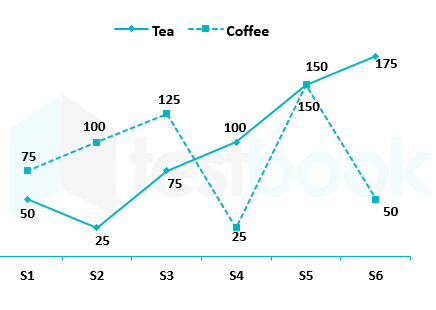
The diagram below shows the production of tea and coffee in different states.

What is the average production of tea and coffee in the state S2?

  1. AOption (a)

    64.5

  2. BOption (b)

    62.5

  3. COption (c)

    65.5

  4. DOption (d)

    82.5

View answer & explanation

Correct answer

Answer: (b)B.

62.5

Why this answer is correct

Given

The production of tea in the state S2 = 25

The production of coffee in the state S2 = 100

Solution

The average production of tea and coffee in the state of S2

⇒ (100 + 25)/2

⇒ 62.5

The correct option is 2.

Question 50

What is the value of 123−53−73840\frac{12^3-5^3-7^3}{840}?

  1. AOption (a)

    1.5

  2. BOption (b)

    2.5

  3. COption (c)

    1.2

  4. DOption (d)

    2

View answer & explanation

Correct answer

Answer: (a)A.

1.5

Why this answer is correct

Solution

⇒ (123 - 53 - 73)/840

⇒ (1728 - 125 - 343)/840

⇒ (1728 - 125 - 343)/840

⇒ 1260/840

⇒ 1.5

The correct option is 1.

Question 51

If 2/3 of 2/5 of 2/7 of a number is equal to 400, then what is the value of the number?

  1. AOption (a)

    4570

  2. BOption (b)

    5250

  3. COption (c)

    1050

  4. DOption (d)

    3640

View answer & explanation

Correct answer

Answer: (b)B.

5250

Why this answer is correct

Solution

Let the number be x.

⇒ 2/3 ×  2/5 ×  2/7 × x = 400

⇒ x = 400 × 3/2 × 5/2 × 7/2

⇒ x = 50 × 3 × 5 × 7

⇒ x = 5250

The correct option is 2.

Question 52

The table below shows the number of calculators sold by eight companies in a year.

CompanyNumber of calculators
A400
B350
C300
D600
E800
F1000
G700
H500

Which of the following statements is correct?

I. The average number of calculators sold by A, C and H is 400.

Ii. The ratio of the number of calculators sold by D to the number of calculators sold by F is 5 : 3.

  1. AOption (a)

    Both I and II

  2. BOption (b)

    Only II

  3. COption (c)

    Only I

  4. DOption (d)

    Neither I nor II

View answer & explanation

Correct answer

Answer: (c)C.

Only I

Why this answer is correct

Given

The total number of calculators sold by A, C and H = 1200

Solution

I) The average number of calculators sold by A, C and H 

⇒ (400 + 300 + 500)/3

⇒ 1200/3

⇒ 400

II) The ratio of the number of calculators sold by D to the number of calculators sold by F = 600/1000

⇒ 3: 5

The correct option is 3.

Question 53

An article is bought for Rs. 880 and sold at a loss of 30 percent. What is the selling price of the article?

  1. AOption (a)

    Rs. 616

  2. BOption (b)

    Rs. 726

  3. COption (c)

    Rs. 608

  4. DOption (d)

    656 रुपये

View answer & explanation

Correct answer

Answer: (a)A.

Rs. 616

Why this answer is correct

Given

The cost price of an article = 880

Loss% = 30

Formula

S.P = C.P × (100 - L%)/100

Solution

S.P = 880 × (100 - 30%)/100

S.P = 880 × 70/100

S.P = 616

The correct option is 1.

Question 54

If the radius of a circle is decreased by 10 percent, then the area of the circle will decrease by what percentage?

  1. AOption (a)

    19 percent

  2. BOption (b)

    21 percent

  3. COption (c)

    20 percent

  4. DOption (d)

    22 percent

View answer & explanation

Correct answer

Answer: (a)A.

19 percent

Why this answer is correct

Given

The radius of the circle = 10% decrease

Formula

Area of the circle = πr2

Solution

Let the radius be 10x.

⇒ π × 10x × 10x

⇒ π × 100x2

Now the new area will be,

⇒ π × 9x × 9x

⇒ π × 81x2

The decrease in the area will be:

⇒ (π × 100x2 - π × 81x2)/π × 100x2

⇒ (π × 19x2)/(π × 100x2) × 100

⇒ 19%

The correct option is 1.

Question 55

The length of a cuboid is three times its height. The width of the cuboid is half of the sum of its height and length, if five times the width is equal to 100 cm, then what is the total surface area of the cuboid?

  1. AOption (a)

    1100 cm2

  2. BOption (b)

    1800 cm2

  3. COption (c)

    900 cm2

  4. DOption (d)

    2200 cm2

View answer & explanation

Correct answer

Answer: (d)D.

2200 cm2

Why this answer is correct

Shortcut Trick

Given 5 × Width = 100 ⇒ Width (w) = 20 cm.

Relationship: Width = (Length + Height) ÷ 2. Since Length = 3 × Height, then 20 = (3h + h) ÷ 2 ⇒ 20 = 2h.

Thus, Height (h) = 10 cm and Length (l) = 30 cm.

Total Surface Area = 2(lw + wh + hl) = 2(600 + 200 + 300) = 2200 cm2.

∴ The correct answer is 2200 cm2.

Alternate Method

Given:

Length (l) = 3h

Width (w) = (h + l) ÷ 2

5 × w = 100 cm

Formula Used:

Total Surface Area (TSA) = 2(lw + wh + hl)

Calculations:

⇒ 5w = 100 ⇒ w = 20 cm

⇒ w = (h + 3h) ÷ 2 ⇒ 20 = 4h ÷ 2

⇒ 20 = 2h ⇒ Height (h) = 10 cm

⇒ Length (l) = 3 × 10 = 30 cm

⇒ TSA = 2[(30 × 20) + (20 × 10) + (10 × 30)]

⇒ TSA = 2[600 + 200 + 300]

⇒ TSA = 2[1100] = 2200 cm2

∴ The correct answer is 2200 cm2.

Additional Information

Volume of a Cuboid

The space occupied by the cuboid is calculated as Volume = Length × Width × Height (l × w × h).

Lateral Surface Area

The area of the four vertical faces (excluding top and bottom) is given by LSA = 2 × h × (l + w).

Diagonal of a Cuboid

The length of the longest rod that can be placed inside a cuboid is √(l2 + w2 + h2).

Question 56

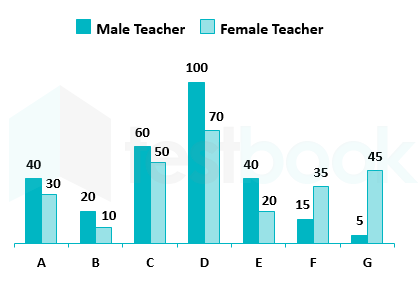
The bar graph given below shows the number of male teachers and female teachers in different schools.

J1 = Average number of male teachers per school

J2 = Difference between total male teachers and total female teachers

What is the value of (J1/J2)?

  1. AOption (a)

    1

  2. BOption (b)

    4

  3. COption (c)

    3

  4. DOption (d)

    2

View answer & explanation

Correct answer

Answer: (d)D.

2

Why this answer is correct

Given

Total male teachers = 280

Total female teachers = 260

Formula used

Average = Total sum of all value/No. of all values

Solution

The average number of male teachers per school(J1)

⇒ (40 + 20 + 60 + 100 + 40 + 15 + 5)/5

⇒ 280/7 = 40

⇒ J2 = total male teachers - total female teachers

⇒ J2 = 280 - 260

⇒ J2 = 20

⇒ J1/J2 = 40/20

⇒ J1/J2 = 2

The correct option is 4.

Question 57

If 10 percent of A is equal to 40 percent of B, then what is A : B?

  1. AOption (a)

    1 : 5

  2. BOption (b)

    1 : 4

  3. COption (c)

    4 : 1

  4. DOption (d)

    5 : 1

View answer & explanation

Correct answer

Answer: (c)C.

4 : 1

Why this answer is correct

Given

⇒ 10% of A = 40% of B

Calculation:

⇒ 10/100 × A = 40/100 × B

A: B = 4 : 1

The correct option is 3.

Question 58

If the average of 20, 24, 23, 19, P and Q is 25, then what is the average of P and Q?

  1. AOption (a)

    35

  2. BOption (b)

    32

  3. COption (c)

    31

  4. DOption (d)

    37

View answer & explanation

Correct answer

Answer: (b)B.

32

Why this answer is correct

Given

The numbers are  20, 24, 23, 19, P and Q.

The average = 25

Formula

Average = Total sum of value/No.of values

Solution

The total sum of all numbers = 20 + 24 + 23 + 19 + P + Q

⇒ 86 + P + Q

The total sum of all numbers = 25 × 6 = 150

Equating both,

⇒ 86 + P + Q = 150

⇒ P + Q = 150 - 86

⇒ P + Q = 64

The average of P and Q = 64/2

⇒ 32

The correct option is 2.

Question 59

Which number is 25 percent less than the 25 percent of 500?

  1. AOption (a)

    83.25

  2. BOption (b)

    96.50

  3. COption (c)

    93.75

  4. DOption (d)

    87.25

View answer & explanation

Correct answer

Answer: (c)C.

93.75

Why this answer is correct

Given

The number = 500

Solution

⇒ 25% of 500

⇒ 1/4 × 500

⇒ 125

The number which is 25% less than 125,

⇒ (100 - 25)% of 125

⇒ (1 - 1/4) × 125

⇒ 3/4 × 125

⇒ 93.75

The correct option is 3.

Question 60

A car traveling at a speed of 45 km/h covers a certain distance in 4 hours. If the same distance is to be covered in 6 hours, what will be the speed of the car?

  1. AOption (a)

    24 km/hr

  2. BOption (b)

    36 km/hr

  3. COption (c)

    30 km/hr

  4. DOption (d)

    40 km/hr

View answer & explanation

Correct answer

Answer: (c)C.

30 km/hr

Why this answer is correct

Given

A car travelling at a speed = 45 km/h

Time = 4 hours

Formula used:- 

d = s × t

Where, d = distance, s = speed and t = time

Solution:-

⇒ D = 45 × 4

⇒ D = 180 km

To cover this distance in 6 hours, speed should be

⇒ s = 180/6

⇒ s = 30 km/hr

The correct answer is 3.

General English (20 questions)

Question 61

In the following question, out of the given four alternatives, select the alternative which best expresses the meaning of the Idiom/Phrase.

Between whiles

  1. AOption (a)

    To sacrifice for a cause

  2. BOption (b)

    Hynpotised and controlled

  3. COption (c)

    To spend an amount of time idly

  4. DOption (d)

    An offer of peace

View answer & explanation

Correct answer

Answer: (c)C.

To spend an amount of time idly

Why this answer is correct

The correct answer is "To spend an amount of time idly"

Key Points

  • " Between whiles" is a phrase that means "occasionally" or "from time to time**(समय की एक राशि आलस्य में खर्च करने के लिए)**."
  • Example: "I like to take breaks from work and go for a walk between whiles."

               This means that the speaker occasionally takes breaks from work to go for a walk.

Correct answer: To spend an amount of time idly

Question 62

Rearrange the parts of the sentence in correct order.

During the Classical period

P: Classical oratorical Latin, and the ordinary colloquial

Q: there were at least three types of Latin

R: in use: Classical written Latin,

S: Latin used by the average speaker of the language

  1. AOption (a)

    SPQR

  2. BOption (b)

    RPSQ

  3. COption (c)

    QSPR

  4. DOption (d)

    QRPS

View answer & explanation

Correct answer

Answer: (d)D.

QRPS

Why this answer is correct

The correct answer is "QRPS"

Key Points

  • The first statement must be that best connects the given opening of the sentence. i.e. During the Classical period.
  • Q will the next statement after opening because it best connects the opening and further tells us about the classical period.This part of the sentence serves as the introduction and sets the context for the rest of the sentence. It mentions the time period (the Classical period) and the main idea of the sentence (the existence of three types of Latin).
  • R follows Q, as this part of the sentence presents the first type of Latin that was in use during the Classical period. It specifically mentions "Classical written Latin".
  • P follows R, this part of the sentence describes the second type of Latin that was in use during the Classical period. It mentions "the ordinary colloquial Latin used by the average speaker of the language".
  • S follows P, this part of the sentence mentions the third type of Latin that was in use during the Classical period. It specifically mentions "Classical oratorical Latin".
  • Thus, the correct sequence is "QRPS"

Correct arrangement: During the Classical period there were at least three types of Latin  in use: Classical written Latin,Classical oratorical Latin, and the ordinary colloquial  Latin used by the average speaker of the language

Question 63

In the given question, four words are given out of which one word is correctly spelt. Choose the correctly spelt word.

  1. AOption (a)

    Midieval

  2. BOption (b)

    Medeival

  3. COption (c)

    Mideival

  4. DOption (d)

    Medieval

View answer & explanation

Correct answer

Answer: (d)D.

Medieval

Why this answer is correct

The correct answer is "Medieval"

Key Points

  • The correctly spelt word is "Medieval"
  • Medieval refers to the Middle Ages, a period of European history that lasted from the 5th to the 15th century. The term is often used to describe the characteristics and cultural, economic, and political developments of this time period(मध्यकालीन).
  • For example:

"Medieval castles, with their imposing stone walls and towers, were designed to protect the inhabitants from attack."

This sentence refers to the architectural style of castles that were built during the Middle Ages.

Correct answer: Medieval

Question 64

Choose the word that can substitute the given sentence.

A combination of incongruous words

  1. AOption (a)

    Irony

  2. BOption (b)

    Hyperbole

  3. COption (c)

    Sarcasm

  4. DOption (d)

    Oxymoron

View answer & explanation

Correct answer

Answer: (d)D.

Oxymoron

Why this answer is correct

The correct answer is "​Oxymoron"

Key Points

  • Let's understand the meaning of the given words.
  • Irony: Irony is a figure of speech in which the meaning of words is opposite to their intended or expected meaning(विडंबना).
  • For example: "It's a nice day for a walk in the park," said the person, as it starts to rain.
  • Hyperbole: Hyperbole is an exaggeration used for emphasis or effect.(अतिशयोक्ति)
  • For example: "I've told you a million times to clean your room!"
  • Sarcasm: Sarcasm is a form of irony that is used to mock or convey disapproval or contempt.(कटाक्ष)
  • For example: "Oh, great. Just what I always wanted. Another traffic jam."
  • Oxymoron: An oxymoron is a figure of speech in which two opposing or contrasting ideas are combined to create a rhetorical effect.
  • For example: "Bittersweet memories." or "Jumbo shrimp."
  • Thus, from the above explanation the correct answer is "Oxymoron"

Correct answer: Oxymoron

Question 65

Select the most appropriate option to substitute the underlined segment in the given sentence. If no substitution is required, select ‘No improvement’ as your answer.

The man had a gun with either him or he was being foolish.

  1. AOption (a)

    No improvement

  2. BOption (b)

    either had a gun with him

  3. COption (c)

    had a gun either with him

  4. DOption (d)

    has either a gun with him

View answer & explanation

Correct answer

Answer: (b)B.

either had a gun with him

Why this answer is correct

The correct answer is "either had a gun with him"

Key Points

  • In the original sentence, "with either him or he was being foolish" is grammatically incorrect. The correct way to phrase the sentence would be "either he had a gun with him or he was being foolish.
  • The correction clarifies that the man either had a gun with him, or he was being foolish, but not both. The phrase "with him" is used correctly to describe that the man had a gun with him. The phrase "he was being foolish" is used correctly to describe the alternative possibility.
  • So, the most appropriate option to substitute the underlined segment in the given sentence is: "The man either had a gun with him or was being foolish."

Correct sentence: The man either had a gun with him or was being foolish."

Question 66

Choose the word that is opposite in meaning to the given word.

Fallible

  1. AOption (a)

    Errant

  2. BOption (b)

    Vapid

  3. COption (c)

    Impeccable

  4. DOption (d)

    Amoral

View answer & explanation

Correct answer

Answer: (c)C.

Impeccable

Why this answer is correct

The correct answer is "Impeccable"

Key Points

  • Let's understand the given words.
  • Fallible: Fallible means capable of making mistakes or being wrong(पतनशील).
  • For example: "No one is perfect, and even the best doctors can be fallible at times."
  • Impeccable: Impeccable means having no faults or mistakes; flawless( त्रुटिहीन,).
  • For example: "The chef's impeccable technique and attention to detail produced a perfect meal every time."
  • Thus, the word that is opposite in meaning to the given word is "Impeccable"

Correct answer: Impeccable

Additional Information 

  • Errant: Errant means straying from the right course or standard, or wandering from the proper path(त्रुटिपूर्ण).
  • For example: "The errant missile caused widespread destruction when it landed in the city."
  • Vapid: Vapid means lacking liveliness, interest, or significance; dull and uninteresting(नीरस).
  • For example: "The movie was so vapid and uninspiring that I fell asleep halfway through."
  • Amoral: Amoral means having no sense of right or wrong; lacking a moral code.(नीतिहीन)
  • For example: "The amoral businessman was only concerned with making a profit, regardless of the consequences."

Question 67

Find the part of the given sentence that has an error in it. If there is no error, choose ‘No error’.

Companies should be more transparent (1)/ about what their harassment policies (2)/mean and how they apply it in practice (3)/. No error (4)

  1. AOption (a)

    1

  2. BOption (b)

    3

  3. COption (c)

    4

  4. DOption (d)

    2

View answer & explanation

Correct answer

Answer: (b)B.

3

Why this answer is correct

The correct answer is "3"

Key Points

  • The part of the sentence that has an error in it is "and how they apply it in practice".
  • In this part of the sentence, the correct form of the verb "apply" should be "apply them" since "them" refers to the policies.
  • So, the corrected sentence would be: "Companies should be more transparent about what their harassment policies mean and how they apply them in practice."

Correct Sentence: Companies should be more transparent about what their harassment policies mean and how they apply them in practice."

Question 68

A sentence has been given with a blank to be filled with an appropriate word. Choose the correct alternative.

In summers, ______ cotton clothes are more comfortable.

  1. AOption (a)

    loose

  2. BOption (b)

    lost

  3. COption (c)

    lose

  4. DOption (d)

    losing

View answer & explanation

Correct answer

Answer: (a)A.

loose

Why this answer is correct

The correct answer is "loose"

Key Points

  • The most appropriate word to fill in the blank is "loose"
  • Loose means "not fitting closely; having a lot of room". In the given sentence, loose cotton clothes are more comfortable in summers because they allow air to circulate and keep the body cool.
  • Lost means "unable to be found or recovered". It is not appropriate to use in this context.
  • Lose means "to be deprived of or cease to have or retain (something)". It is not appropriate to use in this context.
  • Losing means "to be in the process of losing". It is not appropriate to use in this context.
  • So, the word "loose" is the best fit for the given sentence as it accurately describes the type of clothing that is more comfortable to wear in the summer.

Correct Sentence: In summers,loose cotton clothes are more comfortable.

Question 69

Select the most appropriate option to substitute the underlined segment in the given sentence. If no substitution is required, select ‘No improvement’ as your answer.

To average, we received almost a dozen stories a day.

  1. AOption (a)

    In average

  2. BOption (b)

    On an average

  3. COption (c)

    No improvement

  4. DOption (d)

    By average

View answer & explanation

Correct answer

Answer: (b)B.

On an average

Why this answer is correct

The correct answer is "On an average"

Key Points

  • The substitution "On an average" is a more appropriate and grammatically correct phrase to use in this sentence. "To average" is not a common phrase and its meaning in this context is not clear.
  • "On an average" is a common expression that is used to indicate the average or typical quantity, number, or value, often over a period of time.
  • In this sentence, "On an average, we received almost a dozen stories a day" means that, over a certain period of time, the number of stories received was about a dozen per day on average.
  • "To average" does not convey a clear meaning in this sentence, making it an incorrect choice for the substitution.

Correct sentence: On an average we received a dozen stories a day

Question 70

Choose the word that means the same as the given word.

Result

  1. AOption (a)

    Obey

  2. BOption (b)

    Outcome

  3. COption (c)

    Dissipate

  4. DOption (d)

    Derision

View answer & explanation

Correct answer

Answer: (b)B.

Outcome

Why this answer is correct

The correct answer is "Outcome"

Key Points

  • Result: A result is the outcome or conclusion of an action, calculation, or process.
  • Example: "The result of the experiment was surprising."
  • Outcome: An outcome is the result or consequence of an action or process.
  • Example: "The outcome of the election is still unknown."
  • Thus, the word that means the same as the given word is "Outcome"

Correct answer: Outcome

Additional Information 

  • Obey: To obey is to comply with or follow the orders or rules of someone or something.
  • Example: "The soldiers obeyed the commander's orders."
  • Dissipate: To dissipate is to cause to disappear or scatter, often gradually.
  • Example: "The energy from the explosion quickly dissipated."
  • Derision: Derision is the feeling or expression of contempt or ridicule.
  • Example: "The crowd erupted in derision when the comedian made a joke about the mayor."

Question 71

Find the part of the given sentence that has an error in it. If there is no error, choose ‘No error’.

Data in this study were (1)/ provided by collaborators (2)/ representing six countries (3)/. No error (4)

  1. AOption (a)

    1

  2. BOption (b)

    3

  3. COption (c)

    2

  4. DOption (d)

    4

View answer & explanation

Correct answer

Answer: (d)D.

4

Why this answer is correct

The correct answer is '4' i.e. No error .

Key Points

  • The sentence in question is: "Data in this study were (1)/ provided by collaborators (2)/ representing six countries (3)/. No error (4)"
  • Let's analyze each part:                               
  • (1) Data in this study were: The word "data" is the plural form of "datum" (from Latin). Traditionally, "data" is treated as a plural noun and takes a plural verb. Therefore, "data were" is grammatically correct according to traditional English grammar rules.
  • (2) provided by collaborators: This phrase correctly uses the passive voice ("provided by") and the plural form "collaborators" to refer to multiple people. There is no grammatical error here.
  • (3) representing six countries: "Representing" is a present participle correctly modifying "collaborators," indicating what the collaborators are doing. "Six countries" is grammatically sound. No error here.
  • Since all parts of the sentence are grammatically correct, there is no error.

Correct sentence: Data in this study were provided by collaborators representing six countries.

Additional Information       

  • While "data" is increasingly used with a singular verb (e.g., "the data is conclusive") in modern, informal, and even some formal contexts, treating it as a collective noun, its traditional and still acceptable usage as a plural noun requiring a plural verb ("data were") remains grammatically valid. When asked to identify an error in a formal sentence, adhering to established grammatical rules is key.

Question 72

Rearrange the parts of the sentence in the correct order.

P: except the right to vote in the assemblies

Q: in the beginning, the patricians were supposed

R: to have enjoyed a monopoly of power,

S: whereas the plebeians began with nothing

  1. AOption (a)

    QRSP

  2. BOption (b)

    SRQP

  3. COption (c)

    QSRP

  4. DOption (d)

    SPQR

View answer & explanation

Correct answer

Answer: (a)A.

QRSP

Why this answer is correct

The correct answer is "QRSP".

Key Points

  • Q will the first part of the sentence as it sets the context of the sentence and introduces the main topic of the sentence, which is the patricians and plebeians in ancient Rome.
  • R follows Q, as this part states the main idea or claim of the sentence, that the patricians held a monopoly of power in the beginning.
  • S follows R, as this part provides contrast or comparison to the main idea, showing that the plebeians had a different starting point.
  • P follows S, as this part adds a specific detail or exception to the main idea, further explaining the situation in ancient Rome.
  • Thus, the correct sequence is "QRSP"

Correct arrangement: In the beginning, the patricians were supposed to have enjoyed a monopoly of power, whereas the plebeians began with nothing except the right to vote in the assemblies​.

Question 73

In the following question, out of the given four alternatives, select the alternative which best expresses the meaning of the Idiom/Phrase.

God’s ape

  1. AOption (a)

    The first creation of god

  2. BOption (b)

    A born fool

  3. COption (c)

    To intimidate someone

  4. DOption (d)

    A mystical soul

View answer & explanation

Correct answer

Answer: (b)B.

A born fool

Why this answer is correct

The correct answer is " A born fool"

Key Points

  • "God's ape" is a derogatory term that is used to refer to a person who is seen as being foolish or acting in a foolish or irrational manner(जन्मजात मूर्ख). 

​For example: "Don't be such a God's ape and make a sensible decision for once."

  • Thus, "A born fool" is the option that best expresses the meaning of the idiom.

Correct answer: A born fool

Question 74

 In the given question, four words are given out of which one word is correctly spelt. Choose the correctly spelt word.

  1. AOption (a)

    Asistense

  2. BOption (b)

    Assistence

  3. COption (c)

    Asistance

  4. DOption (d)

    Assistance

View answer & explanation

Correct answer

Answer: (d)D.

Assistance

Why this answer is correct

The correct answer is "Assistance"

Key Points

  • The correct spelling is "Assistance"
  • Assistance refers to help or support given to someone or something in achieving a particular goal or task. It can refer to various forms of aid, such as advice, guidance, support, or physical aid(सहायता).
  • For example: "The fire department provided assistance to the injured people after the accident."

Correct answer: Assistance

Question 75

A sentence has been given with a blank to be filled with an appropriate word. Choose the correct alternative.

You better be right if you want ______ handcuffs out from your hands.

  1. AOption (a)

    those

  2. BOption (b)

    these

  3. COption (c)

    that

  4. DOption (d)

    such

View answer & explanation

Correct answer

Answer: (b)B.

these

Why this answer is correct

The correct answer is "these"

Key Points

  • The word "these" is a pronoun that is used to refer to a specific, identifiable thing or group of things close at hand or near in time or space. In the given sentence, the speaker is referring to the handcuffs that the person they are speaking to is currently wearing, which makes "these" the appropriate choice.
  • The use of "these" emphasizes the immediate proximity and accessibility of the handcuffs, suggesting that they are right there in front of the person being addressed
  • "Those" is used to refer to a specific, identifiable thing or group of things further away,
  • while "that" is used to refer to a specific, identifiable thing or group of things that are not close at hand.
  • "Such" is an adjective used to describe the type or quality of something, and it is not appropriate here because the speaker is referring to a specific set of handcuffs and not describing their type or quality.
  • Thus, the correct answer is "these"

Correct Sentence: You better be right if you want these handcuffs out from your hands.

Read the following information carefully and answer the given questions.

Mental hygiene is the science of maintaining mental health and preventing the development of psychosis, neurosis, or other mental disorders.

Since the founding of the United Nations, the concepts of mental health and hygiene have achieved international acceptance. As defined in the 1946 constitution of the World Health Organization, “health is a state of complete physical, mental, and social well-being, and not merely the absence of disease or infirmity.” The term mental health represents a variety of human aspirations: rehabilitation of the mentally disturbed, prevention of mental disorder, reduction of tension in a stressful world, and attainment of a state of well-being in which the individual functions at a level consistent with his or her mental potential.

As noted by the World Federation for Mental Health, the concept of optimum mental health refers not to an absolute or ideal state but to the best possible state insofar as circumstances are alterable. Mental health is regarded as a condition of the individual, relative to the capacities and social-environmental context of that person. Mental hygiene includes all measures taken to promote and to preserve mental health. Community mental health refers to the extent to which the organization and functioning of the community determines, or is conducive to, the mental health of its members.

Throughout the ages, the mentally disturbed have been viewed with a mixture of fear and revulsion. Their fate generally has been one of rejection, neglect, and ill-treatment. Though in ancient medical writings there are references to the mental disturbance that display views very similar to modern humane attitudes, interspersed in the same literature are instances of socially sanctioned cruelty based upon the belief that mental disorders have supernatural origins such as demonic possession. Even reformers sometimes used harsh methods of treatment; for example, the 18th-century American physician Benjamin Rush endorsed the practice of restraining mental patients with his notorious “tranquilizing chair.” The purpose of the tranquillizing chair was to control the flow of "infected" blood to the brain in order to cure the patient of insanity. And still, a follow up is required on this technique.

Question 76

What is the primary purpose of the given passage?

  1. AOption (a)

    To analyze the complexities of mental hygiene

  2. BOption (b)

    To give a brief view on mental hygiene

  3. COption (c)

    To describe the effects of mental anxiety

  4. DOption (d)

    To criticize the notorious treatments of mental disorder

View answer & explanation

Correct answer

Answer: (b)B.

To give a brief view on mental hygiene

Why this answer is correct

The correct answer is "To give a brief view on mental hygiene"

Key Points

  • The primary purpose of the given passage is "To give a brief view on mental hygiene".
  • The passage provides an in-depth definition and understanding of mental hygiene, including its history and various aspects such as optimum mental health, community mental health, and the changing attitudes towards mentally disturbed individuals over time. The passage also highlights the complexities of mental hygiene, discussing the difficulties faced in promoting and preserving mental health, as well as the challenges faced in overcoming negative societal attitudes towards mental disorders.
  • The information presented in the passage goes beyond just a brief overview of the topic, indicating a comprehensive analysis and exploration of the subject, making the primary purpose of the passage to analyze the complexities of mental hygiene.

Correct answer: To give a brief view on mental hygiene.

Question 77

Which of the following has called mental health as a state of social well-being?

  1. AOption (a)

    United Nations

  2. BOption (b)

    World Federation for Mental Health

  3. COption (c)

    American physician ‘Benjamin Rush'

  4. DOption (d)

    World Health Organization

View answer & explanation

Correct answer

Answer: (d)D.

World Health Organization

Why this answer is correct

The correct answer is "World Health Organization"

Key Points

  • Refer to the line:  As defined in the 1946 constitution of the World Health Organization, “health is a state of complete physical, mental, and social well-being, and not merely the absence of disease or infirmity.”
  • It is clearly mentioned in the passage that, World Health Organization has called mental health as a state of social well-being.

Correct answer: World Health Organisation

Question 78

What is the purpose of the “tranquilizing chair” as per the given passage?

  1. AOption (a)

    To cure the patient suffering from anxiety.

  2. BOption (b)

    To control the flow of infected blood to the brain.

  3. COption (c)

    To motivate the patient to fight his battles a life.

  4. DOption (d)

    To endorse the practice of restraining mental patients.

View answer & explanation

Correct answer

Answer: (b)B.

To control the flow of infected blood to the brain.

Why this answer is correct

The correct answer is "To control the flow of infected blood to the brain."

Key Points

  • Refer to the line: The purpose of the tranquillizing chair was to control the flow of "infected" blood to the brain in order to cure the patient of insanity. And still, a follow up is required on this technique.
  • From the above lines of the passage it is clear that the the purpose of the tranquillizing chair is to control the flow of infected blood to the brain.

Correct answer: To control the flow of infected blood to the brain.

Question 79

Which of the following is NOT the antonym of the word ‘conducive’?

  1. AOption (a)

    Injurious

  2. BOption (b)

    Facilitate

  3. COption (c)

    Damaging

  4. DOption (d)

    Bad

View answer & explanation

Correct answer

Answer: (b)B.

Facilitate

Why this answer is correct

The correct answer is "Facilitate"

Key Points

  • Conducive: Something that is conducive helps to bring about or make something else happen(अनुकूल).
  • For example, "A calm and quiet environment is conducive to studying."
  • Facilitate: To facilitate is to make something easier or more likely to happen(सुविधा).
  • For example, "Technology has facilitated communication among people."
  • Thus, the word that is not the antonym of the word "Conducive" is "Facilitate"

Correct answer: Facilitate

Additional Information 

  • Injurious: Something that is injurious causes harm or injury.(हानिकारक)
  • For example, "Smoking is injurious to health."
  • Damaging: Something that is damaging causes harm or injury to something or someone.(हानिकारक)
  • For example, "Constant exposure to sunlight can be damaging to your skin."
  • Bad: Something that is bad is of poor quality, unsatisfactory or not desirable.(बुरा)
  • For example, "That movie was bad. I don't recommend it."

Question 80

What is the synonym of the word ‘neglect’?

  1. AOption (a)

    Absolute

  2. BOption (b)

    Preserve

  3. COption (c)

    Avoid

  4. DOption (d)

    Repair

View answer & explanation

Correct answer

Answer: (c)C.

Avoid

Why this answer is correct

The correct answer is "Avoid"

Key Points

  • Neglect: Neglect is the act of failing to take proper care of something or someone(उपेक्षा).
  • For example, "Neglecting to water your plants can lead to their death."
  • Avoid: To avoid is to stay away from or refrain from doing something(बचना).
  • For example, "You should avoid eating too much junk food."
  • Thus, the synonym of the given word is "Avoid"

Correct answer: Avoid

Additional Information

  • Absolute: Absolute means complete, total, and without any exceptions or qualifications(निरपेक्ष).
  • For example, "He had absolute control over the company."
  • Preserve: To preserve is to keep something in its original or existing state, or to maintain its safety or integrity.(संरक्षित)
  • For example, "We need to preserve the rainforests to protect the wildlife."
  • Repair: To repair is to fix or restore something that is damaged or broken(मरम्मत).
  • For example, "The mechanic repaired my car and now it runs smoothly."

General Hindi (20 questions)

Question 81

दिए गए वाक्य का पक्ष ज्ञात कीजिए।

श्रेया ने सफलता पा ली है।

  1. AOption (a)

    नित्य पक्ष

  2. BOption (b)

    आवृत्ति पक्ष

  3. COption (c)

    अपूर्ण पक्ष

  4. DOption (d)

    पूर्ण पक्ष

View answer & explanation

Correct answer

Answer: (d)D.

पूर्ण पक्ष

Why this answer is correct

श्रेया ने सफलता पा ली है वाक्य मे वाक्य के पक्ष का सही विकल्प पूर्ण पक्ष है। 

  • पूर्ण पक्ष - इस पक्ष से क्रिया के पूरी तरह समाप्त हो जाने का बोध होता है।

Key Pointsअन्य विकल्पों का विश्लेषण -

वाक्य पक्षपरिभाषाउदाहरण
नित्य पक्ष / आवृत्ति पक्षइस पक्ष से क्रिया के नित्य अर्थात सदा बने रहने का बोध होता है।पृथ्वी गोल है।
पूर्ण पक्षइस पक्ष से क्रिया के पूरी तरह समाप्त हो जाने का बोध होता है।श्रेया ने सफलता पा ली है।
अपूर्ण पक्षइससे क्रिया की निरंतर प्रगति  अथवा उसके पूरे न होने का बोध होता है।भीड़ बढ़ती जा रही है।

Additional Informationपक्ष -  क्रिया के जिस रूप से क्रिया प्रक्रिया अर्थात क्रिया व्यापार का बोध होता है, उसे क्रिया का पक्ष कहते है।

  • यह क्रिया- व्यापार दो दृष्टियों से देखा जा सकता है।
  • पहली दृष्टि से हम देखते हैं कि क्रिया की प्रक्रिया आरंभ होने वाली है अथवा आरंभ हो चुकी है, अथवा वर्तमान में चालू है या हो चुकी है।
  • दूसरी दृष्टि में क्रिया -प्रक्रिया को एक इकाई के रूप में देखते है।

Question 82

दिए गए वाक्य में 'जो' शब्द किस प्रकार का सर्वनाम है?

यह वही पुस्तक हैं, जो मुझे नहीं मिल रही थी।

  1. AOption (a)

    प्रश्नवाचक सर्वनाम

  2. BOption (b)

    पुरूषवाचक सर्वनाम

  3. COption (c)

    निजवाचक सर्वनाम

  4. DOption (d)

    संबंधवाचक सर्वनाम

View answer & explanation

Correct answer

Answer: (d)D.

संबंधवाचक सर्वनाम

Why this answer is correct

यह वही पुस्तक हैं, जो मुझे नहीं मिल रही थी वाक्य मे 'जो' शब्द संबंधवाचक सर्वनाम है। 

  • सम्बन्धवाचक सर्वनाम - जिन सर्वनाम शब्दों का प्रयोग किसी वस्तु या व्यक्ति का सम्बन्ध बताने के लिए किया जाए वे शब्द सम्बन्धवाचक सर्वनाम कहलाते है।

Key Pointsअन्य विकल्पों का विश्लेषण -

सर्वनामपरिभाषाउदाहरण
प्रश्नवाचक सर्वनामजिन शब्दों का प्रयोग किसी वस्तु, व्यक्ति आदि के बारे में कोई सवाल पूछने या उसके बारे में जान्ने के लिए किया जाता हैदेखो तो कौन आया है?
पुरूषवाचक सर्वनामजिन सर्वनाम शब्दों का प्रयोग वक्ता द्वारा खुद के लिए या दुसरो के लिए किया जाता हैतुम जब तक आये तब तक वह चला गया।
निजवाचक सर्वनामजिन शब्दों का प्रयोग वक्ता किसी चीज़ को अपने साथ दर्शाने या अपनी बताने के लिए करता हैअपने देश की सेवा करना ही मेरा लक्षय है।
संबंधवाचक सर्वनामजो सर्वनाम शब्द वाक्य में प्रयुक्त संज्ञा या सर्वनाम का संबंध दूसरे उपवाक्य से जोड़ते हैंजो करेगा, सो भरेगा।

Additional Informationसर्वनाम - संज्ञा के स्थान पर प्रयुक्त होने वाले शब्दों को सर्वनाम कहा जाता है।

सर्वनाम संज्ञाओं की पुनरावृति रोककर वाक्यों को सौंदर्ययुक्त बनता है।

सर्वनाम के छः भेद होते हैं –

  1. पुरुषवाचक सर्वनाम।
  2. निजवाचक सर्वनाम।
  3. निश्चयवाचक सर्वनाम।
  4. अनिश्चयवाचक सर्वनाम।
  5. प्रश्नवाचक सर्वनाम।
  6. सम्बन्धवाचक सर्वनाम।

Question 83

निम्नलिखित प्रश्न में, दिए गए चार विकल्पों में से, उस विकल्प का चयन करें जो दिए गए मुहावरे के अर्थ को सर्वश्रेष्ठ रूप से व्यक्त करता है।

जहर की पुड़िया होना

  1. AOption (a)

    बहुत खुश होना

  2. BOption (b)

    मुसीबत की जड़ होना

  3. COption (c)

    बहुत जहरीला होना

  4. DOption (d)

    बहुत मदद करना

View answer & explanation

Correct answer

Answer: (b)B.

मुसीबत की जड़ होना

Why this answer is correct

जहर की पुड़िया होना मुहावरे के अर्थ को सर्वश्रेष्ठ रूप से विकल्प मुसीबत की जड़ होना व्यक्त करता है।

  • वाक्य प्रयोग - उसकी कही हुई बाते लोगो के बीच दरार डाल ही देती है, सच कहते है सब वो मुसीबत की जड़ है।

Key Pointsअन्य विकल्पों का विश्लेषण -

मुहावराअर्थवाक्य प्रयोग
विष से भरा होनाबहुत जहरीला होनावह काले सांप सी विष से भरी हुई है।
बाग़-बाग़ होनाबहुत खुश होनाबहन के विवाह की बात सुनकर वह तो बाग़ - बाग़ हो गया।
साथ देनाबहुत मदद करनाराम हमेशा दूसरों का साथ देने के लिए तत्पर रहता है।

Additional Informationमुहावरा - ऐसे वाक्यांश, जो सामान्य अर्थ का बोध न कराकर किसी विलक्षण अर्थ की प्रतीति कराये, मुहावरा कहलाता है।

Question 84

दिए गए वाक्य में किस विराम चिह्न का उपयोग किया जाएगा उसकी पहचान कीजिए।

अरे वह अनुत्तीर्ण हो गया।

  1. AOption (a)

    !

  2. BOption (b)
  3. COption (c)

    ।

  4. DOption (d)

    ;

View answer & explanation

Correct answer

Answer: (a)A.

!

Why this answer is correct

वाक्य मे विस्म्यादिबोधक (!) विराम चिह्न का प्रयोग होगा 

  • अतः वाक्य निम्न प्रकार से होगा -
  • अरे वह अनुत्तीर्ण हो गया!
  • विस्म्यादिबोधक (!) - जब वाक्य में हर्ष, विषाद, विस्मय, घृणा, आश्चर्य, करुणा, भय आदि भाव व्यक्त किए जाएँ तो वहाँ इस विस्मयादिबोधक चिह्न (!) का प्रयोग किया जाता है।

Key Points 

अन्य विकल्पों का विश्लेषण -

विराम चिह्नपरिभाषाउदाहरण
योजक चिह्न (-)यह चिह्न सामान्यतः दो पदों को जोड़ता है और दोनों को मिलाकर एक समस्त पद बनाता है लेकिन दोनों का स्वतंत्र अस्तित्व बना रहता है।कली - सी कोमलता।
पूर्ण विराम (|)इसका प्रयोग वाक्य की समाप्ति हो जाने के बाद किया जाता है।रामचंद्र जी राजा दशरथ के पुत्र थे।
अर्द्ध विराम (;)अल्प विराम से अधिक तथा पूर्ण विराम से कम ठहरना पड़े तो अर्द्ध विराम( ; ) का प्रयोग होता है।बिजली चमकी ; फिर भी वर्षा नहीं हुई

Additional Informationविराम चिह्न - विराम शब्द का शाब्दिक अर्थ होता है ठहराव।

अपनी बात कहने के लिए उसे समझाने के लिए, किसी कथन पर बल देने के लिए आश्चर्य आदि भावों की अभिव्यक्ति के लिए, कहीं कम समय के लिए तो कहीं अधिक समय के लिए ठहरने के लिए इसका प्रयोग किया जाता है। 

हिन्दी में निम्न विराम चिह्न प्रयुक्त होते है -

  • अल्प विराम (,)
  • अर्द्ध विराम (;)
  • अपूर्ण विराम (:)
  • पूर्ण विराम (।)
  • प्रश्न सूचक चिह्न (?)
  • सम्बोधन चिह्न (!)
  • विस्मय सूचक चिह्न (!)
  • अवतरण चिह्न/उद्धरण चिह्न/उपरिविराम – (i) इकहरा (‘ ’ )(ii) दुहरा (‘‘ ’’)
  • योजक चिह्न/समासचिह्न (–)
  • निदेशक (——-)
  • विवरण चिह्न (:——)
  • हंसपद/विस्मरण चिह्न (ˆ)
  • संक्षेपण/लाघव चिह्न (0)
  • तुल्यता सूचक/समता सूचक (=)
  • कोष्ठक ( ) { } [ ]
  • लोप चिह्न (…….)
  • इतिश्री/समाप्ति सूचक चिह्न -(0- — —)
  • विकल्प चिह्न( /)
  • पुनरुक्ति चिह्न (’’ ’’)
  • संकेत चिह्न(*)

Question 85

निम्नलिखित प्रश्न में, दिए गए चार विकल्पों में से, उस विकल्प का चयन करें जो दिए गए मुहावरे के अर्थ को सर्वश्रेष्ठ रूप से व्यक्त करता है।

एक लाठी से सबको हाँकना

  1. AOption (a)

    वश में करना

  2. BOption (b)

    बेवकूफ बनाना

  3. COption (c)

    सभी के साथ समान व्यवहार

  4. DOption (d)

    सोच विचार में पड़ना

View answer & explanation

Correct answer

Answer: (c)C.

सभी के साथ समान व्यवहार

Why this answer is correct

एक लाठी से सबको हाँकना मुहावरे के अर्थ को सर्वश्रेष्ठ रूप से विकल्प सभी के साथ समान व्यवहार व्यक्त करता है।

  • वाक्य प्रयोग - थानेदार से यह उम्मीद की जाती है कि वह थाने में आये सभी व्यक्तियों को एक ही लाठी से हांके।

Key Pointsअन्य विकल्पों का विश्लेषण -

मुहावराअर्थवाक्य प्रयोग
काबू मे करनावश में करनाउसने पूरे घर को अपने काबू मे कर लिया है।
उल्लू बनानाबेवकूफ बनानाराहुल दूसरों को उल्लू बनाने मे माहिर है। ​
सोच मे पड जानासोच विचार में पड़नाघर मे मेहमान के आने की बात सुनकर वह सोच मे पड़ गयी कि ऐसा क्या बनाया जाये जो मेहमानों को भा जाए। ​

Additional Informationमुहावरा -  ऐसे वाक्यांश, जो सामान्य अर्थ का बोध न कराकर किसी विलक्षण अर्थ की प्रतीति कराये, मुहावरा कहलाता है।

Question 86

निम्नलिखित वाक्यों में से संयुक्त वाक्य ज्ञात कीजिए।

  1. AOption (a)

    जोरदार धमाका होते ही लोगों में भगदड़ मच गई।

  2. BOption (b)

    जैसे ही जोर का धमाका हुआ वैसे ही लोगों में भगदड़ मच गई।

  3. COption (c)

    जोरदार धमाका हुआ और लोगों में भगदड़ मच गई।

  4. DOption (d)

    जब धमाका हुआ तो लोगों में भगदड़ मच गई।

View answer & explanation

Correct answer

Answer: (c)C.

जोरदार धमाका हुआ और लोगों में भगदड़ मच गई।

Why this answer is correct

संयुक्त वाक्य के विकल्प का सही उत्तर जोरदार धमाका हुआ और लोगों में भगदड़ मच गई होगा।

  • संयुक्त वाक्य - जिन वाक्यों में दो-या दो से अधिक सरल वाक्य समुच्चयबोधक अव्ययों से जुड़े हों, उन्हें संयुक्त वाक्य कहते है।

Key Pointsअन्य विकल्पों का विश्लेषण -

  • जोरदार धमाका होते ही लोगों में भगदड़ मच गई - मिश्रित वाक्य।
  • जैसे ही जोर का धमाका हुआ वैसे ही लोगों में भगदड़ मच गई -मिश्रित वाक्य।
  • जब धमाका हुआ तो लोगों में भगदड़ मच गई - मिश्रित वाक्य।

Additional Informationरचना के आधार पर वाक्य के तीन भेद होते है -

वाक्यपरिभाषाउदाहरण
सरल वाक्यऐसे वाक्य जिसमे एक क्रिया और एक ही कर्ता होता है उसे सरल वाक्य या साधारण वाक्य कहते है।राम के पिता का नाम दशरथ  था।
संयुक्त वाक्यजिन वाक्यों में दो-या दो से अधिक सरल वाक्य समुच्चयबोधक अव्ययों से जुड़े हों, उन्हें संयुक्त वाक्य कहते है।जोरदार धमाका हुआ और लोगों में भगदड़ मच गई।
मिश्रित वाक्यजिन वाक्यों में एक मुख्य उपवाक्य हो और अन्य गौण उपवाक्य हों तथा जो आपस में कि, जो, क्योंकि, जितना, उतना, जैसा, वैसा, जब, तब, जहाँ, वहाँ, जिधर, उधर, अगर/यदि, तो, यद्यपि, तथापि, आदि से मिश्रित (मिले-जुले) हों उन्हें मिश्रित वाक्य कहते है।जब धमाका हुआ तो लोगों में भगदड़ मच गई।

Question 87

निम्नलिखित वाक्यांश के लिए उचित शब्द का चयन कीजिए।

जो शोक करने योग्य न हो

  1. AOption (a)

    शोकनीय

  2. BOption (b)

    अनेर

  3. COption (c)

    अशोक

  4. DOption (d)

    अनियमित

View answer & explanation

Correct answer

Answer: (c)C.

अशोक

Why this answer is correct

जो शोक करने योग्य न हो वाक्यांश के एक शब्द का सही विकल्प अशोक होगा।

  • अशोक के अन्य अर्थ -
  • हँसमुख, सुन्दर, स्फूर्तिकारक, आनंदकारक, हर्ष, प्रसन्न, चमकीला आदि है।

Key Pointsअन्य विकल्पों का विश्लेषण -

शब्दवाक्यांश
शोकनीयजिसका शोक किया जाये।
अनियमितजो नियम के अनुकूल न हो।
अनेरजो पास का न हो।

Additional Information

  • वाक्यांश की परिभाषा - शब्द समूह का वह सार्थक रूप जिससे एक विचार की स्पष्ट एवं पूर्ण अभिव्यक्ति होती हो, उसे वाक्यांश कहते है।
  • वाक्यांश के लिए एक शब्द की परिभाषा - जो शब्द अनेक शब्दों के स्थान पर अकेले ही प्रयोग किये जाते हैं , वे वाक्यांश बोधक शब्द कहलाते है।

Question 88

दिए गए शब्द का स्त्रीलिंग ज्ञात कीजिए।

क्षत्रिय

  1. AOption (a)

    क्षात्री

  2. BOption (b)

    क्षत्रियानी

  3. COption (c)

    क्षत्राणी

  4. DOption (d)

    क्षत्रा

View answer & explanation

Correct answer

Answer: (c)C.

क्षत्राणी

Why this answer is correct

क्षत्राणी शब्द स्त्रीलिंग शब्द का सही विकल्प होगा। 

  • क्षत्राणी का पुल्लिंग क्षत्रिय होगा।

Key Pointsलिंग - लिंग उन शब्दों का रूप होता है जिनसे स्त्री और पुरुष में अंतर किया जा सके।

यानी अगर स्त्री और पुरुष का बोध कराते हो, उन्हें लिंग कहा जाता है। 

लिंग के भेद -

स्त्रीलिंगपुल्लिंग
शब्द का वह रूप जिससे पता लगाया जाता है कि वह स्त्री जाति है, उन्हें स्त्रीलिंग कहा जाता है। जैसे - बेटी, पुत्री, शिक्षिका, गाय, मोरनी आदि।शब्द का वह रूप जिससे पता लगाया जाता है कि वह पुरुष जाति का है, उन्हें पुल्लिंग कहा जाता है। जैसे - बेटा, कुता, लड़का, घोड़ा भेंड आदि।

Question 89

निम्नलिखित वाक्यों में से मिश्र वाक्य ज्ञात कीजिए।

  1. AOption (a)

    सबसे कमज़ोर होने पर भी उसने सबसे ज़्यादा काम किया।

  2. BOption (b)

    यद्यपि वह सबसे कमज़ोर था तथापि उसने सबसे ज़्यादा काम किया।

  3. COption (c)

    वह सबसे कमज़ोर था और फिर भी उसने सबसे ज़्यादा काम किया।

  4. DOption (d)

    वह सबसे कमज़ोर था, फिर भी उसने सबसे ज़्यादा काम किया।

View answer & explanation

Correct answer

Answer: (b)B.

यद्यपि वह सबसे कमज़ोर था तथापि उसने सबसे ज़्यादा काम किया।

Why this answer is correct

वाक्य यद्यपि वह सबसे कमज़ोर था तथापि उसने सबसे ज़्यादा काम किया वाक्य मिश्र वाक्य का विकल्प होगा। 

  • मिश्र वाक्य - जिन वाक्यों में एक मुख्य या प्रधान वाक्य हो और अन्य आश्रित उपवाक्य हों, उन्हें मिश्रित वाक्य कहते है।

Key Pointsअन्य विकल्पों का विश्लेषण -

  • सबसे कमज़ोर होने पर भी उसने सबसे ज़्यादा काम किया - संयुक्त वाक्य।
  • वह सबसे कमज़ोर था और फिर भी उसने सबसे ज़्यादा काम किया - संयुक्त वाक्य।
  • वह सबसे कमज़ोर था, फिर भी उसने सबसे ज़्यादा काम किया - संयुक्त वाक्य।

Additional Informationरचना के आधार पर वाक्य तीन प्रकार के होते है -

वाक्यपरिभाषाउदाहरण
सरल वाक्यजिस वाक्य में एक ही विधेय होता है, उसे सरल वाक्य या साधारण वाक्य कहते है।राम के पिता दशरथ थे।
संयुक्त वाक्यजिन वाक्यों में दो-या दो से अधिक सरल वाक्य समुच्चयबोधक अव्ययों से जुड़े हों, उन्हें संयुक्त वाक्य कहते हैवह सुबह गया और शाम को लौट आया।
मिश्रित वाक्यजिन वाक्यों में एक मुख्य या प्रधान वाक्य हो और अन्य आश्रित उपवाक्य हों, उन्हें मिश्रित वाक्य कहते है।यद्यपि वह सबसे कमज़ोर था तथापि उसने सबसे ज़्यादा काम किया।

Question 90

दिए गए शब्द युग्म का सही शब्द युग्म ज्ञात कीजिए।

अपत्य : अपथ्य

  1. AOption (a)

    उदासीन: असीम

  2. BOption (b)

    उदासीन : संतान

  3. COption (c)

    परहेज़ : असीम

  4. DOption (d)

    संतान : परहेज़

View answer & explanation

Correct answer

Answer: (d)D.

संतान : परहेज़

Why this answer is correct

अपत्य : अपथ्य शब्द युग्म का सही शब्द युग्म का विकल्प संतान : परहेज़ होगा। 

  • अपत्य के अन्य अर्थ - संतति, वंशज, वंश, औलाद आदि है।
  • अपथ्य के अन्य अर्थ - ऐसे भोजन से है जो पचाने मे समर्थ न हो।

Key Pointsअन्य विकल्पों का विश्लेषण -

शब्द युग्मअर्थ युग्म
उदासीन: असीमअनमना : बेहिसाब
उदासीन : संतानअनमना : अपत्य
परहेज़ : असीमअपथ्य : बेहिसाब

Question 91

दिए गए शब्द युग्म का सही शब्द युग्म ज्ञात कीजिए।

बन : वन

  1. AOption (a)

    बाहरी : जंगल

  2. BOption (b)

    खराब : जंगल

  3. COption (c)

    मजदूरी : जंगल

  4. DOption (d)

    बवंडर : बाँह

View answer & explanation

Correct answer

Answer: (c)C.

मजदूरी : जंगल

Why this answer is correct

बन : वन शब्द युग्म का सही शब्द युग्म का विकल्प  मजदूरी : जंगल होगा।

  • बन का अर्थ - श्रम तथा मजदूरी है।
  • वन का अर्थ - कान्तार, सहरा, विपिन, कानन आदि है।

Key Pointsअन्य विकल्पों का विश्लेषण -

शब्द युग्मअर्थ युग्म
बाहरी : जंगलबाह्य : वन
खराब : जंगलबेकार : वन
बवंडर : बाँहतूफान : भुजा

Question 92

निम्नलिखित में से विस्मयादिबोधक अव्यय का चयन कीजिए।

  1. AOption (a)

    के, साथ

  2. BOption (b)

    अरे!, रे!

  3. COption (c)

    केवल, तक

  4. DOption (d)

    भी तक

View answer & explanation

Correct answer

Answer: (b)B.

अरे!, रे!

Why this answer is correct

विस्मयादिबोधक अव्यय का सही विकल्प अरे!, रे! होगा। 

विस्मयादिबोधक अव्यय - वह शब्द जिससे हर्ष अर्थात खुशी, शोक अर्थात दुख, आश्चर्य, आशीर्वाद इत्यादि जैसे भावनाओं का आकस्मिक भाव प्रकट हो विस्मयादिबोधक अव्यय कहलाता है।

Key Pointsअन्य सभी विकल्पों का विश्लेषण -

शब्दअव्ययपरिभाषा
के, साथ, केवल, तक तथा भीसक्म्बंध बोधक अव्ययवे अव्यय जो संज्ञा के बाद आकर संज्ञा का सम्बन्ध अन्य शब्दों से करते है, सम्बन्ध बोधक अव्यय कहलाते है।

Additional Informationअव्यय - वे शब्द जो लिंग, वचन,कारक तथा काल के आधार पर मूल शब्दों मे कोई परिवर्तन नहीं करते है, अव्यय कहलाते है।

Question 93

दिए गए वाक्य में किस विराम चिह्न का उपयोग किया जाएगा उसकी पहचान कीजिए।

वाह तुम धन्य हो।

  1. AOption (a)

    ;

  2. BOption (b)

    "

  3. COption (c)
  4. DOption (d)

    !

View answer & explanation

Correct answer

Answer: (d)D.

!

Why this answer is correct

वाह तुम धन्य हो। वाक्य मे विस्मयादिबोधक चिह्न (!) का प्रयोग होगा। 

  • अतः वाक्य निम्न प्रकार से होगा -
  • वाह तुम धन्य हो!
  • विस्मयादिबोधक चिह्न (!) - जब किसी वाक्य में आश्चर्य, घृणा, शोक आदि के भाव व्यक्त करने हो, विस्मयादिबोधक शब्द जैसे -ओह!, छि!, अरे!, हाय!, काश! के अंत में चिन्ह (!)का प्रयोग करते है।

Key Pointsअन्य विकल्पों का विश्लेषण -

विराम चिह्नपरिभाषाउदाहरण
अर्द्ध विराम (;)जिस स्थान पर अल्प विराम की अपेक्षा थोड़े अधिक समय के लिए ठहराव की स्थिति उत्पन्न हो जाये, वहां अर्द्ध विराम का प्रयोग करते है।सूर्यास्त हो चुका है; चारो तरफ घना अँधेरा छा जायेगा।
योजक चिह्न (-)यह चिह्न सामान्यतः दो पदों को जोड़ता है और दोनों को मिलाकर एक समस्त पद बनाता हैकली-सी कोमलता।

इकहरा उद्धरण (‘ ’)

जब किसी कवि का उपनाम, पुस्तक का नाम, पत्र–पत्रिका का नाम, लेख या कविता का शीर्षक आदि का उल्लेख करना हो तो इकहरे उद्धरण चिह्न का प्रयोग होता है।
रामधारीसिंह  ‘दिनकर’ ओज के कवि है।

Additional Informationविराम चिह्न - विराम शब्द का शाब्दिक अर्थ होता है ठहराव।

अपनी बात कहने के लिए उसे समझाने के लिए, किसी कथन पर बल देने के लिए आश्चर्य आदि भावों की अभिव्यक्ति के लिए, कहीं कम समय के लिए तो कहीं अधिक समय के लिए ठहरने के लिए इसका प्रयोग किया जाता है। 

हिन्दी में निम्न विराम चिह्न प्रयुक्त होते है -

  1. अल्प विराम (,)
  2. अर्द्ध विराम (;)
  3. अपूर्ण विराम (:)
  4. पूर्ण विराम (।)
  5. प्रश्न सूचक चिह्न (?)
  6. सम्बोधन चिह्न (!)
  7. विस्मय सूचक चिह्न (!)
  8. अवतरण चिह्न/उद्धरण चिह्न/उपरिविराम – (i) इकहरा (‘ ’ )(ii) दुहरा (‘‘ ’’)
  9. योजक चिह्न/समासचिह्न (–)
  10. निदेशक (——-)
  11. विवरण चिह्न (:——)
  12. हंसपद/विस्मरण चिह्न (ˆ)
  13. संक्षेपण/लाघव चिह्न (0)
  14. तुल्यता सूचक/समता सूचक (=)
  15. कोष्ठक ( ) { } [ ]
  16. लोप चिह्न (…….)
  17. इतिश्री/समाप्ति सूचक चिह्न -(0- — —)
  18. विकल्प चिह्न( /)
  19. पुनरुक्ति चिह्न (’’ ’’)
  20. संकेत चिह्न(*)

Question 94

दिए गए शब्दों का सही तत्सम-तद्भव ज्ञात कीजिए।

  1. AOption (a)

    अखाड़ा - अक्षोट

  2. BOption (b)

    अक्षवाट - तराजू

  3. COption (c)

    अक्षवाट - अखाड़ा

  4. DOption (d)

    अक्षवाट - अक्षोट

View answer & explanation

Correct answer

Answer: (c)C.

अक्षवाट - अखाड़ा

Why this answer is correct

अक्षवाट - अखाड़ा सही तत्सम-तद्भव शब्दों का विकल्प है।

Key Pointsअन्य विकल्पों का विश्लेषण -

तत्सम शब्दतद्भव शब्द
अक्षवाटअखाड़ा
अक्षोटअखरोट
तुलातराजू

Additional Information

  • तत्सम शब्द - वैसे शब्द, जो संस्कृत और हिन्दी दोनों भाषाओं में समान रूप से प्रचलित है।
  • जैसे - संस्कृत में, कर्पूरः, पर्यङ्कः, फलम्, ज्येष्ठः, हिन्दी में, कर्पूर, पर्यंक, फल, ज्येष्ठ आदि।
  • तद्भव शब्द - समय और परिस्थिति की वजह से तत्सम शब्दों में परिर्वतन होने से जो शब्द उत्पन्न हुए हैं उन्हें तद्भव शब्द कहते है।
  • जैसे - . आम, अचरज, आँख आदि।

Question 95

दिए गए शब्द का विलोम शब्द ज्ञात कीजिए।

अक्षत

  1. AOption (a)

    सक्षम

  2. BOption (b)

    विक्षत

  3. COption (c)

    अघ

  4. DOption (d)

    नक्षत

View answer & explanation

Correct answer

Answer: (b)B.

विक्षत

Why this answer is correct

अक्षत शब्द के विलोम शब्द का विकल्प विक्षत होगा। 

  • अक्षत शब्द के अन्य अर्थ - अभंजित, समूचा, साबुत, सर्वांग, संपूर्ण आदि है।
<br>

Key Pointsअन्य विकल्पों का विश्लेषण -

शब्दविलोम शब्द
सक्षमअक्षम
अघअनघ
नक्षतअनक्षत

एक गद्यांश दिया गया है। गद्यांश के आधार पर पाँच प्रश्न दिए गए हैं। गद्यांश को ध्यानपूर्वक पढ़ें तथा प्रत्येक प्रश्न में चार विकल्पों में से सही विकल्प चुने।

भारत एक प्राचीन देश है, कुछ अनुमानों के अनुसार भारतीय सभ्यता लगभग 5 हजार वर्ष पुरानी है, इसलिये इसका समाज भी बहुत पुराना और जटिल प्रकृति का है। मानव जीवन की तीन मूलभूत आवश्यकताएं हैं- भोजन, वस्त्र और आवास। पौष्टिक भोजन, स्वच्छ वस्त्र तथा साफ-सुथरा आवास मानव की कार्यक्षमता एवं जीवन को सुचारू रूप से सक्रिय रखने के लिए न्यूनतम एवं वांछनीय आवश्यकताएं हैं। वर्तमान युग में मशीनीकरण का युग है। औद्योगिकीकरण के जितने भी आयाम है, सब मशीन पर निर्भर हैं, लेकिन इन मशीनों की कार्यक्षमता को बनाये रखने अथवा अनुकूल दशाओं के विकास के लिए श्रमिकों का संतुलित एवं पौष्टिक आहार शरीर ढूंढनें को पर्याप्त मात्रा वस्त्र और प्राकृतिक आपदाओं से सुरक्षित रखने के लिए स्वास्थ्यकर आवास की उपलब्धि नितान्त आवश्यक है लेकिन औद्योगिक प्रगति के बाद आज श्रमिकों के आवास की व्यवस्था अच्छी नहीं है। उन्हें गंदी बस्तियों में ही रहना पड़ता है। अतः वर्तमान युग में गंदी बस्तियों की समस्या बनती जा रही है। इसी कारण हाउस ने नगर को "जीवन और समस्याओं का विशिष्ट केंद्र" माना है। अंधविश्वास और रूढिवादिता हमारे देश की भयंकर सामाजिक समस्या है। अशिक्षा और निर्धनता भी हमारी भयंकर सामाजिक समस्याएँ हैं। इनसे हमारा न तो बौद्धिक विकास होता है और न शारीरिक विकास ही। भ्रष्टाचार हमारे देश की सबसे बड़ी सामाजिक समस्या है, जो काला धन, काला बाजार, मुद्रा-स्फीति, महँगाई आदि सब कुछ भ्रष्टाचार की जड़ से ही पनपता है। छूआछूत जातिवाद और भाई भतीजावाद हमारी सामाजिक समस्याओं की रीढ़ है। इस प्रकार की सामाजिक समस्याओं के कारण ही सामाजिक विषमता बढ़ती जा रही है।

Question 96

वर्तमान युग कैसा युग हैं?

  1. AOption (a)

    मशीनीकरण

  2. BOption (b)

    जातिवाद

  3. COption (c)

    भ्रष्टाचार

  4. DOption (d)

    रूढिवादिता

View answer & explanation

Correct answer

Answer: (a)A.

मशीनीकरण

Why this answer is correct

वर्तमान युग मशीनीकरण युग हैं।

  • गद्यांश के अनुसार:-
  • पौष्टिक भोजन, स्वच्छ वस्त्र तथा साफ-सुथरा आवास मानव की कार्यक्षमता एवं जीवन को सुचारू रूप से
  • सक्रिय रखने के लिए न्यूनतम एवं वांछनीय आवश्यकताएं हैं।
  • वर्तमान युग में मशीनीकरण का युग है। औद्योगिकीकरण के जितने भी आयाम है, सब मशीन पर निर्भर हैं, ​

Key Points

  • मशीनीकरण - कार्य को मनुष्य-बल के स्थान पर मशीनों से करवाने की व���यवस्था कर देना।

Additional Informationजातिवाद:-

  • अर्थ: अपनी जाति को सर्वश्रेष्ठ मानने का सिद्धांत।

भ्रष्टाचार:-

  • अर्थ: दूषित और निंदनीय आचार विचार, आचरण भ्रष्ट।

रूढिवादिता:-

  • अर्थ: परंपरागत बातों को मानते चले आने का सिद्धांत।

वांछनीय:-

  • अर्थ: इच्छा या कामना किए जाने योग्य।

Question 97

हमारे देश की कौन सी भयंकर सामाजिक समस्या हैं?

  1. AOption (a)

    औद्योगिक प्रगति

  2. BOption (b)

    काला धन

  3. COption (c)

    प्राकृतिक आपदा

  4. DOption (d)

    अंधविश्वास

View answer & explanation

Correct answer

Answer: (d)D.

अंधविश्वास

Why this answer is correct

हमारे देश की अंधविश्वास भयंकर सामाजिक समस्या हैं।

  • गद्यांश के अनुसार:-
  • अतः वर्तमान युग में गंदी बस्तियों की समस्या बनती जा रही है।
  • इसी कारण हाउस ने नगर को "जीवन और समस्याओं का विशिष्ट केंद्र" माना है।
  • अंधविश्वास और रूढिवादिता हमारे देश की भयंकर सामाजिक समस्या है।
  • अशिक्षा और निर्धनता भी हमारी भयंकर सामाजिक समस्याएँ हैं।​

Key Points

  • अंधविश्वास - बिना किसी आधार के किसी बात पर विश्वास करने वाला।​

Additional Informationऔद्योगिक:- 

  • अर्थ: जिसका संबंध किसी उद्योग से हो।​

निर्धनता:-

  • अर्थ: गरीबी, दरिद्रता, धनहीनता।​

प्रगति:-

  • अर्थ: समृद्धि, उत्कष, उन्नति, प्रशंसा, बढ़ती, उठान।

Question 98

मानव जीवन की कितनी मूलभूत आवश्यकताएं हैं?

  1. AOption (a)

    चार

  2. BOption (b)

    तीन

  3. COption (c)

    पांच

  4. DOption (d)

    दो

View answer & explanation

Correct answer

Answer: (b)B.

तीन

Why this answer is correct

मानव जीवन की तीन मूलभूत आवश्यकताएं हैं।

  • गद्यांश के अनुसार:-
  • ​मानव जीवन की तीन मूलभूत आवश्यकताएं हैं- भोजन, वस्त्र और आवास।
  • पौष्टिक भोजन, स्वच्छ वस्त्र तथा साफ-सुथरा आवास मानव की कार्यक्षमता एवं
  • जीवन को सुचारू रूप से सक्रिय रखने के लिए न्यूनतम एवं वांछनीय आवश्यकताएं हैं।

Key Pointsवस्त्र:-

  • अर्थ: परिधान, पट, चीर, वसन, कपड़ा, पोशाक, अम्बर।

आवास:-

  • अर्थ: गृह, घर, आलय, गेह, घर, निलय, निकेत, निवास।

वांछनीय:-

  • अर्थ: इच्छा या कामना किए जाने योग्य।

कार्यक्षमता:-

  • अर्थ: किसी कार्य को ठीक ढंग से संपन्न करने की योग्यता या सामर्थ्य, कार्यकुशलता।

एक गद्यांश दिया गया है। गद्यांश के आधार पर पाँच प्रश्न दिए गए हैं। गद्यांश को ध्यानपूर्वक पढ़ें तथा प्रत्येक प्रश्न में चार विकल्पों में से सही विकल्प चुने।

भारत एक प्राचीन देश है, कुछ अनुमानों के अनुसार भारतीय सभ्यता लगभग 5 हजार वर्ष पुरानी है, इसलिये इसका समाज भी बहुत पुराना और जटिल प्रकृति का है। मानव जीवन की तीन मूलभूत आवश्यकताएं हैं- भोजन, वस्त्र और आवास। पौष्टिक भोजन, स्वच्छ वस्त्र तथा साफ-सुथरा आवास मानव की कार्यक्षमता एवं जीवन को सुचारू रूप से सक्रिय रखने के लिए न्यूनतम एवं वांछनीय आवश्यकताएं हैं। वर्तमान युग में मशीनीकरण का युग है। औद्योगिकीकरण के जितने भी आयाम है, सब मशीन पर निर्भर हैं, लेकिन इन मशीनों की कार्यक्षमता को बनाये रखने अथवा अनुकूल दशाओं के विकास के लिए श्रमिकों का संतुलित एवं पौष्टिक आहार शरीर ढूंढनें को पर्याप्त मात्रा वस्त्र और प्राकृतिक आपदाओं से सुरक्षित रखने के लिए स्वास्थ्यकर आवास की उपलब्धि नितान्त आवश्यक है लेकिन औद्योगिक प्रगति के बाद आज श्रमिकों के आवास की व्यवस्था अच्छी नहीं है। उन्हें गंदी बस्तियों में ही रहना पड़ता है। अतः वर्तमान युग में गंदी बस्तियों की समस्या बनती जा रही है। इसी कारण हाउस ने नगर को "जीवन और समस्याओं का विशिष्ट केंद्र" माना है। अंधविश्वास और रूढिवादिता हमारे देश की भयंकर सामाजिक समस्या है। अशिक्षा और निर्धन��ा भी हमारी भयंकर सामाजिक समस्याएँ हैं। इनसे हमारा न तो बौद्धिक विकास होता है और न शारीरिक विकास ही। भ्रष्टाचार हमारे देश की सबसे बड़ी सामाजिक समस्या है, जो काला धन, काला बाजार, मुद्रा-स्फीति, महँगाई आदि सब कुछ भ्रष्टाचार की जड़ से ही पनपता है। छूआछूत जातिवाद और भाई भतीजावाद हमारी सामाजिक समस्याओं की रीढ़ है। इस प्रकार की सामाजिक समस्याओं के कारण ही सामाजिक विषमता बढ़ती जा रही है।

Question 99

उपर्युक्त गद्यांश का उपयुक्त शीर्षक क्या होगा?

  1. AOption (a)

    विशिष्ट केंद्र

  2. BOption (b)

    सामाजिक समस्याएं

  3. COption (c)

    प्राकृतिक आपदाएं

  4. DOption (d)

    मुद्रा-स्फीति

View answer & explanation

Correct answer

Answer: (b)B.

सामाजिक समस्याएं

Why this answer is correct

उपर्युक्त गद्यांश का उपयुक्त शीर्षक क्या होगा - 'सामाजिक समस्याएं'

  • गद्यांश के अनुसार:-
  • भारत​ देश की सामाजिक समस्याएं का उल्लेख किया गया।

Key Points

  • सामाजिक - समाज से संबंध रखने वाला, समाज संबंधी, (सोशल)।

Additional Informationप्राकृतिक:-

  • अर्थ: जो कृत्रिम, बनावटी या क्रूर न हो, नैसर्गिक, कुदरती, (नेचुरल)।

आपदा:-

  • अर्थ: विपदा, विपत्ति, आफत, आपत्ति, मुसीबत।

मुद्रा-स्फीति:-

  • अर्थ: देश की व्यापारिक आवश्यकता से अधिक मुद्रा का प्रचलन होना।

विशिष्ट:-

  • अर्थ: जिसमें किसी प्रकार का अनूठापन हो, विशेषतायुक्त।

Question 100

भारतीय सभ्यता लगभग कितने वर्ष पुरानी है?

  1. AOption (a)

    5 हजार वर्ष

  2. BOption (b)

    3 हजार वर्ष

  3. COption (c)

    2 हजार वर्ष

  4. DOption (d)

    1 हजार वर्ष

View answer & explanation

Correct answer

Answer: (a)A.

5 हजार वर्ष

Why this answer is correct

भारतीय सभ्यता लगभग 5 हजार वर्ष पुरानी है। 

  • गद्यांश के अनुसार:-
  • भारत एक प्राचीन देश है, कुछ अनुमानों के अनुसार भारतीय सभ्यता लगभग 5 हजार वर्ष पुरानी है,
  • इसलिये इसका समाज भी बहुत पुराना और जटिल प्रकृति का है। ​

Key Pointsअनुमान:-

  • अर्थ: अंदाज़ा, अटकल, प्रत्यक्ष से अप्रत्यक्ष का ज्ञान।

समाज:-

  • अर्थ: समूह, संघ, गरोह, दल, गोष्ठी, समुदाय, मंडली, सभा।

प्रकृति:-

  • अर्थ: स्वभाव, फितरत, प्रवृत्ति, मनोवृत्ति, मिजाज।

Discipline 1 (20 questions)

Question 101

On the basis of duration, peasant movements in India can be divided into ________ phases.

  1. AOption (a)

    Four

  2. BOption (b)

    Two

  3. COption (c)

    One

  4. DOption (d)

    Three

View answer & explanation

Correct answer

Answer: (d)D.

Three

Why this answer is correct

A peasant movement is a social movement involved with the agricultural policy, which claims peasants rights.

Important Points

  • These policies lead to a change of ownership in lands, land overcrowding, increased debt among the peasant classes of India.
  • The peasants suffered from high rents, illegal levies, arbitrary evictions, and unpaid labor in Zamindari areas. The Government levied heavy land revenue.
  • Peasant movements phases are in the 18th, 19th, and 20th centuries.
  • The peasant movement in the 19th.
  • Indigo Rebellion (1859-62)-​ The Indigo revolt was a peasant movement and subsequent uprising of indigo farmers against the indigo planters that arose in Chaugacha village of Nadia in Bengal in 1859
  • Pabna Movement (the 1870s-80s)-Pabna Peasant Uprising (1873–76) was a resistance movement by the peasants against the lords(Ryots) of the lands in Bengal (zamindars) in the Yusufshahi pargana (now the sirajganj District,Bangladesh)in Pabna.
  • Deccan Riots (1875)-The Deccan Riots of 1875 targeted conditions of debt peonage (kamiuti) to moneylenders. The rioters' specific purpose was to obtain and destroy the bonds, decrees, and other documents in the possession of the moneylenders.
  • ​The peasant movement in 20th-​Champaran Satyagraha (1917), Kheda Satyagraha (1918), Moplah Rebellion (1921), Bardoli Satyagraha (1928)

​So, the peasant movement in India can be divided into three phases.

Question 102

Which of the following statements are correct with reference to the Tebhaga movement?

I. This movement was organized by the Kisan Sabha.

II. It was against landlords and moneylenders.

III. It was led by Swami Sadananda.

  1. AOption (a)

    II and III

  2. BOption (b)

    I and III

  3. COption (c)

    I and II

  4. DOption (d)

    Only I

View answer & explanation

Correct answer

Answer: (c)C.

I and II

Why this answer is correct

In September 1946 Bangiya Pradeshik Kisan Sabha decided to launch the Tebhaga movement.​

  • The movement aimed at improving the share of the peasant engaged as sharecroppers.

 Important Points

  • Tebhaga movement was significant peasant agitation, initiated in Bengal by the All India Kisan Sabha of the peasant front of the Communist Party of India.
  • The demand of the movement was to reduce the share of the landlord while distributing farm produce between the farmer and the landholder.
  • They asserted that they would not pay half of the produce but one-third of the produce.
  • During 1946-1950 the Tebhaga movement in several parts of the 24 Parganas district led to the enactment of the Bargadari Act.
  • Land in excess of land ceiling was acquired and distributed amongst the peasants. Subsequently, “Operation Barga” was aimed at securing tenancy rights for the peasant.

​So, the Tebhaga movement was organized by the Kisan sabha and it was against landlords and moneylenders.

Additional Information

  • Swami Sadananda, popularly known as Gupta Maharaj in the Ramakrishna Order, was a direct monastic disciple of Swami Vivekananda. He was the first disciple according to some sources.
  • He did spiritual Works.

Question 103

Zamindari in the Soviet Union was abolished in ________.

  1. AOption (a)

    1918

  2. BOption (b)

    1917

  3. COption (c)

    1916

  4. DOption (d)

    1915

View answer & explanation

Correct answer

Answer: (b)B.

1917

Why this answer is correct

Being a Land Lord in Russia allowed them to own Serfs. 

  • Serfdom meant the subjugation of a serf that is comparable to a slave along with the land to which it is attached.
  • A serf could only be sold along with the land to which it was attached.

Important Points

  • The Tsarist/ Czarist regime came to an end in Russia with the rise of class struggle started by the proletariats in the February Revolution which ended Feudalism, Serfdoms, and Landlordism in Russia.
  • This finally led to the November Revolution Mensheviks versus Bolsheviks on 7th November 1917.

Thus, we can say that In the Soviet Union, landlordism was abolished in 1917.

Key Points In 1914, the First World War began on 28th July with the immediate cause being the assassination of Archduke Franz Ferdinand in the Sarajevo incident.

  • In 1918, the First World War ended on 11th November. The victorious side was the Allied Powers which imposed huge penalties and Treaty of Versailles on the losing alliance which resulted in greater humiliation and cause of the beginning of the Second World War.

Question 104

Where was Louis XVI kept as a virtual prisoner?

  1. AOption (a)

    Luxembourg Palace

  2. BOption (b)

    Tuileries Palace

  3. COption (c)

    Palace of Versailles

  4. DOption (d)

    Chantilly's Castle

View answer & explanation

Correct answer

Answer: (b)B.

Tuileries Palace

Why this answer is correct

Louis XVI was suspended and arrested at the time of the insurrection on the 10th of August 1792 in the Tuileries Palace. 

Important Points 

  • Louis XVI's declaration that was left behind in the Tuileries stated that he regarded his actions during a constitutional reign as provisional; he reflected that his "palace was a prison".
  • Louis was then tried by the National Convention, found guilty of high treason, and executed by guillotine on 21 January 1793.
  • Louis XVI was the only king of France ever to be executed, and his death brought an end to more than a thousand years of the continuous French monarchy.

So, Louis XVI was kept as a virtual prisoner in Tuileries Palace.

 Additional Information

  • Louis XVI's time in his previous palace came to an end on 5 October 1789, when an angry mob of Parisian working men and women was incited by revolutionaries and marched on the Palace of Versailles.
  • The Luxembourg Palace is at 15 Rue de Vaugirard in the 6th arrondissement of Paris. It was originally built to the designs of the French architect Salomon de Brosse to be the royal residence of the regent Marie de' Medici, mother of King Louis XIII.​

Question 105

Who did not attend the founding session of the Indian National Congress?

  1. AOption (a)

    MG. Ranade

  2. BOption (b)

    Surendranath Banerjee

  3. COption (c)

    A. O. Hume

  4. DOption (d)

    Ferozeshah Mehta

View answer & explanation

Correct answer

Answer: (b)B.

Surendranath Banerjee

Why this answer is correct

Surendranath Banerjee was one of the earliest Indian political leaders during British Rule.

  • He founded a nationalist organization called the Indian National Association, through which he led two sessions of the Indian National Conference in 1883 and 1885, along with Anandamohan Bose.

Important Points

Indian National Congress, byname Congress Party, broadly based political party of India it Formed in 1885.

  • The Indian National Congress was initially focused on moderate reform under the British raj in India
  • The Indian National Congress conducted its first session in Bombay from 28 to 31 December 1885 at the initiative of retired Civil Services officer Allan Octavian Hume.
  • Congress also included Bal Gangadhar Tilak, Bipin Chandra Pal, Lala Lajpat Rai, Gopal Krishna Gokhle, and Mohammed Ali Jinnah.
  • Congress was transformed into a mass movement by Surendranath Banerjee during the partition of Bengal in 1905, and the resultant Swadeshi movement.
  • Surendranath Banerjee was the founder of the Indian National Association but did not join the founding session of the Indian National Congress.

​So, Surendranath Banerjee could not attend the founding session of the Indian National Congress.

Question 106

The Swadeshi Movement began as a reaction to ________.

  1. AOption (a)

    Partition of Bengal

  2. BOption (b)

    Formation of Muslim League

  3. COption (c)

    Khilafat Movement

  4. DOption (d)

    Non-Cooperation Movement

View answer & explanation

Correct answer

Answer: (a)A.

Partition of Bengal

Why this answer is correct

The Swadeshi movement sought to oppose British rule and encourage the ideas of self-help, swadeshi enterprise, national education, and the use of Indian languages.

  • Mahatma Gandhi described it as the soul of swaraj (self-rule).

Important Points

  • The British Government's decision for the partition of Bengal was made public in December 1903.
  • The movement opposed the 1905 Partition of Bengal, which was ordered by Lord Curzon.
  • After that The Swadeshi movement was formally started from Town Hall Calcutta on 7 August 1905, to curb foreign goods by relying on domestic production.
  • The movement was further strengthened by Mahatma Gandhi when he took a pledge to boycott foreign goods by burning 150,000 English clothes.
  • Mahatma Gandhi organized Khadi spinning centers all over the country and branded Khadi spinners as freedom fighters.

​So, the swadeshi movement began as a reaction to the partition of Bengal.

Question 107

In which year did the Russian Revolution start?

  1. AOption (a)

    1913

  2. BOption (b)

    1915

  3. COption (c)

    1917

  4. DOption (d)

    1919

View answer & explanation

Correct answer

Answer: (c)C.

1917

Why this answer is correct

​​The Russian Revolution of 1917 was a series of political events in Russia.

  • Two revolutions in 1917, the first of which, in February overthrew the imperial government and the second of which, in October, placed the Bolsheviks in power.
  • Economically, widespread inflation and food shortages in Russia contributed to the revolution. The Russian Revolution was a period of political and social revolution that took place in the former Russian Empire which began during the First World War
  • In 1917 they rapidly expanded their power, making Moscow their capital. They made a new flag with a hammer and sickle in it.
  • This period saw Russia abolish its monarchy and adopt two successive revolutions and a bloody civil war.
  • October Revolution, it was the last major phase of the revolution. The Bolshevik party captured power thus establishing Soviet Union.
  • It ended in 1923 after overthrowing the Provisional Government by the Bolsheviks resulting in the  establishment of Soviet Union.

​So, above points clear shows that the Russian Revolution start in 1917.

Question 108

Who was the last ruler before the beginning of the French Revolution?

  1. AOption (a)

    Louis XIV

  2. BOption (b)

    Louis XVII

  3. COption (c)

    Louis XV

  4. DOption (d)

    Louis XVI

View answer & explanation

Correct answer

Answer: (d)D.

Louis XVI

Why this answer is correct

Louis XVI was the last King of France before the fall of the monarchy during the French Revolution.

Important Points

  • He was the son of Louis, Dauphin of France, son and heir-apparent of King Louis XV.
  • When his father died in 1765, he became the new Dauphin. On the death of his grandfather Louis XV, Louis succeeded to the French throne on May 10, 1774,he was 20 years old.
  • when he came into the throne he did not have self confidence, personal charisma or political acumen to enforce reforms necessary to shore up the finances of the country.
  • Lacking in power and strength of character, he was unable to give the necessary support to his ministers, including Anne-Robert-Jacques Turgot and Jacques Necker, in their efforts to stabilize France’s tottering finances.
  • Under Louis XVI, France helped the thirteen American colonies to gain their independence from the common enemy, Britain.
  • In 1774 he boosted the aristocracy by restoring the powers of the parliaments.

Question 109

The Industrial Revolution first took place in ________.

  1. AOption (a)

    Britain

  2. BOption (b)

    France

  3. COption (c)

    Germany

  4. DOption (d)

    Spain

View answer & explanation

Correct answer

Answer: (a)A.

Britain

Why this answer is correct

The term ‘Industrial Revolution’ was used by European scholars – George Michelet in France and Friedrich Engles in Germany.

Important Points 

  • The transformation of industry and the economy in Britain between the 1780s and the 1850s is called the ‘first industrial revolution’.The Industrial Revolution, which took place from the 18th to 19th centuries, was a period during which predominantly agrarian, rural societiesin Europe and America became industrial and urban.
  • The Industrial Revolution began in Great Britain and many of the technological and architectural innovations were of British origin.
  • these made it possible to produce goods on a massive scale compared to handicraft and handloom industries.
  • The efficient and mechanized means of production could now meet the growing demand for cloth both at home and abroad.
  • Along with the textile industry, the iron industry adopted some innovations of its own as well.
  • The rapidly expanding steel and iron production fulfilled demands created by many wars that Britain fought overseas, such as the Napoleonic Wars (1803-1815) and it helped in the growth of the railway industry.

So, above points clear shows the Industrial revolution first took place in Britain.

Question 110

When did Napoleon come to power during the French Revolution?

  1. AOption (a)

    1798

  2. BOption (b)

    1797

  3. COption (c)

    1799

  4. DOption (d)

    1800

View answer & explanation

Correct answer

Answer: (c)C.

1799

Why this answer is correct

correct answer-1799

 Key Points

  • The French Revolution is an uprising in France against the monarchy from 1789 to 1799 which resulted in the establishment of France as a republic and ended in 1799 with the Consulate under Napoleon.

 Important Points

  • Napoleon Bonaparte was an officer when the French Revolution began.
  • In 1804 he crowned himself Emperor of france.
  • He started conquering neighbouring countries by waging wars against them.
  • He introduced many laws such as the protection of private property and a uniform system of weights and measures provided by the decimal system.
  • The ideas of liberty and democratic rights were the most important legacy of the French Revolution​

Question 111

Who was one of the founding members of Poona Sarvajanik Sabha?

  1. AOption (a)

    Dadabhai Naoroji

  2. BOption (b)

    Dinshaw Petit

  3. COption (c)

    M.G. Ranade

  4. DOption (d)

    Jawahar Lal Nehru

View answer & explanation

Correct answer

Answer: (c)C.

M.G. Ranade

Why this answer is correct

  • Poona Sarvajanik Sabha was a socio-political organization in British India that started with the aim of working as a mediating body between the government and people of India and to popularise the peasants' legal rights.
  • It is formed on April 2, 1870.
  • M. G. Ranade founded the 'Poona Sarvajanik Sabha' to represent the Government, the aspiration of the people.
  • Ganesh Vasudeo Joshi was a prominent leader of the Sabha.
  • It started as an elected body of 95 members elected by 6000 persons.
  • The organization was a precursor to the Indian National Congress which started with its first session from Maharashtra itself.
  • The first President of the Pune Sarvajanik Sabha was the Shrimant Shrinivasrao Pant Pratinidhi.
  • Rao Bahadur Vizirungum Aya Mudliar was appointed as Chairman of the Managing Committee.
  • Many eminent personalities such as Bal Gangadhar Tilak, Gopal Hari Deshmukh, Maharshi Annasaheb Patwardhan, etc. served as the Presidents of the organization.

Question 112

In which year, did Louis XVI leave for Paris?

  1. AOption (a)

    1792

  2. BOption (b)

    1793

  3. COption (c)

    1791

  4. DOption (d)

    1794

View answer & explanation

Correct answer

Answer: (c)C.

1791

Why this answer is correct

The correct answer is 1791.

Key Points

  • Louis XVI ascended the throne of France in 1774.
  • Louis committed himself and his family to a disastrous attempt of escape from the capital to the frontier on June 21, 1791.
  • They escaped in order to initiate a counter-revolution at the head of loyal troops concentrated at Montmedy near the frontier.
  • The royal flight to Varennes took place on 21 June 1791.

 Thus, we can say that Louis XVI left for Paris in 1791.

Question 113

Who among the following formed the Indian Association in 1876?

I. Surendra Nath Banerjee

II. Anand Mohan Bose

  1. AOption (a)

    Only II

  2. BOption (b)

    Only I

  3. COption (c)

    Both I and II

  4. DOption (d)

    Neither I nor II

View answer & explanation

Correct answer

Answer: (c)C.

Both I and II

Why this answer is correct

The correct answer is Both I and II.

Key Points

  • Indian Association was founded in Bengal in 1876.
  • It was founded by Surendra Nath Banerjee and Anand Mohan Bose.
  • It was a nationalist political group in India that favoured local self-government and served as a preparatory agent for the Indian National Congress.
  • The objectives of the association were "promoting by every legitimate means the political, intellectual and material advancement of the people".

 Thus, we can say that Surendra Nath Banerjee and Anand Mohan Bose formed the Indian Association in 1876.

Question 114

During the reign of which emperor of Russia was the Duma formed?

  1. AOption (a)

    Nicholas II

  2. BOption (b)

    Nicholas III

  3. COption (c)

    Nicholas IV

  4. DOption (d)

    Nicholas I

View answer & explanation

Correct answer

Answer: (a)A.

Nicholas II

Why this answer is correct

The correct answer is Nicholas II.

Key Points

  • The first representative body of legislative power was created in the Russian Empire in 1905 as a result of the revolution.
  • On 6 August 1905, Emperor Nicholas II issued a Manifesto on Establishment and Organisational Rules of one chamber- the State Duma.
  • Duma was formed during the reign of Nicholas II.
  • The elections to the First duma were conducted in accordance with a law of December 1905.

 Thus, we can say that during the reign of Nicholas II, Duma was formed.

Additional Information

  • Duma was a representative legislative body in Russia.

Question 115

Before the Russian Revolution, the Russian working class was largely concentrated in ________.

  1. AOption (a)

    Mining industry

  2. BOption (b)

    Textile industry

  3. COption (c)

    Coal industry

  4. DOption (d)

    Manufacturing industry

View answer & explanation

Correct answer

Answer: (b)B.

Textile industry

Why this answer is correct

The correct answer is the Textile industry.

Key Points

  • Russian Revolution was a period of political and social revolution that took place in the Russian empire which began during the First World War.
  • Before the Russian Revolution, the Russian working class was largely concentrated in the Textile industry.
  • Prior to the revolution, the workers of Russia lived in abject poverty under Tsar who encouraged capitalists.

 Thus, we can say that before the Russian Revolution, the Russian working class was largely concentrated in the Textile industry.

Question 116

With reference to the Decembrist Rebellion of 1825, which of the following statements is correct?

I. The participants were farmers and social workers.

II. The participants were young men who had served as officers in the Tsar's army.

  1. AOption (a)

    Only I

  2. BOption (b)

    Both I and II

  3. COption (c)

    Only II

  4. DOption (d)

    Neither I nor II

View answer & explanation

Correct answer

Answer: (c)C.

Only II

Why this answer is correct

The correct answer is Only II.

Key Points

  • The Decembrist Rebellion of 1825 took place in Russia on 26 December 1825 during the interregnum following the sudden death of Emperor Alexander I.
  • It was a revolutionary action that took place at Senate Square in St. Petersburg.
  • The participants in the Revolution were young men who had served as officers in the Tsr's army.
  • The Decemberists were primarily members of the upper class who had military backgrounds.

Thus, we can say that young men who had served as officers in the Tsar's army participated in the Decembrist Rebellion of 1825.

Question 117

On March 29, 1857, ________ opened fire on his European officers.

  1. AOption (a)

    Nana Sahib

  2. BOption (b)

    Mangal Pandey

  3. COption (c)

    Wajid Ali Shah

  4. DOption (d)

    Tantia Tope

View answer & explanation

Correct answer

Answer: (b)B.

Mangal Pandey

Why this answer is correct

The correct answer is Mangal Pandey.

Key Points

  • The Indian Rebellion of 1857 was a major uprising in India in 1857-58.
  • It is also known as the Sepoy Mutiny and the First War of Independence.
  • Mangal Pandey was an Indian soldier who played a key part in the events immediately preceding the outbreak of the Indian rebellion of 1857.
  • On March 29, 1857, he opened fire on his European officers.

 Thus, we can say that on March 29, 1857, Mangal Pandey opened fire on his European officers.

Question 118

The policy of acquisition applies largely if the state does not have a natural heir and the British do not accept an adopted heir. From the given alternatives choose the policy which is discussed here.

  1. AOption (a)

    Doctrine of Lapse

  2. BOption (b)

    Subsidiary Alliance

  3. COption (c)

    Paramount Policy

  4. DOption (d)

    Commercial policy

View answer & explanation

Correct answer

Answer: (a)A.

Doctrine of Lapse

Why this answer is correct

The correct answer is Doctrine of Lapse.

Key Points

  • Doctrine of Lapse was devised by Lord Dalhousie, the governor-general of India (1848-56).
  • According to this doctrine, if the ruler of a place did not have a male heir, his territory would be annexed by the British.
  • Annexation in the absence of natural or adopted heir was enforced in cases of:
  • Satara
  • JAitpur
  • Sambalpur
  • Jhansi
  • Nagpur

 Thus, we can say that Doctrine of Lapse is the policy of acquisition applied largely if the state does not have a natural heir and the British do not accept an adopted heir.

Question 119

In which year, the Indian National Congress was formed?

  1. AOption (a)

    1887

  2. BOption (b)

    1886

  3. COption (c)

    1888

  4. DOption (d)

    1885

View answer & explanation

Correct answer

Answer: (d)D.

1885

Why this answer is correct

The correct answer is 1885.

Key Points

  • The Indian National Congress was formed in December 1885.
  • It dominated the Indian movement for independence from Great Britain.
  • It was founded by A.O Hume.
  • The first President of the first session of Congress was W.C. Banerjee.

 Thus, we can say that the Indian National Congress was formed in 1885.

Question 120

Which of the following pairs of 'Reign - Year of King' is correct?

I. Louis XVI - 1774

II. Louis XV - 1778

III. Louis XIV - 1779

  1. AOption (a)

    I and II

  2. BOption (b)

    Only III

  3. COption (c)

    Only II

  4. DOption (d)

    Only I

View answer & explanation

Correct answer

Answer: (d)D.

Only I

Why this answer is correct

The correct answer is Only I.

Key Points

  • Louis XVI ascended the throne of France in 1774.
  • He was the last king of France in the line of Bourbon monarchs.
  • He was referred to as Citizen Louis Capet.
  • The first part of his reign was marked by attempts to reform the French treasury.

 Thus, we can say that Louis XVI ascended the throne in 1774.

Discipline 2 (20 questions)

Question 121

In which country did fascism emerge?

  1. AOption (a)

    Italy

  2. BOption (b)

    Greece

  3. COption (c)

    Spain

  4. DOption (d)

    France

View answer & explanation

Correct answer

Answer: (a)A.

Italy

Why this answer is correct

The correct answer is Italy.

Key Points

  • Fascism is a system of government led by a dictator who typically rules forcefully and often violently suppressing opposition and criticism.
  • It emerged in Italy.
  • It occurred in Italy in the economic crisis of the 1920s and 1930s.
  • Italian Fascism was rooted in Italian Nationalism and the desire to restore and expand Italian territories.

 Thus, we can say that fascism emerged in Italy.

Question 122

With reference to Marxism philosophy, which of the following is correct?

I. There cannot be a peaceful transition from capitalism to socialism.

II. The working class would usurp the power of the state through revolution.

  1. AOption (a)

    Both I and II

  2. BOption (b)

    Only I

  3. COption (c)

    Only II

  4. DOption (d)

    Neither I nor II

View answer & explanation

Correct answer

Answer: (a)A.

Both I and II

Why this answer is correct

The correct answer is Both I and II.

Key Points

  • Marxism is a social, political and economic philosophy named after Karl Marx.
  • It examines the effect of capitalism on labour, productivity and economic development.
  • It argues for a workers' revolution to overturn capitalism in favour of communism.
  • It states that there cannot be a peaceful transition from capitalism to socialism.
  • That the working class would upsurge the power of the state through revolution.

 Thus, we can say that the above statements are correct about Marxism philosophy.

Question 123

In 1796, the nebular hypothesis about the origin of the Earth was given by ________.

  1. AOption (a)

    Laplace

  2. BOption (b)

    Jean Brunhes

  3. COption (c)

    R S. Morgan

  4. DOption (d)

    T.C. Chamberlin

View answer & explanation

Correct answer

Answer: (a)A.

Laplace

Why this answer is correct

The correct answer is Laplace.

Key Points

  • The Nebular hypothesis states that the Sun and all planets of the Solar System began as a giant cloud of molecular gas and dust.
  • Then, about 4.57 billion years ago, something happened that caused the cloud to collapse.
  • The theory was developed by Immanuel Kant and then it was modified in 1796 by Pierre Laplace.
  • The nebular hypothesis the most widely accepted theory about the origin of Earth.

 Thus, we can say that in 1796, the nebular hypothesis about the origin of the Earth was given by Laplace.

Question 124

Which of the following rock is formed due to metamorphosis of sandstone?

  1. AOption (a)

    Quartzite

  2. BOption (b)

    Marble

  3. COption (c)

    Slate

  4. DOption (d)

    Shell

View answer & explanation

Correct answer

Answer: (a)A.

Quartzite

Why this answer is correct

The correct answer is Quartzite.

Key Points

  • Quartzite is a metamorphosis sandstone.
  • It is formed due to the metamorphosis of the sandstone.
  • It is dominated by quartz, and in some cases, the original quartz grains of the sandstone are welded together with additional silica.
  • Most sandstones contain clay minerals and may also include other minerals such as feldspar, so most quartzite has some impurities with quartz.

 Thus, we can say that Quartzite is formed due to the metamorphosis of sandstone.

Question 125

What is the orbital period of Mars?

  1. AOption (a)

    88 days

  2. BOption (b)

    4333 days

  3. COption (c)

    365 days

  4. DOption (d)

    687 days

View answer & explanation

Correct answer

Answer: (d)D.

687 days

Why this answer is correct

The correct answer is 687 days.

Key Points

  • Mars is the fourth planet in our Solar System.
  • It is often called the Red Planet because of the presence of iron oxide on its surface.
  • Mars has an orbit with a semimajor axis of 1.524 astronomical units and an eccentricity of 0.0934.
  • Mars orbits the sun in 687 days and travels 9.55 AU in doing so.

 Thus, we can say that orbital period of Mars is 687 days.

Question 126

The transfer of heat through the molecules of matter in any body is called ________.

  1. AOption (a)

    Convection

  2. BOption (b)

    Conduction

  3. COption (c)

    Radiation

  4. DOption (d)

    Advection

View answer & explanation

Correct answer

Answer: (b)B.

Conduction

Why this answer is correct

The correct answer is Conduction.

Key Points

  • Conduction is the transfer of heat between substances that are in direct contact with each other.
  • It is the transfer of heat through the molecules of matter in anybody.
  • It occurs when a substance is heated, particles gain more energy and vibrate more.
  • The molecules then bump into nearby particles and transfer some of their energy to them.
  • It occurs more readily in solids and liquids, where the particles are closer together than in gases, where particles are further apart.

 Thus, we can say that Conduction is the transfer of heat through the molecules of matter in any body.

Question 127

Which of the following statement is correct?

I. Utopian socialists were scientific in their approach.

II. Utopian socialists were concerned about social justice.

  1. AOption (a)

    Only II

  2. BOption (b)

    Neither I nor II

  3. COption (c)

    Both I and II

  4. DOption (d)

    Only I

View answer & explanation

Correct answer

Answer: (a)A.

Only II

Why this answer is correct

The correct answer is Only II.

Key Points

  • Utopian Socialism is a political and social idea of the mid-19th century.
  • The term 'Utopian socialism' was first given by Freidrich Engels.
  • Utopian Socialists believed in social ownership of means of production that can be achieved by the voluntary and peaceful surrender of their holdings by propertied groups.
  • They were concerned about social justice.

 Thus, we can say that Utopian socialists were concerned about social justice.

Question 128

Name the prescribed treaty imposed on Germany after the First World War.

  1. AOption (a)

    Treaty of Versailles

  2. BOption (b)

    Treaty of St. Germain

  3. COption (c)

    Treaty of Neuilly

  4. DOption (d)

    Treaty of Trianon

View answer & explanation

Correct answer

Answer: (a)A.

Treaty of Versailles

Why this answer is correct

The correct answer is the Treaty of Versailles.

Key Points

  • Treaty of Versailles was signed in June 1919 at the Palace of Versailles.
  • It was signed in Paris between Germany and Allied and associated powers.
  • It was imposed on Germany after the First World War.
  • The treaty ended the state of war between Germany and the Allied powers.

 Thus, we can say that Treaty of Versailles is the treaty imposed on Germany after the First World War.

Question 129

The ideas of Scientific Socialism are also known as ________.

  1. AOption (a)

    Capitalism

  2. BOption (b)

    Anarcho-Primitivism

  3. COption (c)

    Marxism

  4. DOption (d)

    Fascism

View answer & explanation

Correct answer

Answer: (c)C.

Marxism

Why this answer is correct

The correct answer is Marxism.

Key Points

  • Scientific Socialism is the method of understanding and predicting social, economic and material phenomena by examining their historical trends through the use of the scientific method in order to derive outcomes and future developments.
  • The ideas of Scientific Socialism are also known as Marxism.
  • Freidrich Engels called his version of Marxism 'Scientific Socialism'.

 Thus, we can say that the ideas of Scientific Socialism are also known as Marxism.

Question 130

Which of the following was done by Germany before World War II?

I. It annexed Italy in 1938.

II. It broke up Czechoslovakia in 1935.

  1. AOption (a)

    Only II

  2. BOption (b)

    Neither I nor II

  3. COption (c)

    Both I and II

  4. DOption (d)

    Only I

View answer & explanation

Correct answer

Answer: (b)B.

Neither I nor II

Why this answer is correct

The correct answer is Neither I nor II.

Key Points

  • Before World War II, Germany annexed Italy in 1938:
  • This statement is not accurate.
  • Germany did not annex Italy in 1938; instead, Germany and Italy formed a political and military alliance known as the "Pact of Steel" in May of that year.
  • The agreement was signed by German Chancellor Adolf Hitler and Italian Prime Minister Benito Mussolini, and it strengthened their mutual support for each other in the event of a war.
  • The pact helped to solidify the Axis Powers alliance between Germany, Italy, and Japan during World War II.
  • However, Italy was not annexed by Germany, and the two countries remained separate sovereign states throughout the war.
  • Before World War II Germany broke up Czechoslovakia in 1935:
  • This statement is not entirely accurate.
  • Germany did not break up Czechoslovakia in 1935, but rather annexed the Sudetenland (a region of Czechoslovakia with a large German-speaking population) through the Munich Agreement in 1938.
  • This was followed by the occupation of the rest of Czechoslovakia in March 1939, which led to the formation of the Protectorate of Bohemia and Moravia.
  • The actions of Germany towards Czechoslovakia were a significant factor leading up to the outbreak of World War II.

Question 131

Karl Marx was a ________ thinker.

I. Capitalist

II. Socialist

  1. AOption (a)

    Neither I nor II

  2. BOption (b)

    Both I and II

  3. COption (c)

    Only I

  4. DOption (d)

    Only II

View answer & explanation

Correct answer

Answer: (d)D.

Only II

Why this answer is correct

The correct answer is Only II.

Key Points

  • Karl Marx was a revolutionary, sociologist, historian and economist.
  • He was a socialist thinker.
  • He published 'The Communist Manifesto', the most celebrated pamphlet in the history of the socialist movement.
  • Later, he also wrote Das Kapital which discussed the labour theory of value.

 Thus, we can say that Karl Marx was a Socialist thinker.

Additional Information

  • Socialism is a social and economic doctrine that calls for public rather than private ownership or control of property and natural resources.

Question 132

In which year did the First World War started?

  1. AOption (a)

    1915

  2. BOption (b)

    1913

  3. COption (c)

    1914

  4. DOption (d)

    1912

View answer & explanation

Correct answer

Answer: (c)C.

1914

Why this answer is correct

The World War I was the first global war fought in different war fronts and many battles all over the world by different countries across continents and their colonies too participated. There were two sides involved in the war: Triple Entente and Triple Alliance.

Important Points The First World War, sometimes known as the Great War, was a global conflict that lasted from July 28, 1914, to November 11, 1918.

Additional InformationThe World  War I did not begin in 1912 or 1913. By 1915, it had already started and battles were being fought in different fronts in all over the world.

Hence, The World War I started in 1914.

Question 133

During the inter-war years, Japan left the League of nations. Which of the following is a correct reason for it?

  1. AOption (a)

    Failure of disarmament

  2. BOption (b)

    Military dispute

  3. COption (c)

    War debt

  4. DOption (d)

    Non-recognition of Manchukuo regime

View answer & explanation

Correct answer

Answer: (d)D.

Non-recognition of Manchukuo regime

Why this answer is correct

The correct option is Non-recognition of Manchukuo regime.

 Important Points

  1. The third period of League history, the period of conflict, opened with the Mukden Incident, a sudden attack made on September 18, 1931, by the Japanese army on the Chinese authorities in Manchuria.
  2. This was clearly an act of war in violation of the Covenant. Japan declared at first that the troops would be withdrawn but later (February 1932) created a puppet state of Manchukuo, claiming that this removed any legal ground for League intervention. This was the first major test of the Covenant system, and no more difficult circumstances could be imagined.
  3. Many of the smaller members of the League, and League supporters everywhere, called for the strict application of the Covenant and an economic boycott of Japan. The chief Council members were themselves in the grip of economic crisis, however, and the cooperation of the United States and the U.S.S.R. was certain to be refused.
  4. Economic sanctions were never seriously envisaged. After long negotiations, in which the United States did give its support, even permitting a U.S. delegate to sit with the Council through one session, a commission of inquiry was appointed. Reaching Manchuria in April 1932, the commission found the new state of Manchukuo already established.
  5. Nevertheless, the commission drew up a full report, concluding that Manchuria should be returned to Chinese sovereignty, with various safeguards for the rights and needs of Japan. The conclusions of this report were unanimously adopted by the Assembly (February 1933). Japan rejected them and a month later withdrew from the League.

Additional Information League of Nations

  • The First World War encouraged the world to invest in an international organisation to deal with conflict.
  • Many believed that such an organisation would help the world to avoid war. As a result, the League of Nations was born. However, despite its initial success, it could not prevent the Second World War (1939-45). Many more people died and were wounded in this war than ever before. The UN was founded as a successor to the League of Nations. It was established in 1945 immediately after the Second World War.
  • The organisation was set up through the signing of the United Nations Charter by 51 states. It tried to achieve what the League could not between the two world wars. The UN’s objective is to prevent international conflict and to facilitate cooperation among states. It was founded with the hope that it would act to stop the conflicts between states escalating into war and, if war broke out, to limit the extent of hostilities.
  • Furthermore, since conflicts often arose from the lack of social and economic development, the UN was intended to bring countries together to improve the prospects of social and economic development all over the world.

Question 134

In which year, the United States of America entered World War II?

  1. AOption (a)

    1942

  2. BOption (b)

    1941

  3. COption (c)

    1943

  4. DOption (d)

    1940

View answer & explanation

Correct answer

Answer: (b)B.

1941

Why this answer is correct

The correct answer is 1941.

Key Points

  • World War II was a global war that lasted from 1939 to 1945.
  • It involved two opposing forces: the Allies and the Axis powers.
  • The United States became fully engaged in the Second World War in 1941.
  • The U.S. involvement was quickly followed by massive mobilization efforts.
  • The U.S. entry into the war helped to get the nation's economy back on its feet following the depression.

 Thus, we can say that the United States of America entered World War II in 1941.

Question 135

The 'Sima' layer of the Earth is made up of ________.

  1. AOption (a)

    Selenium and Iron

  2. BOption (b)

    Silica and Magnesium

  3. COption (c)

    Selenium and Aluminum

  4. DOption (d)

    Silica and Manganese

View answer & explanation

Correct answer

Answer: (b)B.

Silica and Magnesium

Why this answer is correct

Earth' interior consists of three layers. E.Suess,  a famous geographer revealed about the chemical composition of these three layers, which are Crust, Mantle, and Core.

Key Points

  • The innermost layer surrounding the earth’s center is called Core, which is about 3500 km in radius.
  • Core is the most dense layer of the earth with its density range from 9.5 to 14.5 and sometimes even higher.
  • It is composed mainly of the Iron and Nickel thus commonly known as Nife (Nickel+Ferrum).
  • Core consists of two sub-layers. The inner one is solid and the outer one is semiliquid.
  • The layer surrounding the core is known as Mantle, a rock shell about 2900 kms thick and is composed of basic silicates.
  • Major constituent elements of mantle are Magnesium and Silicon.
  • Hence, this layer is termed as Sima (Silica+Magnesium). The density of this layer varies from 3.3 to 5.7.
  • Mantle is surrounded by the outermost layer of the earth, known as lithospheric Crust or simply Crust.
  • Its density varies from 2.70 to 2.95.
  • Major constituent elements of lithosphere are Silica (Si) and Aluminium (Al).
  • Thus this layer is termed as Sial (Silica+Aluminium). It is normally about 8 to 40 kms thick.

Hence, The 'Sima' layer of the Earth is made up of Silica and Magnesium.

Question 136

With reference to secondary seismic waves (S waves) which of the following statements are correct?

I. These are also called longitudinal waves.

II. These waves cannot pass through liquids.

III. Their speed is less than surface waves.

  1. AOption (a)

    II and III

  2. BOption (b)

    I, II and III

  3. COption (c)

    I and II

  4. DOption (d)

    Only II

View answer & explanation

Correct answer

Answer: (d)D.

Only II

Why this answer is correct

Seismic waves are waves of energy that travel through the Earth’s layers. These waves are a result of earthquakes, volcanic eruptions, magma movement, large landslides, and large human-made explosions. Seismic waves are an important source of knowledge about the structure of the Earth’s interior. Seismic waves are of two types - Body waves and surface waves.

Key Points

Body waves are generated due to the release of energy at the focus and move in all directions traveling through the interior of the earth. There are two types of body waves (a) P-waves or primary waves (b)  S-waves or secondary waves 

 P-waves or primary waves:

  • Primary waves are called so because they are the fastest among the seismic waves and are recorded first on the seismograph.
  • P-waves are also called Longitudinal waves because the displacement of the medium is in the same direction.
  • These waves are of relatively high frequency and are the least destructive among the earthquake waves.
  • They can travel in all mediums.

 S-waves or secondary waves:

  • Secondary waves or S-waves are recorded second on the seismograph. They are also called transverse waves or shear waves.
  • Transverse waves or shear waves mean that the direction of vibrations of the particles in the medium is perpendicular to the direction of propagation of the wave. Hence, they create troughs and crests in the material through which they pass (they distort the medium).
  • S-waves arrive at the surface after the P-waves.
  • These waves are of high frequency and possess higher destructive power compared to P-waves.
  • The trembling on the earth’s surface caused due to these waves is from side to side (horizontal).
  • S-waves cannot pass through fluids (liquids and gases).
  • They travel at varying velocities through the solid part of the Earth.

Important Points

  • The body waves interact with the surface rocks and generate a new set of waves called Surface waves (L-waves). These waves move only along the surface.
  • They are low–frequency transverse waves..
  • They are the slowest among the earthquake waves and are recorded last on the seismograph.

Hence Only Statement II is correct with reference to Secondary seismic waves (S waves).

Question 137

Prairie grassland is found in ________.

  1. AOption (a)

    Africa

  2. BOption (b)

    South America

  3. COption (c)

    North America

  4. DOption (d)

    Australia

View answer & explanation

Correct answer

Answer: (c)C.

North America

Why this answer is correct

Grasslands occur when there is insufficient regular rainfall to allow forest development but not so little that a desert develops.

 Important Points

  • North America is home to the bulk of "prairie" terrain.
  • The Interior Lowlands, which encompasses much of the Great Plains as well as the wetter, hillier territory to the east-region of Canada, the United States, and Mexico.
  • It is known as the temperate grasslands.

 Additional Information

  • Grasslands in Australia are commonly referred as Grasslands and sometimes as Savanah in the North.
  • Grasslands in Africa are called Savannas.
  • The temperate grasslands of South America are referred by different names in different regions – paramos, puna, pampas and campos and the Patagonian steppe.
  • Hence, Prairie grassland occurs in North America.

Question 138

Which wind is known as the snow eater?

  1. AOption (a)

    Loo

  2. BOption (b)

    Chinook

  3. COption (c)

    Sirocco

  4. DOption (d)

    Tramontane

View answer & explanation

Correct answer

Answer: (b)B.

Chinook

Why this answer is correct

A local wind is a movement of air that occurs in a regular pattern in a specific location. They might be tens of kilometres long or hundreds of miles long.

Important Points

  • Chinook is a warm, dry, gusty westerly wind that flows down the eastern slopes of the Rocky Mountains and across the western grasslands.
  • The chinook, which comes from a Native American name that means "snow eater," is a type of wind that may be found in many places of the world where long mountain chains lay at right angles to the prevailing wind.​

Additional Information

  • A northern wind is referred to as a Tramontane.
  • Sirocco, scirocco, ghibli, jugo, or, less commonly, siroc is a Mediterranean wind that originates in the Sahara and may reach hurricane-force speeds in North Africa and Southern Europe, particularly during the summer.
  • The Loo is a powerful, dusty, windy, hot, and dry summer wind from the west that sweeps over North India and Pakistan's Indo-Gangetic Plain.

Hence, Chinook is called Snow-eater.

Question 139

Which of the following local winds prevail in the North and South polar regions?

  1. AOption (a)

    Foehn 

  2. BOption (b)

    Zonda

  3. COption (c)

    Yamo

  4. DOption (d)

    Blizzard

View answer & explanation

Correct answer

Answer: (d)D.

Blizzard

Why this answer is correct

Winds can be classified into three categories on the basis of their movement. These are Planetary Winds, Seasonal Winds, and Local Winds. Winds blowing almost in the same direction throughout the year are called Planetary winds, while winds with seasonal changes in their directions are called seasonal winds. Winds blowing in a particular locality are called Local winds.

Key Points

  • Blizzard: It is a violent stormy cold polar wind laden with dry snow.
  • It is prevalent in north and south polar regions, Siberia, Canada, and the USA.
  • The visibility becomes low because of snow and ice crystals.
  • The arrival of these winds causes a sudden drop in air temperature to subfreezing level.

Blizzard is the local winds prevailing in the North and South polar regions.

Additional Information

  • Foehn: It is a warm and dry wind blowing along the northern slopes of Alps **mountain.  These are more common during spring and autumn in **Switzerland.
  • Zonda: It is a regional term for the warm and dry wind that often occurs on the eastern slope of the Andes, in Argentina.
  • Yamo: It is a dry and warm wind blowing down steep valleys in Japan.

Hence Blizzard prevails in the North and South polar regions.

Question 140

In which layer of the Earth's atmosphere does precipitation occur?

  1. AOption (a)

    Stratosphere

  2. BOption (b)

    Mesosphere

  3. COption (c)

    Troposphere

  4. DOption (d)

    Outer atmosphere

View answer & explanation

Correct answer

Answer: (c)C.

Troposphere

Why this answer is correct

The atmosphere is divided into five different layers. These are Troposphere, Stratosphere, Mesosphere, Thermosphere, and Ionosphere. There is a lot of difference in their properties. 

In the Troposphere of the Earth's atmosphere does precipitation occur.

Key Points 

  • The troposphere is the lowest atmospheric layer, in which temperature decreases with increasing elevation.
  • It is closest to the earth's surface. Everyday weather phenomena, such as clouds or storms, occur mainly in the troposphere.
  • The height of this layer is variable from the equator to the poles and from season to season. At the equator, it has a maximum height and at poles, it is lowest about 6 km. The maximum height at the equator is due to the convectional movement of the air currents. Similarly, its altitude in the summer season is higher than in the winter season.
  • The very important feature of the troposphere is that it contains significant amounts of water vapour.
  • When the water vapour content is high, vapour can condense into water droplets, forming low clouds and fog or the vapour can be deposited as ice crystals, forming high clouds. When condensation or deposition is rapid rain, snow, hail or sleet- collectively termed precipitation- may be produced and fall to the earth's surface. Water vapour and dust particles are also confined to this atmosphere layer.
  • Commercial aircraft fly in this layer near the tropopause.

Additional Information

Stratosphere:

  • The stratosphere is the next important atmospheric strata over the troposphere.
  • The stratosphere extends up to 50 km of height from sea level. winds are calm.
  • In this layer, between 20 to 35 km., there is a zone in which ozone gas is found abundantly, hence it is called the Ozone layer.
  • Weather elements like cloud formation, storms and eddies, precipitation etc. are almost absent, but the only horizontal movement of air can be observed in this layer.

Mesosphere:

  • The mesosphere is the third layer of the atmosphere that lies above the stratosphere. This layer extends from 50 to 80 km. above sea level.
  • The main characteristic of this layer is that the temperature decreases with altitude. It reaches up to -80°C at the upper limit of 80 km of the mesosphere.
  • In the mesosphere, there is the appearance of clouds in the high latitudes region in the summer season.

Hence Troposphere is the layer of the Earth's atmosphere in which precipitation occurs.

Discipline 3 (20 questions)

Question 141

Which is the only major riverine port of India?

  1. AOption (a)

    Mumbai port

  2. BOption (b)

    Paradip

  3. COption (c)

    Kochi Port

  4. DOption (d)

    Kolkata Port

View answer & explanation

Correct answer

Answer: (d)D.

Kolkata Port

Why this answer is correct

India has about 7517km of coastline spread over 13 states and union territories. There are 13 major ports and 205 minor ports. On the west coast, there are the ports of Mumbai, Kandla, Mangalore, Mormugao, and Cochin. The ones on the east coast are the ports at Chennai, Tuticorin, Visakhapatnam, Paradip, Kolkata, and Ennore. Mumbai is the largest natural port in India.

Key Points

Kolkata Port: It is situated along the Hughli river. 

  • It is a riverine Port. It is also known as Diamond Harbour.
  • The main exports include bones, electrical goods, iron and steel, jute, leather, mica, tea, and timber while imports include paper, pulp, machinery, petroleum, and raw cotton.

Additional Information

Mumbai Port: It is the largest port of India along the western coast of India.

  • It was developed by the British in 1672 as a substitute to the Surat Port.
  • The main exports include the Mumbai seaport including Cotton,  Electrical Goods, Machinery, and Vehicles.
  • The main imported items are Fertilizers, Chemicals, Paper, Pulp, and Petroleum-products.

Paradip Port: It is situated along the coast of Odisha.

  • It is the deepest seaport in the country.
  • It exports cotton, iron-ore, manganese, and steel while imports petroleum products,  edible oils, machinery, and electrical goods.

Kochi Port: It is situated along the coast of Kerala.

  • It is a natural seaport and the largest shipyard in the country.
  • It remains open for cargo traffic throughout the year.
  • It has great commercial and strategic importance as it is situated near the Suez-Colombo route.
  • The main items of exports are Cashews, coconut, coir-goods, rubber, fish, and seafood, while imports include coal, chemicals, edible oils, fertilizers, and metals.​

Hence Kolkata Port is the only major riverine port in India

Question 142

Which of the following pair of disasters is correctly matched?

I. Slow on-set disaster - rise in sea level

II. Rapid on-set disaster - lava flow

  1. AOption (a)

    Only II

  2. BOption (b)

    Both I and II

  3. COption (c)

    Only I

  4. DOption (d)

    Neither I nor II

View answer & explanation

Correct answer

Answer: (b)B.

Both I and II

Why this answer is correct

According to United Nations, Office for Disaster Risk Reduction (UNISDR)  Disaster refers to “a serious disruption of the functioning of a community or a society at any scale due to hazardous events interacting with conditions of exposure, vulnerability, and capacity, leading to human, material, economic and environmental losses, and impacts". Disasters can be classified on the basis of their speed of arrival into Rapid and Slow onset Disaster.

Key Points

  • Rapid onset disasters: Most of the 'natural' disasters we hear about arrive rapidly and in the case of earthquakes, with no warning. They are rapid-onset disasters.
  • Cyclones, hurricanes, and typhoons arrive with a few days' warning, and annually we know when the cyclone season is likely to occur in specific regions so that preparations can be made for their arrival.
  • Floods can arrive very fast, but the conditions in which floods are likely to occur are quite predictable.
  • Slow onset disasters:  It is a slow onset disaster that evolves over months or even years and affects a large spatial extent.
  • Droughts are relatively slow disasters.
  • Climate change, environmental degradation, and desertification are very slow onset events, but can and should be considered as disasters in terms of the damage and disruption to lives that they may or indeed already do create.

Hence Both the pairs are correctly matched.

Question 143

Which country has the second largest road network in the world?

  1. AOption (a)

    India

  2. BOption (b)

    China

  3. COption (c)

    Russia

  4. DOption (d)

    Australia

View answer & explanation

Correct answer

Answer: (a)A.

India

Why this answer is correct

A reliable road network is vital to any country because a strong road network can lead to massive economic development benefits. Roads help economies grow by linking markets to one another and allowing businesses to transport their goods to other parts of the country or even the globe. Connecting people by reducing the distance between markets, services, people, and knowledge is what economic growth is all about and road networks can do just that.

Key Points

India has the second-largest road network in the world, spanning a total of 5.89 million Km.

  • This road network transports 64.5% of all goods in the country and 90% of India’s total passenger traffic uses the road network to commute.
  • Road transportation has gradually increased over the years with improvement in connectivity between cities, towns and villages in the country.

Additional Information

The US road network exceeds 6.58 million kilometres in total length, making it the world’s longest and biggest road network.

  • It comprises approximately 4.3 million kilometres of paved roads including 76,334km of expressways and 2.28 million kilometres of unpaved roads.
  • The country’s road network includes many of the world’s longest highways.

Hence India has the second largest road network in the world.

Question 144

Which of the following pair of 'ocean currents-ocean' is correct?

I. Gulf Stream - Atlantic Ocean

II. Labrador Current - Pacific Ocean

III. Peru Current - Indian Ocean

  1. AOption (a)

    Only I

  2. BOption (b)

    II and III

  3. COption (c)

    I, II and III

  4. DOption (d)

    I and III

View answer & explanation

Correct answer

Answer: (a)A.

Only I

Why this answer is correct

The general movement of a mass of oceanic water in a definite direction is called Ocean current. Ocean currents are like river flow in oceans. They represent a regular volume of water in a definite path and direction. Ocean currents are influenced by different types of forces which are Salinity, Insolation, Sea Temperature, Planetary Winds, and Rotation of the Earth. Ocean currents are divided based on Temperature  a) warm currents and b) cold currents

Key Points

  • Gulf Stream: It is a system of several currents moving in a north-easterly direction along the eastern coast of North America.
  • It is the largest of the western boundary currents of the North Atlantic Ocean.
  • This is a warm water current that originates in the Gulf of Mexico around 20ºN and under the impact of the westerlies, it reaches the western coasts of Europe up to 70ºN.
  • The warm water current of the Gulf Stream modifies the weather conditions of the eastern coast of the U.S.A. and Canada, and the western coast of Europe. The temperature of the eastern coast of the U.S.A. becomes significantly high during the summer months.

Additional Information

  • Labrador Current: It originates in the Baffin Bay and the Davis Strait and after flowing through the coastal waters of Newfoundland and Grand Bank merges with the Gulf Stream in North Atlantic Ocean. It is a cold water current.
  • Peru Current:  It is a cold current flowing along the western coast of South America from south to north in the Southern Pacific Ocean.

Hence, the correct pair of ocean currents-ocean is Gulf Stream - Atlantic Ocean

Question 145

The location of an industry mainly depends on which of the following factors?

I. Raw material

II. Climate

  1. AOption (a)

    Neither I nor II

  2. BOption (b)

    Only I

  3. COption (c)

    Both I and II

  4. DOption (d)

    Only II

View answer & explanation

Correct answer

Answer: (c)C.

Both I and II

Why this answer is correct

The Industry is defined as an economic activity that is concerned with manufacturing and production of goods, mineral extraction or provisions of services. The factors affecting the location of industries are (i) Market, (ii) Availability of raw material, (iii) Availability of Power, (iv) Capital (v) Labour (vi) Land (vii)Transportation, and (viii) Others

Key Points

  • Availability of raw materials: The availability of resources is one of the most important factors which affects the location of industries.
  • Labour: The availability of labour is also affecting the location of industries.
  • Land: The availability of land determines the type of industry. The land should be flat and easily available.
  • Market : A market for produced goods is near to industry is necessary. The necessary produced good market should be near to the industry and fulfil the needs as it is also helpful in the high pricing of goods.
  • Power : For industry, it is necessary that there is a continuous supply of power. In India, thermal energy is available in Chhota Nagpur,  that’s why it is the industrial hub.
  • Climate: Climate affects the location of the industry as industries cannot be set up in the areas where there is heavy or too low rainfall, high snowfall areas, drought-prone areas etc.

Hence the location of industry mainly depends on (a)Raw material (b) Climate

Question 146

Which of the following is the oldest fold mountain in India?

  1. AOption (a)

    Satpura range

  2. BOption (b)

    Vindhya range

  3. COption (c)

    Himalayan range

  4. DOption (d)

    Aravali range

View answer & explanation

Correct answer

Answer: (d)D.

Aravali range

Why this answer is correct

A mountain range is a group or chain of mountains that are near together and formed by orogenic forces.

Important Points

  • The Aravalli Range (sometimes called Aravali) is a mountain range in Northern-Western India.
  • It runs roughly 670 kilometers (430 miles) from Delhi to Gujarat, going through southern Haryana and Rajasthan.
  • Guru Shikhar, at 1,722 meters, is the tallest summit (5,650 ft).
  • The Aravalli Range, which dates back to the Proterozoic era, is considered the world's oldest fold mountain system.

Additional Information

  • Vindhya and Satpura ranges run parallel to each other and separate peninsular India from the mainland.
  • The Himalayas protect the Indian subcontinent from the North East as a natural barrier providing geopolitical benefits to the country.
  • Vindhya, Satpura, and Himalayas are all young-fold mountains.

Hence, Aravallis is the oldest folded mountain in India.

Question 147

Which country adopted 'one child policy' in 1980 to regulate its population?

  1. AOption (a)

    China

  2. BOption (b)

    India

  3. COption (c)

    Russia

  4. DOption (d)

    Japan

View answer & explanation

Correct answer

Answer: (a)A.

China

Why this answer is correct

The correct answer is China.

Key Points

  • The one-child policy, the official program was initiated by the central government of China in 1980.
  • It was a population planning initiative in China implemented between 1980 and 2015.
  • The purpose of the policy was to limit the great majority of family units in the country to one child each.
  • The policy was enacted to address the growth rate of China's population.
  • A few consequences of the policy are given below:
  • The birth rate decreased after 1980.
  • The fertility rate decreased after 1980.
  • The overall rate of natural increase (difference between birth and death rate) declined.
  • The gender ratio of China was skewed as people preferred to abort or abandon their female babies.

 Thus, we can say that in 1980, China had adopted the 'One-child policy' to regulate its population.

Question 148

Which of the following has been identified as the problems of the iron and steel industry in India?

I. It requires a large amount of capital.

II. High cost of coking coal.

III. Increasing competition in the international market.

  1. AOption (a)

    I, II and III

  2. BOption (b)

    I and III

  3. COption (c)

    II and III

  4. DOption (d)

    I and II

View answer & explanation

Correct answer

Answer: (a)A.

I, II and III

Why this answer is correct

India's iron and steel industries are one of the country's most vital industries. In January 2019, India overtook Japan as the world's second-largest steel producer.

Important Points

The problems faced by the iron and steel industry in India are as follows—

  1. Lack of high-quality coking coal
  2. Lack of capital
  3. Problem of acquiring land
  4. Lack of advanced machinery
  5. Lack of skilled laborers
  6. Problems of transportation
  7. Reduced demand in the national market
  8. Dumping of iron and steel products
  9. Lack of refractory bricks

Key Points

The major problems of the iron and steel industry in India are as follows:

  • It necessitates a significant sum of money.
  • Coking coal is expensive.
  • The international market is becoming increasingly competitive.

​Hence, statements I, II and III are problems of the iron and steel industry in India.

Question 149

Which of the following combination of rivers is correctly sequenced in the descending order of their areas in India?

  1. AOption (a)

    Godavari-Indus-Narmada

  2. BOption (b)

    Brahmaputra-Narmada-Ganga

  3. COption (c)

    Indus-Ganga-Cauvery

  4. DOption (d)

    Ganga-Indus-Mahanadi

View answer & explanation

Correct answer

Answer: (d)D.

Ganga-Indus-Mahanadi

Why this answer is correct

Rivers play a crucial part in the economic growth of a country.

Key Points

  • The Indus River System originates in Tibet near Lake Manasarovar on the Northern Slopes of the Kailash Mountain Range.
  • The river flows in a northwesterly direction, passing through Tibet before entering India through Jammu and Kashmir.
  • At a height of 4100 metres above sea level, the Ganga River System rises from the Gangotri Glacier.
  • It is also known as Bhagirathi in the region where it was born.
  • At DevPrayag, two more streams, the Mandakini and the Alaknanda join it.
  • The Mahanadi River System is the largest river in Odisha, as well as the third-largest in India's peninsula.
  • The river is approximately 851 kilometres long and spans an area of around 141,600 kilometres.
River systemTotal length in India
Indus1114 km
Brahmaputra916 km
Narmada1312 km
Godavari1465 km
Mahanadi851 km
Cauvery805 km

Thus, Ganga-Indus-Mahanadi is the correct combination of rivers in the descending order of their areas in India. 

Additional Information

  • The Narmada River System runs through the heart of India, acting as a border between northern and southern India.
  • It has a length of 1289 kilometres and, along with the rivers Tapti and Mahi, is one of the three major rivers of the peninsular region that flow east to west.
  • The Godavari is India's second-longest river, stretching for about 1450 kilometres.
  • Trimbakeshwar, near Nasik and Mumbai in Maharashtra, is the source of this river.
  • Cauvery is considered one of the most sacred rivers by the Hindus.
  • It starts from Talakaveri in the Western Ghats, which is almost 5000 feet above sea level.

Question 150

Rabi crop is sown from ________.

  1. AOption (a)

    December to February

  2. BOption (b)

    September to October

  3. COption (c)

    April to November

  4. DOption (d)

    October to December

View answer & explanation

Correct answer

Answer: (d)D.

October to December

Why this answer is correct

India has many crops that have different cropping seasons divided into three - rabi, kharif and zaidi.

Important Points

  • Rabi crops are sown in the winter months of October through December.
  • They are harvested from April to June.
  • Wheat, barley, peas, gram and mustard are all key rabi crops.
  • Though these crops are farmed all across India, states in the north and northwestern sections of the country, such as Punjab, Haryana, Himachal Pradesh, Jammu and Kashmir, Uttarakhand, and Uttar Pradesh are crucial for wheat and other rabi crop production

Hence rabi crops are sown from October to December.

Question 151

Which of the following wood is not found in the Himalayan forests of India?

  1. AOption (a)

    Silver-fur

  2. BOption (b)

    Bluepine

  3. COption (c)

    Ebony

  4. DOption (d)

    White willow

View answer & explanation

Correct answer

Answer: (c)C.

Ebony

Why this answer is correct

Natural vegetation refers to plants that have not been manufactured or processed by humans in any way. The varieties of natural vegetation are influenced by precipitation, soil, atmosphere, and geography.

Important Points

  • The Indian ebony tree is endemic to central India and is also known in Chhattisgarh as kendu and tendu.
  • The Indian beedi, or traditional cigarette of India, is made from tendu leaves.
  • It is a popular and highly sought-after dark, sturdy, and high-quality wood for furniture and woodwork.
  • It may be found in the Indian state of Karnataka.
  • The climate in the Himalayas is different from Central India. It is not favourable to the growth of ebony trees.

Additional Information

  • Silver-fir, Blue-Pine, White willow all grow on the Himalayan mountain.

Hence, Ebony is not found in the Himalayan forests.

Question 152

The Greater Himalayas and the Lower Himalayas are separated by ________.

  1. AOption (a)

    Main limit thrust

  2. BOption (b)

    Indus stomata

  3. COption (c)

    Main central thrust

  4. DOption (d)

    Himalayan front fault

View answer & explanation

Correct answer

Answer: (c)C.

Main central thrust

Why this answer is correct

Thrust tectonics, also known as contractional tectonics, is concerned with the structures that result from the shortening and thickening of the crust or lithosphere, as well as the tectonic processes that accompany it. 

Important Points

Main Central thrust: 

  • The Main Central Thrust is a prominent geological fault that runs through the Himalayas, where the Indian Plate has pushed under the Eurasian Plate.
  • The fault is exposed on the surface in a North West-South East orientation and slopes down to the north (strike).
  • It's a thrust fault that runs for 2200 kilometres through the Himalayan mountain range.

Additional Information

  • The MBT or Main Limit or boundary thrust is a series of thrusts that separate the Lesser Himalaya sedimentary belt from the Tertiary Siwalick sedimentary belt.
  • The Himalayan Frontal Thrust (HFT), sometimes known as the Main Frontal Thrust (MFT), is a geological fault in the Himalayas that separates the Himalayan foothills from the Indo-Gangetic Plain.

​Hence, the Greater Himalayas and the Lower Himalayas are separated by Main Central Thrust.

Question 153

Monsoon retreat season in India starts from the month of ________.

  1. AOption (a)

    November

  2. BOption (b)

    October

  3. COption (c)

    September

  4. DOption (d)

    August

View answer & explanation

Correct answer

Answer: (b)B.

October

Why this answer is correct

The southwest monsoon winds weaken and begin to depart from the sky of North India during the months of October and November. The receding monsoon is the name given to this period of the monsoon. 

Important Points

  • The retreating monsoon season begins with the onset of the southwest monsoon's withdrawal [mid-September – November] and lasts until early January.
  • It is a three-month process that begins in October on the peninsula and ends in December on the extreme south-eastern point.
  • In mid-December, the southwest monsoons leave the Coromandel coast. In the second week of September, the southwest monsoons depart from Punjab.
  • When compared to the advancing monsoon, the retreating monsoon withdraws gradually and takes a longer time.

Additional Information

  • August and September are months when the Indian subcontinent still experiences South West Monsoon.
  • November falls in one of the three months of the Retreating monsoon.

​Hence, the Monsoon retreat season starts in the month of October in the Indian subcontinent.

Question 154

Which of the following gas is not involved in the production of acid rain?

  1. AOption (a)

    Hydrogen bromide

  2. BOption (b)

    Sulphur dioxide

  3. COption (c)

    Nitrous oxide

  4. DOption (d)

    Nitrogen dioxide

View answer & explanation

Correct answer

Answer: (a)A.

Hydrogen bromide

Why this answer is correct

The correct answer is Hydrogen bromide.

Key Points

  • The enormous release of acidic pollutants such as sulfur dioxide and nitrogen oxides after their oxidation in the atmosphere combines with water vapor in the atmosphere to form sulphuric and nitric acid and finally fall as rain, snow, or fog.
  • this phenomenon is called Acid rain.
  • Acid rain is defined as rain or snow whose pH is less than 5.6
  • In acid-sensitive regions, acid deposition can reduce the pH of surface waters and lower biodiversity.
  • The highest acidic precipitation recorded was in the Netherlands (average annual pH = 3.78 in 1966).
  • Acid rain has adverse effects and excess acidity can change ecosystems considerably.

 Thus, we can say that hydrogen bromide is not involved in the production of acid rains.

Question 155

The height of the tsunami wave water above sea level in the near coast region is called ________.

  1. AOption (a)

    Tsunami run-up

  2. BOption (b)

    Flood distance

  3. COption (c)

    Tsunami height

  4. DOption (d)

    Flow depth

View answer & explanation

Correct answer

Answer: (a)A.

Tsunami run-up

Why this answer is correct

A tsunami is a series of waves in a body of water caused by the displacement of a large amount of water, typically in an ocean or large lake, as a result of earthquakes, volcanic eruptions, or other underwater explosions (including detonations, landslides, glacier calving, meteorite impacts, and other disturbances) above or below water.

Important Points

  • The water level might surge many metres as the tsunami moves inland.
  • The tsunami run-up is the highest vertical height of water above sea level in the nearshore zone achieved by a tsunami.
  • Run-up is a more destructive force than the massive tsunami waves because it surges inland and destroys everything in its path.
  • In severe circumstances, the water level has risen to more than 15 metres (50 feet) for distant-originated tsunamis and more than 30 metres (100 feet) for tsunami waves created near the earthquake's epicentre.

Additional Information

  • Flow depth refers to the depth of water caused by a tsunami as measured onshore in various locations.
  • The horizontal distance inland that a tsunami penetrates, generally measured perpendicular to the shoreline, is referred to as inundation distance.
  • Tsunami height is the difference in elevation between the highest local watermark and the elevation of sea level at the time of the tsunami.

Hence the height of water of tsunami waves above the mean sea level in the nearshore zone is called tsunami run-up.

Question 156

Which state of India is the largest producer of rice?

  1. AOption (a)

    Bihar

  2. BOption (b)

    West Bengal

  3. COption (c)

    Haryana

  4. DOption (d)

    Odisha

View answer & explanation

Correct answer

Answer: (b)B.

West Bengal

Why this answer is correct

The correct answer is West Bengal.

Important Points

  • West Bengal ranks number 1 with a complete rice production of 146.05 lakh tons. It's the very best rice producing state in India with a yield of 2600 kilograms per hectare.
  • Rice is grown in Bardhaman, Hugli, Birbhum, and Nadia districts.
  • The state has 5.8 million ha under rice cultivation, which covers irrigated and rainfed areas, with common productivity of 2.6 tonnes/ha.
  • Aman, Aus, and Boro are rice varieties grown here. Rice is typically sown thrice.
  • Aman: This variety is sown in July-August and harvested in winter.
  • Aus: This variety is sown in summer together with the pre-monsoonal showers and harvested in autumn.
  • Boro: This variety is sown in winter and harvested in summer.
  • India is the second-largest producer of rice in the world after China.
  • In April 2020, the Central government of India set a production target of 117.5 million tonnes for the year 2020-21.

Question 157

Which one of the following rivers of India drains into the Bay of Bengal?

  1. AOption (a)

    Narmada

  2. BOption (b)

    Tapi

  3. COption (c)

    Sabarmati

  4. DOption (d)

    Godavari

View answer & explanation

Correct answer

Answer: (d)D.

Godavari

Why this answer is correct

The Bay of Bengal is in the northeastern part of the Indian Ocean, bordered by India on the west and northwest, Bangladesh on the north, and Myanmar and India's Andaman and Nicobar Islands on the east. Many of India's major rivers run west to east before flowing into the Bay of Bengal.

Important Points

  • The Godavari, India's second-longest river after the Ganga and third largest, drains approximately 10% of the country's entire geographical area.
  • Trimbakeshwar, Nashik, Maharashtra, is its source.
  • It runs east for 1,465 kilometres (910 miles), draining Maharashtra, Telangana, Andhra Pradesh, Chhattisgarh, and Odisha.
  • The river eventually flows into the Bay of Bengal via a vast network of tributaries.
  • It is one of the biggest river basins in the Indian subcontinent, measuring up to 312,812 square kilometres, with only the Ganga and Indus rivers having greater drainage basins.

Additional Information

  • The Sabarmati River is one of India's major west-flowing rivers. It starts in the Aravalli Range of Rajasthan's Udaipur District and flows into the Arabian Sea's Gulf of Khambhat.
  • The Narmada River is India's fifth longest river and the country's longest west-flowing river. The Narmada River starts on the Amarkantak Plateau in Anuppur district, Madhya Pradesh, and runs westward before emptying into the Arabian Sea via the Gulf of Khambhat.
  • The Tapi (or Tapti) river is located in central India, to the south of the Narmada river, and runs west before flowing into the Arabian Sea.

Hence the Godavari is the only river amongst the ones mentioned that flows into the Bay of Bengal.

Question 158

Which of the following is a biological disaster?

  1. AOption (a)

    Nutrition

  2. BOption (b)

    Cold waves

  3. COption (c)

    Soil erosion

  4. DOption (d)

    Nuclear explosion

View answer & explanation

Correct answer

Answer: (a)A.

Nutrition

Why this answer is correct

Biological disasters are events that result in widespread disease, disability, or death among humans, animals, and plants as a result of microorganisms such as bacteria, viruses, or poisons.

Key Points

  • A biological disaster is a disaster that causes widespread illness and death in humans and animals when they come into contact with biological dangers in the form of live creatures such as bacteria, viruses, fungi, and other microbes.
  • Biological disasters can take the following forms:
  • an epidemic affects a disproportionately large number of people in a population, neighbourhood, or region. For example Cholera, Plague, Japanese Encephalitis (JE)/Acute Encephalitis  Syndrome (AES);
  • A pandemic is an outbreak of existing, new, or reemerging illnesses and pestilences that spreads across a broad region, such as a continent, or even the entire planet. For Example Influenza H1N1 (Swine Flu).
  • Biological catastrophes can also result in the destruction of crops and plantations.
  • Common examples of biological hazards include Malaria, Dengue fever, Meningitis, influenza, Pest infestations, Zoonoses - HIV, H5N1 virus (Bird flu), H1N1 (Swine Flu), the plague, Anthrax, Cholera, Leptospirosis.

Therefore, Nutrition is a biological disaster. 

Additional Information

  • In India, the following laws have been adopted to avoid biohazards and to implement preventive, eradicative, and confining measures in the event of an outbreak:
  • Water (Prevention and Control of Pollution) Act, 1974​**
  • Air (Prevention and Control of Pollution) Act, 1981
  • Environmental (Protection) Act, 1986 and the Rules (1986)
  • Disaster Management Act 2005 – this provides for the institutional and operational framework for disaster prevention, mitigation, response, preparedness, and recovery at all levels.

Question 159

Which of the following characteristics of simple subsistence agriculture are correct?

I. Cultivated patches are usually very small.

II. It is also called shifting agriculture.

III. Multiple crops are grown simultaneously in the same field.

  1. AOption (a)

    I and III

  2. BOption (b)

    II and III

  3. COption (c)

    I and II

  4. DOption (d)

    I, II and III

View answer & explanation

Correct answer

Answer: (d)D.

I, II and III

Why this answer is correct

Subsistence Farming is the practice of farming to produce enough products that can help the farmer to sustain their family members and no surplus is left for selling in the market.

Important Points Few of the characteristics of subsistence farming are:

  • The majority of cultivated patches are quite small to produce a surplus harvest since the aim is to feed only the farmer and their family members.
  • Shifting agriculture is another name for it. It involves the slash and burn technique.
  • Multiple crops are grown in the same field at the same time to make the most of the limited land available.

Hence, statements I, II and III are correct about Subsistence Farming.

Question 160

With reference to the methods of Environmental Impact Assessment (EIA), which of the following statements is correct?

I. Ad hoc method is used in the situation where there is paucity of time or information.

II. The matrix technique is a qualitative environmental impact assessment method.

  1. AOption (a)

    Only I

  2. BOption (b)

    Only II

  3. COption (c)

    Neither I nor II

  4. DOption (d)

    Both I and II

View answer & explanation

Correct answer

Answer: (a)A.

Only I

Why this answer is correct

The Correct answer is: Only I is correct

Key Points

  • Ad hoc method is used in the situation where there is paucity of time or information:
  • This statement is correct.
  • The Ad hoc method is one of the simplest EIA methods used when information, data, or time is limited.
  • It involves forming expert panels or interdisciplinary teams to quickly identify potential environmental impacts based on experience and judgement.
  • This method is rapid and low-cost but lacks systematic assessment and quantitative output.
  • The matrix technique is a qualitative environmental impact assessment method:
  • This statement is incorrect.
  • The matrix method, such as the Leopold Matrix, is a semi-quantitative or quantitative technique.
  • It involves cross-referencing project actions (like excavation, construction) with environmental components (like air, water, biodiversity), assigning numeric scores to magnitude and importance of impacts.
  • Hence, it combines both qualitative identification and quantitative scoring, making it more analytical than purely qualitative methods.

Additional Information

  • Common Methods of EIA:
  • Ad hoc Method: Based on expert judgment; fast but lacks depth.
  • Checklist Method: Lists environmental parameters; useful for screening.
  • Matrix Method: Combines project activities with environmental factors; often semi-quantitative.
  • Overlay Method: Uses GIS or map overlays to visualize spatial impacts.
  • Network Method: Highlights cause-effect linkages and secondary impacts.
  • Limitations of Ad hoc Method:
  • Subjective and highly dependent on the knowledge of experts involved.
  • May miss cumulative and indirect impacts due to lack of systematic analysis.
  • Use of Matrix Method:
  • Helpful in identifying and evaluating the interactions between activities and environmental factors.
  • Allows decision-makers to prioritize issues based on numerical scoring.

Discipline 4 (20 questions)

Question 161

The ratio of demand and time liabilities of liquid assets in India is known as ________.

  1. AOption (a)

    Statutory Liquidity Ratio

  2. BOption (b)

    Minimum Support Price

  3. COption (c)

    solvency ratio

  4. DOption (d)

    marginal standard facility

View answer & explanation

Correct answer

Answer: (a)A.

Statutory Liquidity Ratio

Why this answer is correct

the Statutory Liquidity Ratio (SLR) is The minimal percentage of deposits (i.e. Net Demand and Time Liabilities (NDTL)) that a commercial bank must hold with itself. 

Key Points

  • The Statutory Liquidity Ratio is the ratio of these liquid assets to demand and time liabilities (SLR).
  • SLR is established by the Reserve Bank of India which has the authority to adjust it in response to changing macroeconomic condition
  • The Reserve Bank of India (RBI) has the power to raise this ratio by as much as 40%.
  • This asset can take the following forms:
  • Cash
  • Gold should be valued at no more than the current market price.
  • Treasury Bills and Government Securities.
  • As inflation rises, the Reserve Bank of India boosts the SLR to keep bank credit under control.
  • During a recession, the RBI reduces the SLR to encourage banks to lend to each other.

​Therefore, The ratio of demand and time liabilities of liquid assets in India is known as the Statutory Liquidity Ratio. 

Additional Information

  • Central banks have historically utilised the CRR (Cash Reserve Ratio) and SLR to regulate credit growth, liquidity flow, and inflation in the economy.
  • If a bank fails to maintain the prescribed SLR then faces a penalty from the Reserve Bank of India.
  • The defaulter bank must pay a penalty of 3% above the bank rate on the deficient amount for that particular day.
  • The Banking Regulation Act of 1949 was amended in 2007, removing the lower ceiling of SLR, implying that it could range from 0 to 40% of a bank's NDTL.

Confusion Points

  • Note that the bank can only retain government securities and cannot invest in private equities when it comes to securities.

Question 162

________ duty is based on the value of the item imported or exported.

  1. AOption (a)

    Compound

  2. BOption (b)

    value wise

  3. COption (c)

    Specific

  4. DOption (d)

    Transit

View answer & explanation

Correct answer

Answer: (b)B.

value wise

Why this answer is correct

Tariff, sometimes known as customs duty, is a tax paid on commodities as they pass national borders, usually by the importing country's government.

Key Points

  • A tariff imposed primarily to produce money may also have a significant protective effect, whereas a tariff imposed primarily to protect may also generate revenue.
  • Tariff, duty, and customs are all terms that can be used interchangeably.
  • A tariff may be specific, ad valorem (Value-wise) or compound.
  • Value-wise duty is calculated as a percentage of the import value.
  • Ad valorem rates provide a consistent level of protection at all price levels (assuming domestic and international prices move at the same rate), whereas the real burden of specific rates varies inversely with changes in import prices.
  • An ad valorem tariff is computed as a proportion of the import's value

Thus, value-wise duty is based on the value of the item imported or exported.

Additional Information

  • A specific duty is a tax levied on a certain amount of money per unit of imported goods, such as $1 per yard or pound.
  • A combination of both a specific rate of duty and an ad valorem rate of duty is known as Compound duty.
  • A transit duty, sometimes known as a transit tax, is a charge imposed on goods passing through customs on their way to another country.
  • The World Trade Organization (WTO) supports and enforces tariff-cutting agreements made by its member countries.

Question 163

With reference to the 'Neo Classical Approach to Economic Development', which of the following statements are correct?

I. It considers economic development to be the remover of poverty and inequality.

II. It assumes that growth results from the long-term effects of capital formation.

  1. AOption (a)

    Neither I nor II

  2. BOption (b)

    Both I and II

  3. COption (c)

    II only

  4. DOption (d)

    only I

View answer & explanation

Correct answer

Answer: (c)C.

II only

Why this answer is correct

In the year 1900, the phrase "neoclassical economics" was coined.

Key Points

  • According to neoclassical economics, a consumer's primary concern is to enhance personal satisfaction.
  • According to neoclassical economics, a product or service has value above and beyond its production costs.
  • The primary concern of neoclassical economics is the effective allocation of finite productive resources.
  • It also takes into account long-term resource expansion, which will allow for increased production of goods and services.
  • According to neoclassical economics, the most essential factor in establishing the value of a product or service is its utility to consumers, not the cost of production.
  • Scholars of Neoclassical economics are William Stanley Jevons, Carl Menger, and Léon Walras.

Thus, Statement II is the only Correct option. 

Additional Information

  • Neoclassical economics dominated microeconomics and together with Keynesian economics and established the neoclassical synthesis which dominated mainstream economics as "neo-Keynesian economics.
  • It competed with new Keynesian economics as new classical macroeconomics in explaining macroeconomic phenomena, until it was identified as part of the new neoclassical synthesis with new Keynesianism.
  • This theory is similar to rational behaviour theory which claims that people make logical decisions when it comes to money.

Question 164

The superintendence, direction, and control of elections in India are vested on ________.

  1. AOption (a)

    State Public Service Commission

  2. BOption (b)

    National Company Law Appellate Tribunal

  3. COption (c)

    Election Commission of India

  4. DOption (d)

    Supreme Court of India

View answer & explanation

Correct answer

Answer: (c)C.

Election Commission of India

Why this answer is correct

The Election Commission of India is an independent constitutional body tasked with overseeing India's federal and state election systems.

Key Points

  • The body is in charge of elections to India's Lok Sabha, Rajya Sabha, and State Legislative Assemblies, as well as the President and Vice President's posts.
  • Article 324 of the Indian COnstitutions deals with Superintendence, direction and control of elections to be vested in an Election Commission.
  • Originally, the commission had only one election commissioner, but it was expanded to a multi-member body with the Election Commissioner Amendment Act of 1989.
  • One Chief Election Commissioner and two Election Commissioners make up the commission.
  • The commission's secretariat is based in New Delhi.
  • The Chief Election Commissioner and Election Commissioners are appointed by the President.

Therefore, The superintendence, direction, and control of elections in India are vested in the Election Commission of India. 

Additional Information

  • They have a fixed term of six years, or until they reach the age of 65, whichever comes first.
  • The Chief Election Commissioner can only be removed from office by Parliament through a procedure identical to that of a Supreme Court judge.

Some other Articles related to Elections are mentioned below: 

ArticlesProvisions
Article 325No person is to be ineligible for inclusion in or to claim to be included in a special, electoral roll on grounds of religion, race, caste or sex.
Article 326Elections to the House of the People and to the Legislative Assemblies of States to be on the basis of adult suffrage.
Article327Power of Parliament to make provision with respect to elections to Legislatures.
Article328Power of Legislature of a State to make provision with respect to elections to such Legislature.
Article 329Bar to interference by courts in electoral matters.

Question 165

Elephant is the symbol of which national party of India?

  1. AOption (a)

    Bharatiya Janata Party

  2. BOption (b)

    Indian National Congress

  3. COption (c)

    Communist Party of India

  4. DOption (d)

    Bahujan samaj party

View answer & explanation

Correct answer

Answer: (d)D.

Bahujan samaj party

Why this answer is correct

The Election Emblems (Reservation and Allotment) Order, 1968 gives the Election Commission the authority to recognize political parties and assign symbols to them.

Key Points

  • A defined symbol assigned to a political party is known as an electoral or election symbol.
  • They are displayed on Electronic Voting Machines (EVMs) where the voter selects the symbol and caste votes for the affiliated party, and are utilized by parties during their campaigning.
  • They were created to let illiterate people vote by allowing them to vote without having to read the name of the party.
  • In the 1960s, the control, reserve, and allotment of electoral symbols should be done through a statute of Parliament.
  • List Of the Symbols of National Parties:
National PartiesSymbols
All India Trinamool Congress PartyFlower And Grass
Bahujan Samaj PartyElephant
Bhartiya Janta PartyLotus
Communist Party Of IndiaEars Of Corn And Sickle
Communist Party Of India(Marxist)Hammer, Sickle And Star
Indian National CongressHand
National Congress PartyClock
National People's PartyBook

Therefore, The elephant is the symbol of the Bahujan samaj party. 

Additional Information

  • There are five conditions to becoming national parties in India are mentioned below: 
  • Secure at least 6% of the valid vote & win at least 2 seats in an Assembly General Election
  • Secure at least 6% of the valid vote & win at least 1 seat in a Lok Sabha General Election.
  • Win at least 3% of the seats or at least 3 seats, whichever is more, in an Assembly General Election
  • Win at least 1 out of every 25 seats from a state in a Lok Sabha General Election
  • 5 Secure at least 8% of the total valid vote in an Assembly or a Lok Sabha General Election.

Question 166

Which of the following is a type of Public Distribution System (PDS)?

I. Universal Public Distribution System

II. targeted public distribution system

  1. AOption (a)

    Both I and II

  2. BOption (b)

    only II

  3. COption (c)

    only I

  4. DOption (d)

    Neither I nor II

View answer & explanation

Correct answer

Answer: (a)A.

Both I and II

Why this answer is correct

The Public Distribution System (PDS)  is an Indian food security system run by the Ministry of Consumer Affairs, Food, and Public Distribution.


Key Points

  • PDS began as a strategy for coping with scarcity by distributing food grains at reasonable prices.
  • The PDS is managed jointly by the central and state governments.
  • By the 1970s, PDS had evolved into a universal plan for the distribution of subsidised food.
  • In June 1992, The Revamped Public Distribution System (RPDS) was inaugurated with the goal of strengthening and streamlining the PDS.
  • RPDS expanding its coverage into far-flung, hilly, isolated, and inaccessible areas where a significant portion of the disadvantaged population lives.
  • The Targeted Public Distribution System (TPDS) was started by the Indian government in June 1997 with a focus on the disadvantaged.
  • Beneficiaries of the TPDS were classified into two groups: those living below the poverty level (BPL) and those living above the poverty line (APL).

Therefore, the type of Public Distribution System (PDS) is revamped public distribution and targeted public distribution system

Additional Information

  • The Food Corporation of India (FCI) has taken over the acquisition, storage, transportation, and bulk allotment of food grains to state governments on behalf of the central government.
  • State governments are in charge of operational obligations such as allocation within the state, identification of eligible households, issuance of Ration Cards, and oversight of the operation of Fair Price Shops (FPSs), among others.
  • Wheat, rice, sugar, and kerosene are the commodities currently covered by the PDS.

Confusion Points

  • ​A universal Public Distribution System (PDS) is the long pending demand that will ensure that nobody is excluded.

Question 167

With reference to elections in India, which of the following statements are correct?

I. Only two major parties contest elections in India.

II. Panchayat elections are not held.

  1. AOption (a)

    Neither I nor II

  2. BOption (b)

    Both I and II

  3. COption (c)

    only I

  4. DOption (d)

    II only

View answer & explanation

Correct answer

Answer: (a)A.

Neither I nor II

Why this answer is correct

Election-related provisions are covered by Articles 324 through 329 of Part XV of the Constitution.

Key Points

  • The Indian Election Commission (EC) is the only entity with the jurisdiction granted under Article 324 of the Indian Constitution.
  • India is divided into geographical constituencies, each of which has just one representative.
  • Each constituency will have a single electoral roll for both Parliamentary and Assembly elections, and no one will be included or excluded based on religion, race, caste, or sex.
  • A multi-party system is one in which more than two political parties compete in elections, with the government being established by a single main winner or a coalition of parties due to a lack of a majority.
  • The PRI was established by the 73rd Constitutional Amendment Act of 1992 to promote democracy at the grassroots level and to oversee the country's rural development.
  • Article 243K, mentioned about state election commission in charge of supervising, directing, and controlling the electoral rolls at the Panchayat level.
  • Elections to form new entities must be completed before the end of the uniform five-year term.

Thus, Statement I and II both are Incorrect. 

Additional Information

  • Elections to the Lok Sabha and State Legislative Assemblies in India are conducted using the First Past the Post system.
  • According to the People Representative Act of 1950, the electoral system was established to elect representatives from various constituencies who would have the capacity to form the government and manage the administration successfully.

Question 168

There are four alternative measures of the money supply. Which of the following is correct?

  1. AOption (a)

    M3 = Public Term Deposit + Post Office Savings Deposit

  2. BOption (b)

    M4 = Currency held by people + total deposits in post office

  3. COption (c)

    M1 = Currency held by the people + deposit of public demand

  4. DOption (d)

    M2 = Public Demand Deposit + Savings Deposit in Post Office

View answer & explanation

Correct answer

Answer: (c)C.

M1 = Currency held by the people + deposit of public demand

Why this answer is correct

The money supply is defined as currency in circulation plus deposits in commercial banks in the most basic sense.

Key Points

  • ​The total stock of money circulating in an economy is referred to as the money supply.
  • In short, there are two types of money: 
  • Central bank money (M0)
  • Commercial bank money (M1 and M3)
  • Central bank money is designated as M0 in money supply data, whereas commercial bank money is separated into M1 and M3 components. Post-office deposits are also included in the M2 and M4 components.

The formula for measuring the money supply in India economy: 

Mo(Reserve Money)Currency in circulation + Bankers’ deposits with the RBI + ‘Other’ deposits with the RBI
M1 (Narrow Money)
Currency with the public + Deposit money of the public
M2
M1 + Savings deposits with Post office savings banks

M3 (Broad Money)

M1+ Time deposits with the banking system

M4

M3 + All deposits with post office savings banks.

Thus, M1 = Currency held by the people + deposit of public demand is the correct option to measure the money supply in the economy. 

Additional Information

  • M3 is known as broad money since it comprises both liquid and time deposits, making it a broad category of money.
  • M1 is referred to as narrow money since it only comprises 100% liquid deposits, which is a relatively limited definition of the money supply.
  • Reserve Money (M0) is also known as central bank money, monetary base money, base money, or high-powered money.

Question 169

In which year in India, the voting age was reduced to 18 years?

  1. AOption (a)

    1987

  2. BOption (b)

    1988

  3. COption (c)

    1985

  4. DOption (d)

    1986

View answer & explanation

Correct answer

Answer: (b)B.

1988

Why this answer is correct

Universal suffrage ensures that all adult citizens have the right to vote, regardless of their wealth, income, gender, social status, race, ethnicity, political stance, or any other restriction, with a few minor exceptions.

Key Points

  • On December 13, 1988, B. Shankaranand, the then-Minister of Water Resources, introduced the Constitution (62nd Amendment) Bill, 1988 in the Lok Sabha as the 61st Amendment Act, 1988.
  • Afte 61st Amendment Act of 1988, reduced the voting age for Lok Sabha and State Legislative Assemblies elections from 21 to 18 years.
  • Article 326 of the Indian Constitution governs elections to the Houses and State Legislative Assemblies on the basis of universal adult suffrage.
  • The bill attempted to modify Article 326 of the Indian Constitution, which governs Lok Sabha and Assemblies elections.
  • The lower house considered and passed it on December 15, 1988. On December 20th, the Rajya Sabha passed the bill.
  • The bill was passed through more than half of state legislatures then it become Act.

Thus, In 1988, the voting age was reduced to 18 years.

Additional Information

  • About 52 lakh Indian voters are now 18 years old, and they have a vital role in the country's election results.
  • In 2011, there was talk of decreasing the age restriction to 16 years, but nothing has happened since then.

Question 170

Which of the following party system is followed in India?

  1. AOption (a)

    one party system

  2. BOption (b)

    two party system

  3. COption (c)

    three party system

  4. DOption (d)

    multi party system

View answer & explanation

Correct answer

Answer: (d)D.

multi party system

Why this answer is correct

The correct answer is a Multi-party system.

Key Points

  • In India, a multi-party system is followed.
  • In a multi-party system, several parties compete for power and more than two parties have a reasonable chance of coming to power either on their own strength or in alliance with others.
  • In this system, the government is formed by a coalition.
  • When several parties in a multi-party system join hands for the purpose of contesting elections and winning power, it is called an alliance or a front.

 Thus, we can say that in India, a multi-party system is followed.

Additional Information

  • A one-party system is followed in China.
  • A Two-party system is followed in the United States.

Question 171

According to K.C.Ware, which of the following statements are correct with respect to Indian federalism?

  1. AOption (a)

    a federal state with a subsidiary unitary principle

  2. BOption (b)

    unitary state with subsidiary federal principle

  3. COption (c)

    a centralized government with no federal principles

  4. DOption (d)

    a centralized government with a subsidiary unitary principle

View answer & explanation

Correct answer

Answer: (b)B.

unitary state with subsidiary federal principle

Why this answer is correct

Federalism is a form of governance in which the centre and its constituent portions, such as states or provinces, share power.

Key Points

  • It's an institutional structure that allows two sets of politics to coexist: one at the national level and the other at the regional or provincial level.
  • The Nature of Indian Federalism: K.C. Wheare, a federal theorist, argues that the Indian Constitution is quasi-federal in nature.
  • The Indian Constitution provides a federal system of government since it incorporates all of the typical characteristics of a federation, such as dual administration, division of powers, written constitution, supremacy, rigidity, independent judiciary, and bicameralism.
  • Features of the Indian Constitution that reflect a centralising tendency: No Territorial Integrity with States, Flexibility of the Constitution, Emergency Provisions, Appointment of Governor, Integrated Constitutional Offices.
  • The Constitution of India is federal in structure and unitary in spirit i.e. it is quasi-federal in nature, as stated by KC Wheare.

Therefore, According to K.C.Ware, unitary states with subsidiary federal principles are correct with respect to Indian feudalism.

Additional Information

  • The Supreme Court of India concluded in Sat Pal v State of Punjab and Ors (1969) that the Indian Constitution is more quasi-federal than federal or unitary.
  • The States are not mere appendages of the Union, as the Supreme Court stated in the S.R. Bommai versus Union of India case, and the latter should guarantee that the States' powers are not trampled upon.
  • There are two types of Federation of state: 
  • Holding Together Federation: Example: India, Spain, Belgium.
  • Coming Together Federation: Example: USA, Australia, Switzerland.

Question 172

Which of the following cannot be considered as the characteristics of democracy?

  1. AOption (a)

    Equality

  2. BOption (b)

    Oligarchy

  3. COption (c)

    Freedom

  4. DOption (d)

    Autonomy

View answer & explanation

Correct answer

Answer: (b)B.

Oligarchy

Why this answer is correct

Democracy is a form of government in which the people have supreme authority and exercise it directly or indirectly through a system of representation, which usually includes free elections performed on a regular basis.

Key Points

  • Characteristics of democracy are listed below: 
  • Elected representative: The people elect representatives to govern them from among themselves.
  • Civil liberties: The people are granted civil liberties such as freedom of speech and expression.
  • Equality among Citizens: Each and every individual is treated equally before the law and each individual have one vote, one value.
  • Independent judiciary: Because the judiciary is independent of the executive, disagreements are resolved more democratically.
  • Opposition Parties: An organised opposition party is an important aspect of democracy because it keeps the administration in check.
  • Rule of law: In a democracy, the rule of law reigns supreme, and no one is above the law. The law is supreme, and all citizens are treated equally by it.
  • Oligarchy is a feature of a Totalitarian and authoritarian regime after the postwar period.

Therefore, oligarchy cannot be considered as the characteristic of democracy.

Additional Information

  • The ruling system of oligarchy is one in which power is distributed among a small number of people.
  • The word oligarchy comes from a Greek word that means "a few to control or command."
  • This ruling party is not chosen by the general population, but it may be inherited or acquired by people as a result of their wealth, education, or military might, among other factors.

Question 173

Gross Enrollment Ratio (GER) is related to which sector?

  1. AOption (a)

    Agriculture

  2. BOption (b)

    Industry

  3. COption (c)

    transportation

  4. DOption (d)

    Education

View answer & explanation

Correct answer

Answer: (d)D.

Education

Why this answer is correct

The number of pupils enrolled in a specific level of education, regardless of age, is expressed as a percentage of the official school-age population for that level of education.

Key Points

  • A high GER generally indicates a high degree of participation in the education system whether the pupils belong to the official age group or not.
  • To demonstrate the overall level of involvement at a certain educational level.
  • It represents the educational system's ability to enrol students of a specific age range.
  • At each level of education, the GER should be calculated using total enrolment in all types of schools and educational institutions.
  • It is calculated by dividing the number of students enrolled in a given level of education regardless of age by the population of the age group which officially corresponds to the given level of education, and multiplying the result by 100.
  • It can also be used as a supplement to the Net Enrolment Rate (NER) by indicating the extent of over-and under-age enrollment.

Thus, Gross Enrollment Ratio (GER) is related to the eduaction sector. 

Additional Information

  • The primary school net enrollment ratio (NER) is the percentage of children of official primary school age who are enrolled in primary school.
  • It cannot be greater than 100%.
  • NER = Total number of enrolled children in the official school age group**/** Enrolled children in the official school age group

Question 174

Which of the following precautionary measures should be taken to avoid and reduce the devastating effects of seismic events?

I. To curb deforestation and large scale quarrying.

II. Restricting urban development in hilly areas.

III. Construction of skyscrapers in rural areas.

  1. AOption (a)

    I, II and III

  2. BOption (b)

    II only

  3. COption (c)

    I and II

  4. DOption (d)

    II and III

View answer & explanation

Correct answer

Answer: (c)C.

I and II

Why this answer is correct

An earthquake is the shaking of the Earth's surface caused by a sudden release of energy in the lithosphere that causes seismic waves.

Key Point

  • An earthquake is a sudden release of energy in the earth's crust that causes the earth's surface to shake.
  • The number, nature, and size of earthquakes experienced in a given area are referred to as seismicity or seismic activity.
  • The type and severity of an earthquake are determined by the seismic activity in the area.
  • precautionary measures should be taken to avoid and reduce the devastating effects of seismic events are following:  
  • All buildings in high-risk areas should include earthquake-resistant elements.​
  • To curb deforestation and large scale quarrying in mountain areas so that landslides, avalanches can be reduced.
  • Construct earthquake-resistant communal facilities and buildings such as schools, dharamshalas, hospitals, prayer halls, and other structures, particularly in seismic zones with moderate to higher intensities.
  • Restricting urban development in hilly areas.
  • Mechanisms for obtaining precautionary funds or sharing risks in order to give relief, rehabilitation, and reconstruction.
  • Supporting research and development in the areas of disaster mitigation, preparedness, and prevention, as well as post-disaster management.

Thus, Statements I and II are correct. 

Additional Information

  • The Richter magnitude scale was the first of the instrumental scales used to describe the size of an earthquake, which was developed in the 1930s.
  • Different types of seismic waves
  • Longitudinal P-waves (shock- or pressure waves)
  • Transverse S-waves (both body waves)
  • Surface waves – (Rayleigh and Love waves)
  • Some events of earthquake in India are the Cutch Earthquake (1819), the Assam Earthquake (1897), Bihar-Nepal Earthquake (1934), Koyna Earthquake (1967), Uttarkashi (1991), Killari (1993), Bhuj (2001), Jammu Kashmir (2005)

Question 175

Indian federalism has ________ features.

  1. AOption (a)

    single party

  2. BOption (b)

    Multitudinous

  3. COption (c)

    Unitary

  4. DOption (d)

    authoritarian

View answer & explanation

Correct answer

Answer: (c)C.

Unitary

Why this answer is correct

Federalism in India

  • India is a federal system but with more tilt towards a unitary system of government.
  • It is sometimes considered a quasi-federal system as it has features of both a federal and a unitary system.
  • Article 1 of the Indian Constitution states, ‘India, that is Bharat, shall be a union of states.
  • The word federation is not mentioned in the constitution.
  • India is a holding together type of Federation in which some States have more power than others.
  • Indian federalism resembles the Canadian model.
  • Article 1 describes India as a Union of states.
  • It is not a result of an agreement between states and states have no right to secede from the federation.
  • It’s an Indestructible union of destructible states.
  • Different scholars have different opinions on the federal structure of India.
  • K.C. Wheare described it as “Quasi federalism”.
  • Granville Austin called it “Cooperative federalism” (need for national integrity and unity).
  • Morris Jones defined it as 'Bargaining Federalism'.
  • Ivor Jenning described it as "Federalism with Centralizing tendency".

Question 176

Direct democracy is based on the direct, mediated, and continuous participation of ________ in the functions of the government.

  1. AOption (a)

    entrepreneurs

  2. BOption (b)

    ministers

  3. COption (c)

    Media

  4. DOption (d)

    citizens

View answer & explanation

Correct answer

Answer: (d)D.

citizens

Why this answer is correct

Direct democracy is often known as pure democracy. 

Key Points

  • In Direct Democracy, citizens directly participate in democratic decision-making.
  • Direct democracies can function through citizen assemblies, referendums, and initiatives, in which voters vote on issues rather than politicians or parties.
  • The phrase is also occasionally applied to the process of directly elected representatives as well as the recall of elected officials.
  • Switzerland, the most renowned example in modern culture, has a modified form of direct democracy in which every law issued by the nation's elected legislative branch can be vetoed by a public vote.
  • Furthermore, individuals can vote to require the Swiss national legislature to consider constitutional modifications.
  • In modern times, direct democracy can be viewed as a system of political institutions which commonly associated with certain decision-making institutions within a larger system of representational democracy.

Therefore, Direct democracy is based on the direct, mediated, and continuous participation of citizens in the functions of the government. 

Additional Information

  • Indirect Democracy is also known as Representative democracy.
  • Instead of directly participating in government, citizens in this kind of democracy do so via and through their elected representatives.
  • There are four types of indirect democracy:
  • Parliamentary or Cabinet
  • Presidential
  • Unitary
  • Federal.

Confusion Points

  • The pure form of direct democracy exists only in the Swiss cantons of Appenzell, Innerrhoden and Glarus

Question 177

Which of the following is a form of representation in a representative democracy?

I. Territorial Representation

II. functional representation

  1. AOption (a)

    II only

  2. BOption (b)

    Neither I nor II

  3. COption (c)

    Both I and II

  4. DOption (d)

    I only

View answer & explanation

Correct answer

Answer: (c)C.

Both I and II

Why this answer is correct

Instead of directly participating in government, citizens in this kind of democracy do so via and through their elected representatives.

Key Points

  • Representative democracy is a form of governance in which all individuals who are eligible vote for representatives to pass laws on their behalf.
  • All over the world, there are two known criteria of general representation
  • Territorial Representation
  • Functional Representation
  • The territorial representation is commonly used in democratic republics.
  • The country's electorate is divided into territorial constituencies, each of which elects one (if a single-member district) or more representatives (in the case of the multi-member constituency).
  • ​Functional representation in a legislative or political body refers to representation in a legislative or political body based on a community's economic and social categories.
  • The basic concept is that if citizens are organised into specialised functional units for elections, rather than occupationally diverse and functionally heterogeneous territorial units, their representation will be more real and direct.

Thus, Both I and II are the correct options. 

Additional Information

  • Functional representation is claimed to be the panacea for all territorial representation flaws.
  • Citizens are split into constituencies according to their economic functions or occupational interests, which they represent in society, in this system
  • Under Territorial Representation, constituencies are delimited every decade to meet demographic changes, under the supervision and direction of the delimitation commission, which was established by an act of parliament

Question 178

Which of the following is a nationalized bank in India?

  1. AOption (a)

    Bank Of Baroda

  2. BOption (b)

    Bandhan Bank

  3. COption (c)

    axis Bank

  4. DOption (d)

    Kotak Mahindra Bank

View answer & explanation

Correct answer

Answer: (a)A.

Bank Of Baroda

Why this answer is correct

In 1955, India nationalized the Imperial Bank of India, which provided widespread financial services, particularly in rural and semi-urban areas.

Key Points

  • It established the State Bank of India to serve as the RBI's chief agent and to manage banking transactions for the Union and State governments throughout the country.
  • On July 19, 1969, the government nationalized the 14 largest commercial banks under the Banking Companies (Acquisition and Transfer of Undertakings) Ordinance, 1969.
  • The second phase of nationalization is now underway. Six more banks were included in the Indian banking sector reform in 1980.
  • As a result of this move, the government now owns 80 per cent of India's banking sector.
  • In the first phase Allahabad Bank, Bank of Baroda, Bank of India, Bank of Maharashtra, Central Bank of India, Canara Bank, Dena Bank, Indian Bank, Indian Overseas Bank, Punjab National Bank, Syndicate Bank, UCO Bank, Union Bank, and United Bank of India were nationalised.
  • In 1980, Punjab and Sind Bank, Vijaya Bank, Oriental Bank of India, Corporate Bank, and Andhra Bank were nationalised.

Therefore, the Bank Of Baroda is a nationalized bank in India. 

Additional Information

  • As of 2021, the 12 Public Sector banks in India are State Bank of India, Bank of Maharashtra, UCO Bank, Punjab and Sind Bank, Bank of Baroda, Punjab National Bank, Central Bank of India, Union Bank of India, Indian Bank, Canara Bank, Indian Overseas Bank, Bank of India.
  • Banks are being nationalised for a variety of reasons.
  • For the sake of social welfare
  • For the Purpose of Developing Banking Habits
  • For the Banking Sector's Expansion
  • For the Purpose of Containing Private Monopolies
  • To Reducing Regional Inequality
  • For Prioritizing Sector Lending

Question 179

Which of the following is the coin issuing authority in India?

  1. AOption (a)

    Indian government

  2. BOption (b)

    Reserve Bank of India

  3. COption (c)

    Corporate entities

  4. DOption (d)

    Commercial banks of india

View answer & explanation

Correct answer

Answer: (a)A.

Indian government

Why this answer is correct

The Correct answer is Government of India.

Confusion Points 

  • The Government of India is the issuing authority of coins and supplies coins to the Reserve Bank on demand.
  • The Reserve Bank puts the coins into circulation on behalf of the Central Government.


Key Points

  • The Reserve Bank of India (RBI), the country's monetary authority, issues currency notes in India.
  • The RBI Act of 1934 authorises the central bank to print all banknotes except the one rupee note.
  • Under the Coinage act of 1909, the Government of India issues coins and one rupee note.
  • Apart from currency notes and coins, the public's savings or current account deposits in commercial banks are also considered money because cheques drawn on these accounts are used to pay transactions.
  • Demand deposits are those that are payable by the bank on demand from the customer.

​Therefore, the Indian government is the coin issuing authority in India. 

Additional Information

  • The guarantee provided by the issuing body of currency notes and coins determines the value of these commodities.
  • Every currency note contains a pledge on its face from the Governor of the Reserve Bank of India that if the note is presented to RBI or any other commercial bank, RBI will provide the individual with purchasing power equivalent to the value stated on the note.
  • The same may be said about coins.

Question 180

The activities of producers in this area are closely related to natural resources. This area is ________.

I. Primary Sector

II. tertiary sector

  1. AOption (a)

    Both I and II

  2. BOption (b)

    Only II options 1,2

  3. COption (c)

    Neither I nor II

  4. DOption (d)

    only I

View answer & explanation

Correct answer

Answer: (d)D.

only I

Why this answer is correct

In less developed countries, the primary sector will account for the majority of the economy.

Key Points

  • The primary sector of the economy depends on natural resources for its livelihood.
  • As an economy grows, increased labour productivity permits employees to leave agriculture and move to other industries such as manufacturing and services.
  • Natural resources are directly used to carry out activities in the primary sector of the economy.
  • This includes agriculture, mining, fishing, forestry, dairy, and other sectors.
  • it's also known as the Agriculture and Allied Sector as it constitutes agriculture, dairy, forestry, and fishing produce the majority of the natural products we consume.
  • People who work in primary activities are referred to as red-collar workers because of their occupation.

Therefore, the activities of producers in this area are closely related to natural resources in Primary Sector. 

Additional Information

  • Examples of Primary sectors are mentioned below: 
  • Farming
  • Fishing
  • Coal mining
  • Forestry and logging
  • Oil extraction
  • Diamond mining

​Some definitions and examples of economic sectors are listed below. 

SectorsDefinitions and Examples
Secondary sectorAll industries involved in the production of useful items or completed commodities are classified as secondary. For example, Steel, chemical, and automobile, food, apparel, cosmetics
Tertiary sectorAll industries that provide services to other firms or final consumers are classified as tertiary. For example, Retail, healthcare, and other industries are examples.
Quaternary sectorThe quaternary sector encompasses all industries involved in the creation and dissemination of knowledge. This sector evolved a few years ago as an additional tertiary sector distinction. For example, research and development, education, and so on.

Discipline 5 (10 questions)

Question 181

The imperial constitution envisaged a ________ system under a constitutional monarchy. Choose the most appropriate option with respect to the political structure in Nepal.

  1. AOption (a)

    Communist

  2. BOption (b)

    Parliamentary

  3. COption (c)

    Autocracy

  4. DOption (d)

    Socialist

View answer & explanation

Correct answer

Answer: (b)B.

Parliamentary

Why this answer is correct

King Mahendra, was openly hostile to the democratic system.  He said that experimenting with different forms of councils or ministries would do his bidding behind a democratic guise. 

Key Points

  • In February 1959, civil disobedience operations were launched in order to hold elections.
  • The King created a constitution and delivered it to the nation as a gift.
  • The Royal Constitution envisioned a parliamentary government with a monarchy as the head of state.
  • It established representative institutions such as the bicameral legislature.
  • The legislature, the prime minister's office, and the council of ministers are the three branches of government.
  • Consitution also gave the King unrestricted and overwhelming authority in all areas.
  • The monarch had command of the army and foreign affairs.

​SO, The imperial constitution envisaged a Parliamentary system under a constitutional monarchy.

Additional Information

  • The most notable characteristic of this Royal Constitution is that it was granted by the king rather than drafted by a constituent assembly.
  • The Nepali Congress won a comfortable majority in the country's first national elections, held in February 1959. B.P. Koirala, the NC's leader, was elected Prime Minister.
  • The King used emergency powers to dismiss the cabinet and arrest its leaders, accusing them of failing to provide national leadership and maintain law and order during Nepal violence.

Question 182

'Abolition of untouchability' is included in which of the following fundamental rights?

  1. AOption (a)

    Right to constitutional remedies

  2. BOption (b)

    Right to liberty

  3. COption (c)

    Right to equality

  4. DOption (d)

    Right against exploitation

View answer & explanation

Correct answer

Answer: (c)C.

Right to equality

Why this answer is correct

Fundamental Rights are covered under Articles 12-35 of the Indian Constitution. These rights are granted to Indian citizens since the commencement of the Constitution. 

Key Points

  • The Fundamental Rights are enshrined in Part III of the Constitution from Articles 12-35.
  • We have six basic fundamental rights in our constitution are listed below:
  • Right to Equality (Article 14-18)
  • Right to Freedom (Article 19-22)
  • Right against Exploitation (Article 23-24)
  • Right to Freedom of Religion (Article 25-28)
  • Cultural and Educational Rights (Article 29-30)
  • Right to Constitutional Remedies (Article 32)
  • Article 14, 15, 16, 17 and 18 in the Indian Constitution tries to protect the Right to Equality of the Citizen of India.
  • Article 17 abolishes 'untouchability' and prohibits its practice in any manner.
  • It offers protection not only from the government but also from private individuals.
  • In the case of the People's Union for Democratic Rights vs. the Union of India, Supreme Court held that the state is required by law to take reasonable steps to guarantee that it is not breached.

​Hence, the Abolition of 'untouchability' is included in the Right to equality.

Additional Information 

  • The Indian Constitution and no act passed by the Indian Parliament define untouchability.
  • According to the Mysore High Court, the subject matter of Article 17 is "practise as it had developed historically in the country," not "untouchable" in the literal or grammatical sense.
  • It refers to the societal disadvantages that some people endure as a result of being born into specific castes.

Question 183

Which one of the following articles is not included in Part V of the Indian Constitution?

  1. AOption (a)

    President of India

  2. BOption (b)

    Attorney General for India

  3. COption (c)

    Election of vice president

  4. DOption (d)

    Governors of states

View answer & explanation

Correct answer

Answer: (d)D.

Governors of states

Why this answer is correct

Indian Constitution, Article 52 to 78 in Part V mentioned the Union executive. 

Key Points

  • The President, Vice-President, Council of Ministers, and Attorney-General make up the Union Executive.
  • According to Article 53 of the Indian Constitution, all of the executive authority granted to the President is exercised in practice by the Council of Ministers.
  • Article 75(1) of the Constitution envisioned that the Prime Minister shall be selected by the President, and the other Ministers shall be appointed by the President on the advice of the Prime Minister.
  • At the union level, the Prime Minister and his council of ministers wield all of the powers conferred in the nominal executive.
  • Article 63 mentioned the office of the Vice President.
  • Article 76 laid down the provision of the Attorney General of India, who is the country's highest law officer.
  • The Governor’s appointment his powers and everything related to the office of Governor have been discussed under Article 153 to Article 162 in Part VI of the Indian Constitution.

Therefore, Governors of states is not included in Part V of the Indian Constitution.

Additional Information

  • There were 22 parts and 395 articles in the original Indian Constitution. Later, three pieces were added as amendments, bringing the total to 25.
  • Part IXA: Municipalities, Part IXB: Co-operative societies, and Part XIVA: tribunals were added to it as amendments.
  • Part VII (dealing with Part - B states) was deleted by the 7th Amendment Act in1956.
PartsSubjectArticle
Part IThe Union and its Territories1-4
Part IICitizenship5-11
Part IIIFundamental Rights12-35
Part IVDirective Principles of State Policy36-51
Part IV AFundamental Duties51A
Part VThe Union52-151
Part VIThe States152-237

Question 184

Which part of the Indian Constitution envisages 'equality before the law'?

  1. AOption (a)

    Part V

  2. BOption (b)

    Part II

  3. COption (c)

    Part III

  4. DOption (d)

    Part I

View answer & explanation

Correct answer

Answer: (c)C.

Part III

Why this answer is correct

There were 22 parts and 395 articles in the original Indian Constitution. Later, three pieces were added as amendments, bringing the total to 25.

Key Points

PartsSubjectArticle
Part IThe Union and its Territories1-4
Part IICitizenship5-11
Part IIIFundamental Rights12-35
Part IVDirective Principles of State Policy36-51
Part IV AFundamental Duties51A
Part VThe Union52-151
Part VIThe States152-237

Therefore, Part III of the Indian Constitution envisages 'equality before the law'

Additional Information

  • Equality Before the Law: Article 14 states that no one should be denied equal treatment before the law or equal protection under the law while in India's territory.
  • The concept of equal protection of laws is taken from the United States Constitution.
  • It means that the law should be applied equally and fairly to all people.
  • It is a positive concept that implies the right to equal treatment under the same circumstances. As a result, equality before the law necessitates affirmative action by the state in the face of inequity.

Question 185

Article 26 of the Indian Constitution deals with which of the following?

  1. AOption (a)

    Freedom as to payment of taxes for promotion of any particular religion

  2. BOption (b)

    Protection of interests of minorities

  3. COption (c)

    protection of certain rights regarding freedom of speech etc.

  4. DOption (d)

    Freedom to manage religious affairs

View answer & explanation

Correct answer

Answer: (d)D.

Freedom to manage religious affairs

Why this answer is correct

The right to manage religious affairs is guaranteed by Article 26 of the Indian Constitution, which grants every religious group the right to establish and maintain religious and philanthropic institutions.

Key Points

  • It also gives religious denominations the authority to conduct their own religious affairs.
  • Every religious denomination also has the right to own and acquire movable and immovable property, as well as the right to administer such property.
  • Article 26 guarantees rights that are subject to public order, morality, and health.
  • Article 26 states that:

Subject to public order, morality and health, every religious denomination or any section thereof shall have the right—

(a) to establish and maintain institutions for religious and charitable purposes;

(b) to manage its own affairs in matters of religion;

(c) to own and acquire movable and immovable property; and

(d) to administer such property in accordance with law.

  • The right to religion guaranteed by Article 26 is subject to many limitations and is not absolute and unfettered.
  • Religious practice cannot claim state protection if it violates public order, morals, or health.​

Therefore, Article 26 of the Indian Constitution deals with Freedom to manage religious affairs.

Additional Information

  • In the years 1951 and 1965, the government made changes to the Aligarh Muslim University Act, 1920.
  • The petitioner claimed that they were in violation of the Articles the right to establish and manage religious educational institutions by minorities.
  • In Case  Azeez Basha V. Union of India, Supreme Court held that prior to 1920, nothing could prevent the Muslim minorities from establishing universities.
  • The Aligarh Muslim University was founded via federal legislation (Aligarh Muslim University Act, 1920), hence the university cannot claim to be founded by the Muslim community.
  • In Case Sri Shirur Mutt V. The Commissioner, Hindu Religious Endowments, Madra, Supreme court defined the term of the religious denomination.
  • A religious denomination must have a Common Faith Common Organization in order to be classified as one.
  • The phrase "section" appears in the article, Distinctive Name; sect or sub-sect of religion is also included in Article 26.

Question 186

Which of the following are the features of Part II of the Indian Constitution?

  1. AOption (a)

    Citizenship

  2. BOption (b)

    Union Territory

  3. COption (c)

    State

  4. DOption (d)

    Fundamental duty

View answer & explanation

Correct answer

Answer: (a)A.

Citizenship

Why this answer is correct

Citizenship refers to a person's full membership in any state in which he or she possesses civil and political rights.

Key Points 

  • The provisions of Citizenship are dealt with in (Articles 5 to 11) – (Part II) of the Constitution.
  • Some Important Constitutional provisions from the article are mentioned below: 
  • Article 5: Citizenship at the commencement of the constitution.
  • Article 6: Rights of citizenship of certain persons who have migrated to India from Pakistan.
  • Article 11: Parliament to Regulate the Rights of Citizenship by Law.
  • The Citizenship Act, 1955, a comprehensive law dealing with citizens was passed by Parliament in 1955 in accordance with the powers vested in it by Article 11 of the Constitution.
  • The provisions of the Act may be broadly divided into three parts, acquisition of citizenship, termination of citizenship, and supplemental provisions.
  • The Act provides five modes of acquiring the citizenship of India. These are:
  • Citizenship by birth
  • Citizenship by descent
  • Citizenship by registration
  • Citizenship by naturalization
  • By incorporation of territory (by the Government of India)
  • Acquisition of Citizenship:
  • By Renunciation
  • By Termination
  • By Deprivation

Additional Information 

PartsSubjectArticle
Part IThe Union and its Territories1-4
Part IICitizenship5-11
Part IIIFundamental Rights12-35
Part IVDirective Principles of State Policy36-51
Part IV AFundamental Duties51A
Part VThe Union52-151
Part VIThe States152-237

Question 187

Article ________ in the Indian Constitution is related to the right to education.

  1. AOption (a)

    31 A

  2. BOption (b)

    22

  3. COption (c)

    21

  4. DOption (d)

    21 A

View answer & explanation

Correct answer

Answer: (d)D.

21 A

Why this answer is correct

Part IV of the Indian Constitution, Article 45 and Article 39 (f) of the DPSP, originally included a requirement for state-funded, equitable, and accessible education.

Key Points

  • The Ramamurti Committee Report in 1990, was the first formal document addressing the right to education.
  • In the landmark case of Unnikrishnan JP against State of Andhra Pradesh & Others, the Supreme Court ruled that education is a fundamental right under Article 21.
  • The Tapas Majumdar Committee was established in 1999 with the goal of inserting Article 21A.
  • Part-III of the Constitution was amended in 2002 with the 86th Constitutional Amendment, which established the right to education as a fundamental right.
  • It included Article 21A, making education a basic right for children aged 6 to 14.
  • It established the Right to Education Act of 2009 as a follow-up act.

​Therefore, Article 21A in the Indian Constitution is related to the right to education.

Additional Information


ArticleProvision
Article 22Protection against arrest and detention in certain cases.
Article 21No person shall be deprived of his life or personal liberty except according to the procedure established by law.
Article 31AIt saves five categories of laws from being challenged and invalidated on the ground of contravention of the fundamental rights conferred by Article 14 and Article 19.
  • The First Amendment Act, 1951 inserted Articles 31A and 31B into the Constitution.
  • Under Article 300A of Part XII of the Constitution, the 44th Amendment Act of 1978 eliminated the right to property as a Fundamental Right and replaced it with a legal right (constitutional right).

Question 188

Article 76 of the Indian Constitution deals with which of the following provisions?

  1. AOption (a)

    President's special address

  2. BOption (b)

    Duration of the Houses of Parliament

  3. COption (c)

    Composition of Lok Sabha

  4. DOption (d)

    Attorney General of India

View answer & explanation

Correct answer

Answer: (d)D.

Attorney General of India

Why this answer is correct

India's Attorney General (AG) is a member of the Union Executive.

Key Points

  • The Attorney General is the country's highest law enforcement official.
  • Under Article 76 of the Constitution, ​the post of Attorney General of India is established.
  • Attorney General appointed by the President of India after the advice of the Government of India.
  • Constitution of India laid down eligibility conditions, he must be a citizen of India and must have served as a judge of a high court for five years or as an attorney of a high court for ten years, or as a prominent jurist.
  • Attorney General can participate in the proceedings of both Houses of Parliament or their joint sitting and Parliamentary committee of which he may be named a member but cannot vote.
  • The Constitution does not specify the length of the office's term.
  • He serves at the pleasure of the President of India.

Therefore, Article 76 of the Indian Constitution deals with the Attorney General of India. 

Additional Information 

  • Responsibilities of The Attorney General mentioned under the Indian Constitution are following:   
  • To provide legal advice to the Government of India on subjects assigned to him by the President
  • To represent the Government of India in all Supreme Court and High Court cases involving the Government of India.
  • Under Article 143, To represent the Government of India in any Supreme Court referral made by the President.
  • To carry out the duties entrusted to him by the Constitution or any other law.
  • To carry out any additional legal responsibilities entrusted to him.


ArticleConstitutional Provision
Article 87President's special address
Article 83Duration of the Houses of Parliament
Article 93The Speaker and Deputy Speaker of the House of the People The House of the People shall, as soon as may be, choose two members of the House to be respectively Speaker and Deputy Speaker thereof and, so often as the office of Speaker or Deputy Speaker becomes vacant, the House shall choose another member to be Speaker or Deputy Speaker, as the case may be

Question 189

'Composition of Panchayats' is included in which of the following part of the Indian Constitution?

  1. AOption (a)

    Part X

  2. BOption (b)

    Part XI

  3. COption (c)

    Part XII

  4. DOption (d)

    Part IX

View answer & explanation

Correct answer

Answer: (d)D.

Part IX

Why this answer is correct

There were 22 parts and 395 articles in the original Indian Constitution. Later, three pieces were added as amendments, bringing the total to 25.

Key Points 

  • Part IX, titled "The Panchayats" was added by the 73rd Amendment and in the Indian Constitution.
  • The Constitution's Eleventh Schedule placed a total of 29 duties under the control of Panchayati Raj bodies.
  • Gram Sabhas at villages was established as the basic unit of the democratic system which consists of all adult members who have registered to vote.
  • Some parts of the Indian Constitution are mentioned below:
Part IXThe Panchayats (Article 243 – 243O)
Part IXAThe Municipalities (Article 243P – 243ZG)
Part IXBThe Co-operative Societies (Article 243ZH – 243ZT)
Part XThe Scheduled and Tribal (Article 244 – 244A)
Part XIRelation between the Union and the States (Article 245 – 263)
Part XIIFinance, Property, Contracts and Suits (Article 264 – 300A)
Part XIIITrade, Commerce and Intercourse within the territory of India ( Article 301 – 307)

Therefore, the Composition of Panchayats is included in  Part IX of the Indian Constitution.

Additional Information

  • Article 243B  mentioned that a three-tier system of panchayats exists at the village, intermediate block/taluk/Mandal, and district levels except in states with populations under 20 lakhs.
  • Article 243C requires direct elections to fill seats at all levels.
  • Seats for Scheduled Castes (SCs) and Scheduled Tribes (STs) shall be reserved in proportion to their population for SCs and STs.
  • Article 243D, Women hold one-third of all chairpersonships at all levels.
  • Elections to form new entities must be completed before the end of the uniform five-year term.
  • Article 243K mentioned about state election commission.

Question 190

'Chaco War' was fought between which of the following countries?

  1. AOption (a)

    Peru and Chile

  2. BOption (b)

    Argentina and Paraguay

  3. COption (c)

    Brazil and Chile

  4. DOption (d)

    Bolivia and Paraguay

View answer & explanation

Correct answer

Answer: (d)D.

Bolivia and Paraguay

Why this answer is correct

The Chaco War was a costly struggle between Bolivia and Paraguay that lasted from 1932 to 1935.

Key Points

  • Since 1928, The Chaco Boreal, a wilderness region of roughly259,000 square kilometres north of the Pilcomayo River and west of the Paraguay River that is part of the Gran Chaco has been the scene of hostile.
  • The conflict arose as a result of Chile's victory over Bolivia in the Pacific War (1879–84), in which the country's whole coastline territory was acquired.
  • Bolivia attempted to break free from its landlocked condition by travelling to the Atlantic coast via the Ro de La Plata system.
  • However, the Gran Chaco which the Bolivians believed had enormous oil reserves stood in the way.
  • Bolivia and Paraguay launched a territorial dispute over the Gran Chaco inhospitable territory that lies between countries.
  • A Bolivian patrol took a Paraguayan fort in June 1932.
  • This sparked a military escalation that eventually led to full-scale conflict.
  • Therefore, Chaco War' was fought between Bolivia and Paraguay

Additional Information

  • The Buenos Aires Conference of 1936 ended the battle with Paraguay.
  • Despite the fact that neither country had colonised beyond the territories immediately adjacent to their own borders, both claimed the entire territory.
  • Bolivia's army of Indian conscripts had low morale, and Paraguayans were better equipped to battle in the lowland swamps and woods where many Bolivians died from sickness, snakebite, and shooting.

Teaching Methodology (10 questions)

Question 191

Which of the following are sources and forms of gender discrimination?

I. division of labour within the household

II. appointment, promotion, posting

III. laws and regulations

  1. AOption (a)

    Only III

  2. BOption (b)

    I, II & III

  3. COption (c)

    Only II

  4. DOption (d)

    II & III

View answer & explanation

Correct answer

Answer: (b)B.

I, II & III

Why this answer is correct

Gender discrimination is when a person or a group of people is treated unfairly or unfairly because of their gender.

Key Points

  • Gender discrimination occurs when an individual is treated differently in academia or extracurricular activities, academic programmes, discipline, classroom assignments, class enrollment, physical education, grading, and/or athletics because of his or her gender.
  • Gender discrimination occurs when a person is denied an opportunity or is underestimated purely because of their gender.
  • Gender discrimination, often known as sexism, is any uneven treatment based on gender.
  • Some of the forms and sources are mentioned below: 
  • Women Works Longer than Men
  • Inequality in Employment and Earnings
  • Ownership Inequality
  • Laws and Regulations
  • Survival Inequality
  • Gender Bias in the Distribution of Education and Health
  • Gender Inequality in Freedom Expre­ssion
  • Gender Inequality in Respect of Violence and Victimisation
Sources and forms of gender discriminationPoints
Division of labour within the household- Many women are expected to put their educational and professional objectives on hold in order to raise a family, while their husbands take on the role of the major earner. - Women who work outside the home often spend an additional 18 hours per week on household or childcare duties, compared to men who spend an average of 12 minutes per day on childcare activities.
Appointment, promotion, posting- These artificial barriers prohibit women from advancing in their careers or earning more money. - The glass ceiling effect is also thought to play a role in the salary gap or income difference between men and women.
laws and regulations- The importance of a woman's testimony, women's rights in marriage, and constraints on a woman's freedom to leave the family home are all discussed in this section of sharia law. - These aspects of sharia, as incorporated into domestic legislation in Islamic states (Sudan as an example), plays a critical role in maintaining and entrenching gender discrimination.

Therefore, I, II & III is the correct option. 

Additional Information

  • The World Economic Forum continues to rank India low on gender equality indicators, though it has improved in recent years.
  • When the components that contribute to the rank are split down, India does well in terms of political empowerment but ranks towards the bottom with China in terms of sex-selective abortion.
  • India also ranks low in terms of total female to male literacy and health.

Question 192

Which of the following statement is not correct?

  1. AOption (a)

    In formative assessment, grades do not carry much weight.

  2. BOption (b)

    Summative assessment is used to determine the overall performance of the student in a given prescribed course.

  3. COption (c)

    Summative assessment is result oriented.

  4. DOption (d)

    Formative assessment is more formal.

View answer & explanation

Correct answer

Answer: (d)D.

Formative assessment is more formal.

Why this answer is correct

Assessment is a method of obtaining specific information regarding a known goal.

Key Points

  • Assessments are also used to determine specific student strengths and weaknesses so that educators can diagnose it.
  • In education, there are various methods of assessment and each assessment method serves a particular purpose.
  • Formative assessment refers to a range of approaches used by teachers to assess student comprehension, learning needs, and academic progress while a lesson or course is in progress.
  • Formative assessments should rarely be graded since grades indicate a judgement of student competency that may not be accepted until the end of the learning cycle.
  • Homework, quizzes, exit cards, diary prompts, and classroom discussions are examples of formative evaluations which can be informal.
  • Summative evaluation is usually graded and occurs at the end of the learning process.
  • The goal of summative assessment is to show how well a student understands and applies the unit's knowledge, understandings, and skills.

Therefore, a Formative assessment is more formal is an incorrect statement.

Additional Information

  • Formative evaluations are integrated into the teaching and learning process whereas summative examinations are purposefully separated from instruction.
  • Types of summative evaluations are tests, projects, demonstrations, presentations, and performance tasks.
  • Summative evaluations can be differentiated as long as it does not impede teachers from collecting accurate evidence of how well students accomplished the specific learning goals.
  • summative assessments are unsuitable for formative purposes because they do not provide helpful feedback.

Question 193

Which of the following combination of question - type of question is not correct?

I. Had Gandhiji been alive today, what would he have done? - hypothetical questions

II. If you were the manager of a bank? - provocative questions

  1. AOption (a)

    Only II

  2. BOption (b)

    Only I

  3. COption (c)

    Neither I nor II

  4. DOption (d)

    Both I and II

View answer & explanation

Correct answer

Answer: (a)A.

Only II

Why this answer is correct

A hypothetical question is one that is based on speculation, personal belief rather than facts. 

Key Points

  • Hypothetical questions are commonly used in literature, communication, job interviews, public discourse, and everyday conversation.
  • It isn't grounded in reality.
  • A hypothetical question's main purpose is to generate responses from readers.
  • It mostly deals with potential acts and events, as well as something that hasn't happened yet but could happen.

Therefore, only II is the correct answer. 

Hint 

  • "If you were the manager of a bank?" This is a hypothetical question, not a provocative one. It asks the respondent to imagine themselves in a specific role or situation. Provocative questions typically aim to challenge or stimulate strong reactions, which is not the case here.

Question 194

Which of the following are strategies to increase the motivation level of the learners?

I. Build strength first

II. Propose alternatives

III. Facilitating creativity

IV. Providing a safe environment

  1. AOption (a)

    I & II

  2. BOption (b)

    II, III & IV

  3. COption (c)

    II & IV

  4. DOption (d)

    I, II, III & IV

View answer & explanation

Correct answer

Answer: (d)D.

I, II, III & IV

Why this answer is correct

Learner motivation is frequently classified as intrinsic, where students are motivated by course content, or extrinsic, where students are motivated by a course grade or credit.

Key Points

  • The most crucial aspect of a student's life is motivation, and if a student has no fear or is easily inspired, he or she will be able to succeed in life.
  • Intrinsic and extrinsic motivation are the two types of motivation.
  • Students that are intrinsically driven are naturally inspired to complete their assignments. External rewards motivate extrinsically motivated students.
  • Teachers must discover effective techniques for encouraging these socially and biologically anxious students.

There are various strategies to increase the level of learners which are mentioned below:  

- Make strong connections
- Encourage children to have a sense of belonging in the classroom and at school
- Increase task interest, creativity and participation
- Propose alternatives to children
- Emphasize the learning's relevance and significance
- Connect with the aims, values, and identities of your pupils
- Give students a sense of independence and responsibility
- Students' self-efficacy should be developed
- Clearly teach the notion of motivation and discuss how motivation helps students develop

Therefore, I, II, III & IV is the correct option.

Question 195

Which of the following combination is correct?

I. Convergent question - more than one suitable answer

II. Divergent question - only one suitable answer

  1. AOption (a)

    Both I and II

  2. BOption (b)

    Only II

  3. COption (c)

    Only I

  4. DOption (d)

    Neither I nor II

View answer & explanation

Correct answer

Answer: (d)D.

Neither I nor II

Why this answer is correct

Convergent questions require rote knowledge of concrete facts and have just one correct response.

Key Points

  • Convergent question deals with recalling or recognizing information as learned during the course time.
  • It demonstrates an understanding of the materials through transforming, reorganizing, or interpreting.
  • Convergent questions have only one correct option.
  • Divergent questions are highly analytical to assess students' abilities to synthesise information, make a judgment or construct hypotheses based on their knowledge.
  • It tries to assess Critical thinking, identify reasons and motives, make inferences based on specific data and analyze conclusions to see if supported by evidence.
  • Divergent questions are framed to judge the merits of ideas, offer opinions, applying standards.
  • These questions are always open-ended, allowing students to express themselves while demonstrating their reasoning ability in the subject.

​Therefore, Statement I and Statement II are incorrect. 

Additional Information

  • Convergent questions often have only one correct answer, but divergent questions, also known as open-ended questions, are designed to encourage multiple responses and increase student participation.
  • Convergent inquiries can be used to influence students' observation during a demonstration and recall their memory.
  • Multiple choice, definitions, true/false, fill in the blank, and calculations with just one correct answer are examples of these Convergent questions.
  • Divergent questions encourage students to be better observers by stimulating creative or critical thinking.
  • Students can use these open-ended questions to help them uncover knowledge for themselves, analyse data, draw inferences, and identify correlations.

Question 196

"To hold elections in the school for the selection of the student council." This above statement represents which teaching-learning strategy used in social science classroom?

  1. AOption (a)

    Concept illustration

  2. BOption (b)

    Problem solution

  3. COption (c)

    Experimental learning

  4. DOption (d)

    Tell a story

View answer & explanation

Correct answer

Answer: (c)C.

Experimental learning

Why this answer is correct

A learning strategy is a person's method of organising and employing a certain set of skills to acquire content or complete other tasks more effectively and efficiently in academic and non-academic environments. 

Key Points

  • Experiential learning is a type of active learning in which students learn by doing and then reflect on what they've learned.
  • The learner is challenged to take initiative, make decisions, and be accountable for results throughout the experiential learning process.
  • The learner is actively engaged in posing questions, investigating, experimenting, being curious, solving problems, assuming responsibility, being creative, and constructing meaning.
  • Reflection is an important part of the learning process and that occurs both during and after events.
  • Learners are mentally, emotionally, socially, and physically engaged, giving the impression that the learning task is genuine.

Therefore, Holding elections in the school for the selection of the student council is an Experiential learning strategy.

Additional Information

  • Following elements are included in experiential learning:
  • ​Reflection, critical analysis, and synthesis are all important parts of the process.
  • Students have the opportunity to exercise initiative, make decisions, and be responsible for the outcomes.
  • Students can participate in activities that are intellectually, creatively, emotionally, socially, or physically stimulating.
  • A planned learning experience that allows students to learn from natural consequences.

Question 197

What features need to be included if a teacher wants to use drama as a linguistic activity?

I. Freedom

II. Pleasure

  1. AOption (a)

    Neither I nor II

  2. BOption (b)

    Both I and II

  3. COption (c)

    Only I

  4. DOption (d)

    Only II

View answer & explanation

Correct answer

Answer: (b)B.

Both I and II

Why this answer is correct

Drama refers to any event or scenario in which we participate actively and where the attitude, rather than the character we create, is the primary emphasis.

Key Points

  • The use of theatre techniques to promote learning in the classroom is known as drama in education.
  • Drama encourages significant, active, and reflective cognitive processes, as well as the development of communication abilities.
  • Drama's unique capacity to accommodate many various learning styles and so encourage pupils is one of the reasons it can improve students' learning experiences.
  • The learner is both participant and spectator, and there is no clear difference between performer and audience.
  • Drama encourages learners to reflect, which is a valuable tool for pupils to grow into more mature, emotionally responsible, and stable individuals.
  • Teachers include freedom and pleasure aspects during applying theatre techniques because it stimulates the mental, emotional, and physical aspects of us, it fosters meaningful and active learning among children and adults.

Therefore, freedom and pleasure features need to be included if a teacher wants to use drama as a linguistic activity. 

Additional Information

  • The UNESCO Declaration says, “..Culture and the arts are essential components of a comprehensive education leading to the full development of the individual. Therefore, Arts Education is a universal human right for all learners".
  • Drama develops critical and creative thinking skills by making a class more active, engaging, and meaningful for students and participants.

Question 198

Which of the following are the causes of delayed speech?

I. Mental retardation

II. Hearing impairment

III. Behavioral disorder

  1. AOption (a)

    II & III

  2. BOption (b)

    I, II & III

  3. COption (c)

    Only III

  4. DOption (d)

    Only I

View answer & explanation

Correct answer

Answer: (b)B.

I, II & III

Why this answer is correct

Speech refers to the mechanics of oral communication or the motor act of communicating through articulating verbal phrases.

Key Points 

  • Speech impairments, often known as speech dealy occur when a person has difficulty pronouncing sounds correctly or fluently.
  • If a child's speech development is significantly below the standard for children of the same age, the child is deemed to have speech delay.
  • A child with speech delay has speech development that is similar to that of a regularly developing child of a younger chronological age.
  • The speech-delayed child skills are learned in the same order as a properly developing child of a younger chronological age but at a slower rate.
  • When a child has a speech delay, he or she may use words and phrases to express ideas, but they may be difficult to grasp.
  • For Example: Stuttering, It occurs when a person's speech becomes choppy as a result of repeated words or sections of words.
  • Some important Causes behind the delayed speech are mentioned below:
CausesFacts
Mental retardation- It is the most common cause of speech delay. - A child with mental retardation has a worldwide language delay and delayed auditory comprehension and gesture use.
Hearing loss Maturation- Hearing is critical for language and speech development in the first few years of life. - Hearing loss at a young age might result in a significant speech delay.
Expressive language disorder- The maturation of the central neurologic mechanism required for speech production is delayed in this disorder. - The disease is more common in boys, and there is often a family history of late bloomers.
Psychosocial deprivation- Physical and social deprivation both harm speech development. - The abused children who live with their families do not have problems unless subject to appear to neglect.
Autism- Autism is marked by delayed and deviant language development due to failure to develop social skills, and ritualistic and compulsive behaviours. - It is a neurologically based developmental disorder that occurs before the child reaches the age of 36 months.
Bilingualism- It's possible that growing up in a multilingual household will induce a short delay in the emergence of both languages. - The bilingual child's grasp of the two languages is typical for a youngster of his or her age group.

Therefore, Mental retardation, Hearing impairment, Behavioral disorder are the causes of delayed speech.

Confusion Points

  • Language Delay is another phenomenon which is different from Speech Delay.

Additional Information

  • Language, is the act of producing sounds with organs and structures such as the lungs, vocal cords, mouth, tongue, and teeth.
  • A youngster with a language delay may be able to enunciate words clearly but only be able to combine two words.
  • Language difficulties, whether spoken or written, make it difficult for a person to properly absorb information or express his or her thoughts, ideas, and feelings.
  • For example, Aphasia is a language problem that impairs a person's ability to read, write, and comprehend numbers. It also makes it harder for a person to understand and produce words.

Question 199

Soil is a material of visual arts and crafts. What is the importance of soil?

I. It enhances creativity

II. It develops fine motor skills

III. It helps in handling the eye-hand combination

IV. It improves concentration or arouses interest in art activities

  1. AOption (a)

    I, II & IV

  2. BOption (b)

    II, III & IV

  3. COption (c)

    I, II, III & IV

  4. DOption (d)

    I, II & III

    Art comes i

    duplicate options found. English Question 1 options 1,4

View answer & explanation

Correct answer

Answer: (c)C.

I, II, III & IV

Why this answer is correct

Art comes in a variety of forms that allow us to express our emotions and abilities

Key Points

  • ​Art Education is a major route to learning, a voyage of discovery into the meaning of aesthetic experience teaching.
  • Art is a creative expression of human creativity, talent, and ingenuity.
  • Learning visual arts takes years of persistent effort to be able to express one's vision and creativity concisely.
  • Visual Arts enables youngsters to represent their thoughts and abilities allowing them to expand their imagination capacity.
  • Learners can learn more quickly than those who are less involved in the visual arts.
  • It enhances motor skills as learners participate in art and crafts regularly learn to use art instruments and techniques.
  • It allows individuals to actively explore and perform their artistic abilities, imagination, and recollections.
  • Examples of visual arts Painting, drawing, sketching, photography, handicraft, sculptures, textile design, and digital painting.

​Therefore, statements I, II, III, IV are correct in respect to the importance of soil. 

Additional Information

  • Visual art is a way of expressing one's emotions and imagination through a visual medium.
  • Self-assurance and dedication aid them in improving their weak areas while also allowing them to be more open in displaying their artistic abilities.
  • Visual art education aids pupils in their analytical and judgement skills, as well as the improvement of their own art form.

Question 200

Which of the following are included in the curriculum components in social science?

I. Major Processes in Geography

II. Interrelationship between individuals, environment and resources

III. Historical interpretation skills

IV. Constitution based values

  1. AOption (a)

    I & III

  2. BOption (b)

    I, II & IV

  3. COption (c)

    I, II, III & IV

  4. DOption (d)

    II, III & IV

View answer & explanation

Correct answer

Answer: (c)C.

I, II, III & IV

Why this answer is correct

The curriculum is the outline of chapters and academic content covered by an educational system while enrolled in a specific course or programme.

Key Points

  • social science is the study of society and how people interact with and impact the world around them.
  • The field of social sciences and its disciplines are functionally distinct from those of other fields and subjects.
  • The components should be taken into account while framing the curriculum of Social Science. 
  • Social sciences encompass a wide range of areas such as history, geography, political science, economics, and law.
  • The social science subjects have functional linkages and differences.
  • Human relationships are a common denominator in all social science areas.
  • The social sciences are a large branch of study that deals with human beings and their social behaviour.
  • Culture, tradition, lifestyles, places and environment, power and authority, government, economy, civic sense, and other concepts or topics with social significance are included in the curriculum.

Hence, Statements I, II, III & IV are the correct options.

Confusion Points

  • The syllabus is a synopsis of the subjects that will be covered or the units that will be taught in a specific discipline. The whole content taught in an educational system or a course is referred to as curriculum.

Additional Information

  • The curriculum places the topics in these larger contexts and demonstrates how subject-specific learning experiences must help to the achievement of the larger aims.
  • A curriculum framework is a document that establishes curricular standards and offers the context, capabilities of teachers, and system support for topic specialists as they build syllabuses.
  • It's usually a single document that's complemented by supplementary materials to help with the installation of specific framework components.
  • These may provide more precise information or direction for each year, subject, or learning area, addressing the needs of the educational system, individual schools, and classrooms.

200 questions in the full paper