Previous Year Paper

DSSSB TGT Social Science Male 6th Sep 2021 (Shift 3) (Previous Year Paper)

Held in 2021

200 questions120 minutes
With answers
Free

Paper last updated:

Practise under exam conditions

Take this paper as a timed mock test. Review your answers after you submit.

Attempt timed test

Questions & answers

Read the paper at your pace. Open an explanation when you need it.

General Ability (20 questions)

Question 1

In the following question, select the related word pair from the given alternatives.

Odometer ∶ Distance​​∶∶ ?

  1. AOption (a)

    Ammeter ∶ Electric current

  2. BOption (b)

    Anemometer ∶ Body temperature

  3. COption (c)

    Scales ∶ Length

  4. DOption (d)

    Pressure ∶ Barometer

View answer & explanation

Correct answer

Answer: (a)A.

Ammeter ∶ Electric current

Why this answer is correct

The logic follows here is:

1st word is the "name of the instrument" to measure the 2nd word.

  • Odometer ∶ Distance​

→ Here, 'Odometer' is an instrument to measure the 'Distance'.

Similarly,

  • Ammeter ∶ Electric current

→ Here, 'Ammeter ' is an instrument to measure the 'Electric current'.

Hence, the correct answer is "Electric current".

Additional Information

InstrumentsMeasures
AnemometerWind speed
BarometerAtmospheric pressure
ScalesWeight
ThermometerBody temperature


Confusion PointsIn option (4) → Pressure ∶ Barometer, 2nd word is the instrument's name, which contradicts the logic.
Question 2

A series is given with one term missing. Choose the correct option from the given ones that will complete the series.

D8, I15, N22, S29, X36,?

  1. AOption (a)

    C45

  2. BOption (b)

    B43

  3. COption (c)

    C43

  4. DOption (d)

    B45

View answer & explanation

Correct answer

Answer: (c)C.

C43

Why this answer is correct

The logic follows here is:

\

Hence, the correct answer is "C43".

Question 3

Six boys B1, B2, B3, B4, B5 and B6 like one car out of six different cars C1, C2, C3, C4, C5 and C6 (not necessarily in the same order). B1 and B6 do not like C3 or C4. B2 and B5 like C5 and C1 respectively. B4 doesn't like C3 or C6. B1 does not like C2.

Which of the following statement is correct?

I. B1 likes C6.

II. B4 likes C4.

  1. AOption (a)

    Both I and II

  2. BOption (b)

    Only I

  3. COption (c)

    Only II

  4. DOption (d)

    Neither I nor II

View answer & explanation

Correct answer

Answer: (a)A.

Both I and II

Why this answer is correct

As per the given question:

Six boys B1, B2, B3, B4, B5 and B6 like one car out of six different cars C1, C2, C3, C4, C5 and C6 (not necessarily in the same order).

  • B1 and B6 do not like C3 or C4.
  • B2 and B5 like C5 and C1 respectively.
  • B4 doesn't like C3 or C6. B1 does not like C2.
BoysCars
B1C2 C3 C4
B2C5
B3
B4C3 C6
B5C1
B6C3 C4

Now, from the above table we can conclude that:

  • B3 likes C3
  • B4 likes C4
  • B6 likes C2
  • B1 likes C6

​Thus, the final arrangement will be:

BoysCars
B1C6
B2C5
B3C3
B4C4
B5C1
B6C2

Now,

I. B1 likes C6 → True.

II. B4 likes C4 → True.

Thus, both statements are true.

Hence, the correct answer is "Both I and II".

Question 4

A person walks 10 km towards west. He takes a left turn and walks 15 km. He takes a right turn and walks 10 km. He again takes a right turn and walks 31 km. He walks 8 km towards East. How far is he now from the starting point?

  1. AOption (a)

    20 km

  2. BOption (b)

    24 km

  3. COption (c)

    26 km

  4. DOption (d)

    12 km

View answer & explanation

Correct answer

Answer: (a)A.

20 km

Why this answer is correct

As per the given information:

A person walks 10 km towards west. He takes a left turn and walks 15 km. He takes a right turn and walks 10 km. He again takes a right turn and walks 31 km. He walks 8 km towards East.

Thus, the following diagram can be drawn:

Now,

Distance between OE is calculated by using Pythagoras theorem:

→ (OE)2 = (EP)2 + (PO)2 

→ (OE)2 = (16)2 + (PA + AO)2 

→ (OE)2 = 256 + (2 + 10)2

→ (OE)2 = 256 + (12)2

→ (OE)2 = 256 + 144 

→ (OE)2 = 400

→ OE = 20 km

Clearly, the person is '20' km far from the starting point.

Hence, the correct answer is "20 km".

Question 5

Five boxes A, B, C, D, and E are kept one above the other (not necessarily in the same order). Two boxes are placed between B and C. A is placed immediately above B. C is placed immediately below E. E is not at the top. Which box is kept in the middle?

  1. AOption (a)

    A

  2. BOption (b)

    B

  3. COption (c)

    D

  4. DOption (d)

    E

View answer & explanation

Correct answer

Answer: (c)C.

D

Why this answer is correct

As per the given information:

Five boxes A, B, C, D, and E are kept one above the other (not necessarily in the same order).

  • Two boxes are placed between B and C.
  • A is placed immediately above B.
  • C is placed immediately below E.
  • E is not at the top.
PositionBoxes
1A
2B
3
4E
5C


Thus, the final arrangement will be:

PositionBoxes
1A
2B
3D
4E
5C

Box 'D' is kept in the middle

Hence, the correct answer is "D".

Question 6

Eight persons A, B, C, D, E, F, G and H are sitting around a circular table facing the center (not necessarily in the same order). E sits fourth to the right of A. Two persons sit between G and F. B sits immediate left of D. Two persons sit between E and G. One person sits between D and H. Which of the following statement is correct?

I. C sits immediate left of A.

II. One person sits between C and F.

  1. AOption (a)

    Only II

  2. BOption (b)

    Only I

  3. COption (c)

    Neither I nor II

  4. DOption (d)

    Both I and II

View answer & explanation

Correct answer

Answer: (b)B.

Only I

Why this answer is correct

As per the given information:

Eight persons A, B, C, D, E, F, G and H are sitting around a circular table facing the center (not necessarily in the same order).

  • E sits fourth to the right of A.​

  • Two persons sit between E and G.

  • Two persons sit between G and F.

  • B sits immediate left of D.

  • One person sits between D and H.

Case II, will be eliminated because it contradicts the given statement.

Thus, the final arrangement will be:

Now, according to the given statement;

I. C sits immediate left of A → True

II. One person sits between C and F → False

Clearly, statement I is true.

Hence, the correct answer is "Only I".

Question 7

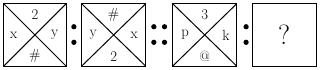
The two figures given on the left side of (::) are related to some logic/rule/relationship. From the given alternatives, select the missing figure based on the same logic/rule/relationship to the right of (::).

  1. AOption (a)

  2. BOption (b)

  3. COption (c)

  4. DOption (d)

View answer & explanation

Correct answer

Answer: (a)A.

Why this answer is correct

The logic followed here is:

The opposite symbols interchange their positions with each other.

In the first part of the question, the first figure has four symbols: x is opposite to y, and 2 is opposite to #, and in the second figure, these symbols interchange their positions.

  • Figure A to B:

Similarly,

In the second part of the question, the first figure has four symbols such as p is opposite to k, and 3 is opposite to @.

So, in the second figure, these symbols will interchange their positions.

  • Figure C to D:

Thus, the final arrangement will be:

Hence, the correct answer is "option 1".

Mistake Points All the alphabets used in the question and options figures are small letters of English alphabet series except the option 4. Here, P is given in capital.

Question 8

In a certain code language, 'RACING' is written as 'TMRXZI'. What is the code for 'QUAKES' in that code language?

  1. AOption (a)

    HUPZFJ

  2. BOption (b)

    HVPZFJ

  3. COption (c)

    HVQZFJ

  4. DOption (d)

    HVPZEJ

View answer & explanation

Correct answer

Answer: (b)B.

HVPZFJ

Why this answer is correct

The logic follows here is:

  • 'RACING' is written as 'TMRXZI'

​

Similarly,

  • 'QUAKES' will be written as:

​Hence, the correct answer is "HVPZFJ".

Question 9

A cuboid of dimensions 6 cm × 4 cm × 4 cm is painted in such a way that the face which is a square is painted black. Out of the remaining faces, 2 adjacent faces are painted with blue color and 2 adjacent faces are painted with green color. Now the cuboid is cut into smaller cubes of size 2 cm each. How many cubes will have two green faces?

  1. AOption (a)

    3

  2. BOption (b)

    2

  3. COption (c)

    4

  4. DOption (d)

    6

View answer & explanation

Correct answer

Answer: (a)A.

3

Why this answer is correct

As per the given information,

A cuboid of dimensions 6 cm × 4 cm × 4 cm is painted in such a way that the face which is a square is painted black. Out of the remaining faces, 2 adjacent faces are painted with blue color and 2 adjacent faces are painted with green color.

  • Now the cuboid is cut into smaller cubes of size 2 cm each:

​​Now, the number of cubes that have two green faces:

​

Thus, there will be 3 cubes that will have two green faces.

Hence, the correct answer is "3".

Question 10

How many triangles are there in the given figure?

  1. AOption (a)

    9

  2. BOption (b)

    6

  3. COption (c)

    8

  4. DOption (d)

    7

View answer & explanation

Correct answer

Answer: (d)D.

7

Why this answer is correct

As per the given question:

The number of triangles in the given figures are:

After counting 6 triangles we have 1 more triangle which is:

  • △ABC

Total triangles = 7

Thus, there are total '7' triangles.

Hence, the correct answer is "7".

Question 11

In the following question, find the missing number from the given series.

72, 36, 108, 144, 252, ?

  1. AOption (a)

    384

  2. BOption (b)

    396

  3. COption (c)

    274

  4. DOption (d)

    426

View answer & explanation

Correct answer

Answer: (b)B.

396

Why this answer is correct

Given: 72, 36, 108, 144, 252, ?

The logic follows here is:

Hence, the correct answer is "396".

Question 12

In the question below are given some statements followed by some conclusions based on those statements. Take the given statements to be true even if they seem to be at variance from commonly known facts. Read all the conclusions and then decide which of the given conclusions logically follows from the given statements.

Statement:

I. Some D is F.

II. Some D are N.

Conclusion:

I. Some F are N.

II. Some N are D.

  1. AOption (a)

    Only conclusions I follows.

  2. BOption (b)

    None of the conclusions follow.

  3. COption (c)

    Both conclusions I and II follow.

  4. DOption (d)

    Only conclusion II follows.

View answer & explanation

Correct answer

Answer: (d)D.

Only conclusion II follows.

Why this answer is correct

Statement:

I. Some D is F.

II. Some D are N.

The least possible diagram for the given statements is as follows:

Conclusion:

I. Some F are N → False (Because there is no direct relation between 'F' and 'N', so it is possible but not definite)

II. Some N are D → True (Because 'Some D are N', so some N are D is definitely true)

Hence, the correct answer is "Only conclusion II follows".

Question 13

A sequence is given, one of which the term is incorrect. Select the wrong term from the given alternatives.

2, 4, 10, 22, 44, 72, 114

  1. AOption (a)

    10

  2. BOption (b)

    44

  3. COption (c)

    22

  4. DOption (d)

    72

View answer & explanation

Correct answer

Answer: (b)B.

44

Why this answer is correct

Given Series : 2, 4, 10, 22, 44, 72, 114

The logic follows here is:

Therefore, the wrong term in the series is → 44

Thus, the correct series is:


Hence, the correct answer is "44".

Question 14

The question below consists of some statements followed by some conclusions based on those statements. Consider the given statements to be true even if they seem to be at variance from commonly known facts. Read all the conclusions and then decide which of the given conclusions logically follows from the given statements.

Statement:

I. Some P are Q.

II. Some P are T.

III. All T are B.

Conclusion:

I. Some P are B.

II. Some B are Q.

III. No Q is B.

  1. AOption (a)

    Only conclusions I follows.

  2. BOption (b)

    Only conclusion III follows.

  3. COption (c)

    Both conclusions I and II follow.

  4. DOption (d)

    Both conclusions I and III follow.

View answer & explanation

Correct answer

Answer: (a)A.

Only conclusions I follows.

Why this answer is correct

Statement:

I. Some P are Q.

II. Some P are T.

III. All T are B.

The least possible diagram for the given statements is as follows:

Conclusion:

I. Some P are B → True (Because 'Some P are T' and ' All T are B', so some 'P' that are 'T' are also 'B', so it  is definitely true)

II. Some B are Q → False (Because there is no direct relation between 'B' and 'Q', so it is possible but not definite)

III. No Q is B → False (Because there is no direct relation between 'Q' and 'B', so it is possible but not definite)

Hence, the correct answer is "Only conclusions I follows".

Question 15

In the following question, select the related letters from the given alternatives.

CG ∶ DF ∶∶ MT ∶ ?

  1. AOption (a)

    NS

  2. BOption (b)

    LS

  3. COption (c)

    LU

  4. DOption (d)

    NU

View answer & explanation

Correct answer

Answer: (a)A.

NS

Why this answer is correct

The logic follows here is:

  • CG ∶ DF

​

Similarly,

  • MT ∶ ?

​

​Hence, the correct answer is "NS".

Question 16

A person leaves his house early in the morning and walks 12 km towards west. He takes a right turn and walks 22 km. He takes a right turn and walks 20 km. He takes a right turn and walks 5 km. He takes a left turn and walks 4 km. Finally he takes a right turn and walks 12 km. How far and in which direction is he now from the starting point?

  1. AOption (a)

    13 km North-West

  2. BOption (b)

    17 km South-West

  3. COption (c)

    17 km South-East

  4. DOption (d)

    13 km North-East

View answer & explanation

Correct answer

Answer: (d)D.

13 km North-East

Why this answer is correct

According to the given information:

  • A person leaves his house early in the morning and walks 12 km towards west. He takes a right turn and walks 22 km. He takes a right turn and walks 20 km.

  • He takes a right turn and walks 5 km. He takes a left turn and walks 4 km. Finally he takes a right turn and walks 12 km.

Now,

Distance between OR is calculated by using Pythagoras theorem:

→ (OR)2 = (RG)2 + (OG)2 

→ (OR)2 = (5)2 + (12)2 

→ (OR)2 = 25 + 144

→ (OR)2 = 169

→ OR = 13 km

Clearly, the person is '13 km North-East' km far from the starting point.

Hence, the correct answer is "13 km North-East".

Question 17

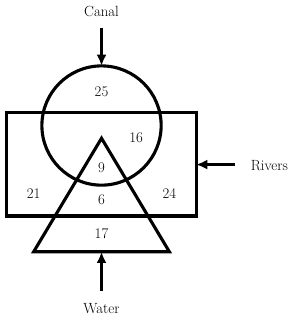
How many rivers are neither water nor canal?

  1. AOption (a)

    45

  2. BOption (b)

    21

  3. COption (c)

    41

  4. DOption (d)

    15

View answer & explanation

Correct answer

Answer: (a)A.

45

Why this answer is correct

As per the given information,

→ The shaded part represents 'rivers are neither water nor canal' = 21 + 24

= 45

Hence, the correct answer is "45".

Question 18

Based on the given Venn diagram, which of the following statements is correct?

I. The number of cuboids which are cubes is 36.

II. The number of cylinders which are not cuboids is 31.

  1. AOption (a)

    Both I and II

  2. BOption (b)

    Only I

  3. COption (c)

    Only ।I

  4. DOption (d)

    Neither I nor II

View answer & explanation

Correct answer

Answer: (b)B.

Only I

Why this answer is correct

As per the given information,

I. The number of cuboids which are cubes is 36.

→ The shaded part represents 'the number of cuboids which are cubes' = 21 + 15

= 36

Thus, the given statement is true.

II. The number of cylinders which are not cuboids is 31.

→ The shaded part represents 'the number of cylinders which are not cuboids' = 31 + 29 

= 60 ≠ 31

Thus, the given statement is not true.

Hence, the correct answer is "Only I".

Question 19

Write the following words according to the order in which they appear in the dictionary.

  1. Lamellosities
  2. Lamellibranch
  3. Lamprophonies
  4. Lamprophonias
  5. Laminectomies
  1. AOption (a)

    21543

  2. BOption (b)

    12543

  3. COption (c)

    12534

  4. DOption (d)

    21534

View answer & explanation

Correct answer

Answer: (a)A.

21543

Why this answer is correct

The logic follows here is,

The arrangement of all the given words in the order in which they appear in an English dictionary is as shown below:

  • The three letters L, M and A are common in all words, so we will start arranging the word from the fourth letter as per alphabetical order.
  1. Lamellibranch
  2. Lamellosities
  3. Laminectomies
  4. Lamprophonias
  5. Lamprophonies

Hence, the correct answer is "21543".

Question 20

In the question given below, four letter pairs are given. The letter given on the left side of (−) is related to any logic/rule/relationship with the letter given on the right side of (−). The three are equal on the basis of the same logic/rule/relationship. Select the odd one out from the given alternatives.

  1. AOption (a)

    XA − AD

  2. BOption (b)

    QT − TW

  3. COption (c)

    NR − QV

  4. DOption (d)

    FI − IL

View answer & explanation

Correct answer

Answer: (c)C.

NR − QV

Why this answer is correct

The logic follows here is:

1) XA − AD

2) QT − TW

3) NR − QV

4) FI − IL

Clearly, 'NR − QV' is the odd term.

​Hence, the correct answer is "NR − QV".

General Awareness (20 questions)

Question 21

Which of the following statement is correct?

I. The origin of the Indus River is in Tibet near Mansarovar Lake.

II. The Brahmaputra river is also called Jamuna in Tibet.

  1. AOption (a)

    Neither I nor II

  2. BOption (b)

    Only I

  3. COption (c)

    Both I and II

  4. DOption (d)

    Only II

View answer & explanation

Correct answer

Answer: (b)B.

Only I

Why this answer is correct

The correct answer is Only I.

Key Points

  • The Brahmaputra river is known as the Tsangpo river in Tibet.
  • Brahmaputra river
  • ​It has its origin in the Chemayungdung glacier of the Kailash range near the Mansarovar lake.
  • The Rango Tsangpo is the major right-bank tributary of this river in Tibet.
  • It enters India west of Sadiya town in Arunachal Pradesh.
  • The river crosses Assam below Dhubri and enters Bangladesh where the river is known as Jamuna.
  • It finally merges with the river Padma, which falls in the Bay of Bengal.
  • Its major left bank tributaries are the Burhi Dihing and Dhansari (South) whereas the important right bank tributaries are the Subansiri, Kameng, Manas and Sankosh.
  • The Brahmaputra is well-known for floods, channel shifting and bank erosion.
  • This is due to the fact that most of its tributaries are large, and bring large quantity of sediments owing to heavy rainfall in its catchment area.

Question 22

The colour of the Rs 500 Mahatma Gandhi (New) series note is ________.

  1. AOption (a)

    Greenish yellow

  2. BOption (b)

    Stone gray

  3. COption (c)

    Bright yellow

  4. DOption (d)

    Lavender

View answer & explanation

Correct answer

Answer: (b)B.

Stone gray

Why this answer is correct

The correct answer is stone gray.

Key Points

  • | Denomination | Image on note | Color | | --- | --- | --- | | INR 5 | Tractor | Green-Orange | | INR 10 | Sun Temple, Konark | Chocolate Brown | | INR 20 | Ellora Caves | Greenish Yellow | | INR 50 | Hampi | Fluorescent blue | | INR 100 | Rani ki Vav | Lavendar | | INR 200 | Sanchi Stupa | Bright Yellow | | INR 500 | Red Fort | Stone Grey | | INR 2000 | Mangalyaan | Magenta |

Question 23

Which of the following is correct with reference to small scale industries in India?

I. The investment in plant and machinery or equipment does not exceed Rs.10 crores.

II. The annual turnover does not exceed Rs.50 crores.

  1. AOption (a)

    Neither I nor II

  2. BOption (b)

    Both I and II

  3. COption (c)

    Only I

  4. DOption (d)

    Only II

View answer & explanation

Correct answer

Answer: (b)B.

Both I and II

Why this answer is correct

The correct answer is Both I and II.

Key Points

  • According to the revised criteria established by the MSME Ministry (effective July 1, 2020), the classification of MSMEs (including SSIs) is based on investment in plant and machinery or equipment and annual turnover. The updated criteria for a small enterprise are as follows:
  • Investment in Plant and Machinery or Equipment:
  • Should not exceed ₹10 crores.
  • Annual Turnover:
  • Should not exceed ₹50 crores.
  • Statement I:
  • Investment in plant and machinery or equipment does not exceed ₹10 crores.
  • This aligns with the official definition of a small-scale industry.
  • Conclusion: Correct.
  • Statement II:
  • Annual turnover does not exceed ₹50 crores.
  • This aligns with the official definition of a small-scale industry.
  • Conclusion: Correct.

Question 24

Who is the 48th Chief Justice of India?

  1. AOption (a)

    S.A. Bobde

  2. BOption (b)

    N.V. Ramna

  3. COption (c)

    Deepak Mishra

  4. DOption (d)

    Rekha Menon

View answer & explanation

Correct answer

Answer: (b)B.

N.V. Ramna

Why this answer is correct

The correct answer is N.V. Ramna.

Key Points

  • Justice NV Ramana took the oath as the 48th Chief Justice of India on 24 April 2021 at Rashtrapati Bhawan.
  • In March 2021, then Chief Justice SA Bobde of the Supreme Court recommended him as his successor.
  • Previously, he was a judge on the Supreme Court of India, chief justice of Delhi High Court and the acting chief justice of Andhra Pradesh High Court.

Additional Information

  • Justice SA Bobde took over as 47th Chief Justice of India (CJI) on 18 Nov 2019.
  • He succeeded justice Ranjan Gogoi.
  • Justice Dipak Misra served as the 45th Chief Justice of India from 28 August 2017 till 2 October 2018.
  • He is also a former Chief Justice of the Patna and Delhi High Courts.
  • He succeeded J. S. Khehar, the 44th Chief Justice.
  • Rekha Menon is the first woman to take on the role of chairperson of the National Association of Software and Services Companies (NASSCOM).

Question 25

________ has the power to regulate the rights of citizenship in India.

  1. AOption (a)

    Prime minister

  2. BOption (b)

    Supreme Court

  3. COption (c)

    Parliament

  4. DOption (d)

    President

View answer & explanation

Correct answer

Answer: (c)C.

Parliament

Why this answer is correct

The correct answer is Parliament.

Key Points

  • Parliament has the power to regulate the rights of citizenship in India.
  • ​This unique power of parliament is mentioned in Article 11 of the Indian constitution.
  • Under Article 11 of the Indian Constitution, Parliament has the power to regulate the right of citizenship by law.
  • Accordingly, the Parliament passed the Citizenship act of 1955 to provide for the acquisition and determination of Indian Citizenship.
  • The Citizenship Act, 1955 was amended 6 times in 1986, 1992, 2003, 2005, 2015 and 2019.
  • Granting of Indian Citizenship-
  • Citizenship by Birth.
  • Citizenship by Descent.
  • Citizenship at the commencement of the Constitution of India.
  • Citizenship by registration.
  • Citizenship by naturalization.

Question 26

In which year were the first Commonwealth Games held?

  1. AOption (a)

    1930

  2. BOption (b)

    1932

  3. COption (c)

    1936

  4. DOption (d)

    1931

View answer & explanation

Correct answer

Answer: (a)A.

1930

Why this answer is correct

The correct answer is 1930.

Key Points

  • The first Commonwealth Games were held in 1930 in Hamilton, Canada.
  • In the games, 11 countries sent 400 athletes to take part in six sports and 59 events.
  • Since then, the Games have been conducted every four years (except for 1942 and 1946 due to World War II) and the event has seen many changes, not least in its name.
  • The Commonwealth Games are overseen by the Commonwealth Games Federation (GCF), which also controls the sporting programme and selects the host cities.
  • The Commonwealth of Nations is an association of independent sovereign states, most of which are former colonies of the United Kingdom.
  • The British Monarch remains the head of the Commonwealth.
  • 2022 Commonwealth Games, officially known as the XXII Commonwealth Games and commonly known as Birmingham 2022, took place in Birmingham, England.

Question 27

Which Article of the Indian Constitution deals with the power of the Parliament to amend the Constitution and the procedure for the same?

  1. AOption (a)

    Article 362

  2. BOption (b)

    Article 342

  3. COption (c)

    Article 368

  4. DOption (d)

    Article 318

View answer & explanation

Correct answer

Answer: (c)C.

Article 368

Why this answer is correct

The correct answer is Article 368.

Key Points

  • Article 368
  • ​Power of Parliament to amend the Constitution and procedure therefor.
  • Parliament may in exercise of its constituent power amend by way of addition, variation or repeal any provision of this Constitution in accordance with the procedure laid down in this article.
  • An amendment of this Constitution may be initiated only by the introduction of a Bill for the purpose in either House of Parliament.
  • When the Bill is passed in each House by a majority of the total membership of that House and by a majority of not less than two-thirds of the members of that House present and voting, it shall be presented to the President.

Additional Information

  • Article 362
  • ​Rights and privileges of Rulers of Indian States Rep by the Constitution (Twenty sixth Amendment) Act, 1971.
  • Article 342
  • ​It deals with the provisions related to Scheduled Tribes.
  • Article 318
  • ​Power to make regulations as to conditions of service of members and staff of the Commission.​​

Question 28

"Powada" is the regional music of which state?

  1. AOption (a)

    Punjab

  2. BOption (b)

    Himachal Pradesh

  3. COption (c)

    Maharashtra

  4. DOption (d)

    Rajasthan

View answer & explanation

Correct answer

Answer: (c)C.

Maharashtra

Why this answer is correct

The correct answer is Maharashtra.

Key Points

  • "Powada" is the regional music of Maharashtra.
  • It is a traditional Marathi ballad.
  • It is a genre of ballads, originally sung by the members of the Gondhal (Gondhia) caste, which is a Dalit community.
  • The powada ballads were centred on wars.
  • The word Powada itself means “the narration of a story in glorious terms”.
  • The narratives are always odes in praise of an individual hero or an incident or place.
  • The chief narrator is known as the Shahir who plays the duff to keep the rhythm.
  • The tempo is fast and controlled by the main singer who is supported by others in chorus.
  • The earliest notable Powada was the Afzal Khanacha Vadh (The Killing of Afzal Khan) (1659) by Agnidas which recorded Shivaji’s encounter with Afzal Khan.

Question 29

In which year was the practice of Sati banned?

  1. AOption (a)

    1832

  2. BOption (b)

    1829

  3. COption (c)

    1824

  4. DOption (d)

    1825

View answer & explanation

Correct answer

Answer: (b)B.

1829

Why this answer is correct

The correct answer is 1829.

Key Points

  • In 1829, the practice of Sati was banned.
  • Sati was a practice among Hindu communities where a recently widowed woman, either voluntarily or by force, immolates herself on her deceased husband's pyre.
  • Raja Rammohan Roy, the great Hindu reformer from Bengal fought many social evils prevalent in the Hindu society of Bengal and Sati pratha was one of the chief ones.
  • Lord William Bentinck became the Governor-General of India in 1828.
  • He helped Raja Rammohan Roy to suppress many prevalent social evils like Sati, polygamy, child marriage and female infanticide.
  • The Bengal Sati Regulation which banned the Sati practice in all jurisdictions of British India was passed on 4 December 1829 by the then Governor-General Lord William Bentinck.

Question 30

Who among the following gave the slogan "Freedom is my birthright and I will have it"?

  1. AOption (a)

    Mahatma Gandhi

  2. BOption (b)

    Bal Gangadhar Tilak

  3. COption (c)

    Bipin Chandra Pal

  4. DOption (d)

    Lala Lajpat Rai

View answer & explanation

Correct answer

Answer: (b)B.

Bal Gangadhar Tilak

Why this answer is correct

The correct answer is Bal Gangadhar Tilak.

Key Points

  • Bal Gangadhar Tilak gave the slogan "Freedom is my birthright and I will have it".
  • He was a freedom fighter and a lawyer and his ideology was that without self-rule or swarajya, no progress was possible.
  • He was the founder of the Deccan Education Society.
  • He was one of the founders of the Fergusson College (1885) in Pune through the Deccan Education Society.
  • Bal Gangadhar Tilak  is also known as Lokmanya Tilak.
  • Tilak was called the ‘father of Indian unrest’ in the book “Indian Unrest” written by Valentine Chirol.

Additional Information

Famous slogan by Freedom Fighters:

SloganGiven by
Karo Ya Maro(Do or die)Mahatma Gandhi
Tum Muje Khoon Do, Me Tumhe Ajadi Dunga(Give me blood and I will give you freedom)Subhash Chandra Bose
Inqlaab Zindabad (Long Live the Revolution)Moulana Hasrat Mohani
Sare Jahan Se Achha Hindustan HamaraMuhammad Iqbal
Jan Gan Man Adhinayak Jai HeRavindra Nath Taigor
Desh Bachao, Desh BanaoP.V. Narsimha Rao
Kam Adhik Batain KamSanjay Gandhi
Swraj Hamara Janm Sidh Adhikar Hai(Swaraj is my birth right and I shall have it.)Baalgangadhar Tilak
Vande MatramBakim Chandra Chatarji
Bharat Chhodo(Quit India)Mahatma Gandhi
Maro Firangi KoMangal Pandey
Jai Jawan, Jai Kisaan(Hail the soldier, Hail the farmer)Lal Bahadur Shastri
Shramev JaiyteMrs. Indira Gandhi
Dilli ChaloShubhash Chandra Bose
Purn SwrajJawaharlal Nehru
Desh Ki Puja Hi Ram Ki Puja HaiMadanlal Dhingra
Kar Mat DoSardar Vallabh Bhai Patel
Sampurn KrantiJaiprakash Narayan
Kashmir ChaloDr. Murli Manohar Joshi
He RamMahatma Gandhi
Jai JagatBinova Bhave
Samrajyavad Ka Nash HoBhagat Singh
Saaiman Commission Vapas JaaoLala Lajpat Rai
Vijyai Vishv Tiranga PyaraShyamlal Gupta
Jai HindSubhash Chandra Bose
Hindi, Hundu HindustanBhartendu Harishchandra
Vedon Ki Or Lauto (Back to Vedas)Dayanand Saraswati
Aaram Haram Hai(Cast off your laziness)Jawaharlal Nehru
Sarfroshi Ki Tamanna Ab Hmare Dil Me HaiRamprasad Bismil
Who lives India DiesJawaharlal Nehru
Satyameva Jayate (Truth alone will win)Madan Mohan Malviya

Question 31

Bahai Temple is located in which state/UT of India?

  1. AOption (a)

    Chandigarh

  2. BOption (b)

    Delhi

  3. COption (c)

    Rajasthan

  4. DOption (d)

    Tamil Nadu

View answer & explanation

Correct answer

Answer: (b)B.

Delhi

Why this answer is correct

The correct answer is Delhi.

Key Points

  • The Bahai House of Worship, popularly known as the Lotus Temple is not only a symbol of excellence in modern Indian architecture but also one of the most visited religious buildings in the world.
  • The Temple located on a 9.7-hectare site near Nehru Place in South Delhi is a place of worship open to all races, religions, and castes.
  • The form of this House of Worship takes the shape of the lotus, a flower considered sacred by most Indians.
  • It is designed to reflect the simplicity, clarity, and freshness of the Baha'i Faith and to act as a symbol of the unity of mankind and religions.

Additional Information

Important Monuments in Delhi:

  • Humayun's Tomb is a UNESCO World Heritage Site located in Delhi.
  • Humayun's Tomb was built by Emperor Akbar.
  • The construction was finished in 1572.
  • The architecture of the tomb is influenced by Persian architecture.
  • The India Gate is a war memorial located in New Delhi.
  • It is formerly known as the All India War Memorial.
  • The India Gate was designed by Edwin Lutyens.
  • Alai Darwaza is the southern gateway of the Quwwat-ul-Islam Mosque located in New Delhi.
  • It was built by Sultan Alauddin Khalji in 1311.
  • The architecture of India Gate was influenced by Indo-Islamic architecture.

Question 32

What is the common name of the compound CaOCl2?

  1. AOption (a)

    Plaster of Paris

  2. BOption (b)

    Bleaching powder

  3. COption (c)

    Slaked lime

  4. DOption (d)

    Washing soda

View answer & explanation

Correct answer

Answer: (b)B.

Bleaching powder

Why this answer is correct

The correct answer is Bleaching powder.

Key Points

  • It has a strong smell of chlorine.
  • Uses:
  • Used in bleaching clothes in the laundry
  • Used in bleaching of cotton and linen in textile industries.
  • Used as an oxidizing agent.
  • used as a disinfectant for disinfecting water.
  • Used as a bathroom cleaner
  • Preparation-

 Ca(OH)2 + Cl2 → CaOCl2 + H2O

Additional Information

  • Washing soda is Hydrated Sodium carbonate.
  • Its chemical name is sodium carbonate (Na2CO3·10H2O).
  • It is used in glass, soap, and paper industries.
  • Plaster of Paris (POP), quick-setting gypsum plaster consisting of a fine white powder (calcium sulfate hemihydrate), which hardens when moistened and allowed to dry.
  • It is also known as the Plaster of Paris because for the preparation of POP, the abundant gypsum was first found near the capital city of France i.e. Paris.
  • The chemical formula of the Plaster of Paris is (CaSO4)2. H2O.
  • Slaked lime is chemically known as Calcium hydroxide.
  • Slaked lime is obtained by the action of water on calcium oxide.
  • When it is mixed with water, a small proportion of it dissolves, forming a solution known as limewater, the rest remaining as a suspension called milk of lime.

Question 33

________ is the highest peak of the Eastern Ghats.

  1. AOption (a)

    Kanchenjunga

  2. BOption (b)

    Makalu

  3. COption (c)

    Mahendragiri

  4. DOption (d)

    Dhaulagiri

View answer & explanation

Correct answer

Answer: (c)C.

Mahendragiri

Why this answer is correct

The correct answer is Mahendragiri.

Key Points

  • Mahendragiri is situated in Paralakhemundi, Gajapati district, Odisha.
  • It is situated at an elevation of 1,501 meters.
  • It is the second-highest mountain peak of Odisha after Deomali in Koraput.

NOTE: This answer is given by the commission. 

Important Points 

  • The highest peak in the Eastern Ghats is Jindhagada Peak.
  • It has an elevation of 1,690 meters.
  • It is located in the Araku Valley of Andhra Pradesh.
  • Araku Valley is well known for its natural beauty and coffee plantation.

Confusion Points 

  • Earlier, it was Mahendra Giri Hill, that held the crown of being the highest peak in the Eastern Ghat but in April 2011, a team led by Mr. Venkat Reddy Y discovered that Mahendra Giri Hill has an elevation of just 1,501 meters.

Additional Information

  • Kanchenjunga is the world’s third-highest mountain, with an elevation of 28,169 feet (8,586 meters).
  • It is situated in the eastern Himalayas on the border between Sikkim state, northeastern India, and eastern Nepal, 46 miles (74 km) north-northwest of Darjiling, Sikkim.
  • The mountain is part of the Great Himalaya Range.
  • Mount Makalu is the fifth-highest mountain in the world at 8,481 meters.
  • It is located in the Mahalangur Himalayas 19 km southeast of Mount Everest.
  • One of the eight-thousanders peaks in Nepal, Makalu is an isolated peak whose shape is a four-sided pyramid.
  • Dhaulagiri peak is located in Nepal.
  • It is the highest peak of the Dhaulagiri Himal or massif in Nepal.
  • It is a sub-range of the Himalayas which rises between the Bheri River on the west and the Kali Gandaki River on the east.
  • The word Dhaulagiri is derived from the Sanskrit dhawala Giri, which means “beautiful white mountain".

Question 34

________ was the first European to come to India.

  1. AOption (a)

    British

  2. BOption (b)

    Portuguese

  3. COption (c)

    Dutch

  4. DOption (d)

    French

View answer & explanation

Correct answer

Answer: (b)B.

Portuguese

Why this answer is correct

The correct answer is Portuguese.

Key Points

  • Portuguese was the first European to come to India for trade.
  • Vasco de Gama was the first European to reach India by Sea in 1498.
  • Portuguese were first to come to India as well as last to leave India.

Additional Information

  • The Dutch East India Company came in 1602.
  • English East India Company came to India in 1600.
  • The Danish East India Company came to India in 1616.
  • French East India Company was the last company came to India in 1664.

Question 35

The term 'double fault' is associated with which sport?

  1. AOption (a)

    Basketball

  2. BOption (b)

    Football

  3. COption (c)

    Tennis

  4. DOption (d)

    Golf

View answer & explanation

Correct answer

Answer: (c)C.

Tennis

Why this answer is correct

The correct answer is Tennis.

Key Points

  • Double fault means hitting a fault on the second service.
  • Tennis or Lawn tennis is a racket sport that can be played individually or between two teams of two teams of two-player each.
  • International Tennis Federation: 
  • It was founded on 1st March 1913.
  • ​It is a governing body of world tennis.
  • Headquarters are located in London, United Kingdom.
  • David Haggerty is the current president of ITF.
  • Grand Slam Tournament
  • Australia Open
  • French Open
  • Wimbledon
  • US Open

Additional Information 

GameTerminology
BasketballBasketball is a game played between two teams of five players each on a rectangular court, usually indoors. Each team tries to score by tossing the ball through the opponent's goal, an elevated horizontal hoop and net called a basket.
FootballKick ,Goal, Head ,Penalty, kick,Dribble,Offside,Move,Hat-trick,Defender
GolfAce, albatross, double eagle, all square, approach putt, apron, ball mark, ballooning, beach, birdie, blind shot, bogey, bunker, caddy, chip, Claw grip, condor, dogleg, dub, flag, Four-Ball, Mulligan, off the deck, peg, sand trap, a tee shot, etc.

Question 36

The image formed by a concave lens is always _______ and _______.

  1. AOption (a)

    Virtual, erect

  2. BOption (b)

    Real, Inverted

  3. COption (c)

    Virtual, inverted

  4. DOption (d)

    Real, erect

View answer & explanation

Correct answer

Answer: (a)A.

Virtual, erect

Why this answer is correct

The correct answer is Virtual, erect.

Key Points 

  • The image formed by a concave lens is always Virtual and erect.
  • Images are always smaller than the object, erect, and virtual.
  • As the distance between the object and the lens decreases, the size of the virtual image increases as the distance between the virtual image and the mirror decreases.

 Additional Information

  • Concave lens: It is a diverging lens that diverges the parallel beam of light.
  • It can also gather light from all directions and project it as a parallel beam.
  • The focal length of the concave lens is negative.
  • It has a virtual focus from the diverging rays of light that seem to converge.

Question 37

The cockroach is an example of ________.

  1. AOption (a)

    Nematoda

  2. BOption (b)

    Annelida

  3. COption (c)

    Arthropoda

  4. DOption (d)

    Mollusca

View answer & explanation

Correct answer

Answer: (c)C.

Arthropoda

Why this answer is correct

The correct answer is Arthropoda.

Key Points

  • Cockroach belongs to phylum Arthropoda and class Insecta.
  • It belongs to Arthropoda due to the presence of jointed appendages and Insecta class due to the presence of three body regions (head, thorax and abodomen) and six legs.
  • Cockroaches are categorized by their jointed appendages, which are their legs, and tough exoskeletons.
  • An exoskeleton is basically what it sounds like: an external skeleton.

Additional InformationNematoda: Nema means thread.

  • They are thread-like worms.
  • They have a complete alimentary canal with mouth and anus.
  • Their sexes are separate, with prominent characteristics.
  • The body is cylindrical and unsegmented.
  • Eg: Ascaris, Wuchereria.

Annelida: Annulus means ring.

  • They are basically Ringworms.
  • They have metamerically segmented bodies (homologous).
  • A special respiratory organ called Parapodia is present.
  • Excretion through Nephridia.
  • Eg: Hirudinaria, Lumbricina (Earthworm)

Mollusca: Soft-bodied.

  • ​Bilaterally symmetrical.
  • Respiration through Ctenidia.
  • They excrete through the Kidney.
  • Eg: Pila, Octopus, Snail.

Question 38

Which of the following organizations has launched "SHWAS" and "AROG" loan schemes for MSMEs in May 2021?

  1. AOption (a)

    SBI

  2. BOption (b)

    SIDBI

  3. COption (c)

    NABARD

  4. DOption (d)

    RBI

View answer & explanation

Correct answer

Answer: (b)B.

SIDBI

Why this answer is correct

The correct answer is SIDBI.

Key Points

  • SIDBI organizations has launched "SHWAS" and "AROG" loan schemes for MSMEs in May 2021.
  • The Small Industries Development Bank of India (SIDBI), has launched two loan products for MSMEs to help them with the required financial support in the fight against the COVID-19 pandemic.
  • These two new quick credit delivery schemes will facilitate funding for production and services related to the supply of oxygen cylinders, oxygen concentrators, oximeters and essential drugs by MSMEs.
  • The two new loan products are:
  • SHWAS – SIDBI assistance to Healthcare sector in War Against Second wave of COVID19.
  • AROG – SIDBI Assistance to MSMEs for Recovery & Organic Growth during COVID19 pandemic.
  • The schemes are devised under the guidance of the Government of India (GoI) which facilitates funding for production and services related to the supply of oxygen cylinders, oxygen concentrators, oximeters and essential drugs.

Additional Information NABARD

  • NABARD refers to the National Bank for Agriculture and Rural Development.
  • NABARD was formed on the recommendation of the committee formed on 30 March 1979, under the Chairmanship of Shri B. Sivaraman.
  • It came into existence on 12 July 1982 by transferring the agricultural credit functions of RBI and refinance functions of the then Agricultural Refinance and Development Corporation (ARDC).
  • NABARD today is fully owned by the Government of India.

 RBI

  • The Reserve Bank of India (RBI) is India's central bank and regulatory body and is responsible for the issue and supply of the Indian rupee and the regulation of the Indian banking system.
  • The Reserve Bank of India was nationalised with effect from 1st January, 1949 on the basis of the Reserve Bank of India (Transfer to Public Ownership) Act, 1948.
  • Currently, Shaktikanta Das serving as the 25th governor of the Reserve Bank of India (RBI).

Question 39

The headquarters of the International Solar Alliance is located in _______.

  1. AOption (a)

    Australia

  2. BOption (b)

    France

  3. COption (c)

    India

  4. DOption (d)

    Germany

View answer & explanation

Correct answer

Answer: (c)C.

India

Why this answer is correct

The correct answer is India.

Key Points

  • The headquarters of the International Solar Alliance is located in India.
  • In January 2016, Prime Minister Narendra Modi, and the French President François Hollande jointly laid the foundation stone of the ISA Headquarters and inaugurated the interim Secretariat at the National Institute of Solar Energy (NISE) in Gwalpahari, Gurugram, India.

Additional Information  International Solar Alliance 

  • The International Solar Alliance (ISA) is an action-oriented, member-driven, collaborative platform for increased deployment of solar energy technologies.
  • A total of 106 countries have signed the ISA Framework Agreement.
  • Out of 106 nations, 86 have signed and ratified the ISA Framework Agreement.
  • All member states of the United Nations are eligible to join the ISA.
  • The United Nations General Assembly (UNGA) has granted Observer Status to the International Solar Alliance (ISA).

Question 40

Which of the following is not a process of population change?

  1. AOption (a)

    Birth

  2. BOption (b)

    Death

  3. COption (c)

    Unemployment

  4. DOption (d)

    Migration

View answer & explanation

Correct answer

Answer: (c)C.

Unemployment

Why this answer is correct

The correct answer is Unemployment.

Key Points

  • Unemployment  is not a process of population change.
  • Population change:
  • Population change, defined generally, is the difference in the size of a population between the end and the beginning of a given time period (usually one year).
  • The main components of population change are births, deaths, and migration.
  • “Natural increase” is defined as the difference between live births and deaths.
  • “Net migration” is defined as the difference between the number of people moving into an area and the number of people moving out.
  • The population change is calculated by the formula -- [Population change = (Births + Immigration) – (Deaths + Emigration)]

Arithmetic Ability (20 questions)

Question 41

The graph given below shows the marked price and selling price of eight items.

What is the average discount per item?

  1. AOption (a)

    242.65

  2. BOption (b)

    231.25

  3. COption (c)

    235.52

  4. DOption (d)

    243.45

View answer & explanation

Correct answer

Answer: (b)B.

231.25

Why this answer is correct

Given:

Formula Used:

Discount = Marked price - Selling Price

Calculation:

ItemMarked PriceSelling PriceDiscount
A300200100
B600350250
C700400300
D500200300
E400120280
F750200550
G80078020
H35030050
TOTAL1850

Average discount per item = Total Sum of all discounts/No. of items

⇒ 1850/8

⇒ 231.25

∴ The average discount per item is Rs. 231.25.

Question 42

Ashu and Sonia together can do a piece of work in 20 days. If Ashu works at four times his efficiency and Sonia works at half of her efficiency, then the work is completed in 12 days. In how many days can Ashu and Sonia alone complete the work respectively?

  1. AOption (a)

    40 days, 60 days

  2. BOption (b)

    15 days, 60 days

  3. COption (c)

    60 days, 30 days

  4. DOption (d)

    30 days, 60 days

View answer & explanation

Correct answer

Answer: (c)C.

60 days, 30 days

Why this answer is correct

Formula Used:

No. of days = Total work/Total Efficiency

Calculation:

Let the total work = W units

Let the efficiency of Ashu = x unit/day

Let the efficiency of Sonia = y unit/day

Both can complete the task in 20 days, So

⇒ W/(x + y) = 20

⇒ W = 20x + 20y   -----eq.(1)

If Ashu works at four times his efficiency and Sonia works at half of her efficiency, then

⇒ W/(4x + y/2) = 12

⇒ W = 48x + 6y     ------eq.(2)

From eq.(1) and (2) -

⇒ 20x + 20y = 48x + 6y

⇒ 28x = 14y

⇒ y = 2x ⇒ x = y/2

Total Work (W) =  20x + 40x = 60x (OR) 30y

No. of days taken by Ashu to complete work = W/x

⇒ 60x/x = 60 days

No. of days taken by Sonia to complete work = W/y

⇒ 30y/y = 30 days

∴  Ashu and Sonia alone can complete the work in 60 days and 30 days respectively.

Question 43

What is the value of (246 + 44)2 − (246 − 144)2?

  1. AOption (a)

    392 × 188

  2. BOption (b)

    396 × 192

  3. COption (c)

    400 × 192

  4. DOption (d)

    400 × 204

View answer & explanation

Correct answer

Answer: (a)A.

392 × 188

Why this answer is correct

Given:

(246 + 44)2 − (246 − 144)2

Formula Used:

a2 - b2 = (a + b)(a - b)

Calculation:

(246 + 44)2 − (246 − 144)2

⇒ (290)2- (102)2 

⇒ (290 + 102)(290 - 102)

⇒ 392 x 188

∴ (246 + 44)2 − (246 − 144)2 = 392 x 188 is correct answer.

Question 44

What is the value of 10% of 20% of 5/2 of 2200?

  1. AOption (a)

    110

  2. BOption (b)

    100

  3. COption (c)

    11

  4. DOption (d)

    10

View answer & explanation

Correct answer

Answer: (a)A.

110

Why this answer is correct

Given:

10% of 20% of 5/2 of 2200

Formula Used:

A% = A/100

Calculation:

⇒ 10% of 20% of 5/2 of 2200

⇒ 10/100 x  20/100 x  5/2 x 2200

⇒ 1/10 x 2/10 x 5 x 1100

⇒ 2/100 x 5 x 1100

⇒ 2 x 5 x 11

⇒ 110

∴  10% of 20% of 5/2 of 2200 = 110 is correct answer.

Question 45

The table given below shows the sales of different companies in different years.

Companyyear
Y1Y2Y3
A100180200
B120160300
C175150125
D8050140
E15030250
F20080320

Which of the following statement is correct?

I. The average sale of company C per year is 150.

II. The ratio of sales of company A in year Y2 and sales of company A in year Y3 is 9 ∶ 10.

  1. AOption (a)

    Only II

  2. BOption (b)

    Both I and II

  3. COption (c)

    Only ।

  4. DOption (d)

    Neither I nor II

View answer & explanation

Correct answer

Answer: (b)B.

Both I and II

Why this answer is correct

Given:

Companyyear
Y1Y2Y3
A100180200
B120160300
C175150125
D8050140
E15030250
F20080320

Formula Used:

Average = Sum of all observations/total number of observations

Calculation:

I) The average sale of company C per year :-

Average = Sum of all observations/total number of observations

⇒ (175 + 150 + 125)/3

⇒ 450/3

⇒ 150

II) The ratio of sales of company A in year Y2 and sales of company A in year Y3 :-

Sales of company A in year Y2 : sales of company A in year Y3 =

⇒ 180 : 200

⇒ 9 : 10

∴ both I and II are correct.

Question 46

If a = 4 + 3√5, b = 4 − 3√5, then what is the value of a2 + b2?

  1. AOption (a)

    122

  2. BOption (b)

    112

  3. COption (c)

    120

  4. DOption (d)

    125

View answer & explanation

Correct answer

Answer: (a)A.

122

Why this answer is correct

Given:

a = 4 + 3√5, b = 4 − 3√5

Formula Used:

(a + b)2 = a2 + b2 + 2ab

(a - b)2 = a2 + b2 - 2ab

Calculation:

a = 4 + 3√5,

b = 4 − 3√5

a2 + b2 

⇒ (4 + 3√5)2 + (4 - 3√5)2

⇒ (42 + 3√52 + 2 x 4 x 3√5) + (42 + 3√52 - 2 x 4 x 3√5)

⇒ 16 + 45 + 24√5 + 16 + 45 - 24√5

⇒ 32 + 90

⇒ 122

∴  a2 + b2 is equal to 122.

Question 47

The speed of a train is 60 km/hr and its length is 500 meters. What is the time taken by the train to cross a pole?

  1. AOption (a)

    18 seconds

  2. BOption (b)

    30 seconds

  3. COption (c)

    24 seconds

  4. DOption (d)

    36 seconds

View answer & explanation

Correct answer

Answer: (b)B.

30 seconds

Why this answer is correct

Given:

Speed of the train = 60 kmph

Length of train = 500 meters

Formula Used:

Time taken by train to cross a pole = Length of train/Speed of train

Calculation:

Speed of train = 60kmph = 60 x 5/18 = 50/3 m/sec

Time taken by train to cross a pole = Length of train/Speed of train

⇒ 500/(50/3)

⇒ (500 x 3)/50

⇒ 10 x 3 

⇒ 30 sec

∴ Time taken by the train to cross a pole is 30 seconds.

Question 48

K and L are at a distance of 228 km from each other at 7:45 am. After 60 minutes K starts walking towards L at a speed of 36 km/hr. At 9:45 am L starts walking towards K at a speed of 12 km/hr. What time will they meet?

  1. AOption (a)

    2:35 p.m.

  2. BOption (b)

    1:45 p.m.

  3. COption (c)

    2:15 p.m.

  4. DOption (d)

    12:50 p.m.

View answer & explanation

Correct answer

Answer: (b)B.

1:45 p.m.

Why this answer is correct

Shortcut Trick

K starts at 8:45 am. By 9:45 am (1 hr), K covers 36 km.

Remaining distance at 9:45 am = 228 − 36 = 192 km.

Relative speed = 36 + 12 = 48 km/hr.

Time to meet = 192 ÷ 48 = 4 hours.

Meeting time = 9:45 am + 4 hours = 1:45 p.m.

∴ The correct answer is 1:45 p.m.

Alternate Method

Given: Total distance = 228 km. Speed of K = 36 km/hr. Speed of L = 12 km/hr.

Formula Used: Distance = Speed × Time | Relative Speed (opposite direction) = S1 + S2

⇒ K starts walking 60 mins after 7:45 am → Start time of K = 8:45 am.

⇒ Distance covered by K from 8:45 am to 9:45 am = 36 km/hr × 1 hr = 36 km.

⇒ Remaining distance at 9:45 am = 228 − 36 = 192 km.

⇒ Relative speed of K and L = 36 + 12 = 48 km/hr.

⇒ Time taken to meet = 192 ÷ 48 = 4 hours.

⇒ Meeting time = 9:45 am + 4 hours = 1:45 p.m.

∴ The correct answer is 1:45 p.m.

Additional Information

Relative Speed

When two objects move in opposite directions, their relative speed is the sum of their individual speeds (S1 + S2).

Meeting Time Calculation

Meeting Time = (Initial Distance between them when both are moving) ÷ (Relative Speed).

Time-Distance Relation

Distance = Speed × Time. Ensure all units are consistent (km and km/hr or m and m/s).

Question 49

The ratio of income of Anil and Vikas is 8 ∶ 5. If Vikas gets Rs.3000 less than Anil, then what is the total income of Anil and Vikas?

  1. AOption (a)

    Rs. 5000 

  2. BOption (b)

    Rs. 13000

  3. COption (c)

    Rs. 14000

  4. DOption (d)

    Rs. 8000

View answer & explanation

Correct answer

Answer: (b)B.

Rs. 13000

Why this answer is correct

Given:

The ratio of income of Anil and Vikas is 8 ∶ 5

Calculation:

The ratio of income of Anil and Vikas is 8 ∶ 5

Difference of salaries = 8 - 5 = 3 units = Rs.3000

⇒ 1unit = 3000/3 = 1000

Total salary of Anil and Vikas = 8 + 5 = 13 units = 13 x 1000  

⇒ Rs.13000

∴ Total salary of Anil and Vikas is Rs.13000.

Question 50

If the price is decreased by 25%, by what percent should the consumption be increased so that the expenditure remains the same?

  1. AOption (a)

    37.5 percent

  2. BOption (b)

    16.66 percent

  3. COption (c)

    33.33 percent

  4. DOption (d)

    66.66 percent

View answer & explanation

Correct answer

Answer: (c)C.

33.33 percent

Why this answer is correct

Shortcut Trick

Use the direct formula for percentage increase in consumption when expenditure is constant:

Increase % = [r ÷ (100 − r)] × 100

Where r = 25% (decrease in price).

⇒ Increase % = [25 ÷ (100 − 25)] × 100 = [25 ÷ 75] × 100

⇒ Increase % = 1/3 × 100 = 33.33%

∴ The correct answer is 33.33 percent.

Alternate Method

Given: Decrease in Price = 25%

Formula Used: Expenditure = Price × Consumption

⇒ Let the Initial Price be 100 and Initial Consumption be 100.

⇒ Initial Expenditure = 100 × 100 = 10,000

⇒ New Price = 100 − 25% of 100 = 75

⇒ Since Expenditure remains same, New Consumption = 10,000 ÷ 75

⇒ New Consumption = 400/3 ≈ 133.33

⇒ Percentage Increase = [(133.33 − 100) ÷ 100] × 100

⇒ Percentage Increase = 33.33%

∴ The correct answer is 33.33 percent.

Additional Information

Inverse Proportion Rule

When the product of two variables is constant (Price × Consumption = Constant), they are inversely proportional. If one decreases by 1/n, the other must increase by 1/(n−1).

Successive Percentage Change

If a value changes by a% and then by b%, the net change is [a + b + (ab/100)]%. For constant expenditure, the net change is 0%.

Fractional Conversion

25% decrease = 1/4 decrease. To compensate, increase required = 1/(4−1) = 1/3 = 33.33%.

Question 51

What is the value of 7+63+21428+2112−63\frac{\sqrt{7}+\sqrt{63}+2\sqrt{14}}{\sqrt{28}+2\sqrt{112}−\sqrt{63}}?

  1. AOption (a)

    4+227\frac{4+2\sqrt{2}}{7}

  2. BOption (b)

    5+327\frac{5+3\sqrt{2}}{7}

  3. COption (c)

    5+226\frac{5+2\sqrt{2}}{6}

  4. DOption (d)

    2+357\frac{2+3\sqrt{5}}{7}

View answer & explanation

Correct answer

Answer: (a)A.

4+227\frac{4+2\sqrt{2}}{7}

Why this answer is correct

Given:

7+63+21428+2112−63\frac{\sqrt{7}+\sqrt{63}+2\sqrt{14}}{\sqrt{28}+2\sqrt{112}−\sqrt{63}}

Calculation:

7+63+21428+2112−63\frac{\sqrt{7}+\sqrt{63}+2\sqrt{14}}{\sqrt{28}+2\sqrt{112}−\sqrt{63}}

⇒ 7+37+21427+2×47−37\frac{\sqrt{7}+3\sqrt{7}+2\sqrt{14}}{2\sqrt{7}+2\times4\sqrt{7}−3\sqrt{7}}

⇒ 7(1+3+22)7(2+8−3)\frac{\sqrt{7}(1+3+2\sqrt{2})}{\sqrt{7}(2+8−3)}

⇒ 4+227\frac{4+2\sqrt{2}}{7}

Question 52

Which of the following statement is correct?

I. The radius of a sphere is 70 cm. The total surface area of the sphere is 61600 cm2.

II. The length of the diagonal of a rectangle is 10√13 cm. If the length of the rectangle is 30 cm, then the area of this rectangle is 600 cm2.

  1. AOption (a)

    Neither I nor II

  2. BOption (b)

    Both I and II

  3. COption (c)

    Only I

  4. DOption (d)

    Only II

View answer & explanation

Correct answer

Answer: (b)B.

Both I and II

Why this answer is correct

Formula Used:

Total surface area of sphere = 4πr2

Area of rectangle = l x b

Diagonal of rectangle = √l2+b2√{l^2+b^2} 

Calculation:

Case - 1) The radius of a sphere is 70 cm. The total surface area of the sphere :-

⇒ 4πr2 

⇒ 4 x 22/7 x 70 x 70

⇒ 4 x 22 x 10 x 70

⇒ 61600 cm2

Case - 2) The length of the diagonal of a rectangle is 10√13 cm. If the length of the rectangle is 30 cm, then the area of this rectangle :-

⇒ √(l2 + b2) = 10√13

⇒ l2 + b2 = 100 x 13

⇒ 900 + b2 = 1300

⇒ b2 = 1300 - 900

⇒ b = √400 = 20 cm

Area of rectangle = l x b

⇒ 30 x 20

⇒ 600 cm2

∴ both I and II are correct.

Question 53

What is the HCF of 18/5 and 24/25?

  1. AOption (a)

    6/25

  2. BOption (b)

    72/5

  3. COption (c)

    6/5

  4. DOption (d)

    2/5

View answer & explanation

Correct answer

Answer: (a)A.

6/25

Why this answer is correct

Given:

Given numbers are = 18/5 and 24/25

Formula used:

HCF of fractions = (HCF of the numerators)/(LCM of the denominators)

Calculation:

⇒ 18 =  2 × 3 × 3 

⇒ 24 = 2 × 2 × 2 × 3

HCF of numerators = HCF(18, 24) = 6

LCM of denominators = LCM(5, 25) = 25

So, HCF of fractions = 6/25

∴  HCF of 18/5 and 24/25 is 6/25.

Question 54

The bar graph given below shows the production of tea by two states in different years.

J1 = Average production of tea per year by S2 

J2 = Sum of production of tea by S1 in all the years

What is the value of (J2 − J1)?

  1. AOption (a)

    185

  2. BOption (b)

    175

  3. COption (c)

    165

  4. DOption (d)

    195

View answer & explanation

Correct answer

Answer: (b)B.

175

Why this answer is correct

Given:

Formula Used:

Average = sum of all observations/total number of observations

Calculation:

YearS1S2
Y17080
Y23060
Y35050
Y44020
Y51025
Y6155
TOTAL215240


J1 = Average production of tea per year by S2 = 240/6 = 40

J2 = Sum of production of tea by S1 in all the years = 215

J2 - J1 = 215 - 40 = 175

∴ The value of J2 - J1 = 175

Question 55

A watch is bought for Rs.6000 and sold for Rs.5500. What is the loss percentage?

  1. AOption (a)

    7.28 percent

  2. BOption (b)

    11.11 percent

  3. COption (c)

    8.33 percent

  4. DOption (d)

    8.08 percent

View answer & explanation

Correct answer

Answer: (c)C.

8.33 percent

Why this answer is correct

Given:

Cost price = Rs. 6000

Selling Price = Rs. 5500

Formula Used:

Loss% = (CP - SP)/CP x 100%

Calculation:

Loss% = (CP - SP)/CP x 100%

⇒ (6000 - 5500)/6000 x  100%

⇒ 500/6000 x 100%

⇒ 50/6%

⇒ 8.33%

∴ Loss% is 8.33.

Question 56

If the difference between the average of p and q, and the average of q and r is 15.5, then what is the difference between p and r?

  1. AOption (a)

    29

  2. BOption (b)

    31

  3. COption (c)

    28

  4. DOption (d)

    36

View answer & explanation

Correct answer

Answer: (b)B.

31

Why this answer is correct

Given:

The difference between the average of p and q, and the average of q and r is 15.5

Formula Used:

Average = sum of observations/total number of observations

Calculation:

Average(p, q) - Average(q, r) = 15.5

(p + q)/2 - (q + r)/2 = 15.5

(p + q - q - r)2 = 15.5

p - r = 31

∴ The difference between p and r is 31.

Question 57

If a ∶ b = 3 ∶ 2, then what is the value of (3a + 2b) ∶ (3a − 2b)?

  1. AOption (a)

    15 ∶ 7

  2. BOption (b)

    13 ∶ 5

  3. COption (c)

    22 ∶ 9

  4. DOption (d)

    23 ∶ 10

View answer & explanation

Correct answer

Answer: (b)B.

13 ∶ 5

Why this answer is correct

Given:

a ∶ b = 3 ∶ 2

Formula Used:

Componendo-dividendo rule -

If P/Q = R/S then (P + Q)/(P - Q) = (R + S)/(R - S)

Calculation:

a ∶ b = 3 ∶ 2

⇒ 3a : 2b = 9 : 4

⇒ (3a + 2b) ∶ (3a − 2b) = (9 + 4) : (9 - 4)

⇒ 13 : 5

∴  (3a + 2b) ∶ (3a − 2b) = 13 : 5

Question 58

What is the value of (0.5)2 + (0.05)2?

  1. AOption (a)

    0.2500

  2. BOption (b)

    0.6250

  3. COption (c)

    0.2525

  4. DOption (d)

    0.525

View answer & explanation

Correct answer

Answer: (c)C.

0.2525

Why this answer is correct

Given:

(0.5)2 + (0.05)2

Calculation:

(0.5)2 + (0.05)2

⇒ 0.25 + 0.0025

⇒ 0.2525

∴ (0.5)2 + (0.05)2 = 0.2525 is correct answer.

Question 59

Seven times the area of a circle is 88 cm2. What is the radius of this circle?

  1. AOption (a)

    3 cm

  2. BOption (b)

    6 cm

  3. COption (c)

    2 cm

  4. DOption (d)

    4 cm

View answer & explanation

Correct answer

Answer: (c)C.

2 cm

Why this answer is correct

Given:

Area of a circle = 88 cm2.

Formula Used:

Area of circle = πr2  

Calculation:

⇒  7 x πr2 = 88

⇒ πr2 = 88/7

⇒ 22/7 x r2 = 88/7

⇒ r2 = 88/7 x 7/22

⇒ r2 = 4

⇒ r = 2 cm 

∴ The radius of this circle is 2 cm.

Question 60

A sum becomes Rs. 3600 in 5 years at the rate of 10 percent per annum on simple interest. What is the sum?

  1. AOption (a)

    Rs. 2800

  2. BOption (b)

    Rs. 2400

  3. COption (c)

    Rs. 2000

  4. DOption (d)

    Rs. 1800

View answer & explanation

Correct answer

Answer: (b)B.

Rs. 2400

Why this answer is correct

Given:

Amount = Rs. 3600

Time = 5 years

Rate = 10%

Formula Used:

Principal = Amount - SI

SI = PRT/100

Calculation:

SI = PRT/100

⇒ SI = P x 10 x 5/100

⇒ SI = 50P/100

⇒ SI = P/2

Now, 

Principal = Amount - SI

⇒ P = 3600 - SI

⇒ P = 3600 - P/2

⇒ P + P/2 = 3600

⇒ 3P/2 = 3600

⇒ P = 3600 x 2/3

⇒ P = 1200 x 2

⇒ P = 2400

∴ The Sum is Rs. 2400.

General English (20 questions)

Question 61

In the following question, out of the given four alternatives, select the alternative which best expresses the meaning of the Idiom/Phrase.

A big wig

  1. AOption (a)

    A pompous person

  2. BOption (b)

    To fake something

  3. COption (c)

    A bald person

  4. DOption (d)

    An important person

View answer & explanation

Correct answer

Answer: (d)D.

An important person

Why this answer is correct

The correct answer is "An important person".

Key Points 

  • Let's look at the meaning of the given word.
  • A big wig means "an important person (प्रभावशाली व्यक्ति; महत्वपूर्ण आदमी)".
  • ​Example: The story revolves around a group of teenage boys who mistakenly kidnap the son of a bigwig.
  • ​​​From the above lines, we can say that "An important person" is the correct idiom/phrase for the given word.
  • All the options are eliminated because of this reason.

Hence, option 4 is the correct answer.

Question 62

In the given question, four words are given out of which one word is correctly spelt. Choose the correctly spelt word.

  1. AOption (a)

    Emmediate

  2. BOption (b)

    Immediate

  3. COption (c)

    Immidiate

  4. DOption (d)

    Imediate

View answer & explanation

Correct answer

Answer: (b)B.

Immediate

Why this answer is correct

The correct answer is "Immediate".

Key Points 

  • Immediate is the correctly spelt word.
  • Immediate means 'happening or done without delay (तुरंत होने या किया जाने वाला, तत्‍काल संपन्‍न; अविलंब)'.
  • ​Example: The spokesman said no decision on the proposal was likely to be made in the immediate future.
  • The spelling of other options is incorrect.

Hence, option 2 is the correct answer.

Additional Information 

  • The synonyms of the word 'Immediate' are instant, sudden, abrupt, hasty, and hurried.
  • The antonyms of the word 'Immediate' are delayed, gradual, and slow.

Question 63

Find the part of the given sentence that has an error in it. If there is no error, choose ‘No error’.

A committee are to(1)/ be formed(2)/ of twenty-five barons (3)/.No error (4)

  1. AOption (a)

    1

  2. BOption (b)

    4

  3. COption (c)

    3

  4. DOption (d)

    2

View answer & explanation

Correct answer

Answer: (a)A.

1

Why this answer is correct

The correct option is "Option 1".

Key Points 

  • The error lies in option 1 of the sentence.
  • Here, we can use "is" in place of "are" to make the sentence grammatically correct.
  • If a "collective noun" is used as a single unit then it is a singular collective noun and we use a singular verb with it and if a "collective noun" is used as a different unit then it is a plural collective noun.
  1. ​Example: The committee is strong enough to take a crucial decision.
  2. ​Example: The committee are fighting among themselves.
  • In the given sentence "committee" is a singular collective noun and we use the singular verb "is" with it in place of "are" to make the sentence grammatically correct.
  • All the other options are correct.

Hence, option 1 is the correct option.

Correct sentence: A committee is to(1)/ be formed(2)/ of twenty-five barons (3)/.No error (4).

Question 64

Find the part of the given sentence that has an error in it. If there is no error, choose ‘No error’.

The reality is that employees go (1)/ out of its way to avoid (2)/complaining to HR about harassment (3)/. No error (4)

  1. AOption (a)

    3

  2. BOption (b)

    1

  3. COption (c)

    2

  4. DOption (d)

    4

View answer & explanation

Correct answer

Answer: (c)C.

2

Why this answer is correct

The correct option is "2".

Key Points 

  • The error lies in option 3 of the sentence.
  • Here, we can use "their" in place of "its" to make the sentence grammatically correct.
  • 'Its' is singular, and 'their' is plural. So, the basic rule is to use 'its' with singular nouns or singular units and 'their' with plural nouns or plural units.
  • "Its" is the possessive form of "it" and denotes ownership of or belonging to.
  • Example: The elephant is in its zoo.
  • "Their" is the possessive form of the pronoun "they". Often followed by a noun, "their" indicates ownership and describes something owned by one or more persons.
  • Example: We're their neighbors.
  • In the given sentence "employees" is a plural noun so we need a possessive pronoun which is plural that is shown by "their" and not by "its".
  • So, we can use the plural pronoun "their" in place of the singular pronoun "its" to make the sentence grammatically correct.
  • All the other options are correct.

Hence, option 3 is the correct option.

Correct sentence: *The reality is that employees go (1)/ **out of their way to avoid (2)/*complaining to HR about harassment (3)/. No error (4)

Question 65

Choose the word that means the same as the given word.

Hunt

  1. AOption (a)

    Glance

  2. BOption (b)

    Pick

  3. COption (c)

    Haste

  4. DOption (d)

    Search

View answer & explanation

Correct answer

Answer: (d)D.

Search

Why this answer is correct

The correct answer is "Search".

Key Points 

  • Hunt means ​'to try to find or search somebody/something (व्‍यक्ति या वस्‍तु का पता लगाने की कोशिश करना)'.
  • ​Example: I'll try and hunt out the information Diksha needs.
  • Search means ​'an act of trying to find somebody/something, especially by looking carefully for him/her/it (किसी की तलाश विशेषतः बारीकी से जाँच कर)'.
  • ​Example: Bad weather is hampering the search for survivors.
  • The word 'Hunt' best expresses the same meaning as the given word 'Search'.

Therefore, the correct answer is option 4.

Additional Information 

  • Glance means to look quickly at somebody/something (किसी व्‍यक्ति या वस्‍तु पर उड़ती नजर डालना).
  • Pick means to choose somebody/something from a group of people or things (व्‍यक्तियों या वस्‍तुओं के समूह में से चुनना, चयन करना, छाँटना).
  • Haste means speed in doing something, especially because one does not have enough time (जल्‍दी, शीघ्रता).

Question 66

Select the most appropriate option to substitute the underlined segment in the given sentence. If no substitution is required, select ‘No improvement’ as your answer.

He met her their. There was a bicycle stand near by.

  1. AOption (a)

    there. There

  2. BOption (b)

    their. Their

  3. COption (c)

    No improvement

  4. DOption (d)

    there. Their

View answer & explanation

Correct answer

Answer: (a)A.

there. There

Why this answer is correct

The correct option is "Option 1".

Key Points 

  • There: "There" is commonly used to introduce sentences or to indicate where something is. It tells about the place or location or position.
  • Example: Lalit will be there soon.
  • In the given sentence we need "there" in both underlined segments.
  • In the first segment "there" shows place or location whereas in the second segment "there" is used to indicate where something is.
  • There is no need for any possessive form in both segments. Therefore the options that contain "their" are eliminated.
  • All the other options are eliminated except option 1.

Hence, option 1 is the correct option.

Correct sentence: He met her there. There was a bicycle stand nearby.

Additional Information 

  • Their: "Their" is the possessive form of the pronoun "they". Often followed by a noun, "their" indicates ownership and describes something owned by one or more persons. 'Their' is plural so the basic rule is to use 'their' with plural nouns or plural units.
  • Example: We're their neighbors.

Question 67

Select the most appropriate option to substitute the underlined segment in the given sentence. If no substitution is required, select ‘No improvement’ as your answer.

The diver dives in the pool.

  1. AOption (a)

    No improvement

  2. BOption (b)

    dive into

  3. COption (c)

    dives into

  4. DOption (d)

    dive in

View answer & explanation

Correct answer

Answer: (c)C.

dives into

Why this answer is correct

The correct answer is "dives into".

Key Points 

  • In Subject-verb agreement, we use a singular verb with a singular noun or pronoun or do verb change as per the tense and a plural verb with a plural noun or pronoun.​
  • Example: They have elected a new president.
  • In the given sentence, "dives" are only singular verb which is shown in the underlined segment and also in option 3.
  • "Driver" is a singular noun and we need only the singular verb "dives" with it.
  • Also, eliminating one from both sentences through their preposition.
  • Into: We use "into" to talk about the movement of something, usually with a verb that expresses movement (e.g. go, come). It shows where something is or was going.
  • Example: Shelly’s going into the house.
  • In the sentence, we understand that there is a movement that shows that the driver dives into the pool having some movement and there is no relation that something is within a larger area so we use "into" in place of "in" to make the sentence grammatically and contextually correct.

Hence, option 3 is the correct answer.

Complete Sentence: The diver dives into the pool.

Additional Information 

  • In: In is used for the community or the local area. We use "in" to talk about something or someone in relation to a larger area around someone or something.
  • ​Example: Saniya has left her keys in the car.

Question 68

Rearrange the parts of the sentence in the correct order.

P: the Romans borrowed and adapted

Q: from the Greek colonies of Italy

R: turn had borrowed and adapted it

S: the alphabet from the Etruscans, who in

  1. AOption (a)

    QPSR

  2. BOption (b)

    SQRP

  3. COption (c)

    SPQR

  4. DOption (d)

    PSRQ

View answer & explanation

Correct answer

Answer: (d)D.

PSRQ

Why this answer is correct

The correct answer is "PSRQ".

Key Points 

  • P will be the first sentence to start as it is an independent sentence and started with the subject "Romans" who we want to talk about. All the other points are eliminated because they don't contain a subject that starts the sentence.
  • S will be after P as it continues the further information about the Romans and what they adapted is written in S which tells us that the Romans adapted the alphabet from the Etruscans.
  • R will be after S as it continues by completing a phrase "in turn" and also continues by telling us that Etruscans had adapted the alphabet from another country.
  • Q will be after R and is the last one as it further adds the information that Etruscans had adapted the alphabet from another country and the name of the country is Italy through its Greek colonies.

Hence, the correct arrangement is "PSRQ".

Correct Order

P: The Romans borrowed and adapted

S: the alphabet from the Etruscans, who in

R: turn had borrowed and adapted it

Q: from the Greek colonies of Italy

Complete Sentence: The Romans borrowed and adapted the alphabet from the Etruscans, who in turn had borrowed and adapted it from the Greek colonies of Italy.

Question 69

In the following question, out of the given four alternatives, select the alternative which best expresses the meaning of the Idiom/Phrase.

Ever and anon

  1. AOption (a)

    To talk to a stranger

  2. BOption (b)

    Now and then

  3. COption (c)

    To venture secretly

  4. DOption (d)

    Regularly and anonymously

View answer & explanation

Correct answer

Answer: (b)B.

Now and then

Why this answer is correct

The correct answer is "Now and then".

Key Points 

  • Let's look at the meaning of the given word.
  • Ever and anon means "now and then; occasionally (अब और तब; कभी-कभी)".
  • ​Example: Samarth glanced ever and anon at the sky.
  • ​​From the above lines, we can say that "Now and then" is the correct meaning of the given Idiom/Phrase.

​​​​​​Hence, option 2 is the correct answer.

Question 70

Choose the word that is opposite in meaning to the given word.

Distort

  1. AOption (a)

    Wry

  2. BOption (b)

    Accurate

  3. COption (c)

    Beguile

  4. DOption (d)

    Slant

View answer & explanation

Correct answer

Answer: (b)B.

Accurate

Why this answer is correct

The correct answer is "Accurate".

Key Points 

  • Distort means ​'to change something and show it falsely (तोड़-मरोड़कर पेश करना)'.
  • ​Example: Many people in organizations have the power to delay or distort developments.
  • Marked option 'Accurate' means ​'accurate and correct; without mistakes (यथार्थ और सही; त्रुटिहीन)'.
  • ​Example: The police are trying to obtain a more accurate picture of crime levels.
  • The word 'Accurate' best expresses the opposite meaning as the given word 'Distort'.

Therefore, the correct answer is option 2.

Additional Information 

  • Wry means expressing both disappointment and amusement (जिसमें निराशा के साथ विनोद का भाव भी हो).
  • Beguile means charm or enchant someone, often in a deceptive way (किसी को आकर्षित करना या मुग्ध करना, अक्सर भ्रामक तरीके से).
  • Slant means a way of thinking, writing, etc. about something, that sees things from a particular point of view (विशेष दृष्टिकोण से सोचने, लिखने आदि का ढंग; दृष्टिकोण-विशेष).

Question 71

Rearrange the parts of the sentence in correct order.

Several examples of

P: George Marshall’s The Blue Dahlia share the common

Q: story line of a war veteran who returns home to find that the

R: way of life for which he has been fighting no longer exists

S: film noir, such as Dmytryk’s Cornered or

  1. AOption (a)

    PQSR

  2. BOption (b)

    SPQR

  3. COption (c)

    PRSQ

  4. DOption (d)

    QSPR

View answer & explanation

Correct answer

Answer: (b)B.

SPQR

Why this answer is correct

The correct answer is "SPQR".

Key Points 

  • S will be the first sentence to start as it continues the sentence after "several examples of".
  • P will be after S as it continues the further information about film noir in which in S Dmytryk’s Cornered is given and in P George Marshall’s The Blue Dahlia is given which share something.
  • Q will be after P as it continues the information about something which is been shared i.e. Dmytryk’s Cornered or George Marshall’s The Blue Dahlia share storyline of a war veteran who returns home to find something.
  • R will be after Q and is the last one as it concludes by telling us that a war veteran returns home and finds that the way of life for which he is fighting no longer exists.


Hence, the correct arrangement is "SPQR".

Correct Order

Several examples of

S: film noir, such as Dmytryk’s Cornered or

P: George Marshall’s The Blue Dahlia share the common

Q: story line of a war veteran who returns home to find that the

R: way of life for which he has been fighting no longer exists

Complete Sentence: Several examples of film noir, such as Dmytryk’s Cornered or George Marshall’s The Blue Dahlia share the common story line of a war veteran who returns home to find that the way of life for which he has been fighting no longer exists.

Question 72

A sentence has been given with a blank to be filled with an appropriate word. Choose the correct alternative.

The manager praised his subordinates for their _______ energy at work.

  1. AOption (a)

    slow

  2. BOption (b)

    sunken

  3. COption (c)

    robust

  4. DOption (d)

    abate

View answer & explanation

Correct answer

Answer: (c)C.

robust

Why this answer is correct

The correct answer is "robust".

Key Points 

  • Robust means ​'strong and healthy (तगड़ा और स्‍वस्‍थ)'.
  • ​​Example: The economy is robust and the stock market has reached unprecedented heights in recent weeks.
  • All the other options are negative in meaning as the context of the sentence is positive through the word "praised" which is only shown by "robust".
  • So, all the other options are eliminated because of this reason.

​​​​​​Hence, option 3 is the correct answer. 

Complete Sentence: The manager praised his subordinates for their robust energy at work.

Additional Information 

  • Slow means moving, doing something or happening without much speed; not fast (कोई काम तेजी या वेग से नहीं करना, मंद).
  • Sunken means below the water (पानी में डूबा हुआ; जलमग्‍न).
  • Abate means to become less strong; to make something less strong (प्रकोप या प्रभाव का कम हो जाना या कम करना; धीमा होना).

Question 73

In the given question, four words are given out of which one word is correctly spelt. Choose the correctly spelt word.

  1. AOption (a)

    Comited

  2. BOption (b)

    Comitted

  3. COption (c)

    Commited

  4. DOption (d)

    Committed

View answer & explanation

Correct answer

Answer: (d)D.

Committed

Why this answer is correct

The correct answer is "Committed".

Key Points 

  • Committed is the correctly spelt word.
  • Committed means 'prepared to give a lot of one's time and attention to something because one believes it is right or important (किसी उचित या महत्वपूर्ण लगने वाले कार्य में संलग्‍न, प्रतिबद्ध)'.
  • ​Example: *The government is committed to housing the refugees.*​
  • The spelling of other options is incorrect.

Hence, option 4 is the correct answer.

Additional Information 

  • The synonyms of the word 'Committed' are passionate, dedicated, and devoted.
  • The antonyms of the word 'Committed' are breached, denial, and refusal.

Question 74

Choose the word that can substitute the given sentence.

A stroke of a bell, range slowly to indicate a death or a funeral

  1. AOption (a)

    Call

  2. BOption (b)

    Knell

  3. COption (c)

    Peal

  4. DOption (d)

    Chime

View answer & explanation

Correct answer

Answer: (b)B.

Knell

Why this answer is correct

The correct answer is "Knell".

Key Points 

Let's look at the meanings of the given words:

  • Knell means "the sound of a bell, especially when rung solemnly for a death or funeral (घंटी की आवाज, खासकर जब किसी मृत्यु या संस्कार के लिए पूरी तरह से गाया है)".
  • ​Example: The arrival of large supermarkets sounded the death knell of many small local shops.
  • From the above explanation, it can be concluded that 'Knell' is the correct word to substitute for the given description.

Hence, option 2 is the correct answer.

Additional Information 

  • Call means to say something loudly or to shout in order to attract attention (ऊँची आवाज में बुलाना, पुकारना, चिल्‍लाना प्रायः ध्यान आकर्षित करने के लिए).
  • Peal means the loud ringing of a bell or bells (घंटे-घंटियों की जोरदार बजने की ध्वनि).
  • Chime means used about a bell or clock to ring (घंटी या घड़ी का बजना).

Question 75

A sentence has been given with a blank to be filled with an appropriate word. Choose the correct alternative.

Curbing carbon dioxide emissions has critical implications ______ Emperor Penguins.

  1. AOption (a)

    off

  2. BOption (b)

    for

  3. COption (c)

    at

  4. DOption (d)

    of

View answer & explanation

Correct answer

Answer: (b)B.

for

Why this answer is correct

The correct answer is "for".

Key Points 

  • For: We use for to talk about a purpose or a reason for something. We use "for" with a period of time in the past, present, or future.
  • Example: Rishabh has waited at the station for nine hours.
  • In the given sentence, "reason" is shown which makes a critical implication for Emperor Penguins which can only be shown by "for".
  • All the options are eliminated because of this reason.

Hence, option 2 is the correct answer. 

Complete Sentence: Curbing carbon dioxide emissions has critical implications for Emperor Penguins.

Additional Information 

  • Off: Off is usually used as an adverb or a preposition. In both cases, it indicates separation or disconnection. It is also used to refer to something away from a place or position, especially the present place, position, or time.
  1. Example: One of my buttons has come off.
  2. Example: Lata is off to Canada next week.
  • At: At is a preposition used to refer to time or place. It is used for a specific address or general location. 
  • Example: Deepa met Carrey at a party.
  • Of: It is a preposition that indicates relationships between other words, such as belonging, things made of other things, things that contain other things, or a point of reckoning. It is used to indicate a reference.
  • Example: Sahil is a coworker of mine.

Read the following information carefully and answer the given questions.

Parkinsonism, a group of chronic neurological disorders characterized by progressive loss of motor function resulting from the degeneration of neurons in the area of the brain that controls voluntary movement.

Parkinsonism was first described in 1817 by the British physician James Parkinson in his “Essay on the Shaking Palsy.” Various types of the disorder are recognized, but the disease described by Parkinson, called Parkinson disease, is the most common form. Parkinson disease is also called primary parkinsonism, paralysis agitans, or idiopathic parkinsonism, meaning the disease has no identifiable cause. This distinguishes it from secondary parkinsonism, a group of disorders very similar in nature to Parkinson disease but that arise from known or identifiable causes. The onset of Parkinson disease typically occurs between the ages of 60 and 70, although it can occur before the age of 40. It is rarely inherited. Parkinson disease often begins with a slight tremor of the thumb and forefinger, sometimes called “pill-rolling,” and slowly progresses over 10 to 20 years, resulting in paralysis, dementia, and death.

All types of parkinsonism are characterized by four main signs, including tremors of resting muscles, particularly of the hands; muscular rigidity of the arms, legs, and neck; difficulty in initiating movement (bradykinesia); and postural instability. A variety of other features may accompany these characteristics, including a lack of facial expression (known as “masked face”), difficulty in swallowing or speaking, loss of balance, a shuffling gait, depression, and dementia.

Parkinsonism results from the deterioration of neurons in the region of the brain called the substantia nigra. These neurons normally produce the neurotransmitter dopamine, which sends signals to the basal ganglia, a mass of nerve fibres that helps to initiate and control patterns of movement. Dopamine functions in the brain as an inhibitor of nerve impulses and is involved in suppressing the unintended movement. When dopamine-producing (dopaminergic) neurons are damaged or destroyed, dopamine levels drop and the normal signalling system is disrupted. In both primary and secondary parkinsonism, the physiological effects of this deterioration do not manifest until roughly 60 to 80 percent of these neurons are destroyed. So, it requires a careful supervision.

Question 76

Based on Passage: View directions & passage

Which of the following questions is NOT answered by the given passage?

  1. AOption (a)

    What are the types of Parkinson disease?

  2. BOption (b)

    What is the role of dopamine in the brain?

  3. COption (c)

    Which treatment is need to be followed for Parkinson disease?

  4. DOption (d)

    How Parkinson disease got its name?

View answer & explanation

Correct answer

Answer: (c)C.

Which treatment is need to be followed for Parkinson disease?

Why this answer is correct

The correct answer is "Which treatment is need to be followed for Parkinson disease?"

Key Points 

  • Let's refer to the following lines from the passage:
  • ​'Various types of the disorder are recognized, but the disease described by Parkinson, called Parkinson disease, is the most common form. Parkinson disease is also called primary parkinsonism, paralysis agitans, or idiopathic parkinsonism, meaning the disease has no identifiable cause. This distinguishes it from secondary parkinsonism, a group of disorders very similar in nature to Parkinson disease but that arise from known or **identifiable causes.'**
  • 'Dopamine functions in the brain as an inhibitor of nerve impulses and is involved in suppressing unintended movement. When dopamine-producing (dopaminergic) neurons are damaged or destroyed, dopamine levels drop and the normal signalling system is disrupted.'
  • 'Parkinsonism was first described in 1817 by the British physician James Parkinson in his “Essay on the Shaking Palsy.”'
  • Upon the perusal of the above lines, it is clear that all the other options are given in the passage but the question related to treatment that needs to be followed for Parkinson's disease is not answered in the given passage.​

Hence, option 3 is the correct answer.

Question 77

Based on Passage: View directions & passage

As per the given passage, when does the onset of Parkinson disease occur?

I. Between the ages of 60-70

II. Before the age of 40

  1. AOption (a)

    Both I and II

  2. BOption (b)

    Only II

  3. COption (c)

    Neither I nor II

  4. DOption (d)

    Only I

View answer & explanation

Correct answer

Answer: (a)A.

Both I and II

Why this answer is correct

The correct answer is "Both I and II".

Key Points

  • Let's refer to the following line from the passage:
  • **​'**The onset of Parkinson disease typically occurs between the ages of 60 and 70, although it can occur before the age of 40.'
  • Upon the perusal of the above line, it is clear that both options are correct which tells that the beginning of Parkinson's disease normally occurs between the ages of 60 and 70 but it can occur before the age of 40.
  • All other options are eliminated because they either contain one option or say both options are false.

Hence, option 1 is the correct answer.

Question 78

Based on Passage: View directions & passage

Identify the synonym of the word ‘degenerate’ as per the context?

  1. AOption (a)

    Moral

  2. BOption (b)

    Retrospect

  3. COption (c)

    Debase

  4. DOption (d)

    Improve

View answer & explanation

Correct answer

Answer: (c)C.

Debase

Why this answer is correct

The correct answer is "Debase".

Key Points 

  • Degenerate means ​'to become worse, lower in quality, etc. (किसी स्थिति में गिरावट आना)'.
  • ​Example: Educational standards are degenerating year by year because of a lack of funds.
  • Debase means ​'to reduce the quality or value of something (गुणवत्ता या महत्व कम कर देना)'.
  • ​Example: Our society has been debased by war and corruption.
  • The word 'Debase' best expresses the same meaning as the given word 'Degenerate'.

Therefore, the correct answer is option 3.

Additional Information 

  • Moral means concerned with what is right and wrong (उचित-अनुचित से संबंधित; नैतिक).
  • Retrospect means a survey or review of a past course of events or period of time (घटनाओं या समय की अवधि के पिछले पाठ्यक्रम का सर्वेक्षण या समीक्षा).
  • Improve means to become or to make something better (किसी स्थिति का बेहतर होना या उसे बेहतर, सुधरना या सुधारना).

Question 79

Based on Passage: View directions & passage

Which of the following statements is NOT true as per the given passage?

  1. AOption (a)

    Dopamine functions in the brain as an exhibitor of nerve impulses.

  2. BOption (b)

    Difficulty in swallowing and speaking is one of the symptoms of this disease.

  3. COption (c)

    Parkinsonism results from the degeneration of neurons in the area of the brain.

  4. DOption (d)

    Parkinson disease can be divided into primary as well as secondary Parkinsonism.

View answer & explanation

Correct answer

Answer: (a)A.

Dopamine functions in the brain as an exhibitor of nerve impulses.

Why this answer is correct

The correct answer is "Dopamine functions in the brain as an exhibitor of nerve impulses".

Key Points 

  • Let's refer to the following lines from the passage:
  • ​**'A variety of other features may accompany these characteristics, including a lack of facial expression (known as “masked face”), difficulty in swallowing or speaking, loss of balance, a shuffling gait, depression, and dementia.'**
  • 'Parkinsonism, a group of chronic neurological disorders characterized by progressive loss of motor function resulting from the degeneration of neurons in the area of the brain that controls voluntary movement.'
  • 'Parkinson disease is also called primary parkinsonism, paralysis agitans, or idiopathic parkinsonism, meaning the disease has no identifiable cause. This distinguishes it from secondary parkinsonism, a group of disorders very similar in nature to Parkinson disease but that arise from known or identifiable causes.'
  • 'Dopamine functions in the brain as an inhibitor of nerve impulses and is involved in suppressing the unintended movement.'
  • Upon the perusal of the above lines, it is clear that all three points are correct in the passage but as described in point 4 the point written in option 1 is wrong as it is clearly written in the passage that dopamine functions in the brain as an inhibitor of nerve impulses and not as an exhibitor. So, it is not true.

​Hence, option 1 is the correct answer.

Question 80

Based on Passage: View directions & passage

What is the tone of the given passage?

  1. AOption (a)

    Pessimistic

  2. BOption (b)

    Sarcastic

  3. COption (c)

    Cautionary

  4. DOption (d)

    Analytical

View answer & explanation

Correct answer

Answer: (d)D.

Analytical

Why this answer is correct

The correct answer is "Analytical**".**

Key Points 

  • ​The passage is analytical in nature.
  • An analytical passage aims to analyze and interpret a specific topic or concept.
  • The given passage  provides detailed information about Parkinsonism - its history, characteristic symptoms, potential causes, and the underlying neurological changes that occur in the disease.
  • While it does mention the need for careful supervision due to the delayed physiological effects, its primary focus is on explaining the condition, rather than warning about potential dangers or impacts.

Hence, option 4 is the correct answer.

Additional Information 

  • Pessimistic: A pessimistic tone reflects a negative view of the situation or a belief that the situation will not improve. Pessimism is not realism, but writers can use this tone when they have negative feelings about writing or when they want to reflect a perspective that sees things negatively.
  • ​Example: Disha was diagnosed with cancer and her cat ​​passed away. She doesn't think anything will get better anytime soon.
  • Sarcastic: A sarcastic person says or does the opposite of what it really means to ridicule or offend someone. This tone is called a sarcastic tone.
  • Example: The customer service of the company is so good that each and every time delay in delivery always happens.
  • Cautionary: An analytical passage is a type of paragraph that aims to analyze and interpret a specific topic or concept.

General Hindi (20 questions)

Question 81

निम्नलिखित प्रश्न में, दिए गए चार विकल्पों में से, उस विकल्प का चयन करें जो दिए गए मुहावरे के अर्थ को सर्वश्रेष्ठ रूप से व्यक्त करता है।

अपनी नींद सोना अपनी नींद उठना

  1. AOption (a)

    अनुशासन प्रिय होना

  2. BOption (b)

    किसी बात की चिन्ता न करना

  3. COption (c)

    रोजमर्रा के कामों पर ध्यान देना

  4. DOption (d)

    अपनी दुनिया में मग्न होना

View answer & explanation

Correct answer

Answer: (b)B.

किसी बात की चिन्ता न करना

Why this answer is correct

अपनी नींद सोना अपनी नींद उठना मुहावरे का अर्थ है किसी बात की चिन्ता न करना।

Key Points

  • मुहावरा - अपनी नींद सोना अपनी नींद उठना।
  • अर्थ - किसी बात की चिन्ता न करना।
  • वाक्य प्रयोग - राम आजकल अपनी नीद सोता है और अपनी नीद उठता है।

Additional Information

  • मुहावरा की परिभाषा - किसी भाषा की अभिव्यंजना के विशिष्ट रूप को मुहावरा कहते है यह वाक्यांश होते है।
मुहावराअर्थवाक्य प्रयोग
अपनी ढपली अपना रागअपनी दुनिया में मग्न होनाउनकी अपनी ही ढपली और अपना राग है।

Question 82

दिए गए वाक्य में किस विराम चिह्न का उपयोग किया जाएगा उसकी पहचान कीजिए।

रामू राजू और वीरेन्द्र घूमने गए

  1. AOption (a)

    ; ।

  2. BOption (b)

    , ।

  3. COption (c)

    , ?

  4. DOption (d)
    • ;
View answer & explanation

Correct answer

Answer: (b)B.

, ।

Why this answer is correct

रामू राजू और वीरेन्द्र घूमने गए  वाक्य में (।) विराम चिह्न का उपयोग किया जाएगा।

Key Points

  • विराम चिह्न - वाक्य को लिखते अथवा पढ़ते समय विराम को प्रकट करने के लिए लगाये जाने वाले चिह्नों को विराम चिह्न कहते है।
  • उदाहरण - रामू राजू और वीरेन्द्र घूमने गए।

Additional Informationअन्य उदाहरण -

विवरण चिह्न ;-इसका प्रयोग वाक्यांश के विषय में कुछ सूचक निर्देश आदि के लिए किया जाता है।वचन के दो भेद है ;-
प्रश्नवाचक ?यदि वाक्य में कोई प्रश्न किया जाता है तब इसका प्रयोग करते है।आपका घर कहाँ है ?

Question 83

निम्नलिखित वाक्यांश के लिए उचित शब्द का चयन कीजिए।

तुम्हारा यह कार्य प्रशंसा के योग्य हैं।

  1. AOption (a)

    मूर्खता

  2. BOption (b)

    प्रशंसनीय

  3. COption (c)

    योग्यता

  4. DOption (d)

    बुद्धिमान

View answer & explanation

Correct answer

Answer: (b)B.

प्रशंसनीय

Why this answer is correct

तुम्हारा यह कार्य प्रशंसा के योग्य हैं।निम्नलिखित वाक्यांश के लिए उचित शब्द प्रशंसनीय है।

Key Points

  • वाक्यांश के लिए एक शब्द - अनेक शब्दों के लिए एक शब्द होना।
  • उदाहरण - जिसका जन्म बाद में हुआ हो - अनुज

Additional Informationअन्य उदाहरण -

मूर्ख होने का भावमूर्खता
योग्य होने की अवस्थायोग्यता
जो समझदार होबुद्धिमान

Question 84

दिए गए शब्द युग्म का सही शब्द युग्म ज्ञात कीजिए।

अवगत ∶ अविगत

  1. AOption (a)

    प्रेम ∶ विदित

  2. BOption (b)

    ज्ञात : विदित

  3. COption (c)

    ज्ञात : प्रेम

  4. DOption (d)

    विदित : अव्यक्त

View answer & explanation

Correct answer

Answer: (d)D.

विदित : अव्यक्त

Why this answer is correct

अवगत ∶ अविगत शब्द युग्म का सही शब्द युग्म विदित : अव्यक्त  है। 

Key Points

  • समरूप भिन्नार्थक शब्द - जो शब्द सुनने में एक जैसे लगते है किन्तु उनका अर्थ अलग अलग होता है।
  • उदाहरण -नियति - नियत : भाग्य - निर्धारित

Additional Informationअन्य उदाहरण -

अनुरक्ति -अवगतप्रेम ∶ विदित
अवगत - अनुरक्तिज्ञात :प्रेम

Question 85

दिए गए शब्द का बहुवचन ज्ञात कीजिए।

श्रीमती

  1. AOption (a)

    श्रीमतीय

  2. BOption (b)

    श्रीमतीएँ

  3. COption (c)

    श्रीमतिनी

  4. DOption (d)

    श्रीमतियाँ

View answer & explanation

Correct answer

Answer: (d)D.

श्रीमतियाँ

Why this answer is correct

श्रीमती शब्द का बहुवचन श्रीमतियाँ है।

Key Points

  • बहुवचन शब्द - शब्द के जिस रूप से एक या एक से अधिक वस्तुओ या व्यक्तियों का बोध होता है।
  • उदाहरण - अक्षत, आँसू, दर्शन, बच्चे आदि।

Additional Information

बहुवचन के अन्य उदाहरणलड़के, नदियाँ, पुस्तके आदि।

Question 86

निम्नलिखित वाक्यों में से सार्वनामिक विशेषण ज्ञात कीजिए।

यह चित्र प्रसिद्ध चित्रकार के द्वारा बनाया गया हैं।

  1. AOption (a)

    प्रसिद्ध

  2. BOption (b)

    द्वारा

  3. COption (c)

    यह

  4. DOption (d)

    के

View answer & explanation

Correct answer

Answer: (c)C.

यह

Why this answer is correct

यह चित्र प्रसिद्ध चित्रकार के द्वारा बनाया गया हैं। वाक्य में सार्वनामिक विशेषण यह है।

Key Points

  • सार्वनामिक विशेषण - संज्ञा शब्दों की विशेषता बताने वाले सर्वनाम शब्दों को सार्वनामिक विशेषण कहते हैं।
  • उदाहरण - यह कार मेरी है।

Additional Information

सार्वनामिक विशेषण  के अन्य उदाहरणमेरा घर, तुम्हारा भाई, उसका मकान, यह बगीचा आदि।

Question 87

रिक्त स्थान में उपयुक्त क्रमवाचक विशेषण छाँटकर लिखिए।

राजन को कुल जायदाद का _______ हिस्सा मिला।

  1. AOption (a)

    छठा

  2. BOption (b)

    थोड़ा

  3. COption (c)

    चार मीटर

  4. DOption (d)

    यह

View answer & explanation

Correct answer

Answer: (a)A.

छठा

Why this answer is correct

राजन को कुल जायदाद का _______ हिस्सा मिला।रिक्त स्थान में उपयुक्त क्रमवाचक विशेषण छठा होगा।

Key Points

  • क्रमवाचक विशेषण-  जिन विशेषण में क्रम का बोध होता है।
  • उदाहरण - प्रथम स्थान, तीसरा घर, द्वितीय पंक्ति आदि।

Additional Informationअन्य विकल्प-

अनिश्चित  परिमाणवाचकजो निश्चित मात्रा का बोध न कराए। उदाहरण -थोड़ा दूध, अधिक चावाल आदि।
निश्चित  परिमाणवाचकजो निश्चित मात्रा का बोध कराए। उदाहरण -चार मीटर, एक लीटर आदि
सार्वनामिक विशेषणसंज्ञा शब्दों की विशेषता बताने वाले सर्वनाम शब्दों को सार्वनामिक विशेषण कहते हैं।
उदाहरण - यह कार मेरी है।

Question 88

निम्नलिखित वाक्यों में से मिश्र वाक्य ज्ञात कीजिए।

  1. AOption (a)

    जैसे ही मैं विद्यालय पहुँचा, घंटी बज चुकी थी।

  2. BOption (b)

    मैं विद्यालय पहुँचा और घंटी बज चुकी थी।

  3. COption (c)

    मेरे विद्यालय पहुँचने से पहले घंटी बज चुकी थी।

  4. DOption (d)

    मैं विद्यालय पहुँचा परंतु घंटी बज चुकी थी।

View answer & explanation

Correct answer

Answer: (a)A.

जैसे ही मैं विद्यालय पहुँचा, घंटी बज चुकी थी।

Why this answer is correct

जैसे ही मैं विद्यालय पहुँचा, घंटी बज चुकी थी। मिश्र वाक्य वाक्य का उदाहरण है। 

Key Points

  • मिश्र वाक्य -  जिन वाक्यों में एक प्रधान वाक्य हो और अन्य आश्रित उपवाक्य हो।
  • उदाहरण - जो लड़का कमरे में बैठा है वह मेरा भाई है।

Additional Information

सरल वाक्यजिन वाक्यों में केवल एक ही उद्देश्य और विधेय हो। उदाहरण -मेरे विद्यालय पहुँचने से पहले घंटी बज चुकी थी।
संयुक्त वाक्यजिन वाक्यों में दो या दो से अधिक स्वतंत्र साधारण वाक्य या प्रधान उपवाक्य हो। उदाहरण -मैं विद्यालय पहुँचा और घंटी बज चुकी थी।

Question 89

निम्नलिखित वाक्यों में से सरल वाक्य ज्ञात कीजिए।

  1. AOption (a)

    जब वह दिल्ली पहुँचा और काम करने लगा।

  2. BOption (b)

    जैसे ही वह दिल्ली पहुँचा, वह काम करने लगा।

  3. COption (c)

    वह दिल्ली जाकर काम करने लगा है।

  4. DOption (d)

    वह दिल्ली गया और काम करने लगा।

View answer & explanation

Correct answer

Answer: (c)C.

वह दिल्ली जाकर काम करने लगा है।

Why this answer is correct

वह दिल्ली जाकर काम करने लगा है। सरल वाक्य का उदाहरण है। 

Key Points

  • ​​सरल वाक्य - जिन वाक्यों में केवल एक ही उद्देश्य और विधेय हो।
  • उदाहरण - राकेश ने भोजन किया।

Additional Information

मिश्र वाक्यजिन वाक्यों में एक प्रधान वाक्य हो और अन्य आश्रित उपवाक्य हो।जैसे ही वह दिल्ली पहुँचा, वह काम करने लगा।
संयुक्त वाक्यजिन वाक्यों में दो या दो से अधिक स्वतंत्र साधारण वाक्य या प्रधान उपवाक्य हो।वह दिल्ली गया और काम करने लगा।

Question 90

दिए गए शब्दों का सही तत्सम-तद्भव ज्ञात कीजिए।

  1. AOption (a)

    अवर-खोल

  2. BOption (b)

    अवर-ओर

  3. COption (c)

    अवर-ऊपर

  4. DOption (d)

    अवर-हमारा

View answer & explanation

Correct answer

Answer: (b)B.

अवर-ओर

Why this answer is correct

अवर-ओर, तत्सम-तद्भव का उदाहरण है।

Key Points

  • तद्भव शब्द - संस्कृत शब्दों में थोड़ा परिवर्तन करके बने शब्द तद्भव शब्द कहलाते है।
  • उदाहरण - अग्नि - आग
  • तत्सम शब्द - संस्कृत के वे शब्द जो ज्यों के त्यों हिंदी में प्रयोग होते है तत्सम कहलाते है।
  • उदाहरण - पृथ्वी- पृथ्वी

Additional Information

अन्य उदाहरण -

तद्भवतत्सम
सपनास्वप्न
लाखलक्ष
पहरप्रहर
मौरमुकुट
पन्नापृष्ठ
शामसंध्या

Question 91

निम्नलिखित प्रश्र में, दिए गए चार विकल्पों में से, उस विकल्प का चयन करें जो दिए गए मुहावरे के अर्थ को सर्वश्रेष्ठ रूप से व्यक्त करता है।

गाँठ का पूरा

  1. AOption (a)

    धनी

  2. BOption (b)

    निराश लौटना

  3. COption (c)

    सब-कुछ समझना

  4. DOption (d)

    बराबर समझना

View answer & explanation

Correct answer

Answer: (a)A.

धनी

Why this answer is correct

गाँठ का पूरा मुहावरे का अर्थ है धनी।

Key Points

  • मुहावरा - गाँठ का पूरा
  • अर्थ - धनी
  • वाक्य प्रयोग -वे तो गांठ के पूरे है।

Additional Information

  • मुहावरा की परिभाषा - किसी भाषा की अभिव्यंजना के विशिष्ट रूप को मुहावरा कहते है यह वाक्यांश होते है।
मुहावराअर्थवाक्य प्रयोग
उलटे पाँव लौटनानिराश लौटनावह माँ के समझाने के बाद भी गये अंततः उनको उलटे पाँव ही लौटना पड़ा।
एक आँख से देखनासब-कुछ समझनावह हर किसी को एक आँख से देखते है।

Question 92

दिए गए वाक्य में किस विराम चिह्न का उपयोग किया जाएगा उसकी पहचान कीजिए।

गीता खेलती है

  1. AOption (a)

    ?

  2. BOption (b)

    :-

  3. COption (c)

    ( )

  4. DOption (d)

    ।

View answer & explanation

Correct answer

Answer: (d)D.

।

Why this answer is correct

गीता खेलती है वाक्य में ( । )विराम चिह्न का प्रयोग किया जायगा।

Key Points

  • विराम चिह्न - वाक्य को लिखते अथवा पढ़ते समय विराम को प्रकट करने के लिए लगाये जाने वाले चिह्नों को विराम चिह्न कहते है।
  • उदाहरण - गीता खेलती है।​​

Additional Informationअन्य विकल्प -

प्रश्नवाचक ?इसका प्रयोग प्रश्नवाचक वाक्यों के अंत में करते है।उदाहरण - आपका नाम क्या है ?
विवरण चिह्न :-इसका प्रयोग वाक्यांश के विषय में कुछ सूचक निर्देश आदि देने के लिए किया जाता है।​​वाक्य के भेद इस प्रकार  है :-
कोष्ठक ( )इसका प्रयोग अर्थ को और अधिक स्पष्ट करने के लिए अथवा वाक्यांश को कोष्ठक के अन्दर लिखकर किया जाता है।​​धर्मराज (युधिष्ठिर  सत्य के रक्षक थे।​​

Question 93

दिए गए वाक्य का पक्ष ज्ञात कीजिए।

पृथ्वी गोल है।

  1. AOption (a)

    स्थित्यात्मक पक्ष

  2. BOption (b)

    नित्य पक्ष

  3. COption (c)

    पूर्ण पक्ष

  4. DOption (d)

    अपूर्ण पक्ष

View answer & explanation

Correct answer

Answer: (b)B.

नित्य पक्ष

Why this answer is correct

पृथ्वी गोल है। दिए गए वाक्य का पक्ष नित्य पक्ष है।

Key Points

  • नित्य पक्ष - क्रिया के नित्य होने का बोध होता है परन्तु वह पूरी नही होती।
  • उदाहरण -राम एक शिक्षक हैं।

Additional Informationअन्य विकल्प - 

पूर्ण पक्षक्रिया के पूरी तरह समाप्त होने का बोध होता है। उदाहरण - राम ने खाना खा लिया है।
अपूर्ण पक्षक्रिया के नित्य होने का बोध होता है परन्तु वह पूरी नही होती। इसे नित्य पक्ष भी कहते है। उदाहरण -सूर्य पूर्व में निकलता है।

Question 94

दिए गए शब्द युग्म का सही शब्द युग्म ज्ञात कीजिए।

असित ∶ अशित

  1. AOption (a)

    काला ∶ अश्चेत

  2. BOption (b)

    काला ∶ खाया हुआ

  3. COption (c)

    खाया हुआ ∶ परहेज़

  4. DOption (d)

    अश्चेत ∶ परहेज़

View answer & explanation

Correct answer

Answer: (b)B.

काला ∶ खाया हुआ

Why this answer is correct

असित ∶ अशित का सही शब्द युग्म काला ∶ खाया हुआ है। 

Key Points

  • समरूप भिन्नार्थक शब्द - जो शब्द सुनने में एक जैसे लगते है किन्तु उनका अर्थ अलग अलग होता है।
  • उदाहरण - नियति -नियत  भाग्य, निर्धारित

Additional Information अन्य विकल्प -

अशित - एहतियातखाया हुआ ∶ परहेज़
असित-  एहतियातअश्चेत ∶ परहेज़

Question 95

दिए गए वाक्य में उपयुक्त शब्द का चयन करके रिक्त स्थान की पूर्ति कीजिए।

तेज गर्मी में चलने के कारण वह _______ हो गया।

  1. AOption (a)

    जीवित

  2. BOption (b)

    निर्जीव

  3. COption (c)

    मृत

  4. DOption (d)

    अचेतन

View answer & explanation

Correct answer

Answer: (d)D.

अचेतन

Why this answer is correct

तेज गर्मी में चलने के कारण वह _______ हो गया।रिक्त स्थान में अचेतन आयगा।

Key Points

  • अचेतन का अर्थ  है निर्जीव होना।
  • अचेतन के अन्य पर्याय - चेतनाहीन, जड़, चेतनाशून्य आदि।

Additional Informationपर्यायवाची शब्द - एक ही अर्थ का बोध कराने वाले भिन्न - भिन्न शब्दों को पर्यायवाची शब्द कहते है, अतः इनको समानार्थी शब्द भी कहते है।

जीवित के पर्यायचुस्त, जिन्दा, जीव, सक्रीय, यथार्थ आदि।
निर्जीव के पर्यायसार हीन, मुर्दा, प्राणहीन आदि।
मृत के पर्यायस्वर्गीय, मुर्दा, नष्ट, बेजान आदि।

एक गद्यांश दिया गया है। गद्यांश के आधार पर पाँच प्रश्न दिए गए हैं। गद्यांश को ध्यानपूर्वक पढ़ें तथा प्रत्येक प्रश्न में चार विकल्पों में से सही विकल्प चुने।

भारत में श्रम-कल्याण कार्यों में अनेक सरकारी और गैर-सरकारी संस्थाओं का योग है। भारत में श्रमिकों के कल्याण-कार्य से सम्बन्धित भावना का विकास द्वितीय विश्व युद्ध के बाद हुआ था। श्रम संसार में सफलता प्राप्त करने का महत्वपूर्ण साधन है। श्रम करके हम अपने जीवन में ऊँची-से-ऊँची आकांक्षा को पूरी कर सकते है। संसार कर्म क्षेत्र है अतः यहाँ कर्म करना ही हम सबका धर्म है। किसी कार्य में सफलता तभी मिलती है जब हम परिश्रम करते है। श्रम ही जीवन को गति प्रदान करता है। चींटी को श्रमजीवी कहा जाता है। कारखानों में काम करने वाले श्रमिकों के कल्याण, उनकी सुरक्षा और स्वास्थ्य संबंधी विभिन्न पहलुओं को नियमित करने का दायित्व सरकार अपने ऊपर लेती है। स्वतंत्रता प्राप्ति के बाद औद्योगिक विकास को गति प्रदान करने के लिए भारत सरकार ने कारखाना अधिनियम, 1948 प्रतिपादित किया। औद्योगिक कल्याण के सम्बन्ध में कार्य की प्रेरणा एवं औचित्य सम्बन्धी विभिन्न विचारधाराओं की श्रृंखला ही उपलब्ध है। कुछ लोग श्रम-कल्याण कार्य को कारखानों के अन्तर्गत किए जाने वाले कार्यों तक सीमित बताते है। अपनी दिशा में, हम श्रम-कार्यों के अन्तर्गत श्रमिकों के बौद्धिक, शारीरिक, नैतिक और आर्थिक उन्नति के लिए किए गए किसी भी कार्य को सम्मिलित करने को प्राथमिकता देते हैं। श्रम-कल्याण से तात्पर्य विद्यमान औद्योगिक प्रणाली तथा अपनी फैक्ट्रियों में रोजगार की दशाओं का उन्नत करने के लिए मालिकों द्वारा किये जाने वाले ऐच्छिक प्रयासों से है। श्रम-कल्याण कार्यों का परिणाम यह होता है कि इससे श्रमिकों में उत्तरदायित्व की भावना का विकास होता है। इससे वे कार्यों में विशेष रुचि लेते हैं।

Question 96

Based on Passage: View directions & passage

भारत में श्रमिकों के कल्याण-कार्य से सम्बन्धित भावना का विकास कब हुआ था?

  1. AOption (a)

    प्रथम विश्व युद्ध से पहले

  2. BOption (b)

    द्वितीय विश्व युद्ध से पहले

  3. COption (c)

    प्रथम विश्व युद्ध के बाद

  4. DOption (d)

    द्वितीय विश्व युद्ध के बाद

View answer & explanation

Correct answer

Answer: (d)D.

द्वितीय विश्व युद्ध के बाद

Why this answer is correct

भारत में श्रमिकों के कल्याण-कार्य से सम्बन्धित भावना का विकास द्वितीय विश्व युद्ध के बाद हुआ था।

  • गद्यांश के अनुसार:-
  • ​भारत में श्रम-कल्याण कार्यों में अनेक सरकारी और गैर-सरकारी संस्थाओं का योग है।
  • भारत में श्रमिकों के कल्याण-कार्य से सम्बन्धित भावना का विकास द्वितीय विश्व युद्ध के बाद हुआ था।
  • श्रम संसार में सफलता प्राप्त करने का महत्वपूर्ण साधन है।

Key Pointsविश्व:-

  • अर्थ:जगत, जग, भव, संसार, लोक, दुनिया।

युद्ध:- 

  • अर्थ: रण, जंग, समर, लड़ाई, संग्राम रण, द्वंद्व।

Question 97

Based on Passage: View directions & passage

चींटी को क्या कहा जाता है?

  1. AOption (a)

    श्रमजीवी

  2. BOption (b)

    विद्यमान

  3. COption (c)

    ऐच्छिक प्रयास

  4. DOption (d)

    नैतिकता

View answer & explanation

Correct answer

Answer: (a)A.

श्रमजीवी

Why this answer is correct

चींटी को श्रमजीवी कहा जाता है।

  • गद्यांश के अनुसार:-
  • किसी कार्य में सफलता तभी मिलती है जब हम परिश्रम करते है।
  • श्रम ही जीवन को गति प्रदान करता है। चींटी को श्रमजीवी कहा जाता है।
  • कारखानों में काम करने वाले श्रमिकों के कल्याण, उनकी सुरक्षा और स्वास्थ्य
  • संबंधी विभिन्न पहलुओं को नियमित करने का दायित्व सरकार अपने ऊपर लेती है। ​

Key Points

  • श्रमजीवी - मज़दूरी करके जीविक��� चलाने वाला।

Additional Informationविद्यमान:-

  • अर्थ: अस्तित्व में होना, उपस्थित, वर्तमान, मौजूद, यथार्थ।

ऐच्छिक:-

  • अर्थ: स्वेच्छा से किया जानेवाला, वैकल्पिक।

नैतिकता:-

  • अर्थ: नीति शास्त्र का ज्ञान एवं उसके अनुरूप किया जानेवाला आचरण।

Question 98

Based on Passage: View directions & passage

स्वतंत्रता प्राप्ति के बाद किसके विकास के लिए अधिनियम पारित किया था?

  1. AOption (a)

    रोजगार

  2. BOption (b)

    बौद्धिक

  3. COption (c)

    आर्थिक

  4. DOption (d)

    औद्योगिक

View answer & explanation

Correct answer

Answer: (d)D.

औद्योगिक

Why this answer is correct

स्वतंत्रता प्राप्ति के बाद औद्योगिक के विकास के लिए अधिनियम पारित किया था।

  • गद्यांश के अनुसार:-
  • स्वतंत्रता प्राप्ति के बाद औद्योगिक विकास को गति प्रदान करने के लिए भारत सरकार ने कारखाना अधिनियम, 1948 प्रतिपादित किया।
  • औद्योगिक कल्याण के सम्बन्ध में कार्य की प्रेरणा एवं औचित्य सम्बन्धी विभिन्न विचारधाराओं की श्रृंखलाही उपलब्ध है।

Key Points

  • औद्योगिक - जिसका संबंध किसी उद्योग से हो।

Additional Informationरोजगार:-

  • अर्थ: कारोबर, पेशा, जीविका, काम, धंधा, व्यवसाय, व्यापार, वाणिज्य।

बौद्धिक:-

  • अर्थ: बुद्धि से संबंधी, जो बुद्धि और चिंतन का विषय हो।

आर्थिक:-

  • अर्थ: अर्थ संबंधी, रुपये-पैसे का।

Question 99

Based on Passage: View directions & passage

उपर्युक्त गद्यांश का उपयुक्त शीर्षक क्या होगा?

  1. AOption (a)

    श्रम: कर्म क्षेत्र

  2. BOption (b)

    र��जगार की दशाओं का उन्नत

  3. COption (c)

    श्रम से ही सुरक्षा

  4. DOption (d)

    श्रम से ही राष्ट्र का कल्याण

View answer & explanation

Correct answer

Answer: (a)A.

श्रम: कर्म क्षेत्र

Why this answer is correct

उपर्युक्त गद्यांश का उपयुक्त शीर्षक होगा - श्रम: कर्म क्षेत्र 

  • गद्यांश के अनुसार:-
  • किसी भी कार्य में सफलता प्राप्त करने में श्रम को महत्वपूर्ण साधन माना गया है।

Key Points

  • श्रम - परिश्रम, मेहनत, मशक्कत।

Additional Informationउन्नत:-

  • अर्थ: उच्च, आगे बढ़ना, उठा हुआ, विद्या, कला आदि में आगे बढ़ा हुआ।

राष्ट्र:-

  • अर्थ: देश, वतन, मुल्क, प्रांत, प्रदेश, राज्य।

कल्याण:-

  • अर्थ: किसी के द्वारा या अन्य किसी प्रकार से होने वाली किसी की भलाई।

Question 100

Based on Passage: View directions & passage

संसार में सफलता प्राप्त करने का महत्त्वपूर्ण साधन क्या हैं?

  1. AOption (a)

    श्रम

  2. BOption (b)

    उन्नति

  3. COption (c)

    धर्म

  4. DOption (d)

    विचारधारा

View answer & explanation

Correct answer

Answer: (a)A.

श्रम

Why this answer is correct

संसार में सफलता प्राप्त करने का महत्त्वपूर्ण साधन श्रम हैं।

  • गद्यांश के अनुसार:-
  • ​भारत में श्रमिकों के कल्याण-कार्य से सम्बन्धित भावना का विकास द्वितीय विश्व युद्ध के बाद हुआ था।
  • श्रम संसार में सफलता प्राप्त करने का महत्वपूर्ण साधन है।
  • श्रम करके हम अपने जीवन में ऊँची-से-ऊँची आकांशा को पूरी कर सकते है।

Key Points

  • श्रम - परिश्रम, मेहनत, मशक्कत।

Additional Informationउन्नति:-

  • अर्थ: विकास, उत्कर्ष, प्रगति, उत्थान, अभ्युदय, वृद्धि।

विचारधारा:-

  • अर्थ: विचारों का प्रवाह, चिंतन का तरीका।

Discipline 1 (20 questions)

Question 101

In which year did King Louis XVI announce that he would settle the Estates General?

  1. AOption (a)

    1788

  2. BOption (b)

    1782

  3. COption (c)

    1787

  4. DOption (d)

    1783

View answer & explanation

Correct answer

Answer: (a)A.

1788

Why this answer is correct

The French Revolution was a period of profound political and societal upheaval in France that began with the Estates-General in 1788 and ended in November 1799 with the foundation of the French Consulate. Many of its concepts are regarded as core liberal democratic values.

Important Points

  • King Louis XVI convened a gathering of the Estates-General in 1788 to address France's financial problems.
  • The Estates-General were divided into three groups:
  • the First Estate (clergy or church leaders),
  • the Second Estate (nobles), and
  • the Third Estate (tax collectors, the commoners).
  • The Estates-General was a political body to which the three estates sent their representatives.
  • However, the monarch alone could decide when to call a meeting of this body.

Additional Information

  • French engagement in America, as well as the ensuing Anglo-French War from 1778 to 1783, could only be supported by issuing large amounts of public debt. This resulted in a sizable rentier class.
  • By 1785, the government was straining to meet obligations; because defaulting on the debt would have a detrimental impact on most of French society, the only alternative choice was to raise taxes.
  • By 1788, the French Crown's debt had reached an all-time high of 4.5 billion lives.
  • De Brienne, who took over for Calonne in May 1787, attempted to handle the financial deadlock without raising taxes by depreciating coins instead; the result was rampant inflation, which exacerbated the condition of farmers and urban poor.

Therefore, in 1788 King Louis XVI announced that he would settle the Estates-General.

Question 102

Who served as the finance minister in France for Louis XVI?

  1. AOption (a)

    Camillo Benso

  2. BOption (b)

    Jacques Necker

  3. COption (c)

    Max million

  4. DOption (d)

    Anne Turgo

View answer & explanation

Correct answer

Answer: (b)B.

Jacques Necker

Why this answer is correct

  • Born in Switzerland and trained as a banker, Jacques Necker accumulated a considerable personal fortune before becoming Louis XVI’s finance minister.
  • He implemented a rigorous economic policy, reducing the crown’s expenditure and imposing structural reforms on the way the royal finances were administered.
  • Dismissed and subsequently recalled by the king, Necker’s political career finally came to an end in 1790.

Question 103

_________ commission had investigated the Jallianwala Bagh massacre.

  1. AOption (a)

    Hunter

  2. BOption (b)

    Simon

  3. COption (c)

    Morley

  4. DOption (d)

    Crawford

View answer & explanation

Correct answer

Answer: (a)A.

Hunter

Why this answer is correct

  • The Jallianwala Bagh massacre, also known as the Amritsar massacre.
  • It took place on 13 April 1919 in Jallianwala Bagh, Punjab.
  • People gathered at Jallianwala Bagh to celebrate the festival of Baisakhi and to protest against the arrest of two leaders, Saifuddin Kitchlew and Dr Satyapal,
  • General Dyer with his troops, blocked all exits of the bagh and opened fire on the innocent and unarmed people

Hunter Commission

  • The government formed a committee of inquiry to investigate the Jallianwala Bagh shootings.
  • On 14 October 1919, the Government of India (GOI) announced the formation of the Disorders Inquiry Committee.
  • The committee was commonly known as Hunter Commission after the name of the chairman, Lord William Hunter.
  • It also had Indian members.

Outcomes-

  • In the final report submitted in March 1920, the committee unanimously condemned Dyer’s actions.
  • However, the Hunter Committee did not impose any penal or disciplinary action against General Dyer.

Question 104

Which extremist leader is also known as Lokmanya?

  1. AOption (a)

    Bal Gangadhar Tilak

  2. BOption (b)

    Bipin Chandra Pal

  3. COption (c)

    Bhagat Singh

  4. DOption (d)

    Lala Lajpat Rai

View answer & explanation

Correct answer

Answer: (a)A.

Bal Gangadhar Tilak

Why this answer is correct

The correct answer is Bal Gangadhar Tilak.

Key Points

Lokmanya Tilak:

  • ​He was born on 23rd July 1856 in Ratnagiri, Maharashtra.
  • He was the founder of the Deccan Education Society (1884) along with his associate Gopal Ganesh Agarkar and others.
  • Bal Gangadhar Tilak was given the epithet of Lokmanya during Home Rule Movement.
  • Lokmanya means the man accepted by the people.
  • He was a devout Hindu and used Hindu scriptures to rouse people to fight oppression.
  • A book ‘Indian Unrest’ written by Valentine Chirol, an English journalist, stated Tilak the ‘father of Indian unrest.
  • Along with Lala Lajpat Rai and Bipin Chandra Pal, he was part of the Lal-Bal-Pal trio of leaders with extremist outlooks.

Question 105

With reference to France before the French Revolution, which of the following statements are correct?

I. It was financially unstable.

II. There was resistance from the Third Estate.

III. It was agricultural surplus.

  1. AOption (a)

    II and III

  2. BOption (b)

    I and III

  3. COption (c)

    Only I

  4. DOption (d)

    I and II

View answer & explanation

Correct answer

Answer: (d)D.

I and II

Why this answer is correct

The French Revolution was a period of profound political and societal upheaval in France that began with the Estates-General in 1789 and ended in November 1799 with the foundation of the French Consulate.

Important Points

  • The French presence in America, as well as the succeeding Anglo-French War from 1778 to 1783, could only be financed by massive public debt issuance. As a result, there was a substantial rentier class.
  • By 1785, the government was struggling to pay its obligations; because defaulting on the debt would have a negative impact on the majority of French society, the only option was to raise taxes.
  • The French Crown's debt had reached an all-time high of 4.5 billion livres by 1788.
  • De Brienne, who took over for Calonne in May 1787, sought to deal with the financial impasse without raising taxes by depreciating coins instead; the result was widespread inflation, which worsened the situation of **farmers and urban poor.**​

Additional Information

  • There was no agricultural surplus.

​Therefore, we can say there was a financial crisis that led to a revolt by the commoners constituting the third estate.

Question 106

When was the Kheda Satyagraha held?

  1. AOption (a)

    1919

  2. BOption (b)

    1921

  3. COption (c)

    1918

  4. DOption (d)

    1920

View answer & explanation

Correct answer

Answer: (c)C.

1918

Why this answer is correct

Correct Answer 1918.

Key PointsKheda Satyagraha

  • In the middle of the Kheda Satyagraha (1918), Gandhi also got involved in the Ahmedabad textile mill strike.
  • Here his adversaries were the Gujarati millowners.
  • The immediate reason for the industrial conflict was the withdrawal of plague bonus, which was being given to dissuade workers from leaving the city in the face of mounting plague-related deaths.
  • Also, it was during Ahmedabad textile mill strike that Gandhiji for the first time during the Indian National Movement took fast unto death( to strengthen the workers‘ resolve).
  • Hence his first hunger strike was during Ahmedabad Strike and not at Kheda.
  • The cause for Kheda Satyagraha was that the peasants of Kheda district were in extreme distress due to a failure of crops and that their appeals for the remission of land revenue were being ignored by the Government.
  • Discontinuation of the Plague bonus was the immediate cause for Ahmedabad textile mill strike.

Question 107

In which year was the first major attack on Russian autocracy by revolutionaries made?

  1. AOption (a)

    1905

  2. BOption (b)

    1907

  3. COption (c)

    1903

  4. DOption (d)

    1909

View answer & explanation

Correct answer

Answer: (a)A.

1905

Why this answer is correct

The Russian Revolution of 1905, also known as the First Russian Revolution, was a wave of widespread political and social upheaval that swept over the Russian Empire.

Important Points

  • The Russian Revolution of 1905 was the first major attack on Russian Autocracy.
  • A part of it was directed towards the government.
  • Worker strikes, peasant unrest, and military mutinies were all part of it.
  • It resulted in constitutional changes (specifically, the "October Manifesto"), including the formation of the State Duma, the multi-party system, and the 1906 Russian Constitution.

Therefore, the Russian Revolution started in 1905 with the first major attack on Russian Autocracy by revolutionaries.

Question 108

_______ reforms were announced in India at the end of 1919.

  1. AOption (a)

    Wavell

  2. BOption (b)

    Curzon

  3. COption (c)

    Montagu-Chelmsford

  4. DOption (d)

    Morley-Minto

View answer & explanation

Correct answer

Answer: (c)C.

Montagu-Chelmsford

Why this answer is correct

Montague-Chelmsford Reforms of 1919 :

  • The Government of India Act of 1919 was passed by the Parliament of England. This Act is popularly known as Montague-Chelmsford Reforms.
  • At that time Lord Chelmsford was the Viceroy of India.

Its features are ;

  • Dyarchy was introduced in the provinces. Provincial subjects were divided into “Reserved Subjects” such as police, jails, land revenue, irrigation and forests and “Transferred Subjects” such as education, local self-government, public health, sanitation, agriculture and industries. The Reserved subjects were to be administered by the Governor and his Executive Council. The Transferred subjects by the Governor and his ministers.
  • A bicameral (Two Chambers) legislature was set up at the center. It consisted of the Council of States and the Legislative Assembly.
  • The salaries of the Secretary of State for India and his assistants were to be paid out of the British revenues.
  • A High Commissioner for India at London was appointed.
  • The principle of communal representation was extended with separate electorates for Sikhs, Christians and Anglo-Indians besides Muslims.

Question 109

Which one of the following leaders was not a part of the anti-partition movement in Bengal in 1905?

  1. AOption (a)

    Krishna Kumar Mitra

  2. BOption (b)

    Annie Besant

  3. COption (c)

    Prithvish Chandra Rai

  4. DOption (d)

    Surendranath Banerjee

View answer & explanation

Correct answer

Answer: (b)B.

Annie Besant

Why this answer is correct

The 1905 Anti Partition movement was a movement launched against the divisive decision of Lord Curzon to partition the unity of Bengal into East and West administrative units.

Important Points

Annie Besant:

  • In 1908, she was elected president of the Theosophical Society.
  • She assisted in the administration of the Home Rule movement in India, which aimed to create democracy in the country.
  • In 1917, she was chosen as the first woman president of the Indian National Congress.
  • She had no role to play in the anti-partition movement because her full-fledged activism started with the Home rule movement. In theosophical society, we see her limited role as a social reformer only.

Additional Information

  • Krishna Kumar Mitra, Prithvish Chandra Rai, and Surendranath Banerjee- all of them had played active roles in the anti-partition movement of 1905.

Therefore, Annie Besant is the leader among the following who is not associated with the 1905 Anti-Partition movement.

Question 110

At the end of the 18th century, France provided financial aid to the rebel colonists in ________.

  1. AOption (a)

    Trans-Atlantic War

  2. BOption (b)

    American War of Independence

  3. COption (c)

    Battle of Britain

  4. DOption (d)

    Franco-German War

View answer & explanation

Correct answer

Answer: (b)B.

American War of Independence

Why this answer is correct

The American Revolutionary War (April 19, 1775 – September 3, 1783), often known as the Revolutionary War or the American War of Independence, established the United States of America as a sovereign nation apart from the United Kingdom.

Important Points

  • The Treaties of Amity and Commerce, negotiated by Benjamin Franklin, legally acknowledged the colonies in 1778. (1706-1790).
  • He was the first American ambassador to Paris and a longstanding acquaintance of notable French scientists and thinkers.
  • King Louis XVI of France and his administration had provided financial and military assistance to the American Revolution.
  • The engagement of France in the American Revolutionary War put even greater strain on the national purse, adding to the 1780s fiscal crisis.

Additional Information

  • The historic, cultural, political, economic, and social ties that exist between countries on both sides of the Atlantic Ocean are referred to as transatlantic connections. Trans-Atlantic Wars are fought in this geo-political zone.
  • The Battle of Britain, also known as the Air Battle for England, was a World War II military operation in which the Royal Air Force (RAF) and the Royal Navy's Fleet Air Arm (FAA) defended the United Kingdom (UK) against large-scale Luftwaffe attacks.
  • The Franco-Prussian War, also known as the War of 1870 in France, was fought between the Second French Empire (after the Third French Republic) and the North German Confederation, which was governed by the Kingdom of Prussia.

​Hence, we can say France financed the American War of Independence in the 18th Century.

Question 111

The movement of the Soviet working class was against _______.

I. Autocracy

II. Radical democracy

  1. AOption (a)

    Only I

  2. BOption (b)

    Neither I nor II

  3. COption (c)

    Both I & II

  4. DOption (d)

    Only II

View answer & explanation

Correct answer

Answer: (a)A.

Only I

Why this answer is correct

  • Soviet political culture is rooted in the historical experience of centuries of autocracy.
  • Russia was isolated from the major trade routes and located in a territory that offered little potential for agricultural development, the early Russian state was not one in which powerful and autonomous social formations were likely to take root; and at least since medieval times, the country has typically been ruled by a strong, autocratic monarch, with countervailing institutions-parliamentary, legal or whatever-remaining weak and undeveloped.
  • ‘If there is one single factor which dominates the course of Russian history, at any rate since the Tartar conquest’, writes Professor Seton-Watson, ‘it is the principle of autocracy.’ It would be a mistake to suppose that the country’s pattern of political development held no other potential.
  • The early Russian state, on the contrary, was characterized by the emergence of popular assemblies which were similar in character to city governments elsewhere in Europe at this time and which similarly exercised important prerogatives with respect to the choice of a ruler, legislation, the imposition of taxes, and questions of war and peace.
  • The protests were initiated by the working class against the principles of autocracy and moved towards a radical democracy.

Hence, the correct answer is Autocracy.

Question 112

In 1917, Lenin arrived in Russia from Finland and issued his _______ in which he gave the new slogan "All power to the Soviet Union".

  1. AOption (a)

    June theses

  2. BOption (b)

    May theses

  3. COption (c)

    April theses

  4. DOption (d)

    July theses

View answer & explanation

Correct answer

Answer: (c)C.

April theses

Why this answer is correct

April Theses:

  • April Theses, in Russian history, program developed by Lenin during the Russian Revolution of 1917, calling for Soviet control of state power; the theses, published in April 1917, contributed to the July Days uprising.
  • During the February Revolution, two disparate bodies had replaced the imperial government-the Provisional Government and the Petrograd Soviet of Workers’ and Soldiers’ Deputies. The Socialists who dominated the Soviet interpreted the February Revolution as a bourgeois revolution and considered it appropriate for the bourgeoisie to hold power.
  • They, therefore, submitted to the rule of the Provisional Government, formed by liberals from the Duma. The Soviets agreed to cooperate with the government and to advise it in the interests of workers and soldiers.
  • Lenin first presented his theses to a gathering of Social Democrats and later to a Bolshevik committee, both of which immediately rejected them. The Bolshevik newspaper Pravda published them but carefully noted that they were Lenin’s personal ideas.
  • Nevertheless, within a few weeks, the party’s seventh all-Russian conference adopted the theses as its program, along with the slogan “All Power to the Soviets.”

Question 113

Which of the following codes was included in the 1804 Napoleonic code?

I. Civil Code

II. Criminal Procedure Code

  1. AOption (a)

    Both I & II

  2. BOption (b)

    Neither I nor II

  3. COption (c)

    Only II

  4. DOption (d)

    Only I

View answer & explanation

Correct answer

Answer: (d)D.

Only I

Why this answer is correct

Civil code of 1804 is called as Napoleonic code.

  • It was basically defining the concept of equality before the law. It was also giving security to the right to property.
  • The act also abolished all the privileges based on birth.
  • It abolished the feudal system and gave freedom to peasants from serfdom. Also, removed restrictions on guilds in towns.
  • It improved transport and communications.
  • This law was created to organize all the codes and compile all of them into a single document.
  • This code was spread under French control in states like the Dutch Republic, Switzerland, Germany and Italy.
  • The law was based on ideals of the French revolution:
  • Treating all men equally under the law.
  • Making of laws should be based on reason and common sense.
  • Certain freedom should be provided to people.
  • It was a broad and progressive legal system but was not able to provide equal status to women. It reduced the status of women and subject to the authority of father and husband. In this women were always inferior to men.

Note:

  • Napoleon Bonaparte was the military and political leader of France. He changed the political history of Europe. He was the product of the French revolution.
  • He was the emperor of France from 1804 to 1814.
  • The laws created by him were so important until the time of 1960s. Many countries in the world had adopted them and used them as the basis of their own laws.

Question 114

In the context of the Russian Revolution, the capitalist peasantry is also known as ________.

  1. AOption (a)

    Shudra

  2. BOption (b)

    Petra

  3. COption (c)

    Najda

  4. DOption (d)

    Kulak

View answer & explanation

Correct answer

Answer: (d)D.

Kulak

Why this answer is correct

  • Kulak, in Russian and Soviet history, were wealthy or prosperous peasants, generally characterized as one who owned a relatively large farm and several heads of cattle and horses and who was financially capable of employing hired labor and leasing land.

Stalinism and Collectivisation

  • The period of the early Planned Economy was linked to the disasters of the collectivisation of agriculture.
  • By 1927- 1928, the towns in Soviet Russia were facing an acute problem of grain supplies. The government fixed prices at which grain must be sold, but the peasants refused to sell their grain to government buyers at these prices.
  • Stalin, who headed the party after the death of Lenin, introduced firm emergency measures. He believed that rich peasants and traders in the countryside were holding stocks in the hope of higher prices. Speculation had to be stopped and supplies confiscated.
  • In 1928, Party members toured the grain-producing areas, supervising enforced grain collections, and raiding ‘kulaks’ – the name for well to-do peasants.
  • As shortages continued, the decision was taken to collectivise farms. It was argued that grain shortages were partly due to the small size of holdings.
  • After 1917, land had been given over to peasants. These small-sized peasant farms could not be modernised. To develop modern farms, and run them along industrial lines with machinery, it was necessary to ‘eliminate kulaks’, take away land from peasants, and establish state-controlled large farms.

Question 115

The first volume of Karl Marx's Das Kapital was published in Russian in _______.

  1. AOption (a)

    1873

  2. BOption (b)

    1870

  3. COption (c)

    1874

  4. DOption (d)

    1872

View answer & explanation

Correct answer

Answer: (d)D.

1872

Why this answer is correct

Das Kapital was translated into Russian in 1872. Marx kept up more or less steady relations with the Russian socialists and took an interest in the economic and social conditions of the tsarist empire. The person who originally introduced Marxism into Russia was Georgy Plekhanov, but the person who adapted Marxism to Russian conditions was Lenin.

Karl Marx (1818-1883) was a philosopher, author, social theorist, and economist.

  • He is famous for his theories about capitalism and communism.
  • Marx, in conjunction with Friedrich Engels, published The Communist Manifesto in 1848.
  • Later in life, he wrote Das Kapital (the first volume was published in Berlin in 1867; the second and third volumes were published posthumously in 1885 and 1894, respectively), which discussed the labour theory of value.

Question 116

Who among the following was not a part of the Revolt of 1857?

  1. AOption (a)

    Begum Hazrat Mahal

  2. BOption (b)

    Rani Lakshmi Bai

  3. COption (c)

    Maharani Gayatri Devi

  4. DOption (d)

    Nana Saheb

View answer & explanation

Correct answer

Answer: (c)C.

Maharani Gayatri Devi

Why this answer is correct

The Revolt of 1857

  • It is also called the Sepoy Mutiny or India's First War of Independence. It was started on 10 May 1857 at Meerut, as a mutiny of sepoys of the British East India Company's army.
  • The revolt of 1857 was an unprecedented event in the history of British rule in India.
  • It united, though in a limited way, many sections of Indian society for a common cause.
  • Though the revolt failed to achieve the desired goal, it sowed the seeds of Indian nationalism.

Important PointsCenters of The Revolt

  • The main centers of revolt in regions namely Kanpur, Lucknow, Bareilly, Jhansi, Gwalior, and Arrah in Bihar.

Lucknow

  • it was the capital of Awadh. Begum Hazrat Mahal, one of the begums of the ex-king of Awadh, took up the leadership of the revolt.

Kanpur

  • The revolt was led by Nana Saheb, the adopted son of Peshwa Baji Rao II.
  • Tantia Tope was finally defeated, arrested, and hanged.
  • Nana Saheb escaped but his brilliant commander Tantia Tope continued the struggle.
  • The revolt was suppressed with terrible vengeance.
  • The victory was short-lived. Kanpur was recaptured by the British after fresh reinforcements arrived.
  • He joined the revolt primarily because he was deprived of his pension by the British.

Jhansi

  • The twenty-two-year-old Rani Lakshmi Bai led the rebels when the British refused to accept the claim of her adopted son to the throne of Jhansi.
  • She fought gallantly against the British forces but was ultimately defeated by the English.

Question 117

________ Five Year Plan was passed in 1961.

  1. AOption (a)

    Second

  2. BOption (b)

    Fourth

  3. COption (c)

    Third

  4. DOption (d)

    First

View answer & explanation

Correct answer

Answer: (c)C.

Third

Why this answer is correct

  • India launched its Third Five Year Plan for economic development in April 1961.
  • It main aim was to establish a self-reliant and self-generating economy.
  • The Third Five-Year Plan ended on 31 March 1966, after that the Fourth Plan should have started on 1 April 1966, but the unfortunate failure of the Tritiya Plan resulted in almost stagnant production in various sectors of the economy.
  • The devaluation of the Indian rupee was announced by the Government of India in June 1966 to increase the country's exports, but could not yield favourable results.
  • Due to this, the fourth plan was postponed for some time and three annual plans were replaced in its place.
  • The period from 1966 -1969 was called the period of "planning leave" as no systematic planning was done during this period.
  • The main reason for the failure of this plan was to have a war with China in 1962 and with Pakistan in 1965 and a drought in the country in 1965-66.

Question 118

In the mid-1830s _______ emerged as a center of machine production.

  1. AOption (a)

    Silesia

  2. BOption (b)

    Berlin

  3. COption (c)

    Saxony

  4. DOption (d)

    Rhineland

View answer & explanation

Correct answer

Answer: (b)B.

Berlin

Why this answer is correct

  • One characteristic of industrial development was its uneven regional distribution.
  • In the decades of industrialization, some old commercial concentration zones adapted to industrial development.
  • In Bielefeld, for example, large textile factories took the place of home-based linen producers. In Wuppertal and Saxony, too, industry took up old traditions.
  • Machine tool building, textile machine building, the textile industry, bicycle building, motorcycle building, vehicle building, steam engine building, locomotive building and the chemical industry played a leading role.
  • In Berlin, for example, the ready-made clothing industry, mechanical engineering, banks and insurance companies were the main industries to settle. The Rhineland benefited from its transport location.
  • To a large extent, traditional economic activities, greatly reduced by World War II, have been revived throughout Greater Berlin.
  • These include the production of textiles, metals, clothing, porcelain and china, bicycles, and machinery.
  • Electronics became a principal postwar industry. The production of food, chemicals, cigarettes, and confectionery continues.
  • Berlin is Germany’s largest industrial town and a major centre of trade and technological development; many companies maintain facilities in the city.

Question 119

In which year the soldiers of the 47th Regiment refused to go to Burma from India?

  1. AOption (a)

    1834

  2. BOption (b)

    1824

  3. COption (c)

    1844

  4. DOption (d)

    1814

View answer & explanation

Correct answer

Answer: (b)B.

1824

Why this answer is correct

  • Barrackpore Mutiny, also spelled Barrackpur Mutiny, (Nov. 2, 1824), incident during the First Anglo-Burmese War (1824–26), generally regarded as a dress rehearsal for the Indian Mutiny of 1857 because of its similar combination of Indian grievances against the British, caste feeling, and the ineptitude of its handling.
  • During the war, Indian forces of the 47th regiment were ordered to march to Chittagong by land because caste taboo forbade high-caste men to go by sea.
  • Under the regulations they had to transport their personal effects, also subject to caste rules, but had no bullocks available because the army had already engaged the supply.
  • The men’s complaints and petitions were disregarded, and their grievances increased when camp followers were offered higher pay than the troops themselves. When the regiment refused to march, it was surrounded on the parade ground, bombarded by the artillery, and forced to flee under fire.
  • In protest, the 47th Regiment refused to march to Burma on the designated day in November 1824.

Question 120

Which of the following statements are correct with reference to the First Five Year Plan?

I. It was based on the Harrod-Domar model.

II. The scheme focuses on agriculture.

III. It started in 1950.

  1. AOption (a)

    Only I

  2. BOption (b)

    I & III

  3. COption (c)

    I & II

  4. DOption (d)

    II & III

View answer & explanation

Correct answer

Answer: (c)C.

I & II

Why this answer is correct

First Five year Plan

  • 1st five-year plan was for the period of 1951 to 1956.
  • The target Growth was 2.1 %  and the Actual Growth was 3.6 %.
  • It was based on Harrod-Domar model.
  • The influx of refugees, severe food shortage & mounting inflation confronted the country at the onset of the first five-year plan.
  • The primary aim of the 1st five-year plan was to improve the living standards of the people of India.
  • This could be done by making judicious use of India’s natural resources.
  • The Plan focussed on agriculture, price stability, power, and transport.

Discipline 2 (20 questions)

Question 121

The discontinuity present in earth's interior between lower mantle and outer core is called _________.

  1. AOption (a)

    Lehmann discontinuity

  2. BOption (b)

    Repetti discontinuity

  3. COption (c)

    Mohorovicc discontinuity

  4. DOption (d)

    Guttenberg discontinuity

View answer & explanation

Correct answer

Answer: (d)D.

Guttenberg discontinuity

Why this answer is correct

  • Earth’s interior is made of different kinds of materials.
  • Each of those materials is different from the other by their physical and chemical properties, such as temperature, density etc.
  • Unique layers are there according to their characteristics inside the earth.
  • All those layers are separated from each other through a transition zone. These transition zones are called Discontinuities.
  • There are Five Discontinuities inside the earth.

Gutenberg Discontinuity: 

  • ​The discontinuity between Mantle and Core is known as Gutenberg discontinuity.
  • This discontinuity is located inside the earth at a depth of about 2900 kilometres below the surface.
  • A famous Seismologist Beno Gutenberg studied the inner layers of the earth and observed that at a certain depth of the earth's surface, primary waves of earthquake slowed down dramatically.

Mohorovicic Discontinuity:

  • It is the boundary between the Crust and the Mantle in the earth.
  • This is a depth where seismic waves change velocity and there is also a change in chemical composition.
  • The boundary is between 25 and 60 km deep beneath the continents and between 5 and 8 km deep beneath the ocean floor.

Repiti Discontinuity:

  • The portion of the mantle which is just below the lithosphere and asthenosphere, but above the core is called as Mesosphere.
  • The transition zone between Outer mantle and Inner mantle.

Lehman Discontinuity:

  • ​The Lehmann discontinuity is an abrupt increase of P-wave and S-wave velocities at the depth of 220 km (140 mi), discovered by seismologist Inge Lehmann.
  • The transition zone between the Outer core and Inner core.

Question 122

__________ is the first revolution which was based on socialist ideals.

  1. AOption (a)

    Russian Revolution

  2. BOption (b)

    French revolution

  3. COption (c)

    Hungarian Revolution

  4. DOption (d)

    American Revolution

View answer & explanation

Correct answer

Answer: (a)A.

Russian Revolution

Why this answer is correct

Socialists took over the government in Russia through the

October Revolution of 1917. The fall of monarchy in February 1917

and the events of October are normally called the Russian Revolution.

Socialism in Russia

  • All political parties were illegal in Russia before 1914. The Russian Social Democratic Workers Party was founded in 1898 by socialists who respected Marx’s ideas.
  • However, because of government policing, it had to operate as an illegal organisation. It set up a newspaper, mobilised workers and organised strikes.
  • Some Russian socialists felt that the Russian peasant custom of dividing land periodically made them natural socialists. So peasants, not workers, would be the main force of the revolution, and Russia could become socialist more quickly than other countries.
  • Socialists were active in the countryside through the late nineteenth century. They formed the Socialist Revolutionary Party in 1900.
  • This party struggled for peasants’ rights and demanded that land belonging to nobles be transferred to peasants. Social Democrats disagreed with Socialist Revolutionaries about peasants. Lenin felt that peasants were not one united group. Some were poor and others rich, some worked as labourers while others were capitalists who employed workers.
  • Given this ‘differentiation’ within them, they could not all be part of a socialist movement. The party was divided over the strategy of organisation.
  • Vladimir Lenin (who led the Bolshevik group) thought that in a repressive society like Tsarist Russia the party should be disciplined and should control the number and quality of its members.
  • Others (Mensheviks) thought that the party should be open to all (as in Germany).

Question 123

Which of the following alliances of World War II is correct?

I. Britain, France, Soviet Union, USA

II. Germany, Italy and Japan

  1. AOption (a)

    Both I and II

  2. BOption (b)

    II only

  3. COption (c)

    neither I Nor II

  4. DOption (d)

    only I

View answer & explanation

Correct answer

Answer: (a)A.

Both I and II

Why this answer is correct

The correct answer is Both I and II.

  • There were two alliances in World War- one was the Allied powers - Great Britain, The United States, France, Soviet Union.
  • On the other hand the main Axis powers were Germany, Japan and Italy. The Axis leaders were Adolf Hitler (Germany), Benito Mussolini (Italy), and Emperor Hirohito (Japan).​​

Key Points

Two principal belligerents in second World War are: 

AxisAllies
GermanyUnited States
ItalyGreat Britain
JapanFrance
Russia

Additional InformationThe world witnessed the two most devastating wars that had shaken the entire world. World War I lasted from 1914 to 1918. It was also known as the ‘Great War’. It was fought between the Allied powers and Central powers. World War II lasted from 1939 to 1945. The Axis and Allies fought are the two principal belligerents in this war.

World War II:

  • Also known as the Second World War.
  • It lasted for six years.
  • Around 3% of the world population was erased because of this bloodshed.
  • The world war ended with the nuclear bombing of two Japanese cities, Nagasaki and Hiroshima.
  • The Cold War finds its birth with the end of World War II.

Causes of World War II:

  • Treaty of Versailles
  • Worldwide economic depression
  • The rise of militarism in Germany and Japan
  • Failure of the League of Nations
  • Rise of fascism

Question 124

With reference to Wegener's theory of continental drift, which of the following statements is correct?

I. This theory dates back to the pre-Carboniferous period.

II. The main purpose of the theory was to explain the major climatic changes in the geological history of the Earth.

  1. AOption (a)

     II only

  2. BOption (b)

     I only

  3. COption (c)

    neither I nor II

  4. DOption (d)

    both I and II

View answer & explanation

Correct answer

Answer: (a)A.

 II only

Why this answer is correct

The correct answer is II only.

Key Points

  • Continent drift was a revolutionary theory explaining that continents shift position on Earth's surface.
  • The theory was proposed by geophysicist and meteorologist Alfred Wegener in 1912.
  • Wegener's continental drift theory introduced the idea of moving continents to geoscience.
  • He proposed that the Earth must have once been a single supercontinent before breaking up to form several different continents.
  • The main purpose of the theory was to explain the major climatic changes in the geological history of the Earth.

​ Thus, we can say that the main purpose of Wegener's Continental Drift was to explain the climatic changes in the geological history of the Earth.

 Confusion Points

  • The theory does not date back to the pre-Carboniferous period but was proposed in 1912.

Question 125

Which of the following factors affect the distribution of insolation?

I. Angle of Sun's rays

II. Day length

III. Sunspot

  1. AOption (a)

    II and III

  2. BOption (b)

    I and II

  3. COption (c)

     I only

  4. DOption (d)

    I, II and III

View answer & explanation

Correct answer

Answer: (d)D.

I, II and III

Why this answer is correct

Insolation is a term that refers to radiation that hits the earth's atmosphere first, then the surface. Solar energy, also known as solar radiation, is used to generate heat. The solar radiation that reaches the earth's surface is known as insolation.

Important Points

The major factors which influence the amount of insolation received are:

  1. Solar constant
  2. The angle of incidence of the sun’s rays
  3. Duration of the day
  4. Earth Distance from Sun
  5. Transparency of the atmosphere

A sunspot is simply a region on the surface of the sun—called the photosphere—that is temporarily cool and dark compared to surrounding regions. Times of maximum sunspot activity is associated with a very slight increase in the energy output from the sun. 

​Therefore, all of the above points are responsible for affecting the process of insolation.

Question 126

In which school of thought, democracy is described as a decaying course?

  1. AOption (a)

    environmentalism

  2. BOption (b)

    liberalism

  3. COption (c)

    principle of mutual shelter

  4. DOption (d)

    fascism

View answer & explanation

Correct answer

Answer: (d)D.

fascism

Why this answer is correct

Fascism school of thought:

  • Fascism opposed to Socialism to which unity within the State (which amalgamates classes into a single economic and ethical reality) is unknown, and which sees in history nothing but the class struggle.
  • Fascism is likewise opposed to trade unionism as a class weapon.
  • Fascism trains its guns on the whole block of democratic ideologies, and rejects both their premises and their practical applications and implements.
  • Fascism denies that numbers, as such, can be the determining factor in human society; it denies the right of numbers to govern by means of periodical consultations; it asserts the irremediable and fertile and beneficent inequality of men who cannot be leveled by any such mechanical and extrinsic device as universal suffrage.
  • Democracy is a kingless regime infested by many kings who are sometimes more exclusive, tyrannical, and destructive than one, even if he be a tyrant.
  • Fascism is definitely and absolutely opposed to the doctrines of liberalism, both in the political and the economic sphere.
  • Benito Mussolini was known as the father of fascism.
  • Hence, the best answer for the above lines can be concluded that fascism school of thought believes that democracy is described as a decaying course.

Features of Fascism:

  • Hostility to democracy and socialism
  • Hostility towards liberalism and Marxism
  • Sole aim of establishing dictatorships
  • Strong nationalism
  • Extreme level of authoritarianism
  • Militarization
  • One party system
  • Autarchy

Additional InformationEnvironmentalism- 

  • According to Mintzberg, the environmental school of thought is a strategy dealing with the forces outside the organization.
  • The environment plays a central role in the strategy formation process alongside leadership and the organization where the organization becomes subordinate to the external environment.

Liberalism

  • Liberalism is a defining feature of modern democracy, illustrated by the prevalence of the term ‘liberal democracy’ as a way to describe countries with free and fair elections, rule of law and protected civil liberties.
  • Liberalism is a political and moral philosophy based on liberty, consent of the governed and equality before the law.

Question 127

Which article of the United Nations aims at a higher standard of living?

  1. AOption (a)

    Article 21

  2. BOption (b)

    Article 43

  3. COption (c)

    Article 55

  4. DOption (d)

    Article 14

View answer & explanation

Correct answer

Answer: (c)C.

Article 55

Why this answer is correct

Article 55

With a view to the creation of conditions of stability and well-being which are necessary for peaceful and friendly relations among nations based on respect for the principle of equal rights and self-determination of peoples, the United Nations shall promote:

  • higher standards of living, full employment, and conditions of economic and social progress and development;
  • solutions of international economic, social, health, and related problems; and international cultural and educational cooperation; and
  • universal respect for, and observance of, human rights and fundamental freedoms for all without distinction as to race, sex, language, or religion.

Question 128

The ascending or descending change of air temperature is called _______.

  1. AOption (a)

    adiabatic loss rate

  2. BOption (b)

    positive depreciation rate

  3. COption (c)

    Normal depreciation rate

  4. DOption (d)

    Zero depreciation rate

View answer & explanation

Correct answer

Answer: (a)A.

adiabatic loss rate

Why this answer is correct

  • The change in temperature with pressure refers to Adiabatic lapse rate. It affects condensation of water vapour, cyclonic and anticyclonic conditions, thunderstorms, etc.
  • It is governed by Gas law.
  • Its significance: It plays a huge role in the meteorological department. Knowing lapse rate helps in forecasting certain cloud formations, thunderstorms, and also information regarding the intensity of atmospheric turbulence.

Different types of Adiabatic lapse rate:

  • Dry Adiabatic Lapse Rate (DALR) -
  • Rate of fall in temperature with altitude for a parcel of dry or unsaturated air rising under adiabatic conditions.
  • The DALR for the Earth’s atmosphere equals 8° C per kilometre.
  • It is mainly associated with stable conditions.
  • Wet Adiabatic Lapse Rate (WALR) -
  • It varies considerably because of water vapour in the air.
  • The greater the amount of vapour, the smaller the adiabatic lapse rate.
  • The WALR for the Earth’s atmosphere equals 4° C per kilometre.
  • It is mainly associated with unstable conditions.

Question 129

High stylized shores raised almost vertically above seawater are called _______.

I. sea beetle

II. barrier island

  1. AOption (a)

     only I

  2. BOption (b)

    neither I nor ।I

  3. COption (c)

    only II

  4. DOption (d)

    both I and II

View answer & explanation

Correct answer

Answer: (a)A.

 only I

Why this answer is correct

There are various land formations around water bodies. Some form naturally from natural agents like air, water, and sunlight, and some are made by humans, often as a precautionary measure.

Important Points

  • Sea beetle is a highly stylized raised shore.
  • The slopes of the shores are usually vertical.
  • The shores are as high as sea level and sometimes above it.

Additional Information

Barrier islands are coastal landforms and a kind of dune system that is formed by wave and tidal action parallel to the mainland shore.

Therefore, the answer is Sea Beetle.

Question 130

Which of the following is the warmest ocean current?

I. Peru Current

II. El Nino current

  1. AOption (a)

    neither । nor ॥

  2. BOption (b)

    only I

  3. COption (c)

    both I and II

  4. DOption (d)

    only II

View answer & explanation

Correct answer

Answer: (d)D.

only II

Why this answer is correct

  • The movement of water in the ocean is generally called currents, tides and waves.
  • Ocean currents are referred to large masses of surface water that circulate in a regular pattern and in a definite direction.
  • Depending upon their temperature, they are classified into warm and cold currents.

Important Points

  • El Nino Ocean current refers to a warm ocean current along the coast of Peru.
  • Peru Current is also known as the Humboldt Current. It is a cold and low-salinity ocean current.
  • Forces responsible for ocean currents are as follows:
  • Heating by solar energy
  • Wind
  • Gravity
  • Coriolis force
  • Temperature
  • Salinity difference

Key Points

  • Classification of ocean current:
  • Based on Depth –
  • Surface current
  • Deep-water current
  • Based on temperature –
  • Cold current
  • Warm currents

Question 131

Which is the most abundant gas in the atmosphere?

  1. AOption (a)

    carbon dioxide

  2. BOption (b)

    Nitrogen

  3. COption (c)

    methane

  4. DOption (d)

    oxygen

View answer & explanation

Correct answer

Answer: (b)B.

Nitrogen

Why this answer is correct

  • Air surrounding the earth is known as the atmosphere. It is kind of an envelope of gases that surrounds the earth. It is an integral part of the earth.

Composition of Earth’s atmosphere:

  • The atmosphere is made up of different gases, water vapour and dust particles.
  • Nitrogen – 78%
  • Oxygen - 21
  • Carbon dioxide 0.04
  • Argon 0.93
  • Other particles 0.04%
  • In addition to these there are also huge numbers of solid and liquid particles which are known as aerosols.
  • Nitrogen and oxygen together sum up to nearly 99% of the clean, dry air. The other 1% gases are inert gases in the atmosphere.

Key Points

Structure of the atmosphere:

Layers of AtmosphereFeatures
Troposphere- Most important layer of the atmosphere. - Its average height is 13 km. - All the weather phenomena like rainfall, fog and hailstorm occur in this layer.
Stratosphere- Above the troposphere. It extends up to a height of 50 km. - Conditions most ideal for flying aeroplanes. - It contains a layer of ozone gas that protects us from harmful UV rays.
Mesosphere- Third layer of the atmosphere. - It extends up to the height of 80 km. - Meteorites burn up in this layer on entering from space.
1. Thermosphere- Temperature rises very rapidly with increasing height. - Ionosphere is a part of this layer. - It extends between 80 – 400 km. - This layer helps in radio transmission.
Exosphere- The upper most layer of the atmosphere. - This layer has very thin air.

Question 132

Tropical cyclones in Japan are called _______.

  1. AOption (a)

    Typhoon

  2. BOption (b)

    Baguio

  3. COption (c)

    Hurricane

  4. DOption (d)

    Taifu

View answer & explanation

Correct answer

Answer: (d)D.

Taifu

Why this answer is correct

  • Cyclones are rapid inward air circulation that happens in the low-pressure region.
  • The air circulation depends on the hemispheres of the earth. The air circulates in an anticlockwise direction in the Northern hemisphere and clockwise in the Southern hemisphere.
  • The word ‘Cyclone’ is derived from the Greek word ‘Cyclos’ which implies the coils of a snake. The term was coined by Henry Paddington.
  • Taifu is the regional name given to Tropical Cyclones in Japan.
  • There are two types of cyclones:
  • Tropical cyclones
  • Extra-Tropical cyclones (also called temperate cyclones)
  • Cyclones are usually accompanied by violent storms and bad weather.

Key Points

  • The World Meteorological Organization (WMO) maintains and updates the lists and names of Cyclones around the Globe.
  • The names of the cyclone are not repeated as they bring forth the horrific memories related to such incidents.
  • Cyclones in the China Sea and the Pacific Ocean are called Typhoons.
  • Cyclones in the West Indian islands in the Caribbean Sea and the Atlantic Ocean are called Hurricanes.
  • Cyclones in the Phillippines are called Baguio.

Question 133

With reference to Fascism, which of the following statements is correct?

I. It is a revolutionary movement based on the rejection of liberalism, democracy, and Marxist socialism ideology.

II. The fascists have fully supported the previous form of government in Italy.

  1. AOption (a)

    both I and II

  2. BOption (b)

    neither I nor II

  3. COption (c)

    only II

  4. DOption (d)

    only I

View answer & explanation

Correct answer

Answer: (d)D.

only I

Why this answer is correct

Different nations have different forms of government depending on the popular ideological wave. There is the existence of Liberal Democracy, Fascism, Socialism and others.

Important Points Fascism in its very essence is an ideology that focuses all the existing power in the hands of one person or body and brings in a totalitarian state under the false agenda of nationalism.

A few of the key features of a fascist state are:

  • One-party system. Other ideologies are curbed down by force.
  • No employment for women or disabled or old people
  • Scrapping of unions and labor rights
  • No Freedom of Press
  • Against minority of the state.
  • Totalitarian system with special emphasis on military actions and **conscriptions.**​

Additional Information

  • The Fascists have always established their rule not by democratic methods but by purges and use of force.
  • They have always been against previous forms of government.

Therefore, the statement " It is a revolutionary movement based on the rejection of liberalism, democracy, and Marxist socialism ideology" is correct in reference to Fascism.

Question 134

Who was the father of liberal view of society?

  1. AOption (a)

    David Ricardo

  2. BOption (b)

    Adam Smith

  3. COption (c)

    John Locke

  4. DOption (d)

    Alfred Marshall

View answer & explanation

Correct answer

Answer: (c)C.

John Locke

Why this answer is correct

  • Liberalism is an ideology that focuses on individualism, freedom, toleration and consent.
  • As an ideology and way of life, liberalism presents the view of rising middle class and capitalist society.
  • Philosophical and political roots of liberalism can be traced to Thomas Hobbes and John Locke theory of Social Contract.
  • John Locke was the early exponents of individualism.

​John Locke:

  • Father of Liberalism John Locke is known as the father of Liberalism.
  • A lot of what is understood as Liberalism today came from his ideas back in the seventeenth century.
  • He insists that each individual has a right to living on this planet the way he or she chooses.
  • John Locke is known to have boosted the central groundwork for the development of Liberalism.
  • He was known for two famous pieces of work. In one of his pieces, A Letter Concerning Toleration, he focused on the right to express religion freely.  Overall, Locke contends that the church should not be allowed to impose its will and religion onto the people.

Additional Information

ThinkersTheir Contribution
Adam SmithKnown as the father of economics and political economy.
David RicardoTheory on wages and profit and the labour theory of value.
Alfred MarshallKnown as founder of modern economics.

Question 135

The Bolshevik government signed the Treaty of Brest-Litovsk with ________ in March 1918 and pulled out of the war.

  1. AOption (a)

    Germany

  2. BOption (b)

    France

  3. COption (c)

    Britain

  4. DOption (d)

    Austria

View answer & explanation

Correct answer

Answer: (a)A.

Germany

Why this answer is correct

Treaty of Brest-Litovsk:

  • This treaty is also known as the Treaty of Brest in Russia.
  • It was signed between Russia and the Central Powers that consist of the German Empire, Austria-Hungary, Bulgaria, and the Ottoman Empire.
  • This was a separate peace treaty that was signed between these two parties.
  • It was signed on March 3, 1918 that ended Russia’s participation in World War I.
  • As a result of this treaty, Russia lose Ukraine and its Polish and Baltic territories, and Finland.
  • This treaty also led to Civil War in Russia.

Additional InformationThe two competing forces fighting World War I: 

AlliesCentral Power
FranceAustria-Hungary
BritainBulgaria
RussiaGermany
Ottoman Empire-Turkey

Question 136

Which of the following igneous rocks is of mushroom shape?

  1. AOption (a)

    Lopoliths

  2. BOption (b)

    Batholiths

  3. COption (c)

    Laccoliths

  4. DOption (d)

    Embankment

View answer & explanation

Correct answer

Answer: (c)C.

Laccoliths

Why this answer is correct

Igneous rocks: 

  • They are known as primary rocks.
  • It is made up of magma and lava. The solidification of magma led to formation of igneous rocks.
  • Some examples of igneous rocks are Granite, gabbro, basalt, etc.
  • These rocks have great mineral value and hence are economically great resources.

Key Points

Laccolith:

  • It is a concordant body, having flat bottom and dome shaped upward projection like igneous rock mound.
  • This type of rock is intrusion between layers of sedimentary rocks that results in an uplifted position.
  • The term laccolith was first applied by Grove Karl Gilbert in 1875.
  • Henry Mountain, Utah is a famous example of laccolith.

Question 137

Who analyzed the society into passive owners and working industrialists?

  1. AOption (a)

    William Thompson

  2. BOption (b)

    King gillette

  3. COption (c)

    Henri de Saint-Simon

  4. DOption (d)

    None of these

View answer & explanation

Correct answer

Answer: (c)C.

Henri de Saint-Simon

Why this answer is correct

Henri de Saint-Simon:

  • He was a French political, economic and socialist theorist.
  • He created an ideology known as Saint-Simonianism. In this theory he propounded that he needs a society of people who are industrialist (or referred as working class), who are needed to be recognized to make an effective and efficient society and economy.
  • This industrialist class includes businesspeople, managers, scientists, bankers and manual labourers as during the eighteenth century these classes of people are considered hard working and doing productive work.
  • Another set of people classified by Simon are idling class. They are non-productive and parasitic kind of people who benefits from the other people’s hard work.

Question 138

Action on the environment by the United Nations (not other autonomous agencies) was initiated in _________.

  1. AOption (a)

    1948

  2. BOption (b)

    1947

  3. COption (c)

    1946

  4. DOption (d)

    1945

View answer & explanation

Correct answer

Answer: (a)A.

1948

Why this answer is correct

  • United Nation Conference on the Human Environment was first held in 1972 in Stockholm, Sweden.
  • This conference emerged as the platform for further international environmental law.
  • Action on the environment solely by the United Nations was first initiated in 1972 in Stockholm, popularly known as Stockholm Declaration.
  • The Stockholm Declaration is also known as the ‘Declaration on human environment’.
  • It put forward the basic principles of environmental conservation and protection of the environment. It addresses the issue of environment and development.
  • The United Nation Environment Program (UNEP) was developed as a result of this conference.
  • It is a question asked in the Official paper, hence could not change the option or language of question.
  • Hence, we marked 1st as the correct option.

Question 139

Which of the following is not a component of a fault in crustal rocks?

  1. AOption (a)

    Protruding wall

  2. BOption (b)

    Anticlinal axis

  3. COption (c)

    Discontinuous dip

  4. DOption (d)

    Foot wall

View answer & explanation

Correct answer

Answer: (b)B.

Anticlinal axis

Why this answer is correct

A fault is a planar crack or discontinuity in a volume of rock over which considerable displacement has occurred due to rock-mass motions in geology and crustal rocks refer to the rocks found on the crust or topmost layer of the earth.

Important Points 

Some of the important features of fault are as follows,

  • Protruding Wall- In an inclined vein, fault, or other geologic feature, the upper or overhanging wall is as opposed to the footwall. It is also called a Hanging wall.
  • Discontinuous dip- is the dip that forms discontinuity between protruding wall and footwall.
  • Foot Wall- an inclined fault's lower wall.

Confusion Points

  • Folded rocks that arch upward and drop away from the fold's center are known as anticlines.
  • The imaginary line forming across the slope of it is called the anticlinal axis.

Therefore, the anticlinal axis is not a component of a fault in crustal rocks, it is associated with the fold.

Question 140

The 'Fourteen Point Programme' was proposed by _______.

  1. AOption (a)

    Edward gray

  2. BOption (b)

    Woodrow Wilson

  3. COption (c)

    David Lloyd

  4. DOption (d)

    Herbert asquith

View answer & explanation

Correct answer

Answer: (b)B.

Woodrow Wilson

Why this answer is correct

World War I lasted from 1914 to 1918. It was also known as the ‘Great War’. It was fought between the Allied powers and Central powers. 

Causes of the war:

  • Expansionist policy of Germany.
  • Mutual Defence Alliances within Europe.
  • Imperialism
  • Militarism
  • Nationalism
  • The Allies won the first World War. The Allies consist of Britain, France, Russia, and the United States.
  • The World War was brought to end by Woodrow Wilson’s ‘The Fourteen Points’.

Key Points

The Fourteen Point:

  • It is a statement of principles for peace negotiation to end World war I.
  • These principles were propounded on January 8, 1918 in a speech that talks about war aims and peace terms.
  • Woodrow Wilson outlined a plan for long-lasting peace in Europe.
  • Some of the Fourteen Points are:
  • Open diplomacy and the end of secret treaties
  • Open diplomacy and the end of secret treaties
  • Equal trade
  • Create the League of Nations
  • This negotiation deal faces criticism at several fronts. Confronting groups consider these points as too vague and unrealistic.

Discipline 3 (20 questions)

Question 141

Which one of the following measuring scales is used to determine the intensity and severity of an earthquake?

I. Mercalli Scale

II. Saffir-Simpson Scale

  1. AOption (a)

    Both I and II

  2. BOption (b)

    only II

  3. COption (c)

    only I

  4. DOption (d)

    Neither। nor॥

View answer & explanation

Correct answer

Answer: (c)C.

only I

Why this answer is correct

An earthquake or other event causes an elastic wave in the ground.

Important PointsMercalli Scale: 

  • It is a twelve-point scale for quantifying an earthquake's local strength, ranging from I (almost undetectable) to XII (very dangerous) (total destruction).
  • The modified Mercalli intensity scale (MM or MMI), developed from Giuseppe Mercalli's Mercalli intensity scale of 1902, is a seismic intensity scale used for measuring the intensity of shaking produced by an earthquake.

Additional Information

  • The Saffir-Simpson scale is a rating system developed by Saffir-Simpson. It is a standard scale for measuring hurricane severity as a measure of the damage they do.

Therefore, Mercalli Scale is used to determine the severity and intensity of earthquakes.

Question 142

According to the 2011 census, which is the most populous state of India?

  1. AOption (a)

    Andhra Pradesh

  2. BOption (b)

    Uttar Pradesh

  3. COption (c)

    Madhya Pradesh

  4. DOption (d)

    Maharashtra

View answer & explanation

Correct answer

Answer: (b)B.

Uttar Pradesh

Why this answer is correct

  • The population of India is 1,210,193,422. This data is as per the consensus of India 2011.
  • Nodal Ministry for the census is the Office of the Registrar General and Census Commissioner, Ministry of Home Affairs.

Importance of conducting census are as follows:

  • It provides concrete data about the population’s characteristics.
  • Analyse and make projections.
  • For good governance.
  • Demarcation of Constituencies.
  • Giving grants.

Key Points

  • Uttar Pradesh was the highest populated state in India.
  • Sikkim is the least populated state in India.
  • Delhi is the most populated Union territory in India.
  • Lakshadweep is the least populated Union territory in India.

Question 143

With reference to Dryland farming, which of the following statements is correct?

I. Cultivation of crops in areas with less than 100 cm rainfall.

II. Cereals like maize and millet are grown in this farming.

III. Arid agricultural areas are highly vulnerable to soil erosion.

  1. AOption (a)

    Only I

  2. BOption (b)

    I, II and III

  3. COption (c)

    II and III

  4. DOption (d)

    I and II

View answer & explanation

Correct answer

Answer: (b)B.

I, II and III

Why this answer is correct

All three given statements are correct regarding dryland farming:

  1. Dryland farming indeed refers to the cultivation of crops in areas where the annual rainfall is less than 100cm. It mainly depends on the residual moisture in the soil from the rainy season.
  2. Cereals like maize and millet are indeed grown in this type of farming, as they require less water compared to other cereal crops such as rice or sugarcane.
  3. The statement that arid agricultural areas are highly vulnerable to soil erosion is also correct.
  • The lack of vegetation cover and the method of plowing often used in these areas can lead to increased soil erosion.
  • Due to the low level of rainfall, these regions have sparse vegetation cover, making them susceptible to wind and water erosion.
  • Also, techniques such as overgrazing and excessive plowing can lead to soil degradation and desertification.

Question 144

The Human Development Index (HDI) consists of the three basic components of human development.

Which of the following is not that component?

I. Standard of Living

II. Knowledge

  1. AOption (a)

    Neither I Nor ।I

  2. BOption (b)

    Both I and II

  3. COption (c)

    Only I

  4. DOption (d)

    Only II

View answer & explanation

Correct answer

Answer: (a)A.

Neither I Nor ।I

Why this answer is correct

  • Human Development Index is a statistical composite index developed by the United Nations.
  • This index measures various countries’ level of social and economic development.
  • Components used in this index are such as average annual income and educational expectation, etc.
  • The three basic components of human development that has been assessed in the index are:
  • A long and healthy life
  • Access to knowledge
  • A decent standard of living
  • In the year 2020, the United Nation Development Programme introduced a new metric called the Planetary Pressures-adjusted HDI, or PHDI. These measures reflect the impact caused by each country’s per-capita carbon emissions and their material footprint.
  • This index was developed by two prolific economists from Pakistan and India, namely Mahbub ul Haq and Amartya Sen.

Question 145

Which of the following pass connects Uttarakhand with Tibet?

I. Muling La Pass

II. Mangasha dhura pass

III. lipulekh pass

  1. AOption (a)

    I and II

  2. BOption (b)

    II and III

  3. COption (c)

    I, II, and III

  4. DOption (d)

    Only I

View answer & explanation

Correct answer

Answer: (c)C.

I, II, and III

Why this answer is correct

A pass is a gap in high, rocky terrain, such as a mountain crest.

Important PointsAll the above passes connect Uttarakhand with Tibet.

  • Muling La
  • is located in the Great Himalayas,
  • north of Gangotri,
  • at a height of 5669 metres.
  • During the winter, it is also closed.
  • Mangsha Dhura Pass
  • Landslides are common along the route that links Uttarakhand and Tibet.
  • Pilgrims on their way to Manasarovar pass via this area.
  • It may be found in the Kuthi Valley.
  • Lipulekh Pass,
  • also known as Lipu-Lekh Pass/Qiangla or Tri-Corner,
  • is a high altitude mountain pass at a height of 5,334 metres in the western Himalayas.
  • It is a mountain pass that connects India, China, and Nepal.
  • It is utilised by pilgrims to get to Kailas and Manasorvar, and it has been used by traders and pilgrims from ancient times.

Question 146

Kosi river is a tributary of which of the following?

  1. AOption (a)

    Brahmaputra

  2. BOption (b)

    Indus

  3. COption (c)

    Narmada

  4. DOption (d)

    Ganges

View answer & explanation

Correct answer

Answer: (d)D.

Ganges

Why this answer is correct

  • The Ganga and Brahmaputra are the two major river systems of India.
  • The Ganga originates as Bhagirathi from the Gangotri glacier in Uttarakhand. Alaknanda River originated from the Himalayan region joins Bhagirathi at Devprayag, and from this point, it is known as ‘Ganga’.

Tributaries of Ganga River: 

Left TributariesRight Tributaries
RamgangaYamuna
GhaghraPunpun
KaliDamodar
GandakSon
Burhi
Kosi

Key Points

Kosi river:

  • This river system consists of seven different streams and is collectively addressed as Sapta Koshi.
  • It is a transboundary river that runs through some parts of Bihar and Nepal.
  • It is one of the biggest tributaries of the river Ganga.
  • Its tributaries are Tamakoshi, Sun Kosi, Indravati, Dudh Kosi, Arun, Likhu, Tamur.
  • It is famously known as the “Sorrow of Bihar”.
  • The Kosi-Mechi Interlinking project is the second major river interlinking project in the country.

Question 147

The maximum horizontal distance reached by a tsunami is called _______.

  1. AOption (a)

    Flow depth

  2. BOption (b)

    inundation

  3. COption (c)

    Datum level

  4. DOption (d)

    Run-up

View answer & explanation

Correct answer

Answer: (b)B.

inundation

Why this answer is correct

A tsunami is a sequence of waves in a body of water created by the displacement of a significant volume of water, commonly in an ocean or a big lake, mainly induced by undersea seismic motions.

Important Points

  • The outcome of a tsunami going a long distance inland is "inundation," which is horizontal measurement of the tsunami's route.
  • Inundation, or inundation distance: The horizontal distance inland that a tsunami penetrates, generally measured perpendicularly to the shoreline.
  • Inundation line: Inland limit of wetting, measured horizontally from the mean sea level (MSL) line. The line between living and dead vegetation is sometimes used as a reference. In tsunami science, the landward limit of tsunami runup.

Additional Information

  • The depth of the water from a tsunami, measured onshore at various areas, is referred to as flow depth.
  • The water level at the time of the tsunami in 1992 is approximated and used as a reference point (=0) is called a datum.
  • The run-up, or the highest vertical height onshore above sea level achieved by a tsunami, is the massive volume of water that a tsunami pushes onto the coast above the ordinary sea level.

Therefore, Inundation is the horizontal distance reached by a tsunami.

Question 148

Which of the following is not an iron and steel producing region in India?

  1. AOption (a)

    Durgapur

  2. BOption (b)

    Kanpur

  3. COption (c)

    Bhilai

  4. DOption (d)

    Rourkela

View answer & explanation

Correct answer

Answer: (b)B.

Kanpur

Why this answer is correct

India's iron and steel industries are one of the country's most vital industries. In January 2019, India overtook Japan as the world's second-largest steel production.

Important Points

  • Iron ore is used to make the majority of India's iron and steel.
  • The Indian Ministry of Steel is in charge of sector policy.
  • In 1991 and 1992, the Indian steel industry was de-licensed and de-controlled, respectively.
  • Kanpur does not have a Steel plant.

Additional Information

  • The Steel Authority of India markets the steel produced by the majority of public sector enterprises in India (SAIL).
  • The following are under SAIL:
  • Durgapur Steel Plant
  • Bhilai Steel Plant
  • Rourkela Steel Plant

​Therefore, Kanpur does not have an iron and steel industry.

Question 149

In India, the Ministry of Home Affairs is the basic ministry at the center of management of all-natural disasters except for __________.

  1. AOption (a)

    Tsunami

  2. BOption (b)

    Landslide

  3. COption (c)

    Drought

  4. DOption (d)

    Volcanic disaster

View answer & explanation

Correct answer

Answer: (c)C.

Drought

Why this answer is correct

The Ministry of Home Affairs is India's primary ministry in charge of natural disaster management.

Important Points

  • Drought is a natural disaster that comes under the purview of the Ministry of Agriculture and Farmer's Welfare.
  • The Ministry of Home Affairs is responsible for response, relief, and preparedness for natural calamities and man-made disasters (except drought and epidemics).
  • The Division is also responsible for legislation, policy, capacity building, prevention, mitigation, and long-term rehabilitation.

 Additional InformationMinistry of Home Affairs is in-charge of managing all-natural disasters for instance:

  • Tsunami
  • Landslide
  • Volcanic Disaster, if any.

​Therefore, Drought is an exceptional natural disaster that does not come under the purview of the Ministry of Home Affairs.

Question 150

In India the northeast monsoon comprises ________.

I. Cold weather

II. Rainy season

  1. AOption (a)

    Only I

  2. BOption (b)

    Only II

  3. COption (c)

    Both I and II

  4. DOption (d)

    Neither I Nor II

View answer & explanation

Correct answer

Answer: (a)A.

Only I

Why this answer is correct

The North-East Monsoons are called Retreating Monsoons.

 Important Points

  • The North-East Monsoon blows over India during the dry winters and picks up some moisture before reaching the coast of Tamil Nadu and Kerela.
  • It is predominantly a dry wind and does not bring rain.

Additional Information

  • It does not bring rain to major parts of the country.
  • The Rainy Season occurs with the South-West Monsoon.

Therefore, North-East Monsoons can be considered as comprising of Cold Weather but they definitely do not bring the rainy season to the Indian subcontinent.

Question 151

Griffith Taylor's scale of discomfort was divided into six categories. 55°F - 60°F represents _________.

  1. AOption (a)

    Ideal situation

  2. BOption (b)

    Very rarely uncomfortable

  3. COption (c)

    Often uncomfortable

  4. DOption (d)

    Usually uncomfortable

View answer & explanation

Correct answer

Answer: (b)B.

Very rarely uncomfortable

Why this answer is correct

Griffith Taylor made use of wet bulb temperature and relative humidity to construct a Climograph.

 Important Points

  • On the x-axis, he plotted relative humidity from 20% to 80% and wet bulb temperature from -10°F (-23.3°C) to 90°F (33.2°C).
  • With reference to wet bulb temperature and month, twelve points representing one month of the year were plotted.
  • Humidity, relative to the initial letter of the month was used to identify each point: J for January, F for February, and so on.
  • During the month of February by putting 1-12 for 12 months, you can accomplish this. There is a line that connects all of the spots in the diagram. Lines that are straight. Finally, the December point is connected to the January point.
  • As a result, the Climograph, a closed twelve-sided figure, is created.
  • Taylor suggested a tentative scale of discomfort specific to the white population. In it, 55˚ F- 60˚ F is considered **Rarely Uncomfortable.**​

Additional InformationThe other categories of discomfort in reference to the discomfort of the white population are as follows:

  • 40˚ F - 45˚ F - very rarely uncomfortable
  • 45˚ F - 55˚ F – ideal
  • 55˚ F- 60˚ F - rarely uncomfortable
  • 60˚ F - 65˚ F- Sometimes uncomfortable
  • 65˚ F - 70˚ F- Often uncomfortable
  • Above 70˚ F- Usually uncomfortable

Therefore, 55˚ F- 60˚ F represents very rarely uncomfortable.

Question 152

The largest producer of feature films in the world is _______.

  1. AOption (a)

    India

  2. BOption (b)

    Nigeria

  3. COption (c)

    Russia

  4. DOption (d)

    Japan

View answer & explanation

Correct answer

Answer: (a)A.

India

Why this answer is correct

A feature film is defined as a film with a running time of at least sixty minutes or more or a film with a running time of forty-five minutes and a minimum of eight image perforations that are produced in 70mm format.

Important Points

  • Bollywood is India's largest film producer.
  • It is the world's largest center of feature film production.
  • Hindi cinema is the official name for Bollywood.

 Additional InformationJapan ranks 5th while Nigeria and Russia come after the top ten nations producing feature films each year.

Therefore, India is the world's largest feature film producer.

Question 153

In which of the following states of India, rice is grown as a commercial crop?

I. Haryana

II. Odisha

III. Punjab

  1. AOption (a)

    I and III

  2. BOption (b)

    Only II

  3. COption (c)

    II and III

  4. DOption (d)

    I and II

View answer & explanation

Correct answer

Answer: (a)A.

I and III

Why this answer is correct

Rice accounts for one-third of India's total agricultural land. More over half of India's population relies on it for nourishment.

Important Points

  • Rice primarily grows in water clogged areas.
  • Haryana and Punjab do not have the suitable climate for Rice cultivation.
  • They get rain from Western Disturbances and grow Rice on the same.
  • The limited produce is entirely used as a cash crop because the state's staple diet is majorly based on wheat.

Additional Information

  • West Bengal, Odisha grow Rice in abundance because of the favourable climate and soil.
  • They produce it as a food crop because it forms a major part of their staple diet.
  • It is primarily a Kharif (crop) crop.

​Therefore, Both Punjab and Haryana grow Rice as a Cash Crop.

Question 154

According to Weber's industrial location model, in which of the following situations would, the appropriate location of the industry be closer to the local raw material sources?

I. If the physical index of the industry is more than one.

II. If the physical index of an industry is equal to zero.

  1. AOption (a)

    Only I

  2. BOption (b)

    Only II

  3. COption (c)

    Neither I Nor II

  4. DOption (d)

    Both I and II

View answer & explanation

Correct answer

Answer: (a)A.

Only I

Why this answer is correct

In 1909, Weber proposed the hypothesis. It was presented in his landmark work 'Uber den Stanford der Industrien' and is also known as 'Least Cost Location Theory.'

Important Points

  • The 'Locational Triangle' model is a technique for examining the location of industry, which he developed.
  • For many decades, Weber's model served as the cornerstone for variable cost analysis, which dominated the research of industrial location.
  • Weber experimented with numerous permutations and combinations based on the nature of the raw material and the location of the market to establish several sites where profit could be maximized and least cost occurred.
  • If the physical index of the industry is more than one then the appropriate location of the industry be closer to the local raw material sources and vice-versa.

Key PointsMaterial Index:

  • It is the measure of material used in the manufacturing industry which is calculated by the total weight of the localized materials used per product divided by the weight of the product.
  • Manufacturing industries in the majority have an index greater than 1.0 and are called weight loosing.
  • Thus material index is used to indicate whether the least cost location is oriented towards the source of raw materials or market center.
  • If the material index comes to be less than 1.0, it favors market site plant location.
  • If it is more than 1.0, it moves to the raw material site location
  • If the plant uses only pure material as raw material, it has an index of 1.0 and maybe located anywhere.

Therefore, the statement I is correct.

Question 155

Which of the following pair of 'river-outflow' is correct?

I. Nile - Mediterranean Sea

II. Amazon River - Atlantic Ocean

III. Indus - Bay of Bengal

  1. AOption (a)

    Only III

  2. BOption (b)

    I and II

  3. COption (c)

    II and III

  4. DOption (d)

    Only II

View answer & explanation

Correct answer

Answer: (b)B.

I and II

Why this answer is correct

A river outflow is the removal of water from the meandering river body which finally ends by meeting a separate water body instead of drying up on its own.

Important Points

  • The river outflow of the Nile, the North flowing, longest river of Africa, is in the Mediterranean Sea.
  • The river outflow of the longest river in the world, the Amazon flowing in South America, is in the Atlantic Ocean.
  • The river Indus outflows in the Arabian Sea and not the Bay of Bengal which is to the East of the Indian subcontinent.

Therefore, Nile-Mediterranean and Amazon-Atlantic Ocean are correct river-outflow pairs.

Question 156

With reference to the latitudinal distribution of salinity in the oceans, which of the following statements is correct?

I. The highest salinity is recorded in the equatorial regions.

II. The salinity of the oceans of the Northern Hemisphere is higher than that of the Southern Hemisphere.

  1. AOption (a)

    Neither I Nor ॥ 

  2. BOption (b)

    Both I and II

  3. COption (c)

    Only I

  4. DOption (d)

    Only II

View answer & explanation

Correct answer

Answer: (d)D.

Only II

Why this answer is correct

The correct answer is 4) Only II.

Key PointsLatitudinal Distribution of Salinity in the Oceans

  • Equatorial Regions
  • The equatorial regions experience high temperatures, which promote high rates of evaporation.
  • However, these regions also receive substantial rainfall, which dilutes the ocean water, lowering salinity levels.
  • As a result, the highest salinity is not found in the equatorial regions. Hence Statement I is incorrect.
  • Mid-Latitude Regions
  • Mid-latitude regions, particularly between 20° to 30° North and South, tend to have the highest salinity levels.
  • This is due to high evaporation rates and lower precipitation rates compared to equatorial regions.
  • Northern Hemisphere
  • The Northern Hemisphere, especially the North Atlantic Ocean, usually has higher salinity levels compared to the Southern Hemisphere.
  • This is due to greater evaporation, fewer large freshwater inputs, and the enclosed nature of seas (like the Mediterranean Sea) contributing to higher salinity. Hence Statement II is correct.

Additional Information

  • Southern Hemisphere
  • The Southern Hemisphere generally has lower salinity levels due to larger oceanic areas and significant freshwater inputs from large river systems such as the Amazon.
  • Additionally, the Southern Ocean has lower salinity levels due to the melting of polar ice caps and extensive mixing with less saline waters.
  • Polar Regions
  • Polar regions tend to have much lower salinity levels.
  • This is due to the melting of ice which adds fresh water to the oceans and the low rate of evaporation in these cold regions.

Question 157

Which is the largest producer of barley in the world?

  1. AOption (a)

    Australia

  2. BOption (b)

    Germany

  3. COption (c)

    France

  4. DOption (d)

    Russia

View answer & explanation

Correct answer

Answer: (d)D.

Russia

Why this answer is correct

Barley may be cultivated in the summer or the winter. It may be cultivated well in tropical and subtropical climates.

Important Points

  • Barley is grown in over 100 countries, according to the FAO.
  • Russia produces the majority of the world's barley.
  • Russian Federation is the World's leading Barley producer with 17,992,517 tonnes yearly production.

 Additional Information

  • Russia is followed by Germany, France, and Ukraine in Barley Production.
  • The top ten countries include Australia, Canada, Spain, Turkey, the United Kingdom, and the United States of America.

​Therefore, Russia is the largest producer of Barley in the world.

Question 158

Different types of population densities are calculated for specific purposes. Nutrient density is expressed as _______.

  1. AOption (a)

    Total Urban Population / Total Wasteland

  2. BOption (b)

    Total Population/Total Cultivable Land

  3. COption (c)

    Agricultural population / total cultivable land

  4. DOption (d)

    Total Rural Population/Total Wasteland

View answer & explanation

Correct answer

Answer: (b)B.

Total Population/Total Cultivable Land

Why this answer is correct

Population densities are calculated for various purposes. It is always calculated with a certain specific population group divided by a type of total land or water or any specific area. 

 Important Points

  • Nutrient Density is a term used to describe the density of nutrition availability to people based on the total population by Total cultivable land which gives the availability of cultivable land per person.
  • A high score is a tip-off that the food contains more beneficial nutrients compared to calories.
  • Food that is high in nutrients but relatively low in calories.

 Additional Information

  • Total Urban Population/ Total Wasteland- is a population density that gives a distribution of total wasteland per person in an Urban area.
  • Agricultural population/ total cultivable land- is a population density that gives a distribution of cultivable land per person engaged with agriculture.
  • Total Rural Population/ Total Wasteland- is a population density that gives a distribution of total wasteland per person in a Rural area.

Therefore, Nutrient Density is described as Total Population/Total Cultivable Land.

Question 159

Which side of the Golden Quadrilateral corridor has the longest length?

  1. AOption (a)

    Mumbai-Chennai

  2. BOption (b)

    Delhi-Kolkata

  3. COption (c)

    Kolkata-Chennai

  4. DOption (d)

    Delhi-Mumbai

View answer & explanation

Correct answer

Answer: (c)C.

Kolkata-Chennai

Why this answer is correct

A national highway network connecting most of the major industrial, agricultural, and cultural centers of India founded by Prime Minister Atal Bihari Vajpayee in 1999 connecting the four major metro cities of India, viz., Delhi (north), Kolkata (East), Mumbai (west) and Chennai (south) is called the Golden Quadrilateral.  

Important Points

It is the largest highway project in India and the fifth-longest in the world with 5846 kilometers.

SegmentLengthDate of Completion
Delhi-Kolkata1453 km31st August 2011
Chennai-Mumbai1290 km31st August 2011
Kolkata-Chennai1684 km31st May 2013
Mumbai-Delhi1419 km31st August 2011

Therefore, Kolkata-Chennai is the longest corridor in the Golden Quadrilateral.

Question 160

Archean rocks cover two-thirds of peninsular India. Which of the following is a type of Archaean rock?

I.Bengal Gneisses

II. Nilgiri Gneisses

  1. AOption (a)

    Only I

  2. BOption (b)

    Both I and II

  3. COption (c)

    Only II

  4. DOption (d)

    Nether I nor II

View answer & explanation

Correct answer

Answer: (b)B.

Both I and II

Why this answer is correct

Graywackes, mudstones, volcanic sediments, and banded iron formations are common deep-water deposits severely metamorphosed in archean rocks. Volcanic activity was much higher than it is now, with numerous lava eruptions, some of which were uncommon in nature, such as komatiite.

Important Points

  • The oldest rocks [pre-Cambrian era] formed about 4 billion years ago.
  • Rocks formed due to the solidification of molten magma – the earth’s surface was very hot then.
  • Known as the ‘Basement Complex’. They are the oldest and forms the base for new layers
  • Azoic or unfossiliferous,
  • Foliated (consisting of thin sheets),
  • Thoroughly crystalline (because they are volcanic in origin),
  • Plutonic intrusions (volcanic rocks found deep inside).

Key Points

Gneiss: Mineral composition varies from granite to gabbro.

  • Bengal Gneisses- is a type of Archean rock. It is predominantly found in Bengal and its adjoining areas.
  • Nilgiri Gneisses is a type of Archean rock. It is found on the Nilgiri range.

Schists: mostly crystalline, including mica, talc, hornblende, chlorite, etc.

Therefore, both I and II are a type of Archaean rock.

Discipline 4 (20 questions)

Question 161

Which of the following states does not have a bicameral house?

  1. AOption (a)

    Karnataka

  2. BOption (b)

    Bihar

  3. COption (c)

    Uttar Pradesh

  4. DOption (d)

    Sikkim

View answer & explanation

Correct answer

Answer: (d)D.

Sikkim

Why this answer is correct

The correct answer is Sikkim.

Key Points

 Legislature is the lawmaking branch of a government.

  • When there are two houses of the legislature, it is called Bicameral Legislature.
  • The two houses of the Indian parliament are the Council of States or the Rajya Sabha and the House of the People or the Lok Sabha.
  • The Constitution of India has given the states the option of establishing either a unicameral or bicameral legislature.
  • At present, only six states have a bicameral legislature. They are:
  1. Andhra Pradesh;
  2. Bihar;
  3. Uttar Pradesh;
  4. Karnataka;
  5. Maharashtra; and
  6. Telangana
  • All the other states including Sikkim have a unicameral legislature.

 Thus, we can say that Sikkim does not have a bicameral house.

Shortcut Trick Trick To Remember: KUMBAT

  • K: Karnataka
  • U: Uttar Pradesh
  • M: Maharashtra
  • B: Bihar
  • A: Andhra Pradesh
  • T: Telangana

Question 162

Which of the following regional parties is mainly associated with South India?

  1. AOption (a)

    Aam Aadmi Party

  2. BOption (b)

    Shiromani Akali Dal

  3. COption (c)

    Dravida Munnetra Kazhagam

  4. DOption (d)

    Samajwadi Party

View answer & explanation

Correct answer

Answer: (c)C.

Dravida Munnetra Kazhagam

Why this answer is correct

A regional party is a political party with a strong base in a specific region and specific goals.

Important Points

The following are the characteristics of an Indian Regional Party:

  • It usually only functions inside a single state or area. Its electoral base is restricted to a specific geographical area.
  • It expresses regional concerns and identifies with a certain cultural, religious, linguistic, or ethnic community.
  • It is largely focused on local dissatisfaction, resources or the preservation of a range of primal demands based on language, caste, group, or area.
  • Its concentration is on local or regional concerns, with the goal of gaining political power at the state level. It has no desire to grow and dominate the federal government.
  • It has a political objective for the Indian Union's states to have more regional autonomy.
  • Dravida Munnetra Kazhagam is a regional party based in Tamil Nadu.

Additional Information

  • AAM or Aam Admi Party is the ruling party in Delhi.
  • Shiromani Akali Dal is a regional party from Punjab.
  • Samajawadi Party is a regional party from Uttar Pradesh.

​Therefore, DMK is the regional part associated with South India

Question 163

The per capita income of a country is obtained by _______.

  1. AOption (a)

    multiplying total savings by total population

  2. BOption (b)

    dividing total expenditure by total income

  3. COption (c)

    dividing the national income by the total population

  4. DOption (d)

    multiplying total production by total population

View answer & explanation

Correct answer

Answer: (c)C.

dividing the national income by the total population

Why this answer is correct

The correct answer is dividing the national income by the total population.

Key Points

  • Per capita income is the average income of the country divided by its total population.
  • Per capita income can be used to determine the average income of a person for an area and to evaluate the standard of living and quality of life of the population.
  • In World development reports, brought out by the World Bank, this criterion is used in classifying countries.
  • Countries with a per capita income of US$ 49,300 per annum and above in 2019, are called high-income or rich countries.
  • Those countries with a per capita income of US$ 2500 or less are called low-income countries.
  • India comes in the category of low-middle-income countries because its per capita income in 2019 was US$ 6700 per annum.

 Thus, we can say that the per capita income of a country is obtained by dividing the national income by its total population.$

Question 164

Which of the following urban local bodies is created by a separate act of the state government for the administration of small towns in India?

  1. AOption (a)

    Town area committee

  2. BOption (b)

    Township

  3. COption (c)

    Cantonment board

  4. DOption (d)

    Municipality

View answer & explanation

Correct answer

Answer: (a)A.

Town area committee

Why this answer is correct

ULBs (Urban Local Bodies) are minor local government entities that administer or rule a city or town with a defined population.

Important Points

  • For the governance of a small town, a town area committee is formed.
  • It's similar to a semi-municipal government.
  • It is responsible for a small number of civic tasks such as roadways, street lighting, and drainage.
  • It is formed by a state legislature through a separate statute.

Additional Information

  • A township is a type of human settlement or administrative subdivision, the definition of which varies by country.
  • In India, a cantonment board is a civil administrative organisation under the Ministry of Defence's supervision.
  • A municipality is generally a single administrative division with corporate status and self-government or jurisdiction capabilities conferred by national and regional legislation.

 Therefore, Town Area Committee is formed by a separate state legislation.

Question 165

What is the election symbol of Telugu Desam Party?

  1. AOption (a)

    Scooter

  2. BOption (b)

    Car

  3. COption (c)

    Bicycle

  4. DOption (d)

    Truck

View answer & explanation

Correct answer

Answer: (c)C.

Bicycle

Why this answer is correct

A predefined emblem assigned to a political party is known as an electoral symbol.

 Important Points

  • Parties employ symbols in their campaigning and on ballot papers where voters must mark a box to vote for the affiliated party.
  • The Telugu Desam Party is a regional Indian political party active in the southern states of Andhra Pradesh and Telangana.
  • The party was founded by N. T. Rama Rao on 29 March 1982.
  • The TDP uses yellow as the background color for the flag with a hut, wheel, and plough symbol in the foreground.
  • Bicycle is the election symbol of the Telegu Desam Party.

Additional Information

  • Symbols including a tractor, a truck, and an electric pole made their way onto the commission's list in the 1960s and 1970s.

​Therefore, the Bicycle is the election symbol of the Telegu Desam Party.

Question 166

Which measure of money supply is known as monetary base?

  1. AOption (a)

    M4

  2. BOption (b)

    M0

  3. COption (c)

    M3

  4. DOption (d)

    M2

View answer & explanation

Correct answer

Answer: (b)B.

M0

Why this answer is correct

The money supply is the total amount of currency and other liquid assets in a nation's economy on the day examined. The money supply consists of mainly cash and deposits that may be utilized almost as readily as cash.                                                                                       

Important Points

  • Various monetary aggregates, such as M0, M1, and M2, are used to classify the money supply.
  • M0 is the monetary base.
  • M0 is equivalent to coin currency, physical paper, and central bank reserves.

Additional Information

  • M1 is referred to as narrow money since it only consists of 100% liquid deposits.
  • M2 covers M1 as well as savings account deposits at post offices.
  • M3 is known as broad money because, in addition to liquid deposits, it also contains time deposits, providing a broad definition of money.
  • M4 covers M3 as well as total deposits held by post offices.

Hence M0 is the measure of money supply known as monetary base.

Question 167

The characteristic of the unorganized sector in an economy is _______.

  1. AOption (a)

    High productivity syndrome

  2. BOption (b)

    Total government control

  3. COption (c)

    Lack of social security

  4. DOption (d)

    High pay

View answer & explanation

Correct answer

Answer: (c)C.

Lack of social security

Why this answer is correct

Based on employment conditions the economy can be divided into two sectors - the organized and unorganized sectors.                        

Important Points

Unorganized Sector.

  • The unorganized sector is defined as a sector that is not incorporated with the government and hence is not subject to any government restrictions.
  • As the unorganized sector is not registered the employees in the sector are not on government records as employees and hence they are not covered by any sort of social security.
  • In the unorganized sector, employees do not have such social security.
  • In the unorganized sector, there is no existence of additional advantages.

Additional Information

Organised Sector

  • ​The organized sector is one that is registered with the relevant authority or government and adheres to its rules and regulations.
  • In the organized sector the employees have some protection against being arbitrarily fired, have fixed working hours, provisions for overtime work as well as sanitary work conditions.
  • In the organized sector employees receive additional advantages such as medical care, a pension, leave travel compensation.

Confusion Points

  • High productivity syndrome, total government control, and high pay are not characteristics of the unorganized sector where firms are not registered with the government and it consists mainly of low-paying jobs with low job security.

Hence lack of social security is the characteristic of the unorganized sector in an economy.

Question 168

An account by the bank should be classified as NPA only if the interest payable and charged during a quarter is not fully paid within _______ from the end of the quarter.

  1. AOption (a)

    120 days

  2. BOption (b)

    90 days

  3. COption (c)

    70 days

  4. DOption (d)

    180 days

View answer & explanation

Correct answer

Answer: (b)B.

90 days

Why this answer is correct

Non-performing asset (NPA) is a financial metric that represents the quantity of bad debt on a bank's balance sheet. The Reserve Bank of India (RBI) defines a non-performing asset as one that no longer generates income for the bank.

Important Points

  • When a person delays paying a loan or an amount owed by him to a bank due to a failure to pay interest, instalments, or the principal amount, such loan or amount is referred to as a non-performing asset.
  • NPAs in India are loans or advances that are overdue for a period of 90 days.
  • Non-performing assets of India's public banks are valued at around 62 billion dollars, accounting for 90 per cent of the total NPA.

Hence an account by the bank should be classified as NPA only if the interest payable and charged during a quarter is not fully paid within 90 days from the end of the quarter.

Question 169

After every five years, ________ appoints a Finance Commission.

  1. AOption (a)

    Finance Minister of India

  2. BOption (b)

    Prime Minister of India

  3. COption (c)

    Vice President of India

  4. DOption (d)

    President of India

View answer & explanation

Correct answer

Answer: (d)D.

President of India

Why this answer is correct

The correct answer is the President of India.

Key Points

  • The President of India appoints a Financial Commission.
  • After every five years, the President appoints a Finance Commission.
  • The Finance Commissions are commissions periodically constituted by the President of India under Article 280 of the Constitution.
  • It defines the financial relations between the central government of India and the individual state governments.

 Thus, we can say that after every five years, the President of India appoints a Finance Commission.

Additional Information

  • The President of India is also responsible for other appointments. A few of these include:
  • The chief justice and other judges of The Supreme Court and the High Courts
  • The Comptroller and the Auditor General
  • The Chief Election Commissioner and other Election Commissioners
  • The Attorney General

Question 170

The National Food Security Mission (NFSM) was launched in _________ as a crop development scheme.

  1. AOption (a)

    2000

  2. BOption (b)

    2012

  3. COption (c)

    2007

  4. DOption (d)

    2004

View answer & explanation

Correct answer

Answer: (c)C.

2007

Why this answer is correct

The correct answer is 2007.

Key Points

  • The National Development Council (NDC) in its 53rd meeting held on 29th May 2007 adopted a resolution to launch a Food Security Mission comprising rice, wheat, and pulses to increase their annual production by the end of the 11th Plan (2011-12).
  • The National Food Security Mission (NFSM) was launched in October 2007.
  • It was launched by the Government of India in the view of stagnating foodgrain production and increasing demand of the growing population.
  • It was launched to increase the production of rice, wheat, and pulses through area expansion and productivity expansion; restoring soil fertility and production; creating employment opportunities; and enhancing the farm-level economy.
  • The National Food Security Mission (NFSM) during the 12th Five Year Plan had 5 components:
  • NFSM- Rice;
  • NFSM - Wheat;
  • NFSM - Pulses;
  • NFSM - Coarse Cereals;
  • NFSM - Commercial crops

 Thus, we can say that NFSM was launched in 2007 as a crop development scheme.

Question 171

Which of the following is NOT a money market instrument?

  1. AOption (a)

    Bonds

  2. BOption (b)

    Commercial paper

  3. COption (c)

    Treasury bills

  4. DOption (d)

    Certificate deposits

View answer & explanation

Correct answer

Answer: (a)A.

Bonds

Why this answer is correct

The correct answer is Bonds.

Key Points

  • Money Market is used to define a market where short-term financial assets with a maturity of up to one year are traded.
  • The money market instrument is an investment mechanism that allows banks, businesses, and government to meet their short-term requirements and provide easy liquidity to lenders.
  • Examples of Money Market Instruments are:
  • Banker's Acceptance
  • Treasury Bills
  • Repurchase Agreements
  • Certificate of Deposits
  • Commercial Papers

 Thus, we can say that Bonds are not an example of a money market instrument.

Additional Information

  • Treasury Bills have short-term maturities with the highest up to one year.
  • Large companies and businesses issue promissory notes to raise capital to meet short-term business needs, known as Commercial Papers.
  • Certificates of Deposits are financial assets that are issued by banks and financial institutions. They offer a fixed interest rate on the invested amount.

Question 172

Moral pressure is a _______ technique of credit control.

I. Qualitative

II. Quantitative

  1. AOption (a)

    Only II

  2. BOption (b)

    Neither । nor ॥

  3. COption (c)

    Both I and II

  4. DOption (d)

    Only I

View answer & explanation

Correct answer

Answer: (d)D.

Only I

Why this answer is correct

Credit control is a monetary policy instrument used by the Reserve Bank of India (central bank) to manage the demand for and supply of money as well as the flow of credit in an economy. The Reserve Bank of India maintains oversight over the credit produced by commercial banks.

Important Points 

Qualitative ways of credit control are:

  • Credit rationing
  • Direct Action
  • Moral Persuasion
  • Publicity
  • Regulation of consumer’s credit
  • Regulating the marginal requirements on security loans​

Additional InformationQuantitative ways of credit control are:

  • Bank rate
  • Open market operations
  • Variable Cash Reserve Ratio

​Therefore, Moral Persuasion is a qualitative technique of credit control.

Question 173

Which of the following commission constituted by the central government is concerned with Centre-State relations in India?

  1. AOption (a)

    Khosla Commission

  2. BOption (b)

    Kanpur Commission

  3. COption (c)

    A.K. Mathur Commission

  4. DOption (d)

    Sarkaria Commission

View answer & explanation

Correct answer

Answer: (d)D.

Sarkaria Commission

Why this answer is correct

The Government of India creates commissions on an ad hoc or permanent basis to guide, advise, or propose answers to different situations that fall under the purview of the responsible ministry.

Important Points

  • The Sarkaria Commission was established by the Indian government in 1983.
  • The Sarkaria Commission's mandate was to look at the central-state interaction in several areas and provide recommendations within the framework of the Indian Constitution.
  • The Commission was named after Justice Ranjit Singh Sarkaria, a retired Supreme Court of India judge who served as the commission's Chairman.
  • Shri B. Sivaraman (Cabinet Secretary), Dr S.R. Sen (former Executive Director of IBRD), and Rama Subramaniam (Member Secretary)were the other members of the committee.

Additional Information

  • Khosla Commission: will re-investigate Subhash Chandra Bose's death.
  • Kapur Commission: was established to investigate Mahatma Gandi's assassination.
  • A.K. Mathur Commission:  Sh A.K. Mathur was appointed as the chairman of the Seventh Pay Commission. The seventh pay commission was established in response to complaints from the military sector that they were not treated equally with their civilian colleagues when it came to paying and benefits revisions.

​Therefore, SarkariaCommission is the central government commission that is concerned with Centre-State relations in India.

Question 174

According to the Indian Constitution, which of the following statements are correct about Union-State relations in India?

I. The Union has the power to protect the states from external aggression.

II. The union has the power to save the states from internal disturbances.

  1. AOption (a)

    Only II

  2. BOption (b)

    Neither । nor ।I

  3. COption (c)

    Only I

  4. DOption (d)

    Both I and II

View answer & explanation

Correct answer

Answer: (d)D.

Both I and II

Why this answer is correct

The Indian Constitution defines the federal structure of India and defines the power and functions of State and Central government, in relation to each other as well as independently.

 Important Points

  • The Constitution of India provides a dual polity with a clear division of powers between the Union and the States, each being supreme within the sphere allotted to it.
  • The Indian federation is not the result of an agreement between independent units, and the units of the Indian federation cannot leave the federation.
  • Article 355 reads, “It shall be the duty of the Union to protect every State against external aggression and internal disturbance and to ensure that the Government of every State is carried on in accordance with the provisions of this Constitution.”

As per article 355,

  • "The Union has the power to protect the states from external aggression".
  • "The Union has the power to save the states from internal disturbances."

Therefore, The Union has the power to save the states from external aggression and internal disturbances.

Question 175

Local self government has been given constitutional status for ________ level of government.

  1. AOption (a)

    Three

  2. BOption (b)

    Five

  3. COption (c)

    Two

  4. DOption (d)

    One

View answer & explanation

Correct answer

Answer: (a)A.

Three

Why this answer is correct

Local self-government entails the devolution of authority to the lowest levels of the political hierarchy. It is a type of democratic decentralization in which even the most basic members of society are included in the administrative process.

  • The 3-tier system recommended by this committee are:
  1. Gram Panchayat at the village level.
  2. Panchayat Samiti at the block level.
  3. Zila Parishad at the district level.

Important Points

  • The democratically elected local self-governance entities in India are known as "municipalities" under the Indian administrative system. The three types of municipalities.
  • Municipal Corporations (Nagar Nigam) with more than 1 million residents,
  • Municipal Councils (Nagar Palika) with more than 25,000 but less than 1 million residents,
  • and Municipal Committees (Nagar Panchayat) with more than 10,000 but less than 25,000 residents
  • Gram panchayats at the village level,
  • Mandal or block panchayats at the block level, and
  • Zilla panchayats at the district level
  • are the three hierarchies of panchayats in rural regions.

Additional Information

  • Local self-governments are not divided into five, two, or one division.

Hence, we can say Local Self-Government in India is divided into three hierarchies.

Question 176

Which of the following correctly defines economic development?

  1. AOption (a)

    Size of Output + Economic Welfare

  2. BOption (b)

    Size of Output

  3. COption (c)

    Population size

  4. DOption (d)

    Population Size + Income Size

View answer & explanation

Correct answer

Answer: (a)A.

Size of Output + Economic Welfare

Why this answer is correct

The process through which developing economies become advanced economies is known as economic development. To put it another way, the process by which low-income countries progress to high-income countries.

Important Points

  • Economic Development is measured by the total production in the economy and the government's expenditure of public money on people's welfare programmes leading to a total upliftment of the standard of living.
  • The total production or output not only includes industrial outputs but also infrastructural development.
  • Welfare involves the distribution of resources, insurance, provident funds, social welfare programmes and so on.

Additional Information

  • Size of Output: does not give the human indices of development that can be calculated through Economic welfare. Hence, the Size of Output alone cannot define Economic Development.
  • Population Size: it does not give the productivity or welfare of people. It just provides the total number of people who are responsible for the production and are enjoying welfare.
  • Population size + Income Size: Together it does not define production and welfare. It only gives the gross national income or per capita income which is not equivalent to measuring Economic development.

​Therefore, the Size of Output and Economic Welfare defines Economic Development.

Question 177

The pre-disaster phase of disaster mitigation and management is also known as PMP phase.

Which of the following combination of steps is correct?

  1. AOption (a)

    Provoke, Monitoring, Precautions

  2. BOption (b)

    Permission, Maintenance, Preserve

  3. COption (c)

    Preparedness, Mitigation, Prevention

  4. DOption (d)

    Preserve, Mitigation, Planning

View answer & explanation

Correct answer

Answer: (c)C.

Preparedness, Mitigation, Prevention

Why this answer is correct

Pre-disaster mitigation actions are those that are carried out before a disaster's occurrence, a condition of preparedness for responding to a disaster, crisis, or other forms of emergency in order to reduce the disaster's impact after it occurs.

Important Points 

The PMP Phase or Pre-disaster phase of disaster mitigation and management stands for:

  • Preparedness
  • Mitigation
  • Prevention

Additional Information

  • Broadly, there are six phases in Disaster Management Cycle viz. Prevention, Mitigation, Preparedness, Response, Recovery, and Reconstruction.
  • While Prevention, Mitigation, and Preparedness include Pre-disaster activities focusing on reducing the human and property losses caused by a potential hazard;
  • Response, Recovery, and Reconstruction include the Post-disaster initiatives taken in response to a disaster with a purpose to achieve early recovery and rehabilitation of affected victims and communities.

​Therefore, PMP stands for Preparedness, Mitigation and Prevention.

Question 178

Foreign trade can contribute manifold to the growth. With reference to the role of foreign trade in economic development, which of the following statements is correct?

I. It enhances the welfare of domestic workers.

II. It helps to reduce poverty completely in all developing countries.

  1. AOption (a)

    Neither । nor ।I

  2. BOption (b)

    Only I

  3. COption (c)

    Only II

  4. DOption (d)

    Both I and II 

View answer & explanation

Correct answer

Answer: (b)B.

Only I

Why this answer is correct

The exchange of capital, products, and services across international borders or territory is known as foreign trade. It accounts up a major portion of gross domestic product in most nations (GDP).

Important Points

  • Foreign trade brings to home currencies and exports too.
  • A positive balance of payment is beneficial for the economy in general and the domestic work force.

Additional Information

  • Even though Foreign Trade is useful for economy as a whole it does not help reduce poverty completely in all developing countries.

​Hence, we can say Foreign Trade is beneficial for domestic workers.

Question 179

Which pair is correct for 'Types of Political Party - Name of Political Party'?

I. National Party - Communist Party of India

II. State Party - Aam Aadmi Party

III. National Party - All India Trinamool Congress

IV. National Party - Indian National Congress

  1. AOption (a)

    II, III and IV

  2. BOption (b)

    I, II, III and IV

  3. COption (c)

    I, II and III

  4. DOption (d)

    I and IV

View answer & explanation

Correct answer

Answer: (d)D.

I and IV

Why this answer is correct

In Indian Multiparty system and liberal democratic form of election, there are two forms of part- State or Regional political parties and National parties, named after their region of political dominance.

Important Points

  • **National Party-**The National Party is a recognised political party by the Election Commission that receives at least 6% of the total votes in four or more states in the Lok Sabha election.
  • Indian National Congress are examples of National Party.
  • **State Party-**Any political party that wants to be recognised as a State Party in a state must meet one of the five criteria stated below:
  • In an Assembly General Election, receive at least 6% of the legal vote and win at least 2 seats.
  • In a Lok Sabha General Election, receive at least 6% of the legal vote and win at least one seat.
  • In an Assembly General Election, win at least 3% of the seats or 3 seats, whichever is more.
  • In a Lok Sabha General Election, win at least 1 out of every 25 seats from a state.
  • Obtain a minimum of 8% of the total valid vote in an Assembly or Lok Sabha election.

Additional Information

  • AAP is a recognised national Party.
  • There are only 6 national Parties

Question 180

Which of the following is not a statutory body in India?

I. Planning Commission

II. Finance Commission

  1. AOption (a)

    Both I and II

  2. BOption (b)

    Only II

  3. COption (c)

    Only I

  4. DOption (d)

    Neither I nor II

View answer & explanation

Correct answer

Answer: (a)A.

Both I and II

Why this answer is correct

The correct answer is Both I and II.

Mistake PointsThe answer given in the official answer key was option(3) only I - This question was deleted by DSSSB after being challenged because none of them is a statutory body. Finance commission is a constitutional body whereas planning commission is neither a constitutional nor a statutory body. So We have updated the solution accordingly.

Key Points

An Act of Parliament establishes them. Because statutes are laws enacted by Parliament or the legislature, they are referred to as statutory. These bodies are known as statutory bodies because they obtain their authority from statutes or laws enacted by Parliament.

Important Points

  • In March 1950, the Government of India passed a resolution establishing the Planning Commission.
  • It was not formed by a statute.

Additional Information

  • The Finance Commission is a constitutional authority tasked with allocating revenue resources between the federal government and state governments formed by the Indian President under Article 280 of the Indian Constitution.
  • A statutory body or authority means a non-constitutional body that is set up by a parliament. Statutory bodies are authorized to pass the law and take the decision on the behalf of state or country.

Hence, we can say Planning Commission is a non Statutory body.

Discipline 5 (10 questions)

Question 181

What should be the minimum eligibility age to get elected as the President of India?

  1. AOption (a)

    35 years

  2. BOption (b)

    45 years

  3. COption (c)

    55 years

  4. DOption (d)

    40 years

View answer & explanation

Correct answer

Answer: (a)A.

35 years

Why this answer is correct

The correct answer is 35 years.

Key Points

  • The President of India is the first citizen of India and the executive head of the state.
  • He/She is elected by the electoral college consisting of the elected members of both the houses of parliament and that of the state legislative assemblies.
  • A person should 
  • be a citizen of India;
  • be of 35 years of age, and
  • must not hold the office of profit to be elected as the President of India.
  • The term of the President is 5 years but there is no upper limit on the times a person can become President.

Thus, we can say that the minimum eligibility age to get elected as the President of India is 35 years.

Question 182

The Constituent Assembly of India divided its work into various committees for its smooth functioning.

Which of the following committee is correctly matched with its respective chairman?

I. Union Power Committee - Jawaharlal Nehru

II. Steering Committee - Rajendra Prasad

III. Sangh Shakti Samiti - Sardar Vallabhbhai Patel

  1. AOption (a)

    I and ॥

  2. BOption (b)

    II and III

  3. COption (c)

    I, II and III

  4. DOption (d)

    I and III

View answer & explanation

Correct answer

Answer: (a)A.

I and ॥

Why this answer is correct

Constituent Assembly of India: 

  • M.N. Roy was the one who first put forth the idea of the constitution assembly.
  • In 1935, a constituent assembly was constituted to frame a constitution for India.
  • The demand for a constituent assembly was accepted for the first time through ‘August offer’ by Britishers in 1940.
  • The Cabinet Mission plan established a constituent assembly formally.
  • It was constituted in 1946.
  • 389 members were there in the assembly.
  • The first temporary chairman of the Constituent Assembly was Dr. Sachchidananda Sinha.
  • On 9 December 1946, the first meeting was held.
  • The President and Vice-President of the Assembly were Dr Rajendra Prasad and HC Mukherjee respectively.
  • The constitutional advisor of the assembly was Shri BN Rau.

Key Points

CommitteesPresided by
Union Powers committeeJawahar Lal Nehru
Union Constitution committeeJawahar Lal Nehru
Provincial constitution committeeS Patel
Drafting committeeDr BR Ambedkar
Advisory committee on Fundamental Rights, minorities and Tribal and excluded areasS Patel
Rule procedure committeeDr. Rajendra Prasad
Steering committeeDr Rajendra Prasad

Question 183

The officers and servants of the Supreme Court are appointed by _______.

  1. AOption (a)

    President of India

  2. BOption (b)

    Attorney General of India

  3. COption (c)

    Prime Minister of India

  4. DOption (d)

    Chief Justice of India

View answer & explanation

Correct answer

Answer: (d)D.

Chief Justice of India

Why this answer is correct

  • Chapter IV under Part V of the constitution deals with the Judiciary. The jurisdiction of Supreme Court of India is stated from articles 124-147.
  • Article 146 deals with the Appointments of officers and servants of the Supreme Court.
  • The Chief Justice of India is empowered to appoint officers and servants of the Supreme Court of India. Hence, option 4th is correct.
  • It is an independent decision without interference from the executive.
  • Chief Justice of India also has the power to prescribe their conditions of service.

Additional Information

PositionArticle
PresidentArticle 52 to 62
Attorney General of IndiaArticle 76
Prime Minister of IndiaArticle 74, 75, 78 and 366
Chief Justice of IndiaArticle 124

Question 184

Which of the following statements about the Attorney General of India is correct?

I. The Attorney-General shall have the right of hearing in all courts within the territory of India.

II. The remuneration of the Attorney General is determined by the President.

  1. AOption (a)

    Both I and II

  2. BOption (b)

    Only II

  3. COption (c)

    Only I

  4. DOption (d)

    Neither। nor।I

View answer & explanation

Correct answer

Answer: (a)A.

Both I and II

Why this answer is correct

Attorney General of India:

  • Attorney General of India is part of the Union Executive of India. He is the highest law officer of India.
  • Article 76 talks about the office of Attorney General of India.
  • AG is the chief legal advisor to the government of India.
  • AG is not considered as a government servant.
  • The remuneration of the Attorney General of India is not fixed by the Constitution. He receives such remuneration as the President may determine.

Eligibility:

  • She/ He must be qualified to be appointed as Supreme Court judge.
  • Must be a citizen of India.
  • Served as a Judge of the High Court for 5 years as an advocate. Should be an eminent jurist in the President's opinion.
  • Appointed by the President on the advice of the government.
  • Tenure of AG is not fixed by the Constitution.
  • AG holds the office during the pleasure of the government. She/He can be removed by the President any time.

Functions of Attorney General:

  • Performs legal duties on behalf of the Government of India.
  • Right to participate in the proceedings of the Parliament and though he/she does not have right to vote.
  • Appears on behalf of Government of India in all cases in the apex court.
  • AG is assisted by two Solicitor Generals and four Additional Solicitor Generals.

Question 185

Which one of the following Articles of the Indian Constitution is correctly matched?

I. Article 56 - Term of office of the President.

II. Article 60 - Qualifications for being elected President

III. Article 67 - Vice President of India

  1. AOption (a)

    II and III

  2. BOption (b)

    I and II

  3. COption (c)

    Only I

  4. DOption (d)

    Only III

View answer & explanation

Correct answer

Answer: (c)C.

Only I

Why this answer is correct

The Constitution of India contains 395 articles in 22 parts. It also has 12 schedules. Our constitution starts with the Preamble. It is the lengthiest written constitution of the world. It is also known as the ‘Bag of Borrowing’. 

Key Points

  • Article 52 to 62 deals with the President of India. It is in Part V of the constitution.
  • Article 56 deals with the term of the office of the President.
  • Article 60 deals with the oath or affirmation by the President.
  • Article 63 to 67 deals with the Vice-President of India.
  • Article 67 deals with the term of the office of the Vice-President of India.

Question 186

With reference to democracy in India, which of the following statements are correct?

I. The provisions of democracy in India found their place in the Government of India Act 1909.

II. India choose the parliamentary form of government.

III. The village level government in India is based on Gandhian principles.

  1. AOption (a)

    I, II and III

  2. BOption (b)

    I and II

  3. COption (c)

    II and III

  4. DOption (d)

    I and III

View answer & explanation

Correct answer

Answer: (a)A.

I, II and III

Why this answer is correct

  • The word ‘Democracy’ finds its origin from the Greek root words 'Demos' and ‘Crescia’. Demos means 'common people' and Cressey means 'rule', thus democracy means the rule of people. To achieve the principles of democracy in India our constitution was adopted and enforced on 26 January 1950.
  • India adopted democracy as a preferred form of governance.
  • The provisions of democracy found its place in the Government of India Acts of 1909. It is also known as the Morley- Minto Reforms. The Council members were increased and also Indian legislators were given a chance to participate in the Council.
  • India adopted parliamentary form of government as it finds familiarity with the British system of governance and also for the fact that parliamentary form of government gives due credit to the process of legislation and provides proper representation of the people of India.
  • Panchayati Raj is a rural local government in India. In 1992, the Constitution granted the official status to Panchayati Raj institution as third level of government through 73rd Amendment Act.
  • The village level government in India is based on Gandhian principles.

Question 187

Which of the following officer of the government is a general officer of the Panchayati Raj Institution?

  1. AOption (a)

    Financial officer

  2. BOption (b)

    Extension officer

  3. COption (c)

    Block Development officer

  4. DOption (d)

    Mayor

View answer & explanation

Correct answer

Answer: (c)C.

Block Development officer

Why this answer is correct

  • Panchayati Raj is a rural local government in India. In 1992, the Constitution granted the official status to Panchayati Raj institution as third level of government through 73rd Amendment Act.
  • It consists of three levels: Gram Panchayat at the village level, Block Panchayat or Panchayat Samiti and Zilla Panchayat at the district level.
  • Block Development Officer is the official of the government. She/He is a general officer of the Panchayati Raj Institution.

Key PointsBlock Development Officer:

  • She/He is the Head of the Block Office.
  • BDO functions with the help of a team which consists of officers, technical staff and ministerial staff.
  • BDO is general officer of the Panchayati Raj Institution.
  • BDO is responsible for the administration of various administrative works of various departments.
  • She/He is the chief executive officer.

Question 188

The Maoist 'People's War' was started in Nepal in ________.

  1. AOption (a)

    1971

  2. BOption (b)

    1962

  3. COption (c)

    1996

  4. DOption (d)

    1954

View answer & explanation

Correct answer

Answer: (c)C.

1996

Why this answer is correct

  • Nepal is part of a third wave country that won democracy around the year 1990.
  • All the major political parties in the parliament formed a Seven Party Alliance (SPA).
  • Protest in Nepal soon turned into an indefinite strike in which Maoist insurgents (1996) and various other organisations came together.
  • The People's War started in 1996 and ended in 2006. The 250-year-old monarchy was completely replaced by a democratic government.
  • In 2008, the monarchy was abolished in Nepal.
  • Nepal became a federal democratic republic.
  • In 2015, Nepal adopted a new constitution.
  • The movement in Nepal was for the establishment of democracy.

Question 189

With reference to the political conflict between Nepal and Bolivia, which of the following statements are correct?

I. The movement in Nepal was for the establishment of democracy, while in Bolivia the struggle involved claims over an elected, democratic government.

II. The Nepal struggle was successful while the Bolivian struggle was unsuccessful.

  1. AOption (a)

    Neither। nor।I

  2. BOption (b)

    Only II

  3. COption (c)

    Both I and II

  4. DOption (d)

    Only I

View answer & explanation

Correct answer

Answer: (d)D.

Only I

Why this answer is correct

  • The story of Bolivia and Nepal apply to the struggle for establishing or restoring democracy.
  • Both the cases demonstrate the power of people in a democracy.
  • The movement in Nepal was to establish democracy, while the struggle in Bolivia involved claims on an elected, democratic government. Hence, statement 1 is correct.
  • The popular struggle in Bolivia was about one specific policy, while the struggle in Nepal was about the foundations of the country’s politics.
  • Both these struggles were successful but their impact was at different levels. Hence, statement 2nd is not correct.

Key Points

Movement for democracy in Nepal​

  • Nepal witnessed an extraordinary popular movement in April 2006. The movement was aimed at restoring democracy.
  • Although the king formally remained the head of the state, the real power was exercised by popularly elected representatives.
  • King Birendra, who has accepted this transition from absolute monarchy to constitutional monarchy, was killed in a mysterious massacre of the royal family in 2001.
  • King Gyanendra, the new king of Nepal, was not prepared to accept democratic rule and dissolved the popularly elected Parliament.
  • The movement of April 2006 was aimed at regaining popular control over the government from the king.

Bolivia’s Water War

  • Bolivia is a poor country in Latin America. The World Bank pressurised the government to give up its control of municipal water supply.
  • The government sold these rights for the city of Cochabamba to a multi-national company (MNC). The company immediately increased the price of water by four times.
  • Many people received monthly water bill of Rs 1000 in a country where average income is around Rs 5000 a month.
  • This led to a spontaneous popular protest. In January 2000, a new alliance of labour, human rights and community leaders organised a successful four-day general strike in the city. The government agreed to negotiate and the strike was called off. Yet nothing happened.
  • The police resorted to brutal repression when the agitation was started again in February. Another strike followed in April and the government imposed martial law.
  • But the power of the people forced the officials of the MNC to flee the city and made the government concede to all the demands of the protesters.
  • The contract with the MNC was cancelled and water supply was restored to the municipality at old rates. This came to be known as Bolivia’s water war.

Question 190

The Sixth Schedule of the Indian Constitution provides for the administration of tribal areas in certain states.

Which of the following states is not mentioned in that schedule?

  1. AOption (a)

    Meghalaya

  2. BOption (b)

    Mizoram

  3. COption (c)

    Arunachal Pradesh

  4. DOption (d)

    Assam

View answer & explanation

Correct answer

Answer: (c)C.

Arunachal Pradesh

Why this answer is correct

Sixth Schedule

  • The Sixth Schedule comes under Article 244 of the Constitution.
  • This schedule contains special provisions for the four north-eastern states of Assam, Meghalaya, Tripura and Mizoram.
  • Article 244 provides them for the formation of Autonomous District Councils (ADCs) that will comprise of some legislative, judicial, and administrative autonomy within a state.
  • Hence, Arunachal Pradesh is not mentioned in that schedule.

Key Points

Twelve Schedules of Indian Constitution:

SchedulesDescription
FirstUnion Territories and States (Their Names and Extent)
SecondAllowances, Privileges, and Emoluments
ThirdOath and Affirmation
FourthAllocation of seats for States and Union Territories in the Rajya Sabha
FifthAdministration and control of scheduled areas and scheduled tribes
SixthAdministration of tribal areas in the states of Assam, Meghalaya, Tripura and Mizoram
SeventhFederal Structure (Union, State and Concurrent list)
EighthOfficial languages
NinthValidation of certain acts and regulations
TenthAnti-Defection Law
EleventhPanchayats
TwelfthMunicipalities

Teaching Methodology (10 questions)

Question 191

Which of the following combination is correct?

  1. AOption (a)

    Arranged - Gender

  2. BOption (b)

    Level - Gender

  3. COption (c)

    Socio-Cultural Context - Gender

  4. DOption (d)

    Stable - Gender

View answer & explanation

Correct answer

Answer: (c)C.

Socio-Cultural Context - Gender

Why this answer is correct

The correct combination that makes the most sense in relation to gender studies is: Socio-Cultural Context - Gender.

Key Points

  • This option correctly identifies a key area in gender studies, emphasizing how gender roles, identities, and expectations are influenced by the socio-cultural context within which individuals live.
  • This includes understanding how cultural norms, traditions, and societal structures impact the perception and experience of gender across different societies.

Important PointsSocio-Cultural Context:

  • This term refers to the combination of social and cultural factors that characterize a particular society or community.
  • It includes norms, values, beliefs, practices, languages, rituals, and customs that are shared among the members of the community.

Gender:

  • Gender refers to the roles, behaviors, activities, expectations, and societal norms that cultures and societies consider appropriate for men, women, and non-binary or gender-nonconforming individuals.
  • Unlike sex, which is biologically determined, gender is socially constructed and can vary greatly from one culture to another and over time.

The sociocultural context is instrumental in shaping gender norms, expectations, and identities. Understanding the intricate relationship between culture and gender requires an acknowledgment of the variability and dynamism of gender roles across different societies and historical periods. It involves recognizing that gender is not an isolated category but is deeply intertwined with a multitude of social and cultural factors.

Question 192

According to Carl Jung, mental activities take four major forms. Which of the following are those forms?

I. Thinking

II. Sensation

III. Intuition

IV. Feeling

  1. AOption (a)

    I, II, III and IV

  2. BOption (b)

    Only III

  3. COption (c)

    II, III and IV

  4. DOption (d)

    II and IV

View answer & explanation

Correct answer

Answer: (a)A.

I, II, III and IV

Why this answer is correct

The correct answer is I, II, III, and IV.

Key Points

  • Cognitive functions, described by Carl Jung in his book Psychological Types, are particular mental processes within a person's psyche that are present regardless of common circumstances.
  • In his book, he noted four main psychological/mental functions:
  1. Thinking
  2. Sensation
  3. Intuition
  4. Feeling
  • Thinking is a core function of human personality. This function mainly uses logic and reasons and focuses less on emotions.
  • Sensation refers to the process of gathering information directly from the sensory organs rather than from the unconscious.
  • Jung defined feelings as "primarily a process that takes place between the ego and a given content".
  • Intuition refers to the ability to understand something quickly without conscious reasoning.

 Thus, we can say that according to Carl Jung, mental activities take four major forms: sensation, feeling, thinking, and intuition.

Question 193

Language - Which one of the following combination of language family in India is not correct?

  1. AOption (a)

    Tamil - Dravidian

  2. BOption (b)

    Tripuri - Tibeto-Burman

  3. COption (c)

    Hindi - Indo Aryan

  4. DOption (d)

    Telugu- Indo Aryan

View answer & explanation

Correct answer

Answer: (d)D.

Telugu- Indo Aryan

Why this answer is correct

  • In India, we have a total of 121 languages and 270 mother tongues.
  • There are 22 languages specified in the constitution in Part A of the eighth schedule.
  • Telugu language belongs to Dravidian language family. Hence, option 4th is incorrect.
  • Kok-Borok, a dialect of Tibeto-Burman group, mother tongue of more than 1.3 million Borok(Tripuri) population inhabiting in Tripura, Mizoram and Assam States of India, and in Chittagong Hill Tracts and other five Districts of Bangladesh.
  • Kok-Borok speaking rulers ruled the State of Tripura for more than thirteen hundred years.

Classification of modern Indian languages: 

FamilySpeech area
AustricMeghalaya, Nicobar Islands, West Bengal, Bihar, Orissa, Assam, Madhya Pradesh, Maharashtra, Outside India.
DravidianTamil Nadu, Karnataka, Kerala, Andhra Pradesh, Odisha, Madhya Pradesh, West Bengal, Bihar.
Sino-TibetanJammu and Kashmir, Himachal Pradesh, Sikkim, Arunachal Pradesh, Assam, Nagaland, Manipur, Mizoram, Tripura, Meghalaya.
Indo-EuropeanOutside India, Jammu and Kashmir, Jammu and Kashmir, Punjab, Himachal Pradesh, Uttar Pradesh, Rajasthan, Haryana, Madhya Pradesh, Bihar, Orissa, West Bengal, Assam, Gujarat, Maharashtra, Goa.

Key Points

22 major languages that are specified in the Constitution: 

Assamese, Bengali, Bodo, Dogri, Gujarathi, Hindi, Kananda, Kashmiri, Konkani, Maithili, Punjabi, Sanskrit, Santhali, Sindhi, Tamil, Telugu, Urdu, Malayalam, Manipuri, Marathi, Nepali and Oriya.

Additional Information

There are six classical languages in India:

Classical Languages
Tamil (since 2004)
Sanskrit (since 2005)
Telugu (since 2008)
Kannada (Since 2008)
Malayalam (since 2013)
Odiya (since 2014)

Question 194

'Line' is one of the foundational principles for learning art through understanding and exploration from the immediate environment. Which of the following is not a correct combination of 'Types of Lines - what do they indicate'?

  1. AOption (a)

    Vertical Lines - Greatness

  2. BOption (b)

    Curved Lines - Aesthetic Appeal

  3. COption (c)

    Horizontal Lines - Sign of life

  4. DOption (d)

    Diagonal Lines - Movement

View answer & explanation

Correct answer

Answer: (c)C.

Horizontal Lines - Sign of life

Why this answer is correct

The correct answer is Horizontal lines - Signs of life.

Key Points

  • 'Line' is one of the foundational principles for learning art through understanding and exploration from the immediate environment.
  • Whether they are drawn or appear in nature, they represent various states of mind.
  • Vertical lines are seen as tall and represent grandeur or greatness.
  • Diagonal Lines move the eyes in a direction and represent movement and fluidity.
  • Horizontal lines indicate a sense of motionless rest and peace.
  • Curved lines represent aesthetic appeal. Shallow curves are relaxing while deep curves represent violence.

 Thus, we can say that Horizontal lines do not represent signs of life, but motionless rest and peace.

Question 195

In the context of classroom management, there are _____ categories of classes.

I. Active classroom environment

II. organized classroom environment

III. passive classroom environment

  1. AOption (a)

    I, II and III

  2. BOption (b)

    II and III

  3. COption (c)

    I and III

  4. DOption (d)

    I and II

View answer & explanation

Correct answer

Answer: (a)A.

I, II and III

Why this answer is correct

The correct answer is I, II, and III.

Key Points

  • Classroom Management is the process by which teachers and schools create and maintain appropriate behavior of students in classroom settings.
  • In the context of classroom management, there are three categories of classes. These are:
  • Adequate classroom environment
  • Organized classroom environment
  • Passive classroom environment
  • An active classroom environment involves the student in the instructional process through the use of relevant activities and discussions.
  • This method stimulates and reinforces the student's conceptual understanding of course material by engaging them within the lesson process.
  • Establishing organizational systems in a classroom at the beginning of the year and teaching all students how to use them.
  • Designating clear locations for specific materials such as homework notes home, school supplies, and personal items is helpful.
  • A passive learning environment is defined as the learning environment where students receive information from the instructor and internalize it.
  • The information may be presented in the form of lectures or assigned readings.

 Thus, we can say that in the context of classroom management, there are three categories of classes.

Question 196

The term used over the years to denote a change to prevent the alienation of children with disabilities for the purpose of education is ________.

I. Mainstreaming

II. Integration

  1. AOption (a)

    Both I and ।।

  2. BOption (b)

    Only I

  3. COption (c)

    Neither। nor॥

  4. DOption (d)

    Only II

View answer & explanation

Correct answer

Answer: (a)A.

Both I and ।।

Why this answer is correct

The correct answer is Both I and II.

Key Points

  • Mainstreaming education means including students with disabilities within the traditional classrooms while giving them the same opportunities as other students to access instruction, gain knowledge, grow as an individual, and participate in the academic and socializing environments that a school has to offer.
  • Integrated education is the educational programme in which exceptional children attend classes with normal children on either a part or full-time basis.
  • An integrated classroom is a setting where students with disabilities learn alongside peers without disabilities.

 Thus, we can say that Mainstreaming and Integration are terms used over the years to denote a change to prevent the alienation of children with disabilities for the purpose of education.

Question 197

Which of the following factors should be considered when selecting a strategy in a social science classroom?

I. Availability of resources

II. Students' ability

III. Material

IV. Objectives

  1. AOption (a)

    II and IV

  2. BOption (b)

    II and III

  3. COption (c)

    I, II, III and IV

  4. DOption (d)

    I, II and IV

View answer & explanation

Correct answer

Answer: (c)C.

I, II, III and IV

Why this answer is correct

The correct answer is I, II, III and IV.

Key Points

  • The factors that should be considered when selecting a strategy in a social science classroom are:
  • Availability of resources
  • Students' ability
  • Material
  • Objectives
  • The first to consider when choosing a method are characteristics and nature of the students- age, maturity, grade level, abilities, interests, growth, health problems should be considered for learning to take place.
  • Subject Matter or material deals with the nature of content to be learned which may be difficult or uninteresting. Hence, the teacher must be able to use/choose the methods/strategies that will make learning effective and meaningful.
  • The availability of materials, devices and technologies needed should be considered for the selection of an appropriate strategy in a social science classroom.
  • The expected outcome of the lesson also dictates the strategy to be used It must be the one that will ensure full achievement of the set objectives.

 Thus, we can say that the above factors should be considered while selecting a strategy in a social science classroom.

Question 198

​In order to make the task of assessment easier and more accurate, the expected learning outcome need not be _______.

  1. AOption (a)

    Achievable

  2. BOption (b)

    Specific

  3. COption (c)

    Actual

  4. DOption (d)

    Unmeasurable

View answer & explanation

Correct answer

Answer: (d)D.

Unmeasurable

Why this answer is correct

Assessment is an integral part and an ongoing process in the educational context.

  • Assessment means the way by which teachers and other stakeholders involved in students' learning collect information systematically and then use it to know their level of achievement in academic, behavioural and social areas.

Key Points

  • Learning outcomes describe measurable knowledge, skills and behaviours that students should be able to demonstrate.
  • Learning outcomes should be:
  • specific and well defined
  • realistic
  • align with the program's curriculum
  • simple and not compound
  • achievable
  • appropriate for the level of the learner
  • In order to make the task of assessment easier and more accurate, the expected learning outcomes should be achievable, specific and actual.

 Thus, we can say that in order to make the task of assessment easier and more accurate, the expected learning outcome need not be unmeasurable.

Question 199

Which of the following is not a principle of growth and development?

  1. AOption (a)

    Principle of Proximodistal.

  2. BOption (b)

    Principle of interrelationship.

  3. COption (c)

    Principle of individual difference.

  4. DOption (d)

    The rate of growth and development are the same.

View answer & explanation

Correct answer

Answer: (d)D.

The rate of growth and development are the same.

Why this answer is correct

The correct answer is the rate of growth and development are the same.

Key Points

  • Growth and Development are inseparable but they differ from each other.
  • The growth represents the physical changes of an individual and development represents the overall changes, structure and shape of an individual.
  • Principles of Growth and Development are:
  • Principle of Continuity
  • Principle of integration
  • Principle of lack of uniformity in the development rate
  • Principle of individual difference
  • Principle of unifromity pattern
  • Principle of moving from General to Specific
  • Principle of interaction between Heredity and Environment
  • Principle of interrelation
  • Principle of Cephalocaudal
  • Principle of Proximodistal
  • Principle of Predictability
  • Principle of Spiral versus Linear advancement
  • Principle of Association of Maturation and Learning

 Thus, we can say that the same rate of growth and development is not a principle of growth and development.

Question 200

At the upper primary/elementary school level, which one of the following is not a common objective of social science learning?

  1. AOption (a)

    To develop moral values, emotional qualities and sense of belonging in the students.

  2. BOption (b)

    Helping students to participate in socio-economic institutions.

  3. COption (c)

    To develop the qualities of democratic citizenship in the students.

  4. DOption (d)

    Lack of development of social competence and sense of social commitment in students.

View answer & explanation

Correct answer

Answer: (d)D.

Lack of development of social competence and sense of social commitment in students.

Why this answer is correct

The correct answer is Lack of development of social competence and sense of social commitment in students.

Key Points

  • The objectives of teaching the social sciences at the upper primary level are:
  • To develop moral values, emotional qualities and a sense of belonging in students.
  • Helping students to participate in socio-economic institutions.
  • To develop qualities of democratic citizenship in the students.
  • To initiate a learner into the study of his/her own region, state, and country in the global context.
  • To initiate a learner into the study of India's past
  • To develop an understanding of the earth as the habitat of humankind and other forms of life.

 Thus, we can say that the lack of development of social competence and sense of the social environment in students is not a common objective of social science learning at the Upper Primary stage.

200 questions in the full paper