Previous Year Paper

DSSSB TGT (Natural Science) Official Paper (Held On: 06 Sept, 2025 Shift 1) (Previous Year Paper)

Held in 2025

200 questions120 minutes
With answers
Free

Paper last updated:

Practise under exam conditions

Take this paper as a timed mock test. Review your answers after you submit.

Attempt timed test

Questions & answers

Read the paper at your pace. Open an explanation when you need it.

Reasoning Ability (20 questions)

Question 1

What should come in place of the question mark (?) in the given series based on the English alphabetical order?

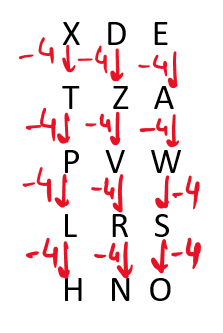
XDE TZA PVW LRS ?

  1. AOption (a)

    ​HNT

  2. BOption (b)

    HNY

  3. COption (c)

    HON

  4. DOption (d)

    HNO

View answer & explanation

Correct answer

Answer: (d)D.

HNO

Why this answer is correct

alpha teb

The pattern followed here is:

Hence, the correct answer is "Option 4"

Question 2

Based on the English alphabetical order, three of the following four letter-clusters are alike in a certain way and thus form a group. Which letter-cluster DOES NOT belong to that group? (Note: The odd one out is not based on the number of consonants/vowels or their position in the letter-cluster.)

  1. AOption (a)

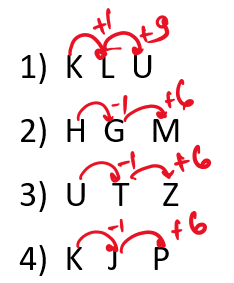
    KLU 

  2. BOption (b)

    HGM

  3. COption (c)

    UTZ 

  4. DOption (d)

    KJP 

View answer & explanation

Correct answer

Answer: (a)A.

KLU 

Why this answer is correct

alpha teb

The pattern followed here is:

Hence, the correct answer is "Option 1"

Question 3

Given below is a statement followed by two possible reasons numbered I and II. Read the statement carefully and decide which of the two reasons explains the event/observation/information given in the statement.

Statement:

Even though the newly set-up Internet service provider, company A, is offering high-speed internet, it is facing difficulties in increasing its customer base.

Reasons:

I. Most of the internet plans offered by company A are priced higher as compared to its wellestablished competitors.

II. Customers are never interested in using high speed Wi-Fi internet.

  1. AOption (a)

    Only II is a possible reason.

  2. BOption (b)

    Only I is a possible reason. 

  3. COption (c)

    Neither I nor II is a possible reason. 

  4. DOption (d)

    Both I and II are possible reasons. 

View answer & explanation

Correct answer

Answer: (b)B.

Only I is a possible reason. 

Why this answer is correct

Reason I is logical and relevant. Higher pricing compared to well-established competitors can discourage customers, making it difficult for Company A to grow its customer base despite offering high-speed internet.


Reason II is illogical. Customers generally prefer high-speed internet; saying they are never interested is unrealistic and does not explain the situation.

  • Only Reason I follows.

Question 4

Select the set in which the numbers are related in the same way as are the numbers of the following sets.

(Note: Operations should be performed on the whole numbers, without breaking down the numbers into their constituent digits. E.g. 13 – Operations on 13 such as adding/subtracting/multiplying to 13 can be performed. Breaking down 13 into 1 and 3 and then performing mathematical operations on 1 and 3 is not allowed.)

6 - 4 - 5

9 - 3 - 6

  1. AOption (a)

    8 - 4 - 6

  2. BOption (b)

    9 - 5 - 8 

  3. COption (c)

    7 - 7 - 6

  4. DOption (d)

    40 - 15 - 3

View answer & explanation

Correct answer

Answer: (a)A.

8 - 4 - 6

Why this answer is correct

Logic : 

6 - 4 - 5

  • (6+4) ÷ 2 = 10 ÷ 2 = 5


9 - 3 - 6 

  • (9+3) ÷ 2 = 12 ÷ 2 = 6

Similarly,

  • (8+4) ÷ 2 = 12 ÷ 2 = 6

​Hence, the correct answer is "Option 1"

Question 5

What will come in the place of the question mark (?) in the following equation, if ‘÷ ’ and ‘−’ are interchanged, and ‘×’ and ‘+’ are interchanged?

15 ÷ 3 + 7 × 45 − 5 =

  1. AOption (a)

    4

  2. BOption (b)

    2

  3. COption (c)

    1

  4. DOption (d)

    3

View answer & explanation

Correct answer

Answer: (d)D.

3

Why this answer is correct

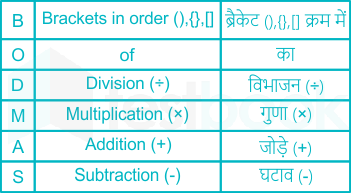
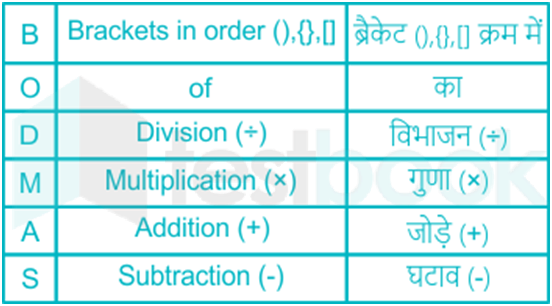
BODMAS

**Given :**15 ÷ 3 + 7 × 45 − 5 = ?

According to the question , ‘÷ ’ and ‘−’ are interchanged, and ‘×’ and ‘+’ are interchanged:

⇒ 15 - 3 x 7 + 45 ÷ 5 = ?

⇒ 15 - 3 x 7 + 9 = ?

⇒ 15 + 9 - 21 = ?

⇒ 24 - 21 = ?

⇒ 3

Hence, the correct answer is "Option 4"

Question 6

This question is based on the five, three-digit numbers given below.

(Left) 853 716 567 349 527 (Right)

(Example: 697 – First digit = 6, second digit = 9 and third digit = 7)

(Note: All operations to be done from left to right.)

What will be the resultant if the third digit of the second highest number is multiplied with the second digit of the lowest number?

  1. AOption (a)

    22

  2. BOption (b)

    23

  3. COption (c)

    24

  4. DOption (d)

    25

View answer & explanation

Correct answer

Answer: (c)C.

24

Why this answer is correct

Given :  (Left) 853 716 567 349 527 (Right)

Third digit of the second highest number = 716

Second digit of the lowest number = 349

6 x 4 = 24.

Hence, the correct answer is "Option 3"

Question 7

Seven boxes, C, D, E, I, J, K and N, are kept one over the other but not necessarily in the same order. Only C is kept above I. Only E is kept below K. Only J is kept between D and K. How many boxes are kept between N and E?

  1. AOption (a)

    One

  2. BOption (b)

    Two

  3. COption (c)

    Four

  4. DOption (d)

    Three

View answer & explanation

Correct answer

Answer: (d)D.

Three

Why this answer is correct

Seven boxes, C, D, E, I, J, K and N, are kept one over the other but not necessarily in the same order.

  • Only C is kept above I.
  • Only E is kept below K.
  • Only J is kept between D and K.

The Final Arrangement is, 

1C
2I
3N
4D
5J
6K
7E


Hence, the correct answer is "Option 4"

Question 8

Read the given statements and conclusions carefully. Assuming that the information given in the statements is true, even if it appears to be at variance with commonly known facts, decide which of the given conclusions logically follow(s) from the statements.

Statements:

No Hydrogens are Oxygens.

Some Oxygens are Nitrogens.

All Nitrogens are Carbons.

Conclusions:

I: No Hydrogens are Nitrogens.

II: Some Oxygens are Carbons.

  1. AOption (a)

    Both conclusions (I) and (II) follow

  2. BOption (b)

    Neither conclusion (I) nor (II) follows

  3. COption (c)

    Only conclusion (II) follows

  4. DOption (d)

    Only conclusion (I) follows

View answer & explanation

Correct answer

Answer: (c)C.

Only conclusion (II) follows

Why this answer is correct

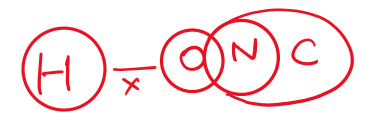
The least possible Venn diagram is as follows:

Conclusions:

I: No Hydrogens are Nitrogens. - False (As their is n direct relation between Hydrogens and Nitrogens may be it is possible but not definite. Henceit is false)

II: Some Oxygens are Carbons. - True (Some Oxygens are Nitrogens.All Nitrogens are Carbons.Some Oxygens are Carbons is True)

Only conclusion (II) follows

Hence, the correct answer is "Option 3"

Question 9

Each of M, N, B, V, C, X and Z has an exam on a different day of a week, starting from Monday and ending on Sunday of the same week. Only V has an exam after X. Only three people have exams between X and Z. Only three people have exams between V and C. B has an exam immediately before N. How many people have exams between M and N?

  1. AOption (a)

    Three

  2. BOption (b)

    Four

  3. COption (c)

    Two

  4. DOption (d)

    One

View answer & explanation

Correct answer

Answer: (a)A.

Three

Why this answer is correct

**Given:**Each of M, N, B, V, C, X and Z has an exam on a different day of a week, starting from Monday and ending on Sunday of the same week.

  • Only V has an exam after X.
  • Only three people have exams between X and Z.
  • Only three people have exams between V and C.
  • B has an exam immediately before N

The Final Arrangement is, 

MonM
TueZ
WedC
ThuB
FriN
SatX
SunV


Hence, the correct answer is "Option 1"

Question 10

Based on the English alphabetical order, three of the following four letter-clusters are alike in a certain way and thus form a group. Which is the letter-cluster that does NOT belong to that group?

(Note: The odd one out is not based on the number of consonants/vowels or their positions in the letter-cluster.)

  1. AOption (a)

    JOQ

  2. BOption (b)

    LQS

  3. COption (c)

    PUW

  4. DOption (d)

    DIL

View answer & explanation

Correct answer

Answer: (d)D.

DIL

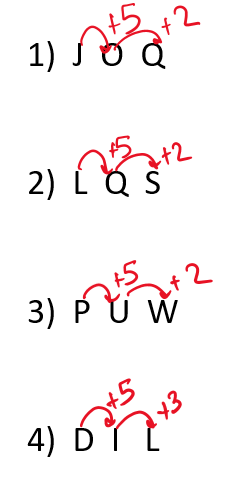
Why this answer is correct

alpha teb

The pattern followed here is:

Hence, the correct answer is "Option 4"

Question 11

If + means –, – means ×, × means ÷, and ÷ means +, then what will come in place of the question mark (?) in the following equation?

51 ÷ 133 × 7 – 3 + 102 = ?

  1. AOption (a)

    8

  2. BOption (b)

    4

  3. COption (c)

    1

  4. DOption (d)

    6

View answer & explanation

Correct answer

Answer: (d)D.

6

Why this answer is correct

Given :  51 ÷ 133 × 7 – 3 + 102 = ?

⇒ 51 ÷ 133 × 7 – 3 + 102 = ?

  • means –, – means ×, × means ÷, and ÷ means +

⇒ 51 + 133 ÷ 7 × 3 - 102 

⇒ 51 + 19 × 3 - 102 

⇒ 51 + 57 - 102 

⇒108 - 102 

⇒6

Hence, the correct answer is "Option 4"

Question 12

What should come in place of the question mark (?) in the given series based on the English alphabetical order?

VED AJI FON KTS ?

  1. AOption (a)

    REX

  2. BOption (b)

    PYX

  3. COption (c)

    RXY

  4. DOption (d)

    RXD

View answer & explanation

Correct answer

Answer: (b)B.

PYX

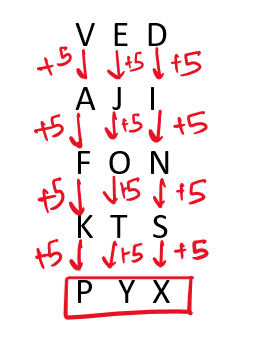
Why this answer is correct

alpha teb

The pattern followed here is:

Hence, the correct answer is "Option 2"

Question 13

In a certain code language,

'A + B' means 'A is the mother of B',

'A-B' means 'A is the brother of B',

'A x B' means 'A is the wife of B',

'A% B' means 'A is the father of B', and

'A # B' means 'A is the daughter of B'.

How is Q related to G if 'T-K#QxN%P+L#G'?

  1. AOption (a)

    Wife's sister

  2. BOption (b)

    Mother's sister

  3. COption (c)

    Wife's mother

  4. DOption (d)

    Brother's wife

View answer & explanation

Correct answer

Answer: (c)C.

Wife's mother

Why this answer is correct

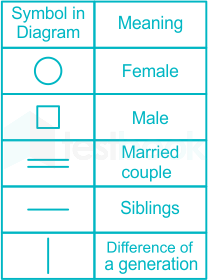
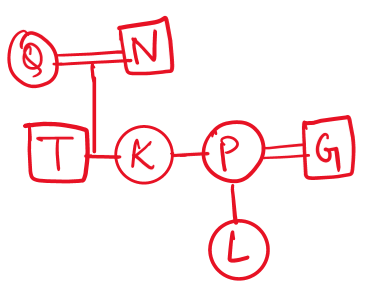
Family Chart:

Common Diagram 28.01.2020 D3

As per the given information,

P is wife of G and daughter of Q.

Hence, the correct answer is "Option 3"

Question 14

Select the triad that follows the same pattern as that followed by the two triads given below.

Both triads follow the same pattern.

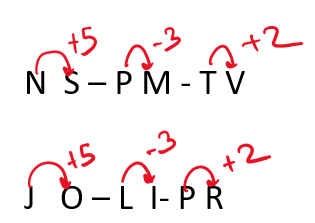
NS-PM-TV

JO-LI-PR

  1. AOption (a)

    GK-ID-LM

  2. BOption (b)

    FK-HD-LM

  3. COption (c)

    GL-ID-KM

  4. DOption (d)

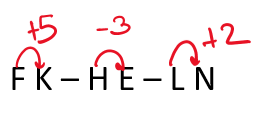
    FK-HE-LN

View answer & explanation

Correct answer

Answer: (d)D.

FK-HE-LN

Why this answer is correct

alpha teb

The pattern followed here is:

Similarly,

FK-HE-LN

Hence, the correct answer is "Option 4"

Question 15

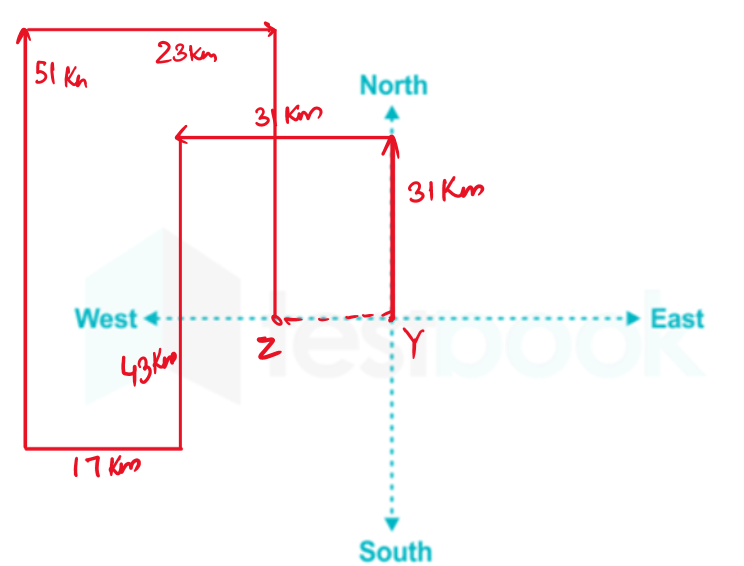
Bharat starts from Point Y and drives 31 km towards north. He then takes a left turn, drives 31 km, turns left and drives 43 km. He then takes a right turn and drives 17 km. He takes a right turn and drives 51 km. He then turns right, drives 23 km, turns right and drives 39 km to stop at Point Z. How far (shortest distance) and towards which direction should he drive in order to reach Point Y again? (All turns are 90-degree turns only, unless specified.)

  1. AOption (a)

    25 km towards east 

  2. BOption (b)

    19 km towards east

  3. COption (c)

    27 km towards west

  4. DOption (d)

    21 km towards west

View answer & explanation

Correct answer

Answer: (a)A.

25 km towards east 

Why this answer is correct

Bharat starts from Point Y and drives 31 km towards north.

  • He then takes a left turn, drives 31 km, turns left and drives 43 km.
  • He then takes a right turn and drives 17 km.
  • He takes a right turn and drives 51 km.
  • He then turns right, drives 23 km, turns right and drives 39 km to stop at Point Z.


The Final Arrangement is, 

Hence, the correct answer is "Option 1"

Question 16

What should come in place of the question mark (?) in the given series?

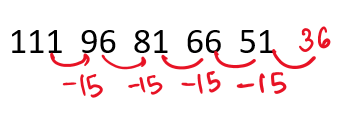
111 96 81 66 51 ?

  1. AOption (a)

    38

  2. BOption (b)

    35

  3. COption (c)

    36

  4. DOption (d)

    34

View answer & explanation

Correct answer

Answer: (c)C.

36

Why this answer is correct

The logic follows here,

Hence, the correct answer is "Option 3"

Question 17

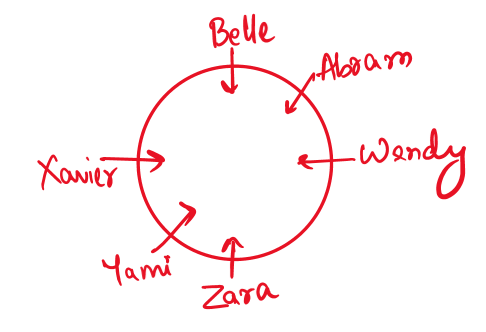
Six students Abram, Belle, Wendy, Xavier, Yami and Zara are sitting around a circular table facing the centre. Yami is an immediate neighbour of both Xavier and Zara. Belle is sitting third to the right of Zara. Abram is sitting second to the left of Xavier. Wendy is an immediate neighbour of both Abram and Zara. The position(s) of how many persons will remain unchanged if all persons are arranged in the English alphabetical order, in clockwise direction, starting from Wendy (including Wendy)?

  1. AOption (a)

    Four

  2. BOption (b)

    Three

  3. COption (c)

    Two

  4. DOption (d)

    One

View answer & explanation

Correct answer

Answer: (d)D.

One

Why this answer is correct

**Given:**Six students Abram, Belle, Wendy, Xavier, Yami and Zara are sitting around a circular table facing the centre.

  • Yami is an immediate neighbour of both Xavier and Zara.
  • Belle is sitting third to the right of Zara.
  • Abram is sitting second to the left of Xavier.
  • Wendy is an immediate neighbour of both Abram and Zara.

The Final Arrangement is, 

Hence, the correct answer is "Option 4"

Question 18

In a certain code language, ‘GONE’ is coded as ‘7103’ and ‘ONES’ is coded as ‘0123’. What is the code for ‘S’ in the given code language?

  1. AOption (a)

    2

  2. BOption (b)

    0

  3. COption (c)

    1

  4. DOption (d)

    3

View answer & explanation

Correct answer

Answer: (a)A.

2

Why this answer is correct

Given :  ‘GONE’ is coded as ‘7103’ and ‘ONES’ is coded as ‘0123’

‘GONE’ - ‘7103’ 

‘ONES’ - ‘0123’

Code for S is 2.

Hence, the correct answer is "Option 1"

Question 19

Below are given two sets of numbers. In each set of numbers, a certain mathematical operation on the first number results in the second number. Similarly, certain mathematical operation on the second number results in the third number and so on. Which of the given options follows the same set of operations as in the question?

(Note: A two-/three-digit number cannot be broken into individual digits for operations e.g., if 37 is followed by 10, the operation cannot be 3 + 7 as a two-digit number cannot be broken into individual digits.)

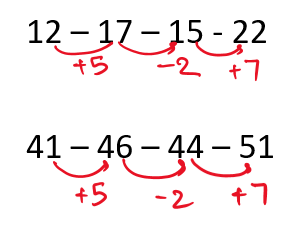
12-17-15-22

41-46-44-51

  1. AOption (a)

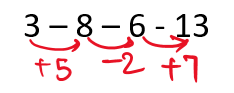
    3-8-6-13

  2. BOption (b)

    21-29-25-32

  3. COption (c)

    23-32-30-37

  4. DOption (d)

    31-37-35-43

View answer & explanation

Correct answer

Answer: (a)A.

3-8-6-13

Why this answer is correct

The logic follows here, 

Similarly,

Hence, the correct answer is "Option 1"

Question 20

This question is based on the five, three-digit numbers given below.

(Left) 674 621 435 376 215 (Right)

(Example: 697-First digit = 6, second digit = 9 and third digit = 7)

(Note: All operations to be done from left to right.)

If 3 is added to the first digit of every number, in how many numbers will the first digit be exactly divisible by the second digit?

  1. AOption (a)

    Four

  2. BOption (b)

    Two

  3. COption (c)

    Three

  4. DOption (d)

    One

View answer & explanation

Correct answer

Answer: (d)D.

One

Why this answer is correct

Given : (Left) 674 621 435 376 215 (Right)

3 is added to the first digit of every number,

(Left) 974 921 735 676 515 (Right)

Numbers will the first digit be exactly divisible by the second digit = 515.

Hence, the correct answer is "Option 4"

General Awareness (20 questions)

Question 21

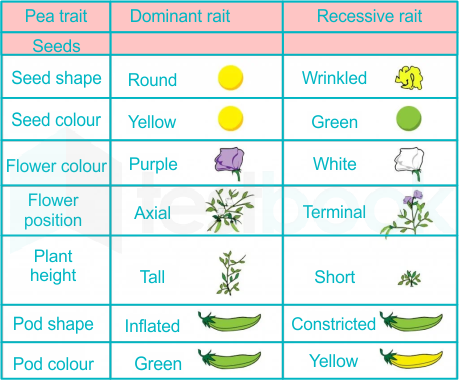
The observable expression of the genotype is known as __________________. 

  1. AOption (a)

    genotype

  2. BOption (b)

    genome

  3. COption (c)

    gene

  4. DOption (d)

    phenotype

View answer & explanation

Correct answer

Answer: (d)D.

phenotype

Why this answer is correct

The correct answer is phenotype.

Key Points

  • Phenotype refers to the observable traits or characteristics of an organism, such as physical appearance, behavior, and physiological attributes.
  • It is the result of the interaction between the organism's genetic makeup (genotype) and environmental factors.
  • Examples of phenotypes include eye color, hair texture, height, flower color in plants, and blood type.
  • Phenotypes can change over time or under different environmental conditions, while the genotype remains constant.
  • Phenotypic traits are often used in genetics and biology to study inheritance patterns, natural selection, and evolutionary processes.

Additional Information

  • Genotype:
  • The genotype is the genetic makeup of an organism, consisting of the alleles inherited from both parents.
  • It includes all the hereditary information encoded in the DNA, regardless of whether it is expressed as a visible trait.
  • For example, the genotype for eye color may include alleles for both brown and blue eyes, though only one may be expressed in the phenotype.
  • Genotypes are crucial in determining the potential traits an organism may exhibit and are used in genetic studies to understand inheritance patterns.
  • Genome:
  • The genome is the complete set of DNA in an organism, including all of its genes.
  • It includes both the coding regions (genes) and non-coding regions of DNA.
  • The human genome, for instance, contains approximately 3 billion base pairs of DNA, encoding around 20,000-25,000 genes.
  • Genome studies, such as genomics, are essential for understanding genetic disorders, evolutionary biology, and personalized medicine.
  • Gene:
  • A gene is a specific segment of DNA that encodes instructions for synthesizing proteins or functional RNA molecules.
  • Genes act as the basic units of heredity and are responsible for transmitting traits from one generation to the next.
  • Each gene resides at a specific location on a chromosome and can exist in different versions, called alleles.
  • Mutations in genes can lead to genetic disorders or variations in phenotypic traits.
  • Main Theme:
  • The relationship between genotype and phenotype is a fundamental concept in genetics.
  • While the genotype represents the genetic code, the phenotype is how this code is expressed in observable traits.
  • Environmental factors play a critical role in shaping the phenotype, highlighting the dynamic interaction between genes and the environment.

Question 22

Which state emerged as the overall champion at the 2025 National Kickboxing Championship held in Raipur? 

  1. AOption (a)

    Andhra Pradesh

  2. BOption (b)

    Maharashtra 

  3. COption (c)

    Punjab

  4. DOption (d)

    West Bengal

View answer & explanation

Correct answer

Answer: (c)C.

Punjab

Why this answer is correct

The correct answer is Punjab.

Key Points

  • Punjab emerged as the overall champion at the 2025 National Kickboxing Championship held in Raipur, showcasing their dominance in multiple categories of the competition.
  • The state’s athletes delivered exceptional performances, winning the maximum number of gold, silver, and bronze medals across various weight categories and disciplines.
  • The championship featured participants from across India, with Punjab securing the top position due to their strong infrastructure for training and support for athletes.
  • The event aimed to promote the sport of kickboxing and identify talent for national and international competitions, with Punjab’s comprehensive preparation yielding excellent results.
  • The victory reflects the state’s commitment to promoting sports and fostering young talent through initiatives such as dedicated sports academies and training facilities.

Additional Information

  • Andhra Pradesh
  • Andhra Pradesh is known for its significant contributions to sports like badminton, chess, and cricket, with players like P.V. Sindhu and Humpy Koneru achieving international recognition.
  • The state actively promotes sports through various initiatives, including the establishment of sports academies and infrastructure development.
  • However, Andhra Pradesh did not secure the championship title at the 2025 National Kickboxing Championship.
  • Maharashtra
  • Maharashtra has a strong presence in various sports, including wrestling, kabaddi, and cricket, and is home to many accomplished athletes.
  • The state has hosted several national and international sporting events and has a robust sports policy to encourage young talent.
  • Despite its competitive edge, Maharashtra was not the winner of the 2025 National Kickboxing Championship.
  • West Bengal
  • West Bengal is renowned for its passion for football, cricket, and athletics, with a strong legacy in these sports.
  • The state has produced numerous notable athletes and continues to invest in sports infrastructure and training programs.
  • Although West Bengal participated in the kickboxing championship, it did not achieve the top position in the 2025 event.
  • National Kickboxing Championship
  • The National Kickboxing Championship is an annual event organized to promote the sport and provide a platform for athletes to showcase their skills.
  • Participants compete in various categories based on weight, age, and style, including point fighting, full contact, and low kick.
  • The event plays a crucial role in identifying talent for international competitions such as the World Kickboxing Championship.
  • It also aims to popularize kickboxing as a sport across India, encouraging young athletes to take up the discipline.

Question 23

Fuse in an electric circuit is used for _________. 

  1. AOption (a)

    voltage stabilisation in the circuit

  2. BOption (b)

    generation of power  

  3. COption (c)

    protecting the circuits 

  4. DOption (d)

    storage of power 

View answer & explanation

Correct answer

Answer: (c)C.

protecting the circuits 

Why this answer is correct

The correct answer is protecting the circuits.

Key Points

  • A fuse is a safety device used in electrical circuits to protect appliances and wiring from excessive current flow caused by short circuits or overloads.
  • It consists of a thin metal wire or strip that melts when the current exceeds a certain limit, breaking the circuit and preventing further damage.
  • Fuses are rated based on their current-carrying capacity and are designed to operate at specific voltage levels.
  • They are essential for preventing electrical fires and damage to devices, ensuring both safety and longevity of the electrical system.
  • Once a fuse blows, it must be replaced to restore the circuit's functionality.

Additional Information

  • Voltage Stabilization in the Circuit:
  • A voltage stabilizer is a device used to maintain a stable voltage level in electrical circuits, ensuring that appliances receive a constant voltage irrespective of fluctuations in the supply.
  • It is not related to the function of a fuse, as fuses are designed for circuit protection, not voltage regulation.
  • Voltage stabilizers are commonly used with sensitive appliances like refrigerators, air conditioners, and televisions to prevent damage from voltage spikes or drops.
  • Generation of Power:
  • Power generation involves converting energy from natural resources such as coal, wind, solar, or water into electrical energy using power plants.
  • This is unrelated to the function of a fuse, as fuses do not generate power but are designed to protect circuits from excessive current.
  • Examples of power generation methods include thermal power plants, hydroelectric power stations, solar panels, and wind turbines.
  • Storage of Power:
  • Power storage refers to devices or systems, such as batteries or supercapacitors, that store electrical energy for later use.
  • Fuses do not store power; their sole purpose is to protect electrical systems by breaking the circuit during overcurrent conditions.
  • Examples of power storage technologies include lithium-ion batteries, lead-acid batteries, and pumped hydroelectric storage.

Question 24

What was Neeraj Chopra's best throw distance that earned him the silver medal in the men's javelin throw at the Paris Olympics 2024?

  1. AOption (a)

    88.77 metres 

  2. BOption (b)

     89.45 metres 

  3. COption (c)

    86.47 metres

  4. DOption (d)

    90.58 metres 

View answer & explanation

Correct answer

Answer: (b)B.

 89.45 metres 

Why this answer is correct

The correct answer is 89.45 metres.

Key Points

  • Neeraj Chopra secured the silver medal at the Paris Olympics 2024 with a best throw of 89.45 metres in the men's javelin throw event.
  • This remarkable performance further solidified Neeraj Chopra's position as one of the world's top javelin throwers.
  • Neeraj is India's most decorated track and field athlete, having previously won the gold medal at the Tokyo Olympics 2020.
  • His throw of 89.45 metres was his second-best career performance, narrowly missing his personal best of 89.94 metres.
  • Neeraj's silver medal win was celebrated across India as a historic achievement in athletics, showcasing his consistency and dedication.

Additional Information

  • 88.77 metres:
  • This distance was not Neeraj Chopra's throw at the Paris Olympics 2024, but it is a competitive mark in international javelin throw events.
  • Throws in the range of 88 metres are often enough to secure medals in global competitions like the World Championships or Olympics.
  • The javelin throw requires a combination of speed, strength, and technique to achieve such distances.
  • 86.47 metres:
  • This distance is below Neeraj Chopra's usual competitive performance and would not have been sufficient to secure a medal at the Paris Olympics 2024.
  • Neeraj regularly throws beyond the 85-metre mark in major competitions, establishing himself as a consistent elite performer.
  • 90.58 metres:
  • This distance is exceptional and would typically secure a gold medal in international javelin throw competitions.
  • Although Neeraj Chopra has come close to crossing the 90-metre mark, this throw was not recorded at the Paris Olympics 2024.
  • The 90-metre mark is considered a benchmark for elite javelin throwers and is achieved by only a few athletes globally.
  • Javelin Throw Overview:
  • The javelin throw is a track and field event where athletes aim to throw a spear-like implement as far as possible.
  • It requires a combination of explosive power, precise technique, and optimal angle of release.
  • Javelin throwers typically undergo rigorous training to develop strength, speed, and flexibility.
  • Major competitions include the Olympics, World Championships, and Continental Games.

Question 25

In which of the following years was the Central Hindi Directorate (CHD) established?

  1. AOption (a)

    1953

  2. BOption (b)

    1960

  3. COption (c)

    1954

  4. DOption (d)

    1959

View answer & explanation

Correct answer

Answer: (b)B.

1960

Why this answer is correct

The correct answer is 1960.

Key Points

  • The Central Hindi Directorate (CHD) was established on March 1, 1960, under the Ministry of Education, Government of India.
  • The primary objective of CHD is the promotion and propagation of Hindi as an official language across India.
  • It works towards the development of Hindi by preparing educational and reference materials, including dictionaries and glossaries, in Hindi.
  • The directorate also organizes training programs, seminars, and workshops to promote Hindi as a medium of communication in various parts of the country.
  • CHD plays a significant role in standardizing Hindi terms for administrative, technical, and scientific use to foster uniformity in official communication.

Additional Information

  • 1953
  • In 1953, the University Grants Commission (UGC) was established to regulate and maintain standards of higher education in India.
  • It is a statutory body under the Ministry of Education and plays a significant role in funding universities and colleges.
  • 1954
  • The National Film Awards were instituted in 1954 to honor the best films and filmmakers in India.
  • This initiative aimed to promote excellence in Indian cinema and recognize contributions to its growth.
  • 1959
  • The All India Radio (AIR) introduced its first television broadcast from Delhi in 1959, marking the beginning of television services in India.
  • This was a significant milestone in Indian media, laying the foundation for television as a powerful medium of communication.
  • Main Theme: Development of Hindi
  • The Central Hindi Directorate was set up to fulfill the constitutional mandate of promoting Hindi as the official language of India.
  • Article 351 of the Indian Constitution directs the Union to promote the spread of Hindi and develop it as a medium of expression for all elements of Indian culture.
  • The directorate works in conjunction with other organizations like the Kendriya Hindi Sansthan to achieve these objectives.

Question 26

The level of national income does NOT determine the level of which of the following variables?

  1. AOption (a)

    Demand and supply of a good

  2. BOption (b)

     Private investment expenditure

  3. COption (c)

    Import of goods and services

  4. DOption (d)

    Aggregate consumption 

View answer & explanation

Correct answer

Answer: (a)A.

Demand and supply of a good

Why this answer is correct

The correct answer is Demand and supply of a good.

Key Points

  • The level of national income indicates the total value of goods and services produced in a country, but it does not directly determine the demand and supply of a specific good.
  • Demand and supply of an individual good are influenced by factors such as price of the good, consumer preferences, availability of substitutes, and production costs, rather than national income alone.
  • While aggregate demand and aggregate supply are tied to national income, the demand and supply of a specific commodity are determined by microeconomic factors specific to that market.
  • National income, being a macroeconomic concept, encompasses overall economic activity but does not directly dictate the behavior of individual goods’ markets.
  • The demand and supply of a good are primarily governed by the law of demand and supply, which operates independently of the level of national income.

Additional Information

  • Private Investment Expenditure
  • Private investment expenditure refers to the spending by businesses on capital goods such as machinery, buildings, and technology.
  • The level of national income significantly influences private investment, as higher income levels generally lead to greater demand for goods and services, encouraging businesses to invest in expanding production capacity.
  • Investment decisions are also affected by interest rates, government policies, and economic stability, but national income remains a crucial determinant.
  • Import of Goods and Services
  • National income plays a crucial role in determining the import of goods and services. As income levels rise, individuals and businesses have greater purchasing power, which often leads to increased imports.
  • Higher national income generally results in a higher demand for foreign goods, especially luxury items and raw materials not available domestically.
  • This is explained through the concept of the marginal propensity to import (MPI), which measures how much of an additional unit of income is spent on imports.
  • Aggregate Consumption
  • Aggregate consumption refers to the total spending by households on goods and services in an economy.
  • It is directly influenced by national income, as higher income levels enable households to spend more on consumption.
  • In macroeconomics, this relationship is often represented by the consumption function, which shows how consumption levels vary with disposable income.
  • The marginal propensity to consume (MPC) is a key concept in this context, highlighting the proportion of additional income that is spent on consumption.

Question 27

How many of the following climate-resilient and biofortified seed varieties were introduced by PM Modi in August 2024?

  1. AOption (a)

    200

  2. BOption (b)

    109

  3. COption (c)

    150

  4. DOption (d)

    75

View answer & explanation

Correct answer

Answer: (b)B.

109

Why this answer is correct

The correct answer is 109.

Key Points

  • Prime Minister Narendra Modi, in August 2024, introduced 109 climate-resilient and biofortified seed varieties to strengthen food security and address the impacts of climate change.
  • These seed varieties were developed with traits like drought resistance, pest resistance, and enhanced nutritional value to tackle changing climatic conditions.
  • The initiative aligns with India’s commitment to ensuring sustainable agriculture and supporting farmers in adapting to climate variability.
  • The launch was a part of the government’s broader strategy to promote self-reliance in agriculture and improve the nutritional health of the population.
  • Biofortified crops introduced include varieties enriched with essential nutrients such as zinc, iron, and protein, aimed at combating malnutrition in India.

Additional Information

  • Option 1: 200
  • The number 200 does not align with the actual figure of climate-resilient and biofortified seed varieties introduced by PM Modi in August 2024.
  • Although it is an overestimate, the figure might represent the broader scope of seed varieties under research and development for future introduction.
  • Option 3: 150
  • While 150 is closer to the correct answer, it still does not match the precise number of seed varieties launched, which is 109.
  • This number might reflect previous estimates or targets set for crop development under earlier agricultural initiatives.
  • Option 4: 75
  • The figure of 75 is significantly lower than the actual number of varieties introduced (109).
  • It may relate to earlier programs or pilot initiatives focused on a smaller set of crops for specific regions or climatic conditions.
  • Main Theme: Climate-Resilient and Biofortified Seed Varieties
  • Climate-resilient seeds are designed to withstand extreme weather conditions such as droughts, floods, and high temperatures, ensuring stable agricultural productivity.
  • Biofortified seeds are enhanced with nutrients like iron, zinc, and vitamin A to address deficiencies and improve public health, particularly in malnourished populations.
  • These initiatives form a critical part of India’s strategy to achieve agricultural sustainability and food security in the face of global climate challenges.

Question 28

Where is the Anundoram Borooah Institute of Language, Art and Culture located?

  1. AOption (a)

    West Bengal 

  2. BOption (b)

    Assam

  3. COption (c)

    Meghalaya

  4. DOption (d)

    Tripura

View answer & explanation

Correct answer

Answer: (b)B.

Assam

Why this answer is correct

The correct answer is Assam.

Key Points

  • The Anundoram Borooah Institute of Language, Art, and Culture is located in Assam, India.
  • This institute was established with the aim of promoting and preserving the languages, arts, and culture of Assam and the northeastern region of India.
  • It is named after Anundoram Borooah, a renowned Sanskrit scholar and the first Assamese to join the Indian Civil Service (ICS).
  • The institute undertakes research, documentation, and initiatives for the development of various ethnic cultures and languages of Assam.
  • It contributes to the study and dissemination of knowledge regarding the rich heritage and traditions of the region.

Additional Information

  • West Bengal
  • West Bengal is known for its rich cultural heritage, including Bengali literature, music, and art.
  • The state is home to prestigious institutions like the Visva-Bharati University, founded by Rabindranath Tagore, which focuses on art, culture, and education.
  • West Bengal does not host the Anundoram Borooah Institute but has several centers promoting Bengali culture and heritage.
  • Meghalaya
  • Meghalaya is renowned for its tribal cultures, particularly those of the Khasi, Jaintia, and Garo communities.
  • It has institutions like the North-Eastern Hill University (NEHU) that work towards preserving the unique cultural aspects of the state.
  • However, the Anundoram Borooah Institute is not located in Meghalaya.
  • Tripura
  • Tripura is known for its blend of Bengali and tribal cultures, including traditional art forms like bamboo craft and tribal dances.
  • The state has institutions working towards the preservation of its unique cultural identity, such as the Tribal Research and Cultural Institute.
  • The Anundoram Borooah Institute is not situated in Tripura.
  • Theme: Language, Art, and Culture
  • The Anundoram Borooah Institute reflects India's efforts to preserve and promote regional languages, arts, and cultures, particularly in the northeastern states.
  • Such institutions play a vital role in fostering research, documentation, and education about the diverse traditions of India.

Question 29

What is the official language of Odisha? 

  1. AOption (a)

    Sanskrit

  2. BOption (b)

    English

  3. COption (c)

    Hindi

  4. DOption (d)

    Odia

View answer & explanation

Correct answer

Answer: (d)D.

Odia

Why this answer is correct

The correct answer is Odia.

Key Points

  • Odia is the official language of Odisha, as per the Odisha Official Language Act, 1954.
  • Odia is one of the 22 scheduled languages of India recognized under the Eighth Schedule of the Indian Constitution.
  • In 2014, Odia was accorded the status of a Classical Language of India, making it the sixth Indian language to receive this distinction.
  • The language is spoken by over 80% of the population of Odisha and is also used in neighboring states such as West Bengal, Jharkhand, and Andhra Pradesh.
  • Odia is one of the oldest languages in India, with its earliest inscriptions dating back to the 10th century AD.

Additional Information

  • Sanskrit:
  • Sanskrit is an ancient language of India and is often referred to as the language of the Vedas.
  • It is considered the mother of several modern Indian languages and has significant importance in Hinduism, Buddhism, and Jainism.
  • Though not widely spoken in daily life, Sanskrit is one of the 22 scheduled languages of India.
  • Efforts are being made to revive Sanskrit as a spoken language through educational initiatives and cultural programs.
  • English:
  • English serves as an associate official language of India alongside Hindi.
  • It is widely used in government, legal, educational, and business contexts across India.
  • English acts as a link language in a country with diverse linguistic traditions, facilitating communication between different regions.
  • Odisha also uses English for administrative purposes along with Odia.
  • Hindi:
  • Hindi is the most widely spoken language in India and is the official language of the Indian Union as per Article 343 of the Constitution.
  • It is one of the 22 scheduled languages and is written in the Devanagari script.
  • Though Hindi is not the official language of Odisha, it is understood and spoken by a small percentage of the population, especially in urban areas.
  • Main Theme - Official Language of Odisha:
  • The state of Odisha is unique in its linguistic culture, with Odia being the sole official language recognized under the Odisha Official Language Act.
  • Efforts are made to promote Odia in government operations, education, and cultural activities to preserve and enrich the language.

Question 30

The Constitution of India allows for a maximum of how many representatives from the Union Territories in the Lok Sabha? 

  1. AOption (a)

    20

  2. BOption (b)

    40

  3. COption (c)

    10

  4. DOption (d)

    30

View answer & explanation

Correct answer

Answer: (a)A.

20

Why this answer is correct

The correct answer is 20.

Key Points

  • The Constitution of India provides for a maximum of 20 representatives from Union Territories (UTs) in the Lok Sabha.
  • Representation from Union Territories is governed under Article 81 of the Indian Constitution, which deals with the composition of the Lok Sabha.
  • Union Territories are represented in the Lok Sabha based on their population and are allocated specific seats accordingly.
  • Unlike states, which have representation based on direct elections from territorial constituencies, members from Union Territories may sometimes be elected indirectly depending on specific provisions.
  • Currently, significant Union Territories like Delhi, Puducherry, and Jammu & Kashmir have elected representatives in the Lok Sabha, while smaller UTs like Lakshadweep have single-member constituencies.

Additional Information

  • Option 2: 40
  • The figure 40 is much higher than the actual provision for Union Territories in the Lok Sabha.
  • The maximum representation in the Lok Sabha is determined by the population of the Union Territories, which collectively do not require such a high number of seats.
  • India has a total of 543 elected seats in the Lok Sabha, and an exaggerated number like 40 for UTs would leave insufficient seats for state representation.
  • Option 3: 10
  • The number 10 is less than the actual maximum cap of 20 representatives for Union Territories.
  • While smaller UTs like Lakshadweep and Dadra & Nagar Haveli have only one representative, larger UTs like Delhi and Jammu & Kashmir require more seats due to their population size.
  • Option 4: 30
  • The number 30 is higher than the constitutionally allowed maximum of 20 representatives for Union Territories.
  • This option does not align with Article 81 or any legislative provisions governing Lok Sabha representation.
  • Understanding Representation in Lok Sabha
  • The Lok Sabha, or the House of the People, is composed of representatives from both states and Union Territories.
  • The total strength of the Lok Sabha is 543 elected members, with an additional 2 members nominated by the President to represent the Anglo-Indian community (if required).
  • Seats are distributed among the states and Union Territories based on population, with periodic delimitation exercises to adjust boundaries and representation.

Question 31

Which of the following is the total cost per unit of output? 

  1. AOption (a)

    Average Variable Cost 

  2. BOption (b)

    Average Fixed Cost 

  3. COption (c)

     Average Cost 

  4. DOption (d)

    Marginal Cost 

View answer & explanation

Correct answer

Answer: (c)C.

 Average Cost 

Why this answer is correct

The correct answer is Average Cost.

Key Points

  • The Average Cost (AC), also referred to as the unit cost, represents the total cost divided by the number of units of output produced.
  • It includes both fixed costs (costs that remain constant regardless of output) and variable costs (costs that change with the level of output).
  • The formula for Average Cost is AC = Total Cost (TC) / Quantity (Q).
  • Average Cost typically decreases as production increases due to the spreading of fixed costs over more units, but it may rise again if variable costs increase substantially.
  • It helps in determining the profitability of producing additional units and is crucial for pricing strategies in economics and business.

Additional Information

  • Average Variable Cost (AVC):
  • It refers to the variable cost per unit of output produced.
  • The formula for AVC is AVC = Variable Cost (VC) / Quantity (Q).
  • AVC declines with an increase in production initially due to economies of scale but may rise later due to diminishing returns.
  • It is an essential component in determining the break-even point and shutdown decisions in the short run.
  • Average Fixed Cost (AFC):
  • AFC is the fixed cost per unit of output produced.
  • The formula for AFC is AFC = Fixed Cost (FC) / Quantity (Q).
  • Since fixed costs remain constant, AFC decreases as production increases, leading to a "spreading effect" of fixed costs over a larger number of units.
  • It is a significant factor in understanding cost structures and determining the impact of scale on production costs.
  • Marginal Cost (MC):
  • Marginal Cost is the additional cost incurred by producing one more unit of output.
  • The formula for MC is MC = Change in Total Cost (ΔTC) / Change in Quantity (ΔQ).
  • It plays a critical role in decision-making, particularly when determining whether to increase production.
  • When MC is less than AC, the AC decreases, and when MC is greater than AC, the AC increases.
  • Main Theme: Cost Concepts in Economics:
  • The study of costs is fundamental in economics as it helps businesses and policymakers understand production efficiency, pricing, and profitability.
  • Costs are categorized into fixed, variable, average, marginal, and total costs, each serving a unique purpose in economic analysis.
  • Understanding these cost concepts allows firms to optimize production levels and make informed financial decisions.

Question 32

As of July 2024, which of the following is the longest National Highway in India?

  1. AOption (a)

    National highway 17

  2. BOption (b)

    National Highway 31 

  3. COption (c)

    National Highway  

  4. DOption (d)

    National Highway 44

View answer & explanation

Correct answer

Answer: (d)D.

National Highway 44

Why this answer is correct

The correct answer is National Highway 44.

Key Points

  • National Highway 44 (NH 44) is the longest National Highway in India, stretching approximately 4,112 kilometers.
  • It spans across multiple states in India, including Jammu & Kashmir, Punjab, Haryana, Delhi, Uttar Pradesh, Madhya Pradesh, Maharashtra, Telangana, Andhra Pradesh, Karnataka, and Tamil Nadu.
  • This highway was previously known as NH 7 before the renumbering of highways in 2010.
  • NH 44 connects major cities such as Srinagar, Delhi, Nagpur, Hyderabad, Bengaluru, and Kanyakumari, making it a critical route for trade and travel.
  • It plays a significant role in connecting the northernmost point of India (Srinagar) to the southernmost point (Kanyakumari), facilitating seamless movement of goods and passengers.

Additional Information

  • National Highway 17
  • Also known as NH 66 after the renumbering in 2010, this highway runs along the western coast of India.
  • It connects Panvel (Maharashtra) to Kanyakumari (Tamil Nadu) and passes through Goa, Karnataka, and Kerala.
  • NH 66 is notable for its scenic coastal route and provides connectivity to popular tourist destinations like Goa and Kerala.
  • National Highway 31
  • NH 31 is a significant highway in eastern India, connecting Barhi (Jharkhand) to Jalukbari (Assam).
  • This highway is crucial for connecting Assam and other northeastern states to the rest of India.
  • It passes through important cities like Siliguri and Guwahati and serves as a lifeline for trade and transportation in the region.
  • National Highways in India
  • National highways in India are a network of trunk roads that are managed and maintained by the National Highways Authority of India (NHAI).
  • They are essential for the economic and social development of the country, facilitating trade, tourism, and connectivity between states.
  • India’s national highway network spans over 1.4 lakh kilometers, making it one of the largest in the world.
  • The Golden Quadrilateral and North-South & East-West Corridors are two major highway projects aimed at improving connectivity and reducing travel time.

Question 33

With which of the following dynasties of the Delhi Sultanate was Khizr Khan associated? 

  1. AOption (a)

    Tughluq

  2. BOption (b)

    Khilji

  3. COption (c)

    Sayyid

  4. DOption (d)

    Lodhi

View answer & explanation

Correct answer

Answer: (c)C.

Sayyid

Why this answer is correct

The correct answer is Sayyid.

Key Points

  • Khizr Khan was the founder of the Sayyid dynasty, the fourth dynasty of the Delhi Sultanate, which ruled from 1414 to 1451 CE.
  • He was appointed as the governor of Multan by Timur, the Central Asian conqueror, and later gained control of Delhi after Timur's invasion in 1398 CE.
  • Khizr Khan did not adopt the title of Sultan but ruled as a vassal of the Timurids, recognizing Timur’s authority.
  • The Sayyid dynasty is considered a period of transition in the Delhi Sultanate, marked by political instability and frequent invasions.
  • Khizr Khan’s rule focused on consolidating power in Delhi and surrounding regions, although his authority was limited and faced challenges from regional rulers.

Additional Information

  • Tughluq Dynasty
  • The Tughluq dynasty (1320–1414 CE) was known for its ambitious rulers, including Muhammad bin Tughluq and Firoz Shah Tughluq.
  • Muhammad bin Tughluq is infamous for his failed experiments, such as moving the capital from Delhi to Daulatabad and introducing token currency.
  • The dynasty witnessed territorial expansion but also faced rebellions, administrative challenges, and economic decline, leading to its eventual downfall.
  • Khilji Dynasty
  • The Khilji dynasty (1290–1320 CE) was marked by the military conquests of Alauddin Khilji, who expanded the Sultanate's territory significantly.
  • Alauddin Khilji implemented market reforms, controlled prices, and strengthened the administrative system to support his military campaigns.
  • The dynasty is remembered for resisting Mongol invasions and achieving significant victories in South India.
  • Lodhi Dynasty
  • The Lodhi dynasty (1451–1526 CE) was the last ruling dynasty of the Delhi Sultanate before the establishment of the Mughal Empire.
  • It was founded by Bahlul Lodhi, followed by Sikandar Lodhi and Ibrahim Lodhi.
  • The dynasty ended with Ibrahim Lodhi's defeat by Babur in the First Battle of Panipat in 1526, marking the beginning of Mughal rule in India.
  • Delhi Sultanate
  • The Delhi Sultanate was a series of five dynasties that ruled northern India from 1206 to 1526 CE: the Mamluks, Khiljis, Tughluqs, Sayyids, and Lodhis.
  • The Sultanate was known for its contributions to architecture, culture, and the spread of Islam in the Indian subcontinent.
  • It laid the foundation for centralized administration and introduced Persian culture and language to India.

Question 34

Which event led to the suspension of the Non-Cooperation Movement by Mahatma Gandhi in 1922?

  1. AOption (a)

    The Quit India Movement  

  2. BOption (b)

    The Jallianwala Bagh Incident 

  3. COption (c)

    The Simon Commission's Arrival 

  4. DOption (d)

     The Chauri Chaura Incident

View answer & explanation

Correct answer

Answer: (d)D.

 The Chauri Chaura Incident

Why this answer is correct

The correct answer is The Chauri Chaura Incident.

Key Points

  • The Chauri Chaura Incident occurred on 5 February 1922 in the Gorakhpur district of Uttar Pradesh during the Non-Cooperation Movement.
  • A violent clash broke out between a group of protesters and the police, resulting in the burning down of the Chauri Chaura police station and the death of 22 policemen.
  • Mahatma Gandhi, who was committed to non-violence, was deeply disturbed by the incident and felt that the movement was veering off course due to the violent actions.
  • Consequently, Gandhi decided to call off the Non-Cooperation Movement on 12 February 1922, emphasizing the importance of adhering to non-violent principles.
  • The suspension of the movement marked a turning point in India's struggle for independence, highlighting Gandhi's steadfast commitment to non-violence as a tool for achieving freedom.

Additional Information

  • The Quit India Movement:
  • Also known as the Bharat Chhodo Andolan, it was launched by Mahatma Gandhi on 8 August 1942 during World War II, demanding an end to British rule in India.
  • The movement was marked by widespread protests, strikes, and demonstrations, but was met with severe repression by the British authorities.
  • Although it did not achieve immediate success, it played a crucial role in galvanizing public opinion against colonial rule and accelerating India's independence process.
  • The Jallianwala Bagh Incident:
  • On 13 April 1919, British troops under General Dyer fired on a peaceful gathering at Jallianwala Bagh in Amritsar, Punjab, killing hundreds of unarmed civilians.
  • The massacre was a response to protests against the Rowlatt Act, which allowed the colonial government to arrest and detain Indians without trial.
  • The incident shocked the nation and marked a turning point in India's independence movement, leading to widespread anger and intensified anti-British sentiment.
  • The Simon Commission's Arrival:
  • The Simon Commission was a group of British parliamentarians sent to India in 1928 to review the Government of India Act 1919 and suggest reforms.
  • It was widely boycotted by Indians because it lacked any Indian representation, leading to protests and the slogan "Simon Go Back."
  • These protests were significant in uniting Indians against colonial oppression and further highlighted the demand for self-governance.
  • Non-Cooperation Movement:
  • Launched by Gandhi in 1920, this movement aimed to boycott British goods, institutions, and services, promoting the use of Indian-made goods (Swadeshi).
  • It was the first mass-scale campaign led by Gandhi against British rule, encouraging peaceful resistance and non-violent protests.
  • The movement was suspended after the Chauri Chaura Incident, but it laid the groundwork for future independence campaigns.

Question 35

Betel nut is widely cultivated in ________. 

  1. AOption (a)

    Uttarakhand

  2. BOption (b)

    Himachal Pradesh

  3. COption (c)

    Punjab

  4. DOption (d)

    Karnataka

View answer & explanation

Correct answer

Answer: (d)D.

Karnataka

Why this answer is correct

The correct answer is Karnataka.

Key Points

  • Karnataka is one of the leading states in India for betel nut (areca nut) cultivation, contributing significantly to the country's production of this crop.
  • Betel nut is primarily grown in the coastal and Malnad regions of Karnataka, including districts such as Dakshina Kannada, Udupi, Uttara Kannada, Shivamogga, Chikkamagaluru, and Kodagu.
  • India is the largest producer and consumer of betel nut in the world, and Karnataka plays a pivotal role in meeting the national demand for this cash crop.
  • Betel nut cultivation in Karnataka benefits from the region's favorable tropical climate, high humidity, and well-drained soil, which are essential for its growth.
  • Areca nut farming is a vital source of income for many farmers in Karnataka, contributing significantly to the state’s agricultural economy.

Additional Information

  • Uttarakhand
  • Uttarakhand is not a major producer of betel nut. The state is known for its production of temperate crops such as apples, pears, and peaches due to its mountainous terrain and cool climate.
  • The agricultural focus in Uttarakhand is largely on horticulture and medicinal plants rather than tropical crops like betel nut.
  • Himachal Pradesh
  • Himachal Pradesh, like Uttarakhand, is also unsuitable for betel nut cultivation due to its cooler climate and higher altitude.
  • The state specializes in the cultivation of fruits like apples, cherries, and apricots, alongside tea and other hill crops.
  • Punjab
  • Punjab is not a traditional betel nut-growing region; instead, it is known as the agricultural hub of India, primarily cultivating wheat, rice, and sugarcane.
  • The state’s climate and soil conditions are more suited for cereals and cash crops rather than tropical crops like betel nut.
  • About Betel Nut Cultivation
  • Betel nut, also known as areca nut, is the seed of the Areca palm (Areca catechu). It is a tropical crop grown extensively in South and Southeast Asia.
  • It is primarily used for chewing, often as part of betel quid (a mixture of betel leaf, slaked lime, and other ingredients).
  • Major producers in India include Karnataka, Kerala, Assam, and parts of Tamil Nadu and West Bengal.
  • The crop requires a warm and humid climate with consistent rainfall, making coastal and tropical regions ideal for its cultivation.

Question 36

Which of the following states has the highest number of Lok Sabha seats in India as per the Delimitation of Parliamentary and Assembly Constituencies Order, 2008?

  1. AOption (a)

    Uttar Pradesh

  2. BOption (b)

    Tamil Nadu

  3. COption (c)

    West Bengal 

  4. DOption (d)

    Bihar

View answer & explanation

Correct answer

Answer: (a)A.

Uttar Pradesh

Why this answer is correct

The correct answer is Uttar Pradesh.

Key Points

  • Uttar Pradesh has the highest number of Lok Sabha seats in India, with 80 seats, as per the Delimitation of Parliamentary and Assembly Constituencies Order, 2008.
  • This large number of seats is attributed to Uttar Pradesh being the most populous state in India, with a population of over 200 million.
  • The Lok Sabha, also known as the House of the People, is the lower house of India's Parliament. The allocation of seats to states is based on their population.
  • Uttar Pradesh's significant representation in the Lok Sabha plays a crucial role in shaping national policies and politics.
  • The state has consistently been a critical factor in determining the formation of the central government, given its large number of parliamentary constituencies.

Additional Information

  • Tamil Nadu
  • Tamil Nadu has 39 Lok Sabha seats, which makes it one of the most politically active states in South India.
  • The state has a history of strong regional parties like DMK and AIADMK, which play a significant role in national coalition politics.
  • Tamil Nadu is also known for its high voter turnout and active political engagement.
  • West Bengal
  • West Bengal has 42 Lok Sabha seats, making it the third-largest state in terms of parliamentary constituencies.
  • The state has been historically significant in Indian politics, with key contributions to the independence movement and the post-independence political landscape.
  • It is a densely populated state and has a diverse cultural and political history.
  • Bihar
  • Bihar has 40 Lok Sabha seats, making it the fourth-largest state in terms of representation in the lower house of Parliament.
  • The state is known for its rich cultural heritage and has been a focal point of historical and political developments in India.
  • Bihar has a significant role in influencing national politics due to its demographic and historical importance.
  • Theme of the Question
  • The distribution of Lok Sabha seats among Indian states is determined by the population of each state as per the last Census.
  • The Delimitation of Parliamentary and Assembly Constituencies Order, 2008, governs the division of constituencies to ensure fair representation.
  • The Lok Sabha has a total of 543 elected seats, and the allocation is designed to maintain proportional representation based on population.

Question 37

Which of the following Articles of the Indian Constitution states that persons who voluntarily acquire citizenship of a foreign state are NOT eligible to be citizens of India?

  1. AOption (a)

    Article 5

  2. BOption (b)

    Article 7

  3. COption (c)

    Article 11

  4. DOption (d)

     Article 9

View answer & explanation

Correct answer

Answer: (d)D.

 Article 9

Why this answer is correct

The correct answer is Article 9.

Key Points

  • Article 9 of the Indian Constitution states that any person who voluntarily acquires the citizenship of a foreign state will cease to be a citizen of India.
  • This article ensures that India does not allow dual citizenship, emphasizing that individuals must choose either Indian citizenship or foreign citizenship.
  • Voluntary acquisition refers to cases where an individual willingly applies for and accepts the citizenship of another country.
  • The provision is consistent with India's single-citizenship policy, which distinguishes Indian law from countries that permit dual nationality.
  • This article is critical for regulating citizenship laws in India and ensuring that individuals cannot simultaneously owe allegiance to two nations.

Additional Information

  • Article 5
  • Article 5 deals with citizenship at the commencement of the Constitution (i.e., on January 26, 1950).
  • It specifies that a person who had a domicile in India and fulfilled conditions such as birth in India, parentage, or ordinary residence for at least five years before the commencement of the Constitution would be a citizen of India.
  • This article primarily addressed citizenship status during the transitional period following independence.
  • Article 7
  • Article 7 pertains to individuals who migrated to Pakistan after March 1, 1947, but later returned to India with proper permits for resettlement.
  • Such individuals could become Indian citizens provided they fulfilled certain residency and procedural requirements.
  • The article was crucial for addressing the citizenship of people affected by partition-related migration.
  • Article 11
  • Article 11 grants Parliament the authority to regulate citizenship through legislation.
  • It empowers Parliament to make laws concerning the acquisition, termination, and other matters related to Indian citizenship.
  • Under this provision, the Citizenship Act of 1955 was enacted, laying down detailed rules and procedures for citizenship.

Question 38

Which of the following is correct about literacy rates in India as per Census 2011?

  1. AOption (a)

    Andaman and Nicobar Islands had the literacy rate above 85%. 

  2. BOption (b)

    In two states of India, Kerala and Goa, the literacy rate was higher for the females. 

  3. COption (c)

    Both Nagaland and Orissa crossed 80% in the literacy rate

  4. DOption (d)

    Puducherry showed a remarkable rise in the literacy rate compared to 2001 Census, with 92% literacy rate in 2011. 

View answer & explanation

Correct answer

Answer: (a)A.

Andaman and Nicobar Islands had the literacy rate above 85%. 

Why this answer is correct

The correct answer is Andaman and Nicobar Islands had the literacy rate above 85%.

Key Points

  • The literacy rate of Andaman and Nicobar Islands was recorded at 86.63% in the Census 2011.
  • It was one of the Union Territories to achieve a literacy rate above 85%, highlighting significant progress in educational attainment.
  • The male literacy rate in Andaman and Nicobar Islands was 90.27%, while the female literacy rate was 82.43%, showing a gender gap but still a commendable achievement.
  • Overall, India’s literacy rate in Census 2011 was 74.04%, with a male literacy rate of 82.14% and a female literacy rate of 65.46%.
  • The government has implemented various programs, such as the Sarva Shiksha Abhiyan and mid-day meal schemes, to improve literacy rates in remote areas, including Andaman and Nicobar Islands.

Additional Information

  • In two states of India, Kerala and Goa, the literacy rate was higher for the females:
  • This statement is incorrect as per Census 2011. Although Kerala had the highest literacy rate in India at 94%, the male literacy rate (96.11%) was still higher than the female literacy rate (92.07%).
  • Similarly, in Goa, the male literacy rate (92.81%) was higher than the female literacy rate (84.66%).
  • Despite these differences, both states have made remarkable progress in reducing the gender literacy gap.
  • Both Nagaland and Orissa crossed 80% in the literacy rate:
  • This statement is incorrect as per Census 2011. While Nagaland achieved a literacy rate of 80.11%, Odisha (formerly Orissa) recorded a literacy rate of 72.87%, which is below 80%.
  • The literacy rate in Nagaland improved significantly due to focused educational initiatives in tribal and rural areas.
  • Odisha, despite lagging behind, showed notable progress compared to previous census reports.
  • Puducherry showed a remarkable rise in the literacy rate compared to 2001 Census, with 92% literacy rate in 2011:
  • This statement is partially incorrect. While Puducherry did show a rise in literacy rate and recorded 85.85% literacy in 2011, it did not reach the claimed 92% mark.
  • The male literacy rate in Puducherry was 91.26%, while the female literacy rate was 80.67%, showcasing notable improvement in both genders.
  • Puducherry remains one of the Union Territories with a high literacy rate due to extensive government efforts to promote education.
  • General Information on Census 2011 Literacy Data:
  • Kerala had the highest literacy rate in India at 94%, while Bihar had the lowest at 61.8%.
  • The literacy rate among males was significantly higher than females across most states, reflecting persistent gender inequalities.
  • The Census 2011 marked a steady improvement in the overall literacy rate compared to the Census 2001, with an increase of 8.15 percentage points.
  • Focused programs like the National Literacy Mission and Beti Bachao Beti Padhao have played key roles in improving literacy in India.

Question 39

Which of the following economic theories emphasises the role of institutions in perpetuating poverty?

  1. AOption (a)

    Modernisation theory  

  2. BOption (b)

    Structural adjustment theory

  3. COption (c)

    Human capital theory

  4. DOption (d)

    Dependency theory

View answer & explanation

Correct answer

Answer: (d)D.

Dependency theory

Why this answer is correct

The correct answer is Dependency theory.

Key Points

  • Dependency theory highlights the structural inequalities between developed (core) and developing (peripheral) nations in the global economic system.
  • It argues that underdevelopment in peripheral nations is perpetuated by their dependence on the core nations for trade, investment, and technology.
  • The theory asserts that global economic institutions and systems, such as multinational corporations and trade agreements, reinforce this dependency.
  • Proponents of dependency theory, such as Andre Gunder Frank, contend that poverty and inequality in developing nations are not accidental but are systematically maintained through exploitative relationships.
  • The theory critiques the assumption that underdeveloped countries will follow the same growth trajectory as developed nations under the existing global economic framework.

Additional Information

  • Modernisation theory
  • Modernisation theory suggests that societies progress through a series of stages toward modernization and development, typically modeled after Western industrialized nations.
  • It emphasizes internal factors, such as cultural values, infrastructure, and political reforms, as key to achieving development.
  • This theory assumes that traditional societies are stagnant and need to adopt modern economic and social practices to achieve growth.
  • Critics argue that it overlooks the impact of external factors, such as colonialism and global economic systems, in shaping underdevelopment.
  • Structural adjustment theory
  • This theory is tied to the structural adjustment programs (SAPs) introduced by international financial institutions like the International Monetary Fund (IMF) and the World Bank.
  • SAPs require developing countries to implement economic reforms, such as reducing public expenditure, liberalizing trade, and privatizing industries, to receive financial assistance.
  • Supporters argue that these measures promote economic growth and stability, while critics claim they often lead to increased poverty, inequality, and reduced access to essential services.
  • Human capital theory
  • This theory focuses on the role of education, skills, and health in enhancing the productivity and economic potential of individuals and societies.
  • It views investments in human capital (such as education and training) as crucial for economic development and growth.
  • While it emphasizes internal factors in development, it does not address the structural and systemic causes of poverty, as highlighted by dependency theory.

Question 40

Palaeolithic Period is also known as ______. 

  1. AOption (a)

    old stone age 

  2. BOption (b)

    stone age

  3. COption (c)

    iron age

  4. DOption (d)

     old iron age

View answer & explanation

Correct answer

Answer: (a)A.

old stone age 

Why this answer is correct

The correct answer is Old Stone Age.

Key Points

  • The Palaeolithic Period is also known as the Old Stone Age, as it represents the earliest phase of human prehistory characterized by the use of simple stone tools.
  • This period roughly spans from about 2.5 million years ago to 10,000 BCE.
  • The hallmark of this era was the use of chipped stone tools made from materials like flint and quartzite.
  • Humans during this period were primarily hunters and gatherers, depending on wild animals and plants for food.
  • The Palaeolithic Age is divided into three phases: Lower, Middle, and Upper Palaeolithic, marking advances in tool-making techniques and societal organization.

Additional Information

  • Stone Age
  • The Stone Age is a broad prehistoric period during which humans primarily used stone tools. It is divided into three periods: Palaeolithic (Old Stone Age), Mesolithic (Middle Stone Age), and Neolithic (New Stone Age).
  • Each phase reflects advancements in tool-making, subsistence patterns, and cultural practices.
  • Iron Age
  • The Iron Age is the period that followed the Bronze Age, characterized by the extensive use of iron and steel tools and weapons.
  • It began around 1200 BCE in parts of the world and is associated with the development of complex societies, trade networks, and written scripts.
  • Old Iron Age
  • This is not a recognized archaeological term. It may refer to an early phase of the Iron Age, but such terminology is generally not used in academic classifications.
  • General Information about the Palaeolithic Age
  • Fire was discovered and controlled during this period, significantly impacting human life.
  • Cave art and carvings, such as those found in Lascaux (France) and Bhimbetka (India), provide evidence of early human creativity and symbolic thinking.
  • Humans lived in caves or temporary shelters and formed small nomadic groups.

Arithmetical Ability (20 questions)

Question 41

If the listed price of a bag is 80% more than its cost price and a discount of 66% is announced on it, find the loss percentage. 

  1. AOption (a)

    38.8%

  2. BOption (b)

    39.3%

  3. COption (c)

    40.08%

  4. DOption (d)

    40.5% 

View answer & explanation

Correct answer

Answer: (a)A.

38.8%

Why this answer is correct

Given:

Listed price = 80% more than cost price

Discount = 66%

Formula Used:

Selling Price = Listed Price × (1 - Discount/100)

Loss % = [(Cost Price - Selling Price) / Cost Price] × 100

Calculation:

Let the Cost Price = 100

⇒ Listed Price = Cost Price + (80% of Cost Price) = 100 + (80/100) × 100 = 100 + 80 = 180

⇒ Selling Price = Listed Price × (1 - Discount/100) = 180 × (1 - 66/100) = 180 × (34/100) = 61.2

⇒ Loss = Cost Price - Selling Price = 100 - 61.2 = 38.8

⇒ Loss % = (Loss / Cost Price) × 100 = (38.8 / 100) × 100 = 38.8%

∴ The correct answer is 38.8%.

Question 42

In a river, water is flowing with a speed of 4 km/hr. A motor boat takes equal time in going 87 km downstream and 29 km upstream. How much time will it take to cover 46 km downstream and 99 km upstream?

  1. AOption (a)

    27 hours 40 minutes

  2. BOption (b)

    28 hours 35 minutes

  3. COption (c)

    26 hours 42 minutes 

  4. DOption (d)

    30 hours 40 minutes 

View answer & explanation

Correct answer

Answer: (b)B.

28 hours 35 minutes

Why this answer is correct

Solution:

Speed of stream = 4 km/hr

Let speed of boat in still water = b km/hr

Downstream speed = b + 4

Upstream speed = b − 4

Step 1: Use given condition

Time taken downstream = Time taken upstream

87 ÷ (b + 4) = 29 ÷ (b − 4)

Cross multiply:

87(b − 4) = 29(b + 4)

87b − 348 = 29b + 116

87b − 29b = 116 + 348

58b = 464

b = 8 km/hr

Step 2: Find actual speeds

Downstream speed = 8 + 4 = 12 km/hr

Upstream speed = 8 − 4 = 4 km/hr

Step 3: Time for given distances

Time for 46 km downstream:

= 46 ÷ 12 = 23/6 hours

Time for 99 km upstream:

= 99 ÷ 4 = 24.75 hours

Step 4: Total time

Total time = 23/6 + 99/4

LCM of 6 and 4 = 12

= (46 + 297) ÷ 12

= 343/12 hours

= 28.58 hours (approx)

Final Answer:

Time required = 343/12 hours

Question 43

The seats for Chemistry, Physics and Mathematics in a college are in the ratio 5 : 7 : 4. If these seats were to increase by 20%, 50% and 50%, respectively, then find the new ratio of seats after the increase. 

  1. AOption (a)

    4 : 7 : 3

  2. BOption (b)

    4 : 8 : 3

  3. COption (c)

    3 : 6 : 2

  4. DOption (d)

    4 : 7 : 4 

View answer & explanation

Correct answer

Answer: (d)D.

4 : 7 : 4 

Why this answer is correct

Given:

Seats for Chemistry, Physics, and Mathematics are in the ratio 5 : 7 : 4.

Increase in Chemistry seats = 20%.

Increase in Physics seats = 50%.

Increase in Mathematics seats = 50%.

Formula Used:

New seats = Original seats × (1 + Percentage increase / 100).

Ratio = Simplified form of new seat values.

Calculation:

Original seats for Chemistry = 5x, Physics = 7x, Mathematics = 4x.

New Chemistry seats = 5x × (1 + 20 / 100) = 5x × 1.2 = 6x.

New Physics seats = 7x × (1 + 50 / 100) = 7x × 1.5 = 10.5x.

New Mathematics seats = 4x × (1 + 50 / 100) = 4x × 1.5 = 6x.

New ratio = 6x : 10.5x : 6x.

Simplify: 6 : 10.5 : 6 = 4 : 7 : 4 (divide all terms by 1.5).

∴ The correct answer is 4 : 7 : 4.

Question 44

In what ratio must a grocer mix two varieties of rice costing ₹273 and ₹170 per kg, respectively, to get a mixture of rice worth ₹223 per kg?

  1. AOption (a)

    48 : 106

  2. BOption (b)

    60 : 58

  3. COption (c)

     52 : 54

  4. DOption (d)

    53 : 50 

View answer & explanation

Correct answer

Answer: (d)D.

53 : 50 

Why this answer is correct

Given:

Cost of rice variety 1 = ₹273 per kg

Cost of rice variety 2 = ₹170 per kg

Cost of mixture = ₹223 per kg

Formula Used:

Ratio = (Cost of rice 1 - Cost of mixture) : (Cost of mixture - Cost of rice 2)

Calculation:

⇒ Ratio = (273 - 223) : (223 - 170)

⇒ Ratio = 50 : 53

∴ The correct answer is 53 : 50.

Question 45

Hemant and Irfan can complete a certain piece of work in 7 and 19 days, respectively. They started to work together, and after 4 days, Irfan left. In how many days will Hemant complete the remaining work?

  1. AOption (a)

    47264\frac{7}{26}

  2. BOption (b)

    112191\frac{12}{19}

  3. COption (c)

    510195\frac{10}{19}

  4. DOption (d)

    110191\frac{10}{19}

View answer & explanation

Correct answer

Answer: (d)D.

110191\frac{10}{19}

Why this answer is correct

Given:

Hemant can complete the work in 7 days.

Irfan can complete the work in 19 days.

Hemant and Irfan worked together for 4 days.

Formula Used:

Work done by a person in 1 day = 1 / Total days to complete work.

Work done together in 1 day = Work done by Hemant in 1 day + Work done by Irfan in 1 day.

Work remaining = Total work - Work done together in 4 days.

Time taken to complete remaining work = Remaining work / Work done by Hemant in 1 day.

Calculation:

⇒ Work done by Hemant in 1 day = 1 / 7.

⇒ Work done by Irfan in 1 day = 1 / 19.

⇒ Work done by Hemant and Irfan together in 1 day = (1 / 7) + (1 / 19).

⇒ Work done by Hemant and Irfan together in 1 day = (19 + 7) / (7 × 19).

⇒ Work done by Hemant and Irfan together in 1 day = 26 / 133.

⇒ Work done by Hemant and Irfan together in 4 days = (26 / 133) × 4.

⇒ Work done by Hemant and Irfan together in 4 days = 104 / 133.

⇒ Work remaining = 1 - (104 / 133).

⇒ Work remaining = (133 - 104) / 133.

⇒ Work remaining = 29 / 133.

⇒ Time taken by Hemant to complete remaining work = (29 / 133) ÷ (1 / 7).

⇒ Time taken by Hemant to complete remaining work = (29 / 133) × 7.

⇒ Time taken by Hemant to complete remaining work = 203 / 133.

⇒ Time taken by Hemant to complete remaining work = 1 70 / 133.

⇒ Time taken by Hemant to complete remaining work = 1101911019

.

∴ The correct answer is 1101911019

.
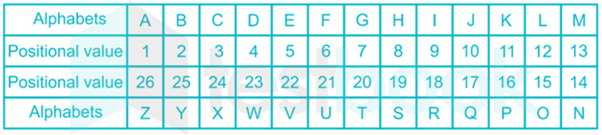
Question 46

Two pipes A and B can fill a tank in 27 hours and 10 hours, respectively. If both the pipes are opened simultaneously, then the time taken to fill the tank is:

  1. AOption (a)

    71137hours7\frac{11}{37}hours

  2. BOption (b)

    101137hours10\frac{11}{37}hours

  3. COption (c)

    111137hours11\frac{11}{37} hours

  4. DOption (d)

    91137hours9\frac{11}{37}hours

View answer & explanation

Correct answer

Answer: (a)A.

71137hours7\frac{11}{37}hours

Why this answer is correct

Given:

Pipe A can fill the tank in 27 hours.

Pipe B can fill the tank in 10 hours.

Formula Used:

Work done by a pipe in 1 hour = 1 / Time taken by the pipe to fill the tank.

Total work = 1.

Time taken when two pipes work together = Total work / (Work done by Pipe A + Work done by Pipe B).

Calculation:

Work done by Pipe A in 1 hour = 1 / 27.

Work done by Pipe B in 1 hour = 1 / 10.

⇒ Total work done in 1 hour by both pipes = (1 / 27) + (1 / 10).

⇒ Total work done in 1 hour = (10 + 27) / (27 × 10).

⇒ Total work done in 1 hour = 37 / 270.

Time taken to fill the tank = Total work / Work done in 1 hour.

⇒ Time taken = 1 / (37 / 270).

⇒ Time taken = 270 / 37.

⇒ Time taken = 7 11/37 hours.

∴ The correct answer is 71137hours71137hours

.

Question 47

If 20% of a number is added to 120, then the result is the same number. 20% of the same number is:

  1. AOption (a)

    30

  2. BOption (b)

    150

  3. COption (c)

    45

  4. DOption (d)

    50

View answer & explanation

Correct answer

Answer: (a)A.

30

Why this answer is correct

Given:

20% of a number is added to 120, resulting in the same number.

Formula Used:

20% of a number = (20 / 100) × number

Calculation:

⇒ Let the number be x.

⇒ (20 / 100) × x + 120 = x

⇒ (20x / 100) + 120 = x

⇒ 120 = x - (20x / 100)

⇒ 120 = (100x - 20x) / 100

⇒ 120 = 80x / 100

⇒ x = (120 × 100) / 80

⇒ x = 150

⇒ 20% of x = (20 / 100) × 150

⇒ 20% of x = 30

∴ The correct answer is 30.

Question 48

Read the following table carefully and answer the question that follows. The given table shows the number of children having different heights. 

Height (in cm)Numbers of children
Less than or equal to 1208
Less than or equal to 12516
Less than or equal to 13035
Less than or equal to 13543
Less than or equal to 14061
Less than or equal to 14572
Less than or equal to 15086

Find the total number of children whose height is less than or equal to 125 cm or greater than 145 cm.

  1. AOption (a)

    28

  2. BOption (b)

    30

  3. COption (c)

    35

  4. DOption (d)

    25

View answer & explanation

Correct answer

Answer: (b)B.

30

Why this answer is correct

Given:

Number of children with height ≤ 125 cm = 16

Number of children with height ≤ 145 cm = 72

Number of children with height ≤ 150 cm = 86

Formula Used:

Total children with height less than or equal to 125 cm or greater than 145 cm = (Children with height ≤ 125 cm) + (Children with height > 145 cm)

Children with height > 145 cm = (Children with height ≤ 150 cm) - (Children with height ≤ 145 cm)

Calculation:

⇒ Children with height > 145 cm = 86 - 72

⇒ Children with height > 145 cm = 14

⇒ Total children = 16 + 14

⇒ Total children = 30

∴ The correct answer is 30.

Question 49

A man sells two articles for ₹6,000 each. He gains 50% on the first but loses 25% on the next. His total loss percentage (in %), approximately, will be: 

  1. AOption (a)

    20

  2. BOption (b)

    10

  3. COption (c)

    0

  4. DOption (d)

    25

View answer & explanation

Correct answer

Answer: (c)C.

0

Why this answer is correct

Given:

Selling price of each article = ₹6,000

Gain on the first article = 50%

Loss on the second article = 25%

Formula Used:

Cost Price (C.P.) = Selling Price (S.P.) × 100 / (100 ± Gain or Loss %)

Total Cost Price = C.P. of first article + C.P. of second article

Total Loss % = [(Total Cost Price - Total Selling Price) / Total Cost Price] × 100

Calculation:

For the first article:

⇒ C.P. = 6000 × 100 / (100 + 50)

⇒ C.P. = 6000 × 100 / 150

⇒ C.P. = ₹4,000

For the second article:

⇒ C.P. = 6000 × 100 / (100 - 25)

⇒ C.P. = 6000 × 100 / 75

⇒ C.P. = ₹8,000

Total Cost Price:

⇒ Total C.P. = 4000 + 8000

⇒ Total C.P. = ₹12,000

Total Selling Price:

⇒ Total S.P. = 6000 + 6000

⇒ Total S.P. = ₹12,000

Loss %:

⇒ Total Loss % = [(Total C.P. - Total S.P.) / Total C.P.] × 100

⇒ Total Loss % = [(12000 - 12000) / 12000] × 100

⇒ Total Loss % = 0%

∴ The correct answer is 0.

Question 50

The simplified value of 272 \div \left[\frac{14}{7} \times \left{9 + 7 - \left(3 + 8 - (4 + 8)\right)\right}\right] is

  1. AOption (a)

    8

  2. BOption (b)

    7

  3. COption (c)

    5

  4. DOption (d)

    3

View answer & explanation

Correct answer

Answer: (a)A.

8

Why this answer is correct

Given:

Expression: 272 \div \left[\frac{14}{7} \times \left{9 + 7 - \left(3 + 8 - (4 + 8)\right)\right}\right]

Formula Used:

Order of operations: Parentheses → Multiplication/Division → Addition/Subtraction

Calculation:

⇒ 272 \div \left[\frac{14}{7} \times \left{9 + 7 - \left(3 + 8 - (4 + 8)\right)\right}\right]

⇒ 272 \div \left[\frac{14}{7} \times \left{9 + 7 - \left(3 + 8 - 12\right)\right}\right]

⇒ 272 \div \left[\frac{14}{7} \times \left{9 + 7 - \left(3 - 4\right)\right}\right]

⇒ 272 \div \left[\frac{14}{7} \times \left{9 + 7 - (-1)\right}\right]

⇒ 272÷[147×(9+7+1)]272 \div \left[\frac{14}{7} \times \left(9 + 7 + 1\right)\right]

⇒ 272÷[147×17]272 \div \left[\frac{14}{7} \times 17\right]

⇒ 272÷[2×17]272 \div \left[2 \times 17\right]

⇒ 272÷34272 \div 34

⇒ 8

∴ The correct answer is 8.

Question 51

A can complete a piece of work in 14 days and B can complete it in 17 days. If they work on alternate days, starting with B on the first day, in how many days will the work be finished?

  1. AOption (a)

    1571715 \frac{7}{17}days

  2. BOption (b)

    153715 \frac{3}{7}days

  3. COption (c)

    1471714 \frac{7}{17}days

  4. DOption (d)

    163716 \frac{3}{7}days

View answer & explanation

Correct answer

Answer: (a)A.

1571715 \frac{7}{17}days

Why this answer is correct

Solution:

Work rates:

A’s 1-day work = 1/14

B’s 1-day work = 1/17

They work on alternate days, starting with B.

Step 1: Work done in 2 days (B + A)

Day 1 (B) = 1/17

Day 2 (A) = 1/14

Work in 2 days = 1/17 + 1/14

LCM of 17 and 14 = 238

= 14/238 + 17/238

= 31/238

Step 2: Number of complete 2-day cycles

Total work = 1

Number of cycles = 238 ÷ 31 = 7

Work done in 7 cycles = 7 × 31/238

= 217/238

Remaining work = 1 − 217/238

= 21/238

Step 3: Next day is B’s turn

B’s 1-day work = 1/17

Time taken = (21/238) ÷ (1/17)

= 21/238 × 17

= 357/238 days

Step 4: Total time

Time for 7 cycles = 14 days

Total time = 14 + 357/238

= (3332 + 357) ÷ 238

= 3689/238 days

= 15.5 days (approx)

Final Answer:

Work will be completed in approximately 15.5 days.

Question 52

Pipe P can fill 79\frac{7}{9} part of a tank in 28 hours and pipe Q can fill 23\frac{2}{3} part of the tank in 24 hours, then both were closed. Pipe R was then opened and emptied opened together, how long will they take to fill the empty tank?

  1. AOption (a)

    35 hours 

  2. BOption (b)

    25 hours

  3. COption (c)

    34 hours 

  4. DOption (d)

    27 hours

View answer & explanation

Correct answer

Answer: (d)D.

27 hours

Why this answer is correct

Shortcut Trick

Time for P = 28 × (9/7) = 36 hours

Time for Q = 24 × (3/2) = 36 hours

Time for R = 18 × (3/1) = 54 hours (Emptying)

Combined Efficiency (P+Q−R) = 1/36 + 1/36 − 1/54 = 2/36 − 1/54 = 1/18 − 1/54 = (3−1)/54 = 2/54 = 1/27

∴ The correct answer is 27 hours.

Alternate Method

Given:

P fills 7/9 tank in 28 hours.

Q fills 2/3 tank in 24 hours.

R empties 1/3 tank in 18 hours.

Formula Used:

Total Work = LCM of individual times; Efficiency = Total Work ÷ Time

PersonDaysTotal WorkEfficiency
Pipe P361083
Pipe Q363
Pipe R54−2

⇒ Time taken by P to fill full tank = 28 × 9 ÷ 7 = 36 hours

⇒ Time taken by Q to fill full tank = 24 × 3 ÷ 2 = 36 hours

⇒ Time taken by R to empty full tank = 18 × 3 ÷ 1 = 54 hours

⇒ Total Work = LCM(36, 36, 54) = 108 units

⇒ Combined Efficiency of (P + Q + R) = 3 + 3 − 2 = 4 units/hour

⇒ Time taken to fill the tank = Total Work ÷ Combined Efficiency

⇒ Time = 108 ÷ 4 = 27 hours

∴ The correct answer is 27 hours.

Additional Information

Inlet and Outlet Pipes

Inlet pipes have positive efficiency (+) as they add water, while outlet/leakage pipes have negative efficiency (−) as they remove water.

Fractional Work Rule

If 1/x part of work is done in T hours, then the total work is completed in T × x hours.

Pipes and Cisterns Formula

If two pipes fill a tank in x and y hours and a third empties it in z hours, net work in 1 hour = (1/x + 1/y − 1/z).

Question 53

The volume (in m3 ) of a cuboidal tank, whose dimensions are given as 2 m × 49 m × 46 m, is:

  1. AOption (a)

    4494

  2. BOption (b)

    4462

  3. COption (c)

    4472

  4. DOption (d)

    4508

View answer & explanation

Correct answer

Answer: (d)D.

4508

Why this answer is correct

Solution:

Dimensions of the cuboidal tank:

Length = 2 m

Breadth = 49 m

Height = 46 m

Step 1: Use volume formula

Volume = length × breadth × height

= 2 × 49 × 46

Step 2: Calculate

49 × 46 = 2254

2 × 2254 = 4508

Final Answer:

Volume of the tank = 4508 cubic metres

Question 54

If 16% of 50−26×7293×64=y,50 - \frac{2}{6} \times \sqrt[3]{729} \times \sqrt{64} = y, then the value of yy is

  1. AOption (a)

    −19

  2. BOption (b)

    −26 

  3. COption (c)

    −16 

  4. DOption (d)

    -21 

View answer & explanation

Correct answer

Answer: (c)C.

−16 

Why this answer is correct

Given:

16% of 50−26×729−−−√3×64−−√=y50−26×7293×64=y

Options: 1) −19, 2) −26, 3) −16, 4) −21

Formula Used:

729−−−√3=97293=9

64−−√=864=8

16% of a value = value × (16 / 100)

Calculation:

⇒ 50−26×729−−−√3×64−−√50−26×7293×64

⇒ 50−26×9×850−26×9×8

⇒ 50−26×7250−26×72

⇒ 50−2450−24

⇒ 2626

Now, 16% of 26:

⇒ 26×1610026×16100

⇒ 26×0.16=4.1626×0.16=4.16

Finally, subtract from 26:

⇒ 26−4.16=−19.84≈−1926−4.16=−19.84≈−19

∴ The correct answer is −19.

Question 55

A solid cube of side 12 cm is dropped into a cuboidal container of length 20 cm, breadth 18 cm and height 14 cm, which is partly filled with water. If the cube is completely submerged, then the rise of water level (in cm) is:

  1. AOption (a)

    5.4

  2. BOption (b)

    4.2

  3. COption (c)

    4.8

  4. DOption (d)

    3.6

View answer & explanation

Correct answer

Answer: (c)C.

4.8

Why this answer is correct

Given:

Side of the cube = 12 cm

Length of the container = 20 cm

Breadth of the container = 18 cm

Height of the container = 14 cm

Formula Used:

Volume of cube = side3

Volume of water displaced = Volume of cube

Rise in water level = Volume of water displaced / (Length × Breadth of container)

Calculation:

⇒ Volume of cube = 12 × 12 × 12 = 1728 cm3

⇒ Volume of water displaced = 1728 cm3

⇒ Rise in water level = 1728 / (20 × 18)

⇒ Rise in water level = 1728 / 360

⇒ Rise in water level = 4.8 cm

∴ The correct answer is 4.8 cm.

Question 56

The ratio of the cost prices of articles X and Y is 6 : 7. A man earns a profit of 11% by selling X and loses 28% by selling Y. What is his gain/loss percentage in the entire transaction?

  1. AOption (a)

    Loss, 9.5%

  2. BOption (b)

    Loss, 10%  

  3. COption (c)

    Gain, 11.5% 

  4. DOption (d)

    Gain, 10%

View answer & explanation

Correct answer

Answer: (b)B.

Loss, 10%  

Why this answer is correct

Given:

Ratio of cost prices of X and Y = 6 : 7

Profit on X = 11%

Loss on Y = 28%

Formula Used:

Total cost price = Cost price of X + Cost price of Y

Total selling price = Selling price of X + Selling price of Y

Overall gain/loss percentage = [(Total selling price - Total cost price) / Total cost price] × 100

Calculation:

Let the cost price of X = 6a and cost price of Y = 7a.

⇒ Total cost price = 6a + 7a = 13a

Selling price of X = Cost price of X × (1 + Profit%)

⇒ Selling price of X = 6a × (1 + 11/100) = 6a × 111/100 = 666a/100

Selling price of Y = Cost price of Y × (1 - Loss%)

⇒ Selling price of Y = 7a × (1 - 28/100) = 7a × 72/100 = 504a/100

Total selling price = Selling price of X + Selling price of Y

⇒ Total selling price = 666a/100 + 504a/100 = (666a + 504a)/100 = 1170a/100

Overall gain/loss percentage = [(1170a/100 - 13a) / 13a] × 100

⇒ Overall gain/loss percentage = [(1170a - 1300a) / 1300a] × 100

⇒ Overall gain/loss percentage = (-130a / 1300a) × 100

⇒ Overall gain/loss percentage = -10%

∴ The correct answer is Loss, 10%.

Question 57

Kamal completes his journey in 9 hours. He covers half the distance at 26 km/hr and the rest at 91 km/hr. What is the length of the journey (in km)?

  1. AOption (a)

    356

  2. BOption (b)

    364

  3. COption (c)

    357

  4. DOption (d)

    361

View answer & explanation

Correct answer

Answer: (b)B.

364

Why this answer is correct

Given:

Time taken for the journey = 9 hours

Speed for the first half = 26 km/hr

Speed for the second half = 91 km/hr

Formula Used:

Distance = Speed × Time

Total time = Time for first half + Time for second half

Time = Distance / Speed

Calculation:

Let the total distance = D km.

Distance covered in the first half = D/2

Distance covered in the second half = D/2

Time for the first half = (D/2) / 26 = D / 52

Time for the second half = (D/2) / 91 = D / 182

Total time = Time for first half + Time for second half

⇒ 9 = D / 52 + D / 182

Taking LCM of 52 and 182, LCM = 364

⇒ 9 = (7D + 2D) / 364

⇒ 9 = 9D / 364

⇒ D = (9 × 364) / 9

⇒ D = 364

∴ The correct answer is 364 km.

Question 58

The simplified value of 272 \div \left[\frac{20}{10} \times \left{6 + 5 - \left(5 + 2 - (2 + 2)\right)\right}\right]

  1. AOption (a)

    14

  2. BOption (b)

    17

  3. COption (c)

    16

  4. DOption (d)

    22

View answer & explanation

Correct answer

Answer: (b)B.

17

Why this answer is correct

Calculation:

272 ÷ \left[\frac{20}{10} × \left{6 + 5 - \left(5 + 2 - (2 + 2)\right)\right}\right]

⇒ 272 ÷ [2 × {6 + 5 - (5 + 2 - 4)}]

⇒ 272 ÷ [2 × {6 + 5 - (7 - 4)}]

⇒ 272 ÷ [2 × {6 + 5 - 3}]

⇒ 272 ÷ [2 × {11 - 3}]

⇒ 272 ÷ [2 × 8]

⇒ 272 ÷ 16 = 17

Hence, the correct answer is option (2).

Question 59

Find the mean proportional of 24 and 54

  1. AOption (a)

    33

  2. BOption (b)

    34

  3. COption (c)

    36

  4. DOption (d)

    37

View answer & explanation

Correct answer

Answer: (c)C.

36

Why this answer is correct

Given:

Value 1 = 24

Value 2 = 54

Formula Used:

Mean Proportional = √(Value 1 × Value 2)

Calculation:

⇒ Mean Proportional = √(24 × 54)

⇒ Mean Proportional = √1296

⇒ Mean Proportional = 36

∴ The correct answer is 36.

Question 60

In a test, B got 64 marks while A got 80 marks, out of 120 maximum marks. What percentage of B's marks were A's marks?

  1. AOption (a)

    80%

  2. BOption (b)

    120%

  3. COption (c)

    66.67%

  4. DOption (d)

    125%

View answer & explanation

Correct answer

Answer: (d)D.

125%

Why this answer is correct

Solution:

Marks obtained:

B = 64

A = 80

Step 1: Find percentage

Percentage = (A's marks ÷ B's marks) × 100

= (80 ÷ 64) × 100

= 1.25 × 100

= 125%

Final Answer:

A's marks are 125% of B's marks.

English Language (20 questions)

Question 61

Select the most appropriate ANTONYM of the highlighted word in the given sentence. The young man shocked everyone by making flippant remarks while the will was being read.

  1. AOption (a)

    Detailed

  2. BOption (b)

    Considerate

  3. COption (c)

    Confused

  4. DOption (d)

    Insolent

View answer & explanation

Correct answer

Answer: (b)B.

Considerate

Why this answer is correct

The correct answer is: Considerate.

Key Points

  • The word "flippant" means not showing a serious or respectful attitude; it refers to being frivolous or lacking in seriousness. (गंभीरता का अभाव / चंचल)
  • Example: The student’s flippant response to the teacher’s question upset everyone in the classroom.
  • "Considerate" refers to being thoughtful, kind, and respectful of others' feelings and circumstances. (विचारशील / ध्यान रखने वाला)
  • Example: She is a considerate neighbor who always checks in on elderly residents in the building.
  • Hence, we can infer that the opposite of 'flippant' is 'considerate'.

Therefore, the correct answer is: Considerate.

Additional Information

Here are the other options explained along with their Hindi meanings and example sentences:

  • Detailed (विस्तृत): Giving a lot of information with many details.
  • Example: The professor provided a detailed explanation of the scientific concept.
  • Confused (भ्रमित): Unable to think clearly or understand something.
  • Example: She was confused about which route to take to reach the destination.
  • Insolent (असभ्य): Showing a rude and arrogant lack of respect.
  • Example: The employee was fired for his insolent attitude toward the manager.

Question 62

Select the option that can be used as a one-word substitute for the given phrase.

A pleasure-seeker

  1. AOption (a)

    Hedonist

  2. BOption (b)

    Antagonist

  3. COption (c)

    Puritan

  4. DOption (d)

    Ascetic

View answer & explanation

Correct answer

Answer: (a)A.

Hedonist

Why this answer is correct

The correct answer is: Hedonist.

Key Points

  • The word "Hedonist" refers to a person who believes that the pursuit of pleasure is the most important thing in life and seeks to maximize personal enjoyment. (भोगवादी)
  • Example: As a hedonist, she spends her weekends indulging in delicious food and luxurious experiences.
  • Explanation: A hedonist is someone whose main goal is to seek pleasure and avoid pain. They prioritize personal satisfaction and enjoyment above all else. (भोगवादी)
  • Example: John’s hedonistic lifestyle often leads him to exotic vacations and extravagant parties.

Therefore, the correct answer is: Hedonist.

Additional Information

Here are the other options explained along with their Hindi meanings and example sentences:

  • Antagonist (विरोधी): A person who opposes or is hostile to someone or something.
  • Example: The antagonist in the story made it difficult for the hero to achieve his goals.
  • Puritan (सदाचारी): A person who practices strict religious or moral behavior and avoids all forms of indulgence.
  • Example: Her puritan values made her stay away from parties and social gatherings.
  • Ascetic (संन्यासी): A person who practices severe self-discipline and abstention from all forms of indulgence, often for religious reasons.
  • Example: The monk led an ascetic life, dedicating himself to prayer and meditation.

Question 63

Sentences of a paragraph are given below in jumbled order. Arrange the sentences in the correct order to form a meaningful and coherent paragraph.

A) The book has been well-received, leading to numerous speaking engagements.

B) She embarked on a year-long journey to gather data from various cultures.

C) Her study challenges existing norms about societal structures.

D) Results from her anthropological research were published in a best-selling book.

  1. AOption (a)

    A, D, B, C 

  2. BOption (b)

    D, B, C, A

  3. COption (c)

    B, C, D, A

  4. DOption (d)

    C, A, D, B

View answer & explanation

Correct answer

Answer: (c)C.

B, C, D, A

Why this answer is correct

The correct answer is Option 3.


Key Points

  • The paragraph begins with Sentence B, which introduces the protagonist embarking on a research journey:
  • "She embarked on a year-long journey to gather data from various cultures."
  • Sentence C follows, as it explains the significance and impact of her study:
  • "Her study challenges existing norms about societal structures."
  • Sentence D comes next, highlighting the publication of her findings:
  • "Results from her anthropological research were published in a best-selling book."
  • Sentence A is the final sentence, showing the result of the book's success:
  • "The book has been well-received, leading to numerous speaking engagements."
  • The correct sequence is BCDA.


Coherent paragraph after rearrangement:

"She embarked on a year-long journey to gather data from various cultures. Her study challenges existing norms about societal structures. Results from her anthropological research were published in a best-selling book. The book has been well-received, leading to numerous speaking engagements."

Question 64

Select the most appropriate option to fill in the blank.

Due to the new policy, __________ applications are being shortlisted nowaday

  1. AOption (a)

    less

  2. BOption (b)

    lesser

  3. COption (c)

    fewer

  4. DOption (d)

    much

View answer & explanation

Correct answer

Answer: (c)C.

fewer

Why this answer is correct

The correct answer is C.

Question 65

Select the most appropriate meaning of the given idiom.

Bury the hatchet

  1. AOption (a)

    To end a conflict

  2. BOption (b)

    To reveal a secret

  3. COption (c)

    To plant a tree

  4. DOption (d)

    To forget something

View answer & explanation

Correct answer

Answer: (a)A.

To end a conflict

Why this answer is correct

The correct answer is: Option 1 i.e. To end a conflict.

Key Points

  • The idiom "Bury the hatchet" means to resolve differences or disputes and make peace. (झगड़ा खत्म करना और शांति स्थापित करना)
  • Example: After years of hostility, the two families decided to bury the hatchet and celebrate the festival together.
  • It symbolizes the act of forgiving and forgetting past conflicts to move forward harmoniously. (अतीत के झगड़े को भूलकर शांति से आगे बढ़ने का प्रतीक)

Therefore, the correct answer is: To end a conflict.

Additional Information

Here are the other options explained along with their Hindi meanings and example sentences:

  • To reveal a secret (राज़ को उजागर करना): To disclose or share information that was meant to be kept confidential.
  • Example: He revealed the secret about the surprise party to his friend.
  • To plant a tree (पेड लगाना): The act of placing a tree or sapling in the ground to grow.
  • Example: On World Environment Day, we planted trees in the park.
  • To forget something (कुछ भूल जाना): To fail to remember something or to intentionally put it out of one’s mind.
  • Example: She tends to forget her keys every time she leaves the house.

Question 66

Identify the INCORRECTLY spelt word in the given sentence.

The integration of advanced algorithms and artificial intelligence into contemporary technology represents a quintissential advancement, fundamentally transforming sectors through the meticulous optimization of processes and the obfuscation of previously insurmountable challenges.

  1. AOption (a)

    quintissential

  2. BOption (b)

    obfuscation

  3. COption (c)

    contemporary

  4. DOption (d)

    insurmountable

View answer & explanation

Correct answer

Answer: (a)A.

quintissential

Why this answer is correct

The correct answer is option 1.

Key Points

The misspelled word is 'quintissential'.

  • The correct spelling would be 'quintessential'.
  • The word 'quintessential' is an adjective which means 'representing the most perfect or typical example of a quality or class'. (सर्वोत्कृष्ट)
  • For Example -
  • She is the quintessential teacher, inspiring and dedicated.

Therefore, the correct answer would be 'quintissential'.

Additional Information

Let's understand the meanings of the other marked words - 

  • Obfuscation - the action of making something obscure, unclear, or unintelligible (धुंधला बनाना)
  • Contemporary - living or occurring at the same time (समकालीन)
  • Insurmountable - too great to be overcome (अपराजेय)

Question 67

Select the most appropriate option to fill in the blanks. If no article is required, select the option with ‘No article required’.

___ pen and ___ pencil on the table belong to me.

  1. AOption (a)

    No article required ; the  

  2. BOption (b)

     A ; No article required 

  3. COption (c)

    The ; the

  4. DOption (d)

    The ; No article required 

View answer & explanation

Correct answer

Answer: (c)C.

The ; the

Why this answer is correct

The correct answer is C.

Question 68

Sentences of a paragraph are given below in jumbled order. Arrange the sentences in the correct order to form a meaningful and coherent paragraph.

A) While classical physics explains macroscopic phenomena, it fails to describe behaviours observed at the subatomic level.

B) Quantum mechanics, developed in the early 20th century, revolutionised our understanding of atomic and subatomic particles.

C) The wave-particle duality and uncertainty principle challenged long-held deterministic views in physics.

D) This fundamental shift in perspective paved the way for groundbreaking advancements in fields such as quantum computing and nanotechnology.

  1. AOption (a)

    B-A-C-D

  2. BOption (b)

    A-C-B-D 

  3. COption (c)

    B-C-D-A 

  4. DOption (d)

     A-B-C-D

View answer & explanation

Correct answer

Answer: (d)D.

 A-B-C-D

Why this answer is correct

The correct answer is Option 4.

Key Points

  • The paragraph begins with Sentence A, which introduces classical physics and its limitations:
  • "While classical physics explains macroscopic phenomena, it fails to describe behaviours observed at the subatomic level."
  • Sentence B follows, as it highlights the development of quantum mechanics and its revolutionary impact:
  • "Quantum mechanics, developed in the early 20th century, revolutionised our understanding of atomic and subatomic particles."
  • Sentence C is the third sentence, as it elaborates on key principles of quantum mechanics that challenged classical physics:
  • "The wave-particle duality and uncertainty principle challenged long-held deterministic views in physics."
  • Sentence D concludes the paragraph, as it reflects on the broader impact of quantum mechanics:
  • "This fundamental shift in perspective paved the way for groundbreaking advancements in fields such as quantum computing and nanotechnology."
  • The correct sequence is A-B-C-D.

Coherent paragraph after rearrangement:

"While classical physics explains macroscopic phenomena, it fails to describe behaviours observed at the subatomic level. Quantum mechanics, developed in the early 20th century, revolutionised our understanding of atomic and subatomic particles. The wave-particle duality and uncertainty principle challenged long-held deterministic views in physics. This fundamental shift in perspective paved the way for groundbreaking advancements in fields such as quantum computing and nanotechnology."

Question 69

 Select the most appropriate option to fill in the blank. She is known as __________ teacher in the entire university

  1. AOption (a)

    a better 

  2. BOption (b)

    the most best

  3. COption (c)

    more better

  4. DOption (d)

    the best 

View answer & explanation

Correct answer

Answer: (d)D.

the best 

Why this answer is correct

The correct answer is D.

Question 70

Select the most appropriate meaning of the given proverb.

When in Rome, do as the Romans do.

  1. AOption (a)

    Always follow your own culture wherever you go.

  2. BOption (b)

    Keep looking for better options everywhere. 

  3. COption (c)

    Doing as others do is wrong.  

  4. DOption (d)

    Adapt to the customs of the place you are in. 

View answer & explanation

Correct answer

Answer: (d)D.

Adapt to the customs of the place you are in. 

Why this answer is correct

The correct answer is: Option 4 i.e. Adapt to the customs of the place you are in.

Key Points

  • The proverb "When in Rome, do as the Romans do" means that when you are in a new place, you should try to follow or adapt to the customs, traditions, and behaviors of the people living there. (जब रोम में हों, तो रोमवासियों जैसा करें।)
  • Example: While visiting Japan, she bowed to greet people as the locals do, embracing the culture.
  • Adapt refers to the act of adjusting oneself to new conditions or environments. (अनुकूलित करना)
  • Example: The students quickly adapted to the new school routine after transferring.
  • Hence, following the customs of the place you are in is the correct interpretation of this proverb.

Therefore, the correct answer is: Option 4.

Additional Information

Here are the other options explained along with their Hindi meanings and example sentences:

  • Option 1: Always follow your own culture wherever you go (जहां भी जाएं, अपनी संस्कृति का पालन करें): This suggests staying true to one's own traditions, but it contradicts the idea of adapting to a new place.
  • Example: Despite traveling across the world, he always wore traditional attire as a mark of his culture.
  • Option 2: Keep looking for better options everywhere (हर जगह बेहतर विकल्पों की तलाश करें): This conveys the idea of constantly searching for alternatives, but it is not related to the meaning of the given proverb.
  • Example: She kept browsing different markets to find the best deal for her shopping list.
  • Option 3: Doing as others do is wrong (दूसरों जैसा करना गलत है): This implies rejecting conformity, which is the opposite of the proverb’s meaning.
  • Example: He refused to follow the crowd and chose to act differently during the event.

Question 71

Select the most appropriate option to fill in the blank. In terms of cost, this model is ________ than the other we considered.

  1. AOption (a)

    much cheap

  2. BOption (b)

    cheaper

  3. COption (c)

    cheapest

  4. DOption (d)

    more cheap 

View answer & explanation

Correct answer

Answer: (b)B.

cheaper

Why this answer is correct

The correct answer is B.

Question 72

Select the most appropriate ANTONYM of the highlighted word in the given sentence.

His impetuous decision to quit his job surprised everyone.

  1. AOption (a)

    Reckless

  2. BOption (b)

    Hasty

  3. COption (c)

    Deliberate

  4. DOption (d)

    Impulsive

View answer & explanation

Correct answer

Answer: (c)C.

Deliberate

Why this answer is correct

The correct answer is: Deliberate.

Key Points

  • The word "impetuous" means acting or done quickly without thought or care; impulsive or reckless behavior. (आवेगी)
  • Example: His impetuous remarks during the meeting created unnecessary tension.
  • "Deliberate" refers to something that is done consciously and intentionally, with careful thought and consideration. (सोचा-समझा)
  • Example: The manager’s deliberate planning ensured the success of the project.
  • Hence, we can infer that the opposite of 'impetuous' is 'deliberate'.

Therefore, the correct answer is: Deliberate.

Additional Information

Here are the other options explained along with their Hindi meanings and example sentences:

  • Reckless (लापरवाह): Acting without thinking about the consequences; careless.
  • Example: His reckless driving caused a major accident.
  • Hasty (जल्दबाज़): Done quickly or without sufficient thought.
  • Example: He made a hasty decision to resign from his job.
  • Impulsive (आवेगी): Acting on instinct without thinking about the outcomes.
  • Example: Her impulsive shopping habits often left her with unnecessary items.

Question 73

Select the most appropriate option to fill in the blanks. If no article is required, select the option with ‘No article required’. They had ___ great time at ___ party last night.

  1. AOption (a)

    the ; the

  2. BOption (b)

    No article required ; a

  3. COption (c)

    a ; the  

  4. DOption (d)

    the ; No article required

View answer & explanation

Correct answer

Answer: (c)C.

a ; the  

Why this answer is correct

The correct answer is C.

Question 74

Select the INCORRECTLY spelt word.

  1. AOption (a)

    Accommodate

  2. BOption (b)

    Necessary

  3. COption (c)

    Occasion

  4. DOption (d)

    Independant

View answer & explanation

Correct answer

Answer: (d)D.

Independant

Why this answer is correct

The correct answer is option 4.

Key Points

The misspelled word is 'Independant'.

  • The correct spelling would be 'Independent'.
  • The word 'Independent' is an adjective which means 'free from outside control; not depending on another's authority'. (���्वतंत्र)
  • For Example -
  • She is an independent woman who manages her own business.

Therefore, the correct answer would be 'Independant'.

Additional Information

Let's understand the meanings of the other marked words -

  • Accommodate - to provide lodging or sufficient space for someone (समायोजित करना)
  • Necessary - required to be done, achieved, or present; needed; essential (आवश्यक)
  • Occasion - a particular event, or the time at which it takes place (अवसर)

Question 75

Select the option that can be used as a one-word substitute for the given group of words.

A person who studies the origin and history of words

  1. AOption (a)

    Lexicographer

  2. BOption (b)

    Philologist

  3. COption (c)

    Linguist

  4. DOption (d)

    Etymologist

View answer & explanation

Correct answer

Answer: (d)D.

Etymologist

Why this answer is correct

The correct answer is: Option 4 i.e. Etymologist.

Key Points

  • The word "Philologist" refers to a person who studies language in written historical sources; it is a combination of literary studies, history, and linguistics. (भाषाशास्त्री)
  • Example: The philologist analyzed ancient manuscripts to uncover the evolution of the language.
  • "Etymologist" refers to a person who studies the origin and history of words and how their meanings and forms have changed over time. (शब्द-व्युत्पत्तिशास्त्री)
  • Example: The etymologist traced the origin of the word "pandemic" to Greek roots.
  • Hence, we can infer that the correct one-word substitute for a person who studies the origin and history of words is "Etymologist".

Therefore, the correct answer is: Option 4.

Additional Information

Here are the other options explained along with their Hindi meanings and example sentences:

  • Lexicographer (शब्दकोश-निर्माता): A person who compiles dictionaries.
  • Example: The lexicographer spent years compiling a comprehensive dictionary of regional dialects.
  • Philologist (भाषाशास्त्री): A person who studies language in written historical sources.
  • Example: The philologist's research contributed to understanding ancient Greek literature.
  • Linguist (भाषाविद्): A person skilled in foreign languages or who studies linguistics.
  • Example: As a linguist, she is fluent in seven languages and studies how they are related.

Read the passage carefully and answer the questions that follow.

Renewable energy is becoming increasingly vital as we look towards a sustainable future. Unlike fossil fuels, which are finite and contribute significantly to environmental degradation, renewable energy sources such as solar, wind, and hydro power are abundant and environmentally friendly. Solar power harnesses energy from the sun using photovoltaic cells These cells convert sunlight directly into electricity, providing a clean and inexhaustible powe source. Wind energy is captured through wind turbines that generate electricity as they spin, driven by the wind's kinetic energy. Hydropower utilises the energy of flowing water, usually from rivers or dams, to generate electricity.

The shift towards renewable energy is crucial for several reasons. First, it helps mitigate climate change by reducing greenhouse gas emissions. Fossil fuels release large amounts of carbon dioxide and other harmful pollutants into the atmosphere, contributing to global warming and health problems. In contrast, renewable energy sources produce little to no emissions during operation. Second, renewable energy promotes energy security by reducing dependence on imported fuels. Countries can harness their natural resources to generate power, leading to greater energy independence and economic stability.

Additionally, the renewable energy sector creates numerous jobs in manufacturing, installatio and maintenance. This not only helps in reducing unemployment rates but also fosters economic growth. Technological advancements in renewable energy are also driving down costs, making these sources more competitive with traditional energy sources. Governments and organisations worldwide are recognising the importance of investing in renewable energ and are implementing policies and incentives to accelerate its adoption.

In summary, the transition to renewable energy is essential for environmental protection, economic stability, and job creation. By investing in solar, wind, and hydro power, we can ensure a sustainable and prosperous future for generations to come.

Question 76

Based on Passage: View directions & passage

Which of the following is NOT a renewable energy source? 

  1. AOption (a)

    coal

  2. BOption (b)

    wind

  3. COption (c)

    solar

  4. DOption (d)

    hydro

View answer & explanation

Correct answer

Answer: (a)A.

coal

Why this answer is correct

The correct answer is: Option (1) i.e. coal.

Key Points

  • Coal is a fossil fuel, not a renewable energy source. It is finite and contributes significantly to environmental degradation and greenhouse gas emissions.
  • The passage describes wind, solar, and hydro as renewable energy sources that are abundant and environmentally friendly.
  • Renewable sources can be replenished naturally and do not deplete over time, unlike coal.

Therefore, the correct answer is- coal

Additional Information

  • Wind: Renewable energy captured by wind turbines.
  • Solar: Renewable energy harnessed from the sun.
  • Hydro: Renewable energy generated from flowing water.

Question 77

Based on Passage: View directions & passage

What is one significant environmental benefit of renewable energy?

  1. AOption (a)

    It relies on imported fuels. 

  2. BOption (b)

     It is cheaper. 

  3. COption (c)

    It gives little to no emissions

  4. DOption (d)

    It needs high technological advancements.

View answer & explanation

Correct answer

Answer: (c)C.

It gives little to no emissions

Why this answer is correct

The correct answer is: Option (3) i.e. It gives little to no emissions.

Key Points

  • One major environmental benefit of renewable energy, as highlighted in the passage, is that it produces little to no emissions during operation.
  • This helps mitigate climate change and reduces air pollution, unlike fossil fuels that release large amounts of carbon dioxide and other harmful pollutants.
  • The other options do not directly address the environmental benefit discussed.

Therefore, the correct answer is- It gives little to no emissions

Additional Information

  • Relies on imported fuels: Renewable energy promotes energy independence, not dependence on imports.
  • Cheaper: While costs are decreasing, the main environmental benefit is reduced emissions.
  • Needs high technological advancements: This is about feasibility, not an environmental benefit.

Question 78

Based on Passage: View directions & passage

How does renewable energy contribute to energy security?

  1. AOption (a)

    It is more expensive. 

  2. BOption (b)

    It leads to environmental degradation.

  3. COption (c)

    It reduces dependency on imported fuels. 

  4. DOption (d)

    It uses fossil fuels

View answer & explanation

Correct answer

Answer: (c)C.

It reduces dependency on imported fuels. 

Why this answer is correct

The correct answer is: Option (3) i.e. It reduces dependency on imported fuels.

Key Points

  • Renewable energy sources like solar, wind, and hydro can be harnessed from a country's own natural resources, reducing the need to import fuels from other nations.
  • This increases national energy independence and security, as countries are less vulnerable to international supply disruptions.
  • The other options do not reflect how renewable energy supports energy security.

Therefore, the correct answer is- It reduces dependency on imported fuels.

Additional Information

  • It is more expensive: Not relevant to energy security.
  • It leads to environmental degradation: Renewable energy is environmentally friendly.
  • It uses fossil fuels: Renewable energy is an alternative to fossil fuels.

Question 79

Based on Passage: View directions & passage

Which renewable energy source uses photovoltaic cells? 

  1. AOption (a)

     hydro engery

  2. BOption (b)

     biomass 

  3. COption (c)

    wind energy 

  4. DOption (d)

    solar energy

View answer & explanation

Correct answer

Answer: (d)D.

solar energy

Why this answer is correct

The correct answer is: Option (4) i.e. solar energy.

Key Points

  • Photovoltaic cells are used to convert sunlight directly into electricity, which is the defining technology of solar energy.
  • Other options like hydro energy, biomass, and wind energy use different mechanisms to generate power.

Therefore, the correct answer is- solar energy

Additional Information

  • Hydro energy: Uses water flow, not photovoltaic cells.
  • Biomass: Uses organic materials, not photovoltaic cells.
  • Wind energy: Uses wind turbines, not photovoltaic cells.

Question 80

Based on Passage: View directions & passage

Select the most appropriate title for the passage.

  1. AOption (a)

    Renewable energy and its reluctance 

  2. BOption (b)

    Renewable energy and its sources

  3. COption (c)

    Renewable energy and its impact

  4. DOption (d)

    Renewable energy and its importance

View answer & explanation

Correct answer

Answer: (d)D.

Renewable energy and its importance

Why this answer is correct

The correct answer is: Option (4) i.e. Renewable energy and its importance.

Key Points

  • The passage explains the significance of renewable energy for a sustainable future, describing its sources and key benefits such as environmental protection, energy security, and economic growth.
  • It emphasizes why investing in renewable energy is essential, making "its importance" the most fitting summary.
  • The other options—sources, impact, reluctance—are either too narrow or not directly representative of the passage’s main message.

Therefore, the correct answer is- Renewable energy and its importance

Additional Information

  • Renewable energy and its reluctance: The passage does not discuss reluctance.
  • Renewable energy and its sources: Covered, but not as comprehensive as "its importance."
  • Renewable energy and its impact: Discussed, but the passage focuses on why it matters most.

Hindi Language (20 questions)

Question 81

'काम आना' मुहावरे का सही अर्थ है- 

  1. AOption (a)

    काम के समय गायब हो जाना

  2. BOption (b)

    वीरगति प्राप्त होना

  3. COption (c)

    काम पर जाना

  4. DOption (d)

    किसी की सहायता करना

View answer & explanation

Correct answer

Answer: (b)B.

वीरगति प्राप्त होना

Why this answer is correct

सही उत्तर है- वीरगति प्राप्त होना

Key Pointsयाद आना-

  • अर्थ- वीरगति प्राप्त होना
  • वाक्य प्रयोग-
  • जब उसने पुरानी डायरी खोली, तो उसे बचपन की यादें याद आ गईं।

Additional Information​गायब होने का नाटक करना=

  • इसका अर्थ है जानबूझकर किसी जगह से गायब हो जाना।
  • उदाहरण: जब भी काम करने का समय होता है, मेरे बच्चे गायब होने का नाटक करने लगते हैं।​

हाथ पकड़ना-

  • अर्थ- मदद करना या सहारा देना
  • उदाहरण- "मेरे बुरे वक्त में मेरे दोस्तों ने मेरा हाथ पकड़ा।"

​गाँठ में बाँधना -

  • अर्थ- किसी बात या अनुभव को हमेशा याद रखना।
  • वाक्य प्रयोग :- तुम मेरी ये महत्वपूर्ण बातें गाँठ में बांध लो।

Important Points

  • मुहावरे की परिभाषा :-
  • किसी भाषा की अभिव्यंजना के विशिष्ट रूप को ‘मुहावरा’ कहते हैं। विशिष्ट शब्दों, विचित्र प्रयोगों एवं प्रयोग-सिद्ध विशिष्ट वाक्यांशों को ‘मुहावरा’ कहते हैं।

Question 82

हमने एक सभा का संघठन किया।

वाक्य के किस अंश में अशुद्धि है ?

  1. AOption (a)

    हमने

  2. BOption (b)

    का संघठन

  3. COption (c)

    एक सभा

  4. DOption (d)

    किया।

View answer & explanation

Correct answer

Answer: (b)B.

का संघठन

Why this answer is correct

सही उत्तर है- का संघठन 

Key Pointsसही वाक्य होगा-

  • हमने एक सभा का संगठन किया।

Important Points

  • वर्तनी - किसी शब्द में आये हुए अक्षरों को मात्राओं सहित कहने या लिखने की रीति को वर्तनी कहते हैं।

Additional Informationवर्तनी संबंधी अशुद्धियाँ - 

अशुद्ध वाक्यशुद्ध वाक्य
मेले में विद्यार्थियों की कई टोलीयाँ थीं।मेले में विद्यार्थियों की कई टोलियाँ थीं।
गुलाम की एक माला खरीद लेना।गुलाब की माला खरीद लेना।
सहित्य और संस्कृती का गहरा संबंध हैं।साहित्य और संस्कृति का गहरा संबंध हैं।
यह आपकी अनाधिकार चेष्टा हैं।यह आपकी अनधिकार चेष्टा हैं।
उसे पैत्रिक संपत्ति में हिस्सा नहीं मिला।उसे पैतृक संपत्ति में हिस्सा नहीं मिला।

Question 83

निम्नांकित मुहावरे के सही अर्थ वाले विकल्प का चयन कीजिए-

'ऐंचातानी करना"

  1. AOption (a)

    बहाने बनाना

  2. BOption (b)

    खींचातानी करना

  3. COption (c)

    लूट करना

  4. DOption (d)

    धोखा देना

View answer & explanation

Correct answer

Answer: (b)B.

खींचातानी करना

Why this answer is correct

सही उत्तर है- खींचातानी करना

Key Pointsखींचातानी करना-

  • अर्थ: कड़ा संघर्ष, खींचतान या रस्साकशी करना।
  • उदाहरण: "जमीन के टुकड़े पर दो भाइयों में घंटों खींचातानी होती रही"

Important Points

  • मुहावरा एक ऐसा वाक्य होता है
  • जो वाक्य की रचना करने पर अपना एक अलग अर्थ या विशेष अर्थ प्रकट करता है
  • इनका प्रयोग करने से भाषा,आकर्षक, प्रभावपूर्ण तथा रोचक बन जाती है।

Additional Informationकुछ अन्य महत्वपूर्ण मुहावरा, अर्थ और उनके वाक्य प्रयोग:- ​

  • खून के आँसू रोना- बहुत दुःखी या परेशान होना
  • वाक्य प्रयोग-
  • ​व्यापार में घाटा होने पर सेठजी "खून के आँसू रो रहे हैं"।
  • दाँतों पसीना आना- बहुत अधिक परेशानी उठाना।
  • वाक्य प्रयोग- 
  • ​कार्यालय में सुबह से शाम इतना काम करते करते "दांतो पसीना आ जाता है"।
  • लोहे के चने चबाना- बहुत कठिनाई उठाना।
  • वाक्य प्रयोग- 
  • ​कला प्रतियोगिता में प्रथम आने के लिए प्रतिभा को "लोहे के चने चबाने पड़े"।
  • हाथ-पाँव फूल जाना- घबरा जाना।
  • वाक्य प्रयोग- 
  • ​मनविंदर की कार एक्सीडेंट की खबर को सुनकर उसके परिवार वालों के "हाथ पैर फूल गए"।
  • रंग दिखाना- प्रभाव या स्वरूप दिखाना।
  • वाक्य प्रयोग- 
  • ​परिवार में समस्याओं की वजह से सभी परेशान थे ऐसे वक्त में छोटे बेटे ने अपना असली "रंग दिखा दिया"।

Question 84

वर्तनी की दृष्टि से दिए गए वाक्य के किस अंश में त्रुटि है, पहचानें--

पारमार्थिक वस्तु या सत्य के बोध के लिए हर्दय का स्वच्छ एवं निर्मल होना आवश��यक है।

  1. AOption (a)

    के बोध के लिए हर्दय

  2. BOption (b)

    पारमार्थिक वस्तु या सत्य

  3. COption (c)

     होना आवश्यक है। 

  4. DOption (d)

    का स्वच्छ एवं निर्मल

View answer & explanation

Correct answer

Answer: (a)A.

के बोध के लिए हर्दय

Why this answer is correct

सही उत्तर है- के बोध के लिए हर्दय 

Key Pointsसही वाक्य होगा-

  • पारमार्थिक वस्तु या सत्य के बोध के लिए हृदय का स्वच्छ एवं निर्मल होना आवश्यक है।

Important Points

  • वर्तनी - किसी शब्द में आये हुए अक्षरों को मात्राओं सहित कहने या लिखने की रीति को वर्तनी कहते हैं।

Additional Informationवर्तनी संबंधी अशुद्धियाँ - 

अशुद्ध वाक्यशुद्ध वाक्य
मेले में विद्यार्थियों की कई टोलीयाँ थीं।मेले में विद्यार्थियों की कई टोलियाँ थीं।
गुलाम की ए�� माला खरीद लेना।गुलाब की माला खरीद लेना।
सहित्य और संस्कृती का गहरा संबंध हैं।साहित्य और संस्कृति का गहरा संबंध हैं।
यह आपकी अनाधिकार चेष्टा हैं।यह आपकी अनधिकार चेष्टा हैं।
उसे पैत्रिक संपत्ति में हिस्सा नहीं मिला।उसे पैतृक संपत्ति में हिस्सा नहीं मिला।

Question 85

रेखांकित शब्द का सही पर्याय अंकित कीजिए।

व्यायाम से आलस्य और रोग दूर भागते हैं।

  1. AOption (a)

    खेल

  2. BOption (b)

    कसरत

  3. COption (c)

    निशानेबाजी

  4. DOption (d)

    शतरंज

View answer & explanation

Correct answer

Answer: (b)B.

कसरत

Why this answer is correct

सही उत्तर है- कसरत

Key Points

  • कसरत का अर्थ- शारीरिक मेहनत

Important Points

  • पर्यायवाची शब्द - ऐसे शब्द जिनके अर्थ समान हों, पर्यायवाची शब्द कहलाते हैं।

Additional Informationकुछ अन्य महत्वपूर्ण पर्यायवाची शब्द:-

शब्दपर्यायवाची शब्द
भ्रमर​मधुप, अलि, भौंरा, भृंग, मधुकर, द्विरेफ, मिलिंद।
देवदेवता, अमर, वसु, आदित्य, निर्जर, त्रिदश, गीर्वाण।
हवापवन, वायु, समीर, अनिल, वात, मरुत्, बयार, प्रकंपन।
साँपसर्प, नाग, विषधर, व्याल, भुजंग, उरग, अहि पन्नग।
गृहघर, निकेतन, भवन, आलय, निवास, आवास, निलय।
दानवदैत्य, राक्षस, निशाचर, दनुज, यातुधान, निशिचर।
घोड़ाअश्व, घोटक, तुरंग, तुरग, बाजि, वाजि, सैंधव, हय।

Question 86

निम्नलिखित वाक्य कारक के आधार पर पूर्ण कीजिए।

यदि पुलिस अधिकारी धैर्य _____ काम लेते तो बात इतनी आगे नहीं बढ़ती।

  1. AOption (a)

    के

  2. BOption (b)

    से

  3. COption (c)

    में

  4. DOption (d)

    को

View answer & explanation

Correct answer

Answer: (b)B.

से

Why this answer is correct

सही उत्तर है- से

Key Pointsपूर्ण वाक्य है-

  • यदि पुलिस अधिकारी धैर्य से काम लेते तो बात इतनी आगे नहीं बढ़ती।

Important Points

कारककारक का अर्थ होता है किसी कार्य को करने वाला। यानी जो भी क्रिया को करने में भूमिका निभाता है, वह कारक कहलाता है। इसके निम्न भेद हैं -वह रोज़ सुबह गंगा किनारे जाता है।
भेदपरिभाषाविभक्ति
कर्ता कारकजो वाक्य में कार्य को करता है, वह कर्ता कहलाता है। कर्ता वाक्य का वह रूप होता है, जिसमे कार्य को करने वाले का पता चलता है।ने
कर्म कारकवह वस्तु या व्यक्ति जिस पर वाक्य में की गयी क्रिया का प्रभाव पड़ता है वह कर्म कहलाता है।को
करण कारकवह साधन जिससे क्रिया होती है, वह करण कहलाता है। यानि, जिसकी सहायता से किसी काम को अंजाम दिया जाता वह करण कारक कहलाता है।से, के द्वारा
सम्प्रदान कारकजब वाक्य में किसी को कुछ दिया जाए या किसी के लिए कुछ किया जाए तो वहां पर सम्प्रदान कारक होता है।के लिए
अपादान कारकजब संज्ञा या सर्वनाम के किसी रूप से किन्हीं दो वस्तुओं के अलग होने का बोध होता है, तब वहां अपादान कारक होता है।से (अलग होना)
संबंध कारकसंज्ञा या सर्वनाम का वह रूप जो हमें किन्हीं दो वस्तुओं के बीच संबंध का बोध कराता है, वह संबंध कारक कहलाता है।का, के, की
अधिकरण कारकसंज्ञा का वह रूप जिससे क्रिया के आधार का बोध हो उसे अधिकरण कारक कहते हैं।में, पर
संबोधन कारकसंज्ञा या सर्वनाम का वह रूप जिससे किसी को बुलाने, पुकारने या बोलने का बोध होता है, तो वह सम्बोधन कारक कहलाता है।हे!, अरे!

Question 87

निम्नलिखित वाक्य कारक के आधार पर पूर्ण कीजिए।

यथाशीघ्र ध्वनि विस्तारक यंत्रों, _____ प्रतिबंध लगाना चाहिए।

  1. AOption (a)

    के लिए

  2. BOption (b)

    ने

  3. COption (c)

    पर

  4. DOption (d)

    में

View answer & explanation

Correct answer

Answer: (c)C.

पर

Why this answer is correct

सही उत्तर है- पर

Key Pointsपूर्ण वाक्य है-

  • यथाशीघ्र ध्वनि विस्तारक यंत्रों, पर प्रतिबंध लगाना चाहिए।

Important Points

कारककारक का अर्थ होता है किसी कार्य को करने वाला। यानी जो भी क्रिया को करने में भूमिका निभाता है, वह कारक कहलाता है। इसके निम्न भेद हैं -वह रोज़ सुबह गंगा किनारे जाता है।
भेदपरिभाषाविभक्ति
कर्ता कारकजो वाक्य में कार्य को करता है, वह कर्ता कहलाता है। कर्ता वाक्य का वह रूप होता है, जिसमे कार्य को करने वाले का पता चलता है।ने
कर्म कारकवह वस्तु या व्यक्ति जिस पर वाक्य में की गयी क्रिया का प्रभाव पड़ता है वह कर्म कहलाता है।को
करण कारकवह साधन जिससे क्रिया होती है, वह करण कहलाता है। यानि, जिसकी सहायता से किसी काम को अंजाम दिया जाता वह करण कारक कहलाता है।से, के द्वारा
सम्प्रदान कारकजब वाक्य में किसी को कुछ दिया जाए या किसी के लिए कुछ किया जाए तो वहां पर सम्प्रदान कारक होता है।के लिए
अपादान कारकजब संज्ञा या सर्वनाम के किसी रूप से किन्हीं दो वस्तुओं के अलग होने का बोध होता है, तब वहां अपादान कारक होता है।से (अलग होना)
संबंध कारकसंज्ञा या सर्वनाम का वह रूप जो हमें किन्हीं दो वस्तुओं के बीच संबंध का बोध कराता है, वह संबंध कारक कहलाता है।का, के, की
अधिकरण कारकसंज्ञा का वह रूप जिससे क्रिया के आधार का बोध हो उसे अधिकरण कारक कहते हैं।में, पर
संबोधन कारकसंज्ञा या सर्वनाम का वह रूप जिससे किसी को बुलाने, पुकारने या बोलने का बोध होता है, तो वह सम्बोधन कारक कहलाता है।हे!, अरे!

Question 88

नीचे दिए गए विकल्पों में से सही क्रम वाले वाक्य का चयन कीजिए। 

  1. AOption (a)

    शब्द का प्रयोग में आर्य ऋग्वेद छत्तीस बार हुआ है।

  2. BOption (b)

    में आर्य ऋग्वेद शब्द का प्रयोग छत्तीस बार हुआ है। 

  3. COption (c)

    ऋग्वेद में आर्य शब्द का प्रयोग छत्तीस बार हुआ है।

  4. DOption (d)

    छत्तीस बार हुआ है शब्द का प्रयोग में आर्य ऋग्वेद ।

View answer & explanation

Correct answer

Answer: (c)C.

ऋग्वेद में आर्य शब्द का प्रयोग छत्तीस बार हुआ है।

Why this answer is correct

सही उत्तर है- ऋग्वेद में आर्य शब्द का प्रयोग छत्तीस बार हुआ है।

Important Points

  • वाक्य की परिभाषा - 
  • ​दो या दो से अधिक पदों के सार्थक समूह को, जिसका पूरा पूरा अर्थ निकलता है, वाक्य कहते हैं।
  • पदक्रम - 
  • किसी वाक्य में सार्थक शब्दों को यथास्थान रखने की क्रिया को 'क्रम' या 'पदक्रम' कहा जाता है।

Additional Informationवाक्य व्यवस्था की सावधानियाँ-

  • वाक्य रचना व्याकरण के नियमों के आधार पर होनी चाहिए।
  • उचित पदक्रम होना चाहिए।
  • वाक्यों का सार्थक अनुच्छेद बनना चाहिए।
  • वाक्य व्यवस्था के लिए भाषा बोध अनिवार्य है।
  • उचित वाक्य संरचना होनी चाहिए।

Question 89

मोषक रात में निकलता है।

वाक्य का रेखांकित शब्द किसका पर्याय है?।

  1. AOption (a)

    सिपाही

  2. BOption (b)

    चूहा

  3. COption (c)

    उल्लू

  4. DOption (d)

    चोर

View answer & explanation

Correct answer

Answer: (d)D.

चोर

Why this answer is correct

सही उत्तर है- चोर

Key Points

  • मोषक का पर्यायवाची चोर, तस्कर, दस्यु और रजनीचर है।

Important Points

  • पर्यायवाची शब्द - ऐसे शब्द जिनके अर्थ समान हों, पर्यायवाची शब्द कहलाते हैं।

Additional Informationकुछ अन्य महत्वपूर्ण पर्यायवाची शब्द:-

शब्दपर्यायवाची शब्द
भ्रमर​मधुप, अलि, भौंरा, भृंग, मधुकर, द्विरेफ, मिलिंद।
देवदेवता, अमर, वसु, आदित्य, निर्जर, त्रिदश, गीर्वाण।
हवापवन, वायु, समीर, अनिल, वात, मरुत्, बयार, प्रकंपन।
साँपसर्प, नाग, विषधर, व्याल, भुजंग, उरग, अहि पन्नग।
गृहघर, निकेतन, भवन, आलय, निवास, आवास, निलय।
दानवदैत्य, राक्षस, निशाचर, दनुज, यातुधान, निशिचर।
घोड़ाअश्व, घोटक, तुरंग, तुरग, बाजि, वाजि, सैंधव, हय।

Question 90

'पशु के आचरण जैसा' वाक्यांश के लिए एक सार्थक शब्द क्या है? 

  1. AOption (a)

    पार्थिव

  2. BOption (b)

    पारदर्शक

  3. COption (c)

    पाशविक

  4. DOption (d)

    क्रूरता

View answer & explanation

Correct answer

Answer: (c)C.

पाशविक

Why this answer is correct

'पशु के आचरण जैसा' इस वाक्यांश के लिए सार्थक शब्द है- पाशविक

Key Points

  • वाक्यांश के लिए उपयुक्त शब्द - अनेक शब्दों के लिए एक शब्द को प्रयुक्त करना ही वाक्यांश के लिए एक शब्द कहलाता है।

Important Pointsअन्य विकल्प -

वाक्यांशशब्द
जिसमें से आर-पार दिखाई देपारदर्शक
पृथ्वी से संबंध रखने वालापार्थिव
कठोर तथा बुरे काम करने की क्षमताक्रूरता

Additional Information

  कुछ महत्वपूर्ण वाक्यांश के लिए एक शब्द -

वाक्यांशशब्द
जहाँ तक सध सकेयथासाध्य
जिसका मन महान होमहामना
जो धर्म या शास्त्र के विरुद्ध होअधर्म
जो चंद्र धारण करता होचन्द्रधारी
दूसरों के दोषों को खोजनाछिद्रान्वेषण
जिसके पाणि में (हाथ) वीणा होवीणापाणि
जो राज्य या राजा से द्रोह करेराजद्रोही

Question 91

निम्नलिखित वाक्य कारक के आधार पर पूर्ण कीजिए।

सब मनुष्य समान रूप से जन्म लेते हैं______ सत्संग ________ वे सगुण प्राप्त करते हैं।

  1. AOption (a)

    में, पर

  2. BOption (b)

    से, में

  3. COption (c)

    पर, से

  4. DOption (d)

    के लिए

View answer & explanation

Correct answer

Answer: (c)C.

पर, से

Why this answer is correct

सही उत्तर है- पर, से

Key Pointsपूर्ण वाक्य है-

  • सब मनुष्य समान रूप से जन्म लेते हैं पर सत्संग से वे सगुण प्राप्त करते हैं।

Important Points

कारककारक का अर्थ होता है किसी कार्य को करने वाला। यानी जो भी क्रिया को करने में भूमिका निभाता है, वह कारक कहलाता है। इसके निम्न भेद हैं -वह रोज़ सुबह गंगा किनारे जाता है।
भेदपरिभाषाविभक्ति
कर्ता कारकजो वाक्य में कार्य को करता है, वह कर्ता कहलाता है। कर्ता वाक्य का वह रूप होता है, जिसमे कार्य को करने वाले का पता चलता है।ने
कर्म कारकवह वस्तु या व्यक्ति जिस पर वाक्य में की गयी क्रिया का प्रभाव पड़ता है वह कर्म कहलाता है।को
करण कारकवह साधन जिससे क्रिया होती है, वह करण कहलाता है। यानि, जिसकी सहायता से किसी काम को अंजाम दिया जाता वह करण कारक कहलाता है।से, के द्वारा
सम्प्रदान कारकजब वाक्य में किसी को कुछ दिया जाए या किसी के लिए कुछ किया जाए तो वहां पर सम्प्रदान कारक होता है।के लिए
अपादान कारकजब संज्ञा या सर्वनाम के किसी रूप से किन्हीं दो वस्तुओं के अलग होने का बोध होता है, तब वहां अपादान कारक होता है।से (अलग होना)
संबंध कारकसंज्ञा या सर्वनाम का वह रूप जो हमें किन्हीं दो वस्तुओं के बीच संबंध का बोध कराता है, वह संबंध कारक कहलाता है।का, के, की
अधिकरण कारकसंज्ञा का वह रूप जिससे क्रिया के आधार का बोध हो उसे अधिकरण कारक कहते हैं।में, पर
संबोधन कारकसंज्ञा या सर्वनाम का वह रूप जिससे किसी को बुलाने, पुकारने या बोलने का बोध होता है, तो वह सम्बोधन कारक कहलाता है।हे!, अरे!

Question 92

नीचे दिये गये वाक्य का सही क्रम चुनिए. 'युग में आधुनिक पत्रलेखन को 'कला' की संज्ञा दी गयी हैं'  

  1. AOption (a)

    आधुनिक पत्रलेखन में को युग 'कला' की संज्ञा दी गयी है

  2. BOption (b)

    में युग आधुनिक पत्रलेखन को संज्ञा दी गयी है 'कला' की

  3. COption (c)

    आधुनिक युग में पत्रलेखन को 'कला' की संज्ञा दी गयी है

  4. DOption (d)

    संज्ञा दी गयी है आधुनिक पत्रलेखन युग में को की कला

View answer & explanation

Correct answer

Answer: (c)C.

आधुनिक युग में पत्रलेखन को 'कला' की संज्ञा दी गयी है

Why this answer is correct

सही उत्तर है- आधुनिक युग में पत्रलेखन को 'कला' की संज्ञा दी गयी है

Important Points

  • वाक्य की परिभाषा - 
  • ​दो या दो से अधिक पदों के सार्थक समूह को, जिसका पूरा पूरा अर्थ निकलता है, वाक्य कहते हैं।
  • पदक्रम - 
  • किसी वाक्य में सार्थक शब्दों को यथास्थान रखने की क्रिया को 'क्रम' या 'पदक्रम' कहा जाता है।

Additional Informationवाक्य व्यवस्था की सावधानियाँ-

  • वाक्य रचना व्याकरण के नियमों के आधार पर होनी चाहिए।
  • उचित पदक्रम होना चाहिए।
  • वाक्यों का सार्थक अनुच्छेद बनना चाहिए।
  • वाक्य व्यवस्था के लिए भाषा बोध अनिवार्य है।
  • उचित वाक्य संरचना होनी चाहिए।

Question 93

निम्नलिखित वाक्यांश के लिए सही सार्थक शब्द अंकित कीजिए।

जिसकी थाह न हो

  1. AOption (a)

    अतिथि

  2. BOption (b)

    अथाह

  3. COption (c)

    अस्त

  4. DOption (d)

    अर्थात

View answer & explanation

Correct answer

Answer: (b)B.

अथाह

Why this answer is correct

'जिसकी थाह न हो' इस वाक्यांश के लिए सार्थक शब्द है- अथाह

Key Points

  • वाक्यांश के लिए उपयुक्त शब्द - अनेक शब्दों के लिए एक शब्द को प्रयुक्त करना ही वाक्यांश के लिए एक शब्द कहलाता है।

Important Pointsअन्य विकल्प -

वाक्यांशशब्द
आया हुआ मेहमानअतिथि
डूबा हुआअस्त
यानी, मतलब यह kiअर्थात

Additional Information

  कुछ महत्वपूर्ण वाक्यांश के लिए एक शब्द -

वाक्यांशशब्द
जहाँ तक सध सकेयथासाध्य
जिसका मन महान होमहामना
जो धर्म या शास्त्र के विरुद्ध होअधर्म
जो चंद्र धारण करता होचन्द्रधारी
दूसरों के दोषों को खोजनाछिद्रान्वेषण
जिसके पाणि में (हाथ) वीणा होवीणापाणि
जो राज्य या राजा से द्रोह करेराजद्रोही

Question 94

निम्नलिखित वाक्य कारक के आधार पर पूर्ण कीजिए।

ऊंचाई तक पहुँचने ____ पीड़ा सहनी पड़ती है।

  1. AOption (a)

    में

  2. BOption (b)

     के लिए

  3. COption (c)

    से

  4. DOption (d)

    पर

View answer & explanation

Correct answer

Answer: (b)B.

 के लिए

Why this answer is correct

सही उत्तर है- के लिए

Key Pointsपूर्ण वाक्य है-

  • ऊंचाई तक पहुँचने के लिए पीड़ा सहनी पड़ती है।

Important Points

कारककारक का अर्थ होता है किसी कार्य को करने वाला। यानी जो भी क्रिया को करने में भूमिका निभाता है, वह कारक कहलाता है। इसके निम्न भेद हैं -वह रोज़ सुबह गंगा किनारे जाता है।
भेदपरिभाषाविभक्ति
कर्ता कारकजो वाक्य में कार्य को करता है, वह कर्ता कहलाता है। कर्ता वाक्य का वह रूप होता है, जिसमे कार्य को करने वाले का पता चलता है।ने
कर्म कारकवह वस्तु या व्यक्ति जिस पर वाक्य में की गयी क्रिया का प्रभाव पड़ता है वह कर्म कहलाता है।को
करण कारकवह साधन जिससे क्रिया होती है, वह करण कहलाता है। यानि, जिसकी सहायता से किसी काम को अंजाम दिया जाता वह करण कारक कहलाता है।से, के द्वारा
सम्प्रदान कारकजब वाक्य में किसी को कुछ दिया जाए या किसी के लिए कुछ किया जाए तो वहां पर सम्प्रदान कारक होता है।के लिए
अपादान कारकजब संज्ञा या सर्वनाम के किसी रूप से किन्हीं दो वस्तुओं के अलग होने का बोध होता है, तब वहां अपादान कारक होता है।से (अलग होना)
संबंध कारकसंज्ञा या सर्वनाम का वह रूप जो हमें किन्हीं दो वस्तुओं के बीच संबंध का बोध कराता है, वह संबंध कारक कहलाता है।का, के, की
अधिकरण कारकसंज्ञा का वह रूप जिससे क्रिया के आधार का बोध हो उसे अधिकरण कारक कहते हैं।में, पर
संबोधन कारकसंज्ञा या सर्वनाम का वह रूप जिससे किसी को बुलाने, पुकारने या बोलने का बोध होता है, तो वह सम्बोधन कारक कहलाता है।हे!, अरे!

Question 95

निम्नलिखित वाक्य कारक के आधार पर पूर्ण कीजिए।

वैज्ञानिक अनुसंधान के क्षेत्र में भारत _____ प्रगति प्रशंसनीय रही है।

  1. AOption (a)

    के

  2. BOption (b)

    कि

  3. COption (c)

    का

  4. DOption (d)

    की

View answer & explanation

Correct answer

Answer: (d)D.

की

Why this answer is correct

सही उत्तर है- की

Key Pointsपूर्ण वाक्य है-

  • वैज्ञानिक अनुसंधान के क्षेत्र में भारत की प्रगति प्रशंसनीय रही है।

Important Points

कारककारक का अर्थ होता है किसी कार्य को करने वाला। यानी जो भी क्रिया को करने में भूमिका निभाता है, वह कारक कहलाता है। इसके निम्न भेद हैं -वह रोज़ सुबह गंगा किनारे जाता है।
भेदपरिभाषाविभक्ति
कर्ता कारकजो वाक्य में कार्य को करता है, वह कर्ता कहलाता है। कर्ता वाक्य का वह रूप होता है, जिसमे कार्य को करने वाले का पता चलता है।ने
कर्म कारकवह वस्तु या व्यक्ति जिस पर वाक्य में की गयी क्रिया का प्रभाव पड़ता है वह कर्म कहलाता है।को
करण कारकवह साधन जिससे क्रिया होती है, वह करण कहलाता है। यानि, जिसकी सहायता से किसी काम को अंजाम दिया जाता वह करण कारक कहलाता है।से, के द्वारा
सम्प्रदान कारकजब वाक्य में किसी को कुछ दिया जाए या किसी के लिए कुछ किया जाए तो वहां पर सम्प्रदान कारक होता है।के लिए
अपादान कारकजब संज्ञा या सर्वनाम के किसी रूप से किन्हीं दो वस्तुओं के अलग होने का बोध होता है, तब वहां अपादान कारक होता है।से (अलग होना)
संबंध कारकसंज्ञा या सर्वनाम का वह रूप जो हमें किन्हीं दो वस्तुओं के बीच संबंध का बोध कराता है, वह संबंध कारक कहलाता है।का, के, की
अधिकरण कारकसंज्ञा का वह रूप जिससे क्रिया के आधार का बोध हो उसे अधिकरण कारक कहते हैं।में, पर
संबोधन कारकसंज्ञा या सर्वनाम का वह रूप जिससे किसी को बुलाने, पुकारने या बोलने का बोध होता है, तो वह सम्बोधन कारक कहलाता है।हे!, अरे!

दिए गए गद्यांश को पढ़कर नीचे लिखे प्रश्नों के उत्तर दीजिए -

भारत की पहचान सदा से धर्म एवं संस्कृति ही रही है। ये दोनों एक-दूसरे के पूरक हैं। जहाँ धर्म, संस्कृति का आधार है, वहीं संस्कृति, धर्म की संवाहिका है। धर्म जहाँ अपनी स्वाभाविकता के साथ सामाजिक परिवेश का आधार बनता है, वहीं संस्कृति सामाजिक मूल्यों का स्थायी निर्माण करती है। धर्म का सूत्र मानव के सर्वांगीण विकास को सुनिश्चित करता है तो वहीं संस्कृति मानवीय संवेदनाओं को सामाजिक सरोकार से जोड़ती है। जहाँ धर्म हमारे सर्वस्व का प्रतीक रहा है तो वहीं संस्कृति हमारी स्वाभाविक जीवनशैली की वाहिका रही है। दोनों ने ही भारतीय मूल्यों को जीवंत रखा है और संसार में इसी कारण से भारत का मान-सम्मान रहा है।

प्राचीन समय में धर्म एक नागरिक के जीवन के उद्देश्यों का आधार था भारत की सारी व्यवस्थाएँ संस्कृति पर आधारित थीं। संस्कृति का सौरभ ही हमारे राष्ट्र का सौरभ था। यह भारतीय धर्म की विशेषता रही है कि वह जटिलताओं में जकड़ा न रहा और सतत चिंतन की अवधारणा को विकसित होने में सहायक सिद्ध हुआ, जिसके कारण अनेक भारतीय धर्मों का उदय हुआ। बौद्ध, जैन एवं बाद में सिख धर्म ने अपनी चिंतनशैली को विकसित किया, परंतु मूल में सनातन धर्म ही रहा। सनातन धर्म का आशय हिंदू धर्म मात्र से नहीं, बल्कि बौद्ध, जैन, सिख धर्म से भी है।

Question 96

Based on Passage: View directions & passage

उपर्युक्त गद्यां श का शीर्षक होगा -

  1. AOption (a)

    संस्कृति धर्म की संवाहिका 

  2. BOption (b)

    सनातन धर्म

  3. COption (c)

    धर्म और संस्कृति की भूमिका

  4. DOption (d)

    प्राचीन समय में धर्म

View answer & explanation

Correct answer

Answer: (c)C.

धर्म और संस्कृति की भूमिका

Why this answer is correct

इसका सही उत्तर "धर्म और संस्कृति की भूमिका" है।

Key Pointsगद्यांश के अनुसार-

  • संपूर्ण गद्यांश धर्म और संस्कृति के अंतर्संबंधों और भारतीय समाज में उनके महत्व पर केंद्रित है।
  • लेखक ने स्पष्ट किया है कि धर्म और संस्कृति एक-दूसरे के पूरक हैं और भारतीय मूल्यों को जीवंत बनाए रखने में दोनों की मुख्य भूमिका है।
  • चूँकि पूरा पाठ इन्हीं दो विषयों के इर्द-गिर्द घूमता है, इसलिए 'धर्म और संस्कृति की भूमिका' सबसे उपयुक्त शीर्षक है।

Additional Informationअन्य विकल्प:

संस्कृति धर्म की संवाहिका -

  • यह गद्यांश की एक पंक्ति मात्र है, यह पूरे विषय को नहीं समेटता।

सनातन धर्म -

  • गद्यांश के अंत में इसका उल्लेख है, लेकिन मुख्य ध्यान धर्म और संस्कृति के तालमेल पर है।

प्राचीन समय में धर्म -

  • यह केवल एक विशिष्ट समय की चर्चा करता है, जबकि गद्यांश धर्म की व्यापक और सार्वकालिक भूमिका की बात करता है।

Question 97

Based on Passage: View directions & passage

उपर्युक्त गद्यांश के अनुसार भारतीय धर्म माध्यम बना - 

  1. AOption (a)

    सांप्रदायिक दंगों का

  2. BOption (b)

    अनेक भारतीय धमों के उदय का

  3. COption (c)

    धार्मिक कट्टरता का

  4. DOption (d)

    सामाजिक कुरीतियों के जन्म का

View answer & explanation

Correct answer

Answer: (b)B.

अनेक भारतीय धमों के उदय का

Why this answer is correct

इसका सही उत्तर "अनेक भारतीय धमों के उदय का" है।

Key Pointsगद्यांश के अनुसार-

  • भारतीय धर्म की यह विशेषता रही है कि वह संकीर्ण जटिलताओं में जकड़ा नहीं रहा।
  • इसने सतत चिंतन की अवधारणा को विकसित होने में सहायता प्रदान की।
  • इसी सतत चिंतन और वैचारिक स्वतंत्रता के कारण भारत में बौद्ध,
  • जैन और सिख जैसे अनेक भारतीय धर्मों का उदय हुआ।
  • इसलिए, सही उत्तर अनेक भारतीय धमों के उदय का है।

Additional Informationअन्य विकल्प:

सांप्रदायिक दंगों का -

  • गद्यांश में कहीं भी नकारात्मकता या दंगों का उल्लेख नहीं है; इसके विपरीत धर्म को सर्वांगीण विकास का सूत्र बताया गया है।

धार्मिक कट्टरता का -

  • गद्यांश के अनुसार भारतीय धर्म 'जटिलताओं में जकड़ा न रहा', जो यह दर्शाता है कि इसमें कट्टरता के स्थान पर लचीलापन और चिंतन था।

सामाजिक कुरीतियों के जन्म का -

  • गद्यांश में धर्म को मानवीय संवेदनाओं को सामाजिक सरोकार से जोड़ने वाला और सामाजिक परिवेश का आधार बताया गया है।

Question 98

Based on Passage: View directions & passage

संसार में भारत का मान-सम्मान रहा है क्योंकि 

  1. AOption (a)

    धर्म और संस्कृति दोनों ने ही भारतीय मूल्यों को जीवंत रखा है।

  2. BOption (b)

    धर्म और संस्कृति दोनों ही पाश्चात्य सभ्यता के अनुगामी हैं।

  3. COption (c)

    धर्म और संस्कृति दोनों ही मानवीय संवेदनाओं से परे हैं।

  4. DOption (d)

    धर्म और संस्कृति दोनों ने ही भारतीय मूल्यों की अवहेलना की है।

View answer & explanation

Correct answer

Answer: (a)A.

धर्म और संस्कृति दोनों ने ही भारतीय मूल्यों को जीवंत रखा है।

Why this answer is correct

इसका सही उत्तर "धर्म और संस्कृति दोनों ने ही भारतीय मूल्यों को जीवंत रखा है" है।

Key Pointsगद्यांश के अनुसार-

  • भारत की पहचान सदा से धर्म एवं संस्कृति ही रही है और ये दोनों एक-दूसरे के पूरक हैं।
  • गद्यांश में स्पष्ट रूप से उल्लेखित है कि "दोनों (धर्म और संस्कृति) ने ही भारतीय मूल्यों को जीवंत रखा है और संसार में इसी कारण से भारत का मान-सम्मान रहा है।"
  • अतः, भारत के मान-सम्मान का मुख्य कारण भारतीय मूल्यों की जीवंतता है।

Additional Informationअन्य विकल्प:

विकल्प B -

  • गद्यांश के अनुसार धर्म और संस्कृति भारत की मौलिक पहचान हैं, वे पाश्चात्य सभ्यता के अनुगामी नहीं हैं।

विकल्प C -

  • गद्यांश के अनुसार संस्कृति मानवीय संवेदनाओं को सामाजिक सरोकार से जोड़ती है, इसलिए वे मानवीय संवेदनाओं से परे नहीं हैं।

विकल्प D -

  • यह विकल्प गलत है क्योंकि गद्यांश के अनुसार धर्म और संस्कृति ने भारतीय मूल्यों को जीवंत रखा है, न कि उनकी अवहेलना की है।

दिए गए गद्यांश को पढ़कर नीचे लिखे प्रश्नों के उत्तर दीजिए -

भारत की पहचान सदा से धर्म एवं संस्कृति ही रही है। ये दोनों एक-दूसरे के पूरक हैं। जहाँ धर्म, संस्कृति का आधार है, वहीं संस्कृति, धर्म की संवाहिका है। धर्म जहाँ अपनी स्वाभाविकता के साथ सामाजिक परिवेश का आधार बनता है, वहीं संस्कृति सामाजिक मूल्यों का स्थायी निर्माण करती है। धर्म का सूत्र मानव के सर्वांगीण विकास को सुनिश्चित करता है तो वहीं संस्कृति मानवीय संवेदनाओं को सामाजिक सरोकार से जोड़ती है। जहाँ धर्म हमारे सर्वस्व का प्रतीक रहा है तो वहीं संस्कृति हमारी स्वाभाविक जीवनशैली की वाहिका रही है। दोनों ने ही भारतीय मूल्यों को जीवंत रखा है और संसार में इसी कारण से भारत का मान-सम्मान रहा है।

प्राचीन समय में धर्म एक नागरिक के जीवन के उद्देश्यों का आधार था भारत की सारी व्यवस्थाएँ संस्कृति पर आधारित थीं। संस्कृति का सौरभ ही हमारे राष्ट्र का सौरभ था। यह भारतीय धर्म की विशेषता रही है कि वह जटिलताओं में जकड़ा न रहा और सतत चिंतन की अवधारणा को विकसित होने में सहायक सिद्ध हुआ, जिसके कारण अनेक भारतीय धर्मों का उदय हुआ। बौद्ध, जैन एवं बाद में सिख धर्म ने अपनी चिंतनशैली को ���िकसित किया, परंतु मूल में सनातन धर्म ही रहा। सनातन धर्म का आशय हिंदू धर्म मात्र से नहीं, बल्कि बौद्ध, जैन, सिख धर्म से भी है।

Question 99

Based on Passage: View directions & passage

सनातन धर्म का आशय है - 

  1. AOption (a)

    हिंदू, बौद्ध, जैन, सिख धर्म से

  2. BOption (b)

     हिंदू धर्म मात्र से 

  3. COption (c)

    मुस्लिम, हिंदू धर्म से

  4. DOption (d)

    ईसाई धर्म मात्र से

View answer & explanation

Correct answer

Answer: (a)A.

हिंदू, बौद्ध, जैन, सिख धर्म से

Why this answer is correct

इसका सही उत्तर "हिंदू, बौद्ध, जैन, सिख धर्म से" है।

Key Pointsगद्यांश के अनुसार -

  • गद्यांश में स्पष्ट रूप से उल्लेख किया गया है कि सनातन धर्म का आशय केवल हिंदू धर्म तक सीमित नहीं है।
  • लेखक के अनुसार, सनातन धर्म के अंतर्गत हिंदू, बौद्ध, जैन और सिख धर्म- ये सभी अपनी चिंतनशैली के साथ समाहित हैं।
  • इसलिए, सही उत्तर विकल्प A है।

Additional Informationअन्य विकल्प:

हिंदू धर्म मात्र से -

  • गद्यांश के अनुसार सनातन धर्म का अर्थ संकुचित नहीं है, बल्कि इसमें अन्य धर्म भी शामिल हैं।

मुस्लिम, हिंदू धर्म से -

  • गद्यांश में मुस्लिम धर्म को सनातन धर्म के भाग के रूप में वर्णित नहीं किया गया है।

ईसाई धर्म मात्र से -

  • गद्यांश में सनातन धर्म के संदर्भ में ईसाई धर्म का कोई उल्लेख नहीं है।

Question 100

Based on Passage: View directions & passage

 'अवधारणा' शब्द का अर्थ है- 

  1. AOption (a)

    सुविचारित धारणा

  2. BOption (b)

    अवधान

  3. COption (c)

    मनोयोग

  4. DOption (d)

    अवधीरण

View answer & explanation

Correct answer

Answer: (a)A.

सुविचारित धारणा

Why this answer is correct

इसका सही उत्तर "सुविचारित धारणा" है।

Key Pointsशब्द का अर्थ और संदर्भ:

  • 'अवधारणा' शब्द का अर्थ किसी विषय या वस्तु के बारे में मन में बनने वाली एक स्पष्ट और सुविचारित धारणा या विचार (Concept) होता है।
  • गद्यांश के अनुसार, भारतीय धर्म की यह विशेषता रही है कि उसने 'सतत चिंतन की अवधारणा' को विकसित किया, जिसका अर्थ निरंतर विचार करने की पद्धति या दृष्टिकोण है।
  • इसलिए, सही उत्तर सुविचारित धारणा है।

Additional Informationअन्य विकल्प:

अवधान -

  • इसका अर्थ होता है 'ध्यान' या 'सावधानी' ।

मनोयोग -

  • इसका अर्थ होता है 'मन को किसी काम में लगाना' या 'तन्मयता'।

अवधीरण -

  • इसका अर्थ 'तिरस्कार', 'अनादर' या 'उपेक्षा' होता है।

Discipline 1 (20 questions)

Question 101

Baking soda is prepared by the reaction of:

  1. AOption (a)

    sodium chloride, ammonia, water, and carbon dioxide

  2. BOption (b)

    sodium carbonate and water

  3. COption (c)

    sodium sulfate and carbon dioxide

  4. DOption (d)

    sodium hydroxide and hydrochloric acid

View answer & explanation

Correct answer

Answer: (a)A.

sodium chloride, ammonia, water, and carbon dioxide

Why this answer is correct

CONCEPT:

Baking Soda Preparation

  • Baking soda (sodium bicarbonate) is chemically represented as NaHCO3.
  • It is prepared by the Solvay process, which involves the reaction of sodium chloride (NaCl), ammonia (NH3), water (H2O), and carbon dioxide (CO2).
  • The Solvay process is an industrial process used to produce sodium carbonate (Na2CO3) and baking soda as a by-product.

EXPLANATION:

  • The reaction for the preparation of baking soda in the Solvay process is as follows:

NaCl + NH3 + CO2 + H2O → NaHCO3 + NH4Cl

  • In this process:
  • Sodium chloride (NaCl) provides sodium ions.
  • Ammonia (NH3) acts as a buffer and reacts with carbon dioxide.
  • Water (H2O) acts as a solvent.
  • Carbon dioxide (CO2) reacts to form sodium bicarbonate (NaHCO3).
  • The reaction results in the formation of baking soda as a precipitate, which can then be separated and purified.

Therefore, the correct answer is option 1: sodium chloride, ammonia, water, and carbon dioxide.

Question 102

Elements in the same group of the periodic table have the same: 

  1. AOption (a)

    atomic number 

  2. BOption (b)

    valence electrons 

  3. COption (c)

    number of shells 

  4. DOption (d)

    atomic masses

View answer & explanation

Correct answer

Answer: (b)B.

valence electrons 

Why this answer is correct

CONCEPT:

Elements in the same group of the periodic table

  • Elements in the same group (vertical column) of the periodic table share similar chemical properties. This is because they have the same number of valence electrons.
  • Valence electrons are the electrons present in the outermost shell of an atom, which are responsible for chemical bonding and reactions.
  • The number of valence electrons determines the reactivity and the type of bonds an element can form.

EXPLANATION:

  • In the periodic table:
  • Elements in the same group have the same number of valence electrons, which gives them similar chemical and physical properties.
  • For example, elements in Group 1 (Alkali metals) all have one valence electron, while elements in Group 17 (Halogens) have seven valence electrons.
  • Atomic number, number of shells, and atomic mass vary across the elements in the same group. These properties are not identical for elements in the same group.

Therefore, the characteristic that remains the same for elements in the same group is the number of valence electrons.

Question 103

Identify the correct order of electronegativity across Period 2 from left to right. 

  1. AOption (a)

     Li < B < C < Be < N < F < O 

  2. BOption (b)

     F < O < N < C < B < Be < Li

  3. COption (c)

     Li < Be < B < N < C < O < F 

  4. DOption (d)

     Li < Be < B < C < N < O < F 

View answer & explanation

Correct answer

Answer: (d)D.

 Li < Be < B < C < N < O < F 

Why this answer is correct

CONCEPT:

Electronegativity Trend Across Period 2

  • Electronegativity is a chemical property that describes the tendency of an atom to attract a bonding pair of electrons.
  • Across a period in the periodic table, electronegativity increases from left to right due to the increase in effective nuclear charge, which strengthens the attraction between the nucleus and the bonding electrons.
  • In Period 2, elements include Lithium (Li), Beryllium (Be), Boron (B), Carbon (C), Nitrogen (N), Oxygen (O), and Fluorine (F).
  • Fluorine has the highest electronegativity as it is the most electronegative element in the periodic table.

EXPLANATION:

  • The correct order of electronegativity across Period 2 from left to right is:

Li < Be < B < C < N < O < F

  • This trend is because:
  • Li and Be have lower electronegativities since they are metals with lower effective nuclear charge.
  • B, C, N, O, and F are nonmetals, and their electronegativity increases as the nuclear charge increases across the period.
  • F is the most electronegative element due to its small atomic radius and high effective nuclear charge.
  • Option 4 correctly reflects this trend Li < Be < B < C < N < O < F

Therefore, the correct order of electronegativity across Period 2 from left to right is  Li < Be < B < C < N < O < F .

Question 104

Which of the following methods is used to prepare washing soda? 

  1. AOption (a)

    Neutralising a strong acid with a weak base 

  2. BOption (b)

    Reacting a base with water 

  3. COption (c)

    Heating baking soda 

  4. DOption (d)

    Directly dissolving sodium carbonate in water 

View answer & explanation

Correct answer

Answer: (c)C.

Heating baking soda 

Why this answer is correct

CONCEPT:

Preparation of Washing Soda

  • Washing soda (sodium carbonate decahydrate) is prepared using baking soda (sodium bicarbonate) as a precursor.
  • The process involves heating baking soda to produce sodium carbonate, which is then recrystallized with water to form washing soda.

EXPLANATION:

  • The chemical reaction for the preparation of washing soda is:

2NaHCO3(s) → Na2CO3(s) + H2O(g) + CO2(g)

  • When baking soda (NaHCO3) is heated, it decomposes to form sodium carbonate (Na2CO3), water vapor (H2O), and carbon dioxide gas (CO2).
  • Sodium carbonate is then dissolved in water and recrystallized to produce washing soda (Na2CO3.10H2O).

Therefore, the correct answer is Heating baking soda.

Question 105

Which group in the periodic table contains the most electronegative elements? 

  1. AOption (a)

    Group-15

  2. BOption (b)

    Group-17 

  3. COption (c)

    Group-11 

  4. DOption (d)

    Group-16 

View answer & explanation

Correct answer

Answer: (b)B.

Group-17 

Why this answer is correct

CONCEPT:

Electronegativity in the Periodic Table

  • Electronegativity is a measure of an atom's ability to attract and bond with electrons.
  • In the periodic table, electronegativity increases across a period from left to right and decreases down a group.
  • The most electronegative elements belong to Group 17, known as the Halogens.
  • Fluorine, which is in Group 17, is the most electronegative element in the periodic table.

EXPLANATION:

  • Group 17 elements (Halogens) have high electronegativity because:
  • They have a strong tendency to gain electrons to complete their outermost shell.
  • They are one electron short of a stable noble gas configuration, making them highly reactive and electronegative.
  • Other groups, such as Group 15 and Group 16, also contain electronegative elements but not as high as those in Group 17.
  • Group 11 elements are transition metals, which generally have low electronegativity compared to nonmetals.

Therefore, the correct answer is Group 17.

Question 106

Which compound is the primary constituent of Plaster of Paris?

  1. AOption (a)

    Calcium Sulphate Hemihydrate

  2. BOption (b)

    Potassium Chloride

  3. COption (c)

    Calcium Carbonate

  4. DOption (d)

    Sodium Chloride

View answer & explanation

Correct answer

Answer: (a)A.

Calcium Sulphate Hemihydrate

Why this answer is correct

CONCEPT:

Plaster of Paris

  • Plaster of Paris is primarily composed of Calcium Sulphate Hemihydrate (CaSO4·½H2O).
  • It is a quick-setting material obtained by heating gypsum (CaSO4·2H2O) to approximately 150°C.
  • During heating, gypsum loses water molecules and forms Calcium Sulphate Hemihydrate, which is commonly known as Plaster of Paris.
  • The chemical reaction is as follows:

CaSO4·2H2O → CaSO4·½H2O + 1½H2O (on heating)

EXPLANATION:

  • Plaster of Paris is widely used in construction, art, and medical applications due to its ability to set quickly when mixed with water.
  • When mixed with water, it reabsorbs the lost water molecules and forms gypsum again:

CaSO4·½H2O + 1½H2O → CaSO4·2H2O

 Additional Information

  • Potassium Chloride - Not related to Plaster of Paris.
  • Calcium Carbonate - It is a different compound with no connection to Plaster of Paris.
  • Sodium Chloride - Common table salt, not relevant here.

Therefore, the primary constituent of Plaster of Paris is Calcium Sulphate Hemihydrate.

Question 107

Which trend is NOT true about metallic and non-metallic character?

  1. AOption (a)

     Metallic character decreases down a group

  2. BOption (b)

    Non-metallic character decreases down a group. 

  3. COption (c)

    Non-metallic character increases across a period.

  4. DOption (d)

    Metallic character decreases across a period

View answer & explanation

Correct answer

Answer: (a)A.

 Metallic character decreases down a group

Why this answer is correct

CONCEPT:

Metallic and Non-Metallic Character

  • Metallic character: Refers to the ability of an element to lose electrons and form positive ions (cations). It is a property of metals.
  • Non-metallic character: Refers to the ability of an element to gain electrons and form negative ions (anions). It is a property of non-metals.
  • Trends:
  • Metallic character increases down a group in the periodic table because atoms become larger and lose electrons more easily.
  • Metallic character decreases across a period because atoms become smaller and hold onto their electrons more tightly.
  • Non-metallic character decreases down a group because atoms become larger and less able to gain electrons.
  • Non-metallic character increases across a period because atoms become smaller and more able to gain electrons.

EXPLANATION:

  • The statement "Metallic character decreases down a group" is incorrect because metallic character actually increases down a group due to the increasing atomic size and the ease with which atoms lose electrons.

Additional Information

  • Non-metallic character decreases down a group: This is true because larger atoms are less able to gain electrons.
  • Non-metallic character increases across a period: This is true because atoms become smaller and more able to gain electrons.
  • Metallic character decreases across a period: This is true because atoms hold onto their electrons more tightly as their nuclear charge increases.

Therefore, the correct answer is Metallic character decreases down a group.

Question 108

An element has atomic number 17. What is its electronic configuration and valency? 

  1. AOption (a)

    2, 8, 1 and valency 1 

  2. BOption (b)

    2, 8, 7 and valency 7

  3. COption (c)

    2, 8, 8 and valency 0 

  4. DOption (d)

    2, 8, 7 and valency 1 

View answer & explanation

Correct answer

Answer: (d)D.

2, 8, 7 and valency 1 

Why this answer is correct

CONCEPT:

Electronic Configuration and Valency

  • The electronic configuration of an element is determined by distributing electrons into different shells (K, L, M, etc.) based on its atomic number.
  • Valency is the combining capacity of an element, often determined by the number of electrons in the outermost shell.
  • Elements with fewer than 8 electrons in their outermost shell generally strive to complete the octet (8 electrons) by gaining, losing, or sharing electrons.

EXPLANATION:

  • The atomic number of the element is 17, which corresponds to Chlorine (Cl).
  • The electronic configuration of Chlorine is:

Thus, the electronic configuration is 2, 8, 7.

  • First shell (K): 2 electrons
  • Second shell (L): 8 electrons
  • Third shell (M): 7 electrons
  • Since the outermost shell (M) has 7 electrons, Chlorine needs 1 more electron to complete its octet. Therefore, its valency is 1.

​Therefore, Chlorine has an electronic configuration of 2, 8, 7 and a valency of 1.

Question 109

When iron nail is dipped in aqueous copper sulphate solution, the nail becomes brownish in colour. What is the correct explanation of this observation? 

  1. AOption (a)

    Copper is displaced by iron and gets deposited on the nail.

  2. BOption (b)

    The brown colour is due to the rust formation on iron. 

  3. COption (c)

    Iron displaces hydrogen from water, forming iron oxide. 

  4. DOption (d)

    Iron reacts with water to form brown oxide. 

View answer & explanation

Correct answer

Answer: (a)A.

Copper is displaced by iron and gets deposited on the nail.

Why this answer is correct

CONCEPT:

Displacement Reaction

  • A displacement reaction occurs when a more reactive metal displaces a less reactive metal from its compound.
  • The reactivity series of metals determines which metal can displace another.
  • Iron (Fe) is more reactive than copper (Cu), so iron can displace copper from its compounds.

EXPLANATION:

  • When an iron nail is dipped in aqueous copper sulphate solution (CuSO4):
  • Iron reacts with copper sulphate and displaces copper from the solution.
  • The reaction is as follows:

Fe(s) + CuSO4(aq) → FeSO4(aq) + Cu(s)

  • Iron (Fe) forms ferrous sulphate (FeSO4) in the solution.
  • Copper (Cu) gets deposited as a brownish layer on the surface of the iron nail.

Therefore, the correct explanation is: Copper is displaced by iron and gets deposited on the nail.

Question 110

Which of the following is a decomposition reaction?

  1. AOption (a)

    2H₂ + O₂ → 2H₂O 

  2. BOption (b)

    NaCl + AgNO3 → AgCl + NaNO3

  3. COption (c)

    Fe + CuSO4→ FeSO4 + Cu

  4. DOption (d)

    CaCO3 → CaO + CO2 

View answer & explanation

Correct answer

Answer: (d)D.

CaCO3 → CaO + CO2 

Why this answer is correct

CONCEPT:

Decomposition Reaction

  • A decomposition reaction is a type of chemical reaction in which a single compound breaks down into two or more simpler substances.
  • It is generally represented as:

AB → A + B

  • Decomposition reactions are often triggered by energy inputs such as heat, light, or electricity.

EXPLANATION:

  • 2H₂ + O₂ → 2H₂O
  • This is a combination reaction, where hydrogen and oxygen combine to form water.
  • NaCl + AgNO₃ → AgCl + NaNO₃
  • This is a double displacement reaction, where ions are exchanged between compounds.
  • Fe + CuSO₄ → FeSO₄ + Cu
  • This is a displacement reaction, where iron displaces copper from its sulfate compound.
  • CaCO₃ → CaO + CO₂

This is a decomposition reaction, where calcium carbonate breaks down into calcium oxide and carbon dioxide.​

Therefore, the correct answer is CaCO₃ → CaO + CO₂.

Question 111

In a reaction, lead nitrate reacts with potassium iodide to form:

  1. AOption (a)

    colourless solution

  2. BOption (b)

    yellow ppt

  3. COption (c)

    white ppt

  4. DOption (d)

     gas evolution

View answer & explanation

Correct answer

Answer: (b)B.

yellow ppt

Why this answer is correct

CONCEPT:

Double Displacement Reaction

  • In a double displacement reaction, two compounds react to form two new compounds by exchanging their ions.
  • Such reactions often result in the formation of a precipitate, a gas, or water.
  • The reaction between lead nitrate (Pb(NO3)2) and potassium iodide (KI) is an example of a double displacement reaction.

EXPLANATION:

  • The chemical reaction between lead nitrate and potassium iodide can be written as:

Pb(NO3)2(aq) + 2KI(aq) → PbI2(s) + 2KNO3(aq)

  • In this reaction:
  • Lead nitrate (Pb(NO3)2) reacts with potassium iodide (KI) in an aqueous solution.
  • Lead iodide (PbI2) is formed as a yellow precipitate (ppt).
  • Potassium nitrate (KNO3) remains dissolved in the solution and is colorless.
  • The formation of the yellow precipitate indicates the occurrence of a double displacement reaction.

Therefore, the correct answer is Yellow precipitate.

Question 112

What is the sum of all stoichiometric coefficients in the smallest integer balanced equation?

PtCl4 + XeF2 → PtF6 + ClF + Xe.

  1. AOption (a)

    16

  2. BOption (b)

    32

  3. COption (c)

    18

  4. DOption (d)

    24

View answer & explanation

Correct answer

Answer: (a)A.

16

Why this answer is correct

CONCEPT:

Balancing Redox and Stoichiometric Chemical Equations

  • Balancing a chemical equation ensures that the number of atoms of each element is equal on both sides of the reaction.
  • Stoichiometric coefficients represent the number of moles of each substance involved in the reaction.
  • To find these coefficients, we set up and solve algebraic equations for each element’s atom balance.

EXPLANATION:

  • Given unbalanced equation:

PtCl4 + XeF2 → PtF6 + ClF + Xe

  • Assign stoichiometric coefficients:

aPtCl4 + bXeF2 → cPtF6 + dClF + eXe

  • Balance each element:
  • Pt: a = c
  • Cl: 4a = d
  • Xe: b = e
  • F: 2b = 6c + d
  • Assume a = 1 (to simplify the ratio):
  • From Pt: c = 1
  • From Cl: 4(1) = d → d = 4
  • Substitute in F equation: 2b = 6(1) + 4 → 2b = 10 → b = 5
  • From Xe: e = b = 5
  • Balanced equation:

PtCl4 + 5XeF2 → PtF6 + 4ClF + 5Xe

  • Sum of all stoichiometric coefficients:
  • 1 (PtCl4) + 5 (XeF2) + 1 (PtF6) + 4 (ClF) + 5 (Xe)
  • = 1 + 5 + 1 + 4 + 5 = 16

Therefore, the sum of all stoichiometric coefficients in the smallest integer balanced equation is 16.

Question 113

Which of the following is a correct set of reactants required for the preparation of baking soda, in the Solvay process?

  1. AOption (a)

    NaOH+CO2\text{NaOH} + \text{CO}_2

  2. BOption (b)

    Na2CO3+NH4Cl\text{Na}_2\text{CO}_3 + \text{NH}_4\text{Cl}

  3. COption (c)

    NaCl+NH3+CO2+H2O\text{NaCl} + \text{NH}_3 + \text{CO}_2 + \text{H}_2\text{O}

  4. DOption (d)

    NaCl+HCl+NH3\text{NaCl} + \text{HCl} + \text{NH}_3

View answer & explanation

Correct answer

Answer: (c)C.

NaCl+NH3+CO2+H2O\text{NaCl} + \text{NH}_3 + \text{CO}_2 + \text{H}_2\text{O}

Why this answer is correct

CONCEPT:

Solvay Process and Baking Soda Preparation

  • The Solvay process is an industrial method used to produce sodium carbonate (Na2CO3) and baking soda (NaHCO3).
  • The process involves the reaction of sodium chloride (NaCl), ammonia (NH3), and carbon dioxide (CO2) in water (H2O).
  • The key intermediate product formed in the process is ammonium bicarbonate (NH4HCO3), which reacts with sodium chloride to produce sodium bicarbonate (baking soda).

EXPLANATION:

  • To prepare baking soda in the Solvay process, the following set of reactants is required:
  • Sodium chloride (NaCl)
  • Ammonia (NH3)
  • Carbon dioxide (CO2)
  • Water (H2O)
  • The chemical reactions involved are:
  • CO2 + NH3 + H2O → NH4HCO3
  • NH4HCO3 + NaCl → NaHCO3 + NH4Cl
  • Option 3, which lists the reactants as NaCl + NH3 + CO2 + H2O, is correct because these are the required components for the Solvay process.

Therefore, the correct answer is NaCl+NH3+CO2+H2O\text{NaCl} + \text{NH}_3 + \text{CO}_2 + \text{H}_2\text{O}.

Question 114

A student was performing lab experiments using sodium carbonate. What will happen when Na₂CO₃ is added to CaCl₂?

  1. AOption (a)

    Yellow precipitate of CaCO₃ is formed

  2. BOption (b)

    NaCls is formed

  3. COption (c)

    White precipitate of calcium hydroxide is formed

  4. DOption (d)

    White precipitate of CaCO₃ is formed

View answer & explanation

Correct answer

Answer: (d)D.

White precipitate of CaCO₃ is formed

Why this answer is correct

CONCEPT:

Reaction of Sodium Carbonate (Na₂CO₃) with Calcium Chloride (CaCl₂)

  • When sodium carbonate reacts with calcium chloride, a double displacement reaction takes place.
  • In this reaction, the calcium ions (Ca2+) from calcium chloride combine with carbonate ions (CO₃2-) from sodium carbonate to form calcium carbonate (CaCO₃).
  • Calcium carbonate (CaCO₃) is insoluble in water and forms a white precipitate.

EXPLANATION:

  • The chemical equation for the reaction is:

Na₂CO₃ (aq) + CaCl₂ (aq) → CaCO₃ (s) + 2NaCl (aq)

  • Here:
  • Sodium carbonate (Na₂CO₃) reacts with calcium chloride (CaCl₂).
  • Calcium carbonate (CaCO₃) precipitates out as a solid (white precipitate).
  • Sodium chloride (NaCl) remains dissolved in the solution.
  • The precipitate is white in color, which confirms the formation of calcium carbonate.

Therefore, when sodium carbonate (Na₂CO₃) is added to calcium chloride (CaCl₂), a white precipitate of calcium carbonate (CaCO₃) is formed.

Question 115

Which of the following is NOT a use of sodium hydroxide?

  1. AOption (a)

     Soap Making

  2. BOption (b)

    Baking cakes and pastries

  3. COption (c)

    Paper industry

  4. DOption (d)

    Making artificial fibres like rayon

View answer & explanation

Correct answer

Answer: (b)B.

Baking cakes and pastries

Why this answer is correct

CONCEPT:

Sodium Hydroxide Uses

  • Sodium hydroxide (NaOH), commonly known as caustic soda, is a highly versatile chemical used in a wide range of industries.
  • It is primarily used in processes such as soap making, paper manufacturing, and the production of artificial fibers like rayon.
  • Sodium hydroxide is a strong base and is not used in baking or food preparation due to its corrosive nature.

EXPLANATION:

  • Soap Making - Sodium hydroxide is commonly used in saponification, the process of making soap.
  • Baking cakes and pastries - Sodium hydroxide is NOT used in baking as it is highly corrosive and unsafe for food preparation.
  • Paper Industry - Sodium hydroxide is used in the paper manufacturing process to break down wood into pulp.
  • Making artificial fibers like rayon - Sodium hydroxide is used in the production of rayon as it helps dissolve cellulose fibers.
  • Based on this analysis, the correct answer is Baking cakes and pastries.

Therefore, sodium hydroxide is NOT used in baking cakes and pastries.

Question 116

How is bleaching powder prepared?

  1. AOption (a)

    By reacting chlorine gas with dry slaked lime

  2. BOption (b)

    By reacting calcium carbonate with a base

  3. COption (c)

    By reacting calcium oxide with nitrogen

  4. DOption (d)

    By reacting calcium chloride with oxygen

View answer & explanation

Correct answer

Answer: (a)A.

By reacting chlorine gas with dry slaked lime

Why this answer is correct

CONCEPT:

Bleaching Powder Preparation

  • Bleaching powder is chemically known as calcium oxychloride (CaOCl2).
  • It is commonly used as a disinfectant and bleaching agent.
  • Bleaching powder is prepared by the reaction of chlorine gas (Cl2) with dry slaked lime [Ca(OH)2].
  • The reaction is as follows:

Cl2 + Ca(OH)2 → CaOCl2 + H2O

EXPLANATION:

  • When chlorine gas is passed over dry slaked lime, it reacts to form bleaching powder.
  • The slaked lime [Ca(OH)2] provides the hydroxide ions necessary for the reaction to occur with chlorine gas.
  • The reaction produces calcium oxychloride (bleaching powder) and water.
  • Option 1: By reacting chlorine gas with dry slaked lime is correct because it describes the actual method of preparation of bleaching powder.

​Therefore, the correct answer is By reacting chlorine gas with dry slaked lime.

Question 117

What is the pH of a buffer solution made by mixing 0.45 M acetic acid and 0.85 M sodium acetate? (Ka = 1.8 × 10⁻⁵.) 

  1. AOption (a)

     8.3

  2. BOption (b)

    2.6

  3. COption (c)

    5.02

  4. DOption (d)

    6.9 

View answer & explanation

Correct answer

Answer: (c)C.

5.02

Why this answer is correct

CONCEPT:

Buffer Solution and Henderson-Hasselbalch Equation

  • A buffer solution resists changes in pH upon the addition of small amounts of acid or base.
  • The pH of a buffer solution containing a weak acid and its conjugate base can be calculated using the Henderson-Hasselbalch equation:

pH = pKa + log([A-]/[HA])

  • Where:
  • [A-] is the concentration of the conjugate base (sodium acetate).
  • [HA] is the concentration of the weak acid (acetic acid).
  • pKa = -log(Ka), where Ka is the acid dissociation constant.

EXPLANATION:

  • Given:
  • [HA] = 0.45 M (acetic acid)
  • [A-] = 0.85 M (sodium acetate)
  • Ka = 1.8 × 10⁻⁵
  • First, calculate pKa:
  • pKa = -log(Ka)
  • pKa = -log(1.8 × 10⁻⁵)
  • pKa ≈ 4.74
  • Next, use the Henderson-Hasselbalch equation to calculate pH:
  • pH = pKa + log([A-]/[HA])
  • pH = 4.74 + log(0.85/0.45)
  • pH = 4.74 + log(1.89)
  • pH = 4.74 + 0.28
  • pH ≈ 5.02

Therefore, the pH of the buffer solution is approximately 5.02.

Question 118

The H⁺ ion concentration of a solution is tripled. How does its pH change?

  1. AOption (a)

    Increases by 0.5

  2. BOption (b)

    Decrease by 0.48 

  3. COption (c)

    Increases by 1.0

  4. DOption (d)

    Decreases by 1.0

View answer & explanation

Correct answer

Answer: (b)B.

Decrease by 0.48 

Why this answer is correct

CONCEPT:

pH and H⁺ Ion Concentration

  • The pH of a solution is related to the concentration of H⁺ ions by the formula:

pH = -log[H⁺]

  • If the concentration of H⁺ ions changes, the pH will also change accordingly.
  • The relationship between pH and H⁺ ion concentration is logarithmic, meaning a change in [H⁺] results in a proportional change in pH.

EXPLANATION:

  • Let the initial H⁺ ion concentration be [H⁺]initial and its corresponding pH be pHinitial.
  • If the H⁺ ion concentration is tripled, then the new concentration becomes:

[H⁺]new = 3 × [H⁺]initial

  • The new pH can be calculated as:

pHnew = -log([H⁺]new)

pHnew = -log(3 × [H⁺]initial)

pHnew = -log(3) - log([H⁺]initial)

  • Since pHinitial = -log([H⁺]initial), the change in pH is given by:

ΔpH = pHnew - pHinitial

ΔpH = (-log(3) - log([H⁺]initial)) - (-log([H⁺]initial))

ΔpH = -log(3)

  • ΔpH = -0.48
  • This means the pH decreases by 0.48 when the H⁺ ion concentration is tripled.

Therefore, the correct answer is Decreases by 0.48.

Question 119

Which of the following is an example of oxidation that leads to rancidity in food?

  1. AOption (a)

    Hydrolysis of carbohydrates

  2. BOption (b)

    Breakdown of proteins 

  3. COption (c)

    Fermentation of glucose

  4. DOption (d)

    Reaction of fats with oxygen 

View answer & explanation

Correct answer

Answer: (d)D.

Reaction of fats with oxygen 

Why this answer is correct

CONCEPT:

Oxidation and Rancidity

  • Rancidity in food occurs due to the oxidation of fats and oils present in the food when exposed to oxygen.
  • The fats and oils react with oxygen in the air, producing unpleasant odors and flavors.
  • This process is accelerated by factors such as heat, light, and the presence of metal ions acting as catalysts.

EXPLANATION:

  • Hydrolysis of carbohydrates does not involve oxidation, and it does not cause rancidity.
  • Breakdown of proteins involves processes like denaturation, not oxidation. It does not lead to rancidity.
  • Fermentation of glucose is a microbial process, not an oxidation reaction causing rancidity.
  • Reaction of fats with oxygen is an oxidation process that leads to rancidity in food.

Therefore, Reaction of fats with oxygen is the correct answer.

Question 120

Which of the following statements about neutralisation is NOT true?

  1. AOption (a)

    It occurs only between strong acids and strong bases. 

  2. BOption (b)

    It involves transfer of H⁺ ions from acid to base. 

  3. COption (c)

    It is always exothermic.

  4. DOption (d)

    It always results in the formation of salt and water.

View answer & explanation

Correct answer

Answer: (a)A.

It occurs only between strong acids and strong bases. 

Why this answer is correct

CONCEPT:

Neutralisation

  • Neutralisation is a chemical reaction that occurs between an acid and a base to produce salt and water.
  • It involves the transfer of H⁺ ions from the acid to the base.
  • Neutralisation reactions are typically exothermic, meaning they release heat.
  • They can occur between strong acids and bases, weak acids and bases, or even combinations of strong and weak acids or bases.

EXPLANATION:

  • "It occurs only between strong acids and strong bases."

This statement is NOT true. Neutralisation can occur between strong acids and strong bases, weak acids and weak bases, or combinations of strong and weak acids or bases.

  • "It involves transfer of H⁺ ions from acid to base."

This statement is true as neutralisation involves H⁺ ions from the acid reacting with OH⁻ ions from the base.

  • "It is always exothermic."

This statement is true. Neutralisation reactions generally release heat.

  • "It always results in the formation of salt and water."

This statement is true. A neutralisation reaction produces salt and water as products.

Neutralisation does not occur only between strong acids and strong bases. It can happen between any acid and base combination.

Discipline 2 (20 questions)

Question 121

Gregor Johann Mendel used a number of contrasting visible characters of _______________. 

  1. AOption (a)

    garden pea plants

  2. BOption (b)

    rose plants

  3. COption (c)

    mustard plants

  4. DOption (d)

    mango plants

View answer & explanation

Correct answer

Answer: (a)A.

garden pea plants

Why this answer is correct

The correct answer is garden pea plants

Explanation:

  • Gregor Johann Mendel, known as the "Father of Genetics," conducted experiments on inheritance using garden pea plants (Pisum sativum).
  • He studied the inheritance of traits by using pea plants with contrasting visible characters, such as flower color, seed shape, seed color, pod shape, pod color, flower position, and plant height.
  • His experiments laid the foundation for modern genetics and introduced the laws of inheritance, such as the Law of Segregation and the Law of Independent Assortment.
  • Mendel chose pea plants because they are easy to grow, self-pollinating, and exhibit distinct, observable traits.
  • These 7 pairs of contrasting characters are easily observable and studied by Mendel.

Mendel's Laws: Law Of Independent Assortment, Segregation, Dominance,  Inheritance

​

Question 122

Which of the following items from daily household waste is non-biodegradable?

  1. AOption (a)

    Milk packets

  2. BOption (b)

    Used tea leaves

  3. COption (c)

    Vegetable peels

  4. DOption (d)

    Spoilt food

View answer & explanation

Correct answer

Answer: (a)A.

Milk packets

Why this answer is correct

The correct answer is Milk packets

Explanation:

Household waste can be broadly categorized into biodegradable and non-biodegradable items.

  • Biodegradable waste: These are materials that can decompose naturally in the environment with the help of microorganisms, such as bacteria and fungi. Examples include food scraps, vegetable peels, and used tea leaves.
  • Non-biodegradable waste: These are materials that do not decompose easily and remain in the environment for a long time, causing pollution. Examples include plastics, glass, and metals.
  • ​Milk packets: These are typically made of plastic, which is a non-biodegradable material. Plastics take hundreds of years to decompose and can cause significant environmental pollution. Hence, milk packets are classified as non-biodegradable waste.

Question 123

Which of the following is NOT a characteristic of living organisms?

  1. AOption (a)

     Reproduction 

  2. BOption (b)

    Inability to respond to stimuli 

  3. COption (c)

    Respiration

  4. DOption (d)

    Growth

View answer & explanation

Correct answer

Answer: (b)B.

Inability to respond to stimuli 

Why this answer is correct

The correct answer is Inability to respond to stimuli

Explanation:

  • Living organisms exhibit certain characteristics that distinguish them from non-living things. These characteristics include reproduction, growth, respiration, response to stimuli, and many other biological processes essential for life. These traits are universal across all living organisms, irrespective of their complexity or habitat.
  • The ability to respond to stimuli is a key characteristic of living organisms. It enables them to adapt to their environment, ensure survival, and maintain homeostasis.
  • Reproduction: This is a fundamental characteristic of living organisms, where they produce offspring to ensure the continuation of their species. This can occur sexually or asexually depending on the organism. All living things reproduce, though some exceptions exist (e.g., sterile individuals).
  • Respiration: Respiration is a vital process where living organisms convert energy stored in food molecules into a usable form (ATP) to power cellular functions. Both plants and animals respire, though plants use oxygen and carbon dioxide in different ways during photosynthesis and respiration.
  • Growth: Growth is a characteristic of living organisms, involving an increase in size, mass, and complexity. Growth occurs through cellular division and the accumulation of organic material. Non-living objects like crystals may increase in size, but this is not considered biological growth.
  • Inability to respond to stimuli is NOT a characteristic of living organisms. Living organisms have the ability to respond to external stimuli such as light, temperature, touch, sound, and other environmental factors. For example, plants bend toward light, and humans withdraw their hand when touching a hot surface. Non-living things lack this ability.

Question 124

Why does fission not lead to genetic diversity in the offspring of unicellular plants?

  1. AOption (a)

    It occurs only in multicellular organisms  

  2. BOption (b)

    It always occurs during stressful environmental conditions 

  3. COption (c)

    It is a form of asexual reproduction where the offspring is genetically identical to the parent  

  4. DOption (d)

    It involves the fusion of gametes 

View answer & explanation

Correct answer

Answer: (c)C.

It is a form of asexual reproduction where the offspring is genetically identical to the parent  

Why this answer is correct

The correct answer is It is a form of asexual reproduction where the offspring is genetically identical to the parent

Explanation:

  • Fission is a type of asexual reproduction commonly observed in unicellular organisms such as bacteria and some unicellular plants. In asexual reproduction, there is no involvement of gametes or genetic mixing, and offspring are produced directly from the parent organism. The process of fission involves the splitting of a single parent cell into two or more identical daughter cells.
  • Since there is no genetic recombination in fission, the offspring are genetically identical to the parent, leading to no genetic diversity.

Question 125

Which of the following processes is primarily responsible for the production of energy in plants?

  1. AOption (a)

    Photosynthesis

  2. BOption (b)

    Fermentation

  3. COption (c)

    Transpiration

  4. DOption (d)

    Respiration

View answer & explanation

Correct answer

Answer: (a)A.

Photosynthesis

Why this answer is correct

The correct answer is Photosynthesis

Explanation:

  • Photosynthesis is the process by which plants, algae, and some bacteria convert light energy into chemical energy stored in the form of glucose.
  • It primarily takes place in the chloroplasts of plant cells, which contain the pigment chlorophyll.
  • This process is essential for the survival of plants and also for the sustenance of life on Earth as it produces oxygen as a by-product.
  • The overall equation for photosynthesis is 6CO2 + 6H2O + Light Energy → C6H12O6 + 6O2
  • This is the primary process responsible for energy production in plants.
  • During photosynthesis, plants absorb sunlight and use it to convert carbon dioxide and water into glucose and oxygen.
  • Glucose is stored as starch or used immediately for energy, while oxygen is released into the atmosphere.
  • This process ensures plants have the energy to grow, reproduce, and carry out other vital functions.

Other Options:

  • Fermentation: Fermentation is an anaerobic process (occurs without oxygen) in some organisms, including plants, but it is not the primary energy-production process in plants. It involves breaking down glucose into simpler substances, like ethanol or lactic acid, with a release of small amounts of energy.
  • Transpiration: Transpiration is the process by which water is evaporated from the surface of leaves, stems, and flowers. It helps in the movement of water and nutrients through the plant
  • Respiration: Respiration is the process by which plants break down glucose (produced during photosynthesis) into energy in the form of ATP

Question 126

Which of the following statements is false in respect to waterman, Dr. Rajendra Singh?

  1. AOption (a)

    He won the Stockholm Water Prize in 2015 for water conservation. 

  2. BOption (b)

    He used traditional methods to save thousands of villages. 

  3. COption (c)

    He built 7600 johads and other water structures in Rajasthan

  4. DOption (d)

    He brought water back to 1000 villages in Rajasthan. 

View answer & explanation

Correct answer

Answer: (c)C.

He built 7600 johads and other water structures in Rajasthan

Why this answer is correct

The correct answer is Option 3

Explanation:

  • Dr. Rajendra Singh, popularly known as the "Waterman of India," is an environmentalist and water conservationist from Rajasthan, India.
  • He is celebrated for his efforts in water conservation and for reviving traditional methods of water harvesting to combat water scarcity in arid regions of India.
  • Dr. Singh has been instrumental in bringing water back to numerous villages in Rajasthan and is a global advocate for sustainable water management practices.
  • Dr. Rajendra Singh was awarded the prestigious Stockholm Water Prize in 2015, often referred to as the “Nobel Prize for Water,” for his innovative water conservation efforts and his work in reviving rivers in India.
  • Dr. Singh used traditional water harvesting techniques like building johads (earthen check dams) and other structures to rejuvenate groundwater levels, which benefited thousands of villages across Rajasthan.
  • Through his water conservation efforts, Dr. Singh has successfully restored water to approximately 1000 villages in Rajasthan, reversing the water crisis in these areas and improving the livelihood of communities.
  • While Dr. Rajendra Singh has been instrumental in building thousands of water conservation structures in Rajasthan, the number often cited is not as high as 7600.

Question 127

In which year were cells first discovered and observed by Robert Hooke? 

  1. AOption (a)

    1665

  2. BOption (b)

    1670

  3. COption (c)

    1664

  4. DOption (d)

    1667

View answer & explanation

Correct answer

Answer: (a)A.

1665

Why this answer is correct

The correct answer is 1665.

Explanation:

  • Robert Hooke first observed and described cells in 1665 using a microscope.
  • Hooke examined thin slices of cork under his microscope and observed tiny, box-like structures, which he named "cells" because they resembled the small rooms (cellula in Latin) in monasteries.

Question 128

Which of the following is a method of asexual reproduction in plants that involves the regeneration of new individuals from parts of the parent plant? 

  1. AOption (a)

    Vegetative propagation 

  2. BOption (b)

    Fertilisation

  3. COption (c)

    Seed formation 

  4. DOption (d)

    Pollination

View answer & explanation

Correct answer

Answer: (a)A.

Vegetative propagation 

Why this answer is correct

The correct answer is Vegetative propagation.

Explanation**:**

  • Vegetative propagation is a method of asexual reproduction in plants where new individuals are regenerated from parts of the parent plant, such as stems, roots, or leaves.
  • This process does not involve the formation of seeds or fertilization and is widely used in agriculture and horticulture to reproduce plants with desirable traits.
  • Common examples include propagation through tubers (e.g., potato), bulbs (e.g., onion), rhizomes (e.g., ginger), and cuttings (e.g., rose).

Question 129

Which of the following organisms help in degradation of biodegradable substances? 

  1. AOption (a)

    Bryophytes

  2. BOption (b)

    Algae

  3. COption (c)

    Bacteria

  4. DOption (d)

    Pteridophytes

View answer & explanation

Correct answer

Answer: (c)C.

Bacteria

Why this answer is correct

The correct answer is Bacteria

Explanation:

  • Biodegradable substances are materials that can be broken down by natural processes involving microorganisms into simpler, non-toxic substances that can be absorbed by the environment.
  • Microorganisms such as bacteria, fungi, and some protozoa play a critical role in the degradation of biodegradable substances.
  • This process, often referred to as biodegradation, is essential for maintaining the ecological balance as it helps in recycling nutrients back into the environment.
  • Bacteria are the primary agents of biodegradation. They secrete enzymes that break down complex organic materials such as food waste, paper, and plant matter into simpler substances like carbon dioxide, water, and nutrients. This makes bacteria the most effective organisms for the degradation of biodegradable materials. Examples include Pseudomonas, Bacillus, and Actinobacteria species.

Question 130

In plasmodium, fission happens simultaneously by which of the following ways? 

  1. AOption (a)

    Binary Fission  

  2. BOption (b)

    Multiple fission

  3. COption (c)

    Fragmentation

  4. DOption (d)

    Budding

View answer & explanation

Correct answer

Answer: (b)B.

Multiple fission

Why this answer is correct

The correct answer is Multiple fission

Explanation**:**

  • Plasmodium is a genus of parasitic protozoa that causes malaria in humans and other animals. It reproduces through a process known as multiple fission.
  • Multiple fission is a type of asexual reproduction where one organism divides into many daughter cells simultaneously. This process occurs in the schizont stage during the life cycle of Plasmodium.
  • In multiple fission, the nucleus divides repeatedly to form many nuclei, followed by cytoplasmic division, leading to the formation of numerous daughter cells.
  • This process ensures rapid multiplication of the parasite within the host's body.

Methods of Asexual Reproduction Biology, knowledgeuniverseonline.com

Other Options:

  • Binary fission: This type of asexual reproduction involves the division of a single organism into two equal daughter cells. It is common in bacteria and some protozoa
  • Fragmentation: Fragmentation is a form of reproduction where the organism breaks into pieces, and each piece develops into a complete organism. This method is seen in some algae and flatworms
  • Budding: Budding involves the formation of a new organism from a small outgrowth or bud on the parent organism. This process is observed in organisms like yeast and hydra

Question 131

In which of the following scenarios does fragmentation occur?

  1. AOption (a)

    When a plant is exposed to extreme temperatures 

  2. BOption (b)

    When a simple multicellular organism breaks into fragments 

  3. COption (c)

    During the process of fertilisation

  4. DOption (d)

    During the formation of seeds

View answer & explanation

Correct answer

Answer: (b)B.

When a simple multicellular organism breaks into fragments 

Why this answer is correct

The correct answer is When a simple multicellular organism breaks into fragments

Explanation

  • Fragmentation is a type of asexual reproduction where an organism splits into two or more fragments, and each fragment develops into a new, fully functional organism.
  • This process is observed in certain simple multicellular organisms, such as algae, sponges, and some types of fungi.
  • Fragmentation occurs naturally and is often triggered by environmental factors, physical damage, or specific biological conditions.
  • Each fragment has the ability to regenerate into a complete organism, making it an efficient method for reproduction in organisms like spirogyra, planaria, and certain types of flatworms.
  • For example, in spirogyra (a type of filamentous algae), the filaments break into smaller fragments, each of which grows into a new spirogyra organism.
  • This process ensures survival and propagation of the species, especially in favorable environmental conditions.

Question 132

Which of the following is true for asexual reproduction in plants?

  1. AOption (a)

    For seed formation, fertilisation is required in ovule.

  2. BOption (b)

    Plants can give rise to new plants from seeds

  3. COption (c)

    Plants can give rise to new plants without seeds. 

  4. DOption (d)

    Fertilised ovule develops into seeds.

View answer & explanation

Correct answer

Answer: (c)C.

Plants can give rise to new plants without seeds. 

Why this answer is correct

The correct answer is Plants can give rise to new plants without seeds

Explanation:

  • Asexual reproduction is a mode of reproduction where offspring arise from a single parent, and there is no involvement of gametes or fertilization.
  • It allows plants to reproduce and multiply without the need for seeds or the process of sexual reproduction.
  • Common methods of asexual reproduction in plants include vegetative propagation, budding, fragmentation, and spore formation.
  • In vegetative propagation, parts of the plant such as roots, stems, and leaves can grow into new plants. Examples include:
  • Stem Tubers: Plants like potatoes grow from stem tubers.
  • Bulbs: Onion and garlic reproduce through bulbs.
  • Rhizomes: Ginger reproduces using rhizomes.
  • Other methods like budding (e.g., yeast), fragmentation (e.g., algae), and spore formation (e.g., ferns and mosses) are also forms of asexual reproduction.
  • This mode of reproduction is advantageous in stable environments as it ensures rapid and efficient multiplication of plants.
  • Since seeds are not required, plants can colonize areas quickly, especially through vegetative propagation.

Question 133

Why is it difficult to study elements individually without classification?

  1. AOption (a)

     Each element has the same chemical properties

  2. BOption (b)

     It is impossible to memorise all elements. 

  3. COption (c)

     Most elements are synthetic

  4. DOption (d)

    There are too many elements with varying properties. 

View answer & explanation

Correct answer

Answer: (d)D.

There are too many elements with varying properties. 

Why this answer is correct

CONCEPT:

Classification of Elements

  • Elements are the fundamental building blocks of matter, each with unique chemical and physical properties.
  • Studying elements individually without classification becomes challenging due to the vast number of elements and their diverse characteristics.
  • Classification organizes elements based on shared properties, aiding in their study and understanding.

EXPLANATION:

  • There are more than 100 elements, each with varying physical and chemical properties.
  • If we attempt to study elements without classification:
  • It would be extremely difficult to memorize and understand all elements' individual properties.
  • Elements exhibit a wide range of behaviors, making it hard to draw generalizations or identify trends.
  • Classification simplifies this process by grouping elements with similar properties, making their study more systematic and manageable.

Hence, the correct answer is There are too many elements with varying properties.

Question 134

Which of the following statements is INCORRECT for asexual reproduction by regeneration method?

  1. AOption (a)

    Fully developed organisms can form new individuals from body parts. 

  2. BOption (b)

     Special cells help regeneration by dividing rapidly. 

  3. COption (c)

    Pieces of an organism can grow into separate individuals. 

  4. DOption (d)

    Any piece of Spirogyra forms a complete organism.

View answer & explanation

Correct answer

Answer: (d)D.

Any piece of Spirogyra forms a complete organism.

Why this answer is correct

The correct answer is Any piece of Spirogyra forms a complete organism.

Explanation:

  • Asexual reproduction is a mode of reproduction where offspring are produced from a single organism without the involvement of gametes.
  • Regeneration is a type of asexual reproduction in which organisms develop from fragments or specialized cells.
  • Regeneration is commonly observed in organisms such as hydra, planaria, and some species of starfish.
  • It involves specialized cells that divide and differentiate to form new tissues and organs to regenerate the missing parts.
  • Fully developed organisms can form new individuals from body parts.
  • ​Some organisms, such as planaria and starfish, can regenerate into fully developed individuals from their body parts. For example, a planarian can regenerate a complete organism from a small fragment of its body.
  • Special cells help regeneration by dividing rapidly.
  • ​Regeneration involves specialized cells that undergo rapid cell division, followed by differentiation into specific tissues to form a new organism or regenerate lost body parts.
  • Pieces of an organism can grow into separate individuals.
  • ​For example, in some organisms like planaria, pieces of their body can grow into separate individuals through the process of regeneration.
  • Any piece of Spirogyra forms a complete organism.
  • ​This is an incorrect statement. Spirogyra does not reproduce through regeneration.
  • Spirogyra reproduces through fragmentation, which is different from regeneration.
  • In fragmentation, the filament of Spirogyra breaks into smaller fragments, and each fragment grows into a new filament.

Question 135

Which property is similar among elements that belong to the same group in the periodic table?

  1. AOption (a)

    Physical properties only 

  2. BOption (b)

    Number of neutrons 

  3. COption (c)

    Chemical properties

  4. DOption (d)

    Number of protons and neutrons 

View answer & explanation

Correct answer

Answer: (c)C.

Chemical properties

Why this answer is correct

CONCEPT:

Elements in the same group of the periodic table share similar chemical properties.

  • The periodic table is organized in such a way that elements in the same group (vertical columns) have similar chemical properties.
  • This similarity is due to the elements in a group having the same number of valence electrons, which are responsible for their chemical behavior.
  • For example, all alkali metals (Group 1) are highly reactive and form similar types of compounds, such as salts with halogens.

EXPLANATION:

  • Physical properties only - This is incorrect because physical properties (e.g., boiling point, melting point) may vary significantly within a group.
  • Number of neutrons - This is incorrect because the number of neutrons varies between isotopes and does not determine group similarity.
  • Chemical properties - This is correct because elements in the same group have the same number of valence electrons, leading to similar chemical behavior.
  • Number of protons and neutrons - This is incorrect because the number of protons determines the element's identity, and the number of neutrons varies between isotopes.

Therefore, the correct answer is Chemical properties.

Question 136

Which of the following is an intra-uterine contraceptive? 

  1. AOption (a)

    Pills

  2. BOption (b)

    Implants

  3. COption (c)

    Condoms

  4. DOption (d)

    Copper T

View answer & explanation

Correct answer

Answer: (d)D.

Copper T

Why this answer is correct

The correct answer is Copper T.

Explanation:

  • An intra-uterine contraceptive device (IUD) is a small, T-shaped device that is inserted into the uterus to prevent pregnancy.
  • Copper T is one of the most commonly used IUDs. It is made of plastic and copper and works by releasing copper ions, which are toxic to sperm and prevent fertilization.
  • IUDs are long-term contraceptive methods, lasting several years, but they can be removed anytime if pregnancy is desired.
  • Copper T is highly effective, non-hormonal, and reversible, making it a popular choice among women.

Other Options:

  • Pills: Pills are oral contraceptives that contain hormones (either combined estrogen and progesterone or progesterone only). They prevent ovulation and alter the uterine lining to prevent implantation.
  • Implants: Implants are small, rod-like devices inserted under the skin of the arm that release hormones to prevent ovulation and thicken cervical mucus. Like pills, implants are hormonal contraceptives and are not intra-uterine devices.
  • Condoms: Condoms are barrier methods of contraception that prevent sperm from entering the uterus. They are external devices and not intra-uterine contraceptives.

Question 137

Which of these is NOT biodegradable? 

  1. AOption (a)

    Plastic cups

  2. BOption (b)

    Kulhads

  3. COption (c)

    Disposable paper cups 

  4. DOption (d)

    Vegetable peels 

View answer & explanation

Correct answer

Answer: (a)A.

Plastic cups

Why this answer is correct

The correct answer is Plastic cups.

Explanation:

  • Biodegradability refers to the ability of a material to decompose naturally with the help of microorganisms, such as bacteria and fungi, without harming the environment.
  • Non-biodegradable materials do not decompose easily and can persist in the environment for hundreds of years, leading to pollution and other ecological issues.
  • Plastic Cups: Plastic cups are made from synthetic polymers derived from petrochemicals, such as polyethylene or polystyrene. These materials are non-biodegradable because microorganisms cannot break them down into simpler substances. As a result, plastic waste accumulates in the environment, causing pollution, harming wildlife, and contributing to microplastic contamination. This is why plastic cups are considered non-biodegradable.
  • Kulhads: Kulhads are traditional Indian cups made from clay. They are biodegradable because clay is a natural material, and microorganisms can break it down over time. Additionally, kulhads are eco-friendly as they do not release harmful chemicals into the environment during decomposition.
  • Disposable Paper Cups: Disposable paper cups are made primarily from paper, which is biodegradable.
  • Vegetable Peels: Vegetable peels are organic waste derived from plants. They are completely biodegradable and decompose quickly with the help of microorganisms. When composted, vegetable peels can enrich the soil and support plant growth, making them an eco-friendly option.

Question 138

Which of the following statements is true regarding ozone depletion? 

  1. AOption (a)

    It has been accelerated by human-made chemicals.

  2. BOption (b)

     It is primarily caused by volcanic eruptions.  

  3. COption (c)

    It is a natural phenomenon that has always occurred. 

  4. DOption (d)

    Ozone depletion only occurs in the polar regions.

View answer & explanation

Correct answer

Answer: (a)A.

It has been accelerated by human-made chemicals.

Why this answer is correct

The correct answer is It has been accelerated by human-made chemicals.

Explanation:

  • Ozone depletion refers to the thinning of the ozone layer in the Earth's stratosphere caused by human activities, specifically the release of certain chemicals.
  • The ozone layer is crucial for life on Earth as it absorbs most of the harmful ultraviolet (UV) radiation emitted by the Sun.
  • Human activities, particularly the use of CFCs in aerosols, refrigerators, and air conditioners, have contributed significantly to ozone depletion. When released into the atmosphere, these chemicals break down in the presence of UV radiation, releasing chlorine and bromine atoms that destroy ozone molecules. International efforts, such as the Montreal Protocol, have been implemented to reduce the production and use of such chemicals.

Other Options:

  • While volcanic eruptions can release gases that temporarily affect the ozone layer, they are not the primary cause of ozone depletion. Human-made chemicals like CFCs play a much larger role in the long-term thinning of the ozone layer.
  • Although natural processes can influence ozone levels to some extent, the accelerated depletion observed in recent decades is largely due to human-made chemicals. The natural ozone cycle does not account for the significant damage caused by substances like CFCs.
  • The most severe ozone depletion occurs over the polar regions (e.g., the "ozone hole" over Antarctica), ozone depletion can happen globally. However, colder temperatures in polar regions facilitate the chemical reactions leading to ozone destruction.

Question 139

Various components of the forests are _______________ one another.

  1. AOption (a)

    aligned to

  2. BOption (b)

    interdependent on 

  3. COption (c)

    independent of 

  4. DOption (d)

    suitable for

View answer & explanation

Correct answer

Answer: (b)B.

interdependent on 

Why this answer is correct

The correct answer is interdependent on

Concept:

  • Forests are complex ecosystems composed of various components, including trees, plants, animals, microorganisms, and non-living elements like soil, water, and air.
  • These components interact and rely on one another for survival, growth, and sustainability, creating a delicate balance within the ecosystem.
  • Forest components depend on one another for essential functions such as nutrient cycling, reproduction, food supply, and maintaining the ecosystem's balance. For example:
  • Plants provide oxygen and food for animals and microorganisms.
  • Animals help in seed dispersal and pollination, aiding plant reproduction.
  • Microorganisms decompose organic matter, returning nutrients to the soil for plant growth.
  • Non-living elements like soil and water are essential for plant survival, which in turn supports the entire ecosystem.

Question 140

What is the primary function of chloroplasts in plant cells?

  1. AOption (a)

    Respiration

  2. BOption (b)

    Protein synthesis 

  3. COption (c)

    Phagocytosis

  4. DOption (d)

    Photosynthesis

View answer & explanation

Correct answer

Answer: (d)D.

Photosynthesis

Why this answer is correct

The correct answer is Photosynthesis.

Concept:

  • Chloroplasts are specialized organelles found in plant cells and certain algae. They are responsible for photosynthesis, which is the process by which plants synthesize their food using sunlight, carbon dioxide, and water.
  • Photosynthesis occurs in two stages: the light-dependent reactions and the Calvin cycle (light-independent reactions).
  • Chloroplasts contain chlorophyll, a green pigment that captures light energy, and other molecules essential for the photosynthesis process.
  • The end products of photosynthesis are glucose (a type of sugar) and oxygen, which are vital for the survival of plants and other organisms.

Fig: Sectional view of chloroplast

  • Grana: Grana are stacks of thylakoids within the chloroplast. Thylakoids are membrane-bound structures that house chlorophyll and other pigments necessary for capturing light energy during photosynthesis. The grana are interconnected by stroma lamellae, allowing efficient light absorption and energy transfer. They play a crucial role in the light-dependent reactions of photosynthesis, where sunlight is converted into chemical energy.
  • Stroma Lamellae: These are unstacked thylakoid membranes that connect the grana within the chloroplast. They function as a scaffold and provide pathways for the movement of molecules and energy between grana.
  • Stroma: The stroma is the fluid-filled space within the chloroplast that surrounds the grana and stroma lamellae. It contains enzymes, DNA, and ribosomes and is the site of the Calvin cycle (light-independent reactions).

Discipline 3 (20 questions)

Question 141

A square loop of wire with side length 0.1 m and resistance 2Ω is placed, with its plane perpendicular, in a magnetic field that changes according to the equation B = 0.5t2 − 2t + 1, where 'B' is in tesla and 't' is in seconds. What is the magnitude of the induced current in the loop at t = 2 second? 

  1. AOption (a)

    0 A

  2. BOption (b)

    0.02 A

  3. COption (c)

    0.01 A

  4. DOption (d)

    0.015 A 

View answer & explanation

Correct answer

Answer: (a)A.

0 A

Why this answer is correct

Calculation:

Given:

Side length of the square loop (l) = 0.1 m,

Resistance (R) = 2 Ω,

Magnetic field equation: B = 0.5t2 − 2t + 1.

Time (t) = 2 seconds.

The area of the square loop:

A = l × l = 0.1 × 0.1 = 0.01 m2.

Differentiate the magnetic field (B) with respect to time (t):

dB/dt = d/dt(0.5t2 − 2t + 1) = (2 × 0.5)t − 2 = t − 2.

The rate of change of magnetic flux (Φ):

dΦ/dt = A × dB/dt = 0.01 × (t − 2).

At t = 2 seconds:

dΦ/dt = 0.01 × (2 − 2) = 0.

The induced EMF:

EMF = |dΦ/dt| = |0| = 0.

The induced current:

I = EMF / R = 0 / 2 = 0 A.

Therefore, the correct answer is Option 1.

Question 142

Which of the following statements are NOT true for three resistors connected in parallel?

(a) The effective resistance of their parallel combination is less than the individual resistance.

(b) The effective resistance of their parallel combination is greater than the individual resistance.

(c) The current through the resistances is the same.

(d) The potential difference across each resistance is the same.

  1. AOption (a)

    Both (a) and (c)

  2. BOption (b)

    Both (a) and (d)

  3. COption (c)

    Both (b) and (d)

  4. DOption (d)

    Both (b) and (c)

View answer & explanation

Correct answer

Answer: (d)D.

Both (b) and (c)

Why this answer is correct

Explanation:

Statement (a): True. In a parallel combination, Reff is always less than the smallest individual resistance.

Statement (b): False. The effective resistance cannot be greater than the individual resistances.

Statement (c): False. In parallel circuits, the current through each resistor varies based on its resistance.

Statement (d): True. The potential difference across each resistor in a parallel combination is the same.

Therefore, the correct answer is Option 4.

Question 143

Which of the following movements in plants is/are primarily due to the growth response to stimuli?

  1. AOption (a)

    Nastic movements 

  2. BOption (b)

    Tropic movements

  3. COption (c)

    Translocation

  4. DOption (d)

    Turgor movements 

View answer & explanation

Correct answer

Answer: (b)B.

Tropic movements

Why this answer is correct

The correct answer is Tropic movements

Explanation:

  • Plant movements can be broadly classified into two categories: movements that occur due to growth (tropic movements) and movements that occur without involving growth (such as nastic or turgor movements).
  • Tropic movements are directional growth responses of plants to stimuli, where the direction of the stimulus determines the direction of the movement.
  • These are growth movements that occur in response to external stimuli such as light, gravity, water, or chemicals. The movement is directional, meaning the plant grows either towards or away from the stimulus. Examples include:
  • Phototropism: Growth towards light (e.g., stems growing towards sunlight).
  • Gravitropism: Growth in response to gravity (e.g., roots growing downward).
  • Hydrotropism: Growth towards water (e.g., roots growing towards moisture).

Other options:

  • Nastic movements: These movements are not due to growth but are caused by changes in turgor pressure within plant cells. They are non-directional and do not depend on the direction of the stimulus. For example:
  • Thigmonasty: Movement due to touch (e.g., the closing of Mimosa pudica leaves).
  • Photonasty: Movement in response to light intensity but not its direction
  • Translocation: This refers to the transport of water, minerals, and food through the vascular tissues (xylem and phloem) of plants.
  • Turgor movements: These movements occur due to changes in turgor pressure within cells, which are caused by the movement of water into or out of cells. Examples include opening and closing of stomata or movements in sensitive plants.

Question 144

What is the unit of electrical energy consumed in households? 

  1. AOption (a)

    Volt

  2. BOption (b)

    Kilowatt -hour 

  3. COption (c)

    Ampere

  4. DOption (d)

    Watt

View answer & explanation

Correct answer

Answer: (b)B.

Kilowatt -hour 

Why this answer is correct

Explanation

Electrical energy consumed in households is measured in terms of the work done or energy used over a period of time. The standard unit for this is the kilowatt-hour (kWh), which represents the energy consumed by a device with a power rating of 1 kilowatt operating for 1 hour. Other units like volt (V), ampere (A), and watt (W) are not suitable for measuring energy consumption as they represent different electrical quantities.

Thus:

Option 1: Volt - Volt is the unit of electric potential difference and not energy.

Option 2: Kilowatt-hour - Kilowatt-hour is the unit of energy consumed and is the correct answer.

Option 3: Ampere - Ampere is the unit of electric current and not energy.

Option 4: Watt - Watt is the unit of power, which is the rate of energy consumption, not the total energy consumed.

Therefore, the correct answer is Option 2.

Question 145

An electron moving along the positive x-axis experiences a force along the negative z-axis due to a magnetic field. The direction of this magnetic field should be:

  1. AOption (a)

    along positive z-axis

  2. BOption (b)

    along negative z-axis 

  3. COption (c)

    along positive y-axis 

  4. DOption (d)

    along negative y-axis

View answer & explanation

Correct answer

Answer: (c)C.

along positive y-axis 

Why this answer is correct

Explanation:

Magnetic force on a charged particle is given by:

F = q(v × B)

The electron is moving along the positive x-axis. The force acting on the electron is along the negative z-axis.

Since an electron has a negative charge, the direction of force is opposite to (v × B).

Therefore, (v × B) must be along the positive z-axis.

Using the right-hand rule:

(+x) × (+y) = +z

Hence, the magnetic field must be along the positive y-axis.

Therefore, option (3) is correct.

Question 146

Which of the following is NOT a type of skeletal system found in animals? 

  1. AOption (a)

    Hydraulic skeleton

  2. BOption (b)

    Exoskeleton

  3. COption (c)

    Hydrostatic skeleton 

  4. DOption (d)

    Endoskeleton

View answer & explanation

Correct answer

Answer: (a)A.

Hydraulic skeleton

Why this answer is correct

The correct answer is Hydraulic skeleton

Explanation:

  • The skeletal system in animals provides structural support, protection for internal organs, and facilitates movement.
  • The skeletal systems can be categorized into three main types: exoskeleton, endoskeleton, and hydrostatic skeleton.
  • Exoskeleton: This is a rigid external covering found in many invertebrates such as arthropods (e.g., insects, crustaceans). The exoskeleton is made of materials like chitin and provides protection against predators and environmental factors while also allowing attachment of muscles for movement.
  • Hydrostatic skeleton: Found in soft-bodied animals such as annelids (e.g., earthworms), cnidarians (e.g., jellyfish), and mollusks, this type of skeleton relies on the pressure of fluid within the body cavity to provide shape and support. Muscles act against the fluid-filled cavity to produce movement.
  • Endoskeleton: Found in vertebrates (e.g., humans, mammals, birds, reptiles, etc.) and some invertebrates like echinoderms (e.g., starfish), this type of skeleton is internal and made of bone and cartilage. It provides structural support, facilitates movement, and protects internal organs.

Question 147

Which of the following statements is true regarding the speed of sound in gases?

  1. AOption (a)

     It decreases with an increase in temperature. 

  2. BOption (b)

     It is unaffected by temperature changes.

  3. COption (c)

     It increases with an increase in temperature. 

  4. DOption (d)

     It initially decreases then increases at critical temperature. 

View answer & explanation

Correct answer

Answer: (c)C.

 It increases with an increase in temperature. 

Why this answer is correct

Calculation:

The speed of sound in a gas is determined by the properties of the medium, specifically its temperature, pressure, and molecular composition. It is mathematically expressed as:

v = √(γ × R × T/M)

If the temperature of a gas increases from T1 to T2 (where T2 > T1), the corresponding speed of sound changes as:

v1 = √(γ × R × T1/M)

v2 = √(γ × R × T2/M)

Since T2 > T1, it follows that v2 > v1.

Therefore, the correct answer is Option 3.

Question 148

 Which of the following materials is used in the transducer of an ultrasound machine?

  1. AOption (a)

    Piezoelectric crystals

  2. BOption (b)

    Glass

  3. COption (c)

    Semi-conductor 

  4. DOption (d)

    Copper

View answer & explanation

Correct answer

Answer: (a)A.

Piezoelectric crystals

Why this answer is correct

Explanation:

The piezoelectric effect is exhibited by piezoelectric crystals, such as quartz, lead zirconate titanate (PZT), and similar materials. These materials vibrate when an alternating electrical signal is applied, producing sound waves. Conversely, when sound waves strike the crystals, they generate electrical signals.

Additional InformationUltrasound machines work by generating sound waves of high frequencies, which are then transmitted into the body.

The transducer plays a crucial role in this process. It converts electrical energy into sound waves and vice versa. The material used in the transducer must possess certain properties, such as the ability to generate electrical signals when subjected to mechanical stress. This property is referred to as piezoelectricity.

Hence, piezoelectric crystals are the ideal material for ultrasound machine transducers.

Therefore, the correct answer is Option 1.

Question 149

Which of the following movements in plants is independent of the direction of the stimulus?

  1. AOption (a)

    Nastic movement 

  2. BOption (b)

    Taxis

  3. COption (c)

    Tropism

  4. DOption (d)

    Geotropism

View answer & explanation

Correct answer

Answer: (a)A.

Nastic movement 

Why this answer is correct

The correct answer is Nastic movement

Explanation:

  • Plant movements can be categorized based on whether they are dependent or independent of the direction of the stimulus.
  • Nastic movements are non-directional responses to stimuli, meaning the movement does not depend on the direction of the stimulus. Such movements occur due to changes in turgor pressure within cells or tissues, rather than growth.
  • Common examples of nastic movements include the closing of leaves in the Mimosa pudica (touch-me-not plant) and the opening and closing of flower petals.
  • Nastic movements can be triggered by various stimuli such as touch, light, temperature, or humidity.
  • Examples include photonastic movements (response to light) and thigmonastic movements (response to touch).

Other Options:

  • Taxis: Taxis is a directional movement in response to a stimulus. The direction of movement is directly determined by the direction of the stimulus. Examples include the movement of organisms like bacteria toward or away from light (phototaxis) or chemicals (chemotaxis).
  • Tropism: Tropism is a directional growth movement in plants that occurs in response to a stimulus. The direction of growth depends on the direction of the stimulus, such as light (phototropism), gravity (geotropism), or water (hydrotropism).
  • Geotropism: Geotropism is a type of tropism where the stimulus is gravity. Roots exhibit positive geotropism (growth towards gravity), while shoots exhibit negative geotropism (growth away from gravity).

Question 150

If the length of a conductor is doubled while the cross-sectional area remains constant, what happens to its resistivity? 

  1. AOption (a)

    It remains the same 

  2. BOption (b)

     It halves

  3. COption (c)

    It doubles

  4. DOption (d)

    It becomes zero 

View answer & explanation

Correct answer

Answer: (a)A.

It remains the same 

Why this answer is correct

Calculation::

Resistivity (ρ) of a material is an intrinsic property that does not depend on the dimensions of the conductor. It is determined by the material's atomic structure and is constant for a given material at a fixed temperature.

The formula for resistance (R) is:

R = ρ × (L/A)

When the length (L) of the conductor is doubled, the resistance (R) changes, but resistivity (ρ) remains constant.

This is because resistivity is not influenced by dimensions like length or area; it is a property of the material itself.

Substituting into the formula:

New resistance R' = ρ × (2L/A)

Here, R' depends on the new length, but ρ remains unchanged.

Therefore, the correct answer is Option 1.

Question 151

The position vector of a particle is given by r1 = 2î + 3ĵ. After 5 seconds, the position vector becomes r2 = 5î + 7ĵ. What is the displacement vector? 

  1. AOption (a)

    3î + 4ĵ

  2. BOption (b)

    4î + 3ĵ 

  3. COption (c)

    7î + 10ĵ 

  4. DOption (d)

    15î + 20ĵ

View answer & explanation

Correct answer

Answer: (a)A.

3î + 4ĵ

Why this answer is correct

Calculation:

Given:

Initial position vector, r1 = 2î + 3ĵ

Final position vector, r2 = 5î + 7ĵ

Using the formula for displacement vector:

Δr = r2 - r1

Substitute the given values:

Δr = (5î + 7ĵ) - (2î + 3ĵ)

Perform component-wise subtraction:

Δr = (5 - 2)î + (7 - 3)ĵ

Δr = 3î + 4ĵ

Therefore, the correct answer is Option 1.

Question 152

When a straw is placed in a glass of water, it appears to be bent at the surface. This phenomenon is primarily due to: 

  1. AOption (a)

    dispersion of light

  2. BOption (b)

    reflection of light

  3. COption (c)

    diffraction of light 

  4. DOption (d)

    refraction of light 

View answer & explanation

Correct answer

Answer: (d)D.

refraction of light 

Why this answer is correct

Explanation: 

When light travels from one medium to another, its speed changes due to the difference in optical densities of the two media. This change in speed causes the light to bend at the interface between the two media. This phenomenon is known as refraction of light.

Refraction of Light: Laws, Refractive ...

The bending of light at the surface between air and water can be explained using Snell’s law:

n1sinθ1 = n2sinθ2

n1 and n2 are the refractive indices of air and water respectively.

θ1 is the angle of incidence, and θ2 is the angle of refraction.

As water has a higher refractive index compared to air, the straw appears bent at the surface because light rays coming from the straw change direction as they pass from water to air.

Therefore, the correct answer is Option 4.

Question 153

A car’s speedometer shows a reading of 50 km/h. What does this represent?

  1. AOption (a)

    The car’s average speed 

  2. BOption (b)

    The car’s instantaneous velocity

  3. COption (c)

    The car’s average velocity 

  4. DOption (d)

    The car’s instantaneous speed 

View answer & explanation

Correct answer

Answer: (d)D.

The car’s instantaneous speed 

Why this answer is correct

Explanation:

A car's speedometer measures the instantaneous speed of the vehicle. Instantaneous speed is the rate at which the car is moving at a specific moment in time. It does not represent the average speed or the velocity because:

  • Average speed: This is calculated over a longer duration as total distance traveled divided by total time taken.
  • Instantaneous velocity: This includes both the magnitude and direction of motion, but a speedometer does not account for direction.
  • Average velocity: This is the displacement divided by the time taken, which is different from the instantaneous measure shown on a speedometer.

Therefore, the speedometer shows the instantaneous speed of the car.

Therefore, the correct answer is Option 4.

Question 154

In a closed conducting loop, if the magnetic flux changes uniformly over time, the induced current _________. 

  1. AOption (a)

    is zero 

  2. BOption (b)

    decreases exponentially 

  3. COption (c)

    increases linearly 

  4. DOption (d)

    remains constant 

View answer & explanation

Correct answer

Answer: (d)D.

remains constant 

Why this answer is correct

Explanation:

According to Faraday's law of electromagnetic induction, the induced electromotive force (EMF) in a closed conducting loop is directly proportional to the rate of change of magnetic flux (ΔΦ/Δt) through the loop.

![Solved] Which statement is correct ...](https://storage.googleapis.com/yourmocktest-papers/papers/media/ext/856d69f535c0080a333083e9.png)

The relationship is expressed as:

EMF = -dΦ/dt

The negative sign indicates the direction of the induced EMF, as per Lenz's law, which opposes the change in magnetic flux. The induced current in the loop is given by:

I = EMF/R

where R is the resistance of the conducting loop.

Therefore, the correct answer is Option 4.

Question 155

An object is placed 20 cm in front of a concave mirror with a focal length of 10 cm. The image distance using the mirror formula will be _______. 

  1. AOption (a)

    −30 cm

  2. BOption (b)

    15 cm

  3. COption (c)

    −20 cm

  4. DOption (d)

    30 cm

View answer & explanation

Correct answer

Answer: (c)C.

−20 cm

Why this answer is correct

Calculation:

Given:

u = −20 cm (negative since the object is in front of the mirror).

f = −10 cm (negative for a concave mirror).

Substituting the values into the mirror formula:

1/f = 1/v + 1/u

⇒ 1/−10 = 1/v + 1/−20

⇒ −1/10 = 1/v − 1/20

⇒ −1/20 = 1/v

⇒ v = −20 cm

The image distance v is −20 cm, indicating the image is formed on the same side as the object and is real.

Therefore, the correct answer is Option 3.

Question 156

When an object is placed at infinity in front of a concave mirror, where is the image formed?

  1. AOption (a)

    At the focal point 

  2. BOption (b)

    At the center of curvature 

  3. COption (c)

    Behind the mirror 

  4. DOption (d)

    At infinity

View answer & explanation

Correct answer

Answer: (a)A.

At the focal point 

Why this answer is correct

Concept:

A concave mirror is a converging mirror. When an object is placed at infinity, the rays of light coming from the object are parallel to the principal axis of the mirror. According to the laws of reflection, these parallel rays converge at the focal point of the mirror after reflection.

Calculation:

For a concave mirror:

Object distance (u) = ∞

Mirror equation: 1/f = 1/v - 1/u

Substituting u = ∞ into the mirror equation:

1/f = 1/v - 0

⇒ v = f

This means the image is formed at the focal point of the concave mirror.

Therefore, the correct answer is Option 1.

Question 157

Which of the following statements is/are FALSE regarding the magnetic field associated with a current carrying solenoid?

(i) The magnetic field inside a solenoid is uniform.

(ii) The direction of the magnetic field around a solenoid can never be changed.

(iii) The magnitude of the magnetic field can be increased by increasing the number of turns in the solenoid.

(iv) The magnitude of the magnetic field can be decreased by increasing the current flowing through the solenoid.

  1. AOption (a)

    Only (i) and (ii)

  2. BOption (b)

    Only (ii) and (iv)

  3. COption (c)

    Only (i) and (iii)

  4. DOption (d)

    Only (iii) and (iv)

View answer & explanation

Correct answer

Answer: (b)B.

Only (ii) and (iv)

Why this answer is correct

Explanation:

A solenoid is a long coil of wire wound in the form of a helix. When an electric current flows through it, a magnetic field is produced.

regarding solenoid ...

(i) The magnetic field inside a solenoid is uniform: This statement is true. The magnetic field inside an ideal solenoid is uniform and parallel to its axis.

(ii) The direction of the magnetic field around a solenoid can never be changed: This statement is false. The direction of the magnetic field can be reversed by reversing the direction of the current through the solenoid.

(iii) The magnitude of the magnetic field can be increased by increasing the number of turns in the solenoid: This statement is true. The magnetic field strength is proportional to the number of turns per unit length.

(iv) The magnitude of the magnetic field can be decreased by increasing the current flowing through the solenoid: This statement is false. The magnetic field strength is directly proportional to the current, so increasing the current will increase the magnetic field strength.

Therefore, the correct answer is Option 2.

Question 158

According to Fleming's Left-Hand Rule, if the thumb points in the direction of the force, the index finger must point: 

  1. AOption (a)

    at right angles to the force 

  2. BOption (b)

     opposite to the magnetic field  

  3. COption (c)

    in the direction of the magnetic field 

  4. DOption (d)

    in the direction of the current

View answer & explanation

Correct answer

Answer: (c)C.

in the direction of the magnetic field 

Why this answer is correct

Explanation:

Fleming's Left-Hand Rule is a method used to determine the direction of the force experienced by a current-carrying conductor placed in a magnetic field. It states:

The thumb represents the direction of the force (motion).

The index finger points in the direction of the magnetic field.

The middle finger indicates the direction of the current (electron flow).

These three fingers are mutually perpendicular to each other.

Fleming's Left-Hand & Right-Hand Rule ...

Therefore, the correct answer is Option 3.

Question 159

For a concave lens, the magnification is always:

  1. AOption (a)

    negative and greater than 1

  2. BOption (b)

    positive and less than 1 

  3. COption (c)

    positive and greater than 1

  4. DOption (d)

    negative and less than 1 

View answer & explanation

Correct answer

Answer: (b)B.

positive and less than 1 

Why this answer is correct

Explanation:

A concave lens is a diverging lens that spreads out light rays passing through it. The image formed by a concave lens is always virtual, erect, and diminished in size compared to the object. The magnification (M) of a lens is defined as the ratio of the height of the image (hi) to the height of the object (ho), i.e., M = hi/ho.

 Key Points

For a concave lens:

The image is always virtual, meaning it cannot be projected on a screen.

The image is erect, which implies that the height of the image (hi) is positive.

The image is diminished, so the magnification (M = hi/ho) will always be less than 1.

Since the image formed is virtual and erect, the magnification is positive. Hence, the magnification of a concave lens is always positive and less than 1.

Therefore, the correct answer is Option 2.

Question 160

In plants, which of the following structures plays a crucial role in the excretion of gaseous waste, like oxygen and carbon dioxide?

  1. AOption (a)

    Stomata

  2. BOption (b)

    Phloem

  3. COption (c)

    Root hairs

  4. DOption (d)

    Xylem

View answer & explanation

Correct answer

Answer: (a)A.

Stomata

Why this answer is correct

The correct answer is Stomata

Explanation:

  • Plants undergo various physiological processes, such as photosynthesis, respiration, and transpiration, during which gaseous exchange occurs. Gaseous waste, such as oxygen produced during photosynthesis and carbon dioxide generated during respiration, is excreted primarily through specialized structures in plants.

Stomata:

  • Stomata are tiny openings or pores found mainly on the surface of leaves (and sometimes stems), surrounded by guard cells.
  • They play a crucial role in the exchange of gases, including the excretion of oxygen (produced during photosynthesis) and carbon dioxide (produced during respiration).
  • Stomata also regulate water vapor loss through transpiration, maintaining the plant’s water balance.
  • The opening and closing of stomata are controlled by guard cells, which respond to environmental conditions like light, humidity, and carbon dioxide levels.

Discipline 4 (20 questions)

Question 161

Spicules are secreted by mesenchymal cells called:

  1. AOption (a)

    Myocytes

  2. BOption (b)

    Scleroblasts

  3. COption (c)

    Archaeocytes

  4. DOption (d)

    Chromocytes

View answer & explanation

Correct answer

Answer: (b)B.

Scleroblasts

Why this answer is correct

The correct answer is Scleroblasts

Explanation:

  • Spicules are microscopic skeletal structures that are found in sponges (phylum Porifera). They provide structural support and help protect the sponge from predators.
  • These spicules can be composed of calcium carbonate or silica, depending on the species of the sponge.
  • Spicules are secreted by specialized cells known as scleroblasts, which play a key role in sponge skeletal formation.
  • Scleroblasts are mesenchymal cells specifically responsible for secreting and forming spicules in sponges. They synthesize the mineral components of spicules, either calcium carbonate or silica, depending on the sponge species. Scleroblasts are highly specialized for this skeletal-building function, making them the correct answer.

Question 162

The volume of air which normally goes in and out of the lungs during breathing is known as: 

  1. AOption (a)

     Vital capacity 

  2. BOption (b)

    Total lung capacity 

  3. COption (c)

    Tidal volume  

  4. DOption (d)

    Ventilation volume

View answer & explanation

Correct answer

Answer: (c)C.

Tidal volume  

Why this answer is correct

The correct answer is Tidal volume

Explanation:

  • The volume of air inspired or expired during normal respiration is known as tidal volume. It is a crucial parameter in respiratory physiology, reflecting the amount of air exchanged with each breath during relaxed, unforced breathing.
  • Typically, the tidal volume in a healthy adult is about 500 milliliters per breath.
  • Tidal volume is an essential component of lung volumes and capacities, which are used to assess lung function and diagnose respiratory conditions.

Other Options:

  • Total Lung Capacity: This is the maximum amount of air the lungs can hold. It is the sum of all lung volumes, including tidal volume, inspiratory reserve volume, expiratory reserve volume, and residual volume. It represents the total volume of air in the lungs after a maximal inhalation.
  • Vital Capacity: This is the maximum amount of air that can be exhaled after a maximal inhalation. It is the sum of tidal volume, inspiratory reserve volume, and expiratory reserve volume.

Question 163

Which of the following are the vaccines comprised of proteins derived from pathogenic viruses, bacteria or parasites? In general these proteins are produced by expression of the gene encoding the protein in a surrogate organism. 

  1. AOption (a)

    DNA vaccines 

  2. BOption (b)

    Subunit vaccines 

  3. COption (c)

    Toxoid vaccines

  4. DOption (d)

    Edible vaccines 

View answer & explanation

Correct answer

Answer: (b)B.

Subunit vaccines 

Why this answer is correct

The correct answer is Subunit vaccines

Explanation:

  • Subunit vaccines are made up of specific proteins or antigens derived from pathogenic viruses, bacteria, or parasites.
  • These proteins are usually produced by expressing the gene encoding the antigen in a surrogate organism, such as yeast or bacteria, using recombinant DNA technology.
  • Subunit vaccines contain only the essential antigens that elicit an immune response, making them safer compared to whole pathogen-based vaccines.
  • Examples include vaccines for hepatitis B and human papillomavirus (HPV).

Other Options:

  • DNA vaccines: These are experimental vaccines that use engineered DNA to trigger an immune response. DNA vaccines work by introducing genetically engineered DNA encoding the antigen into the body.
  • Toxoid vaccines: These vaccines use inactivated toxins produced by bacteria as antigens. They are specifically designed to protect against diseases caused by bacterial toxins, such as tetanus and diphtheria.
  • Edible vaccines: These are experimental vaccines where genetically modified plants or foods produce antigens. They are consumed orally, and the antigens stimulate the immune system. Edible vaccines are still under research.

Question 164

When a water body is rich in nutrients it is called _________.

  1. AOption (a)

    oligotrophic

  2. BOption (b)

    dystrophic

  3. COption (c)

    mesotrophic

  4. DOption (d)

    eutrophic

View answer & explanation

Correct answer

Answer: (d)D.

eutrophic

Why this answer is correct

The correct answer is Eutrophic

Explanation:

  • Eutrophication refers to the process where water bodies become rich in nutrients, particularly nitrogen and phosphorus, leading to excessive growth of algae and aquatic plants.
  • These nutrients often come from agricultural runoff, wastewater discharge, and industrial pollution.
  • Eutrophic water bodies have high biological productivity, they support a large number of organisms due to the abundance of nutrients.
  • However, excessive nutrient levels can lead to issues such as oxygen depletion, fish kills, and overall degradation of the aquatic ecosystem.
  • Eutrophic term specifically refers to nutrient-rich water bodies. The presence of excessive nutrients leads to increased biological activity, such as algal blooms.

Other Options:

  • Oligotrophic: These water bodies are nutrient-poor and have low biological productivity. They are typically clear, with high oxygen levels, and support fewer aquatic organisms. They are the opposite of eutrophic water bodies.
  • Dystrophic: These water bodies have poor nutrient levels and are often acidic, with high concentrations of organic matter. They are usually found in areas with peatlands and are less favorable for most aquatic life.
  • Mesotrophic: These water bodies fall between oligotrophic and eutrophic in terms of nutrient levels. They have moderate biological productivity and support a balanced aquatic ecosystem with sufficient oxygen levels.

Question 165

A scalar is multiplied by a unit vector, then the resultant is:

  1. AOption (a)

    a vector with the unit magnitude 

  2. BOption (b)

     a vector with the magnitude of scalar 

  3. COption (c)

    a scalar with the unit magnitude

  4. DOption (d)

    a scalar

View answer & explanation

Correct answer

Answer: (b)B.

 a vector with the magnitude of scalar 

Why this answer is correct

Explanation:

A unit vector is a vector with a magnitude of 1. When a scalar is multiplied by a unit vector, the resultant vector has the same direction as the unit vector, but its magnitude is scaled by the value of the scalar.

If the scalar is denoted as k and the unit vector is û, then the resultant vector v is given by:

v = kû

The magnitude of the resultant vector, |v|, is given as:

|v| = |k| × |û|

Since |û| = 1 (unit vector property):

|v| = |k|

Therefore, the correct answer is Option 2.

Question 166

If a 75W light bulb is switched on for 6 hours every day, how much energy will it consume in 15 days?

  1. AOption (a)

    6.75 kWh 

  2. BOption (b)

    4.75 kWh

  3. COption (c)

     9.75 kWh 

  4. DOption (d)

    8.75 kWh

View answer & explanation

Correct answer

Answer: (a)A.

6.75 kWh 

Why this answer is correct

Concept:

Energy consumed (in kWh) is calculated using the formula:

Energy (kWh) = Power (kW) × Time (hours)

Here:

Power (P) = 75W = 75 ÷ 1000 = 0.075 kW

Time (T) = 6 hours per day × 15 days = 90 hours

Calculation:

Substituting the values into the formula:

Energy (kWh) = 0.075 kW × 90 hours

Energy (kWh) = 6.75 kWh

Therefore, the correct answer is Option 1.

Question 167

A sound wave with a speed of 340 m/s is emitted from a source. If the echo of this wave is heard after 2 seconds, then the distance (in km) between the reflecting surface and the source will be:

  1. AOption (a)

    34

  2. BOption (b)

    0.34

  3. COption (c)

    0.034

  4. DOption (d)

    3.4

View answer & explanation

Correct answer

Answer: (b)B.

0.34

Why this answer is correct

Calculation:

Speed of sound, v = 340 m/s

Time for the echo to return, t = 2 seconds

Total distance covered by the sound wave = v × t = 340 × 2 = 680 m

Distance to the reflecting surface = Total distance / 2 = 680 / 2 = 340 m

Converting the distance to kilometers: 340 m = 340 ÷ 1000 = 0.34 km

Therefore, the correct answer is Option 2.

Question 168

Which of the following is NOT a Protozoan parasite that resides extracellularly and in oxygen-deprived environments (anaerobic) within its hosts? 

  1. AOption (a)

    Fasciola hepatica

  2. BOption (b)

    Trichomonas foetus

  3. COption (c)

    Entamoeba histolytica

  4. DOption (d)

    Giardia intestinalis

View answer & explanation

Correct answer

Answer: (a)A.

Fasciola hepatica

Why this answer is correct

The correct answer is Fasciola hepatica.

Explanation:

  • Protozoan parasites are single-celled organisms that can cause diseases in humans and animals. Some of them reside extracellularly in oxygen-deprived (anaerobic) environments within their hosts.
  • These parasites have adapted to survive in anaerobic conditions by using alternative metabolic pathways that do not rely on oxygen.
  • Examples of such anaerobic protozoan parasites include Trichomonas foetus, Entamoeba histolytica, and Giardia intestinalis.
  • Fasciola hepatica, on the other hand, is not a protozoan parasite. It is a parasitic flatworm (trematode) that resides in the bile ducts of its host, requiring oxygen for its survival and is not considered anaerobic.

Question 169

Which of the following soil pollutants is most likely to cause long-term contamination due to its persistence in the environment?

  1. AOption (a)

    Greenhouse gases

  2. BOption (b)

    Organic pesticides

  3. COption (c)

    Heavy metals 

  4. DOption (d)

    Agricultural runoff 

View answer & explanation

Correct answer

Answer: (c)C.

Heavy metals 

Why this answer is correct

The correct answer is Heavy metals

Explanation:

  • Soil pollution refers to the contamination of soil by harmful substances, leading to adverse effects on plants, animals, humans, and ecosystems.
  • Heavy metals are metallic elements with high density and toxicity, such as lead (Pb), mercury (Hg), cadmium (Cd), chromium (Cr), and arsenic (As).
  • Lead (Pb) can cause neurological and developmental issues in humans.
  • Mercury (Hg) is highly toxic and can damage the nervous system.
  • Cadmium (Cd) affects kidney function and bone health.
  • These pollutants are persistent in the environment because they do not degrade or break down easily, making them a significant cause of long-term soil contamination.
  • Their accumulation can lead to harmful effects, including toxicity to plants, animals, and humans, disruption of soil microbial activity, and contamination of groundwater.

Question 170

The mesenchymal cells of the bone which are responsible for production of the bone cells are called:

  1. AOption (a)

    Osteoprogenitor cells

  2. BOption (b)

    Osteoid

  3. COption (c)

    Osteoblasts

  4. DOption (d)

    Osteoclasts

View answer & explanation

Correct answer

Answer: (a)A.

Osteoprogenitor cells

Why this answer is correct

The correct answer is Osteoprogenitor cells

Explanation:

  • Osteoprogenitor cells are mesenchymal stem cells found in bone tissue. They are responsible for producing osteoblasts, which are essential for bone formation and repair.
  • These cells are found in the inner cellular layer of the periosteum, the endosteum, and lining of the Haversian and Volkmann canals in bones.

Other Options

  • Osteoid: This term refers to the unmineralized organic matrix produced by osteoblasts during bone formation. It is not a type of cell but rather the substance that eventually becomes mineralized to form mature bone tissue.
  • Osteoblasts: These are mature bone-forming cells derived from osteoprogenitor cells. While osteoblasts are directly involved in producing the bone matrix and regulating mineralization, they are not mesenchymal stem cells themselves.
  • Osteoclasts: These are large, multinucleated cells responsible for bone resorption (breaking down bone tissue). Osteoclasts originate from hematopoietic stem cells rather than mesenchymal stem cells. Their function is opposite to that of osteoblasts, as they are involved in remodeling and maintaining bone balance.

Question 171

If a car travels 60 km in 1 hour and returns the same 60 km in 2 hours, what is the average speed?

  1. AOption (a)

    20 km/hr 

  2. BOption (b)

     30 km/hr 

  3. COption (c)

    60 km/hr

  4. DOption (d)

    40 km/hr 

View answer & explanation

Correct answer

Answer: (d)D.

40 km/hr 

Why this answer is correct

Concept:

To find the average speed for the entire journey, we use the formula:

Average Speed = Total Distance / Total Time

Here, the car travels a total distance of 60 km (to the destination) + 60 km (back to the starting point) = 120 km.

The total time taken is 1 hour (to the destination) + 2 hours (return journey) = 3 hours.

Calculation:

Using the formula:

Average Speed = Total Distance / Total Time

⇒ Average Speed = 120 km / 3 hours

⇒ Average Speed = 40 km/hr

Therefore, the correct answer is Option 4.

Question 172

Consider two cases where a parallel beam of light is incident on:

A) a concave mirror, and

B) a convex mirror

Which of the following statements correctly describes the behaviour of the reflected rays?

  1. AOption (a)

    The rays converge at a focus for both the concave mirror and the convex mirror.  

  2. BOption (b)

    The rays converge at a focus for the concave mirror and appear to diverge from the focus for the convex mirror. 

  3. COption (c)

    The rays diverge from the focus for the concave mirror and appear to diverge from the focus for the convex mirror. 

  4. DOption (d)

    The rays diverge from the focus for the concave mirror and converge at a focus for the convex mirror.

View answer & explanation

Correct answer

Answer: (b)B.

The rays converge at a focus for the concave mirror and appear to diverge from the focus for the convex mirror. 

Why this answer is correct

Calculation:

Consider the two cases:

Case A: For the concave mirror, parallel rays incident on the mirror converge to the focal point after reflection.

Case B: For the convex mirror, parallel rays incident on the mirror appear to diverge from the focal point behind the mirror after reflection.

These behaviours are consistent with the laws of reflection and the mirror formula 1/f = 1/u + 1/v, where:

f = focal length

u = object distance

v = image distance

Therefore:

For a concave mirror, the reflected rays converge at a focus. For a convex mirror, the reflected rays appear to diverge from a focus.

Therefore, the correct answer is Option 2.

Question 173

The Ganga Action Plan, which was launched under the Ministry of Environment and Forests, has ______ stations along the river. 

  1. AOption (a)

    24

  2. BOption (b)

    20

  3. COption (c)

    26

  4. DOption (d)

    27

View answer & explanation

Correct answer

Answer: (d)D.

27

Why this answer is correct

The correct answer is 27

Explanation:

  • The Ganga Action Plan (GAP) was launched by the Ministry of Environment and Forests in 1985 with the aim of reducing pollution and cleaning the Ganga River, which is an essential lifeline for millions of people in India.
  • The plan involved setting up monitoring stations along the river to measure water quality and ensure the effectiveness of pollution control measures. These monitoring stations play a critical role in identifying pollution sources, assessing water quality, and implementing remedial actions.
  • Under the Ganga Action Plan, there are a total of 27 monitoring stations established along the Ganga River

Question 174

________ section of the Air (Prevention and Control of Pollution) Act, 1981, included noise under the definition of 'Air pollutant'.

  1. AOption (a)

    Section 5(a)

  2. BOption (b)

    Section 4 (a) 

  3. COption (c)

    Section 3(a) 

  4. DOption (d)

    Section 2 (a) 

View answer & explanation

Correct answer

Answer: (d)D.

Section 2 (a) 

Why this answer is correct

The correct answer is Section 2(a)

Explanation:

  • The Air (Prevention and Control of Pollution) Act, 1981 was enacted by the Government of India to prevent, control, and reduce air pollution.
  • Originally, the Act defined "air pollutant" as any solid, liquid, or gaseous substance present in the atmosphere in such concentration as may be or tend to be harmful to humans or other living creatures or plants or property or environment.
  • Through subsequent amendments, noise pollution was included under the definition of "air pollutant" to address its environmental and health impacts.
  • Section 2(a) of the Act specifically defines the term "air pollutant" and includes noise as one of the pollutants in the scope of the Act.

Other Options:

  • Section 5(a): This section deals with the powers of the State Pollution Control Boards
  • Section 4(a): This section pertains to the constitution of the State Pollution Control Boards
  • Section 3(a): This section mainly focuses on the powers and functions of the Central Pollution Control Board

Question 175

Which of the following structures is NOT a primary function of the integumentary system in vertebrates? 

  1. AOption (a)

    Production of red blood cells 

  2. BOption (b)

    Sensory reception

  3. COption (c)

    Regulation of body temperature

  4. DOption (d)

    Protection against environmental hazards

View answer & explanation

Correct answer

Answer: (a)A.

Production of red blood cells 

Why this answer is correct

The correct answer is Production of red blood cells.

Explanation:

  • The integumentary system in vertebrates primarily consists of skin, hair, nails, glands, and associated structures.
  • Its primary functions include protection, regulation of body temperature, sensory reception, and other vital roles to ensure survival and interaction with the environment.
  • However, the production of red blood cells is not a function of the integumentary system. Red blood cells are produced in the bone marrow, a process called hematopoiesis. The bone marrow is part of the skeletal system, not the integumentary system.

Question 176

A cylindrical conductor has a length of 4 m and a cross-sectional area of 1×10⁻⁵ m2 . If its resistance is 0.1 Ω, what is the resistivity of the material?

  1. AOption (a)

    1.5 × 10⁻⁷ Ω·m

  2. BOption (b)

    2.5 × 10⁻⁷ Ω·m

  3. COption (c)

    2.5 × 10⁻⁶ Ω·m

  4. DOption (d)
    1. 4 × 10⁻⁶ Ω·m
View answer & explanation

Correct answer

Answer: (b)B.

2.5 × 10⁻⁷ Ω·m

Why this answer is correct

​Calculation:

Given:

L = 4 m

A = 1 × 10⁻⁵ m2

R = 0.1 Ω

Using the formula:

ρ = R × (A/L)

⇒ ρ = 0.1 × (1 × 10−5/4)

⇒ ρ = (0.1 × 10⁻⁵)/4

⇒ ρ = 2.5 × 10⁻⁷ Ω·m

The resistivity of the material is 2.5 × 10⁻⁷ Ω·m.

Therefore, the correct answer is Option 2.

Question 177

What is one major advantage of aquaculture over traditional fishing? 

  1. AOption (a)

    It helps in conserving wild fish populations

  2. BOption (b)

    It eliminates the need for water quality management.

  3. COption (c)

    It avoids the use of feed supplements. 

  4. DOption (d)

     It requires more space for fish farming.

View answer & explanation

Correct answer

Answer: (a)A.

It helps in conserving wild fish populations

Why this answer is correct

The correct answer is It helps in conserving wild fish populations

Explanation:

  • Aquaculture, also known as fish farming, involves the breeding, rearing, and harvesting of fish, shellfish, and aquatic plants in controlled environments. It is an alternative to traditional fishing practices.
  • Traditional fishing refers to the practice of catching fish directly from natural water bodies such as oceans, rivers, and lakes. While it has been a primary source of fish for centuries, it often leads to overfishing and depletion of fish populations.
  • Aquaculture plays a significant role in reducing the pressure on wild fish populations. By farming fish in controlled environments, the demand for wild-caught fish decreases, allowing natural fish populations to recover from overfishing. This is especially important for species that are endangered or at risk of extinction. Additionally, aquaculture can support biodiversity and contribute to sustainable fishing practices.

Question 178

Which of the following are commonly referred to as plant lice? 

  1. AOption (a)

    Leaf hopper 

  2. BOption (b)

    Weevils

  3. COption (c)

    Aphids

  4. DOption (d)

    Shoot borers 

View answer & explanation

Correct answer

Answer: (c)C.

Aphids

Why this answer is correct

The correct answer is Aphids

Explanation:

  • Aphids are small, soft-bodied insects that are commonly referred to as "plant lice." They belong to the family Aphididae within the order Hemiptera.
  • These pests feed on the sap of plants by piercing the plant tissue with their specialized mouthparts.
  • Aphids are known for their rapid reproduction and ability to cause significant damage to crops, ornamental plants, and trees.
  • They can also transmit plant viruses while feeding, further harming the plants.

Other Options:

  • Leaf hopper: Leaf hoppers are small, wedge-shaped insects belonging to the family Cicadellidae.
  • Weevils: Weevils are a type of beetle belonging to the family Curculionidae. They are known for their distinctive elongated snouts and primarily feed on seeds, grains, and plant material.
  • Shoot borers: Shoot borers are larvae of certain moths or beetles that bore into plant shoots and stems, damaging the plant from within.

Question 179

Which type of bone is characterised by a dense outer layer and a spongy inner structure?

  1. AOption (a)

    Compact bone 

  2. BOption (b)

    Trabecular bone 

  3. COption (c)

    Cancellous bone

  4. DOption (d)

    Spongy bone 

View answer & explanation

Correct answer

Answer: (a)A.

Compact bone 

Why this answer is correct

The correct answer is Compact bone

Explanation:

  • Bones are classified into different types based on their structure and function.
  • Compact bone and spongy bone (also referred to as trabecular or cancellous bone) are two main types of bone tissue found in the skeletal system.
  • Compact bone forms the dense outer layer of bones, providing strength, protection, and support.
  • It surrounds the inner spongy structure, which is lighter and has a porous architecture.
  • Compact bone consists of tightly packed osteons (Haversian systems), which are cylindrical structures that contain blood vessels and nerves.
  • It provides structural support and protection to the body. It is primarily responsible for the weight-bearing function of bones.
  • Compact bone is found in the outer layer of all bones, particularly in long bones like the femur and humerus. It forms a hard shell around the inner spongy bone.
  • It is composed of calcium phosphate and collagen fibers, making it both strong and somewhat flexible.

Question 180

Insects which belong to the Order Siphonaptera are blood-sucking ectoparasites on ________. 

  1. AOption (a)

    Reptiles and Amphibians

  2. BOption (b)

    Cyclostomata and Reptiles 

  3. COption (c)

    Amphibians and Chondrichthyes

  4. DOption (d)

    Aves and Mammals

View answer & explanation

Correct answer

Answer: (d)D.

Aves and Mammals

Why this answer is correct

The correct answer is Aves and Mammals.

Explanation:

  • Insects of the Order Siphonaptera are commonly known as fleas. These are small, wingless insects that are ectoparasites.
  • Ectoparasites are organisms that live on the outside of their hosts and feed on their blood.
  • Fleas primarily target warm-blooded animals, which include mammals and birds, for their blood meals.
  • They possess specialized mouthparts adapted for piercing the skin and sucking blood.
  • Common examples include the cat flea (Ctenocephalides felis) and the dog flea (Ctenocephalides canis), which are known to parasitize domestic mammals. Some fleas, like the chicken flea (Ceratophyllus gallinae), can also be found on birds.

Discipline 5 (10 questions)

Question 181

Which of the following is a product made from whole fish or parts of fish that are liquefied by the action of enzymes in the fish in the presence of an added acid?

  1. AOption (a)

     Fish meal 

  2. BOption (b)

     Fish glue

  3. COption (c)

    Fish flour 

  4. DOption (d)

    Fish silage 

View answer & explanation

Correct answer

Answer: (d)D.

Fish silage 

Why this answer is correct

The correct answer is Fish silage

Explanation:

  • Fish silage is a product made from whole fish or parts of fish, which are liquefied by the action of enzymes naturally present in the fish, often with the addition of acids to facilitate the process.
  • This process allows the breakdown of proteins into smaller peptides and amino acids, producing a nutrient-rich liquid or slurry.
  • Fish silage is commonly used as a feed ingredient for livestock or aquaculture due to its high nutritional content.
  • The preparation of fish silage helps in utilizing fish by-products effectively, reducing waste in fish processing industries.

Other Options:

  • Fish meal: Fish meal is a high-protein feed ingredient made by cooking, pressing, drying, and grinding fish or fish by-products. Unlike fish silage, fish meal is a dry product and involves a different processing method.
  • Fish glue: Fish glue is an adhesive made from the collagen present in fish skins and bones. It is used in various industrial applications but is not a product of enzymatic liquefaction or acid treatment like fish silage.
  • Fish flour: Fish flour is a finely ground powder made from dried fish.

Question 182

Which process among the following is effective in returning nitrogen to the atmosphere?

  1. AOption (a)

    Ammonification

  2. BOption (b)

    Nitrification

  3. COption (c)

    Denitrification

  4. DOption (d)

    Nitrogen fixation

View answer & explanation

Correct answer

Answer: (c)C.

Denitrification

Why this answer is correct

The correct answer is Denitrification

Explanation:

  • Nitrogen is an essential element for all living organisms and is a key component of amino acids, proteins, and nucleic acids. The nitrogen cycle is the biogeochemical cycle that describes the movement of nitrogen through the atmosphere, soil, water, and living organisms.
  • Denitrification is the process through which nitrogen is returned to the atmosphere, primarily as nitrogen gas (N2) and sometimes as nitrous oxide (N2O), by specific bacteria under anaerobic conditions.
  • Denitrification is carried out by bacteria such as Pseudomonas and Clostridium under oxygen-deficient (anaerobic) conditions.
  • During this process, nitrate (NO3-) and nitrite (NO2-) are converted into gaseous nitrogen forms like nitrogen gas (N2) or nitrous oxide (N2O), which are released into the atmosphere.
  • This process is critical for maintaining the balance of nitrogen in ecosystems and prevents the excessive accumulation of nitrates in the soil.

  • Ammonification: Ammonification is the process through which organic nitrogen (from decaying plants, animals, and waste products) is converted into ammonia (NH3) or ammonium ions (NH4+) by decomposer microorganisms.
  • Nitrification: Nitrification is a two-step process carried out by specific bacteria. First, ammonia (NH3) is oxidized to nitrite (NO2-) by Nitrosomonas, and then nitrite is oxidized to nitrate (NO3-) by Nitrobacter.
  • Nitrogen Fixation: Nitrogen fixation is the process by which atmospheric nitrogen (N2) is converted into ammonia (NH3) or related compounds by nitrogen-fixing bacteria such as Rhizobium (in root nodules of legumes) or free-living bacteria like Azotobacter. This process captures nitrogen from the atmosphere and makes it available for use in biological systems, rather than returning it to the atmosphere.

Question 183

Foetal development is known to begin in the _________ week of pregnancy (gestation) and ends once the baby is born. 

  1. AOption (a)

    Fifth

  2. BOption (b)

    Fourth

  3. COption (c)

    Tenth

  4. DOption (d)

    Sixth

View answer & explanation

Correct answer

Answer: (c)C.

Tenth

Why this answer is correct

The correct answer is Tenth

Explanation:

  • Foetal development is a critical phase in pregnancy that begins after the embryonic stage and continues until the baby is born.
  • Pregnancy is divided into three trimesters, and foetal development primarily occurs during the second and third trimesters.
  • Gestation typically lasts around 40 weeks, and the foetal stage starts from the 10th week of pregnancy.
  • The foetal period is marked by rapid growth, organ development, and maturation, preparing the baby for life outside the womb.
  • The foetal stage officially begins in the 10th week of gestation. At this point, the embryo transitions into a foetus. The major organ systems have started forming, and the foetus begins to resemble a tiny human. This is when rapid growth and development occur, including the maturation of the nervous system, circulatory system, and digestive system.

Question 184

Which of the following is a common disease affecting silkworms? 

  1. AOption (a)

    Black rot 

  2. BOption (b)

    Downy mildew  

  3. COption (c)

    White muscardine disease

  4. DOption (d)

    Powdery mildew 

View answer & explanation

Correct answer

Answer: (c)C.

White muscardine disease

Why this answer is correct

The correct answer is White muscardine disease

Explanation:

  • White muscardine disease is a common fungal disease that affects silkworms, caused by the fungus Beauveria bassiana.
  • Silkworms are economically significant insects used for silk production, and their health is critical for maintaining high-quality silk output.
  • The disease is characterized by the growth of a white fungal layer on the body of the infected silkworms, leading to their death.
  • Environmental factors like high humidity and poor hygiene in silkworm-rearing conditions increase the risk of this disease.

Question 185

What is the primary characteristic that defines insects?

  1. AOption (a)

    They are warm-blooded organisms. 

  2. BOption (b)

    They possess a segmented body and an exoskeleton.

  3. COption (c)

    They can live in both aquatic and terrestrial environments.

  4. DOption (d)

    They have eight legs. 

View answer & explanation

Correct answer

Answer: (b)B.

They possess a segmented body and an exoskeleton.

Why this answer is correct

The correct answer is They possess a segmented body and an exoskeleton.

Explanation:

  • Insects are a class of arthropods, one of the most diverse groups of organisms on Earth. They are defined by specific characteristics that distinguish them from other animals.
  • The primary characteristic that defines insects is their segmented body and exoskeleton.
  • Insects have three distinct body segments: head, thorax, and abdomen, along with a hard outer covering (exoskeleton) made of chitin.
  • These features are crucial for providing structural support, protection, and the ability to move efficiently.

Characteristics of Phylum Arthrooda: 

  • This is the largest phylum of Animalia which includes insects. Over two-thirds of all named species on earth are arthropods
  • They have an organ-system level of organisation.
  • They are bilaterally symmetrical, triploblastic, segmented and coelomate animals.
  • The body of arthropods is covered by chitinous exoskeleton. The body consists of head, thorax and abdomen. They have jointed appendages (arthros-joint, poda-appendages).
  • Respiratory organs are gills, book gills, book lungs or tracheal system.
  • The circulatory system is of open type.
  • Sensory organs like antennae, eyes(compound and simple), statocysts or balancing organs are present.
  • Excretion takes place through malpighian tubules.

Other Options:

  • Insects are cold-blooded organisms (ectothermic), meaning their body temperature is regulated by the external environment. Warm-blooded organisms (endothermic) like mammals maintain a constant body temperature internally.
  • Many insects can live in aquatic environments during certain life stages (e.g., larvae), not all insects are adapted to both aquatic and terrestrial habitats. This is not a defining characteristic.
  • Insects have six legs, which are attached to the thorax. Having eight legs is a characteristic of arachnids (e.g., spiders), not insects.

Question 186

Which component among the following involves the release of oxygen during photosynthesis in the oxygen cycle? 

  1. AOption (a)

    Gross primary production 

  2. BOption (b)

    Respiration

  3. COption (c)

    Net primary production

  4. DOption (d)

    Oxidative decomposition 

View answer & explanation

Correct answer

Answer: (a)A.

Gross primary production 

Why this answer is correct

The correct answer is Gross primary production 

Explanation:

Productivity

  • The amount of biomass or organic matter produced per unit area over a time period by plants, by the process of photosynthesis is called primary production.
  • It is expressed in units of weight (g per m2) or energy (Kcal per m2).
  • The rate of biomass production is called productivity and it is expressed as g m-2 yr-1 or (Kcal m-2) yr-1.

Gross primary productivity (GPP)

  • ​The rate of production of organic matter during photosynthesis is called gross primary productivity.
  • A large amount of GPP is lost by plants during respiration.

​​​Net primary productivity (NPP)

  • ​It is defined as the difference between gross primary productivity and the respiration losses (R) by plants.
  • NPP = GPP - R;
  • It is the measure of net available biomass for heterotrophs (herbivores and decomposers).

Question 187

Which of the following is a common cause of soil pollution?

  1. AOption (a)

    Overgrazing

  2. BOption (b)

    Industrial waste dispos

  3. COption (c)

    Deforestation

  4. DOption (d)

    Organic farming

View answer & explanation

Correct answer

Answer: (b)B.

Industrial waste dispos

Why this answer is correct

The correct answer is Industrial waste disposal.

Explanation:

  • Soil pollution refers to the contamination of soil due to the presence of harmful substances, which negatively affect its quality, fertility, and the ecosystem.
  • Industrial waste disposal is one of the most common causes of soil pollution. Industries generate a significant amount of waste, including chemicals, heavy metals, and toxic materials, which, if improperly disposed of, can severely contaminate the soil.
  • These pollutants affect the soil's natural composition, making it unsuitable for agriculture and harming the organisms that live in it.
  • Examples include leakage of petroleum products, dumping of chemical-laden wastewater, and improper disposal of industrial solids. These pollutants alter the soil's pH, reduce its fertility, and harm living organisms in the soil ecosystem.

Other Options:

  • Overgrazing: Overgrazing, which occurs when animals graze on land excessively, can lead to soil erosion and degradation but does not directly pollute the soil.
  • Deforestation: Deforestation leads to soil erosion and degradation due to the removal of vegetation that binds the soil together.
  • Organic farming: Organic farming involves the use of natural fertilizers and farming techniques that promote soil health rather than polluting it.

Question 188

Which of the following is a characteristic feature of helminths? 

  1. AOption (a)

    They lack a digestive system and absorb nutrients through their skin.

  2. BOption (b)

    They reproduce primarily through binary fission.

  3. COption (c)

    They possess a complex life cycle often involving multiple hosts. 

  4. DOption (d)

    They are unicellular organisms. 

View answer & explanation

Correct answer

Answer: (c)C.

They possess a complex life cycle often involving multiple hosts. 

Why this answer is correct

The correct answer is They possess a complex life cycle often involving multiple hosts.

Concept:

Characteristics of Platyhelminthes:

  • They have dorso-ventrally flattened body, hence are called flatworms.
  • These are mostly endoparasites found in animals including human beings.
  • Flatworms are bilaterally symmetrical, triploblastic and acoelomate animals with organ level of organisation.
  • Hooks and suckers are present in the parasitic forms.
  • Some of them absorb nutrients from the host directly through their body surface.
  • Specialised cells called flame cells help in osmoregulation and excretion
  • Sexes are not separate.
  • Fertilisation is internal and development is through many larval stages.
  • Some members like Planaria possess high regeneration capacity.

Explanation:

  • Many helminths have life cycles that involve multiple stages, including eggs, larvae, and adult worms. They often require an intermediate host (such as insects, snails, or fish) for larval development and a definitive host (such as humans or animals) where the adult worm resides and reproduces. This complexity allows helminths to survive and spread effectively across different environments.
  • Helminths are well-adapted to life as parasites. For example, they may have specialized structures for attachment to host tissues (e.g., hooks or suckers) and mechanisms to evade the host's immune response.

Other Options:

  • They lack a digestive system and absorb nutrients through their skin: Only certain helminths, such as cestodes (tapeworms), lack a complete digestive system and absorb nutrients directly through their cuticle. Most helminths, like nematodes and trematodes, have a digestive system and actively feed within their host.
  • They reproduce primarily through binary fission: This is incorrect because helminths do not reproduce through binary fission. Instead, they reproduce sexually or asexually depending on the species. For example, nematodes reproduce sexually, while certain trematodes exhibit both sexual and asexual reproduction during different stages of their life cycle.
  • They are unicellular organisms: This is incorrect because helminths are multicellular organisms.

Question 189

The Water (Prevention and Control of Pollution) Act, came into force in which of the following years?

  1. AOption (a)

    1970

  2. BOption (b)

    1988

  3. COption (c)

    1986

  4. DOption (d)

    1974

View answer & explanation

Correct answer

Answer: (d)D.

1974

Why this answer is correct

The correct answer is 1974.

Explanation:

  • The Water (Prevention and Control of Pollution) Act, 1974, is a significant legislation in India aimed at preventing and controlling water pollution and ensuring the maintenance of water quality.
  • The Act establishes the Central Pollution Control Board (CPCB) and State Pollution Control Boards (SPCBs) to oversee the implementation and enforcement of water pollution control measures.
  • It empowers these boards to set water quality standards, conduct inspections, and take actions against entities violating pollution norms.

Question 190

Which of the following strategies is considered most effective in reducing industrial pollution? 

  1. AOption (a)

     Using more plastic packaging 

  2. BOption (b)

    Implementing stricter emission regulations 

  3. COption (c)

    Increasing production rates  

  4. DOption (d)

    Encouraging public transportation

View answer & explanation

Correct answer

Answer: (b)B.

Implementing stricter emission regulations 

Why this answer is correct

The correct answer is Implementing stricter emission regulations

Explanation:

  • Industrial pollution is caused by the release of harmful substances into the environment due to industrial activities, including manufacturing, chemical production, and energy generation.
  • Pollutants include greenhouse gases, toxic chemicals, heavy metals, particulate matter, and waste by-products. These pollutants harm ecosystems, human health, and contribute to global environmental issues like climate change.
  • Implementing stricter emission regulations is the most effective strategy as it directly targets the root cause of pollution by enforcing limits on harmful emissions from industries. Regulations compel companies to adopt cleaner technologies, improve waste management, and monitor their environmental impact. Examples include carbon emission caps, pollution taxes, and mandatory installation of pollution control equipment.
  • Stricter regulations often lead to innovation as industries are incentivized to develop cleaner technologies to comply with laws. This reduces the release of harmful substances and minimizes environmental damage.

Teaching Methodology (10 questions)

Question 191

Which of the following is NOT a component of Academic Language? 

  1. AOption (a)

    Vocabulary

  2. BOption (b)

    Discourse

  3. COption (c)

    Language function

  4. DOption (d)

    Sentence

View answer & explanation

Correct answer

Answer: (d)D.

Sentence

Why this answer is correct

Academic language refers to the specialized language used in educational settings to teach, learn, and communicate complex ideas.

  • It encompasses the words, structures, organizational patterns, and communicative functions that students need to access curriculum content and demonstrate understanding across subjects.

Key PointsComponent of Academic Language:

  • Vocabulary is central because academic success depends on knowing general and domain-specific terms.
  • Discourse covers how ideas are organized across texts and spoken exchanges, including cohesion and genre conventions.
  • Language function concerns the purposes language serves, such as explaining, arguing, describing, or analyzing in academic tasks.

Hint

  • Sentence is not considered a distinct component of academic language because it functions merely as a structural unit of communication rather than a conceptual feature of academic discourse.

Hence, the correct answer is 'Sentence'.

Question 192

Which activity supports children’s phonemic awareness?

  1. AOption (a)

    Watching silent videos 

  2. BOption (b)

    Copying shapes only

  3. COption (c)

    Drawing without speaking 

  4. DOption (d)

    Listening to rhymes and songs

View answer & explanation

Correct answer

Answer: (d)D.

Listening to rhymes and songs

Why this answer is correct

Phonemic awareness refers to a child’s ability to recognize and manipulate individual sounds (phonemes) in spoken words. It forms the foundation for learning to read and spell.

Key Points

  • Listening to rhymes and songs helps children hear patterns of sounds, rhythm, and repetition in language, strengthening their awareness of how sounds combine and change.
  • Through playful exposure to rhyming words and melodic speech, children learn to differentiate and reproduce sounds accurately, which is essential for early literacy.

Hint

  • Watching silent videos does not involve sound recognition, so it doesn’t build phonemic skills.
  • Copying shapes only and drawing without speaking are visual–motor activities that lack sound engagement and therefore do not support phonemic awareness.

Hence, the correct answer is 'Listening to rhymes and songs'.

Question 193

Which initiative or philosophy does the tagline 'Education of all in schools for all' best represent?

  1. AOption (a)

    Cohesive education

  2. BOption (b)

    Exclusive education 

  3. COption (c)

    Cooperative education

  4. DOption (d)

    Inclusive education 

View answer & explanation

Correct answer

Answer: (d)D.

Inclusive education 

Why this answer is correct

The idea of “Education of all in schools for all” reflects a philosophy that every child, regardless of ability, background, or socio-economic status, should have equal access to quality education within regular schools.

Key Points

  • This aligns with the principle of inclusive education, which promotes learning together in the same environment while respecting and accommodating individual differences.
  • It emphasizes removing barriers to participation and ensuring equity, acceptance, and diversity in classrooms.
  • Inclusive education supports the idea that schools should be welcoming spaces for all learners and that teaching strategies should address diverse needs effectively.

Hint

  • Cohesive education focuses on social unity, not necessarily equal inclusion.
  • Exclusive education separates learners based on ability or background, which contradicts the idea of education for all.
  • Cooperative education emphasizes teamwork and shared learning experiences but not necessarily inclusion.

Hence, the correct answer is 'Inclusive education'.

Question 194

Which curriculum development approach focuses on students’ needs, interests, and active participation in the learning process?

  1. AOption (a)

    Teacher-Centered Approach 

  2. BOption (b)

    Learner-Centered Approach

  3. COption (c)

    Subject-Centered Approach

  4. DOption (d)

    Content-Centered Approach 

View answer & explanation

Correct answer

Answer: (b)B.

Learner-Centered Approach

Why this answer is correct

Curriculum development that emphasizes students’ needs, interests, and participation is based on the learner-centered approach.

Key Points

  • This approach focuses on the active role of learners in constructing knowledge through experience and interaction.
  • It encourages inquiry, collaboration, and choice in learning activities, allowing students to connect content with their real-life contexts.
  • Teachers act as facilitators rather than authority figures, guiding students toward self-directed learning and critical thinking.
  • This makes learning meaningful, engaging, and personalized according to each learner’s pace and abilities.

Hint

  • The teacher-centered approach emphasizes instruction led by the teacher with limited learner involvement.
  • The subject-centered and content-centered approaches prioritize organized content delivery over student participation or needs.

Hence, the correct answer is 'Learner-Centered Approach'.

Question 195

Identify the type of objective test items from the list. Students are given statements, and they have to choose between two options. These options may be true or false, right or wrong.

  1. AOption (a)

     Matching type test items 

  2. BOption (b)

    Multiple choice type

  3. COption (c)

    Alternate response type

  4. DOption (d)

    Completion type

View answer & explanation

Correct answer

Answer: (c)C.

Alternate response type

Why this answer is correct

In educational assessment, objective test items are structured questions designed to measure learning outcomes with clear, definite answers.

  • These items aim to assess factual knowledge, comprehension, and understanding in an unbiased and easily measurable way.

Key Points

  • Objective test items that require students to choose between two options such as true/false or right/wrong are known as alternate response type questions.
  • These items assess learners’ ability to recognize factual accuracy or correctness of a statement in a quick and straightforward manner.
  • They are useful for testing knowledge of specific facts, definitions, and concepts, allowing objective scoring.
  • Since students only have two choices, such items are easy to administer and evaluate, though they offer limited scope for assessing reasoning or interpretation.

Hint

  • Matching type tests involve pairing related items from two columns.
  • Multiple choice tests provide several options with one correct answer.
  • Completion type tests require filling in missing words or phrases.

Hence, the correct answer is 'Alternate response type'.

Question 196

Learning outcomes in a lesson plan should be:

  1. AOption (a)

    broad, vague, and non-measurable

  2. BOption (b)

    general statements of teacher intention

  3. COption (c)

    teacher-focused and process-based

  4. DOption (d)

    specific, measurable, and learner-centered

View answer & explanation

Correct answer

Answer: (d)D.

specific, measurable, and learner-centered

Why this answer is correct

Learning outcomes in a lesson plan state what learners are expected to know, do, or value by the end of instruction. Well-written outcomes guide teaching activities, assessment, and help learners understand the goal of the lesson.

Key Points

  • Learning outcomes should be precise so teachers and students know exactly what is expected, avoiding ambiguity.
  • They must be measurable so progress can be assessed through observable performance or evidence.
  • Centering outcomes on the learner shifts focus from teacher activity to student achievement and promotes active engagement.
  • When outcomes are specific and measurable, feedback becomes focused and remediation targeted. Ultimately, such outcomes make lesson planning purposeful and accountable.

Hint

  • Broad, vague, and non-measurable outcomes fail to guide instruction or assessment and leave both teachers and learners unclear about success criteria.
  • General statements of teacher intention reflect what the teacher plans to do rather than what the student will learn, so they do not serve as effective outcomes.
  • Teacher-focused and process-based objectives emphasize teaching methods instead of student learning, making it difficult to evaluate whether learners achieved the intended results.

Hence, the correct answer is 'specific, measurable, and learner-centered'.

Question 197

Which characteristic helps identify whether a subject has evolved into a discipline?

  1. AOption (a)

    It has no research or publications

  2. BOption (b)

     It is based solely on opinions and beliefs.

  3. COption (c)

     It is taught at only the primary level. 

  4. DOption (d)

    It has an established body of knowledge, theories, and methods.

View answer & explanation

Correct answer

Answer: (d)D.

It has an established body of knowledge, theories, and methods.

Why this answer is correct

A discipline is a specific branch of knowledge that develops through systematic study, organized principles, and continuous research.

  • The growth of a subject into a discipline depends on how structured, researched, and academically recognized it becomes.

Key Points

  • A subject becomes a discipline when it possesses a well-defined body of knowledge that is systematically organized and supported by established theories.
  • It also includes specific research methods that scholars use to investigate and expand understanding in the field.
  • This organized framework allows the subject to be studied scientifically, taught at various educational levels, and applied in practice.
  • The existence of specialized literature, academic journals, and ongoing research further strengthens its disciplinary status. Thus, a discipline reflects maturity, coherence, and academic depth.

Hint

  • Having no research or publications shows a lack of systematic study, which prevents a subject from evolving into a discipline.
  • Being based solely on opinions and beliefs lacks empirical foundation, making it unfit for academic recognition.
  • A subject taught only at the primary level may introduce basic concepts but does not indicate scholarly development or research depth.

Hence, the correct answer is 'It has an established body of knowledge, theories, and methods'.

Question 198

Which cognitive skill is primarily developed when children engage in activities involving spatial relationships and geometry? 

  1. AOption (a)

    Repetition of rote counting

  2. BOption (b)

    Passive listening during lectures 

  3. COption (c)

    Memorisation of numbers  

  4. DOption (d)

    Logical reasoning and visualisation

View answer & explanation

Correct answer

Answer: (d)D.

Logical reasoning and visualisation

Why this answer is correct

Cognitive skills are mental processes that help children acquire knowledge and understand the world through thinking, reasoning, and problem-solving.

  • In mathematics, especially while learning geometry and spatial relationships, certain higher-order cognitive abilities are particularly strengthened.

Key Points

  • When children engage in activities involving spatial relationships and geometry, they develop logical reasoning and visualisation skills.
  • These activities require them to mentally manipulate shapes, compare sizes, and understand spatial positions.
  • Such tasks enhance their ability to reason logically about spatial structures and imagine geometric forms in different orientations.
  • Visualisation supports understanding abstract mathematical concepts, while logical reasoning enables them to derive patterns and relationships. Together, these skills form the cognitive foundation for advanced mathematical thinking.

Hint

  • Repetition of rote counting focuses only on memorising number sequences without conceptual understanding.
  • Passive listening during lectures limits active engagement and problem-solving.
  • Memorisation of numbers enhances recall but does not promote reasoning or spatial understanding.

​Hence, the correct answer is 'logical reasoning and visualisation'.

Question 199

Which of the following is a multi-dimensional process through which individuals learn about gender norms and rules of their culture and eventually learn gender appreciation behaviour?

  1. AOption (a)

    Gender modernity 

  2. BOption (b)

    Gender differences 

  3. COption (c)

    Gender inclusion  

  4. DOption (d)

    Gender socialisation

View answer & explanation

Correct answer

Answer: (d)D.

Gender socialisation

Why this answer is correct

Gender learning is not a one-time event but a continuous and multi-dimensional process that shapes how individuals understand and express gender roles within their cultural context.

  • This process helps people internalize norms, expectations, and values associated with being male or female in society.

Key Points

  • Gender socialisation refers to the process through which individuals learn about gender norms, roles, and expectations from family, school, media, and society.
  • It is a multi-dimensional process because it involves social, cultural, emotional, and behavioral aspects of development.
  • Through gender socialisation, children gradually acquire attitudes, behaviors, and values that align with societal views of masculinity and femininity.

Hint

  • Gender modernity refers to progressive attitudes toward gender equality, not the learning process itself.
  • Gender differences describe biological and psychological distinctions between males and females.
  • Gender inclusion emphasizes equal participation and opportunities for all genders, rather than the social learning of gender norms.

Hence, the correct answer is 'Gender socialisation'.

Question 200

Which principle does the Herbartian model emphasise the most? 

  1. AOption (a)

    Direct experience

  2. BOption (b)

    Linking prior and new 

  3. COption (c)

    Collaborative work

  4. DOption (d)

    Discovery learning

View answer & explanation

Correct answer

Answer: (b)B.

Linking prior and new 

Why this answer is correct

The Herbartian model of teaching, developed by Johann Friedrich Herbart, is a systematic and structured approach that focuses on mental development and logical organization of content.

Key Points

  • The Herbartian model strongly emphasizes the principle of linking prior knowledge with new learning experiences.
  • According to Herbart, learning becomes effective only when new ideas are associated with existing mental frameworks or apperceptive masses.
  • This connection helps learners relate unfamiliar concepts to familiar ones, promoting understanding and retention.
  • The model’s five formal steps—preparation, presentation, comparison, generalization, and application—all reflect this central idea of building upon previous knowledge.

Hint

  • Direct experience focuses on learning through firsthand observation and activity, which aligns more with experiential learning theories.
  • Collaborative work highlights peer interaction and teamwork, which are key elements of social constructivism.
  • Discovery learning emphasizes independent exploration and problem-solving, associated with Bruner’s approach, not Herbart’s.

Hence, the correct answer is 'Linking prior and new'.

200 questions in the full paper