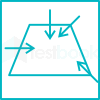
Pointing to the photo, Mamta said that the woman in this photo is the wife of the son of the only daughter of my father's wife. How is Mamta related to that lady?
The positions of the letters according to the English alphabet series:
The pattern for this is as follows;
Hence, "I31V" is the correct answer.
Question 6
Preeti got more marks than Rahul. Yamuna scored as many marks as Divya. Lokita got less marks than Manju. Rahul got more marks than Yamuna. Manju got less marks than Divya. Who got the lowest marks?
In the question given, relations between different elements are shown in the statements. These statements are followed by two conclusions. Find out which of the given conclusions follow(s) the given statements and select the correct alternative from the given choices.
If all three possible conditions (<, >, =) between any two entities are included in conclusions, and both the conclusion are individually false then it would be a case of ‘either-or’.
Question 10
Identify the diagram that best represents the relationship among the given classes.
Rahul starts walking in the south direction and walks a distance of 7 meters. Now he took a left turn and walk 6 m. Again he takes a left turn and walks 15 m and reached a point P. In which direction is Rahul from the initial point?
In the question below are given two statements followed by two conclusion. You have to take the two given statements to be true even if they seem to be at variance with the commonly known facts and then decide which of the given conclusions logically follows from the two given statements, disregarding commonly known facts.
Prime Minister is the ex-officio chairman of the NITI Aayog in India.
NITI Aayog is an executive body, that was established by the government in 2015 through an executive resolution.
NITI Aayog replaced the erstwhile planning body- the Planning Commission of India.
The term NITI stands for National Institution for Transforming India.
NITI Aayog is a think tank that advises the government in policy formulation, unlike the PC which was empowered to allocate and distribute funds for the planning.
NITI Aayog's main focus areas are cooperative & competitive federalism, decentralised planning, scenario planning, capacity building etc.
Full-Time Organisational Framework:
Chairman: Prime Minister (Narendra Modi)
Vice Chairperson: Appointed by the Prime Minister. (Suman Berry)
Chief Executive Officer (CEO).
Full-Time members
Part-time members: maximum 2
Ex-officio members: maximum 4
Question 22
The Gateway of India was built to commemorate the visit of which of the following king?
The Gateway of India was built to commemorate the visit of King George V.
Key Points
The early twentieth century saw the rise of the swaraj (self-rule) movement.
King George V (1910–36) and his wife, Queen Mary, carried out two royal tours of the Indian subcontinent in the hope of improving public perception of and loyalty to the British Crown.
Both fell in love with ‘dear beautiful India’.
Following their initial visit in 1905–06 as Prince and Princess of Wales, they returned as Emperor and Empress for a Coronation Tour in 1911–12.
Additional Information
Important facts about Gateway of India.
The Gateway of India was erected in honour of King George V and Queen Mary’s landing at Apollo Bunder on their visit to India.
However, the foundation stone was laid on March 31, 1911, by the then-Governor of Mumbai, Sir George Sydenham Clarke.
The design of the monument took three years to pass and finally got sanctioned on March 31, 1911.
The archway of the monument is 26 meters (85 feet) high and joined with four turrets and intricate latticework carved on stones.
The archway of the monument is built of Basalt and about 21 lakhs was spent to build the arch alone.
The structure is an adaptation of the Arc de Triomphe in Paris.
During the rule of the British government, this was used as the arrival point for the visitors from the west.
The monument is surrounded by another of Mumbai’s major tourist attractions, the Marine Drive, facing the vast Arabian Sea.
The last British ships set to sail in 1947 to leave the country from the Gateway of India making it a legend.
Question 23
Vaishali was the capital of which of the following Mahajanapadas?
The kingdom was situated in Bihar to the north of the river Ganga.
It covered the districts of Vaishali and Muzaffarpur in Bihar.
Additional Information
Mahajanapada
Capital
Vajji
Vaishali
Panchal
Ahichatra
Avanti
Ujjain & Mahismati
Magadha
Initially, Rajagaha was the capital of Magadha. Later, in the fourth century BCE, the capital was shifted to Pataliputra.
Important Points
The term "Janapada" literally means the foothold of a people.
There were 16 Mahajanapadas during 600 B.C. to 325 B.C. in the Indian Sub-continent.
There were 16 kingdoms or oligarchic republics that existed in Northern ancient India from the sixth to fourth centuries BCE during the second urbanization period.
The 6th–5th centuries BCE is often regarded as a major turning point in early Indian history; during this period India's first large cities arose after the demise of the Indus Valley Civilization.
It was also the time of the rise of sramana movements (including Buddhism and Jainism), which challenged the religious orthodoxy of the Vedic Period.
Question 24
The water holding capacity is the highest in which of the following soils?
The water holding capacity of soil is a very important agronomic characteristic.
Soils that hold generous amounts of water are less subject to leaching losses of nutrients or soil-applied pesticides.
The water holding capacity is highest in clayey soil because it is made up of very small tightly packed particles that do not allow water to percolate.
It is very sticky to the touch when wet, but smooth when dried.
Clay is the densest and heaviest type of soil that does not drain well or provide space for plant roots to flourish.
Hence The water holding capacity is the highest in Clayey soil. So, the correct answer is 'Clayey soil'.
Additional Information
Soil is classified into four types:
Sandy soil
Silt Soil
Clay Soil
Loamy Soil.
Silt Soil: Silt has smaller particles compared to sand.
It is also made up of rock and other mineral particles.
Furthermore, its fine quality holds water better than sand.
Due to the above-mentioned features, it is also beneficial for agriculture.
Chalk soil: can be either light or heavy but always highly alkaline due to the calcium carbonate (lime) within its structure.
As these soils are alkaline they will not support the growth of ericaceous plants that require acidic soils to grow.
If chalky soil shows signs of visible white lumps then they can’t be acidified and gardeners should be redesigned to only choose plants that prefer alkaline soil.
Peat soil: is high in organic matter and retains a large amount of moisture.
This type of soil is very rarely found in a garden and is often imported into a garden to provide an optimum soil base for planting.
Loam soil: is a mixture of sand, silt, and clay that are combined to avoid the negative effects of each type.
These soils are fertile, easy to work with and provide good drainage.
Depending on their predominant composition they can be either sandy or clay loam.
Question 25
Which of the following district is the largest district in India by area?
The famous book ‘Anandmath' was authored by Bankim Chandra Chatterjee.
The book was originally written in 1882.
Anandamath takes the reader back to Bengal in the clutches of the famine, the backdrop of the pre-independence struggle, and the turmoil of human lives caught in this frame of time.
It is considered one of the most remarkable works of the Bangla language and Indian literature.
Through the book, Bankim also gave us the song ‘VandeMataram’which became the rallying call for rebels.
The first two stanzas eventually became the National song of India.
One of the gems of Indian Literature, ‘Anandmath’ carries a deep sentiment of nationalism which was the essence of the freedom struggle.
Additional Information
Bankim Chandra Chatterjee -
Bankim Chandra Chatterjee was born on 27 June 1838 in a Brahmin family in Kanthalpara village in Bengal.
Vande Mataram was composed in a mixed language (Sanskrit-Bengali) by Bankim Chandra Chatterjee.
This song was published in the year 1872 as an underlying song in his novel Anand Math.
In this novel, this song is sung by a monk named "Bhawanand".
Its tune was composed by Yadunath Bhattacharya. This song takes 65 seconds to sing.
Question 28
Who among the following laid the foundation of Golden Temple?
Hazrat Mian Mir Ji laid the foundation of the Golden Temple.
Key Points
Sri Harmandir Sahib, also known as Sri Darbar Sahib or Golden Temple.
The land for the site was bought by the Guru Ram Das Sahib on payment from the Zamindars (landlords) of native villages.
Guru Arjan Sahib got its foundation laid by a Muslim saint Hazrat Mian Mir Ji of Lahore on the 1st of Magh, 1645 Bikrmi Samvat (December, 1588).
The construction work was directly supervised by Guru Arjan Sahib himself and he was assisted by prominent Sikh personalities like Baba Budha ji, Bhai Gurdas Ji, Bhai Sahlo Ji, and many other devoted Sikhs.
Sri Harmandir Sahib is built on a 67ft, square platform in the centre of the Sarovar (tank).
The temple itself is 40.5ft. square.
It has a door each on the East, West, North, and South.
Additional Information
Guru Amar Das was the third of the Ten Gurus of Sikhism.
Sikhism was well established by the time of Guru Arjan, the fifth Guru.
Guru Arjan completed the establishment of Amritsar as the capital of the Sikh world.
And compiled the first authorized book of Sikh scripture, the Adi Granth.
The Ten Gurus in Sikhism
The First Guru
Guru Nanak
The Second Guru
Guru Angad
The Third Guru
Guru Amar Das
The Fourth Guru
Guru Ram Das
The Fifth Guru
Guru Arjan
The Sixth Guru
Guru Hargobind
The Seventh Guru
Guru Har Rai
The Eighth Guru
Guru Harkishan
The Ninth Guru
Guru Teg Bahadur
The Tenth Guru
Guru Gobind Singh
Question 29
Where was the first initiative of Mahatma Gandhi as a nationalist in India?
Champaran was the first initiative of Mahatma Gandhi as a nationalist in India.
Key Points
Mahatma Gandhi was the leader who guided India towards Independence. India was under British rule for over 250 years.
Gandhi returned to India from South Africa in 1915 at the request of Gopal Krishna Gokhale.
Mahatma Gandhi's famous contributions to the Indian freedom movement:
Champaran Satyagraha (1917):
The Champaran agitation in Bihar was Gandhi's first active involvement in Indian freedom politics.
The Champaran farmers were being forced to grow Indigo and were being tortured if they protested.
The farmers sought Gandhi's help and through a calculated non-violent protest, Gandhi managed to win concessions from the authority.
Additional Information
Kheda Satyagraha (1918):
When Kheda, a village in Gujarat, was badly hit by floods, the local farmers appealed to the rulers to waive off the taxes.
Here, Gandhi started a signature campaign where peasants pledged non-payment of taxes.
Khilafat Movement
Gandhi's influence on the Muslim population was remarkable.
This was evident in his involvement in the Khilafat Movement.
After the first World War, the Muslims feared for the safety of their Caliph or religious leader and a worldwide protest was being organized to fight against the collapsing status of the Caliph.
Gandhi became a prominent spokesperson of the All India Muslim Conference and returned the medals he had received from the Empire during his Indian Ambulance Corps days in South Africa.
His role in the Khilafat made him a national leader in no time.
Non-cooperation Movement(1920):
Gandhi had realized that the British had been able to be in India only because of the cooperation they received from the Indians.
Keeping this in mind, he called for a non-cooperation movement.
The ominous day of the Jallianwala Bagh Massacre triggered the non-cooperation movement.
Gandhi set the goal of Swaraj or self-governance, which since then became the motto of the Indian freedom movement.
Salt March(1930):
Also known as the Dandi Movement, Gandhi's Salt March is considered to be a pivotal incident in the history of the freedom struggle.
Gandhi started a Satyagraha campaign against the salttax in March 1930.
He marched 388 kilometers from Ahmedabad to Dandi in Gujarat to make salt.
Thousands of people joined him and made it one of the biggest marches in Indian history.
Quit India Movement(1942):
During the Second World War, Gandhi was determined to strike the British Empire with a definitive blow that would secure their exit from India.
This happened when the British started recruiting Indians for the war. Gandhi protested strongly and said that the Indians cannot be involved in a war that is in favour of democratic purposes when India itself is not a free country.
This argument exposed the two-faced image of the colonizers and within half a decade, they were out of this country.
Question 30
Who is the first ever Indian recipient of a Nobel Prize?
Behnken and Hurley left in a vehicle called Crew Dragon "Endeavour,".
A spaceship designed, built, and operated by SpaceX with about $2.7 billion in government funding.
It's SpaceX's second experimental flight of the vehicle, a mission called Demo-2.
And the aerospace company's first time putting people on board.
The Demo-2 mission's departure makes SpaceX,founded by Elon Musk in 2002.
The first company in NASA's Commercial Crew Program to successfully pull off a visit to the $150 billion, football field-size laboratory.
But Behnken and Hurley's return trip has just begun.
Now that they've flown away from the ISS, they must perform a risky descent through Earth's atmosphere.
The phase of the flight that Musk has called his "biggest concern."
Additional Information
About Space X
Founder: Elon Musk
Founded: 6 May 2002
CEO: Elon Musk (2002)
Headquarters: Hawthorne, California, United States
The Kinet-X experiment created green and violet clouds in the evening sky over parts of the U.S. East Coast.
The mission is also called the Kinetic-scale Energy and Momentum Transport Experiment.
That aims to better understand how energy and momentum transfer in phenomena like auroras, between "different regions of space that are magnetically connected," NASA said in a mission description.
Question 32
Which of the following organization has developed COVID-19 vaccine Covishield?
Serum Institute of India Pvt. Ltd. is now the world's largest vaccine manufacturer by a number of doses produced and sold globally (more than 1.5 billion doses) which includes Polio vaccine as well as Diphtheria, Tetanus, Pertussis, Hib, BCG, r-Hepatitis B, Measles, Mumps and Rubella vaccines.
Serum Institute of India begins production of Covovax vaccine.
The company is already locally producing the Covishield vaccine developed by Oxford University and AstraZeneca.(AP).
Serum Institute of India was founded in 1966 by Dr. Cyrus Poonawalla.
Its Headquarters is located in Hadapsar, Pune, Maharashtra.
CEO - Mr. Adar Poonawalla.
Additional Information
COVISHIELD VACCINE
The Oxford COVID-19 vaccine Covishield is manufactured by Serum Institute of India, which is the largest vaccine manufacturer in the world.
This Pune-based institute has collaborated with AstraZeneca to manufactureCovishield.
The vaccine is derived from a common cold virus called adenovirus and similar to coaxing, it is also to be given in two doses.
Question 33
Which of the following commission was appointed by the Central Government on Centre-State Relations in 1983?
The Sarkaria Commission finally submitted its report in the year 1988.
The Sarkaria Commission’s charter was to examine the relationship and balance of power between state and central governments in the country.
And suggest changes within the framework of the Constitution of India.
Despite the large size of its reports the Commission recommended, by and large, status quo in the Centre-State relations.
Especially in the areas, relating to legislative matters, the role of Governors, and the use of Article 356.
Additional Information
Kalelkar Commission
A Backward Classes Commission was appointed by the President of India on 29 January 1953 with Kaka Kaielkar as its chairman.
The Commission was directed to determine the criteria to be adopted in considering whether any section of people should be treated socially and educationally backwards.
Dutt Committee
Dutt Committee or “Industrial Licensing Policy Inquiry Committee” was set up under the chairmanship of Mr. Subimal Dutt as a follow up to the reports of the Monopolies Inquiry Commission and Hazari Committee.
This committee’s mandate was to inquire into the working of the licensing system in India. The committee had submitted its report in July 1969.
Question 34
Which of the following individuals composed the National Song "Vande Mataram"?
The author of Vande Mataram is Bankim Chandra Chatterjee.
He wrote it in the 1870s, which was later included in his 1881 novel Anandamath.
It played a vital role in the Indian independence movement, first sung in a political context by Rabindranath Tagore at the 1896 session of the Indian National Congress.
Additional Information
Bankim Chandra Chatterjee or Bankim Chandra Chattopadhyay:
He was an Indian novelist, poet, and journalist.
He was the composer of Vande Mataram, originally in Sanskrit, personifying India as a mother goddess and inspiring activists during the Indian Independence Movement.
Question 35
What is the scientific name of national bird of India?
A person with hypermetropia cannot see nearby objects clearly.
Hypermetropia, sometimes called hyperopia, is the term used to define being longsighted or far-sightedness.
If a person is hypermetropic, the image of a nearby object is formed behind the retina. This means that light is focused too far back in the eye, causing things that are close up to appear blurred.
A Convex lens is used to treat the defect known as hypermetropia.
Additional Information
Defects of Vision
Details
Corrections
Myopia or Near-sightedness
The eye can see nearby objects clearly but the distant objects appear indistinct.
Concave Lens
Hypermetropia or Farsightedness
The human eye can see Distant objects clearly but cannot see nearby objects distinctly.
Convex Lens
Presbyopia
People suffer from near-sightedness as well as farsightedness.
bifocal lenses
Cataract
People suffer from the cloudiness of lens which causes a decrease in vision.
Surgery
Question 37
Which state has approved the policy of reserving seats for women in the village level community institutions?
Meghalaya state government has approved the “Policy on Reservation of seats for Women in Village Employment Councils (VECs)”.
The State Government has brought the policy of reserving at least 50 percent of seats for women in the grassroots village-level community institutions (VECs).
The policy entails, the position of the Secretary of VEC will be reserved for women members in all VECs on a rotational basis.
Adult women who are active community workers with leadership qualities can contest this post.
VECs are apolitical organizations formed for the implementation of MGNREGA works.
Additional Information
State
Capital
Governor
Chief Minister
Meghalaya
Shilong
Satya Pal Malik
Conrad Sangma
Manipur
Imphal
La. Ganesan
N. Biren Singh
Mizoram
Aizawl
Kambhampati Hari Babu
Zoramthanga
Arunachal Pradesh
Itanagar
B. D. Mishra
Pema Khandu
Question 38
Who can initiate the process of removal of the Vice President of India?
The correct answer is Democratic Republic of Congo.
Key Points
Mount Nyiragongo is an active stratovolcano in the Democratic Republic of Congo with an elevation of 3,470 m in the Virunga Mountains associated with the Albertine Rift.
As the active volcano in Congo, Mount Nyiragongo, erupted again, the Indian Army contingent under the United Nations peacekeeping mission (MONUSCO) assisted in protecting civilians and U.N. officials as well as assets during the evacuation.
It is located inside Virunga National Park, in the Democratic Republic of the Congo, about 12 km north of the town of Goma and Lake Kivu.
The main crater is about two kilometres (1mi) wide and usually contains a lava lake. Nyiragongo's lava lake has at times been the most voluminous known lava lake in recent history.
Nyiragongo and nearby Nyamuragira are together responsible for 40% of Africa's historical volcanic eruptions.
Lava lakes are large volumes of molten lava, usually basaltic, contained in a volcanic vent, crater, or broad depression.
Question 40
In which of the following year was the Industrial Policy Resolution adopted by the Parliament?
The first industrial policy after independence was announced on 6th April 1948.
It was presented by Dr. Shyama Prasad Mukherjee the then Industry Minister.
The main goal of this policy was to accelerate the industrial development by introducing a mixed economy where the private and public sector was accepted as important in the development of the economy.
Industrial Policy Resolution, 1956
This second industrial policy was announced on April 20,1956, which replaced the policy of 1948.
In 1956 the Indian Policy Resolution was adopted by the Parliament.
The features of this policy were:
A new classification of Industries.
Non-discriminatory and fair treatment for the private sector.
Promotion of village and small-scale industries.
To achieve development by removing regional disparity.
Labour welfare.
It was regarded as the “Economic Constitution of India” or “The Bible of State Capitalism”.
Arithmetic Ability (20 questions)
Question 41
Roli takes 3 hours to type 24 pages. Neelam takes 9 hours to type 45 pages. In how many hours they will type 351 pages together?
Average of 45 numbers is 33. If average of first 15 numbers is 28 and average of last 25 numbers is 35, then what is the average of remaining five numbers?
A, B and C are three partners in a business who shared profit in the ratio of 2 ∶ 5 ∶ 3. If they had invested for 8 months, 6 months and 9 months respectively, what is the ratio of their investments?
Ratio of the share of the profit of A, B and C (respectively) = 2 : 5 : 3
Ratio of the time period of the investments of A, B and C (in months) = 8 : 6 : 9
Formula used:
The ratio of the share of profits = Ratio of the product of investments and time period
Calculation:
Let the ratio of investments of A, B and C be in the ratio a : b : c
According to the question,
2 : 5 : 3 = 8a : 6b : 9c
⇒ 6b8a=52, 9c6b=35, 9c8a=32
⇒ 40a = 12b, 18b = 45c, 24a = 18c
⇒ ba=103 ---- eq.1
⇒ cb=25 ----eq.2
⇒ ca=43 ----eq.3
By multiplying eq.2 by 2; we get cb=410 ----eq.4
Now by equations 1,3 and 4 we get, a : b : c = 3 ∶ 10 ∶ 4
∴ The ratio of their investments is 3 ∶ 10 ∶ 4.
Question 46
Prakash bought 2 items at the same price. He sold one item at 20 percent profit and another item at 15 percent profit. What is the overall percentage profit he made?
Profit is always calculated on the base of Cost price
Profit % = (Profit/Cost Price) × 100
Calculation:
Let the cost price of the items = 100
Then, according to the question,
Profit on 1st item = 20% of 100 = 20
Profit on 2nd item = 15% of 100 =15
⇒ Total profit on selling both the items = 35
Also, total cost price = 200
⇒ Total profit% = 20035 × 100 = 17.5%
Question 47
Study the following table carefully to answer the given question. Number of employees in different departments of five organisations
Organisation →Department ↓
A
B
C
D
E
HR
145
80
120
180
160
Finance
120
75
100
220
140
Marketing
150
90
115
200
190
IT
225
110
160
280
220
Administration
180
120
130
110
130
Number of employees in IT department of organization C is what percent of the total number of employees in organization C in all the departments together?
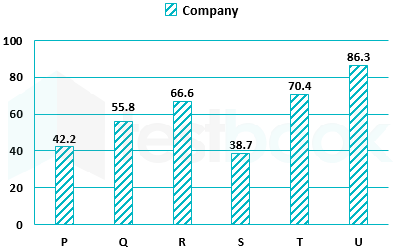
∴ Percentage of the total sales of the given six companies together was the sale of company T = 36070.4×100 = ~ 19.55
Question 51
200 students took the examination in a school, and 13 percent of the students got distinction. The number of boys who got distinction is 2 more than the number of girls who got distinction. If 20 percent of the girls got distinction, find the total number of boys in the school?
A sum of Rs.3600 is divided into two principals. One principal is invested at 8 percent p.a. for 2 years and the other is invested at 9 percent p.a. for 3 years. If the total simple interest obtained is Rs.741, then find the larger principal.
The ratio of speed of boat in upstream to speed of boat in downstream is 2 ∶ 3. The time taken by boat to cover 45 km in downstream is t hours, then in t hours how many kilometers will be travelled by boat in upstream?
An alloy contains tin, copper and zinc in the ratio of 4 : 6 : 5. Find the quantity of copper to be added to 120 kg of this alloy to form a new alloy in which the ratio of the above elements in the same order is 4 ∶ 7 ∶ 5?
Study the following table carefully to answer the given question.
Number of employees in different departments of five organisations
Organisation → Department ↓
A
B
C
D
E
HR
145
80
120
180
160
Finance
120
75
100
220
140
Marketing
150
90
115
200
190
IT
225
110
160
280
220
Administration
180
120
130
110
130
What is the ratio between the number of employees from Finance and Marketing departments together of organization B and these two departments together of organisation D respectively?
Number of employees from Finance departments of organization B = 75
Number of employees from Marketing departments of organization B = 90.
Number of employees from Finance departments of organization D = 220.
Number of employees from Marketing departments of organization D = 200.
Calculation:
⇒ 75 + 90 : 220 + 200
⇒ 165 : 420
⇒ 11 : 28
∴ Option D is correct.
Question 59
If Arvind reaches the college in 2 hours by his bike at an average speed of 30 km/h, then at what average speed of his car can he reach the college half an hour earlier?
Preposition: It is a word used to link nouns, pronouns, or phrases to other words within a sentence. Most common prepositions are 'of', 'in', 'for', 'on', etc.
On: As a preposition 'On' is used to express touching a surface or being supported by a surface.
Example: We could hang this picture on the wall next to the door.
Thus, 'on' will be used in the blank as the sentence is expressing the contact of a person with the grass.
Therefore, the correct answer is: 'She slipped on damp grass, breaking a leg, cracking a bone in the other and hurting her shoulder.'
Additional Information
Let's explore other options:
By: As a preposition 'By' is used to show the person or thing that does something.
Example: The motorcycle was driven by a tiny bald man.
To: As a preposition 'To' is used after some verbs, especially when the action described in the infinitive will happen later.
Example: She agreed to help.
At: As a preposition 'At' is used to show an exact position or particular place.
Example: We'll meet you at the entrance.
Question 63
Select the most appropriate antonym of the given word.
The correct answer is 'If he had wrote the examination faster' i.e. error lies in this part of the sentence.
Key Points
The error lies in 'If he had wrote the examination faster' part of the sentence.
Wrote needs to be replaced with written..
This sentence is an example of the Third conditional sentence. These sentences express situations that can not exist. The actions and events that happened in the past. These are often used to indicate a missed opportunities.
Structure for Third conditional:
If/when+ past perfect+would have+ past participle.
The correct sentence is- If he had written the examination faster and answered one more question he would have scored better.
Additional Information
Conditional sentence:- As the name suggests, these sentences express conditions.
In conditional sentences, there are two clauses of the sentences. One is a conditional clause and another one is main clause.
Conditional sentences are of four types-
Types of Conditional Sentences
Definition and examples
Zero conditional Sentence
It expresses a factual condition. Structure: If/When+ present simple+ present simple Example:If you touch a fire, you get burned.
First Conditional Sentence
It expresses possible and likely future outcomes. Structure: If/when+present simple, will+ verb infinitive. Example: If I have enough money, I'll buy some new shoes.
Second Conditional Sentence
It expresses an Imagination. Structure: If/when + past simple, would + verb infinitive. Example: If I met the Queen of England, I would say hello.
Third Conditional sentence
It expresses a hypothetical situation. Structure: If/when+ past perfect+would have+ past participle. Example: If we had taken a taxi, we wouldn't have missed the plane.
Question 65
Select the word which means the same as the group of words given.
Transmission that combines media of communication:
to begin doing something again after a period of not doing it.
Local people have renewed their efforts to save the school.
maintain
to make something continue in the same way or at the same standard as before
Careers Officers maintain contact with young people when they have left school.
conserve
to keep and protect something from damage, change, or waste.
To conserve electricity, we are cutting down on our heating.
nurture
to help a plan or a person to develop and be successful
As a record company executive, his job is to nurture young talent.
Thus, from the above-given explanation, we can say that 'maintain' will be used in the blank.
Therefore, the correct answer is option 2.
Question 69
In the following question, four sentences are given out of which three sentences are grammatically incorrect while one is correct. Find out which sentence is grammatically correct and select the appropriate option.
AOption (a)
The portal should allow uploaded of state government Acts, regulations and subordinate legislations as well.
BOption (b)
Navigation on this portal should be such that the complete law-making chain, right from the parent act to the subordinate legislations, is clearly visible.
COption (c)
The data uploaded on the portal should available in machine readable PDF formats.
DOption (d)
All Central Acts and subordinate legislations passed by the Centre, include rules, regulations, and circulars, should be made available on this portal.
Navigation on this portal should be such that the complete law-making chain, right from the parent act to the subordinate legislations, is clearly visible.
Why this answer is correct
The correct answer is option 2.
Key Points
Let's explore the options:
Option 1, It is grammatically incorrect because the verb 'allow' is succeded by a gerund or infinitive in a sentence. If there is no object then 'allow' will be followed by a gerund and if there is an object then 'allow' will be followed by an infinitive. In the given sentence there is no object therefore, it needs to be succeeded by a gerund. therefore, 'uploaded' needs to be replaced with 'uploading' to make the sentence grammatically correct.
Option 2, This statement is grammatically and contextually correct.
Option 3, it is grammatically incorrect because 'should' needs to be succeeded by 'be' when it is used to state your opinion that you think ought to happen.Thus, 'be' needs to be added before 'available' to make the sentence grammatically correct.
Option 4, It is grammatically incorrect because we need a preposition to connect 'centre' with 'rules' and 'including' is a preposition which means containing as part of the whole being considered. Therefore, to correct this sentence 'include' needs to be replaced with 'including'.
Forerunner: something or someone that acts as an early and less advanced model for what will appear in the future, or a warning or sign of what is to follow.
Example: Germany's Green party was said to be the forerunner of environmental parties throughout Europe.
Thus, from above, we can refer that the correct answer is option 4.
Question 71
Select the most appropriate option to substitute the underlined segment in the given sentence. If there is no need to substitute it, select 'No substitution required'.
The medals from the two events will be counted for "ranking of competing nations" at the Birmingham Games, the CGF said on Monday.
The given sentence required no substitution and is grammatically correct.
The given sentence is an example of passive voice of simple future tense.
Structure:
Active sentence- subject + shall / will + base form of verb + object.
Passive sentence- object of the active sentence + shall / will+ be + past participle ( third form ) of the verb + by + subject of the active sentence.
Example:
She will draw a picture today. (Active Voice)
A picture will be drawn by her today. (Passive voice)
Thus, from above, the correct answer is option 1 and the sentence requires no substitution.
Additional Information
Active voice means that a sentence has a subject that acts upon its verb.
Passive voice means that a subject is a recipient of a verb’s action.
Question 72
Rearrange the following sentences in their correct order to form a meaningful paragraph.
P: The government of Maharashtra has come up with guidelines for organising of Ganesh Festival.
Q: If organizers need to have more than 20 people, then they need to take permission from the local District Collector.
R: At any given time, no more than 20 people will be allowed to gather in the sanctum within the pandal where the Ganesh idol is kept for worshipping.
S: The District Collector will then verify the size of the pandal and will give permission if satisfied that social distancing will be maintained with 20 plus people.
Statement P will be the first in sequence as it introduces the subject of the sentence 'The government of Maharashtra'.
Statement R will follow Statement P as it states the conditions of the gathering of people for celebrating the 'Ganesh festival' mentioned in statement P.
Statement Q will follow statement R as it states the conditions for the gathering of people for more than '20 people' which is mentioned in statement R.
Statement S will be the last part.
Therefore, the correct sequence is PRQS.
Sequence:
P. The government of Maharashtra has come up with guidelines for organising of Ganesh Festival.
R: At any given time, no more than 20 people will be allowed to gather in the sanctum within the pandal where the Ganesh idol is kept for worshipping.
Q: If organizers need to have more than 20 people, then they need to take permission from the local District Collector.
S. The District Collector will then verify the size of the pandal and will give permission if satisfied that social distancing will be maintained with 20 plus people.
Question 73
Select the most appropriate meaning of the given idiom/phrase.
The correct answer is 'To experience unpleasant consequences.'
Key Points
To burn your finger: It is an idiomatic phrase which means To suffer an unpleasant or ruinous consequence (especially the loss of money) for some action, often such that one becomes unwilling or reluctant to do it again.
Example: During the boom times, countless would-be investors put everything they owned into shady investment deals, and most of them ended up burning their fingers badly.
Thus, from above we can say that the correct answer is option 2.
Question 74
Select the most appropriate option to substitute the underlined segment in the given sentence. If there is no need to substitute it, select 'No substitution required'.
Since 1970, trends in agricultural production, fish harvest, bio-energy production and harvest of materials have increased, in response to populational growth, rising demand and technology development.
AOption (a)
No substitution required.
BOption (b)
population growth, rising demand and technological development.
COption (c)
populated growth, rising demand and technological development.
DOption (d)
population growing, rising demand and technological development.
population growth, rising demand and technological development.
Why this answer is correct
The correct answer is 'population growing, rising demand and technological development.'
Key Points
There is no word such as 'populational', thus it is needed to be replaced with 'population'.
'Technology' needs to be replaced with 'Technological'.
Adjective: These are the words that are used to describe or qualify a noun.
Here, in the given sentence 'development' is a noun and 'technology' is used to qualify the noun 'development' which is incorrect.
Thus, the correct answer is option 2.
Therefore, the correct sentence is: 'Since 1970, trends in agricultural production, fish harvest, bio-energy production and harvest of materials have increased, in response to **population growth, rising demand and technological development.'**
The correct answer is 'Gaurmet', i.e. it is a wrongly spelt word.
Key Points
Gaurmet: It is a wrongly spelt word. The correct spelling is 'Gourmet'.
Gourmet: a person who knows a lot about food and cooking, and who enjoys eating high-quality food.
Example: In an ideal world, most people would prefer gourmet cuisine, but it is costly and difficult to prepare.
Thus, from the above-given explanation, we can say that the correct answer is option 1.
Additional Information
Grandeur: the quality of being very large and special or beautiful.
Example: We were struck by the silent grandeur of the desert.
Grateful: showing or expressing thanks, especially to another person.
Example: If you could get that report finished by Thursday, I'd be very grateful.
Guarantee: to promise that something will happen or exist.
Example: European Airlines guarantees its customers top-quality service.
Direction: Read the following passage and answer the questions below.
The tribunes of Rome, Marullus and Flavius, break up a gathering of citizens who want to celebrate Julius Caesar's triumphant return from war. The victory is marked by public game sin which Caesar's protégé, Mark Antony, takes part. On his way to the arena, Caesar is stopped by a stranger who warns him that he should 'Beware the Ides [15th] of March.'
Fellow senators, Caius Cassius and Marcus Brutus, are suspicious of Caesar's reactions to the power he holds in the Republic. They fear he will accept offers to become Emperor. He has been gaining a lot of power recently and people treat him like a god. Cassius, a successful general himself, is jealous of Caesar. Brutus has a more balanced view of the political position. The conspirator Casca enters and tells Brutus of a ceremony held by the plebeians. They offered Caesar a crown three times, and he refused it every time. But the conspirators are still wary of his aspirations.
Cassius, Casca, and their allies plant false documents to manipulate Brutus to join their cause to remove Caesar. After doing so, they visit Brutus at night in his home to persuade him of their views. There they plan Caesar's death. Brutus is troubled but refuses to confide in his devoted wife, Portia. On 15 March, Caesar's wife, Calpurnia, urges him not to go to the Senate. She has had visionary dreams and fears the portents of the overnight storms.
Caesar is nevertheless persuaded by flattery to go to the Capitol. At the Capitol, he is stabbed by each conspirator in turn. As Brutus gives the final blow, Caesar utters the famous phrase: Et tu, Brute?
Question 76
Whom does this line “He has been gaining a lot of power recently and people treat him like a god” refer to according to the given passage:
Let's refer to the following lines of the passage:
Fellow senators, Caius Cassius and Marcus Brutus, are suspicious of Caesar's reactions to the power he holds in the Republic. They fear he will accept offers to become Emperor. He has been gaining a lot of power recently and people treat him like a god. Cassius, a successful general himself, is jealous of Caesar. Brutus has a more balanced view of the political position.
From, above we can refer that the correct answer is option 2.
Question 77
Which of the following statements is incorrect according to the given passage?
AOption (a)
Caesar utters the famous phrase: Et tu, Brute?
BOption (b)
They offered Caesar a crown three times, and he refused it every time.
COption (c)
At the Capitol, Cassius is stabbed by each conspirator in turn.
DOption (d)
Caesar is nevertheless persuaded by flattery to go to the Capitol.
जो क्रियाएँ संज्ञा या विशेषण बनती हैं, उन्हें "नामधातु क्रिया" कहते हैं। - इस वाक्य में योजक चिन्ह का प्रयोग नही किया गया है।
स्पष्टीकरण:
योजक चिन्ह- हिंदी में अल्पविराम के बाद योजक चिन्ह का प्रयोग अधिक होता है। दो शब्दों में परस्पर संबंध स्पष्ट करने के लिए तथा उन्हें जोड़कर लिखने के लिए योजक-चिन्ह का प्रयोग किया जाता है। इसे 'विभाजक-चिन्ह' भी कहते है।
Key Points
अन्य विकल्प:
चिन्ह
परिभाषा
उदाहरण
पूर्ण विराम चिन्ह (।)
जहाँ एक बात पूरी हो जाये या वाक्य समाप्त हो जाये वहाँ पूर्ण विराम ( । ) चिन्ह लगाया जाता है।
बाजार खुल गया।
अल्प विराम चिन्ह (,)
वाक्य में जहाँ थोड़ा रुकना हो या अधिक वस्तुओं, व्यक्तियों आदि को अलग करना हो वहाँ अल्प विराम ( , ) चिन्ह का प्रयोग किया जाता है।
राकेश, मोहन, शीतल और पंकज ने यह चित्र बनाया है।
अवतरण चिन्ह या उद्धरण चिन्ह (‘….’ “…” )
किसी की कही हुई बात को उसी तरह प्रकट करने के लिए अवतरण चिन्ह ( ''... '' ) का प्रयोग होता है। पुस्तक, समाचारपत्र, लेखक का उपनाम, लेख का शीर्षक इत्यादि उद्धृत करते समय इकहरे उद्धरण चिन्ह ( ‘...’ ) का प्रयोग होता है।
गांधी जी ने कहा था "अहिंसा परम धर्म है”।
Question 82
निम्नलिखित में से दिया गया वाक्य किस काल का उदहारण है?
खिलाड़ी मैच खेल रहे थे। इस वाक्य में क्रिया की अपूर्णता का बोध हो रहा है, अतः 'अपूर्ण भूतकाल' उचित विकल्प है।
Key Points
'जो क्रिया अभी हो रही थी' उसे अपूर्ण भूतकाल कहते हैं।
अपूर्ण का अर्थ होता है – अधूरा।
क्रिया के जिस रूप से कार्य के लगातार होने का पता चलता था, उसे अपूर्ण भूतकाल कहते है।
जिन वाक्यों के अंत में रहा था, रहे थे, रही थी, आदि आते है, उसे अपूर्ण भूतकाल कहते हैं।
Important Points
भूतकाल के उपभेद
वर्तमान काल के उपभेद
भविष्य काल के उपभेद
सामान्य भूतकाल :- जिस क्रिया के भूतकाल में क्रिया के सामान्य रूप से बीते समय में पूरा होने का संकेत मिले।
सामान्य वर्तमान काल :- क्रिया के जिस रूप से कार्य की पूर्णता और अपूर्णता का पता न चले।
सामान्य भविष्य काल :- क्रिया के जिस रूप से क्रिया के सामान्य रूप का भविष्य में होने का पता चले।
आसन्न भूतकाल :- जिस क्रिया के अभी-अभी या निकट के भूतकाल में पूरा होने का पता चले।
अपूर्ण वर्तमान काल:- क्रिया के जिस रूप से कार्य के लगातार होने का पता चलता है।
संभाव्य भविष्य काल :- क्रिया के जिस रूप से आगे कार्य होने या करने की संभावना का पता चले।
पूर्ण भूतकाल :- क्रिया के जिस रूप से यह पता चलता है की कार्य निश्चित किये गये समय से पहले ही पूरा हो चूका था।
पूर्ण वर्तमान काल :- क्रिया के जिस रूप से कार्य के अभी पूरे होने का पता चलता है।
हेतुहेतुमद्भविष्य भविष्य काल:- क्रिया के जिस रूप से एक कार्य का पूरा होना दूसरी आने वाले समय की क्रिया पर निर्भर हो।
अपूर्ण भूतकाल :- क्रिया के जिस रूप से यह पता चलता है कि कार्य भूतकाल में पूरा नहीं हुआ था अपितु नियमित रूप से जारी रहा।
संदिग्ध वर्तमान काल:- क्रिया के जिस रूप से वर्तमान काल क्रिया के होने या करने पर शक हो।
संदिग्ध भूतकाल :- क्रिया के जिस रूप से अतीत में हुए या करे हुए कार्य पर संदेह प्रकट किया जाये।
तात्कालिक वर्तमान काल :- क्रिया के जिस रूप से यह पता चलता हो कि कार्य वर्तमान में हो रहा है।
समयकालीन भूतकाल :- जिन वाक्यों के अंत में रहा था , रही थी , रहे थे आदि आते हैं और समय क�� निश्चित बोध होता है।
संभाव्य वर्तमान काल :- संभाव्य का अर्थ होता है संभावित या जिसके होने की संभावना हो।
Additional Information
काल - क्रिया के जिस रुप से कार्य व्यापार के समय तथा उसकी पूर्णता पूर्णता का बोध होता है, उसे काम कहते हैं। काल के तीन भेद माने गए हैं।
वर्तमान काल
वर्तमान काल में क्रिया व्यापार की निरंतरता रहती है। इसके चार भेद माने गए हैं - सर्वमान्य वर्तमान, तात्कालिक, वर्तमान संदिग्ध वर्तमान और संभाव्य वर्तमान।
उदाहरण -सीता पढ़ती है।
भूत काल
भूतकाल में क्रिया व्यापार की समाप्ति का बोध होता है। इसके पांच भेद हैं - सामान्य भूत, आसन भूत, अपूर्ण भूत, संदिग्ध भूत हेतुहेतुमद् भूत।
उदाहरण - सीता ने पढ़ाई की।
भविष्य काल
भविष्य में होने वाली क्रिया का बोध भविष्य काल से होता है। इसके तीन भेद हैं-सामान्य भविष्य, संभाव्य भविष्य और हेतुहेतु मद् भविष्य।
उदाहरण - सीता पढ़ेगी।
Question 83
निम्नलिखित में से कौन-सा वाक्य विस्मयादिबोधक वाक्य है?
सर्वनाम - संज्ञा के स्थान पर प्रयुक्त होने वाले शब्दों को सर्वनाम कहते हैं। जैसे - मैं, वह, वे, उन्हें, अपने तुम, हम आदि। हिंदी में मूलतः सर्वनामों की संख्या 11 है – मैं, तू, आप, यह, वह, जो, सो, कौन, कोई, क्या और कुछ।
पुरुषवाचक सर्वनाम
परिभाषा
उदाहरण
उत्तम पुरुष
जिन शब्दों का प्रयोग बोलने वाला खुद के लिए करता है।
उपर्युक्त विकल्पों में से ‘महात्मा’ तत्पुरुष समास नहीं है। अतः इसका सही उत्तर विकल्प 1 होगा।
Key Points
'महात्मा' का समास विग्रह ‘महान है जो आत्मा’ होगा।
इसमें पूर्वपद विशेषण और उत्तरपद विशेष्य है तथा उत्तरपद प्रधान है, इसलिए इसमें कर्मधारय समास होगा।
<br>
अन्य विकल्पों का समास विग्रह निम्न प्रकार है-
शब्द
समास विग्रह
समास का नाम
सत्याग्रह
सत्य का आग्रह
तत्पुरुष (सम्बन्ध) समास
जन्मांध
जन्म से अँधा
तत्पुरुष (अपादान) समास
गिरहकट
गिरह को काटने वाला
तत्पुरुष(कर्म) समास
<br>
Additional Information
तत्पुरुष समास: जिस समास में उत्तरपद प्रधान हो तथा समास करने के उपरांत विभक्ति(कारक चिन्ह) का लोप हो, तत्पुरुष समास कहलाता है। जैसे: राम का अनुज= रामानुज, धर्म का ग्रन्थ = धर्मग्रन्थ, तुलसीदास द्वारा कृत = तुलसीदासकृत आदि। तत्पुरुष समास के छः भेद होते हैं-
समास
परिभाषा
उदाहरण
कर्म तत्पुरुष समास
जहां कर्म कारक चिन्ह (को) का लोप हो
गिरहकट = गिरह को काटने वाला
करण तत्पुरुष समास
जहां करण कारक चिन्ह (से) का लोप हो
गुणहीन = गुणों से हीन
संप्रदान तत्पुरुष समास
जहां संप्रदान कारक चिन्ह (के लिए, को) का लोप हो
हथकड़ी = हाथ के लिए कड़ी
अपादान तत्पुरुष समास
जहां अपादान कारक चिन्ह (से, अलग होने के संबंध में ) का लोप हो
धनहीन = धन से हीन
संबंध तत्पुरुष समास
जहां संबंध कारक (का, की के) का लोप हो
प्रेम सागर = प्रेम का सागर
अधिकरण तत्पुरुष समास
जहां अधिकरण कारक (में , पर) का लोप हो
नीतिनिपुण = नीति में निपुण
Question 90
निम्नलिखित में से लोकोक्ति "अपना रख पराया चख" का क्या अर्थ है?
दिए गए विकल्पों में सही उत्तर विकल्प 4 ‘अपनी वस्तु की रक्षा, दूसरे की वस्तु का उपभोग।’ है। अन्य विकल्प इसके अनुचित उत्तर होंगे।
Key Points
लोकोक्ति- ‘अपना रख पराया चख’ अर्थ– ‘अपनी वस्तु की रक्षा, दूसरे की वस्तु का उपभोग।’ होता है।
वाक्य - वह वैसे तो बहुत कंजूस है, परंतु दूसरे के द्वारा ख़र्च करने पर पूरा आनंद उठाता है। इस पर तो अपना रख, पराया चख ही चरितार्थ होता है।
नोट-‘लोकोक्ति’ शब्द ‘लोक + उक्ति’ शब्दों से मिलकर बना है जिसका अर्थ है- लोक में प्रचलित उक्ति या कथन’।
Additional Information
लोकोक्ति परिभाषा
उदाहरण
लोकोक्तियाँ आम जनमानस द्वारा स्थानीय बोलियों में हर दिन की परिस्थितियों एवं संदर्भों से उपजे वैसे पद एवं वाक्य होते हैं जो किसी खास समूह, उम्र वर्ग या क्षेत्रीय दायरे में प्रयोग किया जाता है। इसमें स्थान विशेष के भूगोल, संस्कृति, भाषाओं का मिश्रण इत्यादि की झलक मिलती है। लोकोक्ति वाक्यांश न होकर स्वतंत्र वाक्य होते हैं।
लोकोक्ति- अधजल गगरी छलकत जाय अर्थ- जिसके पास थोड़ा ज्ञान होता हैं, वह उसका प्रदर्शन या आडम्बर करता है। वाक्य- रमेश बारहवीं पास करके स्वयं को बहुत बड़ा विद्वान समझ रहा है। ये तो वही बात हुई कि अधजल गगरी छलकत जाय।
Question 91
निम्नलिखित में से अशुद्ध वर्तनी वाले शब्द का चयन कीजिए-
दिए गए विकल्पों में फुटबाल शब्द की वर्तनी अशुद्ध है।
अत्यावश्यक, संकल्पित, परित्याग ये तीनो शब्दों की शुद्ध वर्तनी है
Key Points
शुद्ध वर्तनी
अशुद्ध वर्तनी
अर्थ
फुटबॉल
फुटबाल
चमड़े आदि से बनी एक प्रकार की बड़ी गेंद या बॉल। उक्त बॉल को पैर से मारकर खेला जाने वाला एक तरह का खेल।
<br>
<br>
Additional Information
वर्तन���
लिखने की रीति को वर्तनी कहते हैं। ‘वर्तनी’ शब्द का अर्थ उच्चारित होने वाले शब्द के लेखन में प्रयोग होने वाले लिपि चिह्नों के व्यवस्थित रूप को वर्तनी कहा जाता है।
Question 92
निम्नलिखित में से "आराधना" शब्द का विशेषण कौन-सा है?
हिन्दी का व्यवहारिक ज्ञान अपेक्षित है। इस वाक्य में व्यवहारिक शब्द में अशुद्ध वर्तनी है, इसलिये विकल्प 1 सही उतर है
अन्य सभी विकल्पो में वर्तनी की अशुद्धियाँ नही है।
Key Points
अन्य विकल्प:
अशुद्ध शब्द
शुद्ध शब्द
व्यवहारिक
व्यावहारिक
<br>
Additional Information
वर्तनी
लिखने की रीति को वर्तनी कहते हैं। ‘वर्तनी’ शब्द का अर्थ उच्चारित होने वाले शब्द के लेखन में प्रयोग होने वाले लिपि चिह्नों के व्यवस्थित रूप को वर्तनी कहा जाता है।
Question 95
निम्नलिखित में से मुहावरा "अंडे का शहजादा" का क्या अर्थ है?
'अंडे का शहजादा’ मुहावरे का सही अर्थ है – अनुभवहीन व्यक्ति। अन्य विकल्प असंगत हैं।
Key Points
स्पष्टीकरण:-
मुहावरे
अर्थ
वाक्य प्रयोग
अंडे का शहजादा
अनुभवहीन व्यक्ति
अजीत सिंह अपने पिता की सिफ़ारिश पर प्रमोशन तो पर गए लेकिन काम ढंग का नहीं आता, बस समझो कि वो अंडे का शहजादा है।
अन्य विकल्प:-
मुहावरे
अर्थ
वाक्य प्रयोग
आकाश पाताल एक करना
कठोर परिश्रम करना
सूरज ने इंजीनियर पास करने के लिए आकाश-पाताल एक कर दिया।
घाट - घाट का पानी पीना
बहुत अनुभवी होना
मुझे वकालत में किसी से कम न आंको, मैंने भी घाट-घाट का पानी पिया हुआ है।
Additional Information
मुहावरा परिभाषा
उदाहरण
किसी भाषा की अभिव्यंजना के विशिष्ट रूप को 'मुहावरा' कहते हैं। एक अन्य पक्ष है कि विशिष्ट शब्दों विचित्र प्रयोगों एवं प्रयोग-सिद्ध विशिष्ट वाक्यांशों वाक्य-पद्धति को 'मुहावरा' कहते हैं।
मुहावरा - अन्धे के हाथ बटेर लगना अर्थ - इच्छित वस्तु का अचानक प्राप्त होना वाक्य - रहीम की लटरी खुलते ही ऐसा लगा मानो अन्धे के हाथ बटेर लग गई हो।
निर्देश: निम्नलिखित गद्यांश का ध्यानपूर्वक अध्ययन कर प्रश्नों के उत्तर दीजिए-
संसार में दो अचूक शक्तियाँ ���ैं- वाणी और कर्म। कुछ लोग वचन से संसार को रह दिखाते हैं और कुछ लोग कर्म से। शब्द और आचार दोनों ही महान शक्तियाँ हैं। शब्द की महिमा अपार है। विश्व में साहित्य, कला, विज्ञान, शास्त्र सब शब्द-शक्ति के प्रतीक प्रमाण हैं। पर कोरे शब्द व्यर्थ होते है, जिनका आचरण न हो। कर्म के बिना वचन, व्यवहार के बिना सद्धांत की कोई सार्थकता नहीं है।
निस्सन्देह शब्द शक्ति महान है, पर चिरस्थायी और सनातनी शक्ति तो व्यवहार है। महात्मा गाँधी ने इन दोनों की कठिन और अद्भुत साधना की थी। महात्मा जी का सम्पूर्ण जीवन उन्ही दोनों से युक्त था। वे वाणी और व्यवहार में एक थे। जो कहते थे वही करते थे। यही उनकी महानता का रहस्य है। कस्तूरबा ने शब्द की अपेक्षा कृति की उपासना की थी, क्योंकि कृति का उत्तम व चिरस्थायी प्रभाव होता है। 'बा' न कोरी शाब्दिक, शास्त्रीय, सैद्धांतिक शब्दावली नहीं सीखी थी। वे तो कर्म की उपासिका थीं। उनका विश्वास शब्दों की अपेक्षा कर्मों में था। वे जो कहा करती थीं उसे पूरा करती थी। वे रचनात्मक कर्मों को प्रधानता देती थीं। इसी के बल पर उन्होनें अपने जीवन में सार्थकता और सफलता प्राप्त की थी।
Question 96
उपर्युक्त गद्यांश के संदर्भ में, प्रायः सज्जन व्यक्ति संसार को _______ राह दिखाते है।
सज्जन व्यक्ति संसार को 'अपने कर्म एवं वाणी से' राह दिखाते है।
अपने कर्म एवं वाणी से - खुद के कार्यो एवं बोलने के तरीके से।
Key Pointsअन्य विकल्प:
केवल गरीबो की मदद करने की भावना से - जो असहाय व्यक्ति है, उनको मदद की भावना के माध्यम से।
अपनी कार्यक्षमता से - कार्य करने की शक्ति से।
अपनी बुद्धिक्षमता से - बुद्धि की शक्ति के माध्यम से।
निर्देश: निम्नलिखित गद्यांश का ध्यानपूर्वक अध्ययन कर प्रश्नों के उत्तर दीजिए-
संसार में दो अचूक शक्तियाँ हैं- वाणी और कर्म। कुछ लोग वचन से संसार को रह दिखाते हैं और कुछ लोग कर्म से। शब्द और आचार दोनों ही महान शक्तियाँ हैं। शब्द की महिमा अपार है। विश्व में साहित्य, कला, विज्ञान, शास्त्र सब शब्द-शक्ति के प्रतीक प्रमाण हैं। पर कोरे शब्द व्यर्थ होते है, जिनका आचरण न हो। कर्म के बिना वचन, व्यवहार के बिना सद्धांत की कोई सार्थकता नहीं है।
निस्सन्देह शब्द शक्ति महान है, पर चिरस्थायी और सनातनी शक्ति तो व्यवहार है। महात्मा गाँधी ने इन दोनों की कठिन और अद्भुत साधना की थी। महात्मा जी का सम्पूर्ण जीवन उन्ही दोनों से युक्त था। वे वाणी और व्यवहार में एक थे। जो कहते थे वही करते थे। यही उनकी महानता का रहस्य है। कस्तूरबा ने शब्द की अपेक्षा कृति की उपासना की थी, क्योंकि कृति का उत्तम व चिरस्थायी प्रभाव होता है। 'बा' न कोरी शाब्दिक, शास्त्रीय, सैद्धांतिक शब्दावली नहीं सीखी थी। वे तो कर्म की उपासिका थीं। उनका विश्वास शब्दों की अपेक्षा कर्मों में था। वे जो कहा करती थीं उसे पूरा करती थी। वे रचनात्मक कर्मों को प्रधानता देती थीं। इसी के बल पर उन्होनें अपने जीवन में सार्थकता और सफलता प्राप्त की थी।
Question 97
उपर्युक्त गद्यांश के अनुसार, गाँधीजी की महानता का रहस्य क्या है?
गाँधीजी की महानता का रहस्य यही है कि 'जो कहते थे वही करते थे।'
जो कहते थे वही करते थे इसका अर्थ यह होता है कि उनकी कथनी और करनी में कोई अंतर नही था।
अन्य विकल्प:
जो दूसरे व्यक्ति कहते थे, वही करते थे - इसका अर्थ यह हुआ कि दूसरो के बताये मार्ग पर चलने की प्रवृति।
सदैव गरीबों की सहायता करते थे - असहाय, दीन - दुखियो की सेवा की भावना मन में होना।
जो कहते थे वह, कभी नही करते थे - यह गांधीजी के गुण के विपरीत कही हुई बात है।
निर्देश: निम्नलिखित गद्यांश का ध्यानपूर्वक अध्ययन कर प्रश्नों के उत्तर दीजिए-
संसार में दो अचूक शक्तियाँ हैं- वाणी और कर्म। कुछ लोग वचन से संसार को रह दिखाते हैं और कुछ लोग कर्म से। शब्द और आचार दोनों ही महान शक्तियाँ हैं। शब्द की महिमा अपार है। विश्व में साहित्य, कला, विज्ञान, शास्त्र सब शब्द-शक्ति के प्रतीक प्रमाण हैं। पर कोरे शब्द व्यर्थ होते है, जिनका आचरण न हो। कर्म के बिना वचन, व्यवहार के बिना सद्धांत की कोई सार्थकता नहीं है।
निस्सन्देह शब्द शक्ति महान है, पर चिरस्थायी और सनातनी शक्ति तो व्यवहार है। महात्मा गाँधी ने इन दोनों की कठिन और अद्भुत साधना की थी। महात्मा जी का सम्पूर्ण जीवन उन्ही दोनों से युक्त था। वे वाणी और व्यवहार में एक थे। जो कहते थे वही करते थे। यही उनकी महानता का रहस्य है। कस्तूरबा ने शब्द की अपेक्षा कृति की उपासना की थी, क्योंकि कृति का उत्तम व चिरस्थायी प्रभाव होता है। 'बा' न कोरी शाब्दिक, शास्त्रीय, सैद्धांतिक शब्दा��ली नहीं सीखी थी। वे तो कर्म की उपासिका थीं। उनका विश्वास शब्दों की अपेक्षा कर्मों में था। वे जो कहा करती थीं उसे पूरा करती थी। वे रचनात्मक कर्मों को प्रधानता देती थीं। इसी के बल पर उन्होनें अपने जीवन में सार्थकता और सफलता प्राप्त की थी।
Question 98
निम्नलिखित में से उपर्युक्त गद्यांश का उचित शीर्षक कौन-सा है?
Bijective function: A function is said to be bijective or bijection, if a function f: A → B satisfies both the injective (one-to-one function) and surjective function (onto function) properties.
(or)
For every element “b” in the codomain B, there is exactly one element “a” in the domain A. such that f(a) = b. If the function satisfies this condition, then it is known as one-to-one correspondence.
Calculations:
Let f: R → R be defined as f(x) = 8x.
Let x, y ∈ R such that f(x) = f(y)
⇒ 8x = 8y
⇒ x = y
∴ f is one - one.
Now, for any real number y ∈ R (co-domain)
∃ 8y∈R such that
f(8y) = 8 × 8y = y
∴ f is onto.
Thus f is both one-one and onto i.e.,f is bijective.
Hence, the correct answer is option 4).
Question 102
Which of the following is incorrect?
AOption (a)
Every sequence has a countable number of terms
BOption (b)
Every sequence has a limit point
COption (c)
Every sequence has a monotone subsequence
DOption (d)
Every bounded sequence has a convergent subsequence
Limit point: A number x is called a limit point (or cluster point or accumulation point) of a set of real numbers A if, ∀ε > 0, the interval (x − ε, x + ε) contains infinitely many points of A.
Bolzano-Weierstrass theorem - Every sequence has a monotone subsequence, which can be either monotonically increasing or decreasing.
Calculations:
For Option (1) - Every sequence has a countable number of terms.
By definition, a sequence is a function from the natural numbers (which are countable) to some set, meaning it has a countable number of terms.
Hence Option (1) is correct.
For Option (2) - Every sequence has a limit point.
let the sequence an = n
Clearly it is a divergent sequence, and it does not any limit not.
Hence Option (2) is incorrect.
For Option (3) - Every sequence has a monotone subsequence.
According to the Bolzano-Weierstrass theorem, every sequence has a monotone subsequence, which can be either monotonically increasing or decreasing.
Hence Option (3) is correct.
For Option (4) - Every bounded sequence has a convergent subsequence.
This is a consequence of the Bolzano-Weierstrass theorem, which states that every bounded sequence in R has a convergent subsequence.
Therefore, the incorrect statement is Option (2).
Question 103
A Relation in R is defined as R = {(a, b) : a ≤ b2} is ________.
A relation R on a set A is said to be an equivalence relation if and only if the relation R is reflexive, symmetric, and transitive. The equivalence relation is a relationship on the set which is generally represented by the symbol “∼”.
Reflexive: A relation is said to be reflexive, if (a, a) ∈ R, for every a ∈ A.
Symmetric: A relation is said to be symmetric, if (a, b) ∈ R, then (b, a) ∈ R.
Transitive: A relation is said to be transitive if (a, b) ∈ R and (b, c) ∈ R, then (a, c) ∈ R.
Calculations:
Given the relation R on the set of all real numbers R = {(a, b): a ≤ b2}
Bijective function: A function is said to be bijective or bijection, if a function f: A → B satisfies both the injective (one-to-one function) and surjective function (onto function) properties.
(or)
For every element “b” in the codomain B, there is exactly one element “a” in the domain A. such that f(a) = b. If the function satisfies this condition, then it is known as one-to-one correspondence.
Calculations:
Let f: R → R be defined as f(x) = 4x + 3
Let x, y ∈ R such that f(x) = f(y)
⇒ 4x + 3 = 4y + 3
⇒ x = y
∴ f is one - one.
Now, for any real number y ∈ R (co-domain) .Let f(x) = y
∃ 4y−3∈R such that
f(4y−3) = 4 × 4y−3 + 3 = y
∴ f is onto.
Thus f is both one-one and onto i.e.,f is bijective.
For finding f -1, we put f(x) = y and find x in terms of y
Limit comparison test: Suppose ∑ an and ∑ bn with an ≥ 0, bn > 0 for all n. Define c=n→∞limbnan
If c is positive (i.e., c > 0 and is finite (i.e., c < ∞ ) then either both series converge or both series diverge.
L Hospital ' s rule: For the differentiable functions f(x) and g(x), the x→climg(x)f(x), if f(x) and g(x) are both 0 or ±∞ (i.e. an Indeterminate Form) is equal to the x→climg′(x)f′(x) if it exists.
Calculation:
Let bn = n1 > 0
Clearly n=1∑∞n1is divergent , because p = 1 ≤ 1 (p - series test)
Consider as n → ∞. Define
c=n→∞limn1sinn1 = 00 which is an indeterminate form.
So, using L Hospital's rule we have to differentiate the numerator and denominator separately with respect to n, we get
n→∞lim−n21cos(n1).(−n21)
=n→∞limcos(n1)
=cos(∞1)
=cos(0)
= 1 > 0
∴ c > 0
Thus by limit comparison test ∑ sin \({}^1/n\) is divergent because \(\displaystyle\sum{n=1}^{∞} \frac{1}{n}\) is divergent.
Conditionally convergent: If the series n=1∑∞bn is convergent and n=1∑∞∣bn∣ is divergent then the series n=1∑∞bn is called conditionally convergent.
Leibnitz test:
An alternating series n=1∑∞(−1)nbn,bn≥0 converges if both of the conditions hold,
bn ≥ bn + 1 for all n ≥ N.
2. n→∞limbn=0
p - series test: The p-series is a power series of the form n=k∑∞np1 , where p is a positive real number and k is a positive integer. The p-series test determines the nature of convergence of a p-series as follows: The p-series converges if p > 1 and diverges if p ≤ 1.
Calculation:
Given series is n=1∑∞(–1)n+1n1
where bn=n1≥0
Using the Leibnitz test we have,
|bn| - |bn + 1|
=n1−n+11
=nn+1−n
=n1≥0 for all n ∈ N
∴ bn ≥ bn + 1 for all n ≥ N.
The first condition of Leibnitz test holds.
Now, consider
n→∞limbn
⇒ n→∞limn1=0
The second condition of leibnitz test also holds
∴ the series n=1∑∞(–1)n+1n1 is convergent.
Next , consider
n=1∑∞∣bn∣
=n=1∑∞n1
By p-series test, we have p = 1 and thus the series n=1∑∞∣bn∣ is divergent.
Thus the series n=1∑∞bn is convergent and n=1∑∞∣bn∣ is divergent
Hence the given series n=1∑∞(–1)n+1n1 is conditionally convergent.
Hence, the correct answer is option 2).
Question 107
If f : R → R defined by f(x) = x2 – 3x + 2, then f(f(x)) =
Concept: A sequence is which is neither convergent ,non divergent is called oscillatory sequence. it is oscillate finitely since it is bounded and converges.
Solution:Let the sequence an=(-1)n
Then an2=(-1)2n
According to condition an2= a2 =(1)2=1
an is osicallting sequence between {-1,1} so it is not convergent sequence.
Question 110
If Un > 0 for all n ∈ N, then n→∞limUn1/n is equal to-
Concept: The radius of convergence is half of the interval of the convergence.
R be the radius of convergence, R=limn→∞AnAn+1 then
The series converges if R<1
The series is diverging if R >1 or if R is infinite.
Interval of convergence will be ( a-R < x < R+a )
we’ll need to check the convergence of the endpoints of the interval by plugging the endpoints into the original series and using any convergence test that we can to say whether or not the series converges at the endpoint.
One-to-One functions define that each element of one set, say Set (A) is mapped with a unique element of another set, say, Set (B).
(or)
An injective function (injection) or one-to-one function is a function that maps distinct elements of its domain to distinct elements of its codomain.
(or)
Let ‘f’ be a function whose domain is set A. The function is said to be injective if for all x, y ∈ A,
Whenever f(x) = f(y), then x = y
And equivalently, if x ≠ y, then f(x) ≠ f(y)
Onto function: Let set A be a codomain and set B be a co-domain then for each element of B, there is a pre-image in Set A.
Calculations:
Therefore from the above definitions, it is clear that f1 is an injective function as each element of the domain is mapped with a unique element of the codomain.
And f2 is not an onto function because, elements in co-domain like a, e, and f don't have a preimage in the domain.
Thus f1 is one-one, f2 is not an onto
Hence, the correct answer is option 3).
Question 113
If S = {a, b, c, d) and p = {(a, a), (b, b), (c, c), (d, d), (a, b), (b, a),(b, c), (c, b)}, then p is-
Concept: (Comparison test) we have two series ∑an∑an∑an∑an∑an∑an∑an
Code
and ∑bn∑bn∑bn∑bn∑bn∑bn∑bn
with an,bn≥0an,bn≥0an,bn≥0an,bn≥0an,bn≥0an,bn≥0an,bn≥0
for all nUnexpected text node: 'n'Unexpected text node: 'n'Unexpected text node: 'n'Unexpected text node: 'n'Unexpected text node: 'n'Unexpected text node: 'n'
and an≤bnan≤bnan≤bnan≤bnan≤bnan≤bnan≤bn
for all nUnexpected text node: 'n' . Then,
If ∑bn is Convergent then so ∑an is convergent. is Convergent. b ≠ 1
If ∑an is Divergent then so ∑bn is Divergent.
P-Series test: series∑nk1if k>1 then this series is convergent otherwise divergent.
Conditionally convergent: If the series n=1∑∞bn is convergent and n=1∑∞∣bn∣ is divergent then the series n=1∑∞bn is called conditionally convergent.
Absolutely convergent: The series n=1∑∞bn with both positive and negative terms( not necessary alternative) is called absolutely convergent if the corresponding series n=1∑∞∣bn∣ with all positive terms is convergent.
If a series is convergent but not absolutely convergent, it is called conditionally convergent.
An example of a conditionally convergent series is the alternating harmonic series.
Thus, A conditionally convergent series is a series that is Convergent but not absolutely.
Hence, the correct answer is option 2).
Question 117
If f : A → B and g : B → C are one–one, then gof : A → C is-
A series ∑(u_n\) is said to be absolutely convergent if all the terms are positive and the series ∑∣un∣ by the modulus of each term of the series is convergent.
Calculation:
1-31+91-271+811-..... a series ,now if we take the modulus of each term and construct a series then it will look like ∑∣un∣|=1+31+91+271+... ,which is a infinite geometric series with common ratio 31 but if we consider the series 1−21+31−41+.... this is a alternating series but if we want to express in sum of absolute term i.e.∑∣un∣=1+21+31+41+...
is not a absolutely convergent series but it is conditionally convergent by Leibnitz's test.
The condition for Leibnitz's test is given below :
(i) un(\geq\)0 (ii) un+1≤un, (iii)n→∞limun=0 if any alternating series obeys these three conditions then we can say the alternating series is convergent.
If we consider the series 1−21+31−41+.... then ∑un=(−1)n+1n1
un=n1
Applying the condition of Leibnitz's test, we get
(i) un>0
(ii)un+1−un=n+11−n1<0
(iii) n→∞limn1=0
So all the three conditions of Leibnitz's test is satisfied,
∴ the series is conditionally convergent by Leibnitz's test .
Additional :
Root Test, Ratio Test, Comparison Test widely used for series of positive terms.
Radius of convergence of power series - If Σanzn be given power series then the circle |z| = R having all values of z for which the power series Σanzn converges.
Then, the radius R is called radius of convergence and |z| = R is called radius of convergence and |z| = R is called circle of convergence.
Calculation:
Let an=(2n)!n!2 , an+1=(2n+2)!(n+1)!2
R = n→∞lim(2n)!(n+1)!2n!2(2n+2)!
R =n→∞lim(n+1)2(2n+1)(2n+2)
R = n→∞limn2(1+1/n)2n2(2+1/n)(2+2/n)
Now, putting the limit
R = 4/1
R = 4
The radius of convergence of power series is 4.
Question 126
If X and Y are two non-empty sets such that n(X) = 17, n(Y) = 23 and n(X ∪ Y) = 38, then n( X ∩ Y ) is
If we consider a function f(z)= u+iv then it will satisfies the Cauchy – Riemann equation if ∂x∂u=∂y∂v,∂y∂u=−∂x∂v and if it possesses all the partial derivatives then the function f(z) is analytic.
Solution:
Let f(z)=u+iv
f(z)=z1
where z= x + iy
now we can write f(z)=x2+y2x−iy
So here u=x2+y2x,v=−x2+y2y(\frac{\partial u}{\partial x}=\frac{y^2-x^2}{(x^2+y^2)^2}\)
So from here we can say that the Cauchy – Riemann equation ∂x∂u=∂y∂v,∂y∂u=−∂x∂v is satisfied and all the partial derivatives are exist except origin(0,0)
If we take w=z1
then dzdw=−z21 also exists everywhere at z=0
So, 1/z, is analytic at z=0.
Question 132
If f (z) = u(x, y) + i.v (x, y) be analytic everywhere and u – v = (x – y).(x2 + 4xy + y2), then-
If a function f(z) is analytic within and on a closed contour C and a is any point within C then derivatives of all orders are analytic and are given by
f(n)(a)=2πin!∫C(z−a)n+1f(z)dz
SOLUTION:
We have ∫c(z−1)3zez
Now z = 1 is the singular point for the given function. and it is inside the curve C where C is a circle |z| = 2.
Now use the Cauchy integral Formula, where f(z) = z ez we get -
∫c(z−1)3zez=2!2πif(2)(1)=πif(2)(1) ......(i)
Now we have f(z) = z ez
Now f'(z) = z ez + ez and f''(z) = z ez + 2 ez
Now f''(1) = f(2)(1) = 3e
Now put this value in the above equation, we get -
(i) If z ∈ C ⇒ z = x+iy then |z| = √x2 + y2 and Re(z) = x
(ii) Method to check limit : check limz → a along different paths in the complex plane. If the limit is the same along all paths, it provides evidence that the limit exists. If the limit differs along different paths, the limit may not exist.
Explanation:
Now, f(z) ={Re(z)∣z∣,if Re(z)=00,if Re (z) = 0
The Baire Category Theorem:- If {An} is a sequence of nowhere dense sets in a complete metric space X. Then there exists a point in X which is not in any of An.
Or we can say that, Every complete metric space is of second category as subset of itself.
Calculation:
Let (X, α) be a complete metric space.
For contradiction, assume that X is not of second category.
⇒ X is of first category.
⇒ X is a union of collection of non-dense countable subsets of X.
Let this collection is:- x = U{An} , where A1, A2,.... are non-dense.
∵ A1 is non-dense.
⇒ There exists a closed surface S1 with radius r1 < 1 and S1∩A1 =Φ [by theorem]
Let C1 is an open sphere concentric with S1 and same radius as r1.
Then In C1, we may find a closed sphere S2 with radius r2 < 1/2 and S2∩A2 = Φ [because A2 is non-dense]
Further, proceeding in this way, we get a nested/decreasing sequence. {Sn} of closed sets of X. [because closed sphere is closed set.]
and S{Sn} → 0 when n → ∞ and Sn∩An = Φ
⇒ For every positive integer n ∈ N, Sn does not intersect with A1, A2,....,An
Now, ∵ X is a complete metric space then by canter intersection theorem, there exists a point x ∈ X such that x ∈ Sn
But Sn∩An = Φ
⇒ x ∈ ∩Sn and x ∉ An ; n = 1, 2, ....
∵ x ∉ An ∀ n ⇒ x ∉ X [ which is contradiction, because we toook X = U{An}]
Hence our hypothesis was wrong.
⇒ X is not of first category.
⇒ X is of second category.
Question 138
If n is real number and f = rn (cos nθ + i.sin nθ), then
Continuity:- A function f(z) of a complex variable z defined in the closed and bounded domain D is said to be continuous at a ∈ D if and only if for any arbitrarily chosen positive number ε, however small but not zero, there exists a corresponding number δ > 0 such that |f(z) - f(a)| < ε whenever |z - a| < δ.
Differentiability:- Let w = f(z) be a function of a complex variable z defined in a domain D.
Then f(z) is said to be differentiable at a point zo of D, if \(\lim_\limits{Δz \to 0} \frac{f(z_o + Δz) - f(z_o)}{Δz}\) or \(\lim_\limits{z \to z_0} \frac{f(z) - f(z_o)}{z - z_o}\) exists uniquely and finitely and this limit,
if it exists finitely, then it is called the differential coefficient or derivative of f with respect to z at z = zo.
It is denoted by f'(zo) or by Df(zo).
Sufficient condition for Cauchy Riemann Equations: The sufficient condition for a function f(z) = u + iv to be analytic at all points in region R are:
(a) ∂x∂u=∂y∂v,∂y∂u=−∂x∂v
(b) ∂x∂u,∂y∂v,∂y∂u,∂x∂v are continuous functions of x and y in region R.
Calculation:
Let f(z) = |z|2 where z = x + iy
This function is continuous at every point because x2 + y2 is continuous at all points.
f(z) = x2 + y2 but f(z) = u + iv
On comparing the functions we get,
u = x2 + y2 and v = 0
Doing partial differentiation,
∂x∂u=2x,∂y∂v=0
∂y∂u=2y,∂x∂v=0
Now apply Cauchy Riemann Equation Condition,
∂x∂u=2x=∂y∂v=0
only when x = 0.
∂y∂u=2y=∂x∂v=0
only when y = 0.
Therefore, f(z) is only complex differentiable on (0, 0).
Discipline 3 (20 questions)
Question 141
If lx + my + n = 0 be the normal to the circle x2 + y2 = a2 then -
the "normal" of a circle typically refers to a line that is perpendicular to the circle's tangent at a given point on the circle's circumference and radius of circle is always normal of circle.
Explanation:
we know, radius of circle is normal as well radius will passes through centre of circle
Here, Centre of circle is (0,0)
⇒ lx + my + n = 0 satisfies (0,0)
⇒ l.0 + m.0 + n = 0 ⇒ n = 0
Hence, Option (2) is true.
Question 142
If any tangents to the ellipse a2x2+b2y2 = 1 makes intercepts of lengths h and k on the axis, then -
A plane passes through a point, (1, –2, 1) and is perpendicular of two planes 2x – 2y + z = 0 and x – y + 2z = 4. The distance of the plane from the point (1, 2, 2) is -
For a general second-degree equation in three dimensions to represent a cone, if
The determinant of the matrix of the quadratic part of the equation must be zero. This is equivalent to the condition that the matrix formed by the coefficients of the quadratic terms (a, b, c) and the linear terms (u, v, w) has a determinant equal to zero when considering the equation as a homogeneous equation (setting the constant term to zero for the moment).
Explanaition:
The quadratic form of the equation can be represented by the matrix:
In a hyperbola, there are two types of diameters - conjugate diameters and principal diameters.
1. Conjugate Diameters:
Conjugate diameters are diameters that are perpendicular to each other and intersect at the center of the hyperbola.
The length of the conjugate diameters is constant and is equal to the length of the transverse axis of the hyperbola.
- Conjugate diameters have a special property: if one of them meets the hyperbola at two real points, the other will meet the hyperbola at two imaginary points, and vice versa.
The product of the slopes of the two conjugate diameters is always equal to -1.
2. Principal Diameters:
Principal diameters are diameters that are parallel to the asymptotes of the hyperbola.
They intersect at the center of the hyperbola.
The length of the principal diameters is constant and is equal to the length of the conjugate axis of the hyperbola.
Explanation -
If one of the conjugate diameters meets the hyperbola at two real points, then the other conjugate diameter will meet the hyperbola at two imaginary points.
This is because the two conjugate diameters are perpendicular, and one diameter cuts the hyperbola at real points, while the other cuts at imaginary points.
But they meet the curve at infinity because the point of intersection of the two conjugate diameters is at infinity.
Hence two conjugate diameters of the hyperbola are such that they meet the curve at infinity
Question 150
The shortest distance between the z-axis and the line 1x−2 = 2y−1 = 2z+1 is-
Hence, The equation of the plane through the point (1, 2, –3) and normal to the straight line joining the points (–1, 3, 4) and (5, 2, –1) is 6x - y - 5z - 19 = 0
Question 157
If S1 = 0 and S2 = 0 are the equations of a sphere, then S1 + λ.S2 = 0 represents-
AOption (a)
a circle
BOption (b)
a plane
COption (c)
a sphere passing through the circle of intersection of the spheres
DOption (d)
a sphere passing through the plane of intersection
Both ellipse and hyperbola are conic sections, but the ellipse is a closed curve while the hyperbola consists of two open curves. Therefore, the ellipse has finite perimeter, but the hyperbola has an infinite length.
Calculation:
Four normals can be drawn in total, which can be either real or imaginary. At most four real normals can be drawn from any point in the plane of rectangular hyperbola and minimum two real normals from any point in the plane of rectangular hyperbola.
Question 160
If the normals at the point (ct1,t1c) on the hyperbola xy = c2 meets it again at the point (ct2,t2c) then-
Radius of curvature:- The radius of a circle which touches a curve at a given point and has the same tangent and curvature at that point. It is represent by ρ.
The reciprocal of the radius of the osculating circle, torsion is the reciprocal of the radius of torsion. It is represented by σ.
Calculation:
R2 = ρ2 + σ2ρ'2
R2 = ρ2 + (ρ'σ)2
Question 163
If cos–1(ap) + cos–1(bq) = α, then a2p2 + kcos α, + b2q2 = sin2 α where k is equal to
A Geodesic on a surface is a curve along which the distance between any two points at the surface is the smallest or it is the smallest path connecting the two points on the surface.
Explanation:
On the curve v = constant, 'u' may be a parameter so that v = c and u = t represent the parametric equation of the curve.
The Frenet -Serret formula is a formula describing the kinematic properties of a particle moving along a parametric curve. The formulas represent the derivatives of the function in terms of the basis formed by the tangent, normal and binormal unit vectors.
Explanation:
T is the unit vector tangent to the curve. N is the normal unit vector, B is the binormal unit vector, and the cross-product of T and N.
The Frenet -Serret formulas are:
dsdT=κN
dsdN=κT+κB
dsdB=τN
where dsd is the derivative with respect to the arclength,κ is the curvature, and τ is the torsion of the curve.
The tangent unit vector T is defined as T = dsdr
The normal unit vector N is defined as N=ds∣∣dT∣∣dsd
The binormal unit vector Bis is defined as the cross product of T and N. B = T × N
it follows, since T always has unit magnitude, that N is always perpendicular to T since there is no change in length of T and B is always perpendicular to both T and B.
so the Frenet -Serret formulas are
dsdT= 0T + κ N + OB
dsdN= -κ T + 0N + τ B
dsdB= o T + τ N+ OB
This is the coefficient matrix of Frenet Serret's formula T′N′B′=0−κ0κ0τ0τ0TNB
The ratio of the curvature and the torsion is constant
Why this answer is correct
Concept:
Helix:- A curve traced on the surface of a cylinder and cutting the generators at constant angle α is called a helix. If the cylinder is a right cylinder {x2 + y2 = a2} then the curve drawn on the cylinder which is making constant angle with the generators is a called a circular helix.
⇒ Theorem:- Prove that the necessary and sufficient condition for a curve to be a helix is that the ratio of its curvature and torsion is constant.
Calculation:
Necessary Condition:-
Let the curve is helix, then we have to prove that K τκ=constant. As the curve is helix , so the tangent at any point to this curve will make α constant angle with the fixed direction (generator) of the cylinder. Let a be the unit constant along the generator and t is the unit tangent at P to the curve C.
⇒ t.a=∣t∣∣a∣cosα
⇒ t.a=1.1cosα
⇒ t.a=cosα
⇒ t.a=constant [∴ α = constant]
Differentiation with respect to 's'
t′.a=0
κn.a=0
If κ = 0 then the curve is straight line and the condition is proved.
if κ ≠ 0, then n.a=0
⇒ n⊥a
Thus a will be in the plane determined by t and b (rectifying plane)
Hence, a=cosαt′+sinαb
Differentiating with respect to 's'
⇒ 0=cosαt′+sinαb
⇒ 0=cosα(κn)+sinα(−τn)
⇒ 0=(κcosα−τsinα)n
As n ≠ 0
⇒ κcosα - τ sinα = 0
⇒ κcosα = τsinα
⇒ τκ=tanα
⇒ τκ=constant [∴ α = constant]
Sufficient Condition:-
Let τκ=constant then we have to prove that the curve is a helix. For this it is sufficient to prove that t.a is constant as τκ is constant.
Let τκ=c1 ----equation (1)
Consider, dsdt=κn
dsdt=cτn ---- equation (2) [by (1)]
Again Consider, dsdb=−τn
or c1dsdb=−cτn ---- equation(3)
Adding equation 2 and 3
dsdt+c1dsdb=cτn−cτn
⇒ dsd(t+c1b)=0
⇒ dsd(ct+b)=0
Integrating, ct+b=a (constant vector)
Taking dot product with t
⇒ t.(ct+b)=t.a
⇒ ct2+t.b=t.a
⇒ ct2+0=t.a
⇒ ct2=t.a
or t.a=constant
Hence, the curve is a helix.
So, the necessary and sufficient condition for a curve to be a helix is the ratio of the curvature and the torsion is constant.
Question 176
If A lies in the first quadrant and 23 sinAcos A = cos2A – sin2A, then the value of cosAcos(A/2)sin(A/2) is:
According to the first fundamental form for the surface
ds2 = du2 + dv2
for the paraboloid revolution z = x2 + y2, we can parameterize the surface with u = θ (angle of rotation around the z-axis) and v = r(radial distance from the z-axis) so, we have
x = r cosθ , y = r sinθ and z = r2
Let's express the differential element of arc length , ds2, in terms of dθ and dr:
ds2=(∂θ∂xdθ)2+(∂r∂xdr)2+(∂θ∂ydθ)2+(∂r∂ydr)2
ds2 = (-r sin (θ) dθ)2 + (cos (θ) dr)2 + (r cos (θ) dθ)2 + (sin (θ)dr)2
Since , The paraboloid of revolution is surface of constant curvature , the coefficient dθ2 and dr2 should be equal along the asymptotic lines. So, for the asymptotic lines, we have:
dθ2 + r2dr2 = 0
This is equivalent to the expression du2 + u2dv2 = 0
Question 179
If sin 3A = cos (A-30), where 3A and (A-30) are acute angles, find the value of (sin 2A + Cos 2A)
(i) Monotone function has at most countably infinite discontinuity.
(ii) If the number of discontinuity of the function is almost countably infinite then the function is integrable.
Explanation -
1. Every discontinuous function is integrable:
This statement is false. There are discontinuous functions that are not integrable.
For example, the Dirichlet function is discontinuous at every point but not Riemann integrable.
2. Every integrable function is monotone increasing:
This statement is false. There exist integrable functions that are not monotone increasing.
For example, the function that is equal to 0 on the rational numbers and 1 on the irrational numbers is integrable but not monotone increasing.
3. Every monotone function is integrable:
This statement is true. Monotone functions have a finite number or at most countably infinite discontinuities, and therefore, they are Riemann integrable.
4. Every integrable function is continuous:
This statement is false. There exist integrable functions that are not continuous.
For example, the step function is integrable but not continuous.
This is a linear differential equation because the dependent variable (y(t)) and its derivatives appear to the first power and are not multiplied together or by themselves.
Moreover, there are no nonlinear functions of (y(t)) (such as (sin(y(t))), (y2(t)), etc.).
Hence, the system is linear.
For stability, we should look at the homogeneous part of the differential equation, which is:
dt2d2y(t)−dtdy−2y(t)=0
The characteristic equation for this differential equation is:
r2 - r - 2 = 0
Solving this quadratic equation for (r) gives:
r=21±1+8=21±3
So, (r = 2) or (r = -1).
Since one of the roots is positive ((r = 2)), it indicates that there is at least one solution to the differential equation that grows without bound as (t → ∞ ).
This suggests the system can be unstable under certain initial conditions because the presence of a positive real part in any root of the characteristic equation indicates that the solution can grow exponentially.
Thus, the differential equation is Linear and unstable
Question 189
A signal x (t) is given by x (t) = {1,4−T<t≤43T−1,43T<t<47T−x(t+T)
Which among the following gives the fundamental Fourier terms of x(t)?
y(t) is a real valued function of a real variable with period T. Its trigonometric Fourier series expansion contains no terms of frequency w = 2π (T2k), k = 1, 2, ....Also no sine terms are present. Then y(t) satisfies the equation:
Causal: A continuous-time system is causal if the output at any given time t depends only on the values of the input for t' ≤ t , where t' represents all past and present times.
Linear: A continuous-time system is linear if it satisfies both the superposition and homogeneity properties. The superposition property states that if y1(t) is the response to input x1(t) and y2(t) is the response to input x2(t) , then the response to a1x1(t) + a2x2(t) is a1y1(t) + a2y2(t) , where a1 and a2 are constants. The homogeneity property states that if y(t) is the response to x(t) , then the response to ax(t) is ay(t) , where a is a constant.
Time-Variant: A continuous-time system is time-variant if its characteristics change with time. Mathematically, a system y(t) = T[x(t)] is time-variant if there exist different time instances t1 and t2 such that the response y(t1) to input x(t1) is different from the response y(t2) to input x(t2) , even if x(t1) = x(t2) for t1 ≠ t2 .
Explanation:
The given system y(t) = x(t2) is non-causal. This is because, for negative values of t, t2 will give positive results, meaning the output y(t) at a negative time could depend on the input x(⋅) at a positive time (the future), which contradicts the definition of causality.
Thus, y(t) = x(t2) is non-casual.
y(t) = x(t2) is non-linear because it does not satisfy the superposition principle (i.e., x1(t) + x2(t) does not lead to y1(t) + y2(t) due to the squaring operation on t before it is used as an argument for x).
Thus, y(t) = x(t2) is non-linear.
The given system y(t) = x(t2), is time-varying because a time shift in t does not uniformly shift t2 due to the non-linear manipulation of the time variable before it is used to index x. The effect of a time shift in the input on the output is not consistent across different time shifts, making the system time-varying.
Thus, y(t) = x(t2) is time-varying.
Therefore, the correct characterization of the system described by the equation y(t) = x(t2) is Non-causal, non-linear, and time-varying.
where p varies for each integral. The convergence of these integrals depends on the value of p.
For p > 1, the integral ∫1∞xp1dx converges to p−11 because the function xp1 decreases quickly enough as x increases to infinity that the total area under the curve from 1 to ∞ is finite.
For p ≤ 1, the integral diverges because the function xp1 does not decrease quickly enough to produce a finite area from 1 to ∞.
Explnation:
Option 1:∫1∞x31dx, where p = 3 > 1. Thus, this should be convergent.
Option 2:∫1∞x3/21dx, where p=23>1. Thus, this should be convergent.
Option 3: ∫1∞x1dx, where p=21<1. Thus, this should be divergent.
Option 4: ∫1∞x21 dx, where p = 2 > 1. Thus, this should be convergent.
Thus, option 3 is correct.
Question 211
P(n): 1.1! + 2.2! + 3.3! + n.n! = (n + 1)! – 1, then P(n) statement is true-
A function f: [a,b] → R that is bounded and continuous except for a finite number of points at which it is perhaps discontinuous is Riemann integrable.
(i) The kernel of a group homomorphism f:G → G' is the set of all elements of G which are mapped to the identity element of G'.
(ii) A function f: X → Y is called monomorphism if and only if it is injective.
(iii) A function f: X → Y is called epimorphism if and only if it is surjective.
(iv) A function f: X → Y is called isomorphism if and only if it is bijective.
(iv): Epimorphism preserves identity: Let (G, ∘) and (H, ∗) be algebraic structures. Let ϕ:(G, ∘) → (H, ∗) be an epimorphism. Let (G, ∘) have an identity element eG. Then (T,∗) has the identity element ϕ(eG).
Explanation:
(G, o) and (G', *) are two groups and Φ : G → G' be an epimorphism.
Let eG and eG' be the identity elements of G and G' respectively.
Let Φ is an isomorphism then by definition Φ is bijective i.e., injective and surjective.
Then there exists exactly one element x of G such that Φ(x) = eG'.
From epimorphism preserves identity, that element x is eG: ϕ(eG) = eG'.
Thus by definition of kernel
ker(Φ)={eG}
Option (3) is true
Question 224
If 2n+1Pn–1: 2n–1Pn = 3 : 5, then what is the value of n?
Principle of Counting: The principle states that if there are n1 ways to perform the first task, and for each of these ways, there are n2 ways to perform the second task, n3 ways to perform the third task, and so on, then the total number of ways to perform all tasks in sequence is the product of the number of ways to perform each task individually.
Explanation:
To form a number between 3000 and 4000 using the digits 1, 2, 3, 4, 5, and 6 without repetition, we need to count the number of permutations of these digits.
First, let's consider the thousands place. Since the number must be between 3000 and 4000, the thousands place must be filled with the digit 3.
For the hundreds place, we have 5 remaining digits (1, 2, 4, 5, 6) to choose from.
For the tens place, we have 4 remaining digits after choosing the digit for the hundreds place. (as digits can't be repeated)
For the units place, we have 3 remaining digits after choosing the digits for the thousands, hundreds, and tens places.
So, the total number of numbers that can be formed is 5 × 4 × 3 = 60.
Therefore, 60 numbers between 3000 and 4000 can be made using the digits 1, 2, 3, 4, 5, and 6 without repetition.
Divisors of Zero: An element A is a divisor of zero in a ring if there exists a non-zero element B such that AB = 0 or BA = 0.
Unity: A ring with unity (or identity) is a ring that contains a multiplicative identity element 1 such that 1a = a1 = a for all elements a in the ring.
Explanation:
Now, consider the following elements in S:
A=(2000) and B=(0002)
We have AB=(0000) and BA=(0000), both of which are the zero matrix.
Hence, both A and B are divisors of zero.
However, there is no matrix I in S such that IA = AI = A for all A in S.
Therefore, the ring S does not contain unity.
Thus, The ring of matrices S contains divisors of zero without unity.
Question 243
Find the unit vector which is paralleled to the addition of two vectors r1 = 3i−2j and r2 = – 4i+4j
Given, Total number of '+' signs = 6 and Total number of '–' signs = 4
six '+' signs can be arranged in a row in 6!6!=1 way [∵ All '+' signs are identical]
Now, we are left with seven places in which four different things can be arranged in 7P4 ways but all the four '–' signs are identical, therefore, four '–'signs can be arranged in
= 4!7P4
= 4!(7−4)!7!
= 3!4!7!
= 3×2×4!7×6×5×4!
= 7× 5
= 35
∴ The required number of ways 35.
The correct answer is Option 4.
Question 249
In how many of the distinct permutation of letters in JUXTAPOSED do the four vowels come together?
Number of ways of choosing r objects from a collection of n objects is equal to nCr.
nCr =r!(n−r)!n!
Solution:
A polygon of n sides has n vertices. By joining any two vertices of a polygon, we obtain either a side or a diagonal of the polygon. Number of line segments obtained by joining the vertices of an n sided polygon taken two at a time
= Number of ways of selecting 2 out of n
= nC2
= 2n(n−1)
Out of these lines, n lines are the sides of the polygon.
∴ Number of diagonals of the polygon = 2n(n−1)−n
= 2n(n−3)
∴ The number of diagonals of a polygon is n(n – 3)/2.
The correct answer is option 4.
Question 252
There is a group of 11 cricketers. 4 can bat and 7 can bowl. In how many ways can a group of 5 cricketers be selected if the group has at least one batsman and bowler?
Let R = (Z2 × Z2, +,.) forms a ring of module 2 such that (a, b) + (c, d) = (a + c, d + d) and (a, b) (c. d) = (a.c, b.d) for (a, b), (c, d) ∈ Z2 × Z2 then-
AOption (a)
R is a commutative ring with unity and it contains divisor of zero
BOption (b)
R is a non commutative ring with unity and it contains divisor of zero
COption (c)
R is a commutative ring without unity and it contains no divisor of zero
DOption (d)
R is a commutative ring with unity and it contains no divisor of zero
R is a commutative ring with unity and it contains divisor of zero
Why this answer is correct
Concept Used:
A "commutative ring with unity and it contains divisor of zero" is a mathematical structure defined as follows:
Commutative Ring: It is a set R equipped with two binary operations, usually denoted as addition + and multiplication, such that the following properties hold for all elements a, b, and c in R:
Addition is associative and commutative.
There exists an additive identity element 0 such that a + 0 = a for all a in R.
Every element has an additive inverse, meaning for every a in R, there exists an element -a such that a + (-a) = 0.
Multiplication is associative and commutative.
There exists a multiplicative identity element 1 such that a ⋅ 1 = a for all a in R.
Multiplication distributes over addition, i.e., a⋅(b+c)=a⋅b+a⋅c and (a+b)⋅c=a⋅c+b⋅c for all a, b, and c in R.
Contains Divisor of Zero: This property implies that there exist non-zero elements a and b in R such that their product equals zero, i.e., a ⋅ b = 0.
Explanation:
To determine the properties of the given ring R=(Z2×Z2,+,⋅), let's analyze its structure:
Addition: The addition operation + is defined component-wise: (a, b) + (c, d) = (a + c, b + d) .
Thus, this operation is commutative and associative.
Multiplication: The multiplication operation ⋅ is also defined component-wise: (a, b) ⋅ (c, d) = (a ⋅ c, b ⋅ d) .
Thus, this operation is also commutative and associative.
Ring Properties
Distributive property holds i.e.,
(a, b) ⋅ ((c, d) + (e, f)) = (a, b) ⋅ (c + e, d + f) = (a ⋅ (c + e),
b ⋅ (d + f)) = (a ⋅ c + a ⋅ e, b ⋅ d + b ⋅ f) , and
(a, b) ⋅ (c, d) + (a, b) ⋅ (e, f) = (a ⋅ c, b ⋅ d) + (a ⋅ e, b ⋅ f) = (a ⋅ c + a ⋅ e, b ⋅ d + b ⋅ f)
The ring contains an identity element: (1, 1) is the identity element for multiplication.
Zero Divisors: Let's check if there exist non-zero elements (a, b) and (c, d) such that (a, b) ⋅ (c, d) = (0, 0). If such elements exist, then the ring contains zero divisors.
Consider (1, 0) and (0, 1).
Their product is (1, 0) ⋅ (0, 1) = (0, 0) , where (0, 0) is the additive identity. Thus, R contains zero divisors.
R is a commutative ring with unity and it contains divisor of zero.
Question 256
If a is a non-zero vector of magnitude 'a' and λ is a non-zero scalar, then λa is unit vector if
A "commutative ring with unity and it contains divisor of zero" is a mathematical structure defined as follows:
Commutative Ring: It is a set R equipped with two binary operations, usually denoted as addition + and multiplication \cdot, such that the following properties hold for all elements a, b, and c in R:
Addition is associative and commutative.
There exists an additive identity element 0 such that a + 0 = a for all a in R.
Every element has an additive inverse, meaning for every a in R, there exists an element -a such that a + (-a) = 0.
Multiplication is associative and commutative.
There exists a multiplicative identity element 1 such that a ⋅ 1 = a for all a in R.
Multiplication distributes over addition, i.e., a⋅(b+c)=a⋅b+a⋅c and (a+b)⋅c=a⋅c+b⋅c for all a, b, and c in R.
Contains Divisor of Zero: This property implies that there exist non-zero elements a and b in R such that their product equals zero, i.e., a ⋅ b = 0.
Explanation:
Given: M2 (R) is the set of all 2x2 matrices.
As we know, matrix addition is commutative and associative, and matrix multiplication is only associative, not commutative.
Thus, M2 (R) can't be a commutative ring.
Now, let's consider and example,
A=(1000), and B=(0001)
Here, A and B are two non-zero 2x2 matrices.
AB=(1000)(0001)=(0000)
and BA=(0001)(1000)=(0000)
In this case, both A and B are non-zero matrices, but their product is the zero matrix, making them zero divisors.
Therefore, M2 (R) serves as an example of a non-commutative ring with zero divisors.
we need to consider both the integral itself and its absolute convergence. Absolute convergence in the context of an integral means that the integral of the absolute value of the function converges:
∫0∞x∣sinx∣dx=∫0∞x∣sinx∣dx
As we know, |sin x| is always non-negative and does not exceed 1, the behavior of x∣sinx∣ as x approaches infinity is similar to that of x1, which suggests that the integral might diverge based on the comparison test. However, the presence of |sin x| complicates the direct comparison since |sin x| oscillates between 0 and 1, unlike xp1 where p > 1 guarantees convergence.
For the integral to be absolutely convergent, the integral of the absolute value of the function must converge. In this case, since ∣sinx∣ does not alter the convergence properties of x1 in a significant way for large x, and considering that ∫0∞x1 dx diverges, it might suggest a similar behavior. However, the integral of x∣sinx∣ over intervals of [nπ,(n+1)π] for n = 0, 1, 2, ..., due to the oscillatory nature of ∣sinx∣, requires a more nuanced approach.
The integral ∫0∞x∣sinx∣ dx is a classic example of a conditionally convergent integral. This means it converges, but not absolutely. The reasoning is that while the integral itself converges due to the oscillatory nature of ∣sinx∣ and the 1/x decay, the integral of its absolute value (which is the same in this case, given ∣sinx∣ is already the absolute value) does not converge in the same manner as ∫0∞x1 dx due to the p-series test where p≤1 results in divergence.
Thus, the correct statement is:
The integral ∫0∞x∣sinx∣dx is convergent but not absolutely convergent.
Question 263
The set of all units in a ring R with unity forms ______.
Closure under addition and multiplication: For any a, b in the ring, both a + b and ab are also in the ring.
Associativity of addition and multiplication: For any a, b, c in the ring, (a + b) + c = a + (b + c) and (ab)c = a(bc).
Existence of additive identity (unity): There exists an element 0 (unity) such that for any element a in the ring, a + 0 = a = 0 + a.
Existence of additive inverses: For every element a in the ring, there exists an element -a in the ring such that a + (-a) = 0 = (-a) + a.
Commutativity of addition: For any a, b in the ring, a + b = b + a.
Distributive property: For any a, b, c in the ring, a(b + c) = ab + ac and (a + b)c = ac + bc.
Absence of zero divisors: If ab = 0 for some a, b in the domain, then either a = 0 or b = 0.
Nontriviality: The domain contains at least two elements, and 0=1.
Ring with Unity satisfies properties 1 to 6.
Group with Respect to Multiplication satisfies properties 1 to 4
Field: In addition to the properties of a ring with unity, a field satisfies the following:
Multiplicative inverses: For every nonzero element a in the field, there exists an element a^{-1} such that aa^{-1} = 1, where 1 is the multiplicative identity.
Nonzero elements form a group under multiplication: All nonzero elements in the field form a group under multiplication.
Integral Domain satisfies all the eight properties.
<br>
The set of all units in a ring R with unity forms a group with respect to multiplication.
Explanation -
The units of a ring R are the elements that have multiplicative inverses. If R has unity, then the set of units is denoted by R× and it consists of all elements r∈R such that there exists some s∈R satisfying rs = sr = 1 , where 1 is the multiplicative identity of the ring R .
Closure: For any two units a,b∈R× , their product ab is also a unit since the product of units is again a unit (as the product has a multiplicative inverse).
Associativity: Multiplication in R is associative, so this property carries over to R×.
Identity element: The multiplicative identity of R is also in R×, and it serves as the identity element for multiplication within R×, as 1⋅r=r⋅1=r for any r∈R×.
Inverses: Each element in R× has a multiplicative inverse in R×. This follows directly from the definition of R×.
Hence, the set of all units in a ring R with unity forms a group with respect to multiplication.
Question 264
Suppose the matrix A = \(\bigg(\begin{smallmatrix} 40&-29& -11 \ -18& 30 &-12 \26 & 24 & -50 \end{smallmatrix} \bigg)\) has a certain eigen value λ ≠ 0. Which of the following must be eigen value of A?
According to the limit comparison test, if limn→∞VnUn=L, where L is a finite positive constant, then the series ∑Un and ∑Vn either both converge or both diverge.
Explanation:
Given that limn→∞nUn=1=0, we can consider the sequence Vn = n.
Then, according to the limit comparison test, the series \sum U_n and \sum n either both converge or both diverge.
Since limn→∞nUn=1=0, it implies that the terms of the sequence {Un} do not approach zero as n approaches infinity.
Therefore, the sequence {Un} does not converge to zero as n approaches infinity. Instead, it grows without bound or oscillates in a non-convergent manner.
Rational Function: A rational function is a function that can be expressed as the quotient of two polynomial functions.
f(x)=Q(x)P(x)
Where P(x) and Q(x) are polynomials, and Q(x) is not the zero polynomial.
Modulus Function: The modulus function, often denoted as
<br>
∣x∣, returns the magnitude or absolute value of a real number x.
∣x∣={x,if x≥0−x,if x<0
Polynomial Function: A polynomial function is a function that can be expressed as a sum of powers of a variable, multiplied by coefficients. It has the general form:
f(x)=anxn+an−1xn−1+…+a1x+a0
Signum Function: The signum function, denoted by sgn(x) or sign(x), is a mathematical function that returns the sign of a real number x. It is defined as follows:
sgn(x)={−1,if x<00,if x=01,if x>0
Explanation:
For given example, f : R – {–2} →R defined by f (x) = x+2x+1, ∀ ∈ R – {–2}.
We can clearly see that f(x) is of the form Q(x)P(x), Where P(x) and Q(x) are polynomials, and Q(x) is not the zero polynomial.
An integral domain is a commutative ring with unity (i.e., it has addition, multiplication, and identity elements), where multiplication is commutative and has no zero divisors i.e., for any two non-zero elements a and b in the ring, a ⋅ b is non-zero.
Explanation:
Given: (Zn, +, .) is Ring.
If n is prime, then Zn is a field. This is because for any non-zero element a in Zn, gcd(a, n) = 1, meaning every non-zero element has a multiplicative inverse modulo n. Since every non-zero element has a multiplicative inverse, there are no zero divisors, making Zn an integral domain.
If Zn is an integral domain.
If Zn is an integral domain, it means there are no zero divisors.
In other words, for any two non-zero elements a and b in Zn, a ⋅ b ≠ 0.
Now, if n were not a prime number, say n = ab where 1 < a,b < n, then in Zn, a and b would be non-zero elements whose product equals zero (a ⋅ b = 0), which contradicts the definition of an integral domain.
Therefore, if Zn is an integral domain, n must be a prime number.
So, the ring (Zn, +, .) is an integral domain if and only if n is a prime number.
An integral domain must be a commutative ring with unity (1 must belong to the ring and act as a multiplicative identity), and it must have no zero divisors (if (ab= 0), then either (a = 0) or (b = 0)).
Explanation -
(1) (Z×Z,+,⋅):
This ring is not an integral domain because it contains zero divisors.
For example, (1,0)⋅(0,1)=(0,0), where neither ((1, 0)) nor ((0, 1)) is the zero element in (Z×Z,+,⋅).
Hence option(1) is false.
(2) (Z,+,⋅):
This is the ring of integers. It is an integral domain because the integers are commutative under addition and multiplication, there is a multiplicative identity (1),
and there are no zero divisors in Z.
Hence option(2) is true.
(3) (2Z,+,⋅):
This ring consists of all even integers. It is not an integral domain primarily because it does not contain a multiplicative identity that is in the set of even integers
that behaves as "1" does in the integers, as the definition of an integral domain requires a unity element (1) that, when multiplied by any element in the domain,
results in the element itself, and "1" is not an even integer.
Thus, 2Z does not satisfy the condition for containing a multiplicative identity within the domain itself as required.
Hence option(3) is false.
(4) (Z8,+,⋅):
This is the ring of integers modulo 8. It is not an integral domain because it contains zero divisors.
For example, (2.4 = 0 mod 8), where neither (2) nor (4) is (0) in Z8.
Hence option(4) is false.
Question 277
Let {Un} be a sequence of real numbers such that limn→∞ Unexists, then
An integral domain is a commutative ring with unity (i.e., it has addition, multiplication, and identity elements), where multiplication is commutative and has no zero divisors i.e., for any two non-zero elements a and b in the ring, a ⋅ b is non-zero.
Explanation:
To prove that the ring of residue classes modulo m is an integral domain if m is prime, we need to show two things:
Multiplication is commutative, and
Absence of zero divisors.
Since addition and multiplication both are commutative, thus they are also commutative for residue modulo as well. Thus, ring is commutative.
Suppose m is prime and [a] ⋅ [b] = [0] in the ring of residue classes modulo m.
This means that a ⋅ b ≡ 0 mod(m).
This can only be true if m is prime as any other number can have different factors.
Since m is prime, by the fundamental theorem of arithmetic, it only has two positive divisors: 1 and itself.
Therefore, a or b (or both) must be divisible by m in order for their product to be congruent to 0 modulo m.
Without loss of generality, assume a is divisible by m. This means that a is a multiple of m, i.e., a = mk for some integer k. Then, a ⋅ b = mk ⋅ b = m(k ⋅ b), which implies that b must also be a multiple of m, since otherwise, their product cannot be a multiple of m.
Therefore, either [a] or [b] (or both) must be equivalent to the zero residue class [0], showing the absence of zero divisors.
Since the ring of residue classes modulo m is commutative under addition and multiplication and has no zero divisors when m is prime, it is indeed an integral domain.
Teaching Methodology (20 questions)
Question 281
The hypothesis underlying team teaching is
AOption (a)
Teachers feel bore while marking alone
BOption (b)
Teachers are not competent
COption (c)
A single teacher cannot control the class
DOption (d)
The best teachers in schools are shared by more students.
The best teachers in schools are shared by more students.
Why this answer is correct
The hypothesis underlying team teaching is The best teachers in schools are shared by more students.
Key Points
Team teaching is based on the idea that by combining the expertise and efforts of multiple teachers, students can benefit from a richer and more diverse learning experience.
This approach allows schools to leverage the skills and strengths of their teachers more effectively, ensuring that students have access to high-quality instruction across various subjects and topics.
Therefore, the hypothesis underlying team teaching is that the best teachers in schools can serve more students by collaborating with their colleagues in a team-teaching environment.
Question 282
Who said, "instructional objectives are best described in terms of the terminal behaviour expected from the learners"?
The individual who said, "Instructional objectives are best described in terms of the terminal behavior expected from the learners" is Robert Mager
Key Points
Robert Mager is a well-known educational psychologist and author who is widely recognized for his work on instructional design and performance-based learning.
He emphasized the importance of clearly defining instructional objectives in terms of observable and measurable behaviors that learners are expected to demonstrate at the end of instruction.
This approach, known as "Mager's approach to writing instructional objectives," focuses on specifying the desired outcomes or terminal behaviors to guide instructional planning and assessment effectively.
The term "Mathematics" has its roots in ancient Greece, and it is attributed to the Pythagoreans, followers of the Greek mathematician and philosopher Pythagoras.
The Pythagoreans made significant contributions to mathematics, particularly in the areas of geometry, number theory, and mathematical philosophy.
They used the term "mathematikos" to refer to the study of numbers and mathematical concepts, which later evolved into the modern term "Mathematics.
Question 284
A learner exhibiting difficulty in sorting, recognising pattern, orienting numbers and shape, telling time and measurement may have dyscalculia with difficulty in
A learner exhibiting difficulty in sorting, recognizing patterns, orienting numbers and shapes, telling time, and measurement may have dyscalculia, which is typically associated with difficulty in Visual memory
Key Points
Dyscalculia is a learning disorder that specifically affects mathematical abilities.
Individuals with dyscalculia may struggle with various aspects of mathematical reasoning and computation, including sorting, recognizing patterns, understanding numbers and shapes, telling time, and measurement.
Visual memory difficulties can contribute to challenges in recalling and retaining visual information, such as number symbols, shapes, or patterns, which can further exacerbate difficulties in mathematical tasks. Therefore, visual memory deficits are often associated with dyscalculia
The statement that is not true about a lesson plan is It is developed by students
Key Points
It helps in the orderly delivery of content: A lesson plan provides a structured outline for the delivery of instructional content, helping teachers organize their teaching systematically and coherently.
It is developed by students:. A lesson plan is typically developed by the teacher or educator who is responsible for delivering the instruction. It outlines the objectives, content, activities, assessments, and other instructional elements for a particular lesson or teaching session.
It saves from haphazard teaching: By providing a clear plan and structure for instruction, a lesson plan helps prevent haphazard teaching and ensures that instructional goals are effectively addressed.
It develops confidence in the teacher: Having a well-prepared lesson plan can enhance a teacher's confidence in delivering the content, as it provides a roadmap for the instructional process and helps anticipate potential challenges or issues that may arise during teaching.
Question 286
Which of the following is /are true regarding the aims of teaching mathematics?
To develop a good ability to solve problem
To develop the ability to make decision
To develop a good understanding of numbers and number system
The aims of teaching mathematics encompass a wide range of objectives that are designed to develop students' mathematical understanding, skills, and attitudes.
Key Points
Problem-solving is a fundamental aim of teaching mathematics.
It involves applying mathematical concepts and techniques to solve both routine and non-routine problems, which helps students think critically and logically.
Decision-making skills are crucial in mathematics education.
Mathematical reasoning and the ability to analyze data, assess probabilities, and evaluate outcomes are key components in making informed decisions.
Understanding numbers and the number system is foundational in mathematics.
It includes comprehension of basic arithmetic, properties of numbers, and more complex number systems, which are essential for higher-level mathematics and real-life applications.
Hence, we can conclude that all 1, 2, and 3 statements are true.
Mathematics is a branch of science that deals with counting, calculating, and studying numbers, shapes, and structures. Effective Mathematics teaching should aim to promote students' confidence in mathematics, curiosity, freedom, and belief in doing mathematics.
In a mathematics class, students enjoy learning, solving problems, developing mathematical curiosity, and becoming confident in using mathematics to analyze and solve problems.
Math is a process It's not just finding the right answer! Making mistakes and trying to figure things out is part of doing the math: This is how kids learn problem-solving and how to really do the math. How you respond when your kid makes an error can send the message that math is a process and that success comes from effort.
Mathematics as a content area Examining systemic mathematics instruction. In addition to helping learners develop problem-solving skills
Important Points-
Mathematics Classroom Emphasise on:- According to National Curriculum Framework-2005, the main goal of Mathematics education in school is the mathematization of the child's thought process.
In a Mathematics classroom, the emphasis is placed on mathematical content, process, and reasoning.
Mathematics relies on logic, reasoning, problem-solving, creativity, and a mathematical way of thinking.
Mathematical reasoning is the ability to justify a mathematical procedure. It also involves the ability to think logically and systematically.
Mathematical reasoning plays an important role, both in solving problems and in conveying ideas when learning mathematics.
It enables children to arrive at solutions/judgments/conclusions after manipulating the facts involved in the problems.
Mathematical reasoning involves two processes, namely: inductive reasoning and deductive reasoning.
Hence, from the above-mentioned points, it becomes clear that in mathematics classrooms, the emphasis is placed on mathematical content, process, and reasoning.
Question 288
Who said that "Mathematics is the language in which God has written the universe"?
The quote "Mathematics is the language in which God has written the universe" is attributed to Galileo Galilei.
Key Points
Galileo's assertion emphasizes that the laws of nature are inherently mathematical.
This idea was revolutionary at the time and laid the foundation for the scientific method, where empirical evidence and mathematical reasoning are paramount.
By describing mathematics as a language, Galileo highlighted its universal applicability and precision in describing natural phenomena.
Hence, we can conclude that the correct answer is Galileo Galilei.
Cooperative learning is an alternative to 3) Competitive models
Key Points
Lesson plan: A lesson plan is a structured outline of the content, activities, and resources used in a single instructional session. Cooperative learning can be incorporated within a lesson plan as a teaching strategy to promote collaborative learning among students.
Microteaching: Microteaching is a teacher training technique where teachers practice teaching in a controlled setting, often with peer feedback. Cooperative learning can be utilized within microteaching sessions to engage participants in collaborative activities.
Competitive models: Cooperative learning contrasts with competitive models of instruction, where students compete against each other for academic success or rewards. In cooperative learning, students work together in groups to achieve common goals, fostering collaboration rather than competition.
Teaching models: Teaching models encompass various approaches and strategies used by educators to facilitate learning. Cooperative learning is one such teaching model that emphasizes collaborative learning activities where students work together in small groups to achieve shared learning objectives.
The correct statement is 2) 1 is not the smallest prime number
Key Points
A composite number cannot be odd: This statement is incorrect. Composite numbers can be odd or even. A composite number is defined as any integer greater than 1 that has more than two positive divisors. For example, 9 is a composite number and it is odd.
1 is the smallest prime number: This statement is correct. By convention, the number 1 is not considered a prime number. The smallest prime number is 2, as it is divisible only by 1 and itself.
There are no even prime numbers: This statement is incorrect. The only even prime number is 2. All other even numbers greater than 2 are divisible by 2 and therefore not prime.
The sum of two prime numbers is always a prime number: This statement is incorrect. While the sum of two prime numbers can result in a prime number, it is not guaranteed. For example, 3 + 5 = 8, where 8 is not a prime number.
Question 291
According to Piaget when the child is at formal operational stage, it is appropriate to introduce
Writing systems and alphabets developed over thousands of years across various civilizations.
Early writing systems served communication, record-keeping, and cultural preservation purposes.
The invention of the alphabet, attributed to the Phoenicians, marked a significant milestone in human history, enabling more efficient written communication.
Hence, the correct answer is None of the above.
Question 293
Which of the following is not related to early number concept?
The concept that is not directly related to early number concepts is 2) Measurement.
Key Points
While measurement is an important mathematical concept, particularly in early childhood education, it is not directly related to early number concepts.
Early number concepts typically involve understanding quantity, counting, comparing quantities, and basic operations such as addition and subtraction.
Measurement, on the other hand, involves attributes such as length, weight, volume, and time, and is more closely related to the concept of magnitude rather than numerical quantity.
Question 294
Which one of the following is not a problem-solving strategy in mathematics?
The problem-solving strategy that is not typically considered a problem-solving strategy in mathematics is 3) Rote learning
Key Points
Rote learning refers to the memorization of information through repetition without necessarily understanding the underlying concepts or reasoning.
While it may aid in recalling facts or procedures, it is not a problem-solving strategy in the same sense as drawing, trial, and error, or solving backward, which involve systematic approaches to analyzing and solving mathematical problems.
Rote learning does not necessarily involve critical thinking or problem-solving skills.
Question 295
The number of students in cooperative learning groups are
The number of students in cooperative learning groups can vary, but typically falls within the range of 3) Five to Six
Key Points
Cooperative learning groups often consist of a small number of students, typically ranging from five to six individuals.
This size allows for effective collaboration, active participation, and meaningful interaction among group members.
While other group sizes can also be effective depending on the specific context and objectives of the cooperative learning activity, smaller groups tend to promote better engagement and communication among students.
Question 296
Which of the following subjects Mathematics is a part of?
remains helpful, insightful and explain things well
Why this answer is correct
A good mathematics teacher is one who 4) remains helpful, insightful, and explains things well
Key Points
While providing practice problems is an essential aspect of teaching mathematics, it's not the sole criterion for being a good math teacher.
Additionally, a good math teacher would encourage both convergent and divergent thinking (not only convergent, as in allowing students to explore multiple solution pathways and develop problem-solving skills.
Moreover, using a variety of teaching methods and approaches (not following the same method always, as in is beneficial for catering to diverse learning styles and needs.
Ultimately, being helpful, insightful, and explaining concepts effectively (option 4) is crucial for fostering students' understanding and enjoyment of mathematics.
Question 298
Which one of the following is not a mathematical process?
The mathematical process that is not primarily considered a mathematical process is 4) Memorization.
Key Points
While memorization can be a component of learning mathematics, it is not a fundamental mathematical process in the same sense as measurement, estimation, and visualization.
In mathematics, understanding concepts, applying problem-solving strategies, reasoning, and critical thinking are typically emphasized over mere memorization of facts or formulas.
The ability to memorize may support mathematical learning but is not the core mathematical process itself.
Question 299
Which of the following is/are not the principle of Curriculum-construction of mathematics?
The principle of Construction of mathematics does not include 1) Should not be child-centric
Key Points
Curriculum construction in mathematics, like in any other subject, typically emphasizes principles that focus on effective teaching and learning. While it's essential to consider the developmental needs and abilities of students, being child-centric is crucial in education.
Hint
The other options listed are indeed principles of curriculum construction in mathematics:
Principle of unit: This refers to organizing the curriculum around coherent units or themes to facilitate understanding and integration of mathematical concepts.
Integrity of theory with practice: This emphasizes aligning theoretical mathematical concepts with practical applications to enhance students' understanding and relevance.
The principle of preparation for life: This highlights the importance of equipping students with mathematical knowledge and skills that are applicable and relevant to their future personal and professional lives.
Educational objectives have been divided into Four domains.
Key Points
Educational objectives, also known as learning objectives or educational outcomes, are typically categorized into four domains:
cognitive (thinking), affective (feeling), psychomotor (physical skills), and interpersonal/social skills.
These domains provide a framework for educators to articulate the specific knowledge, skills, and attitudes they aim for students to acquire through the learning process.
Each domain addresses different aspects of learning and development, allowing educators to design comprehensive and holistic educational experiences for learners.