Previous Year Paper

DSSSB PGT History (Male) Official Paper (Held On: 10 Jul, 2021 Shift 2) (Previous Year Paper)

Held in 2021

300 questions180 minutes
With answers
Free

Paper last updated:

Practise under exam conditions

Take this paper as a timed mock test. Review your answers after you submit.

Attempt timed test

Questions & answers

Read the paper at your pace. Open an explanation when you need it.

Mental Ability (20 questions)

Question 1

Select the pair that is similar to the pair in the question figure. 

  1. AOption (a)

  2. BOption (b)

  3. COption (c)

  4. DOption (d)

View answer & explanation

Correct answer

Answer: (c)C.

Why this answer is correct

The logic followed is:

For this question, The relation of images (i) and (ii) is given below-

 image (i) 

Step 1:

Flip it vertically and change the side of the shaded half circle to get this-

Step 2:

take a mirror image of this to get image (ii)-


Similarly,

similar relation is occurring in Option (3) as-

 image (i)

Step 1:

Flip it vertically and change the side of the shaded half circle to get this-

Step 2:

take a mirror image of this to get image (ii)-


Thus only option 3 is satisfying the above relation of the question figure.

Hence, Option (3) is correct.

Question 2

Damodar is the brother of Rishabh. Rita is Arun's sister. Rita's son is Rishabh. How is Damodar related to Rita?

  1. AOption (a)

    Nephew 

  2. BOption (b)

    Son 

  3. COption (c)

    Brother 

  4. DOption (d)

    Father 

View answer & explanation

Correct answer

Answer: (b)B.

Son 

Why this answer is correct

For this question, we will use the given table relation-

Now, according to the question-

Here, We can see that Damodar is son of Rita.

Hence, Option (2) is correct.

Question 3

When the given cube is folded, which of the following will be in front of the letter T?

  1. AOption (a)

    V

  2. BOption (b)

    X

  3. COption (c)

    Y

  4. DOption (d)

    U

View answer & explanation

Correct answer

Answer: (d)D.

U

Why this answer is correct

In this question, We will use the opposite face relation of cube which is shown below-

Here, Opposite pairs are TU, SX, and VY and the opposite letters face each other in a cube. 

Hence, Option (4) is correct.

Question 4

In the following question, select the odd word pair from the given alternatives. 

  1. AOption (a)

    Pen ∶ Write

  2. BOption (b)

    Spectacles ∶ Sight 

  3. COption (c)

    Food ∶ Thirst

  4. DOption (d)

    Book ∶ Read 

View answer & explanation

Correct answer

Answer: (c)C.

Food ∶ Thirst

Why this answer is correct

For this question, We will go through each Options as shown-

Option (1) Pen : Write

Pen is used to Write something. 

Option (2) Spectacles : Sight.

Spectacles are used to see the Sights.

Option (3) Food : Thirst

Food is used to control the Hunger not Thirst.

Option (4) Book : Read 

Book is used to Read.

Here, Relation of Food : Thrist is NOT proper.

Hence, Option (3) is correct.

Question 5

The following three given options are alike in a certain way. However, one option is not like the other three. Select the option which is different from the others. 

  1. AOption (a)

    IGD

  2. BOption (b)

    PNK

  3. COption (c)

    TRN

  4. DOption (d)

    MKH

View answer & explanation

Correct answer

Answer: (c)C.

TRN

Why this answer is correct

The pattern followed is:

Option 1: IGD

Option 2: PNK

Option 3: TRN

c

Option 4: MKH

Thus TRN is not following the common pattern of -2, -3.

Hence, Option (3) is correct.

Question 6

Which answer figure will complete the pattern in the following question figure? 

  1. AOption (a)

  2. BOption (b)

  3. COption (c)

  4. DOption (d)

View answer & explanation

Correct answer

Answer: (b)B.

Why this answer is correct

For this question, We have to find the missing part of given image. The missing part is similar to other parts of image and can complete the image in a proper way.

Here, The missing part is similar to Option (2).

Hence, Option (2) is correct.

Question 7

M, N, O, P, Q, R are family members. There are two married couples in the family. P is the brother of R. N is older than both P and R. N is younger than Q and the mother of P. O is a female and is neither the eldest nor the youngest. Q is younger than O. Grandfather is the eldest member of the family. Which of the following is a pair of married couples?

  1. AOption (a)

    MN

  2. BOption (b)

    NQ

  3. COption (c)

    QR

  4. DOption (d)

    OP

View answer & explanation

Correct answer

Answer: (b)B.

NQ

Why this answer is correct

In this question, We use the table interpretation as given below-

There are 2 married couples in the family.

P is the brother of R.

Here, there is no marking on R as R's gender is not given.

N is younger than Q and the mother of P.

As Grandfather is the eldest member of the Family. O is younger than Grandfather and a Female.

Here, Two married couples are (N and Q), (O and Grandfather).

Hence, Option (2) is correct.

Question 8

Which of the following Venn diagrams best represents the relationship between actors, directors and producers?

  1. AOption (a)

  2. BOption (b)

  3. COption (c)

  4. DOption (d)

View answer & explanation

Correct answer

Answer: (d)D.

Why this answer is correct

In the film industry,

Some Actors who are producer as well as directors too so most appropriate Venn diagram of Actors, Producers and Directors is shown below-

Hence, Option (4) is correct.

Question 9

Select the option that is related to the third term on the same basis as the second term is related to the first term.

Chemistry ∶ chemical reaction ∶∶ Biology ∶ ?

  1. AOption (a)

    Ocean

  2. BOption (b)

    Life

  3. COption (c)

    Space

  4. DOption (d)

    Soil

View answer & explanation

Correct answer

Answer: (b)B.

Life

Why this answer is correct

The logic followed is:

Chemistry ∶ chemical reaction

In Chemistry, The chemical reaction happens when two or more different chemical reacts with each other and create Chemical Product.

Similarly,

In Biology, The Biological reaction is nothing but a Reproductive process happens when Two biological objects reacts with each other and create a biological product as Life.

So, Biology : Life 

Hence, Option (2) is correct.

Question 10

In the question, two statements are given, followed by two conclusions, I and II. You have to consider the statements to be true, analyze the two conclusions together and determine whether any of the information given in the statement logically and definitely follows from the given statement.

Statement: Many online education platforms have been established over the years.

Conclusion:

I. Children like to study in their homes where they are comfortable.

II. Online education is developing these days.

  1. AOption (a)

    I and II follow

  2. BOption (b)

    Only II follows 

  3. COption (c)

    Neither I nor II follows 

  4. DOption (d)

    Only I follows  

View answer & explanation

Correct answer

Answer: (b)B.

Only II follows 

Why this answer is correct

Statement: Many online education platforms have been established over the years.

In online education, students don't have to go out to another city or town. They just have to sit at home and take education comfortably.

Online education is growing nowadays due to these unwanted situations like corona virus.

Conclusion:

Conclusion I: This conclusion speculates about children's preferences for studying at home. There is no direct information in the statement regarding children's preferences or their comfort level studying at home. The statement only mentions the establishment of many online education platforms. Therefore, Conclusion I does not logically and definitely follow from the given statement.


Conclusion II: This conclusion states that online education is developing these days. This can be considered a logical inference from the statement because the establishment of many online education platforms suggests that online education is indeed growing and developing. Therefore, Conclusion II logically and definitely follows from the given statement.


Hence, Option (1) is correct.

Additional Information

  • If there are two or more sentences that are used to frame a statement, then, the sentences must be interrelated, and mutual contradiction should be there.
  • Do not look for truthful notions. The information provided in the statement is the only requirement for a student to answer the question. No assumptions must be made.
  • Read the statement carefully and look for keywords that are common between the statement and the conclusions.
  • If there is more than one conclusion that is applicable to the statement, students must ensure that the conclusions they opt for have some relation with each other.

Question 11

In this question, a statement is given followed by two courses of action numbered I and II. You have to take the statements to be true even if it seems to be at variance from commonly known facts. You have to decide which of the given sequence of action is to be taken logically.

Statement: Farmers are unable to sell their products due to low demand.

Course of action:

I: The government should buy products from farmers at a price below the cost price and export them at a higher price.

II: Government should not interfere in this situation as it will cause trouble to the farmers.

  1. AOption (a)

    Neither I nor II follows

  2. BOption (b)

    Only I follows  

  3. COption (c)

    I and II both follow 

  4. DOption (d)

    Only II follows 

View answer & explanation

Correct answer

Answer: (a)A.

Neither I nor II follows

Why this answer is correct

Statement: Farmers are unable to sell their produce due to low demand.

As statement says Farmers are unable to sell their products due to low demand.

Course of action:

I: The government should buy products from farmers at a price below the cost price and export them at a higher price.

If the government buys their product below the cost price this will not help them to recover their loss, hence this is not the right statement to help the farmers.

Hence, the course of action I do not follows.

II: Government should not interfere in this situation as it will cause trouble to the farmers.

Government should interfere in this situation otherwise how farmers sell their product on a large scale. Hence, this is also not the right statement to help farmers.

Hence, the course of action II do not follows.

Hence, Option (1) is correct.

Additional Information

Some rules to solve Statements and Course of action questions must be kept in mind while solving it.

Rule 1. Have an unbiased and neutral mind frame. Individual perception must not be used to judge the course of action to be taken.

Rule 2. The first step should be to identify the root cause of the problem. Once the problem is solved, a logical mindset should be employed to figure out the course of action.

Rule 3. There must be no extremity involved in the course of action.

Rule 4. A course of action must be able to solve, reduce, or minimize the problem given in the situation.

Rule 5. The course of action can be said to solve/reduce the problem when it is an established fact, when it is logically possible and when it is known from experience.

Question 12

Arrange the given words in the order in which they occur in the dictionary.

  1. Please
  2. Pleasure
  3. Pleasant
  4. Pleasing
  5. Applause
  1. AOption (a)

    51432

  2. BOption (b)

    53214

  3. COption (c)

    53142

  4. DOption (d)

    54132

View answer & explanation

Correct answer

Answer: (c)C.

53142

Why this answer is correct

The correct order of given word according to the dictionary is-

5**. A**pplause

  1. Pleasant
  2. Please
  3. Pleasing
  4. Pleasure

Here, order is 5, 3, 1, 4, 2.

Hence, Option (3) is correct.

Additional Information

  1. First of all, check the common letter in all.
  2. Arrange them according to the alphabet they come first. 
  3. When common letters are arranged, then go for the rest.

Question 13

Find the mirror image of the following figure where AB is the mirror.

  1. AOption (a)

  2. BOption (b)

  3. COption (c)

  4. DOption (d)

View answer & explanation

Correct answer

Answer: (b)B.

Why this answer is correct

The Correct mirror image of the given figure when the mirror is placed at the AB:

Hence, the correct answer is "Option 2".

Additional Information

In a mirror image, Left changes to the right and the right changes to the left vice-versa.

When placement of mirror not given, By default we will assume it in Vertical direction.

The Letter adjacent to the mirror after the mirror image will adjacent to it just with the left change to right and right change to left vice-versa.

The starting letter of the word will be at last after the mirror image drawn with left changes to right and right changes to left.

Question 14

In a certain code language, if cheese is called ghee, ghee is called butter, butter is called milk, milk is called malai, and malai is called sweet, then what does a cow give?

  1. AOption (a)

    Ghee 

  2. BOption (b)

    Milk  

  3. COption (c)

    Malai 

  4. DOption (d)

    Butter 

View answer & explanation

Correct answer

Answer: (c)C.

Malai 

Why this answer is correct

The logic followed is:

According to the given information,

ActualCalled
CheeseGhee
GheeButter
ButterMilk
MilkMalai
MalaiSweet

Cow gives us milk but now milk is called Malai.

Hence, Option (3) is correct.

Question 15

Select the pair which is similarly related to the given pair in the question.

Lux ∶ Soap ∶∶ ?

  1. AOption (a)

    Harpic ∶ Toothpaste 

  2. BOption (b)

    Sunsilk ∶ Shampoo 

  3. COption (c)

    Rin ∶ Oil 

  4. DOption (d)

    Nokia ∶ Milk 

View answer & explanation

Correct answer

Answer: (b)B.

Sunsilk ∶ Shampoo 

Why this answer is correct

The logic followed is:

For this question, The relation is given below-

Lux is a global brand of Hindustan Unilever Limited which makes soap.

Similarly,

Sunsilk is a brand of Hindustan Unilever Limited that makes Shampoo.

Hence, Option (2) is correct.

Question 16

Select the missing term in the following letter series:

JYK, KYJ, LYM, MYL, _______

  1. AOption (a)

    JYN

  2. BOption (b)

    NYJ

  3. COption (c)

    LYN

  4. DOption (d)

    NYO

View answer & explanation

Correct answer

Answer: (d)D.

NYO

Why this answer is correct

The pattern followed is:

Hence, Option (4) is correct.

Question 17

The sum of the ages of Sheela, Gauri and Rekha is 99 years. What would be their average age 6 years ago?

  1. AOption (a)

    33

  2. BOption (b)

    29

  3. COption (c)

    27

  4. DOption (d)

    30

View answer & explanation

Correct answer

Answer: (c)C.

27

Why this answer is correct

For this question,

The present the sum of ages of Sheela, Gauri and Rekha is 99.

Sheela + Gauri + Rekha = 99    ...(1)

Now, 6 years ago

The sum of total age of all three = (Sheela - 6) + (Gauri - 6) + (Rekha - 6) 

 The sum of total age of all three = Sheela + Gauri + Rekha - 6 - 6 - 6

Take value from equation (1)

The sum of total age of all three = 99 - 18 = 81

Average age 6 years ago = sum of total age of all three 6 years ago ÷ 3

Average age 6 years ago = 81 ÷ 3 = 27

Hence, Option (3) is correct.

Question 18

Select the missing term from the given number series:

1058, 1076, 1094, _______, 1130

  1. AOption (a)

    1112

  2. BOption (b)

    1128

  3. COption (c)

    1280

  4. DOption (d)

    1111

View answer & explanation

Correct answer

Answer: (a)A.

1112

Why this answer is correct

For this question, The logic is series in mentioned below-

Hence, Option (1) is correct.

Question 19

In the given figure, there are three intersecting circles, each of which represents a certain class of people. Which of the following represents frenchman who are dancers but not actors?

  1. AOption (a)

    r

  2. BOption (b)

    m

  3. COption (c)

    n

  4. DOption (d)

    p

View answer & explanation

Correct answer

Answer: (a)A.

r

Why this answer is correct

For this question, We have to find out frenchman who are dancer but not actors in this given Venn Diagram.

Here, in below image, we have highlighted the particular frenchman who are dancer but not actors-

Hence, Option (1) is correct.

Question 20

In a certain code language, if TARGET is coded as ATGRTE, how will INSECT be coded?

  1. AOption (a)

    TCSEIN

  2. BOption (b)

    NEITSC

  3. COption (c)

    NIESTC

  4. DOption (d)

    NIECTS

View answer & explanation

Correct answer

Answer: (c)C.

NIESTC

Why this answer is correct

The pattern followed is:

TARGET is coded as ATGRTE

Similarly, 

Thus INSECT will be coded as NIESTC

Hence, Option (3) is correct.

General Awareness (20 questions)

Question 21

Rajgir Mahotsav, an annual three-day event, is celebrated in which of the following states?

  1. AOption (a)

    Rajasthan

  2. BOption (b)

    Bihar

  3. COption (c)

    West Bengal

  4. DOption (d)

    Odisha

View answer & explanation

Correct answer

Answer: (b)B.

Bihar

Why this answer is correct

Code

**The correct answer is Bihar**

**Key Points**

- **Rajgir Mahotsav:**
- Rajgir Mahotsav is an annual cultural festival held in Rajgir, Bihar.
- This three-day event showcases the rich cultural heritage of Bihar through various performances like classical music, dance, and folk arts.
- The festival attracts artists and tourists from across the country and even internationally, promoting cultural exchange and tourism in the state.
- Rajgir, a historic town, is known for its association with Buddhism and Jainism, adding a spiritual dimension to the festival.

**Additional Information**

- **Other Options:**
- **Rajasthan:**
- Rajasthan is known for its own unique festivals like the Jaipur Literature Festival and Pushkar Camel Fair.
- Rajgir Mahotsav is not associated with this state.
- **West Bengal:**
- West Bengal hosts several cultural festivals such as Durga Puja and Kolkata International Film Festival.
- Rajgir Mahotsav is not celebrated here.
- **Odisha:**
- Odisha is famous for festivals like Rath Yatra and Konark Dance Festival.
- Rajgir Mahotsav does not take place in Odisha.

Question 22

Which among the following dance forms is not associated with Uttar Pradesh?

  1. AOption (a)

    Manjari

  2. BOption (b)

    Kajri

  3. COption (c)

    Jaita

  4. DOption (d)

    Laho

View answer & explanation

Correct answer

Answer: (d)D.

Laho

Why this answer is correct

Code

**The correct answer is 'Laho'**

**Key Points**

- **Laho:**
- Laho is a traditional dance form associated with the northeastern state of Meghalaya, not Uttar Pradesh.
- It is performed during the Wangala festival, which is a harvest festival celebrated by the Garo tribe of Meghalaya.
- This dance involves rhythmic movements and is usually performed by men and women together.
- **Manjari:**
- Manjari is a folk dance form from Uttar Pradesh.
- It is often performed during local festivals and cultural events in the region.
- **Kajri:**
- Kajri is a popular folk music and dance form from Uttar Pradesh, particularly in the regions of Mirzapur and Varanasi.
- This dance is performed during the monsoon season and is associated with themes of love and longing.
- **Jaita:**
- Jaita is another traditional dance form that originates from Uttar Pradesh.
- It is typically performed during various cultural and festive occasions in the state.

**Additional Information**

- **Other Dance Forms of Uttar Pradesh:**
- **Raslila:** A traditional dance form that depicts scenes from the life of Lord Krishna.
- **Charkula:** A popular folk dance in the Braj region, performed with a multi-tiered lamp balanced on the head.
- **General Information:**
- Uttar Pradesh has a rich cultural heritage with a variety of traditional dance forms reflecting its diverse history and traditions.
- These dances are often tied to festivals, religious events, and local customs, showcasing the vibrant cultural landscape of the state.

Question 23

As announced in the Budget 2021, the Government of India proposed to set up a central university in which of the union territories?

  1. AOption (a)

    Lakshadweep

  2. BOption (b)

    Andaman and Nicobar Islands

  3. COption (c)

    Ladakh

  4. DOption (d)

    Jammu and Kashmir

View answer & explanation

Correct answer

Answer: (c)C.

Ladakh

Why this answer is correct

Code

**The correct answer is 'Ladakh'**

**Key Points**

- **Budget 2021 Announcement:**
- The Government of India announced the establishment of a central university in the Union Territory of Ladakh.
- This initiative is aimed at improving higher education infrastructure and accessibility in the region.
- **Significance for Ladakh:**
- Ladakh, being a newly formed Union Territory, requires robust educational institutions to cater to its unique geographical and socio-economic conditions.
- The establishment of a central university is expected to provide quality higher education and foster regional development.

**Additional Information**

- **Other Options:**
- **Lakshadweep:** Currently, there is no proposal for a central university in Lakshadweep.
- **Andaman and Nicobar Islands:** The region already has established educational institutions, and no new central university was proposed in the 2021 budget for this territory.
- **Jammu and Kashmir:** Jammu and Kashmir already houses several prominent educational institutions, including central universities, hence no new central university was proposed in the 2021 budget.
- **Importance of Central Universities:**
- Central universities play a crucial role in providing high-quality education and research opportunities across diverse fields.
- They are funded and managed by the central government, ensuring standardization and consistency in education quality.

Question 24

Which among the following statements is incorrect?

  1. AOption (a)

    Expansionary fiscal policy is an attempt to increase aggregate demand.

  2. BOption (b)

    Expansionary fiscal policy will help to reduce budget deficit.

  3. COption (c)

    Fiscal policy relates to the impact of government spending and tax on aggregate demand and the economy.

  4. DOption (d)

    Higher government spending is considered as a tool for expansionary fiscal policy.

View answer & explanation

Correct answer

Answer: (b)B.

Expansionary fiscal policy will help to reduce budget deficit.

Why this answer is correct

Code

**The incorrect statement is 'Expansionary fiscal policy will help to reduce budget deficit.'**

**Key Points**

- **Expansionary fiscal policy:**
- This policy aims to increase aggregate demand in the economy, typically through higher government spending and tax cuts.
- The goal is to stimulate economic growth, especially during periods of recession or low economic activity.
- However, increasing government spending or cutting taxes often leads to a higher budget deficit, not a reduction in it.

**Additional Information**

- **Other Statements:**
- **Expansionary fiscal policy is an attempt to increase aggregate demand:** This is correct as it describes the primary objective of such policies.
- **Fiscal policy relates to the impact of government spending and tax on aggregate demand and the economy:** This statement is accurate as fiscal policy directly influences economic activity through these means.
- **Higher government spending is considered as a tool for expansionary fiscal policy:** This is also correct since increased government spending is a common method to boost aggregate demand.
- **Implications of Expansionary Fiscal Policy:**
- It can lead to higher inflation if the economy is near full capacity.
- May result in higher public debt if financed through borrowing.
- Often used during economic downturns to spur growth and reduce unemployment.

Question 25

The sound waves having frequencies less than _______ hertz are called infrasonic.

  1. AOption (a)

    20000

  2. BOption (b)

    2000

  3. COption (c)

    20

  4. DOption (d)

    200

View answer & explanation

Correct answer

Answer: (c)C.

20

Why this answer is correct

Code

**The correct answer is '20 hertz'**

**Key Points**

- **Infrasonic Waves:**
- Infrasonic waves are sound waves with frequencies below 20 hertz.
- These waves are below the threshold of human hearing.
- Infrasound can be produced by natural events like earthquakes, volcanic eruptions, and by certain animals like elephants and whales for communication.
- **Incorrect Options:**
- **20000 hertz:** This refers to ultrasonic waves, which are above the range of human hearing.
- **2000 hertz:** This is within the audible range for humans, but not related to infrasonic waves.
- **200 hertz:** Also within the audible range for humans, but not low enough to be considered infrasonic.

**Additional Information**

- **Human Hearing Range:**
- The typical range of human hearing is from 20 hertz to 20,000 hertz.
- Frequencies below 20 hertz are called infrasonic, and those above 20,000 hertz are called ultrasonic.
- **Applications of Infrasound:**
- Infrasound is used in seismology to detect earthquakes and volcanic activity.
- It is also used in monitoring nuclear tests and in studying animal communication.

Question 26

The botanical name of ________ is Glycine max.

  1. AOption (a)

    soya bean

  2. BOption (b)

    pea

  3. COption (c)

    groundnut

  4. DOption (d)

    chickpea

View answer & explanation

Correct answer

Answer: (a)A.

soya bean

Why this answer is correct

Code

**The botanical name of ________ is Glycine max.**

**Key Points**

- **Glycine max:**
- Glycine max is the scientific name for soya bean.
- Soya beans are a species of legume native to East Asia, widely grown for their edible bean, which has numerous uses.
- The plant is classified as an oilseed rather than a pulse by the UN Food and Agricultural Organization (FAO).

**Additional Information**

- **Pea (Pisum sativum):**
- The pea is most commonly the small spherical seed or the seed-pod of the pod fruit Pisum sativum.
- Each pod contains several peas, which can be green or yellow.
- **Groundnut (Arachis hypogaea):**
- Commonly known as peanuts, groundnuts are a legume crop grown mainly for its edible seeds.
- They are a rich source of protein and oil.
- **Chickpea (Cicer arietinum):**
- The chickpea is a legume of the family Fabaceae, subfamily Faboideae.
- Its seeds are high in protein and are one of the earliest cultivated legumes.

Question 27

The lowest point of _______ is Challenger Deep in the Mariana Trench.

  1. AOption (a)

    Atlantic Ocean

  2. BOption (b)

    Indian Ocean

  3. COption (c)

    Arctic Ocean

  4. DOption (d)

    Pacific Ocean

View answer & explanation

Correct answer

Answer: (d)D.

Pacific Ocean

Why this answer is correct

Code

**The correct answer is 'Pacific Ocean'**

**Key Points**

- **Challenger Deep in the Mariana Trench:**
- Challenger Deep is the deepest known point in the Earth's seabed hydrosphere.
- It is located in the Mariana Trench in the western Pacific Ocean.
- The depth of Challenger Deep is approximately 10,994 meters (36,070 feet).
- This trench is named after the HMS Challenger, whose crew first sounded its depths in 1875.

**Additional Information**

- **Atlantic Ocean:**
- The Atlantic Ocean is the second-largest ocean and covers about 20% of the Earth's surface.
- The deepest point in the Atlantic Ocean is the Milwaukee Deep in the Puerto Rico Trench, which is about 8,376 meters (27,480 feet) deep.
- While deep, it is not the deepest point on Earth.
- **Indian Ocean:**
- The Indian Ocean is the third-largest ocean and covers approximately 19.8% of the Earth's water surface.
- The deepest point in the Indian Ocean is the Java Trench, with a depth of about 7,258 meters (23,812 feet).
- It is also not the deepest point on Earth.
- **Arctic Ocean:**
- The Arctic Ocean is the smallest and shallowest of the world's oceans.
- The deepest point in the Arctic Ocean is the Litke Deep in the Eurasian Basin, which is about 5,450 meters (17,881 feet) deep.
- It is far shallower compared to the Challenger Deep.

Question 28

Mount Elbrus is the highest point of which of the following countries?

  1. AOption (a)

    Russia

  2. BOption (b)

    United States of America

  3. COption (c)

    Vietnam

  4. DOption (d)

    China

View answer & explanation

Correct answer

Answer: (a)A.

Russia

Why this answer is correct

Code

**The highest point of Mount Elbrus is in Russia**

**Key Points**

- **Mount Elbrus:**
- Mount Elbrus is the highest mountain in Europe, located in the Caucasus Mountain Range in Russia.
- It has two summits, both of which are dormant volcanic domes. The higher of the two summits stands at 5,642 meters (18,510 feet).
- This mountain is a popular destination for mountaineers and adventurers from around the world.

**Additional Information**

- **United States of America:**
- Mount Denali (formerly known as Mount McKinley) is the highest peak in North America, located in Alaska, USA. It stands at 6,190 meters (20,310 feet).
- **Vietnam:**
- Fan Si Pan is the highest mountain in Vietnam, with an elevation of 3,147 meters (10,326 feet). It is located in the Hoang Lien Son mountain range.
- **China:**
- Mount Everest, the world's highest peak at 8,848 meters (29,029 feet), is located on the border between Nepal and the Tibet Autonomous Region of China.

Question 29

Who among the following was also known to his admirers as the "conqueror of India"?

  1. AOption (a)

    Lord Wellesley

  2. BOption (b)

    William Bentinck

  3. COption (c)

    Warren Hastings

  4. DOption (d)

    Robert Clive

View answer & explanation

Correct answer

Answer: (d)D.

Robert Clive

Why this answer is correct

The correct answer is 'Robert Clive'

Key Points

  • Robert Clive:
  • Robert Clive, also known as Clive of India, played a significant role in establishing British control over India in the 18th century.
  • He is best known for his victory at the Battle of Plassey in 1757, which laid the foundation for British rule in India.
  • Clive's military and administrative skills earned him the admiration of his contemporaries and the title "conqueror of India."

Additional Information

  • Lord Wellesley:
  • Lord Wellesley was the Governor-General of India from 1798 to 1805.
  • He is known for his policy of expansion through subsidiary alliances but is not referred to as the "conqueror of India."
  • William Bentinck:
  • William Bentinck served as the Governor-General of India from 1828 to 1835.
  • He is known for social reforms like the abolition of Sati but not for military conquests.
  • Warren Hastings:
  • Warren Hastings was the first Governor-General of India from 1773 to 1785.
  • He is known for administrative reforms and his impeachment trial in England but not for being the "conqueror of India."

Question 30

The Treaty of Lahore was signed between Sikhs and British in ________.

  1. AOption (a)

    1852

  2. BOption (b)

    1848

  3. COption (c)

    1846

  4. DOption (d)

    1859

View answer & explanation

Correct answer

Answer: (c)C.

1846

Why this answer is correct

Code

**The correct answer is '1846'**

**Key Points**

- **Treaty of Lahore:**
- The Treaty of Lahore was signed on March 9, 1846, between the Sikh Empire and the British East India Company.
- This treaty marked the end of the First Anglo-Sikh War, which was fought between the Sikh Empire and the British East India Company.
- The treaty resulted in significant territorial concessions by the Sikhs to the British, including the cession of the Jullundur Doab (the region between the rivers Beas and Sutlej) and parts of Jammu and Kashmir.
- It also mandated a large indemnity payment by the Sikhs to the British and the reduction of the Sikh army.

**Additional Information**

- **Incorrect Options Overview:**
- **1852:** There was no significant treaty between the Sikhs and the British in this year. By this time, the Sikh Empire had already been annexed by the British after the Second Anglo-Sikh War in 1849.
- **1848:** This year marks the beginning of the Second Anglo-Sikh War, which ultimately led to the annexation of the Sikh Empire by the British in 1849. No significant treaty was signed in this year.
- **1859:** By this time, the entire Indian subcontinent was under British control, and there were no significant treaties involving the Sikhs and the British. The Treaty of Lahore had long been established, and the Sikh Empire had ceased to exist as an independent entity.

Question 31

Which among the following is the first English language newspaper of India?

  1. AOption (a)

    Bengal Gazette

  2. BOption (b)

    Indian Gazette

  3. COption (c)

    Madras Courier

  4. DOption (d)

    Bombay Gazette

View answer & explanation

Correct answer

Answer: (a)A.

Bengal Gazette

Why this answer is correct

The correct answer is 'Bengal Gazette'

Key Points

  • Bengal Gazette:
  • Established in 1780 by James Augustus Hickey, the Bengal Gazette is recognized as the first English language newspaper in India.
  • Also known as "Hickey's Bengal Gazette" or the "Calcutta General Advertiser," it was published in Calcutta (now Kolkata).
  • The newspaper played a significant role in laying the foundation of journalism in India, providing a platform for public discourse and criticism of the British colonial administration.
  • Hickey's Bengal Gazette was known for its outspoken views and often targeted the British East India Company, which led to its eventual suppression by the authorities.

Additional Information

  • Indian Gazette:
  • Started later than the Bengal Gazette, the Indian Gazette was another significant publication of the time but not the first English newspaper in India.
  • Madras Courier:
  • Founded in 1785, the Madras Courier holds the distinction of being the first newspaper in Madras (now Chennai), but it was not the first in India.
  • Bombay Gazette:
  • Launched in 1789, the Bombay Gazette was one of the earliest newspapers in Bombay (now Mumbai), but again, it was not the first English newspaper in India.

Question 32

Who among the following has been announced as the next Chief Minister of Assam on 9th May 2021?

  1. AOption (a)

    Sarbananda Sonowal

  2. BOption (b)

    Himanta Biswa Sarma

  3. COption (c)

    Jagdish Mukhi

  4. DOption (d)

    Tarun Gogoi

View answer & explanation

Correct answer

Answer: (b)B.

Himanta Biswa Sarma

Why this answer is correct

Code

**The correct answer is Himanta Biswa Sarma**

**Key Points**

- **Himanta Biswa Sarma:**
- Himanta Biswa Sarma was announced as the next Chief Minister of Assam on 9th May 2021.
- He succeeded Sarbananda Sonowal and took the oath as the 15th Chief Minister of Assam.
- Sarma has been a prominent political figure in Assam and has held various ministerial positions in the state government.
- **Sarbananda Sonowal:**
- Sarbananda Sonowal was the Chief Minister of Assam before Himanta Biswa Sarma.
- He served as the 14th Chief Minister from 2016 to 2021.
- **Jagdish Mukhi:**
- Jagdish Mukhi is the Governor of Assam and not a Chief Ministerial candidate.
- **Tarun Gogoi:**
- Tarun Gogoi was a former Chief Minister of Assam who served from 2001 to 2016.
- He passed away in November 2020.

**Additional Information**

- **Political Context:**
- The announcement of Himanta Biswa Sarma as the Chief Minister came after the Bharatiya Janata Party (BJP) won the 2021 Assam Legislative Assembly election.
- His appointment was seen as a strategic move by the BJP to consolidate its position in the northeastern region of India.

Question 33

Who among the following won the Icon Award at the 2021 Billboard Music Awards?

  1. AOption (a)

    Pink

  2. BOption (b)

    Selena Gomez

  3. COption (c)

    Lady Gaga

  4. DOption (d)

    Taylor Swift

View answer & explanation

Correct answer

Answer: (a)A.

Pink

Why this answer is correct

The correct answer is 'Pink'

Key Points

  • Pink:
  • Pink, an American singer and songwriter, won the Icon Award at the 2021 Billboard Music Awards.
  • The Icon Award recognizes outstanding artists who have made a significant impact on the music industry and have had a lasting influence on their peers and fans.
  • Pink is known for her powerful voice, energetic performances, and a string of hits that have topped the charts over the years.
  • Her contributions to music, including hits like "Just Give Me a Reason" and "What About Us," have solidified her status as an iconic figure in the industry.

Additional Information

  • Selena Gomez:
  • Selena Gomez is a popular singer and actress, but she did not win the Icon Award at the 2021 Billboard Music Awards.
  • She is known for her work in both music and television, including hits like "Come & Get It" and her role in the TV series "Wizards of Waverly Place."
  • Lady Gaga:
  • Lady Gaga is a renowned artist known for her unique style and hit songs like "Bad Romance" and "Shallow."
  • While she has received numerous awards and accolades, she did not win the Icon Award at the 2021 Billboard Music Awards.
  • Taylor Swift:
  • Taylor Swift is one of the most successful and influential artists of her generation, with numerous awards and chart-topping albums.
  • Although she has won many Billboard Music Awards, she did not receive the Icon Award in 2021.

Question 34

The Government of _________ became the first country on April 28, 2021, to announce that it will be regulating the use of self-driving cars at slow speeds on motorways.

  1. AOption (a)

    Russia

  2. BOption (b)

    France

  3. COption (c)

    United States of America

  4. DOption (d)

    United Kingdom

View answer & explanation

Correct answer

Answer: (d)D.

United Kingdom

Why this answer is correct

The Government of the United Kingdom became the first country on April 28, 2021, to announce that it will be regulating the use of self-driving cars at slow speeds on motorways.

Key Points

  • United Kingdom's Initiative:
  • On April 28, 2021, the United Kingdom became the first country to announce regulations for the use of self-driving cars on motorways at slow speeds.
  • This decision marks a significant step in the integration of autonomous vehicles into daily transportation.
  • The UK government aims to ensure safety and reliability while fostering innovation in the automotive industry.

Additional Information

  • Russia:
  • While Russia is making advancements in autonomous vehicle technology, it has not yet announced formal regulations for their use on motorways as of April 28, 2021.
  • France:
  • France is actively involved in the development of self-driving technology but had not announced specific regulations for their use on motorways by the given date.
  • United States of America:
  • The USA is a leader in autonomous vehicle technology, with several states allowing testing and use of self-driving cars. However, there was no federal announcement regulating their use on motorways at slow speeds by April 28, 2021.

Question 35

On 23rd April 2021, the Ministry of Housing and Urban Affairs signed a Memorandum of Understanding with Indian Institutes of Technology (IIT) ________ to set-up an Accelerator Centre for Research & Development in the institute.

  1. AOption (a)

    Roorkee

  2. BOption (b)

    Kharagpur

  3. COption (c)

    Bombay

  4. DOption (d)

    Delhi

View answer & explanation

Correct answer

Answer: (b)B.

Kharagpur

Why this answer is correct

The correct answer is 'Kharagpur'

Key Points

  • Context:
  • On 23rd April 2021, the Ministry of Housing and Urban Affairs signed a Memorandum of Understanding (MoU) with the Indian Institutes of Technology (IIT) Kharagpur.
  • The purpose of this MoU is to set up an Accelerator Centre for Research & Development at IIT Kharagpur.
  • Significance:
  • This initiative aims to foster innovation and research in the field of housing and urban affairs.
  • The Accelerator Centre is expected to promote the development of new technologies and solutions to address urban challenges.

Additional Information

  • Other Options:
  • Roorkee: IIT Roorkee is a prestigious institution but was not the one selected for this particular MoU.
  • Bombay: IIT Bombay is renowned for its research capabilities, but it was not chosen for this initiative.
  • Delhi: IIT Delhi is another leading IIT but was not the one involved in this MoU.

Question 36

India and France concluded the three-day 'Varuna-2021' naval exercise in the __________.

  1. AOption (a)

    Pacific Ocean

  2. BOption (b)

    Red Sea

  3. COption (c)

    Arabian Sea

  4. DOption (d)

    Southern Ocean

View answer & explanation

Correct answer

Answer: (c)C.

Arabian Sea

Why this answer is correct

Code

**The correct answer is 'Arabian Sea'**

**Key Points**

- **Varuna-2021 Naval Exercise:**
- Varuna is an annual naval exercise between the Indian Navy and the French Navy.
- The 2021 edition was conducted over three days in the Arabian Sea.
- The exercise aims to enhance interoperability and strengthen maritime cooperation between the two navies.

**Additional Information**

- **Pacific Ocean:**
- The Pacific Ocean is the largest and deepest ocean basin, located between Asia, Australia, the Americas, and Antarctica.
- It is not the location of the Varuna-2021 naval exercise.
- **Red Sea:**
- The Red Sea is a seawater inlet of the Indian Ocean, lying between Africa and Asia.
- It is not the location of the Varuna-2021 naval exercise.
- **Southern Ocean:**
- The Southern Ocean, also known as the Antarctic Ocean, encircles Antarctica and is the fourth-largest ocean basin.
- It is not the location of the Varuna-2021 naval exercise.

Question 37

A person must be at least _______ years old to become a member of Vidhan Sabha.

  1. AOption (a)

    25

  2. BOption (b)

    35

  3. COption (c)

    30

  4. DOption (d)

    40

View answer & explanation

Correct answer

Answer: (a)A.

25

Why this answer is correct

Code

**A person must be at least 25 years old to become a member of Vidhan Sabha.**

**Key Points**

- **Minimum Age Requirement for Vidhan Sabha:**
- According to the Constitution of India, a person must be at least 25 years old to be eligible to contest for a seat in the Vidhan Sabha (State Legislative Assembly).
- This age requirement ensures that candidates have a certain level of maturity and understanding of political and social issues before they can represent their constituents.

**Additional Information**

- **Other Age Requirements in Indian Politics:**
- **30 years old:** This is the minimum age requirement to become a member of the Rajya Sabha (Council of States).
- **35 years old:** This is the minimum age requirement to become the President or Vice-President of India.
- **25 years old:** This is also the minimum age requirement to become a member of the Lok Sabha (House of the People).
- **Incorrect Options Explained:**
- **Option 2 (35 years):** This is the age requirement for the President and Vice-President, not for Vidhan Sabha members.
- **Option 3 (30 years):** This is the age requirement for Rajya Sabha members, not for Vidhan Sabha members.
- **Option 4 (40 years):** There is no such age requirement in the Indian political system.

Question 38

Which among the following Parts of the Indian Constitution deals with Temporary, Transitional and Special Provisions?

  1. AOption (a)

    XX

  2. BOption (b)

    XXI

  3. COption (c)

    XIV

  4. DOption (d)

    X

View answer & explanation

Correct answer

Answer: (b)B.

XXI

Why this answer is correct

The correct answer is 'XXI'

Key Points

  • Temporary, Transitional and Special Provisions:
  • The Indian Constitution contains specific provisions to address the unique needs of certain regions and communities, especially those undergoing transitions or requiring special attention.
  • Part XXI of the Indian Constitution deals with these Temporary, Transitional and Special Provisions.
  • This part includes Articles 369 to 392, which provide for various provisions such as the temporary powers of Parliament to make laws with respect to certain matters in the State List, special provisions for the state of Jammu and Kashmir, and other transitional arrangements.

Additional Information

  • Part XX:
  • Part XX of the Indian Constitution is titled 'Amendment of the Constitution'.
  • This part contains Article 368 which outlines the procedure for amending the Constitution.
  • Part XIV:
  • Part XIV deals with 'Services under the Union and the States' and includes Articles 308 to 323.
  • It covers the recruitment and conditions of service of persons serving the Union or a State.
  • Part X:
  • Part X is concerned with 'The Scheduled and Tribal Areas'.
  • It includes Articles 244 to 244A, which provide for the administration and control of Scheduled Areas and Scheduled Tribes.

Question 39

Mirabai Chanu set a new World Record in the women’s _______ Clean and Jerk with a massive 119 kg lift at Asian Weightlifting Championships in Tashkent 2021.

  1. AOption (a)

    55 kg

  2. BOption (b)

    49 kg

  3. COption (c)

    62 kg

  4. DOption (d)

    75 kg

View answer & explanation

Correct answer

Answer: (b)B.

49 kg

Why this answer is correct

The correct answer is '49 kg'

Key Points

  • Mirabai Chanu's Achievement:
  • Mirabai Chanu set a new World Record in the women's 49 kg Clean and Jerk category by lifting 119 kg at the Asian Weightlifting Championships in Tashkent 2021.
  • This achievement highlights her exceptional strength and skill in weightlifting, making her a significant figure in the sport.

Additional Information

  • Other Options:
  • 55 kg: This category is not the one in which Mirabai Chanu set her record. While she competes in the 49 kg category, the 55 kg category is for heavier athletes.
  • 62 kg: This category is also incorrect as it pertains to even heavier athletes, and Mirabai Chanu does not compete in this category.
  • 75 kg: This is another incorrect option, as it is a much higher weight category, and Mirabai Chanu's record was specifically in the 49 kg category.

Question 40

Who among the following won the 'Laureus World Sportsman of the Year 2021'?

  1. AOption (a)

    Robert Lewandowski

  2. BOption (b)

    Lebron James

  3. COption (c)

    Rafael Nadal

  4. DOption (d)

    Lewis Hamilton

View answer & explanation

Correct answer

Answer: (c)C.

Rafael Nadal

Why this answer is correct

The correct answer is Rafael Nadal

Key Points

  • Rafael Nadal:
  • Rafael Nadal, the Spanish tennis player, won the 'Laureus World Sportsman of the Year 2021'.
  • This prestigious award is given annually to recognize the achievements of the world's best sportsmen and sportswomen.
  • Nadal's exceptional performance, including his 13th French Open title and 20th Grand Slam title, were key factors in his winning this award.

Additional Information

  • Robert Lewandowski:
  • Robert Lewandowski, the Polish footballer, had an outstanding year in 2020, winning multiple titles with Bayern Munich, but he did not win the Laureus award.
  • Lebron James:
  • Lebron James, the American basketball player, had an impressive season with the Los Angeles Lakers, leading them to an NBA championship, but he was not the recipient of the award.
  • Lewis Hamilton:
  • Lewis Hamilton, the British Formula One driver, had a remarkable season, equaling Michael Schumacher's record of seven World Championships, but he did not win the Laureus award in 2021.

Arithmetic Ability (20 questions)

Question 41

A student while doing an experiment multiplied a constant by 8/5 instead of the actual 5/8. Find his error percentage.

  1. AOption (a)

    120%

  2. BOption (b)

    156%

  3. COption (c)

    144%

  4. DOption (d)

    61%

View answer & explanation

Correct answer

Answer: (b)B.

156%

Why this answer is correct

Given:

Constant multiplied by 8/5 instead of 5/8

Formula used:

Error percentage = [(measured value - actual value)/actual value] × 100

Calculation:

Let the constant be k

According to the question:

Wrong multiplied value = 8/5k

Correct multiplied value = 5/8k

Error percentage = ∣8/5k−5/8k∣5/8k×100\dfrac{|8/5k - 5/8k|}{5/8k} \times 100

⇒ 64−2540k58k×100\dfrac{\dfrac{64 - 25}{40k}}{\dfrac{5}{8k}} \times 100

⇒ 3925×100\dfrac{39}{25} \times 100

∴ Error percentage = 156%

Question 42

The number 9700X2 is divisible by 9. Find the possible solution for the value of X.

  1. AOption (a)

    3, 6

  2. BOption (b)

    2, 7

  3. COption (c)

    0, 9

  4. DOption (d)

    1, 8

View answer & explanation

Correct answer

Answer: (c)C.

0, 9

Why this answer is correct

Given:

Number 9700X2 is divisible by 9

Concept:

Divisibility rule of 9: If sum of the digits of any number is divisible by 9, then the number is also divisible by 9

Calculation:

Sum of digits of 9700X2 = 9 + 7 + 0 + 0 + X + 2 = 18 + X

⇒ If the number is divisible by 9 then 18 + X has to be divisible by 9

∴ Possible values of X = 0, 9

Question 43

The average mark of 40 students in an examination of 100 marks in a class is 85. The average of the top 15 students is 98 and that of the bottom 15 students is 70. Find the average marks of the remaining 10 students.

  1. AOption (a)

    89

  2. BOption (b)

    85 

  3. COption (c)

    88

  4. DOption (d)

    86

View answer & explanation

Correct answer

Answer: (c)C.

88

Why this answer is correct

Given:

Total number of students = 40

Average marks of all students = 85

Average marks of top 15 students = 98

Average marks of last 15 students = 70

Formula used:

Average of n numbers = Sum of all numbers/n

Calculation:

Total marks of all students = 40 × 85 = 3400

Total marks of top 15 students = 15 × 98 = 1470

Total marks of last 15 students = 15 × 70 = 1050

Total marks of remaining students = 3400 - (1470 + 1050) = 880

∴ Average of the last 10 students = 880/10 = 88.

Question 44

What is the fourth proportional of 16, 24 and 36?

  1. AOption (a)

    72

  2. BOption (b)

    90

  3. COption (c)

    60

  4. DOption (d)

    54

View answer & explanation

Correct answer

Answer: (d)D.

54

Why this answer is correct

Given:

The first three proportional numbers of total 4 = 16, 24, 36

Formula used:

If four numbers a, b, c, d are in proportion, then a/c = b/d

Calculation:

Let the 4th proportional be x

According to the question:

1636=24x\dfrac{16}{36} = \dfrac{24}{x}

⇒ 16x = 36 × 24

∴ The fourth proportional(x) = 54

Question 45

A cube is stretched to increase its size. An increase of 20% is observed in the resulting diagonal. What is the increase in the total surface area of ​​the cube?

  1. AOption (a)

    56%

  2. BOption (b)

    44%

  3. COption (c)

    20%

  4. DOption (d)

    40%

View answer & explanation

Correct answer

Answer: (b)B.

44%

Why this answer is correct

Given:

20% increase in the diagonal of the cube

Formula used:

Diagonal of a cube = √2 × side

The total surface area(TSA) of a cube = 6 × (side)2

Calculation:

Let the diagonal be 'd' and the side be 'a'

Initially TSA = 6a2 = 3d2

⇒ d = √2a

Now with an increase in diagonal by 20%,

TSA = 3(1.2d)2 = 3 × 1.44d2

According to the question,

Increase in the total surface area of ​​the cube

⇒ (3 × 1.44d2 - 3d2/3d2) × 100

⇒ 0.44 × 100 = 44%

∴ The increase in the total surface area of ​​the cube is 44%.

Question 46

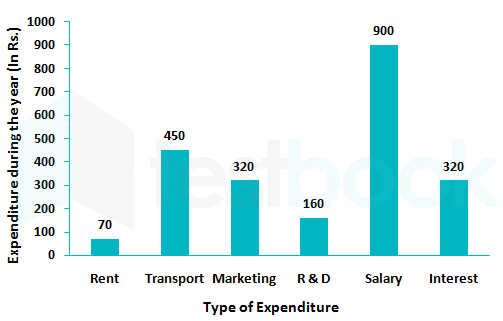
The bar graph shows the expenditure (in Rs) during the year. If the profit percentage is 26%, then what was the revenue for the year? (Profit Percentage = Profit ÷ Sales  × 100)

  1. AOption (a)

    Rs 2,700

  2. BOption (b)

    Rs 3,000

  3. COption (c)

    Rs 2,850

  4. DOption (d)

    Rs 3,300

View answer & explanation

Correct answer

Answer: (b)B.

Rs 3,000

Why this answer is correct

Given:

Profit percentage during the year = 26%

Concept:

Revenue = Expenditure + Profit

Profit % = ProfitRevenue×100\dfrac{Profit}{Revenue} × 100

Calculation:

Total expenditure = 70 + 450 + 320 + 160 + 900 + 320 = 2220

Let the total revenue = R and profit = P

⇒ R = 2220 + P

Profit % = ProfitRevenue×100\dfrac{Profit}{Revenue} × 100

⇒ 26 = P2220+P×100\dfrac{P}{2220 + P} × 100

⇒ 26 × 2220 + 26P = 100P

⇒ 74P = 26 × 2220

⇒ P = 780

∴ Revenue for the year = 2220 + 780 = Rs 3000.

Question 47

Table What is the same number of colour crayons sold by the shop in 5 years?


Yearcrayon colours
RedBlueYellowGreen
2015166011601900880
20161440134018001180
20171640120020002000
20181880102018001020
2019198096011001080
  1. AOption (a)

    yellow and green

  2. BOption (b)

    blue and green

  3. COption (c)

    red and yellow

  4. DOption (d)

    Red and green

View answer & explanation

Correct answer

Answer: (c)C.

red and yellow

Why this answer is correct

Given:

Crayons sold by the shop in 5 different years

Calculation:

Total number of crayons sold by the shop over 5 years(colour wise):

Red = 1660 + 1440 + 1640 + 1880 + 1980 = 8600

Blue = 1160 + 1340 + 1200 + 1020 + 960 = 5680

Yellow = 1900 + 1800 + 2000 + 1800 + 1100 = 8600

Green = 880 + 1180 + 2000 + 1020 + 1080 = 6160

∴ The same number of colour crayons sold by the shop in 5 years = Red & Yellow = 8600

Question 48

10 people can collect 100 kgs of rice from the field in 12 hours. How many kgs of rice can 12 men collect in 10 hours if all have the same efficiency?

  1. AOption (a)

    100 kg

  2. BOption (b)

    96 kg

  3. COption (c)

    144 kg

  4. DOption (d)

    120 kg

View answer & explanation

Correct answer

Answer: (a)A.

100 kg

Why this answer is correct

Given:

10 people working for 12 hours can collect 100 kgs of rice

Formula used:

m1×h1w1=m2×h2w2\dfrac{m1 \times h1}{w1} = \dfrac{m2 \times h2}{w2}

Where,

m1 = Men1 

m2 = Men2 

h1 = Hour1, h2 = Hour2

w1 = Work1 , w2 = Work2

Calculation:

According to the question:

10×12100=12×10w2\dfrac{10 \times 12}{100} = \dfrac{12 \times 10}{w2}

⇒ w2 = 100

∴ 12 men can collect 100 kgs of rice in 10 hours.

Question 49

X is 5 times efficient than Y and takes 48 days less than Y to complete a piece of work. In how many days together can they complete the work if they work on alternate days?

  1. AOption (a)

    20

  2. BOption (b)

    10

  3. COption (c)

    15

  4. DOption (d)

    12

View answer & explanation

Correct answer

Answer: (a)A.

20

Why this answer is correct

Given:

X is 5 times more efficient than Y

X takes 48 days less than Y to complete the work

Concept:

The ratio of efficiency is the reverse of the ratio of time taken.

Calculation:

EfficiencyTime taken
X51
Y15

According to the question,

Difference in time taken = 4 units =48 days

⇒ 1 unit = 12 days

⇒ Time taken by X = 12 days

⇒ Time taken by Y = 60 days

Let the total work be 60 units(take LCM of the number of days)

Efficiency per day of X and Y = 5 units and 1 unit

Work done by them in 2 days = 5 + 1 = 6 units

∴ To complete the 60 units work, working alternatively = (60/6) × 2 = 20 days.

Question 50

The bar graph shows the gold reserves ($ in millions) of a country for the given years. What is the ratio of the number of years in which gold reserves are above average reserves to the number of years in which reserves are less than average reserves?

  1. AOption (a)

    3 ∶ 5 

  2. BOption (b)

    5 ∶ 3

  3. COption (c)

    1 ∶ 1

  4. DOption (d)

    1 ∶ 3

View answer & explanation

Correct answer

Answer: (a)A.

3 ∶ 5 

Why this answer is correct

Given:

Gold reserves ($ in millions) over different years of a country

Formula used:

Average of n numbers = sum of the numbers/n

Calculation:

Total sum of gold reserves over the years

⇒ 71000 + 60400 + 67600 + 66000 + 68000 + 79000 + 69000 + 79000

= 560000

Numbers of years = 8

Average = 560000/8 = 70000

So, numbers of years having above average reserves = 3

Numbers of years having below average reserves = 5

∴ Required ratio = 3 : 5

Question 51

By selling 50 boxes for Rs 10,000, there is a loss equal to the cost of 25 boxes. What is the cost price of 1 box?

  1. AOption (a)

    Rs 100

  2. BOption (b)

    Rs 250

  3. COption (c)

    Rs 400

  4. DOption (d)

    Rs 320

View answer & explanation

Correct answer

Answer: (c)C.

Rs 400

Why this answer is correct

Given:

Selling price(SP) of 50 boxes = Rs. 10,000

Loss = Cost price(CP) of 25 boxes

Formula used:

SP = CP - Loss,

Where, SP = Selling Price

CP = Cost Price

Calculation:

Let the cost price of one box be c

According to the question:

10,000 = 50c - 25c

⇒ 25c = 10,000

∴ Cost price of 1 box = c = Rs. 400.

Question 52

What is the approximate ratio of 40 inches and 2 meters?

  1. AOption (a)

    1 ∶ 2 

  2. BOption (b)

    2 ∶ 5

  3. COption (c)

    1 ∶ 1

  4. DOption (d)

    1 ∶ 3

View answer & explanation

Correct answer

Answer: (a)A.

1 ∶ 2 

Why this answer is correct

Concept:

1 meter ~ 40 inches

Calculation:

40 inches : 2 meters

⇒ 40 : 80

∴ Approximate ratio of 40 inches and 2 meters = 1 : 2

Question 53

2 poles are 2.4 km apart from each other. A train 600 m long crosses both the poles in 60 seconds. Find the speed of the train.

  1. AOption (a)

    165 kmph

  2. BOption (b)

    200 kmph

  3. COption (c)

    189 kmph

  4. DOption (d)

    180 kmph

View answer & explanation

Correct answer

Answer: (d)D.

180 kmph

Why this answer is correct

Given:

Distance between the poles = 2.4 km

Length of the train = 600 m 

Time taken by the train to cross the poles = 60 seconds

Concept:

1 m/s = 18/5 kmph

Calculation:

Total distance covered by the train = 2.4 km(2400 m) + 600 m = 3000 m

Total time taken = 60 seconds

Speed = DistanceTime\dfrac{Distance}{Time}

⇒ Speed = 300060\dfrac{3000}{60} = 50 m/s

Since, 1 m/s = 18/5 kmph

∴ Speed = 50 × 18/5 = 180 kmph

Question 54

X takes a loan of Rs 3000 at 10% simple interest. Rs.1000 is paid at the end of every 1st year and 2nd year. What is the outstanding amount at the end of 2nd year after repayment?

  1. AOption (a)

    Rs 1550

  2. BOption (b)

    Rs 1530

  3. COption (c)

    Rs 1570

  4. DOption (d)

    Rs 1350

View answer & explanation

Correct answer

Answer: (b)B.

Rs 1530

Why this answer is correct

Given:

Loan amount = Rs 3000

Simple Interest = 10% per annum

Formula used:

Simple Interest(SI) = P×R×T100\dfrac{P \times R \times T}{100}

Where, P = Principal, R = Rate of interest, T = Time in year

Calculation:

According to the question:

SI at the end of 1st year = 10% of 3000 = 300

X paid Rs 1000 at the end of 1st year, then remaining amount to be paid after 1st year = 3300 - 1000 = 2300

SI at the end of 2nd year = 10% of 2300 = 230

X paid Rs 1000 at the end of 2nd year,

∴ Remaining amount to be paid after 2nd year = 2530 - 1000 = Rs 1530

Question 55

A lizard climbs 15 feet in 6 minutes but comes down 3 feet in the next 2 minutes. Then it continues to climb 8 feet every minute. How many minutes will the lizard take to climb a total of 44 feet?

  1. AOption (a)

    8

  2. BOption (b)

    10

  3. COption (c)

    15

  4. DOption (d)

    12

View answer & explanation

Correct answer

Answer: (d)D.

12

Why this answer is correct

Given:

Before falling, climbs 15 feet in 6 minutes

Falls for 3 feet in 2 minutes

After falling, 8 feet every minute

Calculation:

It climbs for 15 feet in 6 minutes, then falls for 3 feet in the next 2 minutes

⇒ 15 - 3 = 12 feet in 8 minutes

To climb 44 feet, it will climb 12 feet in the first 8 minutes then the remaining 32 feet with a speed of 8 feet per minute which means

It will take total 8 + (32/8) = 12 minutes

∴ It will take total of 12 minutes.

Question 56

What is the binary representation of the sum of the cubes of the first 6 whole numbers?

  1. AOption (a)

    11100001

  2. BOption (b)

    11010001

  3. COption (c)

    11110001

  4. DOption (d)

    11110101

View answer & explanation

Correct answer

Answer: (a)A.

11100001

Why this answer is correct

Given:

Sum of cubes of first 6 whole numbers

Concept:

Whole numbers start with 0

To convert a decimal number into a binary form, we divide it by 2 and take the value of remainders in reverse order.

Calculation:

Sum of cubes of 1st 6 whole numbers = 03 + 13 + 23 + 33 + 43 + 53 = 225

∴ The binary representation of the sum of the cubes of the first 6 whole numbers = 11100001

Question 57

A toy was sold for Rs 160 and a profit equal to the cost price of the toy was made. If the new profit is expected to be 50% more than the original profit, then find the required selling price.

  1. AOption (a)

    Rs 180

  2. BOption (b)

    Rs 200

  3. COption (c)

    Rs 220

  4. DOption (d)

    Rs 240

View answer & explanation

Correct answer

Answer: (b)B.

Rs 200

Why this answer is correct

Given:

Selling price(SP) of the toy = Rs 160

Profit(P) = Cost Price(CP) of the toy

Formula used:

SP = CP + P

Calculation:

According to the question:

160 = 2CP = 2P

⇒ CP = P = Rs 80

New profit = 150% of 80 = 120 = (150/100) × 80 = 120

Selling Price = CP + 120 = 80 + 120 = Rs. 200

∴ The required selling price is Rs. 200.

Question 58

A cone of radius 14 cm is placed at the top of a cylinder of the same radius. The height of the cylinder is the same as the radius of the base whereas the height of the cone is 3 times its radius. Find the volume of the solid.

  1. AOption (a)

    25872 cu cm

  2. BOption (b)

    17248 cu cm

  3. COption (c)

    8624 cu cm

  4. DOption (d)

    12936 cu cm

View answer & explanation

Correct answer

Answer: (b)B.

17248 cu cm

Why this answer is correct

Given:

Radius of cone = Radius of cylinder = Height of cylinder(h) = 14 cm

Height of the cone(H) = 3 × height of the cylinder = 3h = 42 cm

Formula used:

Volume of a cone = 13\dfrac{1}{3}πr²h

Where, r = Radius of cone, h = Height of the cone

Volume of a cylinder = πr²h

Where, r = Radius of cylinder, h = Height of cylinder

Calculation:

Volume of the cone = 13\dfrac{1}{3} × 227\dfrac{22}{7} × 142 × 42 = 8624 cm3

Volume of the cylinder =  227\dfrac{22}{7} × 142 × 14 = 8624 cm3 

∴ Volume of the solid = 8624 + 8624 = 17248 cm3

Question 59

In a rain shower, 10 cm of rainfalls. What is the volume of rainwater falling on 20 hectares of land?

  1. AOption (a)

    40,000 cu m

  2. BOption (b)

    5,000 cu m

  3. COption (c)

    20,000 cu m

  4. DOption (d)

    10,000 cu m

View answer & explanation

Correct answer

Answer: (c)C.

20,000 cu m

Why this answer is correct

Given:

Rainfall = 10 cm

Area of the land = 20 hectares

Concept:

1 hectare = 100,000,000 cm² = 10,000 m2

Volume = area under the rainfall × height of rainfall

Calculation:

According to the question:

The volume of rainwater = 20 hectares × 10 cm

By converting all units in the form or meter;

⇒ (20 × 10,000 m2) × (10/100 m)

⇒ 20,000 m3

∴ The volume of rainwater = 20,000 cu m

Question 60

The simple interest on a certain sum of money at 10% for 4 years is Rs 1200. What will be the compound interest at double the rate of interest per annum and double the principal for half of the time?

  1. AOption (a)

    Rs 2880

  2. BOption (b)

    Rs 2400

  3. COption (c)

    Rs 2640

  4. DOption (d)

    Rs 3200

View answer & explanation

Correct answer

Answer: (c)C.

Rs 2640

Why this answer is correct

Given:

Simple interest(SI) at 10% per annum for 4 years = Rs. 1200

Formula used:

SI = P×R×T100\dfrac{P × R × T}{100}

In Compound Interest(CI), Amount = P (1+R100)T\left(1+\dfrac{R}{100}\right)^T 

P = Principal, R = Rate of interest, T = Time period

CI = Amount - P

Calculation:

According to the question:

1200 = P×10×4100\dfrac{P × 10 × 4}{100}

⇒ P = Rs 3000

In the case of CI, P becomes 2P, R becomes 2R, T becomes T/2

So, Amount = 6000 (1+20100)2\left(1+\dfrac{20}{100}\right)^2

⇒ Amount = 6000 × (36/25)

⇒ Amount = Rs. 8640

The compound interest = 8640 - 6000 = Rs. 2640

∴ The compound interest is Rs. 2640.

General English (20 questions)

Question 61

Fill in the blank with the most appropriate choice.

By preventing Kim Jong-II from acquiring nuclear materials before he became even more _______, we thought we could prevent war.

  1. AOption (a)

    serendipitous

  2. BOption (b)

    exorable

  3. COption (c)

    belligerent

  4. DOption (d)

    impecunious

View answer & explanation

Correct answer

Answer: (c)C.

belligerent

Why this answer is correct

The correct answer is 'belligerent'.

Key Points

  • Let's explore the meaning of the given options:
WordMeaningExample
serendipitoushappening or found by chanceReading should be an adventure, a personal experience full of serendipitous surprises.
exorableable to be persuaded or moved by pleading.Without reform, the result is an Exorable middle-class tax increase.
belligerentwishing to fight or argueWatch out! Lee's in a belligerent mood.
impecunioushaving very little moneyI first knew him as an impecunious student living in a tiny apartment.


  • Thus, from the above-given explanation, we can say that 'belligerent' will be used in the blank.
  • Therefore, the correct answer is option 3.

Question 62

Select the most appropriate meaning of the given idiom.

A bird in the hand is worth two in the bush

  1. AOption (a)

    To become more comfortable in whatever you are doing

  2. BOption (b)

    Having something that is certain is much better than taking a risk for more, because chances are you might loss everything.

  3. COption (c)

    Divided into two equal parts

  4. DOption (d)

    A very tasty food or meal

View answer & explanation

Correct answer

Answer: (b)B.

Having something that is certain is much better than taking a risk for more, because chances are you might loss everything.

Why this answer is correct

The correct answer is  'Having something that is certain is much better than taking a risk for more, because chances are you might losing everything.'

Key Points 

  • A bird in the hand is worth two in the bush : It is an idiomatic phrase which means Having something for certain is better than the possibility of getting something better.
  • Example: I think I'll keep my modest winnings rather than wagering them all on the next horse race. A bird in the hand is worth two in the bush.
  • Thus, from above we can say that the correct answer is option 2.

Question 63

Select the word that is similar in meaning (SYNONYM) to the word given below.

Aggregate

  1. AOption (a)

    Conservation

  2. BOption (b)

    Congregation

  3. COption (c)

    Accumulation

  4. DOption (d)

    Assimilation

View answer & explanation

Correct answer

Answer: (c)C.

Accumulation

Why this answer is correct

The correct answer is 'Accumulation'.

Key Points

  • Let's explore the meaning of the marked word and the given word.
  • Aggregate: something formed by adding together several amounts or things.
  • Example: They purchased an aggregate of 3,000 shares in the company.
  • Accumulation: to collect a large number of things over a long period of time
  • Example: As people accumulate more wealth, they tend to spend a greater proportion of their incomes.
  • From above, we can refer that the correct answer is option 3.

Additional Information 


  • Conservation: the protection of plants and animals, natural areas, and interesting and important structures and buildings, especially from the damaging effects of human activity.
  • Example: The main objectives are the conservation of materials and energy in support of the sustainable development program.
  • Congregation: a group of people who have come together in a religious building for worship and prayer.
  • Example: The priest asked the congregation to kneel.
  • Assimilation: the process of becoming a part, or making someone become a part, of a group, country, society, etc.
  • Example: The assimilation of ethnic Germans in the US was accelerated by the two world wars.

Question 64

Select the word that is similar in meaning (SYNONYM) to the word given below.

Conformist

  1. AOption (a)

    Eccentric

  2. BOption (b)

    Coveted

  3. COption (c)

    Traditionalist

  4. DOption (d)

    Rebel

View answer & explanation

Correct answer

Answer: (c)C.

Traditionalist

Why this answer is correct

The correct answer is 'Traditionalist'.

Key Points

  • Let's explore the meaning of the marked word and the given word.
  • Conformist: someone who behaves or thinks like the other people in a group and doesn't do anything unusual.
  • Example: She was the conformist daughter while her sister was a rebel.
  • Traditionalist: someone who respects tradition and does not like change.
  • Example: His was a traditionalist approach to cricket.
  • From above, we can refer that the correct answer is option 3.

Additional Information 


  • Eccentric: strange or unusual, sometimes in a humorous way.
  • Example: My mother is something of an eccentric.
  • Coveted: strongly desired by many.
  • Example: The Caldecott Medal is a coveted children’s book award.
  • Rebel: a person who is opposed to the political system in their country and tries to change it using force.
  • Example: The rebels took over the capital and set up a new government.

Question 65

Select the most appropriate meaning of the given idiom.

Dog days of summer

  1. AOption (a)

    100% identical, a duplicate

  2. BOption (b)

    A reproof by wife to her husband

  3. COption (c)

    One who was previously unknown and is now prominent

  4. DOption (d)

    The hottest days of the summer season

View answer & explanation

Correct answer

Answer: (d)D.

The hottest days of the summer season

Why this answer is correct

The correct answer is 'The hottest days of the summer season'

Key Points


  • Dog days of summer: It is an idiomatic phrase which means the period in the summer often thought to be hottest, usually considered to be July 3 to August 11.
  • Example: As a kid, I loved lounging in the swimming pool during the dog days of summer.
  • Thus, from above we can say that the correct answer is option 4.

Question 66

The sentence below has been divided into three parts. Select the part of the sentence that has an error. If the sentence has no error, select the option 'No Error'.

McTeague finally snapped and yelled at Sabrina for her mischievous behaviour in the fit of rage.

  1. AOption (a)

    at Sabrina for her mischievous

  2. BOption (b)

    McTeague finally snapped and yelled

  3. COption (c)

    No error

  4. DOption (d)

    behaviour in the fit of rage.

View answer & explanation

Correct answer

Answer: (d)D.

behaviour in the fit of rage.

Why this answer is correct

The correct answer is 'behaviour in the fit of rage', i.e. the error lies in this part of the sentence.

Key Points

  • The error lies in the incorrect usage of idiom.
  • In a fit of rage: It is an idiomatic phrase which means an outburst that is often seen as unreasonable given the circumstances. 
  • Example: I hope younger players will take note of what happens when you tweet in a fit of rage.
  • Thus, the article 'the' needs to be replaced with 'a'.

Therefore, the correct sentence is: 'McTeague finally snapped and yelled at Sabrina for her mischievous behaviour in a fit of rage.'

Question 67

The question below consists of a set of labeled sentences. Out of four options given, select the most logical order of the sentences which form a paragraph.

Nelson Mandela was the son of Chief Mandela of the Madiba clan of the Xhosa-speaking Tembu people.

P. In 1944 he joined the African National Congress (ANC), a Black-liberation group, and became a leader of its Youth League.

Q. Nelson renounced his claim to the chieftainship to became a lawyer attending the South African Native College and studying law at the University of the Witwatersrand; he later passed the qualification exam to become a lawyer.

R. After his father's death, young Nelson was raised by Jong Intaba, the regent of the Tembu.

S. That same year he met and married Evelyn Ntoko Mase.

Mandela subsequently held other ANC leadership positions, through which he helped revitalize the organization and oppose the apartheid policies of the ruling National Party.

  1. AOption (a)

    SQPR

  2. BOption (b)

    PRQS

  3. COption (c)

    PSQR

  4. DOption (d)

    RQPS

View answer & explanation

Correct answer

Answer: (d)D.

RQPS

Why this answer is correct

The correct answer is 'RQPS'.

Key Points

  • While arranging the parts of the passage,  we should find some grammatical or contextual connections between them-
  • R follows sentence 1 as it mentions that Nelson was brought up by the member of the clan that was mentioned in sentence 1.
  • Q follows sentence R as it mentions that Nelson renounced his claim to the chieftainship when he grew up and passed the exam to become a lawyer.
  • P follows sentence Q as it mentions he joined African National College(ANC) in 1944 and became its youth leader.
  • S is the last sentence.

 Thus, the correct order is RQPS:

  • Nelson Mandela was the son of Chief Mandela of the Madiba clan of the Xhosa-speaking Tembu people.
  • R. After his father's death, young Nelson was raised by Jong Intaba, the regent of the Tembu.
  • Q. Nelson renounced his claim to the chieftainship to became a lawyer attending the South African Native College and studying law at the University of the Witwatersrand; he later passed the qualification exam to become a lawyer.
  • P. In 1944 he joined the African National Congress (ANC), a Black-liberation group, and became a leader of its Youth League.
  • S. That same year he met and married Evelyn Ntoko Mase.
  • Mandela subsequently held other ANC leadership positions, through which he helped revitalize the organization and oppose the apartheid policies of the ruling National Party.

Question 68

Select the word segment that substitutes (replaces) the bracketed word segment correctly and completes the sentence meaningfully. Select the option 'no correction required' if the sentence is correct as given.

The suspect was (taken unawares, without the chance to dispose) the evidence.

  1. AOption (a)

    taken unawares, without the chance to dispose off

  2. BOption (b)

    No correction required

  3. COption (c)

    taken unawares, without the chance to dispose of

  4. DOption (d)

    taken unaware, without the chance to dispose

View answer & explanation

Correct answer

Answer: (c)C.

taken unawares, without the chance to dispose of

Why this answer is correct

The correct answer is 'taken unawares, without the chance to dispose of'.

Key Points

  • The error lies in the incorrect usage of the phrasal verb.
  • Dispose of: It is a phrasal verb which means to get rid of someone or something or deal with something so that the matter is finished.
  • Example: It took only five minutes for the world champion to dispose of (= defeat) his opponent.
  • Thus, the correct answer is option 3.

Therefore, the correct sentence is: 'The suspect was taken unawares, without the chance to dispose of the evidence.'

Additional Information

  • Phrasal verb: a phrase that consists of a verb with a preposition or adverb or both, the meaning of which is different from the meaning of its separate parts.

Question 69

Select the most appropriate 'one word' for the expressions given below.

Developing friendlier relationship between countries or groups of people who have been enemies

  1. AOption (a)

    Cryptic

  2. BOption (b)

    Onerous

  3. COption (c)

    Rapprochement

  4. DOption (d)

    Discrepancy

View answer & explanation

Correct answer

Answer: (c)C.

Rapprochement

Why this answer is correct

The correct answer is 'Rapprochement'.

Key Points


  • Rapprochement:  the establishment of a good relationship between two countries or groups of people, after a period of unfriendly relations.
  • Example: Both countries have agreed to seek a rapprochement.
  • Thus, from above, the correct answer is option 3.

Additional Information 

  • Cryptic: having a meaning that is mysterious or obscure.
  • Onerous: (of a task, duty, or responsibility) involving an amount of effort and difficulty that is oppressively burdensome.
  • Discrepancy:  a lack of compatibility or similarity between two or more facts.

Question 70

Select the most appropriate 'one word' for the expression given below.

Displaying wealth, knowledge, etc., in a way that is meant to attract attention, admiration, or envy

  1. AOption (a)

    Truculent

  2. BOption (b)

    Ostentatious

  3. COption (c)

    Sleaze

  4. DOption (d)

    Acquisitive

View answer & explanation

Correct answer

Answer: (b)B.

Ostentatious

Why this answer is correct

The correct answer is 'Ostentatious'.

Key Points  

  • Ostentatious: characterized by vulgar or pretentious display; designed to impress or attract notice.
  • Example: They criticized the ostentatious lifestyle of their leaders.
  • Thus, from above, the correct answer is option 2.

Additional Information 

  • Truculent: unpleasant and likely to argue a lot.
  • Sleaze: behave in an immoral, corrupt, or sordid way.
  • Acquisitive: excessively interested in acquiring money or material things.

Question 71

Select the word segment that substitutes (replaces) the bracketed word segment correctly and completes the sentence meaningfully. Select the option 'no correction required' if the sentence is correct as given.

The sounds, which he had not heard for so long, (had an even more pleasurable and exhilarating effect on Rostov then the) previous sounds of firing.

  1. AOption (a)

    had an even more pleasurable and exhilarating affect on Rostov than the 

  2. BOption (b)

    No correction required

  3. COption (c)

    had an even more pleasurable and exhilarating affect on Rostov then the

  4. DOption (d)

    had an even more pleasurable and exhilarating effect on Rostov than the

View answer & explanation

Correct answer

Answer: (d)D.

had an even more pleasurable and exhilarating effect on Rostov than the

Why this answer is correct

The correct answer is 'had an even more pleasurable and exhilarating effect on Rostov than the'.

Key Points

  • The error lies in the incorrect usage of adjective in place of conjunction.
  • 'Then' needs to be replaced with 'than'.
  • Then: It is an adjective which means at that time (in the past or in the future).
  • Example: She was then sixteen years old.
  • Than: it is a conjunction and it is used to join two parts of a comparison.
  • Example: My son is a lot taller than my daughter.

Therefore, the correct sentence is: 'The sounds, which he had not heard for so long, had an even more pleasurable and exhilarating effect on Rostov than the previous sounds of firing.'

Question 72

The sentence below has been divided into three parts. Select the part of the sentence that has an error. If the sentence has no error, select the option 'No Error'.

The sudden rush into the space was to confuse the astronauts to observe their reaction in a situation like that.

  1. AOption (a)

    The sudden rush into the space was to

  2. BOption (b)

    reaction in a situation like that.

  3. COption (c)

    confuse the astronauts to observe their 

  4. DOption (d)

    No error

View answer & explanation

Correct answer

Answer: (a)A.

The sudden rush into the space was to

Why this answer is correct

The correct answer is 'The sudden rush into the space was to', i.e. the error lies in this part of the sentence.

Key Points

  • The error lies in the incorrect usage of the article before the noun 'space'.
  • Article 'the' needs to be removed before the noun 'space'.
  • Space here in the sentence is talking about space exploration or outer space and space beyond our atmosphere is more of an abstract concept, and certainly not specific. It is thus uncountable and does not take an article.
  • Article 'the' is used before space to express a very specific space.
  • Example; The space between the chair and the table is empty.

Therefore, the correct answer is: 'The sudden rush into space was to confuse the astronauts to observe their reaction in a situation like that.'

Question 73

Four words are given, out of which only one word is spelt correctly. Choose the correctly spelt word.

  1. AOption (a)

    Adharent

  2. BOption (b)

    Adharant

  3. COption (c)

    Adherant

  4. DOption (d)

    Adherent

View answer & explanation

Correct answer

Answer: (d)D.

Adherent

Why this answer is correct

The correct answer is 'Adherent'.

Key Points

  • Adherent: someone who strongly supports an idea, plan, person, etc. (कोई व्यक्ति जो किसी विचार, योजना, व्यक्ति आदि का पुरजोर समर्थन करता है)
  • Example: She has been an adherent of homeschooling for years.
  • Thus, from above, we can refer that the correct answer is option 4.

Question 74

Fill in the blank with the most appropriate choice.

With her _______ calm she did not begin to speak in front of the valet.

  1. AOption (a)

    unimpeachable

  2. BOption (b)

    irreparable

  3. COption (c)

    credulous

  4. DOption (d)

    imperturbable

View answer & explanation

Correct answer

Answer: (d)D.

imperturbable

Why this answer is correct

The correct answer is 'imperturbable'.

Key Points

  • Let's explore the meaning of the given options:
WordMeaningExample
unimpeachableof such a high standard of honesty and moral goodness that it cannot be doubted or criticizedA spokesman said the Bishop was a man of unimpeachable integrity and character.
irreparableimpossible to repair or make right againUnless the oil spill is contained, irreparable damage will be done to the coastline.
creduloustoo willing to believe what you are told and so easily deceivedIn a credulous system, both conclusions would be acceptable, whereas in a sceptical system neither of them would.
imperturbablealways staying calm and controlled, even in difficult situations that would cause other people to worryHe was imperturbable in a crisis.


  • Thus, from the above-given explanation, we can say that 'imperturbable' will be used in the blank.
  • Therefore, the correct answer is option 4.

Question 75

Four words are given, out of which only one word is spelt correctly. Choose the correctly spelt word.

  1. AOption (a)

    Emanceiated

  2. BOption (b)

    Emacianted

  3. COption (c)

    Emaciated

  4. DOption (d)

    Emanciated

View answer & explanation

Correct answer

Answer: (c)C.

Emaciated

Why this answer is correct

The correct answer is 'Emaciated'.

Key Points

  • Emaciated: very thin and weak, usually because of illness or extreme hunger. (बहुत पतला और कमजोर, आमतौर पर बीमारी या अत्यधिक भूख के कारण)
  • Example: There were pictures of emaciated children on the cover of the magazine.
  • Thus, from above, we can refer that the correct answer is option 3.

Direction: A passage is given with 5 questions following it. Read the passage carefully and choose the best answer to each question out of the four alternatives.

Palaces are known for their beauty and splendour, but they offer little protection against attacks. It is easy to defend a fortress, but fortresses are not designed with the comfort of a king or queen in mind. When it comes to structures that are both majestic and well-fortified, the classic European castle is the pinnacle of design. Across the ages castles change, developed, and eventually fell out of use, but they still command the fascination of our culture.

Castles were originally built in England by Norman invaders in 1066. As William the Conqueror advanced through England, he fortified key positions to secure the land he had taken. The castles he built allowed the Norman lords to retreat to safety when threatened by English rebellion. Castles also served as bases of operation for offensive attacks. Troops were summoned to, organized around, and deployed from castles. In this way castles served both offensive and defensive roles in military operations.

Not limited to military purposes, castles also served as offices from which the lord would administer control over his fiefdom. That is to say, the lord of the land would hold court in his castle. Those that were socially beneath the lord would come to report the affairs of the hands that they governed and pay tribute to the lord. They would address disputes, handle business, feast, and enjoy festivities. In this way castles served as important social centres in medieval England. Castles also served as symbols of power. Built in prominent sites overlooking the surrounding areas, castles constantly loomed in the background of many peasants' lives and served as a daily reminder of the lord's strength.

Question 76

Where did castles originate?

  1. AOption (a)

    France

  2. BOption (b)

    Spain

  3. COption (c)

    Italy

  4. DOption (d)

    England

View answer & explanation

Correct answer

Answer: (d)D.

England

Why this answer is correct

The correct answer is 'England'.

Key Points

  • Let's refer to the following lines of the passage:
  • Castles were originally built in England by Norman invaders in 1066.
  • Thus, from above, we can infer that the castles originated from England.
  • Therefore, the correct answer is option 4.

Question 77

According to the passage, which of the following statement is incorrect?

  1. AOption (a)

    Castles were a symbol of power and were built on strategic sites.

  2. BOption (b)

    A castle retains all the aesthetics of a palace while also maintaining great fortification.

  3. COption (c)

    Castles were first built in England in 1066 by Norman invaders.

  4. DOption (d)

    Palaces are beautiful and marvellous architectures but lack the fortification of fortress.

View answer & explanation

Correct answer

Answer: (a)A.

Castles were a symbol of power and were built on strategic sites.

Why this answer is correct

The correct answer is 'Castles were a symbol of power and were built on strategic sites.'

Key Points

  • Let's refer to the following lines of the passage:
  • Built in prominent sites overlooking the surrounding areas, castles constantly loomed in the background of many peasants' lives and served as a daily reminder of the lord's strength.
  • When it comes to structures that are both majestic and well-fortified, the classic European castle is the pinnacle of design.
  • Castles were originally built in England by Norman invaders in 1066.
  • Palaces are known for their beauty and splendour, but they offer little protection against attacks.
  • From above, we can infer that the correct answer is option 1, because strategic means designed or planned to serve a particular purpose whereas prominent means something important. The castles are built to served multiple purposes according to the passage, therefore, the incorrect statement among the given statements is statement 1.

Question 78

According to the passage where were castle usually built?

  1. AOption (a)

    Through out the city

  2. BOption (b)

    Prominent sites

  3. COption (c)

    Strategic sites

  4. DOption (d)

    Outskirts of the cities

View answer & explanation

Correct answer

Answer: (b)B.

Prominent sites

Why this answer is correct

The correct answer is 'Prominent sites'.

Key Points

  • Let's refer to the following lines of the passage:
  • Built in prominent sites overlooking the surrounding areas, castles constantly loomed in the background of many peasants' lives and served as a daily reminder of the lord's strength.
  • Thus, from above, we can infer that the correct answer is option 2.

Question 79

According to the passage, what is the major difference between a palace and fortress?

  1. AOption (a)

    Palaces and Fortresses are the same in terms of fortification but differ in looks and comfort.

  2. BOption (b)

    Palaces and Fortresses are the same in terms of looks and comfort but differ in the fortification.

  3. COption (c)

    Palaces are beautiful and marvellous architectures but lack the fortification of fortress.

  4. DOption (d)

    Fortresses are beautiful and marvellous architectures but lack the fortification of palaces.

View answer & explanation

Correct answer

Answer: (c)C.

Palaces are beautiful and marvellous architectures but lack the fortification of fortress.

Why this answer is correct

The correct answer is 'Palaces are beautiful and marvellous architectures but lack the fortification of fortress.'

Key Points

  • Let's refer to the following lines of the passage:
  • Palaces are known for their beauty and splendour, but they offer little protection against attacks.
  • Thus, from above, we can infer that the correct answer is option 3.

Question 80

What is the difference between a castle and a palace?

  1. AOption (a)

    A castle retains all the aesthetics of a palace while also maintain great fortification.

  2. BOption (b)

    A palace retains all the aesthetics of a castle while also maintain better fortificaion.

  3. COption (c)

    A palace has better fortification but lacks all the comfort and aesthetics of a castle.

  4. DOption (d)

    A castle has better fortification but lacks all the comfort and aesthetics of a palace.

View answer & explanation

Correct answer

Answer: (a)A.

A castle retains all the aesthetics of a palace while also maintain great fortification.

Why this answer is correct

The correct answer is 'A castle retains all the aesthetics of a palace while also maintain great fortification.'

Key Points

  • Let's refer to the following lines of the passage:
  • Palaces are known for their beauty and splendour, but they offer little protection against attacks. It is easy to defend a fortress, but fortresses are not designed with the comfort of a king or queen in mind. When it comes to structures that are both majestic and well-fortified, the classic European castle is the pinnacle of design.
  • The castles he built allowed the Norman lords to retreat to safety when threatened by English rebellion. Castles also served as bases of operation for offensive attacks.
  • Thus, from above we can infer that the Palaces offered aesthetic designs but are vulnerable to attacks whereas the castles are not only majestic in designs but also offered protection from attacks.
  • Therefore, the correct answer is option 1.

General Hindi (20 questions)

Question 81

निम्नलिखित प्रश्न में, चार विकल्पों में से, उस विकल्प का चयन करें जो दिए गए शब्द का समानार्थी शब्द का सही विकल्प हो।

अरण्य

  1. AOption (a)

    कांत

  2. BOption (b)

    मेदिनी

  3. COption (c)

    विपिन

  4. DOption (d)

    कुंतल

View answer & explanation

Correct answer

Answer: (c)C.

विपिन

Why this answer is correct

उपर्युक्त विकल्पों में से विकल्प "विपिन" सही है तथा अन्य विकल्प असंगत है।

Key Points

  • अरण्य शब्द का समानार्थी शब्द विपिन है।
  • अरण्य का अर्थ वन या जंगल से है।
  • अरण्य के पर्याय
  • गहन, अख्य, कान्तार, जंगल, विपिन, कानन, वन

Additional Information

  • कांत
  • विशेषण
  • सुंदर
  • प्रिय और रुचिकर।
  • पुल्लिंग
  • प्रेमी
  • पति, स्वामी।
  • मेदिनी के पर्याय
  • पृथ्वी, इला, धरा, क्षिति, धरित्री, भू, धरणी, उर्वी, धरती, अवनि, मही, वसुंधरा, वसुधा।
  • कुंतल के पर्याय
  • अलक, चिकुर, केश, बाल, कच

Question 82

निम्नलिखित प्रश्न में, चार विकल्पों में से, उस विकल्प का चयन करें जो दिए गए लोकोक्ति के अर्थ का सही विकल्प हो।

काठ की हांडी बार-बार नहीं चढ़ती

  1. AOption (a)

    किसी काम का ना होना

  2. BOption (b)

    जो मिल जाए वह काफी है

  3. COption (c)

    बेईमानी बार-बार नहीं चलती

  4. DOption (d)

    सब बर्बाद हो जाना

View answer & explanation

Correct answer

Answer: (c)C.

बेईमानी बार-बार नहीं चलती

Why this answer is correct

उपर्युक्त विकल्पों में से विकल्प "बेईमानी बार-बार नहीं चलती" सही है तथा अन्य विकल्प असंगत है।

Key Points

  • "काठ की हांडी बार-बार नहीं चढ़ती" :-  
  • बेईमानी बार-बार नहीं चलती।
  • छल-कपट का व्यवहार हमेशा नहीं चलता।
  • वाक्य प्रयोग :-
  • तुमने एक बार झूठ बोलकर मुझसे सहायता ले ली तुम्हें क्या लगता है कि कोई फिर तुम्हारी सहायता करेगा क्या तुम नहीं जानते काठ की हांडी चढ़ न दूजो बार।

Additional Information

  • कुछ महत्त्वपूर्ण मुहावरे एवं उनके वाक्यों में प्रयोग
  • अँगारे बरसना :- अत्यधिक गर्मी पड़ना।
  • जून मास की दोपहरी में अंगारे बरसते प्रतीत होते हैं।
  • अंगारों पर पैर रखना :- कठिन कार्य करना।
  • युद्ध के मैदान में हमारे सैनिकों ने अंगारों पर पैर रखकर विजय प्राप्त की।
  • अँगारे सिर पर धरना :- विपत्ति मोल लेना।
  • सोच-समझकर काम करना चाहिए। उससे झगड़ा लेकर व्यर्थ ही अंगारे सिर पर मत धरो।
  • अँगूठा चूसना :- बड़े होकर भी बच्चों की तरह नासमझी की बात करना।
  • कभी तो समझदारी की बात किया करो। कब तक अंगूठा चूसते रहोगे?
  • अँगूठा दिखाना :- इनकार करना।
  • जब कृष्णगोपाल मन्त्री बने थे तो उन्होंने किशोरी को आश्वासन दिया था कि जब उसका बेटा इण्टर कर लेगा तो वह उसकी नौकरी लगवा देंगे। बेटे के प्रथम श्रेणी में उत्तीर्ण होने पर किशोरी ने उन्हें याद दिलाई तो उन्होंने उसे अँगूठा दिखा दिया।

Question 83

निम्नलिखित प्रश्न में, चार विकल्पों में से, उस विकल्प का चयन करें जो दिए गए तत्सम शब्द का सही विकल्प हो।

सेठ

  1. AOption (a)

    सात

  2. BOption (b)

    साँस

  3. COption (c)

    श्रेष्ठी

  4. DOption (d)

    सिंगार

View answer & explanation

Correct answer

Answer: (c)C.

श्रेष्ठी

Why this answer is correct

उपर्युक्त विकल्पों में से विकल्प "श्रेष्ठी" सही है तथा अन्य विकल्प असंगत है।

Key Points

  • सेठ शब्द का तत्सम रूप श्रेष्ठी है।
  • सेठ
  • पुल्लिंग
  • महाजन।
  • धनी आदमी।

Important Points

  • तत्सम शब्द
  • तत्सम शब्द संस्कृत भाषा के दो शब्दों, तत् + सम् से मिलकर बना है। तत् का अर्थ है - उसके, तथा सम् का अर्थ है - समान।
  • जिन शब्दों को संस्कृत से बिना किसी परिवर्तन के ले लिया जाता है, उन्हें तत्सम शब्द कहते हैं। इनमें ध्वनि परिवर्तन नहीं होता है।

Additional Information

  • तद्भव  :- तत्सम
  • सात :- सप्त
  • साँस :- श्वास
  • सिंगार :- श्रृंगार

Question 84

निम्नलिखित प्रश्न में, चार विकल्पों में से, उस विकल्प का चयन करें जो दिए गए शब्द का सही विलोम शब्द हो।

सक्रिय

  1. AOption (a)

    जोश

  2. BOption (b)

    निष्क्रिय

  3. COption (c)

    क्रियाशील

  4. DOption (d)

    फुर्तीला

View answer & explanation

Correct answer

Answer: (b)B.

निष्क्रिय

Why this answer is correct

उपर्युक्त विकल्पों में से विकल्प "निष्क्रिय" सही है तथा अन्य विकल्प असंगत है।

Key Points

  • सक्रिय शब्द का विलोम शब्द निष्क्रिय है।
  • सक्रिय
  • विशेषण
  • क्रिया में लगा हुआ
  • क्रियात्मक रूप में होनेवाला।
  • निष्क्रिय
  • विशेषण
  • काम-धाम न करनेवाला।
  • निश्चेष्ट

Additional Information

  • क्रियाशील
  • क्रिया का समास
  • विशेषण
  • कर्मनिष्ठ।
  • फुर्तीला
  • विशेषण
  • स्फ़ूर्तिवान।

Question 85

निम्नलिखित प्रश्न में, चार विकल्पों में से, उस विकल्प का चयन करें जो दिए गए वाक्य मे काल का सही विकल्प हो।

याद है, हम दोनों नदी किनारे घंटो घूमा करते थे।

  1. AOption (a)

    सन्दिग्ध भूतकाल

  2. BOption (b)

    पूर्ण वर्तमान काल

  3. COption (c)

    अपूर्ण भूतकाल

  4. DOption (d)

    सामान्य वर्तमान काल

View answer & explanation

Correct answer

Answer: (c)C.

अपूर्ण भूतकाल

Why this answer is correct

याद है, हम दोनों नदी किनारे घंटो घूमा करते थे। यह वाक्य 'अपूर्ण भूतकाल' का उदाहरण है।

Key Points 

याद है, हम दोनों नदी किनारे घंटो घूमा करते थे।– वाक्य अपूर्ण भूतकाल का है।

अपूर्णभूत– क्रिया के इस रूप से बोध होता है कि काम भूतकाल में हो रहा था, जैसे-

  • डाकू धीरे-धीरे आगे बढ़ते आ रहे थे।
  • पुजारी रोज शाम को आरती किया करता था।
  • याद है, हम दोनों नदी किनारे घण्टों घूमा करते थे।
  • वह सोता था।
  • चुनावी रंग निरन्तर बढ़ रहा था।
  • रोम जलता था नीरो बंशी बजाता था।
  • वे अँधेरे में ही आगे बढ़ रहे थे।
  • अँग्रेज झाँसी को हड़पने का षड्यंत्र रच रहे थे।
  • सीमा पर हमारे जवान दिन-रात पहरा देते थे।
  • हम बचपन में इस पार्क में खेला करते थे।
  • बहुत पहले पृथ्वी पर डायनासोर रही करते थे।
<br>

उपर्युक्त उदाहरणों में सोता था’, ‘बजाता था’, ‘बढ़ रहे थे’, ‘रच रहे थे’ खेला करते थे, रहा करते थे आदि क्रियाएँ अपूर्णभूत अर्थात् काम के चलते रहने का बोध कराती हैं। अतः ये सभी क्रियाएँ ‘अपूर्णभूत’ की हैं।

अतः धातु में क्रमशः-

  • ता था, ते थे, ती थी, ती थीं
  • रहा था, रहे थे, रही थी, रही थीं
  • ता आ रहा था, ते आ रहे थे, ती आ रही थी।
  • आ ता था, आ ते थे,……….

लगाकर अपूर्णभूत वाक्यों की रचना की जाती है।

अन्य विकल्प:​

भूतकाल के उपभेदवर्तमान काल के उपभेदभविष्य काल के उपभेद
सामान्य भूतकाल- जिस क्रिया के भूतकाल में क्रिया के सामान्य रूप से बीते समय में पूरा होने का संकेत मिले।सामान्य वर्तमान काल- क्रिया के जिस रूप से कार्य की पूर्णता और अपूर्णता का पता न चले।सामान्य भविष्य काल- क्रिया के जिस रूप से क्रिया के सामान्य रूप का भविष्य में होने का पता चले।
आसन्न भूतकाल- क्रिया के जिस रूप से यह पता चले कि क्रिया अभी कुछ समय पहले ही पूर्ण हुई हैअपूर्ण वर्तमान काल-  क्रिया के जिस रूप से कार्य के लगातार होने का पता चलता है।संभाव्य भविष्य काल- क्रिया के जिस रूप से आगे कार्य होने या करने की संभावना का पता चले।
पूर्ण भूतकाल- क्रिया के जिस रूप से यह पता चलता है की कार्य निश्चित किये गये समय से पहले ही पूरा हो चूका था।पूर्ण वर्तमान काल- क्रिया के जिस रूप से कार्य के अभी पूरे होने का पता चलता है।हेतुहेतुमद्भविष्य भविष्य काल: क्रिया के जिस रूप से एक कार्य का पूरा होना दूसरी आने वाले समय की क्रिया पर निर्भर हो।
अपूर्ण भूतकाल- क्रिया के जिस रूप से यह पता चलता है कि कार्य भूतकाल में पूरा नहीं हुआ था अपितु नियमित रूप से जारी रहा।संदिग्ध वर्तमान काल-क्रिया के जिस रूप से वर्तमान काल क्रिया के होने या करने पर शक हो।
संदिग्ध भूतकाल- क्रिया के जिस रूप से अतीत में हुए या करे हुए कार्य पर संदेह प्रकट किया जाये।तात्कालिक वर्तमान काल- क्रिया के जिस रूप से यह पता चलता हो कि कार्य वर्तमान में हो रहा है।
समयकालीन भूतकाल- जिन वाक्यों के अंत में रहा था , रही थी , रहे थे आदि आते हैं और समय का निश्चित बोध होता है।संभाव्य वर्तमान काल- संभाव्य का अर्थ होता है संभावित या जिसके होने की संभावना हो।

Additional Information 

काल- क्रिया के जिस रूप से किसी कार्य के करने या होने का समय पता चले, वह काल कहलाता है। उदाहरण- हैं, थे, होंगी आदि। काल तीन प्रकार के होते है-
कालपरिभाषाउदाहरण
वर्तमानकालक्रिया के जिस रूप से वर्तमान में चल रहे समय का पता चले, उसे वर्तमान काल कहते है। वर्तमान काल के पाँच भेद होते है- (i) सामान्य वर्तमानकाल (ii) अपूर्ण वर्तमानकाल (iii) पूर्ण वर्तमानकाल (iv) संदिग्ध वर्तमानकाल (v) तत्कालिक वर्तमानकाल (vi) संभाव्य वर्तमानकालवह तेज आवाज में गाना सुन रहा है। मेरा मन चाय पीने का कर रहा है।
भूतकालक्रिया के जिस रूप से बीते हुए समय का पता चले, उसे भूतकाल कहते है। भूतकाल के छह भेद होते है- (i) सामान्य भूतकाल (ii) आसन भूतकाल (iii) पूर्ण भूतकाल (iv) अपूर्ण भूतकाल (v) संदिग्ध भूतकाल (vi) हेतुहेतुमद् भूतमैंने पूरा खाना खा लिया था। हेमंत को घर छोड़ दिया था।
भविष्यतकालक्रिया के जिस रूप से भविष्य में होने वाली क्रिया का पता चले उसे भविष्यतकाल की क्रिया कहते है।वह सब उठा ले जाएगा। कल उसका बोरिया-बिस्तर यहाँ से उठ जाएगा।

Question 86

निम्नलिखित प्रश्न में, चार विकल्पों में से, उस विकल्प का चयन करें जो प्रत्यय शब्द का सही विकल्प हो।

  1. AOption (a)

    परिकल्पना

  2. BOption (b)

    दरमियान

  3. COption (c)

    अनहोनी

  4. DOption (d)

    सुहावना

View answer & explanation

Correct answer

Answer: (d)D.

सुहावना

Why this answer is correct

उपर्युक्त विकल्पों में से विकल्प "सुहावना" सही है तथा अन्य विकल्प असंगत है।

Key Points

  • सुहावना शब्द प्रत्यय का उदाहरण है।
  • सुहावना शब्द में आवना प्रत्यय है।
  • सुहावना
  • विशेषण
  • सुंदर और सुखद

Additional Information

  • परिकल्पना :- परि + कल्पना
  • दरमियान :- दर + मियान
  • अनहोनी :- अन + होनी
  • उपर्युक्त सभी उपसर्ग के उदाहरण है।

Question 87

निम्नलिखित प्रश्न में, चार विकल्पों में से, उस विकल्प का चयन करें जो दिए गए शब्द युग्म के अर्थ का सही विकल्प हो।

सर्प, हेय

  1. AOption (a)

    अन्य - अहि

  2. BOption (b)

    अहि - आहि

  3. COption (c)

    आहि - अनुचित

  4. DOption (d)

    अहम् - अहम

View answer & explanation

Correct answer

Answer: (b)B.

अहि - आहि

Why this answer is correct

उपर्युक्त विकल्पों में से विकल्प "अहि - आहि" सही है तथा अन्य विकल्प असंगत है।

Key Points

  • अहि
  • पुल्लिंग
  • साँप।
  • राहु।
  • आहि
  • हेय
  • विशेषण
  • घृणित और तुच्छ।

Additional Information

  • सर्प के पर्याय 
  • साँप, नाग, विषधर, भुजंग, अहि, उरग, काकोदर, फणीश, सारंग, व्याल
  • तुच्छ के पर्याय
  • खोखला, सारहीन, निःसार, अल्प, थोड़ा, नीच, घटिया, दो कौड़ी का, दुष्ट।

Question 88

निम्नलिखित प्रश्न में, चार विकल्पों में से, उस विकल्प का चयन करें जो दिए गए लोकोक्ति के अर्थ का सही विकल्प हो।

चोट्टी कुतिया जलेबी की रखवाली

  1. AOption (a)

    एक वस्तु के ग्राहक अनेक

  2. BOption (b)

    बुरे मनुष्य को प्रबंधक बनाना

  3. COption (c)

    एक काम से दोहरा लाभ

  4. DOption (d)

    दिखावा अधिक वास्तविकता कम

View answer & explanation

Correct answer

Answer: (b)B.

बुरे मनुष्य को प्रबंधक बनाना

Why this answer is correct

उपर्युक्त विकल्पों में से विकल्प "बुरे मनुष्य को प्रबंधक बनाना" सही है तथा अन्य विकल्प असंगत है।

Key Points

  • चोट्टी कुतिया जलेबी की रखवाली
  • बुरे मनुष्य को प्रबंधक बनाना
  • वाक्य प्रयोग
  • खेद का विषय है कि बहुधा ऐसे लोग चुनाव जीतकर मंत्री बन जाते हैं जिनका जीवन स्वयं भ्रष्टाचार से ग्रस्त है। सवाल उठता है कि वे जनता के हितों की रक्षा करेंगे? यह तो उसी तरह है जेसे 'चोट्टी कुतिया जलेबियों का रखवाली'।

Additional Information

  • अन्य उदाहरण
  • अँगूठी का नगीना :- अत्यधिक सम्मानित व्यक्ति अथवा वस्तु।
  • अकबर के नवरत्नों में बीरबल तो जैसे अंगूठी का नगीना थे।
  • अंग-अंग फूले न समाना :-अत्यधिक प्रसन्न होना। 
  • राम के अभिषेक की बात सुनकर कौशल्या का अंग-अंग फूले नहीं समाया।
  • अंगद का पैर होना :- अति दुष्कर/असम्भव कार्य होना।
  • यह पहाड़ी कोई अंगद का पैर तो है नहीं, जिसे हटाकर रेल की पटरी न बिछाई जा सके।
  • अन्धी सरकार :- विवेकहीन शासन।
  • कालाबाजारी खूब फल-फूल रही है, किन्तु अन्धी सरकार उन्हीं का पोषण करने में लगी है।
  • अन्धे की लाठी लकड़ी होना :- एकमात्र सहारा होना।
  • निराशा में प्रतीक्षा अन्धे की लाठी है।

Question 89

निम्नलिखित प्रश्न में, चार विकल्पों में से, उस विकल्प का चयन करें जो दिए गए संधि के संधि-विच्छेद का सही विकल्प हो।

स्वानुभव

  1. AOption (a)

    स्वा + अनुभव

  2. BOption (b)

    स्व + नुभव

  3. COption (c)

    स्व + अनुभव

  4. DOption (d)

    स्वानु + भाव

View answer & explanation

Correct answer

Answer: (c)C.

स्व + अनुभव

Why this answer is correct

दिए गए विकल्पों में से सही उत्तर विकल्प 3 'स्व + अनुभव’ है। अन्य विकल्प इसके गलत उत्तर हैं। 

Key Points

  • स्व + अनुभव (अ + अ = आ) 'स्वानुभव' यह दीर्घ संधि का उदाहरण है।
  • जब ह्रस्व या दीर्घ अ, इ, उ के बाद यदि ह्रस्व या दीर्घ आ, ई, ऊ आ जाएँ तो दोनों मिलकर दीर्घ आ, ई और ऊ हो जाते हैं, वह दीर्घ संधि होती है।
  • अन्य विकल्प इसके अनुचित उत्तर हैं।
  • ​स्वानुभव - स्वयं प्राप्त किया गया अनुभव।

Additional Information

संधि - दो शब्दों के मेल से जो विकार (परिवर्तन) होता है उसे संधि कहते हैं। संधि के तीन प्रकार हैं - 1. स्वर 2. व्यंजन और 3. विसर्ग।
स्वर संधिदो स्वरों के मेल से उत्पन्न होने वाले विकार को स्वर संधि कहते हैं। इसके इसके पाँच भेद हैं- दीर्घ, गुण, वृद्धि, यण, अयादि।स्वार्थ = स्व + अर्थ
व्यंजन संधिव्यंजन के बाद यदि किसी स्वर या व्यंजन के आने से उस व्यंजन में जो विकार / परिवर्तन उत्पन्न होता है वह व्यंजन संधि कहलाता है।दिग्गज = दिक् + गज
विसर्ग संधिविसर्ग के साथ स्वर अथवा व्यंजन के मिलने से जो विकार उत्पन्न होता है, उसे विसर्ग संधि कहते हैं।शिरोमणि = शिर: + मणि

Question 90

निम्नलिखित प्रश्न में, चार विकल्पों में से, उस विकल्प का चयन करें जो उपसर्ग शब्द का सही विकल्प हो।

  1. AOption (a)

    ग्रंथकार

  2. BOption (b)

    हाहाकार

  3. COption (c)

    निर्विकार

  4. DOption (d)

    नम्र

View answer & explanation

Correct answer

Answer: (c)C.

निर्विकार

Why this answer is correct

इसका सही उत्तर विकल्प 3 है। अन्य विकल्प सही उत्तर नहीं हैं।

  • 'निर्विकार' में 'निर' उपसर्ग है।
  • 'विकार' शब्द में 'निर' उपसर्ग जुड़कर 'निर्विकार' शब्द बना है।
  • इसका अर्थ- विकार रहित होता है।
  • अन्य विकल्प उचित उपसर्ग नहीं हैं।
  • ग्रंथकार का अर्थ ग्रन्थ को निर्माण करने वाला व्यक्ति।
  • हाहाकार का अर्थ घबराहट की चिल्लाहट।
  • नम��र का अर्थ विनीत, झुका हुआ।

उपसर्ग ऐसे शब्दांश जो किसी शब्द के पूर्व जुड़ कर उसके अर्थ में परिवर्तन कर देते हैं या उसके अर्थ में विशेषता ला देते हैं।

Question 91

निम्नलिखित प्रश्न में, चार विकल्पों में से, उस विकल्प का चयन करें जो दिए गए वाक्य का सही भेद हो।

बाढ़ का पानी भरता ही चला जा रहा है।

  1. AOption (a)

    आरम्भद्योतक

  2. BOption (b)

    प्रगतिद्योतक

  3. COption (c)

    नित्यताद्योतक

  4. DOption (d)

    अभ्यासद्योतक

View answer & explanation

Correct answer

Answer: (b)B.

प्रगतिद्योतक

Why this answer is correct

दिए गए विकल्पों के अनुसार विकल्प 2 ‘प्रगतिद्योतक’ वाक्य का सही उत्तर है अन्य विकल्प असंगत है l 

Key Points

  • इस क्रिया पक्ष में क्रिया की निरंतर प्रगति का बोध होता है,प्रगतिद्योतक पक्ष कहलाता हैं।

Additional Information

जिस रूप से क्रिया प्रक्रिया अर्थात क्रिया व्यापार का पता चलता है,उसे क्रिया का पक्ष कहते हैं।

आरंभद्योतकक्रिया के आरंभ होने की स्थिति का बोध होता है।रवि गाने लगा।
गतिद्योतकक्रिया की प्रक्रिया चालू रहने का बोध होता है।गाड़ी चल रही है।
प्रगतिद्योतकक्रिया की निरंतर प्रगति का बोध होता है।गेंद गड्ढे में गिरेगी ही।
पूर्णताद्योतकक्रिया की पूर्ण समाप्ति का बोध होता है।वह आ गया है।
नित्यताद्योतकक्रिया के सदा बने रहने का बोध होता है।धूप रोज होती है।
अभ्यासद्योतकक्रिया के स्वभाववश होने का बोध होता है।अभ्यास करते-करते रोहन को तैरना आ गया।

Question 92

निम्नलिखित प्रश्न में, चार विकल्पों में से, उस विकल्प का चयन करें जो दिए गए वाक्यांश के लिए सही विकल्प हो।

ऊपर लिखा हुआ-

  1. AOption (a)

    उपरिलिखित

  2. BOption (b)

    निम्नलिखित 

  3. COption (c)

    उपर्युक्त

  4. DOption (d)

    अवैतनिक

View answer & explanation

Correct answer

Answer: (a)A.

उपरिलिखित

Why this answer is correct

'ऊपर लिखा हुआ’ वाक्यांश के लिए एक शब्द है ‘उपरिलिखित’। 

जिसका उल्लेख ऊपर या पहले हो चुका हो। 

Key Points

अन्य विकल्प 

वाक्यांशवाक्यांश के लिए एक शब्द
वेतन न पाने या लेनेवालाअवैतनिक
ऊपर कहा गया।उपर्युक्त
नीचे लिखा हुआ।निम्नलिखित


Additional Information

अपनी बात को को सही रूप में प्रस्तुत करना भी एक कला है, भाषा को सुंदर, आकर्षक और प्रभावशाली बनाने के लिए जब अनेक शब्दों के स्थान पर एक ही शब्द का प्रयोग किया जाता है तो उसे वाक्यांश के लिए एक शब्द कहा जाता है।

Question 93

निम्नलिखित प्रश्न में, चार विकल्पों में से, उस विकल्प का चयन करें जो दिए गए वाक्य के प्रकार का सही विकल्प हो।

मोहन पुस्तकें खरीदकर घर से होता हुआ आपके पास पहुंचेगा।

  1. AOption (a)

    मिश्र वाक्य

  2. BOption (b)

    विधिवाचक वाक्य

  3. COption (c)

    साधारण वाक्य

  4. DOption (d)

    संयुक्त वाक्य

View answer & explanation

Correct answer

Answer: (c)C.

साधारण वाक्य

Why this answer is correct

मोहन पुस्तकें खरीदकर घर से होता हुआ आपके पास पहुंचेगा। यह साधारण वाक्य का प्रकार है। 

  • 'मोहन पुस्तकें खरीदकर घर से होता हुआ आपके पास पहुंचेगा।' एक साधारण वाक्य है क्योंकि इसमें एक ही विधेय है।
  • सरल वाक्य में एक ही विधेय होता है।
  • विधिवाचक या विधानवाचक वाक्य - वह वाक्य जिससे किसी प्रकार की जानकारी प्राप्त होती है, वह विधिवाचक या विधानवाचक वाक्य कहलाता है।
  • उदाहरण -भारत एक देश है।

Additional Information

वाक्यपरिभाषाउदाहरण
साधारणऐसे वाक्य जिनमें एक ही क्रिया एवं एक ही कर्ता होता है या जिस वाक्य में एक ही उद्देश्य एवं एक ही विधेय होता है, वे वाक्य सरल वाक्य कहलाते हैं। इसमें कर्ता एक से अधिक हो सकते हैं लेकिन मुख्य क्रिया एक ही होगी।राकेश पढ़ता है। कमला और विमला मंदिर जाती हैं।
संयुक्तजिस वाक्य में दो या दो से अधिक उपवाक्य मिले हों, परन्तु सभी वाक्य प्रधान हो तो ऐसे वाक्य को संयुक्त वाक्य कहते है।वह सुबह आगरा गया और शाम को लौट आया।
मिश्रजिस वाक्य में एक से अधिक वाक्य मिले हों, किन्तु एक प्रधान उपवाक्य तथा शेष आश्रित उपवाक्य हों, मिश्रित वाक्य कहलाता है।वह औरत जो पार्क में बैठी हैं मेरी मौसी हैं।

Question 94

निम्नलिखित प्रश्न में, चार विकल्पों में से, उस विकल्प का चयन करें जो उचित विराम चिन्ह युक्त वाक्य का सही विकल्प हो।

  1. AOption (a)

    तुलसीदास ने सत्य कहा है पराधीन सपनेहुं सुख नहीं।"

  2. BOption (b)

    तुलसीदास ने सत्य कहा है- "पराधीन सपनेहुं सुख नहीं

  3. COption (c)

    तुलसीदास ने सत्य कहा है ---- पराधीन सपनेहुं सुख नहीं।"

  4. DOption (d)

    तुलसीदास ने सत्य कहा है-"पराधीन सपनेहुं सुख नहीं।"

View answer & explanation

Correct answer

Answer: (d)D.

तुलसीदास ने सत्य कहा है-"पराधीन सपनेहुं सुख नहीं।"

Why this answer is correct

उपर्युक्त विकल्पों में तुलसीदास ने सत्य कहा है-"पराधीन सपनेहुं सुख नहीं।" - इस वाक्य में सही विराम चिन्हों का प्रयोग किया गया है।

Key Points

  • विराम चिन्ह – भाषा के लिखित रूप में विशेष स्थानों पर रुकने का संकेत करने वाले चिन्हों को विराम चिन्ह कहते हैं।

Additional Information

विराम चिन्ह का नामपरिभाषाउदाहरण
पूर्ण विराम चिन्ह (।)जहाँ एक बात पूरी हो जाये या वाक्य समाप्त हो जाये वहाँ पूर्ण विराम ( । ) चिन्ह लगाया जाता है।बाजार खुल गया।
अर्द्ध विराम चिन्ह (;)जहाँ अल्प विराम से कुछ अधिक ठहरते हैं तथा पूर्ण विराम से कम ठहरते हैं, वहाँ अर्द्ध विराम का चिन्ह ( ; ) लगाया जाता है।मुख्य अतिथि आ गए हैं; वह शीघ्र चले जाएंगे।
अल्प विराम चिन्ह (,)वाक्य में जहाँ थोड़ा रुकना हो या अधिक वस्तुओं, व्यक्तियों आदि को अलग करना हो वहाँ अल्प विराम ( , ) चिन्ह का प्रयोग किया जाता है।राकेश, मोहन, शीतल और पंकज ने यह चित्र बनाया है।
प्रश्नवाचक चिन्ह (?)बातचीत के दौरान जब किसी से कोई बात पूछी जाती है अथवा कोई प्रश्न पूछा जाता है, तब वाक्य के अंत में प्रश्नसूचक-चिन्ह का प्रयोग किया जाता है।तुम्हारी माताजी का नाम क्या है ?
विस्मयादिबोधक चिन्ह (!)इसका प्रयोग हर्ष, विवाद, विस्मय, घृणा, आश्रर्य, करुणा, भय, संबोधन इत्यादि का बोध कराने के लिए इस चिन्ह का प्रयोग किया जाता है।वाह! कितना सुंदर दृश्य है।
लाघव चिन्ह (०)किसी बड़े तथा प्रसिद्ध शब्द को संक्षेप में लिखने के लिए उस शब्द का पहला अक्षर लिखकर उसके आगे शून्य (०) लगा देते हैं। यह शून्य ही लाघव-चिन्ह कहलाता है।डॉक्टर – डॉ०, प्रोफेसर – प्रो०

Question 95

निम्नलिखित प्रश्न मे, चार विकल्पों में से, उस विकल्प का चयन करें जो दिए गए मुहावरे के अर्थ का सही विकल्प हो।

ढाई ईट की मस्जिद अलग बनाना

  1. AOption (a)

    बात का खुलेआम प्रचार प्रसार

  2. BOption (b)

    भाग्यहीन होना

  3. COption (c)

    सार्वजनिक मत के विरुद्ध कार्य करना

  4. DOption (d)

    कठिन कार्य

View answer & explanation

Correct answer

Answer: (c)C.

सार्वजनिक मत के विरुद्ध कार्य करना

Why this answer is correct

उपर्युक्त विकल्पों में से विकल्प "सार्वजनिक मत के विरुद्ध कार्य करना।" सही है तथा अन्य विकल्प असंगत है।

Key Points

  • ढाई ईंट की मस्जिद अलग बनाना 
  • सार्वजनिक मत के विरुद्ध कार्य करना।
  • वाक्य प्रयोग
  • उससे हमारी मित्रता सम्भव नहीं है। वह सदैव ढाई ईंट की मस्जिद अलग बनाता रहता है।

Additional Information

  • अन्य उदाहरण
  • बाँझ का जाने  प्रसव की पीड़ा
  • अर्थः पीड़ा को सहकर ही समझा जा सकता है।
  • बाड़ ही जब खेत को खाए तो रखवाली कौन करे
  • अर्थः रक्षक का भक्षक हो जाना।
  • बाप भला न भइया, सब से भला रूपइया
  • अर्थः धन ही सबसे बड़ा होता है।
  • बाप न मारे मेढकी, बेटा तीरंदाज़
  • अर्थः छोटे का बड़े से बढ़ जाना।
  • बाप से बैर, पूत से सगाई
  • अर्थः पिता से दुश्मनी और पुत्र से लगाव।
  • बारह गाँव का चौधरी अस्सी गाँव का राव, अपने काम न आवे तो ऐसी-तैसी में जाव
  • अर्थः बड़ा होकर यदि किसी के काम न आए, तो बड़प्पन व्यर्थ है।
  • बारह बरस पीछे घूरे के भी दिन फिरते हैं
  • अर्थः एक न एक दिन अच्छे दिन आ ही जाते हैं।

निर्देश: नीचे दिए गद्यांश को पढ़कर पूछे गए प्रश्नों के सही उत्तर दीजिए।

संसार में शांति, व्यवस्था और सद्भावना के प्रसार के लिए बुद्ध, ईसा मसीह, मुहम्मद, चैतन्य, नानक आदि महापुरुषों ने धर्म के माध्यम से मनुष्य को परम कल्याण के पथ का निर्देश किया, किंतु बाद में यही धर्म मनुष्य के हाथ में एक अस्त्र बन गया। धर्म के नाम पर पृथ्वी पर जितना रक्तपात हुआ, उतना और किसी कारण से नहीं। पर धीरे-धीरे मनुष्य अपनी शुभ बुद्धि से धर्म के कारण होने वाले अनर्थ को समझने लग गया है। भौगोलिक सीमा और धार्मिक विश्वासजनित भेदभाव अब धरती से मिटते जा रहे हैं। विज्ञान की प्रगति तथा संचार के साधनों में वृद्धि के कारण देशों की दूरियाँ कम हो गई हैं। इसके कारण मानव-मानव में घृणा, इर्ष्या वैमनस्य कटुता में कमी नहीं आई। मानवीय मूल्यों के महत्त्व के प्रति जागरूकता उत्पन्न करने का एकमात्र साधन है शिक्षा का व्यापक प्रसार।

Question 96

धरती से किसप्रकार के भेदभाव मिटते जा रहे हैं?

  1. AOption (a)

    भौगोलिक सीमा एवं धार्मिक विश्वासजनित 

  2. BOption (b)

    छुआछुत

  3. COption (c)

    अमीरी-गरीबी

  4. DOption (d)

    जात-पात

View answer & explanation

Correct answer

Answer: (a)A.

भौगोलिक सीमा एवं धार्मिक विश्वासजनित 

Why this answer is correct

उपर्युक्त विकल्पों में से विकल्प "भौगोलिक सीमा एवं धार्मिक विश्वासजनित" सही है तथा अन्य विकल्प असंगत है।

Key Points

  • उपर्युक्त गद्यांश के अनुसार धरती से भौगोलिक सीमा एवं धार्मिक विश्वासजनित भेदभाव मिटते जा रहे हैं।
  • गद्यांश से 
  • "भौगोलिक सीमा और धार्मिक विश्वासजनित भेदभाव अब धरती से मिटते जा रहे हैं।"

Additional Information

  • भौगोलिक
  • विशेषण
  • भूगोल संबंधी, भूगोल का।
  • धार्मिक
  • विशेषण
  • धर्मशील, पुण्यात्मा।
  • धर्म संबंधी

Question 97

इस गद्यांश का उचित शीर्षक दीजिए।

  1. AOption (a)

    शिक्षा के माध्यम से मानवीय मूल्यों की रक्षा

  2. BOption (b)

    देश की समस्या

  3. COption (c)

    संतों के विचार

  4. DOption (d)

    धर्म और साम्प्रदायिक भेद भाव 

View answer & explanation

Correct answer

Answer: (a)A.

शिक्षा के माध्यम से मानवीय मूल्यों की रक्षा

Why this answer is correct

उपर्युक्त विकल्पों में से विकल्प "शिक्षा के माध्यम से मानवीय मूल्यों की रक्षा" सही है तथा अन्य विकल्प असंगत है।

Key Points

  • उपर्युक्त गद्यांश का उचित शीर्षक "शिक्षा के माध्यम से मानवीय मूल्यों की रक्षा" है।
  • अर्थात शिक्षा के माध्यम से धार्मिक, सामाजिक व भौगोलिक भेदभाव हटाकर मानवीय मूल्यों के प्रति ध्यान आकर्षित किया जा सकता है।

Additional Information

  • मानवीय
  • विशेषण
  • मानुषिक।
  • मूल्य
  • पुल्लिंग
  • दाम, क़ीमत
  • भाव
  • विशेषण
  • प्रतिष्ठा के योग्य, क़दर के लायक

Question 98

पृथ्वी पर रक्तपात होने की वजह क्या थी?

  1. AOption (a)

    जाति

  2. BOption (b)

    सम्प्रदाय 

  3. COption (c)

    धर्म

  4. DOption (d)

    देश

View answer & explanation

Correct answer

Answer: (c)C.

धर्म

Why this answer is correct

उपर्युक्त विकल्पों में से विकल्प "धर्म" सही है तथा अन्य विकल्प असंगत है।

Key Points

  • उपर्युक्त गद्यांश के अनुसार पृथ्वी पर रक्तपात होने की वजह धर्म था।
  • गद्यांश से 
  • "धर्म के नाम पर पृथ्वी पर जितना रक्तपात हुआ, उतना और किसी कारण से नहीं।"

Additional Information

  • धर्म
  • पुल्लिंग
  • ईश्वरीय श्रद्धा व पूजा पाठ, ईश्वरीय उपासना, आराधना आदि।
  • लौकिक एवं सामाजिक कर्तव्य।
  • विशेषण
  • संबंध सूचक शब्दों के प्रारंभ में लगनेवाला

Question 99

मानव के बीच, घृणा, ईर्ष्या, वैमनस्यता एवं कटुता में आज कमी नहीं आई है, इसका क्या कारण है?

  1. AOption (a)

    नफ़रत से

  2. BOption (b)

    वर्ण-भेद के कारण

  3. COption (c)

    अमीरी गरीबी के कारण

  4. DOption (d)

    साम्प्रदायिकता से

View answer & explanation

Correct answer

Answer: (b)B.

वर्ण-भेद के कारण

Why this answer is correct

उपर्युक्त विकल्पों में से विकल्प "वर्ण भेद के कारण" सही है तथा अन्य विकल्प असंगत है।

Key Points

  • उपर्युक्त गद्यांश के अनुसार वर्ण भेद के कारण मानव के बीच घृणा ईर्ष्या, वैमनस्यता एवं कटुता में आज कमी नहीं आई है।
  • अतः मानवीय मूल्यों के प्रति जागरूकता उत्पन्न करने का एकमात्र साधन शिक्षा का व्यापक प्रसार है।

Additional Information

  • ईर्ष्या
  • स्त्रीलिंग
  • जलन, डाह।
  • वैमनस्य
  • पुल्लिंग
  • अन्यमनस्क होने का भाव।
  • मानसिक शैथिल्य, उदासी।

Question 100

मनुष्य का परम कल्याण करने के लिए किन महापुरुषों का अविर्भाव हुआ?

  1. AOption (a)

    महात्मा गाँधी, जवाहर लाल नेहरू 

  2. BOption (b)

    भगिनी निवेदिता, एनी बेसेन्ट

  3. COption (c)

    सरोजिनी नायडू, महादेवी वर्मा

  4. DOption (d)

    बुद्ध, ईशा मसीह, चैतन्य

View answer & explanation

Correct answer

Answer: (d)D.

बुद्ध, ईशा मसीह, चैतन्य

Why this answer is correct

उपर्युक्त विकल्पों में से विकल्प "बुद्ध, ईसा मसीह, चैतन्य" सही है तथा अन्य विकल्प असंगत है।

Key Points

  • उपर्युक्त गद्यांश के अनुसार मनुष्य का परम कल्याण करने के लिए बुद्ध, ईसा मसीह, चैतन्य का आविर्भाव हुआ।
  • इन सभी का जन्म शांति व्यवस्था और सद्भावना के प्रसार के लिए हुआ।

Additional Information

  • सद्भावना
  • स्त्रीलिंग
  • हित की भावना।
  • छल–कपट आदि से रहित विचार।
  • आविर्भाव
  • पुल्लिंग
  • प्रकट होना।
  • उत्पत्ति।

Discipline 1 (20 questions)

Question 101

Who wrote Kathasarit Sagar?

  1. AOption (a)

    Kautilya

  2. BOption (b)

    Somdev Bhatt

  3. COption (c)

    Kshemendra

  4. DOption (d)

    Vishakhdev

View answer & explanation

Correct answer

Answer: (b)B.

Somdev Bhatt

Why this answer is correct

The correct answer is Somdev Bhatt

Key Points

  • Kathasarit Sagar:
  • The Kathasarit Sagar, which translates to "Ocean of the Streams of Stories," is a famous 11th-century collection of Indian legends, fairy tales, and folk tales.
  • It was written by Somdev Bhatt, a renowned Sanskrit scholar and poet.
  • The work is an adaptation of the Brihatkatha, an even older collection of stories composed in a now-lost language called Paishachi.
  • The Kathasarit Sagar is known for its rich narrative and complex structure, weaving multiple tales within a main storyline.

Additional Information

  • Kautilya:
  • Also known as Chanakya, he was an ancient Indian teacher, philosopher, economist, jurist, and royal advisor.
  • He is best known for his work on political ethics, the Arthashastra, not for writing Kathasarit Sagar.
  • Kshemendra:
  • A 10th-11th century Sanskrit poet and scholar from Kashmir.
  • He is known for works like Brihatkatha Manjari and Avadana Kalpalata, but not for Kathasarit Sagar.
  • Vishakhdev:
  • Not much is known about Vishakhdev in the context of classical Indian literature.
  • He is not associated with the creation of Kathasarit Sagar.

Question 102

Name the tributary of the Indus, which dried up soon after the Harappan civilization, saving its remains from annual floods.

  1. AOption (a)

    Hakra

  2. BOption (b)

    Suru

  3. COption (c)

    Son

  4. DOption (d)

    Luni

View answer & explanation

Correct answer

Answer: (a)A.

Hakra

Why this answer is correct

The correct answer is 'Hakra'

Key Points

  • Hakra:
  • The Hakra River is believed to be a tributary of the Indus that dried up soon after the Harappan civilization.
  • Its drying up is thought to have helped preserve the remains of the Harappan civilization by protecting them from annual floods.
  • The river is often associated with the Ghaggar-Hakra river system, which is speculated to have been a significant water source for Harappan settlements.

Additional Information

  • Suru:
  • The Suru River is a tributary of the Indus but is located in the Ladakh region and has no historical connection to the Harappan civilization.
  • Son:
  • The Son River is a major southern tributary of the Ganges River and is not connected to the Indus River system or the Harappan civilization.
  • Luni:
  • The Luni River flows through the Thar Desert in Rajasthan and is not a tributary of the Indus River.
  • It also has no direct connection to the Harappan civilization.

Question 103

What was the main source of Harappan images and writings?

  1. AOption (a)

    Copper plate

  2. BOption (b)

    Painting of tomb

  3. COption (c)

    Rock

  4. DOption (d)

    Stamp

View answer & explanation

Correct answer

Answer: (d)D.

Stamp

Why this answer is correct

The correct answer is 'Stamp'

Key Points

  • Harappan Civilization:
  • The Harappan Civilization, also known as the Indus Valley Civilization, flourished around 2500 BCE in the northwestern regions of South Asia.
  • It is renowned for its advanced urban planning, architecture, and social organization.
  • Sources of Harappan Images and Writings:
  • One of the primary sources of images and writings from the Harappan Civilization is the seals or stamps found in archaeological excavations.
  • These seals often feature intricate carvings, including animal figures, script, and other symbolic motifs.
  • The script on these seals remains undeciphered but is a critical source of information about the Harappan language and communication.

Additional Information

  • Copper Plate:
  • Copper plates were used in later historical periods for inscriptions and records but are not a primary source of Harappan images and writings.
  • Painting of Tomb:
  • There is no significant evidence of tomb paintings from the Harappan Civilization. This option is more relevant to ancient Egyptian or other civilizations.
  • Rock:
  • While rock art and inscriptions are common in various ancient cultures, they are not the main source of Harappan images and writings. The Harappans primarily used seals for their inscriptions.

Question 104

Who was the court poet of Samudragupta?

  1. AOption (a)

    Achyuta

  2. BOption (b)

    Harishen

  3. COption (c)

    Nagsen

  4. DOption (d)

    Ganpatidev

View answer & explanation

Correct answer

Answer: (b)B.

Harishen

Why this answer is correct

The correct answer is Harishen

Key Points

  • Harishen:
  • Harishen was the court poet of Samudragupta, one of the most prominent rulers of the Gupta Dynasty in ancient India.
  • He composed the 'Prashasti', an inscription that eulogizes the achievements and virtues of Samudragupta.
  • This inscription is a significant historical source that provides insight into the reign and military conquests of Samudragupta.

Additional Information

  • Achyuta:
  • There is no historical evidence to suggest that Achyuta was associated with Samudragupta's court.
  • Nagsen:
  • Nagsen was a Buddhist monk and philosopher, known for his dialogues with King Menander (Milinda) in the Milindapanha, and not related to Samudragupta's court.
  • Ganpatidev:
  • Ganpatidev was a ruler of the Kakatiya dynasty in South India, which was much later than the Gupta period.

Question 105

Which of the following was not a metallurgical technique of the Harappan civilization?

  1. AOption (a)

    Hydrometallurgy

  2. BOption (b)

    Two-Piece Stone Molds

  3. COption (c)

    Shallow Casting

  4. DOption (d)

    Cold Hammering

View answer & explanation

Correct answer

Answer: (a)A.

Hydrometallurgy

Why this answer is correct

The correct answer is 'Hydrometallurgy'

Key Points

  • Metallurgical Techniques of the Harappan Civilization:
  • The Harappan civilization, also known as the Indus Valley Civilization, was advanced in various metallurgical techniques.
  • They were known for their expertise in working with metals like copper, bronze, gold, and silver.
  • Two-Piece Stone Molds:
  • This technique was used to create metal objects by pouring molten metal into a mold made of two pieces of stone.
  • This method allowed for the production of complex shapes and designs.
  • Shallow Casting:
  • Shallow casting involved pouring molten metal into shallow molds to create thin and flat objects such as blades and tools.
  • This technique was efficient for producing tools and weapons.
  • Cold Hammering:
  • Cold hammering was a method where metals were shaped and hardened by hammering without heating.
  • This technique was used for making tools and ornaments.

Additional Information

  • Hydrometallurgy:
  • Hydrometallurgy is a modern technique that involves the use of aqueous chemistry for the extraction of metals from ores, concentrates, and recycled or residual materials.
  • This technique was not known or used during the Harappan civilization period.
  • Importance of Metallurgy in Harappan Civilization:
  • Metallurgy played a crucial role in the Harappan economy and daily life, contributing to the development of tools, weapons, and ornaments.
  • It also facilitated trade with neighboring regions, enhancing the civilization's prosperity and cultural exchange.

Question 106

Which daughter of Seleucus did Chandragupta marry?

  1. AOption (a)

    Apma

  2. BOption (b)

    Helina

  3. COption (c)

    Fila

  4. DOption (d)

    Laodicea

View answer & explanation

Correct answer

Answer: (b)B.

Helina

Why this answer is correct

Helina

Key Points

  • Chandragupta Maurya and Helen:
  • Chandragupta Maurya, the founder of the Maurya Empire in ancient India, married Helina (also known as Helena) who was the daughter of Seleucus I Nicator.
  • Seleucus I Nicator was one of Alexander the Great's generals and the founder of the Seleucid Empire.
  • This marriage was part of a diplomatic alliance between the Maurya Empire and the Seleucid Empire, strengthening their political and military ties.

Additional Information

  • Apma: There is no historical record of a daughter of Seleucus named Apma.
  • Fila: Fila is not known to be associated with Seleucus or Chandragupta Maurya.
  • Laodicea: Laodicea was a common name in the Seleucid dynasty, but there is no evidence linking any Laodicea to Chandragupta Maurya.

Question 107

In which script are most of the inscriptions engraved on Ashoka Pillar written?

  1. AOption (a)

    Prakrit Script

  2. BOption (b)

    Devnagari Script

  3. COption (c)

    Nagari Script

  4. DOption (d)

    Brahmi Script

View answer & explanation

Correct answer

Answer: (d)D.

Brahmi Script

Why this answer is correct

The correct answer is 'Brahmi Script.'

Key Points

  • Brahmi Script:
  • The Brahmi script is the earliest writing system developed in India and is considered the precursor to many modern Indian scripts.
  • It was used extensively during the Maurya Empire, especially under the reign of Emperor Ashoka.
  • Most of the inscriptions engraved on Ashoka Pillars are written in Brahmi script. These inscriptions include edicts and proclamations that were meant to spread Buddhist teachings and principles.

Additional Information

  • Prakrit Script:
  • Prakrit is not a script but a group of Middle Indo-Aryan languages used in ancient India.
  • It was often used in literary works and inscriptions but not specifically for Ashoka's edicts.
  • Devnagari Script:
  • Devnagari script is a later development and is used for writing several modern Indian languages, including Hindi and Sanskrit.
  • It was not used during Ashoka's time.
  • Nagari Script:
  • Nagari script is an ancient script that evolved into Devnagari script.
  • Like Devnagari, it was not used for Ashoka's inscriptions.

Question 108

During the reign of which king thirty six republics including Vriji and Malla formed a confederacy and started a war with Magadha?

  1. AOption (a)

    Bimbisara

  2. BOption (b)

    Ajatshatru

  3. COption (c)

    Dhananand

  4. DOption (d)

    Kalashok

View answer & explanation

Correct answer

Answer: (b)B.

Ajatshatru

Why this answer is correct

Ajatshatru

Key Points

  • Ajatshatru:
  • Ajatshatru was a king of the Haryanka dynasty who ruled Magadha in the 5th century BCE.
  • He is known for his aggressive expansionist policies and for waging wars to enlarge his kingdom.
  • During his reign, thirty-six republics, including Vriji and Malla, formed a confederacy to challenge his power.
  • Ajatshatru successfully fought against this confederacy, ultimately leading to the defeat of the republics and the expansion of Magadha.

Additional Information

  • Bimbisara:
  • Bimbisara was Ajatshatru’s father and predecessor, also a king of the Haryanka dynasty.
  • He is known for his administrative and diplomatic skills, as well as for expanding Magadha through alliances and conquests.
  • However, the confederacy war with the republics took place during Ajatshatru's reign, not Bimbisara's.
  • Dhananand:
  • Dhananand was the last ruler of the Nanda dynasty, known for his wealth and strong army.
  • His reign came much later than Ajatshatru’s and was marked by internal strife and eventual overthrow by Chandragupta Maurya, but not by the confederacy war with the republics.
  • Kalashok:
  • Kalashok, also known as Kakavarna, was a ruler of the Shishunaga dynasty.
  • He ruled after Ajatshatru and was known for hosting the Second Buddhist Council.
  • The confederacy war with the republics did not occur during his reign.

Question 109

Which Rudradaman inscription testifies to the annexation of Saurashtra to western India by Chandragupta?

  1. AOption (a)

    Deccan

  2. BOption (b)

    Malwa

  3. COption (c)

    Konkan

  4. DOption (d)

    Junagadh

View answer & explanation

Correct answer

Answer: (d)D.

Junagadh

Why this answer is correct

The correct answer is 'Junagadh'

Key Points

  • Junagadh:
  • The Junagadh inscription of Rudradaman, also known as the Girnar Rock Inscription, is a significant historical record from the 2nd century CE.
  • This inscription provides evidence of the annexation of Saurashtra to Western India by Chandragupta Maurya.
  • Rudradaman I was a ruler of the Western Kshatrapas, and his inscription mentions the repair of a dam originally built by Chandragupta.
  • The inscription highlights the administrative and infrastructural efforts of the Mauryan Empire in the region.

Additional Information

  • Deccan:
  • The Deccan region is located in the southern part of India and was not directly linked to the annexation of Saurashtra by Chandragupta.
  • Malwa:
  • Malwa is a historical region in central India, which also does not relate to the annexation of Saurashtra by Chandragupta.
  • Konkan:
  • Konkan is a coastal region in western India, which is not associated with the historical events mentioned in the Junagadh inscription.

Question 110

According to the Puranas, Jain and Buddhist texts Mahapadma Nanda belonged to which varna?

  1. AOption (a)

    Shudra

  2. BOption (b)

    Vaishya

  3. COption (c)

    Brahmin

  4. DOption (d)

    Kshatriya

View answer & explanation

Correct answer

Answer: (a)A.

Shudra

Why this answer is correct

Mahapadma Nanda belonged to the Shudra varna

Key Points

  • Mahapadma Nanda and his Varna:
  • Mahapadma Nanda was the founder of the Nanda dynasty in ancient India.
  • According to the Puranas, Jain, and Buddhist texts, Mahapadma Nanda belonged to the Shudra varna.
  • The Nandas were known for their immense wealth and powerful military, which allowed them to control a vast empire.
  • Despite his Shudra origins, Mahapadma Nanda rose to power and established a significant dynasty that preceded the Mauryan Empire.

Additional Information

  • Other Varnas:
  • Vaishya: Traditionally, Vaishyas were the merchant and trader class in ancient Indian society. Mahapadma Nanda did not belong to this varna.
  • Brahmin: Brahmins were the priestly and scholarly class. Mahapadma Nanda was not a Brahmin.
  • Kshatriya: Kshatriyas were the warrior and ruling class. Although Mahapadma Nanda rose to power and ruled, he was not originally from this varna.
  • Historical Context:
  • The rise of Mahapadma Nanda from a Shudra background to establish a powerful dynasty is significant in the context of ancient Indian society, where the varna system was deeply entrenched.
  • His success demonstrated that individuals from lower varnas could also achieve great power and influence.

Question 111

In which book is the explanation of the principle of sovereignty of Abul Fazl contained?

  1. AOption (a)

    Tarikh-e-Rashidi

  2. BOption (b)

    Fatwa-e-Jahandari

  3. COption (c)

    Akbarnama

  4. DOption (d)

    Tarikh-e-Hukam

View answer & explanation

Correct answer

Answer: (c)C.

Akbarnama

Why this answer is correct

The correct answer is 'Akbarnama'

Key Points

  • Akbarnama:
  • Akbarnama is a historical document written by Abul Fazl, one of the nine jewels in Emperor Akbar's court.
  • The book is an official chronicle of Akbar's reign and provides a detailed account of his administration, culture, and policies.
  • It explains the principle of sovereignty, which was central to Akbar's governance, emphasizing the divine right of kings and the emperor's role as a just and benevolent ruler.

Additional Information

  • Tarikh-e-Rashidi:
  • Written by Mirza Muhammad Haidar Dughlat, it is a historical account of the Central Asian region and the Mughal Empire, but it does not focus on Akbar's principle of sovereignty.
  • Fatwa-e-Jahandari:
  • Authored by Ziauddin Barani, it is a work on political ethics and advice for rulers but predates Akbar's reign and does not contain Abul Fazl's explanations.
  • Tarikh-e-Hukam:
  • This is not a well-known historical document and does not relate to Akbar or Abul Fazl's writings.

Question 112

Which of the following dynasties did not contribute to the rise of the Magadha Empire?

  1. AOption (a)

    Mauryan Dynasty

  2. BOption (b)

    Gupta Dynasty

  3. COption (c)

    Shishunaga Dynasty

  4. DOption (d)

    Haryanka Dynasty

View answer & explanation

Correct answer

Answer: (b)B.

Gupta Dynasty

Why this answer is correct

The correct answer is 'Gupta Dynasty'

Key Points

  • Magadha Empire:
  • The Magadha Empire was one of the major ancient Indian empires, flourishing in the region of modern-day Bihar and parts of Bengal.
  • It played a crucial role in the development of Indian culture, politics, and economy.
  • Several dynasties contributed to its rise, including the Haryanka, Shishunaga, and Mauryan dynasties.
  • Haryanka Dynasty:
  • The Haryanka Dynasty is considered one of the earliest dynasties to rule Magadha, laying the foundation for its future expansion.
  • Important rulers include Bimbisara and Ajatashatru, who expanded the kingdom and fortified its capital, Rajgir.
  • Shishunaga Dynasty:
  • The Shishunaga Dynasty succeeded the Haryanka Dynasty and continued the expansion and consolidation of Magadha.
  • King Shishunaga and his successors played significant roles in enhancing the kingdom's power.
  • Mauryan Dynasty:
  • The Mauryan Dynasty, founded by Chandragupta Maurya, took over Magadha after the Nanda Dynasty.
  • Under Ashoka the Great, the Mauryan Empire reached its zenith, becoming one of the largest empires in Indian history.

Additional Information

  • Gupta Dynasty:
  • The Gupta Dynasty is renowned for its contribution to the Golden Age of India, with significant advancements in science, mathematics, astronomy, literature, and art.
  • However, the Gupta Dynasty did not contribute to the rise of the Magadha Empire as it emerged much later, after the decline of the Mauryan Empire.
  • Importance of Magadha:
  • Magadha's strategic location and fertile land made it a prime region for trade and agriculture, contributing to its prosperity.
  • The region's rich cultural and historical heritage continues to be a subject of study and admiration.

Question 113

What is Mahapadma Nanda which is not mentioned in the Puranas?

  1. AOption (a)

    Sarwkshatraantak

  2. BOption (b)

    Second Parshuram

  3. COption (c)

    Amitraghat

  4. DOption (d)

    Ekrato

View answer & explanation

Correct answer

Answer: (c)C.

Amitraghat

Why this answer is correct

The correct answer is 'Amitraghat'

Key Points

  • Mahapadma Nanda:
  • Mahapadma Nanda was the founder of the Nanda Dynasty in ancient India.
  • He is often credited with establishing the first great empire in northern India after the fall of the Magadha Kingdom.
  • He is known for his military conquests and administrative reforms.
  • Names associated with Mahapadma Nanda in Puranas:
  • Sarwkshatraantak: This term means "destroyer of all Kshatriyas," a title given to Mahapadma Nanda for his conquests over various Kshatriya kingdoms.
  • Second Parshuram: Parshuram is a legendary figure known for his warrior skills. Mahapadma Nanda is sometimes referred to as the "Second Parshuram" for his military prowess.
  • Ekrato: This means "sole sovereign," indicating his control over a vast territory.

Additional Information

  • Amitraghat:
  • This term is not associated with Mahapadma Nanda in the Puranas.
  • Amitraghat means "one who slays enemies," but it is not a title or name used for Mahapadma Nanda in historical texts.

Question 114

In which language was Malfuzat-e-Timur written?

  1. AOption (a)

    Kurdish

  2. BOption (b)

    Arabic

  3. COption (c)

    Persian

  4. DOption (d)

    Mongol

View answer & explanation

Correct answer

Answer: (c)C.

Persian

Why this answer is correct

The correct answer is Persian

Key Points

  • Language of Malfuzat-e-Timur:
  • Malfuzat-e-Timur, also known as the "Memoirs of Timur," was written in Persian.
  • Persian was the administrative and literary language of many Islamic empires in the medieval period, including the Timurid Empire.
  • Timur, also known as Tamerlane, was a Turco-Mongol conqueror who established the Timurid Empire in the late 14th century.
  • The use of Persian helped in documenting the history and achievements of Timur's conquests and governance.

Additional Information

  • Kurdish: Kurdish is a language spoken by the Kurdish people in regions of Iran, Iraq, Syria, and Turkey. It was not used for administrative or literary purposes in the Timurid Empire.
  • Arabic: Arabic is a Semitic language that was widely used in the Islamic world for religious, administrative, and scholarly purposes. However, in the context of the Timurid Empire, Persian was more commonly used for literary and administrative records.
  • Mongol: Mongol refers to the language spoken by the Mongol people. While Timur had Mongol ancestry, Persian was the preferred language for documentation during his reign.

Question 115

Who was the last Nanda king?

  1. AOption (a)

    Mahapadma Nanda

  2. BOption (b)

    Panchukananda

  3. COption (c)

    Dhananand

  4. DOption (d)

    Mahanand

View answer & explanation

Correct answer

Answer: (c)C.

Dhananand

Why this answer is correct

The correct answer is 'Dhananand'

Key Points

  • Dhananand:
  • Dhananand was the last ruler of the Nanda Dynasty in ancient India.
  • He ruled during the 4th century BCE and was known for his wealth and strong administration.
  • His reign ended when he was overthrown by Chandragupta Maurya with the help of Chanakya, marking the beginning of the Maurya Dynasty.

Additional Information

  • Mahapadma Nanda:
  • He was the founder of the Nanda Dynasty and is often referred to as the first great ruler of the dynasty.
  • He expanded the kingdom significantly and amassed great wealth.
  • However, he was not the last ruler; his successors continued the dynasty.
  • Panchukananda:
  • There is no significant historical evidence of a ruler named Panchukananda in the Nanda Dynasty.
  • This option is likely incorrect due to a lack of historical records.
  • Mahanand:
  • Mahanand is also not a historically recognized figure in the Nanda Dynasty.
  • This name does not appear in any credible historical accounts of the Nanda rulers.

Question 116

Zia Barani was an advisor in the court of which Sultan?

  1. AOption (a)

    Sultan Alauddin Khilji

  2. BOption (b)

    Sultan Shams al-Din Iltutmish

  3. COption (c)

    Sultan Muhammad bin Tughluq

  4. DOption (d)

    Sultan Firoz Shah Tughlaq

View answer & explanation

Correct answer

Answer: (c)C.

Sultan Muhammad bin Tughluq

Why this answer is correct

The correct answer is Sultan Muhammad bin Tughluq

Key Points

  • Zia Barani:
  • Ziauddin Barani was a Muslim historian and political thinker during the Delhi Sultanate period in India.
  • He served as an advisor and chronicler in the court of Sultan Muhammad bin Tughluq.
  • Barani is well-known for his works, including "Tarikh-i-Firoz Shahi," which provides valuable insights into the history and politics of that era.

Additional Information

  • Sultan Alauddin Khilji:
  • Alauddin Khilji was the second ruler of the Khilji dynasty in India.
  • He is known for his military conquests and administrative reforms but had no direct association with Zia Barani.
  • Sultan Shams al-Din Iltutmish:
  • Iltutmish was the third ruler of the Delhi Sultanate and a member of the Mamluk dynasty.
  • He is credited with consolidating the Sultanate, but Zia Barani did not serve in his court.
  • Sultan Firoz Shah Tughlaq:
  • Firoz Shah Tughlaq was a ruler of the Tughlaq dynasty and a cousin of Muhammad bin Tughluq.
  • While Zia Barani wrote about his reign, he primarily served under Muhammad bin Tughluq.

Question 117

Which Gupta emperor is described as 'Maharajadhiraja'?

  1. AOption (a)

    Samudragupta

  2. BOption (b)

    Ghatotkach

  3. COption (c)

    Shrigupta

  4. DOption (d)

    Chandragupta

View answer & explanation

Correct answer

Answer: (d)D.

Chandragupta

Why this answer is correct

The correct answer is 'Chandragupta'

Key Points

  • Chandragupta:
  • Chandragupta, also known as Chandragupta I, was the first significant ruler of the Gupta Dynasty in ancient India.
  • He is often referred to as 'Maharajadhiraja', meaning 'King of Kings', which signifies his paramount status among contemporary monarchs.
  • His reign marked the beginning of the Gupta Empire's golden age, characterized by extensive cultural, scientific, and political advancements.

Additional Information

  • Samudragupta:
  • Samudragupta was the son of Chandragupta I and succeeded him as the ruler of the Gupta Empire.
  • He is known for his military prowess and extensive campaigns that expanded the empire significantly.
  • While he was a powerful ruler, the title 'Maharajadhiraja' is more commonly associated with his father, Chandragupta I.
  • Ghatotkach:
  • Ghatotkach was the father of Chandragupta I and a lesser-known ruler of the Gupta dynasty.
  • His reign did not witness the same level of prominence or expansion as his successors.
  • He did not hold the title 'Maharajadhiraja'.
  • Shrigupta:
  • Shrigupta is considered the founder of the Gupta dynasty.
  • Very little is known about his reign, and he did not hold the title 'Maharajadhiraja'.
  • His contributions laid the foundation for the future successes of the Gupta Empire under his descendants.

Question 118

Which dynasty did Bimbisara belong to?

  1. AOption (a)

    Haryanka Dynasty

  2. BOption (b)

    Shishunaga Dynasty

  3. COption (c)

    Maurya Dynasty

  4. DOption (d)

    Nanda Dynasty

View answer & explanation

Correct answer

Answer: (a)A.

Haryanka Dynasty

Why this answer is correct

Bimbisara belonged to the Haryanka Dynasty.

Key Points

  • Bimbisara and the Haryanka Dynasty:
  • Bimbisara was a significant ruler of the Haryanka Dynasty, which was one of the earliest ruling dynasties in the Magadha region of ancient India.
  • He is often credited with laying the foundations for the expansion of the Magadha Empire through strategic marriages and alliances.
  • Bimbisara's reign marked a period of prosperity and growth, both economically and territorially, for the Magadha region.
  • He played a crucial role in the spread of Buddhism by supporting Gautama Buddha and his teachings.

Additional Information

  • Shishunaga Dynasty:
  • The Shishunaga Dynasty succeeded the Haryanka Dynasty and was known for consolidating the gains made by Bimbisara and his successors.
  • It played an essential role in maintaining the stability and continuity of the Magadha Empire.
  • Maurya Dynasty:
  • The Maurya Dynasty, founded by Chandragupta Maurya, came into power after the fall of the Nanda Dynasty.
  • This dynasty is famous for its significant rulers like Ashoka, who expanded the empire to its greatest extent and promoted Buddhism.
  • Nanda Dynasty:
  • The Nanda Dynasty preceded the Maurya Dynasty and was known for its immense wealth and military strength.
  • Despite its power, it was eventually overthrown by Chandragupta Maurya with the help of Chanakya.

Question 119

Which book of Panini gives a valuable glimpse of the socio-economic, cultural and political life of the 5th century BC?

  1. AOption (a)

    Samyukta Nikaya

  2. BOption (b)

    Sutta Nipata

  3. COption (c)

    Ashtadhyayi

  4. DOption (d)

    Vinayapitaka

View answer & explanation

Correct answer

Answer: (c)C.

Ashtadhyayi

Why this answer is correct

The correct answer is 'Ashtadhyayi'

Key Points

  • Ashtadhyayi:
  • Ashtadhyayi is a Sanskrit text written by the ancient Indian grammarian Panini in the 5th century BC.
  • The text is a comprehensive treatise on Sanskrit grammar and linguistics, consisting of eight chapters.
  • It provides valuable insights into the socio-economic, cultural, and political life of the 5th century BC.
  • The detailed rules and examples in Ashtadhyayi reflect the contemporary society, its structure, and its functioning.

Additional Information

  • Samyukta Nikaya:
  • Samyukta Nikaya is a Buddhist scripture, part of the Sutta Pitaka.
  • It is a collection of discourses attributed to the Buddha and his close disciples.
  • While it provides insight into Buddhist teachings and philosophy, it does not focus on the socio-economic and political life of the 5th century BC.
  • Sutta Nipata:
  • Sutta Nipata is another Buddhist scripture, also part of the Sutta Pitaka.
  • It contains a collection of suttas (discourses) that emphasize ethical and philosophical teachings of Buddhism.
  • Like Samyukta Nikaya, it does not provide a detailed account of the socio-economic and political conditions of the time.
  • Vinayapitaka:
  • Vinayapitaka is one of the three major divisions of the Buddhist Canon, focusing on monastic rules and regulations for monks and nuns.
  • It provides guidelines for the conduct and discipline of the monastic community.
  • While it offers some insights into the organizational structure of Buddhist monastic life, it does not delve deeply into the broader socio-economic and political context of the 5th century BC.

Question 120

Which of the following is not a specific region of the Mauryan Empire?

  1. AOption (a)

    State Peripheral Devices

  2. BOption (b)

    Metropolitan area around Magadha

  3. COption (c)

    Deccan Region

  4. DOption (d)

    Main areas in the Gangetic Basin

View answer & explanation

Correct answer

Answer: (c)C.

Deccan Region

Why this answer is correct

The correct answer is 'State Peripheral Devices'

Key Points

  • Mauryan Empire:
  • The Mauryan Empire was one of the largest and most powerful political and military empires in ancient India, founded by Chandragupta Maurya in 322 BCE.
  • The empire was known for its well-structured administrative system, vast territory, and significant cultural and economic advancements.
  • Metropolitan Area around Magadha:
  • Magadha was the core region of the Mauryan Empire, with its capital at Pataliputra (modern-day Patna).
  • This region was the political and administrative center of the empire.
  • Deccan Region:
  • The Mauryan Empire extended into the Deccan region, which includes parts of modern-day southern and central India.
  • This area was significant for its resources and strategic location.
  • Main Areas in the Gangetic Basin:
  • The Gangetic Basin, encompassing the fertile plains around the Ganges River, was a vital part of the Mauryan Empire.
  • This region was important for agriculture, trade, and population density.

Additional Information

  • State Peripheral Devices:
  • This term does not refer to any specific region or administrative division within the Mauryan Empire.
  • It is likely a modern concept related to computer hardware, not relevant to the historical context of the Mauryan Empire.
  • Administration of the Mauryan Empire:
  • The Mauryan administration was highly centralized, with the emperor holding supreme authority.
  • The empire was divided into various provinces, each governed by appointed officials who were responsible for maintaining law and order, collecting taxes, and overseeing local administration.

Discipline 2 (20 questions)

Question 121

To avoid the problem of civil strife, most Italian cities adopted ______.

  1. AOption (a)

    signaria

  2. BOption (b)

    aristocracy

  3. COption (c)

    feudalism

  4. DOption (d)

    republicanism

View answer & explanation

Correct answer

Answer: (a)A.

signaria

Why this answer is correct

The correct answer is 'signaria'

Key Points

  • Signaria:
  • Signaria, or signorie, refers to the system of government by a single ruler or a signore.
  • This system was adopted by many Italian cities during the Renaissance to avoid civil strife and maintain stability.
  • The signore would often be a powerful noble or merchant who could provide strong leadership and prevent factional conflicts.

Additional Information

  • Aristocracy:
  • Aristocracy refers to a form of government in which power is held by the nobility.
  • While aristocracies were common in medieval Europe, they did not specifically address the issue of civil strife in Italian cities.
  • Feudalism:
  • Feudalism is a social system in medieval Europe where land was held in exchange for service and labor.
  • Feudalism was more prevalent in rural areas and did not directly address the urban civil strife in Italian cities.
  • Republicanism:
  • Republicanism is a political ideology centered around citizenship in a state organized as a republic.
  • While some Italian cities did adopt republican forms of government, they were not as effective in preventing civil strife as the signoria system.

Question 122

Name the painter who painted 'The Creation of Adam' in the Sistine Chapel.

  1. AOption (a)

    Michel Angelo

  2. BOption (b)

    Donatello

  3. COption (c)

    Rafale

  4. DOption (d)

    Leonardo da Vinci

View answer & explanation

Correct answer

Answer: (a)A.

Michel Angelo

Why this answer is correct

The painter who painted 'The Creation of Adam' in the Sistine Chapel is Michelangelo.

Key Points

  • Michelangelo:
  • Michelangelo Buonarroti (1475-1564) was an Italian Renaissance artist renowned for his work in sculpture, painting, and architecture.
  • He painted the ceiling of the Sistine Chapel between 1508 and 1512, commissioned by Pope Julius II.
  • 'The Creation of Adam' is one of the most famous frescoes on the ceiling, depicting the biblical creation narrative from the Book of Genesis.
  • The artwork is celebrated for its intricate detail, dynamic composition, and profound impact on art history.

Additional Information

  • Donatello:
  • Donatello (1386-1466) was an early Renaissance sculptor from Florence, known for his work in bas-relief, a form of shallow relief sculpture.
  • He did not work on the Sistine Chapel or create 'The Creation of Adam'.
  • Raphael:
  • Raphael (1483-1520) was a contemporary of Michelangelo and another prominent Renaissance artist, celebrated for his paintings and architectural designs.
  • Although he worked in the Vatican, his contributions were in the Raphael Rooms and not the Sistine Chapel.
  • Leonardo da Vinci:
  • Leonardo da Vinci (1452-1519) was a polymath of the Renaissance, known for masterpieces such as 'The Last Supper' and 'Mona Lisa'.
  • He did not contribute to the Sistine Chapel's artwork.

Question 123

Which Florentine scholar wrote 'The Prince' in 1543?

  1. AOption (a)

    Niccolo Machiavelli

  2. BOption (b)

    Giotto di Bondone

  3. COption (c)

    Desiderius Erasmus

  4. DOption (d)

    Guillaume Bude

View answer & explanation

Correct answer

Answer: (a)A.

Niccolo Machiavelli

Why this answer is correct

The correct answer is Niccolò Machiavelli

Key Points

  • Niccolò Machiavelli:
  • Niccolò Machiavelli was an Italian diplomat, philosopher, and writer during the Renaissance period.
  • He is best known for his political treatise, 'The Prince,' written in 1513 and published posthumously in 1532.
  • 'The Prince' offers advice to new princes and rulers on how to maintain power and control over their states, often advocating for pragmatic and sometimes ruthless tactics.

Additional Information

  • Giotto di Bondone:
  • Giotto di Bondone was an Italian painter and architect from Florence during the Late Middle Ages.
  • He is considered a pivotal figure in the development of Renaissance art, but he did not write 'The Prince.'
  • Desiderius Erasmus:
  • Desiderius Erasmus was a Dutch philosopher and Christian scholar who is considered one of the greatest scholars of the northern Renaissance.
  • He was known for his works on theology and humanism, but he did not author 'The Prince.'
  • Guillaume Budé:
  • Guillaume Budé was a French scholar and humanist in the Renaissance period.
  • He made significant contributions to classical scholarship, but he did not write 'The Prince.'

Question 124

Who founded the Brahmo Samaj?

  1. AOption (a)

    Ramakrishna Paramhansa

  2. BOption (b)

    Raja Rammohan Roy

  3. COption (c)

    Dayanand Saraswati

  4. DOption (d)

    Ishwar Chandra Vidyasagar

View answer & explanation

Correct answer

Answer: (b)B.

Raja Rammohan Roy

Why this answer is correct

The correct answer is 'Raja Rammohan Roy'

Key Points

  • Raja Rammohan Roy:
  • Raja Rammohan Roy was a prominent social reformer and intellectual in India during the 19th century.
  • He founded the Brahmo Samaj in 1828, a socio-religious reform movement aimed at purging Hinduism of social evils and promoting monotheism.
  • The Brahmo Samaj played a crucial role in the Bengal Renaissance and the broader Indian social reform movement.
  • Rammohan Roy advocated for the abolition of practices like sati (widow burning), child marriage, and polygamy.
  • He also championed women's rights, education, and the introduction of modern scientific thought.

Additional Information

  • Ramakrishna Paramhansa:
  • Ramakrishna Paramhansa was a mystic and saint who lived in the 19th century.
  • He was a key figure in the revival of Hinduism in Bengal but did not found the Brahmo Samaj.
  • His teachings influenced many, including his disciple Swami Vivekananda, who later founded the Ramakrishna Mission.
  • Dayanand Saraswati:
  • Dayanand Saraswati was a Hindu religious leader and reformer who founded the Arya Samaj in 1875.
  • The Arya Samaj aimed to reform Hindu society by returning to the teachings of the Vedas.
  • While Dayanand Saraswati was a contemporary of Raja Rammohan Roy, he was not associated with the Brahmo Samaj.
  • Ishwar Chandra Vidyasagar:
  • Ishwar Chandra Vidyasagar was a prominent social reformer and educator in Bengal.
  • He is best known for his efforts to promote women's education and his campaign for the legalization of widow remarriage.
  • Though an influential figure, he did not found the Brahmo Samaj.

Question 125

Name the book written by Fakhar-e-Mudabbir.

  1. AOption (a)

    Tarikh-e-Rashidi

  2. BOption (b)

    Malfuzt-e-Timuri

  3. COption (c)

    Adab ul Harb Vash Shujaat

  4. DOption (d)

    Fatwa-e-Jahandari

View answer & explanation

Correct answer

Answer: (c)C.

Adab ul Harb Vash Shujaat

Why this answer is correct

The correct answer is 'Adab ul Harb Vash Shujaat'.

Key Points

  • About Adab ul Harb Vash Shujaat:
  • Adab ul Harb Vash Shujaat is a notable book written by Fakhar-e-Mudabbir.
  • The book is an important work in Islamic literature, focusing on the principles of warfare and bravery.
  • It provides detailed insights into the strategies, ethics, and conduct of war, reflecting the author's deep understanding of military science and Islamic values.

Additional Information

  • Other Options Explained:
  • Tarikh-e-Rashidi:
  • Written by Mirza Muhammad Haidar Dughlat, it is a historical account of the Mongols and Central Asia.
  • Malfuzat-e-Timuri:
  • Attributed to Timur (Tamerlane), this book is a collection of his conversations and thoughts.
  • Fatwa-e-Jahandari:
  • Written by Ziauddin Barani, it is a political treatise discussing the governance and administration during the Delhi Sultanate.

Question 126

Which of the following is not a subsidiary subject?

  1. AOption (a)

    chronology

  2. BOption (b)

    philology

  3. COption (c)

    Technology

  4. DOption (d)

    archeology

View answer & explanation

Correct answer

Answer: (c)C.

Technology

Why this answer is correct

The correct answer is 'Technology'

Key Points

  • Technology:
  • Technology is the application of scientific knowledge for practical purposes, especially in industry.
  • It is not considered a subsidiary subject in the context of historical studies or humanities.
  • Subsidiary subjects typically refer to fields that support or complement the primary subject of study, often within the humanities or social sciences.
  • Chronology:
  • Chronology is the science of arranging events in their order of occurrence in time.
  • It is a critical subsidiary subject in historical studies, helping historians understand the sequence and context of events.
  • Philology:
  • Philology is the study of language in written historical sources; it is a combination of literary studies, history, and linguistics.
  • It supports historical research by providing insights into the language and literature of past cultures.
  • Archeology:
  • Archeology is the study of human activity through the recovery and analysis of material culture, such as artifacts, architecture, and biofacts.
  • It is a vital subsidiary subject for understanding past human societies and their development.

Additional Information

  • Importance of Subsidiary Subjects in Historical Studies:
  • Subsidiary subjects like chronology, philology, and archeology provide essential tools and methodologies that help historians to interpret and understand historical data.
  • These subjects offer a multi-disciplinary approach, enriching the study of history by incorporating different perspectives and techniques.
  • Role of Technology in Modern Research:
  • While not a subsidiary subject in the traditional sense, technology plays a crucial role in modern research, including historical and archeological studies, through advanced tools and methods like carbon dating, digital archiving, and GIS mapping.

Question 127

Where did the first serious rebellion take place in 1806?

  1. AOption (a)

    Vellore

  2. BOption (b)

    Meerut

  3. COption (c)

    Jhansi

  4. DOption (d)

    Awadh

View answer & explanation

Correct answer

Answer: (a)A.

Vellore

Why this answer is correct

The correct answer is 'Vellore'

Key Points

  • Vellore Mutiny (1806):
  • The Vellore Mutiny was the first serious rebellion against British rule in India, occurring on July 10, 1806.
  • It was primarily sparked by the resentment of Indian soldiers (sepoys) towards changes in their dress code and other discriminatory practices.
  • The mutiny was brutally suppressed by the British, but it marked the beginning of a series of uprisings against colonial rule.

Additional Information

  • Meerut:
  • Meerut is historically significant for the Indian Rebellion of 1857, which began here.
  • It was a major uprising but occurred much later than the Vellore Mutiny.
  • Jhansi:
  • Jhansi played a pivotal role during the Indian Rebellion of 1857, particularly under the leadership of Rani Lakshmibai.
  • However, it was not involved in any significant rebellion in 1806.
  • Awadh:
  • Awadh (Oudh) was a major center of resistance during the Indian Rebellion of 1857.
  • It did not witness any major rebellion in 1806.

Question 128

What does Renaissance mean?

  1. AOption (a)

    enlightenment

  2. BOption (b)

    rebirth

  3. COption (c)

    birth 

  4. DOption (d)

    resolution

View answer & explanation

Correct answer

Answer: (b)B.

rebirth

Why this answer is correct

Renaissance means 'rebirth.'

Key Points

  • Rebirth:
  • The term "Renaissance" is derived from the French word for "rebirth."
  • It refers to the period in European history, roughly the 14th to the 17th century, characterized by a revival of interest in the classical art, literature, and learning of Ancient Greece and Rome.
  • This era marked significant developments in art, science, politics, religion, and culture, leading to the modern age.

Additional Information

  • Enlightenment:
  • The Enlightenment was an intellectual and philosophical movement in Europe during the 17th and 18th centuries, emphasizing reason, individualism, and skepticism of traditional doctrines.
  • It is distinct from the Renaissance, though both periods contributed to the development of modern thought.
  • Birth:
  • The term "birth" simply means the beginning of life or the start of something new.
  • While the Renaissance was a period of new beginnings, the term specifically refers to the "rebirth" of classical knowledge, not just a generic "birth."
  • Resolution:
  • Resolution refers to a firm decision to do or not to do something, or the act of solving a problem or dispute.
  • This term does not capture the essence of what the Renaissance period represents.

Question 129

Which state was under Hyder Ali Khan and Tipu Sultan?

  1. AOption (a)

    Hyderabad

  2. BOption (b)

    Mysore

  3. COption (c)

    Bijapur

  4. DOption (d)

    Awadh

View answer & explanation

Correct answer

Answer: (b)B.

Mysore

Why this answer is correct

The correct answer is Mysore

Key Points

  • Mysore under Hyder Ali Khan and Tipu Sultan:
  • Hyder Ali Khan and his son Tipu Sultan were the rulers of the Kingdom of Mysore in southern India during the late 18th century.
  • Hyder Ali began his career as a soldier and eventually became the de facto ruler of Mysore, establishing a strong and centralized administration.
  • Tipu Sultan, known as the "Tiger of Mysore," continued his father's legacy and resisted British colonial expansion fiercely through four Anglo-Mysore Wars.
  • Under their rule, Mysore saw significant military and economic advancements, including the development of a powerful army and the introduction of innovative administrative reforms.

Additional Information

  • Hyderabad:
  • Hyderabad was a princely state in southern India, ruled by the Nizams. It was not under the control of Hyder Ali Khan or Tipu Sultan.
  • The Nizams maintained a semi-autonomous status under the British Raj, unlike Mysore which directly confronted British forces.
  • Bijapur:
  • Bijapur was a major city in the Deccan region, historically ruled by the Adil Shahi dynasty before falling to the Mughal Empire. It was not under the control of Hyder Ali Khan or Tipu Sultan.
  • By the time of Hyder Ali and Tipu Sultan, Bijapur was already integrated into the Mughal Empire and later became part of the Maratha territory.
  • Awadh:
  • Awadh, also known as Oudh, was a region in northern India. It was ruled by the Nawabs of Awadh and was not under the control of Hyder Ali Khan or Tipu Sultan.
  • Awadh played a significant role in the history of northern India, particularly during the British colonial period, but it was geographically and politically distinct from Mysore.

Question 130

Which of the following factors does not determine the ability of the author of a document to tell the truth about the source?

  1. AOption (a)

    prejudice

  2. BOption (b)

    skill of alertness and attention

  3. COption (c)

    keen observation

  4. DOption (d)

    rational understanding

View answer & explanation

Correct answer

Answer: (a)A.

prejudice

Why this answer is correct

The correct answer is 'prejudice'

Key Points

  • Prejudice:
  • Prejudice refers to preconceived opinions or biases that are not based on reason or actual experience.
  • It can distort the author's ability to tell the truth about the source, as it introduces subjective biases rather than objective analysis.
  • Skill of alertness and attention:
  • This skill is crucial for accurately interpreting and conveying information from the source.
  • An author with high alertness and attention is more likely to notice important details and avoid errors.
  • Keen observation:
  • Keen observation allows the author to accurately perceive and record the details of the source.
  • It ensures that the information presented is a true reflection of the source.
  • Rational understanding:
  • Rational understanding helps in logically interpreting the information from the source.
  • An author who can think rationally is more likely to present the information accurately and without distortion.

Additional Information

  • Impact of Prejudice:
  • Prejudice can lead to selective perception, where the author only notices information that confirms their biases and ignores information that contradicts them.
  • This can result in a skewed or inaccurate representation of the source material.
  • Importance of Objectivity:
  • Maintaining objectivity is crucial for accurately conveying information from the source.
  • Authors should strive to minimize their biases and focus on presenting the facts as they are.

Question 131

Who painted 'The Grand-Duke Madonna' in 1505?

  1. AOption (a)

    Rafale

  2. BOption (b)

    Giovanni Bellini

  3. COption (c)

    Giorgione

  4. DOption (d)

    Tishiya

View answer & explanation

Correct answer

Answer: (a)A.

Rafale

Why this answer is correct

The correct answer is 'Rafale'

Key Points

  • Rafale:
  • Rafale, also known as Raphael, was an Italian painter and architect of the High Renaissance.
  • He is renowned for his paintings, which exemplify the ideals of the Renaissance through their clarity of form, ease of composition, and visual achievement of the Neoplatonic ideal of human grandeur.
  • 'The Grand-Duke Madonna' is one of his notable works, created in 1505. This painting showcases his mastery in depicting the Madonna and Child with delicate features and serene expressions.

Additional Information

  • Giovanni Bellini:
  • Giovanni Bellini was an Italian Renaissance painter, known for his pioneering use of oil paints and his detailed landscapes.
  • He did not paint 'The Grand-Duke Madonna'. His works include 'The Feast of the Gods' and 'St. Francis in the Desert'.
  • Giorgione:
  • Giorgione was an Italian painter of the Venetian school during the High Renaissance.
  • He is known for his poetic and atmospheric style, but he did not create 'The Grand-Duke Madonna'. Some of his famous works are 'The Tempest' and 'Sleeping Venus'.
  • Tishiya (Titian):
  • Titian, also known as Tiziano Vecelli or Vecellio, was an Italian painter and a leading figure of the Venetian school during the Renaissance.
  • Although Titian was a master of the Venetian school, he did not paint 'The Grand-Duke Madonna'. His notable works include 'Assumption of the Virgin' and 'Venus of Urbino'.

Question 132

What is Balakrishna Buwa Ichalkaranjikar known for?

  1. AOption (a)

    instrumental music

  2. BOption (b)

    Hindustani music

  3. COption (c)

    musical drama

  4. DOption (d)

    dramatic vocal music

View answer & explanation

Correct answer

Answer: (b)B.

Hindustani music

Why this answer is correct

Balakrishna Buwa Ichalkaranjikar is known for Hindustani music.

Key Points

  • Hindustani music:
  • Balakrishna Buwa Ichalkaranjikar was a prominent figure in the field of Hindustani classical music, which is one of the two main traditions of Indian classical music, the other being Carnatic music.
  • He made significant contributions to the spread and development of Hindustani music, especially in the Maharashtra region of India.
  • His efforts helped in popularizing the Gwalior Gharana style of Hindustani music.

Additional Information

  • Instrumental music:
  • While instrumental music is an important aspect of Indian classical music, Balakrishna Buwa Ichalkaranjikar was primarily known for his vocal contributions in Hindustani music rather than instrumental performances.
  • Musical drama:
  • Musical drama involves combining music with theatrical performance. Although Balakrishna Buwa Ichalkaranjikar's work may have influenced various art forms, he is not primarily known for musical drama.
  • Dramatic vocal music:
  • Dramatic vocal music often refers to vocal performances with a dramatic or theatrical element. Balakrishna Buwa Ichalkaranjikar's focus was more on the classical and traditional aspects of Hindustani vocal music.

Question 133

The study of God and religious subjects is called ________. 

  1. AOption (a)

    Idol worship

  2. BOption (b)

    philosophy

  3. COption (c)

    mythology

  4. DOption (d)

    Theology

View answer & explanation

Correct answer

Answer: (d)D.

Theology

Why this answer is correct

The correct answer is - TheologyNote : The official previous year question contained "Epistimology" as 4th option but "The study of God and religious subjects is called Theology." 

Key Points

  • Theology
  • Theology is the systematic study of the nature of the divine, God, and religious beliefs.
  • It involves exploring the concepts, practices, and teachings of various religions.
  • Theologians engage in the critical analysis of religious texts, doctrines, and traditions.

Additional Information

  • Idol Worship
  • Idol worship refers to the practice of worshiping a physical idol as a representation of a deity.
  • It is common in various religions but is not a field of study itself.
  • Philosophy
  • Philosophy is the study of fundamental questions regarding existence, knowledge, values, reason, and mind.
  • It is broader than theology and encompasses many areas beyond religion.
  • Mythology
  • Mythology is the study of myths, which are traditional stories that often involve supernatural beings or events.
  • It focuses on understanding the cultural and symbolic meanings of these stories.
  • Epistemology
  • Epistemology is the branch of philosophy that studies the nature, origin, and scope of knowledge and belief.
  • It is concerned with what knowledge is, how it is acquired, and the justification of beliefs.

Question 134

Which of the following is not a category of devotion specified by Rizvi?

  1. AOption (a)

    namus

  2. BOption (b)

    mal 

  3. COption (c)

    adab

  4. DOption (d)

    jan 

View answer & explanation

Correct answer

Answer: (c)C.

adab

Why this answer is correct

The correct answer is 'adab'

Key Points

  • Categories of devotion specified by Rizvi:
  • Namus: Refers to a sense of honor or dignity. In the context of devotion, it implies a deep respect and reverence.
  • Mal: Denotes wealth or material possessions. Devotion in this category involves the use of one's resources for religious or spiritual purposes.
  • Jan: Means life or soul. It signifies the ultimate devotion where one is willing to sacrifice their own life or wellbeing for the sake of their faith or spiritual beliefs.

Additional Information

  • Adab:
  • While 'adab' generally refers to manners, etiquette, or literature, it is not listed as a specific category of devotion by Rizvi.
  • Adab is important in many cultural and religious contexts, but it does not fit into the specific categories of devotion as defined by Rizvi.

Question 135

When was the Clemency Resolution passed?

  1. AOption (a)

    31 July 1857

  2. BOption (b)

    30 June 1857

  3. COption (c)

    31 May 1857

  4. DOption (d)

    15 March 1857

View answer & explanation

Correct answer

Answer: (a)A.

31 July 1857

Why this answer is correct

The correct answer is  '31 July 1857'.

Key Points

  • Clemency Resolution:
  • The Clemency Resolution was passed on July 31, 1857, during the Indian Rebellion of 1857.
  • This resolution was aimed at granting clemency to those who had participated in the rebellion, under certain conditions.
  • The British authorities sought to quell the uprising by offering leniency to those who would lay down their arms and surrender.

Additional Information

  • Context of the Clemency Resolution:
  • The Indian Rebellion of 1857, also known as the First War of Indian Independence, was a major, but ultimately unsuccessful, uprising against the British East India Company's rule.
  • The Clemency Resolution was part of the British strategy to regain control and establish order by offering a path to forgiveness for the rebels.

Question 136

Which Act of the British Parliament allowed the unhindered flow of European missionaries?

  1. AOption (a)

    India Act

  2. BOption (b)

    Indian Universities Act

  3. COption (c)

    Charter Act 1813

  4. DOption (d)

    Indian Council Act

View answer & explanation

Correct answer

Answer: (c)C.

Charter Act 1813

Why this answer is correct

The correct answer is 'Charter Act 1813'

Key Points

  • Charter Act 1813:
  • The Charter Act of 1813 was an Act of the British Parliament which renewed the charter of the British East India Company and continued its rule in India.
  • One of the significant provisions of this Act was that it allowed Christian missionaries to come to India and propagate their religion freely, which was previously restricted.
  • This Act marked a significant shift in British policy towards India, promoting education and religion for the first time.

Additional Information

  • India Act:
  • There is no specific Act named "India Act"; it is a misnomer and does not relate to the context of allowing missionaries.
  • Indian Universities Act:
  • The Indian Universities Act of 1904 was aimed at improving the administration of universities in India, but it did not address the issue of European missionaries.
  • Indian Council Act:
  • The Indian Councils Act refers to various Acts (1861, 1892, 1909) aimed at expanding the role of Indians in the government, but none of these Acts dealt with the issue of missionaries.

Question 137

What is the linguistics related to the patterns of sounds called?

  1. AOption (a)

    philosophy

  2. BOption (b)

    physiology

  3. COption (c)

    philosophy of science

  4. DOption (d)

    phonetics

View answer & explanation

Correct answer

Answer: (d)D.

phonetics

Why this answer is correct

The correct answer is 'phonetics'

Key Points

  • Phonetics:
  • Phonetics is the branch of linguistics that studies the sounds of human speech.
  • It involves the analysis of the physical properties of sounds (phones), their physiological production, acoustic properties, auditory perception, and neurophysiological status.
  • Phonetics is crucial for understanding how sounds are produced and perceived, which is fundamental for language learning, speech synthesis, and recognition technologies.

Additional Information

  • Philosophy:
  • Philosophy is the study of the fundamental nature of knowledge, reality, and existence.
  • It is not directly related to the study of linguistic sound patterns.
  • Physiology:
  • Physiology is the branch of biology that deals with the normal functions of living organisms and their parts.
  • While it may overlap with phonetics in studying the organs involved in speech production, it is not focused on linguistic sound patterns.
  • Philosophy of Science:
  • The philosophy of science deals with the foundations, methods, and implications of science.
  • It does not specifically address the patterns of sounds in language.

Question 138

In which year Aurangzeb died?

  1. AOption (a)

    1700

  2. BOption (b)

    1707

  3. COption (c)

    1701

  4. DOption (d)

    1717

View answer & explanation

Correct answer

Answer: (b)B.

1707

Why this answer is correct

The correct answer is '1707'

Key Points

  • Aurangzeb:
  • Aurangzeb was the sixth Mughal emperor, ruling over most of the Indian subcontinent for a period of 49 years from 1658 until his death in 1707.
  • He was known for his military expansions and for consolidating the Mughal Empire to its greatest extent.
  • Aurangzeb's reign is often considered the last major phase of the Mughal Empire before its decline.

Additional Information

  • Incorrect Options:
  • 1700: Aurangzeb was still ruling in 1700 and continued to expand his empire.
  • 1701: This year also falls during Aurangzeb's reign; he was actively involved in military campaigns during this time.
  • 1717: This is a decade after Aurangzeb's death. By this time, the Mughal Empire was already beginning to show signs of decline.
  • Legacy:
  • Aurangzeb's policies, particularly his religious conservatism, have been subjects of historical debate.
  • Despite his military successes, his reign saw the beginning of the empire's fragmentation and decline.

Question 139

Who created the theory of lapse?

  1. AOption (a)

    Lord Dalhousie

  2. BOption (b)

    Lord Acton

  3. COption (c)

    Lord Curzon

  4. DOption (d)

    Lord Canning

View answer & explanation

Correct answer

Answer: (a)A.

Lord Dalhousie

Why this answer is correct

The correct answer is 'Lord Dalhousie'

Key Points

  • Doctrine of Lapse:
  • The Doctrine of Lapse was a policy of annexation initiated by Lord Dalhousie, the Governor-General of India from 1848 to 1856.
  • According to this doctrine, any princely state or territory under the direct or indirect control of the British East India Company would automatically be annexed if the ruler was either "manifestly incompetent or died without a direct heir".
  • This policy was used to expand British territories in India, leading to the annexation of several states like Satara, Jhansi, and Nagpur.

Additional Information

  • Lord Acton:
  • Lord Acton was a British historian, politician, and writer, best known for his writings on the history of liberty, not for any colonial policies in India.
  • Lord Curzon:
  • Lord Curzon served as the Viceroy of India from 1899 to 1905. He is known for his educational reforms and the partition of Bengal in 1905, but he did not formulate the Doctrine of Lapse.
  • Lord Canning:
  • Lord Canning was the Governor-General of India during the Indian Rebellion of 1857 and later became the first Viceroy of India. He is known for his efforts in pacifying the rebellion and implementing post-rebellion reforms, not for the Doctrine of Lapse

Question 140

Under which Act India would be governed by and in the name of the Rajput acting directly through the Secretary of State?

  1. AOption (a)

    Act for Better Indian Government

  2. BOption (b)

    India Act, 1858

  3. COption (c)

    Government of India Act, 1858

  4. DOption (d)

    Indian Council Act

View answer & explanation

Correct answer

Answer: (c)C.

Government of India Act, 1858

Why this answer is correct

The correct answer is 'Government of India Act, 1858'

Key Points

  • Government of India Act, 1858:
  • This Act marked the beginning of direct British rule in India, transferring the powers of the East India Company to the British Crown.
  • It stipulated that India would be governed by and in the name of the Queen, acting through the Secretary of State for India.
  • The Secretary of State for India was a British minister given complete authority and control over Indian administration.
  • The Act also established the office of the Viceroy of India, who was the representative of the British Crown in India.

Additional Information

  • Act for Better Indian Government:
  • This is not an actual historical act. It appears to be a fictitious option.
  • India Act, 1858:
  • This is not the correct name of the Act. The correct name is the Government of India Act, 1858.
  • Indian Council Act:
  • This refers to a series of Acts (such as the Indian Councils Act of 1861, 1892, and 1909) aimed at expanding the role of Indians in governance but does not pertain to the transfer of power from the East India Company to the British Crown.

Discipline 3 (20 questions)

Question 141

When was the Federation of Indian Chambers of Commerce and Industry (FICCI) established?

  1. AOption (a)

    1927

  2. BOption (b)

    1957

  3. COption (c)

    1972

  4. DOption (d)

    1975

View answer & explanation

Correct answer

Answer: (a)A.

1927

Why this answer is correct

The correct answer is '1927'

Key Points

  • Establishment of FICCI:
  • The Federation of Indian Chambers of Commerce and Industry (FICCI) was established in 1927.
  • It was founded by Ghanshyam Das Birla and Purshottamdas Thakurdas, among others, as an organization representing the interests of Indian businesses.
  • FICCI was aimed at promoting the economic and industrial growth of India in the early 20th century, providing a platform for networking and advocacy for Indian businesses.

Question 142

In which year the Factories Act, which sought to limit the working hours of children and women, was passed?

  1. AOption (a)

    1888

  2. BOption (b)

    1898

  3. COption (c)

    1890

  4. DOption (d)

    1891

View answer & explanation

Correct answer

Answer: (d)D.

1891

Why this answer is correct

The correct answer is '1891'

Key Points

  • Factories Act of 1891:
  • The Factories Act of 1891 was significant legislation passed in Britain as part of the broader Industrial Revolution's social reforms.
  • This Act was specifically aimed at improving working conditions within factories, particularly for women and children. It set limits on their working hours and improved safety standards.

Question 143

Who among the following historians belonged to the Annales school of history?

  1. AOption (a)

    Mark Bloch

  2. BOption (b)

    John Stuart Mill

  3. COption (c)

    Antonio Gramsci

  4. DOption (d)

    David Arnold

View answer & explanation

Correct answer

Answer: (a)A.

Mark Bloch

Why this answer is correct

The correct answer is 'Marc Bloch'

Key Points

  • Marc Bloch and the Annales School:
  • Marc Bloch was a French historian who co-founded the Annales School of historical writing, which emphasized a more holistic approach to history, incorporating various social sciences such as sociology, anthropology, and geography.
  • The Annales School focused on long-term historical structures over the events of traditional narrative history, revolutionizing modern historiography.

Question 144

By what name was the socio-religious reform movement also known?

  1. AOption (a)

    Indian National Movement

  2. BOption (b)

    Indian Nationalism

  3. COption (c)

    Indian Awakening

  4. DOption (d)

    Indian Renaissance

View answer & explanation

Correct answer

Answer: (d)D.

Indian Renaissance

Why this answer is correct

The correct answer is 'Indian Renaissance'

Key Points

  • Indian Renaissance:
  • The term 'Indian Renaissance' is commonly used to describe the socio-religious reform movement that emerged in India during the 19th century.
  • This movement was characterized by a wave of cultural and intellectual resurgence and was akin to the European Renaissance.
  • It involved a re-awakening of India's ancient traditions, philosophies, and ethics, blended with the adoption of modern Western thought, scientific ideas, and humanism.

Additional Information

  • Indian National Movement: This term is specifically associated with the struggle for independence from British rule, not primarily with social and religious reforms.
  • Indian Nationalism: While closely related to the national movement, Indian nationalism refers more to the rising sentiment of national identity and unity against colonial rule.
  • Indian Awakening: Though somewhat descriptive of the socio-cultural revival, this term is less specifically tied to the historical context and scholarly use than 'Indian Renaissance.'

Question 145

Name the official manual and gazetteer of Akbar's reign.

  1. AOption (a)

    Ain-i-Akbari

  2. BOption (b)

    Sulh-e-Kul

  3. COption (c)

    Tarikh-e-Hukam

  4. DOption (d)

    Akbarnama

View answer & explanation

Correct answer

Answer: (a)A.

Ain-i-Akbari

Why this answer is correct

The correct answer is 'Ain-i-Akbari'

Key Points

  • Ain-i-Akbari:
  • The Ain-i-Akbari, authored by Abul Fazl, is part of the Akbarnama, the official chronicle of Akbar’s reign. It is a detailed document of the administrative system of the Empire during Akbar's reign, describing the bureaucracy of the empire and listing its various departments.
  • This comprehensive work provides a detailed account of the state machinery, including descriptions of the people, the industry, the culture, and the geography of India at the time.

Additional Information

  • Sulh-e-Kul: This is not a document but a term used for Akbar’s policy of universal tolerance among different religions.
  • Tarikh-e-Hukam: There is no widely recognized historical document by this name associated directly with Akbar's administrative or scholarly contributions.
  • Akbarnama: While the Akbarnama is the larger work which contains the Ain-i-Akbari, it primarily serves as the biography and historical record of Akbar’s life and reign, rather than an administrative manual.

Question 146

Where was the first session of All India Kisan Sabha held?

  1. AOption (a)

    Mysore

  2. BOption (b)

    Lucknow

  3. COption (c)

    Pune

  4. DOption (d)

    Bombay

View answer & explanation

Correct answer

Answer: (b)B.

Lucknow

Why this answer is correct

The correct answer is Lucknow.

Key Points 

  • In 1936, at the Lucknow session of the Congress, All India Kisan Sabha was formed with Sahajanand as its first president. Hence, option 2 is the correct answer.
  • It later issued a Kisan manifesto which demanded the abolition of zamindari and occupancy rights for all tenants.
  • Under pressure from its socialist members and leaders, Congress adopted an Agrarian Programme in December 1936.
  • The broad base created for the Congress by Kisan Sabha’s mobilisation of the peasants led to its massive victory in the elections of 1937.

Additional Information

  • The Kisan Sabhas had initially aimed to create mutual understanding between the peasants and the landlords.
  • However, owing to the adamant and oppressive attitude of the landlords, the Kisan Sabhas were forced to adopt a militant posture.
  • But they kept spreading nationalist ideology among the peasants supporting the Congress’ political programme.
  • But the right-wing leaders in Congress did not want the hegemony of the left and also endeavoured to check the peasant militancy.
  • On the other hand, the peasants expected that the Congress ministries would meet their demands.
  • Their movements in certain areas, such as in Bihar, were also intensified

Question 147

Which ideology did Akbar follow to maintain the principle of authority and subordination in a hierarchical pattern?

  1. AOption (a)

    Conservative Ideology

  2. BOption (b)

    Imperial Ideology

  3. COption (c)

    Dominant Ideology

  4. DOption (d)

    Liberal Ideology

View answer & explanation

Correct answer

Answer: (b)B.

Imperial Ideology

Why this answer is correct

The correct answer is Imperial Ideology.

Key Points 

  • Under Akbar, a framework of power and hierarchy was developed and buttressed by symbolic and ritual elements and that is called imperial ideology. Hence, option 2 is the correct answer.
  • The rallying together of the nobility including the military cum civil personnel i.e. the mansabdar-jagirdar category, zamindars especially the chieftains, and the ulema in the state machinery was brought about due to the sharp acumen of Akbar.
  • He had to combine the task of expansion of territory with the creation of an administrative structure based on a delicate equilibrium between the different ethnic, religious, and social groups which were accommodated in the imperial service as mansabdars.
  • This category (military cum civil administrative elite) became the crux of the administrative system and gave an adequate opportunity to the various ambitious rajas (chiefs), Muslim migrants, etc. to rise in social and economic status.
  • The composition of the nobility was based on a variegated category comprising various groups viz—Indo-Muslim, Persian, Brahman, Khatri, Kayastha, etc.
  • The khanzads (Muslim sons of the house) were related to the Mughals by descent, family, and heredity, and the Rajputs proved to be the most trustworthy and reliable props of the Mughal state.
  • The principle of authority and subordination in a hierarchical pattern was stressed which helped in sustaining the state in the midst of all kinds of challenges.
  • This was achieved by the formulation of an imperial ideology under Akbar.

Question 148

Which ideology follows an approach to knowledge based on observation or experience but not on theory?

  1. AOption (a)

    empiricist ideology

  2. BOption (b)

    nationalist ideology

  3. COption (c)

    subaltern ideology

  4. DOption (d)

    Annales ideology

View answer & explanation

Correct answer

Answer: (a)A.

empiricist ideology

Why this answer is correct

The correct answer is 'empiricist ideology'

Key Points

  • Empiricism:
  • Empiricism is a philosophical approach that emphasizes the role of sensory experience and observable phenomena in the formation of ideas and knowledge, as opposed to relying solely on intuition or theoretical speculation.
  • Empiricists argue that all knowledge comes from external sensory experiences, and scientific methods are highly valued for establishing truths.

Additional Information

  • Nationalist ideology: This pertains to the promotion of national interests or the aspirations of a nation, often focusing on cultural, political, or economic independence.
  • Subaltern ideology: Often associated with post-colonial studies, this ideology focuses on the viewpoints and narratives of populations marginalized or dominated by the ruling classes or colonizers.
  • Annales ideology: Related to the Annales School of historical thought, which emphasizes social history and long-term historical structures over short-term events, but it is not focused on empiricism as a primary method of understanding.

Question 149

Name the volume on the history of Vijayanagara written by Robert Sewell, which was published in the year 1900.

  1. AOption (a)

    Peasant State and Society

  2. BOption (b)

    A Forgotten Empire

  3. COption (c)

    New Cambridge History of India

  4. DOption (d)

    History of South India

View answer & explanation

Correct answer

Answer: (b)B.

A Forgotten Empire

Why this answer is correct

The correct answer is A Forgotten Empire.

Key Points 

  • A Forgotten Empire Vijayanagar: A Contribution to the History of India by Robert Sewell is arguably the first serious attempt to narrate the history of this fallen empire in a systematic way. Hence, option 2 is the correct answer.
  • In his book, Sewell puts into perspective the political background of south India that eventually led to the founding of Vijayanagara.
  • Further, he narrates the rise of the kingdom that systematically expanded to the whole of south India.

Additional Information

  • In 1336, the Vijayanagar kingdom was established by Harihara and Bukka, who were two brothers and served in the army of Muhammad-bin-Tughlaq.
  • Between 1336 and 1565, Vijayanagar was ruled by three different dynastiesSangama, who remained in power till 1485; the Saluva who remained in power till 1503 and the Tuluvas.
  • The last dynasty was the Aravidu dynasty which ruled till the seventeenth century.
  • One of the most important rulers of the Vijayanagar states was Krishnadevaraya, the founder of the Tuluva dynasty.
  • He completely shattered the Adil Shahi forces of Bijapur first and attacked Gulbarga and set free three Bahamani princes who were imprisoned there.
  • Krishnadevaraya built some fine stone temples and added impressive gopurams or gateways to many important South Indian temples.
  • After Krishna Deva Raya, his brother Achyuta Deva Raya ascended the throne in 1530 AD.
  • The struggle for power was mainly between Saluva Vira Narasimha and Aravidu Rama Raya, in which the latter emerged victorious.
  • Rama Raya did not assume the throne, yet he placed Sada Siva Raya on the throne and ruled as the defacto ruler.
  • The Deccan states formed a confederacy and inflicted a crushing blow on the Vijayanagar armies in the battle of Talikota.

Question 150

When was Ramakrishna Mission established?

  1. AOption (a)

    5 May 1898

  2. BOption (b)

    15 May 1899

  3. COption (c)

    15 May 1897

  4. DOption (d)

    1 May 1897

View answer & explanation

Correct answer

Answer: (d)D.

1 May 1897

Why this answer is correct

The correct answer is 1 May 1897.

Key Points 

  • Ramakrishna Mission (RKM) is a Hindu religious and spiritual organization that forms the core of a worldwide spiritual movement known as the Ramakrishna Movement or the Vedant.
  • The mission is named after and inspired by the Indian saint Ramakrishna Paramahamsa and founded by Ramakrishna's chief disciple Swami Vivekananda on 1st May 1897. Hence, option 4 is the correct answer.
  • The mission bases its work on the principles of karma yoga, the principle of selfless work done with a dedication to God.
  • The Ramakrishna Mission has centered around the world and publishes many important Hindu texts.
  • It is affiliated with the monastic organization.
  • Vivekananda was greatly influenced by his guru (teacher) Ramakrishna.
  • The motto of the mission is - Atmano mokshartham Jagat hitaya cha (For one’s own salvation and for the welfare of the world).

Additional Information

  • Sri Ramakrishna, a householder saint of Bengal was born at Kamarpukur in 1836.
  • He died in the early hours of August 16, 1886.
  • Shortly after he had left his mortal frame, a monastic order bearing the name of Sri Ramakrishna was organized in 1886, at the Math, Baranagore, about three kilometers North of Calcutta.
  • This monastic order was organized by his Sannyasin disciples headed by Swami Vivekananda.
  • In fact, no one really "founded" this order.
  • It was the master Ramakrishna himself who brought it into being during his illness.
  • He instructed Swami Vivekananda as to how this order was to be organized and conducted

Question 151

Who founded the Theosophical Society?

  1. AOption (a)

    Annie Besant

  2. BOption (b)

    Margaret Cousins

  3. COption (c)

    Nelly Sengupt

  4. DOption (d)

    Madame Blavatsky

View answer & explanation

Correct answer

Answer: (d)D.

Madame Blavatsky

Why this answer is correct

The correct answer is Madam Blavatsky.

Key Points 

  • The Theosophical Society was founded by Madame H. P. Blavatsky and Colonel Olcott in New York in 1875. Hence, option 4 is the correct answer.
  • In 1882, the headquarters of the Society were established in Adyar, near Madras (now Chennai) in India.
  • Theosophy was a philosophy combining mysticism and spiritualism (with heavy influences from Buddhist and Hindu thought) with metaphysics.
  • Society was fashioned as a 'brotherhood' promoting unity.
  • Society was also concerned with preparing the world for the coming of the 'World Teacher' when he arrived on Earth.

Additional Information

  • The term "Theosophy" comes from the Greek theosophia, which is composed of two words: theos ("god," "gods," or "divine") and sophia ("wisdom").
  • Theosophia, therefore, may be translated as the "wisdom of the gods," "wisdom in things divine," or "divine wisdom".
  • The word "theosophy" was first used in writing during the 3rd to the 6th century of our era by the Alexandrian Neo-Platonic philosophers.
  • In the last quarter of the 19th century Mme. Blavatsky, Col. Olcott, and a group of like-minded people founded the Theosophical Society, thus bringing the term back into the light again.

Question 152

In which year did the Indian Navy Mutiny take place?

  1. AOption (a)

    1944

  2. BOption (b)

    1946

  3. COption (c)

    1947

  4. DOption (d)

    1945

View answer & explanation

Correct answer

Answer: (b)B.

1946

Why this answer is correct

The correct answer is 1946.

Key Points 

  • The Indian Naval Mutiny took place in the year of 1946. Hence, option 2 is the correct answer.
  • On 18 February 1100 naval ratings of HMIS Talwar went on strike protesting the treatment meted out to them.
  • This included racial humiliation and unpalatable food.
  • The ratings from Talwar were joined by those from Castle and Fort Barracks when the rumor spread that ratings had been fired upon.
  • Angered at this, ratings seized Congress flags and went around the city holding these high, indulging in minor arson and threats to the police and even ordinary Europeans.
  • In all, in Bombay city alone, thirty shops were destroyed, as were ten post offices, ten police posts, and sixty-four stores selling foodgrains.
  • The workers went on strike in response to the call given by the Communists while shopkeepers shut their shops, making the paralysis of the city complete.
  • Streets were sometimes barricaded, trains halted by crowds lying down on the tracks, and police and military lorries were set on fire.
  • The ratings of the HMIS Hindustan took the lead in Karachi and another ship and three shore establishments joined in.
  • Soon establishments in Aden, the Andamans, Bahrain, Calcutta, Cochin, Delhi, Jamnagar, Madras, and Visakhapatnam were on strike.  In all, 20,000 ratings, from 78 ships and 20 shore establishments, had taken part in the protest.
  • Men from the other armed forces also came out in sympathetic support.
  • In Bombay men from the Royal Indian Air Force struck work in Marine Drive, Andheri, and Sion areas.
  • Strikes by RIAF men were reported from Poona, Calcutta, Jessore, and Ambala units.
  • Later Sardar Patel on behalf of congress negotiated with the naval officers to withdraw the revolt.

Question 153

Who was the first Indian woman socialist and the first Indian woman revolutionary to fight for the independence of her motherland after the Revolt of 1857?

  1. AOption (a)

    Madam Bhikhaji Cama

  2. BOption (b)

    Kasturba Gandhi

  3. COption (c)

    Dr. Annie Besant

  4. DOption (d)

    Sarojini Naidu

View answer & explanation

Correct answer

Answer: (a)A.

Madam Bhikhaji Cama

Why this answer is correct

The correct answer is Madam Bhikhaji Cama.

Key Points 

  • Madam Cama was the first Indian woman socialist and the first Indian woman revolutionary to fight for the independence of her motherland after the Revolt of 1857. Hence, option 1 is the correct answer.
  • Madam Cama was born on 24 September 1861 in a rich Parsi family.
  • Her father Sorabji Framji Patel was a famous merchant and her mother Jijibai was from an affluent family.
  • Bhikhaiji received her education from Alexandria Girls school in an anglicized environment (An environment influenced by British manners and ways of living).
  • From the very beginning, she was a rebel, and a nationalist. She had a flair to learn languages and became proficient in arguing her country’s cause in different circles and among different people.
  • Her nationalist ideas, activities, and rebellious behaviour were a cause of worry and anxiety for her parents.
  • To divert her attention and to keep her away from political activism, her parents got her married to Rustam K.R. Cama, a rich and affluent Parsi in 1885.
  • Ideologically Madam Cama and her husband were poles apart. Mr. Cama had a deep appreciation for the British, loved their culture, and believed that they had done a lot of good for India. Madame Cama, now a full-fledged nationalist, always believed that the British had exploited India.
  • Due to such ideological differences, their marriage was not successful. Madam Cama kept herself involved in social and political activities.
  • Madam Cama was at the forefront of a voluntary team that tried to save plague victims.
  • As a result, she herself caught the deadly disease. She was saved miraculously but the disease left a lasting adverse impact on her health.
  • In 1902, she was sent to London for rest and recuperation. Madam Cama spent most of the rest of her life abroad, as the British Government banned her entry into India.
  • Madam Cama continued championing the cause of India’s freedom.
  • In August 1907, the 2nd International Socialist Conference was held in Stuttgart (Germany).
  • It was attended by over a thousand delegates from different countries. On the last day of the convention, Madam Cama stood on the dais and asked all the international delegates directly whether they would lend their support to the cause of Indian Independence.

Question 154

Who was the Secretary of State of India from 1874 and Prime Minister from 1886 to 1892?

  1. AOption (a)

    Lord Dufferin

  2. BOption (b)

    Lord Cross

  3. COption (c)

    Lord Ripon

  4. DOption (d)

    Lord Salisbury

View answer & explanation

Correct answer

Answer: (d)D.

Lord Salisbury

Why this answer is correct

The correct answer is 'Lord Salisbury'

Key Points

  • Lord Salisbury:
  • Lord Salisbury, also known as Robert Gascoyne-Cecil, served as the Secretary of State for India from 1874 to 1878.
  • He later became the Prime Minister of the United Kingdom, serving three terms: 1885-1886, 1886-1892, and 1895-1902.
  • During his tenure, he played a significant role in shaping British policy in India and other colonies.

Additional Information

  • Lord Dufferin:
  • Lord Dufferin served as the Viceroy of India from 1884 to 1888.
  • He was not the Secretary of State for India or the Prime Minister.
  • Lord Cross:
  • Lord Cross served as the Secretary of State for India from 1886 to 1892.
  • He was not the Prime Minister of the United Kingdom.
  • Lord Ripon:
  • Lord Ripon served as the Viceroy of India from 1880 to 1884.
  • He was not the Secretary of State for India or the Prime Minister.

Question 155

Who was the first President of Indian National Congress?

  1. AOption (a)

    Dadabhai Naoroji

  2. BOption (b)

    Jamnalal Bajaj

  3. COption (c)

    Shri Womesh Chandra Banerjee

  4. DOption (d)

    Samuel Aaron

View answer & explanation

Correct answer

Answer: (c)C.

Shri Womesh Chandra Banerjee

Why this answer is correct

The correct answer is Shri Womesh Chandra Banerjee.

Key Points 

  • The first meeting of the Indian National Congress was held on Monday, 28 December 1885 in Gokaldas Tejpal Sanskrit College, Bombay.
  • It was attended by 100 men of whom 72 were nonofficials and were recognized as members.
  • The honor of being the first-ever Congress President belonged to Womesh Chandra Banerjee of Bengal. Hence, option 3 is the correct answer.
  • He was one of the first four Indian Barristers and one of the foremost legal luminaries in his day.
  • His election established the healthy precedent that the President should be chosen from. a province other than the one in which the Congress was being held.

Additional Information

  • The credit for organizing the first meeting of the Indian National Congress goes to A.O. Hume.
  • He was a retired Government servant who had chosen to stay back in India after retirement.
  • He was on very good terms with Lord Ripon and shared his view that the emergence of the educated class should be accepted as a political reality and that timely steps should be taken to provide legitimate outlets to the grievances of this class and efforts be made to satisfy its ambitions.
  • He laboriously consolidated the network of contacts that he had established Early in December 1884, he reached Bombay to bid farewell to Ripon.

Question 156

Who among the following is not a nationalist historian?

  1. AOption (a)

    Rameshchandra Dutt

  2. BOption (b)

    Damodar Dharmananda Kosambi

  3. COption (c)

    Ramakrishna Gopal Bhandarkar

  4. DOption (d)

    Dadabhai Naoroji

View answer & explanation

Correct answer

Answer: (b)B.

Damodar Dharmananda Kosambi

Why this answer is correct

The correct answer is Damodar Dharmananda Kosambi

Key Points

  • Damodar Dharmananda Kosambi:
  • He was a renowned Indian mathematician, statistician, and historian.
  • Kosambi's work primarily focused on the application of mathematical methods to historical data.
  • He is known for his Marxist interpretation of Indian history, which sets him apart from nationalist historians.
  • Rameshchandra Dutt:
  • Rameshchandra Dutt was an Indian civil servant, economic historian, and writer.
  • He is known for his works on the economic history of India under British rule.
  • His writings are considered part of nationalist historiography as they aimed to highlight the economic exploitation of India by the British.
  • Ramakrishna Gopal Bhandarkar:
  • R.G. Bhandarkar was an Indian scholar, social reformer, and historian.
  • He was a prominent figure in the field of Indology and contributed significantly to the study of ancient Indian history and culture.
  • His works are considered part of the nationalist historiography as they aimed to revive and glorify India's ancient past.
  • Dadabhai Naoroji:
  • Dadabhai Naoroji was an Indian political leader, merchant, scholar, and writer.
  • He is known for his work on the economic exploitation of India under British rule, famously articulated in his "Drain Theory".
  • His efforts were aimed at highlighting the adverse effects of British colonialism on India's economy, making him a nationalist historian.

Additional Information

  • Nationalist Historiography:
  • Nationalist historiography emerged as a response to colonial historiography, which often portrayed Indian history in a negative light.
  • Nationalist historians aimed to highlight the rich cultural and historical heritage of India and counter the colonial narrative.
  • This school of thought played a crucial role in the Indian independence movement by fostering a sense of national pride and identity.
  • Marxist Historiography:
  • Marxist historiography interprets history through the lens of class struggle and economic factors.
  • It often contrasts with nationalist historiography by focusing on the material conditions and social structures of historical periods.
  • Damodar Dharmananda Kosambi is a key figure in this school of thought in the context of Indian history.

Question 157

Name the first hostel opened by Chhatrapati Shahu Maharaj.

  1. AOption (a)

    Victoria Maratha Boarding

  2. BOption (b)

    Shri Prince Shivaji Maratha Boarding House

  3. COption (c)

    Chhatrapati Shahu Boarding

  4. DOption (d)

    Shahu Boarding House

View answer & explanation

Correct answer

Answer: (b)B.

Shri Prince Shivaji Maratha Boarding House

Why this answer is correct

The correct answer is 'Shri Prince Shivaji Maratha Boarding House'

Key Points

  • Shri Prince Shivaji Maratha Boarding House:
  • This was the first hostel established by Chhatrapati Shahu Maharaj.
  • It was aimed at providing accommodation and education to students from the Maratha community.
  • Chhatrapati Shahu Maharaj was a progressive ruler who prioritized education and social reform.

Additional Information

  • Victoria Maratha Boarding:
  • This is incorrect as there is no historical record of a hostel by this name being established by Chhatrapati Shahu Maharaj.
  • Chhatrapati Shahu Boarding:
  • The first hostel was specifically named Shri Prince Shivaji Maratha Boarding House.
  • Shahu Boarding House:
  • This is incorrect. While it bears the name of Chhatrapati Shahu Maharaj, it does not align with the historical records of the first hostel he established.

Question 158

Which movement was suddenly called off after mob-violence in Chauri Chaura, Uttar Pradesh?

  1. AOption (a)

    Peasant Movement

  2. BOption (b)

    Non Cooperation Movement

  3. COption (c)

    Quit India Movement

  4. DOption (d)

    Civil Disobedience Movement

View answer & explanation

Correct answer

Answer: (b)B.

Non Cooperation Movement

Why this answer is correct

The correct answer is Non-Cooperation Movement.

Key Points 

  • During 1920-21 the Indian National Movement entered into a new phase, i.e. a phase of mass politics and mass mobilization.
  • British rule was opposed through two mass movements, Khilafat and Non-Cooperation.
  • The campaign for non-cooperation and boycott started with great enthusiasm in early 1921.
  • However, we find some changes in the central emphasis of the movement from one phase to other.
  • In the first phase from January to March 1921, the main emphasis was on the boycott of schools, colleges, law courts, and the use of Charkha.
  • There was widespread student unrest and top lawyers like C.R. Das and Motilal Nehru gave up their legal practice.
  • This phase was followed by the second phase starting in April 1921.
  • In this phase the basic objectives were the collection of Rs. one crore for the Tilak Swaraj Fund by August 1921, enrolling one crore Congress members, and installation of 20 lakh Charkhas by 30 June.
  • In the third phase, starting in July, the stress was on the boycott of foreign cloth, a boycott of the forthcoming visit of the Prince of Wales in November 1921, popularisation of charkha and Khadi and Jail Bharo by Congress volunteers.
  • In the last phase, between November 1921, a shift towards radicalism was visible.
  • The Congress volunteers rallied the people and the country was on the verge of a revolt. Gandhi decided to launch a no-revenue campaign at Bardoli, and also a mass civil disobedience movement for freedom of speech, press, and association.
  • But the attack on a local police station by angry peasants at Chauri Chaura, in Gorakhpur district of U.P., on 5th February 1922, changed the whole situation. Hence, option 2 is the correct answer.
  • Gandhi, shocked by this incident**, withdrew from the Non cooperation Movement.**

Question 159

Which of the following magazines did not become a daily newspaper later?

  1. AOption (a)

    Gyandey 

  2. BOption (b)

    Gyan Prakash 

  3. COption (c)

    Induprakash

  4. DOption (d)

    Hindu Punch

View answer & explanation

Correct answer

Answer: (d)D.

Hindu Punch

Why this answer is correct

The correct answer is 'Hindu Punch'

Key Points

  • Hindu Punch:
  • Hindu Punch was a satirical magazine that did not transition into a daily newspaper.
  • It was known for its critical and humorous take on socio-political issues during its time.

Additional Information

  • Gyandey:
  • Gyandey was a publication that eventually evolved into a daily newspaper, serving its readership with regular news updates.
  • Gyan Prakash:
  • Gyan Prakash also made the transition from a magazine to a daily newspaper, adapting to the changing needs of its audience for more frequent news.
  • Induprakash:
  • Induprakash started as a magazine but later became a daily newspaper, offering comprehensive news coverage on a daily basis.

Question 160

Who founded Arya Samaj?

  1. AOption (a)

    Mahadev Govind Ranade

  2. BOption (b)

    Atmaram Pandurang

  3. COption (c)

    Swami Dayanand Saraswati

  4. DOption (d)

    Ramakrishna Gopal Bhandarkar

View answer & explanation

Correct answer

Answer: (c)C.

Swami Dayanand Saraswati

Why this answer is correct

The correct answer is Swami Dayanand Saraswati.

Key Points 

  • Swami Dayanand took an important and far-reaching decision during his tour to Bombay in 1875.
  • This decision was regarding the foundation of "Arya Samaj". Hence, option 3 is the correct answer.
  • This organization was founded to plant his message and bring reform firmly to the soil of north India.
  • It went on to have an enormous impact on the development of Hinduism and of Indian nationalism.
  • The idea of an organization had been in Dayanand's mind for some time.
  • He had tried several times earlier to form a society.
  • Once in Amah in 1872 and again at Banaras in 1874, but both attempts had been short-lived.
  • On January 16, 1875, he set up the Arya Samaj at Rajkot but it did not flourish.
  • Again in January 1875, he set up another Arya Samaj at Ahmedabad, but this attempt too failed.
  • But on April 10, 1875, he set up the Arya Samaj in Bombay. It proved very successful.
  • In Bombay, a combination of factors created the right atmosphere for his renewed attempts to spread the influence of Arya Samaj.
  • It may also be considered that by now Dayanand had better preparation for setting up an organization than in earlier times.
  • His ideas on reform had by now fully matured.
  • There was his book Satyarth Prakash in which he starts with his philosophy of education.
  • He stresses that it is the parental duty to make their children educated and of high moral character.
  • He proposed that from the age of five children should learn Sanskrit and Hindi and foreign languages as well.
  • His was thus a three-language formula.
  • He was also for parents disciplining their children and socializing them properly

Discipline 4 (20 questions)

Question 161

Where did the May Fourth Movement begin?

  1. AOption (a)

    Shanghai

  2. BOption (b)

    Taipei

  3. COption (c)

    Peking

  4. DOption (d)

    Canton

View answer & explanation

Correct answer

Answer: (c)C.

Peking

Why this answer is correct

The correct answer is 'Peking'

Key Points

  • May Fourth Movement:
  • The May Fourth Movement was an anti-imperialist, cultural, and political movement that began in China on May 4, 1919.
  • It was sparked by the Chinese public's reaction to the Treaty of Versailles, which awarded Chinese territories to Japan.
  • The movement marked a significant shift towards modernity and nationalism in China, emphasizing science, democracy, and the rejection of traditional Confucian values.
  • Peking (Beijing):
  • Peking, now known as Beijing, was the epicenter of the May Fourth Movement.
  • The initial protests were led by students from Peking University and other institutions in the city.
  • The movement quickly spread to other parts of China, influencing a wide range of social and political changes.

Additional Information

  • Shanghai:
  • While Shanghai was an important city for many revolutionary activities in China, it was not the starting point of the May Fourth Movement.
  • Shanghai did play a significant role in the spread of the movement and later became a hub for communist activities.
  • Taipei:
  • Taipei, the capital of Taiwan, was not involved in the May Fourth Movement, as Taiwan was under Japanese rule at the time.
  • Canton (Guangzhou):
  • Canton, now known as Guangzhou, was also not the starting point of the May Fourth Movement.
  • However, it was another major city that felt the influence of the movement as it spread across China.

Question 162

Where was confiscation not adopted in its entirety in 1600?

  1. AOption (a)

    Lahore

  2. BOption (b)

    Gujarat

  3. COption (c)

    Multan

  4. DOption (d)

    Agra

View answer & explanation

Correct answer

Answer: (b)B.

Gujarat

Why this answer is correct

Gujarat

Key Points

  • Confiscation in 1600:
  • Confiscation refers to the seizing of property by the government, typically in the context of punitive measures.
  • During the early 17th century, various regions in India were under different administrative controls, which influenced their policies and practices, including confiscation.
  • Gujarat:
  • In 1600, Gujarat was a significant region in western India with its own administrative and fiscal policies.
  • Confiscation practices were not fully adopted in Gujarat during this period, possibly due to local governance structures and economic considerations.

Additional Information

  • Lahore:
  • Lahore, a key city in northern India, was under the Mughal Empire's direct control, where confiscation policies were more strictly enforced.
  • Multan:
  • Multan, another important city in the Mughal Empire, similarly adhered to the confiscation policies laid down by the central administration.
  • Agra:
  • Agra, the capital of the Mughal Empire in 1600, was the center of imperial policies, including confiscation practices.

Question 163

Which caste does Antyaj belong to?

  1. AOption (a)

    Dalit

  2. BOption (b)

    Brahma

  3. COption (c)

    Kshatriya

  4. DOption (d)

    Vaishya

View answer & explanation

Correct answer

Answer: (a)A.

Dalit

Why this answer is correct

Antyaj belongs to the Dalit caste

Key Points

  • Antyaj and Dalit:
  • Antyaj is a term historically used to refer to communities at the very bottom of the traditional Indian caste hierarchy.
  • These communities are often classified as Dalits, who have faced severe social discrimination and exclusion.
  • Dalits, formerly known as "untouchables," are part of the Scheduled Castes recognized by the Indian Constitution for affirmative action.

Additional Information

  • Brahma:
  • Brahma is not a caste but one of the principal deities in Hinduism, associated with creation.
  • The term Brahmin refers to the priestly caste, which is traditionally at the top of the caste hierarchy.
  • Kshatriya:
  • Kshatriyas are the warrior and ruler class in the traditional Hindu social order.
  • They are considered to be the second highest in the caste system, responsible for protection and governance.
  • Vaishya:
  • Vaishyas are the third group in the caste hierarchy, traditionally engaged in trade, agriculture, and commerce.
  • They play a key role in the economic activities of the society.

Question 164

Which South Asian country does not come under India's regional security framework?

  1. AOption (a)

    Pakistan

  2. BOption (b)

    Bhutan

  3. COption (c)

    Sri Lanka

  4. DOption (d)

    Nepal

View answer & explanation

Correct answer

Answer: (a)A.

Pakistan

Why this answer is correct

The correct answer is 'Pakistan'

Key Points

  • India's regional security framework:
  • India's regional security framework primarily focuses on ensuring stability and peace in South Asia.
  • This framework includes cooperation with neighboring countries to counter terrorism, manage border security, and handle regional conflicts.
  • Pakistan:
  • Pakistan does not come under India's regional security framework due to historical and ongoing political tensions, including issues related to terrorism, border disputes, and differing foreign policy objectives.
  • The relationship between India and Pakistan has been marked by conflict and mistrust, making bilateral security cooperation challenging.
  • Bhutan, Sri Lanka, and Nepal:
  • These countries are part of India's regional security framework and maintain cooperative security relations with India.
  • Bhutan: India and Bhutan share a close security partnership, with India assisting in Bhutan's defense and security needs.
  • Sri Lanka: India engages with Sri Lanka on maritime security, counter-terrorism, and regional stability.
  • Nepal: India and Nepal cooperate on border management, counter-terrorism, and other security concerns.

Additional Information

  • SAARC (South Asian Association for Regional Cooperation):
  • SAARC is a regional organization aimed at promoting economic and regional integration. While it includes both India and Pakistan, security cooperation under SAARC is limited due to the strained India-Pakistan relations.
  • India's 'Neighborhood First' policy:
  • This policy emphasizes strengthening ties with neighboring countries, with a focus on security, economic, and cultural cooperation. However, Pakistan's inclusion remains a challenge due to the complex bilateral relationship.

Question 165

Which concept was adopted by the Muslim League while demanding the formation of an independent Pakistan?

  1. AOption (a)

    Karachi Concept

  2. BOption (b)

    Multan Concept

  3. COption (c)

    Islamabad Concept

  4. DOption (d)

    Lahore Concept

View answer & explanation

Correct answer

Answer: (d)D.

Lahore Concept

Why this answer is correct

The correct answer is the Lahore concept.

Key Points 

  • The Lahore concept was adopted by the Muslim League while demanding the formation of an independent Pakistan.
  • The Lahore Resolution of the All India Muslim League on 23d March 1940 called for a separate homeland comprising the entire northwestern part and the northeastern part of the Indian subcontinent. Hence, option 4 is the correct answer.

Additional Information

  • Pakistan came into being on 14th August 1947 as a result of the separatist movement of the Muslims in the Muslim minority provinces of British India.
  • The Muslim separatist movement emerged as the result of the support of the British rulers and the rise of the Muslim middle classes in the late 19th century.
  • The new state of Pakistan which ultimately emerged was a geographical oddity as it was divided into two wings separated from each other by one thousand miles of Indian territory.
  • As there was very little common between the two wings except for religion, East Pakistan soon emerged as an independent country.
  • Present-day Pakistan comprises Punjab, (formerly East Punjab), Sind, North-western Frontier Province, (N.W.F.P), Baluchistan, Federally Administered Tribal Areas, (FATA), and the federally administered Capital of Islamabad.

Question 166

Which of the following countries did not participate in the 'Slicing of the Chinese Melon'?

  1. AOption (a)

    India

  2. BOption (b)

    France

  3. COption (c)

    Japan

  4. DOption (d)

    Russia

View answer & explanation

Correct answer

Answer: (a)A.

India

Why this answer is correct

The correct answer is 'India'

Key Points

  • The Slicing of the Chinese Melon:
  • This term refers to the period during the late 19th and early 20th centuries when various foreign powers, including European nations and Japan, sought to carve out spheres of influence and territorial control in China.
  • This era was marked by significant foreign intervention and control over Chinese territory and trade, leading to the weakening of the Qing Dynasty.
  • France:
  • France was one of the major powers involved in the carving up of China, establishing a sphere of influence in the southern part of China, particularly in areas like Guangzhouwan.
  • Japan:
  • Japan was another key player in the partitioning of China, particularly after its victory in the First Sino-Japanese War (1894-1895), which led to the acquisition of Taiwan and influence in Korea.
  • Russia:
  • Russia also participated in the division of China, securing control over territories such as Manchuria and establishing a significant presence in the northeastern part of the country.

Additional Information

  • India:
  • India did not participate in the Slicing of the Chinese Melon because, during this period, India was under British colonial rule and did not have an independent foreign policy or military capability to engage in such international affairs.
  • Impact on China:
  • The foreign intervention led to significant political and social upheaval in China, contributing to internal strife and the eventual fall of the Qing Dynasty in 1912.
  • This period also sowed the seeds for the rise of nationalist and communist movements in China, which sought to end foreign domination and restore Chinese sovereignty.

Question 167

Where did the Jewish community's "Redwood Rabbi" engage in a public struggle to protect one of the last remaining areas of redwood trees?

  1. AOption (a)

    Texas

  2. BOption (b)

    Florida 

  3. COption (c)

    Colorado

  4. DOption (d)

    California

View answer & explanation

Correct answer

Answer: (d)D.

California

Why this answer is correct

The correct answer is 'California'

Key Points

  • Redwood Rabbi's Public Struggle in California:
  • The "Redwood Rabbi" refers to Rabbi Michael Lerner, who engaged in a public struggle to protect one of the last remaining areas of redwood trees in California.
  • California is home to some of the oldest and tallest redwood trees in the world, making it a significant site for environmental conservation efforts.
  • Rabbi Lerner's activism was part of a broader movement to preserve these ancient trees from logging and other threats.

Additional Information

  • Incorrect Options:
  • Texas: Texas is not known for redwood trees, which are native to the Pacific Coast of the United States.
  • Florida: Florida's climate and ecosystem do not support redwood trees, which thrive in cooler, coastal environments.
  • Colorado: Colorado's climate and geography are not conducive to redwood growth; it is known more for its Rocky Mountains and pine forests.
  • Importance of Redwood Conservation:
  • Redwood trees are vital for biodiversity, carbon sequestration, and as a part of the natural heritage of California.
  • Efforts to protect these trees contribute to broader environmental conservation goals.

Question 168

Which party was formed by Yuan Xi-Kai?

  1. AOption (a)

    Guomindang

  2. BOption (b)

    Chinese Communist Party

  3. COption (c)

    Republican party

  4. DOption (d)

    Comintern

View answer & explanation

Correct answer

Answer: (c)C.

Republican party

Why this answer is correct

The correct answer is 'Republican party'.

Key Points

  • Republican party:
  • Yuan Shikai, a prominent Chinese military and government official during the late Qing Dynasty and the early Republic of China, formed the Republican Party in 1913.
  • The party was established to support Yuan Shikai's presidency and to consolidate his power.
  • Yuan Shikai's Republican Party aimed to create a centralized and strong government, diverging from the democratic ideals promoted by other factions at the time.

Additional Information

  • Guomindang:
  • The Guomindang, or the Nationalist Party of China, was founded by Sun Yat-sen in 1912. It was a major political force that later became the ruling party of the Republic of China.
  • Yuan Shikai was not associated with the founding of the Guomindang.
  • Chinese Communist Party:
  • The Chinese Communist Party (CCP) was founded in 1921 by Chen Duxiu and Li Dazhao, and it eventually became the ruling party of the People's Republic of China in 1949.
  • Yuan Shikai had no involvement in the formation of the CCP.
  • Comintern:
  • The Communist International (Comintern) was an international communist organization founded in Moscow in 1919 to promote world communism.
  • Yuan Shikai was not connected to the Comintern, as it was established after his death in 1916.

Question 169

Against whom did Aurangzeb decide to streamline the revenue administration in Bengal to finance it?

  1. AOption (a)

    Marathas

  2. BOption (b)

    Rajputs

  3. COption (c)

    Mongols

  4. DOption (d)

    Sikhs

View answer & explanation

Correct answer

Answer: (a)A.

Marathas

Why this answer is correct

The correct answer is Marathas.

Key Points

  • Aurangzeb was the Mughal emperor from 1658 AD to 1707 AD.
  • During his reign, the Maratha power was on the rise.
  • Therefore, Aurangzeb led several military campaigns in the Deccan mainly to check the rise of Marathas.
  • To fund these campaigns, he was looking for an honest and efficient governor of Bengal who could streamline the revenue administration of the province.
  • The expertise of Murshid Quli Khan in financial matters was noticed by Aurangzeb.
  • So Aurangzeb brought Murshid Quli Khan from Deccan to Bengal who was earlier working under the Diwan of Vidarbha.

Hence, we conclude that Aurangzeb decided to streamline the revenue administration in Bengal to finance his campaign against Marathas.

Question 170

Who is considered as the 'Father of the Nation' or 'Father of the Republic of China'?

  1. AOption (a)

    Sun Yat-sen

  2. BOption (b)

    Deng Xiaoping

  3. COption (c)

    Chiang kai shek

  4. DOption (d)

    Mao tse-tung

View answer & explanation

Correct answer

Answer: (a)A.

Sun Yat-sen

Why this answer is correct

The correct answer is 'Sun Yat-sen'

Key Points

  • Sun Yat-sen:
  • Sun Yat-sen is widely regarded as the 'Father of the Nation' or 'Father of the Republic of China'.
  • He played a pivotal role in the overthrow of the Qing Dynasty and the establishment of the Republic of China in 1912.
  • Sun Yat-sen was the first provisional president of the Republic of China and the co-founder of the Kuomintang (KMT), also known as the Nationalist Party of China.
  • He is celebrated for his vision of modernizing China and his "Three Principles of the People" which are nationalism, democracy, and the livelihood of the people.

Additional Information

  • Deng Xiaoping:
  • Deng Xiaoping was a Chinese revolutionary and statesman who served as the paramount leader of the People's Republic of China from 1978 to 1989.
  • He is known for his economic reforms and opening up China to the global market, but he is not considered the 'Father of the Nation'.
  • Chiang Kai-shek:
  • Chiang Kai-shek was a political and military leader who served as the leader of the Republic of China between 1928 and 1975.
  • He was a close associate of Sun Yat-sen but is not regarded as the 'Father of the Nation'.
  • Mao Tse-tung:
  • Mao Tse-tung, also known as Mao Zedong, was the founding father of the People's Republic of China, established in 1949.
  • While he is a significant figure in Chinese history, he is associated with Communist China and not the Republic of China.

Question 171

When did Laos become a protectorate of France?

  1. AOption (a)

    1867

  2. BOption (b)

    1899

  3. COption (c)

    1893

  4. DOption (d)

    1875

View answer & explanation

Correct answer

Answer: (c)C.

1893

Why this answer is correct

The correct answer is '1893'

Key Points

  • Protectorate Establishment:
  • Laos became a French protectorate in 1893 following the Franco-Siamese Treaty, which resulted in Siam (now Thailand) ceding territories east of the Mekong River to France.
  • This event marked a significant expansion of French colonial influence in Southeast Asia, integrating Laos into French Indochina, which already included Vietnam and later Cambodia.

Question 172

Which language was earlier known as Khas Kura?

  1. AOption (a)

    Pali

  2. BOption (b)

    Sinhala

  3. COption (c)

    Nepali

  4. DOption (d)

    Bhutanese

View answer & explanation

Correct answer

Answer: (c)C.

Nepali

Why this answer is correct

The correct answer is 'Nepali'

Key Points

  • Khas Kura:
  • Khas Kura, which translates to "speech of the Khas" (an ancient term referring to a region and its people in what is now modern-day Nepal), was the precursor name for what is today known as the Nepali language.
  • Nepali is the official language of Nepal and is also spoken in parts of India, particularly in Sikkim and West Bengal's Darjeeling district.

Additional Information

  • Pali: An ancient language used primarily in the Buddhist scriptures and is associated with the earliest Buddhist texts, not directly related to Khas Kura.
  • Sinhala: The language primarily spoken in Sri Lanka, not connected to the Khas people or their language traditions.
  • Bhutanese: Refers to the Dzongkha language, the national language of Bhutan, which has no historical ties to Khas Kura.

Question 173

Who sold Penang Island to the British in 1790?

  1. AOption (a)

    Sultan of Kelantan

  2. BOption (b)

    Sultan of Kedah

  3. COption (c)

    Sultan of Johor

  4. DOption (d)

    Sultan of Malacca

View answer & explanation

Correct answer

Answer: (b)B.

Sultan of Kedah

Why this answer is correct

Sultan of Kedah

Key Points

  • Penang Island Sale:
  • In 1790, Penang Island was sold to the British by the Sultan of Kedah.
  • The sale was part of a strategic move by the British to establish a trading post and naval base in the region.
  • The British East India Company, under the leadership of Captain Francis Light, played a crucial role in this acquisition.

Additional Information

  • Sultan of Kelantan: The Sultan of Kelantan did not have control over Penang Island and was not involved in its sale to the British.
  • Sultan of Johor: The Sultan of Johor ruled over a different region in Malaysia and had no authority over Penang Island.
  • Sultan of Malacca: The Sultanate of Malacca had already fallen to the Portuguese in 1511, long before the British acquired Penang.

Question 174

Shu Tzi organization, which helped in recycling millions of pounds of paper and metal, belongs to which country?

  1. AOption (a)

    Laos

  2. BOption (b)

    Philippines

  3. COption (c)

    Vietnam

  4. DOption (d)

    Taiwan

View answer & explanation

Correct answer

Answer: (d)D.

Taiwan

Why this answer is correct

The correct answer is 'Taiwan'

Key Points

  • Shu Tzi organization:
  • Shu Tzi is a well-known non-profit organization based in Taiwan.
  • It has made significant contributions to environmental sustainability by recycling millions of pounds of paper and metal.
  • The organization also focuses on humanitarian aid, medical care, and education.

Additional Information

  • Laos: There is no known major recycling organization similar to Shu Tzi in Laos.
  • Philippines: While there are environmental organizations in the Philippines, Shu Tzi is not one of them.
  • Vietnam: Vietnam also has various environmental initiatives, but Shu Tzi is not based there.

Question 175

Which country was nicknamed the "Garrison State" because of its long efforts with military rule?

  1. AOption (a)

    Bangladesh

  2. BOption (b)

    Pakistan

  3. COption (c)

    Nepal

  4. DOption (d)

    India

View answer & explanation

Correct answer

Answer: (b)B.

Pakistan

Why this answer is correct

The correct answer is 'Pakistan'

Key Points

  • Pakistan:
  • Pakistan has been referred to as the "Garrison State" due to its prolonged periods of military rule and significant influence of the military in its politics and governance.
  • Since its independence in 1947, Pakistan has experienced multiple military coups and extended periods of military governance.
  • The term "Garrison State" reflects the dominance of military institutions in Pakistan's political and social structures.

Additional Information

  • Bangladesh:
  • While Bangladesh has experienced military rule, it is not typically referred to as a "Garrison State."
  • Bangladesh has made significant strides toward democratic governance since the 1990s.
  • Nepal:
  • Nepal has a history of monarchy and political turmoil but has not been dominated by military rule to the extent of being called a "Garrison State."
  • Recent political developments have led to the establishment of a federal democratic republic in Nepal.
  • India:
  • India has maintained a robust democratic framework since its independence in 1947 and has not experienced military rule.
  • The military in India operates under civilian control, and the country is not referred to as a "Garrison State."

Question 176

Which of the following is not a registered political party of Maldives?

  1. AOption (a)

    People's Democratic Alliance

  2. BOption (b)

    Maldivian Democratic Party

  3. COption (c)

    Dhivehi Raiithunge Party

  4. DOption (d)

    Court Party

View answer & explanation

Correct answer

Answer: (d)D.

Court Party

Why this answer is correct

The correct answer is 'Court Party'

Key Points

  • People's Democratic Alliance:
  • This is a registered political party in the Maldives.
  • It plays an active role in the political landscape of the country.
  • Maldivian Democratic Party:
  • The Maldivian Democratic Party (MDP) is one of the major political parties in the Maldives.
  • It has been influential in shaping the country's democratic processes.
  • Dhivehi Raiithunge Party:
  • This is another registered political party in the Maldives.
  • It has been involved in various elections and political activities.
  • Court Party:
  • There is no registered political party by the name "Court Party" in the Maldives.
  • This option is incorrect as it does not exist in the political registry of the Maldives.

Additional Information

  • Political System in Maldives:
  • The Maldives has a multi-party political system.
  • Several political parties are registered and actively participate in the democratic process.
  • The political landscape has seen significant changes over the years with the introduction of democracy.
  • Role of Political Parties:
  • Political parties in the Maldives play a crucial role in governance and policy-making.
  • They contest in elections and represent the interests of various segments of the population.

Question 177

When did the First Burmese War take place?

  1. AOption (a)

    1820

  2. BOption (b)

    1829

  3. COption (c)

    1822

  4. DOption (d)

    1824

View answer & explanation

Correct answer

Answer: (d)D.

1824

Why this answer is correct

The correct answer is 1824

Key Points

  • First Burmese War:
  • The First Burmese War took place in 1824 between the British East India Company and the Kingdom of Burma (now Myanmar).
  • The war was primarily caused by territorial disputes and aggressive expansion by the Burmese into territories claimed by the British in India.
  • The British forces, equipped with better military technology and naval support, eventually defeated the Burmese.
  • The Treaty of Yandabo was signed in 1826, which ended the war and led to significant territorial losses for Burma, including the cession of Assam, Manipur, Arakan, and Tenasserim to the British.

Question 178

According to a study of toxic wastes in the United States, which of the following was least likely to live in an area damaged by toxic waste?

  1. AOption (a)

    Latino

  2. BOption (b)

    Gore

  3. COption (c)

    Native american

  4. DOption (d)

    African American

View answer & explanation

Correct answer

Answer: (b)B.

Gore

Why this answer is correct

The correct answer is Gore

Key Points

  • Study of toxic wastes in the United States:
  • The study focused on the demographic distribution of communities living in areas affected by toxic waste.
  • The aim was to identify which groups are more likely to be exposed to environmental hazards due to toxic waste.
  • Latino:
  • Latino communities are often found in areas with significant environmental hazards.
  • This demographic has historically faced economic and social challenges that increase their likelihood of living near toxic waste sites.
  • Native American:
  • Native American reservations have been sites for various hazardous waste facilities.
  • These communities are often targeted for waste disposal due to their remote locations and lack of political power.
  • African American:
  • African American communities have a high likelihood of residing in areas with toxic waste.
  • Environmental racism has contributed to the disproportionate impact of toxic waste on these communities.

Additional Information

  • Gore:
  • Gore is not a demographic group but a reference to Al Gore, a former U.S. Vice President and environmental activist.
  • As an individual, he is not a representative of any community that would be living in areas affected by toxic waste.

Question 179

What was the Mughal rank system called?

  1. AOption (a)

    Jagirdari Practice

  2. BOption (b)

    Mansabdari Practice

  3. COption (c)

    Asarji Practice

  4. DOption (d)

    Confiscation Practice

View answer & explanation

Correct answer

Answer: (b)B.

Mansabdari Practice

Why this answer is correct

The correct answer is Mansabdari Practice. 

Key Points

  • The word mansab means a place or position and therefore it means a rank in the mansab system under the Mughals. Hence, option 2 is the correct answer.
  • During Babur's time, the term mansabdar was not used; instead, another term wajhdar was employed.
  • The latter differed in some ways from the mansab system that evolved under the Mughals after Babur.
  • Akbar gave mansabs to both military and civil officers on the basis of their merit or service to the state.
  • To fix the grades of officers and classify his soldiers, he was broadly inspired by the principles adopted by Chingiz Khan.
  • The latter's army had been organised on a decimal system.
  • The lowest unit was of ten horsemen, then came one hundred, one thousand, and so on.
  • Abul Fazl states that Akbar had established 66 grades ranging from commanders of 10 horsemen to 10,000 horsemen, although only 33 grades have been mentioned by him.
  • Mansab denoted three things:
  • i) It determined the status of its holder (the mansabdar) in the official hierarchy.
  • ii) It fixed the pay of the holder.
  • iii) It also laid upon the holder the obligation of maintaining a specified number of contingent with horses and equipment.
  • The rank of mansabdar instead of one number, came to be denoted by two numbers - zat and sawar.
  • This innovation most probably occurred in 1595-96.
  • The first number (zat) determined the mansabdar's personal pay (talab-khassa) and his rank in the organisation.
  • The second number (sawar) fixed the number of horses and horsemen to be maintained by the mansabdar and, accordingly, the amount he would receive for his contingent (tabinan).

Question 180

Which was the first commercial capital of Tokugawa Japan?

  1. AOption (a)

    Osaka

  2. BOption (b)

    Tokyo

  3. COption (c)

    Edo

  4. DOption (d)

    Kyoto

View answer & explanation

Correct answer

Answer: (c)C.

Edo

Why this answer is correct

The correct answer is - Edo

Key Points

  • Edo
  • Edo, the former name of Tokyo, emerged as the commercial capital during the Tokugawa period.
  • It saw significant economic growth due to its strategic location and the concentration of population and political power.
  • The city became a hub for various industries, including finance, publishing, and entertainment.
  • Edo's bustling markets and merchants significantly contributed to its commercial prominence.

Additional Information

  • Osaka
  • Osaka was a major commercial center and known as the "kitchen of Japan" due to its role in the rice trade.
  • While important, it did not surpass Edo as the main commercial center during the later Tokugawa period.
  • Tokyo
  • Tokyo, formerly Edo, became the archipelago's modern-day capital and major economic hub after the Meiji Restoration.
  • The name Tokyo means "Eastern Capital".
  • Kyoto
  • Kyoto was Japan's traditional capital and major cultural center before the move to Edo (Tokyo).
  • Its importance was more cultural and religious rather than commercial.

Discipline 5 (20 questions)

Question 181

Who is the author of the book "Indische Alterthamskunde" published in four volumes between 1847 and 1861?

  1. AOption (a)

    Voltaire

  2. BOption (b)

    Christian Lassen

  3. COption (c)

    Hegel

  4. DOption (d)

    Richard Fick

View answer & explanation

Correct answer

Answer: (b)B.

Christian Lassen

Why this answer is correct

The correct answer is Christian Lassen

Key Points

  • Christian Lassen:
  • Christian Lassen was a German orientalist and Indologist known for his significant contributions to the study of ancient Indian culture and history.
  • He is the author of the book "Indische Alterthamskunde," which was published in four volumes between 1847 and 1861.
  • The book is a comprehensive study of ancient Indian antiquities, including history, geography, literature, and languages.

Additional Information

  • Voltaire:
  • Voltaire was a French Enlightenment writer, historian, and philosopher known for his wit and advocacy of civil liberties. He did not write "Indische Alterthamskunde."
  • Hegel:
  • Georg Wilhelm Friedrich Hegel was a German philosopher known for his contributions to dialectical idealism. He did not author the book in question.
  • Richard Fick:
  • Richard Fick was a German Indologist who conducted research on ancient Indian economic history, but he was not the author of "Indische Alterthamskunde."

Question 182

Who was the author of the book "Indian Atheism" published in 1969?

  1. AOption (a)

    Satish Chandra

  2. BOption (b)

    Ramakrishna Bhattacharya

  3. COption (c)

    Devipradesh Chattopadhyay

  4. DOption (d)

    Bipin Chandra

View answer & explanation

Correct answer

Answer: (c)C.

Devipradesh Chattopadhyay

Why this answer is correct

The correct answer is Devipradesh Chattopadhyay

Key Points

  • Devipradesh Chattopadhyay:
  • Devipradesh Chattopadhyay was a prominent Indian philosopher and historian known for his works on ancient Indian materialism and atheism.
  • He authored the book "Indian Atheism" published in 1969, which delves into the historical and philosophical aspects of atheism in India.
  • The book is significant for its detailed exploration of atheistic traditions in Indian philosophy, particularly the Carvaka school of thought.

Additional Information

  • Satish Chandra:
  • Satish Chandra was a renowned Indian historian known for his works on medieval Indian history.
  • He did not author the book "Indian Atheism."
  • Ramakrishna Bhattacharya:
  • Ramakrishna Bhattacharya is a scholar known for his research on the Carvaka/Lokayata school of Indian philosophy.
  • While he has written extensively on Indian atheism, he did not author the book "Indian Atheism" published in 1969.
  • Bipin Chandra:
  • Bipin Chandra was a prominent Indian historian specializing in modern Indian history.
  • He is not the author of the book "Indian Atheism."

Question 183

The Reserve Bank of India was established on the basis of the recommendations of which of the following commissions?

  1. AOption (a)

    National Statistical Commission

  2. BOption (b)

    Babbington Smith Commission

  3. COption (c)

    Hilton young commission

  4. DOption (d)

    Raleigh Commission

View answer & explanation

Correct answer

Answer: (c)C.

Hilton young commission

Why this answer is correct

The correct answer is 'Hilton Young Commission'

Key Points

  • Hilton Young Commission:
  • The Reserve Bank of India (RBI) was established in 1935, based on the recommendations of the Hilton Young Commission.
  • The commission was set up in 1926 to investigate and recommend a suitable banking system for India.
  • It recommended the creation of a central bank to control currency and credit, ensure financial stability, and manage public debt.
  • The recommendations led to the passing of the Reserve Bank of India Act in 1934.

Additional Information

  • National Statistical Commission:
  • This commission was established in 2005 to improve the statistical system in India and is not related to the establishment of the RBI.
  • Babbington Smith Commission:
  • This commission was related to the reorganization of the Indian Army and had no role in the formation of the RBI.
  • Raleigh Commission:
  • The Raleigh Commission was set up in 1902 to reform the Indian universities and had no connection with the establishment of the RBI.

Question 184

Who among the following is the architect of Red Fort?

  1. AOption (a)

    Abdul Hameed Muharrar Ghaznavi

  2. BOption (b)

    Ustad Ahmad Lahori

  3. COption (c)

    Abdul Khair Khairullah

  4. DOption (d)

    Imad al-Din Riyadi

View answer & explanation

Correct answer

Answer: (b)B.

Ustad Ahmad Lahori

Why this answer is correct

The correct answer is  Ustad Ahmad Lahori.

Key Points

  • The Red fort or the “Lal Qila” was commissioned by Emperor Shah Jahan after he decided to shift his capital from Agra to Delhi in 1638 CE.
  • Its design is credited to Ustad Ahmad Lahori who was also the chief architect responsible for the famous Taj Mahal. Hence, option 2 is the correct answer.
  • Known by different names throughout history such as Qila-i-Mubarak (the Fortunate Citadel), Qila-i-Shahjahanabad (Fort of Shahjahanabad), or Qila-i-Mualla (the Exalted Fort), the Red Fort became one of the most iconic representations of anti-colonial resistance and India’s struggle for Independence.

Additional Information

  • The Red Fort or Lal Qila is an iconic monument synonymous with the rich political heritage, freedom, and sovereignty of India.
  • Built in the 17th century CE, by the Mughal Emperor Shah Jahan, this fort complex is one of the largest and grandest in India and is integrally connected to the vicissitudes of the political history of our country.
  • The Red Fort is located at the eastern end of Chandni Chowk, one of the oldest and busiest markets in Delhi.
  • The origin of this market lies in Shahjahanabad, a new capital city founded by Shah Jahan.
  • In fact, the Red Fort was designed as the nucleus of this capital city and as the prime seat of power for the Mughals.
  • The establishment of the fort and the city was carried out in a planned manner and involved the best of architects and the choicest of resources.
  • The site chosen for the fort was next to the older, existing fort of Salimgarh.

Question 185

Which Indian Maharishi formulated the concept of "Anu" which is closely related to John Dalton's atomic theory?

  1. AOption (a)

    Chanakya

  2. BOption (b)

    Panini

  3. COption (c)

    Sushruta

  4. DOption (d)

    Kanad

View answer & explanation

Correct answer

Answer: (d)D.

Kanad

Why this answer is correct

The correct answer is 'Kanad'

Key Points

  • Kanad:
  • Kanad was an ancient Indian sage and philosopher who founded the Vaisheshika school of Hindu philosophy.
  • He is renowned for his work on atomic theory, where he formulated the concept of "Anu" (atom), which is considered one of the earliest known theories of atomism.
  • Kanad's atomic theory posited that all matter is composed of atoms, which are indivisible and indestructible units, similar to John Dalton's atomic theory introduced in the 19th century.
  • He believed that atoms combine in different ways to form various substances, and his work laid the foundation for later developments in physics and chemistry.

Additional Information

  • Chanakya:
  • Chanakya, also known as Kautilya or Vishnugupta, was an ancient Indian teacher, philosopher, economist, and royal advisor.
  • He is best known for his work "Arthashastra," which is a treatise on statecraft, economic policy, and military strategy, but he did not contribute to atomic theory.
  • Panini:
  • Panini was an ancient Indian scholar and grammarian known for his work on Sanskrit grammar.
  • His seminal work, "Ashtadhyayi," is a comprehensive and scientific analysis of Sanskrit grammar, but it does not deal with the concept of atoms or atomic theory.
  • Sushruta:
  • Sushruta was an ancient Indian physician, known as the "father of surgery" for his contributions to the field of medicine and surgery.
  • His work, "Sushruta Samhita," is a comprehensive text on surgery and medicine, but it does not pertain to atomic theory.

Question 186

Which aspect of Indian culture is divided into drama, dance and nritta?

  1. AOption (a)

    Dance

  2. BOption (b)

    Stage

  3. COption (c)

    Art and architecture

  4. DOption (d)

    Music

View answer & explanation

Correct answer

Answer: (a)A.

Dance

Why this answer is correct

The correct answer is 'Dance'

Key Points

  • Dance:
  • Indian culture is rich and diverse, and one of its significant aspects is dance, which is divided into three main components: drama (natya), dance (nritya), and pure dance (nritta).
  • Natya incorporates drama and storytelling elements, often using expressive facial expressions and hand gestures to convey a narrative.
  • Nritya combines facial expressions, hand gestures, and body movements to convey emotions and stories, serving as a bridge between natya and nritta.
  • Nritta focuses on pure dance movements, emphasizing rhythm, technique, and the beauty of dance without the narrative elements.

Additional Information

  • Stage:
  • The term 'stage' refers to the physical platform where performances occur, including drama, dance, and music. It is not a specific aspect of Indian culture but rather a medium for showcasing various cultural elements.
  • Art and architecture:
  • Indian art and architecture are crucial cultural aspects encompassing temple designs, sculptures, paintings, and other forms of visual arts. They are distinct from the performing arts like dance, drama, and music.
  • Music:
  • Indian music, known for its classical traditions like Hindustani and Carnatic music, is another significant cultural aspect. However, it is separate from the categorization of dance into drama, dance, and nritta.

Question 187

How many castes are there according to varna-sanskaar (mixture of varnas)?

  1. AOption (a)

    57

  2. BOption (b)

    75

  3. COption (c)

    35

  4. DOption (d)

    62

View answer & explanation

Correct answer

Answer: (a)A.

57

Why this answer is correct

The correct answer is '57 castes according to varna-sanskaar (mixture of varnas)'

Key Points

  • Varna-Sanskaar Overview:
  • The concept of varna-sanskaar pertains to the traditional Hindu social order, which classifies society into four main varnas: Brahmins (priests and scholars), Kshatriyas (warriors and rulers), Vaishyas (traders and agriculturists), and Shudras (laborers and service providers).
  • These varnas have further sub-divisions and combinations leading to a complex caste system.
  • The number 57 refers to the specific classifications and combinations that have been historically recognized within the varna-sanskaar system.
  • This number arises from various inter-marriages and occupational specializations that have evolved over time.

Additional Information

  • Importance of Varna-Sanskaar:
  • The varna system played a significant role in shaping the social and occupational structure of ancient Indian society.
  • Understanding the varna-sanskaar is crucial for comprehending the historical and cultural evolution of social hierarchies in India.

Question 188

The stone tool technology, “Acheulian” was developed by which orangutan species?

  1. AOption (a)

    Homo georgicus

  2. BOption (b)

    Homo habilis

  3. COption (c)

    Homo erectus

  4. DOption (d)

    Homo sapien

View answer & explanation

Correct answer

Answer: (c)C.

Homo erectus

Why this answer is correct

The correct answer is 'Homo erectus'

Key Points

  • Acheulian Stone Tool Technology:
  • Acheulian technology is characterized by distinctive oval and pear-shaped hand-axes and cleavers that were used by early humans.
  • This technology marks a significant advancement in the cognitive and motor skills of early humans, showcasing their ability to shape tools with precision.
  • It is primarily associated with Homo erectus, who lived approximately 1.76 million to 200,000 years ago.

Additional Information

  • Homo georgicus:
  • An extinct species of the genus Homo that lived around 1.8 million years ago.
  • They are known from fossil remains found in Dmanisi, Georgia, but there is no evidence linking them to Acheulian technology.
  • Homo habilis:
  • One of the earliest members of the genus Homo, living around 2.4 to 1.4 million years ago.
  • Associated with Oldowan technology, which predates the Acheulian tools and is characterized by simpler, less refined stone tools.
  • Homo sapiens:
  • Our own species, which emerged around 300,000 years ago.
  • While Homo sapiens used advanced tools, they are not credited with developing Acheulian technology, which existed long before their emergence.

Question 189

The concept of Moksha or Nirvana is associated with the concept of which God?

  1. AOption (a)

    Vishnu

  2. BOption (b)

    Brahma

  3. COption (c)

    Ganesh

  4. DOption (d)

    Shiva

View answer & explanation

Correct answer

Answer: (b)B.

Brahma

Why this answer is correct

The concept of Moksha or Nirvana is associated with Brahma.

Key Points

  • Moksha or Nirvana:
  • Moksha (in Hinduism) or Nirvana (in Buddhism) refers to liberation from the cycle of birth and rebirth (samsara).
  • It is considered the ultimate spiritual goal, signifying freedom from worldly attachments and desires.
  • Brahma, the creator god in Hinduism, is often associated with the concept of creation and the cosmic order, which includes the cycle of samsara.

Additional Information

  • Vishnu:
  • Vishnu is known as the preserver and protector of the universe in Hinduism.
  • He is not directly associated with Moksha or Nirvana but plays a role in maintaining cosmic order.
  • Ganesh:
  • Ganesh is the god of wisdom, prosperity, and remover of obstacles.
  • While he is revered for providing guidance and overcoming challenges, he is not directly linked to the concept of Moksha or Nirvana.
  • Shiva:
  • Shiva, the destroyer god in Hinduism, is often associated with destruction and transformation.
  • Though he plays a crucial role in the cycle of creation and destruction, he is not the primary deity associated with Moksha or Nirvana.

Question 190

Which of the following is not true about culture?

  1. AOption (a)

    Culture is learned and acquired.

  2. BOption (b)

    Culture is stable.

  3. COption (c)

    Culture is shared by a group of people.

  4. DOption (d)

    Culture is cumulative.

View answer & explanation

Correct answer

Answer: (b)B.

Culture is stable.

Why this answer is correct

The correct answer is 'Culture is stable.'

Key Points

  • Culture is learned and acquired:
  • Culture is not inherited biologically but learned through interaction with family, peers, institutions, and society.
  • Individuals acquire cultural norms, values, and practices over time through socialization processes.
  • Culture is stable:
  • This statement is incorrect because culture is dynamic and constantly evolving.
  • While certain core elements of culture may remain stable, cultural practices, beliefs, and values can change due to various factors such as globalization, technological advancements, and intercultural interactions.
  • Culture is shared by a group of people:
  • Culture is a collective phenomenon, meaning it is shared among members of a group or society.
  • Shared cultural elements include language, customs, traditions, and social norms.
  • Culture is cumulative:
  • Culture builds upon the knowledge, values, and practices of previous generations.
  • This cumulative nature allows culture to adapt and grow over time, integrating new ideas and innovations.

Additional Information

  • Factors Influencing Cultural Change:
  • Technological advancements: Innovations can alter how people live, work, and interact, leading to cultural shifts.
  • Globalization: Increased interaction between different cultures can lead to the blending or adoption of new cultural practices.
  • Social movements: Advocacy for social change can challenge and transform existing cultural norms and values.
  • Examples of Cultural Change:
  • The rise of digital communication has transformed how people interact and share information.
  • In many societies, traditional gender roles have evolved, reflecting changing attitudes towards gender equality.

Question 191

Which ruler introduced the concept of "Rupee" or "Rupaya"?

  1. AOption (a)

    Sher Shah Suri

  2. BOption (b)

    Shah Jahan

  3. COption (c)

    Babar

  4. DOption (d)

    Bindusar

View answer & explanation

Correct answer

Answer: (a)A.

Sher Shah Suri

Why this answer is correct

Sher Shah Suri introduced the concept of "Rupee" or "Rupaya".

Key Points

  • Sher Shah Suri:
  • Sher Shah Suri, the founder of the Suri Empire in North India, introduced the concept of the "Rupee" or "Rupaya" during his reign from 1540 to 1545.
  • He established a standardized silver coin called the "Rupiya" which weighed 178 grains (11.53 grams).
  • This coinage system later influenced the monetary systems of the Mughal Empire and the British Indian Empire.
  • Sher Shah Suri's reforms in the currency system were part of his broader administrative reforms, which included land revenue systems, road construction, and postal systems.

Additional Information

  • Shah Jahan:
  • Shah Jahan was a Mughal emperor known for his architectural achievements, notably the Taj Mahal.
  • He did not introduce the concept of the "Rupee".
  • Babar:
  • Babar was the founder of the Mughal Empire in India.
  • While he established the Mughal rule, he did not introduce the "Rupee".
  • Bindusar:
  • Bindusar was a Mauryan emperor and the son of Chandragupta Maurya.
  • His reign did not involve the introduction of the "Rupee".

Question 192

In which year did the British try to conquer the French colony of Haiti?

  1. AOption (a)

    1793-1798

  2. BOption (b)

    1798-1803

  3. COption (c)

    1791-1796

  4. DOption (d)

    1799-1804

View answer & explanation

Correct answer

Answer: (a)A.

1793-1798

Why this answer is correct

The correct answer is '1793-1798'

Key Points

  • British attempts to conquer Haiti (1793-1798):
  • During the French Revolutionary Wars, the British sought to capture the French colony of Saint-Domingue (now Haiti) to weaken France and gain a profitable colony.
  • The British invasion began in 1793, taking advantage of the instability caused by the Haitian Revolution.
  • Despite initial successes, the British forces struggled against yellow fever, fierce resistance from Haitian revolutionaries, and logistical challenges.
  • By 1798, the British were forced to withdraw, marking the end of their attempt to conquer Haiti.

Question 193

Which of the following acts was not associated with the "bygone generation" phenomenon caused by Australian federal and state government agencies?

  1. AOption (a)

    The Aboriginal Ordinance Act (1918)

  2. BOption (b)

    The Native Administration Act (1936)

  3. COption (c)

    The Aborigines Act (1934)

  4. DOption (d)

    The Aborigines Protection Act (1909)

View answer & explanation

Correct answer

Answer: (d)D.

The Aborigines Protection Act (1909)

Why this answer is correct

The correct answer is 'The Aborigines Protection Act (1909)'

Key Points

  • The Aborigines Protection Act (1909):
  • This act was implemented by the New South Wales government to provide for the protection and care of Aboriginal people. It did not directly contribute to the "bygone generation" phenomenon but was more focused on the welfare and management of Aboriginal people.
  • The act established the Aborigines Protection Board, which had the power to remove Aboriginal children from their families and place them into institutions or with non-Aboriginal families.

Additional Information

  • The Aboriginal Ordinance Act (1918):
  • This act allowed the government to control many aspects of Aboriginal life, including where they lived and worked. It was a part of the broader policies that contributed to the "bygone generation" phenomenon.
  • The Native Administration Act (1936):
  • This act was implemented in Western Australia and aimed at controlling the lives of Aboriginal people, including their employment and movement. It played a significant role in the policies that led to the "bygone generation" phenomenon.
  • The Aborigines Act (1934):
  • This South Australian act gave authorities extensive control over Aboriginal people, including the power to remove children from their families. It was part of the legislative framework contributing to the "bygone generation" phenomenon.

Question 194

Which of the following civilizations was not associated with the economy of the Indus Valley Civilization?

  1. AOption (a)

    Persia

  2. BOption (b)

    China

  3. COption (c)

    Mesopotamia

  4. DOption (d)

    Southeast Asia

View answer & explanation

Correct answer

Answer: (d)D.

Southeast Asia

Why this answer is correct

The correct answer is 'Southeast Asia'

Key Points

  • Indus Valley Civilization:
  • The Indus Valley Civilization (IVC) was one of the world's earliest urban civilizations, flourishing around 3300 to 1300 BCE in the northwestern regions of South Asia.
  • The economy of the IVC was primarily based on agriculture, trade, and craft production.
  • Trade Relations:
  • Persia: The IVC had trade relations with Persia (modern-day Iran), evidenced by the discovery of Persian seals and artifacts in IVC sites.
  • China: While direct trade evidence between IVC and China is minimal, indirect trade routes might have existed through intermediary regions.
  • Mesopotamia: There is substantial evidence of trade between the IVC and Mesopotamia (modern-day Iraq), including the exchange of goods like cotton, beads, and lapis lazuli.
  • Southeast Asia: There is no significant evidence to suggest that the IVC had direct trade relations with Southeast Asia during its peak period.

Additional Information

  • Trade Goods:
  • The IVC traded a variety of goods including textiles, beads, metals, and pottery.
  • They also imported goods like tin, copper, and precious stones from neighboring regions.
  • Seals and Scripts:
  • IVC seals, often inscribed with their script, have been found in Mesopotamia, indicating active trade relations.
  • The script remains undeciphered, but it provides clues about their trade practices and administrative control.

Question 195

The Vandalic or Vandal Wars were fought between which two civilizations?

  1. AOption (a)

    Byzantine - Carthage

  2. BOption (b)

    Carthage - Shilluk

  3. COption (c)

    Vadai - Shilluk

  4. DOption (d)

    Byzantine - Kanem

View answer & explanation

Correct answer

Answer: (a)A.

Byzantine - Carthage

Why this answer is correct

The correct answer is 'Byzantine - Carthage'

Key Points

  • Introduction to the Vandalic Wars:
  • The Vandalic Wars were a series of conflicts fought between the Byzantine Empire and the Vandal Kingdom of Carthage in the 5th and 6th centuries.
  • The most notable of these wars was the Vandalic War of 533-534, which resulted in the Byzantine reconquest of North Africa.
  • Key Points about the Vandalic Wars:
  • The Vandal Kingdom, established in North Africa, was a significant power in the Western Mediterranean during the 5th century.
  • The Byzantine Empire, under Emperor Justinian I, aimed to reconquer former Roman territories, including the Vandal Kingdom.
  • The decisive battle of the Vandalic War was the Battle of Tricamarum in 533, where the Byzantine general Belisarius defeated the Vandal king Gelimer.
  • The successful campaign led to the reintegration of North Africa into the Byzantine Empire and marked the end of the Vandal Kingdom.

Additional Information

  • Carthage - Shilluk:
  • This pairing is incorrect as the Shilluk are a Nilotic people from South Sudan with no historical ties to Carthage or the Vandalic Wars.
  • Vadai - Shilluk:
  • This option is also incorrect as the Vadai and Shilluk are both African ethnic groups with no involvement in the Vandalic Wars or significant historical conflicts with each other.
  • Byzantine - Kanem:
  • This is incorrect as the Kanem Empire was located in present-day Chad and had no historical conflicts with the Byzantine Empire.

Question 196

Which of the following periods is known as the golden age of Indian currency?

  1. AOption (a)

    Mughal Period

  2. BOption (b)

    Chola Period

  3. COption (c)

    Mauryan Period

  4. DOption (d)

    Gupta Period

View answer & explanation

Correct answer

Answer: (d)D.

Gupta Period

Why this answer is correct

The correct answer is Gupta Period.

Key Points

  • The Gupta Dynasty is considered the golden age in Indian history.
  • The first coins of the Gupta Dynasty were minted by Samudragupta.
  • Samudragupta minted eight distinct types of coins namely Standard, Archer, Battle Axe (refers to his military activities), Chandragupta-I, Kacha, Tiger, Lyricist, and Asvamedha type.
  • These coins depict lots of details about the Gupta Dynasty and its economy.
  • Chandragupta is one of the most powerful rulers of the Gupta dynasty.
  • The dynasty of the Kumargupta stretched from present days northern India to Bangladesh.
  • Skandhgupta was also the Gupta king and son of Kumar Gupta.

Hence, we conclude that Gupta Period is known as the golden age of Indian currency.

Question 197

What is the language of Vedas?

  1. AOption (a)

    Prakrit

  2. BOption (b)

    Hindi

  3. COption (c)

    Pali

  4. DOption (d)

    Sanskrit

View answer & explanation

Correct answer

Answer: (d)D.

Sanskrit

Why this answer is correct

The correct answer is Sanskrit.

Key Points 

  • Vedas or the source of knowledge is also referred to as the Sruti or that which is heard, Apauruseya, or that which is not authored by a human, and Shastra, or that which serves as a guide through its teaching.
  • The words ‘Agama’ and ‘Amnaya’ are synonyms of the Veda.
  • Veda is considered a revelation it is termed the ‘primary’ source of knowledge.
  • The content of the Vedas that has come down to us for centuries is said to have been heard by the sages in deep meditation and these sages are therefore known as ‘mantradrastas’ or the ‘seer of the mantras’.
  • They transmitted this received knowledge orally to the next generation.
  • Thus, in a generation of oral transmission, the Vedas are preserved.
  • Though we have lost many of the Vedic mantras, we have managed to preserve this tradition to some extent.
  • Moreover, the orally transmitted Vedic mantras were made available in writing too and the oldest available written literature is considered to be the Rig Veda.
  • Vedas were written in the Sanskrit language. Hence, option 4 is the correct answer.

Additional Information

  • The word ‘Veda’ generally refers to ‘Mantras’ and ‘Brahmanas’.
  • Mantras are hymns in praise of gods who are invoked in a ritual and Brahmanas are those portions that give various instructions on the performance of rituals.
  • Based on this, Veda is said to be of two kinds, Mantras and Brahmanas.
  • An anthology of mantras is known as ‘Samhitas’ and the Brahmana portions are an elaboration and are treated as the commentary to the Samhita portions.
  • The Brahmana portions are further divided into three, the Brahmanas, the Aranyakas, and the Upanisads.
  • The Brahmana portions primarily teach the nature of ritual (yaga) and thus the word Brahmana also means ‘yajna’ (ritual).
  • The Aranyakas are so named because it deals with meditation which is generally taken up while living in the forest (Aranya).
  • The Upanisads reveal the Absolute Truth, which provides the means to liberation and is popularly known as the ‘Vedanta’.

Question 198

Which of the following inventions, produced in South India from about 300 BCE, was used to create the "Damascus Sword", famous for its strength and sharpness?

  1. AOption (a)

    Iron

  2. BOption (b)

    Wootz Steel

  3. COption (c)

    Copper Alloy

  4. DOption (d)

    Zinc

View answer & explanation

Correct answer

Answer: (b)B.

Wootz Steel

Why this answer is correct

The correct answer is 'Wootz Steel'.

Key Points

  • Introduction to Wootz Steel:
  • Wootz steel is a high-quality steel that originated in South India around 300 BCE.
  • It is renowned for its exceptional strength, durability, and ability to hold a sharp edge.
  • This steel was used to create the famous "Damascus Sword," known for its distinctive patterns and superior performance in battle.

Additional Information

  • Iron:
  • Iron is a basic metal and was widely used in ancient times for various purposes, including tools and weapons.
  • However, it does not possess the superior qualities of Wootz steel, such as the ability to maintain a sharp edge and resist shattering.
  • Copper Alloy:
  • Copper alloys, such as bronze, were used before the advent of iron and steel for making tools and weapons.
  • They are not as strong or durable as Wootz steel and were eventually replaced by iron and steel in weapon manufacturing.
  • Zinc:
  • Zinc is a metal used primarily for galvanizing and creating alloys, such as brass.
  • It is not suitable for making weapons like swords due to its lack of strength and durability compared to Wootz steel.

Question 199

What is the earliest example of the use of gunpowder by the Ottoman Empire?

  1. AOption (a)

    Chaldiran War

  2. BOption (b)

    Ankara War

  3. COption (c)

    Varṇa War

  4. DOption (d)

    Siege of Constantinopul

View answer & explanation

Correct answer

Answer: (d)D.

Siege of Constantinopul

Why this answer is correct

The correct answer is 'Siege of Constantinople'

Key Points

  • Siege of Constantinople:
  • The Siege of Constantinople in 1453 is considered the earliest significant use of gunpowder by the Ottoman Empire.
  • The Ottomans, led by Sultan Mehmed II, utilized large cannons and gunpowder to breach the walls of Constantinople, leading to the fall of the Byzantine Empire.
  • This event marked a significant shift in military tactics and technology, showcasing the effectiveness of gunpowder in siege warfare.

Additional Information

  • Chaldiran War:
  • Fought in 1514 between the Ottoman Empire and the Safavid Empire, the Chaldiran War is significant but occurred after the Siege of Constantinople.
  • While gunpowder weapons were used, it was not the earliest instance for the Ottomans.
  • Ankara War:
  • The Battle of Ankara in 1402 was fought between the Ottoman Empire and Timur's forces.
  • It predates the widespread use of gunpowder by the Ottomans and is not associated with significant gunpowder use.
  • Varna War:
  • The Battle of Varna in 1444 was part of the crusades against the Ottoman Empire.
  • Although it involved gunpowder, it was not the earliest or most significant early use by the Ottomans.

Question 200

Archaeological findings from which of the following sites in the IVC suggest that dentistry was practiced by skilled standard craftsmen as early as 7000 BCE?

  1. AOption (a)

    Lothal

  2. BOption (b)

    Mehrgarh

  3. COption (c)

    Babar Kot

  4. DOption (d)

    Dholavira

View answer & explanation

Correct answer

Answer: (b)B.

Mehrgarh

Why this answer is correct

The correct answer is Mehrgarh.

Key Points 

  • Man’s first known trip to the dentist occurred as early as 7000 B. C when a few people from a Neolithic village in Mehrgarh had holes drilled into their molars and survived the procedure.
  • The findings, push back the dawn of dentistry by 4,000 years to around 7000 B.C. Hence, option 2 is the correct answer.
  • The drilled molars come from a sample of 300 individuals buried in graves at the Mehrgarh site, believed to be the oldest Stone Age complex in the Indus River valley.

Important Points

  • Mehrgarh, on the bank of river Bolan, is an important site located in the Kacchi plains, about 150 km from Quetta in Baluchistan.
  • This site covers an area of 200 ha.
  • The site has given evidence of pre-ceramic Neolithic up to the Harappan culture.
  • The first cultural period of the Neolithic culture at Mehrgarh dates from c. 7000 to 5500 BCE.
  • It is a pre-pottery Neolithic culture.
  • The semi-nomadic, pastoral groups began to settle at this place.
  • These people used polished stone axes, querns, microliths, and bone tools.
  • They did not use pottery, but cultivated six-row barley, emmer, and einkorn wheat, and domesticated sheep, goats, and cattle. Seeds of plum, dates, and jujube were found at this site suggesting gathering activities of the inhabitants.
  • Bones of gazelle, swamp deer, and antelopes indicate that they hunted wild animals too.

Discipline 6 (20 questions)

Question 201

“Pravasi Bharatiya” card scheme was launched by the government in the year __________.

  1. AOption (a)

    1998

  2. BOption (b)

    1990

  3. COption (c)

    1996

  4. DOption (d)

    1999

View answer & explanation

Correct answer

Answer: (d)D.

1999

Why this answer is correct

The correct answer is '1999'

Key Points

  • Pravasi Bharatiya card scheme:
  • The Pravasi Bharatiya card scheme was launched by the Government of India in the year 1999.
  • This initiative aimed to establish a robust connection between India and its overseas citizens, facilitating their engagement with the country.
  • The scheme provided various benefits to cardholders, including visa-free travel to India, participation in educational and economic activities, and access to certain rights and privileges.

Question 202

Which of the following Indian rulers helped the British in quelling the Santhal rebellion?

  1. AOption (a)

    Nawab of Awadh

  2. BOption (b)

    Nawab of Murshidabad

  3. COption (c)

    Nizam of Hyderabad

  4. DOption (d)

    Nawab of Ghazipur

View answer & explanation

Correct answer

Answer: (b)B.

Nawab of Murshidabad

Why this answer is correct

The correct answer is Nawab of Murshidabad.

Key Points 

  • A major tribal rebellion was among the Santhals (1855-57) of Birbhum, Bankura, Singhbhum, Hazaribagh, Bhagalpur, and Monghyr.
  • The colonial character of the regime contributed to the precipitation of this conflict.
  • Some merchants and moneylenders from Northern and Eastern India, completely controlled the existence of Santhals through interests on loans, with rates ranging from 50% to 500%.
  • These exploitative people used two types of measures, a big one (Bara Ban) to receive things and a small measure (Chota Ban) to give things to the Santhals.
  • They also grabbed the lands of the Santhals.
  • When the movement started it was not ostensibly anti-British but was directed chiefly against the Mahajan and traders.
  • The Santhals were punished for night 'attacks' on mahajans, whereas their oppressors were not even admonished.
  • Rebellion burst forth in 1854, with an increase in the number of 'dacoities', 'burglaries', and 'thefts' of mahajans, whose wealth was ill-earned.
  • It was in such a context that two Santhals--Sido and Kanhu offered the spark which resulted in a conflagration.
  • They received the 'Command' of their God (Thakur) to stand up and defy their exploiters.
  • On June 30, 1855, ten thousand Santhals assembled at Bhaghadihi where the 'divine order' that the Santhals should get out of the control of their oppressors was announced by Sido and Kanhu.
  • The movement lasted for six months. Many villages were 'attacked' by the Santhals after being given prior notice.
  • A lot of pressure was exerted on the zamindars and the Government by the rebels.
  • In many areas, the zamindars helped in the suppression of the rebellion.
  • Also, Nawab of Murshidabad helped the British in quelling the Santhal rebellion. Hence, option 2 is the correct answer.

Question 203

Chhotanagpur Tenancy Act was passed in which of the following years:

  1. AOption (a)

    1901

  2. BOption (b)

    1908

  3. COption (c)

    1900

  4. DOption (d)

    1905

View answer & explanation

Correct answer

Answer: (b)B.

1908

Why this answer is correct

The correct answer is 1908

Key Points

  • Chhotanagpur Tenancy Act:
  • The Chhotanagpur Tenancy Act was enacted in 1908 to safeguard the land rights of the tribal communities in the Chhotanagpur region, which now forms part of Jharkhand.
  • The act aims to prevent the exploitation of tribal landowners by prohibiting the transfer of tribal land to non-tribals.
  • It provides for the protection and regulation of agricultural land, forest land, and other resources within the region.
  • The act is crucial for the socio-economic development of the tribal population as it ensures that their ancestral land remains within the community.

Question 204

Which of the following dynasties was actively involved in combating piracy in the Strait of Melaka in Southeast Asia?

  1. AOption (a)

    Chalukya Dynasty

  2. BOption (b)

    Chola Dynasty

  3. COption (c)

    Pandya Dynasty

  4. DOption (d)

    Pallava Dynasty

View answer & explanation

Correct answer

Answer: (b)B.

Chola Dynasty

Why this answer is correct

The correct answer is 'Chola Dynasty'

Key Points

  • Chola Dynasty:
  • The Chola Dynasty, one of the longest-ruling dynasties in southern India, was known for its naval strength and maritime activities.
  • They actively combated piracy in the Strait of Melaka, ensuring safe passage for traders and strengthening their control over maritime trade routes.
  • The Cholas established a powerful navy and conducted naval expeditions to protect their interests and expand their influence in Southeast Asia.

Additional Information

  • Chalukya Dynasty:
  • The Chalukya Dynasty primarily ruled in central and southern India and is not known for significant maritime activities or involvement in combating piracy in Southeast Asia.
  • Pandya Dynasty:
  • The Pandya Dynasty, another prominent southern Indian dynasty, focused more on regional dominance and trade but did not have a notable naval presence in Southeast Asia.
  • Pallava Dynasty:
  • The Pallava Dynasty, which ruled parts of southern India, was renowned for its contributions to architecture and culture. However, they did not engage significantly in maritime activities or anti-piracy efforts in the Strait of Melaka.

Question 205

Which historian put forward the idea that Namosudras had close relations with North Indian Brahmins?

  1. AOption (a)

    Rameshchandra Majumdar

  2. BOption (b)

    Nihar Ranjan Rai

  3. COption (c)

    Bipin Chandra

  4. DOption (d)

    Sharatvandra Rai

View answer & explanation

Correct answer

Answer: (b)B.

Nihar Ranjan Rai

Why this answer is correct

The correct answer is 'Nihar Ranjan Rai'

Key Points

  • Nihar Ranjan Rai:
  • Nihar Ranjan Rai is a renowned historian known for his extensive research on the social and cultural history of India.
  • He posited that the Namosudras, a community in Bengal, had close relations with North Indian Brahmins, highlighting the intricate social dynamics and interactions between different communities.

Additional Information

  • Rameshchandra Majumdar:
  • Rameshchandra Majumdar is a prominent historian but did not focus on the specific relationship between Namosudras and North Indian Brahmins.
  • His work primarily covers the broader aspects of Indian history, including ancient and medieval periods.
  • Bipin Chandra:
  • Bipin Chandra is known for his contributions to modern Indian history, particularly the Indian independence movement.
  • He did not delve into the specific social relations of the Namosudras and North Indian Brahmins.
  • Sharatvandra Rai:
  • Sharatvandra Rai is not as widely recognized in the historical discourse as the other historians mentioned.
  • There is limited information about his work in relation to the Namosudras and North Indian Brahmins.

Question 206

In which of these periods do we see substantial gains for women in education, marriage, art, and even warfare?

  1. AOption (a)

    Mughal Period

  2. BOption (b)

    Later Vedic Period

  3. COption (c)

    Early Vedic Period

  4. DOption (d)

    Colonial Period

View answer & explanation

Correct answer

Answer: (c)C.

Early Vedic Period

Why this answer is correct

The correct answer is 'Early Vedic Period'

Key Points

  • Early Vedic Period:
  • The Early Vedic Period, roughly between 1500 BCE to 1000 BCE, was a time when women enjoyed considerable freedom and respect in various aspects of life.
  • Women had access to education, participated in religious rituals, and were often seen as equals to men in many social activities.
  • Marriage during this period was more liberal, and women had the right to choose their partners through practices like Swayamvara.
  • Women also contributed to arts and literature, with some women known to have composed hymns in the Rigveda.
  • There are references to women participating in warfare, indicating their significant role in society.

Additional Information

  • Mughal Period:
  • During the Mughal Period, women's roles were largely confined to domestic spheres, although some royal women did wield significant influence.
  • Education for women was not widespread, and their participation in public life was limited.
  • Later Vedic Period:
  • In the Later Vedic Period (1000 BCE to 600 BCE), the status of women began to decline.
  • Patriarchal norms became more pronounced, and women's independence in choosing marriage partners was reduced.
  • The emphasis on ritual purity and family honor further restricted women's roles and freedoms.
  • Colonial Period:
  • During the Colonial Period, women's education began to improve due to the efforts of social reformers and the British administration.
  • However, traditional patriarchal norms still largely governed women's roles in society.
  • Women's participation in warfare was minimal, and their contributions to arts and literature were often overshadowed by male counterparts.

Question 207

Who was the editor of "The Adyar Bulletin" magazine?

  1. AOption (a)

    Savitribai Phule

  2. BOption (b)

    Kripabai Satyanadhan

  3. COption (c)

    Annie Besant

  4. DOption (d)

    Helina Petrovna Blavatsky

View answer & explanation

Correct answer

Answer: (c)C.

Annie Besant

Why this answer is correct

The editor of "The Adyar Bulletin" magazine was Annie Besant.

Key Points

  • Annie Besant:
  • Annie Besant was a prominent British socialist, theosophist, women's rights activist, writer, and orator.
  • She was an influential figure in both the Theosophical Society and the Indian independence movement.
  • As the editor of "The Adyar Bulletin," she played a significant role in disseminating the ideas of the Theosophical Society and promoting spiritual and philosophical discussions.

Additional Information

  • Savitribai Phule: An Indian social reformer, educationalist, and poet who played a crucial role in improving women's rights in India, particularly in the field of education. She was not associated with "The Adyar Bulletin."
  • Kripabai Satyanadhan: An Indian author known for her works in English literature, particularly her novels that depicted the lives of women in India. She did not edit "The Adyar Bulletin."
  • Helina Petrovna Blavatsky: A Russian occultist, philosopher, and co-founder of the Theosophical Society. Although she was a significant figure in the Theosophical movement, she was not the editor of "The Adyar Bulletin."

Question 208

“Pravasi Bharatiya Divas” is celebrated on _______.

  1. AOption (a)

    23 November

  2. BOption (b)

    2 October

  3. COption (c)

    19 June

  4. DOption (d)

    9 January

View answer & explanation

Correct answer

Answer: (d)D.

9 January

Why this answer is correct

The correct answer is '9 January'.

Key Points

  • Pravasi Bharatiya Divas:
  • Pravasi Bharatiya Divas (PBD) is celebrated on January 9th each year to mark the contribution of the overseas Indian community to the development of India.
  • The date was chosen to commemorate the return of Mahatma Gandhi from South Africa to India on January 9, 1915, which is considered a significant event in India's freedom struggle.
  • The day is celebrated to recognize the achievements of Indians living abroad and to strengthen the bond between India and its diaspora.

Question 209

'India: A Million Mutinies Now' has been written by which expatriate writer?

  1. AOption (a)

    Jhumpa Lahiri

  2. BOption (b)

    Vidyadhar Surajprasad Naipal

  3. COption (c)

    Salman Rushdie

  4. DOption (d)

    Kiran Desai

View answer & explanation

Correct answer

Answer: (b)B.

Vidyadhar Surajprasad Naipal

Why this answer is correct

The correct answer is Vidyadhar Surajprasad Naipaul.

Key Points

  • Vidyadhar Surajprasad Naipaul:
  • V. S. Naipaul was a Trinidadian-British writer known for his novels and non-fiction works.
  • "India: A Million Mutinies Now" is a travelogue that explores the social and political changes in India during the late 20th century.
  • The book provides an in-depth look at the lives of ordinary Indians and the challenges they face.
  • Naipaul won the Nobel Prize in Literature in 2001 for his work.

Additional Information

  • Jhumpa Lahiri:
  • An American author known for her works focusing on the Indian-American experience.
  • Notable books include "Interpreter of Maladies" and "The Namesake."
  • Salman Rushdie:
  • A British-Indian author known for his magical realism and controversial themes.
  • Famous works include "Midnight's Children" and "The Satanic Verses."
  • Kiran Desai:
  • An Indian author who won the Man Booker Prize for her novel "The Inheritance of Loss."
  • Her works often explore themes of globalization and immigration.

Question 210

In which part of India "Ongi" local people are settled?

  1. AOption (a)

    Chhota Nagpur Plateau

  2. BOption (b)

    Andaman Islands

  3. COption (c)

    Khasi-Jaintia Hills

  4. DOption (d)

    Adirondack Mountains

View answer & explanation

Correct answer

Answer: (b)B.

Andaman Islands

Why this answer is correct

The correct answer is 'Andaman Islands'

Key Points

  • Ongi local people:
  • The Onge, also known as Ongi, are one of the indigenous tribes residing in the Andaman Islands.
  • They are a Negrito tribe, which means they have distinct physical characteristics that differentiate them from other tribal groups in India.
  • The Onge primarily inhabit Little Andaman Island, where they have traditionally practiced a hunter-gatherer lifestyle.
  • Efforts have been made by the Indian government to protect their culture and provide them with necessary amenities while preserving their traditional way of life.

Additional Information

  • Chhota Nagpur Plateau:
  • Located in eastern India, this plateau covers parts of Jharkhand, Odisha, West Bengal, Bihar, and Chhattisgarh.
  • It is known for its rich mineral resources and dense forests but is not the home of the Onge tribe.
  • Khasi-Jaintia Hills:
  • These hills are situated in the northeastern state of Meghalaya.
  • The Khasi and Jaintia tribes are the primary inhabitants of this region, and it is not associated with the Onge tribe.
  • Adirondack Mountains:
  • Located in the northeastern part of the United States, particularly in New York state.
  • This region has no connection to the Onge tribe or any indigenous tribes of India.

Question 211

Who among these women wrote "Stree Purush Samvara" (1882), which is considered to be India's first feminist text?

  1. AOption (a)

    Tarabai Shinde

  2. BOption (b)

    Kamini Rai

  3. COption (c)

    Savitribai Phule

  4. DOption (d)

    Jind Kaur

View answer & explanation

Correct answer

Answer: (a)A.

Tarabai Shinde

Why this answer is correct

The correct answer is Tarabai Shinde.

Key Points 

  • "Stree Purush Samvara" (1882) is considered to be India's first feminist text.
  • It was written by Tarabai Shinde. Hence, option 1 is the correct answer.
  • In 1882, her book, Stree Purush Samvara generated heated discussions all over.
  • She insisted that the faults, commonly ascribed to women, such as superstition, suspicion, treachery, and insolence, could be as much found in men.
  • She suggested to the women that, by the strength of their firm will, they remain always well-behaved, pure as fire, and unblemished internally and externally.
  • Tarabai also suggested that men would have to hang their heads down in shame.

Question 212

Which of the following tribes originated in the southern Chinese province of Yunnan?

  1. AOption (a)

    Munda

  2. BOption (b)

    Garo

  3. COption (c)

    Ahom

  4. DOption (d)

    Chakma

View answer & explanation

Correct answer

Answer: (c)C.

Ahom

Why this answer is correct

The correct answer is - Ahom

Key Points

  • Ahom
  • The Ahom tribe originated from the southern Chinese province of Yunnan.
  • They migrated into the Brahmaputra valley of Assam in the early 13th century.
  • The Ahoms established a powerful kingdom in Assam which lasted for around 600 years, significantly influencing the region's culture and history.
  • They brought with them unique administrative and military systems that contributed to their prolonged dominance in Assam.

Additional Information

  • Munda
  • The Munda tribe is primarily found in the Jharkhand region of India.
  • They are an indigenous community with distinctive language and cultural practices but have no historical ties to Yunnan, China.
  • Garo
  • The Garo tribe inhabits the northeastern Indian states of Meghalaya, Assam, and Tripura.
  • Their origins are not linked to Yunnan and they have unique customs and traditions native to their region.
  • Chakma
  • The Chakma people are primarily found in the Chittagong Hill Tracts of Bangladesh and in parts of Northeast India.
  • While they have a rich cultural heritage, their origins are linked to the areas around Bangladesh rather than the Yunnan province.

Question 213

'Mundari' language of Munda tribe comes under which language family?

  1. AOption (a)

    Dravid

  2. BOption (b)

    Sami-Haami

  3. COption (c)

    Austronesian

  4. DOption (d)

    Austro-Asian

View answer & explanation

Correct answer

Answer: (d)D.

Austro-Asian

Why this answer is correct

The correct answer is 'Austro-Asian'.

Key Points

  • Mundari Language:
  • The Mundari language is spoken by the Munda tribe, primarily found in the eastern Indian states of Jharkhand, Odisha, and West Bengal.
  • It belongs to the Austro-Asiatic language family, which is one of the oldest language families in the world.
  • The Austro-Asiatic language family includes languages spoken in Southeast Asia and parts of India.

Additional Information

  • Dravid:
  • The Dravidian language family includes languages such as Tamil, Telugu, Kannada, and Malayalam, primarily spoken in southern India.
  • Mundari does not belong to this family.
  • Sami-Haami:
  • The Sami-Haami languages, also known as Afroasiatic languages, are spoken in parts of Africa and the Middle East.
  • This family does not include the Mundari language.
  • Austronesian:
  • The Austronesian language family includes languages spoken in the Pacific Islands, Southeast Asia, and Madagascar.
  • Mundari is not part of this language family.

Question 214

According to Megasthenes, which of these rulers was the first to try to establish a navy?

  1. AOption (a)

    Ashoka

  2. BOption (b)

    Chandragupta Maurya

  3. COption (c)

    Dasaratha

  4. DOption (d)

    Bindusara

View answer & explanation

Correct answer

Answer: (b)B.

Chandragupta Maurya

Why this answer is correct

The correct answer is Chandragupta Maurya.

Key Points 

  • The most important literary source is Megasthenes’ Indica.
  • Megasthenes was a Seleukidian envoy who visited the Mauryan capital Pataliputra during the reign of Chandragupta Maurya.
  • His account, Indica, encapsulates his impressions of India, particularly northern India, under Chandragupta Maurya.
  • However, the original work is lost. What is available instead are quotations, excerpts, summaries, and quotes by later writers.
  • According to Megasthenes, Chandragupta Maurya was the first to try to establish a navy. Hence, option 2 is the correct answer.
  • Megasthenes describes of six committees of five members each, in charge of the navy, supervision of equipment and transport, infantry, cavalry, chariots, and elephants.
  • Navadhyaksha was the head of the Naval Department.
  • Records show that in the period after his conquest, Chandragupta Maurya established an Admiralty Division under a Superintendent of Ships as part of his war office, with a charter including responsibility for navigation on the seas, oceans, lakes, and rivers.

Question 215

Who was the leader of the Khasi rebellion?

  1. AOption (a)

    Tirot Sing Siam

  2. BOption (b)

    Chhatra Singh Siam

  3. COption (c)

    Prabhat Rai Siam

  4. DOption (d)

    Rajendra Singh Siam

View answer & explanation

Correct answer

Answer: (a)A.

Tirot Sing Siam

Why this answer is correct

The correct answer is Tirot Sing Siam.

Key Points 

  • The tribals of Assam, which consisted of Assam, Nagaland, Meghalaya, and Mizoram during the colonial period resisted the move of the British to encroach upon their land.
  • The British annexed the states of Jaintia, Cachar, and Assam along with the independent tribal states of Khasi Hills in 1826.
  • The Khasis waged a war of Independence (1829-33).
  • They were led by U. Tirot Sing Siam. Hence, option 1 is the correct answer.
  • He was head of an alliance of petty republics of Khasis.
  • They had waged guerrilla warfare against the British.
  • The Khasi chiefs fought the British along with the people.
  • But they had to submit ultimately.
  • The tribals of Assam were inspired by the revolt of 1857.

Additional Information

  • U Tirot Sing Syiem, the Hero of the Khasi hills, was born in 1802 in the Syimileh (Chief) clan of the Nongkhlaw region of the Khasi hills.
  • He is hailed for his warfare tactics, valor, and uncompromised control over the Khasi region against the British occupation.
  • Prof P N Dutta in his book ‘Glimpses into the History of Assam, Shillong 1996’ mentions that on 8 April 1829, Tirot Sing led an attack on a small group of British officers and killed them.
  • The next four years are now known as the Anglo-Khasi War, where Tirot Singh fought the British armies in the Khasi hills.
  • It was a war of guns vs swords and arrows, in which Tirot Sing countered the colonial forces with his guerilla tactics.

Question 216

“From the Caves and Jungles of Hindostan” (1879-86) is the literary work of which of the following women?

  1. AOption (a)

    Ismat Chughtai

  2. BOption (b)

    Annie Besant

  3. COption (c)

    Kamini Rai

  4. DOption (d)

    Helina Petrovna Blavatsky

View answer & explanation

Correct answer

Answer: (d)D.

Helina Petrovna Blavatsky

Why this answer is correct

The correct answer is 'Helina Petrovna Blavatsky'

Key Points

  • Helina Petrovna Blavatsky:
  • Helina Petrovna Blavatsky was a Russian occultist, philosopher, and author who co-founded the Theosophical Society in 1875.
  • She is best known for her works on Theosophy, a religious movement that she helped establish, which blends Eastern and Western spiritual philosophies.
  • "From the Caves and Jungles of Hindostan" is one of her notable works, written during her travels in India.

Additional Information

  • Ismat Chughtai:
  • Ismat Chughtai was a prominent Indian Urdu-language writer known for her bold and controversial works that explored themes of female sexuality and social issues.
  • She did not write "From the Caves and Jungles of Hindostan."
  • Annie Besant:
  • Annie Besant was a British socialist, theosophist, women's rights activist, writer, and orator.
  • She was a prominent figure in the Indian independence movement but did not author "From the Caves and Jungles of Hindostan."
  • Kamini Rai:
  • Kamini Rai was a Bengali poet, social worker, and the first woman honors graduate in British India.
  • Her literary works are primarily in Bengali and do not include "From the Caves and Jungles of Hindostan."

Question 217

In which of the following Harappan settlement was the first evidence of a dockyard found?

  1. AOption (a)

    Lothal

  2. BOption (b)

    Malvan

  3. COption (c)

    Babar Kot

  4. DOption (d)

    Dholavira

View answer & explanation

Correct answer

Answer: (a)A.

Lothal

Why this answer is correct

The correct answer is Lothal. 

Key Points

  • Lothal was a port town of the Harappans.
  • In Lothal the first evidence of a dockyard was found. Hence, option 1 is the correct answer.
  • It was located on the bank of the Bhogava River.
  • It is located in a low deltaic area in the Saurashtra peninsula.
  • It is believed that the sea once was much closer to the site.
  • Both the citadel and the lower town are located within the same complex.
  • From one of the buildings, in the citadel, around 65 terracotta sealings having impressions of reed, woven fiber, cords, and matting have been recovered.
  • This implies that it was a warehouse or place where the goods were packed.
  • This shows the active involvement of the site in trade.
  • This is confirmed by another structure located to the east of the town: the dockyard.
  • It too is enclosed by a burnt brick wall.
  • It is provided with two inlets and spill channels to regulate the water.
  • An additional platform on the west was constructed to help with the unloading of goods.

Question 218

Under which Government Act was Santhal Pargana declared a "Partial Special Area" where no Act of the legislature shall apply unless the Governor directs it to do so by prior public notification?

  1. AOption (a)

    Government of India Act, 1919

  2. BOption (b)

    Government of India Act, 1935

  3. COption (c)

    Government of India Act, 1909

  4. DOption (d)

    Government of India Act, 1858

View answer & explanation

Correct answer

Answer: (b)B.

Government of India Act, 1935

Why this answer is correct

The correct answer is the Government of India Act, 1935.

Key Points

  • Government of India Act, 1935:
  • The Government of India Act, 1935, was a major legislative act passed by the British Parliament.
  • It provided for the establishment of an All India Federation and a new system of government at the provincial level.
  • Under this Act, Santhal Pargana was declared a "Partial Special Area" where no Act of the legislature would apply unless the Governor directed it by prior public notification.
  • This provision was made to protect the interests of the tribal population in the region.

Additional Information

  • Government of India Act, 1919:
  • This Act introduced a dual form of government (diarchy) for the provinces of British India, but it did not address special areas like Santhal Pargana.
  • Government of India Act, 1909:
  • Also known as the Morley-Minto Reforms, this Act focused on increasing Indian participation in the governance of British India but did not provide for special areas.
  • Government of India Act, 1858:
  • This Act transferred the administration of India from the East India Company to the British Crown but did not include provisions for special areas like Santhal Pargana.

Question 219

Identify the traditional festival, which is celebrated extensively in Odisha to mark the day on which traders and merchants set out on their journey to Southeast Asia.

  1. AOption (a)

    Magh Saptami

  2. BOption (b)

    Chariot Festival

  3. COption (c)

    Boita Bandana

  4. DOption (d)

    Nuakhai

View answer & explanation

Correct answer

Answer: (c)C.

Boita Bandana

Why this answer is correct

The correct answer is 'Boita Bandana'

Key Points

  • Boita Bandana:
  • Boita Bandana is a traditional festival celebrated extensively in Odisha.
  • It marks the day on which traders and merchants set out on their journey to Southeast Asia.
  • The festival involves the ritual of floating miniature boats made of banana peels, paper, or cork in water bodies, symbolizing the ancient maritime heritage of Odisha.
  • It is celebrated on the full moon day of Kartika month, known as Kartika Purnima.
  • The festival is a tribute to the rich maritime history and the adventurous spirit of the ancient traders of Odisha.

Additional Information

  • Magh Saptami:
  • Magh Saptami is a Hindu festival observed on the seventh day of the bright half of the Magha month.
  • It is primarily a religious festival dedicated to the Sun God and is not related to maritime activities or traders.
  • Chariot Festival:
  • The Chariot Festival, also known as Rath Yatra, is a major Hindu festival associated with Lord Jagannath in Odisha.
  • It involves the procession of deities on chariots and is not linked to the maritime journeys of traders.
  • Nuakhai:
  • Nuakhai is an agricultural festival celebrated in Odisha to welcome the new rice of the season.
  • It is a harvest festival and does not relate to the maritime traditions or trader journeys.

Question 220

Anandibai Gopalrao Joshi (1865-87) was associated with which of the following professions?

  1. AOption (a)

    Literature

  2. BOption (b)

    Medicine

  3. COption (c)

    Music

  4. DOption (d)

    Social Reform

View answer & explanation

Correct answer

Answer: (b)B.

Medicine

Why this answer is correct

The correct answer is 'Medicine'

Key Points

  • Anandibai Gopalrao Joshi:
  • Anandibai Gopalrao Joshi was one of the first Indian female physicians.
  • She was the first woman of Indian origin to study and graduate with a degree in western medicine in the United States.
  • Anandibai received her medical degree from the Woman's Medical College of Pennsylvania in 1886.
  • Her thesis was titled "Obstetrics among the Aryan Hindus," and she graduated with an MD (Doctor of Medicine).
  • She was a pioneer for women in India, inspiring future generations to pursue higher education and careers in medicine.

Additional Information

  • Literature: While Anandibai was well-educated and could have contributed to literature, her primary focus was on medicine.
  • Music: There are no significant records indicating her involvement in the field of music.
  • Social Reform: Although her achievements indirectly contributed to social reform by breaking gender barriers in education and profession, her direct association was with medicine.

Discipline 7 (20 questions)

Question 221

Which of the following treaties is one of the two treaties that comprise the "Peace of Westphalia"?

  1. AOption (a)

    Treaty of Antevarsha

  2. BOption (b)

    Treaty of Lion

  3. COption (c)

    Treaty of Munich

  4. DOption (d)

    Treaty of Munster

View answer & explanation

Correct answer

Answer: (d)D.

Treaty of Munster

Why this answer is correct

The correct answer is 'Treaty of Munster'

Key Points

  • Treaty of Munster:
  • The Treaty of Munster, signed in 1648, is one of the two treaties that make up the Peace of Westphalia.
  • It marked the end of the Eighty Years' War between Spain and the Dutch Republic, leading to the recognition of the independence of the Dutch Republic.
  • Along with the Treaty of Osnabruck, it also ended the Thirty Years' War in the Holy Roman Empire.

Additional Information

  • Treaty of Antevarsha:
  • This is not a recognized historical treaty and does not relate to the Peace of Westphalia.
  • Treaty of Lion:
  • No significant historical treaty by this name is associated with the Peace of Westphalia.
  • Treaty of Munich:
  • While Munich has been the site of various historical events, there is no Treaty of Munich connected to the Peace of Westphalia.

Question 222

Under which operation India deployed Indian peacekeeping force in Sri Lanka?

  1. AOption (a)

    Operation Woodrose

  2. BOption (b)

    Operation Pawan

  3. COption (c)

    Operation Vijay

  4. DOption (d)

    Operation Sahyog

View answer & explanation

Correct answer

Answer: (b)B.

Operation Pawan

Why this answer is correct

India deployed Indian peacekeeping force in Sri Lanka under 'Operation Pawan'.

Key Points

  • Operation Pawan:
  • Operation Pawan was the code name for the operation undertaken by the Indian Peace Keeping Force (IPKF) in Sri Lanka to disarm the Tamil Tigers (LTTE) and restore peace in the region.
  • The operation was launched in 1987 following the Indo-Sri Lanka Accord signed between India and Sri Lanka.
  • The IPKF was deployed to enforce the terms of the accord and assist in the disarmament of militant groups in Sri Lanka, particularly the LTTE.
  • The mission faced significant challenges, including fierce resistance from the LTTE, and resulted in casualties on both sides.

Additional Information

  • Operation Woodrose:
  • Operation Woodrose was a military operation carried out by the Indian Army in 1984 to flush out Sikh militants from the Punjab region following Operation Blue Star.
  • This operation aimed to prevent the spread of insurgency in Punjab and maintain law and order.
  • Operation Vijay:
  • Operation Vijay refers to two military operations conducted by India. The first was in 1961 to annex Goa from Portuguese control, and the second was in 1999 during the Kargil conflict with Pakistan to reclaim Indian territories occupied by Pakistani infiltrators.
  • Both operations were successful in achieving their respective objectives.
  • Operation Sahyog:
  • Operation Sahyog was an operation launched by the Indian Armed Forces for disaster relief and rescue operations.
  • It is not related to any military engagement or peacekeeping mission.

Question 223

To which of the following humanists can the book 'Humanism: A New Religion' be attributed?

  1. AOption (a)

    Charles Francis Potter

  2. BOption (b)

    Julian Huxley

  3. COption (c)

    John Dewey

  4. DOption (d)

    Thomas Mann

View answer & explanation

Correct answer

Answer: (a)A.

Charles Francis Potter

Why this answer is correct

The correct answer is Charles Francis Potter

Key Points

  • Charles Francis Potter:
  • Charles Francis Potter was an influential American Unitarian minister, theologian, and author.
  • He is best known for his significant contributions to the humanist movement in the early 20th century.
  • Potter's book, "Humanism: A New Religion," published in 1930, is a pioneering work that laid the foundation for modern humanism as a life stance.
  • In this book, Potter argued for a secular and ethical approach to life, emphasizing reason, science, and human experience over religious dogma.

Additional Information

  • Julian Huxley:
  • Julian Huxley was a renowned British evolutionary biologist, eugenicist, and internationalist.
  • Though he was a proponent of humanism and wrote extensively on the subject, he did not author "Humanism: A New Religion."
  • Huxley is known for his works such as "Religion Without Revelation" and for his role in founding the International Humanist and Ethical Union.
  • John Dewey:
  • John Dewey was an American philosopher, psychologist, and educational reformer.
  • He was a prominent advocate of pragmatism and progressive education.
  • Dewey contributed significantly to humanist philosophy, particularly through his works like "A Common Faith," but he did not write "Humanism: A New Religion."
  • Thomas Mann:
  • Thomas Mann was a German novelist, short story writer, and social critic.
  • He was awarded the Nobel Prize in Literature in 1929.
  • Mann's works, such as "The Magic Mountain" and "Death in Venice," explore complex themes of human psychology and culture but are not directly related to humanist philosophy as presented in "Humanism: A New Religion."

Question 224

Green Revolution started in India under the leadership of which Prime Minister?

  1. AOption (a)

    Indira Gandhi

  2. BOption (b)

    Lal Bahadur Shastri

  3. COption (c)

    Morarji Desai

  4. DOption (d)

    Jawaharlal Nehru

View answer & explanation

Correct answer

Answer: (b)B.

Lal Bahadur Shastri

Why this answer is correct

The correct answer is 'Lal Bahadur Shastri'

Key Points

  • Lal Bahadur Shastri:
  • Lal Bahadur Shastri was the Prime Minister of India from 1964 to 1966.
  • He played a crucial role in initiating the Green Revolution in India, which aimed at increasing agricultural production through modern techniques and high-yielding variety (HYV) seeds.
  • The Green Revolution helped India achieve self-sufficiency in food grains and reduced dependence on food imports.

Additional Information

  • Indira Gandhi:
  • Indira Gandhi was the Prime Minister of India from 1966 to 1977 and then from 1980 to 1984.
  • While she played a significant role in further implementing the Green Revolution policies, she was not the initiator of the movement.
  • Morarji Desai:
  • Morarji Desai served as the Prime Minister of India from 1977 to 1979.
  • He was not associated with the initiation of the Green Revolution.
  • Jawaharlal Nehru:
  • Jawaharlal Nehru was the first Prime Minister of India, serving from 1947 to 1964.
  • Although he laid the foundation for modernizing agriculture, the Green Revolution was initiated after his tenure.

Question 225

Descriptio India is a source for Indian history written by:

  1. AOption (a)

    Joseph Tefenyaler

  2. BOption (b)

    Gregor Mendel

  3. COption (c)

    Roger Joseph Bosovich

  4. DOption (d)

    Albert Magnus

View answer & explanation

Correct answer

Answer: (a)A.

Joseph Tefenyaler

Why this answer is correct

The correct answer is 'Joseph Tefenyaler'

Key Points

  • Joseph Tefenyaler:
  • Joseph Tefenyaler is recognized for his contributions to documenting Indian history.
  • His works provide valuable insights and detailed accounts of India's past, helping historians and scholars understand the cultural, social, and political aspects of historical India.

Additional Information

  • Gregor Mendel:
  • Gregor Mendel is known as the father of modern genetics for his work on the inheritance of traits in pea plants.
  • His research laid the foundation for the field of genetics but is unrelated to Indian history.
  • Roger Joseph Bosovich:
  • Roger Joseph Bosovich was a polymath known for his work in astronomy, mathematics, and physics.
  • He made significant contributions to scientific fields but did not focus on Indian history.
  • Albert Magnus:
  • Albert Magnus, also known as Albertus Magnus or Saint Albert the Great, was a medieval philosopher and theologian.
  • He is renowned for his works in natural sciences and philosophy but did not contribute to Indian historical documentation.

Question 226

Which of these four schools of history gives less importance to "ideology" in its approach?

  1. AOption (a)

    Subaltern School

  2. BOption (b)

    Marxist School

  3. COption (c)

    Cambridge School

  4. DOption (d)

    Nationalist School

View answer & explanation

Correct answer

Answer: (c)C.

Cambridge School

Why this answer is correct

The correct answer is 'Cambridge School'

Key Points

  • Cambridge School:
  • The Cambridge School of history is known for its focus on high politics, biographies, and the actions of key individuals rather than broader ideological frameworks.
  • It often emphasizes empirical research and detailed archival work to understand historical events.
  • This school tends to downplay the role of ideology in favor of pragmatic and contingent explanations for historical developments.

Additional Information

  • Subaltern School:
  • This school focuses on the history of the marginalized and oppressed groups, emphasizing how ideology and culture affect their experiences and actions.
  • It seeks to provide an alternative narrative to mainstream historical accounts, often highlighting the role of ideology in shaping social movements and resistance.
  • Marxist School:
  • The Marxist School interprets history through the lens of class struggle, economic factors, and ideological conflicts.
  • It places significant emphasis on the role of ideology in shaping historical events and societal changes.
  • Nationalist School:
  • This school often focuses on the history of nation-building and the role of national identity and ideology in shaping historical narratives.
  • It emphasizes the importance of ideological movements in the formation and development of national states.

Question 227

What is epistemology?

  1. AOption (a)

    The science of phenomena is different from the nature of life.

  2. BOption (b)

    Writing history on the basis of critical examination of sources.

  3. COption (c)

    The study of the nature, origin, and limits of human knowledge.

  4. DOption (d)

    The branch of metaphysics concerned with the nature of existence.

View answer & explanation

Correct answer

Answer: (c)C.

The study of the nature, origin, and limits of human knowledge.

Why this answer is correct

The correct answer is the study of the nature, origin, and limits of human knowledge.

Key Points

  • Epistemology:
  • Epistemology is a branch of philosophy concerned with the theory of knowledge.It explores the nature, origin, and limits of human knowledge.
  • This field addresses questions such as: What is knowledge? How is knowledge acquired? What do people know? How do we know what we know?
  • Epistemologists study the relationship between knowledge and concepts like truth, belief, and justification.

Additional Information

  • The science of phenomena is different from the nature of life: This statement is related to phenomenology, a different branch of philosophy that focuses on the structures of experience and consciousness.
  • Writing history on the basis of critical examination of sources: This refers to historiography, the study of historical writing and the methods of historians.
  • The branch of metaphysics concerned with the nature of existence: This describes ontology, which is a branch of metaphysics dealing with the nature of being and existence.

Question 228

The Battle of Diu was fought in the year ______, between the Portuguese and Gujarat, supported by Muslim allied forces.

  1. AOption (a)

    1500

  2. BOption (b)

    1524

  3. COption (c)

    1516

  4. DOption (d)

    1509

View answer & explanation

Correct answer

Answer: (d)D.

1509

Why this answer is correct

The correct answer is 1509.

Key Points

  • The Battle of Diu:
  • The Battle of Diu was a significant naval engagement that took place on February 3, 1509.
  • The battle was fought between the Portuguese Empire and a coalition of forces including the Sultanate of Gujarat, the Mamluk Sultanate of Egypt, the Zamorin of Calicut, and the Ottoman Empire.
  • This battle marked the beginning of Portuguese dominance in the Indian Ocean, which lasted for over a century.
  • The victory allowed the Portuguese to establish a stronghold in the region, facilitating their control over the spice trade.

Additional Information

  • Significance of the Battle:
  • The battle was crucial for the Portuguese to secure their trade routes and establish a colonial empire in Asia.
  • It demonstrated the effectiveness of Portuguese naval technology and tactics.
  • The victory also weakened the Muslim states' control over the Indian Ocean trade routes.

Question 229

"Indian Numismatics" (1981) has been written by which of the following historians?

  1. AOption (a)

    Damodar Dharmananda Kosambi

  2. BOption (b)

    A. Ayyappan

  3. COption (c)

    Irfan Habib

  4. DOption (d)

    R.S. Sharma

View answer & explanation

Correct answer

Answer: (a)A.

Damodar Dharmananda Kosambi

Why this answer is correct

Indian Numismatics (1981) has been written by Damodar Dharmananda Kosambi

Key Points

  • Damodar Dharmananda Kosambi:
  • Damodar Dharmananda Kosambi was a renowned Indian historian, mathematician, and polymath.
  • He made significant contributions to the study of ancient Indian history and culture.
  • Kosambi's work "Indian Numismatics" (1981) focuses on the study of coins and currency in ancient India, providing valuable insights into the economic and cultural history of the region.

Additional Information

  • A. Ayyappan:
  • A. Ayyappan was an Indian anthropologist known for his work on the tribal communities of South India.
  • He did not focus on numismatics or ancient Indian history.
  • Irfan Habib:
  • Irfan Habib is a prominent Indian historian specializing in medieval and modern Indian history.
  • His works primarily focus on economic history, agrarian systems, and the Mughal period, not specifically on numismatics.
  • R.S. Sharma:
  • R.S. Sharma was a distinguished Indian historian known for his extensive research on ancient and early medieval Indian history.
  • While he contributed significantly to the field, he did not author "Indian Numismatics."

Question 230

The following argument: State building is akin to organized crime because it is the “quintessential protection racket with the benefit of legitimacy” was coined by which scholar?

  1. AOption (a)

    Michel Foucault

  2. BOption (b)

    Daniel Bell

  3. COption (c)

    August Comte

  4. DOption (d)

    Charles Tilly

View answer & explanation

Correct answer

Answer: (d)D.

Charles Tilly

Why this answer is correct

The correct answer is 'Charles Tilly'

Key Points

  • Charles Tilly:
  • Charles Tilly was a prominent American sociologist, political scientist, and historian known for his work on state formation, social movements, and political processes.
  • He coined the phrase that state building is akin to organized crime, describing it as the "quintessential protection racket with the benefit of legitimacy."
  • Tilly's argument suggests that states, like organized crime groups, extract resources from the population in exchange for protection but do so with the added legitimacy granted by law and governance structures.

Additional Information

  • Michel Foucault:
  • Michel Foucault was a French philosopher and social theorist known for his work on power, knowledge, and social institutions.
  • He did not coin the phrase regarding state building and organized crime; his focus was more on the relationship between power and knowledge, and how they are used to control societies.
  • Daniel Bell:
  • Daniel Bell was an American sociologist and writer known for his contributions to the study of post-industrial societies and the information age.
  • He did not make the statement about state building and organized crime; his work was more focused on the transformation of societies through technological and economic changes.
  • August Comte:
  • August Comte was a French philosopher who is considered the father of sociology and positivism.
  • He did not make the statement regarding state building and organized crime; his contributions were more about the development of sociology as a science and the application of scientific methods to the study of society.

Question 231

Which of the following is not a reason for/least influences postmodern skepticism?

  1. AOption (a)

    Shifting the plot of power configuration.

  2. BOption (b)

    Ambitious linguistic hierarchy.

  3. COption (c)

    Simulation Technologies.

  4. DOption (d)

    Radical change in the nature of the event.

View answer & explanation

Correct answer

Answer: (d)D.

Radical change in the nature of the event.

Why this answer is correct

The correct answer is ‘Radical change in the nature of the event’

Key Points

  • Radical change in the nature of the event:
  • This option is the least influential in contributing to postmodern skepticism.
  • Postmodern skepticism is more concerned with the deconstruction of grand narratives and the questioning of objective truths rather than changes in the nature of events.
  • While radical changes in events can influence perspectives, they do not inherently contribute to the philosophical underpinnings of postmodern skepticism.

Additional Information

  • Shifting the plot of power configuration:
  • Postmodern skepticism often arises from the shifting configurations of power and authority.
  • This skepticism is directed towards established power structures and the ways in which they shape knowledge and truth.
  • Ambitious linguistic hierarchy:
  • Language plays a crucial role in postmodern skepticism, particularly in how meanings are constructed and deconstructed.
  • Ambitious linguistic hierarchies refer to the power dynamics embedded in language, which postmodernists critique and question.
  • Simulation Technologies:
  • Simulation technologies, such as virtual realities and media representations, contribute to postmodern skepticism by blurring the lines between reality and representation.
  • These technologies challenge the notion of objective reality, a key concern in postmodern thought.

Question 232

The Indian National Committee for Space Research, which was dissolved with the formation of ISRO, was established in the following year:

  1. AOption (a)

    1962

  2. BOption (b)

    1960

  3. COption (c)

    1965

  4. DOption (d)

    1969

View answer & explanation

Correct answer

Answer: (a)A.

1962

Why this answer is correct

The correct answer is '1962'. 

Key Points

  • Establishment of INCOSPAR:
  • The Indian National Committee for Space Research (INCOSPAR) was established in 1962 by Dr. Vikram Sarabhai under the Department of Atomic Energy.
  • INCOSPAR was the precursor to the Indian Space Research Organisation (ISRO).
  • The committee was instrumental in setting up the Thumba Equatorial Rocket Launching Station (TERLS) in Kerala.
  • Formation of ISRO:
  • ISRO was formed in 1969, taking over the responsibilities of INCOSPAR.
  • ISRO has since grown to become one of the world’s largest space agencies, known for its cost-effective satellite launches and missions.

Question 233

In which year was the Reserve Bank of India nationalized?

  1. AOption (a)

    1955

  2. BOption (b)

    1952

  3. COption (c)

    1950

  4. DOption (d)

    1949

View answer & explanation

Correct answer

Answer: (d)D.

1949

Why this answer is correct

The correct answer is '1949'

Key Points

  • Nationalization of the Reserve Bank of India (RBI):
  • The Reserve Bank of India (RBI) was nationalized on January 1, 1949.
  • Nationalization means that the RBI was taken over by the government of India from private shareholders.
  • The move aimed to ensure better control over the monetary policy and economic stability of the country.
  • The nationalization of the RBI marked a significant step in India's economic history, aligning with post-independence policies to control key financial institutions.​

Question 234

"Apsara", India's oldest research reactor, was built with the assistance of which country?

  1. AOption (a)

    United States of America

  2. BOption (b)

    China

  3. COption (c)

    United Kingdom

  4. DOption (d)

    Soviet Union

View answer & explanation

Correct answer

Answer: (c)C.

United Kingdom

Why this answer is correct

The correct answer is 'United Kingdom'

Key Points

  • Apsara, India's oldest research reactor:
  • Apsara is India's first and oldest research reactor, which became operational on August 4, 1956.
  • The reactor was built with assistance from the United Kingdom, marking a significant milestone in India's nuclear research capabilities.
  • It is a pool-type reactor that uses highly enriched uranium as fuel and is primarily used for research and isotope production.

Additional Information

  • United States of America:
  • While the USA has provided assistance to India in various technological and scientific fields, it did not assist in the construction of the Apsara reactor.
  • China:
  • China has not been involved in the construction or development of India's nuclear reactors, including Apsara.
  • Soviet Union:
  • The Soviet Union has played a role in assisting India with other nuclear projects, such as the construction of the Kudankulam Nuclear Power Plant, but it was not involved in the Apsara reactor.

Question 235

Which of the following historians specifically avoided Hegel's "concept of philosophy" in history?

  1. AOption (a)

    John Lanigan

  2. BOption (b)

    Leopold Von Rank

  3. COption (c)

    William Carrigan

  4. DOption (d)

    John Thomas Gilbert

View answer & explanation

Correct answer

Answer: (b)B.

Leopold Von Rank

Why this answer is correct

The correct answer is Leopold Von Rank

Key Points

  • Leopold Von Rank:
  • Leopold Von Rank is known for his emphasis on empiricism and primary sources in historical writing.
  • He specifically avoided Hegel's "concept of philosophy" in history, focusing instead on a more scientific and objective approach to historical study.
  • Rank believed in presenting history "as it actually happened," which contrasts with Hegel's philosophical and often speculative method.

Additional Information

  • John Lanigan:
  • John Lanigan was an Irish historian known for his work on ecclesiastical history, particularly the history of the Irish church.
  • His focus was not on philosophical interpretations of history but rather on documenting religious history through available records.
  • William Carrigan:
  • William Carrigan was an Irish priest and historian who contributed significantly to the history of Ossory.
  • His historical writing was more oriented towards local history and did not engage with Hegelian philosophy.
  • John Thomas Gilbert:
  • John Thomas Gilbert was an Irish archivist and historian noted for his work on the history of Dublin.
  • Similar to Lanigan and Carrigan, his work was more focused on archival research and local history rather than philosophical approaches to history.

Question 236

The idea that the top officials of the East India Company were responsible for plundering the Indian economy and society, who among these historians can be held accountable for this?

  1. AOption (a)

    Anil Seal

  2. BOption (b)

    Rajat Kanta Ray

  3. COption (c)

    Romila Thapar

  4. DOption (d)

    Gordon Johnson

View answer & explanation

Correct answer

Answer: (b)B.

Rajat Kanta Ray

Why this answer is correct

The correct answer is 'Rajat Kanta Ray'

Key Points

  • Rajat Kanta Ray:
  • Rajat Kanta Ray is a prominent historian who has extensively studied the economic history of colonial India.
  • He is known for his work on the economic impact of British colonial rule on India, particularly focusing on the plundering of the Indian economy by the East India Company.
  • His research highlights how the policies and actions of the East India Company led to the economic exploitation and impoverishment of India.

Additional Information

  • Anil Seal:
  • Anil Seal is a historian known for his work on the political history of colonial India.
  • His research primarily focuses on the Indian nationalist movement and the development of political institutions.
  • While his work is significant, it does not directly address the economic plundering by the East India Company.
  • Romila Thapar:
  • Romila Thapar is a renowned historian specializing in ancient Indian history.
  • Her work covers the ancient and early medieval periods of Indian history, providing insights into the socio-cultural and political developments of those times.
  • Her research does not focus on the colonial period or the economic exploitation by the East India Company.
  • Gordon Johnson:
  • Gordon Johnson is a historian whose work includes the study of colonial and post-colonial India.
  • He has written on various aspects of Indian history, including the impact of British rule.
  • However, his research is not specifically centered on the economic plundering by the East India Company.

Question 237

The “India Soviet Friendship Treaty” was signed in _______.

  1. AOption (a)

    April, 1975

  2. BOption (b)

    August, 1971

  3. COption (c)

    April, 1976

  4. DOption (d)

    August, 1957

View answer & explanation

Correct answer

Answer: (b)B.

August, 1971

Why this answer is correct

The correct answer is 'August, 1971'.

Key Points

  • India-Soviet Friendship Treaty:
  • The India-Soviet Friendship Treaty was a strategic alliance signed between India and the Soviet Union on August 9, 1971.
  • The treaty was signed to strengthen the bilateral relations between the two countries amidst the Cold War tensions.
  • It included mutual cooperation in economic, scientific, and technological fields, as well as mutual defense support in case of an attack on either nation.

Question 238

The term “License Raj” was coined by who among the following:

  1. AOption (a)

    Bhimrao Ramji Ambedkar

  2. BOption (b)

    Montek Singh Ahluwalia

  3. COption (c)

    Chakraborty Rajagopalachari

  4. DOption (d)

    B.N. Aadarkar

View answer & explanation

Correct answer

Answer: (c)C.

Chakraborty Rajagopalachari

Why this answer is correct

The term "License Raj" was coined by Chakraborty Rajagopalachari

Key Points

  • License Raj:
  • The term "License Raj" refers to the elaborate system of licenses, regulations, and red tape that were required to set up and run businesses in India between 1947 and 1990.
  • This system was characterized by excessive government control and bureaucratic interference in the economy, which stifled entrepreneurship and economic growth.
  • Chakraborty Rajagopalachari, an Indian statesman, coined this term to criticize the extensive control over businesses by the government.

Additional Information

  • Bhimrao Ramji Ambedkar:
  • He was the principal architect of the Indian Constitution and a prominent social reformer but did not coin the term "License Raj".
  • Montek Singh Ahluwalia:
  • He is an Indian economist who played a significant role in economic reforms in India but did not coin the term "License Raj".
  • B.N. Aadarkar:
  • He was an Indian economist known for his work in banking and finance but did not coin the term "License Raj".

Question 239

"Oral tradition" or "oral lore" can be classified as:

  1. AOption (a)

    Primary Sources

  2. BOption (b)

    Tertiary Source

  3. COption (c)

    Secondary Source

  4. DOption (d)

    Third-Party Source

View answer & explanation

Correct answer

Answer: (a)A.

Primary Sources

Why this answer is correct

The correct answer is 'Primary Sources'

Key Points

  • Oral Tradition as a Primary Source:
  • Oral tradition refers to the transmission of cultural material through vocal communication from one generation to another.
  • This includes stories, folklore, proverbs, and songs that are passed down orally and are considered firsthand accounts.
  • As primary sources, they provide direct evidence about the past from the perspective of the people who experienced it.

Additional Information

  • Tertiary Source:
  • Tertiary sources compile and summarize information from primary and secondary sources. Examples include encyclopedias and textbooks.
  • They provide an overview but lack the direct evidence found in primary sources.
  • Secondary Source:
  • Secondary sources analyze, interpret, or critique primary sources. Examples include scholarly articles and biographies.
  • They are one step removed from the original event or experience.
  • Third-Party Source:
  • Third-party sources are created by entities that were not directly involved in the events or experiences being described.
  • They often provide a different perspective but are not considered primary sources.

Question 240

Which of the following schools gave the name "Aryan" to Indian history?

  1. AOption (a)

    Subaltern School

  2. BOption (b)

    School of Orientalism

  3. COption (c)

    Marxist School

  4. DOption (d)

    Nationalist School

View answer & explanation

Correct answer

Answer: (b)B.

School of Orientalism

Why this answer is correct

The correct answer is 'School of Orientalism'

Key Points

  • School of Orientalism:
  • The School of Orientalism is a scholarly tradition that emerged in the 18th and 19th centuries, primarily in Europe.
  • Orientalists studied Asian cultures, languages, and histories, often viewing them through a Eurocentric lens.
  • They introduced the term "Aryan" to describe the ancient Indo-European people, linking it to Indian history and languages.
  • This school played a significant role in shaping Western perceptions of Indian history and culture.

Additional Information

  • Subaltern School:
  • This school focuses on the history and experiences of marginalized groups in society, particularly in colonial and post-colonial contexts.
  • It challenges dominant historical narratives and gives voice to those who have been historically oppressed or ignored.
  • Marxist School:
  • The Marxist School of history emphasizes the role of economic factors and class struggle in shaping historical developments.
  • It interprets history through the lens of dialectical materialism and the conflicts between different social classes.
  • Nationalist School:
  • This school promotes the idea of a unified national identity and often focuses on the history of a nation from a patriotic perspective.
  • In the context of Indian history, it emphasizes the struggle for independence and the contributions of national leaders.

Discipline 8 (20 questions)

Question 241

Which of the following cases was a landmark judgment regarding imposition of "President's Rule"?

  1. AOption (a)

    M.C. Mehta Case

  2. BOption (b)

    S.R. Bommai Case

  3. COption (c)

    Kesavananda Bharti Case

  4. DOption (d)

    Golaknath Case

View answer & explanation

Correct answer

Answer: (b)B.

S.R. Bommai Case

Why this answer is correct

The correct answer is 'S.R. Bommai Case'

Key Points

  • S.R. Bommai Case:
  • This case is a landmark judgment by the Supreme Court of India regarding the imposition of President's Rule under Article 356 of the Constitution.
  • The judgment laid down the conditions under which President's Rule can be imposed, emphasizing that it should not be used for political purposes.
  • The court also stated that the imposition of President's Rule is subject to judicial review, ensuring checks and balances against misuse.
  • This case strengthened the federal structure of India by limiting the arbitrary use of Article 356.

Additional Information

  • M.C. Mehta Case:
  • This case is related to environmental law and public interest litigation, particularly concerning the pollution of the Ganges River.
  • It is not related to the imposition of President's Rule.
  • Kesavananda Bharti Case:
  • This case is known for establishing the Basic Structure Doctrine of the Constitution of India.
  • It is not related to the imposition of President's Rule.
  • Golaknath Case:
  • This case dealt with the power of Parliament to amend the Constitution, particularly the Fundamental Rights.
  • It is not related to the imposition of President's Rule.

Question 242

Japan began its imperialist quest during which of the following periods?

  1. AOption (a)

    Meiji Period

  2. BOption (b)

    Edo Period

  3. COption (c)

    Azuki–Momoyama Period

  4. DOption (d)

    Muromachi Period

View answer & explanation

Correct answer

Answer: (a)A.

Meiji Period

Why this answer is correct

The correct answer is 'Meiji Period'

Key Points

  • Meiji Period:
  • The Meiji Period (1868-1912) marked the era when Japan transitioned from a feudal society to a modern industrial state.
  • During this period, Japan pursued aggressive modernization and industrialization, which included the expansion of its military capabilities.
  • The Meiji government adopted Western technologies and organizational methods, leading to significant economic and military advancements.
  • This period also saw Japan's imperialist ambitions take shape, with the country's first major territorial expansion occurring in the late 19th century.

Additional Information

  • Edo Period:
  • The Edo Period (1603-1868) was characterized by internal peace, political stability, and economic growth under the Tokugawa shogunate.
  • Japan was largely isolated from the rest of the world during this period, with limited foreign trade and contact.
  • This isolationist policy, known as Sakoku, meant that Japan did not engage in imperialist activities during the Edo Period.
  • Azuki-Momoyama Period:
  • The Azuki-Momoyama Period (1568-1600) was a time of political upheaval and military conflict in Japan, leading to the eventual unification of the country.
  • While this period saw the consolidation of power by powerful warlords, it did not mark the beginning of Japan's imperialist ambitions.
  • Muromachi Period:
  • The Muromachi Period (1336-1573) was marked by the rule of the Ashikaga shogunate and significant cultural developments.
  • This period was also characterized by internal strife and civil wars, known as the Sengoku (Warring States) period.
  • Japan's focus during the Muromachi Period was on internal conflicts rather than external expansion.

Question 243

When did the British take control of Java from the Dutch?

  1. AOption (a)

    1814

  2. BOption (b)

    1829

  3. COption (c)

    1811

  4. DOption (d)

    1824

View answer & explanation

Correct answer

Answer: (c)C.

1811

Why this answer is correct

The correct answer is '1811'.

Key Points

  • British control of Java:
  • The British took control of Java from the Dutch in 1811 during the Napoleonic Wars.
  • The Dutch East Indies, including Java, were under threat from French control as the Netherlands was occupied by France.
  • To prevent French domination, the British launched a successful military expedition and captured Java in 1811.

Question 244

When was the Ministry of Development of North Eastern Region established?

  1. AOption (a)

    September, 2008

  2. BOption (b)

    September, 2001

  3. COption (c)

    September, 2011

  4. DOption (d)

    September, 2007

View answer & explanation

Correct answer

Answer: (b)B.

September, 2001

Why this answer is correct

The correct answer is 'September, 2001'.

Key Points

  • Establishment of the Ministry:
  • The Ministry of Development of North Eastern Region was officially established on September 1, 2001.
  • This ministry focuses on the socio-economic development of the North Eastern Region of India, which includes eight states: Arunachal Pradesh, Assam, Manipur, Meghalaya, Mizoram, Nagaland, Sikkim, and Tripura.
  • Importance:
  • It aims to accelerate the pace of development in the North Eastern Region and bridge the developmental gaps between this region and the rest of India.
  • The ministry coordinates with various central ministries and state governments to ensure the implementation of development schemes and projects.

Question 245

After which of the following wars did the French establish "French Indochina" in Southeast Asia?

  1. AOption (a)

    Franco-Siamese War

  2. BOption (b)

    Sino-French War

  3. COption (c)

    First Indochina War

  4. DOption (d)

    Cambodian–Vietnamese War

View answer & explanation

Correct answer

Answer: (b)B.

Sino-French War

Why this answer is correct

The correct answer is "Sino-French War"

Key Points

  • Sino-French War:
  • The Sino-French War (1884-1885) was fought between the French Third Republic and the Qing Dynasty of China.
  • The war resulted in a French victory, which led to the establishment of French control over northern Vietnam.
  • Following this victory, France consolidated its territories in Southeast Asia, leading to the formation of French Indochina in 1887, which included Vietnam, Laos, and Cambodia.

Additional Information

  • Franco-Siamese War:
  • Fought in 1893 between France and the Kingdom of Siam (modern-day Thailand).
  • Resulted in the cession of territories east of the Mekong River to France, but did not lead to the establishment of French Indochina.
  • First Indochina War:
  • Fought between 1946 and 1954, primarily between French forces and the Viet Minh in Vietnam.
  • Resulted in the end of French colonial rule in Indochina and the division of Vietnam into North and South.
  • Cambodian–Vietnamese War:
  • Occurred from 1978 to 1989, involving Vietnam and Democratic Kampuchea (Cambodia).
  • Had no direct connection to the establishment of French Indochina.

Question 246

What does "Guelphs and Ghibellines" mean during the Renaissance?

  1. AOption (a)

    Supporters of humanism and scholasticism respectively.

  2. BOption (b)

    Warring parties on the side of the Pope or the King.

  3. COption (c)

    Italian city republic.

  4. DOption (d)

    Mandates adopted by city states regarding trade.

View answer & explanation

Correct answer

Answer: (b)B.

Warring parties on the side of the Pope or the King.

Why this answer is correct

The correct answer is 'Warring parties on the side of the Pope or the King'.

Key Points

  • Guelphs and Ghibellines:
  • During the Renaissance, the Guelphs and Ghibellines were two opposing factions in Italy.
  • The Guelphs supported the Pope, while the Ghibellines supported the Holy Roman Emperor (the King).
  • This division was not only political but also influenced the social and economic aspects of life in Italian city-states.
  • The conflict between these factions often led to violent confrontations and significantly impacted the political landscape of Italy during the Renaissance.

Additional Information

  • Supporters of humanism and scholasticism respectively:
  • This option is incorrect as the terms Guelphs and Ghibellines do not refer to supporters of humanism and scholasticism. These movements were intellectual and cultural, not political factions.
  • Italian city republic:
  • This option is incorrect because Guelphs and Ghibellines were not specific city republics but rather political factions within various Italian city-states.
  • Mandates adopted by city states regarding trade:
  • This option is incorrect as the Guelphs and Ghibellines were not related to trade mandates but were political factions with differing allegiances to the Pope or the Holy Roman Emperor.

Question 247

French colonial exploration was successful in attempts to colonize:

  1. AOption (a)

    Nova Scotia, Canada

  2. BOption (b)

    Rio de Janeiro, Brazil

  3. COption (c)

    Sao Luis, Brazil

  4. DOption (d)

    Florida, USA

View answer & explanation

Correct answer

Answer: (a)A.

Nova Scotia, Canada

Why this answer is correct

The correct answer is 'Nova Scotia, Canada'

Key Points

  • French Colonial Exploration:
  • During the Age of Exploration, France was one of the major European powers involved in the exploration and colonization of the New World.
  • French explorers and settlers focused on North America, particularly in regions that are now part of Canada and the United States.
  • Nova Scotia, originally known as Acadia, was one of the first regions in North America to be colonized by the French.

Additional Information

  • Rio de Janeiro, Brazil: The French made attempts to colonize parts of Brazil, including Rio de Janeiro, but these efforts were ultimately unsuccessful and short-lived.
  • Sao Luis, Brazil: The French briefly established a colony in Sao Luis, but it was soon overtaken by the Portuguese, who had a stronger claim and presence in Brazil.
  • Florida, USA: The French did attempt to establish colonies in Florida, such as Fort Caroline, but these were soon destroyed or taken over by the Spanish.

Question 248

Who was the architect of the Second Five Year Plan who laid special emphasis on industrialization?

  1. AOption (a)

    Jawaharlal Nehru

  2. BOption (b)

    K. N. Raj

  3. COption (c)

    Prashant Chandra Mahalanobis

  4. DOption (d)

    Amartya Sen

View answer & explanation

Correct answer

Answer: (c)C.

Prashant Chandra Mahalanobis

Why this answer is correct

The correct answer is 'Prashant Chandra Mahalanobis'

Key Points

  • Prashant Chandra Mahalanobis:
  • Prashant Chandra Mahalanobis was a prominent Indian statistician and economist.
  • He is best known for formulating the Second Five Year Plan of India, which was implemented from 1956 to 1961.
  • The Second Five Year Plan emphasized industrialization, particularly the development of heavy industries and the public sector.
  • Mahalanobis introduced the Mahalanobis model, which focused on the growth of industries and laid the foundation for India's planned economic development.

Additional Information

  • Jawaharlal Nehru:
  • Jawaharlal Nehru was the first Prime Minister of India and played a crucial role in shaping India's post-independence economic policies.
  • While he supported industrialization, he was not the main architect of the Second Five Year Plan.
  • K. N. Raj:
  • K. N. Raj was an Indian economist who contributed to India's economic planning, but he was not the primary architect of the Second Five Year Plan.
  • Amartya Sen:
  • Amartya Sen is a renowned Indian economist and philosopher, known for his work in welfare economics and social choice theory.
  • He was not involved in the formulation of the Second Five Year Plan.

Question 249

The Treaty of Portsmouth (1905) was signed between Russia and Japan, giving Japan sovereignty over which of the following Asian countries?

  1. AOption (a)

    Malaysia

  2. BOption (b)

    Singapore

  3. COption (c)

    Indonesia

  4. DOption (d)

    Korea

View answer & explanation

Correct answer

Answer: (d)D.

Korea

Why this answer is correct

The correct answer is 'Korea'

Key Points

  • Treaty of Portsmouth (1905):
  • The Treaty of Portsmouth was signed on September 5, 1905, and formally ended the Russo-Japanese War (1904-1905).
  • The treaty was mediated by U.S. President Theodore Roosevelt, who later won the Nobel Peace Prize for his efforts.
  • One of the key outcomes of the treaty was that Russia recognized Japan's interests in Korea and ceded control of the Liaodong Peninsula and the southern half of Sakhalin Island to Japan.

Additional Information

  • Malaysia:
  • Malaysia was a British colony during the early 20th century and was not directly involved in the Russo-Japanese War or the Treaty of Portsmouth.
  • Singapore:
  • Singapore was also under British control during this period and was not a subject of the Russo-Japanese War or the treaty.
  • Indonesia:
  • Indonesia was under Dutch colonial rule at the time and had no direct connection to the Russo-Japanese War or the Treaty of Portsmouth.

Question 250

"A Discourse of Trade from England unto the East Indies", (1621) is the work of which of the following merchants?

  1. AOption (a)

    Thomas Mun

  2. BOption (b)

    Josiah Child

  3. COption (c)

    Jean Bodin

  4. DOption (d)

    Charles Davenant

View answer & explanation

Correct answer

Answer: (a)A.

Thomas Mun

Why this answer is correct

The correct answer is Thomas Mun

Key Points

  • Thomas Mun:
  • Thomas Mun was an English merchant and economist associated with the East India Company during the early 17th century.
  • His work, "A Discourse of Trade from England unto the East Indies" (1621), is a significant treatise on mercantilism.
  • Mun's ideas emphasized the importance of a favorable balance of trade to increase national wealth, which was influential in the development of mercantilist policies in England.

Additional Information

  • Josiah Child:
  • Josiah Child was another prominent English merchant and economist, but he is best known for his work "A New Discourse of Trade" (1690), which came much later than Mun's work.
  • Child's ideas also contributed to mercantilist thought, but his focus was more on domestic economic policies and the regulation of interest rates.
  • Jean Bodin:
  • Jean Bodin was a French philosopher and political theorist, not a merchant. He is known for his works on political theory, including "Six Books of the Commonwealth" (1576).
  • Bodin's contributions were more in the realm of political sovereignty and the nature of state power rather than trade and economics.
  • Charles Davenant:
  • Charles Davenant was an English economist and politician who wrote extensively on public finance and trade in the late 17th and early 18th centuries.
  • His notable works include "An Essay on the East-India Trade" (1696) and "Discourses on the Public Revenues, and on the Trade of England" (1698). However, these were written well after Mun's "A Discourse of Trade from England unto the East Indies."

Question 251

In which of the following states President's rule has never been imposed?

  1. AOption (a)

    Nagaland

  2. BOption (b)

    Chhattisgarh

  3. COption (c)

    Kerala

  4. DOption (d)

    Assam

View answer & explanation

Correct answer

Answer: (b)B.

Chhattisgarh

Why this answer is correct

The correct answer is Chhattisgarh

Key Points

  • Chhattisgarh:
  • Chhattisgarh was formed in November 2000 after being carved out from Madhya Pradesh.
  • Since its formation, Chhattisgarh has never witnessed the imposition of President's rule.
  • President's rule implies that the state government is suspended, and the central government directly administers the state through the Governor.

Additional Information

  • Nagaland:
  • Nagaland has seen President's rule multiple times, with the most recent imposition in 2008 due to political instability.
  • Kerala:
  • Kerala has experienced President's rule several times, with the first instance in 1959 due to the dismissal of the state government.
  • Assam:
  • Assam has also faced President's rule on multiple occasions, primarily due to issues related to insurgency and political instability.

Question 252

Which of the following aspects is not considered a cause of the Industrial Revolution?

  1. AOption (a)

    Establishment of new commercial lines for steam locomotives.

  2. BOption (b)

    Population boom.

  3. COption (c)

    Development of new methods of communication and banking.

  4. DOption (d)

    Government policy of 'protectionism'.

View answer & explanation

Correct answer

Answer: (d)D.

Government policy of 'protectionism'.

Why this answer is correct

The correct answer is 'Government policy of 'protectionism''

Key Points

  • Government policy of 'protectionism':
  • Protectionism refers to government actions and policies that restrict or restrain international trade, often with the intent of protecting local businesses and jobs from foreign competition.
  • This policy was not a primary cause of the Industrial Revolution. In fact, the Industrial Revolution benefited more from free trade and the reduction of tariffs, which allowed for the exchange of goods and ideas.
  • Therefore, protectionism is considered an incorrect option in the context of the causes of the Industrial Revolution.

Additional Information

  • Establishment of new commercial lines for steam locomotives:
  • The development of steam locomotives and the establishment of new commercial lines played a crucial role in the Industrial Revolution by facilitating the fast and efficient movement of goods and people.
  • Population boom:
  • The population boom provided a large labor force for emerging industries and created a significant demand for goods, driving industrial growth.
  • Development of new methods of communication and banking:
  • Innovations in communication, such as the telegraph, and advancements in banking and finance provided the necessary infrastructure and capital for industrial expansion.

Question 253

Who among these explorers succeeded in establishing a Spanish colony in the Philippines?

  1. AOption (a)

    Hernan Cortez

  2. BOption (b)

    Ferdinand Magallanes

  3. COption (c)

    Diego de Almagro

  4. DOption (d)

    Miguel Lopez De Legazpi

View answer & explanation

Correct answer

Answer: (d)D.

Miguel Lopez De Legazpi

Why this answer is correct

The correct answer is Miguel Lopez De Legazpi

Key Points

  • Miguel Lopez De Legazpi:
  • Miguel Lopez De Legazpi was a Spanish navigator and governor who established the first Spanish settlement in the Philippines in 1565.
  • He led an expedition from Mexico, landing in Cebu and later founding Manila in 1571, which became the capital of the Spanish East Indies.
  • His efforts laid the foundation for over three centuries of Spanish rule in the Philippines.

Additional Information

  • Hernan Cortez:
  • Hernan Cortez was a Spanish Conquistador best known for his conquest of the Aztec Empire in Mexico, not for any involvement in the Philippines.
  • Ferdinand Magallanes (Ferdinand Magellan):
  • Ferdinand Magellan was a Portuguese explorer who led the first expedition to circumnavigate the globe, but he was killed in the Philippines in 1521 and did not establish a colony.
  • Diego de Almagro:
  • Diego de Almagro was a Spanish conquistador who played a significant role in the Spanish conquest of Peru and Chile, but he had no direct involvement in the Philippines.

Question 254

Which of the following is the world's oldest publicly listed company?

  1. AOption (a)

    Imperial Privilege Oriental Company

  2. BOption (b)

    East India Company

  3. COption (c)

    Dutch East India Company

  4. DOption (d)

    Bombay Burmah Trading Company

View answer & explanation

Correct answer

Answer: (c)C.

Dutch East India Company

Why this answer is correct

The correct answer is 'Dutch East India Company'

Key Points

  • Dutch East India Company:
  • Founded in 1602, it is considered the world's first publicly listed company.
  • Issued the first recorded shares and was the first company to be listed on an official stock exchange.
  • Played a crucial role in the spice trade and had a significant impact on global trade routes.

Additional Information

  • Imperial Privilege Oriental Company:
  • Not a historically recognized company, possibly a fictional or incorrect name.
  • East India Company:
  • Founded in 1600 by the British, it was one of the most powerful companies in history but not the first publicly listed company.
  • Bombay Burmah Trading Company:
  • Founded in 1863, it is one of the oldest companies in India but not the oldest publicly listed company globally.

Question 255

The Italian Parliament passed the "Law of Guarantee" (Law of Papal Guarantee) in the following year:

  1. AOption (a)

    1876

  2. BOption (b)

    1929

  3. COption (c)

    1922

  4. DOption (d)

    1871

View answer & explanation

Correct answer

Answer: (d)D.

1871

Why this answer is correct

The correct answer is '1871'

Key Points

  • Law of Papal Guarantee (1871):
  • The Italian Parliament passed the "Law of Papal Guarantee" in 1871.
  • This law aimed to regulate the relationship between the newly unified Kingdom of Italy and the Papacy.
  • It provided the Pope with certain privileges and a guaranteed income, while also declaring Rome as the capital of Italy.
  • The law was a response to the capture of Rome by Italian forces in 1870, which ended the temporal power of the Popes.

Additional Information

  • Incorrect Options:
  • 1876: No significant legislation related to the Papacy or the Italian state was passed in this year.
  • 1929: This year is notable for the Lateran Treaty, which resolved the "Roman Question" by recognizing the Vatican City as an independent state.
  • 1922: This year marks the rise of Benito Mussolini and the Fascist Party in Italy, but it is not related to the Law of Papal Guarantee.

Question 256

Between the 1960s and 1990s, the economies of the "Four Asian Leopards" industrialized rapidly. This group includes

  1. AOption (a)

    South Korea, Taiwan, Singapore, Hong Kong

  2. BOption (b)

    Indonesia, South Korea, North Korea, Thailand

  3. COption (c)

    South Korea, Malaysia, Thailand, Singapore

  4. DOption (d)

    Singapore, Thailand, Burma, Indonesia

View answer & explanation

Correct answer

Answer: (a)A.

South Korea, Taiwan, Singapore, Hong Kong

Why this answer is correct

The correct answer is 'South Korea, Taiwan, Singapore, Hong Kong'

Key Points

  • The Four Asian Leopards:
  • Also known as the Four Asian Tigers, this group includes South Korea, Taiwan, Singapore, and Hong Kong.
  • They experienced rapid industrialization and high growth rates from the 1960s to the 1990s.
  • Their economic success was driven by export-oriented policies, high savings rates, and significant investments in education and technology.

Question 257

Under which of the following Acts one seat in the Maharaja's Executive Council was reserved for an Indian?

  1. AOption (a)

    Indian Council Act, 1892

  2. BOption (b)

    Government of India Act, 1935

  3. COption (c)

    Indian Council Act, 1909

  4. DOption (d)

    Government of India Act, 1919

View answer & explanation

Correct answer

Answer: (c)C.

Indian Council Act, 1909

Why this answer is correct

The correct answer is 'Indian Council Act, 1909'

Key Points

  • Indian Council Act, 1909:
  • The Indian Council Act of 1909, also known as the Morley-Minto Reforms, was an important step towards including Indians in the governance of British India.
  • Under this Act, one seat in the Maharaja's Executive Council was reserved for an Indian, marking a significant move towards greater Indian participation in the administration.
  • The Act introduced separate electorates for Muslims, which was a notable feature and had long-term implications for Indian politics.

Additional Information

  • Indian Council Act, 1892:
  • This Act introduced limited reforms, such as the expansion of the legislative councils and increased participation of Indians in the legislative process.
  • However, it did not reserve any seats for Indians in the Executive Council.
  • Government of India Act, 1935:
  • This Act provided for a federal structure and provincial autonomy but came much later and did not specifically reserve seats for Indians in the Executive Council.
  • Government of India Act, 1919:
  • Also known as the Montagu-Chelmsford Reforms, this Act expanded the participation of Indians in the government but did not reserve a specific seat for an Indian in the Executive Council.

Question 258

"The Wealth of Nations" (1776), by Adam Smith, makes serious objections to which of these economic policies?

  1. AOption (a)

    Socialism

  2. BOption (b)

    Capitalism

  3. COption (c)

    Commercialism

  4. DOption (d)

    Non-binding

View answer & explanation

Correct answer

Answer: (c)C.

Commercialism

Why this answer is correct

The correct answer is 'Commercialism'

Key Points

  • Commercialism:
  • In "The Wealth of Nations" (1776), Adam Smith critiques mercantilism, a form of commercialism that emphasizes the role of state intervention in the economy to achieve a trade surplus.
  • Smith argues that mercantilist policies, such as tariffs and monopolies, distort the natural flow of trade and lead to inefficiencies.
  • He promotes the idea of a free market where supply and demand determine prices and resources are allocated more efficiently.
  • Smith's objections are grounded in the belief that individuals seeking their own self-interest inadvertently contribute to the overall economic prosperity through the "invisible hand" of the market.

Additional Information

  • Socialism:
  • Socialism, which advocates for collective or governmental control over production and distribution, was not the primary focus of Smith's critiques as it was not a dominant economic theory during his time.
  • Smith's work laid the groundwork for classical economics, which later contrasted with socialist theories.
  • Capitalism:
  • Smith is often considered the father of modern capitalism. His work advocates for minimal government intervention and the promotion of free markets.
  • Thus, he did not make serious objections to capitalism; rather, he provided a foundational justification for it.
  • Non-binding:
  • The term "non-binding" does not relate to an economic policy but rather to agreements or resolutions that are not legally enforceable.
  • Adam Smith's work did not focus on critiquing non-binding agreements but rather on economic systems and policies.

Question 259

Which of these monarchs was personally lord of the "Kingdom of the Congo" as a result of treaties signed by the Congo chiefs?

  1. AOption (a)

    Albert II

  2. BOption (b)

    Leopold I

  3. COption (c)

    Albert I

  4. DOption (d)

    Leopold II

View answer & explanation

Correct answer

Answer: (d)D.

Leopold II

Why this answer is correct

The correct answer is 'Leopold II'

Key Points

  • Leopold II:
  • Leopold II was the second King of the Belgians, reigning from 1865 to 1909.
  • He is known for founding and exploiting the Congo Free State as a private venture.
  • Leopold II secured control over the Congo through treaties signed with local chiefs, making him the de facto ruler of the "Kingdom of the Congo."
  • His regime in Congo was infamous for its brutality and exploitation, leading to significant loss of life and suffering among the Congolese people.

Additional Information

  • Albert II:
  • Albert II was the sixth King of the Belgians, reigning from 1993 to 2013.
  • He did not have any personal involvement with the Congo Free State or its administration.
  • Leopold I:
  • Leopold I was the first King of the Belgians, reigning from 1831 to 1865.
  • His reign predates the establishment of the Congo Free State, thus he had no connection to its control.
  • Albert I:
  • Albert I was the third King of the Belgians, reigning from 1909 to 1934.
  • His reign began after the Congo Free State had already been annexed by Belgium and turned into a Belgian colony.

Question 260

Which of the following was a certification of the French colonial mission?

  1. AOption (a)

    Slave Trade

  2. BOption (b)

    Civilization Mission

  3. COption (c)

    Commercialism

  4. DOption (d)

    Spice Trade

View answer & explanation

Correct answer

Answer: (b)B.

Civilization Mission

Why this answer is correct

The correct answer is 'Civilization Mission'

Key Points

  • Civilization Mission:
  • The French colonial mission, often referred to as the "mission civilisatrice" or "civilizing mission," was based on the belief that it was France's duty to bring civilization to the colonized regions.
  • This involved spreading French culture, language, and values to the indigenous populations, aiming to assimilate them into French culture.
  • The mission was often justified as a moral obligation to "civilize" the so-called "uncivilized" societies and was a significant aspect of French colonial policy.

Additional Information

  • Slave Trade:
  • The slave trade was indeed a significant part of colonial history, but it was not specific to the French colonial mission. Many European powers, including the British, Portuguese, and Spanish, were involved in the transatlantic slave trade.
  • The French were involved in the slave trade, particularly in their Caribbean colonies, but it was not framed as a "mission" of the French colonial endeavor.
  • Commercialism:
  • Commercialism refers to the practice of maximizing profit and commercial interests. While economic exploitation was a part of French colonialism, it was not the ideological justification for their colonial mission.
  • The French often promoted their colonial endeavors under the guise of spreading civilization rather than purely for commercial gain, even though economic benefits were a significant motive.
  • Spice Trade:
  • The spice trade was more relevant to earlier periods of European colonialism, particularly involving the Portuguese and Dutch in Asia.
  • While the French were involved in various trade activities, the spice trade was not a central focus of their colonial mission.

Discipline 9 (20 questions)

Question 261

When was the "Urban Land (Ceiling and Regulation) Act" (1976) repealed?

  1. AOption (a)

    2002

  2. BOption (b)

    1999

  3. COption (c)

    2005

  4. DOption (d)

    2007

View answer & explanation

Correct answer

Answer: (b)B.

1999

Why this answer is correct

The correct answer is '1999'

Key Points

  • Urban Land (Ceiling and Regulation) Act (1976):
  • This Act was enacted to prevent the concentration of urban land in the hands of a few individuals and to ensure its equitable distribution.
  • The Act imposed a ceiling on vacant land in urban areas and aimed to curb speculation and profiteering in urban land.
  • It was applicable in various states and union territories in India.
  • Repeal in 1999:
  • The Act was repealed in 1999 because it was found to be counterproductive and led to the stagnation of urban land development.
  • The repeal was intended to boost housing and infrastructure development by freeing up urban land for development purposes.
  • States were given the option to repeal the Act, and many states did so to encourage urban growth and development.

Question 262

“The Closing Circle: Nature Man and Technology” (1971) was written by which of the following ecologist?

  1. AOption (a)

    Rachel Carson

  2. BOption (b)

    Robert Whitaker

  3. COption (c)

    Barry Bishop

  4. DOption (d)

    Barry Commoner

View answer & explanation

Correct answer

Answer: (d)D.

Barry Commoner

Why this answer is correct

The correct answer is 'Barry Commoner'

Key Points

  • Barry Commoner:
  • Barry Commoner was a prominent American biologist, college professor, and eco-socialist.
  • His book "The Closing Circle: Nature, Man, and Technology" (1971) is considered a seminal work in the field of environmental science.
  • In the book, Commoner discusses the intricate relationships between humans, technology, and nature, advocating for sustainability and environmental responsibility.

Additional Information

  • Rachel Carson:
  • Rachel Carson was an American marine biologist and conservationist whose book "Silent Spring" (1962) is credited with advancing the global environmental movement.
  • Although she made significant contributions to ecology, she did not write "The Closing Circle."
  • Robert Whitaker:
  • Robert Whitaker is a journalist and author known for his work on mental health and psychiatric research.
  • His focus is not primarily on ecology, and he did not write "The Closing Circle."
  • Barry Bishop:
  • Barry Bishop was an American mountaineer, scientist, and photographer known for his contributions to National Geographic.
  • He was not an ecologist and did not write "The Closing Circle."

Question 263

Who among these Indian political thinkers popularized the ideology of "Hindutva" and contributed the most to it?

  1. AOption (a)

    Vivekananda

  2. BOption (b)

    Periyar

  3. COption (c)

    Vinayak Damodar Savarkar

  4. DOption (d)

    Ram Manohar Lohia

View answer & explanation

Correct answer

Answer: (c)C.

Vinayak Damodar Savarkar

Why this answer is correct

The correct answer key 'Vinayak Damodar Savarkar'.

Key Points

  • Introduction to Hindutva:
  • Hindutva is an ideology seeking to establish the hegemony of Hindus and the Hindu way of life.
  • It is distinct from Hinduism, which is a religion, whereas Hindutva is a political and cultural ideology.
  • Vinayak Damodar Savarkar's Contribution:
  • Savarkar, often referred to as Veer Savarkar, was an Indian independence activist and a key figure in the development of the Hindutva ideology.
  • In his 1923 pamphlet, "Hindutva: Who is a Hindu?", Savarkar articulated the concept of Hindutva, emphasizing cultural unity among Hindus.
  • He argued that India is the homeland of the Hindus and promoted the idea of a Hindu Rashtra (nation).

Additional Information

  • Swami Vivekananda:
  • Vivekananda was a spiritual leader and philosopher who played a key role in introducing Indian philosophies of Vedanta and Yoga to the Western world.
  • While he emphasized Hindu values and unity, he did not contribute to the political ideology of Hindutva.
  • Periyar:
  • Periyar E.V. Ramasamy was a social reformer and politician who founded the Self-Respect Movement and Dravidar Kazhagam.
  • He was a staunch critic of Brahminical dominance and the caste system, and his views were more aligned with rationalism and anti-Hindu orthodoxy.
  • Ram Manohar Lohia:
  • Lohia was a socialist political leader and freedom fighter who focused on issues like social equality, poverty, and the upliftment of marginalized communities.
  • His ideological framework was rooted in socialism and was not connected to Hindutva.

Question 264

The official system of which of these listed philosophers was adopted by the Roman Catholic Church as its official philosophy in 1917?

  1. AOption (a)

    Immanuel Kant

  2. BOption (b)

    Posh Gregory X

  3. COption (c)

    Thomas Aquinas

  4. DOption (d)

    Albert Magnus

View answer & explanation

Correct answer

Answer: (c)C.

Thomas Aquinas

Why this answer is correct

The correct answer is 'Thomas Aquinas'

Key Points

  • Thomas Aquinas:
  • Thomas Aquinas was a medieval philosopher and theologian whose works have had a lasting influence on Western thought.
  • His philosophy, known as Thomism, synthesizes Christian theology with Aristotelian principles.
  • In 1917, the Roman Catholic Church adopted Thomism as its official philosophy, recognizing its profound alignment with Church doctrines.
  • Aquinas' ideas on natural law, ethics, and metaphysics have become foundational in Catholic education and teachings.

Additional Information

  • Immanuel Kant:
  • Immanuel Kant was an 18th-century German philosopher known for his work in epistemology, ethics, and metaphysics.
  • His "Critique of Pure Reason" is a seminal work in modern philosophy, but his ideas are not aligned with Catholic doctrine.
  • Posh Gregory X:
  • There is no philosopher by the name of Posh Gregory X. This option is likely incorrect or a typographical error.
  • Albert Magnus:
  • Albertus Magnus, also known as Saint Albert the Great, was a medieval scholar and teacher of Thomas Aquinas.
  • While highly influential and respected within the Church, his works were not adopted as the official philosophy of the Roman Catholic Church.

Question 265

Which part of the Indian Constitution is related to Panchayat?

  1. AOption (a)

    Part XI

  2. BOption (b)

    Part IX

  3. COption (c)

    Part VI

  4. DOption (d)

    Part V

View answer & explanation

Correct answer

Answer: (b)B.

Part IX

Why this answer is correct

The correct answer is 'Part IX'.

Key Points

  • Part IX of the Indian Constitution:
  • Part IX of the Indian Constitution deals with the Panchayats, which are the rural local self-government institutions in India.
  • This part was added by the 73rd Constitutional Amendment Act of 1992, which came into effect on April 24, 1993.
  • It provides a constitutional status to the Panchayati Raj institutions and establishes a uniform structure across the country.
  • It includes provisions from Articles 243 to 243O, outlining the composition, powers, functions, and elections of Panchayats.

Additional Information

  • Part XI:
  • Part XI of the Indian Constitution deals with the relations between the Union and the States, specifically the distribution of legislative powers.
  • It includes Articles 245 to 263, covering subjects like the division of powers, administrative relations, and dispute resolution mechanisms between the Union and States.
  • Part VI:
  • Part VI pertains to the States and includes Articles 152 to 237.
  • It details the structure, powers, and functions of the state governments, including the Governor, State Legislature, and High Courts.
  • Part V:
  • Part V deals with the Union and includes Articles 52 to 151.
  • It outlines the executive, legislative, and judicial branches of the Union government, including the President, Parliament, and the Supreme Court.

Question 266

The following opening sentence is related to which of the following works, "Man is born free and everywhere he is in chains."?

  1. AOption (a)

    An Essay Concerning Human Understanding

  2. BOption (b)

    A System Of Logic

  3. COption (c)

    Leviafan

  4. DOption (d)

    The Social Contract

View answer & explanation

Correct answer

Answer: (d)D.

The Social Contract

Why this answer is correct

The correct answer is 'The Social Contract'

Key Points

  • The Social Contract:
  • Written by Jean-Jacques Rousseau, "The Social Contract" is a seminal work in political philosophy.
  • The opening sentence, "Man is born free and everywhere he is in chains," reflects Rousseau's argument that modern states repress the physical freedom that is our birthright and do not secure the civil freedom for which we enter into civil society.
  • Rousseau discusses how people can remain free even in a society and how a legitimate political order can be established within the framework of a social contract.

Additional Information

  • An Essay Concerning Human Understanding:
  • Written by John Locke, this work is a cornerstone of empiricism and discusses the foundation of human knowledge and understanding.
  • It does not, however, address the themes of freedom and social contracts as Rousseau does.
  • A System Of Logic:
  • Authored by John Stuart Mill, this work focuses on the principles of inductive reasoning and the scientific method.
  • It is not related to the themes of freedom and social contracts.
  • Leviathan:
  • Written by Thomas Hobbes, "Leviathan" explores the structure of society and legitimate government.
  • While it does discuss social contracts, its view on human nature and state authority differs significantly from Rousseau's perspective in "The Social Contract."

Question 267

Samvad Kaumudi, a Bengali, pro-reformist, weekly newspaper, was owned by which of these reformers?

  1. AOption (a)

    Rabindranath Tagore

  2. BOption (b)

    Bhavanicharan Bandyopadhyay

  3. COption (c)

    Raja Ram Mohan Roy

  4. DOption (d)

    Devendranath Thakur

View answer & explanation

Correct answer

Answer: (c)C.

Raja Ram Mohan Roy

Why this answer is correct

The correct answer is Raja Ram Mohan Roy.

Key Points 

  • Samvad Kaumudi, a Bengali, pro-reformist, weekly newspaper, was owned by  Ram Mohan Roy. Hence, option 3 is the correct answer.
  • Raja Ram Mohan Roy (1772-1833) was one of the makers of modem India.
  • He is generally hailed as "the father of Modern India".
  • Though Roy was modernist in his approach, he always tried to link modernity with tradition.
  • He attempted the creative combination of secularism and spirituality, of Western and Eastern philosophy.
  • His attitude towards religion was eclectic. He wanted to present the concept of universal, religion by combining the best features of all leading religions of the world.
  • He was interested not only in reforming the Hindu religion but also tried to remove the discrepancies among the various religions of the world.
  • He undertook a serious study of comparative religions and realised in due course that true Hinduism, true Islam, and true Christianity are not fundamentally different from each other.
  • In 1828 he established the Brahmo Samaj.
  • The Samaj acted as a forum for religious and philosophical contemplation and discussion.
  • Roy's criticism of religion antagonized the priestly classes of all organized religions.
  • Time has, however, proved beyond doubt the relevance of Roy's thoughts and deeds.

Question 268

Which of the following was the first environmental law passed in the Indian subcontinent in 1865?

  1. AOption (a)

    Indian Forest Act

  2. BOption (b)

    Wildlife Protection Act

  3. COption (c)

    Air (Prevention and Control of Pollution) Act

  4. DOption (d)

    Forest Conservation Act

View answer & explanation

Correct answer

Answer: (a)A.

Indian Forest Act

Why this answer is correct

The correct answer is 'Indian Forest Act'

Key Points

  • Indian Forest Act:
  • The Indian Forest Act was enacted in 1865 and is considered the first environmental law in the Indian subcontinent.
  • This act aimed to consolidate and preserve forests and regulate forest produce.
  • It provided the government with the authority to declare forests as reserved and protected areas, limiting the use of forest resources by the local population.
  • The act laid the foundation for subsequent forest conservation and management policies in India.

Additional Information

  • Wildlife Protection Act:
  • The Wildlife Protection Act was enacted in 1972, much later than the Indian Forest Act.
  • Its primary objective is to protect wildlife and their habitats in India.
  • The act provides for the establishment of wildlife sanctuaries and national parks and regulates hunting and trade in wildlife species.
  • Air (Prevention and Control of Pollution) Act:
  • This act was enacted in 1981 to control and prevent air pollution in India.
  • It establishes the Central Pollution Control Board (CPCB) and State Pollution Control Boards (SPCBs) to monitor and manage air quality.
  • The act sets standards for emissions and provides measures for controlling industrial pollution.
  • Forest Conservation Act:
  • The Forest Conservation Act was enacted in 1980 to provide a higher level of protection to forests.
  • It restricts the diversion of forest land for non-forest purposes without the prior approval of the central government.
  • The act aims to conserve forest resources and maintain ecological balance.

Question 269

Which of the following cases is related to “Anti-defection law”?

  1. AOption (a)

    I.R. Coelho case

  2. BOption (b)

    Shankari Prasad Case

  3. COption (c)

    A.K. Gopalan case

  4. DOption (d)

    Kihoto Holohan Case

View answer & explanation

Correct answer

Answer: (d)D.

Kihoto Holohan Case

Why this answer is correct

The correct answer is 'Kihoto Holohan Case'

Key Points

  • Anti-defection law:
  • The Anti-defection law was introduced to prevent political defections and ensure stability within elected governments.
  • It is encapsulated in the Tenth Schedule of the Indian Constitution, which was added by the 52nd Amendment in 1985.
  • The law aims to curb the practice of legislators changing parties for personal gain or under political pressure.
  • Kihoto Holohan Case:
  • Decided in 1992, the Kihoto Holohan case is a landmark judgment concerning the Anti-defection law.
  • The Supreme Court upheld the validity of the Tenth Schedule but struck down certain provisions related to the judicial review of the Speaker's decisions.
  • The ruling reinforced the anti-defection law's aim to combat political instability caused by frequent party switching.

Additional Information

  • I.R. Coelho case:
  • This case, decided in 2007, dealt with the Ninth Schedule of the Indian Constitution and the doctrine of judicial review.
  • It is unrelated to the Anti-defection law.
  • Shankari Prasad Case:
  • Decided in 1951, this case dealt with the First Amendment to the Indian Constitution and the power of Parliament to amend the Constitution.
  • It does not pertain to the Anti-defection law.
  • A.K. Gopalan case:
  • This 1950 case focused on the right to personal liberty and the interpretation of Article 21 of the Indian Constitution.
  • It has no direct relation to the Anti-defection law.

Question 270

"Jawaharlal Nehru National Urban Renewal Plan" was launched in the following year:

  1. AOption (a)

    2002

  2. BOption (b)

    2005

  3. COption (c)

    1999

  4. DOption (d)

    2008

View answer & explanation

Correct answer

Answer: (b)B.

2005

Why this answer is correct

The correct answer is 2005

Key Points

  • Jawaharlal Nehru National Urban Renewal Plan (JNNURM):
  • JNNURM was launched by the Government of India in December 2005.
  • The mission aimed at encouraging reforms and fast track planned development of identified cities.
  • The focus was on efficiency in urban infrastructure and service delivery mechanisms, community participation, and accountability of Urban Local Bodies (ULBs) towards citizens.
  • The mission had two sub-missions:
  • Urban Infrastructure and Governance (UIG)
  • Basic Services to the Urban Poor (BSUP)

Question 271

"Discourses on Livy" is the work of which political thinker?

  1. AOption (a)

    Aristotle

  2. BOption (b)

    Erasmus

  3. COption (c)

    Niccolo Machiavelli

  4. DOption (d)

    Thomas Aquinas

View answer & explanation

Correct answer

Answer: (c)C.

Niccolo Machiavelli

Why this answer is correct

The correct answer is 'Niccolo Machiavelli'

Key Points

  • "Discourses on Livy":
  • Written by Niccolo Machiavelli, an Italian Renaissance political philosopher and historian.
  • The work is a commentary on the history of Rome as presented by the ancient historian Livy.
  • Machiavelli uses the text to discuss political theory and the functioning of republics.
  • The book is considered one of Machiavelli's major works, alongside "The Prince".

Additional Information

  • Aristotle:
  • A Greek philosopher and polymath, a student of Plato and teacher of Alexander the Great.
  • Known for works such as "Politics" and "Nicomachean Ethics".
  • Focused on various subjects including metaphysics, ethics, and political theory.
  • Erasmus:
  • A Dutch Renaissance humanist, Catholic priest, and theologian.
  • Known for his critical and satirical works, such as "In Praise of Folly".
  • Focused on religious reform and education.
  • Thomas Aquinas:
  • An Italian Dominican friar, philosopher, and theologian.
  • Best known for his work "Summa Theologica".
  • Focused on integrating Aristotelian philosophy with Christian theology.

Question 272

When did Manavendra Nath Roy break his connection with The Communist International?

  1. AOption (a)

    1940

  2. BOption (b)

    1929

  3. COption (c)

    1919

  4. DOption (d)

    1945

View answer & explanation

Correct answer

Answer: (b)B.

1929

Why this answer is correct

The correct answer is '1929'.

Key Points

  • Manavendra Nath Roy:
  • Manavendra Nath Roy, originally named Narendra Nath Bhattacharya, was an Indian revolutionary and prominent communist leader.
  • He was one of the founding members of the Communist Party of India (CPI).
  • Roy was also involved with the Communist International (Comintern), an international communist organization that aimed to promote world communism.
  • Disconnection from Communist International:
  • Roy broke his connection with the Communist International in 1929.
  • This was due to ideological differences and his disillusionment with the Comintern's policies.
  • He disagreed with the Comintern's rigid control over national communist parties and its subordination of Indian interests to Soviet interests.

Question 273

The principle that, "The greatest happiness of the greatest number of people is the measure of right or wrong action.", is associated with which of the following English philosophers?

  1. AOption (a)

    John Stuart Mill

  2. BOption (b)

    Thomas Hobbs

  3. COption (c)

    John Lock

  4. DOption (d)

    Jeremy Bentham

View answer & explanation

Correct answer

Answer: (d)D.

Jeremy Bentham

Why this answer is correct

The correct answer is 'Jeremy Bentham'

Key Points

  • Jeremy Bentham:
  • Jeremy Bentham was an English philosopher and political radical, primarily known for his moral philosophy, particularly his principle of utilitarianism.
  • The principle of utilitarianism states that the best action is the one that maximizes happiness for the greatest number of people.
  • Bentham's famous dictum, "The greatest happiness of the greatest number of people is the measure of right or wrong action," encapsulates this principle.
  • He believed in creating laws and policies that would ensure the greatest good for the greatest number.

Additional Information

  • John Stuart Mill:
  • John Stuart Mill was also a proponent of utilitarianism, but he expanded and refined Bentham's ideas.
  • Mill's version of utilitarianism considered the quality of pleasures, not just the quantity.
  • Although Mill is closely associated with utilitarianism, the specific principle in the question is attributed to Bentham.
  • Thomas Hobbes:
  • Thomas Hobbes was an English philosopher best known for his work on political philosophy, particularly his book "Leviathan."
  • Hobbes believed in a social contract and the necessity of a strong central authority to avoid the chaos of the natural state of man.
  • His ideas are not related to the principle of utilitarianism.
  • John Locke:
  • John Locke was an English philosopher and physician, widely regarded as one of the most influential Enlightenment thinkers.
  • Locke is known for his work on the theory of mind and his contributions to liberal political philosophy.
  • He emphasized natural rights and the social contract but did not focus on the principle of utilitarianism.

Question 274

"Annihilation of the Caste System", by Bhimrao Ramji Ambedkar, was written in the following year:

  1. AOption (a)

    1926

  2. BOption (b)

    1916

  3. COption (c)

    1936

  4. DOption (d)

    1946

View answer & explanation

Correct answer

Answer: (c)C.

1936

Why this answer is correct

The correct answer is '1936'.

Key Points

  • Introduction to "Annihilation of the Caste System":
  • Written by Dr. Bhimrao Ramji Ambedkar, a prominent social reformer and the principal architect of the Indian Constitution.
  • This work is a seminal text that critiques the caste system in India and advocates for its eradication.
  • It was initially prepared as a speech for the 1936 Lahore conference of the Jat-Pat Todak Mandal, a social reformist group.
  • Key Points:
  • The text argues that the caste system is deeply rooted in Hindu religious texts and practices.
  • Ambedkar calls for the annihilation of the caste system to achieve social equality and justice.
  • He emphasizes the need for a complete overhaul of societal structures and norms that perpetuate caste discrimination.
  • The speech was so radical that the conference organizers withdrew their invitation, leading Ambedkar to publish it independently.

Additional Information.

  • Impact of "Annihilation of the Caste System":
  • The text remains a powerful and influential critique of the caste system in India.
  • It has inspired numerous social movements and reforms aimed at achieving social equality and justice.
  • Ambedkar's ideas continue to resonate with activists and scholars working towards the eradication of caste-based discrimination.

Question 275

Who among these women activists founded "Arya Mahila Samaj"?

  1. AOption (a)

    Dr. Veena Majumdar

  2. BOption (b)

    Margaret Cousins

  3. COption (c)

    Savitribai Phule

  4. DOption (d)

    Pandita Ramabai

View answer & explanation

Correct answer

Answer: (d)D.

Pandita Ramabai

Why this answer is correct

The correct answer is 'Pandita Ramabai'

Key Points

  • Pandita Ramabai:
  • Pandita Ramabai was a prominent Indian social reformer and activist.
  • She founded the Arya Mahila Samaj in 1882 in Pune, with the aim of promoting the education and empowerment of women.
  • The Arya Mahila Samaj was instrumental in advocating for women's rights, education, and social reform during a time when women's roles were largely restricted.
  • Pandita Ramabai also worked tirelessly towards the upliftment of widows and established the Mukti Mission in 1889 to provide shelter and education to destitute women and children.

Additional Information

  • Dr. Veena Majumdar:
  • Dr. Veena Majumdar was a notable Indian feminist and academician but did not found the Arya Mahila Samaj.
  • She was one of the pioneers in women's studies in India and contributed significantly to the field through her research and writings.
  • Margaret Cousins:
  • Margaret Cousins was an Irish-Indian suffragist and an advocate for women's rights, particularly in India.
  • She played a key role in the establishment of the All India Women's Conference (AIWC) but was not associated with the Arya Mahila Samaj.
  • Savitribai Phule:
  • Savitribai Phule was a pioneering social reformer and educator in India, known for her work in promoting women's education.
  • She, along with her husband Jyotirao Phule, established the first school for girls in Pune in 1848, but she was not the founder of Arya Mahila Samaj.

Question 276

In which Indian state did the Bishnoi movement of 1700 take place?

  1. AOption (a)

    Rajasthan

  2. BOption (b)

    Maharashtra

  3. COption (c)

    Gujarat

  4. DOption (d)

    Punjab

View answer & explanation

Correct answer

Answer: (a)A.

Rajasthan

Why this answer is correct

The correct answer is Rajasthan.

Key Points 

  • Bishnoi movement:
  • This is a well-known and truly voluntary environmental movement started in 1731 by Jameshwarpanthis, the followers of the Jameshwar sect (or Bishnoi sect) in Rajasthan. Hence, option 1 is the correct answer.
  • In 1731, the king of Jodhpur in Rajasthan asked one of his ministers to arrange wood for constructing a new palace.
  • The minister and workers went to a forest near a village, inhabited by Bishnois, to cut down trees.
  • Amrita Devi Bishnoi refused to let the king’s men cut trees in her village Khejrali of the Marwar region (Jodhpur district).
  • This initial resistance against deforestation resulted that her head being severed and more than 300 people being killed for trying to protect the trees.
  • Popularly, these people are known as the Bishnoi sect who are nature worshippers and their movement was completely non-violent.
  • The Bisnoi movement played a significant role as a precursor for further movements like Chipko and Appiko.

Additional Information

  • Amrita Devi Bishnoi Award is given to the people for their courage and dedication to protecting wildlife.
  • The Bishnoi community is known for its peaceful co-existence with nature.

Question 277

Which of the following British Prime Ministers introduced "Communal Adjudication"?

  1. AOption (a)

    Winston Churchill

  2. BOption (b)

    Ramsey McDonald

  3. COption (c)

    Clement Attlee

  4. DOption (d)

    Anthony Eden

View answer & explanation

Correct answer

Answer: (b)B.

Ramsey McDonald

Why this answer is correct

The correct answer is Ramsey McDonald

Key Points

  • Communal Adjudication:
  • Ramsey McDonald, a British Prime Minister, introduced the concept of "Communal Adjudication" during his tenure.
  • This policy was aimed at addressing the communal tensions and divisions in British India by providing separate electorates for different religious communities.
  • The objective was to ensure fair representation of minorities, particularly Muslims, in legislative bodies.

Additional Information

  • Winston Churchill:
  • Winston Churchill was a British Prime Minister known for his leadership during World War II, not for policies related to communal adjudication in India.
  • Clement Attlee:
  • Clement Attlee was the Prime Minister who oversaw the end of the British Empire in India and the subsequent independence of India and Pakistan in 1947.
  • Anthony Eden:
  • Anthony Eden was a British Prime Minister known for his role in the Suez Crisis, not for policies related to communal adjudication in India.

Question 278

Which amendment to the Indian Constitution provides for the establishment of Metropolitan Planning Committees in urban areas?

  1. AOption (a)

    62nd amendment

  2. BOption (b)

    43rd amendment

  3. COption (c)

    74th amendment

  4. DOption (d)

    54th amendment

View answer & explanation

Correct answer

Answer: (c)C.

74th amendment

Why this answer is correct

The correct answer is '74th amendment'

Key Points

  • 74th Amendment:
  • The 74th Amendment to the Indian Constitution was enacted in 1992 to provide for the establishment of Metropolitan Planning Committees (MPCs) in urban areas.
  • This amendment aimed to decentralize urban governance and ensure more effective planning and development in metropolitan regions.
  • MPCs are tasked with preparing draft development plans for metropolitan areas, integrating spatial, economic, and environmental concerns.

Additional Information

  • 62nd Amendment:
  • The 62nd Amendment, enacted in 1989, extended the reservation of seats for Scheduled Castes and Scheduled Tribes in the Lok Sabha and State Legislative Assemblies for another 10 years.
  • It does not pertain to urban planning or the establishment of MPCs.
  • 43rd Amendment:
  • The 43rd Amendment, passed in 1977, aimed at restoring the jurisdiction of the Supreme Court and High Courts, which was curtailed by the 42nd Amendment.
  • This amendment is not related to urban planning or MPCs.
  • 54th Amendment:
  • The 54th Amendment, enacted in 1986, revised the salaries of the President, Vice-President, and Governors of Indian states.
  • It has no connection with urban planning or the formation of MPCs.

Question 279

The Constitution of India describes India as ______.

  1. AOption (a)

    Meritocratic Republic

  2. BOption (b)

    Federal Republic

  3. COption (c)

    Presidential Democracy

  4. DOption (d)

    Democratic Republic

View answer & explanation

Correct answer

Answer: (d)D.

Democratic Republic

Why this answer is correct

The correct answer is 'Democratic Republic'

Key Points

  • Democratic Republic:
  • The Constitution of India describes the country as a "Democratic Republic." This means that India is a sovereign nation where the power rests with the people, and the government is elected by the citizens.
  • A democratic republic combines the principles of democracy (rule by the people) and a republic (a state in which supreme power is held by the people and their elected representatives).
  • The Preamble to the Constitution explicitly mentions India as a Sovereign, Socialist, Secular, Democratic Republic.

Additional Information

  • Meritocratic Republic:
  • A meritocratic republic is a system where individuals are selected based on merit or abilities rather than by election or inheritance. India, however, follows a democratic system where leaders are elected by citizens.
  • Federal Republic:
  • While India has a federal structure, meaning powers are divided between the central government and state governments, the term "Federal Republic" does not capture the full description provided by the Constitution.
  • Presidential Democracy:
  • A presidential democracy is a system where the president is the head of state and government. India follows a parliamentary system where the Prime Minister is the head of government, and the President is the ceremonial head of state.

Question 280

Which of the following economists coined the phrase “Hindu Growth Rate”?

  1. AOption (a)

    Raj Krishna

  2. BOption (b)

    Amartya Sen

  3. COption (c)

    Bhimrao Ramji Ambedkar

  4. DOption (d)

    Shankar Acharya

View answer & explanation

Correct answer

Answer: (a)A.

Raj Krishna

Why this answer is correct

The correct answer is Raj Krishna

Key Points

  • Raj Krishna:
  • Raj Krishna, an Indian economist, coined the term "Hindu Growth Rate" in the 1970s.
  • The term was used to describe the low annual growth rate of the Indian economy, which hovered around 3.5% from the 1950s to the 1980s.
  • This growth rate was considered sluggish compared to other developing countries, and it was attributed to the socialist policies and extensive regulation prevalent in India during that period.

Additional Information

  • Amartya Sen:
  • Amartya Sen is a Nobel laureate in Economics known for his work on welfare economics, social choice theory, and economic and social justice.
  • He did not coin the term "Hindu Growth Rate."
  • Bhimrao Ramji Ambedkar:
  • B.R. Ambedkar was a prominent Indian jurist, economist, and social reformer who played a key role in drafting the Indian Constitution.
  • He did not coin the term "Hindu Growth Rate."
  • Shankar Acharya:
  • Shankar Acharya is a noted Indian economist who has served as the Chief Economic Adviser to the Government of India.
  • He did not coin the term "Hindu Growth Rate."

Teaching Methodology (20 questions)

Question 281

Name the psychologist who accidentally noticed the secretion of saliva in a dog at the sight of food.

  1. AOption (a)

    Ivan Pavlov

  2. BOption (b)

    Edward Lee Thorndike

  3. COption (c)

    Burrhus Frederic Skinner

  4. DOption (d)

    Sigmund Freud

View answer & explanation

Correct answer

Answer: (a)A.

Ivan Pavlov

Why this answer is correct

Ivan Pavlov was a Russian physiologist who is best known for his discovery of classical conditioning.

Key Points 

  • While researching the digestive system in dogs, he accidentally observed that the dogs would salivate in anticipation of food, even before it was presented.
  • This led him to investigate the phenomenon further, ultimately establishing the principles of classical conditioning.

Hint

  • Edward Lee Thorndike: This psychologist is known for his work on operant conditioning.
  • Burrhus Frederic Skinner: This psychologist is also known for his work on operant conditioning.
  • Sigmund Freud: This psychologist is best known for his work in psychoanalysis.

Therefore, based on his contribution to the discovery of classical conditioning, Ivan Pavlov is the correct answer.

Question 282

Learning disability in writing is known as _______________.

  1. AOption (a)

    Dyspraxia

  2. BOption (b)

    Dysgraphia

  3. COption (c)

    Dyslexia

  4. DOption (d)

    Dyscalculia

View answer & explanation

Correct answer

Answer: (b)B.

Dysgraphia

Why this answer is correct

A learning disability refers to a neurological condition that affects the way individuals process and acquire information. It is characterized by difficulties in one or more areas of cognitive functioning, such as reading, writing, etc.

Key Points 

  • Dysgraphia is a learning disability that primarily affects a person's ability to write coherently.
  • It is characterized by difficulties in spelling, handwriting, and organizing thoughts on paper.
  • Individuals with dysgraphia may struggle with letter formation, spacing, and overall legibility of their writing.
  • They may also experience challenges in organizing their ideas and maintaining a logical flow of information in their written work.

Hint 

  • Dyspraxia: This is a neurological disorder that affects motor skills, including planning and coordinating movements.
  • Dyslexia: This is a learning disability that primarily affects reading fluency and comprehension.
  • Dyscalculia: This is a learning disability that affects math skills. It involves difficulties with understanding and manipulating numbers, performing calculations, and applying math concepts.

Hence, learning disability in writing is known as dysgraphia.

Question 283

__________ retarded individuals have IQ scores of 20 to 40 and they may master very basic self-care skills and some communication skills.

  1. AOption (a)

    Profound

  2. BOption (b)

    Mild

  3. COption (c)

    Severe

  4. DOption (d)

    Moderate

View answer & explanation

Correct answer

Answer: (c)C.

Severe

Why this answer is correct

Mental retardation is a developmental disability that first appears in children under the age of 18. It is defined as an intellectual functioning level that is well below average and significant limitations in daily living skills (adaptive functioning).

Key Points

  • Mental retardation varies in severity. It classifies four different degrees of mental retardation: mild, moderate, severe, and profound. These categories are based on the functioning level of the individual.

Severe mental retardation:

  • About 3-4% of the mentally retarded population is severely retarded.
  • Severely retarded individuals have IQ scores of 20-40. They may master very basic self-care skills and some communication skills.
  • Many severely retarded individuals are able to live in a group home.

Hint

  • Mild mental retardation: Approximately 85% of the mentally retarded population is in the mildly retarded category. Their IQ score ranges from 50-75, and they can often acquire academic skills up to the 6th grade level.
  • Moderate mental retardation: About 10% of the mentally retarded population is considered moderately retarded. Moderately retarded individuals have IQ scores ranging from 35-55.
  • Profound mental retardation: Only 1-2% of the mentally retarded population is classified as profoundly retarded. Profoundly retarded individuals have IQ scores under 20-25.

Hence, the correct answer is severe.

Question 284

Which inventory was originally devised by Hathaway and McKinley to aid clinical psychologists in the diagnosis of psychological disorders?

  1. AOption (a)

    Minnesota Multi Phasic Personality Inventory 

  2. BOption (b)

    Millon Clinical Multiaxial Inventory

  3. COption (c)

    Bell Adjustment Inventory

  4. DOption (d)

    NEO-Personality Inventory

View answer & explanation

Correct answer

Answer: (a)A.

Minnesota Multi Phasic Personality Inventory 

Why this answer is correct

The Minnesota Multiphasic Personality Inventory (MMPI) was originally devised by Starke R. Hathaway and J.C. McKinley in the 1940s.

Key Points

  • It is a widely used self-report inventory designed to aid mental health professionals in diagnosing psychological disorders, assessing personality traits and developing treatment plans.
  • The test comprises clinical scales that measure different aspects of psychopathology, such as depression, anxiety, paranoia, schizophrenia, and others.

Hint

  • Millon Clinical Multiaxial Inventory (MCMI): This inventory, developed by Theodore Millon, is another tool used in personality assessment.
  • Bell Adjustment Inventory (BAI): This inventory focuses on measuring emotional adjustment.
  • NEO-Personality Inventory (NEO PI): This inventory assesses five broad personality domains and facets.

Therefore, based on its origin and purpose, the Minnesota Multiphasic Personality Inventory (MMPI) remains the most accurate answer to the given question.

Question 285

The four types of non-verbal classroom communication are body language, eye contact, clapping and ____________.

  1. AOption (a)

    project

  2. BOption (b)

    written test

  3. COption (c)

    assignment

  4. DOption (d)

    smile

View answer & explanation

Correct answer

Answer: (d)D.

smile

Why this answer is correct

Non-verbal communication refers to the exchange of information through channels other than words.

  • This includes facial expressions, gestures, posture, and vocal elements like volume and tone.

Key Points

  • Body language, eye contact, and clapping are all commonly recognized forms of non-verbal communication that can be used in a classroom setting.
  • They can convey emotions, attitudes, and information without spoken words.
  • Smile is another key element of non-verbal communication. It can express various emotions, including happiness, friendliness, approval, and encouragement.
  • A smile can be a powerful tool for creating a positive and welcoming learning environment in the classroom.

Hint

  • Project: While projects may involve presentation elements that require communication, they are not a specific type of non-verbal communication.
  • Written test: This refers to a method of assessment that relies on written responses and is not a form of non-verbal communication.
  • Assignment: Similar to projects, assignments are tasks given to students and do not directly fall under non-verbal communication categories.

Therefore, considering its relevance to non-verbal cues and emotional expression, "smile" is the correct answer.

Question 286

With which sense is tactile stimuli associated?

  1. AOption (a)

    tasting

  2. BOption (b)

    feeling or touch

  3. COption (c)

    smelling

  4. DOption (d)

    hearing

View answer & explanation

Correct answer

Answer: (b)B.

feeling or touch

Why this answer is correct

Tactile stimuli refer to physical sensations that are received through the skin.

Key Points

  • These sensations include touch, pressure, temperature, and texture.
  • Feeling or touch accurately describes the sense responsible for perceiving tactile stimuli.
  • It refers to the sensation of contact with an object.

Hint

  • Tasting: This sense involves the perception of taste buds on the tongue and is triggered by chemical stimuli dissolved in saliva.
  • Smelling: This sense involves the olfactory receptors in the nose and is triggered by odor molecules in the air.
  • Hearing: This sense involves the perception of sound waves by the auditory system and is not related to touch.

Therefore, "feeling or touch" is the most accurate answer for the sense associated with tactile stimuli.

Question 287

For Indian women, what was the Medieval India considered as?

  1. AOption (a)

    Middle Age

  2. BOption (b)

    Reform Age

  3. COption (c)

    Renaissance

  4. DOption (d)

    Dark Age

View answer & explanation

Correct answer

Answer: (d)D.

Dark Age

Why this answer is correct

The correct answer is Dark Age.

Key Points 

  • During the Medieval period, the social status of a woman, both in Hindu and Muslim communities was very low.
  • The medieval Age was considered the Dark Age for Indian Women. Hence, option 4 is the correct answer.
  • Women were regarded as the property of men.
  • Females belonging to the nobility observed purdah and were rarely allowed to go outside the house.
  • Firuz Shah Tughluq, (1309-1388) prohibited women from even visiting holy shrines.
  • It was believed that if women went out, they might get involved in immoral activities.
  • As a custom, rulers, and nobles married many women and kept slave girls in a place called a harem.
  • Their women, while not always getting very good treatment from them, were considered their honour.
  • The Rajputs, especially after being defeated in wars, killed their wives and slave girls in order to save their honour.
  • Whenever a war took place, the defeated enemy's wealth and all their belongings were distributed equally among the triumphant army, and even the women folk of the enemy were treated as war booty.
  • Women had no freedom and were suppressed.
  • Peasant women had to work at home as well as in the fields. Their life was very hard and without love and respect.
  • Among the Hindus, the custom of 'sati' was common in which a widowed woman had to immolate herself on her husband's funeral pyre.

Question 288

Which type of text informs, explains, describes or defines that author's subject to the reader?

  1. AOption (a)

    Expository

  2. BOption (b)

    Narrative

  3. COption (c)

    Transactional

  4. DOption (d)

    Reflective

View answer & explanation

Correct answer

Answer: (a)A.

Expository

Why this answer is correct

Text conveys a message or idea that can be understood by the receiver. This meaning can be explicit or implicit, literal or figurative.

Key Points

  • Expository texts are those that aim to inform, explain, describe, or define a specific subject for the reader.
  • They are characterized by providing factual information and explanations in a clear and objective manner.
  • They can include various formats like textbooks, articles, news reports, essays, and manuals.

Hint

  • Narrative texts: These tell stories or recount events, often using a chronological structure and focusing on characters, plot, and setting.
  • Transactional texts: These serve a practical purpose, like requesting information, placing orders, or giving instructions.
  • Reflective texts: These explore the writer's personal thoughts, feelings, and experiences.

Therefore, based on its focus on informing, explaining, describing, and defining, "Expository" is the most accurate answer for the type of text described in the question.

Question 289

________ is a fast and efficient way to provide immediate feedback to the learner, and to save time on tutor marking.

  1. AOption (a)

    Essay type questions

  2. BOption (b)

    Multiple Choice Questions

  3. COption (c)

    Continuous and Comprehension Evaluation

  4. DOption (d)

    Computer Assisted Assessment

View answer & explanation

Correct answer

Answer: (d)D.

Computer Assisted Assessment

Why this answer is correct

Computer-assisted assessment (CAA) refers to the use of computers to manage or support the assessment process and evaluate assignments.

Key Points

Computer Assisted Assessment (CAA) offers several advantages:

  • Fast and efficient feedback: CAA tools can provide immediate feedback to learners on their responses, reducing the time needed for manual marking by teachers.
  • Saves time on tutor marking: CAA can significantly reduce the time required for teachers to manually assess and provide feedback on student work.

Hint

  • Essay type questions: While essays may provide rich insights into a student's understanding, they generally require more time for teachers to assess and provide feedback compared to some CAA formats.
  • Multiple Choice Questions (MCQs): MCQs can be a quick way to assess factual knowledge, but they may not allow for deeper understanding or nuanced responses compared to other formats.
  • Continuous and Comprehensive Evaluation (CCE): This is a broader concept encompassing various assessment methods used throughout a learning process, not a specific technique like CAA.

Therefore, considering the emphasis on immediate feedback, efficiency, and time-saving, Computer Assisted Assessment  is the most suitable answer in this context.

Question 290

Which principle of classical conditioning is the initial stage of learning when a response is first established and gradually strengthened?

  1. AOption (a)

    Principle of Acquisition

  2. BOption (b)

    Principle of Spontaneous recovery

  3. COption (c)

    Principle of Stimulus Generalisation

  4. DOption (d)

    Principle of Extinction

View answer & explanation

Correct answer

Answer: (a)A.

Principle of Acquisition

Why this answer is correct

Acquisition principle of classical conditioning is the initial stage of learning when a response is first established and gradually strengthened.

Key PointsLet's Understand:

Classical conditioning:

  • This learning process involves pairing a neutral stimulus (NS) with an unconditioned stimulus (US) that naturally elicits an unconditioned response (UR).
  • After repeated pairings, the neutral stimulus alone begins to elicit a conditioned response (CR) similar to the unconditioned response.

Principle of Acquisition:

  • This principle refers to the initial stage of classical conditioning where the conditioned response is first established and gradually strengthened.
  • Through repeated pairings of the neutral and unconditioned stimuli, the association between them becomes stronger, leading to a more reliable and intense conditioned response.

Hint

  • Principle of Spontaneous recovery: This phenomenon refers to the reappearance of a previously extinguished conditioned response after a period of no exposure to the conditioned stimulus.
  • Principle of Stimulus Generalization: This principle explains the tendency of a conditioned response to be elicited by stimuli similar to the original conditioned stimulus, even if they haven't been directly paired with the unconditioned stimulus.
  • Principle of Extinction: This principle describes the weakening and eventual disappearance of a conditioned response when the conditioned stimulus is repeatedly presented without the unconditioned stimulus.

Therefore, the Principle of Acquisition is the most accurate answer for the given question.

Question 291

___________________ is the capacity to think logically and solve problems in novel situations, independent of acquired knowledge.

  1. AOption (a)

    Elaboration

  2. BOption (b)

    Crystallised Intelligence

  3. COption (c)

    Graphology

  4. DOption (d)

    Fluid Intelligence

View answer & explanation

Correct answer

Answer: (d)D.

Fluid Intelligence

Why this answer is correct

Fluid intelligence refers to the ability to think logically and solve problems in novel situations, independent of acquired knowledge.

Key Points

  • It involves the ability to adapt to new circumstances, reason abstractly, and draw inferences based on information available in the present moment.
  • Fluid intelligence is considered essential for tasks that require flexible thinking and problem-solving abilities.
  • This type of intelligence is often contrasted with crystallized intelligence, which refers to the knowledge and skills that are accumulated through learning and experience.

Hint

  • Elaboration refers to the process of expanding and developing thoughts or ideas in a detailed and comprehensive manner.
  • Crystallised intelligence involves the knowledge and skills acquired through experience and education.
  • Graphology is the pseudoscientific analysis of handwriting to determine an individual's personality traits, behaviors, or aptitudes.

Hence, the correct answer is fluid intelligence.

Question 292

What does ICIDH stands for?

  1. AOption (a)

    International Classification of Impairments, Disabilities, and Handicaps

  2. BOption (b)

    Inclusive Classification of Impairments, Disabilities, and Handicaps

  3. COption (c)

    Indian Classification of Impairments, Disabilities, and Handicaps

  4. DOption (d)

    Integrated Classification of Impairments, Disabilities, and Handicaps

View answer & explanation

Correct answer

Answer: (a)A.

International Classification of Impairments, Disabilities, and Handicaps

Why this answer is correct

ICIDH stands for the International Classification of Impairments, Disabilities, and Handicaps.

Key Points

  • It is a framework developed by the World Health Organization (WHO) to provide a standardized language and classification system for understanding and categorizing various aspects of health and disability.

The three main components of ICIDH are:

  • Impairments: Refers to deviations or abnormalities in the structure or function of body parts or organs. Impairments are typically viewed as biological or physiological abnormalities.
  • Disabilities: Encompasses limitations or restrictions in performing activities within the range considered normal for a human being.
  • Handicaps: Represents disadvantages or restrictions in participating in societal roles and responsibilities.

hence, the correct answer is International Classification of Impairments, Disabilities, and Handicaps.

Question 293

On what approach is critical pedagogy based on?

  1. AOption (a)

    Problem posing approach

  2. BOption (b)

    Pedagogical approach

  3. COption (c)

    Trait approach

  4. DOption (d)

    Constructive approach

View answer & explanation

Correct answer

Answer: (a)A.

Problem posing approach

Why this answer is correct

Critical pedagogy is a philosophy of education that emphasizes questioning power structures, social inequalities, and dominant ideologies.

Key Points

  • It encourages students to become critical thinkers who can analyze information, challenge assumptions, and work towards social justice.
  • Critical pedagogy is based on the problem-posing approach. This approach emphasizes engaging students in critical thinking, questioning, and active participation in their own learning.
  • It encourages students to critically analyze and question the social, political, and cultural contexts of the knowledge they are acquiring.

​Hence, the correct answer is problem-posing approach.

Hint

  • Pedagogical approach is a broader term encompassing various teaching methods and philosophies.
  • Trait approach focuses on identifying and measuring individual learning styles and characteristics.
  • Constructive approach emphasizes building knowledge and understanding through active learning experiences.

Question 294

Who is the father of modern linguistics and one of the pioneers of Cognitive Science?

  1. AOption (a)

    Noam Chomsky

  2. BOption (b)

    L.H. Clarke

  3. COption (c)

    Burrhus Frederic Skinner

  4. DOption (d)

    Ferdinand De Saussure

View answer & explanation

Correct answer

Answer: (a)A.

Noam Chomsky

Why this answer is correct

Noam Chomsky is widely recognized as the "father of modern linguistics" for his revolutionary contributions to the field.

Key Points

  • His work in the 1950s fundamentally changed the way linguists approach language study.
  • He is also considered a pioneer of cognitive science due to his exploration of the relationship between language and the human mind.

Hint

  • L.H. Clarke: While L.H. Clarke was an influential figure in education.
  • Burrhus Frederic Skinner: Skinner was a prominent psychologist known for his work in behavioral psychology.
  • Ferdinand De Saussure: While Ferdinand De Saussure is a significant figure in the history of linguistics, his work primarily focused on structural linguistics.

Therefore, based on his prominent role in shaping modern linguistics and its connection to cognitive science, Noam Chomsky is the most accurate answer.

Question 295

__________ is an imaginative activity, original and has a value.

  1. AOption (a)

    Motivation

  2. BOption (b)

    Creative work

  3. COption (c)

    Self - actualisation

  4. DOption (d)

    Attention

View answer & explanation

Correct answer

Answer: (b)B.

Creative work

Why this answer is correct

Creative work encompasses various activities involving the generation of new and original ideas or products.

Key Points

  • It includes activities like painting, writing, music composition, design, and more.
  • These activities often involve imagination, originality, and the creation of something of value, which aligns with the sentence's description.

Hint

  • Motivation: While motivation can drive individuals to engage in creative work, it's not the work itself but rather the internal force that propels them towards it.
  • Self-actualization: This term refers to the process of fulfilling one's full potential and achieving self-growth. While creative work can contribute to self-actualization, it's not synonymous with it.
  • Attention: Attention can be directed towards various things, including creative work, but it's not a defining characteristic of creative work itself.

Therefore, considering the emphasis on imagination, originality, and value creation, "creative work" is the most fitting answer to complete the sentence.

Question 296

_________ by a family member is a form of incest, and results in more serious and long-term psychological trauma.

  1. AOption (a)

    Sexual Abuse

  2. BOption (b)

    Non-verbal actions

  3. COption (c)

    Sexually explicit media contact

  4. DOption (d)

    Verbal Comments

View answer & explanation

Correct answer

Answer: (a)A.

Sexual Abuse

Why this answer is correct

Sexual abuse is any unwanted sexual contact or behavior towards someone, regardless of their age or relationship to the perpetrator.

Key Points

  • It can involve physical touch, verbal harassment, or exposure to inappropriate sexual content.
  • Incest is a specific form of sexual abuse that occurs between individuals related by blood or marriage.
  • It can involve any type of sexual activity, and it is illegal and harmful regardless of the ages of the individuals involved.

Hint

  • Non-verbal actions: While non-verbal cues can be used in the context of abuse, they are not specific enough to describe the act of sexual abuse.
  • Sexually explicit media contact: While exposure to sexually explicit material can be harmful, the sentence refers specifically to abuse by a family member, making this option not directly relevant.
  • Verbal comments: While verbal harassment and sexually suggestive comments can be forms of abuse, they do not necessarily constitute sexual contact, which is the key aspect of the sentence.

Therefore, "Sexual Abuse" is the most accurate and specific answer that completes the sentence in the context of incest and its psychological impact.

Question 297

Under which article The Right to Education Act (RTE), 2009 makes provisions for free and compulsory education for children between age 6 and 14 of the Indian Constitution ?

  1. AOption (a)

    Article 21 (A)

  2. BOption (b)

    Article 21

  3. COption (c)

    Article 12

  4. DOption (d)

    Article 15

View answer & explanation

Correct answer

Answer: (a)A.

Article 21 (A)

Why this answer is correct

The Right to Education Act (RTE), 2009, is a significant legislation in India aimed at providing free and compulsory education to children between the ages of 6 and 14. The specific constitutional provision that enables this is Article 21A.

Key Points

Article 21A:

  • The 86th Amendment to the Indian Constitution in 2002 introduced Article 21A, which states that the State shall provide free and compulsory education to all children of the age of six to fourteen years in such a manner as the State may, by law, determine.

Right to Education Act (RTE), 2009:

  • In line with Article 21A, the RTE Act was enacted in 2009 to give effect to the constitutional provision. The Act outlines various provisions to ensure that every child has the right to quality elementary education without any discrimination.

Hence, Article 21A of the Indian Constitution, introduced by the 86th Amendment, is the constitutional foundation that empowers the Right to Education Act, ensuring free and compulsory education for children between the ages of 6 and 14.

Question 298

Concept mapping comes under which type of assessment?

  1. AOption (a)

    Activity based assessments

  2. BOption (b)

    Technology & Media - Based assessments

  3. COption (c)

    Thinking skills assessment

  4. DOption (d)

    Art based assessment

View answer & explanation

Correct answer

Answer: (c)C.

Thinking skills assessment

Why this answer is correct

Concept mapping is a cognitive tool that involves organizing and representing knowledge in a visual form, often in the form of diagrams or maps.

Key Points

  • It is commonly used to assess and enhance thinking skills, understanding of relationships between concepts, and the ability to structure information logically.
  • It encourages individuals to:
  • Analyze and synthesize information from various sources.
  • Identify key concepts and their interconnections.
  • Organize and categorize information.
  • Formulate relationships and connections between concepts.
  • Identify key ideas and supporting details.
  • These activities demonstrate the use of higher-order thinking skills like critical thinking, problem-solving, and analysis.

Hint

  • Activity-based assessments involve evaluating a student's performance based on specific activities or tasks they engage in.
  • Technology and media-based assessments utilize digital tools, technologies, or multimedia platforms to evaluate students.
  • Art-based assessments involve evaluating a student's understanding or expression through artistic mediums.

Hence, the correct answer is thinking skills assessment.

Question 299

Which gland is situated at the base of the brain and has two lobes named anterior and posterior ?

  1. AOption (a)

    Thyroid Glands

  2. BOption (b)

    Endocrine Glands

  3. COption (c)

    Adrenal Gland

  4. DOption (d)

    Pituitary Gland

View answer & explanation

Correct answer

Answer: (d)D.

Pituitary Gland

Why this answer is correct

The pituitary gland is a pea-sized gland located at the base of the brain, often referred to as the "master gland" because it produces and secretes several hormones that influence various bodily functions.

Key Points

It has two main lobes:

  • Anterior lobe: This larger lobe produces and secretes various hormones, including:
  • Growth hormone (GH)
  • Thyroid-stimulating hormone (TSH)
  • Adrenocorticotropic hormone (ACTH)
  • Follicle-stimulating hormone (FSH)
  • Luteinizing hormone (LH)
  • Prolactin (PRL)
  • Posterior lobe: This smaller lobe stores and releases hormones produced in the hypothalamus, a part of the brain located just above the pituitary gland. These hormones include:
  • Oxytocin
  • Antidiuretic hormone (ADH)

Therefore, based on its location and structure with two distinct lobes (anterior and posterior), the pituitary gland is the most accurate answer.

Hint

  • Thyroid Glands: These glands are located in the neck and are responsible for producing thyroid hormones.
  • Endocrine Glands: This is a broader category encompassing various glands in the body that release hormones directly into the bloodstream.
  • Adrenal Glands: These glands are located on top of the kidneys and produce various hormones, including adrenaline and cortisol.

Question 300

Which category of gender analysis refers to changes in social aspects of the participants lives as the result of the project?

  1. AOption (a)

    Resource

  2. BOption (b)

    Labour

  3. COption (c)

    Time

  4. DOption (d)

    Cultural

View answer & explanation

Correct answer

Answer: (d)D.

Cultural

Why this answer is correct

Within the framework of gender analysis, the "Cultural" category refers to changes in the social aspects, attitudes, beliefs, and power dynamics related to gender within the participants' lives as a result of the project.

Key Points

This encompasses factors like: 

  • Shifting gender roles and expectations: Examining how the project has impacted how people perceive and perform their roles based on their gender.
  • Changes in power dynamics: Analyzing how the project has influenced decision-making, control over resources, and participation within the community based on gender.
  • Evolution of gender norms: Understanding how the project has affected societal attitudes, beliefs, and customs related to gender expectations and behaviors.

Hint

  • Resource: This category focuses on changes in access to and control over resources like income, land, or education, which can be impacted by a project.
  • Labour: This category analyzes how the project has impacted the division and workload of labor between men and women, which is important.
  • Time: This category examines how the project has affected the way men and women use their time, which can be linked to gender roles and expectations.

Therefore, the "Cultural" is the correct answer.

300 questions in the full paper