Previous Year Paper

DSSSB PGT History (Female) Official Paper (Held On: 28 Jun, 2021 Shift 1) (Previous Year Paper)

Held in 2021

300 questions180 minutes
With answers
Free

Paper last updated:

Practise under exam conditions

Take this paper as a timed mock test. Review your answers after you submit.

Attempt timed test

Questions & answers

Read the paper at your pace. Open an explanation when you need it.

Mental Ability (20 questions)

Question 1

Arrange the words in a meaningful order:

  1. Victoria Memorial
  2. Asia
  3. Kolkata
  4. India
  5. West Bengal
  1. AOption (a)

    13542

  2. BOption (b)

    54312

  3. COption (c)

    12453

  4. DOption (d)

    34521

View answer & explanation

Correct answer

Answer: (a)A.

13542

Why this answer is correct

The logic followed is:

The Victoria Memoria is located in Kolkata. 

Kolkata which is a city of West Bengal

West Bengal a state of India. 

India which is a country in Asia.

So the correct logical order is:

  1. Victoria Memorial
  2. Kolkata
  3. West Bengal
  4. India
  5. Asia

Hence, the correct answer is "1, 3, 5, 4, 2".

Question 2

In the following question, there is a certain relation between figures A and B. From the alternatives, find the figure which has the same relation with the figure C.

  1. AOption (a)

  2. BOption (b)

  3. COption (c)

  4. DOption (d)

View answer & explanation

Correct answer

Answer: (b)B.

Why this answer is correct

In this question, The relation is mentioned below-

Image B is a Mirror of Image A. 


Similarly, We have to find the mirror image of Image C as-


Hence, Option (2) is correct.

Question 3

Find the missing term in the following letter series:

D2F, G4I, _______, M256O

  1. AOption (a)

    J32K

  2. BOption (b)

    K16L

  3. COption (c)

    J16L

  4. DOption (d)

    K24J

View answer & explanation

Correct answer

Answer: (c)C.

J16L

Why this answer is correct

The pattern followed is:

Hence, Option (3) is correct.

Question 4

Akshay is taller than Rohan but shorter than Shubham. Akshay is taller than Nishant but shorter than Madhavan. Shubham is taller than Nishant but shorter than Madhavan. Who is tallest among all?

  1. AOption (a)

    Madhavan

  2. BOption (b)

    Akshay

  3. COption (c)

    Nishant

  4. DOption (d)

    Shubham

View answer & explanation

Correct answer

Answer: (a)A.

Madhavan

Why this answer is correct

The logic followed is:

i) Akshay is taller than Rohan but shorter than Shubham.

Shubham > Akshay > Rohan 

ii) He is taller than Nishant but shorter than Madhavan.

Madhavan > Akshay > Nishant

iii) Shubham is taller than Nishant but shorter than Madhavan.

Madhavan > Shubham > NIshant

Combining all the above statements:

Madhavan > Shubham > Akshay > Rohan > NIshant

Hence, Option (1) is correct.

Question 5

Select the option which is related to the third term in the same way as the second term is related to the first term.

AGM ∶ WCI ∶∶ DOV ∶ ?

  1. AOption (a)

    ZKR

  2. BOption (b)

    YKS

  3. COption (c)

    EPW

  4. DOption (d)

    AKR

View answer & explanation

Correct answer

Answer: (a)A.

ZKR

Why this answer is correct

The pattern followed is:

AGM ∶ WCI

Similarly,

We will apply the same relation in DOV as-

Hence, Option (1) is correct.

Question 6

Find the mirror image of the following question figure.

  1. AOption (a)

  2. BOption (b)

  3. COption (c)

  4. DOption (d)

View answer & explanation

Correct answer

Answer: (d)D.

Why this answer is correct

In this question, the mirror image is shown below-


Here, the mirror image is similar to option (4).

Hence, Option (4) is correct.

Question 7

Three of the given options are alike in a certain way. However, one option is not like the other three. Select the option which is different from the others.

  1. AOption (a)

    273

  2. BOption (b)

    319

  3. COption (c)

    644

  4. DOption (d)

    791

View answer & explanation

Correct answer

Answer: (c)C.

644

Why this answer is correct

The logic followed is:

Option (1): 273 → Odd number

Option (2): 319 → Odd number

Option (3): 644 → Even number

Option (4): 791 → Odd number

Hence, Option (3) is correct.

Question 8

Three of the given options are alike in a certain way. However, one option is not like the other three. Select the option which is different from the others.

  1. AOption (a)

  2. BOption (b)

  3. COption (c)

  4. DOption (d)

View answer & explanation

Correct answer

Answer: (b)B.

Why this answer is correct

The logic followed is:

No. of + = No. of sides of outer image - 2

Option 1: 

Number of + = 4 = Number of outer side (6) - 2

4 = 6 - 2

4 = 4

Option 2: 

Number of + = 4 = Number of outer side (5) - 2

4 = 5 - 2

4 ≠ 3

Option 3: 

Number of + = 2 = Number of outer side (4) - 2

2 = 4 - 2

2 = 2

Option 4: 

Number of + = 1 = Number of outer side (3) - 2

1 = 3 - 2

1 = 1

Now, this relation is NOT correct in Option (2).

Hence, Option (2) is correct.

Question 9

In the following question, select the related letters from the given alternatives.

BDFH ∶ AEEI ∶∶ ?

  1. AOption (a)

    LPRT ∶ KQQU

  2. BOption (b)

    GHIJ ∶ FIIK

  3. COption (c)

    LNPR ∶ MMQQ

  4. DOption (d)

    ZXVT ∶ TUUZ

View answer & explanation

Correct answer

Answer: (a)A.

LPRT ∶ KQQU

Why this answer is correct

The pattern followed is:

The relation of BDFH : AEEI is given below-

Similarly,

This same relation will occur in LPRT : KQQU as shown-

Hence, Option (1) is correct.

Question 10

In a certain code, lip tis ruf means "radish are peas", "kit din" means "onions tomatoes", and "tis tam din" means "onions are tasty", so what will be the code of "tasty"?

  1. AOption (a)

    tis

  2. BOption (b)

    tam

  3. COption (c)

    din

  4. DOption (d)

    kit

View answer & explanation

Correct answer

Answer: (b)B.

tam

Why this answer is correct

For this question, The relation is shown below-

(1) lip tis ruf → radish are peas

(2) kit din → onions tomatoes

(3) tis tam din → onions are tasty

Common coded name from (1) and (3)

 tis → are 

Common coded name from from (2) and (3)-

 din → tomatoes 

After comparing both the above coded name with (3)-

 tam → tasty 

Hence, Option (2) is correct.

Question 11

Three of the given options are alike in a certain way. However, one option is not like the other three. Select the option which is different from the others.

  1. AOption (a)

    ABC ∶ XYZ

  2. BOption (b)

    JKL ∶ MNO

  3. COption (c)

    GHI ∶ RST

  4. DOption (d)

    DEF ∶ UVW

View answer & explanation

Correct answer

Answer: (b)B.

JKL ∶ MNO

Why this answer is correct

For this question, The relation of each option is given below-

Option (1)

Option (2) 

Option (3) 

Option (4) 

Here, We can see that Option (2) has different relation than the other options.

Hence, Option (2) is correct.

Additional Information

Trick to remember opposite pairs:

Question 12

The given options are the same. However, one option is not like the other three. Select the option which is different from the others.

  1. AOption (a)

    ZYXWV

  2. BOption (b)

    KJIHG

  3. COption (c)

    SRQPO

  4. DOption (d)

    CDEFG

View answer & explanation

Correct answer

Answer: (d)D.

CDEFG

Why this answer is correct

The pattern followed is:

For this question, We have to check each options as shown-

Option (1) 

Option (2) 

Option (3) 

Option (4) 

Here, Option (4) has different relation than the others.

Hence, Option (4) is correct.

Question 13

Find the number which is common to all three figures.

  1. AOption (a)

    2

  2. BOption (b)

    5

  3. COption (c)

    7

  4. DOption (d)

    8

View answer & explanation

Correct answer

Answer: (c)C.

7

Why this answer is correct

In the question, We have to find the common to all three figures which is shown below-

Here, The highlighted area is common to all shapes.

Hence, Option (3) is correct.

Question 14

Find the missing term in the following letter series:

HBB, JDD, _______, NHH

  1. AOption (a)

    KFF

  2. BOption (b)

    LFF

  3. COption (c)

    LEE

  4. DOption (d)

    MGG

View answer & explanation

Correct answer

Answer: (b)B.

LFF

Why this answer is correct

The pattern followed is:

For this question, the relation is shown below-

Hence, Option (2) is correct.

Question 15

In this question, three statements are followed by two conclusions numbered। And।। have been given. Assuming that all the information in the statement is true, analyze the two conclusions together and determine whether any of the information given in the statement logically and surely follow from the given statement.

Statements I: All porcupines are toad.

Statements II: No toad is a fox.

Statements III: All foxes are vultures.

Conclusion:

I. Some foxes are porcupines.

II. Some vulture is not toad.

  1. AOption (a)

    Both I and II follow

  2. BOption (b)

    None conclusion follows

  3. COption (c)

    Only II follows

  4. DOption (d)

    Only I Follows

View answer & explanation

Correct answer

Answer: (c)C.

Only II follows

Why this answer is correct

The least possible Venn diagram for the given statements is as below:

Conclusions:

I. Some foxes are porcupines → False (As all the porcupines are toad and no toad is fox. Thus no porcupines will fox is definite. Hence some foxes are porcupines will be incorrect).

II. Some vulture is not toad → True (Vulltures that are fox are definitely not toad).

Hence, Option (3) is correct.

Additional Information 

Porcupines: An animal covered with long thin sharp parts (quills) which it can lift up to protect itself when it is attacked.

Toad: A small cold-blooded animal that has rough skin and lives both on land and in water. Example - Frog etc.

Vulture: A large bird with no feathers on its head or neck that eats dead animals.

Important Points

Question 16

In the question given statements followed by two conclusions numbered I and II. Assuming that all the information in the statement is true, analyze the two conclusions together and determine whether any of the information given in the statement logically and surely follow from the given statement.

Statement I: All chairs are tables.

Statements III: All tables are furniture.

Statement III: All furniture is wooden.

Conclusion:

I. All chairs are wooden.

II. Some furniture are chairs.

  1. AOption (a)

    Only II follows

  2. BOption (b)

    Neither I nor II follow

  3. COption (c)

    Only I follows

  4. DOption (d)

    Both I and II follow

View answer & explanation

Correct answer

Answer: (d)D.

Both I and II follow

Why this answer is correct

The least possible Venn diagram for the given statements is as below:

Conclusions: 

(1) All chairs are Wooden → True → (As all the chairs are tables, all the tables are furniture and all the furniture are wooden thus all the chair will be wooden is definite).

(2) Some Furniture are Chairs → True → (As all the chairs are furniture is definite thus some furniture will also be chairs is a definite conclusions).

Hence, Option (4) is correct. 

Additional Information 

Suppose for an Example: All A are B.

If we go from In to Out means from A to B then cases with All and some will be true like All A are B and Some A are B.

But if we go Out to In then only cases with Some will be true and All will be can't say like Some B are A will be true but All B are A will be can't say

Question 17

From the given answer figure, select the figure in which the question figure is embedded.

  1. AOption (a)

  2. BOption (b)

  3. COption (c)

  4. DOption (d)

View answer & explanation

Correct answer

Answer: (a)A.

Why this answer is correct

In this question, We have find the similar image given in the question from the options as-

Option (1)

The highlighted part is same image as given in question.

Hence, Option (1) is correct.

Question 18

Three of the given options are alike in a certain way. However, one option is not like the other three. Select the option which is different from the others.

  1. AOption (a)

    196

  2. BOption (b)

    244

  3. COption (c)

    169

  4. DOption (d)

    121

View answer & explanation

Correct answer

Answer: (b)B.

244

Why this answer is correct

The logic followed is:

All the given options except option (2), are the perfect square whereas option 2 is not a perfect square.

Option (1): 196 = 142 

Option (2): 244 = (15.62)2 

Option (3): 169 = 132 

Option (4): 121 = 112  

Hence, Option (2) is correct.

Question 19

Which of the following Venn diagrams best represents the relationship between students, intelligent and mischievous?

  1. AOption (a)

  2. BOption (b)

  3. COption (c)

  4. DOption (d)

View answer & explanation

Correct answer

Answer: (d)D.

Why this answer is correct

  1. Some students can either be mischievous or Intelligent.
  2. Some Intelligent person can either be mischievous or students.

Thus there are some relation between all the three i.e students, intelligent and mischievous

Now, according to this, the most suitable Venn diagram is-

Hence, Option (4) is correct.

Additional InformationMischievous: A person likes to have fun by playing harmless tricks on people or doing things they are not supposed to do.

Question 20

The sports teacher of St. Mary's School had gone to the market to fill their stock before the new session. He spends a total of Rs. 580 on the shop. If the cost of a cricket ball is Rs.12 while that of a table tennis ball is Rs. 20; How many cricket balls did he buy?

  1. AOption (a)

    13

  2. BOption (b)

    10

  3. COption (c)

    14

  4. DOption (d)

    11

View answer & explanation

Correct answer

Answer: (b)B.

10

Why this answer is correct

Let us assume:

No. of Cricket ball = x

No. of tennis ball = y 

Now, as per the given data-

12x + 20y = 580

We will solve the above equation for the integer value of x and y.

We will get (x,y) = (5,26), (10,23), (15,20), (20,17), (25,14), (30,11), (35,8), (40,5), (45,2).

In all these possible cases, the only value of x = 10 is matching with options.

Hence, Option (2) is correct.

Alternate MethodPrice of Cricket Ball = 12 Rupees.

Price of Tenis Ball = 20 Rupees.

L.C.M of 12 and 20 = 60.

So, Cricket Ball = 60/12 = 5.

Multiple of 5 is 10 only given in option 2.

Hence, "10" is the correct answer.

General Awareness (20 questions)

Question 21

According to the report released by the World Economic Forum (WEF) on 21st April 2021, India has been ranked _______ in the Energy Transition Index.

  1. AOption (a)

    76th

  2. BOption (b)

    68th

  3. COption (c)

    92th

  4. DOption (d)

    87th

View answer & explanation

Correct answer

Answer: (d)D.

87th

Why this answer is correct

The correct answer is 87th.

Key Points

  • India has been ranked at the 87th position among 115 countries in the Energy Transition Index (ETI) that tracks nations on the current performance of their energy systems across various aspects, according to a World Economic Forum (WEF) report released.
  • The report, prepared in collaboration with Accenture, also draws on insights from the Energy Transition Index (ETI).

​


  • The top 10 countries in the index are Western and Northern European countries, with Sweden in the first place, followed by Norway and Denmark.
  • China (68) and India (87), which collectively account for a third of global energy demand, have both made strong improvements over the past decade, despite coal continuing to play a significant role in their energy mix.
  • As per the report, India has targeted improvements through subsidy reforms and rapidly scaling energy access, with a strong political commitment and regulatory environment for the energy transition.

Question 22

Which of the following is an example of bacterial disease?

  1. AOption (a)

    Polio

  2. BOption (b)

    Ebola

  3. COption (c)

    Typhoid

  4. DOption (d)

    Hepatitis C

View answer & explanation

Correct answer

Answer: (c)C.

Typhoid

Why this answer is correct

The correct answer is Typhoid.

Key Points

  • Typhoid is caused by Salmonella typhi bacteria.
  • The virus is contracted by drinking or eating the bacteria in contaminated food or water.
  • Bacteria:
  • It was discovered by Antonie van Leeuwenhoek.
  • Leeuwenhoek is called the father of Bacteriology*.*
  • Louis Pasteur discovered the vaccine of Rabies and pasteurization of milk.
  • Anabaena and Nostoc cyanobacteria fix atmospheric nitrogen into the soil.
  • Cholera, Leprosy, and Tuberculosis are caused by bacteria.

Additional Information

  • Polio, Ebola and Hepatitis C are caused by virus.
  • A Virus is an infectious agent that replicates only inside the living cells of an organism.
  • Virus was discovered by Dmitri Ivanovsky.
  • The tobacco mosaic virus is the first discovered virus.
  • The study of viruses is known as virology.
  • Virology is a subfield of microbiology.
  • Dmitri Ivanovsky is one of the co-founders of virology.
  • A Virus mainly consists of:
  1. Genetic material (DNA or RNA).
  2. A protein coat that surrounds and protects the genetic material.
  3. An outside envelope of lipids.

Question 23

'No Spin: My Autobiography' is a book written by _______.

  1. AOption (a)

    Sachin Tendulkar

  2. BOption (b)

    Virender Sehwag

  3. COption (c)

    Shane Warne

  4. DOption (d)

    Anil Kumble

View answer & explanation

Correct answer

Answer: (c)C.

Shane Warne

Why this answer is correct

The correct answer is Shane Warne.

Key Points

  • "No Spin" is an autobiography of Veteran Australian bowler Shane Warne.
  • This book was released on 30 October.
  • It is the true story behind the headlines, in Warne’s own voice, and challenges some of the enduring myths and untruths that surround him.
  • He played his first Test match in 1992 and took over 1,000 international wickets (in Tests and One-Day Internationals).
  • He was Born on September 13, 1969, Warne is widely regarded as one of the finest bowlers in the history of the game.

​

Additional Information

  • Playing It My Way is the autobiography of Indian cricketer Sachin Tendulkar.
  • Wide Angle is the Autobiography of Anil Kumble.

Question 24

Former Sri Lankan player and coach, Nuwan Joysa was recently banned from all forms of cricket for _______ years after the ICC Anti-Corruption Tribunal found him guilty of breaching the ICC Anti-Corruption Code.

  1. AOption (a)

    Ten

  2. BOption (b)

    Eight

  3. COption (c)

    Six

  4. DOption (d)

    Four

View answer & explanation

Correct answer

Answer: (c)C.

Six

Why this answer is correct

The correct answer is Six.

Key Points

  • Former Sri Lanka player and coach Nuwan Zoysa has been banned from all cricket for six years after an ICC Anti-Corruption Tribunal found him guilty of breaching the ICC Anti-Corruption Code.
  • The ban for Mr Zoysa is backdated to 31 October 2018, when he was provisionally suspended.
  • Zoysa was also charged by the ICC on behalf of the Emirates Cricket Board for breaching three counts of their ECB Anti-Corruption Code for the T10 League and these proceedings are ongoing.
  • He had worked as a bowling coach of the Sri Lanka A team in the past.
  • Zoysa is the latest in a long line of Sri Lankan cricketers who have been banned by the ICC for corruption.

​

Additional Information

  • International Cricket Council (ICC): (as of Aug 2021)
  • ​Headquarter: UAE
  • Chairman: Greg Barclay
  • Founded: 15 June 1909

Question 25

The translucent white marble used in the Taj Mahal was brought from which of the following states?

  1. AOption (a)

    Tamil Nadu

  2. BOption (b)

    Kerala

  3. COption (c)

    Rajasthan

  4. DOption (d)

    Gujarat

View answer & explanation

Correct answer

Answer: (c)C.

Rajasthan

Why this answer is correct

The correct answer is Rajasthan.

Key Points

  • The Taj Mahal was constructed of translucent white marble, brought to Agra from the Rajasthan.
  • Makrana marble which is used in the Taj Mahal is the first stone resource from India and Asia to get the Global Heritage Stone Resource (GHSR) status.
  • Iconic sites where it has been used include Humayun’s Tomb in New Delhi, Akbar’s Tomb in Sikandra, Agra; Dukhnivaran Sahib Gurdwara, Ludhiana; Sheikh Zayed Mosque in Abu Dhabi and Moti Masjid in Lahore.
  • The GHSR designation seeks international recognition of natural stone resources that have achieved widespread utilisation in human culture and has earlier identified just 15 such stones, including the UK’s Portland stone and Italy’s Carrara marble.

Question 26

Which of the following folk dance is associated with Tripura?

  1. AOption (a)

    Kolkali

  2. BOption (b)

    Raut Nacha

  3. COption (c)

    Hojagiri

  4. DOption (d)

    Jhora

View answer & explanation

Correct answer

Answer: (c)C.

Hojagiri

Why this answer is correct

The correct answer is Hojagiri.

Key Points

  • Hojagiri is a folk dance mainly performed in the state of Tripura.
  • This dance is mainly performed on the occasion of Hojagiri festivals.
  • The dance is performed by only women, of about 4 to 6 members in a team.
  • The Riang clan of Tripuri people performs this dance and they are very experts.
  • The male members participate in singing the lyrics, and playing the Kham, Sumui.

Additional Information

  • Tripura : (As of May 2022)
  • ​Capital - Agartala
  • Chief Minister:  Manik Saha
  • Governor: Satyadev Narayan Arya
  • Main folk dances: Hozagiri dance of Reang community, Garia, Jhum, Maimita, Masak Sumani and Lebang boomani dances of Tripuri community, Bijhu dance of Chakma community, Cheraw and Welcome dances of Lusai community Hai-Hak dance of Malsum community, Wangala dance of Garo Community etc.

Question 27

Article 371B deals with special provisions with respect to which of the following states?

  1. AOption (a)

    Andhra Pradesh

  2. BOption (b)

    Assam

  3. COption (c)

    Manipur

  4. DOption (d)

    Sikkim

View answer & explanation

Correct answer

Answer: (b)B.

Assam

Why this answer is correct

The correct answer is Assam.

Key Points

  • ​Article 371B of the Constitution of India deals with the special provision with respect to the state of Assam.

​

Additional Information

  • Article 371 to 371-J of Part XXI of the Constitution contains a special provision for 12 States.
  • Article 371C of the Constitution of India deals with the special provision with respect to the state of Manipur.
  • Article 371B of the Constitution of India deals with the special provision with respect to the state of Assam.
  • In the year 1963, the State of Nagaland was formed by taking the Naga Hills and Tuensang area out of the state of Assam
Article-No.Subject Matter
371Maharashtra and Gujarat
371ANagaland
371BAssam
371CManipur
371DAndhra Pradesh/ Telangana
371EAndhra Pradesh
371FSikkim
371GMizoram
371HArunachal Pradesh
371IGoa
371JKarnataka

Question 28

Who among the following won the Portuguese Grand Prix 2021?

  1. AOption (a)

    Max Verstappen

  2. BOption (b)

    Lando Norris

  3. COption (c)

    Sergio Perez

  4. DOption (d)

    Lewis Hamilton

View answer & explanation

Correct answer

Answer: (d)D.

Lewis Hamilton

Why this answer is correct

The correct answer is Lewis Hamilton.

Key Points

  • Lewis Hamilton has won the Portuguese Grand Prix after defeating Valtteri Bottas and Max Verstappen.
  • The win gives Hamilton an eight-point championship lead over Max Verstappen.
  • It was a statement race for Hamilton, who has moved on to 97 career Grand Prix victories.
  • Sergio Perez (Red Bull) was in the fourth position.

Question 29

The feature of 'Impeachment of the President' in the Indian Constitution has been borrowed from the Constitution of _______.

  1. AOption (a)

    Australia

  2. BOption (b)

    United States of America

  3. COption (c)

    Japan

  4. DOption (d)

    Germany

View answer & explanation

Correct answer

Answer: (b)B.

United States of America

Why this answer is correct

The correct answer is United States of America.

Key Points

  • Impeachment of President was taken from the USA Constitution.
  • Apart from this impeachment of the President, functions of President and Vice - President, removal of Supreme Court and High Court judges, Fundamental Rights, Judicial Review are certain features taken from USA Constitution.

Additional Information

SourceFeatures Borrowed
US ConstitutionFundamental rights, independence of the judiciary, judicial review, the impeachment of the president, removal of Supreme Court and high court judges, and post of vice-president
British ConstitutionParliamentary government, Rule of law, legislative procedure, single citizenship, Cabinet system, prerogative writs, parliamentary privileges, and bicameralism.
Australian ConstitutionConcurrent list, freedom of trade, commerce and intercourse, and a joint sitting of the two houses of Parliament.
Japanese ConstitutionThe procedure established by law

Question 30

India's first railway line running between Mumbai and Thane was opened in _______.

  1. AOption (a)

    1862

  2. BOption (b)

    1868

  3. COption (c)

    1853

  4. DOption (d)

    1871

View answer & explanation

Correct answer

Answer: (c)C.

1853

Why this answer is correct

The correct answer is 1853.

Key Points

  • The first passenger train between Mumbai –Thane started in 1853.
  • It covers a distance of 33.8km.
  • Three locomotives named Sultan, Sindh, and Sahib pulled the 14 carriages train.

Additional Information

  • About Indian Railway:
  • Lord Dalhousie is known as the father of Indian Railways.
  • The first railway minister of India was John Mathai.
  • The first railway on the Indian sub-continent ran over a stretch of 21 miles from Bombay to Thane.
  • The idea of a railway to connect Bombay with Thane, Kalyan, and with the Thal and Bhore Ghats inclines first occurred to Mr George Clark, the Chief Engineer of the Bombay Government, during a visit to Bhandup in 1843.
  • The first formal inauguration ceremony was performed in 1853.
  • In the South, the first line was opened in 1856.

Question 31

Which of the following ministries has been allocated the maximum amount in the budget 2021-22?

  1. AOption (a)

    Consumer Affairs, Food and Public Distribution Ministry

  2. BOption (b)

    Ministry of Home Affairs

  3. COption (c)

    Ministry of Defence

  4. DOption (d)

    Ministry of Rural Development

View answer & explanation

Correct answer

Answer: (c)C.

Ministry of Defence

Why this answer is correct

The correct answer is the Ministry of Defence.

Key Points

  • Union Budget for the Financial Year 2021-22, presented by the Finance Minister Smt Nirmala Sitharaman in the Parliament on February 01, 2021, has given a historic push to defence modernisation by increasing defence capital outlay by 18.75 per cent.
  • Defence allocation in the budget has been increased to Rs 4,78,195.62 crore for the Financial Year 2021-22. Excluding Defence Pension, the total allocations for Defence Services and other organisations/Departments under the Ministry of Defence for the FY 2021-22 is Rs 3,62,345.62 crore which is an increase of Rs 24,792.62 crore over the Current FY 2020-21.
  • The allocation under capital expenditure which relates to modernisation and infrastructure development of Armed Forces has been significantly increased.
  • The allocation under Capital of Rs 1,35,060.72 crore for FY 2021-22 represents an increase of 18.75 per cent over FY 2020-21 and 30.62 per cent over FY 2019-20.
  • This is the highest ever increase in the capital outlay of Defence in the last 15 years.

Additional Information

  • Ministry of Defence:
  • ​Headquarter: Delhi
  • Union Minister: Rajnath Singh

Question 32

On 15 April 2021, the Ministry of Tourism signed a MoU with online travel agents _______ to strengthen the hospitality and tourism industry amid the coronavirus pandemic.

  1. AOption (a)

    EaseMyTrip and Goibibo

  2. BOption (b)

    Cleartrip and EaseMyTrip

  3. COption (c)

    MakeMyTrip and Goibibo

  4. DOption (d)

    MakeMyTrip and Cleartrip

View answer & explanation

Correct answer

Answer: (b)B.

Cleartrip and EaseMyTrip

Why this answer is correct

The correct answer is Cleartrip and EaseMyTrip.

Key Points

  • In its ongoing effort to strengthen the Hospitality & Tourism Industry especially in times of the pandemic, the Ministry of Tourism signed a Memorandum of Understanding (MoU) with Cleartrip and Ease My Trip on 15th April 2021.
  • The primary objective of this MoU is to provide extensive visibility to accommodation units that have self-certified themselves on SAATHI (System for Assessment, Awareness & Training for the Hospitality Industry) on the OTA platform.


  • The MoU also outlines both parties to encourage Units to register on NIDHI and thereby on SAATHI and encourage the local tourism Industry with appropriate safeguards for curbing the spread of COVID-19.
  • The Ministry of Tourism & the Online Travel Companies will endeavour to take necessary steps to encourage and promote strategic and technical co-operation in the tourism sector for overall benefit in the identified areas through the MoU.
  • It is expected that more such MOUs will be signed in the future in order to strengthen the Hospitality & Tourism Industry.

​

Additional Information

  • Shri G. Kishan Reddy is the current Union Minister of Tourism.
  • Shri Shripad Naik is the Minister of State of Tourism.

Question 33

The _______ Ministry recently launched Gender Dialogue Event, a joint initiative between Dindayal Antyodaya Yojana National Rural Livelihoods Mission and Initiative for What Works to Advance Women and Girls in the Economy.

  1. AOption (a)

    Health & Family Welfare

  2. BOption (b)

    Rural development

  3. COption (c)

    Home

  4. DOption (d)

    Education

View answer & explanation

Correct answer

Answer: (b)B.

Rural development

Why this answer is correct

The correct answer is Rural development.

Key Points

  • Gender Samvaad event, a joint attempt between DAY-NRLM and the Initiative for What Works to Advance Women and Girls in the Economy (IWWAGE) to create a common platform to share experiences emerging from this effort, was organised by the Ministry of Rural Development, Govt. of India.
  • The attempt is to generate greater awareness on gender-related interventions under DAY-NRLM across the country and best practices, with a focus on hearing voices from the states and the field.
  • The event was launched by Nagendra Nath Sinha, Secretary, Rural Development as part of the ongoing Azadi ka Amrit Mahotsav.
  • The online launch event brought together a distinguished panel of experts, including senior officials of the Ministry of Rural Development. In addition, voices of women from the field, who shared their experiences on how gender mainstreaming efforts within the DAY-NRLM have helped enhance their agency were also included.
  • A compendium of case studies presenting inspiring stories of SHG members was also released at the event.

Question 34

The Kiel Canal is located between the Baltic Sea and the North Sea ports. It is located in _______.

  1. AOption (a)

    Russia

  2. BOption (b)

    France

  3. COption (c)

    Vietnam

  4. DOption (d)

    Germany

View answer & explanation

Correct answer

Answer: (d)D.

Germany

Why this answer is correct

The correct answer is Germany.

Key Points

  • The Kiel Canal is located between the Baltic Sea and the North Sea ports.
  • It is located at the Jutland Peninsula near the border between Germany and Denmark.
  • This brackish character could make the Kiel Canal an important stepping stone for the introductions of species into the inner Baltic Sea.
  • It is a 98km long freshwater Canal.

Additional Information

  • Germany:
  • ​Capital - Berlin
  • Currency - Euro
  • President - Frank-Walter Steinmeier

Question 35

Who among the following presided over the Amritsar session of the Indian National Congress in 1919?

  1. AOption (a)

    Dadabhai Naoroji

  2. BOption (b)

    Jawaharlal Nehru

  3. COption (c)

    Motilal Nehru

  4. DOption (d)

    Lala Lajpat Rai

View answer & explanation

Correct answer

Answer: (c)C.

Motilal Nehru

Why this answer is correct

The correct answer is Motilal Nehru.

Key Points

  • On 13 April 1919, British troops fired on a large crowd of unarmed Indians in an open space known as the Jallianwala Bagh in Amritsar in the Punjab region (now in Punjab state) of India, killing.
  • By holding its 34th Session at Amritsar in 1919, the Congress expressed its deep solidarity with the people killed in the Jallianwala Bagh massacre in the city earlier that year.
  • Under the presidentship of Motilal Nehru, Congress condemned the massacre in the strongest of terms.


  • The last session of the Indian National Congress attended by Bal Gangadhar Tilak was Amritsar Session, 1919.

Question 36

Which of the following statement is wrong?

  1. AOption (a)

    Bajra is a Kharif crop.

  2. BOption (b)

    Barley is a Rabi crop.

  3. COption (c)

    Wheat is a Rabi crop.

  4. DOption (d)

    Mustard is a Kharif crop.

View answer & explanation

Correct answer

Answer: (d)D.

Mustard is a Kharif crop.

Why this answer is correct

The Correct answer is Mustard is a Kharif crop.

Key Points

  • Mustard is a Rabi Crop and the Sowing season is October-November and the harvesting season is March-April.
  • India is an agricultural country and about 62% of its population is engaged in agricultural Work.
  • Agriculture provides food security to the people and on the other, it provides raw materials to various agro-based industries.

Additional Information

  • Rabi Crops:
  • Rabi Crops need a relatively cool climate during the period of growth but a warm climate during the germination of their seeds and maturation.
  • The sowing season is October-November and the harvesting season is March-April.
  • These crops are mainly dependent on irrigation.
  • Important rabi crops are wheat, barley, gram,linseed, mustard, masoor, peas and potatoes.
  • Kharif Crops:
  • ​These are the crops of the rainy season, sown at the beginning of the South-West Monsoon (June) and harvested at the end of the South-West Monsoon (October).
  • Important Kharif crops are rice, cotton, jute, maize, groundnut, tobacco, jowar, bajra, etc.
  • ​Zaid:
  • ​Crops may be raised throughout the year due to artificial irrigation especially in summer. These are the short term crops grown during the period between Rabi and Kharif crops i.e. from March to June.
  • Important zaid crops are watermelon, cucumber, leafy and other vegetables.
  • Some pulses like moong, urad, etc. are also grown.

Question 37

In which of the following state Hazaribagh National Park is located?

  1. AOption (a)

    Assam

  2. BOption (b)

    Tamil Nadu

  3. COption (c)

    Jharkhand

  4. DOption (d)

    Uttar Pradesh

View answer & explanation

Correct answer

Answer: (c)C.

Jharkhand

Why this answer is correct

The correct answer is Jharkhand.

Key Points

  • ​Hazaribagh National Park, 115 KM from Ranchi, is the most famous wildlife park in the region.
  • Nestling in low hilly terrain, at an average altitude of 615 m the park.
  • It has an abundance of wild animals like the wild boar, sambar, nilgai, chital, sloth bear, tiger, and panther.

Question 38

Which of the following films won the Best Film (Jury) award at the 11th Dadasaheb Phalke Film Festival 2021?

  1. AOption (a)

    Ludo

  2. BOption (b)

    Thappad

  3. COption (c)

    Jungle Cry

  4. DOption (d)

    Tanhaji: The Unsung Warrior

View answer & explanation

Correct answer

Answer: (c)C.

Jungle Cry

Why this answer is correct

The correct answer is Jungle Cry.

Key Points

  • Jungle Cry has won the Best Film (Jury) award at the 11th Dadasaheb Phalke International Film Festival 2021.
  • It was directed by Sagar Ballary.
  • Jungle Cry is a film based on the true story of 12 Underprivileged children from Kalinga Institute of Science, Odisha who won the World Rugby Championship 2007.
<br>

Important Points

  • Dadasaheb Phalke International Film Festival 2021:
  • The Dadasaheb Phalke International Film Festival is a unique platform to honor and encourage the most creative Artists, Creators, filmmakers, and to infuse life into their careers.
  • DPIFF hosts the Most Prestigious Award Function to honor and appreciate the Entertainment & Film Industry and commemorate those deserving storytellers, creative writers, passionate filmmakers, and maverick artists who are part of great Indian cinema.
  • DPIFF organizes a grand gala Awards Ceremony in the presence of governors, Celebrities, Delegates, Industrialists, Diplomats, and Media.
  • It is India’s only independent award function, with a mission to celebrate the legacy of Dadasaheb Phalke Ji, Father of Indian Cinema.
  • It is important for the Indian film industry because the aim is to recognize the enlightening, entertaining & progressive new age cinema of youth and experienced filmmakers. ​

​

Additional Information

  • Best Actor (Male): Akshay Kumar (Laxmi)
  • Best Actor (Female): Deepika Padukone, (Chhapaak)
  • Best International Feature Film- Parasite
  • Best Film- Tanhaji: The Unsung Warrior

Question 39

In the year 1980, how many private banks were nationalized?

  1. AOption (a)

    8

  2. BOption (b)

    10

  3. COption (c)

    6

  4. DOption (d)

    12

View answer & explanation

Correct answer

Answer: (c)C.

6

Why this answer is correct

The correct answer is 6.

Key Points

  • Six Indian banks were nationalized on 15th April 1980.
  • Nationalization is the transfer of ownership and management of an undertaking from private hands to the states.
  • Banks were nationalized in India through an ordinance passed in the year 1969.
  • Indira Gandhi was the prime minister who nationalized banks in India.
  • The first nationalization of banks took place on 19th July 1969.
  • 14 banks were nationalized in 1969.
  • It was based on the banks whose deposit exceeds Rs. 50 crores.
  • The second time government nationalized banks on 15th April 1980.
  • 6 banks were nationalized in 1980.
  • It was based on the banks whose deposit exceeds Rs. 200 crores.

Mistake Points

  • Most of the nationalized banks in India are also referred to as 'public sector banks'.
  • After the merger of many banks, currently there are a total of 12 public sector banks in India including the State Bank of India (based on the RBI official website).

Question 40

The Young Bengal Movement (1826–1832) was founded in Calcutta by _______.

  1. AOption (a)

    Henry Vivian Derozio

  2. BOption (b)

    Warren Hastings

  3. COption (c)

    William Wedderburn

  4. DOption (d)

    William Bentick

View answer & explanation

Correct answer

Answer: (a)A.

Henry Vivian Derozio

Why this answer is correct

Option 1 is correct, i.e. Henry Vivian Derozio.

Key Points

  • Henry Louis Vivian Derozio is the founder of the Young Bengal movement.
  • Henry Louis Vivian Derozio: 
  • He was an Indian poet of Portuguese origin and assistant headmaster of Hindu College, Kolkata.
  • He was a radical thinker of his time and one of the first Indian educators to disseminate Western learning and science among the young men of Bengal.
  • He joined the Hindu College as a teacher at the age of seventeen.
  • He and his students called DErozians or Young Bengal promoted radical reformist ideas among the people of Bengal.
  • He was a poet, novelist, and writer. He was also the first nationalist poet of modern India.
  • The "Fakeer of Jungheera" is a long poem by Henry Louis Vivian Derozio.
  • Most of the work in found to Indian religion, culture, rule and regulation, rigidity, culture, etc.
  • Derozio died of cholera at an early age of 22 on 26 December 1831 in Calcutta. His body was buried in the South Park Street Cemetery of Kolkata.

Arithmetic Ability (20 questions)

Question 41

A, B and C have Rs. 3000, Rs. 4000 and 5000 respectively. They buy the same product costing Rs. 2000 at 25%, 30% and 45% discounts. Find the ratio of the money remaining with them respectively.

  1. AOption (a)

    1 ∶ 2 ∶ 3

  2. BOption (b)

    3 ∶ 6 ∶ 8

  3. COption (c)

    5 ∶ 9 ∶ 13

  4. DOption (d)

    15 ∶ 26 ∶ 39

View answer & explanation

Correct answer

Answer: (d)D.

15 ∶ 26 ∶ 39

Why this answer is correct

Given:

A, B and C have Rs. 3000, Rs. 4000 and 5000 respectively

They buy the same product costing Rs. 2000 at 25%, 30% and 45% discounts.

Calculation:

Amount paid by A for purchasing Rs.2000 product = 2000 × (100 - 25) / 100

⇒ 75 × 20 = Rs. 1500

Amount paid by B for purchasing Rs.2000 product = 2000 × (100 - 30)/ 100

⇒ 20 × 70 = Rs. 1400

Amount paid by C for purchasing Rs.2000 product = 2000 × (100 - 45)/100

⇒ 55 × 20 = Rs. 1100

Amount remaining of A = 3000 - 1500 = Rs. 1500

Amount remaining of B = 4000 - 1400 = Rs. 2600

Amount remaining of C = 5000 - 1100 = Rs. 3900

Ratio of money remaining of A : B : C = 1500 : 2600 : 3900

⇒ 15 : 26 : 39

∴ Option D is correct.

Question 42

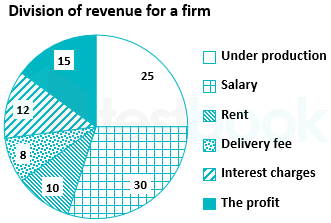
The pie-chart shows the division of revenue for a year for the firm. The estimated revenue for the next year is a 25% increase over the current year and the expenditure will also increase keeping the profits in amounts as the same. What will be the profit percentage for the next year? (Profit Percentage = Profit ÷ Sales × 100)

  1. AOption (a)

    12.5%

  2. BOption (b)

    20%

  3. COption (c)

    12%

  4. DOption (d)

    15%

View answer & explanation

Correct answer

Answer: (c)C.

12%

Why this answer is correct

Given:

(Profit Percentage = Profit ÷ Sales × 100)

Calculation:

Let the profit be P

And sales be S

According to the given formula,

15 = (P/S) × 100

⇒ P = 15S/100     ----(1)

Next year,

P% = (P/1.255) × 100

Putting the value of P in equation(1),

P% = (15/1.255) × 100

P = 12%

∴ The required profit % will be 12%.

Question 43

36 articles were bought for Rs.24 and 24 articles were sold for Rs.36. Find the profit percentage.

  1. AOption (a)

    133.33%

  2. BOption (b)

    125%

  3. COption (c)

    100%

  4. DOption (d)

    150%

View answer & explanation

Correct answer

Answer: (b)B.

125%

Why this answer is correct

Given:

36 articles were brought for Rs. 24

24 articles were sold for Rs. 36

Formula used:

Profit % = {(S.P - C.P)/C.P} × 100

S.P = Selling price

C.P = Cost Price

Calculation:

C.P of one article = 24/36 = 2/3

S.P of one article = 36/24 = 3/2

Profit% = {(3/2 - 2/3)/(2/3)} × 100

⇒ 125%

∴ Option B is correct.

Question 44

A sum lent for 7.5 years at 7% simple interest per annum earns Rs.1050. Find the principal.

  1. AOption (a)

    Rs.1600

  2. BOption (b)

    Rs.2000

  3. COption (c)

    Rs.1800

  4. DOption (d)

    Rs.2400

View answer & explanation

Correct answer

Answer: (b)B.

Rs.2000

Why this answer is correct

Given:

A sum lent for 7.5 years

Rate = 7%

Simple interest per annum earns Rs.1050

Formula used:

S.I = (P × R × T)/100

where,

S.I = Simple Interest

P = Principal

R = Rate

T = Time period

Calculation:

According to the question,

⇒ 1050 = (P × 7 × 7.5)/100

⇒ P = (1050 × 100)/(7.5 × 7)

⇒ P = Rs. 2000

∴ Option B is correct.

Question 45

The difference between the compound interest and the simple interest compounded half yearly on an amount of Rs. 50000 for 1 year is Rs. 180. What is the rate of interest per annum?

  1. AOption (a)

    8%

  2. BOption (b)

    9%

  3. COption (c)

    10%

  4. DOption (d)

    12%

View answer & explanation

Correct answer

Answer: (d)D.

12%

Why this answer is correct

Given:

Principal = 50000

Time = 1 year

The difference between the compound interest and the simple interest compounded half yearly is Rs. 180

Concept used:

In half yearly the interest rate becomes half.

Formula used:

S.I = (P × R × T) / 100

Compound Interest compounded half yearly = [P{1 + (R/200)}T ] - P

where,

S.I = Simple Interest

C.I = Compound Interest

P = Principal

R = Rate

T = Time period

Calculation:

C.I earned on RS.50000 in a year compounded half yearly 

⇒ 50000{1 + (R/200)}2 - 50000

⇒ Rs.(500r + 1.25 r2)

S.I Earned on Rs.50000 in a year

⇒ S.I = (50000 × r × 1) / 100

⇒ Rs.500r

According to the question,

⇒ (500r + 1.25 r2) - 500r = 180

⇒ r2 = 180/1.25

⇒ r = √ 144 = 12%

∴ Option D is correct.

Question 46

Find the minimum number that must be multiplied by 1024 to make it a perfect cube.

  1. AOption (a)

    4

  2. BOption (b)

    2

  3. COption (c)

    16

  4. DOption (d)

    8

View answer & explanation

Correct answer

Answer: (a)A.

4

Why this answer is correct

Given:-

A number 1024

Concept used:

To make any number perfect cube, the power should be multiple of 3

Calculation:

We can write 1024 = 210

According to the question,


So we have to add two more 2 in the power.


⇒ 210 + 2 = 212

⇒ 2 × 2 = 4

We have to multiply by 4.

∴ Minimum number is 4.

Shortcut TrickPrime factor of 1024 = 2 × 2 × 2 × 2 × 2 × 2 × 2 × 2 × 2 × 2 

⇒ Prime factor of 1024 = 23 × 23 × 23 × 2

As we can see that 1024 is not itself a perfect cube number so the least number that should be multiplied in it is 4

So, the next smallest number which is a perfect cube is 4

∴ The Minimum number is 4.

Question 47

A cylinder of radius 22 cm and height 7 cm is melted to form a cuboid. The width and height of the cuboid are equal to half the radius of the cylinder. What is the length of the cuboid?

  1. AOption (a)

    132 cm

  2. BOption (b)

    66 cm

  3. COption (c)

    44 cm

  4. DOption (d)

    88 cm

View answer & explanation

Correct answer

Answer: (d)D.

88 cm

Why this answer is correct

Given:

Radius of cylinder = 22cm

Height of cylinder = 7cm

The width and height of the cuboid are equal to half the radius of the cylinder

Concept used:

Volume of cylinder = Volume of Cuboid

Formula used:

Volume of cylinder = πr2h

Volume of Cuboid = lbh

Where r = radius of cylinder

l = Length of cuboid

h = Height

Calculation:

According to the question,

Let radius of cylinder be x

Then Width and height of cuboid = x/2

⇒ πr2h = l × x/2 × x/2

⇒ πx2h = l × x/2 × x/2

⇒ h = l/(4 × π)

⇒ l = 7 × 4 × 22/7

⇒ l = 88 cm.

∴ The length of the cuboid is 88 cm.

Question 48

What is 1 effective discount equal to 3 discounts of 20%, 25% and 40%?

  1. AOption (a)

    48%

  2. BOption (b)

    64%

  3. COption (c)

    60%

  4. DOption (d)

    44%

View answer & explanation

Correct answer

Answer: (b)B.

64%

Why this answer is correct

Given:

3 discounts of 20%, 25% and 40%

Formula used:

Effective progressive discount = A + B - AB/100

where A and B are Discounts.

Calculation:

Effective discount for first two discounts = 20 + 25 - (20 × 25)/100

⇒ 45 - 5

⇒ 40%

Again Effective discount = 40 + 40 - (40 × 40)/100

⇒ 80 - 16

⇒ 64%

∴ Option B is correct.

Shortcut Trick 20%→ 5 : 4

25%→ 4 : 3

40%→ 5 : 3

    →100 : 36

(64/100) × 100 = 64%

Question 49

What is half of the total surface area of the sphere whose radius is 28 cm?

  1. AOption (a)

    4928 sq cm

  2. BOption (b)

    7392 sq cm

  3. COption (c)

    2464 sq cm

  4. DOption (d)

    3696 sq cm

View answer & explanation

Correct answer

Answer: (a)A.

4928 sq cm

Why this answer is correct

Given:

Radius of sphere = 28 cm

Formula used:

Total surface area of sphere = 4πr2

where, r = Radius of sphere.

Calculation:

Total surface area of sphere = 4 × π × 28 × 28

⇒ 4 × 22/7 × 28 × 28

⇒ 9856 cm

Half surface area of sphere = 9856/2 = 4928 cm2

∴ Option A is correct.

Question 50

A bike and a car leave the same place at 9 am and 10 am respectively. If the speed of the bike is 50 kmph and the speed of the car is 75 kmph, then at what time will they meet each other?

  1. AOption (a)

    12 ∶ 30 am

  2. BOption (b)

    11 ∶ 30 am

  3. COption (c)

    12 ∶ 00 pm

  4. DOption (d)

    1 ∶ 00 am

View answer & explanation

Correct answer

Answer: (c)C.

12 ∶ 00 pm

Why this answer is correct

Given:

A bike and a car leave the same place at 9 am and 10 am respectively

Speed of the bike is 50 kmph

Speed of the car is 75 kmph

Concept used:

The time required to remeet is due to the distance made by bike due to early departure.

Formula used:

Time = Distnace / Speed

Relative speed in same direction = Higher speed - Lower speed

Calculation:

Bike depart at 9am, so in one hour it would cover 50 km

This 50 km will be covered by relative speed to meet again.

Time = 50 / (75 - 50) = 50 / 25 = 2 hours.

⇒ 10 am + 2 hours = 12 pm.

∴ Option C is correct.

Question 51

Two bikes start the race at the same time. One bike travels at 30 m/s and the other at 90 kmph. What will be the time difference in which the bikes complete a race of 60 kms?

  1. AOption (a)

    400 seconds

  2. BOption (b)

    420 seconds

  3. COption (c)

    450 seconds

  4. DOption (d)

    360 seconds

View answer & explanation

Correct answer

Answer: (a)A.

400 seconds

Why this answer is correct

Given:

Two bikes start the race at the same time

One bike travels at 30 m/s and the other at 90 kmph

Formula used:

Time = Distance/Speed

1 km/hr = 5/18 m/s

1 km = 1000 m

Calculation:

Time taken by 1st bike to complete 60 km

T = 60000/30 = 2000 seconds.

Speed of 2nd bike in m/s

90 × (5/18) = 25 m/s

Time taken by 2nd bike to complete 60 km

T = 60000/25 = 2400 seconds.

Difference between the time taken by the bikes to complete the race = 2400 - 2000 = 400 seconds.

∴ Option A is correct.

Question 52

X is 3 times more efficient than Y and Y takes 30 days to complete the work. In how many days can X and Y together complete the work?

  1. AOption (a)

    7.5

  2. BOption (b)

    10

  3. COption (c)

    6.25

  4. DOption (d)

    5

View answer & explanation

Correct answer

Answer: (a)A.

7.5

Why this answer is correct

Given:

X is 3 times more efficient than Y

Y takes 30 days to complete the work

Concept used:

Efficiency is inversely proportional to the number of days required to complete the wrok.

Calculation:

According to the Question,

The ratio of efficiency of x : y = 3 : 1

So, number of day ratio will be 1 : 3

Let's take a common term.

Then number of days by both of them = 1a, 3a

Given that, 3a = 30 days.

⇒ a = 10 days

∴ x required 10 days to compete the work

One day work of X = 1/10

One day work of Y = 1/30

Together, 1/10 + 1/30 = 4/30

Time taken to complete the work together = 30/4 = 7.5 days

∴ Option A is correct.

Question 53

The histogram shows the height (in cms) of a plant in different years. In which year the plant grew the least (% wise)?

  1. AOption (a)

    2015

  2. BOption (b)

    2017

  3. COption (c)

    2016

  4. DOption (d)

    2018

View answer & explanation

Correct answer

Answer: (c)C.

2016

Why this answer is correct

Given:

Height of plant in 2015 = 60

Height of plant in 2016 = 72

Height of plant in 2017 = 90

Height of plant in 2018 = 135

Height of plant in 2019 = 216

Height of plant in 2020 = 270

Formula used:

% of Plant grew = {(Height in current year - Height in previous year)/Height in previous year} × 100

Calculation:

In 2016 percentage of plant grew ={ (Height in 2016 - Height in 2015)/(Height in 2015)} × 100 

⇒ {(72 - 60) / 60} × 100 = 20%

Similarly ,

2017 = {(90 - 72) / 72} × 100 = 25%

2018 = {(135 - 90) / 90} × 100 = 50% 

2019 = {(216 - 135) / 135} × 100 = 60%

2020 = {(270 - 216) / 216} × 100 = 25%

The least % grew is in 2016 by only 20%.

∴ Option C is correct.

Question 54

Z alone can do the work in 225 days. Y is 1.5 times as efficient as Z and X is 1.5 times as efficient as Y. How many days will they take to work together?

  1. AOption (a)

    720/19

  2. BOption (b)

    900/19

  3. COption (c)

    50

  4. DOption (d)

    810/19

View answer & explanation

Correct answer

Answer: (b)B.

900/19

Why this answer is correct

Given:

Z alone can do the work in 225 days

Y is 1.5 times as efficient as Z

X is 1.5 times as efficient as Y

Concept used:

Efficiency is inversely proportional to the time takes to complete a work.

Calculation:

Z alone can do the work in 225 days

One day work of z = 1 / 225

Y is 1.5 times as efficient as Z

So, Y will do the same work in 225 × (2/3) = 150 days

X is 1.5 times as efficient as Y

So, X  will do the same work in 150 × (2/3) = 100 days

X, Y, Z together one day work = 1/100 + 1/150 + 1/225 = 19/900

X, Y, Z together will complete the work in 900/19 days.

∴ Option B is correct.

Question 55

W, X, Y and Z share profits in the ratio 5 ∶ 6 ∶ 9 ∶ 12. If X and Y together get Rs.45000, then what is the total got by W and Z?

  1. AOption (a)

    Rs.60000

  2. BOption (b)

    Rs.54000

  3. COption (c)

    Rs.51000

  4. DOption (d)

    Rs.48000

View answer & explanation

Correct answer

Answer: (c)C.

Rs.51000

Why this answer is correct

Given:

W, X, Y and Z share profits in the ratio 5 ∶ 6 ∶ 9 ∶ 12

If X and Y together get Rs.45000

Calculation:

Let a is a common term

then the ratio of share profit of W, X, Y and Z = 5a : 6a : 9a : 12a

According to question

⇒ 6a + 9a = 45000

⇒ 15a = 45000

⇒ a = 3000

The amount of w and z = 5a + 12a = 17a

⇒ 17 × 3000 = 51000

∴ option C is correct.

Question 56

4 horses are tied with ropes at the four corners of a square field of side 40 feet in such a way that they can only touch each other. Find the percentage of the area not touched by the horses. (consider 22 ÷ 7 = 3.14)

  1. AOption (a)

    10.75%

  2. BOption (b)

    21.50%

  3. COption (c)

    22.50%

  4. DOption (d)

    11.25%

View answer & explanation

Correct answer

Answer: (b)B.

21.50%

Why this answer is correct

Given:

Side of square = 40 feet

Concept used:

Every horse will swipe 1/4 of a circle 

Formula used:

Area of circle = πr2  (where r = radius)

Area of square = a2 (where a = side)

Calculation:

According to the question,

The shaded area is the swiped area by horses. we have to find out the unshaded area

Unshaded area = Area of the square - 4 × [(1/4) area of circle]

⇒ Unshaded area =  40 × 40 - 4(0.25 × 3.14 × 20 × 20)

⇒ 344 feet2

Percentage of the area not touched by the horses = (Unshaded area/area of square) × 100

⇒ (344/1600) × 100 = 21.5%

∴ Option B is correct.

Question 57

X bought pencils worth Rs 250. Rs 9 was spent on sales tax which is 15% on the selling price of taxable items. What is the total cost of the taxfree items?

  1. AOption (a)

    Rs.175

  2. BOption (b)

    Rs.181

  3. COption (c)

    Rs.161

  4. DOption (d)

    Rs.171

View answer & explanation

Correct answer

Answer: (b)B.

Rs.181

Why this answer is correct

Given:

X bought a pencil for Rs.250

9 was spent on sales tax which is 15% on the selling price of the taxable articles.

Calculation:

9 was spent on the sales tax.

Then, the gross amount = 250 - 9 = 241

According to the question,

Rs.9 = 15% of the taxable amount

⇒ 100% = (9/15) × 100 = 60

Total cost of tax exempt article = 241 - 60

⇒ Rs.181

∴ Option B is correct.

Question 58

What is the decimal equal to the square root of a number whose binary representation is 1100100?

  1. AOption (a)

    8

  2. BOption (b)

    9

  3. COption (c)

    10

  4. DOption (d)

    11

View answer & explanation

Correct answer

Answer: (c)C.

10

Why this answer is correct

Given:

A number whose binary representation is 1100100

Formula used:

To convert binary into decimal-

(Decimal number)10 = (d0 × 20) + (d1 × 21) + ...... + (dn-1 × 2n-1)

where d0 , d1 are individual digits of the binary number starting from the right most position.

Calculation:

Step 1

Write down the binary number 1100100

Step 2

Multiply each digit of the binary number by the corresponding power if 2

⇒ 1 × 26 + 1 × 25 + 0 × 24 + 0 × 23 + 1 × 22 + 0 × 21 + 0 × 20

Step 3

Solve the power

⇒ 64 + 32 + 0 + 0 + 4 + 0 + 0 = 100

So, the decimal number is 100

The square root of 100 = 10

∴ Option C is correct.

Question 59

40 people had gone for a picnic. 36 of them paid Rs.1700 each to contribute to the cost. The other four paid 50% more than the average cost of the picnic. Find the total amount spent.

  1. AOption (a)

    Rs.72000

  2. BOption (b)

    Rs.75000

  3. COption (c)

    Rs.90000

  4. DOption (d)

    Rs.81000

View answer & explanation

Correct answer

Answer: (a)A.

Rs.72000

Why this answer is correct

Given:

40 people had gone for a picnic

36 of them paid Rs.1700 each to contribute to the cost

The other 4 paid 50% more than the average cost of the picnic

Calculation:

Let average of 40 people = x

Total amount paid by 36 = 36 × 1700

⇒ Rs.61200

Remaining 4 people spend 50% more than average cost = x × (150/100) = 3x/2

Amount paid by 4 people = 4 × 3x/2 = 6x

Total cost ⇒ 40× x = 6x + 61200

⇒ 40x = 6x + 61200

⇒ 34x = 61200

⇒ x = 1800

Total cost = 40 × x = 40 × 1800 = Rs. 

∴ Option A is correct.

Alternate Method

Given:

40 people had gone for a picnic

36 of them paid Rs.1700 each to contribute to the cost

The other 4 paid 50% more than the average cost of the picnic

Calculation:

Let average of 40 people = 2x

Total amount paid by 36 = 36 × 1700

⇒ Rs.61200

Remaining 4 people spend 50% more than average cost = 2x × (150/100) = 3x

Amount paid by 4 people = 4 × 3x = 12x

Total cost ⇒ 40× 2x = 12x + 61200

⇒ 80x = 12x + 61200

⇒ x = 900

Total cost = 40× 2x = 40 × 2 × 900 = Rs. 72,000

∴ Option A is correct.

Question 60

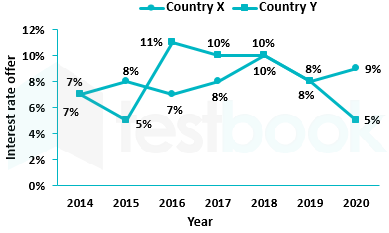
The frequency polygon shows the interest rates offered by two countries for different years. A person invested a total of 90,000inbothcountriesin2017 andreceivedatotalinterestof90,000 in both countries in 2017 and received a total interest of 8,300 for the year. How much did he invest in country Y?

  1. AOption (a)

    $45,000

  2. BOption (b)

    $60,000

  3. COption (c)

    $55,000

  4. DOption (d)

    $40,000

View answer & explanation

Correct answer

Answer: (c)C.

$55,000

Why this answer is correct

Given:

A person invested a total of $90,000 in both countries in 2017.

Calculation:

Let money invested in country Y = x

Then money invested in country X = 90000 - x

From the graph,

In 2017 for country X, the interest rate = 8%

In 2017 for country Y, the interest rate = 10%

∴ The total interest = 8% of (90000 - x) + 10% of x

⇒ 8% of (90000 - x) + 10% of x = 8300

⇒ 7200 - 0.08x + 0.1x = 8300

⇒ 0.02x = 1100

⇒ x = 55000

⇒ $55,000

∴ Option C is correct.

General English (20 questions)

Question 61

Select the word that is similar in meaning (SYNONYM) to the word given below.

Precocious

  1. AOption (a)

    Announced 

  2. BOption (b)

    Sufficed

  3. COption (c)

    Advanced

  4. DOption (d)

    Convinced

View answer & explanation

Correct answer

Answer: (c)C.

Advanced

Why this answer is correct

The correct answer is 'Advanced'.

Key Points

  • Let's explore the meaning of the marked word and the given word.
  • Precocious:  (of behaviour or ability) having developed at an earlier age than is usual or expected.
  • Example: He has a precocious talent for computing.
  • Advanced: having or suitable for a high level of knowledge or skill.
  • Example: Are you taking any advanced courses?
  • From above, we can refer that the correct answer is option 3.

Additional Information  

  • Announced: to make something known or tell people about something officially.
  • Example: They announced the death of their mother in the local paper.
  • Sufficed: to be enough.
  • Example: I'm taking $400 - I think that should suffice.
  • Convinced: certain.
  • Example: Perhaps you could coax your father into taking you to the station. My boyfriend says I'd like going on a camping trip, but I'm not convinced.

Question 62

Some parts of a sentence have been jumbled up, and labeled P, Q, R and S. Select the option that gives the correct sequence in which these parts can be rearranged to form a meaningful and grammatically correct sentence.

In divorce law, the confession

P. of a wife charged with adultery

Q. circumspection and caution

R. for fear of collusion between

S. may be treated with

the parties to a suit.

  1. AOption (a)

    PQSR

  2. BOption (b)

    PQRS

  3. COption (c)

    PRQS

  4. DOption (d)

    PSQR

View answer & explanation

Correct answer

Answer: (d)D.

PSQR

Why this answer is correct

The correct answer is 'PSQR'.

Key Points


  • Statement P  will follow statement 1 as it explains whose confession is being talked about in statement 1.
  • Statement S will follow Statement P as it mentions that how the confession is being treated of a person who is charged with adultery.
  • Statement Q will follow statement S as it mentions the fear that is being mentioned in statement S.
  • Statement Q will be the last part.
<br>

Therefore, the correct sequence is PSQR.

  • Sequence:
  • In divorce law, the confession
  • P. of a wife charged with adultery
  • S. may be treated with
  • Q. circumspection and caution
  • R. for fear of collusion between
  • the parties to a suit.

Question 63

Select the most appropriate meaning of the given idiom.

Hell in a hand basket

  1. AOption (a)

    With full devotion

  2. BOption (b)

    Angry and overcome by emotions

  3. COption (c)

    Deteriorating and headed for complete disaster

  4. DOption (d)

    To have a dispute with someone

View answer & explanation

Correct answer

Answer: (c)C.

Deteriorating and headed for complete disaster

Why this answer is correct

The correct answer is  'Deteriorating and headed for complete disaster​'.

Key Points

  • Hell in a hand basket​​:   It is an idiomatic phrase which means to be in an extremely and increasingly bad or ruinous condition; to be on the inevitable path to utter failure or ruin. 
  • Example: After our funding was cut, our project went to hell in a handbasket.
  • Thus, from above we can say that the correct answer is option 3.

Question 64

Select the word segment that substitutes (replaces) the bracketed word segment correctly and completes the sentence meaningfully. Select the option 'no correction required' If the sentence is correct as given.

(No sooner did I reach the airport when I stumbled upon a bad omen) and decided to not board the flight.

  1. AOption (a)

    No sooner did I reach the airport than I stumbled upon a bad omen

  2. BOption (b)

    No sooner did I reached the airport than I stumbled upon a bad omen

  3. COption (c)

    No correction required

  4. DOption (d)

    No sooner did I reached the airport when I stumbled upon a bad omen.

View answer & explanation

Correct answer

Answer: (a)A.

No sooner did I reach the airport than I stumbled upon a bad omen

Why this answer is correct

The correct answer is 'No sooner did I reach the airport than I stumbled upon a bad omen'.

Key Points

  • The error lies in the incorrect usage of conjunction with 'No sooner'.
  • 'When' needs to be replaced with 'than'
  • There are some fixed pairs of conjunction such as 'No sooner.....than', 'Hardly/scarcely.....when', etc they take fix conjunctions after them.
  • Both the structure that is 'No sooner....than' and 'Hardly/scarcely...when' are used to express the same meaning in the sentence that is they are used to suggest that one action or situation takes place/took place immediately after another action or situation.
  • Example: 
  • No sooner had I arrived at the station than the train came. (= I came first and the train arrived right after me.)
  • Hardly had I reached the station when the train came.
  • Note:- The structure of 'No sooner...than' can also be used with 'did'.
  • Example: No sooner did I arrive at the station than the train came.

Therefore, the correct sentence is: 'No sooner did I reach the airport than I stumbled upon a bad omen and decided to not board the flight.'

Question 65

Four words are given, out of which only one word is spelt correctly. Choose the correctly spelt word.

  1. AOption (a)

    Mercenary

  2. BOption (b)

    Mercianary

  3. COption (c)

    Merceanary

  4. DOption (d)

    Mercinary

View answer & explanation

Correct answer

Answer: (a)A.

Mercenary

Why this answer is correct

The correct answer is 'Mercenary'.

Key Points 

  • Mercenary: (of a person or their behavior) primarily concerned with making money at the expense of ethics or a professional soldier hired to serve in a foreign army. 
  • Example: He had some mercenary scheme to marry a wealthy widow.
  • Thus, from above, we can refer that the correct answer is option 1.

Question 66

Choose the sentence with correct punctuation.

  1. AOption (a)

    What would you like to have for Breakfast !

  2. BOption (b)

    What would you like to have for Breakfast.

  3. COption (c)

    What would you like to have for Breakfast?

  4. DOption (d)

    What would you like, to have for Breakfast?

View answer & explanation

Correct answer

Answer: (c)C.

What would you like to have for Breakfast?

Why this answer is correct

The correct answer is What would you like to have for Breakfast?

Key Points

  • A punctuation mark is used to divide the sentences or put the marks in the right way to separate phrases or to stop writing.
  • Question mark:  it is used to ask a question.
  • Example*: Who are you?*
  • In the sentence, we are asking a question about the subject.
  • Words like- who, what, where, when, did, etc. are placed first in a sentence to ask a question and are followed by a question mark(?) at the end of a sentence.

Thus, option 3 is the most appropriate answer.

Additional Information

  • Let us see other punctuations-
  • Comma (,): it is used to separate a series of words in the same sentence.
  • Example: Ravi, Rohan, and Priya ate fruits.
  • Full stop (.): it is used to show the ending of a sentence.
  • Example: He is a good boy.
  • Hyphen (-): it is used to connect parts of a compound sentence.
  • Example: passer-by, eco-friendly.

Hinglish

  • एक punctuation mark का उपयोग वाक्यों को विभाजित करने या अलग-अलग वाक्यांशों को लिखने या लिखने को रोकने के लिए सही तरीके से किया जाता है।
  • Question mark: इसका उपयोग प्रश्न पूछने के लिए किया जाता है।
  • Example*: Who are you?*
  • वाक्य में, हम विषय के बारे में एक प्रश्न पूछ रहे हैं।
  • जैसे- who, what, where, when, did, आदि को किसी वाक्य को पूछने के लिए पहले वाक्य में रखा जाता है और उसके बाद एक वाक्य के अंत में एक प्रश्न चिह्न (?) लगाया जाता है।
  • Comma: यह एक ही वाक्य में शब्दों की एक श्रृंखला को अलग करने के लिए उपयोग किया जाता है।
  • Example: Ravi, Rohan, and Priya ate fruits.
  • Full stop: इसका उपयोग किसी वाक्य के अंत को दिखाने के लिए किया जाता है।
  • Example: He is a good boy.
  • Hyphen: इसका उपयोग compound sentences के कुछ हिस्सों को जोड़ने के लिए किया जाता है।
  • Example: passer-by, eco-friendly.

Question 67

Select the word segment that substitutes (replaces) the bracketed word segment correctly and completes the sentence meaningfully. Select the option 'no correction required' if the sentence is correct as given.

Renowned author and Tony award winner Bob Fosse has credited modern day drama (for having a deep impact on his writing style).

  1. AOption (a)

    as having a deep impact on his writing style

  2. BOption (b)

    No correction required

  3. COption (c)

    with having had a deep impact on his writing style

  4. DOption (d)

    to having a deep impact on his writing style

View answer & explanation

Correct answer

Answer: (c)C.

with having had a deep impact on his writing style

Why this answer is correct

The correct answer is 'with having had a deep impact on his writing style'.

Key Points

  • The given sentence is representing an action that has happened in past but has a relation with the present.
  • To express this 'having had' is being used which is a participle phrase, which means the action has happened already and it is also used to put an emphasis on the action.
  • Example: They have had some fight among themselves.
  • In the above sentence, it can be said that the expression 'have had' is used to represent actions that took place not too long ago and also it is used on the things or actions that need stress or emphasis.
  • Thus, the correct answer is option 3.

Therefore, the correct sentence is: 'Renowned author and Tony award winner Bob Fosse has credited modern day drama with having had a deep impact on his writing style.'

Question 68

Select the word that is similar in meaning (SYNONYM) to the word given below.

Amicable

  1. AOption (a)

    Radial

  2. BOption (b)

    Cordial

  3. COption (c)

    Ferocious

  4. DOption (d)

    Hostile

View answer & explanation

Correct answer

Answer: (b)B.

Cordial

Why this answer is correct

The correct answer is 'Cordial'.

Key Points

  • Let's explore the meaning of the marked word and the given word.
  • Amicable: relating to behaviour between people that is pleasant and friendly, often despite a difficult situation.
  • Example: His manner was perfectly amicable, but I felt uncomfortable.
  • Cordial: friendly, but formal and polite.
  • Example: Relations between the two leaders are said to be cordial.
  • From above, we can refer that the correct answer is option 2.

 Additional Information  

  • Radial: of or arranged like rays or the radii of a circle; diverging in lines from a common centre. 
  • Example: These four mosaics have a radial arrangement
  • Ferocious: frightening and violent.
  • Example: The president came in for some ferocious criticism.
  • Hostile: unfriendly and not liking something.
  • Example: The president had a hostile reception in Ohio this morning.

Question 69

Fill in the blank with the most appropriate choice.

From this vague, _______, yet gifted writer our author acquired some of his strong feeling for the naive.

  1. AOption (a)

    coherent

  2. BOption (b)

    patronage

  3. COption (c)

    duplicity

  4. DOption (d)

    incoherent

View answer & explanation

Correct answer

Answer: (d)D.

incoherent

Why this answer is correct

The correct answer is 'incoherent'.

Key Points 

  • Let's explore the meaning of the given options:
WordMeaningExample
coherentexpressing yourself clearlyI should warn you, she’s not always coherent.
patronagethe support given to an organization by someoneThe charity enjoys the patronage of many prominent local business people.
duplicitydishonest talk or behaviour, especially by saying different things to two peopleThey were accused of duplicity in their dealings with both sides.
incoherentexpressing yourself in a way that is not clearHe was confused and incoherent and I didn't get much sense out of him.
  • Thus, from the above-given explanation, we can say that 'incoherent' will be used in the blank.
  • Therefore, the correct answer is option 4.

Question 70

Select the most appropriate meaning of the given idiom.

Great minds think alike

  1. AOption (a)

    Someone who helps others they are in need, with no discussion for

  2. BOption (b)

    Very intimate friends

  3. COption (c)

    Intelligent people think like each other

  4. DOption (d)

    A tedious job

View answer & explanation

Correct answer

Answer: (c)C.

Intelligent people think like each other

Why this answer is correct

The correct answer is  'Intelligent people think like each other​'

Key Points

  • Great minds think alike​:  It is an idiomatic phrase which means very intelligent people tend to come up with the same ideas at the same time. 
  • Example: Oh, you wanted to see that movie, too? Great minds think alike!
  • Thus, from above we can say that the correct answer is option 3.

Question 71

Fill in the blank with the most appropriate choice.

It was ______ that everyone understood the rules so that this would not happen again.

  1. AOption (a)

    imperative

  2. BOption (b)

    evanescent

  3. COption (c)

    ambiversion

  4. DOption (d)

    vale

View answer & explanation

Correct answer

Answer: (a)A.

imperative

Why this answer is correct

The correct answer is 'imperative​'.

Key Points


  • Let's explore the meaning of the given options:
WordMeaningExample
imperativeextremely important or urgentThe president said it was imperative that the release of all hostages be secured.
evanescentlasting for only a short time, then disappearing quickly and being forgotten; TemporaryDue to their evanescent character, for surface gravity waves this dependence is on the scale of the dominant wavelength of the waves.
ambiversionthe state or quality of being an ambivert—someone said to have a personality type that is in between that of an introvert (shy and reserved) and an extrovert (outgoing).It was suggested that the executive nurses should be those with a higher educational level, extraversion or ambiversion.
valeValleyIt is settled in a lush vale in the shadow of the mountains


  • Thus, from the above-given explanation, we can say that 'imperative' will be used in the blank.
  • Therefore, the correct answer is option 1.

Question 72

Select the most appropriate 'one word' for the expressions given below.

Boring or unpleasant work that does not require special skill and usually does not pay much money.

  1. AOption (a)

    Adjourn

  2. BOption (b)

    Lull

  3. COption (c)

    Demarcation

  4. DOption (d)

    Menial

View answer & explanation

Correct answer

Answer: (d)D.

Menial

Why this answer is correct

The correct answer is 'Menial'.

Key Points


  • Menial​:  used to describe work that does not need any skills and is badly paid and often boring.
  • Example: The economic climate has seen overqualified candidates applying for a succession of menial jobs.
  • Thus, from above, the correct answer is option 4.

Additional Information


  • Adjourn: break off (a meeting, legal case, or game) with the intention of resuming it later.break off (a meeting, legal case, or game) with the intention of resuming it later.
  • Lull: calm or send to sleep, typically with soothing sounds or movements.
  • Demarcation:  the action of fixing the boundary or limits of something.

Question 73

The sentence below has been divided into three parts. Select the part of the sentence that has an error. If the sentence has no error, select the option 'No Error'.

By this means the mean temperature of the brass was risen through about 70° Fahr, while the amount of metal abrased was only 837 grains.

  1. AOption (a)

    brass was risen through about 70° Fahr, while 

  2. BOption (b)

    No error

  3. COption (c)

    the amount of metal abrased was only 837 grains.

  4. DOption (d)

    By this means the mean temperature of the

View answer & explanation

Correct answer

Answer: (a)A.

brass was risen through about 70° Fahr, while 

Why this answer is correct

The erroneous part is 'brass was risen through about 70° Fahr, while'

Key Points

  • In option 1, the usage of 'risen' is incorrect instead of this we need to use 'raised'
  • According to grammar, the verb "rise" is an intransitive verb and the verb "raise" is a transitive verb. We know that we cannot form a passive form of an intransitive verb. Hence, "risen" is incorrect we need to use "raised"
  • The verb forms of "rise" are- rose-risen-rising.
  • The verb forms of "raise" are- raised- raised- raising.

Therefore, the correct answer is: 'By this means the mean temperature of the brass was raised through about 70° Fahr, while the amount of metal abraded was only 837 grains.'

Question 74

Select the most appropriate 'one word' for the expressions given below.

Collecting or forming into a mass or group

  1. AOption (a)

    Corpus

  2. BOption (b)

    Conjuncture

  3. COption (c)

    Archive

  4. DOption (d)

    Agglomerate

View answer & explanation

Correct answer

Answer: (d)D.

Agglomerate

Why this answer is correct

The correct answer is 'Agglomerate'.

Key Points


  • Agglomerate​: collect or form into a mass or group.
  • Example: He is seeking to agglomerate the functions of the Home Office
  • Thus, from above, the correct answer is option 4.

Additional Information 


  • Corpus: a collection of written texts, especially the entire works of a particular author or a body of writing on a particular subject.
  • Conjuncture: a combination of events.
  • Archive:  a collection of historical documents or records providing information about a place, institution, or group of people.

Question 75

The sentence below has been divided into three parts. Select the part of the sentence that has an error. If the sentence has no error, select the option 'No Error'.

Obviously, it had been a long time when she had seen or talked to Mr.Cade.

  1. AOption (a)

    or talked to Mr. Cade.

  2. BOption (b)

    time when she had seen

  3. COption (c)

    No error

  4. DOption (d)

    Obviously, it had been a long

View answer & explanation

Correct answer

Answer: (b)B.

time when she had seen

Why this answer is correct

The correct answer is 'time when she had seen', i.e. the error lies in this part of the sentence.

Key Points

  • The error lies in the incorrect usage of the conjunction 'when'.
  • 'When' needs to be replaced with 'since'.
  • When: As a conjunction, it means considering the fact that.
  • Example: You can't complain about being lonely when you don't make any effort to meet people.
  • Since: As a conjunction, it means from a particular time in the past until a later time, or until now.
  • Example: I've been very busy since I came back from holiday.

Therefore, the correct answer is 'Obviously, it had been a long time since she had seen or talked to Mr.Cade.'

Direciton: A passage is given with 5 questions following it. Read the passage carefully and choose the best answer to each question out of the four alternatives.

If you are reading this right now, you are taking part in the wonder of literacy. Because of printed words, people can relay information across both time and space. Ideas are encoded in writing and transmitted to readers across thousands of miles and years. Because of this development, the words of people distant to us can influence events, impact knowledge, and change the world. Much of the credit for the development of this phenomenon can be attributed to one man.

Johannes Gensfleisch zur Laden zum Gutenberg, better known as Johannes Gutenberg, was born in the German city of Mainz. Though most of Gutenberg's early life is a mystery, historians believe that he studied at the University of Erfurt in 1418 and spent much of his young adult life practicing the profession of his father; goldsmithing. Having a penchant for fortune and success, Gutenberg borrowed money from investors in 1439 and found himself in financial trouble.

In the year 1439 the city in which Gutenberg lived was planning to exhibit its large collection of relics from Emperor Charlemagne (a famous ruler who had united much of Western Europe around 800 AD). The exhibit was expected to bring many visitors to the town, so Gutenberg took investments and created many polished metal mirrors which were to be sold to the visitors (it was a common belief at that time that mirrors were able to capture holy light from religious relics). The mirrors which Gutenberg produced probably would have sold well, but due to severe flooding the event was delayed by one year.

Question 76

How does the writer infer that printed words can relay information across time and space?

  1. AOption (a)

    Ideas encoded in written scripts can be transmitted across miles and ages.

  2. BOption (b)

    As literacy is a wonder of the would it can spread easily.

  3. COption (c)

    Ideas put in words can influence events, impact knowledge, and change the world.

  4. DOption (d)

    Ideas in written format can cause people to be more interested in literature.

View answer & explanation

Correct answer

Answer: (a)A.

Ideas encoded in written scripts can be transmitted across miles and ages.

Why this answer is correct

The correct answer is 'Ideas encoded in written scripts can be transmitted across miles and ages.'

Key Points

  • Let's refer to the following lines of the passage;
  • Because of printed words, people can relay information across both time and space. Ideas are encoded in writing and transmitted to readers across thousands of miles and years. Because of this development, the words of people distant to us can influence events, impact knowledge, and change the world.
  • From above, we can infer that the 'Ideas encoded in written scripts can be transmitted across miles and ages'.
  • Thus, the correct answer is option 1.

Question 77

According to the passage, which of the following statement is incorrect?

  1. AOption (a)

    The words of people distant to us can influence events, impact knowledge, and change the world because the printed words can travel across time and space.

  2. BOption (b)

    Guttenberg was an English citizen.

  3. COption (c)

    Guttenberg's father was a goldsmith.

  4. DOption (d)

    Guttenberg in his young adult life practised goldsmithing.

View answer & explanation

Correct answer

Answer: (b)B.

Guttenberg was an English citizen.

Why this answer is correct

The correct answer is 'Guttenberg was an English citizen.'

Key Points

  • Let's refer to the following lines of the passage:
  • Because of this development, the words of people distant to us can influence events, impact knowledge, and change the world.
  • Johannes Gensfleisch zur Laden zum Gutenberg, better known as Johannes Gutenberg, was born in the German city of Mainz.
  • Though most of Gutenberg's early life is a mystery, historians believe that he studied at the University of Erfurt in 1418 and spent much of his young adult life practicing the profession of his father; goldsmithing.
  • Thus, from above, we can say that the correct answer is option 2.

Question 78

What profession did Gutenberg's father practice?

  1. AOption (a)

    Wordsmith

  2. BOption (b)

    Locksmith

  3. COption (c)

    Goldsmith

  4. DOption (d)

    Blacksmith

View answer & explanation

Correct answer

Answer: (c)C.

Goldsmith

Why this answer is correct

The correct answer is 'Goldsmith'.

Key Points

  • Let's refer to the following lines of the passage:
  • Though most of Gutenberg's early life is a mystery, historians believe that he studied at the University of Erfurt in 1418 and spent much of his young adult life practicing the profession of his father; goldsmithing.
  • Thus, from above the correct answer is option 3.

Question 79

What was the nationality of the Johannes Gutenberg?

  1. AOption (a)

    German

  2. BOption (b)

    French

  3. COption (c)

    English

  4. DOption (d)

    Italian

View answer & explanation

Correct answer

Answer: (a)A.

German

Why this answer is correct

The correct answer is 'German'.

Key Points

  • Let's refer to the following lines of the passage.
  • Johannes Gensfleisch zur Laden zum Gutenberg, better known as Johannes Gutenberg, was born in the German city of Mainz.
  • Thus, from above we can infer that the nationality of Johannes Gutenberg is 'German'.
  • Therefore, the correct answer is option 1.

Question 80

According to the passage, what kind of value did polished metal mirror possess?

  1. AOption (a)

    Religious value

  2. BOption (b)

    Individualistic value

  3. COption (c)

    Sentimental value

  4. DOption (d)

    National value

View answer & explanation

Correct answer

Answer: (a)A.

Religious value

Why this answer is correct

The correct answer is 'Religious value'.

Key Points

  • Let's refer to the following lines of the passage:
  • The exhibit was expected to bring many visitors to the town, so Gutenberg took investments and created many polished metal mirrors which were to be sold to the visitors (it was a common belief at that time that mirrors were able to capture holy light from religious relics).
  • Thus, from above, we can infer that the polished mirror possessed religious value.
  • Therefore, the correct answer is option 1.

General Hindi (20 questions)

Question 81

निम्नलिखित प्रश्न में, चार विकल्पों में से, उस विकल्प का चयन करें जो दिए गए शब्द के समानार्थी शब्द का सही विकल्प हो।

गाथा

  1. AOption (a)

    चाह

  2. BOption (b)

    कहानी

  3. COption (c)

    वचन

  4. DOption (d)

    कामना

View answer & explanation

Correct answer

Answer: (b)B.

कहानी

Why this answer is correct

गाथा का समानार्थी शब्द 'कहानी' होता है 

गाथा के पर्यायवाची शब्द - कथा, कहानी, किस्सा, दास्तान।

Key Points

<br>

अन्य विकल्प:

शब्दपर्यायवाची
चाहलालसा, मनोरथ, आकांक्षा, ईप्सा, मर्जी, इच्छा, अभिलाषा, चाह
वचनआश्वासन, वादा, प्रण, प्रतिज्ञा।
कामनालालसा, मनोरथ, आकांक्षा, ईप्सा, मर्जी, इच्छा, अभिलाषा, चाह
<br>

Additional Information

विशेष:

शब्दपरिभाषाउदाहरण
पर्यायवाचीएक ही अर्थ में प्रयुक्त होने वाले शब्द जो बनावट में भले ही अलग हों, पर्यायवाची या समानार्थी शब्द कहलाते हैं।आग-अनल, पावक, दहन। हवा-समीर, अनिल, वायु।

Question 82

निम्नलिखित प्रश्न में, चार विकल्पों में से, उस विकल्प का चयन करें जो दिए गए लोकोक्ति का सही विकल्प हो।

नौ दिन चले अढाई कोस

  1. AOption (a)

    बहुत अधिक समय में बहुत कम काम करना

  2. BOption (b)

    शक्तिशाली होना

  3. COption (c)

    सामर्थ्य के अनुसार काम करो

  4. DOption (d)

    कर्मों के अनुसार फल मिलता है

View answer & explanation

Correct answer

Answer: (a)A.

बहुत अधिक समय में बहुत कम काम करना

Why this answer is correct

नौ दिन चले अढाई कोस लोकोक्ति का अर्थ है - 'बहुत अधिक समय में बहुत कम काम करना'

तुम इतने दिन से पढाई कर रहे हो और अभी तक कुछ भी याद नही किया यह तो वही बात हो गई नौ दिन चले अढाई कोस। 

Key Pointsअन्य विकल्प 

  • शक्तिशाली होना - जिसकी लाठी उसकी भैंस।
  • कर्मो के अनुसार फल मिलता है - जैसा बोवोगे वैसा काटोगे। 

Additional Information

लोकोक्ति परिभाषाउदाहरण
लोकोक्ति का शाब्दिक अर्थ ‘लोक में प्रचलित उक्ति’ है। जब कोई पूर्य कथन किसी प्रसंग विशेष में उद्धृत किया जाता है तो उसे लोकोक्ति कहते हैं।अपनी करनी पर उतरनी अर्थात किए का फल भोगना। वाक्य- एक छोटी सी चोरी के कारण वह आज तक जेल में पश्चचाताप कर रहा है, अपनी करनी पार उतरनी।

Question 83

निम्नलिखित प्रश्न में, चार विकल्पों में से, उस विकल्प का चयन करें जो दिए गए संधि का सही संधि-विच्छेद हो।

प्रत्यूष

  1. AOption (a)

    प्रती + ऊष

  2. BOption (b)

    प्रति + ऊष

  3. COption (c)

    प्रति + उष

  4. DOption (d)

    प्रती + उष

View answer & explanation

Correct answer

Answer: (b)B.

प्रति + ऊष

Why this answer is correct

प्रत्यूष शब्द का सही संधि विच्छेद 'प्रति + ऊष' होगा।

प्रत्यूष के पर्यायवाची शब्द - भोर; प्रभात; सवेरा; प्रातःकाल।​ 

अन्य विकल्प गलत है 

Key Points

  • प्रत्यूष ' शब्द में यण संधि होगी।
  • 'प्रत्यूष'' का संधि विच्छेद- 'प्रति+ऊष' होगा।
  • इसमें 'इ+उ' वर्णों की संधि हुई है और ‘य’ वर्ण की उत्पत्ति हुई है।
  • इसलिए यहाँ पर यण संधि होगी।
  • क्योंकि जब इ, ई, उ, ऊ, ऋ के बाद कोई अन्य स्वर आता है तो ये क्रमश: य, व, र, ल् में परिवर्तन हो जाता है, यह परिवर्तन यण सन्धि का होता है।

Additional Information

संधि - दो शब्दों के मेल से जो विकार (परिवर्तन) होता है उसे संधि कहते हैं। संधि के तीन प्रकार हैं - 1. स्वर, 2. व्यंजन और 3. विसर्ग,
संधिपरिभाषाउदाहरण
स्वरस्वर वर्ण के साथ स्वर वर्ण के मेल से विकार उत्पन्न होता है।विद्या + अर्थी = विद्यार्थी महा + ईश = महेश
व्यंजनएक व्यंजन से दूसरे व्यंजन या स्वर के मेल से विकार उत्पन्न होता है।अहम् + कार = अहंकार उत् + लास = उल्लास
विसर्गविसर्ग के साथ स्वर या व्यंजन के मेल से विकार उत्पन्न होता है।दुः + आत्मा = दुरात्मा निः + कपट = निष्कपट

Question 84

निम्नलिखित प्रश्न में, चार विकल्पों में से, उस विकल्प का चयन करें जो उचित विराम चिन्ह युक्त वाक्य का सही विकल्प हो।

  1. AOption (a)

    ध्वनि-प्रदूषण से रक्तचाप, अल्सर, सिरदर्द, अनिद्रा आदि रोग हो रहे हैं।

  2. BOption (b)

    ध्वनि-प्रदूषण से रक्तचाप, अल्सर, सिरदर्द, अनिद्रा आदि रोग हो रहे हैं।"

  3. COption (c)

    ​ध्वनि-प्रदूषण से रक्तचाप, अल्सर, सिरदर्द, अनिद्रा आदि रोग हो रहे हैं

  4. DOption (d)

    ​ध्वनि-प्रदूषण से, रक्तचाप, अल्सर, सिरदर्द, अनिद्रा आदि रोग हो रहे हैं

View answer & explanation

Correct answer

Answer: (a)A.

ध्वनि-प्रदूषण से रक्तचाप, अल्सर, सिरदर्द, अनिद्रा आदि रोग हो रहे हैं।

Why this answer is correct

दिए गये विकल्पों मे से 'ध्वनि-प्रदूषण से रक्तचाप, अल्सर, सिरदर्द, अनिद्रा आदि रोग हो रहे हैं।' - इस वाक्य में शुद्ध एवं सही रूप से विराम चिन्ह लगे है।

विराम चिन्ह – भाषा के लिखित रूप में विशेष स्थानों पर रुकने का संकेत करने वाले चिन्हों को विराम चिन्ह कहते हैं।

Key Pointsअन्य विकल्प: 

  • ध्वनि-प्रदूषण से रक्तचाप, अल्सर, सिरदर्द, अनिद्रा आदि रोग हो रहे हैं।" - इस वाक्य में उद्धरण चिन्ह की कोई आवश्यकता नही है।
  • ध्वनि-प्रदूषण से रक्तचाप, अल्सर, सिरदर्द, अनिद्रा आदि रोग हो रहे हैं - इस वाक्य में अंत में पूर्ण विराम होना चाहिए। 

Additional Information

विराम चिन्ह का नामपरिभाषाउदाहरण
पूर्ण विराम चिन्ह (।)जहाँ एक बात पूरी हो जाये या वाक्य समाप्त हो जाये वहाँ पूर्ण विराम ( । ) चिन्ह लगाया जाता है।बाजार खुल गया।
अर्द्ध विराम चिन्ह (;)जहाँ अल्प विराम से कुछ अधिक ठहरते हैं तथा पूर्ण विराम से कम ठहरते हैं, वहाँ अर्द्ध विराम का चिन्ह ( ; ) लगाया जाता है।मुख्य अतिथि आ गए हैं; वह शीघ्र चले जाएंगे।
अल्प विराम चिन्ह (,)वाक्य में जहाँ थोड़ा रुकना हो या अधिक वस्तुओं, व्यक्तियों आदि को अलग करना हो वहाँ अल्प विराम ( , ) चिन्ह का प्रयोग किया जाता है।राकेश, मोहन, शीतल और पंकज ने यह चित्र बनाया है।
प्रश्नवाचक चिन्ह (?)बातचीत के दौरान जब किसी से कोई बात पूछी जाती है अथवा कोई प्रश्न पूछा जाता है, तब वाक्य के अंत में प्रश्नसूचक-चिन्ह का प्रयोग किया जाता है।तुम्हारी माताजी का नाम क्य�� है ?
विस्मयादिबोधक चिन्ह (!)इसका प्रयोग हर्ष, विवाद, विस्मय, घृणा, आश्रर्य, करुणा, भय, संबोधन इत्यादि का बोध कराने के लिए इस चिन्ह का प्रयोग किया जाता है।वाह! कितना सुंदर दृश्य है।
लाघव चिन्ह (०)किसी बड़े तथा प्रसिद्ध शब्द को संक्षेप में लिखने के लिए उस शब्द का पहला अक्षर लिखकर उसके आगे शून्य (०) लगा देते हैं। यह शून्य ही लाघव-चिन्ह कहलाता है।डॉक्टर – डॉ०, प्रोफेसर – प्रो०

Question 85

दिया गया वाक्य किस सर्वनाम के भेद का उदाहरण है, ज्ञात कीजिए।

जो करेगा सो भरेगा।

  1. AOption (a)

    प्रश्नवाचक सर्वनाम

  2. BOption (b)

    निजवाचक सर्वनाम

  3. COption (c)

    अनिश्चयवाचक सर्���नाम

  4. DOption (d)

    सम्बन्धवाचक सर्वनाम

View answer & explanation

Correct answer

Answer: (d)D.

सम्बन्धवाचक सर्वनाम

Why this answer is correct

जो करेगा सो भरेगा। इस वाक्य में जो शब्द 'सम्बन्धवाचक सर्वनाम' है और सो नित्य संबंधी सर्वनाम है।

जिन सर्वनाम शब्दों का प्रयोग किसी वस्तु या व्यक्ति का सम्बन्ध बताने के लिए किया जाए वे शब्द सम्बन्धवाचक सर्वनाम कहलाते हैं।

Key Points

सर्वनाम - संज्ञा के स्थान पर प्रयुक्त होने वाले शब्दों को सर्वनाम कहते हैं। जैसे - मैं, वह, वे, उन्हें, अपने तुम, हम आदि। हिंदी में सर्वनामों की संख्या 11 है – ‘मैं, तू, आप, यह, वह, जो, सो, कोई, कुछ, कौन, क्या’ सर्वनाम के छः भेद हैं –
सर्वनामपरिभाषाउदाहरण
निश्चयवाचकजो सर्वनाम शब्द किसी व्यक्ति, वस्तु आदि का निश्चयपूर्वक बोध कराते हैं वे निश्चयवाचक सर्वनाम कहलाते हैं।वे, यह, वह
पुरुषवाचक (व्यक्तिवाचक)जिस सर्वनाम का प्रयोग वक्ता द्वारा स्वयं के लिए या अन्य व्यक्ति के लिए किया जाता है।मैं, हम, मुझे, तू, तुम, तुझे, तुम्हारा, वह, वे, उसने
निजवाचकजहाँ स्वयं के लिए 'आप, अपना, अपने आप' शब्दों का प्रयोग हो।अपने आप, स्वतः
प्रश्नवाचक सर्वनामजो सर्वनाम शब्द संज्ञा के स्थान पर आकर वाक्य को प्रश्वाचक बनाते हैं।क्या, कौन
अनिश्चयवाचकजिन सर्वनाम शब्दों से वस्तु, व्यक्ति, स्थान आदि की निश्चितता का बोध नही होता वे अनिश्चयवाचक सर्वनाम कहलाते हैं।कुछ, कोई
सम्बन्धवाचकजिन सर्वनाम शब्दों का प्रयोग किसी वस्तु या व्यक्ति का सम्बन्ध बताने के लिए किया जाए वे शब्द सम्बन्धवाचक सर्वनाम कहलाते हैं।जो-सो, जैसा-वैसा

Question 86

निम्नलिखित प्रश्न में, चार विकल्पों में से, उस विकल्प का चयन करें जो दिए वाक्यांश का सही विकल्प हो।

जिसे दूर करना कठिन हो।

  1. AOption (a)

    दुर्दम्य

  2. BOption (b)

    दूरगामी

  3. COption (c)

    दुर्निवार

  4. DOption (d)

    अदम्य

View answer & explanation

Correct answer

Answer: (c)C.

दुर्निवार

Why this answer is correct

जिसे दूर करना कठिन हो - वाक्यांश के लिए एक शब्द दुर्निवार है। 

Key Points

  • जिसे दूर करना कठिन हो - वाक्यांश के लिए एक शब्द दुर्निवार है।
  • वाक्य प्रयोग: खरपतवार को निकालना किसानो के लिए दुर्निवार समान है।

​

अन्य विकल्प:

शब्दअर्थ
दुर्दम्यजिसको वश में करना दुष्कर हो
दूरगामीदूर तक जाने वाला
अदम्यजो दबाया न जा सके
<br>

Additional Information 


कम से कम शब्दो मे अधिकाधिक अर्थ को प्रकट करना एक कला है जोकि एक अच्छी रचना के लिए आवश्यक है। ऐसे शब्दो के प्रयोग से वाक्य–रचना मेँ संक्षिप्तता, सुन्दरता व गंभीरता आती है।
किसी सम्प्रदाय का समर्थन करने वालाअनुयायी
पीछे–पीछे चलने वाला/अनुसरण करने वालाअनुगामी
अपनी प्रशंसा स्वयं करने वालाआत्मश्लाघी
जो आँखों के सामने होप्रत्यक्ष
चलने योग्यचलनीय

Question 87

निम्नलिखित प्रश्न में, चार विकल्पों में से, उस विकल्प का चयन करें जो दिए गए संधि-विच्छेद की संधि का सही विकल्प हो।

गै + अन

  1. AOption (a)

    गायन

  2. BOption (b)

    गयाना

  3. COption (c)

    गायान 

  4. DOption (d)

    गयान

View answer & explanation

Correct answer

Answer: (a)A.

गायन

Why this answer is correct

'गै + अन = गायन' शब्द में अयादि संधि है। शेष विकल्प असंगत हैं। 

Key Points

  • 'गै + अन = गायन' में अयादि संधि है।
  • 'गै + अन = गायन' (ऐ + अ = आय), यहाँ 'ऐ' और 'अ' के मेल से 'आय' बना है।
  • जब संधि करते समय ए, ऐ, ओ, औ के साथ कोई अन्य स्वर हो तो (ए का अय), (ऐ का आय), (ओ का अव), (औ – आव) बन जाता है। यही अयादि संधि कहलाती है।
<br>

अन्य संधियाँ:

संधिपरिभाषाउदाहरण
यण संधिजब संधि करते समय इ, ई के साथ कोई अन्य स्वर हो तो 'य' बन जाता है, जब उ, ऊ के साथ कोई अन्य स्वर हो तो 'व्' बन जाता है, जब ऋ के साथ कोई अन्य स्वर हो तो 'र' बन जाता है।पितृ + आज्ञा = पित्राज्ञा
दीर्घ संधिजब दो शब्दों की संधि करते समय (अ, आ) के साथ (अ, आ) हो तो 'आ' बनता है, जब (इ, ई) के साथ (इ, ई) हो तो 'ई' बनता है, जब (उ, ऊ) के साथ (उ, ऊ) हो तो 'ऊ' बनता है।पुस्तक + आलय = पुस्तकालय
गुण संधिजब संधि करते समय (अ, आ) के साथ (इ, ई) हो तो 'ए' बनता है, जब (अ, आ) के साथ (उ, ऊ) हो तो 'ओ' बनता है, जब (अ, आ) के साथ (ऋ) हो तो 'अर' बनता है तो यह गुण संधि कहलाती है। ​सर्व + ईक्षण = सर्वेक्षण


Additional Information

संधि - दो शब्दों के मेल से जो विकार (परिवर्तन) होता है उसे संधि कहते हैं। संधि के तीन प्रकार हैं - 1. स्वर, 2. व्यंजन और 3. विसर्ग,
संधिपरिभाषाउदाहरण
स्वरस्वर वर्ण के साथ स्वर वर्ण के मेल से विकार उत्पन्न होता है।विद्या + अर्थी = विद्यार्थी महा + ईश = महेश
व्यंजनएक व्यंजन से दूसरे व्यंजन या स्वर के मेल से विकार उत्पन्न होता है।अहम् + कार = अहंकार उत् + लास = उल्लास
विसर्गविसर्ग के साथ स्वर या व्यंजन के मेल से विकार उत्पन्न होता है।दुः + आत्मा =दुरात्मा निः + कपट =निष्कपट

Question 88

निम्नलिखित प्रश्न में, चार विकल्पों में से, उस विकल्प का चयन करें जो दिए गए वाक्य के प्रकार का सही विकल्प हो।

वहाँ एक ऐसा छोटा-सा गाँव था जिसके चारों ओर जंगल था।

  1. AOption (a)

    निषेध वाचक वाक्य

  2. BOption (b)

    साधारण वाक्य

  3. COption (c)

    मिश्र वाक्य

  4. DOption (d)

    संयुक्त वाक्य

View answer & explanation

Correct answer

Answer: (c)C.

मिश्र वाक्य

Why this answer is correct

वहाँ एक ऐसा छोटा-सा गाँव था जिसके चारों ओर जंगल था। इस वाक्य में एक प्रधान उपवाक्य है और शेष आश्रित उपवाक्य होने से 'मिश्र वाक्य' का उदाहरण है।

Key Points


स्पष्टीकरण:

मिश्र वाक्यजिस वाक्य में एक से अधिक वाक्य मिले हों, किन्तु एक प्रधान उपवाक्य तथा शेष आश्रित उपवाक्य हों, मिश्रित वाक्य कहलाता है।वह औरत जो पार्क में बैठी हैं मेरी मौसी हैं।


अन्य विकल्प:

  • एक ऐसा सन्देश जो किसी काम को न करने का आदेश दे रहा हो, वह निषेधवाचक वाक्य कहलाता है।
  • इन वाक्यों में प्रायः न, नहीं या मत जैसे शब्दों का प्रयोग किया जाता है। जैसे - वहाँ मत जाओ।

Additional Information

<br>

विशेष:

वाक्यपरिभाषाउदाहरण
सरलऐसे वाक्य जिनमें एक ही क्रिया एवं एक ही कर्ता होता है या जिस वाक्य में एक ही उद्देश्य एवं एक ही विधेय होता है, वे वाक्य सरल वाक्य कहलाते हैं। इसमें कर्ता एक से अधिक हो सकते हैं लेकिन मुख्य क्रिया एक ही होगी।राकेश पढ़ता है। कमला और विमला मंदिर जाती हैं।
संयुक्तजिस वाक्य में दो या दो से अधिक उपवाक्य मिले हों, परन्तु सभी वाक्य प्रधान हो तो ऐसे वाक्य को संयुक्त वाक्य कहते है। ये ‘और, एवं, तथा, या, अथवा, इसलिए, अतः, फिर भी, तो, नहीं तो, किन्तु, परन्तु, लेकिन, पर’ आदि से जुड़े होते हैं।वह सुबह आगरा गया और शाम को लौट आया।
मिश्रजिस वाक्य में एक से अधिक वाक्य मिले हों, किन्तु एक प्रधान उपवाक्य तथा शेष आश्रित उपवाक्य हों, मिश्रित वाक्य कहलाता है।वह औरत जो पार्क में बैठी हैं मेरी मौसी हैं।

Question 89

निम्नलिखित प्रश्न में, चार विकल्पों में से, उस विकल्प का चयन करें जो दिए गए शब्द का तत्सम रूप हो।

अचरज

  1. AOption (a)

    अचंभित

  2. BOption (b)

    हैरत

  3. COption (c)

    आश्चर्य   

  4. DOption (d)

    चकित

View answer & explanation

Correct answer

Answer: (c)C.

आश्चर्य   

Why this answer is correct

दिए गए विकल्पों में सही उत्तर आश्चर्य होगा। 

Key Points

  • दिए गए शब्दों में 'आश्चर्य' शब्द तत्सम है जिसका तद्भव रूप 'अचरज' होगा।
  • ऐसे शब्द जो संस्कृत से ज्यों के त्यों लिए गए, तत्सम होते हैं।

Additional Information

तत्समऐसे शब्द जो संस्कृत से ज्यों के त्यों लिए गए, तत्सम होते हैं।कूप, उष्ट्र, पंचम आदि
अर्द्ध तत्समऐसे शब्द जो संस्कृत से थोड़ा परिवर्तित होकर हिंदी में आए हैं।कार्य से कारज, धैर्य से धीरज आदि
तद्भवसंस्कृत से हिंदी में आने पर जिन शब्दों का रूप बदल गया हो, तद्भव कहलाते हैं।आग, काम, पाँच आदि

Question 90

निम्नलिखित प्रश्न में, चार विकल्पों में से, उस विकल्प का चयन करें जो सदैव पुल्लिंग का सही विकल्प हो।

  1. AOption (a)

    गायक 

  2. BOption (b)

    पूर्णिमा

  3. COption (c)

    वैसाख

  4. DOption (d)

    देह

View answer & explanation

Correct answer

Answer: (c)C.

वैसाख

Why this answer is correct

'वैसाख' शब्द सदैव पुल्लिंग में प्रयोग किया जाता है। 

  • मासों व दिनों के नाम सदैव पुल्लिंग में लिखे जाते हैं, जैसे–चैत्र, वैसाख, ज्येष्ठ, सोमवार, मंगलवार आदि।

Key Points

अन्य विकल्प:

  • गायिका शब्द का पुल्लिंग शब्द 'गायक' होता है।
  • 'पूर्णिमा' शब्द स्त्रीलिंग का शब्द है।
  • भाषाओं, तिथियों, नक्षत्रों तथा नदियों के नाम प्रायः स्त्रीलिंग में होते हैं। जैसे–हिन्दी, अंग्रेजी, गुजराती आदि (भाषाएँ)।
  • एकादशी, 'पूर्णिमा', अमावस्या आदि (तिथियाँ)। भरणी, कृतिका, रोहिणी आदि (नक्षत्र) गंगा, यमुना, गोदावरी, नर्मदा आदि (नदियाँ)।
  • ​**'देह**' शब्द स्त्रीलिंग में प्रयुक्त होता है।

Additional Information

लिंग- संज्ञा के जिस रूप से व्यक्ति, वस्तु, की नर या मादा रूप में पहचान हो वह लिंग कहलाता है। जैसे- लड़का, लड़की आदि। लिंग दो प्रकार के होते हैं- स्त्रीलिंग और पुल्लिंग, परंतु संस्कृत में तीसरे प्रकार का भी लिंग होता है- नपुंसक लिंग।
लिंग के भेदपरिभाषाउदाहरण
स्त्रीलिंगजिन शब्दों से स्त्री जाति का बोध हो उसे स्त्रीलिंग कहते हैं।नदी, माता, लड़की
पुल्लिंगजिन शब्दों से पुरुष जाती का बोध हो उसे पुल्लिंग कहते हैं।पिता, राजा घोड़ा,

Question 91

निम्नलिखित प्रश्न में, चार विकल्पों में से, उस विकल्प का चयन करें जो उचित विराम चिन्ह युक्त वाक्य का सही विकल्प हो।

  1. AOption (a)

    डॉ.वर्मा ने कहा है, निराला जी की कविता 'वह तोड़ती पत्थर' बड़ी मार्मिक है"।

  2. BOption (b)

    डॉ.वर्मा ने कहा है, निराला जी की कविता 'वह तोड़ती पत्थर' बड़ी मार्मिक है

  3. COption (c)

    डॉ.वर्मा ने कहा है:- 'निराला जी की कविता 'वह तोड़ती पत्थर' बड़ी मार्मिक है।'

  4. DOption (d)

    डॉ.वर्मा ने कहा है, "निराला जी की कविता 'वह तोड़ती पत्थर' बड़ी मार्मिक है।"

View answer & explanation

Correct answer

Answer: (d)D.

डॉ.वर्मा ने कहा है, "निराला जी की कविता 'वह तोड़ती पत्थर' बड़ी मार्मिक है।"

Why this answer is correct

डॉ.वर्मा ने कहा है, "निराला जी की कविता 'वह तोड़ती पत्थर' बड़ी मार्मिक है।" - इस वाक्य में शुद्ध और सही रूप में विराम चिन्हों का प्रयोग हुआ है।

Key Points

अन्य विकल्प:

डॉ.वर्मा ने कहा है, निराला जी की कविता 'वह तोड़ती पत्थर' बड़ी मार्मिक है"। - इस वाक्य में उद्धरण चिन्ह का सही रूप में प्रयोग नही हुआ है।

डॉ.वर्मा ने कहा है, निराला जी की कविता 'वह तोड़ती पत्थर' बड़ी मार्मिक है - इस वाक्य में भी उद्धरण चिन्ह का अभाव है। 

डॉ.वर्मा ने कहा है:- " निराला जी की कविता 'वह तोड़ती पत्थर' बड़ी मार्मिक है।'' - इस वाक्य में अल्पविराम का प्रयोग नही हुआ है।

<br>

Additional Information

विराम चिन्ह – भाषा के लिखित रूप में विशेष स्थानों पर रुकने का संकेत करने वाले चिन्हों को विराम चिन्ह कहते हैं।

विराम चिन्ह का नामपरिभाषाउदाहरण
पूर्ण विराम चिन्ह (।)जहाँ एक बात पूरी हो जाये या वाक्य समाप्त हो जाये वहाँ पूर्ण विराम ( । ) चिन्ह लगाया जाता है।बाजार खुल गया।
अर्द्ध विराम चिन्ह (;)जहाँ अल्प विराम से कुछ अधिक ठहरते हैं तथा पूर्ण विराम से कम ठहरते हैं, वहाँ अर्द्ध विराम का चिन्ह ( ; ) लगाया जाता है।मुख्य अतिथि आ गए हैं; वह शीघ्र चले जाएंगे।
अल्प विराम चिन्ह (,)वाक्य में जहाँ थोड़ा रुकना हो या अधिक वस्तुओं, व्यक्तियों आदि को अलग करना हो वहाँ अल्प विराम (,) चिन्ह का प्रयोग किया जाता है।राकेश, मोहन, शीतल और पंकज ने यह चित्र बनाया है।
प्रश्नवाचक चिन्ह (?)बातचीत के दौरान जब किसी से कोई बात पूछी जाती है अथवा कोई प्रश्न पूछा जाता है, तब वाक्य के अंत में प्रश्नसूचक-चिन्ह का प्रयोग किया जाता है।तुम्हारी माताजी का नाम क्या है ?
विस्मयादिबोधक चिन्ह (!)इसका प्रयोग हर्ष, विवाद, विस्मय, घृणा, आश्रर्य, करुणा, भय, संबोधन इत्यादि का बोध कराने के लिए इस चिन्ह का प्रयोग किया जाता है।वाह! कितना सुंदर दृश्य है।
लाघव चिन्ह (०)किसी बड़े तथा प्रसिद्ध शब्द को संक्षेप में लिखने के लिए उस शब्द का पहला अक्षर लिखकर उसके आगे शून्य (०) लगा देते हैं। यह शून्य ही लाघव-चिन्ह कहलाता है।डॉक्टर – डॉ०, प्रोफेसर – प्रो०

Question 92

निम्नलिखित प्रश्न में, चार विकल्पों में से, उस विकल्प का चयन करें जो दिए गए शब्द युग्म के अर्थ का सही विकल्प हो।

अभिहित-अविहित

  1. AOption (a)

    प्राप्ति, अनुचित

  2. BOption (b)

    कहा हुआ, अनुचित

  3. COption (c)

    कहा हुआ, संकेत

  4. DOption (d)

    अनुचित, तैयार

View answer & explanation

Correct answer

Answer: (b)B.

कहा हुआ, अनुचित

Why this answer is correct

इसका सही उत्तर विकल्प 2 अभिहित-अविहित है। अन्य विकल्प इसके अनुचित हैं।

Key Points 

  • अभिहित का अर्थ - कहा हुआ
  • अविहित का अर्थ - अनुचित

Additional Information

शब्दपरिभाषाउदाहरण
समश्रुत शब्दकुछ शब्द ऐसे होते हैं जिनमें स्वर, मात्रा अथवा व्यंजन में थोड़ा-सा अन्तर होता है। वे बोलचाल में लगभग एक जैसे लगते हैं, परन्तु उनके अर्थ में भिन्नता होती है। ऐसे शब्द 'समश्रुत/श्रुतिसम भिन्नार्थक शब्द' कहलाते हैं।जैसे- घन और धन दोनों के उच्चारण में कोई खास अन्तर महसूस नहीं होता परन्तु अर्थ में भिन्नता है। घन-बादल धन-सम्पत्ति

Question 93

निम्नलिखित प्रश्न में, चार विकल्पों में से, उस विकल्प का चयन करें जो दिए गए वाक्य के काल के भेद का सही विकल्प हो।

बारिश होकर नदियों में पानी भर गया है।

  1. AOption (a)

    पूर्ण वर्तमान काल

  2. BOption (b)

    सामान्य वर्तमान काल

  3. COption (c)

    तात्कालिक वर्तमान काल

  4. DOption (d)

    अपूर्ण भूत काल

View answer & explanation

Correct answer

Answer: (a)A.

पूर्ण वर्तमान काल

Why this answer is correct

बारिश होकर नदियों में पानी भर गया है।' वाक्य में पूर्ण वर्तमान काल है।

  • क्रिया के जिस रूप से कार्य के अभी पूरे होने का पता चलता है। उसे पूर्ण वर्तमान काल कहते है। जैसे - उसने फल खाए हैं। उसने खाना बनाया है। वह आयी है।

Key Points

<br>

अन्य विकल्पों का विश्लेषण:

सामान्य वर्तमान काल - क्रिया के जिस रूप से क्रिया के वर्तमान काल में सामान्य रूप से संपन्न होने का बोध होता है। जैसे - माता जी मंदिर जाती हैं। पतंग उड़ती है।
तात्कालिक वर्तमान काल - वर्तमान में हो रही क्रिया तात्कालिक क्रिया है। जैसे - कबूतर उड़ रहे हैं। अध्यापक पढ़ा रहे हैं।
पूर्ण वर्तमान काल - क्रिया के जिस रूप से कार्य के अभी पूरे होने का पता चलता है। उसे पूर्ण वर्तमान काल कहते है। जैसे - उसने फल खाए हैं। उसने खाना बनाया है। वह आयी है।
अपूर्ण भूतकाल - जिस क्रिया से यह ज्ञात हो कि भूतकाल में कार्य सम्पन्न नहीं हुआ था - अभी चल रहा था, उसे अपूर्ण भूत कहते हैं। जैसे- रीता सो रही थी।

Question 94

निम्नलिखित प्रश्न में, चार विकल्पों में से, उस विकल्प का चयन करें जो दिए गए लोकोक्ति का सही विकल्प हो।

उल्टा चोर कोतवाल को डांटे

  1. AOption (a)

    बहुत डर जाना 

  2. BOption (b)

    अपना दोष छिपाने के लिए दूसरों को दोष देना

  3. COption (c)

    एक बुरा आदमी सभी को बिगाड़ देता है

  4. DOption (d)

    दोष अपना होने पर भी स्वीकार न करके दूसरे को दोषी ठहराना

View answer & explanation

Correct answer

Answer: (d)D.

दोष अपना होने पर भी स्वीकार न करके दूसरे को दोषी ठहराना

Why this answer is correct

उल्टा चोर कोतवाल को डांटे - दोष अपना होने पर भी स्वीकार न करके दूसरे को दोषी ठहराना।

जैसे - खुद तो अपना बटुआ संभालकर नहीं रखा और दोष अपनी बहन को दे रही हो। यह तो वही बात हुई – उल्टा चोर कोतवाल को डांटे। 

Key Points


अन्य विकल्प:-

लोकोक्तिअर्थवाक्य प्रयोग
एक मछली सारे तालाब को गंदा कर देती हैlएक खराब चीज सारी चीजों को खर���ब कर देती है।मेरी कक्षा में रोहन नाम का एक छात्र था जो छात्रों की किताबें चुरा लेता था। इससे पूरी कक्षा बदनाम हो गई। कहते भी हैं- 'एक मछली सारे तालाब को गंदा कर देती है।'
<br>

Additional Information

परिभाषाउदाहरण
लोकोक्ति'लोकोक्ति' शब्द 'लोक + उक्ति' शब्दों से मिलकर बना है जिसका अर्थ है - लोक में प्रचलित उक्ति या कथन'। संस्कृत में 'लोकोक्ति' अलंकार का एक भेद भी है तथा सामान्य अर्थ में लोकोक्ति को 'कहावत' कहा जाता है।अंत भले का भला। अढ़ाई दिन की बादशाहत।

Question 95

निम्नलिखित प्रश्न में, चार विकल्पों में से, उस विकल्प का चयन करें जो दिए गए शब्द का सही विलोम शब्द हो।

कृतज्ञ

  1. AOption (a)

    कृतकृत्य

  2. BOption (b)

    कृतघ्न

  3. COption (c)

    आभारी

  4. DOption (d)

    कृपापात्र

View answer & explanation

Correct answer

Answer: (b)B.

कृतघ्न

Why this answer is correct

उपर्युक्त विकल्पों में से 'कृतघ्न' इसका सही उत्तर है। 

Key Points

कृतज्ञ का अर्थ - उपकार माननेवाला, एहसानमंद।

कृतघ्न का अर्थ - किए हुए उपकार को न माननेवाला।

Additional Informationअन्य विकल्प:

  • कृतकृत्य का अर्थ - कृतार्थ, संतुष्ट तथा प्रसन्न।
  • कृपापात्र का अर्थ - अनुग्रह का पात्र।
शब्दविलोम
आभारीकृतघ्न
<br>

Important Points

शब्दअर्थउदाहरण
विलोम /  विपरीतार्थकविपरीत (उल्टा) अर्थ बताने वाले शब्दो को विलोम शब्द कह्ते हैं।1. रात-दिन 2. धरती-आकाश

निर्देश: निम्नलिखित गद्यांश को पढ़कर दिए गए प्रश्नों के सटीक उत्तर दीजिए।

बातचीत करते समय हमें शब्दों के चयन पर विशेष ध्यान देना चाहिए, क्योंकि सम्मानजनक शब्द व्यक्ति को उदात्त एवं महान बनाते हैं। बातचीत को सुगम एवं प्रभावशाली बनाने के लिए सदैव प्रचलित भाषा का ही प्रयोग करना चाहिए। अत्यंत साहित्यिक एवं क्लिष्ट भाषा के प्रयोग से कहीं ऐसा न हो कि हमारा व्यक्तित्व चोट खा जाए। बातचीत में केवल विचारों का ही आदानप्रदान नहीं होता, बल्कि व्यक्तित्व का भी आदान-प्रदान होता है। अतः शिक्षक वर्ग को शब्दों का चयन सोच समझकर करना चाहिए। शिक्षक वास्तव में एक अच्छा अभिनेता होता है, जो अपने व्यक्तित्व, शैली, बोलचाल और हावभाव से विद्यार्थियों का ध्यान अपनी ओर आकर्षित करता है और उन पर अपनी छाप छोड़ता है।

Question 96

शिक्षक किस प्रकार से विद्यार्थियों का ध्यान अपनी ओर आकर्षित कर सकता है?

  1. AOption (a)

    कठोर अनुशासन

  2. BOption (b)

    व्यक्तित्व, शैली, बोलचाल और हावभाव

  3. COption (c)

    कड़ी निगरानी

  4. DOption (d)

    दंड देकर

View answer & explanation

Correct answer

Answer: (b)B.

व्यक्तित्व, शैली, बोलचाल और हावभाव

Why this answer is correct

शिक्षक अपने 'व्यक्तित्व, शैली, बोलचाल और हावभाव से' विद्यार्थियों का ध्यान अपनी ओर आकर्षित कर सकता है। 

गद्यांश में आया हुआ उल्लेख:

  • शिक्षक वास्तव में एक अच्छा अभिनेता होता है, जो अपने व्यक्तित्व, शैली, बोलचाल और हावभाव से विद्यार्थियों का ध्यान अपनी ओर आकर्षित करता है और उन पर अपनी छाप छोड़ता है।

Key Points

<br>

अन्य विकल्प:

  • कठोर अनुशासन - कड़ाई से नियमो का पालन करना।
  • कड़ी निगरानी - अच्छे तरीके से ध्यान रखना।
  • दंड देकर - किसी कार्य के गलत होने पर सजा करना।

Question 97

शिक्षक क्या होता है?

  1. AOption (a)

    अभिनेता

  2. BOption (b)

    कवि

  3. COption (c)

    राजनेता

  4. DOption (d)

    साहित्यकार

View answer & explanation

Correct answer

Answer: (a)A.

अभिनेता

Why this answer is correct

शिक्षक 'अभिनेता' होता है।

गद्यांश में आया हुआ उल्लेख:

  • शिक्षक वास्तव में एक अच्छा अभिनेता होता है, जो अपने व्यक्तित्व, शैली, बोलचाल और हावभाव से विद्यार्थियों का ध्यान अपनी ओर आकर्षित करता है और उन पर अपनी छाप छोड़ता है।

Key Points

<br>

अन्य विकल्प:

  • कवि - कविता लिखने वाला, काव्य पठन करने वाला।
  • राजनेता - राजनीति में काम करने वाला व्यक्ति।
  • साहित्यकार - साहित्य को लिखने वाला या रचना करने वाला व्यक्ति।

निर्देश: निम्नलिखित गद्यांश को पढ़कर दिए गए प्रश्नों के सटीक उत्तर दीजिए।

बातचीत करते समय हमें शब्दों के चयन पर विशेष ध्यान देना चाहिए, क्योंकि सम्मानजनक शब्द व्यक्ति को उदात्त एवं महान बनाते हैं। बातचीत को सुगम एवं प्रभावशाली बनाने के लिए सदैव प्रचलित भाषा का ही प्रयोग करना चाहिए। अत्यंत साहित्यिक एवं क्लिष्ट भाषा के प्रयोग से कहीं ऐसा न हो कि हमारा व्यक्तित्व चोट खा जाए। बातचीत में केवल विचारों का ही आदानप्��दान नहीं होता, बल्कि व्यक्तित्व का भी आदान-प्रदान होता है। अतः शिक्षक वर्ग को शब्दों का चयन सोच समझकर करना चाहिए। शिक्षक वास्तव में एक अच्छा अभिनेता होता है, जो अपने व्यक्तित्व, शैली, बोलचाल और हावभाव से विद्यार्थियों का ध्यान अपनी ओर आकर्षित करता है और उन पर अपनी छाप छोड़ता है।

Question 98

उपर्युक्त गद्यांश का उचित शीर्षक दीजिये?

  1. AOption (a)

    शब्दों का चयन

  2. BOption (b)

    साहित्यिक भाषा

  3. COption (c)

    व्यक्तित्व का प्रभाव

  4. DOption (d)

    बातचीत की कला

View answer & explanation

Correct answer

Answer: (a)A.

शब्दों का चयन

Why this answer is correct

इस गद्यांश में 'शब्दों' के बारे में बताया गया है, अतः 'शब्दों का चयन' उचित शीर्षक' होगा।

Key Points

<br>

अन्य विकल्प:

  • साहित्यिक भाषा - साहित्य में प्रयोग में की जाने वाली भाषा।
  • व्यक्तित्व का प्रभाव - शारीरिक भाषा के परिणाम।
  • बातचीत की कला - बोलने की चतुराई।

Question 99

सम्मानजनक शब्द से व्यक्ति क्या बनता है?

  1. AOption (a)

    कर्मनिष्ठ

  2. BOption (b)

    उदात्त एवं महान

  3. COption (c)

    विद्वान

  4. DOption (d)

    चुस्त-दुरुस्त

View answer & explanation

Correct answer

Answer: (b)B.

उदात्त एवं महान

Why this answer is correct

सम्मानजनक शब्द से व्यक्ति 'उद्दात्त एवं महान' बनता है।

गद्यांश में आया हुआ उल्लेख:

  • बातचीत करते समय हमें शब्दों के चयन पर विशेष ध्यान देना चाहिए, क्योंकि सम्मानजनक शब्द व्यक्ति को उदात्त एवं महान बनाते हैं।

Key Points

<br>

अन्य विकल्प:

  • कर्मनिष्ठ - कर्म पर जिसकी न टूटे ऐसी निष्ठा है, जिसकी।
  • विद्वान - जो अपने विषय का ज्ञाता हो।
  • चुस्त- दुरुस्त - जो शरीर से तंदुरुस्त व्यक्ति है।

Question 100

बातचीत में प्रचलित भाषा का प्रयोग क्यूँ करना चाहिए?

  1. AOption (a)

    दूसरों को अपने वश में करने के लिए

  2. BOption (b)

    सबके आकर्षण का केंद्र बनने के लिए

  3. COption (c)

    आकर्षित एवं नजदीकियां बढ़ाने के लिए

  4. DOption (d)

    सुगम एवं प्रभावशाली बनाने के लिए

View answer & explanation

Correct answer

Answer: (d)D.

सुगम एवं प्रभावशाली बनाने के लिए

Why this answer is correct

बातचीत में प्रचलित भाषा का प्रयोग 'सुगम एवं प्रभावशाली बनाने के लिए' करना चाहिए। 

गद्यांश में आया हुआ उल्लेख:

  • सम्मानजनक शब्द व्यक्ति को उदात्त एवं महान बनाते हैं। बातचीत को सुगम एवं प्रभावशाली बनाने के लिए सदैव प्रचलित भाषा का ही प्रयोग करना चाहिए।

Key Points

<br>

अन्य विकल्प:

  • दूसरो को अपने वश में करने के लिए - दूसरो को अपनी विचारधारा में  शामिल करना।
  • सबके आकर्षण का केंद्र बनने के लिए - सबको चुम्बक की भाँति अपनी ओर ध्यानाकर्षित करना।
  • आकर्षित एवं नजदीकियां बढाने के लिए - करीबी बनाना।

Discipline 1 (20 questions)

Question 101

In whose court was Deimachus the ambassador?

  1. AOption (a)

    Bimbisara

  2. BOption (b)

    Ashoka

  3. COption (c)

    Bindusara

  4. DOption (d)

    Samprati

View answer & explanation

Correct answer

Answer: (c)C.

Bindusara

Why this answer is correct

The correct answer is Bindusara.

Key Points

  • Bindusara was the second ruler of the Mauryan Empire.
  • Different Greek sources mention that he had diplomatic relations with western kings.
  • He was the son of Chandragupta Maurya.
  • He ruled from 297 BC to 273 BC.
  • Also called Amitraghata (Slayer of foes) or Amitrochates in Greek sources.
  • Deimachus was a Greek ambassador at his court.
  • He had appointed his son, Ashoka as the governor of Ujjain.
  • Bindusara is believed to have extended the Mauryan Empire to Mysore as well.

Therefore, we can conclude that Deimachus was the ambassador in Bindusara’s court.

 Additional Information

  • Bimbisara (ruled 544-491 B.C.E.) was a king of the Magadha empire and belonged to Haryanaka dynasty, which ruled until approximately 326 B.C.E., when Alexander the Great invaded India.
  • He ruled an area of what is now Bihar and Bengal with his capital at modern day Rajgir.
  • Ashoka the Great (r. 268-232 BCE) was the third king of the Mauryan Empire (322-185 BCE).
  • Best known for his renunciation of war, development of the concept of dhamma (pious social conduct), promotion of Buddhism as well as his effective reign of a nearly pan-Indian political entity.

Question 102

Chandragupta Maurya became the disciple of which of these Jain monks?

  1. AOption (a)

    Pujyapad

  2. BOption (b)

    Jinbhadra

  3. COption (c)

    Jadivasa

  4. DOption (d)

    Bhadrabahu

View answer & explanation

Correct answer

Answer: (d)D.

Bhadrabahu

Why this answer is correct

The correct answer is Bhadrabahu.

Key Points

  • According to Digambara Jain accounts, Bhadrabahu forecast a 12-year famine because of all the killing and violence during the conquests by Chandragupta Maurya.
  • He led a group of Jain monks to south India where Chandragupta Maurya joined him as a monk after abdicating his kingdom to his son Bindusara.
  • Jain religious leader and monk often associated with one of Jainism's two principal sects, the Digambara.

Therefore, we can conclude that Chandragupta Maurya became the disciple of the Jain monk Bhadrabahu.

Additional Information

  • Pujyapada or Pūjyapāda (464–524 CE) was a renowned grammarian and acharya (philosopher monk) belonging to the Digambara tradition of Jains.
  • Jinabhadra or Vachanacharya Jinabhadragani Kshamashramana was Jain ascetic author of Prakrit and Sanskrit texts.

Question 103

"Das Kapital", also known as "Capital: A Critique of Political Economy", was written by:

  1. AOption (a)

    David Ricardo

  2. BOption (b)

    Hegel

  3. COption (c)

    Karl Polny

  4. DOption (d)

    Karl Marx

View answer & explanation

Correct answer

Answer: (d)D.

Karl Marx

Why this answer is correct

The correct answer is - Karl Marx

Key Points

  • Karl Marx
  • Karl Marx wrote "Das Kapital", also known as "Capital: A Critique of Political Economy".
  • The book is a foundational theoretical text in communist philosophy, economics, and politics.
  • It explores the nature of capitalist society, including the exploitation of labor, commodity fetishism, and economic theory.
  • "Das Kapital" was published in three volumes; the first volume was published in 1867, and the others were published posthumously by Friedrich Engels.

Additional Information

  • David Ricardo
  • David Ricardo was an influential British political economist, best known for his work on the theory of comparative advantage and the labor theory of value.
  • He wrote "Principles of Political Economy and Taxation", published in 1817.
  • Hegel
  • Georg Wilhelm Friedrich Hegel was a German philosopher known for his contributions to dialectical and idealist philosophy.
  • He did not write "Das Kapital"; however, his works include "Phenomenology of Spirit" and "The Science of Logic".
  • Karl Polanyi
  • Karl Polanyi was a Hungarian economic historian and social theorist.
  • He wrote "The Great Transformation", which examines the development of the modern market economy and its social impacts.

Question 104

The "Economic History Society" (EHS) was founded in the following year:

  1. AOption (a)

    1976

  2. BOption (b)

    1956

  3. COption (c)

    1986

  4. DOption (d)

    1926

View answer & explanation

Correct answer

Answer: (d)D.

1926

Why this answer is correct

The correct answer is - 1926

Key Points

  • Economic History Society (EHS)
  • The Economic History Society (EHS) is an organization focused on the study of economic and social history.
  • Founded in 1926, its primary goal is to promote research and teaching in the field of economic history.
  • The EHS publishes a leading academic journal, "The Economic History Review", which features articles on economic history from a global perspective.
  • The society also organizes an annual conference, which provides a platform for scholars to present and discuss their research.

Question 105

The "Pashupati Seal" of the Indus Valley Civilization was discovered at which of the following sites?

  1. AOption (a)

    Mohenjo-Daro

  2. BOption (b)

    Bhirrana

  3. COption (c)

    Baror

  4. DOption (d)

    Lothal

View answer & explanation

Correct answer

Answer: (a)A.

Mohenjo-Daro

Why this answer is correct

The correct answer is Mohenjo-Daro.

Key Points

  • The seal was uncovered in 1928–29, in Block 1, Southern Portion of the DK-G Area of Mohenjo-daro, at a depth of 3.9 meters below the surface.
  • This artefact is commonly recognized as the Pasupati Seal or Proto-Siva seal.
  • It was excavated at Mohenjodaro within the Indus valley which is dated to approximately 2500 BC. Made of steatite, it is a rather small object measuring a mere 3.4cm in height, 3.4cm in length and 1.4 cm in width.
  • One can currently find this artefact in the Indus Valley civilization Gallery within National Museum, New Delhi

​Therefore, we can conclude that The "Pashupati Seal" of the Indus Valley Civilization was discovered at Mohenjo-Daro.

Additional Information

  • Bhirrana or Birhana is the oldest Indus Valley Civilization site, dating back to 7570- 6200 BCE.
  • The excavation has yielded a three-fold cultural sequence known as Pre-Early Harappan, Early Harappan and Mature Harappan period.
  • Baror is an archeological site in Sri Ganganagar district of Rajasthan, India. It belongs to the ancient Indus Valley civilization.
  • Lothal was one of the southernmost sites of the ancient Indus Valley civilisation, located in the Bhāl region of the modern state of Gujarāt.

Question 106

The last great Maurya ruler, Samprati, was the patron of which of the following religions?

  1. AOption (a)

    Hindusm

  2. BOption (b)

    Buddhism

  3. COption (c)

    Jainism

  4. DOption (d)

    Shaiv

View answer & explanation

Correct answer

Answer: (c)C.

Jainism

Why this answer is correct

Jainism was the religion patronized by the last great Maurya ruler, Samprati.

Key Points

  • Jainism:
  • Samprati, widely regarded as a significant Maurya ruler, was an ardent follower and patron of Jainism.
  • He played a crucial role in the propagation of Jainism across the Indian subcontinent, constructing Jain temples and supporting the dissemination of Jain teachings.
  • His patronage significantly contributed to the spread and establishment of Jainism during his reign, paralleling his grandfather Ashoka's support for Buddhism.

Overview of Other Options

  • Hinduism:
  • Though a major religion in the Mauryan period, Hinduism was not the religion specifically patronized by Samprati.
  • Buddhism:
  • Buddhism, significantly endorsed by Ashoka, did not receive the same patronage from Samprati, who focused on Jainism.
  • Shaivism:
  • A sect within Hinduism that primarily worships Shiva. Samprati's religious contributions were aimed at Jainism, not Shaivism or other Hindu sects.

Question 107

Indus Valley Civilization belongs to which of the following periods in history?

  1. AOption (a)

    Bronze Age

  2. BOption (b)

    Iron Age

  3. COption (c)

    Mesolithic age

  4. DOption (d)

    Chalcolithic (Copper) Age

View answer & explanation

Correct answer

Answer: (a)A.

Bronze Age

Why this answer is correct

The correct answer is Bronze Age.

Key Points

  • It is considered a Bronze Age civilization because its people had discovered new techniques in metallurgy the science of working with copper, bronze, lead, and tin.
  • The Indus Valley Civilization is also called Harappan Civilization.
  • It expanded to northwestern regions of South Asia, extending from northeast Afghanistan to Pakistan and northwest India.
  • Indus Valley Civilization has three phases:-
  • Early Harappan Phase (3300-2600 BCE)
  • Mature Harappan Phase (2600-1900 BCE)
  • Late Harappan Phase (1900-1300 BCE)

Therefore, we can conclude that Indus Valley Civilization belongs to Bronze Age.

Additional Information

  • In the prehistory of the Indian subcontinent, the Iron Age succeeded Bronze Age India and partly corresponds with the megalithic cultures of India.
  • Other Iron Age archaeological cultures of India were the Painted Grey Ware culture (1300–300 BCE) and the Northern Black Polished Ware (700–200 BCE).
  • The Mesolithic period began in 9000 BC and ended around 4500 BC
  • The Chalcolithic period is also known as the Copper Age, due to the extensive use of copper metal during the period.

Question 108

Who among the following is the author of "Ashtadhyayi"?

  1. AOption (a)

    Nagarjuna

  2. BOption (b)

    Bharat Muni

  3. COption (c)

    Banabhatta

  4. DOption (d)

    Panini

View answer & explanation

Correct answer

Answer: (d)D.

Panini

Why this answer is correct

The correct answer is Ashtadhyayi.

Key Points

  • Panini was a legendary Indian Sanskrit grammarian who was an expert in language and grammar and authored one of the greatest works on grammar called Ashtadhyayi.
  • Panini is known as the father of Sanskrit and is considered the earliest known Indian linguist.
  • Ashtadhyayi was written in the 6th to 5th-century BCE.
  • His work set the linguistic standards for Classical Sanskrit.
  • It sums up in 4,000 sutras the science of phonetics and grammar that had evolved in the Vedic religion.

Therefore, we can conclude that Panini is the author of "Ashtadhyayi".

Additional Information

  • Nagarjuna is one of the most famous Buddhist philosophers and was even considered as the greatest Buddhist philosopher.
  • Bharata Muni was an ancient Indian author who wrote the Natya Shastra.
  • A  great poet of India, Banabhatta was born around the 7th century in a village in India.

Question 109

According to the numismatic knowledge about the Gupta period, which of the following rulers is depicted playing Veena on some gold coins?

  1. AOption (a)

    Vishnugupta

  2. BOption (b)

    Chandragupta II

  3. COption (c)

    Kumaragupta I

  4. DOption (d)

    Samudragupta

View answer & explanation

Correct answer

Answer: (d)D.

Samudragupta

Why this answer is correct

The correct answer is Samudragupta.

Key Points

  • According to the numismatic knowledge about the Gupta period, Samudragupta is depicted playing Veena on some gold coins.
  • Samudragupta performed the Ashvamedha sacrifice to prove his imperial sovereignty, and according to his coins, remained undefeated.
  • Samudragupta acceded to the throne in 335 CE and he was most probably the first Gupta king to issue coins.
  • Gupta coinage started out imitating that of the Kushans, but very soon new types were introduced.
  • The Lyrist type of coins, Depicts Samudragupta wearing a waist-cloth and seated on a couch, playing the veena that lies on his knees.

Therefore, we can conclude that Samudragupta is depicted playing Veena on some gold coins.

Additional Information 

  • Samudragupta was a ruler of the Gupta Empire of Ancient India.
  • As a son of the Gupta emperor Chandragupta I and the Lichchhavi princess Kumaradevi, he greatly expanded his dynasty's political power.
  • The Allahabad Pillar inscription, a prashasti composed by his courtier Harishena, credits him with extensive military conquests.

Question 110

At which of these Harappan sites, sophisticated water conservation through drains and reservoirs and water harvesting was discovered?

  1. AOption (a)

    Dholavira

  2. BOption (b)

    Mohenjo Daro

  3. COption (c)

    Lothal

  4. DOption (d)

    Mehrgarh

View answer & explanation

Correct answer

Answer: (a)A.

Dholavira

Why this answer is correct

The correct answer is Dholavira.

Key Points

  • Dholavira is located on Kadir island in the Rann of Kutch in Gujarat.
  • The city had an impressive and unique water harvesting and management system.
  • It can be noted that this area receives less than 160 cm of rain every year and is very prone to droughts.
  • A sophisticated water management system demonstrates the ingenuity of the Dholavira people in their struggle to survive and thrive in a harsh environment.
  • Underground structures have revealed an intricate system of interconnected water reservoirs, check dams, bunds for diverting the water of Manhar river to a reservoir.

Hence, Dholavira is the Harappan site where sophisticated water conservation through drains and reservoirs and water harvesting was discovered.

Question 111

The first Buddhist Council (483 BCE) was held under the patronage of which of the following rulers?

  1. AOption (a)

    Ashoka

  2. BOption (b)

    Bindusara

  3. COption (c)

    Ajatshatru

  4. DOption (d)

    Bimbisara

View answer & explanation

Correct answer

Answer: (c)C.

Ajatshatru

Why this answer is correct

The correct answer is Ajatshatru.

Key Points

  • The first Buddist Council was held in the reign of the ruler Ajatashatru during the time period of 483 BCE with the president Mahakasyapa.
  • His council was held in the place of Rajagriha. The Council was held soon after the death of Buddha.
  • It was at this council that the Buddha’s teachings were divided into three categories**‘baskets**’ (pitaka) : discourses, discipline and higher knowledge.
  • The monk who presided over the first council was Mahakassapa.
  • The main objective was to preserve the Buddha’s teachings.

Hence , the first Buddhist Council (483 BCE) was held under the patronage of Ajatshatru.

Additional Information

  • The second Buddhist council was conducted under the patronage of King Kalasoka of the Sishunaga dynasty.
  • The 3rd Buddhist Council was Conducted under the patronage of Emperor Ashoka of the Maurya dynasty.
  • The 4th Buddhist Council was Conducted under the patronage of King Kanishka of the Kushan dynasty.
  • The 5th Buddhist Council was Conducted by Theravada monks in Mandalay, Burma in 1871 during the rule of King Mindon.

Question 112

Skandagupta was credited with defeating which of the following tribes?

  1. AOption (a)

    Kirat

  2. BOption (b)

    Kamboj

  3. COption (c)

    Huns

  4. DOption (d)

    Parsik

View answer & explanation

Correct answer

Answer: (c)C.

Huns

Why this answer is correct

The correct answer is Huns.

Key Points

  • The Hunas entered India and occupied Gandhara in the northwest.
  • Skandagupta was the first Gupta king to face the Hunas.
  • He gave the Hunas a crushing defeat.
  • This defeat stopped the Hunas from attacking India for the next fifty years.
  • From the second century BC, the Hunas occupied the borders of China.
  • Huns were a nomadic tribe who gathered power in the 5th century AD in Central Asia.

Hence , Skandagupta was credited with defeating of Huns tribes.

Question 113

Under which of these inscriptions did Ashoka declare himself to be a "worshipper"?

  1. AOption (a)

    Lumbini Inscription

  2. BOption (b)

    Minor Rock Edict 3

  3. COption (c)

    Major Rock Edict 8

  4. DOption (d)

    Minor Rock Edict 1

View answer & explanation

Correct answer

Answer: (d)D.

Minor Rock Edict 1

Why this answer is correct

The correct answer is Minor Rock Edict 1.

Key Points

  • The Minor Rock Edicts of Ashoka (r. 269-233 BCE) are rock inscriptions that form the earliest part of the Edicts of Ashoka and predate Ashoka's Major Rock Edicts.
  • These are the first edicts in the Indian language of Emperor Ashoka, written in the Brahmi script in the 11th year of his reign.
  • Ashoka in this inscription says that it is more than two-and-a-half years that he has been a lay worshipper of the Buddha (upasaka).

​Hence, Minor Rock Edict 1 is the Ashoka inscriptions in which he declared himself to be a "worshipper".

Additional Information

  • The Lumbini pillar inscription, also called the Paderia inscription, is an inscription in the ancient Brahmi script, discovered in December 1896 on a pillar of Ashoka in Lumbini.
  • Minor Rock Edict 3 - Ashoka greets Sangha, professes his deep faith in the Buddha, Dhamma, and Sangha, and also recommends six Buddhist texts for monks, nuns and general laity.
  • Major Rock Edict 8 - Ashoka’s first visit to Bodh Gaya and the Bodhi tree (his first Dhamma Yatra).

Question 114

Raghuvansham is the work of:

  1. AOption (a)

    Kalidas

  2. BOption (b)

    Harishen

  3. COption (c)

    Visakhadatta

  4. DOption (d)

    Tulsidas

View answer & explanation

Correct answer

Answer: (a)A.

Kalidas

Why this answer is correct

The correct answer is Kalidas.

Key Points

  • Raghuvansham, one of the two great court epics written in Sanskrit by Kalidasa about the 5th century CE.
  • It consists of 19 cantos composed of some 1,570 verses.
  • The Raghuvansham is famous for its beautiful descriptions and incidental narratives, which give the poem a somewhat episodic character.
  • The work, which deals with subjects taken from the  Ramayana, describes the vicissitudes of the Solar dynasty of the ancient Indian barons, culminating in the Ramayana story of Rama and Sita.

Hence, Raghuvansham is the work of Kalidas. 

 Additional Information

  • Harisena, also called Harishena or Hirisena, was a 4th-century Sanskrit poet, panegyrist, and government minister.
  • He was an important figure in the court of the Gupta emperor, Samudragupta.
  • His most famous poem, written c. 345 C.E., describes the bravery of Samudragupta and is inscribed on the Allahabad Pillar.
  • Vishakhadatta was an Indian Sanskrit poet and playwright.
  • Although Vishakhadatta furnishes the names of his father and grandfather as Maharaja Bhaskaradatta and Maharaja Vateshvaradatta in his political drama Mudrārākṣasa,

Question 115

Who provided the first modern description of the ruins of the Indus Valley Civilization?

  1. AOption (a)

    Charles Mason

  2. BOption (b)

    Rakhaldas Banerjee

  3. COption (c)

    Alexander Cunningham

  4. DOption (d)

    Ravindra Singh Bisht

View answer & explanation

Correct answer

Answer: (a)A.

Charles Mason

Why this answer is correct

The correct answer is Charles Mason.

Key Points

  • The Indus valley site of Harappa was first visited by Charles Mason in 1826, and Amri by Alexander Burnes in 1831.
  • Charles Mason, a British traveller in 1826 found some brick mounds and thought them to be castles.
  • After 30 years in 1856, some engineers who were building the railway found the brick mounds.
  • However, they did not pay much attention and continued building the railway.
  • This was the first evidence of the Harappan civilization.
  • In the 1920s archaeologists discovered the two lost cities of Mohenjo-Daro and Harappa.​

Hence, Charles Mason provided the first modern description of the ruins of the Indus Valley Civilization.

Additional Information

  • Rakhaldas Bandyopadhyay, also known as R D Banerji was an eminent Indian Archaeologist & Museum expert.
  • Sir Alexander Cunningham (1814-1893) was the founding head of the Archaeological Survey of India (ASI) and the first person to really put Harappa on the world archaeological map.
  • Ravindra Singh Bisht is an Indian archaeologist, known for his scholarship on Indus valley civilization and efforts to conserve Indian national monuments.

Question 116

Which of the following was the first non-Kshatriya dynasty to come to power in Magadha?

  1. AOption (a)

    Haryanka Dynasty

  2. BOption (b)

    Shishunaga Dynasty

  3. COption (c)

    Nanda Dynasty

  4. DOption (d)

    Shunga Dynasty

View answer & explanation

Correct answer

Answer: (c)C.

Nanda Dynasty

Why this answer is correct

The correct answer is Nanda Dynasty.

Key Points

  • This was the first non-Kshatriya dynasty and it lasted from 345 BCE to 321 BCE.
  • The first ruler was Mahapadma Nanda who usurped the throne of Kalasoka.
  • He is called the “first historical emperor of India.” (Chandragupta Maurya is the First Emperor of India)
  • He murdered Kalasoka to become the king.
  • Dhana Nanda was the last Nanda ruler.
  • Dhana Nanda inherited a huge empire from his father.
  • He possessed a standing army of 200,000 infantry, 20000 cavalries, 3000 elephants and 2000 chariots.

Hence, Nanda Dynasty was the first non-Kshatriya dynasty to come to power in Magadha.

Question 117

Under which king was Anga annexed to Magadha?

  1. AOption (a)

    Bimbisara

  2. BOption (b)

    Ajatshatru

  3. COption (c)

    Brihadratha 

  4. DOption (d)

    Udayibhadra

View answer & explanation

Correct answer

Answer: (a)A.

Bimbisara

Why this answer is correct

The correct answer is Bimbisara. 

Key Points

  • Bimbisara was one of the early kings of the Indian kingdom of Magadha.
  • His expansion of the kingdom, especially his annexation of the kingdom of Anga to the east is considered to have laid the foundations for the later expansion of the Mauryan empire.
  • He is also known for his cultural achievements and was a great friend and protector of the Buddha.
  • Bimbisara built the city of Rajagriha, famous in Buddhist writings.
  • He was succeeded on the throne by his son Ajatashatru, who murdered his father to obtain power.

Hence, Bimbisara annexed Anga to Magadha .

Additional Information

  • Ajatashatru, the famous Indian king belonged to the Harayanka dynasty of Magadha.
  • Brihadratha was the eldest of the five sons of Vasu, (also known as Uparichara Vasu ) the Kuru king of Chedi and his queen Girika.
  • His father was the ruler of Chedi and Brihadratha established Magadha at the border of the Chedi Kingdom.
  • He is mentioned in the Epic Mahabharat and Puranas.

Question 118

Under which ruler did the Mauryas defeat Seleucus Nicator?

  1. AOption (a)

    Samprati

  2. BOption (b)

    Bindusara

  3. COption (c)

    Brihadratha

  4. DOption (d)

    Chandragupta Maurya

View answer & explanation

Correct answer

Answer: (d)D.

Chandragupta Maurya

Why this answer is correct

The correct answer is Chandragupta Maurya.

Key Points

  • Seleucus is known for his war with Chandragupta Maurya, the result of which was the Seleucid Empire losing some of its eastern territories to the Mauryan Empire.
  • By the year 305 B.C. Seleucus I Nikator came into conflict with the Mauryan Empire under Chandragupta Maurya.
  • After the end of the conflict with the Mauryan Empire, Seleucus turned his attention westwards.
  • He added Syria to his territory in 301 B.C.
  • Although his push into Ptolemaic Egypt was a failure at the battle of Raphia his position in Asia Minor was relatively stable.

Hence, we conclude that Chandragupta Maurya defeated Seleucus Nicator.

Question 119

The Third Buddhist Council under the patronage of Ashoka was headed by:

  1. AOption (a)

    Narindbhidhaj

  2. BOption (b)

    Mahathera Jagrabhivansh

  3. COption (c)

    Mahakashyap

  4. DOption (d)

    Moggaliputta Tissa

View answer & explanation

Correct answer

Answer: (d)D.

Moggaliputta Tissa

Why this answer is correct

The correct answer is Moggaliputta Tissa 

Key Points

  • The third Buddhist council was held at Pataliputra in the Magadha Empire.
  • It was under the patronage of Emperor Ashoka.
  • The third Buddhist Council was presided over by Moggaliputta Tissa.
  • The Agenda of the Third Buddhist council was to analyze the different schools of Buddhism and to purify them.
  • Ashoka sent several groups to different countries to spread Buddhism after this council.

Hence, the third Buddhist Council under the patronage of Ashoka was headed by Moggaliputta Tissa.

Question 120

Which of the following scripts were uniformly adopted throughout the Maurya Empire under Ashoka's rule?

  1. AOption (a)

    Brahmi Script

  2. BOption (b)

    Devnagari Script

  3. COption (c)

    Armeic Script

  4. DOption (d)

    Kharosthi Script

View answer & explanation

Correct answer

Answer: (a)A.

Brahmi Script

Why this answer is correct

The correct answer is Brahmi Script.

Key Points

  • Ashoka's inscriptions were written in Brahmi scripts.
  • His message to the people was written on rocks, pillars, and cave walls.
  • The origin of the Brahmi script relates to its antiquity.
  • Until a few decades ago, the earliest securely dated examples available of the Brahmi script dated back to the 3rd century BCE, during the time when India was ruled by the Mauryan Empire.
  • These examples were found on a set of royal rock inscriptions spread in North and Central India by the Indian emperor Ashoka (r. 268 BCE to 232 BCE), known as the Edicts of Ashoka or Ashokan Inscriptions.

​Hence, Brahmi Script was uniformly adopted throughout the Maurya Empire under Ashoka's rule.

Additional Information

  • The name Devanāgarī is made up of two Sanskrit words:deva, which means god, brahman or celestial, and nāgarī, which means city.
  • The name is variously translated as "script of the city", or "heavenly/sacred script of the city".
  • The ancient Aramaic alphabet was adapted by Arameans from the Phoenician alphabet and became a distinct script by the 8th century BC.
  • The Kharosthi script was used in parts of Pakistan, Afghanistan and China to write Gandhari and Sanskrit until the 4th century AD.

Discipline 2 (20 questions)

Question 121

Under which of the following rulers was "Shalimar Bagh" commissioned?

  1. AOption (a)

    Shah Jahan

  2. BOption (b)

    Akbar

  3. COption (c)

    Jahangir

  4. DOption (d)

    Babar

View answer & explanation

Correct answer

Answer: (c)C.

Jahangir

Why this answer is correct

The correct answer is Jahangir.

Key Points

  • The bagh was built by Jahangir for his wife Nur Jahan in 1619.
  • Jahangir built his celebrated Shalimar Bagh, his dream project to please his queen.
  • He enlarged the ancient garden into a royal garden and called it 'Farah Baksh' ('the delightful').
  • He built it for his wife Nur Jahan ('light of the world').

Hence, under Jahangir Shalimar Bagh was commissioned.

Question 122

The term "First War of Independence" was first popularized in the context of the Indian Rebellion of 1857 by:

  1. AOption (a)

    Bhimrao Ramji Ambedkar

  2. BOption (b)

    Jawaharlal Nehru

  3. COption (c)

    Vinayak Damodar Savarkar

  4. DOption (d)

    Karl Marx

View answer & explanation

Correct answer

Answer: (c)C.

Vinayak Damodar Savarkar

Why this answer is correct

The correct answer is Vinayak Damodar Savarkar.

Key Points

  • In India, the term First War of Independence was first popularized by Vinayak Damodar Savarkar in his 1909 book The History of the War of Indian Independence.
  • The immediate factor was the introduction of the ‘Enfield’ rifle.
  • It was said that the cartridge of this rifle was wrapped in the fat of cow and pig.
  • The cartridge had to be bitten off before loading it into the gun.
  • Thus the Hindu and Muslim soldiers were reluctant to use the ‘Enfield’ rifle.
  • There are many reasons that led to the revolt of 1857.
  • Major reasons for the revolt can be broadly classified into Political, Social, Economic, Religious, Military, etc

Therefore, we can conclude that The term "First War of Independence" was first popularized in the context of the Indian Rebellion of 1857 by Vinayak Damodar Savarkar.

Question 123

What was 'The General Service Enlistment Act (1856)', which was one of the main cause of the Revolt of 1857?

  1. AOption (a)

    It reduced the pay of the sepoys.

  2. BOption (b)

    This encouraged racism among the ranks of the sepoys.

  3. COption (c)

    This required the soldiers to go abroad for posting which was taboo for Hindus in those days.

  4. DOption (d)

    It promoted recruitment from among the upper caste Hindus such as Brahmins and Rajputs.

View answer & explanation

Correct answer

Answer: (c)C.

This required the soldiers to go abroad for posting which was taboo for Hindus in those days.

Why this answer is correct

The correct answer is This required the soldiers to go abroad for posting which was taboo for Hindus in those days.

Key Points

  • The Governor Service Enlistment Act was passed in 1856 which caused great dissatisfaction among the people.
  • Lord Canning whose name was Charles Canning, the Governor-General of India passed this act.
  • This Act paid no respect to the beliefs of the Indian troops.
  • This act demanded that any Indian soldier could be sent overseas for duty.
  • The Brahmins saw this as a threat to their caste.
  • Brahmins were prohibited to cross seas.
  • This gave rise to the rebellion of 1857.

​Hence**, we conclude that the answer is this required the soldiers to go abroad for posting which was taboo for Hindus in those days**.

Additional Information

  • The General Service Enlistment Act was introduced according to which every Indian Soldier had to go overseas as and when required.
  • This Act gave rise to the revolt of 1857.
  • The General Service Enlistment Act passed in the year 1856 contained the provision that mandated soldiers or recruits of the Bengal Army to serve within or outside India when ordered.
  • It meant that they were to be sent overseas and on sea voyages to serve.

Question 124

Under which of the following rulers "Tutinama" was painted'.

  1. AOption (a)

    Akbar

  2. BOption (b)

    Humayun

  3. COption (c)

    Jahangir

  4. DOption (d)

    Shah Jahan

View answer & explanation

Correct answer

Answer: (a)A.

Akbar

Why this answer is correct

The correct answer is Akbar.

Key Points

  • Tutinama, literally implying “Tales of a Parrot”, is a collection of 52 stories in Persian authored by Ziya' al-Din Nakhshabi.
  • Tutinama was beautifully illustrated and commissioned by the Mughal Emperor Akbar
  • As an anthology of 52 stories, Tutinama follows the narrator:
  • A parrot that narrates 52 stories for 52 nights to his owner Khujasta.
  • It is revealed to the reader that Khujasta's husband, Maimunis was a merchant who, when away on business, left his wife behind in the company of a mynah and a parrot.
  • The illustrated manuscript of Tutinama is almost entirely housed in the Cleveland Museum of Art.
  • A second version of the Tutinama was also made for Emperor Akbar.
  • Albeit, this version is scattered across several collections, a significant section is available at the Chester Beatty Library in Dublin.

Hence, we conclude that under Akbar Tutinama was painted.

Question 125

Who suggested the following in relation to the "patriarchal family": 'Sexual jealousy, indulged through power, can serve as a definition for the patriarchal family'?

  1. AOption (a)

    Lewis Henry Morgan

  2. BOption (b)

    Sigmund Freud

  3. COption (c)

    Ernest Gellner

  4. DOption (d)

    Sir Henry Sumner Mayne

View answer & explanation

Correct answer

Answer: (d)D.

Sir Henry Sumner Mayne

Why this answer is correct

Sir Henry Sumner Maine

Key Points

  • Sir Henry Sumner Maine
  • Sir Henry Sumner Maine was a British comparative jurist and historian.
  • He suggested that 'Sexual jealousy, indulged through power, can serve as a definition for the patriarchal family'.
  • Maine explored the evolution of legal and social institutions, highlighting how patriarchal structures are often reinforced by power and control.
  • His works, such as "Ancient Law," delve into the historical and social dynamics of family and kinship structures.

Additional Information

  • Lewis Henry Morgan
  • Lewis Henry Morgan was an American anthropologist and social theorist.
  • He is best known for his work on kinship and social structure among Native American tribes, especially the Iroquois.
  • Morgan did not provide the theory related to sexual jealousy in patriarchal families.
  • Sigmund Freud
  • Sigmund Freud was an Austrian neurologist and the founder of psychoanalysis.
  • His studies often dealt with the dynamics of familial and sexual relationships but did not specifically define the patriarchal family through sexual jealousy and power.
  • Ernest Gellner
  • Ernest Gellner was a British-Czech philosopher and social anthropologist.
  • He is renowned for his theories on nationalism and the rise of modern industrial society.
  • Gellner's work does not directly involve the concept of sexual jealousy within the patriarchal family structure.

Question 126

Which of the following was the first dynasty of the Sultanate period?

  1. AOption (a)

    Khilji Dynasty

  2. BOption (b)

    Sayyid Dynasty

  3. COption (c)

    Mamluk Dynasty

  4. DOption (d)

    Lodi Dynasty

View answer & explanation

Correct answer

Answer: (c)C.

Mamluk Dynasty

Why this answer is correct

The correct answer is Mamluk Dynasty.

Key Points

  • The Mamluk dynasty ruled from 1206 to 1290.
  • It was the first of five unrelated dynasties to rule as the Delhi Sultanate until 1526.
  • Mamluk dynasty was also known as the slave dynasty because it consists of a line of rulers who were former slaves.
  • The rule of the Delhi Sultanate commences with the rule of the Mamluk dynasty.

Hence, we conclude that Mamluk Dynasty was the first dynasty of the Sultanate period.

Additional Information

  • The Khalji or Khilji dynasty was a Turco-Afghan dynasty which ruled the Delhi sultanate, covering large parts of the Indian subcontinent for nearly three decades between 1290 and 1320.
  • The Sayyid dynasty was the fourth dynasty of the Delhi Sultanate, with four rulers ruling from 1414 to 1451.
  • Founded by Khizr Khan, a former governor of Multan, they succeeded the Tughlaq dynasty and ruled the sultanate as a vassal of the Timurids, until they were displaced by the Lodi dynasty.

Question 127

Which of the following was not a vassal state of the Bengal Sultanate?

  1. AOption (a)

    Malwa

  2. BOption (b)

    Tripura

  3. COption (c)

    Arkan

  4. DOption (d)

    Odisha

View answer & explanation

Correct answer

Answer: (a)A.

Malwa

Why this answer is correct

The correct answer is - Malwa

Key Points

  • Malwa
  • Malwa was never a vassal state of the Bengal Sultanate.
  • Located in central India, Malwa was a separate kingdom with its own rulers and political dynamics.
  • The region has a distinct historical and cultural identity, often interacting with other regional powers but not under the suzerainty of Bengal.

Additional Information

  • Tripura
  • Tripura was a vassal state of the Bengal Sultanate.
  • It often paid tribute to the Sultanate and maintained a degree of autonomy under their authority.
  • The relationship involved both political allegiance and occasional military support.
  • Arakan
  • Arakan (present-day Rakhine State in Myanmar) was also a vassal state of the Bengal Sultanate.
  • It acknowledged the supremacy of the Sultanate and maintained close political and economic ties with Bengal.
  • This region benefited from the Bengal Sultanate's maritime trade networks.
  • Odisha
  • Odisha was at times a vassal state of the Bengal Sultanate, particularly during the reigns of Sultan Ilyas Shah and his successors.
  • The region experienced military pressure from the Bengal armies and paid tribute to avoid conflict.
  • This relationship fluctuated with changing political and military circumstances.

Question 128

By which of the following papal bulls was Martin Luther excommunicated by Pope, Leo?

  1. AOption (a)

    Antiqua Sanctorum Patrum

  2. BOption (b)

    Injunctum Nobis

  3. COption (c)

    Deset Romanum Pontificem

  4. DOption (d)

    Regimini Militantis Ecclesiae

View answer & explanation

Correct answer

Answer: (c)C.

Deset Romanum Pontificem

Why this answer is correct

The correct answer is - Decet Romanum Pontificem

Key Points

  • Decet Romanum Pontificem
  • Issued on January 3, 1521, by Pope Leo X.
  • This papal bull excommunicated Martin Luther from the Catholic Church.
  • The bull followed Luther's refusal to retract his 95 Theses and other writings critical of the Church.
  • Marked a significant moment in the Protestant Reformation, leading to the establishment of Protestant churches separate from Roman Catholicism.

Additional Information

  • Antiqua Sanctorum Patrum
  • One of the many papal bulls issued in the medieval period.
  • Not related to Martin Luther's excommunication.
  • Instead, it likely dealt with other Church matters or doctrines.
  • Injunctum Nobis
  • Another papal bull from a different context.
  • Not associated with the Reformation or Martin Luther.
  • Addressed specific doctrinal or administrative issues within the Church.
  • Regimini Militantis Ecclesiae
  • Issued by Pope Paul III in 1540, not by Pope Leo X.
  • This bull formally recognized the Society of Jesus (Jesuits).
  • Unrelated to Martin Luther or his excommunication.

Question 129

In which year was the Bengal Sati Regulation Act, (Regulation XVII) passed?

  1. AOption (a)

    1812

  2. BOption (b)

    1829

  3. COption (c)

    1817

  4. DOption (d)

    1798

View answer & explanation

Correct answer

Answer: (b)B.

1829

Why this answer is correct

The correct answer is - 1829

Key Points

  • Bengal Sati Regulation Act, 1829
  • The Bengal Sati Regulation Act was passed in 1829 by the Governor-General of India, Lord William Bentinck.
  • Formally known as Regulation XVII, this act prohibited the practice of Sati, where a widow was forced or chose to immolate herself on her husband's funeral pyre.
  • The regulation declared the practice illegal and punishable by criminal courts.
  • This legislation was a significant step towards social reform in British India, aiming to protect the rights and lives of widows.
  • The act was passed following a campaign led by social reformers like Raja Ram Mohan Roy, who argued that Sati was inhumane and not a mandated religious practice.

Question 130

Muhammad bin Bakhtiyar Khilji was responsible for desecrating which of the following sites?

  1. AOption (a)

    Somnath

  2. BOption (b)

    Ajmer

  3. COption (c)

    Nalanda

  4. DOption (d)

    Dwarka

View answer & explanation

Correct answer

Answer: (c)C.

Nalanda

Why this answer is correct

The correct answer is Nalanda.

Key Points

  • Muhammad bin Bakhtiyar Khilji decided to destroy the roots of knowledge, Buddhism and Ayurveda, from the country.
  • He set fire to the great library of Nalanda and burned down nearly 9 million manuscripts.
  • Muḥammad Bakhtiyār Khaljī, also known as Bakhtiyar Khalji.
  • He was a Turko-Afghan military general of the Ghurid ruler Muhammad of Ghor.
  • who led the Muslim conquests of the eastern Indian regions of Bengal and Bihar and established himself as their ruler.

Hence, we conclude that Muhammad bin Bakhtiyar Khilji was responsible for desecrating Nalanda.

Question 131

Under which of the following rulers did the Delhi Sultanate reach its peak in terms of geographical expansion?

  1. AOption (a)

    Ghiyasuddin Tughlaq

  2. BOption (b)

    Abu Bakr Shah

  3. COption (c)

    Firoz Shah Tughlaq

  4. DOption (d)

    Muhammad bin Tughlaq

View answer & explanation

Correct answer

Answer: (d)D.

Muhammad bin Tughlaq

Why this answer is correct

The correct answer is 4. Muhammad bin Tughlaq.

  • Under the rule of Muhammad bin Tughlaq, the Delhi Sultanate reached its peak in terms of geographical expansion.

Key Points

  • Muhammad bin Tughlaq was known for his ambitious projects, including expansions that stretched the Delhi Sultanate's control to most of the Indian subcontinent.
  • His reign is known for not just the geographical expansion but also for various administrative and monetary reforms.

Additional Information

AspectDetails
Capital MovementMuhammad bin Tughlaq attempted to move the capital from Delhi to Daulatabad (in present-day Maharashtra) to govern the southern regions more effectively, which was not successful long-term and caused hardship for the people.
Token CurrencyHe introduced a token currency system, which was made of copper to replace silver coins. This move ultimately failed due to massive counterfeiting.
Military ExpeditionsHis several failed military expeditions to expand the territory further drained the royal treasury and weakened the Sultanate's control.
RebellionsThe discontent among the masses and the nobility due to harsh measures, and the failure of many of his projects, led to multiple rebellions throughout his reign.

Hence, 4. Muhammad bin Tughlaq is the correct answer.

Question 132

Between which of the following pairs was the battle of Chausa fought?

  1. AOption (a)

    Humayun - Sher Shah Suri

  2. BOption (b)

    Babur - Ibrahim Lodhi

  3. COption (c)

    Aurangzeb - Dara Shikoh

  4. DOption (d)

    Akbar - King Hemu

View answer & explanation

Correct answer

Answer: (a)A.

Humayun - Sher Shah Suri

Why this answer is correct

The correct answer is Humayun - Sher Shah Suri.

Key Points.

  • The Battle of Chausa was a notable military engagement between the Mughal Emperor, Humayun, and the Afghan warlord, Sher Shah Suri.
  • It was fought on 26 June 1539 at Chausa, 10 miles southwest of Buxar in modern-day Bihar, India.

Therefore, we can conclude that the battle of Chausa was fought between Humayun - Sher Shah Suri.

Question 133

The Sepoy Mutiny, 1857 started in which of the following cities?

  1. AOption (a)

    Meerut

  2. BOption (b)

    Barrackpore

  3. COption (c)

    Vellore

  4. DOption (d)

    Gwalior

View answer & explanation

Correct answer

Answer: (a)A.

Meerut

Why this answer is correct

The correct answer is Meerut.

Key Points

  • The rebellion began on 10 May 1857 in the form of a mutiny of sepoys of the Company's army in the garrison town of Meerut, 40 mi (64 km) northeast of Delhi.
  • Eighty-five members of the 3rd Bengal Light Cavalry, who had been jailed for refusing to use cartridges they believed to be at odds with their religion, were broken out of prison by their comrades.
  • Indian Mutiny, also called Sepoy Mutiny or First War of Independence was a widespread but unsuccessful rebellion against British rule in India in 1857–59.
  • Begun in Meerut by Indian troops (sepoys) in the service of the British East India Company.
  • It spread to Delhi, Agra, Kanpur, and Lucknow. In India, it is often called the First War of Independence

Therefore , we can conclude that the Sepoy Mutiny, 1857 started in Meerut.

Question 134

Which of these thinkers argued that, without strong government, society would collapse: "bellum omnium contra omnes" – "a war of all against all"?

  1. AOption (a)

    Thomas Hobbs

  2. BOption (b)

    Jean-Jacques Rousseau

  3. COption (c)

    Frederick Engels

  4. DOption (d)

    Emile Durkheim

View answer & explanation

Correct answer

Answer: (a)A.

Thomas Hobbs

Why this answer is correct

The correct answer is 4. Muhammad bin Tughlaq.

  • Under the rule of Muhammad bin Tughlaq, the Delhi Sultanate reached its peak in terms of geographical expansion.

Key Points

  • Muhammad bin Tughlaq was known for his ambitious projects, including expansions that stretched the Delhi Sultanate's control to most of the Indian subcontinent.
  • His reign is known for not just the geographical expansion but also for various administrative and monetary reforms.

Additional Information

AspectDetails
Capital MovementMuhammad bin Tughlaq attempted to move the capital from Delhi to Daulatabad (in present-day Maharashtra) to govern the southern regions more effectively, which was not successful long-term and caused hardship for the people.
Token CurrencyHe introduced a token currency system, which was made of copper to replace silver coins. This move ultimately failed due to massive counterfeiting.
Military ExpeditionsHis several failed military expeditions to expand the territory further drained the royal treasury and weakened the Sultanate's control.
RebellionsThe discontent among the masses and the nobility due to harsh measures, and the failure of many of his projects, led to multiple rebellions throughout his reign.

Hence, 4. Muhammad bin Tughlaq is the correct answer.

Question 135

Which of the following Acts, passed by the British Parliament, promoted the revival and development of literature and science in India?

  1. AOption (a)

    Government Act, 1858

  2. BOption (b)

    Pitt's India Act, 1787

  3. COption (c)

    Charter Act, 1813

  4. DOption (d)

    Regulation Act, 1773

View answer & explanation

Correct answer

Answer: (c)C.

Charter Act, 1813

Why this answer is correct

The correct answer is - Charter Act, 1813

Key Points

  • Charter Act, 1813
  • The Charter Act of 1813 was passed by the British Parliament to renew the charter of the British East India Company.
  • A significant provision of this Act was the promotion and development of literature and science in India.
  • It allocated a sum of Rs. 1 lakh annually for the promotion of education in the Indian territories under British control.
  • The Act helped in setting the foundation for modern education in India and encouraged British missionaries to promote basic education.
  • This legislative move highlighted the growing awareness and efforts to introduce Western knowledge and scientific thinking in India.

Additional Information

  • Government Act, 1858
  • This Act, also known as the Act for the Better Government of India, was enacted following the Indian Rebellion of 1857.
  • It marked the end of the East India Company's rule and transferred control of India to the British Crown.
  • While it reorganized the administrative structure, it did not specifically focus on the promotion of literature and science.
  • Pitt's India Act, 1784
  • Named after British Prime Minister William Pitt the Younger, this Act established a dual system of control by the British government and the East India Company over Indian territories.
  • The focus was on better governance and administration rather than cultural or educational development in India.
  • Regulating Act, 1773
  • This was the first significant attempt by the British Parliament to regulate the affairs of the British East India Company in India.
  • It established a governing council in Calcutta (Kolkata) and did not emphasize the promotion of education, literature, or science.
  • The main objective was to address administrative issues and curtail corruption within the Company.

Question 136

Under which of the following governor general was the "Permanent Settlement of Bengal" Act passed?

  1. AOption (a)

    Lord Hastings

  2. BOption (b)

    Lord Canning

  3. COption (c)

    Lord Cornwallis

  4. DOption (d)

    Lord William Bentick

View answer & explanation

Correct answer

Answer: (c)C.

Lord Cornwallis

Why this answer is correct

The correct answer is **Lord Cornwallis.**​​

Key Points

  • The permanent settlement of Bengal was introduced in 1793 by Lord Cornwallis.
  • It was introduced in Bengal, Bihar, Orissa, parts of Northern Karnataka, Varanasi, and some other areas.
  • The Zamindars needed to pay a fixed amount of land revenue on a fixed date every year.
  • This was basically an agreement between the company and the Zamindars to fix the land revenue.
  • The Permanent Settlement was introduced first in Bengal and Bihar and later in the south district of Madras and Varanasi.
  • The system eventually spread all over northern India by a series of regulations dated 1 May 1793.
  • These regulations remained in place until the Charter Act of 1833.

​Hence, The "Permanent Settlement of Bengal" Act was passed under the governor-general **Lord Cornwallis.**​​

Additional Information

  • Lord Hastings was appointed Governor-General of India on November 11, 1812. His tenure in India as Governor-General was a notable one.
  • He won two wars namely the Gurkha War (1814–1816) and the Maratha War (1818).
  • Lord Canning, was a British statesman and Governor-General of India during the Indian Rebellion of 1857
  • Lord William Bentick was a British soldier and statesman who served as the Governor of Fort William from 1828 to 1834.
  • The First Governor-General of India from 1834 to 1835**.**

Question 137

The pamphlet, Pakistan Declaration, published in 1933, titled "Now or Never; Shall We Live Forever or Perish?" was written by:

  1. AOption (a)

    Mohammad Ali Jinnah

  2. BOption (b)

    Abul Qasim Fazlul Haque

  3. COption (c)

    Chaudhary Rehmat Ali

  4. DOption (d)

    Muhammad Zafarullah Khan

View answer & explanation

Correct answer

Answer: (c)C.

Chaudhary Rehmat Ali

Why this answer is correct

The correct answer is Chaudhary Rehmat Ali.​

Key Points

  • Chaudhary Rehmat Ali On January 28, 1933, he issued his first memorable pamphlet “Now or Never; Are we to live or perish forever?”.
  • The pamphlet gave reasons for the establishment of Pakistan as a separate nation coining the word Pakistan for the first time.
  • He was a Muslim nationalist from Punjab, who was one of the earliest proponents of the creation of the state of Pakistan.
  • Rahmat Ali was born in November 1897 into a Punjabi Gujjar Muslim family of the Ghaursi clan, in the town of Balachaur in the Hoshiarpur District of Punjab in British India.
  • After graduating from Islamia College Lahore in 1918, he taught at Aitchison College Lahore before joining Punjab University to study law.

​Therefore, We can conclude that The pamphlet, Pakistan Declaration, published in 1933, titled "Now or Never; Shall We Live Forever or Perish?" was written by Chaudhary Rehmat Ali.

Additional Information

  • Muhammad Ali Jinnah was a barrister, politician, and founder of Pakistan.
  • Jinnah served as the leader of the All-India Muslim League from 1913 until the inception of Pakistan on 14 August 1947.
  • And then as the Dominion of Pakistan's first governor-general until his death.
  • Muhammad Zafarullah Khan KCSI was a Pakistani jurist and diplomat who served as the first Foreign Minister of Pakistan.
  • After serving as foreign minister he continued his international career and is the only Pakistani to preside over the International Court of Justice.

Question 138

Martin Luther and John Calvin were influenced by the writings of:

  1. AOption (a)

    Paul the Apostle

  2. BOption (b)

    John Wycliffe

  3. COption (c)

    Plotinus

  4. DOption (d)

    Augustine of Hippo

View answer & explanation

Correct answer

Answer: (d)D.

Augustine of Hippo

Why this answer is correct

The correct answer is - Augustine of Hippo

Key Points

  • Augustine of Hippo
  • Influential Christian theologian and philosopher.
  • Writings like "Confessions" and "The City of God" shaped Christian theology.
  • Concepts on grace, predestination, and original sin influenced Luther and Calvin.
  • Emphasized sovereignty of God and human depravity.

Additional Information

  • Paul the Apostle
  • Early Christian leader and author of many New Testament Epistles.
  • His ideas on faith and grace influenced Christianity generally, but less so the Reformation directly.
  • John Wycliffe
  • Criticized the Church; translated the Bible into English.
  • Influenced early reformist thought but not directly as much as Augustine.
  • Plotinus
  • A Neoplatonist philosopher focusing on metaphysics and spirituality.
  • His ideas were not central to the Reformation or to Luther and Calvin.

Question 139

On which of the following dates “Reformation Day” is celebrated in Germany?

  1. AOption (a)

    31st October

  2. BOption (b)

    10 November

  3. COption (c)

    18 February

  4. DOption (d)

    25th June

View answer & explanation

Correct answer

Answer: (a)A.

31st October

Why this answer is correct

The correct answer is - 31st October

Key Points

  • Reformation Day is celebrated on 31st October.
  • This day commemorates Martin Luther's nailing of the 95 Theses on the church door in Wittenberg on 31st October 1517.
  • This act is considered the start of the Protestant Reformation, a movement that sought to reform the Catholic Church's practices.
  • Germany observes this day to honor the profound religious and cultural impact Martin Luther had on the country and across Europe.

Additional Information

  • Martin Luther's 95 Theses emphasized the need for reform in church policy and doctrine, particularly criticizing the sale of indulgences.
  • Reformation Day is a public holiday in some German states, reflecting the historical significance of the event.
  • Other dates mentioned such as 10 November (Luther's birthday) and 18 February (Luther's death) are significant but not celebrated as Reformation Day.
  • 25th June marks the presentation of the Augsburg Confession (1530) but is not celebrated as Reformation Day.

Question 140

“De Hominis Dignitate” (Discourse on the Dignity of Man, 1486) was written by which of the following scholars?

  1. AOption (a)

    Erasms

  2. BOption (b)

    Niccolo Machiavelli

  3. COption (c)

    Jovani Pico Della Miradella

  4. DOption (d)

    Poggio Bracciolini

View answer & explanation

Correct answer

Answer: (c)C.

Jovani Pico Della Miradella

Why this answer is correct

The correct answer is - Giovanni Pico della Mirandola

Key Points

  • Giovanni Pico della Mirandola
  • Written in 1486, "De Hominis Dignitate" (Discourse on the Dignity of Man) is considered one of the great manifestos of Renaissance humanism.
  • Mirandola proposed that humans have the unique potential to shape their own destinies through free will, unlike other creatures.
  • The work suggests that individuals can ascend to higher states of being through knowledge and spiritual development.

Additional Information

  • Erasmus
  • A Dutch Renaissance humanist and theologian known for his works in classical scholarship and his critiques of the Church.
  • Not the author of "De Hominis Dignitate" but known for "In Praise of Folly" and "The Education of a Christian Prince".
  • Niccolò Machiavelli
  • An Italian diplomat, philosopher, and historian best known for his political treatise, "The Prince" ("Il Principe").
  • "De Hominis Dignitate" does not align with his political philosophy or literary works.
  • Poggio Bracciolini
  • An Italian scholar and an early humanist who recovered various classical texts during the Renaissance.
  • He is noted for translating and preserving ancient manuscripts but did not author "De Hominis Dignitate".

Discipline 3 (20 questions)

Question 141

When was the apartheid law repealed?

  1. AOption (a)

    April 17, 1992

  2. BOption (b)

    June 6, 1990

  3. COption (c)

    June 17, 1991

  4. DOption (d)

    April 11, 1994

View answer & explanation

Correct answer

Answer: (c)C.

June 17, 1991

Why this answer is correct

The correct answer is - June 17, 1991

Key Points

  • Apartheid Law
  • The term "apartheid" refers to a policy or system of segregation or discrimination on grounds of race, specifically as practiced in South Africa from 1948 until the early 1990s.
  • Apartheid laws were designed to keep races separate and maintain white dominance while oppressing the black majority.
  • The primary laws included the Population Registration Act, the Group Areas Act, and the Bantu Education Act, among others.
  • Repeal of Apartheid Laws
  • On June 17, 1991, the South African Parliament repealed the legal framework that enforced apartheid, marking a significant step towards ending racial segregation and discrimination.
  • The repeal included the abolition of major apartheid laws such as the Population Registration Act, the Group Areas Act, and the Land Act.
  • This paved the way for the multi-racial democratic elections held in 1994, resulting in Nelson Mandela becoming the first black president of South Africa.

Question 142

Which of the following was the first "Satyagraha" movement under the leadership of Mahatma Gandhi?

  1. AOption (a)

    Ahmedabad Satyagraha

  2. BOption (b)

    Champaran Satyagraha

  3. COption (c)

    Salt Satyagraha Movement

  4. DOption (d)

    Kheda Satyagraha

View answer & explanation

Correct answer

Answer: (b)B.

Champaran Satyagraha

Why this answer is correct

The correct answer is Champaran Satyagraha.​

Key Points

  • The Champaran Satyagraha is marked as India's First Civil Disobedience Movement launched by Mahatma Gandhi.
  • The Champaran Satyagraha was the first Satyagraha movement in 1917 led by MK Gandhi.
  • It was a farmer's uprising in Bihar during the British colonial period.
  • An Ashram was also established in Champaran by MK Gandhi.

Hence, we conclude that the Champaran Satyagraha was the first "Satyagraha" movement under the leadership of Mahatma Gandhi.

Additional Information

  • Ahmedabad Mill Strike (1918) Gandhi used Satyagraha and hunger strike for the first time during an industrial dispute between the owners and workers of a cotton mill in Ahmedabad.
  • The owners wanted to withdraw the plague bonus to the workers while the workers were demanding a hike of 35% in their wages.

Question 143

Which of the following historians, based on the writings of Thucydides, classified his work under 20th century scientific positivism?

  1. AOption (a)

    Leo Strauss

  2. BOption (b)

    Charles Norris Cochrane

  3. COption (c)

    Jacqueline de Romilly

  4. DOption (d)

    Richard Ned Lebow

View answer & explanation

Correct answer

Answer: (b)B.

Charles Norris Cochrane

Why this answer is correct

The correct answer is - Charles Norris Cochrane

Key Points

  • Charles Norris Cochrane
  • Canadian historian and philosopher.
  • Interpreted Thucydides' work through 20th-century scientific positivism.
  • Emphasized Thucydides' empirical and rational approach to history.
  • Classified Thucydides' historiography under scientific positivism.

Additional Information

  • Leo Strauss
  • Political philosopher.
  • Focused on classical texts and political theory.
  • Jacqueline de Romilly
  • French historian.
  • Specialized in Greek history and literature.
  • Richard Ned Lebow
  • Political scientist.
  • Known for work on international relations and political psychology.

Question 144

In the Western world "The Unknown War" or "The Forgotten War" refers to which of the following wars in history?

  1. AOption (a)

    Kargil War

  2. BOption (b)

    Afghan Civil War

  3. COption (c)

    Korean War

  4. DOption (d)

    Vietnam War

View answer & explanation

Correct answer

Answer: (c)C.

Korean War

Why this answer is correct

The correct answer is - Korean War

Key Points

  • Korean War
  • The Korean War (1950-1953) is often referred to as "The Unknown War" or "The Forgotten War" in the Western world.
  • It was fought between North Korea (with support from China and the Soviet Union) and South Korea (with principal support from the United States and UN allies).
  • Despite the significant impact and casualties, it receives less attention compared to other major 20th-century conflicts like World War II and the Vietnam War.

Additional Information

  • Kargil War
  • Fought between India and Pakistan in 1999.
  • Known as the Kargil Conflict; primarily overshadowed by larger global conflicts rather than being labeled as "forgotten."
  • Afghan Civil War
  • Refers to various internal conflicts within Afghanistan, most notably the period from 1992-1996 and post-2001.
  • Significant but not typically referred to as "The Forgotten War."
  • Vietnam War
  • Fought from 1955 to 1975 between North Vietnam (supported by its communist allies) and South Vietnam (supported by the United States and other anti-communist countries).
  • Highly publicized and remains very prominent in Western historical consciousness.

Question 145

When did Deng Xiaoping initiate China's "Open Door Policy"?

  1. AOption (a)

    1978

  2. BOption (b)

    1988

  3. COption (c)

    1986

  4. DOption (d)

    1976

View answer & explanation

Correct answer

Answer: (a)A.

1978

Why this answer is correct

The correct answer is 1978.

Deng Xiaoping initiate China's "Open Door Policy" in the year of  1978. The reform and open-door policy of China began with the adoption of a new economic development strategy at the Third Plenary Session of the 11th Central Committee of the Chinese Communist Party (CCPCC) in late 1978. Under the leadership of Deng Xiaoping, who had returned to the political arena after his three previous defeats, the Chinese government began to pursue an open-door policy, in which it adopted a stance to achieve economic growth through the active introduction of foreign capital and technology while maintaining its commitment to socialism.

Additional Information 

  • The obvious aim of this policy shift was to rebuild its economy and society that were devastated by the Cultural Revolution.
  • The policy shift also appears to have been prompted by recognition that the incomes of ordinary Chinese were so low, in comparison with incomes in other Asian economies, that the future of the Chinese state and the communist regime would be in jeopardy unless something was done to raise living standards of its people through economic growth.
  • China promoted its socialist market economy concept. The changes brought an entrepreneurial boom that resulted in the emergence of huge numbers of entrepreneurs and venture businesses within China.

Question 146

Who among these scholars rediscovered Lucretius's only extant work, "De Rerum Natura"?

  1. AOption (a)

    Lorenzo Medici

  2. BOption (b)

    Poggio Bracciolini

  3. COption (c)

    Leonardo Bruni

  4. DOption (d)

    Niccolo de Nicolai

View answer & explanation

Correct answer

Answer: (b)B.

Poggio Bracciolini

Why this answer is correct

The correct answer is - Poggio Bracciolini

Key Points

  • Poggio Bracciolini
  • Poggio Bracciolini was an Italian humanist and book hunter.
  • He rediscovered Lucretius's only extant work, "De Rerum Natura," in a monastic library in Germany in 1417.
  • This discovery contributed significantly to the Renaissance’s revival of classical philosophy and literature.

Additional Information

  • Lorenzo de' Medici
  • Italian statesman and de facto ruler of the Florentine Republic.
  • Known for his patronage of the arts during the Renaissance, but not specifically linked to the rediscovery of ancient texts.
  • Leonardo Bruni
  • Italian humanist, historian, and chancellor of Florence.
  • Best known for his historiographical works and Latin translations, but not for rediscovering "De Rerum Natura."
  • Niccolo de’ Niccolai
  • Florentine scholar and bibliophile.
  • Renowned for his collection of manuscripts, but no significant role in the rediscovery of Lucretius’s work.

Question 147

“Rashtriya Swayamsevak Sangh” was founded in Nagpur, in 1925 by:

  1. AOption (a)

    Keshav Baliram Hedgewar

  2. BOption (b)

    Sardar Vallabhai Patel

  3. COption (c)

    Vinayak Damodar Savarkar

  4. DOption (d)

    Chakravarti Rajagopalachari

View answer & explanation

Correct answer

Answer: (a)A.

Keshav Baliram Hedgewar

Why this answer is correct

The correct answer is **Keshav Baliram Hedgewar.**​

Key Points

  • RSS was founded in 1925 by Keshav Baliram Hedgewar, a doctor in the city of Nagpur, British India.
  • Hedgewar was a political protege of B. S. Moonje, a Tilakite Congressman, Hindu Mahasabha politician, and social activist from Nagpur.
  • The Rashtriya Swayamsevak Sangh (RSS), also known as the Sangh, is a right-wing Hindu nationalist, paramilitary, volunteer, and allegedly militant organization in India.

Therefore, we can conclude that “Rashtriya Swayamsevak Sangh” was founded in Nagpur, in 1925 by Keshav Baliram Hedgewar 

Additional Information

  • Vallabh bhai Patel, commonly known as Sardar Patel, was an Indian lawyer, influential political leader, barrister, and statesman who served as the first Deputy Prime Minister and Home Minister of India from 1947 to 1950.
  • Veer Savarkar, was an Indian politician, activist, and writer. Savarkar developed the Hindu nationalist political ideology of Hindutva while imprisoned at Ratnagiri in 1922. He was a leading figure in the Hindu Mahasabha.

Question 148

"The Story of Mankind (1921)" is written by which of the following historians?

  1. AOption (a)

    Oswald Spengler

  2. BOption (b)

    Herbert George Wells

  3. COption (c)

    Hendrick van Loon

  4. DOption (d)

    Arnold J. Toynbee

View answer & explanation

Correct answer

Answer: (c)C.

Hendrick van Loon

Why this answer is correct

The correct answer is - Hendrick van Loon

Key Points

  • Hendrick van Loon
  • Hendrick van Loon was a Dutch-American historian, author, and journalist.
  • He wrote "The Story of Mankind" in 1921, which is a children’s history of the world.
  • The book won the first Newbery Medal in 1922 and was widely praised for its engaging style and comprehensive coverage.

Additional Information

  • Oswald Spengler
  • German historian and philosopher known for his book "The Decline of the West."
  • Focused on the cyclical theories of civilization's rise and fall, not children's literature.
  • Herbert George Wells
  • British writer famous for his works in science fiction, such as "The War of the Worlds" and "The Time Machine."
  • Also wrote "The Outline of History," a comprehensive history book, but not targeted for children.
  • Arnold J. Toynbee
  • British historian known for his multi-volume work "A Study of History."
  • Analyzed the rise and fall of civilizations but did not write "The Story of Mankind."

Question 149

The Ilbert Bill was introduced under the viceroyship of which of the following?

  1. AOption (a)

    Lord Mayo

  2. BOption (b)

    Lord Lytton

  3. COption (c)

    Lord Dufferin

  4. DOption (d)

    Lord Ripon

View answer & explanation

Correct answer

Answer: (d)D.

Lord Ripon

Why this answer is correct

The correct answer is - Lord Ripon

Key Points

  • Lord Ripon
  • Lord Ripon was the Viceroy of India from 1880 to 1884.
  • He introduced the Ilbert Bill in 1883, which sought to allow Indian judges to preside over cases involving British citizens in India.
  • The bill aimed to eliminate racial discrimination in the Indian judicial system but faced considerable opposition from the British community in India.

Additional Information

  • Lord Mayo
  • Viceroy of India from 1869 to 1872.
  • Known for introducing financial decentralization in India and for establishing the Mayo College for the education of Indian princes.
  • Not related to the introduction of the Ilbert Bill.
  • Lord Lytton
  • Viceroy of India from 1876 to 1880.
  • Known for hosting the Delhi Durbar in 1877 to proclaim Queen Victoria as the Empress of India.
  • His tenure focused on policies with social and economic impacts, but he did not introduce the Ilbert Bill.
  • Lord Dufferin
  • Viceroy of India from 1884 to 1888.
  • Notable for his handling of the Third Anglo-Burmese War and the expansion of British control in Burma.
  • His tenure followed the period of the Ilbert Bill's introduction.

Question 150

Sir Francis Bacon's method of the application of "inductive reasoning" was put forward in which of this following works?

  1. AOption (a)

    Masculus Partus temporum (1603)

  2. BOption (b)

    Meditationes Sacrae (1597)

  3. COption (c)

    The Wisdom of the Ancients (1609)

  4. DOption (d)

    Novum Organum (1620)

View answer & explanation

Correct answer

Answer: (d)D.

Novum Organum (1620)

Why this answer is correct

The correct answer is - Novum Organum (1620)

Key Points

  • Novum Organum (1620)
  • Written by Sir Francis Bacon, "Novum Organum" is part of his larger work "Instauratio Magna," which aimed to overhaul the scientific method.
  • In this work, Bacon introduced the method of inductive reasoning, which involves making generalizations based on specific observations and experiments.
  • This method was critical in laying the foundation for modern scientific inquiry and the development of empiricism.

Additional Information

  • Masculus Partus temporum (1603)
  • This work was written by Jan Baptist van Helmont, a Flemish chemist and physician, and not by Sir Francis Bacon.
  • It does not discuss the method of inductive reasoning.
  • Meditationes Sacrae (1597)
  • Written by Sir Francis Bacon, this work deals with theological and philosophical reflections.
  • It is not primarily focused on the scientific method or inductive reasoning.
  • The Wisdom of the Ancients (1609)
  • Another work by Sir Francis Bacon, this book is a collection of mythological and allegorical interpretations.
  • While insightful, it does not detail the method of inductive reasoning as "Novum Organum" does.

Question 151

Which of these historians has laid down seven conditions for a successful argument to the best explanation?

  1. AOption (a)

    Gilbert Garraghan

  2. BOption (b)

    C. Behan McCullagh

  3. COption (c)

    Louis Gottschalk

  4. DOption (d)

    Ernst Bernheim

View answer & explanation

Correct answer

Answer: (b)B.

C. Behan McCullagh

Why this answer is correct

The correct answer is - C. Behan McCullagh

Key Points

  • C. Behan McCullagh
  • C. Behan McCullagh is a philosopher of history who has significantly contributed to the theory and methodology of historical explanation.
  • He has laid down seven conditions for a successful argument to the best explanation in his works on the philosophy of history.
  • These seven conditions ensure the logical robustness and empirical adequacy of historical explanations, making them more reliable and credible.

Additional Information

  • Gilbert Garraghan
  • Garraghan was a historian known for his work on historical methodology and his book "A Guide to Historical Method."
  • He provided guidelines for historical research and writing but did not specifically lay down the seven conditions for a successful argument to the best explanation.
  • Louis Gottschalk
  • Gottschalk was an American historian who focused on historical methodology and wrote "Understanding History: A Primer of Historical Method."
  • While he contributed to the field of historical research methods, he did not formulate the seven conditions for a successful argument to the best explanation.
  • Ernst Bernheim
  • Ernst Bernheim was a German historian known for his book "Lehrbuch der historischen Methode" (Manual of Historical Method).
  • He provided comprehensive guidelines on historical methods and source criticism but did not establish the seven conditions proposed by McCullagh.

Question 152

The play "Neel Darpan", which essentially influenced the "Indigo Rebellion" of 1859, was written by:

  1. AOption (a)

    Rabindranath Tagore

  2. BOption (b)

    Michael Madhusudan Dutta

  3. COption (c)

    Deenbandhu Mitra

  4. DOption (d)

    Girish Chandra Ghosh

View answer & explanation

Correct answer

Answer: (c)C.

Deenbandhu Mitra

Why this answer is correct

The correct answer is **Deenbandhu Mitra.**​

Key Points 

  • Dinabandhu Mitra was a Bengali writer and dramatist. He is notable for his play Neel Darpan.
  • His experience of rural Bengal inspired him to write Neel Darpan.
  • The play stunned both Bengali readers and the ruling British with their vivid, heart-rending portrayal of the plight of indigo farmers in Bengal.

Hence, The play "Neel Darpan", which essentially influenced the "Indigo Rebellion" of 1859, was written by Deenbandhu Mitra.

Additional Information

  • Rabindranath Tagore was a Bengali polymath who worked as a poet, writer, playwright, composer, philosopher, social reformer, and painter.
  • He reshaped Bengali literature and music as well as Indian art with Contextual Modernism in the late 19th and early 20th centuries.
  • Michael Madhusudan Dutt was a Bengali poet and playwright. He is considered one of the pioneers of Bengali literature.

Question 153

Bankers during the Renaissance in Florence belonged to which of the following "Arte Maggiori" (Greater Category)?

  1. AOption (a)

    The Arte Della Seta

  2. BOption (b)

    The Arte de Medici a Speciali

  3. COption (c)

    The art of cambio

  4. DOption (d)

    The arte dei guidici a notati

View answer & explanation

Correct answer

Answer: (c)C.

The art of cambio

Why this answer is correct

The correct answer is - The Arte del Cambio

Key Points

  • The Arte del Cambio
  • The Arte del Cambio was the guild for bankers and money changers in Florence during the Renaissance.
  • As part of the "Arte Maggiori" (Greater Trades), this guild was instrumental in managing the financial and banking activities of the city.
  • Bankers belonging to this guild played a significant role in the economic and political life of Florence, having international influence and connections.

Additional Information

  • The Arte della Seta
  • This guild was dedicated to the silk merchants and weavers of Florence.
  • While highly influential in the textile industry, it was not concerned with banking or financial services.
  • The Arte de Medici e Speziale
  • This guild comprised doctors and pharmacists (apothecaries).
  • It played a significant role in healthcare and the distribution of medicinal products but did not deal with banking.
  • The Arte dei Giudici e Notai
  • This guild was the association of judges and notaries in Florence.
  • Members were involved in legal and administrative affairs rather than financial or banking activities.

Question 154

In which year was the "Native Press Act" repealed?

  1. AOption (a)

    1884

  2. BOption (b)

    1881

  3. COption (c)

    1882

  4. DOption (d)

    1883

View answer & explanation

Correct answer

Answer: (c)C.

1882

Why this answer is correct

The correct answer is 1882.

Key Points

  • The Vernacular Press Act (often written as Native Press Act) was repealed in 1882.
  • It had been enacted in 1878 by Lord Lytton.
  • The Act was repealed by Lord Ripon, who was known for his liberal policies.
  • The law was aimed at curbing the freedom of Indian language newspapers that criticized British rule.
  • Its repeal was welcomed as a major step toward freedom of the press in India.

Additional Information

  • Lord Lytton:
  • Introduced the Vernacular Press Act, 1878.
  • Also associated with the Arms Act.
  • Lord Ripon:
  • Repealed the Act in 1882.
  • Known as the Father of Local Self Government in India.

Important Points

  • Vernacular Press Act = 1878
  • Repealed = 1882
  • Enacted by Lord Lytton, repealed by Lord Ripon
  • Important topic from Modern Indian History.

Question 155

"The School of Athens", in the Vatican Stanza Della Segnatura, is a painted by which of the following painters?

  1. AOption (a)

    da Vinci

  2. BOption (b)

    Michel Angelo

  3. COption (c)

    Botticelli

  4. DOption (d)

    Rafale

View answer & explanation

Correct answer

Answer: (d)D.

Rafale

Why this answer is correct

The correct answer is - Raphael\Rafale

Key Points

  • Raphael
  • Painted "The School of Athens" (1509–1511).
  • Located in the Vatican's Stanza della Segnatura.
  • Depicts classical philosophers like Plato and Aristotle.
  • A masterpiece of perspective and composition.

Additional Information

  • Leonardo da Vinci
  • Known for "The Last Supper" and "Mona Lisa."
  • Michelangelo
  • Famous for the Sistine Chapel ceiling and "David."
  • Sandro Botticelli
  • Known for "The Birth of Venus" and "Primavera."
  • His timeline did not overlap with this fresco.

Question 156

"Hickey's Bengal Gazette or The Original Calcutta General Advertiser", the first newspaper printed in Asia, was published in which year:

  1. AOption (a)

    1778

  2. BOption (b)

    1777

  3. COption (c)

    1780

  4. DOption (d)

    1782

View answer & explanation

Correct answer

Answer: (c)C.

1780

Why this answer is correct

The correct answer is - 1780

Key Points

  • Hickey's Bengal Gazette
  • The first newspaper printed in Asia.
  • Published by James Augustus Hickey in Calcutta.
  • Known for its outspoken criticism of the British East India Company.
  • Eventually seized by the government due to its controversial content.

Question 157

Which of the following scholars has been called the "Father of Scientific History"?

  1. AOption (a)

    Thucydides

  2. BOption (b)

    Herodotus

  3. COption (c)

    Plato

  4. DOption (d)

    Socrates

View answer & explanation

Correct answer

Answer: (a)A.

Thucydides

Why this answer is correct

The correct answer is - Thucydides

Key Points

  • Thucydides
  • Thucydides is often called the "Father of Scientific History" due to his strict standards of evidence-gathering and analysis.
  • He wrote "History of the Peloponnesian War," providing a detailed and systematic account of the conflict between Athens and Sparta.
  • Thucydides emphasized factual accuracy, impartiality, and cause-and-effect over divine intervention, distinguishing his work from predecessors.

Additional Information

  • Herodotus
  • Known as the "Father of History" for his work "Histories."
  • His approach included the collection of stories and myths, often mixing fact with fiction.
  • Focused on recording events with cultural and anecdotal elements.
  • Plato
  • A famed Greek philosopher, not primarily a historian.
  • Wrote philosophical texts, notably "The Republic" and "The Apology."
  • Focused on concepts of justice, ethics, and politics.
  • Socrates
  • A classical Greek philosopher, known for his contributions to ethics and epistemology.
  • Did not write historical accounts; his teachings were documented by students like Plato.
  • Focused on dialog and inquiry as a way to gain knowledge.

Question 158

Which of the four questions listed below falls under "Internal Criticism", as described by Garaghan and DeLanglaise?

  1. AOption (a)

    Where was it produced? (Localization)

  2. BOption (b)

    By whom was it produced? (Authorship)

  3. COption (c)

    When was the source, written or unwritten, created? (Date)

  4. DOption (d)

    What is the evidentiary value of its contents? (Reliability)

View answer & explanation

Correct answer

Answer: (d)D.

What is the evidentiary value of its contents? (Reliability)

Why this answer is correct

The correct answer is - What is the evidentiary value of its contents? (Reliability)

Key Points

  • What is the evidentiary value of its contents? (Reliability)
  • This question pertains to "Internal Criticism," which involves evaluating the authenticity and credibility of the contents of a document.
  • Internal Criticism assesses whether the information presented in the source is reliable, accurate, and unbiased.
  • It helps establish the source's value as evidence in historical research by scrutinizing its factual correctness and coherence.

Additional Information

  • Where was it produced? (Localization)
  • This question falls under "External Criticism," which examines the origin of a source. It identifies where the document was created to understand its historical context.
  • Localization helps determine the geographical and cultural background of the source.
  • By whom was it produced? (Authorship)
  • This also falls under "External Criticism." It focuses on identifying the author of the document.
  • Knowing the authorship helps evaluate the perspective, potential biases, and authenticity of the source.
  • When was the source, written or unwritten, created? (Date)
  • This question is part of "External Criticism" as well, focusing on dating a document to place it accurately in its historical period.
  • Establishing the date helps correlate the source with other historical events and contexts.

Question 159

The "Minutes on Indian Education" which led to the English Education Act, of 1835 was prepared by which of these English scholars?

  1. AOption (a)

    Thomas Macaulay

  2. BOption (b)

    Thomas Monroe

  3. COption (c)

    William Campbell

  4. DOption (d)

    Horace Wilson

View answer & explanation

Correct answer

Answer: (a)A.

Thomas Macaulay

Why this answer is correct

The correct answer is Thomas Macaulay.​

Key Points

  • In 1834 Thomas Babington Macaulay came to India as a Legal Member of the Council of India.
  • He formulated his policy proposal in his Minute on Indian Education, delivered in Kolkata on 2nd February 1835.
  • As per Lord Macaulay’s “Minutes on Indian Education” ‘Literature’ meant English literature and not Sanskrit or Arabic or Persian literature.
  • He emphasized that the medium of instruction should be English.
  • His thinking was to change Indian culture.
  • The Governor-General of India, William Bentinck, approved the proposal of Lord Macaulay on 7th March 1835.
  • It became the cornerstone of British-Indian educational policy until Independence (and remained largely in force after that as well).

Therefore, we can conclude that the "Minutes on Indian Education" which led to the English Education Act, of 1835 was prepared by Thomas Macaulay

Additional Information

  • Thomas Monroe was an American screenwriter who was nominated twice for the Academy Award for Best Story.
  • William Cecil Campbell is an Irish biologist and parasitologist with United States citizenship, known for his work in discovering a novel therapy against infections caused by roundworms, for which he was jointly awarded the 2015 Nobel Prize in Physiology or Medicine.
  • Horace John Wilson, GCB, GCMG, CBE was a senior British government official who had a key role.
  • As Head of the Home Civil Service, with the government of Prime Minister Neville Chamberlain in the appeasement period just prior to the Second World War.

Question 160

Which of the following organizations was in strong support of the concept of united India?

  1. AOption (a)

    Bengal Provincial Muslim League

  2. BOption (b)

    All India Muslim League

  3. COption (c)

    Krishak Shramik Party

  4. DOption (d)

    Azad Muslim Conference

View answer & explanation

Correct answer

Answer: (d)D.

Azad Muslim Conference

Why this answer is correct

The correct answer is - Azad Muslim Conference

Key Points

  • Azad Muslim Conference
  • The Azad Muslim Conference was an organization that strongly advocated for a united India.
  • It opposed the partition of India and the creation of Pakistan.
  • The conference comprised various Muslim leaders and scholars who believed in a pluralistic India where different communities could coexist peacefully.

Additional Information

  • Bengal Provincial Muslim League
  • The Bengal Provincial Muslim League was a regional branch of the All India Muslim League.
  • It largely supported the idea of a separate Muslim state, aligning with the All India Muslim League's vision of Pakistan.
  • All India Muslim League
  • The All India Muslim League played a crucial role in the creation of Pakistan.
  • It was founded to protect the interests of Muslims in India and later pushed for the creation of a separate Muslim state.
  • Under the leadership of Muhammad Ali Jinnah, it became the main body advocating for Pakistan.
  • Krishak Shramik Party
  • The Krishak Shramik Party (KSP) was more focused on agrarian and labor issues rather than on the unity or division of India.
  • It was mainly active in Bengal and sought to address the concerns of peasants and workers.

Discipline 4 (20 questions)

Question 161

Which of these Mughal emperors instituted agricultural taxes which greatly increased the collective wealth of the empires?

  1. AOption (a)

    Humayun

  2. BOption (b)

    Akbar

  3. COption (c)

    Babar

  4. DOption (d)

    Shah Jahan

View answer & explanation

Correct answer

Answer: (b)B.

Akbar

Why this answer is correct

The correct answer is Akbar.

Key Points

  • The main base of the empire's collective wealth was agricultural taxes, instituted by the third Mughal emperor, Akbar.
  • These taxes, which amounted to well over half the output of a peasant cultivator, were paid in the well-regulated silver currency and caused peasants and artisans to enter larger markets.
  • Akbar (ruled 1556–1605) was proclaimed emperor amid gloomy circumstances.
  • Delhi and Agra were threatened by Hemu the Hindu general of the Sur ruler, Adil Shah, and Mughal governors were being driven from all parts of northern India.

Hence, Akbar  instituted agricultural taxes which greatly increased the collective wealth of the empires

Additional Information

  • Humayun is the second Mughal emperor, the dynasty ruling North India from the sixteenth to the nineteenth century.
  • Babur, born Mīrzā Zahīr ud-Dīn Muhammad, was the founder of the Mughal Empire in the Indian subcontinent.
  • He was a descendant of Timur and Genghis Khan through his father and mother respectively. He was also given the posthumous name of Firdaws Makani.

Question 162

To which of the following does the term "Jizya" or "Kharaj-o-Jizya" refer?

  1. AOption (a)

    Consensus within Muslim jurists on a particular legal issue.

  2. BOption (b)

    The Procession of the Prophet Muhammad.

  3. COption (c)

    A non-binding law passed by an Islamic authority.

  4. DOption (d)

    A tax imposed by Islamic law on non-Muslim subjects as a fiscal duty.

View answer & explanation

Correct answer

Answer: (d)D.

A tax imposed by Islamic law on non-Muslim subjects as a fiscal duty.

Why this answer is correct

The correct answer is **A tax imposed by Islamic law on non-Muslim subjects as a fiscal duty.**​

Key Points

  • In India, Islamic rulers imposed jizya on non-Muslims starting in the 11th century.
  • The taxation practice included jizya and kharaj taxes.
  • These terms were sometimes used interchangeably to mean poll tax and collective tribute or just called kharaj-o-jizya.
  • In India, Islamic rulers Qutb-ud-din Aibak imposed jizya on non-Muslims first time which was called kharaj-o-jizya.
  • Jizya was abolished by the Mughal ruler Akbar in the 16th century but was re-introduced by Aurangzeb in the 17th century.

​Hence, The term "Jizya" or "Kharaj-o-Jizya" refer to A tax imposed by Islamic law on non-Muslim subjects as a fiscal duty.

​

Question 163

Which of the following activists joined Annie Besant in advocating universal suffrage in the Joint Select Committee in London?

  1. AOption (a)

    Begum Hazrat Mahal

  2. BOption (b)

    Sarojini Naidu

  3. COption (c)

    Usha Mehta

  4. DOption (d)

    Vijayalakshmi Pandit

View answer & explanation

Correct answer

Answer: (b)B.

Sarojini Naidu

Why this answer is correct

The correct answer is Sarojini Naidu.​

Key Points

  • ​In 1917, Sarojini Naidu with Reddy helped to establish the Women's Indian Association.
  • Later, she accompanied her colleague Annie Besant to advocate universal suffrage in front of the Joint Select Committee in London, United Kingdom.
  • At that time, Annie Besant was the president of the Home Rule League and Women's Indian Association.
  • She also supported the Lucknow Pact.
  • As an orator, she was famous for her personality and the incorporation of her poetry.

Hence, Sarojini Naidu joined Annie Besant in advocating universal suffrage in the Joint Select Committee in London.

Additional Information

  • She was an Indian political activist, poet, and an important figure in India's struggle for independence from colonial rule.
  • She was the first Indian woman to be president of the Indian National Congress and to be appointed an Indian state governor.
  • Popularly she was known as  'the Nightingale of India'.
  • She was also the first woman governor of an Indian state.

Question 164

Which of the following scholar founded the "Tatvabodhini Patrika"?

  1. AOption (a)

    Vipin Chandra Pal

  2. BOption (b)

    Raja Rammohan Rai

  3. COption (c)

    Devendra Nath Tagore

  4. DOption (d)

    Rabindranath Tagore

View answer & explanation

Correct answer

Answer: (c)C.

Devendra Nath Tagore

Why this answer is correct

The correct answer is Devendra Nath Tagore.​

Key Points

  • The Tattwabodhini Sabha was established by Debendranath Tagore.
  • On 6 October 1839, Debendranath established Tattvaranjini Sabha which was renamed 'Tattwabodhini Sabha'.
  • The objective of Sabha was to promote a rational and humanist form of Hinduism based on Vedanta and the Upanishads.
  • The Tattwabodhini Sabha was a group started in Calcutta.

Hence, Devendra Nath Tagore founded the  'Tatvabodhini Patrika.

Additional Information

  • It is a faction group of Brahmo Samaj, reformers of Hinduism and Indian Society.
  • In 1828, Raja Ram Mohan Roy established Brahmo Samaj.
  • Debendranath Tagore complied a text as "Brahmo Dharma."

Question 165

Which of these extremists started Ganesh and Shivaji festivals to oppose westernization in India?

  1. AOption (a)

    Lala Lajpat Rai

  2. BOption (b)

    A.K. Dutta

  3. COption (c)

    V.O.C. Pillai

  4. DOption (d)

    Bal Gangadhar Tilak

View answer & explanation

Correct answer

Answer: (d)D.

Bal Gangadhar Tilak

Why this answer is correct

The correct answer is Bal Gangadhar Tilak.

Key Points

  • Annual festivals in memory of Shivaji and Lord Ganesha were started by Bal Gangadhar Tilak.
  • These festivals were organized to build a national spirit among the common people and make them aware about freedom in opposition to colonial rule.
  • But the major drawback of these events was that although they were meant to be a way to oppose colonial rule, they also contributed to religious tensions.
  • Tilak initiated Ganeshotsav and Shivaji Utsav in 1894 for national awakening.

Hence, Bal Gangadhar Tilak started  Ganesh and Shivaji festivals to oppose westernization in India.

Additional Information

  • Lala Lajpat Rai was an Indian author, freedom fighter, and politician.
  • He played a vital role in the Indian Independence movement.
  • He was popularly known as Punjab Kesari.
  • He is also known as 'Punjab da Sher' which literally means the 'Lion of Punjab'.
  • He was one of the three members of the Lal Bal Pal Trimurti.

Question 166

The weekly Urdu language newspaper "Al-Hilal" was founded by:

  1. AOption (a)

    Khan Abdul Ghaffar Khan

  2. BOption (b)

    Asaf Ali

  3. COption (c)

    Syed Muhammad Sharfuddin Qadri

  4. DOption (d)

    Maulana Abdul Kalam Azad

View answer & explanation

Correct answer

Answer: (d)D.

Maulana Abdul Kalam Azad

Why this answer is correct

The correct answer is - Maulana Abdul Kalam Azad

Key Points

  • Maulana Abdul Kalam Azad
  • He founded the weekly Urdu language newspaper "Al-Hilal" in 1912.
  • "Al-Hilal" was a significant tool for spreading nationalist ideas and awareness against British colonial rule.
  • Azad utilized the newspaper to advocate for Indian independence and promote Hindu-Muslim unity.
  • Due to its content, the British authorities banned "Al-Hilal" in 1914.

Additional Information

  • Khan Abdul Ghaffar Khan
  • Also known as "Frontier Gandhi," he was a prominent freedom fighter and pacifist leader from the North-West Frontier Province (now in Pakistan).
  • He founded the Khudai Khidmatgar ("Servants of God") movement against British rule.
  • He played a significant role in advocating for non-violent resistance.
  • Asaf Ali
  • He was an Indian independence fighter and lawyer.
  • Asaf Ali participated in the freedom struggle and was a prominent member of the Indian National Congress.
  • He served as the first Indian ambassador to the United States post-independence.
  • Syed Muhammad Sharfuddin Qadri
  • He was a lesser-known figure compared to the others listed.
  • There are no significant records of him founding any major publication.
  • His contributions, if any, were not prominently recorded in the mainstream history of the freedom struggle.

Question 167

During which of these dynasties private markets were replaced by government-run markets with strict regulation of prices for all goods?

  1. AOption (a)

    Lodi dynasty

  2. BOption (b)

    Mamluk dynasty

  3. COption (c)

    Khilji dynasty

  4. DOption (d)

    Sayyid dynasty

View answer & explanation

Correct answer

Answer: (c)C.

Khilji dynasty

Why this answer is correct

The correct answer is Khilji dynasty.

Key Points

  • In the early 14th century, the Delhi Sultanate ruler Alauddin Khalji (reigned 1296–1316) instituted price controls and related reforms in his empire.
  • He fixed the prices for a wide range of goods, including grains, cloth, slaves, and animals.
  • He banned hoarding and regrating, appointed supervisors and spies to ensure compliance with the regulations, and severely punished the violators.
  • The reforms were implemented in the capital Delhi, and possibly, other areas of the Sultanate.

Hence, the Khilji dynasty's private markets were replaced by government-run markets with strict regulation of prices for all goods.

Additional Information

  • The Lodi dynasty was an Afghan dynasty that ruled the Delhi Sultanate from 1451 to 1526.
  • It was the fifth and final dynasty of the Delhi Sultanate and was founded by Bahlul Khan Lodi when he replaced the Sayyid dynasty.
  • The Mamluk dynasty was founded in Northern India by Qutb ud-Din Aibak, a Turkic Mamluk slave general of the Ghurid Empire from Central Asia.
  • The Mamluk dynasty ruled from 1206 to 1290; it was the first of five unrelated dynasties to rule as the Delhi Sultanate until 1526.

Question 168

Which of the following Buddhist monks addressed climate change at the United Nations in 2014?

  1. AOption (a)

    Choje Ekong Tulku Rinpoche

  2. BOption (b)

    Karmapa Aogyen Trinle Dorje

  3. COption (c)

    Tik Nyat Hanh

  4. DOption (d)

    Dalai Lama

View answer & explanation

Correct answer

Answer: (c)C.

Tik Nyat Hanh

Why this answer is correct

The correct answer is - Tik Nyat Hanh

Key Points

  • Tik Nyat Hanh
  • Thich Nhat Hanh addressed climate change at the United Nations in 2014.
  • He emphasized the interconnectedness between humans and nature.
  • Hanh highlighted the environmental impact of consumerism and advocated for mindful living to reduce ecological footprints.
  • His speech reinforced the need for collective action to address global climate challenges.

Additional Information

  • Choje Ekong Tulku Rinpoche
  • Choje Ekong Tulku Rinpoche is a Tibetan Buddhist monk and spiritual teacher.
  • His work primarily involves teaching and preserving Tibetan culture and religious practices.
  • Karmapa Aogyen Trinle Dorje
  • Karmapa Ogyen Trinley Dorje is the head of the Karma Kagyu school of Tibetan Buddhism.
  • He is known for his advocacy on various social and environmental issues but did not specifically address the United Nations on climate change in 2014.
  • Dalai Lama
  • The 14th Dalai Lama is the spiritual leader of Tibetan Buddhism.
  • He has spoken extensively on environmental issues and the importance of climate stewardship but did not make a specific address on climate change at the United Nations in 2014.

Question 169

The Global Catholic Climate Movement was established under the leadership of which of the following Popes?

  1. AOption (a)

    Pope Benedict XVI

  2. BOption (b)

    Pope Paul

  3. COption (c)

    Pope John Paul I

  4. DOption (d)

    Pope Francis

View answer & explanation

Correct answer

Answer: (d)D.

Pope Francis

Why this answer is correct

The correct answer is - Pope Francis

Key Points

  • Pope Francis
  • The Global Catholic Climate Movement (GCCM) was established under the leadership of Pope Francis.
  • Founded in 2015, the GCCM supports the Pope's encyclical, "Laudato Si'," which calls for urgent action on climate change and environmental protection.
  • Pope Francis has been a vocal advocate for addressing climate change, emphasizing the moral responsibility to protect our common home.
  • The GCCM aims to bring together Catholics worldwide to take action on climate issues and promote sustainable practices.

Additional Information

  • Pope Benedict XVI
  • Pope Benedict XVI served as Pope from 2005 to 2013.
  • He is known for his writings on theology and his works, which include addressing various social and environmental issues.
  • Although he raised awareness about the environment, the GCCM was not established during his papacy.
  • Pope Paul VI
  • Pope Paul VI served as Pope from 1963 to 1978.
  • He is remembered for his efforts in modernizing the Catholic Church and his encyclical "Populorum Progressio," which emphasized social justice and development.
  • Environmental issues were not a primary focus during his time, and the GCCM was not established under his leadership.
  • Pope John Paul I
  • Pope John Paul I served as Pope for just 33 days in 1978 before his untimely death.
  • His short tenure did not allow for any major initiatives or movements to be established, including the GCCM.

Question 170

During the reign of which of the following dynasties, the "Kaikolar" community of weavers and traders are given a greater share in temple administration as well as land ownership rights?

  1. AOption (a)

    Chola dynasty

  2. BOption (b)

    Chera dynasty

  3. COption (c)

    Pandya dynasty

  4. DOption (d)

    Chalukya Dynasty

View answer & explanation

Correct answer

Answer: (a)A.

Chola dynasty

Why this answer is correct

The correct answer is **Chola dynasty.**​

Key Points

  • The Chola dynasty was a Tamil thalassocratic empire of southern India and one of the longest-ruling dynasties in the history of the world.
  • The earliest datable references to the Chola are from inscriptions dated to the 3rd century BCE during the reign of Ashoka of the Maurya Empire
  • The Kaikolar community were weavers and merchants but they also maintained armies.
  • During the Chola period they had predominant trading and military roles.

​Hence , The  Chola dynasty  is "Kaikolar" community of weavers and traders are given a greater share in temple administration as well as land ownership rights.

Additional Information

  • The Chera dynasty  was one of the South dynasties in and before the Sangam period history of the state of Kerala, Tulu Nadu southern part of Karnataka and the Kongu Nadu region of Western Tamil Nadu in southern India.
  • The Pandyan dynasty, also referred to as the Pandyas of Madurai, was an ancient Tamil dynasty of South India, and among the three great kingdoms of Tamilakam, the other two being the Cholas and the Cheras.

Question 171

Who among the following was the founder of the theory of factualism of positivism?

  1. AOption (a)

    August Comte

  2. BOption (b)

    John Locke

  3. COption (c)

    Immanuel Kant

  4. DOption (d)

    Jean-Jacques Rousseau

View answer & explanation

Correct answer

Answer: (a)A.

August Comte

Why this answer is correct

The correct answer is - August Comte

Key Points

  • August Comte
  • August Comte founded positivism, advocating for a scientific and factual approach to knowledge.
  • He emphasized the importance of observable phenomena and empirical evidence.
  • His theory of positivism sought to reject metaphysics and focus on verifiable data and experiences.
  • Comte categorized human thought into three stages: theological, metaphysical, and positive.

Additional Information

  • John Locke
  • John Locke is known for his work in empiricism and political philosophy.
  • He did not found positivism but greatly influenced later empirical traditions.
  • Immanuel Kant
  • Kant is recognized for his critical philosophy and the concept of the categorical imperative.
  • He did not establish positivism but focused on the relationship between knowledge and experience.
  • Jean-Jacques Rousseau
  • Rousseau is well-known for his work in political theory, particularly "The Social Contract."
  • He did not contribute to the development of positivism.

Question 172

The Maratha newspaper "Kesari" started by Bal Gangadhar Tilak and still in circulation was founded in the year:

  1. AOption (a)

    1884

  2. BOption (b)

    1881

  3. COption (c)

    1878

  4. DOption (d)

    1871

View answer & explanation

Correct answer

Answer: (b)B.

1881

Why this answer is correct

The correct answer is 1881.

Key Points

  • The Kesari was established by Tilak and his friend.
  • Later rival Gopal Ganesh Agarkar, along with a handful of others, as part of a grand vision in 1881.
  • This was an exciting moment.
  • The war of 1857 was behind them, the British Queen had promised more freedom in her Proclamation of 1858
  • And a new generation of urbane, English-educated and politically alert youths were breaking out on to the scene.

Hence , The Maratha newspaper "Kesari" started by Bal Gangadhar Tilak and still in circulation was founded in the year 1881.

Question 173

Which of the following movements was an overseas (based outside India) movement with the goal of achieving independence for India?

  1. AOption (a)

    Ghadar movement

  2. BOption (b)

    Non cooperation movement

  3. COption (c)

    Civil disobedience movement

  4. DOption (d)

    Khilafat movement

View answer & explanation

Correct answer

Answer: (a)A.

Ghadar movement

Why this answer is correct

The correct answer is Ghadar movement.

Key Points

  • The Ghadar Movement was an important episode in India’s freedom struggle.
  • A ship named Komagatamaru, filled with Indian immigrants was turned back from Canada.
  • As the ship returned to India several of its passengers were killed or arrested in a clash with the British police.
  • This incident made the Ghadar Party proclaim war and inspired thousands of Indian immigrants to come back and organise an armed rebellion against British imperialism.

​ Hence, Ghadar movement was an overseas (based outside India) movement with the goal of achieving independence for India.

Additional Information

  • Original name of Ghadar Party was Pacific Coast Hindustan Association.
  • The founding president of Ghadar Party was Sohan Singh Bhakna and Lala Hardayal was the co-founder of this party.
  • Headquarters of the movement were set up at Yugantar Ashram in San Francisco.

Question 174

Which king of the Reddy dynasty was highly unpopular due to high taxation?

  1. AOption (a)

    Prolay Vema Reddi

  2. BOption (b)

    Anavota Reddi

  3. COption (c)

    Racha Vema Reddy 

  4. DOption (d)

    Kotya Vema Reddy

View answer & explanation

Correct answer

Answer: (c)C.

Racha Vema Reddy 

Why this answer is correct

The correct answer is - Racha Vema Reddy

Key Points

  • Racha Vema Reddy
  • Racha Vema Reddy was a king in the Reddy dynasty noted for his oppressive high taxation policies.
  • His reign was marked by heavy financial burdens on his subjects, contributing to widespread dissatisfaction and unpopularity.
  • The high taxes were imposed to support his military campaigns and maintain the opulence of the royal court.
  • This led to economic hardship for the common people and tarnished his reputation.

Additional Information

  • Prolay Vema Reddi
  • Prolay Vema Reddy was the founder of the Reddy dynasty.
  • He established the kingdom in present-day Andhra Pradesh and is remembered for his leadership and military prowess.
  • Anavota Reddi
  • Anavota Reddi was a later ruler in the Reddy dynasty, known for his administrative reforms and efforts to consolidate the kingdom.
  • He was not infamous for high taxation but rather for his contributions to the stability of the dynasty.
  • Kotya Vema Reddy
  • Kotya Vema Reddy was another ruler in the Reddy dynasty whose reign was marked by relative peace and prosperity.
  • There are no significant records of his rule being associated with high taxation or unpopularity.

Question 175

In which of the following sessions of the Indian National Congress, did the party split into extremists and moderates?

  1. AOption (a)

    Surat session

  2. BOption (b)

    Madras session

  3. COption (c)

    Calcutta Convention

  4. DOption (d)

    Banaras session

View answer & explanation

Correct answer

Answer: (a)A.

Surat session

Why this answer is correct

The correct answer is **Surat session.**​

Key Points

  • The Indian National Congress was established in 1885.
  • It was divided into two groups in 1907 mainly by extremists and moderates at the Surat session of Congress.
  • Moderates were people who wanted to resolve issues with the government through deliberations whereas Extremists believed in strikes, agitation, and boycott to force their demands.
  • The session was held on the bank of the Tapti river in Surat in 1907.

Hence ,In Surat session of the Indian National Congress, the party split into extremists and moderates. ​

Additional Information

  • Madras Session in 1927, presided over by Dr. Ansari (not by Maulana Abul Kalam Azad), the Indian National Congress decided to boycott the Simon Commission “at every stage and in every form”.
  • The Muslim league and the Hindu Mahasabha decided to support the Congress decision.
  • In fact, the Simon Commission united, at least temporarily different group and parties in the country.

Question 176

Which of the following historians argued that the development of civilizations follows a series of repetitive rise and fall?

  1. AOption (a)

    Johann Gottfried Herder

  2. BOption (b)

    Joseph Arnold Twanby

  3. COption (c)

    Edward Gibbon

  4. DOption (d)

    Oswald Spengler

View answer & explanation

Correct answer

Answer: (d)D.

Oswald Spengler

Why this answer is correct

The correct answer is - Oswald Spengler

Key Points

  • Oswald Spengler
  • Spengler is known for his theory that civilizations follow a cyclical pattern of rise and fall.
  • His seminal work, "The Decline of the West," outlines this theory in detail.
  • He argued that cultures grow, mature, and eventually decline, akin to biological organisms.

Additional Information

  • Johann Gottfried Herder
  • Herder was a philosopher and historian known for his ideas on cultural nationalism.
  • He emphasized the uniqueness of each culture rather than a cyclical rise and fall pattern.
  • Joseph Arnold Toynbee
  • Toynbee wrote "A Study of History," examining the rise and fall of civilizations but did not emphasize repetition as Spengler did.
  • He focused more on challenges and responses that shape civilizations.
  • Edward Gibbon
  • Gibbon is best known for "The History of the Decline and Fall of the Roman Empire."
  • He focused specifically on the fall of Rome rather than a broader cyclical theory.

Question 177

During the reign of which of these Chola kings were hereditary landlords significantly replaced by dependent officials?

  1. AOption (a)

    Rajendra Chola I

  2. BOption (b)

    Rajaraja Chola I

  3. COption (c)

    Sundara Chola

  4. DOption (d)

    Gandaraditya Chola

View answer & explanation

Correct answer

Answer: (b)B.

Rajaraja Chola I

Why this answer is correct

During the reign of  Rajaraja Chola, hereditary landlords were significantly replaced by dependent officials.

 Key Points

  • Rajaraja I (947 CE – 1014 CE), also known as Rajaraja the Great, was a Chola emperor who reigned from 985 CE to 1014 CE and was the most powerful king in the south at the time.
  • He is best known for restoring Chola's power and ensuring its supremacy in South India and the Indian Ocean.
  • Before the reign of Raja Raja I, parts of the Chola territory were ruled by hereditary lords and princes who were in a loose alliance with the Chola rulers.
  • From the reign of Rajaraja I until the reign of Vikrama Chola in 1133 CE, the hereditary lords and local princes was either replaced or turned into dependent officials.
  • Rajaraja strengthened the local self-government and installed a system of audit and control by which the village assemblies and other public bodies were held to account while retaining their autonomy.

Hence, we can conclude that during the reign of  Rajaraja Chola, hereditary landlords were significantly replaced by dependent officials.

 Additional Information

  • Rajendra Chola I
  • Rajendra Chola I, the son of Rajaraja Chola I, the great Chola king of South India, succeeded his father in 1014 C.E.​
  • During his reign, he extended the influences of the already vast Chola empire to the banks of the river Ganges in the north and across the ocean.
  • Rajendra’s territories extended to coastal Burma, the Andaman and Nicobar Islands, Lakshadweep, and Maldives, conquering the kings of Srivijaya (Sumatra, Java, and Malaya in South East Asia) and the Pegu islands with his fleet of ships.
  • To commemorate his victory, he built a new capital called Gangaikonda Cholapuram.
  • Sundara Chola
  • ​Parantaka Chola II was a Chola emperor, he is also known as Sundara Chola as he was considered the epitome of male beauty.
  • When Parantaka II became king, the Chola kingdom had shrunk to the size of a small principality.
  • During Parantaka II's reign, the foundations were laid for the success of the Chola Empire a generation later, a few territories in the north were recovered.
  • Gandaraditya Chola
  • ​Gandaraditha Chola succeeded his father Parantaka I and became the Chola king about 955 CE.
  • He was also a Tamil literary poet in the Thiruvisaippa Palandu.
  • He had a son named Madurantaka Chola also known as Uttama Chola, who became Chola emperor after his cousin Sundara Chola.

Question 178

Under which of these medieval kingdoms were the provinces divided into "Bhukti, Pradesh, and Bhog"?

  1. AOption (a)

    Cher Empire

  2. BOption (b)

    Ahom Empire

  3. COption (c)

    Gupta Empire

  4. DOption (d)

    Pallava Empire 

View answer & explanation

Correct answer

Answer: (c)C.

Gupta Empire

Why this answer is correct

The correct answer is **Gupta Empire.**​

Key Points

  • In Gupta Empire, the king was directed in his administration by a community and group consisting of a chief minister and a Senapati.
  • There were various names of Empire "Rajya", Rashtra", "Desha", "Mandala", "Prithvi" and "Avani".
  • The Empire was divided into provinces  26 provinces, called as  Bhukti, Bhoga  and pradesha. Provinces further divided into "Vishayas" and came under the control of persons called "Vishaya Patis".
  • "Vishaya" further divided into "Nagaras" and "Nagares" were divided into villages. "Vithi” was a part of   “Vishaya".
  • A group or collection of villages was called "Pethaka" and "Santaka". Smaller units of a village were "Agrahara" and "Patta".

Hence , Under the Gupta Empire provinces divided into "Bhukti, Pradesh, and Bhog".

Additional Information

  • The Pallava dynasty existed from 275 CE to 897 CE, ruling a significant portion of the Deccan, also known as Tondaimandalam.
  • The dynasty rose to prominence after the downfall of the Satavahana dynasty, with whom they had formerly served as feudatories.

Question 179

Which of the following Mughal emperors revived the pilgrimage tax?

  1. AOption (a)

    Bahadur Shah

  2. BOption (b)

    Farrukh sear

  3. COption (c)

    Aurangzeb

  4. DOption (d)

    Alamgir

View answer & explanation

Correct answer

Answer: (c)C.

Aurangzeb

Why this answer is correct

The correct answer is Aurangzeb.

Key Points

  • Aurangzeb lacked the vision of a sensible ruler.
  • He failed to realize that for governance of such a vast and diverse empire, religious tolerance was essential.
  • Aurangzeb's intolerant attitude and his rigid religious policy alienated the Hindus who constituted the majority of population.
  • He also reimposed the jiziya and the pilgrimage tax on non-Muslims.
  • It was in 1679 that Mughal Emperor Aurangzeb ordered for the division of Hindus into rich, middle and poor classes to impose the Islamic 'jizya tax' on non-Muslims.

Therefore, we can conclude that Mughal emperors Aurangzeb revived the pilgrimage tax

 Additional Information

  • Bahadur Shah II, usually referred to by his poetic title Bahadur Shah Zafar was born Mirza Abu Zafar Siraj-ud-din Muhammad and was the twentieth and last Mughal Emperor.
  • He was the second son and the successor to his father, Akbar II, who died on 28 September 1837.

Question 180

Which of these scholars is the author of "De l'Espirit des Loix" (1748; The Spirit of Laws) in which he applied the comparative method of analysis?

  1. AOption (a)

    Giambattista Vico

  2. BOption (b)

    Montesquieu

  3. COption (c)

    Voltaire

  4. DOption (d)

    René Descartes

View answer & explanation

Correct answer

Answer: (b)B.

Montesquieu

Why this answer is correct

The correct answer is - Montesquieu

Key Points

  • Montesquieu
  • Montesquieu authored "De l'Espirit des Loix" (1748; The Spirit of Laws).
  • He utilized the comparative method to analyze various governments and laws.
  • The book is foundational to the theory of separation of powers in governance.

Additional Information

  • Giambattista Vico
  • Known for "The New Science," focusing on the cyclical nature of societies.
  • Did not specifically use the comparative method like Montesquieu.
  • Voltaire
  • Famous for his wit and advocacy of civil liberties.
  • His works largely centered on criticism and satire rather than comparative legal analysis.
  • René Descartes
  • Philosopher and mathematician known for "Meditations on First Philosophy."
  • His focus was on epistemology and metaphysics, not comparative legal analysis.

Discipline 5 (20 questions)

Question 181

Which of these Japanese philosophers can be credited with blending Shinto and Confucian beliefs before they became popular in the 20th century?

  1. AOption (a)

    Nichiren

  2. BOption (b)

    Annin

  3. COption (c)

    Fujiwara Sika

  4. DOption (d)

    Hayashi Razan

View answer & explanation

Correct answer

Answer: (d)D.

Hayashi Razan

Why this answer is correct

The correct answer is - Hayashi Razan

Key Points

  • Hayashi Razan
  • Hayashi Razan was a key figure in blending Shinto and Confucian beliefs in Japan.
  • He served as chief advisor to the Tokugawa shogunate.
  • Razan’s work integrated Confucian ethics with Shinto spirituality, influencing Japanese thought significantly before the 20th century.

Additional Information

  • Nichiren
  • Nichiren was a Japanese Buddhist priest known for founding the Nichiren school of Buddhism.
  • His teachings did not focus on integrating Shinto and Confucian beliefs.

Question 182

Which of these emperors can be credited with consolidating and unifying the Kingdom of Nepal into the region we know today?

  1. AOption (a)

    Rudra Shah

  2. BOption (b)

    Pratap Singh Shah

  3. COption (c)

    Prithvi Narayan Shah

  4. DOption (d)

    Narbhupal Shah

View answer & explanation

Correct answer

Answer: (c)C.

Prithvi Narayan Shah

Why this answer is correct

The correct answer is - Prithvi Narayan Shah

Key Points

  • Prithvi Narayan Shah
  • Prithvi Narayan Shah is renowned for his significant role in consolidating and unifying the Kingdom of Nepal.
  • He began his campaign of unification in the mid-18th century.
  • Shah successfully unified several small, fragmented kingdoms into a single nation, laying the foundation of modern Nepal.

Additional Information

  • Rudra Shah
  • Rudra Shah was a ruler in the Gorkha region but did not play a key role in unifying Nepal.
  • Pratap Singh Shah
  • Pratap Singh Shah was the son of Prithvi Narayan Shah and continued his father's policies but did not lead the initial unification efforts.
  • Narbhupal Shah
  • Narbhupal Shah was the father of Prithvi Narayan Shah and ruled Gorkha before him.
  • He started some of the groundwork, but his role was not as pivotal in the unification.

Question 183

Which of these countries is not a member of the ASEAN?

  1. AOption (a)

    Brunei

  2. BOption (b)

    East Timor

  3. COption (c)

    Singapore

  4. DOption (d)

    Thailand

View answer & explanation

Correct answer

Answer: (b)B.

East Timor

Why this answer is correct

East Timor is not a member of the ASEAN.

Key Points

  • In 2018, East Timor's application for membership was still being studied by the association.
  • Despite Singapore being historically opposed to Timor-Leste's accession to the association due to economic reasons, the country began to openly state that they are welcoming the country's membership application when the Timorese Prime Minister visited the latter.
  • ASEAN bypassed East Timor's membership in 2017, mostly because of its lack of human resources which was pointed out by Singapore.
  • It was announced that East Timor Prime Minister Mari Alkatiri will continue East Timor's participation in ASEAN as an observer during the 2017 summit.
  • The Philippines, Indonesia, Thailand, and Cambodia reiterated East Timor's membership application during the summit, but 6 member states led by Singapore did not support the move.
  • In 2019, ASEAN formed a fact-finding mission to visit the country in September to determine its readiness in joining the association.
  • Several ASEAN ministers reiterated their support for East Timor's membership bid.
  • Brunei Darussalam joined ASEAN on 7 January 1984.
  • Singapore was one of the founding members of ASEAN when it was formed on 8 August 1967, along with Indonesia, Malaysia, the Philippines and Thailand.

​So, we can conclude that East Timor is not a member of the ASEAN.

Question 184

Under whose leadership the "Sinhala Only Bill" came into effect:

  1. AOption (a)

    S.W.R.D. Bhandar Nayak

  2. BOption (b)

    Vijayananda Dahanayake

  3. COption (c)

    Sir John Coatelwala

  4. DOption (d)

    Dudley Senanayake

View answer & explanation

Correct answer

Answer: (a)A.

S.W.R.D. Bhandar Nayak

Why this answer is correct

The correct answer is - S.W.R.D. Bandaranaike

Key Points

  • S.W.R.D. Bandaranaike
  • S.W.R.D. Bandaranaike was the Prime Minister of Ceylon (now Sri Lanka) from 1956 to 1959.
  • Under his leadership, the "Sinhala Only Bill" was passed in 1956.
  • The bill made Sinhala the sole official language of Sri Lanka, replacing English.
  • This policy aimed to promote Sinhala culture and national identity but was controversial and led to ethnic tensions.

Additional Information

  • Vijayananda Dahanayake
  • Vijayananda Dahanayake succeeded Bandaranaike as Prime Minister after his assassination.
  • He did not initiate the "Sinhala Only Bill" but continued its implementation.
  • Sir John Kotelawala
  • Sir John Kotelawala was the Prime Minister before Bandaranaike, serving from 1953 to 1956.
  • His tenure did not include passing the "Sinhala Only Bill."
  • Dudley Senanayake
  • Dudley Senanayake was Prime Minister on three different occasions but did not implement the "Sinhala Only Bill."
  • He focused more on economic policies and agriculture.

Question 185

The "Hindu Marriage Act" which provides women with equal rights to divorce, remarry and also prohibits polygamy, polyandry and child marriage was passed in the year:

  1. AOption (a)

    1961

  2. BOption (b)

    1956

  3. COption (c)

    1954

  4. DOption (d)

    1955

View answer & explanation

Correct answer

Answer: (d)D.

1955

Why this answer is correct

In 1955 The "Hindu Marriage Act" provides women with equal rights to divorce, and remarry and also prohibits polygamy, polyandry and child marriage was passed in the year:

Key Points

  • The Hindu Marriage act has been created with the intention to secure the rights of the bride and groom who are Hindu by religion and are tied into a sacred bond through the marriage ceremony.
  • The 1955 act extends to the whole of India except the State of Jammu and Kashmir and applies also to Hindus domiciled in the territories to which this Act extends who are outside the said territories.
  • This Act applies
  • To any person who is a Hindu by religion in any of its forms or developments, including a Virashaiva, a Lingayat or a follower of the Brahmo, Prarthana or Arya Samaj,
  • To any person who is a Buddhist, Jaina or Sikh by religion,
  • To any other person domiciled in the territories to which this Act extends who is not a Muslim, Christian, Parsi or Jew by religion unless it is proved that any such person would not have been governed by the Hindu law or by any custom or usage as part of that law in respect of any of the matters dealt with herein if this Act had not been passed.
  • It also said that a Hindu person cannot marry more than one person legally.

Hence, we can conclude that in 1955 The "Hindu Marriage Act" provides women with equal rights to divorce, and remarry and also prohibits polygamy, polyandry and child marriage was passed in the year.

Question 186

Which of the following philosophers introduced the idea that to overcome the environmental crisis, there must be an understanding that "all of nature is descended from higher spiritual realms"?

  1. AOption (a)

    Seyyed Hussein Nasr

  2. BOption (b)

    Morteza Motahari

  3. COption (c)

    Musa al-Sadr

  4. DOption (d)

    Ali Shariati

View answer & explanation

Correct answer

Answer: (a)A.

Seyyed Hussein Nasr

Why this answer is correct

The correct answer is - Seyyed Hossein Nasr

Key Points

  • Seyyed Hossein Nasr
  • Seyyed Hossein Nasr is a renowned philosopher and scholar of Islamic studies.
  • He has written extensively on the environmental crisis, stressing the need for a spiritual understanding of nature.
  • Nasr advocates that to overcome environmental issues, humanity must recognize that all of nature is a reflection of higher spiritual realities.
  • His perspective suggests an intrinsic link between environmental stewardship and spiritual wisdom.

Additional Information

  • Morteza Motahari
  • Morteza Motahari was an Iranian cleric and philosopher known for his work on Islamic philosophy and ethics.
  • His primary focus was on Islamic teachings, and he did not emphasize environmental spirituality in his work.
  • Musa al-Sadr
  • Musa al-Sadr was a Lebanese-Iranian religious leader and philosopher.
  • He is known more for his social and political activism rather than environmental or spiritual philosophy.
  • Ali Shariati
  • Ali Shariati was an Iranian revolutionary and sociologist.
  • His focus was on modernizing and revolutionizing Islamic thought rather than environmental issues.

Question 187

The concepts of "junzi" and "ren" were introduced by:

  1. AOption (a)

    Dong Zhongshu

  2. BOption (b)

    Gaozi

  3. COption (c)

    Mencius

  4. DOption (d)

    Confucius

View answer & explanation

Correct answer

Answer: (d)D.

Confucius

Why this answer is correct

The correct answer is - Confucius

Key Points

  • Confucius
  • Confucius was a Chinese philosopher and teacher whose teachings formed the foundation of Confucianism.
  • He introduced the concept of "junzi," which means "gentleman" or "superior person," representing an ideal human being.
  • "Ren" is a central idea in Confucianism, meaning "benevolence" or "humaneness," and is considered the highest virtue a person can achieve.
  • These concepts emphasize moral integrity, righteousness, and the importance of ethical behavior.

Additional Information

  • Dong Zhongshu
  • Dong Zhongshu was a Han Dynasty scholar who integrated Confucianism with the cosmological doctrines of his time.
  • His work focused on the relationship between heaven and humans but did not introduce "junzi" and "ren."
  • Gaozi
  • Gaozi was a Chinese philosopher known for his debates with Mencius on human nature.
  • He did not originate the concepts of "junzi" and "ren," but his work provided complementary views.
  • Mencius
  • Mencius was a prominent Confucian philosopher who expanded on the teachings of Confucius.
  • He further developed the ideas of "ren" and discussed them extensively but did not introduce them originally.

Question 188

Which scholar of the Islamic Golden Age is often called the founder of the ideology, the father of comparative religion and the first anthropologist in India?

  1. AOption (a)

    Al Beruni

  2. BOption (b)

    Ibn Shahi

  3. COption (c)

    Abu Hamid al-Ghazali

  4. DOption (d)

    Al-bakilani

View answer & explanation

Correct answer

Answer: (a)A.

Al Beruni

Why this answer is correct

The correct answer is - Al Beruni

Key Points

  • Al Beruni
  • Al Beruni was a Persian scholar of the Islamic Golden Age.
  • He is known as the father of comparative religion and the first anthropologist in India.
  • Conducted extensive studies on the cultures, languages, and religions of the Indian subcontinent.
  • Wrote the book "Kitab al-Hind," detailing the diverse aspects of Indian society.

Additional Information

  • Abu Hamid al-Ghazali
  • Influential Islamic theologian and philosopher.
  • Focused on theology, philosophy, and Sufism, not comparative religion or anthropology.
  • Al-Bakilani
  • Islamic theologian known for his work in the field of Kalam (Islamic scholastic theology).
  • Did not focus on comparative religion or anthropology.

Question 189

Which of these scholars is the author of the book "Liezi"?

  1. AOption (a)

    Lie Yukou

  2. BOption (b)

    Yan Hui

  3. COption (c)

    Xunzi

  4. DOption (d)

    Wang Fu

View answer & explanation

Correct answer

Answer: (a)A.

Lie Yukou

Why this answer is correct

Lie Yukou is the author of the book "Liezi".

Key Points

  • The Liezi is a Taoist text attributed to Lie Yukou, a c. 5th century BC Hundred Schools of Thought philosopher.
  • Although there were references to Lie's Liezi from the 3rd and 2nd centuries BC, a number of Chinese and Western scholars believe that the content of the current text was compiled around the 4th century CE by Zhang Zhan.
  • Lie Yukou was a Chinese philosopher who is considered the author of the Daoist book Liezi, which uses his honorific name Liezi.
  • Many of the writings traditionally attributed to Liezi and included in the book bearing his name have been identified as later forgeries.
  • This fact and the omission of Liezi’s name in the biographical notices of the historian Sima Qian in 100 BCE have led many to consider Liezi a fictitious person.

​Thus, we can conclude that Lie Yukou is the author of the book "Liezi".

Question 190

After which war Vietnam ceased to be a colony of France:

  1. AOption (a)

    Mang Yang Pass

  2. BOption (b)

    Na Sun

  3. COption (c)

    Dien Bien Phu

  4. DOption (d)

    Beatrice

View answer & explanation

Correct answer

Answer: (c)C.

Dien Bien Phu

Why this answer is correct

The correct answer is - Dien Bien Phu

Key Points

  • Dien Bien Phu
  • Decisive battle in the First Indochina War.
  • Occurred in 1954 between French forces and the Viet Minh.
  • Resulted in a significant Vietnamese victory.
  • Led to the end of French colonial rule in Vietnam.

Additional Information

  • Mang Yang Pass
  • Site of a battle in 1954 during the First Indochina War.
  • Significant French losses but not the decisive end of French colonial rule.
  • Na Sun
  • Location of the 1952 Battle of Na San.
  • French victory; not the event leading to the end of French rule.
  • Beatrice
  • One of the strongpoints in the Battle of Dien Bien Phu.
  • Part of the larger battle but not the singular event leading to the end of colonial rule.

Question 191

The judgment given by the Supreme Court on which of the following cases deals with equal rights of inheritance of property regardless of gender?

  1. AOption (a)

    Lily Thomas vs Union of India

  2. BOption (b)

    Shreya Singhal vs Union of India

  3. COption (c)

    Visakha vs State of Rajasthan

  4. DOption (d)

    Mary Roy vs. State of Kerala

View answer & explanation

Correct answer

Answer: (d)D.

Mary Roy vs. State of Kerala

Why this answer is correct

The correct answer is - Mary Roy vs. State of Kerala

Key Points

  • Mary Roy vs. State of Kerala
  • Supreme Court decision in 1986.
  • Granted Syrian Christian women in Kerala equal rights of inheritance.
  • Overturned the Travancore Christian Succession Act, which discriminated against women.
  • Ensured equal property rights for women regardless of gender.

Additional Information

  • Lily Thomas vs Union of India
  • Dealt with the disqualification of convicted legislators.
  • Not related to property inheritance or gender equality.
  • Shreya Singhal vs Union of India
  • Involved Section 66A of the IT Act.
  • Related to freedom of speech and expression, not inheritance rights.
  • Visakha vs State of Rajasthan
  • Set guidelines for preventing sexual harassment in the workplace.
  • Not concerned with property rights or inheritance.

Question 192

The "Satyashodak Samaj" was founded by:

  1. AOption (a)

    Dadabhai Naoroji

  2. BOption (b)

    Bhimrao Ramji Ambedkar

  3. COption (c)

    Jyotirao Phule

  4. DOption (d)

    Bal Gangadhar Tilak

View answer & explanation

Correct answer

Answer: (c)C.

Jyotirao Phule

Why this answer is correct

The "Satyashodak Samaj" was founded by Jyotirao Phule.

Key Points

  • On the verge of the Indian freedom movement, several reformers endeavoured to enlighten society by eliminating all social obscurity.
  • Jyotiba Phule was one such personality who aimed to uphold the underprivileged section by empowering them with rights and justice.
  • His Satyashodhak Samaj brought a significant change to society during the 19th century.
  • Jyotiba Phule founded Satyashodhak Samaj in Pune, Maharashtra, on 24th September 1873.
  • It was a reformational society that promoted education, and increased social rights, justice and political access in the deprived sections.
  • Its primary focus was on uplifting and supporting Dalits, Shudras, and women in Maharashtra.
  • The Samaj rejected the approach of Vedic culture, Upanishad, and the predominance of Aryan society.
  • It claims and establishes that no medium or means of connection to God is required.

​Thus, we can conclude that the "Satyashodak Samaj" was founded by Jyotirao Phule.

Additional Information

  • Dadabhai Naoroji
  • ​Naoroji was laying the foundation of India’s contemporary freedom struggle, establishing India’s first political association, the Bombay Association, in 1852.
  • The first Indian to be given an academic appointment, he was called ‘The Promise of India’ by another professor at the institution.
  • Known as the ‘Grand Old Man of India’, his book Poverty and Un-British Rule in India brought attention to his theory of the Indian "wealth drain" into Britain.
  • Bhimrao Ramji Ambedkar
  • ​Bhimrao Ramji Ambedkar a Dalit himself strongly advocated for abolishing the caste system and supported Dalit struggles.
  • He is known as the Father of the Constitution.
  • His qualifications apart from two master's and Bar-at-Law, he had four doctoral degrees plus he knew several European languages (and quite a few Indian languages including Sanskrit).
  • Upon India's independence on 15 August 1947, the new prime minister Jawaharlal Nehru invited Ambedkar to serve as the Dominion of India's Law Minister.
  • Bal Gangadhar Tilak
  • ​Bal Gangadhar Tilak's activism, appealing to Hindu symbolism and Maratha history, excited the populace and brought him into conflict with the British government.
  • His prosecution for sedition only gained him more popularity, earning him the title Lokamanya (”Beloved Leader of the People”).

Question 193

Which of the following organizations unanimously convicted Sri Lanka of genocide against Tamils ​​in 2013?

  1. AOption (a)

    UNROW Human Rights Impact Litigation Clinic

  2. BOption (b)

    Permanent People's Tribunal

  3. COption (c)

    Amnesty International

  4. DOption (d)

    Human Rights Watch

View answer & explanation

Correct answer

Answer: (b)B.

Permanent People's Tribunal

Why this answer is correct

The correct answer is - Permanent People's Tribunal

Key Points

  • Permanent People's Tribunal
  • An international opinion tribunal.
  • In 2013, held a session accusing Sri Lanka of genocide against Tamils.
  • Unanimously convicted Sri Lanka of genocide.
  • Focused on the final stages of the Sri Lankan Civil War.

Additional Information

  • UNROW Human Rights Impact Litigation Clinic
  • Legal clinic based in Washington, D.C.
  • Focuses on human rights litigation and advocacy.
  • Has not conducted a tribunal convicting Sri Lanka of genocide.
  • Amnesty International
  • Global human rights organization.
  • Documented human rights violations in Sri Lanka.
  • Did not officially convict Sri Lanka of genocide in 2013.
  • Human Rights Watch
  • International non-governmental organization.
  • Reports on human rights abuses worldwide.
  • Condemned Sri Lanka's actions but did not hold a tribunal for genocide.

Question 194

"Operation Dragon King" (1978) was a military operation conducted by the Myanmar government, which adversely affected which of the following minority groups?

  1. AOption (a)

    Bma

  2. BOption (b)

    Rohingya

  3. COption (c)

    Kachin

  4. DOption (d)

    Mon

View answer & explanation

Correct answer

Answer: (b)B.

Rohingya

Why this answer is correct

The correct answer is - Rohingya

Key Points

  • Rohingya
  • Operation Dragon King was conducted by the Myanmar government in 1978.
  • Targeted the Rohingya Muslim minority in Northern Rakhine State.
  • Resulted in widespread human rights abuses, including killings, rape, and forced displacement.
  • Over 200,000 Rohingya fled to Bangladesh as refugees.

Additional Information

  • Bma
  • The majority ethnic group in Myanmar, also known as Bamar or Burmese.
  • Not adversely affected by Operation Dragon King.
  • Kachin
  • An ethnic minority group in Myanmar primarily located in Kachin State.
  • Have faced conflicts with the government but were not the target of Operation Dragon King in 1978.
  • Mon
  • An ethnic group in Myanmar primarily located in Mon State.
  • Have experienced cultural and political challenges but were not the focus of Operation Dragon King.

Question 195

Which of the following leaders allied Thailand with Imperial Japan during World War II?

  1. AOption (a)

    Plaek Phibunsongkhram

  2. BOption (b)

    Fraya Songsurdet

  3. COption (c)

    Priddy Banomong

  4. DOption (d)

    Prion Pramornmrity

View answer & explanation

Correct answer

Answer: (a)A.

Plaek Phibunsongkhram

Why this answer is correct

The correct answer is - Plaek Phibunsongkhram

Key Points

  • Plaek Phibunsongkhram
  • Prime Minister of Thailand during World War II.
  • Formed an alliance with Imperial Japan in December 1941.
  • Declared war on the Allies in January 1942 under Japanese influence.
  • Attempted to modernize and nationalize Thailand, adopting policies that aligned with Japanese strategic interests.

Additional Information

  • Fraya Songsuradet
  • Fraya Songsuradet was not a key political figure during World War II.
  • He did not play any significant role in Thailand's alliance or foreign policy during that period.
  • Pridi Banomyong
  • Pridi Banomyong was a prominent Thai politician and statesman, but he opposed the Japanese alliance.
  • He was a leader of the Free Thai Movement, which resisted Japanese occupation and sought to restore Thai sovereignty and alignment with the Allies.
  • Prion Pramornmrity
  • Prion Pramornmrity does not correspond to a known historical figure relevant to this context.
  • This option likely contains a typographical error or is not meant to represent a significant leader from World War II-era Thailand.

Question 196

Which of the following commissions was established to identify "socially or educationally" backward classes for the purpose of seat reservation or quota?

  1. AOption (a)

    Khosla Commission

  2. BOption (b)

    Sarkaria Commission

  3. COption (c)

    UC Banerjee Commission

  4. DOption (d)

    Mandal Commission

View answer & explanation

Correct answer

Answer: (d)D.

Mandal Commission

Why this answer is correct

The correct answer is - Mandal Commission

Key Points

  • Mandal Commission
  • Established in 1979 by the Indian government under Prime Minister Morarji Desai.
  • Headed by B.P. Mandal.
  • The objective was to identify "socially or educationally backward classes" in India.
  • Recommended reservations for OBCs (Other Backward Classes) in jobs and educational institutions.
  • Suggested a 27% quota for OBCs, which was later implemented in 1990 by the V.P. Singh government.

Additional Information

  • Khosla Commission
  • Headed by Justice G.D. Khosla.
  • Set up in 1970 to inquire into the death of Subhas Chandra Bose.
  • Focused on investigating the circumstances surrounding Bose's alleged death in a plane crash in 1945.
  • Sarkaria Commission
  • Established in 1983 to examine the center-state relations in India.
  • Chaired by R.S. Sarkaria.
  • Focused on recommending changes to the distribution of powers between the central and state governments.
  • UC Banerjee Commission
  • Set up in 2004 to investigate the fire incident on the Sabarmati Express train in Godhra in 2002.
  • Headed by retired Justice Umesh Chandra Banerjee.
  • Focused on determining the cause of the fire leading to the death of 59 passengers.

Question 197

In which year did the massacre of the royal family of Nepal take place?

  1. AOption (a)

    1991

  2. BOption (b)

    1990

  3. COption (c)

    2001

  4. DOption (d)

    1996

View answer & explanation

Correct answer

Answer: (c)C.

2001

Why this answer is correct

In 2001, the massacre of the royal family of Nepal take place.

 Key Points

  • The Nepalese royal massacre occurred on 1 June 2001 at the Narayanhiti Palace, the then-residence of the Nepalese monarchy.
  • In a single night, Nepal's royal family was almost entirely wiped out.
  • Nine members of the royal family, including King Birendra and Queen Aishwarya, were killed in a mass shooting during a gathering of the royal family at the palace.
  • The massacre reportedly followed an argument between Dipendra and his parents, who objected to his plans to marry local aristocrat Devyani Rana.
  • It is believed Dipendra was threatened with being disinherited if he continued with the match and this may have been what drove him to murder on June 1, 2001.
  • There is a wide controversy regarding the Massacre, with many Nepalese people refusing to believe that the popular Crown Prince was responsible, instead citing Maoist agents, as well as Indian, Chinese, and US intelligence agencies behind the attack.

Hence, we can conclude that in 2001, the massacre of the royal family of Nepal take place.

Question 198

The Donoughmore Commission reforms in Sri Lanka were passed in the year:

  1. AOption (a)

    1931

  2. BOption (b)

    1921

  3. COption (c)

    1911

  4. DOption (d)

    1941

View answer & explanation

Correct answer

Answer: (a)A.

1931

Why this answer is correct

The Donoughmore Commission reforms in Sri Lanka were passed in the year of 1931.

Key Points

  • In 1927 a royal commission under the Earl of Donoughmore visited Sri Lanka to ascertain why representative government as chartered by the 1924 constitution had not succeeded and to suggest constitutional changes necessary for the island's eventual self-rule.
  • The commission declared that the constitution had authorized a government characterized by the "divorce of power from responsibility," which at times seemed "rather like holy matrimony at its worst.
  • The resulting Donoughmore Constitution, promulgated in 1931 to accommodate these new proposals in government, was a unique document that provided Sri Lankans with training for self-government.
  • The document, however, reserved the highest level of responsibility for the British governor, whose assent was necessary for all legislation.
  • The legislative branch of the government--the State Council-- functioned in both an executive and legislative capacity.
  • Seven committees performed executive duties, each committee consisted of designated members of the State Council and was chaired by an elected Sri Lankan, who was addressed as minister.
  • Three British officers of ministerial rank, along with the seven Sri Lankan ministers, formed a board of ministers.
  • The British ministers collectively handled responsibility for defence, external affairs, finance, and judicial matters.

​Hence, we can conclude that The Donoughmore Commission reforms in Sri Lanka were passed in the year of 1931.

Question 199

Which of these historians put forward the idea that Western Christianity bears the "burden of guilt" for the contemporary environmental crisis?

  1. AOption (a)

    John Robert McNeil

  2. BOption (b)

    Donald Worster

  3. COption (c)

    William Cronon

  4. DOption (d)

    Lynn White, Jr.

View answer & explanation

Correct answer

Answer: (d)D.

Lynn White, Jr.

Why this answer is correct

The correct answer is - Lynn White, Jr.

Key Points

  • Lynn White, Jr.
  • Published a seminal essay in 1967 titled "The Historical Roots of Our Ecologic Crisis."
  • Argued that Western Christianity bears the "burden of guilt" for the contemporary environmental crisis.
  • Suggested that the anthropocentric worldview promoted by Christian teachings led to exploitative attitudes towards nature.
  • His work sparked debates on the religious and cultural roots of environmental degradation.

Additional Information

  • John Robert McNeill
  • Noted environmental historian, known for works like "Something New Under the Sun."
  • Focused on the environmental history of the 20th century but did not specifically link Western Christianity to environmental issues.
  • Donald Worster
  • Prominent environmental historian, author of "Nature's Economy" and "Rivers of Empire."
  • Studied environmental history extensively but did not argue that Western Christianity is responsible for the environmental crisis.
  • William Cronon
  • Environmental historian known for works like "Changes in the Land" and "Nature's Metropolis."
  • Examined the relationship between humans and the natural environment but did not attribute the environmental crisis to Western Christianity.

Question 200

Which of these organisations made the first attempt to overthrow the monarchy in Nepal?

  1. AOption (a)

    Nepal Communist Party

  2. BOption (b)

    Nepali Congress

  3. COption (c)

    Nepal Praja Parishad

  4. DOption (d)

    Janata Samajbadi Party, Nepal

View answer & explanation

Correct answer

Answer: (c)C.

Nepal Praja Parishad

Why this answer is correct

Nepal Praja Parishad made the first attempt to overthrow the monarchy in Nepal.

Key Points

  • The Nepal Praja Parishad was the first attempt to form an organization to lead the revolution against the Rana dynasty in Nepal.
  • This was led by Tanka Prasad Acharya, the group was founded in 1936 and is seen as the first political party in Nepal.
  • The idea of the Nepal Praja Parishad was proposed by Dashrath Chand and Tanka Prasad Acharya.
  • The group was led by Tanka Prasad Acharya, and the organization's head office was kept in **Dharma Bhakta Mathema'**s house in Om Bahal, Kathmandu.
  • The organisation collapsed after their plot to assassinate multiple members of the Rana regime was discovered, and some of its key members were executed.

So, we can conclude that Nepal Praja Parishad made the first attempt to overthrow the monarchy in Nepal.

Discipline 6 (20 questions)

Question 201

Who compiled a treatise named Mriga-Pakshi-Shastra in the field of biology in the thirteenth century?

  1. AOption (a)

    Narayan Pandit

  2. BOption (b)

    Hamsdev

  3. COption (c)

    Ganesh Dewagya

  4. DOption (d)

    Narasimha Dewagya

View answer & explanation

Correct answer

Answer: (b)B.

Hamsdev

Why this answer is correct

The correct answer is - Hamsdev

Key Points

  • Hamsdev
  • Compiled a treatise named Mriga-Pakshi-Shastra in the thirteenth century.
  • The treatise focuses on the study of animals (Mriga) and birds (Pakshi).
  • It is an important work in the field of traditional Indian biology.
  • Contributed significantly to the understanding of zoology in medieval India.

Additional Information

  • Narayan Pandit
  • Known for his work "Hitopadesha," a collection of animal fables that provide moral lessons.
  • Primarily a literary figure rather than a contributor to biological sciences.
  • Ganesh Dewagya
  • Less known in historical records, with no significant works in the field of biology.
  • Not associated with the compilation of any major treatises on animals or birds.
  • Narasimha Dewagya
  • No significant contributions recorded in the field of biology or zoology.
  • Not recognized for any notable works related to the study of animals or birds.

Question 202

Who taught the techniques of making gunpowder to the Indian artisans?

  1. AOption (a)

    Maurya

  2. BOption (b)

    Arya

  3. COption (c)

    Mughal

  4. DOption (d)

    Maratha

View answer & explanation

Correct answer

Answer: (c)C.

Mughal

Why this answer is correct

The correct answer is **Mughal.**​

Key Points

  • Mughal artillery included a variety of cannons, rockets, and mines employed by the Mughal Empire.
  • This gunpowder technology played an important role in the formation and expansion of the empire.
  • Artillery was not widely employed in Central Asia prior to the 16th century, despite Chinese mortars having been known to the Mongols hundreds of years earlier.
  • The Mughal military employed a broad array of gunpowder weapons larger than personal firearms, from rockets and mobile guns to an enormous cannon, over 14 feet long, once described as the "largest piece of ordnance in the world.
  • This array of weapons was divided into heavy and light artillery.

Hence , Mughal taught the techniques of making gunpowder to the Indian artisans.

Additional Information

  • The Maurya Empire, or the Mauryan Empire, was a geographically extensive Iron Age historical power in the Indian subcontinent based in Magadha.
  • Having been founded by Chandragupta Maurya in 322 BCE, and existing in loose-knit fashion until 185 BCE.

Question 203

When did the Santhal rebellion start?

  1. AOption (a)

    1852

  2. BOption (b)

    1845

  3. COption (c)

    1859

  4. DOption (d)

    1855

View answer & explanation

Correct answer

Answer: (d)D.

1855

Why this answer is correct

The correct answer is **1855.**​

Key Points 

  • On 30th June 1855, two years before the Great Revolt of 1857.
  • Two Santhal brothers Sidhu and Kanhu Murmu organised 10,000 Santhals and proclaimed a rebellion against the British.
  • The tribals took an oath to drive away from the British from their homeland.
  • The Murmu brothers’ sisters Phulo and Jhano also played an active part in the rebellion

Hence, Santhal rebellion started in 1855.

Additional Information

  • The Santhal revolt (also known as the Hul revolt ) started on 30th June 1855, with the help of prominent leaders like Sidhu, Kanhu, Chand, and Bhairav, and also their two sisters Phulo and Jhano.
  • The depressed and anguished Santhals engaged in guerrilla warfare against the Britishers and formed their own troops which included the farmers, villagers, and the women.
  • In this quest, they were able to capture large parts of land including Rajmahal Hills, Bhagalpur district, and Birbhum.

Question 204

In which year was the first Famine commission set up?

  1. AOption (a)

    1879

  2. BOption (b)

    1878

  3. COption (c)

    1868

  4. DOption (d)

    1865

View answer & explanation

Correct answer

Answer: (b)B.

1878

Why this answer is correct

In 1878, the first Famine commission was set up in India.

Key Points

  • In the year 1878, the First Famine Commission was appointed during the viceroyship of Lord Lytton. Sir Richard Strachey was the first chairman of this commission.
  • The recommendations included the provision of funds for famine relief and construction work in the annual budget.
  • The Famine Code came into existence in 1883.
  • The ‘Great Famine of 1876-1878’. Starting in 1876, drought-afflicted Madras, Bombay, Mysore, and Hyderabad for two years.
  • According to the Imperial Gazetteer of India (1907), 58.5 million people were affected by the famine. Official estimates marked the death toll at 5.2 million.
  • The Commission did not believe that the government had the authority to control the prices of food as that would interfere with free trade.
  • This policy of non-interference was an earnest corollary of experiments with economic liberalism.
  • The task of the government was not to directly provide nourishment to its population but to give them work so that the people can continue to be consumers.

So, In 1878, the first Famine commission was set up in India.

Question 205

When was the Mabo decision taken in Australia?

  1. AOption (a)

    1992

  2. BOption (b)

    1998

  3. COption (c)

    1982

  4. DOption (d)

    1989

View answer & explanation

Correct answer

Answer: (a)A.

1992

Why this answer is correct

The correct answer is - 1992

Key Points

  • Mabo Decision
  • Taken on 3 June 1992 by the High Court of Australia.
  • Named after Eddie Mabo, an Indigenous Australian who fought for the land rights of his people, the Meriam people of the Torres Strait Islands.
  • The decision overturned the concept of "terra nullius," the idea that Australia was "land belonging to no one" at the time of European colonization.
  • Recognized that Indigenous Australians had lived on the land for thousands of years and had their law and customs, thereby establishing native title.
  • Significant in Australian history as it acknowledged the traditional rights of Indigenous peoples to their land and laid the foundation for subsequent land rights legislation.

Question 206

Who was the chairman of the Second Famine Commission?

  1. AOption (a)

    Sir Richard Strachey

  2. BOption (b)

    Sir Philip Hartog

  3. COption (c)

    Sir John Seely

  4. DOption (d)

    Sir James Lyall

View answer & explanation

Correct answer

Answer: (d)D.

Sir James Lyall

Why this answer is correct

The correct answer is - Sir James Lyall

Key Points

  • Sir James Lyall
  • Served as the chairman of the Second Famine Commission, established in 1880.
  • The Commission was created to investigate the causes and effects of famines in India and recommend measures to prevent them.
  • Focused on improving the administration, irrigation projects, and relief measures to mitigate future famines.
  • Lyall's work contributed significantly to the understanding of famine dynamics in colonial India and influenced famine relief policies.

Additional Information

  • Sir Richard Strachey
  • Chairman of the First Famine Commission in 1878.
  • Played a crucial role in analyzing the causes of the 1876-78 Great Famine and suggested measures for future prevention.
  • Not associated with the Second Famine Commission.
  • Sir Philip Hartog
  • Chaired the Calcutta University Commission in 1917-19, focusing on education reform in India.
  • Had no direct involvement with famine investigations or famine commissions.
  • Sir John Seely
  • Historian and academic, known for his work "The Expansion of England."
  • Did not have any significant role related to famine commissions or relief in India.

Question 207

After who arrived and claimed the land, the American tribal inhabitants lost their natural rights to that land?

  1. AOption (a)

    Russian

  2. BOption (b)

    European

  3. COption (c)

    Africans

  4. DOption (d)

    Chines

View answer & explanation

Correct answer

Answer: (b)B.

European

Why this answer is correct

The correct answer is - European

Key Points

  • European Arrival and Claim
  • Prior to European arrival, Native American tribes had lived on the land for thousands of years, managing their resources and territories independently.
  • With the arrival of Europeans in the late 15th and early 16th centuries, these explorers began to claim the land for their respective countries.
  • Colonial powers such as Spain, France, and England established colonies across North America, often without recognizing or honoring the existing rights and sovereignty of indigenous populations.
  • European settlers brought with them the concept of land ownership which often conflicted with the communal and stewardship-based land use practices of Native Americans.
  • This led to widespread displacement, loss of land, and the erosion of Native American cultures and societies.

Additional Information

  • Russian
  • Russian explorers and settlers did establish a presence in North America, particularly in Alaska and along the West Coast.
  • However, their impact was relatively limited compared to the large-scale colonization efforts and land claims made by European nations like Spain, France, and England.
  • Africans
  • Africans were brought to America primarily as enslaved people starting in the early 17th century.
  • They did not arrive as settlers or colonizers claiming land but rather as a subjugated labor force under the control of European colonizers.
  • Chinese
  • Chinese immigration to America began in significant numbers during the mid-19th century, largely driven by the California Gold Rush and the demand for labor in building the transcontinental railroad.
  • Chinese immigrants did not arrive as colonizers claiming land but as laborers seeking economic opportunity.

Question 208

The first evidence of metal in the Indian subcontinent was at ________.

  1. AOption (a)

    Balochistan

  2. BOption (b)

    Deccan

  3. COption (c)

    Aravali

  4. DOption (d)

    Bihar

View answer & explanation

Correct answer

Answer: (a)A.

Balochistan

Why this answer is correct

The correct answer is - Balochistan

Key Points

  • Balochistan
  • The earliest evidence of metal use in the Indian subcontinent has been found in Mehrgarh in Balochistan.
  • Mehrgarh is one of the most significant Neolithic sites in archaeology, showcasing early farming and herding communities.
  • Excavations at Mehrgarh have uncovered artifacts made of copper and other metals dating back to around 6000 BCE.
  • These findings indicate the knowledge and use of metal by the ancient inhabitants of the region.

Additional Information

  • Deccan
  • The Deccan region is known for its ancient and classical historic sites.
  • However, it does not hold the earliest evidence of metal use; rather, it became significant in later periods for its rich mineral resources.
  • Aravali
  • The Aravali range is known for ancient mining activities, particularly for its rich deposits of copper.
  • Evidence of significant metalwork has been found, but this does not predate the findings in Balochistan.
  • Bihar
  • Bihar has a rich historical and cultural heritage, including ancient metallurgical activities.
  • However, like Deccan and Aravali, Bihar does not contain the earliest evidence of metal use compared to Mehrgarh in Balochistan.

Question 209

Who wrote the book 'Poverty and Un-British Rule in India’?

  1. AOption (a)

    Madam Cama

  2. BOption (b)

    Jawaharlal Nehru

  3. COption (c)

    Adam Smith

  4. DOption (d)

    Dadabhai Naoroji

View answer & explanation

Correct answer

Answer: (d)D.

Dadabhai Naoroji

Why this answer is correct

Dadabhai Naoroji wrote the book 'Poverty and Un-British Rule in India'.

Key Points

  • Dadabhai Naoroji also known as the "Grand Old Man of India" and "Unofficial Ambassador of India", was an Indian political leader, merchant, scholar and writer who served as the 2nd, 9th, and 22nd President of the Indian National Congress from 1886 to 1887, 1893 to 1894 and 1906 to 1907.
  • His book Poverty and Un-British Rule in India brought attention to his theory of the Indian "wealth drain" into Britain.
  • Naoroji's work focused on the drain of wealth from India to Britain during the period rule of British rule in India.
  • One of the reasons that the Drain theory is attributed to Naoroji is his decision to estimate the net national profit of India, and by extension, the effect that colonial rule had on the country.
  • His book 'Poverty and Un-British rule in India' explained how the British government robbed India of its wealth.
  • The British took the money in two ways, with the help of home charges and unrequited exports.

So, we can conclude that Dadabhai Naoroji wrote the book 'Poverty and Un-British Rule in India.

Question 210

Who among the following persons filed a writ petition for the preservation and conservation of the Taj Mahal in 1986, commonly known as the "Taj Trapezium Case"?

  1. AOption (a)

    Vandana Shiva

  2. BOption (b)

    M.C.Mehta

  3. COption (c)

    Sunderlal Bahuguna

  4. DOption (d)

    Ajit Kumar Banerjee

View answer & explanation

Correct answer

Answer: (b)B.

M.C.Mehta

Why this answer is correct

The correct answer is - M.C. Mehta

Key Points

  • M.C. Mehta
  • Famed environmental lawyer.
  • Filed the writ petition in 1986 for Taj Mahal's preservation.
  • Pivotal in the "Taj Trapezium Case."
  • Cases led to regulating nearby industries to reduce pollution.

Additional Information

  • Vandana Shiva
  • Renowned for biodiversity and sustainable agriculture activism.
  • Not involved in the Taj Mahal conservation case.
  • Sunderlal Bahuguna
  • Noted for leading the Chipko Movement to protect forests.
  • Not related to the Taj Trapezium Case.
  • Ajit Kumar Banerjee
  • Lesser-known figure without significant involvement in the Taj Mahal preservation.

Question 211

Who was given the title of Jalinus al-Zaman by Akbar?

  1. AOption (a)

    Hakim Alvi Khan

  2. BOption (b)

    Hakim Ali Geelani

  3. COption (c)

    Hakim Zainuddin Ibrahim Ismail

  4. DOption (d)

    Hakeem Nooruddin Abdullah

View answer & explanation

Correct answer

Answer: (b)B.

Hakim Ali Geelani

Why this answer is correct

The correct answer is Hakim Ali Geelani.

Key Points

  • Hakim Ali Gilani was an eminent physician in the court of Akbar.
  • He was the nephew of Hakim al-Mulk Shams al-Din Gilani and shared close relationship with Amir Fathullah Shirazi under whom he learnt medicine.
  • It is believed that Hakim Ali was the first Unani Hakim who had discovered about the churning movements in the stomach which are required for the digestion process.
  • Apart from his medical achievements, Hakim Ali Gilani is also credited with building two huge water reservoirs.
  • One he constructed in Lahore in 1593 and the other one was built in Agra in 1607.
  • These actions reflect his concern for the public health.
  • He had high knowledge about the structure and functioning of human heart, action of the cardiac valves and the entry and exit points of blood in and out of the vessels next to the heart.

Therefore , we can conclude that Hakim Ali Geelani was given the title of Jalinus al-Zaman by Akbar.

Additional Information

  • One he constructed in Lahore in 1593 and the other one was built in Agra in 1607.
  • These actions reflect his concern for the public health.
  • He had high knowledge about the structure and functioning of human heart, action of the cardiac valves and the entry and exit points of blood in and out of the vessels next to the heart.

Question 212

Which of the following is one of the "Five Civilized Tribes"?

  1. AOption (a)

    Chenchu

  2. BOption (b)

    Angami

  3. COption (c)

    Apache

  4. DOption (d)

    Choctaws

View answer & explanation

Correct answer

Answer: (d)D.

Choctaws

Why this answer is correct

The correct answer is - Choctaws

Key Points

  • Choctaws
  • One of the "Five Civilized Tribes" recognized by European settlers.
  • Highly integrated into Anglo-American culture in the 19th century.
  • Related tribes include the Cherokee, Chickasaw, Creek (Muscogee), and Seminole.

Additional Information

  • Chenchu
  • An indigenous tribe from India, primarily found in Andhra Pradesh and Telangana.
  • Not related to the "Five Civilized Tribes" of North America.
  • Angami
  • A Naga tribe from Nagaland, India.
  • Has no association with the "Five Civilized Tribes."
  • Apache
  • A Native American tribe known for their resistance against European settlers and military prowess.
  • Not part of the "Five Civilized Tribes."

Question 213

Which of the following is not one of the basic elements of activating, sustaining, nourishing and maintaining the life principle?

  1. AOption (a)

    Vata

  2. BOption (b)

    Bile

  3. COption (c)

    Phlegm

  4. DOption (d)

    Water

View answer & explanation

Correct answer

Answer: (d)D.

Water

Why this answer is correct

The correct answer is Water

Key Points

  • Water
  • Not one of the three fundamental doshas in Ayurvedic medicine.
  • While crucial for life, it is considered a basic element Mahabhuta rather than a dosha.

Additional Information

  • Vata
  • One of the three doshas in Ayurvedic medicine.
  • Represents the elements air and ether, governing movement and circulation.
  • Bile
  • Translated to "Pitta" in Ayurvedic terminology.
  • One of the three doshas, associated with fire and water elements. It regulates metabolism and digestion.
  • Phlegm
  • Corresponds to "Kapha" in Ayurveda.
  • One of the three doshas, representing water and earth elements. It's associated with structure and lubrication.

Question 214

When was the Deccan Farmers Relief Act passed?

  1. AOption (a)

    1885

  2. BOption (b)

    1879

  3. COption (c)

    1880

  4. DOption (d)

    1895

View answer & explanation

Correct answer

Answer: (b)B.

1879

Why this answer is correct

The correct answer is - 1879

Key Points

  • Deccan Farmers Relief Act, 1879
  • Also known as the Agriculturists' Relief Act.
  • Enacted by the British colonial government to protect farmers in the Deccan region of India.
  • Addressed the burden of debt on farmers who were suffering from high interest rates and coercive practices by moneylenders.
  • Allowed farmers to have their debts reassessed and to claim relief from excessive interest rates.
  • Formed a model for future legislation aimed at providing relief to indebted farmers in other parts of British India.

Additional Information

  • The Deccan region of India includes parts of present-day Maharashtra, Karnataka, Andhra Pradesh, and Telangana.
  • The Act was a response to widespread unrest and agitation among farmers in the Deccan region due to exploitative lending practices.
  • It aimed to bring stability to the agrarian economy and mitigate the exploitation by moneylenders.
  • The Act represented one of the early recognitions by the British administration of the need to safeguard the interests of Indian farmers.

Question 215

The first train (railway) ran between ________.

  1. AOption (a)

    Bombay to Pune

  2. BOption (b)

    Pune to Thane

  3. COption (c)

    Thane to Bombay

  4. DOption (d)

    Thane to Vasai

View answer & explanation

Correct answer

Answer: (c)C.

Thane to Bombay

Why this answer is correct

The correct answer is - Thane to Bombay

Key Points

  • The first train in India ran on April 16, 1853
  • The train journeyed from Boree Bunder (now Chhatrapati Shivaji Terminus) in Bombay (Mumbai) to Thane.
  • The distance covered was approximately 34 kilometers (21 miles).
  • The inaugural train journey
  • The first train carried 14 carriages and around 400 passengers.
  • It marked the beginning of the railway age in India, an event of historic significance.

Additional Information

  • The significance of the first railway line in India
  • It was constructed and operated by the Great Indian Peninsula Railway (GIPR).
  • This pioneering effort laid the foundation for the vast railway network in India, facilitating trade, commerce, and mobility.
  • The introduction of railways significantly impacted the socio-economic landscape of India, contributing to the country's modernization and integration.

Question 216

Who raided Barhet market which was also the residence of moneylenders?

  1. AOption (a)

    Gond

  2. BOption (b)

    Santhal

  3. COption (c)

    Bhil

  4. DOption (d)

    Munda

View answer & explanation

Correct answer

Answer: (b)B.

Santhal

Why this answer is correct

The correct answer is - Santhal

Key Points

  • Santhal rebellion
  • The Santhal uprising, also known as the Santhal Rebellion, took place in 1855-1856.
  • The rebellion was led by leaders like Sidhu Murmu and Kanhu Murmu.
  • One of the significant events during the rebellion was the raid on the Barhet market, a center of oppressive moneylending practices.
  • The Santhals targeted moneylenders, merchants, and zamindars who exploited them economically and socially.

Additional Information

  • Overview of Incorrect Options
  • Gond
  • The Gonds are a prominent tribe in central India.
  • They did not specifically carry out the raid on the Barhet market during the Santhal uprising.
  • Bhil
  • The Bhils are another significant tribal community in western India, primarily in states like Rajasthan and Madhya Pradesh.
  • They were not involved in the raid on the Barhet market associated with the Santhals.
  • Munda
  • The Mundas are a tribal group in Jharkhand, known for their own set of rebellions, such as the Munda Rebellion led by Birsa Munda.
  • While significant in their own right, they were not the ones who raided the Barhet market.
  • Historical Context
  • The Santhal rebellion is considered one of the early tribal revolts against British colonial rule and indigenous exploitation.
  • It was marked by violent protests against exploitative economic practices and a call for social justice by the Santhals.

Question 217

What is the name of the tribal hunter-farmer group of Angola?

  1. AOption (a)

    Batwa

  2. BOption (b)

    Tuareg

  3. COption (c)

    Nuer

  4. DOption (d)

    San

View answer & explanation

Correct answer

Answer: (d)D.

San

Why this answer is correct

The correct answer is - San

Key Points

  • San People
  • The San, also known as "Bushmen," are indigenous hunter-gatherers native to Southern Africa.
  • In Angola, the San people primarily reside in the southeastern part of the country.
  • They are known for their exceptional skills in tracking and their deep knowledge of the natural environment.
  • Historically, the San have relied on hunting and gathering for sustenance but have also practiced some form of subsistence farming.
  • Their lifestyle and culture have been significantly impacted by external pressures and modernization.

Additional Information

  • Batwa
  • The Batwa, also known as Twa, are a group of pygmy people located primarily in the forests of Central Africa.
  • They are not native to Angola and are more commonly found in countries like Rwanda, Burundi, Uganda, and the DRC.
  • Tuareg
  • The Tuareg are a Berber ethnic group often referred to as "Blue People" due to the indigo dye of their clothing.
  • They are predominantly found in the Sahara Desert regions across countries such as Algeria, Libya, Mali, Niger, and Burkina Faso.
  • They are known for their nomadic pastoralist lifestyle, rather than hunting and farming.
  • Nuer
  • The Nuer are a Nilotic ethnic group primarily residing in South Sudan and Ethiopia.
  • Their livelihood mainly involves cattle herding and agriculture, not hunter-gatherer activities.
  • Geographic and Cultural Context
  • The San people have historically occupied vast regions of Southern Africa, including Angola, Namibia, Botswana, and South Africa.
  • Their traditional lifestyle is increasingly under threat due to land pressure, government policies, and social change.

Question 218

Which of the following is a tribal group of Japan?

  1. AOption (a)

    Somalia

  2. BOption (b)

    Ainu

  3. COption (c)

    Yak

  4. DOption (d)

    Masai

View answer & explanation

Correct answer

Answer: (b)B.

Ainu

Why this answer is correct

The correct answer is - Ainu

Key Points

  • Ainu People
  • The Ainu are an indigenous people of Japan, primarily residing in Hokkaido, the northern part of Honshu, and the Russian Far East.
  • They have a distinct culture, language, and traditional lifestyle based on fishing, hunting, and small-scale farming.
  • The Ainu have faced historical marginalization and assimilation policies by the Japanese government but have been increasingly recognized for their unique cultural heritage.
  • Currently, efforts are being made to revive and preserve Ainu culture and language.

Additional Information

  • Overview of Incorrect Options
  • Somalia
  • Somalia is a country in the Horn of Africa and not a tribal group.
  • The Somali people are a major ethnic group in the country, known for their pastoralist culture and clan system.
  • Yak
  • The yak is a long-haired domesticated bovid found in the Himalayan region, including countries like Tibet, Nepal, and Bhutan.
  • It is an animal, not a human tribal group, and is significant for its utility in farming and transportation in mountainous regions.
  • Masai
  • The Masai are a Nilotic ethnic group inhabiting northern, central, and southern Kenya and northern Tanzania.
  • They are renowned for their semi-nomadic lifestyle and culture centered around cattle herding.
  • The Masai are not native to Japan, but to East Africa.
  • Geographic and Cultural Context
  • The recognition and preservation of Ainu culture are vital for maintaining the cultural diversity of Japan.
  • Legislation in Japan has been passed to protect the rights and culture of the Ainu people.

Question 219

Who wrote the 'Economic history of india’?

  1. AOption (a)

    Romesh Chunder Dutt

  2. BOption (b)

    William Digboy

  3. COption (c)

    Dadabhai Naoroji

  4. DOption (d)

    Chandulal Nagindas Vakil

View answer & explanation

Correct answer

Answer: (a)A.

Romesh Chunder Dutt

Why this answer is correct

The correct answer is - Romesh Chunder Dutt

Key Points

  • Romesh Chunder Dutt
  • Wrote "The Economic History of India" in two volumes (1901-1903).
  • Analyzed the economic impact of British colonialism on India.
  • Highlighted the exploitation and adverse effects on India’s economy.
  • Supported economic reforms and the Swadeshi movement.

Additional Information

  • William Digby
  • British journalist and writer.
  • Wrote about famines in India.
  • Did not write "The Economic History of India."
  • Dadabhai Naoroji
  • Authored "Poverty and Un-British Rule in India."
  • Discussed economic drain under British rule.
  • Chandulal Nagindas Vakil
  • Indian writer and publicist.
  • Did not write "The Economic History of India."

Question 220

Which tribal community claimed to be 'Safa Hor'?

  1. AOption (a)

    Khewda

  2. BOption (b)

    Angami

  3. COption (c)

    Garo

  4. DOption (d)

    Kodava

View answer & explanation

Correct answer

Answer: (a)A.

Khewda

Why this answer is correct

The correct answer is - Khewda

Key Points

  • Khewda
  • The Khewda tribe primarily claims to be "Safa Hor," meaning "sons of the soil."
  • This term signifies their indigenous status and deep connection to their ancestral lands.
  • They are known for their specific cultural practices and traditions.
  • The claim reflects their historical roots and identity tied to the land.

Additional Information

  • Angami
  • A major Naga ethnic group in Nagaland, India.
  • Known for their unique customs and festivals like Sekrenyi.
  • Do not refer to themselves as "Safa Hor."
  • Garo
  • Tribe residing in Meghalaya, India, and parts of Bangladesh.
  • Known for their matrilineal system and cultural practices.
  • Do not use the term "Safa Hor."
  • Kodava
  • Inhabitants of Kodagu (Coorg) in Karnataka, India.
  • Renowned for distinct culture and festivals like Puthari.
  • Do not refer to themselves as "Safa Hor."

Discipline 7 (20 questions)

Question 221

Name the first Indian woman Chief Minister.

  1. AOption (a)

    Rama Devi

  2. BOption (b)

    Sucheta Kripalani

  3. COption (c)

    Kalpana Dutt

  4. DOption (d)

    Bina Das

View answer & explanation

Correct answer

Answer: (b)B.

Sucheta Kripalani

Why this answer is correct

The correct answer is - Sucheta Kripalani

Key Points

  • Sucheta Kripalani
  • She was the first Indian woman to become a Chief Minister.
  • Sucheta Kripalani served as the Chief Minister of Uttar Pradesh from 1963 to 1967.
  • She was a freedom fighter and played a significant role in India's independence movement.
  • Prior to her role as Chief Minister, she was a member of the Constituent Assembly that drafted the Indian Constitution.

Additional Information

  • Rama Devi
  • A prominent freedom fighter from Odisha.
  • Active in the Indian independence movement and associated with Mahatma Gandhi.
  • Although influential, she never held the position of Chief Minister.
  • Kalpana Dutt
  • A revolutionary freedom fighter from Bengal.
  • Associated with the Chittagong Armoury Raid along with Surya Sen.
  • Did not serve in the role of Chief Minister.
  • Bina Das
  • A member of the Indian independence movement and a revolutionary.
  • Attempted to assassinate the Bengal Governor, Stanley Jackson, in 1932.
  • Was actively involved in the struggle for freedom but never became a Chief Minister.

Question 222

Who led the salt law-breaking group to Marina Beach in Madras?

  1. AOption (a)

    Hema Prabha

  2. BOption (b)

    Ramabai Pandita

  3. COption (c)

    Durgabai Deshmukh

  4. DOption (d)

    Violet Alva

View answer & explanation

Correct answer

Answer: (c)C.

Durgabai Deshmukh

Why this answer is correct

Durgabai Deshmukh led the salt law-breaking group to Marina Beach in Madras.​

Key Points

  • She was jailed for three years for participating in Salt Satyagraha.
  • During this Satyagraha, when southern leaders like Rajaji and T. Prakasam were busy organizing other events of the movement.
  • It was Durgabai who led a group of salt lawbreakers at Marina Beach in Madras.
  • She has started 'Andhra Mahila Sabha' and 'Hindi Balika Patasala' at a very young age.

Hence , Durgabai Deshmukh led the salt law-breaking group to Marina Beach in Madras​ .

Additional Information

  • Gammiḍidala Durgabāi Deshmukh, Lady Deshmukh was an Indian freedom fighter, lawyer, social worker and politician.
  • She was a member of the Constituent Assembly of India and of the Planning Commission of India.
  • A public activist for women's emancipation, she founded the Andhra Mahila Sabha in 1937.

Question 223

What was the raison d'être of Portuguese Asian trade?

  1. AOption (a)

    nutmeg

  2. BOption (b)

    Saffron

  3. COption (c)

    Chili

  4. DOption (d)

    Cumin

View answer & explanation

Correct answer

Answer: (c)C.

Chili

Why this answer is correct

The correct answer is - Chili

Key Points

  • Chili
  • Introduced by Portuguese from the Americas.
  • Spread rapidly through Asia, Africa, and Europe.
  • Significantly impacted local cuisines globally.

Additional Information

  • Nutmeg
  • Highly valued and desired by European traders.
  • Mainly grown in the Spice Islands (Indonesia).
  • Saffron
  • Valuable but not central to Portuguese trade.
  • Grown mainly in Iran, Spain, and Kashmir.
  • Cumin
  • Widely used but less valuable in trade terms.
  • Not a primary focus for Portuguese traders.

Question 224

When did the Constitution of India come into force?

  1. AOption (a)

    26-January-47

  2. BOption (b)

    15-August-50

  3. COption (c)

    26-January-50

  4. DOption (d)

    15-August-47

View answer & explanation

Correct answer

Answer: (c)C.

26-January-50

Why this answer is correct

The correct answer is- 26-January-50

Key Points

  • 26-January-1950
  • This date marks the day when the Constitution of India came into force.
  • It was chosen to honor the declaration of Purna Swaraj or complete independence made on the same date in 1930.
  • With the enforcement of the Constitution, India became a republic, transitioning from a dominion under British rule to a fully sovereign nation.
  • Dr. B.R. Ambedkar was the Chairman of the Drafting Committee that prepared the Constitution of India.
  • The Constitution was adopted by the Constituent Assembly on 26-November-1949, but it came into effect on 26-January-1950.

Additional Information

  • Republic Day is celebrated on 26-January every year to commemorate the enforcement of the Constitution.
  • It is one of the three national holidays in India, alongside Independence Day and Gandhi Jayanti.
  • On this day, ceremonial parades take place at the Rajpath in New Delhi, showcasing India's military might and cultural diversity.

Question 225

What was Nij-Abad?

  1. AOption (a)

    A cultivar of indigo

  2. BOption (b)

    A landowning community

  3. COption (c)

    A cultivated form of indigo

  4. DOption (d)

    A tribal community

View answer & explanation

Correct answer

Answer: (c)C.

A cultivated form of indigo

Why this answer is correct

The correct answer is  A cultivated form of indigo.

Key Points

  • In the Nij-Abad system, the planter produced indigo on the land that was directly controlled by him.
  • The ryotwari system involved the cultivation of indigo on their land establishing a contract with the planters.
  • Land Rights were given to the planters.
  • These indigo planters borrowed unoccupied lands from the zamindars on a permanent or temporary basis.
  • They were granted Taluqdari or Zamindari rights.
  • The lands of the ryots who died with no heir or the ones who moved out of the village, upon such lands indigo was cultivated.

Hence ,  Nij-Abad is  A cultivated form of indigo.

Additional Information

  • Indigo was being cultivated in Bengal since the end of the 18th century.
  • It was practiced mainly in two forms, the Nij-abad and the Ryoti .
  • In the Nij or ‘own’ system, the planter produced indigo on lands that he directly controlled.
  • In the Ryoti cultivation, the ryots cultivated indigo on their own lands as part of a contract with the planters.

Question 226

Who filled the trade gap left by the Chinese in the East in the 15th century?

  1. AOption (a)

    Bengali

  2. BOption (b)

    Gujarati

  3. COption (c)

    Rajput

  4. DOption (d)

    Maratha

View answer & explanation

Correct answer

Answer: (b)B.

Gujarati

Why this answer is correct

Gujarati

Key Points

Gujarati Traders

  • In the 15th century, after the decline of Chinese maritime expeditions, Gujarati traders filled the trade gap in the Indian Ocean.
  • They established extensive trade networks across the Arabian Sea, the Persian Gulf, and East Africa.
  • Known for trading in spices, textiles, and gems, Gujarati merchants played a crucial role in the regional economy.
  • Their ships were a common sight in major trading ports such as Malacca and Hormuz.
  • They managed to maintain and develop relationships with traders from the Middle East, Africa, and Southeast Asia.

Question 227

Who discovered the direct sea route to Asia around the Cape of Good Hope?

  1. AOption (a)

    Christopher Columbus

  2. BOption (b)

    Zheng he

  3. COption (c)

    Amerigo Vespucci

  4. DOption (d)

    Vasco da Gama

View answer & explanation

Correct answer

Answer: (d)D.

Vasco da Gama

Why this answer is correct

The correct answer is - Vasco da Gama

Key Points

  • Vasco da Gama
  • Portuguese explorer Vasco da Gama discovered the direct sea route to Asia around the Cape of Good Hope.
  • He first sailed from Lisbon in 1497, rounded the Cape of Good Hope, and reached the port of Calicut (now Kozhikode) in India in 1498.
  • This sea route was significant because it allowed for direct trade between Europe and Asia, bypassing the overland routes dominated by Middle Eastern and North African Islamic states.
  • His discovery marked the beginning of a new era of global maritime trade.

Additional Information

  • Christopher Columbus
  • Italian explorer who sailed under the Spanish flag.
  • In 1492, he crossed the Atlantic and discovered the New World (Americas) not the sea route to Asia around the Cape of Good Hope.
  • Zheng He
  • Chinese admiral and explorer known for his voyages through the Indian Ocean.
  • He conducted seven major expeditions between 1405 and 1433 but did not discover a sea route around the Cape of Good Hope.
  • Amerigo Vespucci
  • Italian explorer known for his voyages to the New World.
  • America is named after him, but he did not discover the sea route to Asia around the Cape of Good Hope.

Question 228

In which year was the Dutch East India Company established?

  1. AOption (a)

    1600

  2. BOption (b)

    1604

  3. COption (c)

    1598

  4. DOption (d)

    1602

View answer & explanation

Correct answer

Answer: (d)D.

1602

Why this answer is correct

1602

Key Points

  • Establishment of the Dutch East India Company
  • The Dutch East India Company, known as Vereenigde Oostindische Compagnie (VOC) in Dutch, was established in 1602.
  • The VOC was a chartered company established to trade in the Indian Ocean region, consolidating the trading efforts of several Dutch companies.
  • It was granted a 21-year monopoly to carry out colonial activities in Asia, including the power to wage war, negotiate treaties, mint coins, and establish colonies.
  • The establishment of the VOC marked the start of Dutch dominance in Asian trade and was a significant milestone in global commerce.
  • The VOC is often considered the world's first multinational corporation and was the first company to issue stock.

Additional Information

  • 1600
  • This year marks the establishment of the English East India Company, another major trading entity of the era.
  • The English company was a significant rival to the Dutch East India Company but was established two years earlier in 1600.

Question 229

Who included women empowerment as an important part of the constructive program of Congress?

  1. AOption (a)

    Mahatma Gandhi

  2. BOption (b)

    Bina Das

  3. COption (c)

    Jawaharlal Nehru

  4. DOption (d)

    Kalpana Dutt

View answer & explanation

Correct answer

Answer: (a)A.

Mahatma Gandhi

Why this answer is correct

The correct answer is - Mahatma Gandhi

Key Points

  • Mahatma Gandhi
  • Included women empowerment in the constructive program of Congress.
  • Believed in the essential role of women in the freedom struggle.
  • Advocated for women's education and participation in the workforce.

Additional Information

  • Bina Das
  • Revolutionary known for her assassination attempt on the Bengal Governor.
  • Did not focus on women empowerment in Congress.
  • Jawaharlal Nehru
  • India's first Prime Minister and advocate for women's rights.
  • Supported women empowerment, but the inclusion in Congress's program was driven by Gandhi.
  • Kalpana Dutt
  • Freedom fighter associated with the Chittagong Armoury Raid.
  • Did not focus on women empowerment in Congress.

Question 230

When did the first Kharwar Movement take place?

  1. AOption (a)

    1892

  2. BOption (b)

    1862

  3. COption (c)

    1874

  4. DOption (d)

    1882

View answer & explanation

Correct answer

Answer: (c)C.

1874

Why this answer is correct

The correct answer is - 1874

Key Points

  • First Kharwar Movement
  • The first Kharwar Movement took place in 1874.
  • It was a tribal uprising led by Bhagirath Manjhi.
  • Occurred in the Chotanagpur plateau region.
  • Aimed to resist the exploitation by landlords and British authorities.

Question 231

Which tribe did Birsa belong to?

  1. AOption (a)

    Hos

  2. BOption (b)

    Mundas

  3. COption (c)

    Oraons

  4. DOption (d)

    Kol

View answer & explanation

Correct answer

Answer: (b)B.

Mundas

Why this answer is correct

The correct answer is - Mundas

Key Points

  • Birsa Munda
  • Birsa Munda belonged to the Munda tribe.
  • He was a prominent tribal leader and freedom fighter.
  • Led the Munda Rebellion against British colonial rule and exploitation.
  • Central figure in the movement aiming to establish Munda Raj and remove British government and missionaries.

Additional Information

  • Hos
  • The Hos are a tribal community primarily located in the states of Jharkhand and Odisha.
  • Though they also resisted British rule, Birsa Munda was not associated with this tribe.
  • Oraons
  • The Oraons are another significant tribal group found in Chotanagpur Plateau.
  • They have a rich cultural heritage but were not the tribe to which Birsa Munda belonged.
  • Kol
  • The Kols are a tribal community found in central India.
  • They have also engaged in uprisings against colonial rule, but Birsa Munda was not a Kol.

Question 232

Under which practice every Asian ship was required to obtain a passport from the Portuguese?

  1. AOption (a)

    Papel Practice

  2. BOption (b)

    Convoy Practice

  3. COption (c)

    Curtaj Practice

  4. DOption (d)

    Imposto Practice

View answer & explanation

Correct answer

Answer: (c)C.

Curtaj Practice

Why this answer is correct

The correct answer is - Curtaj Practice

Key Points

  • Curtaj Practice
  • Under the Curtaj Practice, every Asian ship was required to obtain a passport from the Portuguese.
  • Introduced in the early 16th century to control and monopolize trade in the Indian Ocean.
  • Ships without the Portuguese-issued "cartaz" (passport) were deemed illegitimate and could be captured or destroyed.

Additional Information

  • Imposto Practice
  • Imposto means "tax" or "levy" in Portuguese.
  • Could refer to taxation practices but not specifically to the passport system for maritime trade.

Question 233

Who presided the Karachi Congress Session, 1931?

  1. AOption (a)

    Sardar Vallabhbhai Patel

  2. BOption (b)

    Mahatma Gandhi

  3. COption (c)

    Jawaharlal Nehru

  4. DOption (d)

    Rajendra Prasad

View answer & explanation

Correct answer

Answer: (a)A.

Sardar Vallabhbhai Patel

Why this answer is correct

The correct answer is - Sardar Vallabhbhai Patel

Key Points

  • Sardar Vallabhbhai Patel
  • Sardar Vallabhbhai Patel presided over the Karachi Congress Session in 1931.
  • This session is notable for its endorsement of the fundamental rights and economic policy resolution.
  • Patel played a crucial role in this session, emphasizing the importance of Purna Swaraj (complete independence).

Additional Information

  • Mahatma Gandhi
  • While an influential leader in the Indian National Congress, Mahatma Gandhi did not preside over the Karachi Session in 1931.
  • His involvement during that period was significant, but he was not the presiding officer for this session.
  • Jawaharlal Nehru
  • Jawaharlal Nehru was another key figure in the Congress but did not preside over the 1931 Karachi Session.
  • He became the President of the Indian National Congress in 1929 and 1936-37, but not during Karachi 1931.
  • Rajendra Prasad
  • Rajendra Prasad, who later became the first President of India, did not preside over the 1931 Karachi Session.
  • He presided over sessions in 1934, 1939, and 1947, but not in 1931 at Karachi.

Question 234

When was the Hindu Code Bill passed?

  1. AOption (a)

    1950s

  2. BOption (b)

    1970s

  3. COption (c)

    1940s

  4. DOption (d)

    1960s

View answer & explanation

Correct answer

Answer: (a)A.

1950s

Why this answer is correct

The correct answer is - 1950s

Key Points

  • 1950s
  • The Hindu Code Bill was a series of laws passed in the 1950s to reform Hindu personal law in India.
  • Significant components include the Hindu Marriage Act (1955), the Hindu Succession Act (1956), the Hindu Minority and Guardianship Act (1956), and the Hindu Adoptions and Maintenance Act (1956).
  • These laws aimed at codifying and modernizing the traditional Hindu legal frameworks.

Question 235

By what other name was Sarojini Naidu known?

  1. AOption (a)

    India Nightingale

  2. BOption (b)

    Poetess of India

  3. COption (c)

    Ba

  4. DOption (d)

    Blast of Freedom

View answer & explanation

Correct answer

Answer: (a)A.

India Nightingale

Why this answer is correct

The correct answer is - India Nightingale

Key Points

  • India Nightingale
  • Sarojini Naidu was famously known as the "Nightingale of India" due to her profound contribution to poetry and her captivating, melodious voice.
  • Her poetry often dealt with themes of Indian culture, patriotism, and love. Her works include collections like "The Golden Threshold" and "The Broken Wing".
  • Naidu's eloquence and poetic prowess earned her this title, drawing parallels with the "Nightingale" due to her ability to enchant and inspire through her words.

Question 236

Which of the following was sponsored by the Congress to promote planning as a means of integrated and comprehensive development?

  1. AOption (a)

    Second Five Year Plan

  2. BOption (b)

    National Planning Committee

  3. COption (c)

    Bombay Plan

  4. DOption (d)

    Concept on Fundamental Rights and Economic Program

View answer & explanation

Correct answer

Answer: (b)B.

National Planning Committee

Why this answer is correct

The correct answer is - National Planning Committee

Key Points

  • National Planning Committee
  • Established in 1938 by the Indian National Congress.
  • Led by Subhas Chandra Bose.
  • Initial effort to institutionalize economic planning in India.
  • Aimed at comprehensive socio-economic development.

Additional Information

  • Second Five Year Plan
  • Formulated by the Planning Commission (1956-1961).
  • Focused on rapid industrialization.
  • Inspired by the Soviet model.
  • Bombay Plan
  • Formulated by industrialists like J.R.D. Tata and G.D. Birla (1944-1945).
  • Emphasized industrialization and public sector investment.
  • A private sector initiative.
  • Concept on Fundamental Rights and Economic Program
  • Resolution at the Karachi Session (1931).
  • Outlined social and economic policies, civil liberties, and rights.
  • Did not specifically promote economic planning.

Question 237

Who captured Goa from Bijapur Sultan in 1510?

  1. AOption (a)

    Antonio D'Abreu

  2. BOption (b)

    Tristo da kunha

  3. COption (c)

    Afonso de Albuquerque

  4. DOption (d)

    Joao da Nova

View answer & explanation

Correct answer

Answer: (c)C.

Afonso de Albuquerque

Why this answer is correct

Afonso de Albuquerque captured Goa from Bijapur Sultan in 1510.

Key Points

  • The Portuguese conquest of Goa occurred when the governor Afonso de Albuquerque captured the city in 1510 from the Adil Shahis.
  • Goa became the capital of the Portuguese State of India which included possessions such as Fort Manuel, the territory of Bom Bahia, Damann and Chaul.
  • It was not among the places Albuquerque was supposed to conquer.

Therefore , Afonso de Albuquerque captured Goa from Bijapur Sultan in 1510.

Additional Information

  • He did so after he was offered the support and guidance of Timoji and his troops.
  • Albuquerque had been given orders by Manuel I of Portugal to capture Ormus, Aden and Malacca only.
  • Goa would remain under Portuguese control until 1961

Question 238

At the age of 12, Indira Gandhi founded which institution?

  1. AOption (a)

    Mahila Bharatiya Sangh

  2. BOption (b)

    Mahila Satyagraha Sangh

  3. COption (c)

    Vanar Sena

  4. DOption (d)

    Sri Sangh

View answer & explanation

Correct answer

Answer: (c)C.

Vanar Sena

Why this answer is correct

The correct answer is - Vanar Sena

Key Points

  • Vanar Sena
  • Founded by Indira Gandhi at the age of 12.
  • Known as the "Monkey Brigade".
  • Organized to support the Indian independence movement.
  • Consisted primarily of young children who helped by doing tasks like distributing flags and leaflets, spying on police movements, and warning activists of impending raids.

Question 239

Who among the following was not a part of the Kol Revolt of 1832-33?

  1. AOption (a)

    Toto

  2. BOption (b)

    Hos

  3. COption (c)

    Munda

  4. DOption (d)

    Oraon

View answer & explanation

Correct answer

Answer: (a)A.

Toto

Why this answer is correct

The correct answer is Toto.

Key Points

  • The Kol insurrection started in 1831 when the farm of two Sikh thikadar (contractors) was plundered and burnt.
  • In 1832, there were clashes between the armed forces and the tribals Kols rebels. Kharwar and Chero also joined in the uprisings.
  • The Kol revolt of 1831-32 sprang from tribal discontent and resentment at the new form of government and laws.
  • More than 70% of tribals become bound laborers for life.
  • These colonial strong people had little tolerance for native land ownership traditions.

Hence , Toto as not a part of the Kol Revolt of 1832-33.

Additional Information

  • The Kols, along with other tribes, live in Chotanagpur, Ranchi, Singhbhum, Hazaribagh, Palamau, and the western sections of Manbhum were all included.
  • The issue began in 1831 with large-scale property transfers from Kol headmen to foreigners such as repressive Hindu, Sikh, and Muslim farmers and moneylenders who demanded exorbitant levies.
  • Furthermore, British judicial and revenue practices harmed the Kols' customary social situations.
  • In addition, in 1820, the King of Pohrat consented to pay mass taxes to the British government.

Question 240

Who started Central Hindu College at Varanasi?

  1. AOption (a)

    Dr. Annie Besant

  2. BOption (b)

    Lila Roy

  3. COption (c)

    Ramabai Pandita

  4. DOption (d)

    Indumati Sinha

View answer & explanation

Correct answer

Answer: (a)A.

Dr. Annie Besant

Why this answer is correct

The correct answer is - Dr. Annie Besant

Key Points

  • Dr. Annie Besant
  • Founded the Central Hindu College in Varanasi in 1898.
  • Annie Besant was a prominent British Theosophist, women's rights activist, writer, and orator.
  • Supported Indian self-rule and played an important role in the Indian independence movement.
  • The college later became a part of the Banaras Hindu University (BHU) under Pandit Madan Mohan Malaviya.

Additional Information

  • Lila Roy
  • Indian freedom fighter and social worker.
  • Involved in the Quit India Movement.
  • Did not establish the Central Hindu College.
  • Ramabai Pandita
  • An Indian social reformer and a pioneer in education and emancipation of women in India.
  • Founded the Arya Mahila Samaj in Pune and the Mukti Mission in Kedgaon.
  • Not connected with the foundation of the Central Hindu College.
  • Indumati Sinha
  • Prominent figure in education and social service.
  • Known for her contributions to women's education.
  • Did not found the Central Hindu College.

Discipline 8 (20 questions)

Question 241

Who created the 25th and 42nd amendments?

  1. AOption (a)

    Indira Gandhi

  2. BOption (b)

    Jawaharlal Nehru

  3. COption (c)

    Rajiv Gandhi

  4. DOption (d)

    Rajendra Prasad

View answer & explanation

Correct answer

Answer: (a)A.

Indira Gandhi

Why this answer is correct

The correct answer is - Indira Gandhi

Key Points

  • Indira Gandhi
  • Created both the 25th and 42nd Amendments to the Indian Constitution.
  • The 25th Amendment (1971) was designed to curb the power of the courts in matters of compensation for the acquisition of private property.
  • The 42nd Amendment (1976), often referred to as the "mini-Constitution," made extensive changes to the Constitution, including the preamble, adding words like "socialist" and "secular," and expanding the Directive Principles of State Policy.
  • These amendments were part of her broader agenda during her tenure as Prime Minister.

Additional Information

  • Jawaharlal Nehru
  • First Prime Minister of India and a key figure in the Indian independence movement.
  • Instrumental in shaping modern India's political and social ideologies.
  • However, he was not responsible for the 25th or 42nd amendments, as these were made after his tenure.
  • Rajiv Gandhi
  • Son of Indira Gandhi and also served as the Prime Minister of India.
  • Introduced several economic and educational reforms during his time in office.
  • Not connected with the creation of the 25th and 42nd amendments, as these were enacted before his term.
  • Rajendra Prasad
  • First President of India.
  • Played a significant role in the framing of India's Constitution.
  • Did not create the 25th or 42nd amendments, which were passed long after his tenure.

Question 242

Who became the ruler of the Khakamani Empire in 522 BC?

  1. AOption (a)

    Darius I

  2. BOption (b)

    Kambujiya II

  3. COption (c)

    Histaspace

  4. DOption (d)

    Cyrus

View answer & explanation

Correct answer

Answer: (a)A.

Darius I

Why this answer is correct

The correct answer is - Darius I

Key Points

  • Darius I
  • Became the ruler of the Achaemenid Empire (often associated with the Khakamani Empire) in 522 BC.
  • Known for his administrative genius and for extensive achievements like the construction of the Royal Road and the introduction of standardized weights and measures.
  • Through his military campaigns, he expanded the empire significantly, consolidating his power across a vast territory.
  • He reorganized the empire into provinces called satrapies and instituted well-structured administrative reforms.

Additional Information

  • Kambujiya II
  • Also known as Cambyses II, he was the son of Cyrus the Great.
  • Became the ruler of the Achaemenid Empire before Darius I.
  • Primarily known for his conquest of Egypt but died in 522 BC, thus not associated with becoming the ruler at that time.
  • Cyrus
  • Also known as Cyrus the Great, founder of the Achaemenid Empire.
  • Ruled from 559 - 530 BC, expanding the empire significantly.
  • He was no longer the ruler by 522 BC as he had died eight years earlier.

Question 243

Who wrote the monograph, 'The Early History of the Deccan' in 1884?

  1. AOption (a)

    Rameshchandra Dutt

  2. BOption (b)

    Ramakrishna Gopal Bhandarkar

  3. COption (c)

    Kashi Prasad Jaiswal

  4. DOption (d)

    Radha Kumud Muzkharji

View answer & explanation

Correct answer

Answer: (b)B.

Ramakrishna Gopal Bhandarkar

Why this answer is correct

The correct answer is - Ramakrishna Gopal Bhandarkar

Key Points

  • Ramakrishna Gopal Bhandarkar
  • Authored the monograph "The Early History of the Deccan" in 1884.
  • Bhandarkar was a prominent Indian scholar, historian, and archaeologist.
  • He made substantial contributions to the understanding of Indian history and culture through his research and writings.
  • His work laid the foundation for subsequent studies on the history of the Deccan region.

Additional Information

  • Rameshchandra Dutt
  • An Indian civil servant, economic historian, and writer.
  • Author of the book "The Economic History of India."
  • Kashi Prasad Jaiswal
  • An Indian historian and numismatist known for his works on ancient India.
  • His notable works include contributions to the study of Mauryan and Gupta periods.
  • Radha Kumud Mukherjee
  • An Indian historian and academic known for his writings on Indian history and culture.
  • His works include "Ancient Indian Education" and "Indian Shipping."

Question 244

Which community contributed to the establishment of the Babylonian Dynasty in Mesopotamia?

  1. AOption (a)

    Muabi

  2. BOption (b)

    Amorites

  3. COption (c)

    Canaani

  4. DOption (d)

    Hatti People

View answer & explanation

Correct answer

Answer: (b)B.

Amorites

Why this answer is correct

The correct answer is - Amorites

Key Points

  • Amorites
  • The Amorites were a Semitic people who played a pivotal role in the early history of Mesopotamia.
  • They established the First Babylonian Dynasty around 1894 BC by Sealand (southern part of Mesopotamia).
  • Hammurabi, one of the most famous kings of Babylon, was an Amorite.
  • Under Amorite rule, Babylon became a major power in Mesopotamia.

Additional Information

  • Muabi (Moabites)
  • A historical nation mentioned in the Bible, located in modern-day Jordan.
  • They were not involved in the establishment of the Babylonian Dynasty.
  • Moabites were more associated with conflicts with ancient Israel rather than Mesopotamian politics.
  • Canaani (Canaanites)
  • Inhabitants of the ancient region of Canaan, covering parts of modern-day Israel, Palestine, Lebanon, and Syria.
  • They did not play a significant role in the establishment of the Babylonian Dynasty.
  • More known for their influence in the development of early Mediterranean cultures.
  • Hatti People
  • An indigenous people of central Anatolia, known for their contributions to early Anatolian civilizations.
  • They were not related to the establishment of the Babylonian Dynasty.
  • The Hatti people were more connected to the Hittites and their subsequent empire.

Question 245

Regional, national, continental and universal history are types of history based on ________.

  1. AOption (a)

    Time

  2. BOption (b)

    Reach

  3. COption (c)

    Area

  4. DOption (d)

    Special Interest

View answer & explanation

Correct answer

Answer: (c)C.

Area

Why this answer is correct

The correct answer is - Area

Key Points

  • Area
  • Uses geographical regions to classify history.
  • Regional history: Specific localities.
  • National history: Specific nations.
  • Continental history: Entire continents.
  • Universal history: Global perspective.

Additional Information

  • Time
  • Divides history by periods (ancient, medieval, modern).
  • Reach
  • Relates to influence or scope, not geographic classification.
  • Special Interest
  • Focuses on themes (economic, social, military).

Question 246

What were Lydian silver and gold coins called?

  1. AOption (a)

    Minai

  2. BOption (b)

    Darix

  3. COption (c)

    Light Croisids

  4. DOption (d)

    Shekel

View answer & explanation

Correct answer

Answer: (c)C.

Light Croisids

Why this answer is correct

The correct answer is - Light Croisids

Key Points

Light Croisids

  • Early Lydian coins made of electrum, a gold and silver alloy.
  • These coins were introduced during the 6th century BC under King Croesus.
  • Renowned for their consistent weight and purity.
  • Seen as some of the first standardized coins in history, setting a precedent for future monetary systems.

Question 247

Which year did the British government send a Cabinet Mission to India?

  1. AOption (a)

    1950

  2. BOption (b)

    1947

  3. COption (c)

    1946

  4. DOption (d)

    1945

View answer & explanation

Correct answer

Answer: (c)C.

1946

Why this answer is correct

The correct answer is - 1946

Key Points

Cabinet Mission to India

  • Sent by the British government in 1946.
  • Main objective was to discuss the transfer of power from British rule to Indian leadership.
  • Aimed to bring about a peaceful solution to the demands for independence by Indian leaders.
  • Mission comprised three British Cabinet members: Lord Pethick-Lawrence, Sir Stafford Cripps, and A.V. Alexander.

Additional Information

  • 1950
  • India became a Republic on January 26, 1950, and adopted its Constitution.
  • 1947
  • India gained independence from British rule on August 15, 1947.
  • 1945
  • End of World War II, leading to changes in British colonial policies, but not directly related to the Cabinet Mission.

Question 248

What was the official language of the Achaemenid elite?

  1. AOption (a)

    Urdu

  2. BOption (b)

    Arabic

  3. COption (c)

    Hebrew

  4. DOption (d)

    Ancient Persian

View answer & explanation

Correct answer

Answer: (d)D.

Ancient Persian

Why this answer is correct

The correct answer is - Ancient Persian

Key Points

Achaemenid Elite

  • The Achaemenid Empire existed from approximately 550 to 330 BCE.
  • The rule of the Achaemenid Dynasty was notable for its administrative sophistication and multicultural governance.
  • Ancient Persian, also known as Old Persian, was the official language employed by the Achaemenid elite.
  • It was primarily used in inscriptions, official decrees, and royal proclamations.
  • The famous Behistun Inscription, created by Darius the Great, was written in Old Persian and serves as a crucial source for understanding ancient Persian language and script.
  • This language played a significant role in unifying the diverse territories under Achaemenid control by providing a common means of communication among the elite.

Additional Information

  • Urdu
  • A language that developed in South Asia much later and is unrelated to the Achaemenid period.
  • Arabic
  • Became prominent in the Middle East post-7th century CE, long after the Achaemenid Empire had fallen.
  • Hebrew
  • An ancient language of the Jewish people, primarily used in the context of religious texts and not as an official language of the Achaemenid elite.

Question 249

Who set up the Bihar and Orissa Research Society in 1914?

  1. AOption (a)

    Radha Kumud Mujkharji

  2. BOption (b)

    Romesh Chunder Dutt

  3. COption (c)

    Rajendra Prasad

  4. DOption (d)

    Kashi Prasad Jayaswal

View answer & explanation

Correct answer

Answer: (d)D.

Kashi Prasad Jayaswal

Why this answer is correct

The correct answer is - Kashi Prasad Jayaswal

Key Points

Bihar and Orissa Research Society

  • Established in 1914 by Kashi Prasad Jayaswal.
  • Focused on research related to the history, culture, and heritage of Bihar and Orissa (now Odisha).
  • Played a significant role in preserving and promoting regional history and cultural studies.
  • Kashi Prasad Jayaswal was a renowned historian and scholar, known for his contributions to Indian historical research.

Additional Information

  • Radha Kumud Mukherjee
  • Was an Indian historian and nationalist.
  • Known for his works on Indian culture and history.
  • Romesh Chunder Dutt
  • Renowned Indian civil servant, economic historian, and writer.
  • His contributions were more towards economic history and literature.
  • Rajendra Prasad
  • First President of the Republic of India and a key figure in the Indian independence movement.

Question 250

When did the Constituent Assembly of India begin its first session?

  1. AOption (a)

    12-Sep-46

  2. BOption (b)

    9-Dec-47

  3. COption (c)

    9-Dec-46

  4. DOption (d)

    12-Sep-47

View answer & explanation

Correct answer

Answer: (c)C.

9-Dec-46

Why this answer is correct

The correct answer is - 9-Dec-46

Key Points

​Constituent Assembly of India

  • The Constituent Assembly of India was formed to draft the Constitution of India.
  • The first session of the Constituent Assembly began on December 9, 1946.
  • In this initial session, 207 members attended out of 389 originally nominated.
  • Dr. Sachchidananda Sinha was elected as the temporary Chairman of the Assembly on this first day.
  • The Assembly was later chaired by Dr. Rajendra Prasad, who became its permanent President.
  • This session laid the groundwork for the long and detailed process of drafting the Indian Constitution, which eventually came into effect on January 26, 1950.

Question 251

Which of the following is not a sigillographic resource?

  1. AOption (a)

    Coins

  2. BOption (b)

    Medal

  3. COption (c)

    Painting

  4. DOption (d)

    Seal

View answer & explanation

Correct answer

Answer: (c)C.

Painting

Why this answer is correct

The correct answer is - Painting

Key Points

Sigillographic Resource

  • Sigillography is the study of seals. It involves examining seals used in documents to authenticate them or to signify authority.
  • Seals often bear images or inscriptions that can provide unique information about historical periods, right, and authorities.
  • They are critical to understanding the historical context, practices, and administrative systems of past cultures and civilizations.

Additional Information

  • Coins
  • Coins, while primarily used as currency, often bear symbols and inscriptions that qualify them as sigillographic resources.
  • They provide information about the economy, rulers, and historical timelines.
  • Medal
  • Medals often carry inscriptions and imagery similar to seals, used to honor or commemorate events and people.
  • These can be studied similarly to seals to understand historical significances.
  • Seal
  • Seals are the primary objects of study in sigillography.
  • They were historically used to stamp documents as proof of authenticity or to signify authority.

Question 252

By whom was King Astyages defeated?

  1. AOption (a)

    Nebuchadnezzar II

  2. BOption (b)

    Cambyses

  3. COption (c)

    Kyaxares

  4. DOption (d)

    Cyrus

View answer & explanation

Correct answer

Answer: (d)D.

Cyrus

Why this answer is correct

The correct answer is - Cyrus

Key Points

King Astyages

  • King Astyages was the last king of the Median Empire, ruling from 585 to 550 BC.
  • He was defeated by his grandson, Cyrus the Great, who subsequently founded the Achaemenid Empire.
  • Cyrus the Great led a revolt against Astyages and ultimately won the battle, effectively ending the Median Empire and establishing Persian dominance.
  • This victory by Cyrus marked the beginning of the Persian Empire's expansion.

Additional Information

  • Nebuchadnezzar II
  • Nebuchadnezzar II was a prominent king of the Neo-Babylonian Empire, ruling from 605 to 562 BC.
  • He is best known for his conquests in the Levant, particularly the siege of Jerusalem.
  • Cambyses
  • Cambyses was the son of Cyrus the Great and succeeded him as the ruler of the Achaemenid Empire.
  • He is known for his conquest of Egypt.
  • Kyaxares
  • Kyaxares, also known as Cyaxares II, was a Median ruler and the predecessor of Astyages.
  • Kyaxares expanded the Median Empire by defeating the Assyrians.

Question 253

Who drafted the Objective Resolution?

  1. AOption (a)

    Rajendra Prasad

  2. BOption (b)

    Jawaharlal Nehru

  3. COption (c)

    Sardar Vallabh Bhai Patel

  4. DOption (d)

    Mahatma Gandhi

View answer & explanation

Correct answer

Answer: (b)B.

Jawaharlal Nehru

Why this answer is correct

The correct answer is - Jawaharlal Nehru

Key Points

  • Jawaharlal Nehru
  • Jawaharlal Nehru, the first Prime Minister of India, drafted the Objective Resolution.
  • The Objective Resolution was introduced on December 13, 1946, in the Constituent Assembly.
  • This resolution outlined the philosophy that would guide the framing of the Indian Constitution.
  • It declared India as an independent, sovereign republic and laid the foundation for the principles of liberty, equality, and justice.
  • The Objective Resolution was unanimously adopted on January 22, 1947, and later formed the Preamble of the Indian Constitution.

Additional Information

  • Rajendra Prasad
  • Dr. Rajendra Prasad was the first President of India and the President of the Constituent Assembly.
  • Sardar Vallabhbhai Patel
  • Sardar Vallabhbhai Patel was the first Deputy Prime Minister and Home Minister of India.
  • Mahatma Gandhi
  • Mahatma Gandhi, the leader of the Indian independence movement, played a seminal role in India's struggle for freedom.

Question 254

Which of the following is a method of fabrication of sources?

  1. AOption (a)

    Interpolation

  2. BOption (b)

    Dexterity of attention

  3. COption (c)

    Rational approach

  4. DOption (d)

    Keen observation

View answer & explanation

Correct answer

Answer: (a)A.

Interpolation

Why this answer is correct

The correct answer is - Interpolation

Key Points

  • Interpolation
  • Interpolation is a method used in the fabrication of sources, commonly within the fields of historical and textual analysis.
  • It involves inserting new material into existing documents or sources to change or enhance the original text.
  • This method can be used to create a narrative or mislead interpretations of historical facts.
  • Interpolation is often performed with the intent to reflect particular biases or perspectives that were not present in the original document.

Additional Information

  • Dexterity of attention
  • Dexterity of attention refers to the ability to focus and manage multiple tasks efficiently.
  • This term is more relevant in contexts requiring multitasking and attention management.
  • Rational approach
  • A rational approach involves logical analysis and systematic problem-solving.
  • It pertains to critical thinking and decision-making processes.
  • Keen observation
  • Keen observation refers to the ability to notice and understand details and nuances.
  • It is more relevant in scientific research, investigations, and other fields requiring detailed scrutiny.

Question 255

Who wrote Indian Feudalism (1966)?

  1. AOption (a)

    Mahatma Gandhi

  2. BOption (b)

    Radha Kumud Mujkharji

  3. COption (c)

    Damodar Dharmananda Kosambi

  4. DOption (d)

    Ram Sharan Sharma

View answer & explanation

Correct answer

Answer: (d)D.

Ram Sharan Sharma

Why this answer is correct

The correct answer is - Ram Sharan Sharma

Key Points

  • Ram Sharan Sharma
  • Ram Sharan Sharma is the author of the book "Indian Feudalism," which was published in 1966.
  • The book explores the concept of feudalism in India between the 4th and 12th centuries.
  • Sharma's work is significant because it challenged conventional perspectives on ancient Indian history and introduced the idea of an indigenous form of feudalism.
  • The book investigates the economic and social structures of Indian society during this period, providing a detailed analysis of land grants, the role of the village community, and the dynamics between lords and peasantry.

Additional Information

  • Mahatma Gandhi
  • Mahatma Gandhi was a key figure in India's independence movement known for his principles of non-violence and civil disobedience.
  • Radha Kumud Mukherjee
  • Radha Kumud Mukherjee was a prominent Indian historian and academic.
  • His works were more focused on general histories and specific aspects of Indian culture and civilization.
  • Damodar Dharmananda Kosambi
  • Damodar Dharmananda Kosambi was an Indian polymath known for his work in mathematics, statistics, and history.
  • Kosambi's historical research was groundbreaking, particularly his application of Marxist methods to Indian history.

Question 256

Name the author of the book: A history of the Mahrattas.

  1. AOption (a)

    Mountstuart Elphinstone

  2. BOption (b)

    Grant Duff

  3. COption (c)

    John Stuart Mills

  4. DOption (d)

    Henry Elliot

View answer & explanation

Correct answer

Answer: (b)B.

Grant Duff

Why this answer is correct

The correct answer is - Grant Duff

Key Points

  • Grant Duff
  • Grant Duff is the author of the book "A History of the Mahrattas."
  • James Grant Duff, a British soldier and historian, compiled this extensive history of the Maratha Empire in the early 19th century.
  • The book is considered a significant work on Maratha history, detailing the rise and fall of the Maratha Confederacy in India.
  • It provides an in-depth analysis of the political and military history of the Maratha rulers and is a valuable resource for understanding the period.

Additional Information

  • Mountstuart Elphinstone
  • Mountstuart Elphinstone was a Scottish statesman and historian.
  • He authored "The History of India" which is a different work focusing on the overall history of India.
  • John Stuart Mill
  • John Stuart Mill was a British philosopher and political economist.
  • Mill is known for his works on liberty, utilitarianism, and political economy.
  • Henry Elliot
  • Henry Miers Elliot was a British civil servant and historian in India.
  • He is known for his work "The History of India, as Told by Its Own Historians," a collection of translations of medieval Persian chronicles.

Question 257

What does Babil mean?

  1. AOption (a)

    House of the Gods

  2. BOption (b)

    Gate of the Gods

  3. COption (c)

    World of the Gods

  4. DOption (d)

    Land of the Gods

View answer & explanation

Correct answer

Answer: (b)B.

Gate of the Gods

Why this answer is correct

The correct answer is - Gate of the Gods

Key Points

  • Gate of the Gods
  • "Babil" is derived from the ancient Akkadian language.
  • The term "Babil" translates to "Gate of the Gods," referring to the significance of Babylon as a major religious and cultural center in ancient Mesopotamia.
  • Babylon (Babil in Arabic) was famous for its grandeur, including the Hanging Gardens and the Ishtar Gate, which further emphasize its connection to divine aspects.
  • This interpretation symbolizes Babylon as a place where gods and mortals could potentially meet, highlighting its importance in ancient religious and mythological contexts.

Question 258

What is included in the history of theocracy?

  1. AOption (a)

    Cultural Life

  2. BOption (b)

    Global Afairs

  3. COption (c)

    Religious Belief

  4. DOption (d)

    Social Issues

View answer & explanation

Correct answer

Answer: (c)C.

Religious Belief

Why this answer is correct

The correct answer is - Religious Belief

Key Points

  • Religious Belief
  • The term "theocracy" refers to a form of government in which a country is ruled by religious leaders or by principles considered to be divinely guided.
  • The history of theocracy includes an in-depth study of various religious beliefs that influence the governance of the society.
  • In a theocracy, the legal system is often based on religious laws, and the state's policies are heavily influenced by religious doctrines.
  • Key examples of theocratic states include ancient Egypt, where pharaohs were seen as gods, and Iran, where the political system is based on Islamic principles.

Additional Information

  • Cultural Life
  • Cultural life encompasses the arts, customs, traditions, and social practices of a community.
  • Global Affairs
  • Global affairs involve international relations and the interactions between different countries worldwide.
  • Social Issues
  • Social issues address problems and challenges within society, such as poverty, inequality, and human rights.

Question 259

Who among the following is a Marxist Historian?

  1. AOption (a)

    Romilla Thapar

  2. BOption (b)

    James Princep

  3. COption (c)

    Alexander Cunningham

  4. DOption (d)

    William Jones

View answer & explanation

Correct answer

Answer: (a)A.

Romilla Thapar

Why this answer is correct

The correct answer is - Romilla Thapar

Key Points

  • Romilla Thapar
  • Romilla Thapar is renowned as a Marxist historian due to her application of Marxist analytical methods in her historiographical works.
  • Thapar's research often incorporates the analysis of class struggles, economic factors, and material conditions that influence historical developments, reflecting Marxist historiography principles.
  • Her notable works include "A History of India" and "Ashoka and the Decline of the Mauryas," where she examines historic events through the lens of socioeconomic structures.
  • Thapar's contributions have significantly impacted the understanding of ancient Indian history, focusing on the power relationships and economic bases underlying societal changes.

Additional Information

  • James Princep
  • James Princep was a British scholar, linguist, and antiquary known for deciphering the Brahmi script used in ancient Indian inscriptions.
  • Princep's contributions laid the foundation for understanding ancient Indian history but are not characterized by Marxist analytical methods.
  • Alexander Cunningham
  • Alexander Cunningham was a British archaeologist and the first Director-General of the Archaeological Survey of India.
  • He is celebrated for his archaeological surveys and efforts to document India's ancient monuments and inscriptions.
  • Cunningham's approach was archaeological rather than Marxist, focusing on cataloging and preserving historical artifacts.
  • William Jones
  • Sir William Jones was a British philologist and scholar of ancient India, known for his work in establishing the Asiatic Society of Bengal.
  • Jones contributed significantly to the study of Sanskrit and the history of India through comparative philology and translation.

Question 260

Who wrote the book, The History of India, as Told by its Own Historians?

  1. AOption (a)

    John Stuart Mills

  2. BOption (b)

    Henry Elliot

  3. COption (c)

    Grant Duff

  4. DOption (d)

    Mountstuart Elphinstone

View answer & explanation

Correct answer

Answer: (b)B.

Henry Elliot

Why this answer is correct

The correct answer is- Henry Elliot

Key Points

  • Henry Elliot
  • Henry Miers Elliot compiled and edited "The History of India, as Told by its Own Historians," a seminal work that provides insights into the history of India through the chronicles of Muslim historians.
  • The collection, spanning multiple volumes, includes translations of excerpts from Persian and Arabic works, offering a perspective on India's history from the Sultanate period to the Mughal Empire.
  • The primary goal was to make these important historical texts accessible to English readers and to provide a comprehensive record of India's history through indigenous sources.
  • Elliot's work is crucial for historical research as it serves as a primary source for understanding medieval Indian history from the viewpoint of contemporaneous historians.

Additional Information

  • John Stuart Mill
  • John Stuart Mill was an English philosopher and political economist, known for his contributions to liberalism and utilitarianism.
  • Mill's works include "On Liberty" and "Utilitarianism," which are significant philosophical texts rather than historical accounts of India.
  • Grant Duff
  • James Grant Duff was a British historian and soldier who primarily wrote about the Marathas of India.
  • His notable work, "A History of the Mahrattas," documents the rise and expansion of the Maratha Empire.
  • Mountstuart Elphinstone
  • Mountstuart Elphinstone was a British statesman and historian known for his role in the British administration in India.
  • His key work, "The History of India," focuses on the history of India preceding British rule and is praised for its scholarly approach.

Discipline 9 (20 questions)

Question 261

Which country is responsible for almost half of the world's expenditure on armaments (as of 2020)?

  1. AOption (a)

    China

  2. BOption (b)

    United States of America

  3. COption (c)

    Russia

  4. DOption (d)

    Australia

View answer & explanation

Correct answer

Answer: (b)B.

United States of America

Why this answer is correct

The correct answer is - United States of America

Key Points

  • United States of America
  • The United States of America was responsible for nearly half of the world's expenditure on armaments as of 2020, significantly outspending other nations.
  • The U.S.'s military budget accounted for approximately 39% of the total global military expenditure, demonstrating its significant investment in defense and military capabilities.
  • This substantial spending covers a wide range of military areas, including personnel, operations, maintenance, procurement of new weapons and equipment, and research and development.
  • The country's focus on maintaining extensive military capabilities is driven by its global strategic interests and security policies aimed at projecting power and maintaining global influence.

Additional Information

  • China
  • China is the second-largest military spender globally, with significant increases in its defense budget over the past decades.
  • Russia
  • Russia ranks among the top military spenders in the world, prioritizing the modernization and expansion of its military capabilities.
  • Australia
  • Australia, while investing significantly in its defense budget to ensure regional security, does not contribute to half of the world's military expenditure.

Question 262

Who among the following is an Indian Marxist?

  1. AOption (a)

    Bina Agarwal

  2. BOption (b)

    Prabhat Patnaik

  3. COption (c)

    Yoginder Alagh

  4. DOption (d)

    Dilip Abreu

View answer & explanation

Correct answer

Answer: (b)B.

Prabhat Patnaik

Why this answer is correct

The correct answer is - Prabhat Patnaik

Key Points

  • Prabhat Patnaik
  • Prabhat Patnaik is a renowned Indian Marxist economist and political commentator.
  • He has extensively written on issues of political economy, development, and Marxist theory.
  • Patnaik served as a professor at the Jawaharlal Nehru University (JNU) and was also the Vice-Chairman of the Kerala State Planning Board.
  • His work emphasizes Marxist analysis of economic policies and critiques of neoliberal economic practices, making significant contributions to Marxist thought in India.

Additional Information

  • Bina Agarwal
  • Bina Agarwal is an esteemed scholar known for her work in feminist economics and development studies.
  • Her research focuses on land rights, agricultural livelihoods, and gender inequality.
  • Yoginder Alagh
  • Yoginder Alagh is an Indian economist and policy maker known for his contributions to agricultural economics and development planning.
  • He has served in various governmental and academic positions, including as the Minister of State for Planning and Programme Implementation.
  • ​Dilip Abreu
  • Dilip Abreu is an Indian-American economist recognized for his contributions to game theory and microeconomic theory.
  • He has held professorial positions at prestigious institutions such as Princeton University.

Question 263

Who headed Diwan-e-Insha?

  1. AOption (a)

    Sadr-e-Jahan

  2. BOption (b)

    Sadr-us- Sadr

  3. COption (c)

    Aamir-e-Dad

  4. DOption (d)

    Dabir-e-Khas

View answer & explanation

Correct answer

Answer: (d)D.

Dabir-e-Khas

Why this answer is correct

The correct answer is - Dabir-e-Khas

Key Points

  • Dabir-e-Khas
  • Dabir-e-Khas, also known as the royal secretary or private secretary, headed the Diwan-e-Insha.
  • Diwan-e-Insha was responsible for official correspondence and the drafting of royal decrees and letters.
  • The role of Dabir-e-Khas was crucial for maintaining the communication between the ruler and different administrative units.
  • This office was responsible for recording important decisions, royal edicts, and diplomatic communications.

Additional Information

  • Sadr-e-Jahan
  • Sadr-e-Jahan refers to the head of the judicial and ecclesiastical department in the medieval Islamic administration.
  • This office was responsible for overseeing the implementation of Islamic law and supervising religious institutions.
  • Sadr-e-Jahan’s duties were distinct from those of the Diwan-e-Insha, focusing more on religious and legal matters rather than correspondence.
  • Sadr-us-Sadr
  • Sadr-us-Sadr was responsible for appointing judges and religious officials and overseeing religious endowments (waqfs).
  • This position dealt with religious and charitable affairs, ensuring the correct administration of Islamic practices.
  • Aamir-e-Dad
  • Aamir-e-Dad, also known as the Chief Justice, was responsible for the administration of justice and law enforcement.
  • This position involved overseeing the court system and ensuring that judicial processes were carried out fairly and efficiently.

Question 264

Which period is called 'Twenty Years' Crisis'?

  1. AOption (a)

    1919-1939

  2. BOption (b)

    1900-1920

  3. COption (c)

    1929-1949

  4. DOption (d)

    1925-1945

View answer & explanation

Correct answer

Answer: (a)A.

1919-1939

Why this answer is correct

The correct answer is - 1919-1939

Key Points

  • 1919-1939
  • The term 'Twenty Years' Crisis' refers to the period between the end of World War I in 1919 and the start of World War II in 1939.
  • This period was characterized by significant political, economic, and social instability in the international system.
  • The term was popularized by E.H. Carr in his book "The Twenty Years' Crisis," which critically examines the interwar period and the failures in diplomacy and international relations that led to the outbreak of WWII.
  • The era witnessed the rise of totalitarian regimes, economic depression, and the failure of the League of Nations to maintain peace and security.

Question 265

Who wrote, 'On the Principles of Political Economy and Taxation (1817)’?

  1. AOption (a)

    John Stuart Mill

  2. BOption (b)

    Thomas Malthus

  3. COption (c)

    David Ricardo

  4. DOption (d)

    Jeremy Bentham

View answer & explanation

Correct answer

Answer: (c)C.

David Ricardo

Why this answer is correct

The correct answer is - David Ricardo

Key Points

  • David Ricardo
  • David Ricardo was a classical economist who wrote "On the Principles of Political Economy and Taxation" in 1817.
  • His work laid the foundation for many key concepts in economics, such as comparative advantage, rent theory, and labor value.
  • Ricardo’s theory of comparative advantage explains how trade can benefit all parties involved, even if one is more efficient in producing all goods.
  • He also discussed how land rent increases with the population growth and the implications of this for income distribution.

Additional Information

  • John Stuart Mill
  • John Stuart Mill was a British philosopher and political economist, known for his works on liberty and utilitarianism.
  • His notable works include "Principles of Political Economy" (1848) and "On Liberty" (1859).
  • Thomas Malthus
  • Thomas Malthus was an English cleric and scholar, best known for his theory on population growth.
  • His major work, "An Essay on the Principle of Population" (1798), argued that population growth would always tend to outstrip food supply, leading to societal issues.
  • Jeremy Bentham
  • Jeremy Bentham was an English philosopher and jurist, primarily known as the founder of modern utilitarianism.
  • His key works include "An Introduction to the Principles of Morals and Legislation" (1789).

Question 266

Who was given the nickname of Kumar and Aryaputra?

  1. AOption (a)

    Son of god

  2. BOption (b)

    Prince of royal family

  3. COption (c)

    Women of royal family

  4. DOption (d)

    Minister for the king

View answer & explanation

Correct answer

Answer: (b)B.

Prince of royal family

Why this answer is correct

The correct answer is - Prince of royal family

Key Points

  • Prince of royal family
  • The terms 'Kumar' and 'Aryaputra' are traditional designations in ancient India indicating a 'Prince of royal family'.
  • 'Kumar' is commonly used to refer to young princes or noble children, particularly those who are heirs to the throne.
  • 'Aryaputra' translates to 'son of a noble family' or 'noble son,' and is also used to designate someone of royal or noble lineage.
  • These titles highlight the individual’s noble birth and their position within the royal family.

Additional Information

  • Women of royal family
  • Women of royal families are often referred to using titles such as 'Princess,' 'Queen,' or respective regional terms like 'Rajkumari' or 'Rani.'
  • Minister for the king
  • Ministers or advisors to the king are typically referred to by roles or titles indicating their administrative, military, or advisory functions, such as 'Mantri,' 'Senapati,' or 'Vazir.'

Question 267

When was Tata Iron and Steel Company established?

  1. AOption (a)

    1925

  2. BOption (b)

    1915

  3. COption (c)

    1922

  4. DOption (d)

    1907

View answer & explanation

Correct answer

Answer: (d)D.

1907

Why this answer is correct

The correct answer is - 1907

Key Points

  • Tata Iron and Steel Company (TISCO) Establishment
  • Tata Iron and Steel Company, now known as Tata Steel, was established in 1907.
  • The company was founded by Jamsetji Tata, a visionary Indian industrialist, and is headquartered in Jamshedpur, Jharkhand.
  • It is one of the largest and oldest steel producers in India, playing a crucial role in the industrialization and economic development of the country.
  • TISCO was instrumental in breaking the British monopoly on the steel industry in India, marking a significant achievement in India's path toward self-reliance in industrial production.

Question 268

Who coined the word 'mercantilism'?

  1. AOption (a)

    John Kay

  2. BOption (b)

    Adam Smith

  3. COption (c)

    Edmund Cartwright

  4. DOption (d)

    James Hargreaves

View answer & explanation

Correct answer

Answer: (b)B.

Adam Smith

Why this answer is correct

The correct answer is - Adam Smith

Key Points

  • Adam Smith
  • Adam Smith, a Scottish economist and philosopher, coined the term 'mercantilism' in his seminal work "The Wealth of Nations" published in 1776.
  • Mercantilism is an economic policy that emphasizes the importance of stockpiling gold and silver, encouraging exports over imports, and gaining colonial territories to benefit the mother country.
  • Smith critiqued mercantilism, arguing instead for free trade and the invisible hand of the market, where individual self-interest leads to economic prosperity.
  • His work laid the foundation for modern economic theory and is considered one of the most influential books in the history of economics.

Additional Information

  • John Kay
  • John Kay was an English inventor who is best known for inventing the flying shuttle, which was a significant advancement in the textile industry.
  • Kay's work was primarily focused on machinery and industrial improvements rather than economic theories.
  • Edmund Cartwright
  • Edmund Cartwright was an English inventor who created the power loom, another key development in the textile industry during the Industrial Revolution.
  • James Hargreaves
  • James Hargreaves was an English weaver and inventor who invented the spinning jenny, which revolutionized the process of spinning yarn.

Question 269

What does Mondialization mean?

  1. AOption (a)

    Urbanization

  2. BOption (b)

    Modernization

  3. COption (c)

    Industrialization

  4. DOption (d)

    Globalization

View answer & explanation

Correct answer

Answer: (d)D.

Globalization

Why this answer is correct

The correct answer is - Globalization

Key Points

  • Globalization
  • Mondialization is essentially synonymous with globalization, referring to the process by which businesses, cultures, and economies integrate and interact on a worldwide scale.
  • The term underscores the increasing interconnectedness and interdependence of the world’s markets and businesses.
  • It involves the spread of products, technology, information, and jobs across national borders and cultures.
  • Globalization brings about greater communication and collaboration between countries, fostering economic growth, cultural exchange, and technological advancement.

Additional Information

  • Urbanization
  • Urbanization refers to the increase in the population of cities as people move from rural areas to urban centers seeking better living conditions and employment opportunities.
  • It involves the physical growth of urban areas and does not encompass the global scale integration described by mondialization.
  • Modernization
  • Modernization is the transformation from traditional or less developed societies to industrialized, urbanized, and developed ones.
  • It focuses on adopting new technologies, social practices, and cultural norms within a specific region or country, rather than on a global scale.
  • Industrialization
  • Industrialization is the process of developing industries in a country or region on a wide scale.
  • It is characterized by the growth of factories, mass production, and the mechanization of various sectors, primarily within a nation, not on an international stage like globalization.

Question 270

What is considered as the highest form of capitalism according to Lenin?

  1. AOption (a)

    Liberalism

  2. BOption (b)

    Marxism

  3. COption (c)

    Realism

  4. DOption (d)

    Imperialism

View answer & explanation

Correct answer

Answer: (d)D.

Imperialism

Why this answer is correct

The correct answer is - Imperialism

Key Points

  • Imperialism
  • Imperialism is the expansion of a nation's control over other countries through economic, political, or military means.
  • Lenin described it as the highest stage of capitalism due to its focus on finding new markets and resources.
  • It results in global inequality and the exploitation of less developed nations.
  • Imperialism leads to intense competition and potential conflicts among capitalist nations.

Additional Information

  • Liberalism
  • Emphasizes individual freedoms, democracy, and free markets.
  • Supports limited government intervention but does not involve global domination.
  • Marxism
  • Critiques capitalism and advocates for a classless society.
  • Seeks to replace capitalism with socialism and communism.
  • Realism
  • Theory in international relations focusing on national interest and power.
  • Unrelated to economic theories or capitalism stages.

Question 271

Who among the following had to pay Jizya tax?

  1. AOption (a)

    Hindu Male

  2. BOption (b)

    Women

  3. COption (c)

    Children

  4. DOption (d)

    Old Person

View answer & explanation

Correct answer

Answer: (a)A.

Hindu Male

Why this answer is correct

The correct answer is - Hindu Male

Key Points

  • Jizya Tax
  • Jizya was a tax historically levied on non-Muslim subjects under Islamic rule.
  • It was primarily imposed on adult male non-Muslims who were considered to be able to work and earn a livelihood.
  • Paying Jizya granted non-Muslims protection and exemption from military service.
  • It was a significant source of revenue for Islamic states.
  • Women, Children, and Old Persons
  • Women: Generally exempt from paying Jizya as they were not considered part of the workforce.
  • Children: Exempt due to their age and inability to earn a livelihood.
  • Old Persons: Often exempt if they were no longer able to work.

Question 272

In which state was the Aaygar system followed?

  1. AOption (a)

    Ahmednagar

  2. BOption (b)

    Vijaynagar

  3. COption (c)

    Pune

  4. DOption (d)

    Mysore

View answer & explanation

Correct answer

Answer: (b)B.

Vijaynagar

Why this answer is correct

The correct answer is - Vijaynagar

Key Points

  • Aaygar System
  • The Aaygar system was an important administrative and revenue collection system in South India.
  • It was prominently followed in the Vijayanagar Empire.
  • The system involved granting lands (Aaygar) to officials and warriors in return for their services in administration and military duties.
  • This system ensured efficient governance and resource management across the empire.
  • Other States
  • Ahmednagar: While notable for its administrative practices, it did not employ the Aaygar system.
  • Pune: Historically part of the Maratha Empire, which followed different systems of administration and revenue.
  • Mysore: Known for unique administrative systems, especially during the rules of Haider Ali and Tipu Sultan, but not the Aaygar system.

Question 273

Spinning Jenny was invented by ________.

  1. AOption (a)

    John Kay

  2. BOption (b)

    James Hargreaves

  3. COption (c)

    Samuel Crompton

  4. DOption (d)

    Eli Whitney

View answer & explanation

Correct answer

Answer: (b)B.

James Hargreaves

Why this answer is correct

The correct answer is - James Hargreaves

Key Points

  • James Hargreaves
  • James Hargreaves invented the Spinning Jenny in 1764.
  • This invention revolutionized the textile industry by allowing multiple spools of thread to be spun simultaneously.
  • The Spinning Jenny significantly increased yarn production efficiency and reduced labor costs.
  • It played a crucial role in the early stages of the Industrial Revolution.

Additional Information

  • Other Inventors
  • John Kay: Invented the Flying Shuttle in 1733, which greatly improved the weaving process by enabling weavers to produce wider fabrics at a faster rate.
  • Samuel Crompton: Created the Spinning Mule in 1779, which combined features of the Spinning Jenny and the Water Frame, leading to even more efficient yarn production.
  • Eli Whitney: Invented the Cotton Gin in 1793, which revolutionized the cotton industry by rapidly separating cotton fibers from seeds, significantly increasing cotton production.

Question 274

Edmund Cartwright invented ________.

  1. AOption (a)

    Cotton Gin

  2. BOption (b)

    Power Loom

  3. COption (c)

    Flying Shuttle

  4. DOption (d)

    Water Frame

View answer & explanation

Correct answer

Answer: (b)B.

Power Loom

Why this answer is correct

The correct answer is - Power Loom

Key Points

  • Edmund Cartwright
  • Edmund Cartwright invented the Power Loom in 1785.
  • The Power Loom mechanized the process of weaving cloth, significantly increasing production efficiency and reducing manual labor.
  • This invention played a key role in the Industrial Revolution, facilitating mass production and enhancing the textile industry.
  • Cartwright's invention contributed to the growth of factories and the shift from hand-weaving to machinery-based production.

Additional Information

  • Other Inventors
  • Cotton Gin: Invented by Eli Whitney in 1793, it revolutionized the cotton industry by quickly separating cotton fibers from seeds, significantly boosting cotton production.
  • Flying Shuttle: Invented by John Kay in 1733, this device greatly enhanced the weaving process by allowing weavers to produce wider fabrics much faster.
  • Water Frame: Invented by Richard Arkwright in 1769, this spinning frame used water power to produce stronger and finer yarn, significantly improving spinning efficiency.

Question 275

Who identified imperialism as the highest form of capitalism?

  1. AOption (a)

    Thomas Hobbs

  2. BOption (b)

    Vladimir Lenin

  3. COption (c)

    Karl Marx

  4. DOption (d)

    Friedrich Hegel

View answer & explanation

Correct answer

Answer: (b)B.

Vladimir Lenin

Why this answer is correct

The correct answer is - Vladimir Lenin

Key Points

  • Vladimir Lenin
  • Vladimir Lenin identified imperialism as the highest form of capitalism in his pamphlet, "Imperialism, the Highest Stage of Capitalism" published in 1917.
  • He argued that the monopoly stage of capitalism led to the export of capital, resulting in imperialist expansions and the exploitation of colonies.
  • Lenin believed that imperialism was an inevitable stage of capitalist development, marked by the dominance of financial capital and the division of the world among capitalist powers.
  • This theory was central to his critique of global capitalism and colonialism, influencing Marxist thought and revolutionary movements.

Additional Information

  • Other Thinkers
  • Thomas Hobbes: A 17th-century English philosopher known for his work on political philosophy, particularly his book "Leviathan" which outlines social contract theory.
  • He did not focus on capitalism or imperialism as a stage of economic development.
  • Karl Marx: A foundational figure in the development of communist theory, author of "The Communist Manifesto" and "Das Kapital."
  • While Marx analyzed capitalism and its exploitative nature, he did not specifically label imperialism as the highest stage of capitalism; that interpretation was further developed by Lenin.
  • Friedrich Hegel: A German philosopher known for his contributions to dialectical idealism and his influence on Marxist theory.
  • Hegel's focus was more on the development of ideas and historical processes, not specifically on economic theories of imperialism and capitalism.

Question 276

Who guided and mentored Akbar after Humayun's death?

  1. AOption (a)

    Dara Shikoh

  2. BOption (b)

    Bairam Khan

  3. COption (c)

    Shamsuddin Ataga

  4. DOption (d)

    Abdul Rahim

View answer & explanation

Correct answer

Answer: (b)B.

Bairam Khan

Why this answer is correct

The correct answer is - Bairam Khan

Key Points

  • Bairam Khan
  • Bairam Khan served as the regent and mentor of Akbar after the death of Akbar’s father, Humayun.
  • He was a trusted military commander and played a crucial role in consolidating the Mughal Empire during Akbar's early reign.
  • Bairam Khan helped Akbar successfully navigate the challenges of his early reign and provided military and administrative guidance.
  • He was instrumental in the victory at the Second Battle of Panipat in 1556, securing Akbar's throne.

Additional Information

  • Other Figures
  • Dara Shikoh: He was a Mughal prince and the eldest son of Shah Jahan, known for his intellectual pursuits and attempts to reconcile Islamic and Hindu philosophies.
  • Shamsuddin Ataga: He was one of Akbar’s close advisors but did not serve as his mentor.
  • Abdul Rahim: Known as Rahim, he was a poet and one of Akbar’s navratnas (nine gems), famous for his literary contributions. He was not involved in mentoring Akbar after Humayun’s death.

Question 277

Which of the following means 'duties of the ruler’?

  1. AOption (a)

    Prajadharma

  2. BOption (b)

    Dharmasastra

  3. COption (c)

    Rajadharma

  4. DOption (d)

    Mitradharma

View answer & explanation

Correct answer

Answer: (c)C.

Rajadharma

Why this answer is correct

The correct answer is - Rajadharma

Key Points

  • Rajadharma
  • Rajadharma means "duties of the ruler" in Sanskrit, referring to the ethical and moral duties that a king or leader should follow to ensure good governance and the welfare of the people.
  • It stresses the responsibility of rulers to act justly, protect their subjects, maintain order, and promote prosperity within the kingdom.
  • This concept is deeply rooted in ancient Indian texts, including the Mahabharata and Dharmashastra, which outline the principles and guidelines for righteous rule.
  • Rajadharma also highlights the importance of rulers adhering to Dharma (righteousness and moral law) to sustain harmony and stability in society.

Additional Information

  • Other Terms
  • Prajadharma: Refers to the duties and responsibilities of the subjects or citizens within a state.
  • Dharmasastra: Refers to the ancient Indian texts that provide guidelines on law and moral duties, covering a wide range of social, religious, and legal aspects.
  • Mitradharma: Refers to the duties and responsibilities of friends or allies.

Question 278

Which of the following is not a multilateral financial institution?

  1. AOption (a)

    International Monetary Fund

  2. BOption (b)

    United Nations Organization

  3. COption (c)

    World Trade Organization

  4. DOption (d)

    World Bank

View answer & explanation

Correct answer

Answer: (b)B.

United Nations Organization

Why this answer is correct

The correct answer is - United Nations Organization

Key Points

  • United Nations Organization
  • The United Nations Organization (UNO) is an international organization founded in 1945 to promote peace, security, and cooperation among member countries.
  • It is not specifically a financial institution but rather a body that addresses a wide range of global issues including international security, humanitarian aid, and human rights.
  • The UNO comprises various specialized agencies and programs focused on different aspects of global governance, but its primary function is not financial management or lending like multilateral financial institutions.

Additional Information

  • Other Institutions
  • International Monetary Fund (IMF): A multilateral financial institution established to foster global monetary cooperation, secure financial stability, facilitate international trade, promote high employment and sustainable economic growth, and reduce poverty around the world.
  • World Trade Organization (WTO): An international organization that deals with the global rules of trade between nations.
  • Its main function is to ensure that trade flows as smoothly, predictably, and freely as possible.
  • World Bank: A multilateral financial institution that provides financial and technical assistance to developing countries for development programs (e.g., bridges, roads, schools, etc.) with the goal of reducing poverty and supporting economic development.

Question 279

Where was the first cotton mill in India started?

  1. AOption (a)

    Hyderabad

  2. BOption (b)

    Lucknow

  3. COption (c)

    Calcutta

  4. DOption (d)

    Bombay

View answer & explanation

Correct answer

Answer: (d)D.

Bombay

Why this answer is correct

The correct answer is 'Bombay'.

Note : According to the official answer key the correct marked option is Calcutta but as per NCERT the correct answer should be Bombay. 

Key Points

  • First Cotton Mill in India
  • The first successful cotton textile mill in India was established in Bombay (now Mumbai) in 1854.
  • It was founded by a Parsi entrepreneur named Cowasjee Nanabhoy Davar, who played a pivotal role in initiating the textile industry in India.
  • Bombay became a major center for the cotton textile industry due to its favorable port location, access to raw material, and availability of labor.
  • The establishment of this mill marked the beginning of large-scale industrialization in India, laying the foundation for the growth of the textile industry in the country.

Additional Information

Lucknow:

  • Known more for its chikan embroidery, Lucknow was not an early hub for the cotton textile industry in terms of mechanized mills.

Calcutta (now Kolkata):

  • Calcutta had its own textile industry developments but did not host the first cotton mill in India.
  • The first jute mill in India was established in Calcutta (now Kolkata) in 1855.
  • Its prominence was more in jute textiles rather than cotton during the initial years of industrialization.

Question 280

Which of the following is not a part of the imperial triad?

  1. AOption (a)

    India

  2. BOption (b)

    Japan

  3. COption (c)

    United Sates of America

  4. DOption (d)

    European Union

View answer & explanation

Correct answer

Answer: (a)A.

India

Why this answer is correct

The correct answer is - India

Key Points

  • Imperial Triad
  • The term "Imperial Triad" typically refers to the three dominant economies and political entities in global affairs: Japan, the United States of America, and the European Union.
  • These three entities are seen as major powers with significant influence over global economic and political landscapes.
  • The Imperial Triad plays a crucial role in international trade, security alliances, and global decision-making processes, exerting substantial control over global affairs.
  • India
  • India, while being a rapidly growing economy and an important player on the global stage, is not traditionally considered a part of the Imperial Triad.
  • India is often categorized among the emerging economies or BRICS nations (Brazil, Russia, India, China, and South Africa).

Teaching Methodology (20 questions)

Question 281

In which core technique through linear drama approach the teacher facilitates learning of skills without stopping the action of the lesson?

  1. AOption (a)

    Story telling

  2. BOption (b)

    Improvision

  3. COption (c)

    Spotlighting and Sharing

  4. DOption (d)

    Side coaching

View answer & explanation

Correct answer

Answer: (d)D.

Side coaching

Why this answer is correct

Side coaching technique allows the teacher to provide discreet prompts and guidance to individual students without disrupting the ongoing drama.

Key Points

  • This enables continuous learning while staying immersed in the activity.
  • Side coaching is a dynamic and interactive coaching approach that facilitates immediate adjustments and improvements.
  • It is particularly valuable in situations where on-the-spot feedback can contribute to skill development and overall performance.

Therefore, side coaching aligns best with the prompt's criteria of facilitating skill development without stopping the action in a linear drama approach.

Hint

  • Storytelling: While storytelling can be part of drama lessons, it often involves stopping the action to narrate the story.
  • Improvisation: Though improvisation is key in linear drama, it's more about spontaneous acting than facilitating specific skill development.
  • Spotlighting and sharing: This technique involves highlighting moments for reflection and feedback, but it often interrupts the flow of the drama activity.

Question 282

A child who cannot hear sounds at less than ________ decibels is considered deaf for the purposes of educational placement.

  1. AOption (a)

    105

  2. BOption (b)

    90

  3. COption (c)

    85

  4. DOption (d)

    95

View answer & explanation

Correct answer

Answer: (b)B.

90

Why this answer is correct

Sound is measured by its loudness or intensity (measured in units called decibels, dB) and its frequency or pitch (measured in units called hertz, Hz).

Key Points

  • Impairments in hearing can occur in either or both areas and may exist in only one ear or in both ears.
  • Hearing loss is generally described as slight, mild, moderate, severe, or profound, depending upon how well a person can hear the intensities or frequencies most greatly associated with speech.
  • Generally, only children who cannot hear sounds generating less than 90 decibels (dB) are considered deaf for the purposes of educational placement.

 Hence, the correct answer is 90.

Question 283

________ is a special type of questionnaire designed to produce scores indicating the intensity and direction (for or against) of a person's feelings about an object or event.

  1. AOption (a)

    Attitude Scales

  2. BOption (b)

    Checklist

  3. COption (c)

    Rating Scale

  4. DOption (d)

    Motivation Scales

View answer & explanation

Correct answer

Answer: (a)A.

Attitude Scales

Why this answer is correct

A questionnaire is a research instrument consisting of a set of questions designed to gather information from respondents. It acts like a written interview, and can be administered in various ways.

Key Points

  • Attitude Scales are specifically designed to measure the intensity and direction (positive or negative) of a person's feelings towards something.
  • They typically consist of a series of statements or questions about the object or event, and respondents indicate their level of agreement or disagreement on a scale (e.g., Likert scale, semantic differential).

Hint

  • Checklists simply identify the presence or absence of certain items, not the intensity or direction of feelings.
  • Rating Scales can measure various things like importance, frequency, or quality, but not necessarily the specific direction of feelings like attitude scales.
  • Motivation Scales focus on identifying underlying reasons for behavior, not directly measuring feelings towards a specific object or event.

Therefore, based on the characteristic of measuring both intensity and direction of feelings, Attitude Scales are the most appropriate choice.

Question 284

The process of development involves expression, abstraction, generalisation and ________.

  1. AOption (a)

    Trial and error

  2. BOption (b)

    Analysis

  3. COption (c)

    Participation

  4. DOption (d)

    Observation

View answer & explanation

Correct answer

Answer: (b)B.

Analysis

Why this answer is correct

The most fitting choice for the blank in the context of expression, abstraction, and generalization is analysis.

Key Points

  • Expression: This initial stage involves exploring ideas and concepts through various forms like drawings, prototypes, or discussions.
  • Abstraction: From these expressions, key characteristics and patterns are identified, moving away from specifics to broader concepts.
  • Generalization: These abstracted ideas are then applied to wider contexts, creating general principles or rules.
  • Analysis: This crucial step involves critically examining the expressions, abstractions, and generalizations to assess their effectiveness, identify issues, and refine the understanding. It allows for evaluation, feedback, and adjustments throughout the development process.

Hint

  • Trial and error: While experimentation is important, it's not as specifically linked to the progression of expression, abstraction, and generalization as analysis.
  • Participation: Involving various perspectives can enrich the process, but it's not the core component connecting the mentioned stages.
  • Observation: Gathering information is essential, but analysis is needed to interpret and apply the observations to move beyond raw data.

Therefore, analysis best fills the blank, representing the stage of critical reflection and refinement within the cycle of expression, abstraction, and generalization.

Question 285

Name an analytical tool that uses participatory methodology to facilitate the definition and analysis of gender issues by the communities that are affected by them.

  1. AOption (a)

    Gender Analysis Matrix

  2. BOption (b)

    Gender Inequality Index

  3. COption (c)

    Gender Dynamics

  4. DOption (d)

    Relationship Index

View answer & explanation

Correct answer

Answer: (a)A.

Gender Analysis Matrix

Why this answer is correct

The Gender Analysis Matrix is an analytical tool that uses participatory methodology to facilitate the definition and analysis of gender issues by the communities that are affected by them.

Key Points

  • Using the Gender Analysis Matrix will provide a unique articulation of issues as well as develop gender analysis capacity from the grassroots level up.
  • The Gender Analysis Matrix is based on the following principles:
  • All requisite knowledge for gender analysis exists among the people whose lives are the subject of the analysis
  • Gender analysis does not require the technical expertise of those outside the community being analysed, except as facilitators.
  • Gender analysis cannot be transformative unless the analysis is done by the people being analyzed.

Hence, the correct answer is Gender Analysis Matrix.

Question 286

In which type of question there is more than a single way to interpret it?

  1. AOption (a)

    Contingency Question

  2. BOption (b)

    Long-answer Question

  3. COption (c)

    Dichotomous Question

  4. DOption (d)

    Ambiguous Question

View answer & explanation

Correct answer

Answer: (d)D.

Ambiguous Question

Why this answer is correct

A question is a linguistic expression or statement designed to elicit information, prompt a response, or test someone's knowledge or understanding.

Key Points

  • An ambiguous question is one that can be interpreted in multiple ways.
  • This happens due to vagueness, unclear wording, or lack of context.
  • As a result, different people might answer the same question in different ways, depending on their understanding.

Hint

  • Contingency Question: This type of question asks about hypothetical situations ("What would you do if...?"). While different answers may be possible, there's usually a clear context and interpretation.
  • Long-answer Question: These questions require more detailed responses than yes/no answers, but the question itself should be clear and unambiguous. Multiple answers might be possible, but they should address the specific inquiry posed.
  • Dichotomous Question: This type of question only offers two answer choices ("Yes" or "No"). While there might be nuances within those choices, the essential meaning and interpretation are straightforward.

Therefore, the characteristic of having multiple possible interpretations best describes an ambiguous question.

Question 287

What does CCE stands for?

  1. AOption (a)

    Child Centered Education

  2. BOption (b)

    Continuous and comprehensive Evaluation

  3. COption (c)

    Comprehensive and Continuous Evaluation

  4. DOption (d)

    Child Centered Evaluation

View answer & explanation

Correct answer

Answer: (b)B.

Continuous and comprehensive Evaluation

Why this answer is correct

CCE stands for Continuous and comprehensive evaluation. It is an educational assessment approach that places the focus on the holistic development of students.

Key Points

  • It involves regular and continuous assessment of a student's learning progress, skills, attitudes, and abilities throughout the academic year.
  • CCE is designed to provide a more comprehensive and accurate understanding of a student's strengths and areas needing improvement, going beyond traditional examinations.
  • In a student-centered CCE system, the emphasis is on understanding each student's individual learning needs, tailoring instruction accordingly, and assessing their growth over time.
  • The approach aims to promote active engagement, self-assessment, and self-directed learning, fostering a well-rounded and meaningful educational experience.

Hence, CCE stands for Continuous and comprehensive evaluation.

Question 288

In which technique of process-oriented drama approach, the participants create believable and realistic characters that have a vested interest in the character?

  1. AOption (a)

    Role Play

  2. BOption (b)

    Simulation

  3. COption (c)

    Mantle of the expert

  4. DOption (d)

    Facilitation

View answer & explanation

Correct answer

Answer: (a)A.

Role Play

Why this answer is correct

Role play is a technique commonly used in the field of drama education, particularly within the process-oriented drama approach.

Key Points

  • In role play, participants are tasked with creating and embodying characters that feel authentic and realistic.
  • This involves considering the character's background, motivations, emotions, and relationships. The aim is to make the character believable within the context of the scenario.
  • Unlike some other forms of drama activities, role play often requires participants to invest emotionally and intellectually in the characters they portray.
  • This emotional investment enhances the depth and authenticity of the role play, as participants actively engage with the scenario and their character's perspective.

Hence, the correct answer is role play.

Hint

  • Simulation involves creating an environment or situation that imitates a real-world scenario. While simulation shares some characteristics with role play, it may focus more on replicating specific conditions rather than emphasizing the creation of characters.
  • Mantle of the Expert is an educational drama technique where participants, often students, take on the role of experts in a particular field or profession.
  • Facilitation refers to the process of guiding and supporting a group to achieve a particular goal or engage in effective communication.

Question 289

________ is the ability to mentally arrange a series or elements according to increasing or decreasing size, volume, weight or some other dimensions.

  1. AOption (a)

    Seriation

  2. BOption (b)

    Conservation

  3. COption (c)

    Reversibility

  4. DOption (d)

    Decentering

View answer & explanation

Correct answer

Answer: (a)A.

Seriation

Why this answer is correct

Jean Piaget believed that children learn by actively constructing their own knowledge through interaction with their environment. He proposed a four-stage theory of cognitive development, which describes how children's thinking changes as they grow and mature.

Key Points

  • Seriation is the ability to mentally arrange a series or elements according to increasing or decreasing size, volume, weight, or some other dimension.
  • It is a key developmental skill in the area of cognitive development, typically emerging around the ages of 5-7 years old.
  • Seriation is not limited to a single dimension. It can involve various attributes such as length, height, weight, volume, or any other measurable quality.
  • The ability to mentally grasp and manipulate these dimensions is crucial for seriation.

Hint

  • Conservation: This refers to the understanding that the quantity of a substance remains the same despite changes in its appearance (e.g., pouring water from a tall, thin glass to a short, wide glass).
  • Reversibility: This is the ability to mentally undo an action and return to the starting state (e.g., understanding that erasing a drawing takes it back to being blank).
  • Decentering: This involves the ability to consider multiple perspectives on an object or situation simultaneously (e.g., realizing that a cup can look different depending on the angle from which you view it).

Hence, seriation specifically focuses on mental ordering based on specific dimensions.

Question 290

In which year did Regulation and Prevention of Misuse Act come into force regarding The Pre-natal Diagnostic Techniques that prohibits determination of sex of the foetus?

  1. AOption (a)

    1996

  2. BOption (b)

    1995

  3. COption (c)

    1993

  4. DOption (d)

    1994

View answer & explanation

Correct answer

Answer: (d)D.

1994

Why this answer is correct

The Pre-natal Diagnostic Techniques (Regulation and Prevention of Misuse) Act (PNDT Act) came into force on September 20, 1994.

Key Points

  • It aims to prohibit the misuse of prenatal diagnostic techniques for the purpose of sex selection before or after conception, leading to female feticide.
  • This practice was and remains a major concern in India, impacting the gender ratio and social issues.
  • Although the initial act was enacted in 1994, there have been subsequent amendments to strengthen its provisions and address evolving challenges.

Hence, the correct answer is 1994.

Question 291

In which stage of psychosexual development, the child's erogenous zone is the genital region?

  1. AOption (a)

    Latency Stage

  2. BOption (b)

    Anal Stage

  3. COption (c)

    Phallic Stage

  4. DOption (d)

    Oral stage

View answer & explanation

Correct answer

Answer: (c)C.

Phallic Stage

Why this answer is correct

Freud believed that personality gets well established during childhood, largely before the age of five years. He proposed five stages of psychosexual development which include oral stage, anal stage, phallic stage, latency stage, and genital stage.

Key Points

  • Each stage of psychosexual development is defined in terms of the mode of reaction of a particular zone of the body.
  • During the first 18 months of life of a new born baby, the mouth works as the principal region of dynamic activity. Hence this stage is called oral stage.
  • The oral stage is followed by deriving pleasure around the eliminative functions, it is therefore, called the anal stage.
  • This lasts for another 18 months and is succeeded by the phallic stage in which the sex organs become the leading erogenous zones.
  • During these stages, the mucous membrane of the mouth, anus and external genitalia become the focus of child's erotic life depending on the stage of development.
  • At the close of the fifth year, the child goes into latency period, where the sexual urges are held in a state of repression.
  • With the onset of adolescence the pregenital impulses are reactivated and the person passes into the genital stage of development.

Hence, the correct answer is Phallic Stage.

Question 292

Which law of learning by Edward Lee Thorndike says that if the bond created between stimulus and response leads to happiness, it will strengthen the bond?

  1. AOption (a)

    Law of Readiness

  2. BOption (b)

    Law of Exercise

  3. COption (c)

    Law of Use and Disuse

  4. DOption (d)

    Law of Effect

View answer & explanation

Correct answer

Answer: (d)D.

Law of Effect

Why this answer is correct

Edward Lee Thorndike, an influential American psychologist, is associated with several theories, but one of his notable contributions is the Law of Effect, which is often considered a key aspect of his theory of learning.

Key Points

  • Edward Lee Thorndike's Law of Effect states that responses followed by satisfaction are strengthened, while those followed by annoyance are weakened.
  • This means that behaviors leading to positive outcomes are more likely to be repeated, while those leading to negative outcomes are less likely to be repeated.

Hint

  • Law of Readiness: This suggests that individuals are more likely to learn when they are mentally and physically prepared to do so.
  • Law of Exercise: This states that connections strengthened through repeated use, and weakened through disuse. It focuses on practice and frequency.
  • Law of Use and Disuse: This is a variation of the Law of Exercise, specifically focusing on the impact of repetition and non-repetition on learning.

Therefore, based on the emphasis on satisfaction and positive outcomes, the Law of Effect accurately reflects the statement provided.

Question 293

Which term covers a range of disabilities and health issues, including both congenital and acquired disabilities?

  1. AOption (a)

    Handicapped

  2. BOption (b)

    Mental Disabilities

  3. COption (c)

    Partially Disabled

  4. DOption (d)

    Physical Disabilities

View answer & explanation

Correct answer

Answer: (d)D.

Physical Disabilities

Why this answer is correct

Physical disabilities refer to impairments that affect a person's physical function, mobility, dexterity, or stamina.

  • These disabilities can encompass a wide range of conditions and may impact an individual's ability to move, manipulate objects, or engage in activities of daily living.
  • Importantly, physical disabilities can be either congenital (present at birth) or acquired (developed after birth).

Key Points

  • Congenital Physical Disabilities: These are disabilities that are present from birth and may result from genetic factors, prenatal conditions, or complications during childbirth. Examples include conditions affecting the musculoskeletal system or congenital limb differences.
  • Acquired Physical Disabilities: These disabilities develop later in life due to factors such as accidents, injuries, illnesses, or degenerative conditions. Examples include spinal cord injuries, amputations, or conditions like muscular dystrophy.

Hence, the correct answer is Physical Disabilities.

Hint

  • Handicapped: This term is now considered less preferable and is often replaced by "disabilities" or "individuals with disabilities."
  • Mental Disabilities: This term typically refers to impairments related to mental health conditions, such as anxiety disorders, depression, or intellectual disabilities.
  • Partially Disabled: This term implies a level of disability that is less than complete or total.

Question 294

Who advanced a theory of intelligence called Group factor theory of intelligence in 1938?

  1. AOption (a)

    Charles Spearman

  2. BOption (b)

    Robert J. Sternberg

  3. COption (c)

    Louis Leon Thurstone

  4. DOption (d)

    Edward Lee Thorndike

View answer & explanation

Correct answer

Answer: (c)C.

Louis Leon Thurstone

Why this answer is correct

There are many theories related to intelligence. These theories are propounded by eminent psychologists to provide a framework to understand different aspects of human intelligence.

Key Points

  • L. L. Thurstone has propounded ‘Primary Mental Abilities / Group Factor Theory’, he believed that certain mental operations have a primary factor differentiating them from other mental operations.
  • The theory emphasizes that intelligence is not a general or specific factor rather a combination of seven different primary mental abilities which includes spatial, perceptual, numerical, verbal, etc.
  • In other words, there are a number of groups of mental abilities, each of which has its own primary factor, giving the group functional unity and cohesiveness. Each of these primary factors is said to be relatively independent of the others.

Hence, we conclude that Louis Leon Thurstone has advanced a theory of intelligence called Group factor theory of intelligence in 1938.

Hint

  • Charles Spearman's two-factor theory suggested that intelligence is composed of a general factor that influences performance on all cognitive tasks and specific factors that are unique to each task.
  • Robert J. Sternberg proposed the Triarchic Theory of Intelligence, which includes three components: analytical intelligence (problem-solving), creative intelligence (novelty and adaptability), and practical intelligence (everyday problem-solving).
  • Edward Lee Thorndike was an influential American psychologist. His work included the development of the Law of Effect, which states that behavior followed by positive consequences is likely to be repeated.

Question 295

What allows teachers to indicate the degree or frequency of the behaviours, skills and strategies displayed by the learner?

  1. AOption (a)

    Rating Scales

  2. BOption (b)

    Checklist

  3. COption (c)

    Rubrics

  4. DOption (d)

    Anecdotal notes

View answer & explanation

Correct answer

Answer: (a)A.

Rating Scales

Why this answer is correct

Rating scales are assessment tools used by teachers to evaluate and quantify the degree or frequency of specific behaviors, skills, or strategies demonstrated by learners.

Key Points

  • These scales typically involve assigning a numerical value or a descriptive label to indicate the level of proficiency or performance in a particular area.
  • The scales are often accompanied by specific criteria or indicators that help define each level of performance. These criteria provide clarity on what is expected at each proficiency level.
  • By using such a scale, teachers can provide more detailed feedback on a student's communication and participation skills, allowing for a more comprehensive understanding of the learner's abilities.

Hence, the correct answer is rating scales.

Additional Information

  • Checklists are assessment tools that consist of a list of items or behaviors that need to be observed or accomplished.
  • Rubrics are structured scoring guides that provide criteria for evaluating performance.
  • Anecdotal notes involve written records by teachers that capture specific observations of a student's behavior, performance, or interactions.

Question 296

Which disability can be classified as congenital and acquired?

  1. AOption (a)

    Locomotor Disability

  2. BOption (b)

    Visual Disability

  3. COption (c)

    Hearing Disability

  4. DOption (d)

    All of the above

View answer & explanation

Correct answer

Answer: (d)D.

All of the above

Why this answer is correct

Disabilities can be classified based on whether they are present at birth (congenital) or develop later in life (acquired).

  • Congenital Disability: These disabilities are present at birth and may result from genetic factors, prenatal conditions, or complications during childbirth.
  • Acquired Disability: These disabilities occur after birth and are often associated with factors such as accidents, injuries, diseases, or degenerative conditions that affect the ability to move.

Key PointsThe following disabilities can fall into both categories:

  • Locomotor Disability: This can be both congenital (e.g., due to genetic conditions or birth defects) and acquired (e.g., due to injury, illness, or degenerative diseases).
  • Neurological Disability: This can be both congenital (e.g., cerebral palsy, spina bifida) and acquired (e.g., due to stroke, traumatic brain injury).
  • Hearing Disability: This can be both congenital (e.g., genetic factors, infections during pregnancy) and acquired (e.g., due to noise exposure, infections, or aging).
  • Visual Disability: This can be both congenital (e.g., congenital cataracts, retinopathy of prematurity) and acquired (e.g., due to injury, glaucoma, or age-related macular degeneration).

Hence, the correct answer is all of the above.

Question 297

What refers to the relationship between the cognitive functions to their physical movements?

  1. AOption (a)

    Emotional

  2. BOption (b)

    Psychomotor

  3. COption (c)

    Aesthetic

  4. DOption (d)

    Motivational

View answer & explanation

Correct answer

Answer: (b)B.

Psychomotor

Why this answer is correct

The term "psychomotor" refers to the interconnectedness and interaction between mental processes (cognitive functions) and physical movements.

Key Points

  • It encompasses how our thoughts, emotions, and perceptions influence our movements, and how our movements, in turn, can affect our cognitive functions.
  • In educational settings, psychomotor skills are often developed through hands-on activities, physical exercises, and practical training.
  • The development of psychomotor skills contributes to a well-rounded and holistic education that addresses cognitive, affective, and physical aspects of learning.

Therefore, considering the focus on both cognitive functions and physical movements, psychomotor accurately represents the relationship you described.

Hint

  • Emotional: While emotions can certainly influence our movements (e.g., feeling scared might make us run), "psychomotor" is a broader term that encompasses not just emotions but also other cognitive functions like thinking, memory, and decision-making.
  • Aesthetic: This term relates to beauty and sensory perception, and while it can be linked to some movements (e.g., dancing), it doesn't capture the full connection between cognitive functions and motor skills.
  • Motivational: This refers to what drives us to act, but it doesn't directly address the link between our thoughts and the physical execution of those actions.

Question 298

Which language is an idealised variety of a language relating to no specific region?

  1. AOption (a)

    Regional Language

  2. BOption (b)

    Home language

  3. COption (c)

    Standard language

  4. DOption (d)

    Oral Language

View answer & explanation

Correct answer

Answer: (c)C.

Standard language

Why this answer is correct

​Language is a system of communication that involves the use of symbols, such as words and gestures, to convey meaning.

Key Points

  • Standard language is an idealized variety of a language that is not associated with any particular region.
  • It serves as a reference point for language use and is typically used in formal contexts like education, literature, and media.
  • While spoken versions exist, it's primarily represented in written form.

Therefore, based on the characteristics of being idealized and unrelated to specific regions, standard language best fits the given description.

Hint

  • Regional Language: As the name suggests, it refers to a language spoken in a specific region and therefore cannot be considered unrelated to specific regions.
  • Home language: This simply refers to the language someone speaks at home and doesn't necessarily imply an idealized or standardized form.
  • Oral Language: Oral language refers to spoken communication and doesn't encompass aspects like grammar and vocabulary that are codified in standard languages.

Question 299

Under which section of the Indian Penal Code, 1860 is the Word rape legally defined?

  1. AOption (a)

    376(A)

  2. BOption (b)

    375

  3. COption (c)

    228A

  4. DOption (d)

    327(2)

View answer & explanation

Correct answer

Answer: (b)B.

375

Why this answer is correct

In the Indian Penal Code (IPC), 1860, the legal definition of the offense of rape is provided under Section 375.

Key Points

  • This section outlines the various circumstances under which sexual intercourse can be considered as rape and specifies the conditions that need to be met for an act to be legally classified as such.
  • Section 375 of the IPC defines rape and enumerates different situations where sexual intercourse with a person is considered as rape, including:
  • Against her will.
  • Without her consent.
  • With her consent when her consent has been obtained by putting her or any person in whom she is interested in fear of death or of hurt.
  • With her consent when the man knows that he is not her husband and that her consent is given because she believes that he is another man to whom she is or believes herself to be lawfully married.
  • With or without her consent when she is under 16 years of age.

Hence, the correct answer is 375.

Question 300

________ dialect is a dialect emulated by speakers of other dialects.

  1. AOption (a)

    Regional

  2. BOption (b)

    Temporal

  3. COption (c)

    Idiolect

  4. DOption (d)

    Prestige

View answer & explanation

Correct answer

Answer: (d)D.

Prestige

Why this answer is correct

A dialect is a variety of a language that differs from other varieties in pronunciation, vocabulary, and grammar.

Key Points

  • A prestige dialect is a variety of language that is considered the most desirable or respected within a speech community.
  • Speakers of other dialects may emulate this dialect to gain social status, improve job prospects, or simply sound more educated or sophisticated.

Hint

  • Regional: Regional dialects simply refer to varieties of language spoken in specific geographical areas. They may or may not be considered prestigious.
  • Temporal: Temporal dialects refer to language variations across time periods. While prestigious dialects can change over time, the key characteristic is not their temporal nature.
  • Idiolect: This refers to the unique way an individual uses language and is not applicable to a broad group of speakers like a prestige dialect.

Therefore, the prestige dialect best fits the description of a dialect emulated by speakers of other dialects due to its perceived social standing and desirability.

300 questions in the full paper