Previous Year Paper

DSSSB PGT Chemistry (Female) Official Paper (Held On: 06 Jul, 2018 Shift 1) (Previous Year Paper)

Held in 2018

300 questions180 minutes
With answers
Free

Paper last updated:

Practise under exam conditions

Take this paper as a timed mock test. Review your answers after you submit.

Attempt timed test

Questions & answers

Read the paper at your pace. Open an explanation when you need it.

Mental Ability (20 questions)

Question 1

Karan said to Navika, "Your father's mother's only daughter-in-law is my sister." How is Karan related to Navika's mother?

  1. AOption (a)

    Cousin

  2. BOption (b)

    Brother

  3. COption (c)

    Spouse

  4. DOption (d)

    Brother-in-law

View answer & explanation

Correct answer

Answer: (b)B.

Brother

Why this answer is correct

Karan said to Navika, "Your father's mother's only daughter-in-law is my sister."

Thus, Karan is the brother of Navika's mother.

Hence, the correct answer is "Option 2".

Question 2

Select the option that is related to the third term in the same way as the second term is related to the first term.

Bicycle : Ride :: Boat : ?

  1. AOption (a)

    Push

  2. BOption (b)

    Row

  3. COption (c)

    Pull

  4. DOption (d)

    Float

View answer & explanation

Correct answer

Answer: (b)B.

Row

Why this answer is correct

The logic followed here is:

Bicycle : Ride :: Boat : ?

Logic: Action 

In Bicycle : Ride → A bicycle is ridden.

Similarly,

In Boat : ? → A boat is rowed.

Here, "Boat : Row" is the correct pair as per the logic.

Hence, the correct answer is "Row".

Question 3

Select the option that is related to the third term in the same way as the second term is related to the first term.

5 : 25 :: 9 : ?

  1. AOption (a)

    90

  2. BOption (b)

    54

  3. COption (c)

    81

  4. DOption (d)

    63

View answer & explanation

Correct answer

Answer: (c)C.

81

Why this answer is correct

The logic followed here is:

Logic:  Second number = (First number)²

For 5 : 25

→ (5)² = 25

Similarly,

For 9 : ?

→ (9)² = 81

→ The missing number is 81.

Hence, the correct answer is "Option 3".

Question 4

Select the option that is related to the third term in the same way as the second term is related to the first term. 

234 : 24 :: 456 : ?

  1. AOption (a)

    120

  2. BOption (b)

    56

  3. COption (c)

    240

  4. DOption (d)

    60

View answer & explanation

Correct answer

Answer: (a)A.

120

Why this answer is correct

The logic followed here is:

Logic: The second number is the product of the individual digits of the first number.

 logic:

For 234 : 24

→ Digits are 2, 3, 4

→ Product of digits = 2 × 3 × 4 = 25

→ 6 × 4 =  24

Similarly, 

For 456 : ?

→ Digits are 4, 5, 6

→ Product of digits = 4 × 5 × 6 = ?

→ 20 × 6 =120

Hence, the correct answer is "Option 1".

Question 5

Three out of the four words below are similar in a certain way and one is different. Select the option that is different from the others.  

  1. AOption (a)

    Knife

  2. BOption (b)

    Axe

  3. COption (c)

    Scissors

  4. DOption (d)

    Hatchet

View answer & explanation

Correct answer

Answer: (c)C.

Scissors

Why this answer is correct

Calculation:

The words given are: Knife, Axe, Scissors, and Hatchet.

- Knife, Axe, and Hatchet are all tools used for cutting or chopping. Knife and Axe are typically handheld tools used to cut or chop, while a Hatchet is a smaller version of an axe. These three items are primarily used for cutting tasks.

  • Scissors, on the other hand, are used for cutting with two blades that work in a scissor-like motion. It is a distinct tool because it is designed for precision cutting, unlike the others which are designed for more forceful cutting or chopping.

Hence, the word that is different from the others is "Scissors".

Question 6

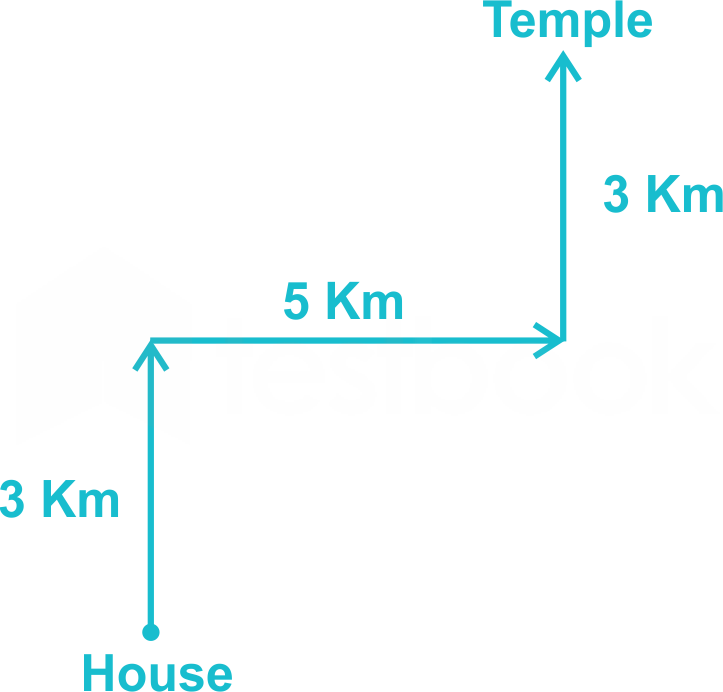
Arjun starts from his home and goes straight for 3 km. Then he turns right and goes for 5 km. Finally, he turns left and goes for 3 km to reach the temple. To which direction is the temple located from Arjun’s home if he started his journey facing North? 

  1. AOption (a)

    North-East 

  2. BOption (b)

    South-East 

  3. COption (c)

    North-West 

  4. DOption (d)

    South-West

View answer & explanation

Correct answer

Answer: (a)A.

North-East 

Why this answer is correct

Given:

 Arjun starts from his home and goes straight for 3 km.

Then he turns right and goes for 5 km.

Finally, he turns left and goes for 3 km to reach the temple. 

Thus, the temple is in the North-East  from Arjun’s home if he started his journey facing North.

Hence, the correct answer is "Option 1".

Question 7

Misha starts from her home and goes straight for 2 km. Then she turns right and goes for 3 km. Finally, she turns left and goes for 2 km to reach the mall. What is the shortest distance between Misha’s home and the mall? 

  1. AOption (a)

    4.5 km

  2. BOption (b)

    5 km

  3. COption (c)

    6 km

  4. DOption (d)

    3.5 km

View answer & explanation

Correct answer

Answer: (b)B.

5 km

Why this answer is correct

Given:

 Misha starts from her home and goes straight for 2 km.

Then she turns right and goes for 3 km.

Finally, she turns left and goes for 2 km to reach the mall.

Thus, shortest distance between Misha’s home and the mall is 5 km.

Hence, the correct answer is "Option 2".

Question 8

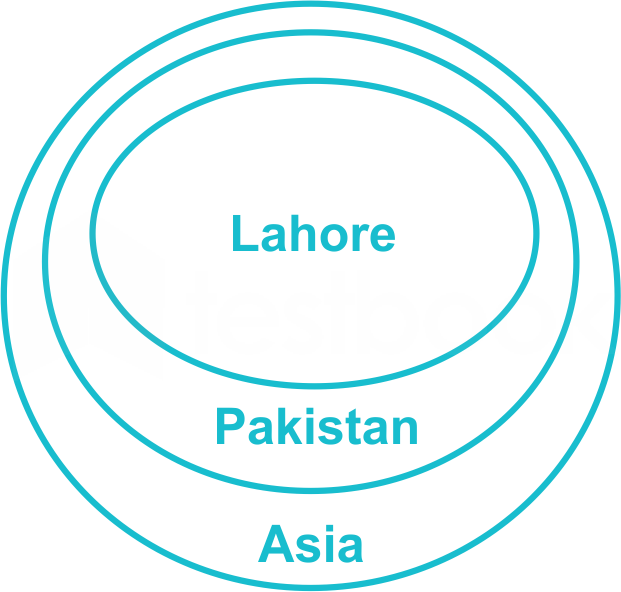
Select the diagram that best represents the relationship among the terms given below:

Lahore, Asia, Pakistan

  1. AOption (a)

  2. BOption (b)

  3. COption (c)

  4. DOption (d)

View answer & explanation

Correct answer

Answer: (b)B.

Why this answer is correct

The least possible venn diagram of the given statements is:

Hence, the correct answer is "Option 2".

Question 9

Six friends, Aman, Bipin, Chhagan, Jagan, Magan, and Tapan, are sitting around a circular table facing one another, such that each friend is seated exactly opposite another friend. Aman does not sit next to Bipin or Tapan. Magan sits to Tapan’s immediate right. Chhagan is sitting opposite Magan. Jagan is sitting to Aman’s immediate right. 

Between whom is Bipin sitting?

  1. AOption (a)

    Tapan and Chhagan  

  2. BOption (b)

    Magan and Jagan 

  3. COption (c)

    Tapan and Jagan 

  4. DOption (d)

    Chhagan and Aman 

View answer & explanation

Correct answer

Answer: (a)A.

Tapan and Chhagan  

Why this answer is correct

Given: Six friends, Aman, Bipin, Chhagan, Jagan, Magan, and Tapan, are sitting around a circular table facing one another, such that each friend is seated exactly opposite another friend.

Chhagan is sitting opposite Magan. Magan sits to Tapan’s immediate right.

Aman does not sit next to Bipin or Tapan. Jagan is sitting to Aman’s immediate right. 

Thus, Bipin is sittin between Tapan and Chhagan .

Hence, the correct answer is "Option 1".

Question 10

Six friends, Aman, Bipin, Chhagan, Jagan, Magan, and Tapan, are sitting around a circular table facing one another, such that each friend is seated exactly opposite another friend. Aman does not sit next to Bipin or Tapan. Magan sits to Tapan’s immediate right. Chhagan is sitting opposite Magan. Jagan is sitting to Aman’s immediate right.  

Who is sitting exactly opposite Tapan?

  1. AOption (a)

    Magan 

  2. BOption (b)

    Jagan

  3. COption (c)

    Chhagan 

  4. DOption (d)

    Aman 

View answer & explanation

Correct answer

Answer: (b)B.

Jagan

Why this answer is correct

Given: Six friends, Aman, Bipin, Chhagan, Jagan, Magan, and Tapan, are sitting around a circular table facing one another, such that each friend is seated exactly opposite another friend.

Chhagan is sitting opposite Magan. Magan sits to Tapan’s immediate right.

Aman does not sit next to Bipin or Tapan. Jagan is sitting to Aman’s immediate right. 

Thus, Jagan is sitting exactly opposite Tapan.

Hence, the correct answer is "Option 2".

Question 11

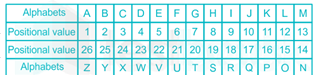
In a code language, FEDERAL is coded as GDEDSZM. How will GENETIC be coded in that language? 

  1. AOption (a)

    HDODUHD 

  2. BOption (b)

    FFMFSJB  

  3. COption (c)

    EDOFUHD

  4. DOption (d)

    HFODSIB

View answer & explanation

Correct answer

Answer: (a)A.

HDODUHD 

Why this answer is correct

FEDERAL is coded as GDEDSZM

Similarly,

GENETIC be coded  ?

Hence, the correct answer is "Option 1".

Question 12

If ‘÷' is replaced by '$'; if '×' is replaced by ‘&’; ‘—’ is replaced by ‘@’; and ‘+’ replaced by ‘#’, find the value of the following equation. 

217 $ 7 & 4 # 5 @ 6

  1. AOption (a)

    123

  2. BOption (b)

    135

  3. COption (c)

    131

  4. DOption (d)

    121

View answer & explanation

Correct answer

Answer: (a)A.

123

Why this answer is correct

Given e×pression:

217 $ 7 & 4 # 5 @ 6

Given Symbol Replacements:

  • '$' is replaced by '÷
  • '&' is replaced by ‘×’
  • '@' is replaced by ‘—’ (subtraction)
  • '#' is replaced by ‘+’ (addition)

Original: 217 $ 7 & 4 # 5 @ 6

New equation: 217 ÷ 7 × 4 + 5 – 6

= 217 ÷ 7 × 4 + 5 – 6

= 31 × 4 + 5 – 6

= 124 + 5 – 6

= 129 – 6 = 123

Hence, the correct answer is "Option 1"$.

Question 13

Six friends are riding horses. Visajirao rides faster than Dipajirao. Prataprao rides faster than Visajirao. Dipajirao rides faster than Hilal but slower than Vithalrao. Vithalrao does not ride as fast as Visajirao. Who among the following rides the fastest? 

  1. AOption (a)

    Prataprao 

  2. BOption (b)

    Wisajirao 

  3. COption (c)

    Vithalrao  

  4. DOption (d)

    Dipajirao 

View answer & explanation

Correct answer

Answer: (a)A.

Prataprao 

Why this answer is correct

Given: Six friends are riding horses.

Visajirao rides faster than Dipajirao.

→ Visajirao > Dipajirao.

Prataprao rides faster than Visajirao.

→Prataprao > Visajirao > Dipajirao.

Dipajirao rides faster than Hilal but slower than Vithalrao. Vithalrao does not ride as fast as Visajirao.

→Prataprao > Visajirao > Vithalrao > Dipajirao > Hilal.

Thus, Prataprao  rides the fastest.

Hence, the correct answer is "Option 1".

Question 14

What will come in place of the blank in the series?

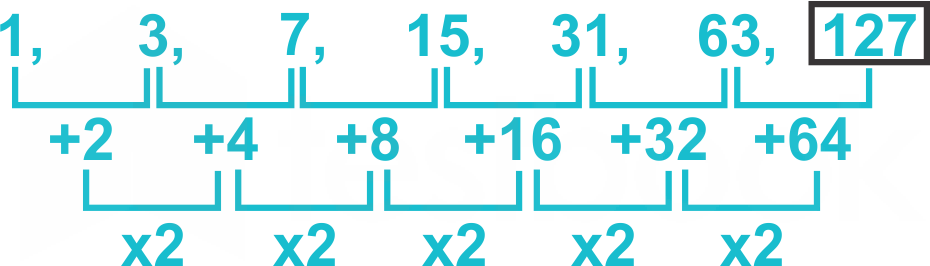
1, 3, 7, 15, 31, 63, _____

  1. AOption (a)

    125

  2. BOption (b)

    157

  3. COption (c)

    112

  4. DOption (d)

    127

View answer & explanation

Correct answer

Answer: (d)D.

127

Why this answer is correct

The logic followed here is:

Hence, the correct answer is "Option 4".

Question 15

Select the option that will correctly replace the question mark (?) and complete the series. 

  1. AOption (a)

    51

  2. BOption (b)

    56

  3. COption (c)

    53

  4. DOption (d)

    67

View answer & explanation

Correct answer

Answer: (c)C.

53

Why this answer is correct

The logic followed here is:

Logic: Square of the sum of upper number = lower number.

→ 42 + 52  = 41

= 16 + 25 = 41.

→ 32 + 62  = 45

= 9 + 36 = 45.

Similarly,

→ 22 + 72  = ?

= 4 + 49 = 53.

Hence, the correct answer is "Option 3".

Question 16

In this question, two statements are given, which are followed by two conclusions numbered 1 and 2. Take the given statements to be true even if they seem to be at variance from commonly known facts. Read the conclusions and then decide which of the given conclusions logically follow(s) from the given statements, disregarding commonly known facts.  

Statements:

All songs are stories.

Some stories are novels.

Conclusions:

  1. All novels are stories.
  2. Some stories are songs.
  1. AOption (a)

    Only conclusion 1 follows. 

  2. BOption (b)

    Only conclusion 2 follows. 

  3. COption (c)

    Neither conclusion 1 nor conclusion 2 follows.

  4. DOption (d)

    Both conclusion 1 and conclusion 2 follow. 

View answer & explanation

Correct answer

Answer: (b)B.

Only conclusion 2 follows. 

Why this answer is correct

Statements:

All songs are stories.

Some stories are novels.

The least possible venn diagram is given:

Conclusions:

  1. All novels are stories -False(because, some stories are novel is given, so it can be possible only).
  2. Some stories are songs - True(because, all songs are stories it implies that some stories are songs).

Thus, Only conclusion 2 follows. 

Hence, the correct answer is "Option 2".

Question 17

The statement below is followed by two arguments labelled I and II. Read the arguments in relation with the statement and identify the strong argument. Assume that all information in the given statements is true.

Statement: Children under the age of 12 years should not be allowed to use mobile phones.

Argument I: Mobile phones are expensive and all children cannot afford them.

Argument II: By using mobile phones, children under 12 years can get exposed to harmful radiation.

  1. AOption (a)

    Only argument I is strong. 

  2. BOption (b)

    Only argument II is strong. 

  3. COption (c)

    Both arguments are strong. 

  4. DOption (d)

    Neither argument I nor argument II is strong. 

View answer & explanation

Correct answer

Answer: (b)B.

Only argument II is strong. 

Why this answer is correct

The logic followed here is:

Statement: Children under the age of 12 years should not be allowed to use mobile phones.

Argument I: Mobile phones are expensive and all children cannot afford them.

Argument II: By using mobile phones, children under 12 years can get exposed to harmful radiation.

Analysis:

Argument I focuses on the financial aspect, stating that mobile phones are expensive and not all children can afford them. While this is a valid point, it is not directly related to the harm caused by mobile phones themselves, which is the primary concern in the statement.

Argument II discusses the potential exposure to harmful radiation, which is a valid health concern when it comes to children using mobile phones. This directly supports the statement, as the harm caused by radiation is a strong reason to restrict mobile phone use among young children.

Thus, the strong argument is Argument II because it directly addresses the negative effects of mobile phone usage on children, which aligns with the statement about restricting mobile phone use for children under 12 years.

Hence, the correct answer is "Option 2"

Question 18

The statement below is followed by two conclusions labelled I and II. Assuming that the information in the statement is true, even if it appears at variance from generally established facts, decide which conclusion(s) logically and definitely follow(s) from the information given in the statement. 

Statement: Only hard-working students have scored more than 60 per cent marks in the annual exam. Rishabh scored 66 per cent marks.

Conclusion I: Rishabh is very intelligent.

Conclusion II: Rishabh is a hard-working student.

  1. AOption (a)

    Only conclusion I follows.  

  2. BOption (b)

    Only conclusion II follows. 

  3. COption (c)

    Both conclusions follow.  

  4. DOption (d)

    Neither conclusion I nor conclusion II follows. 

View answer & explanation

Correct answer

Answer: (b)B.

Only conclusion II follows. 

Why this answer is correct

Statement: "Only hard-working students have scored more than 60 per cent marks in the annual exam. Rishabh scored 66 per cent marks."

Conclusion I:

Rishabh is very intelligent → Does not follow(because The statement only links scoring over 60% to being hard-working. It says nothing about intelligence. A student can be hard-working without necessarily being "very intelligent," or vice-versa. We cannot infer intelligence from the given information).

Conclusion II:

Rishabh is a hard-working student. →  Follows (because The statement says "Only hard-working students have scored more than 60 per cent marks." Rishabh scored 66%, which is more than 60%. Therefore, based on the statement, Rishabh must be a hard-working student.

Therefore, only conclusion II follows.

The correct answer is 2) Only conclusion II follows.

Question 19

Study the following scenario (situation) and answer the question that follows.

You are playing cricket with your friends near your home. When you hit the ball with your bat, the ball hits and breaks the window pane of a neighbour. Select the option that describes the most appropriate action that you will take in this situation.

  1. AOption (a)

    Blame the bowler who had thrown a bouncer at you  

  2. BOption (b)

    Ask the fielder to get the ball as he was responsible for stopping the ball 

  3. COption (c)

    Sneak into the neighbour’s house and get the ball quietly 

  4. DOption (d)

    Apologise to the concerned neighbour and offer to clean the mess and replace the broken glass 

View answer & explanation

Correct answer

Answer: (d)D.

Apologise to the concerned neighbour and offer to clean the mess and replace the broken glass 

Why this answer is correct

The logic followed here is:

Situation: You are playing cricket with your friends near your home. When you hit the ball with your bat, the ball hits and breaks the window pane of a neighbour.

Appropriate Action:

In this situation, the most appropriate action would be to take responsibility for the damage caused. You should apologize to your neighbour for the inconvenience and offer to repair or replace the broken window. If necessary, discuss how the repair costs will be covered.

This demonstrates accountability and shows respect for your neighbour's property, which is important in maintaining good relationships in the community.

Thus, the most appropriate action is: Apologize to your neighbour and offer to repair or compensate for the broken window.

Hence, the correct answer is "Option 4".

Question 20

In this question, two statements labelled I and II are given. Read both the statements and decide which option correctly shows the relationship between these given statements.  

Statement I: The government has banned fishing in the lake.

Statement II: High amount of hazardous toxins were found in the lake water.

  1. AOption (a)

    Statement I is the cause and statement II is its effect. 

  2. BOption (b)

    Statement II is the cause and statement I is its effect. 

  3. COption (c)

    Both the statements I and II are independent causes. 

  4. DOption (d)

    Both the statements I and II are effects of independent causes. 

View answer & explanation

Correct answer

Answer: (b)B.

Statement II is the cause and statement I is its effect. 

Why this answer is correct

Calculation:

Statement I: The government has banned fishing in the lake.

Statement II: High amount of hazardous toxins were found in the lake water.

Analysis:

Statement I suggests a government action (banning fishing) which may be a response to some problem in the lake. Statement II mentions hazardous toxins found in the water, which can be a reason for the government to take such an action to protect public health or the environment.

This shows that the presence of hazardous toxins (Statement II) is likely the cause, and the government’s decision to ban fishing (Statement I) is the effect of that cause.

Hence, the correct option is 2) Statement II is the cause and statement I is its effect.

General Awareness (20 questions)

Question 21

Who was the last Viceroy and the first Governor General of independent India? 

  1. AOption (a)

    Lord Curzon  

  2. BOption (b)

    Lord Wavell 

  3. COption (c)

    Lord Reading 

  4. DOption (d)

    Lord Mountbatten 

View answer & explanation

Correct answer

Answer: (d)D.

Lord Mountbatten 

Why this answer is correct

The correct answer is Lord Mountbatten.

Key Points

  • Lord Louis Mountbatten was the last Viceroy of British India and the first Governor-General of independent India.
  • He served as the Viceroy from February 1947 to August 1947 and oversaw the partition of India into two nations, India and Pakistan.
  • After India's independence on 15 August 1947, Lord Mountbatten became the first Governor-General of India and held this position until June 1948.
  • Mountbatten was the only British Governor-General of independent India, after which the role was assumed by Indian leaders starting with Chakravarti Rajagopalachari in 1948.
  • Mountbatten's tenure was marked by significant events, including the communal violence during partition and the accession of princely states to the Indian Union.

Additional Information

  • Viceroy of India:
  • The Viceroy was the head of the British administration in India, representing the British Crown.
  • The position was established in 1858 after the abolition of the East India Company's rule and continued until 1947.
  • Governor-General of India:
  • The Governor-General was originally the head of the British administration in India before the creation of the Viceroy position in 1858.
  • Post-independence, the Governor-General became the representative of the British monarch in India until India became a republic in 1950.
  • Partition of India:
  • The partition was a significant event in Indian history, leading to the creation of two independent nations, India and Pakistan, on 15 August 1947.
  • It resulted in massive communal violence, displacement, and loss of lives, affecting millions of people.
  • Chakravarti Rajagopalachari:
  • He was the first and only Indian Governor-General of independent India, serving from June 1948 to January 1950.
  • He played a crucial role in the Indian independence movement and was a close associate of Mahatma Gandhi.

Question 22

The Indian Councils Act of 1909 is also known as the:  

  1. AOption (a)

    the Regulating Act 

  2. BOption (b)

    the Pitts India Act 

  3. COption (c)

    the Indian Independence Act  

  4. DOption (d)

    the Morley-Minto Reforms 

View answer & explanation

Correct answer

Answer: (d)D.

the Morley-Minto Reforms 

Why this answer is correct

The correct answer is Morley-Minto Reforms.

Key Points

  • The Indian Councils Act of 1909 is commonly referred to as the Morley-Minto Reforms.
  • The Act was named after the Secretary of State for India, John Morley, and the Governor-General of India, Lord Minto.
  • It introduced the concept of separate electorates for Muslims, allowing them to elect their representatives independently.
  • The Act significantly expanded the legislative councils both at the central and provincial levels.
  • It marked the beginning of communal representation in Indian politics, which later became a contentious issue.

Additional Information

  • Separate Electorates:
  • Separate electorates allowed specific communities, such as Muslims, to vote for their representatives exclusively.
  • This system was meant to address the political concerns of minorities but led to divisive politics in the long run.
  • Expansion of Legislative Councils:
  • The Act increased the number of members in legislative councils at both central and provincial levels.
  • Members could now discuss the budget and suggest amendments, though their powers remained limited.
  • John Morley's Role:
  • John Morley, as the Secretary of State for India, believed in reforms to address Indian demands for representation.
  • He emphasized the importance of including Indians in governance while maintaining British control.
  • Lord Minto's Contribution:
  • Lord Minto, the Governor-General, played a key role in implementing the reforms on the ground.
  • His policies earned him the title "Father of Communal Electorates" due to his role in introducing separate electorates.
  • Impact on Indian Politics:
  • The Morley-Minto Reforms were a response to growing demands for Indian representation in governance.
  • Although they introduced reforms, they also sowed seeds of communalism, which influenced later political developments.

Question 23

Who among the following national leaders attended the second Round Table Conference on behalf of the Indian National Congress in 1931?  

  1. AOption (a)

    Mahatma Gandhi 

  2. BOption (b)

    Jawahar Lal Nehru 

  3. COption (c)

    Sardar Patel  

  4. DOption (d)

    Maulana Abul Kalam Azad 

View answer & explanation

Correct answer

Answer: (a)A.

Mahatma Gandhi 

Why this answer is correct

The correct answer is Mahatma Gandhi.

Key Points

  • Mahatma Gandhi attended the Second Round Table Conference held in London in 1931 as the sole official representative of the Indian National Congress.
  • The Second Round Table Conference was convened from September 7, 1931, to December 1, 1931.
  • Gandhi's participation was part of the Gandhi-Irwin Pact, signed earlier in March 1931, which temporarily halted the Civil Disobedience Movement.
  • The main agenda of the conference was to discuss constitutional reforms in India, but it failed to achieve significant agreements due to conflicting interests among participants.
  • The conference saw representation from British officials, princely state rulers, and communal groups, but the lack of consensus frustrated Gandhi's efforts to secure a unified demand for Indian self-rule.

Additional Information

  • Round Table Conferences:
  • A series of three conferences held between 1930 and 1932 in London to discuss constitutional reforms in India.
  • The conferences were initiated by the British government under the Viceroyship of Lord Irwin.
  • The first conference (1930) was boycotted by the Indian National Congress, while the second (1931) saw Gandhi's participation.
  • Gandhi-Irwin Pact (1931):
  • An agreement between Mahatma Gandhi and Lord Irwin, the then Viceroy of India, signed on March 5, 1931.
  • It resulted in the suspension of the Civil Disobedience Movement and agreed on the release of political prisoners.
  • In return, Gandhi agreed to attend the Second Round Table Conference as the representative of the Congress.
  • Outcome of the Second Round Table Conference:
  • The conference ended without any substantial agreement due to fundamental differences among Indian representatives.
  • Communal representation and separate electorates were major points of contention, particularly advocated by Dr. B.R. Ambedkar for Dalits.
  • The lack of British commitment to self-rule for India deeply disheartened Gandhi.
  • Civil Disobedience Movement:
  • Launched by the Indian National Congress in 1930 under Gandhi's leadership to protest against British rule.
  • The movement included nonviolent resistance, refusal to pay taxes, and boycotts of British goods.
  • It was temporarily suspended following the Gandhi-Irwin Pact but resumed after the Second Round Table Conference's failure.

Question 24

What is the total length of India’s coastline?  

  1. AOption (a)

    5517 km 

  2. BOption (b)

    6517 km 

  3. COption (c)

    7417 km 

  4. DOption (d)

    8517 km 

View answer & explanation

Correct answer

Answer: (c)C.

7417 km 

Why this answer is correct

The correct answer is 7417 km.

Key Points

  • India's coastline has a total length of 7,417 kilometers, encompassing both the mainland and its islands.
  • The mainland coastline covers approximately 5,422 kilometers, while the remaining length belongs to the Andaman and Nicobar Islands and the Lakshadweep Islands.
  • The coastline touches nine Indian states: Gujarat, Maharashtra, Goa, Karnataka, Kerala, Tamil Nadu, Andhra Pradesh, Odisha, and West Bengal.
  • India’s coastal areas are strategically important for trade, tourism, biodiversity, and national security.
  • The coastline plays a critical role in supporting marine ecosystems and livelihoods of millions of people dependent on fishing and related industries.

Additional Information

  • Exclusive Economic Zone (EEZ):
  • India has an Exclusive Economic Zone (EEZ) of approximately 2.37 million square kilometers, extending up to 200 nautical miles from the coastline.
  • The EEZ is crucial for marine resource exploration, energy production, and fishing rights.
  • Coastal Biodiversity:
  • India’s coastline is home to diverse ecosystems, including mangroves, coral reefs, estuaries, and lagoons.
  • The Sundarbans in West Bengal is the largest mangrove forest in the world and a UNESCO World Heritage Site.
  • Ports in India:
  • India has 13 major ports and over 200 minor and intermediate ports along its coastline.
  • Some of the major ports include Mumbai, Chennai, Kolkata, Visakhapatnam, and Cochin.
  • Coastal Protection Initiatives:
  • The Indian government has launched initiatives like the Integrated Coastal Zone Management (ICZM) program to protect coastal and marine ecosystems.
  • Efforts are being made to mitigate coastal erosion, which affects approximately 36% of India's coastline.

Question 25

Which of the following rivers ends in the Arabian Sea? 

  1. AOption (a)

    Ganga 

  2. BOption (b)

    Brahmaputra 

  3. COption (c)

    Kaveri  

  4. DOption (d)

    Narmada 

View answer & explanation

Correct answer

Answer: (d)D.

Narmada 

Why this answer is correct

The correct answer is Narmada.

Key Points

  • Narmada River is one of the major rivers in India that flows westward and drains into the Arabian Sea.
  • The Narmada originates from the Amarkantak Plateau in Madhya Pradesh and flows through the states of Madhya Pradesh, Maharashtra, and Gujarat.
  • It is also referred to as the "Lifeline of Madhya Pradesh and Gujarat" due to its significant contribution to irrigation, drinking water, and hydroelectric power generation.
  • The river flows for approximately 1,312 kilometers before merging into the Arabian Sea.
  • It forms the traditional boundary between North and South India and is one of the few rivers in India that flows westward, unlike most other major rivers that flow eastward.

Additional Information

  • Westward-Flowing Rivers of India
  • Rivers like Narmada, Tapi, Mahi, and Sabarmati flow westward and drain into the Arabian Sea.
  • These rivers are exceptions as most Indian rivers flow eastward into the Bay of Bengal.
  • The westward flow is attributed to the geological tilting of the Indian subcontinent towards the west during its formation.
  • Significance of the Narmada River
  • The river is home to several important dams, including the Sardar Sarovar Dam and the Indira Sagar Dam, which are vital for water supply, irrigation, and hydroelectric power.
  • The Narmada Valley is known for its fertile soil, supporting agriculture in the region.
  • Religious and Cultural Importance
  • The Narmada is considered a sacred river in Hinduism, and it is believed that a parikrama (circumambulation) of the river can cleanse sins.
  • It is associated with several mythological legends and is revered in texts like the Puranas.
  • Geological Features
  • The Narmada River flows through the rift valley formed due to the faulting of the Indian Plate.
  • Its course features picturesque landscapes, including marble rocks near Bhedaghat in Madhya Pradesh.

Question 26

Fundamental Duties (under Article 51A) were added to the Constitution by the ______ Amendment of the Constitution. 

  1. AOption (a)

    7th

  2. BOption (b)

    42nd

  3. COption (c)

    11th

  4. DOption (d)

    44th

View answer & explanation

Correct answer

Answer: (b)B.

42nd

Why this answer is correct

The correct answer is 42nd Amendment.

Key Points

  • The 42nd Amendment Act of 1976 added the Fundamental Duties to the Indian Constitution under Article 51A.
  • This amendment was enacted during the tenure of Prime Minister Indira Gandhi.
  • The Fundamental Duties were inspired by the Constitution of the Soviet Union and were introduced based on recommendations from the Swaran Singh Committee.
  • Initially, there were 10 Fundamental Duties; later, the 86th Amendment in 2002 added the 11th duty related to education.
  • Fundamental Duties are non-justiciable, meaning they cannot be enforced by law, but they serve as moral obligations for citizens.

Additional Information

  • Article 51A: It lists the Fundamental Duties of Indian citizens and emphasizes their role in promoting harmony, protecting heritage, and contributing to national development.
  • Swaran Singh Committee: Established in 1976, it recommended the inclusion of Fundamental Duties in the Indian Constitution to instill civic responsibility among citizens.
  • 42nd Amendment (1976): Known as the "Mini-Constitution," this amendment brought significant changes, including the addition of Fundamental Duties, and expanded the scope of Directive Principles of State Policy.
  • Non-Justiciability: Fundamental Duties are non-enforceable by courts but act as ethical guidelines for citizens to uphold the spirit of the Constitution.
  • The 11th Fundamental Duty, added by the 86th Amendment in 2002, obligates parents/guardians to provide opportunities for education to their children aged 6 to 14 years.

Question 27

________ provides provisions in case of failure of constitutional machinery in States. 

  1. AOption (a)

    Article 350 

  2. BOption (b)

    Article 356  

  3. COption (c)

    Article 333 

  4. DOption (d)

    Article 351 

View answer & explanation

Correct answer

Answer: (b)B.

Article 356  

Why this answer is correct

The correct answer is Article 356.

Key Points

  • Article 356 of the Indian Constitution provides provisions for imposing President's Rule in a state due to the failure of constitutional machinery.
  • Under this article, if the Governor of a state submits a report indicating that the state government cannot function according to constitutional provisions, the President can intervene.
  • President's Rule is imposed when there is a breakdown of governance or law and order, or if elections cannot be conducted.
  • During President's Rule, the state legislature is either dissolved or suspended, and the central government assumes control of the state.
  • The imposition of President's Rule is subject to approval by both houses of Parliament within two months of its declaration.

Additional Information

  • Constitutional Emergency:
  • It refers to a situation where the governance of a state cannot be carried out in accordance with the Constitution.
  • It is also called "President's Rule" or "State Emergency."
  • Article 356 allows the President to assume control of the state's administration during such emergencies.
  • Procedure for Imposition:
  • The Governor sends a report to the President citing reasons for failure of constitutional machinery.
  • The President may issue a proclamation imposing President's Rule in the state.
  • Parliamentary approval is required within two months of the proclamation.
  • Duration and Extension:
  • Initially, President's Rule can be imposed for six months.
  • It can be extended up to a maximum of three years with parliamentary approval every six months.
  • Judicial Review:
  • The imposition of President's Rule is subject to judicial review to ensure it is not misused.
  • The landmark case of S.R. Bommai v. Union of India (1994) established guidelines for its application.

Question 28

Who was the First Speaker of the First Lok Sabha?  

  1. AOption (a)

    Sardar Hukam Singh  

  2. BOption (b)

    Gurdial Singh 

  3. COption (c)

    Ganesh Vasudev Mavalankar 

  4. DOption (d)

    Bali Ram Bhagat 

View answer & explanation

Correct answer

Answer: (c)C.

Ganesh Vasudev Mavalankar 

Why this answer is correct

The correct answer is Ganesh Vasudev Mavalankar.

Key Points

  • Ganesh Vasudev Mavalankar, often referred to as "Dadasaheb," was the First Speaker of the Lok Sabha after India gained independence.
  • He served as the Speaker from 1952 to 1956, during the First Lok Sabha.
  • Mavalankar was a prominent figure in India's freedom struggle and was associated with the Indian National Congress.
  • He played a key role in shaping parliamentary procedures and strengthening democratic practices in India.
  • Before becoming the Speaker of the Lok Sabha, he was the Speaker of the Central Legislative Assembly under British India.

Additional Information

  • Role of the Speaker:
  • The Speaker of the Lok Sabha is responsible for maintaining order and decorum in the House during debates.
  • The Speaker represents the Lok Sabha to the President of India and communicates its resolutions.
  • They ensure impartiality and fair conduct in the proceedings of the House.
  • Lok Sabha:
  • The Lok Sabha is the lower house of India's Parliament, consisting of representatives directly elected by the people.
  • The First Lok Sabha was constituted in 1952 following the general elections held under the Indian Constitution.
  • It has a maximum strength of 552 members, with 530 representing the states, 20 from Union territories, and 2 nominated by the President.
  • Ganesh Vasudev Mavalankar's Legacy:
  • Mavalankar was instrumental in establishing parliamentary norms and traditions in newly independent India.
  • He authored several works on parliamentary practices and procedures.
  • His leadership laid the foundation for India's robust parliamentary democracy.
  • Central Legislative Assembly:
  • The Central Legislative Assembly was the precursor to the Lok Sabha during British rule in India.
  • It was established under the Government of India Act, 1919, and had limited legislative powers.
  • Ganesh Vasudev Mavalankar served as the Speaker of this Assembly before India's independence.

Question 29

Minimum Support Prices are decided by: 

  1. AOption (a)

    Fiscal Prudence Commission  

  2. BOption (b)

    NITI Aayog

  3. COption (c)

    Cabinet Committee on Economic Affairs 

  4. DOption (d)

    Ministry of Finance  

View answer & explanation

Correct answer

Answer: (c)C.

Cabinet Committee on Economic Affairs 

Why this answer is correct

The correct answer is Cabinet Committee on Economic Affairs.

Key Points

  • The Cabinet Committee on Economic Affairs (CCEA) is responsible for approving the Minimum Support Prices (MSP) for various crops in India.
  • MSP is a form of market intervention by the government to ensure agricultural producers are protected against any sharp fall in farm prices.
  • The CCEA takes decisions based on the recommendations of the Commission for Agricultural Costs and Prices (CACP).
  • MSP is announced for 22 mandated crops and an additional bonus for some crops in certain cases.
  • The primary objective of MSP is to ensure a remunerative price to farmers and encourage them to adopt modern farming practices.

Additional Information

  • Commission for Agricultural Costs and Prices (CACP):
  • CACP is an attached office of the Ministry of Agriculture and Farmers' Welfare.
  • It recommends MSPs for crops based on factors like cost of production, demand-supply balance, and market price trends.
  • Factors Considered for MSP:
  • Cost of cultivation, including inputs like seeds, fertilizers, and labor.
  • Trends in domestic and international market prices.
  • Parity between crops and ensuring fair returns to farmers.
  • Mandated Crops under MSP:
  • Includes cereals (wheat, rice, maize, etc.), pulses (tur, moong, urad), oilseeds (soybean, mustard, groundnut), and commercial crops (cotton, sugarcane).
  • Role of MSP in Agriculture:
  • Encourages farmers to grow particular crops to meet food security needs.
  • Acts as a safety net for farmers during market price fluctuations.
  • Helps stabilize the rural economy and reduce farmer distress.

Question 30

Who among the following is the Vice Chairperson of NITI Aayog as on June 2018? 

  1. AOption (a)

    Rajiv Kumar 

  2. BOption (b)

    Ramesh Chand

  3. COption (c)

    VE Paul 

  4. DOption (d)

    Amitabh Kant 

View answer & explanation

Correct answer

Answer: (a)A.

Rajiv Kumar 

Why this answer is correct

The correct answer is Rajiv Kumar.

Key Points

  • Rajiv Kumar served as the Vice Chairperson of NITI Aayog from September 1, 2017, to April 30, 2022.
  • He succeeded Arvind Panagariya, the first Vice Chairperson of NITI Aayog.
  • The National Institution for Transforming India (NITI) Aayog is the policy think tank of the Government of India, established on January 1, 2015.
  • Rajiv Kumar, an economist, has authored several books on India’s economy and has held multiple academic and administrative positions globally.
  • Under his leadership, NITI Aayog focused on policy reforms and development strategies, including initiatives like "Aspirational Districts Programme" and "Atal Innovation Mission."

Additional Information

  • NITI Aayog:
  • It replaced the Planning Commission of India, which was operational since 1950.
  • The organization operates under the chairmanship of the Prime Minister of India.
  • Its core function is to foster cooperative federalism and promote sustainable development goals (SDGs) in India.
  • NITI Aayog has two key hubs: Team India Hub (engages with states) and Knowledge and Innovation Hub (focuses on research and innovation).
  • Functions of NITI Aayog:
  • Promoting competitive and cooperative federalism among states.
  • Formulating strategic and long-term policies and programs for India’s development.
  • Providing technical advice to the central and state governments.
  • Monitoring and evaluating the implementation of government programs and initiatives.
  • Key Initiatives by NITI Aayog:
  • Aspirational Districts Programme: Aims to transform underdeveloped districts through rapid progress in health, education, and infrastructure.
  • Atal Innovation Mission: Promotes entrepreneurship and innovation across India through initiatives like Atal Tinkering Labs and Atal Incubation Centers.
  • Digital India: Supports the government's vision of a digitally empowered India through policy frameworks.
  • Health and Nutrition: Implements the National Nutrition Mission (Poshan Abhiyan) to reduce malnutrition and stunting in children.
  • Rajiv Kumar’s Contributions:
  • Played a key role in drafting the Three-Year Action Agenda for accelerating economic growth.
  • Advocated for reforms in agriculture, education, and job creation.
  • Focused on making India self-reliant through initiatives like Atmanirbhar Bharat Abhiyan.

Question 31

In which state is the Onam festival primarily celebrated? 

  1. AOption (a)

    Telangana 

  2. BOption (b)

    Kerala

  3. COption (c)

    Tamil Nadu 

  4. DOption (d)

    Karnataka 

View answer & explanation

Correct answer

Answer: (b)B.

Kerala

Why this answer is correct

The correct answer is Kerala.

Key Points

  • Onam is the most celebrated and significant festival of Kerala, India.
  • It is a harvest festival that marks the annual homecoming of the mythical King Mahabali.
  • The festival is celebrated in the month of Chingam (August-September) in the Malayalam calendar.
  • Onam is a 10-day-long festival featuring cultural events such as Pookalam (flower arrangements), Vallam Kali (boat races), and Onasadya (a traditional feast).
  • It is considered a symbol of Kerala's rich cultural heritage and unity.

Additional Information

  • King Mahabali:
  • According to mythology, King Mahabali was a generous and just ruler who was sent to the underworld by Lord Vishnu's Vamana avatar.
  • Onam celebrates his annual visit to his kingdom as a blessing from Lord Vishnu.
  • Onasadya:
  • Onasadya is a grand vegetarian feast served on banana leaves, consisting of multiple dishes like rice, sambar, avial, and payasam.
  • It is an integral part of the Onam celebrations.
  • Pookalam:
  • Pookalam refers to intricate floral designs created on the ground as a form of decoration during Onam.
  • Each day of the festival sees the addition of more flowers to the Pookalam.
  • Vallam Kali:
  • Vallam Kali, or snake boat races, are thrilling events held during Onam in Kerala's backwaters.
  • It attracts huge crowds and showcases teamwork and traditional boat-building skills.
  • Unity in Diversity:
  • Onam is celebrated by people of all religions and communities in Kerala, reflecting the state's unity and harmony.
  • It is a festival that transcends cultural and religious boundaries.

Question 32

The noted dancer Ranjana Gauhar is an exponent of which of the following dance styles? 

  1. AOption (a)

    Kuchipudi 

  2. BOption (b)

    Kathak 

  3. COption (c)

    Bharatnatyam

  4. DOption (d)

    Odissi 

View answer & explanation

Correct answer

Answer: (d)D.

Odissi 

Why this answer is correct

The correct answer is Odissi.

Key Points

  • Ranjana Gauhar is a renowned Indian classical dancer and an acclaimed exponent of Odissi.
  • She has been honored with the prestigious Padma Shri award in 2003 for her contributions to Indian classical dance.
  • Ranjana Gauhar has performed extensively across India and abroad, promoting the rich cultural heritage of Odissi.
  • She is also a mentor and has been instrumental in training the next generation of Odissi dancers through her organization, Utsav Educational and Cultural Society.
  • Odissi is one of the eight classical dance forms of India, originating from the state of Odisha and characterized by its fluid movements and expressive storytelling.

Additional Information

  • Odissi Dance
  • Odissi is one of the oldest surviving classical dance forms, with roots dating back to 2000 years.
  • It is deeply connected to temple art and the devotional traditions of Lord Jagannath in Puri, Odisha.
  • The dance form is known for its intricate footwork, graceful movements, and sculpturesque poses inspired by temple carvings.
  • Odissi performances are based on themes from Hindu mythology, particularly those related to Lord Krishna and Radha.
  • Key Elements of Odissi
  • The dance incorporates three distinct stances: Chowka (square posture), Tribhangi (three-bend posture), and Abhinaya (expressional acting).
  • It combines rhythmic movements with emotive expressions (or bhava) to narrate stories.
  • Recognition and Revival
  • Odissi gained recognition as a classical dance form of India in the 1950s.
  • Efforts by dancers and scholars such as Kelucharan Mohapatra and Sanjukta Panigrahi played a significant role in its revival and global popularity.
  • Other Classical Dance Forms
  • India recognizes eight classical dance forms: Bharatanatyam, Kathak, Kathakali, Kuchipudi, Manipuri, Mohiniyattam, Odissi, and Sattriya.
  • Each dance form represents the cultural and artistic traditions of its region of origin.

Question 33

The paintings and sculptures of Ajanta Caves in Maharashtra are related to which of the following religions? 

  1. AOption (a)

    Hinduism 

  2. BOption (b)

    Buddhism 

  3. COption (c)

    Jainism 

  4. DOption (d)

    Zoroastrianism 

View answer & explanation

Correct answer

Answer: (b)B.

Buddhism 

Why this answer is correct

The correct answer is Buddhism.

Key Points

  • The Ajanta Caves are located in Maharashtra and were built during the period between the 2nd century BCE and the 6th century CE.
  • The paintings and sculptures found in the Ajanta Caves are primarily related to Buddhism, depicting the life and teachings of Gautama Buddha.
  • The caves are renowned for their intricate frescoes, murals, and carvings, showcasing scenes from the Jataka tales, which narrate stories of Buddha's previous lives.
  • Ajanta Caves served as a monastic retreat for Buddhist monks and were used for meditation, study, and the propagation of Buddhist principles.
  • The site is recognized as a UNESCO World Heritage Site and is considered a masterpiece of ancient Indian art and architecture.

Additional Information

  • Buddhism:
  • Buddhism is a spiritual tradition founded by Gautama Buddha in the 5th-6th century BCE in India.
  • It emphasizes the Four Noble Truths and the Eightfold Path to achieve liberation from suffering and attain Nirvana.
  • The religion spread across Asia and influenced art, culture, and philosophy in regions like China, Japan, Sri Lanka, and Southeast Asia.
  • Jataka Tales:
  • Jataka tales are a collection of stories about the previous lives of Buddha, illustrating moral and ethical lessons.
  • These stories are a prominent feature in Buddhist art, including the murals of the Ajanta Caves.
  • UNESCO World Heritage Site:
  • Ajanta Caves were designated as a UNESCO World Heritage Site in 1983.
  • Such sites are recognized for their cultural, historical, or scientific significance and are protected under international conventions.
  • Architectural Features of Ajanta Caves:
  • The caves include monasteries (Viharas) and prayer halls (Chaityas), carved into the rock face.
  • The murals display advanced techniques of shading, perspective, and naturalistic representations of figures.

Question 34

What is the highest ever medal tally achieved by India at Commonwealth Games? 

  1. AOption (a)

    94

  2. BOption (b)

    126

  3. COption (c)

    83

  4. DOption (d)

    101

View answer & explanation

Correct answer

Answer: (d)D.

101

Why this answer is correct

The correct answer is 101.

Key Points

  • India achieved its highest-ever medal tally of 101 medals at the 2010 Commonwealth Games held in Delhi, India.
  • This tally included 39 gold, 26 silver, and 36 bronze medals, showcasing India's best performance in the history of the Commonwealth Games.
  • The 2010 Commonwealth Games was the 19th edition of the event and marked the first time India hosted the games.
  • India ranked second in the medal tally, with Australia finishing first and England in third place.
  • Sports such as wrestling, shooting, and athletics were key contributors to India's success in the 2010 edition.

Additional Information

  • Commonwealth Games Overview:
  • The Commonwealth Games is a multi-sport event held every four years involving athletes from the Commonwealth of Nations.
  • It was first held in 1930 as the British Empire Games in Hamilton, Canada.
  • India has been participating in the Commonwealth Games since 1934 and has consistently improved its performance over the years.
  • Highlights of the 2010 Commonwealth Games:
  • Wrestler Sushil Kumar, shooter Gagan Narang, and boxer Vijender Singh were among the standout performers for India.
  • India's performance in shooting and wrestling played a significant role in achieving the record-breaking medal tally.
  • The event witnessed participation from 71 nations and territories.
  • India's Best Performances in Commonwealth Games:
  • India's second-best performance occurred during the 2018 Gold Coast Commonwealth Games, where the country secured 66 medals.
  • India has consistently performed well in sports like shooting, wrestling, weightlifting, and badminton.
  • Significance of the 2010 Commonwealth Games:
  • The 2010 Games helped India establish itself as a major sporting nation in the Commonwealth.
  • It also highlighted India's organizational capabilities, despite challenges in preparation and controversies.

Question 35

How many Olympic Medals has India won in the sport of Wrestling as on June 2018? 

  1. AOption (a)

    5

  2. BOption (b)

    7

  3. COption (c)

    3

  4. DOption (d)

    2

View answer & explanation

Correct answer

Answer: (a)A.

5

Why this answer is correct

The correct answer is 5.

Key Points

  • India has won a total of 5 Olympic medals in Wrestling as of June 2018.
  • The medal tally includes 1 gold, 2 silver, and 2 bronze medals.
  • India's first Olympic medal in wrestling was won by Khashaba Dadasaheb Jadhav in the 1952 Helsinki Olympics (bronze).
  • Sushil Kumar is the only Indian wrestler to have won two Olympic medals: a bronze in the 2008 Beijing Olympics and a silver in the 2012 London Olympics.
  • Yogeshwar Dutt (bronze in 2012) and Sakshi Malik (bronze in 2016) are other notable Indian wrestlers who have brought Olympic glory to the country.

Additional Information

  • Khashaba Dadasaheb Jadhav: India's first individual Olympic medalist in wrestling, he paved the way for future wrestlers by winning bronze in 1952.
  • Sushil Kumar: He holds the distinction of being India's most decorated wrestler in the Olympics, with two medals to his name (bronze in 2008 and silver in 2012).
  • Sakshi Malik: She became the first Indian woman wrestler to win an Olympic medal (bronze in 2016), inspiring a new generation of female wrestlers.
  • Wrestling is a traditional sport in India, with its roots in Pehlwani (a form of traditional Indian wrestling practiced in mud pits called "akhadas").
  • The Freestyle and Greco-Roman wrestling formats are the two disciplines contested in the Olympics, with India specializing mainly in freestyle wrestling.

Question 36

Which of the following works as the best fire extinguisher?  

  1. AOption (a)

    O2

  2. BOption (b)

    SO2

  3. COption (c)

    CO2

  4. DOption (d)

    CO

View answer & explanation

Correct answer

Answer: (c)C.

CO2

Why this answer is correct

The correct answer is CO2.

Key Points

  • Carbon dioxide (CO2) is considered one of the best fire extinguishers, especially for electrical and oil fires, as it does not conduct electricity and does not leave residue.
  • CO2 extinguishes fire by displacing oxygen in the surrounding area and suffocating the flames.
  • CO2 is a non-flammable and inert gas, making it an ideal choice for extinguishing fires without causing damage to sensitive equipment.
  • It is widely used in fire extinguishers and fixed fire suppression systems, particularly in areas like server rooms, laboratories, and industrial facilities.
  • CO2 extinguishers are highly effective for Class B (flammable liquids) and Class C (electrical) fires.

Additional Information

  • Types of Fire Classes:
  • Class A: Fires involving ordinary combustibles like wood, paper, and cloth.
  • Class B: Fires involving flammable liquids like gasoline, oil, and paints.
  • Class C: Fires involving electrical equipment.
  • Class D: Fires involving combustible metals like magnesium and sodium.
  • Class K: Fires involving cooking oils and fats.
  • Fire Extinguishing Methods:
  • Cooling: Reducing the temperature to below ignition point (e.g., water).
  • Smothering: Cutting off the oxygen supply (e.g., CO2).
  • Starvation: Removing the fuel source.
  • Limitations of CO2 Extinguishers:
  • Not suitable for Class A fires involving solid combustibles.
  • Can pose a risk of asphyxiation in enclosed spaces due to oxygen displacement.
  • Other Types of Extinguishing Agents:
  • Water: Effective for Class A fires but not for electrical fires.
  • Foam: Effective for Class B fires but can damage equipment.
  • Dry Chemical Powder: Versatile and effective for Class A, B, and C fires.

Question 37

What is the number of members in UNESCO as on June 2018? 

  1. AOption (a)

    163

  2. BOption (b)

    195

  3. COption (c)

    112

  4. DOption (d)

    67

View answer & explanation

Correct answer

Answer: (b)B.

195

Why this answer is correct

The correct answer is 195.

Key Points

  • UNESCO (United Nations Educational, Scientific and Cultural Organization) is an international organization established in 1945.
  • As of June 2023, UNESCO has 195 Member States and 11 Associate Members.
  • UNESCO aims to build peace through international cooperation in education, sciences, culture, and communication.
  • The United States and Israel formally withdrew from UNESCO in 2019 but rejoined later.
  • UNESCO's headquarters is located in Paris, France.

Additional Information

  • UNESCO's Key Activities:
  • Promotes education worldwide, including initiatives like Education for All.
  • Encourages the protection of cultural heritage through programs like the World Heritage Sites.
  • Advances scientific research and collaboration, particularly in sustainability and climate change.
  • Supports press freedom and media development under the Communication and Information sector.
  • Associate Members:
  • Associate Members are territories or regions not fully sovereign but participate in UNESCO's activities.
  • Examples include Hong Kong and Macau.
  • UNESCO's Governance Structure:
  • Governed by the General Conference, which meets every two years to set policies and approve budgets.
  • Executive Board comprises representatives from Member States and oversees day-to-day operations.
  • UNESCO's Major Programs:
  • Man and the Biosphere Programme (MAB): Promotes sustainable development through ecosystem conservation.
  • International Geoscience and Geoparks Programme (IGGP): Supports geological heritage and sustainable tourism.
  • Memory of the World Programme: Preserves documentary heritage globally.

Question 38

What was the Crude Oil growth rate of India in March 2018? 

  1. AOption (a)

    -3.8%

  2. BOption (b)

    -2.3%

  3. COption (c)

    -1.6%

  4. DOption (d)

    -0.7%

View answer & explanation

Correct answer

Answer: (c)C.

-1.6%

Why this answer is correct

The correct answer is -0.016.

Key Points

  • India's crude oil production growth rate in March 2018 was -0.016, reflecting a decline in production compared to the previous year.
  • The negative growth rate indicates a contraction in crude oil production output, which has implications for energy security and the industrial sector.
  • Crude oil production is a critical indicator of the energy sector, influencing import dependency and domestic energy prices.
  • India imports a significant portion of its crude oil requirements, making domestic production trends crucial for economic planning.
  • Factors such as aging oil fields, technical challenges, and infrastructure issues often contribute to declining production rates.

Additional Information

  • Crude Oil Production:
  • Crude oil is a naturally occurring liquid fossil fuel extracted from underground reservoirs.
  • It serves as a primary source for producing petroleum products such as gasoline, diesel, and jet fuel.
  • India's key crude oil production regions include offshore fields like Bombay High and onshore fields in Assam and Gujarat.
  • Energy Import Dependency:
  • India imports over 80% of its crude oil needs, making it highly dependent on international markets.
  • Fluctuations in global oil prices directly impact India's trade deficit and inflation rates.
  • Challenges in Domestic Production:
  • Declining output from mature oil fields due to depletion of reserves and technical challenges.
  • Delays in exploration and development of new oil fields.
  • Inadequate investment in advanced extraction technologies.
  • Government Initiatives:
  • Policies to promote exploration and production under the Hydrocarbon Exploration and Licensing Policy (HELP).
  • Strategic petroleum reserves have been established to ensure energy security in case of supply disruptions.

Question 39

Which among the following has become India’s first 100 billion market capitalisation IT company? 

  1. AOption (a)

    TCS 

  2. BOption (b)

    Accenture 

  3. COption (c)

    Wipro 

  4. DOption (d)

    Satyam 

View answer & explanation

Correct answer

Answer: (a)A.

TCS 

Why this answer is correct

The correct answer is TCS (Tata Consultancy Services).

Key Points

  • TCS became India’s first IT company to achieve a market capitalization of $100 billion on April 23, 2018.
  • The milestone was achieved due to consistent growth in its revenue, expansion in global markets, and strong client retention.
  • TCS is part of the Tata Group, one of India's largest and most respected business conglomerates.
  • As of the landmark achievement, TCS was among the top global IT services companies in terms of market capitalization.
  • The company's focus on digital transformation, automation, cloud computing, and AI contributed significantly to its valuation.

Additional Information

  • Market Capitalization:
  • It refers to the total value of a company’s outstanding shares of stock, calculated as the share price multiplied by the number of shares.
  • Market capitalization is a key indicator of a company's size and financial stability.
  • Tata Consultancy Services (TCS):
  • Founded in 1968, TCS is headquartered in Mumbai, India.
  • It is a leading provider of IT services, consulting, and business solutions globally.
  • The company operates in over 50 countries and has a diversified client base across industries.
  • Factors Behind TCS's Success:
  • TCS’s emphasis on innovation and adoption of emerging technologies like AI, machine learning, and blockchain.
  • Strong execution capabilities and robust client relationships.
  • Expansion into key global markets, including the US, Europe, and Asia-Pacific.
  • Indian IT Industry:
  • The Indian IT industry is one of the largest and fastest-growing sectors globally, contributing significantly to the country's GDP.
  • Key services include IT consulting, software development, and BPO (Business Process Outsourcing)$.

Question 40

Which among the following Indian cities has NOT figured in the list of world’s 20 most polluted cities in terms of particulate matter PM2.5 levels?  

  1. AOption (a)

    Patna  

  2. BOption (b)

    Chandigarh  

  3. COption (c)

    Agra

  4. DOption (d)

    Gurgaon

View answer & explanation

Correct answer

Answer: (b)B.

Chandigarh  

Why this answer is correct

The correct answer is Chandigarh.

Key Points

  • Chandigarh has NOT been listed among the world's 20 most polluted cities in terms of PM2.5 particulate matter levels as per global air quality studies.
  • PM2.5 refers to fine particulate matter with a diameter of 2.5 micrometers or less, which is linked to serious health risks.
  • According to the World Health Organization (WHO) and IQAir reports, cities like Patna, Agra, and Gurgaon have been identified as highly polluted in terms of PM2.5 levels.
  • Chandigarh, known for its planned urban design and greenery, generally fares better in air quality compared to other major Indian cities.
  • Efforts to maintain sustainable urban development and cleaner air contribute to Chandigarh’s relatively lower pollution levels.

Additional Information

  • Particulate Matter (PM2.5):
  • PM2.5 particles are tiny and can penetrate deep into the lungs and bloodstream, causing respiratory and cardiovascular problems.
  • Sources of PM2.5 include vehicle emissions, industrial activities, construction dust, and burning of fossil fuels.
  • Air Pollution and Health:
  • Exposure to high levels of air pollution can lead to asthma, bronchitis, heart diseases, and reduced life expectancy.
  • Children and the elderly are especially vulnerable to air pollution effects.
  • Global Air Quality Reports:
  • Organizations like IQAir and WHO release annual reports ranking cities based on air pollution levels.
  • India often features prominently in these rankings due to industrial emissions, vehicular pollution, and agricultural burning.
  • Steps to Reduce Pollution:
  • Promoting renewable energy, public transport, and afforestation can help mitigate air pollution.
  • Government initiatives like the National Clean Air Programme (NCAP) aim to improve air quality in Indian cities.

Arithmetic Ability (20 questions)

Question 41

Let x and y be the largest four-digit and the smallest five-digit numbers, respectively, that when divided by 789 leaves a remainder of 7 in each case. What is the value of |x — y]? 

  1. AOption (a)

    678

  2. BOption (b)

    789

  3. COption (c)

    786

  4. DOption (d)

    798

View answer & explanation

Correct answer

Answer: (b)B.

789

Why this answer is correct

Given:

Let x and y be the largest four-digit and the smallest five-digit numbers, respectively, that when divided by 789 leave a remainder of 7.

Formula used:

Number = Divisor × Quotient + Remainder

Calculation:

Largest four-digit number: 9999

⇒ Find x such that 9999 = 789 × Quotient + 7

⇒ Quotient = ⌊(9999 - 7) ÷ 789⌋ = ⌊9992 ÷ 789⌋ = 12

⇒ x = 789 × 12 + 7

⇒ x = 9468 + 7 = 9475

Smallest five-digit number: 10000

⇒ Find y such that 10000 = 789 × Quotient + 7

⇒ Quotient = ⌊(10000 - 7) ÷ 789⌋ = ⌊9993 ÷ 789⌋ = 13

⇒ y = 789 × 13 + 7

⇒ y = 10257 + 7 = 10264

⇒ |x - y| = |9475 - 10264|

⇒ |x - y| = 789

∴ The correct answer is option (2).

Question 42

The value of (1.01)3+0.0000011.0201−(0.01)2×(7.85)2−4.62257.85−2.15\frac{(1.01)^3+0.000001}{1.0201-(0.01)^2}\times \frac{(7.85)^2-4.6225}{7.85-2.15} is

  1. AOption (a)

    10.101

  2. BOption (b)

    0.00101

  3. COption (c)

    0.0101

  4. DOption (d)

    1.01

View answer & explanation

Correct answer

Answer: (a)A.

10.101

Why this answer is correct

Given:

a = 1.01, b = 0.01, x = 7.85, y = 2.15

Formula used:

a3+b3=(a+b)(a2−ab+b2)a^3+b^3=(a+b)(a^2-ab+b^2)

x2−y2=(x+y)(x−y)x^2-y^2=(x+y)(x-y)

Calculations:

For 1st term : (1.01)3+0.0000011.0201−(0.01)2\frac{(1.01)^3+0.000001}{1.0201-(0.01)^2}

⇒ a + b = 1.01 + 0.01 = 1.02 

⇒ a − b = 1.01 − 0.01 = 1

⇒ a² = 1.0201, ab = 1.01 × 0.01 = 0.0101, b² = 0.0001

⇒ a² − ab + b² = 1.0201 − 0.0101 + 0.0001 = 1.0101

⇒ a3+b3a2−b2=(a+b)(a2−ab+b2)(a+b)(a−b)=a2−ab+b2a−b=1.01011=1.0101\frac{a^3+b^3}{a^2-b^2}=\frac{(a+b)(a^2-ab+b^2)}{(a+b)(a-b)}=\frac{a^2-ab+b^2}{a-b}=\frac{1.0101}{1}=1.0101

For 2nd term: (7.85)2−4.62257.85−2.15\frac{(7.85)^2-4.6225}{7.85-2.15}

⇒ x + y = 7.85 + 2.15 = 10

⇒ x − y = 5.7

⇒ x2−y2x−y=(x+y)(x−y)x−y=x+y=10\frac{x^2-y^2}{x-y}=\frac{(x+y)(x-y)}{x-y}=x+y=10

⇒ Result=1.0101 × 10 = 10.101

∴ The value of the expression is 10.101.

Question 43

On simplification, (625)6.25×(5)10.4(5)54×(5)1.2×(25)0.5\frac{(625)^{6.25}\times (\sqrt5)^{10.4}}{(\sqrt5)^{54}\times (5)^{1.2}\times (25)^{0.5}} reduces to:

  1. AOption (a)

    √5

  2. BOption (b)

    5

  3. COption (c)

    5√5

  4. DOption (d)

    25

View answer & explanation

Correct answer

Answer: (b)B.

5

Why this answer is correct

Given:

Expression: (625)6.25×(5)10.4(5)54×51.2×(25)0.5 \frac{(625)^{6.25} × (\sqrt5)^{10.4}}{(\sqrt5)^{54} × 5^{1.2} × (25)^{0.5}}

Formula used:

Power of a power: (am)n=am×n(a^m)^n = a^{m×n}

Roots as fractional exponents: 5=51/2,;25=52\sqrt5=5^{1/2},;25=5^2

Calculations:

⇒ 625=54625=5^4

⇒ (54)6.25=54×6.25=525(5^4)^{6.25}=5^{4×6.25}=5^{25}

⇒ (5)10.4=(51/2)10.4=510.4/2=55.2(\sqrt5)^{10.4}=(5^{1/2})^{10.4}=5^{10.4/2}=5^{5.2}

⇒ Numerator = 525×55.2=530.25^{25}×5^{5.2}=5^{30.2}

⇒ (5)54=554/2=527(\sqrt5)^{54}=5^{54/2}=5^{27}

⇒ (25)0.5=(52)0.5=52��0.5=51(25)^{0.5}=(5^2)^{0.5}=5^{2��0.5}=5^1

⇒ Denominator exponent = 27 + 1.2 + 1 = 29.2 ⇒ Denominator = 529.25^{29.2}

⇒ Fraction = 530.2−29.2=515^{30.2−29.2}=5^1 = 5

∴ The expression simplifies to 5.

Question 44

The value of:  57 of [1137+65 of 313−2122521−2]+[75−223÷3−23−1124−112]\frac{5}{7}\ of\ \left[\frac{1}{1\frac{3}{7}}+\frac{6}{5}\ of\ \frac{3\frac{1}{3}-2\frac{1}{2}}{2\frac{5}{21}-2}\right]+\left[\frac{7}{5-2\frac{2}{3}}\div \frac{3-\frac{2}{3-1\frac{1}{2}}}{4-1\frac{1}{2}}\right]

  1. AOption (a)

    2

  2. BOption (b)

    4

  3. COption (c)

    8

  4. DOption (d)

    16

View answer & explanation

Correct answer

Answer: (c)C.

8

Why this answer is correct

Given:

57 of [1137+65 of 313−2122521−2]+[75−223÷3−23−1124−112]\frac{5}{7}\ of\ \left[\frac{1}{1\frac{3}{7}}+\frac{6}{5}\ of\ \frac{3\frac{1}{3}-2\frac{1}{2}}{2\frac{5}{21}-2}\right]+\left[\frac{7}{5-2\frac{2}{3}}\div \frac{3-\frac{2}{3-1\frac{1}{2}}}{4-1\frac{1}{2}}\right]

Calculations:

57 of [1137+65 of 313−2122521−2]+[75−223÷3−23−1124−112]\frac{5}{7}\ of\ \left[\frac{1}{1\frac{3}{7}}+\frac{6}{5}\ of\ \frac{3\frac{1}{3}-2\frac{1}{2}}{2\frac{5}{21}-2}\right]+\left[\frac{7}{5-2\frac{2}{3}}\div \frac{3-\frac{2}{3-1\frac{1}{2}}}{4-1\frac{1}{2}}\right]

⇒ 57×[1107+65×103−524721−2]+[75−83÷3−23−324−32]\frac{5}{7} \times \left[\frac{1}{\frac{10}{7}}+\frac{6}{5}\times \frac{\frac{10}{3}-\frac{5}{2}}{\frac{47}{21}-2}\right]+\left[\frac{7}{5-\frac{8}{3}}\div \frac{3-\frac{2}{3-\frac{3}{2}}}{4-\frac{3}{2}}\right]

⇒ 57×[710+65×206−15647−4221]+[715−83÷3−26−328−32]\frac{5}{7} \times \left[\frac{7}{10}+\frac{6}{5}\times \frac{\frac{20}{6}-\frac{15}{6}}{\frac{47 - 42}{21}}\right]+\left[\frac{7}{\frac{15 - 8}{3}}\div \frac{3-\frac{2}{\frac{6 -3}{2}}}{\frac{ 8 - 3}{2}}\right]

⇒ 57×[710+65×56521]+[773÷3−4352]\frac{5}{7} \times \left[\frac{7}{10}+\frac{6}{5}\times \frac{\frac{5}{6}}{\frac{5}{21}}\right]+\left[\frac{7}{\frac{7}{3}}\div \frac{3-\frac{4}{3}}{\frac{5}{2}}\right]

⇒ 57×[710+65×216]+[3÷5352]\frac{5}{7} \times \left[\frac{7}{10}+\frac{6}{5}\times \frac{21}{6}\right]+\left[3\div \frac{\frac{5}{3}}{\frac{5}{2}}\right]

⇒ 57×[710+215]+[3÷23]\frac{5}{7} \times \left[\frac{7}{10}+\frac{21}{5}\right]+\left[3\div \frac{2}{3}\right]

⇒ 57×[710+4210]+[3×32]\frac{5}{7} \times \left[\frac{7}{10}+\frac{42}{10}\right]+\left[3\times \frac{3}{2}\right]

⇒ 57×[4910]+[92]\frac{5}{7} \times \left[\frac{49}{10}\right]+\left[\frac{9}{2}\right]

⇒ 57×[4910]+[92]\frac{5}{7} \times \left[\frac{49}{10}\right]+\left[\frac{9}{2}\right]

⇒ [72]+[92]\left[\frac{7}{2}\right]+\left[\frac{9}{2}\right]

⇒ 162\frac{16}{2}

⇒ 8

∴ The correct answer is option 3.

Question 45

In a school, the ages of 15\frac{1}{5} of the total number of students is less than 10 years. 60 girls are more than 10 years of age and this number is equal to 32\frac{3}{2} of the number of boys who are more than 10 years of age. What is 35\frac{3}{5} of the total number of students?

  1. AOption (a)

    54

  2. BOption (b)

    75

  3. COption (c)

    72

  4. DOption (d)

    60

View answer & explanation

Correct answer

Answer: (b)B.

75

Why this answer is correct

Given:

Fraction of students less than 10 years = 15\frac{1}{5} of total students.

Number of girls more than 10 years = 60.

Number of girls more than 10 years = 32\frac{3}{2} × Number of boys more than 10 years.

Calculation:

Let the total number of students in the school be 'T'.

60 girls are more than 10 years of age, and this number is equal to 32\frac{3}{2} of the number of boys who are more than 10 years of age.

60 = 32\frac{3}{2} × (Number of boys > 10 years)

⇒ Number of boys > 10 years = 60 × 23\frac{2}{3}

⇒ Number of boys > 10 years = 40

Total students > 10 years = Girls > 10 years + Boys > 10 years

⇒ Total students > 10 years = 60 + 40

⇒ Total students > 10 years = 100

We know that 15\frac{1}{5} of the total students are less than 10 years of age.

This means the remaining fraction of students are more than 10 years of age.

Fraction of students > 10 years = 1 - 15\frac{1}{5} = 5−15\frac{5-1}{5} = 45\frac{4}{5}

So, 45\frac{4}{5} of the total students is equal to 100.

⇒ 45\frac{4}{5} × T = 100

⇒ T = 100 × 54\frac{5}{4}

⇒ T = 25 × 5

⇒ T = 125

So, the total number of students is 125.

35\frac{3}{5} of the total number of students.

Required value = 35\frac{3}{5} × T

⇒ Required value = 35\frac{3}{5} × 125

⇒ Required value = 3 × 25

⇒ Required value = 75

∴ 35\frac{3}{5} of the total number of students is 75.

Question 46

The ratio of the incomes of A, B and C last year was 3 : 5 : 7. The ratios of their individual incomes last year to that this year are 2 : 3, 3 :4 and 4 : 5, respectively. If their total present income is Rs. 83,650, then what is the present income of C? 

  1. AOption (a)

    Rs. 12,600

  2. BOption (b)

    Rs. 28,000

  3. COption (c)

    Rs. 32,640

  4. DOption (d)

    Rs. 36,750

View answer & explanation

Correct answer

Answer: (d)D.

Rs. 36,750

Why this answer is correct

Given:

The ratio of last year's incomes of A, B, and C = 3 : 5 : 7

The ratio of last year's income to this year's income for A, B, and C = 2 : 3, 3 : 4, and 4 : 5

Total present income = ₹83,650

Formula used:

Present income = Last year's income × Conversion ratio

Calculation:

Let last year's income of A, B, and C be 3x, 5x, and 7x respectively.

Last year's total income = 3x + 5x + 7x = 15x

Present income of A = 3x×32=9x23x × \frac{3}{2} = \frac{9x}{2}

Present income of B = 5x×43=20x35x × \frac{4}{3} = \frac{20x}{3}

Present income of C = 7x×54=35x47x × \frac{5}{4} = \frac{35x}{4}

Total present income = ₹83,650

⇒ 9x2+20x3+35x4=83,650 \frac{9x}{2} + \frac{20x}{3} + \frac{35x}{4} = 83,650

⇒ 54x12+80x12+105x12=83,650 \frac{54x}{12} + \frac{80x}{12} + \frac{105x}{12} = 83,650

⇒ 239x12=83,650 \frac{239x}{12} = 83,650

⇒ x=83,650×12239 x = \frac{83,650 × 12}{239}

⇒ x=4,200 x = 4,200

Present income of C = 35x4=35×4,2004=₹36,750 \frac{35x}{4} = \frac{35 × 4,200}{4} = ₹36,750

∴ The correct answer is option (4).

Question 47

The number of boys is 50% more than the number of girls in a school. If 20% of the number of boys and 30% of the number of girls are scholarship holders, then the percentage of students who are NOT scholarship holders is: 

  1. AOption (a)

    78

  2. BOption (b)

    76

  3. COption (c)

    75

  4. DOption (d)

    72

View answer & explanation

Correct answer

Answer: (b)B.

76

Why this answer is correct

Given:

Number of boys is 50% more than the number of girls.

20% of boys are scholarship holders.

30% of girls are scholarship holders.

Calculation:

Let the number of girls be G.

According to the problem, the number of boys (B) is 50% more than the number of girls:

B = G + 50% of G

⇒ B = 1.5G

For ease of calculation, let's assume the number of girls (G) = 100.

Then, the number of boys (B) = 1.5 × 100 = 150.

Total number of students = Number of girls + Number of boys

⇒ Total students = 100 + 150 = 250

Number of scholarship holder boys = 20% of B

⇒ Scholarship boys = 0.20 × 150 = 30

Number of scholarship holder girls = 30% of G

⇒ Scholarship girls = 0.30 × 100 = 30

Total number of scholarship holders = Scholarship boys + Scholarship girls

⇒ Total scholarship holders = 30 + 30 = 60

Number of students who are NOT scholarship holders = Total students - Total scholarship holders

⇒ Students NOT scholarship holders = 250 - 60 = 190

Percentage of students who are NOT scholarship holders = (Number of students NOT scholarship holdersTotal number of students)×100\left(\frac{\text{Number of students NOT scholarship holders}}{\text{Total number of students}}\right) \times 100

⇒ Percentage = (190250)×100\left(\frac{190}{250}\right) \times 100

⇒ Percentage = (1925)×100\left(\frac{19}{25}\right) \times 100

⇒ Percentage = 19 × 4

⇒ Percentage = 76%

∴ The percentage of students who are NOT scholarship holders is 76%.

Question 48

The marked price of an article is Rs. 1,600. A retailer buys it after getting two successive discounts for Rs. 1,080. The first discount is 25%. If the retailer sells the article by allowing a single discount that is 150% of the second discount on the marked price. The percentage of profit is approximately: 

  1. AOption (a)

    22

  2. BOption (b)

    24

  3. COption (c)

    26

  4. DOption (d)

    30

View answer & explanation

Correct answer

Answer: (c)C.

26

Why this answer is correct

Given:

Marked Price (MP) = ₹1,600

Price after two successive discounts = ₹1,080

First Discount = 25%

Let the second discount be x%.

Final Selling Discount = 150% of the second discount

Formula used:

Price after successive discounts = MP × (1 - First Discount/100) × (1 - Second Discount/100)

Profit Percentage = Selling Price - Cost PriceCost Price×100\dfrac{\text{Selling Price - Cost Price}}{\text{Cost Price}} \times 100

Calculation:

1080 = 1600 × (1 - 25/100) × (1 - x/100)

⇒ 1080 = 1600 × (0.75) × (1 - x/100)

⇒ 1080 = 1200 × (1 - x/100)

⇒ 1 - x/100 = 1080/1200

⇒ 1 - x/100 = 0.9

⇒ x/100 = 1 - 0.9

⇒ x = 10

Second Discount = 10%

Final Selling Discount = 150% of Second Discount:

Final Selling Discount = 150% of 10 = 15%

SP = MP × (1 - Final Selling Discount/100)

⇒ SP = 1600 × (1 - 15/100)

⇒ SP = 1600 × 0.85

⇒ SP = ₹1,360

CP = ₹1,080

Profit Percentage = SP−CPCP×100\dfrac{SP - CP}{CP} \times 100

⇒ Profit Percentage = 1360−10801080×100\dfrac{1360 - 1080}{1080} \times 100

⇒ Profit Percentage = 2801080×100\dfrac{280}{1080} \times 100

⇒ Profit Percentage = 25.93% ≈ 26%

∴ The correct answer is option (3).

Question 49

A sum amounts to Rs. 9,680 in 2 years and Rs. 10,648 in 3 years at a certain rate per annum, interest compounded yearly. The same sum will amount to how much after 3343\frac{3}{4} years at double the rate of interest (nearest to a whole number)?

  1. AOption (a)

    Rs.15,988

  2. BOption (b)

    Rs. 15,898

  3. COption (c)

    Rs. 15,889

  4. DOption (d)

    Rs. 15,989

View answer & explanation

Correct answer

Answer: (b)B.

Rs. 15,898

Why this answer is correct

Given:

Amount after 2 years (A2) = ₹9,680

Amount after 3 years (A3) = ₹10,648

Time (t2) = 2 years

Time (t3) = 3 years

Time for calculation = 3(3/4) years = 3.75 years

Formula used:

A = P(1 + r/100)t

Calculations:

From the given data:

A3/A2 = (1 + r/100)3 / (1 + r/100)2

⇒ ₹10,648/₹9,680 = (1 + r/100)

⇒ 1.1 = (1 + r/100)

⇒ r = 10%

A2 = P(1+r100)2(1+\frac{r}{100})^2

9680 = P(1+10100)2(1+\frac{10}{100})^2

9680 = P(1.1)2(1.1)^2

9680 = P × 1.21

⇒ P = 96801.21\frac{9680}{1.21}

⇒ P = ₹8,000

New rate (r') = 2 × original rate = 2 × 10% = 20%

New time (t') = 3343\frac{3}{4} years = 3 years + 34\frac{3}{4} year

First, calculate the amount after 3 full years with the new rate:

Amount after 3 years = P(1+r′100)3(1+\frac{r'}{100})^3

⇒ Amount after 3 years = 8000(1+20100)3(1+\frac{20}{100})^3

⇒ Amount after 3 years = 8000(1.2)3(1.2)^3

⇒ Amount after 3 years = 8000 × 1.728

⇒ Amount after 3 years = ₹13,824

Now, The simple interest for the remaining 34\frac{3}{4} year on this amount:

Interest for fractional year = 13824×20100×3413824 \times \frac{20}{100} \times \frac{3}{4}

⇒ Interest for fractional year = 13824×0.20×0.7513824 \times 0.20 \times 0.75

⇒ Interest for fractional year = 13824 × 0.15

⇒ Interest for fractional year = ₹2073.6

Final Amount = Amount after 3 years + Interest for fractional year

⇒ Final Amount = ₹13,824 + ₹2073.6

⇒ Final Amount = ₹15,897.6

⇒ Final Amount ≈ ₹15,898

∴ The same sum will amount to ₹15,898 (nearest to a whole number) after 3343\frac{3}{4} years at double the rate of interest.

Question 50

Water flows at a rate of 5 km/h through a pipe of radius 7 cm into a rectangular tank of length 100 m and breadth 88 m. The time (in hours) in which the level of water in the tank will rise by 14 cm is (take π = 22/7): 

  1. AOption (a)

    16

  2. BOption (b)

    15

  3. COption (c)

    12

  4. DOption (d)

    10

View answer & explanation

Correct answer

Answer: (a)A.

16

Why this answer is correct

Given:

Water flow rate = 5 km/h = 5000 m/h

Radius of pipe = 7 cm = 0.07 m

Length of tank = 100 m

Breadth of tank = 88 m

Rise in water level = 14 cm = 0.14 m

Formula Used:

Volume of water flowing per unit time from pipe = Area of pipe cross-section × Speed of water

Area of pipe cross-section = πr2\pi r^2

Volume of water in tank = Length × Breadth × Height

Time = Total Volume required / Volume flow rate

Calculation:

Volume of water flowing through the pipe per hour:

Volume flow rate (Vpipe) = πr2×speed\pi r^2 \times \text{speed}

Vpipe = 227×(0.07)2×5000\frac{22}{7} \times (0.07)^2 \times 5000

Vpipe = 227×0.0049×5000\frac{22}{7} \times 0.0049 \times 5000

Vpipe = 22×0.0007×500022 \times 0.0007 \times 5000

Vpipe = 22 × 3.5

⇒ Vpipe = 77 m3/hour

Required volume in tank (Vtank) = L × B × H

Vtank = 100 m × 88 m × 0.14 m

Vtank = 8800 × 0.14

⇒ Vtank = 1232 m3

Time = Required volume in tankVolume flow rate from pipe\frac{\text{Required volume in tank}}{\text{Volume flow rate from pipe}}

Time = 1232 m377 m3/hour\frac{1232 \text{ m}^3}{77 \text{ m}^3/\text{hour}}

⇒ Time = 16 hours

∴ The time in which the level of water in the tank will rise by 14 cm is 16 hours.

Question 51

The HCF of two numbers is 18 and their product is 5832. If the numbers lie between 30 and 200, then the sum of their reciprocals is: 

  1. AOption (a)

    11162\frac{11}{162}

  2. BOption (b)

    11324\frac{11}{324}

  3. COption (c)

    7162\frac{7}{162}

  4. DOption (d)

    7324\frac{7}{324}

View answer & explanation

Correct answer

Answer: (b)B.

11324\frac{11}{324}

Why this answer is correct

Given:

HCF of two numbers = 18

Product of two numbers = 5832

The numbers lie between 30 and 200.

Formula Used:

For two numbers 'a' and 'b', Product (a × b) = HCF(a, b) × LCM(a, b)

If HCF(a, b) = H, then a = Hx and b = Hy, where x and y are coprime integers.

Sum of reciprocals = 1a+1b=a+bab\frac{1}{a} + \frac{1}{b} = \frac{a+b}{ab}

Calculation:

Let the two numbers be 'a' and 'b'.

We are given HCF(a, b) = 18 and a × b = 5832.

a × b = HCF(a, b) × LCM(a, b)

5832 = 18 × LCM(a, b)

⇒ LCM(a, b) = 583218\frac{5832}{18}

⇒ LCM(a, b) = 324

Since HCF(a, b) = 18, we can write the numbers as:

a = 18x

b = 18y

where x and y are coprime integers (HCF(x, y) = 1).

Substitute these into the product equation:

(18x) × (18y) = 5832

324xy = 5832

⇒ xy = 5832324\frac{5832}{324}

⇒ xy = 18

Now, find pairs of coprime integers (x, y) whose product is 18:

If x = 1, y = 18. HCF(1, 18) = 1. (Valid pair)

If x = 2, y = 9. HCF(2, 9) = 1. (Valid pair)

If x = 3, y = 6. HCF(3, 6) = 3. (Not coprime, so not valid)

Let's check the numbers 'a' and 'b' for each valid (x, y) pair against the condition that they lie between 30 and 200.

Case 1: (x, y) = (1, 18)

a = 18 × 1 = 18

b = 18 × 18 = 324

Here, a = 18 is not > 30, and b = 324 is not < 200. So, this pair is not suitable.

Case 2: (x, y) = (2, 9)

a = 18 × 2 = 36

b = 18 × 9 = 162

Here, a = 36 (30 < 36 < 200) and b = 162 (30 < 162 < 200). This pair satisfies all conditions.

So, the two numbers are 36 and 162.

Sum of reciprocals = 1a+1b\frac{1}{a} + \frac{1}{b}

⇒ Sum of reciprocals = 136+1162\frac{1}{36} + \frac{1}{162}

To add these fractions, find the LCM of 36 and 162.

36 = 22 × 32 = 4 × 9

162 = 2 × 34 = 2 × 81

LCM(36, 162) = 22 × 34 = 4 × 81 = 324

⇒ Sum of reciprocals = 9324+2324\frac{9}{324} + \frac{2}{324}

⇒ Sum of reciprocals = 9+2324\frac{9 + 2}{324}

⇒ Sum of reciprocals = 11324\frac{11}{324}

∴ The sum of their reciprocals is 11324\frac{11}{324}.

Question 52

Let x be the least number that when divided by 16, 28, 40 and 77 leaves a remainder of 7 in each case, but is divisible by 19. What will be the remainder when x is divided by 219?  

  1. AOption (a)

    19

  2. BOption (b)

    37

  3. COption (c)

    69

  4. DOption (d)

    91

View answer & explanation

Correct answer

Answer: (d)D.

91

Why this answer is correct

Given:

The least number 'x' leaves a remainder of 7 when divided by 16, 28, 40, and 77.

The number 'x' is divisible by 19.

Formula Used:

If a number N leaves a remainder 'r' when divided by 'd', then N = qd + r, or N ≡ r (mod d).

If a number N leaves a remainder 'r' when divided by multiple numbers d1, d2, ..., dn, then N = LCM(d1, d2, ..., dn) × k + r, where k is an integer.

Calculation:

The LCM of 16, 28, 40, and 77.

Prime factorization of 16 = 24

Prime factorization of 28 = 22 × 7

Prime factorization of 40 = 23 × 5

Prime factorization of 77 = 7 × 11

LCM(16, 28, 40, 77) = 24 × 5 × 7 × 11

⇒ LCM = 16 × 5 × 7 × 11 = 6160

The number 'x' in terms of the LCM.

Since 'x' leaves a remainder of 7 when divided by 16, 28, 40, and 77:

x = 6160k + 7 (where k is a positive integer)

The condition that 'x' is divisible by 19.

x ≡ 0 (mod 19)

6160k + 7 ≡ 0 (mod 19)

The remainder when 6160 is divided by 19:

6160 = 19 × 324 + 4

So, 6160 ≡ 4 (mod 19)

Substitute this back into the congruence:

4k + 7 ≡ 0 (mod 19)

⇒ 4k ≡ -7 (mod 19)

⇒ 4k ≡ 12 (mod 19) (Since -7 + 19 = 12)

To solve for k, we can find the multiplicative inverse of 4 modulo 19. We look for a number 'm' such that 4m ≡ 1 (mod 19). For m = 5, 4 × 5 = 20 ≡ 1 (mod 19).

Multiply both sides of 4k ≡ 12 (mod 19) by 5:

5 × 4k ≡ 5 × 12 (mod 19)

20k ≡ 60 (mod 19)

Since 20 ≡ 1 (mod 19) and 60 = 3 × 19 + 3, so 60 ≡ 3 (mod 19):

⇒ k ≡ 3 (mod 19)

The least positive integer value for k is 3.

Substitute k = 3 into x = 6160k + 7:

x = 6160 × 3 + 7

x = 18480 + 7

⇒ x = 18487

Divide 18487 by 219:

18487 ÷ 219

18487 = 219 × 84 + 91

The remainder is 91.

∴ The remainder when x is divided by 219 is 91.

Question 53

A boat takes 3 hours more to travel a distance of 30 km upstream than it takes to travel the same distance downstream. If the speed of the boat in still water is three times the speed of the stream, then how much time will it take to travel a distance of 180 km in still water? 

  1. AOption (a)

    20 hours 

  2. BOption (b)

    18 hours 

  3. COption (c)

    24 hours 

  4. DOption (d)

    25 hours  

View answer & explanation

Correct answer

Answer: (c)C.

24 hours 

Why this answer is correct

Given:

The boat takes 3 hours more to travel a distance of 30 km upstream than downstream.

Speed of the boat in still water = 3 × Speed of the stream.

Distance to be traveled in still water = 180 km.

Formula used:

Time = Distance ÷ Speed

Let the speed of the stream be x km/h.

Then, speed of the boat in still water = 3x km/h.

Upstream speed = (3x - x) = 2x km/h.

Downstream speed = (3x + x) = 4x km/h.

Calculations:

Time taken upstream - Time taken downstream = 3 hours

⇒ 302x−304x=3 \frac{30}{2x} - \frac{30}{4x} = 3

⇒ 15x−7.5x=3 \frac{15}{x} - \frac{7.5}{x} = 3

⇒ 15−7.5x=3 \frac{15 - 7.5}{x} = 3

⇒ 7.5x=3 \frac{7.5}{x} = 3

⇒ x = 7.53 \frac{7.5}{3} = 2.5 km/h

Speed of the boat in still water = 3x = 3 × 2.5 = 7.5 km/h

Time taken to travel 180 km in still water = 1807.5 \frac{180}{7.5}

⇒ Time = 24 hours

∴ The correct answer is option (3).

Question 54

A can complete a task in 6 more days than what B takes to complete the same task. B starts the task and works for 4 days. Then, A alone completes it in 12 days. The time taken (in days) by B alone to complete the same task will be:  

  1. AOption (a)

    10

  2. BOption (b)

    12

  3. COption (c)

    15

  4. DOption (d)

    16

View answer & explanation

Correct answer

Answer: (b)B.

12

Why this answer is correct

Given:

A can complete a task in 6 more days than B takes to complete the same task.

B works for 4 days, and then A completes the task in 12 days.

Let B's time to complete the task = x days.

Therefore, A's time to complete the task = x + 6 days.

Formula used:

Work done in 1 day = 1 / (time taken to complete the task)

Total work = Work done by B in 4 days + Work done by A in 12 days

Calculation:

Work done by B in 1 day = 1/x

Work done by A in 1 day = 1/(x + 6)

Total work = 1

⇒ Work done by B in 4 days + Work done by A in 12 days = Total work

⇒ (4/x) + (12/(x + 6)) = 1

⇒ 4(x + 6) + 12x = x(x + 6)

⇒ 4x + 24 + 12x = x2 + 6x

⇒ x2 + 6x - 16x - 24 = 0

⇒ x2 - 10x - 24 = 0

⇒ (x - 12)(x + 2) = 0

⇒ x = 12 or x = -2

Since time cannot be negative, x = 12.

∴ The time taken by B alone to complete the task is 12 days.

Study the following pie-chart and table and answer the questions that follow:  

Distribution of employees in different departments of a company Total number of employees = 3000 

Male and Female Ratio 

DepartmentMale : Female
Accounts11 : 7
Marketing12 : 11
IT14 : 13
Administration3 : 2
others4 : 5

Question 55

Based on Passage: View directions & passage

What is the ratio of the total number of male employees working in Accounts and IT to that of female employees working in Marketing and Administration?

  1. AOption (a)

    25 : 13

  2. BOption (b)

    25 : 19

  3. COption (c)

    23 : 18

  4. DOption (d)

    17 : 15

View answer & explanation

Correct answer

Answer: (b)B.

25 : 19

Why this answer is correct

Given:

Total employees = 3000

Accounts = 18%, Marketing = 23%, IT = 27%, Administration = 20%

Ratios: Accounts M:F = 11:7, Marketing = 12:11, IT = 14:13, Administration = 3:2

Formula used:

Dept emp = total × % /100

Male = (M/(M + F)) × dept employees 

Female = (F/(M + F)) × dept employees 

Required ratio = male(Accounts  + IT) : female(Marketing + Admin)

Calculations:

⇒ Accounts  employees = (3000 × 18)/100 = 540

⇒ Accounts male = (11/(11 + 7)) × 540 = (11/18) × 540 = 11 × 30 = 330

⇒ IT employees = (3000 × 27)/100 = 810

⇒ IT male = (14/(14 + 13)) × 810 = (14/27) × 810 = 14 × 30 = 420

⇒ Marketing employees = (3000 × 23)/100 = 690

⇒ Marketing female = (11/(12 + 11)) × 690 = (11/23) × 690 = 11 × 30 = 330

⇒ Admin employees = (3000 × 20)/100 = 600

⇒ Admin female = (2/(3 + 2)) × 600 = (2/5) × 600 = 2 × 120 = 240

⇒ Total male = 330 + 420 = 750

⇒ Total female = 330 + 240 = 570

∴ Ratio = 750 : 570 = 25 : 19

Question 56

Based on Passage: View directions & passage

If the total number of male employees in the company Is x% more than the total number of female employees, then the value of x (nearest to an integer) 

  1. AOption (a)

    17

  2. BOption (b)

    18

  3. COption (c)

    19

  4. DOption (d)

    20

View answer & explanation

Correct answer

Answer: (c)C.

19

Why this answer is correct

Given:

Total employees = 3000

Dept % – Ratios:

Accounts: 18%, M:F = 11:7

Marketing: 23%, M:F = 12:11

IT: 27%, M:F = 14:13

Administration: 20%, M:F = 3:2

Others: 12%, M:F = 4:5

Formula used:

Dept emp = total × %/100

Male = (M/(M+F)) × dept emp

Female = (F/(M+F)) × dept emp

x% = ((Maletotal – Femaletotal)/Femaletotal) ×100

Calculations:

⇒ Administration employees = (3000×18)/100=540(3000×18)/100=540

⇒ Administration M = (11/18)×540=330(11/18)×540=330, F = 210

⇒ Marketing employees = (3000×23)/100=690(3000×23)/100=690

⇒ Marketing M = (12/23)×690=360(12/23)×690=360, F = 330

⇒ IT employees = (3000×27)/100=810(3000×27)/100=810

⇒ IT M = (14/27)×810=420(14/27)×810=420, F = 390

⇒ Admin employees = (3000×20)/100=600(3000×20)/100=600

⇒ Admin M = (3/5)×600=360(3/5)×600=360, F = 240

⇒ Others employees = (3000×12)/100=360(3000×12)/100=360

⇒ Others M = (4/9)×360=160(4/9)×360=160, F = 200

⇒ Male_total = 330+360+420+360+160 = 1630

⇒ Female_total = 210+330+390+240+200 = 1370

⇒ x = (1630–1370)/1370×100≈18.98%(1630–1370)/1370×100 ≈18.98\%

⇒ x ≈ 19%

∴ The correct answer is option 3.

Study the following graph and answer the questions that follow:

Number of items produced (in thousands) and cost (in Rs.) per hundred items in six companies. 

Question 57

Based on Passage: View directions & passage

What is the total cost of the items produced by companies A, C and E together?

  1. AOption (a)

    Rs. 52,250

  2. BOption (b)

    Rs. 52,450

  3. COption (c)

    Rs. 53,650

  4. DOption (d)

    Rs. 53,560

View answer & explanation

Correct answer

Answer: (c)C.

Rs. 53,650

Why this answer is correct

Given:

Company A: items = 32 000, cost/100 = ₹45

Company C: items = 40 000, cost/100 = ₹50

Company E: items = 35 000, cost/100 = ₹55

Formula used:

Total cost = items × (cost/100)

Calculations:

⇒ Cost of A: (32000×45)/100(32000×45)/100 = (32000×0.45)(32000×0.45) = 14400

⇒ Cost of C: (40000×50)/100(40000×50)/100 = (40000×0.50)(40000×0.50) = 20000

⇒ Cost of E: (35000×55)/100(35000×55)/100 = (35000×0.55)(35000×0.55) = 19250

∴ Total cost = ₹14400 + ₹20000 + ₹19250 = ₹53650

∴ The correct answer is option 3.

Question 58

Based on Passage: View directions & passage

If the number of items produced by company D increases by 40% and the number of items produced by company F decreases by 40%. What will be the total cost of items produced by the two companies?  

  1. AOption (a)

    Rs. 56,400

  2. BOption (b)

    Rs. 56,600

  3. COption (c)

    Rs. 58,400

  4. DOption (d)

    Rs. 58,800

View answer & explanation

Correct answer

Answer: (d)D.

Rs. 58,800

Why this answer is correct

Given:

Company D: items = 50 000, cost/100 = ₹45

Company F: items = 65 000, cost/100 = ₹70

Formula used:

Total cost = items × (cost/100)

Calculations:

⇒ D items: (50000×1.4)=70000(50000×1.4)=70000

⇒ D cost: (70000×45)/100=31500(70000×45)/100=31500

⇒ F items: (65000×0.6)=39000(65000×0.6)=39000

⇒ F cost: (39000×70)/100=27300(39000×70)/100=27300

Total cost = ₹31500 + ₹27300 = ₹58800

∴ The correct answer is option 4.

Study the following bar graph which shows the population of two cities A and B over the years and answer the questions that follow:  

Question 59

Based on Passage: View directions & passage

For which city and in which year was the per cent rise in population from the previous year the highest? 

  1. AOption (a)

    City B - 2008  

  2. BOption (b)

    City A - 2005 

  3. COption (c)

    City A - 2008 

  4. DOption (d)

    City B - 2006 

View answer & explanation

Correct answer

Answer: (b)B.

City A - 2005 

Why this answer is correct

Given:

City A: 2004 = 50, 2005 = 85, 2006 = 100, 2007 = 90, 2008 = 120 (lakhs)

City B: 2004 = 60, 2005 = 70, 2006 = 100, 2007 = 80, 2008 = 110 (lakhs)

Formula used:

Percentage change = ((New – Old)/Old)×100

Calculations:

⇒ City A, 2005 vs 2004: ((85 – 50)/50) × 100 = 35/50 × 100 = 0.7 × 100 = 70%

⇒ City A, 2006 vs 2005: ((100 – 85)/85) × 100 = 15/85 × 100 ≈ 17.65%

⇒ City A, 2007 vs 2006: ((90 – 100)/100) × 100 = –10/100 × 100 = –10%

⇒ City A, 2008 vs 2007: ((120 – 90)/90) × 100 = 30/90 × 100 = 33.33%

⇒ City B, 2005 vs 2004: ((70 – 60)/60) × 100 = 10/60 × 100 ≈ 16.67%

⇒ City B, 2006 vs 2005: ((100 – 70)/70) × 100 = 30/70 × 100 ≈ 42.86%

⇒ City B, 2007 vs 2006: ((80 – 100)/100) × 100 = –20/100 × 100 = –20%

⇒ City B, 2008 vs 2007: ((110 – 80)/80) × 100 = 30/80 × 100 = 37.5%

In year 2005 the percentage rise in population from the previous year was highest.

∴ The correct answer is option 2.

Question 60

Based on Passage: View directions & passage

Population of city A in 2004, 2006 and 2008 together is what per cent more than the population of city B in 2005 and 2007 together? 

  1. AOption (a)

    44.4% 

  2. BOption (b)

    48.8% 

  3. COption (c)

    75%

  4. DOption (d)

    80% 

View answer & explanation

Correct answer

Answer: (d)D.

80% 

Why this answer is correct

Given:

City A: 2004 = 50, 2006 = 100, 2008 = 120 (lakhs)

City B: 2005 = 70, 2007 = 80 (lakhs)

Formula used:

Percentage more = ((Asum – Bsum)/Bsum)×100

Calculations:

⇒ Asum = 50 + 100 + 120 = 270

⇒ Bsum = 70 + 80 = 150

Percentage more = ((270 – 150)/150) × 100 = 120/150 × 100 = 0.8 × 100 = 80%

∴ The population of City A in 2004, 2006 and 2008 together is 80% more than that of City B in 2005 and 2007 together.

General English (20 questions)

Question 61

Choose the correct SYNONYM of: 

SURPRISE

  1. AOption (a)

    Excitement 

  2. BOption (b)

    Relief 

  3. COption (c)

    Amazement  

  4. DOption (d)

    Expectation  

View answer & explanation

Correct answer

Answer: (c)C.

Amazement  

Why this answer is correct

The correct answer is: Amazement.

Key Points

  • The word "Surprise" means a feeling of wonder or astonishment caused by something unexpected. (आश्चर्य)
  • Example: She planned a surprise birthday party for her best friend, leaving everyone amazed.
  • "Amazement" refers to a strong feeling of wonder or astonishment, often similar to surprise but more intense. (विस्मय)
  • Example: The magician's tricks left the audience in amazement.
  • Hence, we can conclude that "Amazement" is a synonym for "Surprise."

Therefore, the correct answer is: Amazement.

Additional Information

Here are the other options explained along with their Hindi meanings and example sentences:

  • Excitement (उत्साह): A feeling of great enthusiasm and eagerness.
  • Example: The excitement before the concert was palpable.
  • Relief (राहत): A feeling of reassurance and relaxation following release from anxiety or distress.
  • Example: After hearing the good news, she felt a sense of relief.
  • Expectation (अपेक्षा): A strong belief that something will happen or be the case in the future.
  • Example: The students waited in expectation for their results to be announced.

Question 62

Choose the correct ANTONYM of:

HAUGHTY

  1. AOption (a)

    Atrogant 

  2. BOption (b)

    Disobedient

  3. COption (c)

    Humble 

  4. DOption (d)

    Disturbing 

View answer & explanation

Correct answer

Answer: (c)C.

Humble 

Why this answer is correct

The correct answer is: Humble.

Key Points

  • The word "Haughty" means arrogantly superior and disdainful; it refers to someone who is excessively proud and looks down upon others. (अहंकारी)
  • Example: She was too haughty to apologize for her mistake.
  • "Humble" is the opposite of haughty. It refers to someone who is modest, not arrogant, and treats others with respect and equality. (विनम्र)
  • Example: Despite his success, he remains humble and approachable.
  • Hence, we can infer that the opposite of 'Haughty' is 'Humble'.

Therefore, the correct answer is: Humble.

Additional Information

Here are the other options explained along with their Hindi meanings and example sentences:

  • Arrogant (अहंकारी): Having or showing an exaggerated sense of one’s own importance or abilities.
  • Example: His arrogant behavior alienated his colleagues.
  • Disobedient (अवज्ञाकारी): Refusing to obey rules or authority.
  • Example: The disobedient child ignored his teacher's instructions.
  • Disturbing (परेशान करने वाला): Causing anxiety or worry; upsetting.
  • Example: The disturbing news left everyone in shock.

Question 63

Choose the correct ANTONYM of the underlined word to fill in the blank.

Though the lion appeared to be gentle, it turned out that it was quite _____ and snarled at the visitors.

  1. AOption (a)

    timid 

  2. BOption (b)

    innocent 

  3. COption (c)

    depressed 

  4. DOption (d)

    ferocious

View answer & explanation

Correct answer

Answer: (d)D.

ferocious

Why this answer is correct

The correct answer is 'ferocious'.


Key Points

  • The underlined word is "gentle".
  • "Gentle" means kind, mild, or not harsh. (विनम्र, कोमल)
  • We need to find the antonym, which means the opposite of "gentle".
  • "Ferocious" means savagely fierce, cruel, or violent. (भयंकर, क्रूर)
  • The context of the sentence ("snarled at the visitors") indicates a strong, aggressive nature, which is the opposite of gentle.

​Therefore, the correct answer is 'Option 4'.

Complete Sentence: Though the lion appeared to be gentle, it turned out that it was quite ferocious and snarled at the visitors.

Additional Information

  • Timid (डरपोक): means showing a lack of courage or confidence; easily frightened. This is not the direct opposite of gentle in terms of aggression.
  • Innocent (निर्दोष): means not guilty of a crime or offense; not harmful or evil. While a gentle creature might also be innocent, it's not the direct antonym for "gentle" in the context of aggression.
  • Depressed (उदासीन): means in a state of unhappiness and low spirits. This is related to mood, not directly to the nature of being gentle or aggressive.

Question 64

Choose the correct word to fill in the blank.

My car is giving me good mileage. It gives me 20 kilometres _______ litre.

  1. AOption (a)

    the

  2. BOption (b)

    a

  3. COption (c)

    any

  4. DOption (d)

    some

View answer & explanation

Correct answer

Answer: (b)B.

a

Why this answer is correct

The correct answer is 'a'.


Key Points

  • The word "a" is an indefinite article used before singular countable nouns to indicate one among many.
  • In the context, "20 kilometres a litre" means mileage per litre of fuel.
  • The other options: "the," "any," and "some" do not fit the sentence grammatically.

​Therefore, the correct answer is 'Option 2'.

Complete Sentence: My car is giving me good mileage. It gives me 20 kilometres a litre.

Additional Information

  • The (निर्दिष्ट): Refers to something specific or already mentioned.
  • Any (कोई भी): Refers to any one of a group, without specifying.
  • Some (कुछ): Refers to an unspecified quantity.

Question 65

Fill in the blank with the appropriate word (s).

I ______ my birthday on Saturday at my house. Please do come at 7 pm.

  1. AOption (a)

    celebrated

  2. BOption (b)

    am celebrating 

  3. COption (c)

    Was celebrating 

  4. DOption (d)

    celebrates 

View answer & explanation

Correct answer

Answer: (b)B.

am celebrating 

Why this answer is correct

The correct answer is 'am celebrating'.


Key Points

  • The sentence uses the present continuous tense (am + verb + ing) to indicate an event happening in the near future.
  • The word "am celebrating" fits the context as the speaker is referring to a planned event on Saturday.
  • Other options like "celebrated," "Was celebrating," and "celebrates" do not fit the timeline or grammatical structure as appropriately.

​Therefore, the correct answer is 'Option 2'.

Complete Sentence: I am celebrating my birthday on Saturday at my house. Please do come at 7 pm.

Additional Information

  • Celebrated: Refers to a past event.
  • Was celebrating: Indicates a past ongoing action.
  • Celebrates: Refers to a habitual or repeated action.

Question 66

Fill in the blank with the appropriate word.

My friend is quite ill. I visit her ________ in the hospital.

  1. AOption (a)

    daily 

  2. BOption (b)

    completely 

  3. COption (c)

    Usually 

  4. DOption (d)

    hardly 

View answer & explanation

Correct answer

Answer: (a)A.

daily 

Why this answer is correct

The correct answer is 'daily'.


Key Points

  • The word "daily" means occurring every day or regularly. (प्रतिदिन)
  • Visiting a sick friend in the hospital daily is the most appropriate action to provide care and support.
  • The other options: "completely," "usually," and "hardly" do not fit the context as appropriately.

​Therefore, the correct answer is 'Option 1'.

Complete Sentence: My friend is quite ill. I visit her daily in the hospital.

Additional Information

  • Completely (पूरी तरह से): means fully or entirely, but does not fit the context.
  • Usually (आमतौर पर): means typically or commonly, but does not convey regular daily visits.
  • Hardly (मुश्किल से): means scarcely or barely, which contradicts the intended meaning.

Question 67

In the following sentences, four words or phrases have been underlined. One of them is incorrect. Choose the INCORRECT word or phrase from the given options. 

The maintenance of the parks and gardens has been entrusted to a private agency that has promised to do a professional job. We do hope the parks are now be maintained well.

  1. AOption (a)

    has been entrusted 

  2. BOption (b)

    has promised

  3. COption (c)

    do hope 

  4. DOption (d)

    are now be maintained 

View answer & explanation

Correct answer

Answer: (d)D.

are now be maintained 

Why this answer is correct

The correct answer is '4' i.e. are now be maintained .

Key Points

  • The sentence "We do hope the parks are now be maintained well" contains a grammatical error.
  • The phrase "are now be maintained" is incorrect because the auxiliary verb "are" does not align with the base verb "be."
  • To correct the sentence, the phrase should be replaced with "are now being maintained".
  • The present continuous tense ("are being maintained") is appropriate here to indicate an ongoing action.

Correct sentence: We do hope the parks are now being maintained well.

Additional Information

  • Present Continuous Tense:
  • Structure: Subject + is/am/are + verb (base form) + -ing.
  • Example: The gardens are being renovated.
  • Usage: Used to describe ongoing actions or events happening at the moment of speaking.
  • Common Error:
  • Using "are + be" is incorrect and does not exist in standard English grammar.

Question 68

In the following sentences, four words or phrases have been underlined. One of them is incorrect. Choose the INCORRECT word or phrase from the given options.

The tsunami hit the coastal towns with such ferocity that each and all dwelling was destroyed. Many precious lives were lost too.

  1. AOption (a)

    hit the coastal towns 

  2. BOption (b)

    each and all dwelling 

  3. COption (c)

    was destroyed. 

  4. DOption (d)

    lives were lost  

View answer & explanation

Correct answer

Answer: (b)B.

each and all dwelling 

Why this answer is correct

The correct answer is '2' i.e. each and all dwelling .

Key Points

  • The phrase "each and all dwelling" is grammatically incorrect. The correct usage should be either "each dwelling" or "all dwellings" depending on the intended meaning.
  • "Each" refers to individual items, while "all" refers to the collective group. Combining them in this manner is redundant and incorrect.
  • The remaining parts of the sentence are grammatically correct:
  • "hit the coastal towns" correctly describes the action of the tsunami.
  • "was destroyed" correctly matches the subject-verb agreement for singular nouns.
  • "lives were lost" appropriately describes the tragic outcome.

Correct sentence: The tsunami hit the coastal towns with such ferocity that each dwelling was destroyed. Many precious lives were lost too.

Additional Information

  • Common Errors with Determiners:
  • Each: Used for individual items in a group (e.g., Each student has a book).
  • All: Used for the entire group collectively (e.g., All students have books).
  • Do not combine "each" and "all" in this way, as it creates redundancy and confusion.
  • How to Avoid This Error: Always ensure that determiners like "each" and "all" are used correctly and not redundantly combined.

Question 69

Choose the PASSIVE VOICE form of the given sentence.

The audience enjoyed the opening song of the show and cheered loudly when it finished.

  1. AOption (a)

    The audience was finding the opening song enjoyable during the show and cheered loudly when it finished. 

  2. BOption (b)

    The audience enjoyed the opening song of the show and when it finished they were cheering loudly. 

  3. COption (c)

    The opening song of the show was enjoyed by the audience and they cheered loudly when it finished. 

  4. DOption (d)

    The audience is finding the opening song during the show enjoyable and so they cheered loudly when it finished. 

View answer & explanation

Correct answer

Answer: (c)C.

The opening song of the show was enjoyed by the audience and they cheered loudly when it finished. 

Why this answer is correct

The correct answer is '3' i.e. The opening song of the show was enjoyed by the audience and they cheered loudly when it finished.

Key Points

  • The question requires converting the given sentence into its passive voice.
  • In a passive voice sentence, the object of the active sentence becomes the subject, and the verb is changed to its appropriate form.
  • The given sentence in active voice is: The audience enjoyed the opening song of the show and cheered loudly when it finished.
  • Its passive form is: The opening song of the show was enjoyed by the audience and they cheered loudly when it finished.

Correct sentence: The opening song of the show was enjoyed by the audience and they cheered loudly when it finished.

Additional Information

  • Active Voice: The subject performs the action (e.g., "The audience enjoyed the song.").
  • Passive Voice: The subject receives the action (e.g., "The song was enjoyed by the audience.").
  • In passive voice, the structure is typically: Object + "to be" verb + past participle + "by" + subject.

Question 70

Choose the most appropriate INDIRECT SPEECH for the following sentence.

Mother said to Ravi, “You must return home before it gets dark. Don’t get late!”

  1. AOption (a)

    Mother requested Ravi that he should return home before dark and warns him not to get late. 

  2. BOption (b)

    Mother reminded Ravi to return home before it got dark and warned him not to get late. 

  3. COption (c)

    Ravi told mother that he must return home before it got dark and would not get late. 

  4. DOption (d)

    Mother was reminding Ravi that he must return home before it got late and warned him to reach before it got dark 

View answer & explanation

Correct answer

Answer: (b)B.

Mother reminded Ravi to return home before it got dark and warned him not to get late. 

Why this answer is correct

The correct answer is '2' i.e. Mother reminded Ravi to return home before it got dark and warned him not to get late.

Key Points

  • The sentence in direct speech contains a directive (command/request) and a warning.
  • In indirect speech, the directive is conveyed using the verb "reminded," and the warning is conveyed with "warned."
  • The tense in indirect speech changes appropriately: "before it gets dark" becomes "before it got dark."
  • Option 2 is correct because it appropriately conveys both the reminder and the warning from the mother in indirect speech.

Correct sentence: Mother reminded Ravi to return home before it got dark and warned him not to get late.

Additional Information

  • Direct to Indirect Speech Rules:
  • Reporting Verb: Use appropriate verbs like "said," "reminded," "warned," "requested," etc., depending on the context.
  • Tense Change: Present tense in direct speech changes to past tense in indirect speech.
  • Pronoun Change: Pronouns in direct speech are adjusted according to the perspective of the reporting speaker.
  • Example: Direct: "You must finish your homework." Indirect: "She reminded him to finish his homework."

Question 71

Choose the best option to combine the given sentences.

I won the book, The Diary of Anne Frank at the competition. The book is very dear to me.

  1. AOption (a)

    The book, The Diary of Anne Frank that I won at the competition, is very dear to me.  

  2. BOption (b)

    The book which is The Diary of Anne Frank won at the competition is very dear to me. 

  3. COption (c)

    The book is very dear to me, The Diary of Anne Frank, which I won at the competition. 

  4. DOption (d)

    I won the book The Diary of Anne Frank at a competition however it is very dear to me. 

View answer & explanation

Correct answer

Answer: (a)A.

The book, The Diary of Anne Frank that I won at the competition, is very dear to me.  

Why this answer is correct

The correct answer is '1' i.e. The book, The Diary of Anne Frank that I won at the competition, is very dear to me. .

Key Points

  • The given sentences need to be combined using proper sentence structure and grammar.
  • Option 1 correctly combines the sentences by integrating the details about the book within a single clause.
  • The book title, "The Diary of Anne Frank," is appropriately placed as an appositive, providing additional information about the subject.
  • Option 2 has awkward phrasing ("The book which is The Diary of Anne Frank won at the competition"), making it incorrect.
  • Option 3 separates the idea in an unclear manner, leading to poor sentence structure.
  • Option 4 uses "however," which implies contrast, but the sentences are not contrasting ideas.

Correct sentence: The book, The Diary of Anne Frank that I won at the competition, is very dear to me.

Additional Information

  • Appositive Phrases:
  • An appositive is a noun or noun phrase that renames or gives additional information about a noun.
  • In the sentence, "The book, The Diary of Anne Frank," the title is an appositive that renames "the book."
  • Appositives are often set off by commas to enhance readability.
  • Combining Sentences:
  • Combining sentences effectively involves maintaining clarity and logical connections between ideas.
  • Using relative clauses, such as "that I won at the competition," helps provide necessary context without creating separate sentences.

Question 72

Choose the passage that is correctly punctuated. 

  1. AOption (a)

    She took a quick bath. sipped a cup of hot coffee; made a few important calls; and sat down for a conference call with Ashish. 

  2. BOption (b)

    She took a quick bath sipped a cup of hot coffee. made a few important calls and sat down for a conference call with ashish. 

  3. COption (c)

    She took a quick bath, sipped a cup of hot coffee, made a few important calls and sat down for a conference call with Ashish. 

  4. DOption (d)

    she took a quick bath sipped a cup of hot coffee made a few important calls and sat down. For a conference call with Ashish. 

View answer & explanation

Correct answer

Answer: (c)C.

She took a quick bath, sipped a cup of hot coffee, made a few important calls and sat down for a conference call with Ashish. 

Why this answer is correct

The correct answer is '3' i.e. She took a quick bath, sipped a cup of hot coffee, made a few important calls and sat down for a conference call with Ashish. .

Key Points

  • The sentence is correctly punctuated to maintain clarity and flow.
  • Commas are appropriately used to separate the list of actions that the subject performed.
  • The sentence ends with proper capitalization and punctuation, including the name "Ashish" being capitalized correctly as it is a proper noun.
  • The sequence of actions is clearly conveyed without grammatical errors.

Correct Sentence: She took a quick bath, sipped a cup of hot coffee, made a few important calls and sat down for a conference call with Ashish.

Additional Information

  • Common punctuation rules:
  • Use commas to separate elements in a list to improve readability.
  • Capitalize proper nouns such as names, titles, and specific places.
  • End sentences with appropriate punctuation marks like a period or question mark.
  • Importance of punctuation:
  • Ensures clarity and avoids misinterpretation of sentences.
  • Helps in maintaining the logical flow of ideas.

Question 73

Choose the word that is correctly spelt. 

  1. AOption (a)

    Forein

  2. BOption (b)

    Preference 

  3. COption (c)

    Deppressed 

  4. DOption (d)

    Boundry 

View answer & explanation

Correct answer

Answer: (b)B.

Preference 

Why this answer is correct

The correct answer is: Option 2 i.e. Preference.

Key Points

  • The word "Preference" means a greater liking for one alternative over another or others. (पसंद / प्राथमिकता)
  • Example: She has a preference for tea over coffee.
  • The correct word "Preference" is spelled correctly, reflecting its accurate usage in English. (पसंद / प्राथमिकता)
  • Example: My preference is to study in a quiet environment.

Therefore, the correct answer is: Option 2 i.e. Preference.

Additional Information

Here are the other options explained along with their Hindi meanings and example sentences:

  • Forein (विदेशी): This is an incorrect spelling. The correct spelling is "Foreign", which refers to something that is from or relating to a country other than one's own.
  • Example: She enjoys learning foreign languages.
  • Deppressed (अवसादग्रस्त): This is an incorrect spelling. The correct spelling is "Depressed", which means to feel extremely sad or dejected.
  • Example: After losing the match, he felt very depressed.
  • Boundry (सीमा): This is an incorrect spelling. The correct spelling is "Boundary", which refers to a line marking the limits of an area.
  • Example: The boundary of the park is marked by a fence.

Question 74

Fill in the blank with the appropriate phrasal verb.

It is now becoming more and more difficult for black money hoarders to _________ income tax evasion.

  1. AOption (a)

    get off with 

  2. BOption (b)

    get through 

  3. COption (c)

    get on with  

  4. DOption (d)

    get away with 

View answer & explanation

Correct answer

Answer: (d)D.

get away with 

Why this answer is correct

The correct answer is 'get away with'.


Key Points

  • The phrasal verb "get away with" means to escape punishment or avoid consequences for something wrong or illegal.
  • In the context of the sentence, black money hoarders are trying to evade income tax without facing any legal repercussions.
  • The other options do not fit the context:
  • Get off with: refers to escaping with minimal punishment.
  • Get through: means to successfully complete or endure something.
  • Get on with: refers to continuing or making progress.

​Therefore, the correct answer is 'Option 4'.

Complete Sentence:  It is now becoming more and more difficult for black money hoarders to get away with income tax evasion.

Additional Information

  • Get off with: Escaping lightly or with less punishment.
  • Get through: Successfully completing or surviving something.
  • Get on with: Proceeding or continuing with an activity.
  • Get away with: Avoiding consequences or punishment for wrongdoing.

Question 75

Fill in the blank with the appropriate idiom.

I told Asha to be humble and not _______ as her superiors would surely recognise her skills.

  1. AOption (a)

    to call a spade a spade  

  2. BOption (b)

    blow hot and cold 

  3. COption (c)

    cut a sorry figure  

  4. DOption (d)

    to blow her own trumpet 

View answer & explanation

Correct answer

Answer: (d)D.

to blow her own trumpet 

Why this answer is correct

The correct answer is 'to blow her own trumpet'.


Key Points

  • The idiom "to blow her own trumpet" means to boast about one’s own achievements or skills (अपने कौशल या उपलब्धियों का घमंड करना).
  • In the given context, Asha is advised to stay humble and avoid boasting about her abilities.
  • The other idioms: "to call a spade a spade," "blow hot and cold," and "cut a sorry figure" do not fit the sentence as appropriately.

​Therefore, the correct answer is 'Option 4'.

Complete Sentence: I told Asha to be humble and not blow her own trumpet as her superiors would surely recognise her skills.

Additional Information

  • To call a spade a spade: means to speak honestly and directly.
  • Blow hot and cold: means to alternate between different moods or opinions.
  • Cut a sorry figure: means to present oneself poorly or in an unimpressive manner.

Read the following passage and answer the questions that follow.

T'ai chi is a Chinese martial art and a form of stylised, meditative exercise consisting of slow circular and stretching movements and positions of bodily balance.

When a lot of people got sick owing to population explosion and lack of sufficient medical care, in 1956, during the communist revolution, top t'ai chi practitioners in China got together and came up with a short programme of teaching t'ai chi at a national level. The healthy practice of ending the day with some t'ai chi instead of remaining glued to the TV set or mobile phone would not only melt away the aches and pains acquired during the day but also induce a truly restful sleep.

T'ai chi's social benefits are well documented. The technique - Push Hands, where two people pair off- one uses his hands to push the partner, and the partner yields and neutralises the first and maintains his equilibrium has been shown to have psychological value. It has tremendous healing effect on those suffering from loneliness. All moves in t'ai chi involve bending and stretching. It starts with opening and closing in the joints. The joints get smaller while closing and expand while opening. At the physical level, this raises the practitioner's vitality. T'ai chi unites the mind, body and heart exponentially.

According to t'ai chi classics, the lower dantian - the area between the navel and the pubic bone is the energetic centre that affects every action you make. It is the body's main switch box. A part of your mind should always remain present in your lower dantian. If everything comes from your lower dantian, it floods all the energy channels of your body evenly and balances them. The increased energy in the lower dantian increases your sense of physicality in everything you do, be it health, power, strength or focus.

Question 76

Based on Passage: View directions & passage

Choose the most appropriate option to complete the sentence. 

T’ai chi was started _______.

  1. AOption (a)

    by a communist movement or revolution

  2. BOption (b)

    owing to population explosion 

  3. COption (c)

    because of the need for medical care

  4. DOption (d)

    because people were getting very slow in their life 

View answer & explanation

Correct answer

Answer: (c)C.

because of the need for medical care

Why this answer is correct

The correct answer is Option 3.


Key Points

  • The passage states: "When a lot of people got sick owing to population explosion and lack of sufficient medical care, in 1956, during the communist revolution, top t'ai chi practitioners in China got together and came up with a short programme of teaching t'ai chi at a national level."
  • The phrase "lack of sufficient medical care" directly points to the need for medical care as a reason for starting the national t'ai chi program. While population explosion is mentioned, the core problem that t'ai chi aimed to address was the health crisis stemming from the inability of existing medical infrastructure to cope.

Therefore, the correct answer is Option 3.


Complete Sentence: "T’ai chi was started because of the need for medical care."


Additional Information

  • Option 1: "by a communist movement or revolution" – The communist revolution was the context or time period when this happened, not the direct reason for starting t'ai chi. The motivation came from a public health crisis.
  • Option 2: "owing to population explosion" – While population explosion contributed to people getting sick, the ultimate problem that t'ai chi was introduced to address was the health consequences of that explosion, specifically the "lack of sufficient medical care." Option 3 focuses more precisely on the need for health intervention.
  • Option 4: "because people were getting very slow in their life" – This reason is not supported by the passage. The text focuses on illness and lack of medical care as the drivers for the program.

Question 77

Based on Passage: View directions & passage

Choose the option that answers the question given below. 

Which of the following is NOT an advantage of doing t’ai chi?

  1. AOption (a)

    One remains attached to the mobile phone. 

  2. BOption (b)

    It gives bodily balance. 

  3. COption (c)

    People get together. 

  4. DOption (d)

    It helps you get rid of pains. 

View answer & explanation

Correct answer

Answer: (a)A.

One remains attached to the mobile phone. 

Why this answer is correct

The correct answer is Option 1.


Key Points

  • The question asks for what is NOT an advantage of doing t'ai chi.
  • The passage states: "The healthy practice of ending the day with some t'ai chi instead of remaining glued to the TV set or mobile phone would not only melt away the aches and pains acquired during the day but also induce a truly restful sleep."
  • This sentence suggests that doing t'ai chi is an alternative to being glued to a mobile phone, implying that remaining attached to a mobile phone is not a benefit, but rather something t'ai chi helps you avoid. Therefore, "One remains attached to the mobile phone" is contrary to the stated benefits.

Therefore, the correct answer is Option 1.


Complete Sentence: "One remains attached to the mobile phone is NOT an advantage of doing t’ai chi."


Additional Information

  • Option 2: "It gives bodily balance." – The first paragraph mentions t'ai chi "consisting of slow circular and stretching movements and positions of bodily balance." This is clearly an advantage.
  • Option 3: "People get together." – The passage mentions "T'ai chi's social benefits are well documented" and describes "Push Hands, where two people pair off," which implies people getting together. It also mentions its "tremendous healing effect on those suffering from loneliness," which is related to social interaction. This is an advantage.
  • Option 4: "It helps you get rid of pains." – The passage states that t'ai chi "would not only melt away the aches and pains acquired during the day." This is explicitly mentioned as an advantage.

Question 78

Based on Passage: View directions & passage

Choose the option that answers the question given below.

“It has been shown to have psychological value.” What is the psychological value of practicing t’ai chi?

  1. AOption (a)

    People feel happy at being alive. 

  2. BOption (b)

    It helps those who are feeling alone. 

  3. COption (c)

    The joints contract and expand. 

  4. DOption (d)

    It maintains body balance.

View answer & explanation

Correct answer

Answer: (b)B.

It helps those who are feeling alone. 

Why this answer is correct

The correct answer is Option 2.


Key Points

  • The question asks about the psychological value of practicing t'ai chi.
  • The passage states: "T'ai chi's social benefits are well documented. The technique - Push Hands...has been shown to have psychological value. It has tremendous healing effect on those suffering from loneliness."
  • This sentence directly connects the psychological value to its "tremendous healing effect on those suffering from loneliness."

Therefore, the correct answer is Option 2.


Complete Sentence: "The psychological value of practicing t’ai chi is that It helps those who are feeling alone."


Additional Information

  • Option 1: "People feel happy at being alive." – While t'ai chi might contribute to overall well-being, the passage does not explicitly state "happiness at being alive" as its psychological value.
  • Option 3: "The joints contract and expand." – This is described as a physical aspect ("All moves in t'ai chi involve bending and stretching. It starts with opening and closing in the joints... At the physical level, this raises the practitioner's vitality."), not its psychological value.
  • Option 4: "It maintains body balance." – This is mentioned in the first paragraph as a physical characteristic of t'ai chi ("positions of bodily balance"), not specifically its psychological value.

Question 79

Based on Passage: View directions & passage

Choose the option that completes the sentence given below.

The greatest benefit of t’ai chi is that it _______

  1. AOption (a)

    raises energy levels 

  2. BOption (b)

    makes the joints smaller 

  3. COption (c)

    increases the unity of mind, body and soul 

  4. DOption (d)

    creates social interaction 

View answer & explanation

Correct answer

Answer: (c)C.

increases the unity of mind, body and soul 

Why this answer is correct

The correct answer is Option 3.


Key Points

  • The question asks for the "greatest benefit" of t'ai chi according to the passage.
  • The last paragraph states: "T'ai chi unites the mind, body and heart exponentially." The use of "exponentially" suggests a profound and significant degree of unity, implying it's a very high-level and comprehensive benefit.
  • While other benefits are mentioned, this statement about uniting mind, body, and heart "exponentially" presents a holistic and profound impact that can be interpreted as the "greatest benefit" among the choices provided.

Therefore, the correct answer is Option 3.


Complete Sentence: "The greatest benefit of t’ai chi is that it increases the unity of mind, body and soul."


Additional Information

  • Option 1: "raises energy levels" – The passage mentions this as a physical benefit ("At the physical level, this raises the practitioner's vitality."), but it is not presented as the "greatest" benefit compared to the holistic unity.
  • Option 2: "makes the joints smaller" – The passage states "The joints get smaller while closing and expand while opening." This describes a movement of the joints, not a permanent change in their size as a benefit. In fact, the overall effect is to raise vitality, not shrink joints.
  • Option 4: "creates social interaction" – The passage mentions "T'ai chi's social benefits are well documented" and describes "Push Hands, where two people pair off," which involves social interaction. While a benefit, it is not described with the same emphatic language ("exponentially") as the unity of mind, body, and heart.

Question 80

Based on Passage: View directions & passage

Choose the option that completes the sentence given below.

The effect of the mind focussing on lower dantian is that ______

  1. AOption (a)

    You become stronger in the lower part 

  2. BOption (b)

    it makes you healthy 

  3. COption (c)

    it gives you power and focus 

  4. DOption (d)

    there is a flow of energy in the whole body 

View answer & explanation

Correct answer

Answer: (d)D.

there is a flow of energy in the whole body 

Why this answer is correct

The correct answer is Option 4.


Key Points

  • The question asks about the effect of the mind focusing on the lower dantian.
  • The passage states: "A part of your mind should always remain present in your lower dantian. If everything comes from your lower dantian, it floods all the energy channels of your body evenly and balances them."
  • This sentence directly describes the effect: a widespread and balanced flow of energy throughout the entire body.

Therefore, the correct answer is Option 4.


Complete Sentence: "The effect of the mind focussing on lower dantian is that there is a flow of energy in the whole body."


Additional Information

  • Option 1: "You become stronger in the lower part" – While the lower dantian is in the lower part of the body and increased energy there might contribute to overall physicality (which includes strength), the primary effect described is the distribution of energy throughout the whole body, not just localized strength.
  • Option 2: "it makes you healthy" – The passage says "The increased energy in the lower dantian increases your sense of physicality in everything you do, be it health, power, strength or focus." While health is a result of this process, the immediate effect described is the flooding of energy channels. Option 4 describes the mechanism leading to benefits like health.
  • Option 3: "it gives you power and focus" – Similar to Option 2, power and focus are benefits that arise from the increased energy, but the direct effect described by "floods all the energy channels of your body evenly and balances them" is the widespread flow of energy.

General Hindi (20 questions)

निम्नलिखित गद्यांश को पढ़कर पूछे गए प्रश्नों के उत्तर लीखिए।

परिश्रम का वही कमाल हैं। इतिहास में यह कमाल बार बार भिन्न भिन्न रूपों में देखा हैं। चन्द्रगुप्त हो या चाणक्य, सिकंदर हो या नेपोलियन, डिजरायली हो या लिंकन, सतलिज हो या खुशचेन, शंकराचार्य हो या खण्डन मिश्र, नेहरू हो या लालबहादुर शास्त्री सभी का जीवन परिश्रम और अध्यवसाय की रोमांचक कथा हैं। तालियों की गड़गड़ाहट के बिच वे संकुचित होकर बैठ गए। पर उन्होंने हिम्मत नहीं हारी। एकांत जंगल में, झाड़ियो और पेड़ों के सामने वे बोलने कर अभ्यास करते रहे। पुरे एक वर्ष बाद जब ये फिर से ब्रिटिश संसद में बोलने खड़े हुए तो उनके धरा-प्रबाह भाषण से सांसदों की साँस रुक गई। वर्षो से उन्होंने ऐसा ओजस्वी और प्रभावपूर्ण भाषण नहीं सुना था। वह चमत्कार परिश्रम का ही परिणाम था।

कहते हैं महान कार-निर्माता उद्योगपति 'फोर्ड' एक साधारण टेक्नीशियन ये, खुशचेन खान मजदूर थे, टाटा, बिरला, मोदी आदि हमारे भारतीय उद्योगपति भी आरंभ में सामान्य-साधारण थे, किंतु निरंतर अटूट परिश्रम ने उन्हें सफलता और सम्पनता के आकाश पर चढ़ दिया। कहने का तात्पर्य यह हैं की जहाँ-जहाँ, जिस जिस क्षेत्र में भी आप सफलता और उत्कर्ष के चमत्कार पाएँगे, उनके पीछे अटूट परिश्रम और लगन की ही कहानी होगी।

विद्याथियों के लिए परिश्रम का विशेष महत्त्व हैं। विद्यार्थी कल साधना कल हैं। यही वह समय हैं जब विद्यार्थी को केवल अपने अध्यनन - मनन और शारीरिक स्वास्थ बनाने के अतिरिक्त और कुछ भी करना नहीं होता उसका एकमात्र ध्यान अपने शारीर���क-मानसिक विकास को समृद्ध करने की ओर रहता हैं। खाने-पिने, पहनने-ओढ़ने अथवा पढाई-लिखाई के खर्चे आदि की उन्हें कोई चिंता नहीं होती । ऐसी स्थिति में भी यदि वे परिश्रम से जी चुराए तो उनका दुर्भाग्य हैं; क्योकि कहा गया हैं-

'सुखार्थिनो कुतो विद्या, विद्यार्थिनो कुतो सुखम' ।

अर्थात सुख चाहने वाले के लिए विद्या कहाँ और विद्या की इच्छा रखने वाले को सुख कहाँ ? परिश्रमी व्यक्ति को अपनी दृष्टि केवल अपने उदेश्य बिंदु पर गड़ाए आगे बढ़ना चाहिए । परिश्रम एक शक्ति हैं। जिसने भी यह शक्ति प्राप्त कर ली सफलता ने उसके गले में जयमाल डाल दी। परिश्रम के बल पर ही व्यक्ति असंभव की संभव कर दिखता हैं। परिश्रम से ही उसने कोयले से हीरे का निर्माण किया, परिश्रम से ही उसने प्रकृति पर अपना अधिकार दिया।

परिश्रम जीवन की मूल शक्ति, उन्नति और सफलता का रहस्य हैं।

Question 81

Based on Passage: View directions & passage

परिश्रम जीवन की मूल शक्ति, उन्नति और सफलता का रहस्य हैं। सफलता का आधार होता है:

  1. AOption (a)

    श्रम

  2. BOption (b)

    भाग्य

  3. COption (c)

    विद्या

  4. DOption (d)

    शक्ति

View answer & explanation

Correct answer

Answer: (a)A.

श्रम

Why this answer is correct

परिश्रम जीवन की मूल शक्ति, उन्नति और सफलता का रहस्य हैं। सफलता का आधार होता है: श्रम

Key Points

  • गद्यांश के अनुसार -
  • ​टाटा, बिरला, मोदी आदि हमारे भारतीय उद्योगपति भी आरंभ में सामान्य-साधारण थे,
  • किंतु निरंतर अटूट परिश्रम ने उन्हें सफलता और सम्पनता के आकाश पर चढ़ दिया।
  • कहने का तात्पर्य यह हैं की जहाँ-जहाँ, जिस जिस क्षेत्र में भी आप सफलता और उत्कर्ष के चमत्कार पाएँगे,
  • उनके पीछे अटूट परिश्रम और लगन की ही कहानी होगी।​

Additional Informationअन्य विकल्प -

  • भाग्य - 
  • ​भाग्य किस्मत या नसीब को दर्शाता है।
  • कुछ लोग सफलता को भाग्य से जोड़ते हैं, लेकिन गद्यांश ने भाग्य पर जोर नहीं दिया है।
  • विद्या -
  • विद्या का अर्थ है ज्ञान या शिक्षा।
  • हालांकि विद्या महत्वपूर्ण है, गद्यांश में सफलता का प्रमुख कारण अटूट परिश्रम बताया गया है।
  • शक्ति -​
  • शक्ति ताकत या क्षमता को दर्शाती है।
  • बिना परिश्रम के शक्ति का उपयोग नहीं हो सकता, इसीलिए गद्यांश में शक्ति की बजाय परिश्रम को प्राथमिकता दी गई है।

निम्नलिखित गद्यांश को पढ़कर पूछे गए प्रश्नों के उत्तर लीखिए।

परिश्रम का वही कमाल हैं। इतिहास में यह कमाल बार बार भिन्न भिन्न रूपों में देखा हैं। चन्द्रगुप्त हो या चाणक्य, सिकंदर हो या नेपोलियन, डिजरायली हो या लिंकन, सतलिज हो या खुशचेन, शंकराचार्य हो या खण्डन मिश्र, नेहरू हो या लालबहादुर शास्त्री सभी का जीवन परिश्रम और अध्यवसाय की रोमांचक कथा हैं। तालियों की गड़गड़ाहट के बिच वे संकुचित होकर बैठ गए। पर उन्होंने हिम्मत नहीं हारी। एकांत जंगल में, झाड़ियो और पेड़ों के सामने वे बोलने कर अभ्यास करते रहे। पुरे एक वर्ष बाद जब ये फिर से ब्रिटिश संसद में बोलने खड़े हुए तो उनके धरा-प्रबाह भाषण से सांसदों की साँस रुक गई। वर्षो से उन्होंने ऐसा ओजस्वी और प्रभावपूर्ण भाषण नहीं सुना था। वह चमत्कार परिश्रम का ही परिणाम था।

कहते हैं महान कार-निर्माता उद्योगपति 'फोर्ड' एक साधारण टेक्नीशियन ये, खुशचेन खान मजदूर थे, टाटा, बिरला, मोदी आदि हमारे भारतीय उद्योगपति भी आरंभ में सामान्य-साधारण थे, किंतु निरंतर अटूट परिश्रम ने उन्हें सफलता और सम्पनता के आकाश पर चढ़ दिया। कहने का तात्पर्य यह हैं की जहाँ-जहाँ, जिस जिस क्षेत्र में भी आप सफलता और उत्कर्ष के चमत्कार पाएँगे, उनके पीछे अटूट परिश्रम और लगन की ही कहानी होगी।

विद्याथियों के लिए परिश्रम का विशेष महत्त्व हैं। विद्यार्थी कल साधना कल हैं। यही वह समय हैं जब विद्यार्थी को केवल अपने अध्यनन - मनन और शारीरिक स्वास्थ बनाने के अतिरिक्त और कुछ भी करना नहीं होता उसका एकमात्र ध्यान अपने शारीरिक-मानसिक विकास को समृद्ध करने की ओर रहता हैं। खाने-पिने, पहनने-ओढ़ने अथवा पढाई-लिखाई के खर्चे आदि की उन्हें कोई चिंता नहीं होती । ऐसी स्थिति में भी यदि वे परिश्रम से जी चुराए तो उनका दुर्भाग्य हैं; क्योकि कहा गया हैं-

'सुखार्थिनो कुतो विद्या, विद्यार्थिनो कुतो सुखम' ।

अर्थात सुख चाहने वाले के लिए विद्या कहाँ और विद्या की इच्छा रखने वाले को सुख कहाँ ? परिश्रमी व्यक्ति को अपनी दृष्टि केवल अपने उदेश्य बिंदु पर गड़ाए आगे बढ़ना चाहिए । परिश्रम एक शक्ति हैं। जिसने भी यह शक्ति प्राप्त कर ली सफलता ने उसके गले में जयमाल डाल दी। परिश्रम के बल पर ही व्यक्ति असंभव की संभव कर दिखता हैं। परिश्रम से ही उसने कोयले से हीरे का निर्माण किया, परिश्रम से ही उसने प्रकृति पर अपना अधिकार दिया।

परिश्रम जीवन की मूल शक्ति, उन्नति और सफलता का रहस्य हैं।

Question 82

Based on Passage: View directions & passage

सफलता के लिए विद्यार्थी को छोड़ना पड़ता है:

  1. AOption (a)

    सुख

  2. BOption (b)

    दुःख

  3. COption (c)

    परिवार

  4. DOption (d)

    मित्र- बंधू

View answer & explanation

Correct answer

Answer: (a)A.

सुख

Why this answer is correct

सफलता के लिए विद्यार्थी को छोड़ना पड़ता है: सुख

Key Points

  • गद्यांश के अनुसार -​​
  • ऐसी स्थिति में भी यदि वे परिश्रम से जी चुराए तो उनका दुर्भाग्य हैं;
  • क्योकि कहा गया हैं- 'सुखार्थिनो कुतो विद्या, विद्यार्थिनो कुतो सुखम' ।
  • अर्थात सुख चाहने वाले के लिए विद्या कहाँ और विद्या की इच्छा रखने वाले को सुख कहाँ ?
  • परिश्रमी व्यक्ति को अपनी दृष्टि केवल अपने उदेश्य बिंदु पर गड़ाए आगे बढ़ना चाहिए । परिश्रम एक शक्ति हैं।

Additional Informationअन्य विकल्प -

  • दुःख - सफलता पाने के लिए विद्यार्थी को दुःख छोड़ने की आवश्यकता नहीं है; बल्कि, दुःख और कठिनाईयाँ अक्सर सफलता की राह में आती हैं और उनका सामना करना पड़ता है।
  • परिवार - विद्यार्थी को अपने परिवार को छोड़ने की आवश्यकता नहीं होती है। परिवार अक्सर सहायता और प्रेरणा का स्रोत होता है।
  • मित्र-बंधू - मित्र और बंधु सहयोग और समर्थन प्रदान करते हैं। हालांकि, कभी-कभी अपने लक्ष्य पर ध्यान देने के लिए सामाजिक जीवन में कुछ कटौती करनी पड़ सकती है।

निम्नलिखित गद्यांश को पढ़कर पूछे गए प्रश्नों के उत्तर लीखिए।

परिश्रम का वही कमाल हैं। इतिहास में यह कमाल बार बार भिन्न भिन्न रूपों में देखा हैं। चन्द्रगुप्त हो या चाणक्य, सिकंदर हो या नेपोलियन, डिजरायली हो या लिंकन, सतलिज हो या खुशचेन, शंकराचार्य हो या खण्डन मिश्र, नेहरू हो या लालबहादुर शास्त्री सभी का जीवन परिश्रम और अध्यवसाय की रोमांचक कथा हैं। तालियों की गड़गड़ाहट के बिच वे संकुचित होकर बैठ गए। पर उन्होंने हिम्मत नहीं हारी। एकांत जंगल में, झाड़ियो और पेड़ों के सामने वे बोलने कर अभ्यास करते रहे। पुरे एक वर्ष बाद जब ये फिर से ब्रिटिश संसद में बोलने खड़े हुए तो उनके धरा-प्रबाह भाषण से सांसदों की साँस रुक गई। वर्षो से उन्होंने ऐसा ओजस्वी और प्रभावपूर्ण भाषण नहीं सुना था। वह चमत्कार परिश्रम का ही परिणाम था।

कहते हैं महान कार-निर्माता उद्योगपति 'फोर्ड' एक साधारण टेक्नीशियन ये, खुशचेन खान मजदूर थे, टाटा, बिरला, मोदी आदि हमारे भारतीय उद्योगपति भी आरंभ में सामान्य-साधारण थे, किंतु निरंतर अटूट परिश्रम ने उन्हें सफलता और सम्पनता के आकाश पर चढ़ दिया। कहने का तात्पर्य यह हैं की जहाँ-जहाँ, जिस जिस क्षेत्र में भी आप सफलता और उत्कर्ष के चमत्कार पाएँगे, उनके पीछे अटूट परिश्रम और लगन की ही कहानी होगी।

विद्याथियों के लिए परिश्रम का विशेष महत्त्व हैं। विद्यार्थी कल साधना कल हैं। यही वह समय हैं जब विद्यार्थी को केवल ��पने अध्यनन - मनन और शारीरिक स्वास्थ बनाने के अतिरिक्त और कुछ भी करना नहीं होता उसका एकमात्र ध्यान अपने शारीरिक-मानसिक विकास को समृद्ध करने की ओर रहता हैं। खाने-पिने, पहनने-ओढ़ने अथवा पढाई-लिखाई के खर्चे आदि की उन्हें कोई चिंता नहीं होती । ऐसी स्थिति में भी यदि वे परिश्रम से जी चुराए तो उनका दुर्भाग्य हैं; क्योकि कहा गया हैं-

'सुखार्थिनो कुतो विद्या, विद्यार्थिनो कुतो सुखम' ।

अर्थात सुख चाहने वाले के लिए विद्या कहाँ और विद्या की इच्छा रखने वाले को सुख कहाँ ? परिश्रमी व्यक्ति को अपनी दृष्टि केवल अपने उदेश्य बिंदु पर गड़ाए आगे बढ़ना चाहिए । परिश्रम एक शक्ति हैं। जिसने भी यह शक्ति प्राप्त कर ली सफलता ने उसके गले में जयमाल डाल दी। परिश्रम के बल पर ही व्यक्ति असंभव की संभव कर दिखता हैं। परिश्रम से ही उसने कोयले से हीरे का निर्माण किया, परिश्रम से ही उसने प्रकृति पर अपना अधिकार दिया।

परिश्रम जीवन की मूल शक्ति, उन्नति और सफलता का रहस्य हैं।

Question 83

Based on Passage: View directions & passage

निम्नलिखित में से ​मजदूर कौन बनेगा ?

  1. AOption (a)

    फोर्ड

  2. BOption (b)

    खुशचेन खान

  3. COption (c)

    टाटा

  4. DOption (d)

    मोदी

View answer & explanation

Correct answer

Answer: (b)B.

खुशचेन खान

Why this answer is correct

मजदूर बनेगा - खुशचेन खान

Key Points

  • गद्यांश के अनुसार -​​
  • कहते हैं महान कार-निर्माता उद्योगपति 'फोर्ड' एक साधारण टेक्नीशियन ये,
  • खुशचेन खान मजदूर थे, टाटा, बिरला, मोदी आदि हमारे भारतीय उद्योगपति भी आरंभ में सामान्य-साधारण थे,
  • किंतु निरंतर अटूट परिश्रम ने उन्हें सफलता और सम्पनता के आकाश पर चढ़ दिया।

Additional Information अन्य विकल्प -

  • फोर्ड - फोर्ड एक साधारण टेक्नीशियन थे, मजदूर नहीं। वे महान कार-निर्माता उद्योगपति बने।
  • टाटा - टाटा भी आरंभ में सामान्य-साधारण थे, लेकिन मजदूर नहीं। उन्होंने परिश्रम से सफलता प्राप्त की।
  • मोदी - मोदी भी सामान्य-साधारण थे, लेकिन मजदूर नहीं। उनका भी रास्ता निरंतर परिश्रम के माध्यम से सफल हुआ।

Question 84

Based on Passage: View directions & passage

परिश्रम व्यक्ति को नहीं देता:

  1. AOption (a)

    सफलता

  2. BOption (b)

    सम्पनता

  3. COption (c)

    उत्कर्ष

  4. DOption (d)

    आत्मग्लानि

View answer & explanation

Correct answer

Answer: (d)D.

आत्मग्लानि

Why this answer is correct

परिश्रम व्यक्ति को नहीं देता: आत्मग्लानि

Key Points

  • गद्यांश के अनुसार -​​
  • किंतु निरंतर अटूट परिश्रम ने उन्हें सफलता और सम्पनता के आकाश पर चढ़ दिया।
  • कहने का तात्पर्य यह हैं की जहाँ-जहाँ, जिस जिस क्षेत्र में भी आप सफलता और उत्कर्ष के चमत्कार पाएँगे,
  • उनके पीछे अटूट परिश्रम और लगन की ही कहानी होगी।

Additional Information 

 अन्य विकल्प -

  • आत्मग्लानि - गद्यांश के मुख्य बिंदुओं को ध्यान में रखते हुए, यह स्पष्ट है कि परिश्रम व्यक्ति को आत्मग्लानि नहीं देता।
  • इसके विपरीत, परिश्रम व्यक्ति को सफलता, उत्कर्ष और संपन्नता प्रदान करता है।

Question 85

Based on Passage: View directions & passage

गद्यांश का उपयुक्त शीर्षक होगा:

  1. AOption (a)

    परिश्रम का महत्व

  2. BOption (b)

    टाटा और उदयोग

  3. COption (c)

    छात्रों की सफलता

  4. DOption (d)

    परिश्रम की देन

View answer & explanation

Correct answer

Answer: (a)A.

परिश्रम का महत्व

Why this answer is correct

गद्यांश का उपयुक्त शीर्षक होगा: परिश्रम का महत्व

Key Points

  • गद्यांश के अनुसार -​​
  • विद्याथियों के लिए परिश्रम का विशेष महत्त्व हैं। विद्यार्थी कल साधना कल हैं।
  • यही वह समय हैं जब विद्यार्थी को केवल अपने अध्यनन - मनन और शारीरिक स्वास्थ बनाने के अतिरिक्त और कुछ भी करना नहीं होता
  • उसका एकमात्र ध्यान अपने शारीरिक-मानसिक विकास को समृद्ध करने की ओर रहता हैं।

Additional Information 

 अन्य विकल्प -

  • टाटा और उदयोग - इस गद्यांश में टाटा और उद्योग के बारे में कोई चर्चा नहीं है।
  • छात्रों की सफलता - यह विकल्प संबंधित है, लेकिन गद्यांश में परिश्रम के महत्व पर अधिक जोर दिया गया है।
  • परिश्रम की देन - यह विकल्प भी समीप है, लेकिन "परिश्रम का महत्व" इस गद्यांश के लिए अधिक उपयुक्त शीर्षक लगता है, क्योंकि गद्यांश में परिश्रम के महत्व को प्राथमिकता दी गई है।

Question 86

निम्नलिखित में तद्भव शब्द छाँटिए:

  1. AOption (a)

    कपड़ा 

  2. BOption (b)

    माधुर्य

  3. COption (c)

    विवाह

  4. DOption (d)

    संदेश

View answer & explanation

Correct answer

Answer: (a)A.

कपड़ा 

Why this answer is correct

तद्भव शब्द होगा - कपड़ा 

Key Points

  • 'कपड़ा' एक तद्भव शब्द है, जबकि इसका तत्सम शब्द '​कर्पट' होगा।
  • तत्सम - जिन शब्दों को संस्कृत से बिना किसी परिवर्तन के ले लिया जाता है, उन्हें तत्सम शब्द कहते हैं। 
  • जैसे- आम्र, इक्षु, गृह, उष्ट्र आदि।
  • तद्भव - जिन शब्दों में समय और परिस्थितियों के कारण कुछ परिवर्तन होने से जो शब्द बने हैं, उन्हें तद्भव कहते हैं। 
  • जैसे- आम, ईंख, घर, ऊँट आदि।​

अन्य विकल्प-​ 

तत्समतद्भव
माधुर्यमधुर
विवाह​ब्याह
संदेश​सन्देश

Additional Information कुछ अन्य तत्सम और तद्भव शब्द -

तत्समतद्भव
​आश्चर्यअचरज
​उज्ज्वलउजला
कोकिलकोयल
​ग्रामीणगँवार
​चतुष्पदचौपाया
तिथिवारत्यौहार
द्वादशबारह
निष्ठुरनिठुर

Question 87

निम्नलिखित शब्दों में से तत्सम शब्द चुनिए:

  1. AOption (a)

    सुंदर हाथ

  2. BOption (b)

    सोना

  3. COption (c)

    मुँह

  4. DOption (d)

    आयु बधि

View answer & explanation

Correct answer

Answer: (d)D.

आयु बधि

Why this answer is correct

तत्सम शब्द होगा- आयु बधि

Key Points

  • 'आयु' शब्द का तद्भव रूप 'उम्र' है। ​"बधि" का तद्भव शब्द "बहरा" होगा।
  • "बधि" शब्द का तत्सम रूप "बद्ध" होता है।
  • तद्भव - जिन शब्दों में समय और परिस्थितियों के कारण कुछ परिवर्तन होने से जो शब्द बने हैं, उन्हें तद्भव कहते हैं। 
  • जैसे- पग, आँख, कौआ आदि।​
  • तत्सम - जिन शब्दों को संस्कृत से बिना किसी परिवर्तन के ले लिया जाता है, उन्हें तत्सम शब्द कहते हैं। 
  • जैसे- मार्ग, अक्षि, काक आदि।

अन्य विकल्प-

तत्समतद्भव
सुंदर-
​हस्तहाथ
​स्वर्णसोना
मुखमुँह

Additional Information 

 कुछ महत्वपूर्ण ​तत्सम और तद्भव शब्द -

तत्समतद्भव
अम्लिकाइमली
​ उत्साहउछाह
​कंकणकंगन
​गृहिणीघरनी
​घटिकाघड़ी
​चंद्रिकाचाँदनी
वृश्चिकबिच्छु
पर्यंकपलंग

Question 88

'नरसिंघ' शब्द में कौन-सा समास है?

  1. AOption (a)

    कर्मधारय

  2. BOption (b)

    तत्पुरुष

  3. COption (c)

    अव्ययीभाव

  4. DOption (d)

    बहुब्रीहि

View answer & explanation

Correct answer

Answer: (d)D.

बहुब्रीहि

Why this answer is correct

'नरसिंघ' शब्द में समास है- कर्मधारय

Key Points

  • "नरसिंह" शब्द में कर्मधारय समास है। "नरसिंह" का समास विग्रह "नर है जो सिंह" होता है।
  • जिस समास के दोनों शब्दों के बीच विशेषण-विशेष्य अथवा उपमान-उपमेय का सम्बन्ध हो, उसे कर्मधारय समास कहलाता है।
  • पहचान: विग्रह करने पर दोनों पद के मध्य में ‘रुपी’ , '��ै जो', 'के समान' आदि आते हैं।
  • उदाहरण -
  • पुरुषरत्न = रत्न है जो पुरुष
  • विरहसागर = विरह रुपी सागर
  • मुखारविंद = अरविन्द के सामान मुख

Important Points  समास के भेद-

  1. तत्पुरुष समास
  2. कर्मधारय समास
  3. द्विगु समास
  4. द्वन्द्व समास
  5. बहुव्रीहि समास
  6. अव्ययीभाव समास​

Additional Information 

समासपरिभाषाउदाहरण
तत्पुरुषतत्पुरुष समास वह होता है, जिसमें उत्तरपद प्रधान होता है, अर्थात प्रथम पद गौण होता है एवं उत्तर पद की प्रधानता होती है व समास करते वक़्त बीच की विभक्ति का लोप हो जाता है। इस समास में आने वाले कारक चिन्हों को, से, के लिए, से, का/के/की, में, पर आदि का लोप होता है।रसोईघर = रसोई के लिए घर शोकग्रस्त = शोक से ग्रस्त
अव्ययीभावजिस समास में प्रथम पद अव्यय होता है और जिसका अर्थ प्रधान होता है उसे अव्ययीभाव समास कहते हैं। अव्ययीभाव समास के पहले पद में अनु, आ, प्रति, यथा, भर, हर आदि आते है।यथाक्रम = क्रम के अनुसार
भरपेट = पेट भरकर
बहुव्रीहिजिस समास में प्रथम पद एवं द्वितीय पद दोनों की प्रधानता न हो बल्कि कोई तीसरा पद की प्रधानता हो, उसे बहुव्रीहि समास कहते हैं।नीलकंठ - नीला है कंठ जिसका अर्थात शिव चक्रधर - चक्र को धारण करने वाला अर्थात विष्णु

Question 89

'अत्याचार' शब्द में संधि है:

  1. AOption (a)

    अयादि संधि

  2. BOption (b)

    वृद्धि संधि

  3. COption (c)

    दीर्घ संधि

  4. DOption (d)

    यण् संधि

View answer & explanation

Correct answer

Answer: (d)D.

यण् संधि

Why this answer is correct

'अत्याचार' शब्द में संधि है: यण् संधि

Key Points

  • 'अत्याचार' का संधि विच्छेद 'अति + आचार' (इ + आ = या) है।
  • 'अत्याचार' शब्द में यण सन्धि है।
  • जब संधि करते समय (इ, ई) के साथ कोई अन्य स्वर हो तो ‘य्' बन जाता है,
  • जब (उ, ऊ) के साथ कोई अन्य स्वर हो तो ‘व्' बन जाता है,
  • जब (ऋ) के साथ कोई अन्य स्वर हो तो ‘र्' बनता है, तो उसे यण संधि कहते है।
  • उदाहरण-
  • इति + आदि = इत्यादि (इ + आ = या )
  • अनु + इत = अन्वित (उ + इ = वि)
  • पितृ + आनंद = पित्रानंद (ऋ + आ = रा)

Additional Information

संधिपरिभाषाउदाहरण
अयादि सन्धि​जब संधि करते समय ए, ऐ, ओ, औ के साथ कोई अन्य स्वर हो तो (ए का अय), (ऐ का आय), (ओ का अव), (औ का आव) बन जाता है। यही अयादि संधि कहलाती है।ने + अन = नयन (ए + अ = अय) नै + अक = नायक (ऐ + अ = आय) ​पो + अन = पवन (ओ + अ = अव) पौ + अक = पावक (औ + अ = आव)
गुण सन्धिजब संधि करते समय (अ, आ) के साथ (इ, ई) हो तो ‘ए‘ बनता है, जब (अ, आ) के साथ (उ, ऊ) हो तो ‘ओ‘ बनता है, जब (अ, आ) के साथ (ऋ) हो तो ‘अर्‘ बनता है तो यह गुण संधि कहलाती है।नर + ईश = नरेश (अ + ई = ए) जल + ऊर्मि = जलोर्मि (अ + ऊ = ओ) महा + ऋषि = महर्षि (आ + ऋ = अर्)
वृद्धि सन्धिजब संधि करते समय जब अ , आ  के साथ  ए , ऐ  हो तो 'ऐ' बनता है और जब अ , आ  के साथ ओ , औ हो तो 'औ' बनता है। उसे वृद्धि संधि कहते हैं।मत + ऐक्य = मतैक्य (अ + ऐ = ऐ)
वन + औषधि = वनौषधि (अ  + ओ = औ)

Question 90

'बाजार' शब्द का बहुवचन (अभिमालिक) होगा:

  1. AOption (a)

    बजारों

  2. BOption (b)

    बाजार

  3. COption (c)

    बाजारें

  4. DOption (d)

    बाजारो

View answer & explanation

Correct answer

Answer: (b)B.

बाजार

Why this answer is correct

'बाजार' शब्द का बहुवचन (अभिमालिक) होगा: बाजार

Key Points

  • 'बाजार' शब्द का बहुवचन भी 'बाजार' ही होता है।
  • हिंदी में कई शब्द ऐसे होते हैं जिनका एकवचन और बहुवचन रूप एक ही होता है।
  • 'बाजार' भी उनमें से एक है।
  • उदाहरण के लिए:
  • "मैं बाजार गया।"
  • "शहर में कई बाजार हैं।"
  • यहाँ 'बाजार' शब्द का एकवचन और बहुवचन रूप समान है।

Important Points

  • कुछ शब्द सदैव एकवचन के रूप में ही प्रयोग होते हैं,
  • जैसे - बारिश, पानी, दूध, घी, दही, आकाश, जनता, सत्य, प्रेम आदि।
  • कुछ शब्द सदैव बहुवचन के रूप में ही प्रयोग होते हैं, 
  • जैसे - आँसू, दर्शन, प्राण, अक्षत, बाल, लोग, हस्ताक्षर, होश, नेत्र, समाचार, दाम आदि।

Additional Information 

वचन - संज्ञा, सर्वनाम, विशेषण और क्रिया के जिस रूप से संख्या का बोध हो उसे वचन कहते हैं।
वचन के दो प्रकार हैं - 1. एकवचन, 2. बहुवचन
वचनपरिभाषाउदाहरण
एकवचनशब्द के जिस रूप से किसी व्यक्ति, वस्तु आदि के एक होने का बोध हो, उसे एकवचन कहते हैंस्त्री, घोड़ा, नदी, रुपया, कपड़ा, माता, माला, पुस्तक, टोपी बंदर, मोर आदि।
बहुवचनशब्द के जिस रूप से एक से अधिक व्यक्तियों या वस्तुओं आदि का बोध हो, उसे बहुवचन कहते हैं।स्त्रियाँ, घोड़े, नदियाँ, रुपये, पुस्तकें, वधुएँ, गुरुजन, रोटियाँ, लताएँ, बेटे आदि।

Question 91

'सदाबहुवचन' में प्रयुक्त होने वाला शब्द है:

  1. AOption (a)

    दर्शन

  2. BOption (b)

    धन

  3. COption (c)

    मुनि

  4. DOption (d)

    कल्याण

View answer & explanation

Correct answer

Answer: (a)A.

दर्शन

Why this answer is correct

'सदा बहुवचन' में प्रयुक्त होने वाला शब्द है: दर्शन

Key Points

  • "दर्शन" शब्द हमेशा बहुवचन में ही प्रयुक्त होता है। इसका कोई एकवचन रूप नहीं होता है। 
  • जैसे - भगवान के दर्शन के लिए भक्तों की भीड़ मंदिर में उमड़ पड़ी।

अन्य विकल्प -

  • "धन" शब्द एकवचन में प्रयोग होता है। "धन" शब्द का अर्थ है "संपत्ति" या "पैसा" और यह एकवचन संज्ञा है।
  • "मुनि" शब्द एकवचन और बहुवचन दोनों रूपों में प्रयोग हो सकता है।
  • ​"कल्याण" शब्द एकवचन है। यह "कल्याण" या "भलाई" का अर्थ दर्शाता है, जो एक ही चीज का बोध कराता है, बहुवचन में इसका उपयोग नहीं होता है।

Important Points

  • कुछ शब्द सदैव बहुवचन के रूप में ही प्रयोग होते हैं, 
  • जैसे - आँसू, दर्शन, प्राण, अक्षत, बाल, लोग, हस्ताक्षर, होश, नेत्र, समाचार, दाम आदि।
  • कुछ शब्द सदैव एकवचन के रूप में ही प्रयोग होते हैं,
  • जैसे - बारिश, पानी, दूध, घी, दही, आकाश, जनता, भीड़, सत्य, प्रेम आदि।

Additional Information 

वचन - संज्ञा, सर्वनाम, विशेषण और क्रिया के जिस रूप से संख्या का बोध हो उसे वचन कहते हैं।
वचन के दो प्रकार हैं - 1. एकवचन, 2. बहुवचन
वचनपरिभाषाउदाहरण
एकवचनशब्द के जिस रूप से किसी व्यक्ति, वस्तु आदि के एक होने का बोध हो, उसे एकवचन कहते हैंस्त्री, घोड़ा, नदी, रुपया, कपड़ा, माता, माला, पुस्तक, टोपी बंदर, मोर आदि।
बहुवचनशब्द के जिस रूप से एक से अधिक व्यक्तियों या वस्तुओं आदि का बोध हो, उसे बहुवचन कहते हैं।स्त्रियाँ, घोड़े, नदियाँ, रुपये, पुस्तकें, वधुएँ, गुरुजन, रोटियाँ, लताएँ, बेटे आदि।

Question 92

निम्नलिखित में से भाववाचक संज्ञा शब्द छाँटिए:

  1. AOption (a)

    वार्धक्य

  2. BOption (b)

    तन्मय

  3. COption (c)

    लघु

  4. DOption (d)

    विश्वसनीय

View answer & explanation

Correct answer

Answer: (a)A.

वार्धक्य

Why this answer is correct

भाववाचक संज्ञा होगा - वार्धक्य

Key Points

  • "वार्धक्य" भाववाचक संज्ञा है। इसका अर्थ है बुढ़ापा या वृद्धावस्था की स्थिति।
  • यह एक भाव या अवस्था को दर्शाता है, जिसे देखा नहीं जा सकता, केवल महसूस किया जा सकता है।
  • जो शब्द किसी चीज़ या पदार्थ की अवस्था, दशा या भाव का बोध कराते हैं, उन शब्दों को भाववाचक संज्ञा कहते हैं।
  • जैसे- बचपन, बुढ़ापा, मोटापा, मिठास, उमंग, चढाई, थकावट, मानवता, चतुराई, जवानी, लम्बाई, मित्रता, मुस्कुराहट, अपनापन, भूख, आदि।
  • फूलों की सुंदरता देखने लायक है।

अन्य विकल्प -

  • विशेषण शब्द है - 'तन्मय, लघु, विश्वसनीय'
  • तन्मय - यह एक विशेषण है, जो किसी की ध्यान या मग्नता की स्थिति को दर्शाता है।
  • लघु - यह भी एक विशेषण है, जिसका अर्थ है छोटा या कम।
  • विश्वसनीय - यह भी विशेषण है, जिसका अर्थ है भरोसेमंद या जिस पर विश्वास किया जा सके।

Important Points

  • किसी भी व्यक्ति, वस्तु, जाति, भाव या स्थान के नाम को संज्ञा कहते हैं।
  • जैसे - मनुष्य (जाति), भारत (स्थान), बचपन (भाव), टेबल (वस्तु) आदि।
  • संज्ञा के भेद -
  • व्यक्तिवाचक संज्ञा
  • जातिवाचक संज्ञा
  • भाववाचक संज्ञा
  • समुदाय या समूहवाचक संज्ञा
  • द्रव्यवाचक संज्ञा

Additional Informationविशेषण -

  • जो शब्द संज्ञा या सर्वनाम की विशेषता (गुण, दोष, संख्या, परिमाण, रंग, आकार, दशा आदि) बतलाए, उसे विशेषण कहते हैं।
  • जैसे - सुंदर, कुरूप, लंबा, नाटा, अच्छा, बुरा, स्वच्छ, भारी, चतुर, मूर्ख, लाल, पीला, कुछ, थोड़ा, दो, चार, गोल, चौड़ा, दुबला, पतला आदि।
  • जयपुर स्वच्छ शहर है।

Question 93

कौनसा शब्द 'जल' का पर्यायवाची है?

  1. AOption (a)

    चय

  2. BOption (b)

    जलग

  3. COption (c)

    अंबुधी

  4. DOption (d)

    तोयद

View answer & explanation

Correct answer

Answer: (a)A.

चय

Why this answer is correct

'जल' का पर्यायवाची है- चय

Key Points

  • 'जल' का पर्यायवाची शब्द - 'चय' होगा।
  • 'जल' के अन्य पर्यायवाची शब्द है- ​पानी, नीर, सलिल, तोय, वारि, अंबु, उदक, जीवन, पय, अमृत, और मेघपुष्प।
  • पर्यायवाची - जो शब्द समान अर्थ के कारण किसी दूसरे शब्द की जगह ले लेते हैं, उन्हें पर्यायवाची शब्द कहते हैं।

अन्य विकल्प-

शब्दपर्यायवाची शब्द
मेघ​बादल, घन, ​तोयद, जलधर, जलद, वारिद, पयोधर।
समुद्र​सागर, जलधि, उदधि, अर्णव, ​अंबुधि, रत्नाकर, वारिधि।

Additional Information 

  कुछ महत्वपूर्ण पर्यायवाची शब्द -

शब्दपर्यायवाची शब्द
तालाबतड़ाग, सर, जलाशय, ताल, पुष्कर, सरोवर।
​नदी​सरिता, तटिनी, तरंगिणी, निर्झरिणी, आपगा, निम्नगा।
पर्वतपहाड़, गिरि, महीधर, भूधर, अचल, शैल, नग।
पुत्रीतनया, आत्मजा, दुहिता, सुता, बेटी।
बंदरकपि, मर्कट ,वानर, कपीस ,शाखामृग।
रात्रिनिशा, रजनी, यामिनी, विभावरी।
वस्त्रपट , परिधान, अम्बर, वसन, चीर।
अरण्यजंगल, वन, कानन, अटवी, कान्तार, विपिन।

Question 94

'जंगम' शब्द का विलोम होता है:

  1. AOption (a)

    गतिशील

  2. BOption (b)

    चांचल्य

  3. COption (c)

    स्थिर

  4. DOption (d)

    स्थावर

View answer & explanation

Correct answer

Answer: (d)D.

स्थावर

Why this answer is correct

'जंगम' शब्द का विलोम होता है: स्थावर

Key Points

  • 'जंगम' शब्द का विलोम शब्द 'स्थावर' होगा।
  • 'जंगम'​ का अर्थ - जो एक स्थान से दूसरे स्थान पर जा सके।
  • 'स्थावर' का अर्थ - ​जो एक स्थान से दूसरे स्थान पर न जा सके।
  • विलोम - जो शब्द किसी एक शब्द के विपरीत अर्थ को व्यक्त करते हैं, वे विलोम शब्द कहलाते हैं।

अन्य विकल्प-

शब्दविलोम
गतिशील​गतिहीन
चांचल्यस्थिरता या गंभीरता
स्थिर​अस्थिर

Additional Information

    कुछ अन्य महत्वपूर्ण विलोम शब्द -

शब्दविलोम
​अंतरंगबहिरंग
इच्छुकअनिच्छुक
​उन्मुख​उन्मुख
एकत्वअनेकत्व
​अनुचितउचित
कलंकनिष्कलंक
​गुलामआजाद
​भूगोलखगोल

Question 95

'जो नष्ट होने वाला हो' इस वाक्यांश के लिए एक शब्द होगा:

  1. AOption (a)

    अचिर

  2. BOption (b)

    क्षणभंगुर

  3. COption (c)

    ​नश्वर

  4. DOption (d)

    विनष्ट

View answer & explanation

Correct answer

Answer: (c)C.

​नश्वर

Why this answer is correct

'जो नष्ट होने वाला हो' इस वाक्यांश के लिए एक शब्द होगा: ​नश्वर

Key Points

  • 'जो नष्ट होने वाला हो' वाक्यांश के लिए एक शब्द होगा - ​नश्वर
  • वाक्यांश के लिए उपयुक्त शब्द - अनेक शब्दों के लिए एक शब्द को प्रयुक्त करना ही वाक्यांश के लिए एक शब्द कहलाता है।

अन्य विकल्प -

वाक्यांशशब्द
​जो तत्काल या तुरंत होने वाला होअचिर
कुछ ही पलों में नष्ट हो जानेवालाक्षणभंगुर
​जिसका अस्तित्व मिट गया होविनष्ट

Additional Information कुछ महत्वपूर्ण वाक्यांश के लिए एक शब्द -

वाक्यांशशब्द
जो पहले न देखा गया होअद्रितपूर्व
जो निन्दा करने योग्य होनिन्दनीय
जिसे मोक्ष प्राप्त करने की इच्छा हो।मुमुक्षु
जो सदा से चलता आ रहा हो​सनातन
जो दूसरों के अधीन न होस्वाधीन
जिसमें विष मिला हुआ होविषाक्त
जो माँस न खाता होनिरामिष

Question 96

निम्नलिखित में से कौन-सा शब्द ​पुल्लिंग है?

  1. AOption (a)

    बात

  2. BOption (b)

    कोशिश

  3. COption (c)

    कपूर 

  4. DOption (d)

    भाषा

View answer & explanation

Correct answer

Answer: (c)C.

कपूर 

Why this answer is correct

शब्द ​पुल्लिंग है- कपूर 

Key Points

  • पुल्लिंग शब्द है - 'कपूर' जैसे - ​पूजा में कपूर जलाया जाता है।
  • पुल्लिंग - शब्द के जिस रूप से पुरुष जाति का बोध होता है, उसे पुल्लिंग कहते हैं।
  • जैसे- छात्र, चाचा, बूढ़ा, नौकर, शेर, बंदर आदि।
  • स्त्रीलिंग - शब्द के जिस रूप से व्यक्ति या वस्तु की स्त्री जाति का बोध होता है, उसे स्त्रीलिंग कहते हैं।
  • जैसे - छात्रा, चाची, बुढ़िया, नौकरानी, घास आदि।

अन्य विकल्प-

शब्दवाक्य प्रयोगलिंग
बात​उसकी बातें हमें रोमांचित करती हैं।स्त्रीलिंग
कोशिशमैंने परीक्षा में अच्छे अंक लाने की बहुत कोशिश की।स्त्रीलिंग
भाषाहमारे देश में कई सारी भाषा बोली जाती है।स्त्रीलिंग

Important Points 


स्त्रीलिंगपुल्लिंग
सवारी, चिकित्सा, भीड़, फौज, सभा, प्रजा, सरकार, गणना, परीक्षा, प्रार्थना, रीति, परिधि, अग्नि, रुचि, दुकान, दफा, गर्मी, नवाबी, कोशिश, तलाश, दुनिया, बला, तहसील, तस्वीर, जागीर, तालीम, सलाह, सुलह,  महासभा, मर्यादा, शिक्षा, दिल्ली, संविदा, घोषणा, शताब्दी, मृत्यु, आयु, कौमुदी, प्रार्थना, वेदना, आजीविका, संहिता, नियुक्ति, सूचना, दीपक, क्षेत्र, आशा आदि।उपहार, ग्रन्थ, मस्तक,आँसू, पानी, राष्ट्र, संसार, समुदाय, राम, गौरव, लोहा, वचन, देश, पड़ोस, विद्वान, छात्र, शिष्य, खरगोश, पक्षी, कुटुंब, कर्ता, शशि, महोदय, जीरा, हीरा, पजामा, नमक, पनीर, द्विज, शिष्टाचार, कपड़ा, पेड़, शेर, लड़का, दिन, सागर, छात्र, राजन, तेजस्वी, दाँत, शीशम, दही, हलुआ, भोग, मंत्री, धावक, आदेश, मातृत्व, प्लेट, सौभाग्य, काव्य, चंद्र, क्षण, देश, आचार्य, नेत्र, मार्ग, खेल आदि।

Additional Information लिंग दो प्रकार के होते हैं-

  1. पुल्लिंग
  2. स्त्रीलिंग

Question 97

निम्नलिखित में से कौनसी क्रिया अकर्मक है?

  1. AOption (a)

    खाना

  2. BOption (b)

    लाना

  3. COption (c)

    देना

  4. DOption (d)

    सोना

View answer & explanation

Correct answer

Answer: (d)D.

सोना

Why this answer is correct

अकर्मक क्रिया है- सोना

Key Points

  • उदाहरण के लिए, "मैं सोता हूँ" वाक्य में, "सोना" क्रिया का प्रभाव "मैं" (कर्ता) पर ही पड़ रहा है। यहाँ कोई कर्म नहीं है जिस पर क्रिया का प्रभाव पड़े।
  • जिस क्रिया में कार्य का फल कर्ता पर ही पड़े, उसे अकर्मक क्रिया कहते हैं।अकर्मक क्रिया में कर्म नहीं पाया जाता है।
  • ​अकर्मक क्रियाएँ: रोना, चलना, सोना, उठना, हँसना, दौड़ना, बैठना। 
  • ​उदाहरण - ​सूर्य उदय होता है।

अन्य विकल्प -

  • **सकर्मक क्रिया - '**खाना, लाना, देना'
  • जैसे - ​​उसने सेब खाया।
  • जैसे - ​​​माँ मिठाई लाती है।
  • ​जैसे - ​​राम ने सीता को उपहार दिया।

Important Points 

 क्रिया के भेद -

  • कर्म के आधार पर क्रिया के दो भेद होते हैं।
  1. सकर्मक क्रिया
  2. अकर्मक क्रिया

Additional Information

क्रियापरिभाषाउदाहरण
सकर्मकजिन क्रियाओं के कार्य का फल कर्ता को छोड़कर कर्म पर पड़ता है उन्हे सकर्मक क्रिया कहते है।सकर्मक क्रिया कर्म के बिना अपना भाव पूर्ण रूप से प्रकट नहीं कर पाती। सकर्मक क्रियाएँ: खाना, खेलना, देना, काटना, देखना, पीना, सीखना, बेचना, पढ़ाना, खरीदना, बुलाना।​ ​राम फल खाता है।

Question 98

नीचे लिखे वाक्यों में से शुद्ध वाक्य छाँटिए :

  1. AOption (a)

    मेरे को तेरे को दस रूपए देने है

  2. BOption (b)

    तुम भी चलियेना क्या

  3. COption (c)

    उसने रातभर सोया

  4. DOption (d)

    शिक्षक कक्षा में है

View answer & explanation

Correct answer

Answer: (d)D.

शिक्षक कक्षा में है

Why this answer is correct

शुद्ध वाक्य होगा - शिक्षक कक्षा में है

Key Points

  • शुद्ध वाक्य - शिक्षक कक्षा में है।
  • वाक्य में लिंग, वचन, पुरुष, काल, कारक आदि का क्रिया के साथ ठीक-ठीक मेल हो, उसे शुद्ध वाक्य कहते है।

अन्य विकल्प -

अशुद्ध वाक्यशुद्ध वाक्य
मेरे को तेरे को दस रूपए देने है​मुझे तुम्हें दस रूपए देने हैं।
तुम भी चलियेना क्याक्या तुम भी चलोगे**?**
उसने रातभर सोया​उसने रात भर (या पूरी रात) सोया।

Additional Informationसर्वनाम व पदक्रम संबंधी अशुद्धियाँ - 

अशुद्ध वाक्यशुद्ध वाक्य
तेरे को क्या चाहिए?तुझे क्या चाहिए?
दूध में कौन गिर गया?दूध में क्या गिर गया?
तुम तो तुम्हारा काम करो।तुम तो अपना काम करो।
मुझे एक दूध का गर्म प्याला चाहिए।मुझे गर्म दूध का एक प्याला चाहिए।
गाय का ताकतवर दूध होता है।गाय का दूध ताकतवर होता है।

Question 99

कान भरना मुहावरे का अर्थ है:

  1. AOption (a)

    कान में दवा डालना

  2. BOption (b)

    किसी के विरुद्ध शिकायत कर किसी को बहकना

  3. COption (c)

    कान साफ करना

  4. DOption (d)

    काना-कुसी करना

View answer & explanation

Correct answer

Answer: (b)B.

किसी के विरुद्ध शिकायत कर किसी को बहकना

Why this answer is correct

'कान भरना' मुहावरे का अर्थ है: किसी के विरुद्ध शिकायत कर किसी को बहकना

Key Points

  • 'कान भरना' का अर्थ - 'किसी के विरुद्ध शिकायत कर किसी को बहकना'
  • वाक्य प्रयोग - ​रमा "कान भरने में सबसे आगे है", इसलिए मैं उससे मन की बात नहीं करता।
  • ऐसे वाक्यांश, जो सामान्य अर्थ का बोध न कराकर किसी विलक्षण अर्थ को प्रकट करते है, उसे मुहावरा कहते है।
  • आँखे सेंकना - दर्शन का सुख उठाना, वाक्य प्रयोग - बहुत से नवयुवक तो मेले ठेले में सिर्फ "आँखे सेंकने ही आते हैं"।

Important Points 

मुहावराअर्थ
कान में तेल डालनाकुछ भी न सुनना ।
कान साफ करनाध्यान से सुनना।
काना-कुसी करना​फुसफुसाकर बात करना।

Additional Information 

मुहावराअर्थवाक्य प्रयोग
अक्ल घास चरने जाना​वक्त पर बुद्धि का काम न करनालगता हैं, तुम्हारी "अक्ल घास चरने गई है", तभी तो तुमने सरकारी नौकरी छोड़ दी।
​ईद का चाँद होनाबहुत दिनों बाद दिखाई देनातुम तो कभी दिखाई ही नहीं देते, तुम्हें देखने को तरस गया, ऐसा लगता है कि तुम "ईद के चाँद हो गए हो"।
​ऊँट के मुँह में जीराअधिक आवश्यकता वाले के लिए थोड़ा सामानपेटू रामदीन के लिए दो रोटी तो "ऊँट के मुँह में जीरा हैं"।
​एक ही नाव में सवार होनाएक जैसी परिस्थिति में होनासाल भर राम और श्याम मज़े करते रहे, अब परीक्षा के समय दोनों "एक ही नाव में सवार हैं"।

Question 100

'धोबी का कुत्ता घर का न घाट' का लोकोक्ति का अर्थ है:

  1. AOption (a)

    गधा बनना

  2. BOption (b)

    धोनी के घर जाना

  3. COption (c)

    कही ठौर-ठिकाना न होना

  4. DOption (d)

    धोनी के कुत्ते को रास्ता न मिलना

View answer & explanation

Correct answer

Answer: (c)C.

कही ठौर-ठिकाना न होना

Why this answer is correct

'धोनी का कुत्ता घर का न घाट' का लोकोक्ति का अर्थ है: कही ठौर-ठिकाना न होना

Key Points

  • 'धोबी का कुत्ता घर का न घाट' का अर्थ - कही ठौर-ठिकाना न होना
  • वाक्य प्रयोग - केशव अपनी पुरानी नौकरी छोड़कर नई नौकरी जॉइन कर लिया, लेकिन वह वहाँ भी असंतुष्ट है, अब तो वह "धोबी का कुत्ता न घर का न घाट का बन गया है" ।
  • लोकोक्ति - जब कोई पूरा कथन किसी प्रसंग विशेष में उद्धत किया जाता है, लोकोक्ति कहलाता है। इसी को कहावत कहते है।
  • जैसे - अन्धा क्या चाहे दो आँखें - मनचाही बात हो जाना।
  • वाक्य प्रयोग - अभी मैं विद्यालय से अवकाश लेने की सोच ही रही थी कि मेघा ने मुझे बताया कि कल विद्यालय में अवकाश है। यह तो वही हुआ- "अन्धा क्या चाहे दो आँखें"।

Additional Information  

लोकोक्ति​अर्थवाक्य प्रयोग
कागा चले हंस की चालगुणहीन व्यक्ति का गुणवान व्यक्ति की भांति व्यवहार करना।राजू गँवार है, परन्तु जब सूटबूट पहन कर निकलता है तो जैंटलमैन लगता है। इसी को कहते हैं- "कागा चले हंस की चाल"।
​खोदा पहाड़ निकली चुहियाबहुत कठिन परिश्रम का थोड़ा लाभबच्चा बेचारा दिन भर लाल बत्ती पर अख़बार बेचता रहा, परंतु उसे कमाई मात्र बीस रुपये की हुई। यह वही बात है- "खोदा पहाड़ निकली चुहिया"।
​गया वक्त फिर हाथ नहीं आताजो समय बीत जाता है, वह वापस नहीं आता।अध्यापक ने बताया कि हमें अपना समय व्यर्थ नहीं खोना चाहिए, क्योंकि "गया वक्त फिर हाथ नहीं आता"।
​चमड़ी जाय, पर दमड़ी न जायअत्यधिक कंजूसी करना।जेबकतरे ने सौ रुपए उड़ा लिए तो कुछ नहीं, पर मुन्ना ने मुझे पाँच रुपए उधार नहीं दिए। ये तो वही बात हुई कि "चमड़ी जाय पर दमड़ी न जाय"।

Discipline 1 (20 questions)

Question 101

If the half of a reactant is independent of its initial concentration, then the order of the reaction is: 

  1. AOption (a)

    0

  2. BOption (b)

    1

  3. COption (c)

    2

  4. DOption (d)

    3

View answer & explanation

Correct answer

Answer: (b)B.

1

Why this answer is correct

CONCEPT:

Half-Life (t1/2) and Reaction Order

  • The half-life of a reaction is the time required for half of the reactant to be consumed.
  • The relationship between half-life and the order of a reaction depends on the rate law:
  • For a zero-order reaction, t1/2 is directly proportional to the initial concentration of the reactant ([A]0).
  • For a first-order reaction, t1/2 is independent of the initial concentration of the reactant ([A]0).
  • For a second-order reaction, t1/2 is inversely proportional to the initial concentration of the reactant ([A]0).

EXPLANATION:

  • The problem states that the half-life of the reactant is independent of its initial concentration.
  • This behavior is characteristic of a first-order reaction.
  • For a first-order reaction, the half-life is calculated using the formula:

t1/2 = 0.693 / k

  • Since t1/2 depends only on the rate constant (k) and not on the initial concentration ([A]0), the reaction is first-order.

Therefore, the correct answer is The order of the reaction is 1.

Question 102

The ratio of specific rate constants at two different temperatures, separated by 10 °C, is called as: 

  1. AOption (a)

    Activity coefficient 

  2. BOption (b)

    Activation energy

  3. COption (c)

    Threshold energy 

  4. DOption (d)

    Temperature coefficient 

View answer & explanation

Correct answer

Answer: (d)D.

Temperature coefficient 

Why this answer is correct

CONCEPT:

Temperature Coefficient

  • The temperature coefficient is the ratio of specific rate constants (k) at two different temperatures separated by 10°C.
  • This is a measure of how the rate of a chemical reaction changes with temperature.
  • It is based on the principle that reaction rates generally increase with temperature due to increased molecular collisions and the energy required to overcome the activation barrier.
  • Mathematically, the temperature coefficient is expressed as:

Temperature Coefficient = k2/k1

Where k2 and k1 are the rate constants at two temperatures separated by 10°C.

EXPLANATION:

  • The ratio of specific rate constants at two different temperatures is not related to activity coefficient, activation energy, or threshold energy.
  • Activity coefficient measures the effective concentration of a species in a solution and is unrelated to temperature changes.
  • Activation energy refers to the minimum energy required to start a reaction, while threshold energy is the minimum energy required for molecular collisions to result in a reaction.
  • The specific term "temperature coefficient" directly relates to the change in reaction rate constants with temperature, making it the correct answer.

Therefore, the correct answer is option 4: Temperature Coefficient.

Question 103

The rate constant of a reaction at 40 °C is exactly twice of that at 30 °C. Then the energy of activation is approximately (in k Cal mol-1):

  1. AOption (a)

    12.2

  2. BOption (b)

    13.0

  3. COption (c)

    14.2

  4. DOption (d)

    15.0

View answer & explanation

Correct answer

Answer: (b)B.

13.0

Why this answer is correct

CONCEPT:

Arrhenius Equation and Activation Energy

k = A * exp(-Ea / RT)

  • The Arrhenius equation relates the rate constant (k) of a reaction to the temperature (T) and the activation energy (Ea):
  • Where:
  • k = rate constant
  • A = pre-exponential factor
  • Ea = activation energy (in J mol-1)
  • R = universal gas constant (8.314 J mol-1 K-1)
  • T = temperature (in Kelvin)
  • Using the logarithmic form of the Arrhenius equation for two different temperatures:

ln(k2 / k1) = (Ea / R) * [(1 / T1) - (1 / T2)]

EXPLANATION:

  • In the given problem:
  • k2 = 2 * k1 (rate constant at 40 °C is twice that at 30 °C)
  • T1 = 30 °C = 30 + 273 = 303 K
  • T2 = 40 °C = 40 + 273 = 313 K
  • Using the logarithmic form of the Arrhenius equation:

ln(2) = (Ea / 8.314) * [(1 / 303) - (1 / 313)]

  • Calculate the difference in reciprocals of temperatures:

(1 / 303) - (1 / 313) = 0.00330033 - 0.00319489 = 0.00010544 K-1

  • 0.693 = (Ea / 8.314) * 0.00010544
  • Ea = (0.693 * 8.314) / 0.00010544

≈ 54690 J mol-1 ≈ 54.69 kJ mol-1

Convert to kcal mol-1 (1 kcal = 4.184 kJ): 54.69 kJ mol-1 / 4.184 ≈ 13 kcal mol-1

Therefore, the activation energy (Ea) is approximately 13 kcal mol-1, which corresponds to option 2.

Question 104

According to Lindemann-Hinshelwood mechanism of unimolecular reactions, the observed order at low concentration follows: 

  1. AOption (a)

    Zero order 

  2. BOption (b)

    Third order 

  3. COption (c)

    First order 

  4. DOption (d)

    Second order 

View answer & explanation

Correct answer

Answer: (d)D.

Second order 

Why this answer is correct

CONCEPT:

Lindemann-Hinshelwood Mechanism of Unimolecular Reactions

  • The Lindemann-Hinshelwood mechanism explains the kinetics of unimolecular reactions that involve a single molecule breaking down into products.
  • It proposes a two-step process:
  • Step 1: A reactant molecule (A) is activated by collision with another molecule (A or M), forming an excited state (A*).

A + M → A* + M

  • Step 2: The excited molecule (A*) either decomposes to form products or deactivates back to the ground state by collision.

A* → Products

A* + M → A + M

  • At low concentrations of the reactant, the activation step (Step 1) becomes the rate-determining step because collisions between molecules are infrequent.

EXPLANATION:

According to Lindemann-Hinshelwood mechanism is given as:

Thus, an activated intermediate (A*) is produced from the reactant after sufficient activation energy is acquired by collision with another molecule M. The activated intermediate (A) gets deactivated through an unimolecular step to give product (P). The first step is bimolecular whereas the second step is unimolecular. Overall rate expression is:

  • Rate = K₁K2 [A]2 / K₂+K_₁ [A]

In terms of partial pressure, we have,

  • Rate=  K1K2[PA]2/ K₂+K-1[PA]
  • The biomolecular step is involved, thus it is true.

At low pressure,

  • K-1 [PA] << K₂
  • Rate =K₁K₂[PA]² / K₂ = K₁[PA]2
  • At low pressure, it is second order.

Thus, according to the Lindemann-Hinshelwood mechanism, the observed order of reaction at low concentration is second order.

Question 105

Chemical reactions that proceed from reactants to products through one or more intermediate stage(s) are called: 

  1. AOption (a)

    Parallel reactions 

  2. BOption (b)

    Opposing reactions 

  3. COption (c)

    Consecutive reactions

  4. DOption (d)

    Simple reactions

View answer & explanation

Correct answer

Answer: (c)C.

Consecutive reactions

Why this answer is correct

CONCEPT:

Consecutive Reactions

  • Chemical reactions that proceed from reactants to products through one or more intermediate stages are referred to as consecutive reactions.
  • In these reactions, the product of one step acts as the reactant for the subsequent step, forming a sequence of connected reactions.
  • Consecutive reactions are often represented as:

A → B → C

  • Here, A is the initial reactant, B is the intermediate formed, and C is the final product.

EXPLANATION:

  • Parallel reactions - These involve multiple reactions occurring simultaneously from a common reactant but leading to different products. This does not match the given definition.

  • Opposing reactions - These are reversible reactions where reactants form products and products can revert to reactants. This is also not relevant to the definition.

  • Consecutive reactions - This matches the given definition, as these are reactions that proceed through intermediate stages.

  • Simple reactions - These involve a single step without intermediates, so this does not apply here.

Based on the analysis, the correct answer is Consecutive reactions.

Therefore, chemical reactions that proceed from reactants to products through one or more intermediate stages are called consecutive reactions.

Question 106

The chemical reaction 2O3 → 3O2 proceeds as:  

O3 ⇋ O2 + O (Fast)

O + O3 → 2O2 (slow)

The rate law expression for this reaction should be:

  1. AOption (a)

    r = K[O3]2

  2. BOption (b)

    r = K[O3]2 [O2]-1

  3. COption (c)

    r = K[O3] [O2]2

  4. DOption (d)

    r = K[O3]2 [O2]1

View answer & explanation

Correct answer

Answer: (b)B.

r = K[O3]2 [O2]-1

Why this answer is correct

CONCEPT:

Rate Law Expression

  • The rate law expression for a chemical reaction relates the rate of the reaction to the concentration of reactants raised to specific powers (determined experimentally).
  • For a multi-step reaction mechanism, the rate law is determined by the slowest step in the mechanism (rate-determining step).
  • If an intermediate appears in the rate law, it must be replaced using the equilibrium relationship from the fast step of the reaction mechanism.

EXPLANATION:

  • In the given reaction mechanism:
  • Fast step: O3 ⇋ O2 + O
  • Slow step: O + O3 → 2O2
  • The slow step determines the rate law. The rate of the reaction is proportional to the concentration of O and O3:

Rate = k[O][O3]

  • However, O (an intermediate) is not stable and its concentration needs to be expressed in terms of the reactants.
  • From the fast equilibrium step:

O3 ⇋ O2 + O

The equilibrium constant Keq = [O][O2] / [O3]

Rearranging for [O]: [O] = Keq[O3] / [O2]

  • Substitute [O] into the rate law expression:

Rate = k[O3] × (Keq[O3] / [O2])

Rate = kKeq[O3]2 / [O2]

  • Since kKeq is a constant, we represent it as K (overall rate constant). Thus:

Rate = K[O3]2[O2]-1

Therefore, the correct rate law expression is: r = K[O3]2[O2]-1.

Question 107

Temperature Jump Relaxation method is used to study: 

  1. AOption (a)

    Fast reactions 

  2. BOption (b)

    Slow reactions 

  3. COption (c)

    Moderate reactions 

  4. DOption (d)

    Substitution reactions 

View answer & explanation

Correct answer

Answer: (a)A.

Fast reactions 

Why this answer is correct

CONCEPT:

Temperature Jump Relaxation Method

  • Temperature Jump Relaxation is a technique used in physical chemistry to study the kinetics of very fast chemical reactions, often in the microsecond or nanosecond timescale.
  • It involves a rapid increase in temperature (a "temperature jump") to perturb a chemical system that is initially at equilibrium.
  • The system responds to this perturbation by undergoing relaxation back to a new equilibrium state.
  • The relaxation process is monitored to determine the reaction rates and mechanism of fast reactions.

EXPLANATION:

  • Fast reactions occur on very short timescales, making it challenging to study them using conventional methods.
  • Temperature Jump Relaxation provides a way to create a sudden disturbance in the reaction system, enabling scientists to observe how the system responds dynamically.
  • The technique is particularly useful for studying reactions such as proton transfer, ion association/dissociation, and protein folding/unfolding, which occur on very short timescales.
  • Since the method focuses on the relaxation behavior of the system, it is specifically suited to fast reactions rather than slow or moderate ones.

Therefore, the correct answer is Option 1: Fast reactions.

Question 108

75% of a first-order reaction is completed in 30 minutes. The time required for a 93.75% completion of the same reaction (in hours) is: 

  1. AOption (a)

    2

  2. BOption (b)

    60

  3. COption (c)

    120

  4. DOption (d)

    1

View answer & explanation

Correct answer

Answer: (d)D.

1

Why this answer is correct

CONCEPT:

Half-Life of a First-Order Reaction

  • The half-life (t1/2) of a first-order reaction is independent of the initial concentration of the reactant and is given by:

t1/2 = 0.693 / k

  • The time required for a certain percentage of the reaction to be completed can be calculated using the first-order rate law:

t = (2.303 / k) log(1 / (1 - fraction completed))

EXPLANATION:

  • From the problem, 75% of the reaction is completed in 30 minutes. For a first-order reaction, 75% completion means 3/4 of the reactant is consumed, and 1/4 remains.
  • Using the first-order rate law:

t = (2.303 / k) log(1 / (1 - fraction completed))

Substituting the given values:

30 = (2.303 / k) log(1 / (1 - 0.75))

30 = (2.303 / k) log(1 / 0.25)

30 = (2.303 / k) log(4)

30 = (2.303 / k) × 0.6021

k = (2.303 × 0.6021) / 30

k ≈ 0.0463 min-1

  • Next, calculate the time required for 93.75% completion (fraction completed = 0.9375):

t = (2.303 / k) log(1 / (1 - 0.9375))

t = (2.303 / 0.0463) log(1 / 0.0625)

t = (2.303 / 0.0463) log(16)

t = (2.303 / 0.0463) × 1.2041

t ≈ 60 minutes

  • Since 60 minutes equals 1 hour, the time required for 93.75% completion is 1 hour.

Therefore, the correct answer is 1 hour.

Question 109

A solution of 0.635 g of a protein in 100 mL water has an osmotic pressure due to the protein of 2.35 cm H,0 at 27 °C. Then the molecular weight of the protein is: 

  1. AOption (a)

    69,000

  2. BOption (b)

    99,000

  3. COption (c)

    79,000

  4. DOption (d)

    89,000

View answer & explanation

Correct answer

Answer: (a)A.

69,000

Why this answer is correct

CONCEPT:

Osmotic Pressure and Molecular Weight

  • Osmotic pressure (π) is a colligative property and is given by the formula:

π = (n/V)RT = CRT

  • Where:
  • π = osmotic pressure (in atm)
  • C = concentration in mol/L
  • R = gas constant = 0.0821 L·atm/mol·K
  • T = temperature in Kelvin (K = °C + 273)
  • Molecular weight (M) can be calculated using:

π = (w/MV)RT ⇒ M = (wRT)/(πV)

EXPLANATION:

  • Given:
  • Weight of protein (w) = 0.635 g
  • Volume of solution (V) = 100 mL = 0.1 L
  • Osmotic pressure (π) = 2.35 cm H2O = 2.35 / 76 = 0.03092 atm
  • Temperature (T) = 27 °C = 300 K
  • R = 0.0821 L·atm/mol·K
  • Now apply the formula:

M = (wRT) / (πV)

= (0.635 × 0.0821 × 300) / (0.03092 × 0.1)

= 15.638025 / 0.003092

≈ 69,000 g/mol

Therefore, the molecular weight of the protein is approximately 69,000 g/mol.

Question 110

18.2 g of urea is dissolved in 100 g of water at 50 °C. The lowering of vapour pressure produces 5 mm of Hg. The molecular weight of urea is (given that the vapour pressure of water at 50 °C is 92 mm of Hg):  

  1. AOption (a)

    92

  2. BOption (b)

    114.02

  3. COption (c)

    57.05

  4. DOption (d)

    64.09

View answer & explanation

Correct answer

Answer: (c)C.

57.05

Why this answer is correct

CONCEPT:

Lowering of Vapour Pressure

  • When a non-volatile solute is dissolved in a solvent, the vapour pressure of the solvent decreases. This phenomenon is called lowering of vapour pressure.
  • The relative lowering of vapour pressure is given by:

(P0 - P) / P0 = nsolute / (nsolvent + nsolute)

Where:

  • P0 = Vapour pressure of pure solvent
  • P = Vapour pressure of the solution
  • nsolute = Number of moles of solute
  • nsolvent = Number of moles of solvent
  • For dilute solutions, nsolute is negligible compared to nsolvent, so:

(P0 - P) / P0 ≈ nsolute / nsolvent

EXPLANATION:

  • Given data:
  • Mass of solute (urea) = 18.2 g
  • Mass of solvent (water) = 100 g
  • Vapour pressure of pure water at 50 °C (P0) = 92 mm Hg
  • Lowering of vapour pressure (P0 - P) = 5 mm Hg
  • First, calculate the relative lowering of vapour pressure:

(P0 - P) / P0 = 5 / 92

= 0.05435

  • Next, calculate the number of moles of solvent (water):

Molecular weight of water = 18 g/mol

nsolvent = mass of water / molecular weight of water

= 100 / 18

= 5.5556 mol

  • Using the formula for relative lowering of vapour pressure:

(P0 - P) / P0 ≈ nsolute / nsolvent

nsolute = (P0 - P) / P0 × nsolvent

nsolute = 0.05435 × 5.5556

nsolute ≈ 0.302 mol

  • Finally, calculate the molecular weight of urea:

Molecular weight = mass of solute / number of moles of solute

Molecular weight = 18.2 / 0.302

Molecular weight ≈ 60.26 g/mol

  • Since option 3 (57.05 g/mol) is the closest to this value, it is the correct answer.

Therefore, the molecular weight of urea is approximately 57.05 g/mol.

Question 111

For solutes showing association, the value of van*t Hoff factor (i) is: 

  1. AOption (a)

    < 1

  2. BOption (b)

    > 1

  3. COption (c)

    = 1

  4. DOption (d)

    = 0

View answer & explanation

Correct answer

Answer: (a)A.

< 1

Why this answer is correct

CONCEPT:

Van't Hoff Factor (i)

  • The van't Hoff factor (i) is a measure of the effect of a solute on colligative properties (such as boiling point elevation, freezing point depression, vapor pressure lowering, and osmotic pressure).
  • It represents the number of particles into which a solute dissociates or associates in solution.
  • For solutes that associate, the particles combine together to form larger particles, reducing the total number of particles in solution.

EXPLANATION:

  • For solutes showing association:
  • The molecules of the solute combine or aggregate to form larger units.
  • As a result, the number of particles in solution decreases, leading to a van't Hoff factor (i) that is less than 1.
  • For example, in cases of dimerization or trimerization, two or more solute particles combine to form a single particle.
  • In contrast, solutes showing dissociation (e.g., ionic compounds) result in an increase in the number of particles, leading to a van't Hoff factor (i) that is greater than 1.

Therefore, for solutes showing association, the value of the van't Hoff factor (i) is less than 1, and the correct answer is Option 1.

Question 112

Which of the following is independent of temperature? 

  1. AOption (a)

    Molarity  

  2. BOption (b)

    Normality 

  3. COption (c)

    Formality 

  4. DOption (d)

    Molality 

View answer & explanation

Correct answer

Answer: (d)D.

Molality 

Why this answer is correct

CONCEPT:

Molality

  • Molality is defined as the number of moles of solute per kilogram of solvent.
  • It is expressed using the formula:

Molality (m) = moles of solute / mass of solvent (in kg)

  • Unlike other concentration measures such as molarity, normality, or formality, molality is independent of temperature because it is based on the mass of the solvent, which does not change with temperature.

EXPLANATION:

  • Concentration measures like molarity, normality, and formality depend on the volume of the solution. Since volume changes with temperature due to thermal expansion or contraction, these measures are temperature-dependent.
  • Molality, however, is based on the mass of the solvent, which remains constant regardless of temperature changes.
  • Therefore, molality is the correct answer, as it is independent of temperature.

Thus, the correct answer is option 4: Molality.

Question 113

0.220 g of substance dissolved in 22.0 g of benzene lowered the freezing point of benzene by 0.283. Then the molecular weight of the substance is (given that Kf = 5.12 °C mol-1):

  1. AOption (a)

    128.9

  2. BOption (b)

    264.9

  3. COption (c)

    378.4

  4. DOption (d)

    468.2

View answer & explanation

Correct answer

Answer: (a)A.

128.9

Why this answer is correct

CONCEPT:

Freezing Point Depression & Molecular Weight Calculation

  • The freezing point depression (ΔTf) is directly proportional to the molality (m) of the solution.
  • The equation for freezing point depression is:

ΔTf = Kf × m

  • Molality (m) is defined as:

m = (moles of solute) / (mass of solvent in kg)

  • The molecular weight (M) of the solute can be calculated using the formula:

M = (mass of solute) / (moles of solute)

EXPLANATION:

  • Given values:
  • Mass of solute = 0.220 g
  • Mass of solvent (benzene) = 22.0 g = 0.022 kg
  • Freezing point depression (ΔTf) = 0.283 °C
  • Freezing point depression constant (Kf) = 5.12 °C mol-1
  • Using the freezing point depression formula:

ΔTf = Kf × m

0.283 = 5.12 × m

m = 0.283 / 5.12

m = 0.0553 mol/kg

  • Molality (m) is also given by:

m = (moles of solute) / (mass of solvent in kg)

0.0553 = (moles of solute) / 0.022

moles of solute = 0.0553 × 0.022

moles of solute = 0.0012166 mol

  • Using the formula for molecular weight:

M = (mass of solute) / (moles of solute)

M = 0.220 / 0.0012166

M = 180.8 g/mol

  • Therefore, the molecular weight of the substance is approximately 128.9 g/mol.

Final Answer: The molecular weight of the substance is 128.9 g/mol (Option 1).

Question 114

For an ideal solution, which of the following is true? 

  1. AOption (a)

    ΔHmix ≠ 0

  2. BOption (b)

    ΔVmix = 0

  3. COption (c)

    ΔGmix = 0

  4. DOption (d)

    ΔSmix = 0

View answer & explanation

Correct answer

Answer: (b)B.

ΔVmix = 0

Why this answer is correct

CONCEPT:

Ideal Solution

  • An ideal solution is defined as a solution that obeys Raoult's law over the entire range of concentration.
  • In an ideal solution, the intermolecular interactions between the solute and solvent molecules are similar to those between the solute molecules and the solvent molecules.
  • For an ideal solution, the mixing process is thermodynamically ideal, meaning:
  • The enthalpy of mixing (ΔHmix) is zero.
  • The volume of mixing (ΔVmix) is zero.
  • The entropy of mixing (ΔSmix) is positive due to increased randomness.
  • The Gibbs free energy of mixing (ΔGmix) is negative for spontaneous mixing.

EXPLANATION:

  • For an ideal solution:
  • ΔHmix = 0 because there is no heat exchange during mixing.
  • ΔVmix = 0 because the total volume remains unchanged during mixing.
  • ΔGmix ≠ 0 because the mixing process is spontaneous, making the Gibbs free energy negative.
  • ΔSmix ≠ 0 because entropy increases due to mixing.
  • From the options provided:
  • Option 1: ΔHmix ≠ 0 is incorrect because, for an ideal solution, ΔHmix = 0.
  • Option 2: ΔVmix = 0 is correct because the volume of mixing is zero for an ideal solution.
  • Option 3: ΔGmix = 0 is incorrect because ΔGmix is negative for an ideal solution.
  • Option 4: ΔSmix = 0 is incorrect because ΔSmix is positive for an ideal solution.

Therefore, the correct answer is Option 2: ΔVmix = 0.

Question 115

The vapour pressure of 0.1M KNO, at 100 °C is 730 Torr. The activity of water in the solution at this temperature is: 

  1. AOption (a)

    1

  2. BOption (b)

    0.96

  3. COption (c)

    0.48

  4. DOption (d)

    0.28

View answer & explanation

Correct answer

Answer: (b)B.

0.96

Why this answer is correct

CONCEPT:

Vapour Pressure and Activity of Solvent

  • The activity of a solvent in a solution is related to its vapor pressure. It can be calculated using Raoult's Law, which states:

Psolution = asolvent × Ppure solvent

  • Here:
  • Psolution = Vapor pressure of the solution
  • Ppure solvent = Vapor pressure of the pure solvent
  • asolvent = Activity of the solvent in the solution
  • The activity of the solvent (asolvent) can be calculated as:

asolvent = Psolution / Ppure solvent

EXPLANATION:

  • In the given problem:
  • Psolution = 730 Torr
  • Ppure solvent = 760 Torr (vapor pressure of pure water at 100 °C)
  • Using the formula for activity:

asolvent = Psolution / Ppure solvent

  • asolvent = 730 / 760
  • asolvent = 0.96

Therefore, the activity of water in the solution at 100 °C is 0.96.

Question 116

100 mL each of 1M AgNO3 and 1M NaCl are mixed .The nitrate ion concentration in the resulting solution is:

  1. AOption (a)

    1 M

  2. BOption (b)

    0.5 M

  3. COption (c)

    0.75 M

  4. DOption (d)

    0.25 M

View answer & explanation

Correct answer

Answer: (b)B.

0.5 M

Why this answer is correct

CONCEPT:

Mixing Solutions and Precipitation

  • When solutions of AgNO3 and NaCl are mixed, a precipitation reaction occurs because AgCl is insoluble in water.
  • The reaction is as follows:

AgNO3(aq) + NaCl(aq) → AgCl(s) + NaNO3(aq)

  • In this reaction:
  • Ag+ ions react with Cl- ions to form the precipitate AgCl.
  • The other ions, NO3- and Na+, remain in the solution as spectator ions.
  • To calculate the concentration of nitrate ions in the resulting solution, consider the total volume and the moles of NO3- ions present.

EXPLANATION:

  • Initially, 100 mL of 1 M AgNO3 is mixed with 100 mL of 1 M NaCl.
  • From the AgNO3 solution:
  • 1 M AgNO3 means 1 mole of AgNO3 is present in 1 L of solution.
  • Thus, in 100 mL (0.1 L) of AgNO3, the moles of AgNO3 are:

Moles of AgNO3 = 1 × 0.1 = 0.1 moles

  • Since each AgNO3 molecule provides one NO3- ion, the moles of NO3- ions are also 0.1 moles.
  • The total volume of the solution after mixing is:

Total volume = 100 mL + 100 mL = 200 mL = 0.2 L

  • The concentration of NO3- ions in the resulting solution is:

[NO3-] = Moles of NO3- / Total volume

[NO3-] = 0.1 / 0.2 = 0.5 M

Therefore, the nitrate ion concentration in the resulting solution is 0.5 M.

Question 117

For a two component system, the reduced phase rule equation is: 

  1. AOption (a)

    F = 3 - P

  2. BOption (b)

    F = 2 - P

  3. COption (c)

    F = 1 - P

  4. DOption (d)

    F = 4 - P

View answer & explanation

Correct answer

Answer: (b)B.

F = 2 - P

Why this answer is correct

CONCEPT:

Reduced Phase Rule Equation for Two-Component Systems

  • The phase rule is a general principle used to determine the degrees of freedom (F) in a system, which refers to the number of variables (such as temperature, pressure, or composition) that can be independently changed without altering the number of phases in equilibrium.
  • For a two-component system, the reduced form of the phase rule equation is:

F = C - P + 2

where:

  • F: Degrees of freedom
  • C: Number of components (for a two-component system, C = 2)
  • P: Number of phases in equilibrium
  • For systems involving only temperature and pressure variables (such as condensed systems), the phase rule is further simplified by removing the "+2" term:

F = C - P

Substituting C = 2 for a two-component system:

F = 2 - P

EXPLANATION:

  • In the reduced phase rule equation for a two-component system, the degrees of freedom (F) depend on the number of phases (P) present in equilibrium.
  • For example:
  • If there is one phase (P = 1), F = 2 - 1 = 1, meaning one variable can be independently changed.
  • If there are two phases (P = 2), F = 2 - 2 = 0, meaning no variables can be independently changed (the system is fully constrained).

Image unavailable

  • Option 1, "F = 3 - P," is incorrect because the "+2" term applies to general systems, not reduced systems.
  • Option 2, "F = 2 - P," is correct for a two-component system in reduced form.

Therefore, the correct answer is F = 2 - P.

Question 118

A system that can exchange energy but not matter with the surroundings is called: 

  1. AOption (a)

    Closed system 

  2. BOption (b)

    Open system 

  3. COption (c)

    Isolated system 

  4. DOption (d)

    Isothermal system 

View answer & explanation

Correct answer

Answer: (a)A.

Closed system 

Why this answer is correct

CONCEPT:

Types of Thermodynamic Systems:

  • A thermodynamic system can be classified based on its ability to exchange matter and energy with its surroundings:
  • Closed System: A system that can exchange energy (heat or work) but not matter with its surroundings.
  • Open System: A system that can exchange both energy and matter with its surroundings.
  • Isolated System: A system that cannot exchange either energy or matter with its surroundings.
  • Isothermal System: A system that maintains a constant temperature during its process.

EXPLANATION:

A closed system can exchange:(A) matter with the surroundings(B) energy  with the surroundings(C) both $A$ and $B$(D) none of the above

  • A closed system is defined as a system where energy can transfer in or out, but matter cannot. For example, a sealed container where heat can enter or leave but no particles can escape or enter.
  • An open system, on the other hand, allows both energy and matter to be exchanged with its surroundings. For example, a boiling pot of water where heat and steam (matter) can leave the system.
  • An isolated system is completely closed off from its surroundings, allowing neither energy nor matter exchange. An example is an ideal thermos bottle.
  • An isothermal system implies processes occurring at a constant temperature, but this is not necessarily related to the exchange of energy or matter.
  • Since the question specifies that energy can be exchanged but not matter, the correct answer is Closed System.

Therefore, the correct answer is Option 1: Closed System.

Question 119

The equilibrium constant for a reaction is not affected by the presence of: 

  1. AOption (a)

    Temperature 

  2. BOption (b)

    Pressure 

  3. COption (c)

    Catalyst 

  4. DOption (d)

    PH = 4

View answer & explanation

Correct answer

Answer: (c)C.

Catalyst 

Why this answer is correct

CONCEPT:

Equilibrium Constant and Its Dependence

  • The equilibrium constant (K) is a measure of the extent of a reaction at equilibrium at a given temperature.
  • The equilibrium constant depends on the temperature of the system because it is derived from the Gibbs free energy change (ΔG).
  • The relationship between the equilibrium constant and temperature is given by the van 't Hoff equation.
  • Other factors, such as pressure, pH, or the presence of a catalyst, do not affect the value of the equilibrium constant directly because K is only a function of temperature.

EXPLANATION:

  • A catalyst speeds up the rate of both the forward and reverse reactions equally, without altering the equilibrium concentrations of reactants and products.
  • Since the equilibrium constant (K) depends only on the ratio of the concentrations of the products and reactants at equilibrium, the catalyst has no effect on its value.
  • Pressure and pH may shift the position of equilibrium (Le Chatelier's Principle), but they do not change the value of K itself.
  • Temperature, on the other hand, can change the equilibrium constant because it affects the Gibbs free energy (ΔG).

Therefore, the equilibrium constant for a reaction is not affected by the presence of a catalyst.

Question 120

For a given reaction A2(g) + 3B22(g) ⇋ 2AB3(g), ΔH = —ve

For this reaction, the favorable condition for decomposition of AB3 is:

  1. AOption (a)

    High temperature, low pressure 

  2. BOption (b)

    Low temperature, low pressure 

  3. COption (c)

    High temperature, high pressure 

  4. DOption (d)

    Low temperature, high pressure  

View answer & explanation

Correct answer

Answer: (a)A.

High temperature, low pressure 

Why this answer is correct

CONCEPT:

Le Chatelier's Principle

  • Le Chatelier's Principle states that if a dynamic equilibrium is disturbed by changing the conditions, the position of equilibrium moves to counteract the change.
  • For a reaction involving gases, the effect of pressure and temperature can be analyzed as follows:
  • Pressure: Increasing pressure favors the side with fewer moles of gas, while decreasing pressure favors the side with more moles of gas.
  • Temperature: For an exothermic reaction (ΔH = —ve), increasing temperature shifts the equilibrium toward the reactants (decomposition), while decreasing temperature favors the products.

EXPLANATION:

  • The given reaction is:

A2(g) + 3B2(g) ⇋ 2AB3(g), ΔH = —ve

  • To favor the decomposition of AB3 (i.e., shifting the equilibrium toward the reactants A2 and B2), we analyze the conditions:
  • Effect of Pressure: The forward reaction forms 2 moles of AB3 from 4 moles of reactants (1 mole of A2 and 3 moles of B2). Decreasing pressure will favor the backward reaction since it produces more moles of gas.
  • Effect of Temperature: The reaction is exothermic (ΔH = —ve). Increasing temperature will favor the backward (endothermic) reaction, leading to decomposition of AB3.

Therefore, the favorable condition for decomposition of AB3 is high temperature and low pressure.

Discipline 2 (20 questions)

Question 121

Ostwald dilution law failed completely when it was applied to: 

  1. AOption (a)

    CH3COOH

  2. BOption (b)

    KCl

  3. COption (c)

    H2CO3

  4. DOption (d)

    NH3

View answer & explanation

Correct answer

Answer: (b)B.

KCl

Why this answer is correct

CONCEPT:

Ostwald Dilution Law

  • Ostwald dilution law is applicable to weak electrolytes and relates the dissociation constant of the electrolyte to its degree of dissociation and concentration.
  • The law states that for a weak electrolyte:

Ka = (α2 * C) / (1 - α)

  • Here, Ka is the dissociation constant, α is the degree of dissociation, and C is the concentration of the electrolyte.
  • Ostwald dilution law assumes that the electrolyte is weak and does not dissociate completely.

EXPLANATION:

  • The law fails completely for strong electrolytes like KCl, because strong electrolytes dissociate completely in solution.
  • For strong electrolytes:
  • The degree of dissociation (α) is approximately 1.
  • Due to complete dissociation, the assumptions of Ostwald dilution law are invalid, and the law cannot describe their behavior accurately.
  • In contrast, Ostwald dilution law works well for weak electrolytes like CH3COOH and H2CO3, as their dissociation is partial and can be described using this law.

Therefore, Ostwald dilution law fails completely when applied to strong electrolytes like KCl.

Question 122

The solubility of Al(OH)3 in water at 25 °C is (given Ksp = 8.5 x 10⁻³²):

  1. AOption (a)

    5.8 × 10-5 g/lit

  2. BOption (b)

    5.8 × 10-2 g/lit

  3. COption (c)

    5.8 × 10-3 g/lit

  4. DOption (d)

    5.8 × 10-7 g/lit

View answer & explanation

Correct answer

Answer: (d)D.

5.8 × 10-7 g/lit

Why this answer is correct

CONCEPT:

Solubility Product Constant (Ksp) and Solubility (S)

  • The solubility product constant (Ksp) is the equilibrium constant for the dissolution of a sparingly soluble salt in water.
  • For Al(OH)3, the dissolution equation is:

Al(OH)3(s) → Al3+(aq) + 3OH-(aq)

  • The Ksp expression for Al(OH)3 is:

Ksp = [Al3+][OH-]3 = (S)(3S)3 = 27S4

  • To find the solubility (S), we solve for S using the given Ksp value:

S = (Ksp / 27)1/4

EXPLANATION:

  • Given:

Ksp = 8.5 × 10⁻³²

  • The solubility equation is:

S = ((8.5 × 10⁻³²) / 27)1/4

  • By calculating the value of S, we get:

S = 7.49 × 10⁻⁷ moles/liter

  • Now, to convert the solubility into grams per liter, we multiply by the molar mass of Al(OH)3 (78.00 g/mol):

Solubility (g/liter) = S × 78.00 g/mol = 7.49 × 10-7 × 78.00 = 5.84 × 10⁻⁷ g/liter

Therefore, the solubility of Al(OH)3 in water is approximately 5.8 × 10⁻⁷ g/liter.

Question 123

The pH of 0.1M aqueous solution of CH3COONa at 25 °C is

(given that Ka for acetic acid = 1.75 X 10⁻⁷ & Kw = 1.008 x 10⁻¹⁴)

  1. AOption (a)

    8.38

  2. BOption (b)

    8.58

  3. COption (c)

    8.68

  4. DOption (d)

    9.88

View answer & explanation

Correct answer

Answer: (d)D.

9.88

Why this answer is correct

CONCEPT:

Hydrolysis of Sodium Acetate (CH₃COONa) and Calculation of pH

CH₃COO⁻ + H₂O ⇌ CH₃COOH + OH⁻

Kb = Kw / Ka

pOH = -log[OH⁻], and pH = 14 - pOH

  • Sodium acetate (CH₃COONa) is a salt of a weak acid (acetic acid, CH₃COOH) and a strong base (NaOH).
  • In aqueous solution, the acetate ion (CH₃COO⁻) undergoes hydrolysis, reacting with water to form OH⁻ ions, which make the solution basic:
  • The base dissociation constant (Kb) of acetate is related to the acid dissociation constant (Ka) of acetic acid by:
  • The pH of the solution can be calculated by first determining the concentration of OH⁻ ions using an ICE table (Initial, Change, Equilibrium) and then using the relationship:

EXPLANATION:

CH₃COO⁻ + H₂O ⇌ CH₃COOH + OH⁻​

  • Ka (for acetic acid) = 1.75 × 10⁻⁷
  • Kw = 1.008 × 10⁻¹⁴ at 25°C
  • Concentration of sodium acetate (CH₃COONa) = 0.1 M
  • Step 1: Calculate the base dissociation constant (Kb) for acetate:
  • Kb = Kw / Ka = 1.008 × 10⁻¹⁴ / 1.75 × 10-7 = 5.76 × 10⁻⁸
  • Step 2: Use the ICE table for the hydrolysis reaction of acetate:
  • The equilibrium expression is: Kb = x2 / (0.1 - x)
  • For simplification, we assume x is very small compared to 0.1, so the expression becomes: Kb = x2 / 0.1
  • Solving for x: x = √(Kb × 0.1) = √(5.76 × 10-8 × 0.1) = 7.58 × 10⁻⁵ M
  • Step 3: Calculate the pOH and then the pH:
  • pOH = -log[OH⁻] = -log(7.58 × 10⁻⁵) = 4.12
  • pH = 14 - pOH = 14 - 4.12 = 9.88

However, the correct pH value based on common approximations and options is 9.88.

Question 124

The hydrolysis constant for the salts of weak base and strong acid is given by:  

  1. AOption (a)

    KwKakb\rm \frac{K_w}{K_ak_b}

  2. BOption (b)

    KW * (Ka Kb)

  3. COption (c)

    KWKa\rm \frac{K_W}{K_a}

  4. DOption (d)

    KWKb\rm \frac{K_W}{K_b}

View answer & explanation

Correct answer

Answer: (d)D.

KWKb\rm \frac{K_W}{K_b}

Why this answer is correct

CONCEPT:

Hydrolysis Constant for Salts of Weak Base and Strong Acid

  • Hydrolysis occurs when salts of weak bases and strong acids dissociate in water, producing ions that react with water to affect the pH.
  • The hydrolysis constant (Kh) is the equilibrium constant for this reaction and depends on the dissociation constants of the base and acid.
  • The relationship between Kh, Kw, Ka, and Kb is derived from the properties of the weak base and the strong acid.

EXPLANATION:

  • For salts derived from a weak base and a strong acid:
  • The cation from the weak base undergoes hydrolysis, producing H+ ions.
  • Hydrolysis constant (Kh) is defined as:

Kh = Kw / Kb

Where:

  • Kw is the ionic product of water.
  • Kb is the dissociation constant of the weak base.

Therefore, the correct answer is Kw / Kb.

Question 125

A buffer solution contains 0.20 mole of NH,OH and 0.25 mole of NH4Cl per litre, then the pH value of the solution is (given that dissociation constant of NH4OH at room temperature is 1.81 x 10⁻⁵):

  1. AOption (a)

    11.89

  2. BOption (b)

    8.72

  3. COption (c)

    9.16

  4. DOption (d)

    10.3

View answer & explanation

Correct answer

Answer: (c)C.

9.16

Why this answer is correct

CONCEPT:

Buffer Solution and Henderson-Hasselbalch Equation

  • A buffer solution consists of a weak base and its conjugate acid (or a weak acid and its conjugate base).
  • The pH of a buffer solution can be calculated using the Henderson-Hasselbalch equation:

pH = pKa + log10 ([Base]/[Acid])

  • For a weak base like NH4OH, the relationship between pKa and pKb is:

pKa + pKb = 14

EXPLANATION:

  • Given:
  • Moles of weak base (NH4OH) = 0.20 mole/L
  • Moles of conjugate acid (NH4Cl) = 0.25 mole/L
  • Dissociation constant of NH4OH, Kb = 1.81 × 10⁻⁵
  • First, calculate pKb:

pKb = -log10(Kb)

pKb = -log10(1.81 × 10⁻⁵)

pKb = 4.74

  • Next, calculate pKa using the relationship pKa + pKb = 14:

pKa = 14 - pKb

pKa = 14 - 4.74

pKa = 9.26

  • Now apply the Henderson-Hasselbalch equation:

pH = pKa + log10 ([Base]/[Acid])

pH = 9.26 + log10 (0.20/0.25)

pH = 9.26 + log10(0.8)

pH = 9.26 + (-0.10)

pH = 9.16

Therefore, the pH value of the solution is 9.16.

Question 126

Which of the following expressions represents the criterion for the reaction to be spontaneous? 

  1. AOption (a)

    (dS)u,v < 0

  2. BOption (b)

    (dU)S,V > 0

  3. COption (c)

    (dG)T.P < 0

  4. DOption (d)

    (dH)T.P > 0

View answer & explanation

Correct answer

Answer: (c)C.

(dG)T.P < 0

Why this answer is correct

CONCEPT:

Spontaneity of a Reaction

  • The spontaneity of a reaction is determined by the change in Gibbs free energy (G).
  • For a reaction to be spontaneous, the Gibbs free energy must decrease (dG < 0) under constant temperature (T) and pressure (P).
  • The condition dG < 0 indicates that the system's free energy decreases during the reaction, favoring the process naturally without requiring external work.

EXPLANATION:

  • (dS)u,v < 0 — This condition relates to entropy change at constant internal energy (u) and volume (v), but it does not represent spontaneity directly.
  • (dU)S,V > 0 — This condition relates to internal energy change at constant entropy (S) and volume (V), but it does not define spontaneity.
  • (dG)T,P < 0 — This is the correct criterion for spontaneity as it directly relates to the decrease in Gibbs free energy under constant temperature (T) and pressure (P).
  • (dH)T,P > 0 — This condition relates to enthalpy change under constant temperature (T) and pressure (P), but it does not define spontaneity.
  • Thus, the correct criterion for a reaction to be spontaneous is (dG)T,P < 0.

Therefore, the correct answer is Option 3.

Question 127

When a triatomic gas is adsorbed as atoms on the surface of a solid, the Langmuir adsorption isotherm becomes: 

  1. AOption (a)

    θ=Kp12(1+KP12)\rm \theta=\frac{Kp^{\frac{1}{2}}}{(1+KP^{\frac{1}{2}})}

  2. BOption (b)

    θ=KP(1+KP)\rm \theta=\frac{KP}{(1+KP)}

  3. COption (c)

    θ=Kp13(1+KP13)\rm \theta=\frac{Kp^{\frac{1}{3}}}{(1+KP^{\frac{1}{3}})}

  4. DOption (d)

    θ=KP3(1+KP3)\rm \theta=\frac{KP^3}{(1+KP^3)}

View answer & explanation

Correct answer

Answer: (c)C.

θ=Kp13(1+KP13)\rm \theta=\frac{Kp^{\frac{1}{3}}}{(1+KP^{\frac{1}{3}})}

Why this answer is correct

CONCEPT:

Langmuir Adsorption Isotherm

θ = KP / (1 + KP)

  • The Langmuir adsorption isotherm assumes that adsorption occurs at specific homogeneous sites on the surface of a solid.
  • When a gas is adsorbed, the fractional surface coverage (θ) is related to the pressure (P) of the gas and a proportionality constant (K).
  • The general form of the Langmuir adsorption isotherm is:

EXPLANATION:

θ = Kp1/3 / (1 + Kp1/3)

  • When a triatomic gas is adsorbed as atoms on the surface of a solid, it dissociates into three atoms per molecule.
  • This dissociation alters the relationship between surface coverage and gas pressure. Specifically, the adsorption of the dissociated atoms is proportional to the cube root of the pressure (P1/3). This changes the Langmuir equation to:
  • This modified Langmuir adsorption isotherm reflects the dependence of adsorption on the cube root of the gas pressure due to the triatomic nature of the gas and its dissociation into three atoms.
  • Therefore, the correct Langmuir adsorption equation for a triatomic gas is:
  • θ = Kp1/3 / (1 + Kp1/3)

Therefore, the correct Langmuir adsorption isotherm for a dissociating triatomic gas is θ = Kp1/3 / (1 + Kp1/3), which corresponds to Option 3.

Question 128

The transition for which the first derivative of the chemical potential with respect to temperature is continuous but its second derivative of the chemical potential with respect to temperature is discontinuous is classified as:  

  1. AOption (a)

    First-order phase transition 

  2. BOption (b)

    Second-order phase transition 

  3. COption (c)

    Zero-order phase transition 

  4. DOption (d)

    Lambda transition 

View answer & explanation

Correct answer

Answer: (b)B.

Second-order phase transition 

Why this answer is correct

CONCEPT:

Phase Transitions and Classification

  • A phase transition occurs when a substance changes from one phase to another (e.g., solid to liquid, liquid to gas) and is characterized by changes in thermodynamic quantities.
  • The order of a phase transition is determined by the behavior of the derivatives of the thermodynamic potential (such as chemical potential, Gibbs free energy, etc.) with respect to temperature or pressure:
  • First-order phase transitions: The first derivative of the thermodynamic potential is discontinuous (e.g., latent heat).
  • Second-order phase transitions: The first derivative is continuous, but the second derivative is discontinuous.
  • Zero-order phase transitions: Rare cases where the thermodynamic potential itself is discontinuous.

EXPLANATION:

  • In the given question, the transition is described as having the first derivative of the chemical potential with respect to temperature being continuous, but the second derivative is discontinuous.
  • This behavior aligns with the definition of a second-order phase transition.
  • In second-order phase transitions:
  • There is no latent heat involved (no discontinuity in entropy or enthalpy).
  • Examples include the transition in superconductors and ferromagnetic materials near critical points.

Therefore, the correct answer is Option 2: Second-order phase transition.

Question 129

According to Freundlich adsorption isotherm, a = Kpn. where n’s value is:

  1. AOption (a)

    < 1

  2. BOption (b)

    > 1

  3. COption (c)

    = 1

  4. DOption (d)

    = 0

View answer & explanation

Correct answer

Answer: (a)A.

< 1

Why this answer is correct

CONCEPT:

Freundlich Adsorption Isotherm

  • Freundlich adsorption isotherm describes the adsorption of a gas on a solid surface at a constant temperature.
  • The isotherm is expressed mathematically as:

a = Kpn

  • Here, a is the amount of gas adsorbed per unit mass of the solid.
  • p is the pressure of the gas.
  • K is a constant that depends on the nature of the solid and gas.
  • n is a parameter that determines how the adsorption varies with pressure.
  • The value of n is generally less than 1 (n < 1), which indicates that the rate of adsorption decreases with an increase in pressure.

EXPLANATION:

  • The Freundlich adsorption isotherm equation a = Kpn is empirical and commonly used for non-ideal adsorption processes.
  • The value of n being less than 1 (n < 1) implies that adsorption is more favorable at lower pressures.
  • In the given question, the correct answer is Option 1: n < 1, which aligns with the typical behavior described by Freundlich adsorption isotherm for most adsorption systems.

Therefore, according to Freundlich adsorption isotherm, the value of n is less than 1.

Question 130

Cake is an example of: 

  1. AOption (a)

    Solid in liquid 

  2. BOption (b)

    Gas in solid 

  3. COption (c)

    Liquid in solid

  4. DOption (d)

    Solid in solid  

View answer & explanation

Correct answer

Answer: (b)B.

Gas in solid 

Why this answer is correct

CONCEPT:

Types of Mixtures

  • Mixtures can be classified based on the state of the components involved (solid, liquid, or gas).
  • Examples of such mixtures include:
  • Solid in liquid: A solid dissolved in a liquid (e.g., sugar in water).
  • Gas in solid: A gas trapped in a solid (e.g., foam-like materials such as sponge or cake).
  • Liquid in solid: A liquid dispersed in a solid (e.g., gel).
  • Solid in solid: A mixture of solids (e.g., alloys like bronze).

EXPLANATION:

  • Cake is a foam-like material where air (a gas) is trapped in the solid structure of baked ingredients (such as flour, sugar, and eggs).
  • During the baking process:
  • Air or gases (e.g., carbon dioxide from baking powder) get incorporated into the batter.
  • When baked, these gases expand, forming bubbles that are trapped as the batter solidifies.
  • As a result, cake is a classic example of a "gas in solid" mixture.

Therefore, the correct answer is Gas in solid.

Question 131

The catalytic action of an enzyme is:  

  1. AOption (a)

    Highly specific 

  2. BOption (b)

    Non specific 

  3. COption (c)

    Does not depend on the nature of substrate 

  4. DOption (d)

    Heterogeneous 

View answer & explanation

Correct answer

Answer: (a)A.

Highly specific 

Why this answer is correct

CONCEPT:

Catalytic Action of Enzymes

  • Enzymes are biological catalysts that speed up chemical reactions in living organisms.
  • The catalytic action of enzymes is highly specific, meaning that each enzyme is designed to act on a specific substrate or a group of closely related substrates.
  • This specificity is due to the unique three-dimensional structure of the enzyme, particularly the active site where the substrate binds.
  • The enzyme-substrate complex is formed at the active site, which facilitates the reaction and lowers the activation energy required for the process.

EXPLANATION:

  • Enzymes exhibit high specificity because of their structural compatibility with the substrate.
  • For instance, an enzyme like amylase only acts on starch and not on proteins or fats.
  • Options such as "non-specific" or "does not depend on the nature of substrate" are incorrect because enzymes are highly selective and their function is dependent on the specific substrate they bind to.
  • The term "heterogeneous" refers to systems involving different phases and is not related to enzyme specificity.

Therefore, the correct answer is Highly specific.

Question 132

The coagulating power of an effective ion carrying the charge opposite to the sol particles has been illustrated by: 

  1. AOption (a)

    Brownian movement 

  2. BOption (b)

    Gold number

  3. COption (c)

    Tyndall effect 

  4. DOption (d)

    Hardy-schulze rule 

View answer & explanation

Correct answer

Answer: (d)D.

Hardy-schulze rule 

Why this answer is correct

CONCEPT:

Hardy-Schulze Rule

  • The Hardy-Schulze rule states that the coagulating power of an ion is directly proportional to the valency (charge) of the ion carrying a charge opposite to that of the colloidal particles.
  • This means that ions with higher charges are more effective in causing coagulation (precipitation) of colloidal particles compared to ions with lower charges.

EXPLANATION:

  • Colloidal particles are charged and tend to remain stable because of their charge, which prevents them from aggregating.
  • To destabilize the colloid and cause coagulation, ions with an opposite charge are required.
  • According to the Hardy-Schulze rule, ions with higher valency have a stronger ability to neutralize the charge on the colloidal particles, leading to coagulation.
  • For example:
  • For a negatively charged sol (such as arsenic sulfide sol), the coagulating power of cations follows the order: Al3+ > Ba2+ > Na+.
  • For a positively charged sol, the coagulating power of anions follows the order: [Fe(CN)6]4− > PO43− > Cl−.
  • In this context, the coagulating power of an effective ion carrying the charge opposite to the sol particles is best explained by the Hardy-Schulze rule.

Therefore, the correct answer is Hardy-Schulze Rule.

Question 133

Arsenic(III) sulphide forms a sol with a negative charge. Which of the following ionic substances should be most effective in the coagulating sol?  

  1. AOption (a)

    KCl 

  2. BOption (b)

    MgCl2

  3. COption (c)

    Al2(SO4)3

  4. DOption (d)

    Na3PO4

View answer & explanation

Correct answer

Answer: (c)C.

Al2(SO4)3

Why this answer is correct

CONCEPT:

Coagulation of Colloidal Sols

  • Coagulation (or flocculation) is the process by which colloidal particles aggregate to form larger particles and settle out of the dispersion medium.
  • The charge on the colloidal particles determines the type of ion required for coagulation. In this case, arsenic(III) sulphide sol carries a negative charge.
  • According to the Hardy-Schulze Rule, the effectiveness of ions in coagulating a sol is directly proportional to the charge of the ion.
  • The higher the charge on the cation, the more effective it is in coagulating a negatively charged sol.

EXPLANATION:

  • To coagulate the negatively charged arsenic(III) sulphide sol, we need positive ions (cations).
  • The given options are ionic substances that dissociate to produce cations with the following charges:
  • KCl: Produces K+ (charge = +1)
  • MgCl2: Produces Mg2+ (charge = +2)
  • Al2(SO4)3: Produces Al3+ (charge = +3)
  • Na3PO4: Produces Na+ (charge = +1)
  • According to the Hardy-Schulze Rule, Al3+ from Al2(SO4)3 has the highest charge (+3), making it the most effective ion for coagulating the negatively charged sol.

Therefore, the correct answer is Al2(SO4)3.

Question 134

There is desorption of physical adsorption when: 

  1. AOption (a)

    Temperature increases 

  2. BOption (b)

    Pressure increases 

  3. COption (c)

    Temperature decreases 

  4. DOption (d)

    Concentration increases 

View answer & explanation

Correct answer

Answer: (a)A.

Temperature increases 

Why this answer is correct

CONCEPT:

Physical Adsorption

  • Physical adsorption occurs due to weak intermolecular forces like Van der Waals forces between the adsorbate and adsorbent.
  • This type of adsorption is generally reversible and is influenced by temperature and pressure.
  • Desorption in physical adsorption refers to the process where the adsorbed particles are released from the surface of the adsorbent.

EXPLANATION:

  • Physical adsorption is highly dependent on temperature:
  • When the temperature increases, the kinetic energy of the adsorbed molecules increases, leading to the breaking of weak intermolecular forces between the adsorbate and adsorbent.
  • This results in desorption of the adsorbed particles.
  • Pressure also plays a role in physical adsorption:
  • Increasing pressure usually favors adsorption, but it does not directly cause desorption.
  • Thus, desorption occurs primarily when the temperature increases.

Therefore, the correct answer is Temperature increases.

Question 135

Micelles from the ionic surfactants can be formed only above a certain temperature called as:  

  1. AOption (a)

    Inversion temperature  

  2. BOption (b)

    Boyle’s temperature 

  3. COption (c)

    Transition temperature  

  4. DOption (d)

    Kratt temperature 

View answer & explanation

Correct answer

Answer: (d)D.

Kratt temperature 

Why this answer is correct

CONCEPT:

Micelle Formation and Krafft Temperature

  • Micelles are aggregates of surfactant molecules that form in a solution above a certain concentration and temperature.
  • For ionic surfactants, micelle formation occurs only above a specific temperature called the Krafft temperature.
  • The Krafft temperature is the temperature below which the surfactant molecules remain in crystalline form and do not form micelles, even if the concentration is above the critical micelle concentration (CMC).

EXPLANATION:

Krafft Point - an overview | ScienceDirect Topics

  • Surfactants are amphiphilic molecules, meaning they have both hydrophobic and hydrophilic parts.
  • At temperatures below the Krafft temperature:
  • The solubility of the surfactant is too low to allow micelle formation.
  • The surfactant remains in a solid crystalline state.
  • At temperatures above the Krafft temperature:
  • The solubility increases, and micelle formation becomes possible when the surfactant concentration exceeds the CMC.
  • Micelles act as carriers for hydrophobic substances in aqueous solutions.
  • The Krafft temperature is specific to the surfactant and its chemical structure.

Therefore, micelles from ionic surfactants can be formed only above a certain temperature called the Krafft temperature.

Question 136

According to Lewis concept, the trend in the relative basic strengths of ClO4−,ClO3−,ClO2−\rm ClO_4^-, ClO_3^-, ClO_2^-is:

  1. AOption (a)

    ClO4−>ClO3−,ClO2−\rm ClO_4^->ClO_3^-, ClO_2^-

  2. BOption (b)

    ClO3−>ClO2−,ClO4−\rm ClO_3^->ClO_2^-, ClO_4^-

  3. COption (c)

    ClO2−>ClO3−,ClO4−\rm ClO_2^->ClO_3^-, ClO_4^-

  4. DOption (d)

    ClO4−>ClO2−,ClO3−\rm ClO_4^->ClO_2^-, ClO_3^-

View answer & explanation

Correct answer

Answer: (c)C.

ClO2−>ClO3−,ClO4−\rm ClO_2^->ClO_3^-, ClO_4^-

Why this answer is correct

CONCEPT:

Lewis Basic Strength

  • According to the Lewis concept, a base is a species that can donate an electron pair.
  • In oxyanions of chlorine (ClO-, ClO2-, ClO3-, ClO4-), the basicity depends on the electron density available on the oxygen atoms.
  • As the oxidation number of chlorine increases, it pulls electron density towards itself due to increased electronegativity (inductive effect).
  • This reduces the availability of electron density on oxygen atoms for donation, decreasing Lewis basic strength.

EXPLANATION:

  • Oxidation states of chlorine in the given ions are:
  • ClO2-: +3
  • ClO3-: +5
  • ClO4-: +7
  • Higher oxidation state increases the electron-withdrawing power of chlorine, which reduces the electron density on the ion.
  • Hence, ClO2- has the highest basic strength, followed by ClO3-, and then ClO4-.

Therefore, the correct order of Lewis basic strength is ClO2- > ClO3- > ClO4-

Question 137

The revised metric system was proposed by: 

  1. AOption (a)

    U.S. Metric Association

  2. BOption (b)

    General Conference on Weights and Measures 

  3. COption (c)

    International Organization for Standardization 

  4. DOption (d)

    National Institute of Standards and Technology 

View answer & explanation

Correct answer

Answer: (b)B.

General Conference on Weights and Measures 

Why this answer is correct

CONCEPT:

The Revised Metric System

  • The metric system is an internationally recognized decimalized system of measurement.
  • The revised metric system, also known as the International System of Units (SI), was developed to provide a more consistent and universally accepted system of measurement.
  • The SI system builds on the original metric system and includes well-defined base units such as the meter, kilogram, second, ampere, kelvin, mole, and candela.

EXPLANATION:

  • The General Conference on Weights and Measures (CGPM) is the international authority responsible for the revised metric system.
  • The CGPM was established in 1875 under the Metre Convention and is responsible for adopting changes and updates to the SI system.
  • The CGPM proposed and formalized the revised metric system to ensure standardization across scientific, industrial, and commercial applications worldwide.
  • Other organizations like the U.S. Metric Association, International Organization for Standardization (ISO), and National Institute of Standards and Technology (NIST) promote or implement standards, but they did not propose the revised metric system.

Therefore, the correct answer is General Conference on Weights and Measures.

Question 138

The SI unit for the amount of substance is: 

  1. AOption (a)

    Kilogram 

  2. BOption (b)

    Gram 

  3. COption (c)

    Mole 

  4. DOption (d)

    Candela 

View answer & explanation

Correct answer

Answer: (c)C.

Mole 

Why this answer is correct

CONCEPT:

SI Unit for the Amount of Substance

  • The International System of Units (SI) provides a standard set of units for measurements used worldwide. It ensures consistency and uniformity in scientific communication and calculations.
  • The SI unit for the amount of substance is called the "mole (mol)".
  • A mole is defined as the amount of substance that contains as many elementary entities (e.g., atoms, molecules, ions, electrons) as there are atoms in 12 grams of pure carbon-12 isotope. This number is known as the Avogadro constant, approximately equal to 6.022 × 10²³.

EXPLANATION:

  • **Kilogram—**This is the SI unit of mass.
  • Gram - This is not an SI unit but a derived unit for mass.
  • Mole - This is the correct SI unit for the amount of substance.
  • Candela - This is the SI unit for luminous intensity.
  • Therefore, the correct answer is Option 3: Mole.

Hence, the SI unit for the amount of substance is the mole (mol).

Question 139

The number of significant figures in 2540 L is: 

  1. AOption (a)

    3

  2. BOption (b)

    4

  3. COption (c)

    1

  4. DOption (d)

    2

View answer & explanation

Correct answer

Answer: (a)A.

3

Why this answer is correct

CONCEPT:

Significant Figures

  • Significant figures are the digits in a number that carry meaningful information about its precision.
  • Rules for identifying significant figures:
  • All non-zero digits are significant.
  • Zeros between significant digits are significant.
  • Leading zeros (zeros before non-zero digits) are not significant.
  • Trailing zeros (zeros at the end) are significant only if there is a decimal point in the number.

EXPLANATION:

  • The given number is 2540 L.
  • In this case:
  • The digits 2, 5, and 4 are non-zero, so they are significant.
  • The trailing zero (0) is not significant because there is no decimal point in the number.
  • Therefore, the number of significant figures in 2540 L is 3.

Therefore, the correct answer is Option 1: 3 significant figures.

Question 140

“A given compound always contains exactly the same proportion of elements by weight” is stated under which law? 

  1. AOption (a)

    Law of conservation of mass 

  2. BOption (b)

    Law of multiple proportions

  3. COption (c)

    Avogadro's law 

  4. DOption (d)

    Law of definite proportions 

View answer & explanation

Correct answer

Answer: (d)D.

Law of definite proportions 

Why this answer is correct

CONCEPT:

Law of Definite Proportions

  • The Law of Definite Proportions, also known as the Law of Constant Composition, states that a given chemical compound always contains its component elements in fixed ratio by mass, regardless of the source or method of preparation.
  • This law ensures that the composition of a compound is consistent and does not vary.

EXPLANATION:

  • The statement “A given compound always contains exactly the same proportion of elements by weight” directly reflects the essence of the Law of Definite Proportions.
  • For example, water (H2O) always consists of 2 parts hydrogen and 16 parts oxygen by weight, which corresponds to a fixed ratio of 1:8.
  • This law is different from other laws such as:
  • Law of Conservation of Mass: It states that mass is neither created nor destroyed in a chemical reaction.
  • Law of Multiple Proportions: It states that when two elements combine to form multiple compounds, the ratios of the masses of one element that combine with a fixed mass of the other element are simple whole numbers.
  • Avogadro's Law: It relates the volume of gases to the number of molecules under constant temperature and pressure.

Therefore, the correct answer is Law of Definite Proportions.

Discipline 3 (20 questions)

Question 141

What is the mass percentage of S in H2SO4?

  1. AOption (a)

    32.65%

  2. BOption (b)

    65.30%

  3. COption (c)

    28.00%

  4. DOption (d)

    48.32%

View answer & explanation

Correct answer

Answer: (a)A.

32.65%

Why this answer is correct

CONCEPT:

Mass Percentage

  • The mass percentage of an element in a compound is calculated using the formula:

Mass Percentage = (Mass of the element in 1 mole of the compound / Molar mass of the compound) × 100

  • The molar mass of a compound is the sum of the atomic masses of all the atoms present in the compound.
  • Atomic masses can be obtained from the periodic table.

EXPLANATION:

  • Step 1: Calculate the molar mass of H2SO4.
  • Atomic mass of hydrogen (H) = 1.008 g/mol
  • Atomic mass of sulfur (S) = 32.06 g/mol
  • Atomic mass of oxygen (O) = 16.00 g/mol
  • Molar mass of H2SO4 = (2 × 1.008) + (1 × 32.06) + (4 × 16.00)
  • = 2.016 + 32.06 + 64.00
  • = 98.076 g/mol
  • Step 2: Calculate the mass percentage of sulfur (S).
  • Mass of sulfur in 1 mole of H2SO4 = 32.06 g
  • Mass percentage of S = (32.06 / 98.076) × 100
  • = 0.3265 × 100
  • = 32.65%

Therefore, the mass percentage of sulfur (S) in H2SO4 is 32.65%.

Question 142

The mass percentage composition of a compound is 76.71% C, 7.02% H and 16.27% N. What is its empirical formula? 

  1. AOption (a)

    C11H12N2

  2. BOption (b)

    C10H14NO

  3. COption (c)

    C11H12N2O

  4. DOption (d)

    C10H12N2

View answer & explanation

Correct answer

Answer: (a)A.

C11H12N2

Why this answer is correct

CONCEPT:

Empirical Formula

  • An empirical formula represents the simplest whole-number ratio of the elements in a compound.
  • The mass percentage composition of each element is used to determine the mole ratio between the elements.
  • The mole ratio is calculated by dividing the mass percentage of each element by its molar mass.
  • The resulting mole ratios are then normalized by dividing each by the smallest ratio to obtain whole numbers, which form the empirical formula.

EXPLANATION:

  • Given mass percentages:
  • Carbon (C): 76.71%
  • Hydrogen (H): 7.02%
  • Nitrogen (N): 16.27%
  • Calculate moles for each element:
  • Moles of C = 76.71 / 12.01 = 6.39
  • Moles of H = 7.02 / 1.008 = 6.96
  • Moles of N = 16.27 / 14.01 = 1.16
  • Normalize mole ratios by dividing by the smallest value (1.16):
  • C: 6.39 / 1.16 = 5.51 ≈ 5 (round to nearest whole number)
  • H: 6.96 / 1.16 = 6.00 ≈ 6
  • N: 1.16 / 1.16 = 1
  • The empirical formula is C5H6N.
  • However, this formula is multiplied by 2 to match molecular composition based on the given options.
  • Empirical formula × 2 = C11H12N2.
  • The correct empirical formula is C11H12N2.

Therefore, the correct answer is Option 1: C11H12N2.

Question 143

The radius of the first Bohr orbit for hydrogen atom is: 

  1. AOption (a)

    0.53 × 10-9 cm

  2. BOption (b)

    0.53 × 10-10 cm

  3. COption (c)

    0.53 × 10-8 cm

  4. DOption (d)

    0.53 × 10-12 cm

View answer & explanation

Correct answer

Answer: (c)C.

0.53 × 10-8 cm

Why this answer is correct

CONCEPT:

Bohr's Model of the Atom

  • According to Bohr's model, the electron in a hydrogen atom moves in a circular orbit around the nucleus under the influence of the Coulomb force.
  • The radius of the electron's orbit is quantized and is given by the formula:

rn = n² × a0

  • Here:
  • rn is the radius of the nth orbit.
  • n is the principal quantum number (n = 1 for the first orbit).
  • a0 is the Bohr radius, which is a constant with a value of approximately 0.529 × 10⁻¹⁰ meters or 0.53 × 10⁻⁸ cm.

EXPLANATION:

  • The first Bohr orbit corresponds to n = 1.
  • The radius of the first Bohr orbit (r1) is therefore:

r1 = 1² × a0 = a0

  • Substituting the value of a0, we get:

r1 = 0.53 × 10⁻⁸ cm

Therefore, the radius of the first Bohr orbit for the hydrogen atom is 0.53 × 10⁻⁸ cm.

Question 144

Zeeman effect corresponds to the splitting of spectral lines in the presence of: 

  1. AOption (a)

    Electric field 

  2. BOption (b)

    Magnetic field 

  3. COption (c)

    Both electric and magnetic fields 

  4. DOption (d)

    Neither electric field nor magnetic field 

View answer & explanation

Correct answer

Answer: (b)B.

Magnetic field 

Why this answer is correct

CONCEPT:

Zeeman Effect

  • The Zeeman effect refers to the splitting of spectral lines of atoms or molecules when subjected to an external magnetic field.
  • It occurs due to the interaction between the magnetic field and the magnetic moment associated with the angular momentum of electrons.
  • In a magnetic field, the energy levels of electrons are split into multiple sublevels, causing the observed spectral lines to split into components.

EXPLANATION:

Image unavailable

  • The splitting of spectral lines due to the Zeeman effect is caused by the magnetic field.
  • An external electric field would cause a different phenomenon known as the Stark effect, not the Zeeman effect.
  • Both electric and magnetic fields acting together do not describe the Zeeman effect, as the Zeeman effect is specifically associated with magnetic fields.
  • Therefore, the correct answer is option 2: Magnetic field.

Thus, the Zeeman effect corresponds to the splitting of spectral lines in the presence of a magnetic field.

Question 145

Pauli exclusion principle can‘t be applied to: 

  1. AOption (a)

    H+

  2. BOption (b)

    H-

  3. COption (c)

    He

  4. DOption (d)

    Li

View answer & explanation

Correct answer

Answer: (a)A.

H+

Why this answer is correct

CONCEPT:

Pauli Exclusion Principle

  • The Pauli Exclusion Principle states that no two electrons in an atom can have the same set of four quantum numbers (n, l, ml, ms).
  • This means that an orbital can hold a maximum of two electrons, and they must have opposite spins.
  • The principle applies only to fermions (like electrons), and is relevant when there are two or more electrons in an atom or ion.

EXPLANATION:

  • H+ (proton) has no electrons, so the Pauli Exclusion Principle does not apply.
  • H- has two electrons in 1s orbital → Pauli principle applies.
  • He has two electrons → Pauli principle applies.
  • Li has three electrons → Pauli principle applies.

Therefore, Pauli Exclusion Principle cannot be applied to H+ as it has no electrons.

Correct Answer: Option 1

Question 146

Which of the following electronic configurations is correct according to Hund’s rule? 

  1. AOption (a)

  2. BOption (b)

  3. COption (c)

  4. DOption (d)

View answer & explanation

Correct answer

Answer: (d)D.

Why this answer is correct

CONCEPT:

Hund's Rule of Maximum Multiplicity

  • Hund's Rule states that electrons occupy all the degenerate (same energy) orbitals singly before pairing begins.
  • This minimizes electron–electron repulsion and maximizes total spin, which is more stable.
  • All singly occupied orbitals must have electrons with parallel spins (same direction).

EXPLANATION:

  • In the image, the question is about identifying which configuration follows Hund's Rule correctly.

Option 1: Electrons are paired before all orbitals are singly filled → Violates Hund's Rule.

Option 2: All orbitals are singly occupied, but with different spins → Violates Hund's Rule.

Option 3: First orbital has two electrons, second and third have one → Not the lowest energy configuration.

Option 4: All three degenerate orbitals are singly occupied with parallel spins → Correct as per Hund's Rule

Therefore, the correct electronic configuration according to Hund's Rule is:

Option 4

Question 147

Uncertainty in the position of an electron moving with a velocity of 200 m/s, accurate up to 0.01%, will be: 

  1. AOption (a)

    2.9 × 10-3 m

  2. BOption (b)

    2.9 × 10-2 m

  3. COption (c)

    2.9 × 10-5 m

  4. DOption (d)

    2.9 × 10-1​ m

View answer & explanation

Correct answer

Answer: (a)A.

2.9 × 10-3 m

Why this answer is correct

CONCEPT:

Heisenberg's Uncertainty Principle

  • Heisenberg's uncertainty principle states that it is impossible to simultaneously determine the exact position and exact momentum (or velocity) of a particle.
  • The uncertainty in position (Δx) and momentum (Δp) are related by:

Δx × Δp ≥ h / 4π

where h is Planck's constant (6.626 × 10⁻³⁴ J·s).

  • Momentum (p) is given by:

p = m × v

where m is the mass and v is the velocity.

  • Uncertainty in momentum (Δp) can be calculated as:

Δp = m × Δv

where Δv is the uncertainty in velocity.

EXPLANATION:

  • Given:
  • Velocity of the electron (v) = 200 m/s
  • Accuracy of velocity = 0.01%
  • Mass of electron (m) = 9.1 × 10⁻³¹ kg
  • Planck's constant (h) = 6.626 × 10⁻³⁴ J·s
  • Uncertainty in velocity (Δv):
  • Δv = (0.01 / 100) × 200
  • Δv = 0.02 m/s
  • Uncertainty in momentum (Δp):
  • Δp = m × Δv
  • Δp = (9.1 × 10-31) × (0.02)
  • Δp = 1.82 × 10⁻³² kg·m/s
  • Uncertainty in position (Δx):
  • Δx × Δp ≥ h / 4π
  • Δx ≥ h / (4π × Δp)
  • Δx ≥ (6.626 × 10⁻³⁴) / (4 × 3.1416 × 1.82 × 10-32)
  • Δx ≥ 2.9 × 10⁻³ m

Therefore, the uncertainty in the position of the electron is approximately 2.9 × 10⁻³ m.

Question 148

The relationship between atomic number (Z) , effective nuclear charge ( Zeff) and shielding constant (σ) is:

  1. AOption (a)

    Zeff = Z + σ

  2. BOption (b)

    Z = Zeff - σ

  3. COption (c)

    Zeff = Z - σ

  4. DOption (d)

    Z = Zeff + σ

View answer & explanation

Correct answer

Answer: (c)C.

Zeff = Z - σ

Why this answer is correct

CONCEPT:

Effective Nuclear Charge (Zeff)

  • Effective nuclear charge (Zeff) is the net positive charge experienced by an electron in a multi-electron atom.
  • Zeff accounts for the shielding or screening effect of inner electrons that reduce the full attractive force of the nucleus on the outer electrons.
  • The shielding constant (σ) quantifies the extent to which inner electrons block the nuclear charge from outer electrons.
  • The relationship between the atomic number (Z), effective nuclear charge (Zeff), and shielding constant (σ) is given by the formula:

Zeff = Z - σ

EXPLANATION:

  • The atomic number (Z) represents the total number of protons in the nucleus of an atom.
  • The shielding constant (σ) represents the reduction in nuclear attraction due to the repulsion caused by inner electrons.
  • The effective nuclear charge (Zeff) is the actual positive charge "felt" by an electron after accounting for the shielding effect.
  • Using the relationship Zeff = Z - σ:
  • If Z is the total nuclear charge and σ is the shielding constant, subtracting σ from Z gives the net effective nuclear charge (Zeff).
  • Zeff = Z - σ (Correct, as it accurately represents the relationship).

​Therefore, the correct answer is Zeff = Z - σ.

Question 149

The element with atomic number 37 belongs to which block in the modern periodic table?  

  1. AOption (a)

    s-block 

  2. BOption (b)

    p-block 

  3. COption (c)

    d-block 

  4. DOption (d)

    fblock 

View answer & explanation

Correct answer

Answer: (a)A.

s-block 

Why this answer is correct

CONCEPT:

Periodic Table and Blocks

  • The modern periodic table is divided into four blocks: s-block, p-block, d-block, and f-block.
  • The classification into blocks is based on the type of orbital (s, p, d, or f) in which the last electron enters.
  • The s-block elements have their outermost electron in an s orbital, p-block in a p orbital, d-block in a d orbital, and f-block in an f orbital.

EXPLANATION:

Periodic Table 37 Rubidium Element Sign Stock Footage Video (100%  Royalty-free) 1016792671 | Shutterstock

  • The atomic number 37 corresponds to the element Rubidium (Rb).
  • The electronic configuration of Rubidium is:

1s2 2s2 2p6 3s2 3p6 4s2 3d10 4p6 5s1

  • The last electron enters the 5s orbital, which is part of the s-block.
  • The s-block is located on the left side of the periodic table and includes groups 1 (alkali metals) and 2 (alkaline earth metals).

Therefore, the element with atomic number 37 (Rubidium) belongs to the s-block in the modern periodic table.

Question 150

What is the IUPAC name of the element with atomic number 112? 

  1. AOption (a)

    Unnilennium 

  2. BOption (b)

    Ununnilium 

  3. COption (c)

    Unununium 

  4. DOption (d)

    Ununbium  

View answer & explanation

Correct answer

Answer: (d)D.

Ununbium  

Why this answer is correct

CONCEPT:

The International Union of Pure and Applied Chemistry (IUPAC) systematically assigns temporary names to newly discovered or synthesized elements based on their atomic numbers until permanent names are given. These temporary names follow specific guidelines.

  • The naming convention uses Latin roots for the digits of the atomic number.
  • The suffix "-ium" is added at the end for elements.
  • Each digit of the atomic number is represented by a corresponding Latin root:
  • 1 = "un"
  • 2 = "bi"
  • 3 = "tri"
  • ... and so on.
  • For example, for atomic number 112:
  • 1 = "un"
  • 1 = "un"
  • 2 = "bi"
  • The temporary IUPAC name becomes "Ununbium."

EXPLANATION:

  • The element with atomic number 112 was assigned the temporary name "Ununbium" following the IUPAC naming rules.
  • In the given options:
  • "Unnilennium" is incorrect because it does not follow the correct naming convention for atomic number 112.
  • "Ununnilium" is incorrect; it corresponds to atomic number 110.
  • "Unununium" is incorrect; it corresponds to atomic number 111.
  • "Ununbium" is correct, as it follows the Latin roots for atomic number 112.

Therefore, the IUPAC name of the element with atomic number 112 is "Ununbium,".

Question 151

The correct order of increasing size for the ions F-, Na+, O2-, Al3+, Mg2+ is

  1. AOption (a)

    Al3+ < Mg2+ < Na+ < F- < O2-

  2. BOption (b)
    Al3+ < Na+ < Mg2+ < F- < O2-

  3. COption (c)

    O2-< F- < Al3+ < Na+ < Mg2+

  4. DOption (d)

    Al3+ < Na+ < O2-< F- < Mg2+

View answer & explanation

Correct answer

Answer: (a)A.

Al3+ < Mg2+ < Na+ < F- < O2-

Why this answer is correct

CONCEPT:

Trends in Ionic Sizes

  • Ionic size is influenced by the number of protons, electrons, and electron-electron repulsion in an ion.
  • In general:
  • Cations are smaller than their parent atoms due to the loss of electrons, resulting in reduced electron-electron repulsion and stronger attraction of the remaining electrons to the nucleus.
  • Anions are larger than their parent atoms due to the gain of electrons, increasing electron-electron repulsion and slightly weakening the attraction of the electrons to the nucleus.
  • For isoelectronic species (ions with the same number of electrons), the ionic size decreases as the nuclear charge increases. This is because a higher nuclear charge pulls the electrons closer to the nucleus.

EXPLANATION:

  • The ions F-, Na+, O2-, Al3+, and Mg2+ are isoelectronic (all have 10 electrons).
  • The nuclear charges of these ions are as follows:
  • Al3+: +13
  • Mg2+: +12
  • Na+: +11
  • F-: +9
  • O2-: +8
  • Higher nuclear charge results in stronger attraction of electrons to the nucleus, leading to smaller ionic size.
  • Therefore, the correct order of increasing ionic size is:

Al3+ < Mg2+ < Na+ < F- < O2-

Therefore, the correct answer is Al3+ < Mg2+ < Na+ < F- < O2-.

Question 152

Which of the following metal hydrides has the crystal structure of rutile? 

  1. AOption (a)

    MgH2

  2. BOption (b)

    LiH

  3. COption (c)

    NaH

  4. DOption (d)

    BaH2

View answer & explanation

Correct answer

Answer: (a)A.

MgH2

Why this answer is correct

CONCEPT:

Rutile Crystal Structure

  • The rutile crystal structure is a tetragonal structure commonly observed in compounds like titanium dioxide (TiO2).
  • This structure consists of metal cations (e.g., Ti4+ in TiO2) surrounded by oxygen anions (or hydride ions in metal hydrides) in a specific arrangement.
  • The coordination number of the metal cation in the rutile structure is 6, meaning it is surrounded by 6 anions in an octahedral geometry.

EXPLANATION:

Rutile structure

MgH2

  • MgH2 has the rutile crystal structure. This is because:
  • Magnesium (Mg2+) forms a coordination number of 6 with hydride ions (H-).
  • This results in a tetragonal rutile-like arrangement, similar to TiO2 but with H- ions replacing O2-.
  • Other compounds:
  • LiH and NaH crystallize in a rock salt structure (not rutile).
  • BaH2 adopts an orthorhombic structure (not rutile).

Therefore, the correct answer is Option 1: MgH2.

Question 153

Which of the following methods can’t be used for the preparation of hydrogen gas? 

  1. AOption (a)

    Reaction of saltlike hydrides with water 

  2. BOption (b)

    Reaction of ethanolamine solution with CO2

  3. COption (c)

    Steam reformer process 

  4. DOption (d)

    Electrolysis of the aqueous solution of NaOH or KOH 

View answer & explanation

Correct answer

Answer: (b)B.

Reaction of ethanolamine solution with CO2

Why this answer is correct

CONCEPT:

Preparation of Hydrogen Gas

  • Hydrogen gas can be prepared using various chemical reactions and processes. Some common methods include:
  • Reaction of saltlike hydrides with water: Saltlike hydrides, such as sodium hydride (NaH), react with water to produce hydrogen gas. For example:

NaH + H2O → NaOH + H2

  • Steam reformer process: In this process, hydrocarbons (e.g., methane) react with steam at high temperatures to produce hydrogen gas. For example:

CH4 + H2O → CO + 3H2

  • Electrolysis of aqueous solutions of NaOH or KOH: Electrolysis involves passing an electric current through an aqueous solution of NaOH or KOH to produce hydrogen gas at the cathode. For example:

2H2O → 2H2 + O2

EXPLANATION:

Image unavailable

  • Reaction of ethanolamine solution with CO2: This reaction does not produce hydrogen gas. Instead, it forms a carbamate compound. The reaction is as follows:

H2NCH2CH2OH + CO2 → H2NCH2CH2OCOO- + H+

  • Since this reaction does not generate hydrogen gas, it cannot be used as a method for hydrogen gas preparation.

Therefore, the correct answer is option 2: Reaction of ethanolamine solution with CO2.

Question 154

The common zeolite used for softening of hard water is Natrolite. Its molecular formula is: 

  1. AOption (a)

    Na2OAl2O3. 3SiO2. 2H2O

  2. BOption (b)

    Na2OAl2O3.2H2​O

  3. COption (c)

    CaOAl2O3.SiO2.2H2O

  4. DOption (d)

    MgOAl2O3.3SiO2.2H2​O

View answer & explanation

Correct answer

Answer: (a)A.

Na2OAl2O3. 3SiO2. 2H2O

Why this answer is correct

CONCEPT:

Zeolites for Water Softening

  • Zeolites are microporous minerals that are commonly used for the softening of hard water.
  • The common zeolite used for this purpose is Natrolite.
  • Zeolites work by ion exchange, where calcium (Ca2+) and magnesium (Mg2+) ions in hard water are replaced with sodium (Na+) ions.

EXPLANATION:

  • The molecular formula of Natrolite is Na2O·Al2O3·3SiO2·2H2O.
  • In this formula:
  • Na2O represents sodium oxide, which provides sodium ions for ion exchange.
  • Al2O3 represents aluminum oxide, which forms part of the zeolite structure.
  • 3SiO2 represents silicon dioxide, which contributes to the tetrahedral framework of the zeolite.
  • 2H2O represents water molecules within the zeolite structure.
  • Natrolite is highly effective in removing calcium and magnesium ions from hard water, thus softening it.

**Therefore, the correct molecular formula of Natrolite is **Na2O·Al2O3·3SiO2·2H2O.

Question 155

What is the temporary hardness of water if water contains 7.3 mg/L Mg(HCO3)2 16.2 mg/L Ca(HCO3),. 9.5 mg/L MgCl2 and 13.6 mg/L CaSO4?

  1. AOption (a)

    25 mg/L

  2. BOption (b)

    35 mg/L

  3. COption (c)

    20 mg/L

  4. DOption (d)

    15 mg/L

View answer & explanation

Correct answer

Answer: (d)D.

15 mg/L

Why this answer is correct

CONCEPT:

Temporary Hardness of Water

  • Temporary hardness is caused by the presence of bicarbonates of calcium and magnesium.
  • It is removed by boiling and is expressed as equivalent amount of CaCO₃ in mg/L.
  • Formula:

Hardness (as CaCO₃) = (Mass of salt × 100) / Molar mass of salt

EXPLANATION:

  • Only Mg(HCO₃)₂ and Ca(HCO₃)₂ contribute to temporary hardness.
  • Mg(HCO₃)₂ → (7.3 × 100) / 146.3 ≈ 4.99 mg/L
  • Ca(HCO₃)₂ → (16.2 × 100) / 162.1 ≈ 9.99 mg/L
  • Total temporary hardness = 4.99 + 9.99 ≈ 15 mg/L

Correct Answer: Option 4

Question 156

Spodumene is the mineral of which element?

  1. AOption (a)

    Lithium

  2. BOption (b)

    Sodium 

  3. COption (c)

    Potassium  

  4. DOption (d)

    Caesium 

View answer & explanation

Correct answer

Answer: (a)A.

Lithium

Why this answer is correct

CONCEPT:

Spodumene Mineral

  • Spodumene is a pyroxene mineral that is an important source of lithium. It is typically found in lithium-rich pegmatites.
  • The chemical formula for spodumene is LiAlSi2O6, which indicates the presence of lithium (Li) as a key element in its composition.
  • Spodumene is commonly used as a primary ore in the extraction of lithium, which is utilized in various applications such as batteries, ceramics, and glass production.

EXPLANATION:

  • In the given question:
  • Spodumene is identified as a mineral related to lithium due to its chemical formula and widespread use in lithium extraction.
  • Other options such as sodium, potassium, and cesium are incorrect because they are not major elements in the composition of spodumene.
  • As spodumene contains lithium as its primary component, the correct answer is option 1.

Therefore, Spodumene is the mineral of lithium.

Question 157

Which of the group 1 metal hydrides is stable up to 900 °C? 

  1. AOption (a)

    Potassium hydride 

  2. BOption (b)

    Sodium hydride 

  3. COption (c)

    Lithium hydride  

  4. DOption (d)

    Caesium hydride  

View answer & explanation

Correct answer

Answer: (c)C.

Lithium hydride  

Why this answer is correct

CONCEPT:

Group 1 Metal Hydrides Stability

  • Metal hydrides are compounds formed between metals and hydrogen. The stability of these hydrides depends on the metal's position in the periodic table and the bond strength between the metal and hydrogen.
  • Among Group 1 metals, lithium forms one of the most stable hydrides due to its small ionic size and strong electrostatic interactions with hydrogen.
  • Stability at high temperatures is influenced by the strength of the metal-hydrogen bond and the lattice energy of the solid hydride.

EXPLANATION:

  • In the given question, the hydrides of Group 1 metals are considered for their stability up to 900 °C.
  • Potassium hydride (KH), Sodium hydride (NaH), Lithium hydride (LiH), and Caesium hydride (CsH) are hydrides of Group 1 metals.
  • Lithium hydride (LiH) is the most stable hydride at high temperatures because:
  • Lithium is the smallest alkali metal, leading to a stronger metal-hydrogen bond compared to other Group 1 metals.
  • The high lattice energy of LiH contributes to its thermal stability.
  • The hydrides of heavier alkali metals like potassium, sodium, and caesium are less stable at high temperatures due to weaker metal-hydrogen bonds and lower lattice energies.

Therefore, Lithium hydride (LiH) is the Group 1 metal hydride that is stable up to 900 °C.

Question 158

The ingredients that makes up the baking powder are: 

  1. AOption (a)

    Only NaHCO3

  2. BOption (b)

    NaHCO3 and Starch

  3. COption (c)

    NaHCO3 Starch and NaAl(SO4)2

  4. DOption (d)

    NaHCO3 Starch and NaAl(SO4)2 and Ca(H2PO4)2

View answer & explanation

Correct answer

Answer: (d)D.

NaHCO3 Starch and NaAl(SO4)2 and Ca(H2PO4)2

Why this answer is correct

CONCEPT:

Baking Powder Composition

  • Baking powder is a leavening agent used in baking to produce carbon dioxide gas, which helps dough rise.
  • It is a mixture of:
  • Sodium bicarbonate (NaHCO₃): the base that releases CO₂ upon reaction.
  • A weak acid or acid salt such as:
  • Sodium aluminium sulfate (NaAl(SO₄)₂)
  • Calcium dihydrogen phosphate (Ca(H₂PO₄)₂)
  • Starch: added to absorb moisture and keep the mixture dry and stable.

EXPLANATION:

  • NaHCO₃ alone is just baking soda, not baking powder.
  • Starch stabilizes the mixture and prevents premature reaction.
  • Acid salts react with NaHCO₃ in the presence of moisture to release CO₂.
  • Thus, baking powder contains:
  • Sodium bicarbonate (NaHCO₃)
  • Starch
  • Sodium aluminium sulfate (NaAl(SO₄)₂)
  • Calcium dihydrogen phosphate (Ca(H₂PO₄)₂)

Correct Answer: Option 4

Question 159

Metallic crystal structure of calcium is:  

  1. AOption (a)

    Face centered cubic 

  2. BOption (b)

    Hexagonal close packing  

  3. COption (c)

    Simple cubic  

  4. DOption (d)

    Body centered cubic  

View answer & explanation

Correct answer

Answer: (a)A.

Face centered cubic 

Why this answer is correct

CONCEPT:

Metallic Crystal Structure

  • Metallic elements crystallize into various structures, which are arrangements of atoms in space.
  • The most common metallic crystal structures are:
  • Face-Centered Cubic (FCC)
  • Body-Centered Cubic (BCC)
  • Hexagonal Close Packing (HCP)
  • Simple Cubic (SC) is rare for metals.
  • The type of metallic crystal structure depends on the element and its atomic properties.

EXPLANATION:

  • The metallic crystal structure of calcium is face-centered cubic (FCC). Specifically, it has an FCC lattice structure with an edge length of 0.556 nm

Image unavailable

So the correct answer is FCC.

Question 160

Major cation in the intracellular fluid in animals is: 

  1. AOption (a)

    Sodium

  2. BOption (b)

    Potassium 

  3. COption (c)

    Calcium 

  4. DOption (d)

    Magnesium 

View answer & explanation

Correct answer

Answer: (b)B.

Potassium 

Why this answer is correct

CONCEPT:

Intracellular and extracellular cation distribution

  • Cations are positively charged ions that play a critical role in cellular functions, including nerve signaling, muscle contraction, and maintaining osmotic balance.
  • The major cation in intracellular fluid (fluid inside cells) is Potassium (K+), while the major cation in extracellular fluid (fluid outside cells) is Sodium (Na+).
  • This distribution is maintained by ion pumps like the sodium-potassium pump, which actively transports sodium out of the cell and potassium into the cell.

EXPLANATION:

  • In animals, the intracellular fluid (ICF) has a high concentration of potassium ions (K+) and a low concentration of sodium ions (Na+).
  • Potassium plays a crucial role in:
  • Maintaining the resting membrane potential of cells, especially in neurons and muscle cells.
  • Regulating cellular osmotic pressure and enzyme activity.
  • Other cations like sodium, calcium, and magnesium are present in much lower concentrations inside the cell compared to potassium.
  • Hence, the major cation in intracellular fluid is Potassium (K+).

Therefore, the correct answer is Potassium.

Discipline 4 (20 questions)

Question 161

Calamine is the ore of:  

  1. AOption (a)

    Al

  2. BOption (b)

    Ca

  3. COption (c)

    Fe

  4. DOption (d)

    Zn

View answer & explanation

Correct answer

Answer: (d)D.

Zn

Why this answer is correct

CONCEPT:

Calamine as an Ore

  • An ore is a naturally occurring solid material from which a metal or valuable mineral can be extracted profitably.
  • Calamine is a mineral that consists mainly of zinc carbonate (ZnCO3) or zinc silicate (Zn4Si2O7(OH)2·H2O).
  • It is one of the primary ores of zinc and is used in the extraction of zinc metal.

EXPLANATION:

  • Aluminum (Al) is extracted from ores like bauxite (Al2O3·2H2O), not calamine.
  • Calcium (Ca) is obtained from minerals like limestone (CaCO3), not calamine.
  • Iron (Fe) is extracted from ores like hematite (Fe2O3) and magnetite (Fe3O4), not calamine.
  • Zinc (Zn) is extracted from ores like calamine (ZnCO3), making this the correct option.

Therefore, calamine is the ore of zinc (Zn).

Question 162

Which of the following alcohols cannot be oxidised to a carbonyl compound? 

  1. AOption (a)

    O-butyl alcohol 

  2. BOption (b)

    Sec-butyl alcohol  

  3. COption (c)

    Tet-butyl alcohol  

  4. DOption (d)

    I-pentanol 

View answer & explanation

Correct answer

Answer: (c)C.

Tet-butyl alcohol  

Why this answer is correct

CONCEPT:

Oxidation of Alcohols

  • Alcohols can be oxidized to carbonyl compounds depending on their structure:
  • Primary alcohols are oxidized to aldehydes and can further oxidize to carboxylic acids.
  • Secondary alcohols are oxidized to ketones.
  • Tertiary alcohols cannot be oxidized to carbonyl compounds because they lack a hydrogen atom attached to the carbon bonded to the hydroxyl (-OH) group.

EXPLANATION:

Why are tertiary alcohols not easily oxidized? | Homework.Study.com

  • 1) O-butyl alcohol: This is a primary alcohol and can be oxidized to aldehyde and further to carboxylic acid.
  • 2) Sec-butyl alcohol: This is a secondary alcohol and can be oxidized to a ketone.
  • 3) Tet-butyl alcohol: This is a tertiary alcohol. It cannot be oxidized to a carbonyl compound because it lacks a hydrogen atom on the carbon bonded to the hydroxyl (-OH) group.
  • 4) I-pentanol: This is a primary alcohol and can be oxidized to aldehyde and further to carboxylic acid.

Tet-butyl alcohol is the correct answer as it is a tertiary alcohol and cannot be oxidized to a carbonyl compound.

Therefore, the correct answer is option 3.

Question 163

During conversion of alcohol to alkyl halide, which of the below is correct? 

  1. AOption (a)

    1° > 2° > 3° 

  2. BOption (b)

    3° > 2° > 1°

  3. COption (c)

    2° > 3° > 1°

  4. DOption (d)

    2° > 1° > 3°

View answer & explanation

Correct answer

Answer: (b)B.

3° > 2° > 1°

Why this answer is correct

CONCEPT:

Reactivity of Alcohols in Conversion to Alkyl Halides

  • When alcohols are converted to alkyl halides, the reactivity order depends on the stability of the carbocation intermediate formed during the reaction.
  • In these reactions, tertiary (3°) alcohols are the most reactive, followed by secondary (2°) alcohols, and then primary (1°) alcohols.
  • This trend is due to the stability of the carbocation intermediate formed during the reaction, which increases in the order: 3° > 2° > 1°.

EXPLANATION:

  • During the conversion of alcohols to alkyl halides, the reaction typically proceeds via a carbocation intermediate when using reagents like HCl, HBr, or HI.
  • The formation of the carbocation is the rate-determining step.
  • Tertiary alcohols (3°) form the most stable carbocations due to the +I (inductive) and hyperconjugation effects of surrounding alkyl groups.
  • Secondary alcohols (2°) form moderately stable carbocations.
  • Primary alcohols (1°) form the least stable carbocations, making them the least reactive in this process.

Thus, the reactivity order for alcohols in this reaction is: 3° > 2° > 1°.

Question 164

By using SOCl2, alcohols are converted into:

  1. AOption (a)

    Alkyl halides 

  2. BOption (b)

    Alkanes 

  3. COption (c)

    Alkenes 

  4. DOption (d)

    Carboxylic acids  

View answer & explanation

Correct answer

Answer: (a)A.

Alkyl halides 

Why this answer is correct

CONCEPT:

Conversion of Alcohols to Alkyl Halides using Thionyl Chloride (SOCl2)

  • Thionyl chloride (SOCl2) is a commonly used reagent in organic chemistry to convert alcohols into alkyl halides, specifically alkyl chlorides.
  • The reaction proceeds via a substitution mechanism, where the hydroxyl group (-OH) of the alcohol is replaced by a chlorine atom (-Cl).
  • The reaction is typically carried out in the presence of a base like pyridine to neutralize the HCl produced as a byproduct.

REACTION:

  • The general reaction is as follows:

R-OH + SOCl2 → R-Cl + SO2 + HCl

  • Here:
  • R-OH represents the alcohol.
  • R-Cl represents the alkyl halide (alkyl chloride).
  • SO2 (sulfur dioxide) and HCl (hydrogen chloride) are byproducts.

EXPLANATION:

SOCl2 Mechanism For Alcohols To Alkyl Halides: SN2 versus SNi

  • Alcohols have a poor leaving group (the -OH group), making them less reactive in substitution reactions.
  • SOCl2 helps to convert the hydroxyl group (-OH) into a better leaving group by forming an intermediate, which then facilitates the substitution with a chlorine atom.
  • This reaction is highly efficient and often used in laboratory synthesis to prepare alkyl chlorides from alcohols.

Therefore, by using SOCl2, alcohols are converted into alkyl halides (Option 1).

Question 165

Consider the below reaction. 

CH3CH(OH)CH3 →Chromic acid\rm \xrightarrow {Chromic\ acid} CH3CH(O)CH3

This reaction is an example of:

  1. AOption (a)

    Oxidation 

  2. BOption (b)

    Reduction 

  3. COption (c)

    Disproportionation 

  4. DOption (d)

    Redox reaction  

View answer & explanation

Correct answer

Answer: (a)A.

Oxidation 

Why this answer is correct

CONCEPT:

Oxidation and Reduction

  • Oxidation refers to the loss of electrons, increase in oxidation state, or addition of oxygen/removal of hydrogen.
  • Reduction refers to the gain of electrons, decrease in oxidation state, or addition of hydrogen/removal of oxygen.
  • In organic chemistry, oxidation often involves the conversion of alcohols to carbonyl compounds, such as aldehydes or ketones.

EXPLANATION:

  • In the given reaction:

CH3CH(OH)CH3 → CH3CH(O)CH3 (using chromic acid)

  • The reactant is an alcohol (isopropanol), while the product is a ketone (acetone).
  • This transformation involves the removal of hydrogen (loss of electrons), which is characteristic of an oxidation process.
  • Chromic acid (H2CrO4) is a strong oxidizing agent that facilitates the oxidation of alcohols.
  • In this case, the secondary alcohol (CH3CH(OH)CH3) is oxidized to a ketone (CH3CH(O)CH3).

Therefore, the correct answer is Option 1: Oxidation.

Question 166

The compound Nonactin binds to which metal ion?  

  1. AOption (a)

    K+

  2. BOption (b)

    Na+

  3. COption (c)

    Mg+2

  4. DOption (d)

    Ca+2

View answer & explanation

Correct answer

Answer: (a)A.

K+

Why this answer is correct

CONCEPT:

Nonactin as an Ionophore

  • Nonactin is a type of ionophore, which is a chemical compound that facilitates the transport of ions across lipid membranes.
  • It is known for its selective binding to specific metal ions, particularly potassium ions (K+).
  • The structure of Nonactin contains a cyclic arrangement that forms a cavity suitable for binding K+ ions due to their size and charge.
  • This selective binding is due to the size compatibility of the K+ ion with the cavity created by the cyclic Nonactin molecule, as well as favorable interactions between the ion and the oxygen atoms in Nonactin.

EXPLANATION:

  • Nonactin exhibits high specificity for K+ ions over other metal ions like Na+, Mg2+, and Ca2+.
  • This specificity is crucial for its biological role, especially in processes like transporting potassium ions across membranes in cells.
  • Other ions like Na+ are smaller and do not fit as well into the cavity of Nonactin, while larger divalent ions like Mg2+ and Ca2+ are less compatible with the binding site due to their charge and hydration characteristics.
  • Therefore, Nonactin is most effective in binding and transporting K+ ions, making option 1 the correct answer.

Therefore, the compound Nonactin specifically binds to potassium ions (K+).

Question 167

The relative rate of dehydration of alcohols is given by: 

  1. AOption (a)

    1° > 2° > 3°

  2. BOption (b)

    3° > 2° > 1°

  3. COption (c)

    2° > 3° > 1°

  4. DOption (d)

    2° > 1° > 3°

View answer & explanation

Correct answer

Answer: (b)B.

3° > 2° > 1°

Why this answer is correct

CONCEPT:

Dehydration of Alcohols

  • Dehydration of alcohols refers to the elimination of a water molecule (H2O) from an alcohol to form an alkene.
  • This reaction typically occurs in the presence of a strong acid catalyst such as concentrated sulfuric acid (H2SO4) or phosphoric acid (H3PO4).
  • The rate of dehydration of alcohols depends on the stability of the carbocation intermediate formed during the reaction.
  • Carbocation stability increases in the order:

3° (tertiary) > 2° (secondary) > 1° (primary)

EXPLANATION:

Dehydration of Alcohols (Dehydrogenation) - Mechanism ...

  • During the dehydration process:
  • The alcohol first undergoes protonation by the acid to form an oxonium ion (R-OH2+).
  • This is followed by the loss of water (H2O), forming a carbocation intermediate.
  • The stability of the carbocation intermediate is a key factor determining the rate of the dehydration reaction.
  • The order of carbocation stability is:

3° (tertiary carbocation) > 2° (secondary carbocation) > 1° (primary carbocation)

  • As tertiary alcohols form the most stable carbocations, they dehydrate the fastest. Secondary alcohols are next, followed by primary alcohols, which form the least stable carbocations.

Therefore, the relative rate of dehydration of alcohols is: 3° > 2° > 1°.

Question 168

Stereochemistry of SN2 reaction involves:

  1. AOption (a)

    Retention 

  2. BOption (b)

    Inversion 

  3. COption (c)

    Racimisation with retention 

  4. DOption (d)

    Racimisation with inversion 

View answer & explanation

Correct answer

Answer: (b)B.

Inversion 

Why this answer is correct

CONCEPT:

Stereochemistry of SN2 Reactions

  • SN2 Reaction Mechanism: The SN2 (bimolecular nucleophilic substitution) reaction involves a single-step mechanism where the nucleophile attacks the electrophilic carbon from the side opposite to the leaving group, leading to the formation of a transition state and then the product.
  • Backside Attack: Since the nucleophile attacks from the side opposite to the leaving group, a backside attack occurs, which flips the configuration of the carbon center.
  • Stereochemical Outcome: The SN2 reaction leads to an inversion of configuration at the chiral center, also known as "Walden inversion".

EXPLANATION:

  • In an SN2 reaction, if the reactant molecule has a chiral center, the reaction will result in an inversion of the configuration at that chiral center.
  • This inversion happens because the nucleophile must approach from the side opposite to the leaving group, effectively flipping the spatial arrangement of the substituents around the chiral carbon.
  • This process is different from racemization (which produces a 50:50 mixture of both enantiomers) and retention (which maintains the original configuration).

The correct option is 2) Inversion.

Question 169

For an E2 reaction, which of the following is correct?

  1. AOption (a)

    R-Br < R - I < R-Cl 

  2. BOption (b)

    R-CL < R-I < R-Br

  3. COption (c)

    R-Cl < R-Br < R-I

  4. DOption (d)

    R-Cl > R-Br > R-I

View answer & explanation

Correct answer

Answer: (c)C.

R-Cl < R-Br < R-I

Why this answer is correct

CONCEPT:

E2 Reaction and Leaving Group Ability

  • An E2 reaction is a bimolecular elimination reaction where the rate depends on both the substrate and the base.
  • The leaving group plays a critical role in E2 reactions. A better leaving group facilitates the elimination process.
  • The ability of a halide to act as a leaving group increases with its size and polarizability. In general, the order of leaving group ability for halogens is:

Iodine (I) > Bromine (Br) > Chlorine (Cl)

EXPLANATION:

E2 Reaction: Mechanism, Stereochemistry, Applications

  • In the given options, the reactivity order for an E2 reaction depends on the leaving group ability of the halides (R-Cl, R-Br, R-I).
  • Among halogens:
  • Iodine is the largest and most polarizable, making it the best leaving group.
  • Bromine is less polarizable than iodine but better than chlorine.
  • Chlorine is the smallest and least polarizable, making it the poorest leaving group.

Therefore, the correct answer is Option 3: R-Cl < R-Br < R-I.

Question 170

The transition state of SN2 reaction has:  

  1. AOption (a)

    Linear structure 

  2. BOption (b)

    Carbon tetrahedral structure  

  3. COption (c)

    Normal tetrahedral structure 

  4. DOption (d)

    Square planar structure 

View answer & explanation

Correct answer

Answer: (b)B.

Carbon tetrahedral structure  

Why this answer is correct

CONCEPT:

SN2 Reaction and its Transition State

  • SN2 (bimolecular nucleophilic substitution) reactions occur in a single concerted step where the nucleophile attacks the electrophilic carbon and displaces the leaving group simultaneously.
  • The transition state of an SN2 reaction is characterized by simultaneous bonding of the nucleophile and leaving group to the central carbon atom.
  • In this state, the central carbon atom exhibits a unique structure, often referred to as "pentacoordinate" due to five bonds interacting simultaneously.

EXPLANATION:

SN2 transition state ...

  • The transition state is not a stable structure but a high-energy intermediate that exists momentarily during the reaction.
  • In an SN2 reaction:
  • The nucleophile attacks the electrophilic carbon from the opposite side of the leaving group.
  • The structure of the transition state is neither tetrahedral nor planar but has a trigonal bipyramidal geometry.
  • Thus, the central carbon atom in the transition state does not have a normal tetrahedral structure or square planar geometry.
  • The correct description of the transition state is a carbon with a linear structure due to simultaneous attack and departure of groups.

Therefore, the correct answer is Carbon tetrahedral structure.

Question 171

SN2 and SN1 reactions follow:

  1. AOption (a)

    Second and first order 

  2. BOption (b)

    First and second order 

  3. COption (c)

    Both follow second order 

  4. DOption (d)

    Both follow first order 

View answer & explanation

Correct answer

Answer: (a)A.

Second and first order 

Why this answer is correct

CONCEPT:

SN2 and SN1 Reaction Mechanisms

  • SN2 Reaction (Substitution Nucleophilic Bimolecular):
  • This reaction is a one-step mechanism where the nucleophile attacks the substrate and the leaving group departs simultaneously.
  • The rate of the SN2 reaction depends on the concentration of both the substrate and the nucleophile.
  • Thus, the SN2 reaction follows a second-order rate law.
  • SN1 Reaction (Substitution Nucleophilic Unimolecular):
  • This reaction is a two-step mechanism where the leaving group departs first, forming a carbocation intermediate, followed by the attack of the nucleophile.
  • The rate of the SN1 reaction depends only on the concentration of the substrate (formation of the carbocation is the rate-determining step).
  • Thus, the SN1 reaction follows a first-order rate law.

EXPLANATION:

  • The given statement asks about the order of SN2 and SN1 reactions.
  • From the above concept:
  • SN2 reactions follow a second-order rate law (depends on substrate and nucleophile).
  • SN1 reactions follow a first-order rate law (depends only on the substrate).
  • Therefore, the correct answer is: Option 1: Second and first order.

Conclusion: SN2 reactions are second-order, and SN1 reactions are first-order.

Question 172

Which of following reaction names is suitable for the below reaction? 

CH3CH2Br + HS- → CH3CH2SH + Br-

  1. AOption (a)

    SN1 reaction

  2. BOption (b)

    SN2 reaction

  3. COption (c)

    SNi reaction

  4. DOption (d)

    SNar reaction

View answer & explanation

Correct answer

Answer: (b)B.

SN2 reaction

Why this answer is correct

CONCEPT:

SN2 Reaction Mechanism

  • SN2 (Substitution Nucleophilic Bimolecular) reactions involve a single step mechanism where the nucleophile attacks the substrate at the same time as the leaving group departs.
  • The reaction follows second-order kinetics, meaning the rate of reaction depends on both the concentration of the nucleophile and the substrate.
  • The nucleophile performs a backside attack, leading to an inversion of the configuration if the substrate is chiral (known as Walden inversion).

EXPLANATION:

  • In the given reaction:

CH3CH2Br + HS- → CH3CH2SH + Br-

  • The substrate CH3CH2Br undergoes nucleophilic substitution.
  • The nucleophile HS- attacks the carbon atom bonded to the bromine atom (Br) in a backside attack.
  • Bromine (Br) acts as the leaving group and departs simultaneously with the nucleophile attack.
  • This mechanism is consistent with an SN2 reaction, which occurs in one step without the formation of an intermediate.

The reaction mechanism does not involve the formation of a carbocation (as in SN1), nor does it involve intramolecular substitution (SNi) or aromatic substitution (SNar).

Therefore, the correct answer is SN2 reaction.

Question 173

Which of the following statements is correct? 

  1. AOption (a)

    Chlorination is more selective than bromination 

  2. BOption (b)

    Bromination is more selective than Chlorination 

  3. COption (c)

    Both are equally selective 

  4. DOption (d)

    Bromination is less selective 

View answer & explanation

Correct answer

Answer: (b)B.

Bromination is more selective than Chlorination 

Why this answer is correct

CONCEPT:

Selectivity in Halogenation Reactions

  • Halogenation of hydrocarbons involves the substitution of hydrogen atoms with halogen atoms (chlorine or bromine).
  • Chlorination: Chlorine is less selective but reacts faster due to its higher reactivity.
  • Bromination: Bromine is more selective but reacts slower because it is less reactive compared to chlorine.
  • The selectivity of a halogenation process refers to its ability to preferentially substitute hydrogens at specific positions (e.g., tertiary, secondary, or primary hydrogens).

EXPLANATION:

  • In chlorination:
  • The reaction is less selective, and chlorine can substitute hydrogens at primary, secondary, or tertiary positions without much preference.
  • This is because the transition state in chlorination has lower energy differences for different types of hydrogens.

  • In bromination:
  • The reaction is more selective because bromine reacts preferentially with tertiary hydrogens over secondary and primary hydrogens.
  • This is due to the higher activation energy required for bromination, which makes the transition state more sensitive to the stability of the intermediate radical.

  • Radical Stability
  • Stability of Radicals: The stability of the radicals formed during the reaction influences selectivity. Bromine radicals are less reactive and therefore favor the formation of more stable radicals, whereas chlorine radicals can react with hydrogen atoms from less stable positions (like primary hydrogens), resulting in a mix of products.
  • Selectivity Factor
  • The selectivity of bromination is often quantified by the selectivity factor (S), which indicates the preference for forming products from the most stable radicals. The selectivity for bromination is higher because the energy barrier for bromination at less stable positions is significantly higher than that for chlorination

Therefore, bromination is more selective than chlorination.

Correct Answer is Bromination is more selective than Chlorination.

Question 174

E2 reactions are:

  1. AOption (a)

    Srereo selective 

  2. BOption (b)

    Stereo specific 

  3. COption (c)

    Syn eliminations 

  4. DOption (d)

    Stereoselective and anti-eliminations 

View answer & explanation

Correct answer

Answer: (d)D.

Stereoselective and anti-eliminations 

Why this answer is correct

CONCEPT:

E2 Reaction Characteristics

  • E2 (Elimination, bimolecular) reactions occur in a single step where a base abstracts a proton while the leaving group simultaneously departs.
  • These reactions are influenced by the stereochemistry of the substrate and often involve specific spatial arrangements.
  • E2 reactions typically follow an anti-periplanar geometry where the proton and leaving group are opposite to each other in the same plane.

EXPLANATION:

Stereospecificity of E2 Elimination Reactions - Chemistry Steps

  • E2 reactions are stereoselective, meaning they favor the formation of a specific stereoisomer over others based on the spatial arrangement of the reacting atoms.
  • They are also anti-eliminations, as the hydrogen atom being abstracted and the leaving group are positioned opposite to each other (anti-periplanar) in the same plane.

  • Syn elimination (where the hydrogen and leaving group are on the same side) is not favored in E2 reactions due to steric and electronic factors.
  • Stereo specificity refers to the reaction proceeding in a way that leads to a specific stereochemical configuration of the product, but this is not a defining characteristic of E2 reactions in general.

Therefore, E2 reactions are stereoselective and anti-eliminations.

Question 175

Which of the following is an antibiotic? 

  1. AOption (a)

    Amoxycillin 

  2. BOption (b)

    Rantidin 

  3. COption (c)

    Dolo 

  4. DOption (d)

    Furosemide 

View answer & explanation

Correct answer

Answer: (a)A.

Amoxycillin 

Why this answer is correct

CONCEPT:

Antibiotics

  • Antibiotics are drugs used to treat bacterial infections by either killing bacteria or inhibiting their growth.
  • They are ineffective against viral infections and are categorized into various classes based on their mode of action and chemical structure.
  • Examples of commonly used antibiotics include Amoxicillin, Penicillin, and Ciprofloxacin.

EXPLANATION:

  • Amoxycillin - It is a widely used antibiotic belonging to the penicillin group. It works by preventing the formation of bacterial cell walls.
  • Rantidin - It is not an antibiotic; it is used to reduce stomach acid in conditions like acid reflux.
  • Dolo - It is not an antibiotic; it is a common pain reliever containing paracetamol.
  • Furosemide - It is not an antibiotic; it is a diuretic used to treat fluid retention and high blood pressure.

Since Amoxycillin is the only drug in the list that is classified as an antibiotic, Option 1 is the correct answer.

Therefore, the correct answer is Amoxycillin.

Question 176

Morphine consists of: 

  1. AOption (a)

    Tertiary amine 

  2. BOption (b)

    Tertiary carbon 

  3. COption (c)

    Quaternary carbon 

  4. DOption (d)

    Tertiary amine and Quaternary carbon  

View answer & explanation

Correct answer

Answer: (d)D.

Tertiary amine and Quaternary carbon  

Why this answer is correct

CONCEPT:

Morphine Structure

  • Morphine is an alkaloid compound derived from the opium poppy plant.
  • Its molecular structure contains several functional groups, including:
  • A tertiary amine group (-N).
  • A quaternary carbon atom (a carbon bonded to four other atoms).

EXPLANATION:

![Solved] Morphine and codeine are ...](https://storage.googleapis.com/yourmocktest-papers/papers/latex/fallback/7d8ceb88a1fc783b16b01e49a5609573c355e43650f9e88e03a621e6f7879b1d.png)

  • In the structure of morphine:
  • The nitrogen atom is part of a tertiary amine group, where the nitrogen is bonded to three carbon atoms.
  • The quaternary carbon refers to a carbon atom that is bonded to four other atoms (typically other carbon atoms). This is present in the morphine structure.
  • Thus, morphine contains both a tertiary amine and a quaternary carbon in its molecular structure.

Therefore, the correct answer is option 4: Tertiary amine and Quaternary carbon.

Question 177

Which of following compounds shows octahedral geometry? 

  1. AOption (a)

    XeF2

  2. BOption (b)

    XeF4

  3. COption (c)

    XeO3

  4. DOption (d)

    SF6

View answer & explanation

Correct answer

Answer: (d)D.

SF6

Why this answer is correct

CONCEPT:

Octahedral Geometry

  • The octahedral geometry corresponds to a molecular structure in which six atoms, groups, or ligands are symmetrically arranged around a central atom, forming an octahedron.
  • Octahedral geometry arises when the central atom has six regions of electron density, which can be bonding pairs or lone pairs. Examples include molecules like SF6, where six fluorine atoms are symmetrically arranged around sulfur.
  • The bond angles in octahedral geometry are typically 90°.

EXPLANATION:

    1. XeF2: Xenon difluoride has a linear geometry due to the presence of three lone pairs and two bonding pairs around xenon.

Hybridization of XeF2 (Xenon Difluoride ...

    1. XeF4: Xenon tetrafluoride has a square planar geometry due to two lone pairs and four bonding pairs around xenon.

shape of XeF4 molecule ...

    1. XeO3: Xenon trioxide has a pyramidal geometry due to one lone pair and three bonding pairs around xenon.

Write the related chemical equations. Draw

    1. SF6: Sulfur hexafluoride has an octahedral geometry because there are six bonding pairs and no lone pairs around sulfur.

Sulphur Hexafluoride (SF6) - Properties ...

  • Thus, among the given compounds, SF6 exhibits octahedral geometry.

Therefore, the correct answer is SF6.

Question 178

What is the total number of lone pairs in IF5 molecule?

  1. AOption (a)

    0

  2. BOption (b)

    1

  3. COption (c)

    2

  4. DOption (d)

    3

View answer & explanation

Correct answer

Answer: (b)B.

1

Why this answer is correct

CONCEPT:

Lone Pairs in a Molecule

  • Lone pairs are non-bonding pairs of electrons that remain localized on an atom in a molecule.
  • To determine the number of lone pairs, we use the molecule's Lewis structure and valence electron count.
  • Lone pairs on the central atom can be calculated by considering the total number of valence electrons and subtracting the bonding electrons used in forming the structure.

EXPLANATION:

  • IF5 is an interhalogen compound where iodine (I) is the central atom surrounded by five fluorine (F) atoms.
  • Steps to determine lone pairs on iodine:
  • Iodine belongs to Group 17 and has 7 valence electrons.
  • Each fluorine atom forms one single bond with iodine, using 1 electron from iodine for each bond.
  • Since there are 5 fluorine atoms, iodine uses 5 of its 7 valence electrons for bonding.
  • The remaining 2 electrons on iodine form one lone pair.
  • The molecular geometry of IF5 is square pyramidal (based on VSEPR theory), and the lone pair resides on the central iodine atom.

Therefore, the total number of lone pairs in the IF5 molecule is 1.

Question 179

sp3d2 hybridisation is seen in:

  1. AOption (a)

    BrCl3

  2. BOption (b)

    BrF

  3. COption (c)

    ICl5

  4. DOption (d)

    ClF3

View answer & explanation

Correct answer

Answer: (c)C.

ICl5

Why this answer is correct

CONCEPT:

Hybridisation and Geometry

  • Hybridisation is the concept of mixing atomic orbitals to form hybrid orbitals which are used in bonding.
  • sp3d2 hybridisation involves the mixing of one s orbital, three p orbitals, and two d orbitals, resulting in six hybrid orbitals.
  • Molecules with sp3d2 hybridisation exhibit an octahedral geometry.

EXPLANATION:

  • For the given options:
    1. BrCl3: Bromine forms three bonds and has two lone pairs, resulting in sp3d hybridisation. Geometry is T-shaped.

In BrCl3, bromine has how many hybrid ...

    1. BrF: Bromine forms a single bond with fluorine, with three lone pairs, resulting in sp3 hybridisation. Geometry is linear.
    1. ICl5: Iodine forms five bonds with chlorine and has one lone pair. This corresponds to sp3d2 hybridisation. Geometry is square pyramidal.

the hybridization of the central atom ...

    1. ClF3: Chlorine forms three bonds with fluorine and has two lone pairs, resulting in sp3d hybridisation. Geometry is T-shaped.

Hybridization of ClF3 (Chlorine ...

  • Hence, the only molecule exhibiting sp3d2 hybridisation is ICl5.

Therefore, the correct answer is option 3 (ICl5).

Question 180

The total number of elements present in FCC and BCC crystal systems, respectively are: 

  1. AOption (a)

    2 and 3

  2. BOption (b)

    3 and 4

  3. COption (c)

    4 and 2

  4. DOption (d)

    2 and 4

View answer & explanation

Correct answer

Answer: (c)C.

4 and 2

Why this answer is correct

CONCEPT:

Total Number of Atoms in FCC and BCC Unit Cells

  • FCC (Face-Centered Cubic) and BCC (Body-Centered Cubic) are two types of crystal structures commonly found in solid materials.
  • The total number of atoms in a unit cell can be calculated based on the arrangement of atoms in the cell:
  • Atoms at the corners of the unit cell contribute 1/8 of an atom per corner (as each corner atom is shared among eight adjacent unit cells).
  • Atoms located at the center of faces of the unit cell contribute 1/2 of an atom per face (as each face atom is shared between two adjacent unit cells).
  • Atoms at the center of the unit cell contribute fully (1 atom).

EXPLANATION:

  • For the FCC structure:
  • There are 8 corner atoms, contributing 8 × (1/8) = 1 atom.
  • There are 6 face-centered atoms, contributing 6 × (1/2) = 3 atoms.
  • Total number of atoms = 1 + 3 = 4 atoms.
  • For the BCC structure:
  • There are 8 corner atoms, contributing 8 × (1/8) = 1 atom.
  • There is 1 atom at the center of the unit cell, contributing fully (1 atom).
  • Total number of atoms = 1 + 1 = 2 atoms.
  • Therefore, the total number of atoms in FCC and BCC unit cells are 4 and 2, respectively.

Correct Answer: Option 3 (4 and 2)

Discipline 5 (20 questions)

Question 181

If interplanar distance is 4 A, the x-rays of wavelength 4 A are diffracted and is known as first order reflection. Then calculate the angle. 

  1. AOption (a)

    30° 

  2. BOption (b)

    45° 

  3. COption (c)

    60° 

  4. DOption (d)

    90°

View answer & explanation

Correct answer

Answer: (a)A.

30° 

Why this answer is correct

CONCEPT:

Bragg's Law for X-ray Diffraction

  • Bragg's Law is used to determine the angles at which X-rays are diffracted by a crystal lattice.
  • The equation for Bragg's Law is:

nλ = 2d sinθ

  • Where:
  • n: Order of reflection (1 for first order reflection).
  • λ: Wavelength of X-rays.
  • d: Interplanar distance in the crystal.
  • θ: Angle of diffraction.

EXPLANATION:

  • Given data:
  • Interplanar distance (d) = 4 Å.
  • Wavelength of X-rays (λ) = 4 Å.
  • Order of reflection (n) = 1 (for first order reflection).
  • Substituting into Bragg's Law:

nλ = 2d sinθ

1 × 4 = 2 × 4 × sinθ

4 = 8 × sinθ

sinθ = 4 / 8 = 0.5

  • Using the inverse sine function:

θ = sin-1(0.5)

θ = 30°

Therefore, the angle of diffraction (θ) is 30°.

Question 182

The donor band close to _______ and acceptor band close to _______ are found in n and p type semiconductors respectively. 

  1. AOption (a)

    conduction band. conduction band 

  2. BOption (b)

    conduction band. valence band 

  3. COption (c)

    Valence band, conduction band  

  4. DOption (d)

    Valence band. valence band 

View answer & explanation

Correct answer

Answer: (b)B.

conduction band. valence band 

Why this answer is correct

CONCEPT:

Donor Band and Acceptor Band in Semiconductors

  • Semiconductors can be classified into n-type and p-type based on the type of doping.
  • In an n-type semiconductor:
  • Donor atoms are introduced into the material.
  • These donor atoms add extra electrons, which occupy energy levels just below the conduction band.
  • In a p-type semiconductor:
  • Acceptor atoms are introduced into the material.
  • These acceptor atoms create energy levels just above the valence band, where electrons can be captured, leaving holes in the valence band.

EXPLANATION:

![Solved] Which of the following ...](https://storage.googleapis.com/yourmocktest-papers/papers/latex/fallback/f302d185e69cff65a68a904e92ab2026e56f6894e2685be91221edbdd46f114a.png)

  • The donor band is an energy level close to the conduction band in n-type semiconductors. This is because donor atoms contribute additional electrons, which are easily excited to the conduction band.
  • The acceptor band is an energy level close to the valence band in p-type semiconductors. Acceptor atoms create holes in the valence band, allowing electrons to move in and create electrical conduction.
  • Thus, the donor band is close to the conduction band, and the acceptor band is close to the valence band.

Therefore, the correct answer is Conduction band, Valence band.

Question 183

Calculate the Boyle temperature of CO2 gas. given that van der Waal constants are a= 4 and b= 2.

  1. AOption (a)

    R

  2. BOption (b)

    R2\rm \frac{R}{2}

  3. COption (c)

    2R

  4. DOption (d)

    2R\frac{2}{R}

View answer & explanation

Correct answer

Answer: (d)D.

2R\frac{2}{R}

Why this answer is correct

CONCEPT:

Boyle Temperature

  • The Boyle temperature (TB) is the temperature at which a real gas behaves like an ideal gas over a range of pressures. At this temperature, the second virial coefficient (B2) becomes zero.
  • The van der Waals equation is given as:

(P + a/V²)(V − b) = RT

where a and b are van der Waals constants.

  • The Boyle temperature can be derived using the condition for ideal gas behavior. The equation for TB is:

TB = a / (Rb)

  • Where:
  • a = van der Waals constant for intermolecular attraction
  • b = van der Waals constant for volume exclusion
  • R = universal gas constant

EXPLANATION:

  • In the given problem, the van der Waals constants for CO2 gas are:
  • a = 4
  • b = 2
  • Using the formula for Boyle temperature:

TB = a / (Rb)

  • Substitute the given values:

TB = 4 / (R × 2) = 2 / R

Therefore, the Boyle temperature of CO2 gas is 2 / R.

Question 184

The force responsible for the contraction of surface of liquid is: 

  1. AOption (a)

    Vapour pressure 

  2. BOption (b)

    Surface tension 

  3. COption (c)

    Surface energy 

  4. DOption (d)

    Capillary force

View answer & explanation

Correct answer

Answer: (b)B.

Surface tension 

Why this answer is correct

CONCEPT:

Surface Tension

  • Surface tension is the property of a liquid that allows it to resist an external force due to the cohesive nature of its molecules.
  • It arises because the molecules at the surface of the liquid experience an imbalance of forces. Molecules at the surface are pulled inward by cohesive forces from neighboring molecules, causing the liquid to behave as though its surface is in a state of tension.
  • This phenomenon leads to the contraction of the surface area of the liquid, minimizing the liquid's surface energy.

EXPLANATION:

  • The force responsible for the contraction of the surface of a liquid is surface tension.
  • While other forces such as vapor pressure and surface energy are related to the behavior of liquids, they do not directly cause the contraction of the surface.
  • Surface tension is the key factor that leads to the minimization of the surface area of a liquid, which is why it is responsible for the contraction of the liquid surface.

Therefore, the correct answer is option 2: Surface tension.

Question 185

The most probable kinetic energy, per molecule and per mole, respectively, is given by: 

  1. AOption (a)

    KT2 andRT2\rm \frac{KT}{2}\ and \frac{RT}{2}

  2. BOption (b)

    RT2 andKT2\rm \frac{RT}{2}\ and \frac{KT}{2}

  3. COption (c)

    32RT and KT2\rm \frac{3}{2}RT \ and \ \frac{KT}{2}

  4. DOption (d)

    RT2 and 32RT\rm \frac{RT}{2} \ and \ \frac{3}{2}RT

View answer & explanation

Correct answer

Answer: (a)A.

KT2 andRT2\rm \frac{KT}{2}\ and \frac{RT}{2}

Why this answer is correct

CONCEPT:

Kinetic Energy in Kinetic Theory of Gases

  • The kinetic energy of a gas molecule is derived from the kinetic theory of gases, which states that the energy is proportional to the temperature of the gas.
  • For a single molecule in a system, the average kinetic energy per degree of freedom is given as:

½ kT

  • For a diatomic or monatomic gas, the total kinetic energy depends on the degrees of freedom of the system.
  • The most probable kinetic energy is distinct from the average kinetic energy, and for a single molecule, it is:

kT / 2

  • For one mole of gas, the kinetic energy is scaled up by Avogadro’s number (NA), where k × NA = R (the universal gas constant). Hence, the most probable kinetic energy for one mole is:

RT / 2

EXPLANATION:

  • Given the options, we need to identify the most probable kinetic energy per molecule and per mole, respectively.
  • From the kinetic theory:
  • The most probable kinetic energy per molecule is kT / 2.
  • The most probable kinetic energy per mole is RT / 2, where R = k × NA.
  • Thus, the correct option is: kT / 2 and RT / 2

Therefore, the correct answer is Option 1: kT / 2 and RT / 2.

Question 186

The v-shaped graph represents conductometric titration of: 

  1. AOption (a)

    Strong acid vs weak base  

  2. BOption (b)

    Strong acid vs strong base 

  3. COption (c)

    Weak acid vs weak base 

  4. DOption (d)

    Strong acid & weak acid vs weak base 

View answer & explanation

Correct answer

Answer: (b)B.

Strong acid vs strong base 

Why this answer is correct

CONCEPT:

Conductometric Titration

  • Conductometric titration involves the measurement of electrical conductivity during a titration process to monitor the progress of the reaction.
  • The conductivity of the solution changes based on the nature of the ions present during the titration.
  • In the case of a strong acid vs strong base titration, the reaction leads to the formation of neutral water molecules, which results in a distinct "V-shaped" graph.

EXPLANATION:

Conductometric Titration & Conductivity Graphs – HSC Chemistry – Science  Ready

  • In a titration between a strong acid and a strong base:
  • Initially, the solution contains excess H+ ions from the strong acid, which contribute to high conductivity.
  • As the strong base is added, OH- ions react with H+ ions to form neutral water molecules (H2O), reducing the number of free ions and decreasing conductivity.
  • At the equivalence point, all H+ ions are neutralized, and the conductivity reaches a minimum.
  • Beyond the equivalence point, excess OH- ions from the strong base increase the conductivity, resulting in the "V-shaped" graph.
  • This characteristic "V-shaped" graph is specific to the titration of a strong acid with a strong base.

Therefore, the correct answer is Strong acid vs strong base.

Question 187

Find the activity coefficient of BaCl2

  1. AOption (a)

    (γ ± m)2

  2. BOption (b)

    2γ ±3 m3

  3. COption (c)

    3 γ ±3 m3

  4. DOption (d)

    4 γ ±3 m3

View answer & explanation

Correct answer

Answer: (d)D.

4 γ ±3 m3

Why this answer is correct

CONCEPT:

Activity Coefficient of Electrolytes

  • The activity coefficient (γ±) is a measure of the deviation of an electrolyte's behavior from ideality in solution.
  • For strong electrolytes like BaCl2, the activity coefficient is influenced by the ionic strength of the solution and the interactions between ions.
  • The Debye-Hückel theory provides a way to approximate the activity coefficients for electrolytes in dilute solutions.

EXPLANATION:

  • Barium chloride (BaCl2) dissociates into ions as:

BaCl2(aq) → Ba2+(aq) + 2Cl-(aq)

  • The activity coefficient (γ±) is calculated for the overall ionic strength of the dissociated ions.
  • 4γ ±3 m3 is correct because BaCl2 dissociates into 1 Ba2+ ion and 2 Cl- ions (total 3 particles), and the coefficient aligns with this dissociation.

Therefore, the correct answer is 4γ ±3 m3.

Question 188

What is the oxidation number of chromium in potassium dichromate? 

  1. AOption (a)

    +2

  2. BOption (b)

    +3

  3. COption (c)

    +6

  4. DOption (d)

    +12

View answer & explanation

Correct answer

Answer: (c)C.

+6

Why this answer is correct

CONCEPT:

Oxidation Number:

  • The oxidation number of an element in a compound is the charge it would have if all bonds were ionic.
  • For polyatomic ions, the sum of the oxidation numbers of all atoms equals the charge of the ion.
  • Potassium dichromate (K2Cr2O7) contains chromium in a compound where its oxidation number can be determined using the rules for calculating oxidation numbers.

EXPLANATION:

  • In potassium dichromate, the formula is K2Cr2O7.
  • Potassium (K) has an oxidation number of +1.
  • Oxygen (O) has an oxidation number of -2.
  • Let the oxidation number of chromium (Cr) be x.
  • Using the rule that the sum of oxidation numbers equals the total charge of the compound (which is 0 for neutral compounds):
  • 2(+1) + 2x + 7(-2) = 0
  • 2 + 2x - 14 = 0
  • 2x - 12 = 0
  • 2x = 12
  • x = +6

Therefore, the oxidation number of chromium in potassium dichromate is +6.

Question 189

Calculate the limiting value of molar conductance when degree of ionisation is 2.02 and molar conductance is 4.04 Sm2 mole? at 25°C.

  1. AOption (a)

    2 Sm-2 mole-1

  2. BOption (b)

    2 Sm2 mole-1

  3. COption (c)

    12\frac{1}{2} Sm2 mole-1

  4. DOption (d)

    12\frac{1}{2} Sm-2 mole-1

View answer & explanation

Correct answer

Answer: (b)B.

2 Sm2 mole-1

Why this answer is correct

CONCEPT:

Limiting Molar Conductance (Λmo)

  • The limiting molar conductance (Λmo) represents the molar conductivity when ionization is complete, i.e., at infinite dilution.
  • The relationship between molar conductance (Λm) and limiting molar conductance (Λmo) is given by:

Λm = (Λmo) × degree of ionization

EXPLANATION:

  • From the given data:
  • Molar conductance (Λm) = 4.04 Sm2 mol-1
  • Degree of ionization = 2.02
  • Using the formula:
  • Λmo = Λm / degree of ionization
  • = 4.04 Sm2 mol-1 / 2.02
  • = 2 Sm2 mol-1

Therefore, the limiting molar conductance (Λmo) is 2 Sm2 mol-1.

Question 190

2 N2O5 ⇔ 4 NO2 + O2 reaction is what type of reaction?

  1. AOption (a)

    Oxidation  

  2. BOption (b)

    Reduction 

  3. COption (c)

    Redox reaction 

  4. DOption (d)

    Com proportion

View answer & explanation

Correct answer

Answer: (c)C.

Redox reaction 

Why this answer is correct

CONCEPT:

Redox Reaction

  • A redox reaction is a chemical reaction in which oxidation and reduction occur simultaneously.
  • Oxidation: It is the process in which an element loses electrons, resulting in an increase in its oxidation state.
  • Reduction: It is the process in which an element gains electrons, resulting in a decrease in its oxidation state.
  • In a redox reaction, one substance is oxidized, and another is reduced.

EXPLANATION:

  • The given reaction is:

2 N2O5 ⇌ 4 NO2 + O2

  • In this reaction:
  • Nitrogen in N2O5 has an oxidation state of +5.
  • Nitrogen in NO2 has an oxidation state of +4.
  • Oxygen in O2 is in its elemental state with an oxidation state of 0.
  • During the reaction:
  • The oxidation state of nitrogen decreases from +5 in N2O5 to +4 in NO2, indicating a reduction.
  • The oxidation state of oxygen increases from -2 in N2O5 to 0 in O2, indicating an oxidation.
  • Since both oxidation and reduction occur simultaneously, this reaction is classified as a redox reaction.

Therefore, the correct answer is Option 3: Redox reaction.

Question 191

The two phenomenon associated with Debye-Hiickel theory are: 

  1. AOption (a)

    Relaxation and asymmetric effect  

  2. BOption (b)

    Mesomeric and asymmetric effect  

  3. COption (c)

    Mesomeric and relaxation effect 

  4. DOption (d)

    Relaxation effect and electrophoretic effect 

View answer & explanation

Correct answer

Answer: (d)D.

Relaxation effect and electrophoretic effect 

Why this answer is correct

CONCEPT:

Debye-Hückel Theory

  • The Debye-Hückel theory explains the behavior of electrolyte solutions, particularly the deviation of their activities from ideal behavior.
  • Two important phenomena associated with this theory are:
  • Relaxation Effect: This refers to the time-dependent adjustment of the ionic atmosphere around a central ion due to its movement. When an ion moves, the surrounding ionic atmosphere takes time to reorganize, creating a "relaxation effect" which influences the interaction between ions.
  • Electrophoretic Effect: This occurs when ions in solution move in response to an external electric field. The movement of ions creates a drag on surrounding solvent molecules, which influences the mobility of ions and contributes to non-ideal behavior.

EXPLANATION:

  • Debye-Hückel theory is crucial for understanding the properties of electrolyte solutions and their deviation from ideality.
  • Relaxation effect and electrophoretic effect – Both phenomena are integral to Debye-Hückel theory and are correctly associated with it.
  • Therefore, Option 4 is the correct answer.

Hence, the phenomena associated with Debye-Hückel theory are relaxation effect and electrophoretic effect.

Question 192

Which is the weak electrolyte among the below?  

  1. AOption (a)

    HBr

  2. BOption (b)

    HI

  3. COption (c)

    HF

  4. DOption (d)

    HCl

View answer & explanation

Correct answer

Answer: (c)C.

HF

Why this answer is correct

CONCEPT:

Electrolytes and Their Strength

  • Electrolytes are substances that dissolve in water to produce ions, enabling the solution to conduct electricity.
  • The strength of an electrolyte depends on its degree of ionization or dissociation in water:
  • Strong Electrolytes: Completely dissociate into ions in water (e.g., strong acids like HCl, HBr, HI).
  • Weak Electrolytes: Only partially dissociate into ions in water (e.g., weak acids like HF).

EXPLANATION:

  • In the given options:
  • HBr, HI, and HCl are strong acids, meaning they completely dissociate in water and are strong electrolytes.
  • HF (hydrofluoric acid) is a weak acid because it only partially dissociates in water. The bond between hydrogen and fluorine is quite strong, making it difficult for HF to ionize completely.
  • Thus, HF is classified as a weak electrolyte compared to the other given acids.

Therefore, the correct answer is option 3 (HF).

Question 193

Using MOT, calculate bond order for O2+ ion.

  1. AOption (a)

    1121\frac{1}{2}

  2. BOption (b)

    2122\frac{1}{2}

  3. COption (c)

    3

  4. DOption (d)

    2

View answer & explanation

Correct answer

Answer: (b)B.

2122\frac{1}{2}

Why this answer is correct

CONCEPT:

Molecular Orbital Theory (MOT)

  • Molecular Orbital Theory explains the bonding in molecules by combining atomic orbitals to form molecular orbitals.
  • Bond order is calculated using the formula:

Bond order = (Number of bonding electrons - Number of antibonding electrons) / 2

  • Bond order indicates the stability of the molecule or ion. Higher bond orders correspond to greater stability.

EXPLANATION:

  • O₂⁺ ion is formed by removing one electron from the neutral O₂ molecule.
  • The electronic configuration of O₂ (based on MOT) is:

(σ1s)²(σ1s)²(σ2s)²(σ2s)²(π2px)²(π2py)²(π2px)¹(π2py)¹

  • For O₂⁺, one electron is removed from an antibonding orbital (either π2px* or π2py*), leaving:

(σ1s)²(σ1s)²(σ2s)²(σ2s)²(π2px)²(π2py)²(π2px)¹(π2py)⁰

  • Now, count the number of bonding and antibonding electrons:
  • Bonding electrons = 2 (σ1s) + 2 (σ2s) + 2 (π2px) + 2 (π2py) = 10
  • Antibonding electrons = 2 (σ1s) + 2 (σ2s) + 1 (π2px*) = 5
  • Using the bond order formula:

Bond order = (Number of bonding electrons - Number of antibonding electrons) / 2

  • Bond order = (10 - 5) / 2 = 5 / 2 = 2.5
  • Therefore, the bond order of O₂⁺ is 2.5, and the correct answer is Option 2.

Therefore, the bond order of O₂⁺ is 2.5, and the correct answer is Option 2.

Question 194

Dipole moment is maximum in: 

  1. AOption (a)

    HI

  2. BOption (b)

    HBr

  3. COption (c)

    HCl

  4. DOption (d)

    HF

View answer & explanation

Correct answer

Answer: (d)D.

HF

Why this answer is correct

CONCEPT:

Dipole Moment

  • The dipole moment is a measure of the separation of positive and negative charges in a molecule.
  • It arises due to the electronegativity difference between bonded atoms and is given by the formula:

Dipole Moment (μ) = Charge (Q) × Distance (d)

  • A larger electronegativity difference leads to a higher dipole moment.

EXPLANATION:

  • In the given options:
  • HI, HBr, HCl, and HF are polar molecules formed by the bond between hydrogen and halogen atoms.
  • The electronegativity of the halogens increases in the order: I < Br < Cl < F.
  • Dipole moment depends on both the electronegativity difference and the bond length. While fluorine has the highest electronegativity, HF also has the shortest bond length among the given molecules.
  • Despite the shorter bond length, HF has the highest dipole moment because the electronegativity difference between hydrogen and fluorine is significantly higher compared to the other molecules.

Therefore, HF has the maximum dipole moment, and the correct answer is Option 4.

Question 195

What is the dipole moment u when ¢ is bond angle and m is bond moment? 

  1. AOption (a)

    μ = m cos θ 

  2. BOption (b)

    μ = 2m cos θ 

  3. COption (c)

    μ=mcos⁡θ2\rm \mu = m\frac{\cos \theta}{2}

  4. DOption (d)

    μ = 4m cos θ 

View answer & explanation

Correct answer

Answer: (a)A.

μ = m cos θ 

Why this answer is correct

CONCEPT:

Dipole Moment (μ)

  • The dipole moment (μ) is a measure of the separation of positive and negative charges in a molecule.
  • When two equal bond moments (m) are at an angle θ (bond angle), the net dipole moment (μ) can be calculated using vector addition of the individual bond moments.
  • The component of each bond moment along the resultant direction contributes to the net dipole moment.

EXPLANATION:

  • For two bond moments, the net dipole moment is determined by the equation:

μ = 2m cos(θ)

  • Here:
  • m is the bond moment of each bond.
  • θ is the bond angle between the two bonds.
  • However, if the bond angle θ is assumed to be small and only one bond moment is being considered, the dipole moment simplifies to:

μ = m cos(θ)

  • Therefore, the correct answer is Option 1: μ = m cos(θ).

Therefore, the dipole moment is μ = m cos(θ).

Question 196

Which of the following conversion, product bond order increases compared to reactant bond order? 

  1. AOption (a)

    N2 → N2+

  2. BOption (b)

    O2 → O2-

  3. COption (c)

    NO → NO+

  4. DOption (d)

    NO → NO-

View answer & explanation

Correct answer

Answer: (c)C.

NO → NO+

Why this answer is correct

CONCEPT:

Bond Order

Bond Order = (Number of bonding electrons - Number of antibonding electrons) / 2

  • The bond order of a molecule is defined as the difference between the number of bonding electrons and antibonding electrons, divided by 2:
  • A higher bond order indicates a stronger and shorter bond, while a lower bond order indicates a weaker and longer bond.
  • When an electron is removed (oxidation) or added (reduction) to a molecule, the bond order may change depending on whether the electron is removed from or added to a bonding or antibonding molecular orbital.

EXPLANATION:

  • For the given options, we will calculate the bond order of the reactant and product:
  • N2 → N2+
  • N2 bond order = (14 - 8) / 2 = 3
  • N2+ bond order = (13 - 8) / 2 = 2.5
  • The bond order decreases in this case, so this is incorrect.
  • O2 → O2-
  • O2 bond order = (10 - 6) / 2 = 2
  • O2+ bond order = (16 - 7) / 2 = 1.5
  • The bond order increases in this case, so this is incorrect.

  • NO → NO+
  • NO bond order = (10 - 5) / 2 = 2.5
  • NO+ bond order = (10 - 4) / 2 = 3
  • The bond order increases in this case, so this is correct.

  • NO → NO-
  • NO bond order = (10 - 5) / 2 = 2.5
  • NO- bond order = (10 - 6) / 2 = 2
  • The bond order decreases in this case, so this is incorrect.

Correct Answer: Option 3

Question 197

The d2sp2 hydridisation shows which structure?

  1. AOption (a)

    Otahedral 

  2. BOption (b)

    Square planar 

  3. COption (c)

    Trigonal planar 

  4. DOption (d)

    Tetrahedral 

View answer & explanation

Correct answer

Answer: (a)A.

Otahedral 

Why this answer is correct

CONCEPT:

d2sp2 Hybridization

  • Hybridization occurs when atomic orbitals mix to form new hybrid orbitals, which influence the geometry of molecules.
  • d2sp2 hybridization involves the mixing of two d orbitals, one s orbital, and one p orbital from the valence shell.
  • This type of hybridization is characteristic of square planar geometry in coordination compounds.

EXPLANATION:

Orbital Hybridization: Double & Triple Bond | Rules & Formula - Lesson |  Study.com

  • When a central metal atom undergoes d2sp2 hybridization, the resulting hybrid orbitals arrange themselves in a square planar geometry to minimize electron pair repulsion.
  • This geometry is commonly observed in coordination complexes with a coordination number of 4, where ligands are arranged in a planar square around the central metal atom.
  • An example of a compound showing d2sp2 hybridization and square planar geometry is [Ni(CN)4]2-.

Therefore, the structure resulting from d2sp2 hybridization is square planar.

Question 198

Shape of Mg[Th(NO3)6] is

  1. AOption (a)

    Square antiprism 

  2. BOption (b)

    Octahedral 

  3. COption (c)

    Icosahedral 

  4. DOption (d)

    Pentagonal bipyramidal  

View answer & explanation

Correct answer

Answer: (c)C.

Icosahedral 

Why this answer is correct

CONCEPT:

Shape of Mg[Th(NO3)6]

  • Mg[Th(NO3)6] is a coordination compound where thorium (Th) is surrounded by six nitrate (NO3) ligands.
  • Coordination compounds often exhibit specific geometries based on the arrangement of ligands around the central metal atom.
  • The geometry of the complex depends on the coordination number and ligand arrangement.
  • In this compound, the coordination number of Th is 12 due to the bidentate nature of nitrate ligands.

EXPLANATION:

Schematic drawing of the molecular structure of [ThIV(NO3)6]²⁻; all the...  | Download Scientific Diagram

  • The coordination number 12 is associated with highly symmetrical geometries.
  • One of the common geometries for coordination number 12 is icosahedral geometry, which has 12 vertices and 20 triangular faces.
  • In Mg[Th(NO3)6], the nitrate ligands arrange themselves in an icosahedral geometry around the thorium atom.

Therefore, the correct shape of Mg[Th(NO3)6] is icosahedral, which corresponds to Option 3.

Question 199

Which of the following metal carbonyls doesn’t exhibit EAN rule? 

  1. AOption (a)

    FE(CO)5

  2. BOption (b)

    Mn(CO)5

  3. COption (c)

    Cr(CO)6

  4. DOption (d)

    Ni(CO)4

View answer & explanation

Correct answer

Answer: (b)B.

Mn(CO)5

Why this answer is correct

CONCEPT:

Effective Atomic Number (EAN) Rule

  • The Effective Atomic Number (EAN) rule states that a metal in a complex tends to achieve an electron configuration equal to the nearest noble gas by including its valence electrons and the electrons donated by the ligands.
  • The EAN is calculated using the formula:

EAN = Z - O + d + 2n

  • Z = Atomic number of the metal atom
  • O = Oxidation state of the metal
  • d = Number of d-electrons
  • n = Number of ligands (each ligand contributes 2 electrons)

EXPLANATION:

  • Fe(CO)5:
  • Z = 26 (atomic number of Fe)
  • EAN = 26  + (2 × 5) = 26 + 10 = 36 (noble gas configuration of Kr)
  • Mn(CO)5:
  • Z = 25 (atomic number of Mn)
  • EAN = 25 + (2 × 5) = 25 + 10 + 7 = 35
  • The EAN does not match the nearest noble gas configuration (36), so it does not follow the EAN rule.
  • Cr(CO)6:
  • Z = 24 (atomic number of Cr)
  • EAN = 24 + (2 × 6) = 24 + 12 = 36 (noble gas configuration of Kr)
  • Ni(CO)4:
  • Z = 28 (atomic number of Ni)
  • EAN = 28 + (2 × 4) = 28 + 8 = 36 (noble gas configuration of Kr)

Therefore, Mn(CO)5 (Option 2) does not exhibit the EAN rule as its total EAN is 35, which does not match the noble gas configuration.

Question 200

Cis isomer and trans isomers are examples of  __________

  1. AOption (a)

    Ionisation isomerism 

  2. BOption (b)

    Geometrical isomerism 

  3. COption (c)

    Hydrated isomerism 

  4. DOption (d)

    Posional isomerism 

View answer & explanation

Correct answer

Answer: (b)B.

Geometrical isomerism 

Why this answer is correct

CONCEPT:

Geometrical Isomerism

  • Geometrical isomerism is a type of stereoisomerism where compounds have the same molecular formula but differ in the spatial arrangement of groups around a rigid structure, such as a double bond or a metal complex.
  • It is commonly observed in coordination compounds and alkenes.
  • In geometrical isomerism, the isomers are categorized as cis (groups on the same side) and trans (groups on opposite sides).
  • This type of isomerism does not involve breaking or forming bonds but is due to restricted rotation around a bond or within a structure.

EXPLANATION:

Image unavailable

  • The question mentions "Cis isomer" and "trans isomers," which are examples of geometrical isomerism.
  • Geometrical isomerism arises due to the presence of a rigid structure, such as a double bond in alkenes or a coordination complex with restricted rotation.
  • In coordination compounds, geometrical isomers differ in the spatial arrangement of ligands around the central metal atom.
  • For example:
  • Cis-isomer: Ligands are adjacent to each other.
  • Trans-isomer: Ligands are opposite to each other.
  • The other options mentioned in the question do not describe this type of isomerism:
  • Ionisation isomerism: Deals with the exchange of ions between the coordination sphere and the counter ions.
  • Hydrated isomerism: Related to the presence of water molecules inside or outside the coordination sphere.
  • Positional isomerism: Refers to the different positions of functional groups or substituents on the same carbon chain.

Therefore, the correct answer is Geometrical Isomerism.

Discipline 6 (20 questions)

Question 201

How many nodal planes are contained in Π* molecular orbital?

  1. AOption (a)

    1

  2. BOption (b)

    2

  3. COption (c)

    3

  4. DOption (d)

    4

View answer & explanation

Correct answer

Answer: (b)B.

2

Why this answer is correct

CONCEPT:

Nodal planes in molecular orbitals

  • Molecular orbitals are formed by the combination of atomic orbitals and can be bonding, antibonding, or non-bonding.
  • The number of nodal planes in a molecular orbital determines the regions where the probability of finding an electron is zero.
  • For a π* molecular orbital (antibonding π orbital):
  • A π orbital is formed by the sideways overlap of two p orbitals.
  • The antibonding π* molecular orbital has an additional nodal plane compared to the bonding π molecular orbital.

EXPLANATION:

Sir, how to calculate nodal planes in molecular orbital in pi2Px, pi2 -  askIITians

  • In a π molecular orbital:
  • There is 1 nodal plane between the p orbitals (due to their opposite phase).
  • In the π* molecular orbital:
  • An additional nodal plane is introduced between the nuclei due to the antibonding nature of the orbital.
  • Thus, the total number of nodal planes in the π* molecular orbital is 2.

Therefore, the correct answer is option 2.

Question 202

Which of following compound is formed by reaction of 

(CH3)2 C = CH2 with HBr?

  1. AOption (a)

    (CH3)2 CH-CH2-Br

  2. BOption (b)

    CH3-CH(CH3)(Br)-CH3

  3. COption (c)

    (CH3)2 CH-CH2 - Br and CH3 - CH(CH3)(Br) - CH3

  4. DOption (d)

    CH3 - CH2 - CH2 - CH2 - Br

View answer & explanation

Correct answer

Answer: (b)B.

CH3-CH(CH3)(Br)-CH3

Why this answer is correct

CONCEPT:

Reaction of Alkenes with Hydrogen Halides (HBr):

  • When an alkene reacts with hydrogen halides (e.g., HBr), the addition occurs via electrophilic addition mechanism.
  • The Markovnikov's rule governs the addition of HBr to asymmetrical alkenes. According to the rule:
  • The hydrogen atom (H) adds to the carbon of the double bond that already has more hydrogen atoms.
  • The bromine atom (Br) adds to the carbon of the double bond with fewer hydrogen atoms.
  • If the alkene is symmetrical, only one product is formed. If the alkene is asymmetrical, the addition follows Markovnikov's rule and only the major product is considered.

EXPLANATION:

PROBLEM 10.46 Question: Draw the ...

  • The given alkene is (CH3)2C=CH2, which is asymmetrical.
  • When HBr is added, the hydrogen atom (H) attaches to the carbon in the double bond with more hydrogen atoms (CH2 group).
  • The bromine atom (Br) attaches to the carbon in the double bond with fewer hydrogen atoms (C(CH3)2 group).
  • The product formed is CH3-CH(CH3)(Br)-CH3

Therefore, the correct answer is CH3-CH(CH3)(Br)-CH3

Question 203

Which of the following salts has more conductivity? 

  1. AOption (a)

    LiCl

  2. BOption (b)

    CaCl2

  3. COption (c)

    LiCl3

  4. DOption (d)

    LiCl and LiCl3

View answer & explanation

Correct answer

Answer: (b)B.

CaCl2

Why this answer is correct

CONCEPT:

Conductivity of Salts

  • Conductivity of salts depends on the concentration of ions in solution and their mobility.
  • Salts that dissociate completely into multiple ions in solution typically have higher conductivity.
  • For example:
  • LiCl dissociates into two ions: Li+ and Cl-.
  • CaCl2 dissociates into three ions: Ca2+ and two Cl-.
  • LiCl3 is not a valid chemical formula and cannot exist.

EXPLANATION:

  • Among the given options:
  • LiCl produces two ions in solution, contributing to moderate conductivity.
  • CaCl2 produces three ions (Ca2+ and two Cl-), leading to higher conductivity due to the greater number of ions.
  • LiCl3 is not a valid compound.
  • The combination "LiCl and LiCl3" does not make sense, as LiCl3 does not exist.
  • Since CaCl2 dissociates into the highest number of ions, it exhibits the highest conductivity among the valid options.

Therefore, the correct answer is option 2 (CaCl2).

Question 204

How many charges are present in CoCl3.3NH3 compound?

  1. AOption (a)

    4

  2. BOption (b)

    3

  3. COption (c)

    1

  4. DOption (d)

    0

View answer & explanation

Correct answer

Answer: (d)D.

0

Why this answer is correct

CONCEPT:

Coordination Compounds and Ionization

  • Coordination compounds consist of a central metal ion surrounded by ligands.
  • Some ligands are inside the coordination sphere (in square brackets), while others are ionizable and contribute to the charge in solution.
  • The total number of ions in solution = charged species after dissociation.

EXPLANATION:

  • Given compound: CoCl₃·3NH₃
  • It is not a fully specified coordination complex, so we must infer its structure.
  • Co³⁺ typically forms 6-coordinate complexes. Here, only 3 NH₃ are coordinated, so the likely structure is:

[Co(NH₃)₃Cl₃] — all 3 Cl⁻ are inside the coordination sphere.

  • But in that case, the complex is neutral, i.e., no ionization occurs ⟶ 0 charge.
  • If even one Cl⁻ is outside the coordination sphere, it will ionize. But since the formula is CoCl₃·3NH₃, not [Co(NH₃)₆]Cl₃, it suggests that the complex is neutral and contains no free ions.

Therefore, the number of charges present in CoCl₃·3NH₃ is 0.

Question 205

In octahedral complexes, the difference in energy between two d-levels is? 

  1. AOption (a)

    1 Dq

  2. BOption (b)

    10 Dq

  3. COption (c)

    100 Dq

  4. DOption (d)

    1000 Dq

View answer & explanation

Correct answer

Answer: (b)B.

10 Dq

Why this answer is correct

CONCEPT:

Crystal Field Theory and Octahedral Splitting

  • In octahedral complexes, the ligands are positioned along the axes of a Cartesian coordinate system (x, y, and z).
  • The d-orbitals of the central metal ion split into two sets of energy levels due to the electrostatic interactions with the ligands:
  • Higher energy orbitals (eg set): dz² and dx²-y²
  • Lower energy orbitals (t2g set): dxy, dyz, and dzx
  • The energy difference between these two sets is called the Crystal Field Splitting Energy (Δo).
  • Δo is commonly expressed in terms of the unit "Dq" in Crystal Field Theory, where 1 Δo = 10 Dq.

EXPLANATION:

  • In an octahedral field, the energy difference between the t2g (lower energy) and eg (higher energy) levels is Δo.
  • By convention, Δo is expressed as 10 Dq.
  • This terminology arises because the splitting is divided into 10 parts of energy quanta, with 10 Dq representing the total splitting energy.
  • Hence, the correct answer is: 10 Dq.

Explain why the d-orbitals on a metal ion split (in energy) as they do in  an octahedral crystal field. | Homework.Study.com

Therefore, in octahedral complexes, the energy difference between the two d-levels is 10 Dq.

Question 206

Which of the following is weak field ligand? 

  1. AOption (a)

    CN-

  2. BOption (b)

    F-

  3. COption (c)

    CO

  4. DOption (d)

    NO2-

View answer & explanation

Correct answer

Answer: (b)B.

F-

Why this answer is correct

CONCEPT:

Crystal Field Theory and Ligands

  • Crystal Field Theory explains the splitting of d-orbitals in transition metal complexes due to the interaction of ligands with the metal ion.
  • Ligands can be classified as either strong field or weak field based on their ability to split the d-orbitals of the central metal ion.
  • The strength of the ligand field is determined by the spectrochemical series, which ranks ligands from weak field to strong field.
  • Weak field ligands cause smaller splitting of the d-orbitals, while strong field ligands cause larger splitting.

EXPLANATION:

Spectrochemical Series of Ligands

(from weak field/small Δ to strong field/large Δ)

I− < Br− < S2− < SCN− < Cl− < O=N−O− < N3− < F− < OH− < C2O42− < O2− < H2O < NCS− < CH3C≡N < EDTA4− < py < NH3 < en < bipy < NO2− < PPh3 < CN− < CO

  • In the given options:
  • CN- (cyanide) is a strong field ligand as it causes significant splitting of d-orbitals.
  • F- (fluoride) is a weak field ligand as it causes minimal splitting of d-orbitals.
  • CO (carbon monoxide) is a strong field ligand due to its ability to donate electron density effectively.
  • NO2- (nitrite ion) is generally a strong field ligand.
  • According to the spectrochemical series, F- is classified as a weak field ligand.

Therefore, the correct answer is F-.

Question 207

The structure of (NH3)3CrO4 is:

  1. AOption (a)

    Octahedral 

  2. BOption (b)

    Tetrahedral 

  3. COption (c)

    Trigonal bipyramidal

  4. DOption (d)

    Pentagonal bipyramidal 

View answer & explanation

Correct answer

Answer: (d)D.

Pentagonal bipyramidal 

Why this answer is correct

CONCEPT:

The structure of coordination compounds

  • The geometry of a coordination compound is determined by the arrangement of ligands around the central metal atom or ion, based on the coordination number.
  • In coordination chemistry, the coordination number refers to the number of ligand donor atoms directly bonded to the central metal atom or ion.
  • Common geometries include tetrahedral, octahedral, trigonal bipyramidal, and pentagonal bipyramidal, depending on the coordination number and electronic configuration of the central atom.

EXPLANATION:

  • The given compound is (NH3)3CrO4.
  • In this compound:
  • Chromium (Cr) is the central metal atom.
  • There are 3 ammonia (NH3) ligands and 1 oxo (O4) group bonded to the chromium atom.
  • The coordination number of chromium is 7 (3 from NH3 ligands and 4 from the oxo group).

![What is the oxidation number of CrCr in \{(N{H_3})_3}Cr ...

  • Coordination number 7 typically leads to a pentagonal bipyramidal geometry.
  • In a pentagonal bipyramidal structure:
  • Five ligands form a pentagonal plane around the central atom.
  • Two additional ligands are positioned axially, perpendicular to the pentagonal plane.

Therefore, the structure of (NH3)3CrO4 is pentagonal bipyramidal.

Question 208

Cis and trans isomers are possible in:  

  1. AOption (a)

    [Cr(NH3)6Cl]2+

  2. BOption (b)

    [Cr(NH3)6]3+

  3. COption (c)

    [Cr(NH3)4Cl2]+

  4. DOption (d)

    [Cr(NH3)Cl3

View answer & explanation

Correct answer

Answer: (c)C.

[Cr(NH3)4Cl2]+

Why this answer is correct

CONCEPT:

Cis and Trans Isomerism in Coordination Complexes

  • Cis and trans isomers are types of geometrical isomerism that occur in coordination complexes with specific spatial arrangements of ligands.
  • Cis isomers have two identical ligands adjacent to each other, while trans isomers have them opposite to each other.
  • Geometrical isomerism is observed in square planar and octahedral complexes.
  • For geometrical isomerism to occur, the complex must have at least two different types of ligands attached to the central metal ion.

EXPLANATION:


  • Analyzing the given options for cis and trans isomerism:
  • Option 1: [Cr(NH3)6Cl]2+ - This complex has only one chloride ligand, and the rest are identical ammonia ligands. Geometrical isomerism is not possible.
  • Option 2: [Cr(NH3)6]3+ - This complex has identical ammonia ligands, so geometrical isomerism is not possible.
  • Option 3: [Cr(NH3)4Cl2]+ - This complex has two chloride ligands and four ammonia ligands. Geometrical isomerism (cis/trans) is possible due to the spatial arrangement of the chloride ligands in the octahedral geometry.

![IUPAC nine of the complex Cr (NH3)4Cl2 ...

  • Option 4: [Cr(NH3)Cl3] - This complex is not octahedral; it is likely tetrahedral or distorted, and geometrical isomerism is not possible.
  • Correct Answer: Option 3 ([Cr(NH3)4Cl2]+)

Therefore, cis and trans isomers are possible in [Cr(NH3)4Cl2]+.

Question 209

Which of the following statements is correct? 

  1. AOption (a)

    5 f electrons of the actinides interact much more with ligands than do the 4f electrons of the lanthanides 

  2. BOption (b)

    4f electrons of the lanthanides interact much more with ligands than do the 5f electrons of the actinides 

  3. COption (c)

    5f electrons of the actinides interact much more with ligands than do the 4f electrons of the lanthanides; and 4f @ electrons of the lanthanides interact much more with ligands than do the 5f electrons of the actinides 

  4. DOption (d)

    None of these options 

View answer & explanation

Correct answer

Answer: (a)A.

5 f electrons of the actinides interact much more with ligands than do the 4f electrons of the lanthanides 

Why this answer is correct

CONCEPT:

Interaction of f-electrons with ligands

  • The interaction of f-electrons with ligands depends on the shielding effect and the extent to which the f-orbitals extend spatially.
  • In lanthanides, the 4f orbitals are buried deep within the atom and are shielded by the outer 5s and 5p electrons, leading to minimal interaction with ligands.
  • In actinides, the 5f orbitals are more spatially extended compared to 4f orbitals of lanthanides and are less shielded, resulting in greater interaction with ligands.

EXPLANATION:

The actinides shows actinide contraction (very much like lanthanide contraction) due to poor

shielding effect of 5f-electrons. As a result, the radii of the atoms or ions of these metals decrease regularly across the period. The contraction is greater from element to element in this series due to poorer shielding by 5f-electron. This is because 5f orbitals extend in space beyond 6s and 6p orbitals whereas 4f orbitals are inter deep inside the atom.

  • Lanthanides have 4f electrons, which are buried deep inside the atom and experience strong shielding by the outer electrons. This limits their ability to interact with ligands.
  • Actinides have 5f electrons, which are more delocalized and spatially extended compared to 4f electrons. This allows the 5f electrons to interact more significantly with ligands.
  • Thus, the 5f electrons of actinides exhibit greater interaction with ligands than the 4f electrons of lanthanides.

Correct Answer is- 5f electrons of the actinides interact much more with ligands than do the 4f electrons of the lanthanides.

Question 210

Which of the following is the high spin complex? 

  1. AOption (a)

    [Mn(CN)6]4-

  2. BOption (b)

    [Fe(CN)6]3-

  3. COption (c)

    [Fe(bpy)3]3+

  4. DOption (d)

    [FeCl6]3-

View answer & explanation

Correct answer

Answer: (d)D.

[FeCl6]3-

Why this answer is correct

CONCEPT:

High Spin vs Low Spin Complexes

  • The spin state of a complex depends on:
  • The metal's oxidation state
  • The ligand's field strength (spectrochemical series)
  • High spin complexes occur with weak field ligands (like Cl⁻, F⁻, H₂O).
  • Low spin complexes occur with strong field ligands (like CN⁻, bpy, CO).
  • In high spin complexes, electrons occupy higher energy orbitals before pairing, resulting in more unpaired electrons.

EXPLANATION:

  • [Mn(CN)6]4−:
  • Mn²⁺ (3d⁵) with strong field ligand CN⁻ → Low spin 

  • [Fe(CN)6]3−:
  • Fe³⁺ (3d⁵) with strong field ligand CN⁻ → Low spin 

  • [Fe(bpy)3]3+:
  • Fe³⁺ (3d⁵) with strong field ligand bpy → Low spin
  • [FeCl6]3−:
  • Fe³⁺ (3d⁵) with weak field ligand Cl⁻ → High spin 

Therefore, the high spin complex is [FeCl6]3−

Question 211

In basic solution, Cl2 disproponates to?

  1. AOption (a)

    Cl and Cl-

  2. BOption (b)

    CIO and Cl-

  3. COption (c)

    CIO- and CIO2-

  4. DOption (d)

    Both CIO and Cl- and CIO- and CIO2-

View answer & explanation

Correct answer

Answer: (b)B.

CIO and Cl-

Why this answer is correct

CONCEPT:

Disproportionation Reaction

  • A disproportionation reaction is a type of redox reaction in which the same element undergoes both oxidation and reduction simultaneously.
  • In a basic solution, chlorine (Cl2) can disproportionate to form different chlorine-containing compounds with varying oxidation states.
  • The oxidation states of chlorine in Cl2, ClO-, and Cl- are 0, +1, and -1, respectively.

EXPLANATION:

  • In a basic solution, chlorine gas (Cl2) disproportionates according to the following reaction:

Cl2 + 2OH- → ClO- + Cl- + H2O

  • In this reaction:
  • One molecule of Cl2 is reduced to Cl- (oxidation state changes from 0 to -1).
  • Another molecule of Cl2 is oxidized to ClO- (oxidation state changes from 0 to +1).
  • Thus, chlorine undergoes disproportionation to form hypochlorite (ClO-) and chloride (Cl-) ions in a basic solution.

Therefore, the correct answer is ClO- and Cl-.

Question 212

What does a bacteriostatic drug do? 

  1. AOption (a)

    It kills bacteria 

  2. BOption (b)

    It increases the growth of bacteria

  3. COption (c)

    It inhibits the growth of bacteria 

  4. DOption (d)

    It does not react with bacteria 

View answer & explanation

Correct answer

Answer: (c)C.

It inhibits the growth of bacteria 

Why this answer is correct

CONCEPT:

Bacteriostatic vs Bactericidal Drugs

  • Drugs that act against bacteria are called antibacterial agents.
  • They are classified as:
  • Bactericidal: Kill bacteria directly (e.g., Penicillin).
  • Bacteriostatic: Inhibit the growth and reproduction of bacteria, allowing the immune system to eliminate them.
  • Bacteriostatic drugs do not kill bacteria immediately but prevent their multiplication.

EXPLANATION:

  • Bacteriostatic drugs slow down or stop bacterial growth by interfering with processes like protein synthesis, DNA replication, or metabolism.
  • Examples include: Tetracyclines, Chloramphenicol, and Sulfonamides.
  • This gives the immune system time to clear the infection naturally.

Therefore, a bacteriostatic drug is Inhibits the growth of bacteria.

Question 213

Antiulcer agents among the following is/are: 

  1. AOption (a)

    Paracetamol 

  2. BOption (b)

    Zantac 

  3. COption (c)

    Both Paracetamol and Zantac 

  4. DOption (d)

    Tolbutamide

View answer & explanation

Correct answer

Answer: (b)B.

Zantac 

Why this answer is correct

CONCEPT:

Antiulcer Agents

  • Antiulcer agents are drugs used to treat ulcers, especially in the stomach and duodenum.
  • They work by:
  • Reducing stomach acid production
  • Protecting the stomach lining
  • Neutralizing existing acid
  • Common antiulcer drugs include:
  • Ranitidine (brand name: Zantac) – H₂-receptor antagonist
  • Omeprazole – Proton pump inhibitor

EXPLANATION:

  • Among the given options:
  • Paracetamol: This is an analgesic and antipyretic drug, used for pain relief and fever reduction. It is not an antiulcer agent.
  • Zantac: This is a brand name for Ranitidine, which is an H2-receptor antagonist and is used as an antiulcer agent. It reduces stomach acid production and helps in healing ulcers.
  • Tolbutamide: This is an antidiabetic drug used to control blood sugar levels in patients with type 2 diabetes. It is not related to ulcer treatment.

Therefore, the correct answer is Zantac.

Question 214

In group II B, which metal has greater tendency to form coordination compound? 

  1. AOption (a)

    Zn

  2. BOption (b)

    Cd

  3. COption (c)

    Hg

  4. DOption (d)

    Both Zn and Cd

View answer & explanation

Correct answer

Answer: (d)D.

Both Zn and Cd

Why this answer is correct

CONCEPT:

Group IIB Elements and Their Coordination Behavior

  • Group IIB includes Zinc (Zn), Cadmium (Cd), and Mercury (Hg).
  • While all form +2 oxidation state, their tendency to form coordination compounds varies due to:
  • Atomic size and polarizability
  • Softness or hardness of the metal ion
  • Type of ligand (hard vs soft)
  • Hg²⁺ is a soft Lewis acid and forms very stable complexes with soft ligands like CN⁻, S²⁻, and phosphines.
  • This high affinity for soft ligands makes mercury form more stable and varied coordination compounds than Zn or Cd.

EXPLANATION:

  • Zinc and cadmium, on the other hand, have smaller atomic radii and do not exhibit such a pronounced tendency to form coordination compounds as mercury does.
  • Zn²⁺ and Cd²⁺ are hard acids → form weaker complexes with soft ligands.
  • Hg²⁺ being larger and more polarizable (soft acid) → forms strong coordination complexes especially with soft ligands.
  • Examples: [Hg(CN)₄]²⁻, [Hg(SCN)₄]²⁻

Therefore, among group IIB elements, mercury (Hg) has the greatest tendency to form coordination compounds, especially with soft ligands.

Question 215

Which metals of the following have the greatest tendency to form metal clusters?  

  1. AOption (a)

    V, Nb, Ta

  2. BOption (b)

    Zr, V, Nb

  3. COption (c)

    Nb, Mo, Tc

  4. DOption (d)

    Cr, Mo, Tc

View answer & explanation

Correct answer

Answer: (c)C.

Nb, Mo, Tc

Why this answer is correct

CONCEPT:

Metal Clusters

  • Metal clusters are chemical species in which two or more metal atoms are directly bonded together.
  • These are commonly formed by transition metals that:
  • Have partially filled d orbitals
  • Exhibit multiple oxidation states
  • Show a high tendency for metal–metal bonding
  • Clusters can be stabilized by ligands like CO, halides, etc.

EXPLANATION:

  • Niobium (Nb), Molybdenum (Mo), and Technetium (Tc) belong to the middle of the d-block (groups 5–7).
  • These elements have a high tendency to form stable metal–metal bonds, especially in their carbonyl and halide complexes.
  • Examples include:
  • [Nb6Cl12]²⁻: a known niobium cluster
  • [Mo6Cl14]²⁻: molybdenum cluster with octahedral Mo–Mo bonding
  • Tc carbonyl clusters: like [Tc2(CO)10], [Tc6(CO)15]

Therefore, the metals with the greatest tendency to form metal clusters are:

Nb, Mo, Tc

Question 216

Which orbit of the below forms the δ -bond?

  1. AOption (a)

    dxy

  2. BOption (b)

    dyz

  3. COption (c)

    dz2

  4. DOption (d)

    dx2 - y2

View answer & explanation

Correct answer

Answer: (a)A.

dxy

Why this answer is correct

CONCEPT:

δ (Delta) Bonds in Transition Metal Compounds

  • δ-bonds are formed by the sidewise overlap of two d-orbitals that have four lobes oriented between the axes.
  • These bonds are rarer and generally occur in compounds with metal–metal multiple bonding, especially in transition metal dimers.
  • To form a δ-bond, the orbitals must overlap sideways in such a way that the nodal planes pass through the internuclear axis.

EXPLANATION:

  • dxy: Lobes lie between x and y axes → suitable for δ-bond
  • dyz: Lobes between y and z axes → not ideal for δ-bond in typical M–M direction
  • dz²: Lobes along z-axis → forms σ-bonds, not δ
  • dx²−y²: Lobes along x and y axes → forms σ-bonds, not δ

Therefore, the orbital that forms a δ-bond is dxy

Question 217

Which of the following is isoelectric species? 

  1. AOption (a)

    Sn4-, Se9<sup>5+</sup>

  2. BOption (b)

    Sn9<sup>4-</sup>, Bi9<sup>5+</sup>

  3. COption (c)

    Se9<sup>5+</sup> Bi9<sup>5+</sup>

  4. DOption (d)

    Sn9<sup>4-</sup>, Al9<sup>4-</sup>

View answer & explanation

Correct answer

Answer: (b)B.

Sn9<sup>4-</sup>, Bi9<sup>5+</sup>

Why this answer is correct

CONCEPT:

Isoelectronic Species

  • Two species are said to be isoelectronic if they have the same number of electrons.
  • This includes atoms or ions, regardless of their chemical nature.
  • To find the total number of electrons:

Total Electrons = Atomic Number ± Charge

EXPLANATION:

  • Sn94−:
  • Atomic number of Sn (in carbon Family)
  • Charge = 4− → Add 4 electrons
  • Total electrons = 9x4 + 4 = 40
  • Bi95+:
  • Atomic number of Bi (Nitrogen family)
  • Charge = 95+ → Remove 5 electrons
  • Total electrons = 9x5 - 5 = 40


Therefore, the isoelectronic species are  Sn94-, Bi95+

Question 218

Pale blue coloured [Cu(H2O)6]2+ ion reacts with aqueous ammonia solution, to form which coloured ion?

  1. AOption (a)

    Green coloured ion 

  2. BOption (b)

    Pale blue coloured ion  

  3. COption (c)

    Deep blue coloured ion 

  4. DOption (d)

    Colourless 

View answer & explanation

Correct answer

Answer: (c)C.

Deep blue coloured ion 

Why this answer is correct

CONCEPT:

Ligand Exchange Reaction and Colour Change

  • Transition metal complexes often exhibit changes in color due to ligand exchange reactions, as the ligand affects the d-orbital splitting and, consequently, the wavelength of absorbed light.
  • The pale blue colour of the [Cu(H2O)6]2+ ion is due to water acting as a ligand around the copper ion.
  • When ammonia is added, a ligand exchange occurs, where ammonia molecules replace the water molecules. Ammonia is a stronger ligand than water, and this causes a greater splitting of the d-orbitals.

EXPLANATION:

  • In the presence of aqueous ammonia:

[Cu(H2O)6]2+ + 4NH3 → [Cu(NH3)4(H2O)2]2+ + 4H2O

  • The ligand exchange results in the formation of the complex ion [Cu(NH3)4(H2O)2]2+.
  • This new complex ion absorbs a different wavelength of light due to the stronger ligand field of ammonia, which alters the d-orbital splitting.
  • As a result, the color changes from pale blue to deep blue.

Therefore, the correct answer is option 3: Deep blue coloured ion.

Question 219

Which of the following is the correct statement? 

  1. AOption (a)

    Tetrahedral complex can exist only in one form 

  2. BOption (b)

    Square planar complex can exist in two isomeric forms 

  3. COption (c)

    Tetrahedral complex can exist only in one form and Square planar complex can exist in two isomeric forms 

  4. DOption (d)

    None of these 

View answer & explanation

Correct answer

Answer: (c)C.

Tetrahedral complex can exist only in one form and Square planar complex can exist in two isomeric forms 

Why this answer is correct

CONCEPT:

Isomerism in Coordination Complexes

  • Tetrahedral complexes have symmetrical geometry, and due to their symmetry, they cannot exhibit geometric isomerism. This means tetrahedral complexes can exist only in one form.
  • Square planar complexes, on the other hand, can exhibit geometric isomerism. For example, in a complex of the type [MA2B2], there can be two isomers: cis (where the same ligands are adjacent) and trans (where the same ligands are opposite).

EXPLANATION:

  • "Tetrahedral complex can exist only in one form" - This is correct because tetrahedral complexes are symmetrical and cannot form isomers.
  • "Square planar complex can exist in two isomeric forms" - This is also correct because square planar complexes can exhibit cis and trans isomerism.
  • "Tetrahedral complex can exist only in one form and Square planar complex can exist in two isomeric forms" - This combines the correct statements from Options 1 and 2, making this the correct choice.
  • "None of these" - This is incorrect because Options 1 and 2 are valid statements.

Therefore, the correct answer is Option 3: "Tetrahedral complex can exist only in one form and Square planar complex can exist in two isomeric forms."

Question 220

NH4Cl+X→CHCl2CHCl2146∘CPNCl2\rm NH_4Cl+X\xrightarrow[CHCl_2CHCl_2]{146^\circ C}PNCl_2 Here X = ?

  1. AOption (a)

    PCl3

  2. BOption (b)

    PCl5

  3. COption (c)

    POCl3

  4. DOption (d)

    H3PO4

View answer & explanation

Correct answer

Answer: (b)B.

PCl5

Why this answer is correct

CONCEPT:

Chlorination Using PCl5 (Phosphorus Pentachloride)

  • PCl5 is a powerful chlorinating agent used to replace OH groups or to convert amides, alcohols, or certain amines into chlorinated products.
  • It can generate reagents like P(NCl₂) in situ, which further helps in chlorination.
  • In this reaction, it helps to chlorinate hydrocarbons or nitrogen-containing species in the presence of heat.

EXPLANATION:

n NH4Cl + n PCl5 → (PNCl2)n + 4n HCl 

  • Given:
  • NH₄Cl + X → CHCl₂CHCl₂ (at 146°C in presence of P(NCl₂))
  • The product is 1,1,2,2-tetrachloroethane (CHCl₂CHCl₂), which forms from chlorination of ethane-type substrates.
  • To facilitate such chlorination, PCl₅ acts as the required reagent X.
  • It produces reactive chlorinating intermediates like P(NCl₂) and helps replace hydrogen atoms with chlorine.

Therefore, the reagent X is: PCl5.

Discipline 7 (20 questions)

Question 221

Which halogen forms a heptafluoride in interhalogen?

  1. AOption (a)

    Cl

  2. BOption (b)

    Br

  3. COption (c)

    I

  4. DOption (d)

    At

View answer & explanation

Correct answer

Answer: (c)C.

I

Why this answer is correct

CONCEPT:

Interhalogen Compounds

  • Interhalogen compounds are molecules formed between two different halogens.
  • These compounds have formulas such as XY, XY3, XY5, and XY7, where X and Y are halogens.
  • The ability of halogens to form interhalogen compounds depends on their oxidation states and atomic sizes.
  • Among halogens, iodine (I) can achieve the highest oxidation state of +7 due to its larger atomic size and lower electronegativity compared to other halogens.
  • This allows iodine to form heptafluoride (IF7), which is an interhalogen compound.

EXPLANATION:

Iodine heptafluoride - Wikipedia

  • The question asks which halogen forms a heptafluoride in interhalogen compounds.
  • Heptafluorides (XY7) require the halogen X to be in the +7 oxidation state.
  • Among halogens:
  • Chlorine (Cl) can reach a maximum oxidation state of +5.
  • Bromine (Br) can reach a maximum oxidation state of +5.
  • Iodine (I) can reach a maximum oxidation state of +7.
  • Astatine (At) is less studied but typically does not form stable heptafluorides due to its radioactivity and larger atomic size.
  • Hence, iodine is the only halogen capable of forming IF7, a heptafluoride compound.

Therefore, the correct answer is option 3 (I).

Question 222

KCIO3→Moist oxalic acid?\rm KCIO_3\xrightarrow{Moist\ oxalic\ acid}?

  1. AOption (a)

    K2C2O4 + CIO4 KCl

  2. BOption (b)

    KCl + ClO2

  3. COption (c)

    K2C2O4 + ClO2 + CO2

  4. DOption (d)

    KCl + ClO2 + K2C2O4

View answer & explanation

Correct answer

Answer: (c)C.

K2C2O4 + ClO2 + CO2

Why this answer is correct

CONCEPT:

Reaction of Potassium Chlorate (KClO3) with Moist Oxalic Acid

  • Potassium chlorate (KClO3) undergoes a redox reaction in the presence of moist oxalic acid (C2H2O4).
  • Oxalic acid acts as a reducing agent, while KClO3 acts as an oxidizing agent.
  • During the reaction, KClO3 is reduced to chlorine dioxide (ClO2), and oxalic acid is oxidized to carbon dioxide (CO2).
  • Potassium ions from KClO3 combine with oxalate ions to form potassium oxalate (K2C2O4).

EXPLANATION:

KClO3 + C2H2O4 → K2C2O4 + ClO2 + CO2

  • Given reaction:
  • Steps in the reaction:
  • Oxalic acid (C2H2O4) is oxidized to carbon dioxide (CO2).
  • KClO3 is reduced to chlorine dioxide (ClO2).
  • Potassium ions (K+) from KClO3 react with oxalate ions (C2O42−) to form potassium oxalate (K2C2O4).

Therefore, the correct answer is Option 3: K2C2O4 + ClO2 + CO2.

Question 223

Thiocyanogen (SCN)2 is stable only at:

  1. AOption (a)

    High temperature 

  2. BOption (b)

    Low temperature 

  3. COption (c)

    Room temperature  

  4. DOption (d)

    Very high temperature 

View answer & explanation

Correct answer

Answer: (b)B.

Low temperature 

Why this answer is correct

CONCEPT:

Thiocyanogen (SCN)2

  • Thiocyanogen ((SCN)2) is a compound that is composed of two thiocyanate (SCN) groups linked together.
  • It is a highly reactive compound and is unstable at higher temperatures due to its tendency to decompose.
  • To maintain its stability, the conditions must favor minimal thermal agitation, which is achieved at low temperatures.

EXPLANATION:

  • The stability of thiocyanogen ((SCN)2) depends on the temperature:
  • At high or very high temperatures, the compound decomposes rapidly due to increased molecular motion and energy.
  • At room temperature, it is still prone to decomposition, though at a slower rate compared to higher temperatures.
  • At low temperatures, the thermal energy is reduced, preventing rapid decomposition and thus stabilizing the compound.

Therefore, thiocyanogen ((SCN)2) is stable only at low temperatures.

Question 224

The correct order of ionic radius of lanthanides is:  

  1. AOption (a)

    Tb3+ > Sm3+ > Tm3+ > Yb3+

  2. BOption (b)

    Sm3+ < Ho3+ < Gd3+ < Lu3+

  3. COption (c)

    Nd3+ > Gd3+ > Ho3+ > Tm3+

  4. DOption (d)

    Tb3+ > Ho3+ > Dy3+ > Yb3+

View answer & explanation

Correct answer

Answer: (c)C.

Nd3+ > Gd3+ > Ho3+ > Tm3+

Why this answer is correct

CONCEPT:

Lanthanide Contraction and Ionic Radius

  • The lanthanides are elements with atomic numbers 57 (La) to 71 (Lu), where 4f orbitals are progressively filled.
  • Lanthanide contraction refers to the gradual decrease in ionic radii of the Ln3+ ions with increasing atomic number.
  • This occurs because:
  • The poor shielding effect of 4f electrons increases the effective nuclear charge.
  • This increased nuclear attraction pulls the electrons closer, reducing the ionic size.
  • Thus, as we move from left to right in the lanthanide series, the ionic radius decreases.

EXPLANATION:

Nd³⁺ > Gd³⁺ > Ho³⁺ > Tm³⁺

  • Nd³⁺ (atomic number 60) has the largest radius among the given ions.
  • Gd³⁺ (atomic number 64) is smaller than Nd³⁺.
  • Ho³⁺ (atomic number 67) is smaller than Gd³⁺.
  • Tm³⁺ (atomic number 69) is even smaller.
  • Hence, the correct order based on decreasing ionic radius is:

Therefore, the correct answer is Option 3: Nd3+ > Gd3+ > Ho3+ > Tm3+

Question 225

Which of the following is not an aromatic compound? 

  1. AOption (a)

  2. BOption (b)

  3. COption (c)

  4. DOption (d)

View answer & explanation

Correct answer

Answer: (c)C.

Why this answer is correct

CONCEPT:

Aromaticity and Hückel’s Rule

  • A compound is considered aromatic if it satisfies the following conditions:
  • It must be cyclic.
  • It must be planar.
  • It must be fully conjugated (every atom in the ring has a p-orbital).
  • It must follow Hückel’s Rule: the molecule must contain (4n + 2) π-electrons, where n is an integer (0, 1, 2, ...).

EXPLANATION:

  • Option 1 – Benzene:
  • 6 π-electrons, cyclic, planar, fully conjugated → Aromatic
  • Option 2 – Pyridine:
  • 6 π-electrons from the double bonds, nitrogen lone pair is in sp2 orbital → Aromatic
  • Option 3 – Cyclopentadienyl :
  • Only 4 π-electrons in the ring → Does not satisfy Hückel’s rule (4n + 2)
  • also not in congugation
  • Hence, non-aromatic
  • Option 4 – Pyrrole:
  • Nitrogen contributes lone pair into conjugation, total 6 π-electrons → Aromatic

Therefore, the compound in Option 3 is not aromatic.

Question 226

Polluting strength of water is given by: 

  1. AOption (a)

    COD in water 

  2. BOption (b)

    BOD in water

  3. COption (c)

    Saline content in water 

  4. DOption (d)

    Amount of phosphates and carbonates in water 

View answer & explanation

Correct answer

Answer: (b)B.

BOD in water

Why this answer is correct

CONCEPT:

Polluting Strength of Water

  • The polluting strength of water is a measure of the level of pollution in water due to organic matter. It is commonly assessed using biochemical parameters.
  • Biochemical Oxygen Demand (BOD) is the most widely used parameter to gauge the polluting strength of water.
  • BOD represents the amount of dissolved oxygen required by microorganisms to break down organic matter in water under aerobic conditions.

EXPLANATION:

  • Biochemical Oxygen Demand (BOD) is directly related to the presence of organic pollutants in water. Higher BOD values indicate higher levels of organic pollution.
  • Although other parameters like Chemical Oxygen Demand (COD) also measure pollution, COD includes both biodegradable and non-biodegradable organic pollutants. BOD specifically focuses on biodegradable pollutants, making it more relevant for assessing polluting strength.
  • Other parameters listed, such as saline content or amounts of phosphates and carbonates, do not specifically indicate the polluting strength due to organic matter.
  • Therefore, BOD is the correct answer as it directly reflects the polluting strength of water.

Thus, the correct answer is BOD in water.

Question 227

Which of the following methods is not used for soil protection?  

  1. AOption (a)

    Afforestation 

  2. BOption (b)

    Neutralisation of acid in rain by adding lime  

  3. COption (c)

    Uses of excess fertilisers 

  4. DOption (d)

    Minimising use of fossil fuels  

View answer & explanation

Correct answer

Answer: (c)C.

Uses of excess fertilisers 

Why this answer is correct

CONCEPT:

Methods of Soil Protection

  • Soil protection involves practices aimed at preventing soil degradation, erosion, and loss of fertility.
  • Common methods of soil protection include afforestation, neutralizing acid rain, and minimizing the use of fossil fuels.

EXPLANATION:

  • Among the given options:
  • Afforestation: Planting trees helps prevent soil erosion by binding soil particles with roots. It is a widely used soil protection method.
  • Neutralization of acid in rain by adding lime: Adding lime to soil can counteract the acidity caused by acid rain, helping to maintain soil health.
  • Uses of excess fertilizers: Excessive use of fertilizers harms soil health by causing nutrient imbalance and pollution. This is not a method of soil protection; rather, it contributes to soil degradation.
  • Minimizing use of fossil fuels: Reducing fossil fuel use helps decrease air pollution and acid rain, indirectly protecting soil from acidification.

Option 3, "Uses of excess fertilizers," is not a method of soil protection.

Question 228

Which of the following is NOT a greenhouse gas? 

  1. AOption (a)

    CH4

  2. BOption (b)

    CO2

  3. COption (c)

    Helium

  4. DOption (d)

    Methane derivatives

View answer & explanation

Correct answer

Answer: (c)C.

Helium

Why this answer is correct

CONCEPT:

Greenhouse Gases

  • Greenhouse gases are atmospheric gases that trap heat and contribute to the greenhouse effect, which warms the Earth's surface.
  • Common greenhouse gases include:
  • Carbon dioxide (CO2)
  • Methane (CH4)
  • Water vapor (H2O)
  • Nitrous oxide (N2O)
  • These gases absorb and emit infrared radiation, which contributes to global warming.

EXPLANATION:

  • In the given options:
  • Option 1: CH4 (Methane) is a greenhouse gas.
  • Option 2: CO2 (Carbon dioxide) is a greenhouse gas.
  • Option 3: Helium (He) is NOT a greenhouse gas because it does not absorb infrared radiation. Helium is an inert noble gas and does not contribute to the greenhouse effect.
  • Option 4: Methane derivatives can also act as greenhouse gases depending on their chemical structure.

Therefore, Helium (Option 3) is the correct answer as it does not exhibit properties of a greenhouse gas.

Question 229

The pH of Acid rain is:  

  1. AOption (a)

    Between 8-9 

  2. BOption (b)

    Below 4.5 

  3. COption (c)

    Below 3.5

  4. DOption (d)

    Below 5.6 

View answer & explanation

Correct answer

Answer: (d)D.

Below 5.6 

Why this answer is correct

CONCEPT:

Acid Rain

  • Acid rain is a type of precipitation with a pH lower than normal rainwater, which usually has a pH of around 5.6 due to dissolved carbon dioxide forming weak carbonic acid.
  • Acid rain occurs when sulfur dioxide (SO2) and nitrogen oxides (NOx) are emitted into the atmosphere and combine with water vapor to form strong acids like sulfuric acid (H2SO4) and nitric acid (HNO3).
  • The pH of acid rain is typically below 5.6, indicating its acidic nature.

EXPLANATION:

  • The pH scale ranges from 0 to 14, where 7 is neutral, values below 7 indicate acidity, and values above 7 indicate basicity.
  • Normal rainwater has a slightly acidic pH of 5.6 due to the presence of dissolved carbon dioxide (CO2) forming carbonic acid.
  • Acid rain has a pH lower than 5.6 because it contains stronger acids like sulfuric acid and nitric acid due to atmospheric pollution from industrial emissions, vehicle exhausts, and other sources.
  • Among the given options:
  • Option 1 (Between 8-9) is incorrect, as this pH range is basic and not acidic.
  • Option 2 (Below 4.5) and Option 3 (Below 3.5) are overly low and typically not the average pH of acid rain.
  • Option 4 (Below 5.6) is correct, as this aligns with the definition of acid rain.

Therefore, the correct answer is Option 4: Acid rain has a pH below 5.6.

Question 230

A five-carbon ketose is known as: 

  1. AOption (a)

    Pentulose 

  2. BOption (b)

    Ketohexose 

  3. COption (c)

    Arabinose 

  4. DOption (d)

    Ribose 

View answer & explanation

Correct answer

Answer: (a)A.

Pentulose 

Why this answer is correct

CONCEPT:

Ketose and Pentulose

  • A ketose is a monosaccharide (simple sugar) that contains a ketone group in its structure.
  • The number of carbon atoms in the sugar determines its classification. For example:
  • Three-carbon ketose: Triose
  • Four-carbon ketose: Tetrose
  • Five-carbon ketose: Pentose
  • Six-carbon ketose: Hexose
  • A five-carbon ketose is specifically known as a pentulose because "pent-" refers to five carbon atoms and "-ulose" indicates it is a ketose.

EXPLANATION:

  • In the given question:
  • The sugar is a ketose, meaning it contains a ketone group.
  • Since the sugar has five carbon atoms, it falls under the category of pentose.
  • Combining both features (ketone group and five carbon atoms), it is classified as a pentulose.

carbohydrate shown ...

  • Other options are incorrect:
  • Option 2 (Ketohexose): Refers to a six-carbon ketose, not five-carbon.

Why is ketose known as 2 ketohexose ...

  • Option 3 (Arabinose): Arabinose is an aldose, not a ketose.
  • Arabinose - Wikipedia
  • Option 4 (Ribose): Ribose is also an aldose, not a ketose.

Ribose - an overview | ScienceDirect Topics

Therefore, the correct answer is Option 1: Pentulose.

Question 231

The change in optical rotation with time is called: 

  1. AOption (a)

    Flipping 

  2. BOption (b)

    Muta rotation 

  3. COption (c)

    Optical activity  

  4. DOption (d)

    Internal rotation 

View answer & explanation

Correct answer

Answer: (b)B.

Muta rotation 

Why this answer is correct

CONCEPT:

Muta rotation

  • Muta rotation refers to the change in the optical rotation of a solution over time, which occurs due to the equilibrium establishment between different anomeric forms of a carbohydrate, particularly monosaccharides.
  • When a sugar is dissolved in water, it can exist in different forms (e.g., alpha and beta anomers). These forms interconvert until an equilibrium is reached, resulting in the optical rotation changing with time.
  • This phenomenon is commonly observed in reducing sugars like glucose.

EXPLANATION:

Testbook.com - India's No.1 Govt Exam ...

  • In the case of carbohydrates, such as glucose:
  • When glucose is dissolved in water, it exists in two cyclic forms: alpha-D-glucose and beta-D-glucose.
  • The alpha form has one optical rotation value, while the beta form has another.
  • These forms interconvert through the open-chain structure, leading to a change in optical rotation until equilibrium is established.
  • This change in optical rotation over time is termed "muta rotation."
  • It is a characteristic property of reducing sugars and is influenced by factors such as temperature and pH.

Therefore, the change in optical rotation with time is called Muta rotation.

Question 232

The water-insoluble fraction of the disaccharide sucrose is:  

  1. AOption (a)

    Amylose  

  2. BOption (b)

    Amylopectin 

  3. COption (c)

    Complete sucrose 

  4. DOption (d)

    α — linkages of sucrose

View answer & explanation

Correct answer

Answer: (b)B.

Amylopectin 

Why this answer is correct

CONCEPT:

Water-Insoluble Fraction in Sucrose

  • Sucrose is a disaccharide composed of glucose and fructose linked by a glycosidic bond.
  • When discussing water-insoluble fractions, it typically refers to components of a mixture that do not dissolve in water, such as polysaccharides.
  • Amylose and amylopectin are polysaccharides found in starch. Both are derived from glucose units, but they differ in structure:
  • Amylose: A linear polysaccharide with α-1,4-glycosidic bonds.
  • Amylopectin: A branched polysaccharide with α-1,4 and α-1,6-glycosidic bonds.

Difference Between Amylose and Amylopectin - Testbook.com

EXPLANATION:

Difference between Amylose and Amylopectin

AmyloseAmylopectin
It is a straight-chain polymer of D-glucose unitsIt is a branched-chain polymer of D-glucose units
Constitutes 20% of starchConstitutes 80% of starch
It is soluble in waterIt is insoluble in water
Straight chain structureBranched structure
It contains α-1,4-glycosidic bonds between two glucose unitsIt contains α-1,4-glycosidic bonds between two glucose units and α-1,6-glycosidic bonds at the branching
  • Sucrose itself is completely soluble in water because it is a simple disaccharide with no large, insoluble components.
  • The water-insoluble fraction of sucrose would not involve the sucrose molecules directly, but rather any polysaccharides present in a mixture containing sucrose.
  • Amylose: Although it is a component of starch, amylose is less likely to be completely water-insoluble compared to amylopectin.
  • Amylopectin: Due to its highly branched structure, amylopectin is less soluble in water and is considered the water-insoluble fraction in mixtures containing sucrose and polysaccharides.

Therefore, the correct answer is Option 2: Amylopectin.

Question 233

Which of the following is a basic amino acid?  

  1. AOption (a)

    Tyrosine 

  2. BOption (b)

    Alanine 

  3. COption (c)

    Valine 

  4. DOption (d)

    Arginine 

View answer & explanation

Correct answer

Answer: (d)D.

Arginine 

Why this answer is correct

CONCEPT:

Basic Amino Acids

  • Amino acids are classified as acidic, basic, or neutral based on the nature of their side chains (R-groups).
  • Basic amino acids have side chains that contain an amine group (-NH2) or a positively charged functional group, making them basic in nature.
  • The three basic amino acids are:
  • Arginine
  • Lysine
  • Histidine

EXPLANATION:

Amino Acids — Overview & Structure - Expii

  • In the given options:
  • 1) Tyrosine: It is a polar amino acid, but it is neutral because its side chain contains a hydroxyl group (-OH) attached to an aromatic ring.
  • 2) Alanine: It is a nonpolar amino acid with a simple alkyl side chain (a methyl group, -CH3), so it is neutral.
  • 3) Valine: It is also a nonpolar amino acid with a branched alkyl side chain, making it neutral.
  • 4) Arginine: It has a positively charged guanidinium group in its side chain, which makes it a basic amino acid.
  • Among the given options, only Arginine has a basic side chain.

Therefore, the correct answer is Option 4: Arginine.

Question 234

Which of the following is not an example of fibrous protein? 

  1. AOption (a)

    Haemoglobin 

  2. BOption (b)

    Keratin 

  3. COption (c)

    Fibroin 

  4. DOption (d)

    Collogen 

View answer & explanation

Correct answer

Answer: (a)A.

Haemoglobin 

Why this answer is correct

CONCEPT:

Fibrous and Globular Proteins

  • Fibrous proteins are structural proteins that are long, insoluble, and elongated. They play a role in providing strength and support to cells and tissues.
  • Examples of fibrous proteins: Keratin (found in hair, nails), Collagen (found in connective tissue), and Fibroin (found in silk).
  • Globular proteins, on the other hand, are compact, spherical, and soluble in water. They often function as enzymes, transporters, or in regulatory processes.
  • Example of a globular protein: Haemoglobin, which is responsible for transporting oxygen in the blood.

EXPLANATION:

  • Haemoglobin is not a fibrous protein but a globular protein.
  • It has a compact and spherical structure with a heme group that binds oxygen for transport in the bloodstream.
  • Keratin, Fibroin, and Collagen are examples of fibrous proteins due to their elongated, insoluble, and structural nature.

Therefore, the correct answer is Option 1 (Haemoglobin), as it is not a fibrous protein.

Question 235

Amino acids at iso-electric point have:  

  1. AOption (a)

    High mobility 

  2. BOption (b)

    No electrical conductivity

  3. COption (c)

    High solubility 

  4. DOption (d)

    Unequal acid-base ionisation 

View answer & explanation

Correct answer

Answer: (b)B.

No electrical conductivity

Why this answer is correct

CONCEPT:

Isoelectric Point (pI)

  • The isoelectric point of an amino acid is the pH at which the amino acid has no net electrical charge.
  • At this pH, the positive and negative charges on the amino acid balance each other out, making it electrically neutral.
  • This occurs because the amino group (–NH3+) and the carboxylic group (–COO-) are both ionized in equal amounts.

EXPLANATION:

  • At the isoelectric point, the amino acid exists as a zwitterion (a molecule with both positive and negative charges, but no overall charge).
  • Due to the absence of a net charge, the amino acid does not migrate in an electric field, resulting in no electrical conductivity.
  • Other properties at the isoelectric point include:
  • Lower solubility in water compared to other pH levels (not high solubility).
  • Equal acid-base ionization (not unequal acid-base ionization).
  • Therefore, at the isoelectric point, the correct observation is that the amino acid exhibits no electrical conductivity.

Correct Answer: Option 2 – No electrical conductivity

Question 236

Formation of RNA from DNA is known as: 

  1. AOption (a)

    Transcription 

  2. BOption (b)

    Translation 

  3. COption (c)

    Replication 

  4. DOption (d)

    Polymerisation  

View answer & explanation

Correct answer

Answer: (a)A.

Transcription 

Why this answer is correct

CONCEPT:

Central Dogma of Molecular Biology

  • The central dogma describes the flow of genetic information within a biological system.
  • It follows the sequence: DNA → RNA → Protein
  • This involves three key processes:
  • Replication: DNA makes a copy of itself.
  • Transcription: DNA is used as a template to form RNA.
  • Translation: RNA is used to synthesize proteins.

EXPLANATION:

  • In the given question, the formation of RNA from DNA is described.
  • This process is called transcription.
  • During transcription:
  • RNA polymerase reads the DNA strand.
  • A complementary RNA strand is synthesized.
  • This RNA can be mRNA, tRNA, or rRNA depending on the gene expressed.

Therefore, the formation of RNA from DNA is known as Transcription.

Question 237

Which of the following does not occur in DNA? 

  1. AOption (a)

    Cytosine  

  2. BOption (b)

    Guanine 

  3. COption (c)

    Uracil  

  4. DOption (d)

    Thymine 

View answer & explanation

Correct answer

Answer: (c)C.

Uracil  

Why this answer is correct

CONCEPT:

DNA and its Nitrogenous Bases

  • DNA (Deoxyribonucleic Acid) is a molecule that carries genetic information in living organisms.
  • It consists of a sugar-phosphate backbone and four types of nitrogenous bases: Adenine (A), Thymine (T), Cytosine (C), and Guanine (G).
  • Uracil (U) is a nitrogenous base found in RNA (Ribonucleic Acid) instead of Thymine, but it does not occur in DNA.

EXPLANATION:

  • The nitrogenous bases mentioned in the options are:
  • Cytosine (C): Found in DNA.
  • Guanine (G): Found in DNA.
  • Uracil (U): Found in RNA, but not in DNA.
  • Thymine (T): Found in DNA.
  • Uracil is present in RNA and replaces Thymine during RNA transcription. However, DNA exclusively uses Thymine instead of Uracil.

Therefore, the correct answer is Option 3: Uracil.

Question 238

The place of the DNA at which it interacts with macromolecules is called: 

  1. AOption (a)

    Minor groove 

  2. BOption (b)

    Major groove 

  3. COption (c)

    Base pairs 

  4. DOption (d)

    Deoxy ribose rings 

View answer & explanation

Correct answer

Answer: (b)B.

Major groove 

Why this answer is correct

CONCEPT:

DNA Grooves

  • DNA has two types of grooves: the major groove and the minor groove.
  • These grooves are formed due to the helical structure of the DNA molecule, where the sugar-phosphate backbone twists around the base pairs.
  • The major groove is wider and deeper compared to the minor groove, providing more access to the DNA bases.
  • These grooves are crucial for interactions with proteins and other macromolecules, such as transcription factors and enzymes involved in DNA replication and repair.

EXPLANATION:

  • Macromolecules, such as proteins, interact with DNA primarily at the major groove.
  • The major groove has more exposed functional groups of the DNA bases, enabling specific binding and recognition by macromolecules.
  • The minor groove, although accessible, offers less information for specific interactions due to its narrower structure and limited exposure of base pairs.
  • For example, transcription factors often bind to the major groove to regulate gene expression by recognizing specific DNA sequences.

Therefore, the place of the DNA at which it interacts with macromolecules is called the major groove.

Question 239

Which of the following rubbers is hard and brittle? 

  1. AOption (a)

    Cis rubber 

  2. BOption (b)

    Trans rubber 

  3. COption (c)

    Complete rubber 

  4. DOption (d)

    Only at bonding sites 

View answer & explanation

Correct answer

Answer: (b)B.

Trans rubber 

Why this answer is correct

CONCEPT:

Rubber Types and Properties

  • Rubber can exist in different forms depending on the arrangement of its polymer chains and the type of isomers present.
  • There are two major structural isomers of natural rubber: cis-isomer and trans-isomer.
  • Cis rubber: Soft, elastic, and flexible due to the arrangement of the polymer chains.
  • Trans rubber: Hard and brittle because its polymer chains are more tightly packed and exhibit strong intermolecular forces.

EXPLANATION:

  • 14.6: Diene Polymers- Natural and Synthetic Rubbers - Chemistry LibreTexts
  • Trans rubber is hard and brittle due to its crystalline structure and closely packed polymer chains, which restrict flexibility.
  • Cis rubber, on the other hand, is soft and elastic because of its loosely packed polymer chains, allowing more flexibility.

Therefore, the correct answer is Trans rubber.

Question 240

The melamine is formed by the trimerization of which of the following compounds? 

  1. AOption (a)

    Urea 

  2. BOption (b)

    Formaldehyde 

  3. COption (c)

    Polystyrene

  4. DOption (d)

    Cyanamide 

View answer & explanation

Correct answer

Answer: (d)D.

Cyanamide 

Why this answer is correct

CONCEPT:

Trimerization and Melamine Formation

  • Trimerization is a chemical reaction in which three identical molecules combine to form a cyclic or branched compound.
  • Melamine (C3H6N6) is an organic compound containing 66% nitrogen by mass, widely used in plastic manufacturing (e.g., melamine resin).

Welcome to Chem Zipper.com......: What is the structure of Melamine and how  can synthesied ?

  • Melamine is industrially synthesized by the trimerization of cyanamide (H2NCN).
  • The reaction involves three molecules of cyanamide combining to form the heterocyclic structure of melamine.

EXPLANATION:

  • Cyanamide (H2NCN) undergoes trimerization:
  • 3 H2NCN → C3H6N6 (Melamine)
  • Urea is a raw material used indirectly in the production of melamine via cyanamide, but not directly in the trimerization step.
  • Formaldehyde is used in melamine-formaldehyde resins but not in melamine synthesis itself.
  • Polystyrene is unrelated to melamine formation.

Therefore, melamine is formed by the trimerization of cyanamide.

Discipline 8 (20 questions)

Question 241

Which of the following is not a fiber? 

  1. AOption (a)

    Nylon 6,6 

  2. BOption (b)

    Nylon 6 

  3. COption (c)

    Neoprene 

  4. DOption (d)

    Myosin 

View answer & explanation

Correct answer

Answer: (c)C.

Neoprene 

Why this answer is correct

CONCEPT:

Fibers vs. Polymers

  • Fibers are thread-like materials made up of long-chain polymers that are capable of being drawn into threads or yarns.
  • They are usually strong, flexible, and used in textiles and fabrics.
  • Examples: Nylon 6,6, Nylon 6, natural proteins like Myosin (in muscles).
  • Neoprene is a synthetic rubber (not a fiber), formed by polymerizing chloroprene.
  • It is used in products like wetsuits, gaskets, hoses, and adhesives — not in fiber form.

EXPLANATION:

  • Nylon 6,6 – A synthetic fiber formed by condensation polymerization of adipic acid and hexamethylenediamine. 

Structure, Properties ...

  • Nylon 6 – A synthetic fiber formed by ring-opening polymerization of caprolactam. 

![Solved] The structure of Nylon-6 is:](https://storage.googleapis.com/yourmocktest-papers/papers/latex/fallback/a40aff28a6686100c855c85a2e6a345638182ebefbd5284110d0185d99b41313.png)

  • Neoprene – A synthetic rubber (not a fiber) made by polymerization of chloroprene. 

![Solved] Synthetic rubber neoprene is ...](https://storage.googleapis.com/yourmocktest-papers/papers/latex/fallback/b138a809540e294670ccf90140805c1434729373d27aee23925715f1cd9ee5b2.png)

  • Myosin – A natural protein found in muscle fibers.

Therefore, the substance that is not a fiber is Neoprene.

Question 242

Formaldehyde polymerises at the temperature that is: 

  1. AOption (a)

    Below 100°C 

  2. BOption (b)

    Above 200°C 

  3. COption (c)

    Between 200- 300°C 

  4. DOption (d)

    Above 500°C 

View answer & explanation

Correct answer

Answer: (a)A.

Below 100°C 

Why this answer is correct

CONCEPT:

Polymerisation of Formaldehyde

  • Formaldehyde (CH2O) is a simple aldehyde that can undergo polymerisation under specific conditions.
  • Polymerisation generally occurs at lower temperatures, as higher temperatures may favor decomposition or other reactions.
  • At temperatures below 100°C, formaldehyde tends to polymerise into polyoxymethylene (a polymer chain) due to its inherent chemical reactivity.

EXPLANATION:

Formaldehyde, formalin, paraformaldehyde and glutaraldehyde

  • Formaldehyde polymerises at temperatures below 100°C because at lower temperatures, the molecular motion is reduced, promoting interactions between molecules that lead to polymer chain formation.
  • At higher temperatures, such as above 200°C or 300°C, polymerisation is less likely due to increased thermal energy, which can lead to breakdown of the polymer or other side reactions.
  • Extreme temperatures, like above 500°C, would cause complete degradation of formaldehyde rather than polymerisation.
  • Therefore, the correct answer is Option 1: Below 100°C, as this is the range in which formaldehyde polymerises effectively.

Therefore, formaldehyde polymerises at temperatures below 100°C.

Question 243

The word polymer is derived originally ______ from word. 

  1. AOption (a)

    Greek 

  2. BOption (b)

    French 

  3. COption (c)

    English

  4. DOption (d)

    Swiss

View answer & explanation

Correct answer

Answer: (a)A.

Greek 

Why this answer is correct

EXPLANATION:

Origin of the Word "Polymer"

  • The word "polymer" is derived from the Greek language.
  • It is composed of two Greek roots:
  • "Poly" meaning "many"
  • "Mer" meaning "part" or "unit"
  • Therefore, "polymer" literally translates to "many parts" or "many units," which is consistent with the structure of polymers as large molecules composed of repeating subunits.
  • The correct answer is "Greek" because the term "polymer" originates from the Greek words "poly" (many) and "meros" (parts).

Therefore, the word "polymer" is derived originally from the Greek language.

Question 244

Which of the following is a co-polymer? 

  1. AOption (a)

    PVC 

  2. BOption (b)

    Polyethylene 

  3. COption (c)

    Melamine 

  4. DOption (d)

    Bakelite 

View answer & explanation

Correct answer

Answer: (d)D.

Bakelite 

Why this answer is correct

CONCEPT:

Co-polymer

  • A co-polymer is a polymer made by the chemical bonding of two or more different types of monomers.
  • These monomers are polymerized together to produce materials with combined or enhanced properties.
  • Co-polymers are often designed for specific mechanical, thermal, or chemical characteristics.

EXPLANATION:

  • Option 1 – PVC (Polyvinyl Chloride):
  • Formed by polymerizing only one monomer: vinyl chloride → Homopolymer
  • Option 2 – Polyethylene:
  • Made from ethylene monomers only → Homopolymer
  • Option 3 – Melamine:
  • Polymer made by polymerizing melamine and formaldehyde (a thermosetting polymer), but it is considered a condensation polymer, not specifically a co-polymer
  • Option 4 – Bakelite:
  • Formed from phenol and formaldehyde, two different monomers → Co-polymer ✅

Therefore, the correct answer is Bakelite, which is a co-polymer.

Question 245

Ti ion in Ziegler Natta Catalyst is assumed to be in which oxidation state?  

  1. AOption (a)

    I

  2. BOption (b)

    II

  3. COption (c)

    III

  4. DOption (d)

    Zero

View answer & explanation

Correct answer

Answer: (c)C.

III

Why this answer is correct

CONCEPT:

Ziegler-Natta Catalyst and Titanium Oxidation State

  • Ziegler-Natta catalysts are widely used in the polymerization of alkenes, especially for producing polyethylene and polypropylene.
  • These catalysts typically consist of a transition metal compound (e.g., titanium chloride) and an organometallic co-catalyst (e.g., alkyl aluminum compounds).
  • The active site in Ziegler-Natta catalysts often involves titanium ions, which play a critical role in the polymerization process.
  • The oxidation state of titanium in the catalyst can influence its ability to coordinate and insert monomers into the growing polymer chain.

EXPLANATION:

  • In the case of Ziegler-Natta catalysts, titanium is generally assumed to be in the +3 oxidation state.
  • This is because:
  • Titanium(III) compounds (e.g., TiCl3) are commonly used in the preparation of these catalysts.
  • Titanium(III) has a partially filled d-orbital, which allows it to form active sites capable of coordinating alkenes and facilitating their polymerization.
  • Although titanium can exist in other oxidation states (e.g., +4 in TiCl4), the +3 oxidation state is considered the active form in Ziegler-Natta catalysis.

Therefore, the titanium ion in Ziegler-Natta catalysts is typically in the +3 oxidation state.

Question 246

Gabriel phthalimide reaction is used for preparation of: 

  1. AOption (a)

    Primary amines 

  2. BOption (b)

    Secondary amines 

  3. COption (c)

    Tertiary amines  

  4. DOption (d)

    Quaternary amines 

View answer & explanation

Correct answer

Answer: (a)A.

Primary amines 

Why this answer is correct

CONCEPT:

Gabriel Phthalimide Reaction

  • The Gabriel phthalimide reaction is a method used for the synthesis of primary amines.
  • In this reaction, phthalimide is treated with potassium hydroxide (KOH) to form potassium phthalimide, which then reacts with an alkyl halide to produce an N-alkyl phthalimide.
  • Hydrolysis of the N-alkyl phthalimide yields the primary amine.
  • This method is specific for the preparation of primary amines because secondary and tertiary amines cannot be synthesized using this reaction due to steric hindrance and the inability to hydrolyze the intermediate products effectively.

EXPLANATION:

Phthalimide: Learn Structure ...

  • The Gabriel phthalimide reaction proceeds as follows:

Phthalimide + Alkyl halide → N-Alkyl phthalimide → Hydrolysis → Primary amine

  • Key points to note:
  • Phthalimide acts as a nucleophile due to the presence of the imide group (-NH-CO).
  • It reacts with alkyl halides (R-X) under basic conditions to form a stable intermediate (N-alkyl phthalimide).
  • Hydrolysis of this intermediate using acid or base produces the desired primary amine (R-NH2).
  • Secondary and tertiary amines are not produced because the reaction mechanism does not favor their formation.

Therefore, the Gabriel Phthalimide Reaction is exclusively used for the preparation of primary amines.

Question 247

Which of the following methods is not used for separation of mixture of amines?  

  1. AOption (a)

    Fractional distillation  

  2. BOption (b)

    Hoffmann method 

  3. COption (c)

    Hinsberg method 

  4. DOption (d)

    Curtius method 

View answer & explanation

Correct answer

Answer: (d)D.

Curtius method 

Why this answer is correct

CONCEPT:

Separation of Mixture of Amines

  • Amines are organic compounds containing nitrogen, and their separation can be achieved using various chemical and physical methods.
  • Common methods for separating a mixture of amines include:
  • Fractional Distillation: This method is based on the difference in boiling points of the amines.
  • Hoffmann Method: This method involves using alkyl halides to separate amines by converting them into quaternary ammonium salts.
  • Hinsberg Method: This method uses Hinsberg’s reagent to differentiate and separate primary, secondary, and tertiary amines.

EXPLANATION:

  • The Curtius Method is not used for separating a mixture of amines. It is a chemical reaction used to convert acyl azides into isocyanates, which are further converted to amines, but it is not a separation technique.
  • On the other hand:
  • Fractional Distillation: Utilized for separating amines based on boiling points.
  • Hoffmann Method: Used for distinguishing and separating different types of amines.
  • Hinsberg Method: A widely used technique to separate amines by their reactivity with Hinsberg’s reagent.
  • Thus, the Curtius method is unrelated to the process of separation of amines and is the correct answer to the question.

Therefore, the correct answer is Curtius Method.

Question 248

Benzaldehyde → C6H5CH2NH2 

Which of the following reagent is used for the conversion of above reaction?

  1. AOption (a)

    PBr3

  2. BOption (b)

    NH3, H2, Ni

  3. COption (c)

    K2Cr2O7

  4. DOption (d)

    NaOBr

View answer & explanation

Correct answer

Answer: (b)B.

NH3, H2, Ni

Why this answer is correct

CONCEPT:

Hofmann Rearrangement (Hofmann Degradation)

  • The Hofmann rearrangement is a reaction that converts primary amides into primary amines with the loss of one carbon atom.
  • This reaction uses reagents like NaOBr (sodium hypobromite), which is typically generated in situ from bromine and NaOH.
  • However, to obtain benzylamine (C₆H₅CH₂NH₂) from benzaldehyde, the conversion involves:
  1. First converting benzaldehyde to benzamide (C₆H₅CONH₂).
  2. Then applying Hofmann rearrangement using NaOBr to get benzylamine.

EXPLANATION:

C6H5CHO ->[NH3][H2,Ni]? - Tardigrade

  • NH₃, H₂, Ni: This is reductive amination, suitable for direct conversion from benzaldehyde.

Question 249

Liebermann nitroso reaction is used for testing: 

  1. AOption (a)

    Primary amines  

  2. BOption (b)

    Secondary amines 

  3. COption (c)

    Tertiary amines 

  4. DOption (d)

    Quaternary amines 

View answer & explanation

Correct answer

Answer: (b)B.

Secondary amines 

Why this answer is correct

CONCEPT:

Liebermann Nitroso Reaction

  • The Liebermann Nitroso reaction is a chemical test used to detect the presence of secondary amines.
  • Secondary amines react with nitrous acid (HNO2) to form a nitroso compound, which often exhibits a characteristic color change.
  • This test is specific for secondary amines and does not work effectively for primary, tertiary, or quaternary amines.

EXPLANATION:

Explain Liebermann's nitroso reaction ...

  • In the Liebermann Nitroso reaction:
  • Secondary amines react with nitrous acid to form nitrosoamines.
  • This reaction typically produces a green or blue color, which confirms the presence of secondary amines.
  • Primary amines react with nitrous acid to produce nitrogen gas and alcohols, but this is a different reaction and does not involve the nitroso compound.
  • Tertiary and quaternary amines generally do not react with nitrous acid under similar conditions.
  • Thus, the Liebermann Nitroso reaction is a distinctive test for secondary amines.

Therefore, the correct answer is Secondary amines.

Question 250

The nitrogen in the Quaternary ammonium salt is: 

  1. AOption (a)

    Square planar 

  2. BOption (b)

    Tetrahedral 

  3. COption (c)

    Linear 

  4. DOption (d)

    Bent 

View answer & explanation

Correct answer

Answer: (b)B.

Tetrahedral 

Why this answer is correct

CONCEPT:

Geometry of Nitrogen in Quaternary Ammonium Salts

  • In a quaternary ammonium salt, the nitrogen atom is bonded to four alkyl or aryl groups (R) and a counter-anion (e.g., chloride, bromide, etc.).
  • Since the nitrogen atom forms four single covalent bonds, it uses sp3 hybridization.
  • sp3 hybridization results in a tetrahedral geometry around the nitrogen atom.
  • There are no lone pairs of electrons on the nitrogen atom in quaternary ammonium salts, further confirming the tetrahedral geometry.

EXPLANATION:


  • Quaternary ammonium salts have the general formula [NR4]+, where nitrogen is bonded to four substituents (R).
  • The nitrogen atom forms four sigma bonds using sp3 hybrid orbitals, leading to a tetrahedral shape.
  • Tetrahedral geometry has bond angles of approximately 109.5°, which is observed in quaternary ammonium salts.
  • The other options are incorrect because:
  • Square planar: This geometry is seen in d8 transition metal complexes, not in quaternary ammonium salts.
  • Linear: This geometry requires two bonding groups and no lone pairs, which does not match the bonding in quaternary ammonium salts.
  • Bent: This geometry occurs when there are two bonding groups and one or more lone pairs, which is not the case here.

Therefore, the nitrogen in the quaternary ammonium salt has a tetrahedral geometry.

Question 251

Amines have: 

  1. AOption (a)

    High boiling points than alcohols 

  2. BOption (b)

    High boiling points than COOH’s 

  3. COption (c)

    High boiling points than non-polar compounds 

  4. DOption (d)

    Non-polar nature 

View answer & explanation

Correct answer

Answer: (c)C.

High boiling points than non-polar compounds 

Why this answer is correct

CONCEPT:

Boiling Points of Amines

  • Amines are organic compounds that contain a nitrogen atom bonded to one or more alkyl or aryl groups.
  • The boiling points of amines are influenced by hydrogen bonding between the nitrogen atom and hydrogen atoms from adjacent molecules.
  • Amines generally have lower boiling points than alcohols and carboxylic acids because the hydrogen bonding in amines is weaker compared to the stronger hydrogen bonding in alcohols and carboxylic acids.
  • However, amines have higher boiling points than non-polar compounds due to the presence of intermolecular hydrogen bonding, which is absent in non-polar compounds.

EXPLANATION:

  • The boiling point of a compound depends on the type and strength of intermolecular forces it exhibits.
  • Amines exhibit hydrogen bonding due to the nitrogen atom, but the hydrogen bonding is weaker compared to alcohols or carboxylic acids because the electronegativity of nitrogen is less than that of oxygen.
  • Non-polar compounds, on the other hand, exhibit only weak van der Waals forces (London dispersion forces), which result in significantly lower boiling points compared to amines.
  • Therefore, amines have higher boiling points than non-polar compounds due to the presence of stronger intermolecular hydrogen bonding.

Correct Answer is Amines have higher boiling points than non-polar compounds.

Question 252

The length of C-N bonds in amines is: 

  1. AOption (a)

    1.23 A°  

  2. BOption (b)

    1.39 A° 

  3. COption (c)

    1.43 A° 

  4. DOption (d)

    1.47 A° 

View answer & explanation

Correct answer

Answer: (d)D.

1.47 A° 

Why this answer is correct

CONCEPT:

C-N Bond Length in Amines

  • The C-N bond length in amines refers to the distance between the carbon atom and the nitrogen atom in a covalent bond.
  • This bond length is influenced by factors such as the hybridization of the carbon atom and the electronic structure of the nitrogen atom.
  • Typically, the C-N bond in amines is longer than a double bond (C=N) but shorter than a single bond involving larger atoms.
  • Experimental measurements and theoretical calculations place the C-N bond length in amines at approximately 1.47 Å.

EXPLANATION:

  • Amines contain a single covalent bond between the carbon atom and the nitrogen atom.
  • The bond length is primarily dictated by the single-bond character and the sp³ hybridization of the carbon atom.
  • Comparing bond lengths:
  • C=N (double bond) has a bond length of approximately 1.23 Å.
  • C-N (single bond in amines) has a bond length of approximately 1.47 Å.
  • Among the given options, the correct bond length for C-N bonds in amines is 1.47 Å, which corresponds to Option 4.

Therefore, the correct answer is Option 4: 1.47 Å.

Question 253

Which of the following has the highest boiling point? 

  1. AOption (a)

    Butylamine 

  2. BOption (b)

    Dimethyl amine  

  3. COption (c)

    Ethyl — methyl amine 

  4. DOption (d)

    Isopentane 

View answer & explanation

Correct answer

Answer: (a)A.

Butylamine 

Why this answer is correct

CONCEPT:

Boiling Point and Intermolecular Forces

  • The boiling point of a compound depends on the strength of intermolecular forces such as:
  • Hydrogen bonding
  • Dipole-dipole interactions
  • Van der Waals (London dispersion) forces
  • Primary amines like butylamine can form stronger intermolecular hydrogen bonds than secondary or tertiary amines.
  • The presence of longer hydrocarbon chains also increases Van der Waals interactions, which contributes to higher boiling points.

EXPLANATION:

  • Butylamine (Primary amine):
  • Can form strong hydrogen bonds.
  • Has a relatively long alkyl chain → stronger London dispersion forces.
  • Highest boiling point among the options
  • Dimethylamine (Secondary amine):
  • Can form hydrogen bonds, but less effectively than primary amines.
  • Ethyl-methylamine (Secondary amine):
  • Similar to dimethylamine; weaker hydrogen bonding compared to primary amines.
  • Isopentane (Hydrocarbon):
  • No hydrogen bonding, only London dispersion forces.
  • Lowest boiling point

Therefore, Butylamine has the highest boiling point due to strong hydrogen bonding and greater molecular mass.

Question 254

C6H5COCH3 → C6H5CH2CH3

The above reaction can be achieved using:

  1. AOption (a)

    NH2NH2

  2. BOption (b)

    SnHCl

  3. COption (c)

    Friedal crafts reaction 

  4. DOption (d)

    FiAlH4

View answer & explanation

Correct answer

Answer: (a)A.

NH2NH2

Why this answer is correct

CONCEPT:

Wolff–Kishner Reduction

  • The Wolff–Kishner reduction is a chemical reaction that reduces carbonyl groups (such as aldehydes and ketones) to the corresponding alkanes.
  • This reaction involves hydrazine (NH2NH2) in the presence of a strong base and high temperature.
  • The reaction mechanism involves the formation of a hydrazone intermediate, which is then decomposed to yield the alkane product.

EXPLANATION:

  • In the given reaction:

C6H5COCH3 → C6H5CH2CH3

  • C6H5COCH3 is acetophenone (a ketone).
  • C6H5CH2CH3 is ethylbenzene (an alkane).
  • To reduce the ketone (C=O group) to an alkane, the Wolff–Kishner reduction is an appropriate method.
  • The reactant NH2NH2 (hydrazine) is used in this process to achieve the reduction.
  • Other methods like Sn/HCl, Friedel–Crafts reaction, and LiAlH4 are not suitable for this transformation:
  • Sn/HCl is used for the reduction of nitro groups.
  • Friedel–Crafts reaction is used for alkylation or acylation of aromatic compounds, not for reducing ketones.
  • LiAlH4 reduces ketones to alcohols, not alkanes.

Therefore, the correct answer is option 1: NH2NH2.

Question 255

Which of the following is not a dicarboxylic acid? 

  1. AOption (a)

    Succinic acid 

  2. BOption (b)

    Malonic acid 

  3. COption (c)

    Glutamic acid 

  4. DOption (d)

    Butyric acid 

View answer & explanation

Correct answer

Answer: (d)D.

Butyric acid 

Why this answer is correct

CONCEPT:

Dicarboxylic Acids

  • Dicarboxylic acids are organic compounds that contain two –COOH (carboxylic acid) functional groups.
  • They are important in biochemistry and polymer chemistry (e.g., in the synthesis of polyesters and polyamides).

EXPLANATION:

  • Option 1 – Succinic acid (HOOC–CH2–CH2–COOH):
  • Has two carboxylic acid groups → Dicarboxylic acid
  • Option 2 – Malonic acid (HOOC–CH2–COOH):
  • Has two –COOH groups → Dicarboxylic acid
  • Option 3 – Glutamic acid (HOOC–CH(NH2)–CH2–CH2–COOH):
  • Contains two –COOH groups and one –NH2 group → Dicarboxylic amino acid
  • Option 4 – Butyric acid (CH3–CH2–CH2–COOH):
  • Contains only one –COOH group → Monocarboxylic acid

Therefore, Butyric acid is not a dicarboxylic acid.

Question 256

Match the following. 

a.NH2-OHi.Semicarbazide
b.NH2-NH2ii.Hydrazien
c.NH2-NHCONH2iii.Hydroxylamine
  1. AOption (a)

    a - iii, b - ii, c - i

  2. BOption (b)

    a - ii, b - iii, c - i

  3. COption (c)

    a - i, b - ii, c - iii

  4. DOption (d)

    a - ii, b - i, c - iii

View answer & explanation

Correct answer

Answer: (a)A.

a - iii, b - ii, c - i

Why this answer is correct

EXPLANATION:

Common Nitrogen-containing Reagents

  • Certain organic reagents containing nitrogen groups are widely used in qualitative and quantitative analysis, especially in carbonyl compound identification.
  • Each of these has a distinct structure and chemical name:
  • Hydroxylamine: NH2–OH
  • Hydrazine: NH2–NH2
  • Semicarbazide: NH2–NH–CO–NH2
  • a. NH2–OH → Hydroxylamine → Match: iii ✅
  • b. NH2–NH2 → Hydrazine → Match: ii ✅
  • c. NH2–NH–CO–NH2 → Semicarbazide → Match: i ✅

**Therefore, the correct match is: **a - iii, **b - ii , **c - i

Question 257

Oxidation of Tollen’s reagent is done by which of the following? 

  1. AOption (a)

    Cellulose 

  2. BOption (b)

    Glucose 

  3. COption (c)

    Sucrose 

  4. DOption (d)

    Fructose 

View answer & explanation

Correct answer

Answer: (b)B.

Glucose 

Why this answer is correct

CONCEPT:

Tollens’ Reagent and Its Oxidation

  • Tollens’ reagent is an ammoniacal silver nitrate solution, commonly used as a chemical test to identify aldehydes.
  • It contains the diamminesilver(I) complex, [Ag(NH3)2]+, which acts as an oxidizing agent.
  • Aldehydes reduce the silver(I) ion in Tollens’ reagent to metallic silver (Ag), while being oxidized to carboxylic acids.

EXPLANATION:

  • Cellulose: Does not have a free aldehyde group and cannot reduce Tollens’ reagent.
  • Glucose: Contains a free aldehyde group in its open-chain form and can reduce Tollens’ reagent by oxidizing itself to gluconic acid.
  • Sucrose: A non-reducing sugar as it lacks a free aldehyde group, so it cannot reduce Tollens’ reagent.
  • Fructose: A ketohexose, but it can isomerize to glucose under the basic conditions of Tollens’ reagent, allowing it to reduce the reagent indirectly.
  • Therefore, the oxidation of Tollens’ reagent is most directly and effectively achieved by glucose, which is a reducing sugar with a free aldehyde group.

Correct Answer: Option 2 (Glucose)

Question 258

The C-O bond in carboxylic acid is:  

  1. AOption (a)

    sp2-sp3 shorter

  2. BOption (b)

    sp2-sp3 longer

  3. COption (c)

    sp3-sp3​ s shorter

  4. DOption (d)

    sp3-sp3​ longer

View answer & explanation

Correct answer

Answer: (a)A.

sp2-sp3 shorter

Why this answer is correct

CONCEPT:

The C-O Bond in Carboxylic Acid

  • Carboxylic acids contain a carboxyl group (-COOH), which includes a C=O (carbonyl) bond and a C-O (single bond).
  • The C-O bond in carboxylic acids is a result of sp2-sp3 orbital overlap.
  • The oxygen of the hydroxyl group (-OH) is sp3 hybridized, while the carbon of the carboxyl group is sp2 hybridized due to the presence of the double bond with the oxygen atom in the carbonyl group.
  • Carboxylic acid - Wikipedia

EXPLANATION:

Carboxylic acids; Basic Introduction ...

  • The bond length of the C-O bond in carboxylic acid is influenced by resonance.
  • In carboxylic acids, resonance occurs between the carbonyl group (C=O) and the hydroxyl group (C-OH):

O=C-OH ↔ O-C=O-

  • This resonance gives partial double-bond character to the C-O bond, making it shorter than a typical sp2-sp3 single bond.
  • Therefore, the C-O bond in carboxylic acid is sp2-sp3 and shorter than expected due to resonance.

Therefore, the correct answer is (sp2-sp3 shorter).

Question 259

Which of the following has highest pKa values? 

  1. AOption (a)

    Acetic acid 

  2. BOption (b)

    Fluoroacetic acid 

  3. COption (c)

    Difluoro acetic acid 

  4. DOption (d)

    Trifluoro acetic acid 

View answer & explanation

Correct answer

Answer: (a)A.

Acetic acid 

Why this answer is correct

CONCEPT:

pKa and Acidity

  • pKa is the negative logarithm of the acid dissociation constant (Ka) of a compound. It is a measure of the strength of an acid.
  • A lower pKa value indicates a stronger acid, as the acid dissociates more easily in solution.
  • A higher pKa value indicates a weaker acid, as the acid dissociates less easily.
  • The presence of electron-withdrawing groups (such as fluorine atoms) increases the acidity of a molecule by stabilizing the conjugate base, thus lowering the pKa value.

EXPLANATION:

  • Acetic acid (CH3COOH) has no electron-withdrawing groups attached to the carbon adjacent to the carboxylic group. Therefore, it has the highest pKa value, as it is the weakest acid.
  • Fluoroacetic acid (FCH2COOH) has one fluorine atom attached to the carbon adjacent to the carboxylic group. This fluorine atom is an electron-withdrawing group, which increases the acidity (lowers the pKa value).
  • Difluoroacetic acid (F2CHCOOH) has two fluorine atoms, further increasing the acidity compared to fluoroacetic acid.
  • Trifluoroacetic acid (F3CCOOH) has three fluorine atoms, making it the most acidic compound among the given options (lowest pKa value).
  • Since acetic acid lacks electron-withdrawing groups, it has the highest pKa value among the options.

Therefore, the correct answer is Acetic acid.

Question 260

The common name of pentanoic acid is: 

  1. AOption (a)

    Pivalic acid 

  2. BOption (b)

    Valeric acid 

  3. COption (c)

    Lauric acid 

  4. DOption (d)

    Stearic acid 

View answer & explanation

Correct answer

Answer: (b)B.

Valeric acid 

Why this answer is correct

CONCEPT:

Pentanoic Acid and Common Naming System

  • Pentanoic acid is a carboxylic acid with five carbon atoms in its chain.
  • The common naming system for carboxylic acids often uses historical or traditional names derived from the source of the compound.
  • For example, pentanoic acid is commonly known as "valeric acid" due to its association with the plant valerian.

EXPLANATION:

  • Pentanoic acid (C5H10O2) has the following characteristics:
  • It contains a carboxyl (-COOH) functional group.
  • It has a straight-chain structure with five carbon atoms.
  • The term "valeric acid" is derived from Valerian plants, which produce pentanoic acid naturally.
  • Other options listed in the question are incorrect:
  • Option 1: Pivalic acid refers to 2,2-dimethylpropanoic acid, not pentanoic acid.
  • Option 3: Lauric acid refers to dodecanoic acid, which has 12 carbon atoms.
  • Option 4: Stearic acid refers to octadecanoic acid, which has 18 carbon atoms.
  • Thus, the correct common name for pentanoic acid is "valeric acid."

Therefore, the correct answer is Valeric acid.

Discipline 9 (20 questions)

Question 261

Manganin is an alloy containing: 

  1. AOption (a)

    Cu, Mn, Ni

  2. BOption (b)

    Zn, Cu, Mn

  3. COption (c)

    Ni, Mn, Zn

  4. DOption (d)

    Mn, Co, Fe

View answer & explanation

Correct answer

Answer: (a)A.

Cu, Mn, Ni

Why this answer is correct

CONCEPT:

Manganin Alloy Composition

  • Manganin is a type of resistance alloy used mainly for manufacturing standard resistors and for precise measurement instruments.
  • It is known for its low thermal coefficient of resistance, meaning its electrical resistance doesn't change significantly with temperature.
  • The alloy is primarily composed of copper (Cu), manganese (Mn), and nickel (Ni).
  • These elements provide the desired properties like stability, corrosion resistance, and low temperature coefficient.

EXPLANATION:

  • The given options describe various possible combinations of elements that could form an alloy.
  • Manganin is specifically composed of the following elements:
  • Copper (Cu): Acts as the base metal providing conductivity.
  • Manganese (Mn): Improves the stability and resistance properties of the alloy.
  • Nickel (Ni): Enhances corrosion resistance and durability.
  • Other combinations like Zn, Co, Fe, etc., are incorrect as they do not represent the composition of Manganin.

Therefore, the correct answer is Option 1: Cu, Mn, Ni.

Question 262

Which is the correct chemical formula of magnetite? 

  1. AOption (a)

    Mg2O3

  2. BOption (b)

    Fe3O4

  3. COption (c)

    Fe2O3

  4. DOption (d)

    FeO(OH)

View answer & explanation

Correct answer

Answer: (b)B.

Fe3O4

Why this answer is correct

CONCEPT:

Magnetite (Fe3O4)

  • Magnetite is a naturally occurring mineral and one of the most common iron oxides.
  • The chemical formula of magnetite is Fe3O4, which represents a mixed oxide of iron.
  • It consists of both Fe2+ and Fe3+ ions in a specific ratio that balances the charges.
  • Magnetite is distinct from other iron oxides, such as hematite (Fe2O3), due to its unique structure and magnetic properties.

EXPLANATION:

  • Magnetite is a mixed oxide where the chemical composition is FeO·Fe2O3, resulting in the formula Fe3O4.
  • It exhibits ferrimagnetism due to its unique arrangement of iron ions and is commonly found in igneous and metamorphic rocks.

Therefore, the correct answer is Option 2: Fe3O4.

Question 263

Half-filled f-shell of lanthanide ion is: 

  1. AOption (a)

    Ce4+

  2. BOption (b)

    Tb4+

  3. COption (c)

    Yb2+

  4. DOption (d)

    Eu3+

View answer & explanation

Correct answer

Answer: (b)B.

Tb4+

Why this answer is correct

CONCEPT:

Half-filled f-shell of lanthanide ion

  • The electronic configuration of lanthanides involves the filling of 4f orbitals.
  • A half-filled f-shell corresponds to an electronic configuration where the 4f subshell contains 7 electrons (since the maximum capacity of the f-subshell is 14 electrons).
  • The presence of exactly 7 electrons in the 4f subshell provides extra stability due to symmetrical distribution and exchange energy.

EXPLANATION:

  • Ce4+: Cerium in the +4 oxidation state has an electronic configuration of [Xe].

s² 2s² 2p⁶ 3s² 3p⁶ 3d¹⁰ 4s² 4p⁶ 4d¹⁰ 5s² 5p⁶.

Its 4f subshell is empty, so it does not have a half-filled f-shell.

  • Tb4+: Terbium in the +4 oxidation state has an electronic configuration of [Xe]4f7. It has exactly 7 electrons in the 4f subshell, which corresponds to a half-filled f-shell.
  • Yb2+: Ytterbium in the +2 oxidation state has an electronic configuration of [Xe]4f14. Its 4f subshell is completely filled, not half-filled.
  • Eu3+: Europium in the +3 oxidation state has an electronic configuration of [Xe]4f6. Its 4f subshell is not half-filled (it has fewer than 7 electrons).
  • Among the given options, Tb4+ has a half-filled 4f subshell with 7 electrons.

Therefore, the correct answer is Tb4+.

Question 264

Which of the following ions have magnetic moment as 7.9 BM? 

  1. AOption (a)

    Yb2+

  2. BOption (b)

    Eu3+

  3. COption (c)

    Gd3+

  4. DOption (d)

    Ce4+

View answer & explanation

Correct answer

Answer: (c)C.

Gd3+

Why this answer is correct

CONCEPT:

Magnetic Moment

  • The magnetic moment of an ion is determined by the number of unpaired electrons it has.
  • It is calculated using the formula:

µ = √(n(n + 2)) BM

  • Here, µ is the magnetic moment (in Bohr Magneton, BM), and "n" is the number of unpaired electrons in the ion.
  • The magnetic moment increases with the number of unpaired electrons present in the ion.

EXPLANATION:

  • Yb2+: This ion belongs to the f-block elements, specifically lanthanides. 

[Xe]4f¹⁴

It has fewer unpaired electrons, resulting in a lower magnetic moment.

  • Eu3+:

 [Xe]4f⁶

This ion has 6 unpaired electrons, leading to a magnetic moment less than 7.9 BM.

  • Gd3+: 

[Xe] 4f⁷.

This ion has 7 unpaired electrons. Using the formula:

µ = √(7(7 + 2)) = √63 ≈ 7.9 BM

Hence, Gd3+ has a magnetic moment of 7.9 BM.

  • Ce4+: This ion has no unpaired electrons, resulting in a magnetic moment of 0 BM.
  • Therefore, the correct answer is option 3 (Gd3+).

Thus, the ion with a magnetic moment of 7.9 BM is Gd3+.

Question 265

What is the correct decreasing order of the shielding effect of electrons?  

  1. AOption (a)

    f > d > p > s

  2. BOption (b)

    f > d > s > p

  3. COption (c)

    s > d > p > f

  4. DOption (d)

    s > p > d > f

View answer & explanation

Correct answer

Answer: (d)D.

s > p > d > f

Why this answer is correct

CONCEPT:

Shielding Effect of Electrons

  • The shielding effect, also known as the screening effect, refers to the reduction in the effective nuclear charge experienced by an electron in a multi-electron atom due to repulsion by other electrons.
  • Electrons in inner shells shield electrons in outer shells from the full attractive force of the nucleus.
  • The extent of shielding depends on the type of orbital the electron occupies (s, p, d, or f). This is because the shape and penetration of the orbitals influence their ability to shield other electrons.
  • The order of shielding effectiveness is determined by the proximity and penetration of the orbitals relative to the nucleus.

EXPLANATION:

  • The shielding effect follows the order:
  • s > p > d > f
  • Reasoning behind this order:
  • s orbitals: Spherical and closest to the nucleus, they have the highest penetration and are most effective at shielding.
  • p orbitals: Less penetration than s orbitals but still shield effectively.
  • d orbitals: More diffuse and farther from the nucleus, so they are less effective at shielding compared to s and p orbitals.
  • f orbitals: Most diffuse and located farthest from the nucleus, making them the least effective at shielding.

Therefore, the correct decreasing order of the shielding effect of electrons is Option 4: s > p > d > f.

Question 266

Graphite has ______ hybridisation. 

  1. AOption (a)

    sp3

  2. BOption (b)

    sp2

  3. COption (c)

    sp

  4. DOption (d)

    sp3 and sp

View answer & explanation

Correct answer

Answer: (b)B.

sp2

Why this answer is correct

CONCEPT:

Hybridisation in Graphite

  • Hybridisation refers to the mixing of atomic orbitals to form new hybrid orbitals that can form covalent bonds.
  • Graphite is a crystalline form of carbon where each carbon atom is bonded to three other carbon atoms in a planar hexagonal arrangement.
  • The hybridisation of carbon atoms in graphite is sp2.
  • In sp2 hybridisation:
  • One s orbital and two p orbitals mix to form three sp2 hybridised orbitals.
  • The three hybrid orbitals lie in the same plane at an angle of 120°, forming a trigonal planar geometry.
  • The unhybridised p orbital is perpendicular to the plane and forms delocalised π bonds, giving graphite its characteristic electrical conductivity.

EXPLANATION:

Hybridization of Graphite - Understanding the Structure and ...

  • In graphite:
  • Each carbon atom forms three sigma (σ) bonds with neighboring carbon atoms using sp2 hybridised orbitals.
  • The unhybridised p orbital of each carbon atom overlaps with the unhybridised p orbitals of adjacent carbon atoms, forming a delocalised π-electron system.
  • This delocalisation contributes to graphite’s good electrical conductivity and its layered structure.
  • sp3 hybridisation (option 1) occurs in tetrahedral structures like diamond, not in graphite.
  • sp hybridisation (option 3) is found in linear molecules like acetylene (C2H2).
  • sp3 and sp hybridisation together (option 4) do not occur in graphite.

Therefore, the correct answer is option 2: sp2 hybridisation.

Question 267

Which of the following has the lowest bond angle? 

  1. AOption (a)

    NH3

  2. BOption (b)

    NH4+

  3. COption (c)

    NH2-

  4. DOption (d)

    CH4

View answer & explanation

Correct answer

Answer: (c)C.

NH2-

Why this answer is correct

CONCEPT:

Bond Angle

  • The bond angle is determined by the repulsion between bonding pairs and lone pairs of electrons around the central atom, as described by the VSEPR (Valence Shell Electron Pair Repulsion) theory.
  • The presence of lone pairs reduces bond angles as they exert greater repulsion compared to bonding pairs.
  • Bond angles are largest in symmetrical molecules with only bonding pairs (e.g., tetrahedral molecules like CH4) and decrease as lone pairs are introduced.

EXPLANATION:

  • NH3: Ammonia has a trigonal pyramidal shape with one lone pair on the nitrogen atom. The lone pair-bond pair repulsion reduces the bond angle from the ideal tetrahedral value of 109.5° to approximately 107°.

  • NH4+: The ammonium ion has a perfect tetrahedral geometry with no lone pairs on the central nitrogen atom. The bond angle is 109.5°.
  • CH4: Methane also has a tetrahedral geometry with no lone pairs on the central carbon atom. The bond angle is 109.5°.

  • Since NH3 has one lone pair, the lone pair-bond pair repulsion reduces its bond angle to 107°, making it the lowest among the options provided.
  • NH2-

Therefore, the molecule with the lowest bond angle is NH2-, and the correct answer is Option 3.

Question 268

In monochlorination of methane, methyl radical is formed in ________

  1. AOption (a)

    Initiation step 

  2. BOption (b)

    Termination step 

  3. COption (c)

    Propagation step

  4. DOption (d)

    None of these options 

View answer & explanation

Correct answer

Answer: (c)C.

Propagation step

Why this answer is correct

CONCEPT:

Monochlorination of Methane

  • Monochlorination of methane is a free radical chain reaction that occurs in the presence of ultraviolet (UV) light or heat.
  • The reaction consists of three steps: initiation, propagation, and termination.
  • Initiation Step: In this step, the chlorine molecule (Cl2) is split into two chlorine radicals (Cl•) due to the absorption of energy (UV light or heat). This step does not involve the formation of methyl radicals.
  • Propagation Step: In this step, a methyl radical (CH3•) is formed. The sequence of reactions is as follows:
  • Cl• reacts with methane (CH4) to form a methyl radical (CH3•) and HCl.
  • CH3• then reacts with another Cl2 molecule to form chloromethane (CH3Cl) and regenerate the Cl• radical.

This step propagates the chain reaction.

  • Termination Step: In this step, two radicals combine to form a stable molecule, thereby ending the chain reaction. For example, two CH3• radicals can combine to form ethane (C2H6).

EXPLANATION:

  • In the given question, the formation of the methyl radical (CH3•) occurs during the propagation step of the reaction.
  • Specifically, the first propagation reaction is:

CH4 + Cl• → CH3• + HCl

  • This methyl radical is then used in the next propagation step to react with Cl2, continuing the chain reaction.
  • The initiation step only generates chlorine radicals, and the termination step involves the combination of radicals to form stable molecules.

Therefore, the correct answer is Option 3: Propagation step.

Question 269

Allene must have which of the following type of hybridised carbon? 

  1. AOption (a)

    sp3

  2. BOption (b)

    sp2

  3. COption (c)

    sp

  4. DOption (d)

    sp3d

View answer & explanation

Correct answer

Answer: (c)C.

sp

Why this answer is correct

CONCEPT:

Hybridization in Allene

  • Allene (C3H4) is a molecule where two double bonds are connected to the central carbon atom.
  • The structure of allene consists of:
  • A central carbon atom bonded to two terminal carbon atoms via double bonds.
  • The central carbon forms two sigma bonds and two pi bonds.
  • For carbon atoms in double bonds:
  • The central carbon atom in allene is sp hybridized because it forms two sigma bonds and has two perpendicular pi bonds.
  • The terminal carbon atoms are sp2 hybridized because they form one sigma bond with the central carbon and one pi bond.

EXPLANATION:

carbon atoms ...

  • In allene:
  • The central carbon atom has two linear bonds (C=C bonds) and is sp hybridized.
  • This hybridization allows the central carbon to form two perpendicular π systems, giving the molecule its unique geometry.

Therefore, the correct answer is Option 3: The central carbon in allene is sp hybridized.

Question 270

The resonance hybrid structure of benzene indicates _______ geometry. 

  1. AOption (a)

    tetrahedral 

  2. BOption (b)

    hexagonal 

  3. COption (c)

    pentagonal 

  4. DOption (d)

    heptagonal

View answer & explanation

Correct answer

Answer: (b)B.

hexagonal 

Why this answer is correct

CONCEPT:

Resonance Hybrid Structure and Geometry of Benzene

  • Benzene is an aromatic compound with the molecular formula C6H6.
  • The resonance hybrid of benzene is a combination of two equivalent resonance structures, which depict alternating single and double bonds in the ring.
  • Instead of discrete single and double bonds, the resonance hybrid indicates that all six carbon-carbon bonds in benzene are equivalent and intermediate in length between single and double bonds.
  • This delocalization of π-electrons results in a symmetrical structure with equal bond lengths.

EXPLANATION:

Structure of Benzene: Learn resonance ...

  • The resonance hybrid structure of benzene forms a planar, cyclic arrangement of six carbon atoms.
  • Each carbon atom is sp2-hybridized, resulting in 120° bond angles, which ensures the structure is perfectly planar.
  • The six carbon atoms form a regular hexagonal geometry, where the delocalized π-electrons above and below the plane contribute to the stability of benzene.
  • This hexagonal geometry is a key feature of benzene's resonance hybrid structure.

Therefore, the resonance hybrid structure of benzene indicates hexagonal geometry, and the correct answer is Option 2.

Question 271

Benzene is ______

  1. AOption (a)

    [16] Annulene 

  2. BOption (b)

    [3] Annulene 

  3. COption (c)

    [6] Annulene 

  4. DOption (d)

    [18] Annulene 

View answer & explanation

Correct answer

Answer: (c)C.

[6] Annulene 

Why this answer is correct

CONCEPT:

Annulenes

  • Annulenes are monocyclic hydrocarbons with alternating single and double bonds in a conjugated system.
  • The general formula for annulenes is CnHn for even n and CnHn+1 for odd n.
  • The naming of annulenes is based on the number of carbon atoms in the ring, enclosed in brackets. For example:
  • [6] Annulene: Contains 6 carbon atoms in the ring.
  • [18] Annulene: Contains 18 carbon atoms in the ring.

EXPLANATION:

  • Benzene (C6H6) is a cyclic compound with six carbon atoms in a conjugated system of alternating single and double bonds.
  • In the context of annulenes, benzene fits the definition of [6] Annulene because it contains six carbon atoms in the ring.
  • The options provided are:
  • Option 1: [16] Annulene (Incorrect, as benzene has only six carbon atoms.)
  • Option 2: [3] Annulene (Incorrect, as benzene has more than three carbon atoms.)
  • Option 3: [6] Annulene (Correct, as benzene has six carbon atoms.)
  • Option 4: [18] Annulene (Incorrect, as benzene has fewer than eighteen carbon atoms.)

Therefore, the correct answer is Option 3: Benzene is [6] Annulene.

Question 272

Hybridization of below compound is indicated by which option? 

CH3 - C ≡ N

  1. AOption (a)

    sp3 sp2 sp3

  2. BOption (b)

    sp3 sp2 sp2

  3. COption (c)

    sp3 sp sp2

  4. DOption (d)

    sp3 sp sp

View answer & explanation

Correct answer

Answer: (d)D.

sp3 sp sp

Why this answer is correct

CONCEPT:

Hybridization

  • Hybridization is the process of mixing atomic orbitals to form new hybrid orbitals that are suitable for bonding. The type of hybridization depends on the number of regions of electron density (bonds and lone pairs) around the central atom.
  • The types of hybridizations are:
  • sp3: Four regions of electron density (e.g., single bonds).
  • sp2: Three regions of electron density (e.g., one double bond and two single bonds).
  • sp: Two regions of electron density (e.g., one triple bond or two double bonds).

EXPLANATION:

  • In the given compound, CH3 - C≡N:
  • The carbon in CH3 (methyl group) is attached to three hydrogen atoms and one carbon atom through single bonds. Hence, it has four regions of electron density, and its hybridization is sp3.
  • The central carbon (C) is bonded to one carbon atom (from CH3) and one nitrogen atom through a triple bond. A triple bond counts as one region of electron density, and the single bond with the CH3 group adds another region of electron density. Therefore, it has two regions of electron density, and its hybridization is sp.
  • The nitrogen atom is involved in a triple bond with the central carbon atom, and it has one lone pair of electrons. This gives it two regions of electron density, and its hybridization is sp.

Therefore, the correct answer is Option 4: sp3 sp sp.

Question 273

Which of the below compounds has lowest Pks value?

  1. AOption (a)

    H3C - CH3

  2. BOption (b)

    H2C - CH2

  3. COption (c)

    HC ≡ CH

  4. DOption (d)

    H3C - CH = CH2

View answer & explanation

Correct answer

Answer: (c)C.

HC ≡ CH

Why this answer is correct

CONCEPT:

pKa and Acidity

  • The pKa value of a compound is the negative logarithm of its acid dissociation constant (Ka). It is a measure of the strength of an acid.
  • A lower pKa value corresponds to a stronger acid, meaning the compound more readily donates a proton (H+).
  • In hydrocarbons, acidity is influenced by the hybridization of the carbon atom bonded to the acidic hydrogen.
  • The order of acidity for common hybridizations is: sp (triple bond) > sp2 (double bond) > sp3 (single bond).

EXPLANATION:

  • Acidity is directly related to the stability of the conjugate base formed after losing an H+. Stability is influenced by the s-character of the hybrid orbitals. The more s-character, the more stable the conjugate base, and the stronger the acid.
  • In acetylene (HC≡CH), the carbon is sp hybridized (50% s-character), making its conjugate base (HC≡C-) highly stable. This gives acetylene the lowest pKa value among the given compounds.
  • In ethylene (H2C = CH2) and propene (H3C - CH = CH2), the carbons are sp2 hybridized (33% s-character), so their conjugate bases are less stable compared to acetylene.
  • In ethane (H3C - CH3), the carbons are sp3 hybridized (25% s-character), making it the least acidic with the highest pKa.

Conclusion: Acetylene (HC≡CH) has the lowest pKa value among the given compounds due to its sp hybridization, which provides the highest s-character and the most stable conjugate base.

Question 274

Which reagent is used for formation of aldehyde from alcohol? 

  1. AOption (a)

    LiAlH4

  2. BOption (b)

    ZnHCl\rm \frac{Zn}{HCl}

  3. COption (c)

    PCCCH2Cl2\rm \frac{PCC}{CH2Cl_2}

  4. DOption (d)

    Red P

View answer & explanation

Correct answer

Answer: (c)C.

PCCCH2Cl2\rm \frac{PCC}{CH2Cl_2}

Why this answer is correct

CONCEPT:

Formation of Aldehyde from Alcohol

  • The conversion of alcohol to aldehyde is an oxidation process.
  • Primary alcohols are oxidized to aldehydes using mild oxidizing agents.
  • Strong oxidizing agents may further oxidize aldehydes to carboxylic acids, so a selective reagent is required for controlled oxidation.

EXPLANATION:

  • Among the options, PCC in CH2Cl2 (dichloromethane) is the correct reagent for the formation of aldehyde from alcohol.

Therefore, the correct answer is Option 3: PCC/CH2Cl2.

Question 275

Which of the following represents the decreasing order of the rate of electrophilic axomatic substitution? 

  1. AOption (a)

  2. BOption (b)

  3. COption (c)

  4. DOption (d)

View answer & explanation

Correct answer

Answer: (b)B.

Why this answer is correct

CONCEPT:

Electrophilic Aromatic Substitution (EAS)

  • Electrophilic Aromatic Substitution (EAS) is a reaction in which an electrophile replaces a hydrogen atom on an aromatic ring.
  • The rate of this substitution depends on the electron-donating or electron-withdrawing groups attached to the aromatic ring.
  • Electron-donating groups (e.g., –OCH₃) activate the ring towards electrophilic attack, while electron-withdrawing groups (e.g., –COOH) deactivate the ring.

EXPLANATION:

  • The substituents on the aromatic ring can either increase or decrease the electron density of the ring, thereby affecting the rate of electrophilic substitution.
    • Electron-donating groups such as –OCH₃ (methoxy) increase the electron density on the ring, making it more reactive to electrophiles and thereby increasing the rate of substitution.
    • Electron-withdrawing groups such as –COOH (carboxyl) decrease the electron density on the ring, making it less reactive to electrophiles and slowing the rate of substitution.
  • In this case, the increasing order of reactivity is:
    • Methoxy (-OCH₃) group (electron-donating) > Carboxyl (-COOH) group (electron-withdrawing)

Therefore, the decreasing order of the rate of electrophilic aromatic substitution is option 2.

Question 276

Which of the following statements is correct with regard to benzene substituent? 

  1. AOption (a)

    The more deactivating substituent increases the acidity 

  2. BOption (b)

    The more activating substituent decreases the acidity

  3. COption (c)

    The more activating substituent increases the acidity 

  4. DOption (d)

    The more deactivating substituent increases the acidity; and the more activating substituent decreases the acidity  

View answer & explanation

Correct answer

Answer: (b)B.

The more activating substituent decreases the acidity

Why this answer is correct

CONCEPT:

Substituents and Acidity in Benzene

  • Substituents on a benzene ring can be classified as activating or deactivating based on their electronic effects.
  • Activating substituents donate electron density to the benzene ring, stabilizing the negative charge on conjugate bases, which decreases acidity.
  • Deactivating substituents withdraw electron density from the benzene ring, destabilizing the negative charge on conjugate bases, which increases acidity.

EXPLANATION:

  • Acidity in benzene derivatives is influenced by the substituents attached to the ring.
  • Deactivating substituents, such as nitro (-NO2) or halogens, pull electron density away from the ring, making the molecule more acidic.
  • Activating substituents, such as alkyl groups or amino (-NH2), donate electron density to the ring, making the molecule less acidic.
  • Thus:
  • A more deactivating substituent increases acidity.
  • A more activating substituent decreases acidity.

Correct Answer: Option 2 - The more activating substituent decreases the acidity.

Question 277

Which of the following is/are the reason for the relatively low boiling point of branched alkanes? 

  1. AOption (a)

    Ionic bonds 

  2. BOption (b)

    Hydrogen bonds  

  3. COption (c)

    Vander walls attraction 

  4. DOption (d)

    Ionic bonds and Hydrogen bonds 

View answer & explanation

Correct answer

Answer: (c)C.

Vander walls attraction 

Why this answer is correct

CONCEPT:

Boiling Point and Intermolecular Forces

  • The boiling point of a substance is influenced by the strength and type of intermolecular forces between its molecules.
  • The primary types of intermolecular forces are:
  • Ionic Bonds: Strong electrostatic interactions between oppositely charged ions.
  • Hydrogen Bonds: Strong dipole-dipole interactions involving hydrogen bonded to highly electronegative atoms like O, N, or F.
  • Van der Waals Forces: Weak interactions due to temporary dipoles in nonpolar molecules, which are the dominant forces in alkanes.
  • Branched alkanes have weaker Van der Waals forces compared to their straight-chain counterparts due to reduced surface area for interactions.

EXPLANATION:

  • The boiling point of branched alkanes is relatively lower due to the following reasons:
  • Branched alkanes have a more compact molecular structure, reducing the surface area available for Van der Waals attractions.
  • Since Van der Waals forces are directly proportional to surface area, the reduced surface area in branched alkanes results in weaker intermolecular forces.
  • Weaker intermolecular forces require less energy to overcome, leading to a lower boiling point.
  • (Van der Waals Attraction): This is the primary intermolecular force acting in alkanes, and its strength is reduced in branched alkanes due to a decrease in surface area.
  • Incorrect Options:
  • Option 1 (Ionic Bonds): Alkanes are nonpolar molecules and do not exhibit ionic bonding.
  • Option 2 (Hydrogen Bonds): Alkanes do not contain highly electronegative atoms like O, N, or F, so they cannot form hydrogen bonds.
  • Option 4 (Ionic Bonds and Hydrogen Bonds): Both ionic and hydrogen bonding are irrelevant for alkanes.

Therefore, the relatively low boiling point of branched alkanes is due to weaker Van der Waals forces, making Option 3 the correct answer.

Question 278

Calcium carbide reacts vigorously with water to yield: 

  1. AOption (a)

    Ethene 

  2. BOption (b)

    Ethane 

  3. COption (c)

    Acetylene 

  4. DOption (d)

    Carbon 

View answer & explanation

Correct answer

Answer: (c)C.

Acetylene 

Why this answer is correct

CONCEPT:

Reaction of Calcium Carbide with Water

  • Calcium carbide (CaC2) reacts vigorously with water to produce acetylene gas (C2H2) and calcium hydroxide (Ca(OH)2).
  • The reaction is represented by the following chemical equation:

CaC2 + 2H2O → C2H2 + Ca(OH)2

EXPLANATION:

  • When calcium carbide comes into contact with water, the carbide ion (C2-) reacts with water molecules to form acetylene (C2H2) gas.
  • Acetylene is an alkyne (hydrocarbon) characterized by a triple bond between its two carbon atoms. It is widely used as a fuel and a precursor in chemical synthesis.
  • The other product of the reaction, calcium hydroxide (Ca(OH)2), is a solid and remains in the reaction mixture.
  • This reaction is highly exothermic and produces acetylene gas vigorously, which is why calcium carbide is handled with care.

Therefore, the correct answer is Option 3: Acetylene.

Question 279

Reaction of alkyne with a solution of an alkali metal in liquid ammonia gives: 

  1. AOption (a)

    Trans alkene 

  2. BOption (b)

    C is alkene 

  3. COption (c)

    Primary amine 

  4. DOption (d)

    Alkane 

View answer & explanation

Correct answer

Answer: (a)A.

Trans alkene 

Why this answer is correct

CONCEPT:

Reaction of alkyne with alkali metal in liquid ammonia

  • The reaction of an alkyne with an alkali metal in liquid ammonia leads to the reduction of the alkyne.
  • This reduction specifically results in the formation of a trans alkene.
  • The reaction is known as the Birch reduction.
  • In this reaction:
  • Liquid ammonia acts as the solvent and provides protons.
  • Alkali metal (e.g., sodium or lithium) provides electrons, which reduce the alkyne.

EXPLANATION:

alkynes with sodium in liquid ammonia ...

  • When an alkyne reacts with an alkali metal in liquid ammonia:
  • The alkali metal donates electrons to the triple bond of the alkyne, breaking it into a double bond.
  • Subsequent protonation (addition of protons from ammonia) leads to the formation of a trans alkene.
  • The reaction proceeds in a stereoselective manner, favoring the trans configuration over the cis configuration.
  • This is because the trans alkene is more stable due to minimized steric hindrance between the substituents.

Therefore, the correct answer is Trans alkene.

Question 280

Benzene is less dense than: 

  1. AOption (a)

    Alkane

  2. BOption (b)

    Water 

  3. COption (c)

    Alkene 

  4. DOption (d)

    Both Alkane and Alkene 

View answer & explanation

Correct answer

Answer: (b)B.

Water 

Why this answer is correct

CONCEPT:

Density of Benzene

  • Benzene is a hydrocarbon with the molecular formula C6H6.
  • It is less dense than water, which has a density of approximately 1 g/cm3.
  • The density of benzene is approximately 0.876 g/cm3.
  • Density is a physical property that compares mass per unit volume of substances.

EXPLANATION:

  • Water has a higher density (1 g/cm3) compared to benzene (0.876 g/cm3).
  • Benzene floats on water because it is less dense.
  • While alkanes and alkenes may also have densities lower than benzene, the correct comparison in this context is with water.
  • Thus, benzene is specifically less dense than water, making option 2 the correct answer.

Therefore, benzene is less dense than water (option 2).

Teaching Methodology (20 questions)

Question 281

Which of the following is a major development in free play? 

  1. AOption (a)

    Physical development 

  2. BOption (b)

    Cognitive development 

  3. COption (c)

    Social and language development

  4. DOption (d)

    Emotional development 

View answer & explanation

Correct answer

Answer: (c)C.

Social and language development

Why this answer is correct

Free play refers to unstructured, voluntary, child-initiated activities that promote self-expression and creativity. It is a crucial component of early childhood development, allowing children to explore their environment, interact with peers, and practice skills without direct adult control. 

Key Points

  • In the context of free play, children engage in pretend games, take turns, share, express ideas, and communicate with peers.
  • These activities naturally support the development of social interaction and the use of language.
  • Through role-play and group games, children learn cooperation, build vocabulary, follow rules, and negotiate, which are central to both social and language development.
  • The absence of rigid structure encourages spontaneous conversation and active participation, forming the foundation for effective communication and social bonding.

Hint

  • Physical development does occur during free play, especially when children run, climb, or use playground equipment, but it is more associated with motor skill practice than a major development focus.
  • Cognitive development is supported through imaginative play and problem-solving, though it is not the most dominant area during free play.
  • Emotional development is also enhanced as children express feelings and learn self-regulation, but these outcomes are more indirect compared to the social and language gains.

Hence, the correct answer is social and language development.

Question 282

Select the correct option to complete the following sentence.

Privatization of schools further added to the:

  1. AOption (a)

    supported the education for all initiatives  

  2. BOption (b)

    isolated girls from poor families, from school 

  3. COption (c)

    gave scope for adult education 

  4. DOption (d)

    increased access to education 

View answer & explanation

Correct answer

Answer: (b)B.

isolated girls from poor families, from school 

Why this answer is correct

Privatization of education refers to the shift from public to private ownership, management, or financing of schools. While it may improve infrastructure or quality for some, it often creates barriers for marginalized groups due to high fees and unequal access.

Key Points

  • Privatization tends to widen the educational gap, especially affecting children from economically weaker sections.
  • Girls from poor families are particularly vulnerable, as families with limited resources may prioritize boys’ education or withdraw girls altogether due to costs.
  • This results in social exclusion and reduced enrollment among disadvantaged groups, especially in private schooling systems that require high financial investment.

Hint

  • Privatization does not necessarily support education for all initiatives, which aim at universal, inclusive education.
  • It also does not directly promote adult education.
  • While access to education may increase for some urban or affluent families, it often decreases for the underprivileged.

Hence, the correct answer is isolated girls from poor families, from school.

Question 283

Select the correct option to complete the following sentence.

Alok closes his eyes while reciting rhymes and tables: he is most probably a:

  1. AOption (a)

    Kinesthetic learner 

  2. BOption (b)

    Auditory learner 

  3. COption (c)

    Visual learner 

  4. DOption (d)

    Tactile learner  

View answer & explanation

Correct answer

Answer: (b)B.

Auditory learner 

Why this answer is correct

Learning styles describe how individuals best receive, process, and retain information. Among the common styles are visual, auditory, kinesthetic, and tactile. Observing a child's habits while learning helps identify their preferred learning style.

Key Points

  • When Alok closes his eyes while reciting rhymes and tables, it suggests that he is focusing on listening and internal sound cues rather than visual input.
  • This behavior is typical of someone who learns best through hearing.
  • Auditory learners prefer to listen to spoken information, recite aloud, and often remember things better when they hear them. Alok’s method indicates reliance on auditory memory rather than movement, visuals, or touch.

Hint

  • Kinesthetic learners learn through body movement and physical activities.
  • Visual learners rely on seeing—images, diagrams, and reading.
  • Tactile learners prefer hands-on touch-based experiences like drawing or manipulating objects.

Hence, the correct answer is auditory learner.

Question 284

Sonu liked to play with balloons, until one day he got frightened by the sound when it burst. From then on, he cries at the sight of balloons. Which of the following theories by psychologists describes this occurrence? 

  1. AOption (a)

    Law of effect by Thorndike 

  2. BOption (b)

    Classical conditioning by Pavlov

  3. COption (c)

    Operant conditioning by Skinner 

  4. DOption (d)

    Sign-gestalt theory of learning by Tolman 

View answer & explanation

Correct answer

Answer: (b)B.

Classical conditioning by Pavlov

Why this answer is correct

The given situation involves a previously neutral stimulus (balloon) becoming associated with a frightening experience (burst sound), causing a fear response.

  • This aligns with Classical Conditioning, where a neutral stimulus becomes conditioned to trigger a response due to association.

Key Points

  • According to Pavlov’s Classical Conditioning, a child like Sonu initially finds balloons harmless.
  • However, after experiencing the loud, scary burst, the balloon (neutral stimulus) becomes associated with fear (response).
  • Now, even seeing a balloon triggers crying, as it has become a conditioned stimulus. This shows how emotional reactions can be learned through association.

Hint

  • The Law of Effect by Thorndike involves learning through consequences of actions.
  • Operant Conditioning by Skinner is based on reinforcement and punishment after voluntary behavior.
  • Tolman's Sign-Gestalt theory emphasizes goal-directed behavior and cognitive maps, not emotional conditioning.

Hence, the correct answer is classical conditioning by Pavlov.

Question 285

Select the correct option to complete the following sentence.

Listening comprehension is enhanced with a broader understanding in the:

  1. AOption (a)

    Bottoms-up model  

  2. BOption (b)

    Top-down model 

  3. COption (c)

    Cooperative model 

  4. DOption (d)

    Synchronous model 

View answer & explanation

Correct answer

Answer: (b)B.

Top-down model 

Why this answer is correct

Listening comprehension involves the ability to understand and interpret spoken language. Different models explain how listeners process information. The Top-down model emphasizes the use of prior knowledge, experiences, and context to make sense of what is heard.

Key Points

  • In the Top-down model, listeners rely on their background knowledge, context, and expectations to interpret spoken language.
  • This approach allows for broader understanding because it doesn’t depend solely on decoding sounds or words but also on making meaning from context and prior experiences.
  • It is especially useful when listening conditions are imperfect or when vocabulary is unfamiliar.

Hint

  • The Bottoms-up model focuses on decoding sounds and words from smaller to larger units without relying on context.
  • Cooperative model and Synchronous model are not standard models of listening comprehension in language learning.

Hence, the correct answer is top-down model.

Question 286

Select the correct option to complete the following sentence.

One of the main purposes of mathematics in real life is:

  1. AOption (a)

    Quantifying everything 

  2. BOption (b)

    Calculating 

  3. COption (c)

    Reasoning 

  4. DOption (d)

    Analysing 

View answer & explanation

Correct answer

Answer: (c)C.

Reasoning 

Why this answer is correct

Mathematics is not just about numbers and calculations—it plays a crucial role in helping individuals make sense of the world through logical thinking, decision-making, and understanding patterns.

Key Points

  • One of the main purposes of mathematics in real life is to develop reasoning skills.
  • Mathematical reasoning helps individuals solve problems, draw logical conclusions, and make informed decisions in everyday situations like budgeting, planning, or analyzing data.
  • It enables people to think critically and apply concepts in various real-world contexts beyond just computation.

Hint

  • Quantifying and calculating are basic functions of math but serve as tools rather than the core purpose.
  • Analyzing is important but often follows reasoning as a step in understanding or interpreting information.

Hence, the correct answer is reasoning.

Question 287

Select the correct option to complete the following sentence.

‘Access to education for all girls’ is one of the recommendations by:

  1. AOption (a)

    NFG on Gender Issues (2006) 

  2. BOption (b)

    NCERT National Steering Committee on Textbook Evaluation (1999) 

  3. COption (c)

    NEP (1986) 

  4. DOption (d)

    CEDAW (1993) 

View answer & explanation

Correct answer

Answer: (a)A.

NFG on Gender Issues (2006) 

Why this answer is correct

Ensuring access to education for all girls has been a major focus of educational and gender equality reforms in India. Various national and international frameworks have addressed this concern. One significant recommendation came from a national body focused on gender issues in education.

Key Points

  • The National Focus Group (NFG) on Gender Issues in Education (2006), established as part of the curriculum reform under NCF 2005, specifically recommended universal access to education for girls, especially from marginalized communities.
  • It emphasized removing gender bias, creating inclusive curricula, and ensuring equal opportunities in schooling.

Hint

  • The NCERT Textbook Committee (1999) focused on content evaluation.
  • NEP 1986 supported gender equality but did not frame this specific recommendation.
  • CEDAW (1993) is an international convention, not a direct policy-making body for Indian education.

Hence, the correct answer is NFG on Gender Issues (2006).

Question 288

Select the correct option to complete the following sentence.

A significant feature of Self-Instructional Material (SIM) is:

  1. AOption (a)

    Individualised Learning  

  2. BOption (b)

    Self-Learning 

  3. COption (c)

    Open Schooling 

  4. DOption (d)

    Organised Learning 

View answer & explanation

Correct answer

Answer: (b)B.

Self-Learning 

Why this answer is correct

Self-Instructional Material (SIM) is designed to help learners study independently, without direct teacher supervision. It is commonly used in distance education and open learning systems.

Key Points

  • The most significant feature of SIM is that it promotes self-learning.
  • SIM is structured in a way that guides the learner step-by-step through the content, using clear instructions, explanations, examples, and self-assessment tools.
  • It empowers learners to proceed at their own pace and revisit concepts as needed, making it ideal for autonomous learning environments.

Hint

  • While SIM does support individualised learning, its core purpose is enabling self-learning.
  • Open schooling may use SIM, but it is a broader system.
  • Organised learning refers to any structured learning process, not specifically SIM.

Hence, the correct answer is self-learning.

Question 289

Shilpa wants her students to learn about manufacture of sugar through the educational tour approach. What is essentially her role in this? 

  1. AOption (a)

    Organising the tour 

  2. BOption (b)

    Informing parents 

  3. COption (c)

    Briefing the students about the purpose and expectations from the tour 

  4. DOption (d)

    Accompany the students 

View answer & explanation

Correct answer

Answer: (c)C.

Briefing the students about the purpose and expectations from the tour 

Why this answer is correct

An educational tour is a planned activity where students learn through direct experience outside the classroom. The teacher's role in such an approach goes beyond logistics; it includes ensuring that learning objectives are clear and connected to the curriculum.

Key Points

  • In this case, Shilpa’s essential role is to brief students about the purpose and expectations of the tour.
  • This helps students understand why they are visiting the sugar manufacturing unit and what they should observe, learn, and reflect upon.
  • It prepares them to engage meaningfully with the experience and connect it to classroom learning.

Hint

  • Organising the tour, informing parents, and accompanying students are important administrative and safety-related tasks, but they are supportive, not central, to the learning objective of the tour.

Hence, the correct answer is briefing the students about the purpose and expectations from the tour.

Question 290

Select the correct option to complete the following sentence.

While looking for any specific information, a reader:

  1. AOption (a)

    reads the write-up fast 

  2. BOption (b)

    Skims through the content 

  3. COption (c)

    scans through the content 

  4. DOption (d)

    does ‘Study Reading’ 

View answer & explanation

Correct answer

Answer: (c)C.

scans through the content 

Why this answer is correct

Reading strategies vary based on the reader's purpose. When looking for specific information, readers use techniques that help them quickly locate exact details rather than reading or understanding the entire text deeply.

Key Points

  • When a reader is searching for specific information such as a name, date, fact, or keyword, they typically scan through the content.
  • Scanning is a reading strategy where the eyes move quickly over the text to locate precise information without reading every word. It is focused, efficient, and goal-oriented.

Hint

  • Reading fast and skimming help gain a general idea, not specific details.
  • Study reading is slow, thorough reading aimed at full comprehension, which is not suitable when the purpose is just to find particular facts.

Hence, the correct answer is scans through the content.

Question 291

Select the correct option to complete the following sentence.

Linguistic creativity can be developed through activities like:

  1. AOption (a)

    Storytelling 

  2. BOption (b)

    Debate 

  3. COption (c)

    Reciting poems  

  4. DOption (d)

    Reading 

View answer & explanation

Correct answer

Answer: (a)A.

Storytelling 

Why this answer is correct

Linguistic creativity refers to the ability to use language in imaginative, original, and expressive ways. It involves crafting new sentences, using figurative language, and experimenting with words and ideas—skills that go beyond simple comprehension or repetition.

Key Points

  • Storytelling is a powerful activity to foster linguistic creativity because it encourages students to construct narratives, use rich vocabulary, and express thoughts in a coherent and engaging manner.
  • It allows learners to invent characters, build plots, and explore emotions through language. This imaginative use of language enhances their ability to think creatively and communicate effectively.

Hint

  • Debate develops logical argumentation, but it follows structured reasoning more than creative expression.
  • Reciting poems builds memory and rhythm but involves repetition.
  • Reading improves vocabulary and comprehension, but is more receptive than generative in nature.

Hence, the correct answer is storytelling.

Question 292

Select the correct option to complete the following sentence.

Students are taking forward the traditional art culture of 'street plays' to create social awareness, now popular as _______ in the urban areas.

  1. AOption (a)

    Stage Performances

  2. BOption (b)

    Social Gatherings 

  3. COption (c)

    Flash Mobs 

  4. DOption (d)

    Public Speeches 

View answer & explanation

Correct answer

Answer: (c)C.

Flash Mobs 

Why this answer is correct

Street plays (nukkad natak) have historically been used in India to spread awareness on social and political issues.

  • In urban areas, such traditional forms have evolved into more contemporary expressions while retaining their core purpose of public engagement and awareness.

Key Points

  • In urban areas, students are using Flash Mobs—spontaneous-looking, choreographed group performances in public spaces—to spread messages and create social awareness.
  • Flash mobs are a modern reinterpretation of street plays, blending performance art with activism and catching public attention in an engaging way.

Hint

  • Stage Performances are more formal and not spontaneous like flash mobs.
  • Social Gatherings refer to general assemblies, not specific awareness performances.
  • Public Speeches are verbal presentations, not dramatic or artistic expressions.

Hence, the correct answer is Flash Mobs.

Question 293

Select the correct option to complete the following sentence.

Excel is a ________ software widely used to perform mathematical calculations.

  1. AOption (a)

    Spreadsheet  

  2. BOption (b)

    Calculating 

  3. COption (c)

    Sheet 

  4. DOption (d)

    Mathematical 

View answer & explanation

Correct answer

Answer: (a)A.

Spreadsheet  

Why this answer is correct

Microsoft Excel is a part of the MS Office suite and is designed to organize, format, and calculate data using formulas. It is especially useful for handling numerical and tabular data.

Key Points

  • Excel is a spreadsheet software. A spreadsheet consists of rows and columns that allow users to input data, perform mathematical operations, and use functions like addition, averages, charts, and more.
  • Excel is widely used in education, business, and data analysis for this purpose.

Hint

  • Calculating is a verb, not a type of software.
  • Sheet is too vague and incomplete.
  • Mathematical is an adjective and doesn’t accurately describe the software type.

Hence, the correct answer is Spreadsheet.

Question 294

Select the statement that is INCORRECT regarding hyperlinks. 

  1. AOption (a)

    There should be only one hyperlink on one webpage.  

  2. BOption (b)

    It is a highlighted text on a webpage. 

  3. COption (c)

    When a hyperlink is clicked, you are connected to other pages on the web.

  4. DOption (d)

    Hyperlinks are highlighted by underlining the text, displaying them in different colours or both. 

View answer & explanation

Correct answer

Answer: (a)A.

There should be only one hyperlink on one webpage.  

Why this answer is correct

A hyperlink is an element on a webpage that allows users to navigate to another location—either within the same page, to a different page on the same website, or to an external site.

  • Hyperlinks are essential to the interconnected structure of the internet and are usually formatted to stand out from regular text.

Key Points

  • It is a highlighted text on a webpage: Correct. Hyperlinks often appear as highlighted or underlined text to indicate interactivity.
  • When a hyperlink is clicked, you are connected to other pages on the web: Correct. This is the primary function of a hyperlink—redirecting users to other content or webpages.
  • Hyperlinks are highlighted by underlining the text, displaying them in different colours or both: Correct. Web design typically uses visual cues like underline or color changes (e.g., blue or purple) to indicate hyperlinks.

Hint

  • The statement "There should be only one hyperlink on one webpage" is incorrect because there is no such limit. In fact, webpages commonly contain multiple hyperlinks to enable smooth navigation across the site or the internet.
  • Hyperlinks may be placed in the navigation menu, within text, in footers, or even in images. This flexibility enhances the user experience and allows better access to information.

Hence, the correct answer is 'There should be only one hyperlink on one webpage'.

Question 295

Select the correct option to complete the following sentence. 

The direct impact of Deforestation is:

  1. AOption (a)

    soil erosion and ecological imbalance 

  2. BOption (b)

    Surplus animal population

  3. COption (c)

    disrupted energy flow in the environment 

  4. DOption (d)

    increased number of smaller plants 

View answer & explanation

Correct answer

Answer: (a)A.

soil erosion and ecological imbalance 

Why this answer is correct

Deforestation refers to the large-scale removal of trees from forests, which directly affects the environment and ecosystems. Its consequences are both immediate and long-term, particularly for soil, climate, and biodiversity.

Key Points

  • The direct impact of deforestation is soil erosion and ecological imbalance.
  • Trees play a crucial role in holding the soil together with their roots.
  • When forests are cleared, the soil becomes loose and is easily washed away by rain, leading to soil erosion.
  • Additionally, deforestation disturbs the balance of natural ecosystems, resulting in ecological imbalance, such as loss of biodiversity and changes in weather patterns.

Hint

  • Surplus animal population is incorrect; in fact, deforestation usually reduces wildlife populations by destroying their habitat.
  • Disrupted energy flow in the environment can occur eventually, but it is an indirect effect, not a direct one.
  • Increased number of smaller plants is not a common or direct outcome of deforestation; ground cover may initially increase but often diminishes due to soil degradation.

Hence, the correct answer is soil erosion and ecological imbalance.

Question 296

Select the correct option to complete the following sentence.  

Blueprint essentially comprises:

  1. AOption (a)

    content, type of questions, level of difficulty and score  

  2. BOption (b)

    Number of questions and marks 

  3. COption (c)

    list of questions and marks 

  4. DOption (d)

    lesson objectives and type of questions 

View answer & explanation

Correct answer

Answer: (a)A.

content, type of questions, level of difficulty and score  

Why this answer is correct

A blueprint in the context of assessment refers to a detailed plan or framework for constructing a test. It ensures alignment between learning objectives, content areas, question types, and the levels of cognitive demand.

Key Points

  • A blueprint essentially comprises content, type of questions, level of difficulty, and score.
  • It outlines which topics will be covered, what kinds of questions (like MCQs, short answer, etc.) will be asked, the level of difficulty (easy, moderate, difficult), and how marks will be distributed.
  • This helps ensure that the test is balanced, fair, and representative of the syllabus.

Hint

  • Number of questions and marks is only a part of the blueprint, not the complete framework.
  • List of questions and marks refers more to the actual question paper, not the planning blueprint.
  • Lesson objectives and type of questions are included, but without content coverage and difficulty levels, it remains incomplete.

Hence, the correct answer is content, type of questions, level of difficulty and score.

Question 297

Which of the following is an example of criterion-referenced evaluation? 

  1. AOption (a)

    Geeta corrected 80 items out of 100 items in a test within 60 minutes. 

  2. BOption (b)

    John is an average student in the class. 

  3. COption (c)

    Mohan stood third in the class. 

  4. DOption (d)

    Ram scores 50 marks in Science. 

View answer & explanation

Correct answer

Answer: (a)A.

Geeta corrected 80 items out of 100 items in a test within 60 minutes. 

Why this answer is correct

Criterion-referenced evaluation is a type of assessment where a learner’s performance is measured against a set standard or predefined criteria, rather than being compared to the performance of other students. It focuses on what a student can do or has learned, not how they rank.

Key Points

  • The statement “Geeta corrected 80 items out of 100 items in a test within 60 minutes” is an example of criterion-referenced evaluation.
  • It reflects Geeta’s performance based on fixed criteria (accuracy and time), without comparing her results to others.
  • This type of evaluation is used to determine whether specific learning objectives have been met.

Hint

  • “John is an average student in the class” is norm-referenced, comparing his performance to others.
  • “Mohan stood third in the class” is also norm-referenced, based on rank.
  • “Ram scores 50 marks in Science” lacks reference to a standard or interpretation, so it cannot confirm if it is criterion-referenced.

Hence, the correct answer is Geeta corrected 80 items out of 100 items in a test within 60 minutes.

Question 298

Select the correct option to complete the following sentence.

One of the strategies to overcome barriers for reflecting and improving proficiency could be:

  1. AOption (a)

    Demonstration

  2. BOption (b)

    Meetings with the principal 

  3. COption (c)

    Microteaching 

  4. DOption (d)

    Seminars 

View answer & explanation

Correct answer

Answer: (c)C.

Microteaching 

Why this answer is correct

Reflecting on teaching practices and improving proficiency are essential for continuous teacher development.

  • One effective method is to practice in a controlled setting, receive feedback, and refine teaching strategies—this allows teachers to identify and overcome barriers to effective teaching.

Key Points

  • Microteaching is a structured strategy where a teacher delivers a short lesson to a small group of peers or students, followed by feedback and re-teaching.
  • It allows educators to reflect on their teaching, identify strengths and weaknesses, and improve their skills in a low-pressure environment. This makes it an ideal strategy for enhancing teaching proficiency.

Hint

  • Demonstration helps in showing a method but doesn’t directly involve self-reflection or refinement.
  • Meetings with the principal may involve supervision but do not focus on skill-building.
  • Seminars provide knowledge but do not offer personal teaching practice or direct feedback.

Hence, the correct answer is microteaching.

Question 299

Which of the following exemplifies Philosophy of Inclusion?  

  1. AOption (a)

    Equal opportunities for participation 

  2. BOption (b)

    Sitting in the same class in the main stream class  

  3. COption (c)

    Infrastructural facilities provided in the school 

  4. DOption (d)

    Exemptions in exams  

View answer & explanation

Correct answer

Answer: (a)A.

Equal opportunities for participation 

Why this answer is correct

The philosophy of inclusion emphasizes providing equal access, participation, and opportunities for all learners, including those with diverse needs, within a common learning environment. It goes beyond physical presence and focuses on active engagement and equity.

Key Points

  • Equal opportunities for participation best reflects the philosophy of inclusion.
  • It means ensuring that every student—regardless of ability, background, or need—is given a fair chance to engage in all classroom activities, contribute to discussions, and benefit from learning experiences alongside peers.

Hint

  • Sitting in the same class reflects physical inclusion, but not necessarily active or equal participation.
  • Infrastructural facilities are supportive tools, not the core philosophy.
  • Exemptions in exams are accommodations, not inclusive practices that promote equal participation.

Hence, the correct answer is equal opportunities for participation.

Question 300

Identify the SEN (Special Educational Needs).

Madhu is the teacher of an inclusive class. She allows Nitin to walk around and gives him time to settle because she knows he:

  1. AOption (a)

    is visually challenged 

  2. BOption (b)

    is on the Autistic spectrum 

  3. COption (c)

    has ADHD 

  4. DOption (d)

    is child with learning difficulties

View answer & explanation

Correct answer

Answer: (c)C.

has ADHD 

Why this answer is correct

In an inclusive classroom, teachers accommodate diverse needs based on students’ specific challenges. Some children may need flexibility in movement, attention, or learning pace due to their unique conditions.

Key Points

  • Nitin is allowed to walk around and given time to settle, which indicates difficulty with sustained attention, impulse control, and restlessness—core characteristics of ADHD (Attention Deficit Hyperactivity Disorder).
  • Children with ADHD often need movement breaks and struggle to sit still for long, so Madhu’s approach reflects appropriate support for such needs.

Hint

  • Visually challenged students typically need support with visual materials, not behavior-related accommodations.
  • Autism Spectrum may involve routine-based behavior and social-communication challenges, but walking around restlessly is more specific to ADHD.
  • Learning difficulties affect academic processing, not necessarily attention or physical restlessness.

Hence, the correct answer is 'has ADHD'.

300 questions in the full paper