Previous Year Paper

CTET Paper 2 Social Studies November 2012 (English-Hindi-Sanskrit) (Previous Year Paper)

Held in 2012

150 questions150 minutes
With answers
Free

Paper last updated:

Practise under exam conditions

Take this paper as a timed mock test. Review your answers after you submit.

Attempt timed test

Questions & answers

Read the paper at your pace. Open an explanation when you need it.

Child Development and Pedagogy (30 questions)

Question 1

Child-centred education was advocated by which of the following thinkers?

  1. AOption (a)

    B. F. Skinner

  2. BOption (b)

    John Dewey

  3. COption (c)

    Eric Erickson

  4. DOption (d)

    Charles Darwin

View answer & explanation

Correct answer

Answer: (b)B.

John Dewey

Why this answer is correct

A child-centered system of education is designed to develop the individual and social qualities of a student rather than providing generalized information or training by way of the prescribed subject matter. Child-centered education regards education as the fundamental right of every child. Every child is educated, no matter whatever is his social and economic background.

Important Points

According to John Dewey:-

''Learners interact with the teachers and the environment thus there is a collaboration effort on both sides to plan lessons, select content and do activities together.''

  • In this system of education, the child should be allowed to learn from nature in his natural way without any interference, nothing should be taught to him until he is capable of understanding it. His natural interests like play and curiosity should form the basis of his education and more emphasis should be given to the child's sensory and natural development. This can be developed through activity-based learning. In a child-centred classroom, students are engaged in doing different types of activities.
  • An example of a child-centred classroom might look like four students discussing a particular question in a book, another group of four students working on a dramatic production, and another group of students discussing a different aspect of the book. Finally, the whole group might come back together and share their work. So they all are engaged in different types of activities. In a child-centred classroom, there is movement, energy, flexibility in terms of what's happening in the classroom.

Hence, we conclude that Child-centred education was advocated by John Dewey.

Question 2

While teaching a single parent child, a teacher should

  1. AOption (a)

    treat such a child differently

  2. BOption (b)

    assign lesser home assignments to such a child

  3. COption (c)

    provide stable and consistent environment

  4. DOption (d)

    overlook this fact and treat such a child at par with other children

View answer & explanation

Correct answer

Answer: (d)D.

overlook this fact and treat such a child at par with other children

Why this answer is correct

Teaching-Strategy: It is a process, which is explicitly and systematically designed to, ensure that the learners accomplish the instructional objectives. The purpose of instruction is to improve performance. There are a variety of teaching methods that can be used by the teacher for teaching theory and skills in the classroom setting.

For the above situation, consider the following points:

  • ​A child should not be treated differently just because he is a single parent child because it contradicts the concept of inclusive education.
  • Assigning less assignment shows that the teacher is pitying the child and he has doubts about the child's ability.
  • Providing a good environment is always appreciable, but it should be noted that if the teacher provides a good environment merely because a child has only a single parent, it again shows pity.
  • So, the best strategy is to overlook this fact and treat him as a normal child because this will show that the teacher believes the child.

Hence, we conclude that while teaching a single parent-child, a teacher should ​overlook this fact and treat such a child at par with other children.

Question 3

Acceleration with reference to gifted children means

  1. AOption (a)

    accelerating the transaction of scholastic activities

  2. BOption (b)

    speeding up the transaction of co-scholastic activities

  3. COption (c)

    promoting such students to next higher grade by skipping the present grade

  4. DOption (d)

    accelerating the process of assessment

View answer & explanation

Correct answer

Answer: (c)C.

promoting such students to next higher grade by skipping the present grade

Why this answer is correct

Gifted children- According to Torrance (1977), "The child who is gifted and talented shows an excellent performance in any area of human behavior that is important to society.

  • The gifted child is essential exceptional.
  • In comparison to children of his group, he is superior in some ability or group of abilities.
  • A gifted child doesn't have to possess a very high IQ showing his superiority in general intelligence, over the other children of his age group.

Key Points

Characteristics of the gifted child:-

  • They excel at expressing their views.
  • They try to explore all the time.
  • They engage them self best in any given work
  • They learn any topic thoroughly.
  • They have a strong sense of curiosity.

Important PointsAcceleration concerning gifted children:- Acceleration through which the gifted children may be allowed to complete the prescribed course of study in a shorter period. Many forms of acceleration are grade-skipping, early entrance to kindergarten or college.

  • Acceleration means matching the curriculum to a student's abilities. For one student, that may mean grade skipping, for another, it may mean acceleration in a single subject, like math; for other students, enrichment-based activities in the classroom are all they need." (e.g., when a fifth-grade student takes a middle school math course).
  • To facilitate intellectually bright child the teaching-learning strategy may be given extra promotion. In this way, the learning experiences should be so reached that gifted children find something new and challenging for them.

Hint

Acceleration method:-

  • Double promotion for grade skipping.
  • Provided in a research course.
  • Provision for additional subjects while in the mainstream course.
  • Admission at an earlier stage.

Hence, we can conclude that acceleration concerning gifted children means promoting such students to the next higher grade by skipping the present grade.

Question 4

Which of the following is the most appropriate activity for gifted students?

  1. AOption (a)

    Solve exercises given at the end of five chapters at one go

  2. BOption (b)

    Teach their class on Teachers Day

  3. COption (c)

    Write a report on a school match recently held

  4. DOption (d)

    Write an original play on given concepts

View answer & explanation

Correct answer

Answer: (d)D.

Write an original play on given concepts

Why this answer is correct

Giftedness refers to talent. The gifted students are essentially exceptional and generally show consistency in their performances and exhibit superiority in general intelligence. 

  • A gifted child may or may not have a very high I.Q. and giftedness can be in one area and more than one area.
  • They have great intellectual curiosity, creativity, imagination, and like to create and investigate.


The enrichment programs are the extra special opportunities provided to the learner who needs extra support to learn at a higher level to learn more and effectively other than the classroom activities. It is helpful to keep the learners engaged and interested in learning. It gives them extra challenges to learn and grow. 

Key Points

All the gifted students have some special needs to fulfil their curiosity and to enhance their creativity. The enrichment consists of giving the gifted child the opportunity to go deeper or to range more widely than the average child in his intellectual, social, and artistic experience. It can be done by:

  • Emphasize the creative and other experimental work that will help the gifted students to learn and discover on their own.
  • Co-operative planning and activity provide an opportunity for leadership training and experiences in social adjustment.
  • The development of self-study habits by giving them special assignments that requires brainstorming and other cognitive skills.
  • The stress should be given to independent work and originality to promote their creativity and bring out their talents into the light. So, they should be given independent projects to work on. 'Write an original play on given concepts' is one example related to this.
  • They should be provided with rich and independent library services that will help them to read according to their pace, mood, needs, and interest. It will also garnish their knowledge and thought process in the long run.
  • They should be encouraged to study a variety of books and reference materials and literature that will increase their vocabulary, curiosity, and the ability to generalize. They will also able to know and appreciate the things of which normal children are unaware.

Thus from the above-mentioned points, it is clear that 'write an original play on given concepts' is the most appropriate activity for gifted students.

Question 5

Which one of the following could be an end stage of a child possessing bodily-kinesthetic intelligence ?

  1. AOption (a)

    Orator

  2. BOption (b)

    Political leader

  3. COption (c)

    Surgeon

  4. DOption (d)

    Poet

View answer & explanation

Correct answer

Answer: (c)C.

Surgeon

Why this answer is correct

Intelligence: Intelligence can be defined as the ability to grasp information, understand concepts, and solve problems. It should be noted that the Theory of Multiple Intelligence was proposed by Howard Gardner. 

Key Points According to him, the following are types of intelligence explained below:

Type of IntelligenceCharacteristics
Bodily-KinestheticIt refers to the ability of a person to exploit fine motor movements. The child who aspires to be a pilot, the surgeon requires this set of skills.
LinguisticIt refers to an understanding of language. If a child is good enough in any of the skills namely speaking, listening, reading, and writing, he has attained linguistic intelligence.
Logical-mathematical intelligenceIt refers to the understanding of maths and reasoning. A child who aspires to be a scientist or engineer must have logical-mathematical intelligence.
NaturalisticThis intelligence deals with nature and surroundings. Those who aspire to be an environmentalist must have this intelligence
IntrapersonalIt is to philosophers and spiritual leads who know about the ‘self’, and who want to discover the truth and meaning of life.
InterpersonalIt is the ability to communicate with people and connect with them interpersonally. The child looks for being a commentator, a businessperson should have this skill.
Visual-SpatialIt makes it possible for individuals to visualize,  transform and use spatial information
MusicalIt refers to the ability of a person to sing, dance, or play a musical instrument.

Hence, a surgeon could be an end-stage of a child possessing bodily-kinesthetic intelligence.

Question 6

Gifted students

  1. AOption (a)

    are generally physically weak and not good at social interaction

  2. BOption (b)

    generally do not like their teachers

  3. COption (c)

    realize their full potential without any help

  4. DOption (d)

    perform exceptionally well in any field important to human beings

View answer & explanation

Correct answer

Answer: (d)D.

perform exceptionally well in any field important to human beings

Why this answer is correct

Exceptional children are those who deviate from the normal population and need special education services to meet their needs. It includes children who are gifted, backward, creative, learning disabled, etc.

Key Points

  • Gifted children refer to the children who perform tasks extraordinarily when compared with others of their peer group. They perform exceptionally well in any field important to human beings.
  • They are independent in their judgments as they possess advanced logical and creative thinking.
  • Gifted children are exceptionally curious and have a thirst for knowledge in order to satisfy their own curiosity. They are intrinsically motivated with high self-esteem.

A Gifted Child is the one who:

  • has an IQ score of 140 or above
  • has an ability that lies within the range of the upper two or three per cent of the population
  • requires differentiated educational programs than the regular ones provided by the school to realize their true potential
  • is capable of high-performance abilities in areas such as general intellectual ability, specific academic aptitude, leadership quality, etc.

Important Points

Characteristics of the gifted child:

  • Easy retention of facts.
  • High intellectual curiosity.
  • Unusual alertness, even in infancy.
  • High speed in processing information.
  • Early development of a sense of time.
  • Advanced logical and creative thinking.
  • Excellent memory and novelty in expression.
  • Curiosity, creativity, and independence in thought.

Thus from the above-mentioned points, it is clear that gifted students perform exceptionally well in any field important to human beings.

Question 7

Knowledge of _______ will be most significant for a teacher dealing with a class comprising students of mixed age groups.

  1. AOption (a)

    cultural background

  2. BOption (b)

    developmental stages

  3. COption (c)

    occupation of their parents

  4. DOption (d)

    socio-economic background

View answer & explanation

Correct answer

Answer: (b)B.

developmental stages

Why this answer is correct

The concept of mixed age groups classrooms is an integral part of many of the alternative models of learning. In these multi-age groups, classrooms children develop a sense of being a family with their classmates where they have the freedom to experiment, take risks, and grow. 

  • These mixed-aged groups explore, discover and learn together and, as a result, meaningful bonds form between our older students and their younger partners.
  • The learning capacity and speed of each child are different, it is sometimes difficult for teachers to keep track of each student. The mixed age group (MAG) classrooms solve this problem efficiently, as the students help each other and approach the teacher as and when required.

Important Points

Stages of development:- Developmental influences cover a range of behaviors and transformations in a child's faculties and personalities. Social norms, institutions, customs, and laws also influence these stages. Knowledge of developmental stages is important for teachers teaching mixed-age class groups.

  • It helps the teacher to identify the understanding and difficulty level of students.
  • A sense of harmony exists in a class that has children of different age groups, as they co-exist by helping and learning from one another.
  • Many psychologists have given child development theories; for example, Piaget's four-stage cognitive development theory helps understand the developmental stages of children.
  • Piaget has identified 4 sequential stages through which every individual progresses in cognitive development. Each stage has an age span with distinctive learning capabilities. This would help frame the curriculum.

Hence, we can conclude that knowledge of developmental stages will be most significant for a teacher dealing with a class comprising students of mixed age groups.

Question 8

Classrooms after the implementation of RTE Act 2009 are

  1. AOption (a)

    age-wise more homogeneous

  2. BOption (b)

    age-wise more heterogeneous

  3. COption (c)

    unaffected, as RTE does not affect the average age of a class in a school

  4. DOption (d)

    gender-wise more homogeneous

View answer & explanation

Correct answer

Answer: (a)A.

age-wise more homogeneous

Why this answer is correct

RTE Act, 2009: The passing of the Right of Children to Free and Compulsory Education (RTE) Act 2009 marks a historic moment for the children of India. 

  • RTE came into force on 1st April 2010. Under the provisions of this Act, every child in the age group of 6-14 years will be provided eight years of elementary education in an age-appropriate classroom in the vicinity of his/her neighbourhood.
  • Teachers in current classrooms should design activities/teaching tasks that engage and challenges all the learners in a heterogeneous classroom.

Key Points

WHAT THE ACT SAYS:

  • RTE Act, Section 3 (1) Every child aged 6 to 14 years shall have a right to free and compulsory education in a neighbourhood school until completion of elementary education.

After the implementation of the RTE Act: 

  • The onus is on teachers and school heads.
  • Preparing them to embrace a new culture through appropriate programs.
  • So, classrooms after the implementation of the RTE Act 2009 are age-wise more homogenous.
  • Banning corporal punishment, no-detention policy, continuous and comprehensive evaluation, making schools and classrooms truly inclusive, and so on.
  • Protect the rights of the children to learn as per the curriculum through quality education
  • Not enrolled/drop-out children be admitted to an age-appropriate class after a period of Special Training.
  • No child failed or expelled from school up to class VIII (corresponds to the age group 6-14).
  • It lays down the norms and standards relating to, inter alia, Pupil Teacher Ratios (PTRs) buildings, and infrastructure, school working days, teacher working hours.

Thus from the above-mentioned points, it is clear that classrooms after the implementation of the RTE Act 2009 are age-wise more homogeneous.

Question 9

Systematic presentation of concepts may be related to which of the following principles of development?

  1. AOption (a)

    Students develop at different rates

  2. BOption (b)

    Development is relatively orderly

  3. COption (c)

    Development leads to growth

  4. DOption (d)

    Development proceeds from heteronomy to autonomy

View answer & explanation

Correct answer

Answer: (d)D.

Development proceeds from heteronomy to autonomy

Why this answer is correct

Development refers to an increase in structure for better and enhanced functioning of organs. It includes all the qualitative changes in an individual over a period of time by the process of learning and maturation.

  • It refers to the overall changes in an individual in various dimensions - physical, mental, social, emotional, and so on. It is a wide and continuous process, thus there are some principles that need to be followed for a better understanding of the concept.

Key Points

  • Development proceeds from heteronomy to autonomy.
  • Heteronomy means dependence on others, while autonomy means self-reliance. Young children are dependent on others for their care and welfare, but adolescents are capable of taking care of themselves. This shows the movement from heteronomy to autonomy. The systematic presentation of concepts is related to this principle.

Important Points 

Principles of development:

  • The development follows a pattern.
  • Development proceeds from general to specific (global to analytical).
  • Development leads to integration.
  • Development is continuous.
  • Individuals differ with respect to the rate of development.
  • Development occurs at different rates for different parts of the body.
  • Development proceeds from ego-centrism to allocentric.
  • Development is Predictable.

Thus from the above-mentioned points, it is clear that the systematic presentation of concepts may be related to the principle of development proceeds from heteronomy to autonomy.

Question 10

Scaffolding in the context of learning theories refers to

  1. AOption (a)

    simulation teaching

  2. BOption (b)

    recapitulation of previous learning

  3. COption (c)

    temporary support in learning by adults

  4. DOption (d)

    ascertaining the causes of mistakes done by students

View answer & explanation

Correct answer

Answer: (c)C.

temporary support in learning by adults

Why this answer is correct

Vygotsky’s Sociocultural Theory of Learning:

  • Vygotsky was a Russian psychologist who believed that social interactions play a key role in development. According to him, learning occurs when children interact with people and the environment.
  • He asserted that the cognitive development of children is enhanced through social interaction with other people, particularly those who are more skilled.
  • He explains this with the concept of the Zone of Proximal Development (ZPD), which refers to a range of tasks that a child can achieve only with assistance from a more skilled adult or peer called the More Knowledgeable Other (MKO). Adult assistance is provided wherever necessary which is called Scaffolding.

Key Points

Scaffolding is a teaching method that enables a student to solve a problem, carry out a task, or achieve a goal through a gradual shedding of outside assistance. Scaffolding literally means the structure which is made to support the work crew while a building is constructed or repaired.

  • Scaffolding is when adults adjust the support to extend the child's current level of performance

  • Scaffolding refers to a technique that provides the right kind of support in the right amount at the right time to increase a child’s competence.

  • In other words, it is a means by which a child's 'zone width' (or potential for new learning) can be assessed, i.e. scaffolding helps with providing support to learners in their initial phase of learning, which is in the right amount and gradually decreases as the learner progresses.

  • As children are given assistance or shown how to perform certain tasks, they use this information as a guide on how to perform these tasks and eventually learn to perform them independently.

Thus from the above-mentioned points, it is clear that scaffolding in the context of learning theories refers to temporary support in learning by adults.

Question 11

The sentence 'Madam drives a bicycle’ is 

  1. AOption (a)

    correct syntactically but semantically incorrect

  2. BOption (b)

    correct semantically but syntactically incorrect

  3. COption (c)

    semantically as well as syntactically correct

  4. DOption (d)

    semantically as well as syntactically incorrect

View answer & explanation

Correct answer

Answer: (a)A.

correct syntactically but semantically incorrect

Why this answer is correct

Language is human communication in spoken or written form consisting of the use of words in a structured and conventional way. Syntax and semantics are both words associated with the study of language, but as linguistic expressions, their meanings differ.

Important Points

  • Every sentence has syntax and semantic. The syntax is the grammar rules of a language as in the case of English it is subject followed by a verb followed the agreement. and Semantic is what does the sentence really mean. The syntax is necessary for a sentence. To follow grammar rules is important but is not sufficient for semantic correctness.
  • The syntax is related to the grammar of the sentence and semantics is related to the meaning of the sentence.
  • A sentence that is syntactically correct, however, is not always semantically correct.
  • The sentence 'Madam drives a bicycle’ is grammatically correct but the meaning of the sentence is not correct.
  • The correct sentence is "Madam rides on a  bicycle".

Hence, it is concluded that the sentence 'Madam drives a bicycle’ is correct syntactically but semantically incorrect.

Question 12

Classification of students in different groups on the basis of their IQ tends to _____ their self-esteem and _______ academic performance. 

  1. AOption (a)

    increase; decrease

  2. BOption (b)

    increase; increase

  3. COption (c)

    decrease; decrease

  4. DOption (d)

    decrease; has no effect on

View answer & explanation

Correct answer

Answer: (c)C.

decrease; decrease

Why this answer is correct

A group is the aggregation of human beings. A group may have a strong influence upon the individual in that the individual gladly accepts the activities of the group. Each and every human being has their own personal interests, attitudes, values, etc. As the group consists of a number of individuals with different backgrounds etc. there are differences in the characteristic features of the various groups.

Key Points

  • In order to determine how students should be classified and what instruments can best be used for making the classification, we should have in mind the reasons why they ought to be classified.
  • The chief basis of classification has grown out of the grading system, and this in turn has depended upon age as its basis.
  • Classification may be done on the basis of intelligence tests or IQ.

Important Points

  • IQ is an acronym for Intelligence Quotient.  The IQ is a measurement of your intelligence and is expressed in a number.
  • An IQ test is an assessment that measures a range of cognitive abilities and provides a score that is intended to serve as a measure of an individual's intellectual abilities and potential.
  • If the students are classified on the basis of IQ, it tends to decrease their self-esteem. It may be defined as how much you appreciate and like yourself regardless of the circumstances. Students feel bad about themselves who are considered to be in the lower group.
  • Accommodates all children regardless of their physical, intellectual, social, emotional, linguistic, or other conditions is known as inclusive education.
  • Inclusive education valuing all learners equally and encouraging them to learn.

Hence, it can be concluded that classification of students in different groups on the basis of their IQ tends to decrease  their self-esteem and decrease​ academic performance

Question 13

Raven’s progressive matrices test is an example of ______ test.

  1. AOption (a)

    verbal IQ

  2. BOption (b)

    culture free IQ

  3. COption (c)

    non group IQ

  4. DOption (d)

    Personality

View answer & explanation

Correct answer

Answer: (b)B.

culture free IQ

Why this answer is correct

Intelligence test has been classified based on a number of criteria such as based on the number of participants who can attempt the test, based on items used in the test and whether the test can be used across different cultures or not. 

  • Every culture is unique in terms of its values, language, expectations, demands and environmental experiences. A child reared in America will be very different in many respects from a child brought up in an Indian sub-urban area. Due to this reason, in order to assess individual belonging to different cultures psychologists came up with tests which are free from any cultural biases. Some of the famous culture-fair tests are.

Key Points

  • The Culture Fair Test (Cattell, 1940), Raven’s Progressive Matrices (Raven, 1938, 1986, 1995), The Leiter International Performance ScaleRevised (Roid &Miller, 1997) and Draw-a-Man Test (Goodenough, 1926). All these and other culturally faired tests are non-verbal in nature. Now we will discuss an example of culture-fair intelligence test-Draw-a-Man test.
  • Raven’s Progressive Matrices (RPM) frees itself from the effects of language and speed. The test contains abstract figures that are considered not to favour any particular culture.

Thus from the above-mentioned points, it is clear that Raven’s progressive matrices test is an example of a culture-free IQ test.

Question 14

The news of a woman selling her child to obtain food' may be understood best on the basis of

  1. AOption (a)

    Psychoanalytical theory 

  2. BOption (b)

    Theory of hierarchical needs 

  3. COption (c)

    Psychosocial theory

  4. DOption (d)

    Theory of reinforced contingencies

View answer & explanation

Correct answer

Answer: (b)B.

Theory of hierarchical needs 

Why this answer is correct

Abraham Maslow, an American psychologist, was basically a 'Humanist' and he has propounded the Humanistic Theory of Motivation. He is best known for creating "Maslow's Hierarchy of Needs".

  • Maslow sees human needs in the form of a hierarchy, starting in ascending order from the lowest to the highest needs and concludes that when one set of needs are satisfied then the need for another set arises.

Important Points

Five Levels of Maslow's "Hierarchy of Needs":

  • Physiological Needs: These needs are related to the survival and maintenance of human life. It includes such things as food, clothing, shelter, air, water, and other basic necessities of life.
  • Safety Needs: After satisfying the physiological needs, people want the assurance of maintaining a given economic level. It includes job security personal security, the security of the income, provision for old age, etc.
  • Love / belonging Needs: We are interested in conversation, social interaction, exchange of feelings, companionship, recognition, belongingness, etc.
  • Esteem Needs: People are able to satisfy their need to belong, they tend to want to be held in esteem both by themselves and by others.
  • Self-actualization Needs: It is the final step under the need hierarchy. It is the desire to become what one is capable of becoming to maximize one's potential and to accomplish something.

Hint 

  • This news may be understood best on the basis of physiological needs.

Thus from the above-mentioned points, it is clear that the news of a woman selling her child to obtain food' may be understood best on the basis of the Theory of hierarchical needs.

Question 15

The word ‘Comprehensive’ in the scheme Continuous and Comprehensive Evaluation is supported by the following except

  1. AOption (a)

    Theory of multiple intelligence

  2. BOption (b)

    Theory of information processing

  3. COption (c)

    J.P. Guilford’s theory of structure of intellect

  4. DOption (d)

    L.L. Thurstone's theory of primary mental abilities

View answer & explanation

Correct answer

Answer: (b)B.

Theory of information processing

Why this answer is correct

CCE refers to a school-based evaluation, which covers all aspects of school activities related to a child’s development. It emphasizes two-fold objectives such as continuity of evaluation and assessment of learning outcomes comprehensively. It covers all the domains of learning i.e. cognitive, affective, and psychomotor domains.

Important Points

  • The theory of information processing is based on computer analogy.
  • The theory uses a computer model to describe human learning.
  • Information comes in, it gets processed, and then it gets stored and retrieved. So, it is not supported by the word comprehensive.

Key Points

The word ‘Comprehensive’ in the scheme Continuous and Comprehensive Evaluation is supported by the following:

  • Theory of multiple intelligence
  • J.P. Guilford’s theory of the structure of intellect
  • L.L. Thurstone's theory of primary mental abilities

 Hint

  • The term ‘continuous’ refers to regularity in assessment. The development of a child is a continuous process. Therefore, students’ development should be assessed continuously. Evaluation has to be completely integrated with the teaching and learning process.
  • The second term associated with CCE is ‘comprehensive’. The term ‘comprehensive’ implies that evaluation of learners’ performance is carried out in both scholastic and co-scholastic areas.
  • CCE is comprehensive as it takes care of the achievement of learners in various school subjects from science, mathematics, languages, social science, work education, and physical health activities as well as includes the assessment of co-scholastic abilities like attitude, values, life skills, interests, habits, etc
  • CCE is comprehensive in terms of tools and techniques used for the evaluation of learners.
  • CCE is comprehensive in nature as it is used for assessing various learning outcomes like knowing, understanding, applying, analyzing, evaluating, and creating.

Hence, we can conclude that the word ‘Comprehensive’ in the scheme Continuous and Comprehensive Evaluation is supported by the following except theory of information processing.

Question 16

Assessment ______ learning influences learning by reinforcing the _____ between assessment and instruction.

  1. AOption (a)

    for; connections

  2. BOption (b)

    for; difference

  3. COption (c)

    of; difference

  4. DOption (d)

    of; variance

View answer & explanation

Correct answer

Answer: (a)A.

for; connections

Why this answer is correct

Assessment plays a significant role in the teaching-learning process. Assessment of learning helps a teacher to design his/her teaching in a better way and to know the attainment level of learners in the subject content. 

  • From the assessment, it is revealed that if the desired level of mastery has not been attained by learners, the teaching-learning process may be repeated and certain remediation may be provided to them.
  • It helps students to know their progress in learning and learning difficulties in different subject areas.
  • The quality in assessment decides the quality of learning.
  • If you carry out the assessment effectively, learning will be enhanced otherwise learning will not match the expectation of the assessment.

Key Points 

Assessment for Learning-

  • Assessment for learning influences learning by reinforcing the connections between assessment and instruction.
  • Assessment is school-based and integral to teaching-learning
  • Multiple evidence-based
  • Assessing learning progress holistically
  • Sensitive to individual learning needs
  • Serves to observe changes in learning progress over time
  • Helps teacher review and modify the teaching-learning

Assessment as Learning-

  • A collaborative and participatory approach
  • Helps children seek resources of knowledge
  • Building skills of learning to learn among children

Assessment of Learning-

  • Criteria-based comprehensive assessment
  • Multiple evidence-based assessments
  • Reporting without labelling or comparing children
  • Sharing learning progress with the stakeholders.

Thus from the above-mentioned points, it is clear that assessment for learning influences learning by reinforcing the connections between assessment and instruction.

Question 17

In Science practicals, boys generally take control of apparatus and ask girls to record data or wash utensils. This tendency reflects that-

  1. AOption (a)

    Girls being delicate prefer such less energy consuming tasks

  2. BOption (b)

    Girls are excellent observers and record data flawlessly

  3. COption (c)

    Stereotyping of masculine and feminine roles takes place in schools also

  4. DOption (d)

    Boys can handle equipments more efficiently as they are naturally endowed for doing such things

View answer & explanation

Correct answer

Answer: (c)C.

Stereotyping of masculine and feminine roles takes place in schools also

Why this answer is correct

Gender refers to the socially constructed differences between men and women. It refers to the masculine and feminine qualities, behavior, roles, and responsibilities that society upholds. Gender can be changed / re-oriented. 

  • Gender bias is the tendency to prefer one gender over another. It is a form of unconscious bias, or implicit bias, which occurs when one individual unconsciously attributes certain attitudes and stereotypes to another person or group of people. These described behaviors affect how the individual understands and engages with others.
  • Gender Stereotyping refers to the relatively fixed and overgeneralized attitudes and behaviors that are considered normal and appropriate for a person in a particular culture based on his or her biological sex.
  • It is an unfair idea that refers to a generalized view or characteristics that ought to be possessed by women and men.

 Key Points

  • Gender stereotyping is defined as the overgeneralization of characteristics, differences, and attributes of a certain group based on their gender.
  • The given fact shows the tendency of stereotyping masculine and feminine roles, which sadly exists in schools.
  • Girls are generally given home-based tasks like washing clothes and utensils, cleaning, and cooking due to the stereotyped thinking of Indian society.

Hence, we can conclude that in science practicals, boys generally take control of apparatus and ask girls to record data or wash utensils. This tendency reflects that stereotyping of masculine and feminine roles takes place in schools also.

Additional InformationFollowing are few ways by which a teacher should be able to maintain gender equality in the classroom:-

  • Be reflective and objective.
  • Use gender-neutral language when appropriate.
  • Use project-based learning.
  • Provide equal opportunity to both boys and girls.
  • Seat and group students intentionally.

However, by making efforts to break down traditional gender roles in the classroom, you can better prepare students to seek knowledge and participate more fully in discussions and other learning opportunities in many fields.

Question 18

How teachers and students ______ gender in the classroom, it ______ the learning environment.

  1. AOption (a)

    interpret; does not affect

  2. BOption (b)

    construct; impacts

  3. COption (c)

    adapt; perturbs

  4. DOption (d)

    define, vitiates

View answer & explanation

Correct answer

Answer: (b)B.

construct; impacts

Why this answer is correct

The teacher should provide a learning environment where learners actively create their meaning and develop their understanding through their active engagement in various contexts. The learning environment would impact the learner learning in both ways negative or positive.

Key Points

Role of Gender in learning

  • Before entering school, children have a socially constructed idea of gender differences of equality and inequality. The school has its own social construction of gender differences. Depending on their socio-cultural background, teachers bring to school their ideas of gender stereotypes.
  • The child's idea of gender stereotypes may or may not match with that of the school, teachers, and peer group. So how teachers and students construct gender in the classroom, impacts the learning environment. It could impact in both ways positive or negative. Like if the teacher encourages them to break gender stereotypes and zero biasedness based on gender in the class it will put positive impacts on learners while if the teacher and students promote gender biasedness and stereotypes it will impact learning in a negative way.
  • The school practices Meaning and Scope may reinforce the child's idea of stereotypes or the child maybe required to adjust or sort out between differing views on gender equations. Although school is a formal environment of learning, it has all the characteristics of a society.
  • Most of these societal characteristics are observable in manifested behaviors as these constitute the learning environment.

Additional Information

  • Teachers play a significant role in determining the psychosocial environment for individual student's learning. Teachers can also set the physical environment for teaching-learning activities. Teacher behavior considerably affects the academic performance of individual students.
  • Peer group behavior is another component in the efficacy of the learning environment for individual students. All these components constitute the psychosocial aspects of the learning environment.
  • The physical environment is another factor that determines and limits the scope of the learning environment in a school.

Hence we can say that constructing gender in the classroom impacts the learning environment.

Question 19

The word ‘Compulsory’ in the ‘Right to Free and Compulsory Education 2009’ means,

  1. AOption (a)

    parents are compulsorily forced to send their children to school to avoid punitive action

  2. BOption (b)

    compulsory education will be imparted through continuous testing

  3. COption (c)

    Central Government will ensure admission, attendance and completion of elementary education

  4. DOption (d)

    appropriate governments will ensure admission, attendance and completion of elementary education

View answer & explanation

Correct answer

Answer: (d)D.

appropriate governments will ensure admission, attendance and completion of elementary education

Why this answer is correct

RTE 2009 (The Right of Children to Free and Compulsory Education Act or The Right to Education Act): The government on August 4, 2009, enacted and on April 1, 2010, brought into effect  RTE which gave provision:

Key Points

  • The right of children to free and compulsory education till completion of elementary education in a neighbourhood school.
  • It clarifies that ‘compulsory education’ means the obligation of the appropriate government to provide free elementary education and ensure compulsory admission, attendance and completion of elementary education to every child in the six to fourteen age group. ‘Free’ means that no child shall be liable to pay any kind of fee or charges or expenses which may prevent him or her from pursuing and completing elementary education.
  • It makes provisions for a non-admitted child to be admitted to an age-appropriate class.
  • It specifies the duties and responsibilities of appropriate Governments, local authority and parents in providing free and compulsory education and sharing of financial and other responsibilities between the Central and State Governments.
  • It provides for rational deployment of teachers by ensuring that the specified pupil-teacher ratio is maintained for each school, rather than just as an average for the State or District or Block, thus ensuring that there is practically no urban-rural imbalance in teacher postings. It also prohibits the deployment of teachers for non-educational work, other than the decennial census, elections to the local authority, state legislatures, parliament, and disaster relief.
  • It provides for the appointment of appropriately trained teachers, i.e. teachers with the requisite training and academic qualifications.
  • For children in 6-14 age group, it prohibits (i) physical punishment and mental harassment, (ii) screening procedures for admission, (iii) capitation fees, (iv) private tuition by teachers, and (v) running of schools without recognition.
  • It provides for the development of curriculum in consonance with the values enshrined in the Constitution and which would ensure the all-round development of the child, building on the child’s knowledge, potentiality and talent and making the child free from fear, trauma and anxiety through a system of child-friendly and child-centred learning.
  • It provides for protection and monitoring of the child’s right to free and compulsory education and redressal of grievances by the National and State Commissions for Protection of Child Rights, which shall have the powers of a civil court.

Thus from the above-mentioned points, it is clear that the word ‘Compulsory’ in the ‘Right to Free and Compulsory Education 2009’ means, appropriate governments will ensure admission, attendance and completion of elementary education.

Question 20

Which of the following principles is not involved in lesson planning ?

  1. AOption (a)

    Clarity of objectives

  2. BOption (b)

    Knowledge of teaching

  3. COption (c)

    Rigidity of planning

  4. DOption (d)

    Knowledge of pupils

View answer & explanation

Correct answer

Answer: (c)C.

Rigidity of planning

Why this answer is correct

Lesson Planning: A lesson plan is the teacher's outline or road map of what students need to learn and how it will be done effectively during a specified time. It is a means of taking advanced decisions about the selection, sequencing, and execution of various activities to be performed in a classroom with a view to ensuring the learning of children.

Key PointsWhile planning a lesson, the following principles should be kept in mind:

  • The planning should be flexible. It can be changed according to the needs of the teacher and the students.
  • The teacher should have mastery in the topic from which the subject matter has been selected for a particular lesson.
  • The teacher should plan well in advance. He/she should go fully period to the class.
  • The teacher should be scientific in his treatment of learning.
  • The teacher should use various teaching aids while presenting the topic. The presentation should be interesting.
  • The plan should be prepared within the required limitations. It should not be too long.
  • The teacher should provide ample opportunities to the students for the practical use of their knowledge.
  • The teacher must know his/her pupils thoroughly and organize the materials in a psychological rather than merely a logical fashion

Important Points

  • The objectives of teaching a particular lesson should be stated as per the competency to be developed amongst children. Thus, the objectives must be clear before teaching.
  • Teachers should have a clear picture of the students, the syllabus, activities, language skills, language types, subject and content, and institution and its restrictions.
  • Such knowledge guarantees that the materials can be appropriate for lesson objectives.
  • A teacher should take into consideration the flexibility aspect while planning the lesson so that any changes can be incorporated during teaching.

​Hence, from the above-mentioned points, it is clear that the rigidity of planning principle is not involved in lesson planning.

Question 21

What does ‘Self-regulation of learners’ mean ?

  1. AOption (a)

    Self-discipline and control

  2. BOption (b)

    Ability to monitor their own learning

  3. COption (c)

    Rules and regulations made by the student body

  4. DOption (d)

    Creating regulations for student behaviour

View answer & explanation

Correct answer

Answer: (b)B.

Ability to monitor their own learning

Why this answer is correct

Independent study is a process, a method, and a philosophy of education whereby a learner acquires knowledge by his or her own efforts and develops the ability for inquiry and critical evaluation.

Key Points

Self-regulation: Self-regulation of learners means the ability to monitor their own learning. It monitors not only academic learning or mental ability.

  • Self-regulated learners are self-motivated, they are attempting to gain new skills, knowledge, and attitudes to improve their performance in any field.
  • Self-regulated learning can be useful in improving family life and health, enjoying the arts and physical recreation, participating in a hobby, or simply increasing their intellectual capital.
  • It involves self-awareness, self-motivation, and behavioural skill to implement that knowledge appropriately. The three steps in the process are
  • Analyzing the task and planning the process
  • Performing the task according to the plan
  • Implementing self-evaluation of the task

Thus from the above-mentioned points, it is clear that ‘Self-regulation of learners’ means ability to monitor their own learning.

Question 22

The ‘Lab Schools’ advocated by John Dewey were examples of

  1. AOption (a)

    Factory Schools

  2. BOption (b)

    Progressive Schools

  3. COption (c)

    Public Schools

  4. DOption (d)

    Common Schools

View answer & explanation

Correct answer

Answer: (b)B.

Progressive Schools

Why this answer is correct

The meaning of "progressive education" depends on the meaning assigned to the word 'progress'. Progress implies movement and movement involves changes in some direction.

Key Points

'Progressive education is that body of educational thought that nourished in the fertile mind of John Dewey. 

According to John Dewey, “Education is reconstruction or reorganisation of experience which adds to the meaning of experience and which increases the ability to direct the course of subsequent experiences.” This view implies that-

  • the child already has acquired some experiences from his/her interaction with the environment
  • education plays a role in reconstructing these experiences in the required direction in order to add meaning to those experiences
  • ‘reconstruction of experience’ by themselves that results in knowledge which further helps in understanding subsequent knowledge through subsequent experiences.
  • The values, ideals, goals, mores, traditions and culture of a society are inculcated in a child through education in order to make him/her an effective member of the society.

  • Dewey School is shown to be an incredibly original and creative endeavour at rest, demonstrating most notably that Dewey's concept and its reality are not the same. In truth, the "schooling grammar" took its toll. Following some shaky beginnings, the LabSchool practice diverged significantly from Dewey's educational approach and only marginally from that of other contemporary progressive institutions.

Thus from the above-mentioned points, it is clear that the ‘Lab Schools’ advocated by John Dewey were examples of Progressive Schools.

Question 23

Group project activity as prescribed by CBSE is a powerful means

  1. AOption (a)

    of facilitating social participation.

  2. BOption (b)

    of alleviating the burden of teachers.

  3. COption (c)

    of relieving the stress caused due to routine teaching.

  4. DOption (d)

    to promote the concept of unity in diversity.

View answer & explanation

Correct answer

Answer: (a)A.

of facilitating social participation.

Why this answer is correct

Projects are developed generally in groups where students can learn various things such as working together, problem-solving, decision making, and investigating activities. Group activities enable students to discover deeper meaning in the content and improve thinking skills.

Important Points 

Facilitating social participation:-Group project activities give students a chance to interact with each other during the teaching-learning process, which enhances the sense of cooperation among them. Dewey believed that the school is a mini institution of society. Thus, schools should strive to create an environment that promotes social learning.

Key PointsAdvantyages of Group project activity

  • It may involve a student or a small group of students.
  • It provides an opportunity for the students to identify a problem, design a work plan,  address the problem, search for appropriate resources, carry out their plan, and draw conclusions based on data/information collected.
  • It encourages children to work together and sharing their knowledge and ideas towards the same goal.
  • It can help students develop a host of skills that are increasingly important in the professional world.
  • It can reinforce skills that are relevant to both group and individual work.

hence, we can conclude that group project activity as prescribed by CBSE is a powerful means of facilitating social participation.

Question 24

For an intrinsically motivated student,

  1. AOption (a)

    rewards are not at all required

  2. BOption (b)

    external rewards are not enough to keep him/her motivated

  3. COption (c)

    the level of motivation is lower than an extrinsically motivated student

  4. DOption (d)

    there is no need of formal education

View answer & explanation

Correct answer

Answer: (a)A.

rewards are not at all required

Why this answer is correct

Motivation is defined as the reason, incentive, enthusiasm, or interest that causes a specific action or certain behaviour. Motivation is an important element of self-understanding and learning.

It is simply the reason for an action and that which gives purpose and direction to behaviour. There are two primary types of motivation namely, intrinsic motivation and extrinsic motivation. 

Key Points

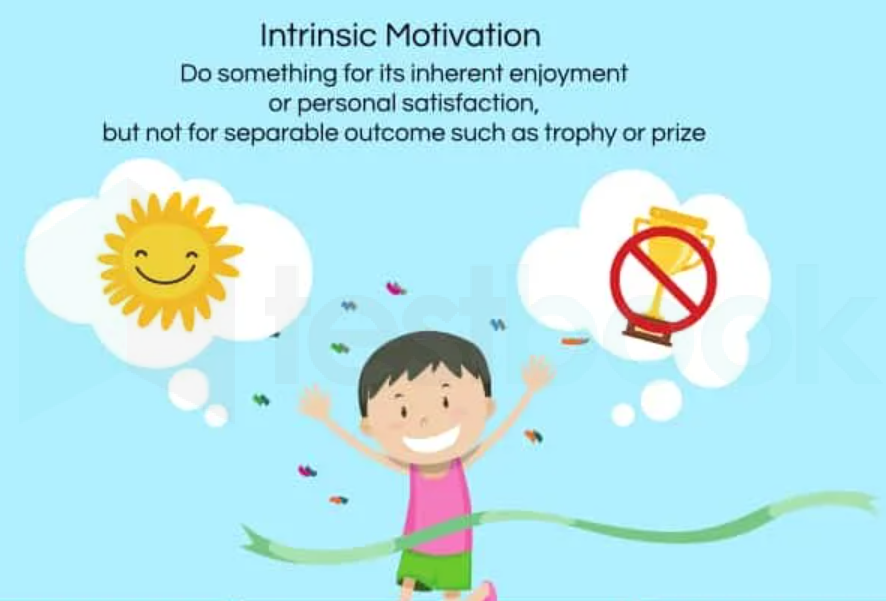
Intrinsic Motivation: There is a high relationship between the activity to the goal. In such a situation, we say, the person is intrinsically motivated. Cognitivism holds the view that curiosity, interest, or a sense of accomplishment are sources of motivation that are intrinsic (internal) rather than responding to external forces.

  • Intrinsic motivation is an inner drive that propels a person to pursue an activity**, not for external rewards**, but because the action itself is enjoyable.
  • In other words, a person is motivated by the fun, challenge or satisfaction involved with an activity, not for an outside outcome, pressure or reward.
  • An intrinsically motivated activity will always be rewarded due to the direct relationship between the activity and the goal. This secures a continuous motivation to do the activity.
  • The element of joy experienced in doing the activity actually sustains the activity. The pursuit of our hobbies which give us pleasure are also examples of intrinsic motivation.
  • Intrinsic motivation remains constant due to the high relationship between the activity and the goal.
  • An intrinsically motivated person will work on a solution to a problem because the challenge of finding a solution provides a sense of pleasure. In neither case does the person work on the task because there is some reward involved, such as a prize, a payment, or in the case of students, a grade.
  • Set challenges, Interest, and Purpose are some methods to increase intrinsic motivation.

Thus from the above-mentioned points, it is clear that for an intrinsically motivated student, rewards are not at all required. 

Hint

  • Extrinsic motivation refers to a behaviour that is guided by earning rewards or avoiding punishment.
  • External awards lead to temporary motivation.​

Question 25

Achievement motivation is

  1. AOption (a)

    the tendency to persist at challenging tasks

  2. BOption (b)

    the tendency to avoid failure

  3. COption (c)

    willingness to accept success and failure equally

  4. DOption (d)

    tendency to act impulsively

View answer & explanation

Correct answer

Answer: (a)A.

the tendency to persist at challenging tasks

Why this answer is correct

Achievement motivation (often termed as the need for motivation) is the desire to accomplish difficult tasks and to excel. Individuals differ greatly in the desire for achievement and the tendency to persist at challenging tasks is obvious. For some persons, accomplishing difficult tasks and meeting high standards of excellence are extremely important; whereas for others, just getting by is quite enough.

Important Points

The concept of achievement motivation was propounded by David​ McClelland. He aimed to explain how different types of motivation affect people's performance within a business setting. Achievement-based motivational theory and training models, and promoted improvements in employee assessment methods, advocating competency-based assessments and tests, arguing them to be better than traditional IQ and personality-based tests. 

Key Points 

McClelland has proposed that there are three major motives for personnel accomplishment. Each person has a tendency to be motivated by one of these needs. These motives are as follows:​

Need for Achievement:

  • It is greatest for that individual who has a strong desire to excel.
  • Their only focus is on success.
  • They prefer work that has a moderate chance of success.
  • Achievers prefer to work alone.

Need for Affiliation:

  • They don't like high risk or uncertainties.
  • They favour collaboration over competition.
  • These people perform better in groups.
  • They are very cooperative.
  • They are concerned about 'being liked' and 'being accepted'.

Need for Power:

  • They need Agreement and Compliance.
  • They like to win arguments.
  • They enjoy competition and winning.
  • They enjoy status and recognition.
  • They like to control others.
  • They have the ability to influence people.

Thus from the above-mentioned points, it is clear that achievement motivation is the tendency to persist at challenging tasks.

Question 26

Ideal ‘Waiting Time’ for getting response from students should be proportional to

  1. AOption (a)

    time allotted to specific topic in the curriculum

  2. BOption (b)

    difficulty level of the question

  3. COption (c)

    time taken by the students for answering questions from previous lessons

  4. DOption (d)

    relevance of the question in the real life

View answer & explanation

Correct answer

Answer: (b)B.

difficulty level of the question

Why this answer is correct

Waiting time is the time teacher waits for the student to respond to the questions or coming to the classroom etc.

Important PointsGive students five to 15 seconds to formulate a response to a question for which they should know the answer. Not every learner processes thinking at the same speed. Quality should be measured in the content of the answer, not the speediness.

  • Waiting for several seconds after asking a question so that students, particularly introverted ones, are able to gather their thoughts before responding is proven to expand participation and improve the quality of student responses.
  • The time taken by the student varies according to the difficulty level of the question and the IQ of the student.
  • A child with a high IQ  solves the question fast as compared to a low IQ student.

Hence, we can conclude that the ideal ‘Waiting Time’ for getting responses from students should be proportional to the difficulty level of the question.

Question 27

Suppose you are the Chairperson of a Board of School Education, how would you plan to improve the overall quality of education in the schools under your jurisdiction ? This type of question is an example of

  1. AOption (a)

    higher order convergent

  2. BOption (b)

    higher order divergent

  3. COption (c)

    lower order convergent

  4. DOption (d)

    lower order divergent

View answer & explanation

Correct answer

Answer: (b)B.

higher order divergent

Why this answer is correct

Questions have long been used as a teaching tool by teachers and preceptors to assess students’ knowledge, promote comprehension, and stimulate critical thinking.

  • Divergent questions that promote deep thinking, require analyzing and evaluate concepts.
  • Lower-order, convergent questions that rely on factual recall of prior knowledge.

 . 

Important Points

  • Being the Chairperson of a Board of School Education, to answer the question there are lots of possible solutions so it is a higher-order divergent question.

Key Points

Higher-Order Questions: Higher-order questions are those that the students cannot answer just by simple recollection or by reading the information “verbatim” from the text.

  • Higher-order questions put advanced cognitive demand on students.
  • They encourage students to think beyond literal questions.
  • Higher-order divergent questions seek multiple perspectives and multiple possible answers to questions and problems.
  • It is used to generate ideas with various possible solutions.
  • Higher-order questions promote critical thinking skills because these types of questions expect students to apply, analyze, synthesize, and evaluate information instead of simply recalling facts.

Hint

  • High order convergent question example, “What other tools could the main character have used to resolve the conflict?” is an example of a convergent question.
  • Low order questions: A low order question has a limited number of acceptable answers. “How do you perform a transaction on the point of sale system?”

Hence, we can conclude that the above type of question is an example of higher-order divergent.

Question 28

A student says, "My mother ringed Principal mam last night." As a teacher your response should be

  1. AOption (a)

    Oh really, your mother rang up Principal ma’am last night. Did she seek an appointment with her ?

  2. BOption (b)

    Dear child, you are not using the correct form of verb.

  3. COption (c)

    It should not be ringed, it should rather be rang.

  4. DOption (d)

    Why don’t you listen-carefully ? As I told you earlier, it should be rang, not ringed.

View answer & explanation

Correct answer

Answer: (a)A.

Oh really, your mother rang up Principal ma’am last night. Did she seek an appointment with her ?

Why this answer is correct

An ideal classroom is a positive place where a student can come to work toward specific goals set before them in the class objectives. The teacher is to be positive, organized, outgoing, confident, and compassionate. 

Important Points

  • As a teacher, if the child says something then it's the teacher's responsibility to respond to the question of the child.
  • Oh really, your mother rang up Principal ma’am last night. Did she seek an appointment with her? is the correct response given by the teacher.
  • She should respond politely.

Hint

  • Dear child, you are not using the correct form of verb, it should not be ringed, it should rather be rang and Why don’t you listen carefully? As I told you earlier, it should be rang, not ringed. These are not the correct options as the question is not about the grammar of the child. First, respond to the student politely.

Thus, it is concluded that A student says, "My mother ringed Principal mam last night." As a teacher your response should be Oh really, your mother rang up Principal ma’am last night. Did she seek an appointment with her?

Question 29

Children in primary schools follow which of the following stages as proposed by Lawrence Kohlberg?

a. Obedience and Punishment Orientation

b. Individualism and Exchange

c. Good Interpersonal Relationships

d. Social Contract and Individual Rights

  1. AOption (a)

    a and d

  2. BOption (b)

    a and c

  3. COption (c)

    b and a

  4. DOption (d)

    b and d

View answer & explanation

Correct answer

Answer: (c)C.

b and a

Why this answer is correct

Lawrence Kohlberg, an American psychologist, has propounded the 'Theory of Moral Development. He has systematically studied moral development in his theory that is categorized into 3 levels and 6 stages.

Key Points

Level 1: Pre-conventional Morality It consists of the first two levels of moral development. Here morality is judged based on the standards of adults and the consequence of an action.

Important Points

  • Stage I (Obedience and Punishment Orientation) — An action is immoral if it is punished by the authority. Children in primary schools follow this stage. At this, children have the fear if they are not following the obedience principle get punished by the teachers or parents.
  • Stage II (Individualism and Exchange) — This stage is self-interest driven and children understood that different individuals may have different viewpoints for the first time. An action is considered morally correct if it is in the best interest of the individual.  This stage is also followed by the children at the primary level.

Additional Information

Level 2: Conventional Morality: This level consists of stages three and four. During this level, children start internalizing the value of society to judge morality.

  • Stage III (Good Interpersonal Relationship) — The intention of the actor is more important in terms of judging moral values. If the intention is to gain the consensus of others or approval of the society then the actor will be judged morally right. At this stage, the children have the ideology of a good boy–good girl attitude.
  • Stage IV (Maintaining the Social Order) — Judgment of morality is based on one’s duty, law, and social order. actively maintaining the current social system ensures positive human relationships and societal order.

Level 3: Post-Conventional Morality: The last level consist of stage five and six of moral development. According to Kohlberg, very few people can reach this level. Here, the individual perspective is given more importance over social rule and order. Individuals judge morality based on basic human rights and justice.

  • Stage V (Social Contract and Individual Rights) – In this stage, the individual or child understands that different people and communities may hold different views and laws. Laws of society are not rigid edicts and should be changed with the change in the time and needs of society.
  • Stage VI (Universal Principles) – Individuals judge the morality of the actor based on some universal principles that transcend beyond society’s rules and regulations.

Hence, we can conclude that children in primary schools follow obedience and punishment orientation and Individualism and Exchange​ stages as proposed by Lawrence Kohlberg.

Question 30

The following are features of anecdotal record except

  1. AOption (a)

    it is an accurate description of events

  2. BOption (b)

    it describes personal development or social interactions of a child

  3. COption (c)

    it is a factual report with enough detail

  4. DOption (d)

    it is subjective evidence of behaviour and therefore does not provide feedback for the scholastic area

View answer & explanation

Correct answer

Answer: (d)D.

it is subjective evidence of behaviour and therefore does not provide feedback for the scholastic area

Why this answer is correct

Assessment in preschool should be formative, continuous, and flow from the experiences planned in the curriculum. It implies observing and documenting the development of the child, by interpreting the evidence from day-to-day experiences of the child to recognize and encourage strengths and addressing learning/developmental gaps.

\

Key Points

Anecdotal records:

  • Anecdotal records are short and significant descriptions of the performance and behaviour of children in unexpected events, which would not be documented otherwise and are quite useful to observe day-to-day basis.
  • Brief written notes based on observations of children—how and where children spend time, their social relationships, their use of language, modes of interaction, information about health and nutrition habits.
  • An anecdotal record should be brief, concise, the objective report of an incident exactly happened.
  • It gives an accurate description of events and a factual report with enough detail.

Additional Information

Uses of anecdotal records-  

  • Anecdotal records are of special value in indicating social and emotional situations
  • They give a realistic picture of students’ personality
  • Anecdotal records are very useful in fields where formal measurements are very difficult
  • A healthy teacher-pupil relationship is established when teachers are asked by the school organization to write down anecdotal reports.

Thus from the above-mentioned points, it is clear that 'it is subjective evidence of behaviour and therefore does not provide feedback for scholastic area' is not the feature of the anecdotal record.

Important Points

Rating scaleA rating scale is a tool used for assessing the performance of tasks, skill levels, procedures, processes, qualities, quantities, or endproduct
ChecklistIt is a list of learning outcomes, behaviours, or traits of a child in a particular development area.
PortfolioA portfolio is a flexible and adaptable collection over time of various concrete work samples showing many dimensions of the child’s learning.

Social Studies (60 questions)

Question 31

Directions

Answer the following questions by selecting the most appropriate option.

Bodies that do not have their own heat and light, but are lit by the light of the stars are known as

  1. AOption (a)

    Stars

  2. BOption (b)

    Constellations

  3. COption (c)

    Planets

  4. DOption (d)

    Celestial bodies

View answer & explanation

Correct answer

Answer: (c)C.

Planets

Why this answer is correct

Celestial bodies:

  • The sun, the moon, and all those objects shining in the night sky are called celestial bodies.
  • Some celestial bodies are very big and hot. They are made up of gases.
  • They have their own heat and light, which they emit in large amounts.
  • These celestial bodies are called stars. The sun is a star

Planets:

  • Some celestial bodies do not have their own heat and light.
  • They are lit by the light of the stars. Such bodies are called planets.
  • The word ‘planet’ comes from the Greek word “Planetai” which means ‘wanderers’.
  • The earth on which we live is a planet.
  • There are eight planets in our solar system.
  • In order of their distance from the sun, they are Mercury, Venus, Earth, Mars, Jupiter, Saturn, Uranus, and Neptune.
  • It gets all its heat and light from the sun, which is our nearest star.
  • If we look at the earth from a great distance, say the moon, it will appear to be shining just as the moon

Hence it is clear that the bodies that do not have their own heat and light, but are lit by the light of the stars are known as planets.

Celestial bodiesCharacteristics
Stars- Stars are huge celestial bodies made mostly of hydrogen and helium that produce light and heat from the churning nuclear forges inside their cores.
Constellations- A constellation is a group of stars that appears to form a pattern or picture like Orion the Great Hunter, Leo the Lion, or Taurus the Bull.

Question 32

The place, people, things and nature that surround any living organism are called

  1. AOption (a)

    Lithosphere

  2. BOption (b)

    Surrounding

  3. COption (c)

    Environment

  4. DOption (d)

    Biotic resources

View answer & explanation

Correct answer

Answer: (c)C.

Environment

Why this answer is correct

The place, people, things, and nature that surround any living organism are called Environment.

Environment:

  • All the physical surroundings on Earth are called the environment.
  • The environment includes everything living and everything nonliving.
  • The nonliving part of the environment has three main parts: the atmosphere, the hydrosphere, and the lithosphere.
  • The atmosphere is the air—the layer of nitrogen, oxygen, and other gases that surrounds Earth.
  • All the oceans and other bodies of water on Earth make up the hydrosphere.
  • The hydrosphere includes the water in the air, such as that in clouds.
  • The lithosphere consists of the outer layer of Earth.
  • This includes the crust and the solid outermost layer of the upper mantle.
  • The lithosphere also includes the rocks and soil on the surface of Earth.
  • People, animals, plants, and all other living things rely on the nonliving parts of the environment to survive.
  • The part of the environment where life happens is called the biosphere.

TopicCharacteristics
Lithosphere- The solid portion of the earth is called the Lithosphere. - It comprises the rocks of the earth’s crust and the thin layers of soil that contain nutrient elements which sustain organisms.
Surrounding- The definition of surrounding refers to everything that is around a particular person, place, or thing.
Biotic resources- These are obtained from the biosphere and have life - For example, human beings, flora, and fauna, fisheries, livestock, etc.

Question 33

When one particular image is fixed with an individual or group, it is known as

  1. AOption (a)

    Discriminated

  2. BOption (b)

    Stereotyped

  3. COption (c)

    Mistreated

  4. DOption (d)

    Status

View answer & explanation

Correct answer

Answer: (b)B.

Stereotyped

Why this answer is correct

A stereotype is a fixed general image or set of characteristics representing a particular type of person or thing, but which may not be true in reality.

  • It is a thought that someone has about specific types of individuals that may or may not accurately reflect reality.
  • Stereotypes can also be thought of like caricatures, which are pictures that exaggerate certain features while oversimplifying others and end up distorting the essence of an individual.
  • Many stereotypes are widely held but they are also overgeneralised images or ideas about a particular type of person.
  • Any time we group individuals together and make a generalisation or judgment about them without knowing them, this is an example of a stereotype.

Additional Information

Lets' look at the other terms:

  • Discrimination is the act of making unjustified distinctions between human beings based on the groups, classes, or other categories to which they are perceived to belong.
  • Mistreatment is being cruel or thoughtless toward a person, animal, or even an object.
  • Status refers to a position one holds in a society or group.

Question 34

Who led the Anti - British movement in Kittoor?

  1. AOption (a)

    Ahilyabai Holkar

  2. BOption (b)

    Rani Laxmibai

  3. COption (c)

    Rani Channamma

  4. DOption (d)

    Nana Phadnis

View answer & explanation

Correct answer

Answer: (c)C.

Rani Channamma

Why this answer is correct

  • The early nineteenth century the Company pursued an aggressive policy of territorial expansion.
  • Under Lord Hastings (Governor General from 1813 to 1823) a new policy of “paramountcy” was initiated.
  • Now the Company claimed that its authority was paramount or supreme, hence its power was greater than that of Indian states.
  • In order to protect its interests it was justified in annexing or threatening to annex any Indian kingdom. This view continued to guide later British policies as well. This process, however, did not go unchallenged.
  • For example, when the British tried to annex the small state of Kitoor (in Karnataka today), Rani Channamma took to arms and led an anti-British resistance movement. She was arrested in 1824 and died in prison in 1829.
  • But Rayanna, a poor chowkidar of Sangoli in Kitoor, carried on the resistance. With popular support he destroyed many British camps and records. He was caught and hanged by the British in 1830.

Question 35

The Mughal Architecture is a blending of

  1. AOption (a)

    Arab and Indian styles

  2. BOption (b)

    Persian and Indian styles

  3. COption (c)

    Turkish and Afghan styles

  4. DOption (d)

    Turkish and Persian styles

View answer & explanation

Correct answer

Answer: (b)B.

Persian and Indian styles

Why this answer is correct

​Mughal Architecture is a blending of Persian and Indian styles.

Key Points

  • Mughal Architecture is the blend of Indian and Persian elements that makes Mughal architecture so unique.
  • Typical features include huge, onion-shaped domes crowning commemorative monuments, with smaller domed buildings and minarets standing symmetrically on either side.
  • There are impressive entrances and gateways, within tall turreted walls, water features, and quadrilateral gardens.
  • White marble, red sandstone, and, less commonly, limestone, are typical construction materials as well as semi-precious stones and colored marble which are inlaid as decorations.
  • Understated lattice work appears throughout as well as verses from the Quran inscribed on interior and exterior walls in Persian and Arabic.
  • Royal palaces are often surrounded by symmetrical gardens featuring walkways and water channels. These stand in contrast to the stark courtyards within the mosques, which can hold enormous congregations.

Additional Information

  • The Mughal style of miniature painting was responsible for the amalgamation of indigenous themes and styles along with Persian and later European themes and styles. The arts of this period reflect a synthesis of foreign influences and indigenous flavor.
  • The peak of Mughal painting presented a highly sophisticated blend of Islamic, Hindu, and European visual culture and aesthetics.
  • Akbar personally engaged with the artists, and supervised and evaluated the artworks. The Mughal painting under Akbar’s patronage depicted a variety of subjects, including, detailed political conquests, seminal court scenes, secular texts, portraits of important men along with Hindu mythologies, and Persian and Islamic themes.

Question 36

Resources which are found in a region, but have not been utilised are known as

  1. AOption (a)

    Potential resources

  2. BOption (b)

    Actual resources

  3. COption (c)

    Waste resources

  4. DOption (d)

    Valuable resources

View answer & explanation

Correct answer

Answer: (a)A.

Potential resources

Why this answer is correct

Everything available in our environment which can be used to satisfy our needs can be called resources. But resources are not free gifts of nature. It is the process of transformation of things available in our environment which involves an interactive relationship between nature, technology, and institutions.

These resources can be classified in the following ways:

  • On the basis of origin – biotic and abiotic.
  • On the basis of exhaustibility – renewable and non-renewable.
  • On the basis of ownership – individual, community, national and international.
  • On the basis of the status of development – potential developed stock and reserves.

The resources which are found in a region but have not been utilized are called potential resources. These resources can be used in the future.

Potential resources:

  • Potential resources are those which are available in the region but are not fully used.
  • But these resources could be used in the future.
  • For example, uranium present in Ladakh is a potential resource that could be used in the future.
  • Potential resources are the ones of which we have insufficient knowledge or we do not have the technology to exploit them at present.

Type of resourcesCharacteristics
Actual resources- Actual resources are the resources where quantity is known which are being used in the present. - Actual resources are the ones surveyed, determined by their quantity and consistency. - Coal, water, and petrol are actual resources.
Waste resources- The waste of resources is an additional waste for the seven wastes (muda) of lean manufacturing, it is the non-efficient use of your lights, heat, and power.
Valuable resources- Bowman and Ambrosini (2007) summarise a range of definitions of valuable resources pragmatically as being those that permit premium pricing or enables lower cost structure compared to a firm's competitors. - In short, one can define valuable resources as being scarce, non-substitutable, and inelastic in supply

Question 37

The Standard - Meridian of India is

  1. AOption (a)

    82° 30’ E longitude

  2. BOption (b)

    82° 50’ E longitude

  3. COption (c)

    82° E longitude

  4. DOption (d)

    83° 30’ E longitude

View answer & explanation

Correct answer

Answer: (a)A.

82° 30’ E longitude

Why this answer is correct

The correct answer is 82° 30’ E longitude.

Mistake Points

  • The standard meridian of India is 82°30'E and it passes through Mirzapur in Uttar Pradesh.
  • 82.5 means 82° and 30', one degree is presented by 60 minutes and 30 minutes means the half or .5 of one degree. So, 82.5° E and 82°30'E are the same.

Key Points

The Standard - Meridian of India:

  • Standard Meridian is the longitude that is used to describe the time of a country.
  • ​Ideally should be the same for the whole country and all the places in a country should follow this same time.
  • The Standard Meridian of India is located at 82°30'E.
  • The time along this latitude is taken as the official time across the country.
  • The standard meridian of India is 82°30'E and it passes through Mirzapur in Uttar Pradesh.

Hence, the standard meridian of India is located at 82° 30’ E longitude which determines the time for the whole country.

Important Points

  • India is located entirely in the Northern Hemisphere, with the mainland extending between 8°4'N and 37°6'N latitudes and 68°7'E and 97°25'E longitudes.

Question 38

When rock fragments get compressed and hardened to form layers of rocks they are known as

  1. AOption (a)

    Igneous rocks

  2. BOption (b)

    Metamorphic rocks

  3. COption (c)

    Sedimentary rocks

  4. DOption (d)

    Primary rocks

View answer & explanation

Correct answer

Answer: (c)C.

Sedimentary rocks

Why this answer is correct

When rock fragments get compressed and hardened to form layers of rocks they are known as Sedimentary rocks.

Sedimentary rocks:

  • Rocks roll down, crack, and hit each other and are broken down into small fragments.
  • These smaller particles are called sediments.
  • These sediments are transported and deposited by wind, water, etc.
  • These loose sediments are compressed and hardened to form layers of rocks.
  • These types of rocks are called sedimentary rocks.
  • For example, sandstone is made from grains of sand.
  • These rocks may also contain fossils of plants, animals and other microorganisms that once lived on them

Types of rocksCharacteristics
Igneous rock- It is formed when molten rock (magma or lava) cools and solidifies. - Igneous rock may form with or without crystallization. - It may be intrusive (plutonic) rocks or extrusive (volcanic) rocks. - For example, Granite, Basalt, etc.
Metamorphic rock- They formed when existing rocks are changed by heat, pressure, or reactive fluids, such as hot, mineral-laden water. - For example, Marble, Quartzite, Schist, etc.

Question 39

When State does not interfere in religious affairs it is called

  1. AOption (a)

    Arbitrary

  2. BOption (b)

    Secularism

  3. COption (c)

    Sovereignty

  4. DOption (d)

    Polity

View answer & explanation

Correct answer

Answer: (b)B.

Secularism

Why this answer is correct

Secularism

  • The Indian Constitution allows individuals the freedom to live by their religious beliefs and practices as they interpret these. In keeping with this idea of religious freedom for all, India also adopted a strategy of separating the power of religion and the power of the State. Secularism refers to this separation of religion from the State.
  • Indian secularism is different from that of other democratic countries. For example, the First Amendment of the U.S. Constitution prohibits the legislature from making laws “respecting an establishment of religion” or that “prohibit the free exercise of religion”. What is meant by the word ‘establishment’ is that the legislature cannot declare any religion as the official religion. Nor can they give preference to one religion. In the U.S.A. the separation between State and religion means that neither the State nor religion can interfere in the affairs of one another.
  • Indian Constitution intervened in Hindu religious practices in order to abolish untouchability. In Indian secularism, though the State is not strictly separate from religion it does maintain a principled distance vis-à-vis religion. This means that any interference in religion by the State has to be based on the ideals laid out in the Constitution. These ideals serve as the standard through which we can judge whether the State is or is not behaving according to secular principles.

  • Arbitrary is defined as something that is determined by judgment or whim and not for any specific reason or rule. Not fixed by rules, but left to one's judgment or choice; discretionary. An example of arbitrary behaviour would be getting mad at someone even when they haven't done anything wrong.
  • Sovereignty is a political concept that refers to dominant power or supreme authority. In a monarchy, supreme power resides in the "sovereign", or king. In modern democracies, sovereign power rests with the people and is exercised through representative bodies such as Congress or Parliament.
  • Polity is a form of government or organization of a state, church, society, etc; constitution. a politically organized society, state, city, etc.

Question 40

Which one of the following is true about classical dances?

  1. AOption (a)

    They are always superior to folk dances

  2. BOption (b)

    There are seven recognised classical forms of dances

  3. COption (c)

    Kathakali is the classical form of Kathak

  4. DOption (d)

    Kathak was recognised as a classical dance form only after Independence

View answer & explanation

Correct answer

Answer: (d)D.

Kathak was recognised as a classical dance form only after Independence

Why this answer is correct

Let's look at the statements mentioned above regarding the classical dance:

  • Statement 1 is false: Classical dance is highly technical and stylized. The forms and technicalities have developed for decades. On the other hand, folk dance is a simple dance form tracing its roots to the people who developed the same to reflect their lives often to the local music. Thus, we can not say that classical dance is superior to folk dance as both have it's own importance.
  • Statement 2 is false: According to the Ministry of culture, we have 9 recognized classical forms of dances. Bharatanatyam, Manipuri dance, Kathak, Odissi, Kathakali, Mohiniattam, Kuchipudi, Sattriya and Chhau.
  • Statement 3 is false: Kathakali is the dance form of south-western India, which is from Kerala. It is one of the most vibrant dance forms as the dancer wears colourful and vibrant costumes, masks, and so on while performing this dance form. Kathakali is mainly the depiction of a story by the dancer through his performance. It is mainly believed to have been derived from the temples and folk arts of south India. Thus, Kathak and Kathakali are different and Kathakali is not the classical form of Kathak.
  • Statement 4 is true: British administrators never favoured Kathak, it survived and continued to be performed by courtesans. It was recognised as a classical dance form after the country got independence.

Question 41

In the Indian freedom struggle ‘Dandi March’ marked the beginning of

  1. AOption (a)

    Quit India Movement

  2. BOption (b)

    Civil Disobedience Movement

  3. COption (c)

    Swadeshi Movement

  4. DOption (d)

    Home Rule Movement

View answer & explanation

Correct answer

Answer: (b)B.

Civil Disobedience Movement

Why this answer is correct

The correct answer is Civil Disobedience Movement.

Key Points

  • Dandi March, also known as Salt March or Salt Satyagraha, was a non-violent protest against the salt tax imposed by the colonial government.
  • Mahatma Gandhi walked from Sabarmati to Dandi covering a distance of 385 km.
  • It marked the beginning of the civil disobedience movement.
  • “What if I and all the eminent leaders in Gujarat and in the rest of the country are arrested? This movement is based on the faith that when a whole nation is roused and on the march no leader is necessary.” is said by Mahatma Gandhi prior to Dandi March.
  • Civil Disobedience Movement was initiated by Mahatma Gandhi on 12th March 1930 with the launch of Dandi March. At the end of the march, he broke the salt law and defied the British Government. This movement quickly gained momentum and spread to the rest of the country as well.

Question 42

Which one of the following is an erosional land feature?

  1. AOption (a)

    Loess

  2. BOption (b)

    Delta

  3. COption (c)

    Moraines

  4. DOption (d)

    Mushroom rocks

View answer & explanation

Correct answer

Answer: (d)D.

Mushroom rocks

Why this answer is correct

Mushroom Rocks:

  • It is also called a rock pedestal, a naturally occurring rock whose shape resembles a mushroom.
  • It forms when a more resistant layer of sedimentary rocks sits above a softer layer.
  • Abrasion occurs when the desert wind blows sand particles.
  • When the wind hits an outcrop of rock the sand it is carrying is blasted against it and mushroom rock is formed,
  • In desert areas, where the wind is the dominant force, mushroom rocks are commonly found.
  • A mushroom rock, rock pedestal, or gour is a typical mushroom-shaped landform that is formed by the action of wind erosion.

All other features except mushroom rock are depositional by their origin. Hence, mushroom rocks are an erosional land feature.

LandformCharacteristics
Loess- Loess is a deposit of wind-blown silt that blankets large areas of the continents. - It is often light brown in color, consisting predominantly of quartz, feldspars, micas, and calcium carbonate. - Extensive loess deposits are found in northern China, the Great Plains of North America, central Europe, and parts of Russia and Kazakhstan.
Delta- Deltas are wetlands that form as rivers empty their water and sediment into another body of water, such as an ocean, lake, or another river. - Although very uncommon, deltas can also empty into the land. - A river moves more slowly as it nears its mouth or end.
Moraines- Moraines are accumulations of dirt and rocks that have fallen onto the glacier surface or have been pushed along by the glacier as it moves. - The dirt and rocks composing moraines can range in size from powdery silt to large rocks and boulders.

Question 43

Which of the following is a conventional source of energy?

  1. AOption (a)

    Fossil fuel

  2. BOption (b)

    Wind

  3. COption (c)

    Solar energy

  4. DOption (d)

    Tidal energy

View answer & explanation

Correct answer

Answer: (a)A.

Fossil fuel

Why this answer is correct

In simple terms, we can say that anything out of which usable energy can be extracted is a source of energy.

The two major sources of energy can be classified under:

  • Conventional Sources
  • Non-Conventional Sources

​

Conventional Sources:

  • The sources of energy that have been in use for a long time are called conventional sources of energy
  • Conventional energy sources such as natural gas, oil, coal, or nuclear are finite but still hold the majority of the energy market.

Fossil Fuels - Conventional Source of Energy:

  • Fossil fuels, such as coal, oil, and natural gas, are important non-renewable sources of energy.
  • Since the beginning of mankind, we have been using fossil fuels to generate heat, light, and electricity for various purposes.
  • These are the primary sources for generating electrical energy in the world today.
  • Over 85% of our energy demands are met by the combustion of fossil fuels.
  • Carbon is the main constituent of these fossil fuels.
  • Fossil fuels are excellent sources of energy for our transportation needs.
  • Approximately 1.9 billion tons of coal are burnt in a year to generate electricity in the world.
  • A large amount of chemical energy is stored in fossil fuels.
  • This stored chemical energy is converted into various other forms of energy such as heat, light, and mechanical energy.
  • Millions of years ago the remains of dead plants and animals were buried under the ground.
  • Over the years by the action of heat from the Earth’s core and pressure from rock and soil, these buried and decomposed organic materials have been converted into fossil fuels.

Hence, Fossil fuel is a conventional source of energy.

Non-Conventional Sources:

  • It is also known as renewable sources of energy
  • It uses again and again without depletion.
  • Examples include solar energy, bio-energy, tidal energy, and wind energy.

The sources of energy which have been in use since a long time are called conventional sources of energy

Question 44

In India, the Governor of the State is appointed by the

  1. AOption (a)

    President of India

  2. BOption (b)

    Parliament

  3. COption (c)

    Prime Minister

  4. DOption (d)

    Chief Justice of Supreme Court

View answer & explanation

Correct answer

Answer: (a)A.

President of India

Why this answer is correct

Governor:

  • Governor is the head of the executive of the state.
  • He/she is appointed by President of India.

Qualifications and conditions for appointment:

  • Should be a citizen of India.
  • Should have completed 35 years of age.
  • Should not hold any office of profit under the union govt. or state govt. or any local authority or any other public authority.
  • Should not be a member of either house of parliament or a house of the state legislature.

Tenure:

  • Governor holds office for a term of 5 years from the date on which he assumes office.
  • This term of 5 years is subject to the pleasure of the president.
  • He/she can resign anytime by addressing a resignation letter to the president.

Oath:

  • The oath of office to the governor is administered by the chief justice of the concerned HC and in his absence by the senior-most judge of the HC available.
  • By the 7th Constitution Amendment Act of 1956, the same person can be appointed as governor of 2 or more states.

Question 45

Who among the following Mughal rulers led the idea of ‘Universal Peace’?

  1. AOption (a)

    Akbar

  2. BOption (b)

    Shahjahan

  3. COption (c)

    Humayun

  4. DOption (d)

    Jahangir

View answer & explanation

Correct answer

Answer: (a)A.

Akbar

Why this answer is correct

Akbar (1556-1605AD)

  • While Akbar was at Fatehpur Sikri during the 1570s he started discussions on religion with the ulama, Brahmanas, Jesuit priests who were Roman Catholics, and Zoroastrians.
  • These discussions took place in the ibadat khana. He was interested in the religion and social customs of different people. Akbar’s interaction with people of different faiths made him realise that religious scholars who emphasised ritual and dogma were often bigots.
  • Their teachings created divisions and disharmony amongst his subjects. This eventuallyled Akbar to the idea of sulh-i kul or “universal peace”.
  • This idea of tolerance did not discriminate between people of different religions in his realm. Instead it focused on a system of ethics – honesty, justice, peace – that was universally applicable.
  • Abul Fazl helped Akbar in framing a vision of governance around this idea of sulh-i kul.
  • This principle of governance was followed by Jahangir and Shah Jahan as well.

Question 46

Who among the following was the founder of ‘Khalsa’?

  1. AOption (a)

    Guru Nanak Dev

  2. BOption (b)

    Guru Angad Dev

  3. COption (c)

    Guru Govind Singh

  4. DOption (d)

    Guru Teg Bahadur

View answer & explanation

Correct answer

Answer: (c)C.

Guru Govind Singh

Why this answer is correct

  • It was Guru Gobind Singh, the tenth Guru, who transformed the Sikhs into the Khalsa.
  • Born on 22 December 1666 Guru Gobind Singh, the final Guru of Sikhism became a Guru on 11 November 1675 at the tender age of 9 and passed away on 7 October 1708.
  • His birth anniversary is based on the Nanakshahi calendar according to which is celebrated on January 20 in 2021 while for the last year, it was celebrated on January 2.
  • He is known for his significant contributions to the Sikh religion, including the introduction of the turban to cover hair.
  • He also founded the principles of Khalsa or the Five ‘K’s.
  • The Five K’s are kesh (uncut hair), kanga (wooden comb), kara (iron or steel bracelet), kirpan (dagger), and kachera (short breeches).
  • These were the five articles of faith that a Khalsa must always adorn.
  • He also laid down many other rules for the Khalsa warriors to follow like abstaining from tobacco, alcohol, halal meat, etc.
  • He named Guru Granth Sahib, the religious text of the Khalsa and the Sikhs, as the next Guru of the two communities.
  • He fought against the Mughals in the battle of Muktsar in 1705.

Question 47

Out of the following, which is the most ideal layer of the atmosphere for flying aeroplanes?

  1. AOption (a)

    Troposphere

  2. BOption (b)

    Ionosphere

  3. COption (c)

    Stratosphere

  4. DOption (d)

    Exosphere

View answer & explanation

Correct answer

Answer: (c)C.

Stratosphere

Why this answer is correct

The correct answer is Stratosphere.

The atmosphere around the earth:

  • The atmosphere consists of different layers with varying densities and temperatures.
  • The column of the atmosphere is divided into five different layers depending upon the temperature condition.
  • They are troposphere, stratosphere, mesosphere, thermosphere, and exosphere.

The stratosphere

  • It is found above the tropopause and extends up to a height of 50 km.
  • One important feature of the stratosphere is that it contains the ozone layer.
  • This layer absorbs ultra-violet radiation and shields life on the earth from an intense, harmful form of energy.
  • The lower layer of the stratosphere is ideal for aeroplanes to fly.
  • In this layer, the temperature gets warmer as you rise up resulting in fewer clouds and water vapour which provides a smoother ride due to the absence of turbulence.

The stratosphere is the most ideal layer of the atmosphere for flying aeroplanes

The layer of the atmosphereCharacteristics
Ionosphere- The ionosphere extends from 37 to 190 miles (60-300 km) above the earth's surface. - It is divided into three regions or layers; the F-Region, E-Layer, and D-Layer. - The ionosphere is important because it reflects and modifies radio waves used for communication and navigation. - Other phenomena such as energetic charged particles and cosmic rays also have an ionizing effect and can contribute to the ionosphere.
Troposphere- The troposphere contains 75% of the atmosphere's total mass. - In either space or time, the troposphere is not constant. - Weather occurs in the troposphere. - The troposphere is 10 miles from the equator. - The troposphere is 5-7 miles above the poles.
Exosphere- It is the uppermost layer of the atmosphere. - This is the highest layer but very little is known about it. - Whatever contents are there, these are extremely rarefied in this layer, and it gradually merges with outer space.

Question 48

Article - 21 of the Indian Constitution entitles

  1. AOption (a)

    Right to Freedom of Religion

  2. BOption (b)

    Right to Equality

  3. COption (c)

    Right to Life

  4. DOption (d)

    Right to Constitutional Remedies

View answer & explanation

Correct answer

Answer: (c)C.

Right to Life

Why this answer is correct

Articles 12-35 of the Indian Constitution deal with Fundamental Rights.

  • These human rights are conferred upon the citizens of India for the Constitution tells that these rights are inviolable.
  • Right to Life, Right to Dignity, Right to Education etc. all come under one of the six main fundamental rights.

  • Article 21: Protection of Life and Personal Liberty
  • This article declares that no person shall be deprived of his life or personal liberty except according to the procedure established by law. This right is available to both citizens and non-citizens.
  • The right to life is not merely confined to animal existence or survival but also includes the right to live with human dignity and all those aspects of life which go to make a man’s life meaningful, complete and worth living.

Thus, we can say that Article - 21 of the Indian Constitution entitles the Right to Life.

Additional Information

  • Equality Before Law: Article 14 says that no person shall be denied treatment of equality before the law or the equal protection of the laws within the territory of India.
  • Article 25 guarantees the freedom of conscience, the freedom to profess, practice and propagate religion to all citizens.
  • Right to Constitutional Remedies (Article 32 – 35)- The Constitution guarantees remedies if citizens’ fundamental rights are violated. The government cannot infringe upon or curb anyone’s rights. When these rights are violated, the aggrieved party can approach the courts. Citizens can even go directly to the Supreme Court which can issue writs for enforcing fundamental rights.

Question 49

The highest law making body in India is the

  1. AOption (a)

    Parliament

  2. BOption (b)

    Prime Minister and his Council

  3. COption (c)

    President

  4. DOption (d)

    Judiciary

View answer & explanation

Correct answer

Answer: (a)A.

Parliament

Why this answer is correct

The Parliament is the highest law-making body of the Union Government.

  • Parliament performs several essential functions including that of making laws, scrutinising and passing the budget, conducting oversight on the activities of the government and representing citizens.
  • As a law-making body, Parliament is tasked with examining legislation and passing it after scrutiny and debate.
  • The basic function of Parliament is to make laws.
  • All legislative proposals have to be brought in the form of Bills before Parliament.
  • A Bill is a statute in the draft and cannot become law unless it has received the approval of both the Houses of Parliament and the assent of the President of India.
  • The process of lawmaking begins with the introduction of a Bill in either House of Parliament.
  • A Bill can be introduced either by a Minister or a member other than a Minister.
  • In the former case, it is called a Government Bill and in the latter case, it is known as a Private Member's Bill.

Additional Information

The Indian legislative system is a bicameral one which means that there are two houses at the centre responsible for making laws and other deliberative functions—the Lok Sabha or the House of People and the Rajya Sabha or the Council of States.

  • Members of the Lok Sabha (Lower House) are elected directly by the people from 543 constituencies around the country.
  • Two members are nominated by the President from among the members of the Anglo-Indian community.
  • The term of the Lok Sabha is five years upon the completion of which it is dissolved in its entirety.
  • The members of Rajya Sabha (Upper House) are elected by the elected members of the legislative assemblies of the respective states under proportional representation.
  • It is a permanent chamber which means that it does not dissolve all at once.
  • Each member is effectively elected for six years as a third of the members retire every two years.
  • The Rajya Sabha has a total of 250 members, 238 elected members and 12 members nominated by the President on the advice of the Prime Minister.

Question 50

Which of the following forests do not have a distinct period of shedding leaves, and therefore do not ever look bare?

  1. AOption (a)

    Tropical deciduous

  2. BOption (b)

    Tropical evergreen

  3. COption (c)

    Temperate evergreen

  4. DOption (d)

    Temperate deciduous

View answer & explanation

Correct answer

Answer: (b)B.

Tropical evergreen

Why this answer is correct

Tropical evergreen forest:

  • These forests are also called tropical rainforests.
  • These thick forests occur in the regions near the equator and close to the tropics.
  • These regions are hot and receive heavy rainfall throughout the year.
  • As there is no particular dry season, the trees do not shed their leaves altogether.
  • This is the reason they are called evergreen.
  • The thick canopies of the closely spaced trees do not allow the sunlight to penetrate inside the forest even in the daytime.
  • Hardwood trees like rosewood, ebony, mahogany are common here.

Hence, it is clear that tropical evergreen forests do not have a distinct period of shedding leaves, and therefore do not ever look bare.

আ

ForestCharacteristics
Tropical deciduous- Tropical deciduous is the monsoon forests found in the large part of India, northern Australia, and Central America - Trees shed their leaves in the dry season to conserve water.
Temperate deciduous- These are found in the northeastern part of the USA, China, New Zealand, Chile, and also found in the coastal regions of Western Europe. - They shed their leaves in the dry season.
Temperate evergreen- The temperate evergreen forests are located in the mid latitudinal coastal region - They are commonly found along the eastern margin of the continents, e.g., In the southeast USA, South China, and southeast Brazil. - They comprise both hard and softwood trees like oak, pine, eucalyptus, etc

Question 51

A type of farming in which higher doses of modern inputs are used to obtain higher productivity is known as

  1. AOption (a)

    Commercial Farming

  2. BOption (b)

    Extensive Agriculture

  3. COption (c)

    Shifting Agriculture

  4. DOption (d)

    Subsistence Farming

View answer & explanation

Correct answer

Answer: (a)A.

Commercial Farming

Why this answer is correct

Farming varies from subsistence to commercial type. The cultivation methods have changed significantly depending upon the characteristics of the physical environment, technological know-how, and socio-cultural practices.

Commercial Farming:

  • The main characteristic of this type of farming is the use of higher doses of modern inputs
  • For example, high yielding variety (HYV) seeds, chemical fertilizers, insecticides, and pesticides in order to obtain higher productivity.
  • The degree of commercialization of agriculture varies from one region to another.
  • For example, rice is a commercial crop in Haryana and Punjab, but in Odisha, it is a subsistence crop.
  • The plantation is also a type of commercial farming. In this type of farming, a single crop is grown in a large area.
  • The plantation has an interface of agriculture and industry.
  • Plantations cover large tracts of land, using capital-intensive inputs, with the help of migrant laborers.
  • All the produce is used as raw material in respective industries.
  • In India, tea, coffee, rubber, sugarcane, banana, etc.. are important plantation crops.
  • Tea in Assam and North Bengal coffee in Karnataka are some of the important plantation crops grown in these states.

Hence, the type of farming in which higher doses of modern inputs are used to obtain higher productivity is known as Commercial Farming.

Types of farmingCharacteristics
Extensive Agriculture- Extensive agriculture, in agricultural economics, is a system of crop cultivation using small amounts of labor and capital in relation to the area of land being farmed. - The crop yield in extensive agriculture depends primarily on the natural fertility of the soil, the terrain, the climate, and the availability of water.
Shifting Agriculture- Shifting agriculture is a system of cultivation in which a plot of land is cleared and cultivated for a short period of time, then abandoned and allowed to revert to producing its normal vegetation while the cultivator moves on to another plot.
Subsistence Farming- The subsistence farming/agriculture etc. farming that produces just enough food for the farmer to live on, but does not produce enough food to sell to other people

Question 52

When a number of industries locate close to each other and share the benefits of their closeness, it is referred to as

  1. AOption (a)

    Industrial - system

  2. BOption (b)

    Industrial region

  3. COption (c)

    Market economy

  4. DOption (d)

    Assembly line production

View answer & explanation

Correct answer

Answer: (b)B.

Industrial region

Why this answer is correct

Location of industries depends on numerous factors, i.e. the availability of raw material, land, water, labour, power, capital, transport and market. 

Industrial region:

  • Industrial regions emerge when a number of industries locate close to each other and share the benefits of their closeness.
  • Major industrial regions of the world are eastern North America, western and central Europe, eastern Europe, and eastern Asia.
  • Major industrial regions tend to be located in temperate areas, near seaports, and especially near coalfields.
  • India has several industrial regions like the Mumbai-Pune cluster, Bangalore-Tamil Nadu region, the Hugli region, the Ahmedabad-Baroda region, Chottanagpur industrial belt, Vishakhapatnam-Guntur belt, Gurgaon-Delhi-Meerut region, and the Kollam-Thiruvanathapuram industrial cluster.

TopicDescription
Industrial - system- An industrial system consists of inputs, processes and outputs. - The inputs are the raw materials, labour and costs of land, transport, power and other infrastructure.
Market economy- A market economy is an economic system in which economic decisions and the pricing of goods and services are guided by the interactions of a country's individual citizens and businesses.
Assembly line production- An assembly line is a production process that divides up the labor process. - It breaks up the manufacture of a good into steps that are completed in a pre-defined sequence.

Question 53

A particular area from which all the voters living there choose their representative is called a

  1. AOption (a)

    Territory

  2. BOption (b)

    Constituency

  3. COption (c)

    State

  4. DOption (d)

    Region

View answer & explanation

Correct answer

Answer: (b)B.

Constituency

Why this answer is correct

Elections take place regularly in any democracy.

  • There are more than 100 countries in the world in which elections take place to choose people’s representatives.
  • The mechanism by which people can choose their representatives at regular intervals and change them whenever they want to is called an election.

  • A country is divided into many separate units or areas for the purpose of holding elections.
  • Each area in which elections are held is known as a constituency. People living in a constituency elect their own representative from their constituency.
  • The voters who live in an area elect one representative.
  • For the Lok Sabha elections, India is divided into 543 constituencies. The representative elected from each constituency is called a Member of Parliament or an MP.
  • Each state is divided into a specific number of Assembly constituencies. In this case, the elected representative is called the Member of Legislative Assembly or an MLA. Each Parliamentary constituency has within it several assembly constituencies.

Thus, we can conclude that a particular area from which all the voters living there choose their representative is called a Constituency.

Additional Information

  • The territory is a geographical area belonging to or under the jurisdiction of governmental authority.
  • As used in political science, the word state means a community or society politically organized under one independent government within a definite territory and subject to no outside control.
  • A region is an area of land that has common features.

Question 54

East coast of North America and the sea around Japan have rich fishing grounds because of

  1. AOption (a)

    a cold current flowing along the coast

  2. BOption (b)

    indented coastal area

  3. COption (c)

    a warm current along the coast

  4. DOption (d)

    meeting of warm and cold currents

View answer & explanation

Correct answer

Answer: (d)D.

meeting of warm and cold currents

Why this answer is correct

Ocean currents are bodies of water mass with a slightly different thermophysical characteristic viz temperature, density, and salinity from the surrounding water body. They move in a well-defined path like a river in the ocean and are influenced by the direction of the wind and the coastal features.

  • Mixing of cold and warm ocean currents bears the richest fishing grounds in the world.
  • Example: Grand Banks around Newfoundland, Canada, and the North-Eastern Coast of Japan.
  • Areas, where warm and cold currents meet, tend to have high biological productivity
  • The mixing of warm and cold currents helps to replenish the oxygen and favor the growth of planktons, the primary food for the fish population.
  • The best fishing grounds of the world exist mainly in these mixing zones.
  • The best fishing grounds are found above continental shelves which are not more than 200 meters below the water surface, where plankton of all kinds are most abundant.

Due to the convergence of warm and cold currents, the Pacific coast of North America has rich fishing grounds.

Question 55

More than 80 percent of the population of the world lives in

  1. AOption (a)

    Asia and Africa

  2. BOption (b)

    Asia and South America

  3. COption (c)

    North America and Asia

  4. DOption (d)

    Asia and Europe

View answer & explanation

Correct answer

Answer: (a)A.

Asia and Africa

Why this answer is correct

The correct answer is Asia and Africa.

Key Points

Distribution of the population:

  • The way in which people are spread across the earth's surface is known as the pattern of population distribution.
  • More than 90 percent of the world’s population lives in about 30 percent of the land surface.
  • The distribution of population in the world is extremely uneven.
  • Some areas are very crowded and some are sparsely populated.
  • The crowded areas are south and southeast Asia, Europe, and northeastern North America.
  • Very few people live in high-latitude areas, tropical deserts, high mountains, and areas of equatorial forests.
  • Many more people live north of the Equator than south of the Equator.
  • Almost three-quarters of the world’s people live in two continents, Asia and Africa.
  • Sixty percent of the world’s people stay in just 10 countries.
  • All of them have more than 100 million people.

Hence, more than 80 percent of the population of world lives in Asia and Africa.

Important Points

ContinentPopulationWorld population share
Asia4586.93 million60%
Africa1305.22 million17%
North America592.07million8%
South America430.76 million5%
Europe745.64 million10%
Australia42. 45 million0.5%
World7,794,798,739100

Question 56

When the subjugation of one country by another leads to political, economic, social and cultural changes we refer to this process as

  1. AOption (a)

    Confederacy

  2. BOption (b)

    Mercantile

  3. COption (c)

    Colonisation

  4. DOption (d)

    Renaissance

View answer & explanation

Correct answer

Answer: (c)C.

Colonisation

Why this answer is correct

When the subjugation of one country by another leads to these kinds of political, economic, social and cultural changes, we refer to the process as colonisation. 

  • The origin of the word ‘colonialism’ can be traced back to the Latin word “colōnia”  meaning “a place for agriculture”.
  • The standard definition of colonialism is “**a policy and practice of a power in extending control over weaker peoples or areas”.
  • Even though the policy has been used by multiple civilizations in different continents since ancient times, it is broadly used today to refer to European economic and political domination in different continents that began roughly in the late 16th century and lasted until the early 1970s.
  • The main goal of colonialism is the extraction of economic benefits from the colony.
  • Colonialism results in control over the life of natives in political, economic, cultural and social spheres.
  • Historically, two main types of colonization can be differentiated:
  • Settler colonialism is that type of colonialism wherein a large number of immigrants, often motivated by religious, political, or economic reasons, settle in a new place and dominate the local indigenous population in economic, political as well as social aspects.
  • Exploitation colonialism involves relatively fewer number of immigrants and predominantly focuses on the exploitation of the resources of the colonial country.
  • Thus colonialism denotes a set of unequal relationships between the colonial power and the colony, and often between the colonists and the indigenous population; relationships in which the colonists acquire benefits (disproportionally), at the expense of the local population.

Additional Information

Let's look at the meaning of other terms:

  • A confederacy is a group of people, countries, organizations, etc. joined together for a common purpose or by a common interest.
  • Mercantile is related to merchants or trading.
  • Renaissance stands for rebirth and Indian renaissance refers to that period that was marked by the quest for knowledge and development of science and arts.

Question 57

Which of the following literary heritage of India means ‘approaching and sitting near’?

  1. AOption (a)

    Upanishads

  2. BOption (b)

    Vedas

  3. COption (c)

    Aranyakas

  4. DOption (d)

    Puranas

View answer & explanation

Correct answer

Answer: (a)A.

Upanishads

Why this answer is correct

The correct answer is Upanishads

  • Around the time that the Buddha was preaching and perhaps a little earlier, other thinkers also tried to find answers to difficult questions. Some of them wanted to know about life after death, others wanted to know why sacrifices should be performed.
  • Many of these thinkers felt that there was something permanent in the universe that would last even after death. They described this as the atman or the individual soul and the brahman or the universal soul. They believed that ultimately, both the atman and the brahman were one.
  • Many of their ideas were recorded in the Upanishads. These were part of the later Vedic texts.
  • Upanishad literally means ‘approaching and sitting near’ and the texts contain conversations between teachers and students.
  • Often, ideas were presented through simple dialogues. Most Upanishadic thinkers were men, especially brahmins and rajas. Occasionally, there is mention of women thinkers, such as Gargi, who was famous for her learning and participated in debates held in royal courts.
  • Poor people rarely took part in these discussions. One famous exception was Satyakama Jabala, who was named after his mother, the slave woman Jabali. He had a deep desire to learn about reality, was accepted as a student by a brahmin teacher named Gautama, and became one of the best-known thinkers of the time.

Question 58

The system of tax became most prominent in the period of

  1. AOption (a)

    Harappan Civilization

  2. BOption (b)

    Vedic Age

  3. COption (c)

    Mahajanapadas

  4. DOption (d)

    Guptas

View answer & explanation

Correct answer

Answer: (c)C.

Mahajanapadas

Why this answer is correct

Taxes

  • As the rulers of the mahajanapadas were (a) building huge forts (b) maintaining big armies, they needed more resources. And they needed officials to collect these. So, instead of depending on occasional gifts brought by people, as in the case of the raja of the janapadas, they started collecting regular taxes.
  • Taxes on crops were the most important. This was because most people were farmers. Usually, the tax was fixed at 1/6th of what was produced. This was known as bhaga or a share.
  • There were taxes on craftspersons as well. These could have been in the form of labour. For example, a weaver or a smith may have had to work for a day every month for the king.
  • Herders were also expected to pay taxes in the form of animals and animal products.
  • There were also taxes on goods that were bought and sold, through trade.
  • And hunters and gatherers also had to provide forest produce to the raja

Question 59

ln India, the Munda Tribe lived in the region of

  1. AOption (a)

    Chhotanagpur

  2. BOption (b)

    Bastar

  3. COption (c)

    Durg

  4. DOption (d)

    Kullu

View answer & explanation

Correct answer

Answer: (a)A.

Chhotanagpur

Why this answer is correct

The tribe is sometimes used to refer to a group of people of the same race, language, and customs, especially in a developing country. 

Munda tribes:

  • The Mundas are one of the aboriginal peoples found in the Chota Nagpur region of eastern India.
  • The tribe has lent its name to the Munda branch of the Austro-Asiatic language family,
  • Sometimes Munda is used to designating the many tribes of the region (e.g., Munda, Santal, Ho) that speak Munda languages and share common spiritual and cultural values.
  • These tribes are also sometimes called Kolarian.
  • The following discussion, however, focuses specifically on the one tribe among this group that is identified as Munda.
  • The name Munda, which means "headman of a village," was originally applied to the group by outsiders.
  • The Munda live primarily in the northeast Indian states of Assam, Jharkhand, Odisha, and West Bengal.
  • They are endogamous, that is, they marry within their community.
  • Society is patriarchal with older men ruling over the villages.

Hence, can be said that Mundas are aboriginal peoples of Chhotanagpur.

Question 60

The movement of the Earth around the Sun is known as

  1. AOption (a)

    Rotation

  2. BOption (b)

    Revolution

  3. COption (c)

    Orbital plane

  4. DOption (d)

    Circle of illumination

View answer & explanation

Correct answer

Answer: (b)B.

Revolution

Why this answer is correct

The earth has two types of motions, namely rotation, and revolution. Rotation is the movement of the earth on its axis. The movement of the earth around the sun in a fixed path or orbit is called Revolution.

Revolution of the earth:

  • The earth around the sun in its orbit is called revolution.
  • It takes 365¼ days (one year) to revolve around the sun.
  • We consider a year as consisting of 365 days only and ignore six hours for the sake of convenience.
  • The speed of earth’s revolution is 68,000 miles per hour
  • Seasons change due to the change in the position of the earth around the sun.

Hence, the movement of the Earth around the Sun is known as the revolution of the earth.

TopicDescription
RotationEarth spins around its axis is known as Earth's Rotation
Orbital planeThe plane passing through the earth (along its orbit) is called its orbital plane.
Circle of illuminationThe circle that divides the day from night on the globe is called the circle of illumination.

Question 61

Read some points about the Atlantic Ocean:

A.   It is ‘S’ shaped.

B.   Its coastline is smooth and straight.

C.   It is the busiest ocean from commercial viewpoint.

Which of the above statements are true?

  1. AOption (a)

    Only A and B

  2. BOption (b)

    Only B and C

  3. COption (c)

    Only A and C

  4. DOption (d)

    A, B and C all

View answer & explanation

Correct answer

Answer: (c)C.

Only A and C

Why this answer is correct

Atlantic Ocean:

  • The Atlantic Ocean is the second-largest ocean in the world.
  • It is ‘S’ shaped.
  • It is flanked by the North and South Americas on the western side, and Europe and Africa on the eastern side.
  • The coastline of the Atlantic Ocean is highly indented.
  • This irregular and indented coastline provide an ideal location for natural harbours and ports.
  • From the point of view of commerce, it is the busiest Ocean.

Hence, it is clear that the coastline of the Atlantic ocean is not smooth and straight. So, statements A and C are correct regarding the Atlantic ocean.

Question 62

The tomb of a Sufi saint is known as

  1. AOption (a)

    ldgah

  2. BOption (b)

    Khanqah

  3. COption (c)

    Ibadatgah

  4. DOption (d)

    Dargah

View answer & explanation

Correct answer

Answer: (d)D.

Dargah

Why this answer is correct

Sufis were Muslim mystics. They rejected outward religiosity and emphasised love and devotion to God and compassion towards all fellow human beings.

Important Points

  • The Sufi masters held their assemblies in their khanqahs or hospices.
  • Devotees of all descriptions including members of the royalty and nobility, and ordinary people flocked to these khanqahs.
  • They discussed spiritual matters, sought the blessings of the saints in solving their worldly problems or simply attended the music and dance sessions.
  • The tomb or dargah of a Sufi saint became a place of pilgrimage to which thousands of people of all faiths thronged.
  • Like the saint-poets, the Sufis too composed poems expressing their feelings, and a rich literature in prose, including anecdotes and fables, developed around them.
  • Among the great Sufis of Central Asia were Ghazzali, Rumi and Sadi.
  • Like the Nathpanthis, Siddhas and Yogis, the Sufis too believed that the heart can be trained to look at the world in a different way.
  • They developed elaborate methods of training using zikr (chanting of a name or sacred formula), contemplation, sama (singing), raqs (dancing), discussion of parables, breath control, etc. under the guidance of a master or pir.
  • Thus emerged the silsilas, a genealogy of Sufi teachers, each following a slightly different method (tariqa) of instruction and ritual practice.
  • From the above, we can conclude that the Genealogy of Sufi teachers is called Silsilas.
  • Hence, it is clear that a dargah is a shrine built over the grave of a revered religious figure, often a Sufi saint or dervish. Sufis often visit the shrine for ziyarat, a term associated with religious visits and “pilgrimages”.

Question 63

Which one of the following is a ‘Palaeolithic site’?

  1. AOption (a)

    Inamgaon

  2. BOption (b)

    Hallur

  3. COption (c)

    Bhimbetka

  4. DOption (d)

    Burzahom

View answer & explanation

Correct answer

Answer: (c)C.

Bhimbetka

Why this answer is correct

Inamgaon​:

  • Inamgaon is situated near the Ghod river, a tributary of the river Bhima in Maharashtra.
  • Inamgaon is the post-Harappan archaeological site in Maharashtra.
  • Usually, adults were buried at this site. The dead body was laid straight; with the head facing towards north.
  • Remains of wheat, barley, lentils, millets and sesame have been found from the Inamgaon site.
  • The Subarnarekha River flows through the Indian states of Jharkhand, West Bengal and Odisha.
  • Mahi river rises in Madhya Pradesh and flows into the Arabian Sea after flowing through the states of Rajasthan and Gujarat.
  • It is the river that crosses the tropic of cancer twice.
  • The Penna river rises in the Nandi Hills in Karnataka and runs through the states of Karnataka and Andhra Pradesh before emptying into the Bay of Bengal.

Hallur

  • It is situated in Andhra Pradesh and is a Neolithic site.
  • The last phase of the Stone Age is called the Neolithic Age. This phase began about 10,000 years ago. This phase marks a significant change in the life of humans because this is the period when man began farming.
  • The tools of the Neolithic Age were much smaller and more refined. Stone was given better shape and some tools were fitted with handles, e.g. spears, axe, sickles, arrows, etc.

Bhimbetka

  • The caves of Bhimbetka were discovered in 1957–58 by eminent archaeologist V.S.Wakankar.
  • The drawings and paintings can be categorized into seven historical periods. Period I, Upper Palaeolithic; Period II, Mesolithic; and Period III, Chalcolithic. After Period III, there are four successive periods.

Burzahom ​

  • The Burzahom is a Neolithic site archaeological site is located in Jammu and Kashmir.
  • Archaeological excavations revealed four historically important phases between 3000 BC and 1000 BC.
  • The site of Burzahom demonstrated the transition from the subterranean and ground-level housing features of the Neolithic to the mudbrick structures of the Megalithic People.
  • The first excavation was an exercise in 1936 at the Burzahom site.
  • This site was designated for listing as a UNESCO World Heritage Site on 15 April 2014.

Question 64

The famous conquest of Kalinga by the Mauryan ruler Ashoka was fought in present day

  1. AOption (a)

    Karnataka

  2. BOption (b)

    Odisha

  3. COption (c)

    Kerala

  4. DOption (d)

    Andhra Pradesh

View answer & explanation

Correct answer

Answer: (b)B.

Odisha

Why this answer is correct

Kalinga War

  • When Ashoka, the son of the Mauryan emperor Bindusara and the grandson of Chandragupta Maurya, ascended the throne of Magadha in 273 B.C. treading in the footsteps of his forefathers he set out to expand his empire.
  • In the 12th year of his reign, he sent a message to Kalinga (in the present-day state of Odisha) asking for its submission, but the Kalingaraj refused to submit to the Mauryan empire.
  • The Kalinga war was fought on Dhauli hills on the banks of the Dhauli River.
  • As a result, Ashoka leads a huge army against Kalinga. This took place in 261 B.C., the freedom-loving people of Kalinga offered stiff resistance to the Mauryan army.
  • The whole of Kalinga turned into a battle arena. However, the limited forces of Kalinga were no match for the overwhelming Magadha army. Contrary to Ashoka's expectations, the people of Kalinga fought with such great valour that on a number of occasions they came very close to a victory. The soldiers of Kalinga perished in the battlefield fighting till their last breath for their independence. The victory ultimately rested with Ashoka.
  • The war took a tremendous toll on life and property.
  • The whole area of Kalinga was plundered and destroyed.
  • Ashoka’s 13th Rock Edict describes the Kalinga war vividly.
  • In about 263 BC Ashoka converted to Buddhism. Moggaliputta Tissa, a Buddhist monk, became his mentor.
  • Under Ashoka reign, the Third Council of Buddhism organized in Pataliputra under the presidency of Moggaliputta Tissa.

Question 65

A universal language of the map can be understood by way of

  1. AOption (a)

    Conventional symbols

  2. BOption (b)

    Sketch

  3. COption (c)

    Alphabets

  4. DOption (d)

    Thematic maps

View answer & explanation

Correct answer

Answer: (a)A.

Conventional symbols

Why this answer is correct

Conventional symbols:

  • Another important component of a map.
  • It is not possible to draw on a map the actual shape and size of different features such as buildings, roads, bridges, trees, railway lines, or a well.
  • So, they are shown by using certain letters, shades, colors, pictures, and lines
  • These symbols give a lot of information in a limited space.
  • With the use of these symbols, maps can be drawn easily and are simple to read.
  • Maps have a universal language that can be understood by all.
  • There is an international agreement regarding the use of these symbols.
  • These are called conventional symbols.

If the reader doesn’t know the language of an area and therefore cannot ask someone for directions, he/she can collect information from maps with the help of these symbols.

Component of the mapCharacteristics
Sketch- A sketch is a drawing mainly based on memory and spot observation and not to scale. - Sometimes a rough drawing is required of an area to tell where a particular place is located with respect to other places.
Alphabets- Alphabets are also used in conventional symbols in few special cases, i.e. PO - Post Office - In general, the language used in maps is written using the alphabet.
Thematic maps- Some maps focus on specific information; such as road maps, rainfall maps, maps showing the distribution of forests, industries, etc. are known as thematic maps.

Question 66

Which of the following complements diversity?

  1. AOption (a)

    Speaking in own mother tongue

  2. BOption (b)

    Celebrating own festivals

  3. COption (c)

    Visiting native village

  4. DOption (d)

    Travelling in a train

View answer & explanation

Correct answer

Answer: (a)A.

Speaking in own mother tongue

Why this answer is correct

The term unity in diversity relates to the state of togetherness or integrity despite the presence of infinite diversity.

  • Unity in diversity is based on the concept where the individual has variations in physical qualities, skin colour, castes, creed, cultural and religious traditions, etc. are not seen as a dispute.
  • India is a nation full of diversities.
  • If we move from one place to another, we will find a lot of diversity in Indian society in the two regions, say diversities in language, food, clothing, festivals, music and dance, etc.
  • But if we observe them carefully, they do have some similarities but people do the same things in their own and different ways.
  • India’s diversity is reflected in its religions, ethnicities, customs, and social structures across a population of 1.3bn people and the country’s secular and pluralist approach since its inception have arguably helped India being to realise a “Diversity Dividend”.
  • In addition to democracy (India being the world’s largest) and demographics (it has the world’s largest population of young people), diversity is a key asset in India’s favour which adds a crucial qualitative layer to propel India’s development and rise in global significance.


  • Diversity, in the broader sense, encompasses a diversity of thought, beliefs, a fundamental tolerance of others and a willingness to accept and incorporate new ideas and peoples.
  • India is a linguistic treasure-trove, a nation widely acknowledged for its extraordinary linguistic and cultural diversity.
  • The plurality and co-existence of multiple languages add colour and vitality to our country and make it unique.
  • Language provides a means for communication among and between individuals and groups.
  • Language serves as a vehicle for expressing thoughts and feelings.
  • And when it comes to diversity, language can be a bridge for building relationships or a tool for creating and maintaining divisions across differences.

Thus, we can say that Speaking in own mother tongue complements diversity.

Question 67

A narrow strip of land, which connects two land masses is known as

  1. AOption (a)

    Isthmus

  2. BOption (b)

    Gulf

  3. COption (c)

    Island

  4. DOption (d)

    Strait

View answer & explanation

Correct answer

Answer: (a)A.

Isthmus

Why this answer is correct

A narrow strip of land, which connects two landmasses is known as Isthmus.

Isthmus:

  • An isthmus is a narrow strip of land that connects two larger landmasses and separates two bodies of water.
  • Isthmuses have been strategic locations for centuries.
  • They are natural sites for ports and canals linking terrestrial and aquatic trade routes.
  • Isthmuses are also key sites for communications and cultural exchange, as well as military outposts.

![SOLVED] A narrow strip of land joining two landmasses is known as ______ - Self Study 365](https://storage.googleapis.com/yourmocktest-papers/papers/latex/fallback/1337d915b9ffd249e6de56dc95146a5099cc0f006d3576a37d738637bbba47da.png)

Few examples:

  • The Isthmus of Panama in Panama links the continents of North and South America and separates the Pacific and Atlantic Oceans.
  • The Isthmus of Suez in eastern Egypt connects the continents of Africa and Asia and separates the Mediterranean and Red Seas.

TopicDescription
Gulf- A gulf is a portion of the ocean that penetrates land. - Gulfs vary greatly in size, shape, and depth. - They are generally larger and more deeply indented than bays. - For examples, the Gulf of California, Gulf of Aden
Island- An island is a body of land surrounded by water. - Islands may occur in oceans, seas, lakes, or rivers. - A group of islands is called an archipelago - Examples are Borneo, Java, Sumatra, Sakhalin, Taiwan, etc located in Asia
Strait- A strait is a narrow body of water that connects two larger bodies of water. - For example, The Palk Strait

Question 68

The year 2012 can also be written as

  1. AOption (a)

    BC 2012

  2. BOption (b)

    EC 2012

  3. COption (c)

    AD 2012

  4. DOption (d)

    AP 2012

View answer & explanation

Correct answer

Answer: (c)C.

AD 2012

Why this answer is correct

  • If somebody asks the date, one will probably mention the day, month and year, 2000 and something.
  • These years are counted from the date generally assigned to the birth of Jesus Christ, the founder of Christianity.
  • So, 2000 means 2000 years after the birth of Christ. All dates before the birth of Christ are counted backwards and usually have the letters BC (Before Christ) added on.
  • AD stands for two Latin words, ‘Anno Domini’, meaning ‘in the year of the Lord’ (i.e. Christ). So 2012 can also be written as AD 2012.
  • Sometimes CE is used instead of AD and BCE instead of BC. The letters CE stand for ‘Common Era’ and BCE for ‘Before Common Era’.

Question 69

Most suitable statement about Biosphere is

  1. AOption (a)

    Man’s immediate surroundings

  2. BOption (b)

    Plant and Animal kingdom

  3. COption (c)

    Land, water, air, plants and animals

  4. DOption (d)

    Various domains of environment

View answer & explanation

Correct answer

Answer: (c)C.

Land, water, air, plants and animals

Why this answer is correct

The Biosphere is the narrow zone where we find land, water, and air together, which contains all forms of life.

Biosphere:

  • The biosphere is the narrow zone of contact between land, water, and air.
  • It is in this zone that life, that is unique to this planet, exists.
  • There are several species of organisms that vary in size from microbes and bacteria to huge mammals.
  • All the living organisms including humans are linked to each other and to the biosphere for survival.
  • The organisms in the biosphere may broadly be divided into the plant kingdom and the animal kingdom.
  • The three domains of the earth interact with each other and affect each other in some way or the other.
  • For example, cutting forests for fulfilling our needs of wood, or clearing land for agriculture may lead to the fast removal of soil from slopes.

![Solved] The biosphere of the earth includes ______.](https://storage.googleapis.com/yourmocktest-papers/papers/latex/fallback/031c9f01cce187ba1c478c20fd873f0d64055884ef07a34f4e21e8725ac470ee.png)

Hence, it can be said that the biosphere is the life-supporting layer that constitutes land, water, air, plants, and animals.

Question 70

Where, among the following, is the mid - day Sun exactly overhead at least once a year on all latitudes?

  1. AOption (a)

    Between Tropic of Cancer and Equator only

  2. BOption (b)

    Between Tropic of Capricorn and Equator only

  3. COption (c)

    Between Tropic of Cancer and Tropic of Capricorn

  4. DOption (d)

    Between Arctic Circle and Antarctic Circle

View answer & explanation

Correct answer

Answer: (c)C.

Between Tropic of Cancer and Tropic of Capricorn

Why this answer is correct

The world is sometimes divided into five zones according to latitude. The tropical, or Torrid Zone, lies near the Equator and extends to the Tropic of Cancer in the north and the Tropic of Capricorn in the south. 

Torrid Zone:

  • The mid-day sun is exactly overhead at least once a year on all latitudes in between the Tropic of Cancer and the Tropic of Capricorn.
  • This area, therefore, receives the maximum heat and is called the Torrid Zone.
  • The torrid zone generally refers to the area of the earth near the Equator.
  • The torrid zone is generally warm.
  • It has a wet and dry season but does not have four seasons familiar to residents of the temperate zones further from the equator.
  • This warmness of the torrid zone influences its weather, ecosystems, and geographic features.
  • Also, the torrid zone refers to the area of the earth between the Tropic of Cancer and the Tropic of Capricorn.
  • It is located geographically by 23.5 degrees’ north latitude and 23.5 degrees south latitude.

Hence, the mid-day Sun exactly overhead at least once a year on all latitudes between Tropic of Cancer and Tropic of Capricorn

Question 71

Which one of the following is the most suitable teaching aid to show proportionate size and shape of continents?

  1. AOption (a)

    Physical map of the World

  2. BOption (b)

    Poster of the Earth

  3. COption (c)

    Globe

  4. DOption (d)

    Political map of the World

View answer & explanation

Correct answer

Answer: (c)C.

Globe

Why this answer is correct

Teaching aids are materials used by the teacher to help students understand the concepts introduced during the lesson. It is difficult to make understand geographical concepts with the help of mere verbal description but it is easier to understand than through the media of teaching materials. 

Importance of Teaching aids:

  • develop conceptual thinking.
  • create an environment of interest for the students.
  • helps to increase the vocabulary of the students.
  • helps to make learning permanent.
  • provide direct experience to the students.

Key Points 

  • Globes are the exact figure or model of the earth.
  • It illustrates the correct shape, size, and location of various Continents, Countries, Oceans, Seas, and Cities on the earth.
  • The rotation and revolution of the earth can be very clearly shown by it along with the continents and oceans.

Hence, Globe is the most suitable teaching aid to show the proportionate size and shape of continents.

Question 72

Which of the following is the most important feature of a book on Social Sciences at the national level?

  1. AOption (a)

    It ‘should not include lengthy texts as it is difficult for children to remember lengthy texts

  2. BOption (b)

    It should provide information in a crisp and systematic way to facilitate memorisation

  3. COption (c)

    It should be such so as to enable all social groups to relate to it

  4. DOption (d)

    It should not follow any particular school of thought specially in writing history

View answer & explanation

Correct answer

Answer: (c)C.

It should be such so as to enable all social groups to relate to it

Why this answer is correct

Social sciences comprise a branch/field of knowledge which basically studies human society or human relationships. Social sciences study social behaviour. The different core components of social behaviour of human life are- economic behaviour, political behaviour, cultural behaviour and tradition, customs and social institutions, religious faiths and ethics, value patterns followed in society, etc.

Important PointsSocial science has a broader aspect that is related to the diverse concerns of society. 

  • Book on Social Science provides a broad understanding of how societies work, and how people can participate as critical, active, informed, and responsible citizens with high-level skills needed for the twenty-first century.
  • Social groups act as a great support system when needed. Groups can identify problems and unify them to help solve them or increase the members' quality of life. Thus, it is to be such that all social groups relate to it.

Key Points

Characteristics of a good textbook of Social science:-

  • The textbook should help in achieving the purpose of learning social science
  • It should be child-centred.
  • It should contain fluent narration.
  • The textbook should have a clear and self-explanatory arrangement.
  • It should open up various avenues of thought and study.
  • The language of the textbook should be suitable for the “reading age” of the pupils.
  • It should be well-illustrated.
  • It should be simple, interesting, and attractive enough to take the form of self-study material.
  • It should be free from indoctrination.
  • It should provide proper and adequate exercises and suggestions for activities at the end of each chapter.

​Thus, it is concluded that the most important feature of a book on social sciences at the national level should be so as to enable all social groups to relate to it.

Question 73

Parents of a first-generation learner express their inability to help their child in dealing with his/her educational - problems during a PTA. As a teacher, you should

  1. AOption (a)

    ask them to join centres established for adult education

  2. BOption (b)

    ask them to carefully monitor the time their child devotes to his studies at home

  3. COption (c)

    comfort them by telling that their knowledge about their child is of utmost importance in helping to deal with their child

  4. DOption (d)

    ask them to provide an environment rich in different types of learning materials at home

View answer & explanation

Correct answer

Answer: (b)B.

ask them to carefully monitor the time their child devotes to his studies at home

Why this answer is correct

First Generation Learners are the first in their family lineage to get formal education. The ancestors of such learners were deprived of education due to various reasons. 

Key Points

They generally belong to the socio-economically disadvantaged communities like Scheduled Castes (SCs), Scheduled Tribes (STs) and Other Backward Classes (OBCs).

  • Such children mostly participate a great deal in domestic work and have poor exposure to the outside world.
  • They suffer from many problems arising out of poverty and ignorance such as poor health, poor self-confidence, malnutrition etc.
  • First Generation learners should be allowed to set their own pace and be given supplementary remedial instruction.
  • First-generation learners appear to be the most disadvantaged among all learners. They have the double handicap of having class/caste disadvantage as well as a totally illiterate background.
  • Teacher should ask there parents to carefully monitor the time their child devotes to his studies at home

Two broad influencing factors with respect to students’ challenges have been identified as parental support and teacher intervention.

  • The teacher must have talked to the children to understand them and make the classroom environment conducive to their learning.
  • Teachers also felt a need to pay more attention and spend more time on these students.

Thus from the above-mentioned points, it is clear that as a teacher, you should ask them to carefully monitor the time their child devotes to his studies at home.

Question 74

The collection of weather information by using weather instruments is an example of collecting

  1. AOption (a)

    Primary data

  2. BOption (b)

    Secondary data

  3. COption (c)

    Tertiary data

  4. DOption (d)

    Generic data

View answer & explanation

Correct answer

Answer: (a)A.

Primary data

Why this answer is correct

Primary Data: A source will be considered as a primary source in case it carries newly generated information, original work of research, or a new interpretation of already known facts. The document is the first and often the only published record of original research. The information contained in primary sources is generally scattered and unorganized.

Weather instruments:

  • Weather instruments are tools that track and assist with the data collection of weather patterns over time.
  • Scientists and meteorologists utilize weather instrument tools as a concrete measuring device in order to understand the Earth's weather.
  • Data collected by weather instruments are primary data since it is directly collected without using any other secondary data.

Note that secondary data refers to data that is collected using primary data, for example, writing someone's biography, here the person, on whom the book is being written is the primary source, and the book will be a secondary source.

Key Points

  • The tools provide characteristics of weather conditions.
  • They are helpful in tracking weather.
  • Based on data collected and graphic presentation using technology, students can determine and evaluate weather patterns for their two areas.
  • Students can compare and contrast the two locations providing reasons for future forecasts based on data collected.

Thus from the above-mentioned points, it is clear that the collection of weather information by using weather instruments is an example of collecting primary data.

Additional Information

  • Secondary data are extracted from the existing published or unpublished sources.
  • Narrative data rely on the written or spoken words or visual representation of individuals. These approaches typically focus on the lives of individuals as told through their own stories.
  • A clinical study is a type of academic publication where medical practitioners share patient cases that are unusual or haven't been described before.

Question 75

A Social Science teacher often takes an objective type formative assessment but she has a doubt about the reliability of the test developed by her. What should be done to increase the reliability of these assessments?

  1. AOption (a)

    Use standardised test

  2. BOption (b)

    Use questions given in the booklet of exemplars published by NCERT

  3. COption (c)

    Try to find out what other teachers do

  4. DOption (d)

    Increase the number of questions

View answer & explanation

Correct answer

Answer: (a)A.

Use standardised test

Why this answer is correct

An achievement test is a kind of assessment to measure the knowledge, skills, and aptitude in a specified field. It helps to know an individual's difficulties in a particular subject. It can be further sub-divided into:

Key Points

  • Standardized tests: They are concerned with the whole field of knowledge or ability tested. These tests are made by experts to compare the achievement of individual groups. If a teacher wants to increase the reliability of the test developed by her so should use a standardized test.
  • Non-standardized tests (Teacher-made tests): They are concerned with limited and specific fields of knowledge or ability of performance. These are for local use for some particular institutions on small scale.​

Qualities of standardized tests:

Objectivity- It means that the personal assumptions and pre-thoughts of the examiner should not affect the scores of the child. - It affects both reliability and validity.
Reliability- It implies accuracy and consistency in behaviour. - A reliable test should give essentially the same score when administered twice to the same sample of the population.
Validity- A test is said to be valid if it actually measures what it is supposed to be measured. - Reliability is a necessary condition for validity, but validity is not necessary for reliability.
Comprehensiveness- A test is said to be comprehensive when it includes all the topics/subjects of the test content. - It should give equal importance to each topic.
Usability- A good test should be easy, attractive, and interesting and must be convenient to both the teacher and the students. - It means that no difficulties should come across while using a specific test.
Diagnostic- It should diagnose the weaknesses and strengths of the children. - Also, it must diagnose the qualities for which it is made.
Clearness- The directions given to the students should be brief and definite so that children may avoid wrong performance due to a misunderstanding of direction.


Thus from the above-mentioned points, it is clear that standardized test should be done to increase the reliability of these assessments.

Question 76

Continuous and Comprehensive Evaluation mainly focuses on

  1. AOption (a)

    continuous testing to improve the child

  2. BOption (b)

    continuous observation of the behaviour of the child

  3. COption (c)

    education of Head, Heart and Hand

  4. DOption (d)

    promoting weaker ineligible students to higher grade

View answer & explanation

Correct answer

Answer: (b)B.

continuous observation of the behaviour of the child

Why this answer is correct

Continuous and comprehensive evaluation means carrying out an assessment of students' abilities continuously through different tests such as unit tests, half-yearly tests, and annual tests and these tests would focus on cognitive, affective and psychomotor domains. It includes an assessment of the abilities of the students in both scholastic and co-scholastic areas. 

Key Points

In order to impart quality education and help children develop holistically, it is important to know their learning progress in such a manner through CCE, that it helps to-

  • It focuses on continuous observation of the behaviour of the child.
  • It helps the teacher to organize effective teaching strategies.
  • Continuous evaluation helps in regular assessment of learners’ progress (ability and achievement) with reference to specific scholastic and co-scholastic areas.
  • Continuous evaluation serves to diagnose weaknesses and helps the teacher ascertain individual learner’s strengths and weaknesses.
  • It provides immediate feedback to the teacher who can then decide whether a particular unit or concept needs re-teaching in the whole class or whether a few individuals are in need of remedial instruction.
  • It helps children know their strengths and weaknesses and motivates them for self-learning.
  • It provides the child with a realistic self-assessment of how he/she studies and also helps him/her enhance his/her learning abilities.
  • It motivates children to develop good study habits and directs their activities towards the achievement of desired learning goals.
  • The continuous and comprehensive evaluation identifies areas such as aptitude, interest, and self-concept.
  • It helps in identifying changes in the attitude and value systems of students.
  • It helps in making decisions for the future, regarding the choice of subjects, courses, and careers.
  • It provides information /reports on the progress of students in scholastic and co-scholastic areas and thus helps in predicting the future success of learners.

Thus from the above-mentioned points, it is clear that continuous and comprehensive evaluation mainly focuses on continuous observation of the behaviour of the child.

Question 77

Social Science should equip children with

  1. AOption (a)

    the ability to follow social rules about gender

  2. BOption (b)

    the ability to withstand social pressure

  3. COption (c)

    the ability to think independently

  4. DOption (d)

    the ability to defend social practices

View answer & explanation

Correct answer

Answer: (c)C.

the ability to think independently

Why this answer is correct

Social studies: It is the study of the people and environment. It studies how people all over the world live economically and politically independent. It enhances the understanding of one's past to interpret the current trends to develop skills to survive in a society.

The aim of social studies is to help students to acquire a knowledge of their environment, an understanding of human relationships, and certain attitudes and values which are needed for participation in the affairs of the nation or community.

Key Points

The term originally called  "Think global, act local" was coined by a Scottish sociologist and Scot's town planner and social activist Patrick Geddes. It emphasizes concerns on the health of the entire nation and encourages society to work on improvement at the ground level. 

  • Social studies help learners to think globally and act locally as Social studies aim to develop an attitude of sociological development of the world by encouraging them to do good deeds for their local environment.
  • It means to be open-minded about learning issues, cultures, and events around the world and make use of this knowledge to improve your local area, hometown, or country.

Hence, it can be concluded that social science should equip children with the ability to think independently.

Additional Information

  • Think locally and act globally: This theory is new and evolved from its counterpart theory of thinking globally and acting locally. It aims to drive global agendas and policies and prioritizing them based on local demands and should be easily acceptable to local capabilities. For example- Global health policies should be driven by the problems faced in rural and tribal areas.
  • Build intelligent autocratic citizenship: Autocracy gives power to one person to form rules and laws.
  • Judging issues subjectively: It means to understand the issues or problems based on individual thinking, requirement, or need. For example-  A road needs to be constructed in a hilly area.

Question 78

The median score of a class of 51 students is 36 in a summative assessment in Social Sciences. It suggests that

  1. AOption (a)

    the majority of students scored below 36

  2. BOption (b)

    25 students scored marks equal to or above 36

  3. COption (c)

    the majority of students scored in the range of 36 - 46

  4. DOption (d)

    36 percent of the content is learned by them

View answer & explanation

Correct answer

Answer: (b)B.

25 students scored marks equal to or above 36

Why this answer is correct

Summative assessment refers to the cumulative assessments, usually occurring at the end of a unit or topic coverage, that intend to capture what a student has learned, or the quality of the learning, and judge performance against some standards.

Important Points

  • The median is the middle number in a sorted, ascending or descending, list of numbers and can be more descriptive of that data set than the average.
  • If there is an odd amount of numbers, the median value is the number that is in the middle, with the same amount of numbers below and above.
  • The median is the middle score in a set of given numbers.
  • Here, the median is 36. A total number of observations- 51 that is odd, so 51\2= 24.5
  • The median score of 51 students infers that 25 students score equal to or above 36 marks.

​Thus, from the above-mentioned points, it is clear that the median score of a class of 51 students is 36 in a summative assessment in Social Sciences. It suggests that 25 students scored marks equal to or above 36.

Additional Information

  • Mean, median and mode are all measures of central tendency in statistics.
  • In different ways, they each tell us what value in a data set is typical or representative of the data set.

Question 79

Which one of the following should be the most noticeable for a Social Sciences teacher about a discussion held recently?

  1. AOption (a)

    Students started questioning their co-students directly

  2. BOption (b)

    Students interrupted their co-students frequently

  3. COption (c)

    No student seemed to be agreeing fully with other students

  4. DOption (d)

    Students refused to listen to their co-students completely

View answer & explanation

Correct answer

Answer: (a)A.

Students started questioning their co-students directly

Why this answer is correct

A social science teacher uses several methods and techniques in teaching various contents of social sciences. These methods and techniques may be teacher-centred, learner-centred or group-centred. In teacher-centred methods, the teacher plays a pivotal role in comparison to learners in the transaction of learning experiences. In learner-centred methods, learners play a significant role in comparison to the teacher in the transaction of learning experiences. Similarly, a group of learners play a major role in the transaction of learning experiences in group-centred methods.

Key Points

Discussion-

  • Discussion is one of the widely used group-centred learning techniques.
  • Its value lies chiefly in the fact that it represents a type of intellectual teamwork, resting on the principle that the pooled knowledge, ideas, and feelings of several persons have greater merit than those of a single individual.
  • The strength of the discussion lies in the broad participation of members of the group.
  • It is a process of thinking together that breaks down if one member or group dominates it.
  • It is the responsibility of the teacher to encourage the more relevant students to participate.
  • It can develop higher cognitive abilities effectively apart from reinforcing knowledge. The uniqueness of this alternative lies in its simplicity, but its effectiveness is related to the abilities of the moderator or leader.
  • Skills associated with discussion-
  • Listen attentively when others are speaking.
  • Assume responsibility for moving the group towards its goal.
  • Be open-minded, respect and accept the contributions of others, but think independently.

Hint

  • It should be noticed by the teacher that the students share their views and started questioning their co-students directly about a discussion held recently.

Thus from the above-mentioned points, it is clear that the most noticeable for a social science teacher is that students started questioning their co-students directly.

Question 80

Which of the following is an advantage of a spiral curriculum in Social Sciences?

  1. AOption (a)

    Retention of the concepts for a longer period of time and with deeper understanding

  2. BOption (b)

    Ability to apply the concepts across disciplines

  3. COption (c)

    Increased opportunities to develop theme based learning

  4. DOption (d)

    Make the concepts more purposeful and relevant

View answer & explanation

Correct answer

Answer: (a)A.

Retention of the concepts for a longer period of time and with deeper understanding

Why this answer is correct

The social sciences encompass diverse concerns of society and include a wide range of content, drawn from the disciplines of history, geography, political science, economics, and sociology. The selection and organization of material into a meaningful social science curriculum, enabling students to develop a critical understanding of society, is, therefore, a challenging task. 

  • The curriculum is the tool with the help of which we accomplish this task.
  • The curriculum contains selected and organized content and learning experiences for fulfilling the pre-specified goals and objectives.
  • Curriculum approaches as a pattern of organization used in taking decisions about the various aspects of a teaching/learning situation

Key PointsThe spiral approach is a technique often used in teaching where first the basic facts of a subject are learned, without worrying about details. Then as learning progresses, more and more details are introduced, while at the same time they are related to the basics which are reemphasized many times to help enter them into long-term memory. A spiral curriculum design is one in which “key concepts are presented repeatedly throughout the curriculum, but with deepening layers of complexity."

Advantages of spiral curriculum:-

  • Reinforcement- it encourages retention of knowledge
  • Simple to complex—topics are introduced in a controlled way, to enable better understanding
  • Integration with other parts of the curriculum—subject silos are broken down
  • Logical sequence—attention is paid to the sequence of topics at the curriculum design stage
  • Higher-level objectives—increasing complexity encourages students to move beyond recall to the application of knowledge.
  • Each time the content is re-visited, the student gains deeper knowledge of the topic.
  • New information or skills introduced are related back and linked directly to learning in previous phases of the spiral.
  • Retention of the concepts for a longer period of time and with a deeper understanding.

​Thus, it is concluded that retention of the concepts for a longer period of time and with deeper understanding is an advantage of a spiral curriculum in social sciences.

Question 81

While assessing the attitudes and values, a Social Science teacher may assign weightage to which of the following descriptors?

  1. AOption (a)

    Passively accepting ideas of others

  2. BOption (b)

    Feels free to ask questions

  3. COption (c)

    Does not share credit with other children

  4. DOption (d)

    Does not wish the teacher everyday

View answer & explanation

Correct answer

Answer: (b)B.

Feels free to ask questions

Why this answer is correct

The subject of social sciences indicates the importance of the relationships between the key disciplinary contributors to this learning area. Together they provide a broad understanding of how societies work, and how people can participate as critical, active, informed and responsible citizens with high-level skills needed for the twenty-first century.

Important Points

Assessment is the systematic basis for making inferences about the learning and development of students. While assessing the attitudes and values, a social science teacher should follow the following:

  • A teacher should always encourage the students to ask more questions in the classroom as it will show their curiosity, interest, and what they think.
  • When students feel free to ask questions then they can speak without any fear and hesitation. It also means that they can frankly talk with their teacher about their values and morals.
  • So, it gives an opportunity for a teacher to assess the attitudes and moral values of students.

Hence, it is clear that social science teachers should make students feel free to ask questions in order to assess their attitudes and values.

Hint

  • The teacher should not allow students to passively accept the ideas of others as it may limit their thinking.
  • Also, the students who do not wish or greet their teacher on a daily basis and do not share credit with other children show they lack moral and ethical knowledge.

Question 82

Which one of the following is not recommended by CBSE for Formative Assessment?

  1. AOption (a)

    Source - based analysis

  2. BOption (b)

    Models and charts

  3. COption (c)

    Too frequent testing

  4. DOption (d)

    Using authentic sources of primary texts

View answer & explanation

Correct answer

Answer: (c)C.

Too frequent testing

Why this answer is correct

Assessment is conducted in different phases of the teaching-learning process. Some assessments are conducted before the beginning of the teaching-learning process; some assessments are carried out during the teaching-learning process and other kinds of assessment are conducted at the end of the instructional process.  According to the purpose and the use of the assessment strategies, they can be classified as follows:

  1. Placement Assessment
  2. Formative Assessment
  3. Diagnostic Assessment
  4. Summative Assessment

Formative Assessment: 

  • Formative evaluation is typically conducted during the development or improvement of a programme or product (or person, and so on). It is conducted, often more than once, for in house staff of the programme to improve.
  • According to CBSE Manual (2010), it is recommended that Source-based analysis, Models and charts and authentic sources of primary texts should be used in the social science classroom.
  • Tools used for formative assessment are questions, observation schedule, interview schedule, checklist, rating scale, anecdotal records, document analysis, tests and inventories, and portfolio analysis.
  • Similarly, techniques for formative assessment are examination, assignments, quizzes and competitions, projects, debates, elocution, group discussions, club activities, experiments, research.

Key Points

CCE does not imply that tests and assignments must be offered on a regular basis. The CCE approach, on the other hand, discourages mechanical testing. It envisions the use of a variety of assessment tools and procedures in both informal and formal settings that are more engaging, relevant, and meaningful to learners, resulting in increased involvement and learning.

Thus, it is clear that too frequent testing is not recommended by CBSE for Formative Assessment from the above-mentioned points.

Additional Information

Placement Assessment: Placement evaluation is conducted before the organisation of teaching-learning activities to measure the entry behaviour or previous knowledge of the learners.

Diagnostic Assessment: Diagnostic evaluation is specially conducted for identifying the learning difficulties and to solve them.

Summative Assessment: Summative evaluation is conducted after completion of the whole course. Feedback provided in summative evaluation is terminal in nature and cannot be used for modification of learners’ behaviour because it is conducted at the end of a term.

Question 83

Which one is right in reference to Social Science at elementary level?

  1. AOption (a)

    History - Geography - Political Science - Economics

  2. BOption (b)

    History - Geography - Political Science - Sociology

  3. COption (c)

    History - Geography - Civics - Sociology

  4. DOption (d)

    History - Geography - Economics - Sociology

View answer & explanation

Correct answer

Answer: (a)A.

History - Geography - Political Science - Economics

Why this answer is correct

Social studies encompass diverse concerns of society and include a wide range of content, drawn from the disciplines of history, geography, political science, economics, and sociology. The selection and organization of material into a meaningful social science curriculum enables students to develop a critical understanding of society. 

  • Several disciplines like history, political science, geography, economics, etc. are considered under the scope of social studies. At the school level, selected disciplines of social sciences are taught to the learners mostly in an integrated and/or interdisciplinary manner.

Important Points 

Let us examine the nature of different disciplines of social studies at the secondary stage:

  1. History: History is concerned with different events that have happened in different parts of the world at different times. The teaching of history at this stage mainly acquaints the students with the contemporary history of India as well as significant developments in other parts of the world in contemporary time.
  2. Geography: Geography is related to a different place and space-related issues like environment, atmosphere, resources, nature, temperature, transport and communication, etc. The teaching of geography at this stage mainly acquaints learners with the natural, economic, and developmental geography of India and the world.
  3. Political Science/Civics: Political Science is concerned with the contents relating to democracy, authority, governance, etc. of the individuals in society/state. At this stage, the teaching of political science acquaints students mainly with democratic values, mostly focusing on values enshrined in the Indian constitution.
  4. Economics: Economics is the subject that is related to issues like production, consumption, distribution, marketing, exchange of goods and services, etc. At this stage, economics is taught to learners to make them aware of the functions of different economic institutions and how economic inequality persists in the country because of the ill-functioning of economic institutions. Introduction to Indian economics constitutes a significant aspect of learning economics at this stage.

Thus from the above-mentioned points, it is clear that History - Geography - Political Science - Economics is the right reference.

Question 84

If a teacher wants to teach ‘evolution of life’ he/she must visit

  1. AOption (a)

    Natural history museum

  2. BOption (b)

    Archaeological museum

  3. COption (c)

    Zoological park

  4. DOption (d)

    Animal sanctuary

View answer & explanation

Correct answer

Answer: (a)A.

Natural history museum

Why this answer is correct

  • In biology, evolution is the change in the characteristics of a species over several generations and relies on the process of natural selection.
  • Evolution in the broadest sense explains that what we see today is different from what existed in the past. Galaxies, stars, the solar system, and the earth have changed through time, and so has life on earth.
  • It is so important to teach evolution. After all, many questions in biology can be answered without mentioning evolution: How do birds fly? How can certain plants grow in the desert? Why do children resemble their parents?
  • The answers to these questions often raise deeper questions that are sometimes asked by students: How did things come to be that way? What is the advantage to birds of flying? How did desert plants come to differ from others? How did an individual organism come to have its particular genetic endowment? Answering questions like these requires a historical context—a framework of understanding that recognizes change through time.
  • From bacteria to yeast to mice to humans, all living things use the same biochemical machinery to carry out the basic processes of life. Many of the proteins that make up cells and catalyze chemical reactions in the body are virtually identical across species.
  • From a scientific standpoint, there is one compelling answer to questions about life's commonalities. Different kinds of organisms share so many characteristics of structure and function because they are related to one another.
  • A natural history museum is a scientific institution with natural history collections that include current and historical records of animals, plants, fungi, ecosystems, geology, palaeontology, climatology, and more.
  • If a teacher wants to teach ‘evolution of life’ he/she must visit the Natural history museum for broader and practical knowledge of students.

Archaeology is the study of the societies and peoples of the past by examining the remains of their buildings, tools, and other objects. An Archaeology museum is a museum that specializes in the display of archaeological artifacts.

Zoological park is a place where wild animals and, in some instances, domesticated animals are exhibited in captivity. In such an establishment, animals can generally be given more intensive care than is possible in nature reserves or sanctuaries. 

An animal sanctuary is a facility where animals are brought to life and to be protected for the rest of their lives. Sanctuaries promise to take in and care for any animals that have been abused, neglected, or abandoned and to keep them for life.

Question 85

The following factors form a basis for teaching Social Science except

  1. AOption (a)

    to promote analytical skills

  2. BOption (b)

    to promote social skills for adjusting in global world

  3. COption (c)

    to transmit information on texts

  4. DOption (d)

    to develop critical understanding of society

View answer & explanation

Correct answer

Answer: (c)C.

to transmit information on texts

Why this answer is correct

Social Science is the study of relations of humans with society and their social life. It includes several disciplines (history, political science, economics, psychology, science, etc.) that deal with human society. It is a part of social studies that is slender than social studies. It aims at enabling students to adjust to their socio-cultural environment which includes family, community, state, nation, and at large the entire humanity.

​

Important Points

An objective in teaching may better be defined "as the desired change in behaviour in a person that we try to bring about through education". 

  • Objectives are general goals or targets to be achieved to form the base of a subject.
  • They are long-term goals and can be achieved after the completion of the whole course.

Key Points

Objectives of social science include:

  • To promote analytical skills.
  • Appreciate the cultural heritage in its surroundings.
  • Explore and understand the natural, social, and cultural environment.
  • Analyze and conclude problems related to the environment.
  • Know and become aware of their environment (social, cultural, and natural environment).
  • To develop the imagination, understanding, critical and logical thinking of the students.
  • Take interest in various activities dependent on socio-economic institutions such as education, income, and wealth, etc.
  • To develop moral values and ethical qualities among the students and to promote social skills for adjusting to the global world.
  • To make students an active member of society who will contribute to the welfare of their community.

Thus from the above-mentioned points, it is clear that transmitting information on texts is not factors that form a basis for teaching Social Science.

Question 86

While teaching democratic polity, a Social Sciences teacher invites an expert of Political Science from a local college to speak to her class. Before the expert could speak to her class, the teacher must share with him which of the following?

  1. AOption (a)

    Text - book prescribed for the class

  2. BOption (b)

    Kind of assessments that will be based on this topic

  3. COption (c)

    There are some students belonging to reserved categories in the class

  4. DOption (d)

    Instructional objectives for the topic

View answer & explanation

Correct answer

Answer: (d)D.

Instructional objectives for the topic

Why this answer is correct

Experts can be those persons who can share something they know, with students. Experts in any field help for further learning in the classroom. They are able to provide deeper learning and mastery of subjects while also showing students the relevance of their education.

Benefits of experts:-

  • Students see the relevance of their learning
  • Students develop self-confidence
  • Students come into contact with a role model for their learning.

Important Points

Teachers should take care of the following things while dealing with experts:-

  1. Experts are helpful in easing a teacher's burden, their relationship with the teacher is a partnership.
  2. The teacher's job is to share instructional objectives with experts.
  3. Teachers should plan before class via phone, email, or in-person so that teachers can learn what content will be delivered and work with experts to make those curricular connections.
  4. The teacher also uses their expertise in working with students to make the expert's lecture the best.

Hence, the teacher must share instructional objectives prescribed for the topic before the expert speaks to the class.

Additional Information

  • Textbook is not an important tool for expert lectures because they are invited to speak about some raw experiences if theirs knowledge they have gained over time on the suitable topic.
  • Assessment can be done after the lecture to check how many levels of instructional objectives have been achieved.
  • Introduction to reserved category students is not the right way because it facilitates discrimination in the education system.

Question 87

A class includes some tribal children and as a result, there is an environment of cultural diversity in that class. Which of the following would be the most suitable method for the teacher to use effectively?

  1. AOption (a)

    Asking students to tell about their tribes and relate the information to topics being taught

  2. BOption (b)

    Highlighting the role of freedom fighters such as Birsa Munda during the freedom movement

  3. COption (c)

    Asking students to carry out action research on topics related to their culture and valued by them the most

  4. DOption (d)

    Displaying tribal artifacts and costumes

View answer & explanation

Correct answer

Answer: (c)C.

Asking students to carry out action research on topics related to their culture and valued by them the most

Why this answer is correct

India is a country incredible for its diversity. Ethnic origins, religions and languages are the major sources of cultural diversity. Despite maintaining distinct identities several Jatis, sects, and communities have organic links with other segments of the population of the region. They have constantly maintained cultural linkages, particularly by sharing resources, traits, and space. 


Scheduled Tribes are social groups recognised by the Indian Constitution as specially marked by poverty, powerlessness and social stigma.

  • The Jana or tribes were believed to be ‘people of the forest’ whose distinctive habitat in the hill and forest areas shaped their economic, social and political attributes.
  • Tribal groups have had a long and close association with Hindu society and culture, making the boundaries between ‘tribe’ and ‘caste’ quite porous.

Key Points

A teacher can do the following activities to teach students about cultural diversity:

  • Giving pictures of different places and asking them to differentiate based on religion and asking names of those religions.
  • Asking them to write an essay with proper elaboration, how India experiences these differences at different times and at different places.
  • Presenting them different situations the way people travel, live, eat.
  • Asking students to carry out action research on topics related to their culture and valued by them the most.
  • Asking them to differentiate among them in regard to their relation to an urban area and rural area.
  • Asking them to make a list of differences do we find in India.
  • Asking them castes existing in our country and their opinion on it.

Thus it is clear that a class includes some tribal children asking students to carry out action research on topics related to their culture and valued by them the most suitable method for the teacher to use this effectively.

Question 88

Normative dimension of Social Sciences includes which of the following dimensions?

  1. AOption (a)

    Relevancy

  2. BOption (b)

    Equality

  3. COption (c)

    Utility

  4. DOption (d)

    Cogency

View answer & explanation

Correct answer

Answer: (b)B.

Equality

Why this answer is correct

The social sciences encompass diverse concerns of society and include a wide range of content, drawn from the disciplines of history, geography, political science, economics and sociology. Social Sciences need to address multiple concerns in teaching social sciences. The teaching of social sciences is important for many reasons. The basic purpose of teaching social sciences at the school level is to make students informed and rational citizens.

Key Points  The social sciences carry a normative responsibility to create and widen the popular base for human values, namely freedom, trust, mutual respect, and respect for diversity. Given this, social science teaching should aim at investing in children a critical moral and mental energy to make them alert to the social forces that threaten these values.

  • The major thrust of the social science curriculum has remained utilitarian in nature. That is to say, it puts more emphasis on developmental issues that are important but not sufficient to understand the normative dimension – issues of equality, justice and dignity of the social polity. The teaching of social sciences has thus been linked up to the role of an individual in contributing to this ‘development’. In view of this gap, there is a need to achieve a shift in focus from utilitarianism to egalitarianism that would address the normative concerns as mentioned above.

Thus from the above-mentioned points, it is clear that Equality is one of the normative dimension of Social Sciences.

Question 89

Which one of the following is a characteristic of reciprocal learning?

  1. AOption (a)

    Responsibility for learning is shared between the students and the teacher

  2. BOption (b)

    Learning proceeds by addressing the causes of forgetting

  3. COption (c)

    Teacher reciprocates by actively leading the teaching-learning process

  4. DOption (d)

    Teacher is completing her education while working in a school

View answer & explanation

Correct answer

Answer: (a)A.

Responsibility for learning is shared between the students and the teacher

Why this answer is correct

Reciprocal teaching is based on Vygotsky’s Zone of Proximal. In classroom settings using reciprocal teaching, students gradually assume the role of being “the teacher” when they become more proficient. This aims to make them more independent in their learning. 

Key Points

According to Vygotsky’s concept, children can develop their learning to reach a level of actual development by independently solving problems and another level of potential development under adult guidance or expert scaffolding and in collaboration with more capable peers. 

The main features of reciprocal teaching are-

  • The scaffolding and explicit instruction that a teacher uses and which include guided practice.
  • It is the responsibility of learning to be shared between the students and the teacher.
  • Social interaction provides opportunities for learners to improve their cognitive, metacognitive and effective strategies and offers them chances to share ideas, increase confidence, and learn from their more capable friends.
  • It consists of four main strategies: predicting, questioning, clarifying, and summarizing.

Thus from the above-mentioned points, it is clear that the characteristic of reciprocal learning is it is a responsibility for learning that is shared between the students and the teacher.

Question 90

Best way to teach the topic ‘Functions of Parliament’ is through

  1. AOption (a)

    Lecture method

  2. BOption (b)

    Story telling

  3. COption (c)

    Conducting debates for arriving at consensus over issues

  4. DOption (d)

    Project work

View answer & explanation

Correct answer

Answer: (c)C.

Conducting debates for arriving at consensus over issues

Why this answer is correct

A social science teacher uses several methods and techniques in teaching various contents of social sciences. The choice of these methods and techniques depends on the nature of the contents to be taught to students. These methods and techniques may be teacher-centred, learner-centred, or group-centred.

  • In teacher-centred methods, the teacher plays a pivotal role in comparison to learners in the transaction of learning experiences.
  • In learner-centred methods, learners play a significant role in comparison to teachers in the transaction of learning experiences.
  • Similarly, a group of learners plays a major role in the transaction of learning experiences in a group-centred method

Key PointsDebates:- Debate is a group-centred method that is especially suitable for controversial themes or issues and for developing certain skills like logical arguing, weighing evidence, etc., in students. In social sciences, the debate may be organized for topics like:

  • Liberalization was necessary for the economic development of a country.
  • The Presidential form of government is better than the parliamentary form of government.
  • British rule in India was a boon for Indians.
  • Functions of Parliament.
  • India should go for a capitalistic economy
  • Deforestation is necessary for the development

To teach the topic 'Functions of Parliament the teacher needs to make the session highly interactive, student-focused activities such as parliamentary role plays, teamwork, speeches, and debate.

Thus, it is concluded that the best way to teach the topic ‘Functions of Parliament’ is through conducting debates for arriving at a consensus over issues. 

​

Additional Information

  • Lecture method:-The lecture method means, "Teaching by means of the spoken  word." It is a formal talk by the teacher. The lecture is one of the most common teacher-centred teaching methods used by teachers of social sciences at the secondary level. It is an example of “expository” teaching, in which the input is directly provided by the teacher who communicates the new information or process.
  • Project work:- Project work is an effective learner-centred as well as group-centred teaching-learning method which provides learning experiences suited to individual differences. It requires the participation of both teachers and students. This is also called “Project Method”. It is an activity-based method that is carried out in a natural setting.

English - I (30 questions)

Directions : Read the given passage and answer the questions that follow by selecting the most appropriate option.

Clearly the socialization of gender is reinforced at school. "Because classrooms are microcosms of society, mirroring its strengths and ills alike, it follows that the normal socialization patterns of young children that often lead to distorted perceptions of gender roles are reflected in the classrooms." (Marshall, 1997). Yet gender bias in education reaches beyond socialization patterns, bias is embedded in textbooks, lessons, and teacher interactions with students. This type of gender bias is part of the hidden curriculum of lessons taught implicitly to students through the everyday functioning of their classroom.

Research has found that boys were far more likely to receive praise or remediation from a teacher than were girls. The girls were most likely to receive an acknowledgement response from their teacher. They give boys greater opportunity to expand ideas and be animated than they do girls and that they reinforce boys more for general responses than they do for girls. Clearly the socialization of gender roles and the use of a gender-biased hidden curriculum lead to an inequitable education for boys and girls. Gender bias in education is an insidious problem that causes very few people to stand up and take notice.

Question 91

Based on Passage: View directions & passage

Socialization is a process of

  1. AOption (a)

    causing to conform to environmental demands

  2. BOption (b)

    succumbing to psychological pressures

  3. COption (c)

    molding a child to conform to certain norms of behaviour

  4. DOption (d)

    learning to accept moral values of a society

View answer & explanation

Correct answer

Answer: (c)C.

molding a child to conform to certain norms of behaviour

Why this answer is correct

The correct answer is 'molding a child to conform to certain norms of behaviour'.

Key Points

  • The answer can be decided looking at the lines: Clearly the socialization of gender is reinforced at school. "Because classrooms are microcosms of society, mirroring its strengths and ills alike, it follows that the normal socialization patterns of young children that often lead to distorted perceptions of gender roles are reflected in the classrooms." (Marshall, 1997).
  • Upon the perusal of the above lines, it can be deduced that socialization is the process of internalizing the norms and ideologies of society beginning at the school level. Socialization encompasses both learning and teaching and is thus, "the means by which social and cultural continuity are attained".
  • Thus, option 3 will be the correct answer.

Question 92

Based on Passage: View directions & passage

A 'perception' referred to here is that

  1. AOption (a)

    school curriculum supports the girl child

  2. BOption (b)

    boys are more intelligent and lively

  3. COption (c)

    teachers balance the bias

  4. DOption (d)

    there is no bias in schools

View answer & explanation

Correct answer

Answer: (b)B.

boys are more intelligent and lively

Why this answer is correct

The correct answer is 'boys are more intelligent and lively'.

Key Points

  • 'Perception' means a belief or opinion, often held by many people and based on how things seem, someone's ability to notice and understand things that are not obvious to other people.
  • Here, in the given passage, 'perception' has been used to say that boys are more intelligent. Boys were far more likely to receive praise or remediation from a teacher than girls.
  • Thus, option 2 will be the correct answer.

Question 93

Based on Passage: View directions & passage

A 'microcosm of society'

  1. AOption (a)

    has educational facilities

  2. BOption (b)

    has excellent learning environment

  3. COption (c)

    reflects the exceptional achievements its government

  4. DOption (d)

    imitates life outside the classroom learning environment

View answer & explanation

Correct answer

Answer: (d)D.

imitates life outside the classroom learning environment

Why this answer is correct

The correct answer is 'imitates life outside the classroom learning environment'.

Key Points

  • 'A microcosm' is a small society, place, or activity which has all the typical features of a much larger one and so seems like a smaller version of it, a little world, a world in miniature.
  • Upon the perusal of the above lines, it can be deduced that 'Classrooms' are microcosm of society that imitate life outside the classroom learning environment.
  • Thus, option 4 will be the correct answer.

Question 94

Based on Passage: View directions & passage

A word from the essay which is the opposite 'demonstrated' is

  1. AOption (a)

    animated

  2. BOption (b)

    clearly

  3. COption (c)

    implicit

  4. DOption (d)

    distored

View answer & explanation

Correct answer

Answer: (c)C.

implicit

Why this answer is correct

The correct answer is 'implicit'.

Key Points

  • 'Demonstrated' means to show or make something clear, to show something and explain how it works, to express or show that you have a particular feeling, quality, or ability.
  • For example:​ He has demonstrated a genuine interest in the project.
  • 'Implicit' means suggested but not communicated directly.
  • For example:​ He interpreted her comments as an implicit criticism of the government.
  • According to the above explanation 'demonstrated and implicit' are opposite in their meanings, thus, make an antonym pair.
  • Thus, option 3 will be the correct answer.

Additional Information Let's look at the meanings of other given options:

  • Animated: Animated films, drawings, models, etc. are ones that are photographed or created by a computer and shown in a way that makes them move.
  • Clearly: in a way that is easy to see, hear, read, or understand, used to show that you think something is obvious or certain.
  • Distorted: pulled into a strange or unnatural shape, false or wrong.

Question 95

Based on Passage: View directions & passage

'Remediation' in the classroom is the process of

  1. AOption (a)

    error correction orally during class

  2. BOption (b)

    reinforcement of good behaviour among learners

  3. COption (c)

    giving special coaching for quiet students

  4. DOption (d)

    stopping a negative trend in learning achievement

View answer & explanation

Correct answer

Answer: (a)A.

error correction orally during class

Why this answer is correct

The correct answer is 'error correction orally during class'.

Key Points

  • 'Remediation' means the process of improving or correcting a situation, the process of trying to solve problems within a company or organization.
  • For example:
  • It is hoped that the remediation steps described above will be effective in addressing the company's problem.
  • According to the above explanation 'remediation' means correcting errors orally during the class.
  • Thus, option 1 will be the correct answer.

Question 96

Based on Passage: View directions & passage

In 'inequitable education'

  1. AOption (a)

    boys get more school hours

  2. BOption (b)

    course books are prescribed differently for boys and girls

  3. COption (c)

    teachers disrespect girls

  4. DOption (d)

    learning is not a balanced process between the genders

View answer & explanation

Correct answer

Answer: (d)D.

learning is not a balanced process between the genders

Why this answer is correct

The correct answer is 'learning is not a balanced process between the genders'.

Key Points

  • Answer can be decided looking at the lines: Clearly the socialization of gender roles and the use of a gender-biased hidden curriculum lead to an inequitable education for boys and girls. Gender bias in education is an insidious problem that causes very few people to stand up and take notice.
  • 'Inequitable education' means biased or unfair policies, programs, practices, or situations contribute to a lack of equality in educational performance, results, and outcomes.
  • Upon the perusal of the above lines, it can be concluded that in 'inequitable education' learning is not a balanced process between the genders.
  • Thus, option 4 will be the correct answer.

Question 97

Based on Passage: View directions & passage

An 'insidious problem' would be one that is caused seemingly

  1. AOption (a)

    delibrately

  2. BOption (b)

    harmlessly

  3. COption (c)

    carelessly

  4. DOption (d)

    ignorantly

View answer & explanation

Correct answer

Answer: (d)D.

ignorantly

Why this answer is correct

The correct answer is 'ignorantly'.

Key Points

  • The answer can be decided looking at the lines: Gender bias in education is an insidious problem that causes very few people to stand up and take notice.
  • Upon the perusal of the above line, it can be deduced that insidious problems are caused by the ignorance of people. If people take stand against these problems we can create equal opportunities for boys and girls.
  • Thus, option 4 will be the correct answer.

Question 98

Based on Passage: View directions & passage

A 'hidden curriculum' implies here that

  1. AOption (a)

    boys need preferential treatment

  2. BOption (b)

    the school system enforces sexual sterotypes

  3. COption (c)

    the curriculum is gender biased

  4. DOption (d)

    girls need more attention while teaching

View answer & explanation

Correct answer

Answer: (c)C.

the curriculum is gender biased

Why this answer is correct

The correct answer is 'the curriculum is gender biased'.

Key Points

  • 'A hidden curriculum' refers to the unspoken and unofficial norms, behaviors, and values that kids learn at school in addition to the official curriculum of math, reading, science, and soon. Gender is an important element of the hidden curriculum. Schools reinforce larger cultural messages about gender, including the idea that gender is an essential characteristic for organizing social life.
  • Therefore, we can infer that curriculum is gender biased.
  • Thus, option 3 will be the correct answer.

Question 99

Based on Passage: View directions & passage

A synonym for 'general' is

  1. AOption (a)

    customary

  2. BOption (b)

    diminutive

  3. COption (c)

    precise

  4. DOption (d)

    special

View answer & explanation

Correct answer

Answer: (a)A.

customary

Why this answer is correct

The correct answer is 'customary'.

Key Points

  • 'General' means involving or relating to most or all people, things, or places, especially when these are considered as a unit, not detailed, but including the most basic or necessary information, common, accepted.
  • For example:​ The school aims to give children a general background in a variety of subjects.
  • 'Customary' means reflecting or showing a way of behaving or a belief that has been established for a long time among a group of people, usual, established, or accepted.
  • For example:​ The students sat in their customary classroom seats.
  • According to the above explanation 'general and customary' are same in their meanings, thus, make a synonym pair.
  • Thus, option 1 will be the correct answer.

Additional Information Let's look at the meanings of other given options:

  • Diminutive: it means very small, a word or part of a word that expresses the fact that something is small, often used either to show affection or to suggest something or someone is not important.
  • Precise: it means exact and accurate, very careful and accurate, especially about small details.
  • Special: it means not ordinary or usual, especially great or important, or having a quality that most similar things or people do not have.

Directions : Read the given poem and answer the questions that follow by selecting the most appropriate option.

Hope is the thing with feathers

That perches in the soul,

And sings the tune – without the words,

And never stops at all,

And sweetest in the gale is heard;

And sore must be the storm

That could abash the little bird

That kept so many warm,

I've heard it in the chillest land,

And on the strangest sea;

Yet, never, in extremity,

It asked a crumb of me.

Question 100

Based on Passage: View directions & passage

In the line 'Hope is the thing with feathers' the poet is using a/an

  1. AOption (a)

    imagery

  2. BOption (b)

    simile

  3. COption (c)

    allegory

  4. DOption (d)

    hyperbole

View answer & explanation

Correct answer

Answer: (a)A.

imagery

Why this answer is correct

The correct answer is 'imagery'.

Key Points

  • 'Imagery' is a literary device that allows writers to paint pictures in readers’ minds so they can more easily imagine a story’s situations, characters, emotions, and settings. A good way to understand imagery is to think of the word imagination. Writers form strong images by being specific and concrete and using language to appeal to the readers’ five senses.
  • For example:​ The sky was periwinkle blue with a few scattered, wispy clouds.
  • Similarly in the line 'Hope is the thing with feathers' the poet is using 'an imagery'. As the poet mentions 'hope' as a positive approach towards life.
  • Thus, option 1 will be the correct answer.

Additional Information Let's look at the uses and examples of other given options:

  • Simile: In a simile, two things which are completely unlocked are compared with each other. A simile is introduced by words such as like, so, as etc.
  • For example:​ The flower is as pretty as a picture.
  • Allegory: an allegory is a story, poem, or other written work that can be interpreted to have a secondary meaning.
  • For example:​ The Chronicles of Narnia.
  • Hyperbole: hyperbole is when you use the words to exaggerate what you mean or emphasize a point. It is used to make something seemed bigger or more important than it actually is.
  • For example:​ The army troops are faster than the wind and stronger than a mountain.

Question 101

Based on Passage: View directions & passage

The observation 'perches in the soul' refers to human

  1. AOption (a)

    worries

  2. BOption (b)

    disappointment

  3. COption (c)

    expectation

  4. DOption (d)

    spirituality

View answer & explanation

Correct answer

Answer: (c)C.

expectation

Why this answer is correct

The correct answer is 'expectation'.

Key Points

  • Look at the lines:
  • Hope is the thing with feathers

That perches in the soul,

And sings the tune – without the words,

And never stops at all

  • This "Hope" bird "perches" in the soul, showing that the soul itself is hope's home. Here, "Hope" is directly linked with the human spirit, where it sings without ever stopping. This perseverance, then, is a representation of humanity's infinite capacity for hope.
  • Upon the perusal of the above lines, it can be deduced even in the depths of despair, the poem seems to say, people can still have hope and this hope will sustain them.
  • Thus, option 3 will be the correct answer.

Question 102

Based on Passage: View directions & passage

'And sweetest in the gale is heard' means

  1. AOption (a)

    winds blow loudly during a gale

  2. BOption (b)

    sorrow is the greatest during a storm

  3. COption (c)

    expectation of relief even in sorrow

  4. DOption (d)

    joy and happiness go hand in hand

View answer & explanation

Correct answer

Answer: (c)C.

expectation of relief even in sorrow

Why this answer is correct

The correct answer is 'expectation of relief even in sorrow'.

Key Points

  • Look at the lines:
  • And sweetest in the gale is heard;

And sore must be the storm

  • "Hope is the thing with feathers" is a popular poem written by the American poet Emily Dickinson. The poet says that the bird sings "sweetest" in the storm. In other words, hope shows its importance in times of adversity and seems to guide people through that adversity.
  • Upon the perusal of the above lines, it can be deduced that this point could apply to the challenges one faces in life, like individual grief and loss. In either case, hope gives people the strength to carry on, and it's at its most useful when circumstances are at their worst.
  • Thus, option 3 will be the correct answer.

Question 103

Based on Passage: View directions & passage

'Abash' means a sense of

  1. AOption (a)

    embarrassment

  2. BOption (b)

    hope

  3. COption (c)

    loss

  4. DOption (d)

    pride

View answer & explanation

Correct answer

Answer: (a)A.

embarrassment

Why this answer is correct

The correct answer is 'embarrassment'.

Key Points

  • 'Abash' means to embarrass someone or make them feel uncomfortable, disconcerted or ashamed.
  • For example: They tried not to be abashed by the unfamiliar luxury.
  • Thus, option 1 will be the correct answer.

Additional Information Let's look at the meanings of other given options:

  • Hope: to want something to happen or to be true, and usually have a good reason to think that it might
  • Loss: the fact that you no longer have something or have less of something
  • Pride: a feeling of pleasure and satisfaction that you get because you or people connected with you have done or got something good

Question 104

Based on Passage: View directions & passage

'Never, in extremity,' refers to

  1. AOption (a)

    extreme happiness

  2. BOption (b)

    longing excessively

  3. COption (c)

    hope costs nothing

  4. DOption (d)

    unexpected

View answer & explanation

Correct answer

Answer: (b)B.

longing excessively

Why this answer is correct

The correct answer is 'longing excessively'.

Key Points

  • Look at the lines:
  • And on the strangest sea;

Yet, never, in extremity,

It asked a crumb of me

  • In these stanza the poet outlines the personal nature of her relationship with hope, telling us that she has heard the bird of hope, in the chillest land, and on the strangest sea. This means even though the bird of hope has sung its song in the hardest of times and never asked for even a crumb.
  • Crumb refers to a small fragment especially of something baked (such as bread).
  • Upon the perusal of the above lines, all we must do in not clip the wings of hope and let it fly and sing freely. its song can be heard over the strangest seas, coldest lands, and in the worst storms. It is a song that never ends as long as we do not let it.
  • Thus, option 2 will be the correct answer.

Question 105

Based on Passage: View directions & passage

'A crumb' is a metaphor for

  1. AOption (a)

    hope

  2. BOption (b)

    sadness

  3. COption (c)

    reward

  4. DOption (d)

    food

View answer & explanation

Correct answer

Answer: (c)C.

reward

Why this answer is correct

The correct answer is 'reward'.

Key Points

  • 'A crumb' is a metaphor for reward.
  • 'A metaphor' is a poetic device in which a word or phrase denoting one kind of object or action is used in the place of another to suggest a likeness or analogy between them. It may provide clarity or identity. A metaphor states that one thing is another thing.
  • In the last stanza the poet says that bird provides so much warmth, comfort, fearlessness, power and strength even in the tough times.
  • This bird does not ask for anything in return.
  • From the poem one learns that one should always be hopeful of positive things in life, since it provides all positive attitudes of life and helps one rise above all extremities and the best part is that in return, it does not ask for even a small part.
  • Thus, 'a crumb' is a metaphor for reward or gift.
  • Hence, option 3 will be the correct answer.

Question 106

According to the observation in the NCF 2005 , English is a ______ language in India.

  1. AOption (a)

    first

  2. BOption (b)

    global

  3. COption (c)

    second

  4. DOption (d)

    foreign

View answer & explanation

Correct answer

Answer: (b)B.

global

Why this answer is correct

India is a multi-lingual country with numerous languages and dialects. There are approximately 1652 languages and dialects that belong to the five different language families in the country.

  • There are 22 scheduled languages mentioned in the 8th schedule of the Indian constitution. Around 40 languages are used as a medium of instruction in schools and universities and the English language is one of them.

Key Points 

According to NCF 2005:

  • The English language teaching within and across the school systems presents a clear picture in terms of the exposure of students to the language in and outside school.
  • It is known as the global language in India because it is available everywhere in the environment, subject matter, and co-curricular activities of language acquisition.
  • It was a library language in the past but now it is viewed as a link language to communicate in a multi-cultural and multi-lingual society such as India.
  • It is present everywhere as it bridges the gaps of dialects, culture, and region and helps in improving communication with the people residing on the other side of the globe.
  • It enriches the linguistic range of an individual as the English language is seen as the "universal and standard language" that aims to provide an individual a "global identity".

Hence, it could be concluded that according to the observation in the NCF 2005 , English is a global language in India.

Question 107

"You ask, what my government done for you? I can answer in two words : A lot !" The question put here is

  1. AOption (a)

    a prompt

  2. BOption (b)

    explanatory

  3. COption (c)

    rhetorical

  4. DOption (d)

    stylised

View answer & explanation

Correct answer

Answer: (c)C.

rhetorical

Why this answer is correct

Questioning Skills: Questions are an aid in the learning process and hence questioning skills is one of the important teaching skills required to be developed to conduct a classroom session successfully by a teacher. The use of questioning helps the teacher become flexible and responsive to students. Questioning helps promote a student-centered learning environment while maintaining teacher-led instruction. 

Key Points

  • Rhetorical Questions: A rhetorical question is one for which the questioner does not expect a direct answer in many cases, it may be intended to start a discourse or as a means of putting across the speaker's or author's opinion on a topic.
  • A common example is a question "Can't you do anything right? It's a question asked not for the answer, but the effect. Oftentimes, a rhetorical question is used to emphasize a point or just to get the audience thinking.
  • For example, "You ask, what my government has done for you? I can answer in two words: A lot !"
  • Prompting Questions: Prompting questions to consist of a series of questions that help the student develop the correct answer. The teacher should begin prompting the student from what he/she knows and then proceed towards the standard response. Prompts can thus help your pupil to arrive at the correct response using a systematic and step-by-step questioning process.
  • Explanatory Questions: In explanatory questions, the students are asked to explain the relationship between two or more facts, concepts, values, and generalizations. In explanation, the cause and effect relationship is represented in the form of a description or numerical expression.
  • For example, What is the central idea of the poem?
  • How can you prove that blood is purified in the heart?
  • Style Questions: The question should be put using a style suitable for questioning and in a declaration style that is used for statements. The question should be asked in a properly modulated and pleasant tone and friendly manner.

Hence, we can conclude that the question put in the above statement is a rhetorical question.

Question 108

Your classmate has just finished reading a book from the library that you wanted and you want him/her to give it to you. Choose how you will make the request.

  1. AOption (a)

    Give me the book.

  2. BOption (b)

    Can you give me the book now?

  3. COption (c)

    Let me have the book now, please.

  4. DOption (d)

    Could you let me take the book now?

View answer & explanation

Correct answer

Answer: (d)D.

Could you let me take the book now?

Why this answer is correct

The request is defined as the act of asking for something or something you asked for. An example of a request is the song someone asked a band to play.

Key Points

  • Modal verbs are helping/auxiliary verbs that express ideas like ability, permission, and asking for assistance. Many modal verbs have more than one meaning.
  • They are always followed by the simple form of a verb.
  • For example: Could you help me for a minute, please?
  • "Could" have the same meaning as may when making requests. It is equally polite to say “Could I leave early?” or “May I leave early?”
  • Could is the past tense of "can" and is more polite and it is used with any subject to ask for permission.
  • For example “Could I open the window?” or “Could you open the window?” are both grammatical.
  • Here, from the four options, the more polite form is Could you let me take the book now? It makes a request in a polite manner.

Thus, it is concluded that Your classmate has just finished reading a book from the library that you wanted and you want him/her to give it to you. Could you let me take the book now? is the most appropriate request.

Question 109

Read this exchange.

Teacher : Shall we go out to the garden and find out the names, of those flowers near the wall?

Students : Yes, yes, yeah...

Teacher : Yes, Ma'am, please.

Here the teacher

  1. AOption (a)

    Confirms the students' request

  2. BOption (b)

    Offers an alternative language activity

  3. COption (c)

    Relates language function with politeness

  4. DOption (d)

    Makes a polite suggestion to start reading

View answer & explanation

Correct answer

Answer: (c)C.

Relates language function with politeness

Why this answer is correct

English is taught as a second language and as a foreign language. For English teachers, it is essential to teach in such a manner that desired goals can be achieved. Therefore, a sound knowledge of the principles of teaching the English language is needed.

Important Points Language teaching:  It is the process whereby a child gains communicative comprehension or fluency over a language. It involves practice by learners where facilitation is provided by a teacher. 

There are  Principles of Language Teaching which help to achieve the desired goals of Language Teaching.

  • A language function refers to what students do with language as they engage with content and interact with others.
  • Here, the teacher relates language function with politeness and corrects the students by telling them the correct way of responding to the teacher or elder.
  • Here politeness in the teacher can be seen from the substance of cooperative principles in the form of language function.
  • The cooperative principle is a principle of conversation that will be helpful for the flexibility and accuracy of language communication.
  • The teacher is using conversation as a medium to bring flexibility and fluency in the use of language by students i..e., by politely talking to them, making them hear new words, pronunciation, way of speaking, etc.

Thus, it is concluded that Here the teacher relates language function with politeness.

Question 110

Which is a lexical word?

  1. AOption (a)

    some

  2. BOption (b)

    whether

  3. COption (c)

    principal

  4. DOption (d)

    if

View answer & explanation

Correct answer

Answer: (c)C.

principal

Why this answer is correct

Language learning is a result of deliberate and conscious effort for a better understanding of foundational skills of language learning. It refers to have a basic knowledge of grammatical rules and their use in communication.

Key Points Lexical words:

  • Word is the basic unit of language. It refers to a speech sound, or a mixture of two or more speech sounds in both written and verbal forms of language.
  • "Lexical words" also known as "content words" are meaningful words.
  • It refers to the ordinary word that conveys information and meaning in a text.
  • For example, Bird, fear, book, and principal, etc.

Hint

  • The word "some" is a determiner as the determiners are the words that are usually used in the place of nouns to quantify the objects.
  • The word "if" and "whether" are the example of conjunctions which are used to link or join words or phrases together.

​Hence, it is concluded that the word "principal" is an example of a lexical word.

Question 111

Use of dialogues and avoiding unnecessary details pertain to

  1. AOption (a)

    Reports 

  2. BOption (b)

    Story telling

  3. COption (c)

    Writing a report or story

  4. DOption (d)

    Listening to a conversation

View answer & explanation

Correct answer

Answer: (a)A.

Reports 

Why this answer is correct

The report describes an event or an experience. Reports are of several kinds: newspaper reports, reporting events of a social, political, or religious function, national or international games/sports competitions, scientific inventions, business meetings, etc.

  • It may be defined as a statement or an account, either big or small, on some happenings, findings, obser­vations, or recommendations prepared either by an individual or by a group. A report may be oral or written.

Important PointsFeatures of the report:-

  • The report should be very clear and precise. Unnecessary details and dialogues are not allowed in it.
  • A report is based upon facts. Inaccurate facts may lead to faulty decisions.
  • A report has to be prepared in a proper form and style. The form and style depend on the purpose of the report.
  • All the rules relating to grammar should be followed while drafting a report.
  • Only relevant information must be included in the report.
  • The report can be presented in the order of introduction about the preparation of the report, objectives of the report, sources of data, methodology used for collecting the data, findings, and finally recommendations.

​Thus, from the above-mentioned points, it is clear that Use of dialogues and avoiding unnecessary details pertain to reports.

Hint

  • Storytelling is the original form of teaching and has the potential of fostering emotional intelligence and help the child gain insight into human behavior.
  • Listening to a conversation includes dialogues and unnecessary details also.

Question 112

I suggest that we all watch the movie ‘TIGER’. It has been suggested that we watch the movie 'TIGER' together. The two given statements can be differentiated by drawing students’ attention to the

  1. AOption (a)

    Use of ‘by’ in the passive form

  2. BOption (b)

    The arrangement of words

  3. COption (c)

    Change in the verb forms

  4. DOption (d)

    The roles of the subject and object in both sentences

View answer & explanation

Correct answer

Answer: (d)D.

The roles of the subject and object in both sentences

Why this answer is correct

Subjects and objects have the opposite functions in a sentence.

Key Points

  • A subject is the person, place, or thing that performs the action (verb).
  • A noun or pronoun can be used as the object in a sentence. An object is the person, place, or thing that receives the action.
  • In grammar, we use the word 'subject' to talk about the pronoun, noun, or noun phrase that does the action of the verb. In English, the subject is usually before the verb.
  • In grammar, we use the word 'object' to talk about the thing or person that the verb is done to, or who receives the verb. It can be a noun, a noun phrase, a pronoun, or a longer complex object, which is modified (in a similar way to a complex subject).

Important Points

  • I suggest that we all watch the movie ‘TIGER’. Here, 'I' is the SUBJECT and the movie 'TIGER' is the OBJECT.
  • It has been suggested that we watch the movie 'TIGER' together. Here, 'WE' is the SUBJECT and the movie 'TIGER' is the OBJECT.
  • These two statements are explaining the role of object and subject.

Thus, it is concluded that The two given statements can be differentiated by drawing students’ attention to the roles of the subject and object in both sentences.

Question 113

The purpose of 'rapid reading' is

  1. AOption (a)

    Extended reading

  2. BOption (b)

    Seeking information

  3. COption (c)

    For interest

  4. DOption (d)

    For specific detail

View answer & explanation

Correct answer

Answer: (c)C.

For interest

Why this answer is correct

Reading is a process whereby a reader brings meaning to and gets meaning from print. This implies that readers bring their experiences as well as their emotions into play in order to derive meaning from text. 

  • Reading for meaning is the activity we normally engage in when we read books, journals, newspapers, etc.
  • It involves looking at sentences in a text and understanding the message they convey, in other words, making pause of a written text.

Important Points

  • ​Rapid or Speed reading is the process of rapidly recognizing and absorbing phrases or sentences on a page all at once, rather than identifying individual words.

Purpose of rapid reading:-

  • To increase speed without loss of comprehension.
  • To increase self-confidence, eye span, vocabulary, and flexibility.
  • To create interest in reading i.e., students will read stories, novels, and books of their choice.
  • To overcome vocalization i.e., to speak the words while reading. So, the students who face difficulty in pronunciation can easily do rapid reading.

​Thus, from the above-mentioned points, it is clear that the** purpose of 'rapid reading' is for interest.**

Additional Information Skimming and scanning are methods of rapid reading.

  • Skimming means glancing rapidly through a text to find out its general content, central idea, or gist.
  • We do this, for example, when we want to find out whether a certain article is relevant to our own area of study or research, or when we glance over a page of the newspaper to see if there is anything worth reading in detail, or when we go through a book to find out its subject matter.
  • Scanning, on the other hand, mean darting over much of a text to search for a specific item or piece of information that we wish to discover. This skill also involves the ability to reject or pass over irrelevant information.
  • It is the kind of reading we do when, for example, we read through a biographical account to find out the date on which a certain event happened,

Question 114

The process of word formation consists of

  1. AOption (a)

    compounding and conversion

  2. BOption (b)

    conversion and meaning

  3. COption (c)

    spelling and compounding

  4. DOption (d)

    using synonyms or euphemisms

View answer & explanation

Correct answer

Answer: (a)A.

compounding and conversion

Why this answer is correct

Language is a symbolic, rule-governed system, shared by a group of people to express their thoughts and feelings. These rules are the set of conventions that organize their proper use and dictate how words relate to one another. Some of these rules that govern a language include phonology, syntax, morphology, semantic, etc. 

Key Points

The word formation process consists of Acronym, Blending, Backformation, Coinage, Borrowing, Compounding, Clipping, Conversion, Affixation (Prefixes and Suffixes), etc.

  • The word-formation process is the process by which new words are produced either by modification of existing words or by complete innovation, which in turn become a part of the language. We can very quickly understand a new word in our language (a neologism) and accept the use of different forms of that new word.

Hence, the conclusion is that the process of word-formation consists of compounding and conversion.

Question 115

Note taking is done:

  1. AOption (a)

    during a lecture

  2. BOption (b)

    while reading a review

  3. COption (c)

    during extensive reference work

  4. DOption (d)

    while writing an essay

View answer & explanation

Correct answer

Answer: (a)A.

during a lecture

Why this answer is correct

Classroom management refers to the actions and strategies teachers use to solve the problems of order in classrooms. Beginning a school year effectively is crucial for implementing a system of classroom management.

Note-taking:  

  • It is the practice of noting down information during a lecture. It is an important part of human history and scientific development.
  • It is a process of recording what an individual hear or read about a specific topic from one source on a time or while attending tutorials and seminar.
  • The purpose of Note-taking is to capture the lecturer's ideas as accurately and fully as possible in the order the ideas are delivered, to allow for analyzing, reflecting, and making them your own.

Hence, from the above-mentioned points, it becomes clear that note-taking is done during a lecture.

Additional Information

  • Note making refers to the practice of creating notes by selecting, analyzing and summarizing the key element or main idea of a particular topic from several sources.

Question 116

Speaker 1 : Can I borrow your pencil, please ?

Speaker 2 : Why not ?

During this exchange, while assessing students' speaking - listening skills, mark/s would be deducted for

  1. AOption (a)

    the first speaker, as the question is framed incorrectly

  2. BOption (b)

    the second speaker, as the response is framed incorrectly

  3. COption (c)

    both, since it is a meaningless exchange

  4. DOption (d)

    neither, as the context justifies this exchange

View answer & explanation

Correct answer

Answer: (a)A.

the first speaker, as the question is framed incorrectly

Why this answer is correct

CCE (Continuous and Comprehensive Evaluation) the flagship project of CBSE has clearly outlined the significance of speaking and listening skills as part of co-scholastic areas of achievement by every learner and also stresses the clear integration of assessment of speaking and listening skills as a part of the curriculum transaction.

Important PointsDuring this exchange, while assessing students' speaking - listening skills, mark/s would be deducted for the first speaker, as the question is framed incorrectly.

  • A modal verb is not used appropriately. Modal verbs are auxiliary verbs (also called helping verbs) like can, will, could, shall, must, would, might, and should. Modal verbs add meaning to the main verb in a sentence by expressing possibility, ability, permission, or obligation.
  • Can and may can both be used to ask for permission, although "may" is considered more formal.
  • Thus. instead of the modal verb 'can', the speaker should have used the modal verb 'may'.
  • The correct sentence would be May I borrow your pencil, please?

Key Points

  • The Listening Comprehension section tests the student’s ability to listen for basic interpersonal, instructional, and academic purposes. A number of sub-skills need to be developed in the everyday classroom transaction. The Listening Assessment comprises a variety of tasks. These tasks are graded according to the length of the task and the difficulty level.
  • The Speaking skill had acquired a very important place as a communication skill. Like listening skills, a number of sub-skills of speaking need to be consciously developed among students.

Thus, it is concluded that Speaker 1: Can I borrow your pencil, please?

Speaker 2: Why not?

During this exchange, while assessing students' speaking-listening skills, mark/s would be deducted for the first speaker, as the question is framed incorrectly.

Question 117

While writing, one of the cohesive devices used is

  1. AOption (a)

    imagery

  2. BOption (b)

    sllipsis

  3. COption (c)

    content words

  4. DOption (d)

    proposition

View answer & explanation

Correct answer

Answer: (d)D.

proposition

Why this answer is correct

Writing is one of the four skills of language skills. It is a productive skill in the written mode. It does not just involve a graphic presentation of speech but developmental and presentation of thoughts in a structured way.

Important Points

Proposition is one of the cohesive devices used in a piece of writing. A writer has to make the relationships between sentences and paragraphs clear to the reader. This is usually done with the help of "Cohesive devices" or connecting words, or linking words or links. The six ways to establish links are reference, conjunction, substitution. lexical relationships, ellipsis, and patterning.

  • Cohesive devices are also called linking words.
  • These are propositions that help in making the sentences or clauses of a written piece of work seem more connected.
  • A conjunction is a cohesive device signaling how a proposition connects to previous discourse.

Key Points

Cohesive device:- Cohesive devices, sometimes called linking words, linkers, connectors, discourse markers, content, or transitional words. A cohesive device is a device that holds different parts of a thing together. In terms of communication, cohesive devices are typically single words or phrases that hold and hang different parts of the text.

  • These are words or phrases that show the relationship between paragraphs or sections of a text or speech.
  • They are used to link the parts of a piece of writing.
  • Numerous words are considered cohesive devices in the English language. For example; however, in conclusion, basically, at last, eventually, after all, rarely, normally, at first, often, further, and firstly.

Thus, it is concluded that While writing, one of the cohesive devices used is a proposition.

Cohesive devices, sometimes called linking words, linkers, connectors, discourse markers or transitional words. Cohesive Devices are words or phrases that show the relationship between paragraphs or sections of a text or speech

Question 118

If the pieces of writing is complete, in the third person, without digressions and emotional overtones and logically arranged, it is a 

  1. AOption (a)

    classified advertisement

  2. BOption (b)

    memorandum

  3. COption (c)

    report

  4. DOption (d)

    newspaper article

View answer & explanation

Correct answer

Answer: (c)C.

report

Why this answer is correct

A report describes an event or an experience. A Report may be defined as a statement or an account, either big or small, on some happenings, findings, obser­vations, or recommendations prepared either by an individual or by a group. A report may be oral or written. Reports are of several kinds: newspaper reports, reporting events of a social, political, or religious function, national or international games/sports competitions, scientific inventions, business meetings, etc.

Important Points A report is written in the third person. It describes an event or incident, hence it is logically arranged and lacks any digressions and emotional overtones.

Key Points

 The following are the salient features of a report:  

  • A report is brief and complete.
  • It is usually written in the third person.
  • It includes only relevant details.
  • It is accurate and has no digressions.
  • Ideas are logically arranged.
  • It avoids emotional overtones.

Hence, from the above-mentioned points, it is clear that If the pieces of writing are complete, in the third person, without digressions and emotional overtones and logically arranged, it is a report.

Hint

  • A classified advertisement is a small advertisement that is placed in a newspaper or a magazine.
  • Memorandum is a note or reminder left for yourself or a form of communication designed to share information.
  • The newspaper article is an article reporting news, news article, news story.

Question 119

'Rahul received the following telegram on his birthday. Write three sentences about it.' [The input is given] This writing task requires this skill:

  1. AOption (a)

    knowing

  2. BOption (b)

    applying

  3. COption (c)

    creating

  4. DOption (d)

    analysing

View answer & explanation

Correct answer

Answer: (d)D.

analysing

Why this answer is correct

Writing skills are among the basic language skills. But of the four language skills, writing is the most difficult. It can be said that writing is nothing but putting down signs and symbols on paper to represent the sounds that we speak. But, as a matter of fact, this is just the first stage in the process of writing. A number of sub-skills are involved in the skill of writing.

Key Points

 The skill of writing requires acquiring certain experiences and some competencies by the learner to enable him/her to be “ready” for writing. By being “ready” what is meant is that before starting on formal writing, the learners have developed the following abilities/skills:

  1. eye-hand coordination.
  2. finger muscle coordination and control,
  3. visual discrimination (letter perception), i.e., competence to differentiate between different shapes and forms
  4. directionality-habit of writing from left to right
  • Writing tasks have to be related to the amount of language which the child has at her disposal. In the early stages of a language course, the principal factor which affects both the quantity and the kind of writing that can be done is the small amount of language available to the child.

Important Points

  • ​This writing task requires analyzing. Analyzing is Break an issue into its constituent parts. Look in depth at each part using supporting arguments and evidence for and against as well as how these interrelate to one another. compare, contrast, and classify different functions.
  • Rahul will analyze the telegram and then he will respond to it.
  • Telegram writing requires analyzing.

Thus, it is concluded that Rahul received the following telegram on his birthday. Write three sentences about it.' [The input is given] This writing task requires this skill: is analyzing.

Question 120

'You have to bring your own stationery. You will need 2 pencils, an eraser and a ruler.' The underlined word is a

  1. AOption (a)

    conjuction

  2. BOption (b)

    lexically similar word

  3. COption (c)

    substitute word

  4. DOption (d)

    reference word

View answer & explanation

Correct answer

Answer: (c)C.

substitute word

Why this answer is correct

A substitute is someone or something that takes the place of another person or thing. For example:- You can substitute oil for butter in this recipe.

  • Here, stationery is a substitute word. Instead of using a pencil, eraser, ruler, etc, stationery can be used.
  • These words allow the writer to avoid repeating words, paragraphs, and sometimes whole sentences.

Hint

  • Reference words are one of the rhetorical devices that allow a writer to create cohesion throughout a text. They constitute a large group of mostly "pronouns" and "noun phrases," less frequently other parts of speech.
  • A lexical word can also be a part of a word or a chain of words. Lexical words are the basic building blocks of a language's vocabulary.
  • Conjunctions are joining words. Ex:- and, but, or etc

Thus, from the above-mentioned points, it is clear that You have to bring your own stationery. You will need 2 pencils, an eraser, and a ruler.' The underlined word is a substitute word.

English - II (30 questions)

Directions: Read the passage given below and answer the questions that follow by selecting the most appropriate option.

  1. Some researchers suggest that emotional intelligence can be learned and strengthened while others claim it is an inborn characteristic. The purpose for developing our emotional literacy is to precisely identify and communicate our feelings. When we do this we are helping nature fulfill its design for our feelings. We must know how we feel in order to be able to fill our emotional needs. And we must communicate our feelings in order to get the emotional support and understanding we need from others, as well as to show our emotional support and understanding to them.
  2. Also, one of the first step to developing our emotional intelligence is to improve our emotional intelligence is to improve our emotional literacy. In other words, to improve our ability to identify our feelings by their specific names -, and the more specific we can be, the better. In the English language we have thousands of words which describe and identify our emotions, we just don't use many of them. If you are interested in working on your emotional literacy, the first step is to start using simple, three word sentences such as these: I feel sad. I feel motivated. I feel offended. I feel appreciated. I feel hurt. I feel disrespected. When we talk about our feelings using three word sentences we are sending what have been called "I messages". On the other hand, when we say things like "you make me so jealous" we are sending a "you message". These "you messages" typically put the other person on the defensive, which hurts communication and relationships rather than helping.

Question 121

Based on Passage: View directions & passage

The passage can be called

  1. AOption (a)

    descriptive

  2. BOption (b)

    narrative

  3. COption (c)

    discursive

  4. DOption (d)

    factual

View answer & explanation

Correct answer

Answer: (a)A.

descriptive

Why this answer is correct

The correct answer is 'descriptive'.

Key Points

  • The given passage can be called descriptive.
  • A descriptive passage is a focused and detail rich account of a specific topic. When we write a descriptive paragraph, we describe something.
  • In the given passage we are talking about emotional intelligence that can be learned and strengthened while others claim it is an inborn characteristic.
  • Thus, option 1 will be the correct answer.

Additional Information

  • Narrative: A spoken or written account of connected events; a story.
  • Discursive: It can be argumentative, i.e. may give reasons, explanations, or explore cause and effect relationship.
  • Factual: Factual passages may give instructions or descriptions or report of an event or a new finding.

Question 122

Based on Passage: View directions & passage

An 'inborn characteristic' referred to here is one's ability to

  1. AOption (a)

    understand and evaluate emotionally, one's surroundings

  2. BOption (b)

    give a calculated emotional response at all times

  3. COption (c)

    respond to a stimulus in the environment

  4. DOption (d)

    be considerate

View answer & explanation

Correct answer

Answer: (b)B.

give a calculated emotional response at all times

Why this answer is correct

The correct answer is 'give a calculated emotional response at all times'.

Key Points

  • 'Inborn characteristic' means qualities that are natural ones which you are born with, it is used to refer to a mental or physical characteristic that someone has from birth.
  • For example: She seems to have an inborn talent for physics.
  • In the given passage, the author is talking about emotional intelligence that can be learned and strengthened while others claim it is an inborn characteristic.
  • Thus, option 2 will be the correct answer.

Question 123

Based on Passage: View directions & passage

Here 'emotional support' suggests

  1. AOption (a)

    wise counsel

  2. BOption (b)

    sympathy

  3. COption (c)

    pity

  4. DOption (d)

    tolerance

View answer & explanation

Correct answer

Answer: (b)B.

sympathy

Why this answer is correct

The correct answer is 'sympathy'.

Key Points

  • Here 'emotional support' is a process by which one communicates care and concern for another, offering reassurance, empathy, comfort, and acceptance.
  • In the given passage, the author suggests that in order to get sympathy and concern, the first step is to communicate and share our thoughts with one another.
  • According to the above explanation 'emotional support' suggests 'sympathy'.
  • Thus, option 2 will be the correct answer.

Question 124

Based on Passage: View directions & passage

'Working on your emotional literacy' means to

  1. AOption (a)

    improve one's attitude and communication skills

  2. BOption (b)

    control verbal or physical outbursts

  3. COption (c)

    adopt a friendly attitude while meeting strangers

  4. DOption (d)

    work with a counsellor to support your emotional behaviour

View answer & explanation

Correct answer

Answer: (a)A.

improve one's attitude and communication skills

Why this answer is correct

The correct answer is 'improve one's attitude and communication skills'.

Key Points

  • The answer can be decided looking at the lines: Also, one of the first step to developing our emotional intelligence is to improve our emotional intelligence is to improve our emotional literacy. In other words, to improve our ability to identify our feelings by their specific names -, and the more specific we can be, the better.
  • According to the above lines it can be deduced that working on your emotional literacy means the ability to understand your emotions, the ability to listen to others and empathise with their emotions, and the ability to express emotions productively.
  • Thus, option 1 will be the correct answer.

Question 125

Based on Passage: View directions & passage

"I messages" are usually about

  1. AOption (a)

    other's business, therefore 'gossip'

  2. BOption (b)

    expressing your views freely

  3. COption (c)

    blaming others

  4. DOption (d)

    blaming yourself

View answer & explanation

Correct answer

Answer: (b)B.

expressing your views freely

Why this answer is correct

The correct answer is 'expressing your views freely'.

Key Points

  • The answer can be decided looking at the lines: When we talk about our feelings using three word sentences we are sending what have been called "I messages".
  • 'I messages' are used to take ownership for one's feelings rather than implying that they are caused by another person. 'I messages' are usually about expressing our ideas and views freely to someone else.
  • Thus, option 2 will be the correct answer.

Question 126

Based on Passage: View directions & passage

"You messages" are usually about

  1. AOption (a)

    blaming others

  2. BOption (b)

    sympathizing with the listener

  3. COption (c)

    looking at issues from other's viewpoint

  4. DOption (d)

    blaming yourself

View answer & explanation

Correct answer

Answer: (a)A.

blaming others

Why this answer is correct

The correct answer is 'blaming others'.

Key Points

  • The answer can be decided looking at the lines: On the other hand, when we say things like "you make me so jealous" we are sending a "you message". These "you messages" typically put the other person on the defensive, which hurts communication and relationships rather than helping.
  • According to the above lines it can be deduced that 'you message' suggest that you blame and encourage the recipient to deny wrong doing or to blame you back.
  • Thus, option 1 will be the correct answer.

Question 127

Based on Passage: View directions & passage

The antonym from the passage for the word 'general' is

  1. AOption (a)

    simple

  2. BOption (b)

    specific

  3. COption (c)

    nature

  4. DOption (d)

    improve

View answer & explanation

Correct answer

Answer: (b)B.

specific

Why this answer is correct

The correct answer is 'specific'.

Key Points

  • 'General' means involving or relating to most or all people, things, or places, especially when these are considered as a unit, not detailed, but including the most basic or necessary information.
  • For example:​ I'm not an expert, so I can only speak in general terms on this matter.
  • 'Specific' means relating to one thing and not others; particular, clear and exact, relating to one thing and not others; particular.
  • For example:​ Can you be more specific about where your back hurts.
  • According to the above explanation 'general and specific' are opposite in their meanings, thus, make an antonym pair.
  • Thus, option 2 will be the correct answer.

Additional Information Let's look at the meanings of other given options:

  • Simple: easy to understand or do; not difficult, used to describe the one important fact, truth, etc.
  • Nature: the type or main characteristic of something, a person's character.
  • Improve: to cause something to get better, o get better, or to make something better.

Question 128

Based on Passage: View directions & passage

In the context 'defensive' means

  1. AOption (a)

    attack an injustice

  2. BOption (b)

    expressing anger

  3. COption (c)

    support what is right

  4. DOption (d)

    support a point of view

View answer & explanation

Correct answer

Answer: (b)B.

expressing anger

Why this answer is correct

The correct answer is 'expressing anger'.

Key Points

  • 'Defensive' means too quick to protect yourself from being criticized ready to protect yourself because you are expecting to be criticized, If someone is defensive, the person feels criticized and quickly tries to explain.
  • For example:​ When asked about his decision, he got very defensive.
  • In the context, 'defensive' means being protective when someone blames you.
  • Thus, option 2 will be the correct answer.

Question 129

Based on Passage: View directions & passage

A word that means 'of a nature' is

  1. AOption (a)

    precisely

  2. BOption (b)

    typically

  3. COption (c)

    literacy

  4. DOption (d)

    offended

View answer & explanation

Correct answer

Answer: (b)B.

typically

Why this answer is correct

The correct answer is 'typically'.

Key Points

  • Typically- it means in a way that shows all the characteristics that you would expect from the stated person, thing, or group, used when you are giving an average or usual example of a particular thing.
  • For example:​ She has that reserve and slight coldness of manner which is typically English.

Thus, typically means 'of a nature'.

Additional Information Let's look at the meanings of other given options:

  • Precisely: used to emphasize what you are saying, used to express complete agreement with someone or suggest that what they have said is obvious.
  • Literacy: the ability to read and write, knowledge of a particular subject, or a particular type of knowledge.
  • Offended: upset and angry, often because someone has been rude.

Directions: Read the passage given below and answer the questions that follow by selecting the most appropriate option.

  1. Dust-caked clouds coated the bay, tanker ships sinalled.
  2. Dozens of use wearily pressed on through the unseasonal winds and blanketed chill. Outdoor cafe chairs were abandoned, some overturned and others stacked waiting to tumble down. But not today. My bag felt heavier on my shoulder than ever before. I lifted it in my hand to relieve the pressure and dreamed of days when I, too, was lighter.
  3. My mind wandered.
  4. Another year gone.
  5. I tripped through a wall of pedestrians, then suddenly a moving bus carelessly littered me down into the curb. My tear-stained eyes searched for an angle on the concrete surface, but he illuminated while crossing hand signalled my insignificance.
  6. I pushed myself up, bruised and filthy. A horn quickly warned me of approaching death, then the yellow taxi sped through the red bulb. Sighing, I checked each direction, brushing waste from my body as I joined a new crowd and made the final push across the last road. I hoisted my bag, checked for my office keys, then entered one of the many sky-gripping fortresses of the financial district.
  7. Back to work.

Question 130

Based on Passage: View directions & passage

'Unseasonal winds' refer to the

  1. AOption (a)

    strong winds blowing that day

  2. BOption (b)

    winds causing unexpected storm

  3. COption (c)

    not the time of the year for such windy conditions

  4. DOption (d)

    windy conditions that change the climate

View answer & explanation

Correct answer

Answer: (c)C.

not the time of the year for such windy conditions

Why this answer is correct

The correct answer is 'not the time of the year for such windy conditions'.

Key Points

  • Here 'Unseasonal winds' refer to the not characteristic or typical of a particular season. Unseasonal means not typical or not suitable for the time of the year.
  • Therefore, we can say 'unseasonal winds' refer to the not the time of the year for such windy conditions.
  • Thus, option 3 will be the correct answer.

Question 131

Based on Passage: View directions & passage

Here, 'blanketed chill' signifies that the weather was

  1. AOption (a)

    turning cool

  2. BOption (b)

    very windy and dusty

  3. COption (c)

    dusty and cold

  4. DOption (d)

    chilly and windy

View answer & explanation

Correct answer

Answer: (d)D.

chilly and windy

Why this answer is correct

The correct answer is 'chilly and windy'.

Key Points

  • 'Chill' means an unpleasant feeling of coldness in the atmosphere, a feeling of cold.
  • Here, 'Blanketed chill' signifies that the weather was chilly and windy.
  • Thus, option 4 will be the correct answer.

Question 132

Based on Passage: View directions & passage

'....I, too, was lighter' suggests the narrator

  1. AOption (a)

    is very light for his size

  2. BOption (b)

    was fat but light-footed

  3. COption (c)

    is fat and clumsy

  4. DOption (d)

    was light and agile

View answer & explanation

Correct answer

Answer: (c)C.

is fat and clumsy

Why this answer is correct

The correct answer is 'is fat and clumsy'.

Key Points

  • The answer can be decided looking at the lines: My bag felt heavier on my shoulder than ever before. I lifted it in my hand to relieve the pressure and dreamed of days when I, too, was lighter.
  • According to the above lines, it can be deduced that the narrator was fat and clumsy.
  • Thus, option 3 will be the correct answer.

Question 133

Based on Passage: View directions & passage

'Carelessly littered me down' implies that the subject

  1. AOption (a)

    felt helpless and weak

  2. BOption (b)

    was injured in the fall and needed help

  3. COption (c)

    was treated with indifference by society

  4. DOption (d)

    was thrown high and far after the vehicle hit him

View answer & explanation

Correct answer

Answer: (a)A.

felt helpless and weak

Why this answer is correct

The correct answer is 'felt helpless and weak'.

Key Points

  • Look at the lines: I tripped through a wall of pedestrians, then suddenly a moving bus carelessly littered me down into the curb.My tear-stained eyes searched for an angle on the concrete surface.
  • This implies when a bus carelessly littered him down, he was so helpless and he searched for a person or a good Samaritan who can help him.
  • Thus, option 1 will be the correct answer.

Question 134

Based on Passage: View directions & passage

'An angle on the concrete surface' refers to

  1. AOption (a)

    a fellow angel after he died in the accident

  2. BOption (b)

    a good Samaritan among the pedestrians

  3. COption (c)

    seeing an angel as he was confused after being hit

  4. DOption (d)

    his colleagues walking past who would help him

View answer & explanation

Correct answer

Answer: (b)B.

a good Samaritan among the pedestrians

Why this answer is correct

The correct answer is 'a good Samaritan among the pedestrians'.

Key Points

  • The answer can be decided looking at the lines: I tripped through a wall of pedestrians, then suddenly a moving bus carelessly littered me down into the curb. My tear-stained eyes searched for an angle on the concrete surface, but he illuminated while crossing hand signalled my insignificance.
  • Upon the perusal of the above lines, it can be deduced that a person was looking for a charitable or helpful person among the pedestrians when a moving bus littered him down into the curb.
  • Therefore, ''An angle on the concrete surface' refers to a person who helps people in trouble.
  • Thus, option 2 will be the correct answer.

Question 135

Based on Passage: View directions & passage

Here, 'sky-gripping fortresses' are

  1. AOption (a)

    tall buildings for commercial use

  2. BOption (b)

    large building for residents on that street

  3. COption (c)

    building that entrap the human spirit

  4. DOption (d)

    tall buildings without windows, that are secure

View answer & explanation

Correct answer

Answer: (a)A.

tall buildings for commercial use

Why this answer is correct

The correct answer is 'tall buildings for commercial use'.

Key Points

  • The answer can be decided looking at the lines: I hoisted my bag, checked for my office keys, then entered one of the many sky-gripping fortresses of the financial district.
  • Upon the perusal of the above lines, it can be deduced that sky gripping fortresses are large buildings or a group of buildings for commercial use.
  • Thus, option 1 will be the correct answer.

Question 136

Iconic mode of learning is based on the system of using-

  1. AOption (a)

    a variety of activities

  2. BOption (b)

    symbols

  3. COption (c)

    images and diagrams

  4. DOption (d)

    different types of graph

View answer & explanation

Correct answer

Answer: (c)C.

images and diagrams

Why this answer is correct

Learning as a cognitive process:  Bruner describes the learner as a problem solver, i.e. one who interacts with his/her environment to test hypotheses and to develop generalizations. The gob1 of education, according to Bruner, should be cognitive development, and the content of learning should foster the development of problem-solving skills through the processes of inquiry and discovery. 

Key Points

Jerome Bruner identified three stages of cognitive representation.

  1. Enactive, It is the representation of knowledge through actions. For example, a child who enactively knows how to ride a bicycle may not be able to describe the procedure.
  2. Iconic, which is the visual summarization of images and diagrams.  It is based upon internal imagery. Knowledge is represented by a set of images/graphics/drawings that stand for a concept but do not fully define it. For example, drawing can represent the 'triangle' diagrammatically, without explaining the concept of 'triangularity'.
  3. Symbolic representation, which is the use of words and other symbols to describe experiences. Symbolic representation is based upon an abstract, arbitrary, and more flexible system of thought. For example, at this stage, the child can explain the concept of 'triangularity' or the concept behind the operation of a bicycle.

A picture containing clock, man, object, personDescription automatically generated

Hence, we can conclude that the Iconic mode of learning is based on the system of using images and diagrams.

Question 137

Constructivism is a theory where students

  1. AOption (a)

    study a variety of dissimilar samples and draw a well founded conclusion

  2. BOption (b)

    form their own understanding and knowledge of the world, through experiencing things and reflecting on those experiences

  3. COption (c)

    are facilitated by the teacher arid use a variety of media to research and create their own theories

  4. DOption (d)

    construct their own learning aids, thereby gaining hands — on experience

View answer & explanation

Correct answer

Answer: (b)B.

form their own understanding and knowledge of the world, through experiencing things and reflecting on those experiences

Why this answer is correct

Constructivism is a theory where students form their own understanding and knowledge of the world, through experiencing things and reflecting on those experiences.

  • Constructivism is the theory that says learners construct knowledge rather than just passively take in information. As people experience the world and reflect upon those experiences, they build their representations and incorporate new information into their pre-existing knowledge (schemas).
  • A student constructs his/her knowledge based on interaction with his/her environment.

The following two assumptions are the basis of constructivist learning:

  • Knowledge is actively constructed by the student, not passively received from the environment.
  • Coming to know is a process of adaptation based on and constantly modified by student’s experience of the world.

  • Constructivism is a theory where students are facilitated by the teacher arid use a variety of media to research and create their own theories. This does not provide a comprehensive explanation of constructivism.
  • Facilitating students in their efforts to learn without directly instructing them on any new concepts, rather than using the variety of media the focus should be on providing as many materials and experiences from the immediate environment as possible. Manipulating materials and events so that the students can actively involve and gather more experience.
  • Construct their own learning aids,  thereby gaining hands-on experience is not about constructing experience. As per the constructivism principle, “without instructing directly” the learning aid helps in simplifying the abstract concept for the student which ultimately aids their learning.
  • It's the responsibility of a teacher to facilitate the learner and aids their learning by constructing learning aids.
  • Constructivism is not about studying a variety of dissimilar samples and draw a well-founded conclusion, as constructivism emphasis on individual potential of learners. Providing real-world, context-based learning environments rather than predetermined instructional sequences for making learning more realistic, relevant and contextual.
  • Hence, we can conclude that Constructivism is a theory where students form their own understanding and knowledge of the world, through experiencing things and reflecting on those experiences

Question 138

Language acquisition

  1. AOption (a)

    is a technique intended to simulate the environment in which children learn their native language.

  2. BOption (b)

    requires the memorization and use of necessary vocabulary.

  3. COption (c)

    involves a systematic approach to the analysis and comprehension of grammar as well as to the memorization of vocabulary.

  4. DOption (d)

    refers to the process of learning a native or a second language because of the innate capacity of the human brain.

View answer & explanation

Correct answer

Answer: (d)D.

refers to the process of learning a native or a second language because of the innate capacity of the human brain.

Why this answer is correct

Language is a system of symbols and rules that is used for meaningful communication. Human beings are born with an innate ability to acquire language and all children come to school with this innate ability.

Important Points

  • Language acquisition is one of the central topics in cognitive science. Every theory of cognition has tried to explain it; probably no other topic has aroused such controversy. Possessing a language is the quintessentially human trait: all Language normal humans speak, no non-human animal does.
  • Language acquisition is the process of building the ability to understand a language, using it to communicate with others. It’s the process of going from a wordless wonder into somebody who can’t stop talking during class.
  • That’s language acquisition or, more specifically, first language or native language acquisition. If you were born in Korea to parents who speak Korean with you, you’ll naturally end up talking Korean. The same goes for whatever native language you’re taught.
  • Another type of language acquisition is the one that happens after you’ve acquired your native tongue—aptly named “second language acquisition.”

Thus, from the above-mentioned points, it is clear that Language acquisition refers to the process of learning a native or a second language because of the innate capacity of the human brain.

Question 139

Direction: Answer the following question by selecting the most appropriate option.

Which is not a teacher-centered instruction?

  1. AOption (a)

    Individualized instruction

  2. BOption (b)

    Demonstration

  3. COption (c)

    Modelling

  4. DOption (d)

    Lecture

View answer & explanation

Correct answer

Answer: (c)C.

Modelling

Why this answer is correct

During the last few decades, there has been a vast change in the instructional process followed by teachers in the classroom.

  • Initially, instruction was based on the behaviouristic approach which has shifted to humanistic and more recently is focused on the constructivist approach.
  • But still, in many classrooms across the globe, teachers more often use teacher-centric methods, especially where the size of the classroom is more than fifty. In teacher-centric classrooms, all the instructional activities and procedures are under the control of the teacher.
  • Teacher plans prepare and conduct the teaching-learning process including the kind of learning experiences to be provided to learners, and activities to be carried out by the learners. Though it is teacher-controlled, the teacher can bring flexibility into the classroom through learners’ participation.

Important Points

There are various teacher-centered instructional methods:

Lecture Method:

  • The Lecture Method: the teacher instructs or gives a lecture on a topic for most of the complete time in the period.
  • The teacher provides information, concepts, facts, events, theories, laws, principles, etc.
  • Students are passive listeners. Their activities during the lecture period, at best, are taking down some notes and responding to occasional questions of the teacher.

Demonstration Method:

  • The demonstration method is teacher-centered as the teacher demonstrates the pictures/ charts/models/experiments and explains the principles, concepts involved in these demonstrated materials or processes. The students observe the demonstration shown by the teacher and some of them participate in answering the questions asked by the teacher and draw conclusions.

Individualized instruction:

  • In Individual Instruction method as a teacher, we are more active in teaching and instructing while the students are more passive and acting in a limited way only when they are directed by us as teachers are individual.

Additional Information

Learner-centred Method:

Modelling:

  • Modelling can be used in all stages to help learn a new skill, undertake a task more effectively in terms of the success criteria, develop thinking skills, and thought processes etc.
  • Task modelling occurs when the teacher demonstrates a task students will be expected to do on their own.

Hence, modelling is not teacher-centred instruction.

Question 140

In a listening-speaking assessment activity, indicate how you will assess the following exchange:

Teacher: Have you watched any English film lately? Tell your friend about it.


Student 1: Of course. Especially animations.

Student 2: Me too. I like them a lot.

  1. AOption (a)

    Student 1: Incorrect response

    Student 1: Correct response

  2. BOption (b)

    Student 1: Correct response

    Student 1: Incorrect response

  3. COption (c)

    Student 1: Incorrect response

    Student 2: Incorrect response

  4. DOption (d)

    Student 1: Correct response

    Student 1: Correct response

View answer & explanation

Correct answer

Answer: (c)C.

Student 1: Incorrect response

Student 2: Incorrect response

Why this answer is correct

Key Points Intonation is the melodic pattern and primarily a matter of variation in the pitch level of the voice, but in the English language, stress, and rhythm are also involved. They convey differences of expressive meaning (e.g., surprise, anger, wariness).

  • They serve the grammatical function, distinguishing one type of phrase or sentence from another.
  • In a listening-speaking assessment activity
  • Teacher: Have you watched any English films lately? Tell your friend about it.
  • Student 1: Of course. Especially animations.
  • Stude nt 2: Me too. I like them a lot.
  • The responses given by students are incorrect responses because as after listening to the instructions, the speaker needs to share the instances or experiences with the friend using intonations. Here, both the students are giving responses to the teacher instead of asking and telling each other. Which leads the teacher to assess their speaking and listening skills.

​Hence, we can conclude that student 1: incorrect response and student 2: incorrect response.

Question 141

Choose the right word to fill in the blank

According to NCF 2005 (3.1.3), "at the initial stages of learning any language, a___ may be used as one of the languages for learning activities to create an awareness of the world in the child".

  1. AOption (a)

    English

  2. BOption (b)

    Vernacular language

  3. COption (c)

    Second language

  4. DOption (d)

    Hindi

View answer & explanation

Correct answer

Answer: (b)B.

Vernacular language

Why this answer is correct

National Curriculum Framework is driven with the vision to address issues such as equality of opportunities, assessing learning, quality experiences, educational purposes, etc.

  • There are four NCF published in India by NCERT and NCF 2005 is one of them. It seeks to provide a framework for the betterment of educational purposes and experiences.

Key Points

  • According to NCF 2005, 'English' may be one of the languages for learning activities that create the child's awareness to the world.
  • English in India is a global language in a multilingual country. A variety and range of English-teaching situations prevail here owing to the twin factors of teacher proficiency in English and pupils' exposure to English outside school.
  • English does not stand alone. The aim of English teaching is the creation of multilinguals who can enrich all our languages; this has been an abiding national vision.
  • English needs to find its place along with other Indian languages in different states, where children's other languages strengthen English teaching and learning; and in "English-medium" schools, where other Indian languages need to be valorized to reduce the perceived hegemony of English.
  • The relative success of "English medium" schools shows that language is learnt when it is not being taught as language, through exposure in a meaningful context.
  • Thus English must be seen in relation to other subjects; a language across the curriculum is of particular relevance to primary education, and later all teaching is in a sense language teaching. This perspective will bridge the gap between "English as a subject" and "English as medium".

Hence, it could be concluded that according to NCF 2005 (3.1.3), "at the initial stages of learning any language, English may be used as one of the languages for learning activities to create an awareness of the world in the child".

Question 142

While reading for comprehension, we understand that some pairs are examples of homograph. Which one of the following is a homograph?

  1. AOption (a)

    warm/tepid [being neither too hot nor too cold]

  2. BOption (b)

    lead [metal] lead [give direction]

  3. COption (c)

    lead [give direction]/dead [mortal]

  4. DOption (d)

    mail [post]/male [gender]

View answer & explanation

Correct answer

Answer: (b)B.

lead [metal] lead [give direction]

Why this answer is correct

Same sound and Form Different meanings (Homographs)

Homographs are words that are spelt the same but have different meanings and different sounds.

  • In this, the pronunciation (sound)  and spelling of both words are different (one is pronounced 'led' and the other 'leed') but the meaning of the words is different. Which word to use is decided by the context of the sentence.
  • Such pairs of - with identical sounds and spelling but different meanings are known as a homograph.
  • homo = same
  • graph = writing
  • For example, “lead” would be a homograph because its two meanings - a noun referring to a metal that was once added to paint, and a verb meaning to guide the way for others (Direction) - come from different root words.
  • Examples: Lead is a metal. Does this road lead to the city?

Hence, we can conclude that lead [metal] lead [give direction] are examples of Homograph.

Additional Information

  • Homophones: Same Sound Different Form and meanings, For example; mail [post]/male [gender]
  • Antonyms: Opposite meaning words, For example; warm= cozy, tepid= cool. Both words are opposite to each other.

Question 143

Read the following examples of dangling modifiers used in sentences by some students. Indicate how you will assess them. [Max. 1 mark]

Student 1: Having arrived late for practice, a written excuse was needed.

Student 2: Without knowing his name, it was difficult to introduce him.

Student 3: The experiment was a failure not having studied the lab manual carefully.

  1. AOption (a)

    Student 1: -1-

    Student 2: -1-

    Student 3: -0-

  2. BOption (b)

    Student 1: -1-

    Student 2: -0-

    Student 3: -0-

  3. COption (c)

    Student 1: -0-

    Student 2: -1-

    Student 3: -0-

  4. DOption (d)

    Student 1: -0-

    Student 2: -1-

    Student 3: -1-

View answer & explanation

Correct answer

Answer: (a)A.

Student 1: -1-

Student 2: -1-

Student 3: -0-

Why this answer is correct

A modifier describes, clarifies, or gives more detail about a concept. 

Important Points

  • A dangling modifier is a word or phrase that modifies a word not clearly stated in the sentence.
  • Dangling modifier: Student 1 — Having arrived late for practice, a written excuse was needed.

Who arrived late? This sentence says that the written excuse arrived late. To revise, decide who actually arrived late.

Example: Having arrived late for practice, Rahul Doer needed a written excused.

  • Dangling modifier: Student 2- Without knowing his name, it was difficult to introduce him.
  • Who didn't know his name? 

This sentence says that “it” didn't know his name. To revise, decide who was trying to introduce him.

Example: Since Jayanti doer didn’t know his name, it was difficult to introduce him.

  • Student 3: The experiment was a failure, not having studied the lab manual carefully. This sentence is not an example of dangling modifiers.

Hence, student 1 and student 2 provide correct examples of dangling modifiers used in these sentences. Thus, the score for both of them is 1 and for student 3 is 0.

Question 144

Criteria· of assessment is a/are

  1. AOption (a)

    guidelines with marking scheme

  2. BOption (b)

    question - wise distribution of marks

  3. COption (c)

    general impression of a student's ability

  4. DOption (d)

    scoring key

View answer & explanation

Correct answer

Answer: (c)C.

general impression of a student's ability

Why this answer is correct

Assessment criteria are for gathering the achievement of learning objectives, as the assessment statements reflect the general impression of the student's ability.

Important Points

  • The purpose of assessment criteria is to establish clear standards of achievement for each learning outcome.
  • The assessment goes beyond the measurement, as it includes the numerical scores as well as qualitative aspects of learning.
  • The criteria of assessment help the teacher to recognize the potentials of the students and facilitate enriching their capabilities.
  • The feedback from the formative assessment may reveal the areas of strength, creative potentials of several students.
  • As teachers, you get the opportunity to nurture their qualities by providing enrichment activities.

​

  • The criteria of assessment are neither scoring key nor question—wise distribution of marks, as the assessment is beyond measurement and numerical scores.
  • The criteria of assessment are not guidelines with marking scheme as guidelines with marking scheme does not provide detailed solutions for improvement.

Hence, the criteria of assessment are the general impression of a student's ability as assessment is meant for facilitating the learning process. As a teacher, you can identify weak areas and take timely actions to improve students' performance.

Question 145

Choose the appropriate intonation.

He has passed with distinction in English, however ...

  1. AOption (a)

    rising

  2. BOption (b)

    falling

  3. COption (c)

    rising-falling

  4. DOption (d)

    falling-rising

View answer & explanation

Correct answer

Answer: (d)D.

falling-rising

Why this answer is correct

The correct answer is 'falling-rising'.

Key Points

  • Intonation refers to the pattern of rising and fall (that is, sliding in between) in the level (that is, the 'pitch') of the voice.
  • Falling and rising tones are the main two patterns of intonation.
  • Rising intonataion- We tend to use this rising intonation pattern when we’re asking questions. So the pitch of our voice tends to go up.
  • Falling intonataion- A falling intonation or downward intonation pattern, would simply mean that the pitch of the voice drops down; this downward intonation tends to be used for exclamation, statements and commands and at the end of our sentences.
  • ​Fall-rise intonation describes how the voice falls and then rises. We use fall-rise intonation at the end of statements when we want to say that we are not sure, or when we may have more to add
  • ​Here, In 'He has passed with distinction in English, however ...'  initially pitch is falling to English and further the speaker wants to add more in the statement 

​​​​Hence, we can conclude that the appropriate intonation for the sentence- He has passed with distinction in English, however, is falling-rising

Additional Information 

  • Intonation is a feature of pronunciation, and it is common in all languages.
  • Other features of pronunciation include stress, rhythm, connected speech, and accent.
  • ​The patterns of variation of the pitch of the voice i.e. the way in which the pitch varies constitute the intonation of a language.
  • Each language has its own intonation patterns. The falling tone marked thus (\) and rising tone is marks thus(/), for example
  • We should buy a \car.
  • Should we buy a /car?

Question 146

While reading, 'signification' is

  1. AOption (a)

    arriving at the meaning of an unfamiliar word by reading other words in the sentence

  2. BOption (b)

    Recognizing the message in a set of symbols

  3. COption (c)

    Comprehending a sentence by putting together the meaning of its constituent words

  4. DOption (d)

    conversion of message form into a diagram/table

View answer & explanation

Correct answer

Answer: (c)C.

Comprehending a sentence by putting together the meaning of its constituent words

Why this answer is correct

While reading, 'signification' is comprehending a sentence by putting together the meaning of its constituent words.

  • Signification means the representation or conveying of meaning in a text.
  • The act or process of signifying by signs or other symbolic means.

  • Arriving at the meaning of an unfamiliar word by reading other words in the sentence is known as context cues.
  • Conversion of message form into a diagram/table: by creating the visual or flow diagram to convey the message.
  • Recognizing the message in a set of symbols is called decoding.
  • Reading is an active process of learning by situating it in the authentic context. Recognizing words in print is only the initial stage of reading. So, signification means reading the whole text and not merely words in isolation. Therefore, it is known as the process of comprehending a sentence by putting together the meaning of its constituent words.

Hence, we can conclude that while reading, “signification” is comprehending a sentence by putting together the meaning of its constituent words.

Question 147

What is taught is not what is learnt because

  1. AOption (a)

    a teacher or learner can never fully master any discipline

  2. BOption (b)

    students pay attention during informal discussion

  3. COption (c)

    a teacher's socio-economic level may differ widely from the students'

  4. DOption (d)

    students possess different· abilities, personalities and come from a variety of backgrounds

View answer & explanation

Correct answer

Answer: (d)D.

students possess different· abilities, personalities and come from a variety of backgrounds

Why this answer is correct

What is taught is not what is learnt because students possess different· abilities, personalities and come from a variety of backgrounds.

Important Points

  • This reflects that every student is unique with different learning styles and different experiences from a variety of backgrounds.
  • India is a land of diversity. The major sources of diversity, namely, ethnic origins, religion and language, play a critical role in learning, particularly in schools, as they facilitate a democratic form of interaction among learners.
  • The teacher should respect diversity and inclusion, facilitate open discussion and collective decision-making, facilitate social interaction and a plurality of thinking, appreciate multiple views and facilitate learning of students who possess different· abilities, personalities and come from a variety of backgrounds.
  • What is taught is not what is learnt because learning requires the active, constructive involvement of the learner. So, if the teacher teaches some concept then it is not necessary that students learnt it as students possess different· abilities, personalities and come from a variety of backgrounds.
  • Thus, the teacher is a very important person in deciding the effective teaching strategy and pooling the resources according to the diverse needs of the learner.

Additional Information

  • A teacher or learner can never fully master any discipline is not a true statement, as we can master any skills using practice and situating them in an Authentic context.
  • A teacher's socio-economic level may differ widely from the students' does not impact the learning and teaching process in the classroom.
  • Students not only pay attention during the informal discussion but also in the formal discussions too.

So these are not the appropriate reason for “what is taught is not what is learnt”

Hence, we can conclude that What is taught is not what is learnt because students possess different· abilities, personalities and come from a variety of backgrounds.

Question 148

While writing a telegram, a necessary feature to be applied is

  1. AOption (a)

    personal touch

  2. BOption (b)

    personal abbreviation

  3. COption (c)

    brevity

  4. DOption (d)

    neatness

View answer & explanation

Correct answer

Answer: (c)C.

brevity

Why this answer is correct

While writing a telegram, a necessary feature to be applied is brevity (briefness), which reflects the abbreviated and exact use of words for writing.

Important Points

  • A telegram is a very short and to the point message sent from one place to another, and then usually delivered to the receiver in written form.
  • It is used to carry the urgent messages like the interview call, death of relative, cancellation, or confirmation of orders.

Telegram messages are fast but expensive because every word in the message is bearing down. Also, they are kept brief to save on time and to accommodate more and more telegrams because all are urgent.

​​

  • The Individual/ Personal abbreviation might be difficult for the receiver and lead to miscommunication.
  • Neatness and Personal touch do not require as a telegram message is written on a specifically designed performa which has three distinct parts: 
  • Address of the Addressee
  • Message and sender's name
  • Details of the sender's name(signature and address).
  • ​Hence, we can conclude that While writing a telegram, a necessary feature to be applied is brevity.

Question 149

The 'value' of a word in a text means the

  1. AOption (a)

    appropriate use of the word in a particular context

  2. BOption (b)

    number of ways a word can be used

  3. COption (c)

    dictionary meaning of a word

  4. DOption (d)

    significance of the word in a particular context

View answer & explanation

Correct answer

Answer: (d)D.

significance of the word in a particular context

Why this answer is correct

The 'value' of a word in a text means the significance of the word in a particular context.

Important Points

  • The Concept of the word value is the effectiveness of a word to express the exact shade of meaning desired and to fit into the rhythmical structure of a phrase or sentence. This reflects that how effectively and significantly the word conveys or expresses the meaning is known as the value of the word.
  • The meaning is not residing in the text, it is the context that provides the meaning to the word and adds value and significance to it in a particular context.
  • For example: when we hear the word bus (bass), a vehicle, a medium of transportation reflects its image, but when I say “Bas bas mujhe or bhukh nahi lagi" then the word "bas" meaning changes.
  • So the meaning always resides in the context.

  • The 'value' of a word in a text neither means appropriate use of the word in a particular context nor the Number of ways a word can be used, which is beyond the use of the word in a particular context.
  • The dictionary meaning of a word is known as Etymological definition, and it does not reflect the value of the word.

Hence, we can conclude that the 'value' of a word in a text means the significance of the word in a particular context.

Question 150

Affective factors in motivation are liked to pupils _________

  1. AOption (a)

    Own perceptions of their ability

  2. BOption (b)

    Survival and safety needs

  3. COption (c)

    Understanding successes and failures

  4. DOption (d)

    Ability to complete a language task

View answer & explanation

Correct answer

Answer: (c)C.

Understanding successes and failures

Why this answer is correct

The derivation of the word motivation tells us that motivation refers to getting someone moving. When we motivate ourselves or someone else, we develop incentives. We set up conditions that start or stop the concern. In education, motivation deals with the problem of setting up conditions so that learners will perform to the best of their abilities in academic settings.

Key Points

Factor affecting Motivation:

Affective factors in motivation are emotional factors that influence learning. They can have a negative or positive effect. Negative affective factors are called affective filters and are an important idea in theories about second language acquisition.

  • This can make learners more willing to engage in an activity by making it fun or exciting to participate.
  • Linked to pupils’ understanding of successes and failures
  • Motivate a learner through the emotional influence
  • This usually involves building a game around the learning activity.
  • Examples of ways to use affective elements of fantasy to stimulate intrinsic motivation:
  • English students may imagine themselves as cricket players while they study vocabulary words in a computer game with a sports motif that rewards rights answers with a single run, fours, and sixers, etc.

What affective factors do?

  • If a learner fails to learn, then he/she gets filled with affective fillers or negative affective factors that hinder further learning processes.
  • The teachers or educators should identify the negative affective factors, and build more positive affective factors to encourage learning

Common affective factors are:

  • Self-esteem
  • Self-confidence
  • Empathy
  • Self-image

NOTE: Perception of one’s own ability, survival and safety needs, and ability to complete a language task are not part of affective factors.

150 questions in the full paper