Previous Year Paper

CTET Paper 2 Maths & Science 25th Jan 2023 (English-Hindi-Sanskrit) (Previous Year Paper)

Held in 2023

150 questions150 minutes
With answers
Free

Paper last updated:

Practise under exam conditions

Take this paper as a timed mock test. Review your answers after you submit.

Attempt timed test

Questions & answers

Read the paper at your pace. Open an explanation when you need it.

Child Development and Pedagogy (30 questions)

Question 1

Which of the following is NOT included in physical development?

  1. AOption (a)

    Changes in body size and proportions

  2. BOption (b)

    Functioning of body systems

  3. COption (c)

    Perceptual and motor capacities

  4. DOption (d)

    Changes in emotional communication

View answer & explanation

Correct answer

Answer: (d)D.

Changes in emotional communication

Why this answer is correct

Physical development involves changes in the body and the brain, including growth, motor skills, and sensory and perceptual abilities.

Key Points

  • "Changes in body size and proportions" are a key aspect of physical development. As children grow, they get taller, gain weight, and their body proportions change.
  • "Functioning of body systems" is another important part of physical development. This could include the maturation of the cardiovascular system, muscular system, nervous system, etc.
  • "Perceptual and motor capacities" are also part of physical development. This includes the development of both gross motor skills (like running and jumping) and fine motor skills (like drawing and writing), as well as perceptual abilities like vision and hearing.

Hint

  • Emotional development is generally considered a separate aspect of development, involving changes in emotional communication, self-understanding, knowledge about other people’s emotions, and management of emotion.

In conclusion, "Changes in emotional communication" does not belong to physical development, but rather falls under the umbrella of emotional or socio-emotional development.

Question 2

The course of development of children-

  1. AOption (a)

    Is fixed at birth.

  2. BOption (b)

    Can be altered with appropriate support from the environment.

  3. COption (c)

    Is uniform and follows the same pace across cultures.

  4. DOption (d)

    Is totally unpredictable since it is disorderly.

View answer & explanation

Correct answer

Answer: (b)B.

Can be altered with appropriate support from the environment.

Why this answer is correct

The course of development of children refers to the typical pattern or sequence of changes and milestones that occur as children grow and mature physically, cognitively, emotionally, and socially.

Key Points

  • Environment plays a crucial role in shaping a child's development.
  • This includes both the physical environment (e.g., safe housing, access to nutritious food) and the social environment (e.g., supportive relationships, stimulating experiences).
  • With appropriate support from their environment, children can learn and develop new skills, overcome challenges, and achieve their potential.

Therefore, it is clear that the course of development of children can be altered with appropriate support from the environment.

Hint

  • Children's development is not uniform and does not follow the same pace across cultures. The rate and course of development can vary widely among children due to factors such as cultural practices, upbringing, access to resources, and individual differences.
  • The course of development in children is also not totally unpredictable or disorderly. While there is considerable variation, child development tends to follow certain predictable patterns and stages, which have been identified through extensive research.
  • The course of development in children is not fixed at birth. While genetics do play a role in certain aspects of development, such as physical characteristics or susceptibility to certain health conditions, much of a child's development is influenced by their experiences and environment.

Question 3

An important primary agency of socialization is-

  1. AOption (a)

    Library

  2. BOption (b)

    School

  3. COption (c)

    Family

  4. DOption (d)

    Government

View answer & explanation

Correct answer

Answer: (c)C.

Family

Why this answer is correct

Socialization is the process through which communities transact or educate their members about the norms and values of society to be socially acceptable.​

  • Socialization has 4 major agents namely family, school, peers, and mass media.

Key Points

Types of Socialization: 

Primary Socialization: 

  • It happens during infancy and childhood. It refers to the process where the child becomes socialized through the family in the early childhood years.
  • This highlights that the key agent in the process of primary socialization is the family.
  • For example, a very young child in a family has little knowledge of his culture. It is through the family that the child gets to know what is accepted and what is not in a particular society.

Secondary Socialization: 

  • It occurs once the infant passes into the childhood phase and continues into maturity. It refers to the process that begins in the later years through agencies such as school and peer groups.
  • During this phase more than the family, some other agents of socialization like the school and peers’ group begin to play a role in socializing the child.
  • For example, Schools help children in learning the importance of social cohesion and unity and inculcating the informal cues about social roles through interaction.

Hence, it could be concluded that an important primary agency of socialization is Family.

Question 4

Children in ______ stage can reason hypothetically and develop concerns around social issues.

  1. AOption (a)

    Sensori - motor stage

  2. BOption (b)

    Pre - operational stage

  3. COption (c)

    Concrete operational stage

  4. DOption (d)

    Formal operational stage

View answer & explanation

Correct answer

Answer: (d)D.

Formal operational stage

Why this answer is correct

In Piaget's theory of cognitive development, he proposed four stages of cognitive development: sensorimotor, pre-operational, concrete operational, and formal operational. Each stage is characterized by distinct cognitive abilities and thinking patterns.

Key Points 

  • During the formal operational stage, which typically begins around adolescence and continues into adulthood, individuals develop the abilities of inference and abstract logic.
  • They can think in more abstract and hypothetical terms, engage in deductive reasoning, consider multiple perspectives, use logical thinking and develop concerns around social issues.
  • They have the ability to engage in hypothetical-deductive reasoning, considering various possibilities and systematically testing them.
  • They become more aware of societal norms, values, and moral dilemmas. They are capable of understanding and evaluating complex social issues, considering multiple perspectives, and engaging in more sophisticated moral reasoning.

Therefore, children in formal operational stage can reason hypothetically and develop concerns around social issues.

Question 5

One of major criticisms of Piaget's theory of cognitive development is that-

  1. AOption (a)

    He did not consider children as active beings.

  2. BOption (b)

    He gave too much importance to the role of language in cognition.

  3. COption (c)

    He did not take into account the influence of culture and society.

  4. DOption (d)

    He laid too much emphasis on use of reward and punishment.

View answer & explanation

Correct answer

Answer: (c)C.

He did not take into account the influence of culture and society.

Why this answer is correct

Piaget's theory of cognitive development, developed by Swiss psychologist Jean Piaget, focused on how children develop their thinking and understanding of the world.

 Key Points

  • Jean Piaget's theory of cognitive development has been influential in the field of psychology and education, but it has also been subject to criticism.
  • One of the main criticisms is that Piaget's theory does not sufficiently take into account the influence of culture and society.
  • Piaget's theory largely emphasized the role of universal stages of development that children progress through, regardless of their cultural or social backgrounds.
  • However, research has shown that cultural and social factors play a significant role in shaping children's cognitive development.

Hint

  • Piaget actually considered children to be active explorers who learn by interacting with their environment, which is a cornerstone of his theory.
  • Piaget did not attribute a significant role to language in cognitive development. He posited that cognitive development precedes linguistic abilities.
  • Piaget's theory doesn't lay much emphasis on the use of reward and punishment. This is a concept more associated with behaviorist theories, such as those proposed by B.F. Skinner.

Therefore, one of major criticisms of Piaget's theory of cognitive development is that he did not take into account the influence of culture and society.

Question 6

According to Piaget which of these factors does not play an important role in cognitive development?

  1. AOption (a)

    Activity

  2. BOption (b)

    Exploration

  3. COption (c)

    Language

  4. DOption (d)

    Biological Maturation

View answer & explanation

Correct answer

Answer: (c)C.

Language

Why this answer is correct

Piaget has proposed four stages of cognitive development: the sensorimotor stage, preoperational stage, concrete operational stage, and formal operational stage, each corresponding to a certain age range and level of cognitive maturity.

Key Points

Factors that play an important role in cognitive development:

  • Activity - According to Piaget, children learn through their actions and interactions with the physical world. Activity plays a crucial role in his theory, as he believes that children learn best by doing and actively exploring.
  • Exploration - Exploration is another key element in Piaget's theory. He viewed children as little scientists who learn through the process of exploring their environment, manipulating objects, and observing the results.
  • Biological Maturation - Biological maturation is also an important aspect of Piaget's theory. He believed that certain cognitive abilities and understanding only emerge when a child has reached a particular stage of biological maturity.

Hint

  • While language is certainly an important aspect of overall development, according to Jean Piaget's theory of cognitive development, language is not a primary driver in the developmental process. Instead, Piaget emphasized the roles of activity, exploration, and biological maturation in shaping cognitive development.

Hence, it is clear that according to Piaget, language does not play an important role in cognitive development.

Question 7

The stage 5 'Social contract orientation' of post - conventional morality as given by Lawrence Kohlberg is marked by the belief that-

  1. AOption (a)

    The physical consequences of an action determine goodness or badness.

  2. BOption (b)

    Obeying rules should bring some sort of benefit in return.

  3. COption (c)

    In order to maintain social order rules must be obeyed but can be renegotiated if needed.

  4. DOption (d)

    Moral decisions should be made in terms of self - chosen ethical principles.

View answer & explanation

Correct answer

Answer: (d)D.

Moral decisions should be made in terms of self - chosen ethical principles.

Why this answer is correct

Kohlberg's Theory of Moral Development is a theory that focuses on how children develop "morality" and "moral reasoning". Kohlberg's theory suggests that moral development occurs in three-level and each level has two stages

Key Points

  • Lawrence Kohlberg's Stage 5, often termed the 'Social Contract Orientation,' reflects the post-conventional level of moral reasoning.
  • At the Social Contract Orientation, individuals begin to recognize that rules and laws are social agreements that can be open to question and revision.
  • They understand that societal norms are not fixed or absolute and can be subject to change.
  • Instead of relying solely on external authorities or societal expectations, individuals at this stage internalize their ethical principles.
  • This stage is characterized by a commitment to justice, equality, and individual rights. Moral decisions are guided by abstract ethical principles that the individual has reasoned and chosen for themselves.
  • These principles often align with concepts such as human rights, justice, and the greater good.
  • Individuals at this stage are willing to disobey rules or laws that they consider unjust or conflicting with their chosen ethical principles.

Hence, the stage 5 'Social contract orientation' of post - conventional morality as given by Lawrence Kohlberg is marked by the belief that moral decisions should be made in terms of self - chosen ethical principles.

Hint

  • The physical consequences of an action determine goodness or badness - it refers to Stage 1, 'Punishment and Obedience,' where individuals are mainly concerned about avoiding punishment.
  • Obeying rules should bring some sort of benefit in return - it refers to Stage 2, 'Individualism and Exchange,' where individuals follow rules if it's in their immediate interest.

Question 8

The idea that children should be guided and assisted in their learning as per the cultural context has been proposed by:

  1. AOption (a)

    Howard Gardner

  2. BOption (b)

    Lawrence Kohlberg

  3. COption (c)

    Jean Piaget

  4. DOption (d)

    Lev Vygotsky

View answer & explanation

Correct answer

Answer: (d)D.

Lev Vygotsky

Why this answer is correct

Lev Vygotsky, a Russian psychologist, proposed the sociocultural theory of cognitive development.

Key Points

  • This theory emphasizes the essential role of social interaction and cultural context in learning.
  • Vygotsky argued that learning and cognitive development are significantly influenced by cultural norms, beliefs, and values, and that children learn best when more knowledgeable others (like teachers, parents, or even peers) guide and assist them in their learning process.
  • This idea is often expressed in the concept of "Zone of Proximal Development," where learning occurs in the zone between what a child can do independently and what they can do with guidance and support.

Hence, the idea that children should be guided and assisted in their learning as per the cultural context has been proposed by Lev Vygotsky.

Hint

  • "Howard Gardner" is known for his theory of multiple intelligences, suggesting that individuals possess different types of intelligences rather than a single general intelligence.
  • "Lawrence Kohlberg" developed a theory of moral development that describes how individuals' understanding of morality evolves through stages as they mature.
  • "Jean Piaget" proposed a theory of cognitive development which emphasizes the role of inherent schemas, assimilation, and accommodation in learning, suggesting that children are active learners who construct their knowledge from their experiences.

Question 9

Giving hints and cues; modelling the thought process for the students are examples of-

  1. AOption (a)

    Conditioning

  2. BOption (b)

    Delayed imitation

  3. COption (c)

    Rote memorisation

  4. DOption (d)

    Scaffolding

View answer & explanation

Correct answer

Answer: (d)D.

Scaffolding

Why this answer is correct

'Lev Vygotsky', a Soviet psychologist, has propounded the "Socio-cultural Theory". This theory implies the idea that social interaction plays a crucial role in the development of learners' cognitive abilities. 

Key Points 

  • Scaffolding is a technique to provide the right kind of support in the right amount at the right time to increase a child’s competence.
  • When a teacher starts supporting the learner initially for learning, and gradually reduces the support till the learner reaches a situation, where she/he can develop his/ her own meaning and understanding independently. The teacher is scaffolding the learner.
  • For examples:
  • The teacher explicitly describes how the new lesson builds on the knowledge and skills students were taught in a previous lesson.
  • A teacher gives a half-done example to a child while teaching a particular concept so that they can understand the concept well.

​Thus, it is concluded that giving hints and cues, modelling the thought process for the students are examples of Scaffolding.

Additional Information

  • Conditioning: Associating a stimulus with a specific response through repeated reinforcement.
  • Delayed imitation: Replicating a demonstrated action or behavior after a certain time has passed.
  • Rote memorization: Learning through repetition and memorizing information without necessarily understanding the underlying concepts.

Question 10

In a progressive classroom-

  1. AOption (a)

    children engage in purposeful activities that realises their potential.

  2. BOption (b)

    teacher is at the centre of all the teaching - learning activities.

  3. COption (c)

    textbook is the only source of learning.

  4. DOption (d)

    exams are at the centre of all teaching - learning.

View answer & explanation

Correct answer

Answer: (a)A.

children engage in purposeful activities that realises their potential.

Why this answer is correct

In a progressive classroom, the focus is usually on fostering a learner-centered environment where students engage in activities and tasks that encourage their potential, growth, and autonomy.

Key Points

  • "Children engage in purposeful activities that realize their potential" aligns best with the philosophy of a progressive classroom.
  • It emphasizes experiential learning, where children learn through engaging in activities and solving real-life problems.
  • It also supports the holistic development of the child, taking into account their intellectual, social, and emotional growth.
  • Here, the learning process is more important than the result. The children’s interests and experiences are the basis for the learning activities.

Hint

  • Rest options reflect a more traditional approach to teaching and learning , where the teacher, textbooks and exams are the primary sources of knowledge and the learning activities are primarily teacher-directed.
  • In contrast, a progressive classroom promotes a more collaborative model of learning, where the teacher is a facilitator or guide rather than the sole authority.

Hence, it is clear that in a progressive classroom, children engage in purposeful activities that realises their potential.

Question 11

Individuals with ______ are able to distinguish between specific pitches, tones and rhythms that other may miss.

  1. AOption (a)

    Logico - mathematical intelligence

  2. BOption (b)

    Bodily - kinesthetic intelligence

  3. COption (c)

    Interpersonal intelligence

  4. DOption (d)

    Musical intelligence

View answer & explanation

Correct answer

Answer: (d)D.

Musical intelligence

Why this answer is correct

Gardner proposed a theory of multiple intelligences, suggesting that individuals possess different types of intelligences that are independent of each other.

Key Points

  • According to Howard Gardner's theory of multiple intelligences, individuals with musical intelligence have a strong ability to understand and create music.
  • They can distinguish between pitches, tones, rhythms, and timbre that others may not notice.
  • They often have a strong appreciation for music and can often learn to play musical instruments with ease.
  • They may also have a rhythmic and melodic sensitivity that allows them to sing, compose, and play music.

Hint

  • "Logico-mathematical intelligence" refers to individuals who are good at reasoning, detecting patterns, and logical thinking.
  • "Bodily-kinesthetic intelligence" refers to people who have strong physical abilities and are good at body movement, physical coordination, and manual dexterity.
  • "Interpersonal intelligence" refers to individuals who are good at understanding and interacting with others.

So, the ability to distinguish between specific pitches, tones, and rhythms is most directly related to "musical intelligence".

Question 12

According to Lev Vygotsky language-

  1. AOption (a)

    does not influence cognitive development.

  2. BOption (b)

    is critical for cognitive development.

  3. COption (c)

    hinders cognitive development.

  4. DOption (d)

    lags behind cognitive development.

View answer & explanation

Correct answer

Answer: (b)B.

is critical for cognitive development.

Why this answer is correct

Vygotsky's sociocultural theory of cognitive development emphasizes the influence of social interactions and culture on cognitive development, and language is a primary tool in these processes.

Key Points

  • According to Lev Vygotsky, language plays a crucial role in cognitive development.
  • Vygotsky believed that language is not only a means of communication but also a guide to social interaction and a tool for thought.
  • He argued that the development of language and thought are closely connected, and that cognitive development occurs as individuals use language to mediate and organize their environment and experiences.

Hence, according to Vygotsky's theory, "language is critical for cognitive development."

Question 13

Assertion (A): It is important for middle school teachers to enable the students to look at the portrayal of gender stereotypes in the media critically.

Reason (R): Media is an important socialising agency.

Choose the correct option.

  1. AOption (a)

    Both (A) and (R) are true and (R) is the correct explanation of (A).

  2. BOption (b)

    Both (A) and (R) are true but (R) is not the correct explanation of (A).

  3. COption (c)

    (A) is true but (R) is false.

  4. DOption (d)

    Both (A) and (R) are false.

View answer & explanation

Correct answer

Answer: (a)A.

Both (A) and (R) are true and (R) is the correct explanation of (A).

Why this answer is correct

Media refers to the various means or channels of communication and information dissemination that are used to reach a large audience. It includes different forms of mass communication, such as television, radio, newspapers, magazines, books, the internet, social media platforms, podcasts, films, and more.

Key Points

Assertion (A) is true.

  • It is important for middle school teachers to enable students to critically evaluate gender stereotypes in the media.
  • This is a crucial aspect of media literacy and can help students to understand and challenge harmful stereotypes.

Reason (R) is also true.

  • The media is indeed a significant socializing agency.
  • It plays a key role in shaping our understanding of the world, including our perceptions of gender roles and identities.

Important Points

  • The fact that media is an important socializing agency justifies why it's necessary for teachers to equip students with the skills to critically assess its portrayal of gender stereotypes.
  • Without this understanding, students might uncritically accept the stereotypes presented in the media, which can contribute to the perpetuation of these stereotypes in society.

Therefore, both (A) and (R) are true and (R) is the correct explanation of (A).

Question 14

Which of the following statements about assessment of children is NOT correct?

  1. AOption (a)

    Assessment should help in assessing readiness levels.

  2. BOption (b)

    Assessment should help in generating anxiety and fear.

  3. COption (c)

    Assessment should be carried out using a variety of means.

  4. DOption (d)

    Assessment should include peer and self - assessment.

View answer & explanation

Correct answer

Answer: (b)B.

Assessment should help in generating anxiety and fear.

Why this answer is correct

Assessment refers to the systematic process of gathering, evaluating, and interpreting evidence or information about an individual's knowledge, skills, abilities, or qualities. It involves the collection of data or evidence to make informed judgments or decisions about various aspects of learning and performance.

Key Points

  • Assessments can be used to determine a student's readiness to learn new content or skills.
  • For instance, pre-assessments can help teachers understand what students already know and where they might need more support.
  • Using various forms of assessment (tests, quizzes, projects, presentations, etc.) allows for a more comprehensive view of a student's understanding and skills.
  • Peer and self-assessment can help students develop critical thinking skills and take ownership of their learning.
  • They can also promote a collaborative learning environment where students learn from and support each other. Self-assessment encourages students to reflect on their learning and identify areas for improvement.

Hint

  • Assessment should be viewed as a tool for learning and growth rather than a source of stress or fear. Good assessment practices should not generate anxiety or fear in students.
  • Instead, the aim of assessment should be to understand the learning progress of the students, provide feedback for improvement, and guide future instruction.

So, the only statement that is not correct is "Assessment should help in generating anxiety and fear."

Question 15

How is assessment linked to learning?

  1. AOption (a)

    There is no link between assessment and learning.

  2. BOption (b)

    Assessment should take place at the end of learning.

  3. COption (c)

    Assessment should be an integral part of learning.

  4. DOption (d)

    Learning should be directed towards assessment.

View answer & explanation

Correct answer

Answer: (c)C.

Assessment should be an integral part of learning.

Why this answer is correct

Assessment and learning are closely linked and mutually influential processes. Assessment plays a vital role in promoting and enhancing learning outcomes.

Key PointsAssessment should be designed and implemented in a way that aligns with the learning goals and objectives, provides meaningful feedback, and supports the growth and progress of learners. It should be seen as an integral part of the learning process, rather than a separate entity.

Here's how assessment is connected to learning:

  • Feedback and Monitoring: Assessments provide feedback to learners, informing them about their progress, strengths, and areas for improvement. This feedback helps learners understand their performance, identify gaps in knowledge, and adjust their learning strategies accordingly.
  • Motivation and Engagement: Assessments can motivate learners by providing goals, benchmarks, and a sense of accomplishment. They create a sense of purpose and help learners stay engaged and focused on their learning objectives.
  • Identifying Learning Needs: Assessments help educators identify individual learners' strengths and weaknesses, allowing for targeted instructional interventions. By understanding the specific needs of learners, educators can tailor their teaching approaches to address these needs effectively.

Hence, it is clear that assessment should be an integral part of learning.

Question 16

Inclusive education in schools should-

  1. AOption (a)

    aim at eliminating the discriminatory and exclusionary practices that are a result of an attitude towards an individual or a group.

  2. BOption (b)

    identify, classify and appropriately label group of children who have specific learning needs.

  3. COption (c)

    make provisions for special education of children who are 'not normal' only.

  4. DOption (d)

    seggregate children based on academic abilities.

View answer & explanation

Correct answer

Answer: (a)A.

aim at eliminating the discriminatory and exclusionary practices that are a result of an attitude towards an individual or a group.

Why this answer is correct

Inclusive education is an approach that strives to ensure that all students regardless of their abilities, disabilities, or other factors have access to meaningful and quality education within the same learning environment.

Key Points

  • It aims at eliminating the discriminatory and exclusionary practices that are a result of an attitude towards an individual or a group.
  • It aims to remove barriers to participation and learning and encourages a supportive and welcoming environment for all students.
  • Inclusive education seeks to serve all students in the same environment rather than separating those who may have different learning needs or abilities.

In conclusion, "Aim at eliminating the discriminatory and exclusionary practices that are a result of an attitude towards an individual or a group" is the most consistent with the principles of inclusive education.

Question 17

Teachers can encourage children to think creatively by-

  1. AOption (a)

    asaking them to think of different ways to solve a problem.

  2. BOption (b)

    asking them to memorize answers

  3. COption (c)

    asking recalls based questions

  4. DOption (d)

    asking them to focus on only one aspect of a problem

View answer & explanation

Correct answer

Answer: (a)A.

asaking them to think of different ways to solve a problem.

Why this answer is correct

Creativity is the phenomenon whereby imaginative and original ideas are turned into reality. It is a cognitive ability to produce something original by offering a fresh perspective.

Key Points

  • Creativity is related to divergent thinking which refers to a way of solving problems by more than one approach.
  • It involves looking at problems from multiple perspectives and coming up with innovative solutions.
  • Encouraging creative thinking in students involves promoting divergent thinking, problem-solving, and exploration of different ideas and solutions.

Therefore, teachers can encourage children to think creatively by asking them to think of different ways to solve a problem.

Hint

  • Asking them to memorize answers - Memorization involves rote learning and doesn't necessarily require students to understand or apply concepts in new ways.
  • Asking recalls based questions - Recall-based questions, which require students to remember and regurgitate information they have learned, do not generally encourage creative thinking.
  • Asking them to focus on only one aspect of a problem - While focusing on a single aspect of a problem can be helpful in some contexts, it does not usually promote creative thinking.

Question 18

To cater to diversity in a classroom the teachers should focus on-

  1. AOption (a)

    Seggregation

  2. BOption (b)

    Labelling

  3. COption (c)

    Negative discrimination

  4. DOption (d)

    Equity

View answer & explanation

Correct answer

Answer: (d)D.

Equity

Why this answer is correct

Diversity in a classroom refers to the presence of students from various backgrounds, cultures, ethnicities, languages, abilities, religions, socioeconomic statuses, genders, and other characteristics.

Key Points

  • Equity in education involves putting systems in place to ensure that every child has an equal chance for success.
  • This requires understanding the unique challenges and barriers faced by individual students or populations of students, and providing additional support to help them overcome those barriers.
  • This approach aligns with a principle of valuing diversity in the classroom, as it ensures that all students, regardless of their backgrounds or circumstances, have the opportunity to succeed.

Hint

  • Segregation, or separation based on certain characteristics, can limit opportunities for diverse students to interact and learn from each other.
  • Labelling can lead to stereotype threat and self-fulfilling prophecy, where a student's performance is affected by the expectation set by the label.
  • Negative discrimination, or treating someone less favorably based on their identity or characteristics, contradicts the fundamental values of fairness and respect.

Therefore, to cater to diversity in a classroom the teachers should focus on equity.

Question 19

In a diverse class with students from disadvantaged backgrounds a teacher should-

  1. AOption (a)

    discourage all children from bringing their experiences to the class.

  2. BOption (b)

    encourage only children from dominant groups to share their experiences.

  3. COption (c)

    encourage only children from disadvantaged groups to share their experiences.

  4. DOption (d)

    share her own experiences and encourage all children to share their experiences.

View answer & explanation

Correct answer

Answer: (d)D.

share her own experiences and encourage all children to share their experiences.

Why this answer is correct

The teacher's role in a diverse classroom is to create an inclusive environment that values and validates the experiences of all students.

Key Points

  • Encouraging all students, regardless of their backgrounds, to share their experiences helps to foster inclusivity.
  • Sharing her own experiences can help the teacher establish common ground with students, model openness and vulnerability, and create a richer learning environment.
  • By encouraging students from all backgrounds to share their experiences, the teacher validates the individuality of each student, enhances social-emotional learning, and promotes mutual understanding and respect among students.

Hint

  • Discouraging all children from bringing their experiences to the class, encouraging only children from dominant groups to share their experiences, or encouraging only children from disadvantaged groups to share their experiences, all fall short in fostering an inclusive environment.
  • They could marginalize certain students and inhibit the development of a robust, empathetic classroom community.

Therefore, in a diverse class with students from disadvantaged backgrounds a teacher should share her own experiences and encourage all children to share their experiences.

Question 20

Assertion (A): It is important to provide appropriate materials such as manipulatives calculators and maths apps to students struggling with dyscalculia.

Reason (R): Students having autism perform repetitive motor actions.

Choose the correct option.

  1. AOption (a)

    Both (A) and (R) are true and (R) is the correct explanation of (A).

  2. BOption (b)

    Both (A) and (R) are true but (R) is not the correct explanation of (A).

  3. COption (c)

    (A) is true but (R) is false.

  4. DOption (d)

    Both (A) and (R) are false.

View answer & explanation

Correct answer

Answer: (b)B.

Both (A) and (R) are true but (R) is not the correct explanation of (A).

Why this answer is correct

A learning disability refers to a neurodevelopmental disorder that affects an individual's ability to acquire, process, or express information effectively.

Key Points

Assertion (A) is true.

  • Dyscalculia is a specific learning disorder related to mathematical abilities.
  • Providing these students with appropriate materials like manipulatives, calculators, and math apps can help them understand mathematical concepts and perform calculations more effectively.

Reason (R) is also true.

  • Many individuals with autism do perform repetitive motor actions, a behavior known as stimming.
  • However, this does not directly relate to students struggling with dyscalculia or the tools that may assist them.

Therefore, "Both (A) and (R) are true but (R) is not the correct explanation of (A)."

Question 21

The process of problem - solving is hindered by:

  1. AOption (a)

    Analogical thinking

  2. BOption (b)

    Heuristics

  3. COption (c)

    Means - end analysis

  4. DOption (d)

    Functional fixedness

View answer & explanation

Correct answer

Answer: (d)D.

Functional fixedness

Why this answer is correct

Problem-solving is an important part of thinking processes. In general, a problem is any kind of conflict or difference between one situation and another that one wishes to produce, that which is the goal.

  • An individual uses various kinds of methods or strategies to solve problems.
  • Some strategies when used take a long time but definitely give an answer. On the other hand, there are some other strategies that take lesser time but do not always guarantee success.

Key Points 

Effective problem-solving strategies include:

Heuristics: 

  • In this strategy, an individual does not go for all the alternatives to solve problems but choose the most relevant alternatives. This is a kind of shortcut rule which takes lesser time but does not guarantee success.
  • Heuristics are rules of thumb that help us simplify and solve problems. Heuristics do not guarantee a correct solution to a problem but when they work, they permit more rapid solutions.

Algorithms:

  • An algorithm is a specific procedure for solving a type of problem. An algorithm invariably leads to the solution if it is used properly.
  • It is a procedure of steps that does guarantee a solution if one follows the steps correctly. The rules of multiplication constitute an algorithm because a correct answer is guaranteed if one follows the rules.

Means - end analysis:

  • Means-end heuristics is a problem-solving technique that was introduced by "Newell and Simon". The means-end analysis is a creative problem-solving technique used in Artificial Intelligence applications for a quite long time.
  • In the means-end analysis, a problem is solved by dividing the in into a number of sub-goals.

Hint 

  • Functional fixedness is a characteristic where a person has a fixed mindset and is unable to visualize different functionalities of a particular object. It is not desirable for a problem solver.

Hence, the process of problem - solving is hindered by functional fixedness.

Question 22

Assertion (A): Teachers who believe that ability is not fixed and can be changed by putting in efforts are likely to motivate students to improve their performance at schools.

Reason (R): Motivation is linked to beliefs teachers have about the abilities of students.

Choose the correct option.

  1. AOption (a)

    Both (A) and (R) are true and (R) is the correct explanation of (A).

  2. BOption (b)

    Both (A) and (R) are true but (R) is not the correct explanation of (A).

  3. COption (c)

    (A) is true but (R) is false.

  4. DOption (d)

    Both (A) and (R) are false.

View answer & explanation

Correct answer

Answer: (a)A.

Both (A) and (R) are true and (R) is the correct explanation of (A).

Why this answer is correct

The correct answer is "Both (A) and (R) are true and (R) is the correct explanation of (A)."

Key Points:

Assertion (A) is true. Teachers who believe that abilities are not fixed but can be improved with effort (a mindset often referred to as a "growth mindset") are more likely to motivate their students to strive for improvement. These teachers tend to focus on effort and progress rather than on innate ability or talent, which can encourage students to believe that they can improve with hard work and persistence.

Reason (R) is also true. The beliefs that teachers hold about their students' abilities can significantly influence their students' motivation. If a teacher believes that a student's ability is fixed and unchangeable (a "fixed mindset"), they may not encourage the student to strive for improvement. On the other hand, if a teacher believes that a student's ability can improve with effort, they are likely to motivate the student to put in this effort.

Moreover, Reason (R) is a correct explanation of Assertion (A). The link between teachers' beliefs and students' motivation (as stated in R) explains why teachers who believe that abilities can be improved are likely to motivate their students to improve (as stated in A).

Therefore, the correct answer is Option 1.

Question 23

Which of the following statement does not support a belief in socio - constructivist perspective of learning?

  1. AOption (a)

    Children's interactions with their peers are an important source of cognitive development.

  2. BOption (b)

    Children acquire knowledge through their actions.

  3. COption (c)

    Pedagogy must incorporate activities that encourage experimentation.

  4. DOption (d)

    Assessment should be undertaken only at the end of teaching.

View answer & explanation

Correct answer

Answer: (d)D.

Assessment should be undertaken only at the end of teaching.

Why this answer is correct

The socio-constructivist perspective of learning suggests that learning is a social process that occurs when individuals engage in dialogue and collaboration.

Key Points

  • In this perspective of learning, children's interactions with their peers are indeed an important source of cognitive development.
  • The perspective also asserts that individuals create knowledge through their actions and experiences.
  • Socio-constructivist pedagogy indeed incorporate activities that encourage experimentation as this allows for the active construction of knowledge.

Hint

  • A purely end-point assessment does not align with the socio-constructivist perspective, which favors continuous, formative assessment to support the ongoing process of learning and knowledge construction.
  • Formative assessment involves continuous feedback and adjustment to teaching and learning activities, as opposed to a one-off summative assessment at the end of a teaching period. The latter doesn't provide students with the chance to improve and develop their understanding during the learning process.

Therefore, 'Assessment should be undertaken only at the end of teaching' does not support a belief in socio - constructivist perspective of learning.

Question 24

Assertion (A): To ensure meaningful learning students should be expected to reproduce knowledge in the exact same way as it is received.

Reason (R): Learning is the process of passive reception and reproduction of knowledge by children.

Choose the correct option.

  1. AOption (a)

    Both (A) and (R) are true and (R) is the correct explanation of (A).

  2. BOption (b)

    Both (A) and (R) are true but (R) is not the correct explanation of (A).

  3. COption (c)

    (A) is true but (R) is false.

  4. DOption (d)

    Both (A) and (R) are false.

View answer & explanation

Correct answer

Answer: (d)D.

Both (A) and (R) are false.

Why this answer is correct

The teaching-learning process refers to the interaction and exchange of information and knowledge between a teacher or instructor and a learner or student.

Key Points

Assertion (A) states that to ensure meaningful learning, students should be expected to reproduce knowledge in the exact same way as it is received. However, this assertion is false.

  • Meaningful learning goes beyond rote memorization and reproduction of knowledge.
  • It involves understanding and making connections between concepts, applying knowledge in different contexts, and engaging in critical thinking and problem-solving.

Reason (R) states that learning is the process of passive reception and reproduction of knowledge by children. This reason is also false.

  • Learning is an active process where individuals construct meaning through interaction with the environment, experiences, and information.
  • It involves cognitive processes such as assimilation, accommodation, and adaptation, as described by Piaget's theory of cognitive development.

Therefore, both (A) and (R) are false.

Question 25

Charu studies only to get passing marks in all the subjects and has no interest in any of the subjects. She is-

  1. AOption (a)

    Intrinsically motivated.

  2. BOption (b)

    Failure accepting learner.

  3. COption (c)

    Mastery - oriented learner.

  4. DOption (d)

    Failure avoiding learner.

View answer & explanation

Correct answer

Answer: (d)D.

Failure avoiding learner.

Why this answer is correct

There are various ways to classify types of learners based on different factors such as their needs, interests, attitude, etc. 

Key Points

  • A failure avoiding learner is motivated primarily by the desire to avoid failing, rather than by an intrinsic interest in the subject matter or a desire to achieve mastery.
  • This seems to describe Charu's approach to her studies, as she is studying just enough to pass her exams, indicating a focus on avoiding failure.

Hint

  • An intrinsically motivated learner would engage in learning due to an inherent interest in the material, which doesn't align with Charu's behavior, as she does not exhibit any interest in her subjects.
  • A failure-accepting learner would accept failure as part of the learning process and would not necessarily avoid studying out of fear of failing. Charu doesn't fit this description because she's trying to avoid failing by studying just enough to pass.
  • A mastery-oriented learner aims for a deep understanding and mastery of the subject matter. Again, this doesn't seem to describe Charu's behavior, as she does not seem to be pursuing a deeper understanding or mastery of her subjects.

Therefore, it is clear that Charu is failure avoiding learner.

Question 26

Which of the following is not an effective strategy for learning?

  1. AOption (a)

    Meaningless recitation

  2. BOption (b)

    Explaining to a peer

  3. COption (c)

    Self - questioning

  4. DOption (d)

    Making concept maps

View answer & explanation

Correct answer

Answer: (a)A.

Meaningless recitation

Why this answer is correct

Learning can be defined as the process of acquiring knowledge, skills, attitudes, or behaviors through study, experience, or teaching.

Key Points

  • Explaining to a peer is an effective learning strategy. It encourages the learner to understand the material deeply enough to explain it to someone else. It also often involves the use of one's own words, which can promote understanding and retention.
  • Self-questioning is also effective for learning. It encourages active engagement with the material, helps identify areas of misunderstanding, and promotes deeper understanding.
  • Making concept maps is a powerful visual tool for learning. It helps organize information and shows relationships among pieces of the whole.

Hint

  • Meaningless recitation is not an effective strategy for learning. Simply repeating information without understanding the meaning or context does little to promote long-term retention or understanding. This is a form of rote learning that often leads to a superficial level of knowledge.

Therefore, meaningless recitation is not an effective strategy for learning.

Question 27

In a middle school classroom emphasis should be on creating an environment of-

  1. AOption (a)

    Cooperation and collaboration

  2. BOption (b)

    Competition and individualism

  3. COption (c)

    Drill and rote memorisation

  4. DOption (d)

    Fear and stress

View answer & explanation

Correct answer

Answer: (a)A.

Cooperation and collaboration

Why this answer is correct

Middle school classrooms should aim to foster an environment of cooperation and collaboration.

Key Points

  • Cooperation encourages students to work together and learn from each other, fostering a sense of community and teamwork.
  • Collaboration can stimulate critical thinking and creativity by allowing students to explore different perspectives and ideas.

Hint

  • Competition and individualism can sometimes motivate students to achieve, but an overemphasis on these elements can also lead to unnecessary pressure and can discourage teamwork and mutual support.
  • While drill and rote memorization can be useful for learning certain types of information, an overemphasis on these methods can discourage critical thinking and meaningful understanding.
  • An environment of fear and stress is not conducive to effective learning. It can lead to anxiety and avoidance, which can hinder students' ability to focus, understand, and remember information.

Therefore, in a middle school classroom emphasis should be on creating an environment of cooperation and collaboration.

Question 28

Contemporary policies of education such as New Education Policy 2020 propose that learning should be:

  1. AOption (a)

    Teacher oriented

  2. BOption (b)

    Experiential

  3. COption (c)

    Behaviourist

  4. DOption (d)

    Textbook centric

View answer & explanation

Correct answer

Answer: (b)B.

Experiential

Why this answer is correct

The National Education Policy 2020 aims to bring transformational reforms in school and higher education and thus shape India into a global knowledge superpower.

  • This policy will usher in sweeping changes to the education policy of the country, including a renaming of the Ministry of Human Resource Development as the Education Ministry.

Key Points 

  • NEP 2020 is based on the principle that education must develop not only cognitive capacities but also social, ethical, and emotional capacities and dispositions.
  • NEP-2020 has given emphasis on conceptual understanding, creativity and critical thinking, human ethical values, and constitutional values.
  • It proposes that experiential learning should be encouraged to promote conceptual understanding as experiential learning refers to learning by gaining experience through active involvement.
  • As per National education policy 2020, education must adopt experiential learning including hands-on learning, arts-integrated and sports-integrated education, story-telling-based pedagogy, etc.

Hence, it can be concluded that contemporary policies of education such as New Education Policy 2020 propose that learning should be experiential.

Question 29

What should be the sequence of introduction of new concepts to children?

  1. AOption (a)

    Global to local

  2. BOption (b)

    Abstract to concrete

  3. COption (c)

    Application based to conceptual understanding

  4. DOption (d)

    Familiar to unfamiliar

View answer & explanation

Correct answer

Answer: (d)D.

Familiar to unfamiliar

Why this answer is correct

When introducing new concepts to children, it's generally best to start with what they already know (familiar) and then gradually introduce what they don't know (unfamiliar).

Key Points

  • Familiar to unfamiliar is often considered a good approach when introducing new concepts to children.
  • This approach builds upon the children's existing knowledge and experiences, starting with concepts that are familiar to them and gradually introducing more unfamiliar or complex ideas.
  • By connecting new concepts to what children already know, they can better understand and make meaningful connections.
  • For example, when teaching about animals, starting with familiar animals like cats and dogs before introducing less familiar ones like exotic birds or marine animals can help children relate and engage with the new concepts more effectively.

Hence, familiar to unfamiliar should be the sequence of introduction of new concepts to children.

Hint 

  • Starting from a global perspective and then moving to a local one isn't a universally applicable approach for introducing all new concepts.
  • Starting with abstract concepts might be confusing for students, especially young ones who primarily learn through direct, sensory experiences.
  • Starting with application-based learning before moving on to conceptual understanding might not be effective in all cases. For a deep and meaningful understanding of a concept, it is usually necessary to understand the concept before applying it.

Question 30

Meaningful learning of students at school is negatively influenced by ____ and positively influenced by ______.

  1. AOption (a)

    Exclusionary practices; learner - centred pedagogy

  2. BOption (b)

    Exclusionary practices; exam - oriented pedagogy

  3. COption (c)

    Inclusive practices; exam - oriented pedagogy

  4. DOption (d)

    Inclusive practices; learner - centred pedalogy

View answer & explanation

Correct answer

Answer: (a)A.

Exclusionary practices; learner - centred pedagogy

Why this answer is correct

Meaningful learning is the process by which an individual processes and interprets information in a way that is relevant and connected to prior knowledge.

Key Points

  • Exclusionary practices negatively influence meaningful learning.
  • Such practices marginalize or isolate certain students based on their identity or abilities, which can discourage student engagement and hinder learning.
  • These practices are not conducive to an environment that promotes meaningful learning.
  • On the other hand**, learner-centred pedagogy** positively influences meaningful learning.
  • In a learner-centered approach, teaching is tailored to meet the needs of individual students. This pedagogical approach fosters autonomy and active engagement, which are key for meaningful learning.

Hint

  • Exam-oriented pedagogy which focuses mainly on rote learning to score well in exams, is often criticized for not promoting meaningful learning.
  • While inclusive practices are beneficial for ensuring that all students feel valued and accepted.

Hence, it is clear that meaningful learning of students at school is negatively influenced by exclusionary practices and positively influenced by learner - centred pedagogy.

Mathematics and Science (60 questions)

Question 31

The reciprocal of (3516+238)\left(3\frac{5}{16}+2\frac{3}{8}\right) is:

  1. AOption (a)

    9116\frac{91}{16}

  2. BOption (b)

    9316\frac{93}{16}

  3. COption (c)

    1691\frac{16}{91}

  4. DOption (d)

    1693\frac{16}{93}

View answer & explanation

Correct answer

Answer: (c)C.

1691\frac{16}{91}

Why this answer is correct

Calculation:

(3516+238)\left(3\frac{5}{16}+2\frac{3}{8}\right)

⇒ 53/16 + 19/8

⇒ [53 + (19 × 2)]/16

⇒ [53 + 38]/16

⇒ 91/16

Reciprocal of 91/16 is 16/91.

∴ The correct answer is 16/91.

Question 32

The least number to be subtracted from 1989 to make it a perfect square is : 

  1. AOption (a)

    3

  2. BOption (b)

    4

  3. COption (c)

    44

  4. DOption (d)

    53

View answer & explanation

Correct answer

Answer: (d)D.

53

Why this answer is correct

Calculation:

By going through the option :

⇒ 1989 - 3 = 1986

⇒ 1989 - 4 = 1985

⇒ 1989 - 44 = 1945

⇒ 1989 - 53 = 1936

And √1936 = 44 

∴ The correct answer is 53.

Question 33

If x = 391 × 573 × 712 × 112, y = 385 × 575 × 79 and z = 387 × 576 × 113, then LCM of x, y and z is:

  1. AOption (a)

    385 × 573 × 79 × 112

  2. BOption (b)

    391 ×  576 × 79 × 112

  3. COption (c)

    391 × 573 × 712 × 113

  4. DOption (d)

    391 × 576 × 712 × 11​3

View answer & explanation

Correct answer

Answer: (d)D.

391 × 576 × 712 × 11​3

Why this answer is correct

Given:

x = 391 × 573 × 712 × 112 

y = 385 × 575 × 79 and

z = 387 × 576 × 113

Calculation:

LCM (x, y and z) = 391 × 576 × 113 × 712 

∴ The correct answer is 391 × 576 × 113 × 712.

Question 34

If (53)−5×(53)−11=(259)4x\rm \left(\frac{5}{3}\right)^{-5}\times \rm \left(\frac{5}{3}\right)^{-11}=\rm \left(\frac{25}{9}\right)^{4x} , then the value of (5x3 + 3) is:

  1. AOption (a)

    37

  2. BOption (b)

    -37

  3. COption (c)

    43

  4. DOption (d)

    -43

View answer & explanation

Correct answer

Answer: (b)B.

-37

Why this answer is correct

Calculation:

(53)−5×(53)−11=(259)4x\rm \left(\frac{5}{3}\right)^{-5}× \rm \left(\frac{5}{3}\right)^{-11}=\rm \left(\frac{25}{9}\right)^{4x}

⇒ (5/3)-16 = (5/3)8x

⇒ 8x = -16

⇒ x = -2

⇒ (5x3 + 3) = 5 × (-2)3 + 3 = -37

∴ The correct answer is -37.

Question 35

Let x be the product of integers between -8 and -5 and y be the sum of the integers between -19 and -12. What is the value of (x + y) ? 

  1. AOption (a)

    -135

  2. BOption (b)

    -70

  3. COption (c)

    -63

  4. DOption (d)

    -51

View answer & explanation

Correct answer

Answer: (d)D.

-51

Why this answer is correct

Calculations:

x = -6 × (-7) = 42 (Since, x be the product of integers between -8 and -5)

As The Integers Lies between -8 & -5 are -6, -7.

 y = - (13+14+15+16+17+18)  or y = -93 (Since, y be the sum of the integers between -19 and -12)

As The Integers Lies between -19 & -12 are -13, -14, -15, -16, -17, -18

x + y = 42 + (-93) = -51

Hence, The Correct option is 4.

Question 36

For what value(s) of m will 2y3 + 3y2 + 4ym + 5 will be a trinomial ?

  1. AOption (a)

    Only 3

  2. BOption (b)

    Only 2 and 3

  3. COption (c)

    Only 1, 2 and 3

  4. DOption (d)

    Only 0, 2 and 3

View answer & explanation

Correct answer

Answer: (d)D.

Only 0, 2 and 3

Why this answer is correct

Concept use:

A trinomial is an algebraic expression that has three terms in it. The examples of trinomials are: x + y + 7, ab + a +b. 

Calculations:

Take m = 0 

The given expression rewritten as

2y3 + 3y2 + 4ym + 5   = 2y3 + 3y2 + 4y0 + 5

⇒ 2y3 + 3y2 + 4 + 5 = 2y3 + 3y2 + 9 which is a trinomial

Take m = 1 

The given expression rewritten as

2y3 + 3y2 + 4ym + 5   = 2y3 + 3y2 + 4y1 + 5

which is not a trinomial because it contains 4 terms. 

Take m = 2

The given expression rewritten as

2y3 + 3y2 + 4ym + 5   = 2y3 + 3y2 + 4y2 + 5

⇒ 2y3 + 7y2  + 5  which is a trinomial

Take m = 3

The given expression rewritten as

2y3 + 3y2 + 4y3 + 5   = 6y3 + 3y2 + 5  which is a trinomial

Hence, The Correct Values of m is 0, 2, 3.

Question 37

A sum of money doubles itself at a certain rate of simple interest per annum in 10 years. In how much time will the same sum become four times of itself at the same rate of simple interest ? 

  1. AOption (a)

    20 years

  2. BOption (b)

    25 years

  3. COption (c)

    30 years

  4. DOption (d)

    40 years

View answer & explanation

Correct answer

Answer: (c)C.

30 years

Why this answer is correct

Given:

A sum of money doubles itself at a certain rate of simple interest per annum in 10 years.

We need to determine the time it takes for the same sum to become four times itself at the same rate of simple interest.

Concept used:

The formula for simple interest is: SI = P * R * T / 100, where SI is the simple interest, P is the principal amount, R is the rate of interest, and T is the time in years.

Calculation:

Let's assume the principal amount is P and the rate of interest is R.

According to the given information:

Simple Interest after 10 years = Principal Amount (P)

Using the formula for simple interest, we can write this as an equation:

⇒ P = P * R * 10 / 100

Simplifying the equation, we get:

⇒  R = 100 / 10

⇒ R = 10%

Now, we need to find the time it takes for the sum to become four times itself at the same rate of interest.

Let's assume the required time is T.

Using the formula for simple interest, we can write this as an equation:

⇒ ​ 3P = P * R * T / 100

Simplifying the equation, we get:

⇒ T = 300 / 10

⇒ T = 30 years

Therefore, the correct answer is 30 years

Question 38

The ages (in years) of two persons A and B are in the ratio 5 ∶ 7. After 4 years, the ratio of their ages (in years) will be 3 ∶ 4. What is the sum of their present ages ? 

  1. AOption (a)

    56 years

  2. BOption (b)

    52 years

  3. COption (c)

    48 years

  4. DOption (d)

    36 years

View answer & explanation

Correct answer

Answer: (c)C.

48 years

Why this answer is correct

Given:

Ages (in years) of two persons A and B are in the ratio 5 ∶ 7. 

After 4 years, the ratio of their ages (in years) will be 3 ∶ 4.

Calculation:

According to question,

⇒ 5x + 4/7x + 4 = 3/4

⇒ 20x + 16 = 21x + 12

⇒ x = 4

Sum of present age = 5x + 7x = 12x = 12 × 4 = 48

∴ The correct answer is 48 years.

Question 39

On subtracting 4x2y - 3xy + 5xy2 - 8x + 7y - 10 from 18 - 3x - 11y + 5xy - 2xy2 + 5x2y, the sum of the coefficients of x2y and xy2 in the final result is :

  1. AOption (a)

    -8

  2. BOption (b)

    8

  3. COption (c)

    6

  4. DOption (d)

    -6

View answer & explanation

Correct answer

Answer: (d)D.

-6

Why this answer is correct

Given:

Expression 1: 4x2y - 3xy + 5 xy2 - 8x + 7y - 10

Expression 2: 18 - 3x - 11y + 5xy - 2 xy2 + 5 x2y

Calculation:

To find the sum of the coefficients of x2y and xy2 in the final result, we need to subtract Expression 1 from Expression 2 and then identify the coefficients of x2y and xy2

Expression 2 - Expression 1:

⇒ (18 - 3x - 11y + 5xy - 2xy2 + 5x2y) - (4x2y - 3xy + 5xy2 - 8x + 7y - 10)

Simplifying the subtraction by distributing the negative sign:

⇒ 18 - 3x - 11y + 5xy - 2xy2 + 5x2y - 4x2y + 3xy - 5xy2 + 8x - 7y + 10

Combining like terms:

⇒ 18 + 8x - 3x + 5xy2 - 4x2y + 5xy - 3xy - 11y - 7y - 2xy2 - 5xy2 + 10

Collecting the terms with x2y and xy2:

⇒ (5 x2y - 4 xy2) + (5xy - 3xy) + (-2xy2 - 5xy2)

Simplifying further: x2y +  2xy - 7xy2

The sum of the coefficients of x2y and xy2 is the coefficient of x2y (1) plus the coefficient of xy2 (-7), which is equal to -6.

Therefore, the correct answer is: 4) -6

Question 40

(4x3−12x2−x+3)(x2−9)(x2−6x+9)(2x2−5x−3)\rm \frac{(4x^3-12x^2-x+3)(x^2-9)}{(x^2-6x+9)(2x^2-5x-3)} is equal to:

  1. AOption (a)

    (2x−1)(x−3)(x+3)\rm \frac{(2x-1)(x-3)}{(x +3)}

  2. BOption (b)

    (2x−1)(x+3)(x−3)\rm \frac{(2x-1)(x+3)}{(x-3)}

  3. COption (c)

    (2x+1)(x−3)(x+3)\rm \frac{(2x+1)(x-3)}{(x+3)}

  4. DOption (d)

    (2x+1)(x+3)(x−3)\rm \frac{(2x+1)(x+3)}{(x-3)}

View answer & explanation

Correct answer

Answer: (b)B.

(2x−1)(x+3)(x−3)\rm \frac{(2x-1)(x+3)}{(x-3)}

Why this answer is correct

Calculations:

(4x3−12x2−x+3)(x2−9)(x2−6x+9)(2x2−5x−3)\rm \frac{(4x^3-12x^2-x+3)(x^2-9)}{(x^2-6x+9)(2x^2-5x-3)} = 4x2(x - 3) - 1(x - 3)(x2 - 9) / (x - 3)2(2x2 - 6x + x - 3)

⇒ (4x2 - 1)(x - 3)(x2 - 9)/ (x -3)2(2x(x - 3) + 1(x - 3)

⇒  (4x2 - 1)(x - 3)(x2 - 9)/ (x -3)2(2x + 1)(x - 3)

⇒(2x - 1)(2x + 1)(x - 3)(x - 3)(x + 3)/(x -3)2(2x + 1)(x - 3)

⇒ (2x - 1)(x + 3)/(x - 3)

Hence, The Correct option is 2.

Question 41

Side AB of a parallelogram ABCD is produced to a point E. If ∠BAD = x, ∠ADC = 50°, ∠BCD = y and ∠CBE = z, then the value of x + y + z is :

  1. AOption (a)

    390°

  2. BOption (b)

    370°

  3. COption (c)

    310°

  4. DOption (d)

    290°

View answer & explanation

Correct answer

Answer: (a)A.

390°

Why this answer is correct

Given:

Parallelogram ABCD ∠BAD = x ∠ADC = 50° ∠BCD = y ∠CBE = z

Concept used:

In a parallelogram, opposite angles are equal. Additionally, the sum of the interior angles of a quadrilateral is 360°. Moreover angles on the same side of the transversal are supplementary.

Calculation:

In parallelogram ABCD, we have:

∠DAB = x, ∠ADC = 50°, ∠DCB = y, ∠CBE = z

We know, Opposite angles are equal 

And angles on the same side of the transversal are supplementary.

So,

⇒ x + 50° = 180° , x = 130 ° 

⇒ y + 50° = 180°, y = 130° 

⇒ 50° = 180° - z , z = 130° 

Now, 

⇒ x + y + z = 130° + 130° + 130° = 130° × 3 = 390° 

∴ The correct answer is 390°.

Question 42

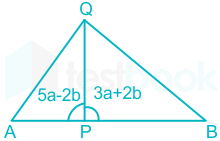
Point P lies on a line AB. If PQ is a ray such that ∠APQ = 5a - 2b and ∠QPB = 3a + 2b, then the value of 6a - 25° is : 

  1. AOption (a)

    135°

  2. BOption (b)

    120°

  3. COption (c)

    110°

  4. DOption (d)

    95°

View answer & explanation

Correct answer

Answer: (c)C.

110°

Why this answer is correct

Shortcut Trick

Since Point P lies on line AB, the angles ∠APQ and ∠QPB form a Linear Pair.

Sum of Linear Pair = 180°

(5a − 2b) + (3a + 2b) = 180°

8a = 180° ⇒ a = 22.5°

Required value = 6a − 25° = 6 × 22.5° − 25° = 110°

∴ The correct answer is 110°.

Alternate Method

Given:

∠APQ = 5a − 2b

∠QPB = 3a + 2b

Formula Used:

Sum of angles on a straight line is 180°.

Calculations:

⇒ ∠APQ + ∠QPB = 180°

⇒ (5a − 2b) + (3a + 2b) = 180°

⇒ 5a + 3a − 2b + 2b = 180°

⇒ 8a = 180°

⇒ a = 180° ÷ 8

⇒ a = 22.5°

Now, substitute the value of a in the required expression:

⇒ 6a − 25° = 6 × 22.5° − 25°

⇒ 6a − 25° = 135° − 25°

⇒ 6a − 25° = 110°

∴ The correct answer is 110°.

Additional Information

Linear Pair Axiom

If a ray stands on a line, then the sum of two adjacent angles so formed is 180°. These angles are called supplementary angles.

Angles on a Straight Line

The sum of all angles formed on one side of a straight line at a point on the line is always 180°.

Supplementary vs Complementary

Two angles are supplementary if their sum is 180°, and complementary if their sum is 90°.

Question 43

ABC and DEF are two triangles such that AB = 3 cm, ∠B = 120°, BC = 6.2 cm, DE = 6.2 cm, DF = 3 cm and ∠D = 120°. Then, which of the following statements is true ? 

  1. AOption (a)

    Δ ABC ≅ Δ DEF

  2. BOption (b)

    Δ ABC ≅ Δ FDE

  3. COption (c)

    Δ BCA ≅ Δ DFE

  4. DOption (d)

    Δ BAC ≅ Δ DEF

View answer & explanation

Correct answer

Answer: (b)B.

Δ ABC ≅ Δ FDE

Why this answer is correct

Shortcut Trick

Identify the SAS (Side-Angle-Side) components in both triangles.

In Δ ABC: AB = 3 cm, BC = 6.2 cm, and included ∠B = 120°.

In Δ DEF: DF = 3 cm, DE = 6.2 cm, and included ∠D = 120°.

Match the corresponding vertices: B ↔ D (angle), A ↔ F (side of 3 cm), and C ↔ E (side of 6.2 cm).

The correct congruence statement is Δ ABC ≅ Δ FDE.

∴ The correct answer is Δ ABC ≅ Δ FDE.

Alternate Method

Given:

In Δ ABC: AB = 3 cm, BC = 6.2 cm, ∠B = 120°

In Δ DEF: DF = 3 cm, DE = 6.2 cm, ∠D = 120°

Formula Used:

SAS Congruence Criterion: Two triangles are congruent if two sides and the included angle of one triangle are equal to the corresponding two sides and the included angle of the other triangle.

A B C F D E

Question 44

Which of the following figures have both linear symmetry and rotational symmetry ? 

  1. AOption (a)

    Equilateral triangle and isosceles triangle 

  2. BOption (b)

    Kite and rhombus 

  3. COption (c)

    Rectangle and kite 

  4. DOption (d)

    Rhombus and rectangle 

View answer & explanation

Correct answer

Answer: (d)D.

Rhombus and rectangle 

Why this answer is correct

The correct answer is Option (4): Rhombus and rectangle 

Calculation:

Equilateral triangle and isosceles triangle:

An equilateral triangle has three equal sides and three equal angles. It has rotational symmetry of order 3 (it matches itself after rotations of 120°). It also has three lines of symmetry.

An isosceles triangle has one line of symmetry, but it does not have rotational symmetry (other than a full 360° turn). Therefore, neither satisfies the condition.

Kite and rhombus:

A kite has one line of symmetry, but it does not have rotational symmetry.

A rhombus has two lines of symmetry (along its diagonals) and rotational symmetry of order 2 (180°). Therefore, both do not satisfy the condition.

Rectangle and kite:

A rectangle has two lines of symmetry (horizontal and vertical) and rotational symmetry of order 2 (180°).

A kite has only one line of symmetry and no rotational symmetry. Therefore, neither satisfies the condition.

Rhombus and rectangle:

A rhombus has two lines of symmetry and rotational symmetry of order 2.

A rectangle also has two lines of symmetry and rotational symmetry of order 2. Therefore, both figures satisfy the condition.

From the given options, the figures that have both linear symmetry and rotational symmetry are: Rhombus and rectangle.

Therefore, the correct answer is option 4) Rhombus and rectangle.

Question 45

In a triangle PQR, ∠P = 90° and internal bisectors of ∠Q and ∠R intersect at the point O. If ∠QOR = x, then value of 2x - 110° is equal to :  

  1. AOption (a)

    130° 

  2. BOption (b)

    140° 

  3. COption (c)

    150° 

  4. DOption (d)

    160° 

View answer & explanation

Correct answer

Answer: (d)D.

160° 

Why this answer is correct

Shortcut Trick

The angle formed at the incenter (intersection of internal bisectors) is given by: 90° + (Third Angle ÷ 2).

⇒ ∠QOR = x = 90° + ∠P ÷ 2

⇒ x = 90° + 90° ÷ 2 = 135°

⇒ Required value = 2x − 110°

⇒ 2 × 135° − 110° = 270° − 110° = 160°

∴ The correct answer is 160°.

Alternate Method

  P Q R O x

Given:

⇒ ∠P = 90°

⇒ Internal bisectors of ∠Q and ∠R intersect at point O.

Calculations:

⇒ In ΔPQR, the sum of all internal angles is 180°.

⇒ ∠P + ∠Q + ∠R = 180°

⇒ 90° + ∠Q + ∠R = 180°

⇒ ∠Q + ∠R = 90°

⇒ In ΔQOR, O is the intersection of the angle bisectors of ∠Q and ∠R.

⇒ Therefore, ∠OQR = ∠Q ÷ 2 and ∠ORQ = ∠R ÷ 2

⇒ The sum of angles in ΔQOR is also 180°.

⇒ ∠QOR + ∠OQR + ∠ORQ = 180°

⇒ x + (∠Q ÷ 2) + (∠R ÷ 2) = 180°

⇒ x + (∠Q + ∠R) ÷ 2 = 180°

⇒ x + 90° ÷ 2 = 180°

⇒ x + 45° = 180°

⇒ x = 135°

⇒ Value to find: 2x − 110°

⇒ 2 × 135° − 110° = 270° − 110° = 160°

∴ The correct answer is 160°.

Additional Information

Incenter (Intersection of Internal Angle Bisectors)

The angle formed at the incenter by bisecting any two angles ∠B and ∠C is: 90° + ∠A ÷ 2.

Excenter (Intersection of External Angle Bisectors)

The angle formed by the external bisectors of ∠B and ∠C is: 90° − ∠A ÷ 2.

Orthocenter (Intersection of Altitudes)

The angle formed by altitudes originating from ∠B and ∠C is: 180° − ∠A.

Circumcenter (Intersection of Perpendicular Bisectors)

The angle formed at the circumcenter by the circumradii extending to B and C is: 2 × ∠A.

Question 46

The longest side of a right angled triangle is 90 cm and one of its other two sides is 54 cm. Area of this triangle is : 

  1. AOption (a)

    4860 cm2

  2. BOption (b)

    3888 cm2

  3. COption (c)

    2430 cm2

  4. DOption (d)

    1944 cm2

View answer & explanation

Correct answer

Answer: (d)D.

1944 cm2

Why this answer is correct

Given:

Longest side of the right-angled triangle: 90 cm One of the other two sides: 54 cm

Solution:

According to the Pythagorean theorem, in a right-angled triangle:

⇒ c2 = a2 + b2

In this case, we have: c = 90 cm a = 54 cm

Using the Pythagorean theorem, we can find the value of "b":

⇒ 902  = 542 + b2   

⇒ 8100 = 2916 + b2 

⇒ b2 = 8100 - 2916

⇒ b2  = 5184

⇒ b = 72 cm

Now, we can calculate the area of the right-angled triangle using the formula:

Area = (1/2) ×  base × height

Area  = (1/2) ×  54 cm ×  72 cm

Area = 1944 cm2

Therefore, the area of the right-angled triangle is 1944 cm2.

The correct answer is option 4) 1944 cm2.

Question 47

A wooden cube of side 8 cm is cut into small cubes of side 2 cm each. What is the percentage increase or decrease in the surface area after such cutting ? 

  1. AOption (a)

    300% decrease 

  2. BOption (b)

    300% increase 

  3. COption (c)

    400% decrease 

  4. DOption (d)

    400% increase 

View answer & explanation

Correct answer

Answer: (b)B.

300% increase 

Why this answer is correct

Given:

A wooden cube of side 8 cm.

Small cubes of side 2 cm each.

Formula used:

Surface area of cube = 6a2

Calculation:

According to question,

Volume of bigger cube = n × Volume of smaller cube

⇒ 512 = n × 8 

⇒ n = 64

Bigger cube Surface area = 6 × 8 × 8 = 384

Smaller cube Surface area = 64 × 6 × 2 × 2 = 1536

Increase in area = 1536 - 384 = 1152

⇒ 1152/384 × 100 = 300% increase

∴ The correct answer is 300% increase.

Question 48

There is a circular path of width 4 m inside a circular park along its boundary. If the radius of the park is 16 m, then area of the path is (Use π = 3.14) : 

  1. AOption (a)

    251.68 m2

  2. BOption (b)

    261.58 m2

  3. COption (c)

    351.68 m2

  4. DOption (d)

    361.58 m2

View answer & explanation

Correct answer

Answer: (c)C.

351.68 m2

Why this answer is correct

Shortcut Trick

Outer radius (R) = 16 m, Width = 4 m

Inner radius (r) = 16 − 4 = 12 m

Area of path = π × (R + r) × (R − r)

Area = 3.14 × (16 + 12) × 4 = 3.14 × 112 = 351.68 m2

∴ The correct answer is 351.68 m2.

Alternate Method

Given:

Outer radius of the park (R) = 16 m

Width of the circular path = 4 m

Inner radius of the park (r) = Outer radius − Width = 16 − 4 = 12 m

Formula Used:

Area of circular path = Area of outer circle − Area of inner circle

Area = πR2 − πr2 = π(R2 − r2)

R=16m

r=12m

Width=4m Circular Park with Internal Path Shaded Area = Path Area

Calculations:

⇒ Area = 3.14 × (162 − 122)

⇒ Area = 3.14 × (256 − 144)

⇒ Area = 3.14 × 112

⇒ Area = 351.68 m2

∴ The correct answer is 351.68 m2.

Additional Information

Area of a Circular Ring

The area between two concentric circles is given by A = π(R2 − r2) or A = π(R + r)(R − r), where R is the outer radius and r is the inner radius.

Circle Fundamentals

Area of circle = πr2 and Circumference = 2πr. For a path outside a circle, the outer radius R = r + width.

Area of a Sector

Area of sector = (θ / 360) × πr2, where θ is the central angle in degrees.

Question 49

Observations 29, 32, 48, 50, x, x + 2, 72, 78, 84 and 95 are written in ascending order. If median of these observations is 63, then mean of the data is: 

  1. AOption (a)

    60.4

  2. BOption (b)

    61.4

  3. COption (c)

    62

  4. DOption (d)

    64

View answer & explanation

Correct answer

Answer: (b)B.

61.4

Why this answer is correct

Shortcut Trick

For 10 observations, the median is the average of the 5th and 6th terms.

Median = (x + x + 2) ÷ 2 ⇒ x + 1 = 63 ⇒ x = 62.

The dataset values are: 29, 32, 48, 50, 62, 64, 72, 78, 84, 95.

Sum of all values = 29 + 32 + 48 + 50 + 62 + 64 + 72 + 78 + 84 + 95 = 614.

Mean = 614 ÷ 10 = 61.4.

∴ The correct answer is 61.4.

Alternate Method

Given:

Observations in ascending order: 29, 32, 48, 50, x, x + 2, 72, 78, 84, 95

Total number of observations (n) = 10

Median = 63

Observations in Ascending Order

29

32

48

50

x

x+2

72

78

84

95

Median = 63

Mean = Sum of all 10 values ÷ 10

Formula Used:

Median (when n is even) = [(n ÷ 2)th term + (n ÷ 2 + 1)th term] ÷ 2

Mean = Sum of all observations ÷ Total number of observations

Calculation:

⇒ Median = (5th term + 6th term) ÷ 2

⇒ 63 = (x + x + 2) ÷ 2

⇒ 126 = 2x + 2

⇒ 2x = 124

⇒ x = 62

⇒ The 5th term is 62 and the 6th term is 64.

⇒ Sum of all observations = 29 + 32 + 48 + 50 + 62 + 64 + 72 + 78 + 84 + 95

⇒ Sum = 614

⇒ Mean = 614 ÷ 10

⇒ Mean = 61.4

∴ The correct answer is 61.4.

Additional Information

Mean

Mean is the average of a set of numerical values. It is calculated by dividing the sum of all values by the total count of values in the set (Mean = ∑x ÷ n).

Median

Median is the strictly middle value of a sorted dataset. For an odd number of terms, it is the ((n + 1) ÷ 2)th term. For an even number of terms, it is the average of the two central terms.

Mode

Mode is the specific value that appears most frequently in a dataset. A dataset may feature one mode, multiple modes, or no mode at all if every value appears only once.

Question 50

The probability of guessing the correct answer to a certain question is x3\rm \frac{x}{3}. If the probability of not guessing the correct answer of the question is x5\rm \frac{x}{5}, then the value of x is:

  1. AOption (a)

    815\frac{8}{15}

  2. BOption (b)

    89\frac{8}{9}

  3. COption (c)

    98\frac{9}{8}

  4. DOption (d)

    158\frac{15}{8}

View answer & explanation

Correct answer

Answer: (d)D.

158\frac{15}{8}

Why this answer is correct

Given:

Probability of correct answer = x/3 

Probability of wrong answer = x/5

Concept used:

P(A) + P(not A) = 1

Calculation:

According to question : 

⇒ x/3 + x/5 = 1

⇒ (5x + 3x)/15 = 1

⇒ 8x/5 = 1

⇒ x = 15/8

∴ The correct answer is 15/8.

Question 51

Which of the following is NOT a purpose of assessment ?

  1. AOption (a)

    Monitoring the growth of learners 

  2. BOption (b)

    Improving pedagogy as per learners’ needs 

  3. COption (c)

    Providing feedback to learners 

  4. DOption (d)

    Labeling the learners

View answer & explanation

Correct answer

Answer: (d)D.

Labeling the learners

Why this answer is correct

Assessment is typically used to monitor the growth of learners, improve pedagogy according to learners' needs, and provide feedback to learners.

Key Points

  • These are all constructive purposes that aid in the development and progression of a learner's understanding.
  • Labeling learners, however, is not a valid or constructive purpose of assessment.
  • Labeling can often lead to negative consequences, such as stereotyping and discrimination.

It can limit the potential of learners and pigeonhole them into certain categories, rather than recognizing the full scope of their abilities and potential for growth.

Hence, it can be concluded that option 4 is the correct answer.

Question 52

Which of the following is NOT true for the axioms in mathematics ?

  1. AOption (a)

    They can be used to establish other mathematical truths 

  2. BOption (b)

    They are accepted without proofs 

  3. COption (c)

    There are only a few number of axioms 

  4. DOption (d)

    An axiom can be used to disprove other axioms 

View answer & explanation

Correct answer

Answer: (d)D.

An axiom can be used to disprove other axioms 

Why this answer is correct

An axiom, by definition, is a statement or proposition that is accepted as being true without requiring proof.

Key Points

  • They serve as starting points for deductive reasoning and are considered foundational in any mathematical system.
  • Axioms are not used to disprove other axioms within the same mathematical system.
  • They are considered self-evident truths within their respective systems, and each axiom coexists without contradiction with the others.
  • While there can be varying numbers of axioms depending on the mathematical system being considered, it's worth noting that the statement "There are only a few number of axioms" can sometimes be misleading, because some systems have more axioms than others.

 Hence, it can be concluded that an axiom can be used to disprove other axioms is NOT true for the axioms in mathematics.

Question 53

National Curriculum Framework 2005, position paper on mathematics education states that “The identification of patterns is central to mathematics”. What could be the most appropriate reason this ? 

  1. AOption (a)

    It will create interest among students 

  2. BOption (b)

    It will develop problem solving skills 

  3. COption (c)

    It will act as a base for algebraic thinking in later stages of learning  

  4. DOption (d)

    It is essential for approximation and optimization 

View answer & explanation

Correct answer

Answer: (c)C.

It will act as a base for algebraic thinking in later stages of learning  

Why this answer is correct

Recognizing and understanding patterns is indeed a critical skill in mathematics.

Key Points

  • The process allows students to make predictions, identify relationships, extrapolate, interpolate, and understand the underlying structure of mathematical concepts.
  • Identifying patterns is fundamental to the development of algebraic thinking in mathematics.
  • Patterns can introduce learners to the concept of variables and the generalization of numerical relationships, which are key elements of algebra.
  • It enables learners to predict, extend, and create formulas, deepening their understanding of how numbers and symbols work together.
  • As students progress, recognizing patterns in complex equations or functions will make abstract concepts more concrete.

Hence, it can be concluded that option 3 is the correct answer.

Question 54

While teaching the concept of area and its measurement in class VI, a mathematics teacher demonstrates how to measure the areas of polygons using a graph paper. A student approaches him with an irregularly shaped leaf for finding its area. What should the teacher do in this situation ? 

  1. AOption (a)

    Tell the student that it is difficult to measure the area of such a leaf 

  2. BOption (b)

    Encourage the student by involving other students of the class and help them to explore various ways to find the area of the leaf 

  3. COption (c)

    Ask the student to go back home and find it on google 

  4. DOption (d)

    Tell the student not to ask such irrelevant questions 

View answer & explanation

Correct answer

Answer: (b)B.

Encourage the student by involving other students of the class and help them to explore various ways to find the area of the leaf 

Why this answer is correct

This approach nurtures curiosity and fosters a learning environment where students feel confident to ask questions, explore, and learn from each other.

Key Points

  • It also allows the teacher to introduce new and applicable concepts, such as estimating the area of irregular shapes.
  • He would be encouraging the student's curiosity and making learning interactive and engaging.
  • The student's question about measuring the area of an irregularly shaped leaf provides an opportunity to broaden the concept of area from regular polygons to irregular shapes.
  • The teacher could use this instance to facilitate an activity where students brainstorm and explore various methods to approximate the area of the leaf, such as using a graph paper to count squares or by approximating it as a combination of regular shapes.
  • This approach encourages critical thinking, cooperative learning, and helps students see the relevance and application of mathematics in everyday life.

Hence, it can be concluded that option 2 is the correct answer.

Question 55

While teaching the concept of squares and square roots, a teacher writes a series of odd numbers beginning from 1. S/He tries to show a pattern in the following way :

1 = 1

1 + 3 = 4 = 22

1 + 3 + 5 = 9 = 32

1 + 3 + 5 + 7 =16 = 42 and so on. S/He does so to:

  1. AOption (a)

    Entertain learners 

  2. BOption (b)

    Show an arithmetic progression 

  3. COption (c)

    Help learners deduce a general mathematical fact 

  4. DOption (d)

    Puzzle the learners

View answer & explanation

Correct answer

Answer: (c)C.

Help learners deduce a general mathematical fact 

Why this answer is correct

By demonstrating the pattern that the sum of consecutive odd numbers starting from 1 always results in a perfect square, the teacher is allowing students to deduce a general mathematical fact that significantly aids their understanding of squares and square roots.

Key Points

  • This experiential method of teaching not only helps students grasp the concept better, but it also nurtures their mathematical thinking by encouraging them to identify patterns and reason out conclusions.
  • As they observe the pattern, they start to realize the innate connection between the accumulation of odd numbers and square numbers, reinforcing their knowledge of the properties of square numbers.
  • This deductive approach also contributes to enhancing their problem-solving skills, as they're likely to employ similar reasoning when they encounter new mathematical problems in future.
  • This method hence combines understanding, reasoning, and application, making it an effective teaching strategy.

Hence, it can be concluded that option 3 is the correct answer.

Question 56

A class VI student displays confusion in comparing unit fractions such as 13,16,...\frac{1}{3}, \frac{1}{6},... and usually identifies 17\frac{1}{7} as greater than 15\frac{1}{5}. What is the most appropriate way to help this student ?

  1. AOption (a)

    Call the parents and tell them to put the student in a tution class 

  2. BOption (b)

    Help him/her memorize the rule that greater denominator means a smaller fraction 

  3. COption (c)

    Give the student similar problems to practice at home 

  4. DOption (d)

    Use daily life experiences and concrete materials to demonstrate the concept of comparison of unit fractions 

View answer & explanation

Correct answer

Answer: (d)D.

Use daily life experiences and concrete materials to demonstrate the concept of comparison of unit fractions 

Why this answer is correct

The teacher's choice to use daily life experiences and concrete materials to demonstrate the concept of comparing unit fractions is highly effective.

Key Points

  • It addresses the student's confusion by providing a tangible, visual representation of the abstract concept.
  • By dividing a pizza, a pie, or any other physical object into different numbers of equal parts, the teacher can help the student visualize that the larger the denominator, the smaller each individual fraction (or piece) is.
  • This method makes learning more interactive and relevant to the student's daily life, which enhances understanding.
  • It also provides a conceptual understanding of fractions, rather than encouraging rote memorization, which fosters a deeper, long-term understanding of mathematical principles.

Hence, it can be concluded that option 4 is the correct answer.

Question 57

Most recently mathematical modeling is considered as indispensable aspect of mathematics education. Which of the following describes mathematical modeling in school mathematics ? 

  1. AOption (a)

    It means including activities in mathematics 

  2. BOption (b)

    It is related to making models using various types of materials 

  3. COption (c)

    It involves mind mapping of learners and making pedagogical models likewise 

  4. DOption (d)

    It means to solve real problems in everyday life using mathematical concepts 

View answer & explanation

Correct answer

Answer: (d)D.

It means to solve real problems in everyday life using mathematical concepts 

Why this answer is correct

Mathematical modeling involves the use of mathematics to represent, analyze, make predictions, or otherwise provide insight into real-world phenomena.

Key Points

  • This process involves constructing mathematical equations or simulations that represent certain situations, problems, or systems, and using these to solve problems or make decisions.
  • By allowing students to apply their mathematical knowledge to practical, everyday situations, mathematical modeling can enhance their understanding of both the relevance and power of mathematics.
  • It's worth noting that this doesn't necessarily exclude the use of materials, activities, or mental models, but the focus is on using mathematics as a tool to interpret and make sense of the world around us.

Hence, it can be concluded that option 4 is the correct answer.

Question 58

What is the most appropriate reason for learners’ misconceptions about integer operations in middle school mathematics ? 

  1. AOption (a)

    Understanding integer operations requires higher level of intelligence 

  2. BOption (b)

    Integer operations are abstract so the learners do not pay attention in the class 

  3. COption (c)

    There is an unrealistic emphasis on rote memorization of rules of integer operations with little to no explanation given in the class 

  4. DOption (d)

    Integer operations cannot be explained with examples from real world problems 

View answer & explanation

Correct answer

Answer: (c)C.

There is an unrealistic emphasis on rote memorization of rules of integer operations with little to no explanation given in the class 

Why this answer is correct

Integer operations can be quite abstract, and students often struggle to understand them when they're taught simply as rules to be memorized, without a solid conceptual explanation.

Key Points

  • It's important for students to understand why these rules work, rather than just memorizing them.
  • For example, understanding why a negative times a negative equals a positive can be much more useful than just remembering the rule.
  • By explaining the underlying concepts and providing opportunities for meaningful practice, educators can help students gain a more intuitive understanding of integer operations and reduce misconceptions.

Hence, it can be concluded that option 3 is the correct answer.

Question 59

Which of the following is least appropriate for teaching operations on fractions to primary grade children ? 

  1. AOption (a)

    Giving a variety of situations to add and subtract fractions 

  2. BOption (b)

    Giving a standard rule to add or subtract fractions 

  3. COption (c)

    Showing models to visualize operation on fractions 

  4. DOption (d)

    Generalizing patterns to form rules for adding/subtracting fractions 

View answer & explanation

Correct answer

Answer: (b)B.

Giving a standard rule to add or subtract fractions 

Why this answer is correct

At the primary grade level, students are still developing their understanding of mathematical concepts.

Key Points

  • Merely providing a standard rule for adding or subtracting fractions, without adequate conceptual understanding, can lead to superficial learning and potentially misunderstanding.
  • It's more effective to teach operations on fractions through visual models, real-world situations, and generalizing patterns.
  • These methods foster conceptual understanding and enable students to intuitively grasp how fraction operations work.
  • Once they have a firm conceptual foundation, they will be more capable of understanding and correctly applying standard rules.

Hence, it can be concluded that giving a standard rule to add or subtract fractio ns is the correct answer.

Question 60

At primary level, which of the following is most appropriate to be assessed in mathematics ? 

  1. AOption (a)

    Assessing facts and formulae learnt by students 

  2. BOption (b)

    Step-wise solution replicated in solving the problem 

  3. COption (c)

    Use of alternate strategies and procedures 

  4. DOption (d)

    Assessing the ability to use formal algorithms only 

View answer & explanation

Correct answer

Answer: (c)C.

Use of alternate strategies and procedures 

Why this answer is correct

At the primary level, the goal of mathematics education should be to build a strong foundation of conceptual understanding, problem-solving skills, and flexibility in mathematical thinking.

Key Points

  • Assessing the use of alternate strategies and procedures can help teachers gauge a student's understanding of a concept and their ability to apply their knowledge in different ways.
  • This can also encourage students to think critically and flexibly, skills that are crucial for more advanced mathematical reasoning.
  • While facts, formulae, step-wise solutions, and formal algorithms are also important, they should ideally be based on a solid understanding of underlying concepts, which is best demonstrated through the use of alternate strategies.

 Hence, it can be concluded that the use of alternate strategies and procedures is the correct answer.  ​

Question 61

When a copper vessel is exposed to moist air for long, it acquires a dull green coating. What is this green substance ? 

  1. AOption (a)

    Mixture of copper oxide and copper hydroxide 

  2. BOption (b)

    Mixture of copper hydroxide and copper carbonate  

  3. COption (c)

    Mixture of copper oxide and copper carbonate 

  4. DOption (d)

    Mixture of copper hydroxide and copper sulphate 

View answer & explanation

Correct answer

Answer: (b)B.

Mixture of copper hydroxide and copper carbonate  

Why this answer is correct

The Correct answer is Mixture of copper hydroxide and copper carbonate.

Concept:

Corrosion

  • Metals when kept open react with oxygen and moisture present in the air.
  • With the reaction, an unwanted layer is formed over the metal.
  • For example, when the iron is kept open for a while then a brown layer is formed over it which is called rust.
  • This lowers the strength and shine of the metal and is a highly undesirable chemical change.

Explanation:

  • The metal X is copper.
  • The green coating over the copper is the result of the corrosion of copper.
  • The copper reacts with hydrogen and oxygen present in the atmosphere and forms the green layer.
  • The green material is a mixture of copper hydroxide and copper carbonate.
  • The chemical equation for the process is

2 Cu + O2 + H2O + CO2 → Cu (OH)2 + CuCO3

So, the correct option is a Mixture of copper hydroxide and copper carbonate

Question 62

Which of the following is NOT found in the section of a leaf ?

(A) Guard cells

(B) Stoma

(C) Chlorophyll

(D) Pseudopodia

(E) Xylem

  1. AOption (a)

    (A) and (B)

  2. BOption (b)

    (A) and (D)

  3. COption (c)

    (C) and (E)

  4. DOption (d)

    (D) and (E)

View answer & explanation

Correct answer

Answer: (d)D.

(D) and (E)

Why this answer is correct

Explanation:

  • Guard cells: Guard cells are specialized cells found in the epidermis of a leaf. They surround and regulate the opening and closing of stomata, which are tiny pores present on the leaf's surface. The stomata are responsible for gas exchange, allowing carbon dioxide to enter the leaf for photosynthesis and releasing oxygen and water vapor. Therefore, guard cells are indeed found in the section of a leaf.
  • Stoma: As mentioned above, stomata are small pores present in the epidermis of a leaf. They allow the exchange of gases between the leaf and the atmosphere. Stomata are surrounded by the guard cells that regulate their opening and closing. Thus, stomata are indeed found in the section of a leaf.
  • Chlorophyll: Chlorophyll is the green pigment found in chloroplasts, which are organelles within plant cells responsible for photosynthesis. Chloroplasts are mainly found in the mesophyll cells of a leaf, which are located between the upper and lower epidermis. Chlorophyll plays a crucial role in capturing light energy to facilitate photosynthesis. Therefore, chlorophyll is indeed found in the section of a leaf.
  • Pseudopodia: Pseudopodia are temporary projections of the cytoplasm in certain eukaryotic cells, such as amoebas, used for locomotion and capturing prey. However, pseudopodia are not found in the section of a leaf. They are specific to certain single-celled organisms and not a feature of plant cells.
  • Xylem: Xylem is a type of tissue in vascular plants that transports water and some nutrients. While the xylem is found in the plant's stem and root, it doesn't directly exist in the leaf structure, though leaf veins contain extensions of the stem's xylem. So it's a bit more ambiguous.

Therefore the correct answer is pseudopodia and Xylem are not found in the section of a leaf. They are a feature of certain single-celled organisms and are not part of the leaf's structure.

Question 63

Which one of the following options represent the correct sequence of processing of fibre into wool ? 

  1. AOption (a)

    Sorting, scouring, shearing, dyeing, rolling 

  2. BOption (b)

    Shearing, scouring, sorting, dyeing, rolling 

  3. COption (c)

    Shearing, dyeing, scouring, sorting, rolling 

  4. DOption (d)

    Scouring, shearing, sorting, dyeing, rolling 

View answer & explanation

Correct answer

Answer: (b)B.

Shearing, scouring, sorting, dyeing, rolling 

Why this answer is correct

The Correct answer is Shearing, scouring, sorting, dyeing, rolling.

Concept:

  • Any cloth is composed of thin and continuous strands known as fibre.
  • It can be classified into Synthetic fibre and Natural fibre.
  • Fibres obtained from plants and animals are called natural fibres.
  • Examples of Natural fibres are Wool and cotton.

WOOL:

  • It is a natural fibre which is obtained from sheep, goats, yak and camels.
  • Wool is sheared from these animals from the outer covering of the hair, which is shaved to obtain wool.

Explanation:

  • The processing of wool follows a series of processes.
  • Shearing---> scouring--->sorting---> Dyeing --->Rolling.

Shearing: 

  • It is the first step of processing wool
  • The fleece of the sheep is removed from their skin during the spring season as sheep don't require the outer skin to keep them warm.

Scouring:

  • it is the second process of processing of wool
  • In this sheared hair is washed in a large tank to remove dirt, grease and dust by machines.

Sorting:

  • It is the third step of processing wool
  • In this process, fibres are differentiated/sorted on the basis of quality fibres.

Dyeing:

  • ​In this process colouring of fibres takes place
  • For example, different fibres are coloured in different colours generally white, black or brown are preferred.

Rolling:

  • After the dyeing process, fibres are dried straightened and rolled into yarns.

Hence shearing-->scouring-->sorting-->  Dyeing-->Rolling. is the correct answer.

Additional Information

Cleaning of Burrs: 

  • ​It is the fourth step of processing wool
  • ​A burr is a raised edge or small piece of material that remains attached to a workpiece after a modification process.
  • Fibres are cleaned thoroughly in order to remove burrs.

Question 64

Reshma is boiling water is a metallic pan. Heat is transferred in many ways. Some are :

(i) Heat transfers to the handle of the pan on the flame

(ii) Heat transfers to increase the temperature of water in the pan on the flame

(iii) Heat transfers to air near the pan

Which one of the following is correct representation of heat transfer ?

  1. AOption (a)

    Conduction-(i), convection-(ii), radiation-(iii) 

  2. BOption (b)

    Convection-(i), conduction-(ii), radiation-(iii)  

  3. COption (c)

    Conduction-(i), convection-(ii), conduction-(iii) 

  4. DOption (d)

    Conduction-(i), radiation-(ii), convection-(iii) 

View answer & explanation

Correct answer

Answer: (a)A.

Conduction-(i), convection-(ii), radiation-(iii) 

Why this answer is correct

The Correct answer is Conduction-(i), convection-(ii), radiation-(iii).

Concept;

Conduction

  • Conduction is the process of heat transfer from a warmer object to a cooler object when they come in contact with each other.
  • The flow of heat energy continues till the temperature of both objects becomes equal or the contact is broken.
  • The conduction in the atmosphere occurs at the zone of contact between the atmosphere and the earth's surface.
  • It is important in heating the lower layers of the atmosphere.

Convention

  • The transfer of heat by the movement of a mass or substance from one place to another is called convection.
  • The continuous ascent of heated air creates a vacuum in the lower layers of the atmosphere. As a consequence, cooler air comes down to fill the vacuum, leading to convection.
  • The cyclic movement associated with the conventional process in the atmosphere transfer heat from the lower layer to the upper layer and heats up the atmosphere.

Radiation

  • All objects whether hot or cold emit radiant energy continuously.
  • Hotter objects emit more energy per unit area than colder objects.
  • The temperature of an object determines the wavelength of radiation.
  • Temperature and wavelength are inversely proportional.

Explanation:

  • Heat transfers to the handle of the pan on the flame: This process represents heat transfer through conduction. Conduction is the transfer of heat through a solid material without any actual movement of the material itself. When the metallic pan is placed on the flame, the part of the pan that comes into direct contact with the flame gets hot. This heat is then conducted through the material of the pan and is transferred to the handle of the pan.
  • Heat transfers to increase the temperature of water in the pan on the flame: This process represents heat transfer through convection. Convection is the transfer of heat through a fluid (liquid or gas) due to the movement of the fluid itself. As the water in the pan gets heated, its molecules gain energy and move faster, becoming less dense. The hotter, lighter water rises, while the cooler, denser water near the bottom of the pan sinks. This creates a convection current, and heat is transferred throughout the water in the pan.
  • Heat transfers to air near the pan: This process represents heat transfer through radiation. Radiation is the transfer of heat through electromagnetic waves. When the pan is heated on the flame, it emits thermal radiation in the form of infrared waves. These infrared waves carry energy and travel through the air, warming up the surrounding air near the pan.

Additional InformationScattering

  • When light waves fall on small bodies such as dust particles, water particles in suspension, and suspended particles in colloidal solution, they are thrown out in all directions. This is called a scattering of light
  • E.g. - Blue color if the sky is due to scattering of light.

Question 65

Litmus is the most commonly used natural indicators to test whether a substance is acidic or basic in nature. From where is litmus extracted ?  

  1. AOption (a)

    China Rose 

  2. BOption (b)

    Turmeric 

  3. COption (c)

    Lichens 

  4. DOption (d)

    Phenolphthalein 

View answer & explanation

Correct answer

Answer: (c)C.

Lichens 

Why this answer is correct

The Correct answer is Lichens.

Concept;

  • lichens are unique organisms that result from a symbiotic relationship between a fungus and an Algae.
  • They can be found in various environments, including forests, rocky areas, and even on tree bark. Lichens are well-known for their ability to produce dyes, and one of the dyes they produce is litmus.

Explanation:

  • Indicators are substances that show a change in color when brought in contact with acids and bases.
  • The most common indicator used in the laboratory is Litmus.
  • Litmus is extracted from lichens.

Some common indicators and their color in Acid and Base.

NameAcid ColourBase Colour
Methyl violetYellowBlue
Thymol blueRedYellow
Methyl orangeRedYellow
Bromocresol greenYellowBlue
Methyl redRedYellow
LitmusRedBlue
Bromothymol blueYellowBlue
Thymol blueYellowBlue
PhenolphthaleinColorlessPink
ThymolphthaleinColorlessBlue
Alizarin yellow RYellowRed

Question 66

Which of the following is not a recommended practice to prevent rusting of iron ? 

  1. AOption (a)

    Mixing iron with carbon, chromium, nickel and manganese 

  2. BOption (b)

    Depositing a layer of zinc or chromium on iron 

  3. COption (c)

    Greasing the piece of iron 

  4. DOption (d)

    Keeping an iron piece in a humid atmosphere 

View answer & explanation

Correct answer

Answer: (d)D.

Keeping an iron piece in a humid atmosphere 

Why this answer is correct

The Correct answer is Keeping an iron piece in a humid atmosphere.

Explanation:

  • Mixing iron with carbon, chromium, nickel, and manganese: This is a recommended practice to prevent rusting of iron. Mixing iron with these elements can create various types of alloys, such as stainless steel, which are more corrosion-resistant than pure iron. Stainless steel contains chromium, which forms a passive oxide layer on the surface, protecting the iron from rusting.
  • Depositing a layer of zinc or chromium on iron: This is also a recommended practice to prevent rusting of iron. Coating iron with zinc (galvanizing) or chromium can provide a protective layer that acts as a barrier between the iron and the surrounding environment. Zinc and chromium coatings are commonly used in processes like galvanization and chromate conversion coating to enhance corrosion resistance.
  • Greasing the piece of iron: This is another recommended practice to prevent rusting of iron. Applying grease or oil on the surface of iron forms a protective layer, preventing moisture and oxygen from coming into direct contact with the iron surface, thus reducing the chances of rust formation.
  • Keeping an iron piece in a humid atmosphere: This is not recommended practice. Humid atmospheres are more prone to rust formation because they contain moisture, which is a critical factor for the rusting process. When iron is exposed to humid air, the moisture reacts with the iron to form iron oxide (rust). To prevent rusting, it is important to avoid exposing iron to high humidity or moisture.

In summary, options 1, 2, and 3 are recommended practices to prevent rusting of iron, **while option 4 is not recommended as it exposes iron to a condition that promotes rust formation.**​

Question 67

Which of the following is correct about climate of a place ? 

  1. AOption (a)

    Climate is same as weather of that place 

  2. BOption (b)

    Climate is the day to day condition of the atmosphere at a place 

  3. COption (c)

    Climate reports are prepared by the meterological department on everyday basis 

  4. DOption (d)

    Climate is the average weather pattern taken over a long period of time 

View answer & explanation

Correct answer

Answer: (d)D.

Climate is the average weather pattern taken over a long period of time 

Why this answer is correct

The Correct answer is Climate is the average weather pattern taken over a long period of time.

Explanation:

  • The climate is not the same as the weather of a place:
  • Weather and climate are related but different concepts. Weather refers to the short-term atmospheric conditions in a specific area, including factors like temperature, humidity, precipitation, wind speed, etc. Weather can change from day to day or even from hour to hour. On the other hand, climate refers to the long-term average weather pattern of a place over an extended period, typically spanning decades to centuries.
  • The climate is not the day-to-day condition of the atmosphere at a place: As mentioned earlier, climate represents the average weather conditions over a long period, while day-to-day conditions are considered weather. Climate takes into account the variations and averages of weather elements like temperature, precipitation, and wind patterns over an extended timeframe.
  • Climate reports are not prepared by the meteorological department on an everyday basis: Meteorological departments generally provide daily weather reports, not climate reports. Weather reports provide information about the current atmospheric conditions, short-term forecasts, and specific weather events for a given location. Climate reports, on the other hand, are based on the analysis of long-term data collected over many years to assess the typical weather patterns and variations of a region.
  • The climate is the average weather pattern taken over a long period of time: This statement is correct. Climate represents the typical weather conditions of a particular place or region over an extended period, usually at least 30 years. It considers the average temperature, precipitation, humidity, wind patterns, and other weather-related parameters to describe the overall climate characteristics of an area. Climate provides an understanding of the general weather tendencies, seasonal variations, and climate zones that exist across the Earth's surface.

Therefore the correct answer is. It is the long-term average weather pattern observed in a specific region, and it helps in understanding the overall climatic characteristics of that place.

Question 68

Areeba did an activity for calculation of moisture content of a soil sample. She took 200 gm of soil and spread it on a newspaper in the sun and allowed it to dry for 2 hours. After two hours the weight of soil was 180 gm. What is the percentage of moisture in the soil ? 

  1. AOption (a)

    9%

  2. BOption (b)

    10%

  3. COption (c)

    18%

  4. DOption (d)

    20%

View answer & explanation

Correct answer

Answer: (b)B.

10%

Why this answer is correct

The Correct answer is 10%.

Calculation:

The weight of water evaporated

The initial weight of the soil = 200 gm

Weight of the soil after drying = 180 gm

Weight of water evaporated = Initial weight of the soil - Weight of the soil after drying

Weight of water evaporated = 200 gm - 180 gm = 20 gm

The percentage of moisture: 

Percentage of moisture = (Weight of water evaporated / Initial weight of the soil) ×  100

Percentage of moisture = (20 gm / 200 gm) ×  100

Percentage of moisture = 0.1 ×  100

Percentage of moisture = 10%

The percentage of moisture in the soil is 10%.

Question 69

Which one of the following option is incorrect about human circulatory system ? 

  1. AOption (a)

    Human heart is a four chambered structure 

  2. BOption (b)

    Pulmonary artery carries carbon dioxide rich blood to the lungs 

  3. COption (c)

    Rhythmic contraction and relaxation of muscles in chambers of heart constitute heartbeat 

  4. DOption (d)

    The upper two chambers are called ventricles and the lower ones are artria 

View answer & explanation

Correct answer

Answer: (d)D.

The upper two chambers are called ventricles and the lower ones are artria 

Why this answer is correct

The Correct answer is The upper two chambers are called ventricles and the lower ones are artria.

Concept:

Human circulatory system: 

  • It is also called the blood-vascular system.
  • It consists of a muscular chambered heart, a network of closed branching blood vessels, and blood, the fluid which is circulated.

Explanation:

  • The human heart is a four-chambered muscular organ responsible for pumping blood throughout the body. It consists of two upper chambers called atria (singular: atrium) and two lower chambers called ventricles.
  • The heartbeat is the result of rhythmic contraction (systole) and relaxation (diastole) of the heart's muscles. During systole, the heart contracts, pumping blood into the arteries. During diastole, the heart relaxes, allowing the chambers to fill with
  • The upper two chambers are called the atria, and the lower two chambers are called the ventricles. The atria receive blood from various parts of the body and pump it into the ventricles. The ventricles then contract to pump blood out of the heart to the lungs (right ventricle) and the rest of the body (left ventricle).

Additional Information Blood Vessels:

  • There are different types of blood vessels in our body each carrying out specialized functions.
  • Three types of blood vessels are Arteries, Veins, and Capillaries.

Arteries:

  • These are thick-walled blood vessels that carry oxygenated blood from the heart to different organs.
  • Pulmonary arteries are exceptions because they carry deoxygenated blood from the heart to the lungs, where the oxygenation of blood takes place.

Veins:

  • These are thin-walled blood vessels that carry deoxygenated blood from different organs to the heart.
  • Pulmonary veins are exceptions because they carry oxygenated blood from the lungs to the heart.
  • Valves are present in veins to prevent back-flow of blood.

Capillaries: These are the blood vessels that have single-celled walls.

Question 70

Which one of the following is not a method of  asexual reproduction in plants? 

  1. AOption (a)

    Budding 

  2. BOption (b)

    Spore formation 

  3. COption (c)

    Pollination 

  4. DOption (d)

    Fragmentation 

View answer & explanation

Correct answer

Answer: (c)C.

Pollination 

Why this answer is correct

The Correct answer is Pollination

Concept:

Reproduction in Plants:

  • The production of new individuals from their parents is known as Reproduction.
  • There are different modes of reproduction in plants:
  • Asexual Reproduction
  • Sexual Reproduction

Asexual Reproduction:

  • In asexual reproduction, new plants are obtained without the production of seeds.
  • The new plants are exact copies of the parent plant, as they are produced from a single parent.
  • It does not include the fusion of male and female gametes.
  • It results in offspring that are genetically identical to their parents.
  • Examples:
  • ​Budding, Fragmentation, Vegetative Propagation.

Sexual Reproduction:

  • In sexual reproduction, new plants are obtained from seeds.
  • Sexual reproduction necessitates the genetic material of two parents.
  • Male and female sex cells, known as gametes, exist in parent plants.
  • The genetic material from the male and female gametes mixes is referred to as fertilization.
  • As a result, neither of the parents and offspring are genetically similar.
  • Seeds are the result of sexual reproduction.
  • Pollination is the process through which flowering plants reproduce sexually.

Explanation:

  • Pollination is a part of sexual reproduction in plants because it involves the transfer of pollen grains (which contain the male gametes) from the male organ of a flower to the female organ of the same or a different flower.
  • The fertilization process that follows results in seeds, which contribute to the continuity of the species.
  • budding, spore formation, and fragmentation - are indeed methods of asexual reproduction.

Question 71

Ahmed walked to his school every day. One particular day, he took 30 minutes from his home to the school. If on that day his average speed was 0.5 m/min then calculate the distance between his home to the school.  

  1. AOption (a)

    15 m

  2. BOption (b)

    45 m

  3. COption (c)

    150 m

  4. DOption (d)

    450 m

View answer & explanation

Correct answer

Answer: (a)A.

15 m

Why this answer is correct

Calculations:

The average speed of Ahmed on that particular day is 0.5 m/min.

We also know that he took 30 minutes (0.5 hours) to reach school.

Distance = Speed × Time =  0.5 m/min × 30 minutes = 15 m

So, the distance between Ahmed's home and school is 15 meters.

Hence, the answer is 1) 15 m.

Question 72

Now a days electric fuses in an electric circuit is replaced by which one of the following alternatives ?

(A) Electromagnet

(B) Stabilizers

(C) Miniature Circuit Breakers

(D) Compass needle

  1. AOption (a)

    (A) and (C) 

  2. BOption (b)

    (B) and (C)

  3. COption (c)

    Only (C)

  4. DOption (d)

    Only (B)

View answer & explanation

Correct answer

Answer: (c)C.

Only (C)

Why this answer is correct

The Correct answer is Only (C).

Explanation:

  • In electronics and electrical circuits, a fuse and MCB is an electrical safety device that operates to provide overcurrent protection to an electrical circuit.
  • Once a fuse has operated, it is an open circuit, and it must be replaced or rewired, depending on the type.
  • Miniature Circuit Breakers (MCBs) are electromechanical devices. Unlike a Fuse, MCB does not have to be replaced every time a fault occurs and it can be reused by resetting it.

 Advantages of MCB

  • MCB is sensitive to the current camper Fuse.
  • In the case of MCB, the faulty zone of an electrical circuit can be easily identified.
  • It is very simple to resume the supply by using MCB.
  • MCB is safer to handle.

Additional Information

  • Electromagnets are not a replacement for electric fuses in electric circuits. Electromagnets are devices that create a magnetic field when an electric current passes through them, and they find applications in various fields like motors, generators, and magnetic locks. However, they do not serve the purpose of protecting electrical circuits from overcurrents or short circuits, which is the primary function of fuses and MCBs.
  • Stabilizers are not a replacement for electric fuses in electric circuits either. Stabilizers are electrical devices used to regulate and maintain a constant voltage output to protect electronic appliances from voltage fluctuations. They help in maintaining a steady voltage, but they do not offer protection against overcurrents or short circuits like fuses or MCBs.
  • The compass needle is not related to the replacement of electric fuses in electric circuits. A compass needle is a simple magnetic needle that aligns itself with the Earth's magnetic field and is used for navigation purposes. It has no role in electrical circuit protection.

Question 73

Column I lists different types of mirror and the Column II lists the characteristics of images formed by mirrors. Which one of the following option correctly matches Column 1 to that of Column II ?

Column IColumn II
i.Plane mirrorA.Erect, virtual and smaller in size
ii.Concave mirrorB.Erect, virtual and same size
iii.Convex mirrorC.Always real and inverted image
D.Real and inverted image except when object is placed very close to mirror
  1. AOption (a)

    (i) - (B), (ii) - (A), (iii) - (D)

  2. BOption (b)

    (i) - (A), (ii) - (B), (iii) - (C)

  3. COption (c)

    (i) - (B), (ii) - (D), (iii) - (A)

  4. DOption (d)

    (i) - (A), (ii) - (C), (iii) - (D)

View answer & explanation

Correct answer

Answer: (c)C.

(i) - (B), (ii) - (D), (iii) - (A)

Why this answer is correct

The Correct answer is (i) - (B), (ii) - (D), (iii) - (A).

Concept:

Types of mirror:

Plane mirror: It can be defined as mirrors that are flat on the surface and are without any inward or outward curve.

Concave mirror: A concave mirror has a reflective surface that is curved inward and away from the light source.

Convex Mirror: It is a curved mirror where the reflective surface bulges out towards the light source.

Plane Mirror:

  • A plane mirror is a mirror with a flat (planar) reflective surface.

The characteristics of an image formed in a plane mirror:

  • The image formed by the plane mirror is virtual and erect.
  • The focal length of the plane mirror is infinite.
  • The distance of the image ‘behind’ the mirror is the same as the distance of the object in front of the mirror.
  • The size of the image formed is the same as the size of the object.

Concave mirror:

  • If the reflection takes place from the inner surface of a spherical mirror, then the mirror is called a concave mirror.
  • It is also known as a converging mirror.
  • Depending on the point of the object:
  • The image may be real or virtual.
  • image may be erect or inverted.
  • image may be magnified or diminished.
  • They are widely used as shaving mirrors, doctor's head mirrors, etc.

Convex Mirror:

  • If the outer surface of the spherical mirror acts as a reflector then the mirror is called a convex mirror,
  • It is also known as a diverging mirror.

The characteristics of an image formed in a Convex mirror:

  • The image is always formed behind the mirror between the pole and its focus.
  • The image formed by a convex mirror is always virtual and erect.
  • The size of the image is always smaller than the object.
  • The focal length of a convex mirror is half of its radius of curvature.
  • Its magnification is always positive.
  • It is used as a reflector in street lamps, and rearview mirrors of automobiles.
  • The optical instrument which reflects the light falling on it and makes images of anybody is called a mirror.
  • A mirror that has a spherical reflecting surface is called a spherical mirror.
  • There are two types of spherical mirrors:

Question 74

Consider the following surfaces :

S1 : Wet (with water) marble floor

S2 : Dry marble floor

S3 : Marble floor with oil spread on it

S4 : Marble floor with newspaper on it

Ruhi runs her toy car on all the surfaces. The toy car is pushed with same force on all surfaces. It covers the distance d1, d2, d3 and d4 for the surfaces s1, s2, s3 and s4 respectively.

Which one of the following options correctly shows the distance covered by the toy car on different surfaces in an increasing order ?

  1. AOption (a)

    d4, d2, d1, d3

  2. BOption (b)

    d2, d3, d4, d1

  3. COption (c)

    d1, d2, d4, d3

  4. DOption (d)

    d3, d1, d2, d4

View answer & explanation

Correct answer

Answer: (a)A.

d4, d2, d1, d3

Why this answer is correct

The Correct answer is d4, d2, d1, d3

Concept:

Friction: Friction opposes the relative motion between two surfaces in contact. It acts on both surfaces.

  • Friction depends on the nature of surfaces in contact.
  • For a given pair of surfaces, friction depends upon the state of the smoothness of those surfaces.
  • This means if the surface is more smooth then the friction over there is very less.
  • Friction depends on how hard the two surfaces pressed together.
  • Static friction comes into play when we try to move an object at rest.
  • Sliding friction comes into play when an object is sliding over another. Sliding friction is smaller than static friction.
  • Friction can be increased by making a surface rough.


Explanation:

  • S1: Wet (with water) marble floor As explained earlier, a wet marble floor is slippery, leading to reduced friction and traction for the toy car. Therefore, the toy car covers the least distance on the wet marble floor.
  • S2: Dry marble floor A dry marble floor provides better friction and traction compared to a wet surface. The dry surface allows the toy car's wheels to grip the floor better, resulting in better motion. Consequently, the toy car covers more distance on the dry marble floor compared to the wet one.
  • S3: Marble floor with oil spread on it When oil is spread on the marble floor, it becomes extremely slippery, causing a significant reduction in friction and traction. As a result, the toy car covers even less distance on the marble floor with oil spread on it compared to both wet and dry surfaces.
  • S4: Marble floor with newspaper on it A marble floor covered with a newspaper will have little to no effect on the toy car's motion because the newspaper provides a smooth surface. There may be a minimal decrease in friction, but overall, the toy car can still move relatively easily on this surface. Therefore, the toy car covers the most distance on the marble floor with newspaper on it compared to the other surfaces.
  • The toy car covers the least distance (d1) on S1 (Wet marble floor) due to reduced friction. It covers a greater distance (d2) on S2 (Dry marble floor) due to better traction compared to S1. It covers the most distance (d4) on S4 (Marble floor with newspaper) due to a relatively smooth surface with minimal impact on motion. It covers a greater distance (d3) on S3 (Marble floor with oil) compared to S1 and S2 but less than S4 due to extremely reduced friction caused by the oil.

therefore the the distance series is  d4, d2, d1, d3

Question 75

Which one of the options is incorrect about force ?

  1. AOption (a)

    Force has a magnitude as well as direction. 

  2. BOption (b)

    Force acting on an object may cause change in its shape. 

  3. COption (c)

    Force can act on an object without being in contact with it. 

  4. DOption (d)

    Force is applied to an object only when one pushes it. 

View answer & explanation

Correct answer

Answer: (d)D.

Force is applied to an object only when one pushes it. 

Why this answer is correct

The Correct answer is Force is applied to an object only when one pushes it.

Concept:

 Force:

  • It is the product of mass and acceleration.
  • A force arises due to the interaction between two objects.
  • It has magnitude as well as direction.
  • Force acting on an object may cause a change in its state of motion or a change in its shape.
  • A force can act on an object with or without being in contact with it.
  • The SI unit of force is Newton.
  • Formula:- F=maF=ma

Explanation:

  • Force has a magnitude as well as direction: This statement is correct. Force is a vector quantity, which means it has both magnitude and direction. The magnitude represents the strength or intensity of the force, and the direction indicates the line along which the force acts.
  • Force acting on an object may cause a change in its shape: This statement is correct. Force can cause deformation or changes in the shape of an object. For example, when a force is applied to a rubber ball, it gets compressed, altering its shape temporarily. Similarly, when a force is applied to a spring, it stretches, changing its shape.
  • Force can act on an object without being in contact with it: This statement is correct. Forces can act at a distance and do not always require direct contact with the object. Gravitational force is a classic example of a force that acts at a distance. It attracts objects toward each other without any physical contact between them.
  • Force is applied to an object only when one pushes it: This statement is incorrect. Force can be applied to an object in various ways, and pushing is just one of them. Other methods include pulling, lifting, twisting, pressing, and even gravitational or magnetic forces acting without direct contact. Forces can be exerted on objects by various means and from different directions.

Question 76

Loudness of sound is proportional to the square of the _______ of the vibration producing the sound. 

  1. AOption (a)

    Amplitude 

  2. BOption (b)

    Frequency 

  3. COption (c)

    Pitch 

  4. DOption (d)

    Time period

View answer & explanation

Correct answer

Answer: (a)A.

Amplitude 

Why this answer is correct

The Correct answer is Amplitude.

Explanation:

  • Sound is produced by any kind of vibration.
  • As sound waves are longitudinal waves, the air particles vibrate to and fro in the direction of the propagation of sound.
  • It is a wave of compression and rarefaction.
  • The amplitude of wavelength is the maximum distance the particle oscillating moves from the mean position.
  • The frequency of the wave is the number of times one complete cycle of compression


  • The loudness of sound is related to the intensity of sound.
  • The loudness is directly proportional to the square of the amplitude. 
  • L ∝ A2
  • It has nothing to do with the wavelength and frequency of sound.
  • The Pitch of the sound is determined by the frequency.

Question 77

Two plane mirrors are placed at an angle of 60° to each other, How many images of a coin is formed, when it is placed 4 cm away from the mirror ? 

  1. AOption (a)

    6

  2. BOption (b)

    5

  3. COption (c)

    4

  4. DOption (d)

    3

View answer & explanation

Correct answer

Answer: (b)B.

5

Why this answer is correct

The Correct answer is 5.

Concept:

Plane Mirror:

  • A plane mirror is a mirror with a flat (planar) reflective surface.

The number of images formed when the object is placed between two plane mirrors:

⇒ θ = Angle between the two plane mirrors, and n = number of images formed

  • If  = even number
  • If  = odd number and the object lies symmetrically
  • If  = odd number and the object lies asymmetrically
  • If  = fraction

⇒ n = only the integer part of 

CALCULATION:

Given θ = 60°

⇒360θ=36060⇒ \frac{360}{θ}=\frac{360}{60}

⇒360θ=6⇒ \frac{360}{θ}=6

⇒360θ=even,number⇒ \frac{360}{θ}=even,number

So,

⇒n=360θ−1⇒ n=\frac{360}{θ}-1

⇒ n = 6 - 1

⇒ n = 5

  • Hence, the option 2 is correct.

Question 78

Which of the following is correct about reaction of phosphorus with water ? 

  1. AOption (a)

    Phosphorus doesn’t react with water 

  2. BOption (b)

    Phosphorus oxide is formed 

  3. COption (c)

    Phosphorus hydroxide is formed 

  4. DOption (d)

    Hydrogen gas is released 

View answer & explanation

Correct answer

Answer: (a)A.

Phosphorus doesn’t react with water 

Why this answer is correct

The Correct answer is Phosphorus doesn’t react with water

 Explanation:

  • Phosphorus was discovered by Hennig Brand in 1669.

  • Phosphorus has the smell of garlic.

  • Elemental phosphorus exists in two different forms namely white phosphorus and red phosphorus.

  • Phosphorus is never found as a free element on earth due to its high reactivity.

  • Phosphorus is stored in water to prevent its contact with atmospheric oxygen.

  • The element kept in water is white phosphorus.

  • White phosphorus emits green light on exposure to the atmosphere.

  • White phosphorus burns in the atmosphere at 30º C.

  • Red phosphorus is used for making safety matches.

  • Phosphorus is used in the fertilizer industry.

  • Sodium (Na) and potassium (K) are kept in Kerosene to avoid moisture and oxidation.

  • White phosphorous is kept underwater to avoid oxidation, also it is insoluble in water.

  • "Phosphorus oxide is formed" is incorrect. While phosphorus oxides can be formed in other reactions involving phosphorus, in this specific reaction with water, phosphorous acid (phosphorus hydroxide) is formed, not a phosphorus oxide.

  • "Hydrogen gas is released" is also incorrect. Although hydrogen is present in the reactants (water), it is not released as a gas in this specific reaction.

Question 79

Which one of the following is incorrect about magnets ?

  1. AOption (a)

    Magnetite is the first magnet made by humans. 

  2. BOption (b)

    Magnet attracts iron, nickel and cobalt.  

  3. COption (c)

    A freely suspended magnet always aligns in N-S direction. 

  4. DOption (d)

    Poles of a bar magnet are near its ends. 

View answer & explanation

Correct answer

Answer: (a)A.

Magnetite is the first magnet made by humans. 

Why this answer is correct

The Correct answer is Magnetite is the first magnet made by humans.

Concept:

Magnet:

  • An object which is capable of producing a magnetic field, attracting Ni, Co, Fe, etc, and aligning in the geographical north-south direction when suspended freely is called a magnet.

Pole strength:

  • The strength of a magnetic pole to attract magnetic material towards itself is known as pole strength.
  • It is a scalar quantity.
  • Its SI unit is amp × m.

Explanation:

  • Magnetite is the first magnet made by humans:
  • This statement is incorrect. Magnetite is a naturally occurring magnetic mineral. It is not a magnet made by humans but rather a mineral that exhibits magnetic properties in its natural state. Magnetite has been known to humanity for thousands of years and has been used in various applications, including compass needles.
  • The magnet attracts iron, nickel, and cobalt: This statement is correct. Magnets have the property of attracting certain materials, and the most common magnetic materials are iron, nickel, and cobalt. When a magnet is brought close to these materials, they get attracted to the magnet. This property is a characteristic of ferromagnetic materials.
  • A freely suspended magnet always aligns in the N-S direction: This statement is correct. When a magnet is freely suspended (for example, using a thread), it aligns itself in the north-south direction. One end of the magnet points toward the geographic north (north-seeking pole) and the other end points towards the geographic south (south-seeking pole). This behavior is due to the Earth's magnetic field, which acts on the magnet, aligning it in the north-south direction.
  • The Poles of a bar magnet are near its ends: This statement is correct. A bar magnet has two poles, a north pole, and a south pole. The magnetic field lines emanate from the north pole and enter the south pole. These poles are located at or near the ends of the bar magnet.

Question 80

What is the approximate range of audible frequencies for human ear ?

  1. AOption (a)

    10 to 10,000 Hz

  2. BOption (b)

    20 to 20,000 Hz

  3. COption (c)

    40 to 40,000 Hz

  4. DOption (d)

    50 to 50,000 Hz

View answer & explanation

Correct answer

Answer: (b)B.

20 to 20,000 Hz

Why this answer is correct

The Correct answer is 20 to 20,000 Hz.

Concept:

Sound

  • A sound is a form of energy that produces a sensation of hearing in our ears.
  • Sound is produced by vibrating objects.
  • The matter or substance through which sound is transmitted is called a medium. It can be solid, liquid, or gas.
  • It travels in the form of longitudinal waves (Compression or rarefaction.

Explanation:

  • Infrasonic sounds have a frequency of less than 20 Hz and these are generally produced by sources of a bigger size such as earthquakes, volcanic eruptions, etc.
  • Sound waves with frequencies below the audible range are called infrasonic.
  • Audible sounds have a frequency of 20-20000 Hz since these are sensitive to the human ears
  • And if the frequency is greater or less than the audible frequency, the human ear won't be able to sense it
  • Ultrasonic sounds have a frequency greater than 20000 Hz and certain creatures such as dogs, cats, and bats can hear this kind of sound.

So, humans can hear from 20 Hz to 2o kHz.

Question 81

A science teacher took students of class VII to science laboratory. Students were seated comfortably. The teacher held a ribbon of magnesium in a holder. Then she brought the tip of the ribbon near a candle flame. It burnt with a brilliant white light. Students carefully observed and recorded observation in their practical files.

Which one of the following strategies is the teacher using ?

  1. AOption (a)

    Laboratory method 

  2. BOption (b)

    Demonstration 

  3. COption (c)

    Project work 

  4. DOption (d)

    Field work

View answer & explanation

Correct answer

Answer: (b)B.

Demonstration 

Why this answer is correct

In the given scenario, the teacher is using the demonstration method, a powerful instructional strategy commonly utilized in science education.

Key Points

  • Demonstrations involve the teacher performing an activity or experiment to showcase a concept, process, or phenomenon, while students observe, often recording their observations for later analysis or discussion.
  • Demonstrations are highly effective in visualizing abstract or complex concepts, and they can make learning more engaging, impactful, and memorable.
  • In this particular case, the teacher demonstrates the reaction of magnesium when exposed to flame, allowing students to see firsthand the brilliant white light produced.
  • This method facilitates experiential learning, where students learn by observation and reflection, which helps in reinforcing their understanding of scientific concepts.
  • It also paves the way for meaningful class discussions and encourages a deeper understanding of the subject matter.

Hence, it can be concluded that option 2 is the correct answer.

Question 82

Read the statements given below :

Statement A: It is an inferred explanation of observable events.

Statement B: It is a statement about the relationships among observable events. 

Which one of the following is correct ?

  1. AOption (a)

    A is about law and B is about theory

  2. BOption (b)

    A is about theory and B is about law 

  3. COption (c)

    A and B both are about law 

  4. DOption (d)

    A and B both are about theory

View answer & explanation

Correct answer

Answer: (b)B.

A is about theory and B is about law 

Why this answer is correct

Statement A as describing a theory and Statement B as describing a law, is correct. In science, a theory is an inferred explanation for observable events or phenomena.

Key Points

  • It is a well-substantiated, comprehensive explanation of some aspect of the natural world that is supported by a vast body of evidence, and can be used to make predictions about future observations or experiments.
  • On the other hand, a scientific law is a statement that describes a consistently observed phenomenon.
  • It outlines the relationship between different elements in a predictable and repeatable manner under certain conditions.
  • However, unlike theories, laws do not provide an explanation for why things happen. They are more about the 'what' and 'how' of observable events, whereas theories attempt to answer the 'why'.

Hence, it can be concluded that option 2 is the correct answer.

Question 83

Which of the following is not an appropriate purpose of conducting scientific inquiry in science classroom ?  

  1. AOption (a)

    Designing investigations based on the questions 

  2. BOption (b)

    Using instruments, technology and mathematics in conducting investigation

  3. COption (c)

    Communicating scientific findings for critique and review by others 

  4. DOption (d)

    Increasing body of knowledge (including facts) of science 

View answer & explanation

Correct answer

Answer: (d)D.

Increasing body of knowledge (including facts) of science 

Why this answer is correct

The main objective of scientific inquiry is to encourage students to think and act like scientists, developing their critical thinking, analytical skills, and understanding of the scientific process.

Key Points

  • This involves generating hypotheses, designing experiments, using tools and technology, interpreting data, and communicating findings.
  • The emphasis is on experiential, hands-on learning, which nurtures a deep understanding of scientific concepts and their application in the real world.
  • Although the acquisition of scientific facts and expanding knowledge are inevitable outcomes, they are secondary to developing the ability to think scientifically.
  • Essentially, scientific inquiry promotes a comprehensive understanding of science that goes beyond mere fact accumulation.

Hence, it can be concluded that option 4 is the correct answer.

Question 84

Read the statements given below :

Statement (A) : Technology is an application of science. It develops once science concepts are discovered.

Statement (B) : Technology can advance on its own.

Which one of the following is correct ?

  1. AOption (a)

    Both (A) and (B) are true 

  2. BOption (b)

    Both (A) and (B) are false 

  3. COption (c)

    (A) is true and (B) is false 

  4. DOption (d)

    (A) is false and (B) is true 

View answer & explanation

Correct answer

Answer: (c)C.

(A) is true and (B) is false 

Why this answer is correct

Technology is the application of knowledge to solve problems and extend human capabilities. It is the process of using scientific knowledge and principles to create new products, services, and processes.

Key Points

  • Statement (A) is true. Technology is the application of scientific knowledge and principles to solve practical problems. It is the process of using science to create new products, services, and processes.
  • Statement (B) is false. Technology cannot advance on its own. It is always dependent on new scientific discoveries and advances.
  • For example, the development of the computer chip was only possible because of advances in physics and materials science.

Here are some examples of how technology depends on science:

  • The development of the internal combustion engine required knowledge of physics and chemistry.
  • The development of the smartphone required knowledge of physics, chemistry, materials science, and computer science.
  • The development of medical imaging technologies such as MRI and CT scanners required knowledge of physics and computer science.

Hence, it can be concluded that (A) is true and (B) is false.

Question 85

A teacher gives students’ groups the following materials - Rulers, straws, scissors, rubber bands, wood blocks, cans, balloons, strings, disposable cups and metal spoons.

Students were asked to demonstrate a change in the pitch of sound in as many ways as possible. Which pedagogy is used in the above activity ?

  1. AOption (a)

    Project method 

  2. BOption (b)

    Expository teaching 

  3. COption (c)

    Guided inquiry 

  4. DOption (d)

    Open inquiry

View answer & explanation

Correct answer

Answer: (c)C.

Guided inquiry 

Why this answer is correct

In guided inquiry, the teacher provides the students with a question or problem to solve, along with the resources necessary for them to investigate it.

Key Points

  • However, the students are expected to determine the best approach to answer the question or solve the problem.
  • In this case, the teacher has provided the students with the materials and the task of demonstrating a change in the pitch of sound, but it's up to the students to figure out how to achieve this.
  • This allows them to think creatively and experiment with different methods while still working within a structured framework provided by the teacher.

Hence, it can be concluded that option 3 is the correct answer.

Question 86

Read (A) and (B) given below :

(A) : There are many bubbles in the test tube containing the water plants.

(B) : The plants must be creating the bubbles.

Which one of the following is true ?

  1. AOption (a)

    (A) is observation and (B) is inference 

  2. BOption (b)

    (A) is inference and (B) is observation 

  3. COption (c)

    (A) and (B) both are observations 

  4. DOption (d)

    (A) and (B) both are inference  

View answer & explanation

Correct answer

Answer: (a)A.

(A) is observation and (B) is inference 

Why this answer is correct

Option 1 states that (A) is an observation and (B) is an inference, which is correct.

Key Points

  • An observation, as used in the scientific method, is an objective statement that directly describes a physical characteristic or behavior.
  • In this case, statement (A) is "There are many bubbles in the test tube containing the water plants," which is an objective description of what is directly visible or detectable.
  • On the other hand, an inference is a subjective interpretation or explanation of the observed phenomena. In statement (B),
  • "The plants must be creating the bubbles," the observer is interpreting or making a hypothesis about the observed phenomenon, suggesting that the bubbles are a result of the plants' activities.
  • This represents the process of scientific inquiry, where observations lead to inferences, which are then tested for validity.

Hence. it can be concluded that option 1 is the correct answer.

Question 87

Which of the following is an example of integrated process skill ? 

  1. AOption (a)

    Measuring the volume of lungs (lung capacity) 

  2. BOption (b)

    Estimating the distance between the class and the canteen in school 

  3. COption (c)

    Predicting the growth of a plant during the 4th week based on data recorded for previous three weeks  

  4. DOption (d)

    Manipulating temperature and recording observation to find out how fermentation of yeast is affected by temperature 

View answer & explanation

Correct answer

Answer: (c)C.

Predicting the growth of a plant during the 4th week based on data recorded for previous three weeks  

Why this answer is correct

Integrated process skills in science involve more complex operations that usually use one or more basic skills such as observing, classifying, and measuring.

Key Points

  • These skills include predicting, interpreting data, formulating hypotheses, experimenting, and drawing conclusions.
  • In the third option, the student isn't just observing or measuring — they're using previously collected data to predict future outcomes, which is a higher-order cognitive skill.
  • This requires understanding the relationships and trends within the data, and being able to apply that understanding to make an informed prediction about future events, hence it is an integrated process skill.

Hence. it can be concluded that option 3 is the correct answer.

Question 88

Read Statements (A) and (B) given below :

(A) : Assessment of students through out the inquiry lessons.

(B) : Assessment at the end of the syllabus to check whether the instructional objectives are achieved.

Which one of the following is correct ?

  1. AOption (a)

    Both (A) and (B) are formative assessment 

  2. BOption (b)

    Both (A) and (B) are summative assessment 

  3. COption (c)

    (A) is summative and (B) is formative assessment 

  4. DOption (d)

    (A) is formative and (B) is summative assessment  

View answer & explanation

Correct answer

Answer: (d)D.

(A) is formative and (B) is summative assessment  

Why this answer is correct

Formative assessment is a type of assessment that is conducted throughout the instructional period.

Key Points

  • It is used to monitor student learning to provide ongoing feedback that can be used by teachers to improve their teaching and by students to improve their learning.
  • This matches with statement (A) which refers to the "assessment of students throughout the inquiry lessons".
  • Summative assessment is used to evaluate student learning at the end of an instructional period by comparing it against some standard or benchmark.
  • It aims to measure the level of understanding, skill acquisition, and educational achievement of the students at the end of a course or program, as described in statement (B).

Hence, it can be concluded that option 4 is the correct answer.

Question 89

Journal entries are encouraged in science classroom these days. Which of the following is incorrect about journals ? 

  1. AOption (a)

    It may involve engaging students in writing a response to a specific question 

  2. BOption (b)

    It promotes reflective learning

  3. COption (c)

    It is expository writing 

  4. DOption (d)

    It is for comprehension based convergent questions 

View answer & explanation

Correct answer

Answer: (d)D.

It is for comprehension based convergent questions 

Why this answer is correct

Journaling in a science classroom is typically a form of expressive writing that encourages students to explore their thoughts, ideas, and reflections about what they're learning.

Key Points

  • This may include writing responses to specific questions, promoting reflective learning, and even expository writing to explain concepts or ideas. However, journaling often encourages divergent thinking rather than convergent thinking.
  • Convergent questions typically have one correct answer, whereas journal entries allow students to explore multiple viewpoints, apply personal experiences, and develop a deeper understanding of the subject matter.
  • It's more about exploration and personal connection to the material than about answering comprehension questions with a single correct response.

Hence, it can be concluded that option 4 is the correct answer.

Question 90

Which one of the strategies doesn’t address needs of diverse students in a science classroom ? 

  1. AOption (a)

    Cooperative learning groups 

  2. BOption (b)

    Lecture and demonstration by a teacher 

  3. COption (c)

    Bulletin boards displaying culturally diverse information 

  4. DOption (d)

    Hands-on activities in groups 

View answer & explanation

Correct answer

Answer: (b)B.

Lecture and demonstration by a teacher 

Why this answer is correct

While lectures and demonstrations can certainly be part of an effective teaching strategy, they don't inherently address the needs of diverse students as much as the other listed strategies.

Key Points

  • The strategy of lecture and demonstration by a teacher primarily relies on a 'one-size-fits-all' approach, which does not effectively cater to a diverse classroom.
  • This method mainly addresses auditory learners and may not be as effective for students who learn better through kinesthetic (doing) or visual means.
  • The lecture approach does not provide opportunities for students to interact, question, or explore concepts in a way that suits their individual learning styles or cultural backgrounds.
  • While demonstrations may enhance understanding for some, they do not offer the personalized, hands-on experience that can boost comprehension and engagement for diverse learners..

Hence, it can be concluded that option 2 is the correct answer.

English - I (30 questions)

Read the passage given below and answer the question that follow by selecting the correct / most appropriate option:

1. When Nelson Mandela was sentenced to life imprisonment in 1964, the apartheid government believed he would disappear into obscurity. Everything possible was done to cut his contact with the outside world. Newspapers, publications and radio stations were banned from using his image or quoting him. He could write to his wife just once every six months. Denied access, the authorities reasoned, his radical views would certainly fade away. Or so they thought. 2. Yet, when he was released from prison 27 years later, the country exploded with joy. Rather than destroy his image, the news blackout had created a myth, an icon who had willingly paid the price to ensure equal opportunity for all. For South Africans, his appearance at the gates of Victor Verster Prison near Cape Town on February 11, 1990 was an odd experience. Many had no idea what he looked like. The sight of a tall slim man, smiling as he walked out of prison, had an electrifying effect on the thousands waiting to see Mandela, a man who at his trial had said that his fight against oppression of any kind was a cause "for which I am prepared to die...". 3. Later, when Mandela stood outside the Cape Town City Hall to address the thousands who had come to see him, his message was not one of anger or revenge, but of reconciliation and peace. Madiba, as he was affectionately called, was free, but his task of universal voting and racial harmony had not yet begun.

Question 91

Based on Passage: View directions & passage

Which word in para 1 is a close synonym of the word 'dim' ?

  1. AOption (a)

    banned

  2. BOption (b)

    denied

  3. COption (c)

    fade

  4. DOption (d)

    disappear

View answer & explanation

Correct answer

Answer: (c)C.

fade

Why this answer is correct

The correct answer is "fade"

Key Points 

  • The word most similar to "dim" among the given options is "fade."
  • Banned: "Banned" is a verb that means to officially or legally prohibit something from happening, often due to it being considered unacceptable or harmful. For example: The government banned the use of plastic bags to reduce environmental pollution.
  • Denied: "Denied" is a verb that means to refuse to grant or allow something, typically a request or a right. For example: The airline denied him boarding because he arrived at the gate after the departure time.
  • Fade: "Fade" is a verb that means to gradually become less distinct or lose brightness, often referring to colors, light, or sounds. For example: The beautiful sunset colors began to fade as the evening approached.
  • Disappear: "Disappear" is a verb that means to cease to be visible or present, to go out of sight, or to vanish. For example: The magician made the rabbit disappear from the hat.

Among the options provided, "fade" is the most similar to "dim" as both words involve a reduction in brightness or visibility. When something "fades," it becomes less distinct or loses its intensity, similar to how something "dim" becomes less bright or clear.

Hence, the correct option is "option 3"

Question 92

Based on Passage: View directions & passage

Which word in para 1 has the opposite meaning of the word ‘traditional’ ? 

  1. AOption (a)

    apartheid 

  2. BOption (b)

    reasoned  

  3. COption (c)

    denied 

  4. DOption (d)

    radical 

View answer & explanation

Correct answer

Answer: (d)D.

radical 

Why this answer is correct

The correct answer is "radical"

Key Points 

  • The opposite of the word "traditional" among the given words is "radical."
  • Apartheid: Apartheid was a system of institutionalized racial segregation and discrimination that existed in South Africa from 1948 to the early 1990s. It was a traditional and oppressive policy that enforced strict racial classifications, denying basic rights and opportunities to non-white South Africans.
  • Reasoned: "Reasoned" is a verb that means to think logically, make decisions based on rational thought, or use sound judgment. In the context of the passage, the authorities "reasoned" that cutting off Nelson Mandela's contact with the outside world would lead to his radical views fading away, a decision based on their belief that it would be effective in neutralizing his influence.
  • Denied: "Denied" is a verb that means to refuse to grant or allow something, typically a request or a right. In the passage, Nelson Mandela was "denied" access to communication with the outside world during his imprisonment, as the apartheid government sought to isolate him and prevent him from spreading his ideas.
  • Radical: "Radical" is an adjective that refers to ideas, actions, or changes that are significantly different from traditional or established norms. In the passage, Nelson Mandela's views were considered "radical" by the apartheid government because they challenged the existing system of racial segregation and called for equal opportunities for all, which went against the traditional policies of apartheid.
  • In summary, "apartheid" refers to a traditional system of racial segregation, "reasoned" means to think logically, "denied" means to refuse or withhold something, and "radical" denotes ideas or actions that deviate significantly from traditional norms. Among these words, "radical" is the opposite of "traditional."

Hence, the correct option is "option 4"

Question 93

Based on Passage: View directions & passage

What had news blackout of Mandela created ?

  1. AOption (a)

    a total atmosphere of obscurity

  2. BOption (b)

    fading away of Mandela's ideology 

  3. COption (c)

    an icon who fought for all  

  4. DOption (d)

    an atmosphere of discontent 

View answer & explanation

Correct answer

Answer: (c)C.

an icon who fought for all  

Why this answer is correct

The correct answer is "an icon who fought for all  "

 Key Points

  • According to the passage, the news blackout of Nelson Mandela during his imprisonment created "an icon who fought for all" by fueling a mysterious and legendary aura around him.
  • With restricted contact, little information about him circulated, and his image and words were banned from media.
  • This lack of exposure led to the growth of a powerful symbol. Upon his release, Mandela emerged as a larger-than-life figure, an electrifying beacon of hope, and a champion for justice and equality, inspiring people as an iconic representation of the fight against oppression and the struggle for human rights.

Hence, the correct option is "option 3"

Question 94

Based on Passage: View directions & passage

Read both the statements carefully : 

(A) Many had no idea what Mandela looked like.

(B) Newspapers were banned from using his image.

  1. AOption (a)

    Both (A) and (B) are true, (B) is the cause of (A) 

  2. BOption (b)

    Both (A) and (B) are false 

  3. COption (c)

    Both (A) and (B) are true, (B) is not the cause of (A) 

  4. DOption (d)

    Both (A) and (B) are true 

View answer & explanation

Correct answer

Answer: (a)A.

Both (A) and (B) are true, (B) is the cause of (A) 

Why this answer is correct

The correct answer is "Both (A) and (B) are true, (B) is the cause of (A) "

Key Points 

  • (A) does indeed cause statement (B) based on the information provided in the passage.
  • (A) "Many had no idea what Mandela looked like" is true because, during Nelson Mandela's imprisonment, the apartheid government restricted his contact with the outside world, including limitations on media coverage and information dissemination. As a result, many people in South Africa had not seen him or knew what he looked like.
  • (B) "Newspapers were banned from using his image" is true, and it directly results from the fact mentioned in statement (A). The restriction on newspapers from using Mandela's image was a consequence of the apartheid government's efforts to control information and prevent his influence from spreading. Since many people had no idea what Mandela looked like, the government sought to further restrict access to his image, thereby maintaining their control over the narrative surrounding him.
  • In summary, statement (A) ("Many had no idea what Mandela looked like") is the cause that led to statement (B) ("Newspapers were banned from using his image"). The lack of public familiarity with Mandela's appearance prompted the authorities to enforce a ban on using his image to control information during his imprisonment.

Hence, the correct option is "option 1"

Question 95

Based on Passage: View directions & passage

‘When he was released from prison 27 years later".

The underlined word in this expression is a/an :

  1. AOption (a)

    adjective

  2. BOption (b)

    adverb

  3. COption (c)

    preposition

  4. DOption (d)

    verb

View answer & explanation

Correct answer

Answer: (b)B.

adverb

Why this answer is correct

The correct answer is "adverb"

Key Points 

  • The word "later" in the expression "‘When he was released from prison 27 years later" is an adverb of time.
  • It indicates the specific time period when Nelson Mandela was released from prison, which is 27 years after a previous event or point in time (presumably, his imprisonment). Adverbs of time modify verbs and provide information about when an action or event occurred.
  • In this case, "later" tells us when the release from prison happened in relation to the initial event (imprisonment).

Hence, the correct option is "option 2"

Question 96

Based on Passage: View directions & passage

The word ‘blackout’ in para 2 is a/an : 

  1. AOption (a)

    noun

  2. BOption (b)

    verb

  3. COption (c)

    adjective

  4. DOption (d)

    adverb

View answer & explanation

Correct answer

Answer: (a)A.

noun

Why this answer is correct

The correct answer is "noun"

Key Points

  • In the second stanza, the word "blackout" is a noun.
  • It refers to the deliberate act of suppressing or withholding information or news about Nelson Mandela during his imprisonment.
  • The news blackout, in this context, prevented people from seeing his image or hearing his words, creating an aura of mystery around him and contributing to the myth and iconic status he gained during his time in prison.

Hence, the correct option is "option 1"

Question 97

Based on Passage: View directions & passage

Read the following statements carefully :  

(A) Mandela stood outside the City Hall to address his people. 

(B) His message was one of anger and revenge. 

(C) He did not believe in reconciliation and peace.

  1. AOption (a)

    (A) is correct, but (B) and (C) are incorrect.  

  2. BOption (b)

    (B) is correct, but (A) and (C) are incorrect. 

  3. COption (c)

    (C) is correct, but (A) and (B) are incorrect. 

  4. DOption (d)

    (A) and (B) are correct but, (C) is incorrect.  

View answer & explanation

Correct answer

Answer: (a)A.

(A) is correct, but (B) and (C) are incorrect.  

Why this answer is correct

The correct answer is "(A) is correct, but (B) and (C) are incorrect. "

Key Points

  • (A) The statement "Mandela stood outside the City Hall to address his people" is correct. The passage mentions that Mandela stood outside the Cape Town City Hall to address the thousands who had come to see him.
  • (B) The statement "His message was one of anger and revenge" is incorrect. The passage explicitly states that Mandela's message was not one of anger or revenge but of reconciliation and peace. He chose to focus on promoting unity and harmony rather than seeking vengeance against those who oppressed him.
  • (C) The statement "He did not believe in reconciliation and peace" is incorrect. On the contrary, the passage highlights that Mandela's message was indeed about reconciliation and peace. He emphasized the importance of coming together and working towards universal voting and racial harmony for the nation.

The correct answer is "option 1"

Question 98

Based on Passage: View directions & passage

South Africans called Mandela ‘Madiba’ :  

  1. AOption (a)

    respectfully 

  2. BOption (b)

    willingly 

  3. COption (c)

    lovingly 

  4. DOption (d)

    mockingly 

View answer & explanation

Correct answer

Answer: (c)C.

lovingly 

Why this answer is correct

The correct answer is "lovingly"

Key Points

  • According to the given passage, South Africans affectionately called Nelson Mandela 'Madiba' as a sign of respect and endearment. The name "Madiba" is derived from the Thembu clan to which Mandela belonged.
  • Affectionely means lovingly.
  • In South African culture, it is a customary way of showing affection and reverence to refer to someone by their clan or family name. Therefore, 'Madiba' became a widely used term to show admiration and honor towards Nelson Mandela, recognizing his significant role in fighting for equal opportunity and racial harmony in the country.

Hence, the correct answer is "option 3"

Question 99

Based on Passage: View directions & passage

What was the cause for which Nelson Mandela was prepared to die ? 

  1. AOption (a)

    oppression of any kind 

  2. BOption (b)

    spreading the message of anger and revenge 

  3. COption (c)

    universal voting and racial harmony for non Africans 

  4. DOption (d)

    reconciliation and peace 

View answer & explanation

Correct answer

Answer: (a)A.

oppression of any kind 

Why this answer is correct

The correct answer is "oppression of any kind"

Key Points

  • The cause for which Nelson Mandela was prepared to die was his fight against oppression of any kind.
  • This is discussed in paragraph 2 of the passage, which states: "The sight of a tall slim man, smiling as he walked out of prison, had an electrifying effect on the thousands waiting to see Mandela, a man who at his trial had said that his fight against oppression of any kind was a cause 'for which I am prepared to die...'."

The correct answer is option is "option 1"

Read the stanzas given below and answer the question that follow by selecting the correct / most appropriate option :

Our lives are one big puzzle,

We don't know how many pieces we've got.

There are people that fit in quite nicely,

And people who try but do not.


We add laughter and tears and adventures,

And the lessons we've learnt to be true.

Make the most of each piece in your puzzle,

It'll be a grand masterpiece when it's done.


So you won't have to look back when it's over,

And realise you've left out the sun.

Question 100

Based on Passage: View directions & passage

In line 7 of the poem, what does the phrase 'make the most of mean'?

  1. AOption (a)

    of little use

  2. BOption (b)

    does not benefit any one

  3. COption (c)

    take advantage of

  4. DOption (d)

    not give importance to

View answer & explanation

Correct answer

Answer: (c)C.

take advantage of

Why this answer is correct

The correct answer is "take advantage of"

Key Points

  • In the given stanza, the line "Make the most of each piece in your puzzle" means "take advantage of" because it is urging the reader to fully utilize and benefit from every aspect of their life, just like one would make the most of the individual pieces of a puzzle to create a complete and beautiful picture.
  • When we say "make the most of," it often implies optimizing or maximizing the potential of something, using it to its fullest extent, or making the best use of the available opportunities.
  • In the context of the stanza, it encourages the reader to seize the opportunities, learn from the experiences (both positive and challenging), and make the most out of each moment in life to create a fulfilling and meaningful existence.

The correct option is "option 3"

Question 101

Based on Passage: View directions & passage

Read these statements carefully :

(A) Our lives are like a puzzle.

(B) We know how many pieces we have in it.

  1. AOption (a)

    (A) is correct but (B) is incorrect. 

  2. BOption (b)

    Both (A) and (B) are incorrect.  

  3. COption (c)

    (A) is incorrect but (B) is correct. 

  4. DOption (d)

    Both (A) and (B) are correct.  

View answer & explanation

Correct answer

Answer: (a)A.

(A) is correct but (B) is incorrect. 

Why this answer is correct

The correct answer is "(A) is correct but (B) is incorrect. "

Key Points

  • (A) Correct. The stanza uses a metaphor to compare our lives to a big puzzle, suggesting that life is made up of various pieces that come together to form a complete picture.
  • (B) Not Correct. According to the stanza, "We don't know how many pieces we've got."
  • This line implies that we are unaware of the exact number of experiences, challenges, or moments that will constitute our lives.
  • The uncertainty of the number of "pieces" in our life's puzzle adds to the mystery and unpredictability of life's journey.

Hence, the correct answer is "option 1"

Question 102

Based on Passage: View directions & passage

‘Our lives are one big puzzle’. This line is an example of a/an :  

  1. AOption (a)

    personification 

  2. BOption (b)

    metaphor 

  3. COption (c)

    alliteration 

  4. DOption (d)

    simile 

View answer & explanation

Correct answer

Answer: (b)B.

metaphor 

Why this answer is correct

The correct answer is "metaphor"

Key Points

  • The line "Our lives are one big puzzle" is a metaphor. In this metaphor, life is compared to a puzzle, emphasizing that life, like a puzzle, is made up of various pieces or elements that need to come together to form a complete picture or understanding.
  • Just as in a puzzle, each piece in life plays a role in shaping the overall picture.
  • Our experiences, relationships, challenges, and achievements are like different pieces that fit together to create the unique and intricate composition of our lives. The metaphor suggests that life may have its complexities, uncertainties, and moments of figuring things out, but ultimately, the pieces come together to form a meaningful whole.

Hence, the correct option is "option 2"

Question 103

Based on Passage: View directions & passage

The rhyme scheme in stanza 1 is : 

  1. AOption (a)

    abcc

  2. BOption (b)

    abbc

  3. COption (c)

    abab

  4. DOption (d)

    abcb

View answer & explanation

Correct answer

Answer: (d)D.

abcb

Why this answer is correct

The correct answer is "abcb"

Key Points

  • The correct rhyme scheme for the stanza is ABCB.
  • Let's break it down:
  • "Our lives are one big puzzle" - This line does not rhyme with any other line, so it is represented as "A."
  • "We don't know how many pieces we've got" - This line rhymes with the third line, "And people who try but do not," so it is represented as "B."
  • "There are people that fit in quite nicely" - This line does not rhyme with any other line, so it is represented as "C."
  • "And people who try but do not" - This line rhymes with the second line, "We don't know how many pieces we've got," so it is represented as "B."
  • Therefore, the correct rhyme scheme for the stanza is ABCB. Thank you for bringing it to my attention, and I hope this clarification is helpful.

Hence, the correct answer is "option 4"

Question 104

Based on Passage: View directions & passage

According to the poet what do we add to our lives ?  

(A) laughter

(B) tears

(C) lessons learnt

(D) grand masterpieces

(E) adventures

  1. AOption (a)

    (A), (B), (C) and (D) 

  2. BOption (b)

    (B), (C), (D) and (E) 

  3. COption (c)

    (A), (B), (C) and (E) 

  4. DOption (d)

    (A), (C), (D) and (E) 

View answer & explanation

Correct answer

Answer: (c)C.

(A), (B), (C) and (E) 

Why this answer is correct

The correct answer is "(A), (B), (C) and (E) "

Key Points

  • "Laughter" brings moments of joy and light-heartedness, fostering connections and positivity in our lives.
  • "Tears" represent vulnerability and growth, teaching us resilience and empathy towards others. "Lessons learned" from our experiences shape our understanding and wisdom, guiding us through future challenges.
  • "Adventures" take us out of our comfort zones, offering opportunities for excitement and personal development. When we embrace these elements, they come together like pieces of a puzzle, creating a rich and fulfilling life's journey.
  • Ultimately, each aspect contributes to our grand masterpiece, ensuring that we live without regrets and make the most of our time.

​Hence, the option is "option 3"

Question 105

Based on Passage: View directions & passage

According to the poet what will the puzzle be after completion ? 

  1. AOption (a)

    a masterpiece 

  2. BOption (b)

    a big problem 

  3. COption (c)

    still a puzzle 

  4. DOption (d)

    a dream  

View answer & explanation

Correct answer

Answer: (a)A.

a masterpiece 

Why this answer is correct

The correct answer is "masterpiece"

Key Points

  • According to the poet, the puzzle, which represents our lives, will be a "grand masterpiece" after completion.
  • This means that by adding all the different pieces of our experiences, emotions, lessons learned, and the people we encounter, our lives will come together like a beautiful and fulfilling work of art.
  • The poet encourages us to make the most of each piece in our puzzle so that when our journey is over, we won't have any regrets or feel like we have left anything significant out of our lives, symbolized by the phrase "realize you've left out the sun."
  • The completed puzzle is a representation of a life well-lived and cherished.

​Hence, the correct option is "option 1"

Question 106

In language development, the words and word combinations that children understand is:

  1. AOption (a)

    phoneme 

  2. BOption (b)

    reception 

  3. COption (c)

    production  

  4. DOption (d)

    comprehension 

View answer & explanation

Correct answer

Answer: (d)D.

comprehension 

Why this answer is correct

Language development refers to the process by which individuals acquire and learn a language, typically their native language, during their early childhood and beyond.  

Key Points

  • In language development, comprehension refers to the ability of children to understand and comprehend words and word combinations.
  • It involves their understanding of the meanings and usage of words in spoken or written language.
  • Comprehension is a crucial aspect of language development as it enables children to make sense of the information they hear or read and is an important step in their language acquisition process.

Hence, in language development, the words and word combinations that children understand is known as comprehension.

Hint

  • Phoneme: Phonemes are the individual speech sounds that make up words. They are the smallest units of sound in a language.
  • Reception: Reception generally refers to the process of receiving or understanding incoming information, but it is not specific to language development in this context.
  • Production: It involves the active process of generating and uttering words, phrases, and sentences to convey meaning.

Question 107

The component of language concerned with how to engage in effective and appropriate communication with others is : 

  1. AOption (a)

    phonology 

  2. BOption (b)

    semantics 

  3. COption (c)

    pragmatics 

  4. DOption (d)

    grammar 

View answer & explanation

Correct answer

Answer: (c)C.

pragmatics 

Why this answer is correct

Language is a symbolic, rule-governed system, shared by a group of people to express their thoughts and feelings. These rules are the set of conventions that organize their proper use and dictate how words relate to one another. Some of these rules that govern a language include phonology, syntax, pragmatics, etc. 

Key Points

  • Pragmatics is the component of language concerned with how to engage in effective and appropriate communication with others.
  • It involves understanding the social and cultural aspects of language use and using language in context to achieve specific goals in communication.
  • Pragmatics includes the ability to use language to make requests, give directions, make apologies, express gratitude, and engage in various social interactions.

Hence, the component of language concerned with how to engage in effective and appropriate communication with others is pragmatics.

Hint

  • Phonology: Phonology is the study of speech sounds and their patterns in a language.
  • Semantics: Semantics is the study of the meaning of words, phrases, and sentences in a language.
  • Grammar: Grammar refers to the set of rules that govern the structure and organization of sentences in a language.

Question 108

Every child has a built-in storehouse of rules that apply to all human languages is supported by : 

  1. AOption (a)

    behaviourist 

  2. BOption (b)

    nativist 

  3. COption (c)

    cognitivists 

  4. DOption (d)

    constructivist 

View answer & explanation

Correct answer

Answer: (b)B.

nativist 

Why this answer is correct

Language theory, also known as linguistics or the theory of language, is the scientific study of language and its structure, usage, acquisition, and evolution.

Key Points

  • The nativist theory of language proposes that every child has an innate, built-in capacity for language acquisition.
  • According to this theory, children are born with a universal grammar that contains a set of rules and principles that apply to all human languages.
  • This innate language faculty enables children to effortlessly acquire language without formal instruction.
  • The nativist perspective, often associated with Noam Chomsky, suggests that children are biologically predisposed to learn language and that their environment simply triggers the activation of this innate linguistic ability.

Hint

  • The behaviourist theory of language acquisition emphasizes the role of environmental stimuli and reinforcement in shaping language learning.
  • The cognitive theory of language acquisition focuses on the role of cognitive processes and mental structures in language learning.
  • The constructivist theory of language acquisition emphasizes the active role of the learner in constructing meaning and understanding language through interactions with the environment.

Hence, every child has a built-in storehouse of rules that apply to all human languages is supported by nativist theory.

Question 109

Retelling of a story read by a student in his/her own words helps in assessing 

  1. AOption (a)

    accuracy 

  2. BOption (b)

    fluency 

  3. COption (c)

    comprehension 

  4. DOption (d)

    memory 

View answer & explanation

Correct answer

Answer: (c)C.

comprehension 

Why this answer is correct

Assessment is defined as the process of allotting a quantitative value to students' achievements. It shows the areas where learners have weaknesses and strengths. 

  • Children have an innate love of stories. Stories create magic for them. It tells us about the life of others and ourselves. It is a unique way for students to develop an understanding and respect of other cultures.
  • Comprehension cannot be measured directly. Some tests provide a window into understanding through open-ended questions that require children to speak, comingling expressive language skills with receptive ability.

Key Points

  • Retelling, a method of assessment is the best method for evaluating comprehension. It requires listeners to summarize a story from their own perception.
  • Students may be asked to retell a story in their own words in which they will explain the story and its characters from their point of view.
  • Retelling on fluency probes to ensure that children are reading for meaning and not speed and also, it will help a teacher to know if they were listening carefully or not and to which extent they are able to comprehend the content while listening.

Hence, we can conclude that the retelling of a story read by a student in his/her own words helps in assessing comprehension.

Additional Information

  • The capability through which the learner correctly pronounces a sentence, while using the correct grammar and terminology is called accuracy.
  • Fluency is related to the accuracy of reading a text. it describes the ability to read a text with speed, accuracy, and expressions.
  • Memory refers to the ability to retain information and reproduce it over a period of time when required to perform a cognitive task.

Question 110

The term ‘comprehensible input’ in language learning means : 

  1. AOption (a)

    providing language input to the children which is one level above the learner's language 

  2. BOption (b)

    providing language input to the children which is at the same level as the learner's language 

  3. COption (c)

    providing maximum exposure to the target language to the child  

  4. DOption (d)

    making language learning interesting through story telling pedagogy 

View answer & explanation

Correct answer

Answer: (a)A.

providing language input to the children which is one level above the learner's language 

Why this answer is correct

Language Acquisition is the process in which a child acquires the capacity to comprehend language. Language acquisition is the process in which a child learns his mother tongue. When language is learned without any practice and with the help of surroundings, it is known as language acquisition.

Key Points

  • In Theory of Second Language Acquisition, Stephen Krashen proposed the five main hypotheses, the input hypothesis is one of them.
  • According to the Input hypothesis, comprehensible input refers to the input slightly above the learner's current level of mastery.
  • It helps learners in language learning by making them able to communicate efficiently, acquire language naturally and understand the text effectively.
  • Language is acquired not when the input is repeated several times, but when that input is understood, when the learner understands what it means and can make use of it.

Hence, it is clear that the term 'comprehensible input' in language learning means proving language input to the children which is one level above the learners' language.

Question 111

A teacher is reading the book, while reading he is focusing on vocabulary items, explaining the meanings of the words in the mother tongue of the learners. He explains the paragraph line by line in their native language. He is using _______ method /approach in the class. 

  1. AOption (a)

    communicative approach  

  2. BOption (b)

    structural approach 

  3. COption (c)

    audiolingual method 

  4. DOption (d)

    grammar translation method 

View answer & explanation

Correct answer

Answer: (d)D.

grammar translation method 

Why this answer is correct

The Grammar Translation Method is a traditional language teaching approach that focuses on teaching grammar rules and vocabulary through translation exercises between the target language and the learners' native language.

Key Points

  • In this method, the teacher emphasizes the written form of the language and places a strong emphasis on reading and translation.
  • The teacher reads the book and explains the meanings of words in the learners' native language (mother tongue).
  • The approach involves a step-by-step analysis of grammar rules and structures, with a focus on sentence translation from the target language to the native language and vice versa.
  • The primary goal of this method is to help learners understand and interpret literary texts and to develop their reading and writing skills in the target language.

Hence, the teacher is using grammar translation method in the class. 

Additional Information

  • Structural approach: Focuses on grammatical structures and sentence patterns in language learning.
  • Audiolingual method: Emphasizes oral communication and repetition of dialogues to develop speaking and listening skills.
  • Communicative approach: Emphasizes real-life communication, interaction, and meaningful contexts in language learning.

Question 112

As per the structural approach, a teacher should grade the structure as per the needs of the learners on the principle of : 

  1. AOption (a)

    usefulness, simplicity and teachability. 

  2. BOption (b)

    function, classification, and frequency. 

  3. COption (c)

    fossilization, categorization and stabilization. 

  4. DOption (d)

    prediction, production and grouping. 

View answer & explanation

Correct answer

Answer: (a)A.

usefulness, simplicity and teachability. 

Why this answer is correct

The structural approach to language teaching emphasizes the importance of teaching language structures (grammar, syntax, etc.) in a graded manner based on the needs and abilities of the learners.

Key Points

  • When grading language structures, the teacher should consider three key principles: 
  • Usefulness: The teacher should prioritize teaching language structures that are most useful and relevant for the learners' communicative needs. This means focusing on the structures that will be frequently used in real-life communication and interactions.
  • Simplicity: The language structures should be presented in a simple and easy-to-understand manner. Complex and advanced structures should be introduced gradually, building upon the learners' existing knowledge and language proficiency.
  • Teachability: The teacher should assess the learners' readiness and ability to grasp and use specific language structures. Language structures should be introduced at a pace and level that the learners can easily comprehend and apply.
  • By following these principles, the teacher ensures that the language structures are introduced in a logical and systematic manner, allowing learners to progressively develop their language skills and competence.
  • The goal is to provide a solid foundation for language learning and to facilitate the learners' language development effectively.

Hence, as per the structural approach, a teacher should grade the structure as per the needs of the learners on the principle of usefulness, simplicity and teachability.

Question 113

A language teacher gives his learners a detective story without an ending, Learners are asked to solve the mystery given in the story and to suggest the ending. This task will help to assess the language learning of learners at :  

  1. AOption (a)

    lower order thinking skill level 

  2. BOption (b)

    middle order thinking skill level 

  3. COption (c)

    higher order thinking skill level 

  4. DOption (d)

    comprehension thinking skill level 

View answer & explanation

Correct answer

Answer: (c)C.

higher order thinking skill level 

Why this answer is correct

Higher order thinking skills involve activities such as critical thinking, problem-solving, decision-making, and creativity.

Key Points

  • The task of giving learners a detective story without an ending and asking them to solve the mystery and suggest the ending requires them to engage in critical thinking and problem-solving.
  • This is an example of a higher order thinking skill because it goes beyond basic comprehension and requires learners to analyze, synthesize, and evaluate information to come up with a creative and logical solution.
  • In this task, learners need to use their analytical skills to understand the clues provided in the story, make inferences, and piece together the information to arrive at a conclusion. They also need to use their creativity to suggest an ending that fits with the clues and the storyline.

Hint

  • Lower order thinking skills involve basic cognitive processes such as memorization, recall, and recognition.
  • Middle order thinking skills involve activities like analysis and application, but they may not require the same level of creativity and problem-solving as higher order thinking tasks.
  • Comprehension thinking skill level may involve understanding and interpreting the story, but it may not necessarily require the same level of critical thinking as solving a mystery and suggesting an ending.

Hence, the task will help to assess the language learning of learners at higher order thinking skill level.

Question 114

Which one of the following strategies will NOT support children’s language development ? 

  1. AOption (a)

    Providing opportunities for learning language in context. 

  2. BOption (b)

    Providing opportunities for children to interact with one another in classroom. 

  3. COption (c)

    Planning activities in which children communicate for meaningful purposes. 

  4. DOption (d)

    Arranging effective models for the talk of native speakers of that language and asking children to imitate them. 

View answer & explanation

Correct answer

Answer: (d)D.

Arranging effective models for the talk of native speakers of that language and asking children to imitate them. 

Why this answer is correct

Children's language development refers to the gradual and sequential process through which infants and young children acquire and improve their ability to communicate using language.

Key Points

  • Providing opportunities for learning language in context allows children to see language used authentically and meaningfully, helping them grasp its practical applications.
  • Providing opportunities for children to interact with one another in the classroom promotes social interaction and communication skills, allowing them to practice language in real-life situations.
  • Planning activities in which children communicate for meaningful purposes encourages language use with intent and purpose, enhancing their communication skills and language fluency.

Hint

  • Arranging effective models for the talk of native speakers of that language and asking children to imitate them will NOT support children's language development because simply asking children to imitate native speakers does not necessarily promote a deeper understanding of language and its usage.

Hence, 'arranging effective models for the talk of native speakers of that language and asking children to imitate them' is the correct answer.

Question 115

As language teachers while planning for speaking and listening, we need to : 

  1. AOption (a)

    help children broaden the range and scope of their language by acquiring second and foreign languages at school. 

  2. BOption (b)

    give students dialogues to memorise and then ask them to enact the same in the class. 

  3. COption (c)

    include a range of opportunities, purposes, audiences and groupings to promote a variety of types of talk.  

  4. DOption (d)

    identify the child's strengths, needs, interest and preferences to compare student's language performance with others in the class.  

View answer & explanation

Correct answer

Answer: (c)C.

include a range of opportunities, purposes, audiences and groupings to promote a variety of types of talk.  

Why this answer is correct

Planning for speaking and listening refers to the process of preparing and organizing one's thoughts, ideas, and communication strategies before engaging in a verbal interaction or conversation.

Key Points

  • When planning for speaking and listening activities in the language classroom, it is essential to provide students with diverse opportunities to engage in different types of talk.
  • This approach encourages language development and communication skills in a more comprehensive manner.
  • This can include group discussions, debates, role-plays, presentations, storytelling, peer interactions, and more.

Hint

  • While helping children acquire second and foreign languages is important for language teachers, this statement focuses more on language acquisition rather than specifically planning for speaking and listening activities in the classroom.
  • Providing dialogues for memorization and enactment is a useful activity, but it alone may not cover the range and scope of language development required for effective speaking and listening skills.
  • Identifying students' strengths, needs, interests, and preferences is an important aspect of individualized teaching, but it does not directly address the planning of speaking and listening activities in the classroom.

Hence, as language teachers while planning for speaking and listening, we need to include a range of opportunities, purposes, audiences and groupings to promote a variety of types of talk.

Question 116

Which one of the statement is TRUE ? 

  1. AOption (a)

    The writing involves composition but not transcription. 

  2. BOption (b)

    The writing involves transcription but not composition.

  3. COption (c)

    Some writing involves both composition and transcription. 

  4. DOption (d)

    All writing involves both composition and transcription.  

View answer & explanation

Correct answer

Answer: (c)C.

Some writing involves both composition and transcription. 

Why this answer is correct

Writing is the act of expressing thoughts, ideas, or information through the use of written language. It involves systematically arranging words, symbols, or characters to convey meaning, share knowledge, communicate with others, and preserve information. 

Key Points

  • Writing typically involves two main processes - composition and transcription.
  • Composition refers to the generation and organization of ideas or thoughts to create a coherent piece of writing. It involves the planning, structuring, and sequencing of information.
  • Transcription, on the other hand, is the physical act of converting the composed ideas into written or typed words.
  • In some instances of writing, both composition and transcription are involved.  For example, when a person is writing an essay, they first need to compose their ideas, decide on the main points, and structure the content logically. Then, they transcribe these composed thoughts into written words on paper or a digital device.

Hence, some writing involves both composition and transcription is TRUE.  

Hint

  • The statement "The writing involves composition but not transcription" is not true, as transcription is an integral part of the writing process.
  • The statement "The writing involves transcription but not composition" is not true, as composition is essential for generating the content to be transcribed.
  • The statement "All writing involves both composition and transcription" is not true, as there are some instances of writing where only one of these processes may be involved, such as taking dictation, where transcription is the primary focus.

Question 117

Which of the following essays enables the learner to visualize the setting better, using their five senses? 

  1. AOption (a)

    Persuasive essays 

  2. BOption (b)

    Narrative essays 

  3. COption (c)

    Argumentative essays 

  4. DOption (d)

    Expository essays 

View answer & explanation

Correct answer

Answer: (b)B.

Narrative essays 

Why this answer is correct

An essay is a written piece of prose that presents a focused and coherent argument or discussion on a specific topic.

Key Points

  • Narrative essays are focused on telling a story or recounting events from a personal perspective.
  • These essays often employ vivid and descriptive language, allowing the reader to experience the setting through the writer's senses.
  • By using sensory details, such as sight, sound, touch, taste, and smell, narrative essays create a more immersive and visual experience for the reader.
  • The use of sensory language helps the learner to engage their imagination and connect emotionally with the story, making the setting come alive in their minds.

Hence, narrative essay enables the learner to visualize the setting better, using their five senses. 

Hint

  • Persuasive essays aim to convince the reader to adopt the writer's viewpoint or take a specific course of action.
  • Argumentative essays present arguments and counterarguments on a specific topic, aiming to persuade the reader to agree with the writer's stance.
  • Expository essays provide information and explanations about a topic, often using facts, statistics, and examples.

Question 118

The age when a child is most receptive to learn a language is : 

  1. AOption (a)

    silent period 

  2. BOption (b)

    critical period 

  3. COption (c)

    linguistic period 

  4. DOption (d)

    awareness period 

View answer & explanation

Correct answer

Answer: (b)B.

critical period 

Why this answer is correct

There are some periods in the life of a child that are crucial for development and learning. During these periods if the child has favourable experiences, her development will be fostered. If in these periods experiences are unfavourable, development suffers.

  • At times, the damage done because of unfavourable experiences may be irreversible. These periods when a child is particularly sensitive to the conditions in her environment are referred to as critical periods or sensitive periods.

Key Points 

  • Early childhood covers the period from 2 to 6 years. It is a critical period when the foundation are laid for life-long development. During this period, brains develops at its full potential.
  • It is that time period in life when an environmental influence has its greatest impact on the development of the child. In this period, a child is most receptive to learn language.
  • The 'critical period' in child development represents the optimal period for particular capacities to emerge in an individual. It is the time when the brain of a child is most receptive to a certain type of stimuli.

Hence, it is clear that the age when a child is most receptive to learn a language is critical period.

Question 119

Which of the following is the most important in language development ? 

  1. AOption (a)

    Using different tools and techniques of assessment. 

  2. BOption (b)

    Completing the syllabus and all the textual exercise of the textbook. 

  3. COption (c)

    Providing the maximum opportunity to interact. 

  4. DOption (d)

    Using a lot of teaching aids. 

View answer & explanation

Correct answer

Answer: (c)C.

Providing the maximum opportunity to interact. 

Why this answer is correct

Language development reflects a child's cognitive abilities and limitations. From eighteen months to five years of age, a child's vocabulary quickly expands from about fifty words to several thousand words.

Key Points

  • Interaction plays a crucial role in language development. When children have ample opportunities to interact with others, they engage in meaningful conversations, listen to different language patterns, and practice using language in various contexts.
  • Interacting with caregivers, peers, and the environment helps children acquire new vocabulary, grammar, and communication skills.
  • Through interactions, children receive feedback, corrections, and language models that facilitate their language learning process.
  • Language development is not merely about completing exercises or using teaching aids; it's about active engagement and social interaction that nurtures language skills naturally.

Hint

  • Using different tools and techniques of assessment: Assessment tools are essential for evaluating language development, but they are not the primary driver of language development itself.
  • Completing the syllabus and all the textual exercises of the textbook: While completing syllabus and exercises can provide structured learning, language development goes beyond textbook activities and requires real-life communication.
  • Using a lot of teaching aids: Teaching aids can enhance language learning, but they are not the most crucial factor. Interaction and meaningful engagement with language are more impactful in language development.

Hence, 'providing the maximum opportunity to interact' is the most important in language development.

Question 120

The ability to think about language as a system is called :  

  1. AOption (a)

    metalinguistic awareness 

  2. BOption (b)

    phonological awareness  

  3. COption (c)

    print rich awareness 

  4. DOption (d)

    semantic awareness 

View answer & explanation

Correct answer

Answer: (a)A.

metalinguistic awareness 

Why this answer is correct

Language can be defined as a complex system of communication that involves the use of symbols, words, or signs to convey meaning between individuals or groups. It is a fundamental aspect of human communication and serves as a tool for expressing thoughts, ideas, emotions, and information.

Key Points 

  • Metalinguistic awareness involves the understanding and reflection on the different components and structures of language, such as grammar, syntax, vocabulary, and language rules.
  • It allows individuals to think about language critically, analyze its features, and manipulate them consciously.
  • Metalinguistic awareness is an important skill in language learning and development as it enables individuals to reflect on their own language use, identify language errors, and make informed language choices.

Hence, it is clear that the ability to think about language as a system is referred to as metalinguistic awareness. 

Additional Information 

  • Phonological awareness: It includes recognizing and manipulating individual sounds (phonemes) and understanding the relationship between spoken and written language.
  • Print-rich awareness: It involves being exposed to and recognizing various forms of written text, which can contribute to language development and literacy skills.
  • Semantic awareness: It includes comprehending the relationships between words and the meanings they convey in different contexts.

English - II (30 questions)

Read the passage given below and answer the question that follow by selecting the correct/ most appropriate option :

1. A fossil is the remains of an animal or a plant which is no longer living. It has been dead for many years and only a part of it is left today. This part is called a fossil. For example, when a shellfish dies, the soft part of the body will soon rot. But the shell of the organism which is hard and made of calcium, will remain. The shell sinks into the sand at the bottom of the sea. Many years pass and the sand changes into sandstone. We dig down into the sandstone, we find fossils. So, fossils are nothing but the hardened traces of animals or plants buried in the earth. 2. Fossils are a good source of study to palaeontologists (scientists who study fossils). By studying them, they learn about the changes that occurred on the earth million years ago. For example, finding a shellfish fossil in a mountainous region, a scientist may conclude that the area was once under sea water. Similarly, finding fossils of tropical plants in Greenland, one may conclude that this landmass once had a different climate other than the present one. 3. Besides fossils of animals, one may find fossils of plants too. Trees and plants near lakes and streams often fall into the water and subsequently get buried in the soft mud. Finally, after many long years, the tree changes from wood into fossil. Thus, fossils are a great source of interest to observe and study not only for scientists but for others also.

Question 121

Based on Passage: View directions & passage

'A  fossil is the remains of an animal or a plant'. The underlined word is a/an :

  1. AOption (a)

    adverb

  2. BOption (b)

    noun

  3. COption (c)

    verb

  4. DOption (d)

    adjective

View answer & explanation

Correct answer

Answer: (b)B.

noun

Why this answer is correct

The correct answer is: option 2, i.e. noun.

Key Points

  • A noun is a word that represents a person, place, thing, or idea.
  • In the sentence, "fossil" refers to the remains of an animal or a plant, which is a thing.
  • Therefore, it functions as a noun in this context.
  • Therefore, 'A fossil is the remains of an animal or a plant'. The underlined word is a noun.

Hence, the correct answer is option 2.

Additional Information

  • Adverb: a word that adds more information about place, time, manner, cause or degree to a verb, an adjective, a phrase or another adverb.
  • Verb: a word or group of words that is used to indicate that something happens or exists, for example, bring, happen, be, do.
  • Adjective: It is used to describe or provide more information about a noun or pronoun that acts as the subject in a sentence.

Question 122

Based on Passage: View directions & passage

‘Trees and plants near lakes and streams often fall into the water.” Pick out the verb from the quoted statement :

  1. AOption (a)

    into

  2. BOption (b)

    often

  3. COption (c)

    near

  4. DOption (d)

    fall

View answer & explanation

Correct answer

Answer: (d)D.

fall

Why this answer is correct

The correct answer is option 4, i.e. fall.

Key Points

  • In the quoted statement, the verb is "fall."
  • A verb is a word that expresses an action, occurrence, or state of being. It indicates what the subject of the sentence is doing or experiencing.
  • In the sentence "Trees and plants near lakes and streams often fall into the water," the verb "fall" describes the action of the trees and plants moving downward or dropping into the water.
  • It shows what these trees and plants are doing, and it is the main action of the sentence.

Hence, the correct answer is option 4.

Additional Information

  • In the sentence, the word "into" is used as a preposition. It shows the direction of the falling action, indicating that the trees and plants are descending toward the water.
  • In the sentence, the word "often" tells us that the falling of trees and plants into the water happens frequently. Therefore, "often" is functioning as an adverb in this context.
  • In this sentence, the word "near" is used as a preposition, it shows the relationship between its object and another element in the sentence.

Question 123

Based on Passage: View directions & passage

The word closest in meaning to the word ‘decompose’ in para 1 is :

  1. AOption (a)

    rot

  2. BOption (b)

    hardened

  3. COption (c)

    sinks

  4. DOption (d)

    remains

View answer & explanation

Correct answer

Answer: (a)A.

rot

Why this answer is correct

The correct answer is: rot

Key Points

  • The word closest in meaning to the word 'decompose' is "rot."
  • Decompose means to break down or decay gradually into simpler substances, often through the action of bacteria, fungi, or other natural processes. (अक्सर बैक्टीरिया, कवक या अन्य प्राकृतिक प्रक्रियाओं की क्रिया के माध्यम से, धीरे-धीरे सरल पदार्थों में टूटना या क्षय होना)
  • For example- Leaves decompose quickly, which can turn the water murky and even make it smelly.
  • Rot, as a verb, is very similar in meaning to decompose. It also refers to the process of decaying or breaking down into smaller, simpler components, especially due to biological or natural factors. (विशेष रूप से जैविक या प्राकृतिक कारकों के कारण छोटे, सरल घटकों में क्षय या टूटने की प्रक्रिया)
  • For example- Rot in the tree trunk caused the tree to fall.
  • ​From here, we can conclude that 'decompose' and 'rot' are similar in meaning.

Therefore, the correct answer is option 1, i.e. 'rot.'

Additional Information

  • "Hardened" is an adjective that describes something that has become firmer, more rigid, or tougher, often due to the effects of heat, pressure, or time. (कोई ऐसी चीज़ जो अक्सर गर्मी, दबाव या समय के प्रभाव के कारण अधिक दृढ़, अधिक कठोर या सख्त हो गई हो)
  • "Sink" means to descend or go downward, usually into a liquid or a soft substance. It can also refer to something gradually or completely submerging or going below the surface. (उतरना या नीचे की ओर जाना, आमतौर पर किसी तरल या नरम पदार्थ में। इसका तात्पर्य किसी चीज़ का धीरे-धीरे या पूरी तरह से डूब जाना या सतह से नीचे चले जाना भी हो सकता है)
  • "Remains" refers to what is left after a process, action, or event has taken place. (किसी प्रक्रिया, क्रिया या घटना के घटित होने के बाद क्या बचता है)

Question 124

Based on Passage: View directions & passage

Which word in para 2 means the same as ‘likewise’ ?

  1. AOption (a)

    good

  2. BOption (b)

    present

  3. COption (c)

    similarly

  4. DOption (d)

    conclude

View answer & explanation

Correct answer

Answer: (c)C.

similarly

Why this answer is correct

The correct answer is option 3, i.e 'similarly'

Key Points

  • Likewise means in the same way or manner; similarly. (उसी तरह या तरीके से)
  • For example- We put up a fence, and other neighbours did likewise.
  • Marked option 'similarly' means in a similar manner or to a similar extent as something else. (उसी प्रकार या किसी अन्य वस्तु के समान सीमा तक) 
  • For example- Cars must stop at red traffic lights: similarly, bicycles have to stop too.
  • From here we can say that 'similarly' means the same as 'likewise'.

Hence, option 3 is the correct answer.

Additional Information Let us look at the meaning of the other words.

  • Good: *Something that is considered desirable, favourable, positive, or of high quality. (*कुछ ऐसा जो वांछनीय, अनुकूल, सकारात्मक या उच्च गुणवत्ता का माना जाता है)
  • Present: *Something that is currently existing, happening, or available at the current time. (*कुछ ऐसा जो वर्तमान में विद्यमान है, घटित हो रहा है, या वर्तमान समय में उपलब्ध है)
  • Conclude: *To arrive at a judgment, decision, or opinion after considering all the available evidence or information. (*सभी उपलब्ध साक्ष्यों या सूचनाओं पर विचार करने के बाद किसी निर्णय, निर्णय या राय पर पहुँचना)

Question 125

Based on Passage: View directions & passage

Identify the sequence of the formation of a fossil of a shellfish after reading these statements :

(A) Soft part of the shellfish’s body rots

(B) Shell sinks into the sand at the bottom of the sea

(C) Shellfish dies

 (D) Sand changes to sandstone

  1. AOption (a)

    (A) → (B) → (C) → (D)

  2. BOption (b)

    (C) → (A) → (B) →(D)

  3. COption (c)

    (B) → (C) → (D) → (A)

  4. DOption (d)

    (C) → (B) → (A) → (D)

View answer & explanation

Correct answer

Answer: (b)B.

(C) → (A) → (B) →(D)

Why this answer is correct

The correct answer is: (C) → (A) → (B) →(D)

Key Points Let us look at the correct sequence of the given statements.

  • (C) Shellfish dies: The process starts with the death of the shellfish.
  • (A) Soft part of the shellfish’s body rots: After the shellfish dies, its soft body parts start to decay or rot.
  • (B) Shell sinks into the sand at the bottom of the sea: As the soft parts decay, the shell sinks into the sand at the bottom of the sea or ocean.
  • (D) Sand changes to sandstone: Over time, the sand surrounding the buried shell undergoes compaction and hardens, eventually turning into sandstone. The shell itself can also undergo mineralization, where minerals replace the original organic material of the shell.

Therefore, we can easily conclude that the sequence of the formation of a fossil of a shellfish is: (C) → (A) → (B) →(D)

Hence, option 2 is the correct answer.

Question 126

Based on Passage: View directions & passage

What do palaeontologists study ?

  1. AOption (a)

    fossils 

  2. BOption (b)

    tropical plants 

  3. COption (c)

    earth 

  4. DOption (d)

    shellfish 

View answer & explanation

Correct answer

Answer: (a)A.

fossils 

Why this answer is correct

The correct answer is: fossils 

Key Points

  • Palaeontologists study fossils and the remains of past life on Earth.
  • They are scientists who specialize in the field of palaeontology, which is the branch of science that deals with the study of ancient life forms, their evolution, and their interactions with their environment.
  • Palaeontologists examine fossils to learn about the history of life on Earth, how organisms have evolved over time, and how different species have interacted with each other and their surroundings.
  • From here we can conclude that palaeontologists study fossils.

Hence, option 1 is the correct answer, i.e. 'fossils.'

Question 127

Based on Passage: View directions & passage

Read the following statements :

  1. Fossils of tropical plants are found in Greenland.
  2. Greenland has the same climate today as it had million years ago.
  1. AOption (a)

    Both (A) and (B) are incorrect. 

  2. BOption (b)

    (A) is incorrect but (B) is correct. 

  3. COption (c)

    Both (A) and (B) are correct.  

  4. DOption (d)

    (A) is correct but (B) is incorrect. 

View answer & explanation

Correct answer

Answer: (d)D.

(A) is correct but (B) is incorrect. 

Why this answer is correct

The correct answer is: (A) is correct but (B) is incorrect. 

Key Points

  • The last sentence of the second paragraph states that "Similarly, finding fossils of tropical plants in Greenland, one may conclude that this landmass once had a different climate other than the present one."
  • From the above-mentioned sentence, we can conclude that fossils of tropical plants are found in Greenland.
  • Therefore, statement A is correct according to the passage.
  • But the latter part of the sentence means that this continent used to have a different climate than it does now.
  • From here we can say that statement B is incorrect according to the passage.

Hence, the correct answer is option 4, i.e. (A) is correct but (B) is incorrect.

Question 128

Based on Passage: View directions & passage

What does finding the fossil of a shellfish in the mountainous region indicate ?

  1. AOption (a)

    The area was once a tropical region. 

  2. BOption (b)

    The mountainous regions are in the same area. 

  3. COption (c)

    The mountains were once under sea water. 

  4. DOption (d)

    Changes on earth don’t occur ever. 

View answer & explanation

Correct answer

Answer: (c)C.

The mountains were once under sea water. 

Why this answer is correct

The correct answer is: The mountains were once under sea water. 

Key Points

  • The third sentence of the second paragraph states that "For example, finding a shellfish fossil in a mountainous region, a scientist may conclude that the area was once under sea water."
  • From here we can say that finding the fossil of a shellfish in the mountainous region indicates that the mountains were once under sea water.
  • Therefore, option 3 is the appropriate option to choose.

Hence, the correct answer is option 3, i.e. "The mountains were once under sea water."

Read the passage given below and answer the question that follow by selecting the correct/ most appropriate option:

1. After the accident, a car from the hospital took Krishna to hospital. The two men carried him to a bed and put him in it carefully. Soon a nurse and a doctor came. The nurse wrote his name and address in a book. The doctor took the bandage off Krishna's arm, looked at it carefully and put his hand on it. He said, "The arm is broken." He said to the nurse, "Give him some tea to drink." Then he said to Krishna, "Do not worry, we will do something just now. You will be alright soon!" Krishna was a little cheered up and said, "Thank you, doctor." 2. The nurse gave him tea to drink and covered him with a warm cloth. The doctor gave him an injection to lessen his pain. He tied some bandages and applied plaster. Krishna's arm pained him a lot and he requested the doctor to look at it. The doctor told the nurse to give another injection. After this Krishna could sleep well. While Krishna was in the hospital, many of his friends came to see him. Whenever his father and mother came to visit him, they brought some fruit, milk and books. There were several other persons suffering from different diseases in Krishna's room. He was all right within a week and went home after greeting his room fellows.

Question 129

Based on Passage: View directions & passage

'He was all right within a week.' The underlined words in this sentence are which part of speech?

  1. AOption (a)

    conjunction

  2. BOption (b)

    adverb

  3. COption (c)

    verb

  4. DOption (d)

    adjective

View answer & explanation

Correct answer

Answer: (d)D.

adjective

Why this answer is correct

The correct answer is: adjective

Key Points

  • In the sentence "He was all right within a week," the phrase "all right" is used as an adjective.
  • The phrase "all right" describes the state of the person (he) and provides more information about his condition.
  • Adjectives modify nouns or pronouns, and in this case, "all right" modifies the pronoun "he," indicating that he was in a satisfactory or good condition within a week.

Therefore, the correct answer is option 4, i.e. adjective.

Additional Information

  • Conjunction: A conjunction is a part of speech used to connect words, phrases, or clauses within a sentence. It serves to show how different elements relate to each other, creating a cohesive and meaningful sentence structure.
  • Adverb: An adverb is a part of speech that modifies or provides additional information about a verb, adjective, or another adverb in a sentence. Adverbs typically answer questions such as how, when, where, why, to what extent, or under what conditions.
  • Verb: A verb is a part of speech that represents an action, occurrence, or state of being in a sentence. Verbs are one of the most critical elements in constructing sentences as they express what the subject of the sentence is doing or experiencing.

Question 130

Based on Passage: View directions & passage

What is the noun form of the word ‘applied’ that appears in para 2 ?

  1. AOption (a)

    applies 

  2. BOption (b)

    application 

  3. COption (c)

    apply 

  4. DOption (d)

    applying  

View answer & explanation

Correct answer

Answer: (b)B.

application 

Why this answer is correct

The correct answer is: application

Key Points

  • The noun form of the word "applied" is "application."
  • The word "applied" is the past tense or past participle form of the verb "apply," which means to put to use, to use or employ for a specific purpose, or to make a request or submit an application for something.
  • For example- She applied for a job at the local bookstore.
  • The noun "application" refers to the act of applying or the act of putting something to use, as well as the formal request or submission for something, such as a job, program, or permission.
  • For example- His application for the scholarship was successful.
  • Therefore, we can say that "applied" is the verb form, and "application" is the corresponding noun form of the word.
  • From here we can conclude that the noun form of the word ‘applied’ that appears in para 2 is 'application.'

Hence, the correct answer is option 2.

Question 131

Based on Passage: View directions & passage

Krishna's stay at the hospital resulted in :

  1. AOption (a)

    complete recovery 

  2. BOption (b)

    a relapse 

  3. COption (c)

    frustration 

  4. DOption (d)

    partial recovery only 

View answer & explanation

Correct answer

Answer: (a)A.

complete recovery 

Why this answer is correct

The correct answer is: complete recovery 

Key Points

  • The passage mentions that after the accident, Krishna received medical attention at the hospital. The doctor examined Krishna's arm, identified it as broken, and provided appropriate treatment, including applying plaster and giving injections to lessen his pain. Krishna was cheered up by the doctor's assurance, and his arm started feeling better after receiving the second injection.
  • Additionally, the passage states, "He was all right within a week and went home after greeting his room fellows." This indicates that Krishna's health improved significantly, and he fully recovered from his injury within a week.
  • Therefore, Krishna's stay at the hospital resulted in a complete recovery.

​Hence, the correct answer is option 1.

Question 132

Based on Passage: View directions & passage

‘While Krishna was in the hospital ____" In this expression, the word “while” means :

  1. AOption (a)

    so far as 

  2. BOption (b)

    soon after 

  3. COption (c)

    as long as  

  4. DOption (d)

    before 

View answer & explanation

Correct answer

Answer: (c)C.

as long as  

Why this answer is correct

The correct answer is: as long as

Key Points

  • In the expression "While Krishna was in the hospital," the word "while" functions as a conjunction.
  • 'While' means during the time that; when.
  • For example- He always listens to the radio while he’s driving to work.
  • Let us look at the meaning of the given words.
  • 'So far as' means to the extent that.
  • For example- The play was a great success so far as attendance was concerned.
  • 'Soon after' means instantly or as soon as possible.
  • For example- Siddhartha's mother died soon after giving birth to him.
  • 'As long as' means during the whole time that.
  • For example- I will go as long as it is free.
  • 'Before' means earlier than the time that.
  • For example- You can call me any time before 10 o’clock.
  • ​According to the meaning of the given words we can say that ‘While Krishna was in the hospital ____" In this expression, the word “while” means 'as long as.'

Hence. the correct answer is option 3.

Question 133

Based on Passage: View directions & passage

The doctor said to Krishna, ‘Do not worry” to :

  1. AOption (a)

    comfort him 

  2. BOption (b)

    please him  

  3. COption (c)

    praise him 

  4. DOption (d)

    make him tense  

View answer & explanation

Correct answer

Answer: (a)A.

comfort him 

Why this answer is correct

The correct answer is option 1, i.e. 'comfort him.'

Key Points

  • The last two sentences of paragraph 1 state that "Then he said to Krishna, "Do not worry, we will do something just now. You will be alright soon!" Krishna was a little cheered up and said, "Thank you, doctor."
  • This means that the doctor wanted to make Krishna comfortable with his situation.
  • Therefore, the correct answer is option 1.

Hence, we can conclude that the doctor said to Krishna, ‘Do not worry” to comfort him.

Question 134

Based on Passage: View directions & passage

Which of the following statements is NOT true ?

  1. AOption (a)

    Krishna's friends visited him in the hospital. 

  2. BOption (b)

    Krishna's parents brought fruits and books. 

  3. COption (c)

    Many people suffered from the same problem as Krishna. 

  4. DOption (d)

    The nurse cared well for Krishna.  

View answer & explanation

Correct answer

Answer: (c)C.

Many people suffered from the same problem as Krishna. 

Why this answer is correct

The statement that is not true according to the passage is: Many people suffered from the same problem as Krishna.

Key Points

  • The seventh sentence of the last paragraph states that *"*While Krishna was in the hospital, many of his friends came to see him." From here we can conclude that statement 1 is true according to the passage.
  • The eighth sentence of the last paragraph states that "Whenever his father and mother came to visit him, they brought some fruit, milk and books.**" From here we can conclude that statement 2 is true according to the passage.
  • The ninth sentence of the last paragraph states that "There were several other persons suffering from different diseases in Krishna's room.**" From here we can conclude that statement 3 is not true according to the passage.
  • The first sentence of the last paragraph states that "The nurse gave him tea to drink and covered him with a warm cloth.**" which means that the nurse cared well for Krishna. From here we can conclude that statement 4 is true according to the passage.
  • Therefore, only the statement written in option 3 is not true according to the passage.

Hence, the correct answer is option 3.

Question 135

Based on Passage: View directions & passage

Read the following sentences:

(A) Krishna's arm pained a lot. 

(B) The nurse told the doctor to give him an injection. 

(C) Later, Krishna could sleep well.

  1. AOption (a)

    (A) and (B) are incorrect but (C) is correct. 

  2. BOption (b)

    (A) and (C) are correct but (B) is incorrect.  

  3. COption (c)

    (A) and (B) are correct but (C) is incorrect. 

  4. DOption (d)

    (B) and (C) are incorrect but (A) is correct. 

View answer & explanation

Correct answer

Answer: (b)B.

(A) and (C) are correct but (B) is incorrect.  

Why this answer is correct

The correct answer is option 2, i.e. (A) and (C) are correct but (B) is incorrect.  

Key Points

  • The third sentence of the last paragraph states that "Krishna's arm pained him a lot and he requested the doctor to look at it." So, statement A is correct.
  • The fourth sentence of the last paragraph states that "The doctor told the nurse to give another injection." So, statement B  is incorrect.
  • The correct statement should be: The doctor told the nurse to give another injection.
  • The fifth sentence of the last paragraph states that "After this Krishna could sleep well." So, statement C is correct.

​Therefore, it is clear that according to the given passage statement (A) and (C) are correct but (B) is incorrect.  

Hence, the correct answer is option 2.

Question 136

Children acquire language through social interaction. This idea is supported by : 

  1. AOption (a)

    Piaget 

  2. BOption (b)

    Vygotsky 

  3. COption (c)

    Chomsky 

  4. DOption (d)

    Skinner 

View answer & explanation

Correct answer

Answer: (b)B.

Vygotsky 

Why this answer is correct

Lev Vygotsky was a Soviet psychologist who emphasized the social and cultural aspects of cognitive development.

Key Points

  • Vygotsky's sociocultural theory of development supports the idea that children acquire language through social interaction.
  • According to Vygotsky, language is a product of social interaction and is closely intertwined with cognitive development.
  • He emphasized the role of social interactions, such as conversations with caregivers, peers, and more knowledgeable individuals, in promoting language acquisition and development.
  • Through social interactions, more skilled individuals (such as parents, teachers, or peers) provide guidance, support, and scaffolding to help children advance their language skills.

Hence, the above idea is supported by Vygotsky.

Hint

  • Piaget focused on cognitive development, not specifically language acquisition.
  • Chomsky proposed the theory of universal grammar and innate language acquisition mechanisms, but didn't specifically address the role of social interaction.
  • Skinner's behaviorist theory emphasized reinforcement and conditioning, rather than social interaction, in language development.

Question 137

In _______ stage of language development infants repeat consonant-vowel combinations in long strings. 

  1. AOption (a)

    babbling 

  2. BOption (b)

    cooing 

  3. COption (c)

    telegraphic speech  

  4. DOption (d)

    invented speech 

View answer & explanation

Correct answer

Answer: (a)A.

babbling 

Why this answer is correct

Language acquisition is a natural process whereby children acquire language by observing and repeating what they hear in their native environment.

Key Points  

Within the first few years of life, we humans seem to progress through the following stages of language acquisition: 

  • Cooing: Around one month of age babies begin to make cooing sounds in addition to crying. This stage lasts till 4-5 months after birth. Cooing is a vowel-like sound, particularly like 'moo.....'. Babies make cooing sounds when they are content and satisfied.
  • Babbling: 
  • Between six and ten months, the infant begins to repeat consonant-vowel combinations, often in long strings.
  • They repeat syllables like 'ma', 'da', 'ki', and 'ne' over and over again so that we can hear sounds like "bababababa ...", "kikikikiki...", "nananananana....". This is referred to as babbling.
  • The one-word stage: Sometime between ten, and twelve months, often around the first birthday, the infant says the first word. This word may not match the words adults use but it is a word that the child uses consistently to refer to something, action, or quality.
  • The Two-word stage: ​Gradually, between 1.5 to 2.5 years of age, children start combining single words to produce two-word utterances. Thus begin an understanding of syntax.
  • Basic adult sentence structure (present by about age 4 years), with continuing vocabulary acquisition. Vocabulary expands rapidly. It more than triples from 300 words at about 2 years of age to about 1000 words at 3 years of age.

Hence, we conclude that in babbling stage of language development infants repeat consonant-vowel combinations in long strings.

Question 138

In language learning, the semantic achievement in early childhood is considered when : 

  1. AOption (a)

    child's language production develops ahead of language comprehension 

  2. BOption (b)

    child's language comprehension develops ahead of language production  

  3. COption (c)

    child's language proficiency of language comprehension 

  4. DOption (d)

    child's phonological awareness is ahead of language comprehension 

View answer & explanation

Correct answer

Answer: (b)B.

child's language comprehension develops ahead of language production  

Why this answer is correct

Semantic achievement in language learning refers to the child's understanding and use of meaning in language, including word meanings, the meanings of phrases and sentences, and even meaning at the level of texts.

Key Points

  • In language learning, the semantic achievement in early childhood is considered when child's language comprehension develops ahead of language production.
  • Before children can effectively produce language, they first understand it.
  • This begins with understanding simple words and phrases, then gradually includes more complex language structures.

Hint

  • Language production developing ahead of comprehension is not typically the case in early childhood language development.
  • Proficiency in language comprehension is part of semantic achievement, but it doesn't fully capture the concept as it doesn't consider language production.
  • Phonological awareness is important for language development, but it's separate from semantic achievement, which is more about understanding and producing meaning.

Hence, in language learning, the semantic achievement in early childhood is considered when child's language comprehension develops ahead of language production.

Question 139

The idea that humans are born with innate system for picking up language that needs only to be triggered by verbal input from the environment is supported by :  

  1. AOption (a)

    nativists

  2. BOption (b)

    behaviourists 

  3. COption (c)

    cognitivists 

  4. DOption (d)

    constructivists

View answer & explanation

Correct answer

Answer: (a)A.

nativists

Why this answer is correct

Nativist theory of language focuses on the inborn capacity of infants to learn a language. The Nativist Theory suggests that we're born with a specific language-learning area in our brain. 

Key Points

  • Noam Chomsky, known as the father of modern linguistics, has made a crucial contribution to the field of linguistics.
  • According to Nativist theory, humans are born with innate system for picking up language that needs only to be triggered by verbal input from the environment.
  • According to Chomsky, an innate capacity to acquire language is the result of our uniquely human biological inheritance which is called the 'Language Acquisition Device'.
  • Language acquisition device is a component of the nativism theory of language. It is a hypothetical tool in a child's brain that makes learners able to acquire and produce language.

Hence, it could be concluded that the above idea is supported by Nativists.

Hint 

  • Behaviourists: Emphasize learning through conditioning and reinforcement.
  • Cognitivists: Focus on mental processes, memory, and cognitive development.
  • Constructivists: Emphasize active learning, interaction, and building knowledge through experience.

Question 140

A child calls all four wheelers as car. This early vocabulary error in which a word is applied too broadly, to a wider collection of objects and events is known as : 

  1. AOption (a)

    overextension 

  2. BOption (b)

    underextension 

  3. COption (c)

    speech disorder 

  4. DOption (d)

    stuttering  

View answer & explanation

Correct answer

Answer: (a)A.

overextension 

Why this answer is correct

Learners' errors are necessary for the learning process to give insight into children's thinking. It helps the teacher to be aware of learners' learning styles and to cater to them according to their needs. 

Key Points 

  • Overextension refers to an early vocabulary error in which a child applies a word too broadly, extending its meaning to a wider collection of objects or events.
  • In this case, the child calling all four wheelers as car demonstrates overextension because s/he is using the word "car" to refer to a broader category of  four wheelers.
  • This is a common linguistic phenomenon that occurs during language development in children.

Hint 

  • Underextension: Underextension is the opposite of overextension. It occurs when a child restricts the meaning of a word to a narrower category or specific instance, failing to apply it to other similar objects or events.
  • Speech disorder: A speech disorder refers to a condition that affects a person's ability to produce sounds correctly or fluently.
  • Stuttering: Stuttering is a speech fluency disorder characterized by disruptions or interruptions in the flow of speech, such as repetitions, prolongations, or blocks.

Hence, the correct answer is overextension, as it describes the situation where a child applies a word too broadly, extending its meaning to a wider collection of objects or events.

Question 141

Becoming a skilled reader requires learning to reason about written material using knowledge from everyday life and from disciplined fields of study. So, it can be said that skilled reading is ______.

  1. AOption (a)

    Fluent

  2. BOption (b)

    Constructive

  3. COption (c)

    Extensive

  4. DOption (d)

    Decoding

View answer & explanation

Correct answer

Answer: (b)B.

Constructive

Why this answer is correct

Reading is the process of understanding written or printed text by decoding and comprehending the symbols, words, sentences, and paragraphs that make up the written language.

Key Points

  • Skilled reading involves not only decoding the words on the page but also actively constructing meaning from the written material.
  • It requires the reader to reason and make connections between the text and their prior knowledge, both from everyday life and from specific fields of study.
  • Skilled readers engage in critical thinking, analysis, and interpretation to understand and extract meaning from the written material.

Hint

  • While fluency, extensive reading, and decoding are also important aspects of reading, they do not fully capture the active and constructive nature of skilled reading.

 Therefore, it can be said that skilled reading is constructive.

Question 142

A language teacher gives a task as holiday's homework to her learners to read any novel of their interest from the given list. This reading activity is :

  1. AOption (a)

    intensive reading 

  2. BOption (b)

    extensive reading 

  3. COption (c)

    scanning 

  4. DOption (d)

    collaborative reading  

View answer & explanation

Correct answer

Answer: (b)B.

extensive reading 

Why this answer is correct

Reading is a complex cognitive process of decoding symbols to derive meaning from text. It's a means of language acquisition, communication, and sharing information and ideas.

Key Points

  • Extensive reading involves reading large quantities of material, usually outside the classroom, for general understanding and pleasure.
  • It aims to improve general language competence, increase vocabulary, and instill a reading habit.
  • Here, the teacher's assignment to read a novel of their interest during the holidays aligns with the principles of extensive reading.

Hence, it is clear that the above-mentioned reading activity is extensive reading.

Additional Information 

  • Intensive Reading: This is typically more focused and involves careful reading of a short text for detailed understanding, often in a classroom setting.
  • Scanning: This is a reading strategy used to find specific information in a text quickly.
  • Collaborative Reading: This is a group activity where students read and discuss texts together, but the scenario doesn't indicate a group or collaborative effort.

Question 143

Which of the following is true for multilingualism as a classroom resource ? 

  1. AOption (a)

    As children come to school with diverse language so learners are taught in English from class one. 

  2. BOption (b)

    Linguistic and cultural deviations are seen as going away from standard norm. 

  3. COption (c)

    Learners begin their schooling in their mother tongue and move on to add more languages as they progress. 

  4. DOption (d)

    Diverse languages of children are neither tolerated nor used in class. 

View answer & explanation

Correct answer

Answer: (c)C.

Learners begin their schooling in their mother tongue and move on to add more languages as they progress. 

Why this answer is correct

Multilingualism as a classroom resource emphasizes the value and inclusion of diverse languages spoken by students.

Key Points

  • Multilingualism as a classroom resource proposes that learners begin their schooling in the mother tongue/home language and move on to add more languages as they progress.
  • It develops cognitive and reasoning skills to enable the child to operate equally in different languages. It is used as a resource to teach a new language to the child with the help of a mother tongue or other known language.
  • Multilingual children are capable of greater cognitive flexibility and creativity and perform better academically than monolingual. It emphasizes the significance of a smooth transition between the home and school language.

Hence, 'learners begin their schooling in their mother tongue and move on to add more languages as they progress' is true for multilingualism as a classroom resource.

Question 144

The type of assessment where students decide for themselves if they think their progress or language use is good or not is ______

  1. AOption (a)

    Summative Assessment 

  2. BOption (b)

    Group Assessment 

  3. COption (c)

    Peer Assessment  

  4. DOption (d)

    Self Assessment 

View answer & explanation

Correct answer

Answer: (d)D.

Self Assessment 

Why this answer is correct

Assessment is a process of collecting, receiving, and using data for the purpose of improvement in the learning process. It assesses both scholastic and co-scholastic aspects of a child's growth.

Key Points 

  • Self-assessment is a type of assessment where students reflect on their own learning, skills, and progress and think their progress or language use is good or not.
  • They evaluate their own work and determine their strengths, weaknesses, and areas for improvement.
  • Self-assessment encourages students to take ownership of their learning and develop metacognitive skills by critically reflecting on their performance.
  • It promotes self-reflection, self-awareness, and self-regulation, empowering students to become more independent and responsible learners.

Hence, it is clear that the type of assessment where students decide for themselves if they think their progress or language use is good or not is self-assessment.

Additional Information 

  • Summative assessment: A type of assessment conducted at the end of a learning period to evaluate student achievement and learning outcomes.
  • Group assessment: An assessment method where students work collaboratively in a group to complete a task or project and are evaluated collectively.
  • Peer assessment: An assessment approach where students provide feedback and evaluate the work of their peers based on predetermined criteria.

Question 145

Which of the following is true for ‘Dialect’ and ‘Accent’ ?

  1. AOption (a)

    Accent relates to the actual language used and dialect refers to the way that language is spoken. 

  2. BOption (b)

    Accent refers to colloquial words and phrases that often reflect identity and dialect refers to the way the language is spoken. 

  3. COption (c)

    Dialect relates to the actual language used and accent refers to the way that language is spoken, 

  4. DOption (d)

    Dialect refers to colloquial words and phrases that often reflect identity and accent refers to the technical vocabulary in specialized contexts. 

View answer & explanation

Correct answer

Answer: (c)C.

Dialect relates to the actual language used and accent refers to the way that language is spoken, 

Why this answer is correct

Dialect and accent are both linguistic terms that are often used in the study of language, particularly in sociolinguistics and phonetics.

Key Points 

  • Dialect refers to the actual language used, which includes variations in vocabulary, grammar, and pronunciation that are specific to a particular region or social group.
  • Dialects can arise due to historical, cultural, and geographical factors, leading to variations in vocabulary, grammar, and pronunciation compared to the standard form of the language.
  • Accent, on the other hand, refers to the way a language is spoken, particularly the pronunciation and intonation patterns.
  • People from different regions or linguistic backgrounds may have different accents, even if they are speaking the same language and using the same vocabulary and grammar.

Hence, 'dialect relates to the actual language used and accent refers to the way that language is spoken' is true for ‘Dialect’ and ‘Accent’.

Question 146

Which of the following is NOT the post-reading strategy ?  

  1. AOption (a)

    Multiple choice questions 

  2. BOption (b)

    Graphic organizers 

  3. COption (c)

    Summarizing  

  4. DOption (d)

    Predicting 

View answer & explanation

Correct answer

Answer: (d)D.

Predicting 

Why this answer is correct

Post-reading tasks typically involve activities that are conducted after reading a text to reinforce comprehension, engage with the content, and encourage critical thinking.

Key PointsActivities that can be considered post-reading tasks:

  • Multiple choice questions: These can be used post-reading to assess comprehension of the text.
  • Graphic organizers: These can be used after reading to help students organize information and ideas from the text.
  • Summarizing: This is typically a post-reading strategy where students identify and articulate the main ideas or events in the text. It helps to consolidate understanding and recall of the text.

Hint

  • Predicting is generally considered while-reading strategy. It involves making guesses about what will happen next in a text.
  • This strategy helps to engage students' prior knowledge, sparks their interest in the text, and can help them to monitor their comprehension as they read.

Hence, predicting is NOT the post-reading strategy.

Question 147

Language learning can be enhanced if :

  1. AOption (a)

    maximum number of teaching aids are used by the teacher. 

  2. BOption (b)

    teachers conduct weekly tests to check students progress. 

  3. COption (c)

    teachers give real life situation in the class in which students can interact with each other. 

  4. DOption (d)

    teacher gives students dialogues for rote memorization and later on asks them to repeat them in the class. 

View answer & explanation

Correct answer

Answer: (c)C.

teachers give real life situation in the class in which students can interact with each other. 

Why this answer is correct

Language learning refers to the process of acquiring a new language or improving proficiency in a language that is not one's first or native language. 

Key Points 

  • Real-life situations and interactive activities often play a key role in enhancing language learning. They offer students an opportunity to practice language skills in a context that mimics authentic communication.
  • When students engage in interactive scenarios, they're not just memorizing vocabulary or studying grammar in isolation; instead, they're using the language to communicate, negotiate meaning, and solve problems.
  • These activities can also help students to develop a range of sub-skills that are crucial for effective communication, such as the ability to adapt language to different situations, understand non-verbal cues, and respond to unexpected questions or comments.
  • Moreover, this approach supports the principle of communicative language teaching, which emphasizes the idea that the main goal of language learning is to enable learners to communicate effectively in the target language.

Hence, language learning can be enhanced if the teachers give real-life situations in the class in which students can interact with each other.

Question 148

Given below are two techniques of assessment :

(a) Giving students time in class to work in groups to prepare for assessment e.g. they could test each other.

(b) Students compile portfolios of their written work for summative assessment e.g. choosing their best six pieces of writing.

Which of these techniques is true for Student friendly assessment ?

  1. AOption (a)

    (a) is true and (b) is false 

  2. BOption (b)

    (b) is true and (a) is false 

  3. COption (c)

    Both (a) and (b) are true

  4. DOption (d)

    Both (a) and (b) are false 

View answer & explanation

Correct answer

Answer: (c)C.

Both (a) and (b) are true

Why this answer is correct

Techniques of assessment refer to the various methods and approaches used to evaluate and measure a person's knowledge, skills, abilities, or performance in a specific area or subject. 

Key PointsBoth techniques are examples of student-friendly assessment strategies:

(a) Giving students time in class to work in groups to prepare for assessment e.g. they could test each other: Group work and peer assessment:

  • This is a student-centered teaching strategy that promotes collaboration and active learning. Students are able to engage with the material, learn from each other, and develop important teamwork skills.
  • They can test each other's understanding, providing feedback and identifying areas of strength and improvement. This promotes a deeper understanding of the content and develops critical thinking skills.

(b) Students compile portfolios of their written work for summative assessment e.g. choosing their best six pieces of writing: Portfolios:

  • This type of assessment gives students the opportunity to choose work that they feel best represents their learning progress, allowing them to reflect on their work and see their growth over time.
  • Portfolios can include various types of work (essays, projects, tests, etc.), which provide a more comprehensive view of a student's skills and understanding than a single test score.
  • This also encourages students to take ownership of their learning, making them more engaged and invested in their progress.

Hence, both (a) and (b) are true.

Question 149

Raghu, a 16-years old boy returned, from school at around 2 O'clock. He was exhausted due to the hot weather. He didn’t find anybody at home. He went to kitchen, made a jug full of lemonade, and added ice cubes to it. He drank plenty of it.

This is an example of which type of writing ?

  1. AOption (a)

    Descriptive writing 

  2. BOption (b)

    Expository writing 

  3. COption (c)

    Persuasive writing 

  4. DOption (d)

    Narrative writing 

View answer & explanation

Correct answer

Answer: (d)D.

Narrative writing 

Why this answer is correct

Writing is the process of using written language to communicate, express ideas, record information, or convey thoughts and emotions.

  • It is a form of communication that involves putting words, symbols, or characters on a physical or digital medium such as paper, computer screens, or electronic devices.

Key Points

  • Narrative writing tells a story or narrates events chronologically. It's not merely a recounting of events, but it includes the setup, characters, plot, and resolution.
  • In the given example, Raghu is the character and there's a sequence of events that takes place - he returns from school, he's tired due to the heat, he finds no one at home, he makes and drinks lemonade.

Hint

  • Descriptive writing: It is used to create a vivid picture of a person, place, or thing.
  • Expository writing: It is informational, presenting a balanced analysis of a topic.
  • Persuasive writing: It aims to persuade the reader towards a particular viewpoint or course of action.

Hence, the given example is of narrative writing.

Question 150

Which of the following could be described as 'Portfolio Assessment?

  1. AOption (a)

    Collection and recording of various learning instances of learners and using them for overall assessment of learners

  2. BOption (b)

    Collect the records of each learner throughout the year for teaching - learning

  3. COption (c)

    Using the term end examinations of learners for overall assessment of learners

  4. DOption (d)

    Assessment through formal tests conducted all through the year

View answer & explanation

Correct answer

Answer: (a)A.

Collection and recording of various learning instances of learners and using them for overall assessment of learners

Why this answer is correct

Portfolio assessment is a method of assessing students' progress and achievement by collecting and documenting evidence of their learning over a period of time.

Key Points

  • It refers to the collection and recording of various learning instances of learners and using them for overall assessment of learners.
  • This evidence can include samples of student work, projects, reflections, self-assessments, and other artifacts that showcase their skills, knowledge, and growth.
  • The portfolio is then reviewed and evaluated to determine the student's strengths, weaknesses, and overall performance.

In summary, 'collection and recording of various learning instances of learners and using them for overall assessment of learners' could be described as 'Portfolio Assessment.'

150 questions in the full paper