Previous Year Paper

CTET Paper 2 Maths & Science 24th Jan 2023 (English-Hindi-Sanskrit) (Previous Year Paper)

Held in 2023

150 questions150 minutes
With answers
Free

Paper last updated:

Practise under exam conditions

Take this paper as a timed mock test. Review your answers after you submit.

Attempt timed test

Questions & answers

Read the paper at your pace. Open an explanation when you need it.

Child Development and Pedagogy (30 questions)

Question 1

Which of the following is a part of the domain of emotional development? 

  1. AOption (a)

    Interpersonal Skills 

  2. BOption (b)

    Attention and Memory 

  3. COption (c)

    Functioning of Body System 

  4. DOption (d)

    Perceptual and Motor Capacities 

View answer & explanation

Correct answer

Answer: (a)A.

Interpersonal Skills 

Why this answer is correct

Emotional development refers to the ability of individuals to recognize, express, and regulate their emotions.

Key Points

  • Emotional development involves developing a sense of self-awareness, social awareness, self-regulation, and relationship skills.
  • Interpersonal skills, which include communication, cooperation, empathy, and conflict resolution, are important aspects of social and emotional development.
  • Attention and memory, functioning of body systems, and perceptual and motor capacities are important for cognitive and physical development, but they are not directly related to emotional development.

Thus, it is concluded that Interpersonal Skills is a part of the domain of emotional development.

Question 2

Which factors determine and influence development of children ?

(i) Heredity

(ii) Physical environment

(iii) Socio-cultural factors

  1. AOption (a)

    (i) and (iii)

  2. BOption (b)

    (i) and (ii)

  3. COption (c)

    (ii) and (iii)

  4. DOption (d)

    (i), (ii) and (iii)

View answer & explanation

Correct answer

Answer: (d)D.

(i), (ii) and (iii)

Why this answer is correct

Development refers to the continuous and complex process of growth and change that occurs over the lifespan of an individual. It involves various aspects of an individual's life, such as physical, cognitive, emotional, social, and behavioral development.

Key Points The development of children is influenced by a variety of factors, which can be broadly categorized into three main domains: biological (including heredity), environmental (physical and social), and cultural.

  • Heredity, or genetic factors, refers to the traits and characteristics that are inherited from parents and ancestors. These may include physical attributes such as height, hair color, and eye color, as well as certain personality traits, intellectual abilities, and predispositions to certain health conditions.
  • Physical environment includes the physical surroundings in which a child grows up, including the quality of air, water, and soil, access to resources such as food and healthcare, and exposure to toxins and pollutants.
  • Socio-cultural factors refer to the social and cultural context in which a child grows up, including family, community, and cultural norms and values. These factors can shape a child's beliefs, attitudes, and behaviors, as well as their access to resources and opportunities for growth and development.

Thus, it is concluded that (i), (ii) and (iii) is the correct answer.

Question 3

Assertion (A) : Motor co-ordination of children is not important for learning at the school.

Reason (R) : Learning and development are independent of each other.

Choose the correct option.

  1. AOption (a)

    Both (A) and (R) are true and (R) is the correct explanation of (A). 

  2. BOption (b)

    Both (A) and (R) are true but (R) is not the correct explanation of (A). 

  3. COption (c)

    (A) is true but (R) is false. 

  4. DOption (d)

    Both (A) and (R) are false. 

View answer & explanation

Correct answer

Answer: (d)D.

Both (A) and (R) are false. 

Why this answer is correct

Development is a continuous process that encompasses all aspects of growth and change in an individual.

Key Points

  • Motor coordination is important for learning in school, especially in activities such as physical education, sports, and fine arts. The ability to perform movements with control and accuracy is essential for success in these areas.
  • Learning is a part of development, and it is an essential aspect of cognitive, social, and emotional development. Learning helps in developing new skills, knowledge, and understanding of different concepts, which are crucial for overall development. Therefore, learning and development are interrelated and interdependent, and they cannot be separated from each other.

Thus, it is concluded that Both (A) and (R) are false.

Question 4

What is the role of family and peers in the development and socialization of children in middle school ?  

  1. AOption (a)

    Both have no role.

  2. BOption (b)

    Family does not have any role; peers have a significant role. 

  3. COption (c)

    Peers do not have any role; family has a significant role. 

  4. DOption (d)

    Both have important though different roles. 

View answer & explanation

Correct answer

Answer: (d)D.

Both have important though different roles. 

Why this answer is correct

Both family and peers play important roles in the development and socialization of children in middle school.

Key Points

  • The family is the primary socializing agent and provides a foundation for socialization. Children learn social norms, values, and attitudes from their parents and siblings. They also learn basic skills, such as communication, problem-solving, and conflict resolution, from their family members.
  • Peers become increasingly important during middle school years. Children spend more time with their peers than with their families, and peer relationships become a source of emotional support, companionship, and learning. Peers provide a social context for learning and practicing social skills, such as cooperation, negotiation, and assertion.

Therefore, it is concluded that Both have important though different roles is the correct answer.

Question 5

A student is able to interpret the logic of a verbal statement without questioning the validity of the statement in reality. According to Piaget at which stage of cognitive development is the student? 

  1. AOption (a)

    Formal operational stage 

  2. BOption (b)

    Pre-operational stage 

  3. COption (c)

    Concrete-operational stage 

  4. DOption (d)

    Sensorimotor stage 

View answer & explanation

Correct answer

Answer: (a)A.

Formal operational stage 

Why this answer is correct

Jean Piaget was a Swiss psychologist and epistemologist known for his pioneering work on child development. Piaget identified four stages of cognitive development: the sensorimotor stage, the preoperational stage, the concrete operational stage, and the formal operational stage.

Key Points

  • The student is at the formal operational stage of cognitive development according to Piaget.
  • This stage typically occurs during adolescence and is characterized by the ability to think logically and abstractly, to reason hypothetically, and to consider multiple perspectives or possibilities.
  • In this stage, individuals are able to use deductive reasoning and think systematically about abstract concepts and complex problems.
  • They are also able to differentiate between reality and possibilities, and can interpret symbolic or abstract statements without requiring concrete examples.

Thus, it is concluded that Formal operational stage is the correct answer.

Question 6

As per Jean Piaget, children’s thinking is ________ that of adults. 

  1. AOption (a)

    Qualitatively different from

  2. BOption (b)

    Quantitively different from

  3. COption (c)

    Inferior than 

  4. DOption (d)

    Superior to 

View answer & explanation

Correct answer

Answer: (a)A.

Qualitatively different from

Why this answer is correct

Jean Piaget was a Swiss psychologist and epistemologist known for his pioneering work on child development. He developed a theory of cognitive development that describes the stages of intellectual development that children go through from infancy to adolescence.

Key Points

  • According to his theory of cognitive development, children progress through four stages of development: the sensorimotor stage, the preoperational stage, the concrete operational stage, and the formal operational stage. Each stage is marked by distinct changes in the way children think and reason.
  • Piaget believed that children's thinking is fundamentally different from that of adults because they are actively constructing their own understanding of the world through interactions with their environment. Children at each stage of development have different ways of understanding and reasoning about the world, and their thinking is not simply a less sophisticated version of adult thinking.

Thus, it is concluded that As per Jean Piaget, children’s thinking is qualitatively different from that of adults.

Question 7

At which stage of Kohlberg’s moral development do individuals believe that rules should involve mutual agreements and that the rights of the individual should be protected? 

  1. AOption (a)

    Instrumental purpose orientation 

  2. BOption (b)

    Punishment and obedience orientation 

  3. COption (c)

    Social contract orientation 

  4. DOption (d)

    Good boy-good girl orientation 

View answer & explanation

Correct answer

Answer: (c)C.

Social contract orientation 

Why this answer is correct

Kohlberg's theory of moral development suggests that individuals progress through different stages of moral reasoning as they grow and mature.

Key Points

  • In the social contract orientation stage, individuals believe that rules and laws should involve mutual agreements between people and that the rights of the individual should be protected.
  • This stage reflects an understanding of the importance of social agreements, mutual respect, and fairness in creating a just and equitable society.
  • Individuals at this stage recognize that laws and rules can be changed and improved through negotiation and compromise, and they are willing to participate in such processes to achieve a more just and equitable society.
  • This stage is often associated with individuals who have reached adolescence or adulthood and have a greater sense of social awareness and responsibility.

Thus, it is concluded that at the Social contract orientation stage of Kohlberg’s moral development individuals believe that rules should involve mutual agreements and the rights of the individual should be protected.

Question 8

In his ______ theory Lev Vygotsky proposed that learning is a process of co-construction of knowledge. 

  1. AOption (a)

    Behaviouristic 

  2. BOption (b)

    Socio-cultural 

  3. COption (c)

    Information-processing 

  4. DOption (d)

    Psycho-dynamic 

View answer & explanation

Correct answer

Answer: (b)B.

Socio-cultural 

Why this answer is correct

The socio-cultural theory emphasizes the importance of social and cultural context in learning and development and highlights the importance of collaboration, social interaction, and cultural tools in the construction of knowledge and skills.

 Key Points

  • According to Vygotsky**, social interaction and cultural context play a crucial role in cognitive development.** He emphasized that learning is a social activity and that individuals learn by interacting with others who are more knowledgeable than themselves.
  • The process of co-construction of knowledge involves a more knowledgeable person (MKO) providing guidance and support to a less knowledgeable person (LKO) in order to facilitate learning and cognitive development.
  • The socio-cultural theory also emphasizes the importance of the zone of proximal development (ZPD), which refers to the difference between what a learner can do without help and what they can achieve with guidance and support from a more knowledgeable other. Vygotsky believed that learning occurs most effectively within this zone, as it provides an optimal level of challenge and support for the learner.

Thus, it is concluded that In his socio-cultural theory, Lev Vygotsky proposed that learning is a process of co-construction of knowledge.

Question 9

An important classroom implication of Lev Vygotsky's theory is that : 

  1. AOption (a)

    Children should be expected to discover things completely on their own. 

  2. BOption (b)

    Children should be rewarded appropriately to increase desirable behavior. 

  3. COption (c)

    Children should be punished to decrease undesirable behaviour. 

  4. DOption (d)

    Children should be guided and assisted in their learning.

View answer & explanation

Correct answer

Answer: (d)D.

Children should be guided and assisted in their learning.

Why this answer is correct

The socio-cultural theory emphasizes the importance of social and cultural context in learning and development and highlights the importance of collaboration, social interaction, and cultural tools in the construction of knowledge and skills.

Key Points

  • According to Vygotsky's socio-cultural theory, learning takes place through social interactions and collaboration with others who have more knowledge and expertise.
  • Therefore, in the classroom, teachers should provide guidance, scaffolding, and support to help students learn new concepts and skills.
  • This can be done through activities such as group work, peer tutoring, and teacher-led instruction, where students can learn from and with each other.
  • The teacher acts as a facilitator, helping students to build upon their existing knowledge and gradually move towards more complex understanding and mastery of concepts.
  • The focus is on providing the right level of support to help students learn, rather than on punishment or reward-based approaches.

Thus, it is concluded that an important classroom implication of Lev Vygotsky's theory is that children should be guided and assisted in their learning.

Question 10

Roma helps Jaspreet solve a crossword puzzle by giving prompts and cues gradually reducing her support as Jaspreet becomes better at it. This is an example of : 

  1. AOption (a)

    Scaffolding 

  2. BOption (b)

    Observational Learning 

  3. COption (c)

    Multiple Intelligence

  4. DOption (d)

    Cognitive conflict 

View answer & explanation

Correct answer

Answer: (a)A.

Scaffolding 

Why this answer is correct

According to Vygotsky's socio-cultural theory, learning takes place through social interactions and collaboration with others who have more knowledge and expertise.

Key Points

  • Scaffolding is a teaching strategy in which the teacher or more knowledgeable peer provides support to a student to help them develop new skills or knowledge.
  • The support is gradually reduced as the student becomes more competent until they are able to perform the task on their own.
  • In the given scenario, Roma is providing prompts and cues to Jaspreet to help her solve the crossword puzzle. As Jaspreet becomes better at it, Roma gradually reduces her support. This is a clear example of scaffolding.
  • Scaffolding can be an effective way to help learners build their knowledge and skills in a supportive and structured way. It is a key concept in Vygotsky's sociocultural theory of learning, which emphasizes the importance of social interactions in learning and development.

Thus, it is concluded that the above example is of Scaffolding. 

Hint

  • Observational learning refers to learning by observing the behavior of others.
  • Multiple Intelligence refers to the theory of different types of intelligence proposed by Howard Gardner.
  • Cognitive conflict is a situation in which an individual experiences mental discomfort or conflict due to conflicting beliefs or ideas.

Question 11

Assertion (A): In a progressive classroom the teacher should be didactic and keep the children in control by maintaining ‘pin-drop’ silence.

Reason (R): Children learn only when teachers exercise total control over them.

Choose the correct option.

  1. AOption (a)

    Both (A) and (R) are true and (R) is the correct explanation of (A). 

  2. BOption (b)

    Both (A) and (R) are true but (R) is not the correct explanation of (A).  

  3. COption (c)

    (A) is true but (R) is false. 

  4. DOption (d)

    Both (A) and (R) are false. 

View answer & explanation

Correct answer

Answer: (d)D.

Both (A) and (R) are false. 

Why this answer is correct

A progressive classroom is an educational approach that focuses on student-centered learning and recognizes the individual needs and abilities of each student.

Key Points

  • The assertion (A) that a teacher in a progressive classroom should be didactic and maintain pin-drop silence to keep the children in control is false. In a progressive classroom, the emphasis is on student-centered learning, and the teacher's role is that of a facilitator rather than a controller. Students are encouraged to explore and discover knowledge themselves, and the teacher acts as a guide, helping them to understand and apply what they have learned.
  • The reason (R) that children learn only when teachers exercise total control over them is also false. Children learn best when they are actively engaged in the learning process, and they can be motivated to learn through a variety of methods, including hands-on activities, group work, and interactive discussions. Total control over students can lead to a lack of creativity and critical thinking, as well as a lack of motivation to learn.

Hence, it is concluded that Both (A) and (R) are false.

Question 12

Individuals with _______ are able to make connections based on their prior knowledge and are drawn to categorization, patterning, and relationships between ideas.  

  1. AOption (a)

    Logico-mathematical intelligence 

  2. BOption (b)

    Bodily-kinaesthetic intelligence 

  3. COption (c)

    Interpersonal intelligence 

  4. DOption (d)

    Linguistic intelligence 

View answer & explanation

Correct answer

Answer: (a)A.

Logico-mathematical intelligence 

Why this answer is correct

Gardner's theory of multiple intelligences is a model proposed by psychologist Howard Gardner in 1983, which suggests that human intelligence is not a single, fixed quality, but rather a collection of distinct intelligences that operate independently of each other. 

Key Points

  • Logico-mathematical intelligence involves the ability to reason logically, think abstractly, and solve problems using mathematical and scientific reasoning.
  • People with this intelligence are skilled at analyzing data, identifying patterns, and solving complex problems.
  • They are often drawn to careers in science, mathematics, engineering, and computer programming.

Thus, it is concluded that Individuals with Logico-mathematical intelligence are able to make connections based on their prior knowledge and are drawn to categorization, patterning, and relationships between ideas.

Additional Information

  • Bodily-kinaesthetic intelligence refers to the ability to control one's body movements and handle objects skillfully.
  • Interpersonal intelligence refers to the ability to understand and interact effectively with other people.
  • Linguistic intelligence refers to the ability to use language effectively for communication, reasoning, and expression.

Question 13

A teacher's remark in a co-education class to boys, “Be brave and don’t behave weakly like girls” would encourage : 

  1. AOption (a)

    Gender equity

  2. BOption (b)

    Gender stereotyping

  3. COption (c)

    Gender role flexibility 

  4. DOption (d)

    Gender equality 

View answer & explanation

Correct answer

Answer: (b)B.

Gender stereotyping

Why this answer is correct

Gender refers to the socially constructed roles, behaviors, and expectations that are associated with being male or female, and how these roles are performed and expressed in different cultures and societies.

Key Points

  • The above remark reinforces harmful gender stereotypes by implying that girls are weak and that it is undesirable for boys to behave in a way that is perceived as feminine.
  • Such comments can have a negative impact on both boys and girls by reinforcing rigid gender roles and promoting gender inequality.
  • To promote gender equity, gender role flexibility, and gender equality, teachers should strive to create a safe and inclusive learning environment where all students feel respected and valued regardless of their gender.
  • This can be achieved by challenging gender stereotypes, encouraging open and respectful dialogue about gender, and promoting equal opportunities and treatment for all students regardless of their gender.

Thus, it is concluded that The teacher's remark in a co-education class to boys, “Be brave and don’t behave weakly like girls” would encourage gender stereotyping.

Question 14

Which of the following are key characteristics of Continuous and Comprehensive Evaluation?

(i) Its primary objective is to segregate and label children.

(ii) It provides opportunities for teachers to reflect on their pedagogy.

(iii) It incorporates assessment as a part of learning.

(iv) It helps to promote learning by inducing fear and anxiety.

  1. AOption (a)

    (i) and (ii) 

  2. BOption (b)

    (ii), (iii), and (iv) 

  3. COption (c)

    (ii) and (iii) 

  4. DOption (d)

    (i), (ii), (iii) and (iv)

View answer & explanation

Correct answer

Answer: (c)C.

(ii) and (iii) 

Why this answer is correct

Continuous and Comprehensive Evaluation (CCE) is a system of evaluation introduced by the Central Board of Secondary Education (CBSE) in India with the aim of providing a holistic and comprehensive evaluation of a student's progress throughout their academic journey.

Key Points It has the following key characteristics:

  • It is designed to be continuous, meaning that students are assessed throughout the year, rather than just at the end of a term or academic year. This allows for ongoing feedback and support, as well as opportunities for students to identify areas where they need to improve and work on those areas.
  • It provides opportunities for teachers to reflect on their pedagogy and make necessary changes to their teaching approach, while also helping to reduce fear and anxiety among students by providing ongoing feedback and support.
  • It incorporates assessment as a part of learning, by assessing a student's progress through various formative and summative assessments throughout the year, rather than just through one final exam.

Thus, it is concluded that (ii) and (iii) is the correct answer.

Question 15

Which of the following questions promotes critical thinking rather than mere recall of information? 

  1. AOption (a)

    In which year was the last census held ? 

  2. BOption (b)

    Where was Mahatma Gandhi born?

  3. COption (c)

    Who was the first President of India ? 

  4. DOption (d)

    How can democratic ideals be promoted in a society? 

View answer & explanation

Correct answer

Answer: (d)D.

How can democratic ideals be promoted in a society? 

Why this answer is correct

Critical thinking is the process of analyzing, evaluating, and interpreting information in a thoughtful, reflective, and logical way. It involves questioning assumptions, identifying biases, and considering multiple perspectives in order to arrive at a reasoned and informed conclusion.

Key Points

  • How can democratic ideals be promoted in a society?: This question requires the student to not only recall information but also analyze and evaluate that information in order to come up with an answer.
  • It prompts the student to think critically and apply their understanding of democratic ideals to real-world situations, rather than simply repeating information that they have memorized.
  • In contrast, questions 1-3 are examples of recall questions that require the student to remember specific information that they have previously learned, without necessarily prompting them to think deeply or analyze that information.

Thus it is concluded How can democratic ideals be promoted in a society question promotes critical thinking rather than mere recall of information.

Question 16

For successful inclusion of students belonging to disadvantaged groups the teachers should :

  1. AOption (a)

    include aspects of their culture through various activities.  

  2. BOption (b)

    discourage them to take part in cultural activities and ask them to focus on studies. 

  3. COption (c)

    encourage them to take part in cultural activities but not on studies. 

  4. DOption (d)

    gently ask the parents to enroll children in home tuitions. 

View answer & explanation

Correct answer

Answer: (a)A.

include aspects of their culture through various activities.  

Why this answer is correct

Inclusion refers to the practice of creating learning environments that are welcoming and accessible to all students, regardless of their background, identity, or abilities.

Key Points

  • By including aspects of their culture in classroom activities, teachers can help students from disadvantaged groups feel more valued and recognized, and can create a more inclusive learning environment.
  • This can include incorporating culturally relevant materials and examples into lesson plans, encouraging students to share their cultural traditions and experiences, and celebrating cultural holidays and events.

Thus, it is concluded that for the successful inclusion of students belonging to disadvantaged groups, the teachers should include aspects of their culture through various activities.

Hint

  • Discouraging these students to take part in cultural activities or asking them to focus solely on their studies can make them feel excluded and disconnected from the learning environment.
  • Encouraging them to take part in cultural activities but not focusing on their studies may not address their academic needs and may perpetuate existing disparities.
  • Asking parents to enroll their children in home tuition may not address the underlying issues of educational disadvantage and may create further disparities between students who can afford private tutoring and those who cannot.

Question 17

A key pedagogical strategy to ensure inclusive education is : 

  1. AOption (a)

    Collaboration 

  2. BOption (b)

    Segregation 

  3. COption (c)

    Negative discrimination 

  4. DOption (d)

    Labelling 

View answer & explanation

Correct answer

Answer: (a)A.

Collaboration 

Why this answer is correct

Inclusive education is an approach to education that aims to provide equal opportunities for all students, regardless of their background or abilities.

Key Points

  • Collaboration refers to working together with other teachers, specialists, and support staff to create an inclusive learning environment that meets the needs of all students. Collaboration involves sharing knowledge and expertise, working towards common goals, and creating partnerships that support student learning and development.
  • In an inclusive classroom, collaboration may involve working with special education teachers, speech therapists, or occupational therapists to support students with disabilities or special needs.
  • It may also involve working with parents, community members, and other stakeholders to create a supportive and inclusive learning environment.

Thus, it is concluded that a key pedagogical strategy to ensure inclusive education is collaboration.

Hint

 Segregation involves separating students based on their abilities or identities, which can lead to feelings of isolation and stigmatization. Negative discrimination involves treating students unfairly or unequally based on their identity or background, which can lead to feelings of exclusion and harm. Labeling involves categorizing students based on their abilities or identities, which can lead to stereotyping and limited expectations for their potential.

Question 18

A teacher should support the inclusion of students belonging to disadvantaged groups by : 

  1. AOption (a)

    creating a classroom ethos where differences are accepted and every child is valued. 

  2. BOption (b)

    identifying children’s academic abilities and always group children of the same ability together. 

  3. COption (c)

    segregation of children groups based on their caste. 

  4. DOption (d)

    promoting them to reproduce textbook knowledge even if it is meaningless to them. 

View answer & explanation

Correct answer

Answer: (a)A.

creating a classroom ethos where differences are accepted and every child is valued. 

Why this answer is correct

Inclusion refers to the practice of creating learning environments that are welcoming and accessible to all students, regardless of their background, identity, or abilities.

Key Points

  • A teacher should support the inclusion of students belonging to disadvantaged groups by creating a classroom ethos where differences are accepted and every child is valued.
  • This means creating a safe and welcoming classroom environment where all students feel respected, supported, and included.
  • The teacher should encourage peer-to-peer learning, group work, and collaborative learning to promote positive relationships among students.
  • The teacher should also adapt teaching methods and materials to meet the diverse learning needs of all students, including those with disabilities or special needs.
  • The teacher should provide support and accommodations as needed, such as extra time or modified assignments, to enable all students to participate fully in learning activities.
  • In this way, the teacher can promote inclusion, equity, and diversity in the classroom and help all students to achieve their full potential.

Thus, it is concluded that Option 1 is the correct answer.

Question 19

A child's intelligence test score shows that she is above average, she is regular and active in class. Her mathematics grades and writing skill is good but when given the task of reading loudly her performance is poor, the child is likely to have :

  1. AOption (a)

    Dysgraphia 

  2. BOption (b)

    Dyscalculia 

  3. COption (c)

    Dyslexia 

  4. DOption (d)

    Autism 

View answer & explanation

Correct answer

Answer: (c)C.

Dyslexia 

Why this answer is correct

Learning disabilities (LD) refer to a group of disorders that affect a person's ability to acquire and use language, read, write, spell, or do math.

Key Points

  • The child in this scenario is likely to have dyslexia. Dyslexia is a specific learning disability that affects reading and related language-based processing skills.
  • Individuals with dyslexia may have difficulty decoding words, reading fluently, and comprehending what they read.
  • They may also have trouble with spelling, writing, and speaking.
  • It is important to note that dyslexia does not affect intelligence or overall cognitive abilities, and individuals with dyslexia can be successful in many areas of life with appropriate support and accommodations.

Thus, it is concluded that A child's intelligence test score shows that she is above average, she is regular and active in class. Her mathematics grades and writing skill is good but when given the task of reading loudly her performance is poor, the child is likely to have Dyslexia.

Hint

  • Dysgraphia is a learning disability that affects a person's ability to write.
  • Dyscalculia is a learning disability that affects a person's ability to understand and work with numbers.
  • Autism, or Autism Spectrum Disorder (ASD), is a neurodevelopmental disorder that affects social communication, behavior, and sensory processing.

Question 20

What is creativity? 

  1. AOption (a)

    Ability to repetitively perform an action without being bored. 

  2. BOption (b)

    Ability to rote memorize long passages. 

  3. COption (c)

    Ability to think divergently. 

  4. DOption (d)

    Ability to copy and imitate others as it is. 

View answer & explanation

Correct answer

Answer: (c)C.

Ability to think divergently. 

Why this answer is correct

Creativity refers to the ability to produce new and original ideas, concepts, or products.

Key Points

  • Creativity involves thinking outside the box, making connections between seemingly unrelated ideas, and generating solutions to problems in innovative ways.
  • Creativity can take many forms, such as art, music, literature, science, and technology.
  • It is a highly valued skill in today's society as it drives innovation and progress in various fields.
  • In order to be creative, one must be able to think divergently. Divergent thinking involves generating multiple ideas, possibilities, and solutions in response to a problem or question.

Thus, it is concluded that Ability to think divergently is creativity.

Question 21

How is learning looked at in a socio-constructivist perspective? 

  1. AOption (a)

    As active and social in character. 

  2. BOption (b)

    The process of passive acquisition of knowledge. 

  3. COption (c)

    Relatively permanent change in behavior. 

  4. DOption (d)

    Conditioning between the stimulus and response. 

View answer & explanation

Correct answer

Answer: (a)A.

As active and social in character. 

Why this answer is correct

A socio-constructivist perspective is a theoretical framework for understanding learning that emphasizes the importance of social interaction, culture, and language in the learning process.

Key Points

  • In a socio-constructivist perspective, learning is viewed as active and social in character.
  • Learners are not passive recipients of information, but rather, actively construct meaning through their interactions with others and the environment.
  • Social interaction, collaboration, and dialogue are central to the learning process, as learners engage in a process of negotiation and co-construction of knowledge.

Thus, it is concluded that as active and social in character is the correct answer.

Question 22

_______ is an example of intristic motivation.  

  1. AOption (a)

    Studying to get first prize. 

  2. BOption (b)

    Learning to satisfy curiosity. 

  3. COption (c)

    Completing work to get appreciation. 

  4. DOption (d)

    Coming first to get a bicycle.  

View answer & explanation

Correct answer

Answer: (b)B.

Learning to satisfy curiosity. 

Why this answer is correct

Intrinsic motivation refers to engaging in an activity because of the inherent enjoyment, interest, or satisfaction that it brings, rather than because of external rewards or pressures. When someone is intrinsically motivated, they are motivated by the activity itself rather than by external factors.

Key Points

  • Learning to satisfy curiosity is an example of intrinsic motivation because the motivation to learn comes from the internal desire to explore and understand the world.
  • When someone is motivated by curiosity, they are driven by their own interest and enjoyment of the learning process, rather than by external factors such as rewards or recognition.

Thus, it is concluded that Learning to satisfy curiosity is an example of intrinsic motivation.

Hint

  • Studying to get first prize, completing work to get appreciation, and coming first to get a bicycle are examples of extrinsic motivation, as the motivation to engage in these activities comes from external rewards or recognition.

Question 23

Assertion (A): Effective teaching includes forming positive relationships with students and giving importance to their emotional needs.

Reason (R): Emotions and learning are inter-related.

Choose the correct option.

  1. AOption (a)

    Both (A) and (R) are true and (R) is the correct explanation of (A). 

  2. BOption (b)

    Both (A) and (R) are true but (R) is not the correct explanation of (A). 

  3. COption (c)

    (A) is true but (R) is false. 

  4. DOption (d)

    Both (A) and (R) are false.  

View answer & explanation

Correct answer

Answer: (a)A.

Both (A) and (R) are true and (R) is the correct explanation of (A). 

Why this answer is correct

Effective teaching refers to the use of research-based teaching strategies and techniques that result in successful learning outcomes for students. 

Key Points

  • Effective teaching involves forming positive relationships with students and giving importance to their emotional needs. When students feel emotionally safe and supported, they are more likely to be engaged and motivated in the learning process.
  • Emotions and learning are interrelated. Research suggests that emotions can affect attention, memory, and motivation, all of which are important for learning. Positive emotions such as curiosity, interest, and enjoyment can enhance learning, while negative emotions such as anxiety, frustration, and boredom can hinder learning.

Thus, it is concluded that Both (A) and (R) are true and (R) is the correct explanation of (A).

Question 24

Mastery-oriented learners :

(i) Set learning goals.

(ii) Believe that ability is stable and permanent.

(iii) Set very easy or no goals.

(iv) Seek help and support to facilitate their learning.

  1. AOption (a)

    (i) and (ii) 

  2. BOption (b)

    (iii) and (ii) 

  3. COption (c)

    (i) and (iv) 

  4. DOption (d)

    (iii) and (iv) 

View answer & explanation

Correct answer

Answer: (c)C.

(i) and (iv) 

Why this answer is correct

Mastery-oriented learners are individuals who are motivated by the desire to develop their skills and knowledge. They focus on the process of learning rather than the outcome and seek to improve their performance through effort and practice.

Key PointsSome key characteristics of mastery-oriented learners include:

  • Setting learning goals: Mastery-oriented learners set specific and challenging goals for themselves that are focused on developing their skills and knowledge.
  • Believing that ability is malleable: Unlike fixed mindset learners who believe that ability is stable and permanent, mastery-oriented learners believe that ability can be developed through effort and practice.
  • Avoiding very easy or no goals: Mastery-oriented learners avoid setting goals that are too easy or that require little effort because they are interested in challenging themselves and developing their skills.
  • Seeking help and support: Mastery-oriented learners are not afraid to seek help or support when they encounter difficulties or challenges in their learning. They view mistakes and setbacks as opportunities to learn and grow, rather than as failures.

Therefore**, the correct option is (i) and (iv).**

Question 25

Questioning by children :  

  1. AOption (a)

    Should be ignored.  

  2. BOption (b)

    Should be punished. 

  3. COption (c)

    Should not be allowed. 

  4. DOption (d)

    Should be encouraged. 

View answer & explanation

Correct answer

Answer: (d)D.

Should be encouraged. 

Why this answer is correct

It is important for teachers and parents to encourage children to ask questions and to create a safe and supportive space where children feel free to explore their curiosity and interests.

Key Points

  • Asking questions is a natural part of learning, and it shows that children are actively engaged in the learning process. When children ask questions, it indicates that they are curious, interested, and eager to learn more.
  • By asking questions, children are able to clarify their understanding, explore new ideas, and connect their learning to real-life situations.
  • Encouraging children to ask questions helps to develop their critical thinking skills, creativity, and problem-solving abilities. It also helps to create a positive and engaging learning environment where children feel comfortable and supported in their learning.

Thus, it is concluded that Questioning by children should be encouraged.

Question 26

Students learn effectively when the teacher : 

  1. AOption (a)

    does not have any expectations from them. 

  2. BOption (b)

    has very low expectations from them. 

  3. COption (c)

    does not give any autonomy to the students. 

  4. DOption (d)

    focuses on the processes of inquiry through discovery learning. 

View answer & explanation

Correct answer

Answer: (d)D.

focuses on the processes of inquiry through discovery learning. 

Why this answer is correct

Discovery learning is a teaching approach that encourages students to explore, investigate, and discover knowledge for themselves.

Key Points

  • In the discovery approach, the teacher acts as a facilitator, providing guidance and support while allowing students to take an active role in their learning.
  • Discovery learning helps students to develop critical thinking skills, problem-solving abilities, and creativity.
  • By exploring and investigating new ideas and concepts, students are able to construct their own understanding of the world around them.

Thus, it is concluded that students learn effectively when the teacher focuses on the processes of inquiry through discovery learning.

Question 27

During the teaching-learning process, children are constantly encouraged by the teacher to create new knowledge through exploration, games, and various practical activities. This is an example of : 

(I) A progressive classroom in which children have the opportunity to learn by doing and their active participation.

(ii) A traditional classroom in which there is the active participation of teachers rather than students in the teaching-learning process.

(iii) A classroom in which the teacher focuses on child-centered methods of learning rather than textbook knowledge.

(iv) A progressive classroom where the students are expected to be passive recipients of knowledge.

  1. AOption (a)

    (i), (iii)

  2. BOption (b)

    (i), (ii)

  3. COption (c)

    (iii), (iv)

  4. DOption (d)

    (ii), (iv)

View answer & explanation

Correct answer

Answer: (a)A.

(i), (iii)

Why this answer is correct

The teaching-learning process is the process by which a teacher and student interact with each other to facilitate learning. It involves the exchange of information, ideas, and knowledge between the teacher and students, and the development of skills, attitudes, and values.

Key Points

  • The statement "children are constantly encouraged by the teacher to create new knowledge through exploration, games, and various practical activities" reflects a child-centered and progressive approach to teaching and learning. In this approach, the focus is on active learning, where students are encouraged to construct their own knowledge through exploration and inquiry.
  • This approach is in contrast to a traditional classroom approach, where the teacher is the center of the learning process and students are passive recipients of knowledge. The statement also indicates that the teacher is focusing on child-centered methods of learning rather than textbook knowledge, which further supports the idea that this is a progressive classroom.

Therefore, the correct options are (i), (iii).

Question 28

Assertion (A) : While teaching diverse group of learners a teacher should not have any discussion regarding the social and cultural context of students.

Reason (R) : Social and cultural contexts do not play any role in learning.

Choose the correct option.

  1. AOption (a)

    Both (A) and (R) are true and (R) is the correct explanation of (A). 

  2. BOption (b)

    Both (A) and (R) are true but (R) is not the correct explanation of (A). 

  3. COption (c)

    (A) is true but (R) is false. 

  4. DOption (d)

    Both (A) and (R) are false. 

View answer & explanation

Correct answer

Answer: (d)D.

Both (A) and (R) are false. 

Why this answer is correct

Diverse learners refer to students who have unique needs, abilities, and backgrounds that require differentiated teaching and learning strategies to meet their individual needs.

Key Points

  • It is important for a teacher to have discussions regarding the social and cultural context of students while teaching a diverse group of learners. This helps in understanding the students better and in creating a positive and inclusive learning environment.
  • Moreover, social and cultural contexts play an important role in learning. Students come from diverse backgrounds and their experiences shape their understanding and perception of the world. A teacher must take into consideration these contexts while teaching to make learning more meaningful and relevant to the students.

Thus, it is concluded that Both (A) and (R) are false.

Question 29

To facilitate deeper long lasting understanding amongst the students a teacher should : 

  1. AOption (a)

    Focus on memorisation of concepts. 

  2. BOption (b)

    Use the methods of direct instruction. 

  3. COption (c)

    Make provisions for materials to facilitate learning by doing, 

  4. DOption (d)

    Make verbal presentations and discourage questioning by children. 

View answer & explanation

Correct answer

Answer: (c)C.

Make provisions for materials to facilitate learning by doing, 

Why this answer is correct

To facilitate deeper and long-lasting understanding among students, a teacher should make provisions for materials to facilitate learning by doing.

 Key Points

  • This means that students should be given hands-on learning experiences and opportunities to apply their knowledge in practical settings.
  • This helps to deepen their understanding of concepts and promotes the retention of information. It is important for the teacher to encourage questioning by children as it fosters critical thinking and a deeper engagement with the material.

Thus, it is concluded that Option 3 is the correct answer.

Hint

  • Focusing on memorization of concepts or using only direct instruction methods may lead to a surface-level understanding of the material that may not be retained over time.
  • Verbal presentations without opportunities for active engagement may also not be effective in promoting deep understanding.

Question 30

Using diverse physical learning materials helps the children to make progression in learning concepts in the sequence of :  

  1. AOption (a)

    concrete to abstract 

  2. BOption (b)

    unfamiliar to familiar 

  3. COption (c)

    higher-order to lower-order 

  4. DOption (d)

    complex to simple 

View answer & explanation

Correct answer

Answer: (a)A.

concrete to abstract 

Why this answer is correct

When teaching complex concepts, it is helpful to start with concrete, hands-on experiences that students can directly interact with and manipulate.

Key Points

  • This allows them to develop a solid understanding of the underlying concepts before moving on to more abstract representations.
  • From there, students can gradually transition to more symbolic or abstract representations of the concept, such as graphs or mathematical equations.
  • This approach is called the "concrete to abstract" sequence and has been shown to be effective in facilitating deeper and more lasting understanding among students.

Thus, it is concluded that Using diverse physical learning materials helps the children to make progression in learning concepts in the sequence of concrete to abstract.

Mathematics and Science (60 questions)

Question 31

If (35)3p−2=(925)8×(35)−3\rm\left(\frac{3}{5}\right)^{3p-2}=\left(\frac{9}{25}\right)^8\times\left(\frac{3}{5}\right)^{-3} , then the value of 2p + 1 is:

  1. AOption (a)

    10

  2. BOption (b)

    11

  3. COption (c)

    14

  4. DOption (d)

    15

View answer & explanation

Correct answer

Answer: (b)B.

11

Why this answer is correct

Calculation:

(35)3p−2=(925)8×(35)−3=(3252)8×(35)−3=(35)16−3\rm \left(\frac{3}{5}\right)^{3p-2} = \left(\frac{9}{25}\right)^8 × \left(\frac{3}{5}\right)^{-3} = \left(\frac{3^2}{5^2}\right)^8 × \left(\frac{3}{5}\right)^{-3} = \left(\frac{3}{5}\right)^{16-3}

⇒ (35)3p−2=(35)13\rm \left(\frac{3}{5}\right)^{3p-2} = \left(\frac{3}{5}\right)^{13}

We know, If ab = ac then, b = c

⇒ 3p - 2 = 13 ⇒ p = 5

Hence, 2p + 1 = 2 × 5 + 1 = 11

Question 32

Four different bells ring at intervals of 6 seconds, 8 seconds, 12 seconds and 18 seconds, respectively, If these bells ring together at 9 : 00 am, then at what time will they ring together again ? 

  1. AOption (a)

    9: 00 : 48 am 

  2. BOption (b)

    9 : 01 : 12 am  

  3. COption (c)

    9 : 01 : 24 am 

  4. DOption (d)

    9 : 02 : 06 am

View answer & explanation

Correct answer

Answer: (b)B.

9 : 01 : 12 am  

Why this answer is correct

Given:

Times = 6, 8, 12, 18 seconds

Start time = 12 o'clock

Concept used:

We need to find the least common multiple (LCM) of the given time intervals to determine when the bells will ring together again.

It is the product of the greatest power of each prime factor, involved in the numbers.

Calculation:

The prime factorization of the given time intervals are:

6 = 2 × 3

8 = 23

12 = 22 × 3

18 = 2 × 32

To find the LCM, we take the highest power of each prime factor that appears in any of the factorizations:

LCM = 23 × 32 = 72

So, The bells will ring together again after 72 seconds after they first started ringing together at 9 o'clock.

Hence, 9 hour + 72 second  = 9 : 01 : 12 am  (∵ 72 sec = 1 min 12 secs)

Question 33

The value of 427+31113+59\rm 4\frac{2}{7}+3\frac{11}{13}+\frac{5}{9} is :

  1. AOption (a)

    8463819\rm 8\frac{463}{819}

  2. BOption (b)

    7563819\rm 7\frac{563}{819}

  3. COption (c)

    7463819\rm 7\frac{463}{819}

  4. DOption (d)

    8563819\rm 8\frac{563}{819}

View answer & explanation

Correct answer

Answer: (d)D.

8563819\rm 8\frac{563}{819}

Why this answer is correct

Given: 427+31113+59\rm 4\frac{2}{7}+3\frac{11}{13}+\frac{5}{9}

⇒ (307+5013+59)(\frac {30} {7}+ \frac{50}{13}+ \frac {5}{9})

⇒ (30 × 117 + 50 × 63 + 5 × 91) ÷ 819

⇒ (7115) ÷ 819

⇒ 8563819\rm 8\frac{563}{819}

∴ the correct answer is 8563819\rm 8\frac{563}{819}

Question 34

If BA×6A  7  8‾\rm \begin{matrix}\rm B&A\\ \times &6\end{matrix}\\ \overline{A \ \ 7\ \ 8} where A and B are digits, then:

  1. AOption (a)

    A = 8, B = 4

  2. BOption (b)

    A = 3, B = 6

  3. COption (c)

    A = 3, B = 7

  4. DOption (d)

    A = 8, B = 6

View answer & explanation

Correct answer

Answer: (b)B.

A = 3, B = 6

Why this answer is correct

Given: BA×6A  7  8‾\rm \begin{matrix}\rm B&A\\ × &6\end{matrix}\\ \overline{A \ \ 7\ \ 8}

Let's take  A = 3, it will give us 8 as unit digit in the required equation and B= 6.

​63×63  7  8‾\rm \begin{matrix}\rm 6&3\\ \times &6\end{matrix}\\ \overline{3 \ \ 7\ \ 8}​

Hence, the correct answer is "A = 3, B = 6".

 Alternate Method

To get 8 in place unit digit, we need to check which number should be taken in the place of A to multiply with 6.

So, when we multiply 3 with 6, it will give 8 as unit digit and we have two options where A gives as 3. And final resultant will be 378.

Now, check for B's value, which value is satisfies the 100 place digit, which should be the similar as the value of A.

We have two values of B = 6 or 7. If we put B = 7,

So, 73 × 6 = 438 ≠ 378

Let's take B = 6, 

63 × 6 = 378 

So, (B = 6) is satisfying the required equation.

So, the resultant will be;

63×63  7  8‾\rm \begin{matrix}\rm 6&3\\ \times &6\end{matrix}\\ \overline{3 \ \ 7\ \ 8}

Question 35

Which digit will come at the ones place in the expression

(21467 + 31250 + 14205 + 60596)3 ?

  1. AOption (a)

    4

  2. BOption (b)

    8

  3. COption (c)

    2

  4. DOption (d)

    6

View answer & explanation

Correct answer

Answer: (c)C.

2

Why this answer is correct

Concept used:

To find the digit that will come at the ones place in the given expression, we only need to consider the last digit of each of the numbers within the parentheses, because the ones place is the only place that affects the ones place of the final result after we cube the sum.

Calculations:

The last digit of 21467 is 7, the last digit of 31250 is 0, the last digit of 14205 is 5, and the last digit of 60596 is 6. Adding these digits gives us:

7 + 0 + 5 + 6 = 18

Therefore, the ones place of the result after cubing the sum of the four numbers is the same as the ones place of 18, which is 8. Hence, the digit that will come at the ones place in the expression (21467 + 31250 + 14205 + 60596)3 is Last digit of 83.= 512 

Hence, the ones  digit is 2.

Question 36

If 0.25(4y - 3) = 0.05(10y - 9), then the value (7y - 5) is :

  1. AOption (a)

    1.2

  2. BOption (b)

    -1.2

  3. COption (c)

    0.8

  4. DOption (d)

    -0.8

View answer & explanation

Correct answer

Answer: (d)D.

-0.8

Why this answer is correct

Calculation:

0.25(4y - 3) = 0.05(10y - 9)

⇒ 1y - 0.75 = 0.5y - 0.45

⇒ 1y - 0.5y = - 0.45 + 0.75

⇒ 0.5y = 0.3 or y = 0.3/0.5

So, 

(7y - 5) = 7(0.3/0.5) - 5 = 4.2 - 5 = -0.8

So, the value of (7y - 5) is - 0.8

Question 37

2x2−xy−3y2+yz+zxx2−y2\rm \frac{2x^2-xy-3y^2+yz+zx}{x^2-y^2} is equal to:

  1. AOption (a)

    (x - y) (2x - 3y + z)

  2. BOption (b)

    (2x−3y+z)(x−y)\rm \frac{(2x-3y+z)}{(x-y)}

  3. COption (c)

    (2x+3y−z)(x+y)\rm \frac{(2x+3y-z)}{(x+y)}

  4. DOption (d)

    (x + y) (2x + 3y - z)

View answer & explanation

Correct answer

Answer: (b)B.

(2x−3y+z)(x−y)\rm \frac{(2x-3y+z)}{(x-y)}

Why this answer is correct

Concept used:

a2 - b2 = (a + b) (a - b)

Calculation:

2x2−xy−3y2+yz+zxx2−y2\rm \frac{2x^2-xy-3y^2+yz+zx}{x^2-y^2}

⇒ 2x2−3xy+2xy+xz−3y2+yzx2−y2\rm \frac{2x^2-3xy+2xy+xz-3y^2+yz}{x^2-y^2}

⇒ x(2x−3y+z)+y(2x−3y+z)(x−y)(x+y)\rm \frac{x(2x-3y+z)+y(2x-3y+z)}{({x-y})({x+y})}

⇒ (x+y)(2x−3y+z)(x−y)(x+y)\rm \frac{(x+y)(2x-3y+z)}{({x-y})({x+y})}

⇒ (2x−3y+z)(x−y)\rm \frac{(2x-3y+z)}{(x-y)}

Question 38

The simple interest on a certain sum for 2122\frac{1}{2} years at 12% per annum is Rs. 600 less than the simple interest on the same sum for 4124\frac{1}{2} years at 8% per annum. Then, the sum is :

  1. AOption (a)

    Rs. 20,000

  2. BOption (b)

    Rs. 16,000

  3. COption (c)

    Rs. 10,000

  4. DOption (d)

    Rs. 8,000

View answer & explanation

Correct answer

Answer: (c)C.

Rs. 10,000

Why this answer is correct

Let, the sum be Rs 100x

We know, SI = (P × R × T)/100

According to the question,

100x×212×12100=(100x×412×8100)−600100x × 2\frac{1}{2} × \frac{{12}}{{100}} = (100x × 4\frac{1}{2} × \frac{{8}}{{100}}) - 600

⇒ 30x = 36x - 600

⇒ 6x = 600 

⇒ x = 100

So, 

Sum = 100 × 100 = 10, 000

Hence, the correct answer is "Rs. 10,000".

Question 39

If x2 + y2 = 106 and x - y = 4, then the value of 1x−1y\rm \frac{1}{x}-\frac{1}{y} is:

  1. AOption (a)

    1645\frac{16}{45}

  2. BOption (b)

    −1645-\frac{16}{45}

  3. COption (c)

    445\frac{4}{45}

  4. DOption (d)

    −445-\frac{4}{45}

View answer & explanation

Correct answer

Answer: (d)D.

−445-\frac{4}{45}

Why this answer is correct

Shortcut Trick

Identify two numbers x and y such that x − y = 4 and x2 + y2 = 106.

By inspection, if x = 9 and y = 5, then 9 − 5 = 4 and 92 + 52 = 81 + 25 = 106.

The required expression is 1/x − 1/y.

Substituting the values: 1/9 − 1/5 = (5 − 9) / 45 = −4/45.

∴ The correct answer is −4/45.

Alternate Method

Given:

x2 + y2 = 106

x − y = 4

Formula Used:

⇒ Algebraic Identity: (x − y)2 = x2 + y2 − 2xy

⇒ Reciprocal Difference: 1/x − 1/y = (y − x) / xy

Calculations:

⇒ x − y = 4

⇒ Squaring both sides: (x − y)2 = 42

⇒ x2 + y2 − 2xy = 16

⇒ 106 − 2xy = 16

⇒ 2xy = 106 − 16 = 90

⇒ xy = 45

⇒ Required value = 1/x − 1/y = (y − x) / xy

⇒ Since x − y = 4, then y − x = −4

⇒ Value = −4/45

∴ The correct answer is −4/45.

Additional Information

Square of Sum Identity

(x + y)2 = x2 + y2 + 2xy. This is used to find the sum of variables when the sum of squares and product are known.

Relation between Sum and Difference

(x + y)2 − (x − y)2 = 4xy. This identity directly relates the sum, difference, and product of two variables.

Difference of Squares

x2 − y2 = (x − y)(x + y). Useful for factorizing expressions involving squares.

Cubic Identity

x3 − y3 = (x − y)(x2 + xy + y2). Used for higher degree algebraic simplifications.

Question 40

If product of expressions pxa and qxb is equal to 12x8, then :

  1. AOption (a)

    p + q = 12 and a + b = 8 

  2. BOption (b)

    pq = 12 and ab = 8

  3. COption (c)

    pq = 12 and a + b = 8

  4. DOption (d)

    p + q = 12 and ab = 8

View answer & explanation

Correct answer

Answer: (c)C.

pq = 12 and a + b = 8

Why this answer is correct

Calculation

Given that pxa × qxb = 12x8

Now, pxa × qxb = pqx(a + b)

Comparing pqx(a + b) with 12x8

we get, pq = 12 and a + b = 8

Question 41

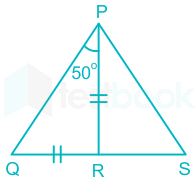
The side QR of a triangle PQR is produced to a point S. If QR = PR and ∠QPR = 50°, then the value of 3 ∠PRS - 2∠PQR is :

  1. AOption (a)

    300°

  2. BOption (b)

    250°

  3. COption (c)

    200°

  4. DOption (d)

    150°

View answer & explanation

Correct answer

Answer: (c)C.

200°

Why this answer is correct

Given:

We are given that triangle PQR is an isosceles triangle, as QR = PR, and ∠QPR = 50°. We need to find the value of 3∠PRS - 2∠PQR.

Concept used:

The measure of an exterior angle of a triangle is equal to the sum of the measures of the two non-adjacent interior angles

Calculation:

Since QR = PR, triangle PQR is isosceles, and the base angles of an isosceles triangle are congruent. Therefore, ∠PQR = ∠QPR = 50°.

Using exterior angle theorem, ∠PRS = ∠QPR + ∠PQR = 50° + 50° = 100°.

3∠PRS - 2∠PQR = 100 × 3 - 2 × 50 = 200°

Question 42

The number of faces, vertices and edges of a polyhedron are respectively 20, x and 30. Then, the value of 4x - 5 is :  

  1. AOption (a)

    52

  2. BOption (b)

    48

  3. COption (c)

    43

  4. DOption (d)

    42

View answer & explanation

Correct answer

Answer: (c)C.

43

Why this answer is correct

Concept used;

Euler's polyhedron formula V - E + F = 2

Where V is the number of vertices, E is the number of edges, and F is the number of faces.

Calculation: We are given F = 20, E = 30, and we want to find V (denoted as x).

Putting the value we get

x - 30 + 20 = 2

⇒ x - 10 = 2 or x = 12

⇒ 4x - 5 = 4(12) - 5 = 48 - 5 = 43

Question 43

The sum of the two alternate interior angles formed by the intersection of two parallel lines by a transversal is 140°. If one of the alternate interior angles is y, then the value of 3y - 15° is:

  1. AOption (a)

    185°

  2. BOption (b)

    195°

  3. COption (c)

    205°

  4. DOption (d)

    210°

View answer & explanation

Correct answer

Answer: (b)B.

195°

Why this answer is correct

Concept used:

When two parallel lines are intersected by a transversal, alternate interior angles are congruent, which means they have the same measure.

Calculation:

Let the two alternate interior angles be y and z.

Since the sum of the two alternate interior angles is 140°, we can write:

y + z = 140°

Since alternate interior angles are congruent, we have:

y = z

Now we can substitute y for z in the equation:

y + y = 140°

2y = 140°  ⇒ y = 70°

Now that we have the value of y, we can find the value of 3y - 15°:

3y - 15° = 3(70°) - 15° = 210° - 15° = 195°

So, the value of 3y - 15° is 195°.

Question 44

Angles of quadrilateral ABCD are such that ∠A ∶ ∠B ∶ ∠C ∶ ∠D is 4 ∶ 5 ∶ 6 ∶ 3. Then, 

  1. AOption (a)

    ABCD is a trapezium with AD ∥ BC

  2. BOption (b)

    ABCD is a trapezium with AB ∥ CD

  3. COption (c)

    ABCD is a kite with AB = AD and BC = CD 

  4. DOption (d)

    ABCD is a kite with AB = BC and AD = CD  

View answer & explanation

Correct answer

Answer: (a)A.

ABCD is a trapezium with AD ∥ BC

Why this answer is correct

Concept used:

Properties of Trapezium 

The sum of two adjacent angles is equal to 180°. It implies that two adjacent angles are supplementary.

One pair of opposite sides are parallel in trapezium

Sum of angle of Quadrilateral = 360°

Calculations:

 ∠A ∶ ∠B ∶ ∠C ∶ ∠D is 4 ∶ 5 ∶ 6 ∶ 3. Then, 

Let ∠A = 4x ,  ∠B = 5x ,  ∠C = 6x  ,  ∠D = 3x 

4x + 5x + 6x + 3x = 360° (Sum of angle of Quadrilateral = 360° )

By solving this we get, ∠A = 80, ∠B = 100, ∠C = 120,  ∠D = 60

∠A + ∠B = 180° 

∠C + ∠D = 180° 

In Trapezium 

The sum of two adjacent angles is equal to 180°. It implies that two adjacent angles are supplementary.

Hence, ABCD is a trapezium with AD II CB

Question 45

Points A and D are on the same side of line segment BC such that ∠ABC = 90°, ∠DCB = 90° and AB = DC. Then, 

  1. AOption (a)

    Δ ABC ≅ Δ DBC, by RHS

  2. BOption (b)

    Δ ABC ≅ Δ DBC, by SAS

  3. COption (c)

    Δ ABC ≅ Δ DCB, by RHS

  4. DOption (d)

    Δ ABC ≅ Δ DCB, by SAS

View answer & explanation

Correct answer

Answer: (d)D.

Δ ABC ≅ Δ DCB, by SAS

Why this answer is correct

Given:

∠ABC = 90° and ∠DCB = 90°

AB = DC (given)

Calculation:

AB = DC (given)

∠ABC = ∠DCB = 90° 

BC = BC (Since the line segment BC is common to both triangles)

By the SAS Congruence Property,  ΔABC ≅ ΔDCB

Question 46

The sum of the areas of a square of side 12 cm and a rectangle of length 18 cm is 252 cm2 Then, perimeter of the rectangle is :

  1. AOption (a)

    24 cm

  2. BOption (b)

    36 cm

  3. COption (c)

    42 cm

  4. DOption (d)

    48 cm

View answer & explanation

Correct answer

Answer: (d)D.

48 cm

Why this answer is correct

We know;

Area of square = (a)2 where a = side of square

And,  Area of rectangle = (l × b); where l = length and b = breadth

Given: a = 12 cm, l = 18 cm

And sum of area of square and area of rectangle = 252 cm2 

Calculation:

(a)2 + (l × b) = 252

Firstly, , we need to find the value of b. Put value of 'a' and 'l';

⇒ (12)2 + (18 × b) = 252

⇒ 144 + 18 × b = 252 

⇒ 18 × b = 252 - 144 

⇒ 18 × b = 108

⇒ b = 108 ÷ 18

⇒ b = 6 cm

Now,

Perimeter of rectangle = 2 (l + b)

⇒ 2 (18 + 6)

⇒ 2 × 24

⇒ 48 cm

Hence, the correct answer is "48 cm".

Question 47

In a trapezium ABCD with AB||DC, AD = 18 cm, BC = 16 cm and CD = 22 cm. If the distance between AB and CD is 12 cm and the area of the trapezium is 252 cm2, then the perimeter of the trapezium is :

  1. AOption (a)

    84 cm

  2. BOption (b)

    80 cm

  3. COption (c)

    76 cm

  4. DOption (d)

    72 cm

View answer & explanation

Correct answer

Answer: (c)C.

76 cm

Why this answer is correct

Shortcut Trick

Sum of parallel sides = (Area × 2) ÷ Height

Sum = (252 × 2) ÷ 12 = 42 cm

Unknown parallel side AB = 42 − 22 = 20 cm

Perimeter = Sum of all four sides = AB + BC + CD + AD

Perimeter = 20 + 16 + 22 + 18 = 76 cm

∴ The correct answer is 76 cm.

Alternate Method

Given:

AD = 18 cm, BC = 16 cm, CD = 22 cm

Distance between AB and CD (height, h) = 12 cm

Area of trapezium = 252 cm2

A B C D 20 cm 22 cm 18 cm 16 cm 12 cm Area = 252 cm²

Formula Used:

Area of trapezium = 1/2 × (Sum of parallel sides) × height

Perimeter = Sum of all sides

Calculations:

⇒ 252 = 1/2 × (AB + 22) × 12

⇒ 252 = 6 × (AB + 22)

⇒ AB + 22 = 252 ÷ 6

⇒ AB + 22 = 42

⇒ AB = 42 − 22 = 20 cm

⇒ Perimeter = AB + BC + CD + AD

⇒ Perimeter = 20 + 16 + 22 + 18 = 76 cm

∴ The correct answer is 76 cm.

Additional Information

Area of a Trapezium

The area of a trapezium is half the product of the sum of parallel sides and the perpendicular distance between them: Area = 1/2 × (a + b) × h.

Perimeter of a Polygon

The total length of the boundary of a closed figure. For a trapezium, it is simply the sum of its four individual sides: Perimeter = a + b + c + d.

Isosceles Trapezium

A special type of trapezium where the non-parallel sides are equal in length, resulting in equal base angles and equal diagonals.

Mid-segment of a Trapezium

The line connecting the midpoints of the non-parallel sides is parallel to the bases, and its length is the exact average of the two parallel bases: (a + b) ÷ 2.

Question 48

The volume of a closed right circular cylinder of base radius 7 m is 462 m3. Total surface area of the cylinder is (Use π = 22/7):

  1. AOption (a)

    220 m2

  2. BOption (b)

    264 m2

  3. COption (c)

    308 m2

  4. DOption (d)

    440 m2

View answer & explanation

Correct answer

Answer: (d)D.

440 m2

Why this answer is correct

Shortcut Trick

Volume = πr2h ⇒ 462 = (22/7) × 7 × 7 × h ⇒ h = 3 m.

Total Surface Area (TSA) = 2πr(r + h) = 2 × (22/7) × 7 × (7 + 3).

TSA = 44 × 10 = 440 m2.

∴ The correct answer is 440 m2.

Alternate Method

Given:

Base radius (r) of the cylinder = 7 m

Volume (V) of the cylinder = 462 m3

Formula Used:

Volume of cylinder = πr2h

Total Surface Area (TSA) = 2πr(r + h)

Calculations:

⇒ Volume = πr2h

⇒ 462 = (22/7) × 7 × 7 × h

⇒ 462 = 22 × 7 × h

⇒ 462 = 154 × h

⇒ h = 462 ÷ 154 = 3 m

⇒ TSA = 2πr(r + h)

⇒ TSA = 2 × (22/7) × 7 × (7 + 3)

⇒ TSA = 44 × 10

⇒ TSA = 440 m2

∴ The correct answer is 440 m2.

Additional Information

Curved Surface Area (CSA)

The area of the curved part of the cylinder is given by CSA = 2πrh.

Volume of Cylinder

The space occupied by a cylinder is calculated as V = πr2h.

Base Area

The area of each circular end of the cylinder is πr2. For a closed cylinder, there are two such bases.

Question 49

The mean of the range and mode of the observation 14, 16, 17, 15, 13, 15, 14, 15, 12, 12, 16, 15, 11, 19, 16, 15, 18, 14, 16 and 17 is :

  1. AOption (a)

    11

  2. BOption (b)

    11.5

  3. COption (c)

    12

  4. DOption (d)

    13.5

View answer & explanation

Correct answer

Answer: (b)B.

11.5

Why this answer is correct

Shortcut Trick

Find the Range: Maximum value (19) − Minimum value (11) = 8.

Find the Mode: The value with the highest frequency is 15 (appears 5 times).

Required Mean = (Range + Mode) ÷ 2

⇒ Mean = (8 + 15) ÷ 2 = 11.5.

∴ The correct answer is 11.5.

Alternate Method

Given Observations: 14, 16, 17, 15, 13, 15, 14, 15, 12, 12, 16, 15, 11, 19, 16, 15, 18, 14, 16, 17.

Frequency of each number:

11 → 1 | 12 → 2 | 13 → 1 | 14 → 3 | 15 → 5 | 16 → 4 | 17 → 2 | 18 → 1 | 19 → 1.

Step 1: Calculate Range

⇒ Range = Maximum Observation − Minimum Observation

⇒ Range = 19 − 11 = 8

Step 2: Calculate Mode

⇒ Mode = Observation with maximum frequency

⇒ Since 15 occurs 5 times (maximum), Mode = 15

Step 3: Calculate Mean

⇒ Mean = (Range + Mode) ÷ 2

⇒ Mean = (8 + 15) ÷ 2

⇒ Mean = 23 ÷ 2 = 11.5

∴ The correct answer is 11.5.

Additional Information

Range

Range is the statistical measure of dispersion calculated as the difference between the largest and smallest values in a dataset.

Mode

Mode is the value that appears most frequently in a data set. A set can be unimodal, bimodal, or multimodal.

Empirical Relationship

For a moderately skewed distribution: Mode = 3 × Median − 2 × Mean.

Arithmetic Mean

The mean of 'n' observations is the sum of all observations divided by the total number of observations.

Question 50

All the letters of the word PERIMETER are written on 9 separate paper slips and put in a box. One slip is drawn from the box without looking at it. What is the difference between the probability of getting a consonant and the probability of getting a letter I ? 

  1. AOption (a)

    59\frac{5}{9}

  2. BOption (b)

    49\frac{4}{9}

  3. COption (c)

    39\frac{3}{9}

  4. DOption (d)

    29\frac{2}{9}

View answer & explanation

Correct answer

Answer: (b)B.

49\frac{4}{9}

Why this answer is correct

Calculation:

First, let's count the number of consonants and the number of letter 'I's in the word PERIMETER.

Consonants: P, R, M, T, R (5 consonants)

Letter 'I': 1 occurrence

There are 9 letters in the word, so there are 9 slips in the box.

Now let's calculate the probabilities:

Probability of getting a consonant (Pc) = (number of consonants) / (total number of slips)

Pc = 5/9

Probability of getting the letter 'I' (PI) = (number of 'I's) / (total number of slips)

PI = 1/9

Now we need to find the difference between these two probabilities:

Difference = Pc - PI = (5/9) - (1/9) = 4/9

Question 51

Which is the most important prerequisite knowledge for the teaching and learning of monomials, binomials, trinomials etc in algebra and algebraic expressions? 

  1. AOption (a)

    Like and unlike terms 

  2. BOption (b)

    Algebraic identities  

  3. COption (c)

    Operations of algebraic expressions 

  4. DOption (d)

    Degree of variables  

View answer & explanation

Correct answer

Answer: (a)A.

Like and unlike terms 

Why this answer is correct

The understanding of like and unlike terms very important for the teaching of algebra expressions. 

Key Points

  • Like terms are those that have the same variable raised to the same power.
  • For example, 3x and 4x are like terms because they both have the variable x raised to the first power.
  • Unlike terms, on the other hand, have different variables or different powers of the same variable. For example, 3x and 4y are unlike terms because they have different variables.
  • Having a solid understanding of like and unlike terms is important because it is a fundamental concept that is used throughout algebra.
  • When simplifying algebraic expressions, terms can only be combined if they are like terms. This is because they represent the same quantity, and so they can be added or subtracted.

Hence, it can be concluded that like and unlike terms are is the most important prerequisite knowledge for the teaching and learning of monomials, binomials, trinomials etc in algebra and algebraic expressions.

Question 52

Which among the following is/are TRUE regarding asking open-ended questions in a mathematics classroom?

(a) It helps students to improve convergent thinking skill

(b) It develops critical thinking skill

Choose the correct option.

  1. AOption (a)

    Only (a) is true 

  2. BOption (b)

    Only (b) is true 

  3. COption (c)

    Both (a) and (b) are true 

  4. DOption (d)

    Both (a) and (b) are false

View answer & explanation

Correct answer

Answer: (b)B.

Only (b) is true 

Why this answer is correct

Asking open-ended questions in a mathematics classroom is beneficial for the students as it helps them to develop their critical thinking skills. Open-ended questions require students to think deeply and creatively about a problem or concept and come up with unique and original solutions or explanations.

Key Points

  • By encouraging students to explore multiple solutions or perspectives, open-ended questions help them to develop their ability to analyze, synthesize, and evaluate information.
  • Open-ended questions also foster a growth mindset in students, encouraging them to embrace challenges and view mistakes as opportunities for learning.
  • They also help to create a more inclusive classroom environment, where students of all ability levels can feel comfortable and confident in sharing their ideas and perspectives.

Hence, it can be concluded that Only (b) is true.

Additional Information

  • Closed-ended or convergent questions tend to elicit one correct answer or solution and can limit students' thinking to a narrow set of possibilities.
  • While these types of questions can be useful for assessing students' knowledge and understanding, they may not promote the same level of deep and creative thinking as open-ended questions.

Question 53

Which of the following activities show mathematization of a child's mind according to National Curriculum Framework, 2005?

  1. AOption (a)

    A child promptly solves mathematical problems 

  2. BOption (b)

    A child has memorized all important mathematical formulae 

  3. COption (c)

    A child understands and makes connections across concepts 

  4. DOption (d)

    A child knows all the standard algorithms of solving problems 

View answer & explanation

Correct answer

Answer: (c)C.

A child understands and makes connections across concepts 

Why this answer is correct

Mathematization refers to the development of mathematical thinking and reasoning skills in learners.

Key Points

  • It involves the ability to see mathematical structures and relationships in various situations and to apply mathematical concepts and procedures to solve problems.
  • Memorizing formulae and standard algorithms may be important, but they do not necessarily indicate a deep understanding of mathematical concepts.
  • On the other hand, understanding and making connections across concepts involves higher-order thinking skills and is an important aspect of mathematization.
  • This involves the ability to recognize patterns, make connections, and use mathematical reasoning to solve problems.

Hence, it can be concluded that a child understands and makes connections across concepts showing the mathematization of a child's mind according to National Curriculum Framework, 2005.

Question 54

Community Mathematics is related to : 

  1. AOption (a)

    Arithmetic 

  2. BOption (b)

    Relations and Functions  

  3. COption (c)

    Integral Calculus

  4. DOption (d)

    Differential Calculus  

View answer & explanation

Correct answer

Answer: (a)A.

Arithmetic 

Why this answer is correct

Community Mathematics is an approach to teaching and learning mathematics that emphasizes the use of mathematics in everyday life and real-world situations, with a focus on problem-solving and critical thinking skills.

 Key Points

  • It is designed to help learners understand and appreciate the practical applications of mathematics in their community and society.
  • Arithmetic, which is the branch of mathematics that deals with the study of numbers, operations, and their properties, is an essential component of Community Mathematics.
  • Arithmetic is an important part of community mathematics as it forms the basis of many everyday calculations that people encounter in their daily lives.
  • For example, calculating grocery bills, measuring ingredients for cooking, and calculating discounts and sales taxes all require arithmetic skills.
  • In a community mathematics approach, arithmetic concepts are taught in a way that emphasizes their practical applications in everyday life.

Hence, it can be concluded that community mathematic is related to arithmetic.

Question 55

To prove that the sum of interior angles of a triangle is 180°, a teacher uses paper cut out of a triangle, cuts its all the angles and place them on a straight line. This is an example of proof by : 

  1. AOption (a)

    Verification 

  2. BOption (b)

    Deduction  

  3. COption (c)

    Induction 

  4. DOption (d)

    Contradiction  

View answer & explanation

Correct answer

Answer: (b)B.

Deduction  

Why this answer is correct

Deductive reasoning involves starting with general principles and applying them to specific cases to arrive at logically certain conclusions.

Key Points

  • In this case, the general principle is the fact that the sum of the interior angles of a triangle is 180°.
  • The teacher applies this principle to the specific case of a paper cut-out of a triangle with its angles arranged in a straight line.
  • By doing so, the teacher deduces that the sum of the angles is 180°.
  • This is valid proof because it starts with a true premise and uses logical reasoning to arrive at a true conclusion.

Hence, we can conclude that the teacher's use of the paper cut-out is an example of proof by Deduction.

Question 56

Which among the following is/are TRUE about Van Hiele's theory of geometric thinking?

(a) Thinking levels are age-dependent

(b) Teaching instruction must match student's level of geometric thinking

(c) Levels are sequential

Choose the correct option.

  1. AOption (a)

    (a) and (b)

  2. BOption (b)

    (b) and (c)

  3. COption (c)

    (a) and (c)

  4. DOption (d)

    Only (b)

View answer & explanation

Correct answer

Answer: (b)B.

(b) and (c)

Why this answer is correct

Van Hiele's theory of geometric thinking proposes that learners go through five distinct levels of geometric thought as they progress from visual recognition of shapes to abstract reasoning about the properties of geometric figures.

Key Points

  • According to Van Hiele's theory, the levels are sequential and students must pass through each level in order.
  • It is also suggested that teaching instruction should match the student's level of geometric thinking in order to effectively promote learning.
  • The theory does not state that the levels are age-dependent, but it is generally assumed that learners progress through the levels as they mature and develop cognitively.

 Therefore, options (b) and (c) are correct as they explain the sequential nature of the levels and the need for matching teaching instruction to the student's level of geometric thinking.

Question 57

Which among the following is NOT true about axioms in mathematics ?

  1. AOption (a)

    Axioms are consistent. 

  2. BOption (b)

    Axioms are propositions which are assumed and accepted without any evidence to prove it. 

  3. COption (c)

    Axioms are available only in geometry. 

  4. DOption (d)

    Axioms are adequate.  

View answer & explanation

Correct answer

Answer: (c)C.

Axioms are available only in geometry. 

Why this answer is correct

Axioms are fundamental statements or assumptions that are accepted without proof in a given mathematical system. They are considered to be true because they are self-evident or have been verified by empirical evidence.

Key Points

  • One important property of axioms is consistency, which means that axioms do not contradict one another.
  • If a set of axioms were inconsistent, then it would be possible to prove any statement, including both true and false ones, which would make the system useless for deductive reasoning.
  • Another property of axioms is that they are adequate, meaning that they are sufficient to derive all the statements and theorems that are relevant to the mathematical system.
  • In other words, all the other statements in the system can be deduced logically from the axioms.

Hence, it can be concluded that option C is the correct answer.

Question 58

Which of the following are NOT the elements of computational thinking in mathematics?

  1. AOption (a)

    Decomposition 

  2. BOption (b)

    Pattern recognition 

  3. COption (c)

    Abstraction 

  4. DOption (d)

    Expression 

View answer & explanation

Correct answer

Answer: (d)D.

Expression 

Why this answer is correct

In the context of computational thinking in mathematics, the expression refers to the ability to express mathematical ideas and concepts using various forms of representation, such as equations, graphs, diagrams, and symbols.


Key Points

  • It involves the translation of real-world problems into mathematical expressions and vice versa.
  • For example, in solving a word problem, expression involves the ability to identify the relevant variables, translate the problem into mathematical language, and solve the resulting equation or system of equations.
  • It also involves the ability to represent mathematical concepts visually using graphs or diagrams.

Hence, it can be concluded that expression is not an element of computational thinking in mathematics.

Question 59

Mathematical communication among the learners can NOT be enhanced by :

  1. AOption (a)

    Using simple, friendly, and clear language that relates with local language 

  2. BOption (b)

    Introducing mathematical ideas, symbols and signs by connecting them with child's own language 

  3. COption (c)

    Discouraging the use of local language to express mathematical terms in the classroom 

  4. DOption (d)

    Facilitating learners to associate number concepts, vocabulary, quantities etc to express their thoughts 

View answer & explanation

Correct answer

Answer: (c)C.

Discouraging the use of local language to express mathematical terms in the classroom 

Why this answer is correct

Mathematical communication is a crucial aspect of mathematics learning, and it helps learners to express their mathematical thoughts and ideas effectively. To enhance mathematical communication among learners, it is essential to use simple, friendly, and clear language that relates to the local language, as this helps learners to understand mathematical concepts more easily. 

Key Points

  • Introducing mathematical ideas, symbols, and signs by connecting them with a child's own language can also be helpful.
  • It enables learners to associate mathematical terms with their daily life and helps them to make connections between mathematical concepts and real-world situations Facilitating learners to associate number concepts, vocabulary, quantities, etc., to express their thoughts, can also be beneficial.
  • However, discouraging the use of local language to express mathematical terms in the classroom can hinder mathematical communication and make it difficult for learners to understand mathematical concepts.

 Hence, it can be concluded that discouraging the use of local language to express mathematical terms in the classroom cannot enhance mathematic communication.

Question 60

“Assessment of learning in mathematics provides the opportunity to respond to feedback, for learners to improve their conceptual understanding”. Which of the following most appropriately explains the meaning of the given statement?  

  1. AOption (a)

    Feedback in assessment helps the learners to strengthen their conceptual understanding in mathematics 

  2. BOption (b)

    Teachers can improve their own conceptual understanding through feedback 

  3. COption (c)

    Feedback plays no role in developing conceptual understanding of learners 

  4. DOption (d)

    Giving scores in mathematics test is the only way to give feedback to learners to improve their conceptual understanding 

View answer & explanation

Correct answer

Answer: (a)A.

Feedback in assessment helps the learners to strengthen their conceptual understanding in mathematics 

Why this answer is correct

Feedback can provide learners with information about their strengths and weaknesses, as well as specific areas where they need to improve their understanding.

Key Points

  • For example, if a learner receives feedback that they are making errors in their calculations, they can focus on improving their arithmetic skills.
  • Similarly, if a learner receives feedback that they are struggling with geometry concepts, they can focus on developing their understanding of shapes, angles, and spatial relationships.
  • Feedback in assessment can be a powerful tool for promoting conceptual understanding in mathematics.
  • It can help learners to identify gaps in their knowledge and provide them with the information they need to address these gaps.
  • ]This can lead to improved performance in mathematics, as well as greater confidence and engagement in the subject.

Hence, it can be concluded that option 1 is the correct answer.

Question 61

_______ (A) is the largest gland in our body and secretes _______(B) which helps in digestion of _______ (C) .

(A), (B) and (C) respectively are :

  1. AOption (a)

    Pancreas, insulin, carbohydrates 

  2. BOption (b)

    Liver, bile juice, fats 

  3. COption (c)

    Stomach, gastric juice, proteins 

  4. DOption (d)

    Small intestine, bile juice, fats 

View answer & explanation

Correct answer

Answer: (b)B.

Liver, bile juice, fats 

Why this answer is correct

Concept:

  • Glands are specialized organs or tissues in the body that produce and secrete substances needed for various physiological functions.
  • They are responsible for producing and releasing hormones, enzymes, and other substances that help regulate and maintain bodily functions.
  • There are two main types of glands in the human body:
  • Endocrine glands
  • Exocrine glands

Important Points

  • The liver is the largest gland in the body, weighing about 1.2-1.5 kg in an adult.
  • It is located in the abdominal cavity, below the diaphragm.
  • It secretes bile juice, which is stored in the gall bladder before being secreted into the small intestine.
  • Bile helps in digestion of fat by activating the lipase enzyme, which is required for the breakdown of fat molecules.
  • Therefore, we can identify A, B and C as:
  • A - Liver
  • B - Bile juice
  • C - Fats

Hence, the correct answer is option 2.

Question 62

Which of the following statements is correct ?

  1. AOption (a)

    All arteries carry oxygen rich blood 

  2. BOption (b)

    All veins carry deoxygenated blood 

  3. COption (c)

    Pulmonary artery carries blood from heart to lungs 

  4. DOption (d)

    Pulmonary vein carries impure blood from heart to lungs  

View answer & explanation

Correct answer

Answer: (c)C.

Pulmonary artery carries blood from heart to lungs 

Why this answer is correct

Concept:

  • The human circulatory system consists of a muscular heart and blood vessels that carry the blood through various parts of the body.
  • There are 3 main types of blood vessels:
  • Arteries
  • Veins
  • Capillaries
  • The circulation follows a double circulatory pathway, involving the following:
  • Pulmonary Pathway - It transports blood between the heart and the lungs.
  • Systemic Pathway - It moves between the heart and the rest of the body.

Important Points

Option 1: All arteries carry oxygen rich blood - INCORRECT

  • Arteries are the blood vessels that usually carry oxygen-rich blood from the heart to the tissues of the body.
  • However, exception to this is the pulmonary artery that carries deoxygenated blood.

Option 2: All veins carry deoxygenated blood - INCORRECT

  • Veins are responsible for carrying deoxygenated blood from the tissues to the heart.
  • Only the pulmonary vein is an exception to this.

Option 3: Pulmonary artery carries blood from heart to lungs - CORRECT

  • The pulmonary artery carries the deoxygenated blood from the heart to the lungs.
  • It is part of the pulmonary circulation in the human body.

Option 4: Pulmonary vein carries impure blood from heart to lungs - INCORRECT

  • The pulmonary vein carries the oxygenated blood from the lungs to the heart.
  • This is also a part of the pulmonary circulation.

Hence, the correct statement is option 3.

Question 63

______ (A) reacts with oxygen and water to form a compound ______ (B) This compound turns ______ (C) litmus _______ (D) and becomes milky on passing _________ (E) gas.

(A), (B), (C), (D), (E) respectively are :

  1. AOption (a)

    Magnesium, Magnesium oxide, red, blue, Sulphur dioxide 

  2. BOption (b)

    Calcium, Calcium hydroxide, red, blue, Carbon dioxide 

  3. COption (c)

    Magnesium, Magnesium oxide, blue, red, Carbon dioxide 

  4. DOption (d)

    Calcium, Calcium hydroxide, blue, red, Carbon dioxide 

View answer & explanation

Correct answer

Answer: (b)B.

Calcium, Calcium hydroxide, red, blue, Carbon dioxide 

Why this answer is correct

Concept:

  • The reaction of a metal with oxygen and water forms a compound, typically a metal oxide or a metal hydroxide. These compounds can be acidic, basic, or neutral, and this property can be tested using litmus paper, which changes color based on the pH of the substance it's exposed to. A gas can also be passed through certain solutions to test their reactivity.

1. Calcium: When calcium reacts with oxygen and water, it forms calcium hydroxide. Calcium hydroxide is a base, and so it turns red litmus paper blue.

2. Carbon Dioxide: When carbon dioxide is passed through a solution of calcium hydroxide (also known as limewater), the solution turns milky due to the formation of calcium carbonate.

Explanation:

  • From the given options, statement 2 correctly identifies the metal, the compound it forms, the correct color change of litmus paper, and the gas that makes the solution milky.
  • When calcium (A) reacts with oxygen and water, it forms calcium hydroxide (B).
  • This compound turns red (C) litmus blue (D) due to its basic nature.
  • When carbon dioxide (E) is passed through a solution of calcium hydroxide, the solution turns milky due to the formation of calcium carbonate.
  • The reaction of calcium with oxygen and water can be represented as follows:

    Calcium + Oxygen + Water > Calcium Hydroxide

  • And the reaction of calcium hydroxide with carbon dioxide can be represented as:

    Calcium Hydroxide + Carbon Dioxide -> Calcium Carbonate + Water

  • The formation of calcium carbonate is what causes the solution to turn milky.

So, the correct answer is**: Calcium, Calcium hydroxide, red, blue, Carbon dioxide**

Question 64

Which of the following set represents natural indicators for acids-bases ? 

  1. AOption (a)

    Phenolphthalein, litmus 

  2. BOption (b)

    Litmus, turmeric 

  3. COption (c)

    Chinarose, methyl orange 

  4. DOption (d)

    Turmeric, phenolphthalein 

View answer & explanation

Correct answer

Answer: (b)B.

Litmus, turmeric 

Why this answer is correct

Concept :

Acid-base indicators are substances that change color depending on the pH of the solution they are in. There are both synthetic and natural indicators.

1. Litmus: Litmus is a natural indicator derived from lichens. In an acidic solution, it turns red, and in a basic solution, it turns blue.

2. Turmeric: Turmeric is a natural indicator obtained from the turmeric plant. It is yellow in neutral, acidic or mildly basic conditions, but turns red or brownish-red under strongly basic conditions.

3. Chinarose: Chinarose, or hibiscus, is a natural indicator. The petals of chinarose are crushed, and the juice is used as an indicator. It turns green in a basic solution and remains red in an acidic solution.

4. Phenolphthalein: Phenolphthalein is a synthetic indicator. It is colorless in acidic solution and turns pink in a basic solution.

5. Methyl Orange: Methyl orange is a synthetic indicator. It is red in acidic solution and yellow in basic solution.

Explanation :

  • From the given options, set 2 represents natural indicators: litmus and turmeric. Litmus is obtained from lichens and changes color from red (acidic conditions) to blue (basic conditions). Turmeric, obtained from the turmeric plant, is yellow under neutral or mildly acidic conditions and turns red or brownish-red under strongly basic conditions.
  • So, the correct answer is: Litmus and turmeric.

Key PointsNatural indicators are often used in laboratory settings and are especially useful in educational contexts, as they can be easily sourced from the environment. However, they may not be as precise as synthetic indicators, especially for solutions that are near neutral pH.

Question 65

Which of the following are NOT characteristic adaptation feature of desert plants?

(A) Deep penetrating roots

(B) Fleshy stem

(C) Leaves with waxy coating

(D) Sloping branches

  1. AOption (a)

    (C) and (D) 

  2. BOption (b)

    (A) and (B) 

  3. COption (c)

    (A) and (C) 

  4. DOption (d)

    (B) and (D) 

View answer & explanation

Correct answer

Answer: (a)A.

(C) and (D) 

Why this answer is correct

Concept:

  • All the organisms on the earth are living in varied environments and climates.
  • The organisms adapt to whatever climate they are living in.
  • Desert plants are specially adapted to conserve water and survive the water-scarce conditions.

Important Points

(A) Deep penetrating roots - 

  • This is an essential adaptive feature of desert plants like cactus.
  • These deep roots help them reach the lower levels of ground water.

(B) Fleshy stem - 

  • Many of the desert plants like Opuntia, have fleshy green stems containing chlorophyll.
  • These stems carry out photosynthesis and store food in them.
  • On the other hand, the leaves are reduced to spines, in order to reduce water loss by transpiration.

(C) Leaves with waxy coating - 

  • Waxy coating is usually found on the floating leaves of aquatic plants.
  • This hydrophytic adaptation prevents wetting and clogging of the stomatal pores on leaf surface.
  • Example - Lotus leaves.

(D) Sloping branches - 

  • This feature is found in conifers like Pine trees.
  • As conifers are found in higher altitudes, they often receive snowfall.
  • The sloping branches prevent the snow from collecting on the branches.

Therefore, C and D are NOT characteristic adaptation feature of desert plants.

Hence, the correct answer is option 1.

Question 66

Rusting of iron is : 

  1. AOption (a)

    A physical and reversible change 

  2. BOption (b)

    A chemical and reversible change 

  3. COption (c)

    A chemical change and irreversible change 

  4. DOption (d)

    A physical and irreversible change 

View answer & explanation

Correct answer

Answer: (c)C.

A chemical change and irreversible change 

Why this answer is correct

Concept:

  • Rusting is a process that affects iron and iron alloys such as steel.
  • It happens when iron comes into contact with water and oxygen, leading to the formation of iron oxides, commonly known as rust.
  • Rusting is an example of oxidation, which is a type of chemical reaction. In a chemical change, new substances are formed, and the change usually cannot be easily reversed.
  • Physical changes, on the other hand, do not result in the formation of new substances, and they are often reversible.

Explanation:

  • Rusting of iron is a chemical change because it results in the formation of a new substance, namely iron oxide or rust. The original iron is chemically transformed, and this process cannot be easily reversed. Therefore, rusting is a chemical and irreversible change.

So, the correct answer is: A chemical change and irreversible change

 Additional Information

  • While rusting can be slowed or prevented through various methods such as painting, galvanization, or other forms of protective coating, reversing rusting (i.e., turning rust back into iron) is not straightforward and requires significant energy input, further chemical reactions, or industrial processes.
  • This is why we typically consider rusting to be an irreversible change.

Question 67

_____ (X) twins in human beings are formed when ______ (Y) egg/eggs is/are fertilized by _________ (Z) sperm/sperms.

X, Y, Z respectively are :

  1. AOption (a)

    Identical, one, one 

  2. BOption (b)

    Identical, two, one 

  3. COption (c)

    Fraternal, one, one 

  4. DOption (d)

    Fraternal, one, two 

View answer & explanation

Correct answer

Answer: (a)A.

Identical, one, one 

Why this answer is correct

Key Points

  • In human reproduction, the female gamete is known as the egg or ovum, while the male gamete is known as the sperm.
  • A zygote is formed after fertilization, in which one egg is fertilized by one sperm.
  • Polyspermy i.e., fertilization by multiple sperms, is prevented in humans.
  • Identical twins are formed when a single fertilized egg (zygote) splits into two identical embryos during the early stages of development.
  • This means that both embryos have the exact same genetic information, and are therefore, genetically identical.
  • On the other hand, fraternal twins are non-identical twins.
  • They are formed when two separate eggs (ova) are fertilized by two separate sperm cells.
  • Fraternal twins can be either of the same or opposite sex, and they do not share the exact same genetic information like identical twins do.
  • Therefore, we can identify X, Y, Z as:
  • X - Identical
  • Y - One
  • Z - One

Hence, the correct answer is option 1.

Confusion Points

  • X, Y and Z can also represent Fraternal, two and two respectively.
  • But this combination is not provided in the options and hence, can be discarded.

Question 68

You are given two bags-one with wide strap and another with narrow strap. For carrying a given number of books you would prefer to use :

  1. AOption (a)

    The bag with narrow strap as force is spread over large area 

  2. BOption (b)

    Bag with wide strap as force per unit area is less 

  3. COption (c)

    Bag with narrow strap as force is spread over small area 

  4. DOption (d)

    Bag with wide strap as force per unit area is more 

View answer & explanation

Correct answer

Answer: (b)B.

Bag with wide strap as force per unit area is less 

Why this answer is correct

I would prefer to use the Bag with wide strap as force per unit area is less.

Concept:

  • The concept involved in this situation is pressure distribution.
  • Pressure is defined as the force applied per unit area (P = F/A).
  • When carrying a bag, the strap applies pressure on your shoulder.
  • To ensure maximum comfort while carrying the bag, it is preferable to minimize the pressure on your shoulder.

Explanation:

  • When you use a bag with a wide strap, the force is distributed over a larger area.
  • According to the pressure formula (P = F/A), as the area (A) increases, the pressure (P) decreases, given that the force (F) remains constant (which is the weight of the books).
  • This means that when using a bag with a wide strap, the pressure on your shoulder will be less compared to using a bag with a narrow strap.
  • As a result, carrying the bag with a wide strap will be more comfortable.

Additional Information

  • The comfort of a strap is directly related to the pressure it applies on your shoulder.
  • A wide strap reduces the pressure and, thus, increases comfort, whereas a narrow strap increases the pressure and reduces comfort.
  • This is the reason why many backpacks and bags designed for heavy loads or long durations use wide, padded straps to distribute the weight more evenly and reduce the pressure on the user's shoulders.

Question 69

If equal amount of hot tea is poured in a metal cup and a plastic cup, which of the following statements would be true ?  

  1. AOption (a)

    The tea in the metal cup remains hot for longer time as metal is hot to touch while plastic cup is not hot to touch 

  2. BOption (b)

    The tea in the metal cup remains hot for longer time as metal is good conductor of heat 

  3. COption (c)

    The tea in the metal cup does not remain hot for longer time as the metal is good conductor of heat 

  4. DOption (d)

    The tea in metal cup remains hot for longer time as compared to plastic cup as plastic is bad conductor of heat 

View answer & explanation

Correct answer

Answer: (c)C.

The tea in the metal cup does not remain hot for longer time as the metal is good conductor of heat 

Why this answer is correct

Concept:

  • The rate at which heat is transferred from one object to another depends on the thermal conductivity of the material.
  • The material with higher thermal conductivity transfers heat faster than the material with lower thermal conductivity.

Explanation:

  • If equal amounts of hot tea are poured into a metal cup and a plastic cup, The tea in the metal cup does not remain hot for a longer time as the metal is a good conductor of heat
  • This is because metal is a good conductor of heat, while plastic is a bad conductor of heat.
  • When hot tea is poured into a metal cup, the heat is transferred quickly from the tea to the metal cup due to the high thermal conductivity of the metal.
  • The heat is then transferred from the metal cup to the surroundings.
  • However, in the case of a plastic cup, the heat transfer is slower due to the low thermal conductivity of plastic.
  • Therefore, the tea in the plastic cup cools down more slowly than the tea in the metal cup.
  • The sensation of hotness or coldness is subjective and depends on the rate of heat transfer from the object to the skin.
  • The rate of heat transfer depends on the thermal conductivity of the material.

Therefore, the correct answer is option**,the tea in the plastic cup remains hot for a longer time as the plastic is a bad conductor of heat.**

Additional Information

  • Thermal conductivity is the property of a material that determines the rate at which heat is transferred through it.
  • Metals have high thermal conductivity, while non-metals such as plastics have low thermal conductivity.
  • The rate of heat transfer depends on the temperature difference between the object and the surroundings, the area of contact, and the thermal conductivity of the material.
  • Heat can be transferred by conduction, convection, and radiation.

Question 70

Assertion (A) : An electromagnet is a temporary magnet.

Reason (R) : It is a weak magnet.

  1. AOption (a)

    (A) and (R) are true and (R) is correct explanation for (A) 

  2. BOption (b)

    (A) and (R) are true but (R) is not correct explanation for (A) 

  3. COption (c)

    (A) is true but (R) is false 

  4. DOption (d)

    Both (A) and (R) are false 

View answer & explanation

Correct answer

Answer: (c)C.

(A) is true but (R) is false 

Why this answer is correct

Concept:

  • An electromagnet is a type of magnet in which the magnetic field is produced by an electric current.
  • The magnetic field disappears when the current is turned off.
  • Therefore, it is known as a temporary magnet because its magnetism is in effect only for the period during which an electric current is flowing.
  • The strength of the magnetic field produced by such a magnet can be changed by changing the amount of electric current that passes through it.
  • This is different from a permanent magnet, which produces its own persistent magnetic field without the need for an external electric current.

Explanation:

  • The assertion (A) that "An electromagnet is a temporary magnet" is true. As explained, the magnetism of an electromagnet exists only as long as the electric current flows.
  • When the current is switched off, the magnetism ceases, making it a temporary magnet.
  • The reason (R) that "It is a weak magnet" is false.
  • The strength of an electromagnet is not inherently weak.
  • In fact, the strength of an electromagnet can be much greater than that of a permanent magnet.
  • This strength can be adjusted by varying the current flowing through the electromagnet, the number of coils in the electromagnet, or the material of the core. For example, large electromagnets are used in junkyards to lift heavy scrap metal.

So, the correct answer is: 3) (A) is true but (R) is false.

Additional Information

  • In addition to the adjustability of its strength, another advantage of an electromagnet is the ability to turn its magnetism on and off, which is not possible with a permanent magnet.
  • However, electromagnets require a continuous supply of electrical energy to maintain their magnetic field, while permanent magnets do not.

Question 71

Which of the following statement is correct on the basis of following information ?

'A' Forms a virtual and erect image always

‘B' Forms real and inverted image mostly

  1. AOption (a)

    'A' is convex lens and ‘B’ is convex mirror 

  2. BOption (b)

    ‘A’ could be convex mirror or concave lens 

  3. COption (c)

    'B’ could be convex mirror or convex lens 

  4. DOption (d)

    ‘B' is concave lens and ‘A’ is concave mirror 

View answer & explanation

Correct answer

Answer: (b)B.

‘A’ could be convex mirror or concave lens 

Why this answer is correct

Concept :

A lens or a mirror forms an image by bending or reflecting light. The image formed can be real or virtual, and erect (upright) or inverted (upside down).

1. Convex Mirror: It always forms a virtual, erect, and diminished image, regardless of the object's position. A virtual image is formed on the same side as the object and cannot be projected onto a screen.

2. Concave Lens: It also forms a virtual, erect, and diminished image regardless of the object's position.

3. Convex Lens: Depending on the object's position, it can form a real or virtual image. When the object is at or beyond the focus, the image formed is real and inverted. But if the object is closer than the focus, the image formed is virtual and erect.

4. Concave Mirror: It forms a real and inverted image when the object is beyond the focus. If the object is at the focus, the image formed is at infinity. If the object is between the focus and the mirror, the image formed is virtual, erect, and magnified.

Explanation:

  • Statement A says, "Forms a virtual and erect image always." This behavior is characteristic of a convex mirror and a concave lens. Hence, A could be a convex mirror or a concave lens.
  • Statement B says, "Forms real and inverted image mostly." This is true for a convex lens and a concave mirror when the object is beyond the focus. However, the word "mostly" suggests that it occasionally forms a virtual image, which is true for a convex lens when the object is closer than the focus. Hence, B could be a convex lens.

Key Points

  • In the case of lenses, the nature of the image (real/virtual, erect/inverted) depends on the position of the object.
  • For mirrors, the rule is slightly different. For example, a convex mirror always forms a virtual and erect image, irrespective of the object's position.

Question 72

The distance time graph is a line. What can be concluded about the motion from the graph ?  

  1. AOption (a)

    It is uniform motion 

  2. BOption (b)

    It is non uniform motion 

  3. COption (c)

    It may be unifom or object is at rest 

  4. DOption (d)

    The object is at rest 

View answer & explanation

Correct answer

Answer: (c)C.

It may be unifom or object is at rest 

Why this answer is correct

Concept :

A distance-time graph represents how the position of an object changes over time. The slope of the line in a distance-time graph represents the speed of the object.

1. Uniform Motion: If an object is in uniform motion, it covers equal distances in equal intervals of time. This is represented by a straight line with a constant slope in a distance-time graph.

2. Non-uniform Motion: If an object is in non-uniform motion, it covers unequal distances in equal intervals of time. This is represented by a curved line in a distance-time graph.

3. Object at Rest: If an object is at rest, it does not move, and its position does not change over time. This is represented by a horizontal line (with a slope of zero) in a distance-time graph.

Explanation:

  • If the distance-time graph is a straight line, it suggests that the object's position is changing at a constant rate over time.
  • This implies that the object is moving with a constant speed.
  • Therefore, the motion is uniform.
  • The steeper the line, the faster the object is moving. On the other hand, a curved line indicates that the object's position is changing at an irregular or varying rate, indicating non-uniform motion.
  • Based on the information given, since the distance-time graph is a line (without specifying whether it is horizontal or inclined), it indicates uniform motion. A horizontal line on a distance-time graph represents an object at rest.

 Additional Information

  • Distance-time graphs are useful in analyzing an object's motion and determining its speed or changes in speed.
  • The slope of the line in a distance-time graph represents the speed of the object. A steeper slope indicates a higher speed, while a flatter slope indicates a lower speed.
  • Distance-time graphs can also be used to calculate the total distance traveled by an object over a given time interval.

Question 73

Match the following. 

(A)Rotates on a highly tilted axis(i)Venus
(B)Cold and windy(ii)Uranus
(C)Shows phases like moon(iii)Saturn
(D)Has low density(iv)Neptune
  1. AOption (a)

    A - iv, B - iii, C - ii, D - i

  2. BOption (b)

    A - ii, B - iv, C - i, D - iii

  3. COption (c)

    A - i, B - ii, C - iv, D - iii

  4. DOption (d)

    A - iii, B - i, C - iv, D - ii

View answer & explanation

Correct answer

Answer: (b)B.

A - ii, B - iv, C - i, D - iii

Why this answer is correct

Explanation:

(A) Rotates on a highly tilted axis:

Uranus is known for its unique characteristic of rotating on a highly tilted axis. Its rotational axis is tilted at an angle of about 98 degrees relative to its orbital plane, causing it to appear to roll on its side as it orbits the Sun.

(B) Cold and windy:

Neptune is the planet associated with being cold and windy. It is the farthest planet from the Sun in our solar system and experiences extremely low temperatures. The atmosphere of Neptune is characterized by strong winds, reaching speeds of up to 1,500 miles per hour (2,400 kilometers per hour).

(C) Shows phases like the moon:

Venus exhibits phases similar to the moon. As Venus orbits the Sun, observers on Earth can see different portions of its illuminated side, resulting in phases. These phases range from a thin crescent phase to a nearly full phase, similar to the phases of the moon.

(D) Has low density:

Saturn is known for having a relatively low density compared to other planets. It is composed primarily of hydrogen and helium gases, which contribute to its low density. Despite its low density, Saturn has a significant mass due to its large size.

Correct Pairs:

CharacteristicsPlanets
Rotates on a highly tilted axisUranus
Cold and windyNeptune
Shows phases like the moonVenus
Has low densitySaturn

Question 74

If the angle between the normal and incident ray is 30° the angle between the incident and reflected ray is : 

  1. AOption (a)

    60°

  2. BOption (b)

    30°

  3. COption (c)

    0°

  4. DOption (d)

    90°

View answer & explanation

Correct answer

Answer: (a)A.

60°

Why this answer is correct

Concept:

  • The law of reflection states that the angle of incidence is equal to the angle of reflection.
  • The angle of incidence is the angle between the incident ray and the normal (an imaginary line perpendicular to the surface at the point of incidence).
  • Similarly, the angle of reflection is the angle between the reflected ray and the normal.

Explanation:

  • Given that the angle between the normal and incident ray (angle of incidence) is 30°, the angle between the normal and reflected ray (angle of reflection) will also be 30° due to the law of reflection.
  • The angle between the incident and reflected ray is the sum of the angle of incidence and the angle of reflection. Since both these angles are equal and given as 30°, the total angle between the incident and reflected ray would be 30° + 30° = 60°.

So, the correct answer is 60°

Additional Information 

  • The law of reflection is always true, regardless of the nature of the reflecting surface. This principle is widely used in optical instruments, such as mirrors and periscopes.

Question 75

Which of the following statement regarding friction is true ? 

  1. AOption (a)

    Friction does not depend on mass of the object 

  2. BOption (b)

    There is no frictional force acting on a stationary car 

  3. COption (c)

    Rolling friction is less than sliding friction 

  4. DOption (d)

    Air friction acts in the direction of gravity 

View answer & explanation

Correct answer

Answer: (c)C.

Rolling friction is less than sliding friction 

Why this answer is correct

Concept:

Friction is a force that opposes the motion of an object. It is a contact force that acts at the surface of contact between two bodies. There are several types of friction, including static friction, kinetic or sliding friction, and rolling friction.

1. Mass of the object: The frictional force does not directly depend on the mass of an object. It depends on the nature of the surfaces in contact and the normal force between them. However, for objects resting on a horizontal surface under the influence of gravity, the normal force equals the weight of the object, and so indirectly, friction can be related to mass.

2. Stationary objects: Static friction acts on stationary objects. It prevents the object from starting to move. Thus, there is a frictional force acting on a stationary car, preventing it from sliding down a slope, for instance.

3. Rolling Friction: Rolling friction is the force resisting the motion when a body rolls on a surface. It is generally less than sliding friction because the points of contact in rolling motion do not slide against each other.

4. Air Friction (Drag): Air friction or drag is a type of frictional force that acts against the direction of motion of an object moving through air. It does not act in the direction of gravity.

Explanation:

  • From the given options, statement 1 is not entirely accurate because, for objects on a horizontal surface, friction can indirectly be related to the mass due to the relationship between the normal force and weight.
  • Statement 2 is incorrect because static friction acts on stationary objects, preventing them from moving.
  • Statement 4 is also incorrect because air friction acts against the direction of motion, not in the direction of gravity.
  • The only correct statement is 3: "Rolling friction is less than sliding friction." This is because, in rolling motion, the points of contact between the surfaces do not slide against each other, reducing the frictional force.

 Additional InformationFriction, while often seen as a hindrance, is a necessary force in many situations. Without friction, we wouldn't be able to walk, drive, or hold objects. It's also important to

Question 76

Assertion (A) : In order to melt gold, Goldsmith blow the outermost zone of the flame using a metal pipe.

Reason (R) : The outermost zone is the nearest and not too hot to blow.

  1. AOption (a)

    Both (A) and (R) are true and (R) is correct explanation of (A) 

  2. BOption (b)

    Both (A) and (R) are true but (R) is not correct explanation for (A)  

  3. COption (c)

    (A) is true but (R) is false 

  4. DOption (d)

    Both (A) and (R) are false 

View answer & explanation

Correct answer

Answer: (c)C.

(A) is true but (R) is false 

Why this answer is correct

Concept:

A flame has different zones characterized by varying temperatures. From the innermost to the outermost zones, these are:

1. Innermost or Dark Zone: This is the coolest part of the flame, with the lowest temperature.

2. Luminous Zone: This zone is brighter and hotter than the innermost zone. It's where incomplete combustion occurs, giving the flame its light.

3. Outermost or Non-luminous Zone: This is the hottest part of the flame. It's where complete combustion occurs, meaning it's where the flame gets enough oxygen to burn the fuel completely, producing the most heat.

Explanation:

  • The assertion (A) that "In order to melt gold, Goldsmiths blow the outermost zone of the flame using a metal pipe" is true. Goldsmiths indeed use the outermost zone of the flame to melt gold because it is the hottest part of the flame and provides the heat necessary to melt the metal.
  • The reason (R) that "The outermost zone is the nearest and not too hot to blow" is false. The outermost zone of a flame is not the nearest; it's the farthest from the source. Moreover, it is the hottest part of the flame, not the coolest.
  • So, the correct answer is: 3) (A) is true but (R) is false.

 Additional Information

  • Goldsmiths use a process known as blowtorching, where they blow air or oxygen into the flame, which increases the temperature even further. This technique helps them to work with metals like gold, which have high melting points.

Question 77

Metal A displaces metal B from its salt solution but not able to displace C from its salt solution. Metal B displace metal D from its salt solution. Which is the second most reactive metal ?  

  1. AOption (a)

    A

  2. BOption (b)

    B

  3. COption (c)

    C

  4. DOption (d)

    D

View answer & explanation

Correct answer

Answer: (a)A.

A

Why this answer is correct

Concept:

The reactivity of metals can be determined by their ability to displace other metals from their salt solutions. A metal that can displace another metal from its salt solution is more reactive than the metal it displaces.

Explanation:

In this scenario, Metal A displaces Metal B from its salt solution but is unable to displace Metal C from its salt solution. Metal B, on the other hand, displaces Metal D from its salt solution. 

Based on this information, we can determine the relative reactivity of the metals:

1) Metal A: It can displace Metal B, indicating that Metal A is more reactive than Metal B.

2) Metal B: It is displaced by Metal A but can displace Metal D. Therefore, Metal B is more reactive than Metal D.

3) Metal C: Metal A is unable to displace Metal C from its salt solution. Therefore, Metal C is more reactive than Metal A.

4) Metal D: It is displaced by Metal B, indicating that Metal D is the least reactive among the given metals.

So, the second most reactive metal is Metal A. (C>A>B>D)

Additional Information

  • The reactivity of metals is determined by their tendency to lose electrons and form positive ions.
  • Metals with a higher tendency to lose electrons are more reactive.
  • The reactivity series of metals is a commonly used list that arranges metals in order of their reactivity.
  • The series typically starts with the most reactive metal (e.g., potassium or sodium) and ends with the least reactive metal (e.g., gold or platinum).
  • Displacement reactions are widely used to determine the reactivity of metals and establish the reactivity series.
  • It is important to note that the reactivity of metals can be influenced by various factors, such as temperature, the concentration of the salt solution, and the presence of catalysts.

Question 78

______ (X) is a vitamin which is needed for absorbtion of ________(Y).

X and Y are :

  1. AOption (a)

    Vitamin B, Calcium 

  2. BOption (b)

    Vitamin C, Iron 

  3. COption (c)

    Vitamin A, Calcium 

  4. DOption (d)

    Vitamin A, Iron 

View answer & explanation

Correct answer

Answer: (b)B.

Vitamin C, Iron 

Why this answer is correct

Concept:

  • Vitamins are organic molecules required by the body in small quantities for metabolic activities.
  • Based on their solubility, vitamins can be divided into 2 categories:
  • Water-soluble - These easily dissolve in water. Example - Vitamin B complex and vitamin C.
  • Fat-soluble - These do not dissolve in water. Example - Vitamins A, D, E and K.
  • Deficiency of vitamins in the diet can cause various diseases or disorders in the human body.

Important Points

  • The chemical name of Vitamin C is ascorbic acid.
  • It plays an important role in absorption of iron in the human body.
  • It helps to convert the ferric form of iron (Fe3+) to the ferrous form (Fe2+), which is more easily absorbed by the body.
  • Thus, vitamin C in the diet helps prevent anaemia.
  • Therefore, we can identify X and Y as:
  • X - Vitamin C
  • Y - Iron

Hence, the correct answer is option 2.

Additional Information

VitaminChemical NameDeficiency Diseases
ARetinolNight blindness, Xerophthalmia
B1ThiamineBeri-beri
B2RiboflavinInflammation of tongue, sores in the corners of the mouth
B3Niacin or Nicotinic acidPellagra
B5Pantothenic acidFatigue, muscle cramp
B6PyridoxineAnaemia, nausea, depression, Convulsions
B7BiotinThinning of Hair, Skin rashes
B12CyanocobalaminPale skin, constipation
CAscorbic acidScurvy, anaemia
DCalciferolRickets, osteomalacia
ETocopherolMuscle and Nerve damage
KPhylloquinone or NaphthoquinoneLack of Blood clotting

Question 79

Assertion (A) : The leaves of a carrot plant have reticulate venation.

Which of the following support this ?

  1. AOption (a)

    Plants having tap root have reticulate venation 

  2. BOption (b)

    Plants having fibrous root have reticulate venation 

  3. COption (c)

    There is no relation between the type of venation and roots 

  4. DOption (d)

    All leaves have reticulate venation 

View answer & explanation

Correct answer

Answer: (a)A.

Plants having tap root have reticulate venation 

Why this answer is correct

Key Points

  • Root systems in plants may vary as two main types:
  • Tap roots - These are primary roots that are formed as a long single root, pointing away from the shoot.
  • Fibrous roots - These are formed of thin, moderately branching roots, that appear to be in a bunch.
  • Venation is the pattern of veins and veinlets on the leaf surface.
  • It is also of two main types:
  • Reticulate venation - Here the veinlets form a network-like pattern.
  • Parallel venation - The veins run parallel to each other throughout the leaf lamina.

Explanation:

  • The type of root system and venation usually depends on the type of plant.
  • Dicot plants are known to have tap roots and reticulate venation. Example - Carrot.
  • Monocot plants usually have fibrous roots along with parallel venation. example - Grasses.

Hence, the statement that supports the Assertion is option 1.

Question 80

Identify the type of cells on the basis of the information about cell organelles.

'A' - Cell Wall, Vacuole, Mitochondria, Nucleus

'B' - Cell membrane, Vacuole, Mitochondria, Nucleus

'C' - Cell membrane, Plastids, Mitochondria, Cytoplasm

  1. AOption (a)

    'A' and 'C' are plant cells, 'B' is animal cell

  2. BOption (b)

    'A', 'B', 'C' are animal cells

  3. COption (c)

    'B' and 'C' plant cells and 'A' is animal cell

  4. DOption (d)

    'A' and 'B' plant cells, 'C' is animal cell

View answer & explanation

Correct answer

Answer: (a)A.

'A' and 'C' are plant cells, 'B' is animal cell

Why this answer is correct

Key Points

  • Cell organelles are specialized structures within eukaryotic cells that perform specific functions.
  • The presence of organelles differ in plant and animal cells.

Plant Cell - 

  • A plant cell is bound by a cell wall that is made up of cellulose.
  • It contains organelles like nucleus, mitochondria, vacuoles, Golgi bodies and endoplasmic reticulum.
  • It also contains an additional organelle called plastid.
  • The plastids are of 3 main types:
  • Chloroplast - contains chlorophyll and carries out photosynthesis.
  • Chromoplast - contains other pigments like xanthophyll, etc. that gives colour to fruits and flowers.
  • Leucoplast - do not contain any pigments and help in storage of materials.

Animal Cell - 

  • An animal cell lacks cell wall and is only bound by the cell membrane.
  • It contains important organelles like nucleus, mitochondria, vacuoles, Golgi bodies and endoplasmic reticulum.
  • Plastids are not found in animal cells.
  • However, they usually contain lysosomes and centrioles, unlike plant cells.

From the given combinations, we can conclude that 'A' and 'C' are plant cells, 'B' is animal cell.

Question 81

Which of the following questions is best suited to assess divergent thinking in learners? 

  1. AOption (a)

    Draw and label water cycle 

  2. BOption (b)

    Which process is responsible for formation of clouds ? 

  3. COption (c)

    What would happen if there was no water cycle ? 

  4. DOption (d)

    Why do we sweat more on a humid day ? 

View answer & explanation

Correct answer

Answer: (c)C.

What would happen if there was no water cycle ? 

Why this answer is correct

Divergent thinking involves the generation of multiple ideas and solutions to a problem, rather than just one.

Key Points

  • It is an important aspect of creative thinking and encourages learners to come up with unconventional and original ideas.
  • Out of the given options, the question "What would happen if there was no water cycle?" is the best suited to assess divergent thinking in learners as it encourages them to think beyond the conventional answer of "no rain".
  • It allows for multiple possibilities and potential consequences, such as the impact on plant and animal life, changes in weather patterns, and potential effects on the water cycle itself.

 Hence, it can be concluded that What would happen if there was no water cycle is best suited to assess divergent thinking in learners.

Question 82

Anupriya is planning a teaching-learning activity for her grade VI learners on the topic ‘water pollution’. Which of the following activities is preferred to accommodate learners with diverse learning styles?  

  1. AOption (a)

    Showing chart on various causes of water pollution 

  2. BOption (b)

    Taking students on a field visit to a polluted river 

  3. COption (c)

    Inviting expert to talk on the above topic 

  4. DOption (d)

    Asking students to prepare a written report on water pollution 

View answer & explanation

Correct answer

Answer: (b)B.

Taking students on a field visit to a polluted river 

Why this answer is correct

To accommodate learners with diverse learning styles, it is important to provide multiple modes of engagement during the teaching-learning activity.


Key Points


  • Taking students on a field visit to a polluted river is a preferred activity to accommodate learners with diverse learning styles when teaching about water pollution.
  • This activity provides a hands-on and experiential learning opportunity, which is beneficial for learners who are kinesthetic or tactile learners.
  • They can observe the pollution in the water, smell it, and potentially touch it, which can help them understand the impact of water pollution on the environment and human health.
  • In addition, this activity can also benefit visual and auditory learners who can see and hear the sounds of the polluted river, and learners who prefer social learning as they can discuss and interact with their peers during the visit.
  • It can also benefit learners who prefer real-life and practical examples rather than theoretical concepts.

Hence, it can be concluded that option B is the correct answer.

Question 83

Which of the following statements is correct?

Assertion (A): The alternate conceptions of learners tend to persist even after formal instruction.

Reason (R): The accepted scientific explanation is often counterintuitive

  1. AOption (a)

    Both (A) and (R) are true and (R) is the correct explanation for (A)  

  2. BOption (b)

    Both (A) and (R) are true and (R) is not the correct explanation for (A) 

  3. COption (c)

    (A) is true and (R) is false 

  4. DOption (d)

    Both (A) and (R) are false 

View answer & explanation

Correct answer

Answer: (a)A.

Both (A) and (R) are true and (R) is the correct explanation for (A)  

Why this answer is correct

Alternate conceptions or misconceptions are pre-existing ideas or beliefs that learners have about a particular concept that conflict with the scientifically accepted explanation.

Key Points

  • These alternate conceptions can be the result of various factors such as personal experiences, cultural or social factors, or even the way the information is presented.
  • Despite formal instruction, learners tend to hold on to their alternate conceptions, even if they have been shown the scientifically accepted explanation.
  • This is because alternate conceptions are deeply rooted in the learners' understanding, and they tend to relate new information to their pre-existing beliefs.
  • Scientific explanations are often counterintuitive, meaning that they may not align with learners' prior beliefs and experiences.

 Hence it can be concluded that both (A) and (R) are true and (R) is the correct explanation for (A).

Question 84

Which of the following statements is/are true regarding scientific investigations?

(A) In an investigation, data is always numerical

(B) There is only one correct method in a scientific investigation

  1. AOption (a)

    (A) is true and (B) is false 

  2. BOption (b)

    (A) is false and (B) is true 

  3. COption (c)

    Both (A) and (B) are true 

  4. DOption (d)

    Both (A) and (B) are false 

View answer & explanation

Correct answer

Answer: (d)D.

Both (A) and (B) are false 

Why this answer is correct

Scientific investigation is a systematic process of exploring and understanding the natural world through observation and experimentation. It involves developing a hypothesis, designing experiments to test the hypothesis, collecting and analyzing data, and drawing conclusions based on the evidence.

Key Points

  • Data in scientific investigations can take many forms, including numerical, qualitative, and mixed-methods approaches.
  • Numerical data are often used in scientific investigations, as they are quantitative and can be analyzed statistically.
  • For example, in a study investigating the effectiveness of a new drug treatment, numerical data might include measurements of blood pressure, heart rate, and other physiological parameters.
  • While there is a general framework known as the scientific method, there is no one correct method for conducting scientific investigations.
  • The scientific method provides a structured approach to scientific inquiry, but it is not a rigid or prescriptive formula.
  • Depending on the research question, the available resources, and the specific circumstances of the investigation, different methods may be appropriate.

Hence, it can be concluded that both (A) and (B) are false.

Question 85

S1: Plants contain chlorophyll in the cells of their leaves.

S2: Plants need sunlight, water and carbon dioxode for photosynthesis.

  1. AOption (a)

    S1 is fact and S2 is inference 

  2. BOption (b)

    S1 is inference and S2 is fact 

  3. COption (c)

    Both S1 and S2 are facts 

  4. DOption (d)

    Both S1 and S2 are inferences  

View answer & explanation

Correct answer

Answer: (a)A.

S1 is fact and S2 is inference 

Why this answer is correct

Photosynthesis is the process by which plants and other organisms use sunlight to convert carbon dioxide and water into oxygen and energy in the form of sugar.

Key Points

Photosynthesis is a complex process that requires the following four things:

  • Sunlight: Plants use sunlight to provide the energy needed to drive the process of photosynthesis.
  • Water: Plants use water as a source of hydrogen atoms, which are used to build glucose molecules.
  • Carbon dioxide: Plants use carbon dioxide as a source of carbon atoms, which are also used to build glucose molecules.
  • Chlorophyll: Chlorophyll is a green pigment that absorbs sunlight and transfers the energy to other molecules involved in photosynthesis.
  • Chlorophyll is essential for photosynthesis, the process by which plants use sunlight to convert carbon dioxide and water into glucose and oxygen.

When all four of these things are present, plants can use photosynthesis to create glucose, which they use for energy and growth. They also release oxygen as a byproduct of photosynthesis.

Hence, We can say that S1 is a fact and S2 is an inference.

Question 86

Which of the following statements is not correct regarding science? 

  1. AOption (a)

    No single scientific method exists 

  2. BOption (b)

    Culture plays a role in the development of scientific knowledge 

  3. COption (c)

    Creativity has no role in science 

  4. DOption (d)

    There is subjectivity in development of scientific knowledge 

View answer & explanation

Correct answer

Answer: (c)C.

Creativity has no role in science 

Why this answer is correct

Science is a field that requires a high level of creativity. While some people may view science as a purely logical and analytical field, the reality is that scientists must use their creativity to design experiments, develop new technologies, and generate new ideas.

Key Points

  • Creativity plays a critical role in science, as scientists must use their creativity to design experiments, develop new technologies, and generate new ideas.
  • In fact, many scientific breakthroughs have been the result of creative thinking and approaches that were outside of the mainstream.
  • Hence, it can be concluded that Creativity has no role in science is not correct regarding science.

​ 

Additional Information

  • There is no single scientific method that is universally used by all scientists, and the methods used can vary depending on the discipline and the specific research question being investigated.
  • Culture can also play a significant role in the development of scientific knowledge, as cultural values and beliefs can influence the types of questions that are asked and the methods that are used to answer them.
  • Finally, there is subjectivity in the development of scientific knowledge, as scientists may interpret data differently or have different perspectives on the same phenomenon.

Question 87

A student takes a boiled potato paste in a test tube and puts few drops of idodine solution. She writes the following statements in her copy.

(A) Potato turns blue black in colour

(B) Potato contains starch

Which of the following statements is true ?

  1. AOption (a)

    Both (A) and (B) are observations 

  2. BOption (b)

    Both (A) and (B) are inferences 

  3. COption (c)

    (A) is observation and (B) is inference 

  4. DOption (d)

    (A) is inference and (B) is observation 

View answer & explanation

Correct answer

Answer: (c)C.

(A) is observation and (B) is inference 

Why this answer is correct

The correct answer is 3) (A) is observation and (B) is inference.

Explanation:

The iodine test is a test used to detect the presence of starch in a sample. When iodine solution is added to starch, it reacts to form a blue-black color. 

(A) "Potato turns blue black in colour" - This is an observation. An observation is a factual account of something that can be seen, heard, touched, tasted, or smelled. In this case, the student is directly observing the change in color of the potato paste when iodine solution is added.

(B) "Potato contains starch" - This is an inference. An inference is a conclusion reached based on evidence and reasoning. In this case, the student is inferring that the potato paste contains starch because of the observed blue-black color change when iodine solution is added. This is a well-known reaction that indicates the presence of starch.

So, (A) is an observation because it's directly perceived, while (B) is an inference drawn based on that observation and the known reaction of starch and iodine.

Question 88

While discussing the properties of water a class VI learner says that ‘water in the drain is brown in colour; hence the colour of the water is brown’

A science teacher’s response should be :

  1. AOption (a)

    Ignoring the statement 

  2. BOption (b)

    Asserting that his logic is incorrect 

  3. COption (c)

    Emphasing that water is colourless 

  4. DOption (d)

    Accept the response and explain the logic 

View answer & explanation

Correct answer

Answer: (d)D.

Accept the response and explain the logic 

Why this answer is correct

A science teacher's response to a class VI learner who says "water in the drain is brown in colour; hence the colour of the water is brown" should be to accept the response and explain the logic.

Key Points

  • This approach can help the student to understand the concept more deeply and correct any misconceptions they may have.
  • The teacher can explain that while it is true that water in the drain may appear brown, this is due to the presence of dirt, debris, and other pollutants. In its natural state, pure water is actually colourless.
  • The teacher can then take the opportunity to further discuss the properties of water, such as its density, surface tension, and ability to dissolve other substances.
  • It is important for the teacher to be patient and encouraging in their response, and to use this as a teaching moment to help the student develop a more accurate understanding of the concept.

Hence, it can be concluded that option 4 is the correct answer.

Question 89

In order to cater to the students with “giftedness” which of the following is least desirable to be used in science classrooms? 

  1. AOption (a)

    Standardized curriculum and assessment 

  2. BOption (b)

    Academic enrichment activities 

  3. COption (c)

    Independent project by students  

  4. DOption (d)

    Opportunities to express diverse perspective 

View answer & explanation

Correct answer

Answer: (a)A.

Standardized curriculum and assessment 

Why this answer is correct

A standardized curriculum and assessment refer to a uniform set of instructional materials and assessments that are used across multiple classrooms or schools.

Key Points

  • The goal of a standardized curriculum is to ensure that all students receive the same basic education, regardless of their geographic location or socioeconomic status.
  • Gifted students often require more challenging and complex learning experiences than what a standardized curriculum can provide.
  • They may quickly master the content and need additional enrichment opportunities to stay engaged and motivated in their learning.
  • Providing academic enrichment activities, such as advanced reading materials, research opportunities, and project-based learning, can help gifted students to deepen their understanding and engage in more complex thinking.

Hence, it can be concluded that a standardized curriculum and assessment are least desirable to be used in a science classroom in order to cater to students with "giftedness".

Question 90

Which of the following is least preferred in facilitating the understanding of a ‘concept’ in science?

  1. AOption (a)

    Asking students to define the concept 

  2. BOption (b)

    Asking students to generalize the concept from specific examples 

  3. COption (c)

    Asking students to give non examples of the concept 

  4. DOption (d)

    Asking students to explain concept in their own words 

View answer & explanation

Correct answer

Answer: (a)A.

Asking students to define the concept 

Why this answer is correct

Facilitating the understanding of a concept in science requires the use of effective teaching methods that engage and support students in their learning process.

Key Points

  • "Asking students to generalize the concept from specific examples" encourages students to apply the concept to various situations, fostering a deeper understanding.
  • "Asking students to give non-examples of the concept" helps clarify misconceptions and solidify understanding by highlighting what the concept is not.
  • "Asking students to explain the concept in their own words" promotes synthesis and expression of understanding, enabling students to demonstrate comprehension in their own terms.

Hint

  • "Asking students to define the concept" is typically the least preferred in facilitating the understanding of a concept in science.
  • This is because asking students to provide a definition often encourages rote memorization and may not necessarily lead to a deep understanding of the concept.
  • Definitions can be overly simplistic or lack nuance, and they may not capture the underlying principles or relationships that define the concept.

Hence, it can be concluded that asking students to define the concept is least preferred in facilitating the understanding of a ‘concept’ in science.

English - I (30 questions)

Read the passage given below and answer that follow by selecting the correct/most appropriate option :

  1. The art of academic writing is not easy to master. It is a formal skill, which requires precision and accuracy, and is perfected by continuous and dedicated practice. Academic writing is the skillful exposition and explanation of an argument, which the writer has carefully researched and developed over a sustained period of time. It is a time - consuming activity and demands patience and perseverance. But the joy of reading and sharing with others, one's succinctly composed piece of argument, is incomparable.
  2. Before beginning to write, the writer must ask himself a few questions - Why am I writing? What is it that I intend to share with others? What purpose will my writing serve? Have I read enough about the topic or theme about which I am going to write? If one is hesitant to answer even one of the aforementioned questions, one better not write at all! Because academic writing is a serious activity - it makes one part of a shared community of readers and writers who wish to disseminate and learn from well - argued pieces of writing.
  3. The Structure of an argumentative essay should take the form of - Introduction (Which should be around ten percent of the entire essay), Body (it should constitute eighty percent of the piece) and the Conclusion (again, ten percent of the essay). The introduction should function as the hook which draws the reader in and holds his attention, the body should include cogent and coherently linked paragraphs and the conclusion should re-state the argument and offer a substantial ending to the piece.

Question 91

Based on Passage: View directions & passage

The word 'time-consuming in para 1 is a/an :

  1. AOption (a)

    conjunction

  2. BOption (b)

    adverb

  3. COption (c)

    noun

  4. DOption (d)

    adjective

View answer & explanation

Correct answer

Answer: (d)D.

adjective

Why this answer is correct

The correct answer is '4) adjective'.

Key Points

  • Adjectives are used to describe or modify nouns.
  • The word 'time-consuming' describes the noun 'activity'.
  • This particular term is a compound adjective, where two or more words come together to function as a single adjective. Here it is expressing the nature of academic writing.
  • 'Time-consuming' is not a conjunction (a word that connects clauses or sentences), an adverb (a word that modifies verbs, adjectives, or other adverbs), or a noun (a word that represents a person, place, thing, or idea).

Therefore, the correct answer is Option 4.

Question 92

Based on Passage: View directions & passage

"What purpose will my writing serve'? The underlined world 'writing' in this sentence is a/an :

  1. AOption (a)

    noun

  2. BOption (b)

    verb

  3. COption (c)

    adjective

  4. DOption (d)

    adverb

View answer & explanation

Correct answer

Answer: (a)A.

noun

Why this answer is correct

The correct answer is '1) noun'.

Key Points

  • In this context, 'writing' is a noun.
  • It is referring to the act or product of writing, a specific activity that the author is discussing.
  • Nouns are words that represent a person, place, thing, or idea. Here 'writing' is representing the 'thing' or 'idea' that the author is referring to.
  • The word 'writing' does not function as a verb (which expresses an action or state of being), an adjective (which modifies a noun), or an adverb (which modifies a verb, adjective, or another adverb) in this sentence.

Therefore, the correct answer is Option 1.

Question 93

Based on Passage: View directions & passage

Which word in para 1 means 'Concisely' ?

  1. AOption (a)

    Perseverance

  2. BOption (b)

    Skilful

  3. COption (c)

    Carefully

  4. DOption (d)

    Incomparable

View answer & explanation

Correct answer

Answer: (d)D.

Incomparable

Why this answer is correct

The correct answer is '4) Incomparable'.

Key Points

  • Incomparably is used to describe something that is so good or great that nothing or no one else could achieve the same standard.
  • Concise means in a short and clear way that expresses what needs to be said without unnecessary words.
  • In the context of the passage, 'incomparable' is closest in meaning to 'concisely' in the sense that it is used to describe the distinct satisfaction of sharing a 'succinctly composed piece of argument'.
  • 'Incomparable' here is describing the unique joy of expressing a complex argument in a concise and effective way, something that cannot be compared to anything else.

Therefore, the correct answer is Option 4.

Question 94

Based on Passage: View directions & passage

The most appropriate synonym for the word 'disseminate' in para 2 is:

  1. AOption (a)

    propagate

  2. BOption (b)

    agitate

  3. COption (c)

    circulate

  4. DOption (d)

    accumulate

View answer & explanation

Correct answer

Answer: (c)C.

circulate

Why this answer is correct

The correct answer is '3) circulate'.

Key Points

  • 'Disseminate' means to spread or distribute something, especially information, widely.
  • Example: One of the organization's aims is to disseminate information about the disease.
  • Therefore, 'circulate' which also means to pass or spread widely is the most suitable synonym.
  • 'Propagate' is close but is generally used more in the context of promoting ideas or theories, 'agitate' means to stir up or disturb, and 'accumulate' means to gather or build up, so none of these are exact synonyms for 'disseminate'.
  • Therefore, the correct answer is Option 3.

Question 95

Based on Passage: View directions & passage

Read the following statements carefully:

(A) - Academic writing is a skill that can be easily mastered.

(B) - It requires careful research over short periods of time.

  1. AOption (a)

    Statement (A) is correct and Statement (B) is incorrect.

  2. BOption (b)

    Both statements (A) and (B) are incorrect.

  3. COption (c)

    Statement (A) is incorrect and statement (B) is correct.

  4. DOption (d)

    Both statements (A) and (B) are correct

View answer & explanation

Correct answer

Answer: (b)B.

Both statements (A) and (B) are incorrect.

Why this answer is correct

The correct answer is '2) Both statements (A) and (B) are incorrect.'

Key Points

  • According to the passage, academic writing is not easy to master.
  • The passage states, "The art of academic writing is not easy to master." This contradicts statement (A), which suggests that it is easy to master.
  • The passage also contradicts statement (B).
  • It mentions that academic writing involves "carefully researched and developed over a sustained period of time," not over short periods.

Therefore, the correct answer is Option 2.

Question 96

Based on Passage: View directions & passage

Which of the following statements is NOT true about academic writing?

  1. AOption (a)

    It is a formal skill

  2. BOption (b)

    It gives dual joys of reading and sharing

  3. COption (c)

    It requires less time and patience

  4. DOption (d)

    It is not easy to perfect

View answer & explanation

Correct answer

Answer: (c)C.

It requires less time and patience

Why this answer is correct

The correct answer is '3) It requires less time and patience'.

Key Points

  • Academic writing does indeed require patience, perseverance, and a considerable amount of time, as the passage clearly mentions that it is a "time-consuming activity and demands patience and perseverance."
  • All the other options are accurate representations of academic writing.
  • According to the passage: it is a formal skill, it brings the joy of reading and sharing, and it's not easy to perfect.

Therefore, the correct answer is Option 3.

Question 97

Based on Passage: View directions & passage

The Body and Conclusion of an argumentative essay should be around.

  1. AOption (a)

    90% of the Structure

  2. BOption (b)

    10% of the Structure

  3. COption (c)

    80% of the Structure

  4. DOption (d)

    20% of the Structure

View answer & explanation

Correct answer

Answer: (a)A.

90% of the Structure

Why this answer is correct

The correct answer is '1) 90% of the Structure'.

Key Points

  • According to the passage, the Body of an argumentative essay should make up approximately 80% of the total essay, while the Conclusion should make up approximately 10%.
  • Adding these percentages together results in a total of 90% of the structure of the essay being made up by the Body and Conclusion.
  • Therefore, the correct answer is Option 1.

Question 98

Based on Passage: View directions & passage

Read the following sentences carefully about the structure of an argumentative essay :

(A) - Introduction should be eye catching and attractive.

(B) - Body should be convincing and coherent.

(C) - Conclusion should introduce new topics / themes.

  1. AOption (a)

    (B) is correct but (A) is incorrect

  2. BOption (b)

    Both (A) and (B) are Correct

  3. COption (c)

    (A) is correct but (B) is incorrect

  4. DOption (d)

    Both (A) and (C) are correct

View answer & explanation

Correct answer

Answer: (b)B.

Both (A) and (B) are Correct

Why this answer is correct

The correct answer is '2) Both (A) and (B) are Correct'.

Key Points

  • The passage supports statements (A) and (B).
  • It mentions that the Introduction should function as the hook which draws the reader in and holds his attention, while the Body should include cogent (convincing) and coherently linked paragraphs.
  • Statement (C) is not supported by the passage. The passage suggests that the Conclusion should re-state the argument and offer a substantial ending to the piece, not introduce new topics or themes.
  • Therefore, the correct answer is Option 2.

Question 99

Based on Passage: View directions & passage

Which of the following questions does a good writer keep in mind before writing?

  1. AOption (a)

    Does he want to perfect his writing skills?

  2. BOption (b)

    Is it for his own personal satisfaction?

  3. COption (c)

    What does he want to share with the community?

  4. DOption (d)

    Does he want to gain quick popularity?

View answer & explanation

Correct answer

Answer: (c)C.

What does he want to share with the community?

Why this answer is correct

The correct answer is '3) What does he want to share with the community?'

Key Points

  • The passage suggests that before beginning to write, the writer should ask questions that include: "What is it that I intend to share with others?"
  • This aligns with the option "What does he want to share with the community?" implying that the writer must have a clear understanding of the message or knowledge they wish to disseminate through their writing.
  • The other options, while potentially relevant to a writer, are not directly mentioned or emphasized in the passage.
  • Therefore, the correct answer is Option 3.

Read the stanzas given below and answer that follow by selecting the correct/most appropriate option :

Tree at my window, window tree,

My sash is lowered when night comes on;

But let there never be curtain drawn between you and me. - 3

Vague dream-head lifted out of the ground,

And thing next most diffuse to cloud;

Not all your light tongues talking aloud could be profound. - 6

But tree, I have seen you taken and tossed,

And if you have seen me when I slept;

You have seen me when I was taken and swept and all but lost. - 9

That day she put our heads together,

Fate and her imagination about her;

Your head so much concerned with outer, mine with inner, weather. - 12

Question 100

Based on Passage: View directions & passage

Which of the following statements is not true?

  1. AOption (a)

    The tree has witnessed many storms.

  2. BOption (b)

    Fate brought the tree and the poet together.

  3. COption (c)

    The poet is talking to the tree outside his window.

  4. DOption (d)

    The poet is unconcerned about the tree.

View answer & explanation

Correct answer

Answer: (d)D.

The poet is unconcerned about the tree.

Why this answer is correct

The correct answer is '4) The poet is unconcerned about the tree.'

Key Points

  • The passage does not suggest the poet is unconcerned about the tree.
  • Instead, the poet continuously addresses the tree directly, implying a deep and personal connection.
  • Statements 1, 2, and 3 are supported by the passage.
  • The tree has witnessed many storms (stanza 3), fate brought the tree and the poet together (stanza 4), and the poet is talking to the tree outside his window (stanza 1).

Therefore, the correct answer is Option 4.

Question 101

Based on Passage: View directions & passage

The word 'weather' in the last line refers to :

  1. AOption (a)

    futuristic dreams

  2. BOption (b)

    emotional feelings

  3. COption (c)

    health and wellness

  4. DOption (d)

    materialistic desires

View answer & explanation

Correct answer

Answer: (b)B.

emotional feelings

Why this answer is correct

The correct answer is '2) emotional feelings'.

Key Points

  • In this context, 'weather' is metaphorically used to denote the internal state or emotional climate of the poet.
  • The phrase 'inner weather' is a common metaphor for emotional states or moods.
  • The other options, such as 'futuristic dreams,' 'health and wellness,' and 'materialistic desires,' do not align with the context or the overall theme of the poem.
  • Therefore, the correct answer is Option 2.

Question 102

Based on Passage: View directions & passage

Read the following statements carefully:

(A) The tree is silent and resilient.

(B) It is concerned with poet's welfare.

  1. AOption (a)

    (A) is correct, (B) is incorrect.

  2. BOption (b)

    Both (A) and (B) are correct.

  3. COption (c)

    Both (A) and (B) are incorrect. 

  4. DOption (d)

    (A) is incorrect, (B) is correct

View answer & explanation

Correct answer

Answer: (a)A.

(A) is correct, (B) is incorrect.

Why this answer is correct

The correct answer is '1) (A) is correct, (B) is incorrect.'

Key Points

  • The poem portrays the tree as an entity enduring external forces (like weather and storms), suggesting resilience.
  • The silence of the tree could be inferred as it is a non-speaking entity in the poem.
  • The poem doesn't indicate that the tree is concerned with the poet's welfare.
  • Instead, the tree serves as a metaphorical mirror reflecting the poet's internal state.
  • Therefore, the correct answer is Option 1.

Question 103

Based on Passage: View directions & passage

The phrase 'taken and tossed' in stanza 3 implies:

  1. AOption (a)

    The tree has woken from slumber.

  2. BOption (b)

    The tree has been uprooted

  3. COption (c)

    The tree has been put to sleep

  4. DOption (d)

    The tree has braved the weather

View answer & explanation

Correct answer

Answer: (d)D.

The tree has braved the weather

Why this answer is correct

The correct answer is '4) The tree has braved the weather.'

Key Points

  • The phrase 'taken and tossed' suggests that the tree has been subjected to powerful forces, which are likely the forces of nature or weather.
  • This suggests that the tree has withstood these forces, essentially "braving" the weather.
  • The other options do not align with the context of the poem as there's no indication of the tree being uprooted, put to sleep or woken from slumber.
  • Therefore, the correct answer is Option 4.

Question 104

Based on Passage: View directions & passage

In line 4 'Vague dream-head lifted out of the ground', the figure of speech used in the expression 'dream - head' is :

  1. AOption (a)

    simile

  2. BOption (b)

    personification

  3. COption (c)

    repetition

  4. DOption (d)

    metaphor

View answer & explanation

Correct answer

Answer: (d)D.

metaphor

Why this answer is correct

The correct answer is '4) metaphor'.

Key Points

  • A metaphor is a figure of speech that refers to one thing by mentioning another, and it is used here to connect the abstract concept of a dream to the physical reality of the tree (the 'head' of the tree).
  • The term 'dream-head' is a metaphorical representation of the tree.
  • The poet uses this figurative language to provide an abstract and creative depiction of the tree.
  • Other figures of speech like simile, repetition, and personification do not apply in this case.

Therefore, the correct answer is Option 4.

Question 105

Based on Passage: View directions & passage

Identify the figure of speech in the expression 'light tongues' in line 6.

  1. AOption (a)

    alliteration

  2. BOption (b)

    metanomy 

  3. COption (c)

    metaphor 

  4. DOption (d)

    hyperbole

View answer & explanation

Correct answer

Answer: (c)C.

metaphor 

Why this answer is correct

The correct answer is '3) metaphor'.

Key Points

  • 'Light tongues' is a metaphor used by the poet to depict the leaves of the tree, which could be seen moving (or 'talking') in the wind.
  • The expression assigns human characteristics (talking) to a non-human entity (tree's leaves), creating a vivid mental picture.
  • Other figures of speech like alliteration, metonymy, and hyperbole do not apply in this context.

Therefore, the correct answer is Option 3.

Question 106

'Bilingualism' is the ability of the brain to :

  1. AOption (a)

    manage two languages subconsciously and negotiate various cultural contexts using general cognitive abilities.

  2. BOption (b)

    manage two languages at will and negotiate many social and cultural contexts using executive control.

  3. COption (c)

    control operations in two languages comfortably.

  4. DOption (d)

    perform across social contexts with ease in two languages.

View answer & explanation

Correct answer

Answer: (a)A.

manage two languages subconsciously and negotiate various cultural contexts using general cognitive abilities.

Why this answer is correct

Bilingual individuals utilize executive control to regulate and monitor their language use, allowing them to adapt their language choice and behavior according to the social and cultural environment they are in.

  • This includes understanding and adhering to different language norms, social expectations, and cultural nuances

Key Points

  • When individuals are bilingual, they possess the capacity to use and switch between two languages depending on the situation or context.
  • They have control over their languages and can actively choose which language to use for communication. This control is often referred to as executive control, which involves cognitive processes such as attention, inhibition, and working memory.
  • For example, a bilingual person may switch between languages when conversing with different groups of people, adapting their speech to match the social context.
  • They may use one language at home with their family and another language at work or in educational settings. This flexibility and ability to navigate multiple contexts is a hallmark of bilingualism.

Hence, bilingualism involves the ability to manage two languages subconsciously and negotiate various cultural contexts using general cognitive abilities.

Question 107

Language pedagogues have suggested that learners learn best when teachers scaffold students learning until the students can do it themselves. Which among the following is NOT a good tip for teaching vocabulary ?

  1. AOption (a)

    Change activities frequently.

  2. BOption (b)

    Keep learning and play separate in class

  3. COption (c)

    Use appropriate activities (Like songs, puzzles, games, art, etc.) for different kinds of student.

  4. DOption (d)

    Pay special attention to your own word use and pronunciation.

View answer & explanation

Correct answer

Answer: (b)B.

Keep learning and play separate in class

Why this answer is correct

Scaffolding refers to the instructional technique where the teacher provides support and guidance to learners, gradually reducing it as learners become more independent and proficient.

Key PointsWhen it comes to teaching vocabulary, there are various effective strategies to support learners in acquiring new words and their meanings.

  • Change activities frequently: This is a good tip for teaching vocabulary as it helps maintain students' interest and engagement. Varying activities can make vocabulary learning more dynamic and enjoyable, preventing monotony and enhancing the retention of new words.
  • Use appropriate activities (like songs, puzzles, games, art, etc.) for different kinds of students: Different students have diverse learning preferences and styles. By utilizing various activities that cater to different learning modalities, such as auditory (songs), visual (puzzles, art), and kinesthetic (games), teachers can create a rich and inclusive learning environment that supports vocabulary acquisition.
  • Pay special attention to your own word use and pronunciation: Teachers serve as models for correct word use and pronunciation. By being mindful of their own language use, teachers can ensure that learners are exposed to accurate vocabulary usage and pronunciation, promoting their language development.

Hint

  • Keep learning and play separate in class is not a good tip for teaching vocabulary, as it contradicts the concept of scaffolding and may hinder students' engagement and motivation. This approach may limit the engagement and motivation of students, as well as hinder the integration of enjoyable activities into the vocabulary learning process.

Hence, keeping learning and play separate in class is NOT a good tip for teaching vocabulary.

Question 108

Which of the following statements do NOT pertain to challenges faced by learners in listening practice?

  1. AOption (a)

    I have trouble catching the actual sounds when I listen to the news in English.

  2. BOption (b)

    I find it difficult to respond to questions quickly.

  3. COption (c)

    I find it difficult to keep up with all the information I am getting.

  4. DOption (d)

    I can't understand fast, natural native-sounding speech

View answer & explanation

Correct answer

Answer: (b)B.

I find it difficult to respond to questions quickly.

Why this answer is correct

Listening is the process of receiving, understanding, and interpreting spoken or auditory information. It is a fundamental language skill that involves actively engaging with spoken language to comprehend and make meaning from what is being heard. 

Key PointsCommon difficulties encountered by language learners when practicing listening skills include:

  • "I have trouble catching the actual sounds when I listen to the news in English" - This refers to difficulties in accurately perceiving and distinguishing the sounds of a foreign language, which can hinder understanding.
  • "I find it difficult to keep up with all the information I am getting" - This addresses the challenge of processing and comprehending the vast amount of information received while listening, especially when it comes at a fast pace or involves complex content.
  • "I can't understand fast, natural native-sounding speech" - This statement highlights the struggle to comprehend spoken language when it is delivered at a rapid pace, with natural intonation, and in a manner typical of native speakers.

Hint

  • 'I find it difficult to respond to questions quickly', is not specifically related to listening practice challenges. It addresses the difficulty of responding quickly to questions, which is more aligned with challenges in speaking or communication rather than listening comprehension.

Hence, 'I find it difficult to respond to questions quickly' do NOT pertain to challenges faced by learners in listening practice.

Question 109

Translanguaging

  1. AOption (a)

    challenges the notion of keeping languages separate in classrooms.

  2. BOption (b)

    sees language as a 'verb' instead of an 'adverb'.

  3. COption (c)

    places the issue of translation at the center of language education.

  4. DOption (d)

    shifts the focus from using English to using Indian languages in classrooms.

View answer & explanation

Correct answer

Answer: (a)A.

challenges the notion of keeping languages separate in classrooms.

Why this answer is correct

Translanguaging is an educational approach that challenges the traditional view of segregating languages in the classroom and instead encourages the fluid and dynamic use of multiple languages.

Key Points

  • It recognizes that bilingual individuals have a repertoire of linguistic resources and that these resources can be purposefully integrated and utilized to enhance learning and communication.
  • Rather than strictly separating languages and considering them as isolated entities, translanguaging promotes the idea of utilizing all available languages to facilitate learning and understanding.
  • This approach acknowledges that language is not a static construct but a complex system that is constantly evolving and interconnected.
  • By embracing translanguaging, educators and learners can leverage the learners' multilingual abilities and encourage the active use of different languages in the classroom.

Hence, translanguaging challenges the notion of keeping languages separate in classrooms.

Question 110

Which of the following is NOT TRUE of creativity ?

  1. AOption (a)

    Gives pleasure.

  2. BOption (b)

    Evokes fictional imaginative worlds.

  3. COption (c)

    Encourages rote learning.

  4. DOption (d)

    Recreate the familiar worlds in new ways.

View answer & explanation

Correct answer

Answer: (c)C.

Encourages rote learning.

Why this answer is correct

Creativity is generally associated with the generation of new and original ideas, approaches, and solutions. It involves thinking outside the box, breaking free from conventional patterns, and exploring novel perspectives.

Key PointsDifferent aspects of creativity:

  • Gives pleasure - Creativity often brings joy and satisfaction to both the creator and the audience. Engaging in creative activities, such as art, music, or writing, can be personally fulfilling and enjoyable.
  • Evokes fictional imaginative worlds - Creativity frequently involves the ability to imagine and construct fictional worlds or scenarios. This can manifest in various forms, such as literature, film, visual arts, or storytelling.
  • Recreate the familiar worlds in new ways - Creativity allows individuals to reinterpret and transform familiar concepts, objects, or environments by introducing fresh perspectives, novel combinations, or innovative approaches. It involves seeing the familiar in a different light and presenting it in a unique and original manner.

Hint

  • Creativity doesn't encourage rote learning. Rote learning refers to the process of memorizing information through repetition without necessarily engaging in critical thinking or creative problem-solving. Creativity, on the other hand, involves divergent thinking, exploring alternative possibilities, and generating novel ideas, which goes against the idea of rote learning.

Hence, 'encourages rote learning' is NOT TRUE of creativity.

Question 111

Which of the following is NOT TRUE of listening?

  1. AOption (a)

    Listening happens in real time.

  2. BOption (b)

    The background noise in the recordings is a distraction.

  3. COption (c)

    Speakers speak at a fast pace, sometimes.

  4. DOption (d)

    It depends on how fast you can read.

View answer & explanation

Correct answer

Answer: (d)D.

It depends on how fast you can read.

Why this answer is correct

Listening and reading are two distinct language skills. While reading involves decoding written text and comprehending it at one's own pace, listening involves perceiving and understanding spoken language in real time.

Key PointsElements of Listening:

  • "Listening happens in real time" is true. When we listen, we perceive and process auditory information as it is being spoken, occurring in the present moment.
  • "The background noise in the recordings is a distraction" is often true. Background noise or any other form of auditory interference can make it more challenging to focus on and comprehend the intended message in spoken language.
  • "Speakers speak at a fast pace, sometimes" is true. Depending on the context, speakers may speak quickly, especially in natural conversations or when delivering information in a rapid manner. The pace of speech can vary based on factors such as language proficiency, regional accents, or the speaker's communication style.

Hint

  • Listening is not dependent on how fast one can read since reading and listening are distinct skills with different cognitive processes involved.

Hence, "It depends on how fast you can read" is NOT TRUE of listening.

Question 112

Which of the following is NOT a concept from language education?

  1. AOption (a)

    Connectives

  2. BOption (b)

    Six Thinking Hats.

  3. COption (c)

    Pronouns.

  4. DOption (d)

    Grammar - Translation method.

View answer & explanation

Correct answer

Answer: (b)B.

Six Thinking Hats.

Why this answer is correct

Language education/teaching refers to a process whereby a child gains communicative comprehension or fluency over a language. It involves practice by learners where facilitation is provided by a teacher.

Key Points Concepts related to language education:

  • "Connectives" refers to words or phrases used to connect ideas within a sentence or across sentences. Connectives play a crucial role in coherence and cohesion in writing and speaking, aiding in the smooth flow of information and enhancing comprehension.
  • "Pronouns" are a fundamental aspect of language education. Pronouns are words used in place of nouns, such as "he," "she," "it," "they," etc. Teaching and understanding pronouns are essential for effective communication and grammatical accuracy.
  • "Grammar-Translation method" is a well-known approach to language teaching that focuses on teaching grammar rules and translation between the target language and the native language.

Hint

  • "Six Thinking Hats," is a concept related to problem-solving and decision-making techniques developed by Edward de Bono. While it may have value in other fields, it is not specifically associated with language education.

Hence, Six Thinking Hats is NOT a concept from language education.

Question 113

Reading is ______.

  1. AOption (a)

    to use what you know to understand what you don't.

  2. BOption (b)

    making a hypothesis about the contents and functions of the text and following your own ideas.

  3. COption (c)

    a constant process of guessing. What one brings to the text is not as important as what one finds in it.

  4. DOption (d)

    a constant process of guessing. What one brings to the text is more important than what one finds in it.

View answer & explanation

Correct answer

Answer: (d)D.

a constant process of guessing. What one brings to the text is more important than what one finds in it.

Why this answer is correct

Reading is the process of understanding written or printed text by visually perceiving and interpreting the symbols and symbols combinations that represent language. 

Key Points

  • Grellet defined “Reading is a constant process of guessing, and what one brings to the text is often more important that what one finds in it.”
  • He also suggested some reading techniques such as sensitizing, improving reading speed and skimming to scanning which may help the reader to gain the necessary information.
  • He emphasized mainly three reading techniques: sensitizing, improving reading speed, from skimming to scanning.

Hence, reading is a constant process of guessing, what one brings to the text is more important than what one finds in it.

Question 114

'I was teaching a grammar item, voice and tense the other day. I found this really good text full of lots of examples. I pointed out the examples and explained the use of passives. It appeared the students had understood. However, when I gave them practice activity, very few could do it.' Suggestions for this teacher are provided below. Choose the one that does NOT fit.

  1. AOption (a)

    It is possible that her approach to teaching grammar didn't motivate the students. 

  2. BOption (b)

    Work with students on their vocabulary.

  3. COption (c)

    The level of the chosen text may not have been appropriate.

  4. DOption (d)

    Use simple explanations instead of long-winded and complex ones.

View answer & explanation

Correct answer

Answer: (b)B.

Work with students on their vocabulary.

Why this answer is correct

Tasks and activities ensure the growth of learners' knowledge and assess their level of understanding. It is an authentic source to determine that the classroom teaching is resulting in actual knowledge enhancement of the learners.

Key Points

Suggestions more relevant to the situation:

  • "It is possible that her approach to teaching grammar didn't motivate the students" suggests that the teacher's teaching approach might need to be adjusted to engage and motivate the students better.
  • "The level of the chosen text may not have been appropriate" points out that the level of the text used for teaching might have been too challenging for the students, leading to difficulties in applying the grammar concepts in the practice activity.
  • "Use simple explanations instead of long-winded and complex ones" suggests that the teacher may need to provide more concise and straightforward explanations to enhance understanding and facilitate better application of the grammar concepts.

Hint

  • While working on students' vocabulary is generally a beneficial suggestion, it does not directly address the issue mentioned in the scenario.
  • The teacher's concern is that the students did not perform well in the practice activity after understanding the grammar explanations and examples.
  • The problem seems to lie in the students' ability to apply their understanding effectively in the practice activity, rather than being solely related to vocabulary.

Therefore, 'work with students on their vocabulary' does not directly address the issue raised in the scenario.

Question 115

Lines 1 - 3 express two contrasting ideas of an argument in one sentence. Look for a second sentence in the first paragraph which contains a contrast." This question is

  1. AOption (a)

    checking factual reading.

  2. BOption (b)

    checking inferential reading.

  3. COption (c)

    eliciting information.

  4. DOption (d)

    checking a vocabulary concept.

View answer & explanation

Correct answer

Answer: (b)B.

checking inferential reading.

Why this answer is correct

The question is asking for a sentence in the first paragraph that contains a contrast. Contrasts often involve presenting opposing or contrasting ideas.

Key Points

  • Inferential reading refers to the ability to draw conclusions or make inferences based on the information presented in the text.
  • In this case, the question is asking for a sentence that presents a contrast between two ideas in the first paragraph.
  • Checking inferential reading involves understanding and interpreting the implied meaning or underlying message in a text, which requires the reader to draw inferences.

Hint

  • Checking factual reading does not directly relate to the concept of contrasting ideas in the sentence.
  • Eliciting information is not specifically related to contrasting ideas; it refers to obtaining or drawing out information from a source or individual.
  • Checking a vocabulary concept is also not directly related to the contrast of ideas in the sentence.

Therefore, "checking inferential reading" aligns with the requirement of identifying a contrast in the first paragraph.

Question 116

'Concept maps'

  1. AOption (a)

    are a way of mapping out the understanding of students.

  2. BOption (b)

    are a way of getting students to write on a particular topic and find references.

  3. COption (c)

    involve producing a list of texts and internet sites on a specific topic

  4. DOption (d)

    are a way of mapping out a student's understanding of a case study. 

View answer & explanation

Correct answer

Answer: (a)A.

are a way of mapping out the understanding of students.

Why this answer is correct

Concept maps are graphical tools that visually represent the relationships between concepts and ideas.

Key Points

  • They help students organize their knowledge and understanding of a particular topic or subject.
  • It helps the learners to draw an outline of the topic/concept or briefly explain the concept or to link any two concepts of any subject by summarizing it.
  • By creating a concept map, students can identify the main ideas, subtopics, and connections between different concepts, allowing them to map out their understanding of the subject matter.

In summary, concept map is a tool for mapping out the understanding of students.

Question 117

Which of the following statements regarding teaching grammar lessons is INCORRECT? 

  1. AOption (a)

    Using listening for teaching grammar.

  2. BOption (b)

    Using incorrect student language to talk about errors in speaking.

  3. COption (c)

    Creating mental images to make connections between words.

  4. DOption (d)

    Using a paragraph instead of sentences for teaching.

View answer & explanation

Correct answer

Answer: (b)B.

Using incorrect student language to talk about errors in speaking.

Why this answer is correct

Grammar lessons refer to instructional sessions or activities designed to teach and reinforce the rules, structures, and principles of grammar in a language.

  • These lessons typically focus on aspects such as sentence formation, word order, verb tenses, parts of speech, syntax, punctuation, and other grammatical elements

Key Points

  • "Using listening for teaching grammar" is a valid and effective approach. Listening activities can be integrated into grammar lessons to expose students to authentic language use and provide context for understanding how grammar structures are used in real-life communication.
  • "Creating mental images to make connections between words" is a useful technique to enhance vocabulary and grammar learning. Visualizing and associating words or grammar structures with mental images can aid in memory retention and understanding.
  • "Using a paragraph instead of sentences for teaching" is a valid strategy. Using longer texts, such as paragraphs or short passages, can provide more context and demonstrate how grammar structures are used within a broader discourse. It allows students to see grammar in authentic and meaningful contexts.

Hint

  • In language teaching, it is generally not recommended to use incorrect student language to address errors in speaking. The focus should be on providing correct models and explanations to help students understand and use the language accurately. Correcting errors in a supportive and constructive manner is more effective than reinforcing incorrect language usage.

Hence, using incorrect student language to talk about errors in speaking is incorrect regarding teaching grammar lessons.

Question 118

Do mistakes matter? Many people use imperfect language and yet they can make themselves understood. Where do mistakes matter the most? Choose the ODD ONE out.

  1. AOption (a)

    When we are interacting with higher authorities in the domain of work, it's crucial to use appropriate language.

  2. BOption (b)

    Pronunciation teaching focuses on ensuring that students get the stress and intonation right so that they are intelligible.

  3. COption (c)

    When we work on student's accuracy, we work with them on correct use of language. 

  4. DOption (d)

    They do not matter much in writing as writing is a skill that allows more errors than other skills.

View answer & explanation

Correct answer

Answer: (d)D.

They do not matter much in writing as writing is a skill that allows more errors than other skills.

Why this answer is correct

In learning a language, students make mistakes. Mistakes are the errors that are committed when students can’t master a language or a topic in the learning process.

Key PointsSituations where mistakes do matter:

  • When we are interacting with higher authorities in the domain of work, it's crucial to use appropriate language. In professional settings, the use of correct and precise language is crucial to convey professionalism and competence.
  • Pronunciation teaching focuses on ensuring that students get the stress and intonation right so that they are intelligible. Accurate pronunciation contributes to effective communication and enhances intelligibility.
  • When we work on student's accuracy, we work with them on correct use of language. This suggests that errors do matter in language learning, and working on accuracy helps students develop their language skills more effectively.

Hint

  • They do not matter much in writing as writing is a skill that allows more errors than other skills, this statement is not accurate.
  • While it is true that writing may provide more opportunities for revision and editing compared to spoken communication, errors in writing can still impact clarity, coherence, and the overall effectiveness of the message being conveyed. Writing, like other language skills, benefits from accuracy and appropriate language use.

Hence, 'they do not matter much in writing as writing is a skill that allows more errors than other skills' is the ODD ONE out.

Question 119

Which of the following is NOT a concept from language teaching?

  1. AOption (a)

    Grammar translation method

  2. BOption (b)

    Neural circuits

  3. COption (c)

    Contrastive analysis

  4. DOption (d)

    Form and function

View answer & explanation

Correct answer

Answer: (b)B.

Neural circuits

Why this answer is correct

Language teaching refers to a process whereby a child gains communicative comprehension or fluency over a language. It involves practice by learners where facilitation is provided by a teacher.

Key Points Concepts related to language teaching:

  • Grammar translation method is an approach to language teaching that emphasizes the learning of grammar rules and the translation of sentences between the target language and the native language.
  • Contrastive analysis is a linguistic concept often applied in language teaching. It involves comparing and contrasting the features, structures, and patterns of two different languages to identify similarities and differences.
  • Form and function is a central concept in language teaching. It refers to the relationship between the structure or form of language elements (such as words, phrases, and sentences) and their intended communicative function or meaning.

Hint

  • "Neural circuits" pertains more to neuroscience and the study of the brain's functioning rather than a concept specific to language teaching. While neuroscience and cognitive science can contribute insights to language teaching methodologies, neural circuits themselves are not a core concept within language teaching frameworks.

Hence, "Neural circuits" is NOT a concept from language teaching.

Question 120

What is India's language - in - education policy known as ?

  1. AOption (a)

    Mother tongue based multilingualism

  2. BOption (b)

    Three language formula

  3. COption (c)

    New Education policy 2020

  4. DOption (d)

    Bilingualism

View answer & explanation

Correct answer

Answer: (b)B.

Three language formula

Why this answer is correct

Language in education is the basis for the learning and development of children during the formative years of school. It is equally important for learning in general and learning the content subjects in particular in later years.

Key Points 

  • The three-language formula is an attempt to address the challenges and opportunities of the linguistic situation in India. It is a strategy that serves as a launching pad for learning of 3 languages: Hindi, English, and a regional language.

The Three-Language Formula as stated in the 1968 Policy is: 

  • The First language: It has to be studied must be the mother tongue, home language, or the regional language.
  • The Second language: In Hindi-speaking States, the second language will be English or some other modern Indian language. In non-Hindi-speaking States, the second language will be Hindi or English.
  • The Third language: The third language is taught at a later stage in school, and that too for a shorter time, as it is needed only in a limited context i.e. in a social situation where neither first nor second language could help the child to communicate.

Hence, it could be concluded that India's language-in-education policy is known as the three-language formula.

Additional Information

  • Mother tongue based multilingualism: Policy promoting education in learners' native languages.
  • New Education Policy 2020: Comprehensive policy reforming India's education system.
  • Bilingualism: Ability to speak and understand two languages proficiently.

English - II (30 questions)

Read the passage given below and answer that follow by selecting the correct/most appropriate option :

1. Everyone would agree that holidays and going on vacation is the absolute best for all. It usually involves traveling and traveling by any mode is exciting. Aside from the indescribable feeling of immersing yourself in a new culture, you relish delicious food, meet new people, shop and enjoy the beauty of nature. Travel holidays also provide several health benefits. When you go on a vacation your body, mind and soul take a break to reset. 2. Studies have proved that taking vacation is important for maintaining good physical health as they decrease the risk of heart disease, improves mental health and reduces stress. There are other studies that support the idea that taking time away to go on a holiday to the hills or to the beachside and be with your loved ones can be highly beneficial. A 2000 study showed that not going on a holiday was associated with a higher risk of morbidity and mortality during a nine-year period. 3. Even if you take a staycation or a quick weekend get away, the benefits help in everyday life. Creating a habit of relaxing allows you to add this to your routine and can aid in decreasing blood pressure which in turn reduces stress. Less stress makes you less anxious, gives you peace of mind and leads to better sleep. Infact, sleep quality improves by 17% for holidaymakers. Ernst & Young conducted an internal research and found that for each additional 10 hours of vacation employees took, their annual performance ratings improved by 8%. Plus, frequent vacationers were also less likely to leave the firm. So, by now you might be convinced that taking time for a holiday has multiple benefits that can keep you mentally, physically and emotionally happy and healthy.

Question 121

Based on Passage: View directions & passage

Which of the following statements is NOT true?

  1. AOption (a)

    Holidays reset the human system

  2. BOption (b)

    Relaxation must be a part of one's routine

  3. COption (c)

    Holidays are associated with higher morbidity

  4. DOption (d)

    Performance ratings improve after vacations

View answer & explanation

Correct answer

Answer: (c)C.

Holidays are associated with higher morbidity

Why this answer is correct

The correct answer is 'Holidays are associated with higher morbidity'.

Key Points

  • In the passage, it is clearly mentioned that "A 2000 study showed that not going on a holiday was associated with a higher risk of morbidity and mortality during a nine-year period."
  • It states that not going on holidays increases the risk, not the other way round.
  • Holidays are mentioned as a period of relaxation and are beneficial for both physical and mental health, hence contradicting the notion that holidays are associated with higher morbidity.
  • The passage promotes the concept of taking breaks and going on holidays to improve overall health and reduce the risks associated with stress and diseases.

Therefore, the correct answer is Option 3.

Question 122

Based on Passage: View directions & passage

Good heart health can be achieved through :

  1. AOption (a)

    eating delicious food

  2. BOption (b)

    quick weekend get aways

  3. COption (c)

    meeting new people

  4. DOption (d)

    improved performance ratings

View answer & explanation

Correct answer

Answer: (b)B.

quick weekend get aways

Why this answer is correct

The correct answer is 'quick weekend get aways'.

Key Points

  • The passage discusses how even short breaks or quick weekend getaways can aid in decreasing blood pressure, which in turn reduces stress and promotes good heart health.
  • Activities like eating delicious food or meeting new people are certainly enjoyable aspects of holidays, but they are not directly linked to good heart health.
  • Improved performance ratings are mentioned in the context of workplace productivity, not directly related to heart health.
  • Therefore, the correct answer is Option 2.

Question 123

Based on Passage: View directions & passage

Which word in para 1 means 'completely involving'?

  1. AOption (a)

    immersing

  2. BOption (b)

    feeling 

  3. COption (c)

    absolute

  4. DOption (d)

    indescribable

View answer & explanation

Correct answer

Answer: (a)A.

immersing

Why this answer is correct

The correct answer is '1) immersing'.

Key Points

  • 'Immersing' signifies the act of becoming completely involved or absorbed in something.
  • Example: He immersed himself in the culture of the island.
  • In this case, it refers to the experience of engaging oneself completely in a new culture during holidays.
  • The other options such as 'feeling', 'absolute', and 'indescribable' do not carry the same meaning as 'immersing'.
  • The passage uses 'immersing' to denote the deep engagement and personal connection one experiences while traveling.
  • Therefore, the correct answer is Option 1.

Question 124

Based on Passage: View directions & passage

The word 'Morbidity' in para 2 does NOT refer to:

  1. AOption (a)

    medical treatment

  2. BOption (b)

    specific illness

  3. COption (c)

    disease symptoms

  4. DOption (d)

    medical problems

View answer & explanation

Correct answer

Answer: (a)A.

medical treatment

Why this answer is correct

The correct answer is '1) medical treatment'.

Key Points

  • 'Morbidity' refers to the state of being diseased or the incidence of disease in a population.
  • It's linked to disease symptoms, specific illness, and overall medical problems, but not to medical treatment.
  • The passage discusses morbidity in the context of increased risks associated with not taking holidays, suggesting that breaks are essential for good health.
  • The term medical treatment does not fit in the context here, as treatment is the process of managing a disease, not the disease itself.
  • Therefore, the correct answer is Option 1.

Question 125

Based on Passage: View directions & passage

The word 'Shop' in para 1 is a/an :

  1. AOption (a)

    adverb

  2. BOption (b)

    adjective

  3. COption (c)

    noun

  4. DOption (d)

    verb

View answer & explanation

Correct answer

Answer: (d)D.

verb

Why this answer is correct

The correct answer is '4) verb'.

Key Points

  • Verb is a word used to describe an action, state, or occurrence, and forming the main part of the predicate of a sentence, such as hear, become, happen.
  • In the context of the passage, 'shop' is used as a verb, indicating an action taken during vacation, not as a noun that would refer to a place where goods are sold.
  • The passage lists 'shop' among other activities that people typically enjoy while on holidays.
  • Verbs denote actions or states of being. In this sentence, 'shop' represents an action that holidaymakers might engage in.

Therefore, the correct answer is Option 4.

Additional Information

  • adverb: An adverb is a word that modifies (describes) a verb (“he sings loudly” ), an adjective (“ very tall”), another adverb (“ended too quickly”), or even a whole sentence.
  • adjective: a word naming an attribute of a noun, such as sweet, red, or technical.
  • noun: a word that refers to a person, place, thing, event, substance, or quality: 'Doctor', ' coal ', and ' beauty ' are all nouns.

Question 126

Based on Passage: View directions & passage

The word 'multiple' in para 3 is a/an :

  1. AOption (a)

    adverb

  2. BOption (b)

    noun

  3. COption (c)

    adjective

  4. DOption (d)

    preposition

View answer & explanation

Correct answer

Answer: (c)C.

adjective

Why this answer is correct

The correct answer is '3) adjective'.

Key Points

  • 'Multiple' in this context is used as an adjective to describe the benefits of taking a holiday.
  • Adjectives describe or modify nouns.
  • Here, 'multiple' modifies the noun 'benefits' indicating there are numerous or various benefits to be gained from a holiday.
  • The other options, adverb, noun, and preposition, do not accurately describe the function of 'multiple' in this context.

Therefore, the correct answer is Option 3.

Additional Information

  • adverb: An adverb is a word that modifies (describes) a verb (“he sings loudly” ), an adjective (“ very tall”), another adverb (“ended too quickly”), or even a whole sentence.
  • noun: a word that refers to a person, place, thing, event, substance, or quality: 'Doctor', ' coal ', and ' beauty ' are all nouns.
  • preposition: a word that is used before a noun, a noun phrase, or a pronoun, connecting it to another word

Question 127

Based on Passage: View directions & passage

Read the following sentences carefully :

(A) Going on a holiday reduces stress

(B) Holiday makers frequently leave jobs

(C) Sleep quality improves after vacation

  1. AOption (a)

    (A) and (B) are correct, (B) is incorrect 

  2. BOption (b)

    (A) and (C) are correct, (B) is incorrect

  3. COption (c)

    (A) and (B) are incorrect, (C) is correct 

  4. DOption (d)

    (B) and (C) are correct, (A) is incorrect

View answer & explanation

Correct answer

Answer: (b)B.

(A) and (C) are correct, (B) is incorrect

Why this answer is correct

The correct answer is '2) (A) and (C) are correct, (B) is incorrect'

Key Points

  • Statement (A) 'Going on a holiday reduces stress' is in agreement with the passage which emphasizes the stress-reducing benefits of holidays.
  • Statement (B) 'Holiday makers frequently leave jobs' is contradictory to the passage. The passage states that "frequent vacationers were also less likely to leave the firm".
  • Statement (C) 'Sleep quality improves after vacation' is corroborated by the passage where it's stated that "sleep quality improves by 17% for holidaymakers".

Therefore, the correct answer is Option 2.

Question 128

Based on Passage: View directions & passage

A weekend get away and time spent _______________ improves overall health.

  1. AOption (a)

    on shopping mindlessely

  2. BOption (b)

    with loved ones

  3. COption (c)

    working dutifully

  4. DOption (d)

    to better one's annual rating

View answer & explanation

Correct answer

Answer: (b)B.

with loved ones

Why this answer is correct

The correct answer is '2) with loved ones'.

Key Points

  • The passage stresses the importance of spending quality time with loved ones during holidays as a factor contributing to improved health.
  • The other options such as shopping mindlessly, working dutifully, or bettering one's annual rating are not mentioned in the passage as means of improving overall health during a weekend getaway.
  • The concept of sharing experiences and relaxing with loved ones, in the context of a vacation, is often associated with psychological benefits and overall wellbeing.

Therefore, the correct answer is Option 2.

Read the passage given below and answer that follow by selecting the correct/most appropriate option :

1. It took me a very long time to discover myself in a way that I can express myself, my thoughts and visions. Is there anyone reading this? Do I make a difference? That remains a question, but I like to try. I know my low points, my weaknesses and I know better than anyone how I work. As I always say, and it remains a cliché, treating another as you would like to be treated yourself is the key. Unfortunately, I cannot control how someone else thinks, how they treat me and in what situation that has brought me. Yet with time and awareness I have kept my goal in mind. I want to show who I am, not how someone else presents me or treats me. I want to share how I think and and how things can be improved. 2. I was in a worse state when something was missing. Someone who understood me, who felt what I felt, who could articulate what was going on inside of me, someone who took care of me. But when that person was not there, I only had two options and I chose to fight how I could find myself in the chaos and make the chaos in my world change. I went through a development and growth that I never envisaged untill a few years ago. 3. I am an introvert, I am HSP (Highly Sensitive Person), someone with an extra sense, I see, feel and think deeply. I feel more vulnerable, because when you feel and experience everything so intensely, it can cause you enormous damage. I want to help others see and feel that things can be different. Because it is possible as long as you are willing to look at yourself with pure and genuine intentions.

Question 129

Based on Passage: View directions & passage

Which part of speech is the underlined word in the following expression?

"That remains a question' (para 1)

  1. AOption (a)

    adjective

  2. BOption (b)

    adverb

  3. COption (c)

    noun

  4. DOption (d)

    verb

View answer & explanation

Correct answer

Answer: (d)D.

verb

Why this answer is correct

The correct answer is '4) verb'.

Key Points

  • Verbs denote an action, event, or state of being. In this context, 'remains' represents the state of being of the subject 'that' in relation to the complement 'a question'.
  • In the sentence "That remains a question," 'remains' functions as a verb, indicating the state or condition of something.
  • The verb 'remains' is a linking verb in this case, establishing a relationship between the subject 'that' and the complement 'a question'.
  • It does not serve the role of an adjective (which describes or modifies a noun), an adverb (which modifies a verb, adjective, or other adverb), or a noun (which serves as a subject, object, or complement in a sentence).

Therefore, the correct answer is Option 4.

Additional Information

  • adverb: An adverb is a word that modifies (describes) a verb (“he sings loudly” ), an adjective (“ very tall”), another adverb (“ended too quickly”), or even a whole sentence.
  • adjective: a word naming an attribute of a noun, such as sweet, red, or technical.
  • noun: a word that refers to a person, place, thing, event, substance, or quality: 'Doctor', ' coal ', and ' beauty ' are all nouns.

Question 130

Based on Passage: View directions & passage

The underlined word in the sentence 'I want to help others see and feel that things can be different, in para 3 is a/an :

  1. AOption (a)

    article

  2. BOption (b)

    adverb

  3. COption (c)

    conjunction

  4. DOption (d)

    adjective

View answer & explanation

Correct answer

Answer: (c)C.

conjunction

Why this answer is correct

The correct answer is '3) conjunction'.

Key Points

  • In the sentence 'I want to help others see and feel that things can be different', 'that' is used as a conjunction.
  • It introduces a subordinate clause 'things can be different'.
  • A conjunction is a word that connects words, phrases, clauses, or sentences. Here, 'that' is connecting the clause 'things can be different' to the rest of the sentence.
  • 'That' in this context does not function as an article (which would precede a noun), an adverb (which would modify a verb, adjective, or other adverb), or an adjective (which would describe a noun or pronoun).

Therefore, the correct answer is Option 3.

Confusion PointsIt's worth noting that 'that' can also serve as a demonstrative pronoun or a demonstrative adjective in different contexts, but in this particular sentence, it serves as a conjunction.

Additional Information

  • article: An article is a word that comes before a noun to show whether it’s specific or general.
  • adverb: An adverb is a word that modifies (describes) a verb (“he sings loudly” ), an adjective (“ very tall”), another adverb (“ended too quickly”), or even a whole sentence.
  • adjective: a word naming an attribute of a noun, such as sweet, red, or technical.

Question 131

Based on Passage: View directions & passage

'I never envisaged until a few years ago'. The word 'envisaged' in para 2 means the same as :

  1. AOption (a)

    determined

  2. BOption (b)

    discussed

  3. COption (c)

    respected

  4. DOption (d)

    imagined

View answer & explanation

Correct answer

Answer: (d)D.

imagined

Why this answer is correct

The correct answer is '4) imagined'.

Key Points

  • In the context of the sentence 'I never envisaged until a few years ago', 'envisaged' means to contemplate or visualize something that might occur in the future, which is synonymous with 'imagined'.
  • The word 'determined' would mean making a firm decision and resolve, 'discussed' would mean talked about, and 'respected' would mean admired or esteemed, all of which do not align with the meaning of 'envisaged' in this context.
  • The author uses 'envisaged' to describe the self-discovery and growth they had not anticipated or seen in their future until recent years.
  • Therefore, the correct answer is Option 4.

Question 132

Based on Passage: View directions & passage

The word 'Vulnerable' in para 3 means the same as :

  1. AOption (a)

    unprotected

  2. BOption (b)

    unhealthy

  3. COption (c)

    unalarmed

  4. DOption (d)

    determined

View answer & explanation

Correct answer

Answer: (a)A.

unprotected

Why this answer is correct

The correct answer is '1) unprotected'.

Key Points

  • 'Vulnerable', as used in the passage, implies a state of being exposed to the possibility of being harmed, either emotionally or physically, which aligns closely with the meaning of 'unprotected'.
  • 'Unhealthy', 'unalarmed', and 'determined' do not convey the same idea as 'vulnerable', which suggests susceptibility to harm or injury.
  • In the context of the passage, the author describes feeling 'vulnerable' due to their heightened sensitivity and intense feelings, indicating a lack of protection or defense against potential harm.

Therefore, the correct answer is Option 1.

Question 133

Based on Passage: View directions & passage

Which of the following statements is NOT correct?

  1. AOption (a)

    Vision is important to overcome vulnerability

  2. BOption (b)

    Treat yourself superior to others

  3. COption (c)

    Emotional people may suffer damage

  4. DOption (d)

    Experience helps one discover oneself

View answer & explanation

Correct answer

Answer: (b)B.

Treat yourself superior to others

Why this answer is correct

The correct answer is '2) Treat yourself superior to others'.

Key Points

  • The author never implies superiority over others in the text.
  • Rather, they emphasize understanding oneself and treating others as one would like to be treated.
  • The idea of superiority contradicts the author's key message of self-discovery, emotional growth, and treating others with respect and empathy.
  • The author's journey is focused on personal growth and introspection, not on establishing a hierarchy of worth or value.

Therefore, the correct answer is Option 2.

Question 134

Based on Passage: View directions & passage

Read the following statements carefully:

(A) The writer was unaware of his weaknesses and abilities.

(B) Over time, the writer has discovered himself and developed emotionally

  1. AOption (a)

    Both statements (A) and (B) are incorrect

  2. BOption (b)

    Statement (A) is incorrect and Statement (B) is correct

  3. COption (c)

    Both statements (A) and (B) are correct

  4. DOption (d)

    Statement (A) is correct and Statement (B) is incorrect

View answer & explanation

Correct answer

Answer: (b)B.

Statement (A) is incorrect and Statement (B) is correct

Why this answer is correct

The correct answer is '2) Statement (A) is incorrect and Statement (B) is correct'

Key Points

  • Statement (A) 'The writer was unaware of his weaknesses and abilities.' is incorrect.
  • The author states, "I know my low points, my weaknesses and I know better than anyone how I work," indicating a deep awareness of their abilities and shortcomings.
  • Statement (B) 'Over time, the writer has discovered himself and developed emotionally' is correct, aligning with the narrative of the author's journey of self-discovery, emotional growth, and personal development shared in the passage.

Therefore, the correct answer is Option 2.

Question 135

Based on Passage: View directions & passage

According to the writer, What is possibly easier to achieve and is more genuine?

  1. AOption (a)

    Choosing chaos over cause

  2. BOption (b)

    Suppressing emotions over time

  3. COption (c)

    Sharing emotions with others

  4. DOption (d)

    Controlling others' reactions

View answer & explanation

Correct answer

Answer: (c)C.

Sharing emotions with others

Why this answer is correct

The correct answer is '3) Sharing emotions with others'.

Key Points

  • The author places a strong emphasis on expressing oneself, sharing thoughts, and articulating one's inner world, indicating the importance and genuineness of sharing emotions with others.
  • The author does not suggest that controlling others' reactions, choosing chaos over cause, or suppressing emotions over time are easier or more genuine paths.
  • The goal of sharing one's emotional state with others aligns with the author's desire to help others understand that things can be different, demonstrating empathy and a genuine intent to connect.
  • Therefore, the correct answer is Option 3.

Question 136

Translanguaging

  1. AOption (a)

    shifts the focus from using one script to using many.

  2. BOption (b)

    sees languages as two or more different systems.

  3. COption (c)

    places the issue of language learning at the center of language education.

  4. DOption (d)

    challenges the monolingual models of understanding language learning.

View answer & explanation

Correct answer

Answer: (a)A.

shifts the focus from using one script to using many.

Why this answer is correct

Translanguaging is an educational approach that challenges the traditional notion of segregating languages and encourages the fluid and purposeful use of multiple languages.

Key Points

  • It emphasizes the integration of different languages in the classroom, recognizing that bilingual individuals have a repertoire of linguistic resources that can be utilized for learning and communication.
  • Translanguaging shifts the focus from using only one script or language system to incorporating multiple scripts or language systems.
  • It recognizes that language is not limited to a single script or set of rules but can encompass diverse linguistic resources.

Hence, translanguaging shifts the focus from using one script to using many.

Hint

  • "Sees languages as two or more different systems" is not an accurate description of translanguaging. Translanguaging challenges the idea of viewing languages as separate and distinct systems and instead promotes the fluidity and integration of language resources.
  • "Places the issue of language learning at the center of language education" is a broader concept that applies to language education in general but does not specifically address the core principles of translanguaging.
  • "Challenges the monolingual models of understanding language learning" accurately describes translanguaging. It challenges the traditional monolingual approaches to language learning and promotes a multilingual perspective that acknowledges the value and importance of multiple languages in education.

Question 137

___________ is a NOT barrier to creativity in a language classroom.

  1. AOption (a)

    Discouraging unexpected and imaginative ideas

  2. BOption (b)

    Expecting students to be compliant and conforming

  3. COption (c)

    Emphasis on grades and marks

  4. DOption (d)

    Building your class on student's questions

View answer & explanation

Correct answer

Answer: (d)D.

Building your class on student's questions

Why this answer is correct

Creativity is the ability to generate unique and original ideas, solutions, or expressions that are both novel and valuable.

Key PointsBarriers to creativity in a language classroom:

  • "Discouraging unexpected and imaginative ideas" can be a barrier to creativity. When students' unique and imaginative ideas are discouraged or dismissed, it inhibits their ability to think creatively and express themselves freely.
  • "Expecting students to be compliant and conforming" can stifle creativity. When students are expected to conform to rigid rules and expectations, they may hesitate to explore unconventional ideas or take risks, limiting their creative thinking.
  • "Emphasis on grades and marks" can hinder creativity. When students' primary focus is on achieving high grades or marks, they may prioritize conformity and safety over creative expression and experimentation.

Hint

  • Building your class on student's questions does NOT fit as a barrier to creativity. It suggests a student-centered approach that encourages curiosity, inquiry, and active engagement. It can foster creativity by empowering students to explore their interests, ask questions, and pursue their own lines of inquiry.

In summary, 'building your class on student's questions' does not represent a barrier to creativity in a language classroom, as it promotes student engagement and inquiry.

Question 138

Which of the following concepts is NOT related to teaching grammar lessons? 

  1. AOption (a)

    Relationships between actions and periods of time.

  2. BOption (b)

    Identify the agent of an action.

  3. COption (c)

    Duration

  4. DOption (d)

    Contrastive pairs.

View answer & explanation

Correct answer

Answer: (c)C.

Duration

Why this answer is correct

Grammar lessons refer to instructional sessions or activities designed to teach and reinforce the rules, structures, and principles of grammar in a language. 

Key PointsConcepts related to teaching grammar:

  • Relationships between actions and periods of time is a concept often explored in grammar lessons, particularly when discussing verb tenses and adverbial phrases related to time.
  • Identify the agent of an action is a central concept in grammar, particularly when learning about active and passive voice, subject-verb agreement, and understanding sentence structures.
  • Contrastive pairs is also a relevant concept in teaching grammar. It involves comparing and contrasting different language forms or structures to highlight their differences or similarities.

Hence, duration is NOT related to teaching grammar lessons.

Hint

  • While duration can be a relevant factor in certain grammar topics, such as verb tenses related to time duration (e.g., present continuous for ongoing actions), it is not a central concept directly associated with teaching grammar lessons.
  • Duration primarily refers to the length or period of time that an action or event takes, which is not typically a core focus when teaching specific grammar structures or rules.

Question 139

'What is the term coined by Stephen Krashen for describing a learner at a stage 'i' and language learning/acquisition takes place when she is exposed to slightly higher level at the level of 'i + 1'?

  1. AOption (a)

    Comprehensible input

  2. BOption (b)

    Comprehensible output

  3. COption (c)

    Comprehensible intake

  4. DOption (d)

    Comprehensive language

View answer & explanation

Correct answer

Answer: (a)A.

Comprehensible input

Why this answer is correct

Language Acquisition is the process in which a child acquires the capacity to comprehend language. Language acquisition is the process in which a child learns his mother tongue. When language is learned without any practice and with the help of surroundings, it is known as language acquisition.

Key Points

  • In Theory of Second Language Acquisition, Stephen Krashen proposed the five main hypotheses, the input hypothesis is one of them.
  • According to Stephen Krashen, if a learner is at a stage 'i', then acquisition takes place when she is exposed to comprehensible input that belongs to level 'i + 1'.
  • Comprehensible input (i+1) means material/input should be slightly above the learner's current level of abilities or mastery. It makes learners able to communicate efficiently, acquire language naturally and understand the text effectively.
  • Language is acquired not when the input is repeated several times, but when that input is understood, when the learner understands what it means and can make use of it.

Hence, it is clear that comprehensible input is the correct answer.

Question 140

Reading primarily involves

  1. AOption (a)

    making a hypothesis, prediction and confirmation of one's guesses.

  2. BOption (b)

    making a hypothesis, guessing unknown words and knowing how to pronounce them.

  3. COption (c)

    understanding the script and the layout: title, pictures and typeface of the text.

  4. DOption (d)

    The ability to mentally translate the text in the first language.

View answer & explanation

Correct answer

Answer: (a)A.

making a hypothesis, prediction and confirmation of one's guesses.

Why this answer is correct

Reading is the process of understanding written or printed text by visually perceiving and interpreting the symbols and symbols combinations that represent language. 

Key Points

  • When reading, readers actively engage with the text, forming expectations and predictions based on their prior knowledge and understanding.
  • They make hypotheses about the content, context, and possible outcomes as they progress through the text.
  • By making these hypotheses, readers create mental frameworks that guide their reading comprehension.
  • As they continue reading, they seek confirmation or modification of their hypotheses based on the information provided in the text.
  • This iterative process of hypothesis, prediction, and confirmation helps readers construct meaning and understand the author's intended message.

Hence, reading primarily involves the process of making hypotheses, predictions, and confirming those guesses to comprehend the text.

Question 141

It is important to use authentic texts wherever possible. ONE of the following is not a reason for using authentic texts. Identify the ODD one. Authentic texts ____________.

  1. AOption (a)

    present real-time texts to students.

  2. BOption (b)

    are communicative in nature.

  3. COption (c)

    contain the culture of the language.

  4. DOption (d)

    contain pictures and are more interesting.

View answer & explanation

Correct answer

Answer: (d)D.

contain pictures and are more interesting.

Why this answer is correct

Authentic texts are materials or resources that are created for genuine communication purposes and are used in their original, unmodified form.

Key Points

Characteristics of authentic texts:

  • "Present real-time texts to students" refers to the use of authentic texts that are current and reflect the contemporary use of language. It allows students to engage with current and relevant language content.
  • "Are communicative in nature" emphasizes that authentic texts are designed for real communication purposes, such as newspaper articles, magazine interviews, or online forums.
  • "Contain the culture of the language" highlights an important aspect of authentic texts. They not only provide language input but also expose students to the cultural aspects embedded within the language.

Hint

  • While authentic texts can indeed contain pictures and be visually engaging, this is not a primary reason for using authentic texts in language learning. The main focus of using authentic texts is to expose students to real-life language use and provide authentic language input.

In summary, contain pictures and are more interesting does not align with the primary reasons for using authentic texts in language learning.

Question 142

Sarika used a listening passage to teach grammar. She gave examples, explained the rules to students and practiced the structures. Students are still not doing well on practice activities. Suggestions for Sarika are provided below. Choose the one that does NOT fit.

  1. AOption (a)

    Work on her communication with students and help them practice often.

  2. BOption (b)

    Work with students on their reading abilities.

  3. COption (c)

    Employ choral drills to teach grammar.

  4. DOption (d)

    Play audio-recordings in her class frequently.

View answer & explanation

Correct answer

Answer: (b)B.

Work with students on their reading abilities.

Why this answer is correct

Grammar is the backbone of any language. It is the womb that gives birth to sentences. These sentences are fertilized using grammar to form correct and appropriate speech.

Key Points

Relevant suggestions for Sarika to improve the students' performance on practice activities: 

  • Work on her communication with students and help them practice often emphasizes the importance of effective communication between Sarika and her students. By improving her communication skills and providing ample practice opportunities, Sarika can help students better understand and apply the grammar rules.
  • Employ choral drills to teach grammar suggests using choral drills as a technique to reinforce grammar structures. Choral drills involve repeating grammar patterns in unison, which can help students internalize the language structures and enhance their accuracy and fluency.
  • Play audio-recordings in her class frequently suggests incorporating audio-recordings into the lessons. This can expose students to authentic spoken language and help them improve their listening comprehension, which can indirectly support their grammar skills.

Hint

  • "Work with students on their reading abilities" does not directly address the issue of students not doing well on practice activities related to grammar.
  • While reading skills can be beneficial for overall language development, it may not directly address the specific challenge of practicing grammar structures. Therefore, option 2 does not fit among the given suggestions.

In summary, 'work with students on their reading abilities' does not fit the suggestions for Sarika to improve the students' performance on practice activities related to grammar.

Question 143

"Find a word in the passage that means 'hopeless"? This question is ____________.

  1. AOption (a)

    checking factual reading.

  2. BOption (b)

    checking inferential reading.

  3. COption (c)

    eliciting information.

  4. DOption (d)

    checking a vocabulary concept.

View answer & explanation

Correct answer

Answer: (d)D.

checking a vocabulary concept.

Why this answer is correct

Language learning is the process of learning to speak and understand a foreign language. It helps children to acquire practical commands of language. It is a result of deliberate and conscious effort for a better understanding of foundational skills of language learning.

Key Points

  • The question asks students to identify a word in the passage that has a similar meaning to "hopeless."
  • This requires students to have an understanding of vocabulary and the ability to find a synonym or word with a similar meaning within the given context.
  • This type of question assesses the reader's knowledge of synonyms and their ability to use context clues to infer the meaning of words.

Hint

  • Checking factual reading does not align with the question because it does not involve checking for specific details or facts in the passage.
  • Checking inferential reading also does not apply to the question because it does not require students to make inferences or draw conclusions based on implicit information in the passage.
  • Eliciting information does not fit the question as it does not involve prompting students to provide information or generate a response. Instead, it focuses on identifying a specific word with a given meaning.

In summary, the question is checking a vocabulary concept.

Question 144

A term closely associated with 'Bilingualism' is ___________.

  1. AOption (a)

    Language transfer

  2. BOption (b)

    Universal Grammar.

  3. COption (c)

    Error Analysis.

  4. DOption (d)

    Language proficiency

View answer & explanation

Correct answer

Answer: (a)A.

Language transfer

Why this answer is correct

Bilingualism refers to the ability to speak and understand two languages fluently. A bilingual individual is proficient in using two languages in their daily life, whether it be in speaking, listening, reading, or writing.

Key Points

  • Language transfer refers to the influence of one language on the acquisition or use of another language.
  • In the context of bilingualism, language transfer occurs when knowledge or patterns from one language are transferred to the other language.
  • This transfer can manifest in various aspects, such as pronunciation, grammar, vocabulary, and language use.

Hint

  • Universal Grammar is a linguistic theory proposed by Noam Chomsky that suggests there are innate, underlying principles and structures shared by all human languages.
  • Error Analysis is a research methodology used to analyze and understand errors made by language learners.
  • Language proficiency refers to the level of competence and ability a person has in a particular language.

In summary, "Language transfer" is the term closely associated with bilingualism, as it refers to the influence of one language on the acquisition or use of another language.

Question 145

"Ask students to organize four disjoint paragraphs in the right order." This is a question on

  1. AOption (a)

    Understanding grammar in reading

  2. BOption (b)

     Organization in writing

  3. COption (c)

    Vocabulary

  4. DOption (d)

    Pronunciation

View answer & explanation

Correct answer

Answer: (b)B.

 Organization in writing

Why this answer is correct

Tasks and activities ensure the growth of learners' knowledge and assess their level of understanding. It is an authentic source to determine that the classroom teaching is resulting in actual knowledge enhancement of the learners.

Key Points

  • The task described in the question requires students to arrange four disjoint paragraphs in the correct sequential order.
  • This activity focuses on developing students' skills in organizing and structuring written text coherently and logically.
  • It involves understanding the flow and organization of ideas within a written piece.

In summary, the task of organizing four disjoint paragraphs in the right order aligns with the concept of organization in writing.

Question 146

Kajal's lesson on speaking practice went badly. Identify what she should NOT have done.  

  1. AOption (a)

    She got students to sit in pairs.

  2. BOption (b)

    The role-plays were explained in detail.

  3. COption (c)

    She handed out the written instructions before the role play practice began.

  4. DOption (d)

    She chose to stand in one place and addressed the issues faced from the front of the class.

View answer & explanation

Correct answer

Answer: (d)D.

She chose to stand in one place and addressed the issues faced from the front of the class.

Why this answer is correct

Speaking practice refers to activities and exercises designed to enhance a learner's ability to communicate effectively and confidently using spoken language. 

Key Points

  • Effective speaking practice often involves active engagement and interaction among students.
  • By choosing to stand in one place and address the issues faced from the front of the class, Kajal may have missed out on opportunities for individualized feedback and support.
  • It is important for the teacher to circulate among the students during speaking practice, observing their performance, providing guidance, and addressing any difficulties they may encounter.

Hint

  • She got students to sit in pairs is a beneficial approach for speaking practice. Pair work allows students to engage in meaningful conversations and practice their speaking skills with a partner.
  • Explaining the role-plays in detail helps students understand their tasks, roles, and objectives, which can enhance their performance during the activity.
  • Providing written instructions beforehand allows students to review and understand the task requirements, which can contribute to a smoother and more effective speaking practice.

Therefore, the correct answer is "She chose to stand in one place and addressed the issues faced from the front of the class."

Question 147

A teacher of class VI draws the attention of learners toward their errors in speaking and writing. However, she does not mention who commits such errors. What does she do? 

  1. AOption (a)

    She provides feedback

  2. BOption (b)

    She corrects her errors

  3. COption (c)

    She is taking a remedial class

  4. DOption (d)

    She takes a grammar class

View answer & explanation

Correct answer

Answer: (a)A.

She provides feedback

Why this answer is correct

Language learning is the process of learning to speak and understand a foreign language. It helps children to acquire practical commands of language. It is a result of deliberate and conscious effort for a better understanding of foundational skills of language learning.

  • Error: When a learner can’t master a language or a topic, he/she is vulnerable to make errors. Errors are nothing but incorrectness made by a child during learning.

Key PointsThe above-mentioned practice of the teaching-learning process is known as 'providing feedback' as feedback refers to the process of providing information to the learners by the teachers to make them aware of their performance, strengths, and weaknesses.

  • Feedback is an essential part of the teaching-learning process which:
  • helps learners to maximize their potential at different levels.
  • guides learners to adapt and adjust their diverse learning styles.
  • determines learners' understanding level in order to achieve learning goals.
  • enables learners to rectify their errors and improve their learning strategies effectively.

Hence, it could be concluded that the teacher is providing feedback.

Question 148

Which of the following statements regarding teaching grammar lessons is NOT appropriate? 

  1. AOption (a)

    Creating mental images to make connections between words.

  2. BOption (b)

    Using a paragraph instead of sentences for teaching.

  3. COption (c)

    Using incorrect student language to talk about errors in speaking.

  4. DOption (d)

    Using listening for teaching grammar.

View answer & explanation

Correct answer

Answer: (c)C.

Using incorrect student language to talk about errors in speaking.

Why this answer is correct

Grammar lessons refer to instructional sessions or activities designed to teach and reinforce the rules, structures, and principles of grammar in a language.

  • These lessons typically focus on aspects such as sentence formation, word order, verb tenses, parts of speech, syntax, punctuation, and other grammatical elements

Key Points

  • "Using listening for teaching grammar" is a valid and effective approach. Listening activities can be integrated into grammar lessons to expose students to authentic language use and provide context for understanding how grammar structures are used in real-life communication.
  • "Creating mental images to make connections between words" is a useful technique to enhance vocabulary and grammar learning. Visualizing and associating words or grammar structures with mental images can aid in memory retention and understanding.
  • "Using a paragraph instead of sentences for teaching" is a valid strategy. Using longer texts, such as paragraphs or short passages, can provide more context and demonstrate how grammar structures are used within a broader discourse. It allows students to see grammar in authentic and meaningful contexts.

Hint

  • In language teaching, it is generally not recommended to use incorrect student language to address errors in speaking. The focus should be on providing correct models and explanations to help students understand and use the language accurately. Correcting errors in a supportive and constructive manner is more effective than reinforcing incorrect language usage.

Hence, using incorrect student language to talk about errors in speaking is incorrect regarding teaching grammar lessons.

Question 149

What is Bhasha Sangam? 

  1. AOption (a)

    It is a programme on languages

  2. BOption (b)

    It is a confluence of languages

  3. COption (c)

    It is a government of India's programme to promote Indian languages in school.

  4. DOption (d)

    It is a government of India's programme for the study of languages in school.

View answer & explanation

Correct answer

Answer: (c)C.

It is a government of India's programme to promote Indian languages in school.

Why this answer is correct

The "Ek Bharat Shrestha Bharat" Program aims to actively enhance interaction between people of diverse cultures living in different States and UT's in India, with the objective of promoting greater mutual understanding amongst them.

  • Bhasha Sangam program of the Government of India under 'Ek Bharat Shrestha Bharat' aims at fostering linguistic harmony and promotion of languages among learners.

Key Points

  • It aims to promote linguistic diversity and encourage the learning of Indian languages among students.
  • It is specifically designed for schools to celebrate and appreciate the rich linguistic heritage of India.
  • Through the Bhasha Sangam program, students are exposed to various Indian languages, including regional and minority languages, to foster a sense of linguistic inclusivity and cultural understanding.
  • The program encourages students to learn and appreciate different languages through activities such as storytelling, recitation, singing, and cultural exchanges.

Hence, Bhasha Sangam is a government of India's programme to promote Indian languages in school.

Question 150

Study of language is called __________. 

  1. AOption (a)

    Grammar

  2. BOption (b)

    Linguistics

  3. COption (c)

    Pedagogy

  4. DOption (d)

    Language policy

View answer & explanation

Correct answer

Answer: (b)B.

Linguistics

Why this answer is correct

Language is a symbolic, rule-governed system, shared by a group of people to express their thoughts and feelings.

Key Points

  • Linguistics is the scientific study of language, including its structure, sounds, meaning, and the ways in which it is used and acquired.
  • Linguists analyze and explore various aspects of language, such as phonetics, phonology, morphology, syntax, semantics, pragmatics, and sociolinguistics.
  • They investigate how languages are structured, how they change over time, and how they are used in different social and cultural contexts.

Hint

  • Grammar refers to the specific rules and structures that govern a particular language.
  • Pedagogy refers to the methods and practices of teaching, which can include language teaching but is not specific to the study of language itself.
  • Language policy pertains to the regulations, guidelines, and decisions related to the use and management of languages within a particular context or society.

In summary, the study of language called linguistics.

150 questions in the full paper