Previous Year Paper

CTET Paper 1 - February 2015 (English-Hindi-Sanskrit) (Previous Year Paper)

Held in 2015

150 questions150 minutes
With answers
Free

Paper last updated:

Practise under exam conditions

Take this paper as a timed mock test. Review your answers after you submit.

Attempt timed test

Questions & answers

Read the paper at your pace. Open an explanation when you need it.

Child Development and Pedagogy (30 questions)

Question 1

Teachers, in order to help learners construct knowledge, need to focus on

  1. AOption (a)

    scores/marks obtained by the learner.

  2. BOption (b)

    involving the learner for active participation.

  3. COption (c)

    mastering learning of concepts by the learner.

  4. DOption (d)

    making sure the learner memorises everything.

View answer & explanation

Correct answer

Answer: (b)B.

involving the learner for active participation.

Why this answer is correct

Learning for the construction of knowledge is the basic presumption of constructivism which is a paradigm contrary to the traditional objectivist approach. National Curriculum Framework-2005 emphasized that there is a ‘need to recognize the child as a natural learner, and knowledge as the outcome of the child’s own activity. ’Knowledge is an active meaning-making process, in which learners construct their own meaning. It is not something that is imposed by the teacher on the learner.

Key Points

Teachers, in order to help learners construct knowledge who will:

  • encourage and accept learner’s autonomy and initiative.
  • use a wide variety of materials, including raw data, primary sources, and interactive materials, and encourage learners to use them.
  • inquire about learner’s understandings of concepts before sharing his/her own understanding of those concepts.
  • involve the learner for active participation in constructing ideas and knowledge.
  • encourage them to engage in dialogue with the teacher and with one another.
  • encourage learner inquiry by asking thoughtful, open-ended questions and encourage learners to ask questions to each other and seek elaboration of learners’ initial responses.
  • engage learners in experiences that show contradictions to initial understandings and then encourage discussion.
  • provide time for learners to construct relationships and create metaphors.
  • assess learner’s understanding through application and performance of open structured tasks.

Hence, we can conclude that teachers, in order to help learners construct knowledge, need to focus on involving the learner for active participation.

Question 2

Giftedness from teacher’s point of view is a combination of

  1. AOption (a)

    High Motivation - High Commitment - High Talent 

  2. BOption (b)

    High Ability - High Talent - High Commitment

  3. COption (c)

    High Talent - High Creativity - High Memory

  4. DOption (d)

    High Ability - High Creativity - High Commitment

View answer & explanation

Correct answer

Answer: (d)D.

High Ability - High Creativity - High Commitment

Why this answer is correct

Gifted children: Any child who is naturally brilliant with a high degree of general mental ability or extraordinary ability in a specific sphere of activity or knowledge. 

Important Points

Giftedness is a somewhat abstract term applied to people who, by virtue of outstanding abilities, are capable of high performance which includes the combination of high ability - high creativity- high commitment.

Lewis Terman held to the notion of giftedness as potential. On the other hand, Joseph Renzulli's definition leans toward giftedness as a product. When Renzulli undertook research with adult gifted individuals, he discovered that gifted and talented persons possess the high ability, high creativity, and high task commitment.

Key Points

Characteristics of gifted children:- 

  • Rapid learners put thoughts together quickly.
  • Highly sensitive
  • Enjoys solving problems
  • Longer attention span
  • Learn all skills quickly
  • Excellent memory
  • Gifted children need recognition.
  • The motives of gifted children should be satisfied.
  • A teacher for gifted children must be flexible.

Hence, we can conclude that giftedness from a teacher’s point of view is a combination of high ability - high creativity- high commitment.

Question 3

According to NCF 2005, errors are important because they:

  1. AOption (a)

    are an important tool in classifying students into groups of passed and failed.

  2. BOption (b)

    provide a way for the teachers to scold the children.

  3. COption (c)

    provide an insight into the child’s thinking and help to identify solutions.

  4. DOption (d)

    provide space for removing some children from the class.

View answer & explanation

Correct answer

Answer: (c)C.

provide an insight into the child’s thinking and help to identify solutions.

Why this answer is correct

The National Council for Educational Research and Training (NCERT) published a document called the National Curriculum Framework (NCF).

  • NCERT has published four national curriculum frameworks, first in 1975, second 1988, third 2000, and fourth 2005.
  • NCF promotes universal enrollment and retention of children by formulating child-centered approach.
  • The NCF has aimed at bringing reforms in the education system by creating constructive learning through developing a learner-centric curriculum, that fosters autonomy to the learner.
  • In present time education runs according to NCF 2005.
  • NCF 2005 has been translated into 22 languages and influenced the syllabi in 17 states.

Key Points

According to NCF 2005, errors are important because they provide an insight into the child’s thinking and help to identify solutions.

  • If a child makes an error, then the teacher should not scold the child and should not remove that child from the class.
  • The error should not classify the students into groups of passed and failed.

The teacher should explain to the students about the error and teach them how to correct it and how it should not be repeated. Then only the students can get the insights that help them to identify the solution easily.

Hence, it becomes clear that according to NCF 2005, errors are important because they provide an insight into the child’s thinking and help to identify solutions.

Question 4

A child’s notebook shows errors in writing like reverse images, mirror imaging, etc. Such a child is showing signs of

  1. AOption (a)

    Learning disability

  2. BOption (b)

    Learning difficulty

  3. COption (c)

    Learning problem

  4. DOption (d)

    Learning disadvantage

View answer & explanation

Correct answer

Answer: (a)A.

Learning disability

Why this answer is correct

Learning disability includes distinguished from the things related to a logical arrangement like unable to write, read or sturring, etc.

  • Children with learning disabilities experience difficulty in learning and using certain skills namely reading, writing, listening, and reasoning.

Key Points

Errors in writing like reverse images, mirror imaging, etc represent learning disabilities. Dyslexia is the most common learning disability which results in reverse or mirror images of the alphabet.

Dyslexia is a learning disability that makes learners:

  • unable to read and interpret letters and words.
  • confuse with the same shapes and sounds of the alphabet.
  • bewilder in identifying and relating speech sounds with letters and words.


Types of Learning Disability: It is categorized either by the type of information processing that is affected or by the specific difficulties caused by a processing deficit.

Learning DisabilitiesRelated to
DysgraphiaWriting disability, inability to write properly, illegible handwriting
DysphasiaSpeech and language disorders
DyscalculiaMathematics disability, difficulty in learning mathematical concepts and organizing numbers besides, subtraction, multiplication, division
DyspraxiaDifficulty with motor skills, non-verbal learning disability, motor clumsiness, and poor visual-spatial skills
DysnomiaInability to retrieve or recall appropriate words for oral or return language


Confusion Points

  • Learning disability constitutes a condition that affects learning and intelligence across all areas of life.
  • A learning difficulty constitutes a condition that creates an obstacle to a specific form of learning but does not affect the overall IQ of an individual.

Hence, we can conclude that child is showing signs of a learning disability.

Question 5

Which one of the following is best suited for emotional development of children ?

  1. AOption (a)

    No involvement of the teachers as it is the task of the parents

  2. BOption (b)

    Controlled classroom environment

  3. COption (c)

    Authoritarian classroom environment

  4. DOption (d)

    Democratic classroom environment

View answer & explanation

Correct answer

Answer: (d)D.

Democratic classroom environment

Why this answer is correct

Emotional development, the emergence of the experience, expression, understanding, and regulation of emotions from birth, and the growth and change in these capacities throughout childhood, adolescence, and adulthood.

Important Points

A democratic classroom is a kind of learning environment where children’s voices are heard, and child-centered pedagogy is practiced. The teaching-learning process is executed by both teachers and students. They plan teaching-learning activities in a collaborative manner. They together decide rules and procedures for teaching-learning activities in the classroom.

  • In a democratic classroom, it is not just the content for children’s learning but the medium through which their learning takes place also matters.
  • If all the students in the class are given the opportunity to express themselves then the child's emotional development took place positively. It is only possible through the democratic classroom environment.

Key Points

A democratic classroom contributes to the character because it:

  • Provides an ongoing forum where students thoughts, emotions  are valued and where any need of the group can be addressed
  • Creates a support structure that calls forth students' best moral selves by strengthening community and holding them accountable to practice respect and responsibility
  • Mobilizes the peer culture on the side of virtue, because students are working with the teacher in a continuing partnership to create the moral culture of the classroom.
  • The chief means of creating a democratic classroom environment is the class meeting, a face-to-face circle meeting emphasizing interactive discussion and problem-solving.

Hence, we can conclude that a democratic class environment is best suited for the emotional development of children.

Question 6

Teachers need to create a good classroom environment to facilitate children’s learning. To create such a learning environment, which one of the given statements is not true ?

  1. AOption (a)

    Compliance with teachers

  2. BOption (b)

    Acceptance of the child

  3. COption (c)

    Positive tone of the teacher

  4. DOption (d)

    Approval of the child’s efforts

View answer & explanation

Correct answer

Answer: (a)A.

Compliance with teachers

Why this answer is correct

The environment in which learning takes place may be described as a composite of natural conditions, circumstances and influences, and sociocultural contexts in which an individual is situated. Therefore, you can say that the learning environment is the sum total of the surroundings in which individuals interact to enrich experiences and thus leading to learning.

Key Points

To create a good classroom environment: 

 Acceptance of the child with whatever he/she has should be done by the teacher.

  • For creating a good environment in the classroom, it is essential that you accept the learners and become responsive to the individual needs of learners. An effective teacher has to be sensitive to the individual differences in terms of their preferred learning styles by varying the rate, amount, nature, or content of the instruction.
  • Teachers who modify their instruction to accommodate individual differences send the message that they want to reach all of their learners whenever they need them. This also ensures the active participation of learners in learning activities.
  • Teachers should use a variety of instructional techniques to include different socio-cultural characteristics of learners like language, socioeconomic conditions, a cultural background that influence their learning.

Positive tone of the teacher is a must for creating a good classroom environment.

  • Teachers can foster a joyful climate in the class by ensuring that they encourage a student’s questions or remarks with a positive tone and positive approach. It takes only one or two instances of “That’s a stupid comment. Haven’t you prepared for class?’ to discourage participation.
  • Instead, a teacher should say ‘you can try more’. This motivates a student to come up with a better answer.

Child's efforts should be approved and acknowledged.

  • Learner’s involvement in developing a sense of classroom ownership must be developed. They can also be involved in setting up the classroom environment by asking what they want to put on the walls, how they want to arrange their tables and chairs, etc.
  • These interactions result in promoting positive student interaction and a sense of ownership over their environment,
  • which has a positive effect on their learning. Hence, their efforts should be approved and acknowledged.

Additional Information

  • Compliance with the teacher-based classroom will direct students to follow every command of the teacher as the teacher says. Students can not use their ideas, creativity, or imagination to create new solutions. Hence it is not followed in a good classroom environment.

Hence we can conclude that compliance with the teacher is not a trait of a classroom with a good learning environment.

Question 7

Given below are some statements about boys and girls. According to you, which one of these is true?

  1. AOption (a)

    Boys should help in activities outside the home

  2. BOption (b)

    Boys should help in household chores

  3. COption (c)

    All boys should be taught Science and girls, Home Science

  4. DOption (d)

    Girls should help in household chores

View answer & explanation

Correct answer

Answer: (b)B.

Boys should help in household chores

Why this answer is correct

Gender refers to the socially constructed differences between men and women. It refers to the masculine and feminine qualities, behavior, roles, and responsibilities that society upholds. Gender can be changed / re-oriented.

  • Gender stereotyping can limit the development of the natural talents and abilities of girls and boys, women and men, as well as their educational and professional experiences and life opportunities in general.
  • Stereotypes about women both result from and are the cause of, deeply engrained attitudes, values, norms, and prejudices against women.
  • To avoid the situation of Gender Stereotype, a family should start involving boys into household chores that were mainly concerned with girls traditionally which gave rise to gender biasing and stereotyping.
  • Therefore, **"**to bridge the gap of Gender Stereotypes, girls should be asked to help in works outside the home too as well as boys to help inside the home".

Hence, on the basis of the above points, we can infer that the correct statement here is "boys should help in household chores".

Question 8

To be an effective teacher it is important to

  1. AOption (a)

    focus on individual learning rather than group activity.

  2. BOption (b)

    avoid disruption caused due to questioning by students.

  3. COption (c)

    be in touch with each and every child.

  4. DOption (d)

    emphasize dictating answers from the book.

View answer & explanation

Correct answer

Answer: (c)C.

be in touch with each and every child.

Why this answer is correct

Teaching is a process related to the effective transmission of knowledge and skills in an individual. It limits or enhances the ways the learners learn and assimilate concepts and ideas.

  • Teachers are the implementers of education who foster the potential of young seedlings to grow and bloom.
  • They carry a huge responsibility to shape and mold students' future and to contribute to their success.

Key Points

An effective teacher can:

  • motivate students to learn and to work according to their interests to achieve their true potential.
  • nurture learner's natural curiosity to enable them to acquire knowledge by discovering the facts themselves.
  • take care of every individual by catering to their individual need and be in touch with every child.
  • encourage learners to engage in dialogue to make students able to pose questions and make decisions in search of understanding.
  • involve learners in real-world situations to emphasize the active involvement of students to boost their understanding.
  • give primacy to children's understanding, requirements, experiences, needs, etc.
  • focus on how well the students have understood a particular topic, and motivate them to learn.

Hence, we can conclude that to be an effective teacher it is important to be in touch with each and every child.

Question 9

Which one of the following is not a suitable formative assessment task ?

  1. AOption (a)

    Project

  2. BOption (b)

    Observation

  3. COption (c)

    Ranking the students

  4. DOption (d)

    Open-ended questions

View answer & explanation

Correct answer

Answer: (c)C.

Ranking the students

Why this answer is correct

Assessment is done to determine the outcomes (what students have learned), process (the way they learned), and their approach to the learning before, during, or after the program or course.

  • During instruction, the assessment can be used to determine what students are learning so that if there is a need, the teacher can adjust their teacher.
  • It is a process-oriented approach that is used to identify the areas for improvement in the learning process.

Key Points

Formative assessment

  • The purpose is to diagnose the strength and weaknesses of the students.
  • The results are used for further improvement of instruction and student's better progress.
  • It refers to continuous evaluation by means of unit tests, assignments, etc.
  • It is done during the course of instruction as it is focused on improving the achievements of learners.
  • It refers to the assessment of the instructional program which is still going on and can still be modified according to the learning requirements of learners.
  • Quizzes, assignments, projects, group discussions, oral questions, open-ended questions, portfolios, rating scales, and anecdotal records, etc are the appropriate tools for formative assessment.

Thus from the above-mentioned points, it is clear that ranking the students is not a suitable formative assessment.

Additional Information

  • Summative assessment: It refers to the type of assessment that helps to measure, certify, and report the level of student's learning at the end of the term or course.

Question 10

Deficiency in the ability to write associated with impaired handwriting is a symptom of

  1. AOption (a)

    Dyscalculia

  2. BOption (b)

    Dysgraphia

  3. COption (c)

    Dysphasia

  4. DOption (d)

    Aphasia

View answer & explanation

Correct answer

Answer: (b)B.

Dysgraphia

Why this answer is correct

Learning disability refers to a neurological disorder that causes cognitive impairment. Dyslexia, dysgraphia, dyscalculia, etc are the most common learning disability.

Key Points

Dysgraphia refers to a learning disability which:

  • affects learners' ability to write coherently.
  • hinders in organizing letters, numbers, or words on papers.
  • leads to problems with poor spelling, impaired handwriting, etc.

Remedies useful for treating students with Dysgraphia:

  • giving extra time for writing assessment, will reduce the copying activity and will emphasize the importance of writing original answers.
  • dividing tasks into small steps will enable the learners to assimilate the idea easily and will help them in putting their thoughts on paper.
  • providing low-stress opportunities will allow the learners to learn and write at their own pace and to foster their own strategy of learning and writing.

Hence, we can conclude that deficiency in the ability to write associated with impaired handwriting is a symptom of dysgraphia.

Additional Information

Other Disabilities in Brief:

DysgraphiaIt is a deficiency that affects the ability to write coherently.
DyscalculiaIt is a disability that affects learner's ability to perform mathematical calculations.
DysphasiaA language disorder that affects communication skills and comprehension abilities.
DyspraxiaIt is a motor disorder that affects the coordination of the tongue and lips to produce sounds.
AphasiaAn impairment of language that affects the ability to communicate.
DysarthriaA neurological disorder that leads to imprecise speech.
DystopiaAn imagined world in which people lead wretched and fearful life.
StutteringA speech disorder that affects the flow of the speech by repeating the same word again and again.

Question 11

According to Piaget's theory, which one out of the following will not influence one’s cognitive development?

  1. AOption (a)

    Social experiences

  2. BOption (b)

    Maturation

  3. COption (c)

    Activity

  4. DOption (d)

    Language

View answer & explanation

Correct answer

Answer: (d)D.

Language

Why this answer is correct

Jean Piaget made a systematic study of cognitive development among children of different age groups and he categorized it into different developmental stages. 

Key Points

  • Piaget identifies four factors namely biological maturation, active exploration (activity), social experiences, and equilibration that influence one’s cognitive development.

Biological maturation/maturation

  • Biological maturation is the process of unfolding of the biological changes that are genetically programmed and is therefore the most important factor to influence thinking. Parents and teachers have little impact on this aspect of cognitive development, except to be sure that children get the nourishment and care they need to be healthy.

Activity

  • It is accepted that there can be no knowledge development without relating objects. within the environment, an individual acquires knowledge not by passively copying objects in the environment but by acting upon them. For example, when the child learns from the perceptual properties of objects, by noting their weight, the color of the harness, it is physical experience or first-hand information.

Social experiences:

  • Piaget believed that cognitive development and social experiences eventually bring an end to egocentric speech. During their repeated disagreements with peers, the child understands that others' viewpoints may vary from their viewpoints. As a result, their egocentric speech declines and social speech develops.

Equilibration:

  • According to Piaget, the actual changes in thinking take place through the process of equilibration—the act of searching for a balance. Briefly, the process of equilibration works like this: If we apply a particular schema to an event or situation and the schema works, then equilibrium exists. If the schema does not produce a satisfying result or are inadequate for an understanding of the child’s world then disequilibrium exists, and we become uncomfortable.

Thus, biological maturation, activity, social experiences, and equilibration all work together to influence cognitive development. Hence, according to Piaget, language will not influence one’s cognitive development.

Hint

  • Piaget considered that cognitive development is independent of language and thought determines language.
  • According to Piaget, thought emerges first and language becomes the intermediary providing the means by which later concepts and conceptual thinking are furthered.
  • He emphasizes that "Thought not only determines language but also precedes it"

Question 12

Which of these does not imply practical intelligence in the triarchic theory?

  1. AOption (a)

    Thinking practically about one self only

  2. BOption (b)

    Choosing an environment in which you can succeed

  3. COption (c)

    Adapting to the environment

  4. DOption (d)

    Reshaping the environment

View answer & explanation

Correct answer

Answer: (a)A.

Thinking practically about one self only

Why this answer is correct

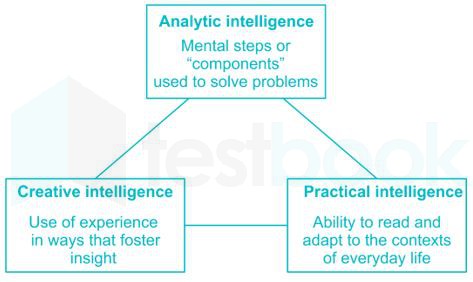
Intelligences organizes mental actions according to different-different circumstances. According to Sternberg, when a person changes himself becomes able to adjust and adapt with the environment. It is also called contextual or adaptation intelligence.

A person, who is street-smart, or high on practical intelligence, is more able to cope with concrete situations.

Example: Johnny is considering buying a second-hand motorbike. A salesman, being salesman, would obviously try to con the buyer, but Johnny is already prepared with price comparisons and has made up his mind to say no to unnecessary extras.

Question 13

“Anyone can become angry - that is easy, but to be angry with the right person, to the right degree, at the right time, for the right purpose, and in the right way - that is not easy.” This is related to

  1. AOption (a)

    Social development

  2. BOption (b)

    Cognitive development

  3. COption (c)

    Physical development

  4. DOption (d)

    Emotional development

View answer & explanation

Correct answer

Answer: (d)D.

Emotional development

Why this answer is correct

The term ‘development’ refers to qualitative changes in an individual such as a change in personality or other mental and emotional aspects. However, very often growth and development are used interchangeably.

  • The process of development continues even after the individual has attained physical maturity (growth). The individual is continuously changing as he/she interacts with the environment.
  • Emotion is a mental state associated with fear, anger, love, etc while emotional development refers to the capability of an individual to recognize, control and manage one's own emotions and the emotions of others as well.

Important Points

Anybody can become angry, that is easy; but to be angry with the right person, and to the right degree, and at the right time, and for the right purpose, and in the right way, that is not within everybody’s power, that is not easy.” —Aristotle. Evaluate the statement in the context of the concept of emotional development.

Key Points

Characteristics of Emotional Development:

  • Emotions are the product of perception.
  • Emotions start immediately after birth.
  • Emotions have the quality of displacement.
  • Emotions are subjective and purely individual.
  • Emotion is accompanied by physiological changes.
  • An intense form of emotions is seen during the early childhood period.

Hence, we can conclude that 'Anyone can become angry - that is easy, but to be angry with the right person, to the right degree, at the right time, for the right purpose, and in the right way - that is not easy.” This is related to emotional development.

Question 14

In learning, assessment is essential for

  1. AOption (a)

    Screening test

  2. BOption (b)

    Motivation

  3. COption (c)

    Fostering of the purpose of segregation and ranking

  4. DOption (d)

    Grades and Marks

View answer & explanation

Correct answer

Answer: (b)B.

Motivation

Why this answer is correct

Assessment is always considered an integral part of the teaching-learning process.  The assessment reflects how well classroom instruction has been organized by teachers and how far learners have progressed in their learning. It is an inbuilt process in teaching-learning, teachers can understand the needs of the learners better and accordingly change or adjust the quality of their instruction during the process of teaching the unit itself.

Key Points

Purpose of Assessment in learning: The purpose of an assessment for learning is to provide feedback to both the teacher and student regarding the student’s progress towards achieving the learning objective(s).

  • Assessment is to help to identify gaps in student's learning and what remedial measures should be appropriate to reduce the learning gaps of the students that are needed to be taken for continuing or improving their learning.
  • It can provide opportunities for teachers to encourage and motivate learners to succeed, both academically and socially.
  • It gathers data during the learning process when the class progresses through a unit of study to determine a student’s knowledge and skills, including learning gaps.
  • Provide feedback about the work the students have completed using the atlas and provide ideas for adjusting, rethinking, and articulating their learning.
  • It informs students about what they have done well, where they have had difficulty, and what they need to do differently to improve their work.
  • It expects students to make errors and directs them to examine these errors to improve their learning.

Hence, we can conclude that in learning, assessment is essential for motivation.

Question 15

Fitting new information into existing schemes is known as

  1. AOption (a)

    Equilibration

  2. BOption (b)

    Assimilation

  3. COption (c)

    Organisation

  4. DOption (d)

    Accommodation

View answer & explanation

Correct answer

Answer: (b)B.

Assimilation

Why this answer is correct

According to Piaget's Theory of Cognitive Development, assimilation, accommodation, and equilibrium are the ways through which children integrate new experiences into already existing cognition structures (schema). 

Key Points

According to Piaget's Cognitive Development Theory, "Fitting new information into existing schemes​" is known as 'Assimilation' as assimilation refers to the:

  • process of taking in information into our previously existing schemas.
  • way an individual takes and interprets new information in pre-existing mental structures without modifying them.
  • addition of a new concept or experience into an existing schema. For example, the baby's sucking of thumb is an initial schema.

Hence, it could be concluded that fitting new information into existing schemes is known as 'Assimilation'.

Important Points

Other key Concepts of Piaget's Theory:

  • Schema: A representation in the mind of a set of ideas or actions which go together.
  • Accommodation: Involves altering existing ideas or schemas as a result of new experiences.
  • Equilibration: A mechanism that assists children in achieving a balance between assimilation and accommodation.
  • Organization: It refers to the ability to study the connection among cognitive structures which makes thinking more efficient.

Question 16

We all differ in terms of our intelligence, motivation, interest, etc. This principle refers to:

  1. AOption (a)

    Theories of Intelligence

  2. BOption (b)

    Heredity

  3. COption (c)

    Environment

  4. DOption (d)

    Individual difference

View answer & explanation

Correct answer

Answer: (d)D.

Individual difference

Why this answer is correct

Development refers to an increase in structure for better and enhanced functioning of organs. It is a wide and continuous process, thus there are some principles that need to be followed for a better understanding of the concept.

Key Points

The above-mentioned statement refers to the principle of 'Individual Differences'. Individual difference refers to the difference which distinguishes an individual from another on the basis of psychological characteristics.

  • Individual differences in personality temperament can be observed from the day the child is born. Besides the differences in physical characteristics, there are differences in ‘their emotional reactivity, cognition, motivation levels, etc.
  • The most easily observed differences are physical and developmental. You observe variations in individuals of the same age in height, weight, and body build. Some grow faster while some are slow in growth.
  • Heredity and Environment both are the reason for individual differences. Genes, chromosomes, and cytoplasm determine heredity. The environment is determined by family, school neighborhood, and place of work.

Hence, it could be concluded that we all differ in terms of our intelligence, motivation, interest, etc. This principle refers to individual differences.

Question 17

Students of disadvantaged groups should be taught along with the normal students. It implies

  1. AOption (a)

    Inclusive Education

  2. BOption (b)

    Special Education

  3. COption (c)

    Integrated Education

  4. DOption (d)

    Exclusive Education

View answer & explanation

Correct answer

Answer: (a)A.

Inclusive Education

Why this answer is correct

Inclusive Education refers to different and diverse students learning in the same classroom and also all the learners with or without disabilities being able to learn together in ordinary preschool provisions schools.

  • An inclusive classroom is not limited to children with a disability but also gifted children, disadvantaged children, children from remote populations, cultural minorities are also being taught along with the normal students.
  • It provides a provision to include disabled children along with normal children in a regular classroom environment.
  • This type of education provides better quality for all the children and is instrumental in changing the discriminal activities.
  • Segregation and isolation are good neither for learners with disabilities not for general learners without disabilities.

Note: Integrated education refers to a set-up where children with mental retardation study along with non-disabled children in regular schools.  

Hence, it becomes clear that students of disadvantaged groups should be taught along with the normal students, It implies inclusive education.

Question 18

‘Out-of-the-box’ thinking is related to ____________.

  1. AOption (a)

    Memory-based Thinking

  2. BOption (b)

    Divergent Thinking

  3. COption (c)

    Convergent Thinking

  4. DOption (d)

    Consistent Thinking

View answer & explanation

Correct answer

Answer: (b)B.

Divergent Thinking

Why this answer is correct

Thinking is the mental process of manipulating information to draw a conclusion or to generate ideas. It is a higher cognitive function that allows beings to produce thought. 

  • It is a mental activity in the cognitive aspect which refers to the process by which one acquires knowledge through experience, thought, and sensory input.
  • Different kinds of thinking styles include divergent, convergent, creative, logical, concrete thinking, etc.

Important Points

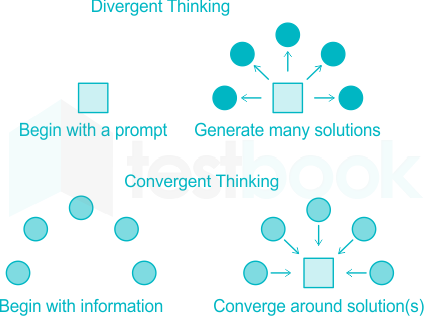
Divergent thinking refers to a way of solving a problem by exploring many possible solutions. It emphasizes the idea that there is a limitless approach to any given problem.

Key Points

Patterns of divergent thinking identify children, who are creative because it is a creative process that involves plucking out varieties of potential results and the best solution. Brainstorming, imagination, out of the box thinking, open-ended questions are the keywords of divergent thinking. 

Thus from the above-mentioned points, it is clear that ‘Out-of-the-box thinking is related to divergent thinking.

Additional Information

  • Convergent thinking: It refers to an ability which relates to followup logical steps to arrive at one correct solution. It doesn't require creativity, hence, is equivalent to intelligence.

Question 19

The assessment of students can be used by teachers in teaching to develop insight into

  1. AOption (a)

    not promoting those students who do not meet school standards.

  2. BOption (b)

    changing the teaching approach according to the learners’ need

  3. COption (c)

    creating groups of ‘bright’ and ‘weak’ students in the class.

  4. DOption (d)

    identifying the students who need to be promoted to the higher class.

View answer & explanation

Correct answer

Answer: (b)B.

changing the teaching approach according to the learners’ need

Why this answer is correct

The purpose of an assessment for learning is to provide feedback to both the teacher and student regarding the student’s progress towards achieving the learning objective(s).

Key Points

Assessment is a process of collecting, receiving, and using data for improvement in the learning process.

  • The main purpose of assessment is to help to identify gaps in student's learning and what remedial measures should be appropriate to reduce the learning gaps of the students that are needed to be taken for continuing or improving their learning.
  • It gathers data during the learning process when the class progresses through a unit of study to determine a student’s knowledge and skills, including learning gaps.
  • Provide feedback about the work the students have completed using the atlas and provide ideas for adjusting, rethinking, and articulating their learning.
  • It informs students about what they have done well, where they have had difficulty, and what they need to do differently to improve their work.
  • It expects students to make errors and directs them to examine these errors to improve their learning.
  • It also measures the achievement in learning and decides if the student should be promoted to the next class.

Thus from the above-mentioned points, it is clear that the assessment of students can be used by teachers in teaching to develop insight into changing the teaching approach according to the learners’ needs.

Question 20

Learning experiences should be planned in a manner so as to make learning meaningful. Which of the given learning experiences does not facilitate meaningful learning for the children?

  1. AOption (a)

    Formulating questions on content

  2. BOption (b)

    Discussion and debate on the topic

  3. COption (c)

    Presentation on the topic

  4. DOption (d)

    Repetition based on mere recall of content

View answer & explanation

Correct answer

Answer: (d)D.

Repetition based on mere recall of content

Why this answer is correct

Learning is the change in behaviour resulting from behaviour. The teacher is the one who can facilitate classroom teaching. 

Key Points

A teacher should maintain the interest of students in class teaching by giving ample opportunity to students for discussion or deliberations as the discussion is a teaching methodology which facilitates meaningful learning by emphasizing upon:

  • sharing ideas and experiences with peers and teachers.
  • learning through meaningful interaction in group settings.
  • looking at any issues from different angles and points of view.
  • developing a democratic way of thinking and the spirit of tolerance.
  • formulating questions on content can be very useful in the classroom.
  • increasing the maximum participation of students in the learning process.
  • the teacher has to maintain a conducive environment in the classroom and provide them with experiences through her experiences. He/she must give a presentation on the topic.

Thus from the above-mentioned points, it is clear that repetition based on mere recall of content does not facilitate meaningful learning for the children.

Question 21

Giving punishment, verbal or non-verbal, to the children results in

  1. AOption (a)

    protecting the child’s image

  2. BOption (b)

    improving their scores

  3. COption (c)

    damaging their self-concept

  4. DOption (d)

    motivating them to work

View answer & explanation

Correct answer

Answer: (c)C.

damaging their self-concept

Why this answer is correct

Punishment is not reinforcement. Punishment is inflicted either by presenting a painful stimulus or by removing a pleasant stimulus which invariably causes painful feelings, both physical and emotional, in students. Punishment is not very effective for eliminating undesirable behaviour Giving physical punishments, scolding or threatening in the class, and detaining after class hours are some examples of punishments given in schools. 

Key Points

Physical punishment (corporal) punishment seems to:

  • increase child aggression
  • increase antisocial behaviour
  • lower intellectual achievements
  • hatred for school, subject and teacher
  • enhance the poor quality of parent/teacher-student relation
  • cause mental health problem
  • damaging their self-concept
  • since punishment tends to dehumanise children and make them feel screed, ashamed and worthless during the learning and teaching process.

Thus from the above-mentioned points, it is clear that giving punishment, verbal or non-verbal, to the children results in damaging their self-concept.

Additional Information

The Right of Children to Free and Compulsory Education (RTE) Act, 2009, which represents the consequential legislation envisaged under Article 21-A in the constitution of India, came into force in the country on 1 April 2010. The RTE Act, 2009 prohibits-

  • physical punishment and mental harassment;
  • screening procedures for admission of children;
  • capitation fees;
  • private tuition by teachers; and
  • running of schools without recognition

Question 22

A teacher, labelled the head of a committee, as ‘chairperson’ instead of ‘chairman’. It indicates that the teacher 

  1. AOption (a)

    has a good command of language

  2. BOption (b)

    is using a gender-free language

  3. COption (c)

    has gender bias

  4. DOption (d)

    follows a more acceptable term

View answer & explanation

Correct answer

Answer: (b)B.

is using a gender-free language

Why this answer is correct

Gender is a social construct that refers to the socially and culturally constructed system that attributes meaning to what it means to be a male or a female in a particular society. The teacher has to encourage the equality of all genders among the children to make them free from any type of gender stereotypes. 

​

Key Points

Gender-neutral or Gender-free language:

  • It is that type of language which is used to promote gender equality among children to present the ideal language to be used while addressing any gender.
  • It helps the teacher to make the children understand the importance of integrity and unity i.e., they are a unit as a class and whatever task is assigned to a class, each of them will be accountable.
  • For example, In role-playing, a student at the end said, ‘This news report is presented by the reporter, Anshu and cameraman, Priya”’ The teacher said that instead of cameraman you should say cameraperson.
  • The word "chairman" is representing gender clearly i.e., a person who is a man. So, he is being called chairman. It is an example of gender-biased language.
  • While the word "chairperson" is just indicating that a person or we can say an individual is the head of a committee. So, it becomes gender-neutral language which is why the teacher insisted on using a chairperson.

Thus from the above-mentioned points, it is clear that the language of the teacher indicates that the teacher is using gender-free language.

Question 23

Continuous and Comprehensive Evaluation is essential for

  1. AOption (a)

    diluting the accountability of the Board of Education

  2. BOption (b)

    correcting less-frequent errors more than more-frequent errors

  3. COption (c)

    understanding how learning can be observed, recorded and improved upon

  4. DOption (d)

    fine tuning of test with the teaching

View answer & explanation

Correct answer

Answer: (c)C.

understanding how learning can be observed, recorded and improved upon

Why this answer is correct

Evaluation is a systematic way to assess learner’s abilities, analyze performance, provide appropriate feedback to each learner and help them to progress. High-quality evaluation is required in teaching for successful learning. Evaluation needs to be integrated with the process of teaching and learning.

Important Points

Continuous and Comprehension Evaluation (CCE): 

  • The scheme of CCE has inbuilt flexibility for schools to plan their own academic schedules as per specified guidelines on CCE.
  • It is a system that was introduced by the Central Board of Secondary Education (CBSE) in India to assess all aspects of student’s development on a continuous basis throughout the year.
  • The main aim of CCE is to evaluate every aspect of the child during their presence at the school. This is believed to help reduce the pressure on the child during/before examinations.
  • The objective of CCE is to make evaluation an integral part of learning through diagnostic and remedial teaching.
  • It never assesses students according to their economic status rather it emphasizes the continuity of assessment.

Key Points

CCE Emphasizes upon: 

  • Enhancing the thought process and de-emphasizing memorization.
  • Developing a student's cognitive, psychomotor, and affective domains.
  • Assessing both scholastic and co-scholastic aspects of a child's growth.
  • Making evaluations an integral part of diagnostic and remedial teaching.
  • Observing and recording the methods of learning to make improvements.

Thus from the above-mentioned points, it is clear that continuous and comprehensive evaluation is essential for understanding how learning can be observed, recorded and improved upon.

Question 24

In Lawrence Kohlberg’s theory, which level signifies the absence of morality in the true sense?

  1. AOption (a)

    Level IV

  2. BOption (b)

    Level I

  3. COption (c)

    Level II

  4. DOption (d)

    Level III

View answer & explanation

Correct answer

Answer: (b)B.

Level I

Why this answer is correct

Lawrence Kohlberg, an American psychologist, has propounded the 'Theory of Moral Development. He has made a systematic study of moral development in his theory that is categorized into 3 levels and 6 stages.

Key Points

Level 1: Pre-conventional Morality It consists of the first two levels of moral development. In this stage, morality is absent in the true sense. Here morality is judged based on the standards of adults and the consequence of an action.

  • Stage I (Obedience and Punishment Orientation) — An action is immoral if it is punished by the authority. Children in primary schools follow this stage. At this, children have the fear if they are not following the obedience principle get punished by the teachers or parents.
  • Stage II (Individualism and Exchange) — This stage is self-interest driven and children understood for the first time that different individuals may have different viewpoints. An action is considered morally correct if it is in the best interest of the individual.

Level 2: Conventional Morality: This level consists of stages three and four. During this level, children start internalizing the value of society to judge morality.

  • Stage III (Good Interpersonal Relationship) — Intention of the actor is more important in terms of judging the moral values. If the intention is to gain the consensus of others or approval of the society then the actor will be judged morally right. This stage is also followed by the children at the primary level. At this stage, the children have the ideology of a good boy – good girl attitude.
  • Stage IV (Maintaining the Social Order) — Judgment of morality is based on one’s duty, law, and social order. actively maintaining the current social system ensures positive human relationships and societal order.

Level 3: Post Conventional Morality: The last level consist of stage five and six of moral development. According to Kohlberg, very few people are able to reach this level. Here, the individual perspective is given more importance over social rule and order. Individuals judge morality based on basic human rights and justice.

  • Stage V (Social Contract and Individual Rights) – In this stage, the individual or child understands that different people and communities may hold different views and laws. Laws of the society are not rigid edicts and should be changed with the change in the time and need of the society.
  • Stage VI (Universal Principles) – Individual judge morality of the actor based on some universal principles that transcend beyond the society’s rules and regulations.

Thus from the above-mentioned points, it is clear that in Lawrence Kohlberg’s theory, level I signifies the absence of morality in the true sense.

Question 25

Which one of the following is correct for the progressive model of socialization of children?

  1. AOption (a)

    Children accept what they are offered by the school irrespective of their social backgrounds.

  2. BOption (b)

    There should be a place for democracy in the classroom.

  3. COption (c)

    Socialization is an adoption of social norms.

  4. DOption (d)

    Active participation in the group work and learning social skills.

View answer & explanation

Correct answer

Answer: (d)D.

Active participation in the group work and learning social skills.

Why this answer is correct

CBSE under NCERT (National Council of Educational Research and Training) implemented a model of progressive education for national policies and progressive educational ideas and pedagogical practices. 

Key Points

John Dewey who gave the concept of 'progressive education', felt that education is a social process, and one of the prime functions of the school is to help in the socialization of the child. He believed that-

  • A child has to get training in the intellectual, social, and cultural aspects of existence. It has to learn the norms and values of the group by active participation to become an accepted and effective member of the group.
  • Since human life is not only the result of biological and physiological functions, the child has also to get training in the intellectual, social, and cultural aspects of existence.
  • A child needs to be socialized, acculturated, and provided with knowledge and skills of survival together.
  • Home, neighborhood, community, religion, media, etc. have a great influence on the socialization of the child.
  • Freedom, creative self-expression, and active participation are the main components of this theory.
  • The main qualities of this education program are learning by doing, hands-on projects, and learning through experience.

Thus from the above-mentioned points, it is clear that active participation in group work and learning social skills is correct for the progressive model of socialization of children.

Question 26

The teacher noticed that Pushpa cannot solve a problem on her own. However, she does so in the presence of adult or peer guidance. This guidance is called

  1. AOption (a)

    Pre-operational thinking

  2. BOption (b)

    Zone of proximal development

  3. COption (c)

    Scaffolding

  4. DOption (d)

    Lateralization

View answer & explanation

Correct answer

Answer: (c)C.

Scaffolding

Why this answer is correct

One of the goals of education is to develop independent learning in students. However, at times, students might need a little push from the teacher in order to achieve that independence. Scaffolding is a technique that helps during such a scenario.

Scaffolding is a technique that is linked to the concept of the Zone of Proximal Development (ZPD), which refers to a range of tasks that a child can achieve only with assistance from a more skilled adult or peer.


The teacher noticed that Pushpa cannot solve a problem on her own. However, she does so in the presence of adult or peer guidance. This guidance is called scaffolding.

Key Points

  • Scaffolding is temporary support given by MKO (more knowledgeable other). It is stopped when the learner becomes able to perform independently.
  • This concept was developed by the Russian psychologist, Lev Vygotsky in his sociocultural theory of learning.
  • Scaffolding refers to a technique that provides the right kind of support in the right amount at the right time to increase a child’s competence.
  • In other words, it is a means by which a child's 'zone width' (or potential for new learning) can be assessed. i.e. scaffolding helps with providing support to learners in their initial phase of learning, which is in the right amount and gradually decreases as the learner progresses.
  • As children are given assistance or shown how to perform certain tasks, they use this information as a guide on how to perform these tasks and eventually learn to perform them independently.
  • It helps a learner to move from a Zone of Actual Development to a Zone of Proximal Development and finally reach to Zone of Desired Development, with the help of a more experienced person like peers, elders in the family, or teachers.
  • For example, a teacher gives a lesson on vocabulary before making the child read a difficult passage and provides necessary cues and prompts when the child faces difficulty.

Hence, we can conclude that the above example is the example of scaffolding.

Additional Information

  • Pre-operation is the cognitive stage given by Piaget in his theory of cognitive development.
  • Lateralization is the limitation of bodily function.

Question 27

Which one out of the following provides information about the roles and behaviours which are acceptable in a group, during the early childhood period?

  1. AOption (a)

    Teachers and Peers

  2. BOption (b)

    Peers and Parents

  3. COption (c)

    Parents and Siblings

  4. DOption (d)

    Siblings and Teachers

View answer & explanation

Correct answer

Answer: (c)C.

Parents and Siblings

Why this answer is correct

The Early childhood period (2-6 years) is of greater importance to you as a pre-primary teacher. In contrast to dependent babyhood, early childhood is a period when behaviour problems dominate as their urge to attain independence and inability of handling the problems successfully creates anxiety among the parents, At this stage, the young children become stubborn and disobedient and start negotiating. 

Key Points

They exhibit temper tantrums and children of this age play alone with their peers using toys. This stage has certain synonyms such as preschool. This is the time when children learn the foundation of social behaviour as a preparation for a highly organized social life. Parents and Siblings provide information about the roles and behaviours which are acceptable in a group.

Characteristics of Early Childhood:

  • Some parents feel that the behavioural problems of the childhood period are more troublesome then physical care of infants.
  • Some behavioural problems occur in this period such as obstinacy, stubbornness, disobedience, negativistic, and antagonistic.
  • It is a toy age because most of the time children are engaged with their toys. These toys are also helpful to educate the children. Toys are an important element of their play activities.
  • The child at this stage is curious about just everything in this world and also about their bodies and the bodies of others. The expression of curiosity takes sensorimotor form initially and later it is in the form of asking questions.
  • The preparation for adult roles which begins in early childhood is partly a result of direct teaching by the parents and partly a result of observation and imitation of adults by children hence named as imitative age.
  • The early childhood stage is also known as the pre-gang age which is characterized by an increasing number of contacts. Children who prefer to increase their social contacts rather than playing with objects are more popular.
  • This is a period when a child is considered physically and mentally independent. This is also a school-going age.
  • Children become more self-sufficient, independent, develop self-esteem.
  • This is the age of foundations of social behaviour. They are more organized and they will be required to adjust to when they enter first grade.
  • Develop physical, cognitive, emotional, and social development.

Thus from above-mentioned parents and siblings provides information about the roles and behaviours which are acceptable in a group, during the early childhood period.

Question 28

Which of the following age groups falls under later childhood category ?

  1. AOption (a)

    18 to 24 years

  2. BOption (b)

    Birth to 6 years

  3. COption (c)

    6 to 11 years

  4. DOption (d)

    11 to 18 years

View answer & explanation

Correct answer

Answer: (c)C.

6 to 11 years

Why this answer is correct

A stage in development covers a specific time period during the life span. Generally, when a child shifts from one stage to the next, there is thought to be a change in how the child approaches tasks and how the child understands and responds to events and things in his or her world. A stage of development is an ageing period when certain needs, behaviours, experiences, and capabilities are common and different from other age periods.

Key Points 

Stages of development:- Developmental influences cover a range of behaviours and transformations in a child's faculties and personalities. Social norms, institutions, customs, and laws also influence these stages.

  • Infancy (birth to 18 months)
  • Early childhood(2 to 3 years)
  • Preschool(3 to 5 years)
  • School-age or Pre Adolescence or Late childhood(6 to 11 years)
  • Adolescence(12 to 18 years)
  • Pre or Young Adulthood(19 to 40 years)
  • Middle Adulthood(40 to 65 years)

Important Points 

Late childhood is the time period from the age of 'six to eleven years. The signs of puberty usually begin to appear in this stage. It is also known as troublesome age, gang age, play age, etc.

Characteristics of Late Childhood:

  • Increased logical reasoning.
  • High Interest in science fiction.
  • Use of analogies in explanation.
  • Development of problem-solving skills.
  • Powers of perception and observation become keen.
  • Ability to exercise own power of memory and imagination.

Thus from the above-mentioned points, it is clear that 6 to11 years age groups fall under later childhood.

Question 29

Aarav says that language development is influenced by one’s innate predisposition while Sonali feels that it is because of the environment. This discussion between Aarav and Sonali is about

  1. AOption (a)

    Stability and Instability argument

  2. BOption (b)

    Continuous and Discontinuous learning

  3. COption (c)

    Nature and Nurture debate

  4. DOption (d)

    Critical and Sensitive feeling

View answer & explanation

Correct answer

Answer: (c)C.

Nature and Nurture debate

Why this answer is correct

The growth and development of an individual are greatly affected by heredity and environment as well as the interaction between heredity and environment. However, there are certain issues and controversies related to this phenomenon.

Key Points

This conversation between Raghav and Sonali is about the nature vs. nurture dispute, in which both nature and nurture play important roles in defining many of our physical and mental characteristics, from weight and height to intellect and temperament.


Nature vs. Nurture

  • The nature versus nurture debate is one of the oldest issues in psychology. The debate centres on the relative contributions of genetic inheritance and environmental factors to human development.
  • The term ‘nature’ stands for what comes to children through genetic influences and heredity, i.e. it denotes the influence of factors inherent in the child himself from the time he is conceived.
  • On the other hand, the term ‘nurture’ stands for the influence of the environment on child development, i.e. all the contextual factors that influence who we are, including our perceptions of early childhood, our social relationships and the society around us. It denotes the extrinsic forces, influences and conditions that affect the growth and development of an individual.
  • In other words, the controversy on nature versus nurture concerns whether human behaviour is influenced by the environment or by the genes of an individual.
  • Heredity and environment both play a significant role in the development of children. Any individual trait is the 'result' of both genetics and the environment. Heredity determines the probable biological limits, whereas the environment determines the level up to which the development is possible.

Thus from the above-mentioned points, it is clear that this discussion between Aarav and Sonali is about Nature and Nurtures debate.

Question 30

Making students members of a cleanliness community to motivate them for the same, reflects

  1. AOption (a)

    Behaviouristic approach to motivation

  2. BOption (b)

    Humanistic approach to motivation

  3. COption (c)

    Cognitive approach to motivation

  4. DOption (d)

    Socio-cultural conceptions of motivation

View answer & explanation

Correct answer

Answer: (d)D.

Socio-cultural conceptions of motivation

Why this answer is correct

Motivation is something that prompts, compels and energises an individual to act or behave in a particular manner at a particular time for attaining some goal or purpose. Four major approaches to understand motivation are:

  • Behavioural approach
  • Humanist approach
  • Cognitivism approach
  • Social-cultural perspective

Key Points

Social-cultural perspective: 

  • The social perspective believes that the need for affiliation, appreciation and recognition in the social group motivates a learner. When a learner spends time with peers, makes close relations with peers, parents and relatives, wants to get recognition of their work in a socio-cultural environment, s/he gets motivated. It emphasizes participation, identities and interpersonal relationships within the community for various practices.
  • Making students members of a clean community to motivate them for the same, reflects a social-cultural perspective.

Thus from the above-mentioned points, it is clear that making students members of a cleanliness community motivate them for the same, reflects socio-cultural conceptions of motivation.

Important Points

  • The behavioural approach considers the role of external rewards and punishment in motivation in the classroom. According to this approach, the role of positive and negative stimuli as incentives is very important in encouraging or discouraging a particular behaviour. The role of reinforcement is also considered important in teaching and learning. This approach promotes the use of grades, stars, rewards, certification, appreciation, etc., for enhancing the motivation of learners.
  • The humanist approach laid emphasis upon learners’ capacity for personal growth, freedom to choose their options for the future and positive outlook. This approach advocates that intrinsic sources like the sense of competence, self-esteem, autonomy, and self-actualization are the factors that encourage a person to act.
  • Cognitivism are of the view that motivation occurs due to learners’ thoughts. They do not have faith in the role of extrinsic motivation for learning. They believe that learners’ internal motivation to learn, their attribution (ability of an individual to explain, justify and excuse) and their belief to control their environment contributes to motivation. Learners are viewed as active and curious individuals who are searching for information to solve their problems by themselves.

Mathematics (30 questions)

Question 31

The sum of place values of 5 in 6251, 6521 and 5621 is

  1. AOption (a)

    15

  2. BOption (b)

    5550

  3. COption (c)

    5050

  4. DOption (d)

    550

View answer & explanation

Correct answer

Answer: (b)B.

5550

Why this answer is correct

Concept:

Place value: The place value of a digit in a number is the digit multiplied by thousand or hundred or whatever place it is situated.

For example, in 2537

Place value of 7 = 1 × 7 = 7

Place value of 3 = 3 × 10 =  30

Place value of 5 = 5 × 100 = 500

Place value of 2 = 2 × 1000 = 2000

Calculation:

Given numbers are

6251, 6521, 5621

In 6251, place value of 5 = 10 × 5 = 50 

In 6521, place value of 5 = 100 × 5 = 500

In 5621, place value of 5 = 1000 × 5 = 5000

Therefore, sum of place value of 5 = 50 + 500 + 5000

∴ The sum of the place value of 5 in given numbers is 5550

Question 32

Which one of the following statements is true ?

  1. AOption (a)

    The difference of an even number and an odd number can be an even number.

  2. BOption (b)

    The sum of two odd numbers and one even number is an even number.

  3. COption (c)

    The sum of three odd numbers is an even number.

  4. DOption (d)

    The product of three odd numbers is an even number.

View answer & explanation

Correct answer

Answer: (b)B.

The sum of two odd numbers and one even number is an even number.

Why this answer is correct

Concept:

Even & Odd: A number in which 0, 2, 4, 6, 8 present at once place called even number. Number in which 0, 2, 4, 6, 8  not present at once place called an odd number.

For example:

8, 42, 100, 588 etc are even number and,

3, 45, 199, 55 etc are odd numbers.

Properties:

  • The sum or difference of two even/odd is always even.
  • The difference between one odd and one even number is always odd.
  • The Sum of three odd number is an odd number.
  • The sum of two odd numbers and one even is always even.

Explanation:

From the above discussion, we can conclude that the sum of two odd numbers and one even number is an even number.

∴ option 2 will be correct.

Question 33

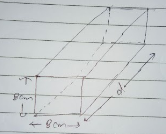
A one-litre carton of juice is in the shape of a cuboid and has a square base of size 8 cm by 8 cm, The depth of juice in the carton, in centimeters, is closest to

  1. AOption (a)

    22

  2. BOption (b)

    16

  3. COption (c)

    18

  4. DOption (d)

    20

View answer & explanation

Correct answer

Answer: (b)B.

16

Why this answer is correct

Given:

The volume of cube = 1 L,

The base of the cube is in a square shape with each side 8 cm.

Formula Used:

Volume = Base area × depth = length × breadth × depth

Unit: 1 L = 10-3 m3 = 1000 cm3

Calculation:

Volume of cube = 1 L = 1000 cm3

Let, depth of cube is d.

We know that volume of a cube is given by

V =  Base area × depth

⇒ 1000 = 8 × 8 × d

⇒ d = 1000/64

⇒ d = 15.625 ≈ 16

∴ The depth of the carton of juice is 16 cm.

Question 34

Which one of the following does NOT match curricular expectations of teaching mathematics at the primary level?

  1. AOption (a)

    Analyse and infer from representation of grouped data

  2. BOption (b)

    Develop a connection between the logical functioning of daily life and that of mathematical thinking 

  3. COption (c)

    Develop language and symbolic notations with standard algorithms of performing number operations

  4. DOption (d)

    Represent part of whole as a fraction and order simple fractions.

View answer & explanation

Correct answer

Answer: (a)A.

Analyse and infer from representation of grouped data

Why this answer is correct

Teaching-learning of mathematics takes account of well-defined objectives. Developing mathematical knowledge, understanding various mathematical terms, widening appreciation towards Mathematics, and expanding skill of applying acquired knowledge in everyday activities are some among them. Some Curricular Expectation of Teaching Mathematics at the Primary Level are as follows:

  • To ensure a good start for the students in learning mathematics.
  • To give clarity on the fundamental concepts and processes of the subject.
  • To develop a connection between the logical functioning of daily life and that of mathematical thinking.
  • To create love, faith and interest for learning mathematics.
  • To develop in them a taste and confidence in mathematics.
  • To develop language and symbolic notations with standard algorithms of performing number operations.
  • Represent part of whole as a fraction and order simple fractions.
  • To develop an appreciation for accuracy.
  • To acquaint them with the relation of mathematics with their present as well as future life.
  • To develop in them the habits like regularity, practice, patience, self-reliance and hard work.
  • To link mathematics with other subjects.

Hence, we conclude that analysing and inferring from the representation of grouped data is not curriculum expectation a the primary level.

Question 35

The main goal of Mathematics education is

  1. AOption (a)

    to help the students to understand mathematics.

  2. BOption (b)

    to develop useful capabilities.

  3. COption (c)

    to develop children’s abilities for mathematization.

  4. DOption (d)

    to formulate theorems of Geometry and their proofs independently.

View answer & explanation

Correct answer

Answer: (c)C.

to develop children’s abilities for mathematization.

Why this answer is correct

Mathematics is the study of geometrical figures, their co-relation, and their dependency on each other. It deals with quantity, measurement, and spatial relationships.

Key Points

Goals of Mathematics education:

  • Mathematics teaching should focus on child’s enjoyment of learning as NCF-2005 states that mathematics should be taught in a way that children learn to enjoy mathematics rather than fear it.
  • According to National Curriculum Framework-2005, the main goal of Mathematics education in school is the mathematization of the child’s thought process.
  • Mathematical operations should be taught in the context of practical activities related to the environment so that learners can understand the contribution of mathematics in daily life.
  • ​In school, mathematics is the domain that formally addresses problem-solving as a skill. Posing and solving problems reflects the levels and quality of learning besides developing the ability of creativity in the children.
  • Teaching mathematics should focus mainly on developing the basic abilities of a child to do mathematics and to bring mathematization of thoughts.

Hence, it is concluded that the main goal of Mathematics education is to develop children’s abilities for mathematization.

Question 36

At primary level use of tangram, dot games, patterns, etc. helps the students to 

  1. AOption (a)

    enhance spatial understanding ability.

  2. BOption (b)

    develop a sense of comparing numbers.

  3. COption (c)

    strengthen calculation skills.

  4. DOption (d)

    understand basic operations.

View answer & explanation

Correct answer

Answer: (a)A.

enhance spatial understanding ability.

Why this answer is correct

While addressing number and number operations, the due place must be given to non-number areas of mathematics. These include shapes, spatial understanding, patterns, measurement, and data handling.

Spatial understanding ability- It is an ability to understand the differences, reason, and similarity of an object. For enhancing the spatial understanding ability of students, the following can be used at the primary level.

  • Tangram- Children can learn about the spatial relationship by using tangram. It is a kind of puzzle consisting of seven different shapes (triangle, rectangle etc), by joining which student can create his imaginary shapes.
  • Dot game- It is a game consist of so many dots on paper by joining which students get the desired shape.
  • Patterns- This is also a structure that consists of many dots which on joining them a child can learn about different shapes or contains different shapes or patterns to explore.

Hence, we conclude that at the primary level use of tangram, dot games, patterns, etc. helps the students to enhance spatial understanding ability.

Question 37

From the unit of ‘Shapes,’ the teacher asked the students to “make/draw” any picture by using shapes”.

The objective that can be achieved through this activity is

  1. AOption (a)

    Knowledge 

  2. BOption (b)

    Comprehension 

  3. COption (c)

    Creating 

  4. DOption (d)

    Application 

View answer & explanation

Correct answer

Answer: (c)C.

Creating 

Why this answer is correct

Bloom’s Taxonomy: It is a hierarchical ordering of cognitive, affective, and psychomotor domains and each domain has some objectives that can help teachers teach and students learn. As per him, there are three Domains of Learning: Cognitive: (knowledge), Affective (emotional aspects), and Psychomotor (ability to use body parts to accomplish tasks) The levels falling under the cognitive domain are as follows:

  • Remember: ‘Remembering' is the lowest level objective of cognitive domain. It refers to the ability to recall information of facts, concepts, theories, laws, patterns, structures, generalizations, etc. Examples: recalling the definition of a rectangle, formula for finding the area of a rectangle.
  • Understand: It is the next higher level of the cognitive domain. Understanding helps learners to correlate, connect and develop meaning from new material. Example: describing the method of calculating the area of a rectangle.
  • Apply: The learner can apply different facts, concepts, theories, laws or principles in a new situation. Application subsumes both knowledge and understanding.  Example: applying knowledge of calculating the area of a rectangle to find the area of own house of the learner.
  • Analyze: Analysis is the breaking down of a complex situation into different parts/elements. At such a stage, the learner will be able to locate the elements, differentiate, recognize the relationship, and identify patterns of a situation. Example: identify the causes of splitting the figure into different parts for calculating its total area.
  • Evaluate: Aims and Objectives of Evaluation represents the learner’s ability to formulate hypothesis, critique, and judge a material, situation or method against the standard, which may be internal or external to it. Example: justifying the need for constructing ‘rooms’ in rectangular/square shapes.
  • Create: As the word implies creating stands for collecting information, designing and putting elements together to construct a new pattern or develop theory out of it or to build up an understanding of the concept in detail. Example: From the unit of ‘Shapes,’ the teacher asked the students to “make/draw” any picture by using shapes”.

Hence, we conclude that the above activity given by the teacher is for creation.

Question 38

Arjun, a student of class IV, is able to answer all questions related to Number System orally but commits mistakes while writing the solutions of problems based on Number System. The best remedial strategy to remove errors in his writing is

  1. AOption (a)

    to relate real life experiences with mathematical concepts.

  2. BOption (b)

    to provide him with a worksheet with partially solved problems to complete the missing gaps. 

  3. COption (c)

    to teach more than one way of solving problems of Number System.

  4. DOption (d)

    to give him 10 practice tests.

View answer & explanation

Correct answer

Answer: (b)B.

to provide him with a worksheet with partially solved problems to complete the missing gaps. 

Why this answer is correct

Remedial instruction is the process of providing help to students who are experiencing difficulties so they can understand and master the concept with which they are struggling.

  • Providing him with a worksheet with partially solved problems to complete the missing gaps. By providing the partially solved worksheets will enable the learner to see his gaps himself and identify his problematic areas.
  • Each pupil is different in terms of learning ability, academic standards, classroom learning, and academic performance, and each has his own in learning.
  • By adapting school curricula and teaching strategies, teachers can provide learning activities and practical experiences to students according to their abilities and needs.

Key Points 

Students mistakes in expressive writing include-

  • illegible handwriting,
  • Incomplete sentences, and
  • Errors in syntax, grammar, and spelling.

Through the primary level, children are taught how to form words, build sentences, and construct paragraphs. By class 4, it is usually clear which students are still having difficulty. The number of referrals of students with expressive writing difficulties typically spikes in class 4. 

Thus from the above-mentioned points, it is clear that the best remedial strategy to remove errors in his writing is to provide him with a worksheet with partially solved problems to complete the missing gaps.

Question 39

What is the value of

-1 + 2 - 3 + 4 - 5 + 6 - 7 + .... + 1000 ?

  1. AOption (a)

    2000

  2. BOption (b)

    0

  3. COption (c)

    1

  4. DOption (d)

    500

View answer & explanation

Correct answer

Answer: (d)D.

500

Why this answer is correct

Calculation:

Given series is 

-1 + 2 - 3 + 4 - 5 + 6 - 7 + .... + 1000 

We can see that, there are 1000 terms with odd and even digit are minus and plus sign respectively. Now the series as below,

(-1 + 2) + (- 3 + 4) + (- 5 + 6) + (- 7 + 8) .... + (-999 + 1000)

This shows, sum of pair of number is 1. Hence total terms remain 500. Therefore

= 1 + 1 + 1 + ............500 terms

Hence, sum = 500


We know that for an arithmetic progression (AP), whose first terms are 'a' last term l, then the sum of AP  is given by

S=n2(a + l)S = \frac{n}{2}(a\ +\ l)

Now, on rearranging the given series,

-1 - 3 - 5 .... - 999 + 2 + 4 + 6 + ......1000

=  -(1 + 3 + 5 + ....999) + (2 + 4 + 6 + .......1000) 

We can see that there are two AP (common difference 1) and each contains 500 terms. Therefore sum

S = S1 + S2

⇒S=−5002(1 + 999)+5002(2 + 1000)⇒ S = -\frac{500}{2}(1\ + \ 999) + \frac{500}{2}(2\ + \ 1000)

⇒ S = -250(1000) + 250(1002))

⇒ S = 250(1002 - 1000)

⇒ S = 500

Question 40

The perimeter of a square is 44 cm. The perimeter of a rectangle is equal to the perimeter of this square. The length of the rectangle is 5 cm more than the side of the square. The sum of areas (in cm2) of the square and the rectangle is

  1. AOption (a)

    229

  2. BOption (b)

    169

  3. COption (c)

    140

  4. DOption (d)

    217

View answer & explanation

Correct answer

Answer: (d)D.

217

Why this answer is correct

Given: 

Perimeter of Square = 44 cm

Concept:

Perimeter of Rectangle = 2 × (l + b)

Area of Rectangle = l × b

Where,

l = Length of Rectangle, b = Breadth of Rectangle.

And,

Perimeter of Square = 4 × a

Area of Square = a × a

Where, a = Side of Square.

Calculation:

Perimeter of Square = 4 × a = 44 cm

⇒ a = 11 cm

Then,

l =  (a + 5) cm = 11 + 5 = 16 cm.

And,

Perimeter of a rectangle = Perimeter of this square

⇒ 2 × (l + b) = 44

⇒ 16 + b = 22

⇒ b = 6 cm

Then,

Area of Rectangle = l × b = 16 × 6 cm2 = 96 cm2

And, Area of Square = a × a = 11 × 11 = 121 cm2

Then,

∴ Sum of the areas of Rectangle and Square = 96 + 121 = 217 cm2

Question 41

As per the NCF 2005, the narrow aim of teaching Mathematics at schools is

  1. AOption (a)

    to develop numeracy related skills.

  2. BOption (b)

    to teach algebra. 

  3. COption (c)

    to teach calculation and measurements. 

  4. DOption (d)

    to teach daily life problems related to linear algebra. 

View answer & explanation

Correct answer

Answer: (a)A.

to develop numeracy related skills.

Why this answer is correct

National Curriculum Framework (NCF), 2005 provides a guideline with which teachers and schools can choose and plan experiences that they think children should have. It seeks to reform the curriculum and to bring learning experiences in and outside the classroom. According to the NCF 2005, “Developing children’s abilities for mathematization is the main goal of mathematics education.”

There are two kinds of aims in mathematics for school education such as broader and narrower aims.

Narrower aim-

  • to develop numeracy related skills
  • to develop ‘useful’ capabilities
  • particularly those relating to numeracy- numbers, number operations, measurements, decimals and percentages

Broader aim-

  • Problem- solving
  • Use of heuristics
  • Estimation and approximation
  • Optimisation
  • Use of patterns
  • Visualization
  • Representation
  • Reasoning and proof
  • Making connections
  • Mathematical communication

Hence, we conclude that to develop numeracy related skills is one of the narrow aims of NCF.

Question 42

Ravi has three dozen chocolates. He gave one-third of them to his neighbour, one-sixth to Rehana and one-fourth to his sister. How many chocolates are left with him?

  1. AOption (a)

    10

  2. BOption (b)

    6

  3. COption (c)

    8

  4. DOption (d)

    9

View answer & explanation

Correct answer

Answer: (d)D.

9

Why this answer is correct

Calculation:

Given that, Ravi has 3 dozen chocolates. 

= 3 × 12 = 36

According to the question, 

Amount of chocolates, he gave to the neighbour = 1/3rd of 36

⇒13×36=12⇒ \frac{1}{3}\times 36 = 12

Similarly, he gave 1/6th of  chocolates to the Rehana

⇒ Number of chocolates that Rehana have = 16×36 =6\frac{1}{6}\times 36\ = 6

Similarly, he gave 1/4th to his sister.

⇒ Number of chocolates  = 14×36 =9\frac{1}{4}\times 36\ = 9

Hence, the total number of chocolates left

= 36 - (12 + 6 + 9) = 9

∴ 9 chocolates left with Ravi.

Question 43

A child who is able to perform all number operations and is able to explain the concept of fractions is at

  1. AOption (a)

    operational phase

  2. BOption (b)

    emergent phase

  3. COption (c)

    quantifying phase

  4. DOption (d)

    partition phases

View answer & explanation

Correct answer

Answer: (a)A.

operational phase

Why this answer is correct

Jean Piaget, a swiss psychologist, who belonged to the cognitive school of psychology, is famous for his work on child development. He made a systematic study of cognitive development in his theory that is categorized into four stages.

Key Points

The stages are explained below:

StagesCharacteristics
Sensorimotor (0-2 years)An infant explores the world by coordinating sensory experiences with physical actions, object permanence is established.
Preoperational (2-7 years)Symbolic thought develops; the child cannot coordinate different physical attributes of an object.
Concrete operational (7-12 years)The child can reason logically about concrete events and classify objects into different sets. He can perform all numbers of operations and can explain the concept of fractions.
Formal operational (12-15 years)The adolescent can apply logic more abstractly; hypothetical thinking develops

Note:

  • Emergent phase: this is from birth to 5 years, in which a child can learn about letters and sounds. This is also called “Phase of Literacy Development”.
  • Quantifying phase: It refers to counting the objects and deal with ‘how many’.  The learner counts the object concretely, pictorially and symbolically.
  • Partition phase: In this stage, a child divides a problem into small parts and then solve it. This makes understanding the thing easy. As, 152 can be partitioned as, 100 + 5 + 2.

Hence, we conclude that at the operational phase a child can perform all number operations and can explain the concept of fractions.

Question 44

A teacher introduced multiplication in her class as repeated addition and then by the grouping of the same number of objects taken multiple times she introduced the ‘×’ symbol and further conducted a small activity of finding product using criss-cross lines or matchsticks. Hers the teacher is

  1. AOption (a)

    using multiple representations to make the class interesting.

  2. BOption (b)

    developing a lesson and taking students ‘from concrete to abstract concept’

  3. COption (c)

    catering to learners with different learning styles.

  4. DOption (d)

    providing remedial strategies for low achievers in mathematics.

View answer & explanation

Correct answer

Answer: (c)C.

catering to learners with different learning styles.

Why this answer is correct

Learning style is ' the sum of an individual's preferences for physical, social, emotional and environmental elements in the course of learning. Each learner develops his/her style or approach to learning which is rooted to his/her interests, habits, conditions/environment at home and school, and the clarity of goal.

Key Points

The following are the key points related to the learning styles:

  • It is not very likely that any two students learn the same thing in the same way and at the same pace.
  • It is in this context that individualized instruction as a mode of learning is receiving prominence in teaching.
  • Students learn in several ways. Teachers have to evolve and identify different styles of learning adopted by the learners.
  • The teacher tries to explain by different styles. For example, the teacher presents multiplication as repeated addition (  and are the same). He also conducts a small activity of finding products using crisscrossing or matchsticks.
  • In simple words, a student's learning style is the 'way' in which he/she learns. The learning style is 'an individual's characteristic way of responding to certain variables in the instructional environment'.

Hence, we conclude that in the above-mentioned statement, the teacher is catering to learners with different learning styles.

Question 45

Akanksha wants to become a good mathematics teacher. To be a good mathematics teacher she must have

  1. AOption (a)

    conceptual knowledge, understanding and ability to related content of mathematics with real life.

  2. BOption (b)

    good communicative skills and the knowledge of close-ended questions.

  3. COption (c)

    ability to solve the problems in no time.

  4. DOption (d)

    good knowledge of Number System, Algebra and Geometry.

View answer & explanation

Correct answer

Answer: (a)A.

conceptual knowledge, understanding and ability to related content of mathematics with real life.

Why this answer is correct

A good teacher needs to relate every content with real-life for making learning more effective and easy because students learn easily with daily life examples. Some properties of a good mathematics teacher are-

  • He must have a conceptual knowledge, understanding and ability to related content of mathematics in real life.
  • He should be a good motivator
  • He should have the ability to make engaging classroom environment.
  • He has a clear and loud voice with proper intonation
  • He is facilitator and supporter.
  • He can make learning interesting, joyful and creative.

Hence, we conclude that Akanksha should have conceptual knowledge, understanding and ability to related content of mathematics with real life.

Question 46

It is important to conduct mathematical recreational activities and challenging geometrical puzzles in the class as

  1. AOption (a)

    they bring students out of the monotonous and boring routines of mathematics classroom.

  2. BOption (b)

    they give space to gifted learners.

  3. COption (c)

    they are helpful to enhance spatial and analytical ability of every learner.

  4. DOption (d)

    they can create interest in low achievers and slow learners in mathematics.

View answer & explanation

Correct answer

Answer: (c)C.

they are helpful to enhance spatial and analytical ability of every learner.

Why this answer is correct

Mathematics is interesting by using games, quizzes, riddles, tricks, etc. as learning activities. Every child deserves to be successful and confident in school life. Mathematical puzzles, riddles, and tricks develop many life skills in learners required to lead a successful and happy life. Children love games and puzzles, so learning through games makes the learning of Mathematics joyful and interesting.

Important Points

Benefits of recreational activities to develop following skills

  • Encourage mathematical reasoning and logical thinking;
  • Develop strategic thinking;
  • Guide in concept development;
  • Develop a positive attitude towards Mathematics;
  • Help to develop the construction of ideas;
  • Develop a variety of connections with the content that can form positive memories of learning;
  • Improve fundamental operations of Mathematics;
  • Help teachers to cater to the diverse needs of children;
  • Help in the development of problem-solving, critical thinking skills, decision-making skills, etc.

Hence, we have concluded that It is important to conduct mathematical recreational activities and challenging geometrical puzzles in the class as they are helpful to enhance the spatial and analytical ability of every learner.

Question 47

‘Vedic Mathematics’ is becoming popular nowadays especially amongst primary school children and is used to enhance

  1. AOption (a)

    the problem solving skills of students in mathematics.

  2. BOption (b)

    the concentration of students in mathematics.

  3. COption (c)

    the calculation skills and speed in mathematics.

  4. DOption (d)

    the algorithmic understanding of students in mathematics.

View answer & explanation

Correct answer

Answer: (c)C.

the calculation skills and speed in mathematics.

Why this answer is correct

In the ancient education system, the solution of Mathematics problems was given very fast in India. But now it is being experienced that learners finding difficulty in solving mathematical problems. Through the introduction of Vedic Mathematics, learners have developed an interest. It gave importance to calculation skills and speed in mathematics.

Key Points

Importance of teaching-learning Vedic Mathematics

  • Developing interest in teaching-learning mathematics.
  • Increase in the confidence level for competitive exams.
  • Developing speed & accuracy for calculations among learners.
  • To save time by solving problems in the shortest possible time.
  • Developing learner's brain to a level so that he/she could solve their life problems.
  • Developing reasoning power using Vedic mathematics sutras.
  • Developing self-confidence by solving problems using Vedic Mathematics.
  • Increasing memory power of learners.

Hence, we can conclude that Vedic Mathematics is becoming popular nowadays especially amongst primary school children, and is used to enhance calculation skills and speed in mathematics.

Question 48

Formative Assessment in Mathematics at primary stage includes

  1. AOption (a)

    identification of common errors.

  2. BOption (b)

    testing of procedural knowledge and analytical abilities.

  3. COption (c)

    grading and ranking of students. 

  4. DOption (d)

    identification of learning gaps and deficiencies in teaching.

View answer & explanation

Correct answer

Answer: (d)D.

identification of learning gaps and deficiencies in teaching.

Why this answer is correct

Formative Assessment: Given by Black & William in 2009, it focuses on the assessment of mathematics learning at primary stage. When children answer the questions incorrectly (learning gaps), they should not be put to shame. It is necessary for them that they master the required competencies before proceeding to the next competency. The assessment includes

  • Identification of learning gaps and deficiencies in teaching.
  • Avoid physical punishment and the school should be “Punishment free zone”.
  • Understanding of how children learn mathematics.
  • Development of the mathematical concept and their application in daily life.
  • Development of the social personal qualities of the children.

Hence, we conclude that at the primary stage, the formative assessment includes identification of learning gaps and deficiencies in teaching.

Question 49

A teacher uses the exploratory approach, use manipulatives and involvement of students in discussion while giving the concepts of mathematics. She uses this strategy to

  1. AOption (a)

    develop manipulative skills among the students.

  2. BOption (b)

    create a certain way of thinking and reasoning,

  3. COption (c)

    achieve the narrow aim of teaching mathematics.

  4. DOption (d)

    achieve the higher aim of teaching mathematics,

View answer & explanation

Correct answer

Answer: (b)B.

create a certain way of thinking and reasoning,

Why this answer is correct

According to NCF 2005, the main goal of mathematics education at the primary level is the development of children's ability in mathematization. Basically, it means that children should learn to think about any situation using the language of mathematics. They can use the tools and techniques of mathematics in real life. 


  • In Mathematics there is a certain way of thinking, people connect the mathematical concepts with real-life which help them think more logically and practically.
  • The National Curriculum Framework 2005 is among the four National Curriculum Frameworks approved by the National Council of Educational Research and Training NCERT in India.
  • At the Primary level, children learn from concrete objects and visualization processes.
  • It must be ambitious, coherent (logical and consistent) and should focus on principles of mathematics.

Hence, we conclude that a 'certain way of thinking and reasoning' means adopting the exploratory approach, use of manipulatives, connecting concepts to real life, involving students in discussions.

Question 50

A teacher asks Shailja of class V about the perimeter of a figure.

She also asked Shailja to explain the solution in her words. Shailja was able to solve the problem correctly but was not able to explain it. This reflects that Shailja is having

  1. AOption (a)

    poor understanding of concept of perimeter but good verbal ability

  2. BOption (b)

    lower language proficiency and lower order mathematical proficiency

  3. COption (c)

    lower language proficiency and higher-order mathematical proficiency

  4. DOption (d)

    poor confidence level and poor mathematical skills

View answer & explanation

Correct answer

Answer: (c)C.

lower language proficiency and higher-order mathematical proficiency

Why this answer is correct

The development of children's abilities to perform mathematical operations and to make them skilled to use mathematical knowledge in real life is the main goal of mathematics education.

  • The teaching methods to teach mathematics should be according to the content, needs of students, and availability of resources.
  • The teacher needs to teach mathematics by relating it to the real life of learners so that they could become easily familiar with it and could enjoy learning.

Key Points

  • In class V, the teacher asks a student Shailja to tell about the area of a figure and also to describe the solution in her own words.
  • Shailja solved the problems on the topic "perimeter" correctly but she was unable to explain it in her words.
  • For example, find the perimeter of a square with a side of 16 cm. The perimeter of a square is 4xside  i.e. the square of its side. So, the area of the square is (4 X 16) cm2 = 32 cm2.
  • Shailja solved this problem correctly but she was not able to explain in her words why she multiplied 16 with four sides of the square to get the area and what is area and so on.
  • It means that she understood the concept of area appropriately but because of a lack of language comprehension, she was unable to elaborate on the solution in her words.
  • This means that Shailja is having lower language proficiency i.e., less capable of listening, speaking, reading, and writing in a certain language.
  • On the other hand, she possesses higher-order mathematical proficiency i.e., the ability to perform mathematical operations and build mathematical concepts.

Hence, it could be concluded that Deeksha is having lower language proficiency and higher-order mathematical proficiency.

Question 51

The section, ‘Practice Time’ included in different topics in Mathematics textbook aims at

  1. AOption (a)

    having a change in daily routine

  2. BOption (b)

    ensuring better utilization of time

  3. COption (c)

    providing extended learning opportunities

  4. DOption (d)

    providing fun and enjoyment to students.

View answer & explanation

Correct answer

Answer: (c)C.

providing extended learning opportunities

Why this answer is correct

Mathematics is a branch of science which deals with counting, calculating, and studying numbers, shapes, and structures. At the end of a topic, the section, ‘Practice Time’ is given in different topics in Mathematics textbook. Advantages of this are:

  • It provides extended learning opportunities to the student.
  • It aims to teach the student beyond the exercises given for practice.
  • It develops the ability of abstract thinking.
  • Enhance engagement of the learner.
  • Make students learn self-study and practice the taught topics.
  • Helps in self-assessment, to understand where a child lags.
  • It encourages making a hypothesis and verifying them.

Hence, we conclude that the section, ‘Practice Time’ in Mathematics book provides extended learning opportunities

Question 52

13 students of class V A and 15 of class V B participated in a writing competition. They scored marks as follows :

Class V A 14, 6, 15, 12, 11, 11, 7, 9, 17,13; 3, 10, 18

Class V B 13, 9, 0, 7, 14, 6, 0, 9, 16, 9, 13, 16, 5, 18, 11

What inference can you draw from the given data?

  1. AOption (a)

    Class V A performed better because the average score of V A is more.

  2. BOption (b)

    Both the sections performed equally well because the total marks scored by both the sections are the same.

  3. COption (c)

    Both the sections performed equally well because the average marks of both the sections are the same.

  4. DOption (d)

    Both the sections performed equally well because the highest score of both sections is 18.

View answer & explanation

Correct answer

Answer: (a)A.

Class V A performed better because the average score of V A is more.

Why this answer is correct

Concept:

Average Marks = \(\frac{Sumofthetotalmark}{Totalnumberof~student}\)

Given:

Class V A 14, 6, 15, 12, 11, 11, 7, 9, 17,13, 3, 10, 18

Class V B 13, 9, 0, 7, 14, 6, 0, 9, 16, 9, 13, 16, 5, 18, 11

Calculation:

Class V (A),

Number of Student = 13, Obtained Marks = 14, 6, 15, 12, 11, 11, 7, 9, 17,13, 3, 10, 18.

Average Marks = \(\frac{Sumofthetotalmark}{Totalnumberof~student}\)

= \(\frac{14~+6+15+12+11+11+7+9+17+13+3+10+~18}{13}\)

= 14613\frac{146}{13}

= 11.231

And,

Class V(B),

Number of Student = 15, Obtained Marks = 13, 9, 0, 7, 14, 6, 0, 9, 16, 9, 13, 16, 5, 18, 11.

= \(\frac{13~+9+0+7+14+6+0+9+16+9+13+16+5+18+~11}{15}\)

= 14615\frac{146}{15} 

= 9.733

So,

Class V A performed better because the average score of V A is more.

Question 53

How many 110\frac{1}{10} are in 65\frac{6}{5}?

  1. AOption (a)

    5

  2. BOption (b)

    12

  3. COption (c)

    10

  4. DOption (d)

    8

View answer & explanation

Correct answer

Answer: (b)B.

12

Why this answer is correct

Calculation:

To find the number of 110\frac{1}{10} in 65\frac{6}{5} , we have to divide 65\frac{6}{5} by 110\frac{1}{10}.

Then,

⇒ 65110\frac{\frac{6}{5}}{\frac{1}{10}} = 65\frac{6}{5} × 10

= 12

Question 54

On dividing 110111 by 11, the sum of the quotient and the remainder is

  1. AOption (a)

    11001

  2. BOption (b)

    10101

  3. COption (c)

    10011

  4. DOption (d)

    11011

View answer & explanation

Correct answer

Answer: (c)C.

10011

Why this answer is correct

Given:

On dividing 110111 by 11.

Then,

Dividend = 110111, Divisor = 11

Calculation:

On dividing 110111 by 11.

Then,

11011111\frac{110111}{11} = 10010**111\frac{1}{11}**

quotient = 10010, Remember = 1 

Then,

The sum of the quotient and the remainder = 10010 + 1 = 10011

Question 55

What should be subtracted from the product 102 × 201 to get 19999 ?

  1. AOption (a)

    602

  2. BOption (b)

    103

  3. COption (c)

    401

  4. DOption (d)

    503

View answer & explanation

Correct answer

Answer: (d)D.

503

Why this answer is correct

Calculation:

Let x is subtracted from the product 102 × 201 to get 19999.

⇒ (102 × 201) - x = 19999

⇒ 20502 - x = 19999

⇒ x = 20502 - 19999

⇒ x = 503.

Question 56

Which of the following is not correct ?

  1. AOption (a)

    2 kg 30 g is the same as 2030 g

  2. BOption (b)

    8 litres 80 millilitres = 380 millilitres

  3. COption (c)

    Area of a square of side 10 cm = Area of the rectangle of length 100 cm and breadth 0.01 m

  4. DOption (d)

    3 hours 14 minutes = 194 minutes

View answer & explanation

Correct answer

Answer: (b)B.

8 litres 80 millilitres = 380 millilitres

Why this answer is correct

Concept:

1 kg = 1000 g

1 litre = 1000 ml

Area of square = side2

1 m2 = 104 cm2

Calculation:

2 kg 30 g = (2 × 1000 + 30) g = 2030 g

8 litres 80 millilitres = (8 × 1000 + 80) ml = 8080 ml

Area of a square of side 10 cm = 102 cm2 = 100 cm2

Area of the rectangle of length 100 cm and breadth 0.01 m = length × breadth

= 1 × 0.01 = 0.01 m2 = 100 cm2

So**, the** Area of a square of side 10 cm = Area of the rectangle of length 100 cm and breadth 0.01 m

3 hours 14 minutes = (3 × 60 + 14) minutes

= (180 + 14) minutes

= 194 minutes

∴ The incorrect answer is option 2

Question 57

Number of degrees in two and two-third of a right-angle is

  1. AOption (a)

    270° 

  2. BOption (b)

    180° 

  3. COption (c)

    210° 

  4. DOption (d)

    240° 

View answer & explanation

Correct answer

Answer: (d)D.

240° 

Why this answer is correct

Concept:

The right angle stands for 90° 

Calculation:

Two and two-third of a right-angle = 2232\tfrac{2}{3} of 90° 

= 83\frac{8}{3} × 90° 

= 240°

Question 58

(Sum of multiples of 7 between 21 and 49) ÷ (Biggest common factor of 25 and 30) is equal to

  1. AOption (a)

    37

  2. BOption (b)

    14

  3. COption (c)

    21

  4. DOption (d)

    35

View answer & explanation

Correct answer

Answer: (c)C.

21

Why this answer is correct

Calculation:

Multiples of 7 between 21 and 49 = 28, 35, 42.

Sum of multiples of 7 between 21 and 49 = 28 + 35 + 42 = 105

All factors of 25 = 1, 5, 25

All factors of 30 = 1, 5, 6, 30

Biggest common factor of 25 and 30 = 5

Sum of multiples of 7 between 21 and 49Biggest common factor of 25 and 30=1055=21\frac{Sum\ of \ multiples\ of \ 7\ between\ 21\ and\ 49}{Biggest \ common \ factor\ of \ 25 \ and \ 30}= \frac{105}{5}=21

Question 59

The sum of all the positive factors of 96 is

  1. AOption (a)

    252

  2. BOption (b)

    155

  3. COption (c)

    156

  4. DOption (d)

    251

View answer & explanation

Correct answer

Answer: (a)A.

252

Why this answer is correct

Concept:

Positive factors defined as all the positive multiples of a number including 1 or the number itself.

Calculation:

All positive factors of 96 = 1, 2, 3, 4, 6, 8, 12, 16, 24, 32, 48, 96

The sum = 1 + 2 + 3 + 4 + 6 + 8 + 12 + 16 + 24 + 32 + 48 + 96 = 252

Question 60

A train leaves a station at 6 : 14 am. and reaches its destination after 13 hours 48 minutes. The time at the destination is

  1. AOption (a)

    8 : 12 p.m.

  2. BOption (b)

    7 : 02 p.m.

  3. COption (c)

    7 : 12 p.m.

  4. DOption (d)

    8 : 02 p.m.

View answer & explanation

Correct answer

Answer: (d)D.

8 : 02 p.m.

Why this answer is correct

Concept:

1 hour = 60 minutes

1 minute = 60 seconds

1 day = 24 hours

Given:

A train leaves a station at 6 : 14 am

Time taken to reach its destination is 13 hours 48 minutes

Calculation:

Time taken by train to leave station = 6 hours 14 minutes

The final time is taken to reach the destination = 13 hours 48 minutes + 6 hours 14 minutes

= 19 hours 62 minutes

= 20 hours 02 minutes

Now subtracting 12 hours to get time in 12 hours format

The final time = 8 hours 02 minutes

= 8 : 02 p.m.

Environmental Studies (30 questions)

Question 61

NCF 2005 has not recommended any prescribed curriculum and text-books for EVS for classes I and II. The most appropriate reason for this

  1. AOption (a)

    EVS is only for class III onwards

  2. BOption (b)

    Learners in class I and II cannot read and write

  3. COption (c)

    To provide contextual learning environment

  4. DOption (d)

    To reduce the load of curriculum

View answer & explanation

Correct answer

Answer: (c)C.

To provide contextual learning environment

Why this answer is correct

NCF(National Curriculum Framework) 2005 is one of the four NCF published in India by NCERT. It seeks to provide a framework for the betterment of educational purposes and experiences.

Key Points Providing a contextual learning environment is the most appropriate reason for the above-mentioned recommendations of NCF. 

  • In early childhood, children look at their environment in a holistic manner.
  • Therefore, in classes I and II the concepts of environmental science are integrated into language and mathematics
  • Also, the teaching of language and mathematics are woven around the child's immediate environment to ensure contextual learning.

Hence, to provide a contextual learning environment, NCF 2005 has not recommended any prescribed curriculum and textbooks for EVS for classes I and II.

Question 62

A teacher has to teach about cultural diversity in food in our country to class IV students. Which of the following is the best way to teach this topic?

  1. AOption (a)

    Give a project to students about different kinds of food taken by the people of various states in our country.

  2. BOption (b)

    Ask students what they have eaten, followed by a discussion.

  3. COption (c)

    Ask students to collect information about the kind of food taken in their family.

  4. DOption (d)

    Show flash cards having pictures of various food items.

View answer & explanation

Correct answer

Answer: (a)A.

Give a project to students about different kinds of food taken by the people of various states in our country.

Why this answer is correct

John Dewey, an American philosopher has proposed the concept of 'Progressive Education' that emphasizes learning takes place through a hands-on approach so the students must interact with their environment to adapt and learn.

The project method is based on the philosophy of Pragmatism.

  • The project method is based on the principle of Learning by doing.
  • The project method makes learning realistic and experimental.
  • It aims to make students think independently and is a target-driven activity based on the challenge, fostering success and efficient cooperation.

Key Points

Community participation is important as it demonstrates the importance of incorporating cultural elements in the teaching of mathematics, all of which motivates students to learn about their culture and that of others while also learning mathematics.

  • Students should be contributions of members of their own and other cultures can help them gain confidence, self-esteem and a sense of belonging as well as respect for the mathematical thinking of other cultures”.
  • Culturally relevant pedagogy validates students’ cultural backgrounds, and ethnic history and provides ways for educators to support cultural connections between the school and the community.
  • Giving class 4th students a project about different types of food eaten by individuals from various states in our country is the finest approach to promote cultural variety in cuisine in our country. The project will improve people's perspectives and thoughts about the cuisine they eat as well as dishes that are popular in other states.

Thus from the above-mentioned points, it is clear that the best way to teach about cultural diversity in food in our country to class IV students is to give a project to students about different kinds of food taken by the people of various states in our country.

Question 63

All of the following are indicative of the general approach to be followed for EVS in primary classes except form

A. concrete to abstract

B. simple to complex

C. local to global

D. abstract to concrete

  1. AOption (a)

    Only D

  2. BOption (b)

    Only A and B

  3. COption (c)

    Only B and C

  4. DOption (d)

    Only B

View answer & explanation

Correct answer

Answer: (a)A.

Only D

Why this answer is correct

EVS skills utilize the teaching-learning process effectively in a way that the social, emotional and attitudinal values of the children are interwoven with the acquisition of knowledge, and skills.

  • EVS is a subject which is concerned with the development of learner's awareness about environmental issues.
  • For teaching-learning of EVS at primary level, the teacher must be equipped with an understanding of the general approach to EVS learning as it activates learner's previous knowledge to connect with the new one and facilitates meaningful learning.

Indicative of General Approach to be Followed for EVS in Primary Classes:

  • Whole to part
  • Local to global
  • Simple to complex
  • Easy to difficult
  • Known to unknown
  • Concrete to abstract

NOTE: The abstract to the concrete approach of education shouldn't be followed at primary level as children at this stage are too young to understand the abstract and complex concepts directly.

Hence, from the above-mentioned points, it becomes clear that abstract to concrete approach should not be followed for EVS in primary classes

Question 64

Study the following table:

June 2007December 2014
Price of petrol in Rs/litre47.7461.33
Price of diesel in Rs/litre35.2150.51


After studying the above table, Devmeet a class V student wrote the following in his notebook:

A. Petrol is more expensive fuel than diesel.

B. The percentage increase in the price of diesel is more than that of petrol.

C. Diesel is cheaper and that is why public transport runs on it.

D. Diesel is cheaper fuel than petrol. People should buy diesel vehicles.

Which one of the following is correct?

  1. AOption (a)

    C and D are inferences

  2. BOption (b)

    A and D are observations

  3. COption (c)

    A and C are observations

  4. DOption (d)

    B and C are inferences

View answer & explanation

Correct answer

Answer: (a)A.

C and D are inferences

Why this answer is correct

Observation refers to the act of examining and scrutinizing something, specifically to learn. It is the active acquisition of information. In living beings, observation employs the senses.

Key Points

Inferences are the sentences in which one reaches a conclusion which is drawn from evidence and reasoning.

  • In the above-mentioned statement (A) and (B), it could be interpreted that Devmeet is doing observation in these activities.
  • In the above-mentioned statement (C) and (D), it could be interpreted that Devmeet is doing inferences because he is arriving at the conclusion based on the observations he made in the statement (A) and (B).

Hence, from the above-mentioned points, it becomes clear that statement (C) and (D) are inferences

Question 65

Mahika a teacher of class V, wants her students to observe the plants in the surroundings. For meaningful learning, what should she encourage the children to do?

  1. AOption (a)

    Appreciating that plants are useful for us

  2. BOption (b)

    Writing the names of maximum number of plants

  3. COption (c)

    Observing the difference in their heights, leaves, smell and place of growing

  4. DOption (d)

    Understanding that plants are living beings

View answer & explanation

Correct answer

Answer: (c)C.

Observing the difference in their heights, leaves, smell and place of growing

Why this answer is correct

Key Points

  • Education Commission recommended that at the primary level, the focus of education should be on the social, physical, and biological environment of the child. A child in these years should be introduced to 'plants and animals in the surrounding, the air he breaths, water he drinks ... ... ".
  • Hence it was recommended that teaching-learning at the primary stage should be environment-oriented, child-centered, and activity-based.
  • The Education Commission also recommended that the teaching of Science at the primary level should be concentrated on the development of a proper understanding of facts. concepts, principles, and processes related to the physical and biological environment.


  • Education for the environment encourages children to explore their environment,.so as to form an idea about their relationship with the environment and environmental issues. This is linked to the development of attitudes, values, and responsible behavior necessary for sustainable and caring use of the environment.
  • Education in or through the environment involves the use of the environment as a resource of learning. Here the teacher is also trying to inculcate the skill of observation in students, Hence to encourage meaningful learning and the skill of observation teacher should ask students to observe the difference in their heights, leaves smell, and place of growing.
  • By observing this they will get to know the variety of flora and fauna we have in the biological world and the adaptation of plants according to climate.
  • This helps in the development of knowledge and understanding along with skills of investigation, observation, and communication.

Additional Information

  • By the class Vth, students know that plants are living beings which is useful for us in many ways.
  • Memorizing names is never supported.

Hence, we can conclude that the teacher should encourage students to observe the difference in their heights, leaves, smell, and place of growing.

Question 66

Which of the following should not be an appropriate indicator for assessment in EVS at primary level?

  1. AOption (a)

    Questioning

  2. BOption (b)

    Concern for justice and equality

  3. COption (c)

    Cooperation

  4. DOption (d)

    Remembering

View answer & explanation

Correct answer

Answer: (d)D.

Remembering

Why this answer is correct

Assessment is a process of collecting relevant information on student learning. It is one of the crucial components of the teaching-learning process. Assessment does more than just measuring learning. Assessment indicator refers to the indicator of progression that identity the fundamental capabilities and skills of students that will lead to the desired outcome.

These indicators of EVS learning at primary level are process-based and helps the teacher to interpret learning objectives.

Indicators for Assessment in EVS at Primary Level Include:-

  • Discussion: Listen, talks expression opinions
  • Analysis: Defines situation, makes hypothesis
  • Experimentation: Performs simple experiments
  • Questioning: Asks questions, raises critical questions
  • Explanation: Makes logical connection, thinks critically
  • Expression: Expresses through gesture/writing/drawing
  • Cooperation: Takes initiative and works together in a group
  • Observation and Reporting: Narrates and draws, collects and record information
  • Classification: Compares objects and classifies them based on physical features
  • Concern for justice and equality: Sensitivity towards disadvantaged people and the environment

Note: Remembering should not be an appropriate indicator for assessment in EVS at primary level as it promotes rote learning and discourages the importance of hands-on experiences.

Hence, from the above-mentioned points, it becomes clear that remembering should not be an appropriate indicator for assessment in EVS at primary level

Question 67

You principal asks you to take class V students on an educational visit. What would you include while planning for such a visit to make it meaningful?

  1. AOption (a)

    Asking students to find and read the information about the place to be visited

  2. BOption (b)

    Taking enough food and games to enjoy

  3. COption (c)

    Ensuring that students should be disciplined and should visit the place quietly

  4. DOption (d)

    Preparing a structured activity sheet about the place to be visited and sharing the same with the students before the visit for an authentic and meaningful learning

View answer & explanation

Correct answer

Answer: (d)D.

Preparing a structured activity sheet about the place to be visited and sharing the same with the students before the visit for an authentic and meaningful learning

Why this answer is correct

Educational visits are powerful, positive teaching tools that help enhance the social, personal and emotional development of all learners.

  • Educational visit is the appropriate tool to engage children effectively in EVS learning due to the active participation of students in the learning process.
  • It is about to take the students at a certain place where they can earn knowledge by engaging with real situations.

The activity mentioned in option number (4) would be the best to be included while planning a meaningful educational visit as it will help in:-

  • Setting an explicit educational goal for the visit
  • Planning and preparing the fruitful educational trip schedule
  • Keeping all the necessary things like medicines, emergency kit, etc
  • Giving students a lot of opportunities for observation and exploration
  • Guiding students about basic plans, objectives and do's and don'ts related to the visit

Note: Remaining activities are not appropriate to be included in the context as they will not help in making educational visit productive and meaningful

Question 68

Stories and poems can be effectively used in the teaching of EVS at primary level; The main purpose of using them in EVS is to

  1. AOption (a)

    providing a contextual learning environment 

  2. BOption (b)

    make lessons enjoyable 

  3. COption (c)

    promote linguistic skills 

  4. DOption (d)

    cater to diversity in the classroom

View answer & explanation

Correct answer

Answer: (a)A.

providing a contextual learning environment 

Why this answer is correct

The National Curriculum Framework (NCF), 2005 provides a guideline with which teachers and schools can choose and plan experiences that they think children should have. As per the NCF-2005, stories and poems are the effective tools of the teaching-learning process that broadens learner's reading choices.

The purposes of using stories and poems in EVS is to:

  • promote imaginative and creative ability in the learners
  • provide a contextual learning environment to learners as they make them able to construct meaning based on their own experiences
  • make learners aware of ethics, norms and values of society
  • develop interest and providing fun and enjoyment to learners
  • increase learner's vocabulary, listening and critical thinking skills
  • develop learner's fullest potential, both educationally and morally

Hence, we conclude that stories and poems can be effectively used in the teaching of EVS at primary level to provide a contextual learning environment

Question 69

How would a primary teacher effectively assess her students of class IV on the topic of "Scarcity of water"?

  1. AOption (a)

    Conducting a written test on the above topic.

  2. BOption (b)

    By finding out how they have started saving water in their day-to-day life.

  3. COption (c)

    Organizing a poster making activity on water conservation.

  4. DOption (d)

    Asking children to write slogans on saving water.

View answer & explanation

Correct answer

Answer: (b)B.

By finding out how they have started saving water in their day-to-day life.

Why this answer is correct

Environmental Studies or EVS is​ the study of the environment in the context of earth and living things. It is more concerned with the scientific attitude to explore, investigate, and develop an understanding of our natural, human, social and cultural dimensions of local and wider environments.

  • At the primary level, children must be taught through an integrated approach rather than teaching in parts to develop their understanding as a whole i.e., their ability to relate the topic with each other and to understand every part of it.

Key Points

Teaching Class IV "Scarcity of water" 

  • While teaching the topic "Scarcity of water", the teacher should tell the children its causes and effects along with the things which can be done at their level to prevent or spread awareness about it.
  • It is very important for a teacher to use daily life concrete examples to make the children understand the adversity of it and to make them concerned about their environment and its resources.
  • To assess any individual on any given topic, one needs to assess the solutions that the individual can suggest to tackle with the problem.
  • For example, a primary teacher effectively assesses the students of class IV on the topic of “Scarcity of water” by finding out how they have started saving water in their day-to-day life.
  • When the students will tell their ways of saving water in their day-to-day life it will serve as conclusive criteria to assess the students on the topic of the scarcity of water.

Hint

  • Conducting a written test on a topic, organizing poster-making activities and asking children to write slogans on the conservation of water will not help the teacher to assess the children's understanding of the topic in practicality.

Therefore, the teacher can assess children of class IV on the topic of "Scarcity of water" by finding out how they have started saving water in their day-to-day life.

Question 70

‘Mapping’ at primary level promotes which of the following skills in learners?

  1. AOption (a)

    Calculations and Estimations 

  2. BOption (b)

    Drawing according to scale 

  3. COption (c)

    An idea about relative positions and orientations 

  4. DOption (d)

    Neat drawing 

View answer & explanation

Correct answer

Answer: (c)C.

An idea about relative positions and orientations 

Why this answer is correct

A map is a visual representation of an area, drawn on a flat surface. It helps to illustrate specific and detailed features of a particular area regarding distance, direction, etc.

Key Points

Mapping refers to the act of comprehending the geographical information represented on the map. Mapping at the primary level promotes the following skills in learners:

  • An idea about relative position and orientation.
  • Ability to comprehend and analyse places and spaces.
  • Potential to process the symbolised information shown on the map.
  • Capacity to visualize spatial relationships and geographical information.

Hence, we conclude that mapping at the primary level promotes ideas about relative positions and orientations

Question 71

This plant has leaves that are used as vegetables. Its seeds are used to produce oil. The plant is

  1. AOption (a)

    Coconut

  2. BOption (b)

    Cabbage

  3. COption (c)

    Mustard

  4. DOption (d)

    Spinach

View answer & explanation

Correct answer

Answer: (c)C.

Mustard

Why this answer is correct

The Correct answer is: Mustard

Concept:

  • People eat different types of fruits and vegetables.
  • Different parts or all parts of various plants can be eaten as food.
  • In different places, different parts of a plant are eaten.

Key Points

  • Coconut:
  • The only edible part of the coconut tree is its fruit.
  • Coconuts can be eaten either raw or cooked.
  • They are rich in vitamins, minerals, and powerful antioxidants.
  • Cabbage:
  • The edible part of the cabbage plant is its bud.
  • The bud of the cabbage plant is the actual cabbage that we buy from the market.
  • Cabbage can be eaten raw in salads or cooked into various dishes.
  • Mustard:
  • The edible part of the mustard plant is its leaves and seeds.
  • The leaves are cooked and eaten as a vegetable.
  • The mustard seeds are used as species.
  • The seeds are also pressed to make mustard oil.
  • Spinach:
  • ​The edible part of spinach is its leaves.
  • It can be eaten raw in salads or can be cooked as greens.

Thus, mustard is a plant whose leaves are used as vegetables, and whose seeds are used to produce oil.

Question 72

Which one of the following is a set of diseases caused/spread by mosquitoes?

  1. AOption (a)

    Cholera, Dengue, Malaria

  2. BOption (b)

    Chikungunya, Dengue, Malaria

  3. COption (c)

    Chikungunya, Cholera, Typhoid

  4. DOption (d)

    Chikungunya, Malaria, Typhoid

View answer & explanation

Correct answer

Answer: (b)B.

Chikungunya, Dengue, Malaria

Why this answer is correct

The correct answer is option 3, i.e. Chikungunya, Dengue, Malaria. 

Concept:

  • Illness/Diseases: It is a state of experience by the body when one or more of the control systems of the body are not functioning normally.  
  • Communicable disease: The diseases which are infectious or transmissible from a body to body through biological agents in humans and animals. Ex- Influenza, Ebola, Covid-19, etc.
  • Non-communicable disease: The disease that is not transmissible directly from one person to another through biological agents, Ex- Astana, Diabetes, etc.

Explanation:

  • Dengue is a mosquito-borne viral infection causing a severe flu-like illness and, sometimes causing a potentially lethal complication called severe dengue.
  • Malaria is a life-threatening disease caused by parasites that are transmitted to people through the bites of infected female Anopheles mosquitoes.
  • Chikungunya is a viral disease (genus Alphavirus) that is transmitted to humans by infected mosquitoes – including Aedes aegypti and Aedes albopictus.
  • HIV (human immunodeficiency virus) is a virus that attacks cells that help the body fight infection, making a person more vulnerable to other infections and diseases.
  • It is spread by contact with certain bodily fluids of a person with HIV, most commonly during unprotected sex (sex without a condom or HIV medicine to prevent or treat HIV), or through sharing injection drug equipment.
  • AIDS is the late stage of HIV infection that occurs when the body’s immune system is badly damaged because of the virus.
  • Typhoid fever is a systemic infection caused by Salmonella Typhi, usually through ingestion of contaminated food or water.
  • Cholera is an acute diarrhoeal infection caused by the ingestion of food or water contaminated with the bacterium Vibrio cholerae.

Additional Information

Stagnant water:

  • When the flow of the water stops and that water is there only for some period of time is called stagnant water.
  • Stagnant water is the main source for many types of diseases too.
  • The rainwater collected in the open tyres and also in the tank and if not looking for a long time may become a house for many types of diseases.
  • Malaria may be caused by stagnant water.
  • Water pollution can often lead to increased breeding of mosquitoes that carry parasites.
  • The growth or breeding of the mosquitoes can be stopped by spraying the kerosene on the water.
  • This happens because when we spray the kerosene then the oxygen supply to the larva (small mosquitoes) stops and they die in the water.
  • Spreading oil over water cuts the oxygen supply, hence mosquitoes cannot breed in them.
  • Polio is caused by a virus known as poliovirus and it can cause paralysis.
  • Pneumonia is a lung disease that happens because of bacterial or viral infections.
  • Chicken Pox is caused by the varicella-zoster virus. The disease is also known as Varicella.

Some common communicable diseases are:

Name of DiseaseMode of Spread
CholeraFood and water
TyphoidFood and water
Hepatitis (Jaundice)Food and water
Influenza (Flu)Air to air
Tuberculosis (T.B)Air to air
MalariaMosquito
TetanusBite or wound exposed to dust or Iron
PolioFood and water
Swine FluAir to Air

Question 73

On a state map, at one corner, it is mentioned that "Scale 1 cm = 110 meters". If, on the map, the measured distance between any two cities is 9.7 cm, the actual distance between the two cities is approximately.

  1. AOption (a)

    2.01 km

  2. BOption (b)

    11 km

  3. COption (c)

    10 km

  4. DOption (d)

    1.067 km

View answer & explanation

Correct answer

Answer: (d)D.

1.067 km

Why this answer is correct

Concept:

  • Maps are drawn to reduced scales.
  • Scale =  actual distance on the ground/distance shown on the map.

Given:

  • Scale 1 cm = 110 meters
  • Distance between any two cities on the map = 9.7 cm.

Explanation:

  • 1 cm on the map = 110 meters on the ground.
  • The actual distance between cities = 9.7 x 110 meters = 1067 m = 1.067 km

Thus, the actual distance between the two cities is approximately 1.067 km.

Question 74

Study the following statements about bronze:

A. It is an element like aluminium, iron and copper.

B. It is made by melting copper and tin in a furnace.

C. Tribal people have been using bronze since thousands of years.

D. The objects made of bronze are lighter but much stronger than those made of aluminium.

The correct statements are:

  1. AOption (a)

    Only B, and C

  2. BOption (b)

    A, B, and C

  3. COption (c)

    B, C, and D

  4. DOption (d)

    Only A, and D

View answer & explanation

Correct answer

Answer: (a)A.

Only B, and C

Why this answer is correct

Concept:

  • Various types of materials are available to humans.
  • Different materials have different properties.
  • On the basis of their properties materials are used for different purposes.

Explanation:

About Bronze:

  • Bronze is an alloy of copper and tin, it is not an element.
  • Aluminium, iron and copper are elements.
  • It is reddish-brown in colour.
  • It is made by melting copper and tin in a furnace.
  • It is not a  good conductor of electricity.
  • Tribal people have been using bronze to make many things for thousands of years.
  • Bronze is heavier than aluminium.

​Thus,

A. It is an element like aluminium, iron and copper: Incorrect

B. It is made by melting copper and tin in a furnace: Correct

C. Tribal people have been using bronze for thousands of years: Correct

D. The objects made of bronze are lighter but much stronger than those made of aluminium: Incorrect

Question 75

Which of the following is/are tools and techniques of assessment in EVS at the primary level?

A. Project work

B. Field trip

C. Journal writing

D. Concept mapping

  1. AOption (a)

    Only D

  2. BOption (b)

    A, B, C and D

  3. COption (c)

    Only A and B

  4. DOption (d)

    Only B and C

View answer & explanation

Correct answer

Answer: (b)B.

A, B, C and D

Why this answer is correct

Assessment is done to determine the outcomes (what students have learned), process (the way they learned), and their approach to the learning before, during, or after the program or course.

  • It is a process-oriented approach that is used to identify the areas for improvement in the learning process.
  • Assessment tools or techniques are materials or processes that enable you to collect data for your chosen method of assessment.
  • Such tools provide information that is used to determine whether a planned learning outcome has been achieved or not.

Key Points

The tools or techniques of assessment in EVS at the primary level:

Project work- It refers to a series of task that needs to be done by a group of learners to achieve a particular goal. - It promotes the voluntary participation of learners and emphasizes active learning. - It is used for learner-centered assessment.
Field trip- It is the best approach to make learning alive. It is about taking learners to a certain place where they can earn knowledge by direct contact with real situations. - It can be a trip to a museum, botanical gardens, and other explorable places that have educational implications. - The teacher can observe learners while they explore, observe, gather information, and data about their surroundings.
Journal writing- It refers to a form of writing, written by learners to record their insights, perceptions, experiences, etc. on a specific topic. - It helps them in organizing their thoughts and allows them to reflect on themselves.
Concept mapping- It is a pedagogic technique to help learners to check explicitly how new concepts can be related to previously learned concepts. - Concept maps are graphical tools for organizing and representing knowledge. - It can be in the form of flowcharts, tables, Venn diagrams, etc.


Hence, all of the above are correct as they all help in collecting data and information about the learning outcomes of a learner.

Question 76

Which one of the following strategies seems most appropriate for teaching maps to primary graders?

  1. AOption (a)

    Instructing learners to bring the map of India from their home

  2. BOption (b)

    Showing an atlas to learners and asking them to locate different places

  3. COption (c)

    Facilitating learners to construct maps of their immediate surroundings by using their own symbols and focusing on the relative position and direction of things

  4. DOption (d)

    Drawing of the map by the teacher on the blackboard and asking learners to locate different places.

View answer & explanation

Correct answer

Answer: (c)C.

Facilitating learners to construct maps of their immediate surroundings by using their own symbols and focusing on the relative position and direction of things

Why this answer is correct

Mathematics is the study of patterns, numbers, geometrical objects, data, and information. It deals with data analysis, integration of various fields of knowledge, involves proofs, deductive and inductive reasoning, and generalizations.

  • The teaching of mathematics should be done in the way, in which a student learns the best i.e., following the child-centred approaches by engaging students actively in the learning process.

​

Key Points

A map is a flat-surfaced visual depiction of a geographic area. It aids in illustrating distinct and detailed features of a given location in terms of distance, direction, and so on. Teaching maps to the primary graders helps in developing the understanding related to cartography, i.e., to have knowledge about maps such as reading and making maps, and also to locate the places, things, and objects on maps. The individual who is good in spatial understanding will be able to remember places, images, faces, fine details, and also able to visualize things from all the different possible perspectives. 

The following are some of the most important aspects of it:

  • It provides an impression of relative position and direction.
  • It has the ability to perceive and analyse locations and spaces.
  • It has the capability of processing the map's symbolic information.
  • the ability to see spatial relationships and geographical data in 3D.
  • It should be taught to elementary school students by allowing them to create a map of their surroundings so that they can correlate it with previous experiences.

​Thus from the above-mentioned points, it is clear that facilitating learners to construct maps of their immediate surroundings by using their own symbols and focusing on the relative position and direction of things seems the most appropriate strategy for teaching maps to primary graders.

Question 77

Which one of the following should be the most important aspect of EVS teaching at primary level?

  1. AOption (a)

    Achieving success in assessment 

  2. BOption (b)

    Understanding the basic concepts of science 

  3. COption (c)

    Connecting learners to the natural and socio-cultural environment 

  4. DOption (d)

    Conducting activities and developing skills

View answer & explanation

Correct answer

Answer: (c)C.

Connecting learners to the natural and socio-cultural environment 

Why this answer is correct

EVS is a subject which is concerned with nurturing children's curiosity about the natural environment.

Key Points

Important aspects of EVS teaching at primary level:

  • connecting learners to the natural and socio-cultural environment
  • exploring their surroundings and getting connected.
  • developing awareness about environmental and social issues.
  • solving environmental issues inclusively by exposing the natural world.
  • nurturing the curiosity and creativity particularly with the natural environment.
  • locating and comprehending relationships between the natural, social and cultural environment.

Hence, we conclude that the most important aspect of EVS teaching at primary level is to connect learners to the natural and socio-cultural environment

Question 78

The teaching of EVS should encourage process skills, which are the core of inquiry-based, hands-on learning. Which one of the following is not such a skill?

  1. AOption (a)

    Determination

  2. BOption (b)

    Inferring

  3. COption (c)

    Observation

  4. DOption (d)

    Predicting

View answer & explanation

Correct answer

Answer: (a)A.

Determination

Why this answer is correct

Inquiry-based approach: It emphasizes to connect the child with their own experiences by posing questions and making decisions in the search of new understanding.

Key Points Hands-on learning: It emphasizes the child's effective involvement in the learning process rather simply listening to the teacher's lecture. It promotes learning by doing and active learning.

The above-mentioned techniques should be promoted since:

  • It develops the learner's ability to discover and explore.
  • It emphasizes the use of learner's five sense organs in learning.
  • It requires the learner's involvement mentally, physically and intellectually.
  • It includes inferring, observing, predicting, classifying, questioning, measuring, analyzing, and interpreting.

Hence, we conclude that inferring, observing and predicting are the process skills which are the core of inquiry-based, hands-on learning, while determination is not one of them.

Question 79

Study the following statements about the Jhoom farming practised in Mizoram?

A. After cutting one crop, the land is left as it is for some years.

B. The bamboo or weeds which grow on that land are cut and burnt.

C. The land is deeply ploughed before sowing the seeds.

D. In one farm three or four different types of crops are grown.

E. Chemical fertilizers and pesticides are also used as per need.

The correct statements are:

  1. AOption (a)

    A, B and D

  2. BOption (b)

    Only A and B

  3. COption (c)

    Only B and D

  4. DOption (d)

    C, D and E

View answer & explanation

Correct answer

Answer: (a)A.

A, B and D

Why this answer is correct

Concept:

  • Every region follows different agricultural practice.
  • Depending on the type of crop and scale of farming various agricultural practices are adopted.

Explanation:

About Jhoom farming:

  • Jhoom farming is a type of shifting agriculture.
  • It is the most common type of agricultural practice in northeast India.
  • It is also called Slash and burn agriculture.
  • It is a shifting cultivation practice.
  • It is also known as fire-fallow cultivation.
  • After cutting one crop, the land is left as it is for some years.
  • Nothing is grown there.
  • Forest land is cleaned and ashes are added to the soil.
  • Cultivated spots/ areas are usually small.
  • Short periods of crop occupation alternate with long fallow periods.
  • In one farm different types of crops like maize, vegetables, chillies, rice can be grown.
  • The farmer cultivates on a plot of land temporarily.
  • When finding the land infertile to grow due to soil exhaustion, they move on to another plot.

​Thus,

A. After cutting one crop, the land is left as it is for some years: Correct

B. The bamboo or weeds which grow on that land are cut and burnt: Correct

C. The land is deeply ploughed before sowing the seeds: Incorrect

D. In one farm three or four different types of crops are grown: Correct

E. Chemical fertilizers and pesticides are also used as per need: Incorrect

Question 80

Radha uses travel tickets of different types. Which of the following concepts can be effectively discussed using such tickets?

A. The cost of travel by different means is different.

B. The cost of travel depends upon the fuel used by the vehicle.

C. We need tickets to travel by public transport from one place to another.

D. Understanding the reservation process.

Choose the most appropriate option:

  1. AOption (a)

    A and D

  2. BOption (b)

    A and C

  3. COption (c)

    B and C

  4. DOption (d)

    C and D

View answer & explanation

Correct answer

Answer: (b)B.

A and C

Why this answer is correct

Explanation:

About tickets:

  • Travelling tickets are used by people to go from one place to another.
  • A travel ticket is obtained after booking a reservation.
  • It gives various information about our travel, i.e. date, seat number, time of arrival etc.
  • The cost of different travelling tickets is different.
  • The cost of travelling ticket depends on the type of transport used, i.e. busses, trains, planes etc.
  • The cost of a travelling ticket also depends on the distance on travel, i.e. regional, national or international.
  • When using public transport we always have to buy tickets.

Thus,

A. The cost of travel by different means is different: Correct

B. The cost of travel depends upon the fuel used by the vehicle: Incorrect

C. We need tickets to travel by public transport from one place to another: Correct

D. Understanding the reservation process: Incorrect

Question 81

If we observe birds, we find that most of the birds often move their neck. It is because

  1. AOption (a)

    their ears are covered and they can fly.

  2. BOption (b)

    the birds have two eyes.

  3. COption (c)

    their eyes can focus on two different objects at a time.

  4. DOption (d)

    in most of the birds, the eyes are fixed and cannot move.

View answer & explanation

Correct answer

Answer: (d)D.

in most of the birds, the eyes are fixed and cannot move.

Why this answer is correct

Explanation:

The birds move their neck very often because, in most of the birds, the eyes are fixed and cannot move.

  • Most of the birds have their eyes on either side of the head.
  • Birds' eyes can focus on two different things at a time.
  • When they look straight ahead, both their eyes focus on the same object.
  • In most birds, eyes are fixed and cannot move.
  • So birds have to turn their heads to see around.

Image: Various bird neck movement.

Additional Information

  • Owl has eyes in front of its head.
  • Kites, eagles and vultures can see things from a distance of eight metres what we can see from a distance of two metres.

Question 82

Reena loves mangoes. She wants to preserve these for winters. Which one of the following is a good way of preserving them?

  1. AOption (a)

    prepare juice and store in an airtight container.

  2. BOption (b)

    put in a plastic bag

  3. COption (c)

    store in a refrigerator

  4. DOption (d)

    make 'aam papad'  and pickle

View answer & explanation

Correct answer

Answer: (d)D.

make 'aam papad'  and pickle

Why this answer is correct

Concept:

  • All foods spoil if not stored properly.
  • Different kinds of food items spoil due to different reasons.
  • Some foods spoil soon, some stay good for long.

Explanation:

How to store mangoes:

  • To eat mangoes round the year different items like pickle, aam papad, chutney, chikky, etc. are made.
  • Using excess sugar like in aam papad, or excess salt like in pickle.
  • Adding excess salt and sugar draws out moisture from the mangoes.
  • In the absence of moisture, microorganisms cannot grow on it and spoil it.

Prepare juice and store in an airtight container: 

  • It will stay good for some days but will spoil after that.
  • Mangoes cannot be preserved till winter.

Put in a plastic bag:

  • It will spoil after 1-2 days.
  • Mangoes cannot be preserved till winter.

Store in a refrigerator:

  • It will spoil after a week.
  • Mangoes cannot be preserved till winter.

​Thus, making 'aam papad' and pickle is a good way of preserving mangoes.

Question 83

Which one of the following animals front teeth keep on growing throughout its life? It has to keep gnawing on things to keep its teeth from becoming too long?

  1. AOption (a)

    Squirrel

  2. BOption (b)

    Lizard

  3. COption (c)

    Rat

  4. DOption (d)

    Termite

View answer & explanation

Correct answer

Answer: (a)A.

Squirrel

Why this answer is correct

The Correct Answer is: Squirrel

Concept:

  • Different animals have different teeth.
  • The type of teeth depends on the type of food an animal eats.
  • Some are short, some are sharp.

 Key Points

Squirrel:

  • Squirrel’s front teeth keep growing throughout their life.
  • They have to keep gnawing on things to keep their teeth from becoming too long.

Lizard:

  • Lizard's teeth are conical or blade-like.
  • They use it for grabbing and holding prey.

Rat:

  • Rat's incisors keep growing throughout their life which continues to grow and curve.
  • They have to keep gnawing on things to keep their teeth from becoming too long.

Termite:

  • The soldier termites have unique serrated teeth.
  • Termites teeth are so sharp that they can eat through wood.

Thus, a Squirrel's front teeth keep on growing throughout its life.

Cows:

  • Cows have short front teeth for snipping grass.
  • The teeth on the sides are large and flat for chewing the grass.

Cats:

  • Cats have sharp teeth for tearing and cutting meat.

Snakes:

  • Snakes have sharp curved teeth, but they do not chew their prey.
  • Snakes always swallow their food whole.

 Mistake Points

  • The rodents have special features. their teeth grow life long.
  • The rat's and squirrel's teeth too grow  lifelong
  • The answer provided here is according to official answer key of CTET

Question 84

A farmer is growing paddy crop over and over again using excess of fertilizers and pesticides in his field. This practice will make the soil of his fields

  1. AOption (a)

    fit for ploughing

  2. BOption (b)

    barren

  3. COption (c)

    fertile for other crops also

  4. DOption (d)

    useful for the paddy crops only

View answer & explanation

Correct answer

Answer: (b)B.

barren

Why this answer is correct

Concept:

  • India is an agriculturally important country.
  • Two-thirds of its population is engaged in agricultural activities.
  • Agriculture is a primary activity, which produces most of the food that we consume.

Explanation:

Using excessive fertilizers and pesticides:

  • In commercial farming, excessive fertilizers and pesticides are used.
  • This is done to obtain higher productivity.
  • Excessive and imprudent use of fertilizers has led to the depletion of essential micronutrients in the soil.
  • Excessive use of fertilisers and pesticides are held responsible for degrading the soils.
  • Continuous use of these can turn the fields barren.

Thus, using excess fertilizers and pesticides will make the soil barren.

Question 85

The neighbouring states of Kerala are

  1. AOption (a)

    Karnataka and Maharashtra

  2. BOption (b)

    Andhra Pradesh and Karnataka

  3. COption (c)

    Karnataka and Tamil Nadu

  4. DOption (d)

    Tamil Nadu and Andhra Pradesh

View answer & explanation

Correct answer

Answer: (c)C.

Karnataka and Tamil Nadu

Why this answer is correct

Key Points

Explanation:

  • Kerala is actually named after the coconut tree.
  • "Kera" meaning coconut tree and "Alam" meaning land so means "Land of Coconut Trees".
  • Kerala is situated on the southwestern coast of India.
  • Kerala's sandy soils are the best for coconut trees which results in higher productivity.
  • In Kerala, interior places with fertile soils and plain regions also give good growth to coconut trees.
  • Kerala has two neighbouring states Karnataka and Tamil Nadu.


​

Hence, The neighbouring States of Kerala are - Karnataka and Tamil Nadu.

Question 86

In which one of the following states of our country do most people like to eat sea fish cooked in coconut oil?

  1. AOption (a)

    Goa

  2. BOption (b)

    Jammu and Kashmir

  3. COption (c)

    Bihar

  4. DOption (d)

    Mizoram

View answer & explanation

Correct answer

Answer: (a)A.

Goa

Why this answer is correct

Concept:

  • Different regions have different food.
  • Depending on what grows easily at which place, different things are eaten at places.

Explanation:

  • Goa:
  • Goa is situated on the west coast of India.
  • Goa has a high yield of coconut oil and sea fish.
  • Sea fish cooked in coconut oil is popular in Goa.
  • Jammu and Kashmir:
  • Jammu and Kashmir is a state located in North India.
  • Jammu and Kashmir's climate is cold.
  • Mustard oil has a healing property and keeps the body warm.
  • Fish cooked in mustard oil is popular in Jammu and Kashmir.
  • Bihar:
  • Bihar is situated in the eastern part of India.
  • It lies on the banks of the river Ganga.
  • The staple food of Bihar generally consists of roti, dal, chawal, sabzi, and achar.
  • 'Litti chokha' is the most favourite dish of Bihar.
  • Mizoram:
  • It is located in the northeastern part of India.
  • It is generally cool in summer and not very cold in winter.
  • Mizoram food is well known for its usage of different types of meat.
  • 'Bai' of Mizoram is famous as an easy vegetable stew of seasonal greens and vegetables.
  • The Mizo people also like to add bamboo shoot to their food.

Thus, in Goa people like to eat sea fish cooked in coconut oil.

  • Hong Kong:
  • It is inspired primarily by Cantonese cuisine.
  • Most of the dishes in Cantonese cuisine is based on Snake.
  • Cooked snake and Snake soup are popular in Hong Kong.
  • Kerela:
  • They like to eat especially two things, tapioca and coconut.
  • Both of these foods grow in their courtyard.
  • Boiled tapioca with any curry made using coconut is popular in Kerala.

Question 87

Study the following statements about "Desert Oak":

A. Desert Oak is a tree that grows almost as tall as our classrooms, i.e., about 4 meters.

B. The roots of this tree go down nearly 30 times its height till they reach water.

C. Water is stored in the trunk of this tree.

D. This tree is found in Abu Dhabi.

The correct statements are

  1. AOption (a)

    B, C and D

  2. BOption (b)

    Only A and B

  3. COption (c)

    A, B and C

  4. DOption (d)

    A, B and D

View answer & explanation

Correct answer

Answer: (c)C.

A, B and C

Why this answer is correct

Explanation:

  • Desert Oak is a tree that is found in Australia.
  • It is found in the dry and arid regions of Australia
  • It grows almost 10 ft tall
  • It has very few leaves
  • Its roots go very deep in search of water
  • This water is stored in the tree trunk. Local people use a thin pipe to drink this water.

Scientific Name: Allocasuarina decaisneana 

A. Desert Oak is a tree that grows almost as tall as our classrooms, i.e., about 4 meters. - Correct

B. The roots of this tree go down nearly 30 times their height till they reach the water. - Correct.

C. Water is stored in the trunk of this tree. - Correct

D. This tree is found in Abu Dhabi. - Incorrect (In Australia)

Image unavailable

Important Points

  • Plants that grow in the desert have to withstand long dry spells of summer and extreme weather condition
  • Hence their leaves stem and roots get modified to prevent loss of excess water and to store water
  • Some common adaptation seen in desert plants are:
  • 'they have a long root that goes deep in search of water
  • they have reduced or very few leaves
  • The stem is modified to store water
  • Additionally, leaves may turn into spines to protect from predators

  • The suspensions that hand from branches are nothing but modifies leaves in order to reduce water loss

Question 88

A person boarded a train on 01.01.2015 at Madgaon for Nagercoil. The train departed from Madgaon at 07:45 hours and reached Nagercoil at 04: 45 hours on the next day i.e. 02.01.2015. If the distance between these two stations is 1140 km, the average speed of the train was approximately

  1. AOption (a)

    51 km/h

  2. BOption (b)

    59 km/h

  3. COption (c)

    57 km/h

  4. DOption (d)

    54 km/h

View answer & explanation

Correct answer

Answer: (d)D.

54 km/h

Why this answer is correct

Concept:  

  • Speed = Distance/Time
  • Average Speed = (Total distance covered / Total time taken)

Given:

  • Time is given in 24 hrs format.
  • Train departure time from Madgaon: 01.01.2015, 07: 45 hours.
  • Arrival time of the train at  Nagercoil: 02.01.2015, 04: 45 hours.
  • The distance between Madgaon and Nagercoil is 1140 km.

Explanation:

Time is taken for the complete journey:

  • From 01.01.2015, 07: 45 hours to 02.01.2015, 19:45 hours = 12 hours
  • From 02.01.2015, 19:45 hours to 02.01.2015, 04: 45 hours  = 9 hours
  • Total time is taken = 21 hours

Average Speed = (Total distance covered / Total time taken) = 1140 km/21 hrs = 54.28 km/hr ~ 54 km/hr

Thus, the average speed of the train was approximately 54 km/hr.

Question 89

A person living in New Delhi wants to visit first Bhopal (Madhya Pradesh) and then Ranchi (Jharkhand). The directions of his journey will be first towards

  1. AOption (a)

    west and then towards south

  2. BOption (b)

    south and then towards east

  3. COption (c)

    south and then towards west

  4. DOption (d)

    east and then towards south

View answer & explanation

Correct answer

Answer: (b)B.

south and then towards east

Why this answer is correct

Concept:

Direction is divided into 8 sections, 4 cardinal directions, and 4 ordinal directions.

  • The four cardinal directions are the directions north, east, south, and west, commonly denoted by their initials N, E, S, and W.
  • East and west are perpendiculars (at right angles) to north and south.
  • East is in the clockwise direction of rotation from north and west is directly opposite east.
  • The ordinal directions are northeast (NE), southeast (SE), southwest (SW), and northwest (NW).
  • NE, SE, SW, and NW lie in between the cardinal directions north and east, south and east, south and west, and north and west respectively.

Explanation:

Thus, the directions of his journey will be first towards the south and then towards the east.

Question 90

Which one of the following characteristics is shared by all animals given below?

Lizard, Sparrow, Turtle, Snake

  1. AOption (a)

    They are poisonous.

  2. BOption (b)

    They can live on land as well as in water.

  3. COption (c)

    Their bodies are covered with scales.

  4. DOption (d)

    They lay eggs.

View answer & explanation

Correct answer

Answer: (d)D.

They lay eggs.

Why this answer is correct

Concept:

  • Every animal is different from the others.
  • Meanwhile, every animal shares some common characteristics with each other.

Explanation:

AnimalCategoryPoisonousSkinLay eggs
LizardReptileYesScalyYes
SparrowBirdNoFeathersYes
TurtleReptileNoHard scalyYes
SnakeReptileYesScallyYes

Thus, the characteristics shared by Lizard, Sparrow, Turtle and Snake is that they all lay eggs.

English - I (30 questions)

Question 91

Directions

Answer the following questions by selecting the most appropriate option.

Role Play should be an integral part of every language classroom because

  1. AOption (a)

    it is an effective classroom management technique.

  2. BOption (b)

    it enables students to engage in meaningful talk.

  3. COption (c)

    it enables students to memorize the story.

  4. DOption (d)

    it enables girls and boys to interact freely

View answer & explanation

Correct answer

Answer: (b)B.

it enables students to engage in meaningful talk.

Why this answer is correct

The role-play is a learner-centered method of teaching. Roles are enacted in clearly defined social situations. Roleplay is defined as the spontaneous acting of roles in the context of clearly defined social situation(s) by two or more persons for subsequent discussions by the whole class.

Important Points 

Role-Playing:

  • Role-play is when students play the parts of other people in a situation.
  • Learners can enact a telephonic conversation, conversation with a shopkeeper, ordering and eating food at a restaurant, etc.
  • Role-play provides authentic opportunities to use the language.
  • It enables students to engage in meaningful talk.
  • The situations that the role-play recreates may be largely from the learners’ experience.
  • Using an unfamiliar or strange situation can also be challenging and interesting.
  • Some of the classroom techniques:
  • Students are asked to imagine themselves in a situation that could occur outside the classroom. This could be anything from a simple occurrence like meeting a friend in the street to a much more complex event.
  • Students are asked to adopt a specific role in this situation. In some cases, they may simply have to act themselves. In others, they may have to adopt a simulated identity.
  • Students are asked to behave as if the situation really existed, in accordance with their roles. In other words, simulation and role-play are well established as techniques for organizing controlled pre-communicative language practice.

Hence, we can conclude that role play should be an integral part of every language classroom because it enables students to engage in meaningful talk.

Question 92

A language teacher wants her students to write for an authentic audience and purpose. What would be the best writing task to achieve this?

  1. AOption (a)

    Students write answers to questions given at the end of the chapter after discussing them with  each other.

  2. BOption (b)

    Students write a movie review of a movie they watched recently.

  3. COption (c)

    Students write on the topic, My School.

  4. DOption (d)

    Students write a letter to the principal expressing their opinion on a school-related issue.

View answer & explanation

Correct answer

Answer: (d)D.

Students write a letter to the principal expressing their opinion on a school-related issue.

Why this answer is correct

Providing adequate time for students to write is one essential element of an effective writing instruction program. Sometimes, as teachers, we need to be creative in finding an “authentic” audience for students to write with purpose. We should set up opportunities for our students to engage in authentic writing tasks that mirror the writing they will do as adults. These lessons should include some measure of student choice and should have a broader context than isolated writing lessons. To do this, students can write for a more authentic audience.


A language teacher ask the students to write a letter to the principal expressing their opinion on a school-related issue, to develop the writing skills of an authentic audience. 

Key Points

Purpose of Authentic writing

Writing always has an audience, even if that person is oneself. Similarly, every piece of writing has a purpose, even if it is simply a reminder to buy rice in the market. In schools, writing tasks sometimes lack this authentic audience and purpose, particularly if they take the form of mechanical exercises.

  • If writing tasks aren’t authentic, students may not fully appreciate why being able to write matters so much in the real world, and how enjoyable and creative the mastery of this skill can be.
  • An authentic audience can be anyone that the student is writing for other than their teacher for the purpose of a grade.
  • Teachers don’t need to create all new writing assignments – current assignments can be altered to be written for an authentic audience. If a current writing prompt or assignment is for a “fake” audience or is only for a teacher to read, consider how that type of writing might be used in the real world and who would read it.
  • Students need practice to become confident writers. Teacher can help them to develop their writing skills by showing them that writing can be purposeful and rewarding.
  • Teacher can do this by focusing on composition with transcription only acting as a means to enhance communication

Hence, we can conclude that by writing a letter to the principal expressing their opinion on a school-related issue, students writing skills as authentic audience and purpose.

Question 93

Which one of the following is an example of Basic Interpersonal Communication Skills (BICS)?

  1. AOption (a)

    Discussing response to a story in a small group in the classroom.

  2. BOption (b)

    Taking notes during a lecture or a talk.

  3. COption (c)

    Negotiating turn taking with a peer during free play.

  4. DOption (d)

    Explaining a procedure to a peer during an experiment.

View answer & explanation

Correct answer

Answer: (c)C.

Negotiating turn taking with a peer during free play.

Why this answer is correct

BICS stands for Basic Interpersonal Communicative Skills are language skills needed in social situations and describes the development of conversational fluency in the second language. 

Basic Interpersonal Communicative Skills are the language skills that are required to interact in:

  • day-to-day life.
  • social situations.
  • informal interactions.
  • face-to-face commutation.

Key Points

  • English language learners employ BIC skills when they are in the cafeteria, at parties, playing sports, and talking on the telephone.
  • Social interactions are usually context embedded. That is, they occur in a meaningful social context.
  • They are not very demanding cognitively.
  • The language required is not specialized.

Hence, we can conclude that negotiating turn-taking with a peer during free play is an example of BICS.

Important Points Negotiating turn-taking with a peer during free play is one of the following is an example of Basic Interpersonal Communication Skills (BICS) because through this the peers are interacting with each other in an informal way and meaningful to the social context.

Question 94

B.F. Skinner claimed that language is learnt through

  1. AOption (a)

    reinforcement and engagement.

  2. BOption (b)

    drill and practice.

  3. COption (c)

    immersion and employment.

  4. DOption (d)

    repetition and approximation.

View answer & explanation

Correct answer

Answer: (a)A.

reinforcement and engagement.

Why this answer is correct

B.F.Skinner proposed that the behaviour of children increases after every reinforcement and behaviour of children decreases for every punishment.

  • According to Skinner, humans can construct linguistic stimuli which can control their behaviour.
  • He maintains that language is learnt by imitation of stimuli and reinforcement of correct responses.
  • He also proposed that children imitate what they see and hear, as well as what they learn from punishment and reinforcement.

Hence, we conclude that B. F. Skinner claimed that language is learnt through ​reinforcement and engagement.

Question 95

Rani is from Delhi. She has taken admission in a school in Assam. In the final exams, she faces difficulty in writing a composition on 'Bihu'. The most probable reason for Rani's problem is that

  1. AOption (a)

    her parents are unable to help her in understanding the school culture.

  2. BOption (b)

    she is not a hardworking girl and is not trying to adapt to the school curriculum.

  3. COption (c)

    her background is deficient and is not on a par with standard school culture.

  4. DOption (d)

    there is a discontinuity between her home environment and the school curriculum.

View answer & explanation

Correct answer

Answer: (d)D.

there is a discontinuity between her home environment and the school curriculum.

Why this answer is correct

‘Cultural discontinuity can be used as an analytic or theoretical tool to explain educational practices that demonstrated such disconnections and inconsistencies.

  • School-based norms and values are socially and culturally constructed by people, such as teachers and administrators, and these constructions sometimes conflict with those of the student.
  • Teachers and students’ cultural identities, insights, and perspectives inform how they understand, relate to, see, and experience the world and relate to others.
  • The major differences in school experiences between certain groups can be explained by the continuity and discontinuity between home and school.


  • Rani is from Delhi. She has taken admission in a school in Assam. In the final exams, she faces difficulty in writing a composition on 'Bihu'. The most probable reason for Rani's problem is that there is a discontinuity between her home environment and the school curriculum.
  • Cultural gap between the school and family not only as an indication of diversity to be exploited, but also as a constructive zone enabling the development of the child and the systems that surround them.
  • Discontinuity between her home environment and the school curriculum will creates learning difficulties among the students, they have to suffer a lot if they will not resolve earlier.
  • The school should run fruitful practices for those students who migrate from one place to another place, so the migration will not hinder their learning.

Hence, we can conclude that discontinuity between her home environment and the school curriculum problem faced by Rani.

Question 96

A language textbook for class I starts with poems and stories (complete text) and ends with the alphabet. Which approach does this kind of arrangement reflect in language pedagogy?

  1. AOption (a)

    Eclectic approach

  2. BOption (b)

    Top down approach

  3. COption (c)

    Aesthetic approach

  4. DOption (d)

    Bottom up approach

View answer & explanation

Correct answer

Answer: (b)B.

Top down approach

Why this answer is correct

There are many strategy or process of reading in fashion which makes reading an interesting and productive activity. 

  • Top-down Approach: In this approach, the learner utilizes the background or previous knowledge to figure out the meaning of language. It is an approach which focuses on:
  • looking at language as a whole rather than individual sounds, words and phrases.
  • concentrating on meaning rather than the grammatical structures and individual words.
  • understanding the subject matter without necessarily going into detail of the particular topic.
  • For example, a teacher starts with poem and stories and finishes at the alphabet.
  • Bottom-up approach: It proceeds from bottom to top. It is a listening process which focuses on:
  • concentrating on individual words and phrases while listening, rather than the meaning of the text as a whole.
  • decoding messages moving from sounds to words, phrases, clauses and other grammatical elements to sentences.
  • understanding language by looking at individual and grammatical meaning and going into the detail of the particular topic.

Hence, we conclude that the above-mentioned situation refers to the top-down approach.

Additional Information

Eclectic approachIt is the best method for language teaching with the combination of different teaching methods to be used according to lesson and learners.
Aesthetic approachIt is the best method to expose learners to the use of poetic devices and to provide them the opportunities to interpret the meaning of poem in their own way.

Question 97

Which of the following is not true about sentences in the passive voice?

  1. AOption (a)

    The verb in passive sentences is always in perfect participle form.

  2. BOption (b)

    It is generally used where the subject is hidden, not clear or not significant.

  3. COption (c)

    Sentences with intransitive verbs cannot be passivized.

  4. DOption (d)

    Any declarative sentence can be passivized.

View answer & explanation

Correct answer

Answer: (d)D.

Any declarative sentence can be passivized.

Why this answer is correct

Passive Voice When the subject is being acted upon, the verb is in the passive voice. Sentences that use the passive voice emphasise the action or the result of the action, rather than who or what performs it.

Example:

  • Two workers are replaced by the machine.
  • Research will be presented by Sachin at the next conference.
  • After the paper had been submitted by Lalita, it was marked by her instructor.

Key Points

Notice that all of the passive voice sentences have two things in common:

  • The verbs consist of some form of be, make, or have + the past participle. The past participle is sometimes the same as the past tense form (as in: he lost/it was lost), but other times it is not (as in: he ate/it was eaten). Example: The paper was lost in the wind. The stone carvings are being eroded with time and weather.
  • The sentences containing passive verbs tend to be longer than those with active verbs.
  • Another way to recognise passive-voice sentences is that they may include a phrase with "by the". Example: The committee's recommendation was rejected by the president.
  • Intransitive verbs (verbs that do not take an object) cannot be passive. For this reason, the following sentences have no passive equivalents:
  • We arrived home late at night.
  • Did you sleep well?
  • He was running too fast.
  • Any declarative sentence can be passivized such as  Present Perfect continuous, Past perfect continuous, Future perfect continuous, Future continuous.

Hence, we can concldue that any declarative sentence can be passivized is not true about sentences in the passive voice.

Question 98

A child reads ‘She bought three apples' as ‘She bought tree apples' and explains it as apples from trees. How would you rate this child's reading skills?

  1. AOption (a)

    She reads with spelling errors.

  2. BOption (b)

    She reads carelessly.

  3. COption (c)

    She reads with comprehension.

  4. DOption (d)

    She reads without comprehension.

View answer & explanation

Correct answer

Answer: (d)D.

She reads without comprehension.

Why this answer is correct

Reading can be defined as the ability to make sense of written or printed words. The reader uses the symbols to activate the information from his memory and subsequently uses this information to arrive at a plausible interpretation of the written words.

  • Phonemic awareness is the first part of the reading process as phonemes are the basic units of spoken language.
  • Learning to identify the phonemes in a word helps to read fluently and accurately.


A child reads ‘She bought three apples' as ‘She bought tree apples' and explains it as apples from trees because she reads without comprehend the written sentence.

Key Points

Reading comprehension or understanding of what is read is the last reading skill and the ultimate goal of reading.

  • The other stages that are in between include
  • learning phonics
  • vocabulary building
  • reading fluency
  • Once a student can read fluently, then the next step is to develop comprehension skills to understand what is read.

Hence, we can conclude that from the above situation we can analyze that the child reads the sentence without comprehension.

Hint

  • She reads with spelling errors: There is no chance that she is committing spelling error because she pronounce three as tree.

Question 99

The most important purpose of formative assessment is

  1. AOption (a)

    to form an opinion about the student in the class

  2. BOption (b)

    to score and rank Students on the basis of their performance

  3. COption (c)

    to provide qualitative feedback on students' learning

  4. DOption (d)

    to judge the performance of teachers and schools

View answer & explanation

Correct answer

Answer: (c)C.

to provide qualitative feedback on students' learning

Why this answer is correct

Assessment is a process of collecting, receiving, and using data for the purpose of improvement in the learning process. It is one of the crucial components of the teaching-learning process. Assessment does more than just measuring learning. There are two main types of assessments which include 'summative' and 'formative' assessment.

Key Points  

Formative assessment:

  • Formative assessment helps in providing qualitative feedback to learners to improve as It refers to monitor learners' progress throughout the teaching-learning process to diagnose learner's learning difficulties.
  • Oral testing, anecdotal records, portfolios, class test, etc. are the tools of formative assessment. It also provides feedback to the teachers regarding the effectiveness of their teaching.

Important Points

Purpose of formative assessment:  

  • enhancing students' learning.
  • identifying deficiencies in teaching.
  • improving academic achievements.
  • providing qualitative feedback to learners to improve.
  • identifying learning gaps of students.
  • encouraging students' motivation level.
  • removing learning gaps with appropriate strategies

Hence, it becomes clear that the most important purpose of formative assessment is providing qualitative feedback to learners to improve.

Question 100

In the primary classes, it is recommended that children should be taught in their mother tongue because

  1. AOption (a)

    it enables children to comprehend.

  2. BOption (b)

    it creates a natural environment.

  3. COption (c)

    children develop self-confidence.

  4. DOption (d)

    it promotes regional languages.

View answer & explanation

Correct answer

Answer: (b)B.

it creates a natural environment.

Why this answer is correct

Children begin to learn language consciously at the primary school level. They acquire spoken language while interacting with their family members even before they come to school. But all this learning is informal and not very structured. Once the child enters the school he/she starts learning a language in a classroom situation in a planned and systematic manner. In the school curriculum, learning experiences in language are presented in a planned manner. 

Key Points

Importance of Mother tongue (First language)

  • The language that we learn from our childhood is usually spoken by our parents, family members, and the other people around us. This is known as our first language or L1.
  • Since mother tongue is the language we know best and use common, the government decided that the medium of instruction at the primary stage should be one’s own regional language because it creates a natural environment.
  • Being a teacher you might have experienced that at the primary stage most of the instruction takes place only through the regional language or through the children’s mother tongue.
  • The first language is acquired naturally, through interacting with family members and friends without much formal instruction.
  • We may communicate effectively in our first language, many of us do not have complete knowledge of all the sounds and letters of the language or its grammar. This is because we acquire it informally. Therefore formal instruction in the first languages is provided in the School.

Hence, we can conclude that in the primary classes, it is recommended that children should be taught in their mother tongue because it creates a natural environment.

Question 101

A student of class V has just read a text about the water problems of a community living on the outskirts of a city. After reading the chapter, the student remarks how difficult it must to struggle for water every day. Which comprehension strategy does this remark reveal?

  1. AOption (a)

    Summarizing

  2. BOption (b)

    Metacognition

  3. COption (c)

    Inferential reading

  4. DOption (d)

    Read aloud

View answer & explanation

Correct answer

Answer: (c)C.

Inferential reading

Why this answer is correct

Reading is an integral part of academic affairs and it is equally important outside academic contexts. Apart from the essential linguistic requirements of the reading process (e.g. vocabulary and grammar), there are some so-called reading comprehension strategies that are attested to improve reading.

Key Points

  • Summarising Information: Summarising is another useful way of helping your child understand and focus on the important information they have read. Graphs or diagrams are useful tools to help your child to organise information in a clear and meaningful way; it also allows for easy revision of information they have read.
  • Metacognition: The metacognitive and cognitive strategies are most relevant to reading. Metacognition is concerned with monitoring, or watching, and evaluating the success of the learning process. Cognitive strategies, on the other hand, relate to the specific contexts and learning tasks.
  • Inferential reading: The skill of inferring is a skill we do all day long, similar to “reading” people or “reading” a situation. If it has been snowing outside and some cars have snow on them and some cars do not, we infer that those without snow have been parked in the garage. Inferring is not only about reading expressions, tones and body language, it is about “reading” text, often said as, “reading between the lines” where the answers are not explicitly stated.
  • Reading aloud: The reading aloud strategy teaches children of all ages to associate reading with pleasure and provides them with a reading role model, all while developing their vocabulary and background knowledge. It also builds classroom community around shared experiences; develops speaking, listening, and attention skills; and widens students’ views of the world.

Hence, from the above information, we can conclude that the student is using inferential comprehension strategy after reading the chapter.

Question 102

A common developmental reading disorder is

  1. AOption (a)

    Dyslexia

  2. BOption (b)

    Aphasia

  3. COption (c)

    Autism

  4. DOption (d)

    Impairment

View answer & explanation

Correct answer

Answer: (a)A.

Dyslexia

Why this answer is correct

Learning disability refers to the neurological disorder that causes cognitive impairment. Reading disorders are part of learning disabilities.

Dyslexia is associated with the 'reading disorder' as it refers to a difficulty in Reading, Writing, and Spelling.

Dyslexia is the most common developmental reading disorder which makes learners:

  • confuse with the same shapes and sounds of alphabet.
  • unable to read, interpret, and understand letters and words.
  • bewilder in identifying and relating speech sounds with letters and words.

Hence, it could be concluded that the 'Dyslexia' is associated with 'reading disorder'.

Additional Information

  • Aphasia: It affects reading comprehension or speech production. A child speaks in short, fragmented phrases (expressive aphasia). Also, a child is not able to write, hence, it’s a language impairment.
  • Autism: Autism is a developmental disorder that involves a range of behaviors including language deficits, and perceptual and motor development; defective reality testing; and an inability to function in social situations.
  • Impairment is an absence of or significant difference in a person's body structure or function or mental functioning.

Question 103

Writing is a _______ and not a  _______. 

  1. AOption (a)

    product; formation

  2. BOption (b)

    process; product

  3. COption (c)

    process; formation

  4. DOption (d)

    product; process

View answer & explanation

Correct answer

Answer: (b)B.

process; product

Why this answer is correct

Writing is the process of using symbols like letters of the alphabet, punctuation, etc. to communicate thoughts and ideas. It is the act f composing a text. 

Key Points

Some Key Points Related to Process of Writing:-

  • Utilizes careful revision and rewriting techniques.
  • It contains a series sequence in its steps.
  • In the process of writing using common words, everyone concentrate or relate/and associate with other writing skills.
  • The word limit is taken care of in prose writing, essay, story, or other such genres so that the literary composition does not look monotonous.
  • Personal pronouns are used in teaching to remove grammatical errors and for the purpose of learning.

Hence, we can conclude that writing is a process and not a  product.

Question 104

Which one of the following principles is not appropriate for vocabulary development?

  1. AOption (a)

    Provide opportunities to consult a dictionary 

  2. BOption (b)

    Integrate new words with old

  3. COption (c)

    Make a new word 'real' by connecting it to the learners' world

  4. DOption (d)

    Passive vocabulary should learnt by heart

View answer & explanation

Correct answer

Answer: (d)D.

Passive vocabulary should learnt by heart

Why this answer is correct

Vocabulary is the basis for learning language. Educational research shows that vocabulary strongly relates to reading comprehension, intelligence, and general ability. As children learn to read, they must learn to decode (sound-out) print, but they also must have a vocabulary base (word knowledge) in order to make sense of what they decode.

Key Points

Vocabulary is learned both indirectly and directly. Children learn the meanings of most words indirectly, through everyday experiences with oral and written language in following ways:

  • They engage daily in oral language by participating in conversations, hearing words repeated, and hearing adults use new and interesting words.
  • They listen to adults read to them, having new words explained, having conversations about the book when finished reading, and relating information to prior knowledge.
  • They engage in connecting new word to their own word.
  • They should be engage in integrate new words with old.
  • Provide opportunities to consult a dictionary and directly assist students when they use a dictionary, glossary, or thesaurus because many words have the same spelling or multiple meanings.
  • They read extensively on their own, considering new words they encounter when reading independently.

Hint

A learner's passive vocabulary is the words that they understand but don't use yet. They learn the passive vocabulary by understanding not by heart. Example, advanced learners often have an extremely large passive vocabulary but a considerably smaller active one.

Hence, we can conclude that passive vocabulary should learnt by heart statement is not appropriate for vocabulary development.

Question 105

Story telling should be used frequently in classrooms because

  1. AOption (a)

    it provides space for teachers to engage in other academic task.

  2. BOption (b)

    it lays the foundation of logical understanding and imagination.

  3. COption (c)

    it lays the foundation for other academic engagements and arrangements.

  4. DOption (d)

    it allows students to imagine and relax.

View answer & explanation

Correct answer

Answer: (b)B.

it lays the foundation of logical understanding and imagination.

Why this answer is correct

Narration/Storytelling: It is a skill wherein the narrator communicates to the listeners through oral and non-verbal gestures. This withholds the attention of the listeners. In fact, it is an art in itself which aims at presenting to the students through the medium of speech which is clear, vivid and interesting, with an ordered sequence of events in such a way that the students are able to reconstruct these happenings and they live in their imagination through experiences recounted. Note that:

  • They can make students almost visualize the events and the personalities concerned.
  • To keep the listener on track, the narrator asks simple questions in between, which requires to be answered in one or two words.
  • This would arouse the interest of children and provide them scope for imaginative understanding and thorough enjoyment.
  • Storytelling can be relied upon by the teacher as the best companion for developing traits of character such as charity, piety, truthfulness, velour, etc. among students.

Hence, we conclude that Story telling should be used frequently in classrooms because ​it lays the foundation of logical understanding and imagination.

Directions: Read the given below answer the questions that follow by selecting the most appropriate option.

Adversity provides us with an opportunity to develop our character in a natural, recurring and powerful way that only the challenges of adversity offer. According to Solomon, adversity refines and reveals the gold and silver of our character.

A lot of times diversity comes our way as a direct or indirect result of our own actions. We make a bad choice or a bad decision. or we simply fail to do something we should have done. When I made bad investment decisions, I had to accept responsibility for my greed and naive choices. Yes, several men had misrepresented the opportunities to me, but the fact is, I am the one who made the decisions. And I experienced the very consequences, that Solomon had cautioned us about. Any time you make a contribution to your own adversity, you need to accept responsibility for it. Don't simply blame someone or something else.

Nonetheless, throughout our lives we will experience a great deal of adversity that is not a result of our own actions. It is critically important that we do not assign fault to ourselves or to those who had nothing to do with it. When a friend of mine lost his daughter to leukemia, he confided to me that he felt God was punishing him for his past sins. In other words, he was blaming himself. It is believed that adversity sometimes has a purpose that we cannot know or understand. As tempting as it may be, to try to figure out such a mystery is not only an exercise in futility, it is foolish also.

Question 106

Based on Passage: View directions & passage

Adversity provides us with an opportunity to

  1. AOption (a)

    develop our character

  2. BOption (b)

    test our friends

  3. COption (c)

    evaluate our own character

  4. DOption (d)

    introspect

View answer & explanation

Correct answer

Answer: (a)A.

develop our character

Why this answer is correct

The correct answer is develop our character.

Key Points

  • Refer to the 1st line: Adversity provides us with an opportunity to develop our character in a natural, recurring and powerful way that only the challenges of adversity offer.
  • Thus, we can clearly deduce that adversity provides us with an opportunity to develop our character.

Question 107

Based on Passage: View directions & passage

The author quotes Solomon to

  1. AOption (a)

    show his veneration for him

  2. BOption (b)

    emphasize that adversity is part of life

  3. COption (c)

    embellish his prose

  4. DOption (d)

    lend force to his argument

View answer & explanation

Correct answer

Answer: (b)B.

emphasize that adversity is part of life

Why this answer is correct

The correct answer is emphasize that adversity is part of life.

Key Points

  • Refer to the 2nd line: According to Solomon, adversity refines and reveals the gold and silver of our character.
  • Also, refer to these lines: And I experienced the very consequences, that Solomon had cautioned us about. Any time you make a contribution to your own adversity, you need to accept responsibility for it. Don't simply blame someone or something else.
  • Thus, we can clearly deduce that the author has quoted Solomon to make us realize that adversity is a part of life but it is our duty to accept the responsibility every time we make a contribution to our adversity.

Important Points

  • Option 1: Veneration means respect or awe inspired by the dignity, wisdom, dedication, or talent of a person. The author is not praising Solomon through the passage. Thus, it is not the correct choice.
  • Option 3: Embellish means make (something) more attractive by the addition of decorative details or features. The author has not embellish the quotes or prose of Solomon but he has said that adversity reveals the gold and silver of our character. Thus, it is not the correct choice.

Question 108

Based on Passage: View directions & passage

Most often our misfortunes are the result of our own

  1. AOption (a)

    haste

  2. BOption (b)

    follies

  3. COption (c)

    actions

  4. DOption (d)

    idleness

View answer & explanation

Correct answer

Answer: (c)C.

actions

Why this answer is correct

The correct answer is actions.

Key Points

  • Refer to the lines: 
  • ​A lot of times diversity comes our way as a direct or indirect result of our own actions. We make a bad choice or a bad decision. or we simply fail to do something we should have done.
  • Nonetheless, throughout our lives we will experience a great deal of adversity that is not a result of our own actions.
  • Thus, we can conclude that our misfortunes are the result of our own actions.

Question 109

Based on Passage: View directions & passage

The synonym for ‘cautioned' is

  1. AOption (a)

    threatened 

  2. BOption (b)

    suggested

  3. COption (c)

    persuaded

  4. DOption (d)

    warned

View answer & explanation

Correct answer

Answer: (d)D.

warned

Why this answer is correct

The correct answer is warned.

Key Points

  • Cautioned means care taken to avoid danger or mistakes.
  • Threatened means in danger, or likely to stop existing.
  • Suggested means to mention an idea, possible plan, or action.
  • Persuaded means to make someone do or believe something by giving them a good reason to do it or by talking to that person and making them believe it.
  • Warned means to make someone aware of a possible danger or problem.

Thus, we can conclude that cautioned is similar in meaning to warned.

Question 110

Based on Passage: View directions & passage

The phrase ‘exercise in futility’ means

  1. AOption (a)

    something that is pointless

  2. BOption (b)

    Hopes of future

  3. COption (c)

    an irrational act 

  4. DOption (d)

    a foolish approach 

View answer & explanation

Correct answer

Answer: (a)A.

something that is pointless

Why this answer is correct

The correct answer is something that is pointless.

Key Points

  • Refer to the lines: As tempting as it may be, to try to figure out such a mystery is not only an exercise in futility, it is foolish also.
  • Futility is a noun meaning pointlessness or uselessness.
  • Thus, we can conclude that the phrase, 'exercise in futility' means something that is pointless.

Question 111

Based on Passage: View directions & passage

Identify the correct statement.

  1. AOption (a)

    Adversity is a curse.

  2. BOption (b)

    The mystery of adversity can be easily understood.

  3. COption (c)

    Adversity helps us improve our character.

  4. DOption (d)

    Adversity is purposeless.

View answer & explanation

Correct answer

Answer: (c)C.

Adversity helps us improve our character.

Why this answer is correct

The correct answer is Adversity helps us improve our character.

Key Points

  • Refer to the line: Adversity provides us with an opportunity to develop our character in a natural, recurring and powerful way that only the challenges of adversity offer.
  • Thus, we can infer that option 3 i.e. Adversity helps us improve our character, is the correct statement.

Question 112

Based on Passage: View directions & passage

Which of the following statements is not true?

  1. AOption (a)

    The bravest are bogged down by misfortunes. 

  2. BOption (b)

    Adversity refines our character.

  3. COption (c)

    Adversity sometimes has a purpose.

  4. DOption (d)

    Adversity is a test of our character.

View answer & explanation

Correct answer

Answer: (a)A.

The bravest are bogged down by misfortunes. 

Why this answer is correct

The correct answer is The bravest are bogged down by misfortunes. 

Key Points

  • It has no where been mentioned in the passage that the bravest have bogged down i.e. slowed down or burdened because of their misfortunes.
  • The lines: According to Solomon, adversity refines and reveals the gold and silver of our character, It is believed that adversity sometimes has a purpose that we cannot know or understand, imply that the other options are true.
  • Hence, we can say that option 1 is false.

Important Points

  • Bog down is a phrasal verb which means to slow down or burden someone or something.

Question 113

Based on Passage: View directions & passage

The antonym for the word 'adversity' is

  1. AOption (a)

    luxury

  2. BOption (b)

    luck

  3. COption (c)

    emptiness

  4. DOption (d)

    Prosperity 

View answer & explanation

Correct answer

Answer: (d)D.

Prosperity 

Why this answer is correct

The correct answer is Prosperity.

Key Points

  • Adversity: a difficult or unpleasant situation
  • Luxury: a state of great comfort or elegance, especially when involving great expense
  • Luck: success or failure apparently brought by chance rather than through one's own actions
  • Emptiness: the fact of not being sincere or having no real meaning
  • Prosperity: the state of being successful and having a lot of money

According to the meanings, prosperity is the opposite of adversity.

Question 114

Based on Passage: View directions & passage

When adversity strikes us, we blame

  1. AOption (a)

    providence.

  2. BOption (b)

    our stars.

  3. COption (c)

    everything and everyone except ourselves.

  4. DOption (d)

    supernatural powers and evil spirits.

View answer & explanation

Correct answer

Answer: (a)A.

providence.

Why this answer is correct

The correct answer is providence.

Key Points

  • Providence means the care and control of God or of a force that is not human in origin.
  • Now, look at the lines: It is critically important that we do not assign fault to ourselves or to those who had nothing to do with it. When a friend of mine lost his daughter to leukemia, he confided to me that he felt God was punishing him for his past sins. In other words, he was blaming himself.
  • Thus, we can conclude that when adversity strikes us, we blame God or ourselves i.e. providence is the correct answer.

Directions: Read the given below and answer the questions that follow by selecting the most appropriate option.

Invictus                                                                

Out of the night that covers me,

Black as the pit from pole to pole,

I thank whatever gods may be

For my unconquerable soul.

In the fell clutch of circumstance

I have not winced nor cried aloud.

Under the bludgeoning of chance

My head is bloody, but unbowed.

Beyond this place of wrath and tears

Looms but the Horror Of the shade,

And yet the menace of the years

Finds, and shall find. me unafraid.

                                                    William Ernest Henley

Question 115

Based on Passage: View directions & passage

The phrase ‘unconquerable soul' means a person who is

  1. AOption (a)

    Compassionate

  2. BOption (b)

    noble

  3. COption (c)

    sensitive

  4. DOption (d)

    invincible 

View answer & explanation

Correct answer

Answer: (d)D.

invincible 

Why this answer is correct

The correct answer is invincible.

Key Points

  • Refer to the lines: 
  • I thank whatever gods may be

​For my unconquerable soul.

In the fell clutch of circumstance

I have not winced nor cried aloud.

  • Thus, we can conclude that the proud is proud of not being defeated or not having given up in any circumstances.
  • Hence, we can say that the phrase 'unconquerable soul' means invincible. Invincible means incapable of being overcome or defeated; unconquerable.

Question 116

Based on Passage: View directions & passage

Lines 5 and 6 show that the speaker

  1. AOption (a)

    remains undaunted even under the worst circumstances.

  2. BOption (b)

    is overwhelmed by adverse circumstances. 

  3. COption (c)

    accepts life's challenges.

  4. DOption (d)

    refuses to surrender.

View answer & explanation

Correct answer

Answer: (a)A.

remains undaunted even under the worst circumstances.

Why this answer is correct

The correct answer is remains undaunted even under the worst circumstances.

Key Points

  • Refer to the lines: 
  • In the fell clutch of circumstance

I have not winced nor cried aloud.

  • Thus, we can conclude that the proud is proud of not being defeated or not having given up in any circumstances.
  • Hence, we can say that the poet remains undaunted i.e. not intimidated or discouraged by difficulty, danger, or disappointment even under the worst circumstances.

Question 117

Based on Passage: View directions & passage

'Wrath and tears' means

  1. AOption (a)

    anger causing havoc

  2. BOption (b)

    anger and sorrow

  3. COption (c)

    unfavourable circumstances

  4. DOption (d)

    unbearable suffering

View answer & explanation

Correct answer

Answer: (b)B.

anger and sorrow

Why this answer is correct

The correct answer is anger and sorrow.

Key Points

  • Wrath means extreme anger.
  • Tears refer to sorrow.
  • The speaker in the lines looks beyond the present of anger and sadness to the future. Unfortunately, the future's only certainty is death, which hangs over the present like a terrifying shadow. However, the speaker once again affirms that the suffering does not, and never will, frighten the speaker.
  • Thus, wrath and tears refers to anger and sorrow.

Question 118

Based on Passage: View directions & passage

The phrase ‘menace of the years’ suggests

  1. AOption (a)

    danger to life.

  2. BOption (b)

    cruel fate.

  3. COption (c)

    evils of life.

  4. DOption (d)

    threats of the times.

View answer & explanation

Correct answer

Answer: (d)D.

threats of the times.

Why this answer is correct

The correct answer is threats of the times.

Key Points

  • Refer to the lines: 
  • And yet the menace of the years

​Finds, and shall find me unafraid.

  • Menace means something that is likely to cause harm or pose threat.
  • Hence, we can say that the threat of the times i.e. the hardships that he faced will never be able to make him afraid.

Question 119

Based on Passage: View directions & passage

The word ‘winced' in the second stanza means

  1. AOption (a)

    ruffled

  2. BOption (b)

    frightened

  3. COption (c)

    worried

  4. DOption (d)

    recoiled

View answer & explanation

Correct answer

Answer: (d)D.

recoiled

Why this answer is correct

The correct answer is recoiled.

Key Points

  • Winced means shrunk back involuntarily (as from pain).
  • Recoiled means to fall back under pressure or to shrink back physically or emotionally.
  • Thus, winced means recoiled.

Question 120

Based on Passage: View directions & passage

The poetic device used in ‘Black as the pit from pole to pole’ is 

  1. AOption (a)

    irony

  2. BOption (b)

    simile

  3. COption (c)

    parallelism 

  4. DOption (d)

    metaphor

View answer & explanation

Correct answer

Answer: (b)B.

simile

Why this answer is correct

The correct answer is simile.

  • Simile: a figure of speech comparing two unlike things that is often introduced by 'like' or 'as'.
  • Ex: As red as a rose.
  • In the line **"Black as the pit from pole to pole," the poet compares black and pit with the use of 'as'.
  • Hence, simile is being used here.

English - II (30 questions)

Directions: Read the passage given below and answer the questions that follow by selecting the most appropriate option.

As District Employment Officer, my father was given a jeep by the government. There was no garage in the office, so the jeep was parked in our house. My father refused to use it to commute to the office. He told us that the jeep is an expensive resource given by the government - he reiterated to us that it was not his 'his jeep' but the government's jeep. Insisting that he would use it only to tour the interiors, he would walk to his office on normal days. He also walk to his office on normal days. He also made sure that we never sat in the government jeep - we could sit in it only when it was stationery. That was our early childhood lesson in governance - a lesson that corporate managers learn the hard way, some never do.

The driver of the jeep was treated with respect due to any other member of my father's office. As small children, we were taught not to call him by his name. We had to use the suffix 'dada' whenever we were to refer to him in public or private. When I grew up to own a car and a driver by the name of Raju was appointed, I repeated the lesson to my two small daughters. They have as a result, grown up calling him 'Raju Uncle' - very different from many of their friends who refer to their family drivers as 'my driver'. When I hear that term from a school or college goin person, I cringe. To me, the lesson was significant - you treat small people with more respect that you treat big people. It is more important to respect your subordinates than your superiors.

Question 121

Based on Passage: View directions & passage

The author's father would not allow his family to use the jeep because

  1. AOption (a)

    the roads were full of potholes

  2. BOption (b)

    he was afraid of accidents

  3. COption (c)

    the jeep was in a bad condition

  4. DOption (d)

    it was not their private vehicle

View answer & explanation

Correct answer

Answer: (d)D.

it was not their private vehicle

Why this answer is correct

The correct answer is it was not their private vehicle.

Key Points

  • Refer to the line: He told us that the jeep is an expensive resource given by the government - he reiterated to us that it was not his 'his jeep' but the government's jeep.
  • Reiterate means to say something again or a number of times, typically for emphasis or clarity. Thus, we can conclude that author's father would not allow his family to use the jeep because it was not their private vehicle.

Question 122

Based on Passage: View directions & passage

The author taught his children to

  1. AOption (a)

    treat small people with respect

  2. BOption (b)

    maintain a discreet distance from servants

  3. COption (c)

    be kind to small people

  4. DOption (d)

    be firm with servants

View answer & explanation

Correct answer

Answer: (a)A.

treat small people with respect

Why this answer is correct

The correct answer is treat small people with respect.

Key Points

  • Refer to the line: To me, the lesson was significant - you treat small people with more respect that you treat big people.
  • Thus, we can conclude that the author taught his children to treat small people with respect.

Question 123

Based on Passage: View directions & passage

The author was critical of his children's friends because their attitude to servants smacked of

  1. AOption (a)

    coarseness

  2. BOption (b)

    arrogance

  3. COption (c)

    loftiness

  4. DOption (d)

    weakness

View answer & explanation

Correct answer

Answer: (b)B.

arrogance

Why this answer is correct

The correct answer is arrogance

Key Points

  • Refer to the lines: They have as a result, grown up calling him 'Raju Uncle' - very different from many of their friends who refer to their family drivers as 'my driver'. When I hear that term from a school or college goin person, I cringe.
  • Thus, we can conclude that the author was critical of his children's friends because their attitude to servants was very rude or arrogant as implied by the words 'my driver'.

Additional Information

Let's understand the other given options:

  • Coarseness: the quality of being rough and not smooth or soft, or not in very small pieces
  • Loftiness: the quality of being very serious and important, or morally good
  • Weakness: the fact or state of not being strong or powerful

Question 124

Based on Passage: View directions & passage

The author's attitude towards servants can be described as

  1. AOption (a)

    indifferent

  2. BOption (b)

    rational

  3. COption (c)

    affectionate

  4. DOption (d)

    respectful

View answer & explanation

Correct answer

Answer: (d)D.

respectful

Why this answer is correct

The correct answer is respectful.

Key Points

  • Refer to the lines: 
  • ​As small children, we were taught not to call him by his name. We had to use the suffix 'dada' whenever we were to refer to him in public or private.
  • I repeated the lesson to my two small daughters. They have as a result, grown up calling him 'Raju Uncle'.
  • To me, the lesson was significant - you treat small people with more respect that you treat big people. It is more important to respect your subordinates than your superiors.
  • Upon the perusal of the above lines, it can be concluded that the author's attitude towards servants can be described as respectful.

Question 125

Based on Passage: View directions & passage

The opposite of the word 'refused' is

  1. AOption (a)

    received

  2. BOption (b)

    justified

  3. COption (c)

    admired

  4. DOption (d)

    accepted

View answer & explanation

Correct answer

Answer: (d)D.

accepted

Why this answer is correct

The correct answer is accepted.

Key Points

  • Refused means to say that you will not do or accept something.
  • ​Ex: He refused us admission.
  • Accepted means generally approved; usually regarded as normal, right.
  • ​Ex: He accepted the offer.
  • Thus, accepted is the opposite of refused.

Important Points

  • Admired: to find someone or something attractive and pleasant to look at

Question 126

Based on Passage: View directions & passage

The word that can replace 'reiterated' is

  1. AOption (a)

    repeated 

  2. BOption (b)

    recalled

  3. COption (c)

    reconsidered

  4. DOption (d)

    revised

View answer & explanation

Correct answer

Answer: (a)A.

repeated 

Why this answer is correct

The correct answer is repeated.

Key Points

  • Reiterated means *to state or do over again or repeatedly sometimes with wearying effect.*​
  • Thus, reiterated means repeated.

Important Points

  • Recalled: bring (a fact, event, or situation) back into one's mind; remember
  • Reconsidered: to consider again especially with the possibility of change or reversal
  • Revised: changed in some ways

Raamanujan was born on December 2, 1887, in Erode (South India) as teh eldest son in a family of six children. In November 1892, he entered, the Town High School at Kumbakonam as a half - fee scholarship holder and passed the Matriculation Examination in 1904. In the school, he became a minor celebrity, walking off with merit certificates and prizes for academic brilliance. This school nourished him for six years, bringing him as close as he would ever came to a satisfying academic experience. When he was in the seventh standard, he gave clear evidence of his mathematical gifts, he could reel off the square root of a natural number to the specified number of places, he could point to the intermediate nature of zero divided by zero. Ramanujan's mother -the family being close to penury - took in college students as boarders who noticing Ramanujan's interest in mathematics, brought him textbooks form the college library. Loney's "Trignometry" was one such treasure which he mastered.

During 1906 - 1912, Ramanujan was constantly in search of an employer to earn his livelihood. With his "Note - books" as his only recommendation Iyer, the founder of Indian Mathematical Society who was at Tirukovillur and asked for a clerical job in his office. The former had no mind to smother Ramanujan's genius and sent him back to Madras with a letter of introduction to P.V. Seshu Aiyar, then at the Presidency College, Madras. He gave in turn, Ramanujan a letter of recommendation to that true lover of mathematics, R. Ramchandra Rao, the District Collector, Nellore. This was the turning point in his life.

On the advice of P.V. Seshu Aiyar, Ramanujan communicated his theorems on divergent series in a historic letter dated January 16, 1913 to G.H. Hardy, who was ten years senior to Ramanujan. With the personal interest of Cibert Walker and support given by Indian stalwarts to Ramanujan to study in Cambridge. Over the most three months, Ramanujan received four long letters, advising the India Office, of his wish to bring him to Cambridge.

Question 127

Based on Passage: View directions & passage

Merit certificates and prices awarded to Ramanujan at school are a proof of his

  1. AOption (a)

    intellectual brilliance

  2. BOption (b)

    sincerity

  3. COption (c)

    dedication

  4. DOption (d)

    commitment

View answer & explanation

Correct answer

Answer: (a)A.

intellectual brilliance

Why this answer is correct

The correct answer is ​intellectual brilliance.

Key Points

  • Refer to the line: In the school, he became a minor celebrity, walking off with merit certificates and prizes for academic brilliance.
  • Thus, we can conclude that merit certificates and prices awarded to Ramanujan at school are a proof of his intellectual brilliance.

Question 128

Based on Passage: View directions & passage

Ramanujan's mother took in college students as boarders because

  1. AOption (a)

    she wanted to give her son all the comforts of life.

  2. BOption (b)

    she wanted to save money to buy a house

  3. COption (c)

    she had to pay up huge debts

  4. DOption (d)

    the family was on the verge of poverty

View answer & explanation

Correct answer

Answer: (d)D.

the family was on the verge of poverty

Why this answer is correct

The correct answer is the family was on the verge of poverty.

Key Points

  • Refer to the lines: Ramanujan's mother -the family being close to penury - took in college students as boarders who noticing Ramanujan's interest in mathematics, brought him textbooks form the college library.
  • Penury means the state of being very poor; extreme poverty. It refers to a cramping and oppressive lack of resources.
  • Thus, we can conclude that Ramanujan's mother took in college students as boarders because the family was so poor and had no resources.

Question 129

Based on Passage: View directions & passage

The turning point in Ramanujan's life came when

  1. AOption (a)

    he got a jo in Indian Mathematical Society

  2. BOption (b)

    his name was recommended to the District Collector, Nellore

  3. COption (c)

    he was awarded a big cash award

  4. DOption (d)

    he was given a scholarship

View answer & explanation

Correct answer

Answer: (b)B.

his name was recommended to the District Collector, Nellore

Why this answer is correct

The correct answer is his name was recommended to the District Collector, Nellore.

Key Points

  • Refer to the lines: The former had no mind to smother Ramanujan's genius and sent him back to Madras with a letter of introduction to P.V. Seshu Aiyar, then at the Presidency College, Madras. He gave in turn, Ramanujan a letter of recommendation to that true lover of mathematics, R. Ramchandra Rao, the District Collector, Nellore. This was the turning point in his life.
  • Thus, we can conclude that the turning point in Ramanujan's life came when his name was recommended to the District Collector, Nellore.

Question 130

Based on Passage: View directions & passage

The support Ramanujan received from his school suggest that

  1. AOption (a)

    a talented person needs nourishment to flourish

  2. BOption (b)

    luck is more important than patronage

  3. COption (c)

    support or no support, men with talent forge ahead

  4. DOption (d)

    fortune favours those who dare 

View answer & explanation

Correct answer

Answer: (a)A.

a talented person needs nourishment to flourish

Why this answer is correct

The correct answer is a talented person needs nourishment to flourish.

Key Points

  • Refer to the lines: This school nourished him for six years, bringing him as close as he would ever came to a satisfying academic experience. When he was in the seventh standard, he gave clear evidence of his mathematical gifts, he could reel off the square root of a natural number to the specified number of places, he could point to the intermediate nature of zero divided by zero.
  • Upon the perusal of the above lines, it can be concluded that the support that Ramanujan received from his school nourished his talent and made him achieve many merit certificates, prizes and later on turned his life. It shows that a talented person needs nourishment to flourish.

Question 131

Based on Passage: View directions & passage

Identify the correct statement

  1. AOption (a)

    Ramanujan did not get much support from his school

  2. BOption (b)

    Ramanujan's mother did not want him to go abroad

  3. COption (c)

    Seshu Aiyar was Ramanujan's patron

  4. DOption (d)

    Ramanujan was offered a job at Cambridge

View answer & explanation

Correct answer

Answer: (d)D.

Ramanujan was offered a job at Cambridge

Why this answer is correct

The correct answer is Ramanujan was offered a job at Cambridge.

Key Points

  • Refer to the last line of the passage: Over the most three months, Ramanujan received four long letters, advising the India Office, of his wish to bring him to Cambridge.
  • Thus, we can infer that Ramanujan was offered a job at Cambridge.
  • All the other given options are incorrect as he got good support from his school, there is nothing mentioned of his mother being unwilling to send him abroad and Seshu Aiyar was not his patron. Patron means a person who gives financial or other support to a person, organization, or cause.
  • Hence, option 4 is the most appropriate answer choice.

Question 132

Based on Passage: View directions & passage

The phrasal verb, 'reel off' means to

  1. AOption (a)

    fishing

  2. BOption (b)

    rehearse easily

  3. COption (c)

    articulate fast

  4. DOption (d)

    say quickly

View answer & explanation

Correct answer

Answer: (d)D.

say quickly

Why this answer is correct

The correct answer is say quickly.

Key Points

  • Refer to the line: When he was in the seventh standard, he gave clear evidence of his mathematical gifts, he could reel off the square root of a natural number to the specified number of places, he could point to the intermediate nature of zero divided by zero.
  • Reel off is a phrase meaning to do several things quickly and seemingly with little effort.
  • In the context of the passage, reel off means to answer or say quickly the square root of a natural number to the specified number of places, he could point to the intermediate nature of zero divided by zero.
  • Thus, option 4 is the most appropriate answer choice.

Additional Information

Let's understand the important words(in the options):

  • Fishing: the occupation of catching fish
  • Rehearse: to practice by recitation or repetition in private for experiment and improvement, prior to a public representation
  • Articulate: able to express thoughts and feelings easily and clearly, or showing this quality

Question 133

Based on Passage: View directions & passage

The closest synonym for the word 'smother' is 

  1. AOption (a)

    stifle

  2. BOption (b)

    discourage

  3. COption (c)

    ruin

  4. DOption (d)

    deaden

View answer & explanation

Correct answer

Answer: (a)A.

stifle

Why this answer is correct

The correct answer is stifle.

Key Points

  • Smother means kill (someone) by covering their nose and mouth so that they suffocate.
  • Stifle means make (someone) unable to breathe properly; suffocate.

Thus, we can conclude that stifle is the synonym of smother.

Additional Information

  • Discourage: cause (someone) to lose confidence or enthusiasm
  • Ruin: to spoil or destroy something completely
  • Deaden: to make less sensitive, active, energetic, or forcible; weaken

Question 134

Based on Passage: View directions & passage

The antonym for the word 'recommendation' is

  1. AOption (a)

    condemnation

  2. BOption (b)

    crtiticism

  3. COption (c)

    revulsion

  4. DOption (d)

    disapproval

View answer & explanation

Correct answer

Answer: (d)D.

disapproval

Why this answer is correct

The correct answer is disapproval.

Key Points

  • Recommendation means a suggestion that something is good or suitable for a particular purpose or job
  • Disapproval means the feeling of having a negative opinion of someone or something.

Thus, we can conclude that disapproval is the synonym of recommendation.

Additional Information

  • Condemnation: an expression of strong disapproval; pronouncing as wrong or morally wrong
  • Criticism: the act of saying that something or someone is bad
  • Revulsion: a strong, often sudden, feeling that something is extremely unpleasant

Question 135

Based on Passage: View directions & passage

The word that can best replace 'nourished' is

  1. AOption (a)

    sent

  2. BOption (b)

    supported

  3. COption (c)

    served

  4. DOption (d)

    gifted

View answer & explanation

Correct answer

Answer: (b)B.

supported

Why this answer is correct

The correct answer is supported.

Key Points

  • Nourished means to provide people or living things with food in order to make them grow and keep them healthy.
  • Supported means to agree with and give encouragement to someone or something because you want him, her, or it to succeed.

Thus, supported can best replace the word 'nourished' in the line, "This school nourished him for six years"

  • Served means performed duties or services for (another person or an organization). Thus, it cannot be the answer.

Question 136

Skilled reading is

  1. AOption (a)

    Deliberate

  2. BOption (b)

    Constructive

  3. COption (c)

    Imaginative

  4. DOption (d)

    Progressive

View answer & explanation

Correct answer

Answer: (b)B.

Constructive

Why this answer is correct

Reading can be defined as the ability to make sense of written or printed words. The reader uses the symbols to activate the information from his memory and subsequently uses this information to arrive at a plausible interpretation of the written words.It is a multifaceted and layered process in which a reader by actively interacting with the text, tries to decode what has been encoded by the writer. Silent reading is one of the reading skills.

Key Points

Reading is the process of constructing meaning from written text. It is a complex skill, which required the coordination of a number of interrelated sources of information. Reading is based upon five principles:

  • Reading is a constructive process.
  • Reading must be fluent.
  • Reading must be strategic.
  • Reading requires motivation.
  • Reading is a continuously developing process.

Important Points

Reading is a constructive process:

Reading is a creative activity in which the reader constructs both the text and its meaning. This indicates that there are two or more texts being read at any given time: the published text and the reader's text. Both the reader and the text are altered in the interactions. As the reader creates the text to match expectation, the reader's knowledge and schemata are altered, and the text is altered as well.

Thus from the above-mentioned points, it is clear that skilled reading is constructive.

Question 137

Of the following, which one is the most important prerequisite for language learning, whether first or second?

  1. AOption (a)

    Skills - based instruction

  2. BOption (b)

    A multilingual approach

  3. COption (c)

    An input - rich communicational environment

  4. DOption (d)

    A structural - situational approach

View answer & explanation

Correct answer

Answer: (c)C.

An input - rich communicational environment

Why this answer is correct

Considerable research on language learning the world over has shown that a learner needs to be psychologically\wiillingly\ready\prepared to learn another language just the way s/he approaches the task of learning other skills. Her/his attitudes, motivation, personality, aptitude, and socio-economic status, exposure, schooling along teachers' beliefs and expectations can contribute significantly to her/his success in learning the language.

Key Points

Input rich environment is a prerequisite for English language learning as it:

  • nurtures the expressiveness, creativity, and imagination of the learners.
  • lays the foundation for spontaneous language growth and development.
  • consists of visual and performance arts which engage students in creative activity.
  • contains features that involve all five senses and provokes open-ended outcomes.
  • addresses learner's diverse needs by a variety of learning models and techniques.

Hence, it could be concluded that an 'input rich environment' is a prerequisite for language learning, whether first or second.

Question 138

A Hindi - speaking teacher gets posted in a primary school which is situated in a remote area of Rajasthan. Since she doesn't known the local language, she faces lots of problems. She should

  1. AOption (a)

    focus on the textbook as a source of standard Hindi.

  2. BOption (b)

    use the child's language as a resource while teaching

  3. COption (c)

    encourage the community to learn standard Hindi

  4. DOption (d)

    try to get a positing to a Hindi speaking area.

View answer & explanation

Correct answer

Answer: (b)B.

use the child's language as a resource while teaching

Why this answer is correct

Different teachers would face different challenges in their regular teaching – in terms of the curriculum, classroom transactions, time and resource management, as well as dealing with individual students. These may change from time to time.

Key Points

  • A teacher should overcome the language barrier to go through the process of teaching-learning.
  • The basis of the communication of ideas and information to the learners is the responsibility of the teacher.
  • A teacher should use the child’s language as a resource and start teaching.
  • As mentioned in the question above, a teacher should not apply for transfer since it shows that he wants to run away from his duty.
  • Communicating in English is not the correct choice in such situations because not all students may be able to understand English.

Thus from the above-mentioned points, it is clear that a teacher should use the child's language as a resource while teaching.

Additional Information

The Three-Language Formula as Stated in the 1968 Policy is:-

  • The First language: It has to be studied must be the mother tongue or the regional language.
  • The Second language: In Hindi speaking States, the second language will be English or some other modern Indian language.
  • In non-Hindi speaking States, the second language will be Hindi or English.
  • The Third language: The third language is taught at a later stage in school, and that too for a shorter time, as it is needed only in limited context i.e. in a social situation where neither first nor second language could help the child to communicate.

Question 139

While teaching children to read, at which point should the teacher focus on comprehension?

  1. AOption (a)

    After children have learned how to decode

  2. BOption (b)

    Right from the beginning

  3. COption (c)

    Once children have mastered phonics

  4. DOption (d)

    When children reach class II

View answer & explanation

Correct answer

Answer: (b)B.

Right from the beginning

Why this answer is correct

Reading Comprehension: It refers to a student’s ability to understand what he or she is reading. It is always necessary to assess not only decoding but also the ability to understand what is being decoded.

Reading comprehension is the act of understanding what one is reading. Comprehending involves decoding the writer's words and then using background knowledge to construct an approximate understanding of the writer's message. 

  • Simply reading comprehension is the act of understanding what you are reading.
  • It is the ability to understand all the words in the text to understand their meaning.

Key Points

While teaching children to read the teacher should focus on the following points while comprehension:

  • Right from the beginning
  • Sentence construction and cohesion
  • Reasoning and background knowledge
  • Working memory and attention

Thus from the above-mentioned points, it is clear that while teaching children to read,  the teacher focus right from the beginning at on comprehension.

Question 140

Here is a list of tasks commonly included in a language classroom. Which of these sees children as active learners?

  1. AOption (a)

    Children work in groups to generate interpretation of a poem.

  2. BOption (b)

    Children carefully memories correct answer to questions on a poem.

  3. COption (c)

    Children write answer to questions given at the end of a poem.

  4. DOption (d)

    Children carefully note down answers from the blackboard.

View answer & explanation

Correct answer

Answer: (a)A.

Children work in groups to generate interpretation of a poem.

Why this answer is correct

Activity-based learning is a "learner-centred" approach in the teaching-learning process. In this approach, the ‘learner’ or ‘child’ and not the ‘teacher’ is the main focus of the educational program. It emphasizes ‘learning’ rather than ‘teaching’. An example of active learning is "children work in groups to generate an interpretation of a poem."

One of the main advantages of the group-learning approach is that it can be used to achieve an extremely wide range of educational objectives, especially higher-cognitive objectives of all types like problem-solving, decision-making and other complex life skills. It is also an approach for developing creative thinking and other divergent thought processes. Some general features of group learning are:

  • Several learners can provide more time/effort/resources available than one.
  • A wider range of knowledge/skills/experience can be acquired through sharing knowledge and experience.
  • More and a variety of ideas can be generated through brainstorming in the groups.
  • Errors can be identified and corrected more easily.
  • Participation increases the commitment of the students to the activity.

Hence, we conclude that An example of active learning is "children work in groups to generate an interpretation of a poem."

Question 141

The assessment of students writing should most importantly focus on

  1. AOption (a)

    using idioms and metaphors

  2. BOption (b)

    correct spelling and grammar

  3. COption (c)

    expressions and ideas

  4. DOption (d)

    keeping to the word limit

View answer & explanation

Correct answer

Answer: (c)C.

expressions and ideas

Why this answer is correct

For evaluating the four language skills of listening, speaking, reading, and writing, continuous assessment is necessary as the progress and processes of developing these skills can be evaluated only through a continuous assessment that is formative in nature. The purpose of this kind of evaluation is the assessment during the process of learning for its improvement.

Important Points

Formative assessment:

  • Formative assessment helps provide qualitative feedback to learners to improve as It refers to monitoring learners' progress throughout the teaching-learning process to diagnose learners' learning difficulties.
  • Oral testing, anecdotal records, portfolios, class test, etc. are the tools of formative assessment. It also provides feedback to the teachers regarding the effectiveness of their teaching.

Key Points

  • Assesses a student’s writing skills during instruction, and usually occurs regularly throughout the instruction process.
  • Formative assessment is a range of formal and informal assessment procedures conducted by teachers during the learning process in order to modify teaching and learning activities to improve student attainment.
  • Formative assessment refers to a wide variety of methods that teachers use to conduct in-process evaluations of student comprehension, learning needs, and academic progress during a lesson, unit, or course.
  • The assessment of students writing should most importantly focus on expressions and ideas. Effective formative assessment strategies involve asking students to answer well-thought-out, higher-order questions such as “why” and “how". Teacher Evaluate the students' writing skills by a teacher, by conducting essay and writing tests (scripting a skit in pairs).
  • Higher-order questions require more in-depth thinking from the students and help the teacher discern the level and extent of the students' understanding.

Thus from the above-mentioned points, it is clear that the assessment of students writing should most importantly focus on expressions and ideas.

Question 142

Choose the correct spelling

  1. AOption (a)

    Dosent

  2. BOption (b)

    Doesn't

  3. COption (c)

    Does'nt

  4. DOption (d)

    Doesnt'

View answer & explanation

Correct answer

Answer: (b)B.

Doesn't

Why this answer is correct

The correct answer is 'Doesn't'.

Key Points

  • Out of all 4 given options, the correct spelling of the word is- Doesn't
  • Doesn't is a contraction of does not; act as an auxiliary verb
  • For e.g.- It doesn't look like he'll be able to make it. [Does- auxiliary verb, look- main verb]
  • Thus, the correct option is 2nd Doesn't.

​

Additional Information

  • Don't is used when speaking in the first and second person plural and singular and the third person plural (I, you, we,and they)
  • Doesn't, is used when speaking in the third person singular only (he, she, and it).

Question 143

A primary teacher should introduce reading through

  1. AOption (a)

    picture books

  2. BOption (b)

    alphabet books only

  3. COption (c)

    phonic teaching

  4. DOption (d)

    stories

View answer & explanation

Correct answer

Answer: (a)A.

picture books

Why this answer is correct

Reading skills enable readers to turn writing into meaning and achieve the goals of independence, comprehension, and fluency.

  • Independence is the ability to function in a given area without depending upon another's help.
  • Independence in reading and writing is the ability to read and write anything one can say or understand in his or her language without depending on another's help.
  • Extensive and intensive reading refers to approaches to language learning and teaching.

Key Points

Pupils' meaningful engagement with reading can be initiated and strengthened by providing them with opportunities to read books according to their age, context, and interests. Reading corner is a corner that is chosen in the class for creating a reading space and for keeping and displaying books for children to read. A primary teacher should introduce reading through picture books.

Picture Books:

  • These are the books without words or sometimes just a few words. It helps in increasing the child's visual thinking, observation skills, etc.
  • Picture books include illustrations and are meant for young learners who either cannot read yet or have basic reading skills. These visuals or illustrations play a critical role in learning, teaching kids how to make references, and develop self-awareness.
  • The pictures allow them to follow the story and give meaning to what the teacher is reading.
  • The right picture book promotes participation and imagination.

Thus from the above-mentioned points, it is clear that a primary teacher should introduce reading through picture books.

Question 144

A teacher of class III realises that vocabulary development is an important factor in enabling students to become better readers. From the following, which might be a good strategy for vocabulary development?

  1. AOption (a)

    Students underline difficult words from a text and make sentences with them

  2. BOption (b)

    Letting them use the alternatives of those words which they use at their home

  3. COption (c)

    Students memorise extensive word-lists of synonyms and antonyms

  4. DOption (d)

    Students consult a dictionary whenever they come across a new word

View answer & explanation

Correct answer

Answer: (b)B.

Letting them use the alternatives of those words which they use at their home

Why this answer is correct

The basic goals of teaching a new language include the growth of their pupils' vocabulary. They will also acknowledge that learning vocabulary is a rather more complex process than it might first appear. To know a word in a target language means the ability to:

  • recognise it in its spoken or written form
  • recall it whenever needed
  • pronounce it while speaking
  • in an acceptable manner
  • use it in the appropriate grammatical form
  • spell it correctly while writing and use it at the appropriate level of formality while speaking and writing.

It can be developed by letting them use the alternatives of those words which they use at their home.

Hence, we conclude that vocabulary can be developed by letting students use the alternatives of those words which they use at their home.

Question 145

Children's oral language development forms an important foundation for learning literacy. Which of the following classroom practices enable oral languages development?

  1. AOption (a)

    Memorising and reciting poems individually or in a chorus

  2. BOption (b)

    Chorus reading of a story in the textbook along with the teacher

  3. COption (c)

    Practicing the words in a chorus

  4. DOption (d)

    Participating in role-plays on favourite stories

View answer & explanation

Correct answer

Answer: (d)D.

Participating in role-plays on favourite stories

Why this answer is correct

Oral Technique: For testing the skills of listening and speaking, the oral technique is to be used, Different types of tasks can be used for this purpose. These tasks can be set up either formally or informally. Some of the ways of presenting language orally are:

  • Participating in role-plays on favourite stories
  • Drawing: Children can be shown drawn pictures to elaborate orally.
  • Pupil Interaction: Interacting with your pupils is always a good idea to boost their oral skills.
  • Using Mascot: Children find mascots (any human or animal or object or anything which represents a group with a common public identity, like, a school) to be funny and friendly. They get involved with them easily.

Hence, we conclude that by participating in role-plays on favourite stories, children's oral language is developed.

Question 146

Which one of the following would be the best evidence to demonstrate to parents and administrators what students can do with language?

  1. AOption (a)

    Lists of course goals and obvjectives

  2. BOption (b)

    Marks in a test

  3. COption (c)

    Poems or paragraphs written by students

  4. DOption (d)

    National curriculum and syllabi

View answer & explanation

Correct answer

Answer: (c)C.

Poems or paragraphs written by students

Why this answer is correct

Learning occurs when students receive feedback on the performance of their work. All works need to be corrected and feedback should be given. This should occur as soon as possible after the works have been handed over.

Key Points

  • While providing feedback to the parents, a teacher should not compare their child with other children.
  • Comparing children with others make them feel left out and develops the feeling of failure which could lead to low self-esteem and anxiety for the future.
  • Poems, paragraphs or any essay type work written by students would be the best evidence to demonstrate to parents and administrators what students can do with language. It will give an insight into what students have learnt and thought.
  • Note: Sharing anecdotal reports, giving qualitative feedback and comparing current and previous performance is helpful in providing feedback to the parents.

Thus from the above-mentioned points, it is clear that poems or paragraphs were written by students would be the best evidence to demonstrate to parents and administrators what students can do with language.

Question 147

Before students start reading a story titled, 'Brave Bitto', the teacher initiates a discussion with them on 'Bravery'. What is the teacher trying to achieve through this activity?

  1. AOption (a)

    Activate the previous knowledge of students.

  2. BOption (b)

    Activate the intellectual stance of students.

  3. COption (c)

    Activate enthusiasm in students.

  4. DOption (d)

    Activate the efferent stance in students.

View answer & explanation

Correct answer

Answer: (a)A.

Activate the previous knowledge of students.

Why this answer is correct

To facilitate meaning-making learning, your role as a teacher is as follows:

  • Before initiating any learning activity in the class you should have a clear knowledge of the previous experience of each student relating to the activity.
  • Besides the previous knowledge, you should have intimate knowledge of the interests, attitudes and typical personality characteristics of the students which have bearing on their perception.
  • You need to create a congenial environment in the classroom and school in which the students would feel free to express their viewpoints on the issues being discussed. For example, before students start reading a story titled, 'Brave Bitto', the teacher initiates a discussion with them on 'Bravery'.
  • You should record each student’s perceptions on the issue on the blackboard so that all the statements are visible to all students.
  • You need to create an opportunity for each student to explain his/her viewpoints so that in the process everyone could understand the perception of others and would get a chance to assess his/her own position on the issue and may like to modify or change the meaning so far held by him/her.

Hence, we conclude that in the above situation the teacher is activating the previous knowledge of students.

Question 148

Mrs Sinha asks prediction questions as she reads aloud a story to her class III students. She does this to

  1. AOption (a)

    make the story interesting

  2. BOption (b)

    focus on comprehension

  3. COption (c)

    help students remember important details in the story

  4. DOption (d)

    improve students vocabulary

View answer & explanation

Correct answer

Answer: (b)B.

focus on comprehension

Why this answer is correct

Prediction questions are aimed at the material that has not yet been read. Students hunt for hints as they read to assist them to figure out what will happen next in the text. Predictions assist students in setting reading goals, use text to promote comprehension, and comparing their thoughts to what the author has written.

Key Points

  • Prediction is a strategy in which the readers use prior knowledge of the subject and the ideas in the text as clues to the meaning of unknown words.
  • Predicting requires the readers to think ahead actively and ask questions.
  • It also allows students to understand the story better by recalling details, making connections, and drawing conclusions.
  • Making predictions is also a valuable strategy to improve reading comprehension.

Thus from the above-mentioned points, it is clear that Mrs Sinha does this to focus on comprehension.

Question 149

Scribbling is a stage of

  1. AOption (a)

    Listening

  2. BOption (b)

    Writing

  3. COption (c)

    Reading

  4. DOption (d)

    Speaking

View answer & explanation

Correct answer

Answer: (b)B.

Writing

Why this answer is correct

Writing is one way to communicate our ideas, feelings, and thoughts besides speaking, reading, and listening. Kids don’t start with writing letters or drawing shapes right away. Scribbling and drawing are the first steps in learning to write. They are a child's way of writing her thoughts.

Important Points

  • Scribbling refers to a piece of writing or a drawing that is done in a hasty or illegible manner.
  • In scribbling, small children generally move their pen and pencil in to and fro or up and down position.
  • It is essential for to kids developing pre-writing skills.
  • Advantages of scribbling:
  • It helps kids to build the eye-hand coordination that is required for later writing skills.
  • It also helps kids to develop fine motor skills required for writing, drawing, and other related skills.

Thus from the above-mentioned points, it is clear that scribbling is a stage of writing.

Question 150

If a student is making pronunciation errors, the best way to help him/her is to

  1. AOption (a)

    provide him/her with correct pronunciation without any humiliation

  2. BOption (b)

    call his/her parents and complain

  3. COption (c)

    scold him/her in class for incorrect pronunciation

  4. DOption (d)

    mock at him/her in class for incorrect pronunciation

View answer & explanation

Correct answer

Answer: (a)A.

provide him/her with correct pronunciation without any humiliation

Why this answer is correct

Good speech or speaking well depends upon the proper pronunciation of words. Whenever we pronounce, we produce a sound through our mouths. Speech involves a number of organs called organs of speech. We speak when the air passes through the throat, mouth, or nose. For good speech, correct breathing is important. During the speech, it is necessary to breathe at the right time and retain the breath to make the appropriate sound.  

Key Points

Pronunciation lessons should begin with the following exercises :

  • Correct use of speech organs 'for pronouncing different sounds.
  • Demonstration of correct pronunciation by you.
  • Group practice to ensure the correct position of the tongue and lips.
  • Provide him/her practice of words with the correct pronunciation.
  • Diagnosis of the errors at the individual level and individual practice to correct the pronunciation.
  • Providing an opportunity to each child to speak two or three sentences coherently for about one minute to enable you to diagnose the error.
  • During the speech, training does not be discouraged if you do not see improvement in the spoken language of your pupils.
  • A well-directed sounds drill will definitely bring improvement among your learners.

Hence, we can conclude that if a student is making pronunciation errors, the best way to help him/her is to provide him/her with correct pronunciation without any humiliation.

150 questions in the full paper