Previous Year Paper

CTET (Maths & Science) Official Paper-II September 2015 (English-Hindi-Sanskrit) (Previous Year Paper)

Held in 2015

150 questions150 minutes
With answers
Free

Paper last updated:

Practise under exam conditions

Take this paper as a timed mock test. Review your answers after you submit.

Attempt timed test

Questions & answers

Read the paper at your pace. Open an explanation when you need it.

Child Development and Pedagogy (30 questions)

Question 1

Which one of the following statements best summarizes the relationship between development and learning as proposed by Vygotsky?

  1. AOption (a)

    Development is independent of learning.

  2. BOption (b)

    Development process lags behind the learning process.

  3. COption (c)

    Development is synonymous with learning.

  4. DOption (d)

    Learning and development are parallel processes.

View answer & explanation

Correct answer

Answer: (b)B.

Development process lags behind the learning process.

Why this answer is correct

Development and learning are not synonymous rather they both are different. Let's understand in brief:

  • Development: It refers to a progressive and systematic series of changes that occur in the life of an individual he/she grows from infancy to old age.
  • Learning: The process by which a person alters his responses and behavior in order to adjust himself to the changing environment is called learning.

Lev Vygotsky:

  • A Russian psychologist and social constructivist.
  • He had worked in the fields of educational and cognitive psychology.
  • He believed that learning is an essential process and is necessary for development.
  • He focussed on socio-cultural aspects and emphasized the role of society and culture in the development of a child.
  • According to Vygotsky, learning is a process that occurs anytime in everyday life and that isn't just an external phenomenon.
  • His theory of Zone of Proximal Development (ZPD) expanded learning and development, which posits that learning precedes development processes.

Hence, it could be concluded that the statement 'development process lags behind the learning process' best summarizes the relationship between development and learning as proposed by Vygotsky.

Important Points

  • Zone of Proximal Development (ZPD) is the difference between what a learner can do by himself (or without help) and what he/she can do with help.
  • So, ZPD is the area of proximal development in which guidance should be given so that a child can reach the maximum potential.


Question 2

What is a major criticism of Kohlberg's theory?

  1. AOption (a)

    Kohlberg proposed a theory without any empirical basis.

  2. BOption (b)

    Kohlberg proposed that moral reasoning is development.

  3. COption (c)

    Kohlberg did not account for cultural differences in moral reasoning of men and women.

  4. DOption (d)

    Kohlberg did not give clear cut stages of moral development.

View answer & explanation

Correct answer

Answer: (c)C.

Kohlberg did not account for cultural differences in moral reasoning of men and women.

Why this answer is correct

Lawrence Kohlberg, an American psychologist, has propounded the 'Theory of Moral Development'. He has made a systematic study of moral development in his theory that is categorized into six culturally universal stages.

  • Kohlberg adopts a cognitive theory of moral development and sets out to show that principles of moral judgment gradually develop as children grow older, but this development is highly dependent on environmental and social conditions.
  • Kohlberg assumes that children have a morality that is distinct and different from adult morality.
  • According to Kohlberg's scheme of things, there can be six stages of moral development. In such a way the development of a higher stage logically depends upon the development of the preceding stage. Each stage of moral development reveals a different kind of motivation for acting morally, or for forming a moral judgment.

Important Points

  • A major criticism of Kohlberg’s theory is that Kohlberg did not account for cultural differences in moral reasoning of men and women.
  • Criticism of Kohlberg’s theory regards justice concerns as developmentally more advanced than reciprocal considerations.
  • Men tend to score as more morally developed than women on existing measures.
  • This is because women rely more on 'care' considerations in moral dilemmas, whereas men rely more on 'justice' issues.

Hence, it becomes clear that not accounting for cultural differences in moral reasoning of men and women was a major criticism of Kohlberg's theory.

Question 3

In a learner-centred classroom, the teacher would-

  1. AOption (a)

    encourage children to compete with each other for marks to facilitate learning.

  2. BOption (b)

    demonstrate what he expects her students to do and then gives them guidelines to do the same.

  3. COption (c)

    employ such methods in which the learners are encouraged to take initiative for their own learning.

  4. DOption (d)

    use lecture method to explain key facts and then assess the learners for their attentiveness.

View answer & explanation

Correct answer

Answer: (c)C.

employ such methods in which the learners are encouraged to take initiative for their own learning.

Why this answer is correct

Learner-centred Classroom: Students and teachers participate equally in the teaching-learning process. The teacher is the facilitator and students actively engage in the activities. The needs of individual students form the basis.

  • ‘Child-centred’ classroom means giving primacy to children’s experiences, their voices, and their active participation. This kind of classroom requires us to plan to learn in keeping with children’s psychological development and interests.

Role of the Teacher in a Learner-Centred Classroom are:-

  • To make the active engagement of a child involves inquiry, exploration, questioning, debates, application, and reflection, leading to theory building and the creation of ideas.
  • The teacher would employ such methods in which the learners are encouraged to take initiative for their own learning.
  • The teacher will have to be sensitive to tribal cultures and practices and be able to incorporate local knowledge in the curriculum and textbooks.
  • The teacher should provide space for individual children to express themselves freely in the classroom without fear of being judged or stereotyped. Children need to be aware that their experiences and perceptions are important and need to be encouraged to think and reason independently.
  • To plan the teaching and learning process to suit the needs of the students.
  • To promote learning by providing a conducive environment.
  • To encourage learners to become active learners.

Hence, it becomes clear that in a learner-centred classroom, the teacher would employ such methods in which the learners are encouraged to take initiative for their own learning.

Question 4

According to Gardner's theory of multiple intelligence, the factor that would contribute most for being a 'self-aware' individual would be

  1. AOption (a)

    Musical

  2. BOption (b)

    Spiritual

  3. COption (c)

    Linguistic

  4. DOption (d)

    Intrapersonal

View answer & explanation

Correct answer

Answer: (d)D.

Intrapersonal

Why this answer is correct

Intelligence refers to a set of different cognitive abilities to think rationally, act purposefully, resolve problems and deal with the demands of the environment.

The Theory of Multiple Intelligence:

Howard Gardner proposed this theory wherein he formulated eight categories of intelligence. He defined intelligence as “Intelligence is a bio-psychological potential to process information that can be activated in a cultural setting to solve problems or create products that are of value in a culture”.

  • In one of his most influential books, Frames of Mind: Theory of Multiple Intelligences (1983).

Howard Gardner formulated the following types of intelligence:

Type of IntelligenceDescription
Linguisticability to effectively use language to express oneself
Logical-mathematicalability to analyze problems logically, perform mathematical operations and scientific investigation
Spatialability to recognize and manipulate wide spaces such as navigation
Musicalability to recognize and compose musical patterns
Bodily-kinestheticability to use mental abilities to coordinate bodily movements
Interpersonalability to understand the intentions, motivations & desires of people
Intrapersonalability to understand oneself, being a 'self-aware',  appreciate one’s feelings, fears and motivations
Naturalisticnature, nurturing and relating information to one’s natural surroundings


  • Intra Personal Intelligence (Self Smart): Individuals inclined to this intelligence tend to be more introverts as they have the ability to understand their own emotions, drives, desires, strengths, and vulnerabilities.
  • They rely upon self-knowledge and self-motivation. This intelligence is instrumental in an individual's pursuit of the hobby, area of interest, the branch of study, and choice of career.

Hence, according to Gardner's theory of Multiple Intelligence, the factor that would contribute most for being a 'self-aware' individual would be "Intrapersonal".

Question 5

A major difference between the perspectives of Vygotsky and Piaget pertains to

  1. AOption (a)

    their critique of behaviouristic principles.

  2. BOption (b)

    the role of providing a nurturing environment to children.

  3. COption (c)

    their views about language and thought.

  4. DOption (d)

    their conception of children as active constructors of knowledge.

View answer & explanation

Correct answer

Answer: (c)C.

their views about language and thought.

Why this answer is correct

Piaget and Vygotsky were notable contributors to the cognitive development components of psychology.

Let's understand in brief:

  • Jean Piaget: He was a Swiss psychologist and known as the father of Child Psychology. He made a systematic study of cognitive development in his theory that is categorized in four stages.
  • Lev Vygotsky: He was a Russian psychologist and a social constructivist. He has propounded 'Socio-cultural Theory' which emphasizes the role of social interaction in cognitive development.

Key Points 

They considered that acquisition of speech is the major activity in cognitive development. However, they differ from each other in this matter.

Piaget's and Vygotsky's view on 'Language and Thought':

PiagetVygotsky
- Thought precedes Language or determines it.- In the initial stage of life, thought & language are independent.
- Egocentric speech is of no use.- Private speech gives direction to children.
- Cognitive development is independent of language.- Language is essential for cognitive development.


Hence, it could be concluded that a major difference between the perspectives of Vygotsky and Piaget pertains to their views about language and thought.

Question 6

A lot of debate surrounds whether girls and boys have specific sets of abilities due to their genetic materials. Which one of the following are you most likely to agree with in this context?

  1. AOption (a)

    Girls are socialized to be caring while boys are discouraged to show emotions such as crying.

  2. BOption (b)

    After puberty boys and girls cannot play with each other since their interests are complete opposites.

  3. COption (c)

    All girls have inherent talent for arts while boys are genetically programmed to be better at aggressive sports.

  4. DOption (d)

    Boys cannot be caring since they are born that way.

View answer & explanation

Correct answer

Answer: (a)A.

Girls are socialized to be caring while boys are discouraged to show emotions such as crying.

Why this answer is correct

Genetic materials refer to the passing of habits or attitudes from one generation to the next generation. Specific sets of abilities are passed to both girls and boys from their parents. Different people inherent different abilities or qualities from their families.

The statement that 'girls are socialized to be caring while boys are discouraged to show emotions such as crying' is most likely to agree with in this context as in our society: 

  • girls are socialized to be caring. They are supposed to take care of the household works, family members, and other responsibilities regarding home.
  • boys are supposed to be rough and tough. They are not allowed to show any kind of emotions like crying as it is considered as a sign of weakness for them.

Heredity contributes too many individual differences in temperament and personality, especially differences in emotionality, activity level, and sociability. 

Hence, it could be concluded that the statement that 'girls are socialized to be caring while boys are discouraged to show emotions such as crying' is most likely to agree with in this context.

Question 7

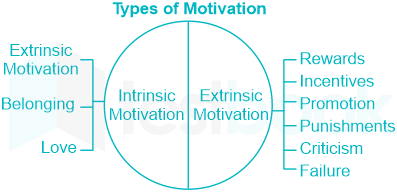
A teacher wants to ensure that her students are motivated intrinsically. She would

  1. AOption (a)

    specify uniform standards of achievement for all children.

  2. BOption (b)

    focus on the processes of learning of individual children rather than on the final outcome.

  3. COption (c)

    offer tangible rewards.

  4. DOption (d)

    plan learning activities which encourage convergent thinking.

View answer & explanation

Correct answer

Answer: (b)B.

focus on the processes of learning of individual children rather than on the final outcome.

Why this answer is correct

Motivation is simply the reason for an action and that which gives purpose and direction to behaviour. It is a general term applied to the entire class of drives, desires, needs, wishes, and similar forces. Motivation can be considered the state of having encouragement to do something.

Three Important Aspects:-

  • Needs- Biological and Sociogenic
  • Drives- keep you activated
  • Incentives- Rewards


Motivation is the best way to empower your students. By following ways teacher ensures that her student are motivated intrinsically:-

  • Always motivate them to set a greater goal. A teacher must focus on the processes of learning of individual children rather than on the final outcome.
  • By showing them how knowledge applies in real life.
  • By group work and competition.
  • By introducing then the system of rewards.

Hence, if a teacher wants to ensure that her students are motivated intrinsically. She would focus on the processes of learning of individual children rather than on the final outcome.

Question 8

Failure of a child to perform well in class tests leads us to believe that

  1. AOption (a)

    assessment is objective and can be used to clearly identify failures.

  2. BOption (b)

    there is a need to reflect upon the syllabus, pedagogy and assessment processes.

  3. COption (c)

    some children are deemed to fail irrespective of how hard the system tries.

  4. DOption (d)

    children are born with certain capabilities and deficits.

View answer & explanation

Correct answer

Answer: (b)B.

there is a need to reflect upon the syllabus, pedagogy and assessment processes.

Why this answer is correct

Assessment of the child’s abilities can only be done through feedback. It helps us to know whether the child has learned what you have taught and whether your teaching is effective. Giving and receiving feedback is a difficult undertaking as it requires the ability to deal with the feelings that arise. The assessment helps in finding the reason behind the failure of a child.

  • Failure of a child to perform well in class tests leads us to believe that there is a need to reflect upon the syllabus, pedagogy, and assessment processes.
  • The system of Comprehensive and Continous Evaluation (CCE) recommended to identify the learning needs, difficulties, and conceptual gaps to provide timely and appropriate interventions to reduce stress and anxiety and enhance learning to help all children progress.
  • It was also intended to reduce rote learning, help teachers reflect, review and improve their teaching and provide all children, including those with special needs and those belonging to the marginalized groups, with the feedback to improve their learning to bloom their potential fully.

Hence, it becomes clear that the failure of a child to perform well in class tests leads us to believe that there is a need to reflect upon the syllabus, pedagogy, and assessment processes.

Question 9

There are a few children in your class who make errors. Which of these is most likely to be your analysis of the situation?

  1. AOption (a)

    The children have poor intelligence.

  2. BOption (b)

    The children are not interested in studies and want to create indiscipline.

  3. COption (c)

    The children should not have been promoted to your class.

  4. DOption (d)

    The children have not yet gained conceptual clarity and there is need for you to reflect on your pedagogy.

View answer & explanation

Correct answer

Answer: (d)D.

The children have not yet gained conceptual clarity and there is need for you to reflect on your pedagogy.

Why this answer is correct

Children’s errors:

  • are necessary in the learning process to give insight into children's thinking.
  • help the teacher to be aware of learners' learning styles, and to cater to them according to their needs.

In the above-mentioned situation, 'the children have not yet gained conceptual clarity and there is a need for the teacher to reflect on his/her pedagogy' is most likely to be the analysis of the situation as:

  • every student differs from others on psychological aspects such as intelligence, personality, etc.
  • every child has a different pace of learning and a single method cannot be applicable to all children.
  • pedagogy helps teachers to involve children in constructing their own knowledge through experiences.

Hence, it could be concluded that 'the children have not yet gained conceptual clarity and there is a need for the teacher to reflect on his/her pedagogy' is most likely to be the analysis of the situation.

NOTE: Pedagogy refers to the set of principles that influence the approaches to teaching-learning. It consists of learning environment, teaching-learning arrangements, methods, general education principles, etc.

Question 10

A student highlights the main points in a chapter, draws a visual representation and poses questions that arise in her mind at the end of the chapter. She is:

  1. AOption (a)

    trying to regulate her own thinking by organization of ideas.

  2. BOption (b)

    trying to use the strategy maintenance rehearsal.

  3. COption (c)

    ensuring observational learning.

  4. DOption (d)

    trying to use method of loci.

View answer & explanation

Correct answer

Answer: (a)A.

trying to regulate her own thinking by organization of ideas.

Why this answer is correct

In the above-mentioned situation, the student is trying to regulate her own thinking by the organization of ideas as the organization of ideas refers to the arrangement of ideas in a systematic manner by an individual.

Key Points

Here the student is:

  • highlighting the main points which show that the child is aware of the main points and is able to identify them.
  • drawing visual representation which shows that the child is able to do abstract thinking on the basis of her understanding.
  • posing questions which shows her curiosity & inquisitiveness and enables her to make the best of her educational experiences.

Hence, it could be concluded that in the above-mentioned situation, he is trying to regulate her own thinking by the organization of ideas. 

Additional Information

  • Observational learning: It is a learning method which implies that student learns by observing and analyzing. Here, the child learns through watching others, keeping information, and then later recreating the behaviors that were observed.
  • Strategy maintenance rehearsal: It involves the repetition of items in order to memorize them. It is also called as the rote rehearsal. For example, When we have a speech in our school, we continuously and repeatedly rehearse the speech in order to memorize it.
  • Method of loci: It is used to recall a piece of information. It is a strategy for memory enhancement. The Loci system was used by Greek and Roman orators to remember the content and sequence of long speeches.

Question 11

How can a teacher help children become better problem solvers?

  1. AOption (a)

    By giving children a variety of problems to solve and support while solving them

  2. BOption (b)

    By encouraging children to look for answers to the problems in the textbook

  3. COption (c)

    By providing correct solutions to all the problems they pose to students

  4. DOption (d)

    By giving tangible rewards for solving problems

View answer & explanation

Correct answer

Answer: (a)A.

By giving children a variety of problems to solve and support while solving them

Why this answer is correct

Problem-Solving Approach: Problem-solving is a learner-centred approach that emphasizes learner's active involvement in the learning process. It helps the children to learn better by catering totality of their experiences that occur in the educational process.

Teachers can model different aspects of problem-solving and engage students in activities and discussions around the concept. These are some ways by which teacher help children to become better problem solver-

  • By providing multiple potential solutions for any problem
  • By giving children a variety of problems to solve and support while solving them
  • By 'do-it-yourself' projects
  • By teaching basic problem-solving steps
  • By Continous and Comprehensive Evaluation

Hence, from the above-mentioned points, it becomes clear that a teacher help children become better problem solvers by giving children a variety of problems to solve and support while solving them.

Question 12

In the following statements, which one do you agree with?

  1. AOption (a)

    Learning is completely governed by external stimuli.

  2. BOption (b)

    Learning cannot take place unless it is assessed externally in terms of marks.

  3. COption (c)

    Learning has taken place only if it is evident in behaviour.

  4. DOption (d)

    Learning takes place in a socio-cultural context.

View answer & explanation

Correct answer

Answer: (d)D.

Learning takes place in a socio-cultural context.

Why this answer is correct

Learning is the acquisition of new behaviour or the strengthening or weakening of old behaviour as a result of experience. It represents progressive changes in behaviour. It also involves the acquisition of knowledge, habits, and attitude. The term learning covers every modification in behaviour to meet environmental requirements.

  • Socio-cultural changes in society impact the content and objectives of education. It is a relationship between education and social change.
  • Learning activities in such social contexts may be cooperative, collaborative, planned or unplanned, and they can be led by one or more individuals, or be completely self-organizing.
  • Learning in the social context refers to all learning that occurs in and among groups of people. So, learning takes place in a socio-cultural context.
  • However, education is also influenced by the socio-cultural changes that take place in society, it responds to the socio-cultural changes by re-organizing its content and process and by reinterpreting its goals and objectives.
  • During the past few decades, acculturation, and living together have been emphasized as desirable goals of education.

Hence, from the above-mentioned points, it becomes clear that learning takes place in a socio-cultural context.

Question 13

Which one of these is a principle of child development?

  1. AOption (a)

    Development occurs due to interaction between maturation and experience.

  2. BOption (b)

    Experience is the sole determinant of development.

  3. COption (c)

    Development is determined by reinforcement and punishment.

  4. DOption (d)

    Development can accurately predict the pace of each individual child.

View answer & explanation

Correct answer

Answer: (a)A.

Development occurs due to interaction between maturation and experience.

Why this answer is correct

Development is a process by which an individual grows and changes throughout the life cycle. The term development applies to the changes that have a direction and hold a definite relationship with what precedes it. ​

Key Points Facts about Development:

  • The development process passes through different stages. Each stage of development has certain distinct and specific characteristics.
  • When any process once gets complete on the basis of which learner can learn a new skill is called Maturation.
  • Maturation refers to the changes that follow an orderly sequence and are largely dictated by the genetic blueprint which produces Growth, Development, and Evolution commonalities in our growth and development.
  • Maturity comes from learning and experiences and hence the development of a person occurs.
  • Development occurs due to the interaction between maturation and experience.
  • Development is a progressive series of qualitative changes that occur as a result of maturity and experience.

Therefore, it becomes clear that development occurs due to the interaction between maturation and experiences.

Question 14

In the context of 'nature - nurture' debate, which one of the following statements seems appropriate to you?

  1. AOption (a)

    A child is like a blank slate whose character can be moulded by the environment into any shape.

  2. BOption (b)

    Environmental influences only have a little value in shaping up a child's behaviour which is primarily genetically determined.

  3. COption (c)

    Heredity and environment are inseparably interwoven and both influence development.

  4. DOption (d)

    Children are genetically predisposed to what they would be like irrespective of whatever environment they grow up in.

View answer & explanation

Correct answer

Answer: (c)C.

Heredity and environment are inseparably interwoven and both influence development.

Why this answer is correct

Debates are a great way to exchange ideas. They can help you improve your knowledge and your reasoning skills. Debates always help to develop essential critical thinking skills about any topics that help the learner to look at any issues from different angles.

Key Points

  • The term ‘nature’ stands for what comes to children through genetic influences and heredity, i.e. it denotes the influence of factors inherent in the child himself from the time he is conceived.
  • On the other hand, the term ‘nurture’ stands for the influence of the environment on child development, i.e. all the contextual factors that influence who we are, including our perceptions of early childhood, our social relationships, and the society around us.
  • There is a relationship between heredity and environment factors in determining development. Nature refers to heredity, influenced by inherited characteristics of personality, physical growth, intellectual growth and social interaction. Nurture refers to the influence of the environment of all of those same things and includes parenting style, physical surroundings, economic factor and anything that can have an influence and development that does not come from within the person.
  • Development is a product of the complex interaction of heredity (nature) and environment (nurture). Heredity gave us the abilities for development, which are used by the environment. Heredity can best be viewed as something that sets a range within which an individual’s development is actually shaped by the support and opportunities of the environment.

Therefore, In the context of the 'nature-nurture' debate, we can say that heredity and environment are inseparably interwoven and both influence development.

Question 15

Socialization is a process of

  1. AOption (a)

    acquiring values, beliefs and expectations.

  2. BOption (b)

    assimilation and accommodation.

  3. COption (c)

    learning to critique the culture of a society.

  4. DOption (d)

    socializing with friends.

View answer & explanation

Correct answer

Answer: (a)A.

acquiring values, beliefs and expectations.

Why this answer is correct

Socialization: It refers to the process which transforms a quite helpless human infant into a self-aware, knowledgeable person who is skilled in the ways of their society’s culture. Socialization is a Life-Long process that continues throughout life from birth to adulthood. 

Key Points

  • Socialization is a process of acquiring values, beliefs, and expectations.
  • Socialization is a process in which a person adapts all the social behaviour as-
  • Adaptation of social values and principles.
  • Adaptation of cultural rituals
  • Adaptation of skills
  • Socialization is a combination of personality development and cultural development.

Types of Socialization:

  • Primary Socialization: It happens during infancy and childhood, during this phase, infants learn language and certain basic Socialization behavior forms of the family and the society in which she/he lives. Agents of primary socialization are parents and family. For children, their families are the primary agent of socialization since they are in immediate contact with their family members, who in turn introduce them to the outside world.​
  • Secondary Socialization: It occurs once the infant passes into the childhood phase and continues into maturity. During this phase more than the family some other agents of socialization like the school and friends.

Therefore, from the above-mentioned points, it becomes clear that Socialization is a process of acquiring values, beliefs, and expectations.

Question 16

Piaget proposes that pre-operational children are unable to conserve. He attributes this inability to which one of the following factors?

  1. AOption (a)

    Inability of hypothetico-deductive reasoning

  2. BOption (b)

    Personal fable

  3. COption (c)

    Irreversibility of thought

  4. DOption (d)

    Lack of high-level abstract reasoning

View answer & explanation

Correct answer

Answer: (c)C.

Irreversibility of thought

Why this answer is correct

Jean Piaget, a Swiss psychologist, has made a systematic study of cognitive development in his theory that is categorized in four stages. Each stage is characterized by a distinct way of thinking and is age-related.

  • He observed his children and their process of making sense of the world around them and developed a model of how the mind processes new information encountered.
  • Piaget’s Pre-operational stage is from 2 - 7 years. In this stage, the child faces problems with the irreversibility of thought, concept of conservation, and struggles with the idea of centration.
  • Due to the Irreversibility of thought, the child can focus his attention only on one aspect of the situation at a time and cannot reverse the direction of his thought.

Important Points

The Four Stages of Cognitive Development:

StagesDevelopment
Sensorimotor (0 to 2 years)- In this stage, infants progressively construct an understanding of the world by using their senses (vision and hearing) along with physical interactions with objects (grasping, sucking, and stepping). - The development of object permanence is one of the most important accomplishments of this stage.
Pre-operational (2 to 7 years)- EgocentricThinking and Irreversibility of thought. - Children develop memory, curiosity, and imagination. - They are also able to understand things symbolically (playing house, having a tea party).
Concrete Operational (7 to 12 years)- Ability to distinguish between their own thoughts and the thoughts of others - children can classify objects by their number, mass, etc - Ability to think logically about objects and events
Formal Operational (12 years to older)- Abstract and scientific thinking - Capable of hypothetical and deductive reasoning - Ability to think abstractly, metacognition and problem-solving.


Therefore from the above-mentioned points, it is clear that Piaget attributed the above-mentioned inability to the Irreversibility of Thought.

Question 17

According to Piaget's theory, children learn by

  1. AOption (a)

    memorizing information by paying due attention.

  2. BOption (b)

    scaffolding provided by more able members of the society.

  3. COption (c)

    processes of adaptation.

  4. DOption (d)

    changing their behaviour when offered appropriate rewards.

View answer & explanation

Correct answer

Answer: (c)C.

processes of adaptation.

Why this answer is correct

Swiss biologist and psychologist Jean Piaget observed his children and their process of making sense of the world around them and how the mind processes new information encountered.

Piaget’s Key Concepts:

  • Schema: A representation in the mind of a set of ideas or actions which go together.
  • Assimilation: The process of taking in information into our previously existing schemas.
  • Accommodation: Involves altering existing ideas or schemas as a result of new experiences.
  • Equilibration: A mechanism that assists children in achieving a balance between assimilation and accommodation.
  • Piaget says learning starts with an adaptation that can be achieved through assimilation and accommodation.
  • He believed that learning is a lasting change in behaviour due to the acquisitions that result from experience and this learning process occurs at gradual levels, as the existence of previous mental structures built through individual (assimilation and accommodation) are necessary for the adaptation of a coherent system through a balancing self-regulating. So, for the learning process of adaptation is necessary.

Hence, from the above-mentioned points, it becomes clear that according to Piaget's theory, children learn by processes of adaptation.

Question 18

According to Vygotsky, zone of proximal development is

  1. AOption (a)

    zone demarking the support offered by the teacher.

  2. BOption (b)

    the gap between what the child can do independently and with assistance.

  3. COption (c)

    the amount and nature of support provided to the child to achieve her potential.

  4. DOption (d)

    what the child can do on her own which cannot be assessed.

View answer & explanation

Correct answer

Answer: (b)B.

the gap between what the child can do independently and with assistance.

Why this answer is correct

'Lev Vygotsky', a Soviet psychologist, has propounded the "Socio-cultural Theory". This theory implies the idea that social interaction plays a crucial role in the development of learners' cognitive ability. 

According to Vygotsky, 'zone of proximal development' or 'ZPD' refers to the:

  • the gap between what the child can do independently and with assistance.
  • difference between what a learner can do on his/her own and what he/she can do with someone's help.
  • range of tasks too difficult for the child to do alone, but possible with the help of adults and more skilled peer.
  • distance between learners' actual development level and his/her level of development under someone's guidance.

Additional Information

Other Important Terms Proposed by Vygotsky in his 'Socio-cultural Theory':

  • Scaffolding: It refers to a process through which temporary support is imparted to the learners to enhance learning to achieve goals.
  • More Knowledgeable Other(MKO): It refers to a person with a higher skill level and a better understanding of the concepts than the learners.

Hence it could be concluded that according to Vygotsky, the zone of proximal development is the gap between what the child can do independently and with assistance.

Question 19

A teacher in a multi-cultural classroom would ensure that the assessment considers the following:

  1. AOption (a)

    Reliability and validity of her assessment tool

  2. BOption (b)

    Expectations of the school administration by complying with the minimum levels of learning

  3. COption (c)

    Standardization of the assessment tool

  4. DOption (d)

    Socio-cultural context of her students

View answer & explanation

Correct answer

Answer: (d)D.

Socio-cultural context of her students

Why this answer is correct

A multi-cultural classroom is a classroom with learners having more than one culture and from different backgrounds. It incorporates values, beliefs, perspectives, the identity of learners from different cultural backgrounds**.**

  • Assessment is a process of collecting, receiving, and using data for the purpose of improvement in the learning process. It determines the effectiveness of the learning process or program.

Key Points

A teacher in a multi-cultural classroom would ensure that the assessment considers the Socio-cultural context of her student as:

  • Social interaction and cultural context play a crucial role in the development of learners' cognitive ability.
  • In a multi-cultural classroom, the way students respond to assessment is subject to social and cultural influences.
  • Assessment is a social activity and we can understand it only by taking account of the social-cultural context in which it operates.
  • Education responds to the socio-cultural changes by re-organizing its content and process and by reinterpreting its goals and objectives
  • There is a relationship between education and social change because socio-cultural changes in society impact the content and objectives of education.

Hence, it could be concluded that a teacher in a multi-cultural classroom would ensure that the assessment in the Socio-cultural context of her students.

Question 20

An upper primary school constructivist classroom would foresee the following role of students in their own assessment:

  1. AOption (a)

    Make detailed guidelines for how marks would be correlated to students' achievement and prestige in class.

  2. BOption (b)

    Students would be the sole determinants of their own assessment.

  3. COption (c)

    Students would plan for assessment with the teacher.

  4. DOption (d)

    Denying that assessment has a role in teaching-learning.

View answer & explanation

Correct answer

Answer: (c)C.

Students would plan for assessment with the teacher.

Why this answer is correct

The constructivist classroom is related to the constructivist approach of education which gives primacy to collaborative learning by involving learners in discussions and projects.

An upper primary school constructivist classroom would foresee the student's active involvement in their own assessment plan with the teacher as constructivist environment:

  • emphasizes on collaboration with others for learning.
  • ensures the active involvement of learners and promotes peer tutoring.
  • allows learners to foster their own strategy of learning to perform a task.
  • provides ample opportunities to learners to make them work at their own pace.
  • views learners as makers of meaning and creators of knowledge through social interaction.

Constructivist classroom gives primacy to:

  • peer tutoring.
  • group activity.
  • Self-assessment.
  • dignified discussion.
  • cooperative learning.
  • face to face interaction.

Hence, it could be concluded that an upper primary school constructivist classroom would foresee students' active involvement in planning for their own assessment with the teacher.

Question 21

The rationale behind inclusive education is that

  1. AOption (a)

    society is heterogeneous and schools need to be inclusive to cater to heterogeneous society.

  2. BOption (b)

    we need to take pity on special children and provide them access to facilities.

  3. COption (c)

    it is not cost-effective to provide for separate schools for special children.

  4. DOption (d)

    the benchmarks for performance of each child should be uniform and standardized.

View answer & explanation

Correct answer

Answer: (a)A.

society is heterogeneous and schools need to be inclusive to cater to heterogeneous society.

Why this answer is correct

Inclusive Education refers to the inclusion of all children in the education system, regardless of their differences and disabilities. Inclusive education welcomes and celebrates diversity.

  • A heterogeneous society refers to a society that includes all individuals with different abilities, interests, educational level, skills, cultural backgrounds, beliefs, values, sexes, ages, ethnicities, etc.

Important Points

The rationale behind inclusive education is that society is heterogeneous and schools need to be inclusive to cater to heterogeneous society as:

  • It values the diversity, each child brings to the classroom and facilitates all with equal opportunities to learn and grow.
  • Inclusive education improves the quality and making provisions of education for all.
  • It provides a provision to include disabled children along with normal children in a regular classroom environment.
  • It refers to an education system that accommodates all children regardless of their physical, intellectual, social, emotional, linguistic, or other conditions.
  • It is a process where diversity in a group with respect to any aspect is appreciated and in which everyone is recognized and respected for his/her worth.
  • It is an effort to make sure that diverse learners – those with disabilities, different languages and cultures, different homes and family lives, different interests and ways of learning - are taught using teaching-learning strategies adapted to individual learning needs.
  • It is a process that allows every individual to feel accepted, valued, and safe. An inclusive community consciously evolves to meet the changing needs of its members.

Therefore, we can conclude that the rationale behind inclusive education is that society is heterogeneous and schools need to be inclusive to cater to heterogeneous society.

Question 22

Which one of the following would be the most effective way to identify a creative child by the teacher?

  1. AOption (a)

    Observing how the child interacts with peers in team tasks

  2. BOption (b)

    Administering standardized intelligence tests

  3. COption (c)

    Giving objective type tests

  4. DOption (d)

    Detailed observation of the child especially when she solves problems

View answer & explanation

Correct answer

Answer: (d)D.

Detailed observation of the child especially when she solves problems

Why this answer is correct

Creativity refers to a cognitive ability to produce something original by offering a fresh perspective. Creativity is goal-directed thinking which is unusual, novel, and useful. Creativity is considered as the ability to produce something original or to find the solution to a problem by themselves.

Creative children have the ability to create or produce something. They have the ability to solve problems or tasks in a creative way by means of generating many original ideas.

Signs of Creativity:

  • High levels of creativity and the ability to create original and imaginative ideas
  • A heightened sense of awareness
  • Good skills in problem-solving
  • Curious and impulsive nature
  • Fast learners with good memories
  • Innovators and good problem solvers
  • Fluency of ideas

NOTE: Giving objective type tests, intelligence tests, and observing how the child interacts with peers in team tasks, are not effective ways to identify a creative child by the teacher.

Hence, it becomes clear that detailed observation of the child especially when she solves problems would be the most effective way to identify a creative child by the teacher.

Question 23

A teacher can effectively respond to the needs of children from 'disadvantaged sections' of society by

  1. AOption (a)

    telling the 'other children' to co-operate with the 'disadvantaged children' and help them learn the ways of the school.

  2. BOption (b)

    reflecting on the school system and herself about various ways in which biases and stereotypes surface.

  3. COption (c)

    ensuring that the children do not get a chance to interact with each other to minimize the chances of their being bullied.

  4. DOption (d)

    sensitizing the disadvantaged children to the norms and strictures of schools so that they can comply with those.

View answer & explanation

Correct answer

Answer: (b)B.

reflecting on the school system and herself about various ways in which biases and stereotypes surface.

Why this answer is correct

The term 'underprivileged' refers to the disadvantaged section of people who are economically, socially, and vocationally in an unfavorable situation compared to the rest of the population of the society. 

  • The disadvantaged section/background refers to not just low income, but also encompasses lower educational achievement, poverty, poor health, financial insecurity, etc.

Key Points

A teacher can effectively respond to the needs of children from 'disadvantaged sections' of society by:

  • reflecting on the school system and herself about various ways in which biases and stereotypes surface.
  • relating their local knowledge with the classroom environment to make them feel comfortable and participate in learning.
  • awaking the consciousness of students to take responsibility for their selves and develop a quest for personal improvement.
  • understanding the mental conditions of disadvantaged children and by celebrating unity in diversity in school or classroom programs.
  • valuing their cultural and linguistic knowledge as disadvantaged children lack good cognitive development, phonological awareness, etc.

Hence, it could be concluded that a teacher can effectively respond to the needs of children from 'disadvantaged sections' of society by reflecting on the school system and herself about various ways in which biases and stereotypes surface.

Additional Information

Characteristic of children belonging from Disadvantaged Sections:

  • Poor academic performance, high drop-out rates
  • Emotional Deprivation and lack of adequate nurturance
  • Reading and other learning disabilities and adjustment problems
  • They are not exposed to a wide variety of experiences and facilities
  • They have separation anxiety and face difficulty in adjusting to society

Question 24

Research has pointed out that several levels of discrimination exist in the schools. Which of these is not an example of discrimination at upper primary level?

  1. AOption (a)

    Many teachers use only lecture method to teach.

  2. BOption (b)

    Dalit children are made to sit separately during mid-day meals.

  3. COption (c)

    Girls are not encouraged to take up maths and science.

  4. DOption (d)

    Teachers have low expectations of children from lower socio-economic strata.

View answer & explanation

Correct answer

Answer: (a)A.

Many teachers use only lecture method to teach.

Why this answer is correct

Discrimination is an act of making a difference between human beings based on group, classes, colour and communities. In the context of school or classroom, it refers to the process of treating learners unfairly on the basis of their characteristics.

Here, many teachers use only the lecture method to teach is not an example of discrimination at upper primary level as Lecture method is an old & traditional method of teaching.

  • This method is helpful in imparting a large amount of factual information within a short period.
  • In the lecture method, the teacher is an active participant and the students are passive listeners.
  • The class listens, writes, and notes facts and the ideas for remembering and to think them over later.
  • The lecture method is a one-way method thus only relevant in concepts dealing with theoretical understanding.
  • In practical implementation of concepts dealing with learning by doing, the lecture methods become inconsequential.

​Hence, it could be concluded that many teachers use only the lecture method to teach is not an example of discrimination at the upper primary level.

Question 25

Which of these is a characteristic of a child with learning disability?

  1. AOption (a)

    An IQ below 50

  2. BOption (b)

    Bullying other children and engaging in aggressive acts

  3. COption (c)

    Doing the same motor action repeatedly

  4. DOption (d)

    Difficulty in reading fluently and reversing words

View answer & explanation

Correct answer

Answer: (d)D.

Difficulty in reading fluently and reversing words

Why this answer is correct

Learning Disability: It is a neurological disorder that affects the way one receives and processes information. It has nothing to do with the intelligence of an individual.

  • Learning disabilities can be lifelong conditions that can affect one's experience at school, work, daily routine and social situations.
  • A learning disability is not a problem with intelligence or motivation.

A few of the Learning Disabilities are:

DisabilitySymptoms
DyslexiaInaccurate word recognition, poor reading comprehension, oral reading skills, difficulty in reading fluently, and reversing words
DysphasiaInability to produce spoken words or organizing thoughts and lack of fluency of speech
DyscalculiaInability to understand number concepts, memorizing multiplication tables or solving basic math problems
DyspraxiaDifficulty with motor skills, non-verbal learning disability, and problems with movement and coordination
DysnomiaA severe inability to retrieve or recall names or the correct word from memory when needed


Characteristics of a Child with Learning Disability: Children with learning disabilities experience difficulty in learning and using certain skills namely reading, writing, listening, and mathematics calculations. Children can also face difficulty in reading fluently and reversing words because of learning disabilities.

Hence, from the above-mentioned points, it becomes clear that difficulty in reading fluently and reversing words is a characteristic of a child with a learning disability.

Question 26

Which one of the following statements best describes why children should be encouraged to ask questions in the class?

  1. AOption (a)

    Questions increase the curiosity of the children.

  2. BOption (b)

    Questions take learning forward by interactions and lead to conceptual clarity.

  3. COption (c)

    Children need to practise their language skills.

  4. DOption (d)

    Children can be made to realize that they lack intelligence by making them think of all the things they don't know about.

View answer & explanation

Correct answer

Answer: (b)B.

Questions take learning forward by interactions and lead to conceptual clarity.

Why this answer is correct

Questioning refers to the most effective strategy to arise curiosity and inquisitiveness too. Asking questions makes the classroom's ambiance more interactive.

Key Points

In the class, questioning by students should be encouraged as it could enhance their cognitive competencies in the following ways:

  • Questions take learning forward by interactions and lead to conceptual clarity.
  • Questions inspire learners to look out for information that aligns with their pursuits and might consequently promote lifelong learning.
  • Asking questions allows learners to link between various pieces of information which can assist them in structuring essays and debates.
  • Questioning boosts their confidence-up, makes them able to put forth their views, and helps the children to make the best of their educational experiences.​

​Hence, it could be concluded that children should be encouraged to ask questions in the class as questions take learning forward by interactions and lead to conceptual clarity.

Question 27

Which one of the following assessment practices will bring out the best in students?

  1. AOption (a)

    When students are required to reproduce facts as tested via multiple choice questions

  2. BOption (b)

    When conceptual change and students' alternative solutions are assessed through several different methods of assessment.

  3. COption (c)

    When the marks obtained and the position secured by the student in the class are the ultimate determinants of success

  4. DOption (d)

    When the emphasis is laid upon positive correlation between test scores and student ability

View answer & explanation

Correct answer

Answer: (b)B.

When conceptual change and students' alternative solutions are assessed through several different methods of assessment.

Why this answer is correct

Assessment is a process of collecting, receiving, and using data for the purpose of improvement in the learning process. It is integral to the teaching-learning process which helps in facilitating student learning and improving instructions.

Assessment facilitates mapping different dimensions of a child’s development holistically to provide a more authentic picture to help the child, teacher, and hence the system.

Assessing conceptual change and students' alternative solutions through several different methods of assessment will be a suitable practice to bring out the best in students as it will help the teacher in:

  • collecting relevant information on student learning.
  • making reliable decisions about educational planning.
  • determining the effectiveness of the learning process or program.
  • promoting a learner-friendly environment to optimize student learning.
  • assessing both scholastic and co-scholastic aspects of students' growth.
  • laying emphasis on thought processes and de-emphasizing memorization.

Therefore, from the above-mentioned points, it is clear that assessing conceptual change and students' alternative solutions through several different methods of assessment will be a suitable practice to bring out the best in students.

Question 28

The amount and type of scaffolding to a child would change depending on the

  1. AOption (a)

    mood of the teacher.

  2. BOption (b)

    rewards offered for the task.

  3. COption (c)

    level of the child's performance.

  4. DOption (d)

    child's innate abilities.

View answer & explanation

Correct answer

Answer: (c)C.

level of the child's performance.

Why this answer is correct

Vygotsky’s Sociocultural Theory of Learning:

  • Vygotsky was a Russian psychologist who believed that social interactions play a key role in development. According to him, learning occurs when children interact with people and the environment.
  • He explains this with the concept of the Zone of Proximal Development (ZPD), which refers to a range of tasks that a child can achieve only with assistance from a more skilled adult or peer called the More Knowledgeable Other (MKO). Adult assistance is provided wherever necessary which is called Scaffolding.
  • Vygotsky embedded in this theory, the concept of 'private speech' which is a kind of speech directed to self with no communicative function. Children use private speech to guide their actions by speaking themselves.

Scaffolding:

  • It refers to a technique that provides the right kind of support in the right amount at the right time to increase a child’s competence.
  • In other words, it is a means by which a child's 'zone width' (or potential for new learning) can be assessed. i.e. scaffolding helps with providing support to learners in their initial phase of learning, which is in the right amount and gradually decreases as the learner progresses.
  • Scaffolding to a child would change depending on the level of the child's performance.
  • As children are given assistance or shown how to perform certain tasks, they use this information as a guide on how to perform these tasks and eventually learn to perform them independently.
  • Scaffolding helps a learner to move from a Zone of Actual Development to Zone of Proximal Development and finally reach to Zone of Desired Development, with the help of a more experienced person like peers, elders in the family, or teachers.

Hence, from the above-mentioned points, it becomes clear that amount and type of scaffolding to a child would change depending on the level of the child's performance.

Question 29

As an upper primary school mathematics teacher you believe that

  1. AOption (a)

    students' errors provide insights into their thinking.

  2. BOption (b)

    not all children have the ability to study mathematics in upper primary school.

  3. COption (c)

    boys will learn mathematics without much effort since they are 'born with it' and you need to pay more attention to girls.

  4. DOption (d)

    students need to possess procedural knowledge even if they don't understand conceptual basis.

View answer & explanation

Correct answer

Answer: (a)A.

students' errors provide insights into their thinking.

Why this answer is correct

Error: When a student can’t master a topic, he/she is vulnerable to make errors. Errors are nothing but incorrectness made by a student during learning. 

As an upper primary school mathematics teacher one should believe that students' errors provide insights into their thinking as student’s errors:

  • are a significant step in the teaching-learning process.
  • give insight into students' conceptual mistakes and basic knowledge.
  • are considered as a part of the teaching-learning process as it helps to understand the child.
  • help the teacher to be aware of learners' learning styles, to cater to them according to their needs.

Hence, it could be concluded that as an upper primary school mathematics teacher one should believe that students' errors provide insights into their thinking.

Reasons for errors and misconceptions:

  • Lack of interest & knowledge
  • Misunderstanding of concept
  • Missing out on important points or steps
  • Inability to grasp the central idea or concept
  • Forgetting related previously assimilated knowledge​

Question 30

Which one of the following statements do you agree with?

  1. AOption (a)

    A child fails because the government is not giving enough technological resources in schools.

  2. BOption (b)

    A child's failure can be attributed directly to the genetic material he/she has acquired from his/her parents.

  3. COption (c)

    A child's failure is a reflection on the system and its inability to respond to the child.

  4. DOption (d)

    A child's failure is primarily due to lack of parent's education and economic status.

View answer & explanation

Correct answer

Answer: (c)C.

A child's failure is a reflection on the system and its inability to respond to the child.

Why this answer is correct

Failure is the state or condition of not meeting a desirable aim and may be viewed as the opposite of success. There are many cognitive, physical, intellectual, scholastical, emotional, and cultural causes for the failure of students.

A child's failure is a reflection on the system and its inability to respond to the child as:

  • children are like clay, the way the system mold them the shape they acquire.
  • children fail because teaching is not done in a way that is meaningful to them
  • every child has the potential to excel provided that they are given proper guidance.
  • the school system does not take care of the needs and interests of every student.

Other Reasons for the Failure of Students in Schools are:

  • lack of adequate practice
  • Teaching through incorrect teaching methods
  • Non-coordination between teaching and learning
  • Not being compatible with the school environment

Hence, it becomes clear that a child's failure is a reflection on the system and its inability to respond to the child.

Mathematics and Science (60 questions)

Question 31

Place of mathematics education in the curricular framework is positioned on twin concerns:

  1. AOption (a)

    What mathematics education can do to improve the score of students in summative examination and how it can help to choose right stream in higher classes

  2. BOption (b)

    What mathematics education can do to improve communication skills of every child and how it can make them employable after school

  3. COption (c)

    What mathematics education can do to engage the mind of every student and how it can strengthen the student's resources

  4. DOption (d)

    What mathematics can do to retain every child in school and how it can help them to be self-dependent.

View answer & explanation

Correct answer

Answer: (c)C.

What mathematics education can do to engage the mind of every student and how it can strengthen the student's resources

Why this answer is correct

Mathematics, we found its applicability in various areas. The learner-centred curriculum will help to inculcate values by incorporating appropriate contents and activities. 

  • It is certainly true that most of the skills taught at the primary stage are useful in everyday life. It will make better use of the time children spend in schools in terms of the problem solving and analytical skills it builds in children, and prepare them better to encounter a wide variety of problems in life.
  • Our reflections on the place of mathematics teaching in the curricular framework are positioned on these twin concerns: what mathematics education can do to engage the mind of every student, and how it can strengthen the student’s resources.
  • We describe our vision of mathematics in school, attempt to delineate the core areas of concern and offer recommendations that address the concerns, based on these twin perspectives.

Hence, we conclude that the twin concerns are what mathematics education can do to engage the mind of every student and how it can strengthen the student's resources.

Question 32

LCM of 22, 54, 135 and 198 is

  1. AOption (a)

    22×33×5×112^2 \times 3^3 \times 5 \times 11

  2. BOption (b)

    2×33×5×112 \times 3^3 \times 5 \times 11

  3. COption (c)

    2×33×52×112 \times 3^3 \times 5^2 \times 11

  4. DOption (d)

    23×32×5×112^3 \times 3^2 \times 5 \times 11

View answer & explanation

Correct answer

Answer: (b)B.

2×33×5×112 \times 3^3 \times 5 \times 11

Why this answer is correct

Concept:

LCM is lowest common multiple which can be found using prime factorization method.In this we find the prime factors of the given numbers individually and LCM of two numbers is the  product of prime factors counted the maximum number of times they occur in any of the numbers.

Calculation:

22 = 2 × 11

54 = 2 × 33

135 = 33 × 5

198 = 2 × 3 × 3 × 11

∴ LCM of 22, 54, 135 and 198 = 2 × 33 × 5 × 11

Question 33

In class VI, in the unit of 'Understanding Quadrilaterals, important results related to angle-sum property of quadrilaterals are introduced using paper folding activity followed by the exercise based on these properties.

At this level proof of the angle property is not given, as the students of class VI are at Van Hiele level of

  1. AOption (a)

    Level 2 - Informal Deduction

  2. BOption (b)

    Level 3 - Deduction

  3. COption (c)

    Level 0 - Visualization

  4. DOption (d)

    Level 1 - Analysis

View answer & explanation

Correct answer

Answer: (a)A.

Level 2 - Informal Deduction

Why this answer is correct

Van-Hiele (The Netherlands) geometrical thought describes the different level of learning geometry on the basis of understanding. In the Informal Deduction, the child understands the Properties of shapes and Relation among properties. 

Following are the steps of all the five levels-

  • Visualization-
  • Shapes
  • Classes of Shapes
  • Analysis-
  • Classes of Shapes
  • Properties of Shapes
  • Informal Deduction-.
  • Properties of shapes
  • Relation among properties
  • Deduction-
  • Relation among properties
  • Deductive symptoms of properties
  • Rigour- 
  • Deductive symptoms of properties
  • Analysis of deductive symptoms

Hence, we conclude that the above situation is of informal deduction.

Question 34

The term, 'Mathematical tools' refers to

  1. AOption (a)

    Calculators, rulers, tape measures, protractors, compass, etc.

  2. BOption (b)

    All types of materials including language, written symbols, meaningful instructions to establish their purpose.

  3. COption (c)

    Physical material like geo-board and 3D models, cubic rods, etc.

  4. DOption (d)

    Charts based on formulae and concepts, graph papers, dotted sheets, etc.

View answer & explanation

Correct answer

Answer: (b)B.

All types of materials including language, written symbols, meaningful instructions to establish their purpose.

Why this answer is correct

Mathematics is the study of numbers, shape, quantity, and patterns. Mathematics is the ‘queen of all sciences’ and its presence is there in all the subjects. It acts as the basis and structure of other subjects.

  • Mathematics reveals hidden patterns that help us to understand the world around us. In mathematics, we deal with numbers, calculations, measurement of shapes and structures, establishing relationships among variables, etc.
  • The goal of mathematics education in school is to develop a child’s thinking, clarity of thought, and pursuing assumptions to logical conclusions.
  • Mathematics is the science of all sciences and art of all arts.
  • Mathematics tools consist of all types of materials including language, written symbols, meaningful instructions to establish their purpose.
  • The presence of Mathematics can be seen anywhere including subjects like sciences, agriculture, psychology, history, geography, drawing, arts, and commerce. So, Mathematics correlates with all other subjects.
  • Mathematical tools play an ever-more important role in today’s mathematics.
  • Students use calculators, computers, manipulatives, and other mathematical tools to enhance mathematical thinking, understanding, and power.

All other options are also included in Mathematical tools. But the given correct option is the best choice among all.

Hence, it becomes clear that 'Mathematical tools' refer to all types of materials including language, written symbols, meaningful instructions to establish their purpose.

Question 35

Four stages of language development in mathematics classroom in order are

  1. AOption (a)

    Everyday language →  Mathematized situation language → Language of Mathematics problem solving → Symbolic language 

  2. BOption (b)

    Everyday language → Language of Mathematics problem solving → Mathematized situation language → Symbolic language 

  3. COption (c)

    Everyday language → Language of Mathematics problem solving → Symbolic language → Mathematized situation language 

  4. DOption (d)

    ​Everyday language → Symbolic language → Language of Mathematics problem solving → Mathematized situation language 

View answer & explanation

Correct answer

Answer: (a)A.

Everyday language →  Mathematized situation language → Language of Mathematics problem solving → Symbolic language 

Why this answer is correct

Mathematics is a man-made, well-disciplined subject, which deals with abstract concepts and things. It has its own language, its own tools and mode of operation to help people in a proper understanding of nature’s work and complicated problems of life. 

  • In math, however, their language problem is confounded by the inherently difficult terminology, some of which they hear nowhere outside of the math classroom.

Key Points

The four stages of language development in the mathematics classroom in order are as follows;

  • Everyday language: This stage begins with everyday language, which is acquired naturally through social interaction. Mathematized language is similar to everyday language but makes the mathematical concepts that are present in the everyday language explicit.
  • Mathematized situation language: Language in mathematics is an essential component to make it more “real” to learners, and this can be done through the context in which mathematics is taught. At this stage S=students, through language, can think and talk mathematics and in this way, the relevance and application of mathematics to real-life situations can be facilitated.
  • Language of Mathematics problem solving: The language used in the problem is often more complex than it needs to be in order to do the math. At this stage, language is used to describe the situation in a word problem, they will have difficulty connecting the mathematical operations to the situation.
  • Symbolic language: At this stage, the learner learns the symbols that are used in mathematics. Mathematics is viewed as symbolic in nature and thus not hindering its comprehension by second or third language speakers. The language of mathematics then allows the child to verbalize the fact that she has to add some unknown amount to the money she has (15)soitequalsthepriceofthedoll(15) so it equals the price of the doll (22), and finally, move to symbolic language: 15 + x = 22. At each step in this process, the language of math must be more consciously taught and learned; if this does not happen, children will have difficulty reaching the stage of symbolic language.

Hence, we conclude that the correct order is Everyday language →  Mathematized situation language → Language of Mathematics problem solving → Symbolic language.

Question 36

A learner exhibiting difficulty in sorting, recognizing patterns, orienting numbers and shapes, telling time and measurement may have dyscalculia with difficulty in

  1. AOption (a)

    language processing

  2. BOption (b)

    visual-motor coordination

  3. COption (c)

    visual-spatial skills

  4. DOption (d)

    visual-memory 

View answer & explanation

Correct answer

Answer: (c)C.

visual-spatial skills

Why this answer is correct

Some students have disturbances in the visual-spatial-motor organization, which may result in weak or lacking understanding of concepts, very poor "number sense," specific difficulty with pictorial representations and/or poorly controlled handwriting and confused arrangements of numerals and symbols. Students with profoundly impaired conceptual understanding often have substantial perceptual-motor deficits and are presumed to have right hemisphere dysfunction.

  • A learner exhibiting difficulty in sorting, recognizing patterns, orienting numbers and shapes, telling time and measurement may have dyscalculia with difficulty in visual-spatial skills. visual-spatial learners would share the disadvantage of missing the underlying mathematical concepts.
  • If the task at hand is presented in a meaningful way so that the visual-spatial learner sees a real-world application for finding a solution to the problem, he will arrive at a solution by constructing and synthesizing a larger conceptual framework that incorporates the concepts to be learned.

Hence, we conclude that the above situation is of disturbance in visual-spatial skills.

Question 37

CBSE announced the celebration of `GANIT Week' in schools to commemorate the birth anniversary of the legendary mathematician, Srinivasa Ramanujan. GANIT stands for 

  1. AOption (a)

    Growing Ability in Numerical Innovations and Techniques

  2. BOption (b)

    Growing Ability in Numerical Innovations and Training

  3. COption (c)

    Growing Aptitude in Numerical Innovations and Techniques

  4. DOption (d)

    Growing Aptitude in Numerical Innovations and Training 

View answer & explanation

Correct answer

Answer: (d)D.

Growing Aptitude in Numerical Innovations and Training 

Why this answer is correct

Central Board of Secondary Education (CBSE) was formed officially in 1962 with the sole purpose to make a common standard and platform for every student in the country. CBSE is one of the most preferred boards in the country and the reasons are many.

The Prime Focus of CBSE is on:-

  • Innovations in teaching-learning methodologies by devising students friendly and students centered paradigms.
  • Skill learning by adding job-oriented and job-linked inputs.
  • To fulfill the educational requirements of those students whose parents were employed in transferable jobs.
  • To affiliate institutions for the purpose of examination and uplifting of the academic standards of the country.

About `GANIT Week':-

CBSE has decided to celebrate a 'GANIT' Week in schools to commemorate the birth anniversary of the legendary mathematician, Srinivasa Ramanujan.

  • In order to commemorate the 128th birth anniversary of Dr. Srinivasa Aiyangar Ramanujan on 22nd December 2015, the CBSE invites schools affiliated to it to celebrate GANIT.
  • GANIT stands for Growing Aptitude in Numerical Innovations and Training.
  • 'GANIT' Week in schools will help students to overcome the fear of mathematics by joyfully learning the subject.
  • The spirit behind the GANIT week is to make the study of mathematics more interesting and reduce the fear of learning the subject.

The Schools shall Conduct the Following Activities During the GANIT Week:-

  • December 16: Lecture on Mathematics by eminent scientists
  • December 17: Essay writing competitions
  • December 18: Quiz competitions
  • December 19: Experience sharing on innovation by teachers and students
  • December 20: Screening of films produced by Vigyan Prasar
  • December 22: Origami and poster competition to be followed by a formal culmination function

Hence, from the above-mentioned points, it becomes clear that GANIT stands for Growing Aptitude in Numerical Innovations and Training.

Question 38

Learning mathematics at upper primary level is about

  1. AOption (a)

    gaining understanding of mathematical concepts and their applications in solving problems logically.

  2. BOption (b)

    learning lots of new formulae and algorithms.

  3. COption (c)

    remembering solutions or methods of various types of mathematical problems.

  4. DOption (d)

    learning problem solving techniques only. 

View answer & explanation

Correct answer

Answer: (a)A.

gaining understanding of mathematical concepts and their applications in solving problems logically.

Why this answer is correct

Mathematics is the study of numbers, shape, quantity, and patterns. Mathematics is the ‘queen of all sciences’ and its presence is there in all the subjects. It acts as the basis and structure of other subjects. 

Mathematics at Upper Primary Level: Mathematics is a subject where the active participation of a child is necessary. So those skills which target in the direction of involving students actively, need to be promoted in the upper primary stage.

  • Visualization, transposition, generalization, and estimation are the skills that are promoted by mathematics at the upper primary stage.
  • Mathematics at upper primary level focus on acquiring knowledge and understanding of concepts, facts, principles, etc. related to commercial mathematics, mensuration, elementary statistic.
  • Gaining an understanding of mathematical concepts and their applications in solving problems logically.
  • To develop abilities to read and interpret data from statistical graphs, charts, etc.
  • To acquire knowledge and understanding of the properties of geometrical figures through activities, experimentation, verification, etc. in mathematical contexts.

Hence, learning mathematics at upper primary level is about gaining an understanding of mathematical concepts and their applications in solving problems logically.

Question 39

Read the following question from class VI textbook:

"Write a pair of integers whose sum gives a negative integer."

The above question refers to

  1. AOption (a)

    Reflective question

  2. BOption (b)

    Multi-disciplinary question

  3. COption (c)

    Open-ended question

  4. DOption (d)

    Closed-ended question

View answer & explanation

Correct answer

Answer: (c)C.

Open-ended question

Why this answer is correct

Open-Ended Questions: Open-ended questions are the questions that can't be answered in yes or no, rather requires a detailed answer with proper explanation. These are a useful tool for primary teachers to help students to discover new ideas and develop critical thinking.

  • These types of questions give tremendous freedom to the respondents to answer according to their interpretation.
  • An open-ended question permits the respondents to answer in their own words.
  • Open-ended questions are used to opine self-reflection of a subject or topic. Checklists, ranking orders, alternate responses are other types of self-reporting modalities used.

For example, Write a pair of integers whose sum gives a negative integer. There are many possible pairs of integers whose sum gives a negative integer. So, this question has multiple answers. Hence, it is an open-ended question.

NOTE:

  • Close-Ended Questions: These allow a learner to choose one answer from a limited list of possible answers.  They are easier and quicker for the respondents as well as for the researcher.
  • Reflection question is what we call any question that makes a student look back over what or how they have learned. Reflective questioning is a technique in which the mentor asks questions designed to encourage the beginning teacher to discuss and analyze her or his practice.
  • Reflection questions often assess metacognitive skills, otherwise known as thinking about how we think and learn.

Hence, from the above-mentioned points, it becomes clear that the given question is Open-ended question.

Question 40

The product of integers between -7 and -3 is 

  1. AOption (a)

    120

  2. BOption (b)

    -120

  3. COption (c)

    840

  4. DOption (d)

    -360

View answer & explanation

Correct answer

Answer: (b)B.

-120

Why this answer is correct

Concept:

An integer is a whole number (not a fraction) and can be positive, negative, or zero.

Calculation:

Integers between -7 and - 3 are: -6, -5, -4

⇒ - 6 × -5 × -4 = -120

Question 41

Which one of the following statements is correct?

  1. AOption (a)

    Sum of two prime numbers is always a prime number.

  2. BOption (b)

    A composite number can be odd.

  3. COption (c)

    There is no even prime number

  4. DOption (d)

    '1' is the smallest prime number.

View answer & explanation

Correct answer

Answer: (b)B.

A composite number can be odd.

Why this answer is correct

Concept: A whole number that can be made by multiplying other whole numbers is called a composite number

Calculation:

9 can be made by 3 × 3 so, 9 is a composite number, and also 9 is an odd number.

∴ A composite number can be odd

Question 42

In geometry class of VI grade students, the teacher explained the construction of angles measuring 30°, 60° and 90°, with the help of demonstration of construction and bisector of an angle. Then she asked the students to construct an angle of 15° and an angle of 45°.

This task at this point reflects the teacher's intention to

  1. AOption (a)

    assess the learner's performance in summative assessment

  2. BOption (b)

    assess the student's understanding and ability to combine two skills learnt, to accomplish the given task.

  3. COption (c)

    engage every student in some work.

  4. DOption (d)

    give the exposure of experiential learning.

View answer & explanation

Correct answer

Answer: (b)B.

assess the student's understanding and ability to combine two skills learnt, to accomplish the given task.

Why this answer is correct

To assess the progress of students towards the Mathematics accepted goals, a variety of assessment strategies are applied.

The teacher can assess the knowledge of basic concepts, terms, processes, and relationships in mathematics, the application of mathematical knowledge and skills in problem-solving, skills of computation, of using instruments, of drawing figures, graphs, etc., and analytical thinking as well.

Important Points

In geometry class of VI grade students, the teacher explained the construction of angles measuring 30°, 60° and 90°, with the help of demonstration of construction and bisector of an angle. Then she asked the students to construct an angle of 15° and an angle of 45°. In this situation, the teacher wants to assess the students' understanding and ability to combine two skills learnt, to accomplish the given task.

Key Points

In a math class, a teacher follows a proper sequence in teaching which is usually practically followed in any classroom. This is known as classroom operations. 

  • It plays a major role in Mathematics learning and one of the challenges that teacher face in a classroom depending on different factors i.e., nature of the content, the learning style of the students, knowledge of teaching methods and also depends on the ability to use mathematical tools.

Additional Information

Purposes or reasons for assessment taken by the teacher in the classroom is:

  • to find out how much mathematics our student has learnt.
  • to identify which students are weak in mathematics.
  • to keep a record of their progress for reporting to the principal and to parents.
  • to recommend promotion to the next class or detention in the same class.

Hence, we conclude that in the above situation, the teacher wanted to assess the student's understanding and ability to combine two skills learnt, to accomplish the given task.

Question 43

The value of 1+1110+11100+1111000+111100001+ \frac{11}{10}+\frac{11}{100}+ \frac{111}{1000}+ \frac{111}{10000} is

  1. AOption (a)

    3.3221

  2. BOption (b)

    2.3321

  3. COption (c)

    2.245

  4. DOption (d)

    2.432

View answer & explanation

Correct answer

Answer: (b)B.

2.3321

Why this answer is correct

Solution:

Calculation: taking LCM and calculating

⇒ (10000 + 11000 + 1100 + 1110 + 111)/10000

⇒ 2.3321

Converting all the fractional numbers to the decimal form

1+1110+11100+1111000+111100001+ \frac{11}{10}+\frac{11}{100}+ \frac{111}{1000}+ \frac{111}{10000}

⇒ 1 + 1.1 + 0.11 + 0.111 + 0.0111

2.3321

Question 44

The mean of range, mode and median of the data

4, 3, 2, 2, 7, 2, 2, 0, 3, 4, 4 is

  1. AOption (a)

    4

  2. BOption (b)

    5

  3. COption (c)

    2

  4. DOption (d)

    3

View answer & explanation

Correct answer

Answer: (a)A.

4

Why this answer is correct

Given:

Numbers are 4, 3, 2, 2, 7, 2, 2, 0, 3, 4, 4.

Calculation:

Arranging numbers in ascending order, we get

0, 2, 2, 2, 2, 3, 3, 4, 4, 4, 7

Here, Total numbers are 11, which is odd.

⇒ Median will be 6th number. [ ∵ (11 + 1)/2 = 6th ]

∴ Median = 3.

Now, Mode will be the most repeated number i.e. 2.

Now, Range = Highest Value - Lowest Value

⇒ 7 - 0 = 7.

∴ Required mean = (3 + 2 + 7)/3 = 12/3 = 4

Question 45

The sum of all interior angles of a regular convex polygon is 1080°. The measure of each of its interior angles is 

  1. AOption (a)

    108° 

  2. BOption (b)

    72° 

  3. COption (c)

    120° 

  4. DOption (d)

    135° 

View answer & explanation

Correct answer

Answer: (d)D.

135° 

Why this answer is correct

Solution:

Given: The sum of all interior angles of a regular convex polygon is 1080°.

Formula Used: The sum of all interior angles of the regular polygon is (n - 2) × 180; where n is the number of sides.

Calculation: using the above formulae, we get

⇒ (n - 2) × 180 = 1080°

⇒ n = 8

∴ measure of each of its interior angles = 1080°/8 = 135°

Question 46

In a quadrilateral ABCD, ∠D = 60° and ∠C = 100°. The bisectors of ∠A and ∠B meet at the point P. The measure of ∠APB is      

  1. AOption (a)

    80° 

  2. BOption (b)

    100° 

  3. COption (c)

    60° 

  4. DOption (d)

    70° 

View answer & explanation

Correct answer

Answer: (a)A.

80° 

Why this answer is correct

Solution:

Given: ∠D = 60° and ∠C = 100°, The bisectors of ∠A and ∠B meet at point P.

Calculation: 

∠A + ∠B + ∠C + ∠D = 360°

⇒ ∠A + ∠B = 200°; ∠PAB + ∠ABP = 100°

also, bisectors of ∠A and ∠B meet at the point P

so in ΔABP

⇒ ∠PAB + ∠ABP + ∠APB = 180°

⇒ ∠APB = 80°

Question 47

In ΔDEF and ΔPQR, if PQ = DE, EF = PR and FD = QR, then   

  1. AOption (a)

    ΔDEF ≅ ΔRPQ 

  2. BOption (b)

    ΔDEF ≅ ΔQRP

  3. COption (c)

    ΔDEF ≅ ΔPQR 

  4. DOption (d)

    ΔDEF ≅ ΔQPR

View answer & explanation

Correct answer

Answer: (d)D.

ΔDEF ≅ ΔQPR

Why this answer is correct

Solution:

Given: PQ = DE, EF = PR and FD = QR

In this type of question, if two triangles are congruent then their corresponding angles and corresponding sides are equal.

∴ ΔDEF ≅ ΔQPR

Question 48

The perimeter of a trapezium is 104 cm, the lengths of its non-parallel sides are 18 cm and 22 cm, and its altitude is 16 cm. The area (in cm2) of the trapezium is

  1. AOption (a)

    1024

  2. BOption (b)

    512

  3. COption (c)

    320

  4. DOption (d)

    640

View answer & explanation

Correct answer

Answer: (b)B.

512

Why this answer is correct

Solution:

Given: the perimeter of a trapezium is 104 cm, the lengths of its non-parallel sides are 18 cm and 22 cm, and its altitude is 16 cm.

Formula Used: A = 1/2(a + b) × h; P = (a + b + c + d); here A = area of trapezium, P = perimeter; a,b are length of parallel sides, c,d are length of non-parallel sides; h = altitude of trapezium

Calculation: using the above formulae, we get

⇒ 104 = a + b + 18 + 22

⇒ (a + b) = 64

∴ required area = 1/2 × 64 × 16 = 512 cm2

Question 49

If each edge of a solid cube is increased by 150%, the percentage increase in the surface area is

  1. AOption (a)

    525

  2. BOption (b)

    625

  3. COption (c)

    150

  4. DOption (d)

    225

View answer & explanation

Correct answer

Answer: (a)A.

525

Why this answer is correct

Formula Used:

Total surface area = 6a2; a = edge of a solid cube

Calculation: 

Using the above formulae, we get, also initial surface area = 6a2

Increased edge of the cube = a + 150% of a = 2.5 a

New surface area = 6 × (2.5a)2 = 37.5a2

∴ Percentage increase in the surface area = (37.5a2 - 6a2) × 100/6a2 = 525%

Question 50

The radii of the bases of two cylinders are in the ratio of 2 ∶ 3 and their heights are in the ratio of 5 ∶ 3. The ratio of their volumes is

  1. AOption (a)

    7 ∶ 6

  2. BOption (b)

    4 ∶ 9

  3. COption (c)

    20 ∶ 27

  4. DOption (d)

    10 ∶ 9

View answer & explanation

Correct answer

Answer: (c)C.

20 ∶ 27

Why this answer is correct

Given: The radii of the bases of two cylinders are in the ratio of 2 ∶ 3 and their heights are in the ratio of 5 ∶ 3.

Formula Used: π × r2 × h

Calculation: using the above formulae, we get

⇒ ratio of their volumes = (π × 22 × 5) ∶ (π × 32 × 3)

⇒ required ratio = 20 ∶ 27

Question 51

One of the factors of 4x2+y2+14x−7y−4xy+124x^2 +y^2 +14x-7y-4xy+12 is

  1. AOption (a)

    2x + y + 4

  2. BOption (b)

    2x + y - 4

  3. COption (c)

    2x - y + 3

  4. DOption (d)

    2x - y - 3

View answer & explanation

Correct answer

Answer: (c)C.

2x - y + 3

Why this answer is correct

Rewriting the polynomial as

4x2 + y2 - 4xy + 14x - 7y + 12

⇒ (2x - y)2 + 7(2x - y) + 12          ----(1)

Let 2x - y = a, then polynomial (1) becomes

⇒ a2 + 7a + 12

⇒ a2 + 4a + 3a + 12

⇒ (a + 4)(a + 3)

Substituting the value of a in the above polynomial

(2x - y + 4)(2x - y + 3) are the two factors of the given polynomial

looking at the options

∴ The required answer is 2x - y + 3

Question 52

What should be subtracted from −57\dfrac{-5}{7} to get −23\dfrac{-2}{3}?

  1. AOption (a)

    2921\dfrac{29}{21}

  2. BOption (b)

    −2921\dfrac{-29}{21}

  3. COption (c)

    121\dfrac{1}{21}

  4. DOption (d)

    −121\dfrac{-1}{21}

View answer & explanation

Correct answer

Answer: (d)D.

−121\dfrac{-1}{21}

Why this answer is correct

Let x be the number subtracted from -5/7

Thus,

(-5/7) - x = -2/3

x = (-5/7) + (2/3)

∴ x =  -1/21

Question 53

In standard form, 0.00001278 is expressed as k × 10n. The value of (k + n) is

  1. AOption (a)

    3.278

  2. BOption (b)

    -3.722

  3. COption (c)

    4.722

  4. DOption (d)

    -3.278

View answer & explanation

Correct answer

Answer: (b)B.

-3.722

Why this answer is correct

The number given in the question can be written as

0.00001278 = 1.278 × 10-5      ----(1)

Comparing equation (1) with k × 10n

⇒ k = 1.278

⇒ n = -5

⇒ Required value = k + n = 1.278 + (-5)

∴ Required value = -3.722

Question 54

The least number which must be added to 893304 to obtain a perfect square is

  1. AOption (a)

    1521

  2. BOption (b)

    1612

  3. COption (c)

    945

  4. DOption (d)

    1042

View answer & explanation

Correct answer

Answer: (b)B.

1612

Why this answer is correct

On calculating square root of 893304 by long division we get 

√893304 = 945.147

⇒ The number to be added = 946² – 893304

⇒ The number to be added = 894916 – 894916

∴ The number to be added = 1612

Question 55

The value of −911253−5123\sqrt[3]{-91125}-\sqrt[3]{512} is

  1. AOption (a)

    -53

  2. BOption (b)

    73

  3. COption (c)

    -37

  4. DOption (d)

    42

View answer & explanation

Correct answer

Answer: (a)A.

-53

Why this answer is correct

Given expression is −911253−5123\sqrt[3]{-91125}-\sqrt[3]{512}

⇒−911253\sqrt[3]{-91125} = -45

⇒ 5123\sqrt[3]{512} = 8

⇒ −911253−5123\sqrt[3]{-91125}-\sqrt[3]{512} = – 45 – 8

∴ −911253−5123\sqrt[3]{-91125}-\sqrt[3]{512} = – 53

Question 56

The values of y for which the 4-digit number 51y3 is divisible by 9 is

  1. AOption (a)

    2 or 3

  2. BOption (b)

    0 or 3

  3. COption (c)

    3 or 9

  4. DOption (d)

    0 or 9

View answer & explanation

Correct answer

Answer: (d)D.

0 or 9

Why this answer is correct

GIVEN:

51y3 is divisible by 9

CONCEPT:

Divisibility of 9 = Sum of all digits will be divisible by 9

CALCULATION:

5 + 1 + y + 3 = 9 + y

∴ y = 0 or 9

Question 57

In the product (x2−2)(1−3x+2x2)(x^2-2)(1-3x+2x^2) the sum of coefficients of x2x^2 and x is

  1. AOption (a)

    5

  2. BOption (b)

    6

  3. COption (c)

    2

  4. DOption (d)

    3

View answer & explanation

Correct answer

Answer: (d)D.

3

Why this answer is correct

Solution:

(x2 - 2)(1 - 3x + 2x2) 

⇒ x2 - 3x3 + 2x4 - 2 + 6x - 4x2

⇒ 2x4 - 3x3 - 3x2 + 6x - 2

Coefficients of x2 = -3

Coefficient of x = 6

Sum of coefficients = -3 + 6 = 3

∴ Sum of coefficients is 3

Question 58

The scale of a map is 1:3×1061 : 3 \times 10^6. Two cities are 9 cm apart on the map. The actual distance (in km) between the cities is

  1. AOption (a)

    180

  2. BOption (b)

    360

  3. COption (c)

    135

  4. DOption (d)

    270

View answer & explanation

Correct answer

Answer: (d)D.

270

Why this answer is correct

GIVEN:

1 cm (map) = 3 × 106 cm (actual)

CONCEPT:

1 km = 100000 cm = 1 × 105 cm

CALCULATION:

9 cm (map) = 9 × 3 × 106 cm = 270 × 105 cm

Converting cm to km

Actual distance = (270 × 105 )/(1 × 105)

∴ Actual distance = 270 km

Question 59

The value of a machine which was purchased two years ago, depreciates at 12% per annum. If its present value is Rs. 9,680, for how much was it purchased?

  1. AOption (a)

    Rs. 12,142.60

  2. BOption (b)

    Rs. 12,500

  3. COption (c)

    Rs. 10,200

  4. DOption (d)

    Rs. 11,350.50

View answer & explanation

Correct answer

Answer: (b)B.

Rs. 12,500

Why this answer is correct

GIVEN:

Rate of depreciation (R) = 12%

Present value of machine (A) = 9680

Time (n) = 2 years

FORMULAE USED:

Let P be the value of the machine when purchased two years ago

A = P (1 + (R/100))n

CALCULATION:

9680 = P (1 – (12/100))2

P = 9680/(0.882) = 12500

∴ The value of the machine when purchased two years ago = Rs. 12500

While solving a question using depreciation value then the Rate of depreciation is taken negative, because the value of the article is decreasing.

Question 60

As per NCF 2005, the goal of mathematics teaching in school curriculum is that children learn "Important Mathematics". Important Mathematics implies

  1. AOption (a)

    understanding appropriate use of learnt mathematical techniques.

  2. BOption (b)

    verifying geometrical theorems in Maths Lab.

  3. COption (c)

    knowing mathematical procedures and algorithms.

  4. DOption (d)

    solving mathematical games and puzzles.

View answer & explanation

Correct answer

Answer: (a)A.

understanding appropriate use of learnt mathematical techniques.

Why this answer is correct

The National Council for Educational Research and Training (NCERT) published a document called the National Curriculum Framework (NCF). NCF 2005 has been translated into 22 languages and influenced the syllabi in 17 states.

In a mathematics class, students at the primary level enjoy learning, solving problems, develop mathematical curiosity, and become confident in using mathematics to analyze and solve problems.

Role of Mathematics in School Curriculum:  National Curriculum framework, 2005 recommends that teaching of mathematics at the primary level should focus on-

  • Children understand the basic structure of Mathematics like Arithmetic, algebra, geometry, and trigonometry, the basic content areas of school mathematics, all offer a methodology for abstraction, structuration, and generalization.
  • Mathematics implies understanding of the appropriate use of learned mathematical techniques.
  • Teachers engage every child in the class with the conviction that everyone can learn mathematics and enrich them with examples of achievements and contributions of mathematicians from different regions and different social groups.
  • Helping students to connect classroom learning with everyday life.
  • Children learn to enjoy Mathematics rather than fear it.
  • Children pose and solve meaningful problems.

NOTE: Mathematics does not imply learning only geometrical theorems, mathematical procedures, algorithms, and solving mathematical games and puzzles. So, other options are not appropriate.

Hence, from the above-mentioned points, it becomes clear that important Mathematics implies understanding the appropriate use of learned mathematical techniques.

Question 61

An object is vibrating at 5000 Hz. The time period of the sound produced is

  1. AOption (a)

    0.005 s

  2. BOption (b)

    0.0002 s

  3. COption (c)

    0.5 s

  4. DOption (d)

    0.02 s

View answer & explanation

Correct answer

Answer: (b)B.

0.0002 s

Why this answer is correct

Concept:

  • Frequency: It is the number of occurrences of a repeating event per unit of time. It is denoted by f and its SI unit is Hertz (Hz)
  • Mathematically, frequency(f)=1Time;Period;(T)frequency (f) = \frac{1}{{Time;Period ;(T)}}
  • 1 Hertz means 1 cycle in 1 sec
  • Time Period: It is the time taken by an object to complete one cycle passes through a point. Its SI unit is Sec.
  • Mathematically, Time;Period;(T)=1frequency;(f)Time;Period;\left( T \right) = \frac{1}{{frequency;\left( f \right)}}

Calculation:

Given,

An object is vibrating at 5000 Hz. 

That means,

Frequency = 5000 Hz

Time period = 1/ 5000 = 0.0002 sec ⇒ Option 2 is correct.

Question 62

Consider the following terms:

A. Lightning

B. Landslide

C. Thundering

D. Tsunami

E. Floods

Earthquakes can cause

  1. AOption (a)

    B, D and E

  2. BOption (b)

    A, B and C

  3. COption (c)

    B only

  4. DOption (d)

    B and E

View answer & explanation

Correct answer

Answer: (a)A.

B, D and E

Why this answer is correct

Concept:

  • Earthquake: It is a sudden violent shaking of the ground, it causes great destruction over the ground surface.
  • It is mainly due to the movement of tectonic plates of earth crust or volcanic action.

Explanation:

  • Earthquakes are able to initiate landslides over mountainous regions or wet regions.
  • If the earthquakes are under the sea bed, this sudden shake can create extreme pressure outwards and might take a shape of a Tsunami.
  • Sometimes the earthquakes can break the dams and overflows of water can create the situation of floods.

The earthquake has no direct effect on Lightning & thunder as these processes are happening in the atmosphere and the earthquake mostly covers the ground impact.

Hence, landslides, Tsunami, and Floods can be caused by earthquakes.

Question 63

Select the correct statement regarding rods and cones in the human eye:

  1. AOption (a)

    Cones are sensitive to dim light.

  2. BOption (b)

    Cones are sensitive to bright light.

  3. COption (c)

    Rods can sense colour

  4. DOption (d)

    Rods are sensitive to bright light

View answer & explanation

Correct answer

Answer: (b)B.

Cones are sensitive to bright light.

Why this answer is correct

Explanation:

The lens present in our eyes forms an image on the Retina. 

Retina has optic nerves which carry this information to the brain. 

On the Retina there are two types of photoreceptors cells -

  1. Rod cells: These cells are responsible for vision in low lights, they are sensitive to dim light, can detect shapes and movement of the objects but can not perceive colour.
  2. Cone cells: These cells can detect the colours of the body and sensitive to bright light.

The best option for this question is 'Cones are sensitive to bright light.'

Additional Information

Blind Spot

  • The optic nerves are made up of two cells, cones, and rods.
  • Cones are sensitive to bright light and rods are sensitive to dim light.
  • Cones sense color. At the junction of the optic nerve and the retina, there are no sensory cells.

Question 64

Which one of the following planets has no natural satellite of its own?

  1. AOption (a)

    Uranus

  2. BOption (b)

    Venus

  3. COption (c)

    Jupiter

  4. DOption (d)

    Mars

View answer & explanation

Correct answer

Answer: (b)B.

Venus

Why this answer is correct

Concept:

  • Satellite: Anything that goes around a planet is called a satellite. Ex - Moon, sputnik -1 etc.
  • Natural Satellite: A natural satellite is an object that orbits a planet or other body larger than itself and which is not man-made. Ex- Earth has a moon as a natural satellite.

Explanation:

This is the chart of the planet with their natural satellite number-

RankName of the planetNumber of Natural Satellite
1Jupiter79 (53 confirmed, 26 provisional)
2Saturn82 (53 confirmed, 29 provisional)
3Uranus27
4Neptune14
5Mars2
6Earth1
7Venus0
8Mercury0


Hence, Venus has no natural satellite of its own.

Question 65

'Good science education' should fulfil some basic validity. Which one of the following validities is most appropriately fulfilled by the concept of 'shadow formation' in class VI syllabus at upper primary level?

  1. AOption (a)

    Process

  2. BOption (b)

    Environmental

  3. COption (c)

    Content

  4. DOption (d)

    Cognitive

View answer & explanation

Correct answer

Answer: (d)D.

Cognitive

Why this answer is correct

Good science education is true to the child, true to life and true to science. This simple observation leads to the following basic criteria of validity of a science curriculum-

  • Cognitive validity requires that the content, process, language and pedagogical practices of the curriculum are age-appropriate, and within the cognitive reach of the child. Simply, at this stage learner know the facts and principles of science and its applications, consistent with the stage of cognitive development. Thus the concept of Shadow formation at the upper primary level fulfilled by the concept of cognitive validity.
  • Content validity requires that the curriculum must convey significant and correct scientific content. Simplification of content, which is necessary to adapt the curriculum to the cognitive level of the learner, must not be so trivialized as to convey something basically flawed and/or meaningless.
  • Process validity requires that the curriculum engage the learner in acquiring the methods and processes that lead to generation and validation of scientific knowledge, and nurture the natural curiosity and creativity of the child in science. Process validity is an important criterion since it helps the student in ‘learning to learn’ science.
  • Environmental validity requires that science be placed in the wider context of the learner’s environment, local and global, enabling him/her to appreciate the issues at the interface of science, technology and society and preparing him/her with the requisite knowledge and skills to enter the world of work.

Hence, we conclude that Cognitive validity is most appropriately fulfilled by the concept of 'shadow formation' in class VI syllabus at upper primary level.

Question 66

A teacher frames a learning objective as - "Making a device using a simple electric circuit."

This learning objective is matching with which cognitive process?

  1. AOption (a)

    Understanding

  2. BOption (b)

    Analysing

  3. COption (c)

    Remembering

  4. DOption (d)

    Creating

View answer & explanation

Correct answer

Answer: (d)D.

Creating

Why this answer is correct

Cognitive skills play a major role to construct mind mapping and concept mapping while studying self-learning materials. When learners read the self-learning materials it is expected that they should understand, conceptualize and relate the information to their experiences for better and effective learning.

  • Creating is putting elements together to form a coherent or functional whole, recognizing elements into a new pattern or structure through generating, planning, or producing.
  • For example, making a device using a simple electric circuit is a learning objective matching with creating process.
  • Thus, by making a device using a simple electric circuit., one does not simply experience the arrangement but one is engaged in a series of events in which mental representations of the arrangement are created and manipulated by processes operating overtime.
  • These processes are identified which help to understand the various aspects and unique features of the circuit and help in making a decision regarding the process of the simple electric circuit.

Hence, we conclude that the above cognitive process is about creating.

Question 67

Which one of the following statements about scientific knowledge would you NOT agree with?

  1. AOption (a)

    Scientific knowledge is absolute, certain and eternal.

  2. BOption (b)

    Scientific knowledge is socially and culturally embedded.

  3. COption (c)

    Scientific knowledge is theory laden.

  4. DOption (d)

    Development of scientific knowledge involves imagination and creativity.

View answer & explanation

Correct answer

Answer: (a)A.

Scientific knowledge is absolute, certain and eternal.

Why this answer is correct

Science aims at enabling students to develop their communication skills to be able to understand scientific information, such as data, ideas, arguments, and investigations, and communicate it using appropriate scientific language in a variety of communication modes.

Scientific Knowledge: It is the nature of science and scientific knowledge that gave confidence, and understanding. The difference between scientific knowledge and other types of knowledge is critical to understanding science itself.

  • Scientific knowledge comes in different forms, which vary in their explanatory and predictive power.
  • Scientific knowledge is socially and culturally embedded.
  • Scientific knowledge varies in certainty and it is theory-laden.
  • The development of scientific knowledge involves imagination and creativity.

Hence, from the above-mentioned points, it becomes clear that Scientific knowledge is not absolute, certain, and eternal.

Question 68

Which one of the following is the most appropriate technique of assessment of attitude and values development among students by science education?

  1. AOption (a)

    Paper-pencil test

  2. BOption (b)

    Check-list

  3. COption (c)

    Rating scale

  4. DOption (d)

    Observation

View answer & explanation

Correct answer

Answer: (d)D.

Observation

Why this answer is correct

Science education strengthens students so as to develop well-defined abilities and values such as the spirit of inquiry creativity, objectivity, the courage to question, and aesthetic sensibilities. 

The teaching of science also helps students to develop desirable attitudes, values, and behaviour pattern necessary for an environment-friendly lifestyle. 

  • Values constitute an important aspect of self-concept and serve as guiding principles for an individual.
  • Values indirectly influence behaviour through their influence on attitudes.
  • Values can shape attitudes, it does not however mean that values shape all attitudes.

Assessment of Attitude and Values: Assessing Learner attitudes and values helps to understand the constructivist approach of assessing learner attitudes, values, and self-awareness. Attitude and values assessment can be done in several ways or techniques. These techniques include behavioral observation, direct questions, and personal statements.

  • Behavioral Observation technique of assessment of attitude and values development among students by science education. Observation of performance needs to be done in a variety of contexts to establish the level of achievement of specific skills.
  • Observations can also be used as feedback.

  • Check-list: By using a check-list, students scored mastery criteria when certain competencies can be observed by the assessor. If it cannot be observed, the students are not getting the value.
  • Rating Scale: Rating of performance using a rating scale allows the appraiser gives the mean of the control of a particular competency because the provision of a continuum in which the value of the option value is more than two categories.
  • Paper-Pencil Test: It is used to measure relevant factors of participants' visuospatial ability.

Hence, it becomes clear that observation is the most appropriate technique of assessment of attitude and values development among students by science education.

Question 69

Consider the following edible plants:

A. Banana

B. Brinjal

C. Lady's finger

D. Pumpkin

Select from these a pair of plants which has two or more than two edible parts:

  1. AOption (a)

    C and D

  2. BOption (b)

    A and D

  3. COption (c)

    A and B

  4. DOption (d)

    B and C

View answer & explanation

Correct answer

Answer: (b)B.

A and D

Why this answer is correct

The correct answer is: A and D

Different parts of plants are considered as food like roots, stems, leaves, flowers, fruit, seeds, etc.

Key Points

  • Banana and Pumpkin are the plants in which two or more than two edible parts.
  • Banana - All the parts of the banana plant is edible. Humans usually eat the fruit and the flower.
  • Pumpkin - Most of the parts of the pumpkin are edible flowers, leaves, stems, seeds, and flesh (including pumpkin skin) are all edible.
  • Lady's finger - This velvety green fruit which is again mistaken to be a vegetable is a fruit. Only the flowering part of it is edible.
  • Brinjal - We eat the fruit of the brinjal plant, as a vegetable.

Therefore, the correct option is Banana & Pumpkin.

Question 70

Which one of the following sets is the combination of organs of human digestive system that do not carry out any digestive function ?

  1. AOption (a)

    Oesophagus, large intestine, rectum

  2. BOption (b)

    Buccal cavity, large intestine, rectum

  3. COption (c)

    Buccal cavity, oesophagus, rectum

  4. DOption (d)

    Buccal cavity, oesophagus, large intestine

View answer & explanation

Correct answer

Answer: (a)A.

Oesophagus, large intestine, rectum

Why this answer is correct

Concept:

Human digestive system-

In the whole digestive system, 

  • Oesophagus pushes the food downwards and it is not involved in any digestive functions.
  • The large intestine absorbs water and some salts from the undigested food material and it is not involved in the digestion process.
  • In rectum remaining waste passes and remains there as semi-solid faeces. It is not involved in any digestive function.

⇒ Option 1 is correct

Question 71

Study the following statements about villi (singular villua):

A. They have very thin walls.

B. They are finger-like projections.

C. They have a network of thin and small blood vessels close to the surface.

D. They have small pores through which food can easily pass.

Identify the statements which give the characteristics that enable the villi to absorb the digested food.

  1. AOption (a)

    C and D only

  2. BOption (b)

    A, B and C

  3. COption (c)

    A and B only

  4. DOption (d)

    B and D only

View answer & explanation

Correct answer

Answer: (b)B.

A, B and C

Why this answer is correct

Explanation:

  • The Villi are found inside the small intestine to absorption of nutrients from the digested food.
  • They are finger-like projection inside the small intestine to increase their surface area to absorb essential nutrients from the food.
  • They have thin walls and mostly covered with a thin channel of blood capillaries so, the nutrients can be absorbed by blood and easily transport

∴ Option 2 is correct 

These small pores are not able to pass food through it.

Question 72

Select from the following a set of ruminants:

  1. AOption (a)

    Buffalo, cow, deer

  2. BOption (b)

    Buffalo, cow, dog

  3. COption (c)

    Cow, deer, dog

  4. DOption (d)

    Cat, buffalo, deer

View answer & explanation

Correct answer

Answer: (a)A.

Buffalo, cow, deer

Why this answer is correct

Explanation:

  • Ruminants: The mammals that are able to acquire nutrients from plant-based food by fermenting it in a specialized stomach prior to digestion, principally through microbial actions.
  • There is a special chamber inside their digestive system called rumen where microbial fermentation takes place

For example - Cow, Sheep, Deer, Buffalo etc.

Hence, it becomes clear that Buffalo, cow, deer are ruminants.

Question 73

Sometimes after doing physical work we get muscle cramps. This results due to

  1. AOption (a)

    non-conversion of glucose to pyruvate.

  2. BOption (b)

    non-conversion of glucose to lactic acid.

  3. COption (c)

    conversion of pyruvate to lactic acid.

  4. DOption (d)

    conversion of pyruvate to alcohol.

View answer & explanation

Correct answer

Answer: (c)C.

conversion of pyruvate to lactic acid.

Why this answer is correct

Concept:

  • Muscle cramps happen when anaerobic respiration takes place in our muscle cells.
  • When we are doing heavy physical work/exercise then there is a lack of oxygen as demanded by the muscles cause this.

Explanation:

The below figure explains the flow of conversion of glucose to energy -

  • When the Pyruvate converted into lactic acid instead of CO2 + Energy + H2O
  • Muscle cramps occur.
  • A hot water bath or a massage can help in getting relief from muscle cramps. These two things improve blood circulation, thereby increasing the supply of oxygen to the muscles.

Hence, after doing physical work we get muscle cramps are due to the conversion of pyruvate to lactic acid.

Question 74

Which one of the following shows the correct sequence of the path of urine in the human excretory system?

  1. AOption (a)

    Kidney → Urinary bladder → Ureter → Urethra

  2. BOption (b)

    Kidney → Urinary bladder → Urethra → Ureter

  3. COption (c)

    Kidney → Urethra → Urinary bladder → Ureter

  4. DOption (d)

    Kidney → Ureter → Urinary bladder → Urethra

View answer & explanation

Correct answer

Answer: (d)D.

Kidney → Ureter → Urinary bladder → Urethra

Why this answer is correct

Explanation:

  • The human excretory system includes certain organs that eliminate the wastes such as salts, carbon dioxide, urea, uric acid and water produced by the body.
  • The path of the urine in the human excretory system is -


  • After filtering from kidney → The urine through Ureter → Stored in Urinary bladder → Exit through urethra.

⇒ Option 4 is correct

Question 75

A bus covers the first 10 km of its journey at an average speed of 40 km/h and the remaining 45 km at an average speed of 60 km/h The average speed of the bus for its total journey is

  1. AOption (a)

    52.5 km/h

  2. BOption (b)

    50 km/h

  3. COption (c)

    57.5 km/h

  4. DOption (d)

    55 km/h

View answer & explanation

Correct answer

Answer: (d)D.

55 km/h

Why this answer is correct

Concept:

  • Speed: The distance travelled by the body in unit time.
  • Speed=DistanceTimeSpeed = \frac{{Distance}}{{Time}}
  • Also, Time=DistanceSpeedTime= \frac{{Distance}}{{Speed}}
  • Average Speed: Since the body does not always have the same speed, So we use the concept of average speed. It is the ratio of total distance covered to total time taken by the body.
  • Average;Speed=Total;DistanceTotal;TimeAverage;Speed = \frac{{Total;Distance}}{{Total;Time}}

Calculation:

Total Distance = 10 km + 45 km = 55 km

Total time = Time taken to reach + Time taken to return

⇒Total;Time=DistanceSpeed1+DistanceSpeed2⇒ Total;Time = \frac{{Distance}}{{Spee{d_1}}} + \frac{{Distance}}{{Spee{d_2}}}

⇒Total;Time=10;Km40;km/hr+45;Km60;km/hr=1040+4560=120120;hr=1;hr⇒ Total;Time = \frac{{10;Km}}{{40;km/hr}} + \frac{{45;Km}}{{60;km/hr}} = \frac{10}{{40}} + \frac{45}{60} = \frac{{120}}{{120}};hr=1;hr

We know that,

Average;Speed=Total;DistanceTotal;TimeAverage;Speed = \frac{{Total;Distance}}{{Total;Time}}

⇒Average;Speed=55;km1;hr⇒ Average;Speed = \frac{{55;km}}{{1;hr}}

⇒ Average Speed = 55 km/hr

Question 76

Which one of the following can be used to form a virtual and magnified image of an object?

  1. AOption (a)

    Both convex minor and convex lens

  2. BOption (b)

    Both concave mirror and convex lens

  3. COption (c)

    Concave lens only

  4. DOption (d)

    Convex lens only

View answer & explanation

Correct answer

Answer: (b)B.

Both concave mirror and convex lens

Why this answer is correct

Explanation:

  • Concave Mirror: It is a converging mirror and it's recessed inward.
  • When Object is placed between Focus (F) and Pole (P) the image produced is erect virtual and magnified.
  • In all other case image is real.
  • In Convex lens again when an object is placed between Focus (F) and Center of curvature the image produced is erect virtual and magnified.
  • In All other cases, a real image is formed

⇒ Option 2 is correct

Question 77

Polio is caused by a

  1. AOption (a)

    Protozoa

  2. BOption (b)

    Virus

  3. COption (c)

    Bacteria

  4. DOption (d)

    Fungi

View answer & explanation

Correct answer

Answer: (b)B.

Virus

Why this answer is correct

Concept:

Communicable disease: The diseases which are infectious or transmissible from a body to body through biological agents in humans and animals. Ex- Influenza, Ebola, Covid-19, polio etc.

Non-communicable disease: The disease that is not transmissible directly from one person to another through biological agents, Ex- Astana, Diabetes, etc.

Explanation:

Polio: Polio or Poliomyelitis is an infectious disease caused by the polio virus. Polio is transmitted through contaminated water or food, or contact with an infected person. 

  • Poliomyelitis, or simply Polio, is a highly contagious infectious disease caused by three types of Poliovirus. The Poliovirus is a virus that destroys the nervous system causing paralysis.
  • Poliovirus is a highly contagious virus specific to humans.
  • Jonas Salk discovered and developed the first polio vaccine.
  • The first polio vaccine was the inactivated polio vaccine which came into use in 1955.

Hence, it becomes clear that Polio is caused by a Virus.

Question 78

A class VIII student makes the statement : "We live inside the Earth and it is round. That's why Columbus's ship returned to the starting point." How is the science teacher of class VIII best advised to react ?

  1. AOption (a)

    Challenge the child's idea by presenting pictures taken from the space and helping her in understanding how large the radius of the Earth is.

  2. BOption (b)

    Explain that although the Earth is round like a ball yet it appears circular like a plate.

  3. COption (c)

    Accept the statement as it indicates the child's idea and needs to be respected.

  4. DOption (d)

    Reject the statement and tell the child that it is like a globe and we live on the surface of the round Earth.

View answer & explanation

Correct answer

Answer: (a)A.

Challenge the child's idea by presenting pictures taken from the space and helping her in understanding how large the radius of the Earth is.

Why this answer is correct

Alternative concepts are those ideas that are not congruent to generally accepted ideas. Children, at an early age usually have such concepts.

Important Points

Thus, in the above situation, the teacher should challenge the child's idea by presenting pictures taken from space and helping her in understanding how large the radius of the Earth is. With the help of this strategy, we can do corrections in a child's previous knowledge.

Key Points

Purpose of Alternative Concepts:

  • These concepts are a normal part of the learning process.
  • Through this process, the teacher recognizes that children are capable of thinking and their thinking is different from that of adults.
  • They naturally form ideas from our everyday experience, but not all the ideas we develop are correct concerning the most current evidence and scholarship in a given discipline.
  • This helps the students to interpret new experiences through these erroneous understandings for being able to correctly grasp new information.
  • The teacher used instructional strategies to be effective in achieving conceptual change and helping students leave their alternative conceptions.

Note that:

  • Reviewing and revising former statements of students can help teachers to reflect on their growth and renew their dedication to the goals and knowledge that they hold.
  • If children participate in statement-taking, it indicates one's thinking, actions, visions, and concrete thinking about the subject.

Hence, we can conclude from the above scenario option 1 is correct.

Question 79

Which one among the following is not a desirable aim of science education at the upper primary level?

  1. AOption (a)

    To know the facts and principles of science and its applications

  2. BOption (b)

    To gain the knowledge available through memorizing the content and process of science

  3. COption (c)

    To imbibe the values of honesty, integrity and cooperation

  4. DOption (d)

    To nurture the natural curiosity, aesthetic sense and creativity in science and technology

View answer & explanation

Correct answer

Answer: (b)B.

To gain the knowledge available through memorizing the content and process of science

Why this answer is correct

Science aims at enabling students to develop their communication skills to be able to understand scientific information, such as data, ideas, arguments, and investigations, and communicate it using appropriate scientific language in a variety of communication modes.

  • Science education cultivates students' curiosity about the world and enhances scientific thinking.
  • This will prepare students to participate in public discourse on science-related issues and enable them to become life-long learners in science and technology.

Important Points

Desirable Aims of Science Education at the Upper Primary Level:

  • To provide practical knowledge of the subject matter content.
  • To provide the latest knowledge to develop scientific knowledge scientific appreciation and scientific temper among the students.
  • To know the facts and principles of science and its applications.
  • To encourage them to learn about nature develop a love for nature and try to conserve natural resources and prevent pollution.
  • To imbibe the values of honesty, integrity, and cooperation.
  • To develop the scientific attitude and to use it for development works to have the open-mindedness for objective decision making and critical thinking.
  • Students should be aware of the global dimension of science, as a universal activity with consequences for our lives and subject to social, economic, political, environmental, cultural, and ethical factors.
  • To nurture natural curiosity, aesthetic sense, and creativity in science and technology.
  • Students should be able to understand how science and technology are interdependent and assist each other in the development of knowledge and technological applications.

Hence, it becomes clear that gaining the knowledge available through memorizing is not a desirable aim of science education at the upper primary level.

Question 80

Which one among the following questions would be an 'open-ended question'?

  1. AOption (a)

    Explain why we always see the same side of the moon.

  2. BOption (b)

    Suppose the moon emits light of its own, would it still have phases?

  3. COption (c)

    Meteors are not visible during the daytime. Explain the reason

  4. DOption (d)

    Why does the moon change its shape daily?

View answer & explanation

Correct answer

Answer: (b)B.

Suppose the moon emits light of its own, would it still have phases?

Why this answer is correct

The types of question that are intended to raise the responders’ spirits a complete and significant response by expending their own topic awareness and state of mind. An open-ended question is the contradictory of those closed-ended questions which has a single or a definite answer. It does not inspire a brief or single-worded response. These kinds of questions also have an inclination to be additional impartial and least prominent. However, open-ended questions are difficult to answer and still more difficult to analyse. For example, a teacher asks his students, 'suppose the moon emits light of its own, would it still have phases?'

Benefits of Open-Ended Questionnaires-

  • Enables improved levels of collaboration and consideration.
  • Inspires the respondents to deliver the information containing their worries, mental state and ideas.
  • Supports in constructing an optimistic learning environment and sharing experiences.
  • They give chances to answer an unrestricted amount of conceivable responses.
  • Responders may give long responses. Responders are able to succeed and make clear answers
  • Unexpected conclusions are able to be exposed.

Thus, "Suppose the moon emits light of its own, would it still have phases?" is the open-ended question.

Question 81

Which one among the following situations gives the learners the best opportunity to 'discover knowledge'?

  1. AOption (a)

    Students being instructed through 'team teaching' on 'materials of daily use' 

  2. BOption (b)

    Students being first shown the demonstration of 'Archimedes Principle' followed by a detailed explanation

  3. COption (c)

    Students labelling the given materials as 'conductors' and 'non-conductors' by placing them in a self-assembled closed electric circuit

  4. DOption (d)

    Students undergoing an elaborate and detailed session of 'programmed instruction' on the topic 'components of food'

View answer & explanation

Correct answer

Answer: (c)C.

Students labelling the given materials as 'conductors' and 'non-conductors' by placing them in a self-assembled closed electric circuit

Why this answer is correct

Discovery learning or 'discover knowledge' emerged from the desire to give pupils the excitement by finding things out for themselves.  Discovery comprises of these elements, namely: collection of data or study of consequences and drawing inferences.

There is a modified version, known as ‘structured enquiries in which the pupils receive suggestions for the procedure to use how together data, organise it, and a series of questions which ‘lead’ to the solution of the problem. In the unstructured version, only the problem is posed and the pupils devise procedures for themselves.

  • The inquiry curricula are based on inductivist conception, in which discoveries follow directly from unbiased observations.
  • Students labelling the given materials as 'conductors' and 'non-conductors' by placing them in a self-assembled closed electric circuit gives the learners the best opportunity to 'discover knowledge'. Some other activities will promote discovery learning are-
  • Of what materials are the doors and windows of your school made of?
  • From where do we get wood for the windows and the doors?
  • From where we do we get firewood?
  • What will happen if all the trees are cut?

Hence, we conclude that students labelling the given materials as 'conductors' and 'non-conductors' by placing them in a self-assembled closed electric circuit gives the learners the best opportunity to 'discover knowledge'.

Question 82

I put one ear on a steel railroad track.

A. I am able to hear the approaching train sooner through the track than through the air.

B. Sound travels faster through steel as compared to air.

C. Sound travels faster through solids as compared to gases.

Of the above three statements, identify which ones are observations and which are inferences.

  1. AOption (a)

    B is an observation and A and C are inferences.

  2. BOption (b)

    C is an observation and A and B are inferences.

  3. COption (c)

    A and B are observations and C is an inference.

  4. DOption (d)

    A is an observation and B and C are inferences.

View answer & explanation

Correct answer

Answer: (d)D.

A is an observation and B and C are inferences.

Why this answer is correct

Note that: 

  • Observation means watching carefully. We do see many things, situations in our routine life.  In the process of observing the observer uses all his sensory organs in an integrated manner. The observer obtains information about the World around him for a definite purpose. This is one of the best scientific tools to collect data for research.  On the basis of observation, the data is collected, analysed, processed and used for research purpose. Thus, 'I am able to hear the approaching train sooner through the track than through the air' is an observation since the observer is using his sense organs.
  • We apprehend an event through perception and the intellect makes a judgment and “on the basis of the judgment previously made” we infer or draw a conclusion. This process of coming to new knowledge is called inference. This process can be related to the past, present or future events and occurrences. From above-mentioned points, we conclude about sound. We make a movement from the particular to make a larger conclusion.

Hence, we conclude that "I am able to hear the approaching train sooner through the track than through the air." is an observation and other statements are inferences.

Question 83

Describing the relationship between the distance traveled by a ball that is rolled on the inclined plane and the angle of the plane by constructing a graph is an example of

  1. AOption (a)

    Hypothesizing

  2. BOption (b)

    Predicting

  3. COption (c)

    Interpreting

  4. DOption (d)

    Communicating

View answer & explanation

Correct answer

Answer: (a)A.

Hypothesizing

Why this answer is correct

Hypothesis: Hypothesis used in research and both require an examination of facts.

  • The first approach is to gather appropriate factual data and examine them to see whether an answer to the research question can be formulated.
  • The second approach uses prior research and thinking to come up with one or more hypothesized answers to the research question. This is called a hypothesis.

Key Points

  • A hypothesis is a tentative answer to a research problem, expressed in the form of a clearly stated relation between the independent and the dependent variables. Hypotheses are tentative answers because they can be verified only after they have been tested empirically.
  • In the above question 'distance traveled by a ball that is rolled on the inclined plane' and the 'angle of the plane by constructing a graph'  are two concepts, thus, a statement in a declaratory sentence form, about a relationship between two or more variables, which is taken for granted with the purpose of deciding on the basis of research, about the probable existence of the presumed relationship.

Additional Information

  • A hypothesis is a formal affirmative statement predicting a single research outcome, a tentative explanation of the relationship between two or more variables.
  • To give an example, “SDI services of an Information Centre, are used by students of research and junior research scholars much more than senior researchers.”
  • One of the primary functions of a hypothesis is to state a specific relation between two or more variables in such a manner that it is possible to empirically test them.

Hence, we can conclude that describing the relationship between the distance travelled by a ball that is rolled on the inclined plane and the angle of the plane by constructing a graph is an example of a hypothesis.

Question 84

The common characteristic properties of plastics are

  1. AOption (a)

    durable, good conductor of electricity, non-reactive

  2. BOption (b)

    good conductor of heat, light in weight, good conductor of electricity

  3. COption (c)

    durable, light in weight, non-reactive

  4. DOption (d)

    durable, good conductor of heat, non-reactive

View answer & explanation

Correct answer

Answer: (c)C.

durable, light in weight, non-reactive

Why this answer is correct

Explanation:

Plastic is a polymer of ethene. A polymer is a substance made of many repeating units. 

  • Plastic is a man-made substance.
  • Plastics generally have these properties:-
  • ​Resistance to corrosion and chemicals,
  • High strength-to-weight ratio,
  • Resistance to shock,
  • Good durability, low cost,
  • Easy to manufacture,
  • Water-resistant
  • Low toxicity,
  • Light in weight and
  • Non-reactive to chemicals and solutions.

Hence, it becomes clear that ​common characteristic properties of plastics are durable, light in weight, non-reactive.

Question 85

Consider the following statements about biodiversity: 

A. It refers to the total number of individuals of a particular species living in an area. 

B. It refers to only the flora and fauna of a particular species in a given area.

C. It refers to the various (variety of) species of flora and fauna present in an area.

D. It is an artificially protected area for animals. 

The true statement(s) about biodiversity is / are

  1. AOption (a)

    A, B and C

  2. BOption (b)

    A, C and D

  3. COption (c)

    A and B only

  4. DOption (d)

    C only

View answer & explanation

Correct answer

Answer: (d)D.

C only

Why this answer is correct

Biodiversity is a term coined to describe the immense variety and richness of life on this planet. The word was coined in 1985 and during the 1990s has become very widely used in the scientific circles.

Every year, May 22 is observed as International Day for Biodiversity or World Biodiversity Day. This date commemorates the date of Adoption of the Agreed Text of the Convention on Biological Diversity at UNEP Headquarters, Nairobi on 22 May 1992.

  • Biodiversity or Biological Diversity is immensely rich in wildlife and cultivated species, diverse in form and function but closely integrated into a system through multiple networks of interdependencies.
  • Biodiversity refers to the different species of flora and fauna present in an area.
  • The forest has a wide variety of flora and fauna which flourishes widely in the given area and area rich source of biodiversity.
  • Biodiversity is not concerned with a particular species.

Question 86

Consider the following terms related to cells:

A. Chromosome

B. Gene

C. Nucleolus

D. Ribosome

Out of these, the parts of the nucleus of a cell are

  1. AOption (a)

    C and D only

  2. BOption (b)

    A, B and C

  3. COption (c)

    A and C only

  4. DOption (d)

    B and C only

View answer & explanation

Correct answer

Answer: (b)B.

A, B and C

Why this answer is correct

EXPLANATION:

A cell is the fundamental structural and functional unit of all living organisms. Anton van Leeuwenhoek discovered the first living cell in 1674.

  • Inside each cell is a dense membrane-bound structure called the nucleus.
  • The nucleus is the largest organelle in the cell that contains thread-like structures called chromosomes on which genes (DNA) are present.
  • A gene is the basic physical and functional unit of heredity. Genes are made up of DNA.
  • The nucleolus is the round irregular structures present inside the nucleus.
  • The ribosome is not a part of the nucleus. They are found floating in the cytosol or attached to the endoplasmic reticulum.

​

Question 87

In human beings, the correct sequence of the events during reproduction is

  1. AOption (a)

    zygote, gamete formation, fertilization, embryo

  2. BOption (b)

    gamete formation, zygote, fertilization, embryo

  3. COption (c)

    gamete formation, fertilization, embryo, zygote

  4. DOption (d)

    gamete formation, fertilization, zygote, embryo

View answer & explanation

Correct answer

Answer: (d)D.

gamete formation, fertilization, zygote, embryo

Why this answer is correct

  • Gamete formation: These are cells used during sexual production. The male gamete is sperm while the female gamete is the egg or ova.
  • Fertilization: This is the process where the male and female gametes fuse to form a single cell called a zygote.
  • Zygote: This is the combination of the parent gene(male and female gene) formed during fertilization. It contains the necessary genetic information to form a new human being.
  • Embryo: This is the early stage of development of the new individual.

The correct sequence of events is during reproduction in human beings.

Gamete formation → Fertilization → Zygote → Embryo

Question 88

Which one of the following elements must be available in sufficient quantity in the water of a pond in at tadpoles are growing?

  1. AOption (a)

    Oxygen

  2. BOption (b)

    Nitrogen

  3. COption (c)

    Chlorine

  4. DOption (d)

    Iodine

View answer & explanation

Correct answer

Answer: (d)D.

Iodine

Why this answer is correct

EXPLANATION:

  • Thyroxin hormone is the hormone that is required for the growth of the tadpoles. Thyroxin hormone produces by the thyroid gland in the presence of Iodine. That’s why Iodine should be available in sufficient quantity in the water of the pond.
  • If iodine is not available in the diet, then the thyroid may produce an insufficient hormone which will affect the process of metamorphosis.  If water is iodine-deficient, in which the frog lays an egg, then tadpoles hatched from these eggs will not grow into adult frogs.

So, Iodine elements must be available in sufficient quantity in the water of a pond in at tadpoles are growing.

Question 89

An object of mass 6 kg is sliding on a frictionless horizontal surface with a uniform speed of 8 m/s. The force required to keep the object moving at the same speed along the same straight line is

  1. AOption (a)

    27 newtons

  2. BOption (b)

    54 newtons

  3. COption (c)

    0 newtons

  4. DOption (d)

    18 newtons

View answer & explanation

Correct answer

Answer: (c)C.

0 newtons

Why this answer is correct

The correct answer is 0 newtons.

CONCEPT:

  • Newton's first law of motion: A body doesn't change its states until an external force acts on it.
  • The force is the product of mass and Acceleration

Force = Mass × Acceleration

CALCULATION:

  • The body is moving with a constant velocity of 8 m/s, So acceleration in the body is zero.

                             Force = Mass × Acceleration

                             Force = 6 Kg × 0

                             Force = 0 N

Mistake Point:

  • Do not apply friction law as the given surface is frictionless.
  • Friction law is not applicable in this case.

Question 90

Tartaric acid is found in

A. Lemons

B. Amla

C. Unripe mangoes

D. Grapes

  1. AOption (a)

    A and B

  2. BOption (b)

    C and D

  3. COption (c)

    A and C

  4. DOption (d)

    B and C

View answer & explanation

Correct answer

Answer: (b)B.

C and D

Why this answer is correct

EXPLANATION:

  • Tartaric acid: Tartaric acid is a white, crystalline organic acid that occurs naturally in many fruits, most notably in grapes, unripe mangoes, tamarinds.
Name of acidFound In
Acetic acidVinegar
Formic acidAnt’s sting
Citric acidCitrus fruits such as oranges, lemons, etc.
Lactic acidCurd
Oxalic acidSpinach
Ascorbic acid
(Vitamin C)
Amla, Citrus fruits
Tartaric acidTamarind, grapes, unripe mangoes, etc.

English - I (30 questions)

Read the passage given below and answer the questions that follow by selecting the most appropriate option.

The real indictment against colonialism was to be found in the villages of India. There was rot at the top, in the thousands of young intellectuals trained in English schools for jobs that did not exist except in the limited Civil Service. The town and cities were frothing with unhappy young men, cultured and well educated, who could find no jobs and were not allowed by the old super-structure of the empire to create them.

But the real proof of evil, I say again, was in the miserable villages. I thought I had seen poverty in China, yet when I saw the Indian villages, I knew that the Chinese peasant was rich in comparison. Only the Russian peasant I had seen years before could compare with the Indian villager, although that Russian was a very different creature and inferior in many ways.

And the children, the little children of the Indian villages, how they tore my heart; thin, big-bellied, and all with huge dark eyes! I wondered that any Englishman could look at them and not excuse himself. Three hundred years of English occupation and rule, and could there be children like this? yes, and millions of them!

And the final indictment surely was that the life span in India was only twenty-seven years. Twenty-seven years! No wonder, then that a man married very young so that there could be children, as many as possible, before he died. I loved England, remembering all the happy journeys there, but in India, I saw an English I did not know.

Question 91

Based on Passage: View directions & passage

During the colonial rule, the villages suffered because there was/were ______.

  1. AOption (a)

    No schools in the villages

  2. BOption (b)

    Not enough land for agriculture

  3. COption (c)

    Not enough food for the children

  4. DOption (d)

    No jobs in the villages

View answer & explanation

Correct answer

Answer: (c)C.

Not enough food for the children

Why this answer is correct

The correct answer is option 3.

Explanation-

  • It is mentioned that "And the children, the little children of the Indian villages, how they tore my heart; thin, big-bellied, and all with huge dark eyes! I wondered that any Englishman could look at them and not excuse himself. Three hundred years of English occupation and rule, and could there be children like this? yes, and millions of them!"
  • Clearly, it explains the poor condition of children in villages due to lack of food.

Question 92

Based on Passage: View directions & passage

Even the city people were not happy because _____.

  1. AOption (a)

    There were not enough jobs for all

  2. BOption (b)

    The trade was under the colonial control

  3. COption (c)

    There was a large number of young intellectuals

  4. DOption (d)

    Business was not flourishing

View answer & explanation

Correct answer

Answer: (a)A.

There were not enough jobs for all

Why this answer is correct

The correct answer is option 1.

Explanation-

  • It is mentioned that "**The town and cities were frothing with unhappy young men, cultured and well educated, who could find no jobs and were not allowed by the old super-structure of the empire to create them."
  • Clearly, no other option is correct.

Question 93

Based on Passage: View directions & passage

However, the cities were better off than the villages because_______

  1. AOption (a)

    The young men were happy

  2. BOption (b)

    The children, at least, were not hungry 

  3. COption (c)

    All children were highly educated

  4. DOption (d)

    The educated youth got jobs

View answer & explanation

Correct answer

Answer: (b)B.

The children, at least, were not hungry 

Why this answer is correct

The correct answer is option 2.

Explanation-

  • It is mentioned that *"*The town and cities were frothing with unhappy young men, cultured and well educated, who could find no jobs and were not allowed by the old super-structure of the empire to create them."
  • Clearly, all other options except option 2 highlight the situation in the cities.

Question 94

Based on Passage: View directions & passage

Which one of the following is true?

  1. AOption (a)

    The Russian peasant could compare with the Indian peasant.

  2. BOption (b)

    The Indian peasants were superior to the Chinese peasants.

  3. COption (c)

    The Chinese peasants were better off than the Russian peasants.

  4. DOption (d)

    The Indian peasant was inferior to the Russian peasant.

View answer & explanation

Correct answer

Answer: (a)A.

The Russian peasant could compare with the Indian peasant.

Why this answer is correct

The correct answer is option 1.

Explanation-

  • It is mentioned that "Only the Russian peasant I had seen years before could compare with the Indian villager, although that Russian was a very different creature and inferior in many ways."
  • Clearly, option 1 is the most appropriate answer.

Question 95

Based on Passage: View directions & passage

The writer believes that a/an ______ should feel sorry at the sight of these poor children 

  1. AOption (a)

    Russian

  2. BOption (b)

    Indian

  3. COption (c)

    Chinese

  4. DOption (d)

    Englishman

View answer & explanation

Correct answer

Answer: (d)D.

Englishman

Why this answer is correct

The correct answer is option 4.

Explanation-

  • It is mentioned that *"*And the children, the little children of the Indian villages, how they tore my heart; thin, big-bellied, and all with huge dark eyes! I wondered that any Englishman could look at them and not excuse himself. "
  • So, the answer is an 'Englishman'.

Question 96

Based on Passage: View directions & passage

The English rule made India _____

  1. AOption (a)

    Technically rich

  2. BOption (b)

    Industrially strong

  3. COption (c)

    Culturally strong

  4. DOption (d)

    Economically poor

View answer & explanation

Correct answer

Answer: (d)D.

Economically poor

Why this answer is correct

The correct answer is option 4.

Explanation-

  • The given passage clearly indicates how under the colonial rule, the people in villages as well cities were both unhappy. There were no jobs. Children had scarce food and people were very poor.
  • So, the most appropriate answer is option 4.

Question 97

Based on Passage: View directions & passage

The average life of an Indian during the British rule was 27 years. The result was that ______.

  1. AOption (a)

    Indians married young

  2. BOption (b)

    Indians did not have many children

  3. COption (c)

    India was full of young people

  4. DOption (d)

    Indians lived a health life

View answer & explanation

Correct answer

Answer: (a)A.

Indians married young

Why this answer is correct

The correct answer is option 1.

Explanation-

  • It is mentioned that *"*And the final indictment surely was that the life span in India was only twenty-seven years. Twenty-seven years! No wonder, then that a man married very young so that there could be children, as many as possible, before he died. "
  • Clearly, the answer is option 1.

Question 98

Based on Passage: View directions & passage

The towns and cities were frothing with unhappy young men. The underlined phrase means ______

  1. AOption (a)

    Devoid of

  2. BOption (b)

    Full of

  3. COption (c)

    Lacking in

  4. DOption (d)

    Angry with

View answer & explanation

Correct answer

Answer: (b)B.

Full of

Why this answer is correct

The correct answer is option 2.

Explanation-

  • Frothing means full of.
  • Eg- The fair was frothing with children.

Question 99

Based on Passage: View directions & passage

The final indictment was inevitable. What does the underlined word mean?

  1. AOption (a)

    Award

  2. BOption (b)

    Negation

  3. COption (c)

    Accusation

  4. DOption (d)

    Punishment 

View answer & explanation

Correct answer

Answer: (c)C.

Accusation

Why this answer is correct

The correct answer is option 3.

Explanation-

  • Indictment means a formal charge or accusation of a serious crime.
  • The word closest in meaning is 'accusation'.

Read the poem given below and answer the questions that follow by selecting the most appropriate option.

I want to be with people who submerge

in the task, who go into the fields of harvest

3 and work in a row and pass the bags along,

who are not parlor generals and field deserters

but move in a common rhythm

6 when the food must come in or the fire be put out.

The work of the world is common as mud.

Botched, it smears the hands, crumbles to dust.

9 But the thing worth doing well done

has a shape that satisfies, clean, and evident.

Greek amphoras for wine and oil,

12 Hopi vases that held corn, are put in museums

but you know they were made to be used.

The pitcher cries for water to carry

15 and the person for work that is real.

Question 100

Based on Passage: View directions & passage

The poet seems to admire ______

  1. AOption (a)

    Parlour generals

  2. BOption (b)

    Field deserters

  3. COption (c)

    Wage earners

  4. DOption (d)

    Farm workers

View answer & explanation

Correct answer

Answer: (d)D.

Farm workers

Why this answer is correct

The correct answer is option 4.

Explanation-

  • It is mentioned that " I want to be with people who submerge

in  the task, who go into the fields of harvest

3 and work in a row and pass the bags along,"

  • Clearly, the poet wants to be with the people who work in the fields i.e. farm workers.

Question 101

Based on Passage: View directions & passage

What is common between parlour generals and field deserters?

  1. AOption (a)

    Both love to work

  2. BOption (b)

    Both enjoy respect in society

  3. COption (c)

    Neither of them fights

  4. DOption (d)

    Both of them love fighting

View answer & explanation

Correct answer

Answer: (c)C.

Neither of them fights

Why this answer is correct

The correct answer is option 3.

Explanation-

  • It is mentioned that " who are not parlor generals and field deserters

but move in a common rhythm"

  • In these lines, the poet says that he does not want to become like parlour generals and field deserter who do not work hard in the field. As a result, they are not respected. Clearly, out of all the options, option 3 is correct as it states that both of them do not fight in the field and just sit back.

Question 102

Based on Passage: View directions & passage

What happens when work with mud gets botched?

  1. AOption (a)

    It leads to satisfction

  2. BOption (b)

    Hands get dirty

  3. COption (c)

    No one pays for it

  4. DOption (d)

    It is abandoned

View answer & explanation

Correct answer

Answer: (b)B.

Hands get dirty

Why this answer is correct

The correct answer is option 2.

Explanation-

  • It is mentioned that "

The work of the world is common as mud.

Botched, it smears the hands, crumbles to dust."

  • The word 'smeared' means get coated with dirt.

Question 103

Based on Passage: View directions & passage

The figure of speech used in lines 12 - 14 is ______

  1. AOption (a)

    Personification

  2. BOption (b)

    Alliteration

  3. COption (c)

    Irony

  4. DOption (d)

    Metaphor

View answer & explanation

Correct answer

Answer: (c)C.

Irony

Why this answer is correct

The correct answer is option 3.

Explanation-

  • The lines are "Hopi vases that held corn, are put in museums

but you know they were made to be used.

The pitcher cries for water to carry"

  • These lines make the use of 'irony' as the poet states that vases are put in museums whereas they were meant to be used. Also, the pitcher cries out for its intended purpose.

Important point-

  • Personification is the attribution of a personal nature or human characteristics to something non-human, or the representation of an abstract quality in human form.
  • Alliteration is the occurrence of the same letter or sound at the beginning of adjacent or closely connected words.
  • Irony is the expression of one's meaning by using language that normally signifies the opposite, typically for humorous or emphatic effect.
  • Metaphor is a figure of speech in which a word or phrase is applied to an object or action to which it is not literally applicable.

Question 104

Based on Passage: View directions & passage

Mud in the hands of a good craftsman becomes ______.

  1. AOption (a)

    a useful article

  2. BOption (b)

    an expensive article

  3. COption (c)

    a work of art

  4. DOption (d)

    a museum piece

View answer & explanation

Correct answer

Answer: (c)C.

a work of art

Why this answer is correct

The correct answer is option 3.

Explanation-

  • It is mentioned that "But the thing worth doing well done

has a shape that satisfies, clean, and evident. "

  • These lines indicate that mud in the hands of someone who does work on it changes into a thing of clean shape i.e. it becomes a work of art.

Question 105

Based on Passage: View directions & passage

Amphoras, vases and pitchers are metaphors for _______.

  1. AOption (a)

    Useful human labour

  2. BOption (b)

    Pride in wealth

  3. COption (c)

    Items of luxury

  4. DOption (d)

    Antique art

View answer & explanation

Correct answer

Answer: (a)A.

Useful human labour

Why this answer is correct

The correct answer is option 1.

Explanation-

  • Greek Amaphoras are used to hold wine and oil. They are well crafted and beautiful when they are completed.
  • Also, vases and pitchers intend to be used rather than placed in museums.
  • All these things are metaphors for useful human labour as the poet believes that human beings also intend to do useful work just like these things.

Question 106

Anshu is teaching English to class VI students and her class seems to be noisy. She is probably

  1. AOption (a)

    teaching a crowded class

  2. BOption (b)

    not bothered about the noise

  3. COption (c)

    having group work

  4. DOption (d)

    not able to manage the class

View answer & explanation

Correct answer

Answer: (c)C.

having group work

Why this answer is correct

In the above-mentioned situation, Anshu is probably having group work as it is a learning strategy in which:

  • students work collaboratively and involve in active learning.
  • serves as an important tool to make learning meaningful by working together.
  • students ask questions to peers and explore the topic that is presented by the teachers.

In English learning, having group work is encouraged because it:

  • promotes peer learning.
  • improves social interaction.
  • ensures the participation of all children.
  • boosts brainstorming and critical thinking skills.
  • develops communication and life long learning skills.
  • increases the ability to understand other's perspectives.
  • allows collaboration and cooperation of maximum children.

Hence, it could be concluded that the class seems to be noisy as Anshu is probably having group work.

Question 107

A method is a body of ______ that a teacher adopts in the teaching-learning process.

  1. AOption (a)

    techniques

  2. BOption (b)

    pointers

  3. COption (c)

    principles

  4. DOption (d)

    norms

View answer & explanation

Correct answer

Answer: (c)C.

principles

Why this answer is correct

A method is a body of principles that a teacher adopts in the teaching-learning process as a teaching method is a way to put theory in practice with the help of principles, pedagogy, and management strategies.

Teaching methods help the teachers to plan and present the lesson in a coherent way. Students' grade level and learning styles are the factors that should be considered while adopting teaching methods.

Teaching method based on true principles:

  • gives authentic and prompt feedback.
  • encourages active participation of learners.
  • respects diverse talents and ways of learning.
  • encourages contact between students and teachers.
  • develops reciprocity and cooperation among students.

Hence, it could be concluded that a method is a body of principles that a teacher adopts in the teaching-learning process.

Question 108

One of the objectives of teaching vocabulary is not to

  1. AOption (a)

    be able to use words in different contexts.

  2. BOption (b)

    enable learners to use the dictionary 

  3. COption (c)

    understand the meaning of words

  4. DOption (d)

    develop active and passive vocabulary

View answer & explanation

Correct answer

Answer: (b)B.

enable learners to use the dictionary 

Why this answer is correct

Vocabulary refers to the set of words an individual uses as a tool for communication. It is a collection of familiar words used or understood by an individual or group of people.

Key Points

Objectives of teaching vocabulary include:

  • To develop active and passive vocabulary.
  • To make learners understand the meaning of words.
  • To enable learners to use words in different contexts.
  • To enable children to articulate individual responses effectively.
  • To help them to organize and structure their thoughts in writing/speech.
  • To develop their production skills (fluency and accuracy in speaking and writing).

Hence, it could be concluded that enabling learners to use dictionary is not an objective of teaching vocabulary.

Additional Information

There are mainly two types of vocabulary which include:

  • Active vocabulary: It refers to a set of words which are regularly used by the learners while speaking and writing.
  • Passive vocabulary refers to the set of words which can't be recalled and used easily and confidently.

Question 109

A passage explaining a place in such a way that a picture is formed the reader's mind is called

  1. AOption (a)

    Expository

  2. BOption (b)

    Argumentative

  3. COption (c)

    Descriptive

  4. DOption (d)

    Narrative

View answer & explanation

Correct answer

Answer: (c)C.

Descriptive

Why this answer is correct

Writing is an expression of clear thinking. The art of writing lies in the proper expression of information through the written medium. The written skill in a language include a wide range of areas right from the writing of the script to creative writing. A language learner has to be acquainted with different forms or types of writing in the target language.

Some frequently used types of writing are:

  • Expository Writing- It seeks to elucidate, or 'expose' (which is where the word 'expository' comes from). It contains essays, newspaper and magazine articles, instruction manuals, textbooks, encyclopedia articles and other sorts of writing that seeks to explain.
  • Argumentative Writing- It is a category of writing that needs the student to research or investigate a topic; collect, generate, and evaluate evidence; and establish an edge on the subject in a compact manner.
  • Descriptive Writing- The primary purpose of descriptive writing is to explain an individual, place or thing in a way that an image is made within the reader's mind. Capturing an occasion through descriptive writing requires paying close observation to the details by using our five senses.
  • Narrative Writing- It is a writing that features a story, characters, conflict, and other essential parts of a story. It is usually synonymous with a story.

Hence, we conclude that the above statement is about description.

Question 110

While selecting a reading text for you students, which of the following is the least important?

  1. AOption (a)

    It is appropriate for their age level

  2. BOption (b)

    It hardly gives space to think ahead hypothesize and predict.

  3. COption (c)

    The language of the text is comprehensible to the learners.

  4. DOption (d)

    The content of text is accessible  the learners to apply their own background knowledge.

View answer & explanation

Correct answer

Answer: (b)B.

It hardly gives space to think ahead hypothesize and predict.

Why this answer is correct

One of the most important topics in teaching reading is a text selection, the process by which teachers choose what their students will read. ​What students read will also determine how well they read it.

In order to select and use appropriate texts for the students, the following steps should be followed:

  • The teacher will need to have a detailed understanding of the students’ individual learning needs, skills, interests, and knowledge both of the texts and of the world.
  • The teacher will also take account of each student’s identity and culture.
  • The selected texts for the students will be used for a wide range of purposes – for example, to access information and ideas related to a particular curriculum area or to foster students’ critical literacy.
  • For learning, the text should give the students the space to think ahead and predict the text.
  • Occasionally, the teacher might deliberately choose a text that he/she knows will challenge some students, in which case the teacher will need to plan plenty of extra support, such as a shared reading approach followed by repeated readings of the text.


Prediction and Thinking Ahead: 

  • Prediction is a strategy in which the readers use information from a text (including titles and pictures) and their own personal experiences to guess what they are about to read.
  • Predicting requires the readers to think ahead actively and ask questions. It also allows students to understand the story better by recalling details, making connections, and drawing conclusions.
  • Making predictions is also a valuable strategy to improve reading comprehension.

Hence, we conclude that hardly giving space to think ahead hypothesize and predict is the least important.

Question 111

Giving effective feedback to the learners means

  1. AOption (a)

    diagnosing problems and guiding the learners on how to improve.

  2. BOption (b)

    giving appropriate time and space for corrections.

  3. COption (c)

    focus on positive aspects as well as areas of development.

  4. DOption (d)

    correcting their mistakes in the class.

View answer & explanation

Correct answer

Answer: (a)A.

diagnosing problems and guiding the learners on how to improve.

Why this answer is correct

Feedback is an important part of effective learning. Feedback is something that every student can benefit from. It helps students understand the topic being studied and provides them clear guidance on the way to improve their learning. Feedback has been described as a powerful tool that enhances achievement”. 

The main objectives of feedback are to:

  • explain to students how their marks or grade was obtained
  • identify and reward specific qualities in student work
  • advice students on what steps are required to enhance
  • stimulate the students to act on their assessment
  • develop their capability to monitor, evaluate, and regulate their own learning (Nicol, 2010).

Hence, we conclude that feedback means diagnosing problems and guiding the learners on how to improve.

Question 112

Which one of the following recommended the 'Three Language Formula'?

  1. AOption (a)

    National Policy on Education 1968

  2. BOption (b)

    National Policy on Education 1986

  3. COption (c)

    Kothari commission 1966

  4. DOption (d)

    Chattopadhyaya Commission 1985

View answer & explanation

Correct answer

Answer: (c)C.

Kothari commission 1966

Why this answer is correct

Kothari Commission (1964-66) is also known as Indian/National Education Commission.

  • It was set up under the chairmanship of 'Daulat Singh Kothari' to examine all aspects of educational sectors in India to produce appropriate strategies and guidelines for the upliftment of education.

Key Points

The Three-Language Formula as Stated in the 1968 Policy which was based on the recommendations of the Kothari Commission, 1964-66.

  • The First language: It has to be studied must be the mother tongue or the regional language.
  • The Second language: In Hindi-speaking States, the second language will be English or some other modern Indian language. In non-Hindi-speaking States, the second language will be Hindi or English.
  • The Third language: The third language is taught at a later stage in school, and that too for a shorter time, as it is needed only in limited context i.e. in a social situation where neither first nor second language could help the child to communicate.

Additional Information

  • The national policy on education, 1986 has introduced continuous and comprehensive reform in the education system for the overall qualitative improvement.
  • The national commission on teachers was set up in 1983 under Prof. D.P. Chattopadhyaya. The commission laid certain important criteria for the selection of trainees for the teaching profession.

Hence, from the above-mentioned points, it becomes clear that the Kothari commission recommended the 'Three Language Formula'.

Question 113

Which one of the following should a teacher not use while initiating the process writing approach?

  1. AOption (a)

    Drafting and revising

  2. BOption (b)

    Proof-reading before final draft

  3. COption (c)

    Brainstorming

  4. DOption (d)

    Dictating notes

View answer & explanation

Correct answer

Answer: (d)D.

Dictating notes

Why this answer is correct

Writing is the cultivation of one's ability to control/sway other people's emotions/ideas. "Writing Is the formulating of thought, the shaping of thought into sentences, and the arranging of thought into sentences on a page for the purpose of persuasion" (Neman 1983). Whatever might be the kind of writing required of the students, the teacher must find effective ways to impart the skill of writing. 

As the present study is about the teaching of writing, it would be apt here to describe the major theoretical frameworks available to the teaching of writing. ESL teachers now have many approaches to the teaching of writing to choose from. At least three major approaches can be identified and these are:

  • The Product Approach
  • The Process Approach and
  • The Genre Approach.

Process Approach:

  • Richards et al. (1992) define the process approach briefly as the one which stresses “the composing processes of planning, drafting, and revising” that help writer while writing.
  • The approach aims to develop the student's writing skills through the practice of these composing processes.
  • The process approach gave autonomy to students by involving them in the actual writing process through various techniques such as brainstorming, peer feedback, self- assessment, revision, multiple drafting and teacher-student conferencing, etc.
  • The students, as a result, became active participants in the composition classrooms and the role of the teacher also changed from being a sole authority to a facilitator easing the learning process of the writers.

To conclude, the teacher should not use dictating notes while initiating the process writing approach.

Question 114

Point out the figure of speech used in the sentence given below:

The moon smiled at the stars around her.

  1. AOption (a)

    Metaphor

  2. BOption (b)

    Oxymoron

  3. COption (c)

    Personification

  4. DOption (d)

    Simile

View answer & explanation

Correct answer

Answer: (c)C.

Personification

Why this answer is correct

The correct answer is Personification.

Key Points

  • Personification: the act of giving a human quality or characteristic to something which is not human.
  • Example: ​
  • ​​Lightning danced across the lake.
  • In the given sentence, moon has been treated as an apathetic human being (moon is said to have smiled at the stars)​, hence personification​ has been used here.

Poetry turns all things beautiful and adds delight to the reader as the message received through poetry fills the heart. In it, words paint pictures, compose music, and take wings. It discovers beauty by transforming things through its style. The style includes Imagery and Diction. Imagery' is an aesthetic element of poetry. Figure of speech added to a bare statement is not a superficial ornament. It seeks to find a beautiful or forcible expression. 

Additional Information

Some of the figures of speech are as follows:

  1. Metaphor: If a feeling is very special or complex, metaphor is used for expression. A metaphor is a dynamic phenomenon, which enables one to generate new meanings from old. It describes a subject by asserting that it is, on some point of comparison, the same as another otherwise unrelated object in an intrinsic manner.
  2. Oxymoron: Oxymoron is a technical term for what is apparently a contradiction. In simple words, Two terms used together, that normally contradict each other.
  3. Simile: Simile is a comparison between two things, showing likeness which is unlike. Basically, a simile is where we compare things and point out what is similar to them. Similes are used to illustrate a point or elicit emotion by comparing two objects or actions equally. The word ‘simile’ comes from the Latin root ‘similes’, meaning sameness or likeness

Question 115

Active vocabulary consists of words which

  1. AOption (a)

    we use frequently in our daily life.

  2. BOption (b)

    are difficult

  3. COption (c)

    we recognise and understand

  4. DOption (d)

    we use occasionally.

View answer & explanation

Correct answer

Answer: (a)A.

we use frequently in our daily life.

Why this answer is correct

Active vocabulary refers to a set of words which are regularly used and clearly understood by the learners while speaking and writing. It consists of words which are:

  • used frequently.
  • easy to use confidently.
  • understandable and usable readily.

Hence, it could be concluded that active vocabulary consists of words that we use frequently in our daily life.

NOTE: Passive vocabulary refers to the set of words that can't be recalled and used easily and frequently.

Question 116

A purposeful collection of students' work that demonstrates their efforts, progress and achievement in a given area is called a/an

  1. AOption (a)

    Anecdotal record

  2. BOption (b)

    Checklist

  3. COption (c)

    Rating scale

  4. DOption (d)

    Portfolio

View answer & explanation

Correct answer

Answer: (d)D.

Portfolio

Why this answer is correct

Assessment is the process of gathering meaningful information about the students' level of performance to inform teaching and learning. It is directly related to the teaching and learning cycle in a language classroom. Assessment regulates curriculum and instruction. 

Some types of assessment are as follows:

  • Anecdotal Records are detailed, narrative descriptions of an event that involves one or several children. They concentrated on the narrative accounts of a selected event. They record the distinctive behaviours and skills of a child or a small group of children.
  • A checklist is used for assessment. It is a tool that is used in evaluating and measuring using selected criteria that allow an individual to collect information so as to make a judgment in regard to the matter being assessed.
  • Rating scales states the standards and provide three or four response selections to report the quality or frequency of student work. Teachers use rating scales to record observations and students can use them as self-assessment tools.
  • Portfolio: Northwest Evaluation Association (1991), defines a portfolio as a "purpose collection of student works that depict to the student (and/ or other) the student's efforts, progress, or achievement in a given area."
  • A writing portfolio provides a far reliable and clear picture of a student's writing ability than can be depicted by a single writing sample.
  • It is a collection of student's writing containing finished products and previous drafts written on different topics and genres often left upon the students to choose themselves to include in a portfolio.
  • Therefore, collection, selection, and reflection are the three key activities that students involve themselves in compiling a portfolio.
  • It is done by learners with their teachers and is an alternative to the classroom test.
  • The portfolio includes a specimen of the learner's work and reveals growth over time.

Hence, we conclude that the above statement is about portfolio.

Question 117

Every class is a mixed ability class, so while dividing the students into different groups for a language activity a teacher should

  1. AOption (a)

    give students different tasks according to their stenght.

  2. BOption (b)

    arrange groups different tasks according to their strength.

  3. COption (c)

    arrange groups differently for differently  kinds of activities.

  4. DOption (d)

    mix weaker and stronger students.

View answer & explanation

Correct answer

Answer: (c)C.

arrange groups differently for differently  kinds of activities.

Why this answer is correct

Mixed-ability class refers to the class where learners are different from each other in terms of ability, motivation for learning English, needs, interests, educational background, styles of learning, anxiety, experiences, etc. In Mixed-ability class, it is easy for students to get frustrated. Stronger students may sometimes feel held back, and weaker students may sometimes feel pressured. 

Group Work in Mixed-Class:

  • Groups could be of mixed levels or similar ones. The teacher should arrange groups differently for different kinds of activities.
  • Sometimes in the same strength group, the weaker student will feel more able to contribute. Also, sometimes both weaker and stronger learners should group together for encouraging a better understanding and collaborative learning.
  • Also, if the group is working with a set of information, divide the information between the students, forcing them to work together.
  • It promotes greater equity among students.
  • It creates equal expectations for all students and provides them with the same resources.
  • The teacher can also divide the groups by level for the whole lesson, enabling them to give a different level or a number of tasks to each group. Discussion of this strategy with the class should help prevent stigmatization.

Hence, we conclude that while dividing the students into different groups for a language activity a teacher should arrange groups differently for different kinds of activities.

Question 118

Constructivist approach to learning does not emphasise

  1. AOption (a)

    That authentic task in a meaningful context should be use.

  2. BOption (b)

    that learners construct knowledge for themselves

  3. COption (c)

    knowledge construction instead of knowledge reproduction

  4. DOption (d)

    teaching as the transmission of knowledge from the enlightened to the unenlightened.

View answer & explanation

Correct answer

Answer: (d)D.

teaching as the transmission of knowledge from the enlightened to the unenlightened.

Why this answer is correct

Constructivist approach to learning is based on the idea that meaningful learning takes place when learners actively construct their own knowledge. It allows learners to foster their own strategies of learning to perform a task.

The central idea of the constructivist approach is that learners learn through experiencing things and reflecting on those experiences. In the constructivist frame, the child is viewed as little scientists and markers of meaning.

Constructivist approach to learning emphasizes that:

  • learners construct knowledge for themselves.
  • an authentic task in a meaningful context should be used.
  • learners build new knowledge by activating previous knowledge.
  • learners generate knowledge and meaning from their experiences.
  • knowledge construction is important instead of knowledge reproduction.
  • learners construct knowledge on the basis of interaction with their environment.

Hence, it could be concluded that the constructivist approach to learning does not emphasize teaching as the transmission of knowledge from the enlightened to the unenlightened.

Question 119

A learner-centered class should not be one where

  1. AOption (a)

    the learners should do the given exercise silently as silence is better for learning to occur.

  2. BOption (b)

    the learners are intrinsically interested and are inclined to explore.

  3. COption (c)

    the teacher acts more as another participant in the learning process.

  4. DOption (d)

    the learner's personal views and feelings are taken into consideration.

View answer & explanation

Correct answer

Answer: (a)A.

the learners should do the given exercise silently as silence is better for learning to occur.

Why this answer is correct

The learner-centred class has eradicated rote learning or memorization and enhanced the thinking skills of learners. It gives an ample opportunity to the passive and dependent learners, who lack the skills to think critically and creatively to unfold their latent skills and talents. The learner-centred approach is implemented with the intention of producing competent, independent, and life-long learners who can keep pace with the global competition. 

Learner-Centered Class:

  • The major principle of this approach is the teacher has to constantly watch the progress of the children.
  • In this approach, students are invited to participate actively in the learning process and prepared for self-help to shape their own experiences.
  • A learner-centred class should be one where the learners are intrinsically interested and are inclined to explore.
  • A learner-centred class is a model in which students are the focus of the learning process.
  • This model, however, does not mean that teachers will step aside, letting students alone run everything. Rather, it means that teachers, when planning their teaching, must take into consideration the views and needs of students and run the classroom to the benefits of students.
  • The teachers would manage their teaching in a way that makes students feel included, value the educational process, and take control of their own learning.

Hence, we conclude that learner-centred approach is not about silence.

Question 120

Summative assessment is

  1. AOption (a)

    assessment in learning

  2. BOption (b)

    assessment  as learning

  3. COption (c)

    assessment for learning

  4. DOption (d)

    assessment of learning

View answer & explanation

Correct answer

Answer: (d)D.

assessment of learning

Why this answer is correct

Assessment is a process of collecting relevant information on student learning. It is one of the crucial components of the teaching-learning process. Assessment does more than just measuring learning.

Key PointsSummative Assessment: Commonly known as "Assessment of learning" refers to measure, classify, certify and report the level of student learning by assessing them at the end of the term.

  • It is conducted at the end of a teaching-learning process to grade or rank the learners.
  • Summative assessment is useful for awarding grades to students and promotion to the next grades.
  • The various ways of conducting such assessments include a written exam at the end of the term.
  • It produces an accurate description of student's potential and achievement to promote to next grades.

Additional Information

Formative Assessment: It involves evaluating the process and serve as an assessment for learning.

  • The purpose of this evaluation is to provide feedback regarding the students' progress by finding out the learning gaps.
  • It also provides feedback regarding the efficiency of the teaching methods, so that the teaching can be improved.
  • It is conducted during the teaching-learning process or any course of study.

Hence, from the above-mentioned points, it becomes clear that Summative assessment is an 'assessment of learning'.

English - II (30 questions)

Read the passage given below and answer the questions that follow by selecting the most appropriate option.

The nation is proud of its scientist and scholars, though of course, many of them would reply that they doubt whether the nation cares for them at all. When asked why many of our best and brightest have gone abroad to make a living they opine that this is because as a nation we have not cared for the talented and meritorious.

There is some truth in what they say. However, by and large, compared to the situation before independence, government assistance has provided a tremendous opportunity for higher education. If today Indian scientists, technologists, and scholars are respected worldwide, it is because of the education system we have built up.

Our excellence is evident within the confines of the limited opportunities which are available for research and development in the universities and the national R & D laboratories. We believe and appeal that scientists, researchers, and scholars should shed their pessimism. There are many reasons for it.

We know the problems they face especially the younger ones, and also those who are not in positions of power in these institutions, the so-called middle levels, and lower levels. We appeal to these people to think big because they are the only ones who understand the forces of technological modernization and the new energies that can be unleashed through technologies. They also have the capability to absorb the knowledge base which is growing at an explosive rate.

Question 121

Based on Passage: View directions & passage

What is ironic about our pride in our scientist?

  1. AOption (a)

    They go abroad to make living.

  2. BOption (b)

    They are held in high esteem

  3. COption (c)

    The nation cares for them

  4. DOption (d)

    They are talented and meritorious

View answer & explanation

Correct answer

Answer: (a)A.

They go abroad to make living.

Why this answer is correct

The correct answer is option 1.

Explanation-

  • It is mentioned that "When asked why many of our best and brightest have gone abroad to make a living they opine that this is because as a nation we have not cared for the talented and meritorious."
  • Therefore, the irony is that they go abroad to make a living.

Question 122

Based on Passage: View directions & passage

What happens to our best scientists?

  1. AOption (a)

    They get government grants.

  2. BOption (b)

    The start teaching in collegs.

  3. COption (c)

    They start doing research

  4. DOption (d)

    They don't get respectable jobs here.

View answer & explanation

Correct answer

Answer: (d)D.

They don't get respectable jobs here.

Why this answer is correct

The correct answer is option 4.

Explanation-

  • It is mentioned that "The nation is proud of its scientist and scholars, though of course, many of them would reply that they doubt whether the nation cares for them at all. When asked why many of our best and brightest have gone abroad to make a living they opine that this is because as a nation we have not cared for the talented and meritorious."
  • Therefore, the best scientists are not looked after by the nation and as a result, they do not get respectable jobs.

Question 123

Based on Passage: View directions & passage

After independence how has the situation changed in Indian?

  1. AOption (a)

    The government is sending scientists abroad.

  2. BOption (b)

    Foreign scholars are teaching in our unniversities

  3. COption (c)

    The scientists are given padma awards

  4. DOption (d)

    Our system of higher education has improved a lot

View answer & explanation

Correct answer

Answer: (d)D.

Our system of higher education has improved a lot

Why this answer is correct

The correct answer is option 4.

Explanation-

  • It is mentioned that "However, by and large, compared to the situation before independence, government assistance has provided a tremendous opportunity for higher education."
  • Therefore, the most appropriate answer is option 4.

Question 124

Based on Passage: View directions & passage

Our scientists have proved to be excellent even if ______.

  1. AOption (a)

    We have excellent research centres

  2. BOption (b)

    We pay them well

  3. COption (c)

    We offer them limited opportunities

  4. DOption (d)

    We offer them excellent opportunities

View answer & explanation

Correct answer

Answer: (c)C.

We offer them limited opportunities

Why this answer is correct

The correct answer is option 3.

Explanation-

  • It is mentioned that "Our excellence is evident within the confines of the limited opportunities which are available for research and development in the universities and the national R & D laboratories."
  • Clearly, even with limited opportunities, our scientists have proven to be excellent.

Question 125

Based on Passage: View directions & passage

The writer wants our scientists to ________

  1. AOption (a)

    Go abroad to make a living

  2. BOption (b)

    Be optimistic in their attitude 

  3. COption (c)

    Become part of scientific community

  4. DOption (d)

    Be pessimistic in their approach

View answer & explanation

Correct answer

Answer: (b)B.

Be optimistic in their attitude 

Why this answer is correct

The correct answer is option 2.

Explanation-

  • It is mentioned that "We believe and appeal that scientists, researchers, and scholars should shed their pessimism."
  • Shedding the pessimism means to be optimistic.

Pessimism means a tendency to see the worst aspect of things or believe that the worst will happen

Optimism means hopefulness and confidence about the future or the success of something

Question 126

Based on Passage: View directions & passage

Which one of the following is true?

  1. AOption (a)

    Our scientist are respected all over the world.

  2. BOption (b)

    We have the best research facilities in India

  3. COption (c)

    We care for our scientists

  4. DOption (d)

    Our scientists are not talented.

View answer & explanation

Correct answer

Answer: (a)A.

Our scientist are respected all over the world.

Why this answer is correct

The correct answer is option 1.

Explanation-

  • The following statements are mentioned-
  • "If today Indian scientists, technologists, and scholars are respected worldwide, it is because of the education system we have built up." So, option 1 is true.
  • "Our excellence is evident within the confines of the limited opportunities which are available for research and development in the universities and the national R & D laboratories." Options 2 and 4 are false.
  • "The nation is proud of its scientist and scholars, though of course, many of them would reply that they doubt whether the nation cares for them at all." Option 3 is also false.

Question 127

Based on Passage: View directions & passage

The write makes an appeal to _______

  1. AOption (a)

    Neither the middle nor lower level scientists

  2. BOption (b)

    Both the middle and lower level scientists

  3. COption (c)

    The middle level scientists only 

  4. DOption (d)

    The lower level scientists only 

View answer & explanation

Correct answer

Answer: (b)B.

Both the middle and lower level scientists

Why this answer is correct

The correct answer is option 2.

Explanation-

  • It is mentioned that "We know the problems they face especially the younger ones, and also those who are not in positions of power in these institutions, the so-called middle levels, and lower levels. We appeal to these people to think big because they are the only ones who understand the forces of technological modernization and the new energies that can be unleashed through technologies. "
  • Clearly, option 2 is correct.

Question 128

Based on Passage: View directions & passage

The phrase, 'at an explosive rate' means _______

  1. AOption (a)

    At an abnormal speed

  2. BOption (b)

    At normal speed

  3. COption (c)

    At a great speed

  4. DOption (d)

    With the help of an explosion

View answer & explanation

Correct answer

Answer: (c)C.

At a great speed

Why this answer is correct

The correct answer is option 3.

Explanation-

The phrase 'at an explosive rate' clearly means at a great speed.

Eg- The population is growing at an explosive rate.

Question 129

Based on Passage: View directions & passage

The word opposite in meaning to 'unleashed' is _______

  1. AOption (a)

    Controlled

  2. BOption (b)

    Unfastened 

  3. COption (c)

    Inexpensive

  4. DOption (d)

    Uncontrolled

View answer & explanation

Correct answer

Answer: (a)A.

Controlled

Why this answer is correct

The correct answer is option 1.

Explanation-

​Unleashed means cause (a strong or violent force) to be released or become unrestrained.

Let's look at the meanings of the following words-

  • Controlled means under the control of someone or something.
  • Unfastened means open the fastening of; undo (something).
  • Inexpensive means not costing a great deal; cheap.
  • Uncontrolled means not controlled.

Clearly, 'controlled' is correct.

Read the passage given below and answer the questions that follow by selecting the most appropriate option.

My heart grieved when I read the other day a news item that more than two-thirds of the elderly are being ignored in their twilight years. They are isolated by their own children and are experiencing loneliness in their lives. Most of them say they are not being respected or given good treatment by their family or society, and they are being discriminated against in their old age. The majority of the elderly attributed their loneliness to no or little interaction with family members. With fast-changing socio-economic scenarios, growing nuclear families and changing value systems, the needs of families, and changing value systems, the needs of the elderly have also changed. The most common problem that the elderly face is - marginalization, lack of love and affection from their loved ones, little or no access to medicines and healthcare, finding it difficult to secure their life and property. They have no work opportunities as a result of which they face financial problems. They suffer from restricted mobility and have psychological problems on account of loneliness.

To improve the situation for the elderly, the Government of India may consider enacting a law like many other countries have, to make it compulsory for children to maintain and look after their parents and also establish the National Commission for Elderly Persons. At the same time, the fact remains that the real compulsion has to come out of the bonds of affection between parents and children. We would not be wrong in saying that in India the joint-family system has made a powerful contribution in cementing the bonds of affection between the old and the young.

Question 130

Based on Passage: View directions & passage

The twilight years are when one is ______

  1. AOption (a)

    Middle-aged

  2. BOption (b)

    Old

  3. COption (c)

    A child

  4. DOption (d)

    A young man

View answer & explanation

Correct answer

Answer: (b)B.

Old

Why this answer is correct

The correct answer is option 2.

Explanation-

  • It is mentioned that "My heart grieved when I read the other day a news item that more than two-thirds of the elderly are being ignored in their twilight years. Most of them say they are not being respected or given good treatment by their family or society, and they are being discriminated against in their old age. "
  • Clearly, the twilight years refer to the old age.

Question 131

Based on Passage: View directions & passage

The elderly do not feel ________

  1. AOption (a)

    Respected

  2. BOption (b)

    Discriminated against

  3. COption (c)

    Lonely

  4. DOption (d)

    Ignored

View answer & explanation

Correct answer

Answer: (a)A.

Respected

Why this answer is correct

The correct answer is option 1.

Explanation-

  • It is mentioned that "Most of them say they are not being respected or given good treatment by their family or society, and they are being discriminated against in their old age. "
  • Clearly, no other option is correct.

Question 132

Based on Passage: View directions & passage

What the elderly do not lack _______

  1. AOption (a)

    Is security of life and property

  2. BOption (b)

    Is loneliness in their lives

  3. COption (c)

    Is love and affection

  4. DOption (d)

    Are medicines and healthcare

View answer & explanation

Correct answer

Answer: (b)B.

Is loneliness in their lives

Why this answer is correct

The correct answer is option 2.

Explanation-

  • It is mentioned that "They are isolated by their own children and are experiencing loneliness in their lives. The most common problem that the elderly face is - marginalization, lack of love and affection from their loved ones, little or no access to medicines and healthcare, finding it difficult to secure their life and property. "
  • Clearly, they do not lack loneliness.

Question 133

Based on Passage: View directions & passage

Only ________can keep the old united with the family.

  1. AOption (a)

    Courts

  2. BOption (b)

    Social compulsions

  3. COption (c)

    Joint-family system

  4. DOption (d)

    Government rules

View answer & explanation

Correct answer

Answer: (d)D.

Government rules

Why this answer is correct

The correct answer is option 4.

Explanation-

  • It is mentioned that "To improve the situation for the elderly, the Government of India may consider enacting a law like many other countries have, to make it compulsory for children to maintain and look after their parents and also establish the National Commission for Elderly Persons. "
  • Clearly, option 4 is most appropriate.

Question 134

Based on Passage: View directions & passage

Which of the following is false?

  1. AOption (a)

    The old love to live in extended families.

  2. BOption (b)

    The old are not very mobile

  3. COption (c)

    Ones needs change when one gets old

  4. DOption (d)

    Most old people are financially secure

View answer & explanation

Correct answer

Answer: (d)D.

Most old people are financially secure

Why this answer is correct

The correct answer is option 4.

Explanation-

  • Let's look at the following statements-
  • "The most common problem that the elderly face is - marginalization, lack of love and affection from their loved ones, little or no access to medicines and healthcare, finding it difficult to secure their life and property. They have no work opportunities as a result of which they face financial problems." Option 4 is false.
  • "They suffer from restricted mobility and have psychological problems on account of loneliness." Option 2 is true.
  • "With fast-changing socio-economic scenarios, growing nuclear families and changing value systems, the needs of families, and changing value systems, the needs of the elderly have also changed." Option 3 is true.
  • "We would not be wrong in saying that in India the joint-family system has made a powerful contribution in cementing the bonds of affection between the old and the young." Option 1 is true.

Question 135

Based on Passage: View directions & passage

Which word in the passage means the same as 'saddened'?

  1. AOption (a)

    Isolated

  2. BOption (b)

    Restricted

  3. COption (c)

    Grieved

  4. DOption (d)

    Ignored

View answer & explanation

Correct answer

Answer: (c)C.

Grieved

Why this answer is correct

The correct answer is option 3.

Explanation-

Let's look at the meaning of the words-

  • Isolated means far away from other places, buildings, or people; remote.
  • Restricted means limited in extent, number, scope, or action.
  • Grieved means feel intense sorrow.
  • Ignored means refuse to take notice of or acknowledge; disregard intentionally.

Clearly, 'grieved' is correct.

It is mentioned in the line: My heart grieved when I read the other day a news item that more than two-thirds of the elderly are being ignored in their twilight years.

Question 136

For process writing, which one of the following points should be followed?

  1. AOption (a)

    Use of personal pronouns

  2. BOption (b)

    Word limit

  3. COption (c)

    Logical sequence

  4. DOption (d)

    Organisation of points

View answer & explanation

Correct answer

Answer: (c)C.

Logical sequence

Why this answer is correct

Writing is the process of using symbols like letters of the alphabet, punctuation, etc. to communicate thoughts and ideas. It is the act of composing a text.

  • The process writing is an approach to teaching writing that orders the teachers and students to go through the process of conducting text together.
  • The process writing relates logical to princes and treats all writing as a creative act. For process writing logical sequence should be followed.
  • In process writing, students have the chance to think about what they are going to write, revise, edit, and give and receive feedback on their work before coming up with the final version of the text.
  • Process writing is a way of breaking down the task of writing into its smaller component parts.
  • In process writing, the teacher moves away from being someone who sets students a writing topic and receives the finished product for correction without any intervention in the writing process itself.
  • By completing each step sequentially, writing becomes a less threatening and less daunting task.

The Logical Sequence of Process Writing is- 

  1. Pre-writing
  2. Focusing ideas or drafting
  3. Revising
  4. Evaluation
  5. Structure
  6. Editing
  7. Publishing.

Some Other Benefits for Properties of Process Writing:-

  • Utilized careful revision and rewriting techniques.
  • This process and simple and only require patience.
  • process writing contains a series sequence in its steps.
  • In this process writing using common words, everyone concentrate or relate/and associate with other writing skills.
  • The word limit is taken care of in prose writing, essay, story, or other such genres so that the literary composition does not look monotonous.
  • Personal pronouns are used in teaching to remove grammatical errors and for the purpose of learning.
  • The organization of points does not have any special significance in process writing.

Hence, it becomes clear that logical sequence should be followed for process writing.

Question 137

Problems of spelling errors of the students can be easily solved through _________. 

  1. AOption (a)

    dictionary 

  2. BOption (b)

    dictation

  3. COption (c)

    teaching aids

  4. DOption (d)

    textbooks

View answer & explanation

Correct answer

Answer: (b)B.

dictation

Why this answer is correct

The English language has achieved a prior place in the curriculum. The aim of teaching the English language is to help children to acquire practical commands of the English language. In the present era, English language teaching is facing several problems.

  • Problems of spelling errors of students can be solved through Dictation. Dictation is an act or manner of uttering words to be transcribed.
  • Dictation is the process of writing down what someone else has said.
  • Dictation provides a chance for everyone to model many writing behaviors, including handwriting, match the sounds, sound to letters to the spell, etc.

Dictation is Useful for Stopping Spelling Errors because:-

  • It can help develop all language skills in a proper way.
  • It provides an excellent review exercise.
  • It is psychologically powerful and challenging.
  • It ensures the participation of whole class.

NOTE:

  • Dictionaries help to get the meaning of the word in the same language and what you want in other languages.
  • Dictionary also helps to convert one language to another language.
  • Teaching aids emphasize on further improving teaching skills and focus on child-centered education.
  • The textbook complements the secondary aspect of language acquisition along with the increase in the intellectual mental social behavioral knowledge of the child.

Hence, from the above-mentioned points, it becomes clear that problems of spelling errors of the students can be easily solved through dictation.

Question 138

_________ is a prerequisite to learning language.

  1. AOption (a)

    Motivation

  2. BOption (b)

    Knowing words and their meanings language

  3. COption (c)

    Knowledge  of grammar

  4. DOption (d)

    Reading stories

View answer & explanation

Correct answer

Answer: (a)A.

Motivation

Why this answer is correct

Language learning is the process of learning to speak and understand a language, it helps children to acquire practical commands of language.

  • Language learning is a result of deliberate and conscious effort for a better understanding of foundational skills of language learning.
  • It refers to have a basic knowledge of grammatical rules and their use in communication.
  • It is effectively done by providing comprehensible inputs to make the learners actively involved in real communication.
  • In language learning, children should move from simple to complex rules to be proficient in all aspects of language skills.

Key Points

Motivation is a Pre-requisite to Learning Language because-

  • Without motivation, a learner cannot acquire the language and its parts.
  • Motivation directs the behaviour of a child /person towards a particular purpose.
  • Motivation enhances/increases the performance of students in language learning.
  • Motivation influences the cognitive process of learning.
  • Motivation helps a learner to understand which outcomes are strengths and which are punishable.

Hint

  • If the child knows the words and their meaning language, it is helpful in understanding and explaining its text.
  • Knowledge of grammar is also necessary if the child wants to learn the pure form of the language, but it is not a pre-condition for language acquisition.
  • Reading stories can arouse literary interest but this is also not a pre-condition for language acquisition.

Hence, from the above-mentioned points, it becomes clear that Motivation is a prerequisite to learning the language.

Question 139

Cognitive Code Approach focuses more _______.

  1. AOption (a)

    vocabulary

  2. BOption (b)

    spelling

  3. COption (c)

    grammar rules

  4. DOption (d)

    pronunciation

View answer & explanation

Correct answer

Answer: (c)C.

grammar rules

Why this answer is correct

Cognitive Code Approach: It refers to a theory of second language teaching and learning rooted in cognitivist psychology. 

  • cognitive-code refers to any conscious attempt made to organize material around a grammatical syllabus while allowing for meaningful practice and the use of language.
  • The cognitive code approach focuses more grammar rules.
  • The cognitive code approach refers to a theory of second language teaching and learning developed by Chomsky in 1960.
  • This approach took the view of a conscious study of the language structure as central and placed a great deal less emphasis on the development of a second language as a combination of skills.

Cognitive Code Approach has Some Properties and Advantages:-

  • It revived the re-emergence of grammar in class.
  • It rejected the habit formation of behaviorist theory.
  • It stressed on the learning of rules via meaningful practices and creativity.

NOTE:

  • Dictionary/Vocabulary storage enhances knowledge, intelligence, recall power, reading ability of the child, and helps in acquiring language.
  • Knowledge of correct spelling usage and correct standardization helps in developing the child's early language acquisition and grammar understanding.
  • The cognitive code approach does not focus on pronunciation. The pronunciation is related to the child's hearing skills and speech skills, which is a stage in the language acquisition process.

Hence, it becomes clear that the Cognitive Code Approach focuses more on grammar rules.

Question 140

According to which one of the follow linguists, language cannot be sub standard may be non standard?

  1. AOption (a)

    William Labov

  2. BOption (b)

    Stephen Krashen

  3. COption (c)

    Chomsky

  4. DOption (d)

    Basil Bernstein

View answer & explanation

Correct answer

Answer: (a)A.

William Labov

Why this answer is correct

A Standard language arises when a special dialect begins to be used in written form. A non-standard language does not have the institutional help or sanction that a standard dialect has.

  • According to William Labov, language can be some standard that may be non-standard.
  • William Labov was an American language who gave the "golden age theory".
  • William Labov received the David  H. Russell Award for distinguished research in English teaching.

NOTE:

  • Stephen Krashen, a linguist, propounded the 'Theory of Second Language Acquisition'.
  • He wrote a famous book "Principles and practice in second language acquisition".
  • Chomsky is known as a father of modern linguistics.
  • Basil Bernstein is a socialist and linguist known for his work in sociolinguistics of education. He made a valuable contribution to the study of communication with the sociolinguistic theory of "language code".

Hence, from the above-mentioned points, it becomes clear that according to William Labov, language cannot be sub standard may be non standard.

Question 141

Which one of the following is not a language component?

  1. AOption (a)

    Structure 

  2. BOption (b)

    Script

  3. COption (c)

    Vocabulary

  4. DOption (d)

    Sound

View answer & explanation

Correct answer

Answer: (b)B.

Script

Why this answer is correct

Language is a medium through which one can express one's ideas, thoughts, and feelings. The script is not a part of the language component.

  • The script is related to the return part of language every language can be written in many steps as well as the Hindi language written in Devnagri script.
  • Structure, Vocabulary, and Sound are important parts of the language.

Structure of language contains five major points are:-

  1. Phonemes
  2. Morphemes
  3. Lexemes
  4. Syntax
  5. Context

Characteristics of Language:-

  • It acts as a medium of communication.
  • it is symbolic and dynamic.
  • it is a medium of instruction.
  • it is a form of social behavior.
  • it is the corrector of civilization and culture.

NOTE:

  • Vocabulary is an important part of the language because without knowing lots of vocabs students will get difficulties understanding the sentences or a language and he/she will not express their ideas properly.
  • sounds:- We start our learning with sounds. Every child starts is a language acquisition with sounds (phonemes). It is also an important part of the language.

Hence, from the above-mentioned points, it becomes clear that the Script is not a language component.

Question 142

Decoding stands for _______

  1. AOption (a)

    deciphering the sounds in words and sentences

  2. BOption (b)

    Only recognising the difference between sounds

  3. COption (c)

    failure to understand the given text 

  4. DOption (d)

    passing on a message to others

View answer & explanation

Correct answer

Answer: (a)A.

deciphering the sounds in words and sentences

Why this answer is correct

Decoding is the process of converting code into plain text or any format that is useful for subsequent processes. It involves using letter-sound relationships to pronounce written words.

  • Decoding stands for deciphering the sounds in words and sentences.
  • Explaining sounds in the world or sentences for a paragraph in detail and minutely is also called decoding.
  • Decoding is being able to use visual, synthetic, or semantic to make meaning from words and sentences.
  • Decoding should always be coupled with meaning and sentence making.

NOTE:

  • Failure to understand the given text shows the child's literal, grammatical, intellectual, and mental weakness. It may also be that the child's hearing is weak.
  • Only recognizing the difference between sounds is related to phonemes.
  • Phonemes: The basis sounds of language are called phonemes. They are the smallest unit of sounds in a language.

Hence, from the above-mentioned points, it becomes clear that Decoding stands for deciphering the sounds in words and sentences.

Question 143

In order to improve the learners' pronunciation, a teacher first needs to ______.

  1. AOption (a)

    use recorded model of sounds

  2. BOption (b)

    show the documentary / films of the target language

  3. COption (c)

    ask them to read more

  4. DOption (d)

    do pronunciation drills

View answer & explanation

Correct answer

Answer: (a)A.

use recorded model of sounds

Why this answer is correct

Pronunciation refers to the way in which we make the sound of words. Learning to pronounce English well takes muscle coordination, and that means practice, it is not just mental activity. The best way to help students improve their pronunciation skills is to encourage them to speak English as much as they possibly can.

  • In order to improve the learner's pronunciation, a teacher needs to use the recorded model of sounds.
  • You can use the recorded model of sound by editing it at your convenience and the chance of mistake in it is also negligible.
  • By showing a documentary or film of the target language, the child's interest can be increased and awakened and hearing ability can be developed and knowledge can also be increased.
  • Asking to read too much brings a sense of dullness in the child's mind and does not affect the pronunciation of the child.
  • Pronunciation practice automatically indicates a mistake or mistake made without tools or experienced.

Some Other Methods for Improving Learners' Pronunciation:-

  • Asking the students to do a listening test our individual sounds.
  • Each student to read it and correct the mistakes.
  • Offering equal and enough chance for them to speak and corrections.
  • Encourage them to speak and slow and build up confidence.
  • Encouragement by giving phonetic exercise.
  • Using the different mouth positions. teaching methods for annotations syllable stress and vowel length.
  • Using cross-referencing minimal pairs method.

Hence, it becomes clear that in order to improve the learners' pronunciation, a teacher first needs to use recorded model of sounds.

Question 144

Intensive reading stands for _________.

  1. AOption (a)

    reading for enrichment of vocabulary 

  2. BOption (b)

    reading for developing literary sensitivity 

  3. COption (c)

    reading the text in parts for details

  4. DOption (d)

    reading for pleasure

View answer & explanation

Correct answer

Answer: (c)C.

reading the text in parts for details

Why this answer is correct

Intensive Reading: It is when one reads for deeper understanding. It focuses on reading short text thoroughly in detail with specific learning aims. Examples of intensive reading materials are labels, reports, dictionaries, etc.

  • It is related to learners working thought through a short passage under the guidance of a teacher and examine it closely in details.
  • Intensive reading is a reading skill that stands for reading the text in part of detail.
  • Reading in parts for details helps in developing literary understanding and helps in deep reading and ease of reading.
  • The purpose of intensive reading is to arrive at a detailed and thorough understanding of the text.
  • Along with deep reading, understanding of grammar and interest in literature is essential to develop literary sensibility.
  • Intensive reading is not necessary for vocabulary building, but writing and learning dictionaries are necessary.

Intensive Reading Focuses on:-

  • gaining a deeper understanding of the text.
  • reading text thoroughly in detail with a specific learning aim.
  • enhancing reading comprehension and critical thinking skills.
  • reading materials such as labels, reports, dictionaries, contracts, articles, etc.

NOTE: Extensive reading is a reading strategy that focuses on reading for pleasure and overall understanding of the text.

Hence, from the above-mentioned points, it becomes clear that Intensive reading stands for reading the text in parts for details.

Question 145

Scanning is a reading activity which helps the learners to ______ from/of the text.

  1. AOption (a)

    draw out information

  2. BOption (b)

    develop competence in the linguistic items 

  3. COption (c)

    know the meanings of the words 

  4. DOption (d)

    enrich the vocabulary

View answer & explanation

Correct answer

Answer: (a)A.

draw out information

Why this answer is correct

Reading refers to the understanding of letters, symbols, and pictures written/printed on paper. A reader uses various skills in decoding the meaning of unfamiliar words, he looks for Morphemes Semantics, Syntax, and Context cues to derive meaning from the text.

Scanning: It involves quickly glancing through the text to find out a specific piece of information. It is used when looking into a dictionary, invoices, and catalogues, etc.

  • Scanning is a reading skill that helps the learners to draw out information from the text.
  • Scanning means examining everything closely and minutely for getting detailed information.
  • It is a reading technique of reading quickly in order to find specific information.
  • It is a practice of looking over the whole text to get the required idea in a short time.

NOTE: 

  • Develop competence in the linguistic items or linguistic competences are related to the use of language through expressions and interpretation of Concepts thoughts facts and opinions.
  • To know the meaning of words, one has to understand the memorization of words and break big words into sections.
  • Enrich the vocabulary is a helpful part of language acquisition and knowledge of grammar.

Hence, from the above-mentioned points, it becomes clear that Scanning is a reading activity that helps the learners to draw out information from/of the text.

Question 146

A good listener can _______.

  1. AOption (a)

    correctly respond to every question asked

  2. BOption (b)

    pronounce each and every word correctly

  3. COption (c)

    understand how to spell a word

  4. DOption (d)

    recognize how intonation is used 

View answer & explanation

Correct answer

Answer: (a)A.

correctly respond to every question asked

Why this answer is correct

The teaching skills are defined as a group of teaching acts or behaviours intended to facilitate students learning directly or indirectly. It is employed extensively in daily teaching.

  • A good listener can correctly respond to every question asked.
  • Good listening included interactions that build a person’s self-esteem.

Benefits to Become a Good Listener:- 

  • Child's society and memory again increase
  • Self-confidence increases
  • The art of choosing the correct answer develops
  • The teacher's attitude becomes positive
  • Supports the development of communication skills
  • It is helpful to answer every question

Tips to pronounce each word correctly:-

  • If you are a good listener then you can easily learn to pronounce each and every word correctly.
  • For understanding how to spell a word you should have a good and adequate practice of vocabulary and dictionary and dictations.
  • For recognization how to innovate is used used to have adequate knowledge of innovations, passage, punctuation, and also grammar.

Hence, from the above-mentioned points, it becomes clear that a good listener can correctly respond to every question asked.

Question 147

Constructivist approach to language learning promotes ______.

  1. AOption (a)

    a child-centred approach

  2. BOption (b)

    a teacher-centred approach

  3. COption (c)

    culture of silence

  4. DOption (d)

    classroom noise

View answer & explanation

Correct answer

Answer: (a)A.

a child-centred approach

Why this answer is correct

The constructivist approach to learning suggests that people actively construct or make their own knowledge and that reality is determined by the experiences of the learner. A constructive approach is an approach to learning suggesting that children should construct their own understanding of the world in which day lives.

  • It emphasizes the diversity of situations and circumstances in which childhood is experienced.
  • Constructivists believe that prior knowledge impacts the learning process and it is crucial for constructing knowledge.
  • A constructive approach to learning develops critical thinking and creates motivated and freely minded learners.
  • Constructive approaches to learning provide constant feedback focus on the process and practice rather than the correctness of solutions.
  • Constructive approach to language learning promotes a child-centered approach.

Child-centered Approach: It is an approach in which all concentration would be on the child and his ya her all-round development.

  • It refers to the student's active involvement in the construction of knowledge.
  • In this method, teachers facilitate students as a facilitator by providing with proper environment and materials to learn at their own pace.
  • Students take leadership in the classroom, present their work, and facilitate groups.

Hence, from the above-mentioned points, it becomes clear that Constructivist approach to language learning promotes a child-centered approach.

Question 148

_________ is the father of modern linguistics.

  1. AOption (a)

    Bloomsfield

  2. BOption (b)

    chomsky

  3. COption (c)

    Chaucer

  4. DOption (d)

    Ferdinand de Saussure

View answer & explanation

Correct answer

Answer: (b)B.

chomsky

Why this answer is correct

Linguistics is the branch of the study of language in which the birth, origin, nature, development, change, the chronology of language. Researchers of linguistics are called linguists.

  • The father of modern linguistics is Noam Chomsky.
  • Noam Chomsky's famous book is "Synthetic Structures".

According to Noam Chomsky:- 

  • A human child is born with the ability to learn the language and they have LAD which generates grammar rules and helps to develop language.
  • Humans are pre-programmed with inborn/innate ability to develop language as they have LAD and it allows children to understand rules of whatever language they are learning to.
  • Children's language development follows a similar pattern across cultures.
  • Language Acquisition Device enables a child to acquire and produce language.

  • Ferdinand de Saussure is called the father of linguistics.
  • Ferdinand de Saussure's leading article "The common state of languages" is quite prevalent.
  • Geoffrey Chaucer is called a father of English poetry.

Hence, from the above-mentioned points, it becomes clear that Chomsky is the father of modern linguistics.

Question 149

A phoneme is a _________.

  1. AOption (a)

    technique to improve pronunciation

  2. BOption (b)

    sound pattern

  3. COption (c)

    lexical item

  4. DOption (d)

    single sound unit

View answer & explanation

Correct answer

Answer: (d)D.

single sound unit

Why this answer is correct

Phonemes: The basis sounds of language are called phonemes. They are the smallest unit of sounds in a language. For example, the word ‘cat’ is made of three phonemes – ‘C’, ‘a’ and ‘t’.

Every language has a number of distinctive sounds units and every single sound unit is called a phoneme.

phonemes are the smallest unit of language that can bring about a difference in meaning.

  • A phoneme is a sound in a language that has its own distinct sound.
  • There are 44 phonemes (sounds) in the English language.
  • There are 24 consonants and 20 vowel sounds in the English language.
  • There are 26 letters in the English alphabet.

Techniques to Improve Pronunciation:- 

  • Speak slowly and properly sound.
  • Pay attention to the physical aspects of pronunciation.
  • Practice saying tongue twisters.
  • Practice at home and record yourself.

  • Lexical Items: according to lexicography “a single word or a part of a world that creates the basic elements of language is called lexical items.”
  • Phonetic symbols: These symbols are used to describe the phonemes (sounds), and also enables learners to understand and speak the language they are learning.
  • International Phonetic Alphabet (IPA): An alphabet used to accurately represent the pronunciation of languages. IPA helps in improving language pronunciation and feeling more confident speaking in the language.
  • Phonetic Symbols: These symbols are used to describe the phonemes (sounds), and also enables learners to understand and speak the language they are learning. Each phonetic symbol is associated with a particular English sound.

Hence, from the above-mentioned points, it becomes clear that Phoneme is a single sound unit.

Question 150

In order to have language proficiency, which one is not essentially required?

  1. AOption (a)

    Efficiency 

  2. BOption (b)

    Appropriacy

  3. COption (c)

    Accuracy

  4. DOption (d)

    Fluency

View answer & explanation

Correct answer

Answer: (a)A.

Efficiency 

Why this answer is correct

Proficiency refers to the idea of how much of a foreign language a person knows. It is the general language skill or expertness of the learner, irrespective of the training he may have had. 

Key Points

Accuracy and fluency are the two elements involved in language proficiency. as explained below:

  • The capability through which the learner correctly pronounces a sentence, while using the correct grammar and terminology is called accuracy.
  • The level of accuracy of a child at primary level is different from that of an adult.
  • At each and every level, a child learns language by committing mistakes.
  • A child’s errors help her in learning and simultaneously even while committing error she is following the rules of language.
  • In reference to the learning proficiency, fluency means the ability through which a child is spontaneously able to express herself by speaking, reading and writing. In this, emphasis is laid on meaning and context rather than on grammatical errors.
  • Appropriacy refers to the idea if a word is suitable in context of being used.

Hence, we conclude that fluency, appropriacy and accuracy involved in language proficiency.

150 questions in the full paper