Official Paper

CSIR ASO/SO (Numerical Ability): Memory Based Test: (Held on: 6th Feb 2024) (Previous Year Paper)

25 questions · 20 minutes · with answers · free

Test (25 questions)

1

A conical cap has base diameter as 32 cm. If the height of the cap is 12 cm, determine the cost of painting the curved surface of the cap at the rate of 77 paise per cm2 (in rupees).

  1. ((a))

    800.4

  2. ((b))

    125.5

  3. ((c))

    774.4

  4. ((d))

    245

Show Answer
Answer: ((c))

774.4

GIVEN:

Diameter of the conical cap = 32 cm

Height = 12 cm

Cost of painting is 77 paise per cm2

CONCEPT:

Slant height to be found for CSA

FORMULA USED:

l2 = r2 + h2

Curved surface area = πrl

CALCULATION:

Given the diameter of the conical cap = 32 cm

⇒ radius r = 16 cm.

Slant height l can be found as

⇒ l2 = 162 + 122

⇒ l2 = 256 + 144

⇒ l2 = 400

⇒ l = 20

⇒ Curved surface area that need to be painted = πrl = π × (16) × (20) = 320 π

Cost of painting is 77 paise per cm2

Hence,

Cost for painting 320 π cm2

⇒ 77 × 320 π cm2 paise

⇒ 77 × (320) × (22/7)

⇒ 77440 paise

⇒ 774.4 rupees

∴ Cost of the paiting the curved surface area of the cap os Rs. 774.4

2

A motorboat goes 10 km upstream and the same distance back to the starting point. The speed of the motorboat in still water is 22 km/h and the speed of the stream is 2 km/h. Find the total time taken by the boat.

  1. ((a))

    45 min

  2. ((b))

    52 min

  3. ((c))

    55 min

  4. ((d))

    58 min

Show Answer
Answer: ((c))

55 min

Given:

Speed of River = 2 kmph

Distance upstream = 10 km

Speed of boat = 22 kmph

Formula Used:

Distance = T (x2 – y2)/ 2x

Calculations:

Let the time taken be T hours.

Speed of stream (y) = 2 kmph

Upstream speed = 20 kmph

Downstream speed = 24 kmph

According to the formula,

Distance = T (x2 – y2)/ 2x

⇒ 10 = T × (222 – 22)/ 2 × 22

⇒ 440 = T(480)

⇒ T = 440/480 = 11/12 hour

⇒ 11/12 hour → 11/12 × 60 = 55 minutes.

∴ The answer is 55 minutes.

3

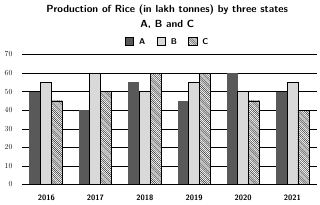
Select the correct statement with respect to the below bar graph.  

  1. ((a))

    Rice production by A in 2016 is less than the rice production by C in 2020.  

  2. ((b))

    B produced more rice than A and C in 2018.  

  3. ((c))

    The highest production of rice was in the year 2017.  

  4. ((d))

    Rice production by B in 2017 is equal to the rice production by A in 2020.  

Show Answer
Answer: ((d))

Rice production by B in 2017 is equal to the rice production by A in 2020.  

Calculation:

Statement 1:

Rice production by A in the year 2016 = 50 lakh tonnes

Rice production by C in the year 2020 = 45 lakh tonnes

Statement 1 is incorrect.

Statement 2:

Rice production by B in the year 2018 = 50 lakh tonnes

Rice production by A in the year 2018 = 55 lakh tonnes

Rice production by C in the year 2018 = 60 lakh tonnes

Statement 2 is incorrect.

Statement 3:

Rice production in the year 2017 = 40 + 60 + 50 = 150 lakh tonnes

Rice production in the year 2018 = 55 + 50 + 60 = 165 lakh tonnes

Statement 3 is incorrect.

Statement 4:

Rice production by B in the year 2017 = 60 lakh tonnes

Rice production by A in the year 2020 = 60 lakh tonnes

Statement 4 is correct.

∴ The correct option is 4.

4

What value should come in place of question mark (?) in the following question?

(37 × 3) + (\sqrt{1024}) = ? - (17 × 4) + (\sqrt{729}) - 66

  1. ((a))

    250 

  2. ((b))

    240 

  3. ((c))

    260 

  4. ((d))

    255

Show Answer
Answer: ((a))

250 

Calculation

⇒ (37 × 3) + (\sqrt{1024}) = ? - (17 × 4) + (\sqrt{729}) - 66

⇒ 111 + 32 = ? - 68 + 27 - 66

⇒ 143 = ? - 68 + 27 - 66

⇒ ? = 143 + 134 - 27

⇒ ? = 277 - 27

⇒ ? = 250

The answer is 250.

5

The compound interest on a sum for 2 years at the rate of 32 percent per annum (compounded annually) is Rs. 6681.6. What is the sum?

  1. ((a))

    Rs. 8700 

  2. ((b))

    Rs. 9000

  3. ((c))

    Rs. 8600

  4. ((d))

    Rs. 8400

Show Answer
Answer: ((b))

Rs. 9000

Given:

Rate of interest = 32%

Time =  2 years

Compound interest = 6681.6

Formula used:

CI = P[1 + (R/100)]T - P

Where, CI = Compound interest

R = Rate of interest

P = Principle and T = Time

Calculation:

⇒ 6681.6 = P[1 + (32/100)]2 - P

⇒ 6681.6 = P × (132/100)2 - P

⇒ 6681.6 = P × (1.32 × 1.32) - P

⇒ 6681.6 = 1.7424 × P - P

⇒ 6681.6 = 0.7424P

⇒ P = 6681.6/0.7424 = 9000

Hence, the value of the principle is Rs. 9000.

6

The cost price of article X is Rs. 'a + 1000' and it is marked 60% above its cost price. The profit earned on article X is Rs. 1000 when a discount of 12.5% is given. If the cost price of article B is Rs. 'a + 500' and selling price is 14.28% less than selling price of article X, then find the profit percentage earned on selling article B?

  1. ((a))

    25%

  2. ((b))

    40%

  3. ((c))

    50%

  4. ((d))

    75%

Show Answer
Answer: ((c))

50%

Given:

Cost price of article = a + 1000

Profit = Rs. 1000

Discount = 12.5%

Solution:

Marked price = 160%  of (a + 1000) = 8/5(a + 1000)

Selling price = 7/8 of (8/5(a + 1000) = 7/5 of (a + 1000)   (12.5% = 1/8)

Now,

Profit = SP - CP

1000 = 7/5of (a + 1000) - (a +1000)

1000 = (2a + 2000)/5

2a + 2000 = 5000

2a = 3000

a = 1500

Selling price of X = 7/5(a + 1000) = 3500

<br>

Now,

Cost price = a + 500 = 2000

Selling price of B is 14.28% less than selling price of article X

Selling price = 6/7 x 3500  (14.28% = 1/7)

= 3000

Profit% = (SP - CP)/CP x100 = (3000 - 2000)/2000 x 100 = 50%

Hence option (3) is correct.

7

What is the value of (\frac{1}{7} \times \frac{1}{8} \div \frac{72}{51}) of (\left(\frac{1}{9}+\frac{1}{8}\right)+\left(\frac{63}{56} \times \frac{48}{72}\right) )

  1. ((a))

    41/56

  2. ((b))

    27/56

  3. ((c))

    45/56

  4. ((d))

    19/56

Show Answer
Answer: ((c))

45/56

Given:

The expression (\frac{1}{7} \times \frac{1}{8} \div \frac{72}{51}) of (\left(\frac{1}{9}+\frac{1}{8}\right)+\left(\frac{63}{56} \times \frac{48}{72}\right) )

Concept used:

⇒ BODMAS rule

Calculation:

⇒ (\frac{1}{7} \times \frac{1}{8} \div \frac{72}{51}) of ((\frac{8 + 9 }{72}) + (\frac{9}{8} \times \frac{2}{3}))

⇒ (\frac{1}{7} \times \frac{1}{8} \div \frac{72}{51}) of (\frac{17 }{72} + \frac{3}{4})

⇒ (\frac{1}{7} \times \frac{1}{8} \div( \frac{72}{51} \times \frac{17}{72})) (+ \ \frac{3}{4})

⇒ (\frac{1}{7} \times( \frac{1}{8} \div \frac{1}{3}) + \frac{3}{4})

⇒ (\frac{1}{7} \times \frac{3}{8} + \frac{3}{4})

⇒ (\frac{3}{56} + \frac{3}{4})

⇒ (\frac{45}{56})

Hence, the value of expression is 45/56.

8

A Sari shop owner announced 10% off season discount followed by 15% festival discount. Sunita selected a Sari which was slightly damaged and bargained for further discount of 10%. She paid ₹2754 for the Sari. What was its marked price?

  1. ((a))

    ₹4200

  2. ((b))

    ₹4000

  3. ((c))

    ₹3850

  4. ((d))

    ₹3600

Show Answer
Answer: ((b))

₹4000

Given:

Discount = 10%, 15% and 10%

SP = 2754

Formula used:

Profit = SP – CP

Discount% = Discount/MP × 100

Calculation:

Let the marked price be MP 

⇒ MP × (9/10)(17/20)(9/10) = 2754

⇒ MP × 1377/2000 = 2754

MP = 4000

The answer is 4000.

9

X can do a piece of work in 270 days. X worked at it for 55 days and then Y finished the remaining work in 215 days. In how many days can X and Y to finish the work?

  1. ((a))

    137

  2. ((b))

    135 

  3. ((c))

    145

  4. ((d))

    139

Show Answer
Answer: ((b))

135 

Given:

X can do a work = 270 days

Concept used:

Total Work = Efficiency × Time

Calculation:

According to the question,

⇒ X × 270 = X × 55 + Y × 215

⇒ X × (270 - 55) = Y × 215

⇒ X × 215 = Y × 215

⇒ ( \dfrac{\text{X}}{\text{Y}} ) =( \dfrac{215 }{215} )= ( \dfrac{1 }{1} )

∴ Efficiency of X: Efficiency of Y = 1: 1

Now, Total work = X × 270 = 1 × 270 = 270 unit

Time is taken by X and Y together = ( \dfrac{270 }{1+1} ) = ( \dfrac{270 }{2} ) = 135 days

∴ The time is taken by X and Y together is 135 days.

10

A room in a house measures 5 m in height and its length is 3 times its breadth. The cost of whitewashing its four walls at Rs. 2.50 per sq m is Rs. 200. What is the cost of carpeting the floor at Rs. 5 per sq m?

  1. ((a))

    Rs. 84

  2. ((b))

    Rs. 60

  3. ((c))

    Rs. 72

  4. ((d))

    Rs. 50

Show Answer
Answer: ((b))

Rs. 60

Given:

Height = 5 m

Cost of whitewashing 4 walls at Rs. 2.50 per sq m = Rs. 200

Cost of carpeting the floor = Rs. 5/m2

Calculation:

Let breadth be x meter

⇒ Length = 3x meter

Area of 2 walls along length side = 2 × height × length = 2 × 5 × 3x = 30x

Area of 2 walls along breadth side = 2 × height × breadth = 2 × 5 × x = 10x

Total area of 4 walls = 30x + 10x = 40x

Now, 40x × Rs. 2.5 = Rs. 200

⇒ 40x = 80

⇒ x = 2

Breadth = 2 meter

Length = 2 × 3 = 6 meter

Now, area of floor = length × breadth = (6 × 2) m2 = 12 m2

Cost of carpeting the floor at Rs. 5/m2 = 12 × 5 = Rs. 60

∴ Cost of carpeting the floor is Rs. 60

11

A worker works 4 hours per day for the first week, 5 hours per day for the second week, and 6 hours per day for the third and fourth week. If his salary is calculated on the basis of Rs. 100 for every 30 minutes, then the amount he would receive at the end of four weeks is(there is no holiday on any day of the week) - 

  1. ((a))

    Rs. 29400

  2. ((b))

    Rs. 29600

  3. ((c))

    Rs 29450

  4. ((d))

    Rs. 30000

Show Answer
Answer: ((a))

Rs. 29400

Given:

Hours worked per day in first week = 4

Hours worked per day in second week = 5

Hours worked per day in third and fourth week = 6

Rate = Rs. 100 for every 30 minutes 

Concept:

In these type of questions we calculate total hours worked and multiply them by the rate.

Formula:

Amount = Total hours × Price per hour

Calculations:

Hours worked in first week = 4 × 7

⇒ 28 hours 

Hours worked in second week = 5 × 7

⇒ 35 hours

Hours worked in third week = 6 × 7

⇒ 42 hours 

Hours worked in fourth week = 6 × 7

⇒ 42 hours 

∴ Total hours worked = 28 + 35 + 42 + 42

⇒ 147 hours

Rate = Rs. 100 for every 30 minutes

⇒ Rs. 100 × 2 for every hour

⇒ Rs. 200 per hour

∴ Amount that the worker will receive = 147 × 200

⇒ Rs. 29400

12

DIRECTIONS: What approximate value will come in place of the question mark (?) in the following question?

(\sqrt{5456}\times \sqrt{2120}\div \sqrt{460}=?)

  1. ((a))

    110

  2. ((b))

    130

  3. ((c))

    159

  4. ((d))

    190

Show Answer
Answer: ((c))

159

DIRECTIONS: What approximate value will come in place of the question mark (?) in the following question?

√5456 × √2120 ÷ √460 = ?

Calculation:

First, approximate the square roots of the given numbers:

√5456 ≈ 74 (since 74 × 74 = 5476, which is close to 5456)

√2120 ≈ 46 (since 46 × 46 = 2116, which is close to 2120)

√460 ≈ 21.5 (since 21.5 × 21.5 = 462.25, which is close to 460)

Now, substitute these approximations into the equation:

√5456 × √2120 ÷ √460 ≈ 74 × 46 ÷ 21.5

Calculate the numerator:

74 × 46 = 3404

Now, divide by the denominator:

3404 ÷ 21.5 ≈ 158.32 ≈ 159

Therefore, the approximate value that will come in place of the question mark is 159.

13

What value should come in place of question mark (?) in the following question?

1100% of 44 + 115% of 240 = ? - 24

  1. ((a))

    729 

  2. ((b))

    841 

  3. ((c))

    1444 

  4. ((d))

    784 

Show Answer
Answer: ((d))

784 

Calculation

⇒ 1100% of 44 + 115% of 240 = ? - 24

⇒ 484 + 23 × 12 = ? - 24

⇒ 484 + 276 + 24 = ?

⇒ 784 = ?

The answer is 784.

14

Three friends visited a sweetshop, where the shopkeeper gave them 'Vadas' in three plates. Total number of 'Vadas' was 12. The number of vadas of these plates, if arranged properly, were consecutive three even numbers. What was the maximum number of Vadas kept in a plate ?

  1. ((a))

    2

  2. ((b))

    3

  3. ((c))

    4

  4. ((d))

    6

Show Answer
Answer: ((d))

6

Given:

Total number of 'Vadas' was 12.

Calculation:

Let's assume that the consecutive 3-even numbers be 2x, (2x + 2), (2x + 4)

Now, according to the question

⇒ 2x +  (2x + 2) + (2x + 4) = 12

⇒ 6x + 6 = 12

⇒ x = 1

So, the numbers are 2, 4, 6

∴ The maximum number of Vadas kept in a plate is 6

15

Aman started a business with a capital of Rs. 4000. Bunty and Chaman joined after 7 months and 4 months respectively. At the end of the year, the profit was divided in the ratio 1 ∶ 3 ∶ 7. What is the difference between the capitals invested by Bunty and Chaman?

  1. ((a))

    Rs. 24800

  2. ((b))

    Rs. 28800

  3. ((c))

    Rs. 42000

  4. ((d))

    Rs. 13200

Show Answer
Answer: ((d))

Rs. 13200

Shortcut Trick

Profit share is directly proportional to Capital × Time.

Aman's 1 profit ratio part = 4000 × 12 = 48000.

Bunty's profit (3 parts) = 3 × 48000 = 144000 ⇒ Bunty's Capital = 144000 ÷ 5 = Rs. 28800.

Chaman's profit (7 parts) = 7 × 48000 = 336000 ⇒ Chaman's Capital = 336000 ÷ 8 = Rs. 42000.

Difference in their capitals = 42000 − 28800 = 13200.

∴ The correct answer is Rs. 13200.

Alternate Method

Given:

Aman's Capital (CA) = Rs. 4000

Time of investment for Aman (TA) = 12 months

Bunty joined after 7 months, so Time (TB) = 12 − 7 = 5 months

Chaman joined after 4 months, so Time (TC) = 12 − 4 = 8 months

Profit Ratio = 1 : 3 : 7

Formula Used:

Profit Ratio = (CA × TA) : (CB × TB) : (CC × TC)

Aman Cap: ₹4000 Time: 12 mo

Ratio: 1 = 48000 units

Bunty Cap: ? Time: 5 mo

Ratio: 3 = 144000 units

Chaman Cap: ? Time: 8 mo

Ratio: 7 = 336000 units

Calculations:

⇒ Aman's profit equivalent = 4000 × 12 = 48000

⇒ As per the ratio, 1 unit of profit is represented by 48000.

⇒ Bunty's profit equivalent = 3 units = 3 × 48000 = 144000

⇒ Bunty's Capital × 5 = 144000

⇒ Bunty's Capital = 144000 ÷ 5 = 28800

⇒ Chaman's profit equivalent = 7 units = 7 × 48000 = 336000

⇒ Chaman's Capital × 8 = 336000

⇒ Chaman's Capital = 336000 ÷ 8 = 42000

⇒ Difference = 42000 − 28800 = 13200

∴ The correct answer is Rs. 13200.

Additional Information

Basic Profit Division Rule

If partners invest different amounts for varying time periods, the total profit is distributed in the ratio of the product of their invested capital and the duration of investment: (C1 × T1 : C2 × T2 : C3 × T3).

Equivalent Capital

Equivalent capital represents the total amount that would need to be invested for a standard unit of time (like 1 month) to yield the exact same final profit share.

Working vs Sleeping Partners

A working partner actively manages the business and usually takes a fixed percentage of the profit or a fixed salary before the rest of the profit is divided among all partners based on their investments. A sleeping partner merely invests capital.
16

The product of two positive numbers is 2500. If one number is four times the other, then what will be the sum of the two numbers?

  1. ((a))

    25

  2. ((b))

    125

  3. ((c))

    225

  4. ((d))

    250

Show Answer
Answer: ((b))

125

Let the two numbers be x and y.

Given,

xy = 2500

And x is four times y.

⇒ x = 4y      ----(1)

Putting the value of x in (1), we get

⇒ 4y2 = 2500

⇒ y2 = 625

⇒ y = 25

The numbers are x = 4 × y = 100 and y = 25

Sum of two numbers = 100 + 25 = 125

17

Train P and Q start at the same time. Train P travels from station X to station Y and Train Q travels from station Y to station X. The ratio of the speed of train P to train Q is 11:16 and the difference in their speeds is 25 km/h. They meet after 1 hour and 36 minutes. Find the total time taken by train P to travel from station X to Station Y.

  1. ((a))

    25/9 hours

  2. ((b))

    216/55 hours

  3. ((c))

    263/55 hours

  4. ((d))

    273/55 hours

Show Answer
Answer: ((b))

216/55 hours

Shortcut Trick

Speed ratio P : Q is 11 : 16. Difference = 5 units = 25 km/h ⇒ 1 unit = 5 km/h.

Speed of P = 11 × 5 = 55 km/h; Speed of Q = 16 × 5 = 80 km/h.

Relative speed = 55 + 80 = 135 km/h. Meeting time = 1 hr 36 min = 8/5 hr.

Total Distance XY = 135 × (8/5) = 27 × 8 = 216 km.

Time for P = Distance ÷ Speed of P = 216 / 55 hr.

∴ The correct answer is 216/55 hr.

Alternate Method

Given: Speed ratio P:Q = 11:16, Speed difference = 25 km/h, Meeting time = 1 hr 36 min.

Formula Used: Speed = Distance ÷ Time; Relative Speed (Opposite) = S1 + S2.

⇒ Let speeds be 11k and 16k. Difference = 16k − 11k = 5k.

⇒ 5k = 25 ⇒ k = 5 km/h.

⇒ Speed of P = 55 km/h, Speed of Q = 80 km/h.

⇒ Meeting time = 1 + 36/60 = 1 + 3/5 = 8/5 hours.

⇒ Total Distance = Relative Speed × Meeting Time = (55 + 80) × (8/5) = 135 × (8/5) = 216 km.

⇒ Time taken by P = Total Distance ÷ Speed of P = 216 / 55 hr.

∴ The correct answer is 216/55 hr.

Additional Information

Relative Speed

When two objects move in opposite directions, their relative speed is the sum of their individual speeds (S1 + S2).

Meeting Time Logic

Total Distance = Relative Speed × Time taken to meet, provided they start moving at the same time.

Time and Speed Relation

For a constant distance, the time taken is inversely proportional to the speed (T ∝ 1/S).

18

If the perimeters of two squares plots are 52 cm and 20cm. find the perimeter of a third square plot whose area is equal to the difference of the areas of these squares, is

  1. ((a))

    44 cm

  2. ((b))

    32 cm

  3. ((c))

    48 cm

  4. ((d))

    30 cm

Show Answer
Answer: ((c))

48 cm

Given:

The perimeters of two squares plots are 52 cm and 20cm

Concept used:

The perimeter of square = 4 × side

The area of a square = (side)2

Calculation:

Side of the first square = 52 ÷ 4 = 13 cm and

Side of the second square = 20 ÷ 4 = 5 cm

Now, the difference in their areas = 132 – 52 = 144 cm2

Then, sides of the new square = √144 = 12 cm

Now, perimeter of new square = 4 × 12 = 48 cm

∴ The perimeter of the third square is 48 cm

19

The difference between simple interest and compound interest (compounding of interest is done annually) on a certain sum of money for 3 years at the rate of 20 percent per annum is Rs. 192. What is the sum?

  1. ((a))

    Rs. 1200

  2. ((b))

    Rs. 1400

  3. ((c))

    Rs. 1500

  4. ((d))

    Rs. 1000

Show Answer
Answer: ((c))

Rs. 1500

Given:

The difference between simple interest and compound interest (compounding of interest is done annually) on a certain sum of money for 3 years at the rate of 20 percent per annum is Rs. 192. 

Formula used:

Difference between CI and SI in 3 yr = P( R /100)2 {( R/100) + 3}

Calculation:

Let the principal is P

As per the question,

⇒ 192 = P( 20 /100)2 {( 20/100) + 3}

⇒ 192 = P( 1/5)2 {( 1/5 + 3}

⇒ P = 4800 / 3.2

⇒ P = Rs 1500

∴ The correct option is 3

20

Mansi and Taruna have money in the ratio 5 : 7 and Taruna and Renu have it in the ratio 8 : 11. If Taruna has Rs. 2240, then how much money Renu has?

  1. ((a))

    Rs. 3000

  2. ((b))

    Rs. 3080

  3. ((c))

    Rs. 3120

  4. ((d))

    Rs. 3150

Show Answer
Answer: ((b))

Rs. 3080

Given:

Mansi and Taruna have money in the ratio 5: 7

Taruna and Renu have it in the ratio 8 : 11

Taruna has Rs. 2240

Calculation:

Mansi: Taruna = 5: 7 ....(× 8)

Taruna: Renu = 8: 11 ....(× 7)

Mansi: Taruna: Renu = 40: 56: 77

56 → 2240

1 → 2240/56 = 40

77 → 77 × 40 = 3080

The answer is 3080.

21

Five years ago, the average age of a family of 4 persons was 22 years. A baby boy is a new addition to the family and now the average age of the family is the same as what was 5 years ago. How old is the baby boy?

  1. ((a))

    1 year

  2. ((b))

    4 years

  3. ((c))

    2 years

  4. ((d))

    3 years

Show Answer
Answer: ((c))

2 years

Given:

The average age of 4 members 5 years ago = 22 years

The average age of the family is the same as what it was 5 years ago after the baby is born.

Formula used:

The sum of ages = Average × Number of family members

Calculation:

Total age of 4 members of the family at present = 27 × 4 years

⇒ 108 years

The present age of 5 members would have been = 22 × 5 = 110

Age of baby = (110 - 108) years

⇒ 2 year

∴ The age of baby is 2 year

22

An amount of Rs. 3550 is divided into X, Y, and Z such that three times X's share is equal to 5 times Y's share and 7 times of Z's share. X's share is equal to-

  1. ((a))

    Rs. 1050

  2. ((b))

    Rs. 1250

  3. ((c))

    Rs. 750

  4. ((d))

    Rs. 1750

Show Answer
Answer: ((d))

Rs. 1750

Given:

Rs. 3550 is divided into X, Y and Z

three times of X's share is equal to 5 times of Y's share and 7 times of Z's share.

Solution:

3X = 5Y

⇒ Y = (\dfrac{3X}{5})

3X = 7Z

⇒ Z = (\dfrac{3X}{7})

X + Y + Z = 3550

⇒ X + (\dfrac{3X}{5}) + (\dfrac{3X}{7}) = 3550

⇒ 35X + 21X + 15X = 124250

⇒ X = (\dfrac{124250}{71}) = 1750

Share of X = Rs. 1750

23

The monthly salary of 2 persons A and B together is Rs 60000. A spends 80% of his salary and B spends 90% of his salary. If the amount of both their savings is equal then what is the monthly salary of B?

  1. ((a))

    20000

  2. ((b))

    40000

  3. ((c))

    25000

  4. ((d))

    35000

Show Answer
Answer: ((b))

40000

GIVEN:

Sum of their monthly salary = Rs60000

A's expenditure = 80% of his salary 

B's expenditure = 90% of his salary

A's savings = B's savings

EXPLANATION:

Let A's salary be x

∴ B's salary = 60000 - x

A's savings = 20% of x = (\frac{x}{5})

B's savings = 10% of (60000 - x) = (\frac{60000 - x}{10})

(\therefore \frac{x}{5} = \frac{60000 - x}{10}) ⇒ (x = 20000)

B's salary = (60000 - 20000 = 40000)

Alternate Method

(20% \ of \ A = 10% \ of \ B)

(\Rightarrow \frac{A}{B} = \frac{1}{2})

(\Rightarrow A + B = 3 \space ratio)

(3\space ratio = 60000 \Rightarrow 1\space ratio = 20000)

(B's\space salary = 2\space ratio = 40000)

24

Usually Ravi spends 70% of his income. His income increases by 25% and his expenditure also increases by 10%. Find the percentage increase in his savings.

  1. ((a))

    65%

  2. ((b))

    60%

  3. ((c))

    58%

  4. ((d))

    57.5%

Show Answer
Answer: ((b))

60%

Given:

Ravi spends 70% of his income. His income increases by 25% and his expenditure also increases by 10%

Concept used:

Income - Expenses = Saving

Calculation:

Let the income be 100p

According to the question:

Ravi spends 70% of his income

Expenses = 70p

⇒ 100p - 70p = 30p

Savings = 30p

Income increases by 25% 

⇒ 100p + 25p = 125p

Expenditure increases by 10% 

⇒ 70p + 70p × 10/100 = 77p 

Savings = 125p - 77p = 48

Saving Increase% = (48 - 30)/30 × 100

= 60%

The answer is 60%

25

Study the given table and answer the question that follows.

The table shows the number of donuts sold by three different stores in five different months.

StoreMonth
JulyAugustSeptemberOctoberNovember
P400350263125420
Q660170465905180
R342182700960235

What is the ratio of the number of donuts sold by stores P and R together in October to the total number of donuts sold by stores Q and R together in the same month?

  1. ((a))

    353 : 217

  2. ((b))

    217 : 373

  3. ((c))

    373 : 217

  4. ((d))

    217 : 353

Show Answer
Answer: ((b))

217 : 373

Calculation:

Total number of donuts sold by stores P and R together in October = 125 + 960

⇒ 1085

Total number of donuts sold by stores R and Q together in October = 905 + 960

⇒ 1865

Ratio = 1085 : 1865

⇒ 217 : 373

∴ The required answer is 217 : 373.

Attempt this paper under real exam conditions

Timed interface, section switching, instant scoring, and question-by-question analytics — free.

Start Timed Attempt