Combined Defence Services (CDS) · Topic Collection

English Comprehension PYQs

Reading comprehension, vocabulary, synonyms and antonyms, idiom usage, error spotting, sentence improvement, and cloze tests.

4560 Total Questions38 Official PapersYears: 2016–2025Search in English Comprehension
Showing questions 741–760 of 4560Page 38 of 100
CDS General Knowledge 3 Sep 2023 Official Paper (Previous Year Paper)·English
View full paper

Question 741

Combined Defence Services (CDS) 2023• English• English

As per the Cabinet Resolution of 1st January, 2015, the NITI Aayog consists of:

  1. Prime Minister of India
  2. Governing Council comprising of Chief Minister of all the States and Lieutenant Governors of Union Territories

3. Rural Development Minister 4. Chief Executive Officer to be appointed by the Prime Minister

Select the correct answer using the code given below:

  1. AOption (a)

    1, 2 and 3

  2. BOption (b)

    1, 2 and 4

  3. COption (c)

    1 and 2 only

  4. DOption (d)

    3 and 4 only

View answer & explanation

Correct answer

Answer: (b)B.

1, 2 and 4

Why this answer is correct

The correct answer is 1, 2 and 4.

Key Points

  • As per the Cabinet Resolution of 1st January, 2015, the NITI Aayog consists of:
  • Prime Minister of India
  • Governing Council comprising Chief Minister of all the States and Lieutenant Governors of Union Territories
  • Chief Executive Officer to be appointed by the Prime Minister

Additional Information

  • The composition of the NITI Aayog (National Institution for Transforming India) is as follows:
  • Chairman: Prime Minister
  • Vice President: To be appointed by the Prime Minister
  • Governing Council: Chief Ministers of all States and Lieutenant Governors of Union Territories.
  • Regional Council: To address specific regional issues, consisting of the Chief Minister and Lieutenant Governor, chaired by the Prime Minister or his nominee.
  • Ad-hoc Membership: 2 members in an ex-officio capacity on rotation basis from leading research institutions.
  • Ex-officio membership: A maximum of four from the Union Council of Ministers to be nominated by the Prime Minister.
  • Chief Executive Officer: Appointed by the Prime Minister for a fixed tenure in the post of Secretary to the Government of India.
  • Special Invitees: Experts with domain knowledge nominated by the Prime Minister.
CDS General Knowledge 3 Sep 2023 Official Paper (Previous Year Paper)·English
View full paper

Question 742

Combined Defence Services (CDS) 2023• English• English

The executive is given an advance grant to meet temporary and running requirements of Government of India in the beginning of the new financial year until the demands are voted by the legislature. This is known as:

  1. AOption (a)

    Vote of Credit

  2. BOption (b)

    Vote on Account

  3. COption (c)

    Appropriation Bill

  4. DOption (d)

    Advance Account

View answer & explanation

Correct answer

Answer: (b)B.

Vote on Account

Why this answer is correct

The correct answer is Vote on Account.

Key Points

  • Vote on Account is a grant in advance given to the Executive to meet the temporary and ongoing requirements of the Government of India at the beginning of the new financial year.
  • This is necessary because the budget has not yet been approved and passed by the legislature.
  • Vote on Account typically covers expenses for part of the year, often for two months, although it can also be for longer periods.

Additional Information

  • Vote of credit is a special provision that allows the government to meet unexpected expenses.
  • The Appropriation Bill legally empowers the government to use money from the treasury for its operations after the budget is passed.
  • Advance account is not a term traditionally associated with this particular financial process in the Indian government.
CDS General Knowledge 3 Sep 2023 Official Paper (Previous Year Paper)·English
View full paper

Question 743

Combined Defence Services (CDS) 2023• English• English

Which of the following is / are United Nations Sustainable Development Goal(s)?

  1. Decent work and economic growth 2. Peace, justice and strong institutions 3.  Responsible consumption and production

Select the correct answer using the code given below:

  1. AOption (a)

    1 and 2 only

  2. BOption (b)

    1, 2 and 3

  3. COption (c)

    2 only

  4. DOption (d)

    1 and 3 only

View answer & explanation

Correct answer

Answer: (b)B.

1, 2 and 3

Why this answer is correct

The correct answer is 1, 2 and 3.

Key Points

  • 17 Goals for People, for Planet
  • World leaders came together in 2015 and made a historic promise to secure the rights and well-being of everyone on a healthy, thriving planet when they adopted the 2030 Agenda for Sustainable Development and its 17 Sustainable Development Goals (SDGs).
  • The 17 goals under the Sustainable Development Goals are as mentioned below:
  • Goal 1: End poverty in all its forms
  • Goal 2: Zero Hunger
  • Goal 3: Health
  • Goal 4: Education
  • Goal 5: Gender equality and women’s empowerment
  • Goal 6: Water and Sanitation
  • Goal 7: Energy
  • Goal 8: Economic Growth
  • Goal 9: Infrastructure, industrialization
  • Goal 10: Inequality
  • Goal 11: Cities
  • Goal 12: Sustainable consumption and production
  • Goal 13: Climate Action
  • Goal 14: Oceans
  • Goal 15: Biodiversity, forests, desertification
  • Goal 16: Peace, justice and strong institutions
  • Goal 17: Partnerships
CDS General Knowledge 3 Sep 2023 Official Paper (Previous Year Paper)·English
View full paper

Question 744

Combined Defence Services (CDS) 2023• English• English

Consider the following statements on 'Fog':

  1. Fog is simply a cloud that forms close to the ground.
  2. Radiation fog is associated with radiation cooling of the land at night.
  3. Advection fog forms when moisture is blown over a cold surface and is chilled by contact.

Which of the statements given above are correct?

  1. AOption (a)

    1 and 2 only

  2. BOption (b)

    2 and 3 only

  3. COption (c)

    1 and 3 only

  4. DOption (d)

    1, 2 and 3

View answer & explanation

Correct answer

Answer: (d)D.

1, 2 and 3

Why this answer is correct

The correct answer is 1, 2 and 3.

Key Points

  • At night, as the land surface cools, the air near the surface also cools.
  • Since cold air cannot hold as much moisture as warm air, the water vapor in the air condenses and forms fog.
  • Fog begins to form in the early hours of the morning when the temperature is at its lowest.
  • Fog is simply a cloud that forms close to the ground.
  • Fog is indeed a cloud that forms at or near the ground level when air is cooled and reaches its dew point.
  • Radiation fog is associated with radiation cooling of the land at night.
  • Radiation fog forms at night when the Earth's surface loses heat through radiation, causing the air near the surface to cool and reach its dew point.
  • Advection fog forms when moisture is blown over a cold surface and is chilled by contact.
  • Advection fog occurs when warm, moist air moves horizontally over a colder surface, and the air is cooled, leading to the condensation of water vapor and the formation of fog.
CDS General Knowledge 3 Sep 2023 Official Paper (Previous Year Paper)·English
View full paper

Question 745

Combined Defence Services (CDS) 2023• English• English

Which one of the following landforms is/are formed by wind erosion?

  1. AOption (a)

    Cirque

  2. BOption (b)

    Stack

  3. COption (c)

    Zeugen

  4. DOption (d)

    Stack and Zeugen both

View answer & explanation

Correct answer

Answer: (c)C.

Zeugen

Why this answer is correct

The correct answer is Zeugen.

Key Points

  • Zeugens are elongated, resistant ridges or hills of rock that remain after surrounding areas have been eroded by wind or water.
  • They are often found in arid or semi-arid regions where wind erosion is a significant geomorphic process.
  • Mostly seen in arid and semi-arid areas.
  • The soft part of the rock is destroyed by the wind and the hard part remains the same.

Additional Information

  • Cirque is a landform associated with glacial erosion. Cirques are amphitheater-shaped valleys with precipitous walls.
  • Stack is typically formed by coastal erosion.
  • Generally seen in coastal areas.
  • The formation of Stacks takes a very long time.
CDS General Knowledge 3 Sep 2023 Official Paper (Previous Year Paper)·English
View full paper

Question 746

Combined Defence Services (CDS) 2023• English• English

Which one of the following crops is not cultivated under dryland farming?

  1. AOption (a)

    Jowar

  2. BOption (b)

    Ragi

  3. COption (c)

    Sugarcane

  4. DOption (d)

    Groundnut

View answer & explanation

Correct answer

Answer: (c)C.

Sugarcane

Why this answer is correct

The correct answer is Sugarcane.

Key Points

  • Sugarcane is a water-intensive crop and is typically not cultivated under dryland farming.
  • It requires a substantial amount of water for optimal growth, and hence, it is more commonly grown in areas with assured irrigation facilities.

Additional Information

  • Dryland farming refers to agricultural practices in regions where water availability for crop cultivation is limited, and the crops rely predominantly on rainfall. In such areas, farmers often face challenges related to water scarcity and must choose crops that are well-suited to these conditions. 
  • Jowar (Sorghum): Jowar is a cereal crop that is well-suited for dryland farming. It is drought-tolerant and can thrive in regions with limited water availability.
  • Ragi (Finger Millet): Similar to Jowar, Ragi is a drought-tolerant cereal crop that is suitable for cultivation in dryland areas.
  • Groundnut (Peanut): Groundnut is often cultivated in dryland farming. While it is not as water-intensive as sugarcane, groundnut is adapted to arid and semi-arid conditions and is a common crop in regions with limited water resources.
CDS General Knowledge 3 Sep 2023 Official Paper (Previous Year Paper)·English
View full paper

Question 747

Combined Defence Services (CDS) 2023• English• English

Which one of the following forms of settlement develops around a lake?

  1. AOption (a)

    Linear

  2. BOption (b)

    Cross - shaped

  3. COption (c)

    Circular

  4. DOption (d)

    Square

View answer & explanation

Correct answer

Answer: (c)C.

Circular

Why this answer is correct

The correct answer is Circular.

Key Points

  • Circular pattern: These develop around lakes, tanks and sometimes a village is planned in such a way that the central part remains open and is used for keeping the animals to protect them from wild animals.

Additional Information

  • Rural settlements of the world can be classified based on form or size of settlements as follows
  • Linear: In such settlements, houses are located along a road, railway line, river, canal or along a valley or embankment.
  • Rectangular Pattern: Such pattern of rural settlements is found in plain areas or wide inter-mountain valleys. The roads are rectangular and intersect each other at right angles.
  • Star-like pattern: Where several roads meet, star-shaped settlements develop with houses built along the roads.
  • T-shaped, Y-shaped, cross-shaped or cruciform settlements:
  • ​T-shaped settlements develop at triangular road junctions,
  • Y-shaped settlements develop where two roads meet at the third and Houses are built together.
  • Cruciform settlements develop at intersections and houses are spread in all directions.
  • Double villages: These villages are spread on both the banks of the river where there is a bridge or ferry.
CDS General Knowledge 3 Sep 2023 Official Paper (Previous Year Paper)·English
View full paper

Question 748

Combined Defence Services (CDS) 2023• English• English

How can resources be classified on the basis of their origin?

  1. AOption (a)

    Biotic and abiotic

  2. BOption (b)

    Renewable and non - renewable

  3. COption (c)

    Individual and community

  4. DOption (d)

    Potential and reserve

View answer & explanation

Correct answer

Answer: (a)A.

Biotic and abiotic

Why this answer is correct

The correct answer is Biotic and abiotic.

Key Points

  • Based on their origin, resources can be classified as biotic resources and abiotic resources.
  • Abiotic Resources:
  • These are non-living resources that come from the non-living and physical environment.
  • Examples include minerals, metals, air, water, and soil.
  • Biotic Resources:
  • These are resources that come from living organisms or have resulted from life processes.
  • Examples include forests, wildlife, fish, and livestock.

Additional Information

  • Based on the level of availability.
  • These two categories are renewable and non-renewable resources.
  • Renewable Resources: These are resources that can be naturally replenished over time, such as solar energy, wind energy, hydropower, and biomass.
  • Non-renewable Resources: These are finite resources that cannot be regenerated at a rate equal to or faster than their consumption. Examples include fossil fuels (coal, oil, natural gas) and minerals.
  • Individual Resources: These are resources that can be owned, used, and managed by an individual. Examples include personal property, skills, and talents.
  • Community Resources: These are resources that are commonly owned or used by a community or society as a whole. Examples include public parks, community facilities, and shared natural resources.
  • Potential Resources: These are resources that exist in a region and may be used in the future if the necessary technology and economic conditions allow. They are not currently being utilized.
  • Reserve Resources: These are resources that have been surveyed, quantified, and are currently being exploited or used.
CDS General Knowledge 3 Sep 2023 Official Paper (Previous Year Paper)·English
View full paper

Question 749

Combined Defence Services (CDS) 2023• English• English

Which one among the following is the highest mountain in Africa?

  1. AOption (a)

    Atlas Mountain

  2. BOption (b)

    Mount Kilimanjaro

  3. COption (c)

    Mount Kenya 

  4. DOption (d)

    Mount Elgon

View answer & explanation

Correct answer

Answer: (b)B.

Mount Kilimanjaro

Why this answer is correct

The correct answer is Mount Kilimanjaro.

Key Points

  • Mount Kilimanjaro is located in Tanzania, Africa.
  • Mount Kilimanjaro is the highest peak on the African continent at 5,895 meters (19,340 ft).
  • The majestic mountain is a snow-covered volcano.
  • Mount Kilimanjaro is the highest mountain in Africa.
  • Also called a stratovolcano (a term for a very large volcano made of ash, lava, and rock), Kilimanjaro is made up of three cones: Kibo, Mawenzi, and Shira. Kibo is the peak of the mountain.

Additional Information

MountainDetails
Atlas MountainThe Atlas Mountains are a mountain range across three countries: Morocco, Algeria, and Tunisia in North Africa. They stretch approximately 2,500 kilometers across Northwest Africa.
Mount KenyaMount Kenya is the second-highest mountain in Africa, after Mount Kilimanjaro. Located in Kenya, East Africa.
Mount ElgonMount Elgon is not the highest in Africa. Its highest point, Wagagai Peak, stands at 4,321 meters (14,177 feet).
CDS General Knowledge 3 Sep 2023 Official Paper (Previous Year Paper)·English
View full paper

Question 750

Combined Defence Services (CDS) 2023• English• English

Which of the following action(s) by the Government would lead to contraction of money supply in the economy?

  1. Purchase of Treasury Bills by the central bank from public
  2. Sale of Treasury Bills by the central bank to public
  3. Sale of foreign exchange by the central bank
  4. Purchase of foreign exchange by the central bank

Select the correct answer using the code given below:

  1. AOption (a)

    1 and 4 only.

  2. BOption (b)

    1 and 3 only

  3. COption (c)

    2 and 3 only

  4. DOption (d)

    2 only

View answer & explanation

Correct answer

Answer: (d)D.

2 only

Why this answer is correct

The correct answer is 2 only.

Key Points

  • Sale of treasury bills by the central bank to the public:
  • When the central bank sells treasury bills to the public, it takes money out of the economy, thus contracting the money supply.

Additional Information

  • Purchasing of treasury bills from the public by the central bank:
  • When the central bank purchases treasury bills from the public, it is essentially injecting money into the economy, thus expanding the money supply, not contracting it.
  • Sale of foreign currency by the central bank:
  • When the central bank sells foreign currency, it receives domestic currency in return.
  • This action may increase foreign exchange reserves, but will not necessarily lead to a contraction in the money supply.
  • Purchase of foreign currency by the central bank:
  • When the central bank buys foreign currency, it releases domestic currency into the economy.
  • This increases the money supply instead of shrinking it.
CDS General Knowledge 3 Sep 2023 Official Paper (Previous Year Paper)·English
View full paper

Question 751

Combined Defence Services (CDS) 2023• English• English

Which of the following are included in the definition of Narrow Money?

  1. Currency with the public
  2. Demand deposits 3. 'Other' deposits with Reserve Bank of India
  3. Banker's deposits with Reserve Bank of India

Select the correct answer using the code given below:

  1. AOption (a)

    1, 2 and 4

  2. BOption (b)

    1 and 2 only

  3. COption (c)

    1, 2 and 3

  4. DOption (d)

    3 and 4 only

View answer & explanation

Correct answer

Answer: (c)C.

1, 2 and 3

Why this answer is correct

The correct answer is 1, 2 and 3.

Key Points

  • Narrow money plays a vital role in facilitating day-to-day transactions and is an important indicator of the monetary health of the economy.
  • Narrow money is a type of money supply that consists of all real money held by a central bank, including coins and currency, demand deposits, and other liquid assets.
  • In India, narrow money is denoted by M1.
  • The high liquidity of narrow money allows for immediate spending, which impacts short-term economic health.
  • M1 = Currency with the Public + Demand Deposits with the Banking System + ‘Other’ Deposits with RBI
  • M1= Currency with the Public + Current Deposits with the Banking System + Demand Liabilities Portion of Savings Deposits with the Banking System + ‘Other’ Deposits with RBI
  • ‘Other’ deposits with RBI comprise mainly:
  • (i) deposits of quasi-government and other financial institutions including primary dealers,
  • (ii) balances in the accounts of foreign Central banks and Governments,
  • (iii) accounts of international agencies such as the International Monetary Fund, etc.
CDS General Knowledge 3 Sep 2023 Official Paper (Previous Year Paper)·English
View full paper

Question 752

Combined Defence Services (CDS) 2023• English• English

Which of the following is / are the effects of devaluation or depreciation of currency?

  1. It leads to increase in imports and decrease in exports.
  2. It leads to increase in exports and decrease in imports.
  3. It leads to increase in domestic inflation.
  4. It leads to decrease in domestic inflation.

Select the correct answer using the code given below:

  1. AOption (a)

    1 and 3 only

  2. BOption (b)

    1 and 4 only

  3. COption (c)

    2 and 3 only

  4. DOption (d)

    3 only

View answer & explanation

Correct answer

Answer: (c)C.

2 and 3 only

Why this answer is correct

The correct answer is 2 and 3 only.

Key Points

  • Devaluation can contribute to domestic inflation because it makes imports more expensive.
  • As the cost of imported goods rises, it can lead to higher overall price levels in the domestic economy.
  • Devaluation occurs when a government seeks to increase its trade balance by reducing the relative value of its currency.
  • The government does this by adjusting a fixed or semi-fixed exchange rate of its currency versus the exchange rate of another country's currency.
  • The effects of devaluation or depreciation of currency include:
  • It leads to an increase in exports and a decrease in imports.
  • When a currency is devalued, its exchange rate decreases relative to other currencies.
  • This makes the country's exports cheaper for foreign buyers and imports more expensive for domestic consumers, thereby promoting exports and discouraging imports.
  • It leads to an increase in domestic inflation.
CDS General Knowledge 3 Sep 2023 Official Paper (Previous Year Paper)·English
View full paper

Question 753

Combined Defence Services (CDS) 2023• English• English

Which one of the following taxes is not subsumed under the Goods and Services Tax in India?

  1. AOption (a)

    Customs Duties

  2. BOption (b)

    Central Excise Duties

  3. COption (c)

    Service Tax

  4. DOption (d)

    Taxes on Petroleum and Petroleum Products

View answer & explanation

Correct answer

Answer: (d)D.

Taxes on Petroleum and Petroleum Products

Why this answer is correct

The correct answer is Taxes on Petroleum and Petroleum Products.

Key Points

  • The taxes included in GST include Central Excise, Service Tax, VAT and many other taxes. However, direct taxes like income tax, and customs duty on imports.
  • The two taxes not included in GST in India are:
  • Basic Customs Duty (BCD): Basic Customs Duty is a tax levied on goods imported into India. It is outside the scope of GST and is levied as a separate tax.
  • Petroleum Products: Petroleum products like petrol, diesel, crude oil, aviation turbine fuel and natural gas are not under the GST regime.

Additional Information

  • Goods and Services Tax (GST):
  • It is a destination-based taxation system.
  • It has been established by the 101st Constitutional Amendment Act.
  • It is an indirect tax.
  • GST Council
  • It consists of the Centre, 28 states, Delhi and Puducherry.
  • Centre has 1/3rd of voting rights and states have 2/3rd of voting rights.
  • Decisions are taken after a majority in the council.
CDS General Knowledge 3 Sep 2023 Official Paper (Previous Year Paper)·English
View full paper

Question 754

Combined Defence Services (CDS) 2023• English• English

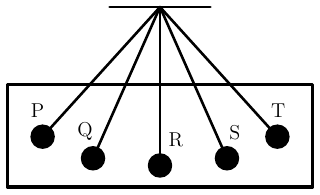
The following diagram shows a pendulum at different positions. Which one of the following statement is true?

  1. AOption (a)

    The pendulum has minimum potential energy at positions P and T.

  2. BOption (b)

    The pendulum has minimum potential energy at positions Q and S.

  3. COption (c)

    The pendulum has minimum potential energy at position R.

  4. DOption (d)

    The pendulum has same potential energy at all positions.

View answer & explanation

Correct answer

Answer: (c)C.

The pendulum has minimum potential energy at position R.

Why this answer is correct

The correct answer is The pendulum has minimum potential energy at position R.

Key Points

  • Simple Pendulum:
  • A simple pendulum consists of a small metallic ball or a piece of stone suspended from a rigid stand by a thread.
  • The metallic ball is termed as bob.
  • A pendulum swings from one extreme position to another and comes back to the same position, this completes one oscillation.
  • The pendulum is said to be at maximum displacement when it is at an extreme position.
  • One oscillation can also be defined as the pendulum starting from the mean position, going to one extreme, and coming back to the same mean position.
  • The time period for an oscillation to compete is called the time period and the inverse of the time period is the frequency.
  • So, Potential energy is maximum at maximum displacement position or extreme positions P and T.
  • Kinetic energy is minimum at the equilibrium position. The equilibrium position is the mean position.
  • The pendulum has minimum potential energy at position R.
CDS General Knowledge 3 Sep 2023 Official Paper (Previous Year Paper)·English
View full paper

Question 755

Combined Defence Services (CDS) 2023• English• English

In which of the following media is the speed of sound the maximum ?

  1. AOption (a)

    Glass

  2. BOption (b)

    Stainless steel

  3. COption (c)

    Water

  4. DOption (d)

    Oxygen

View answer & explanation

Correct answer

Answer: (b)B.

Stainless steel

Why this answer is correct

The correct answer is Stainless steel.

Key Points

  • The speed of sound is highest in solids because the molecules in solid media are more tightly bound together than in liquids or gases, allowing sound waves to travel faster. Therefore, in the given case, the speed of sound will be maximum in Stainless steel.

Additional Information

  • The speed of the sound depends on the density of the medium through which it is travelling.
  • The particles in the solid medium are closely packed. Hence, the density is high. Information from one molecule to another molecule travels faster in the solid medium.
  • In liquid, the molecules are farther apart than in solids. Hence, the density is low for liquids.
  • In gas, the molecules are very loosely dispersed.
  • Sound is a mechanical wave that needs a medium to travel.
  • The speed of sound is maximum in solids, then it is in liquid and it is the slowest in gases.
  • The speed of sound remains almost the same for all frequencies in a given medium under the same physical conditions.
CDS General Knowledge 3 Sep 2023 Official Paper (Previous Year Paper)·English
View full paper

Question 756

Combined Defence Services (CDS) 2023• English• English

A charged particle moves through a magnetic field B with a velocity v. Which one of the following statements is true for the force (F) experienced by the particle?

  1. AOption (a)

    F is maximum when v and B are parallel to each other.

  2. BOption (b)

    F is maximum when v and B are anti-parallel to each other.

  3. COption (c)

    F is maximum when v and B are perpendicular to each other.

  4. DOption (d)

    The force F is independent of the angle between v and B.

View answer & explanation

Correct answer

Answer: (c)C.

F is maximum when v and B are perpendicular to each other.

Why this answer is correct

The correct answer is F is maximum when v and B are perpendicular to each other.

Key Points

  • The force (F) experienced by a charged particle moving through a magnetic field (B) with a velocity (v) is maximum when v and B are perpendicular to each other.
  • This is based on the formula for the magnetic force experienced by a charged particle, given by the equation:
  • F = q v B sin (θ)
  • where:
  • F is the magnetic force,
  • q is the charge of the particle,
  • v is the velocity of the particle,
  • B is the magnetic field strength, and
  • θ is the angle between the velocity vector
  • v and the magnetic field vector
  • The force is maximum when θ is 90 degrees, which means v and B are perpendicular to each other.
CDS General Knowledge 3 Sep 2023 Official Paper (Previous Year Paper)·English
View full paper

Question 757

Combined Defence Services (CDS) 2023• English• English

Which one of the following is the correct relation between Celsius and Fahrenheit temperature scales?

(Symbols carry their usual meanings)

  1. AOption (a)

    \(\mathrm{T}_{\mathrm{F}}=\frac{10}{3} \mathrm{~T}_{\mathrm{C}}+32\)

  2. BOption (b)

    \(\mathrm{T}_{\mathrm{F}}=\frac{5}{9} \mathrm{~T}_{\mathrm{C}}+36\)

  3. COption (c)

    \(\mathrm{T}_{\mathrm{F}}=\frac{9}{5} \mathrm{~T}_{\mathrm{C}}+36\)

  4. DOption (d)

    \(\mathrm{T}_{\mathrm{F}}=\frac{9}{5} \mathrm{~T}_{\mathrm{C}}+32\)

View answer & explanation

Correct answer

Answer: (d)D.

\(\mathrm{T}_{\mathrm{F}}=\frac{9}{5} \mathrm{~T}_{\mathrm{C}}+32\)

Why this answer is correct

The correct answer is \(\mathrm{T}_{\mathrm{F}}=\frac{9}{5} \mathrm{~T}_{\mathrm{C}}+32\).

Key Points

Temperature is related to each other by the following relationship:

\(\mathrm{T}_{\mathrm{F}}=\frac{9}{5} \mathrm{~T}_{\mathrm{C}}+32\)

Where TF is Temperature in Fahrenheit  and TC is Temperature in Celsius.

Additional Information

  • Celsius scale:
  • In this scale, a lower fixed point (ice point) is designated as 0° and the upper fixed point (steam point) is designated as 100°.
  • The temperature measured on this scale was all in degrees Celsius (° C).
  • Fahrenheit scale:
  • On this scale of temperature scale, the melting point of ice is considered to be 32° F and the boiling point of water is 212° F.
  • The change in temperature of 1° F corresponds to a change of less than 1° C on the Celsius scale.
  • Kelvin scale:
  • We also know the Kelvin temperature scale as the thermodynamic scale.
  • On the Kelvin scale, the boiling point of the water is considered to be 373.15 K and its freezing point is 273.15 K.
  • Whereas it was assumed that at 0 K there is no relative motion of particles,
  • The change in temperature of 1° K corresponds to a change of less than 1° C on the Celsius scale.
CDS General Knowledge 3 Sep 2023 Official Paper (Previous Year Paper)·English
View full paper

Question 758

Combined Defence Services (CDS) 2023• English• English

Which one of the following statements is correct regarding the travel of a light beam from a rare to a dense medium?

  1. AOption (a)

    A light beam travelling from a rare medium to a dense medium slows down and bends towards the normal.

  2. BOption (b)

    A light beam travelling from a rare medium to a dense medium speeds up and bends towards the normal.

  3. COption (c)

    A light beam travelling from a rare medium to a dense medium slows down and bends away from the normal.

  4. DOption (d)

    A light beam travelling from a rare medium to a dense medium speeds up and bends away from the normal.

View answer & explanation

Correct answer

Answer: (a)A.

A light beam travelling from a rare medium to a dense medium slows down and bends towards the normal.

Why this answer is correct

The correct answer is A light beam travelling from a rare medium to a dense medium slows down and bends towards the normal.

Key Points

  • The correct statement regarding the travel of a light beam from a rare to a dense medium is:

  • A light beam traveling from a rare medium to a dense medium slows down and bends toward the normal.

  • This phenomenon is described by Snell's Law, which states that when light travels from a medium with a lower refractive index (rare medium) to a medium with a higher refractive index (dense medium), the light slows down and bends toward the normal (an imaginary line perpendicular to the interface between the two media).

CDS General Knowledge 3 Sep 2023 Official Paper (Previous Year Paper)·English
View full paper

Question 759

Combined Defence Services (CDS) 2023• English• English

In which one of the following cases do both physical and chemical changes take place?

  1. AOption (a)

    Burning of candle

  2. BOption (b)

    Freezing of water

  3. COption (c)

    Cooking of food

  4. DOption (d)

    Rusting of iron

View answer & explanation

Correct answer

Answer: (a)A.

Burning of candle

Why this answer is correct

The correct answer is the Burning of candle.

Key Points

  • Burning of candle:
  • In this process, the wax of the candle undergoes combustion, which is a chemical change.
  • It reacts with oxygen to produce carbon dioxide and water vapour.
  • The burning of a candle is a chemical change whereas the melting of a candle is a physical change.

Additional Information

  • Freezing of water:
  • Freezing is a physical change.
  • The water molecules undergo a change in state from a liquid to a solid without any alteration in their chemical composition.
  • It involves the rearrangement of molecules but doesn't result in the formation of new substances.
  • Rusting of iron:
  • Rusting is a chemical change.
  • It occurs when iron reacts with oxygen and water to form hydrated iron(III) oxide, commonly known as rust.
  • The formation of a new substance (rust) represents a chemical change.
CDS General Knowledge 3 Sep 2023 Official Paper (Previous Year Paper)·English
View full paper

Question 760

Combined Defence Services (CDS) 2023• English• English

Which one of the following statements is correct about diamond and graphite?

  1. AOption (a)

    Diamond and graphite have similar physical and chemical properties.

  2. BOption (b)

    Diamond is hard but graphite is smooth and slippery.

  3. COption (c)

    Diamond and graphite are both non-conductors of electricity.

  4. DOption (d)

    Both diamond and graphite have similar structures.

View answer & explanation

Correct answer

Answer: (b)B.

Diamond is hard but graphite is smooth and slippery.

Why this answer is correct

The correct answer is Diamond is hard but graphite is smooth and slippery.

Key Points

  • Diamond and graphite are both allotropes of carbon, but they have different structures and, consequently, exhibit different physical and chemical properties.
  • Diamond is known for its hardness, making it one of the hardest substances known, while graphite is slippery and has a lubricating feel due to its slippery layers of carbon atoms.
  • Diamond is an insulator, meaning it does not conduct electricity. In contrast, graphite is a good conductor of electricity due to its unique structure with delocalized electrons.
  • Diamond and graphite have different crystal structures. Diamond consists of a three-dimensional tetrahedral lattice structure, while graphite has a planar hexagonal lattice structure.

Additional Information

  • Some common allotropes of carbon include:
  • Fullerenes:
  • ​Fullerenes are molecules composed entirely of carbon, typically in the form of a hollow sphere, ellipsoid, or tube.
  • The most well-known fullerene is the buckyball (C60), which has a spherical shape.
  • Carbon Nanotubes:
  • ​These are cylindrical structures with properties similar to graphite.
  • Carbon nanotubes can be single-walled or multi-walled, and they exhibit excellent strength and electrical conductivity.
  • Graphene:
  • ​Graphene is a single layer of carbon atoms arranged in a hexagonal lattice.
  • It is the basic structural element of other carbon allotropes like graphite, carbon nanotubes, and fullerenes.
  • Graphene has remarkable electrical, thermal, and mechanical properties.
  • Amorphous Carbon: 
  • This form lacks a definite, regular structure.
  • Examples include carbon black and charcoal.

How should I prepare for English Comprehension in Combined Defence Services (CDS)?

Solving previous year questions by topic helps identify recurring concepts, question patterns, and frequently asked sub-topics. Attempt each question, review the step-by-step explanation, and note down key formulas or facts for quick revision before the exam.