Previous Year Paper

CDS General Knowledge 3 Sep 2023 Official Paper (Previous Year Paper)

Held in 2023

120 questions120 minutes
With answers
Free

Paper last updated:

Practise under exam conditions

Take this paper as a timed mock test. Review your answers after you submit.

Attempt timed test

Questions & answers

Read the paper at your pace. Open an explanation when you need it.

English (120 questions)

Question 1

A person can see near objects clearly through his eyes but cannot see distant objects clearly. The possible reason(s) for this defect could be:

<br>

1. Excessive curvature of the eye lens. 2. The eye - ball has become too small. 3. The focal length of the eye lens is too large. 4. Elongation of the eye - ball.

Select the correct answer using the code given below:

  1. AOption (a)

    1 only

  2. BOption (b)

    2 and 4 only

  3. COption (c)

    1 and 4 only

  4. DOption (d)

    1 and 3 only

View answer & explanation

Correct answer

Answer: (c)C.

1 and 4 only

Why this answer is correct

The correct answer is 1 and 4 only.

Key Points

  • Myopia or nearsightedness:
  • In this condition, the person can see nearby objects but is not able to see distant objects.
  • Excessive curvature of the eye lens leads to myopia.
  • The elongation of the eyeball results in a defect of vision called nearsightedness or myopia.
  • Myopia occurs when light rays bend in the wrong direction due to the shape of the eyes, causing the image to be focused in front of the retina instead of on the retina.
  • Nearsightedness can be corrected by using concave lenses.

Additional Information

  • Hypermetropia or Far-sightedness:
  • Hypermetropia is commonly known as far-sightedness and convex lenses are used to treat it.
  • In this condition, the person can see distant objects but is not able to see nearby objects.
  • Hypermetropia arises either because
  • (i) the focal length of the eye lens is too long, or
  • (ii) the eyeball has become too small.
  • Hypermetropia occurs when light rays from a nearby object focus on a point behind the retina.
Question 2

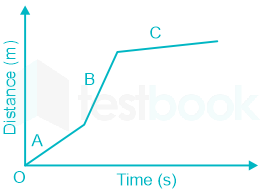
Consider a journey by a car represented by the graph given below in three parts A, B and C. The speed of the car in these parts is Va, Vb and Vc, respectively:

Which one of the following is correct in this case?

  1. AOption (a)

    va < vb < vc

  2. BOption (b)

    Vb > Va > Vc

  3. COption (c)

    Va = Vb = Vc

  4. DOption (d)

    Va > Vb; Va > Vc

View answer & explanation

Correct answer

Answer: (b)B.

Vb > Va > Vc

Why this answer is correct

The correct answer is Vb > Va > Vc.

Key Points

  • To find the speed from a distance-time graph, you need to calculate the slope of the graph at any given point.
  • The slope represents the rate of change of distance concerning time, which is the definition of speed.
  • The formula for speed (v) is given by the ratio of the change in distance to the change in time:
  • v=ΔdΔtv = {\Delta d \over \Delta t}
  • Here, 
  • v is the speed,
  • Δd is the change in distance, and
  • Δt is the change in time.
  • In the given graph, the order of decreasing slope is given by b>a>c.
  • Hence, the velocity in decreasing order is given by Vb > Va > Vc

Question 3

A concave mirror of radius of curvature 50 cm is used to form an image of an object kept at a distance of 25 cm from the mirror on its principal axis. What will be the position of the image from the mirror?

  1. AOption (a)

    At infinity

  2. BOption (b)

    At 50 cm

  3. COption (c)

    At 25 cm

  4. DOption (d)

    At 75 cm

View answer & explanation

Correct answer

Answer: (a)A.

At infinity

Why this answer is correct

The correct answer is At infinity.

Key Points

To find the position of the image formed by a concave mirror, you can use the mirror formula:

  • 1f=1u+1v{1\over f} = {1\over u}+{1\over v}
  • where:
  • f is the focal length of the mirror,
  • u is the object distance (distance of the object from the mirror),
  • v is the image distance (distance of the image from the mirror).
  • The focal length ( f) for a concave mirror is considered negative.
  • Given:
  • Radius of curvature (R) = -50 cm (negative for concave mirror)
  • Object distance (u) = -25 cm (negative since the object is on the same side as the incident light for a concave mirror)
  • First, find the focal length using the relationship : f = R/2
  • �=(−50 cm)2=−25 c�=(−50 cm)2=−25 c�=(−50 cm)2=−25 c f=−50:cm2=−25:cm{f} = {-50:cm\over 2} = -25:cm

Now, substitute the values into the mirror formula:

1(−25)=1(−25)+1�1(−25)=1(−25)+1�1(−25)=1(−25)+1�1(−25)=1(−25)+1�1(−25)=1(−25)+1�1(−25)=1(−25)+1�1(−25)=1(−25)+1�1(−25)=1(−25)+1�1(−25)=1(−25)+1�[Math Processing Error] 1−25=1−25+1v{1\over -25} = {1\over -25}+{1\over v}

Solve for v:

1v=1−25−1−25{1\over v} = {1\over -25}-{1\over -25}

1v=0{1\over v} = {0}

⇒v=∞\Rightarrow v = \infty

This implies that v is at infinity. In the case of a concave mirror, when the image distance (v) is positive infinity, the image is formed at the focus of the mirror.

Question 4

If the Moon is brought closer to the Earth such that its distance from the Earth becomes half of the original distance, then the gravitational force of attraction between the Earth and the Moon would:

  1. AOption (a)

    reduce to half of its original value.

  2. BOption (b)

    increase to two times of its original value.

  3. COption (c)

    remain the same as the original value.

  4. DOption (d)

    increase to four times of its original value.

View answer & explanation

Correct answer

Answer: (d)D.

increase to four times of its original value.

Why this answer is correct

The correct answer is increase to four times of its original value.

Key Points

  • If the Moon has twice the mass that it does, the force between the Earth and the Moon would be twice as large.
  • F=G×(Mass:of:moon)×(Mass:of:Earth)distance2F = {G \times (Mass :of :moon) \times (Mass :of :Earth) \over distance^2}
  • So, if the Moon was twice as massive, the attractive force of Earth on the moon be twice as large and the attractive force of the moon on Earth would be both twice bigger.
  • If the Moon were half the distance from the Earth, the gravitational force would be four times as large
  • F=G×(Mass:of:moon)×(Mass:of:Earth)distance2F = {G \times (Mass :of :moon) \times (Mass :of :Earth) \over distance^2}
  • According to the formula, it is visible that if the moon were half the distance from the Earth, the gravitational force would be four times as large.

Question 5

Sonic boom is produced when a source of sound travels at a speed:

  1. AOption (a)

    greater than the speed of sound.

  2. BOption (b)

    greater than the speed of light.

  3. COption (c)

    lesser than the speed of sound. 

  4. DOption (d)

    equal to the speed of sound.

View answer & explanation

Correct answer

Answer: (a)A.

greater than the speed of sound.

Why this answer is correct

The correct answer is greater than the speed of sound.

Key Points

  • When a source of sound travels faster than the speed of sound, a shock wave is generated which gives rise to a sonic boom.
  • These shock waves carry with them a huge amount of energy and pressure difference and those waves create a very loud and strong sound which is called sonic boom.
  • It generates huge amounts of sound energy. It almost feels like the sound of thunder.
  • The shock wave creates a cone of pressurized air molecules. As the cone spreads across the landscape along the flight path, it produces a continuous sonic boom along the entire width of the cone's base.
  • The rapid release of pressure following the build-up by the shock wave is heard as a sonic boom.
  • It is the sudden change in pressure (rate of change) that makes the sonic boom audible.

Question 6

Which one among the following are the correct symbols for the elements gold, tin and lead, respectively?

  1. AOption (a)

    Ga, Sb, Pb

  2. BOption (b)

    At, Sn, Le

  3. COption (c)

    Au, Sn, Pb

  4. DOption (d)

    Au, Sb, Pb

View answer & explanation

Correct answer

Answer: (c)C.

Au, Sn, Pb

Why this answer is correct

The correct answer is Au, Sn, Pb.

Key Points

  • Gold (Au):
  • Gold is a transition metal with the chemical symbol Au, which is derived from the Latin word "aurum".
  • Its atomic number in the periodic table is 79 and it is known for its distinctive yellow color, ductility and high conductivity.
  • Tin (Sn):
  • Tin is a transition metal with the chemical symbol Sn, which is derived from the Latin word "stannum".
  • Its atomic number is 50 and it is commonly used in the production of alloys such as bronze and solder.
  • Lead (Pb):
  • Lead is also a transition metal with the chemical symbol Pb, which is derived from the Latin word "plumbum".
  • Its atomic number is 82 and it is known for its dense and flexible properties.

Additional Information

  • Gallium
  • It has the symbol Ga.
  • Atomic number 31.
  • Astatine
  • It has the symbol At
  • Atomic number 85.
  • Antimony
  • It has the symbol Sb
  • Atomic number 51.

Question 7

How much percentage of carbon dioxide is present in the atmosphere of Venus and Mars?

  1. AOption (a)

    45 - 47%

  2. BOption (b)

    52 - 55%

  3. COption (c)

    74 - 77% 

  4. DOption (d)

    95 - 97%

View answer & explanation

Correct answer

Answer: (d)D.

95 - 97%

Why this answer is correct

The correct answer is 95 - 97%.

Key Points

  • On Venus and Mars, carbon dioxide is the dominant component making up 95–97% of the gaseous components on these planets.
  • Carbon dioxide is an important gaseous component of the environment.
  • It is stabilized by green plants through the process of photosynthesis. It is released during expiration by the process of respiration.

Additional Information

  • Venus has a large troposphere in its atmosphere.
  • Within the troposphere, gas is heated from below and slowly rotates, rising near the equator and descending at the poles.
  • Venus is Earth's twin planet because it has an atmosphere.
  • The atmosphere of Venus contains carbon dioxide with clouds of sulfuric acid droplets.
  • Nitrogen is the second most common gas in the atmosphere of Venus.
  • Mars is the fourth planet from the Sun and the second-smallest planet in the Solar System, larger only than Mercury.

Question 8

Which among the following methods is used to separate the constituents present in compound?

  1. AOption (a)

    Electrochemical method

  2. BOption (b)

    Heating method

  3. COption (c)

    Fractional distillation

  4. DOption (d)

    Decomposition followed by ion exchange

View answer & explanation

Correct answer

Answer: (a)A.

Electrochemical method

Why this answer is correct

The correct answer is Electrochemical method.

Key Points

  • The electrochemical method is used to separate elements in a compound through processes like electrolysis, where electrical energy is used to drive a non-spontaneous reaction.
  • During electrolysis, compounds such as water (H₂O) or sodium chloride (NaCl) are broken down into their constituent elements, like hydrogen and oxygen, or sodium and chlorine.
  • This method is widely applied in industries such as metal extraction (e.g., aluminum from bauxite using Hall-Héroult process).
  • Electrochemical separation is a clean and efficient way to isolate elements from ionic compounds, especially when thermal decomposition is not feasible.
  • It relies on the movement of ions in an electrolytic solution and requires an external power source to initiate the reaction.

Additional Information

  • Electrolysis
  • A technique where electric current is passed through a substance to effect a chemical change.
  • Used in the purification of metals and the production of chemical compounds like chlorine gas and sodium hydroxide.
  • Ionic Compounds
  • Compounds composed of ions held together by electrostatic forces called ionic bonding.
  • These are the typical targets for electrochemical decomposition due to their charged nature.
  • Electrodes
  • Two conductors used in electrolysis: anode (positive) and cathode (negative).
  • Different reactions occur at each electrode, leading to the separation of elements.
  • Applications in Industry
  • Used in extraction of reactive metals like aluminum, electroplating, and water treatment plants.
  • Also employed in hydrogen production as part of renewable energy systems.

Question 9

During white - washing of walls, slaked lime reacts slowly with carbon dioxide in air to form a thin layer of calcium carbonate on the walls. Which of the following reactions represents this correctly?

  1. AOption (a)

    CaO (s) + CO2 (g) → CaCO3 (s)

  2. BOption (b)

    CaO (l) + CO2 (g) → CaCO3 (s)

  3. COption (c)

    Ca(OH)2 (l) + CO2 (l) → CaCO3 (s) + H2O (l)

  4. DOption (d)

    Ca(OH)2 (aq) + CO2 (g) → CaCO3 (s) + H2O (l)

View answer & explanation

Correct answer

Answer: (d)D.

Ca(OH)2 (aq) + CO2 (g) → CaCO3 (s) + H2O (l)

Why this answer is correct

The correct answer is Ca(OH)2 (aq) + CO2 (g) → CaCO3 (s) + H2O (l).

 Key Points

  • While whitewashing, Ca(OH)2 reacts slowly with CO2 in the air to form a thin layer of CaCO3 on the walls.
  • Ca(OH)2 is Calcium hydroxide, CO2 is Carbon dioxide, and CaCO3 is Calcium carbonate.
  • Calcium carbonate is formed 2-3 days after whitewashing, and thus we get a shiny finish on the wall.
  • The following reaction takes place in the given case:
  • Ca(OH)2 (aq) + CO2 (g) → CaCO3 (s) + H2O (l)

 Additional Information

  • The common name of Calcium hydroxide is 'slaked lime' and the saturated solution of Calcium hydroxide is known as 'limewater'.
  • Calcium carbonate is commonly known as 'limestone'.
  • CaO is Calcium oxide.
  • CaSO4 is Calcium sulphate.
  • CaCl2 is Calcium chloride.

Question 10

Which one of the following equations is the balanced chemical equation for the given reaction?

Fe + H2O → Fe3O4 + H2

  1. AOption (a)

    Fe + 4H2O → Fe3O4 + H2

  2. BOption (b)

    3Fe + H2O → Fe3O4 + 2H2

  3. COption (c)

    3Fe + 4H2O → Fe3O4 + 4H2

  4. DOption (d)

    3Fe + 4H2O → Fe3O4 + H2

View answer & explanation

Correct answer

Answer: (c)C.

3Fe + 4H2O → Fe3O4 + 4H2

Why this answer is correct

The correct answer is 3Fe + 4H2O → Fe3O4 + 4H2.

Key Points

  • Balancing chemical equations involves adding stoichiometric coefficients to the reactants and products.
  • This is important because a chemical equation must obey the law of conservation of mass and the law of constant proportions, i.e. equal numbers of atoms of each element must be present on the reactant side and product side of the equation.
  • The chemical reaction is given as
  • Fe + H2 O → Fe3 O4 + H2
  • The balanced chemical equation can be written as
  • Reactant         Products
  • Fe = 1                Fe = 3
  • H = 2                  H = 2
  • O = 1                  O = 4
  • 3Fe + 4H2 O → Fe3 O4  + 4H2

Question 11

The term, Phyllotaxy refers to the pattern of:

  1. AOption (a)

    arrangement of leaves. 

  2. BOption (b)

    branching in stem.

  3. COption (c)

    flower formation on branch. 

  4. DOption (d)

    arrangement of flowers.

View answer & explanation

Correct answer

Answer: (a)A.

arrangement of leaves. 

Why this answer is correct

The correct answer is arrangement of leaves. 

Key Points

  • Phyllotaxy refers to the pattern or arrangement of leaves on a plant's stem or branch.
  • The arrangement of leaves on the stem of a plant is phyllotaxy. A structure similar to a leaf is a leaflet.
  • Compound leaves come together to form several leaflets.
  • Stipules are leaf-like structures found at the base of the stalk.
  • The simple arrangement of leaves on a stem is opposite and alternating (also called a spiral).
  • If multiple leaves are visible or appear to be, the leaves may also be rooted from the same point on the stem (at the same node).

Additional Information

  • Phyllotaxy is of three types-
  • Opposite - In opposite leaf arrangement, each node has a pair of leaves opposite each other.
  • Alternate - In an alternate leaf arrangement, there is one leaf per plant node.
  • Whorled - In whorled leaf arrangement, a node has more than two leaves in the form of a whorl.

Question 12

Chromosomes are composed of DNA and:

  1. AOption (a)

    lipids

  2. BOption (b)

    vitamins

  3. COption (c)

    proteins

  4. DOption (d)

    carbohydrates

View answer & explanation

Correct answer

Answer: (c)C.

proteins

Why this answer is correct

The correct answer is proteins.

Key Points

  • In the nucleus of each cell, DNA molecules are packaged into thread-like structures called chromosomes. Each chromosome is made up of DNA tightly coiled around proteins called histones that support its structure.
  • Chromosomes are highly condensed forms of chromatin threads.
  • Chromosomes were first observed in pollen mother cells of Tradescantia by Hofmeister and Carl Naegeli.
  • The credit for the discovery of chromosomes goes to Strasburger as he was the first to describe the chromosome structure seen in the nucleus during cell division.
  • Typically, chromosomes are rod-shaped, elongated, or point-shaped ranging in size from 0.5 to 32 micrometers.

Additional Information

  • In humans, each cell normally has 23 pairs of chromosomes, a total of 46.
  • Twenty-two of these pairs, called autosomes, look the same in both men and women.
  • The 23rd pair, the sex chromosomes, differ between males and females.
  • Females have two copies of the X chromosome, while males have one X and one Y chromosome.

Question 13

Bacteria have an undefined nuclear region which lacks a nuclear membrane and contains only DNA without proteins. Such a region is called:

  1. AOption (a)

    Nucleosome

  2. BOption (b)

    Nucleus

  3. COption (c)

    Nucleoprotein

  4. DOption (d)

    Nucleoid

View answer & explanation

Correct answer

Answer: (d)D.

Nucleoid

Why this answer is correct

The correct answer is Nucleoid.

Key Points

  • In prokaryotic organisms, the nuclear region is not surrounded by any membrane.
  • The undefined nuclear region lacking a nuclear membrane and containing only DNA without proteins in bacteria is called the nucleoid.
  • Prokaryotic cells are primitive organisms.
  • In prokaryotes, the nucleoid contains all or most of the genetic material.
  • In prokaryotic cells, the nucleus is not well-defined because it is not surrounded by the nuclear membrane.

Additional Information

  • A nucleosome is a section of DNA wrapped around a core of protein.
  • Inside the nucleus, DNA forms a complex with a protein called chromatin, which allows the DNA to condense into small amounts.
  • A nucleus, as it relates to genomics, is a membrane-bound organelle within a cell that contains chromosomes.
  • A series of pores, or pores, in the nuclear membrane allow selective passage of certain molecules (such as proteins and nucleic acids) in and out of the nucleus.
  • Nucleoproteins are a type of proteins that are associated with nucleic acids and ribosomes and lipoproteins, they often serve as lipid transport and storage proteins such as vitelline.
  • A nucleoprotein is a conjugated protein structure consisting of a protein linked to a nucleic acid, either DNA abbreviated as deoxyribonucleic acid or RNA abbreviated as ribonucleic acid.

Question 14

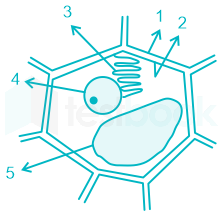
In the following simplified diagram of at plant cell, five parts / organelles are marked from 1 to 5:

Which one of the following correctly represents the above parts / organelles?

  1. AOption (a)

    1 - cell membrane; 2 - cell wall; 3 - vacuole; 4 - endoplasmic reticulum; 5 - nucleus

  2. BOption (b)

    1 - cell wall; 2 - cell membrane; 3 - endoplasmic reticulum; 4 - vacuole; 5 - nucleus

  3. COption (c)

    1 - cell wall; 2 - cell membrane; 3 - endoplasmic reticulum; 4 - nucleus; 5 - vacuole

  4. DOption (d)

    1 - cell wall;  2 - cell membrane; 3 - vacuole; 4 - endoplasmic reticulum; 5 - nucleus

View answer & explanation

Correct answer

Answer: (c)C.

1 - cell wall; 2 - cell membrane; 3 - endoplasmic reticulum; 4 - nucleus; 5 - vacuole

Why this answer is correct

The correct answer is 1 - cell wall; 2 - cell membrane; 3 - endoplasmic reticulum; 4 - nucleus; 5 - vacuole.

Key Points

  • Cell membrane
  • Cell membrane is also called the plasma membrane.
  • It can be observed only through an electron microscope.
  • The plasma membrane is the outermost covering of the cell that separates the contents of the cell from its external environment.
  • Cell wall
  • Plant cells, in addition to the plasma membrane, have another rigid outer covering called the cell wall. The cell wall lies outside the plasma membrane.
  • The plant cell wall is mainly composed of cellulose. Cellulose is a complex substance and provides structural strength to plants.
  • Vacuoles
  • Empty structure in the cytoplasm is called vacuole.
  • Large vacuoles are common in plant cells. Vacuoles in animal cells are much smaller.
  • Vacuoles are storage sacs for solid or liquid contents.
  • Endoplasmic reticulum
  • The endoplasmic reticulum (ER) is a large network of membrane-bound tubes and sheets. It looks like long tubules or round or long bags (vesicles).
  • There are two types of ER ––
  • rough endoplasmic reticulum (RER) and
  • smooth endoplasmic reticulum (SER).
  • Nucleus
  • It is an important component of the living cell.
  • Nucleus is separated from the cytoplasm by a double layered membrane called the nuclear membrane.

Question 15

Which one of the following is the language of the famous political treatise Amuktmalyada?

  1. AOption (a)

    Sanskrit

  2. BOption (b)

    Tamil

  3. COption (c)

    Kannada

  4. DOption (d)

    Telugu

View answer & explanation

Correct answer

Answer: (d)D.

Telugu

Why this answer is correct

The correct answer is Telugu.

Key Points

  • Krishnadevaraya was one of the important emperors of the Vijayanagara Empire who ruled from 1509–1529.
  • He himself wrote his great work Amuktamalyada in Telugu.
  • He was the third ruler of the Tuluva Dynasty.
  • He is also known as Andhra Bhoja and Kannada Rajya Ramana.
  • He built the Vithalaswamy Temple and Hazar Rama Temple in the Hoysala style of architecture.
  • Krishnadev Rai always respected all sects of Hindu religion.
  • During his reign, the Portuguese travelers, Domingo Paes and Durate Barbosa, visited his court.

Question 16

Which one of the following statements about the Shvetambara Sect of Jainism is not correct?

  1. AOption (a)

    It refers to monks, who wear white clothes.

  2. BOption (b)

    It refers to monks, who migrated to the south of Vindhyas in 4th century BCE.

  3. COption (c)

    They recognized the existence of canonical texts including the 12 Angas. 

  4. DOption (d)

    They believed that women can also attain salvation.

View answer & explanation

Correct answer

Answer: (b)B.

It refers to monks, who migrated to the south of Vindhyas in 4th century BCE.

Why this answer is correct

The correct answer is It refers to monks, who migrated to the south of Vindhyas in 4th century BCE.

Key Points

  • The Digambara and Shvetambara sects primarily differ in their views on ascetic practices, particularly the wearing of clothes.
  • The Shvetambaras regard canonical literature as true and sacred, such as the 12 Angas and Sutras.
  • The Shvetambara Sect of Jainism does not have a historical connection with migration to the south of the Vindhyas.
  • The migration to the south of the Vindhyas is not a distinguishing factor between these sects.

Additional Information

  • Jains are divided into two major sects:
  • ​The Digambara (meaning sky-clad or naked) sect.
  • The Svetambara (meaning white-clad) sect.
  • Both sects follow five vows of Jainism-
  • ​Non-violence (Ahimsa)
  • Truth (Satya)
  • Non-stealing (Asteya)
  • Celibacy/chastity (Brahmacharya)
  • Nonattachment/ non-possession (Aparigraha

Question 17

Where is the Vikramkhol Cave located?

  1. AOption (a)

    Odisha

  2. BOption (b)

    Bihar

  3. COption (c)

    Telangana

  4. DOption (d)

    West Bengal

View answer & explanation

Correct answer

Answer: (a)A.

Odisha

Why this answer is correct

The correct answer is Odisha.

Key Points

  • Vikramkhol Cave is located near Jharsuguda, Odisha and is situated in the reserved forest of Belpahar Range at a distance of 12 km from Belpahar.
  • The inscriptions at Vikramkhol Cave are written using red ocher paint on an uneven rock surface in a natural rock shelter, which is then carved into the rock.
  • The inscriptions were discovered around 1930 and first studied by Dr. K.P. Jaiswal.

Additional Information

  • Monuments of Odisha:
  • Sun Temple, Konark
  • Sri Jagannath Puri Temple, Puri
  • Dhauli, Bhubaneswar, Odisha
  • Barabati Fort, Cuttack
  • Khandagiri Caves, Bhubaneswar
  • Brahmeshwara Temple, Bhubaneswar
  • Lingaraj Temple, Bhubaneswar
  • Sambalpur, Odisha Sambalpur

Question 18

Consider the following statements regarding the 'Levallois Technique':

  1. It refers to making perforated Harappa pottery.
  2. It refers to making prehistoric flake tools.

Which of the statements given above is/are correct?

  1. AOption (a)

    1 only

  2. BOption (b)

    2 only

  3. COption (c)

    Both 1 and 2

  4. DOption (d)

    Neither 1 nor 2

View answer & explanation

Correct answer

Answer: (b)B.

2 only

Why this answer is correct

The correct answer is 2 only.

Key Points

  • Levalloisian stone-flaking technique, the tool-making technique of prehistoric Europe and Africa, is characterized by the production of large flakes from the tortoise core (the finished core is shaped like an inverted tortoiseshell).
  • This technique was more sophisticated than earlier methods of lithic reduction, which involved removing lithic flakes from prepared lithic cores.
  • A striking platform is created at one end and the edges of the core are then cut by slicing around the outline of the desired lithic layer.
  • The Levallois technique is not related to the making of perforated Harappan pottery.
  • Harappa refers to one of the major sites of the Indus Valley Civilization, and Levallois technology is not associated with it.

Additional Information

  • Harappa was first excavated by Dayaram Sahni in 1921.
  • The Indus Valley Civilization was larger than the ancient Egyptian and Mesopotamian civilizations.
  • Major findings
  • Piece of Pottery with Indus Script
  • Cubical Limestone Weight
  • Faience Slag
  • Sandstone statues of Human anatomy
  • Copper Bullock cart
  • Granaries
  • Coffin burials (Only founded in Harrapa)
  • Terracotta Figurines

Question 19

Which of the following statements is/are correct?

1. The Bakshali Manuscript written in the Gatha language (a refined version of old Prakrit) using the Sharada script deals with topics such as fractions, square roots, arithmetic and geometric progressions. 2. In the field of geometry, Aryabhatta described the various properties of a circle giving a very accurate value for pi (π) correct to four decimal places at 3.1416. 3. Sharangadhara Samhita is an important text on the political system of ancient India.

Select the correct answer using the code given below:

  1. AOption (a)

    1, 2 and 3

  2. BOption (b)

    1 and 3 only

  3. COption (c)

    1 and 2 only

  4. DOption (d)

    2 only

View answer & explanation

Correct answer

Answer: (c)C.

1 and 2 only

Why this answer is correct

The correct answer is 1 and 2 only.

Key Points

  • The Bakshali Manuscript:
  • It is indeed written in the Gatha language (a refined version of old Prakrit) using the Sharada script.
  • It deals with topics such as fractions, square roots, arithmetic, and geometric progressions. Hence, statement 1 is correct.
  • Aryabhatta and π (pi):
  • In the field of geometry, Aryabhatta described the various properties of a circle giving a very accurate value for pi (π) correct to four decimal places at 3.1416
  • In other words, what Aryabhata said was that the circumference of a circle with a diameter of 20000 is (4+100) x8 +62000= 62832.
  • And we know that the value of pi is the ratio of the circumference to the diameter so in this case 62832/20000, which is incredibly 3.1416. Hence, statement 2 is correct.
  • Sharangadhara Samhita:
  • This text is not primarily focused on the political system of ancient India.
  • The Sharangadhara Samhita is more known for its contributions to Ayurveda and pharmacology.
  • It was written by Acharya Sharangadhara, the son of Sri Damodara and grandson of Raghavadev. Hence, statement 3 is incorrect.

Important Points

  • The "Arthashastra" is a classical treatise on statecraft, politics, economics, and military strategy attributed to Chanakya (Kautilya), an ancient Indian scholar, teacher, economist, and political strategist who is traditionally identified with Chanakya, the adviser to Chandragupta Maurya, the founder of the Mauryan Empire.

Question 20

Which one of the following is not correct about the Indian Independence Act, 1947 ?

  1. AOption (a)

    The Bill for the Indian Independence Act was introduced in Parliament on July 4 and received the Royal Assent on July 18, 1947.

  2. BOption (b)

    Act of 1947 laid down the basic framework of the Indian Constitution.

  3. COption (c)

    The Act provided for the establishment of two independent Dominions to be known as India and Pakistan.

  4. DOption (d)

    The Act empowered the Constituent Assembly of each Dominion to have unlimited power to frame and adopt any constitution.

View answer & explanation

Correct answer

Answer: (b)B.

Act of 1947 laid down the basic framework of the Indian Constitution.

Why this answer is correct

The correct answer is Act of 1947 laid down the basic framework of the Indian Constitution.

Key Points

  • The Indian Independence Act of 1947 did not lay down the basic framework of the Indian Constitution.
  • The task of drafting the Indian Constitution was later undertaken by the Constituent Assembly of India, which was elected to represent the people of India.
  • The drafting of the Indian Constitution took several years and was completed on 26 January 1950, when it came into force.

Additional Information

  • Indian Independence Act, 1947:
  • The Indian Independence Act, of 1947 received royal assent and entered into force on 18th July 1947.
  • It was primarily concerned with the transfer of legislative authority to the two new Dominions, India and Pakistan, and the delimitation of their territories.
  • It gave the constituent assemblies of the two dominions unlimited power to make and adopt any constitution and to repeal any Act of the British Parliament which was prejudicial to their interests, including the Act of Independence.

Question 21

As per the Cabinet Resolution of 1st January, 2015, the NITI Aayog consists of:

  1. Prime Minister of India
  2. Governing Council comprising of Chief Minister of all the States and Lieutenant Governors of Union Territories
<br>

3. Rural Development Minister 4. Chief Executive Officer to be appointed by the Prime Minister

Select the correct answer using the code given below:

  1. AOption (a)

    1, 2 and 3

  2. BOption (b)

    1, 2 and 4

  3. COption (c)

    1 and 2 only

  4. DOption (d)

    3 and 4 only

View answer & explanation

Correct answer

Answer: (b)B.

1, 2 and 4

Why this answer is correct

The correct answer is 1, 2 and 4.

Key Points

  • As per the Cabinet Resolution of 1st January, 2015, the NITI Aayog consists of:
  • Prime Minister of India
  • Governing Council comprising Chief Minister of all the States and Lieutenant Governors of Union Territories
  • Chief Executive Officer to be appointed by the Prime Minister

Additional Information

  • The composition of the NITI Aayog (National Institution for Transforming India) is as follows:
  • Chairman: Prime Minister
  • Vice President: To be appointed by the Prime Minister
  • Governing Council: Chief Ministers of all States and Lieutenant Governors of Union Territories.
  • Regional Council: To address specific regional issues, consisting of the Chief Minister and Lieutenant Governor, chaired by the Prime Minister or his nominee.
  • Ad-hoc Membership: 2 members in an ex-officio capacity on rotation basis from leading research institutions.
  • Ex-officio membership: A maximum of four from the Union Council of Ministers to be nominated by the Prime Minister.
  • Chief Executive Officer: Appointed by the Prime Minister for a fixed tenure in the post of Secretary to the Government of India.
  • Special Invitees: Experts with domain knowledge nominated by the Prime Minister.

Question 22

The executive is given an advance grant to meet temporary and running requirements of Government of India in the beginning of the new financial year until the demands are voted by the legislature. This is known as:

  1. AOption (a)

    Vote of Credit

  2. BOption (b)

    Vote on Account

  3. COption (c)

    Appropriation Bill

  4. DOption (d)

    Advance Account

View answer & explanation

Correct answer

Answer: (b)B.

Vote on Account

Why this answer is correct

The correct answer is Vote on Account.

Key Points

  • Vote on Account is a grant in advance given to the Executive to meet the temporary and ongoing requirements of the Government of India at the beginning of the new financial year.
  • This is necessary because the budget has not yet been approved and passed by the legislature.
  • Vote on Account typically covers expenses for part of the year, often for two months, although it can also be for longer periods.

Additional Information

  • Vote of credit is a special provision that allows the government to meet unexpected expenses.
  • The Appropriation Bill legally empowers the government to use money from the treasury for its operations after the budget is passed.
  • Advance account is not a term traditionally associated with this particular financial process in the Indian government.

Question 23

Which of the following is / are United Nations Sustainable Development Goal(s)?

  1. Decent work and economic growth 2. Peace, justice and strong institutions 3.  Responsible consumption and production

Select the correct answer using the code given below:

  1. AOption (a)

    1 and 2 only

  2. BOption (b)

    1, 2 and 3

  3. COption (c)

    2 only

  4. DOption (d)

    1 and 3 only

View answer & explanation

Correct answer

Answer: (b)B.

1, 2 and 3

Why this answer is correct

The correct answer is 1, 2 and 3.

Key Points

  • 17 Goals for People, for Planet
  • World leaders came together in 2015 and made a historic promise to secure the rights and well-being of everyone on a healthy, thriving planet when they adopted the 2030 Agenda for Sustainable Development and its 17 Sustainable Development Goals (SDGs).
  • The 17 goals under the Sustainable Development Goals are as mentioned below:
  • Goal 1: End poverty in all its forms
  • Goal 2: Zero Hunger
  • Goal 3: Health
  • Goal 4: Education
  • Goal 5: Gender equality and women’s empowerment
  • Goal 6: Water and Sanitation
  • Goal 7: Energy
  • Goal 8: Economic Growth
  • Goal 9: Infrastructure, industrialization
  • Goal 10: Inequality
  • Goal 11: Cities
  • Goal 12: Sustainable consumption and production
  • Goal 13: Climate Action
  • Goal 14: Oceans
  • Goal 15: Biodiversity, forests, desertification
  • Goal 16: Peace, justice and strong institutions
  • Goal 17: Partnerships

Question 24

Consider the following statements on 'Fog':

  1. Fog is simply a cloud that forms close to the ground.
  2. Radiation fog is associated with radiation cooling of the land at night. 3. Advection fog forms when moisture is blown over a cold surface and is chilled by contact.

Which of the statements given above are correct?

  1. AOption (a)

    1 and 2 only

  2. BOption (b)

    2 and 3 only

  3. COption (c)

    1 and 3 only

  4. DOption (d)

    1, 2 and 3

View answer & explanation

Correct answer

Answer: (d)D.

1, 2 and 3

Why this answer is correct

The correct answer is 1, 2 and 3.

Key Points

  • At night, as the land surface cools, the air near the surface also cools.
  • Since cold air cannot hold as much moisture as warm air, the water vapor in the air condenses and forms fog.
  • Fog begins to form in the early hours of the morning when the temperature is at its lowest.
  • Fog is simply a cloud that forms close to the ground.
  • Fog is indeed a cloud that forms at or near the ground level when air is cooled and reaches its dew point.
  • Radiation fog is associated with radiation cooling of the land at night.
  • Radiation fog forms at night when the Earth's surface loses heat through radiation, causing the air near the surface to cool and reach its dew point.
  • Advection fog forms when moisture is blown over a cold surface and is chilled by contact.
  • Advection fog occurs when warm, moist air moves horizontally over a colder surface, and the air is cooled, leading to the condensation of water vapor and the formation of fog.

Question 25

Which one of the following landforms is/are formed by wind erosion?

  1. AOption (a)

    Cirque

  2. BOption (b)

    Stack

  3. COption (c)

    Zeugen

  4. DOption (d)

    Stack and Zeugen both

View answer & explanation

Correct answer

Answer: (c)C.

Zeugen

Why this answer is correct

The correct answer is Zeugen.

Key Points

  • Zeugens are elongated, resistant ridges or hills of rock that remain after surrounding areas have been eroded by wind or water.
  • They are often found in arid or semi-arid regions where wind erosion is a significant geomorphic process.
  • Mostly seen in arid and semi-arid areas.
  • The soft part of the rock is destroyed by the wind and the hard part remains the same.

Additional Information

  • Cirque is a landform associated with glacial erosion. Cirques are amphitheater-shaped valleys with precipitous walls.
  • Stack is typically formed by coastal erosion.
  • Generally seen in coastal areas.
  • The formation of Stacks takes a very long time.

Question 26

Which one of the following crops is not cultivated under dryland farming?

  1. AOption (a)

    Jowar

  2. BOption (b)

    Ragi

  3. COption (c)

    Sugarcane

  4. DOption (d)

    Groundnut

View answer & explanation

Correct answer

Answer: (c)C.

Sugarcane

Why this answer is correct

The correct answer is Sugarcane.

Key Points

  • Sugarcane is a water-intensive crop and is typically not cultivated under dryland farming.
  • It requires a substantial amount of water for optimal growth, and hence, it is more commonly grown in areas with assured irrigation facilities.

Additional Information

  • Dryland farming refers to agricultural practices in regions where water availability for crop cultivation is limited, and the crops rely predominantly on rainfall. In such areas, farmers often face challenges related to water scarcity and must choose crops that are well-suited to these conditions. 
  • Jowar (Sorghum): Jowar is a cereal crop that is well-suited for dryland farming. It is drought-tolerant and can thrive in regions with limited water availability.
  • Ragi (Finger Millet): Similar to Jowar, Ragi is a drought-tolerant cereal crop that is suitable for cultivation in dryland areas.
  • Groundnut (Peanut): Groundnut is often cultivated in dryland farming. While it is not as water-intensive as sugarcane, groundnut is adapted to arid and semi-arid conditions and is a common crop in regions with limited water resources.

Question 27

Which one of the following forms of settlement develops around a lake?

  1. AOption (a)

    Linear

  2. BOption (b)

    Cross - shaped

  3. COption (c)

    Circular

  4. DOption (d)

    Square

View answer & explanation

Correct answer

Answer: (c)C.

Circular

Why this answer is correct

The correct answer is Circular.

Key Points

  • Circular pattern: These develop around lakes, tanks and sometimes a village is planned in such a way that the central part remains open and is used for keeping the animals to protect them from wild animals.

Additional Information

  • Rural settlements of the world can be classified based on form or size of settlements as follows
  • Linear: In such settlements, houses are located along a road, railway line, river, canal or along a valley or embankment.
  • Rectangular Pattern: Such pattern of rural settlements is found in plain areas or wide inter-mountain valleys. The roads are rectangular and intersect each other at right angles.
  • Star-like pattern: Where several roads meet, star-shaped settlements develop with houses built along the roads.
  • T-shaped, Y-shaped, cross-shaped or cruciform settlements:
  • ​T-shaped settlements develop at triangular road junctions,
  • Y-shaped settlements develop where two roads meet at the third and Houses are built together.
  • Cruciform settlements develop at intersections and houses are spread in all directions.
  • Double villages: These villages are spread on both the banks of the river where there is a bridge or ferry.

Question 28

How can resources be classified on the basis of their origin?

  1. AOption (a)

    Biotic and abiotic

  2. BOption (b)

    Renewable and non - renewable

  3. COption (c)

    Individual and community

  4. DOption (d)

    Potential and reserve

View answer & explanation

Correct answer

Answer: (a)A.

Biotic and abiotic

Why this answer is correct

The correct answer is Biotic and abiotic.

Key Points

  • Based on their origin, resources can be classified as biotic resources and abiotic resources.
  • Abiotic Resources:
  • These are non-living resources that come from the non-living and physical environment.
  • Examples include minerals, metals, air, water, and soil.
  • Biotic Resources:
  • These are resources that come from living organisms or have resulted from life processes.
  • Examples include forests, wildlife, fish, and livestock.

Additional Information

  • Based on the level of availability.
  • These two categories are renewable and non-renewable resources.
  • Renewable Resources: These are resources that can be naturally replenished over time, such as solar energy, wind energy, hydropower, and biomass.
  • Non-renewable Resources: These are finite resources that cannot be regenerated at a rate equal to or faster than their consumption. Examples include fossil fuels (coal, oil, natural gas) and minerals.
  • Individual Resources: These are resources that can be owned, used, and managed by an individual. Examples include personal property, skills, and talents.
  • Community Resources: These are resources that are commonly owned or used by a community or society as a whole. Examples include public parks, community facilities, and shared natural resources.
  • Potential Resources: These are resources that exist in a region and may be used in the future if the necessary technology and economic conditions allow. They are not currently being utilized.
  • Reserve Resources: These are resources that have been surveyed, quantified, and are currently being exploited or used.

Question 29

Which one among the following is the highest mountain in Africa?

  1. AOption (a)

    Atlas Mountain

  2. BOption (b)

    Mount Kilimanjaro

  3. COption (c)

    Mount Kenya 

  4. DOption (d)

    Mount Elgon

View answer & explanation

Correct answer

Answer: (b)B.

Mount Kilimanjaro

Why this answer is correct

The correct answer is Mount Kilimanjaro.

Key Points

  • Mount Kilimanjaro is located in Tanzania, Africa.
  • Mount Kilimanjaro is the highest peak on the African continent at 5,895 meters (19,340 ft).
  • The majestic mountain is a snow-covered volcano.
  • Mount Kilimanjaro is the highest mountain in Africa.
  • Also called a stratovolcano (a term for a very large volcano made of ash, lava, and rock), Kilimanjaro is made up of three cones: Kibo, Mawenzi, and Shira. Kibo is the peak of the mountain.

Additional Information

MountainDetails
Atlas MountainThe Atlas Mountains are a mountain range across three countries: Morocco, Algeria, and Tunisia in North Africa. They stretch approximately 2,500 kilometers across Northwest Africa.
Mount KenyaMount Kenya is the second-highest mountain in Africa, after Mount Kilimanjaro. Located in Kenya, East Africa.
Mount ElgonMount Elgon is not the highest in Africa. Its highest point, Wagagai Peak, stands at 4,321 meters (14,177 feet).

Question 30

Which of the following action(s) by the Government would lead to contraction of money supply in the economy?

1. Purchase of Treasury Bills by the central bank from public 2. Sale of Treasury Bills by the central bank to public 3. Sale of foreign exchange by the central bank 4. Purchase of foreign exchange by the central bank

Select the correct answer using the code given below:

  1. AOption (a)

    1 and 4 only.

  2. BOption (b)

    1 and 3 only

  3. COption (c)

    2 and 3 only

  4. DOption (d)

    2 only

View answer & explanation

Correct answer

Answer: (d)D.

2 only

Why this answer is correct

The correct answer is 2 only.

Key Points

  • Sale of treasury bills by the central bank to the public:
  • When the central bank sells treasury bills to the public, it takes money out of the economy, thus contracting the money supply.

Additional Information

  • Purchasing of treasury bills from the public by the central bank:
  • When the central bank purchases treasury bills from the public, it is essentially injecting money into the economy, thus expanding the money supply, not contracting it.
  • Sale of foreign currency by the central bank:
  • When the central bank sells foreign currency, it receives domestic currency in return.
  • This action may increase foreign exchange reserves, but will not necessarily lead to a contraction in the money supply.
  • Purchase of foreign currency by the central bank:
  • When the central bank buys foreign currency, it releases domestic currency into the economy.
  • This increases the money supply instead of shrinking it.

Question 31

Which of the following are included in the definition of Narrow Money?

  1. Currency with the public
  2. Demand deposits 3. 'Other' deposits with Reserve Bank of India
  3. Banker's deposits with Reserve Bank of India

Select the correct answer using the code given below:

  1. AOption (a)

    1, 2 and 4

  2. BOption (b)

    1 and 2 only

  3. COption (c)

    1, 2 and 3

  4. DOption (d)

    3 and 4 only

View answer & explanation

Correct answer

Answer: (c)C.

1, 2 and 3

Why this answer is correct

The correct answer is 1, 2 and 3.

Key Points

  • Narrow money plays a vital role in facilitating day-to-day transactions and is an important indicator of the monetary health of the economy.
  • Narrow money is a type of money supply that consists of all real money held by a central bank, including coins and currency, demand deposits, and other liquid assets.
  • In India, narrow money is denoted by M1.
  • The high liquidity of narrow money allows for immediate spending, which impacts short-term economic health.
  • M1 = Currency with the Public + Demand Deposits with the Banking System + ‘Other’ Deposits with RBI
  • M1= Currency with the Public + Current Deposits with the Banking System + Demand Liabilities Portion of Savings Deposits with the Banking System + ‘Other’ Deposits with RBI
  • ‘Other’ deposits with RBI comprise mainly:
  • (i) deposits of quasi-government and other financial institutions including primary dealers,
  • (ii) balances in the accounts of foreign Central banks and Governments,
  • (iii) accounts of international agencies such as the International Monetary Fund, etc.

Question 32

Which of the following is / are the effects of devaluation or depreciation of currency?

1. It leads to increase in imports and decrease in exports. 2. It leads to increase in exports and decrease in imports. 3. It leads to increase in domestic inflation. 4. It leads to decrease in domestic inflation.

<br>

Select the correct answer using the code given below:

  1. AOption (a)

    1 and 3 only

  2. BOption (b)

    1 and 4 only

  3. COption (c)

    2 and 3 only

  4. DOption (d)

    3 only

View answer & explanation

Correct answer

Answer: (c)C.

2 and 3 only

Why this answer is correct

The correct answer is 2 and 3 only.

Key Points

  • Devaluation can contribute to domestic inflation because it makes imports more expensive.
  • As the cost of imported goods rises, it can lead to higher overall price levels in the domestic economy.
  • Devaluation occurs when a government seeks to increase its trade balance by reducing the relative value of its currency.
  • The government does this by adjusting a fixed or semi-fixed exchange rate of its currency versus the exchange rate of another country's currency.
  • The effects of devaluation or depreciation of currency include:
  • It leads to an increase in exports and a decrease in imports.
  • When a currency is devalued, its exchange rate decreases relative to other currencies.
  • This makes the country's exports cheaper for foreign buyers and imports more expensive for domestic consumers, thereby promoting exports and discouraging imports.
  • It leads to an increase in domestic inflation.

Question 33

Which one of the following taxes is not subsumed under the Goods and Services Tax in India?

  1. AOption (a)

    Customs Duties

  2. BOption (b)

    Central Excise Duties

  3. COption (c)

    Service Tax

  4. DOption (d)

    Taxes on Petroleum and Petroleum Products

View answer & explanation

Correct answer

Answer: (d)D.

Taxes on Petroleum and Petroleum Products

Why this answer is correct

The correct answer is Taxes on Petroleum and Petroleum Products.

Key Points

  • The taxes included in GST include Central Excise, Service Tax, VAT and many other taxes. However, direct taxes like income tax, and customs duty on imports.
  • The two taxes not included in GST in India are:
  • Basic Customs Duty (BCD): Basic Customs Duty is a tax levied on goods imported into India. It is outside the scope of GST and is levied as a separate tax.
  • Petroleum Products: Petroleum products like petrol, diesel, crude oil, aviation turbine fuel and natural gas are not under the GST regime.

Additional Information

  • Goods and Services Tax (GST):
  • It is a destination-based taxation system.
  • It has been established by the 101st Constitutional Amendment Act.
  • It is an indirect tax.
  • GST Council
  • It consists of the Centre, 28 states, Delhi and Puducherry.
  • Centre has 1/3rd of voting rights and states have 2/3rd of voting rights.
  • Decisions are taken after a majority in the council.

Question 34

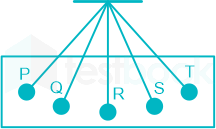
The following diagram shows a pendulum at different positions. Which one of the following statement is true?

  1. AOption (a)

    The pendulum has minimum potential energy at positions P and T.

  2. BOption (b)

    The pendulum has minimum potential energy at positions Q and S.

  3. COption (c)

    The pendulum has minimum potential energy at position R.

  4. DOption (d)

    The pendulum has same potential energy at all positions.

View answer & explanation

Correct answer

Answer: (c)C.

The pendulum has minimum potential energy at position R.

Why this answer is correct

The correct answer is The pendulum has minimum potential energy at position R.

Key Points

  • Simple Pendulum:
  • A simple pendulum consists of a small metallic ball or a piece of stone suspended from a rigid stand by a thread.
  • The metallic ball is termed as bob.
  • A pendulum swings from one extreme position to another and comes back to the same position, this completes one oscillation.
  • The pendulum is said to be at maximum displacement when it is at an extreme position.
  • One oscillation can also be defined as the pendulum starting from the mean position, going to one extreme, and coming back to the same mean position.
  • The time period for an oscillation to compete is called the time period and the inverse of the time period is the frequency.
  • So, Potential energy is maximum at maximum displacement position or extreme positions P and T.
  • Kinetic energy is minimum at the equilibrium position. The equilibrium position is the mean position.
  • The pendulum has minimum potential energy at position R.

Question 35

In which of the following media is the speed of sound the maximum ?

  1. AOption (a)

    Glass

  2. BOption (b)

    Stainless steel

  3. COption (c)

    Water

  4. DOption (d)

    Oxygen

View answer & explanation

Correct answer

Answer: (b)B.

Stainless steel

Why this answer is correct

The correct answer is Stainless steel.

Key Points

  • The speed of sound is highest in solids because the molecules in solid media are more tightly bound together than in liquids or gases, allowing sound waves to travel faster. Therefore, in the given case, the speed of sound will be maximum in Stainless steel.

Additional Information

  • The speed of the sound depends on the density of the medium through which it is travelling.
  • The particles in the solid medium are closely packed. Hence, the density is high. Information from one molecule to another molecule travels faster in the solid medium.
  • In liquid, the molecules are farther apart than in solids. Hence, the density is low for liquids.
  • In gas, the molecules are very loosely dispersed.
  • Sound is a mechanical wave that needs a medium to travel.
  • The speed of sound is maximum in solids, then it is in liquid and it is the slowest in gases.
  • The speed of sound remains almost the same for all frequencies in a given medium under the same physical conditions.

Question 36

A charged particle moves through a magnetic field B with a velocity v. Which one of the following statements is true for the force (F) experienced by the particle?

  1. AOption (a)

    F is maximum when v and B are parallel to each other.

  2. BOption (b)

    F is maximum when v and B are anti-parallel to each other.

  3. COption (c)

    F is maximum when v and B are perpendicular to each other.

  4. DOption (d)

    The force F is independent of the angle between v and B.

View answer & explanation

Correct answer

Answer: (c)C.

F is maximum when v and B are perpendicular to each other.

Why this answer is correct

The correct answer is F is maximum when v and B are perpendicular to each other.

Key Points

  • The force (F) experienced by a charged particle moving through a magnetic field (B) with a velocity (v) is maximum when v and B are perpendicular to each other.
  • This is based on the formula for the magnetic force experienced by a charged particle, given by the equation:
  • F = q v B sin (θ)
  • where:
  • F is the magnetic force,
  • q is the charge of the particle,
  • v is the velocity of the particle,
  • B is the magnetic field strength, and
  • θ is the angle between the velocity vector
  • v and the magnetic field vector
  • The force is maximum when θ is 90 degrees, which means v and B are perpendicular to each other.

Question 37

Which one of the following is the correct relation between Celsius and Fahrenheit temperature scales?

(Symbols carry their usual meanings)

  1. AOption (a)

    \(\mathrm{T}{\mathrm{F}}=\frac{10}{3} \mathrm{~T}{\mathrm{C}}+32\)

  2. BOption (b)

    \(\mathrm{T}{\mathrm{F}}=\frac{5}{9} \mathrm{~T}{\mathrm{C}}+36\)

  3. COption (c)

    \(\mathrm{T}{\mathrm{F}}=\frac{9}{5} \mathrm{~T}{\mathrm{C}}+36\)

  4. DOption (d)

    \(\mathrm{T}{\mathrm{F}}=\frac{9}{5} \mathrm{~T}{\mathrm{C}}+32\)

View answer & explanation

Correct answer

Answer: (d)D.

\(\mathrm{T}{\mathrm{F}}=\frac{9}{5} \mathrm{~T}{\mathrm{C}}+32\)

Why this answer is correct

The correct answer is \(\mathrm{T}{\mathrm{F}}=\frac{9}{5} \mathrm{~T}{\mathrm{C}}+32\).

Key Points

Temperature is related to each other by the following relationship:

\(\mathrm{T}{\mathrm{F}}=\frac{9}{5} \mathrm{~T}{\mathrm{C}}+32\)

Where TF is Temperature in Fahrenheit  and TC is Temperature in Celsius.

Additional Information

  • Celsius scale:
  • In this scale, a lower fixed point (ice point) is designated as 0° and the upper fixed point (steam point) is designated as 100°.
  • The temperature measured on this scale was all in degrees Celsius (° C).
  • Fahrenheit scale:
  • On this scale of temperature scale, the melting point of ice is considered to be 32° F and the boiling point of water is 212° F.
  • The change in temperature of 1° F corresponds to a change of less than 1° C on the Celsius scale.
  • Kelvin scale:
  • We also know the Kelvin temperature scale as the thermodynamic scale.
  • On the Kelvin scale, the boiling point of the water is considered to be 373.15 K and its freezing point is 273.15 K.
  • Whereas it was assumed that at 0 K there is no relative motion of particles,
  • The change in temperature of 1° K corresponds to a change of less than 1° C on the Celsius scale.

Question 38

Which one of the following statements is correct regarding the travel of a light beam from a rare to a dense medium?

  1. AOption (a)

    A light beam travelling from a rare medium to a dense medium slows down and bends towards the normal.

  2. BOption (b)

    A light beam travelling from a rare medium to a dense medium speeds up and bends towards the normal.

  3. COption (c)

    A light beam travelling from a rare medium to a dense medium slows down and bends away from the normal.

  4. DOption (d)

    A light beam travelling from a rare medium to a dense medium speeds up and bends away from the normal.

View answer & explanation

Correct answer

Answer: (a)A.

A light beam travelling from a rare medium to a dense medium slows down and bends towards the normal.

Why this answer is correct

The correct answer is A light beam travelling from a rare medium to a dense medium slows down and bends towards the normal.

Key Points

  • The correct statement regarding the travel of a light beam from a rare to a dense medium is:

  • A light beam traveling from a rare medium to a dense medium slows down and bends toward the normal.

  • This phenomenon is described by Snell's Law, which states that when light travels from a medium with a lower refractive index (rare medium) to a medium with a higher refractive index (dense medium), the light slows down and bends toward the normal (an imaginary line perpendicular to the interface between the two media).

Question 39

In which one of the following cases do both physical and chemical changes take place?

  1. AOption (a)

    Burning of candle

  2. BOption (b)

    Freezing of water

  3. COption (c)

    Cooking of food

  4. DOption (d)

    Rusting of iron

View answer & explanation

Correct answer

Answer: (a)A.

Burning of candle

Why this answer is correct

The correct answer is the Burning of candle.

Key Points

  • Burning of candle:
  • In this process, the wax of the candle undergoes combustion, which is a chemical change.
  • It reacts with oxygen to produce carbon dioxide and water vapour.
  • The burning of a candle is a chemical change whereas the melting of a candle is a physical change.

Additional Information

  • Freezing of water:
  • Freezing is a physical change.
  • The water molecules undergo a change in state from a liquid to a solid without any alteration in their chemical composition.
  • It involves the rearrangement of molecules but doesn't result in the formation of new substances.
  • Rusting of iron:
  • Rusting is a chemical change.
  • It occurs when iron reacts with oxygen and water to form hydrated iron(III) oxide, commonly known as rust.
  • The formation of a new substance (rust) represents a chemical change.

Question 40

Which one of the following statements is correct about diamond and graphite?

  1. AOption (a)

    Diamond and graphite have similar physical and chemical properties.

  2. BOption (b)

    Diamond is hard but graphite is smooth and slippery.

  3. COption (c)

    Diamond and graphite are both non-conductors of electricity.

  4. DOption (d)

    Both diamond and graphite have similar structures.

View answer & explanation

Correct answer

Answer: (b)B.

Diamond is hard but graphite is smooth and slippery.

Why this answer is correct

The correct answer is Diamond is hard but graphite is smooth and slippery.

Key Points

  • Diamond and graphite are both allotropes of carbon, but they have different structures and, consequently, exhibit different physical and chemical properties.
  • Diamond is known for its hardness, making it one of the hardest substances known, while graphite is slippery and has a lubricating feel due to its slippery layers of carbon atoms.
  • Diamond is an insulator, meaning it does not conduct electricity. In contrast, graphite is a good conductor of electricity due to its unique structure with delocalized electrons.
  • Diamond and graphite have different crystal structures. Diamond consists of a three-dimensional tetrahedral lattice structure, while graphite has a planar hexagonal lattice structure.

Additional Information

  • Some common allotropes of carbon include:
  • Fullerenes:
  • ​Fullerenes are molecules composed entirely of carbon, typically in the form of a hollow sphere, ellipsoid, or tube.
  • The most well-known fullerene is the buckyball (C60), which has a spherical shape.
  • Carbon Nanotubes:
  • ​These are cylindrical structures with properties similar to graphite.
  • Carbon nanotubes can be single-walled or multi-walled, and they exhibit excellent strength and electrical conductivity.
  • Graphene:
  • ​Graphene is a single layer of carbon atoms arranged in a hexagonal lattice.
  • It is the basic structural element of other carbon allotropes like graphite, carbon nanotubes, and fullerenes.
  • Graphene has remarkable electrical, thermal, and mechanical properties.
  • Amorphous Carbon: 
  • This form lacks a definite, regular structure.
  • Examples include carbon black and charcoal.

Question 41

Which one among the following substances is a compound?

  1. AOption (a)

    Sugar

  2. BOption (b)

    Air

  3. COption (c)

    Milk

  4. DOption (d)

    Tea

View answer & explanation

Correct answer

Answer: (a)A.

Sugar

Why this answer is correct

The correct answer is Sugar.

Key Points

  • Sugar is a compound made up of three atoms:
  • carbon, hydrogen, and oxygen.
  • Since these three atoms are chemically linked to each other, they form a compound in nature.
  • When sugar is added to water in the required amount it becomes a true solution, if excess sugar is added to water it leads to saturation.

We can classify the given substances as- 

ElementsCompoundsMixture
Sodium, silver, tin, siliconCalcium carbonate, carbon dioxide, methaneSoil, sugar solution, coal, air, blood, soap, tea, milk

Additional Information

  • A substance that is made up of two or more elements and joined by bonds is a term compound.
  • A chemical compound is a chemical substance made up of many identical molecules containing atoms of more than one chemical element held together by chemical bonds.
  • Therefore, a molecule containing atoms of only one element is not a compound.
  • Mixture:
  • It is a compound made of one or more pure substances.
  • It is a homogenous and heterogenous mixture.
  • Homogenous: This mixture is one in which particles are evenly mixed.
  • Heterogeneous: This mixture is one in which particles are not evenly mixed.

Question 42

What is the total number of naturally occurring elements?

  1. AOption (a)

    114

  2. BOption (b)

    94

  3. COption (c)

    86

  4. DOption (d)

    82

View answer & explanation

Correct answer

Answer: (b)B.

94

Why this answer is correct

The correct answer is 94.

Mistake Points

Key Points

  • The first 94 elements of the periodic table are naturally occurring, while the rest from 95 to 118 have only been synthesized in laboratories or nuclear reactors. 
  • The atomic numbers 1 through 82 of the 94 naturally occurring elements each have at least one stable isotope (except for technetium, element 43, and promethium, element 61, which have no stable isotopes).
  • Six elements are found in extremely small amounts:
  • technetium (atomic number 43), promethium (atomic number 61), astatine (atomic number 85), francium (atomic number 87), neptunium (atomic number 93), and plutonium (atomic number 94).

Additional Information

  • The Modern periodic law & table was invented by Henry Moseley in 1913.
  • The first who was able to arrange all the known elements was Mendeleev, he gave the law called Mendeleev's periodic law.

Question 43

Which one of the following statements regarding acids is not correct?

  1. AOption (a)

    Hydrochloric acid is present in the gastric juice secreted by the stomach.

  2. BOption (b)

    Acetic acid is the main constituent of vinegar.

  3. COption (c)

    Oxalic acid is found in tamarind paste.

  4. DOption (d)

    Lemon and orange juices contain citric acid and ascorbic acid respectively.

View answer & explanation

Correct answer

Answer: (c)C.

Oxalic acid is found in tamarind paste.

Why this answer is correct

The correct answer is Oxalic acid is found in tamarind paste.

Key Points

  • Tamarind is a tropical fruit that is commonly used in cooking to add sour flavor to dishes.
  • While tamarind contains various acids, including tartaric acid and citric acid, it is not known to be a significant source of oxalic acid.
  • Oxalic acid is found in some other foods, especially certain vegetables such as spinach, beet greens, and rhubarb.

Additional Information

  • Hydrochloric acid (HCl) is a component of gastric juice secreted by the stomach.
  • The gastric glands of the stomach produce gastric juice, which contains various substances including hydrochloric acid, enzymes, and mucus.
  • Acetic acid (CH3COOH) is the main component of vinegar.
  • Vinegar is a liquid consisting primarily of water and acetic acid along with small amounts of other compounds such as flavorings.
  • Acetic acid gives vinegar its characteristic sour taste and pungent odor.
  • Lemon juice is rich in citric acid.
  • Citric acid is a weak organic acid that gives lemons their sour taste.
  • Orange juice contains ascorbic acid, also known as vitamin C. Ascorbic acid is an essential nutrient for humans, and it fulfills various biological functions in the body.

Question 44

Which one of the following is the correct combination of organelles and their functions? 

  1. AOption (a)

    Mitochondria - Respiration; Chloroplast - Photosynthesis; Ribosome - Protein Synthesis; Rough endoplasmic reticulum - Transport of proteins

  2. BOption (b)

    Mitochondria - Respiration; Chloroplast - Photosynthesis; Ribosome - Transport of proteins; Rough endoplasmic reticulum - Protein synthesis

  3. COption (c)

    Mitochondria - Respiration; Chloroplast - Protein synthesis; Ribosome - Photosynthesis; Rough endoplasmic reticulum - Transport of proteins

  4. DOption (d)

    Mitochondria - Photosynthesis; Chloroplast - Respiration; Ribosome - Protein synthesis; Rough endoplasmic reticulum - Transport of proteins

View answer & explanation

Correct answer

Answer: (a)A.

Mitochondria - Respiration; Chloroplast - Photosynthesis; Ribosome - Protein Synthesis; Rough endoplasmic reticulum - Transport of proteins

Why this answer is correct

The correct answer is Mitochondria - Respiration; Chloroplast - Photosynthesis; Ribosome - Protein Synthesis; Rough endoplasmic reticulum - Transport of proteins.

Key Points

  • Mitochondria are responsible for cellular respiration, a process that produces energy in the form of ATP (adenosine triphosphate) by oxidizing organic molecules such as glucose.
  • Chloroplasts are found in plant cells and some algae.
  • They are responsible for photosynthesis, a process that converts light energy into chemical energy (glucose) using energy from sunlight, carbon dioxide, and water.
  • Ribosomes are cellular structures involved in protein synthesis.
  • They read the genetic information in mRNA (messenger RNA) and assemble amino acids into proteins.
  • Ribosomes are attached to the surface of the rough endoplasmic reticulum (RER).
  • It plays an important role in the synthesis and processing of proteins.
  • Proteins synthesized on the ribosomes of the RER are transported to the endoplasmic reticulum for modification and then transported to other cellular locations or secreted from the cell.
  • The rough endoplasmic reticulum has on it ribosomes, which are small, round organelles whose function is to make those proteins.

Question 45

Cell wall is absent in which one of the following organisms?

  1. AOption (a)

    Bacteria

  2. BOption (b)

    Diatom

  3. COption (c)

    Mushroom

  4. DOption (d)

    Tapeworm

View answer & explanation

Correct answer

Answer: (d)D.

Tapeworm

Why this answer is correct

The correct answer is Tapeworms.

Key Points

  • Tapeworms are parasitic flatworms that belong to the phylum Platyhelminthes.
  • Unlike plant cells and some other organisms, tapeworms do not have a rigid cell wall.
  • Instead, they have a flexible outer covering called a tegument, an adaptation to their parasitic lifestyle.
  • The tegument helps tapeworms absorb nutrients from the intestinal lining of their host.

Additional Information

  • ​Bacteria generally have a cell wall.
  • The bacterial cell wall is a protective outer layer that maintains the shape of the cell and provides structural support.
  • It is composed of peptidoglycan in most bacteria, but there is variation in the composition of the cell wall between different bacterial groups.
  • Diatoms are unicellular or multicellular algae, and they have a unique cell wall made of silica.
  • The cell wall, known as a frustule, provides protection and rigidity to the diatom cell.
  • Fungi, including mushrooms, have a cell wall.
  • Fungal cell walls are composed primarily of chitin, a complex sugar.
  • The cell wall of fungi functions to maintain the shape of the cell and protect the fungal cell.

Question 46

Water goes up through xylem vessels in tall trees. The process in plants and properties of water that help in upward movement are:

  1. AOption (a)

    Respiration and cohesion

  2. BOption (b)

    Transpiration pull, cohesion and adhesion

  3. COption (c)

    Root pressure, cohesion and adhesion

  4. DOption (d)

    Transpiration and adhesion

View answer & explanation

Correct answer

Answer: (b)B.

Transpiration pull, cohesion and adhesion

Why this answer is correct

The correct answer is Transpiration pull, cohesion and adhesion.

Key Points

  • Transpiration Pull:
  • The transpiration pull is a biological process in which a force of pull or a suction pull is generated inside the xylem tissue of the plant.
  • This suction force assists in the movement of water in the upward direction inside the xylem vessels.
  • Transpiration is the loss of water vapor from the aerial parts of the plant, primarily through the stomata in leaves.
  • As water evaporates from the leaves, it creates a negative pressure (suction) that pulls water upward from the roots.
  • Cohesion:
  • Water molecules have cohesive properties, meaning they tend to stick together.
  • This cohesion allows water to form a continuous column in the xylem vessels, helping in the upward movement.
  • Adhesion:
  • Water molecules also adhere to the walls of the xylem vessels.
  • This adhesion helps counter the force of gravity and prevents the water column from breaking.
  • Adhesion, along with cohesion, contributes to the capillary action that aids in water movement.

Question 47

Energy and nutrients flow from one trophic level to another in an ecosystem. Which one of the following statements correctly describes the direction of flow of energy and nutrients in an ecosystem?

  1. AOption (a)

    Energy flow is cyclic and nutrient flow is unidirectional.

  2. BOption (b)

    Energy flow is unidirectional and nutrient flow is cyclic.

  3. COption (c)

    Both energy and nutrient flow are unidirectional.

  4. DOption (d)

    Both energy and nutrient flow are cyclic.

View answer & explanation

Correct answer

Answer: (b)B.

Energy flow is unidirectional and nutrient flow is cyclic.

Why this answer is correct

The correct answer is Energy flow is unidirectional and nutrient flow is cyclic.

Key Points

  • Energy flow:
  • ​Energy in an ecosystem flows from producers (plants) to various levels of consumers and decomposers but is not recycled back.
  • Once energy is used by organisms, it is lost as heat to the environment.
  • It does not return for reuse by plants or other organisms, thus the flow becomes unidirectional.
  • Nutrient flow:
  • Unlike energy, nutrients such as carbon, nitrogen, and phosphorus are recycled in the ecosystem.
  • After decomposition and mineralization, they can be reused by plants, creating a cycle.
  • The flow of nutrients occurs cyclically.
  • Therefore, the direction of the flow of energy is unidirectional, while the flow of nutrients is cyclic.

Question 48

Which one of the following is a saprophyte ?

  1. AOption (a)

    Cuscuta

  2. BOption (b)

    Rhizopus

  3. COption (c)

    Spirogyra

  4. DOption (d)

    Grass

View answer & explanation

Correct answer

Answer: (b)B.

Rhizopus

Why this answer is correct

The correct answer is Rhizopus.

Key Points

  • The organisms that live and feed on dead organic matter and obtain nutrition for their growth are called saprophytes.
  • Example- mucor, yeast. Saprophytes are mostly fungi and/or bacteria.
  • Saprophytes decompose dead plants and animals and convert complex molecules into simpler molecules.
  • Rhizopus is a fungus commonly found in soil.
  • It is a saprophyte, meaning it obtains nutrients by decomposing organic matter.
  • Rhizopus plays a role in the decomposition of dead plants and other organic material.

Additional Information

  • Cuscuta, commonly known as dodder, is a parasitic plant that lacks chlorophyll.
  • It attaches itself to a host plant and derives nutrients by tapping into the host's vascular system.
  • Spirogyra is a filamentous green algae.
  • It is an autotrophic organism, meaning it produces its food through photosynthesis.
  • Spirogyra contains chlorophyll and does not rely on external organic matter for nutrition.
  • Grass is a type of plant that is generally autotrophic, producing its own food through photosynthesis.
  • Grasses typically have chlorophyll and obtain nutrients through the process of photosynthesis.

Question 49

In ovules of Angiosperms, which one of the following is not a haploid cell?

  1. AOption (a)

    Nucellus

  2. BOption (b)

    Synergid

  3. COption (c)

    Egg

  4. DOption (d)

    Antipodal

View answer & explanation

Correct answer

Answer: (a)A.

Nucellus

Why this answer is correct

The correct answer is Nucellus.

Key Points

  • The only option that is not a haploid cell in the ovule of an angiosperm is the nucellus.
  • Nucellus: In angiosperms, the nucellus is diploid (2n).
  • It surrounds and nourishes the female gametophyte (embryo sac) within the ovule.

Additional Information

  • Synergid: These are two haploid (n) cells located at the micropylar end of the embryo sac. They play a role in guiding the pollen tube toward the egg cell.
  • Egg: This is the single haploid (n) cell of the embryo sac which, if fertilized, develops into the embryo.
  • Antipodal:
  • These are three haploid (n) cells found at the opposite end of the embryo sac.
  • Their exact function is still unclear, but they may contribute to nutrient storage or hormone production.

Question 50

Arrange the following events associated with Shivaji in chronological order:

  1. Attack on Afzal Khan
  2. Capture of Torna
  3. Attack on Shaista Khan
  4. Annexation of Javli

Select the correct answer using the code given below:

  1. AOption (a)

    2, 4, 1, 3

  2. BOption (b)

    4, 2, 1, 3

  3. COption (c)

    1, 2, 3, 4

  4. DOption (d)

    3, 1, 2, 4

View answer & explanation

Correct answer

Answer: (a)A.

2, 4, 1, 3

Why this answer is correct

The correct answer is 2, 4, 1, 3.

Key Points

  • Capture of Torna:
  • This incident happened in 1646 when Shivaji was only 16 years old.
  • Torna was the first fort captured by Shivaji, marking the beginning of his military campaigns to establish an independent Maratha Empire.
  • Merger of Javali:
  • Shivaji captured the Javali region around 1656.
  • This expansion was part of his efforts to consolidate his kingdom and expand Maratha's influence in the Western Ghats.
  • Attack on Afzal Khan:
  • In 1659, Shivaji faced Afzal Khan, a general of the Adil Shahi dynasty, in a famous encounter near Pratapgarh.
  • Shivaji's courage and strategic skills led to the successful assassination of Afzal Khan, which was a significant moment in Shivaji's rise to power.
  • Attack on Shaista Khan:
  • In 1663, Shivaji launched a daring night attack on the Mughal governor Shaista Khan in Pune.
  • Although Shivaji managed to wound Shaista Khan, the governor survived and this incident further increased tensions between the Marathas and the Mughals.

Question 51

Who among the following is the author of the book 'The Indian Struggle 1920 - 1942'?

  1. AOption (a)

    Vinayak Damodar Savarkar

  2. BOption (b)

    Subhash Chandra Bose

  3. COption (c)

    Vallabhbhai Patel

  4. DOption (d)

    Sarat Chandra Bose

View answer & explanation

Correct answer

Answer: (b)B.

Subhash Chandra Bose

Why this answer is correct

The correct answer is Subhash Chandra Bose.

Key Points

  • Subhash Chandra Bose is the author of the book 'The Indian Struggle 1920-1934'.
  • The Indian Struggle, 1920–1942 is a two-part book written by the Indian nationalist leader Netaji Subhas Chandra Bose (the first part from 1920 to 1934 and the second part from 1935 to 1942) covering the 1920–1942 history of the Indian independence movement.
  • End British imperial rule over India. It was banned in India by the British colonial government and was published in the country only in 1948, after India became independent.

Additional Information

  • Netaji Subhash Chandra Bose:
  • He joined the Indian National Congress in 1921 and started the newspaper Swaraj.
  • He formed the All India Forward Bloc within Congress in 1939, amidst the differences in ideology with a faction in Congress.

Question 52

Who among the following is not a woman Nayanar saint?

  1. AOption (a)

    Karaikkal Ammaiyar

  2. BOption (b)

    Mangayarkkarasiyar

  3. COption (c)

    Andal

  4. DOption (d)

    Isaignaniyar

View answer & explanation

Correct answer

Answer: (c)C.

Andal

Why this answer is correct

The correct answer is Andal.

Key Points

  • There are 3 women Nayanar saints -
  • Mangayarkkarasiyar (50th Nayanar), Isaignaniyar (63rd Nayanar**), and Karaikkal Ammaiyar (24th** Nayanar**)**.
  • Isaignaniyar is the mother of Sundarar, and the wife of Sadaya Nayanar, both of whom were Nayanar.
  • Andal is often regarded as a 10th-century Tamil poet, revered as a saint in southern parts of India.
  • Furthermore, she is considered one of the twelve Alvars (saints) and the only female Alvar (saint) of Vaishnavism (a sect dedicated to Lord Vishnu).
  • She is also considered to be an incarnation of Shri Bhoomi Devi (incarnation of Lord Vishnu), the divine wife of Narayana.

Additional Information

  • The Nayanars and Alvars were the Tamil poet-saints who played a key role in propagating the Bhakti Movement in Southern India during the 5th-10th Centuries. 
  • The Nayanars were a group of 63 saints devoted to Lord Shiva who lived during the 6th to 8th centuries CE.
  • The names of the Nayanars were first compiled by Sundarar.
  • The Alvars were Tamil poet-saints of South India who espoused devotion to the Lord Vishnu or his avatar Lord Krishna in their songs of longing, and service.

Question 53

Which one of the following pairs of terms and their meanings is not correctly matched?

  1. AOption (a)

    Nagarakkani : Land owned by the nagaram

  2. BOption (b)

    Nattar : Male serpent deity

  3. COption (c)

    Yupa : Sacrificial post

  4. DOption (d)

    Viragal : 'Hero stone' in the Tamil Nadu area

View answer & explanation

Correct answer

Answer: (b)B.

Nattar : Male serpent deity

Why this answer is correct

The correct answer is Nattar : Male serpent deity.

Key Points

  • Nagarakkani: It refers to the land owned by Nagaram, a form of urban settlement or administrative unit in ancient and medieval South India.
  • Nuttar: This term does not refer to a "male snake deity". In the context of ancient Tamil society, "Nattar" were local chieftains or land-owning aristocrats, not deities.
  • Yupa: This is a sacrificial post used in Vedic rituals, often to tie the sacrificial animals.
  • Viragal: This term refers to the 'Hero Stone', commonly found in the Tamil Nadu region. These stones are erected in honor of a hero, usually a king or warrior, who lost his life in battle.

Question 54

Where is the famous Gupta period Deogarh Temple situated?

  1. AOption (a)

    Uttar Pradesh

  2. BOption (b)

    Madhya Pradesh

  3. COption (c)

    Chhattisgarh

  4. DOption (d)

    Rajasthan

View answer & explanation

Correct answer

Answer: (a)A.

Uttar Pradesh

Why this answer is correct

The correct answer is Uttar Pradesh.

Key Points

  • The Dashavatara Temple is an early sixth-century Hindu temple of Lord Vishnu, located at Deogarh in Uttar Pradesh, 125 kilometers from Jhansi, in the Betwa River valley in north-central India.

Additional Information

  • The Gupta period: The Golden Age of Indian Art”.
  • The famous Gupta sculpture style appears to have evolved from the Kushan style.
  • The Gupta period (4th-6th century BC) marks the heyday of art in India. Gupta's art is marked by high aesthetic sense and discipline.
  • The main centers of Buddhist art during this period were Mathura, Sarnath and Nalanda in the north.
  • Sculptures of the Gupta period are the sculptures of Vishnu in the rock-cut caves at Udayagiri, Samath, Dhamek Stupa at Bhitargaon, Buddhist caves at Ajanta, Ahichchhatra and the Dashavatara temple at Deogarh.

Question 55

Consider the following statements with reference to the Nataraj bronze sculpture of Chola period:

1. Shiva is shown balancing himself on his right leg representing tirobhava. 2. Shiva is shown raising his left leg in bhujangatrasita stance, representing kicking away the illusion from the devotee's mind. 3. The main right hand holds the damaru, Shiva's favourite musical instrument.

<br>

Which of the statements given above is/are correct?

  1. AOption (a)

    1 only

  2. BOption (b)

    2 only

  3. COption (c)

    2 and 3 only

  4. DOption (d)

    1, 2 and 3

View answer & explanation

Correct answer

Answer: (b)B.

2 only

Why this answer is correct

The correct answer is 2 only.

Key Points

  • In this Chola period bronze sculpture he has been shown balancing himself on his right leg and suppressing the apasmara, the demon of ignorance or forgetfulness. It does not represents Tirobhava. Hence, statement 1 is incorrect.
  • At the same time, he raises his left leg in Bhujangatrasita Mudra, which represents Tirobhava, removing the curtain of "maya or illusion" from the mind of the devotee. Hence, statement 2 is correct.
  • His four arms are outstretched and the main right hand is posed in abhaya hasta or the gesture suggesting.
  • The upper right hand holds the damaru his favourite musical instrument to keep on the beat tala. Hence, statement 3 is incorrect.
  • The upper left hand carries a flame while the main left hand is held in dola hasta and connects with the abhaya hasta of the right hand.
  • His hair locks fly on both the sides touching the circular jvala mala or the garland of flames which surrounds the entire dancing figuration.

Additional Information

  • Cholas were one of the three early kingdoms in south India during the Sangam period.
  • The big temples of Thanjavur and Gangaikondacholapuram were built during the Chola period.
  • The bronze sculpture of Nataraja was cast during the period of the Cholas.
  • Chera kingdom occupied a portion of both Tamil Nadu and Kerala.
  • The Romans set up two regiments at Muzris in Chola country.
  • Pallava kings ruled during the beginning of the 4th century AD.
  • Kanchipuram was the capital of the Pallavas
  • Pandyas were first mentioned by the Greek historian Megasthenes.

Question 56

Which of the following statements about ASEAN are correct?

  1. The Chairmanship of ASEAN rotates annually based on the alphabetical order of the English names of Member States.
  2. The Chairmanship is decided by voting among the Member States.
  3. "One Vision, One Identity, One Community" is the ASEAN motto.
  4. 12th August is celebrated as ASEAN Day.

Select the correct answer using the code given below:

  1. AOption (a)

    1 and 2 only

  2. BOption (b)

    1 and 3 only

  3. COption (c)

    3 and 4 only

  4. DOption (d)

    1, 2, 3 and 4

View answer & explanation

Correct answer

Answer: (b)B.

1 and 3 only

Why this answer is correct

The correct answer is 1 and 3 only.

Key Points

  • The Association of Southeast Asian Nations is a regional organization that was established to promote political and social stability amid rising tensions among the Asia-Pacific's post-colonial states.
  • The motto of ASEAN is “One Vision, One Identity, One Community”.
  • 8th August is observed as ASEAN Day.
  • The ASEAN Summit is the supreme policy-making body of ASEAN.
  • It comprises the heads of state or government of each member state.
  • Accordingly, the Chairmanship of ASEAN rotates annually, based on the alphabetical order of the English names of ASEAN member states.

Additional Information

  • The Association of Southeast Asian Nations or ASEAN was established on 8 August 1967 in Bangkok, Thailand with the signing of the ASEAN Declaration (Bangkok Declaration) by ASEAN's founding fathers:
  • Indonesia, Malaysia, the Philippines, Singapore and Thailand.
  • Brunei Darussalam joined ASEAN on 7 January 1984, followed by Vietnam on 28 July 1995, Lao PDR and Myanmar on 23 July 1997, and Cambodia on 30 April 1999, making ASEAN ten member states today.

Question 57

Consider the following statements about the Public Distribution System :

  1. The Public Distribution System is operated under the joint responsibility of Centre and State / Union Territories. 2. Food Corporation of India has assumed the responsibility for procurement, storage and transportation of food grains to the State Governments. 3. Both Centre and State have the joint responsibility to identify eligible beneficiaries. 4. Some States also distribute additional items of mass consumption through the PDS outlets such as pulses, edible oil, etc.
<br>

Which of the statements given above are correct?

  1. AOption (a)

    2 and 3 only

  2. BOption (b)

    1, 2 and 4

  3. COption (c)

    1 and 2 only

  4. DOption (d)

    3 and 4 only

View answer & explanation

Correct answer

Answer: (b)B.

1, 2 and 4

Why this answer is correct

The correct answer is 1, 2 and 4.

Key Points

  • ​The Public Distribution System (PDS) is an Indian food security system established under the Ministry of Consumer Affairs, Food and Public Distribution.
  • PDS evolved as a system of managing shortages through the distribution of food grains at affordable prices.
  • PDS is operated under the joint responsibility of the Central and State Governments. Hence, statement 1 is correct.
  • The Central Government has taken over the responsibility of procurement, storage, transportation and bulk allocation of food grains to the State Governments through the Food Corporation of India (FCI). Hence, statement 2 is correct.
  • The operational responsibilities, including allocation within the state, identification of eligible households, issuance of ration cards, and monitoring the functioning of Fair Price Shops (FPS), primarily rest with the State Governments. Hence, statement 3 is incorrect.
  • The responsibility for the identification of beneficiaries primarily lies with the State governments.
  • They identify eligible families and issue ration cards to them.
  • Some States also distribute additional items of mass consumption through the PDS outlets such as pulses, edible oil, etc. Hence, statement 4 is correct.

Additional Information

  • The Public Distribution System (PDS) is an Indian food security system established under the Ministry of Consumer Affairs, Food and Public Distribution.
  • In September 2013, Parliament enacted the National Food Security Act, 2013.
  • The Act relies heavily on the existing TPDS to deliver food grains as a legal entitlement to poor households.

Question 58

Which of the following concepts are considered as pillars of Human Development?

1. Equity 2. Sustainability 3. Productivity 4. Security

Select the correct answer using the code given below:

  1. AOption (a)

    1 and 2 only

  2. BOption (b)

    3 and 4 only

  3. COption (c)

    1, 2 and 3 only

  4. DOption (d)

    1, 2, 3 and 4

View answer & explanation

Correct answer

Answer: (c)C.

1, 2 and 3 only

Why this answer is correct

The correct answer is 1, 2 and 3 only.

Key Points

  • The concepts considered as pillars of Human Development, as defined by the Human Development Index (HDI) and the United Nations Development Programme (UNDP), include:
  • Equity
  • Sustainability
  • Productivity
  • Equity, Productivity, empowerment, and sustainability are considered to be the four pillars of human development.
  • Human Development can be described as a process of enlarging opportunities, and improving their well-being, and livelihood.
  • The concept of Human Development was developed by Mahbub ul Haq.

Important Points

  • The four pillars of human development are:
  • Equity: It means giving equal access to opportunities available to everybody. It must be equal irrespective of their gender, race, income, and caste.
  • Productivity: Productivity in terms of Human Work. Such things must be constantly enriched by building capabilities in people. Efforts to increase their knowledge and better health facilities lead to increased efficiency.
  • Empowerment: Good Governance and people-oriented policies are needed to empower people. Empowerment of economically and socially disadvantaged groups is of special importance.
  • Sustainability: Everyone must get the same opportunities to have sustainable human development. Every resource must be used in a way that there is no shortage of resources for future generations.

Question 59

Which one of the following pairs of events and years is not correctly matched?

  1. AOption (a)

    Launch of the first communications satellite : 1962

  2. BOption (b)

    Completion of a continuous around the world fibre -optic cable link : 1997

  3. COption (c)

    Creation of the SWIFT system for worldwide electronic interbank fund transfer : 1977

  4. DOption (d)

    Introduction of the World Wide Web (www) : 1995

View answer & explanation

Correct answer

Answer: (d)D.

Introduction of the World Wide Web (www) : 1995

Why this answer is correct

The correct answer is Introduction of the World Wide Web (www) : 1995.

Key Points

  • The World Wide Web (www) was introduced to the public on August 6, 1991, by British computer scientist Tim Berners-Lee.
  • Therefore, the correct year for the introduction of the World Wide Web is 1991, not 1995.

Additional Information

  • The first communications satellite Launched on July 10, 1962, Telstar 1, developed by the American Telephone and Telegraph Company (AT&T), was the world's first active communications satellite. AT&T used the satellite to test communications infrastructure through space.
  • Construction of a continuous fiber-optic cable link around the world was completed in 1997.
  • SWIFT was founded by and for its users to support international finance and commerce.
  • By the time Swift went live in 1977, 518 institutions in 22 countries were connected to Swift's messaging services.

Question 60

Identify the type of soil on the basis of given characteristics :

  1. They contain a large proportion of sodium, potassium and magnesium, and thus, they are infertile.
  2. Their structure ranges from sandy to loamy.
  3. They are more widespread in western Gujarat, deltas of the eastern coast and in Sunderban areas of West Bengal.
  1. AOption (a)

    Peaty soil

  2. BOption (b)

    Laterite soil

  3. COption (c)

    Arid soil

  4. DOption (d)

    Saline soil

View answer & explanation

Correct answer

Answer: (d)D.

Saline soil

Why this answer is correct

The correct answer is Saline soil.

Key Points

  • Saline soil:
  • They contain a large proportion of sodium, potassium and magnesium, and thus, they are infertile: this characteristic is typical of saline soils.
  • They have high salt content which makes them less suitable for farming.
  • Their composition ranges from sandy to loamy.
  • They are more widespread in western Gujarat, deltas of the eastern coast and in Sunderban areas of West Bengal.

Question 61

Which one among the following State capitals is closest to the Equator?

  1. AOption (a)

    Hyderabad

  2. BOption (b)

    Bhubaneswar

  3. COption (c)

    Panaji

  4. DOption (d)

    Mumbai

View answer & explanation

Correct answer

Answer: (c)C.

Panaji

Why this answer is correct

The correct answer is Panaji.

Key Points

  • Among the listed state capitals, Panaji (capital of Goa) is closest to the equator.
  • The Equator is an imaginary line that divides the Earth into the Northern Hemisphere and the Southern Hemisphere.
  • The closer a place is to the equator, the more tropical its climate is. Panaji is located at approximately 15.5°N latitude, making it closest to the equator compared to the other listed cities:
  • Hyderabad is around 17.4°N,
  • Bhubaneswar is around 20.3°N,
  • Mumbai is around 19.1°N
  • Hence, among these options, Panaji is closest to the equator.

Additional Information

  • There are about 13 equator countries that lie on the equator.
  • It passes through countries like Ecuador, Brazil, Colombia, Sao Tome and Principe, the Republic of the Congo, Gabon, the Democratic Republic of the Congo, Kenya, Uganda, Somalia, Indonesia,  Maldives, and Kiribati.

Question 62

Which is the only country in the world to officially proclaim the Gross National Happiness (GNH) as the measure of the country's progress?

  1. AOption (a)

    Finland

  2. BOption (b)

    Bhutan

  3. COption (c)

    Nepal

  4. DOption (d)

    Switzerland

View answer & explanation

Correct answer

Answer: (b)B.

Bhutan

Why this answer is correct

The correct answer is Bhutan.

Key Points

  • The phrase 'gross national happiness' was first coined in 1972 by the fourth king of Bhutan, King Jigme Singye Wangchuck.
  • The concept implies that sustainable development should take a holistic approach to notions of progress and give equal importance to non-economic aspects of well-being.
  • The Gross National Happiness Index: Bhutan sought to create a measurement tool that would be useful for policy-making and create policy incentives for the government of Bhutan, NGOs and businesses to increase GNH.

Additional Information

  • The GNH measure has been designed to include nine core domains that are regarded as components of happiness in Bhutan and are constructed of indicators that are robust and informative with respect to each of the domains.
  • The nine domains are:
  • Psychological wellbeing.
  • Health.
  • Time use.
  • Education.
  • Cultural diversity and resilience.
  • Good Governance.
  • Community vitality.
  • Ecological diversity and resilience.
  • Living standard.

Question 63

Consider the following statements about clouds:

  1. Two major forms of clouds are stratiform and cumuliform.
  2. According to the altitude, clouds are classified as high clouds, middle clouds and low clouds.
  3. Stratus, nimbostratus and stratocumulus are types of high clouds.
  4. Clouds having nimbo attached to their name produce precipitation.

Which of the statements given above are correct?

  1. AOption (a)

    1 and 2 only

  2. BOption (b)

    1, 2 and 4

  3. COption (c)

    2 and 4 only

  4. DOption (d)

    1, 3 and 4

View answer & explanation

Correct answer

Answer: (b)B.

1, 2 and 4

Why this answer is correct

The correct answer is 1, 2 and 4.

Key Points

  • Clouds form when the air is saturated or filled with water vapor. Warm air can hold more water vapor than cold air, so reducing the temperature of an air mass is like squeezing a sponge. Clouds are a direct result of that squeezing of cool, moist air.
  • There are two major forms of clouds:
  • stratiform
  • cumuliform.
  • Clouds are classified into high, medium and low clouds based on their height.
  • Stratus, nimbostratus, and stratocumulus are low types of clouds, not high clouds.
  • Clouds that have "nimbo" in their name (such as nimbostratus) or "nimbus" as a suffix (such as cumulonimbus) are those associated with precipitation.

Question 64

Which one of the following expenditures is subtracted from Fiscal Deficit to arrive at Primary Deficit?

  1. AOption (a)

    Defence expenditure

  2. BOption (b)

    Expenditure on subsidies

  3. COption (c)

    Interest payments

  4. DOption (d)

    Pension

View answer & explanation

Correct answer

Answer: (c)C.

Interest payments

Why this answer is correct

The correct answer is Interest payments.

Key Points

  • The primary deficit is calculated by subtracting interest payments from the fiscal deficit.
  • It essentially indicates the borrowing requirements of a government, excluding interest paid on its existing debts.
  • By focusing on the primary deficit, one can get an idea of the fiscal health of the government, independent of the interest burden due to its past borrowings.

Additional Information

  • Fiscal policy is a government strategy that uses tax rates, government spending, and public debt to influence the overall direction of the economy. It is driven by two main components:
  • Government Expenditure: It includes expenditure for public services, infrastructure development, public welfare, defence, etc.
  • Taxation: The government collects taxes from individuals and businesses.
  • Monetary policy is the process by which a central bank or monetary authority manages the money supply to achieve specific goals such as controlling inflation, maintaining exchange rate stability, and achieving high economic growth. This involves the management of interest rates and the total money supply:
  • Open market operations: The central bank buys and sells government bonds to regulate the money supply.
  • Discount rate: The interest rate charged by the central bank on loans given to commercial banks.
  • Reserve requirements: The percentage of deposit liabilities that commercial banks must keep with the central bank.

Question 65

The Wholesale Price Inflation has increased in India during 2021-2022 due to which of the following factors?

  1. Sharp increase in international prices of crude oil
  2. Decrease in economic activity post - Covid
  3. Disruption of global supply chain
  4. High freight cost

Select the correct answer using the code given. below:

  1. AOption (a)

    2 and 3 only

  2. BOption (b)

    1, 3 and 4

  3. COption (c)

    1 and 2 only

  4. DOption (d)

    1 and 4 only

View answer & explanation

Correct answer

Answer: (b)B.

1, 3 and 4

Why this answer is correct

The correct answer is 1, 3 and 4.

Key Points

  • The Wholesale Price Index (WPI) measures overall changes in producer prices over time. It is a measure of inflation based on the prices of goods before they reach consumers.
  • The convergence between the WPI and CPI indices was mainly driven by two factors.
  • Firstly, the decline in WPI was due to moderation in the inflation of commodities like crude oil, iron, aluminum and cotton.
  • Secondly, CPI inflation rose due to an increase in the prices of services.
  • WPI-based inflation remained low during the COVID-19 period, and it started to gain momentum in the post-pandemic period as economic activities resumed.
  • The Russia-Ukraine conflict further increased the burden as it disrupted the free movement of essential goods as well as global supply chains.
  • As a result, the wholesale inflation rate increased to about 13.0 percent in FY22.

Question 66

What would be the impact on the economy if people start holding more currency in hand and less in deposits?

  1. AOption (a)

    Money demand will increase

  2. BOption (b)

    Money multiplier will decrease

  3. COption (c)

    Money multiplier will increase

  4. DOption (d)

    Money demand will decrease

View answer & explanation

Correct answer

Answer: (b)B.

Money multiplier will decrease

Why this answer is correct

The correct answer is Money multiplier will decrease.

Key Points

  • Money multiplier will reduce:
  • The money multiplier effect depends on the fractional reserve banking system, where banks lend out a portion of the deposits they hold.
  • If people start holding more currency in hand instead of in deposits, banks will have less money to lend, reducing the money multiplier effect.

Additional Information

  • In monetary economics, the demand for money is the desired holding of financial assets in the form of money: that is, cash or bank deposits rather than investments. This may refer to money demand defined as M1 (directly spendable holdings) or money in the broader sense of M2 or M3.
  • The nominal demand for money increases with the level of nominal output (price level times real output) and decreases with the nominal interest rate.
  • The real demand for money is defined as the nominal amount of money divided by the price level.

Question 67

SDG India Index, developed by NITI Aayog, includes 17 SDGs for each State. Which one of the following is not included in that index?

  1. AOption (a)

    Zero hunger

  2. BOption (b)

    Reduced unemployment

  3. COption (c)

    Life below water

  4. DOption (d)

    Responsible consumption and production

View answer & explanation

Correct answer

Answer: (b)B.

Reduced unemployment

Why this answer is correct

The correct answer is Reduced unemployment.

Key Points

  • The SDG India Index developed by NITI Aayog is based on the United Nations' 17 Sustainable Development Goals (SDGs)
  • The goals included are:
  • N o Poverty
  • Zero Hunger
  • Good Health and Well-being
  • Quality Education
  • Gender Equality
  • Clean Water and Sanitation
  • Affordable and Clean Energy
  • Decent Work and Economic Growth
  • Industry, Innovation, and Infrastructure
  • Reduced Inequality
  • Sustainable Cities and Communities
  • Responsible Consumption and Production
  • Climate Action
  • Life Below Water
  • Life On Land
  • Peace and Justice Strong Institutions
  • Partnerships to achieve the Goal

Question 68

Other things remaining constant, the market supply for a good increases if:

  1. its price increases.
  2. price of its factors of production decreases.
  3. price of other goods decreases.

Select the correct answer using the code given below:

  1. AOption (a)

    1 and 2 only

  2. BOption (b)

    1 and 3 only

  3. COption (c)

    2 and 3 only

  4. DOption (d)

    1, 2 and 3

View answer & explanation

Correct answer

Answer: (a)A.

1 and 2 only

Why this answer is correct

The correct answer is 1 and 2 only.

Key Points

  • If the price of the good increases, producers are likely to supply more of it to take advantage of the higher prices. So, the market supply for the good will increase.
  • If the price of its factors of production decreases, the cost of producing the good will decrease. This would make it more profitable for producers to supply more of the good, hence increasing the market supply.
  • The price of other goods decreasing may or may not affect the market supply of the good.
  • For example, if the price of a substitute good decreases, producers might shift their resources to produce more of that substitute good, potentially decreasing the supply of the original good.
  • So, this statement is not universally true.

Question 69

Consider the following statements regarding poverty in India:

  1. While determining poverty line in India, a minimum level of food requirement, clothing, footwear, fuel and light, educational and medical requirements, etc. are determined for subsistence.
  2. The accepted average calorie requirement in India is 2400 calories per person per day in rural areas and 2100 calories per person per day in urban areas.

Which of the statements given above is/are correct?

  1. AOption (a)

    1 only

  2. BOption (b)

    2 only

  3. COption (c)

    Both 1 and 2

  4. DOption (d)

    Neither 1 nor 2

View answer & explanation

Correct answer

Answer: (c)C.

Both 1 and 2

Why this answer is correct

The correct answer is Both 1 and 2.

Key Points

  • While determining the poverty line in India, the minimum level of requirement of food, clothing, shoes, fuel and light, educational and medical requirements, etc. for subsistence is determined.
  • Based on these calculations, for the year 2000, the poverty line for a person was fixed at Rs. 328 per month for the rural areas and Rs. 454 for the urban areas.
  • It means a person living in rural areas and earning less than Rs. 328 per month will be below the poverty line. In the same way, a person living in urban areas and earning less than Rs. 454 per month will be below the poverty line.
  • The Indian Council of Medical Research (ICMR) recommends 2400 kcal per person per day for rural areas and 2100 kcal for urban areas.
  • The Food and Agriculture Organization (FAO) uses a common minimum required calorie norm of 1800 kcal per person per day for both rural and urban populations.
  • Despite low-calorie requirements, high prices for many essential products in urban centers have led to higher intakes for urban areas.

Question 70

Which of the following statements is/are correct?

1. Shivaji sent an ambassador to Bombay to negotiate an agreement with the English. 2. His chief motive was to secure English aid against the Siddis of Danda - Rajpuri. 3. He wanted a supply of grenades, mortars and other ammunition.

<br>

Select the correct answer using the code given below:

  1. AOption (a)

    1 only

  2. BOption (b)

    1 and 3 only

  3. COption (c)

    2 and 3 only 

  4. DOption (d)

    1, 2 and 3

View answer & explanation

Correct answer

Answer: (d)D.

1, 2 and 3

Why this answer is correct

The correct answer is 1, 2 and 3.

Key Points

  • Shivaji sent an ambassador to Bombay to negotiate with the British. He attempted to form alliances that could help him in his military campaigns.
  • His main objective was to secure English assistance against the Siddis of Danda-Rajpuri. Shivaji sought English assistance to counter the threat posed by the Siddis of Danda-Rajpuri.
  • Shivaji was interested in receiving military aid, including arms and ammunition, from the British.

Additional Information

  • Shivaji I was an Indian ruler and a member of the Bhonsle Maratha dynasty.
  • Shivaji carved out his independent kingdom from the declining Adilshahi Sultanate of Bijapur, giving rise to the Maratha Empire.
  • In 1674, he was formally crowned Chhatrapati of his kingdom at Raigad Fort.

Question 71

The famous Hathigumpha inscription of Kharavela mentions that in the eleventh year of his reign, Kharavela destroyed confederacy of Tamil States, "Tramiradesa Sanghatam", which had long been a source of danger. How old was this confederacy of Tamil States at that time?

  1. AOption (a)

    110 years old

  2. BOption (b)

    111 years old 

  3. COption (c)

    112 years old

  4. DOption (d)

    113 years old

View answer & explanation

Correct answer

Answer: (d)D.

113 years old

Why this answer is correct

The correct answer is 113 years old.

Key Points

  • The Hathigumpha inscription, preserved in a sinkhole near Bhubaneswar, Odisha, is a seventeen-line Prakrit inscription written in Brahmi script.
  • This historical artifact was crafted by the Jain ruler Kharavela, who ruled the Kalinga region during the second and early years of the BCE era.​

Additional Information

  • The Hathigumpha inscription serves as a comprehensive record, offering a detailed biography of a ruler from ancient India's eastern region.
  • In addition to the ruler's life, it encapsulates various aspects such as religious principles, public infrastructure initiatives, military campaigns along with their objectives, and socio-cultural information.
  • Palaeographically, the inscription spans from the middle of the 2nd century BCE to the early 1st century CE.
  • This valuable historical document sheds light on the rich history, governance, and cultural landscape of the Kalinga domain during Kharavela's reign.

Question 72

Which of the following statements about the Vaishnava saint of Assam, Shankardeva, is / are correct?

  1. His teachings are often known as the Bhagavati dharma. 2. He encouraged the establishment of satras or monasteries and namghars or prayer halls for the transmission of spiritual knowledge. 3. His major compositions include the Kirtana - ghosha.

Select the correct answer using the code given below:

  1. AOption (a)

    1 and 2 only

  2. BOption (b)

    2 and 3 only

  3. COption (c)

    1, 2 and 3

  4. DOption (d)

    3 only

View answer & explanation

Correct answer

Answer: (c)C.

1, 2 and 3

Why this answer is correct

The correct answer is 1, 2 and 3 only.

Key Points

  • In the late fifteenth century in Assam, Shankardeva emerged as a prominent Vaishnava Bhakti saint.
  • His teachings, rooted in the Bhagavad Purana and Bhagavad Gita, are known as Bhagavati Dharma. Hence 1 is correct.
  • Central to his philosophy was the concept of absolute surrender to the supreme deity, Vishnu.
  • Shankardeva advocated the practice of Naam Kirtan, the recitation of the names of the Lord, particularly in Satsang or congregations of devout followers.
  • Additionally, he actively promoted the establishment of Satras, monasteries designed for the transmission of spiritual knowledge, and Namghars, prayer halls for congregational worship. Hence 2 is correct.
  • Among his notable literary contributions is the "Kirtana-Ghosha," a collection of devotional songs. Shankardeva's teachings and cultural contributions left a lasting impact on the religious and spiritual landscape of Assam. Hence 3 is correct.
  • Establishment of Satras and Namghars:
  • Satras: Shankardeva actively encouraged the establishment of Satras, which are monasteries or religious institutions.
  • Namghars: He also promoted the creation of Namghars, which are prayer halls for the congregation of devotees.

Question 73

Abdur Razzaq, an ambassador of the ruler of Persia, was sent to Calicut in the fifteenth century. He was greatly impressed by the:

  1. AOption (a)

    Fortifications of Calicut

  2. BOption (b)

    Climatic conditions of the coastal town

  3. COption (c)

    High quality spices of the place

  4. DOption (d)

    Musical traditions of the place

View answer & explanation

Correct answer

Answer: (a)A.

Fortifications of Calicut

Why this answer is correct

The correct answer is Option 1.

Key Points

  • Abdur Razzaq, a Persian ambassador in the 15th century, praised the fortifications of Calicut (present-day Kozhikode).
  • Seven lines of forts surrounded the city, covering both urban areas and the agricultural hinterland and forests.
  • The outermost wall connected the surrounding hills and was massive masonry, slightly tapered, without mortar.
  • Stone blocks were wedge-shaped for stability, and the inner walls were made of earth packed with rubble.
  • Bastions projected outward, with square or rectangular shapes.
  • Notably, the fortifications enclosed agricultural tracts, as Razzaq observed cultivated fields, gardens, and houses between the first, second, and third walls.
  • Additionally, he marveled at the overall prosperity and thriving trade activities of the region.

Additional Information

  • Abdur Razzaq, a Persian envoy in the 15th century, undertook a diplomatic mission to India.
  • Additionally, Razzaq visited the Vijayanagar Empire, documenting his experiences in the travelogue "Matla-us-Sadain wa Majma-ul-Bahrain" (The Rising Place of Two Lights and the Confluence of Two Oceans).
  • His writings provide valuable insights into the economic, cultural, and political aspects of the regions he explored.
  • The travelogue stands as a crucial historical source, contributing to our understanding of diplomatic ties, trade routes, and cultural exchanges between Persia and India during the 15th century.

Question 74

Which of the following statements about the 'Race to Zero Campaign' is/are correct?

  1. One of the main objectives of the Race to Zero Campaign is to build momentum around the shift to a decarbonized economy.
  2. It is related to the theory of Zero - Sum Game.

Select the correct answer using the code given below:

  1. AOption (a)

    1 only

  2. BOption (b)

    2 only

  3. COption (c)

    Both 1 and 2

  4. DOption (d)

    Neither 1 nor 2

View answer & explanation

Correct answer

Answer: (a)A.

1 only

Why this answer is correct

The correct answer is 1 only.

Key Points

  • One of the main objectives of the Race to Zero Campaign is to build momentum around the shift to a decarbonized economy.
  • This statement is correct.
  • The Race to Zero Campaign aims to accelerate the global transition toward a decarbonized economy.
  • It mobilizes various stakeholders, including businesses, cities, regions, and investors, to commit to actions aligned with the goals of the Paris Agreement.
  • The campaign signals to governments the collective will for a low-carbon future.
  • It is related to the theory of Zero-Sum Game.
  • This statement is incorrect. The Race to Zero Campaign is not related to the theory of Zero-Sum Game.
  • Unlike a Zero-Sum Game, where one participant's gain is offset by the losses of others, the Race to Zero emphasizes collaboration and collective efforts to address climate change.
  • It focuses on achieving a shared benefit of a sustainable and resilient global economy, rather than competitive and opposing dynamics.

Additional Information

  • The Race to Zero Campaign is a global initiative aimed at accelerating the shift to a decarbonized economy in alignment with the Paris Agreement.
  • It involves diverse stakeholders, such as businesses, cities, regions, and investors, committing to actions that reduce carbon emissions.
  • The primary goal is to send a strong signal to governments, urging them to strengthen their commitments to address climate change.

Question 75

Which of the following statements about National Action Plan on Climate Change (NAPCC) with reference to India is / are correct?

  1. It emphasises that maintaining a high. growth rate is essential for raising the living standards of the vast majority of the people of India and reducing their vulnerability to the impact of climate change.
  2. It was released in 2014.

Select the correct answer using the code given below:

  1. AOption (a)

    1 only

  2. BOption (b)

    2 only

  3. COption (c)

    Both 1 and 2

  4. DOption (d)

    Neither 1 nor 2

View answer & explanation

Correct answer

Answer: (a)A.

1 only

Why this answer is correct

The correct answer is 1 only.

Key Points

  • Emphasis on High Growth Rate:
  • This statement is correct.
  • The National Action Plan on Climate Change (NAPCC) of India indeed emphasizes that maintaining a high growth rate is essential for raising the living standards of the vast majority of people and reducing their vulnerability to the impacts of climate change.
  • Economic development is seen as a crucial factor in enhancing adaptive capacity.
  • Release Year:
  • This statement is incorrect.
  • The National Action Plan on Climate Change (NAPCC) was released in 2008, not in 2014.

Additional Information

  • National Action Plan on Climate Change (NAPCC):
  • Launched in 2008, the NAPCC outlines India's strategy for addressing climate change.
  • It encompasses eight national missions, serving as comprehensive, long-term strategies to attain key climate change goals.
  • These missions include - 
  • The National Solar Mission.
  • National Mission for Enhanced Energy Efficiency.
  • National Mission on Sustainable Habitat.
  • National Water Mission.
  • National Mission for Sustaining the Himalayan Ecosystem.
  • National Mission for A Green India.
  • National Mission for Sustainable Agriculture.
  • National Mission on Strategic Knowledge for Climate Change.
  • The NAPCC operates based on principles such as protecting the poor and vulnerable through inclusive and sustainable development, achieving national growth with a focus on ecological sustainability.

Question 76

What does India's "Blue growth" refer to?

  1. AOption (a)

    Upgradation of Indian Air Force

  2. BOption (b)

    Discouraging farmers from using pesticides

  3. COption (c)

    A long-term strategy to support sustainable growth in the marine and maritime sectors

  4. DOption (d)

    Socio - economic empowerment of India's blue collar workers in the unorganized sector

View answer & explanation

Correct answer

Answer: (c)C.

A long-term strategy to support sustainable growth in the marine and maritime sectors

Why this answer is correct

The correct answer is 3.

Key Points

  • India's "Blue growth" refers to a long-term strategy aimed at fostering sustainable growth in the marine and maritime sectors.
  • This encompasses initiatives and policies directed towards the responsible and balanced development of activities related to oceans, seas, and coastal areas.
  • The focus is on promoting economic opportunities while ensuring the conservation of marine ecosystems and biodiversity.
  • "Blue Growth" is a concept that revolves around the sustainable and responsible development of various economic sectors related to oceans, seas, and coastal areas.
  • It aims to harness the potential of these marine and maritime resources for economic growth while ensuring environmental conservation.

Question 77

Which of the following statements about 'Operation Sadbhavana' in Ladakh is / are correct?

  1. Indian Army undertakes welfare activities, such as running of Army Goodwill Schools in remote areas of Ladakh.
  2. It aims aims at building harmonious relationships between religious communities in Ladakh.

Select the correct answer using the code given below:

  1. AOption (a)

    1 only

  2. BOption (b)

    2 only

  3. COption (c)

    Both 1 and 2

  4. DOption (d)

    Neither 1 nor 2

View answer & explanation

Correct answer

Answer: (a)A.

1 only

Why this answer is correct

The correct answer is 1 only.

Key Points

  • Operation Sadbhavana (Goodwill) represents a compassionate initiative led by the Indian Army in Jammu and Kashmir and Ladakh, addressing the aspirations of those affected by terrorism with ties to Pakistan.
  • This humane operation encompasses diverse welfare activities, including the operation of Army Goodwill Schools, Infrastructure Development Projects, and Educational Tours for children residing in remote areas of the Union Territory (UT) of Ladakh.
  • To elevate educational standards and provide quality learning, the Indian Army administers seven Army Goodwill Schools (AGS) in Ladakh under Operation Sadbhavana. ​

Additional Information

  • The operation has successfully achieved objectives such as national integration tours, women empowerment, employment generation, and education, contributing significantly to nation-building efforts.
  • Projects under Operation Sadbhavana are meticulously selected, considering local aspirations in collaboration with civil administration, ensuring no duplication with civil administration projects.

Question 78

Which one of the following is not a permanent member of the UN Security Council?

  1. AOption (a)

    France

  2. BOption (b)

    China

  3. COption (c)

    Japan

  4. DOption (d)

    United Kingdom

View answer & explanation

Correct answer

Answer: (c)C.

Japan

Why this answer is correct

The correct answer is Japan.

Key Points

  • United Nations (UN):
  • The United Nations is an international organization founded in 1945 after World War II to promote peace, security, and cooperation among member countries.
  • The UN has various specialized agencies and bodies working on issues such as human rights, health, education, and international development.
  • UN Security Council (UNSC):
  • The UN Security Council is one of the principal organs of the UN, responsible for maintaining international peace and security.
  • It has 15 members, including five permanent members with veto power and ten non-permanent members elected for two-year terms.
  • Permanent Members (P5) with Veto Power:
  • United States
  • Russia (formerly the Soviet Union)
  • China
  • United Kingdom
  • France
  • Non-Permanent Members:
  • Ten non-permanent members are elected by the General Assembly for two-year terms.
  • They do not possess veto power.

Question 79

Consider the following statements about some planets in the solar system:

  1. Mercury has no atmosphere.
  2. Venus has two moons.
  3. There is no land on Jupiter.
  4. Rings of Saturn are composed of lumps of ice and dust.

Which of the statements given above are correct?

  1. AOption (a)

    1 and 2 only

  2. BOption (b)

    3 and 4 only

  3. COption (c)

    1, 2 and 3

  4. DOption (d)

    1, 3 and 4

View answer & explanation

Correct answer

Answer: (d)D.

1, 3 and 4

Why this answer is correct

The correct answer is: 1,3 and 4.

Key Points

  • Mercury has no atmosphere.
  • This statement is correct.
  • Mercury has a very thin and virtually nonexistent atmosphere.
  • It lacks a significant atmosphere compared to other planets.
  • Venus has two moons.
  • This statement is incorrect.
  • Venus does not have any moons.
  • Venus is the second planet from the sun.
  • It is sixth in the solar system in size and mass.
  • It is similar in structure but slightly smaller than Earth (Earth’s Twin).
  • Venus has a thick and toxic atmosphere that consists primarily of carbon dioxide, with clouds of sulfuric acid droplets.
  • Venus is one of just two planets that rotate from east to west. Only Venus and Uranus have this “backward” rotation.
  • It is the hottest planet in the solar system because of the high concentration of carbon dioxide which works to produce an intense greenhouse effect.
  • There is no land on Jupiter.
  • This statement is correct.
  • Jupiter is a gas giant, and it does not have a solid surface.
  • The outer layers of Jupiter are composed mainly of hydrogen and helium.
  • Fifth in line from the Sun, Jupiter is, by far, the largest planet in the solar system – more than twice as massive as all the other planets combined.
  • Jupiter, Saturn, Uranus and Neptune are called Jovian or Gas Giant Planets.
  • Jupiter rotates once about every 10 hours (a Jovian day), but takes about 12 Earth years to complete one orbit of the Sun (a Jovian year).
  • Jupiter has more than 95  moons as of 2023.
  • The planet Jupiter's four largest moons are called the Galilean satellites after Italian astronomer Galileo Galilei, who first observed them in 1610.
  • These large moons, named Io, Europa, Ganymede, and Callisto, are each distinctive world.
  • Rings of Saturn are composed of lumps of ice and dust.
  • This statement is correct.
  • Saturn is the sixth planet from the Sun and the second largest planet in our solar system.
  • It is not the only planet to have rings—made of chunks of ice and rock—but none are as spectacular or as complicated as Saturn's.
  • Saturn has the highest number of satellites or moon, i.e., 146 as of 2023 in the solar system.
  • Like fellow gas giant Jupiter, Saturn is a massive ball made mostly of hydrogen and helium.

Additional Information

  • Formation and Composition of Planetary Rings
  • Rings are believed to be formed from debris left over from the formation of the planet or from objects such as moons that were broken apart by the planet's gravity.
  • Saturn's rings are the most extensive and complex; other gas giants like Jupiter, Uranus, and Neptune also have ring systems, though less prominent.
  • key natural satellites of the major planets in our solar system:
  • Earth has a single natural satellite, known simply as the Moon.
  • Mars is accompanied by two small moons, Phobos and Deimos.
  • Jupiter hosts a vast number of moons, four of which are particularly noteworthy: Io, Europa, Ganymede, and Callisto.
  • Saturn, famous for its rings, also has many moons, with Titan and Enceladus as the most remarkable.
  • Uranus possesses moons like Titania and Oberon.
  • Neptune’s most significant moon is Triton.

Question 80

Which one of the following passes is not located in Indian Himalayan region?

  1. AOption (a)

    Zojila

  2. BOption (b)

    Bolan

  3. COption (c)

    Shipkila

  4. DOption (d)

    Lipulekh

View answer & explanation

Correct answer

Answer: (b)B.

Bolan

Why this answer is correct

The correct answer is Bolan Pass. 

Key Points

  • Zojila Pass:
  • Location: Indian Himalayan region, specifically in Jammu and Kashmir.
  • Significance: Connects Srinagar and Leh.
  • Bolan Pass:
  • Location: Bolan Pass is located in the Sulaiman Range in Pakistan.
  • Shipkila Pass:
  • Location: Located in the Indian Himalayan region, connecting Himachal Pradesh with Tibet.
  • Significance: Part of the ancient trade route and strategic for border security.
  • Lipulekh Pass:
  • Location: Located in the Indian Himalayan region, connecting Uttarakhand with Tibet.
  • Significance: Important for the Kailash Mansarovar Yatra pilgrimage and as a border pass.

Additional Information

  • Some major passes with their states is given below:
  • Jammu and Kashmir:
  • Zoji La Pass
  • Banihal Pass
  • Khardung La Pass
  • Fotu La Pass
  • Himachal Pradesh:
  • Shipki La Pass
  • Baralacha La Pass
  • Kunzum La Pass
  • Jalori Pass
  • Sach Pass
  • Rohtang Pass
  • Uttarakhand:
  • Lipulekh Pass
  • Mana Pass
  • Niti Pass
  • Kuari Pass
  • Milam Pass
  • Sikkim:
  • Nathu La Pass
  • Jelep La Pass
  • Arunachal Pradesh
  • Bomdila Pass
  • Sela Pass
  • Bum La Pass

Question 81

Which one of the following set of trees does not belong to Temperate Floral Zone of Himalaya?

  1. AOption (a)

    Cashewnut and Magnolia

  2. BOption (b)

    Oak and Maple

  3. COption (c)

    Rhododendrons

  4. DOption (d)

    Birch and Laurels

View answer & explanation

Correct answer

Answer: (a)A.

Cashewnut and Magnolia

Why this answer is correct

The correct answer is Cashewnut and Magnolia.

Key Points

  • The temperate floral zone of the Himalayas is characterized by diverse vegetation that varies with altitude and climatic conditions.
  • Each set of trees mentioned in the options represents different plant species found in this zone.
  • Cashewnut and Magnolia (Option 1):
  • Cashewnut (Anacardium occidentale): Typically found in tropical regions and not native to the temperate floral zone of the Himalayas.
  • Magnolia: While magnolias are found in temperate regions, they are not exclusive to the Himalayan temperate zone.
  • Oak and Maple (Option 2):
  • Oak (Quercus): Various species of oaks are common in the temperate forests of the Himalayas.
  • Maple: Maples are also part of the temperate forest vegetation in the Himalayas.
  • Rhododendrons (Option 3):
  • Rhododendrons: These are characteristic flowering shrubs and trees found abundantly in the temperate zones of the Himalayas.
  • Birch and Laurels (Option 4):
  • Birch (Betula): Various species of birch are native to the temperate zones of the Himalayas.
  • Laurels: Laurel trees, representing evergreen and aromatic trees, are part of the Himalayan temperate zone.

Question 82

Which one of the following statements about plantation agriculture is not correct?

  1. AOption (a)

    Plantation farm estates are scientifically managed.

  2. BOption (b)

    Plantation farming requires heavy capital outlay.

  3. COption (c)

    Plantation farm lands have mainly foreign ownership and local labour.

  4. DOption (d)

    Plantation farmers rear the animals for sale.

View answer & explanation

Correct answer

Answer: (d)D.

Plantation farmers rear the animals for sale.

Why this answer is correct

The correct answer is 4.

Key Points

  • Plantation agriculture refers to a type of commercial farming where crops are grown for sale, usually in large estates or plantations.
  • It involves the cultivation of a single crop on a large scale.
  • Characteristics:
  • Scientific Management: Plantation farm estates are scientifically managed with a focus on maximizing yields and profits.
  • Heavy Capital Outlay: Plantation farming requires a substantial capital investment for land, machinery, labor, and inputs.
  • Foreign Ownership and Local Labor: Historically, many plantation farm lands had foreign ownership, while local labor was employed for cultivation.
  • Types of Plantation Crops:
  • Tea Plantations: Found in regions like India (Assam, Darjeeling), China, Kenya, and Sri Lanka.
  • Coffee Plantations: Common in countries like Brazil, Colombia, Ethiopia, and Vietnam.
  • Rubber Plantations: Mainly in countries like Malaysia, Thailand, Indonesia, and India.
  • Banana Plantations: Cultivated in tropical regions like Ecuador, Philippines, and Costa Rica.
  • Sugar Plantations: Historic examples include sugarcane plantations in the Caribbean and Americas.
  • Global Plantation Names:
  • Haciendas: In Latin America, particularly associated with coffee and sugar plantations.
  • Sisal Plantations: Known for sisal fiber production, found in countries like Tanzania and Brazil.

Question 83

Match List I with List II and select the correct answer using the code given below the Lists:

List I (Name of Shifting Cultivation)List II (Country)
A.Roca1.Sri Lanka
B.Chena2.Thailand
C.Masole3.Brazil
D.Tamarai4.Zaire
  1. AOption (a)

    A - 2, B - 4, C - 1, D - 3

  2. BOption (b)

    A - 2, B - 1, C - 4, D - 3

  3. COption (c)

    A - 3, B - 4, C - 1, D - 2

  4. DOption (d)

    A - 3, B - 1, C - 4, D - 2

View answer & explanation

Correct answer

Answer: (d)D.

A - 3, B - 1, C - 4, D - 2

Why this answer is correct

The correct answer is 4.

Key Points

  • Shifting cultivation, also known as swidden agriculture or slash-and-burn agriculture.
  • It is an agricultural practice where land is cleared and cultivated for a short period, and then abandoned for several years to allow the natural vegetation to regenerate.
  • This cycle is repeated on different plots of land.
  • The practice is often used by indigenous communities and in areas with nutrient-poor soils.
  • Different names of Shifting Cultivation in different parts of the world is given below:
  • | Shifting Cultivation | Country | | --- | --- | | Ray | Vietnam | | Tavi | Madagascar | | Fang | Equatorial African Countries | | Comile | Mexico | | Milpa | Yucatan and Guatemala | | Echalin | Guadeloupe | | Konuko | Venezuela | | Chetemini | Uganda, Zambia and Zimbabwe | | Chena | Sri Lanka |

Question 84

Consider the following statements with reference to Paleolithic tools:

1. Isampur was a well - known center of stone tool manufacture located in Gulbarga district of Karnataka and was situated along a small seasonal stream known as Kamta Halla. 2. A Paleolithic blade is a flake tool, the length of which is more than twice its width.

<br>

Which of the statements given above is/are correct?

  1. AOption (a)

    1 only

  2. BOption (b)

    2 only

  3. COption (c)

    Both 1 and 2

  4. DOption (d)

    Neither 1 nor 2

View answer & explanation

Correct answer

Answer: (c)C.

Both 1 and 2

Why this answer is correct

The correct answer is Both 1 and 2.

Key Points

  • Isampur:
  • Isampur is indeed known as a prehistoric archaeological site.
  • It is located in Gulbarga district of karnataka along a small stream known as Kamta Halla.
  • So statement I is correct.
  • Paleolithic Blade:
  • A Paleolithic blade is a flake tool that is longer than it is wide, typically more than twice its width.
  • Blades were an important technological advancement in Paleolithic tool industries, providing more cutting edge per unit of raw material compared to traditional flakes.

Question 85

Consider the following statements about science in medieval South India:

  1. The Katapayadi system of numerals, which was invented by Vararuchi of Kerala, the author of Chandra Vakyas, was used for calculating the position of Moon on any day of the year. 2. Achyuta Pisharati (1550 1621) wrote  Uparagakriyakrama, a text on eclipses. 3. Ravi Varma of Mahodayapuram set up an observatory and is also said to have inaugurated the Kollam era.
<br>

Which of the statements given above is/are correct?

  1. AOption (a)

    1 and 3 only

  2. BOption (b)

    3 only

  3. COption (c)

    1 and 2 only

  4. DOption (d)

    1, 2 and 3

View answer & explanation

Correct answer

Answer: (d)D.

1, 2 and 3

Why this answer is correct

The correct answer is 1, 2 and 3.

Key Points

  • The Katapayadi System of Numerals:
  • The Katapayadi system is a unique way of representing numbers using the Sanskrit alphabet.
  • Each numeral is associated with a specific consonant in the Katapayadi sequence.
  • This system was indeed invented by Vararuchi of Kerala, who is also known for his work "Chandra Vakyas."
  • The Katapayadi system was used for various calculations, including determining the position of celestial bodies like the Moon on any given day of the year.
  • Achyuta Pisharati did write "Uparagakriyakrama," a text on eclipses.
  • Ravi Varma of Mahodayapuram and the Observatory:
  • ​Ravi Varma, associated with Mahodayapuram, is credited with setting up an observatory.
  • Additionally, he is said to have inaugurated the Kollam era, which is a regional calendar system.
  • Observatories during medieval times were crucial for astronomical observations, aiding in the understanding of celestial events and timekeeping.

Additional Information

  • Achyuta Pisharodi (c. 1550 – 7 July 1621) was a versatile scholar from Kerala, India, associated with Madhava of Sangamagrama's Kerala school of astronomy and mathematics. His contributions include:
  • Narayaneeyam Collaboration:
  • Notably remembered for his involvement in the composition of his student Melpathur Narayana Bhattathiri's devotional poem, Narayaneeyam.
  • Astrological and Astronomical Works:
  • Authored several key works such as Sphuta-nirnaya, Raasi-gola-sphutaneeti, Karanottama (1593), Uparagakriyakrama (a four-chapter treatise on lunar and solar eclipses), Chāyāṣṭaka, Uparāgaviṃśati, and Rāśigolasphuṭānīti.
  • Sanskrit Grammar:
  • Contributed to Sanskrit grammar with his work Praveśaka, serving as an introduction to the subject.
  • Astronomical Computation:
  • His work Karaṇottama dealt with the computation of the mean and true longitudes of planets, eclipses, and vyatūpātas of the sun and moon.
  • Commentary and Adaptations:
  • Provided a Malayalam commentary on the Veṇvāroha of Mādhava of Saṅgamagrāma, known as Veṇvārohavyākhyā.
  • Additionally, he adapted the Jātakapaddhati of Śrīpati in his work Horāsāroccaya.

Question 86

Which of the following dynasties of South India issued their documents first in Prakrit and later in Sanskrit ?

  1. AOption (a)

    The Cholas of Tamil Nadu

  2. BOption (b)

    The Pandyas of the post-Sangam Age

  3. COption (c)

    The Pallavas of Tondaimandalam

  4. DOption (d)

    The Gangas of Kalinganagara

View answer & explanation

Correct answer

Answer: (c)C.

The Pallavas of Tondaimandalam

Why this answer is correct

The correct answer is 3.

 Key Points

  • The Pallavas of Tondaimandalam were the dynasty in South India that issued their documents first in Prakrit and later in Sanskrit.
  • Pallavas of Tondaimandalam:
  • Language Usage:
  • The Pallavas initially used Prakrit, an ancient Indian language, for issuing their documents.
  • Over time, they transitioned to Sanskrit, a classical language, for the composition of inscriptions and official documents.
  • Cultural Contributions:
  • The Pallavas were known for their significant contributions to South Indian art and culture, including architecture, sculpture, and literature.
  • Mamallapuram (Mahabalipuram) is a famous example of Pallava architecture and rock-cut temples.
  • Inscriptions and Documents:
  • The Pallavas issued inscriptions and documents to record their achievements, grants, and royal proclamations.
  • The shift from Prakrit to Sanskrit in their inscriptions reflects changes in the linguistic and cultural preferences of the ruling elite.
  • Dynastic Period:
  • The Pallava dynasty ruled in the region of Tondaimandalam, which corresponds to present-day Tamil Nadu and parts of Andhra Pradesh.
  • Their rule is generally divided into three eras: Early Pallavas, Middle Pallavas, and Later Pallavas.

Additional Information

  • The Cholas of Tamil Nadu:
  • While The Chola dynasty, another powerful dynasty in South India, primarily used Tamil for their inscriptions and documents.
  • They were known for their naval prowess, extensive trade networks, and patronage of art and literature.
  • The Cholas had a significant impact on the political and cultural landscape of Tamil Nadu.
  • The Pandyas of the Post-Sangam Age:
  • The Pandyas, like the Cholas, were part of the ancient Tamil dynasties in South India.
  • During the Sangam period, the Pandyas were known for their patronage of Sangam literature, and their inscriptions and documents were likely in Tamil.
  • The Gangas of Kalinganagara:
  • The Eastern Ganga dynasty ruled over Kalinga (present-day Odisha) and parts of Andhra Pradesh.
  • They were known for their contributions to art, especially in the construction of temples, and were patrons of literature.
  • The Eastern Ganga inscriptions were generally in Sanskrit, reflecting their cultural and linguistic preferences.

Question 87

Who was the author of the Gwalior Prashasti of Mihira Bhoja?

  1. AOption (a)

    Nagabhata

  2. BOption (b)

    Vatsaraja

  3. COption (c)

    Baladitya

  4. DOption (d)

    Kakkuka

View answer & explanation

Correct answer

Answer: (c)C.

Baladitya

Why this answer is correct

The correct answer is Baladitya

Key Points

  • An inscription found in Gwalior, detailing the achievements and genealogy of Mihira Bhoja.
  • A significant ruler of the Gurjara-Pratihara dynasty, known for his military successes and contributions to the empire.
  • The Gwalior Prashasti was authored by Baladitya, a court poet.
  • The inscription highlights the accomplishments and victories of Mihira Bhoja, glorifying his reign and contributions.
  • This prashasti serves as a historical record, providing valuable insights into the era and the ruler's legacy.

Additional Information

Some notable rulers of Gurjara -Pratihara Dynasty -

  • Nagabhata I (730 – 760 AD):
  • Founded the Pratihara dynasty and resisted Arab invasions successfully.
  • Established an empire from Gujarat to Gwalior.
  • Fought against Rashtrakuta ruler Dantidurga but was later succeeded by his brother's sons, Kakkuka and Devaraja.
  • Vatsaraja (780 – 800 AD):
  • Son of Devaraja, expanded control over north India and made Ujjain his capital.
  • Captured Kanauj but faced conflicts with Pala and Rashtrakuta rulers.
  • Defeated Dharmapala but later lost Kannauj to Dhruva.
  • Nagabhata II (800 – 833 AD):
  • Revived the empire's prestige by conquering Sindh, Andhra, Vidarbha.
  • Defeated Rashtrakutas, expanded the empire, and rebuilt the Somnath temple in Gujarat.
  • Mihir Bhoja (836 – 885 AD):
  • Grandson of Nagabhata II, ruled for 46 years.
  • Reorganized and consolidated the empire, known for his Vaishnavism.
  • Recognized by Arabs as "King Baura," ruled from Kannauj.

Question 88

The Sahajiya Cult, which can be traced back to 10th and 11th centuries, is usually associated with:

  1. AOption (a)

    early Bhakti traditions

  2. BOption (b)

    a kind of early Sufism

  3. COption (c)

    early Upanishadic philosophy

  4. DOption (d)

    Buddhism

View answer & explanation

Correct answer

Answer: (a)A.

early Bhakti traditions

Why this answer is correct

The correct answer is 1.

Key Points

The Sahajiya Cult, which can be traced back to the 10th and 11th centuries, is usually associated with Early Bhakti Traditions. 

  • Here's a detailed explanation of the Sahajiya Cult:
  • Origin and Timeframe:
  • The Sahajiya movement originated in medieval India, particularly in Bengal, during the 10th and 11th centuries.
  • The term "Sahajiya" can be translated to mean "those who follow the easy path" or "practitioners of the spontaneous way."
  • Association with Bhakti Traditions:
  • The Sahajiya cult is closely associated with the Bhakti movement, which emphasized devotion (bhakti) to a personal god or goddess, often in a more emotional and personalized manner.
  • Bhakti saints like Chaitanya Mahaprabhu and his followers played a significant role in popularizing the Sahajiya philosophy.
  • Philosophical Perspective:
  • The Sahajiya philosophy focused on the idea of experiencing a direct and intimate connection with the divine through spontaneous and emotional devotion.
  • It rejected formal rituals and external practices in favor of a heartfelt and personal relationship with the deity.
  • Role of Chaitanya Mahaprabhu:
  • Chaitanya Mahaprabhu, a prominent saint of the Bhakti movement, is often considered a central figure in the Sahajiya tradition.
  • His teachings emphasized the importance of chanting the holy names of God, especially the Hare Krishna mantra, as a means to attain spiritual realization.

Question 89

The landmark Supreme Court judgment in the case Subhash Sharma v. Union of India (1991) refers to which one of the following basic features of the Constitution of India?

  1. AOption (a)

    Judicial Review

  2. BOption (b)

    Rule of Law

  3. COption (c)

    Free and fair elections

  4. DOption (d)

    Fundamental Rights

View answer & explanation

Correct answer

Answer: (a)A.

Judicial Review

Why this answer is correct

The correct answer is Judicial Review.

Key Points

  • The landmark Supreme Court judgment in the case Subhash Sharma v. Union of India (1991) refers to Judicial Review.
  • Supreme Court case Subhash Sharma v. U.O.I. (1991(1) Supp. SCC 594).
  • This case involved a reconsideration of the interpretation of the word "consultation" concerning the appointment of judges, particularly questioning the interpretation laid down in the case S.P. Gupta v. U.O.I. (1982 SC 149).
  • The court emphasizes that the word is used in the constitutional provision to acknowledge the status of the high constitutional dignitary involved in the appointment of judges.
  • The court suggests that interpreting the term without considering its constitutional background and purpose would be akin to a narrow and literal interpretation that fails to capture the constitutional essence of the term.
  • The judges in the Subhash Sharma case affirmed the significance of judicial review as an integral part of the basic constitutional structure and one of the basic features of the essential Indian constitutional policy.

Question 90

Which of the following statements about the Panchayats in India, as per the Constitution of India is/are correct?

  1. There is a provision for reservation of seats for the Scheduled Castes and Scheduled Tribes.
  2. Panchayats are not authorised to collect taxes.

Select the correct answer using the code given below:

  1. AOption (a)

    1 only

  2. BOption (b)

    2 only

  3. COption (c)

    Both 1 and 2

  4. DOption (d)

    Neither 1 nor 2

View answer & explanation

Correct answer

Answer: (a)A.

1 only

Why this answer is correct

The correct answer is 1 Only.

Key Points

  • Reservation for SCs and STs:
  • Provision: The reservation of seats for Scheduled Castes (SCs) and Scheduled Tribes (STs) in Panchayats is enshrined in the Constitution of India.
  • Articles: The relevant articles for reservation are found in Part IX of the Constitution, which deals with Panchayats. Specifically, Article 243D deals with the reservation of seats for SCs and STs in Panchayats.
    1. Tax Collection:
  • Provision: Panchayats are authorized to collect taxes, fees, and other revenue for the purpose of local governance and development activities.
  • Articles: The relevant articles for the powers of taxation are also found in Part IX of the Constitution.
  • Article 243H specifically empowers Panchayats to levy and collect taxes, duties, tolls, and fees.

Additional Information

  • Part IX of the Constitution:
  • The provisions related to Panchayats are outlined in Part IX of the Constitution, which was added by the 73rd Amendment Act, 1992.
  • Article 243A to 243O: These articles (from 243A to 243O) contain various provisions related to the composition, powers, and responsibilities of Panchayats.
  • They cover aspects like the structure of Panchayats, their powers to impose taxes, conduct of elections, and reservation of seats.

Question 91

Which one of the following statements about Mission Indradhanush, launched by the Government of India in 2014, is correct?

  1. AOption (a)

    It relates to provisions for Child Health Screening and Early Intervention Services.

  2. BOption (b)

    It meets the diverse health needs of adolescents.

  3. COption (c)

    It aims to increase the full immunisation coverage for children.

  4. DOption (d)

    Its objective is to achieve universal access to equitable, affordable, and quality healthcare services.

View answer & explanation

Correct answer

Answer: (c)C.

It aims to increase the full immunisation coverage for children.

Why this answer is correct

The correct answer is 3.

Key Points

  • Mission Indradhanush, launched by the Government of India in 2014 aims to increase the full immunisation coverage for children.
  • Launch Date: Mission Indradhanush was launched by the Government of India on December 25, 2014.
  • Objective:
  • The primary objective of Mission Indradhanush is to strengthen and re-energize the Universal Immunization Programme (UIP) by reaching every child below the age of two years and pregnant women who have been left unvaccinated or are partially vaccinated against vaccine-preventable diseases.
  • Key Features and Components:
  • Intensive Immunization Drive: Mission Indradhanush involves conducting special immunization drives across the country to ensure that all children and pregnant women are immunized against seven vaccine-preventable diseases.
  • Vaccines Covered: The mission aims to provide protection against seven life-threatening diseases, including diphtheria, whooping cough, tetanus, polio, tuberculosis, measles, and hepatitis B.
  • High-Intensity Approach: The program focuses on high-intensity vaccination rounds in selected districts and urban areas to achieve a rapid increase in the immunization coverage.
  • Convergence with Other Health Programs:
  • The mission encourages convergence with other health programs to provide a comprehensive package of services.
  • It aims to ensure that the immunization efforts are integrated with other healthcare initiatives.

Question 92

Which one of the following amendments to the Constitution of India has introduced reservations in education and in public employment for people from the Economically Weaker Sections (EWS) of society?

  1. AOption (a)

    The Constitution (101st Amendment) Act

  2. BOption (b)

    The Constitution (102nd Amendment) Act

  3. COption (c)

    The Constitution (122nd Amendment) Act

  4. DOption (d)

    The Constitution (103rd Amendment) Act

View answer & explanation

Correct answer

Answer: (d)D.

The Constitution (103rd Amendment) Act

Why this answer is correct

The correct answer is 4.

Key Points

  • 103rd Amendment Act, 2019-
  • It introduces a 10% reservation for Economically Weaker Sections (EWS) of society for admission to Central Government-run educational institutions and private educational institutions (except for minority educational institutions), and for employment in Central Government jobs.

Additional Information

  • 104th Amendment Act, 2020
  • It extends reservation for ten years for Scheduled Caste and Scheduled Tribes to Lok Sabha and State Assemblies.
  • It also removed the reserved seats for the Anglo-Indian community in the Lok Sabha and state assemblies.
  • 105th Amendment Act, 2021
  • It restors the power of State Governments to identify and specify Socially and Economically Backward Classes (SEBCs).
  • 102nd Amendment Act, 2018
  • It inserted articles 338B, which deals with the structure, duties and powers of the National Commission for Backward Classes.
  • It also added 342A which deals with the powers of the president to notify a particular caste as an SEBC and the power of Parliament to change the list.
  • 101st Constitution Amendment Act, 2016
  • It introduced the Goods and Services Tax.
  • GST Bill was first introduced in 2014 as The Constitution (122nd Amendment) Bill.
  • Goods and Services Tax is a widespread indirect tax on the manufacture, sale, and consumption of goods and services throughout India.

Question 93

Which among the following Fundamental Rights is not suspended when an Emergency is declared?

  1. AOption (a)

    Protection in respect of conviction for offences

  2. BOption (b)

    Right to constitutional remedies

  3. COption (c)

    Right to move freely throughout the territory of India

  4. DOption (d)

    Equality before law

View answer & explanation

Correct answer

Answer: (a)A.

Protection in respect of conviction for offences

Why this answer is correct

The correct answer is 1.

Key Points

  • Effects on Fundamental Rights:
  • During a National Emergency, Articles 358 and 359 describe the effect of a national emergency on the Fundamental Rights.
  • Article 358 deals with suspension of Rights guaranteed by Article 19.
  • Article 359 deals with the suspension of other Fundamental Rights except thode guaranteed by Article 20 and 21.
  • Hence, Article 20 which gives protection in respect of conviction for offences and Article 21 which gives protection of life and personal liberty cannot be suspended.

Additional Information

  • Emergency Provisions in the Indian Constitution:
  • Types of Emergencies:
  • National Emergency (Article 352): Declared when there is a threat to the security of India or a part thereof due to war, external aggression, or armed rebellion.
  • State Emergency (Article 356): Imposed on a state if the President is satisfied that the government in the state cannot be carried on in accordance with the provisions of the Constitution.
  • Financial Emergency (Article 360): Declared when the financial stability or credit of India or any part of its territory is threatened.

Question 94

Any question pertaining to the disqualification of a member of the Lok Sabha on the ground of defection is decided by:

  1. AOption (a)

    The President of India

  2. BOption (b)

    The Speaker of the Lok Sabha

  3. COption (c)

    The Supreme Court of India

  4. DOption (d)

    The concerned Political Party

View answer & explanation

Correct answer

Answer: (b)B.

The Speaker of the Lok Sabha

Why this answer is correct

The correct answer is 2.

Key Points

  • Any question pertaining to the disqualification of a member of the Lok Sabha on the ground of defection is decided by the Speaker of the Lok Sabha.
  • The Speaker plays a crucial role in matters related to the disqualification of members under the anti-defection law.
  • Anti-Defection Law in India:
  • The Anti-Defection Law is enshrined in the Tenth Schedule of the Constitution of India.
  • It was added by the 52nd Amendment Act of 1985 to address the issue of defections by legislators from one party to another, which was seen as a threat to the stability of governments.
  • Key Provisions of the Anti-Defection Law:
  • The law prohibits members of Parliament and state legislatures from defecting to another party after their election.
  • It defines defection as voluntarily giving up the membership of a party or voting against the party's directives without prior permission.
  • Members disqualified under the law lose their seats in the house.
  • Decision-Making Authority:
  • The decision regarding the disqualification of a member is typically made by the Speaker in the case of Lok Sabha or the Chairman in the case of Rajya Sabha.
  • The decision can also be challenged in the court.
  • Exceptions:
  • The law provides for certain exceptions, such as if two-thirds of the members of a party decide to merge with another party, the defection is not recognized.
  • A member is also not disqualified if they vote or abstain from voting according to the party's whip on a matter that does not affect the stability of the government.
  • Role of the Speaker:
  • The Speaker has the authority to make decisions on disqualification petitions filed by members or political parties.
  • The Speaker's decision is subject to judicial review, and members can appeal to the courts if they feel aggrieved.

Question 95

Which one of the following statements about Indian Maritime University (IMU) is not correct?

  1. AOption (a)

    It was established through an Act of Parliament as a Central University.

  2. BOption (b)

    It was established primarily to support the Indian Navy.

  3. COption (c)

    It is located in Chennai.

  4. DOption (d)

    It was established to extend the benefits of knowledge and skill for development of individuals and society by associating closely with local, regional and national issues of development.

View answer & explanation

Correct answer

Answer: (b)B.

It was established primarily to support the Indian Navy.

Why this answer is correct

The correct answer is 2.

Key Points

  • Indian Maritime University (IMU):
  • Establishment: The Indian Maritime University (IMU) was established through an Act of Parliament as a Central University.
  • The Indian Maritime University Act, 2008, came into force on November 14, 2008.
  • The primary purpose was to provide quality education and training in maritime-related disciplines.
  • Headquarters: The headquarters of the Indian Maritime University is located in Chennai, Tamil Nadu.
  • Objectives and Functions:
  • IMU was not established primarily to support the Indian Navy. Instead, its objectives include extending the benefits of knowledge and skill for the development of individuals and society, with a focus on local, regional, and national development issues.
  • The university aims to facilitate maritime studies, training, research, and other related activities.
  • It provides a platform for maritime education and training at various levels, fostering the growth of the maritime sector in India.
  • Campuses and Affiliated Institutes:
  • IMU has multiple campuses across the country, including in Chennai, Mumbai, Kolkata, Visakhapatnam, Cochin, and Kandla Port.

Question 96

Which of the following pairs is / are correctly matched?

PlateauContinent
1.AbyssinianAfrica
2.PatagonianAustralia
3.AnatolianAsia
4.IberianNorth America


Select the correct answer using the code given below:

  1. AOption (a)

    1 only

  2. BOption (b)

    1 and 3 only

  3. COption (c)

    2, 3 and 4 only

  4. DOption (d)

    1, 2, 3 and 4

View answer & explanation

Correct answer

Answer: (b)B.

1 and 3 only

Why this answer is correct

The correct answer is 1 and 3 only.

Key Points

  • Abyssinian Plateau (Correct): Located in Africa, it's a tectonic plateau, also known as the Ethiopian Highlands.
  • Patagonian Plateau (Incorrect): Patagonia is a region in South America, not Australia. The Patagonian Plateau is part of the Andes mountain system.
  • Anatolian Plateau (Correct): Situated in Asia, it's a tectonic plateau in Turkey.
  • Iberian Plateau (Incorrect): The Iberian Plateau is in Europe, primarily in Spain and Portugal, not North America.

Additional Information

  • Plateau:
  • A plateau is a flat or gently sloping elevated area that rises sharply above the surrounding land on at least one side.
  • Plateaus can be extensive or limited in size, and they are characterized by their relatively high elevation.
  • They often result from tectonic activity, erosion, or volcanic activity.
  • Types of Plateaus:
  • Dissected Plateaus: Characterized by deep valleys and gorges due to erosion.
  • Volcanic Plateaus: Formed by volcanic activity, often displaying lava plateaus.
  • Tectonic Plateaus: Result from uplifted tectonic plates.
  • Some Plateaus Worldwide:
  • Colorado Plateau (North America): Located in the western United States.
  • Deccan Plateau (Asia): In India, a large volcanic plateau.
  • Tibetan Plateau (Asia): Often referred to as the "Roof of the World," it's the world's highest plateau.
  • Columbia Plateau (North America): In the U.S. Pacific Northwest.
  • Brazilian Highlands (South America): Comprising plateaus in Brazil.

Question 97

Which of the following pairs of Isolines and its properties are correctly matched?

1. Isonif : Snowfall 2. Isohel : Sunshine 3. Isohaline : Salinity 4. Isohypse : Cloudiness

Select the correct answer using the code given below:

  1. AOption (a)

    1, 2 and 3

  2. BOption (b)

    2, 3 and 4

  3. COption (c)

    1 and 3 only

  4. DOption (d)

    1, 2 and 4

View answer & explanation

Correct answer

Answer: (a)A.

1, 2 and 3

Why this answer is correct

The correct answer is 1, 2 and 3.

Key Points

  • Isohypse represents lines connecting points of equal elevation or height on a map or a geographic area. Hence 4th pair is incorrect.
  • Various Isolines with their properties is given below:
  • Isotherms: Connect points of equal temperature.
  • Isobars: Join locations with the same atmospheric pressure.
  • Isohyets: Represent areas receiving equal amounts of precipitation.
  • Isohalines: Connect points with the same salinity level in bodies of water.
  • Contour Lines: Illustrate constant elevation on a topographic map.
  • Isonif: refers to lines connecting points with equal amounts of snowfall in a given region.
  • Isohel: represents lines connecting points with an equal amount of sunshine or solar radiation in a specific geographic area.

Question 98

Which of the following is the correct order of clouds in ascending order (lowest to highest) of height from surface?

  1. Cirrocumulus
  2. Nimbostratus
  3. Cirrus
  4. Altostratus

Select the correct answer using the code given below:

  1. AOption (a)

    1, 2, 4, 3

  2. BOption (b)

    2, 4, 3, 1

  3. COption (c)

    3, 2, 1, 4

  4. DOption (d)

    2, 4, 1, 3

View answer & explanation

Correct answer

Answer: (d)D.

2, 4, 1, 3

Why this answer is correct

The correct answer is 2, 4, 1, 3.

Key Points

  • Nimbostratus (2): Clouds with a large vertical extent, often associated with continuous rain or snow.
  • Altostratus (4): Mid-altitude clouds, found between 6,500 and 20,000 feet.
  • Cirrocumulus (1): High-altitude clouds forming a layer.
  • Cirrus (3): High-altitude clouds.
  • The correct order from low to high is 2413.

Additional Information

  • Clouds are visible collections of tiny water droplets or ice crystals suspended in the Earth's atmosphere.
  • They form as a result of the condensation of water vapor into liquid or solid particles.
  • Clouds play a crucial role in the Earth's climate system by influencing weather patterns and reflecting sunlight.
  • Types of Clouds Based on Height:
  • High-Level Clouds (Above 20,000 feet):
  • Cirrus (Ci): Wispy, feathery clouds at high altitudes.
  • Cirrostratus (Cs): Thin ice-crystal clouds covering the sky, often creating halos around the sun or moon.
  • Cirrocumulus (Cc): Small, white patches of clouds often arranged in rows.
  • Mid-Level Clouds (6,500 to 20,000 feet):
  • Altostratus (As): Gray or blue-gray clouds covering the sky, often preceding storms with continuous rain or snow.
  • Altocumulus (Ac): White or gray clouds, usually forming a layer.
  • Low-Level Clouds (Up to 6,500 feet):
  • Stratus (St): Uniform, gray clouds covering the sky, often bringing light precipitation.
  • Stratocumulus (Sc): Low, lumpy clouds covering the sky.
  • Clouds with Vertical Development:
  • Cumulus (Cu): Fluffy, white clouds with flat bases, often associated with fair weather.
  • Cumulonimbus (Cb): Towering clouds with anvil-shaped tops, capable of producing severe weather such as thunderstorms.

Question 99

Which of the following pairs of revolution in agriculture sector and its production are correctly matched?

  1. Pink revolution : Shrimp production
  2. Yellow revolution : Oilseeds production
  3. Black revolution : Biodiesel production
  4. Golden revolution : Egg production

Select the correct answer using the code given below:

  1. AOption (a)

    1, 2 and 3

  2. BOption (b)

    2 and 3 only

  3. COption (c)

    1 and 3 only

  4. DOption (d)

    2 and 4 only

View answer & explanation

Correct answer

Answer: (a)A.

1, 2 and 3

Why this answer is correct

The correct answer is 1, 2 and 3 only.

Key Points

  • Pink Revolution is associated with onion, shrimp, meat and poultry products. Hence, the statement 1 is true.
  • The Yellow Revolution is associated with oilseed production. Hence, the statement 2 is true.
  • The Black Revolution is associated with Biodiesel production. Hence, the statement 3 is true.
  • Silver Revolution is related to Egg Production. Hence, the statement 4 is false.

Additional Information

  • Some Agricultural revolutions with their production is given below -
  • Protein Revolution:
  • Type: Higher Production (Technology-driven 2nd Green Revolution).
  • Commodity: General agricultural production with a focus on protein-rich sources.
  • Father: Coined by Narendra Modi and Arun Jaitley.
  • Yellow Revolution:
  • Type: Oilseed Production (Especially Mustard and Sunflower).
  • Commodity: Mustard and Sunflower, Edible Oil Production.
  • Father: Sam Pitroda.
  • Blue Revolution:
  • Type: Fish Production.
  • Commodity: Fisheries, Aquaculture.
  • Father: Dr. Arun Krishnan.
  • Brown Revolution:
  • Type: Leather, Cocoa, Non-Conventional Products.
  • Commodity: Diversification in agricultural products.
  • Golden Fiber Revolution:
  • Type: Jute Production.
  • Commodity: Jute, Fiber Industry.
  • Golden Revolution:
  • Type: Fruits, Honey Production, Horticulture Development.
  • Commodity: Fruits, Honey, Horticultural Products.
  • Leader: Nirpakh Tutej.
  • Grey Revolution:
  • Type: Fertilizers.
  • Commodity: Fertilizer Production.
  • Pink Revolution:
  • Type: Meat and Onion Production.
  • Commodity: Onions and Meat.
  • Leader: Durgesh Patel.
  • Silver Revolution:
  • Type: Egg Production, Poultry Production.
  • Commodity: Eggs, Poultry.
  • Leader: Indira Gandhi (Mother of the Revolution).
  • Silver Fiber Revolution:
  • Type: Cotton.
  • Commodity: Cotton, Textile Industry.
  • Round Revolution:
  • Type: Potato.
  • Commodity: Potatoes.
  • White Revolution:
  • Type: Milk Production.
  • Commodity: Dairy, Milk.
  • Leader: Verghese Kurien.

Question 100

Which one among the following statements about National Highways Authority of India (NHAI) is not correct?

  1. AOption (a)

    NHAI collects fees on the National Highway.

  2. BOption (b)

    NHAI conducts training of Highway Engineers at entry level and in - service. 

  3. COption (c)

    NHAI provides consultancy and construction services in India and abroad.

  4. DOption (d)

    NHAI regulates and controls the plying of vehicles for its proper management.

View answer & explanation

Correct answer

Answer: (b)B.

NHAI conducts training of Highway Engineers at entry level and in - service. 

Why this answer is correct

The correct answer is 2. 

Key Points

  • NHAI does not conduct training of Highway Engineers at entry level and in-service.
  • IAHE is responsible for offering customized training courses for Highway Engineers and State PWD officers for State Highways, MDRs and Rural Roads. Hence, the option 2 is false.

Explanation:

    • The National Highways Authority of India (NHAI) primarily focuses on developing, maintaining, and managing national highways.
  • It is responsible for the planning and implementation of highway projects.
  • The regulation and control of the plying of vehicles on highways, including traffic management and enforcement, are usually functions carried out by other authorities such as the Ministry of Road Transport and Highways (MoRTH) and the respective state transport departments.
  • NHAI's core functions involve infrastructure development, toll collection, and related activities rather than day-to-day traffic regulation.
  • The National Highways Authority of India (NHAI) was established on June 15, 1989, through the National Highways Authority of India Act, 1988.

Question 101

Which of the following statements about the National Centre for Good Governance (NCGG) are correct?

1. NCGG was set up by the Sardar Vallabhbhai Patel National Police Academy. 2. The National Institute of Administrative Research (NIAR) has been rechristened and subsumed into NCGG. 3. NCGG is an apex-level autonomous body under the Ministry of Home Affairs.  4. The Chairperson of the Governing Body of the NCGG is the Cabinet Secretary to the Government of India.

<br>

Select the correct answer using the code given below:

  1. AOption (a)

    1, 2 and 4

  2. BOption (b)

    2 and 4 only

  3. COption (c)

    1 and 3 only

  4. DOption (d)

    3 and 4 only

View answer & explanation

Correct answer

Answer: (b)B.

2 and 4 only

Why this answer is correct

The correct answer is 2 and 4 only.

Key Points

  • National Centre for Good Governance (NCGG) was established in 2014 by the Government of India under the Ministry of Personnel, Public Grievances and Pensions. Hence statement 3 is incorrect.
  • The National Center for Good Governance (NCGG) is an autonomous institution aimed at fostering governance reforms through studies.

Additional Information

  • Originally stemming from the National Institute of Administrative Research (NIAR), which originated in 1995 by the Lal Bahadur Shastri National Academy of Administration (LBSNAA). Hence statement 1 is incorrect and statement 2 is correct.
  • NCGG addresses governance issues at local, state, and national levels across various sectors.
  • Its focus includes governance, policy reforms, capacity building, and training for civil servants and technocrats in India and other developing countries.
  • NCGG designs training courses, facilitates knowledge sharing, and actively explores and develops ideas for government implementation at both national and international levels.
  • The center has been actively involved in diverse areas such as primary education, decentralized planning, capacity building for Panchayat Raj Institutions (PRIs), participatory learning models, rural development, cooperatives, and public sector management.
  • Governed by a body chaired by the Cabinet Secretary, NCGG plays a crucial role in shaping effective governance practices. Hence statement 4 is correct.

Question 102

Match List I with List II and select the correct answer using the code given below the Lists:

List I (International Yoga Day)List II (Theme)
A.6th Edition1.Yoga for well - being
B.7th Edition2.Yoga for health - Yoga at home
C.8th Edition3.Yoga for Vasudhaiva Kutumbakam
D.9th Edition4.Yoga for Humanity
  1. AOption (a)

    A - 2, B - 4, C - 1, D - 3

  2. BOption (b)

    A - 2, B - 1, C - 4, D - 3

  3. COption (c)

    A - 3, B - 1, C - 4, D - 2

  4. DOption (d)

    A - 3, B - 4, C - 1, D - 2

View answer & explanation

Correct answer

Answer: (b)B.

A - 2, B - 1, C - 4, D - 3

Why this answer is correct

The correct answer is 2.

Key Points

  • The themes for the International Day of Yoga from 2015 to 2023:
  • 2015: Yoga for Harmony and Peace
  • 2016: Yoga for the Achievement of the Sustainable Development Goals
  • 2017: Yoga for Health
  • 2018: Yoga for Peace
  • 2019: Yoga for Heart
  • 2020: Yoga at Home and Yoga with Family
  • 2021: Yoga for Well-being
  • 2022: Yoga for Humanity
  • 2023: Yoga for Vasudhaiva Kutumbakam.

Additional Information

  • The 9th International Day of Yoga (IDY) celebrated on June 21st, 2023, featured several key highlights and initiatives:
  • Promoting Tribal Artisans: TRIFED collaborated with the Ministry of Ayush to supply yoga mats made exclusively by tribal artisans, showcasing the diverse cultural heritage of India's tribes.
  • Ocean Ring of Yoga: The Indian Navy and Merchant ships organized yoga demonstrations at ports and vessels of friendly countries, promoting global participation.
  • Yoga from the Arctic to Antarctica: Coordination between the Ministry of External Affairs and the Ministry of Ayush to organize yoga events along the Prime Meridian line and in UN member countries.
  • Yoga sessions were held at extreme regions like Himadri in the Arctic and Bharati in Antarctica.
  • Yoga Bharatmala and Yoga Sagarmala: Indian armed forces, including ITBP, BSF, and BRO, formed a chain of yoga demonstrations.
  • Yoga Sagarmala featured yoga along the Indian coastline, with demonstrations on the flight deck of INS Vikrant.
  • National Level Initiatives:
  • The Prime Minister led yoga at the United Nations Headquarters in New York, demonstrating global commitment.
  • The Ministry of Ayush encouraged "Har Aangan Yoga" to enable yoga observation at the village level.
  • Historical Background and Significance:
  • The International Day of Yoga (IDY) was proposed by India at the UN General Assembly in 2014, and June 21st was proclaimed as IDY by the UN in December 2014.
  • The first Yoga Day celebrations in 2015 set two Guinness World Records for the world's largest yoga session and participants from 84 nationalities.
  • Related Initiatives:
  • M-Yoga App: An app announced by the Prime Minister, in collaboration with WHO and the Ministry of Ayush, to promote ‘One World One Health’.
  • Yoga Recognized as a Sports Discipline: The Ministry of Youth Affairs and Sports recognized Yoga as a sports discipline and placed it in the ‘Priority’ category in September 2015.
  • Common Yoga Protocol: The Ministry of Ayush's ‘Common Yoga Protocol’ listed Yama, Niyama, Asana, etc., among popular yoga ‘sadhanas’.
  • Fit India Movement: Yoga is incorporated into the Fit India Movement, a nationwide campaign promoting physical activities and sports in everyday lives.

Question 103

The joint multinational maritime exercise named IBSAMAR is conducted by the Navies of which of the following countries?

  1. AOption (a)

    India, Bangladesh, Sri Lanka and Maldives

  2. BOption (b)

    India, Bangladesh and South Africa

  3. COption (c)

    India, Bangladesh, Sri Lanka and Mauritius

  4. DOption (d)

    India, Brazil and South Africa

View answer & explanation

Correct answer

Answer: (d)D.

India, Brazil and South Africa

Why this answer is correct

The correct answer is 4.

Key Points

  • INS Tarkash in IBSAMAR VII:
  • INS Tarkash reached Port Gqeberha (Port Elizabeth), South Africa, to participate in the seventh edition of the India-Brazil-South Africa Maritime (IBSAMAR) exercise, known as IBSAMAR VII.
  • This joint multinational maritime exercise involves the Indian, Brazilian, and South African Navies and is held in South Africa from October 10 to October 12, 2022.
  • IBSAMAR is a crucial component of the trilateral defense cooperation among India, Brazil, and South Africa.

Additional Information

  • India's Other Maritime Exercises:
  • India-Thailand Coordinated Patrol (Indo-Thai CORPAT) with Thailand.
  • Konkan - Shakti with the United Kingdom.
  • Samudra Shakti with Indonesia
  • Singapore-India Maritime Bilateral Exercise (SIMBEX) with Singapore
  • Zair-Al-Bahr with Qatar
  • Maritime Partnership Exercise (MPX) with Japan
  • IBSA (India, Brazil, South Africa):
  • About: IBSA is a trilateral developmental initiative involving India, Brazil, and South Africa, promoting South-South cooperation and exchange.
  • Formation: The IBSA Dialogue Forum was formalized when the Foreign Ministers of the three countries met in Brasilia (Brazil) on June 6, 2003, and issued the Brasilia Declaration.
  • IBSA Fund: Established in 2004, the IBSA Fund (India, Brazil, and South Africa Facility for Poverty and Hunger Alleviation) executes development projects with IBSA funding in fellow developing countries.

Question 104

In which one of the following cities is the Heliopolis Commonwealth War Grave Cemetery located?

  1. AOption (a)

    Marseille

  2. BOption (b)

    Washington D.C.

  3. COption (c)

    Cairo

  4. DOption (d)

    Athens

View answer & explanation

Correct answer

Answer: (c)C.

Cairo

Why this answer is correct

The correct answer is Cairo.

Key Points

  • Heliopolis Memorial Visit - June 24, 2023:
  • On June 24, 2023, the Prime Minister of India is scheduled to pay his respects at the Heliopolis (Port Tewfik) Memorial, situated within the Heliopolis War Cemetery in Cairo, Egypt.
  • About Heliopolis Memorial:
  • The Heliopolis Memorial is part of the larger Heliopolis Commonwealth War Graves Cemetery.
  • It commemorates the sacrifice of 3,727 Indian soldiers who lost their lives in various campaigns in Egypt and Palestine during the First World War.
  • The original Port Tewfik memorial, unveiled in 1926 at the entrance to the Suez Canal, was destroyed during the Israeli-Egyptian War of 1967.
  • In 1980, a new memorial was erected in the Heliopolis Commonwealth War Graves Cemetery.
  • Indian troops played a significant role in securing the Suez Canal in Egypt and participated in key battles in Palestine, including the Battle of Haifa. They also played a crucial role in Mesopotamia during the First World War.

Additional Information

  • Key Facts about Port Suez (formerly Port Tewfik):
  • Port Suez is situated along the northern coastline of the Gulf of Suez in Egypt.
  • It marks the southern terminus of the Suez Canal, a vital waterway that runs north-south through Egypt, connecting the Mediterranean Sea to the Gulf of Suez.

Question 105

Under which one of the following rivers has India's first underwater metro rail tunnel been constructed?

  1. AOption (a)

    Yamuna

  2. BOption (b)

    Ganga

  3. COption (c)

    Hooghly

  4. DOption (d)

    Gomti

View answer & explanation

Correct answer

Answer: (c)C.

Hooghly

Why this answer is correct

The correct answer is Hooghly.

Key Points

  • India's First Underwater Metro - April 15, 2023:
  • On April 15, 2023, India's first underwater metro successfully conducted its trial run beneath the Hooghly River in Kolkata.
  • This groundbreaking project is an integral part of the Kolkata Metro's East-West Corridor.

Additional Information

  • Key Features:
  • Location: The underwater metro passes beneath the Hooghly River in the northeast region of Kolkata.
  • Depth: The tunnel is situated 13 meters below the riverbed and 33 meters below ground level.
  • Total Tunnel Length: The underwater metro tunnel spans a total length of 520 meters.
  • Corridor: This section is part of the 4.8 kilometers underground stretch connecting Howrah Maidan to Esplanade.
  • Deepest Metro Station: Once operational, Howrah will become the deepest metro station in the country, situated 33 meters below the surface.
  • Travel Time: The metro is expected to cover the 520-meter stretch under the Hooghly River in a remarkable 45 seconds.

Question 106

Which among the following set of national teams participated in the South Asian Football Federation Championship - 2023? 

  1. AOption (a)

    Sri Lanka, India, Bangladesh

  2. BOption (b)

    Lebanon, Kuwait, Pakistan

  3. COption (c)

    India, Pakistan, Myanmar

  4. DOption (d)

    Nepal, Sri Lanka, Bhutan

View answer & explanation

Correct answer

Answer: (b)B.

Lebanon, Kuwait, Pakistan

Why this answer is correct

The correct answer is 2.

Key Points

  • Participating Countries:
  • Bangladesh
  • Bhutan
  • India
  • Kuwait
  • Lebanon
  • Maldives
  • Nepal
  • Pakistan
  • Victory in SAFF Championship 2023:
  • India achieved a significant victory in the South Asian Football Federation (SAFF) Championship 2023 held in Bengaluru, Karnataka.
  • The triumph marked India's ninth title in the SAFF Championship, with the team defeating Kuwait in an exciting football match.
  • SAFF Championship Overview:
  • The SAFF Championship is an internationally recognized football tournament that involves teams from the South Asian subcontinent.
  • Organized by the South Asian Football Federation (SAFF), which is one of the five sub-confederations under the Asian Football Confederation (AFC).

Additional Information

  • SAFF Formation:
  • SAFF was formed in 1997 by founding Member Associations from Bangladesh, India, Maldives, Nepal, Pakistan, and Sri Lanka.
  • The SAFF Secretariat currently operates from Dhaka, Bangladesh.
  • Origin and Evolution:
  • Founding members include India, Pakistan, Sri Lanka, Bangladesh, Nepal, and Maldives, Bhutan joined in 2000, and Afghanistan became a member in 2005 before moving to the Central Asian Football Association (CAFA) in 2015.
  • The tournament began as the SAARC Gold Cup in 1993, later renamed the South Asian Gold Cup, and eventually became the SAFF Gold Cup from 1997 to 2005. Since 2008, it has been known as the SAFF Championship.
  • India's Performance:
  • Men's SAFF Championship: India has been a dominant force, reaching the finals in all editions except 2003. The team has won nine titles.
  • Women's SAFF Championship: India secured victories in 2010, 2012, 2014, 2016, and 2019.
  • Guest Teams and Sanctions:
  • Football Sri Lanka was sanctioned by FIFA on January 21, 2023, making them ineligible for participation.
  • Kuwait and Lebanon were invited as guest teams to increase the number of participating teams and enhance the competition.

Question 107

Which butterfly species was recently named the official butterfly of Jammu and Kashmir?

  1. AOption (a)

    Noble's Helen

  2. BOption (b)

    Kaisar - i - Hind

  3. COption (c)

    Blue Duke

  4. DOption (d)

    Blue Pansy

View answer & explanation

Correct answer

Answer: (d)D.

Blue Pansy

Why this answer is correct

The correct answer is Blue Pansy.

Key Points 

  • Blue Pansy - State Butterfly of Jammu and Kashmir:
  • The Government of Jammu and Kashmir has chosen the Blue Pansy (Junonia Orithya) as the 'State Butterfly' for the Union Territory.
  • This butterfly is known for its vibrant blue and black wings adorned with striking orange spots, creating a mesmerizing sight as it flutters through the meadows and gardens of Jammu and Kashmir.
  • The declaration of the Blue Pansy as the State Butterfly is a step towards promoting awareness and conservation efforts for the rich biodiversity found in the region.

Additional Information

  • Other State and Union Territory Butterflies:
  • Arunachal Pradesh: Kaiser-i-Hind (Teinopalpus imperialis) - Notified in 2021.
  • Goa: Malabar Tree-Nymph (Idea malabarica) - Notified in 2021.
  • Jammu and Kashmir (Union Territory): Blue Pansy (Junonia orithya) - Notified in 2023.
  • Karnataka: Sahyadri Birdwing (Troides minos), also known as the Southern Birdwing - Notified in 2016.
  • Kerala: Malabar Banded Peacock (Papilio buddha).
  • Maharashtra: Blue Mormon (Papilio polymnestor), now recognized as a subspecies of Papilio agenor.
  • Sikkim: Blue Duke (Bassarona durga) - Notified in 2022.
  • Tamil Nadu: Tamil Yeoman (Cirrochroa thais) - Notified in 2019.
  • Tripura: Common Birdwing (Troides helena) - Notified in 2019.
  • Uttarakhand: Common Peacock (Papilio bianor), which is now recognized as Woolly-branded Peacock (Papilio polyctor).

Question 108

Which company operated the ill - fated Titan submersible which recently imploded killing all five passengers while on a dive to visit the Titanic shipwreck under the waters of the North Atlantic?

  1. AOption (a)

    Odyssey Marine Exploration

  2. BOption (b)

    M.A.R.E. (Marine Adventure for Research and Education)

  3. COption (c)

    OceanGate Expeditions

  4. DOption (d)

    Seafarer Exploration Corporation

View answer & explanation

Correct answer

Answer: (c)C.

OceanGate Expeditions

Why this answer is correct

The correct answer is 3.

Key Points

  • Titan Submersible Incident:
  • Operator and Purpose: The Titan submersible is operated by the privately owned U.S. company OceanGate.
  • It is utilized for underwater expeditions, catering to both research and tourism.
  • Construction and Components: The submersible was constructed using "off-the-shelf" components, emphasizing a lighter and more cost-efficient design compared to other deep-diving submersibles.
  • Made of carbon fiber and titanium, the Titan weighs 10,432 kilograms.
  • It is capable of reaching depths of 4,000 meters under the sea and can move at a speed of three knots per hour (5.56 kph).
  • Objective of the Journey: The Titan Submersible was on a mission to explore the wreckage of the RMS Titanic, which lies nearly 4,000 meters underwater in the North Atlantic Ocean.
  • The U.S. Coast Guard reported a "catastrophic implosion" of the submersible.
  • Safety Concerns: The submersible's forward viewport was certified for 1,300 meters, but the mission aimed to reach 4000 metres.
  • The combination of titanium and carbon fiber in the pressure vessel raised concerns due to their differing properties under deep-diving conditions.

Question 109

Which among the following is India's longest road tunnel?

  1. AOption (a)

    Atal Tunnel

  2. BOption (b)

    Kuthiran Tunnel

  3. COption (c)

    Dr. Syama Prasad Mookerjee Tunnel

  4. DOption (d)

    Banihal Qazigund Road Tunnel

View answer & explanation

Correct answer

Answer: (c)C.

Dr. Syama Prasad Mookerjee Tunnel

Why this answer is correct

The correct answer is 3.

Key Points

  • Dr. Syama Road Tunnel in Jammu:
  • Former Name: The tunnel was previously known as the Chenani Nashri Tunnel.
  • Length: It is the longest highway tunnel in India, covering a distance of nine kilometers.
  • Connectivity: The tunnel links Udhampur to Ramban in Jammu, reducing the travel distance by 31 km.
  • Integrated Tunnel Control System: Dr. Syama Road Tunnel is the first tunnel in India equipped with an integrated tunnel control system. This system automatically manages ventilation, fire control, signals, communication, and electrical systems.
  • Atal Tunnel:
  • Altitude and Length: Atal Tunnel, also known as the Rohtang Tunnel, holds the record for being the world's longest highway tunnel above 10,000 feet (3,048 meters). It is 9.02 km long.
  • Inauguration: Prime Minister Narendra Modi inaugurated the tunnel on October 3, 2020.
  • Location: Situated on the Leh-Manali Highway in Himachal Pradesh, it connects Manali to Lahaul-Spiti valley.
  • Builder: Constructed by the Border Roads Organisation (BRO).

Confusion Points

  • Chenani-Nashri Tunnel Renaming: The Chenani-Nashri Tunnel in J&K has been renamed the Shyama Prasad Mukherjee Tunnel.
  • Longest Road Tunnel: The Shyama Prasad Mukherjee Tunnel (Chenani-Nashri Tunnel) is mentioned as the longest road tunnel in India, covering 9.28 km. It ensures all-weather connectivity, even during harsh winter weather.

Additional Information

  • Longest Railway Tunnel in India:
  • Pir Panjal Railway Tunnel: This railway tunnel is one of India's longest, stretching approximately 11.21 kilometers. Located in Jammu and Kashmir, it is a crucial part of the Jammu Baramulla Railway line, significantly reducing travel time across challenging mountainous terrain.
  • Shortest Tunnel in India:
  • Bhanwar Tonk Tunnel: The Bhanwar Tonk Tunnel in Chhattisgarh holds the title of the shortest tunnel in India, measuring 1,024 meters. Despite its short length, this tunnel plays a vital role in improving regional connectivity and transportation infrastructure.

Question 110

Match List I with List II and select the correct answer using the code given below the Lists:

List I (Padma Vibhushan/Padma Bhushan Awardee, 2023)List II (Category)
A.Dilip Mahalanabis (posthumous)1.Literature &  Education
B.Sudha Murthy2.Public Affairs
C.S.M. Krishna3.Social Work
D.S.L. Bhyrappa4.Medicine
  1. AOption (a)

    A - 4, B - 3, C - 2, D - 1

  2. BOption (b)

    A - 4, B - 2, C - 3, D - 1

  3. COption (c)

    A - 1, B - 2, C - 3, D - 4

  4. DOption (d)

    A - 1, B - 3, C - 2, D - 4

View answer & explanation

Correct answer

Answer: (a)A.

A - 4, B - 3, C - 2, D - 1

Why this answer is correct

The correct answer is 1.

Key Points

  • Dilip Mahalanabis (posthumous):
  • Category (List II): Medicine (औषधि)
  • Contribution: Dilip Mahalanabis was a renowned pediatrician and public health researcher.
  • He dedicated his life to addressing malnutrition in children and founded the non-governmental organization "Child in Need Institute" (CINI) in Kolkata.
  • Sudha Murthy:
  • Category (List II): Social Work (सामाजिक कार्य)
  • Contribution: Sudha Murthy is a social worker, author, and the chairperson of the Infosys Foundation.
  • S.M. Krishna:
  • Category (List II): Public Affairs (सार्वजनिक मामले)
  • Contribution: S.M. Krishna is a veteran politician and has served in various capacities in Indian politics. He has been a Chief Minister of Karnataka, Governor of Maharashtra, and has held several ministerial positions at the state and central levels.
  • S.L. Bhyrappa:
  • Category (List II): Literature & Education (साहित्य और शिक्षा)
  • Contribution: S.L. Bhyrappa is a celebrated Kannada novelist and scholar.

Question 111

Match List I with List II and select the correct answer using the code given below the Lists:

List I (Festivals of North East India)List II (State)
A.Hornbill Festival1.Meghalaya
B.Chapchar Kut2.Sikkim
C.Nongkrem Dance Festival3.Nagaland
D.Saga Dawa4.Mizoram
  1. AOption (a)

    A - 2, B - 4, C - 1, D - 3

  2. BOption (b)

    A - 3, B - 1, C - 4, D - 2

  3. COption (c)

    A - 3, B - 4, C - 1, D - 2

  4. DOption (d)

    A - 2, B - 1, C - 4, D - 3

View answer & explanation

Correct answer

Answer: (c)C.

A - 3, B - 4, C - 1, D - 2

Why this answer is correct

The correct answer is 3.

Key Points

  • Hornbill Festival (Nagaland):
  • Celebrated in: Nagaland
  • Significance: Hornbill Festival is a vibrant celebration showcasing the rich cultural heritage of Nagaland. It features traditional music, dance, and indigenous games.
  • Chapchar Kut (Mizoram):
  • Celebrated in: Mizoram
  • Significance: Chapchar Kut is a harvest festival celebrated in Mizoram. It involves traditional dances, music, and feasting. It marks the clearing of the forests for jhum cultivation.
  • Nongkrem Dance Festival (Meghalaya):
  • Celebrated in: Meghalaya
  • Significance: Nongkrem Dance Festival is a significant Khasi festival celebrated in the state.
  • It includes traditional dances performed by young girls and is a thanksgiving ceremony to the Goddess Ka Blei Synshar for a rich harvest.
  • Saga Dawa (Sikkim):
  • Celebrated in: Sikkim
  • Significance: Saga Dawa is an important Buddhist festival celebrated in Sikkim. It marks the birth, enlightenment, and death of Lord Buddha. Pilgrims circumambulate the sacred places during this festival.

Additional Information

  • Arunachal Pradesh:
  • Torgya Festival
  • Reh Festival
  • Nyokum Yullo
  • Assam:
  • Bihu Festival
  • Ambubachi Mela
  • Ali-Ai-Ligang
  • Baishagu
  • Manipur:
  • Lui-Ngai-Ni
  • Yaoshang
  • Chumpha Festival
  • Kang Festival
  • Meghalaya:
  • Nongkrem Dance Festival
  • Wangala Festival
  • Behdeinkhlam
  • Shad Suk Mynsiem
  • Mizoram:
  • Chapchar Kut
  • Mim Kut
  • Pawl Kut
  • Thalfavang Kut

Question 112

From which one of the following countries has India procured the S - 400 Triumf air defence missile system?

  1. AOption (a)

    United Kingdom

  2. BOption (b)

    U.S.A.

  3. COption (c)

    France

  4. DOption (d)

    Russia

View answer & explanation

Correct answer

Answer: (d)D.

Russia

Why this answer is correct

The correct answer is Russia.

Key Points

  • India has procured the S-400 Triumf air defense missile system from Russia.
  • The S-400 Triumf, developed by the Russian company Almaz-Antey, is one of the most advanced long-range air defense systems globally.
  • Features: It is designed to engage a variety of aerial targets, including aircraft, drones, and ballistic and cruise missiles. The system is known for its versatility and ability to track and destroy multiple targets simultaneously.

Additional Information

  • Development and Origin:
  • Developed in the 1990s by Russia's NPO Almaz.
  • An upgrade to the S-300 family of missiles, previously known as the S-300 PMU-3.
  • Nomenclature:
  • NATO reporting name: SA-21 Growler.
  • Russian name: C-400 Триумф – Triumf (Translation: Triumph).
  • Mobile Surface-to-Air Missile (SAM) System:
  • The S-400 Triumf is a sophisticated and mobile surface-to-air missile system.

Question 113

Abhinav Bindra is the winner of the first ever individual Olympic gold medal for India. He won gold in which shooting event and in which Olympic Games?

  1. AOption (a)

    10 meter air pistol, London

  2. BOption (b)

    10 meter air rifle, London

  3. COption (c)

    10 meter air rifle, Beijing

  4. DOption (d)

    10 meter air pistol, Beijing

View answer & explanation

Correct answer

Answer: (c)C.

10 meter air rifle, Beijing

Why this answer is correct

The correct answer is 4.

Key Points

  • Abhinav Bindra won India's first individual Olympic gold medal in the 10-meter air rifle shooting event at the Beijing Olympics in 2008.
  • Event: Abhinav Bindra competed in the 10-meter air rifle shooting event, which involves shooting at a target from a distance of 10 meters. The precision and accuracy required in this event make it a challenging and highly competitive discipline.

Additional Information

  • First Medals won by Indians at Olympics.
  • 1928 Amsterdam Olympics:
  • India won its first Olympic medals in 1928 when the Indian men's field hockey team secured the gold medal. This was a significant achievement as it marked India's entry into the Olympic medal tally.
  • 1952 Helsinki Olympics:
  • Khashaba Dadasaheb Jadhav won an individual bronze medal in wrestling at the 1952 Helsinki Olympics. He became the first individual Olympic medalist for independent India.Apart from Abhinav Bindra's gold in shooting at the 2008 Beijing Olympics, India had other medalists at the Games.
  • Here are the Indian athletes who won medals at the 2008 Olympics:
  • Medal: Vijender Singh won the bronze medal, becoming the first Indian boxer to clinch an Olympic medal.
  • Vijender Singh (Bronze):
  • Sport: Boxing
  • Event: Middleweight (75 kg)
  • Medal: Sushil Kumar secured the bronze medal, marking a significant achievement in Indian wrestling.
  • Sushil Kumar (Bronze):
  • Sport: Wrestling
  • Event: Men's Freestyle 66 kg

Question 114

Cheetahs were recently re-introduced to India from Africa. From which language is the name 'Cheetah' derived?

  1. AOption (a)

    Swahili

  2. BOption (b)

    Afrikaans

  3. COption (c)

    Somali

  4. DOption (d)

    Sanskrit

View answer & explanation

Correct answer

Answer: (d)D.

Sanskrit

Why this answer is correct

The correct answer is Sanskrit.

Key Points

  • The very name 'Cheetah' (Acinonyx Jubatus Venaticus) originates from Sanskrit and means 'the spotted one'.
  • Comprehensive Outcomes of Project Cheetah's First Year:
  • Survival in the Wild:
  • Cheetahs, meant for a total of 142 months in the wild, spent less than 27 months combined.
  • Faced a setback with a 40% loss in the functional adult population, resulting in the death of six out of 20 cheetahs.
  • Four cubs were born in India, but three died, and the fourth is being raised in captivity.
  • Home Range Establishment:  
  • Goal was for cheetahs to establish home ranges in Kuno.
  • Only three cheetahs spent more than three months continuously in the wild, but doubts exist about the successful establishment of "home ranges" in Kuno.
  • Challenges Project Cheetah Faces:
  • Integrity Challenges:
  • Three Namibian cheetahs were captive-raised as "research subjects," compromising project integrity.
  • Shift in Stance:
  • India's decision to abstain from CITES vote against trade in elephant ivory after importing cheetahs raised ethical concerns.
  • Paradigm Shift Ahead:
  • Kuno's inability to support a genetically self-sustaining population necessitates a paradigm shift towards a meta-population approach.
  • Kuno's Carrying Capacity:
  • Feasibility challenges with the current carrying capacity of Kuno for a single population of 50 cheetahs.
  • A meta-population scattered over central and western India is now considered.

Additional Information

  • Cheetah Reintroduction Project Overview:
  • Formal commencement on September 17, 2022, to restore cheetah population in India.
  • Translocation of cheetahs from South Africa and Namibia to Kuno National Park in Madhya Pradesh.
  • In March 2023, India announced the birth of 4 cubs to one of the eight cheetahs relocated from Namibia.
  • Currently, 11 cheetahs in free-ranging condition, and 5 animals, including a cub, in quarantine enclosures.
  • Dedicated monitoring teams ensure round-the-clock monitoring of the free-ranging cheetahs.

Question 115

A new species of pit-viper was discovered in 2019 and named after the State in which it was found. Identify the State from among the following:

  1. AOption (a)

    Kerala

  2. BOption (b)

    Arunachal Pradesh

  3. COption (c)

    Andaman and Nicobar Islands

  4. DOption (d)

    Assam

View answer & explanation

Correct answer

Answer: (b)B.

Arunachal Pradesh

Why this answer is correct

The correct answer is Arunachal Pradesh.

Key Points

  • The discovery of a new species of the venomous green pit viper in Arunachal Pradesh, named Trimeresurus salazar, is an interesting development.
  • Discovery: The new species was discovered in the thick, evergreen forests of Pakke Tiger Reserve in Arunachal Pradesh.
  • The discovery took place during a field expedition in July 2019.
  • Scientific Name: The scientific name assigned to the new species is Trimeresurus salazar.
  • Naming Inspiration: The species has been named after Salazar Slytherin, a fictional character from the Harry Potter series written by J.K. Rowling.
  • This naming convention often reflects the creativity and diverse interests of researchers and scientists.
  • Habitat: The thick and evergreen forests of Pakke Tiger Reserve provide a suitable habitat for the newly discovered species.

Question 116

Who among the following set of players from India have either won or secured the runner - up position in the All England Badminton Tournament ?

  1. AOption (a)

    Prakash Padukone, P.V. Sindhu, Parupalli Kashyap 

  2. BOption (b)

    Pullela Gopichand, Saina Nehwal, Lakshya Sen

  3. COption (c)

    Prakash Padukone, Pullela Gopichand, Srikanth Kidambi

  4. DOption (d)

    Lakshya Sen, Saina Nehwal, P.V. Sindhu

View answer & explanation

Correct answer

Answer: (b)B.

Pullela Gopichand, Saina Nehwal, Lakshya Sen

Why this answer is correct

The correct answer is Pullela Gopichand, Saina Nehwal, Lakshya Sen.

Key Points

  • Pullela Gopichand won the prestigious All England Badminton Championships in 2001 in the men's singles category.
  • Saina Nehwal secured the runner-up position in the All England Badminton Championships in 2015.
  • Lakshya Sen secured the runner-up position in the All England Badminton Championships in 2022.

  Additional Information

  • Prakash Padukone, P.V. Sindhu, Parupalli Kashyap
  • Prakash Padukone won the title in 1980, but P.V. Sindhu and Parupalli Kashyap have never won or secured the runner-up position in the All England Badminton Tournament.
  • Prakash Padukone, Pullela Gopichand, Srikanth Kidambi
  • Prakash Padukone and Pullela Gopichand won the titles in 1980 and 2001, respectively, but Srikanth Kidambi has never won or secured the runner-up position in the All England Badminton Tournament.
  • Lakshya Sen, Saina Nehwal, P.V. Sindhu
  • Lakshya Sen and Saina Nehwal were runners-up in 2022 and 2015, respectively, but P.V. Sindhu has never won or secured the runner-up position in the All England Badminton Tournament.

Question 117

Who among the following leaders recently won the election to the office of the President of Turkey ?

  1. AOption (a)

    Recep Tayyip Erdoğan

  2. BOption (b)

    Kemal Kiliçdaroğlu

  3. COption (c)

    Ahmet Necdet Sezer

  4. DOption (d)

    Abdullah Gül

View answer & explanation

Correct answer

Answer: (a)A.

Recep Tayyip Erdoğan

Why this answer is correct

The correct answer is Recep Tayyip Erdoğan. 

Key Points

  • Turkey is a transcontinental country located mainly on the Anatolian Peninsula in Western Asia and a smaller portion on the Balkans in Southeast Europe.
  • It is bordered by eight countries and has a coastline along three different seas: the Aegean Sea, the Mediterranean Sea, and the Black Sea.
  • Capital and Major Cities:
  • The capital of Turkey is Ankara.
  • Istanbul is the largest city and a major cultural and economic hub.
  • Government:
  • Turkey is a republic with a democratic, secular, and parliamentary system of government.
  • Language:
  • The official language is Turkish.
  • Currency:
  • The currency used in Turkey is the Turkish Lira (TRY).

Question 118

Georgi Gospodinov Georgiev won the International Booker Prize, 2023 for the darkly comic novel by the name:

  1. AOption (a)

    The Promise

  2. BOption (b)

    Shuggie Bain

  3. COption (c)

    Time Shelter

  4. DOption (d)

    Girl, Woman, Other

View answer & explanation

Correct answer

Answer: (c)C.

Time Shelter

Why this answer is correct

The correct answer is Time Shelter.

Key Points

  • The International Booker Prize, a sibling of the Booker Prize, is awarded for a book translated into English and published in the United Kingdom or Ireland.
  • The £50,000 prize money is split evenly between the author and translator of the winning novel.
  • In 2023, the International Booker Prize was won by Georgi Gospodinov and Angela Rodel for the novel 'Time Shelter’.
  • This made Georgi Gospodinov the first-ever Bulgarian writer to win the prestigious award.

Question 119

The Grand Order of the Chain of the Yellow Star is the highest civilian honour of which among the following countries?

  1. AOption (a)

    Fiji

  2. BOption (b)

    Papua New Guinea

  3. COption (c)

    Egypt

  4. DOption (d)

    Suriname

View answer & explanation

Correct answer

Answer: (d)D.

Suriname

Why this answer is correct

The correct answer is Suriname.

Key Points

  • The Honorary Order of the Yellow Star," and it is indeed the most prestigious state decoration in the Republic of Suriname.
  • This order is awarded to individuals who have made significant contributions to the Surinamese people or the nation.
  • Additionally, it's noteworthy that President Droupadi Murmu recently became the first Indian to receive the Grand Order of the Chain of the Yellow Star.
  • The establishment of the order in 1975, coinciding with Suriname's independence, and its replacement of the Dutch Order of the Netherlands Lion mark important milestones in the country's history.

Additional Information

  • Order of King Abdulaziz Al Saud: Saudi Arabia
  • State Order of Ghazi Amir Amanullah Khan: Afghanistan
  • Grand Collar of the State of Palestine: Palestine
  • Order of Zayed: United Arab Emirates
  • Order of St. Andrew: Russia
  • Order of the Distinguished Rule of Izzuddin: Maldives
  • King Hamad Order of the Renaissance: Bahrain
  • Legion of Merit: United States
  • Order of the Dragon King: Bhutan
  • Order of Fiji: Fiji
  • Order of Logohu: Papua New Guinea
  • Order of the Nile: Egypt
  • Legion of Honour: France
  • Order of Honour: Greece

Question 120

Which one among the following correctly represents the theme on which the interiors of the new Parliament Building is based?

Lok SabhaRajya Sabha
(a)LotusBanyan
(b)PeacockLotus
(c)PeacockBanyan
(d)LotusPeacock
  1. AOption (a)

    (a)

  2. BOption (b)

    (b)

  3. COption (c)

    (c)

  4. DOption (d)

    (d)

View answer & explanation

Correct answer

Answer: (b)B.

(b)

Why this answer is correct

The correct answer is 2.

Key Points

  • The new Parliament building was inaugurated on May 28, 2023, replacing the old 85-year-old structure.
  • The old building faced challenges like space inadequacy, structural issues, and the need for heritage protection.
  • The new triangular building, covering approximately 65,000 sq m, optimizes space and features a Lok Sabha hall inspired by a peacock theme and a Rajya Sabha hall with a lotus theme.
  • It can accommodate 888 and 384 seats, respectively, and up to 1,272 seats for joint sessions.
  • Prime Minister Narendra Modi initiated the construction on December 10, 2020, with an estimated cost of ₹9.71 billion.

Additional Information

  • The first session in the new Parliament occurred on September 19, 2023.
  • The new Parliament building, designed by architect Bimal Patel, stands next to the old one built in 1927 by British architects Sir Edwin Lutyens and Sir Herbert Baker.
  • Influenced by Hindu Chausath Yogini Temple and resembling the Vijaya Temple of Vidisha, it has a hexagonal shape and is earthquake-resistant with a lifespan of over 150 years.
  • With a built-up area of 20,866 sq m, it accommodates 888 seats in the Lok Sabha chamber and 384 seats in the Rajya Sabha chamber.
  • Unlike the old building, it lacks a central hall.
  • The Parliament House has three entrances – Gyan Dwar, Shakti Dwar, and Karma Dwar – guarded by statues of Gaja, Ashwa, Garuda, Makar, Shardula, and Hams. A Foucault pendulum in the central foyer symbolizes India's cosmic integration.
  • The Lok Sabha chamber houses the Sengol, and the Shilp Deergha gallery showcases 255 crafts from 400 artisans, representing eight themes.

120 questions in the full paper