A real number M is squared to give the value N. What is the minimum value of (M + N) ?
((a))
-0·25
((b))
-0·50
((c))
0
((d))
0·25
Show Answer
Answer: ((a))
-0·25
Given:
A real number M is squared to give the value N. Find the minimum value of (M + N).
Formula used:
N = M2
Minimize (M + N) = M + M2
Calculation:
Let f(M) = M + M2
To find the minimum value, take the derivative and set it to zero:
f'(M) = 1 + 2M
⇒ 1 + 2M = 0
⇒ M = -0.5
Substitute M = -0.5 into f(M):
f(M) = M + M2
⇒ f(-0.5) = (-0.5) + (-0.5)2
⇒ f(-0.5) = -0.5 + 0.25
⇒ f(-0.5) = -0.25
∴ The minimum value of (M + N) is -0.25, and the correct answer is option 1.
2
What is the sum of all 3-digit numbers that give a remainder of 5 when they are divided by 50 ?
((a))
9005
((b))
9540
((c))
9600
((d))
9640
Show Answer
Answer: ((b))
9540
Given:
We need to find the sum of all 3-digit numbers that give a remainder of 5 when divided by 50.
Formula used:
Sum of arithmetic progression (AP): Sn = (n/2) × (a + l)
Where,
a = First term, l = Last term, n = Number of terms
Calculation:
The 3-digit numbers that give a remainder of 5 when divided by 50 are: 105, 155, 205, ..., 955.
a = 105, l = 955
Common difference (d) = 50
n = (l - a)/d + 1
⇒ n = (955 - 105)/50 + 1
⇒ n = 850/50 + 1
⇒ n = 17 + 1
⇒ n = 18
Sum of all terms:
Sn = (n/2) × (a + l)
⇒ S18 = (18/2) × (105 + 955)
⇒ S18 = 9 × 1060
⇒ S18 = 9540
∴ The correct answer is option (2).
3
If the average of 64, 69, 72, 75, x lies between 62 and 76 (excluding 62 and 76), then what is the number of possible integer values of x ?
((a))
68
((b))
69
((c))
70
((d))
71
Show Answer
Answer: ((b))
69
Given:
The average of 64, 69, 72, 75, x lies between 62 and 76 (excluding 62 and 76).
Formula used:
Average = Total numbersSum of all numbers
Calculation:
Let the sum of the given numbers = 64 + 69 + 72 + 75 + x = 280 + x
The average = 5280+x
Since the average lies between 62 and 76:
⇒ 62<5280+x<76
⇒ 310 < 280 + x < 380
⇒ 30 < x < 100
The possible integer values of x are from 31 to 99 (both inclusive).
Total number of integers = 99 - 31 + 1 = 69
∴ The correct answer is option (2).
4
Let x, y, z be variables such that (x + y + z) = k, where k is a constant. If (x + z – y) × (x – z + y) is proportional to yz, then (y + z – x) is proportional to :
((a))
x
((b))
y
((c))
yz
((d))
xz
Show Answer
Answer: ((c))
yz
Given:
(x + y + z) = k
(x + z – y) × (x – z + y) ∝ yz
Formula used:
Algebraic manipulation and properties of proportionality.
From (x + y + z) = k, we can derive:
x + z – y = (x + y + z) – 2y = k – 2y
x – z + y = (x + y + z) – 2z = k – 2z
Calculations:
Given that (x + z – y) × (x – z + y) ∝ yz
⇒ (k – 2y) × (k – 2z) = C × yz (where C is the constant of proportionality)
⇒ k2 – 2kz – 2ky + 4yz = C × yz
⇒ k2 – 2k(z + y) + 4yz = C × yz
⇒ k2 – 2k(y + z) = C × yz – 4yz
⇒ k2 – 2k(y + z) = (C – 4)yz
Now, let's rearrange to find what (y + z – x) is proportional to.
From (x + y + z) = k, we have y + z = k – x.
Substitute (y + z) in the equation k2 – 2k(y + z) = (C – 4)yz:
⇒ k2 – 2k(k – x) = (C – 4)yz
⇒ k2 – 2k2 + 2kx = (C – 4)yz
⇒ –k2 + 2kx = (C – 4)yz
⇒ k(2x – k) = (C – 4)yz
We are interested in (y + z – x).
We know (y + z – x) = (k – x) – x = k – 2x
From k(2x – k) = (C – 4)yz, we can write:
⇒ –k(k – 2x) = (C – 4)yz
⇒ k – 2x = −k(C–4)yz
⇒ k – 2x = k(4–C)yz
Since k, C are constants, k(4–C) is also a constant.
Therefore, (k – 2x) is proportional to yz.
Since (y + z – x) = k – 2x,
∴ (y + z – x) is proportional to yz.
5
Let p be the remainder when 7⁸⁴ is divided by 342 and q be the remainder when 7⁸⁴ is divided by 344. What is (p – q) equal to ?
((a))
0
((b))
1
((c))
2
((d))
6
Show Answer
Answer: ((a))
0
Given:
p = remainder when 784 is divided by 342
q = remainder when 784 is divided by 344
Formula used:
Modular arithmetic and properties of remainders.
If a ≡ b (mod m), then an ≡ bn (mod m)
an - bn is divisible by a - b
Calculations:
For p:
We need to find the remainder when 784 is divided by 342.
Notice that 342 = 73 - 1 (since 73 = 343).
We know that an - bn is divisible by a - b.
Consider 73 ≡ 1 (mod 342) because 73 - 1 = 343 - 1 = 342, which is divisible by 342.
Now, we have 784 = (73)28.
⇒ 784 ≡ 128 (mod 342)
⇒ 784 ≡ 1 (mod 342)
So, p = 1.
For q:
We need to find the remainder when 784 is divided by 344.
Notice that 344 = 73 + 1 (since 73 = 343).
We know that an + bn is divisible by a + b when n is odd.
We also know that an - bn is divisible by a + b when n is even.
Consider 73 ≡ -1 (mod 344) because 73 + 1 = 343 + 1 = 344, which is divisible by 344.
Now, we have 784 = (73)28.
⇒ 784 ≡ (-1)28 (mod 344)
⇒ 784 ≡ 1 (mod 344)
So, q = 1.
Value of (p – q):
⇒ p – q = 1 – 1
⇒ p – q = 0
∴ (p – q) is equal to 0.
6
N is the smallest 5-digit number which when divided by 2, 2², 2³, 2⁴, ..., 2ⁿ leaves a remainder 1. What is the value of n ?
((a))
12
((b))
13
((c))
14
((d))
15
Show Answer
Answer: ((c))
14
Given:
N is the smallest 5-digit number which leaves a remainder of 1 when divided by 2, 22, 23, 24, ..., 2n
Formula used:
N ≡ 1 (mod 2k) for all k = 1 to n
⇒ N - 1 is divisible by LCM of all 2k for k = 1 to n
LCM(2, 4, 8, ..., 2n) = 2n
Calculations:
N - 1 = multiple of 2n
N = 2n × k + 1
We want the smallest N ≥ 10000
Try values of n:
n = 13 ⇒ 213 = 8192
⇒ N = 8192 × 2 + 1 = 16385
n = 14 ⇒ 214 = 16384
⇒ N = 16384 × 1 + 1 = 16385
n = 14 follows the condition.
∴ The value of n is 14.
7
What is the minimum value of p for which 5329001+266450p2+532900p4 is an integer ?
Consider a 2-digit number N. Let P be the product of the digits of the number. If P is added to square of the digit in the tens place of N, we get 84. If P is added to the square of the digit in the unit place of N, we get 60. What is the value of P + N ?
((a))
100
((b))
110
((c))
115
((d))
120
Show Answer
Answer: ((b))
110
Given:
Let the 2-digit number be N = 10×a + b, where:
a = digit in tens place
b = digit in units place
P = a × b
Formula used:
Condition 1: P + a2 = 84
Condition 2: P + b2 = 60
Calculations:
From (1): P = 84 − a2
From (2): P = 60 − b2
⇒ 84 − a2 = 60 − b2
⇒ 24 = a2 − b2
⇒ (a − b)(a + b) = 24
Try factor pairs of 24: (1,24), (2,12), (3,8), (4,6)
Try a − b = 2 and a + b = 12
⇒ Add: 2a = 14 ⇒ a = 7, b = 5
Check P = a × b = 7 × 5 = 35
P + a2 = 35 + 49 = 84
P + b2 = 35 + 25 = 60
N = 10×7 + 5 = 75
P = 35
P + N = 35 + 75 = 110
∴ The correct answer is: 110
10
A mixture of 100 L contains kerosene and turpentine oil in the ratio 3 : 2. What is the minimum quantity of kerosene in litres (whole number) that should be mixed in the mixture so that the resulting mixture has 20% of kerosene ?
((a))
10 L
((b))
20 L
((c))
25 L
((d))
Not possible
Show Answer
Answer: ((d))
Not possible
Given:
The initial mixture contains kerosene and turpentine oil in the ratio 3:2.
Total mixture = 100 L
Kerosene = (3/5) × 100 = 60 L
Turpentine oil = (2/5) × 100 = 40 L
Final kerosene percentage = 20%
Formula used:
Final kerosene in the mixture = Total mixture × (Final kerosene percentage / 100)
Additional kerosene to be added = Final kerosene - Initial kerosene
Calculation:
Let the additional kerosene to be added = x L.
Total mixture after adding kerosene = 100 + x L
Kerosene in the new mixture = 60 + x L
For 20% kerosene in the final mixture:
⇒ (60 + x) / (100 + x) = 20 / 100
⇒ (60 + x) = (20 / 100) × (100 + x)
⇒ 60 + x = 20 × (100 + x) / 100
⇒ 60 + x = (2000 + 20x) / 100
⇒ 100(60 + x) = 2000 + 20x
⇒ 6000 + 100x = 2000 + 20x
⇒ 6000 - 2000 = 20x - 100x
⇒ 4000 = -80x
⇒ x = -4000 / 80
⇒ x = -50
∴ It is not possible to achieve 20% kerosene in the final mixture. The correct answer is option (4).
11
A lamp is kept on a vertical pole. The height of the top of the lamp above the ground is253 m. The perpendicular distances of the bottom of the pole from two adjacent walls meeting perpendicularly are 0.7 m and 2.4 m. What is the distance of the top of the lamp from the corner point of the walls on the ground?
((a))
3 m
((b))
5 m
((c))
6 m
((d))
7 m
Show Answer
Answer: ((b))
5 m
Given:
Height of pole = PQ = 253 m.
BQ = 0.7m
CQ = 2.4m
We need to find length AP.
Formula used:
Distance from the corner point = (x2+y2+h2)
Where, x = 0.7 m, y = 2.4 m, and h = height of the lamp = 253 m.
Calculation:
We can see AQ2 = BQ2 + AB2 and AB = CQ (Shown in fig.)
AP2 = AQ2 + PQ2
AP2 = BQ2 + AB2 + PQ2
AP = BQ2+AB2+PQ2
The distance of the top of the lamp from the corner point (AP) is:
⇒ Distance = (0.72+2.42+(253)2)
⇒ Distance = (0.49+5.76+475)
⇒ Distance = (0.49+5.76+18.75)
⇒ Distance = 25
⇒ Distance = 5 m.
∴ The distance of the top of the lamp from the corner point is 5 meters.
12
C is the centre of a circle of radius 20 cm. AB is a chord of length 32 cm. E is a point on AB such that CE = 13 cm. What is AE × EB equal to?
((a))
231 square cm
((b))
256 square cm
((c))
272 square cm
((d))
297 square cm
Show Answer
Answer: ((a))
231 square cm
Given:
C is the center of a circle with radius = 20 cm.
AB is a chord of length = 32 cm.
CE = 13 cm, E is a point on AB.
We need to find AE × EB.
Formula used:
In a circle, for any chord AB and point E on AB:
AE × EB = (Radius2 - Distance from center to chord2)
Calculation:
Radius = 20 cm, so Radius2 = 202 = 400
Distance from center to chord (CE) = 13 cm, so CE2 = 132 = 169
⇒ AE × EB = Radius2 - CE2
⇒ AE × EB = 400 - 169
⇒ AE × EB = 231
∴ The correct answer is option (1).
13
The inside of a bowl is part of a sphere. When water is put into the bowl to a depth d, the water surface becomes a circle of radius 2d. What is the radius of the sphere?
((a))
2.5d
((b))
2.75d
((c))
3d
((d))
3.25d
Show Answer
Answer: ((a))
2.5d
Given:
The inside of the bowl is part of a sphere.
Depth of water (d) = d
Radius of the water surface = 2d
Formula used:
Using the geometry of spheres, the radius of the sphere (R) is given by:
R = 2d(r2+d2)
Where r = radius of the water surface = 2d
Calculation:
R = 2d(r2+d2)
⇒ R = 2d((2d)2+d2)
⇒ R = 2d(4d2+d2)
⇒ R = 2d5d2
⇒ R = 2.5d
∴ The correct answer is option (1).
Alternate Method
Given:
Depth of water = d
Radius of water surface = 2d
Let Radius of sphere = R
Formula used:
By geometry of sphere cross-section:
(R−d)2+(2d)2=R2
Calculations:
⇒ (R - d)2 + (2d)2 = R2
⇒ (R2 - 2Rd + d2) + 4d2 = R2
⇒ R2 - 2Rd + 5d2 = R2
⇒ -2Rd + 5d2 = 0
⇒ 2Rd = 5d2
⇒ R = (5d / 2) = 2.5d
∴ Radius of sphere = 2.5d
14
In a triangle ABC, AB = 2 cm, BC = 4 cm and AC = 3 cm. The bisector of angle A meets BC at D and the bisector of angle B meets AD at E. What is AE : ED equal to?
((a))
5 : 4
((b))
5 : 3
((c))
4 : 3
((d))
3 : 2
Show Answer
Answer: ((a))
5 : 4
Given:
AB = 2 cm, BC = 4 cm, AC = 3 cm
Formula used:
Angle bisector theorem: If a bisector of an angle divides the opposite side of a triangle, the ratio of the divided parts equals the ratio of the other two sides.
BD/DC = AB/AC
Calculations:
In Δ ABC,
AD is the bisector of ∠A
So, BD/DC = AB/AC = 2/3
Since, BC = 4 cm
So, BD = 2/5 × 4 = 8/5 cm
Now, In Δ ABD
BE is the bisector of ∠B
So, BD/AB = ED/AE
⇒ (8/5) / 2 = ED/AE
⇒ 4/5 = ED/AE
⇒ 5/4 = AE / ED
So, AE : ED = 5 : 4
Hence, the correct answer is option (1).
15
In a triangle ABC, the bisector of angle A cuts BC at D. If AB + AC = 10 cm and BD : DC = 3 : 1, then what is the length of AC?
((a))
2.5 cm
((b))
6 cm
((c))
7.5 cm
((d))
8 cm
Show Answer
Answer: ((a))
2.5 cm
Given:
AB + AC = 10 cm
BD : DC = 3 : 1
Formula used:
Angle bisector theorem: If a bisector of an angle divides the opposite side of a triangle, the ratio of the divided parts equals the ratio of the other two sides.
BD/DC = AB/AC
Calculation:
Since AD is the angle bisector of ∠A,
So, AB/AC = BD/DC
⇒ AB/AC = 3/1
Since AB + AC = 10 cm
So, AC = 1/(1 + 3) × 10 = 10/4 = 2.5 cm
Thus, the length of AC is 2.5 cm.
The correct answer is option (1).
16
In a triangle ABC, AB + BC = 7.1 cm, BC + CA = 12.1 cm and CA + AB = 7.2 cm. What is the area of the triangle?
((a))
3 square cm
((b))
32 square cm
((c))
33 square cm
((d))
3.3 square cm
Show Answer
Answer: ((d))
3.3 square cm
Given:
AB + BC = 7.1 cm
BC + CA = 12.1 cm
CA + AB = 7.2 cm
Calculation:
Let the sides of the triangle be:
AB = a
BC = b
CA = c
We are given the following system of equations:
a + b = 7.1
b + c = 12.1
c + a = 7.2
(a + b) + (b + c) + (c + a) = 7.1 + 12.1 + 7.2
2a + 2b + 2c = 26.4
a + b + c = 13.2
c = 13.2 - 7.1 = 6.1
a = 13.2 - 12.1 = 1.1
b = 13.2 - 7.2 = 6.0
Heron’s formula for the area of a triangle is given by:
Area=s(s−a)(s−b)(s−c)
Where s is the semi-perimeter of the triangle, given by:
s = 2a+b+c=21.1+6.0+6.1=213.2=6.6 cm
Area=6.6(6.6−1.1)(6.6−6.0)(6.6−6.1)
Area=6.6×5.5×0.6×0.5
Area=6.6×5.5×0.3
Area=10.89
Area=3.3,cm2
Therefore, the area of the triangle is: 3.3 cm²
17
The adjacent sides of a parallelogram are 10 cm and 8 cm and the angle between them is 150∘ . What is the area of the parallelogram?
((a))
403 square cm
((b))
40 square cm
((c))
203 square cm
((d))
20 square cm
Show Answer
Answer: ((b))
40 square cm
Given:
Adjacent sides of a parallelogram: 10 cm and 8 cm
Angle between them: 150∘
Formula used:
Area of parallelogram = a × b × sin(θ)
Where:
a = one side, b = adjacent side, θ = angle between sides
Calculation:
Area = 10 × 8 × sin(150∘)
⇒ sin(150∘) = sin(30∘) = 1/2
⇒ Area = 10 × 8 × (1/2)
⇒ Area = 40 cm2
∴ The correct answer is option (2).
18
The measure of and angle formed by the bisectors of the angles A and C of the triangle ABC is 130o. What is the measure of the angle B?
((a))
65o
((b))
75o
((c))
80o
((d))
85o
Show Answer
Answer: ((c))
80o
Given:
Triangle ABC
Bisectors of angles A and C intersect and form an angle = 130°
Find angle B
Formula used:
Angle between bisectors of A and C inside triangle = 90° + B/2
Calculations:
Given, angle between bisectors = 130°
Using formula: 90 + B/2 = 130
⇒ B/2 = 130 - 90
⇒ B/2 = 40
⇒ B = 80°
∴ Angle B = 80°.
19
What is log102000 + log10400 + 4log1025 + 5log1020 equal to?
If p = cosecθ+cotθ1 and q = cosec θ, then what is p2 - 2pq equal to?
((a))
-1
((b))
0
((c))
1
((d))
2
Show Answer
Answer: ((a))
-1
Given:
p = 1/(cosecθ + cotθ)
q = cosecθ
Calculations:
We have,
p = 1/(cosecθ + cotθ) = 1/ (1/sinθ + cosθ/sinθ)
⇒ 1/{(1 + cosθ)/sinθ}
⇒ sinθ / (1 + cos θ)
q = cosec θ = 1/sinθ
So, p2 - 2pq
⇒ {sinθ / (1 + cos θ)}2 - 2 × {sinθ / (1 + cos θ)} × {1/sinθ}
⇒ {sin2θ / (1 + cos θ)2} - 2 / (1 + cos θ)
⇒ {sin2θ / (1 + cos θ)2 - 2 / (1 + cos θ)
⇒ (1 - cos2θ) /(1 + cos θ)2 - 2 / (1 + cos θ)
⇒ (1 - cosθ)(1 + cosθ) /(1 + cos θ)2 - 2 / (1 + cos θ)
⇒ (1 - cosθ) / (1 + cos θ) - 2 / (1 + cos θ)
⇒ (1 - cosθ - 2) / (1 + cos θ)
⇒ (-1 - cosθ) / (1 + cos θ)
⇒ - (1 + cosθ) / (1 + cos θ)
⇒ - 1
∴ The correct answer is option (1)
24
Consider the following statements:
I. (cosec α - sec α) is always positive in the first quadrant.
II. (tan α - cot α) is always negative in the first quadrant.
Which of the statements given above is/are correct?"
((a))
I only
((b))
II only
((c))
Both I and II
((d))
Neither I nor II
Show Answer
Answer: ((d))
Neither I nor II
Given:
Statement I: (cosec α - sec α) is always positive in the first quadrant.
Statement II: (tan α - cot α) is always negative in the first quadrant.
Formula used:
In the first quadrant, all trigonometric functions are positive.
cosec α = 1/sin α, sec α = 1/cos α, tan α = sin α/cos α, cot α = cos α/sin α.
Calculation:
For Statement I:
(cosec α - sec α) = 1/sin α - 1/cos α
⇒ Taking LCM:
(cosec α - sec α) = (cos α - sin α)/(sin α × cos α)
Since cos α and sin α are both positive in the first quadrant, the numerator (cos α - sin α) can be positive, zero, or negative depending on the specific value of α. Thus, Statement I is not always true.
In the first quadrant, sin α and cos α are positive. However, sin2 α - cos2 α is negative because cos α > sin α for α in the first quadrant. Hence, (tan α - cot α) is always negative in the first quadrant.
∴ The correct answer is option (4).
25
A tower subtends an angle 60° at a point A on the same level as the foot of the tower. B is a point vertically above A and AB = h. The angle of depression of the foot of the tower, measured from B is 30°. What is the height of the tower ?
((a))
2h
((b))
2.5h
((c))
3h
((d))
3.5h
Show Answer
Answer: ((c))
3h
Given:
AB = h
Calculation:
Let OP be the height of the tower,
In Δ ABP,
tan 30° = p/b = AB / AP
⇒ 1/√3 = h / AP
⇒ AP = h √3
Now, In Δ AOP,
tan 60° = p/b = OP/AP
⇒ √3 = OP / h √3
⇒ OP = h √3 × √3
⇒ OP = 3 h
Hence, the height of the tower is 3h.
26
What is 1−cotθsinθ+1−tanθcosθ (θ = π/4) equal to?
A man starting from a place P went x metre (x > 120 m) East before turning South. He went 40 m straight before turning to West. He went 60 m to reach a place Q. From Q he went 200 m North and reached a place R. If PR = 200 m, then what is x equal to?
((a))
150 m
((b))
180 m
((c))
200 m
((d))
240 m
Show Answer
Answer: ((b))
180 m
Given:
Distance traveled East = x meters
Distance traveled South = 40 meters
Distance traveled West = 60 meters
Distance traveled North = 200 meters
PR = 200 meters
Formula used:
Pythagoras theorem: In a right triangle, the square of the hypotenuse is equal to the sum of the squares of the other two sides.
Calculation:
PR = 200 meters
Horizontal distance between P and R = x - 60
Vertical distance between P and R = 200 - 40 = 160
What is the maximum value of the sum of the numbers 36, 33, 30, 27, 24, ...?
((a))
240
((b))
237
((c))
234
((d))
231
Show Answer
Answer: ((c))
234
Given:
The sequence is: 36, 33, 30, 27, 24, ...
We need to find the maximum value of the sum of the numbers.
This is an arithmetic progression (AP) where:
First term (a) = 36
Common difference (d) = 33 - 36 = -3
The sum of n terms of an AP is given by:
Formula used:
Sum (Sn) = 2n[2a+(n−1)d]
Calculation:
We need to find the maximum value of the sum. The AP ends when the last term becomes ≥ 0.
Last term (l) = a + (n-1)d
For the last term to be ≥ 0:
⇒ 36 + (n-1)(-3) ≥ 0
⇒ 36 - 3(n-1) ≥ 0
⇒ 36 - 3n + 3 ≥ 0
⇒ 39 - 3n ≥ 0
⇒ 3n ≤ 39
⇒ n ≤ 13
Thus, the sequence has a maximum of n = 13 terms.
Now, calculate the sum of these 13 terms:
S13 = 213[2(36)+(13−1)(−3)]
⇒ S13 = 213[72+12(−3)]
⇒ S13 = 213[72−36]
⇒ S13 = 213[36]
⇒ S13 = 13 × 18
⇒ S13 = 234
∴ The correct answer is option (3).
43
There are two natural numbers m and n (m > n). When m is divided by 12, it leaves a remainder 4. When n is divided by 12, it leaves a remainder 6. Which of the following statements is/are correct?
I. The remainder when (m + n) is divided by 12 is 10.
II. The remainder when (m - n) is divided by 12 is 10.
Select the correct answer using the code given below :
((a))
I only
((b))
II only
((c))
Both I and II
((d))
Neither I nor II
Show Answer
Answer: ((c))
Both I and II
Given:
m ≡ 4 (mod 12)
n ≡ 6 (mod 12)
Formula used:
If a ≡ r1 (mod m) and b ≡ r2 (mod m), then:
a ± b ≡ r1 ± r2 (mod m)
Calculations:
Statement I: (m + n) mod 12
⇒ m + n ≡ 4 + 6 ≡ 10 (mod 12)
The statement I is correct.
Statement II: (m − n) mod 12
⇒ m − n ≡ 4 − 6 ≡ −2 ≡ 10 (mod 12)
The statement II is correct.
∴ The correct answer is: Both I and II
44
If (x + y) : (y + z) : (z + x) = 3 : 5 : 6 and x + y + z = 14, then what is x² + y² + z² equal to ?
3/5<sup>th</sup> of his usual speed, a man is late by 20 minutes. What is the usual time if he travels with his usual speed ?
((a))
25 minutes
((b))
30 minutes
((c))
32 minutes
((d))
35 minutes
Show Answer
Answer: ((b))
30 minutes
Given:
A man is traveling at 3/5th of his usual speed and is late by 20 minutes.
Formula used:
Time = Distance ÷ Speed
Let the usual time taken by the man be T minutes.
When traveling at 3/5th of the usual speed, time taken = T × (5/3).
Difference in time: T × (5/3) - T = 20 minutes.
Calculation:
⇒ T × (5/3) - T = 20
⇒ (5T/3) - T = 20
⇒ (5T - 3T)/3 = 20
⇒ 2T/3 = 20
⇒ T = 20 × (3/2)
⇒ T = 30 minutes
∴ The correct answer is option (2).
47
What is the remainder when 2p−1 is divided by p, where p > 5 is a prime number?
((a))
1
((b))
2
((c))
3
((d))
4
Show Answer
Answer: ((a))
1
Given:
Expression: 2p−1
Divisor: p
Calculations:
We need to find the remainder when 2p−1 is divided by p.
Since p is a prime number greater than 5: Direct putting value p = 7.
Substitute p = 7 into the expression:
Expression = 27 − 1
27 = 128
Expression = 128 − 1
⇒ Expression = 127
Now, we need to divide 127 by p = 7 and find the remainder.
127 ÷ 7:
127 = 7 × 18 + 1
The remainder when 27−1 is divided by 7 is 1.
∴ The correct answer is option 1.
48
What is the number of factors of 243 - 163 - 83 ?
((a))
33
((b))
30
((c))
28
((d))
24
Show Answer
Answer: ((a))
33
Given:
Expression: 243 − 163 − 83
Calculations:
⇒ 83(27 − 8 − 1)
⇒ 83 × 18
⇒ 512 × 18 = 9216
Prime factorization of 9216:
9216 = 210 × 32
Number of factors = (10 + 1)(2 + 1) = 11 × 3 = 33
∴ The correct answer is: 33
49
What is the least number of complete years in which a sum of money put out at 20% compound interest (compounded annually) will be more than doubled?
((a))
2
((b))
3
((c))
4
((d))
5
Show Answer
Answer: ((c))
4
Given:
Rate of Interest (r) = 20%
Amount (A) = 2 × Principal (P)
Formula used:
A = P(1 + r/100)t
Calculation:
2P = P(1 + 20/100)t
⇒ 2 = (1 + 0.2)t
⇒ 2 = (1.2)t
Now, we calculate t for different values:
For t = 2, (1.2)2 = 1.44
For t = 3, (1.2)3 = 1.728
For t = 4, (1.2)4 = 2.0736
⇒ At t = 4, the amount exceeds double the principal.
∴ The least number of complete years is 4, and the correct answer is option (3).
50
A train of certain length takes time t to pass completely through a station of length x. The same train with same speed takes time 2t to pass completely through another station of length y. What is the time taken by the train to pass completely through a station of length (x + y)?
((a))
(2yt + xt) / (y - x)
((b))
(yt + xt) / (y - x)
((c))
(3yt - xt) / (2y - x)
((d))
(2yt - xt) / (y - x)
Show Answer
Answer: ((d))
(2yt - xt) / (y - x)
Given:
A train of length L passes a station of length x in time t.
The same train with same speed passes another station of length y in time 2t.
We need to find the time taken to pass a station of length (x + y).
Formula used:
Time = (Distance covered) / (Speed)
When a train passes a station, distance covered = (Length of train + Length of station).
Calculation:
Case 1: Through station of length x
(L + x) / v = t … (i)
Case 2: Through station of length y
(L + y) / v = 2t … (ii)
From (i): v = (L + x)/t
From (ii): v = (L + y)/(2t)
Equating both values of v:
(L + x)/t = (L + y)/(2t)
2(L + x) = (L + y)
2L + 2x = L + y
L = y − 2x … (iii)
Now, time to pass station of length (x + y):
Required time = (L + (x + y)) / v
Using (i): v = (L + x)/t
So, Required time = (L + x + y) / ((L + x)/t)
= [(L + x + y) × t] / (L + x)
Substitute L = y − 2x:
= [(y − 2x + x + y) × t] / (y − 2x + x)
= [(2y − x) × t] / (y − x)
∴ The correct answer is (2yt - xt) / (y - x).
A frustum of a right cone has a top of diameter 2k, bottom of diameter 2·5k and height k.
51
What is the whole surface area of the frustum?
((a))
39πk2/8
((b))
41πk2/8
((c))
43πk2/8
((d))
45πk2/8
Show Answer
Answer: ((a))
39πk2/8
Given:
Top diameter of the frustum (d1) = 2k
Bottom diameter of the frustum (d2) = 2.5k
Height of the frustum (h) = k
Formula used:
Radius of top (r1) = d1 / 2
Radius of bottom (r2) = d2 / 2
Slant height of frustum (l) = h2+(r2−r1)2
Whole Surface Area of Frustum = Area of top base + Area of bottom base + Lateral Surface Area
Area of top base = πr12
Area of bottom base = πr22
Lateral Surface Area = π(r1+r2)l
Calculations:
Calculate radii:
r1 = 2k / 2 = k
r2 = 2.5k / 2 = 1.25k
Calculate the difference in radii:
r2 - r1 = 1.25k - k = 0.25k
Calculate the slant height (l):
l = k2+(0.25k)2
⇒ l = k2+0.0625k2
⇒ l = 1.0625k2
⇒ l = k1.0625
Now, calculate the surface areas:
Area of top base = πr12 = π(k)2 = πk2
Area of bottom base = πr22 = π(1.25k)2 = π(1.5625k2) = 1.5625πk2
Lateral Surface Area = π(r1+r2)l
⇒ Lateral Surface Area = π(k+1.25k)k1.0625
⇒ Lateral Surface Area = π(2.25k)k1.0625
⇒ Lateral Surface Area = 2.25πk21.0625
Whole Surface Area = πk2 + 1.5625πk2 + 2.25πk21.0625
⇒ Whole Surface Area = πk2(1+1.5625+2.251.0625)
⇒ Whole Surface Area = πk2(2.5625+2.25×1.030776...)
⇒ Whole Surface Area = πk2(2.5625+2.319246...)
⇒ Whole Surface Area = πk2(4.881746...)
Let's use the fraction form for sqrt(1.0625) for precision:
1.0625 = 10625 / 10000 = 425 / 400 = 85 / 80 = 17/16 (Error in calculation here, 10625/10000 = 17/16 was for 1.0625, but 0.25k is (1/4)k)
0.25k = (1/4)k
(0.25k)2 = (1/16)k2
l = k2+161k2 = 1616k2+k2 = 1617k2 = 4k17
Lateral Surface Area = π(k+1.25k)4k17
⇒ Lateral Surface Area = π(2.25k)4k17
⇒ Lateral Surface Area = π(49k)4k17
⇒ Lateral Surface Area = 169πk217
Whole Surface Area = πk2 + π(45k)2 + 169πk217
⇒ Whole Surface Area = πk2 + 1625πk2 + 169πk217
⇒ Whole Surface Area = πk2(1+1625+16917)
⇒ Whole Surface Area = πk2(1616+1625+16917)
⇒ Whole Surface Area = 16πk2(16+25+917)
⇒ Whole Surface Area = 16πk2(41+917)
Using 17≈4.123
⇒ Whole Surface Area = 16πk2(41+9×4.123)
⇒ Whole Surface Area = 16πk2(41+37.107)
⇒ Whole Surface Area = 16πk2(78.107)
⇒ Whole Surface Area ≈ 4.8816 πk2
The exact expression is 16πk2(41+917)
∴ The whole surface area of the frustum is 16πk2(41+917).
ABC is a triangle right-angled at B. The perimeter of the triangle is 24 cm and the difference between the sum of the perpendicular sides and the hypotenuse is 4 cm.
53
What is the area of the triangle ABC?
((a))
18 square cm
((b))
24 square cm
((c))
36 square cm
((d))
48 square cm
Show Answer
Answer: ((b))
24 square cm
Given:
p + b + h = 24
p + b - h = 4
Formula used:
The radius (r) of the inscribed circle in a right-angled triangle is given by the formula:
r = 2p+b−h
Where: p and b are the perpendicular sides of the triangle
Area of triangle = radius (r) of the inscribed circle × semi - perimeter.
c is the hypotenuse of the triangle
Calculation:
p + b + h = 24 cm
p + b - h = 4 cm
The radius (r) of the inscribed circle in a right-angled triangle is given by the formula:
r = 2p+b−h
r = 4/2 = 2 cm
Area of triangle = 2 × 24/2 = 24 cm2
∴ The correct anser is option 2.
54
A circle is inscribed in the triangle. What is its radius?
((a))
1 cm
((b))
1·5 cm
((c))
2 cm
((d))
2·5 cm
Show Answer
Answer: ((c))
2 cm
Given:
p + b + h = 24
p + b - h = 4
Formula used:
The radius (r) of the inscribed circle in a right-angled triangle is given by the formula:
r = 2a+b−c
Where: a and b are the perpendicular sides of the triangle
c is the hypotenuse of the triangle
Calculation:
p + b + h = 24 cm
p + b - h = 4 cm
The radius (r) of the inscribed circle in a right-angled triangle is given by the formula:
r = 2p+b−h
r = 4/2 = 2 cm
Therefore, the radius of the inscribed circle is: 2 cm.
A circle M of radius 8 cm touches externally with another circle N of radius 16 cm. Let P, Q be the points where the common tangent touches the circles M and N respectively.
55
What is the length of the common tangent PQ?
((a))
16 cm
((b))
162 cm
((c))
24 cm
((d))
242 cm
Show Answer
Answer: ((b))
162 cm
Given:
Radius of circle M = 8 cm
Radius of circle N = 16 cm
Distance between centers = 8 + 16 = 24 cm
Formula used:
Length of direct common tangent = d2−(r1−r2)2
Calculation:
⇒ d = 24, r1 = 16, r2 = 8
⇒ PQ = √(242 - (16 - 8)2)
⇒ PQ = √(576 - 64)
⇒ PQ = √512
⇒ PQ = 16√2 cm
∴ The length of common tangent PQ = 16√2 cm.
56
If U, V are the centres of the circles M and N respectively, then what is the area of the quadrilateral formed by the points P, Q, V and U?
((a))
1922 square cm
((b))
192 square cm
((c))
962 square cm
((d))
96 square cm
Show Answer
Answer: ((a))
1922 square cm
Given:
Circle M radius = 8 cm (centre U).
Circle N radius = 16 cm (centre V).
They touch externally ⇒ UV = 8 + 16 = 24 cm.
PQ = length of common external tangent = 16√2 cm.
Formula used:
If two radii to tangent points are perpendicular to the tangent, those two radii are parallel.
Area of a trapezoid with parallel sides a and b separated by distance d = (a + b)/2 × d.
Calculations:
⇒ UP = radius of M = 8 cm (UP ⟂ PQ).
⇒ VQ = radius of N = 16 cm (VQ ⟂ PQ).
⇒ UP ∥ VQ and the distance between these parallel segments = length PQ = 16√2 cm.
⇒ Area of quadrilateral P – Q – V – U = (UP + VQ)/2 × PQ
⇒ Area = (8 + 16)/2 × 16√2
⇒ Area = 24/2 × 16√2 = 12 × 16√2
⇒ Area = 192√2 cm2
∴ Area of quadrilateral P Q V U = 192√2 cm2.
The perimeter of a triangle ABC is 105 cm. The altitudes AD, BE and CF are in the ratio 3 : 5 : 6.
57
What is AB : BC : CA equal to?
((a))
10 : 6 : 5
((b))
5 : 10 : 6
((c))
6 : 5 : 3
((d))
3 : 5 : 6
Show Answer
Answer: ((b))
5 : 10 : 6
Given:
Perimeter of triangle ABC = 105 cm
Ratio of altitudes AD : BE : CF = 3 : 5 : 6
Formula used:
The area of a triangle (Area) can be expressed as: Area = (21)×base×height.
For a triangle with sides a, b, c and corresponding altitudes ha, hb, hc, we have:
2 × Area = a × ha = b × hb = c × hc
This implies that the sides of a triangle are inversely proportional to their corresponding altitudes. That is, a:b:c=(ha1):(hb1):(hc1)
Calculations:
Let the sides of the triangle be a, b, c, where:
a = BC (side opposite to vertex A)
b = CA (side opposite to vertex B)
c = AB (side opposite to vertex C)
Let the altitudes be ha, hb, hc, where:
ha = AD
hb = BE
hc = CF
Given the ratio of altitudes: ha : hb : hc = 3 : 5 : 6.
Using the property that sides are inversely proportional to altitudes:
a:b:c=(31):(51):(61)
⇒ a:b:c=(31)×30:(51)×30:(61)×30
⇒ a : b : c = 10 : 6 : 5
This means the ratio of the sides BC : CA : AB is 10 : 6 : 5.
Therefore, AB : BC : CA = c : a : b = 5 : 10 : 6.
∴ The correct answer is option 2.
58
What is the approximate area of the triangle ABC?
((a))
175 square cm
((b))
190 square cm
((c))
205 square cm
((d))
285 square cm
Show Answer
Answer: ((d))
285 square cm
Given:
Perimeter of triangle ABC = 105 cm
Ratio of sides AB : BC : CA = 5 : 10 : 6
Formula used:
Heron's Formula for the area of a triangle:
Area = (s(s−a)(s−b)(s−c))
Where a, b, c are the lengths of the sides of the triangle, and
s is the semi-perimeter s = (2a + b + c)
Calculations:
From the previous problem, we established
The ratio of the sides AB : BC : CA = 5 : 10 : 6.
Let the sides be AB = 5x, BC = 10x, and CA = 6x.
The perimeter is the sum of the sides:
Perimeter = AB + BC + CA = 5x + 10x + 6x = 21x
Given Perimeter = 105 cm.
⇒ 21x = 105
⇒ x = (21105)
⇒ x = 5
a (BC) = 10x = 10 × 5 = 50 cm
b (CA) = 6x = 6 × 5 = 30 cm
c (AB) = 5x = 5 × 5 = 25 cm
The semi-perimeter (s): s = (2Perimeter) = (2105) = 52.5 cm
Area = (s(s−a)(s−b)(s−c))
Area = (52.5×(52.5−50)×(52.5−30)×(52.5−25))
Area = (52.5×2.5×22.5×27.5)
Area = (99738.28125)
Area ≈ 284.975 cm2
Area ≈ 285 cm2
∴ The correct answer is option 4.
A pot is made from a hollow sphere of inner radius 20 cm by cutting its upper portion horizontally. The height of the pot is 30 cm.
59
What is the inner radius of the circular opening of the pot so formed?
((a))
102 cm
((b))
15 cm
((c))
103 cm
((d))
12 cm
Show Answer
Answer: ((c))
103 cm
Given:
Inner radius of the hollow sphere (R) = 20 cm
Height of the pot (h) = 30 cm
Calculations:
Let 'r' be the inner radius of the circular opening of the pot.
Draw a vertical line from the center of the sphere to the center of the circular opening. This line segment will be perpendicular to the plane of the circular opening.
Let the center of the sphere be O. Let the center of the circular opening be C'.
The radius of the sphere (R) goes from O to any point on the surface of the sphere, including the edge of the circular opening.
Consider a right-angled triangle formed by:
The radius of the sphere (R) as the hypotenuse, from the center of the sphere to any point on the edge of the circular opening.
d = |R - h| = |20 - 30| = |-10| = 10 cm.
Now, substitute the values into the Pythagorean theorem:
R2 = r2 + d2
202 = r2 + 102
400 = r2 + 100
r2 = 400 - 100
r2 = 300
r = 300
r = 100×3
r = 103 cm
∴ The inner radius of the circular opening of the pot is 103 cm.
60
What is the angle made by the line joining the centre of the sphere and any point on the rim of the circular opening with a vertical line passing through the centre?
((a))
π/3
((b))
π/4
((c))
π/6
((d))
π/12
Show Answer
Answer: ((a))
π/3
Given:
Inner radius of the hollow sphere (R) = 20 cm
Height of the pot (h) = 30 cm
From the previous calculation, the radius of the circular opening (r) = 103 cm
From the previous calculation, the perpendicular distance from the center of the sphere to the plane of the circular opening (d) = 10 cm
Calculations:
The perpendicular distance from the center of the sphere to the plane of the circular opening (d) as the adjacent side to the angle θ (this is the vertical line segment from the center to the center of the opening).
The inner radius of the circular opening (r) as the opposite side to the angle θ.
We can use trigonometric ratios:
cos(θ) = Adjacent / Hypotenuse = d / R
cos(θ) = d / R = 10 cm / 20 cm = 1/2
The angle whose cosine is 1/2 is 60°.
⇒ θ = 60° = π/3
∴ The angle made by the line joining the center of the sphere and any point on the rim of the circular opening with a vertical line passing through the center is 60°.
A hall is of length l, breadth b and height h. The maximum distance between any two points (say P and Q) inside the hall is 14 m, whereas the maximum distance between two points (say P and R) on the floor is 6√5 m.
61
What is h equal to?
((a))
3·5 m
((b))
4 m
((c))
4·5 m
((d))
5 m
Show Answer
Answer: ((b))
4 m
Given:
Hall dimensions = l (length), b (breadth), h (height)
Maximum distance inside (space diagonal) = 14 m
Maximum distance on floor (floor diagonal) = 6√5 m
Formula used:
Space diagonal = √(l2 + b2 + h2)
Floor diagonal = √(l2 + b2)
Calculations:
⇒ l2 + b2 + h2 = 142 = 196
⇒ l2 + b2 = (6√5)2 = 36 × 5 = 180
⇒ h2 = 196 − 180 = 16
⇒ h = √16 = 4
∴ h = 4 m
62
If α is the angle between the line joining P and Q, and the line joining P and R, then what is cos α equal to?
((a))
725
((b))
735
((c))
31
((d))
32
Show Answer
Answer: ((b))
735
Given:
PQ = 14, PR = 6√5, h = 4 (from previous)
Concept Used:
PQ is the space diagonal; its horizontal projection on the floor is PR and the vertical component is h. So the angle α between PQ and PR has adjacent = PR and hypotenuse = PQ. Hence
cos α = adjacent/hypotenuse = PR / PQ
Calculation:
⇒ cos α = (6√5) / 14
⇒ cos α = (3√5) / 7
∴ cos α = (3√5) / 7.
Alternate Method
Given:
Hall dimensions = l (length), b (breadth), h (height)
Maximum distance inside (space diagonal) = 14 m
Maximum distance on floor (floor diagonal) = 6√5 m
Formula used:
Space diagonal = √(l2 + b2 + h2)
Floor diagonal = √(l2 + b2)
Calculations:
⇒ l2 + b2 + h2 = 142 = 196
⇒ l2 + b2 = (6√5)2 = 36 × 5 = 180
⇒ h2 = 196 − 180 = 16
⇒ h = √16 = 4
Using dot product to find cos α
PQ = (l, b, h), PR = (l, b, 0)
PQ · PR = l2 + b2 + 0 = 180
|PQ| = 14, |PR| = 6√5
cos α = (PQ · PR) / (|PQ| × |PR|)
cos α = 180 / (14 × 6√5)
cos α = 180 / (84√5)
cos α = 15 / (7√5)
∴ cos α = 15 / (7√5)
The sides of an open box are 0·5 cm thick and bottom is 1 cm thick. The internal length, breadth and depth are respectively 14 cm, 10 cm and 8 cm. It is completely filled with water.
63
If the material weighs 2000 kg per cubic metre, then what is the weight of the material used in the construction of the box?
((a))
360 gm
((b))
365 gm
((c))
720 gm
((d))
730 gm
Show Answer
Answer: ((d))
730 gm
Given:
Side thickness = 0.5 cm, bottom thickness = 1 cm
Internal L × B × D = 14 cm × 10 cm × 8 cm
Material density = 2000 kg/m3
Formula used:
Outer dimension = internal + 2×side thickness (for L and B), depth adds bottom thickness
Volume of material = Volumeouter − Volumeinner
1 cm3 = 10−6 m3; Mass = Density × Volume
Calculations:
⇒ Outer L = 14 + 2 × 0.5 = 15 cm
⇒ Outer B = 10 + 2 × 0.5 = 11 cm
⇒ Outer D = 8 + 1 = 9 cm
⇒ Volumeouter = 15 × 11 × 9 = 1485 cm3
⇒ Volumeinner = 14 × 10 × 8 = 1120 cm3
⇒ Volumematerial = 1485 − 1120 = 365 cm3
⇒ Volume (m3) = 365 × 10−6 = 3.65 × 10⁻⁴ m3
⇒ Mass = 2000 × 3.65 × 10−4 = 0.73 kg = 730 gm
∴ Weight of material = 730 gm.
64
If water weighs 1000 kg per cubic metre, then what is the weight of the box with water?
((a))
1·850 kg
((b))
1·900 kg
((c))
2·050 kg
((d))
2·100 kg
Show Answer
Answer: ((a))
1·850 kg
Given:
Side thickness = 0.5 cm, bottom thickness = 1 cm
Internal L × B × D = 14 cm × 10 cm × 8 cm
Material density = 2000 kg/m3
Formula used:
Outer dimension = internal + 2×side thickness (for L and B), depth adds bottom thickness
Volume of material = Volumeouter − Volumeinner
1 cm3 = 10−6 m3; Mass = Density × Volume
Calculations:
⇒ Outer L = 14 + 2 × 0.5 = 15 cm
⇒ Outer B = 10 + 2 × 0.5 = 11 cm
⇒ Outer D = 8 + 1 = 9 cm
⇒ Volumeouter = 15 × 11 × 9 = 1485 cm3
⇒ Volumeinner = 14 × 10 × 8 = 1120 cm3
⇒ Volumematerial = 1485 − 1120 = 365 cm3
⇒ Volume (m3) = 365 × 10−6 = 3.65 × 10⁻⁴ m3
⇒ Mass = 2000 × 3.65 × 10−4 = 0.73 kg = 730 gm
Weight of material = 730 gm.
Volume of water = Volumeinner = 14 × 10 × 8 = 1120 cm3 = 1120 × 10-6 m3
Weight of water = 1000 × 1120 × 10-6 kg = 1.12 kg
Total weight of the box with water = 0.73 kg + 1.12 kg = 1.850 kg
∴ The correct answer is option 1.
ABC is a triangle right-angled at A. Further,
AB = 8 cm, BC = 10 cm. D is the point on BC such that AD is perpendicular to BC.
65
What is AD equal to?
((a))
4·8 cm
((b))
5·0 cm
((c))
5·2 cm
((d))
5·4 cm
Show Answer
Answer: ((a))
4·8 cm
Given:
The triangle ABC is right-angled at A.
AB = 8 cm, BC = 10 cm,
D is perpendicular to BC.
Calculation:
AC2 = BC2 - AB2
AC = √(100 - 64)
AC = √36 = 6 cm
AD = (AB × AC)/(BC)
AD = (6 × 8)/10 = 4.8 cm
∴ The correct answer is option 1.
66
What is ratio of area of triangle ADC to area of triangle ADB?
((a))
7 : 15
((b))
9 : 16
((c))
2 : 3
((d))
3 : 4
Show Answer
Answer: ((b))
9 : 16
Given:
The triangle ABC is right-angled at A.
AB = 8 cm, BC = 10 cm,
D is perpendicular to BC.
Calculation:
AC2 = BC2 - AB2
AC = √(100 - 64)
AC = √36 = 6 cm
ΔADB ~ ΔADB
So, ArΔADBArΔADC=8262
⇒ ArΔADBArΔADC=6436
⇒ ArΔADBArΔADC=169
∴ The correct answer is option 2.
The annual rainfall at a place is 40 cm. The weight of water is 1 metric tonne per cubic meter.
67
What is the volume of rainfall in cubic meter per hectare?
((a))
40
((b))
400
((c))
4000
((d))
40000
Show Answer
Answer: ((c))
4000
Given:
Annual rainfall = 40 cm = 0.40 m
Area = 1 hectare = 10,000 m2
Formula used:
Volume = Area × Rainfall depth
Calculations:
⇒ Volume = 10,000 × 0.40
⇒ Volume = 4,000 m3
∴ Volume of rainfall = 4,000 m3 per hectare (annually).
68
What is the weight of water (in metric tonnes) of annual rainfall falling there on a hectare of land?
((a))
40
((b))
400
((c))
4000
((d))
40000
Show Answer
Answer: ((c))
4000
Given:
Weight of water = 1 metric tonne per m3
Formula used:
Volume = Area × Rainfall depth
Weight = Volume × Density (tonnes/m3)
Calculations:
⇒ Volume = 10,000 × 0.40
⇒ Volume = 4,000 m3
⇒ Weight = 4,000 × 1
⇒ Weight = 4,000 metric tonnes
∴ Weight of water = 4,000 metric tonnes per hectare (annually).
The angle at the vertex of a conical body is 120°.
69
What is the ratio of the radius of the conical body to its slant height?
((a))
1 : 2
((b))
3 : 1
((c))
3 : 2
((d))
2 : 1
Show Answer
Answer: ((c))
3 : 2
Calculation:
In Δ AOB,
sin 60° = p/h = OB / AB
⇒ √3/2 = r / l
⇒ r : l = √3 : 2
Hence, the correct answer is option (3).
70
If the sum of slant height, height and radius is ( 9 + 33 ) cm, then what is the volume of the cone?
((a))
27π cubic cm
((b))
183 cubic cm
((c))
24π cubic cm
((d))
273 cubic cm
Show Answer
Answer: ((a))
27π cubic cm
Given:
Angle at the vertex of the conical body = 120°
Sum of slant height, height, and radius = 9 + 3√3 cm
Formula used:
Volume of the cone = (1/3)πr2h
Relationship between slant height, radius, and height = l2 = r2 + h2
Calculations:
Let the height of the cone be h, radius be r, and slant height be l.
We know that angle at the vertex is 120° and tan(60°) = r/h, so r = √3 × h.
We are given that r + h + l = 9 + 3√3, substituting r = √3 × h and l = √(r2 + h2) = 2h:
(√3h) + h + 2h = 9 + 3√3
⇒ (√3 + 3)h = 9 + 3√3
⇒ h = (9 + 3√3) / (√3 + 3)
Rationalize the denominator:
h = (9 + 3√3)(√3 - 3) / (3 - 9)
⇒ h = -18 / -6
⇒ h = 3 cm
Now, r = √3 × h = √3 × 3 = 3√3 cm.
Now, volume of the cone = (1/3)πr2h = (1/3)π(3√3)2 × 3
⇒ Volume = (1/3)π × 27 × 3 = 27π cubic cm.
∴ The volume of the cone is 27π cubic cm.
71
A person sells article X for ₹34,500 and makes a profit of 15%. He sells article Y at a loss of 10%. He neither loses nor gains on the whole because of these two transactions. What is the selling price of article Y?
Total cost price of X and Y = Total selling price of X and Y
⇒ CP of X + CP of Y = SP of X + SP of Y
⇒ ₹30,000 + CP of Y = ₹34,500 + SP of Y
⇒ CP of Y = SP of Y - ₹4,500
CP of article Y = 1−10010SP of Y
⇒ SP of Y - ₹4,500 = 0.9SP of Y
⇒ 0.9(SP of Y - ₹4,500) = SP of Y
⇒ 0.9SP of Y - ₹4,050 = SP of Y
⇒ SP of Y - 0.9SP of Y = ₹4,050
⇒ 0.1SP of Y = ₹4,050
⇒ SP of Y = ₹4,050 × 10
⇒ SP of Y = ₹40,500
∴ The correct answer is option (2).
72
100 quintals is what percent of 10 metric tonnes?
((a))
1%
((b))
10%
((c))
100%
((d))
1000%
Show Answer
Answer: ((c))
100%
Given:
Quantity = 100 quintals
Total = 10 metric tonnes
Conversion:
1 quintal = 100 kg
1 metric tonne = 1000 kg
So,
100 quintals = 100 × 100 = 10,000 kg
10 metric tonnes = 10 × 1000 = 10,000 kg
Calculations:
⇒ (10000 / 10000) × 100 = 100%
∴ The correct answer is: 100%
73
A circle is inscribed in an equilateral triangle. The radius of the circle is 2 cm. What is the area of the triangle?
((a))
123 square cm
((b))
12 square cm
((c))
93 square cm
((d))
9 square cm
Show Answer
Answer: ((a))
123 square cm
Given:
Radius of the circle (r) = 2 cm
The circle is inscribed in an equilateral triangle.
Formula used:
Area of an equilateral triangle = 43a2
Where, a = side of the equilateral triangle
Relation between radius (r) and side (a) of an equilateral triangle:
r=63a
Calculation:
r=63a
⇒ 2 = 63a
⇒ a=32×6=312=43
Area of the triangle:
Area=43a2
⇒ Area=43(43)2
⇒ Area=43×16×3
⇒ Area=123
∴ The correct answer is option (1).
74
The sides of a triangle are k, 1·5k and 2·25k. What is the sum of the squares of its medians?
((a))
359k2/64
((b))
379k2/64
((c))
389k2/64
((d))
399k2/64
Show Answer
Answer: ((d))
399k2/64
Given:
The sides of a triangle are k, 1.5k, and 2.25k.
Formula used:
The sum of the squares of medians of a triangle is given by:
Sum of squares of medians=43(a2+b2+c2)
Where, a, b, and c are the sides of the triangle.
Calculation:
Let a = k, b = 1.5k = 3k/2, c = 2.25k = 9k/4.
a2+b2+c2=k2+49k2+1681k2
a2+b2+c2=1616k2+1636k2+1681k2=16133k2
Sum of squares of medians = 43×16133k2
Sum of squares of medians = 4×163×133k2=64399k2
Therefore, the sum of the squares of the medians is: 64399k2
75
if 2s = a + b + c then what is:
s(s - a)(s - b)(s - c) [s−a1+s−b1+s−c1−s1]
((a))
abc
((b))
2abc
((c))
4abc
((d))
ab + bc + ca
Show Answer
Answer: ((a))
abc
Given:
2s = a + b + c ⇒ s = (a + b + c)/2
s(s − a)(s − b)(s − c) × [s−a1+s−b1+s−c1−s1]
Let us take:
a = b = c = 2 ⇒ a + b + c = 6 ⇒ 2s = 6 ⇒ s = 3
Then: s − a = s − b = s − c = 1
Now evaluate:
s(s − a)(s − b)(s − c) × [s−a1+s−b1+s−c1−s1]
= 3 × 1 × 1 × 1 × [1/1 + 1/1 + 1/1 − 1/3]
= 3 × (3 − 1/3) = 3 × (8/3) = 8
Check which option gives 8:
abc = 2 × 2 × 2 = 8 (Match)
2abc = 16 (Not matching)
4abc = 32 (Not matching)
ab + bc + ca = 12 (Not matching)
Therefore, the correct answer is option 1.
76
How much will ₹10,000 amount to in one year's time at 4% rate of interest per annum if the interest is compounded once in every three months? (take approximate value)
((a))
₹10,406
((b))
₹10,416
((c))
₹10,426
((d))
₹10,436
Show Answer
Answer: ((a))
₹10,406
Given:
Principal (P) = ₹10,000
Rate of Interest (r) = 4% per annum
Time (t) = 1 year
Compounding frequency = Quarterly (every 3 months), so n = 4
Formula used:
A = P(1+n×100r)n×t
Calculation:
A = 10,000(1+4×1004)4×1
⇒ A = 10,000(1+1001)4
⇒ A = 10,000(1+0.01)4
⇒ A = 10,000(1.01)4
⇒ A = 10,000 × 1.04060401
⇒ A ≈ ₹10,406
∴ The correct answer is option (1).
77
If p = 0.09, then what is the value of 70p2 + 43p - 5:
((a))
-1
((b))
0
((c))
1
((d))
10
Show Answer
Answer: ((b))
0
Given:
p = 0.099999...
Calculation:
Let p = 0.09 = x. Multiply both sides by 10:
10x = 0.9999
100x = 9.99999...
100x − 10x = 9.99999... − 0.99999...
90x = 9
x = 0.1
So, x = 1. Therefore, p = 1.
p = 0.1 into the expression 70p2 + 43p − 5:
70p2 + 43p − 5 = 70(0.1)2 + 43(0.1) − 5
= 0.70 + 4.3 − 5
= 0
∴ The value of 70p2 + 43p − 5 is 0.
78
What is the remainder when 2101 is divided by 101 ?
((a))
1
((b))
2
((c))
5
((d))
7
Show Answer
Answer: ((b))
2
Given:
Find the remainder when 2101 is divided by 101
Formula used:
By Fermat's Little Theorem:
If p is a prime and a is not divisible by p, then:
ap−1 ≡ 1 (mod p)
So, 2100 ≡ 1 (mod 101)
Calculations:
2101 = 2 × 2100
⇒ 2101 ≡ 2 × 1 ≡ 2 (mod 101)
∴ The remainder is 2.
79
If p( ≠ 0 ) and q( ≠ 0 ) are the roots of the equation x 2 + px + q = 0, then what is p2 + q2 ?
((a))
2
((b))
3
((c))
4
((d))
5
Show Answer
Answer: ((d))
5
Given:
The quadratic equation is: x2 + p·x + q = 0
Roots of the equation are: p ≠ 0 and q ≠ 0 (same as the coefficients)
Formula used:
Let α and β be the roots of the equation:
α + β = −p
α · β = q
But it's given that roots are p and q themselve
p + q = −p ...(i)
p × q = q ...(ii)
Calculations:
From (ii): p × q = q
Divide both sides by q (since q ≠ 0):
⇒ p = 1
Substitute p = 1 into (i):
⇒ 1 + q = −1 ⇒ q = −2
Now find: p2 + q2
= 12 + (−2)2 = 1 + 4 = 5
∴ The correct answer is option 4.
80
The equation x2 + px +q = 0 and x2 + qx +p = 0 ( p ≠ q ) have a common root. what is the value of (p + q) ?
((a))
-1
((b))
0
((c))
1
((d))
2
Show Answer
Answer: ((a))
-1
Given:
The equations: x2 + px + q = 0 and x2 + qx + p = 0 (p ≠ q) have a common root.
Formula used:
If the equations have a common root, let the common root be α. Substituting α in both equations, we have:
α2 + pα + q = 0
α2 + qα + p = 0
By subtracting these equations, we eliminate α2 and solve for p and q.
Calculation:
From the two equations:
α2 + pα + q = 0
α2 + qα + p = 0
Subtract the second equation from the first:
⇒ (pα + q) - (qα + p) = 0
⇒ pα - qα + q - p = 0
⇒ α(p - q) = p - q
If p ≠ q, we can cancel (p - q):
⇒ α = 1
Substitute α = 1 in the first equation:
12 + p(1) + q = 0
⇒ 1 + p + q = 0
⇒ p + q = -1
∴ The correct answer is option (1).
81
"If x² - 5x + 4 is a factor of x⁴ - px² + q, then what are the values of p and q respectively?"
((a))
17, 16
((b))
16, 17
((c))
15, 16
((d))
16, 15
Show Answer
Answer: ((a))
17, 16
Given:
If x2 - 5x + 4 is a factor of x4 - px2 + q.
Formula used:
If (x2 - 5x + 4) is a factor of (x4 - px2 + q), then the roots of x2 - 5x + 4 (i.e., 1 and 4) must satisfy x4 - px2 + q = 0.
Calculation:
Roots of x2 - 5x + 4 are x = 1 and x = 4.
Substitute x = 1 in x4 - px2 + q = 0
⇒ 14 - p(12) + q = 0
⇒ 1 - p + q = 0
⇒ q = p - 1 ----- (1)
Substitute x = 4 in x4 - px2 + q = 0
⇒ 44 - p(42) + q = 0
⇒ 256 - 16p + q = 0
⇒ q = 16p - 256 ------ (2)
Equate q values from 1 and 2
⇒ p - 1 = 16p - 256
⇒ 255 = 15p
⇒ p = 17
Substitute p = 17 into q = p - 1
⇒ q = 17 - 1
⇒ q = 16
∴ The values of p and q are 17 and 16 respectively.
The correct answer is option (1).
82
"If two quadratic equations px² + px + 4 = 0 and x² + qx + q = 0 have a common root 2, then what is p + q equal to?"
((a))
-3
((b))
-2
((c))
0
((d))
3
Show Answer
Answer: ((b))
-2
Given:
Two quadratic equations: px2+px+4=0 and x2+qx+q=0
Common root = 2
Formula used:
For a quadratic equation ax2+bx+c=0, if a root is given, substitute it into the equation to find the unknowns.
Calculation:
Substituting the root 2 into the first equation:
p(2)2+p(2)+4=0
⇒ 4p+2p+4=0
⇒ 6p+4=0
⇒ 6p=−4
⇒ p=−32
Substituting the root 2 into the second equation:
(2)2+q(2)+q=0
⇒ 4+2q+q=0
⇒ 4+3q=0
⇒ 3q=−4
⇒ q=−34
Now, calculate p+q:
p+q=−32−34
⇒ p+q=−36
⇒ p+q=−2
∴ The correct answer is option (2).
83
what is the Hcf of the polynomials x8 + x4 + 1 and x4 + x2 + 1 ?
((a))
1
((b))
x4 − x2 + 1
((c))
x⁴ + x² + 1
((d))
x4 − x2 − 1
Show Answer
Answer: ((c))
x⁴ + x² + 1
Given:
Find the HCF of: f(x) = x8 + x4 + 1 and g(x) = x4 + x2 + 1
Formula used:
a2 + ab + b2 = (a + b)2 − ab
f(x) = x8 + x4 + 1 = (x4)2 + x4 × 1 + 12
So f(x) = x8 + x4 + 1 = a2 + ab + b2 where a = x4, b = 1
⇒ f(x) = (x4)2 + x4 × 1 + 12 = x8 + x4 + 1
Similarly, g(x) = x4 + x2 + 1 = a2 + ab + b2 where a = x2, b = 1
So: f(x) = a2 + ab + b2 where a = x4, b = 1
g(x) = a2 + ab + b2 where a = x2, b = 1
Now, we know that: a2 + ab + b2 = (a + b)2 − ab
So: f(x) = (x4 + 1)2 − x4
f(x) = (x4 + x2 + 1)(x4 − x2 + 1)
f(x) = x8 + x4 + 1 = (x4 + x2 + 1)(x4 − x2 + 1)
g(x) = x4 + x2 + 1
Since x4 + x2 + 1 is common in both terms.
∴ HCF is: x4 + x2 + 1
84
An arc AB of a circle subtends an angle x radians at the centre O of the circle. If the area of sector AOB is equal to half the square of the length of arc AB, then what is x equal to?
((a))
1/4
((b))
1/2
((c))
1
((d))
2
Show Answer
Answer: ((c))
1
Given:
An arc AB of a circle subtends an angle x radian at the center O.
The area of sector AOB = Half of the square of the length of arc AB.
Formula used:
Area of sector = (1/2) × r2 × x
Length of arc = r × x
Given condition: (1/2) × r2 × x = (1/2) × (r × x)2
Calculations:
(1/2) × r2 × x = (1/2) × r2 × x2
⇒ r2 × x = r2 × x2
⇒ x = x2
⇒ x2 - x = 0
⇒ x(x - 1) = 0
⇒ x = 0 or x = 1
Since x cannot be 0 (as it represents an angle),
∴ x = 1 radian.
Correct answer is option (3).
85
Consider the following statements in respect of prime numbers p and q:
I. Their LCM is always an odd number.
II. Sum of their LCM and HCF is always an even number.
Which of the statements given above is/are correct?
((a))
I only
((b))
II only
((c))
Both I and II
((d))
Neither I nor II
Show Answer
Answer: ((d))
Neither I nor II
Given:
p and q are prime numbers
Statement I: Their LCM is always an odd number
Formula used:
LCM of two numbers is odd only if both numbers are odd
Among prime numbers, 2 is the only even prime
Calculation:
If p = 2, q = 3 ⇒ LCM = 6 (even)
So, LCM is not always odd
Statement I is incorrect
Statement II: Sum of their LCM and HCF is always even
Where, L = lower boundary of median class, N = total observations, CF = cumulative frequency before median class, f = frequency of median class, h = class width
Calculations:
Cumulative frequencies:
3 → 50
5 → 50 + 52 = 102
6 → 102 + 47 = 149
7 → 149 + 56 = 205
N/2 = 205/2 = 102.5 → lies in class x = 6 (since CF before = 102)
Assuming class width h = 1, L = 6
Median = 6 + [(102.5 - 102)/47] × 1
⇒ Median = 6 + [0.5/47]
⇒ Median ≈ 6 + 0.0106 ≈ 6
∴ The median of the frequency distribution is approximately 6.
88
What is the mode of the frequency distribution?
((a))
5
((b))
6
((c))
7
((d))
It cannot be determined from the given data
Show Answer
Answer: ((c))
7
Given:
Frequency distribution of X:
x = 3, 5, 6, 7
Frequencies = 50, 52, 47, 56
Total observations = 205
Formula used:
Mode for grouped data = L + [(f1 - f0) / (2f1 - f0 - f2)] × h
Where, L = lower boundary of modal class, f1 = frequency of modal class, f0 = frequency of previous class, f2 = frequency of next class, h = class width
Calculations:
Highest frequency = 56 → modal class x = 7
f1 = 56, f0 = 47 (previous), f2 = 0 (no class after 7), h = 1, L = 7
Mode = 7 + [(56 - 47)/(2×56 - 47 - 0)] × 1
⇒ Mode = 7 + [9 / (112 - 47)]
⇒ Mode = 7 + 9 / 65 ≈ 7 + 0.138 ≈ 7
∴ The mode of the frequency distribution is approximately 7.
89
What is the most appropriate graphical representation of the given frequency distribution of X?
((a))
Bar diagram
((b))
Histogram
((c))
Frequency polygon
((d))
Pie Chart
Show Answer
Answer: ((a))
Bar diagram
Given:
Frequency distribution of X:
x = 3, 5, 6, 7
Frequencies = 50, 52, 47, 56
Formula used:
For discrete data, suitable graphs are bar graph or histogram (for continuous intervals); here X is discrete.
Calculations:
Plot x-values on x-axis (3, 5, 6, 7)
Plot frequencies on y-axis (50, 52, 47, 56)
Draw bars corresponding to each x-value with height equal to its frequency
∴ The most appropriate graphical representation is a bar graph.
90
What is the mean of the frequency distribution?
((a))
3·29
((b))
4·29
((c))
5·29
((d))
6·29
Show Answer
Answer: ((c))
5·29
Given:
Frequency distribution of X:
x = 3, 5, 6, 7
Frequencies = 50, 52, 47, 56
Total observations = 205
Formula used:
Mean = Σ(f × x) ÷ Σf
Calculations:
f × x:
3 × 50 = 150
5 × 52 = 260
6 × 47 = 282
7 × 56 = 392
Σ(f × x) = 150 + 260 + 282 + 392 = 1084
Mean = 1084 ÷ 205 ≈ 5.29
∴ The mean of the frequency distribution is approximately 5.29.
The frequency distribution of marks obtained by students in an English examination is given below:
Marks obtained
Number of Students
Below 40
50
Below 50
125
Below 60
210
Below 70
315
Below 80
350
<br>
91
What is the number of students who scored between 60 and 70 marks?
((a))
105
((b))
110
((c))
205
((d))
210
Show Answer
Answer: ((a))
105
Given:
Cumulative frequency distribution of marks:
Below 40 = 50
Below 50 = 125
Below 60 = 210
Below 70 = 315
Below 80 = 350
Formula used:
Number of students in a class = Cumulative frequency of upper limit - Cumulative frequency of lower limit
Calculations:
Students between 60 and 70 = 315 - 210 = 105
∴ The number of students who scored between 60 and 70 marks is 105.
92
What is the number of students who scored more than 50 marks?
((a))
100
((b))
125
((c))
200
((d))
225
Show Answer
Answer: ((d))
225
Given:
Cumulative frequency distribution of marks:
Below 40 = 50
Below 50 = 125
Below 60 = 210
Below 70 = 315
Below 80 = 350
Formula used:
Number of students scoring more than a mark = Total students - Cumulative frequency of that mark
Calculations:
Total students = 350 (Below 80)
Students scoring more than 50 = 350 - 125 = 225
∴ The number of students who scored more than 50 marks is 225.
Circulation figures (in thousands) of different newspapers (A, B, C, D, E) for five years are given below:
Year
A
B
C
D
E
2019
20
10
15
8
20
2020
12
12
18
12
12
2021
24
14
17
14
15
2022
26
10
16
15
9
2023
22
16
14
16
11
93
In which of the given years was the circulation of the newspaper D close to its average circulation over all the years?
((a))
2020 and 2021
((b))
2022 and 2023
((c))
2022 only
((d))
2020 only
Show Answer
Answer: ((a))
2020 and 2021
Calculations:
Sum of D = 8 + 12 + 14 + 15 + 16 = 65 (thousands)
Average of D = 65 ÷ 5 = 13 (thousands)
Differences from average:
2019: |8 − 13| = 5
2020: |12 − 13| = 1
2021: |14 − 13| = 1
2022: |15 − 13| = 2
2023: |16 − 13| = 3
∴ The circulation of D was closest to its average (13 thousands) in the years 2020 and 2021 (difference = 1 thousand).
94
In which of the years from 2019 to 2022 was the circulation of the newspaper D close to the average circulation of all the newspapers in that year?
((a))
2019
((b))
2020
((c))
2021
((d))
2022
Show Answer
Answer: ((d))
2022
Given:
Circulation figures (in thousands) for newspapers A, B, C, D, E from 2019 to 2022
Formula used:
Average circulation = (A + B + C + D + E) ÷ 5
Calculations:
2019: Total = 20 + 10 + 15 + 8 + 20 = 73
Average = 73 ÷ 5 = 14.6; D = 8 → Difference = 6.6
2020: Total = 12 + 12 + 18 + 12 + 12 = 66
Average = 66 ÷ 5 = 13.2; D = 12 → Difference = 1.2
2021: Total = 24 + 14 + 17 + 14 + 15 = 84
Average = 84 ÷ 5 = 16.8; D = 14 → Difference = 2.8
2022: Total = 26 + 10 + 16 + 15 + 9 = 76
Average = 76 ÷ 5 = 15.2; D = 15 → Difference = 0.2
∴ The circulation of newspaper D was closest to the average in 2022.
95
How many cases are there in which average of the circulation for an individual newspaper was more than the average of the circulation of all the newspapers?
((a))
One
((b))
Two
((c))
Three
((d))
Four
Show Answer
Answer: ((b))
Two
Given:
Circulation figures (in thousands) of newspapers A, B, C, D, E for years 2019–2023
Formula used:
Average for individual newspaper = Sum of its circulation ÷ 5
Average of all newspapers for all years = Total circulation of all newspapers ÷ (5 × 5)
What is the percentage (approximate) of students getting marks higher than or equal to 60 but less than 80 ?
((a))
25.0
((b))
26.7
((c))
28.3
((d))
30.0
Show Answer
Answer: ((b))
26.7
Given:
Total students = 60
Marks range considered = ≥ 60 and < 80
Calculations:
Number of students in the range = 16
Percentage = (16 ÷ 60) × 100
⇒ Percentage = 26.67% ≈ 26.7%
∴ Approximately 26.7% of students scored between 60 and 79 marks.
100
The arithmetic mean of 100 observations was 50. Later on, it was found that two observations were misread as 82 and 6 instead of 182 and 56. What is the value of the corrected mean?
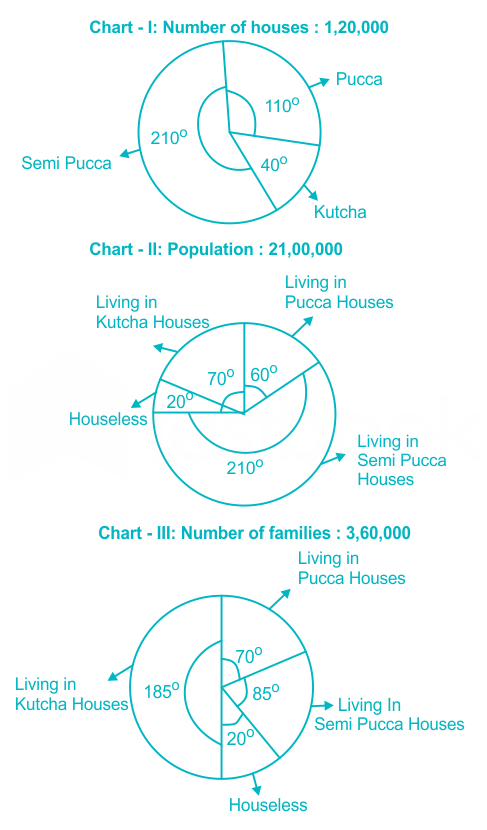
((a))
50.1
((b))
51.5
((c))
52.3
((d))
53.4
Show Answer
Answer: ((b))
51.5
Given:
Initial arithmetic mean of 100 observations = 50
Misread observations = 82 and 6
Correct observations = 182 and 56
Formula used:
Mean = (Sum of all observations) ÷ (Number of observations)
Calculations:
Initial sum of observations = Mean × Number of observations = 50 × 100 = 5000
Difference in sum due to misread observations = (182 + 56) - (82 + 6) = 238 - 88 = 150
Corrected sum of observations = 5000 + 150 = 5150
Corrected mean = Corrected sum ÷ Number of observations = 5150 ÷ 100 = 51.5