Previous Year Paper

CDS General Knowledge 14 Feb 2016 Official Paper (Previous Year Paper)

Held in 2016

120 questions120 minutes
With answers
Free

Paper last updated:

Practise under exam conditions

Take this paper as a timed mock test. Review your answers after you submit.

Attempt timed test

Questions & answers

Read the paper at your pace. Open an explanation when you need it.

English (120 questions)

Question 1

Which one of the following is considered as ‘good cholesterol’ with reference to individuals facing the risk of cardiovascular diseases and hypertension?

  1. AOption (a)

    High-Density Lipoprotein (HDL)

  2. BOption (b)

    Low-Density Lipoprotein (LDL)

  3. COption (c)

    Triglyceride

  4. DOption (d)

    Fatty acids

View answer & explanation

Correct answer

Answer: (a)A.

High-Density Lipoprotein (HDL)

Why this answer is correct

Correct Option – (a)

  • High-density lipoprotein (HDL) is considered “good cholesterol”.
  • Cholesterol is a type of fat found in our blood. More cholesterol in our body means that it can float around in the blood and can clog the blood vessels which can cause cardiac arrest.


High-Density Lipoprotein (HDL)- HDL cholesterol picks up excess cholesterol floating in our blood and takes it to our liver where it is broken down and removed from our body. - It is called Good Cholesterol.
Low-Density Lipoprotein (LDL)- LDL makes up most of our body’s cholesterol. High level of LDL can lead to a build-up of cholesterol in arteries. - Sometimes, a clot can also be formed leading to high risk of stroke/heart attack in adults.
Triglyceride- Triglyceride is a type of fat (lipid) and is a major source of energy for the food. - High level of Triglyceride can harden the arteries or it can thicken the artery walls which increase the risk of stroke and heart disease.
Fatty Acids- During digestion, the body breaks down fats into fatty acid. - Fatty acids are the building blocks of the fat in our bodies. When glucose (as an energy source) is not available in the body, the fatty acid is used by the body to provide energy.

Question 2

Which of the following pairs of vitamin and disease is/are correctly matched?

  1. Vitamin A: Rickets
  2. Vitamin B: Beriberi
  3. Vitamin C: Scurvy

Select the correct answer using the code given below:

  1. AOption (a)

    2 only

  2. BOption (b)

    2 and 3 only

  3. COption (c)

    1 and 3 only

  4. DOption (d)

    1, 2 and 3

View answer & explanation

Correct answer

Answer: (b)B.

2 and 3 only

Why this answer is correct

Correct Option – (b)

DeficiencyChemical NameDiseaseSymptoms
Vitamin ARetinolNyctalopia (night blindness)Poor vision at night.
Vitamin B -1ThiamineBeri BeriLoss of appetite, weakness, pain in the limbs, shortness of breath and swollen feet or legs.
Vitamin CAscorbic AcidScurvyWeakness, fatigue and sore arms and legs.
Vitamin DCholecalciferol (D3) Ergocalciferol (D2)RicketsDelayed growth, bow legs, weakness and pain in the spine, pelvis, and legs.

Question 3

The rate of change of momentum of a body is equal to the resultant:

  1. AOption (a)

    Energy

  2. BOption (b)

    Power

  3. COption (c)

    Force

  4. DOption (d)

    Impulse

View answer & explanation

Correct answer

Answer: (c)C.

Force

Why this answer is correct

Correct Option- (c)

The rate of change of momentum of a body is equal to the Force.

Momentum = Mass × velocity

Change of momentum →

d(momentum) = mass × d(velocity)

dt dt

Force = mass × acceleration

Energy- Energy is the ability to do work. It is measured in Joules.
Power- Power is the rate at which energy is transferred or the rate at which work is done. - It is measured in Watts.
Force- Any action that tends to maintain or alter the motion of a body. It is measured in Newton. - The second law of motion: The rate of change of momentum of an object is directly proportional to the resultant force applied on that object.
Impulse- Impulse is defined as the product of force acting on an object and the time during which the force acts. - It is measured in Newton Second. - It is the change in momentum when impact force is applied.It is used to calculate the momentum increase in a body.

Question 4

After a hot sunny day, people sprinkle water on the roof-top because:

  1. AOption (a)

    water helps air around the roof-top to absorb the heat instantly.

  2. BOption (b)

    water has a lower specific heat capacity.

  3. COption (c)

    water is easily available.

  4. DOption (d)

    water has a large latent heat of vaporization.

View answer & explanation

Correct answer

Answer: (d)D.

water has a large latent heat of vaporization.

Why this answer is correct

Correct Option- (d)

  • Latent heat of vaporization is the amount of heat required to convert the unit mass of liquid state material into vapour-state material without any change in temperature.
  • Water sprinkled on the roof-top absorbs heat (energy) and evaporates leaving the roof-top cooler than before.
  • Water has high specific heat because it needs to absorb a lot of energy to change its temperature.

Question 5

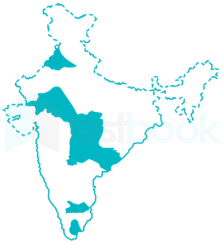
Consider the following map of India:

The areas marked in the map given above account for the production of which one of the following cash crops?

  1. AOption (a)

    Cotton

  2. BOption (b)

    Groundnut

  3. COption (c)

    Sugarcane

  4. DOption (d)

    Tobacco

View answer & explanation

Correct answer

Answer: (a)A.

Cotton

Why this answer is correct

Correct option- (a)

CropSoilThe Major Production States in India
CottonBlack SoilTamil Nadu, Gujarat, Karnataka, Telangana, Maharashtra, Rajasthan, and Madhya Pradesh.
GroundnutSandy loam soilMaharashtra, Rajasthan, Orissa, Madhya Pradesh, Uttar Pradesh, and West Bengal.
SugarcaneSandy, loamy, and clay soilsUttar Pradesh, Maharashtra, Bihar, Haryana, Karnataka, Tamil Nadu, Gujrat, Andhra Pradesh and Punjab.
TobaccoSandy clay loam soilAndhra Pradesh, Telangana, Karnataka, Gujarat, Maharashtra, Bihar, Tamil Nadu and West Bengal.

Question 6

Pir Panjal Range in the Himalayas is a part of:

  1. AOption (a)

    Shiwalik Himalaya

  2. BOption (b)

    Trans Himalaya

  3. COption (c)

    Central Himalaya

  4. DOption (d)

    Lesser Himalaya

View answer & explanation

Correct answer

Answer: (d)D.

Lesser Himalaya

Why this answer is correct

Correct Option – (d)

Key Points

  • Pir Panjal Range in the Himalayas is a part of Lesser Himalayas.


Shiwalik- It is a mountain range of Outer Himalayas. - The width of the hills of this range varies from 10 km to 50 km.
Trans Himalayas- Trans Himalayas is an extension of Tibetan plateau around the Himalayas. - It is broadly divided into the following range: Karakoram Range, Ladakh Range, Zaskar, and Kailash range.
Central Himalayas- It runs between the Kali river in the west and the Teesta river in the east. - Mt. Everest and Kanchenjunga are located in the Central Himalayas range.
Lesser Himalayas- The Lesser Himalayas is also called Himachal. - This range is found between the Great Himalayas and Shiwalik range.

Question 7

Consider the following statements regarding the laterite soils of India:

  1. Laterite soils are generally red in colour.
  2. Laterite soils are rich in nitrogen and potash.
  3. Laterite soils are well-developed in Rajasthan and UP.
    4. Tapioca and cashew nuts grow well in this soil.

Which of the statements given above is /are correct?

  1. AOption (a)

    1 only

  2. BOption (b)

    2, 3 and 4

  3. COption (c)

    1 and 4 only

  4. DOption (d)

    1, 2 and 4

View answer & explanation

Correct answer

Answer: (c)C.

1 and 4 only

Why this answer is correct

The correct answer is 1 and 4 only

Key Points

  • Laterite soils:
  • Laterite soils are generally red in colour because they are rich in iron and aluminium oxides. Hence, statement 1 is correct.
  • They are deficient in nitrogen and potash. Hence, statement 2 is incorrect.
  • Formation: Under conditions of high temperature and heavy rainfall with alternate wet and dry periods, which leads to the leaching of soil, leaving only oxides of iron and aluminium.
  • Major areas found:
  • In higher areas of the Peninsular Plateau.
  • Covers over 10% of the total geographical area, the Western Ghats, Eastern Ghats, southern parts of Maharashtra, parts of Karnataka, Andhra Pradesh, West Bengal Orissa, Jharkhand, Kerala, and Assam. Hence, statement 3 is incorrect.
  • Agriculture on it:
  • It is poor in nitrogen, so not fertile and is poor for agriculture.
  • Tapioca and cashew nuts grow well in this soil.
  • Proper irrigation and use of fertilizers make it suitable for growing crops, such as tea, coffee, rubber, cinchona, coconut, etc.
  • Hence, statement 4 is correct.

Question 8

Which of the following statements regarding the Mediterranean and Monsoon climate is/are correct?

  1. Precipitation in the Mediterranean climate is in winter while in Monsoon climate it is mostly in summer.
  2. The annual range of temperature in the Mediterranean climate is higher than the Monsoon climate.
  3. Rainy and dry seasons are found in both the climates.

Select the correct answer using the code given below:

  1. AOption (a)

    1 only

  2. BOption (b)

    2 and 3 only

  3. COption (c)

    1 and 3 only

  4. DOption (d)

    1, 2 and 3

View answer & explanation

Correct answer

Answer: (c)C.

1 and 3 only

Why this answer is correct

Correct Option- (c)

  • Mediterranean climate is known for hot, dry summers and mild to cool wet winters.
  • During the summer, cold currents keep the climate dry and when the season changes, ocean current shifts too. Hence, during the winter, the water having been warmed up in summer moves in and keep the land warn and often brings rain.
  • Hence, the annual range of temperature in the Mediterranean climate is lesser than that of Monsoon Climate.

Question 9

The handle of pressure cookers is made of plastic because it should be made non-conductor of heat. The plastic used here is the first man-made plastic, which is:

  1. AOption (a)

    Polythene

  2. BOption (b)

    Terylene

  3. COption (c)

    Nylon

  4. DOption (d)

    Bakelite

View answer & explanation

Correct answer

Answer: (d)D.

Bakelite

Why this answer is correct

Correct Option – (d)

Bakelite

Polythene- The monomer of Polythene is “ethene” (formula C2H4). - It is prepared through polymerization of ethene/ethylene. - It is a good electrical insulator. - There are several types of polythene based on its density, molecular weight, branching, etc.
Terylene- It is produced by polymerizing ethylene glycol and terephthalic acid. - It is strong synthetic polyester fiber and elastic in nature. - It is mainly used in making plastic bottles and clothes.
Nylon- It is a synthetic thermoplastic polymer. - It is formed by reacting difunctional monomers containing equal parts of amine and carboxylic acid. - Nylon fabrics are water resistant and also known for its heat resistance.
Bakelite- It is the synthetic plastic material. - It has resistant to heat, electric currents, and acids.

Question 10

Methyl Isocyanate gas, which was involved in the disaster in Bhopal in December 1984, was used in the Union Carbide factory for the production of:

  1. AOption (a)

    Dyes

  2. BOption (b)

    Detergents

  3. COption (c)

    Explosives

  4. DOption (d)

    Pesticides

View answer & explanation

Correct answer

Answer: (d)D.

Pesticides

Why this answer is correct

The correct answer is Pesticides.

Key Points

  • Union Carbide operated a pesticide plant in Bhopal.
  • The Bhopal Gas Tragedy is considered as one of the world’s largest industrial disaster.
  • The factory used to manufacture three pesticides:
  • carbaryl, aldicarb and a formulation of carbaryl and gamma-hexachlorocyclohexane (g-HCH).
  • It is estimated that about 40 tonnes of methyl isocyanate (MIC) gas and other chemicals leaked from the Union Carbide factory.
  • In some cases, the impact of poisonous gas has passed on to the second and third generation.
  • Union Carbide used trade secrecy as a prerogative to withhold information on the exact composition of the leaked gases.

Question 11

The Germplasm is required for the propagation of plants and animals. Germplasm is the:

  1. AOption (a)

    Genetic resources

  2. BOption (b)

    Seeds or tissues for breeding

  3. COption (c)

    Egg and sperm repository

  4. DOption (d)

    A germ cell’s determining the zone

View answer & explanation

Correct answer

Answer: (b)B.

Seeds or tissues for breeding

Why this answer is correct

  • Germplasm is a living tissue which is maintained for the purpose of animal and plant breeding.
  • Germplasm conservation is the most successful method to conserve the genetic traits of endangered and commercially valuable species.
  • Germplasm conservation includes Wild species, breeding lines, commercial varieties, special genetic stocks, etc.
  • Germplasm preservation includes In-situ conservation and Ex-situ conservation.

Question 12

Dengue virus is known to cause low platelet count in blood of patient by:

  1. interfering in the process of platelet production in the bone marrow.
  2. infecting endothelial cells.
  3. binding with platelets.
  4. accumulating platelets in the intestine.

Select the correct answer using the code given below:

  1. AOption (a)

    1 and 2 only

  2. BOption (b)

    1 and 3 only

  3. COption (c)

    3 and 4

  4. DOption (d)

    1, 2 and 3

View answer & explanation

Correct answer

Answer: (d)D.

1, 2 and 3

Why this answer is correct

  • Dengue is caused by Dengue virus (DENV), a mosquito-borne flavivirus. DENV is a single-stranded RNA positive-strand virus.
  • Bone marrow is the manufacturing center of blood cells and Dengue fever induces bone marrow suppression resulting in a deficiency of blood cells which further leads to low platelet count.
  • Endothelium cells line the interior surface of blood vessels and lymphatic vessels. These cells when infected with Dengue virus combine with platelets and destroy them.

Question 13

The SI unit of mechanical power is:

  1. AOption (a)

    Joule

  2. BOption (b)

    Watt

  3. COption (c)

    Newton-second

  4. DOption (d)

    Joule-second

View answer & explanation

Correct answer

Answer: (b)B.

Watt

Why this answer is correct

The correct answer is Watt.

  • Power is the amount of energy transferred per unit of time.
JouleEnergy
WattPower
Newton-SecondImpulse
Joule-SecondPlanck’s constant

Question 14

Two systems are said to be in thermal equilibrium if and only if:

  1. AOption (a)

    there can be a heat flow between them even if they are at different temperatures.

  2. BOption (b)

    there cannot be a heat flow between them even if they are at different temperatures.

  3. COption (c)

    there is no heat flow between them.

  4. DOption (d)

    their temperatures are slightly different.

View answer & explanation

Correct answer

Answer: (c)C.

there is no heat flow between them.

Why this answer is correct

  • Two physical systems are said to be in thermal equilibrium when there is no net flow of thermal energy when they are connected to each other in an isolated system.
  • The "zeroth law" states that if two systems are at the same time in thermal equilibrium with a third system, then they are in thermal equilibrium with each other.

Question 15

‘German silver’ is used to make decorative articles, coinage metal, ornaments, etc. The name is given because:

  1. AOption (a)

    It is an alloy of copper and contains silver as one of its components.

  2. BOption (b)

    Germans were the first to use silver.

  3. COption (c)

    Its appearance is like silver.

  4. DOption (d)

    It is an alloy of silver.

View answer & explanation

Correct answer

Answer: (c)C.

Its appearance is like silver.

Why this answer is correct

  • German Silver is an alloy of Copper, Zinc, and Nickel, sometimes containing lead and tin too.
  • It does not contain silver but it is named after its “silver-white” look.
  • Although its composition varies as per commercial requirement, it is widely used in this proportion - copper (50%), zinc (20%) and nickel (30%).
  • German silver is very hard and its resistance to corrosion make is favorable for industrial use

Question 16

Plants contain a variety of sterols like

stigmasterol, ergosterol, sitosterol, etc., which very closely resemble cholesterol.

These plant sterols are referred to as:

  1. AOption (a)

    Phytosterols

  2. BOption (b)

    Calciferol

  3. COption (c)

    Ergocalciferol

  4. DOption (d)

    Lumisterol

View answer & explanation

Correct answer

Answer: (a)A.

Phytosterols

Why this answer is correct

Phytosterols- Phytosterols are a group of naturally occurring compounds found in plant cell membranes. - It is structurally similar to cholesterol.
Calciferol- Calciferol is a synthetic version of Vitamin D.
Ergocalciferols- Ergocalciferol is Vitamin D2, not produced in the human body. - It is created by exposing certain plant-derived materials to ultraviolet light.
Lumisterol- Lumisterol is formed when pre-vitamin D3 is exposed to sunlight.

Question 17

With which one of the following countries, India has signed an MoU under the International Cooperation on Brahmaputra and Satluj rivers?

  1. AOption (a)

    Pakistan

  2. BOption (b)

    China

  3. COption (c)

    Bangladesh

  4. DOption (d)

    Nepal

View answer & explanation

Correct answer

Answer: (b)B.

China

Why this answer is correct

  • Satluj is a part of the Indus river system on the western side and Brahmaputra (also known as Yaluzangbu or Tsangpo in China) is on the eastern side.
  • In 2002, GoI and China signed an MoU for five years upon provision of Hydrological information on Yaluzangbu / Brahmaputra River during flood season by China to India. MoUs in this connection is being extended from time to time.
  • In 2010, GoI and China signed an MoU upon provision of hydrological information of Satluj / Langqen Zangbo River during flood season by China to India. This MoU has also been renewed.
  • In 2013, a separate “Memorandum of Understanding on Strengthening Cooperation on Trans-Border Rivers” was also signed, in which inter alia the scope of the provision of hydrological information of three hydrological stations has also been enhanced.

Question 18

Headquarters of which one among the following Railway Zones in India is situated at the highest elevation from the mean sea level?

  1. AOption (a)

    East Central Railway

  2. BOption (b)

    South Eastern Railway

  3. COption (c)

    South Western Railway

  4. DOption (d)

    West Central Railway

View answer & explanation

Correct answer

Answer: (c)C.

South Western Railway

Why this answer is correct

Railway ZoneHeadquarterDivisionsElevation (m)
East Central RailwayHajipur1) Danapur
2) Mugalsarai
3) Dhanbad
4) Sonpur
5) Samastipur
46
South Eastern RailwayGarden Reach, Kolkata1) Kharagpur
2) Adra
3) Chakradharpur 
4) Ranchi
5) Shalimar
8
South Western RailwayHubli1) Bangalore
2) Mysore
3) Hubli
4) RWF/YNK
671
West Central RailwayJabalpur1) Jabalpur
2) Bhopal
3) Kota
412

Question 19

Stalactites and stalagmites are features of __________.

  1. AOption (a)

    Glacial topography

  2. BOption (b)

    Volcanic topography

  3. COption (c)

    Karst topography

  4. DOption (d)

    Fluvial topography

View answer & explanation

Correct answer

Answer: (c)C.

Karst topography

Why this answer is correct

  • Stalactites: It is a type of rock formation produced by the precipitation of minerals from water dripping through the cave ceiling. It hangs from the ceiling of a cave.
  • Stalagmites: It is a type of rock formation that rises from the floor of a cave due to the accumulation of material deposited on the floor from ceiling drippings.
Glacial Topography- Glacial is a body of dense ice constantly moving under its own weight. Glacial Landforms are created by the action of glaciers. - When glaciers expand, they crush and modify the surface rocks and bedrocks resulting in erosional landforms. - When glaciers retreat, they leave behind crushed rock and sand resulting in depositional landforms.
Volcanic Topography- Magma is the hot molten rock that builds in pressure and explodes from the volcano as lava. - When it explodes to release built-up pressure inside, materials from deep within the earth also come up. - The materials forms volcanic landforms, such as lava domes, lava plateaus, fissure eruptions, craters, and calderas. - This is Volcanic Topography.
Karst Topography- This typography is formed due to excavating effects of underground water on massive soluble limestone. - It is usually characterized by barren, rocky ground, caves, sinkholes, underground rivers.
Fluvial Topography- It is associated with the landforms created by water and river system. - Certain landforms are formed due to erosion, transportation, and deposition of sediments/minerals.

Question 20

Which one of the following is the correct sequence of the given planets in increasing order of their size (diameter)?

  1. AOption (a)

    Mars - Venus - Earth - Mercury - Uranus

  2. BOption (b)

    Mercury - Mars - Venus - Earth - Uranus

  3. COption (c)

    Mercury - Mars - Venus - Uranus - Earth

  4. DOption (d)

    Venus - Mercury - Mars-Earth -  Uranus

View answer & explanation

Correct answer

Answer: (b)B.

Mercury - Mars - Venus - Earth - Uranus

Why this answer is correct

  • According to NASA, the following are the estimated radii of planets in our solar system:
Jupiter69,911 km
Saturn58,232 km
Uranus25,362 km
Neptune24,622 km
Earth6,371 km
Venus6,052 km
Mars3,390 km
Mercury2,440 km


The order in which planets are away from the sun is - Mercury, Venus, Earth, Mars, Jupiter, Saturn, Uranus, and Neptune.

Question 21

In artificial insemination (AI) process, which of the following is/are introduced into the uterus of the female?

  1. AOption (a)

    Egg only

  2. BOption (b)

    Fertilized egg

  3. COption (c)

    Sperm only

  4. DOption (d)

    Egg and sperm

View answer & explanation

Correct answer

Answer: (c)C.

Sperm only

Why this answer is correct

  • Artificial Insemination is the placing of sperm inside the female’s cervix or uterine to achieve pregnancy.
  • It is recommended to a couple having trouble in conceiving.
  • Intracervical Insemination involves placing raw semen into the vagina by needleless syringe.
  • Intrauterine Insemination involves injecting washed sperm into the uterus with a catheter.
  • Intrauterine tuboperitoneal insemination involves injecting washed sperm into both the uterus and fallopian tubes.

Question 22

Genetically modified (GM) crops contain modified genetic material due to:

  1. Introduction of new DNA
  2. Removal of existing DNA
  3. Introduction of RNA
  4. Introduction of new traits

Select the correct answer using the code given below:

  1. AOption (a)

    1 and 2 only

  2. BOption (b)

    1, 2 and 3

  3. COption (c)

    3 and 4

  4. DOption (d)

    1, 2 and 4

View answer & explanation

Correct answer

Answer: (d)D.

1, 2 and 4

Why this answer is correct

The correct answer is Option 4, i.e 1, 2 and 4.

  • When the DNA of a plant had been modified using genetic engineering methods, it is called Genetically modified crops.
  • It is widely used to make crops resistant to certain pests and disease.
  • It is also used to improve nutrition value in a crop.
  • Insect-resistant crops contain genes from the soil bacterium Bacillus thuringiensis.
  • GM crops are sometimes discouraged to consume due to the following potential threats: an allergic reaction (allergenicity), gene transfer and outcrossing.
  • Genetically modified (GM) crops contain modified genetic material due to introduction of DNA by removing the existing DNA, resulting in the change in traits.

Question 23

Which one of the following statements is correct?

The velocity of sound:

  1. AOption (a)

    does not depend upon the nature of media

  2. BOption (b)

    is maximum in gases and minimum in liquids

  3. COption (c)

    is maximum in solids and minimum in liquids

  4. DOption (d)

    is maximum in solids and minimum in gases

View answer & explanation

Correct answer

Answer: (d)D.

is maximum in solids and minimum in gases

Why this answer is correct

  • At 20°C, the speed of sound in air is about 343 meters per second.
  • The speed of sound depends on medium, temperature, and pressure of the medium.
  • The speed of sound decreases when it passes from solid to the gaseous state of the medium.
  • The speed of sound in aluminum is 6420 m/s, in seawater is 1531 m/s and in Hydrogen gas is 1284 m/s.

Question 24

Which one of the following statements is not correct?

  1. AOption (a)

    Sound waves in gases are longitudinal in nature.

  2. BOption (b)

    Sound waves having a frequency below 20 Hz are known as ultrasonic waves

  3. COption (c)

    Sound waves having higher amplitudes are louder.

  4. DOption (d)

    Sound waves with high audible frequencies are sharp.

View answer & explanation

Correct answer

Answer: (b)B.

Sound waves having a frequency below 20 Hz are known as ultrasonic waves

Why this answer is correct

  • The sound of frequencies higher than 20 kHz is known as ultrasonic sound or ultrasound**.**
  • The audible range of sound for human beings varies between 20 Hz to 20000 Hz.
  • Ultrasonic devices are used to detect objects and measure distances. Ultrasound imaging or sonography is often used in medicine.
  • Ultrasonic waves are generated by a transducer that includes a piezoelectric crystal that converts electrical energy (electric current) to mechanical energy (sound waves).

Question 25

Which one of the following vitamins have a role in blood clotting?

  1. AOption (a)

    Vitamin A

  2. BOption (b)

    Vitamin B

  3. COption (c)

    Vitamin D

  4. DOption (d)

    Vitamin K

View answer & explanation

Correct answer

Answer: (d)D.

Vitamin K

Why this answer is correct

Vitamin A- It is needed for growth and development, cell recognition, vision, immune function, and reproduction.
Vitamin B- Vitamin B1 helps in metabolism by helping convert nutrients into energy. - Vitamin B3 helps in cellular signaling, metabolism and DNA production and repair. - Vitamin B6 helps in amino acid metabolism, red blood cell production and the creation of neurotransmitters.
Vitamin D- Vitamin D helps in the regulation of calcium and maintenance of phosphorus levels in the blood.
Vitamin K- Vitamin K helps in producing prothrombin, a protein, and clotting factor that is important in blood clotting and bone metabolism.

Question 26

Vitamin B12 deficiency causes pernicious Anemia. Animals cannot synthesize vitamin B12. Humans must obtain all their vitaminB12 from their diet. The complexing metal ion in vitamin B12 is:

  1. AOption (a)

    Mg2+ (Magnesium ion)

  2. BOption (b)

    Fe2+ (Iron ion)

  3. COption (c)

    Co3+ (Cobalt ion)

  4. DOption (d)

    Zn2+ (Zinc ion)

View answer & explanation

Correct answer

Answer: (c)C.

Co3+ (Cobalt ion)

Why this answer is correct

  • Pernicious Anemia is a decrease in red blood cells that occurs when the intestines cannot properly absorb vitamin B1.
  • Vitamin B12 is also referred to as cobalamin because it contains a metal ion.
  • Cyanocobalamin is used in vitamin supplements and pharmaceuticals.
  • Symptoms of Vitamin B12 deficiency is the smoothness of the tongue, gastrointestinal disturbances, nervous symptoms.

Question 27

Consider the following statements:

  1. Most of the coal and the ferrous group of minerals in India occur in the peninsula, south of the Vindhyas.
  2. Peninsular India once formed part of the supercontinent which included Australia, Antarctica, Africa, and South America.

Which of the statements given above is /are correct?

  1. AOption (a)

    1 only

  2. BOption (b)

    2 only

  3. COption (c)

    Both 1 and 2

  4. DOption (d)

    Neither 1 nor 2

View answer & explanation

Correct answer

Answer: (c)C.

Both 1 and 2

Why this answer is correct

​The correct answer is Both 1 and 2.

Key Points

  • Coal and the ferrous group of minerals in India:
  • Ferrous minerals: These minerals contain iron.
  • Ferrous group of minerals in India:
  • ​The major "hematite" type iron deposits(Examples: Manganese and iron) are located in well-defined belts in the States of Orissa, Jharkhand, Chhattisgarh, Maharashtra, Goa and Karnataka.
  • Coals:
  • They are found on the East Coast of India- Chhattisgarh, Jharkhand, Odisha, West Bengal and Madhya Pradesh.-  mostly south of the Vindhyan range.
  • Hence statement 1 is correct.
  • Peninsular India:
  • It formed from erstwhile Gondwana land.
  • Gondwana:
  • It was an ancient supercontinent that contained Africa, South America, Australia, Antarctica, the Indian subcontinent and the Arabian Peninsula.
  • Hence statement 2 is correct.

Question 28

The Mahatma Gandhi National Marine Park is located in:

  1. AOption (a)

    Pirotan Island

  2. BOption (b)

    Rameswaram

  3. COption (c)

    Ganga Sagar Island

  4. DOption (d)

    Port Blair

View answer & explanation

Correct answer

Answer: (d)D.

Port Blair

Why this answer is correct

The correct answer is Port Blair.

Key Points

  • The Mahatma Gandhi National Marine Park or Wandoor National Park:
  • It is Located in Wandoor, Port Blair in the Andaman islands.
  • It was established in 1983 under the Wildlife Protection Act of 1972.
  • Objective:
  • Protection of marine life such as corals and the nesting sea turtles prevalent in the area.
  • Major island groups in the park:
  • Twin Islands
  • Labyrinth Islands.
  • The type and composition of vegetation vary from island to island.

Additional Information

  • Pirotan Island:
  • It is an island in the Marine National Park, Arabian Sea at a distance from Jamnagar District of Gujarat state, India.
  • Rameswaram Island:
  • Also called Pamban island, it is located between peninsular India and Sri Lanka, on the Rama Setu archipelago.
  • Ganga Sagar Island:
  • It is in the Ganges delta in the Bay of Bengal, south of Kolkata, West Bengal

Question 29

Which of the following statements is/are correct?

  1. The earth is nearest to the Sun at Perihelion, which generally occurs on January 3.
  2. The earth is farthest away from the Sun at Perihelion, which generally occurs on July 4.
  3. The earth is farthest away from the Sun at Aphelion, which generally occurs on July 4.
  4. The earth is nearest to the Sun at Aphelion, which generally occurs on January 3.

Select the correct answer using the code given below:

  1. AOption (a)

    1 only

  2. BOption (b)

    2 and 4

  3. COption (c)

    1 and 3

  4. DOption (d)

    1 and 2

View answer & explanation

Correct answer

Answer: (c)C.

1 and 3

Why this answer is correct

The correct answer is 1 and 3.

Key Points

  • Perihelion:
  • The point at which an orbiting planet is closest to the sun.
  • It generally occurs on January 3. Hence option 1 is correct and option 2 is incorrect.
  • Aphelion:
  • The point at which an orbiting planet is farthest from the sun.
  • It generally occurs on July 4. Hence option 3 is correct and option 4 is incorrect**.**

Additional Information

  • Solstice: 
  • It is a natural phenomenon that occurs twice every year, once in the summer and again during winter
  • Summer Solstice:
  • Occurs on the 21st of June.
  • It is the longest day and shortest night of the year in the Northern Hemisphere.
  • On this day, countries in the Northern Hemisphere are nearest to the Sun.
  • Winter Solstice:
  • Occurs on the 21st of December.
  • It is the shortest day and longest night of the year in the Northern Hemisphere.

Question 30

Which one of the following islands is of volcanic origin?

  1. AOption (a)

    Reunion island

  2. BOption (b)

    Andaman & Nicobar Islands

  3. COption (c)

    Lakshadweep islands

  4. DOption (d)

    Maldives

View answer & explanation

Correct answer

Answer: (a)A.

Reunion island

Why this answer is correct

​The correct answer is Reunion island.

Key Points

  • Reunion Island:
  • Location:
  • It is in the Indian Ocean east of Madagascar and southwest of Mauritius and is a region of France.
  • This island is above a hotspot in the Earth’s crust.
  • It is a volcanic island born some three million years ago with the emergence of the Piton des Neiges volcano. Hence option 1 is correct.
  • Vulcanism:
  • The hotspot is believed to have been active for over 66 million years.
  • It created the Mascarene Islands, which include Mauritius, Reunion, and Rodrigues.
  • Volcanoes:
  • The Piton de la Fournaise (a shield volcano)
  • Piton des Neiges

Additional Information

  • The Andaman and Nicobar Islands:
  • It is one of the Eight Union Territories of India.
  • It formed due to a collision between the Indian Plate and Burma Minor Plate.
  • Lakshadweep Islands:
  • They had been formed by the accumulation of coral on the volcanic tops of the Indian Ocean ridge. **The Maldives:**​
  • They are a series of coral atolls built up from the crowns of a submerged ancient volcanic mountain range.

Question 31

Glucose is a source of energy. Which one of the following types of the molecule is Glucose?

  1. AOption (a)

    Carbohydrate

  2. BOption (b)

    Protein

  3. COption (c)

    Fat

  4. DOption (d)

    Nucleic acid

View answer & explanation

Correct answer

Answer: (a)A.

Carbohydrate

Why this answer is correct

  • Glucose has a molecular formula - C₆H₁₂O₆.
  • It is one of the groups of carbohydrates known as monosaccharides.
  • It is mainly made by plants and by most of the algae when they photosynthesize.
  • It is the main source of energy in all living organisms.
  • It is mainly starch in plants and glycogen in animals.
  • Diabetes occurs when the body is unable to regulate levels of glucose in the blood either because of a lack of insulin in the body or the failure, by cells in the body, to respond properly to insulin.
  • An increases intake of glucose may also lead to obesity.

Question 32

The living content of the cell is called protoplasm. It is composed of:

  1. AOption (a)

    Cytoplasm only

  2. BOption (b)

    Cytoplasm and nucleoplasm

  3. COption (c)

    Nucleoplasm only

  4. DOption (d)

    Cytoplasm, nucleoplasm and other organelles

View answer & explanation

Correct answer

Answer: (d)D.

Cytoplasm, nucleoplasm and other organelles

Why this answer is correct

The correct answer is Cytoplasm, nucleoplasm and other organelles.

Key Points

  • The cytoplasm is basically the colour less liquid and other material within the cell excluding the nucleus.
  • When cytoplasm and nucleus are included, it is called Protoplasm.
  • Protoplasm
  • It is the living part of the cell, which comprises different cellular organelles.
  • It is a jelly-like, colourless, transparent, and viscous living substance present within the cell wall.
  • The term protoplasm was proposed in the year 1835 and is known as the primary substance, as it is responsible for various living processes.
  • It was believed that cells were containers of protoplasm.
  • However, the concept could not explain the origin of structures formed within the cell, primarily the nucleus.
  • The cytoplasm is the initial component of protoplasm, which is found between the cell membrane and the cell nucleus in a eukaryotic cell.
  • In the cell, a cytoplasm plays a vital role in maintaining the cell environment, maintaining the shape of cells, and also stores substances required by the organelle.
  • The nucleus is the second component of the protoplasm, which stores the genetic information of an organism.
  • Ribosomes are also found in the nucleus, which is essential for the production of proteins in the cell.
  • Prokaryotes contain a nucleoid instead of a nucleus where all the genetic information is found.
  • Protoplasm comprises the cytoplasm, nucleus, and organelles.
  • Proteins, fats, enzymes, hormones, all make up the protoplasm.
  • Hence, Option 4 is correct.
  • These are either dissolved or suspended in the water component of the protoplasm.

Question 33

Norman Borlaug won Nobel Peace Prize for his contributions in:

  1. development of high-yielding crops.
  2. modernization of irrigation infrastructure.
  3. introduction of synthetic fertilizers and pesticides.

Select the correct answer using the code given below:

  1. AOption (a)

    1 only

  2. BOption (b)

    2 only

  3. COption (c)

    2 and 3 only

  4. DOption (d)

    1, 2 and 3

View answer & explanation

Correct answer

Answer: (d)D.

1, 2 and 3

Why this answer is correct

​The correct answer is 1, 2 and 3.

Key Points

  • Norman Borlaug:
  • An American agronomist, often known as “the Father of the Green Revolution”.
  • Nobel prize:
  • Won the Nobel peace prize in 1970.
  • Contributions:
  • He contributed to the green revolution.
  • The World Food Prize was created by Norman Borlaug in 1986.
  • He gave a lifetime of work to feed a hungry world.
  • Introduction of synthetic fertilizers and pesticides. Hence option 1 is correct.
  • Development of high-yielding crops. Hence option 2 is correct.
  • Modernization of irrigation infrastructure. Hence option 3 is correct.
  • Other awards:
  • Presidential Medal of Freedom
  • Congressional Gold Medal.

Question 34

A myopic person has a power of -1.25 Dioptre. What is the focal length and nature of his lens?

  1. AOption (a)

    50 cm and convex lens

  2. BOption (b)

    80 cm and convex lens

  3. COption (c)

    50 cm and concave lens

  4. DOption (d)

    80 cm and concave lens

View answer & explanation

Correct answer

Answer: (d)D.

80 cm and concave lens

Why this answer is correct

  • Myopia is an eye condition in which you can see objects near to you clearly but far ones are blurry. It is also called near-sightedness.
  • Myopia can be corrected by Concave lens.
  • A Dioptre is a unit of measurement of the optical power of a lens.
  • It is equal to the reciprocal of the focal length.
  • D = 1/F 🡪 -1.25 = 1/F 🡪 Focal length is in centimetres. 🡪 F = -100/1.25
  • F = -80.

Focal Length is – 80 cm.

Hence, the concave lens is used.

Question 35

A piece of ice, 100 g in mass is kept at 0°C. The amount of heat it requires to melt at 0°C is (take latent heat of melting of ice to be 333.6 J/g):

  1. AOption (a)

    750.6 J

  2. BOption (b)

    83.4 J

  3. COption (c)

    33360 J

  4. DOption (d)

    3.336 J

View answer & explanation

Correct answer

Answer: (c)C.

33360 J

Why this answer is correct

  • Latent heat: The heat required to change one state of matter into another (solid into a liquid or vapor, or a liquid into a vapor) without in change of temperature.
  • The liquid water to be formed when ice melts will be at 0° Celsius.
  • Given: Latent heat of melting of ice = 333.6 J/g.
  • 1 gm of ice requires 333.6 J heat to melt,
  • For 100 gm, it is 33360 Joules.

Question 36

Which one of the following hormones does not contains peptide chain?

  1. AOption (a)

    Oxytocin

  2. BOption (b)

    Corticotrophin

  3. COption (c)

    Insulin

  4. DOption (d)

    Cortisone

View answer & explanation

Correct answer

Answer: (d)D.

Cortisone

Why this answer is correct

Key Points 

Oxytocin- Oxytocin is normally produced in the hypothalamus. - It plays a role in sexual reproduction and childbirth. - It is a peptide hormone and neuropeptide.
Corticotropin- It is a polypeptide hormone involved in the stress response. - Its main function is the stimulation of the pituitary synthesis of ACTH.
Insulin- Insulin allows cells to absorb glucose, sugar, from the blood. - It is an essential hormone for controlling blood sugar.
Cortisone- It is one of the main hormones released by the adrenal gland in response to stress. - It is a type of steroid closely related to a natural substance called cortisol.

Question 37

Which one of the following is an example of a chemical change?

  1. AOption (a)

    Burning of paper

  2. BOption (b)

    The magnetization of soft iron

  3. COption (c)

    Dissolution of cane sugar in water

  4. DOption (d)

    Preparation of ice cubes from water

View answer & explanation

Correct answer

Answer: (a)A.

Burning of paper

Why this answer is correct

  • Chemical Change: When a substance reacts with another substance to form a new substance, it is called chemical change. It involved the rearrangement of atoms.
  • The carbon compounds in the paper are oxidized into carbon dioxide and water vapor on burning.
  • There is no change in chemical composition in the magnetization of soft iron, dissolution of cane sugar in water and preparation of ice cubes from water.

Question 38

Which one of the following is the cause of long-term sea-level change?

  1. AOption (a)

    Atmospheric disturbance

  2. BOption (b)

    Change in marine water density

  3. COption (c)

    Melting of icebergs

  4. DOption (d)

    Melting of ice sheets

View answer & explanation

Correct answer

Answer: (d)D.

Melting of ice sheets

Why this answer is correct

​The correct answer is the Melting of ice sheets.

Key Points

  • Sea-level change:
  • The sea level is currently rising at a rate of 0.13 inches per year.
  • It has risen 8.9 inches between 1880 and 2015, much faster than in the previous 2,700 years.
  • Factors responsible:
  • Climate change, especially global warming,
  • Thermal Expansion,
  • Melting Ice sheet and
  • Loss of Greenland and Antarctica’s ice sheets. Hence option 4 is correct.

Confusion Points

  • Melting of icebergs v/s Melting of ice sheets:
  • Icebergs:
  • ​They are ice that broke off from glaciers and are floating in open water.
  • Melting of icebergs or ablation release fresh water and reduce the salinity of the surrounding sea. This instance can lead to a sudden sea level rise but may not contribute significantly to long-term sea level change . Hence option 3 is incorrect.
  • Ice sheets are huge and they create broad domes and spread out from their centres in all directions.
  • The melting of ice sheets is the cause of long-term sea-level change.

Additional Information

  • Atmospheric disturbances:
  • Atmospheric pressure changes can bring strong on-shore winds within a storm (hurricane/ cyclone/typhoon). But do not lead to long-term sea level changes. Hence option 1 is incorrect.
  • Change in marine water density:
  • It can happen due to Ocean warming which contributes to global mean sea level rise by reducing the density of seawater. However, it does not lead to long-term sea level changes. Hence option 2 is incorrect.

Question 39

Consider the following tributaries of river Brahmaputra:

  1. Lohit
  2. Teesta
  3. Subansiri
  4. Sankosh

Arrange the above rivers from west to east:

  1. AOption (a)

    2-4-3-1

  2. BOption (b)

    2-3-4-1

  3. COption (c)

    4-2-3-1

  4. DOption (d)

    3-1-2-4

View answer & explanation

Correct answer

Answer: (a)A.

2-4-3-1

Why this answer is correct

  • The Brahmaputra river flows through Tibet, India, and Bangladesh
  • In India, the Brahmaputra flows for 916 km. However, the total length of the river is 2900 km.
  • It has many left and right tributaries.
  • Lohit river rises from a region in Tibet.
  • Teesta river rises from Tso Lhamo lake of North Sikkim Himalayas.
  • Subansiri river rises in the Himalayas in China.
  • Sankosh river rises in northern Bhutan.

Question 40

Which one of the following is the reason due to which the wind in the southern hemisphere is deflected towards its left?

  1. AOption (a)

    The difference in the water masses of the northern and southern hemisphere

  2. BOption (b)

    Temperature and pressure variations

  3. COption (c)

    The inclined axis of the Earth

  4. DOption (d)

    Rotation of the Earth

View answer & explanation

Correct answer

Answer: (d)D.

Rotation of the Earth

Why this answer is correct

  • The Coriolis force is a pseudo force. The earth's rotation deflects moving objects (such as projectiles or air currents) to the right in the northern hemisphere and to the left in the southern hemisphere.
  • The impact of the Coriolis effect is most significant with high speeds or long distances.
  • The Coriolis force is perpendicular to the object's axis. The Earth spins on its axis from west to east. The Coriolis force, therefore, acts in a north-south direction.
  • It is pertinent to note that the Coriolis force is not a real force. The ground is just moving at a different speed than an object in the air.

Question 41

The ‘eye’ of the cyclone has:

  1. AOption (a)

    abnormally high temperature and lowest pressure

  2. BOption (b)

    abnormally low temperature and pressure

  3. COption (c)

    clear sky and lowest temperature

  4. DOption (d)

    dense cloud cover and low pressure

View answer & explanation

Correct answer

Answer: (a)A.

abnormally high temperature and lowest pressure

Why this answer is correct

A cyclone is a general term for a weather system in which winds rotate inwardly to an area of low atmospheric pressure.

  • For large weather systems, the circulation pattern is in a counterclockwise direction in the Northern Hemisphere and a clockwise direction in the Southern Hemisphere.
  • Types of cyclones include tropical cyclones, extratropical cyclones and tornadoes.​
  • An eye of the cyclone is the calmest area/part of the cyclones because it has the lowest pressure area of the cyclone and the strong winds around the eye never converges in the centre of the eye but deflects because of Coriolis force.
  • The eye of the storm is a low-pressure area, where wind speeds are markedly lower than anywhere else in the cyclone.
  • A tremendous volume of air converging from 360 degrees around the hundreds of miles of the storm, all converging on the eye and spiralling up with an intense updraft, creating a very low pressure near the surface in the eye/core.
  • High above the eyewall, this upflow begins to spread out.
  • This permits cool dry air above the eye to sink down into the central core of the eye (that is why the eye is often clear and cloud free).
  • The storm had a very warm eye, from the ocean to the top of the lower atmosphere at around 10 miles altitude.
  • The warmest part of Erin's eye was almost 21 degrees (Fahrenheit) warmer than the surrounding air, a dramatic difference from the air around it.
  • Hence, one can conclude that the eye of the cyclone has high temperature and low pressure.

Question 42

Which of the following statements is/are correct?

  1. Acid rain reacts with buildings made from limestone.
  2. Burning of sulfur-containing coal can contribute to acid rain.
  3. Eutrophication is an effective measure to control pollution.

Select the correct answer using the code given below:

  1. AOption (a)

    1 and 2 only

  2. BOption (b)

    2 and 3 only

  3. COption (c)

    1 only

  4. DOption (d)

    1, 2 and 3

View answer & explanation

Correct answer

Answer: (a)A.

1 and 2 only

Why this answer is correct

The correct answer is 1 and 2 only 

 Key Points

Acid Rain: 

  • Acid rain means the precipitation of acidic components such as Sulfuric or Nitric acid.
  • Sulfur dioxide and oxides of nitrogen get into the upper atmosphere by wind or air currents and get mixed with water.
  • The SO2 and NOX react with water, oxygen and other chemicals to form sulfuric and nitric acids.
  • Normal rain has a pH value of 5.6.
  • It is slightly acidic due to the presence of carbon dioxide which gets dissolved into the water forming weak carbonic acid.
  • However, acid rain usually has a pH between 4.2 and 4.4 because of the large quantity of acids.
  • The main source of SO2 is coal fuel power plants in which SO2 emission can be reduced by new combustion techniques.
  • Whereas the main source of NO2 in the atmosphere is through vehicular exhaust which can be controlled by using internal combustion engines.
  • Deposition of sulfur dioxide increases the rate of corrosion on limestone.

Important PointsThe bad effects of acid rain

  • When acid rain falls and flows as groundwater to reach rivers, lakes etc, it affects plants and animal life in the aquatic ecosystem
  • Acid rain is harmful to agriculture, trees and plants as it dissolves and washes away nutrients needed for their growth
  • It causes respiratory ailments in human beings and animal
  • It may also cause corrosion in many buildings bridges, monuments, fencing etc
  • It causes irritation in the eyes and skin of human beings
  • This rain reduces the lustre of the metals too
  • Acid rain damages buildings and other structures made of stone or metal
  • The Taj Mahal in India has been affected by acid rain

Additional InformationEutrophication:

  • Eutrophication is an enrichment of water by nutrient salts that causes structural changes to the ecosystem.
  • It results in the reduction of dissolved oxygen.
  • They can have a large impact on the health of rivers and estuaries such as increased production of algae and aquatic plants, depletion of fish species, and general deterioration of water quality.
  • Eutrophication is an indicator of water pollution.

Question 43

Which one of the following statements about bar magnet is correct?

  1. AOption (a)

    The pole strength of the north-pole of a bar magnet is larger than that of the south-pole.

  2. BOption (b)

    When a piece of a bar magnet is bisected perpendicular to its axis, the north and south poles get separated.

  3. COption (c)

    When a piece of a bar magnet is bisected perpendicular to its axis, two new bar magnets are formed.

  4. DOption (d)

    The poles of a bar magnet are unequal in magnitude and opposite in nature.

View answer & explanation

Correct answer

Answer: (c)C.

When a piece of a bar magnet is bisected perpendicular to its axis, two new bar magnets are formed.

Why this answer is correct

  • Bar magnet: a magnet in the shape of a bar with a North pole at one end and the South Pole at another.
  • The magnetic force is strongest at each pole and equal in magnitude.
  • The like poles repel and unlike poles attract each other when two bar magnets are placed closely.
  • A bar magnet attracts ferromagnetic materials.
  • The magnetic field lines do not intersect each other and they form closed loops.
  • The magnetic lines of force leave the North pole and enter the south pole forming a closed loop.

Question 44

Which one of the following statements is NOT correct?

  1. AOption (a)

    Hydrogen is an element.

  2. BOption (b)

    Hydrogen is the lightest element.

  3. COption (c)

    Hydrogen has no isotopes.

  4. DOption (d)

    Hydrogen and oxygen form an explosive mixture.

View answer & explanation

Correct answer

Answer: (c)C.

Hydrogen has no isotopes.

Why this answer is correct

The correct answerHydrogen has no isotopes.

Key Points

  • It is an element with the symbol H and atomic number 1.
  • Hydrogen is the lightest element in the periodic table.
  • Isotopes are the atoms of the same element with different masses.
  • The three most stable isotopes of hydrogen: are protium, deuterium, and tritium.
  • Deuterium is also called heavy hydrogen.
  • A tritium is a radioactive form of Hydrogen.

Additional Information 

  • After one set of hydrogen and oxygen molecules have reacted, the energy released triggers molecules in the surrounding mixture to react and release greater energy.
  • The result is an explosive, rapid reaction that releases energy quickly in the form of heat, light, and sound.

Question 45

Which one of the following statements is not correct?

  1. AOption (a)

    Atoms of different elements may have the same mass numbers.

  2. BOption (b)

    Atoms of an element may have different mass numbers.

  3. COption (c)

    All the atoms of an element have the same number of protons.

  4. DOption (d)

    All the atoms of an element will always have the same number of neutrons.

View answer & explanation

Correct answer

Answer: (d)D.

All the atoms of an element will always have the same number of neutrons.

Why this answer is correct

An atom is a fundamental piece of matter or basic building block of any matter

  • The atomic number is the number of protons found in the nucleus of an atom.
  • The atomic mass number is the total number of protons and neutrons in a nucleus.
  • Isotope – When an element has the same number of protons but different numbers of neutrons. It means the same element can have a different mass number.
  • Isotopes of different elements can have the same mass number, e.g., carbon-14 (6 protons and 8 neutrons) and nitrogen-14 (7 protons and 7 neutrons).
  • Atoms of a particular element must have the same number of protons. It can not differ.
  • All the atoms of an element will not always have the same number of neutrons. It can have a different number of neutrons.

Question 46

Which of the following statements regarding the chemical industry in India is/are correct?

  1. The chemical industry is one of the oldest industries in India.
  2. Dyestuff sector is one of the important segments of the chemical industry.
  3. The textile industry accounts for the largest consumption of dyestuffs.

Select the correct answer using the code given below:

  1. AOption (a)

    1 only

  2. BOption (b)

    2 and 3 only

  3. COption (c)

    1 and 3 only

  4. DOption (d)

    1, 2 and 3

View answer & explanation

Correct answer

Answer: (d)D.

1, 2 and 3

Why this answer is correct

The correct answer is 1, 2 and 3.

Key Points

  • The chemical industry:
  • It comprises companies that produce industrial chemicals.
  • The oldest chemical industry is the Bengal Chemicals and Pharmaceutical Works,1892.
  • It is one of the oldest in India. Hence statement 1 is correct.
  • India's rank is 4th, after the US, Japan, and China.
  • Dyestuff sector:
  • Dye is a colouring substance that changes the colour of the material permanently.
  • The textile sector is a major consumer of Dyestuffs. Hence statement 3 is correct.
  • It is one of the important segments of the chemical industry. Hence statement 2 is correct.
  • India accounts for approximately 16% of the world's production of dyestuff and dye intermediates.
  • Major producers in India:
  • Maharashtra and Gujarat account for 90% of dyestuff production in India.

Question 47

Which of the following statements about India’s scientific and research mission in Antarctica is/are correct?

  1. The first scientific base station in Antarctica was Dakshin Gangotri.
  2. Dakshin Gangotri is now being used as a supply base and transit camp.
  3. The Maitri station is manned throughout the year for scientific activities.

Select the correct answer using the code given below:

  1. AOption (a)

    1 only

  2. BOption (b)

    2 and 3 only

  3. COption (c)

    1 and 2 only

  4. DOption (d)

    1, 2 and 3

View answer & explanation

Correct answer

Answer: (d)D.

1, 2 and 3

Why this answer is correct

​The correct answer is 1, 2 and 3.

Key Points

  • India’s scientific and research mission in Antarctica:
  • It is India's third Antarctic research facility.
  • Dakshin Gangotri is being used as a supply base station.
  • Dakshin Gangotri:
  • It is located at a distance of 2,500 kilometres from the South Pole.
  • It was established in 1984, it was the first scientific base station in Antarctica. Hence statement 1 is correct.
  • It was abandoned in 1988-1989 as a scientific base station. 
  • ​It is currently being used as a supply base and transit camp. Hence statement 2 is correct.
  • Maitri: 
  • It is India's second permanent research station in Antarctica, established in January 1989.
  • About 25 people are constantly conducting glaciological, biological and meteorological studies in the station, so it is manned throughout the year for scientific activities. Hence statement 3 is correct.

Additional Information

  • Other Active permanent research station - Bharati:
  • It is​ India's third Antarctic research facility was established in March 2013.

Question 48

The synthetic rubber has replaced natural rubber for domestic and industrial purposes. Which one of the following is the main reason behind that?

  1. AOption (a)

    Natural rubber is unable to meet the growing demand for different industries.

  2. BOption (b)

    Natural rubber is grown in tropical countries only.

  3. COption (c)

    The raw material for synthetic rubber is easily available.

  4. DOption (d)

    Natural rubber is not durable.

View answer & explanation

Correct answer

Answer: (a)A.

Natural rubber is unable to meet the growing demand for different industries.

Why this answer is correct

  • Natural rubber is an elastomer or an elastic hydrocarbon polymer.
  • In rubber, the monomer is a carbon compound called isoprene that has two carbon-carbon double bonds.
  • It is an elastic substance obtained from the latex sap of trees belonging to Hevea and Ficus.
  • Rubber trees are grown in regions that are hot and moist.
  • Vulcanization is a chemical process for converting natural rubber by adding sulfur or other curative.
  • Vulcanization makes rubber much stronger, more flexible, and more resistant to heat and other environmental conditions.
  • Thailand is the leading natural rubber producing country, followed by Indonesia.

Question 49

A person rings a metallic bell near a strong concrete wall. He hears the echo after 0.3 s. If the sound moves with a speed of 340 m/s, how far is the wall from him?

  1. AOption (a)

    102 m

  2. BOption (b)

    11 m

  3. COption (c)

    51 m

  4. DOption (d)

    30 m

View answer & explanation

Correct answer

Answer: (c)C.

51 m

Why this answer is correct

  • An echo is a sound that is repeated because the sound waves are reflected back again and again.

Distance= velocity × time

= 340 × 0.3

= 102 m

But the distance of the wall from the person will be half of it.

= 102/2 = 51m

Question 50

Arrange the following popular hill stations of India in terms of their height (from highest to the lowest) from the mean sea level:

  1. Mussoorie
  2. Shimla
  3. Ooty
  4. Darjeeling

Select the correct answer using the code given below:

  1. AOption (a)

    3-2-4-1

  2. BOption (b)

    3-1-4-2

  3. COption (c)

    2-3-4-1

  4. DOption (d)

    2-4-1-3

View answer & explanation

Correct answer

Answer: (a)A.

3-2-4-1

Why this answer is correct

The correct answer is 3-2-4-1.

Key Points 

Hill stationsHeight (m)
Mussoorie2006
Shimla2206
Ooty2240
Darjeeling2042

Additional Information

  • Mussoorie:
  • It is known as Queen of the Hills.
  • Location: Distance of 35 km from Dehradun, Uttarakhand.
  • Height: 2006 m above sea level.
  • Shimla:
  • It is the capital city of Himachal Pradesh.
  • In 1864, Shimla was declared the summer capital of British India.
  • Ooty:
  • Location: It is in the Nilgiris district of Tamil Nadu.
  • It is popularly called the Queen of Hill Stations.
  • Darjeeling:
  • Location: In the state of West Bengal.
  • It is known as the Land of the Celestial Thunderbolt and is famous for its toy train, and tea plantations.

Question 51

Consider the following statements:

  1. In Hind Swaraj, Mahatma Gandhi formulates a conception of a good life for the individual as well as society.
  2. Hind Swaraj was the outcome of the experience of Gandhi’s prolonged struggle against the Colonial Raj in India.

Which of the statements given above is/are correct?

  1. AOption (a)

    1 only

  2. BOption (b)

    2 only

  3. COption (c)

    Both 1 and 2

  4. DOption (d)

    Neither 1 nor 2

View answer & explanation

Correct answer

Answer: (a)A.

1 only

Why this answer is correct

The correct answer is 1 only.

Key Points

  • Hind Swaraj:
  • It is a book written by Gandhi in 1909 before the Indian struggle for freedom was started by him.
  • It is written in a dialogic form between the Reader and the Editor.
  • In this book, Mahatma Gandhi formulates a conception of a good life for the individual as well as society. Hence statement 1 is correct.
  • It was not the outcome of the experience of Gandhi’s prolonged struggle against the Colonial Raj in India.
  • Reasons to write Hind Swaraj:
  • Gandhiji was dejected by the treatment in South Africa.
  • His exposure to western civilization during his study days.
  • His growing interest in freeing India from British colonialism led him to write Hind Swaraj.
  • It was not the outcome of the experience of Gandhi’s prolonged struggle against the Colonial Raj in India.
  • Hence statement 2 is incorrect.

Additional Information

  • Language of Hind Swaraj:
  • The book was written in Gujarati and later translated into English.
  • Primarily Hind Swaraj deals with two issues:
  • A critique of modern civilization.
  • The nature and structure of Indian Swaraj and the means and methods to achieve it.

Question 52

Which of the following is/are Constitutional Body /Bodies?

  1. National Commission for Scheduled Tribes
  2. National Commission for Women
  3. National Commission for Minorities
  4. National Human Rights Commission

Select the correct answer using the code given below:

  1. AOption (a)

    1 only

  2. BOption (b)

    1, 3 and 4 only

  3. COption (c)

    3 and 4 only

  4. DOption (d)

    1, 2, 3 and 4

View answer & explanation

Correct answer

Answer: (a)A.

1 only

Why this answer is correct

  • Constitutional bodies in India are bodies that are mentioned in the Indian constitution. It derives its power from the Constitution. It can be created or modified only by passing the Constitutional Amendment Bill.
  • Statutory Body in India is the non- constitutional body and created by an act of Parliament. A resolution is passed to create such a body.
  • As per the 89th Amendment Act, 2003, National Commission of Scheduled Castes and Scheduled Tribes was divided into National Commission of Scheduled Castes and National Commission of Scheduled Tribes by inserting Article 338-A.
  • National Commission for Women is a statutory body advising the government on policy matter related to Women.
  • National Commission for Minorities is a statutory body set up under the National Commission for Minorities Act, 1992 to safeguard and provide fundamental rights to Minorities.
  • National Human Rights Commission is a statutory body set up in 1993 under the Protection of Human Rights Act, 1993. It works towards granting the rights relating to life, liberty, equality, and dignity of the individual guaranteed by the Constitution.

Question 53

Which of the following statements relating to the Bandung Conference on Afro-Asian Resurgence (1955) are correct?

  1. Bandung Conference was organized by Indonesia, Myanmar (Burma), Ceylon (Sri Lanka), India, and Pakistan in which 29 countries representing more than half of the world’s population sent delegates.
  2. The Conference reflected the five sponsors’ dissatisfaction with what they regarded as a reluctance by the Western powers to consult with them on decisions affecting Asia.
  3. The conference was concerned with the tension between the People’s Republic of China and the United States.

Select the correct answer using the code given below:

  1. AOption (a)

    1 and 2 only

  2. BOption (b)

    2 and 3 only

  3. COption (c)

    1 and 3 only

  4. DOption (d)

    1, 2 and 3

View answer & explanation

Correct answer

Answer: (d)D.

1, 2 and 3

Why this answer is correct

The correct answer is 1, 2 and 3.

Key Points 

  • The Bandung Conference, 1955:
  • Place: Bandung, Indonesia
  • Participation: 29 countries of Asian and African States in 1955.
  • Organized by: Indonesia, Myanmar (Burma), Ceylon (Sri Lanka), India, and Pakistan. Hence statement 1 is correct.
  • The core principles:
  • Political self-determination, mutual respect for sovereignty, non-aggression, non-interference in internal affairs, and equality.
  • Significance:
  • The Conference was an important step towards the Non-Aligned Movement as it aimed to promote Afro-Asian economic and cultural cooperation and to oppose colonialism by any nation.
  • The Conference was concerned over tension between the People’s Republic of China and the United States. Hence statement 3 is correct.
  • The Conference reflected the five sponsors’ dissatisfaction with what they regarded as a reluctance by the Western powers to consult with them on decisions affecting Asia. Hence statement 2 is correct.

Additional Information

  • Participating leaders in The Bandung Conference**:**
  • Indian Prime Minister Jawaharlal Nehru,
  • Burmese Prime Minister U Nu,
  • Egyptian President Gamal Abdel Nasser, and
  • Chinese Premier and Foreign Minister Zhou Enlai.

Question 54

Who among the following archaeologists was the first to identify similarities between a pre-Harappan culture and the mature Harappan culture?

  1. AOption (a)

    Amalananda Ghosh

  2. BOption (b)

    Rakhaldas Banerji

  3. COption (c)

    Daya Ram Sahni

  4. DOption (d)

    Sir John Marshall

View answer & explanation

Correct answer

Answer: (a)A.

Amalananda Ghosh

Why this answer is correct

The correct answer is Amalananda Ghosh.

Key Points

  • The Indus Valley Civilisation:
  • It was a Bronze Age civilization in the north-western regions of South Asia,
  • It lasted from 3300 BCE to 1300 BCE, and in mature form from 2600 BCE to 1900 BCE.
  • Harappa was the first site to be discovered.
  • Early/Pre-Urban Harappa:
  • It means the earlier phase of the Harappan culture, which paved the base stone for the urban phase.
  • The settlements were often small.
  • They had a distinct, specialised style of making pottery and other crafts.
  • The mature Harappan culture:
  • It lasted from c. 2600–1900 BCE.
  • A large number of urban centres appeared throughout the geographical extent of the civilization.
  • Amalananda Ghosh was the first to identify similarities between a pre-Harappan culture and the mature Harappan culture. Hence option 1 is correct.

Additional Information

  • Daya Ram Sahani:
  • He supervised the excavation of the Indus Valley site at Harappa in 1921-22.
  • He became the first Indian to be appointed Director-General of the Archaeological Survey of India(A.S.I.).
  • John Marshall:
  • ​He was the Director-General of the A.S.I. from 1902 to 1928.
  • He oversaw the excavations of Harappa and Mohenjodaro.
  • RD Banerjee:
  • He is known as the discoverer of Mohenjo-Daro.

Question 55

Which one of the following is the common element between the Kailasanatha Temple at Ellora and the Shore Temple at Mamallapuram?

  1. AOption (a)

    Both are examples of Nagara architecture.

  2. BOption (b)

    Both are carved out from solid rocks.

  3. COption (c)

    Both are Gupta period temples.

  4. DOption (d)

    Both were built under the patronage of Pallava Kings.

View answer & explanation

Correct answer

Answer: (b)B.

Both are carved out from solid rocks.

Why this answer is correct

Correct Answer Both are carved out from solid rocks.

Key Points

  • Kailasanath temple is one of the largest Indian megalith temples located in the Ellora, Maharashtra.
  • It is said to be constructed by Rashtrakuta king Krishna I.
  • Shore Temple at Mamallapuram is a structural temple, built with blocks of granite.
  • It was built during the reign of Narasimhavarman II of the Pallava dynasty.
  • The Gupta period was from 3rd century to mid 6th century.

Question 56

Which of the following is/are not depicted in the Rajput paintings?

  1. The stories of Krishna
  2. Ragas and Raginis
  3. The deeds of Hamza
  4. The deeds of Babur

Select the correct answer using the code given below:

  1. AOption (a)

    1, 2 and 3

  2. BOption (b)

    2, 3 and 4

  3. COption (c)

    3 and 4 only

  4. DOption (d)

    4 only

View answer & explanation

Correct answer

Answer: (c)C.

3 and 4 only

Why this answer is correct

The correct answer is 3 and 4 only.

Key Points

  • Rajput Paintings:
  • It originated in late 16th and early 17th century in Rajasthan.
  • Influences: Since the Mughals ruled the area, the painting has a strong reflection of Mughal influence.
  • The main themes:
  • Great epics of Ramayana and the Mahabharata.
  • The life of Lord Krishna.
  • Landscapes and humans
  • Ragas, Ragini, and their sons and daughters.
  • The deeds of Hamza and The deeds of Babur are not depicted in the Rajput paintings. Hence statements 3 and 4 are correct.
  • Base:
  • They were done on the walls of palaces, inner chambers of forts, etc.
  • An 18th-century Rajput painting by the artist Nihal Chand:

Additional Information

  • Schools of Rajput Painting:
  • Bikaner School
  • Bundi-Kota Kalam School
  • Jaipur School
  • Kishangarh School
  • Marwar School
  • Mewar School
  • Raagamala School
  • Amber and Jaipur

Question 57

Which one of the Five Year Plans had a high priority to bring inflation under control and to achieve stability in the economic situation?

  1. AOption (a)

    Fourth Plan (1969-74)

  2. BOption (b)

    Fifth Plan (1974-79)

  3. COption (c)

    Sixth Plan (1980-85)

  4. DOption (d)

    Seventh Plan (1985-90)

View answer & explanation

Correct answer

Answer: (b)B.

Fifth Plan (1974-79)

Why this answer is correct

Fourth Plan (1969-74)- It emphasized on growth with stability and progressive achievement of self-reliance. - To raise the standard of living through programmes designed to promote equality and social justice. - To increase the rate of development by reducing fluctuations in agricultural production.
Fifth Plan (1974-79)- It laid stress on poverty alleviation and employment. - National Highway System and Minimum Needs programme was also introduced in this plan.
Sixth Plan (1980-85)- It laid the foundation of economic liberalization. - The National Bank for Agriculture and Rural Development was also established. - Family Planning was also given focus on large scale.
Seventh Plan (1985-90)- It focused on upgrading Technology and further production level of industries.

Question 58

Which of the following statement(s) is/are true with respect to Phillips Curve?

  1. It shows the trade-off between unemployment and inflation.
  2. The downward sloping curve of the Phillips Curve is generally held to be valid only in the short run.
  3. In the long run, the Phillips Curve is usually thought to be horizontal at the non-accelerating inflation rate of unemployment (NAIRU).

Select the correct answer using the code given below:

  1. AOption (a)

    1 only

  2. BOption (b)

    2 and 3 only

  3. COption (c)

    1 and 2 only

  4. DOption (d)

    1, 2 and 3

View answer & explanation

Correct answer

Answer: (c)C.

1 and 2 only

Why this answer is correct

The correct answer is: '1 and 2 only'.

Key Points

  • It shows the trade-off between unemployment and inflation.
  • This statement is correct.
  • The Phillips Curve illustrates an inverse relationship between inflation and unemployment, showing that as inflation rises, unemployment tends to fall, and vice versa. This trade-off is primarily considered in the short run.
  • The downward sloping curve of the Phillips Curve is generally held to be valid only in the short run.
  • This statement is correct.
  • In the short run, the Phillips Curve is downward sloping, indicating a trade-off between inflation and unemployment. However, this relationship is often considered invalid in the long run, where other factors come into play.

Incorrect Statements

  • In the long run, the Phillips Curve is usually thought to be horizontal at the non-accelerating inflation rate of unemployment (NAIRU).
  • This statement is incorrect.
  • In the long run, the Phillips Curve is typically considered vertical, not horizontal, at the non-accelerating inflation rate of unemployment (NAIRU). This implies that there is no trade-off between inflation and unemployment in the long run, and the economy returns to its natural rate of unemployment regardless of inflation.

Hence, Statements 1 and 2 are correct, while Statement 3 is incorrect.

Additional Information

  • Phillips Curve and Its Interpretations:
  • Short Run: The Phillips Curve is downward sloping in the short run, indicating a trade-off between inflation and unemployment.
  • Long Run: In the long run, the Phillips Curve is vertical at the natural rate of unemployment (NAIRU), implying no trade-off between inflation and unemployment. The long-run view suggests that unemployment cannot be reduced by increasing inflation in the long term.

Question 59

Which one of the following nations is not a member of the Eurasian Economic Union?

  1. AOption (a)

    Belarus

  2. BOption (b)

    Russia

  3. COption (c)

    Kazakhstan

  4. DOption (d)

    Uzbekistan

View answer & explanation

Correct answer

Answer: (d)D.

Uzbekistan

Why this answer is correct

  • Eurasian Economic Union is a union comprising countries located in northern Eurasia.
  • Belarus, Kazakhstan, Armenia, and Russia are the founding member countries of this union. It was founded in 2015.
  • The EAEU ensures the free movement of goods, services, labor and capital between the states.
  • As of May 2018 member states included Armenia, Belarus, Kazakhstan, Kyrgyzstan, and Russia.

Question 60

BRICS leaders signed the agreement to establish a New Development Bank at the summit held in:

  1. AOption (a)

    New Delhi, India (2012)

  2. BOption (b)

    Durban, South Africa (2013)

  3. COption (c)

    Fortaleza, Brazil (2014)

  4. DOption (d)

    Ufa, Russia (2015)

View answer & explanation

Correct answer

Answer: (c)C.

Fortaleza, Brazil (2014)

Why this answer is correct

The correct answer is Fortaleza, Brazil (2014).

Key Points

  • BRICS:
  • It is the acronym for Brazil, Russia, India, China, and South Africa.
  • Founded in: 2006. South Africa, however, was included in 2010.
  • The New Development Bank(NDB):
  • It is a multilateral development bank established by the BRICS states.
  • Formation of NDB:
  • In the Sixth BRICS Summit in Fortaleza (2014), the leaders signed the Agreement establishing the New Development Bank (NDB). Hence option 3 is correct.
  • Headquarter: Shanghai
  • Key areas of operation:
  • NDB’s key areas of operation are clean energy, transport infrastructure, irrigation, sustainable urban development and economic cooperation among the member countries.

Important Points 

  • 14th BRICS Summit 2022:
  • It was virtually hosted by China.
  • Key Highlights:
  • Beijing Declaration: It states that BRICS supports talks between Russia and Ukraine.
  • Initiative on Denial of Safe Haven to Corruption.
  • Humanitarian Situation in Ukraine.

Question 61

Shishu, Kishor, and Tarun are the schemes of:

  1. AOption (a)

    Regional Rural Banks.

  2. BOption (b)

    Micro Units Development & Refinance Agency Ltd. (MUDRA).

  3. COption (c)

    Small Industries Development Bank of India.

  4. DOption (d)

    Industrial Development Bank of India.

View answer & explanation

Correct answer

Answer: (b)B.

Micro Units Development & Refinance Agency Ltd. (MUDRA).

Why this answer is correct

  • Mudra Yojana provides loans to new entrepreneurs under three categories: Shishu, Kishor, and Tarun
  • Shishu: Loans up to Rs. 50,000 is provided
  • Kishor: Loans up to Rs. 5 lakh is provided
  • Tarun: Loans up to Rs. 5 lakh to 10 lakh is provided


Regional Rural Bank- Regional Rural Banks are Indian Scheduled Commercial Banks operating at the regional level in the different States of India.
Small Industries Development Bank of India- The Small Industries Development Bank of India popularly known as SIDBI, is an independent financial institution aimed to aid the growth and development of micro, small and medium-scale enterprises in India.
Industrial Development Bank of India- IDBI is the principal financial institution for providing credit and other facilities for developing industries and assisting development institutions.

Question 62

Consider the following statements:

  1. The President of India shall have the power to appoint and remove the Speaker of Lok Sabha.
  2. The Speaker has to discharge the functions of his office himself throughout his term and cannot delegate his functions to the Deputy Speaker during his absence from the station or during his illness.

Which of the statements given above is /are correct?

  1. AOption (a)

    1 only

  2. BOption (b)

    2 only

  3. COption (c)

    Both 1 and 2

  4. DOption (d)

    Neither 1 nor 2

View answer & explanation

Correct answer

Answer: (d)D.

Neither 1 nor 2

Why this answer is correct

The correct answer is Neither 1 nor 2.

Key Points

  • The Speaker can be removed from office only on a resolution of the Lok Sabha passed by the effective majority. It is also mandatory to give a minimum of 14 days' notice of the intention to move the resolution.
  • The Speaker may at any time by order in writing delegate to the Deputy Speaker. The vote of the Speaker is called “Casting Vote”.
  • The first speaker of Lok Sabha was Ganesh Vasudev Mavalankar. The current speaker is SumitraMahajan.
  • The first female speaker of Lok Sabha is Meira Kumar.
  • Current Speaker of Lok Sabha - Om Birla (19 June 2019 - present).

Question 63

The Second Administrative Reforms Commission (2005) was concerned with:

  1. AOption (a)

    reforms in institutional arrangements for good governance.

  2. BOption (b)

    reforms in the Indian Penal Code and the Criminal Justice System.

  3. COption (c)

    creating an ombudsman mechanism for reduction of corruption in public life.

  4. DOption (d)

    devising new measures for urban governance and management.

View answer & explanation

Correct answer

Answer: (a)A.

reforms in institutional arrangements for good governance.

Why this answer is correct

The administrative Reforms Commission is the committee appointed by the Government of India to give recommendations for reviewing the public administration system of India.

Key Points ​

  • The Second Administrative Reforms Commission (ARC) was constituted on 31 August 2005, as a Commission of Inquiry, under the Chairmanship of Veerappa Moily.
  • The Commission submitted its report in 15 parts from June 2006 to May 2009.
  • The ARC is the committee appointed by the Government of India for giving recommendations for reviewing the public administration system of India.

Additional Information 

  • The first ARC was established on 5 January 1966.
  • Morarji R Desai chaired the first administrative reforms commission of India.
  • Following are some of the recommendations of ARC:
  • Setting up of interstate council.
  • Empowering the local governing bodies.
  • To reduce the political interference in National development Council and Panning Commission.

Question 64

As per the Constitution of India, the Writ of Prohibition relates to an order:

  1. issued against judicial and quasi-judicial authority.
  2. to prohibit an inferior Court from proceeding in a particular case where it has no jurisdiction to try.
  3. to restrain a person from holding a public office to which he is not entitled.

Select the correct answer using the code given below.

  1. AOption (a)

    1 and 2 only

  2. BOption (b)

    2 and 3 only

  3. COption (c)

    1 only

  4. DOption (d)

    1, 2 and 3

View answer & explanation

Correct answer

Answer: (a)A.

1 and 2 only

Why this answer is correct

The correct answer is 1 and 2 only.

Key Points

  • Writs:
  • They are issued by the Supreme Court and High Court.
  • Purpose: for enforcement of the Fundamental rights given in Part III
  • Articles of the Constitution- 
  • Article 32 for Supreme Court
  • Article 226 for the High court
  • Writ of Prohibition:
  • Prohibition simply means ‘To forbid.’
  • The mandate of ‘Prohibition’:
  • It is issued by a higher court against a lower court to prevent the latter from exceeding its jurisdiction or usurping a jurisdiction that it does not possess. Hence statement 2 is correct.
  • Scope of Prohibition Writ:
  • Prohibition writ can only be issued against judicial and quasi-judicial authorities. Hence statement 1 is correct.
  • Prohibition Writ can’t be issued against administrative authorities, legislative bodies and private individuals or bodies.
  • Quo warranto is used to restrain a person from holding a public office to which he is not entitled. Hence statement 3 is incorrect.

Additional Information

  • There are five types of writs:
Habeas Corpus- The writ is issued to produce a person who has been detained before a court and to release him if such detention is found illegal.
Mandamus- This writ is issued to a lower court or public authority to perform a public or statutory duty.
Prohibition- This writ is issued to any inferior court, or quasi-judicial body prohibiting it from continuing the proceedings in a case, where it has no jurisdiction to try.
Certiorari- This writ is issued for quashing the order already passed by an inferior court or quasi-judicial authority
Quo warranto- This writ is issued with a view to restraining a person from holding a public office to which he is not entitled.

Question 65

Which one among the following was not an attribute of Samudragupta described in Prayag Prashasti?

  1. AOption (a)

    Sharp and polished intellect

  2. BOption (b)

    Accomplished sculptor

  3. COption (c)

    Fine musical performances

  4. DOption (d)

    The poetical talent of a genius

View answer & explanation

Correct answer

Answer: (b)B.

Accomplished sculptor

Why this answer is correct

The correct answer is Accomplished sculptor.

Key Points

  • Allahabad Pillar Inscription (Prayag Prasasti):
  • Location:
  • It was first inscribed on the Ashokan Pillar in Kausambhi, near Allahabad.
  • It was later relocated to the Allahabad fort.
  • Inscriptions attribute to Samudragupta:
  • The conquests of Samudragupta and the bounds of the Gupta Empire
  • Harissa describes Samudragupta as a "hero of 100 wars"
  • In his coins, he is shown playing the Veena.- Fine musical performances.
  • He gave the king of Ceylon permission to construct a monastery in Bodhgaya.
  • that he was a patron of the arts of poetry as well as a poet- The poetical talent of a genius.
  • Sharp and polished intellect.
  • Prayag Prashasti does not describe Samudragupta as an Accomplished sculptor.

Additional Information

  • Samudragupta:
  • Reigned: 335/336 CE to 375 CE
  • Called ‘Napolean of India’ by V.A. Smith.
  • His campaigns are mentioned in the Eran inscription (Madhya Pradesh) and The Allahabad Pillar Inscription (Prayaga – Prashasti).
  • He followed the policy of war and conquest.
  • He issued coins with the legend “restorer of the asvamedha”.

Question 66

Kamandaka’s Nitisara is a contribution to:

  1. AOption (a)

    Logic and Philosophy

  2. BOption (b)

    Mathematics

  3. COption (c)

    Political morality

  4. DOption (d)

    Grammar

View answer & explanation

Correct answer

Answer: (c)C.

Political morality

Why this answer is correct

  • Kamandaka’s Nitisara is based on Kautilya’s Arthashastra.
  • This book was written during the Gupta Period.
  • It depicts the political life, diplomacy, and statecraft in ancient times in India.

Question 67

The Lilavati of Bhaskara is a standard text on:

  1. AOption (a)

    Mathematics

  2. BOption (b)

    Surgery

  3. COption (c)

    Poetics

  4. DOption (d)

    Linguistics

View answer & explanation

Correct answer

Answer: (a)A.

Mathematics

Why this answer is correct

  • Lilavati is a book written on Mathematics by mathematician Bhaskara II.
  • The book dates back to 1150. There are 13 chapters in the Book.
  • A Persian translation of the Lilavati was commissioned in 1587 by Emperor Akbar and it was executed by Faizi. It is believed that Lilavati was the name of Bhaskara’s daughter.

Question 68

Which of the following statement(s) are true with respect to the concept of ‘EFFICIENCY’ as used in mainstream economics?

  1. Efficiency occurs when no possible organization of production can make anyone better off without making someone else worse off.
  2. An economy is clearly inefficient if it is inside the Production Possibility Frontier (PPF).
  3. At a minimum, an efficient economy is on its Production Possibility Frontier (PPF).
  4. The terms such as ‘Pareto Efficiency’, ‘Pareto Optimality’ and ‘Allocative Efficiency’ are all essentially one and the same which denotes ‘efficiency in resource allocation’.

Select the correct answer using the code given below:

  1. AOption (a)

    1 and 4 only

  2. BOption (b)

    1 and 3 only

  3. COption (c)

    2 and 3 only

  4. DOption (d)

    1, 2, 3 and 4

View answer & explanation

Correct answer

Answer: (d)D.

1, 2, 3 and 4

Why this answer is correct

​The correct answer is 1, 2, 3 and 4.

Key Points

  • Economic efficiency:
  • It refers to the state that manifests optimum resource allocation, the minimum cost for producing goods and services, and the maximum outcome.
  • It is when no possible organization of production can make anyone better off without making someone else worse off. Hence statement 1 is correct.
  • The production Possibility Frontier(PPF):
  • It shows the maximum possible output one can achieve when goods and services are efficiently employed.
  • The PPF is a decision-making tool for managers to decide on the optimum product mix for the company.
  • An economy is clearly inefficient if it is inside the Production Possibility Frontier (PPF). Hence statement 2 is correct.
  • At a minimum, an efficient economy is on its Production Possibility Frontier (PPF). Hence statement 3 is correct.
  • Pareto efficiency or Pareto Optimality’:
  • It is an economic state where resources cannot be reallocated to make one individual better off without making at least one individual worse off.
  • It states that any point within the PPF curve is considered inefficient because the total output of commodities is below the output capacity.
  • Allocational efficiency is a characteristic of an efficient market in which capital is allocated in a way that is most beneficial to the parties involved.
  • So, the terms such as ‘Pareto Efficiency’, ‘Pareto Optimality’ and ‘Allocative Efficiency’ are all essentially one and the same which denotes ‘efficiency in resource allocation’. Hence statement 4 is correct.

Question 69

The first summit of the Forum for India-Pacific Islands Cooperation (FIPIC) was held in:

  1. AOption (a)

    Jaipur

  2. BOption (b)

    Suva

  3. COption (c)

    New Delhi

  4. DOption (d)

    Port Moresby

View answer & explanation

Correct answer

Answer: (b)B.

Suva

Why this answer is correct

The correct answer is Suva.

Key Points

  • Forum for India-Pacific Islands Cooperation (FIPIC):
  • It is a multinational grouping.
  • Developed in 2014 for cooperation between India and 14 Pacific Islands.
  • The islands are the Cook Islands, Fiji, Kiribati, Marshall Islands, Micronesia, Nauru, Niue, Samoa, Solomon Islands, Palau, Papua New Guinea, Tonga, Tuvalu, and Vanuatu, etc.
  • First meet:
  • In Suva, Fiji where the annual summit was conceptualised. Hence option 2 is correct.
  • India's interest:
  • India has grown commercially around the Indian Ocean and it wants to expand its horizon and engage with Pacific boundaries.

Additional Information

  • Summits of FIPIC:
SummitsPlace
1st SummitSuva, Fiji
2nd SummitJaipur, India

Question 70

Which one of the following island nations went for Parliamentary elections in the month of August 2015?

  1. AOption (a)

    Maldives

  2. BOption (b)

    Fiji

  3. COption (c)

    Sri Lanka

  4. DOption (d)

    Singapore

View answer & explanation

Correct answer

Answer: (c)C.

Sri Lanka

Why this answer is correct

The correct answer is Sri Lanka.

Key Points

  • 2015 Sri Lankan parliamentary election:
  • Elections were held in Sri Lanka on 17 August 2015, ten months ahead of schedule, to elect 225 members to Sri Lanka's 15th Parliament. Hence option 3 is correct.
  • Results:
  • It reaffirmed support to the National Government of President Maithripala Sirisena and Prime Minister Ranil Wickremesinghe.
  • Ranil Wickramasinghe was sworn in as the Prime Minister of Sri Lanka.
  • The United National Front for Good Governance won 106 seats but failed to secure a majority in Parliament.

Additional Information

  • Current trends:
CountryPrime MinisterCapital
Maldives(Post has been abolished)Male
FijiFrank BainimaramaSuva
Sri LankaDinesh GunawardenaColombo SriJayawardenepuraKotte (legislative capital)
SingaporeLee Hsien LoongSingapore city

Question 71

Which one of the following nations faced a severe economic crisis in the year 2015 resulting in default in repayment of an IMF loan?

  1. AOption (a)

    China

  2. BOption (b)

    Greece

  3. COption (c)

    Ireland

  4. DOption (d)

    Belgium

View answer & explanation

Correct answer

Answer: (b)B.

Greece

Why this answer is correct

The correct answer is Greece.

Key Points

  • The severe economic crisis in the year 2015 in Greece:
  • Greece became the first developed country to fail to make an IMF loan repayment on time.
  • It missed a €1.6 billion payment to the International Monetary Fund (IMF).
  • Reasons:
  • In 2001, Greece joined the Eurozone, which to some, precipitated Greece's downfall.
  • Greek economy suffered structural problems.
  • Systematic tax evasion.
  • High inflation, high fiscal and trade deficits, low growth, and problems with exchange rates.
  • Between 2009 and 2017, the critical debt-to-GDP ratio reached 179% due to the severe GDP drop in the Greek economy.

Question 72

Who among the following Prime Ministers of India was defeated by a vote of No Confidence?

  1. Morarji Desai
  2. Viswanath Pratap Singh
  3. H.D. Deve Gowda
  4. Atal Bihari Vajpayee

Select the correct answer using the code given below:

  1. AOption (a)

    1, 2, 3 and 4

  2. BOption (b)

    1, 2 and 3 only

  3. COption (c)

    2, 3 and 4 only

  4. DOption (d)

    1 and 4 only

View answer & explanation

Correct answer

Answer: (c)C.

2, 3 and 4 only

Why this answer is correct

The correct answer is  2, 3 and 4.

Key Points

  • No-Confidence Motion:
  • In India, a motion of no confidence can be introduced only in the LokSabha.
  • At least 50 members of the Lok Sabha should support the motion of No Confidence.
  • If a majority of the members of the House vote in favour of the motion, the motion is passed and the Government is bound to vacate the office.
  • Article 75 of the Indian Constitution states that the Council of Ministers shall be collectively responsible to the House of the People.
  • The Following Prime Ministers were defeated by a vote of confidence in the respective year
  • Viswanath Pratap Singh - 1990
  • H. D. Deve Gowda - 1997
  • Atal Bihari Vajpayee - 1999

Question 73

Which of the following statements regarding Rajya Sabha is/are correct?

  1. The maximum permissible strength of the Rajya Sabha is 250.
  2. In Rajya Sabha, 238 members are elected indirectly from the States and Union Territories.
  3. It shares legislative powers equally with Lok Sabha in matters such as the creation of All India Services.

Select the correct answer using the code given below:

  1. AOption (a)

    1 and 2 only

  2. BOption (b)

    1, 2 and 3

  3. COption (c)

    2 and 3 only

  4. DOption (d)

    1 only

View answer & explanation

Correct answer

Answer: (a)A.

1 and 2 only

Why this answer is correct

The correct answer is 1 and 2 only.

Key Points

  • Rajya Sabha:
  • It is also known as the Upper House of Parliament.
  • Ex-officio Chairman: The Vice President of India
  • Rajya Sabha is not subjected to dissolution.
  • Composition:
  • The maximum strength is 250, out of which:
  • 238 members are representatives of the states & UTs (elected indirectly). Hence options 1 and 2 are correct.
  • 12 are nominated by the President.
  • Election Representatives:
  • The representatives of states are elected by the members of state legislative assemblies.
  • All-India Services:
  • Rajya Sabha can authorise the Parliament to create new All-India Services common to both the Centre and the states(Article 312) (Exclusive power of it as the Lok Sabha does not have this power ). Hence option 3 is incorrect.

Additional Information

  • Special Powers of Rajya Sabha:
  • Legislation on Matters of the State List
  • Proclamation of the President’s Rule
  • Creation of All India Services
  • Removal of Vice President

Question 74

Which of the following statements relating to the office of the President of India are correct?

  1. The President has the power to grant pardon to a criminal in special cases.
  2. The President can promulgate ordinances even when the Parliament is in session.
  3. The President can dissolve the Rajya Sabha during an emergency.
  4. The President has the power to nominate two members in the Lok Sabha from the Anglo-Indian community (before the 104th Constitutional Amendment).

Select the correct answer using the code given below:

  1. AOption (a)

    1 and 2

  2. BOption (b)

    1 and 4 only

  3. COption (c)

    3 and 4 only

  4. DOption (d)

    1, 3 and 4

View answer & explanation

Correct answer

Answer: (b)B.

1 and 4 only

Why this answer is correct

  • Under Article 72, President has to power to grant pardon to a criminal in special cases.
  • The power includes to grant pardons, reprieves, respites or remissions of punishment or to suspend, remit or commute the sentence of any person convicted for the offense.
  • Article 123 of the Constitution of India grants the President certain law-making powers to promulgate ordinances when either of the two Houses of Parliament is not in session.
  • The maximum validity of an ordinance is 6 months and 6 weeks.
  • The Rajya Sabha cannot be dissolved even in the case of Emergency.
  • Article 331 empowers the President to nominate a maximum of two members from the Anglo-Indian community (before the 104th Constitutional Amendment).

Important Points

  • In January 2020, the Anglo-Indian reserved seats in the Parliament and State Legislatures of India were abolished by the 104th Constitutional Amendment Act, 2019.

Question 75

The followers of Gorakhnath were called:

  1. AOption (a)

    Jogis

  2. BOption (b)

    Nath-Panthis

  3. COption (c)

    Tantriks

  4. DOption (d)

    Sanyasis

View answer & explanation

Correct answer

Answer: (b)B.

Nath-Panthis

Why this answer is correct

  • The followers of Gorakhnath are known as Yogi/Jogi, as Nath Yogis, Gorakhnathis, Kanphatas.
  • He is believed to be the founder of Kanphata yogis, that stresses the physical and spiritual disciplines of Hatha Yoga. Hatha Yoga is a technique or philosophy that uses mastery of the body as the means to spiritual perfection.

Question 76

What were the 12 states of the Sikh confederacy called?

  1. AOption (a)

    Misl

  2. BOption (b)

    Gurmata

  3. COption (c)

    Sardari

  4. DOption (d)

    Rakhi

View answer & explanation

Correct answer

Answer: (a)A.

Misl

Why this answer is correct

  • Sikhism was founded in Punjab by Guru Nanak in the 15th Century.
  • Sikh religion is believed to be have ten gurus- Guru Nanak, Guru Angad, Guru Amar Das, Guru Ram Das, Guru Arjan, Guru Hargobind, Guru Har Rai, Guru Har Krishan, Guru Tegh Bahadur, Guru Gobind Singh.
  • Misl is a term which originated in the eighteenth-century history of the Sikhs to describe a unit or brigade of Sikh warriors.
  • The 'Misldar' was the leader or commander.

Question 77

Which of the statements given below is /are correct?

  1. The idea of a common civil code is set forth in Article 44 of the Constitution of India.
  2. In certain respects, the High Courts in India have been given more extensive powers than the Supreme Court.
  3. The Supreme Court of India, the first fully independent Court for the country, was set up under the Constitution of India in 1950.

Select the correct answer using the code given below :

  1. AOption (a)

    1, 2 and 3

  2. BOption (b)

    2 and 3 only

  3. COption (c)

    1 only

  4. DOption (d)

    3 only

View answer & explanation

Correct answer

Answer: (a)A.

1, 2 and 3

Why this answer is correct

  • Article 44 contains the provision of Uniform Civil Code. The Directive Principles of State Policies say that “the state shall endeavor to secure for the citizens a uniform civil code throughout the territory of India.”
  • Article 32 contains the power given the Supreme Court for enforcement of the Fundamental Rights of India. Article 226 contains the power of the High Court.
  • The Supreme Court has the power to enforce the Fundamental Rights of a person but the High Courts have the power to deal with Fundamental Right as well as the legal rights of a person/entity. Hence, we can say High Courts enjoy more power that the Supreme Court.
  • Supreme Court of India is the highest Constitutional court in India. It was established in 1950. It replaced both the Federal Court of India and the Judicial Committee of the Privy Council which were then at the apex of the Indian court system.

Question 78

Which of the following is/are the example(s) of Transfer Payment(s)?

  1. Unemployment Allowance
  2. Payment of Salary
  3. Social Security Payments
  4. Old age Pension

Select the correct answer using the code given below:

  1. AOption (a)

    1 and 3 only

  2. BOption (b)

    1, 2 and 3 only

  3. COption (c)

    1, 3 and 4 only

  4. DOption (d)

    None of the above

View answer & explanation

Correct answer

Answer: (c)C.

1, 3 and 4 only

Why this answer is correct

​The correct answer is 1, 3 and 4 only.

Key Points

  • Transfer payment:
  • It is a one-way payment to a person or organization which has given or exchanged no goods or services for it.
  • Examples: government payments to individuals through social programs such as welfare, student grants, subsidy, Social Security Payments, Old age Pensions, etc.
  • Unemployment Allowance:
  • It is the allowance made to people who are unemployed. It is usually made by Governments for social security. Hence statement 1 is correct.
  • Payment of Salary:
  • ​This cannot be a transfer payment as payment is being made for the service being provided. Hence statement 2 is incorrect.
  • Social Security Payments:
  • It includes Retirement, health, old age, disability, unemployment and maternity benefits. Hence statement 3 is correct.
  • The old age pension:
  • ​It is given when a person attains a particular age. Hence statement 4 is correct.

Additional Information

  • Old age pension schemes in India:
  • Indira Gandhi National Old Age Pension Scheme:
  • It covers Indians who are 60 years and above and live below the poverty line.
  • National Pension System:
  • It is available to all Citizens (can join in the age group of 18-65) of India since May 2009.
  • Atal Pension Yojana:
  • Any citizen of India(who subscribes between 18-40 years) can join it, It provides a minimum guaranteed pension ranging from Rs 1000 to Rs 5000 upon attaining 60 years of age.

Question 79

The Erawan shrine, which witnessed a major bomb blast in August 2015, is located at:

  1. AOption (a)

    Singapore

  2. BOption (b)

    Bangkok

  3. COption (c)

    Kuala Lumpur

  4. DOption (d)

    Kabul

View answer & explanation

Correct answer

Answer: (b)B.

Bangkok

Why this answer is correct

The correct answer is Bangkok.

Key Points

  • 17 August 2015 Bangkok bombing:
  • A bombing took place inside the Erawan Shrine at the Ratchaprasong intersection of Bangkok, Thailand.
  • The attack killed 20 people and injured 125.  Hence option 1 is correct.
  • Erawan Shrine:
  • It houses a statue of Phra Phrom, the Thai representation of Brahma, the Hindu god of creation.
  • It was built in 1956 to ward off bad luck from a hotel that had just been built nearby.

Question 80

Who among the following is the first Indian sportsperson to reach the finals in the World Badminton Championship (Women) in 2015?

  1. AOption (a)

    Jwala Gutta

  2. BOption (b)

    Saina Nehwal

  3. COption (c)

    P.V. Sindhu

  4. DOption (d)

    Madhumita Bisht

View answer & explanation

Correct answer

Answer: (b)B.

Saina Nehwal

Why this answer is correct

Jwala Gutta- She is a former Indian Badminton player. - She is 14 times National Champion. - She won a bronze medal in 2011 BWF World Championships in London and gold and silver at 2010 and 2014 Commonwealth Games respectively in the women's doubles event.
Saina Nehwal- She is an Indian Badminton player. - She is the first Indian badminton player to have won an Olympic medal. - She reached the finals in the World Badminton Championship (Women) in 2015 and played against Carolina Marin. - She has also received the honor of – Padma Bhushan, Rajiv Gandhi Khel Ratna Award and Arjun Award.
P.V Sindhu- She is an Indian Badminton player. - She won silver in Women's singles at Commonwealth Games 2018. - She was also a silver medallist in Asian Games 2018, which were held in Indonesia.
Madhumita Bisht- She is a former Indian badminton player. - She is the recipient of the Padma Shri Award and Arjuna Award.

Question 81

Which one of the following Articles /Schedules in the Constitution of India deals with Autonomous District Councils?

  1. AOption (a)

    Eighth Schedule

  2. BOption (b)

    Article 370

  3. COption (c)

    Sixth Schedule

  4. DOption (d)

    Article 250

View answer & explanation

Correct answer

Answer: (c)C.

Sixth Schedule

Why this answer is correct

Eighth Schedule- It contains a list of 22 official languages of India which are Assamese, Bengali, Bodo, Dogri, Gujarati, Hindi, Kannada, Kashmiri, Konkani, Maithili, Malayalam, Manipuri, Marathi, Nepali, Odia, Punjabi, Sanskrit, Santhali, Sindhi, Tamil, Telugu, Urdu.
Article 370- This article gives autonomous status to the state of Jammu and Kashmir. Under Part XXI of the Constitution of India, which deals with "Temporary, Transitional and Special provisions", the state of Jammu & Kashmir has been accorded special status. It was adopted on 17 October 1949.
Sixth Schedule- It includes provisions to the Administration of Tribal Areas in the States of Assam, Meghalaya, Tripura, and Mizoram. If there are different Scheduled Tribes in an autonomous district, the Governor may, by public notification, divide the area or areas inhabited by them into autonomous regions.
Article 250- It contains that “power of parliament to legislate with respect to any matter in the state list if a proclamation of emergency is in operation”.

Question 82

Which of the following statements with regard to UID / Aadhar Card is correct?

  1. It is a 12 digit unique form of identification for all residents of India.
  2. It is an identification number along with the biometric information of the individuals.
  3. It is a national identity and citizenship card.

Select the correct answer using the code given below:

  1. AOption (a)

    2 and 3 only

  2. BOption (b)

    1 and 2 only

  3. COption (c)

    1 and 3 only

  4. DOption (d)

    1, 2 and 3

View answer & explanation

Correct answer

Answer: (b)B.

1 and 2 only

Why this answer is correct

The correct answer is 1 and 2 only.

Key Points

  • Aadhaar is a 12-digit unique identity number that can be obtained by residents of India. Hence, statement 1 is true.
  • The data is collected by the Unique Identification Authority of India (UIDAI), a statutory authority established in January 2009.
  • The Aadhaar number is linked to the resident's basic demographic and biometric information such as a photograph, ten fingerprints and two iris scans, which are stored in a centralized database. Hence, statement 2 is also true.
  • The Aadhaar card has been in controversy for the breach of privacy. In 2018, the Supreme Court judgment said that no private company or bank can ask for an individual's Aadhaar as a mandatory document for verification.
  • New Aadhaar cards and PDF versions of the identity document have started including a more explicit and prominent disclaimer that they are “a proof of identity, not of citizenship or date of birth,” signalling to government departments and other organisations to not use it for those purposes. Hence, statement 3 is false.

Question 83

Which of the following statements about the Comptroller and Auditor General of India (CAG) are correct?

  1. The CAG will hold office for a period of six years from the date he assumes office. He shall vacate office on attaining the age of 65 years, if earlier than the expiry of the 6-year term.
  2. The powers of CAG are derived from the Constitution of India.
  3. The CAG is a multi-member body appointed by the President of India in consultation with the Prime Minister and the Council of Ministers.
  4. The CAG may be removed by the President only on an address from both Houses of Parliament, on the grounds of proven misbehaviour or incapacity.

Select the correct answer using the code given below :

  1. AOption (a)

    1, 2 and 4

  2. BOption (b)

    1, 2 and 3

  3. COption (c)

    3 and 4

  4. DOption (d)

    1 and 2 only

View answer & explanation

Correct answer

Answer: (a)A.

1, 2 and 4

Why this answer is correct

​The correct answer is 1, 2 and 4.

Key Points

  • The Comptroller and Auditor General of India (CAG):
  • He is the head of the Indian audit & account department and chief Guardian of the Public purse.
  • The CAG is an independent office under Article 148, The powers of the CAG are derived from the Constitution of India. Hence statement 2 is correct.
  • Term of office:
  • The CAG will hold office for a period of six years from the date he assumes office.
  • He shall vacate office on attaining the age of 65 years, if earlier than the expiry of the 6-year term. Hence statement 1 is correct.
  • Appointment:
  • CAG is a single-member body appointed by the President of India following a recommendation by the Prime Minister. Hence statement 3 is incorrect.
  • Removal:
  • The CAG can be removed only on an address from both houses of parliament on the grounds of proven misbehaviour or incapacity. Hence statement 4 is correct.

Additional Information

  • Current CAG of India(since 8th August 2020): 
  • ​Sh. Girish Chandra Murmu
  • First CAG of India:
  • V. Narahari Rao

Question 84

The Human Development Report for each year at the global level is published by:

  1. AOption (a)

    WTO

  2. BOption (b)

    World Bank

  3. COption (c)

    UNDP

  4. DOption (d)

    IMF

View answer & explanation

Correct answer

Answer: (c)C.

UNDP

Why this answer is correct

The correct answer is UNDP.

Key Points

  • Human Development Report:
  • It is published by the Human Development Report Office of the United National Development Programme. Hence option 3 is correct.
  • Goal: The goal is to contribute toward the expansion of opportunities, choice and freedom.
  • Indices published:
  • Human Development Index, Gender Development Index, Gender Inequality Index, Multidimensional Poverty Index (MPI), etc.

Important Points

  • Human Development Report 2021-22:
  • India's rank slipped from 130 in 2020 to 132 in 2022.
  • India’s HDI value stood at 0.633 in 2021
  • Drop in Life Expectancy- 71.4 years in 2021.

Additional Information Major institutions and their headquarters:

InstitutionsYear of formationHeadquarter
WTO (World Trade Organisation)1995Geneva
World Bank1944Washington D.C
UNDP(United National Development Programme)1965New York
IMF(International Monetary Fund)1945Washington D.C

Question 85

Which one among the following statements about the coins of the Gupta rulers is correct?

  1. AOption (a)

    The obverse and reverse, both, had only the king’s portrait and date.

  2. BOption (b)

    The obverse and reverse, both, had only an image of a deity and date.

  3. COption (c)

    The obverse generally had the king’s portrait and the reverse had an image of a deity or a motif.

  4. DOption (d)

    The obverse generally had the king’s portrait and reverse always had a date.

View answer & explanation

Correct answer

Answer: (c)C.

The obverse generally had the king’s portrait and the reverse had an image of a deity or a motif.

Why this answer is correct

The correct answer is The obverse generally had the king’s portrait and the reverse had an image of a deity or a motif.

Key Points

  • Coins of the Gupta rulers:
  • They are also known as dinars and were mostly found in North India.
  • The coins depicted the ruling king on the obverse and carried legends with the figure of a goddess on the reverse. Hence option 3 is correct.
  • The Gupta coins were issued in gold mostly.
  • Coins have also shown rulers like Samudragupta and Kumaragupta playing Vina.
  • Guptas kept the practice of writing the king's name perpendicularly on the left hand in Chinese script.
  • Coin of Samudragupta:

​

Additional Information

  • Gupta Empire:
  • Founder: Sri Gupta
  • It existed from the early 4th century CE to the late 6th century CE.
  • The most notable rulers: were Chandragupta I, Samudragupta, and Chandragupta II.
  • This period had great scholars like Kalidas, Aryabhatta, etc.

Question 86

The Agrahara in early India was:

  1. AOption (a)

    the name of a village or land granted to Brahmins

  2. BOption (b)

    the garland of flowers of Agar

  3. COption (c)

    the grant of land to officers and soldiers

  4. DOption (d)

    land or village settled by Vaishya farmers

View answer & explanation

Correct answer

Answer: (a)A.

the name of a village or land granted to Brahmins

Why this answer is correct

  • The grant of land or money given by kings to Brahmins for religious purposes. It may include maintaining temples, offering made to God in temples, maintaining the educational institution, etc.
  • These are mainly found in the Southern part of India.

Question 87

Which of the following statements relating to the Scheduled Tribes and Other Traditional Forest Dwellers (Recognition of Forest Rights) Act, 2006 are correct?

  1. The Act recognizes forest rights of forest-dwelling Scheduled Tribes occupying the forest land before October 25, 1980.
  2. The onus of implementing the Act lies at the level of the State / UT Governments.
  3. The Act seeks to recognize and vest certain forest rights in the forest-dwelling Scheduled Tribes and other traditional forest dwellers.

Select the correct answer using the code given below :

  1. AOption (a)

    1 and 2 only

  2. BOption (b)

    2 and 3 only

  3. COption (c)

    1 and 3 only

  4. DOption (d)

    1, 2 and 3

View answer & explanation

Correct answer

Answer: (d)D.

1, 2 and 3

Why this answer is correct

The correct answer is 1, 2 and 3.

Key Points 

  • Scheduled Tribes and Other Traditional Forest Dwellers (Recognition of Forest Rights) Act, 2006:
  • It is recognized to those who have been occupying the land before October 25, 1980. Hence option 1 is correct.
  • The onus of implementation of the Act lies at the level of the State / UT Governments. Hence option 2 is correct.
  • It recognises the rights of forest-dwelling tribal communities and other traditional forest dwellers (FDST and OFTD) to forest resources on which these communities were dependent for a variety of needs, including livelihood, habitation and other socio-cultural needs. Hence option 3 is correct.

Additional Information

  • Rights Under the Forest Rights Act:
  • Title rights
  • Use rights
  • Relief and development rights
  • Forest management rights

Question 88

Leander Paes won the US Open Mixed Doubles Tennis Title (2015) partnering with:

  1. AOption (a)

    Kristina Mladenovic

  2. BOption (b)

    Flavia Pennetta

  3. COption (c)

    Martina Hingis

  4. DOption (d)

    Sania Mirza

View answer & explanation

Correct answer

Answer: (c)C.

Martina Hingis

Why this answer is correct

  • Leander Paes is an Indian Tennis Player. He has been awarded Padma Shri, Padma Bhushan, and Arjuna Awards.
  • Leander Paes won the US Open Mixed Doubles Tennis Title (2015) partnering with Martina Hingis.

Question 89

Who among the following is the winner of the World Food Prize (the year 2015)?

  1. AOption (a)

    Sanjaya Rajaram

  2. BOption (b)

    Baldev Singh Dhillon

  3. COption (c)

    Sir Fazle Hasan Abed

  4. DOption (d)

    Rajendra Singh Paroda

View answer & explanation

Correct answer

Answer: (c)C.

Sir Fazle Hasan Abed

Why this answer is correct

  • Fazle Hasan Abed of Bangladesh, the internationally renowned founder and chairperson of BRAC, was honored with 2015 World Food Prize for his unparalleled achievement in building a unique, integrated development organization that many have hailed as the most effective anti-poverty organization in the world.
  • Dr. Sanjaya Rajaram was the winner of the 2014 World Food Prize.
  • Baldev Singh Dhillon is an internationally renowned agricultural scientist.
  • Rajender Singh Paroda is a former Director General of the Indian Council of Agricultural Research and Secretary.

Question 90

In which one of the following judgments of the Constitutional Bench of the Supreme Court of India, the ‘rarest of rare ' principle in the award of the death penalty was first laid down?

  1. AOption (a)

    Bachan Singh v. State of Punjab (1980)

  2. BOption (b)

    Gopalanachari v. State of Kerala(1980)

  3. COption (c)

    Dr. Upendra Baxi v. State of UP (1983)

  4. DOption (d)

    Tukaram v. State of Maharashtra(1979)

View answer & explanation

Correct answer

Answer: (a)A.

Bachan Singh v. State of Punjab (1980)

Why this answer is correct

The correct answer is Bachan Singh v. State of Punjab (1980).

Key Points

  • Bachan Singh v. State of Punjab (1980):
  • Supreme Court stated that Capital punishment in India can be given only in the rarest of rare cases. Hence Option 1 is correct.
  • It laid down the principle that the death penalty ought not to be awarded unless the alternative of life imprisonment is “unquestionably foreclosed”.
  • Rarest of the Rare Cases:
  • When the murder is committed in an extremely brutal, ridiculous, revolting, or reprehensible manner so as to awaken the intense and extreme anger in the community.
  • When total wickedness and cruelty are the motives behind a murder.

Additional Information

  • Capital punishment:
  • It stands for the most severe form of punishment.
  • It is the punishment which is awarded for the most heinous and grievous crimes against humanity.
  • Gopalanachari v. State of Kerala(1980):
  • Supreme Court laid down the law that a person in prison shall be given legal aid at the expense of the State by the court assigning counsel.
  • Dr Upendra Baxi v. State of UP (1983):
  • Supreme Court entertained a letter sent by two professors of Delhi University seeking enforcement of the constitutional rights of the inmates of a Protective Home who were living in an inhuman and degrading condition.
  • Tukaram v. State of Maharashtra(1979):
  • Supreme Court held that there is a world of difference between “sexual intercourse” and “rape”.

Question 91

Consider the following statements about the President of India:

  1. The President has the right to address and send messages to the Council of Ministers to elicit specific information.
  2. The President can call for information relating to proposals for legislation.
  3. All decisions of the Council of Ministers relating to the administration of the Union must be communicated to the President.

Which of the statements given above is/are correct?

  1. AOption (a)

    1 and 3 only

  2. BOption (b)

    2 and 3 only

  3. COption (c)

    1 and 2 only

  4. DOption (d)

    1, 2 and 3

View answer & explanation

Correct answer

Answer: (d)D.

1, 2 and 3

Why this answer is correct

The correct answer is  1, 2 and 3.

Key Points

  • The President of India:
  • The President of India is the head of state of the Republic of India.
  • The President is the formal head of the executive, legislature and judiciary of India and is also the commander-in-chief of the Indian Armed Forces.
  • Under Article 78:
  • The President has the right to address and send messages to the Council of Ministers to elicit specific information. Hence statement 1 is correct.
  • It is the duty of the Prime Minister to communicate to the President all decisions of the Council of Ministers relating to the administration of the affairs of the union and proposals for legislation. Hence statements 2 and statement 3 are correct.
  • It is the duty of the Prime Minister to furnish such information relating to the administration of the affairs of the Union and proposals for legislation as the President may call for.

Question 92

In which one of the following cases, the Constitutional validity of the Muslim Women (Protection of Rights on Divorce)Act 1986, was upheld by the Supreme Court of India?

  1. AOption (a)

    Muhammad Ahmed Khan v. Shah Bano Begum

  2. BOption (b)

    Danial Latifi v. Union of India

  3. COption (c)

    Mary Roy v. State of Kerala

  4. DOption (d)

    Shankari Prasad v. Union of India

View answer & explanation

Correct answer

Answer: (b)B.

Danial Latifi v. Union of India

Why this answer is correct

  • The Muslim Women (Protection of Rights on Divorce) Act was a controversially named landmark legislation passed by the parliament of India in 1986.
  • The Act was passed by the Rajiv Gandhi government to nullify the decision in Shah Bano case.
  • In Bano case, the Supreme Court held that divorced Muslim women had the right to maintenance even after the period of iddat was over.
  • In Danial Latifi vs Union of India, a divorced Muslim woman is entitled to reasonable and fair provision and maintenance from her former husband and this should be paid within the period of iddah.

Question 93

Which of the following statements about the Vijayanagara Empire is/are true?

  1. The kings claimed to rule on behalf of the God Virupaksha.
  2. Rulers used the title “Hindu Suratrana” to indicate their close links with the Gods.
  3. All royal orders were signed in Kannada, Sanskrit and Tamil.
  4. Royal portrait sculpture was now displayed in temples.

Select the correct answer using the code given below :

  1. AOption (a)

    4 only

  2. BOption (b)

    1 and 2 only

  3. COption (c)

    1, 2 and 3

  4. DOption (d)

    1, 2 and 4

View answer & explanation

Correct answer

Answer: (d)D.

1, 2 and 4

Why this answer is correct

​The correct answer is 1, 2 and 4.

Key Points

  • Vijayanagara Empire:
  • Founders: Harihara I and his brother Bukka Raya I of Sangama Dynasty in 1336.
  • Four Dynasties ruled Vijayanagar from A.D. 1336 TO 1672:
  • Sangama
  • Saluva
  • Tuluva
  • Aravidu
  • Early Vijayanagar rulers were followers of Saivism. Virupaksha was their family God.
  • The kings claimed to rule on behalf of the God Virupaksha. Hence statement 1 is correct.
  • In 1352, Bukka Raya assumed the title of Hinduraya Suratrana. 
  • Suratrana means protector of gods, indicating their close links with the Gods. Hence statement 2 is correct.
  • The administrative and court languages of the Empire were Kannada and Telugu.
  • All royal orders were signed “Shri Virupaksha”, usually in the Kannada script only. Hence statement 3 is incorrect.
  • Royal portrait sculptures were displayed in temples as the king’s visit to the temple was considered a special occasion. Hence statement 4 is correct.

Additional Information

  • Some Foreign travellers who visited the Vijaynagar empire:
Name of travellersCountry
lbn Batuta (Book:Rihla)Morroco
Abdur RazzaqPersia
Nicolo Di ContiItaly
Domingo PaesPortugal
Marco PoloVenice

Question 94

Iqta in medieval India meant:

  1. AOption (a)

    the land assigned to religious personnel for spiritual purposes

  2. BOption (b)

    land revenue from different territorial units assigned to army officers

  3. COption (c)

    charity for educational and cultural activities

  4. DOption (d)

    the rights of the zamindar

View answer & explanation

Correct answer

Answer: (b)B.

land revenue from different territorial units assigned to army officers

Why this answer is correct

  • Iltutmish established the Iqta system.
  • Iqta was land given to Turkish nobles instead of paying salary. The person holding the Iqta was then called as Iqtadar.
  • Iqtadar has to collect revenue from the people living on his Iqta. He then to have to manage the administrative expenditure and also pay the tax to the ruler.

Question 95

Which one of the following books was not illustrated with paintings in Akbar’s court?

  1. AOption (a)

    Hamzanama

  2. BOption (b)

    Razmnama

  3. COption (c)

    Baburnama

  4. DOption (d)

    Tarikh-i-AIfi

View answer & explanation

Correct answer

Answer: (c)C.

Baburnama

Why this answer is correct

HamzanamaIt n Narrates the adventures of Amir Hamza. Most of it is said to be fictitious as the depiction seem exaggerated version of events.
RazmnamaIt is a Persian translation of Mahabharata. It was under Akbar regime, that the book of Mahabharat was translated in the Persian language.
BaburnamaBaburnama is an autobiography of Babur. He wrote this in Chagatai Turki.
Tarikh-i-AIfiIt was written by Mulla Daud and compiled by Akbar. It was to celebrate the history of Muslim Millennium.

Question 96

Which of the following is not a ‘Public Good’?

  1. AOption (a)

    Electricity

  2. BOption (b)

    National Defence

  3. COption (c)

    Light House

  4. DOption (d)

    Public Parks

View answer & explanation

Correct answer

Answer: (a)A.

Electricity

Why this answer is correct

  • A public good is a commodity or a service provided to the Citizen without any intention of making a profit out of it.
  • Electricity is not provided free. People pay for the service or the unit of electricity they consume.
  • National Defence, Light House, and Public Parks are an example of Public goods as people are not charged for it by the government.

Question 97

Which one of the following is not among the aims of the Second Five Year Plan (1956-57 to 1960-61)?

  1. AOption (a)

    Rapid industrialization with particular emphasis on the development of basic and heavy industries

  2. BOption (b)

    A large expansion of employment opportunities

  3. COption (c)

    Achieve self-sufficiency in food grains and increase agricultural production to meet the requirements of industry and exports

  4. DOption (d)

    Reduction of inequalities in income and wealth and a more even distribution of economic power

View answer & explanation

Correct answer

Answer: (c)C.

Achieve self-sufficiency in food grains and increase agricultural production to meet the requirements of industry and exports

Why this answer is correct

  • The Second Five Year Plan followed the Mahalanobis model. The essence of the model is a shift in the pattern of industrial investment towards building up a domestic consumption goods sector
  • The main objective of the Second Five Year Plan was rapid industrialization and increased productivity by upgrading the technology.
  • The sizeable increase in the national income to raise the level of living
  • To provide social and economic justice and increase employment.

Question 98

The National Policy for Children, 2013 recognizes every person as a child below the age of:

  1. AOption (a)

    12 years

  2. BOption (b)

    14 years

  3. COption (c)

    16 years

  4. DOption (d)

    18 years

View answer & explanation

Correct answer

Answer: (d)D.

18 years

Why this answer is correct

  • The Government adopted National Policy for Children, 2013 on 26th April 2013.
  • The Policy recognizes every person below the age of eighteen years as a child and covers all children within the territory and jurisdiction of the country.
  • The Policy has identified four key priority areas: survival, health, and nutrition; education and development; protection and participation, for focused attention.

Question 99

Which one of the following is not a monitorable target of the Beti Bachao Beti Padhao Abhiyan?

  1. AOption (a)

    Provide girls’ toilet in every school in 100 Child Sex Ratio (CSR) districts by the year 2017

  2. BOption (b)

    100 per cent of girls’ enrolment in secondary education by the year 2020

  3. COption (c)

    Promote a protective environment for girl children through the implementation of Protection of Children from Sexual Offences (POCSO)Act, 2012

  4. DOption (d)

    Train Elected Representatives / Grassroot functionaries as Community Champions to mobilize communities to improve CSR and promote girl’s education

View answer & explanation

Correct answer

Answer: (b)B.

100 per cent of girls’ enrolment in secondary education by the year 2020

Why this answer is correct

The correct answer is 100 per cent of girls’ enrolment in secondary education by the year 2020.

Key Points

  • Beti Bachao, Beti Padhao Abhiyan:
  • It is a campaign launched in 2015.
  • Aim: To spread awareness and improve the efficiency of welfare services intended for girls.
  • Initiated as a tri-ministerial effort of
  • Ministries of Women and Child Development,
  • Health & Family Welfare
  • Human Resource Development.
  • Monitorable targets:
  • To provide girls with toilets in every school by 2017. Hence statement 1 is correct.
  • To increase the girl enrolment in secondary education from 76% in 2013-2014 to 79% by 2017. Hence statement 2 is not correct.
  • To Promote a protective environment for girl children through the implementation of the Protection of Children from Sexual Offences Act,2012 (POCSO). Hence statement 3 is correct.
  • To Train Elected Representatives / Grassroot functionaries as Community Champions to mobilize communities to improve CSR and promote girls’ education. Hence statement 4 is correct.
  • Target to improve the Sex Ratio at Birth (SRB) by at least 10 points.
  • Improve the Nutrition status of girls - by reducing the number of underweight and anaemic girls under 5 years of age.
  • At least a 1.5 % increase per year of Institutional Deliveries.

Question 100

Which one of the following is not an objective of the Rashtriya Uchchatar Shiksha Abhiyan (RUSA)?

  1. AOption (a)

    Improve the overall quality of private educational institutions

  2. BOption (b)

    Ensure reforms in the affiliation, academic and examination systems

  3. COption (c)

    Correct regional imbalances in access to higher education

  4. DOption (d)

    Create an enabling atmosphere in the higher educational institutions to devote themselves to research and innovations

View answer & explanation

Correct answer

Answer: (a)A.

Improve the overall quality of private educational institutions

Why this answer is correct

The correct answer is to Improve the overall quality of private educational institutions.

Key Points

  • Rashtriya Uchchattar Shiksha Abhiyan:
  • It is a scheme of development launched by the Ministry of Human Resource Development for higher education in India.
  • It was launched in 2013.
  • Objectives of Rashtriya Uchchatar Shiksha Abhiyan (RUSA):
  • Improve the overall quality of state institutions.
  • Ensure reforms in the affiliation, academic and examination systems.  Hence statement 2 is correct.
  • Usher transformative reforms in the state higher education system by creating a facilitative institutional structure for planning and monitoring at the state level, promoting autonomy in State Universities and improving governance in institutions.
  • Create an enabling atmosphere in higher educational institutions to promote research and innovation. Hence statement 4 is correct.
  • Correct the regional imbalances in terms of access to higher education. Hence statement 3 is correct.
  • Improve equity in higher education by providing adequate opportunities for higher education to SC/STs and socially and educationally backward classes; promote inclusion of women, minorities, and differently-abled persons.
  • Improving the overall quality of private educational institutions is not an objective of the Rashtriya Uchchatar Shiksha Abhiyan (RUSA). Hence statement 1 is not correct.

Question 101

Which of the following statements with regard to preventive detention in India is/are correct?

  1. The Detenue has no rights other than those mentioned in clauses (4) and (5) of Article 22 of the Constitution of India
  2. The Detenue has a right to challenge the detention order on the ground that he was already in jail when the detention order was passed
  3. The Detenue can claim bail on the ground that he has been in prison beyond twenty-four hours without an order from the magistrate

Select the correct answer using the code given below:

  1. AOption (a)

    1 and 2 only

  2. BOption (b)

    2 only

  3. COption (c)

    3 only

  4. DOption (d)

    1, 2 and 3

View answer & explanation

Correct answer

Answer: (a)A.

1 and 2 only

Why this answer is correct

The correct answer is 1 and 2 only.

Key Points

  • Preventive detention in India:
  • It is an action taken by the Government on the grounds of the suspicion that some wrong actions may be done by the person concerned which will be prejudicial to the state.
  • Article 22 of the Indian Constitution contains “Protection against arrest and detention in certain cases”.
  • The Detenu under prevention detention has no rights other than those mentioned in clauses (4) and (5) of Article 22 of the Constitution of India. Hence statement 1 is correct.
  • The Detenu has a right to challenge the detention order on the ground that he was already in jail when the detention order was passed. Hence statement 2 is correct.
  • The detenu can not claim bail on the ground that he has been in prison beyond twenty-four hours without an order from the magistrate. Hence statement 3 is incorrect.

Additional Information

  • The Article 22 has two parts–the first part deals with the cases of ordinary law and the second part deals with the cases of preventive detention law.
  • The first part of Article 22 confers the following rights on a person who is arrested or detained under an ordinary law:
  • Right to be informed of the grounds of arrest.
  • Right to consult and be defended by a legal practitioner.
  • Right to be produced before a magistrate within 24 hours including the journey time.
  • Right to be released after 24 hours unless the magistrate authorises further detention.
  • The second part of Article 22 grants protection to persons who are arrested or detained under a preventive detention law. This protection is available to both citizens as well as aliens and includes the following:
  • The detention of a person cannot exceed three months unless the advisory board reports sufficient cause for extended detention. The board is to consist of judges of a high court.
  • The grounds of detention should be communicated to the detention However, the facts considered to be against the public interest need not be disclosed.
  • The detenu should be afforded an opportunity to make representation against the detention order.

Question 102

A Member of Lok Sabha does not become disqualified to continue as a Member of the House if the Member:

  1. AOption (a)

    voluntarily gives up his / her membership of the political party from which he/she was elected

  2. BOption (b)

    is expelled by the political party from which he/she had been elected to the House

  3. COption (c)

    joins a political party after being elected as an independent candidate

  4. DOption (d)

    abstains from voting contrary to the direction by his / her political party

View answer & explanation

Correct answer

Answer: (b)B.

is expelled by the political party from which he/she had been elected to the House

Why this answer is correct

The correct answer is expelled by the political party from which he/she had been elected to the House.

  • A Member of Lok Sabha does not become disqualified to continue as a Member of the House if the Member is expelled by the political party from which he/she had been elected to the House.

Key Points

  • The Representation of People Act, 1951 also lays down certain conditions for disqualification of MPs and MLAs.
  • Disqualification of Members of Political Parties:
  • A member of a House belonging to any political party becomes disqualified for being a member of the House,
  • if he voluntarily gives up his membership in such political party.
  • if he votes or abstains from voting in such House contrary to any direction issued by his political party without obtaining prior permission of such party and such act has not been condoned by the party within 15 days.
  • He does not become disqualified if is expelled by the political party from which he/she had been elected to the House.
  • The matter will be taken up by the Speaker of the Lok Sabha or Chairman of the Rajya Sabha (as the case may be) to disqualification of a member of the Parliament.

Question 103

Which one of the following languages is not recognized in the Eighth Schedule to the Constitution of India?

  1. AOption (a)

    English

  2. BOption (b)

    Sanskrit

  3. COption (c)

    Urdu

  4. DOption (d)

    Nepali

View answer & explanation

Correct answer

Answer: (a)A.

English

Why this answer is correct

Eight Schedule contains a list of 22 official languages of India which are Assamese, Bengali, Bodo, Dogri, Gujarati, Hindi, Kannada, Kashmiri, Konkani, Maithili, Malayalam, Manipuri, Marathi, Nepali, Odia, Punjabi, Sanskrit, Santhali, Sindhi, Tamil, Telugu, Urdu.

Question 104

Which kingdom did the temple of Hazara Rama belong to?

  1. AOption (a)

    Avadh

  2. BOption (b)

    Travancore

  3. COption (c)

    Vijayanagara

  4. DOption (d)

    Ahom

View answer & explanation

Correct answer

Answer: (c)C.

Vijayanagara

Why this answer is correct

  • Hazara Rama Temple was built in the early part of the 15th century by the then king of Vijayanagara, Devaraya I.
  • It is in Hampi, Karnataka.
  • The temple is famous for the relics and panels depicting the story of the epic Ramayana.

Question 105

Consider the following statements about votive inscriptions in the second century BC:

  1. They record gifts made to religious institutions
  2. They tell us about the idea of transference of the meritorious results of the action of one person to another person

Which of the statements given above is/are correct?

  1. AOption (a)

    1 only

  2. BOption (b)

    2 only

  3. COption (c)

    Both 1 and 2

  4. DOption (d)

    Neither 1 nor 2

View answer & explanation

Correct answer

Answer: (c)C.

Both 1 and 2

Why this answer is correct

The correct answer is Both 1 and 2.

 Key Points

  • Votive inscriptions:
  • They denote an object as a votive offering to a deity and are among the oldest inscriptions.
  • They record gifts made to religious institutions and may express gratitude for victory in a battle. Hence statement 1 is correct.
  • These mention the name of the donor and sometimes specify his/her occupation as well.
  • They tell us about the idea of transference of the meritorious results of the action of one person to another person. Hence statement 2 is correct.
  • The inscription medium was either a stone pedestal or the dedicated object itself.

Question 106

Consider the following statements:

  1. Abhinavagupta wrote a comprehensive treatise called the Tantraloka which systematically presents the teachings of the Kula and Trika systems.
  2. The Samaraichchakaha by Haribhadra Suri written in Gujarat around the eighth century is technically not a tantric work but is saturated with tantric ideas and practices.

Which of the statements given above is/are correct?

  1. AOption (a)

    1 only

  2. BOption (b)

    2 only

  3. COption (c)

    Both 1 and 2

  4. DOption (d)

    Neither 1 nor 2

View answer & explanation

Correct answer

Answer: (c)C.

Both 1 and 2

Why this answer is correct

The correct answer is Both 1 and 2.

Key Points

  • Tantraloka :
  • Tantraloka means “Light on Tantra” and was written by Abhinavgupta, it presents the teachings of the Kula and Trika systems. Hence option 1 is correct.
  • It covers all of the nondual Kashmir Shaivite and Tantric philosophy and practices.
  • The Tantraloka contains more than 5,800 verses over 37 chapters.
  • Abhinavagupta (flourished 1014, Kashmir, India) was a philosopher, ascetic, and aesthetician, as well as an outstanding representative of the “recognition” school of Kashmiri Shaivite monism.
  • Samaraichchakaha:
  • It can be called a great novel of Prakrit, describing the story after birth between the hero and the anti-pratinayak.
  • It is technically not tantric work but is saturated with tantric ideas and practices. Hence option 2 is correct.
  • It narrates the effects of karma in a story about the enmity of its characters which endures over several reincarnations.
  • Haribhadra Suri was a Svetambara mendicant Jain.
  • He wrote Samaraichchakaha.

Question 107

Which of the following is/are example(s) of ‘Near Money’?

  1. Treasury Bill
  2. Credit Card
  3. Savings accounts and small time deposits
  4. Retail money market mutual funds

Select the correct answer using the code given below:

  1. AOption (a)

    1 only

  2. BOption (b)

    2 only

  3. COption (c)

    1, 2 and 3

  4. DOption (d)

    1, 3 and 4

View answer & explanation

Correct answer

Answer: (d)D.

1, 3 and 4

Why this answer is correct

  • Near Money: It is a term used to describe highly liquid assets which are not cash but can easily be converted into cash.
Treasury Bill- Treasury Bill is a short term borrowing instrument by the Central Government. - T-Bills are issued on discount to face value, while the holder gets the face value on maturity.
Credit Card- Credit card is a service provided to a user to purchase the product without having to pay at that moment. - The product can be purchased with the help of credit card and the payment can be made later.
Saving accounts and small time deposits- Saving accounts and small time deposit is a deposit made by an individual with the purpose to save money and earn some interest.
Retail money market mutual funds- Retail Money Market Mutual Funds are used for depositing money temporarily. - The investment portfolio of money market funds incorporates treasury bills, short term debts, tax-free bonds, etc.

Question 108

Which one of the following terms is used in Economics to denote a technique for avoiding risk by making a counteracting transaction?

  1. AOption (a)

    Dumping

  2. BOption (b)

    Hedging

  3. COption (c)

    Discounting

  4. DOption (d)

    Deflating

View answer & explanation

Correct answer

Answer: (b)B.

Hedging

Why this answer is correct

Dumping- Dumping is exporting goods to other countries at a lower price than the price of goods in their country. - It is done to create a monopoly in the market by thrashing domestic manufacturers.
Hedging- It is an investment method to reduce risk loss due to price fluctuation. - For example, Two similar products from two different markets can be purchased so that price fluctuation in one market in the future can be offset by the price fluctuation in the other market.
Discounting- Discounting is the process of determining the present value of a payment that is to be received in the future.
Deflating- When the overall price level decreases so that inflation rate becomes negative, it is called deflation.

Question 109

‘Citizenfour’, the 87th Academy Award winner in the category of the documentary feature, is based on the life of:

  1. AOption (a)

    Abraham Lincoln

  2. BOption (b)

    Albert Einstein

  3. COption (c)

    Edward Snowden

  4. DOption (d)

    Laura Poitras

View answer & explanation

Correct answer

Answer: (c)C.

Edward Snowden

Why this answer is correct

  • Citizenfour is a 2014 documentary film directed by Laura Poitras.
  • It is based on the life of Edward Snowden
  • Edward Snowden was an American whistle-blower who leaked highly classified information from the National Security Agency (NSA) in 2013 when he was a Central Intelligence Agency (CIA) employee and contractor.
  • He was granted asylum in Russian and has been living there till date.

Question 110

Which one of the following is not a thrust area in the Railway Budget 2015-16?

  1. AOption (a)

    Online booking of disposable bedrolls

  2. BOption (b)

    Defense Travel System to eliminate Warrants

  3. COption (c)

    180 days in an advance ticket booking facility for passengers

  4. DOption (d)

    Bio-toilets

View answer & explanation

Correct answer

Answer: (c)C.

180 days in an advance ticket booking facility for passengers

Why this answer is correct

The correct answer is 180 days in an advance ticket booking facility for passengers.

Key Points

  • Eleven major thrust areas in Railway Budget 2015-16:
  • Bed linen: 
  • Online booking of disposable bed rolls. Hence Option 1 is correct.
  • Ticketing: 
  • Operation five minutes for issuing unreserved tickets, the proliferation of automatic ticket vending machines with smart card options, and the Defence Travel System developed for the elimination of Warrants. Hence option 3 is correct.
  • Cleanliness:
  • Swachh Rail Swachh Bharat, a new department for cleanliness, integrated cleaning by engaging professional agencies. Bio-toilets. Hence Option 4 is correct.
  • Help-line: 24X7 helpline number 138
  • Catering: e-catering to select meals from an array of choices
  • Leveraging technology: “SMS Alert” service to inform passengers in advance of the updated arrival/departure time
  • Surveillance cameras provided on a pilot basis
  • Entertainment
  • Station facilities: Wi-Fi to be provided at B-category stations; facility of self-operated lockers
  • Train capacity
  • Comfortable travel
  • Since "180 days in an advance ticket booking facility for passengers" as a  major thrust area is not provided in the  Railway Budget 2015-16, Hence option 2 is incorrect.

Question 111

Which one of the following services of India Post has permanently been discontinued?

  1. AOption (a)

    Money Order

  2. BOption (b)

    Telegram

  3. COption (c)

    Postal Life Insurance

  4. DOption (d)

    Inland Letter

View answer & explanation

Correct answer

Answer: (b)B.

Telegram

Why this answer is correct

  • In 1854, service of the telegram was made available to the public in India
  • On July 14, 2013, telegram service in India was discontinued permanently
Money Order- ​A money order is an order issued by the Post Office for the payment of a sum of money to the person whose name the money order is sent through the agency of the Post Office.
Postal Life Insurance- Postal Life Insurance was launched in February 1884 as a welfare/insurance scheme for postal employees. - It is the oldest Life insurer in this country. - It has now been extended to various Government, Government aided, PSUs, autonomous, etc departments.
Inland letter- Inland letter card for transmission by the inland post is issued by the Post Office for the use of the public. - A letter card has a stamp of the prescribed value of postage impressed on it. It can only be used within India.

Question 112

The category of ‘Overseas Citizens of India was entered in the Citizenship Act of India through an amendment in the year:

  1. AOption (a)

    2005

  2. BOption (b)

    2002

  3. COption (c)

    2004

  4. DOption (d)

    2003

View answer & explanation

Correct answer

Answer: (a)A.

2005

Why this answer is correct

  • The Overseas Citizenship of India is an immigration status permitting a foreign citizen of Indian origin to live and work in the Republic of India indefinitely.
  • The Citizenship Act of India is covered in Articles 5 to 11 of the Constitution of India.
  • The Overseas Citizenship of India (OCI) Scheme was introduced by amending the Citizenship Act, 1955 in August 2005.
  • OCI is not to be misconstrued as 'dual citizenship'. OCI does not confer political rights.

Question 113

The Right to Education was added to the Fundamental Rights in the Constitution of India through the:

  1. AOption (a)

    Constitution (86th Amendment) Act, 2002

  2. BOption (b)

    Constitution (93rd Amendment) Act, 2005

  3. COption (c)

    Constitution (87th Amendment) Act, 2003

  4. DOption (d)

    Constitution (97th Amendment) Act, 2011

View answer & explanation

Correct answer

Answer: (a)A.

Constitution (86th Amendment) Act, 2002

Why this answer is correct

  • The Constitution (86th Amendment) Act, 2002 inserted Article 21-A in the Constitution of India to provide free and compulsory education of all children in the age group of six to fourteen years as a Fundamental Right.
Constitution (93rd Amendment) Act, 2005- It amends Article 15 of the Indian Constitution. It states that the Constitution shall not prevent the State from making any special provision by law for the advancement of any socially or educationally backward citizens regarding admissions to aided or unaided Non-minority educational institutions
Constitution (87th Amendment) Act, 2003- It allowed the extension of the usage of the 2001 census for state wise distribution of seats of parliament.
Constitution (97th Amendment) Act, 2011- This amendment promotes Co-operative societies.

Question 114

Consider the following statements :

  1. The inscriptions on the pillar at Rummindei give vivid details of Ashoka’s Dhamma
  2. The Nigali Sagar inscription records the fact of Ashoka having visited the Konagamana stupa

Which of the statements given above is/are correct?

  1. AOption (a)

    1 only

  2. BOption (b)

    2 only

  3. COption (c)

    Both 1 and 2

  4. DOption (d)

    Neither 1 nor 2

View answer & explanation

Correct answer

Answer: (b)B.

2 only

Why this answer is correct

The correct answer is 2 only

Key Points

  • Ashoka’s dhamma was a code of conduct and a set of principles on how to live a life.
  • It said that everyone should practice the principle of ahimsa, i.e. non-violence and non-injury to all living beings.
  • The Edicts of Ashoka are in total 33 inscriptions written on the Pillars, boulders and cave walls of Mauryan Period.
  • Rummindei Pillar Inscription (also known as Lumbini Pillar Edict) is in Nepal. It depicts that Ashoka traveled to the Buddha’s birthplace. He reduced the taxes of the people living in that area. Hence statement 1 is incorrect.
  • Nigali Sagar is also in Nepal. The edict ascertains the fact that Emperor Asoka enlarged the Kanakamuni Buddha's stupa and worshiped it. Hence statement 2 is correct.
  • Konagamana stupa is also known as Kanakamuni stupa.

Question 115

Consider the following statements :

1 The province of Assam was created in the year 1911

  1. Eleven districts comprising Assam were separated from the Lieutenant Governorship of Bengal and established as an independent administration under a Chief Commissioner in the year 1874

Which of the statements given above is/are correct?

  1. AOption (a)

    1 only

  2. BOption (b)

    2 only

  3. COption (c)

    Both 1 and 2

  4. DOption (d)

    Neither 1 nor 2

View answer & explanation

Correct answer

Answer: (b)B.

2 only

Why this answer is correct

The correct answer is 2 only.

Key Points

  • Formation of Assam as an Indian state:
  • In 1874, the Assam territory of Eleven districts detached from the administrative control of Bengal and Assam was made into an independent Chief Commissionership. Hence option 2 is correct.
  • Then Assam was also known as the 'North-East Frontier' non-regulation province.
  • In 1905, it was incorporated into the new province of “Eastern Bengal and Assam”.
  • In 1912, a separate Assam Province was created under British India.
  • It was created by the partition of the “Eastern Bengal and Assam” provinces. Hence option 1 is incorrect.
  • The statehood was granted to Assam in 1950.

Question 116

Which of the following statements is/are true?

  1. Faxian’s Gaoseng Faxian Zhuan was the earliest first-hand Chinese account of Buddhist sites and practices in India
  2. Faxian was only 25 years old at the time of writing the text
  3. Faxian’s main aim in coming to India was to obtain and take back texts containing monastic rules

Select the correct answer using the code given below:

  1. AOption (a)

    1, 2 and 3

  2. BOption (b)

    2 only

  3. COption (c)

    1 and 3 only

  4. DOption (d)

    3 only

View answer & explanation

Correct answer

Answer: (c)C.

1 and 3 only

Why this answer is correct

The correct answer is 1 and 3 only.

Key Points

  • Faxian/Fa-Hien:
  • He was a Buddhist monk whose pilgrimage to India was in 402 C.E. (during the reign of Chandragupta II), he initiated Sino-Indian relations and whose writings give important information about early Buddhism.
  • Gaoseng Faxian Zhuan described his journey through Central Asia to India and back to China by the maritime route via South-East Asia. Hence option 1 is correct.
  • He visited many Buddhist sites in the Indian subcontinent and Central Asia to acquire Buddhist texts.
  • Faxian’s main aim in coming to India was to obtain and take back texts containing monastic rules. Hence option 3 is correct.
  • Faxian's biography in the Gaoseng Zhuan "Biographies of Eminent Monks" has been translated by Robert Shih.
  • It was the earliest first-hand Chinese account of Buddhist sites and practices in India.​
  • Faxian was about 70 years old at the time of writing the text. Hence option 2 is incorrect.

Question 117

Which of the following statements are correct?

  1. Ability to pay the principal of taxation holds that the amount of taxes people pay should relate to their income or wealth
  2. The Benefit Principle of taxation states that individuals should be taxed in proportion to the benefit they receive from Government programmes
  3. A progressive tax takes a larger share of tax from poor families than it does from rich families
  4. Indirect taxes have the advantage of being cheaper and easier to collect

Select the correct answer using the code given below:

  1. AOption (a)

    1 and 3 only

  2. BOption (b)

    2 and 4 only

  3. COption (c)

    1, 2 and 4 only

  4. DOption (d)

    1, 2, 3 and 4

View answer & explanation

Correct answer

Answer: (c)C.

1, 2 and 4 only

Why this answer is correct

The correct answer is 1,2 and 4 only.

Key Points

  • Tax is a mandatory financial implication on the taxpayer by the Government to collectively meet the public expenditure.
  • The ability-to-pay principle:
  • It holds that those who have a greater ability to pay taxes—measured by income and wealth—should pay more. Hence option 1 is correct.
  • Benefit principle of taxation:
  • It is a principle based on the notion that those who benefit more from government expenditure or spending should pay more taxes than those that do not. Hence option 2 is correct.
  • Progressive Tax:
  • A lower tax rate is imposed on fewer income earners and a higher tax rate is imposed on more income earners. Hence, the average tax rate increases as the taxable amount increases. Hence option 3 is incorrect.
  • Indirect tax:
  • It is usually imposed on a manufacturer or supplier who then passes on the tax to the consumer. Indirect taxes do not burden the taxpayer and are convenient as they are paid only at the time of making a purchase. They are cheaper and easier to collect. Hence option 4 is correct.
  • Direct Tax is a tax that is directly paid to the government by the taxpayer.

Question 118

Which of the following statement(s) is/are incorrect?

  1. Wage Boards are tripartite in nature, with representatives from workers, employers, and independent members
  2. Except for the Wage Boards for Journalists and Non-Journalists, all the other wage boards are statutory in nature
  3. Second National Commission on Labour has recommended against the utility of wage boards

Select the correct answer using the code given below:

  1. AOption (a)

    1 only

  2. BOption (b)

    2 only

  3. COption (c)

    1 and 3 only

  4. DOption (d)

    1, 2 and 3

View answer & explanation

Correct answer

Answer: (b)B.

2 only

Why this answer is correct

The correct answer is 2 only.

Key Points

  • In the 1950s and 60s, when the organized labor sector was at a nascent stage of its development without adequate unionization or with trade unions without adequate bargaining power, the Government in the realization of the problems which arise in the arena of wage fixation due to the absence of such bargaining power, constituted various Wage Boards.
  • The Wage Boards are tripartite in character in which representatives of workers, employers, and independent members participate and finalize the recommendations. Hence, Statement 1 is correct.
  • It helps in determining the wages of the workers in different categories.
  • The wage board fixes and revises various components of wages like HRA, DA, Basic Pay, etc.
  • The Second Commission suggested that there is no need for any wage board for fixing wage rates for workers in any industry. Hence, Statement 3 is correct.
  • It opined that each state or union territory should have the authority to fix minimum rates of wage not less than the national level
  • The Wage Boards for journalists and non-journalists newspaper and news-agency employees are statutory Wage Board and all other Wage Boards are non-statutory in nature. Hence, Statement 2 is NOT correct.
  • Therefore, recommendations made by these Wage Boards are not enforceable under the law.

Question 119

The rank of Major General in the Indian Army is equivalent to:

  1. AOption (a)

    Air Marshal in Indian Air Force

  2. BOption (b)

    Rear Admiral in Indian Navy

  3. COption (c)

    Air Commodore in Indian Air Force

  4. DOption (d)

    Commodore in Indian Navy

View answer & explanation

Correct answer

Answer: (b)B.

Rear Admiral in Indian Navy

Why this answer is correct

  • The rank of Major General in the Indian Army is equivalent to Rear Admiral in Indian Navy.
ArmyAir ForceNavy
*Field Marshal*Marshal of the Air Force*Admiral of the fleet
GeneralAir Chief MarshalAdmiral
Lt. GeneralAir MarshalVice Admiral
Major GeneralAir Vice MarshalRear Admiral
BrigadierAir CommodoreCommodore
ColonelGroup CaptainCaptain
Lt. ColonelWing CommanderCommander
MajorSquadron LeaderLt. Commander
CaptainFlight LieutenantLieutenant
LieutenantFlying OfficerSub Lieutenant

Question 120

Among the currently operational Indian Satellites, there is no:

  1. AOption (a)

    Communication satellite

  2. BOption (b)

    Navigation satellite

  3. COption (c)

    Earth observation satellite

  4. DOption (d)

    Jupiter orbiter satellite

View answer & explanation

Correct answer

Answer: (d)D.

Jupiter orbiter satellite

Why this answer is correct

Communication Satellite- It creates a common link between a source transmitter and a receiver at different locations on Earth. It is commonly used for mobile phone signals, weather tracking, or broadcasting television programs. - The Indian National Satellite (INSAT) system is one of the largest domestic communication satellite systems in the Asia-Pacific region
Navigation Satellite- Satellite navigation can determine a specific location with high precision. It uses artificial satellites for providing autonomous geospatial positioning. - The Indian Regional Navigation Satellite System (IRNSS) is a navigation satellite system. NAVIC is its operational name.
Earth Observation Satellite- Earth Observation Satellite is designed for observing the earth from orbit for the purpose of environmental monitoring, meteorology, and map-making, etc - Till now, India has 13 operational satellites are in Sun-synchronous orbit and four in Geostationary orbit. The data from these satellites are used for several applications covering agriculture, water resources, rural development, environment, forestry, ocean resources, disaster management, etc
Jupiter Orbit Satellite- Juno is a NASA space probe orbiting the planet Jupiter. Juno's mission is to measure Jupiter's composition, gravity field, magnetic field, and polar magnetosphere.

120 questions in the full paper