What is equal to?
- AOption (a)
10/99
- BOption (b)
100/99
- COption (c)
9
- DOption (d)
99
View answer & explanationHide answer & explanation
Correct answer
Answer: (b)B.
100/99
Why this answer is correct
Calculation:
⇒ (8 × 25)/(9 × 22) = 100/99
Held in 2017
Paper last updated:
Take this paper as a timed mock test. Review your answers after you submit.
Read the paper at your pace. Open an explanation when you need it.
What is equal to?
10/99
100/99
9
99
Correct answer
100/99
Why this answer is correct
Calculation:
⇒ (8 × 25)/(9 × 22) = 100/99
(x + 4) is a factor of which one of the following expressions?
x2 – 7x + 44
x2 + 7x – 44
x2 – 7x – 44
x2 + 7x + 44
Correct answer
x2 – 7x – 44
Why this answer is correct
Putting x = -4 in every option:
x2 – 7x + 44 = 16 + 28 + 44 = 88
x2 + 7x – 44 = 16 – 28 – 44 = -56
x2 – 7x – 44 = 16 + 28 – 44 = 0
x2 + 7x + 44 = 16 – 28 + 44 = 32
Since x = -4 satisfies the 3rd equation;
∴ (x + 4) is a factor of (x2 – 7x – 44)
If α and β are the roots of the quadratic equation 2x2 + 6x + k = 0, where k < 0, then what is the maximum value of (α/β + β/α)?
2
-2
9
-9
Correct answer
-2
Why this answer is correct
Given:
2x2 + 6x + k = 0 and k < 0,
Concept used:
If α and β are the roots of quadratic equation ax2 + bx + c = 0
Sum of root (α + β) = -b/a
Product of root (αβ) = c/a
Calculation:
2x2 + 6x + k = 0
Sum of root
⇒ (α + β) = (-6/2) = -3 ----- (1)
⇒ Product of roots
⇒ αβ = (k/2) ----- (2)
Now the required value,
⇒ (α/β) + (β/a) = (α2 + β2)/αβ
Using the identity (a2 + b2) = (a + b)2 – 2ab
⇒
⇒
Using equation (1) & (2)
Since, k < 0
⇒ 18/k < 0
⇒ 18/k - 2 < - 2
∴ The maximum value of this expression will be -2.
Consider the following sentences:
Which of the above statements is/are correct?
1 only
2 only
Both 1 and 2
Neither 1 nor 2
Correct answer
1 only
Why this answer is correct
Since HCF (b, c) = 1;
Suppose b = 2, c = 3 and d = 8 then a = b × c = 2 × 3 = 6;
Statement 1:
HCF(c, bd) = HCF (3, 16) = 1
And HCF(c, d) = HCF (3, 8) = 1
Hence HCF(c, bd) = HCF(c, d) is true.
Statement 1:
LCM(a, d) = LCM(6, 8) = 24
And LCM(c, bd) = LCM(3, 16) = 48
Hence LCM(a, d) = LCM(c, bd) is not true.
∴ Statement 1 only is correct.
What is the square root of
1
2
3
4
Correct answer
1
Why this answer is correct
Calculation:
∴ The required value is 1
What is the number of digits in 240? (Given that log102 = 0.301)
14
13
12
11
Correct answer
13
Why this answer is correct
Shortcut Trick
We know that 210 = 1024 which is greater than 1000 i.e. 103
⇒ 210 > 103
⇒ (210)4 > (103)4
⇒ 240 > 1012
∴ Number of digits in 240 = 13
<br>Alternate Method
Let N = 240
Taking ‘log’ both the sides;
⇒ log10N = 40(log102)
⇒ log10N = 40 × 0.301 = 12.04
Taking ‘anti-log’ both sides;
⇒ N = (10)12.04
∴ Number of digits in 240 = 13
If one root of (a2 – 5a + 3)x2 + (3a – 1)x + 2 = 0 is twice the other, then what is the value of ‘a’?
2/3
-2/3
1/3
-1/3
Correct answer
2/3
Why this answer is correct
(a2 – 5a + 3)x2 + (3a – 1)x + 2 = 0;
Let the roots of this equation are ‘y’ and ‘2y’;
∴ Sum of roots = 3y = [-(3a – 1)/(a2 – 5a + 3)] ---- (1)
And Product of roots = 2y2 = 2/(a2 – 5a + 3) ---- (2)
∴ (Product) / (Sum) = 2y2/3y = 2/-(3a – 1)
⇒ y = [-3/(3a – 1)]
From equation 1;
3y = [-(3a – 1)/(a2 – 5a + 3)]
Putting the value of y;
⇒ 3 × [-3/(3a – 1)] = [-(3a – 1)/(a2 – 5a + 3)]
⇒ 9a2 – 45a + 27 = 9a2 – 6a + 1
⇒ 45a – 6a = 26
⇒ 39a = 26
⇒ a = 2/3
What is the remainder when the number (4444)4444 is divided by 9?
4
6
7
8
Correct answer
7
Why this answer is correct
Given:
(4444)4444 is divided by 9
Calculation:
When 71 is divided by 9 it leaves the remainder of 7.
When 72 is divided by 9 it leaves the remainder of 4.
When 73 is divided by 9 it leaves the remainder of 1.
Hence, after 7, 4, and 1 the pattern repeats itself.
Now, when 4444 is divided by 3 it leaves the remainder of 1.
⇒
⇒ =
∴ remainder = 7
If , then what is bx2 – 2ax + b equal to (b ≠ 0)?
0
1
ab
2ab
Correct answer
0
Why this answer is correct
Applying componendo and dividendo;
Squaring both sides;
Applying componendo and dividend again;
⇒ bx2 + b = 2ax
⇒ bx2 – 2ax + b = 0
What is the value of ?
0
1
2
3
Correct answer
2
Why this answer is correct
⇒ 2
If x = t 1/(t – 1) and y = t t/(t – 1), t > 0, t ≠ 1 then what is the relation of x and y?
yx = x1/y
x1/y = y1/x
xy = yx
xy = y1/x
Correct answer
xy = yx
Why this answer is correct
Formula used:
(am)n = amn
Shortcut Trick
Put t = 2
⇒ x = 2 1/(2 – 1) = 2
⇒ y = 2 2/(2 – 1) = 4
From option 3, xy = yx
⇒ 24 = 42
⇒ 16 = 16 which is correct.
Except for this, all other options will not satisfy.
∴ Correct option is yx = xy
Alternate Method
We have,
x = t 1/(t – 1) ----(1)
Also, y = t t/(t – 1)
Rightarrow
y = t [1 + 1/(t – 1)]
⇒ y = t × t 1/(t – 1)
⇒ y = t × x [From equation (1)]
⇒ t = y/x ---- (2)
Again, y = t t/(t – 1)
⇒ y = [t 1/(t – 1)]t
⇒ y = xt ---- (3) [From equation (1)]
From equations (2) and (3);
⇒ y = x(y/x)
⇒ yx = xy
∴ Correct option is yx = xy
If A : B = 3 : 4, then what is the value of the expression
43/55
-43/55
47/55
Cannot be determined
Correct answer
Cannot be determined
Why this answer is correct
Since A : B = 3 : 4, suppose A = 3x and B = 4x;
Putting these values in the expression;
Now we can see that the value of the expression can’t be determined because the expression is not homogeneous.
If A = {x : x is a multiple of 7},
B = {x : x is a multiple of 5} and
C = {x : x is a multiple of 35}
Then which of the following is null set?
(A – B) ∪ C
(A – B) – C
(A ∩ B) ∩ C
(A ∩ B) – C
Correct answer
(A ∩ B) – C
Why this answer is correct
Concept:
A – B = elements present in set A not in B.
A ∩ B = Elements common in set A & set B.
A ∪ B = Elements present either in set A or set B.
∅ denotes null set i.e. set with no elements
Calculations:
A = {x : x is a multiple of 7}
⇒ A = {7, 14, 21, ………..}
B = {x : x is a multiple of 5}
⇒ {5, 10, 15, 20, ………..}
C = {x : x is a multiple of 35}
⇒ {35, 70, 105, ……..}
Checking all the options:
Option:1 (A – B) ∪ C
= {7, 14, 21, 28, 42 …..} ∪ {35, 70, 105,……..}
(A – B) ∪ C = {7, 14, 21, 28, 35, …}
Hence it is not a null set.
Option:2 (A – B) – C
⇒ {7, 14, 21, 28, …..} – {35, 70, 105,……..}
⇒ A – B) – C = {7, 14, 21, 28, 42, 49….}
Hence it is not a null set.
Option:3 (A ∩ B) ∩ C
⇒ {35, 70, 105, 140……} ∩ {35, 70, 105, 140……..}
⇒ {35, 70, 105, 140……..}
Hence it is not a null set.
Option:4 (A ∩ B) – C
⇒ {35, 70, 105, 140……} – {35, 70, 105, 140……..}
⇒ (A ∩ B) – C = ∅
∴ (A ∩ B) – C is the null set.
If x = 2 + 22/3 + 21/3, then what is the value of x3 – 6x2 + 6x?
3
2
1
0
Correct answer
2
Why this answer is correct
Formula used:
( a + b ) = a3 + b3 + 3ab( a + b )
Calculation:
x = 2 + 22/3 + 21/3
⇒ (x – 2) = (22/3 + 21/3) -----(1)
Taking cube on both sides
⇒ x3 – 8 – 6x2 + 12x = (22/3)3 + (21/3)3 + 3 × 22/3 × 21/3(22/3 + 21/3)
⇒ x3 – 8 – 6x2 + 12x = 22 + 2 + 3 × 2(2/3 + 1/3)(22/3 + 21/3)
⇒ x3 – 8 – 6x2 + 12x = 6 + 6(22/3 + 21/3)
⇒ x3 – 14 – 6x2 + 12x = 6 (x – 2)
From equation (1),
⇒ x3 – 14 – 6x2 + 12x = 6 (22/3 + 21/3)
⇒ x3 – 14 – 6x2 + 12x – 6x + 12 = 0
⇒ x3 – 6x2 + 6x = 2
∴ The value of x3 – 6x2 + 6x is 2.
If and x + y = 26, then what is the value of xy?
5
15
25
30
Correct answer
25
Why this answer is correct
Shortcut TrickWe can put x = 25 & y = 1
⇒
⇒
⇒ 5 = +
⇒ 5 = 5
So, x = 25,, y = 1 satisfies
⇒ xy = 25 × 1 = 25
∴ The correct option is 25
Alternate Method
Taking square both sides;
Putting the value of (x + y) = 26
⇒ 16900 – 100xy = 576xy
⇒ 676xy = 1690
⇒ xy = 25
∴ Correct option is 25
What is the solution of the equation x log10(10/3) + log103 = log10(2 + 3x) + x?
10
3
1
0
Correct answer
0
Why this answer is correct
Formula used:
Calculation:
x log10(10/3) + log103 = log10(2 + 3x) + x
⇒ log10(10/3)x + log103 = log10(2 + 3x) + log1010x
⇒ log10 [(10/3)x × 3] = log10 [(2 + 3x)10x]
⇒ (3-x) × 3 = (2 + 3x)
⇒ 3/3x = (2 + 3x)
Suppose 3x = p;
⇒ 3/p = (2 + p)
⇒ p2 + 2p – 3 = 0
⇒ (p + 3) (p – 1) = 0
⇒ p = -3, 1
⇒ 3x = 1
⇒ 3x = 30
∴ Correct answer is x = 0
If α and β are the roots of the equation x2 + px + q = 0, then what is α2 + β2 equal to?
p2 – 2q
q2 – 2p
p2 + 2q
q2 – q
Correct answer
p2 – 2q
Why this answer is correct
Since α and β are the roots of the equation x2 + px + q = 0;
∴ α + β = -p and αβ = q
Now
α2 + β2 = (α + β)2 – 2αβ
Putting the values;
⇒ α2 + β2 = p2 – 2q
Option 1 is correct.
If a3 = 335 + b3 and a = 5 + b, then what is the value of a + b (given that a > 0 and b > 0)?
7
9
16
49
Correct answer
9
Why this answer is correct
a3 = 335 + b3 and a = 5 + b;
∴ a3 – b3 = 335 and a - b = 5
We know that;
(a3 – b3) = (a – b) (a2 + b2 + ab)
⇒ (a3 – b3) = (a – b) ((a – b)2 + 3ab)
Putting the values;
⇒ 335 = 5 × (25 + 3ab)
⇒ 67 = (25 + 3ab)
⇒ 3ab = 42
⇒ ab = 14
And we know that (a – b) = 5
∴ a = 7 and b = 2
∴ a + b = 9
If 9x 3y = 2187 and 23x 22y – 4xy = 0, then what can be the value of (x + y)?
1
3
5
7
Correct answer
5
Why this answer is correct
9x 3y = 2187
⇒ 3(2x + y) = 37
∴ (2x + y) = 7 ---- (1)
23x 22y – 4xy = 0
⇒ 23x 22y = 4xy
⇒ 2(3x + 2y) = 22xy
∴ (3x + 2y) = 2xy ---- (2)
Now eliminating the options:
Since (2x + y) = 7 hence (x + y) can’t be 1, 3 or 7.
Suppose (x + y) = 5 where x = 2 and y = 3;
Putting in both the equations;
(2x + y) = 4 + 3 = 7
And (3x + 2y) = 2xy
⇒ 6 + 6 = 2 × 2 × 3
⇒ 12 = 12
Hence the values x = 2 and y = 3 satisfy the equations.
∴ (x + y) = 5
The pair of linear equations kx + 3y + 1 = 0 and 2x + y + 3 = 0 intersect each other, if
k = 6
k ≠ 6
k = 0
k ≠ 0
Correct answer
k ≠ 6
Why this answer is correct
Since the pair of linear equations kx + 3y + 1 = 0 and 2x + y + 3 = 0 intersect each other;
∴ (a1/a2) ≠ (b1/b2)
⇒ k/2 ≠ 3/1
⇒ k ≠ 6
The number of prime numbers which are less than 100 is
24
25
26
27
Correct answer
25
Why this answer is correct
Prime numbers less than 100 = {2, 3, 5, 7, 11, 13, 17, 19, 23, 29, 31, 37, 41, 43, 47, 53, 59, 61, 67, 71, 73, 79, 83, 89 and 97}
∴ Number of prime numbers which are less than 100 = 25
The cost of diamond varies directly as the square of its weight. A diamond broke into four pieces with their weights in the ratio of 1 ∶ 2 ∶ 3 ∶ 4. If the loss in total value of the diamond was Rs. 70000, what was the price of the original diamond?
Rs. 100000
Rs. 140000
Rs. 150000
Rs. 175000
Correct answer
Rs. 100000
Why this answer is correct
Let the original weight of the diamond was ‘10x’ gm;
Since the diamond broke into four pieces with their weights in the ratio of 1 ∶ 2 ∶ 3 ∶ 4;
∴ Weights of four pieces = x, 2x, 3x & 4x;
Since the cost of diamond varies directly as the square of its weight;
∴ Cost of diamond pieces = x2, 4x2, 9x2 and 16x2
And Cost of original diamond = (10x)2 = 100x2
Since loss in total value of the diamond was Rs. 70000 on cutting;
∴ 100x2 – x2 – 4x2 – 9x2 – 16x2 = 70000
⇒ 70x2 = 70000
⇒ x2 = 1000
∴ Cost of original diamond = 100x2 = Rs. 100000
In a 100 m race, A runs at a speed of 5/3 m/s. If A gives a start of 4 m to B and still beats him by 12 seconds, what is the speed of B?
5/4 m/s
7/5 m/s
4/3 m/s
6/5 m/s
Correct answer
4/3 m/s
Why this answer is correct
Given:
Speed of A= 5/3 m/s
A gives a start of 4 m to B
Time is taken by A = Time taken by B - 12 sec
Concept used:
Speed = Distance/Time
Calculation:
Time taken by A to cover 100 m = [100/(5/3)] = 60 sec
Since, A beats B by 12 seconds, therefore
B must have run for (60 + 12) = 72 sec.
A gives a start of 4 m to B, so
B runs only (100 – 4) = 96 m
∴ Speed of B = (96/72) = (4/3) m/s
If 15 men take 21 days of 8 hours each to do a piece of work, then what is the number of days of 6 hours each that 21 women would take, if 3 women would as much work as 2 men?
18
20
25
30
Correct answer
30
Why this answer is correct
Given:
3 women would as much work as 2 men;
Formula used:
M1 × D2 × H2 = M2 × D2 × H2
Explanation:
Let number of days required be d days
Efficiency of each men and each women be M and W;
Ratio of efficiencies of Man and Woman = 3 ∶ 2
So, 2M = 3W
(15M × 21 × 8) = (21W × 6 × d)
Putting 2M = 3W;
⇒ (15M × 21 × 8) = (14M × 6 × d)
⇒ d = 30
∴ Number of days required = 30
What number must be subtracted from both the numerator and denominator of the fraction 27/35 so that it becomes 2/3?
6
8
9
11
Correct answer
11
Why this answer is correct
Let x is the required number;
∴ (27 – x) / (35 – x) = 2/3
⇒ 81 – 3x = 70 – 2x
⇒ x = 11
The mean of 5 numbers is 15. If one more number is included, the mean of 6 numbers becomes 17. What is the included number?
24
25
26
27
Correct answer
27
Why this answer is correct
Since mean of 5 numbers is 15;
∴ Sum of 5 number = 5 × 15 = 75
Mean of 6 numbers becomes 17
∴ Sum of 6 number = 6 × 17 = 102
∴ The included 6th number = 102 - 75 = 27
The mean marks obtained by 300 students in a subject are 60. The mean of top 100 students was found to be 80 and the mean of last 100 students was found to be 50. The mean marks of the remaining 100 students are
70
65
60
50
Correct answer
50
Why this answer is correct
Shortcut Trick Mean of marks of three groups will be the same as the mean of marks of the entire class.
⇒ = 60
⇒ = 60
⇒ 130 + x = 180
⇒ x = 180 - 130 = 50
∴ The correct value is 50
Alternate MethodFormula Used:
Mean of observations = Sum of observations / Number of observations
Calculation:
Since the mean marks obtained by 300 students is 60;
⇒ Total marks of 300 students = 300 × 60 = 18000
Mean of top 100 students is 80;
⇒ Total marks of top 100 students = 100 × 80 = 8000
Mean of last 100 students is 50;
⇒ Total marks of last 100 students = 100 × 50 = 5000
⇒ Sum of marks of remaining 100 students
⇒ 18000 - 5000 - 8000 = 5000
⇒ Mean of remaining 100 students = 5000/100 = 50
∴ The correct value is 50
Consider the following distribution
| Class | Frequency |
|---|---|
| 0 - 20 | 17 |
| 20 - 40 | 28 |
| 40 - 60 | 32 |
| 60 - 80 | F |
| 80 - 100 | 19 |
If the mean of the above distribution is 50 then what is the value of f?
24
34
56
96
Correct answer
24
Why this answer is correct
| Class | Mean (Xi) | Frequency (Fi) | Xi × Fi |
|---|---|---|---|
| 0 - 20 | 10 | 17 | 170 |
| 20 - 40 | 30 | 28 | 840 |
| 40 - 60 | 50 | 32 | 1600 |
| 60 - 80 | 70 | f | 70f |
| 80 - 100 | 90 | 19 | 1710 |
Mean = (∑XiFi) / (∑Fi)
⇒ Mean = (170 + 840 + 1600 + 70f + 1710) / (17 + 28 + 32 + f + 19)
⇒ Mean = (4320 + 70f) / (96 + f)
Since mean is given 50;
∴ 50 = (4320 + 70f) / (96 + f)
⇒ 5f + 480 = 432 + 7f
⇒ 2f = 48
⇒ f = 24
In a pie diagram, there are four slices with angles 150°, 90°, 60° and 60°. A new pie diagram is formed by deleting one of the slices having angle 60° in the given pie diagram. In the new pie diagram
The largest slice has angle 150°
The smallest slice has angle 70°
The largest slice has angle 180°
The smallest slice has angle 90°
Correct answer
The largest slice has angle 180°
Why this answer is correct
Calculation:
Four slices with angles 150°, 90°, 60° and 60°
When 60° is deleted, the remaining are 150°, 90°, 60°
Total angle = 150° + 90° + 60° = 300°
Hence, 300° will be considered 100% in new pie-chart
Ratio of angles without 60° = 150 ∶ 90 ∶ 60 = 5 ∶ 3 ∶ 2
⇒ = 30%
= 20%
= 50% Largest
Hence, 50% of 360° = 180°
∴ The largest slice has an angle 180°
In an asymmetrical distribution, if the mean and median of the distribution are 270 and 220 respectively, then the mode of the data is
120
220
280
370
Correct answer
120
Why this answer is correct
Mean = 270 and Median = 220;
We know the formula∶
3 × Median = Mode + 2 × Mean
∴ Mode = 3 × Median - 2 × Mean
⇒ Mode = 3 × 220 - 2 × 270
⇒ Mode = 660 - 540 = 120
Let a, b, c, d, e, f, g be consecutive even numbers and j, k, l, m, n be consecutive odd numbers. What is the average of all the numbers?
3(a + n)/2
(5l + 7d)/4
(a + b + m + n)/4
None of the above
Correct answer
None of the above
Why this answer is correct
Since a, b, c, d, e, f, g be consecutive even numbers;
Suppose a = 2, b = 4, c = 6, d = 8, e = 10, f = 12 and g = 14.
Since j, k, l, m, n be consecutive odd numbers;
Suppose j = 1, k = 3, l = 5, m = 7 and n = 9.
∴ Average of all the numbers = (a + b + c + d + e + f + g + j + k + l + m + n)/12
Putting the values of every term as supposed above;
∴ Average of all the numbers = (56 + 25)/12 = 81/12 = 27/4
On checking with the options, any option will not be satisfied with this data.
∴ None of the above
An individual purchases 3 quantities of pencils. The relevant data is given below∶
| Quantity | Price per pencil (In Rs.) | Money spent (In Rs.) |
|---|---|---|
| A | 1.00 | 50 |
| B | 1.50 | x |
| C | 2.00 | 20 |
It is known that the average price per pencil is Rs. 1.25. What is the value of x?
Rs. 10
Rs. 30
Rs. 40
Rs. 60
Correct answer
Rs. 30
Why this answer is correct
From the given table∶
Number of pencils of quality A = 50/1 = 50
Number of pencils of quality B = x/1.5
Number of pencils of quality C = 20/2 = 10
Since average price per pencil is Rs. 1.25;
∴ 1.25 = (50 + x + 20)/(50 + x/1.5 + 10)
⇒ 75 + 5x/6 = 70 + x
⇒ x/6 = 5
⇒ x = 30
Consider the following frequency distribution∶
| x | Frequency | Cumulative Frequency |
|---|---|---|
| 1 | 8 | 8 |
| 2 | 10 | 18 |
| 3 | f1 | 29 |
| 4 | f2 | 45 |
What are the values of f1 and f2 respectively?
10 and 17
17 and 10
11 and 16
16 and 11
Correct answer
11 and 16
Why this answer is correct
f1 = 29 - 18 = 11
and f2 = 45 - 29 = 16
If D is the number of degrees and R is the number of radians in an angle θ, then which of the following is correct?
πD = 180R
πD = 90R
πR = 180D
πR = 90D
Correct answer
πD = 180R
Why this answer is correct
We know that;
π radians = 180 degree
Since radian = R and degree = D
⇒ π (in radian) = 180 (in degree)
⇒ 1o = π/180
According to the question,
D is the number of degrees multiply by both side
⇒ D = π D/180
R is the number of radian
R = π D/180
⇒ π D = 180R
What is the minimum value of 9 tan2θ + 4 cot2θ?
6
9
12
13
Correct answer
12
Why this answer is correct
Given:
9 tan2θ + 4 cot2θ
Concept Used:
Minimum value of a tan2θ + b cot2θ = 2√(ab)
Calculation:
Minimum value of 9 tan2θ + 4 cot2θ = 2√(ab)
⇒ 2√(9 × 4)
⇒ 2√36
⇒ 12
∴ The minimum value of 9 tan2θ + 4 cot2θ is 12.
If (x sinθ) = (y cosθ) = (2z tanθ) / (1 - tan2θ), then what is 4z2 (x2 + y2) equal to?
(x2 + y2)3
(x2 - y2)2
(x2 - y2)3
(x2 + y2)2
Correct answer
(x2 - y2)2
Why this answer is correct
Formula Used:
tan2θ = (2 tanθ) / (1 - tan2θ)
sin2θ + cos2θ = 1
cos2θ = cos2θ - sin2θ
Calculation:
We know that tan2θ = (2 tanθ) / (1 - tan2θ)
⇒ (x sinθ) = (y cosθ) = (z tan2θ)
Suppose (x sinθ) = (y cosθ) = (z tan2θ) = k
⇒ x = k/sinθ, y = k/cosθ, z = k/tan2θ
Putting the values in 4z2 (x2 + y2);
⇒ 4z2(x2 + y2) =
⇒ 4z2(x2 + y2) =
∴ Correct option is (x2 - y2)2
If cosθ1 + cosθ2 + cosθ3 = 3, then what is sinθ1 + sinθ2 + sinθ3 equal to?
0
1
2
3
Correct answer
0
Why this answer is correct
Since cosθ1 + cosθ2 + cosθ3 = 3
It is possible only when all three terms are equal to 1. (As maximum value of cosθ is 1)
∴ cosθ1 = cosθ2 = cosθ3 = 1
∴ θ1 = θ2 = θ3 = 0°
Putting the values in sinθ1 + sinθ2 + sinθ3;
sinθ1 + sinθ2 + sinθ3 = 0 + 0 + 0 = 0
What is the value of θ which satisfies the equation cosθ + tanθ = 1
0°
30°
45°
60°
Correct answer
0°
Why this answer is correct
Using hit and trial method∶
θ = 0° ∶ cosθ + tanθ = 1 + 0 = 1
θ = 30° ∶ cosθ + tanθ = √3/2 + 1/√3
θ = 45° ∶ cosθ + tanθ = 1/√2 + 1
θ = 60° ∶ cosθ + tanθ = 1/2 + √3
Here option 1 satisfies the given equation cosθ + tanθ = 1;
∴ θ = 0° is the correct answer.
What is the value of
√2
2√2
√2 tanx
0
Correct answer
√2
Why this answer is correct
Calculation:
Put x = 90°;
⇒ √2
What is equal to?
cos2A - sin2A
cosA - sinA
1
2
Correct answer
1
Why this answer is correct
If 7sin2x + 3cos2x = 4, 0 < x < 90°, then what is the value of tanx?
√2
1
√3/2
1/√3
Correct answer
1/√3
Why this answer is correct
Given 7sin2x + 3cos2x = 4
⇒ 3sin2x + 3cos2x + 4sin2x = 4
⇒ 3(sin2x + cos2x) + 4sin2x = 4
⇒ 3 + 4sin2x = 4
⇒ 4sin2x = 1
⇒ sin2x = ¼
⇒ sinx = ½
∴ x = 30°
∴ tanx = 1/√3
An aeroplane flying at a height of 300 m above the ground passes vertically above another plane at an instant when the angles of elevation of the two planes from the same point on the ground are 60° and 45° respectively. What is the height of the lower plane from the ground?
100√3 m
150/√3 m
50√3 m
150(√3 + 1) m
Correct answer
100√3 m
Why this answer is correct
In the given figure;
BC = 300 m and suppose DC = H m
In triangle ABC;
tan60 = BC/AC
⇒ √3 = 300/AC
⇒ AC = 300/√3 m
In triangle ADC;
tan45 = DC/AC
⇒ 1 = DC/AC
⇒ DC = AC = 300/√3
∴ H = 300/√3 = 100√3 m
∴ Height of the lower plane from the ground = 100√3 m
If x = a cosθ + b sinθ and y = a sinθ - b cosθ, then what is (x2 + y2) equal to?
2ab
a + b
a2 + b2
a2 - b2
Correct answer
a2 + b2
Why this answer is correct
Given x = a cosθ + b sinθ and y = a sinθ - b cosθ;
(x2 + y2) = (a cosθ + b sinθ)2 + (a sinθ - b cosθ)2
⇒ a2cos2θ + b2sin2θ + 2sinθ cosθ + a2cos2θ + b2sin2θ - 2sinθ cosθ
⇒ a2(cos2θ + sin2θ) + b2(cos2θ + sin2θ)
⇒ a2 + b2
From the top of a building 90 m high, the angles of depression of the top and bottom of a tree are 30° and 45° respectively. What is the height of the tree?
30√3 m
90 - 30√3 m
90 + 30√3 m
60 + 30√3 m
Correct answer
90 - 30√3 m
Why this answer is correct
Let the height of the tree = h m;
In the figure;
From triangle ADB;
tan45 = AB/DB
⇒ 1 = 90/DB
⇒ DB = 90 m
∴ CE = DB = 90 m
From triangle CAE;
tan30 = AE/CE
⇒ 1/√3 = AE/90
⇒ AE = 90/√3 = 30√3 m
∴ h = 90 - AE = (90 - 30√3) m
∴ Height of the tree = (90 - 30√3) m
Which of the following triplets does not represent the sides of a triangle?
(3, 4, 5)
(4, 7, 10)
(3, 6, 8)
(2, 3, 6)
Correct answer
(2, 3, 6)
Why this answer is correct
Following condition is must in any triangle∶
(Sum of 2 sides) > Third Side
In option 4∶ (2, 3, 6)
(2 + 3) < 6
That means it does not fulfil the necessary condition.
∴ Triplets (2, 3, 6) does not represent the sides of a triangle.
If the perimeter of a rectangle is 10 cm and the area is 4 cm2, then its length is
6 cm
5 cm
4.5 cm
4 cm
Correct answer
4 cm
Why this answer is correct
Given:
Perimeter of rectangle = 10 cm
Area of rectangle = 4 cm2
Formula used:
Perimeter of rectangle = 2(l + b)
Area of rectangle = l × b
Where, l = length and b = breadth
Shortcut Trick
2(Length + breadth) = 10
⇒ (Length + breadth) = 5
And, Length × breadth = 4
Two positive numbers whose sum & product are 5 & 4 will be 1, 4
or 4, 1 only.
Hence, from the option,
∴ The required length is 4 cm.
<br>Alternate Method
Let the length and breadth of the rectangle be l and b respectively
According to the question
Perimeter of rectangle = 2(l + b)
⇒ 2(l + b) = 10
⇒ (l + b) = 5 ------(1)
And, lb = 4
⇒ l(5 − l) = 4 [From equation (1)]
⇒ 5l − l2 = 4
⇒ l2 − 5(l) + 4 = 0
⇒ l2 − 4(l) − 1(l) + 4 = 0
⇒ l(l − 4) − 1(l − 4) = 0
⇒ (l − 4) (l − 1) = 0
⇒ l = 4 or 1
∴ The required length is 4 cm.
The angle of a triangle are in the ratio 2 ∶ 4 ∶ 3. The smallest angle of the triangle is
20°
40°
50°
60°
Correct answer
40°
Why this answer is correct
Given:
The ratio of angle of a triangle = 2 : 4 : 3
Calculation:
Let the angles of a triangle be 2x, 4x & 3x respectively
According to the question
⇒ 2x + 4x + 3x = 180
⇒ 9x = 180
⇒ x = 20
∴ Smallest angle = 2 × 20 = 40°
A ball of radius 1 cm is put into a cylindrical pipe so that it fits inside the pipe. If the length of the pipe is 14 m, what is the surface area of the pipe?
2200 square cm
4400 square cm
8800 square cm
17600 square cm
Correct answer
8800 square cm
Why this answer is correct
Given:
The radius of cylindrical pipe = 1 cm
The length of the pipe = 14 m
Formula used:
The surface area of the cylinder = 2πr
Calculation:
According to the question
The radius of cylindrical pipe = 1 cm
The length or height of the cylindrical pipe
= 14 m = 1400 cm (∵ 1 m = 100 cm)
By using the above formula,
Surface area of cylinder = [2 × (22/7) × 1 × 1400] cm
⇒ (2 × 22 × 200) square cm
⇒ 8800 square cm
∴ The surface area of the pipe is 8800 square cm.
The areas of two circular fields are in the ratio 16 ∶ 49. If the radius of the bigger field is 14 m then what is the radius of the smaller field?
4 m
8 m
9 m
10 m
Correct answer
8 m
Why this answer is correct
Given:
The ratio of area of two circular fields = 16 : 49
The radius of the bigger field = 14 m
Formula used:
Area of circle = πr2
Calculation:
Let the radius of the smaller and bigger fields are r1 and r2
Radius of the bigger field is given 14 m.
⇒ r2 = 14 m
And, Ratio of areas = 16 ∶ 49
⇒ (πr12) ∶ (πr22) = 16 ∶ 49
⇒ (r12) ∶ (142) = 16 ∶ 49
⇒ r12 = (196 × 16)/49
⇒ r12 = 64
⇒ r1 = 8 m
∴ The radius of the smaller field is 8 m.
Let ABCD be a rectangle. Let P, Q, R, S be the mid-point of the sides AB, BC, CD, DA respectively. Then the quadrilateral PQRS is a;
Square
Rectangle, but not be a square
Rhombus, but not be a square
Parallelogram, but need not be a rhombus
Correct answer
Rhombus, but not be a square
Why this answer is correct
Concept used:
Midpoint theorem: The line segment in a triangle joining the midpoint of two sides of the triangle is said to be parallel to its third side and is also half of the length of the third side.
Calculation:
According to the figure
We can see that P, Q, R, S are the mid-point of the sides AB, BC, CD, DA respectively.
⇒ PQ and SR will be parallel to AC and PS and QR are parallel to BD.
⇒ PQ = SR = ½(AC) and PS = QR = ½(BD) [By Midpoint theorem]
Since in a rectangle, both the diagonals are always equal i.e. AC = BD.
⇒ PQ = SR = PS = QR
But the angles of the quadrilateral PQRS may not be 90°(As it is inside a rectangle whose adjacent side are not equal).
∴ The quadrilateral PQRS is a Rhombus, but not be a square.
A sum of Rs. 8400 is taken as loan. This is to be paid in two equal instalments. If the rate of interest is 10% per annum compounded annually, then the value of each instalment is
Rs. 4200
Rs. 4480
Rs. 4840
None of the above
Correct answer
Rs. 4840
Why this answer is correct
Let the value of each instalment is Rs. z and the principals for 1st and 2nd year are P1 & P2 respectively;
For First year∶
z = P1 (1 + 10/100)
⇒ P1 = 10z/11
For Second year∶
z = P2 (1 + 10/100)2
⇒ P2 = 100z/121
Given that principal is Rs. 8400;
∴ P1 + P2 = 8400;
⇒ 10z/11 + 100z/121 = 8400
⇒ 210z/121 = 8400
⇒ z = 4840
∴ Value of each instalment = Rs. 4840
Leela got married 6 years ago. Today her age is 5/4 times her age at the time of marriage. Her son’s age is 1/10 times her age. What is the present age of her son?
1 year
2 years
3 years
4 years
Correct answer
3 years
Why this answer is correct
Let the present age of Leela = x years;
∴ Age of Leela at the time of marriage = (x – 6) years
∴ x = 5/4 (x – 6)
⇒ x/4 = 15/2
⇒ x = 30
∴ Present age of Leela = 30 years
∴ Present age of Leela’s son = 30/10 = 3 years
A and B working together can finish a piece of work in 12 days while B alone can finish it in 30 days. In how many days can A alone finish the work?
18 days
20 days
24 days
25 days
Correct answer
20 days
Why this answer is correct
Let total units of work = 60 units (LCM of 12 and 30)
∴ Efficiency of (A + B) = 60/12 = 5
And Efficiency of B = 60/30 = 2
∴ Efficiency of A = 5 – 2 = 3
∴ Time taken by A alone to finish the work = 60/3 = 20 days
The value of x which satisfies the equation 5(1 + x) + 5(1 – x) = 26 are
-1, 1
0, 1
1, 2
-1, 0
Correct answer
-1, 1
Why this answer is correct
Solution∶
5(1 + x) + 5(1 – x) = 26
Using hit and trial method∶
Putting x = -1∶ 5(1 - 1) + 5(1 + 1) = 1 + 25 = 26
Putting x = 1∶ 5(1 + 1) + 5(1 - 1) = 25 + 1 = 26
∴ Both the values of x satisfies the given equation, hence option 1 is correct.
If 5 men can do a piece of work in 10 days and 12 women can do the same work in 15 days, the number of days required to complete the work by 5 men and 6 women is
7.5 days
8 days
9.5 days
12 days
Correct answer
7.5 days
Why this answer is correct
Shortcut Trick
5 men ---10 days --- 1 work
⇒ 5 men --- 1 day --- 1/10 work
12 women ---15 days ---1 work
⇒ 12 women ---1 day ---1/15 work
⇒ 6 women ---1 day ---1/30 work
So,
⇒ 5men + 6 women in 1 day
⇒ (1/10) + (1/30) = (2/15) part of work
⇒ Total work gets completed in = = 7.5 days
∴ To complete the work, no. of days required is 7.5 days.
Alternate Method
Formula used:
M1D1H1 / W1 = M2D2H2 / W2
M = No. of worker ,D = days ,H = hours ,W = Total work
Calculation:
Let efficiencies of a man and a woman are
M and W respectively -
⇒ 5M × 10 = 12W × 15
⇒ 5M = 18W
Let the number of days required to complete
the work by 5 men and 6 women be 'd'
⇒ (5M + 6W) × d = 12W × 15
⇒ (18W + 6W) × d = 12W × 15 (5M = 18W)
⇒ 24 d = 180
⇒ d = 7.5
∴ To complete the work, no. of days required is 7.5 days.
A passenger train departs from Delhi at 6 p.m. for Mumbai. At 9 p.m., an express train, whose average speed exceeds that of the passenger train by 15 km/hour leaves Mumbai for Delhi. Two trains met each other mid-route. At what time do they meet, given that the distance between the cities is 1080 km?
4 p.m.
2 p.m.
12 midnight
6 a.m.
Correct answer
6 a.m.
Why this answer is correct
Given:
We know that distance between the two cities is 1080 km & trains meet mid-way, therefore, they meet at 540 km.
Formula used:
Distance = speed × time
Shortcut Trick
Let the time is 6 a.m
Train from Delhi & Mumbai takes 12 h & 9 hr respectively to cover
Speed of the train from Delhi = 540/12 = 45 Km/hr
Speed of train from Mumbai= 540/9 = 60 Km/hr
Difference in speed = 60 - 45 = 15 Km/hr
∴ The correct option is 6 a.m.
Alternate Method
let the speed of the train travelling from Delhi to Mumbai (passenger train ) be s kmph & time taken is t hours.
Since Distance = speed × time
⇒ 540 = s × t
⇒ s = 540/t t ------ (1)
Since express train travels 15 kmph faster
Speed of express train = s + 15
As the express train departs 3 hours late
Time is taken by express train = t - 3
⇒ 540 = (s + 15)(t - 3)
⇒ 540 = [(540/t) + 15](t - 3) [From equation (1)]
⇒ 540 = ( )(t - 3)
⇒ 540 = 15( )(t - 3)
⇒ 36 t = t2 +33t -108
⇒ t2 - 3t - 108 = 0
⇒ t2 -12t + 9t -108 = 0
⇒ t( t - 12 ) + 9(t - 12) = 0
⇒ (t - 12) = 0 , (t + 9) = 0
⇒ t = 12 & t = - 9 (rejected)
⇒ Trains meet at 6pm + 12 hours = 6 am
∴ The correct option is 6 am.
In a class of 49 students, the ratio of girls to boys is 4 ∶ 3. If 4 girls leave the class, the ratio of girls to boys would be
11 ∶ 7
8 ∶ 7
6 ∶ 5
9 ∶ 8
Correct answer
8 ∶ 7
Why this answer is correct
Given:
Total students = 49 & Ratio of girls : boys = 4 ∶ 3
Concept:
If quantity Q is divided into m : n then
First part = Q × ,
Second part = Q ×
Calculation:
According to the above concept
No. of girls = 49 × = 28
No. of boys = 49 × = 21
When 4 girls leave the class
Number of girls = 28 - 4 = 24
Ratio of girls and boys = 24 ∶ 21 = 8 ∶ 7
∴ The correct answer is 8:7
If a + b = 5 and ab = 6, then what is the value of a3 + b3?
35
40
90
125
Correct answer
35
Why this answer is correct
We know the formula∶
(a3 + b3) = (a + b) (a2 + b2 – ab)
That can be written as∶
(a3 + b3) = (a + b) ((a + b)2 – 3ab)
Putting the given values;
(a3 + b3) = 5 × (25 – 18) = 35
Rajendra bought a mobile with 25% discount on the selling price. If the mobile cost him Rs. 4875, what is the original selling price of the mobile?
Rs. 6300
Rs. 6400
Rs. 6500
Rs. 6600
Correct answer
Rs. 6500
Why this answer is correct
Given :
Cost price of Mobile = Rs. 4875
Discount = 25%
Formula used :
Marked price = ---- (1)
Calculations :
Using equation (1), we get
⇒
⇒
⇒ 65 × 100
⇒ 6500
∴ The original selling price of the mobile is Rs 6500.
A 225 m long train is running at a speed of 30 km/hr. How much time does it take to cross a man running at 3 km/hr in the same direction?
40 seconds
30 seconds
25 seconds
15 seconds
Correct answer
30 seconds
Why this answer is correct
Formula used:
Distance = speed × time
To convert km/h to m/s multiply by
Concept used:
If two objects are travelling with speed u & v
When they move in the same direction then
Relative speed = u - v
When they move in the opposite direction
Relative speed = u + v
Calculation:
The relative speed of a train and the man:
⇒ 30 – 3 = 27 km/hr
⇒ 27 × (5/18) = 15/2 m/s
Time is taken by train to cross the man
⇒ = 30 seconds
∴ The correct option is 30 seconds.
Which one among the following is the largest?
7/9
11/14
3/4
10/13
Correct answer
11/14
Why this answer is correct
Shortcut Trick
<br>Alternate Method
Converting the fractions into decimals;
7/9 = 0.77
11/14 = 0.78
3/4 = 0.75
10/13 = 0.76
⇒ 0.78 > 0.77 > 0.76 > 0.75
⇒ 11/14 > 7/9 > 10/13 > 3/4
∴ The correct answer is (11/14).
The difference between the simple and compound interest on a certain sum of money at 4% per annum in 2 years is Rs. 10. What is the sum?
Rs. 5000
Rs. 6000
Rs. 6250
Rs. 7500
Correct answer
Rs. 6250
Why this answer is correct
Given:
Rate = 4%, Time = 2 years
CI - SI = 10
Formula used
(SI - CI) for 2 years = P(R/100)2
P = Principal, R = Rate
Calculation
Using the above formula,
10 = P(4/100)2
⇒ 10 = P/252 = P/625
⇒ P = 6250
∴ Sum of money = Rs. 6250
If a% of a + b% of b = 2% of ab, then what percent of a is b?
50%
75%
100%
Cannot be determined
Correct answer
100%
Why this answer is correct
Formula used:
p % = p/100
(a - b)2 = a2 - 2ab + b2
Calculation:
a% of a + b% of b = 2% of ab
Using the above formula
⇒ a2/100 + b2/100 = 2ab/100
⇒ a2 + b2 = 2 ab
⇒ a2 + b2 - 2ab = 0
⇒ (a - b)2 = 0
⇒ a = b
∴ b is 100 % of a.
Alternate Methoda% of a + b% of b = 2% of ab
It can be written as;
0.01a2 + 0.01b2 = 0.02 × ab
⇒ a2 + b2 = 2ab
⇒ a2 + b2 - 2ab = 0
⇒ (a – b)2 = 0
⇒ a = b
∴ b is 100% of a.
5/9th part of the population in a village are males. If 30% of the males are married, the percentage of unmarried females in the total population is
Correct answer
Why this answer is correct
Formula used:
If a is y % of b then
a = (y/100) × b
Calculation:
Let the total population be 900
⇒ Total male population = (5/9) of 900 = 500
Also female population = 900 - 500 = 400
Married male = 30% of 500 = 150
Number of married females = Number of married males = 150
The percentage of unmarried females in the total population is
⇒ × 100
⇒ × 100 = %
∴ The correct option is %
Sunil wants to spend Rs. 200 on two types of sweets, costing Rs. 7 and Rs. 10 respectively. What is the maximum number of sweets he can get so that no money is left over?
25
26
27
28
Correct answer
26
Why this answer is correct
Calculation:
Let Sunil get x number of Rs. 7 sweet and y number of Rs. 10 sweet;
From the given condition;
7x + 10y = 200
The integer values of x and y that can satisfy this equation are;
Either x = 10 and y = 13 or x = 20 and y = 6
Since we want a maximum value of (x + y),
⇒ x = 20 and y = 6 will sufficient.
⇒ Maximum number of sweets = 20 + 6 = 26
∴ The correct option is 26.
What is the LCM of x3 + 8, x2 + 5x + 6 and x3 + 4x2 + 4x?
x (x + 2)² (x + 3) (x² – 2x + 4)
x (x – 2)² (x – 3) (x² + 2x + 4)
(x + 2)² (x + 3) (x² – 2x + 4)
(x – 2)² (x – 3) (x² – 2x + 4)
Correct answer
x (x + 2)² (x + 3) (x² – 2x + 4)
Why this answer is correct
Given:
x3 + 8, x2 + 5x + 6 and x3 + 4x2 + 4x
Concept used:
a3 + b3 = (a + b)(a2 + b2 - ab)
(a + b)2 = a2 + 2ab + b2
The LCM is the product of all primes that are common to all numbers.
Calculation:
x3 + 8 = (x + 2)(x2 + 4 – 2x)
x2 + 5x + 6 = (x + 3)(x + 2)
x3 + 4x2 + 4x = x(x2 + 4x + 4) = x (x + 2)2
∴ LCM is x (x + 2)² (x + 3) (x² – 2x + 4)
The HCF of 2 expressions p and q is 1. What is the reciprocal of their LCM?
p + q
p – q
pq
(pq)-1
Correct answer
(pq)-1
Why this answer is correct
We know that;
Product of two numbers = (HCF of 2 numbers) × (LCM of 2 numbers)
⇒ pq = 1 × (LCM of p and q)
⇒ (LCM of p and q) = 1/pq = (pq)-1
What is the value of ?
Correct answer
Why this answer is correct
Calculation:
∴ The required value is .
A thief is spotted by a policeman from a distance of 100 m. When the policeman starts the chase, the thief also starts chasing. If the speed of the thief is 8 km/hr and that of the policeman is 10 km/hr, then how far will the thief have to run before he is overtaken?
200 m
300 m
400 m
500 m
Correct answer
400 m
Why this answer is correct
Formula Used:
Distance = speed × time
1km/hr = m/s ,
Calculation:
Distance between policeman and thief = 100 m;
Since the speed of the thief is 8 km/hr and,
That of the policeman is 10 km/hr
⇒ Relative speed = 10 – 8 = 2 km/hr = 2 × (5/18) = 5/9 m/s;
Time is taken by police to overtake the thief
⇒ 100/(5/9) = 180 sec
Hence, the thief will be caught after 180 sec
Therefore, the distance travelled by the thief before overtaken
= Speed of thief × time taken by a thief
= 8 × (5/18) × 180 = 400 m
∴ The correct option is 400m
Aman and Alok attempted to solve a quadratic equation. Aman made a mistake in writing down the constant term and ended up in roots (4, 3). Alok made a mistake in writing down the coefficient of x to gets roots (3, 2). The correct roots of the equation are
-4, -3
6, 1
4, 3
-6, -1
Correct answer
6, 1
Why this answer is correct
Aman gets the roots (4, 3);
∴ The equation will be x2 – 7x + 12 = 0
And Alok gets the roots (3, 2);
∴ The equation will be x2 – 5x + 6 = 0
Now as given, Aman made a mistake in writing down the constant term and Alok made a mistake in writing down the coefficient of x;
∴ After looking at the 2 equations we can say that;
Correct constant term = 6 and correct coefficient of x = -7
∴ The correct equation will be x2 – 7x + 6 = 0
∴ The correct roots of the equation are 6, 1.
Consider the following sentences∶
Which of the above statements is/are correct?
1 only
2 only
Both 1 and 2
Neither 1 nor 2
Correct answer
Both 1 and 2
Why this answer is correct
Statement 1∶
Of the two consecutive integers, one will be odd and other will be even always.
Hence statement 1 is correct.
Statement 2∶
Let the two consecutive integers are 2 and 3;
Square of an odd integer = 32 = 9 = 8n + 1 (n = 1)
Hence statement 2 is also correct.
The system of equation 2x + 4y = 6 and 4x + 8y = 8 is
Consistent with unique solution
Consistent with infinity many solutions
Inconsistent
None of the above
Correct answer
Inconsistent
Why this answer is correct
Solution∶
2x + 4y = 6 ----(1)
4x + 8y = 8
⇒ 2x + 4y = 4 ----(2)
From equation 1 and 2, we can say that;
a1/a2 = b1/b2 ≠ c1/c2
This is the situation when the equations are inconsistent.
∴ The system of equation 2x + 4y = 6 and 4x + 8y = 8 is Inconsistent.
(N(p-1) – 1) is a multiple of p, if N is prime to p and p is a
Prime number
Rational number
Real number
Composite number
Correct answer
Prime number
Why this answer is correct
Given:
(N(p-1) – 1) is a multiple of p
Concept used:
Prime number: A number which is divisible by itself and only 1.
Co-prime number: Those numbers that have only one common factor, namely 1.
Calculation:
N is prime to p, that means N and p are two co-prime numbers.
Since (N(p – 1) – 1) is a multiple of p
∴ (N(p – 1) – 1) = (k × p)
⇒ k = (N(p – 1) – 1)/p
Let p = 5 and N = 2 (Co-prime numbers with p being a prime number)
∴ k = (24 – 1)/5 = 15/5 = 3 (integer)
That means the given condition satisfies.
Again take p = 4 and N = 3 (Co-prime numbers with p being a non-prime number)
∴ k = (33 – 1)/4 = 26/4 = 6.5 (Not a integer)
That means the given condition does not satisfies.
∴ p must be a prime number only.
The ratio of two numbers is 1 ∶ 5 and their product is 320. What is the difference between the squares of these two numbers?
1024
1256
1536
1640
Correct answer
1536
Why this answer is correct
Given:
The ratio of two numbers = 1 : 5
Their product = 320
Calculation:
The ratio of the two numbers is N and 5N respectively
According to the question
⇒ (N × 5N) = 320
⇒ 5N2 = 320
⇒ N2 = 64
⇒ N = 8
The numbers are 8 and 5N = (5 × 8) = 40.
Now, the difference between the squares of these two numbers is
⇒ (402 − 82) = (1600 − 64)
⇒ 1536
∴ The required difference is 1536.
25 kg of alloy X is mixed with 125 kg of alloy Y. If the amount of lead and tin in the alloy X is in the ratio 1 ∶ 2 and the amount of lead and tin in the alloy Y is in the ratio 2 ∶ 3, then what is the ratio of lead and tin in the mixture?
1 ∶ 2
2 ∶ 3
3 ∶ 5
7 ∶ 11
Correct answer
7 ∶ 11
Why this answer is correct
Given:
25 kg of alloy X is mixed with 125 kg of alloy Y.
The ratio of amount of lead and tin in the alloy X = 1 : 2
The ratio of amount of lead and tin in the alloy Y = 2 : 3
Calculation:
Ratio of lead and tin in the alloy X = 1 ∶ 2;
∴ Amount of lead in 25 kg of alloy X = (1/3) × 25 = 25/3 kg
And amount of tin in 25 kg of alloy X = (2/3) × 25 = 50/3 kg
Ratio of lead and tin in the alloy Y = 2 ∶ 3;
∴ Amount of lead in 125 kg of alloy Y = (2/5) × 125 = 50 kg
And amount of tin in 125 kg of alloy Y = (3/5) × 125 = 75 kg
∴ Total amount of lead after mixing alloy X and Y = (25/3 + 50)
⇒ 175/3 kg
Total amount of tin after mixing alloy X and Y = (50/3 + 75)
⇒ 275/3 kg
∴Ratio of lead and tin in the mixture = (175/3)/(275/3) = 7 ∶ 11
Alternate MethodLead in the mixture = (1/3 × 25 + 2/5 × 125)
⇒ (25/3 + 50) = 175/3 kg
Tin in the mixture = (2/3 × 25 + 3/5 × 125)
⇒ (50/3 + 75) = 275/3
Ratio of lead to tin in the mixture = (175/3 : 275/3)
⇒ 7 : 11
∴ The required ratio is 7 : 11.
Let P, Q, R be the mid-point of the sides AB, BC & CA respectively of a triangle ABC. If the area of the triangle ABC is 5 square units, then the area of the triangle PQR
5/3 square units
5/2√2 square units
5/4 square units
1 square units
Correct answer
5/4 square units
Why this answer is correct
Given:
P, Q, R be the mid-point of the sides AB, BC & CA
The area of the triangle ABC is 5 square units
Concept:
1. Converse of the Basic proportionality theorem (BPT) : If a line
divides any two sides of a triangle in the same ratio, then the line is
parallel to the third side
2. The diagonal of a parallelogram divides into two congruent triangles.
Calculation:
R & Q are the midpoints of AC & BC
AC & BC are divided in the same proportion.
By converse of BPT theorem RQ II AB or RQ II AP
Parallelogram APQR is divided by a diagonal into two triangles
Area of ΔRPQ = Area of Δ PAR
Similarly,
Area of Δ RPQ = Area of ΔBPQ
Area of Δ RPQ = Area of Δ CRQ
Hence, the Area of all four triangles is equal.
⇒ Area of the Δ PQR = (Area of the triangle ABC)
Since Area of the Δ ABC is 5 square units
⇒ Area of the Δ PQR = 5/4 square units
∴ The correct answer is 5/4 square units.
If each of the dimensions of a rectangle is increased by 200%, the area is increased by
300%
400%
600%
800%
Correct answer
800%
Why this answer is correct
Given :
The sides of the rectangle increased by 200%
Shortcut TrickConvert percentage into fraction
200% = (200/100) = 2/1
Original value Final value
Length (L) 1 ----------------> 3
Breadth (B) 1 ------------------> 3
Area = (L × B) 1 -----------------> 9
⇒ (9 - 1)/1] × 100 = 800%
∴ Increase in area = 800%
Alternate Method
Formula used:
Area of the rectangle = length × breadth
Percentage increased = (increased value/original value) × 100
Calculation:
Let, initial length & breadth are L cm & B cm respectively
⇒ Original area = L × B cm2
Increased length = L + L(200/100) = 3L
Increased in breadth = B + B(200/100) = 3B
⇒ New area = 3L × 3B = 9LB cm2
⇒ Increase in the area = 9LB cm2
Therefore, the percentage increased in the area
⇒ × 100 = 800%
∴ Area increased by 800 %
Three circles each of radius 3.5 cm touch one another. The area subtended between them is
6(√3π - 2) square units
6(2π - √3) square units
(2√3 - π) square units
(√3 - π) square units
Correct answer
(2√3 - π) square units
Why this answer is correct
Formula used:
Area of sector = × πr2
Area of equilateral triangle = a2
Calculation:
The radius of each circle = 3.5 cm
Center distance b/w circle = side of triangle = 2 × 3.5 = 7 cm
Hence, Δ ABC will be an equilateral triangle
Area subtended between three circles
⇒ Area of an equilateral triangle - 3× Area of sector
⇒ a2 - 3× × πr2
⇒ × 72 - 3 × × π × ()2
⇒ 49 × - × π
⇒ ( 2√3- π)
**∴ (**2√3 - π) is the correct option.
The area of a regular hexagon of side ‘a’ is equal to
(√2/3)a2 square units
(3√3/2)a2 square units
(1/3)a2 square units
(√3/2)a2 square units
Correct answer
(3√3/2)a2 square units
Why this answer is correct
Concept:
Area of an equilateral triangle of side a = a2
Area of a regular hexagon of side ‘a’ = 6 × (Area of an equilateral triangle of side a)
Calculation:
Using the above concept,
⇒ Required area = 6 × × a2
⇒ a2 square units
∴ The required answer is (3√3/2)a2 square units.
ABCDEF is a regular polygon. Two poles at C and D are standing vertically and subtend angles of elevation 30° and 60° at A respectively. What is the ratio of the height of the pole at C to that of the pole at D?
1 : 1
1 : 2√3
2√3 : 1
2 : √3
Correct answer
1 : 2√3
Why this answer is correct
Suppose the side of the hexagon is ‘a’ unit;
First we need to find out the values of AC and AD;
In triangle ABC, applying the sine rule;
⇒ Sin120/AC = Sin30/BC
⇒ √3/2AC = 1/2a
⇒ AC = a√3 unit
In triangle ACD;
∠ACD = 120 – 30 = 90°
Hence triangle ACD is a right angle triangle;
∴ Sin30 = CD/AD
⇒ ½ = a/AD
⇒ AD = 2a unit
Now in the figure we can see that, CP and DQ are the poles at point C and D and they are subtending 30° and 60° at A respectively;
In triangle ACP;
⇒ Tan30 = PC/AC
⇒ 1/√3 = PC/a√3
⇒ PC = a unit
In triangle ADQ;
⇒ Tan60 = QD/AD
⇒ √3 = QD/2a
⇒ QD = 2a√3 unit
∴ Ratio of the height of the pole at C to that of the pole at D = PC : QD = 1 : 2√3
Two parallel chords of a circle whose diameter is 13 cm are respectively 5 cm and 12 cm in length. If both the chords are on the same side of the diameter, then distance between these chords is
5.5 cm
5 cm
3.5 cm
3 cm
Correct answer
3.5 cm
Why this answer is correct
In the figure, AB and CD are the chord with lengths 5 cm and 12 cm;
In Triangle OPB;
OB = Radius = 13/2 cm, PB = 5/2 cm
∴ OP2 = (13/2)2 – (5/2)2
⇒ OP2 = 169/4 – 25/4
⇒ OP2 = 144/4 = 36
⇒ OP = 6 cm
In Triangle OQD;
OD = Radius = 13/2 cm, QD = 12/2 = 6 cm
∴ OQ2 = (13/2)2 – (6)2
⇒ OQ2 = 169/4 – 36
⇒ OQ2 = 25/4
⇒ OQ = 5/2 cm
∴ Distance between these chords = OP – OQ = 6 – 2.5 = 3.5 cm
If the radius of a right circular cone is increased by p% without increasing its height, then what is the percentage increase in the volume of the cone?
p2
2p2
p2/100
p(2 + p/100)
Correct answer
p(2 + p/100)
Why this answer is correct
Given:
The radius of a right circular cone is increased by p% without increasing its height
Formula used:
Volume of cone = πr2h
Calculation:
According to the question
After increasing by p%
⇒ R = (1 + )r
New volume = π(1 + )2r2h
Increase in volume = π(1 + + )r2h − πr2h
⇒ πr2h + πr2h()( + 2) − πr2h
⇒ πr2h ()( + 2)
Now,
⇒ Percentage increase =
⇒ p(2 + )
∴ The required value is p(2 + p/100).
A copper wire when bent in the form of a square encloses an area of 121 cm2. If the same wire is bent in the form of a circle, it encloses an area equal to
121 cm2
144 cm2
154 cm2
168 cm2
Correct answer
154 cm2
Why this answer is correct
Given:
Area of square = 121 cm2
Formula used:
Area of square = a2
The perimeter of the square = 4a
Circumference of circle = 2πr
Area of circle = πr2
Calculation:
According to the question
Area of square (side)2[ = 121 cm2
⇒ Side of the square = 11 cm
The perimeter of square wire = circumference of the circular wire
⇒ 4 (side) = 2π(radius)
⇒ (4 × 11) = 2π(radius)
⇒ 2 × (22/7) × radius = 44
⇒ Radius = 7 cm
Area of circle = π(radius)2
Area of the circle = (22/7) × 72 = 154 cm2
∴ The required area of a circle is 154 cm2.
ABC is a triangle and D is a point on the side BC. If BC = 12 cm, BD = 9 cm and ∠ADC = ∠BAC, then the length of AC is equal to
5 cm
6 cm
8 cm
9 cm
Correct answer
6 cm
Why this answer is correct
Concept:
The condition for the similarity of triangles is:
Calculation:
In the figure;
Observing triangle BAC and triangle ADC;
∠ADC = ∠BAC (Given), ∠C is common and AC is common;
∴ Triangle BAC and triangle ADC are similar triangles;
∴ BC/AC = AC/DC
⇒ 12/AC = AC/3
⇒ AC = 6 cm
If the surface area of a sphere is reduced to one-ninth of the area, its radius reduces to
One-fourth
One-third
One-fifth
One-ninth
Correct answer
One-third
Why this answer is correct
Formula used:
The surface area of a sphere = 4πr2
Shortcut Trick
Surface area of a sphere (A) = 4πr2
⇒ r2 ∝ A
⇒ r ∝ √A
If the area reduce by 1/9 then
Radius will reduce to 1/√9 = 1/3
∴ The required answer is one-third.
Alternate MethodSurface area of sphere = 4πr2
According to the question
Let the ratio of the sphere be R and r respectively
A1 = 4πR2
A2 = 4πr2
Now, A2 = A1/9
⇒ A2/9 = 4πr2
⇒ 4πR2/9 = 4πr2 (∵ A1 = 4πR2)
⇒ r2 = R2/9
Takin square root on both side
⇒ r = R/3
∴ Its radius reduces to one-third.
In a trapezium ABCD, AB is parallel to CD and the diagonals intersect each other at O. What is the ratio of OA to OC equal to?
Ratio of OB to OD
Ratio of BC to CD
Ratio of AD to AB
Ratio of AC to BD
Correct answer
Ratio of OB to OD
Why this answer is correct
Given:
In a trapezium ABCD, AB is parallel to CD
The diagonals intersect each other at O
Calculation:
In ΔAOB and ΔCOD
⇒ ∠BAO = ∠DCO [alternate angle]
⇒ ∠ABO = ∠CDO [alternate angle]
⇒ ∠AOB = ∠COD [vertically opposite angle]
So,
⇒ ∠AOB ~ ∠COD
∴ =
⇒ =
∴ The ratio of OA to OC equal to Ratio of OB to OD.
Ice-cream, completely filled in a cylinder of diameter 35 cm and height 32 cm, is to be served by completely filling identical disposable cones of diameter 4 cm and height 7 cm. The maximum number of persons that can be served in this way is
950
1000
1050
1100
Correct answer
1050
Why this answer is correct
Given:
Diameter of cylinder = 35 cm
Height of cylinder = 32 cm
Diameter of cone = 4 cm
Height of cone = 7 cm
Formula used:
Volume of cylinder = πr2h
Volume of cone = 1/3πr2h
Calculation:
Radius of cylinder = 35/2 cm
Radius of cone = 4/2 = 2 cm
Now,
Let n persons can be served
∴ Volume of the cylinder = n × (Volume of a disposable cone)
⇒ [π × (35/2) × (35/2) × 32] = n × (π/3 × 4 × 7)
⇒ n = 350 × 3 = 1050
∴ 1050 persons can be served.
The radius of a circle is increased so that its circumference increases by 15%. The area of the circle will increase by
31.25%
32.25%
33.25%
34.25%
Correct answer
32.25%
Why this answer is correct
Given:
The radius of a circle is increased so that its circumference increases by 15%.
Formula used:
Circumference of circle = 2πr
Area of circle = πr2
Calculation:
Let the radius of the circle = r unit
∴ Circumference of the circle = 2πr
According to the question circumference increases by 15%
Increased circumference of the circle = (1.15 × 2πr) = 2.3πr
Now,
Radius is also increased by 15%
So,
Percentage increase in area = (1.152 × πr2 – πr2 )/ πr2
⇒ (1.3225 – 1) × 100 = 32.25%
∴ The required percentage increased in area is 32.25%
Alternate MethodCircumference of the circle = 2πR
2πr 2πR
100 : 115
20 : 23
⇒ =
⇒ =
Now,
Area of circle = πr2
⇒ ()2 = ()2
⇒
Now,
Required percentage increased in area = [(529 − 400)/400 × 100]
⇒ ( × 100)
⇒ 32.25%
∴ Required percentage increased in area is 32.25%
ABCD is a rectangle. The diagonal AC and BD intersect at O. If AB = 32 cm and AD = 24 cm, then what is OD equal to?
22 cm
20 cm
18 cm
16 cm
Correct answer
20 cm
Why this answer is correct
Given:
AB = 32 cm and AD = 24 cm
Concept used:
The diagonals of a rectangle are equal and bisect each other.
By Pythagoras theorem
BD2 = AB2 + AD2
Calculation:
In ΔABD
⇒ BD2 = AB2 + AD2
⇒ BD2 = (32)2 + (24)2
⇒ BD2 = (1024 + 576)
⇒ BD2 = 1600
⇒ BD = 40 cm
Now,
We know that, the diagonals of a rectangle are equal and bisect each other.
So,
⇒ OD = BD/2 = 40/2
⇒ OD = 20 cm
∴ The required value of OD is 20 cm.
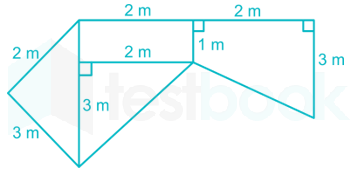
A field is divided into four regions as shown in the given figure. What is the area of the field in square metres?
Correct answer
Why this answer is correct
Formula used:
1. Area of triangle = (1/2) base × height
2. Area of a triangle with sides a, b and c =
Where, S = a + b + c
3. Area of rectangle = length × width
4. Area of trapezium = (1/2)(sum of the length of parallel sides) ×
distance b/w them
Calculation:
Area of the field = Area of ΔABD + Area of BECF + Area of ΔCDF +
Area of EFGH
Area of the ΔABD: Using the above formula
S = [2 + 3 + (3 + 1)]/2 = 9/2
Hence, area
Area of ΔCDF = ½ × 3 × 2 = 3 sq meter
Area of BECF = 2 × 1 = 2 sq meter
Area of EFGH = ½ × 4 × 2 = 4 sq meter
∴ Area of the field sq meter
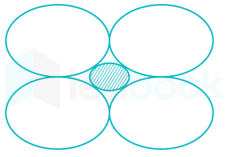
In the figure given below, D is the diameter of each circle. What is the diameter of the shaded circle?
D(√2 – 1)
D(√2 + 1)
D(√2 + 2)
D(2 – √2)
Correct answer
D(√2 – 1)
Why this answer is correct
Given:
D is a diameter of each circle.
Calculation:
Suppose ‘d’ is the diameter of shaded circle;
In the figure, O is the centre of the shaded circle;
Observing ΔABC
⇒ D2 + D2 = (D + d)2
⇒ 2D2 = (D + d)2
⇒ √2D = (D + d)
⇒ d = √2D – D
⇒ d = D(√2 – 1)
∴ Diameter of the shaded circle is D(√2 – 1).
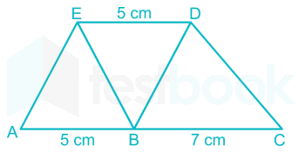
In the given figure below, AC is parallel to ED and AB = DE = 5 cm and BC = 7 cm. What is area ABDE : area BDE : area BCD equal to?
10 : 5 : 7
8 : 4 : 7
2 : 1 : 2
8 : 4 : 5
Correct answer
10 : 5 : 7
Why this answer is correct
Given:
AC is parallel to ED
AB = DE = 5 cm and BC = 7 cm.
Calculation:
According to the question
AC ll ED, which means the heights of triangles ABE, BDE and BCD are equal.
Since the heights are equal for triangles ABE, BDE and BCD, area will be proportional to the base only.
⇒ Ratio of areas of ABE, BDE and BCD = 5 : 5 : 7
And since ABCD is a parallelogram, EB will divide ABCD in two equal parts
⇒ Area ABDE : area BDE = 2 : 1 or 10 : 5
∴ Area ABDE : area BDE : area BCD = 10 : 5 : 7
Alternate Method
AB is parallel to ED and AB = ED, ABDE is a parallelogram.
Area of ABDE = 5h
Area BDE = 5h/2 [Area of triangle = 1/2 ×b × h]
Area BCD = 7h/2
Now,
area ABDE : area BDE : area BCD = 5h : 5h/2 : 7h/2
⇒ 10 : 5 : 7
∴ The required ratio is 10 : 5 : 7.
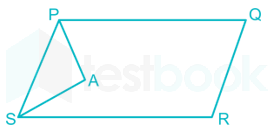
In the figure given below, PQRS is a parallelogram. PA bisects angle P and SA bisects angles S. What is angle PAS equal to?
60°
75°
90°
100°
Correct answer
90°
Why this answer is correct
Given:
PQRS is a parallelogram.
PA bisects ∠P and SA bisects ∠S
Calculation:
We know that, in a parallelogram, sum of adjacent angles is 180°
Since PQRS is a parallelogram
⇒ ∠P + ∠S = 180°
PA bisects ∠P and SA bisects ∠S
⇒ ∠PSA + ∠APS = 180°/2 = 90°
In ΔPAS
⇒ ∠PAS + ∠PSA + ∠APS = 180°
⇒ ∠PAS + 90° = 180°
⇒ ∠PAS = (180° − 90°)
⇒ ∠PAS = 90°
∴ The required value is 90°
In the figure given below, ∠A = 80° and ∠ABC = 60°, BD and CD bisects angles B and C respectively. What are the values of x and y respectively?
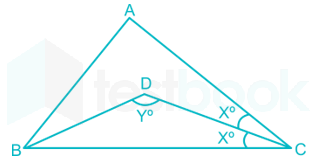
10 and 130
10 and 125
20 and 130
20 and 125
Correct answer
20 and 130
Why this answer is correct
Calculation:
In Δ ABC
∠A + ∠B + ∠C = 180∘
⇒ 80∘ + 60∘ + ∠C = 180∘
⇒ ∠C = 40∘
According to the question,
BD and CD are bisectors of ∠B and ∠C respectively.
⇒ x = 20∘
Again, in ΔBCD
∠BDC + ∠DBC + ∠DCB = 180∘
⇒ y∘ + 30∘ + 20∘ = 180∘ [∵ ∠B = 30°]
⇒ y∘ = 130∘
∴ The values of x and y are 20° and 130° respectively.
In the figure given below, PQR is a non-isosceles right-angles triangle, right angled at Q. If LM and QT are parallel and QT = PT, then what is ∠RLM equal to?
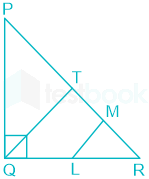
∠PQT
∠LRM
∠RML
∠QPT
Correct answer
∠LRM
Why this answer is correct
Concept:
The angles opposite to equal sides of a triangle are equal.
The Sum of all angles of a triangle is 180°
Calculation:
Let ∠RLM = x°
⇒ ∠RLM = ∠RQT = x° (since LM ll to QT)
⇒ ∠PQT = (90 – x)°
Since QT = PT
Using the above concept
⇒ ∠QPT = ∠PQT = (90 – x)°
Now in triangle PQR, ∠PQR = 90°
Since, ∠QPT + ∠LRM + ∠PQR = 180°
⇒ ∠QPT + ∠LRM = 180 – 90 = 90°
⇒ 90 – x + ∠LRM = 90° [∵ ∠QPT = (90 - x)°]
⇒ x° = ∠RLM = ∠LRM
∴ ∠RLM is equal to ∠LRM.
In the figure given below, PQ is parallel to RS and PR is parallel to QS. If ∠LPR = 35° and ∠UST = 70°, then what is ∠MPQ equal to?
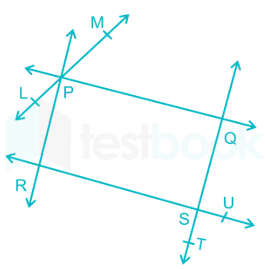
55°
70°
75°
80°
Correct answer
75°
Why this answer is correct
Given:
∠LPR = 35° and ∠UST = 70°
Concept used:
Co-interior angle: Two angles that are on the same side of the transversal.
Calculation:
∠LPR = 35°
Since ∠UST = 70°
So, ∠QSR = 70° [Vertically opposite angle]
Let ∠PQS = x
⇒ ∠PQS = 180° − 70° = 110° [By co-interior angle]
Now,
⇒ ∠RPQ + ∠PQS = 180° [By co-interior angle]
⇒ ∠RPQ + 110° = 180°
⇒ ∠RPQ = 70°
Again,
⇒ ∠XPL + ∠LPR + ∠RPQ = 180°
⇒ ∠XPL + 35° + 70° = 180°
⇒ ∠XPL + 105° = 180°
⇒ ∠XPL = 75°
Now,
⇒ ∠MPQ = ∠XPL = 75° [By vertically opposite angle]
∴ The required value of ∠MPQ is 75°
In the figure given below, ABC is a triangle with AB = BC and D is an interior point of the triangle ABC such that ∠DAC = ∠DCA.
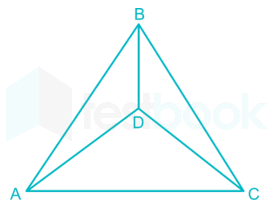
Consider the following statements:
Which of the above statements are correct?
1 and 2 only
2 and 3 only
1 and 3 only
1, 2 and 3
Correct answer
1 and 3 only
Why this answer is correct
Statement 1: Triangle ADC is an isosceles triangle.
Given ∠DAC = ∠DCA;
∴ DA = DC
Since two sides of the triangle are equal, triangle ADC is an isosceles triangle.
∴ Statement 1 is correct.
Statement 2: D is the centroid of the triangle ABC.
Point D can be anywhere in the line BE (It will satisfy the given condition too i.e. DA = DC)
∴ D may or may not be the centriod of the triangle ABC.
∴ Statement 2 is not correct.
Statement 3: Triangle ABD is congruent to the triangle CBD.
Since AD = CD and AB = CB;
∴ Triangle ABD is congruent to the triangle CBD
∴ Statement 3 is correct.
∴ Statement 1 and 3 are correct.
In the figure given below, M is the mid-point of AB and ∠DAB = ∠CBA and ∠AMC = ∠BMD. Then the triangle ADM is congruent to the triangle BCM by
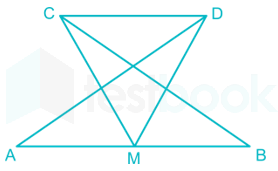
SAS rule
SSS rule
ASA rule
AAA rule
Correct answer
ASA rule
Why this answer is correct
Given:
M is the mid-point of AB.
∠DAB = ∠CBA
∠AMC = ∠BMD
Concept used:
ASA rule:
If any two angles and the side included between the angles of one triangle are equivalent to the corresponding two angles and side included between the angles of the second triangle, then the two triangles are said to be congruent by ASA rule.
Calculation:
Given M is the mid-point of AB so AM = BM
And ∠DAB = ∠CBA and ∠AMC = ∠BMD
Observing triangles ADM and BCM
AM = BM ---- (1)
∠DAB = ∠CBA ---- (2)
∠AMD = ∠AMC + ∠CMD and ∠BMC = ∠BMD + ∠DMC
Since ∠CMD & ∠DMC are same angles and ∠AMC = ∠BMD;
∴ ∠AMD = ∠BMC ---- (3)
Now we can see that 2 angles and one side are equal in both triangles.
∴ ΔADM ~ ΔBMC by ASA rule.
ABCD is a square. X is the mid-point of AB and Y is the mid-point of BC.
Consider the following statements:
Which of the following statements are correct?
2, 3 and 4 only
1, 2 and 4 only
1, 3 and 4 only
1 and 2 only
Correct answer
1 and 2 only
Why this answer is correct
Statement 1: Triangles ADX and BAY are congruent.
Observing triangles ADX and BAY;
∠DAX = ∠ABY = 90°
AX = BY (Since X and Y are midpoints of sides of the square)
And DA = AB (Side of the square)
∴ Triangles ADX and BAY are congruent.
∴ Statement 1 is correct.
Statement 2: ∠DXA = ∠AYB
Since Triangles ADX and BAY are congruent;
∴ ∠DXA = ∠AYB
∴ Statement 2 is also correct.
Statement 3: DX is inclined at an angle 60° with AY
In triangle ADX;
∠ADX = 30°
∴ ∠AXD = 180 – 90 – 30 = 60°
∠BAY will be equal to ∠ADX (Angles of congruent triangles)
∴ ∠BAY = 30°
∴ ∠APX = 190 – 60 – 30 = 90°
∴ ∠APD = 180 - ∠APX = 90°
∴ DX is inclined at an angle 90° with AY.
∴ Statement 3 is not correct.
Statement 4: DX is not perpendicular to AY.
It is also not correct as we proved in earlier sentence that DX is perpendicular to AY.
∴ Statement 4 is not correct.
∴ Statement 1 and 2 are correct.
From an aeroplane vertically over a straight horizontal road, the angle of depression of two consecutive kilometre-stones on the opposite sides of the aeroplane are observed to be α and β. The height of the aeroplane above the road is
Correct answer
Why this answer is correct
In triangle ADC;
Tanα = H/AD
⇒ AD = H/tanα
In triangle BDC;
Tanβ = H/BD
⇒ BD = H/tanβ
We know that distance between A and B is 1 km;
∴ AB = 1
⇒ AD + BD = 1
⇒ H/tanα + H/tanβ = 1
⇒ H(1/tanα + 1/tanβ) = 1
∴ Height of the aeroplane above the road
100 questions in the full paper