Previous Year Paper

CDS Elementary Mathematics 4 Feb 2018 Official Paper (Previous Year Paper)

Held in 2018

100 questions120 minutes
With answers
Free

Paper last updated:

Practise under exam conditions

Take this paper as a timed mock test. Review your answers after you submit.

Attempt timed test

Questions & answers

Read the paper at your pace. Open an explanation when you need it.

Elementary Mathematics (100 questions)

Question 1

A man undertakes to do a work in 150 days. He employs 200 men. He finds that only a quarter of the work is done in 50 days. How many additional men should he employ so that the whole work is finished in time?

  1. AOption (a)

    75

  2. BOption (b)

    85

  3. COption (c)

    100

  4. DOption (d)

    120

View answer & explanation

Correct answer

Answer: (c)C.

100

Why this answer is correct

200 men can complete the quarter of work in 50 days

If they continue the work, time taken to complete the remaining work = 3 × 50 = 150 days

[∵ ¾ th of the work is remaining]

But they have to complete in 100 days to finish in time

Time ∝ 1/Number of employees

Let the number of extra employees required to complete the work in time be x

∴ 150/100 = (200 + x)/200

300 = 200 + x

∴ x = 100
Question 2

A train moving with a speed of 60 km per hour crosses an electric pole in 30 seconds. What is the length of train in meters?

  1. AOption (a)

    300

  2. BOption (b)

    400

  3. COption (c)

    500

  4. DOption (d)

    600

View answer & explanation

Correct answer

Answer: (c)C.

500

Why this answer is correct

Shortcut Trick

Length of the train = Speed of train in m/s × Time taken to cross a stationary pole.

Convert speed: 60 km/h = 60 × (5 / 18) = 50 / 3 m/s.

Length = (50 / 3) × 30 = 50 × 10 = 500 meters.

∴ The correct answer is 500 m.

Alternate Method

Given:

Speed of the train = 60 km/h

Time to cross the pole = 30 seconds

Formula Used:

Distance = Speed × Time

To convert km/h to m/s, multiply by (5 / 18)

Pole

Train Length (L) = ?

Speed = 60 km/h

Time to cross = 30 seconds

Calculations:

⇒ Speed in m/s = 60 × (5 / 18)

⇒ Speed = 300 / 18 = 50 / 3 m/s

⇒ Distance covered = Speed × Time

⇒ Length of train = (50 / 3) × 30

⇒ Length of train = 50 × 10 = 500 m

∴ The correct answer is 500 m.

Additional Information

Crossing a Point Object

When a train crosses a stationary object with negligible width like a pole, standing man, or tree, the total distance covered is equal to the length of the train itself.

Crossing an Extended Object

When a train crosses a bridge, platform, or another train, the total distance covered is the sum of their individual lengths (Distance = L1 + L2).

Unit Conversion Trick

To rapidly convert a speed from km/h to m/s, simply multiply by 5/18. To convert backward from m/s to km/h, multiply by 18/5.

Question 3

Rs. 120 is distributed among A, B and C so that A’s share is Rs. 20 more than B’s and Rs. 20 less than C’s. What is the B’s share?

  1. AOption (a)

    Rs. 10

  2. BOption (b)

    Rs. 15

  3. COption (c)

    Rs. 20

  4. DOption (d)

    Rs. 25

View answer & explanation

Correct answer

Answer: (c)C.

Rs. 20

Why this answer is correct

Calculation:

Let A’s share be Rs. x

⇒ B’s share = x - 20 and C’s share = x + 20

Total amount = x + x - 20 + x + 20

⇒ 120 = 3x

⇒ x = 40

∴ B’s share = x - 20 = Rs. 20

Question 4

In the following table of inverse variations, what are the values of A, B and C respectively?

M15-62C
N-4AB60
  1. AOption (a)

    10, -30, -1

  2. BOption (b)

    10, -1, 30

  3. COption (c)

    -30, 10, -1

  4. DOption (d)

    -1, -30, 10

View answer & explanation

Correct answer

Answer: (a)A.

10, -30, -1

Why this answer is correct

In inverse variation M × N = constant for all values of M and N

MN = 15 × -4 = -60

-6 × A = -60

∴ A = 10

2 × B = -60

∴ B = -30

C × 60 = -60

∴ C = -1

Question 5

A person borrows Rs. 5000 at 5% rate of interest per annum and immediately lent it at 5.5%. After two years he collected the amount and settled his loan. What is the amount gained by him this transaction?

  1. AOption (a)

    Rs. 25

  2. BOption (b)

    Rs. 50

  3. COption (c)

    Rs. 100

  4. DOption (d)

    Rs. 200

View answer & explanation

Correct answer

Answer: (b)B.

Rs. 50

Why this answer is correct

Given :

Principal = Rs 5000

Rate1 = 5%

Rate2 = 5.5%

Time = 2 years

Formula used :

Simple interest = PRT100\frac{PRT}{100}        ---- (1)

Calculations :

Interest when rate is 5%, using equation (1)

⇒ Simple interest = 5000×5×2100\frac{5000 \times 5 \times 2}{100}

⇒ Rs 500

Interest when rate is 5.5%, using equation (1)

⇒ Simple interest = 5000×5.5×2100\frac{5000 \times 5.5 \times2}{100}

⇒ Rs 550

The required amount gained

⇒ 550 - 500

⇒ Rs 50

∴ The amount gained by him this transaction is Rs 50.

Question 6

At present the average of the ages of a father and a son is 25 years. After seven years, the son will be 17 years old. What will be the age of father after 10 years?

  1. AOption (a)

    44 years

  2. BOption (b)

    45 years

  3. COption (c)

    50 years

  4. DOption (d)

    52 years

View answer & explanation

Correct answer

Answer: (c)C.

50 years

Why this answer is correct

Age of son after 7 years = 17 years

⇒ Present age of son = 17 - 7 = 10 years

Average of the present ages of father and son = 25

⇒ Sum of the present ages of father and son = 25 × 2 = 50

⇒ Present age of father = 50 - 10 = 40 years

After 10 years age of father = 40 + 10 = 50 years

∴ The age of the father after 10 years will be 50 years.

Question 7

If 5 tractors can plough 5 hectares of land in 5 days, then what is the number of tractor required to plough 100 hectares in 50 days?

  1. AOption (a)

    100

  2. BOption (b)

    200

  3. COption (c)

    10

  4. DOption (d)

    5

View answer & explanation

Correct answer

Answer: (c)C.

10

Why this answer is correct

5 tractors can plough 5 hectares in 5 days

5 tractors can plough 50 hectares in 50 days

1 tractor can plough 10 hectares in 50 days

∴ Number of tractors needed to plough 100 hectares = 100/ (Number of hectares 1 tractor can plough in 50 days)

⇒ 100/10 = 10

∴ 10 tractors can plough 100 hectares in 50 days

Question 8

A merchant commences with a certain capital and gains annually at the rate of 25%. At the end of 3 years he has Rs. 10,000. What is the original amount that the merchant invested?

  1. AOption (a)

    Rs. 5120

  2. BOption (b)

    Rs. 5210

  3. COption (c)

    Rs. 5350

  4. DOption (d)

    Rs. 5500

View answer & explanation

Correct answer

Answer: (a)A.

Rs. 5120

Why this answer is correct

Let the initial amount invested be Rs x and the amount is compounded at 25% rate

Amount at the end of n years = Principal × (1 + Rate/100)n

10000 = x × (1 + 25/100)3

10000 = x × 1.253

10 × 10 × 10 × 10 = x × 1.25 × 1.25 × 1.25

8 × 8 × 8 × 10 = x [∵ 10/1.25 = 8]

x = Rs. 5120

Question 9

Which of the following decimal number is a rational number with denominator 37?

  1. AOption (a)

    0.459459459⋯

  2. BOption (b)

    0.459459459

  3. COption (c)

    0.0459459459⋯

  4. DOption (d)

    0.00459459459⋯

View answer & explanation

Correct answer

Answer: (a)A.

0.459459459⋯

Why this answer is correct

459 = 17 × 27

Second option is terminating decimal, ∴ denominator has a prime factors of 2 or 5 only

We can evaluate the first decimal and other two decimals are obtained by dividing it by 10 and 100 respectively

Let x = 0.459459459⋯

1000x = 459.459459⋯

1000x = 459 + 0.459459⋯

1000x = 459 + x

∴ 999x = 459

x = 459/999 = (17 × 27) / (37 × 27) = 17/37

∴ 0.459459459⋯ is the decimal with 37 in the denominator when represented as rational number

Question 10

The annual income of a person decreases by Rs. 64 if the rate of interest decreases from 4% to 3.75%. What is his original annual income?

  1. AOption (a)

    Rs. 24000

  2. BOption (b)

    Rs. 25000

  3. COption (c)

    Rs. 24600

  4. DOption (d)

    Rs. 25600

View answer & explanation

Correct answer

Answer: (d)D.

Rs. 25600

Why this answer is correct

Given :

Reduction in rate of interest = 0.25%

Decrease in amount = Rs 64

Formula used :

Decrease in amount = Principal × rate reduction in rate of interest × time100\frac{Principal \ \times \ rate \ reduction \ in \ rate \ of \ interest \ \times \ time}{100}     ---(1)

Calculations :

The decrease in the income is due to the reduction in rate of interest.

Using equation (1), we get

⇒ 64 = Principal × .25 × 1100\frac{Principal \ \times \ .25 \ \times \ 1}{100}

⇒ Principal=64000.25Principal = \frac{6400}{0.25}

⇒  Principal = Rs. 25600

∴ Original annual income is Rs 25600.

Question 11

For 0 < m < 1, which one the following is correct?

  1. AOption (a)

    Log10m < m2 < m < m-1

  2. BOption (b)

    m < m-1 < m2 < Log10m

  3. COption (c)

    Log10m < m < m-1 < m2

  4. DOption (d)

    Log10m < m-1 < m < m2

View answer & explanation

Correct answer

Answer: (a)A.

Log10m < m2 < m < m-1

Why this answer is correct

If 0 < m < 1, log10 m is negative so that is the least (All other terms will be positive)

For numbers less than 1, the term with lowest power is the largest

-1 < 1 < 2

∴ m2 < m < m-1

Final order = Log10m < m2 < m < m-1

Question 12

A gentleman left a sum of Rs. 39000 to be distributed among his widow, 5 sons and 4 daughters. If each son receives three times as much as a daughter receives, and each daughter receives twice as much as their mother receives, then what is the widow’s share?

  1. AOption (a)

    Rs. 1000

  2. BOption (b)

    Rs. 1200

  3. COption (c)

    Rs. 1500

  4. DOption (d)

    None of the above

View answer & explanation

Correct answer

Answer: (a)A.

Rs. 1000

Why this answer is correct

Let the amount received by the widow = Rs x

∴ Amount received by daughter = 2 × x = 2x

Amount received by son = 3 × 2x = 6x

Total amount = Amount received by widow + 5 × Amount received by sons + 4 × Amount received by daughter

39000 = x + 5 × 6x + 4 × 2x

39000 = x + 30x + 8x

39000 = 39x

∴ x = 1000

Widow receives Rs. 1000

Question 13

Three numbers which are co-prime to each other, are such that the product of the first two 286 and that of the last two is 770. What is the sum of three terms?

  1. AOption (a)

    85

  2. BOption (b)

    80

  3. COption (c)

    75

  4. DOption (d)

    70

View answer & explanation

Correct answer

Answer: (d)D.

70

Why this answer is correct

Given:

Three numbers which are co-prime to each other, are such that the product of the first two 286 and that of the last two is 770.

Concept:

(LCM × HCF) = Product of the numbers

Calculation:

Co-prime numbers have no prime factors in common so when expressed as fraction there will be no simplification

Let the numbers be A, B and C respectively

A × B = 286 and B × C = 770

A × B/ (B × C) = 286/770

A/C = 13/35

∴ A = 13 and C = 35

B = 286/A = 22

Sum of the numbers = 13 + 35 + 22 = 70

∴ The sum of three terms is 70.

Question 14

The age of a woman is two-digit integer. On reversing this integer, the new integer is the age of her husband who is elder to her. The difference between their ages is one eleventh of their sum. What is the difference between their ages?

  1. AOption (a)

    8 years

  2. BOption (b)

    9 years

  3. COption (c)

    10 years

  4. DOption (d)

    11 years

View answer & explanation

Correct answer

Answer: (b)B.

9 years

Why this answer is correct

Let the two digits of the age of the women be y and x (yx)

Age of the women = 10y + x

Age of the men = 10x + y

Difference in their age = 10x + y - 10y - x

⇒ 9x - 9y

Sum of their ages = 10x + y + 10y + x = 11x + 11y

Difference = 1/11 × Sum

9x - 9y = 1/11 × (11x + 11y)

9x - 9y = x + y

8x = 10y

Since x and y can only be natural numbers from 1 to 9, the only possibility is x = 5 and y = 4

Difference in their age = 9x - 9y = 45 - 36 = 9 years

Question 15

A passenger train and a goods train are running in the same direction on parallel railway tracks. If the passenger train now takes three times as long to pass the goods train, as when they are running in the opposite directions, then what is the ratio of the speed of the passenger train to that of the goods train?

  1. AOption (a)

    2 : 1

  2. BOption (b)

    3 : 2

  3. COption (c)

    4 : 3

  4. DOption (d)

    1 : 1

View answer & explanation

Correct answer

Answer: (a)A.

2 : 1

Why this answer is correct

For crossing the relative displacement is same and equal to the sum lengths of the trains in both cases

∴ Time ∝ 1/Relative speed

Let the speed of the goods train be x and passenger train be kx, where k is required ratio

Relative speed when moving in opposite direction = kx - (-x) = (k + 1)x [Speeds are added]

Relative speed when moving in same direction = kx - x = (k - 1)x

(Time taken when moving in same direction) / (Time taken when moving in opposite direction) = (Relative Speed in opposite direction) / (Relative Speed in same direction)

3 = (k + 1)x / [(k - 1)x]

3 = (k + 1) / (k - 1)

3k - 3 = k + 1

2k = 4

k = 2

∴ The required ratio = 2 : 1

Question 16

All odd prime numbers up to 110 are multiplied together. What is the unit digit in this product?

  1. AOption (a)

    0

  2. BOption (b)

    3

  3. COption (c)

    5

  4. DOption (d)

    None of the above

View answer & explanation

Correct answer

Answer: (c)C.

5

Why this answer is correct

Any number multiplied with 5 ends with 5 if it is odd

Product of all odd prime number is an odd number where one of the factor is 5

∴ The unit digit of the product is 5

Question 17

An alloy A contains two elements, copper and tin in the ratio of 2 : 3, whereas an alloy B contains the same elements in the ratio of 3 : 4. If 20 kg of alloy A, 28 kg of alloy B and some more pure copper are mixed to form a third alloy C which now contains copper and tin in the ratio of 6 : 7, then what is the quantity of the pure copper mixed in the alloy C?

  1. AOption (a)

    3 kg

  2. BOption (b)

    4 kg

  3. COption (c)

    5 kg

  4. DOption (d)

    7 kg

View answer & explanation

Correct answer

Answer: (b)B.

4 kg

Why this answer is correct

Let the amount of pure copper added be ‘x’ kg

Amount of copper in 20 kg of alloy A = 2/ (2 + 3) × 20 = 8 kg

Amount of copper in 28 kg of alloy B = 3/ (3 + 4) × 28 = 12 kg

Total amount of copper in alloy C = 8 + 12 + x = 20 + x

Total amount of alloy C produced = 20 + 28 + x = 48 + x

20 + x = 6/(6 + 7) × (48 + x)

20 + x = 6/13 × (48 + x)

260 + 13x = 288 + 6x

7x = 28

∴ x = 4 kg

Question 18

A quadratic polynomial ax2 + bx + c = 0 is such that when it is divided by x, (x - 1) and (x + 1), the remainders are 3, 6 and 4 respectively. What is the value of (a + b)?

  1. AOption (a)

    3

  2. BOption (b)

    2

  3. COption (c)

    1

  4. DOption (d)

    -1

View answer & explanation

Correct answer

Answer: (a)A.

3

Why this answer is correct

ax2 + bx + c = x (ax + b) + c

Remainder when divided by x = c

∴ c = 3

Let P(x) be a polynomial when divided by (x - a), then the remainder is P(a)

Remainder when divided by (x - 1) = P(1)

6 = a (1) + b(1) + c

6 = a + b + 3

∴ a + b = 3

Question 19

If the average of 9 consecutive positive integers is 55, then what is the largest integer?

  1. AOption (a)

    57

  2. BOption (b)

    58

  3. COption (c)

    59

  4. DOption (d)

    60

View answer & explanation

Correct answer

Answer: (c)C.

59

Why this answer is correct

<br>

Shortcut Trick

Concept:

Consecutive numbers:

  • They usually have a difference of 1 between every two numbers.
  • If the terms are in  AP (i.e. common difference same), and the total number of terms is odd then the average is the same as the middle most term.


Calculation:

Using the above concept

Average = 5th term = 55

Largest integer = 9th term = 55 + 4 = 59

∴ The largest integer is 59

Alternate Method

Let the integers  are

a - 4, a - 3, a - 2, a - 1, a, a + 1, a + 2, a + 3, a + 4

Sum of 9 integers = 9a

Average = {Sum of Observations} ÷ {Total number of Observations}

Average of 9 integers = 9a/9 = 55

⇒ a = 5

⇒ Largest integer = a + 4 = 55 = 4 = 59

∴ The largest integer is 59

Question 20

The average of the ages of 15 students in a class is 19 years. When 5 new students are admitted to the class, the average age of the class becomes 18.5 years. What is the average age of the 5 newly admitted students?

  1. AOption (a)

    17 years

  2. BOption (b)

    17.5 years

  3. COption (c)

    18 years 

  4. DOption (d)

    18.5 years

View answer & explanation

Correct answer

Answer: (a)A.

17 years

Why this answer is correct

Formula used:

Average = Sum of observation / Number of observations

Calculation

We know that,

Average = Sum of observation / Number of observations

Sum = Average × Number of observations

Therefore, 

Total age of 15 students =(15 × 19) = 285 years

Total age of (15 + 5) i.e. 20 students = (20 × 18.5) = 370 years

Therefore, the total age of 5 new students = 370 - 285 =  85 years

Now, average of 5 new students = 85/5 = 17 year.

∴ The average age of the 5 newly admitted students is 17 years.

Question 21

A water tank has been fitted with two taps P and Q and a drain pipe R. Taps P and Q fill at the rate of 12 litres per minute and 10 litres per minute respectively.

Consider the following statements S1, S2 and S3:

S1: Pipe R drains out at the rate of 6 litres per minute

S2: If both the taps and the drain pipe are opened simultaneously, then the tank is filled in 5 hours 45 minutes

S3: Pipe R drains out (fully) the filled tank in 15 hours 20 minutes.

To know what is the capacity of the tank, which one the following is correct?

  1. AOption (a)

    S2 is only sufficient

  2. BOption (b)

    S1, S2 and S3 are necessary

  3. COption (c)

    Any two out of S1, S2 and S3 are sufficient

  4. DOption (d)

    None of the above

View answer & explanation

Correct answer

Answer: (c)C.

Any two out of S1, S2 and S3 are sufficient

Why this answer is correct

Total volume = Flow rate of R × Time taken to empty

Total volume = (Flow rate of P + Flow rate of Q - Flow rate of R) × Time taken to fill if all the taps and drains are open

To use equation 1, two quantities are required

S1 gives flow rate of R = 6 litres per minute

S3 gives time taken to empty = 15 hours 20 minutes

∴ Volume of tank = 6 × (15 × 60 + 20) = 5520 litres                             [∵ 1 hour = 60 minutes]

To use equation 2,

S1: gives the flow rate of R

S2 gives the total time require to fill if all taps and drains are opened.

∴ Volume = (12 + 10 - 6) × (5 × 60 + 45)

⇒ 16 × 345 = 5520 litres

Let the volume of the tank be V litres

By S3: Flow rate of Pipe R = V/ (15 × 60 + 20) = V/920

Substituting in S2

V = (12 + 10 - V/920) × (5 × 60 + 45)

V/345 = 22 - V/920

V/345 + V/920 = 22

168V/57960 + 63V/57960 = 22

231V/57960 = 22

∴ V = 5520 litres

∴ Any two statements are required to find the capacity of the tank

Question 22

A man can row at a speed of x km/h in still water. If in a stream which is flowing at a speed of y km/h it takes him z hours to row to a place and back, then what is the distance between the two places?

  1. AOption (a)

    z(x2 - y2)/2y

  2. BOption (b)

    z(x2 - y2)/2x

  3. COption (c)

    (x2 - y2)/2zx

  4. DOption (d)

    z(x2 - y2)/x

View answer & explanation

Correct answer

Answer: (b)B.

z(x2 - y2)/2x

Why this answer is correct

Let the distance between the two places be D km

Time taken = Distance/Speed

Speed in upstream = Speed of boat in still water - Speed of the stream = x - y

Speed in downstream = Speed of the boat in still water + Speed of the stream = x + y

Total time taken = Time taken upstream + Time taken downstream

z = D/ (x - y) + D/ (x + y)

z = [D(x + y) + D(x - y)] / [(x - y) (x + y)]

z = 2Dx / (x2 - y2) [∵ (a - b) (a + b) = (a2 - b2)]

∴ D = z(x2 - y2)/2x

Question 23

A car has an average speed of 60 km per hour while going from Delhi to Agra and has an average speed of y km per hour while returning to Delhi from Agra (by travelling the same distance). If the average speed of the car for the whole journey is 48 km per hour, what is the value of y?

  1. AOption (a)

    30 km per hour

  2. BOption (b)

    35 km per hour

  3. COption (c)

    40 km per hour

  4. DOption (d)

    45 km per hour

View answer & explanation

Correct answer

Answer: (c)C.

40 km per hour

Why this answer is correct

Given:

Average speed = 48kmph

Concept used:

When equal distance is travelled with 2 different speed x and y,

then the average speed = 2xy/(x + y)

Here, x = 60 kmph and y is other speed

2 × 60 × y/(60 + y) = 48

⇒ y = 40 kmph

Detailed Solution:

Let the distance between Delhi and Agra be D km

Time taken for round journey = D/60 + D/y            

               [∵ Time = Distance/Speed]

⇒ D(60 + y) / (60y) = 2D/Average speed

⇒ 2 × 60y = Average speed × (60 + y)

120y = 48 × (60 + y)

120y = 2880 + 48y

72y = 2880

∴ y = 40 km/h

Question 24

An article is sold at a profit of 32%. If the cost price is increased by 20% and the sale price remains the same, then the profit percentage becomes

  1. AOption (a)

    10%

  2. BOption (b)

    12%

  3. COption (c)

    15%

  4. DOption (d)

    20%

View answer & explanation

Correct answer

Answer: (a)A.

10%

Why this answer is correct

Shortcut Trick let initial cost price = 100

Initial selling price  = 132

New Cost price = 100 + 20 % of 100 = 120

New Selling price  = old selling price = 132

∴ Profit % = 132−120120\frac{132-120 }{120}× 100 = 10%

∴ Correct option is 10%.

 Alternate MethodCalculation:

Let the original cost price be Rs ‘x’

Profit = 32% of cost price

∴ Selling price = Cost price + Profit

= x + (32/100) % of x = 1.32x

New cost price = (100 + 20)/100 × x = 1.2x

New profit = Selling price - cost price

⇒ 1.32x - 1.2x = 0.12x

∴ Profit % = (0.12x/1.2x) × 100 = 10%

∴ The correct option is 10%.

Question 25

A, B, C, D and E start a partnership firm. Capital contributed by A is three times that contributed by D. E contributes half of A’s contribution, B contributes one third of E’s contribution and C contributes two third of A’s contribution. If the difference between the combined shares of A, D and E and the combined shares of B and C in the total profit of the firm is Rs. 13500, what is the combined share of B, C and E? (The shares are supposed to be proportional to the contributions)

  1. AOption (a)

    Rs. 13500

  2. BOption (b)

    Rs. 18000

  3. COption (c)

    Rs. 19750

  4. DOption (d)

    Rs. 20250

View answer & explanation

Correct answer

Answer: (b)B.

Rs. 18000

Why this answer is correct

Let D’s contribution be x

∴ A’s contribution = 3 × x = 3x

E’s contribution = ½ × 3x = 1.5x

B’s contribution = 1/3 × 1.5x = 0.5x

C’s contribution = 2/3 × 3x = 2x

Total contribution = 3x + 0.5x + 2x + x + 1.5x = 8x

B, C and E contribution = 0.5x + 2x + 1.5x = 4x

Difference between (A + D + E) - (B + C) = 3x + x + 1.5x - 0.5x - 2x = 3x

Share ∝ Contribution

B + C + E contribution/13500 = 4/3

∴ B + C + E contribution = 4/3 × 13500 = Rs. 18000

Question 26

517 + 518 + 519 + 520 is divisible by

  1. AOption (a)

    7

  2. BOption (b)

    9

  3. COption (c)

    11

  4. DOption (d)

    13

View answer & explanation

Correct answer

Answer: (d)D.

13

Why this answer is correct

517 + 518 + 519 + 520 = 517 × (1 + 5 + 25 + 125)

⇒ 517 × 156 = 517 × 12 × 13

∴ The given expression is divisible by 13

Question 27

If a + b = 2c, then what is the value of a/(a - c) + c/(b - c)?

  1. AOption (a)

    -1

  2. BOption (b)

    0

  3. COption (c)

    1

  4. DOption (d)

    2

View answer & explanation

Correct answer

Answer: (c)C.

1

Why this answer is correct

a + b = 2c

∴ a - c = c - b

a/(a - c) + c/(b - c) = a/(a - c) - c/(a - c) [∵ b - c = -(a - c)]

⇒ (a - c)/(a - c) = 1

Question 28

If x = y1/a, y = z1/b and z = x1/c where x ≠ 1, y ≠ 1 and z ≠ 1, then what is the value of abc?

  1. AOption (a)

    -1

  2. BOption (b)

    1

  3. COption (c)

    0

  4. DOption (d)

    3

View answer & explanation

Correct answer

Answer: (b)B.

1

Why this answer is correct

xa = (y1/a)a = y

(xa)b = yb = (z1/b)b = z

[(xa)b]c = zc = (x1/c)c = x

∴ xabc = x

∴ abc = 1

Question 29

If 2b = a + c and y2 = xz, then what is xb - c yc - a za - b‑ equal to?

  1. AOption (a)

    3

  2. BOption (b)

    2

  3. COption (c)

    1

  4. DOption (d)

    -1

View answer & explanation

Correct answer

Answer: (c)C.

1

Why this answer is correct

2b = a + c

∴ b - c = a - b

xb - c yc - a za - b = xb - c yc - a zb - c

⇒ (xz)b - c yc - a

⇒ (y2)b - c yc - a

⇒ (y)2b - c - a = y0 = 1

Question 30

Which one of the following is correct?

  1. AOption (a)

    Decimal expansion of a rational number is terminating

  2. BOption (b)

    Decimal expansion of a rational number is non terminating

  3. COption (c)

    Decimal expansion of an irrational number is terminating

  4. DOption (d)

    Decimal expansion of an irrational number is non terminating and non repeating

View answer & explanation

Correct answer

Answer: (d)D.

Decimal expansion of an irrational number is non terminating and non repeating

Why this answer is correct

Concept:

If decimal expansion terminates, the denominator of the rational number is 2 or 5 or combinations for their powers

If the decimal expansion is non terminating but repeating, then it is a rational number with terms in the prime factorization of the denominators to be numbers other than 2 or 5

Now,

A non-terminating, non-repeating decimal is a decimal number that continues endlessly, with no group of digits repeating endlessly.

Decimals of this type cannot be represented as fractions, and as a result, are irrational numbers.

Example:

π is a non-terminating, non-repeating decimal. π = 3.141 592 653 5...

e is a non-terminating, non-repeating decimal. e = 2.718 281

Hence, If the decimal expansion is non terminating and non-repeating, then it is an irrational number

Question 31

If the roots of the equation px2 + x + r = 0 are reciprocal to each other, then which one of the following is correct?

  1. AOption (a)

    p = 2r

  2. BOption (b)

    p = r

  3. COption (c)

    2p = r

  4. DOption (d)

    p = 4r

View answer & explanation

Correct answer

Answer: (b)B.

p = r

Why this answer is correct

Products of the roots of quadratic equation = c/a

In this case, product = 1 [∵ Roots are reciprocal of each other]

1 = r/p

∴ p = r

Question 32

If 65x - 33y = 97 and 33x - 65y = 1, then what is xy equal to?

  1. AOption (a)

    2

  2. BOption (b)

    3

  3. COption (c)

    -2

  4. DOption (d)

    -3

View answer & explanation

Correct answer

Answer: (a)A.

2

Why this answer is correct

65x - 33y = 97     ----(1)

33x - 65y = 1     ----(2)

Equation 1 + 2

98x - 98y = 98

∴ x - y = 1 or x = y + 1

Substituting in equation 1

65y + 65 - 33y = 97

32y = 32

∴ y = 1 and x = 1 + 1 = 2

∴ xy = 2 × 1 = 2

Question 33

If b/y + z/c = 1 and c/z + x/a = 1, then what is (ab + xy)/bx equal to?

  1. AOption (a)

    1

  2. BOption (b)

    2

  3. COption (c)

    0

  4. DOption (d)

    -1

View answer & explanation

Correct answer

Answer: (a)A.

1

Why this answer is correct

(ab + xy)/bx = a/x + y/b

⇒ (x/a)-1 + (b/y)-1

⇒ (1 - c/z)-1 + (1 - z/c)-1

⇒ z/(z - c) + c/(c - z)

⇒ (z - c) / (z - c) = 1

Question 34

If (a2 - 1)/a = 5, then what is the value of (a6 - 1)/a3?

  1. AOption (a)

    125

  2. BOption (b)

    -125

  3. COption (c)

    140

  4. DOption (d)

    -140

View answer & explanation

Correct answer

Answer: (c)C.

140

Why this answer is correct

(a2 - 1)/a = 5

a - 1/a = 5

Cubing on both the sides

a3 - 1/a3 - 3 × a × 1/a × (a - 1/a) = 125 [∵ (a - b)3 = a3 - b3 - 3ab (a - b)]

a3 - 1/a3 - 3 × 5 = 125

∴ a3 - 1/a3 = (a6 - 1)/a3 = 125 + 15 = 140

Question 35

If x + y + z = 0, then what is (y + z - x)3 + (z + x - y)3 + (x + y -z)3 equal to?

  1. AOption (a)

    (x + y + z)3

  2. BOption (b)

    3(x + y) (y + z) (x + z)

  3. COption (c)

    24xyz

  4. DOption (d)

    -24xyz

View answer & explanation

Correct answer

Answer: (d)D.

-24xyz

Why this answer is correct

(y + z - x)3 + (z + x - y)3 + (x + y -z)3 = (x + y + z - 2x)3 + (y + z + x - 2y)3 + (x + y + z - 2z)3

⇒ (-2x)3 + (-2y)3 + (-2z)3 [∵ x + y + z = 0]

⇒ -8 × (x3 + y3 + z3)

If x + y + z = 0, then x3 + y3 + z3 = 3xyz

∴ The given expression = -8 × 3xyz = -24xyz

Question 36

If (x + 3) is a factor of x3 + 3x2 + 4x + k, then what is the value of k?

  1. AOption (a)

    12

  2. BOption (b)

    24

  3. COption (c)

    36

  4. DOption (d)

    72

View answer & explanation

Correct answer

Answer: (a)A.

12

Why this answer is correct

If (x - a) is a factor of polynomial P(x), then P(a) = 0

∴ (-3)3 + 3 × (-3)2 + 4 × (-3) + k = 0

-12 + k = 0

k = 12

Question 37

The smallest integer with 4 digits which is a perfect square is

  1. AOption (a)

    1000

  2. BOption (b)

    1024

  3. COption (c)

    1089

  4. DOption (d)

    None of these

View answer & explanation

Correct answer

Answer: (b)B.

1024

Why this answer is correct

We know that 302 = 900

312 = 961

322 = 1024

∴ 1024 is the smallest 4 digit perfect square

Question 38

Which one the following is a zero of the polynomial 3x3 + 4x2 - 7 = 0

  1. AOption (a)

    0

  2. BOption (b)

    1

  3. COption (c)

    2

  4. DOption (d)

    -1

View answer & explanation

Correct answer

Answer: (b)B.

1

Why this answer is correct

Given:

The polynomial 3x3 + 4x2 - 7 = 0

Calculation:

Option(1), x = 0

P(x) = 3x3 + 4x2 - 7 = 0

⇒ P(0) = 3(0)3 + 4(0)2 - 7 

⇒ P(0) = - 7

This is not the zero of the polynomial 3x3 + 4x2 - 7 = 0

Option(2), x = 1

P(x) = 3x3 + 4x2 - 7 = 0

⇒ P(1) = 3(1)3 + 4(1)2 - 7 

⇒ P(1) = 7 - 7

⇒ P(1) = 0

∴ x = 1 the zero of the polynomial 3x3 + 4x2 - 7 = 0.

Question 39

There are two numbers which are greater than 21 and their LCM and HCF are 3003 and 21 respectively. What is the sum of these numbers?

  1. AOption (a)

    504

  2. BOption (b)

    508

  3. COption (c)

    514

  4. DOption (d)

    528

View answer & explanation

Correct answer

Answer: (a)A.

504

Why this answer is correct

If their HCF = 21, then the numbers are form 21a and 21b respectively, where a and b are coprimes

LCM × HCF = Product of the numbers

3003 × 21 = 21a × 21b

∴ ab = 143 = 13 × 11 or 143 × 1

Since both the numbers are greater than 21

a = 13 and b = 11

So the numbers are 21 × 13 = 273 and 21 × 11 = 231

Sum of the numbers = 273 + 231 = 504

Question 40

If α and β are the roots of the equation ax2 + bx + c = 0, then what is the value of the expression (α + 1) (β + 1)?

  1. AOption (a)

    (a + b + c)/a

  2. BOption (b)

    (b + c - a)/a

  3. COption (c)

    (a - b + c)/a

  4. DOption (d)

    (a + b - c)/a

View answer & explanation

Correct answer

Answer: (c)C.

(a - b + c)/a

Why this answer is correct

Sum of roots = -b/a

∴ α + β = -b/a

Product of roots = c/a

∴ αβ = c/a

1 + α + β + αβ = 1 - b/a + c/a = (a - b + c)/a

1 + α + β (α + 1) = (a - b + c)/a

(α + 1) (β + 1) = (a - b + c)/a

Question 41

The remainder when 3x3 + kx2 + 5x - 6 is divided by (x + 1) is -7. What is the value of k?

  1. AOption (a)

    -14

  2. BOption (b)

    14

  3. COption (c)

    -7

  4. DOption (d)

    7

View answer & explanation

Correct answer

Answer: (d)D.

7

Why this answer is correct

P(a) is the remainder obtained when the polynomial is divided by (x - a)

∴ 3(-1)3 + k(-1)2 + 5(-1) - 6 = -7

k - 14 = -7

∴ k = 7

Question 42

If f(x) and g(x) are polynomials of degree p and q respectively, then the degree of [f(x) ± g(x)] (if it is non zero) is

  1. AOption (a)

    Greater than min (p, q)

  2. BOption (b)

    Greater than max (p, q)

  3. COption (c)

    Less than or equal to max (p, q)

  4. DOption (d)

    Equal to min (p, q)

View answer & explanation

Correct answer

Answer: (c)C.

Less than or equal to max (p, q)

Why this answer is correct

Degree is the highest power of the given polynomial

If f(x) and g(x) are added the maximum of them will be the degree unless some term cancels.

If p = q, and the coefficients are negative to each other, the first term may get cancelled. Then the degree is less than the maximum.

∴ Degree can either be equal or less than the max(p, q)

Question 43

What is the value of [(√5 - √3) / (√5 + √3)] - [(√5 + √3) / (√5 - √3)]?

  1. AOption (a)

    -2√15

  2. BOption (b)

    2√15

  3. COption (c)

    √15

  4. DOption (d)

    -√15

View answer & explanation

Correct answer

Answer: (a)A.

-2√15

Why this answer is correct

(√5 - √3) × (√5 + √3) = 5 - 3 = 2 [∵ (a - b) (a + b) = (a2 - b2)]

(√5 - √3)/2 = 1/(√5 + √3)

∴ [(√5 - √3)/(√5 + √3)] - [(√5 + √3)/(√5 - √3)] = (√5 - √3)2/2 - (√5 + √3)2/2

⇒ [(√5 - √3)2 - (√5 + √3)2]/2

⇒ [2√5 × (-2√3)]/2 [∵ (a - b) (a + b) = (a2 - b2)]

⇒ -2√15

Question 44

What is the value of [1/(1 + xb - a + xc - a) + 1/(1 + xa - b + xc - b) + 1/(1 + xa - c + xb - c)] where x ≠ 0?

  1. AOption (a)

    -1

  2. BOption (b)

    0

  3. COption (c)

    1

  4. DOption (d)

    3

View answer & explanation

Correct answer

Answer: (c)C.

1

Why this answer is correct

Multiplying numerator and denominator by xa in first term, xb in the second term and xc in third term

The given term = xa/(xa + xb + xc) + xb/(xa + xb + xc) + xc/(xa + xb + xc)

⇒ (xa + xb + xc) / (xa + xb + xc) = 1

Question 45

The sum of the number and its square is 20. Then the number is

  1. AOption (a)

    -5 or 4

  2. BOption (b)

    2 or 3

  3. COption (c)

    -5 only

  4. DOption (d)

    5 or -4

View answer & explanation

Correct answer

Answer: (a)A.

-5 or 4

Why this answer is correct

Let the number be x

x2 + x = 20

x2 + x - 20 = 0

x2 + 5x - 4x - 20 = 0

x(x + 5) - 4(x + 5) = 0

(x + 5) (x - 4) = 0

∴ x = -5 or 4

Question 46

If the price of wheat rises by 25%, then by how much percentage must a man reduce his consumption in order to keep his budget the same as before?

  1. AOption (a)

    15%

  2. BOption (b)

    20%

  3. COption (c)

    25%

  4. DOption (d)

    30%

View answer & explanation

Correct answer

Answer: (b)B.

20%

Why this answer is correct

Let the initial price of wheat and consumptions be x and y respectively

Let the new consumption be y’

Price of the wheat × Consumption = Budget

∴ xy = (100 + 25)/100 × x × y’

xy = 1.25xy’

∴ y’ = y/1.25 = 0.8y

Reduction in consumption = (y - 0.8y)/y × 100 = 20%

Question 47

1/25 of the students who registered did not appear for the examination, 11/20 of those who appeared passed. If number of registered students is 2000, the number who passed is

  1. AOption (a)

    1920

  2. BOption (b)

    1056

  3. COption (c)

    1020

  4. DOption (d)

    864

View answer & explanation

Correct answer

Answer: (b)B.

1056

Why this answer is correct

Number of students who appeared for examination = (1 - 1/25) × 2000 = 1920

Number students who passed = 11/20 × 1920 = 1056

Question 48

What is the difference between 0.9‾0.\overline {9} and 0.9?

  1. AOption (a)

    0

  2. BOption (b)

    0.099

  3. COption (c)

    0.1

  4. DOption (d)

    0.09

View answer & explanation

Correct answer

Answer: (c)C.

0.1

Why this answer is correct

Let x = 0. 9̅

Multiply both sides by 10 

⇒ 10x = 9.9̅  = 9.999999999999..... ⇒ 10x = 9 + 0.999999999999999

⇒ 10x = 9 + 0.9̅  ⇒ 10x = 9 + x         (∵ x = 0. 9̅)

⇒ 9x = 9 ⇒ x = 1 

Hence, required difference = 1 - 0.9 = 0.1

Question 49

If A ∶ B = 1 ∶ 2, B ∶ C = 3 ∶ 4, C ∶ D = 2 ∶ 3 and D ∶ E = 3 ∶ 4, then what is B ∶ E equal to?

  1. AOption (a)

    3 ∶ 2

  2. BOption (b)

    1 ∶ 8

  3. COption (c)

    3 ∶ 8

  4. DOption (d)

    4 ∶ 1

View answer & explanation

Correct answer

Answer: (c)C.

3 ∶ 8

Why this answer is correct

B/E = B/C × C/D × D/E

⇒ ¾ × 2/3 × ¾ = 3/8

∴ B ∶ E = 3 ∶ 8

Question 50

A work when done by 10 women is completed in 12 days. The same work can be completed in 8 days by 5 men. How many days will it take to complete when 6 women and 3 men are employed to perform the same job?

  1. AOption (a)

    12

  2. BOption (b)

    10

  3. COption (c)

    8

  4. DOption (d)

    5

View answer & explanation

Correct answer

Answer: (c)C.

8

Why this answer is correct

10 women complete work in 12 days

∴ 5 women complete work in 12 × 2 = 24 days

5 men can complete the same work in 8 days

∴ Men are 3 times efficient as women

Three women can be replaced by a man

6 women and 3 men = 6/3 + 3 = 5 men

5 men can complete the work in 8 days

∴ Work is completed in 8 days

Question 51

The locus of the midpoints of the radii of length 16 cm of a circle is

  1. AOption (a)

    A concentric circle of radius 8 cm

  2. BOption (b)

    A concentric circle of radius 16 cm

  3. COption (c)

    The diameter of the circle

  4. DOption (d)

    A straight line passing through the centre of the circle

View answer & explanation

Correct answer

Answer: (a)A.

A concentric circle of radius 8 cm

Why this answer is correct

Circle is defined as a locus of all the points at the same distance from the centre.

The distance of all the midpoints of the radii will be at a distance of 8 cm from the centre

∴ It is also a circle but with radius 8 cm

Question 52

The curved surface area of a right circular cone is 1.76 m2 and its base diameter is 140 cm. What is the height of the cone?

  1. AOption (a)

    10 cm

  2. BOption (b)

    10√2 cm

  3. COption (c)

    20√2 cm

  4. DOption (d)

    10√15 cm

View answer & explanation

Correct answer

Answer: (d)D.

10√15 cm

Why this answer is correct

Curved surface area of cone = π r l

17600 = 22/7 × 70 × l [∵ 1 m2 = 10000 cm2 and radius = diameter/2]

∴ l = 17600/220 = 80 cm

h = √(l2 - r2)

⇒ √(802 - 702)

⇒ √1500 = 10√15 cm

Question 53

Consider the following statements:

  1. The orthocenter of a triangle always lie inside the triangle
  2. The centroid of a triangle always lie inside the triangle
  3. The orthocenter of the right angled triangle lies on the triangle
  4. The centroid of a right angled triangle lies on the triangle

Which of the above statements are correct?

  1. AOption (a)

    1 and 2

  2. BOption (b)

    1 and 4

  3. COption (c)

    2 and 3

  4. DOption (d)

    2 and 4

View answer & explanation

Correct answer

Answer: (c)C.

2 and 3

Why this answer is correct

Concept:

Orthocenter: 

  • Point of intersection of altitudes that are drawn perpendicular from the vertex to the opposite sides of a triangle.
  • The orthocenter lies inside the triangle for an acute angle triangle and outside the triangle for an obtuse angle triangle.
  • For a right-angled triangle, it lies on the vertex of the right angle.

Centroid:

  • The centroid of a triangle is a point of concurrency of the medians of a triangle.
  • The centroid of a triangle is always within a triangle.
  • Medians are the line segments that are drawn from the vertex to the mid-point of the opposite side of the vertex.


Explanation:

Statement 1:

The orthocenter of an obtuse-angled triangle lies outside the triangle

Hence, statement 1 is incorrect.

Statement 2:

Centroid is the intersection point of all medians and all medians are

necessarily lying inside the triangle, centroid lies inside the triangle

Hence, statement 2 is correct.

Statement 3:

The orthocenter is the intersection of altitudes. Since in a right

triangle both the sides (except hypotenuse) are altitudes, their point

of intersection lies on the triangle.

Hence, statement 3 is correct.

Statement 4:

We know that the centroid of a triangle is always within a triangle.

Hence, statement 4 is incorrect.

∴ Statements 2 and 3 are correct.

Question 54

The locus of a point equidistant from two intersecting lines is

  1. AOption (a)

    A straight line

  2. BOption (b)

    A circle

  3. COption (c)

    A pair of straight lines

  4. DOption (d)

    None of the above

View answer & explanation

Correct answer

Answer: (c)C.

A pair of straight lines

Why this answer is correct

Let the intersection point be O and the point which is equidistant from the two lines be B

In triangle AOB and COB

AB = CB [∵ The point is equidistant]

OB is common

∠BAO = ∠BCO = 90° [Distance is measured along perpendicular]

∴ AOB ≅ COB

∠AOB = ∠COB

∴ The locus of all the points at the equidistant from the lines is the angular bisector of the lines

But since there are two pairs of vertically opposite angles made, there will two such angle bisector

∴ Locus is a pair of straight lines

Question 55

Consider the following statements:

Two triangles are said to be congruent, if

  1. Three angles of one triangle are equal to corresponding three angles of the other triangle
  2. Three sides of one triangle are equal to the corresponding three sides of the triangle
  3. Two sides and the included angle of one triangle are equal to the corresponding two sides and the included of the other triangle
  4. Two angles and the included side of one triangle are equal to the corresponding two angles and the included sides of other triangle

Which of the above statements are correct?

  1. AOption (a)

    1, 2 and 3

  2. BOption (b)

    1, 3 and 4

  3. COption (c)

    1, 2 and 4

  4. DOption (d)

    2, 3 and 4

View answer & explanation

Correct answer

Answer: (d)D.

2, 3 and 4

Why this answer is correct

For congruency, all sides and all angles need to be equal to the corresponding sides and angles

When fixing the angle, the ratio of sides get fixed but while fixing the sides the angle gets fixed.

Statement 1 is false, because only the ratio of sides is fixed and the sides can be expanded and shrunk without changing angle. For example, all equilateral triangles have same angle, but different sides

Statement 2 is true, since fixing sides fix angles. (Cosine formula for triangle)

[SSS congruency]

Statement 3 is true:

With two sides and an included angle, third side is fixed [Cosine formula]

When all sides are fixed, then angles are also fixed.

[SAS congruency]

Statement 4 is true:

When two angles are equal, third angle is also equal [Property sum of angles of triangle]

So the ratios of the sides are equal

Since one of the sides is equal and the ratios are equal, all sides are equal

ASA congruency

Question 56

Given that the angles of a polygon are all equal and each angle is a right angle.

Statement 1: The quadrilateral has exactly four sides

Statement 2: The sum of the angles of a polygon having n sides is (3n - 8) right angles.

Which one of the following is correct in respect of the above statements?

  1. AOption (a)

    Both Statement 1 and Statement 2 are true and Statement 2 is the correct explanation of statement 1

  2. BOption (b)

    Both Statement 1 and Statement 2 are true and Statement 2 is not the correct explanation of statement 1

  3. COption (c)

    Statement 1 is true but Statement 2 is false

  4. DOption (d)

    Statement 1 is false but Statement 2 is true

View answer & explanation

Correct answer

Answer: (c)C.

Statement 1 is true but Statement 2 is false

Why this answer is correct

Statement 2:

Sum of interior angles of a polygon = (n - 2) × 180 = (2n - 4) × 90

∴ Statement 2 is false

Statement 1:

Sum of interior angles of the polygon = n × 90° [∵ All angles are right angles]

(2n - 4) × 90 = n × 90

2n - 4 - n

∴ n = 4.

Statement 1 is true

Question 57

If the length of a side of a square increased by 8 cm, its area increased by 120 square cm. What is the length of a side of the square?

  1. AOption (a)

    2.5 cm

  2. BOption (b)

    3.5 cm

  3. COption (c)

    4.5 cm

  4. DOption (d)

    5.5 cm

View answer & explanation

Correct answer

Answer: (b)B.

3.5 cm

Why this answer is correct

Let the original length of the side of the square be x cm

Area = side2

If the length increases by 8cm, area increased by 120 cm2

(x + 8)2 - x2 = 120

x2 + 16x + 64 - x2 = 120 [∵ (a + b)2 = a2 + 2ab + b2]

16x = 56

∴ x = 3.5 cm

Question 58

What is the largest power of 10 that divides the product 1 × 2 × 3 × 4⋯ × 23 × 24 × 25?

  1. AOption (a)

    2

  2. BOption (b)

    4

  3. COption (c)

    5

  4. DOption (d)

    None of the above

View answer & explanation

Correct answer

Answer: (d)D.

None of the above

Why this answer is correct

10 = 2 × 5, i.e. Both 2 and 5 have to be available to make it a multiple of 10

Since number of multiples of 2 is greater than the number of multiples of 5 in the interval, Number of multiples of 10 = Number of multiples of 5

Number of multiples of 5 = 5, 10, 15, 20, 25

But 25 = 5 × 5

∴ Power of 5 in the prime factorization of the given term = 6

∴ Largest power of 10 that divides the given product = 6

Question 59

Walls (excluding their roofs and floors) of 5 identical rooms having length, breadth and height 6m, 4 m and 2.5 m respectively are to be painted. Paints are available only in cans of 1 L and one litre of paint can be used for painting 20 square metres. What is the number of cans required for painting?

  1. AOption (a)

    10

  2. BOption (b)

    12

  3. COption (c)

    13

  4. DOption (d)

    14

View answer & explanation

Correct answer

Answer: (c)C.

13

Why this answer is correct

Area to be painted in each room = 2 (lh + bh)

⇒ 2 × (6 × 2.5 + 4 × 2.5) = 50 m2

Total area to be painted = 5 × 50 = 250 m2 [∵ 5 rooms are to be painted]

Amount of paint required in litres = 250/20 = 12.5 litres [∵ 1 L paints 20 m2]

If one can contains 1 L, 13 cans have to be purchased to get 12.5 litres [∵ Fraction is not possible]

Question 60

A rectangular pathway having width 4.5 m and length 10 m will have to be tiled using square tiles of side 50 cm. Each packet of such tiles contains 20 pieces and costs Rs. 100. What will be the total cost of tiles for the pathway?

  1. AOption (a)

    Rs. 1200

  2. BOption (b)

    Rs. 1100

  3. COption (c)

    Rs. 1000

  4. DOption (d)

    Rs. 900

View answer & explanation

Correct answer

Answer: (d)D.

Rs. 900

Why this answer is correct

Number of tiles in a row = Width/Side of square

⇒ 4.5/0.5 = 9 tiles [∵ 50cm = 0.5 m]

Number of tiles in a column = Length/Side of the square

⇒ 10/0.5 = 20 tiles

Total number of tiles required = 9 × 20

Number of packets required = 9 × 20/20 = 9 packets

Cost of nine packets = 9 × 100 = Rs. 900

Question 61

A cube of maximum value (each corner touching the surface from inside) is cut from a sphere. What is the ratio of volume of the cube to that of the sphere?

  1. AOption (a)

    3 : 4π 

  2. BOption (b)

    √3 : 2π

  3. COption (c)

    2 : √3π

  4. DOption (d)

    4 : 3π

View answer & explanation

Correct answer

Answer: (c)C.

2 : √3π

Why this answer is correct

When cube of maximum volume is cut from sphere, the diagonal of the cube = Diameter of the sphere

∴ √3 a = 2r

a/r = 2/√3

Volume of cube/Volume of sphere = a3/ (4/3 π r3)

⇒ 3/(4π) × (a/r)3

⇒ 3/(4π) × (2/√3)3

⇒ 2/(√3π)

∴ The required ratio = 2 ∶ √3π

Question 62

If the ratio of the circumference of the base of a right circular cone of radius r to its height is 3 : 1, then what is the area of the curved surface of the cone?

  1. AOption (a)

    3πr2

  2. BOption (b)

    [2πr2 √(4π2 + 9)]/3

  3. COption (c)

    [πr2 √(π2 + 1)]/3

  4. DOption (d)

    [πr2 √(4π2 + 9)]/3

View answer & explanation

Correct answer

Answer: (d)D.

[πr2 √(4π2 + 9)]/3

Why this answer is correct

Given 2πr/h = 3/1

∴ r : h = 3 : 2π

l = √(r2 + h2)

⇒ r × √[1 + (h/r)2]

⇒ r × √[1 + (2π/3)2] = r/3 × √(4π2 + 9)

Curved surface area of cone = πrl

⇒ πr × r/3 × √(4π2 + 9)

⇒ [πr2 √(4π2 + 9)]/3

Question 63

A wire is in the form of a circle of radius 98 cm. A square is formed out of the wire. What is the length of a side of the square? (Use π = 22/7)

  1. AOption (a)

    146 cm

  2. BOption (b)

    152 cm

  3. COption (c)

    154 cm

  4. DOption (d)

    156 cm

View answer & explanation

Correct answer

Answer: (c)C.

154 cm

Why this answer is correct

Circumference of the circle = Perimeter of the square

2πr = 4s

∴ s = πr/2

⇒ 22/7 × 98/2 = 154 cm

Directions: Consider the following:

In a triangle ABC, a, b and c are the lengths of the sides and p, q and r are the lengths of its medians.

Question 64

Which one of the following is correct?

  1. AOption (a)

    2(p + q + r) = (a + b + c)

  2. BOption (b)

    2(p + q + r) > 3(a + b + c)

  3. COption (c)

    2(p + q + r) < 3(a + b + c)

  4. DOption (d)

    11(p + q + r) > 10(a + b + c)

View answer & explanation

Correct answer

Answer: (c)C.

2(p + q + r) < 3(a + b + c)

Why this answer is correct

Sum of two sides of a triangle > third side

In triangle ABD,

AB + BD > AD       ---- 1

In triangle ACD

AC + CD > AD        ---- 2

Adding the inequalities 1 and 2

AB + BD + CD + AC > 2AD

AB + BC + AC > 2 AD

a + b + c > 2p

Similarly for other medians

a + b + c > 2q

a + b + c > 2r

Adding all the inequalities

3(a + b + c) > 2(p + q + r)

Question 65

Which of the following is correct?

  1. AOption (a)

    (a + b + c) < (p + q + r)

  2. BOption (b)

    3(a + b + c) < 4(p + q + r)

  3. COption (c)

    2(a + b + c) < 3(p + q + r)

  4. DOption (d)

    3(a + b + c) > 4(p + q + r)

View answer & explanation

Correct answer

Answer: (b)B.

3(a + b + c) < 4(p + q + r)

Why this answer is correct

Let the centroid be O

In triangle AOB

AO + BO > AB

Centroid divides the median in the ratio 2 ∶ 1

∴ 2p/3 + 2q/3 > c

Similarly for other medians

2q/3 + 2r/3 > a

2p/3 + 2r/3 > b

Adding the inequalities

4/3(p + q + r) > (a + b + c)

∴ 4(p + q + r) > 3(a + b + c)

Question 66

What is the area of the largest circular disc cut from a square of side 2/√π units?

  1. AOption (a)

    π square units

  2. BOption (b)

    1 square units

  3. COption (c)

    π2 square units

  4. DOption (d)

    2 square units

View answer & explanation

Correct answer

Answer: (b)B.

1 square units

Why this answer is correct

Given:

Side of the square = 2/√π 

Concept:

Area of circle = πr2

Calculation:

Diameter of the largest circular disc cut from a square of side 2/√π = Side of the Square

⇒ 2/√π units

So, Area of the Circular Disc = πr2

⇒ π × {2/(2√π)}2

⇒ π × (1/√π)2

⇒ π × (1/π)

⇒ 1 square units.

∴ The area of the largest circular disc cut from a square of side 2/√π units is 1 square units.

Question 67

The product of the lengths of the diagonals of a square is 50 square units. What is the length of a side of the square?

  1. AOption (a)

    5√2 units

  2. BOption (b)

    5 units

  3. COption (c)

    10 units

  4. DOption (d)

    2√5 units

View answer & explanation

Correct answer

Answer: (b)B.

5 units

Why this answer is correct

Both the diagonals have same length,

∴ Product of length of diagonals = Square of the length of diagonal

Length of diagonal = √2 × length of side

Length of diagonal2 = 2 × Length of side2

50 = 2 × s2

25 = s2

∴ s = 5 units

Question 68

The surface area of a closed cylindrical box is 352 square cm. If its height is 10cm, then what is its diameter? (Use π = 22/7)

  1. AOption (a)

    4 cm

  2. BOption (b)

    8 cm

  3. COption (c)

    9.12 cm

  4. DOption (d)

    19.26 cm

View answer & explanation

Correct answer

Answer: (b)B.

8 cm

Why this answer is correct

Formula used: 

Total surface area of cylinder = 2πr(h + r)

Calculation:

Given that,

The total surface area of the cylinder = 352 square cm.

⇒ 352 = 2 × 22/7 × r (10 + r)

⇒ 56 = r (10 + r)

⇒ 4 × 14 = r × (10 + r)

⇒  r = 4 cm

∴ Diameter = 2 × radius = 8 cm

Question 69

A square and an equilateral triangle have the same perimeter, If the diagonal of the square is 6√2 cm, then what is the area of the triangle?

  1. AOption (a)

    12√2 cm2

  2. BOption (b)

    12√3 cm2

  3. COption (c)

    16√2 cm2

  4. DOption (d)

    16√3 cm2

View answer & explanation

Correct answer

Answer: (d)D.

16√3 cm2

Why this answer is correct

Concept:

Perimeter = Sum of sides

Diagonal of square = (side)√2

Area of equilateral triangle = √3/4 × side2

Calculation:

Diagonal of the square = √2 × side of the square

⇒  Side of the square = 6√2/√2 = 6 cm

According to the question

The perimeter of a triangle = perimeter o square

4 × Side of the square = 3 × Side of the triangle

4 × 6 = 3 × Side of the triangle

Side of the equilateral triangle = 8 cm

Area of the equilateral triangle = √3/4 × side2

⇒ √3/4 × 82 = 16√3 cm2

∴ Area of the equilateral triangle 16√3 cm2

Question 70

What is the area of the region bounded internally by a square of side of length ‘a’ and externally by a circle passing through the four corners of the square?

  1. AOption (a)

    (π - 1)a2 square units

  2. BOption (b)

    (π - 1)a2/2 square units

  3. COption (c)

    (π - 2)a2 square units

  4. DOption (d)

    (π - 2)a2/2 square units

View answer & explanation

Correct answer

Answer: (d)D.

(π - 2)a2/2 square units

Why this answer is correct

Diagonal of the square = Diameter of the circle

√2 a = 2r

∴ r = a/√2

Area of the required region = Area of the circle - Area of the square

⇒ πr2 - a2

⇒ π (a/√2)2 - a2 = (π - 2)a2/2 square units

Question 71

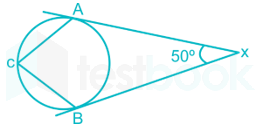
In the figure given below, XA and XB are two tangents to a circle. If ∠AXB = 50° and AC is parallel to XB, then what is ∠ ACB equal to?

  1. AOption (a)

    70°

  2. BOption (b)

    65°

  3. COption (c)

    60°

  4. DOption (d)

    55°

View answer & explanation

Correct answer

Answer: (b)B.

65°

Why this answer is correct

Let O be the centre of the circle

In quadrilateral AOBX

∠A + ∠O + ∠B + ∠X = 360° [Angle sum property of quadrilateral]

90° + ∠O + 90° + 50° = 360° [∵ Tangent is perpendicular to the radius]

∴ ∠AOB = 130°

∠ACB = ½ × 130 = 65° [∵ Angle subtended by a chord at any point on the circle is half the angle subtended at centre]

Question 72

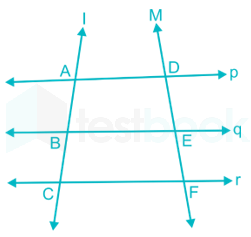
In the figure given below, p, q, r are parallel lines; l and m are two transversals.

Consider the following:

  1. AB : AC = DE : DF
  2. AB × EF = BC × DE

Which of the above is/are correct?

  1. AOption (a)

    1 only

  2. BOption (b)

    2 only

  3. COption (c)

    Both 1 and 2

  4. DOption (d)

    Neither 1 nor 2

View answer & explanation

Correct answer

Answer: (c)C.

Both 1 and 2

Why this answer is correct

Construct a perpendicular from A to the line CF, Let it meet BE at O and CF at P

Similarly a perpendicular from D is drawn to the line CF, let it meet BE and CF at R and S

In triangle ABO and ACP

∠A is common and ∠O = ∠P = 90°

ABO ∼ ACP

∴ AB/AC = AO/AP

In triangle DRE and DSF

∠D is common and ∠R = ∠S = 90°

DRE ∼ DSF

∴ DE/DF = DR/DS

Parallel lines are equally spaced

∴ AO = DR and AP = DS

∴ AB/AC = DE/DF

So statement 1 is correct

AB/ (AC - AB) = DE/ (DF - DE)

AB/BC = DE/EF

∴ AB × EF = BC × DE

So statement 2 is also correct

Question 73

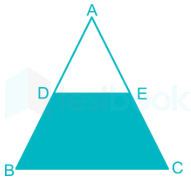
In the equilateral triangle ABC given below, AD = DB and AD = EC. If l is the length of a side of the triangle, then what is the area of the shaded region?

  1. AOption (a)

    3√3l2/16

  2. BOption (b)

    3l2/16

  3. COption (c)

    3√3l2/32

  4. DOption (d)

    3l2/32

View answer & explanation

Correct answer

Answer: (a)A.

3√3l2/16

Why this answer is correct

In triangle ADE and ABC

AD/AB = AE/EC = ½

∠A is common

∴ ADE ∼ ABC

Area(ADE) /Area (ABC) = (AD/AB)2

∴ Area(ADE) = (1/2)2 × Area(ABC)

⇒ ¼ × √3/4 × l2 = √3/16 × l2 [∵ Area of equilateral triangle = √3/4 × l2]

Area of shared region = Area(ABC) - Area(ADC)

⇒ √3/4 × l2 - √3/16 × l2

⇒ 3√3/16 × l2

Question 74

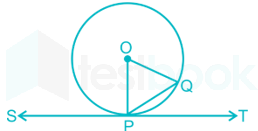
In the figure given below, SPT is a tangent to the circle at P and O is the centre of the circle. If ∠QPT = α, then what is ∠ POQ equal to?

  1. AOption (a)

    α

  2. BOption (b)

    2α

  3. COption (c)

    90° - α

  4. DOption (d)

    180° - 2α

View answer & explanation

Correct answer

Answer: (b)B.

2α

Why this answer is correct

∠OPT = 90° [∵ Radius is perpendicular to tangent]

∠OPQ = 90° - ∠QPT = 90° - α

∠OQP = 90° - α [∵ OQ = OP]

In triangle OQP

∠O + ∠Q + ∠P = 180°

∠O + 90 - α + 90 - α = 180

∴ ∠O = 2α

Question 75

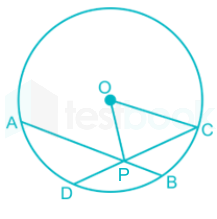
In the figure given below, two equal chords cut at point P. If AB = CD = 10 cm, OC = 13 cm (O is the centre of the circle) and PB = 3 cm, then what is the length of OP?

  1. AOption (a)

    5 cm

  2. BOption (b)

    6 cm

  3. COption (c)

    2√29 cm

  4. DOption (d)

    2√37 cm

View answer & explanation

Correct answer

Answer: (d)D.

2√37 cm

Why this answer is correct

Let the point of intersection of AB and CD is P 

Construct OE perpendicular to AB

EB = ½ × AB = 5 cm [∵ Perpendicular from the centre bisects the chord]

In triangle OEB

OB2 = OE2 + EB2

132 = OE2 + 52

∴ OE = 12 cm

In triangle OEP

OP2 = OE2 + EP2

EP = EB - PB = 5 - 3 = 2 cm

OP2 = 122 + 22 = 148

∴ OP = 2√37 cm

Question 76

A pie chart is drawn for the following data:

SectorPercentage
Agriculture and Rural development12.9
Irrigation12.5
Energy27.2
Industry and Minerals15.4
Transport and communication15.9
Social services16.1


What is the angle (approximately) subtended by the social services sector at the centre of the circle?

  1. AOption (a)

    45°

  2. BOption (b)

    46°

  3. COption (c)

    58°

  4. DOption (d)

    98°

View answer & explanation

Correct answer

Answer: (c)C.

58°

Why this answer is correct

Angle = Percentage of the sector/100 × 360°

⇒ 16.1/100 × 360 = 57.96° ≈ 58°

Question 77

The arithmetic mean of two numbers is 10 and their geometric mean is 8. What are the two numbers?

  1. AOption (a)

    15, 5

  2. BOption (b)

    12, 8

  3. COption (c)

    16, 4

  4. DOption (d)

    18, 2

View answer & explanation

Correct answer

Answer: (c)C.

16, 4

Why this answer is correct

Let the numbers be a and b respectively

(a + b)/2 = 10

∴ a + b = 20      ----1

√(ab) = 8

∴ ab = 64

(a - b) = √[(a + b)2 - 4ab]

⇒ √(202 - 4 × 64) = √(400 - 256) = 12

∴ a - b = 12      ----2

Adding equations 1 and 2

2a = 32

∴ a = 16 and b = 20 - 16 = 4

∴ The numbers are 16 and 4

Question 78

The arithmetic mean of 11 observations is 11. The arithmetic mean of the first 6 observations is 10.5 and the arithmetic mean of the last 6 observations is 11.5. What is the sixth observation?

  1. AOption (a)

    10.0

  2. BOption (b)

    10.5

  3. COption (c)

    11.0

  4. DOption (d)

    11.5

View answer & explanation

Correct answer

Answer: (c)C.

11.0

Why this answer is correct

Formula Used:

Mean or Average:

Sum of observations / Total number of observations

Calculation:

Using the above formula

Sum of 11 observations = Sum of first 6 numbers + Sum of last 6 number - 6th number [∵ 6th observation is added twice]

11 × 11 = 10.5 × 6 + 11.5 × 6 - 6th number

121 = 63 + 69 - 6th number

⇒ 6th number = 132 - 121 = 11

∴ 11 is the correct option.

Question 79

What is sin4θ - cos4θ equal to for any real number θ?

  1. AOption (a)

    1

  2. BOption (b)

    1 - 2 sin2θ

  3. COption (c)

    2 cos2θ + 1

  4. DOption (d)

    1 - 2 cos2θ

View answer & explanation

Correct answer

Answer: (d)D.

1 - 2 cos2θ

Why this answer is correct

sin2 θ = 1 - cos2 θ

∴ sin4θ - cos4 θ = (1 - cos2θ)2 - cos4 θ

⇒ 1 - 2cos2 θ + cos4 θ - cos4 θ [∵ (a - b)2 = a2 - 2ab + b2]

⇒ 1 - 2cos2 θ

Question 80

What is cot 1° cot 23° cot 45° cot 67° cot 89° equal to?

  1. AOption (a)

    0

  2. BOption (b)

    1

  3. COption (c)

    ½

  4. DOption (d)

    1/3

View answer & explanation

Correct answer

Answer: (b)B.

1

Why this answer is correct

cot 1° cot 23° cot 45° cot 67° cot 89° = cot 1° cot 23° cot 45° cot (90 - 23°) cot (90 - 1)°

⇒ cot 1° cot 23° cot 45° tan 23° tan 1° [∵ cot (90 - A) = tan A]

⇒ (cot 1° tan 1°) × (cot 23° tan 23°) × cot 45°

⇒ 1 × 1 × 1 [∵ cot A tan A = 1 and cot 45° = 1]

⇒ 1

Question 81

What angle does the hour hand of a clock describe in 10 minutes of time?

  1. AOption (a)

    1°

  2. BOption (b)

    5°

  3. COption (c)

    6°

  4. DOption (d)

    10°

View answer & explanation

Correct answer

Answer: (b)B.

5°

Why this answer is correct

Hour hand completes one full revolution in 12 hours

∴ Angle described in 1 hour = 360°/12 = 30°

Angle described in 60 minutes = 30° [∵ 1 hour = 60 minutes]

∴ Angle described in 10 minutes = 30/60 × 10 = 5°

Question 82

Consider the following statements:

  1. (sec2 θ - 1) (1 - cosec2 θ) = 1
  2. sin θ (1 + cos θ)-1 + (1 + cos θ) (sin θ)-1 = 2 cosec θ

Which of the above is/are correct?

  1. AOption (a)

    1 only

  2. BOption (b)

    2 only

  3. COption (c)

    Both 1 and 2

  4. DOption (d)

    Neither 1 nor 2

View answer & explanation

Correct answer

Answer: (b)B.

2 only

Why this answer is correct

Statement 1:

Sec2 θ - 1 = tan2 θ and cosec2 θ - 1 = cot2 θ

∴ (sec2 θ - 1) (1 - cosec2 θ) = tan2 θ (-cot2 θ) = -1 [∵ tan θ × cot θ = 1]

∴ Statement 1 is wrong

Statement 2:

sin θ/(1 + cos θ) + (1 + cos θ)/sinθ = [sin2 θ + (1 + cos θ)2]/[(1 +cos θ) sinθ]

⇒ [sin2 θ + 1 +2cos θ + cos2 θ]/[(1 +cos θ) sinθ] [∵ (a + b)2 = a2 + 2ab + b2]

⇒ [1 + 1 + 2cos θ]/[(1 + cos θ) sinθ] [∵ sin2 θ + cos2 θ = 1]

⇒ [2 + 2cos θ]/[(1 + cos θ) sinθ]

⇒ 2 [1 + cosθ]/[(1 + cos θ) sinθ]

⇒ 2/sinθ = 2 cosecθ [∵ 1/sin θ = cosec θ]

Statement 2 is correct

Question 83

Each side of a square subtends an angle of 60° at the tip of a tower of height h meters standing at the centre of the square. If l is the length of each side of the square, then what is h2 equal to?

  1. AOption (a)

    2l2

  2. BOption (b)

    l2/2

  3. COption (c)

    3l2/2

  4. DOption (d)

    2l3/3

View answer & explanation

Correct answer

Answer: (b)B.

l2/2

Why this answer is correct

EO = l/2 [∵ O is the centre of the square]

∠AFD = 60°

AF = DF due to symmetry and also ∠AFD = 60°

∴ AFD is an equilateral triangle of side l

FE = Altitude of an equilateral triangle = √3l/2

In triangle EFO

FO2 = EF2 - EO2 [∵ Pythagoras theorem]

∴ h2 = (√3l/2)2 - (l/2)2 = l2/2

Question 84

From a height of h units, a man observes the angle of elevation as α and angle of depression as β of the top and bottom respectively of a tower of height H (> 4h). To what further height should be climb so that the values of angle of elevation and angle of depression get interchanged for the top and bottom of the tower?

  1. AOption (a)

    H - h units

  2. BOption (b)

    H - 2h units

  3. COption (c)

    H - 3h units

  4. DOption (d)

    H - 4h units

View answer & explanation

Correct answer

Answer: (b)B.

H - 2h units

Why this answer is correct

∠ACB = α and ∠BCD = β initially

In triangle BCD, cot β = BC/BD

∴ BC = BD cot β = h cot β

In triangle ABC, tan α = AB/BC

∴ AB = BC tan α

H - h = h cotβ × tan α      ----1

∴ H = h (cotβ tan α + 1)      ----2

Now height changes to h’ and the angles get interchanged

∴ H = h’ (cot α tanβ + 1)      ----3

Equating the RHS of equations 2 and 3

h(cotβ tan α + 1) = h’(cot α tan β + 1)

h (1/tanβ × tanα + 1) = h’ (1/tan α × tan β + 1) [∵ tan A = 1/cot A]

h (tan α + tan β)/tan β = h’ (tan α + tan β)/tan α

∴ h’ = h/tan β × tan α

⇒ h cot β × tan α = H - h [From equation 1]

∴ h’ = H - h

Increase in height = h’ - h = H - h - h = H - 2h units

Shortcut:

Since the distance between the building does not change [BC]

If the angle interchanges corresponding height portion of the tallest building should be interchanged

Length of AB in original case = Length of BD in new case

H - h = h’

∴ h’ - h = H - 2h units

Question 85

If sec x cosec x = 2, then what is the tannx + cotnx equal to?

  1. AOption (a)

    2

  2. BOption (b)

    2n + 1

  3. COption (c)

    2n

  4. DOption (d)

    2n - 1

View answer & explanation

Correct answer

Answer: (a)A.

2

Why this answer is correct

Secx cosecx = 2

1/cosx × 1/sinx = 2

∴ sinx cosx = ½

(sinx - cosx)2 = sin2x + cos2x - 2sinx cosx

⇒ 1 - 2 × ½ = 0 [∵ sin2x + cos2x = 1]

∴ sinx = cos x

∴ sinx/cosx = 1

tanx = 1, cotx = 1/tanx = 1

∴ tannx + cotnx = 1n + 1n = 2

Question 86

If cos x + cos2 x = 1, then what is sin2 x + sin4 x equal to?

  1. AOption (a)

    1

  2. BOption (b)

    1.5

  3. COption (c)

    2

  4. DOption (d)

    3

View answer & explanation

Correct answer

Answer: (a)A.

1

Why this answer is correct

cos x + cos2 x = 1

cos x = 1 – cos2 x

cos x = sin2 x [∵ 1 – cos2 A = sin2 A]

Substituting cos x = sin2 x in the main equation

sin2 x + sin4 x = 1

Question 87

If sin A + cos A = p and sin3A + cos3A = q, then which one of the following is correct?

  1. AOption (a)

    p3 – 3p + q = 0

  2. BOption (b)

    q3 – 3p + 2p = 0

  3. COption (c)

    p3 – 3p + 2q = 0

  4. DOption (d)

    p3 + 3p + 2q = 0

View answer & explanation

Correct answer

Answer: (c)C.

p3 – 3p + 2q = 0

Why this answer is correct

(sin A + cos A)2 = sin2 A + cos2 A + 2 sin A cos A [∵ (a + b)2 = a2 + b2 + 2ab]

p2 = 1 + 2 sin A cosA [∵ sin2 A + cos2 A = 1]

∴ sin A cos A = (p2 – 1) /2

(sin A + cos A)3 = sin3 A + cos3 A + 3 sin A cos A (sin A + cos A)

[∵ (a + b)3 = a3 + b3 + 3ab (a + b)]

p3 = q + 3 × (p2 – 1)/2 × p

p3 = q + 3p3/2 – 3p/2

(0 = q + p3/2 -3p/2) × 2

0 = 2q + p3 – 3p

∴ p3 – 3p + 2q = 0

Question 88

If x = (sec2 θ – tan θ) / (sec2 θ + tan θ), then which one of the following is correct?

  1. AOption (a)

    1/3 < x < 3

  2. BOption (b)

    x ∈ [1/3, 3]

  3. COption (c)

    -3 < x < -1/3

  4. DOption (d)

    1/3 ≤ x ≤ 3

View answer & explanation

Correct answer

Answer: (d)D.

1/3 ≤ x ≤ 3

Why this answer is correct

x = (sec2 θ – tan θ) / (sec2 θ + tan θ)

Using componendo and dividend rule

(x + 1) / (1 – x) = [(sec2 θ – tan θ) + (sec2 θ + tan θ)] / [(sec2 θ + tan θ) - (sec2 θ – tan θ)]

⇒ sec2θ/tan θ = (1/cos2 θ) / (sin θ/ cos θ)

⇒ 1/(sin θ cos θ)

⇒ 2/sin 2θ [∵ sin 2θ = 2 sin θ cos θ]

∴ (x + 1) / (1 – x) = 2/sin 2θ

Taking reciprocal on both the sides

(1 – x) / (x + 1) = sin 2θ/2

-1 ≤ Sin 2θ ≤ 1

∴ -1/2 ≤ (1 – x) / (x + 1) ≤ ½

-(x + 1) /2 ≤ (1 – x) ≤ (x + 1) /2

First inequality

-x/2 – ½ ≤ 1 – x

x/2 ≤ 3/2

∴ x ≤ 3

Second inequality

(1 – x) ≤ x/2 + ½

½ ≤ 3x/2

∴ x ≥ 1/3

The final condition is 1/3 ≤ x ≤ 3

Question 89

ABC is a right angles triangle with base BC and height AB. The hypotenuse AC is four times the length of the perpendicular drawn to it from opposite vertex. What is tan C equal to?

  1. AOption (a)

    2 – √3

  2. BOption (b)

    √3 – 1

  3. COption (c)

    2 + √3

  4. DOption (d)

    √3 + 1

View answer & explanation

Correct answer

Answer: (a)A.

2 – √3

Why this answer is correct

½ × AC × BD = ½ × AB × BC [Equating area]

AC × BD = AB × BC

4 BD × BD = AB × BC [∵ AC = 4 BD]

Dividing by BC2 both the sides

4 × BD/BC × BD/BD = AB/BC

In triangle BDC, sin C = BD/BC and In triangle ABC, tan C = AB/BC

4sin2C = tan C

4sin2C = sinC/cos C

4sinC cos C = 1

2sin C cos C = ½

Sin2C = ½ [∵ sin 2A = 2sinA cos A]

∴ 2C = 30° and C = 15°

tan C = tan 15°

To find tan 15°

Tan 2θ = 2tanθ/ (1 – tan2 θ)

Let tan 15° be x

Tan 30° = 2x/(1 – x2)

1/√3 = 2x/(1 – x2)

1 – x2 = 2√3x

x2 + 2√3x – 1 = 0

Using quadratic formula and ignoring the negative term

x = (-2√3 + 4)/2 = 2 – √3

Question 90

ABC is a triangle right angled at C with BC = a and AC = b. If p is the length of the perpendicular from C on AB, then which one of the following is correct?

  1. AOption (a)

    a2b2 = p2(a2 + b2)

  2. BOption (b)

    a2b2 = p2(a2 – b2)

  3. COption (c)

    2a2b2 = p2(a2 + b2)

  4. DOption (d)

    a2b2 = 2p2(a2 + b2)

View answer & explanation

Correct answer

Answer: (a)A.

a2b2 = p2(a2 + b2)

Why this answer is correct

Given:

AB =c , BC = a, CA = b and CD = p

Concept used:

Area of triangle = (1/2) Base × height

Pythagoras theorem:

Hypotenuse2 = Base2 + Perpendcular

Calculation:

Using the above formula

Area of triangle ABC = 12\frac{1}{2} × AB × CD = 12\frac{1}{2}cp

Again,

Area of triangle ABC = 12\frac{1}{2}× BC × AC = 12\frac{1}{2} ab

⇒  12\frac{1}{2} cp = 12\frac{1}{2} ab

⇒ cp = ab                    ------(1)

Now, In right angled triangle ABC,

AB2 = AC2 + BC2

⇒ c2 = b2 + a2

⇒ (ab/p)2 = b2 + a2       [From equation (1)]

∴  a2b2 = p2(a2 + b2)

Question 91

The radius and slant height of a right circular cone are 5 cm and 13 cm respectively. What is the volume of the cone?

  1. AOption (a)

    100π cm3

  2. BOption (b)

    50π cm3

  3. COption (c)

    65π cm3

  4. DOption (d)

    169 cm3

View answer & explanation

Correct answer

Answer: (a)A.

100π cm3

Why this answer is correct

In a cone h = √(l2 – r2) = √(132 – 52) = 12cm

Volume of the cone = 1/3 × π r2 h

⇒ 1/3 × π × 52 × 12

⇒ 100π cm3

Question 92

Two equal circular region of greatest possible area are cut off from a given circular sheet of area A. What is the remaining area of the sheet?

  1. AOption (a)

    A/2

  2. BOption (b)

    A/3

  3. COption (c)

    3A/5

  4. DOption (d)

    2A/5

View answer & explanation

Correct answer

Answer: (a)A.

A/2

Why this answer is correct

The greatest possible area is cut off,

∴ Both the circles touch each other and extend to the two ends of the diameter of the main circle

Sum of diameters of the circle = Diameter of the larger circle

2 × diameter of the small circle = Diameter of the larger circle

The radius of the small circle = ½ × Radius of the larger circle

Area ∝ Radius2

Area of small circle/Area of large circle = (Radius of small circle/Radius of a large circle)2

?/A = (½)2

∴ Area of small circle = A/4

Remaining area = Area of the large circle – 2 × Area of the small circle

⇒ A – 2 × A/4 = A/2

Question 93

If the ratio of the radius of the base of a right circular cone to its slant height is 1∶ 3, what is the ratio of the total surface area to the curved surface area?

  1. AOption (a)

    5 ∶ 3

  2. BOption (b)

    3 ∶ 1

  3. COption (c)

    4 ∶ 1

  4. DOption (d)

    4 ∶ 3

View answer & explanation

Correct answer

Answer: (d)D.

4 ∶ 3

Why this answer is correct

Given:

ratio of radius of base and slant height (r : l)= 1 : 3

Formula used:

Total Surface area(TSA) = πr (l + r) 

Curved surface area(CSA) = πrl

Calculation:

TSA/CSA = [πr (l + r)] / (πrl)

⇒ (l + r)/l

⇒ 1 + r/l = 1 + 1/3 = 4/3 [∵ r ∶ l = 1 ∶ 3]

∴ Required ratio = 4 ∶ 3

Question 94

A right circular cone is sliced into a smaller cone and a frustum of a cone by a plane perpendicular to its axis. The volume of the smaller cone and the frustum of the cone are in the ratio 64 ∶ 61. Then their curved surface areas are in the ratio

  1. AOption (a)

    4 ∶ 1

  2. BOption (b)

    16 ∶ 9

  3. COption (c)

    64 ∶ 61

  4. DOption (d)

    81 ∶ 64

View answer & explanation

Correct answer

Answer: (b)B.

16 ∶ 9

Why this answer is correct

For same vertical angle,

Radius of small cone/Radius of large cone = Height of small cone/Height of large cone Slant height of small cone/Slant height of the large cone = k

Volume of small cone∶ Volume of frustum = 64 ∶ 61

∴ Volume small cone∶ Volume large cone = 64 ∶ (64 + 61) = 64 ∶ 125

Let the radii, height and slant heights of the small and large cones be r, h, l and R, H, L

Volume of small cone/Volume of large cone = 64/125

(1/3 π r2 h) / (1/3 π R2 H) = 64/125

(r/R)2 × (h/H) = 64/125

k2 × k = 64/125

k3 = 64/125

∴ k = 4/5

Curved surface area of small cone/Curved surface area of large cone = (π r l) / (π R L)

⇒ (r/R) × (l/L)

⇒ k × k = k2 = 16/25

Curved surface area of small cone/Curved surface area of frustum = 16/ (25 – 16) = 16/9

∴ Required ratio 16 ∶ 9

Question 95

There are as many square centimeters in the surface area of a sphere as there are cube centimeters in its volume. What is the radius of the sphere?

  1. AOption (a)

    4 cm

  2. BOption (b)

    3 cm

  3. COption (c)

    2 cm

  4. DOption (d)

    1 cm

View answer & explanation

Correct answer

Answer: (b)B.

3 cm

Why this answer is correct

Numerically surface area and volumes are equal

4πR2 = 4/3 π R3

 1 = R/3

∴ R = 3 cm

Question 96

The radii of two circles are 4.5cm and 3.5 cm respectively. The distance between the centres of the circles is 10 cm. What is the length of the transverse common tangent?

  1. AOption (a)

    4 cm

  2. BOption (b)

    5 cm

  3. COption (c)

    6 cm

  4. DOption (d)

    7 cm

View answer & explanation

Correct answer

Answer: (c)C.

6 cm

Why this answer is correct

In triangle OQS amd PRS

∠OQS = ∠PRS =90° [∵ Radius is perpendicular to tangent]

∠QSO = ∠PSR [∵ Vertically opposite angles are equal]

∴ OQS ∼ PRS

OQ/PR = OS/PS

4.5/3.5 = OS/PS

9/7 = OS/PS

∴ PS = 7OS/9

OP = OS + PS

10 = OS + 7OS/9

10 = 16OS/9

∴ OS = 90/16 = 5.625 cm

And PS = 10 – 5.625 = 4.375 cm

In triangle OQS, OS2 = OQ2 + QS2 [∵ Pythagoras theorem]

5.6252 = 4.52 + OS2

∴ OS = 3.375 cm

In triangle PRS, PS2 = PR2 + SP2 [∵ Pythagoras theorem]

4.3752 = 3.52 + SP2

∴ SP = 2.625

∴ OP = OS + SP

⇒ 3.375 + 2.625 = 6 cm

Shortcut TrickTransverse Common tangent = √{d2 - (r1 + r2)2} 

⇒ {√102 - (4.5 + 3.5)2} 

⇒ √(102 - 82 )

⇒ √36

⇒ 6 cm

∴ The length of the transverse common tangent is 6 cm.

Question 97

What is the volume of a cone of maximum volume cut out from a cube of edge 2a such that their bases are on the same plane?

  1. AOption (a)

    πa3

  2. BOption (b)

    πa3/3

  3. COption (c)

    2πa3/3

  4. DOption (d)

    3πa3/4

View answer & explanation

Correct answer

Answer: (c)C.

2πa3/3

Why this answer is correct

When the cone of maximum volume cut out from cube of edge 2a, height of the cone = Edge of the cube = 2a

Radius of the cone = ½ × Edge of the cube =1/2 × 2a = a

Volume of the cone = 1/3 × π r2 h

⇒ 1/3 × π × a2 × 2a = 2πa3/3

Question 98

A region of area A bounded by a circle C is divided into n regions, each of area A/n, by drawing circles of radii r1, r2, r3, ⋯ , rn-1 such that r < r2 < r3 < ⋯ rn-1 concentric with the circle C. If pm = rm+1 /rm, then which one of the following is correct?​

  1. AOption (a)

    p increases as m increases

  2. BOption (b)

    p decreases as m increases

  3. COption (c)

    p remains constant as m increases

  4. DOption (d)

     p increases for some values of m as m increases and then decreases thereafter

View answer & explanation

Correct answer

Answer: (b)B.

p decreases as m increases

Why this answer is correct

Area of (m + 1)th region = π (rm+12 – rm2)

⇒ πrm2 [(rm+1/rm)2 – 1]

⇒ πrm2 × (pm2 – 1)

Since area of all the region is constant

pm2 – 1 ∝ 1/rm2

So as m increases rm increases, ∴ pm decreases with the m

Question 99

In a room whose floor is a square of side 10 m, an equilateral triangular table of side 2 m is placed. Four book shelves of size 4 m × 1 m × 9 m are also placed in the room. If the half of the rest of the area in the room is to be carpeted at the rate of Rs 100 per square meter, what is the cost of carpeting (approximately)?

  1. AOption (a)

    Rs. 7600

  2. BOption (b)

    Rs. 5635

  3. COption (c)

    Rs. 4113

  4. DOption (d)

    Rs. 3200

View answer & explanation

Correct answer

Answer: (c)C.

Rs. 4113

Why this answer is correct

Given:

Side of square floor = 10 m

Side of  equilateral triangular table = 2 m

Dimension of book = 4 m × 1 m × 9 m

Formula used:

Area of square = (Side)2

Area of equilateral triangle = (√3/4)(side)2

Area rectangle = Length × Width

Calculation:

Area to be carpeted

= ½ × (Area of the square floor – Area of the equilateral triangle – 4 × Area of bookshelves)

⇒ A = ½ × (side2 – √3/4 × side2 – 4 × l × b)

⇒ A = ½ × (102 – √3/4 × 22 – 4 × 4 × 1)

⇒ A = ½ × (100 – √3 – 16)

⇒ A = 41.134 m2     (∵ √3 ≈ 1.732)

Hence,

Cost = 41.134 × 100 ≈ Rs 4113

∴ Cost = 41.134 × 100 =  Rs 4113.

Question 100

The length of a line segment AB is 2 cm. It is divided into two parts at a point C such that AC2 = AB × CB. What is the length of CB?

  1. AOption (a)

    3√5 cm

  2. BOption (b)

    3 – √5 cm

  3. COption (c)

    5√3 cm

  4. DOption (d)

    √5 – 1 cm

View answer & explanation

Correct answer

Answer: (b)B.

3 – √5 cm

Why this answer is correct

Let the length of CB be x

∴ AC = AB – CB = 2 – x

AC2 = AB × C

(2 – x)2 = 2x

4 – 4x + x2 = 2x

x2 – 6x + 4 = 0

Using quadratic formula to solve and ignoring the root greater than 2

x = (6 – 2√5)/2 = 3 – √5 cm

100 questions in the full paper