Previous Year Paper

60th - 62nd BPSC Prelims (Held in 2017) Official paper (Previous Year Paper)

Held in 2017

150 questions120 minutes
With answers
Free

Paper last updated:

Practise under exam conditions

Take this paper as a timed mock test. Review your answers after you submit.

Attempt timed test

Questions & answers

Read the paper at your pace. Open an explanation when you need it.

Full Test (150 questions)

Question 1

Who was the leader of revolutionaries in Bihar during the Revolt of 1857?

  1. AOption (a)

    Namdar Khan

  2. BOption (b)

    Babu Kunwar Singh

  3. COption (c)

    Birsa Munda

  4. DOption (d)

    Shankar Shah

  5. EOption (e)

    None of the above/More than one of the above

View answer & explanation

Correct answer

Answer: (b)B.

Babu Kunwar Singh

Why this answer is correct

The correct answer is Babu Kunwar Singh.

Key Points

  • Babu Kunwar Singh was the leader of revolutionaries in Bihar during the Revolt of 1857.
  • Babu Kunwar Singh:
  • Kunwar Singh was a prominent leader during the Indian Rebellion of 1857.
  • He was associated with a family of the Ujjainiya clan of the Parmar Rajputs of Jagdispur, currently a part of Bhojpur district, Bihar, India.
  • At the age of 80, he led a handpicked band of armed soldiers against the troops under the command of the British East India Company.
  • He was the chief contriver of the fight against the British in Bihar.
  • He is popularly known everywhere as Veer Kunwar Singh.
  • He died on 26 April 1858.

Additional Information

  • Namdar Khan:
  • Namdar Khan was a part of the Pinadari group.
  • The Pindaris were irregular military plunderers and foragers in the 17th- through early 19th-century Indian subcontinent who accompanied initially the Mughal army, later the Maratha army, and finally on their own before being eliminated in 1817-18 Pindari War.
  • They were unpaid and their compensation was entirely the loot they plundered during the war.
  • They were horsemen, foot brigades and partially armed, creating chaos and delivering intelligence about the enemy positions to benefit the army they accompanied.
  • Birsa Munda:
  • Birsa Munda was a folk hero and a tribal freedom fighter hailing from the Munda tribe.
  • He was a spearhead behind the Millenarian movement that arose in the Bihar and Jharkhand belt in the early 19th century under British colonisation.
  • Munda rallied the tribals to fight against the forceful land grabbing carried out by the British government which would turn the tribals into bonded labourers and force upon them abject poverty.
  • Known as 'Dharti Abba' or the Earth Father, Birsa Munda stressed the need of the tribals to study their own religion and not forget their cultural roots.
  • He influenced his people to realise the importance of owning their land and asserting their right upon them.
  • Shankar Shah:
  • Shankar Shah was the king of the Garha Kingdom, which was situated in the Indian region of Gondwana.
  • He led an uprising against the British colonial occupiers of India and was put to death along with his son.
  • His son's name was Kunwar Raghunath Shah.
  • The flame of the Revolt of 1857 was burning all over India.
  • He called for war to make his motherland independent from the British.
  • In this struggle, Raghunath Shah greatly supported his father.
  • Raja Shankar Shah was the great-grandson of Nizam Shah and the only son of Sumer Shah.
  • His son's name was Raghunath Shah.
  • Raja Shankar Shah was very popular among the zamindars and the general public.
Question 2

Birsa was captured, while asleep, on:

  1. AOption (a)

    1 February, 1900

  2. BOption (b)

    2 February, 1900

  3. COption (c)

    3 February, 1900

  4. DOption (d)

    More than one of the above

  5. EOption (e)

    None of the above

View answer & explanation

Correct answer

Answer: (c)C.

3 February, 1900

Why this answer is correct

The correct answer is 3 February, 1900.

  • Birsa was captured, while asleep, on 3 February 1900.
  • Birsa Munda:
  • Birsa Munda was an Indian tribal freedom fighter, religious leader, and folk hero who belonged to the Munda tribe.
  • He led a tribal religious millenarian movement that arose in the Bengal Presidency (now Jharkhand) in the late 19th century, during the British Raj, thereby making him a prominent figure in the history of the Indian independence movement.
  • The revolt mainly concentrated in the Munda belt of Khunti, Tamar, Sawada and Bandon.
  • His portrait is hanged in the Indian Parliament Museum.
  • He is the only tribal leader to have been so honoured till now.

Question 3

“The Muslims, if contented and satisfied, would become the greatest bulwark of British power in India”. Who wrote it?

  1. AOption (a)

    Herbert Risley

  2. BOption (b)

    Lord Lytton

  3. COption (c)

    William Wilson Hunter 

  4. DOption (d)

    More than one of the above

  5. EOption (e)

    None of the above

View answer & explanation

Correct answer

Answer: (c)C.

William Wilson Hunter 

Why this answer is correct

The correct answer is W.W.Hunter.

 Key Points

  • W. W. Hunter:
  • Sir William Wilson Hunter was a multitalented Scottish historian, statistician, compiler and member of the Indian Civil Service.
  • He is most known for The Imperial Gazetteer of India on which he started performing in 1869, and which was eventually published in nine volumes in 1881.
  • He reached Bengal Presidency in November 1862.
  • Later, he was made assistant magistrate and collector of Birbhum, in the lower provinces of Bengal, where he began collecting local traditions and records, which formed the materials for his publication.
  • He also compiled A Comparative Dictionary of the Non-Aryan Languages of India, a glossary of dialects based mainly upon the collections of Brian Houghton Hodgson.
  • According to the Encyclopædia Britannica Eleventh Edition published, it "testifies to the industry of the writer but contains much immature philological speculation".

Additional Information 

  • Herbert Risley:
  • Sir H. H. Risley was a British civil servant, anthropologist, and linguist who published widely on the customs and social structure of Indian society.
  • He proposed a theory of the caste system as a racial hierarchy of classification, which was highly influential in colonial administrative policy.
  • After qualifying for the Civil Service of India in 1871, Risley completed his bachelor’s degree at Oxford in January 1873 and arrived in Bengal later that year.
  • He was assigned to work as an Assistant Magistrate and Assistant District Collector in the tribal area of western Bengal known as Chota Nagpur (present-day Jharkhand).
  • Here, he became interested in anthropology and began to study the tribal inhabitants of the district of Midnapur, who was thought to be an ideal representation of primitiveness.
  • Lord Lytton:
  • Lytton, son of the 1st Baron Lytton, began his diplomatic career as unpaid attaché to his uncle Sir Henry Bulwer, then minister at Washington, D.C.
  • His first paid appointment was at Vienna (1858), and in 1874 he was appointed minister at Lisbon.
  • He inherited his father’s barony in 1873.
  • He was a British diplomat and viceroy of India (1876–80) who also achieved, during his lifetime, a reputation as a poet.
  • H.N.Brailsford:
  • Henry Noel Brailsford was a left-wing intellectual and political journalist, famous as a vociferous critic of British imperialism.
  • Born in Yorkshire, he was brought up and educated in Scotland.
  • After graduating from Glasgow University, he joined the Greek Foreign Legion in 1897 to assist the Greeks in their fight against the Ottoman Empire.
  • He subsequently worked as a special correspondent for the Manchester Guardian in Crete and Macedonia.

Question 4

“In my belief, Congress is to tottering to its fall and one of my great ambitions while in India is to assist it to a peaceful demise.” Who wrote it?

  1. AOption (a)

    Lord Lytton

  2. BOption (b)

    Lord Dufferin

  3. COption (c)

    Lord Curzon

  4. DOption (d)

    Lord Minto

  5. EOption (e)

    None of the above/More than one of the above

View answer & explanation

Correct answer

Answer: (c)C.

Lord Curzon

Why this answer is correct

The correct answer is Lord Curzon.

Key Points

  • Lord Curzon:
  • He was the Viceroy of India from 1899 to 1905.
  • Curzon stated during the formation of the Indian National Congress i.e., in 1885 that "In my belief, Congress is to tottering to its fall and one of my great ambitions while in India is to assist it to a peaceful demise".
  • Curzon was a British Conservative Statesman.
  • During his tenure as Viceroy, Lord Curzon created the territory of Eastern Bengal and Assam.
  • Lord Curzon fought with the British military commander Lord Kitchener.
  • He performed his duties as Secretary of State for Foreign Affairs at the Foreign Office from 1919 to 1924.
  • During his tenure, the Prime Minister of Britain was Stanley Baldwin.
  • His Biography was Curzon: Imperial Statesman.

Additional Information

  • Lord Lytton:
  • Lord Lytton, who remained the Viceroy of India from 1876-1880 used to write poems with the Pen name of Owen Meredith.
  • During his tenure, a Royal Titles Act conferring on Queen Victoria the title of the Empress of India was passed and a magnificent Delhi Darbar was organized in 1877 in which queen Victoria was adorned with the title Qaiser-i-Hind.
  • Aligarh College was founded in 1877 and the Vernacular Press Act, Arms act were passed in 1878.
  • The age for eligibility in civil services was brought down from 21 to 18 years.
  • The second Anglo-Afghan war also fought during his tenure which proved to be very expensive.
  • Lord Dufferin:
  • Lord Dufferin served as Governor-General of India and Viceroy from 1884 to 1888.
  • During his tenure, the Third Burmese war led to the annexation of the whole of Burma and the Burmese ruler was exiled to India.
  • In 1885, AO Hume laid the foundation of the Indian National Congress.
  • In 1885, the Panjdeh Incident happened in which the Russian forces seized Afghan territory south of Amu Darya around the site of Panjdeh {now located in Turkmenistan}.
  • This created a diplomatic crisis between Russia and Great Britain.
  • Lord Minto:
  • Lord Minto served as Governor-General and Viceroy of India from 1905 to 1910.
  • He witnessed the outburst of the Indian National Movement.
  • Major events that happened during his regime included enactment of Newspapers (Incitement to Offences) Act, 1908, Explosive Substances Act,  Deportation of Lala Lajpat Rai and Ajit Singh to Mandalay Jail (1907), Surat Split (1907), Trial of Bal Gangadhar Tilak (1908), Foundation of the Indian Muslim League (1906), Indian Council Act of 1909 (Morley-Minto Reforms), the establishment of Indian Home Rule Society in England by Shyamji Verma, Murder of Col.
  • William Wyllie by Madan Lal Dhingra (1909), Assassination of Jackson, the Magistrate of Nasik and Ahmadabad Bomb case (1909).

Question 5

Who drew Mahatma Gandhi's attention towards the exploitation of the peasants by the European Indigo planters?

  1. AOption (a)

    Baba Ram Chandra

  2. BOption (b)

    Raj Kumar Shukla

  3. COption (c)

    Swami Sahajananda Saraswati

  4. DOption (d)

    More than one of the above

  5. EOption (e)

    None of the above

View answer & explanation

Correct answer

Answer: (b)B.

Raj Kumar Shukla

Why this answer is correct

The correct answer is Raja Kumar Shukla.

Key Points

  • Raja Kumar Shukla:
  • Raja Kumar Shukla was the person who convinced Mr M.K. Gandhi to visit and view the exploitation in Champaran.
  • Raja Kumar Shukla was very much connected to the ongoing revolutionary changes ongoing in the country.
  • He was engaged in opposing the planters for the exploitative means adopted by them and was fighting many cases in courts against the planters.
  • In any event, towards the end of 1916, unable to muster adequate local support for action, Shukla headed to the Lucknow session of the Indian National Congress.
  • Raj Kumar Shukla- an illiterate but resolute hence followed Gandhiji Lucknow, Cawnpore, Ahemdabad, Calcutta, Patna, Muzzafarpur & then Champaran to invite him.
  • He mobilised the Champaran peasantry and exhorting them to join hands in a common fight before Gandhiji's arrival.
  • During the 31st session of the Congress in Lucknow in 1916, Gandhiji met Raj Kumar Shukla, a representative of farmers from Champaran, who invited him to come and see for himself the miseries of the indigo ryots.

Additional Information

  • Baba Ram Chandra:
  • He was an Indian trade unionist who organised the farmers of Oudh, India into forming a united front to fight against the abuses of landlords in the 1920s and 1930s.
  • Baba Ramchandra led the peasant movement in Awadh.
  • The peasant movement demanded to socially boycott oppressive landlords, demanded to abolish beggar, and demanded a reduction of revenue.
  • In many places to deprive the services of even washermen and barbers to the landlords, the nai-dobi bandhs were organised by the Panchayats.
  • In June 1920, Jawaharlal Nehru tried to understand the grievances of the villagers in Awadh by talking to them.
  • Swami Sahajananda Saraswati:
  • Sahajanand Saraswati was an ascetic, a nationalist and a peasant leader of India.
  • Sahajanand Saraswati was the pioneer of the Bihar Kisan Sabha Movement and the founder of Bihar Provincial Kisan Sabha (BPKS).
  • He was the first President of the All India Kisan Sabha.
  • After the split of the Communist Party of India in 1964, the front was also divided into two — All India Kisan Sabha (CPI) and All India Kisan Sabha (CPI-M; Akhil Bhartiya Kisan Sabha).
  • Sri Krishna Sinha:
  • He was the First Chief Minister of Bihar.
  • Shri Krishna Singh was a modern leader of social justice of Bihar who served as the first Chief Minister for the state of Bihar till his last breath.
  • He was born on 21st October 1887 in the Nawada district of Bihar.
  • He has been among the leading fighters of the freedom struggle.
  • Since childhood, he started to look at the qualities of self-esteem and a keen interest in the field of knowledge.

Question 6

Who was elected the first President of All India Kisan Sabha at Lucknow in 1936?

  1. AOption (a)

    N. G. Ranbga

  2. BOption (b)

    E. M. S. Namboodri pad

  3. COption (c)

    Swami Sahajanand Saraswati

  4. DOption (d)

    Acharya Narendra Dev

  5. EOption (e)

    None of the above/More than one of the above

View answer & explanation

Correct answer

Answer: (c)C.

Swami Sahajanand Saraswati

Why this answer is correct

The correct answer is Swami Sahajanand Saraswati.

Key Points

  • Swami Sahajanand Saraswati was elected the first President of All India Kisan Sabha at Lucknow in 1936.
  • Swami Sahajanand Saraswati:
  • Sahajanand Saraswati was an ascetic, a nationalist, revolutionist, and peasant leader of India.
  • Although he was born in North-Western Provinces (present-day state of Uttar Pradesh), his social and political activities focussed mostly on Bihar in the initial days, and gradually spread to the rest of India with the formation of the All India Kisan Sabha.
  • He had set up an ashram at Bihta, near Bihar carried out primary of his work in the latter part of his life from there.
  • Recognized as one of the principals and significant leaders of the peasantry in Bihar, Swami Sahajanand Saraswati was a brilliant intellectual and a striking master of debate.
  • Gifted with numerous qualities of mass leadership, Sahajanand grew as a social reformer and politician and won a circle of several admirers.
  • The most attractive and instructive respect that he earned during his life was his intellectual transformation, which makes him distinguished even today, though with a small population.
  • He was a versatile genius performing several roles during his entire working career, such as linguist, polymath, sociologist, historian, philosopher, writer, grammarian, ascetic, revolutionary, Marxist, and politician.

Additional Information

  • N.G.Ranbga:
  • N.G.Rangba was an Indian freedom fighter, classical liberal, parliamentarian and farmer leader.
  • He is the founding president of the Swatantra Party.
  • Ranga joined the freedom movement inspired by Gandhi's clarion call in 1930.
  • He led the ryot agitation in 1933.
  • He wrote a book, Bapu Blesses regarding his discussions with Gandhi.
  • He wrote many other books like Credo of World Peasantry, Economic Organization of Indian Villages and Indian Adult Education Movement which are illustrative of a brilliant erudite ability and diverse interests.
  • E.M.S.Namboodri pad:
  • Elamkulam Manakkal Sankaran Namboodiripad, popularly EMS, was an Indian communist politician and theorist.
  • E.M.S served as the first Chief Minister of Kerala in 1957–59 and then again in 1967–69.
  • Namboodiripad became a member of the Congress Socialist Party in 1934, but he soon shifted to the Communist Party of India (CPI).
  • He was elected to the party’s central committee in 1941 and to its politburo in 1951.
  • During that period he played a key role in formulating party doctrine, and he studied and wrote extensively about the economic and social problems facing Kerala, which included insufficient agricultural output, high unemployment, and overpopulation.
  • Acharya Narendra Dev:
  • Acharya Narendra Deva was one of the leading theorists of the Congress Socialist Party in India.
  • His democratic socialism renounced violent means as a matter of principle and embraced the satyagraha as a revolutionary tactic.
  • He became Vice-Chancellor of Lucknow University from 1947 to 1951 and Banaras Hindu University (BHU) from 1951 to 1953 after teaching at Kashi Vidyapeeth.
  • His own life was austere, and he used to financially support disadvantaged students.
  • He had a warm and inspiring friendship with the students.

Question 7

Sir Michael O’Dwyer was shot dead on 13th March 1940 in London by:

  1. AOption (a)

    Madal Lal Dhingra

  2. BOption (b)

    M. P. T. Acharya

  3. COption (c)

    V. D. Savarkar

  4. DOption (d)

    Udham Singh

  5. EOption (e)

    None of the above/More than one of the above

View answer & explanation

Correct answer

Answer: (d)D.

Udham Singh

Why this answer is correct

The correct answer is Udham Singh.

Key Points

  • Sir Michael O’Dwyer was shot dead on 13th March 1940 in London by Udham Singh.
  • Udham Singh:
  • Udham Singh was an Indian agitational belonging to the Ghadar Party, best known for his assassination in London of Michael O'Dwyer, the former lieutenant governor of Punjab in India, on 13 March 1940.
  • The assassination was done in vengeance for the Jallianwala Bagh massacre in Amritsar in 1919, for which O'Dwyer was responsible.
  • Singh was afterwards tried and convicted of murder and hanged in July 1940.
  • While in lockup, he used the name Ram Mohammad Singh Azad, which represents the three major religions of Punjab and his anti-colonial sentiment.
  • Udham Singh is a well-known figure of the Indian independence struggle.
  • He is also referred to as Shaheed-i-Azam Sardar Udham Singh.
  • A district (Udham Singh Nagar) of Uttarakhand was named after him to pay tribute in October 1995 by the Mayawati government.

​

Additional Information

  • Madal Lal Dhingra:
  • Madan Lal Dhingra was the first Indian revolutionary to be hanged at a British prison in 1909.
  • The other one was Sardar Udham Singh who faced the gallows on British soil on 31 July 1940.
  • Dhingra’s final statement entitled “Challenge” focused upon his martyrdom for his country.
  • He justified violence as a means to achieve freedom of India from the tyranny of British rule.
  • He was convinced and confident that militant nationalism was the only way to attain freedom from the violent shackles of colonialism.
  • ​M.P.T.Acharya:
  • Mandayam Parthasarathi Tirumal Acharya was an Indian nationalist, communist and ⁣anarchist who was among the founding members of the Communist Party of India.⁣
  • He soon joined the Indian House with V.D Savarkar, Madan Lal Dhingra and other Indian nationalists.
  • He helped produce nationalist pamphlets and publications including The Indian Sociologist, Bande Mataram and Talvar.
  • When in 1909 Dhingra assassinated Sir William Hutt Curzon Wyllie the Indian House soon disintegrated.⁣
  • ​V.D.Savarkar:
  • Founded a secret society called Abhinav Bharat Society.
  • Went to the United Kingdom and was involved with organizations such as India House and the Free India Society.
  • Involved in the formation of Hindu Mahasabha.
  • He was the president of Hindu Mahasabha from 1937 to 1943.
  • Savarkar wrote a book titled ‘The History of the War of Indian Independence’ in which he wrote about the guerilla warfare tricks used in the 1857 Sepoy Mutiny.
  • He also wrote the book ‘Hindutva: who is Hindu?’.

Question 8

Who was the Prime Minister of England when the Montague-Chelmsford Act was passed in 1919?

  1. AOption (a)

    Lloyd George

  2. BOption (b)

    George Hamilton

  3. COption (c)

    Sir Samuel Hoare

  4. DOption (d)

    More than one of the above

  5. EOption (e)

    None of the above

View answer & explanation

Correct answer

Answer: (a)A.

Lloyd George

Why this answer is correct

The correct answer is Lloyd George.

Key Points

  • Lloyd George was the Prime Minister of England when the Montague-Chelmsford Act was passed in 1919.
  • Montague-Chelmsford Act:
  • The Montagu–Chelmsford Reforms or generally known as Mont-Ford Reforms were reforms introduced by the colonial government in British India to start the self-governing institutions gradually in India.
  • The rectification takes their name from Edwin Montagu, the Secretary of State for India during the latter parts of the First World War and Lord Chelmsford, Viceroy of India between 1916 and 1921.
  • The improvements were outlined in the Montagu-Chelmsford Report prepared in 1918 and formed the basis of the Government of India Act 1919.
  • These are concerned with constitutional reforms.
  • Indian nationalists pondered that the reforms did not go far enough while British conservatives were critical of them.
  • The vital features of this act were as follows:
    1. The Imperial Legislative Council will now contain two houses- the Central Legislative Assembly and the Council of State.
    1. The provinces were to adhere to the Dual Government System or Dyarchy.

Additional Information

  • George Hamilton:
  • George Hamilton was a Scottish physician who made significant contributions as a geographer, zoologist, and botanist while living in India.
  • He did not assume the name of Hamilton until three years after his retirement from India.
  • The standard botanical author abbreviation Buch.-Ham. is applied to plants and animals he described, though today the form "Hamilton, 1822" is more usually seen as ichthyology and is preferred by Fishbase.
  • Sir Samuel Hoare:
  • Sir Samuel Hoare, 2nd Baronet, also called (from 1944) Viscount Templewood of Chelsea.
  • He was a British statesman who was a chief architect of the Government of India Act of 1935 and, as foreign secretary (1935).
  • Samuel was criticized for his proposed settlement of Italian claims in Ethiopia (the Hoare–Laval Plan).
  • Hoare came back into the government in June 1936 as the first lord of the admiralty and then, in May 1937, under Neville Chamberlain, as home secretary.
  • Lord Salisbury:
  • Lord Salisbury was the last prime minister to run Britain from the House of Lords, for most of the period between June 1885 and his retirement in 1902.
  • He held the office altogether for close to fourteen years, which outdid Gladstone, and for most of that time, he was his own foreign secretary.
  • Salisbury was an imperialist, who presided over a massive expansion of the British Empire and who believed and did not hesitate to say that European, preferably British, rule was essential for the development of the world’s ‘backwards’ peoples to a point where they were fit to govern themselves.
  • He viewed Continental Europe with a wary eye and avoided long-term alliances and commitments.

Question 9

Who left Patna College with just 20 days remaining for his examination during the Non-Cooperation Movement?

  1. AOption (a)

    Rajendra Prasad

  2. BOption (b)

    Braj Kishore

  3. COption (c)

    Jai Prakash Narayan

  4. DOption (d)

    Sri Krishna Sinha

  5. EOption (e)

    None of the above/More than one of the above

View answer & explanation

Correct answer

Answer: (c)C.

Jai Prakash Narayan

Why this answer is correct

The correct answer is Jai Prakash Narayan.

Key Points

  • Jai Prakash Narayan:
  • Jayaprakash Narayan, generally referred to as JP or Lok Nayak, was an Indian independence activist, revolutionist, theorist, socialist and political leader.
  • He is better known as the "Hero of Quit India Movement" and he is memorized for leading the mid-1970s opposition against Prime Minister Indira Gandhi, for whose overthrow he had called for a "total revolution".
  • His biography, Jayaprakash, was authored by his nationalist friend and the writer of Hindi literature, Rambriksh Benipuri.
  • In 1999, he was posthumously awarded the Bharat Ratna, India's highest civilian award, in the esteem of his social work.
  • Other awards awarded to him were the Magsaysay award for Public Service in 1965.

Additional Information

  • Rajendra Prasad:
  • He was the 1st President of Independent India.
  • He joined the organisation in 1911 and a few years later, he met Mahatma Gandhi.
  • He participated in the non-cooperation movement in 1920.
  • He took an active part in the rehabilitation work after the 1914 floods and the 1934 earthquake in Bihar.
  • Dr Prasad became the Congress president in 1934 at its Bombay session.
  • He was chosen president once again in 1939.
  • He spent almost 3 years in jail after the Quit India Movement.
  • Braj Kishore:
  • Brajkishore Prasad was a lawyer inspired by Mohandas Gandhi during the Indian Independence Movement.
  • He was instrumental in Gandhi taking up the Champaran and Kheda Satyagraha, in which Gandhi handpicked Rajendra Prasad and Anugrah Narayan Sinha along with him to successfully lead the movement.
  • Gandhi was so impressed by Prasad's dedication that he set aside a full chapter on him in his autobiographical book, The Story of My Experiments with Truth, called "The Gentle Bihari".
  • Sri Krishna Sinha:
  • He was the 1st Chief Minister of Bihar.
  • He was known as “Babu Kesari” for his lionlike roars when he rose to address the masses.
  • His close friend and prominent Gandhian, Dr Anugrah Narayan Singh wrote an essay for him titled “Mere Shri Babu”.
  • He wrote –  “ Since 1921, the history of Bihar has been the history of life”.

Question 10

Who became champion of socialism and wanted to overthrow of British rule, Princely states, Landlordism and Capitalism in 1933?

  1. AOption (a)

    Rajendra Prasad

  2. BOption (b)

    Jawaharlal Nehru

  3. COption (c)

    Bhulabhai Desai

  4. DOption (d)

    More than one of the above

  5. EOption (e)

    None of the above

View answer & explanation

Correct answer

Answer: (b)B.

Jawaharlal Nehru

Why this answer is correct

The correct answer is Jawaharlal Nehru.

Key Points

  • Jawaharlal Nehru became champion of socialism and wanted to overthrow British rule, Princely states, Landlordism and Capitalism in 1933.
  • In 1933, Jawaharlal Nehru wrote a series of articles under the title 'Bharat kahan'.
  • In which he wrote that why he believes in socialism.
  • Jawaharlal Nehru:
  • Jawaharlal Nehru was an Indian independence activist and, afterwards, the first Prime Minister of India.
  • He emerged as a prominent leader of the Indian independence movement, serving India as Prime Minister from its establishment in 1947 as an independent nation, until his death in 1964.
  • He was better known as Pandit Nehru due to his roots in the Kashmiri Pandit community.
  • Indian children knew him popularly as Chacha Nehru.
  • The son of Swarup Rani and Motilal Nehru, a prolific lawyer and nationalist statesman.
  • Nehru studied at Trinity College, Cambridge and the Inner Temple, where he trained to be a barrister.
  • Upon his comeback to India, he enrolled at the Allahabad High Court and took an interest in national politics.

Additional Information

  • Rajendra Prasad:
  • He was the 1st President of the Republic of India.
  • He was the Agriculture Minister in the Interim Government.
  • Becoming an active journalist in the nationalist interest, he wrote for Searchlight in English, founded and edited the Hindi weekly Desh (“Country”), and started his lifelong campaign to establish Hindi as the national language.
  • Imprisoned several times by the British for noncooperation activities, he served nearly three years (August 1942–June 1945) in jail with the Congress Party’s Working Committee.
  • Bhulabhai Desai:
  • Bhulabhai Desai was an Indian independence activist and acclaimed lawyer.
  • He is well-remembered for his defence of the three Indian National Army soldiers accused of treason during World War II, and for attempting to negotiate a secret power-sharing agreement with Liaquat Ali Khan of the Muslim League.
  • In the year 1945, prevailed a rumour that an alliance had taken place between the Congress and the Muslim League.
  • Particularly Bhulabhai Desai, the leader of the Congress parliamentary party and Liaquat Ali Khan, the de facto leader of the Muslim League assembly party were said to be working in close harmony.
  • Desai met Sir Evan Jenkins, private secretary to the Viceroy on 13th January and on 20th January a meeting was held between Desai and Viceroy.
  • The terms of what later came to be known as the Desai-Liaqat Pact were conveyed to the Viceroy in this meeting.
  • Sardar Patel:
  • ​Sardar Vallabh Bhai Patel was the 1st Home Minister of Independent India.
  • He led the Bardoli Satyagraha.
  • He subsequently organised peasants from Kheda, Borsad, and Bardoli in Gujarat in non-violent civil disobedience against the British Raj, becoming one of the most influential leaders in Gujarat.
  • As the first Home Minister and Deputy Prime Minister of India, Patel organised relief efforts for refugees fleeing to Punjab and Delhi from Pakistan and worked to restore peace.
  • Besides those provinces that had been under direct British rule, approximately 565 self-governing princely states had been released from British suzerainty by the Indian Independence Act of 1947.

Question 11

Who joined Subhas Chandra Bose to found All India Forward Bloc and actively associated with the INA movement?

  1. AOption (a)

    Jai Prakash Narayan

  2. BOption (b)

    Baikunth Shukla

  3. COption (c)

    Sheel Bhadra Yajee

  4. DOption (d)

    Ram Narain Prasad

  5. EOption (e)

    None of the above/More than one of the above

View answer & explanation

Correct answer

Answer: (c)C.

Sheel Bhadra Yajee

Why this answer is correct

The correct answer is Sheel Bhadra Yajee.

Key Points

  • Sheel Bhadra Yajee joined Subhas Chandra Bose to found All India Forward Bloc and actively associated with the INA movement.
  • Sheel Bhadra Yajee:
  • Sheel Bhadra Yajee was a social activist from Bihar who was associated with the non-violent and violent form of the Indian independence movement.
  • Pandit Sheel Bhadra Yajee birth took on 22 March 1906 at Bakhtiarpur village in Patna district of Bihar.
  • He was the only child of Pandit Shivtahal Yajee and Smt. Reshma Yajee.
  • Sheel Bhadra mother died when he was just 10-years-old.
  • Yajee's involvement in the freedom movement began in 1928 when, as a student, he attended the Calcutta Session of the Indian National Congress.
  • He affixed to the Congress Socialist Party four years later and became involved in the Kisan movement.
  • Later, he came in near touch with Subhas Chandra Bose and Mahatma Gandhi.

Additional Information

  • Subhas Chandra Bose:
  • Subhas Chandra Bose was an Indian nationalist whose defiant patriotism made him a hero in India.
  • His attempts during World War II to rid India of British rule with the help of Nazi Germany and Imperial Japan left a troubled legacy.
  • Subhash Chandra Bose was twice elected President of the Indian National Congress, (1938-Haripur and 1939-Tripuri) the country’s most important political force for freedom from the Raj or British rule.
  • Owing to political differences, he resigned from the Congress Presidentship in 1939 and organised the All India Forward Bloc a faction within the Congress in Bengal.
  • The purpose was to consolidate the political left and major support base in his home state Bengal.
  • Jai Prakash Narayan:
  • In 1948, he left the Congress Party and initiated an anti-Congress Campaign.
  • In 1952, he formed the Praja Socialist Party (PSP).
  • In 1954, he devoted his life exclusively to the Bhoodan Yajna Movement, of Vinoba Bhave, which demanded land redistribution to the landless.
  • In 1959 he argued for a “reconstruction of Indian polity” by means of a four-tier hierarchy of village, district, state, and union councils (Chaukhamba Raj).
  • He started Total Revolution: Against Indira Gandhi Regime as she was found guilty of violating electoral laws by the Allahabad High Court.
  • He advocated a program of social transformation which he termed ‘Sampoorna Kranti' (total revolution) in 1974 against corruption in public life.
  • Baikunth Shukla:
  • Shaheed Baikunth Shukla was an Indian nationalist and revolutionary.
  • He was the nephew of Yogendra Shukla, one of the founders of the Hindustan Socialist Republican Association (HSRA).
  • Baikunth Shukla was hanged for murdering Traitor Phanindra Nath Ghosh who had become a government approver which led to the hanging of Bhagat Singh, Sukhdev Thapar and ShivRam Rajguru.
  • Baikunth Shukla was also initiated into the freedom struggle at a young age taking an active part in the Salt Satyagraha of 1930.
  • He was associated with revolutionary organisations like the Hindustan Seva Dal and HSRA.
  • The execution of Indian revolutionaries Bhagat Singh, Rajguru and Sukhdev in 1931 as a result of their trial in the Lahore conspiracy case was an event that shook the entire country.

Question 12

Who is regarded as “The Mother of Indian Revolution”?

  1. AOption (a)

    Madam Bhikhaji Rustam Cama

  2. BOption (b)

    Akkamma Cherian

  3. COption (c)

    Sarojini Naidu

  4. DOption (d)

    More than one of the above

  5. EOption (e)

    None of the above

View answer & explanation

Correct answer

Answer: (a)A.

Madam Bhikhaji Rustam Cama

Why this answer is correct

The correct answer is Madam Bhikhaji Rustam Cama.

Key Points

  • Madam Bhikhaji Rustam Cama:
  • Bhikaiji Rustom Cama was one of the eminent figures in the Indian independence movement.
  • Madam Bhikhaji Rustam Cama is regarded as “The Mother of Indian Revolution”.
  • She was called to hoist the flag over the parliament in Germany.
  • Like many Parsi girls of the time, Bhikhaiji attended Alexandra Girls' English Institution.
  • **Bhikhaiji was by all accounts an **industrious​, disciplined child with a flair for languages.

​

Additional Information

  • Annie Besant:
  • Annie Besant started a newspaper called “New India” to highlight issues related to the **freedom struggle in India.**​
  • In 1916, Annie Besant launched the All India Home Rule League.
  • This was the first faction in India that demanded complete independence.
  • As a result, the government had to grant small concessions.
  • Annie Besant was freed in September 1917.
  • In December of the same year, she became the president of the Indian National Congress for one year.
  • ​Sarojini Naidu:
  • Sarojini Naidu began to play an active role in the Indian independence movement.
  • Her meeting with leaders such as Mahatma Gandhi, Gopal Krishna Gokhale (Born on May 9 1866) and Rabindranath Tagore spurred her on to work against the British Colonial government and towards social reform.
  • Between 1915 and 1918 she travelled the length and breadth of the country to deliver lectures on social welfare, the emancipation of women etc
  • In 1917 she helped in the formation of the Women’s Indian Association (WIA).
  • Sarojini Naidu took part in the Salt March with Mahatma Gandhi and was **arrested by the British authorities along with all the Congress leaders in 1930.**​
  • Akkamma Cherian:
  • Great Freedom fighter and political leader.
  • She was hailed from Travancore.
  • She was best known for led a mass rally from Thamapanoor to the Kowdiar Palace of the Maharaja Chithira Thirunal to get the ban on the State Congress lifted.
  • She came to be known as the Jhansi Rani of Travancore.
  • Famous words: I am the leader; shoot me first before you kill others.
  • She took the initiative for the formation of Desasevika Sangh.
  • Akkamma was elected without any opposition to the Travancore Legislative Assembly from Kanjirapally in 1947.
  • He wrote the book the story of the year 1114.
  • Her Autobiography: Jeevitham: Oru Samaram.
  • She died on May 5, 1982.

Question 13

Which journal was not associated with the revolutionary activities?

  1. AOption (a)

    Sandhya

  2. BOption (b)

    Jugantar

  3. COption (c)

    Ghadar

  4. DOption (d)

    Young India

  5. EOption (e)

    None of the above/More than one of the above

View answer & explanation

Correct answer

Answer: (d)D.

Young India

Why this answer is correct

The correct answer is Young India.

Key Points​

  • Journals associated with the revolutionary activities:
YearNameFounder
1780Bengal GazetteJames Augustus Hicky
1819Samvad KaumudiRaja Ram Mohan Roy
1822Mirat-ul-AkbarRaja Ram Mohan Roy
1853Hindoo PatriotMadhusudan Ray
1854Rast GoftarDadabhai Naoroji
1858Som PrakashIshwar Chandra Vidyasagar
1862Indian MirrorDevendra Nath Tagore
  • Young India:
  • A weekly journal, Young India was published in English by Mohandas Karamchand Gandhi from 1919 to 1932 to spread his unique ideology and thoughts regarding the use of nonviolence in organising movements and to urge readers to consider, organise and plan for India's eventual independence from Britain.
  • Mohandas Karamchand Gandhi started this English journal in 1919 and guided it with passion until its closure 12 years later.
  • Fewer still, in our times of buzzing websites with over 100 million users, would care to be educated about a print journal that has been extinct for 88 years.
  • Its editorials made it, literally, a page-turner in India’s public life of the time.
  • Young India (YI) was to become, for the duration of its lifetime (1919-1932), English-educated India’s premier thought partner.

Additional Information

  • Jugantar:
  • Jugantar was a Bengali revolutionary newspaper founded in 1906 in Calcutta by Barindra Kumar Ghosh, Abhinash Bhattacharya and Bhupendranath Dutt.
  • A political weekly, it was founded in March 1906 and served as the propaganda organ for the nascent revolutionary organisation Anushilan Samiti that was taking shape in Bengal at the time.
  • The journal went on to lend its name to the Western Bengal wing of the Anushilan Samiti, which came to be known as the Jugantar group.
  • The journal expounded and justified revolutionary violence against the British Raj as a political tool for independence, and denounced the right and legitimacy of the British rule in India.
  • It was also critical of the Indian National Congress and its moderate methods which was viewed as aiding the Raj.
  • Its target audience was the young, literate and politically motivated youth of Bengal, and was priced at one paisa.
  • Ghadar:
  • The Hindustan Ghadar was a weekly publication that was the party organ of the Ghadar Party.
  • It was published under the auspices of the Yugantar Ashram (Advent of a New Age Ashram) in San Francisco.
  • Its purpose was to further the militant nationalist faction of the Indian independence movement, especially amongst Indian sepoys of the British Indian Army.
  • In 1912–1913, the Pacific Coast Hindustan Association was formed by Indian immigrants under the leadership of Har Dayal, with Sohan Singh Bhakna as its president, which later came to be called the Ghadar Party.
  • With donations raised with the help of the Indian diaspora, especially with the aid of Indian students at the University of California, Berkeley, the party established the Yugantar Ashram at 436 Hill Street where a printing press was set up with the donations.

Question 14

First Indian elected to the British House of Commons was Dadabhai Naoroji who contested on the ticket of ;

  1. AOption (a)

    Liberal Party

  2. BOption (b)

    Labour Party

  3. COption (c)

    Conservative Party

  4. DOption (d)

    Communist Party

  5. EOption (e)

    None of the above/More than one of the above

View answer & explanation

Correct answer

Answer: (a)A.

Liberal Party

Why this answer is correct

The correct answer is Liberal Party.

Key Points

  • First Indian elected to the British House of Commons, Dadabhai Naoroji contested on the ticket of Liberal Party.
  • Dadabhai Naoroji:
  • Dadabhai Naoroji was also known as the "Grand Old Man of India" and "Unofficial Ambassador of India".
  • He was an Indian political leader, merchant, scholar and writer who was a Liberal Party Member of Parliament in the United Kingdom House of Commons between 1892 and 1895.
  • Naoroji is honoured for his work in the Indian National Congress, of which he was one of the founding members and thrice — in 1886, 1893, and 1906 — elected president.
  • His authored book Poverty and Un-British Rule in India brought attention to his theory of the Indian "wealth drain" into Britain.
  • India Post showing Naoroji on stamps in 1963, 1997 and 2017.

Additional Information

  • Liberal Party:
  • Liberal Party, a British political party that emerged in the mid-19th century as the successor to the historic Whig Party.
  • It was the major party in opposition to the Conservatives until 1918, after which it was supplanted by the Labour Party.
  • The Liberals continued as a minor party until 1988 when they merged with the Social Democratic Party to form what is now called the Liberal Democratic Party.
  • Through its long history, the Liberal Party included various schools of thought, but all Liberals were united by the conviction that the source of progress lay in the free exercise of individual energy.
  • Labour Party:
  • Labour Party, a British political party whose historic links with trade unions have led it to promote an active role for the state in the creation of economic prosperity and in the provision of social services.
  • In opposition to the Conservative Party, it has been the major democratic socialist party in Britain since the early 20th century.
  • In 1900 the Trades Union Congress (the national federation of British trade unions) cooperated with the Independent Labour Party (founded in 1893) to establish a Labour Representation Committee, which took the name Labour Party in 1906.
  • Conservative Party:
  • Conservative Party, byname Tories, in the United Kingdom, a political party whose guiding principles include the promotion of private property and enterprise, the maintenance of a strong military, and the preservation of traditional cultural values and institutions.
  • Since World War I the Conservative Party and its principal opponent, the Labour Party, have dominated British political life.
  • The name Conservative was first used as a description of the party by John Wilson Croker writing in the Quarterly Review in 1830.
  • Communist Party:
  • The Communist Party of Britain (CPB) is a communist political party in Great Britain idealized to Marxist–Leninist theory.
  • The party came out from a dispute between Eurocommunists and Marxist-Leninists in the Communist Party of Great Britain in 1988.
  • Ex-members included General Secretaries of three organisations: Bob Crow of the RMT union, Ken Gill of the Manufacturing, Science and Finance (MSF) union and member of the TUC General Council, and Kate Hudson of the Campaign for Nuclear Disarmament (CND).

Question 15

Swaraj Party was formed following the failure of:

  1. AOption (a)

    Non-Cooperation Movement

  2. BOption (b)

    Civil Disobedience Movement

  3. COption (c)

    Rowlatt Bill Satyagraha

  4. DOption (d)

    More than one of the above

  5. EOption (e)

    None of the above

View answer & explanation

Correct answer

Answer: (a)A.

Non-Cooperation Movement

Why this answer is correct

The correct answer is Non-Cooperation Movement.

Key Points

  • Swaraj Party was formed following the failure of the Non-Cooperation Movement.
  • Non-Cooperation Movement:
  • The movement of Non-cooperation was launched on 4 September 1920 by Mahatma Gandhi with the aim of self-governance and obtaining full independence (Purna Swaraj) as the Indian National Congress (INC) withdrew its support for British reforms following the Rowlatt Act of 21 March 1919, and the Jallianwala Bagh massacre of 13 April 1919.
  • The Rowlatt Act of March 1919, which suspended the rights of political prisoners in sedition trials, was seen as a "political awakening" by Indians and as a "threat" by the British.
  • Although it was never invoked and declared void just a few years later, the act motivated Gandhi to conceive the idea of satyagraha (truth), which he saw as synonymous with independence.
  • Swaraj Party:
  • Swaraj Party, an Indian political party established in late 1922–early 1923 by members of the Indian National Congress (Congress Party), notably Motilal Nehru, one of the most prominent lawyers in northern India (and the father of political leader Jawaharlal Nehru), and Chitta Ranjan Das, a nationalist politician from Bengal.
  • The party’s name is taken from the term swaraj, meaning “self-rule,” which was broadly applied to the movement to gain independence from British rule.
  • The party’s primary goal was to contest the elections to the new Central Legislative Assembly in 1923 and, once in office, to disrupt official policy and derail the Raj (British government in India) by antigovernment agitation within the council chambers.
  • Though the noncooperation approach of Mohandas K. Gandhi had remained the primary strategy of the Congress, in reality, those Congress leaders who were less-orthodox Hindu or who were more secular-minded in outlook chose the alternative tactic of partially cooperating with political reforms being instituted by the British after World War I.

Additional Information

  • Civil Disobedience Movement:
  • Mohandas Gandhi’s civil disobedience movement of 1930-1931—launched by the Salt March—is a critical case for understanding civil resistance.
  • Although by itself it failed to bring Indian independence, it seriously undermined British authority and united India’s population in a movement for independence under the leadership of the Indian National Congress (INC).
  • It further signalled a new stage in the struggle for Indian swaraj (self-rule) and facilitated the downfall of the British Empire in India.
  • Gandhi’s Salt Satyagraha drew upon a traditional South Asian cultural practice – the “Padyatra” (a long spiritual march) that became a model of strategic action for many social movements in the decades to come.
  • Rowlatt Bill Satyagraha:
  • Rowlatt Acts, (February 1919), legislation passed by the Imperial Legislative Council, the legislature of British India.
  • The acts allowed certain political cases to be tried without juries and permitted the internment of suspects without trial.
  • Their object was to replace the repressive provisions of the wartime Defence of India Act (1915) with a permanent law.
  • They were based on the report of Justice S.A.T. Rowlatt’s committee of 1918.
  • The Rowlatt Acts were much resented by an aroused Indian public.
  • All nonofficial Indian members of the council (i.e., those who were not officials in the colonial government) voted against the acts.
  • Mahatma Gandhi organized a protest movement that led directly to the Massacre of Amritsar (April 1919) and subsequently to his noncooperation movement (1920–22).
  • Champaran Satyagraha:
  • The Champaran Satyagraha was the combination of elements of extra-constitutional struggle as well as the employment of moral force against an adversary, an exemplar of the rule of law; and the use of compromise as a gambit.
  • It is marked as India’s First Civil Disobedience Movement launched by Mahatma Gandhi to protest against the injustice meted out to tenant farmers in the Champaran district of Bihar.
  • Champaran district was part of a permanent settlement area that consisted of the large zamindari estates under rich and influential landlords.
  • Most of the villages were leased out by the zamindars to thikadars of whom the most influential were European Indigo Planters.
  • Though the planters were temporary tenure holders, they not only extracted rent from the peasants but also exercised civil and criminal jurisdiction.

Question 16

The Chittagong Armoury Raid had been planned by:

  1. AOption (a)

    Surya Sen

  2. BOption (b)

    Chandan Dutta

  3. COption (c)

    Vidhan Ghosh

  4. DOption (d)

    More than one of the above

  5. EOption (e)

    None of the above

View answer & explanation

Correct answer

Answer: (a)A.

Surya Sen

Why this answer is correct

The correct answer is Surya Sen.

Key Points

  • The Chittagong Armoury Raid had been planned by Surya Sen.
  • Chittagong Armoury Raid:
  • The Chittagong armoury raid took place on 18 April 1930 and was an attempt at raiding the armoury of police and auxiliary forces, led by freedom fighter Surya Sen.
  • The volunteers he gathered were part of a revolutionary group of nationalists who believed in using force to fight the British.
  • The original plan was to capture two armouries in Chittagong, subsequently destroying the telegraph and telephone office.
  • The group would then take hostages from the European Club, as most of its members were involved in the colonial government in some form.
  • Amongst these volunteers were two incredible women: Pritilata Waddedar and Kalpana Datta.

Additional Information​

  • Surya Sen:
  • Surya Sen, also called Surjya Sen was an Indian revolutionary who was active in the Indian independence movement against British rule in India.
  • In 1918, he was elected as President of the Indian National Congress's Chittagong branch.
  • Sen was known for recruiting a group of young, intense and passionate revolutionaries known as the Chittagong group including Ananta Singh, Ganesh Ghosh and Lokenath Bal, who fought against the British stationed in Chittagong.
  • Surya Sen was a leader among these revolutionaries, a former school teacher fondly known as ‘Master Da’, from Naopoara in Chittagong (in modern-day Bangladesh).
  • His first serious intellectual encounter with the Indian freedom movement came during his stint as an undergraduate at Berhampore College in 1916.
  • Inspired by one of his teachers, he joined the Anushilan Samity, a revolutionary organisation founded by another Bengali revolutionary – Sarat Chandra Basu, which propounded violence as the means for ending British rule in India.
  • He also worked closely with Chittaranjan Das, another freedom fighter who led the Non-Cooperation Movement in Bengal, and a strong advocate of non-violence.
  • While this was going on, the real change came after Sen was arrested for two years from 1926 to 1928 for anti-British activities.

Question 17

The Cabinet Mission came to India in:

  1. AOption (a)

    February 1942

  2. BOption (b)

    March 1942

  3. COption (c)

    April 1942

  4. DOption (d)

    More than one of the above

  5. EOption (e)

    None of the above

View answer & explanation

Correct answer

Answer: (e)E.

None of the above

Why this answer is correct

The correct answer is None of the above

Key Points

Cabinet Mission:

  • The Cabinet Mission came to India with the objective to discuss the transfer of powers from the British government to the Indian leadership.
  • The aim is to safeguard India's unity and grant its independence.

 Important Points

  • Cabinet Mission was a high-powered mission sent by the Atlee Government (British Prime Minister) that arrived in India in 24th March 1946.
  • The mission had three British cabinet members – Pethick Lawrence, Stafford Cripps, & and A.V. Alexander.
  • Clement Atlee (British Prime Minister) decided to send a mission to India for the transfer of powers from the British Indian government to Indian leaders.

Additional Information

Objectives:

  • To obtain an agreement with the Indian leaders as to the framing of a constitution for India.
  • To formulate a constitution-making body (the Constituent Assembly of India).
  • To establish an Executive Council with the support of the major Indian parties.

Reason for failure:

  • The Congress Party wanted a strong centre with minimum powers for the provinces.
  • The Muslim League wanted strong political safeguards for the Muslims like parity in the legislatures.
  • Since both parties had many ideological differences and could not find common ground, the mission came up with its own set of proposals in May 1946.

Question 18

A leader of Bihar who left his lucrative practice during Non- Cooperation Movement was:

  1. AOption (a)

    Jai Prakash Narayan

  2. BOption (b)

    Rajendra Prasad

  3. COption (c)

    Sahajanand Saraswati

  4. DOption (d)

    Raj Kumar Shukla

  5. EOption (e)

    None of the above/More than one of the above

View answer & explanation

Correct answer

Answer: (b)B.

Rajendra Prasad

Why this answer is correct

The correct answer is Rajendra Prasad.

Key Points

  • A leader of Bihar who left his lucrative practice during Non- Cooperation Movement was Rajendra Prasad.
  • Rajendra Prasad:
  • Rajendra Prasad was an Indian independence social activist, lawyer, scholar and consequently, the first President of India, in office from 1950 to 1962.
  • He was an Indian political leader and lawyer through his training.
  • Prasad joined the Indian National Congress during the Indian Independence Movement and became a vital leader from the region of Bihar.
  • A follower of Mahatma Gandhi, Prasad was imprisoned by British authorities during the Salt Satyagraha of 1931 and the Quit India movement of 1942.
  • After the constituent assembly 1946 elections, Prasad performed his duties as Minister of Food and Agriculture in the central government.
  • Upon independence in 1947, Prasad was elected as President of the Constituent Assembly of India, which made the Constitution of India and served as its provisional parliament.

Additional Information

  • Jai Prakash Narayan:
  • Jayaprakash Narayan, generally referred to as JP or Lok Nayak, was an Indian independence activist, revolutionist, theorist, socialist and political leader.
  • He is better known as the "Hero of Quit India Movement" and he is memorized for leading the mid-1970s opposition against Prime Minister Indira Gandhi, for whose overthrow he had called for a "total revolution".
  • His biography, Jayaprakash, was authored by his nationalist friend and the writer of Hindi literature, Rambriksh Benipuri.
  • Sahajanand Saraswati:
  • Sahajanand Saraswati was an ascetic, a nationalist, revolutionist and a peasant leader of India.
  • Although he was born in North-Western Provinces (present-day state of Uttar Pradesh), his social and political activities focussed mostly on Bihar in the initial days, and gradually spread to the rest of India with the formation of the All India Kisan Sabha.
  • He had set up an ashram at Bihta, near Bihar carried out primary of his work in the latter part of his life from there.
  • He was an intellectual, prominent writer, social reformer and revolutionary.
  • Raj Kumar Shukla:
  • Raja Kumar Shukla was the person who convinced Mr M.K. Gandhi to visit and view the exploitation in Champaran.
  • Raj Kumar Shukla was born in 1875 at Satwaria village, in Champaran, Bihar where his ancestors lived for 200 years.
  • His family owner of several acres of farming land in Murli Bharahwa, another village in the same district of the state.
  • His father's name was Kolahal Shukla.

Question 19

The precursor of Indian National Congress was:

  1. AOption (a)

    British Indian Association

  2. BOption (b)

    Indian Association

  3. COption (c)

    The Indian National Union

  4. DOption (d)

    More than one of the above

  5. EOption (e)

    None of the above

View answer & explanation

Correct answer

Answer: (b)B.

Indian Association

Why this answer is correct

The correct answer is Indian Association.

Key Points

  • The precursor of the Indian National Congress was Indian Association.
  • Indian National Association:
  • The Indian Association was the first recognized nationalist organization founded in British India by Surendranath Banerjee and Ananda Mohan Bose in 1876.
  • The objectives of this Association were "encouraging by every legitimate means the political, intellectual and material advancement of the people".
  • The Association fascinated educated Indians and civics leaders from all parts of the country.
  • It became a vital forum for India's aspirations for independence.
  • It later conjoined with the Indian National Congress.
  • Indian National Congress:
  • The Indian National Congress was founded in Bombay in December 1885.
  • The early leadership – Dadabhai Naoroji, Pherozeshah Mehta, Badruddin Tyabji, W.C. Bonnerji, Surendranath Banerji, Romesh Chandra Dutt, S. Subramania Iyer, among others – was largely from Bombay and Calcutta.
  • A retired British official, A.O. Hume, also played a part in bringing Indians from the various regions together.
  • The formation of the Indian National Congress was an effort in the direction of promoting the process of nation-building.
  • In an effort to reach all regions, it was decided to rotate the Congress session among different parts of the country.
  • The President belonged to a region other than where the Congress session was being held.

Additional Information

  • British Indian Association:
  • British Indian Association, was founded on October 29, 1851, at Calcutta with Raja Radha Kanta dev and Debendranath Tagore as its President and Secretary respectively.
  • Other members of the Association included Ramgopal Ghosh, Peary Chand Mitra and Krishnadas Pal.
  • Its membership was kept exclusive to Indians.
  • The object of the Association was 'to secure improvements in the local administration of the country and in the system of government laid down by Parliament'.
  • The Association gave leadership to remove the existing defects in the laws and civil administration of the country and to promote the greater welfare of the Indians.
  • In 1852 the Association sent a petition to Parliament 'relative to the East India Company's charter' fallen due to being renewed in 1853.
  • The Association informed parliament that Indians were not benefited by their connection with Great Britain 'to the extent they expected'.
  • Indian League:
  • The India League was a Britain-based organization whose aim was to campaign for full independence and self-government for India.
  • The activist, lawyer and editor V. K. Krishna Menon was the driving force behind it.
  • It evolved from the Commonwealth of India League (est. 1922) – which in turn evolved from Annie Besant’s Home Rule for India League.
  • Menon became joint secretary of the Commonwealth of India League in 1928 and radicalized the organization, rejecting its objective of Dominion Status for the greater goal of full independence and alienating figures such as Besant in the process.
  • It was in the early 1930s, with Menon at its helm, that the organization flourished, expanding into multiple branches across London and in a range of other British cities including Bournemouth, Birmingham, Bradford, Bristol, Cardiff, Dublin, Hull, Lancashire, Leeds, Liverpool, Manchester, Newcastle, Sheffield, Southampton and Wolverhampton.

Question 20

Who organised the “Khudai Khidmatgar” in 1929?

  1. AOption (a)

    Abdul Ghaffar Khan

  2. BOption (b)

    Ali Brothers

  3. COption (c)

    Ansari Brothers

  4. DOption (d)

    Maulana Abul Kalam Azad

  5. EOption (e)

    None of the above/More than one of the above

View answer & explanation

Correct answer

Answer: (a)A.

Abdul Ghaffar Khan

Why this answer is correct

The correct answer is Abdul Gaffar Khan.

Key Points

  • Abdul Ghaffar Khan organised the “Khudai Khidmatgar” in 1929.
  • Abdul Ghaffar Khan:
  • Abdul Ghaffār Khan, popularly known as Badshah Khan, was a Pashtun independence activist against British colonial rule in India.
  • He was a political and metaphysical leader known for his nonviolent opposition and lifelong pacifism.
  • He was a pious Muslim and an advocate for Hindu−Muslim unity in the Indian subcontinent.
  • Due to his identical ideologies and close friendship with Mahatma Gandhi, Khan was nicknamed Sarhadi Gandhi by his close associate Amir Chand Bombwal.
  • In 1929, Khan established the Khudai Khidmatgar an anti-colonial nonviolent resistance movement.
  • The Khudai Khidmatgar's prosperity and popularity with the Indian people eventually prompted the British to launch a severe crackdown against him.
  • The Khudai Khidmatgar undergone some of the most severe repression of the entire Indian independence movement.

Additional Information

  • Ali Brothers:
  • The Ali Brothers (Maulana Mohammed Ali and Maulana Shaukat Ali), Maulana Azad, Hakim Ajmal Khan, and Hasrat Mohani were the leaders of the Khilafat Movement.
  • Mahatma Gandhi later also became one of the leaders of the Khilafat Movement in India by strongly advocating the Khilafat cause.
  • The Ali brothers, Shaukat Ali (1873-1938) and Mohamed Ali Jauhar (1878-1931) were leaders of the Khilafat movement, which rallied support among Indian Muslims for the sultan of the Ottoman empire.
  • Maulana Abul Kalam Azad:
  • Azad was one of the Indian leaders who negotiated for Indian independence with the British.
  • He tirelessly advocated for a single India that would embrace both Hindus and Muslims while strongly opposing the partition of British India into independent India and Pakistan.
  • He later blamed both Congress Party leaders and Mohammed Ali Jinnah, the founder of Pakistan, for the ultimate division of the subcontinent.
  • After the two separate countries were established, he served as minister of education in the Indian government of Jawaharlal Nehru from 1947 until his death.
  • His autobiography, India Wins Freedom, was published posthumously in 1959.
  • In 1992, decades after his death, Azad was awarded the Bharat Ratna, India’s highest civilian award.

Question 21

A, B, C, Invested 20 lac rupees in a business in the ratio 7 : 2 : 1. The total profit is 20%. A has to pay 30% tax and B has to pay 20% tax. A's net profit is what percent of B's net profit.

  1. AOption (a)

    118.8%

  2. BOption (b)

    180.0%

  3. COption (c)

    306.25%

  4. DOption (d)

    More than one of the above

  5. EOption (e)

    None of the above

View answer & explanation

Correct answer

Answer: (c)C.

306.25%

Why this answer is correct

Given:

Ratio of A, B, C = 7 : 2 : 1

A, B, C invested =Rs.20 lac

Total Profit = 20%

Tax of A = 20%

Tax of B = 30% 

Concept Used:

Profit % = (Profit/Cost price) × 100 

Net profit = Profit - Tax % of Profit

Calculation:

Let us take the amount invested by A, B, C be 7x, 2x, x respectively 

Total amount invested by A, B, C = Rs.20 lac

According to question,

⇒ 7x + 2x + x = 20

⇒ x = Rs.2 lac  

A investment = 7x = Rs. 14 lac

B investment = 2x = Rs. 4 lac

C Investment = x = Rs. 2 lac

Total Profit = 20% of 20 lac ⇒ Rs.4 lac 

Now, the profit share of A,B,C 

⇒ A + B + C = 10x

⇒ 4 = 10x 

⇒ x = Rs. 40000

A's profit = 7x = Rs. 280000

B's Profit = 2x = Rs. 80000

C's Profit = x = Rs. 40000

Net profit = Profit - Tax % of Profit

A's Net profit = 280000 - 30% of 280000 = Rs.196000

B's Net profit = 80000 - 20% of 80000 = Rs. 64000

A's Net profit = % of B's Net Profit

Percentage of A's Net profit to B's Net profit= (A's Net profit / B's Net profit) × 100 

⇒ (196000/64000) × 100 = 306.25%

∴ A's Net profit is 306.25% of B's Net profit.

Question 22

If SURGICAL - STRIKE is coded as 13979313-129925, then METRO - TRAIN is coded as

  1. AOption (a)

    15295-29195

  2. BOption (b)

    45296-29195

  3. COption (c)

    45295-29194

  4. DOption (d)

    15296-29195

  5. EOption (e)

    None of the above/More than one of the above

View answer & explanation

Correct answer

Answer: (b)B.

45296-29195

Why this answer is correct

Given, SURGICAL - STRIKE → 13979313-129925

The pattern followed here is:

Value of A = 1; B = 2 ... I = 9.

Now for J, the cycle repeats i.e J = 1; K = 2.

For S, the cycle repeats i.e S = 1; T = 2.

123456789
ABCDEFGHI
JKLMNOPQR
STUVWXYZ.


Similarly,

METRO - TRAIN → 45296-29195

Hence, the correct answer is "45296-29195".

Question 23

x is a consecutive whole number and the first four values of expression x3 + 3y − 3 are 7, 20, 45, 88, then the fifth value is

  1. AOption (a)

    137

  2. BOption (b)

    155

  3. COption (c)

    158

  4. DOption (d)

    More than one of the above

  5. EOption (e)

    None of the above

View answer & explanation

Correct answer

Answer: (b)B.

155

Why this answer is correct

Given:

expression = x3 + 3y − 3

The first four values = 7, 20, 45, 88

x is a consecutive whole number

Calculation:

Let us take x = 1 for first value 7

substitute the value of x in given expression

⇒  1 + 3y − 3 = 7 

⇒ y = 3

For x = 2 (second value)

⇒ 8 + 3y − 3 = 20 

⇒ y = 5

Here x = 1 ,then y = 3 

x = 2 , then y = 5 

so x is increasing by 1 and y is increasing by 2 

Then for x = 5 (Fifth value) , then y = 11

Substitute x = 5 and y = 11 in equation

53 + 3 × 11 − 3 = 155

∴ The fifth value value is 155

Question 24

In the series of numbers and alphabets A26H, C24F, G20B, the next term is

  1. AOption (a)

    M13D

  2. BOption (b)

    O11C

  3. COption (c)

    M12B

  4. DOption (d)

    M14E

  5. EOption (e)

    None of the above/More than one of the above

View answer & explanation

Correct answer

Answer: (e)E.

None of the above/More than one of the above

Why this answer is correct

The logic followed here is:

The first letter of each word is increasing by + 2, + 4, + 6.

The middle number of each word is decreasing by - 2, - 4, - 6.

The last letter of each word is decreasing by - 2, - 4, - 6.

So, the next term is M14V which is not given in options.

Hence, the correct answer is "None of the above/More than one of the above".

Question 25

The dearness-allowance of a person with basic salary Rs.7700 is increased to 132% from 125% and the tax deduction on both is increased to 22% from 20%. He got salary increased by

  1. AOption (a)

    Rs.74.00

  2. BOption (b)

    Rs.77.00

  3. COption (c)

    Rs.385.00

  4. DOption (d)

    Rs.369.00

  5. EOption (e)

    None of the above/More than one of the above

View answer & explanation

Correct answer

Answer: (a)A.

Rs.74.00

Why this answer is correct

Given:

Basic salary = Rs.7700

Old DA = 125%

New DA = 132%

Old Tax deduction (TDS) = 20%

New Tax deduction (TDS) = 22%

Concept Used:

Gross salary = Basic salary + Dear allowance

Net Salary = Gross Salary - Tax deduction

Calculation:

Old DA = 125% of basic salary

⇒ (125/100) × 7700 = Rs.9625

Old Gross salary = Basic salary + Dear allowance

Old Gross salary = 7700 + 9625 = Rs.17325

Old TDS = 20% of Gross salary 

⇒ (20/100) × 17325 = Rs.3465 

Old Net Salary = Gross Salary - Tax deduction

Old Net salary = 17325 - 3465 = Rs.13860      ----(i)

New DA = 132% of basic salary

⇒ (132/100) × 7700 = Rs.10164

New Gross salary = Basic salary + Dear allowance

New Gross salary = 7700 + 10164 = Rs.17864

New TDS = 22% of Gross salary 

⇒ (22/100) × 17864 = Rs.3930

New Net Salary = Gross Salary - Tax deduction

New Net salary = 17864 - 3930 = Rs.13934      ----(ii)

Subtracting eqn i  from ii

Increase in Net salary = 13934 - 13860 = Rs. 74

 ∴ The salary got  increased by Rs. 74

Question 26

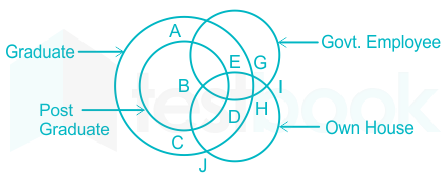
Inspect the following figure and find the region which represents the government employee who live in own house and compulsorily graduate.

  1. AOption (a)

    EGHD

  2. BOption (b)

    BED

  3. COption (c)

    BHG

  4. DOption (d)

    HGI

  5. EOption (e)

    None of the above/More than one of the above

View answer & explanation

Correct answer

Answer: (e)E.

None of the above/More than one of the above

Why this answer is correct

From the given diagram :

The government employees who live in own house and compulsorily graduates are shown by the shaded part and no letter represents the shaded portion.

Thus, none of the given set of letters is correct.

Hence, the correct answer is "None of the above/More than one of the above".

Confusion Points

Postgraduates are also graduates, so the post-graduate part is also included in it.

Question 27

If sign +, represents multiplication, x addition, – division, ÷ difference > equal and = represents greater than, then which of the following relation is true?

  1. AOption (a)

    12 – 2 + 3 ÷ 8 x 1 > 12

  2. BOption (b)

    11 x 2 ÷ 4 – 2 + 1 = 11

  3. COption (c)

    7 ÷ 2 x 5 – 5 + 2 = 7

  4. DOption (d)

    5 x 6 – 3 ÷ 3 + 1 > 4

  5. EOption (e)

    None of the above/More than one of the above

View answer & explanation

Correct answer

Answer: (d)D.

5 x 6 – 3 ÷ 3 + 1 > 4

Why this answer is correct

According to the given information,

SymbolsMeaning
+×
×+
-÷
÷-
>=
=>


1) 12 – 2 + 3 ÷ 8 x 1 > 12

Replacing symbols and using BODMAS rule,

12 ÷ 2 × 3 - 8 + 1 = 12

6 × 3 - 8 + 1 = 12

18 - 8 + 1 = 12

19 - 8 = 12

11 ≠ 12

2) 11 x 2 ÷ 4 – 2 + 1 = 11

Replacing symbols and using BODMAS rule,

11 + 2 - 4 ÷ 2 × 1 > 11

11 + 2 - 2 × 1 > 11

11 + 2 - 2 > 11

13 - 2 > 11

11 > 11 (not greater than)

3) 7 ÷ 2 x 5 – 5 + 2 = 7

Replacing symbols and using BODMAS rule,

7 - 2 + 5 ÷ 5 × 2 > 7

7 - 2 + 1 × 2 > 7

7 - 2 + 2 > 7

9 - 2 > 7

7 > 7 (not greater than)

4) 5 x 6 – 3 ÷ 3 + 1 > 4

Replacing symbols and using BODMAS rule,

5 + 6 ÷ 3 - 3 × 1 = 4

5 + 2 - 3 × 1 = 4

5 + 2 - 3 = 4

7 - 3 = 4

4 = 4

Hence, the correct answer is "5 x 6 – 3 ÷ 3 + 1 > 4".

Question 28

How many times the digit 9 occurs in the numbers from 100 to 999.

  1. AOption (a)

    280

  2. BOption (b)

    218

  3. COption (c)

    229

  4. DOption (d)

    228

  5. EOption (e)

    None of the above/More than one of the above

View answer & explanation

Correct answer

Answer: (a)A.

280

Why this answer is correct

Given:

Number from 100 to 999

Calculation:

In the range of 100 to 200 ,

There are 20 9's 

109,119,129,139,149,159,169, 179, 189, 190,191, 192, 193 194, 195 , 196, 197 , 198, 199.

similarly from range of 100 to 899

Number of 9's = 20 × 8 = 160 

In the range of 900 to 999 

Number of 9's = 100 + 10 + 10 = 120

Total number of 9's occur = 160 + 120 = 280

∴ 280 times the digit 9 occurs in the numbers from 100 to 999.

Question 29

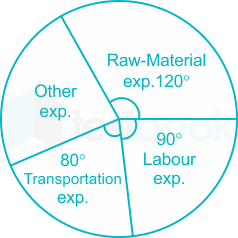
In the following pie-chart, the various expenditures of an industry are presented. Total expenditure on raw material is Rs.30 lac. If labour expenditure is increased by 5%. How much expenditure on other expenses be reduced to maintain the profit?

  1. AOption (a)

     5.9%

  2. BOption (b)

    12.86%

  3. COption (c)

    6.43%

  4. DOption (d)

    6.21%

  5. EOption (e)

    None of the above/More than one of the above

View answer & explanation

Correct answer

Answer: (c)C.

6.43%

Why this answer is correct

Given:

Total expenditure on raw material = Rs.3000000

Angle made by labour at centre = 90°

Angle made by raw material at centre = 120° 

Angle made by Transportation at centre = 80° 

Angle made by other expenditure at centre = 70° 

Calculation:

Expenditure for labour = 3000000 × (90/120) = Rs. 2250000

Expenditure for labour increased by 5%

New Increased expenditure of labour = 2250000 × (105/100) = Rs. 2362500

Increased amount of labour from old to new expenditure = 2363500 - 2250000 = Rs.112500 

Other expenditure = 3000000 × (70/120) = Rs.1750000 

Expenditure on other expenses can be reduced = (112500/1750000) × 100 = 6.43%

∴ 6.43% expenditure on other expenses be reduced to maintain the profit

Question 30

In the bottom of a water tank, there are two drains A and B. If only A is open, it takes 30 minutes to empty a full tank and if only B is open, it takes 20 minutes. If for 10 minutes both drains are open, then B is closed, how much time it takes to empty a full tank?

  1. AOption (a)

    18 minutes

  2. BOption (b)

    15 minutes

  3. COption (c)

    17 minutes

  4. DOption (d)

    20 minutes

  5. EOption (e)

    None of the above/More than one of the above

View answer & explanation

Correct answer

Answer: (b)B.

15 minutes

Why this answer is correct

Given:

Time taken by A to drain water tank = 30 min

Time taken by B to drain water tank = 20 min

Concept Used:

Total work = Efficiency × Time taken to complete the work

Total work = LCM of both Time 

Calculation:

Let us take LCM for (30, 20) = 60 

Total work = 60 unit

Efficiency of A = 60/30 = 2 unit

Efficiency of B = 60/20 = 3 unit

Efficiency of both A and B = 2 + 3 = 5 unit

Total work = Efficiency × Time taken to complete the work

A and B does work for 10 min 

work done for 10 min = 5 × 10 = 50 unit

Remaining work = 60 - 50 = 10 unit

The remaining 10 unit work is done by A alone so,

Total work = Efficiency × Time taken to complete the work

Time taken by A = 10/2 = 5 mins

Total time taken to empty the tank = Time taken by both A and B + Time taken by A

Total time = 10 + 5 ⇒ 15 mins

∴ 15 mins to empty a full tank

Question 31

Which of the following pairs is not correctly matched?

  1. AOption (a)

    Vitamin B1 – Oranges

  2. BOption (b)

    Vitamin D – Cod-liver oil

  3. COption (c)

    Vitamin E – Wheat germ oil

  4. DOption (d)

    More than one of the above

  5. EOption (e)

    None of the above

View answer & explanation

Correct answer

Answer: (a)A.

Vitamin B1 – Oranges

Why this answer is correct

The correct answer is Vitamin B1 – Oranges

Key Points

  • Cod liver oil is a good source of Vitamin D, Vitamin A, Omega-3 fatty acids.
  • Alfalfa is a rich source of vitamin K, which helps the body in blood clotting. Together with iron, vitamin K also helps in the production of blood.
  • Wheat germ oil is a great source of Vitamin E, which is said to be a powerful antioxidant. It helps fight against free radical damage.

Additional Information

  • Vitamins:
  • Vitamin, any of several organic substances that are necessary for small quantities for normal health and growth in higher forms of animal life.
  • Vitamins are distinct in several ways from other biologically important compounds such as proteins, carbohydrates, and lipids.
  • Although these latter substances also are indispensable for proper bodily functions, almost all of them can be synthesized by animals in adequate quantities.
  • Vitamins, on the other hand, generally cannot be synthesized in amounts sufficient to meet bodily needs and therefore must be obtained from the diet or from some synthetic source.
  • For this reason, vitamins are called essential nutrients.
  • Vitamins also differ from the other biological compounds in that relatively small quantities are needed to complete their functions.
  • In general, these functions are of a catalytic or regulatory nature, facilitating or controlling vital chemical reactions in the body’s cells.
  • If a vitamin is absent from the diet or is not properly absorbed by the body, a specific deficiency disease may develop.
  • Chemical Names of certain Vitamins:
  • Vitamin B1 - Thiamine
  • Vitamin B2 - Riboflavin
  • Vitamin B3 - Niacin
  • Vitamin D - Calcipherol
  • Vitamin E - Tocopherol
  • Vitamin K - Phylloquinone

Question 32

Teflon is a polymer of which of the following monomers?

  1. AOption (a)

    Tetrafluoroethylene

  2. BOption (b)

    Vinyl chloride

  3. COption (c)

    Chloroprene

  4. DOption (d)

    Acetylene dichloride

  5. EOption (e)

    None of the above/More than one of the above

View answer & explanation

Correct answer

Answer: (a)A.

Tetrafluoroethylene

Why this answer is correct

The correct answer is Tetrafluoroethylene.

Key Points

  • Teflon is a polymer of Tetrafluoroethylene.
  • Tetrafluoroethylene:
  • Tetrafluoroethylene (TFE) is a fluorocarbon having the chemical formula C2F4.
  • It is the simplest perfluorinated alkene.
  • This gaseous species is used majorly in the industrial preparation of polymers.
  • Tetrafluoroethylene is a colourless, odourless gas.

Additional Information

  • Vinyl chloride:
  • This colourless compound is an important industrial chemical chiefly used to produce the polymer polyvinyl chloride (PVC).
  • Vinyl chloride, also called chloroethylene, a colourless, flammable, toxic gas belonging to the family of organohalogen compounds and used principally in making polyvinyl chloride, or PVC, a widely used plastic with numerous applications.
  • Chloroprene:
  • Chloroprene, the monomer used in the formation of the elastomer neoprene, is prepared from vinylacetylene by this reaction.
  • Neoprene is the common name for the polymers of chloroprene (2-chloro-1,3-butadiene).
  • These are produced by emulsion polymerization.
  • Acetylene dichloride:
  • Almost the entire production of the compound is consumed in manufacturing chlorinated solvents, especially trichloroethylene and tetrachloroethylene.
  • It has minor uses as a solvent and as an insecticide, particularly against the greenhouse whitefly.
  • It is made by the reaction of acetylene and chlorine.
  • Its polymer is Vinyl Chloride.

Question 33

Which of the following is responsible for controlling hereditary characters of the living cells?

  1. AOption (a)

    Enzyme

  2. BOption (b)

    Hormone

  3. COption (c)

    RNA

  4. DOption (d)

    DNA

  5. EOption (e)

    None of the above/More than one of the above

View answer & explanation

Correct answer

Answer: (d)D.

DNA

Why this answer is correct

The correct answer is **DNA.**DNA 

Key Points

  • DNA is responsible for controlling the hereditary characters of the living cells.
  • DNA:
  • Deoxyribonucleic acid is a molecule made up of two polynucleotide chains that coil around each other to form a double helix carrying genetic instructions for the development, functioning, growth and reproduction of all known organisms and many viruses.
  • DNA and ribonucleic acid (RNA) are nucleic acids.
  • Alongside proteins, lipids and complex carbohydrates (polysaccharides), nucleic acids are one of the four primary types of macromolecules that are essential for all known forms of life.

Additional Information

  • Enzyme:
  • Enzymes are proteins that act as biological catalysts.
  • Catalysts accelerate chemical reactions.
  • The molecules upon which enzymes may act are called substrates, and the enzyme converts the substrates into different molecules known as products.
  • Hormone:
  • A hormone is any member of a class of signalling molecules in multicellular organisms, that are transported to distant organs to regulate physiology and/or behaviour.
  • Hormones are required for the correct development of animals, plants and fungi.
  • RNA:
  • Ribonucleic acid is a polymeric molecule essential in various biological roles in coding, decoding, regulation and expression of genes.
  • RNA and deoxyribonucleic acid are nucleic acids.

Question 34

Which of the following vitamins is known as ergocalciferol?

  1. AOption (a)

    Vitamin D2

  2. BOption (b)

    Vitamin D3

  3. COption (c)

    Vitamin B12

  4. DOption (d)

    Vitamin B6

  5. EOption (e)

    None of the above/More than one of the above

View answer & explanation

Correct answer

Answer: (a)A.

Vitamin D2

Why this answer is correct

The correct answer is Vitamin D2.

Key Points

  • Vitamins and their Chemical Names:
VitaminsChemical Name
Vitamin D2Ergocalciferol
Vitamin D3Cholecalciferol
Vitamin B12Cyanocobalamin
Vitamin B6Pyridoxine
  • Vitamins:
  • Vitamins are organic compounds that are required in small amounts in our diet but their deficiency causes specific diseases.
  • Most of the vitamins cannot be synthesized in our body but plants can synthesize almost all of them, so they are considered essential food factors.
  • However, the bacteria of the gut can produce some of the vitamins required by us.
  • All the vitamins are generally available in our diet.
  • Different vitamins belong to various chemical classes and it is difficult to define them on the basis of structure.
  • They are generally regarded as organic compounds required in the diet in small amounts to perform specific biological functions for normal maintenance of optimum growth and health of the organism.
  • Vitamins are designated by alphabets A, B, C, D, etc. Some of them are further named as sub-groups e.g. B1, B2, B6, B12, etc.
  • Vitamin A keeps our skin and eyes healthy.
  • Vitamin C helps the body to fight against many diseases.
  • Vitamin C gets easily destroyed by heat during cooking.
  • Vitamin D helps our body to use calcium for bones and teeth.
  • Excess of vitamins is also harmful and vitamin pills should not be taken without the advice of a doctor.
  • Each of the 13 vitamins known today has specific functions in the body: vitamin A, provitamin A (Beta‐carotene), vitamin B1, vitamin B2, vitamin B6, vitamin B12, biotin, vitamin C, vitamin D, vitamin E, folic acid, vitamin K, niacin and pantothenic acid.

Additional Information

  • Chemical names of Vitamins:
  • Vitamin A - Retinol
  • Vitamin B1 - Thiamine
  • Vitamin B2 - Riboflavin
  • Vitamin B3 - Niacin
  • Vitamin B5 - Pantothenic Acid
  • Vitamin C - Ascorbic Acid
  • Vitamin D - Calcipherol
  • Vitamin E - Tocopherol
  • Vitamin K - Phylloquinone

Question 35

Which of the following pairs is not correctly matched?

  1. AOption (a)

    Retinol – Xerophthalmia

  2. BOption (b)

    Tocopherol – Beriberi

  3. COption (c)

    Cyanocobalamin – Anaemia

  4. DOption (d)

    Ergocalciferol – Rickets

  5. EOption (e)

    None of the above/More than one of the above

View answer & explanation

Correct answer

Answer: (b)B.

Tocopherol – Beriberi

Why this answer is correct

The correct answer is Tocopherol – Beriberi.

Key Points

  • Vitamins Chemical Names and their Deficiency Diseases:
VitaminsDeficiency Diseases
RetinolXerophthalmia
Tocopherolmuscle weakness
CyanocobalaminPernicious anemia
ErgocalciferolRickets

Additional Information

  • Vitamins and their Chemical Names:
  • Retinol - Vitamin A:
  • Vitamin A is the name of a group of fat-soluble retinoids, including retinol, retinal, and retinyl esters.
  • Vitamin A is involved in immune function, vision, reproduction, and cellular communication.
  • Vitamin A is critical for vision as an essential component of rhodopsin, a protein that absorbs light in the retinal receptors, and because it supports the normal differentiation and functioning of the conjunctival membranes and cornea.
  • Vitamin A also supports cell growth and differentiation, playing a critical role in the normal formation and maintenance of the heart, lungs, kidneys, and other organs.
  • Tocopherol - Vitamin E:
  • Vitamin E is a fat-soluble vitamin with several forms, but alpha-tocopherol is the only one used by the human body.
  • Its main role is to act as an antioxidant, scavenging loose electrons—so-called “free radicals”—that can damage cells.
  • It also enhances immune function and prevents clots from forming in heart arteries.
  • Vitamin E has the ability to protect cells from free radical damage as well as stop the production of free radical cells entirely.
  • However, conflicting study results have dimmed some of the promises of using high dose vitamin E to prevent chronic diseases.
  • Cyanocobalamin - Vitamin B12:
  • Vitamin B12 does a lot of things for your body.
  • It helps make your DNA and your red blood cells.
  • Since your body doesn't make vitamin B12, you have to get it from animal-based foods or from supplements.
  • Our your body doesn't store vitamin B12 for a long time.
  • Ergocalciferol - Viatmin D2:
  • Vitamin D (ergocalciferol-D2, cholecalciferol-D3, alfacalcidol) is a fat-soluble vitamin that helps your body absorb calcium and phosphorus.
  • Having the right amount of vitamin D, calcium, and phosphorus is important for building and keeping strong bones.
  • Vitamin D is used to treat and prevent bone disorders (such as rickets, osteomalacia).
  • Vitamin D is made by the body when the skin is exposed to sunlight.
  • Sunscreen, protective clothing, limited exposure to sunlight, dark skin, and age may prevent getting enough vitamin D from the sun.
  • Vitamin D with calcium is used to treat or prevent bone loss (osteoporosis).
  • Vitamin D is also used with other medications to treat low levels of calcium or phosphate caused by certain disorders.

Question 36

Bakelite is formed by the condensation of

  1. AOption (a)

    Urea and formaldehyde

  2. BOption (b)

    Phenol and formaldehyde

  3. COption (c)

    Phenol and acetaldehyde

  4. DOption (d)

    Melamine and formaldehyde

  5. EOption (e)

    None of the above/More than one of the above

View answer & explanation

Correct answer

Answer: (b)B.

Phenol and formaldehyde

Why this answer is correct

The correct answer is Phenol and formaldehyde.

Key Points

  • Bakelite is formed by the condensation of phenol and formaldehyde.
  • Bakelite:
  • Bakelite or polyoxybenzylmethylenglycolanhydride was the first plastic composed of synthetic components.
  • It is a thermosetting phenol formaldehyde resin, constructed from a condensation reaction of phenol with formaldehyde.
  • It was made by the Belgian-American chemist Leo Baekeland in Yonkers, New York, in 1907.
  • Bakelite was maade patented on December 7, 1909.
  • The establishment of synthetic plastic was revolutionary for its electrical nonconductivity and heat-resistant properties in electrical insulators, radio and telephone casings and such varied products as kitchenware, jewellery, pipe stems, children's toys, and firearms.
  • In neoteric years the "retro" appeal of old Bakelite products has made them collectable.
  • Bakelite was referred a National Historic Chemical Landmark on November 9, 1993, by the American Chemical Society in recognition of its significance as the world's first synthetic plastic.

Question 37

Which one of the following is an antibiotic drug?

  1. AOption (a)

    Quinine

  2. BOption (b)

    Sulphaguanidine

  3. COption (c)

    Chloramphenicol

  4. DOption (d)

    Aspirin

  5. EOption (e)

    None of the above/More than one of the above

View answer & explanation

Correct answer

Answer: (c)C.

Chloramphenicol

Why this answer is correct

The correct answer is Chloramphenicol.

Key Points

  • Chloramphenicol:
  • Chloramphenicol, an antibiotic drug once commonly used in the treatment of infections caused by various bacteria, including those in the genera Rickettsia and Mycoplasma.
  • Chloramphenicol was originally found as a product of the metabolism of the soil bacterium Streptomyces venezuelae (order Actinomycetales) and subsequently was synthesized chemically.
  • It achieves its antibacterial effect by interfering with protein synthesis in these microorganisms.
  • It is seldom used today, however, because of its potential toxicity and the availability of safer drugs.
  • Chloramphenicol has been important in the treatment of typhoid fever and other Salmonella infections.
  • For many years chloramphenicol, in combination with ampicillin, was the treatment of choice for Haemophilus influenzae infections, including meningitis.
  • Chloramphenicol is also useful in the treatment of pneumococcal or meningococcal meningitis in penicillin-allergic patients.

Additional Information

  • Quinine:
  • Quinine is a medication used in the treatment of malaria and babesiosis.
  • This includes the remedy of malaria due to Plasmodium falciparum that obstructs chloroquine when artesunate is not available.
  • While sometimes used for disquieting legs syndrome, quinine is not recommended for this purpose due to the risk of serious side effects.
  • It can be inhaled by mouth or intravenously.
  • Malaria counteraction to quinine occurs in few areas of the world.
  • Quinine is also the element in tonic water that gives it its bitter taste.
  • Sulphaguanidine:
  • Sulfaguanidine is a guanidine derivative of sulfanilamide used in veterinary medicine.
  • Sulfaguanidine is poorly absorbed from the gut but is well suited for the treatment of bacillary dysentery and other enteric infections.
  • Sulfaguanidine is a sulfonamide incorporating a guanidine moiety used to block the synthesis of folic acid.
  • It is mostly used in veterinary medicine as a role of an antiinfective agent.
  • Aspirin:
  • Aspirin, also called acetylsalicylic acid, a derivative of salicylic acid that is a mild non-narcotic analgesic (pain reliever) useful in the relief of headache and muscle and joint aches.
  • Aspirin is effective in reducing fever, inflammation, and swelling and thus has been used for the treatment of rheumatoid arthritis, rheumatic fever, and mild infection.
  • In these instances, aspirin generally acts on the symptoms of disease and does not modify or shorten the duration of the disease.
  • However, because of its ability to inhibit the production of blood platelet aggregates (which may cut off the blood supply to regions of the heart or brain), aspirin has also been used as an anticoagulant in the treatment of conditions such as unstable angina or following a minor stroke or heart attack.

Question 38

Match List - I with List-II and select the correct Ans using the codes given below the lists:

List-I
[Applications]
List-II
[Substances]
(a) Aspartame(1) Synthetic rubber
(b) Freon(2) Anti-histamine
(c) Neoprene(3) Artificial Sweetener
(d) Benadryl(4) Refrigerant
  1. AOption (a)

    a-1, b-3, c-4, d-2

  2. BOption (b)

    a-2, b-4, c-1, d-3

  3. COption (c)

    a-3, b-4, c-1, d-2

  4. DOption (d)

    a-3, b-1, c-2, d-4

  5. EOption (e)

    None of the above/More than one of the above

View answer & explanation

Correct answer

Answer: (c)C.

a-3, b-4, c-1, d-2

Why this answer is correct

The correct answer is a-3, b-4, c-1, d-2.

Key Points

  • ​​​Applications present in the following substances:
List-I
[Applications]
List-II
[Substances]
(a) AspartameArtificial Sweetener
(b) FreonRefrigerant
(c) NeopreneSynthetic rubber
(d) BenadrylAnti-histamine

Additional Information

  • Aspartame:
  • Aspartame, the synthetic organic compound (a dipeptide) of phenylalanine and aspartic acid.
  • It is 150–200 times as sweet as cane sugar and is used as a nonnutritive tabletop sweetener and in low-calorie prepared foods (brand names NutraSweet, Equal) but is not suitable for baking.
  • Because of its phenylalanine content, persons with phenylketonuria must avoid it.
  • Though it is approved by the U.S. Food and Drug Administration and other regulatory authorities around the world, its safety even for those without the disease remains controversial.
  • Freon:
  • Freon, (trademark), any of several simple fluorinated aliphatic organic compounds that are used in commerce and industry.
  • In addition to fluorine and carbon, Freons often contain hydrogen, chlorine, or bromine.
  • Thus, Freons are types of chlorofluorocarbons (CFCs), hydrochlorofluorocarbons (HCFCs), and related compounds.
  • Neoprene:
  • Neoprene (CR), also called polychloroprene or chloroprene rubber, synthetic rubber produced by the polymerization (or linking together of single molecules into giant, multiple-unit molecules) of chloroprene.
  • A good general-purpose rubber, neoprene is valued for its high tensile strength, resilience, oil and flame resistance, and resistance to degradation by oxygen and ozone.
  • However, its high cost limits its use to special-properties applications.
  • Benadryl:
  • Benadryl Syrup is used in the treatment of cough.
  • It relieves allergy symptoms such as runny nose, stuffy nose, sneezing, watery eyes and congestion or stuffiness.
  • It also thins mucus in the nose, windpipe and lungs, making it easier to cough out.
  • Benadryl Syrup is taken with or without food in a dose and duration as advised by the doctor.
  • The dose you are given will depend on your condition and how you respond to the medicine.

Question 39

Insulin is

  1. AOption (a)

    Fat

  2. BOption (b)

    Vitamin

  3. COption (c)

    Carbohydrate

  4. DOption (d)

    Protein

  5. EOption (e)

    None of the above/More than one of the above

View answer & explanation

Correct answer

Answer: (d)D.

Protein

Why this answer is correct

The correct answer is Protein.

Key Points

  • Insulin:
  • Insulin is a peptide hormone secreted by beta cells of the pancreatic islets.
  • It is considered to be the primary anabolic hormone present inside our body.
  • It maintains the metabolism of carbohydrates, fats and protein by promoting the absorption of glucose from the blood into the liver, fat and skeletal muscle cells.
  • In these tissues, the absorbed glucose is changed into either glycogen via glycogenesis or fats (triglycerides) via lipogenesis, or, in the case of the liver, into both.
  • Protein:
  • Protein, a highly complex substance that is present in all living organisms.
  • Proteins are of great nutritional value and are directly involved in the chemical processes essential for life.
  • The importance of proteins was recognized by chemists in the early 19th century, including Swedish chemist Jöns Jacob Berzelius, who in 1838 coined the term protein, a word derived from the Greek prōteios, meaning “holding first place.”
  • Proteins are species-specific; that is, the proteins of one species differ from those of another species.
  • They are also organ-specific; for instance, within a single organism, muscle proteins differ from those of the brain and liver.

Additional Information

  • Fat:
  • Fat, any substance of plant or animal origin that is nonvolatile, insoluble in water, and oily or greasy to the touch.
  • Fats are usually solid at ordinary temperatures, such as 25 °C (77 °F), but they begin to liquefy at somewhat higher temperatures.
  • Chemically, fats are identical to animal and vegetable oils, consisting primarily of glycerides, which are esters formed by the reaction of three molecules of fatty acids with one molecule of glycerol.
  • Vitamin:
  • Vitamin, any of several organic substances that are necessary for small quantities for normal health and growth in higher forms of animal life.
  • Vitamins are distinct in several ways from other biologically important compounds such as proteins, carbohydrates, and lipids.
  • Although these latter substances also are indispensable for proper bodily functions, almost all of them can be synthesized by animals in adequate quantities.
  • Vitamins, on the other hand, generally cannot be synthesized in amounts sufficient to meet bodily needs and therefore must be obtained from the diet or from some synthetic source.
  • If a vitamin is absent from the diet or is not properly absorbed by the body, a specific deficiency disease may develop.
  • Carbohydrate:
  • Carbohydrate, class of naturally occurring compounds and derivatives formed from them. In the early part of the 19th century, substances such as wood, starch, and linen were found to be composed mainly of molecules containing atoms of carbon (C), hydrogen (H), and oxygen (O).
  • Carbohydrates are probably the most abundant and widespread organic substances in nature.
  • They are essential constituents of all living things.
  • Carbohydrates are formed by green plants from carbon dioxide and water during the process of photosynthesis.
  • Carbohydrates serve as energy sources and as essential structural components in organisms.
  • In addition, part of the structure of nucleic acids, which contain genetic information, consists of carbohydrate.

Question 40

The gas used in the manufacture of Vanaspati Ghee from Vanaspati Oil is

  1. AOption (a)

    Hydrogen

  2. BOption (b)

    Oxygen

  3. COption (c)

    Nitrogen

  4. DOption (d)

    Carbon dioxide

  5. EOption (e)

    None of the above/More than one of the above

View answer & explanation

Correct answer

Answer: (a)A.

Hydrogen

Why this answer is correct

The correct answer is Hydrogen.

Key Points

  • The gas used in the manufacture of Vanaspati Ghee from Vanaspati Oil is Hydrogen.
  • At high pressure, in the presence of nickel catalyst, hydrogen is mixed with vegetable oils which turn them into vegetable ghee.
  • This process is called the hydrogenation of oils.
  • Hydrogen:
  • Hydrogen is the chemical element having the symbol H and atomic number 1.
  • With a norm atomic weight of 1.008, hydrogen is the lightest element in the periodic table.
  • Hydrogen is the most copious chemical substance in the universe, constituting roughly 75% of all baryonic mass.
  • Hydrogen gas is used by industry for refining petroleum, treating metals, producing fertilizer, and processing foods.

Additional Information

  • Oxygen:
  • Oxygen is the chemical element with the symbol O and atomic number 8.
  • It is a part of the chalcogen group in the periodic table.
  • It is a highly reactive nonmetal and an oxidizing agent that readily forms oxides with most elements as well as with other compounds.
  • It is also used to make epoxyethane (ethylene oxide), used as antifreeze and to make polyester, and chloroethene, the precursor to PVC.
  • Oxygen gas is used for oxy-acetylene welding and cutting of metals.
  • A growing use is in the treatment of sewage and of effluent from the industry.
  • Nitrogen:
  • Nitrogen (N), nonmetallic element of Group 15 [Va] of the periodic table.
  • It is a colourless, odourless, tasteless gas that is the most plentiful element in Earth’s atmosphere and is a constituent of all living matter.
  • Elemental nitrogen can be used as an inert atmosphere for reactions requiring the exclusion of oxygen and moisture.
  • In the liquid state, nitrogen has valuable cryogenic applications; except for the gases hydrogen, methane, carbon monoxide, fluorine, and oxygen, practically all chemical substances have negligible vapour pressures at the boiling point of nitrogen and exist, therefore, as crystalline solids at that temperature.
  • Carbon dioxide:
  • Carbon dioxide, (CO2), a colourless gas having a faint sharp odour and a sour taste.
  • It is one of the most important greenhouse gases linked to global warming, but it is a minor component of Earth’s atmosphere (about 3 volumes in 10,000), formed in the combustion of carbon-containing materials, in fermentation, and in respiration of animals and employed by plants in the photosynthesis of carbohydrates.
  • The presence of the gas in the atmosphere keeps some of the radiant energy received by Earth from being returned to space, thus producing the so-called greenhouse effect.
  • Industrially, it is recovered for numerous diverse applications from flue gases, as a by-product of the preparation of hydrogen for synthesis of ammonia, from limekilns, and from other sources.
  • Carbon dioxide is used as a refrigerant, in fire extinguishers, for inflating life rafts and life jackets, blasting coal, foaming rubber and plastics, promoting the growth of plants in greenhouses, immobilizing animals before slaughter, and in carbonated beverages.

Question 41

LPG used as domestic fuel chiefly contains

  1. AOption (a)

    Methane

  2. BOption (b)

    Propane

  3. COption (c)

    Ethylene

  4. DOption (d)

    Butane

  5. EOption (e)

    None of the above/More than one of the above

View answer & explanation

Correct answer

Answer: (e)E.

None of the above/More than one of the above

Why this answer is correct

The correct answer is None of the above/More than one of the above.

Key Points

  • LPG used as domestic fuel chiefly contains Propane and Butane.
  • LPG:
  • LPG stands for Liquified Petroleum Gas.
  • LPG is consumed as fuel gas in heating appliances, cooking equipment, and vehicles.
  • It is increasingly consumed as an aerosol propellant and a refrigerant, replacing chlorofluorocarbons in an effort to reduce damage to the ozone layer.
  • When specifically consumed as a vehicle fuel it is often referred to as autogas.
  • Varieties of LPG bought and sold comprises mixes that are mostly propane (C3H8), mostly butane (C4H), and, most commonly, mixes including both propane and butane.
  • In the northern hemisphere winter, mixes include more propane, while in summer, they contain more butane.
  • In the United States, mostly two grades of LPG are sold: commercial propane and HD-5.
  • These statements are published by the Gas Processors Association (GPA) and the American Society of Testing and Materials.

Additional Information

  • Formula:
  • Methane - CH₄
  • Propane - C3H8
  • Ethylene - C2H4
  • Butane - C4H10

Question 42

Soap removes grease by

  1. AOption (a)

    Coagulation

  2. BOption (b)

    Adsorption

  3. COption (c)

    Emulsification

  4. DOption (d)

    Osmosis

  5. EOption (e)

    None of the above/More than one of the above

View answer & explanation

Correct answer

Answer: (c)C.

Emulsification

Why this answer is correct

The correct answer is Emulsification.

Key Points

  • Soap removes grease by the process of Emulsification.
  • Emulsification:
  • Emulsification is the process of dispersing two or more immiscible liquids together to form a semistable mixture.
  • In food applications, these two liquids generally consist of an organic (oil) phase and an aqueous (water) phase that is stabilized by the addition of a food-grade emulsifier (surfactant).
  • The most general emulsions are of the oil-in-water (O/W) type.
  • Examples of food emulsions include mayonnaise, sauces, ice cream, and milk.
  • Water-in-oil (W/O)-type emulsions are less common in food applications, with the most prominent example being butter, which is an emulsion of water dispersed in milk fat.

Additional Information

  • Coagulation:
  • Coagulation, generally known as clotting, is the process by which blood changes from a liquid to a gel, forming a blood clot.
  • It potentially results in hemostasis, the cessation of blood loss from a damaged vessel, followed by repair.
  • Adsorption:
  • Adsorption is the adhesion of atoms, ions or molecules from a gas, liquid or dissolved solid to a surface.
  • This process creates a film of the adsorbate on the surface of the adsorbent.
  • This process differs from absorption, in which a fluid is dissolved by or permeates a liquid or solid.
  • Osmosis:
  • Osmosis is the spontaneous net movement of solvent molecules through a selectively permeable membrane into a region of higher solute concentration, in the direction that tends to equalize the solute concentrations on the **two sides.**​

Question 43

Which of the following hormones play a role in the release of milk from mammary glands?

  1. AOption (a)

    Adrenaline

  2. BOption (b)

    Thyroxine

  3. COption (c)

    Progesterone

  4. DOption (d)

    Oxytocin

  5. EOption (e)

    None of the above/More than one of the above

View answer & explanation

Correct answer

Answer: (d)D.

Oxytocin

Why this answer is correct

The correct answer is Oxytocin.

Key Points

  • Oxytocin plays a role in the release of milk from mammary glands.
  • Oxytocin:
  • Oxytocin is a hormone produced by the hypothalamus and secreted by the pituitary gland.
  • This vital hormone plays an important role in the childbirth process and also helps with male reproduction.
  • In women, oxytocin is accountable for signalling contractions of the womb during labour.
  • The hormone encourages the uterine muscles to contract, so labour begins.
  • It also enhances the production of prostaglandins, which move labour along and increases contractions.
  • Because of this effect, synthetic oxytocin (Pitocin) is sometimes applied to induce a woman to start labour if she cannot start naturally, or it can be given to make contractions stronger if a woman's labour is slowing.

Additional Information

  • Adrenaline:
  • Adrenaline is produced in the medulla in the adrenal glands as well as some of the central nervous system's neurons.
  • Within a couple of minutes during a stressful situation, adrenaline is quickly released into the blood, sending impulses to organs to create a specific response.
  • Adrenaline triggers the body's fight-or-flight response.
  • This reaction causes air passages to dilate to provide the muscles with the oxygen they need to either fight the danger or flee.
  • Adrenaline also triggers the blood vessels to contract to re-direct blood toward major muscle groups, including the heart and lungs.
  • The body's ability to feel pain also decreases as a result of adrenaline, which is why you can continue running from or fighting danger even when injured.
  • Adrenaline causes a noticeable increase in strength and performance, as well as heightened awareness, in stressful times.
  • After the stress has subsided, adrenaline’s effect can last for up to an hour.
  • Thyroxine:
  • Thyroxine is the main hormone secreted into the bloodstream by the thyroid gland'.
  • It is the inactive form and most of it is converted to an active form called triiodothyronine by organs such as the liver and kidneys.
  • Thyroid hormones play vital roles in regulating the body’s metabolic rate, heart and digestive functions, muscle control, brain development and maintenance of bones.
  • The production and release of thyroid hormones, thyroxine and triiodothyronine, is controlled by a feedback loop system that involves the hypothalamus in the brain and the pituitary and thyroid glands.
  • The hypothalamus secretes a thyrotropin-releasing hormone which, in turn, stimulates the pituitary gland to produce thyroid-stimulating hormone.
  • This hormone stimulates the production of the thyroid hormones, thyroxine and triiodothyronine, by the thyroid gland.
  • Progesterone:
  • Progesterone is a steroid hormone belonging to a class of hormones called progestogens.
  • It is secreted by the corpus luteum, a temporary endocrine gland that the female body produces after ovulation during the second half of the menstrual cycle.
  • Progestin is often combined with estrogen, another hormone, to develop contraceptives such as birth control pills and skin patches.
  • Progestin is also useful in treating common menopausal symptoms.
  • Progesterone and progestins help women make informed choices about their reproductive health.

Question 44

Match List - I with List-II and select the correct Ans using the codes given below the lists:

List - IList - II
a) Skin Cancer1. Chlorofluorocarbons
b) Noise Pollution2. Ultraviolet light
c) Global warming3. Decibel
d) Ozone Hole4. Carbon dioxide
  1. AOption (a)

    a-1, b-2, c-3, d-4

  2. BOption (b)

    a-2, b-3, c-4, d-1

  3. COption (c)

    a-2, b-3, c-1, d-4

  4. DOption (d)

    a-4, b-3, c-2, d-1

  5. EOption (e)

    None of the above/More than one of the above

View answer & explanation

Correct answer

Answer: (b)B.

a-2, b-3, c-4, d-1

Why this answer is correct

The correct answer is a-2, b-3, c-4, d-1.

Key Points

List - IList - II
a) Skin CancerUltraviolet light
b) Noise PollutionDecibel
c) Global warmingCarbon dioxide
d) Ozone HoleChlorofluorocarbons

Additional Information

  • Skin Cancer:
  • Skin cancer, a disease characterized by the uncontrolled growth of cells in the skin.
  • Skin cancers are of two distinct types: nonmelanoma and melanoma.
  • Most cases of nonmelanoma skin cancer are caused by damage to DNA resulting from exposure to ultraviolet radiation of the sun.
  • People with light complexions have a higher rate of skin cancer than those with dark skin, and males are more likely to develop skin cancer than females.
  • Noise Pollution:
  • Noise pollution, unwanted or excessive sound can have deleterious effects on human health, wildlife, and environmental quality.
  • Noise pollution is commonly generated inside many industrial facilities and some other workplaces, but it also comes from the highway, railway, and aeroplane traffic and from outdoor construction activities.
  • Sound waves are vibrations of air molecules carried from a noise source to the ear.
  • Sound is typically described in terms of the loudness (amplitude) and the pitch (frequency) of the wave.
  • Loudness (also called sound pressure level, or SPL) is measured in logarithmic units called decibels (dB).
  • The normal human ear can detect sounds that range between 0 dB (hearing threshold) and about 140 dB, with sounds between 120dB and 140 dB causing pain (pain threshold).
  • Global warming:
  • Global warming, the phenomenon of increasing average air temperatures near the surface of Earth over the past one to two centuries.
  • Climate scientists have since the mid-20th century gathered detailed observations of various weather phenomena (such as temperatures, precipitation, and storms) and of related influences on climate (such as ocean currents and the atmosphere’s chemical composition).
  • These data indicate that Earth’s climate has changed over almost every conceivable timescale since the beginning of geologic time and that the influence of human activities since at least the beginning of the Industrial Revolution has been deeply woven into the very fabric of climate change.
  • Ozone Hole:
  • The ozone hole is not technically a “hole” where no ozone is present but is actually a region of exceptionally depleted ozone in the stratosphere over the Antarctic that happens at the beginning of Southern Hemisphere spring (August–October).
  • Satellite instruments provide us with daily images of ozone over the Antarctic region.
  • The ozone hole shows the very low values centred over Antarctica on 4 October 2004.
  • From the historical record, we know that total column ozone values of less than 220 Dobson Units were not observed prior to 1979.
  • From an aircraft field mission over Antarctica, we also know that a total column ozone level of less than 220 Dobson Units is a result of catalyzed ozone loss from chlorine and bromine compounds.

Question 45

In human body, Vitamin A is stored in

  1. AOption (a)

    Liver

  2. BOption (b)

    Skin

  3. COption (c)

    Lung

  4. DOption (d)

    Kidney

  5. EOption (e)

    None of the above/More than one of the above

View answer & explanation

Correct answer

Answer: (a)A.

Liver

Why this answer is correct

The correct answer is Liver.

Key Points

  • In the human body, Vitamin A is stored in the Liver.
  • Liver:
  • The liver is an organ only found in vertebrates which detoxifies various metabolites.
  • It synthesizes proteins and secretes biochemicals necessary for digestion and growth.
  • In humans, it is situated in the right upper quadrant of the abdomen, below the diaphragm.
  • Its other functions in metabolism comprise the regulation of glycogen storage, decomposition of red blood cells, and the production of hormones.
  • The liver is an accessory digestive organ that secretes bile, an alkaline fluid containing cholesterol and bile acids, which helps the breakdown of fat.
  • The gallbladder, a small pouch that sits just below the liver.
  • It stores bile secreted by the liver which is afterwards moved to the small intestine to complete digestion.
  • The liver's highly specialized tissue, consisting of mostly hepatocytes, regulates a wide variety of high-volume biochemical reactions.
  • It helps in the synthesis and breakdown of small and complex molecules, many of which are necessary for normal vital functions.
  • Many estimates regarding the organ's total number of functions vary, but textbooks generally cite it being around 500.

Additional Information

  • Skin:
  • Human skin, in human anatomy, the covering, or integument, of the body’s surface that both provides protection and receives sensory stimuli from the external environment.
  • The skin consists of three layers of tissue: the epidermis, an outermost layer that contains the primary protective structure, the stratum corneum; the dermis, a fibrous layer that supports and strengthens the epidermis; and the subcutis, a subcutaneous layer of fat beneath the dermis that supplies nutrients to the other two layers and that cushions and insulates the body.
  • The apparent lack of body hair immediately distinguishes human beings from all other large land mammals.
  • Lung:
  • Lung, in air-breathing vertebrates, either of the two large organs of respiration located in the chest cavity and responsible for adding oxygen to and removing carbon dioxide from the blood.
  • In humans, each lung is encased in a thin membranous sac called the pleura, and each is connected with the trachea (windpipe) by its main bronchus (large air passageway) and with the heart by the pulmonary arteries.
  • The lungs are soft, light, spongy, elastic organs that normally, after birth, always contain some air.
  • If healthy, they will float in water and crackle when squeezed; diseased lungs sink.
  • Kidney:
  • The kidney, invertebrates and some invertebrates, an organ that maintains water balance and expels metabolic wastes.
  • Primitive and embryonic kidneys consist of two series of specialized tubules that empty into two collecting ducts, the Wolffian ducts (see Wolffian duct).
  • The more advanced kidney (metanephros) of adult reptiles, birds, and mammals is a paired compact organ whose functional units, called nephrons, filter initial urine from the blood, reabsorb water and nutrients and secrete wastes, producing the final urine, which is expelled.

Question 46

Which of the following vitamins is used as an antidote to anticoagulant poisons?

  1. AOption (a)

    Vitamin A

  2. BOption (b)

    Vitamin D

  3. COption (c)

    Vitamin E

  4. DOption (d)

    Vitamin K

  5. EOption (e)

    None of the above/More than one of the above

View answer & explanation

Correct answer

Answer: (d)D.

Vitamin K

Why this answer is correct

The correct answer is Vitamin K.

Key Points

  • Vitamin K is used as an antidote to anticoagulant poisons.
  • Vitamin K:
  • Vitamin K is actually a group of compounds.
  • The most important of these compounds appears to be vitamin K1 and vitamin K2.
  • Vitamin K1 is obtained from leafy greens and some other vegetables.
  • Vitamin K2 is a group of compounds largely obtained from meats, cheeses, and eggs, and synthesized by bacteria.

Additional Information

  • Vitamins and their Chemical Names:
VitaminsChemical Names
Vitamin ARetinol
Vitamin DErgocalciferol
Vitamin ETocopherol
Vitamin KPhytonadione
  • Vitamin A:
  • Vitamin A, also called retinol, fat-soluble alcohol, most abundant in fatty fish and especially in fish-liver oils.
  • Vitamin A is also found in milk fat, eggs, and liver; synthetic vitamin A is added to margarine.
  • It helps your body's natural defence against illness and infection (the immune system) work properly.
  • It helps vision in dim light.
  • It keeps skin and the lining of some parts of the body, such as the nose, healthy.
  • Vitamin D:
  • Vitamin D is required for the regulation of the minerals calcium and phosphorus found in the body.
  • It also plays an important role in maintaining proper bone structure.
  • Sun exposure is an easy, reliable way for most people to get vitamin D.
  • Exposure of the hands, face, arms, and legs to sunlight 2-3 times a week for about one-fourth of the time it would take to develop a mild sunburn will cause the skin to produce enough vitamin D.
  • The necessary exposure time varies with age, skin type, season, time of day, etc.
  • Vitamin E:
  • Vitamin E is a fat-soluble nutrient found in many foods.
  • In the body, it acts as an antioxidant, helping to protect cells from the damage caused by free radicals.
  • Free radicals are compounds formed when our bodies convert the food we eat into energy.
  • People are also exposed to free radicals in the environment from cigarette smoke, air pollution, and ultraviolet light from the sun.
  • The body also needs vitamin E to boost its immune system so that it can fight off invading bacteria and viruses.
  • It helps to widen blood vessels and keep blood from clotting within them.
  • In addition, cells use vitamin E to interact with each other and to carry out many important functions.

Question 47

Iodised salt contains

  1. AOption (a)

    Iodine

  2. BOption (b)

    Calcium iodide

  3. COption (c)

    Magnesium iodide

  4. DOption (d)

    Potassium iodide

  5. EOption (e)

    None of the above/More than one of the above

View answer & explanation

Correct answer

Answer: (d)D.

Potassium iodide

Why this answer is correct

The correct answer is Potassium iodide.

Key Points

  • Iodised salt:
  • Iodised salt is table salt mixed with a trivial amount of various salts of the element iodine.
  • The ingestion of iodine inhibits iodine deficiency.
  • Worldwide, iodine deficiency affects about two billion people and is the salient preventable cause of intellectual and developmental disabilities.
  • Deficiency also causes thyroid gland issues, including "endemic goitre".
  • In many countries, iodine deficiency is a primary public health problem that can be cheaply addressed by purposely adding small amounts of iodine to the sodium chloride salt.
  • Potassium iodide:
  • Potassium iodide is a salt of stable (not radioactive) iodine that can help block radioactive iodine from being absorbed by the thyroid gland, thus protecting this gland from radiation injury.
  • The thyroid gland is the part of the body that is most sensitive to radioactive iodine.
  • KI (potassium iodide) does not keep radioactive iodine from entering the body and cannot reverse the health effects caused by radioactive iodine once the thyroid is damaged.
  • KI (potassium iodide) only protects the thyroid, not other parts of the body, from radioactive iodine.

Additional Information

  • Iodine:
  • Iodine (I), chemical element, a member of the halogen elements, or Group 17 (Group VIIa) of the periodic table.
  • Iodine is never found in nature uncombined, and it is not concentrated sufficiently to form independent minerals.
  • It is present in seawater, but sparingly, as the iodide ion, I-, to the extent of approximately 50 mg per metric ton (0.0016 ounces per ton) of seawater.
  • It is also formed in seaweeds, oysters, and cod livers.
  • Sodium iodate (NaIO3) is contained in crude Chile saltpetre (sodium nitrate, NaNO3).
  • The human body contains iodine in the compound thyroxine, which is produced in the thyroid gland.
  • Calcium iodide:
  • Calcium iodide is an inorganic compound that is made of calcium and iodine.
  • It has the chemical formula CaI2.
  • Calcium iodide can be formed using either calcium oxide, calcium carbonate or calcium hydroxide with hydrochloric acid.
  • Calcium iodide is used in medicines.
  • It is used in photography.
  • Magnesium iodide:
  • Magnesium Iodide formula, also known as Diiodomagnesium formula is discussed in this article.
  • This chemical compound has various hydrates which are typical ionic halides and do not dissolve in water.
  • The molecular or chemical formula of Magnesium Iodide is MgI2 (anhydrous).
  • Diiodomagnesium is a crystalline solid white in colour and has no smell.
  • It can be synthesized by using magnesium oxide, magnesium carbonate, and magnesium hydroxide and treating them with hydroiodic acid.
  • It is widely used to produce organic synthesis compounds.

Question 48

Which of the following is present in maximum in acid rain?

  1. AOption (a)

    HCl

  2. BOption (b)

    H2NO3

  3. COption (c)

    H2SO4

  4. DOption (d)

    H2CO3

  5. EOption (e)

    None of the above/More than one of the above

View answer & explanation

Correct answer

Answer: (c)C.

H2SO4

Why this answer is correct

The correct answer is H2SO4.

Key Points

  • Sulphuric acid is the main constituent of acid rain.
  • Acid rain:
  • Acid rain, also called acid precipitation or acid deposition, is precipitation possessing a pH of about 5.2 or below primarily produced from the emission of sulphur dioxide (SO2) and nitrogen oxides from human activities, mostly the combustion of fossil fuels.
  • In acid-sensitive landscapes, acid deposition can reduce the pH of surface waters and lower biodiversity.
  • It weakens trees and increases their susceptibility to damage from other stressors, such as drought, extreme cold, and pests.
  • In acid-sensitive areas, acid rain also depletes the soil of important plant nutrients and buffers, such as calcium and magnesium, and can release aluminium, bound to soil particles and rock, in its toxic dissolved form.
  • Acid rain contributes to the corrosion of surfaces exposed to air pollution and is responsible for the deterioration of limestone and marble buildings and monuments.
  • Many air pollution and atmospheric deposition problems are intertwined with one another, and these problems are often derived from the same cause, namely the burning of fossil fuels.

Question 49

‘God Particle’ is

  1. AOption (a)

    Neutrino

  2. BOption (b)

    Higgs Boson

  3. COption (c)

    Meson

  4. DOption (d)

    Positron

  5. EOption (e)

    None of the above/More than one of the above

View answer & explanation

Correct answer

Answer: (b)B.

Higgs Boson

Why this answer is correct

The correct answer is Higgs Boson.

Key Points

  • God Particle is Higgs Boson.
  • Higgs Boson:
  • The Higgs boson is an elementary particle in the Standard Model of particle physics generated by the quantum excitation of the Higgs field, one of the fields in particle physics theory.
  • In the Standard Model, the Higgs particle is a voluminous scalar boson with zero spins, no electric charge, and no colour charge.
  • It is also very unsettled, decaying into other particles almost immediately.
  • It is named after physicist Peter Higgs, who, in 1964 along with five other scientists introduced the Higgs mechanism to explain why some particles have mass.
  • This mechanism undersigned that a spinless particle known as a boson should exist with properties as described by the Higgs Mechanism theory.
  • This particle was known as the Higgs boson.
  • A subatomic particle with the requisite properties was discovered in 2012 by the ATLAS and CMS experiments at the Large Hadron Collider (LHC) at CERN near Geneva, Switzerland.
  • The new particle was afterwards confirmed to match the expected properties of a Higgs boson.

Additional Information

  • Neutrino:
  • Neutrino, an elementary subatomic particle with no electric charge, very little mass, and 1/2 unit of spin.
  • Neutrinos belong to the family of particles called leptons, which are not subject to strong force.
  • Rather, neutrinos are subject to the weak force that underlies certain processes of radioactive decay.
  • The term neutrino is sometimes used in a general sense to refer to both the neutrino and its antiparticle.
  • Meson:
  • Meson, any member of a family of subatomic particles composed of a quark and an antiquark.
  • Mesons are sensitive to the strong force, the fundamental interaction that binds the components of the nucleus by governing the behaviour of their constituent quarks.
  • Predicted theoretically in 1935 by the Japanese physicist Yukawa Hideki, the existence of mesons was confirmed in 1947 by a team led by the English physicist Cecil Frank Powell with the discovery of the pi-meson (pion) in cosmic-ray particle interactions.
  • Positron:
  • Positron, also called positive electron, positively charged subatomic particle having the same mass and magnitude of charge as the electron and constituting the antiparticle of a negative electron.
  • The first of the antiparticles to be detected, positrons were discovered by Carl David Anderson in cloud-chamber studies of the composition of cosmic rays (1932).
  • The discovery of the positron provided an explanation for a theoretical aspect of electrons predicted by P.A.M. Dirac.
  • The Dirac wave equation (1928), which incorporated relativity into the quantum mechanical description for the allowable energy states of the electron, yielded seemingly superfluous negative energy states that had not been observed.
  • In 1931 Dirac postulated that these states could be related to a new kind of particle, the antielectron.

Question 50

Which of the following radio isotopes is used in the treatment of blood cancer (leukemia)?

  1. AOption (a)

    Iodine - 131

  2. BOption (b)

    Sodium - 24

  3. COption (c)

    Phosphorus - 32

  4. DOption (d)

    Cobalt - 60

  5. EOption (e)

    None of the above/More than one of the above

View answer & explanation

Correct answer

Answer: (d)D.

Cobalt - 60

Why this answer is correct

The correct answer is Cobalt - 60.

Key Points

  • Cobalt - 60 radioisotopes are used in the treatment of blood cancer [leukemia].
  • Cobalt - 60:
  • Cobalt-60 (60Co) is an artificial radioactive isotope of cobalt with a half-life of 5.2713 years.
  • It is generated artificially in nuclear reactors.
  • Intentional industrial production depends on neutron activation of bulk samples of the monoisotopic and mononuclidic cobalt isotope 59 Co.
  • Measurable quantities are also generated as a by-product of typical nuclear power plant operation and may be detected externally when leaks occur.
  • In the hindmost case (in the absence of added cobalt) the incidental generator 60Co is largely the result of multiple stages of neutron activation of iron isotopes in the reactor's steel structures via the creation of its 59 Co precursor.
  • The easiest case of the latter would result from the activation of 58Fe.
  • 60Co pass off beta decay to the stable isotope nickel-60 (60Ni).
  • The activated nickel nucleus emits two gamma rays with energies of 1.17 and 1.33 MeV.

Additional Information

  • Iodine - 131:
  • I-131 is used in medicine to diagnose and treat cancers of the thyroid gland.
  • I-131 is produced commercially for medical and industrial uses through nuclear fission.
  • It also is a byproduct of nuclear fission processes in nuclear reactors and weapons testing.
  • Pure I-131 is a non-metallic, purplish-black crystalline solid. However, because it readily binds with other elements, I-131 usually is found as a compound rather than in its pure form.
  • For medical purposes, the I-131 capsules contain small granules of I-131 sodium iodide that are designed to be swallowed by patients.
  • Liquid I-131 sodium iodide used to diagnose and treat thyroid disease is a clear liquid.
  • Sodium - 24:
  • Sodium -24 can also be used in non-medical applications.
  • For instance, it is used for leak testing in industrial pipelines.
  • Due to the limited penetrating power of the sodium radiation, detectors are only able to detect the radioactive sodium at leak points.
  • Sodium 24 is also suited to this application due to its short half-life of just 15 hours.
  • Phosphorus - 32:
  • Phosphorus-32 (also known as P-32) treatment uses a radioactive form of sodium phosphate.
  • Because P-32 is radioactive, it can be used to treat some diseases by injecting it into the body.
  • When P-32 is injected into the bloodstream it collects in the bone marrow where it slows down the production of new blood cells.
  • This makes it useful for treating diseases where there are too many blood cells in the blood.

Question 51

The elected US President Donald Trump was the Presidential Nominee of the

  1. AOption (a)

    Democratic Party

  2. BOption (b)

    Republican Party

  3. COption (c)

    Libertarian Party

  4. DOption (d)

    Green Party

  5. EOption (e)

    None of the above/More than one of the above

View answer & explanation

Correct answer

Answer: (b)B.

Republican Party

Why this answer is correct

The correct answer is Republican Party.

Key Points

  • The elected US President Donald Trump was the Presidential Nominee of the Republican Party.
  • Republican Party:
  • Republican Party, byname Grand Old Party (GOP), in the United States, one of the two major political parties, the other being the Democratic Party.
  • During the 19th century, the Republican Party stood against the extension of slavery to the country’s new territories and, ultimately, for slavery’s complete abolition.
  • During the 20th and 21st centuries, the party came to be associated with laissez-faire capitalism, low taxes, and conservative social policies.
  • The party acquired the acronym GOP, widely understood as “Grand Old Party,” in the 1870s.
  • The party’s official logo, the elephant, is derived from a cartoon by Thomas Nast and also dates from the 1870s.

Additional Information

  • Democratic Party:
  • The Democratic Party has changed significantly during its more than two centuries of existence.
  • During the 19th century, the party supported or tolerated slavery, and it opposed civil rights reforms after the American Civil War in order to retain the support of Southern voters.
  • By the mid-20th century, it had undergone a dramatic ideological realignment and reinvented itself as a party supporting organized labour, the civil rights of minorities, and progressive reform.
  • Since Pres. Franklin D. Roosevelt’s New Deal of the 1930s, the party has also tended to favour greater government intervention in the economy and to oppose government intervention in the private noneconomic affairs of citizens.
  • The logo of the Democratic Party, the donkey, was popularized by cartoonist Thomas Nast in the 1870s; though widely used, it has never been officially adopted by the party.

Question 52

The Iran-Pakistan Gas pipeline is also called as

  1. AOption (a)

    Friendship pipeline

  2. BOption (b)

    Future pipeline

  3. COption (c)

    Peace pipeline

  4. DOption (d)

    Unity pipeline

  5. EOption (e)

    None of the above/More than one of the above

View answer & explanation

Correct answer

Answer: (c)C.

Peace pipeline

Why this answer is correct

The correct answer is the Peace pipeline.

Key Points

  • The Iran-Pakistan gas pipeline is also called as Peace pipeline.
  • Peace pipeline:
  • The Iran–Pakistan gas pipeline, generally termed as the Peace pipeline, or IP Gas is an under-construction 2,775-kilometre (1,724 mi) pipeline to deliver natural gas from Iran to Pakistan.
  • The idea was contemplated by a young Pakistani civil engineer Malik Aftab Ahmed Khan (Sitara e Jurat), a graduate of NED University, in mid-1950.
  • The article Persian Pipeline also described the method for its safeguard along with the hostile territory by establishing mini battalion-size cantonments along its proposed route through Balochistan/Sindh.
  • The project was thought of in 1989 by Rajendra K. Pachauri in partnership with Ali Shams Ardekani and Sarwar Shar, former Deputy Foreign Minister of Iran.
  • Pachauri presented the plan to both the Iranian and Indian governments.
  • The government of Iran responded positively to the proposal.
  • At the 2012 annual conference of the International Association of Energy Economics, Ardekani backed Pachauri's resolution.

Question 53

What is the India’s rank in the 2016 Sustainable Development Goal Index?

  1. AOption (a)

    110th

  2. BOption (b)

    88th

  3. COption (c)

    63rd

  4. DOption (d)

    129th

  5. EOption (e)

    None of the above/More than one of the above

View answer & explanation

Correct answer

Answer: (a)A.

110th

Why this answer is correct

The correct answer is 110th.

Key Points

  • India’s rank in the 2016 Sustainable Development Goal Index is 110th.
  • Sustainable Development Goal Index:
  • **The **Sustainable Development Report presents the SDG Index and Dashboards for all UN member states and frames the implementation of the Sustainable Development Goals (SDGs) in terms of six broad transformations.
  • It was prepared by teams of independent experts at the Sustainable Development Solutions Network (SDSN) and the Bertelsmann Stiftung.
  • India's current rank in Sustainable Development Goal Index 2020 is 117th with a point of 61.92.
  • Sweden tops the list with a maximum score of 84.72.

Additional Information

  • In September 2015 the United Nations General Assembly formally adopted the 2030 Agenda for Sustainable Development at a UN summit meeting held in New York, New York.
  • The agenda included 17 Sustainable Development Goals (SDGs) to be met over the next 15 years.
  • The goals aimed at eliminating all forms of poverty and reducing inequalities around the world.
  • They also focused on mobilizing efforts to combat climate change and to promote environmental protection.
  • In opening the summit, UN Secretary-General Ban Ki-Moon described the 17 global policy goals as “a to-do list for people and planet.”
  • He urged all UN member states to “look beyond national boundaries and short-term interests” and to work together to implement the 2030 Agenda.
  • The SDGs officially entered into force on January 1, 2016.

Question 54

The United Nations Framework Convention on Climate Change deals with

  1. AOption (a)

    Reduction in fossil fuel usage

  2. BOption (b)

    SO2 emissions mitigation

  3. COption (c)

    reduction in Uranium production

  4. DOption (d)

    Greenhouse gases emissions mitigation

  5. EOption (e)

    None of the above/More than one of the above

View answer & explanation

Correct answer

Answer: (d)D.

Greenhouse gases emissions mitigation

Why this answer is correct

The correct answer is Greenhouse gases emissions mitigation.

Key Points

  • The United Nations Framework Convention on Climate Change deals with Greenhouse gases emissions mitigation.
  • United Nations Framework Convention:
  • The United Nations Framework Convention on Climate Change (UNFCCC) is an international environmental treaty addressing climate change, negotiated and signed by 154 states at the United Nations Conference on Environment and Development (UNCED), informally known as the Earth Summit, held in Rio de Janeiro from 3 to 14 June 1992.
  • It established a Secretariat headquartered in Bonn and entered into force on 21 March 1994.
  • The Kyoto Protocol, which was signed in 1997 and entered into force in 2005, was the first implementation of measures under the UNFCCC until 31 December 2020.
  • The protocol was superseded by the Paris Agreement, which entered into force in 2016.
  • As of 2020, the UNFCCC has 197 signatory parties.
  • Its supreme decision-making body, the Conference of the Parties (COP), meets annually to assess progress in dealing with climate change.
  • The UNFCCC seeks the stabilization of greenhouse gas concentrations in the atmosphere at a level that would prevent dangerous anthropogenic human-induced interference with the earth's climate system.
  • Such a level should be achieved within a timeframe sufficient to allow ecosystems to adapt naturally to climate change, to ensure that food production is not threatened and to enable economic development to proceed in a sustainable manner.

Question 55

The 2016 Nobel Prize in Literature was won by

  1. AOption (a)

    Alice Munro

  2. BOption (b)

    Svetlana Alexievich

  3. COption (c)

    Bob Dylan

  4. DOption (d)

    Angus Deaton

  5. EOption (e)

    None of the above/More than one of the above

View answer & explanation

Correct answer

Answer: (c)C.

Bob Dylan

Why this answer is correct

The correct answer is Bob Dylan.

Key Points

  • The 2016 Nobel Prize in Literature was won by Bob Dylan.
  • Nobel Prize:
  • The Nobel Prizes regarded as the most prestigious awards given for intellectual achievement in the world are awarded annually from a fund bequeathed for that purpose by the Swedish inventor and industrialist Alfred Nobel.
  • It is announced every year for excellence in Physics, Chemistry, Medicine, Literature, Economics, and a distinguished achievement towards humanity – commonly known as the Nobel Peace Prize.

Additional Information

  • Nobel Prize winners 2020:
  • Physics:
  • Andrea M. Ghez
  • Roger Penrose
  • Reinhard Genzel
  • Chemistry:
  • Jennifer Doudna
  • Emmanuelle Charpentier
  • Economics:
  • Robert B. Wilson
  • Paul Milgrom
  • Medicine:
  • Michael Houghton
  • Charles M. Rice
  • Literature:
  • Louise Gluck
  • Peace:
  • World Food Programme

Question 56

Which country has the largest reserves of oil?

  1. AOption (a)

    United States

  2. BOption (b)

    China

  3. COption (c)

    Russia

  4. DOption (d)

    Venezuela

  5. EOption (e)

    None of the above/More than one of the above

View answer & explanation

Correct answer

Answer: (d)D.

Venezuela

Why this answer is correct

The correct answer is Venezuela.

Key Points

  • Venezuela has the largest reserves of oil.
  • ​List of countries with largest reserves:
CountriesReserves(in Barrels)
Venezuela299,953,000,000
Saudi Arabia266,578,000,000
Canada170,863,000,000
Iran157,530,000,000

Additional Information

  • Oil Reserves:
  • According to current estimates, 79.4% of the world's proven oil reserves are located in OPEC Member Countries, with the bulk of OPEC oil reserves in the Middle East, amounting to 64.5% of the OPEC total.
  • OPEC Member Countries have made significant additions to their oil reserves in recent years.
  • For example, by adopting best practices in the industry, realizing intensive explorations and enhanced recoveries.
  • As a result, OPEC's proven oil reserves currently stand at 1,189.80 billion barrels.
  • BP’s Statistical Review of World Energy is one of the leading sources of energy market data and information, dating back several decades.
  • Another source is the World Oil Review supplied by the Italian oil company ENI SpA.
  • Similar to BP's statistical review, ENI's publication provides details about global oil reserves.
  • Meanwhile, the Energy Information Administration (EIA) is a leading authority for U.S. oil reserves with information dating back to 1900.

Question 57

Who is the new Secretary General of the United Nations?

  1. AOption (a)

    Matthew Rycroft

  2. BOption (b)

    Anibal Cavaco Silva

  3. COption (c)

    Antonio Guterres

  4. DOption (d)

    Vitaly Churkin

  5. EOption (e)

    None of the above/More than one of the above

View answer & explanation

Correct answer

Answer: (c)C.

Antonio Guterres

Why this answer is correct

The correct answer is Antonio Guterres.

Key Points

  • The new Secretary-General of the United Nations is Antonio Guterres.
  • United Nations:
  • United Nations (UN), an international organization established on October 24, 1945.
  • The United Nations (UN) was the second multipurpose international organization established in the 20th century that was worldwide in scope and membership.
  • Its predecessor, the League of Nations, was created by the Treaty of Versailles in 1919 and disbanded in 1946.
  • Headquartered in New York City, the UN also has regional offices in Geneva, Vienna, and Nairobi.
  • Its official languages are Arabic, Chinese, English, French, Russian, and Spanish.
  • In addition to maintaining peace and security, other important objectives include developing friendly relations among countries.

Additional Information

  • United Nations Economic and Social Council:
  • Economic and Social Council (ECOSOC), one of the six principal organs of the United Nations (UN), responsible for the direction and coordination of the economic, social, humanitarian, and cultural activities carried out by the UN.
  • It is the UN’s largest and most complex subsidiary body.
  • ECOSOC was established by the UN Charter (1945), which was amended in 1965 and 1974 to increase the number of members from 18 to 54.
  • ECOSOC membership is based on geographic representation: 14 seats are allocated to Africa, 11 to Asia, 6 to eastern Europe, 10 to Latin America and the Caribbean, and 13 to western Europe and other areas.
  • Members are elected for three-year terms by the General Assembly.
  • Four of the five permanent members of the Security Council have been continuously reelected because they provide funding for most of ECOSOC’s budget, which is the largest of any UN subsidiary body.
  • Decisions are taken by a simple majority vote.
  • The presidency of ECOSOC changes annually.
  • United Nations Security Council:
  • United Nations Security Council, United Nations (UN) organ whose primary responsibility is the maintenance of international peace and security.
  • The Security Council originally consisted of 11 members—five permanent members (the Republic of China [Taiwan], France, the Soviet Union, the United Kingdom, and the United States) and six nonpermanent members elected by the UN General Assembly for two-year terms.
  • An amendment to the UN Charter in 1965 increased council membership to 15, including the original five permanent members and 10 nonpermanent members.
  • Among the permanent members, the People’s Republic of China replaced the Republic of China in 1971, and the Russian Federation succeeded the Soviet Union in 1991.
  • The nonpermanent members are generally chosen to achieve equitable representation among geographic regions, with five members coming from Africa or Asia, one from eastern Europe, two from Latin America, and two from Western Europe or other areas.
  • Five of the 10 nonpermanent members are elected each year by the General Assembly for two-year terms, and five retire each year.
  • The presidency is held by each member in rotation for a period of one month.

Question 58

Which of the following countries has recently joined the Hague Code of Conduct [HCOC], a global initiative to prevent ballistic missile proliferation?

  1. AOption (a)

    Palestine

  2. BOption (b)

    Israel

  3. COption (c)

    India

  4. DOption (d)

    Iran

  5. EOption (e)

    None of the above/More than one of the above

View answer & explanation

Correct answer

Answer: (c)C.

India

Why this answer is correct

The correct answer is India.

Key Points

  • India has recently joined the Hague Code of Conduct [HCOC], a global initiative to prevent ballistic missile proliferation.
  • Hague Code of Conduct:
  • The Hague Code of Conduct against Ballistic Missile Proliferation (HCOC) is the result of efforts of the international community to internationally regulate the area of ballistic missiles capable of carrying weapons of mass destruction.
  • India joined the Hague Code of Conduct on 1 June 2016.
  • Along with the MTCR, the HCOC is the only multilateral transparency and confidence-building instrument concerning the spread of ballistic missiles.
  • By subscribing to the HCoC, members voluntarily commit themselves politically to provide pre-launch notifications (PLNs) on ballistic missile and space-launch vehicle launches (SLVs) and test flights.

Additional Information

  • The subscribing States also commit themselves to submit an annual declaration (AD) of their country’s policies on ballistic missiles and space-launch vehicles.
  • Since the signing and entering into force of the politically binding HCOC in November 2002 in The Hague (Netherlands), the number of signatories has increased from 93 to 143.
  • Austria signed the HCOC in 2002.
  • As agreed by the conference in The Hague, Austria serves as the Immediate Central Contact (Executive Secretariat) and therefore coordinates the information exchange within the HCOC framework.

Question 59

Which State has been declared India’s first ‘Open Defecation Free State’?

  1. AOption (a)

    Bihar

  2. BOption (b)

    Assam

  3. COption (c)

    Himachal Pradesh

  4. DOption (d)

    Sikkim

  5. EOption (e)

    None of the above/More than one of the above

View answer & explanation

Correct answer

Answer: (d)D.

Sikkim

Why this answer is correct

The correct answer is Sikkim.

Key Points

  • Sikkim has been declared India’s first ‘Open Defecation Free State’.
  • Sikkim was declared Open Defection Free on 27th May 2016.
  • On October 2, 2019, all the villages in the 36 States and Union Territories of India were declared open defecation-free (ODF).
  • The India map in the Swachh Bharat Mission (Gramin) website, which was keeping track of the progress, turned green in its entirety indicating the achievement of the policy’s objective.
  • The National Statistical Office (NSO) in November 2019, titled “Drinking water, sanitation, hygiene and housing conditions in India”, claimed that about 28.7% of rural households across India still lacked access to any form of latrines.
  • Moreover, 3.5% of those who have access to latrines, don't use it.

Additional Information

  • States and their Chief Minister:
StatesChief Minister
BiharNitish Kumar
AssamSarbanand Sonwal
Himachal PradeshJairam Thakur
SikkimPrem Singh Tamang
  • On the 150th birth anniversary of Mahatma Gandhi, India celebrated the end of the five-year Swachh Bharat Mission (SBM), the world’s biggest behaviour change programme to eliminate open defecation.
  • While the country was commended for having gone from 39 per cent to almost universal toilet coverage in just five years, a lot was remained to be accomplished.
  • According to the national statistics, over 100 million household toilets were constructed by the deadline benefitting 500 million people across 630,000 villages, but the government acknowledged that more had to be done.
  • Consistent reinvestment in building up and strengthening the rest of the sanitation cycle and reaching last-mile populations remained a priority in the way forward.
  • To sustain the gains achieved in the first phase of SBM, the Government of India launched the second phase of the flagship programme to ensure that communities remain clean by preventing faecal waste from flowing into fields and contaminating the surroundings.

Question 60

Which of the following is the newest member of the Eurozone?

  1. AOption (a)

    Lithuania

  2. BOption (b)

    Croatia

  3. COption (c)

    Bulgaria

  4. DOption (d)

    Cyprus

  5. EOption (e)

    None of the above/More than one of the above

View answer & explanation

Correct answer

Answer: (a)A.

Lithuania

Why this answer is correct

The correct answer is Lithuania.

Key Points

  • Lithuania is the newest member of the Eurozone.
  • Eurozone:
  • The eurozone, officially known as the euro area, is a geographic and economic region that consists of all the European Union countries that have fully incorporated the euro as their national currency.
  • As of Aug. 2020, the eurozone consists of 19 countries in the European Union (EU): Austria, Belgium, Cyprus, Estonia, Finland, France, Germany, Greece, Ireland, Italy, Latvia, Lithuania, Luxembourg, Malta, Netherlands, Portugal, Slovakia, Slovenia, and Spain.
  • Approximately 340 million people live in the eurozone area.
  • In 1992, the Maastricht Treaty created the EU and paved the way for the formation of a common economic and monetary union consisting of a central banking system, a common currency, and a common economic region, the eurozone.
  • European Union nations that decide to participate in the eurozone must meet requirements regarding price stability, sound public finances, the durability of convergence, and exchange rate stability.

Additional Information

  • Countries and their Presidents:
CountryPresident
LithuaniaGitanas Nauseda
CroatiaZoran Milanovic
BulgariaRumen Radev
CyprusNicos Anastasiades

Question 61

The head of state of the United Kingdom is

  1. AOption (a)

    Queen Elizabeth I

  2. BOption (b)

    Queen Elizabeth II

  3. COption (c)

    Queen Elizabeth III

  4. DOption (d)

    Queen Elizabeth IV

  5. EOption (e)

    None of the above/More than one of the above.

View answer & explanation

Correct answer

Answer: (b)B.

Queen Elizabeth II

Why this answer is correct

The correct answer is Queen Elizabeth II.

  • Queen Elizabeth II was not only the Queen of the United Kingdom but also the Queen of Australia, Canada, and New Zealand.

Key Points

  • She was crowned Queen on 2 June 1953.
  • She was the Queen of the United Kingdom as well as 15 other Commonwealth realms.
  • Her oath ceremony was the first of its kind ceremony which was broadcasted on Doordarshan.
  • The queen has the right to choose the Prime Minister of the United Kingdom who was the leader of the party that got the most votes.
  • Executive authority lies with the queen but is only exercised by/from the advice of the prime minister and his cabinet.

Additional Information

  • United Kingdom:-
  • The United Kingdom includes the island of Great Britain, the north-­eastern part of the island of Ireland, and many smaller islands within the British Isles. It is a type of Unitary parliamentary with constitutional monarchy.
  • Monarch:- King Charles III (as of Sept 2022)
  • Prime Minister:- Rishi Sunak
  • Capital:- London.
  • Official language:- English.
  • Currency Pound sterling(GBP).

Question 62

India’s first and Asia’s longest cycle highway has been opened in which State of India?

  1. AOption (a)

    Uttar Pradesh

  2. BOption (b)

    Andhra Pradesh

  3. COption (c)

    Bihar

  4. DOption (d)

    Assam

  5. EOption (e)

    None of the above/More than one of the above.

View answer & explanation

Correct answer

Answer: (a)A.

Uttar Pradesh

Why this answer is correct

The correct answer is Uttar Pradesh.

  • India's first cycle Highway was opened in Uttar Pradesh.

Key Points

  • It has a length of 207-kilometer long cycle track and it starts from Etawah and Agra in Uttar Pradesh.
  • It was built during the ruling of the Samajwadi Party and was inaugurated by the then chief minister of Uttar Pradesh Akhilesh Yadav.
  • It is Asia's first cycle highway.
  • The track begins from Etawah wildlife safari Park in Etawah and ends at the eastern gate of Taj Mahal in Agra.
  • In between, it has several tourist destinations such as Raja Bhoj Ki Haveli, Naugava ka Quila, and Bateshwarnath Temple.

Additional Information

StateCapitalChief MinisterGoverner
Uttar PradeshLucknowYogi Aditya NathAnandiben Patel
Andhra PradeshAmaravatiY. S. Jaganmohan Reddy (YSRCP)Biswabhusan Harichandan
BiharPatnaNitish KumarPhagu Chauhan
AssamDispurHemanta BiswaJagdish Mukhi

Question 63

India’s first textile university will be set up in which of the following states?

  1. AOption (a)

    Madhya Pradesh

  2. BOption (b)

    Bihar

  3. COption (c)

    Gujarat

  4. DOption (d)

    Odisha

  5. EOption (e)

    None of the above/More than one of the above.

View answer & explanation

Correct answer

Answer: (c)C.

Gujarat

Why this answer is correct

The correct answer is Gujarat.

  • In India, the first textile university will be set up in Surat, Gujarat aiming to develop a complete ecosystem for the textile industry.

Key Points

  • The main objective of this university is to provide technical inputs providing all types of support including research and development (R&D) and also enhancing skilled manpower.
  • This will serve in many ways like support in R&D, policymaking, skill manpower training, academic requirements of the textile industry, i.e to create a complete ecosystem for the textile industry in Gujarat.
  • It will also guide the government in policy-making for the industry.
  • The complete funding will be provided by the state government which is estimated to be about Rs 800-900 crore.
  • Surat is the commercial and economic center of Southern Gujarat.
  • It has a well-established market of diamond and textiles industries and is known as the Silk City of India.
  • It is famous for cotton mills and Surat Zari craft and is the biggest center of man-made fibers in India.
  • This city has an annual turnover of around 5 billion rupees due to textiles and around 800 cloth wholesalers work in this city.

Question 64

What is the fiscal deficit target of India for the financial year 2022-23?

  1. AOption (a)

    3.9% of GDP

  2. BOption (b)

    6.4% of GDP

  3. COption (c)

    4.9% of GDP

  4. DOption (d)

    4.5% of GDP

  5. EOption (e)

    None of the above/More than one of the above.

View answer & explanation

Correct answer

Answer: (b)B.

6.4% of GDP

Why this answer is correct

The correct answer is 6.4% of GDP.

  • the fiscal deficit target of India for the financial year 2022-23 is Rs 16.61 lakh crore or 6.4 per cent of the GDP

Key Points

  • When expenditure is more than the total annual income of the government, it is called a fiscal deficit.
  • It is the difference between the total expenditure of the government and the total earnings except for borrowings.
  • The fiscal deficit tells how much money the government needs to meet its expenses.
  • A higher fiscal deficit means that the government will need more borrowings.

Question 65

The 2016 joint military exercise “Maitree” has been conducted between India and which of the following countries?

  1. AOption (a)

    Indonesia

  2. BOption (b)

    Thailand

  3. COption (c)

    Malaysia

  4. DOption (d)

    Maldives

  5. EOption (e)

    None of the above/More than one of the above.

View answer & explanation

Correct answer

Answer: (b)B.

Thailand

Why this answer is correct

The correct answer is Thailand.

  • Maitree is a bilateral exercise that is conducted between the Indian Army and Royal Thai Army.

Key Points

  • It was started for the first time in 2006 in Krabi, Thailand, and is held annually between the troops of these two armies.
  • It is also called Indo-Thailand joint exercise.
  • The last time it was conducted was in September 2019 in Meghalaya with each Army consisting of 50 soldiers.
  • The aim of this exercise is to enhance the defence cooperation between these two countries.
  • The exercise aims to share each other experiences during the counter-terrorism operation which have been conducted in the past.
  • The location of this exercise is alternate between the two countries every year.
  • The training is conducted in urban and jungle scenarios and emphasizes training, planning, and executing a series of well-developed tactical drills.

Additional Information

  • Other Bilateral MIlitery Exercise: -
Partner NationExercise NameDetails
IndonesiaGaruda ShakiThe annual Army Exercise starts in 2012, 6th edition held in Bandung Indonesia.
MalaysiaEx HARIMAU ShaktiStarts in 2018.
MaldivesEx- EcuverinStarted in 2009.

Question 66

The nation-wise breastfeeding programme “MAA” has been launched by which Union Ministry?

  1. AOption (a)

    Ministry of Tribal Affairs

  2. BOption (b)

    Ministry of Health and Family Welfare

  3. COption (c)

    Ministry of Women and Child Development

  4. DOption (d)

    Ministry of AYUSH

  5. EOption (e)

    None of the above/More than one of the above

View answer & explanation

Correct answer

Answer: (b)B.

Ministry of Health and Family Welfare

Why this answer is correct

The correct answer is Ministry of Health and Family Welfare.

  • It is a nationwide program that attempts to bring focus on the promotion of breastfeeding.

Key Points

  • This program is working under the Ministry of Health and Family Welfare.
  • The program is known as ‘MAA’ to signify the support a lactating mother requires from family members and health facilities to breastfeed successfully.
  • This is a nationwide program of the Ministry of Health and Family Welfare in an attempt to bring undiluted focus on the promotion of breastfeeding and provision of counseling services for supporting breastfeeding through health systems.
  • Medical officers and staff nurses working in the labor room should ensure that immediately after birth, the child should start breastfeeding within the labor room by placing the baby on the mother's chest.
  • The newborn should be shifted from the labor room to the ward only after getting the mother's first milk.
  • It also protects the infant from the risk of pneumonia, diarrhea, and malnutrition.
  • MAA stands for Mothers’ Absolute Affection.
  • The objective of MAA Scheme is as follows:-
  • Build an enabling environment for breastfeeding through awareness generation activities, targeting pregnant and lactating mothers, family members, and society in order to promote optimal breastfeeding practices. Breastfeeding to be positioned as an important intervention for child survival and development.
  • To incentivize and recognize those health facilities that show high rates of breastfeeding along with processes in place for lactation management.
  • Reinforce lactation support services at public health facilities through trained healthcare providers and through skilled community health workers.

Question 67

Which of the following is a bond through which Indian entities can raise money from foreign markets in rupees, and not in foreign currency?

  1. AOption (a)

    Corporate Bonds

  2. BOption (b)

    Masala Bonds

  3. COption (c)

    Municipal Bonds

  4. DOption (d)

    Zero-coupon Bonds

  5. EOption (e)

    None of the above/More than one of the above

View answer & explanation

Correct answer

Answer: (b)B.

Masala Bonds

Why this answer is correct

The correct answer is ​Masala Bonds.

  • Indian companies (both private and government) have got permission from the Government of India and the Reserve Bank for various instruments to raise capital from abroad, one of them is the Masala Bond.

Key Points

  • "Masala Bonds are rupee-denominated bonds. It is a debt instrument issued by an Indian entity in foreign markets to raise money, in Indian currency, instead of dollars or local denomination".
  • Kerala became the first Indian state to issue Masala Bonds worth Rs. 2,150 crore on the London Stock Exchange in the year 2019.
  • Companies raise the capital they need by selling masala bonds abroad.
  • It is a corporate bond that is issued in the international market.
  • Their minimum maturity period is 3 years. Till April 2016, this period was 5 years.
  • It cannot be redeemed before 3 years.
  • Before the issuance of Masala Bonds, Indian companies used to issue bonds in dollars for foreign investment, if there were any fluctuations in the value, Indian companies would have to bear the loss, but this is not the case with Masala Bonds.

Additional Information

  • Corporate Bond: - A corporate bond is a type of debt security that is issued by a firm and sold to investors.
  • The company gets the capital it needs and in return, the investor is paid a pre-established number of interest payments at either a fixed or variable interest rate.
  • When the bond expires, or "reaches maturity," the payments cease and the original investment is returned.
  • Municipal Bond: - Municipal bonds are debt obligations issued by government entities.
  • When you buy a municipal bond, you are loaning money to the issuer in exchange for a set number of interest payments over a predetermined period.
  • At the end of that period, the bond reaches its maturity date, and the full amount of your original investment is returned to you.
  • Zero-Coupon Bond: - A zero-coupon bond, also known as an accrual bond, is a debt security that does not pay interest but instead trades at a deep discount, rendering a profit at maturity, when the bond is redeemed for its full face value.

Question 68

Which train safety system has recently been launched by the Indian Railways to avoid train accidents?

  1. AOption (a)

    Tri-Safety

  2. BOption (b)

    Tri-Netra

  3. COption (c)

    Tri-Network

  4. DOption (d)

    Tri-Veil

  5. EOption (e)

    None of the above/More than one of the above

View answer & explanation

Correct answer

Answer: (b)B.

Tri-Netra

Why this answer is correct

The correct answer is Tri-Netra.

  • Tri-Netra system is launched by Indian Railway to avoid train accidents.

Key Points

  • TRI-NETRA stands for Terrain Imaging for Diesel Drivers Infra-red, Enhanced Optical, and Radar Assisted System.
  • TRI-NETRA system shall be made up of a high-resolution optical video camera, high sensitivity infra-red video camera, and additionally a radar-based terrain mapping system.
  • it will collect signals up to a distance of 2-3 km and will display the information on a screen fitted inside the locomotive.
  • The driver will get sufficient time to apply the brake to avoid any collision.
  • The Tri-Netra device will provide a signal of any physical obstruction on railway tracks to prevent train accidents.
  • TRI-NETRA is designed to see the terrain ahead of the running locomotive during inclement weather by combining the images captured by the three sub-systems and to create a composite video image which shall be displayed in front of the Loco Pilot on a computer monitor.
  • It will be much more effective especially in fog, heavy rain, and nights when drivers have to look outside to judge the condition.

Question 69

Which committee has been constituted by the Government of India to boost cashless transaction?

  1. AOption (a)

    Nachiket More Committee

  2. BOption (b)

    Shanta Kumar Committee

  3. COption (c)

    H.R.Khan Committee

  4. DOption (d)

    Neeraj Kumar Gupta Committee

  5. EOption (e)

    None of the above/More than one of the above

View answer & explanation

Correct answer

Answer: (d)D.

Neeraj Kumar Gupta Committee

Why this answer is correct

The correct answer is Neeraj Kumar Gupta Committee.

  • Neeraj Kumar Gupta Committee has been formed by the Union government and the Reserve Bank of India to enhance cashless transactions.

Key Points

  • This committee comprises seven members and the main aim is to develop a card acceptance infrastructure and fix interchange fees for credit cards.
  • It was brought after the announcement of pulling Rs. 500 and Rs. 1000 currency notes out of circulation due to demonetization.
  • The government made some changes in the policy to promote cashless transactions.

Additional Information

  • Committee on Comprehensive Financial Services for Small Businesses and Low-Income Households is formed under the chairmanship of Dr. Nachiket More Committee on 7 January 2014, the committee submitted its report to the Reserve Bank of India.
  • It suggested every citizen of the country should be connected with the financial system.
  • Shanta Kumar Committee- A six-member committee was formed in the year 2014.
  • This committee had to suggest how to bring operational skills in the financial management of the Food Corporation of India and in the purchase, storage, and distribution of food grains.
  • H.R.Khan Committee- The committee was formed under the former deputy governor of RBI.
  • The committee has advocated liberalization of investment limits, review of foreign investment in restricted areas.

Question 70

Which country has won the 2016 Davis Cup Tennis Tournament?

  1. AOption (a)

    Argentina

  2. BOption (b)

    Switzerland

  3. COption (c)

    Serbia

  4. DOption (d)

    Croatia

  5. EOption (e)

    None of the above/More than one of the above

View answer & explanation

Correct answer

Answer: (a)A.

Argentina

Why this answer is correct

The correct answer is ​Argentina.

  • Argentina defeated former champions Croatia with a score of 3–2 in a fiercely contested title to Davis Cup tennis tournament title for the first time.

Key Points

  • The Davis Cup is played annually in a knock-out manner.
  • It was founded in the year 1900.
  • It is also called the "World Cup of Tennis" and is the premier international team event in men's tennis.
  • The idea for the tournament is to bring the best British and Americans in competition against each other.
  • This idea was first conceived by James Dwight, the first president of the US National Lawn Tennis Association.
  • It is conducted by the International Tennis Federation and 18 world teams participate in it.
  • The most recent champion of this tournament is Spain in 2019 and the United States hold the title of most number of wins.

Question 71

India’s first Laser Interferometer Gravitational-Wave Observatory (LIGO) laboratory will be set up in which State?

  1. AOption (a)

    Uttar Pradesh

  2. BOption (b)

    Maharashtra

  3. COption (c)

    Andhra Pradesh

  4. DOption (d)

    Bihar

  5. EOption (e)

    None of the above/More than one of the above

View answer & explanation

Correct answer

Answer: (b)B.

Maharashtra

Why this answer is correct

The correct answer is Maharashtra.

  • First Laser Interferometer Gravitational-Wave Observatory (LIGO) laboratory will be installed in Maharashtra.

Key Points

  • Laser Interferometer Gravitational-Wave Observatory is a vast experiment in physics and the main focus is the study of gravitational waves.
  • It is a joint project of MIT and many other institutions.
  • It is sponsored by the National Science Foundation of America (NSFA).
  • Observations in this experiment started in 2002 and ended in 2010.
  • But the gravitational wave has not been detected indiscriminately.
  • Advanced detectors are being replaced by removing previously installed detectors.
  • LIGO helps to understand the formation and origin of the universe, the mystery of black hole matter, and validation of the Einstein relativity theorem.

Additional Information

  • In 2017 Rainer Weiss, Kip Thorne, and Barry C. Barish has been awarded the Nobel Prize in Physics for decisive contributions to the LIGO detector and the observation of gravitational waves.
  • The mission of LIGO is to directly observe gravitational waves of cosmic origin.
  • These waves were first predicted by Einstein's general theory of relativity in 1916.

Question 72

In Rio Olympics 2016 which country finished at the top of the table with gold medals?

  1. AOption (a)

    The United States

  2. BOption (b)

    China

  3. COption (c)

    Great Britain

  4. DOption (d)

    Russia

  5. EOption (e)

    None of the above/More than one of the above

View answer & explanation

Correct answer

Answer: (a)A.

The United States

Why this answer is correct

The correct answer is the United States.

  • Summer Rio Olympics which was held in 2016 was the 31st edition of the world's premier major international multi-sport competition.

Key Points

  • The world's oldest international sporting event was held in the Brazilian city of Rio de Janeiro from August 5 to 21 August 2016.
  • About 10500 players from 204 countries participated in 26 games in this summer Olympics.
  • The United States got first ranked in securing the most number of gold medals.
  • The total numbers of Gold medals won by the United States, China, Great Britain, and Russia are 46, 26,27, and 19 respectively.
  • India won 1 silver and 1 Bronze.
  • “World peace and Environment” was the theme for the 2016 Rio Olympics.

Additional Information

  • The 2020 Summer Olympics, officially the Games of the XXXII Olympiad and commonly known as Tokyo 2020, scheduled to take place from 23 July to 8 August 2021 in Tokyo, Japan.
  • Originally scheduled to take place from 24 July to 9 August 2020, the event was postponed in March 2020 as a result of the COVID-19 pandemic.

Question 73

The FIFA World Cup 2022 will be held in

  1. AOption (a)

    Argentina

  2. BOption (b)

    Germany

  3. COption (c)

    Qatar

  4. DOption (d)

    Russia

  5. EOption (e)

    None of the above/More than one of the above

View answer & explanation

Correct answer

Answer: (c)C.

Qatar

Why this answer is correct

The correct answer is Qatar.

  • The FIFA World Cup is an international association for the football competition in which senior men's national teams play.

Key Points

  • The FIFA world cup started in 1930 which is held every four years except in 1942 and 1946 when it was not held due to the Second World War.
  • The 2022 FIFA World Cup is the 22nd edition of the FIFA World Cup is scheduled to be held in Qatar.
  • With the end of every FIFA World Cup, the host of the coming year is announced.
  • 32 teams will participate in this tournament.
  • These 32 teams are divided into 8 groups of 4–4 teams.
  • After qualifying this stage, 16 teams will reach the knockout stage.
  • In 2018, it was held in Russia.

Question 74

As per Census 2011, what is the rank of Bihar State in terms of population in the country?

  1. AOption (a)

    I

  2. BOption (b)

    II

  3. COption (c)

    III

  4. DOption (d)

    More than one of the above

  5. EOption (e)

    None of the above

View answer & explanation

Correct answer

Answer: (c)C.

III

Why this answer is correct

The correct answer is ​III.

  • As per Census 2011, Bihar is at the third position in terms of population.

Key Points

  • 85% Of the total population of Bihar stays in rural areas.
  • It is among India's most densely populated states with around 1106 persons per square kilometre.
  • The highest population Density is in Sheohar District which is 1882/sq km, whereas the lowest population density is in the Kaimur district which is 488/sq km.
  • Patna with a population count of 57,72,804 is the most populous district of Bihar, however Sheikhpura district is the smallest district in terms of population.
  • The sex ratio is 918 females per 1000 males.
  • 82.7% of the population practices Hinduism and 16.9% follow Islam.
  • The total literacy rate of Bihar is 61.8% which is less than the average literacy rate of 72.98% of India.
  • Also, the male literacy rate is 71.2% and the female literacy rate is 51.5% in Bihar.
  • 15th National Census of India was started on 1 May 2010.
  • As per the last released report, India's population has increased from 18,14,55,986 to 1,21,08,54,977 during the decade 2001-2011 and India has maintained its second position in terms of population.

Question 75

Which country has won the 2016 Kabaddi World Cup?

  1. AOption (a)

    Srilanka

  2. BOption (b)

    Iran

  3. COption (c)

    India

  4. DOption (d)

    China

  5. EOption (e)

    None of the above/More than one of the above

View answer & explanation

Correct answer

Answer: (c)C.

India

Why this answer is correct

The correct answer is India.

  • The International Kabaddi Federation organized Kabaddi World Cup 2016 in Ahmedabad, India.

Key Points

  • 12 countries participated in this tournament.
  • The title was won by India defeating Iran by 38-29 in the championship to win the gold medal.
  • Ajay Thakur was announced as the best raider and Surjit was announced as best defender.
  • This tournament has been held in 2004, 2007, and 2016.
  • All the tournaments have been won by India.
  • In 2016 for the first time, the women’s Kabaddi World Cup was also held in India.

Question 76

Which country’s women Badminton team has won the 2016 Uber Cup Tournament?

  1. AOption (a)

    Thailand

  2. BOption (b)

    India

  3. COption (c)

    South Korea

  4. DOption (d)

    China

  5. EOption (e)

    None of the above/More than one of the above

View answer & explanation

Correct answer

Answer: (d)D.

China

Why this answer is correct

The correct answer is China.

  • China’s women's Badminton team won the 2016 Uber Cup Tournament.

Key Points

  • The Uber Cup, sometimes called the Women's World Team Competition, is a major international badminton competition in which national women's badminton teams from different countries participate.
  • It was founded in 1957 and was organized at an interval of 3 years.
  • Since 1984, it has been organized after every two years.
  • The Uber Cup was named after a former British woman player Betty Uber who thought of organizing such competitions for women similar to men in 1950.
  • The structure of this competition was similar to that of the men's Thomas Cup.
  • Till the 2016 competition, the Chinese team won 13 times this was the most successful team in winning this title.
  • Japan won five times and Indonesia and America 3–3 times each.

Question 77

Who has been conferred with the 2015 Janpith Award?

  1. AOption (a)

    Pannalal Patel

  2. BOption (b)

    Umashankar Joshi

  3. COption (c)

    Raghuveer Chaudhari

  4. DOption (d)

    Rama Jain

  5. EOption (e)

    None of the above/More than one of the above

View answer & explanation

Correct answer

Answer: (c)C.

Raghuveer Chaudhari

Why this answer is correct

The correct answer is Raghuveer Chaudhari.

  • Raghuveer Chaudhari is a Gujarati novelist and poet who have been given the 2015 Janpath Award.
  • He is the 51st recipient of this award. He has authored more than 80 books.

Key Points

  • The Janpith Award is known as the highest award for Indian literature.
  • Any citizen of India who has written in any of the 22 languages as mentioned in the Eighth Schedule of the Indian constitution is eligible to get this award.
  • The award carries an amount of 11 lakh rupees and a bronze statue of Vagdevi.
  • Malayalam writer G. Shankar Kurup was awarded the first Jnanpith Award in 1975.
  • At that time the prize money was 1 lakh rupees.
  • Till 1962, this award was given for the author's solo work.
  • Presently it is given to the author for his complete contribution to Indian literature.
  • The award has been awarded to Bangla 5 times, Malayalam 4 times, Oriya, Urdu, and Gujarati three times each, Assamese, Marathi, Telugu, Punjabi, and Tamil twice.

Additional Information

  • Pannalal Patel was an Indian author known for his contributions to Gujarati literature.
  • He wrote more than 20 short story collections, such as Sukhdukhna Sathi and Vatrakne Kanthe, and more than 20 social novels, such as Malela Jeev, Manvini Bhavai, and Bhangyana Bheru, and several mythological novels.
  • He received the Jnanpith Award in 1985 for Manvini Bhavai.
  • Umashankar Jethalal Joshi was an Indian poet, scholar, and writer known for his contribution to Gujarati literature.
  • He received the Jnanpith award in 1967 for his contribution to Indian and Gujarat literature.

Question 78

The book ‘Six Machine: I Don’t Like Cricket .... I Love It “ is the autobiography of which cricketer?

  1. AOption (a)

    Yuvraj Singh

  2. BOption (b)

    Chris Gayle

  3. COption (c)

    Virendra Sehwag

  4. DOption (d)

    AB de Villiers

  5. EOption (e)

    None of the above/More than one of the above

View answer & explanation

Correct answer

Answer: (b)B.

Chris Gayle

Why this answer is correct

The correct answer is Chris Gayle.

  • The book “Six Machine: I Don’t Like Cricket … I Love It” is the autobiography of Jamaican cricketer Chris Gayle.

Key Points

  • He plays international cricket for the West Indies.
  • He was the captain of the West Indies team from 2007 to 2010.
  • He has several records under his name across the three formats of cricket.
  • He is the first-ever batsman to score 1000 sixes in T20 format.
  • He is the only player to score a triplet of centuries that is a triple hundred in test, a double hundred in ODI, and a hundred in T20.
  • In 2019 he announced his retirement from ODI after the 2019 cricket world cup.
  • In 2014 he played his last test match against Bangladesh.
  • In December 2020, ICC included him in the T20 team of the decade.

Additional Information

  • Book Related to Cricket Players:- 
  • Yuvraj Singh- The Test of my life.
  • Virender Sehwag- Ummed India with Virender sehwag
  • AB de Villiers- AB de Villiers - The Autobiography

Question 79

Who is the first Indian to win two Paralympic Gold Medals?

  1. AOption (a)

    Devendra Jhajharia

  2. BOption (b)

    Deepa Malik

  3. COption (c)

    Mariyappan Thangavelu

  4. DOption (d)

    Varun Singh Bhati

  5. EOption (e)

    None of the above/More than one of the above

View answer & explanation

Correct answer

Answer: (a)A.

Devendra Jhajharia

Why this answer is correct

The correct answer is Devendra Jhajharia.

  • Devendra Jhajharia is the first Indian to win two Paralympic Gold Medals.

Key Points

  • Devendra is the only Paralympic player in India, who have got a gold medal in this competition.
  • Devendra is the spear-throwing player of India, who has only one hand.
  • Devendra came into the world's eyes when he participated in the Paralympic Rio Olympics in 2016 and gave India a gold medal in the javelin throw competition.
  • Devendra had earlier won the gold medal at the Summer Paralympics in 2004, after which it was his second gold medal at the Paralympics and he performed better than his earlier record.
  • Devendra is currently associated with the GoSports Foundation through the Para Champions program.
  • First Paralympic Games conducted in Rome in 1960.
  • Till now 2,860 gold medals have been awarded in the sport.

Additional Information

  • Deepa Malik- Deepa Malik is an Indian athlete.
  • She is the first Indian woman to win a medal in Paralympic Games and won a Silver medal at the 2016 Summer Paralympics in shot put.
  • She also won gold in the F-53/54 Javelin event at the para athletic Grand Prix held in Dubai in 2018.
  • She is currently the world number one in the F-53 category.
  • Mariyappan Thangavelu: - Mariyappan Thangavelu is an Indian Paralympic high jumper. 
  • He represented India in the 2016 Summer Paralympic games held in Rio de Janeiro in the men's high jump T-42 category, winning the gold medal in the finals.
  • The Government of India announced the "Padma Shri" award for his contribution towards sports in 2017 and in the same year, he was also awarded Arjuna Award.
  • He was awarded Rajiv Gandhi Khel Ratna in the year 2020 by the Government of India.
  • Varun Singh Bhati is a para high jumper from India. 
  • He was afflicted by poliomyelitis at a young age and joined sports during his school days.
  • He has won several medals in international events including bronze at the 2016 Summer Paralympic Games and 2017 World Para Athletics Championships.

Question 80

What was the theme of the 2016 Rio Olympics?

  1. AOption (a)

    Peace for inner soul

  2. BOption (b)

    World peace and Environment

  3. COption (c)

    Nothing can be achieved without peace

  4. DOption (d)

    Live sports, live freedom

  5. EOption (e)

    None of the above/More than one of the above

View answer & explanation

Correct answer

Answer: (b)B.

World peace and Environment

Why this answer is correct

The correct answer is World peace and Environment.

  • “World peace and Environment” was the theme for the 2016 Rio Olympics.

Key Points

  • Summer Rio Olympics which was held in 2016 was the 31st edition of the world's premier major international multi-sport competition.
  • The world's oldest international sporting event was held in the Brazilian city of Rio de Janeiro from August 5 to 21 August 2016.
  • About 10500 players from 204 countries participated in 26 games in this summer Olympics.
  • The United States won 46 gold, 37 silver, and 38 bronze medals and got first place in the Olympic Games.
  • Britain finished second by winning 27 gold, 23 silver, and 17 bronze medals.
  • China finished third by winning 26 gold, 18 silver, and 26 bronze medals.

Additional Information

  • The 2020 Summer Olympics, officially the Games of the XXXII Olympiad and commonly known as Tokyo 2020, scheduled to take place from 23 July to 8 August 2021 in Tokyo, Japan.
  • Originally scheduled to take place from 24 July to 9 August 2020, the event was postponed in March 2020 as a result of the COVID-19 pandemic.

Question 81

Which among the following Harappan site terracotta of ‘plough’ was found?

  1. AOption (a)

    Dholavira

  2. BOption (b)

    Banawali

  3. COption (c)

    Kalibangan

  4. DOption (d)

    Lothal

  5. EOption (e)

    None of the above/More than one of the above

View answer & explanation

Correct answer

Answer: (b)B.

Banawali

Why this answer is correct

The correct answer is Banawali.

  • The plough of terracotta was found in the Harappan site of Banawali.

Key Points

  • It is an archaeological site located in the Fatehabad district of Haryana, which is related to the Indus Valley Civilization.
  • It is 120 km from Kalibanga and 14 km from Fatehabad.
  • The city was situated on the banks of the Sarasvati river.
  • The archaeologist R.S. Bisht evacuated this site.
  • The following sequence of cultures was revealed after the evacuations.
  • The first is the pre-Harappan culture which existed between 2500 to 2300 BCE, the second is mature Harappan which existed from 2300 to 1700 BCE and the third was post-Harappan which existed from 1700 to 1500/1450 BC.

Additional Information

  • Dholavira:- This is an archaeological site which is located in Bhachau Taluka of Kachchh district of Gujarat state, India.
  • It gets its name from a village located 1km south of here, which is 165 km from Radhanpur.
  • It discovered by archaeologist J. P. Joshi in 1956.
  • Kalibangan:-This is an ancient and historical site of the Hanumangarh district of Rajasthan. Important relics of the Indus Valley Civilization have been found here.
  • Kalibangan site was discovered by Luigi Pio Tessitori, an Italian Indologist and linguist.
  • Most extensive work on Kalibangan was done by A Ghosh in 1951-55 and later by B. B. Lal and B. K. Thapar in 1961.
  • Lothal:- This is one of the most important cities of the ancient Indus Valley Civilization.
  • This old city is located in the Bhal region of the Indian state of Gujarat and was discovered in 1954.
  • Lothal was discovered by S.R. Rao in 1955.

Question 82

Kalinga’s King Kharvel was associated with:

  1. AOption (a)

    Mahameghvahana dynasty

  2. BOption (b)

    Chedi dynasty

  3. COption (c)

    Satvahana dynasty

  4. DOption (d)

    Rath-Bhojak dynasty

  5. EOption (e)

    None of the above/More than one of the above

View answer & explanation

Correct answer

Answer: (e)E.

None of the above/More than one of the above

Why this answer is correct

The correct answer is More than one of the above.

Key Points

  • Kharavela was a king of Kalinga, present-day Odisha, India.
  • He ruled during the 2nd century BCE.
  • Kharvela, the famous ruler of the Chedi Dynasty also known as the Mahameghavahana dynasty, ruled in Kalinga after the decadence of the Mauryas
  • Much of the gathered information about King Kharavela is sourced from the undated and partially-damaged Hathigumpha inscription and several other minor inscriptions that were found in the Udayagiri and Khandagiri Caves of Odisha.
  • Hathigumpha inscription presents information about Kharavela's life until his 38th year which includes his 13 years of his reign also.

Question 83

Chinese traveler ‘Sungyun’ was came to India in: 

  1. AOption (a)

    515 AD to 520 AD

  2. BOption (b)

    525 AD to 529AD

  3. COption (c)

    545AD to 552 AD

  4. DOption (d)

    592 AD to 597AD

  5. EOption (e)

    None of the above/More than one of the above

View answer & explanation

Correct answer

Answer: (a)A.

515 AD to 520 AD

Why this answer is correct

The correct answer is 515 A​D to 520 AD.

  • Song Yun was a 'Chinese Buddhist monk'.

Key Points

  • He came to India in 518 CE along with the monk 'Hui Zheng, Fa Li, and Zheng Fouze', during the reign of Buddhist Empress Hu who belongs to the 'Northern Wei Dynasty.
  • Song Yun, who was originally from Dunhuang in China.
  • In 518 they left Wei capital Luoyang and returned in the winter of 522 along with 117 Mahayana Buddhist texts.
  • Fortunately, several valuable pieces of information about their journey have been conserved in Loyang Jielanji of Yang Xianzhi and other texts.
  • He visited the Swat valley in northwestern India and wrote the account of the Gandhara dynasty.

Question 84

Which type of land was called ‘Aprahat’?

  1. AOption (a)

    Without cultivated forest land

  2. BOption (b)

    Irrigated land

  3. COption (c)

    Dense forest land

  4. DOption (d)

    Cultivated land

  5. EOption (e)

    None of the above/More than one of the above

View answer & explanation

Correct answer

Answer: (a)A.

Without cultivated forest land

Why this answer is correct

The correct answer is Without cultivated forest land.

Key Points

  • The land of the Gupta period was majorly categorized into the following groups:-
  • Kshetra:- Cultivable land.
  • Khila:- Wasteland.
  • Aprahata:- Jungle or forest land.
  • Vasti:- Habitable land and Gapata
  • Sarah:- Pastureland.
  • Hence, Aprahata is basically referred to as woodland or field with thick and dense shrubs and trees.
  • Information about Aprahata can be found in Amarakosha written by Amarsimha (one of the courtiers of Chandragupta II of the Gupta dynasty).
  • Aprahata was one of the 12 types of land that was classified depending on soil fertility, irrigation, and physical features of the land.

Question 85

Which among the following state ‘Odantipur’ Education Centre was situated?

  1. AOption (a)

    Bengal

  2. BOption (b)

    Bihar

  3. COption (c)

    Gujarat

  4. DOption (d)

    Tamil Nadu

  5. EOption (e)

    None of the above/More than one of the above

View answer & explanation

Correct answer

Answer: (b)B.

Bihar

Why this answer is correct

The correct answer is Bihar.

  • Odantipur Education Centre was situated in Bihar.

Key Points

  • It was an important center of learning.
  • During the prosperity period of Odantpuri, 1000 students used to get an education here.
  • Students from far areas lived here to get an education.
  • The first student here was Dipankar, who later became the Principal Acharya of Vikramshila College and also went to Tibet and established the Lama Society there.
  • Odantapuri is the ancient name of present-day Bihar.
  • It is also known as 'Udantpuri' or 'Uddandpur'.
  • A Mahavihara was established here in the middle of the 8th century by Gopal (730-740 AD), the founder of the Pala dynasty in Bengal and Bihar.

Additional Information

  • Dharmapala founded Vikarmshila University.
  • He was the son of Gopala.
  • He founded the Vikaramasila monastery in Bhagalpur district in Bihar, and a monastery at Odantapuri in Bihar.
  • He made the Pala kingdom the most powerful in the region of Bihar and Bengal.
  • He had control over Kanauj.
  • The rulers of the Punjab, Rajputana, Malwa, and Berar also accepted his supremacy.
  • He took different titles like Paramesvara, Parambhattaraka, and Maharajadhiraja.
  • He revived Nalanda University.
  • He was a great patron of Buddhism.
  • He also patronized a Buddhist writer Harisbhadra.
  • He built a grand vihara at Somapura in modern Paharapura, Bangladesh.
  • Vikaramasila monastery became a great learning and cultural center for Buddhists.

Question 86

‘Diwan-E-Arj’ department was associated with :

  1. AOption (a)

    Royal Correspondence

  2. BOption (b)

    Foreign

  3. COption (c)

    defence

  4. DOption (d)

    finance

  5. EOption (e)

    None of the above/More than one of the above

View answer & explanation

Correct answer

Answer: (c)C.

defence

Why this answer is correct

The correct answer is defence.

  • Diwan-E-Arj was the head of the military department in the Sultanate period.

Key Points

  • Its important task was to recruit soldiers, keep soldiers and horses, arrange the logistics, inspect the army and arrange the decoration of the army.
  • The department of ‘Ariz-e-Mumalik’ was called ‘Diwan-E-Arj’.
  • This department was founded by Ghiyas-ud-din Balban and its importance increased during the time of Alauddin Khilji.
  • The work was carried out by this department for royal correspondence.
  • It was used to prepare contracts for the declarations and letters of the Sultan.

Question 87

Who was the founder of Bahamani Kingdom?

  1. AOption (a)

    Alauddin Hasan

  2. BOption (b)

    Feroz Shah

  3. COption (c)

    Mahmud Gaonwa

  4. DOption (d)

    Asaf Khan

  5. EOption (e)

    None of the above/More than one of the above

View answer & explanation

Correct answer

Answer: (a)A.

Alauddin Hasan

Why this answer is correct

The correct answer is Alauddin Hasan.

  • The Bahmani Kingdom was founded by Hasan Gangu Bahmani in 1347.

Key Points

  • He was a Turkish officer of Devagiri.
  • The Kingdom included the areas of Deccan up to river Krishna and the capital of this kingdom was Gulbarga.
  • The rulers of this dynasty gave special emphasis on education.
  • They encouraged Persian and Arabic learning and during this period Urdu flourished.
  • They build several Madrasa, mosques, and libraries.
  • The famous monuments built by them are Jama Masjid at Gulbarga, Golconda Fort, Gol Gumbaz at Bijapur, and Madarsa of Mohammed Gawan.
  • The rulers of this dynasty were buried in A beautiful tomb complex known as Bahmani tombs.

Additional Information

  • Feroz Shah Tuglaq- 
  • Sultan Firoz Shah Tughlaq was a Muslim ruler of the Tughlaq dynasty, who reigned over the Sultanate of Delhi from 1351 to 1388.
  • Tughlaq was forced by rebellions to concede virtual independence to Bengal and other provinces.
  • He established Sharia across his kingdom.

Question 88

Which among the following King’s reign Persian traveller ‘Abdurrajjak’ came to India?

  1. AOption (a)

    Dev Rai I

  2. BOption (b)

    Krishna Dev Rai I

  3. COption (c)

    Dev Rai II

  4. DOption (d)

    Krishna Rai II

  5. EOption (e)

    None of the above/More than one of the above

View answer & explanation

Correct answer

Answer: (c)C.

Dev Rai II

Why this answer is correct

The correct answer is Dev Rai II.

  • Abdul Razzaq was a Persian Traveller and Islamic scholar.

Key Points

  • He was also an ambassador of Shah Rukh, a ruler of the Timurid dynasty of Persia.
  • He visited the Vijayanagara Kingdom in India at the time of Dev Rai II.
  • Dev Rai II was the greatest ruler of the Sangama dynasty.
  • In the 1440s, as an ambassador, he visited Kozhikode in western India.
  • He wrote an article about what he saw in Calicut and that proved to be very useful information for Calicut society and culture.
  • He visited India during the rule of  Dev Rai II who was the emperor of the Vijayanagar Empire.
  • Dev Rai II is considered the greatest ruler of the Sangama dynasty and was a good administrator, warrior, and scholar.
  • He is well known for his work in Kannada and Sanskrit language.
  • According to Abdul Razzaq, the Dev Rai II empire extended from Ceylon to Gulbarga and Orissa to Malabar.

Additional Information

  • Krishnadevaraya was a King of the Vijayanagara Empire who reigned from 1509–1529.
  • He was the third ruler of the Tuluva Dynasty and is considered to be its greatest ruler.
  • He possessed the largest empire in India after the decline of the Delhi Sultanate.

Question 89

‘Jaswant and Dasawan’ famous painters were courtier of Mughal emperor:

  1. AOption (a)

    Akbar

  2. BOption (b)

    Jehangir

  3. COption (c)

    Shahjahan

  4. DOption (d)

    Aurangzeb

  5. EOption (e)

    None of the above/More than one of the above

View answer & explanation

Correct answer

Answer: (a)A.

Akbar

Why this answer is correct

The correct answer is Akbar.

  • ‘Jaswant and Dasawan’ were the famous painters of the court of Akbar.

Key Points

  • The rule of Akbar is known for the development of the Mughal school of paintings.
  • Other famous artists of the time are Mir Sayyed Ali and Abdus Samad Khan.
  • Around 100 painters were employed during his time who mainly came from Gujarat, Kashmir, and Gwalior.
  • The hard work of these painters collectively resulted in the Mughal school of miniature paintings.
  • The two famous works of the reign of Akbar were Tuti-Nama and Hamza Nama.
  • Tutti-Nama is the first work of art of Mughal school.
  • It is a collection of 250 miniature paintings describing 52 stories.
  • Hamza Nama is a more refined work whose illustrations are done on cloth. It took 14 years to complete.

Question 90

Akhil Bhartiya Kisan Congress was founded in:

  1. AOption (a)

    1936 AD

  2. BOption (b)

    1939 AD

  3. COption (c)

    1942 AD

  4. DOption (d)

    1945 AD

  5. EOption (e)

    None of the above/More than one of the above

View answer & explanation

Correct answer

Answer: (a)A.

1936 AD

Why this answer is correct

The correct answer is 1936 AD.

  • The All India Farmers Union is also known as Akhil Bhartiya Kisan Sabha was formed in April 1936 in the Lucknow session of the Indian National Congress.

Key Points

  • It is an organization that worked for the peasants and the rights of the farmers and against the feudal movement in India.
  • Sahajanand Saraswati was the first president of All India Kisan Sabha and was the founder of Bihar Provincial Kisan Sabha and was also an important pillar of the Bihar Kisan Sabha Movement.
  • NG Ranga was secretary of All India Kisan Sabha
  • Under Rajendra Prasad, a committee was set up to study the conditions of farmers.
  • The main aim of Akhil Bhartiya Kisan Sabha was to abolish the zamindari system, institutionalize credit, and reduce land revenue.

Question 91

Which among the following year ‘Santhal revolt’ was occurred?

  1. AOption (a)

    1831 - 32 AD

  2. BOption (b)

    1844 - 46 AD

  3. COption (c)

    1851 - 52 AD

  4. DOption (d)

    1855 - 56 AD

  5. EOption (e)

    None of the above/More than of the above.

View answer & explanation

Correct answer

Answer: (d)D.

1855 - 56 AD

Why this answer is correct

The correct answer is 1855 - 56 AD.

Key Points

  • Santhal uprising was a rebellion of Santhal tribes settled in Rajmahal Hills in Bihar (Now in Jharkhand)against British and zamindars
  • Santhal uprising was led by Siddhu and Kanhu.
  • Santhal uprising took place during 1855-56.
  • The tyrannical British revenue system, usury practices, and the zamindari system in India made Santhal peoples annoyed, and two Santhal brothers Sidhu and Kanhu Murmu organized 10,000 Santhals and proclaimed a rebellion against the British.
  • The Santhals are the largest tribal group in India found in Jharkhand, West Bengal, and Odisha.

Additional Information

  • Britishers invited the Santhals to come and settle in Jharkhand promising land and economic amenities.
  • Thus Santhals from different states came to settle in today's Jharkhand.
  • Later zamindars dominated these areas as they collected taxes and lent money at very high rates which the people could not generally pay and their lands were forcibly taken.
  • This became the roots of the Santhal rebellion.
  • In a fierce encounter, Santhals were defeated as they were fighting with bows and arrows while Britishers had modern weapons.
  • Sidhu was caught in August 1855 and was hanged on a banyan tree at a place called Panchkathia.

Question 92

Which among the following year Surendra Nath Banerjee was eliminated from Indian Civil Services?

  1. AOption (a)

    1874 AD

  2. BOption (b)

    1877 AD

  3. COption (c)

    1885 AD

  4. DOption (d)

    1892 AD

  5. EOption (e)

    None of the above/More than one of the above

View answer & explanation

Correct answer

Answer: (a)A.

1874 AD

Why this answer is correct

The correct answer is 1874 AD.

  • Surendra Nath Banerjee was among the earliest political leaders during British rule.

Key Points

  • He founded the Indian National Association, a Nationalist organization through which he led two sessions of the Indian National Congress in 1883 and 1885.
  • Later on, he became the senior member of the Indian National Congress and was among the founding members of it.
  • He was the second Indian to qualify Indian civil service examination in 1869 but was removed from it claiming that he has misrepresented his age.
  • He again cleared the examination in 1871 and got posted as an Assistant Magistrate in Sylhet, but he was soon dismissed due to a serious judicial error.

Question 93

Who is known as father of Dyarchy?

  1. AOption (a)

    Lord Clive

  2. BOption (b)

    Hector Munaro

  3. COption (c)

    Lord Macaulay

  4. DOption (d)

    Sir Lionel Curtis

  5. EOption (e)

    None of the above/More than one of the above

View answer & explanation

Correct answer

Answer: (d)D.

Sir Lionel Curtis

Why this answer is correct

The correct answer is Sir Lionel Curtis.

  • Sir Leonil Curtis was a British officer and writer
  • Sir Lionel Curtis is known as the father of Dyarchy.
  • Dyarchy was an important democratic constitutional reform for British India.

Key Points

  • His experience led him to conceptualize his version of the federal world government, which became his life's work.
  • He is known as the father of Dyarchy.
  • Dyarchy is the form of government in which two people rule together either lawfully or by force.
  • The two leaders in the system are called co-rulers.
  • Curtis was a great supporter of British empire federalism and his ideas of dyarchy formed an important base for the development of the Government of India Act, 1919.
  • The Government of India Act,1919 was passed in the United Kingdom’s Parliament.
  • It started to increase the participation of Indians in the Indian government.

Additional Information

  • ​Dyarchy was a system of dual government introduced in India with the Government of India Act of 1919 with the idea to increase Indian participation.
  • Dyarchy introduced a division in the executive branch of each provincial government into authoritarian and popularly responsible sections.
  • Lord Clive- He was the first British Governor of Bengal Presidency.
  • He is known for laying the foundation of the British Empire in India along with Warren Hastings.
  • Hector Munro- He was an English soldier, who was sent to India as the ninth commander.
  • One of the famous wars in Indian history, the 'Battle of Buxar' was fought by the British Army under the leadership of General Hector Munro.
  • Lord Macaulay- He is a British politician, poet, historian. He wrote fiercely on British history.

Question 94

Which among the following viceroy period the title of ‘Rai Bahadur’ and ‘Khan Bahadur’ were began to conferred to Indian?

  1. AOption (a)

    Lord Ripon

  2. BOption (b)

    Lord Lytton

  3. COption (c)

    Lord Meyo

  4. DOption (d)

    Lord Dufferin

  5. EOption (e)

    None of the above/More than one of the above

View answer & explanation

Correct answer

Answer: (b)B.

Lord Lytton

Why this answer is correct

The correct answer is ​Lord Lytton.

  • Lord Lytton was of imperialist thinking.

Key Points

  • He has been considered the most reactionary Governor-General of British India.
  • Its purpose was to suppress the spirit of emerging Indian nationalism.
  • In order to strengthen the British power in India, he committed injustice, atrocities on the people here.
  • He was the viceroy of India from 1876 to 1880.
  • He is well known for his ruthlessness during the handling of domestic and foreign affairs in the time of the great famine of 1876-78 and the second Anglo African war.

Additional Information

  • Lord Ripon:- Lord Ripon's full name is George Frederick, Samuel Robinson.
  • Lord Ripon came as Viceroy of India in 1880 AD after Lord Lytton and served as Viceroy of India until 1884.
  • Like Gladstone, Ripon also had a liberal political outlook which made him a popular ruler.
  • Lord Meyo- Lord Mayo was the fourth Viceroy of India. He had traveled about twenty thousand miles during his three-year tenure in India.
  • Most of this journey was done on horseback only.
  • Lord Dufferin- Lord Dufferin had been the Governor-General of India.
  • He was the Viceroy and Governor-General of India.
  • In general, his reign was peaceful, but the Third Burma War (1885–1886 AD) took place during his tenure, which resulted in Northern Burma becoming part of the British Indian Empire.

Question 95

Who was the founder of Karnata dynasty?

  1. AOption (a)

    Nanyadev

  2. BOption (b)

    Narsimhadev

  3. COption (c)

    Vijaydev

  4. DOption (d)

    Haridev

  5. EOption (e)

    None of the above/More than one of the above

View answer & explanation

Correct answer

Answer: (a)A.

Nanyadev

Why this answer is correct

The correct answer is Nanyadev.

  • Karnata or Karnat dynasty was established by Nanyadev in 1097 CE and was a Maithil dynasty.

Key Points

  • It had two capitals in the Simraungadh, the Bara district of Nepal, and Darbhanga, Bihar.
  • Darbhanga was chosen as the second capital during the rule of Gangadeva.
  • Karnat dynasty ruled from 1097 CE to 1324 CE and ruled in Tirhut or Mithila in Bihar state of Nepal and India.
  • Nanyadeva established his rule over Simraungadh with the help of Vikramaditya VI, a Chalukya king.
  • This marked the beginning of this dynasty. Nanyadeva ruled the Mithila region for 50 years.
  • He is known for his courage, generosity, and respect he showed to scholars.
  • Scholars often regard him as ‘sons of Mithila’.
  • During the period of the Karnat dynasty, there was an environment of peace for poets, authors, and artists.
  • The Maithili language developed immensely during this period and new literature and folk songs were created.

Question 96

Who was the first Muslim Conqueror of Bihar?

  1. AOption (a)

    Malik Ibrahim

  2. BOption (b)

    Iltumish

  3. COption (c)

    Bakhtiyar Khalji

  4. DOption (d)

    Ali Mardan Khalji

  5. EOption (e)

    None of the above/More than one of the above

View answer & explanation

Correct answer

Answer: (c)C.

Bakhtiyar Khalji

Why this answer is correct

The correct answer is Bakhtiyar Khalji.

Key Points

  • The first conqueror of Bihar was Mohammed- bin-Bakhtiar Khalji. The Tughluqs and then the Mughals followed the Khaljis.
  • Bakhtiyar Khalji was a Turko-Afghan military general who was the leader of the Muslim conquests of Bihar and Bengal region and later on established himself as their ruler.
  • He captured Bihar in 1200. This made him secure a political post in the court of Delhi.
  • In the same year, he also annexed Bengal.
  • He had massive fights and murdered many Buddhist monks and caused great damage to Buddhist traditions and institutions of higher learning in North India.
  • It is believed that he destroyed Vikramshila University and the Nalanda University of Bihar.
  • Nalanda was the world's first university which was completely destroyed and it had millions of books that were burned.
  • It is believed that the books in this university burned for 3 months.
  • He was assassinated by Ali Mardan in 1206 in Devkot.

Question 97

Who was the last King of Karnata dynasty?

  1. AOption (a)

    Harisimha

  2. BOption (b)

    Ramsimha

  3. COption (c)

    Matisimha

  4. DOption (d)

    Shyamsimha

  5. EOption (e)

    None of the above/More than one of the above

View answer & explanation

Correct answer

Answer: (a)A.

Harisimha

Why this answer is correct

The correct answer is Harisimha.

Key Points

  • Harisimhadeva also called Hari Singh Deva who was the last ruler of the Karnat dynasty.
  • He ruled from 1304 to 1324. His rule is considered a landmark point for the history of Mithila.
  • He introduced several social changes such as the 4-class system for Maithil Brahmin and the Panji system was developed.

Additional Information

  • Karnata or Karnat dynasty was established by Nanyadev in 1097 CE and was a Maithil dynasty.
  • It had two capitals in the Simraungadh, the Bara district of Nepal, and Darbhanga, Bihar.
  • Darbhanga was chosen as the second capital during the rule of Gangadeva.
  • The Karnat dynasty ruled from 1097 CE to 1324 CE and ruled in Tirhut or Mithila in the Bihar state of Nepal and India.
  • During the period of the Karnat dynasty, there was an environment of peace for poets, authors, and artists.
  • The Maithili language developed immensely during this period and new literature and folk songs were created.
  • Nanyadeva established his rule over Simraungadh with the help of Vikramaditya VI, a Chalukya king, and thus he is regarded as the first ruler of this dynasty.

Question 98

The author of ‘Rajaniti Ratnakara’ is

  1. AOption (a)

    Chandesvara

  2. BOption (b)

    Vidyapati

  3. COption (c)

    Jyotiresvara

  4. DOption (d)

    Haribrahmadeva

  5. EOption (e)

    None of the above/More than one of the above

View answer & explanation

Correct answer

Answer: (a)A.

Chandesvara

Why this answer is correct

The correct answer is Chandesvara.

Key Points

  • ‘Rajaniti Ratnakara’ was published by Bihar and Orissa research society in 1924 is a medieval Sanskrit text on Politics.
  • The author of this book is Candesvara Thakura.
  • He was a political theorist who wrote in the Maithili language and was general during the 14th century.
  • During the rule of Harisimhadeva, the last King of the Karnata dynasty he served as minister of War and Peace and was also the Chief Judge of his court.
  • It is believed that his family had origins in a village in the Madhubani district of Bihar.
  • Among his famous works are ‘Rajaniti Ratnakara’ which states the laws for organizing the state.
  • He also wrote a set of 7 other books which deal with the other issues related to the law among other fields.
  • Together these books are called Sapta Ratnakar.

Question 99

The author of ‘Udwant Prakash’ is

  1. AOption (a)

    Mauli Kavi

  2. BOption (b)

    Bodhraj

  3. COption (c)

    Paramala

  4. DOption (d)

    Vidyapati

  5. EOption (e)

    None of the above/More than one of the above

View answer & explanation

Correct answer

Answer: (a)A.

Mauli Kavi

Why this answer is correct

The correct answer is Mauli Kavi.

  • ‘Udwant Prakash’ is written by Mauli Kavi.
  • His other creations are 'Bagh Singh' and 'Udwant Vinod’.

Key Points

  • ‘Udwant Prakash’ has the history of Ujjainiya Rajputs of Jaddishpur, Bihar, and was written in 1747.
  • He did this under the sponsorship of Udwant Singh who was the ruler of Jagdishpur.
  • Udwant Singh was a pronounced warrior and was also an efficient administrator under whose leadership Jagdishpur prospered.
  • He was succeeded by his eldest son Gajraj Singh in 1765.

Question 100

Nalanda Vihar was destroyed by :

  1. AOption (a)

    Bakhtiyar Khalji

  2. BOption (b)

    Qutubddin Aibak

  3. COption (c)

    Muhammad Bin Tughlaq

  4. DOption (d)

    Alauddin Khalji

  5. EOption (e)

    None of the above/More than one of the above

View answer & explanation

Correct answer

Answer: (a)A.

Bakhtiyar Khalji

Why this answer is correct

The correct answer is Bakhtiyar Khalji.

  • Nalanda was a Buddhist monastery and was a well-known center of learning situated in the kingdom of Magadh.

Key Points

  • It contributed greatly to the emergence of India being a great power around the 4th century.
  • It is situated about 95 from Patna and was among the greatest centers of learning in the world from 5th to 1200 CE.
  • It has been declared a World Heritage site by UNESCO.
  • It was destroyed three times but was rebuilt twice.
  • For the third time, it was destroyed by Bakhtiyar Khalji in 1200 CE.
  • Bakhtiyar Khalji was a Turko-Afghan military general who was the leader of the Muslim conquests of Bihar and Bengal region and later on established himself as their ruler.
  • The first conqueror of Bihar was Mohammed- bin-Bakhtiar Khalji.
  • He captured Bihar and Bengal in 1200.
  • Nalanda was the world's first university which was completely destroyed and it had millions of books that were burned.
  • It is believed that the books in this university burned for 3 months.

Question 101

The Great Victorian Desert is located at

  1. AOption (a)

    Australia

  2. BOption (b)

    India

  3. COption (c)

    Egypt

  4. DOption (d)

    More than one of the above

  5. EOption (e)

    None of the above

View answer & explanation

Correct answer

Answer: (a)A.

Australia

Why this answer is correct

The correct answer is Australia.

Key Points

Great Victorian Desert:

  • The great Victoria Desert, arid wasteland in southern Australia that is Australia’s largest desert.
  • It lies in Western Australia and South Australia, extending from the Gibson Desert on the north to the Nullarbor Plain on the south and eastward from Kalgoorlie-Boulder almost to the Stuart Range.
  • Much of its eastern end is occupied by the Central and North West Aboriginal reserves.
  • It was penetrated (from east to west) in 1875 by a party led by the explorer Ernest Giles, who named it the Great Victoria Desert.
  • It is crossed by the Laverton–Warburton Mission Track, which links the mission station in the Warburton Range, in Western Australia, with Laverton, 350 miles (560 km) southwest.
  • It is also tracked for the recovery of missiles whose trajectories are guided from the weapons-testing range at Woomera, South Australia.
  • There are varieties of national parks and reserves in the area, including the Great Victoria Desert Nature Reserve, Nullarbor National Park, and the Flora and Fauna Conservation Park.

Question 102

Which of the following activities is performed at Coolgardie?

  1. AOption (a)

    Coal mining

  2. BOption (b)

    Copper mining

  3. COption (c)

    Gold mining

  4. DOption (d)

    More than one of the above

  5. EOption (e)

    None of the above

View answer & explanation

Correct answer

Answer: (c)C.

Gold mining

Why this answer is correct

The correct answer is Gold mining.

Key Points

  • Gold mining activities are performed at Coolgardie.
  • Coolgardie:
  • Coolgardie town is in south-central Western Australia.
  • It was founded in 1892 with the discovery of quartz gold in the vicinity, which marked the beginning of a rush to the East Coolgardie field.
  • Known consecutively as Gnaralbine, Bayley’s Reward, and Fly Flat.
  • It was finally renamed Coolgardie, an Aboriginal term meaning “water hole,” “depression,” or “hollow surrounded with mulga trees.”
  • By the turn of the 20th century, it had a population of 15,000 to 20,000, but many soon left to work the more-productive Golden Mile of Kalgoorlie.
  • Coolgardie then became known as the “Old Camp.”
  • The Golden Eagle gold nugget, which weighed a record 1,136 troy ounces (35 kg), was found nearby, in what is now Larkinville, in 1931.
  • Although the town is now primarily a tourist attraction featuring deserted reminders of its gold-mining past, there has been some revival of mining activity in the area.

Question 103

What is Particulate matter ?

  1. AOption (a)

    Solid residue

  2. BOption (b)

    Air pollutant

  3. COption (c)

    Water pollutant

  4. DOption (d)

    More than one of the above

  5. EOption (e)

    None of the above

View answer & explanation

Correct answer

Answer: (b)B.

Air pollutant

Why this answer is correct

The correct answer is Air pollutant.

Key Points

  • Air pollutant is Particulate matter.
  • Particulate matter:
  • Particulate matter is the sum of all solid and liquid particles suspended in the air many of which are hazardous.
  • This complex mixture includes both organic and inorganic particles, such as dust, pollen, soot, smoke, and liquid droplets.
  • These particles vary greatly in size, composition, and origin.
  • Particles in the air are either:
  • directly emitted, for instance when fuel is burnt and when the dust is carried by the wind, or
  • indirectly formed when gaseous pollutants previously emitted to air turn into particulate matter.
  • Air pollutant:
  • Air pollution, release into the atmosphere of various gases, finely divided solids, or finely dispersed liquid aerosols at rates that exceed the natural capacity of the environment to dissipate and dilute or absorb them.
  • These substances may reach concentrations in the air that cause undesirable health, economic, or aesthetic effects.
  • Clean, dry air consists primarily of nitrogen and oxygen—78 per cent and 21 per cent respectively, by volume.
  • The remaining 1 per cent is a mixture of other gases, mostly argon (0.9 per cent), along with trace (very small) amounts of carbon dioxide, methane, hydrogen, helium, and more.
  • Water vapour is also normal, though quite variable, component of the atmosphere, normally ranging from 0.01 to 4 per cent by volume; under very humid conditions the moisture content of air may be as high as 5 per cent.
  • There are six major air pollutants that have been designated by the U.S. Environmental Protection Agency (EPA) as “criteria” pollutants—criteria meaning that the concentrations of these pollutants in the atmosphere are useful as indicators of overall air quality.
  • The sources, acceptable concentrations, and effects of the criteria pollutants are summarized in the table.

Additional Information

  • Water pollutant:
  • Water pollution, the release of substances into subsurface groundwater or into lakes, streams, rivers, estuaries, and oceans to the point where the substances interfere with the beneficial use of the water or with the natural functioning of ecosystems.
  • In addition to the release of substances, such as chemicals or microorganisms, water pollution may also include the release of energy, in the form of radioactivity or heat, into bodies of water.
  • Soil pollutant:
  • Soil pollution is defined as the presence of toxic chemicals (pollutants or contaminants) in soil, in high enough concentrations to pose a risk to human health and/or the ecosystem.
  • In the case of contaminants that occur naturally in soil, even when their levels are not high enough to pose a risk, soil pollution is still said to occur if the levels of the contaminants in soil exceed the levels that should naturally be present.
  • Solid residue:
  • The solid residues include soluble solids such as unfermented carbohydrates and organic acids that are present in the fermentation broth and remain within the liquid fraction included with the recovered “solids.”
  • The solid residues are typically targeted as an energy source, but they are typically too wet to be used directly in a biomass combustion system.

Question 104

What is the name of mid latitude grass land in South America?

  1. AOption (a)

    Prairie

  2. BOption (b)

    Pampas

  3. COption (c)

    Veld

  4. DOption (d)

    More than one of the above

  5. EOption (e)

    None of the above

View answer & explanation

Correct answer

Answer: (b)B.

Pampas

Why this answer is correct

The correct answer is Pampas.

Key Points

  • Pampas is the mid-latitude grassland in South America.
  • Pampas:
  • The Pampas are fertile South American lowlands that cover more than 1,200,000 square kilometres (460,000 sq mi) and include the Argentine provinces of Buenos Aires, La Pampa, Santa Fe, Entre Ríos, and Córdoba; all of Uruguay; and Brazil's southernmost state, Rio Grande do Sul.
  • The vast plains are a natural region, interrupted only by the low Ventana and Tandil hills, near Bahía Blanca and Tandil (Argentina), with a height of 1,300 m (4,265 ft) and 500 m (1,640 ft), respectively.
  • The climate is temperate, with precipitation of 600 to 1,200 mm (23.6 to 47.2 in) that is more or less evenly distributed throughout the year, making the soils appropriate for agriculture.
  • The area is also one of the distinct physiography provinces of the larger Paraná–Paraguay Plain division.

Additional Information

  • Prairie:
  • Prairies are the temperate grasslands of North America.
  • The word ‘Prairie’ originated from the Latin word ‘priata’ which means meadow.
  • They have the following features:
  • It is a region of flat, gently sloping or hilly land.
  • For the most part, prairies are treeless but, near the low lying plains, flanking river valleys, woodlands can be found.
  • Tall trees, up to two meters high, dominate the landscape.
  • Veld:
  • Veld, the name was given to various types of open country in Southern Africa that is used for pasturage and farmland.
  • To most South African farmers today the “veld” refers to the land they work, much of which has long since ceased to be “natural.”
  • Various types of veld may be discerned, depending upon local characteristics such as elevation, cultivation, and climate.
  • Thus, there is a high veld, a middle veld, a low veld, bushveld, a thornveld, and a grass veld.
  • The boundary between these different varieties of the veld is frequently vague, and all of them are usually referred to with the general term veld by the local inhabitants.
  • For convenience, its major regions—Highveld, Middleveld, and Lowveld—are distinguished on the basis of elevation.
  • Steppes:
  • Steppes are found in continental interiors.
  • They are usually found in the temperate latitudes and hence come under the influence of Westerly winds.
  • Steppes are characterized by vast grasslands which are, by and large, devoid of trees.
  • Steppes typically refer to the vast temperate grasslands of Eurasia, which stretch between the Black Sea coast on the east to the Altai Mountains in the west, covering a length of over 2000 miles.

Question 105

Match the following places with industries and select the correct Ans using the code given below :

PlaceIndustry
A Bengalurui. Iron & Steel
B Korbaii. Copper
C Jamshedpuriii. Aircraft
D. Malajkhandiv. Aluminium
  1. AOption (a)

    a-1, b-2, c-3, d-4

  2. BOption (b)

    a-2, b-1, c-4, d-3

  3. COption (c)

    a-4, b-3, c-2, d-1

  4. DOption (d)

    a-3, b-4, c-1, d-2

  5. EOption (e)

    None of the above/More than one of the above

View answer & explanation

Correct answer

Answer: (d)D.

a-3, b-4, c-1, d-2

Why this answer is correct

The correct answer is a-3, b-4, c-1, d-2.

Key Points

  • Major Industries present at their respective places:
PlaceIndustry
1. BengaluruAircraft
2. KorbaAluminium
3. JamshedpurIron & Steel
4. MalajkhandCopper

Additional Information

  • Aircraft industry:
  • The aerospace industry, an assemblage of manufacturing concerns that deal with vehicular flight within and beyond Earth’s atmosphere.
  • The aerospace industry is engaged in the research, development, and manufacture of flight vehicles, including unpowered gliders and sailplanes (see gliding), lighter-than-air craft (see balloon; airship), heavier-than-air craft (both fixed-wing and rotary-wing; sea aeroplane; military aircraft), missiles (see rocket and missile system), space launch vehicles, and spacecraft (manned and unmanned).
  • Aluminium industry:
  • India is the fourth-largest producer of aluminium in the world with a share of around 5.3% of the global aluminium output.
  • It has nearly 10% of the world’s bauxite reserves and a growing aluminium sector that leverages this.
  • India also holds a fair advantage in the cost of production and conversion costs in alumina.
  • Moreover, the rise in infrastructure development and automotive production are encouraging development in this sector within the country.
  • The Indian aluminium industry mainly consists of - primary aluminium, aluminium extrusions, aluminium rolled products and alumina chemicals.
  • The industry meets the requirements of a wide range of industries including engineering, electrical and electronics, automobile and automobile components, etc.
  • Iron & Steel Industry:
  • The iron and steel industry is a basis for the development of a number of industries in the global economy: the defence industry, transportation and heavy engineering, energy and construction (including aeronautical and shipping construction).
  • Moreover, the iron and steel industry is closely related to the chemical industry and light industry.
  • It shows that the iron and steel industry has the potential to contribute to the competitiveness of national producers and to the growth of the national economy.
  • Copper Industry:
  • Copper has an important role to play in addressing issues critical to society.
  • These include contributions to the food supply, infrastructure, CO2 reduction and sustainable development.
  • The copper industry works to engage employees, communities and governments in addressing the challenges encountered in providing essential materials for society.
  • International Copper Association members and stakeholders along the copper value chain understand their responsibility to the environment and the communities in which they operate.

Question 106

Which of the following seas has the highest average salinity?

  1. AOption (a)

    Dead Sea

  2. BOption (b)

    Yellow Sea

  3. COption (c)

    Mediterranean Sea

  4. DOption (d)

    /More than one of the above

  5. EOption (e)

    None of the above

View answer & explanation

Correct answer

Answer: (a)A.

Dead Sea

Why this answer is correct

The correct answer is the Dead Sea.

Key Points

  • The Dead Sea has the highest average salinity.
  • Dead Sea:
  • The Dead Sea is also called the Salt Sea, a landlocked salt lake between Israel and Jordan in southwestern Asia.
  • Its eastern shore belongs to Jordan, and the southern half of its western shore belongs to Israel.
  • The northern half of the western shore lies within the Palestinian West Bank and has been under Israeli occupation since the 1967 Arab-Israeli war.
  • The Jordan River, from which the Dead Sea receives nearly all its water, flows from the north into the lake.

Additional Information

  • Black Sea:
  • The Black Sea, Russian and Bulgarian Chernoye More, Ukrainian Chorne More, Turkish Karadenız, Romanian Marea Neagră, large inland sea situated at the southeastern extremity of Europe.
  • It is bordered by Ukraine to the north, Russia to the northeast, Georgia to the east, Turkey to the south, and Bulgaria and Romania to the west.
  • Yellow Sea:
  • Yellow Sea, Chinese Huang Hai, Korean Hwanghae, a large inlet of the western Pacific Ocean lying between mainland China on the west and north and the Korean peninsula on the east.
  • It is situated to the north of the East China Sea, which it bounds on a line running from the mouth of the Yangtze River (Chiang Jiang) to Cheju Island off South Korea.
  • Mediterranean Sea:
  • The Mediterranean Sea, an intercontinental sea that stretches from the Atlantic Ocean on the west to Asia on the east and separates Europe from Africa.
  • It has often been called the incubator of Western civilization.

Question 107

The Dravidian races are mainly confined at which of the following parts of India?

  1. AOption (a)

    South India

  2. BOption (b)

    North-Western India

  3. COption (c)

    North-Eastern India

  4. DOption (d)

    North India

  5. EOption (e)

    None of the above/More than one of the above

View answer & explanation

Correct answer

Answer: (a)A.

South India

Why this answer is correct

The correct answer is South India.

Key Points

  • The Dravidian races are mainly confined to South India.
  • Dravidian races:
  • The people of Dravidian type are distributed in the region from Ceylon to the valley of the Ganges covering the southern part of India.
  • These especially include Western Bengal, Tamil Nadu, Andhra Pradesh (Hyderabad), Central India and Chotonagpur.
  • The best example of this type is the Paniyans of Malabar (South India) and the Santals of the Chottanagpur.
  • Risley believed these people as original inhabitants of India who are found to be modified at present by the infiltration of the Aryans, the Scythians and the Mongoloids.
  • The Dravidians were the majority population across the Indian subcontinent before the second millennium.
  • The evidence of early Dravidians comes from studying the Indo-Aryan culture, languages, and findings at many mounds, the preeminent of which are Mohenjodaro in Punjab and Harappa in Larkana District in Sind.

Additional Information

  • Dravidian languages:
  • Dravidian languages, a family of some 70 languages spoken primarily in South Asia.
  • The Dravidian languages are spoken by more than 215 million people in India, Pakistan, and Sri Lanka.
  • The Dravidian languages are divided into South, South-Central, Central, and North groups; these groups are further organized into 24 subgroups.
  • The four major literary languages—Telugu, Tamil, Malayalam, and Kannada—are recognized by the constitution of India.
  • They are also the official languages of the states of Andhra Pradesh, Tamil Nadu, Kerala, and Karnataka (formerly Mysore), respectively.
  • There is considerable literature on the theory that India is a linguistic area where different language families have developed convergent structures through extensive regional and societal bilingualism.
  • It is now well established that the Indo-Aryan and Dravidian language families developed convergent structures in sound system (phonology) and grammar owing to contact going back to the 2nd millennium BCE.
  • The earliest varieties of Indo-Aryan are forms of Sanskrit.

Question 108

At which of the following hills the Eastern Ghats join the Western Ghats ?

  1. AOption (a)

    Palani Hills

  2. BOption (b)

    Anaimudi Hills

  3. COption (c)

    Nilgiri Hills

  4. DOption (d)

    More than one of the above

  5. EOption (e)

    None of the above

View answer & explanation

Correct answer

Answer: (c)C.

Nilgiri Hills

Why this answer is correct

The correct answer is Nilgiri Hills.

Key Points

  • At Nilgiri Hills, the Eastern Ghats join the Western Ghats.
  • Nilgiri Hills:
  • Nilgiri Hills, mountainous region of Tamil Nadu state, southeastern India.
  • The peaks of the Nilgiri rise abruptly from the surrounding plains to an elevation of about 6,000 to 8,000 feet (1,800 to 2,400 metres).
  • Doda Betta (8,652 feet [2,637 metres]), is the highest point in Tamil Nadu.
  • Part of the Western Ghats, the hills are separated from the Karnataka Plateau (north) by the Nayar River and from the Anaimalai and Palni hills (south) by the Palghat Gap.
  • They are considerably cooler and wetter than the surrounding plains, the upper hills forming undulating grassy downs.
  • Tea, cinchona (whose bark yields quinine), coffee, and vegetables are grown extensively.

Additional Information

  • Palani Hills:
  • Palni Hills, a range of hills, an eastward extension of the Western Ghats, in southwestern Tamil Nadu state, southern India.
  • The range is a continuation of the Anaimalai Hills in Kerala state.
  • The Palanis are about 45 miles (70 km) wide and 15 miles (23 km) long.
  • In the south, the hills terminate abruptly in steep slopes.
  • The upper Palais, in the west, consists of rolling hills covered with coarse grasses; dense forests grow in the valleys.
  • Peaks include Vandaravu, 8,376 feet (2,553 metres); Vembadi Shola, 8,221 feet (2,505 metres); and Karunmakadu, 8,042 feet (2,451 metres).
  • Anaimudi Hills:
  • Anaimalai Hills, also called Elephant Mountains, a mountain range in the Western Ghats, Tamil Nadu state, southern India.
  • The Anaimalai Hills are located at a junction of the Eastern Ghats and the Western Ghats and have a general northwest-southeast trend.
  • Anai Peak (8,842 feet [2,695 metres]) lies at the extreme southwestern end of the range and is the highest peak in southern India.
  • Formed by fault-block movements in the Holocene Epoch (i.e., about the past 11,700 years), the Anaimalai Hills descend to form a series of terraces about 3,300 feet (1,000 metres) high.
  • Dense monsoon forests including rosewood, sandalwood, teak, and sago palms cover most of the region.
  • The soils are mottled red and brown containing oxides of aluminium and iron and are used as building material mixed with mortar and in road construction.
  • Shevaroy Hills:
  • Shevaroy Hills, an outlying range of the Eastern Ghats, north-central Tamil Nadu state, southern India.
  • The Shevaroy Hills occupy an area of about 150 square miles (390 square km).
  • The highest peaks are in the southwest, reaching 5,231 feet (1,594 metres) at Sanyasimalai (Duff’s Hill) on the Yercaud plateau.
  • Widespread bauxite deposits are the basis for aluminium-processing plants at Mettur and Yercaud.
  • Coffee is extensively grown on the plateau.
  • In 1845 the British established a hill station at Yercaud, which is now a resort and educational centre.

Question 109

At which of the following places the Copper Industry is located?

  1. AOption (a)

    Tarapur

  2. BOption (b)

    Titagarh

  3. COption (c)

    Ranchi

  4. DOption (d)

    More than one of the above

  5. EOption (e)

    None of the above

View answer & explanation

Correct answer

Answer: (e)E.

None of the above

Why this answer is correct

The correct answer is None of the above​.

Key Points

  • The Copper Industry is located at Khetri.
  • Copper:
  • Copper is a good conductor of electricity and is ductile and able to be drawn out into a thin wire.
  • It is an important metal used by the automobile and defence industries.
  • Alloyed with iron and nickel to make stainless steel.
  • Khetri Copper Industry:
  • Khetri is situated at the foothills of the Aravalli Range, which hosts copper mineralization, giving rise to an 80 km long metallogenetic province from Singhania in the north to Raghunathgarh in the south, popularly known as the Khetri Copper Belt.
  • The belt comprises tightly folded Proterozoic metasediments that rest over basement gneisses and is a part of the North Delhi fold belt.
  • Prominent deposits of the belt are Khetri, Kolihan, Ban was, Chandmari, Dhani Basri, Baniwali Ki Dhani (Neem Ka Thana, Rajasthan).
  • Other deposits are Dholamala, Akwali, Muradpura - Pacheri (Jhunjhunu, Rajasthan), and Devtalai (Bhilwara, Rajasthan).

Additional Information

  • Copper Industries in India:
  • The three major players that dominate the copper industry in India include - Sterlite Copper, Hindalco Industries and Hindustan Copper.
  • As per CMIE, production from Sterlite's operating plant at Silvassa declined by 23.5 per cent to 35.5 thousand tonnes during April-October 2019.
  • Hindalco Industries managed to maintain its year-ago level of production at around 190 thousand tonnes.
  • Production from Hindustan Copper's smelter halved to 4.1 thousand tonnes during April-October 2019 compared to 8.4 thousand tonnes in April-October 2018.
  • Copper consumption in India is growing at 10 per cent CAGR and the per capita copper consumption is likely to be doubled by the year 2026.
  • The current per capita consumption stands at an abysmal low of 0.5 kg compared to global and Chinese intake.
  • India will become a market of 1.5 million megatonnes per annum by the year 2026.
  • The surge in consumption and demand synergized with the limited availability of copper concentrate required for copper metal manufacturing proving to be unsustainable for copper industries, the industry’s representatives opined.

Question 110

What is the Golden Quadrilateral ?

  1. AOption (a)

    Rail lines joining metros

  2. BOption (b)

    Major Air Routes

  3. COption (c)

    National Highway Project

  4. DOption (d)

    Gold Trade Routes

  5. EOption (e)

    None of the above/More than one of the above

View answer & explanation

Correct answer

Answer: (c)C.

National Highway Project

Why this answer is correct

The correct answer is National Highway Project.

Key Points

  • Golden Quadrilateral:
  • In 1999, then prime minister Atal Bihari Vajpayee laid the foundation stone for the GoldenQuadrilateral (GQ) Highway project.
  • The Golden Quadrilateral is the longest road project in India and the fifth-longest highway in the world.
  • It connects four major cities: Delhi, Mumbai, Chennai and Kolkata.
  • The GQ project is managed by the National Highways Authority of India (NHAI) under the Ministry of Road, Transport and Highways.
  • The Golden Quadrilateral constitutes only the national highways of the country and not state highways and rural-urban roadways.

Additional Information

  • Impact of Golden Quadrilateral:
  • Provided a huge boost to manufacturing activity and productivity in districts located within 10km of the network.
  • Facilitated the movement of growing young firms out of the congested big cities.
  • 49% overall output increase for the average district located on the Golden Quadrilateral network.
  • Encouraging efficient decentralization by making intermediate cities more attractive to manufacturing entrants.
  • Moderate-density districts—like Surat in Gujarat or Srikakulam in Andhra Pradesh—that border Golden Quadrilateral registered more than 100% increase in new output.
  • Industries showed improved efficiency.
  • Benefits for the country:
  • Provides faster transport networks between major cities and ports.
  • Provides connectivity to major agricultural, industrial, and cultural centres of India.
  • Provides smoother movement of goods and people within the country.
  • Enables industrial development and job creation in smaller towns through access to varied markets.

Question 111

Which of the following Iron ores is mined at Bailadila?

  1. AOption (a)

    Hematite

  2. BOption (b)

    Siderite

  3. COption (c)

    Limonite

  4. DOption (d)

    More than one of the above

  5. EOption (e)

    None of the above

View answer & explanation

Correct answer

Answer: (a)A.

Hematite

Why this answer is correct

The correct answer is Hematite.

Key Points

  • Hematite:
  • Hematite is one of the most abundant minerals on Earth's surface and in the shallow crust.
  • It is an iron oxide with a chemical composition of Fe2O3.
  • It is a common rock-forming mineral found in sedimentary, metamorphic, and igneous rocks at locations throughout the world.
  • Hematite is the most important ore of iron.
  • The most important deposits of hematite are sedimentary in origin.
  • The world’s largest production (nearly 75 million tons of hematite annually) comes from a sedimentary deposit in the Lake Superior district in North America.
  • Other important deposits include those at Minas Gerais, Brazil (where the hematite occurs in metamorphosed sediments); Cerro Bolívar, Venezuela; and Labrador and Quebec, Canada.
  • Hematite is found as an accessory mineral in many igneous rocks; commonly as a weathering product of siderite, magnetite, and other iron minerals; and almost universally as a pigmenting agent of sedimentary and other rocks.
  • ​Major Iron Mines in India:
  • Bailadila Iron Ore - Chhattisgarh
  • Dalli Rajhara - Chhattisgarh
  • Vyasanakere Mines - Karnataka
  • Mayurbhanj - Odisha
  • Ratnagiri - Maharashtra
  • Gua - Jharkhand

Additional Information

  • Iron ores and their Formulas:
Iron oresFormulas
HematiteFe2O3
SideriteFeCO3
LimoniteFeO(OH)·nH2O
MagnetiteFe3O4
  • Siderite:
  • Siderite, also called chalybite, iron carbonate (FeCO3), a widespread mineral that is an ore of iron.
  • The mineral commonly occurs in thin beds with shales, clay, or coal seams (as sedimentary deposits) and in hydrothermal metallic veins (as gangue, or waste rock).
  • Manganese (Mn), magnesium (Mg), and calcium generally substitute in part for iron; siderite forms a complete solid-solution (chemical replacement) series with magnesite (MgCO3), another with rhodochrosite (MnCO3), and an incomplete one with ferroan calcite.
  • Limonite:
  • Limonite, one of the major iron minerals, hydrated ferric oxide (FeO(OH)·nH2O).
  • It was originally considered one of a series of such oxides.
  • The name limonite properly should be restricted to impure hydrated iron oxide (with variable water content) that is colloidal, or amorphous, in character.
  • Often brown and earthy, it is formed by alteration of other iron minerals.
  • It probably bears the same relationship to iron oxides that wad and gummite due to manganese and uranium oxides.
  • Magnetite:
  • Magnetite, also called lodestone, or magnetic iron ore, iron oxide mineral (FeFe3O4, or Fe3O4) that is the chief member of one of the series of the spinel group.
  • Minerals in this series form black to brownish, metallic, moderately hard octahedrons and masses in igneous and metamorphic rocks and in granite pegmatites, stony meteorites, and high-temperature sulphide veins.
  • The magnetite series also contains magnesioferrite (magnesium iron oxide, MgFe3O4), franklinite (zinc-iron oxide, ZnFe2O4), jacobsite (manganese iron oxide, MnFe2O4), and trevorite (nickel-iron oxide, NiFe2O4).

Question 112

The only state which produces saffron in India is

  1. AOption (a)

    Himachal Pradesh

  2. BOption (b)

    Assam

  3. COption (c)

    Jammu – Kashmir

  4. DOption (d)

    Meghalaya

  5. EOption (e)

    None of the above/More than one of the above

View answer & explanation

Correct answer

Answer: (c)C.

Jammu – Kashmir

Why this answer is correct

The correct answer is Jammu – Kashmir.

Key Points

  • The only state which produces saffron in India is Jammu – Kashmir.
  • Saffron:
  • Saffron, golden-coloured, pungent stigmas (pollen-bearing structures) of the autumn crocus (Crocus sativus).
  • It is used as a spice to flavour foods and as a dye to colour foods and other products.
  • Saffron has a strong, exotic aroma and a bitter taste and is used to colour and flavour many Mediterranean and Asian dishes.
  • Saffron is cultivated chiefly in Iran but is also grown in Spain, France, Italy (on the lower spurs of the Apennines Range), and parts of India.
  • Other Production in Jammu and Kashmir:
  • Agricultural exports from **Jammu and Kashmir include apples, barley, cherries, corn, millet, oranges, rice, peaches, pears, saffron, sorghum, vegetables, and wheat, while manufactured exports include handicrafts, rugs, and shawls.**​

Additional Information

  • Production in the following states:
  • Himachal Pradesh:
  • The main cereals grown include wheat, maize, rice and barley with major cropping systems being maize-wheat, rice-wheat and maize-potato-wheat.
  • Pulses, fruits, vegetables and oilseeds are among the other crops grown in the state.
  • Assam:
  • Assam also accounts for a fair share of India's production of rice, rapeseed, mustard, jute, potato, sweet potato, banana, papaya, areca nut and turmeric.
  • Assam is also a home of large varieties of citrus fruits, leaf vegetables, vegetables, useful grasses, herbs, spices, etc. which are mostly subsistence crops.
  • Meghalaya:
  • The main crops grown in Meghalaya are rice, millet, corn (maize), potatoes, pepper, chillies, cotton, ginger, jute, betel nuts, fruits (including oranges and mangoes), and vegetables.
  • Meghalaya has abundant but untapped natural resources, including coal, limestone, kaolin, feldspar, quartz, mica, gypsum, bauxite, and other minerals.
  • Its sillimanite deposits (a source of high-grade ceramic clay) are reputedly the best in the world and account for almost all of India’s sillimanite output.

Question 113

At which of the following towns the Alaknanda and the Bhagirathi combines to form River Ganga?

  1. AOption (a)

    Haridwar

  2. BOption (b)

    Rishikesh

  3. COption (c)

    Rudraprayag

  4. DOption (d)

    Devprayag

  5. EOption (e)

    None of the above/More than above

View answer & explanation

Correct answer

Answer: (d)D.

Devprayag

Why this answer is correct

The correct answer is Devprayag.

Key Points

  • Devprayag:
  • Devprayag (Deva prayāga) is a town and a nagar panchayat (municipality) in Tehri Garhwal district in the state of Uttarakhand, India, and is the final one of the Panch Prayag (five confluences) of Alaknanda River where Alaknanda meets the Bhagirathi river and both rivers thereafter flow on as the Ganges river or Ganga.
  • "Devprayag" means "Godly Confluence" in Sanskrit.
  • As per Hindu scriptures, Devprayag is the sacred event of merging two visible heavenly rivers, Alakananda and Bhagirathi, to form the holy Ganga.
  • Its believed that a third river, the mythical Saraswati river is underground and meets these two rivers at the confluence.
  • On a terrace in the upper part of the village is the temple of Raghunathji, built of huge stones, pyramidal in form, and capped by a white cupola.

Additional Information

  • Rudraprayag:
  • Rudra Prayag is a peaceful town positioned in Uttarakhand.
  • Rudraprayag town marks one of the five confluences of the Alaknanda river before it goes on to join the Ganges.
  • Rudraprayag marks the tip of the confluence of rivers Alaknanda and Mandakini.
  • It is the penultimate halt for the Panch Prayag pilgrimage which includes halts at 5 destinations marking the five confluences of the Alaknanda river.
  • Kedarnath is the nearest known human settlement, 76 km away and the surrounding area is infested with thick forests and diverse wildlife habitat.
  • There are mountains all around.
  • It is quite a popular tourist destination with all the recent spotlight for its interesting sights that it holds among its rich treasures.
  • Karnaprayag:
  • On the confluence of river Alaknanda and the Pindari River, Karnaprayag is one of the Panch Prayag or the 'five confluences' of river Alaknanda.
  • This holy town is situated at an average elevation of 1,451 meters above sea level.
  • The toy town of Karnaprayag is also known as ‘The City of Karna of Mahabharata’.
  • It is famous for connecting the Garhwal region with the Kumaon region of Uttarakhand via NH 109.
  • While on a visit to the Himalayas, Swami Vivekananda also meditated here with his gurus.
  • Vishnuprayag:
  • On the holy confluence of Alaknanda and Dhauliganga rivers, Vishnuprayag is a bijou city tucked at 1,372 metres above sea level in the Chamoli district of Uttarakhand.
  • The riveting Vishnuprayag is the first one among the Panch Prayag, the other four being Nandaprayag, Karnaprayag, Rudraprayag and Devprayag according to descending order of river.
  • It is here that the mighty river Alaknanda is also known as 'Vishnu Ganga' blends with the river Dhauliganga that flows from the Niti Valley.
  • There is also a suspension bridge that helps the visitors to cross the surging Alaknanda River.
  • Nandaprayag:
  • Nandprayag is a small town located at the sacred confluence of the Alaknanda and Nandakini River.
  • The source of the Alaknanda River is Satopanth near Badrinath Dham and Nandakini River emerges from the foot of the Nanda Devi Peak.
  • It is believed that a holy dip in the confluence of Nandprayag is capable of washing all the sins.

Question 114

Which of the landforms occupy the North - Western parts of Bihar State?

  1. AOption (a)

    Someshwar Hilly Range

  2. BOption (b)

    Kaimur Plateau

  3. COption (c)

    Nawada Hilly Region

  4. DOption (d)

    Rajgir Hilly Region

  5. EOption (e)

    None of the above/More than one of the above

View answer & explanation

Correct answer

Answer: (a)A.

Someshwar Hilly Range

Why this answer is correct

The correct answer is Someshwar Hilly Range.

Key Points

  • Someshwar Hilly Range landforms occupy the North-Western parts of Bihar State.
  • Someshwar Hilly Range:
  • This Regin consists of a different range of hills and valleys, all parallels to the Nepal border in the NW to SE direction.
  • The average width of this range is 4-6 km.
  • The avg. height of his range is about 450 meters.
  • The highest peak is the Someshwar fort (865 meters).
  • There are some natural passes formed by the river.
  • This range consists of relatively young sedimentary rocks of which sandstone and pebbles are important.

Additional Information

  • Kaimur Plateau:
  • Kaimur Hills, also called Kaimur Range, the eastern portion of the Vindhya Range, starting near Katangi in the Jabalpur district of Madhya Pradesh and running generally east for a distance of about 300 miles (480 km) to Sasaram in Bihar.
  • Its maximum width is about 50 miles (80 km).
  • After traversing the northern part of Jabalpur and southeast Maihar, the range turns to the east and runs through Rewa.
  • There it separates the valley of the Son and Tons rivers and continues into the Mirzapur district of Uttar Pradesh and the Shahabad district of West Bengal.
  • The range has a distinctive jagged appearance in Madhya Pradesh, with metamorphic rock formations and upheaved rock strata.
  • The range almost disappears at places, being marked by a low chain of rocks, and it never rises more than a few thousand feet above the plain.
  • The ruined fort of Rohtas is situated in these hills, and archaeological explorations have uncovered well-preserved prehistoric rock art and paintings in caves and sheltered areas in Bihar.
  • Nawada Hilly Region:
  • Nawada Hilly Region is situated in the Magadh division in South Bihar.
  • It has an average elevation of 80 meters (260 ft) above sea level with an area of 2,492 km2 (962 sq mi).
  • It is bounded in the North by Nalanda District, in the East by Sheikhpura & Jamui District, in the west by Gaya district and the southern border of the district shared by Koderma & Giridih districts of Jharkhand state.
  • Rajgir Hilly Region:
  • Rajgir Hills, small isolated upland region of central Bihar state, northeastern India.
  • The hills are known for their scenic beauty and as a historical and religious center for Hindus, Buddhists, and Jains.
  • The formation, composed of massive quartzites, rises sharply from the South Bihar Plains.
  • The hills extend northeast-southwest for some 40 miles (65 km) in two roughly parallel ridges that enclose a narrow ravine in the northeast that opens gradually toward the southwest.
  • Their summits resemble forested islands in the flat, largely featureless surrounding alluvial lowland.
  • At one point the hills rise to an elevation of 1,272 feet (388 meters) above sea level, but, in general, they seldom exceed 1,000 feet (300 meters).

Question 115

River Tel is a tributary of which of the following rivers ?

  1. AOption (a)

    Bagmati

  2. BOption (b)

    Ghaghara

  3. COption (c)

    Gandak

  4. DOption (d)

    Kamla

  5. EOption (e)

    None of the above/More than one of the above

View answer & explanation

Correct answer

Answer: (e)E.

None of the above/More than one of the above

Why this answer is correct

The correct answer is None of the above/More than one of the above.

Key Points

  • Tel River:
  • The Tel River originates in plain and open country in the Koraput district of Orissa.
  • It is about 32 km to the west of Jorigam.
  • Its principal tributaries are Udanti, Indra, Lant, Sutkel, Hatti, Ret, Uttei, Raul and Khadago.
  • The Tel sub-basin is roughly rectangular in shape having a maximum length of 230 km in the east-west direction and 182 km in the north-south direction and lies between the northern latitudes of 19° 15’ and 20°55’ and east longitudes of 82° 03’ and 84°17’.
  • The river traverses a total length of 296 km to join the Mahanadi River on the right bank, 1.6 km below Sonepur.
  • The total drainage area of the Tel River is about 22,818 km2.

Additional Information

  • Bagmati:
  • Bagmati River, river in south-central Nepal and northern Bihar state, northeastern India.
  • It rises in several headstreams in the lowland area of Nepal and flows southward through the Siwalik (Shiwalik) Range, the southernmost range of the Himalayas.
  • It continues across the plains of Tarai into Bihar and then flows southeastward to enter the Burhi (“Old”) Gandak River after a course of 225 miles (360 km).
  • Ghaghara:
  • Ghaghara River, also spelt Gogra, Ghaghra, or Ghagra, Nepali Kauriala, a major left-bank tributary of the Ganges River.
  • It rises as the Karnali River (Chinese: Kongque He) in the high Himalayas of southern Tibet Autonomous Region, China, and flows southeast through Nepal.
  • Cutting southward across the Siwalik Range, it splits into two branches that rejoin south of the Indian border and form the Ghaghara proper.
  • It flows southeast through Uttar Pradesh and Bihar states to enter the Ganges below Chapra after a 600-mile (970-km) course.
  • The major tributaries—the Kuwana, the Rapti, and the Little Gandak rivers—all flow into the Ghaghara from the mountains to the north.
  • Together with the Ganges and its tributaries, it has helped form the vast alluvial plain of northern Uttar Pradesh.
  • Along its lower course, it is also called the **Sarju River (**the Sarabos of the 2nd-century-CE Greek geographer Ptolemy) and the Deoha.
  • Gandak:
  • Gandak River, also called Narayani River, river in central Nepal and northern India.
  • It is formed by the union of the Kali and Trisuli rivers, which rise in the Great Himalaya Range in Nepal; from this junction to the Indian border the river is called the Narayani.
  • It flows southwest into India and then turns southeast along with the Uttar Pradesh–Bihar state border and across the Indo-Gangetic Plain.
  • It enters the Ganges (Ganga) River opposite Patna after a winding course of 475 miles (765 km).
  • The Burhi (“Old”) Gandak flows parallel to and east of the Gandak River in an old channel.
  • It joins the Ganges northeast of Munger.
  • Kamla:
  • The Kamla is a famous river in the Mithila region of Bihar.
  • The harrowing tales of destruction that are associated with the most unsettled river of Bihar, the Kosi, are not linked to the Kamla.
  • The waters of the Kosi is said to carry far fewer nutrients as far as agriculture is concerned but the Kamla enjoys a far better reputation among farmers for the nutrients that are present in its waters.
  • It is said that the land that forms part of the Kamla basin is so productive that it is equated to producing gold.
  • A kattha (slightly more than 3 decimals) of land here easily yields 80 kilograms of paddy and the only precondition is that the Kamla should be helpful.
  • However, despite being such a life-saving river, the Kamla does not find much of a mention in the scriptures.

Question 116

Which of the following canal systems irrigate areas of Bihar?

  1. AOption (a)

    Upper Ganga Canal

  2. BOption (b)

    Triveni Canal

  3. COption (c)

    Sharda Canal

  4. DOption (d)

    More than one of the above

  5. EOption (e)

    None of the above

View answer & explanation

Correct answer

Answer: (b)B.

Triveni Canal

Why this answer is correct

The correct answer is Triveni Canal.

Key Points

  • Canal systems irrigation:
  • A canal is an artificial channel that is constructed to carry water to the fields to perform irrigation.
  • The water is taken either from the river, tank or reservoirs.
  • The canals can be constructed either by means of concrete, stone, brick or any sort of flexible membrane which solves the durability issues like seepage and erosion.
  • Whatever be the irrigation scheme i.e direct irrigation using weirs or a barrage and storage irrigation scheme like dams or reservoir, both demand a network of irrigation canals of various sizes and capacities.
  • Hence the canal system comprises of:
  • Main Canal
  • Triveni Canal:
  • This is a joint venture of the governments of Bihar and Uttar Pradesh.
  • Nepal will also derive some benefit as per the 1959 agreement.
  • The project aims at constructing a barrage across the Gandak River at Valmikinagar below the Triveni Canal head regula­tor in Bihar, four canals, two each in India and Nepal and a powerhouse with an estimated cost of Rs. 95.54 crores.

Additional Information

  • Upper Ganga Canal:
  • The Upper Ganga Canal, which begins at Hardiwar, and its branches have a combined length of 5,950 miles (9,575 km).
  • The Lower Ganga Canal, extending 5,120 miles (8,240 km) with its branches, begins at Naraura.
  • Higher lands at the northern edge of the plain are difficult to irrigate by the canal, and groundwater must be pumped to the surface.
  • Large areas in Uttar Pradesh and in Bihar are also irrigated by channels running from hand-dug wells.
  • The Ganges-Kabadak scheme in Bangladesh, largely an irrigation plan, covers parts of the districts of Khulna, Jessore, and Kushtia that lie within the part of the delta where silt and overgrowth choke the slowly flowing rivers.
  • Sharda Canal:
  • The Sarda Canal irrigates land near Ayodhya, in Uttar Pradesh.
  • In ancient times the Ganges and some of its tributaries, especially in the east, were important transportation routes.
  • According to Megasthenes, the Ganges and its main tributaries were being navigated in the 4th century BCE.
  • In the 14th century, inland-river navigation in the Ganges basin was still flourishing.
  • By the 19th century, irrigation-cum-navigation canals formed the main arteries of the water-transport system.
  • The advent of paddle steamers revolutionized inland transport, stimulating the growth of indigo production in Bihar and Bengal.
  • Regular steamer services ran from Kolkata up the Ganges to Prayagraj and far beyond, as well as to Agra on the Yamuna and up the Brahmaputra River.
  • Eastern Yamuna Canal:
  • At the Hathni Kund Barrage, its waters are diverted into two large canals: the Western Yamuna Canal flowing towards Haryana and the Eastern Yamuna Canal towards Uttar Pradesh.
  • Beyond that point, the Yamuna is joined only by the Somb, a seasonal rivulet from Haryana, and by the highly polluted Hindon River near Noida, so that it continues only as a trickling sewage-bearing drain before joining the Chambal at Pachnada in the Etawah District of Uttar Pradesh.
  • The water of Yamuna is of "reasonably good quality" through its length from Yamunotri in the Himalayas to Wazirabad barrage in Delhi, about 375 kilometres (233 mi); below this, the discharge of wastewater through 15 drains between Wazirabad barrage and Okhla barrage renders the river severely polluted.

Question 117

Which of the following is a silk textile producing centre in Bihar?

  1. AOption (a)

    Motipur

  2. BOption (b)

    Bajari

  3. COption (c)

    Bhagalpur

  4. DOption (d)

    Dalmianagar

  5. EOption (e)

    None of the above/More than one of the above

View answer & explanation

Correct answer

Answer: (c)C.

Bhagalpur

Why this answer is correct

The correct answer is Bhagalpur.

Key Points

  • Bhagalpur is a silk textile producing centre in Bihar.
  • Bhagalpur Silk:
  • Bhagalpuri silk or Tussar silk is a traditional style of silk saris and other clothes from Bhagalpur, Bihar in India.
  • Some of the silk production centres in Bhagalpur are - Textile and Crafts Center, FABLOOM, Hayat Handloom, Bahram Raw Silk.
  • This material is used for making saris named as Bhagalpur sari.
  • Bhagalpur is also known as the "silk city" of India.
  • Bhagalpuri silk is made from cocoons of Antheraea paphia silkworms.
  • This species, also known as Vanya silkworm is native to India.
  • These silkworms live in the wild forests, in trees belonging to Terminalia species.
  • Nathnagar is a place where Bhagalpuri silk is mainly processed.
  • Besides sari, shawls, Kurtis, and other garments are also made from Bhagalpuri silk.

Additional Information

  • Dalmianagar:
  • Dalmianagar is one of the oldest and biggest industrial towns in India.
  • It is situated at Dehri-on-Sone on the banks of the Son River in Rohtas district of Bihar.
  • This is a city and a Municipality in Rohtas district in the state of Bihar, India, combinedly known as Dehri-Dalmianagar Nagar Palika.
  • The Industrial town of Dalmianagar was founded by the industrialist Ramkrishna Dalmia, a doyen of business in 20th century India and founder of the Dalmia Group.
  • The prosperity of Dalmianagar started to decline in the mid-1970s as the law and order situation in this industrial town began to worsen.
  • The local mafia indulged in dacoity and kidnapping.
  • Slowly, executives and professionals began to leave and the factories were mismanaged.
  • Silk Industry In Bihar:
  • Bihar has ample potential to house textile units and other value chain activities.
  • Silk is the focus product in Bihar, for textile units.
  • Bihar has been famous for the production of silk.
  • Bhagalpur district of Bihar has been a centre of silk fabric manufacturing.
  • Tassar silk of Bhagalpur is an exclusive product of Bihar which has the potential to fetch premium prices.
  • Bihar had produced around 60 tonnes of silk during 2014-15.

Question 118

At which of the following places Bharat Wagon and Engineering Co.Ltd. is situated?

  1. AOption (a)

    Madhepura

  2. BOption (b)

    Jamalpur

  3. COption (c)

    Harnaut

  4. DOption (d)

    Mokama

  5. EOption (e)

    None of the above/More than one of the above

View answer & explanation

Correct answer

Answer: (d)D.

Mokama

Why this answer is correct

The correct answer is Mokama.

Key Points

  • Bharat Wagon and Engineering Co.Ltd. is situated at Mokama.
  • Bharat Wagon and Engineering Co.Ltd.:
  • Bharat Wagon & Engineering Co. Limited (BWEL) an ISO - 9001:2000 certified company is a central PSU.
  • It was under the Ministry of Heavy Industries & Public Enterprises, Department of Heavy Industry till 13th August 2008.
  • From 13th August’08 (AN) the administrative control of this company has been transferred to the Ministry of Railways.
  • BWEL was incorporated in December 1978 by take-over of two sick private wagon making companies, namely M/s Arthur Butler & Co. Ltd., Muzaffarpur and M/s Britannia Engineering Co. Ltd., (Wagon Division), Mokama.
  • The third manufacturing unit was added to the company in the year 1983-84 at the Industrial Estate at Bela, Muzaffarpur for the manufacture of LPG cylinders.
  • In the year 1986, the company became a subsidiary of Bharat Bhari Udyog Nigam Ltd., Kolkata, under the Department of Heavy Industry.

Additional Information

  • Madhepura:
  • The history of Madhepura is traced back to the reign of the Kushan Dynasty of Ancient India.
  • The “Bhante Community” living in Basantpur and Raibhir village under Shankarpur block are the descendants of the Kushan Dynasty.
  • Madhepura was a part of the Maurya Dynasty, this fact is asserted by the Mauryan pillar at Uda-kishunganj.
  • Singheswar Sathan has the religious significance since ancient time as this land was the meditation place of the great Rishi, Shringi.
  • Hence this place is considered to be the most pious for the Hindus.
  • Jamalpur:
  • Jamalpur, city, central Bihar state, northeastern India.
  • It is situated just south of Munger near the Ganges (Ganga) River.
  • Jamalpur was established in 1862 as a railway settlement and contains large locomotive engineering workshops as well as major iron and steel foundries.
  • Slate quarries are located to the southwest.
  • The city has colleges affiliated with Tilka Manjhi Bhagalpur University.
  • It was constituted a municipality in 1883.
  • Harnaut:
  • Harnaut is a city in the Nalanda District of Bihar, India, and the entrance city of Nalanda.
  • The Hindu, Buddhist and Jain pilgrim centres of Nalanda, Pawapuri, Rajgir, Bodh Gaya and Vaishali are all near Harnaut.
  • The current Chief Minister of Bihar, Nitish Kumar, is from Harnaut.

Question 119

Which of the following National Highways connect Chhapara and Gopalganj?

  1. AOption (a)

    National Highway No.77

  2. BOption (b)

    National Highway No.84

  3. COption (c)

    National Highway No.85

  4. DOption (d)

    National Highway No.80

  5. EOption (e)

    None of the above/More than one of the above

View answer & explanation

Correct answer

Answer: (c)C.

National Highway No.85

Why this answer is correct

The correct answer is National Highway No.85.

Key Points

  • National Highway No.85 connect Chhapara and Gopalganj.
  • National Highways in Bihar:
  • At the end of the fiscal year 2019, the length of the national highways across the Indian state of Bihar was over five thousand kilometres.
  • National highways are constructed and governed by the National Highway Authority of India.
  • The highways made up a share of about two per cent of the total Indian roads and carried about 40 per cent of the traffic.
  • In 2019, the South Asian country had a total national highway length of around 132 thousand kilometres.
  • National Highway No.85:
  • Kundannur on the Edappally-Aroor NH 66 Bypass will become a converging point of multiple highway stretches, with work underway to widen the Kochi-Theni NH 85 stretch.
  • It takes off from the junction, and the detailed project report (DPR) for the Kundannur-Angamaly NH 66 Bypass getting ready.

Additional Information

  • National Highway No.77:
  • National Highway 77 (NH 77) is a National Highway in India.
  • This is the main National Highway to connect Pondicherry with Krishnagiri.
  • It starts from Tindivanam in Villupuram district then runs westward till Uthangarai via Thiruvannamalai and then joins NH 48 at Krishnagiri.
  • NH-77 runs entirely in the state of Tamil Nadu.
  • National Highway No.84:
  • National Highway 84 (NH 84) is an Indian National Highway entirely within the state of Bihar.
  • In Bihar, it covers 60 Km.
  • The highway is maintained by the National Highways Authority of India.
  • National Highway 84 or (NH 84) is a National Highway that links the Arrah to the town of Buxar It runs for a distance of 60 km (37 mi).
  • National Highway No. 84 passes through Arrah - Buxar.
  • National Highway No.80:
  • National Highway 80 (NH 80) is a National Highway in Eastern India that links Mokamah, Bihar to Farrakka in West Bengal.
  • This 310 kilometres (190 mi)-long highway passes through three states – Bihar (200 km), Jharkhand (100 km) and West Bengal (10 km) of India.
  • NH 80 passes through Lakhisarai - Munger - Bhagalpur - Kahalgaon - Rajmahal.
  • It meets NH 34 at Farrakka.

Question 120

Which of the following districts record highest growth of population during 2001-11?

  1. AOption (a)

    Kishanganj

  2. BOption (b)

    Araria

  3. COption (c)

    Madhepura

  4. DOption (d)

    Khagdia

  5. EOption (e)

    None of the above/More than one of the above

View answer & explanation

Correct answer

Answer: (c)C.

Madhepura

Why this answer is correct

The correct answer is Madhepura.

Key Points

  • Districts and their Population Growth:
DistrictPopulation Growth
Kishanganj30.40%
Araria30%
Madhepura31.12%
Khagdia30.19%

Additional Information

  • Census 2011 Bihar:
  • The population of Bihar was 104,099,452 as per Census 2011.
  • As per the information, there is an increase from the figure of 82,999,509 in census 2001.
  • Out of total population, 54,278,157 were males and 49,821,295 were females.
  • The growth in the decade in the total population was 25.42 % however in the previous decade the population growth was 28.43%.
  • Bihar’s population forms 8.6% of India in the year 2011 however it formed 8.07 % in 2001.
  • Top 5 cities of Bihar with Highest population:
  • Patna - 5,772,804
  • Purba Champaran - 5,082,868
  • Muzaffarpur - 4,778,610
  • Madhubani - 4,487,379
  • Gaya - 4,379,383

Question 121

Which of the following is/are listed among the Directive Principles in Part-IV of the Constitution of India?

I. Equal Pay for Equal Work

II. Uniform Civil Code

III. Small family norm

IV. Education through mother tongue at primary level

  1. AOption (a)

    I

  2. BOption (b)

    III

  3. COption (c)

    II

  4. DOption (d)

    More than one of the above

  5. EOption (e)

    None of the above

View answer & explanation

Correct answer

Answer: (d)D.

More than one of the above

Why this answer is correct

The correct answer is I and II.

Key Points

  • Directive Principles in Part-IV of the Constitution of India:
  • Part-IV of the constitution deals with “directive principles of state policy”.
  • They are positive rights and impose positive obligations on the state.
  • Equal Pay for Equal Work:
  • The Indian Constitution recognized the principle of 'Equal Pay for Equal Work' for both men and women, and 'Right to Work' through Article 39(d) and 41.
  • Uniform Civil Code:
  • Article 44 of the Indian Constitution states that “the State shall endeavour to secure for the citizens a uniform civil code (UCC) throughout the territory of India.
  • The desirability of a uniform civil code is consistent with human rights and the principles of equality, fairness and justice. Hence statement 1 and 2 are only correct.

Additional Information

  • DPSP:
  • The Directive Principles constitute a very comprehensive social, economic and political programme for a modern and welfare state.
  • These principles emphasise that the State shall try to promote the welfare of people by providing them basic facilities like shelter, food and clothing.
  • Unlike Fundamental Rights, the Directive Principles of State Policy (DPSP) are non-binding in nature which means they are not enforceable by the courts for their violation.
  • However, the Constitution itself declares that ‘these principles are fundamental in the governance of the country and it shall be the duty of the state to apply these principles in making laws.
  • Hence, they impose a moral obligation on the state authorities for their implementation.
  • It denotes the ideals that the State should keep in mind while formulating policies and enacting laws.

Question 122

Vote on Account is meant for

  1. AOption (a)

    Vote on the report of CAG

  2. BOption (b)

    To meet unforeseen expenditure

  3. COption (c)

    Appropriating funds pending the passing of the budget

  4. DOption (d)

    More than one of the above

  5. EOption (e)

    None of the above

View answer & explanation

Correct answer

Answer: (c)C.

Appropriating funds pending the passing of the budget

Why this answer is correct

The correct answer is Appropriating funds pending the passing of the budget.

Key Points

  • Vote on Account:
  • A vote on account is the process by which an incumbent government obtains votes from Parliament to draw money from the Consolidated Fund of India to meet its expenses until the elections are done.
  • As per the Constitution, all the revenue received by the Union government and the loans raised by it is parked in the Consolidated Fund of India.
  • In the run-up to every general election, Parliament votes to sanction the withdrawal of money from this fund to meet regular government expenses such as payment of salaries and interest.
  • Vote-on-account is a temporary measure, it does need the approval of Parliament and it is usually passed without much discussion.
  • It is usually valid for two months until the new government presents a full Budget.
  • Ministries and departments can utilize the funds available for non-Plan expenditure which includes payments of salary to government employees, loan interest payments, subsidies, pension payments, based on the vote on account.

Additional Information

  • Use of Vote of Account:
  • Vote-on-account is a temporary measure, it does need the approval of Parliament and it is usually passed without much discussion.
  • It is usually valid for two months until the new government presents a full Budget.
  • Ministries and departments can utilize the funds available for non-Plan expenditure which includes payments of salary to government employees, loan interest payments, subsidies, pension payments, based on the vote on account.
  • The vote on account typically does not seek funds for major projects or new initiatives, this usually awaits the presentation of the full Budget.
  • Impact on Economy:
  • One of the key features of a vote on account is that it usually does not contain any direct tax proposals, as that requires amendments to the Finance Bill.
  • Therefore, any decrease/increase or exemption/inclusion related to income tax will be on hold if there’s a vote on account.
  • On indirect taxes though, there could be clarifications or minor tweaks.
  • A vote on the account could be used as an opportunity to highlight the achievements of the government during its years in office.
  • This may help understand the effectiveness of the government and make up citizens mind for voting.
  • Apart from this, the country may lose crucial time on developmental projects during the hiatus after the vote on account.

Question 123

Constitution Day of India is celebrated on

  1. AOption (a)

    26th October

  2. BOption (b)

    26th November

  3. COption (c)

    26th January

  4. DOption (d)

    26th July

  5. EOption (e)

    26th June

View answer & explanation

Correct answer

Answer: (b)B.

26th November

Why this answer is correct

The correct answer is 26th November.

Key Points

  • Constitution Day:
  • Constitution Day is also known as 'Samvidhan Divas', is celebrated in our country on 26th November every year to commemorate the adoption of the Constitution of India.
  • On 26th November 1949, the Constituent Assembly of India adopted the Constitution of India, which came into effect from 26th January 1950.
  • The Ministry of Social Justice and Empowerment on 19th November 2015 notified the decision of the Government of India to celebrate the 26th day of November every year as 'Constitution Day' to promote Constitution values among citizens.
  • In May 2015, the Union Cabinet announced that November 26 will be observed as Constitution Day to promote “constitutional values amongst citizens”.
  • This was the year that marked the 125th birth anniversary of BR Ambedkar, the Chairman of the Drafting Committee of the Constitution.
  • Other members included Jawaharlal Nehru, Vallabhbhai Patel and Shyama Prasad Mukherjee, and others.

Additional Information

  • Constitution Of India:
  • The Constitution of India came into force on 26th January 1950.
  • At the time of its adoption, the Constitution contained 395 Articles and 8 Schedules and was about 145,000 words long, making it the longest national Constitution to ever be adopted.
  • Every Article in the Constitution was debated by the members of the Constituent Assembly, who sat for 11 sessions and 167 days to frame the Constitution, over a period of 2 years and 11 months.
  • This section contains every Article in the amended Constitution of India (as of 2020), with its corresponding Article in the Draft Constitution of India, 1948.
  • Each article also contains a summary of the debates on that Article in the Constituent Assembly.
  • The Articles are grouped into 22 different parts, which reflects how they are organized in the text of the Constitution of India, 1950.
  • The Schedules to the Constitution, which are now 12 in number, elaborate on government policy or rules in relation to specific Articles of the Constitution.
  • Each Schedule in this section is tagged with the corresponding Article(s) for ease of understanding.

Question 124

Which officer of the Government of India has the right to take part in the proceedings of Parliament of India even though he is not a member?

  1. AOption (a)

    Vice-President

  2. BOption (b)

    Attorney General of India

  3. COption (c)

    Comptroller and Auditor General

  4. DOption (d)

    More than one of the above

  5. EOption (e)

    None of the above/More than one of the above

View answer & explanation

Correct answer

Answer: (b)B.

Attorney General of India

Why this answer is correct

The correct answer is Attorney General of India.

Key Points

  • The Attorney General of India has the right to take part in the proceedings of the Parliament of India even though he is not a member.
  • Attorney General of India:
  • The Attorney General for India is the central government’s chief legal advisor and its primary lawyer in the Supreme Court of India.
  • He is a part of the Union Executive.
  • He is appointed by the President of India under Article 76(1) of the Constitution and holds office during the pleasure of the President.
  • He must be a person qualified to be appointed as a Judge of the Supreme Court.
  • He should be an Indian Citizen.
  • He must have either completed 5 years in the High Court of any Indian state as a judge or 10 years in High Court as an advocate.
  • He may be an eminent jurist too, in the eye of the President.

Additional Information

  • Proceedings of the Parliament:
  • In a parliamentary sitting, both the houses of the Indian Parliament have different devices of Parliamentary proceedings.
  • These devices are used to bring the members of Parliament to act according to the rules of the houses.
  • Question Hour:
  • The first hour of every parliamentary sitting is slotted for this. During this time, the members ask questions and the ministers usually give answers.
  • The questions are of three kinds, namely, starred, unstarred and short notice.
  • A starred question (distinguished by an asterisk) requires an oral answer and hence supplementary questions can follow.
  • An unstarred question, on the other hand, requires a written answer and hence, supplementary questions cannot follow.
  • No-Confidence Motion:
  • Article 75 of the Constitution says that the council of ministers shall be collectively responsible to the Lok Sabha.
  • It means that the ministry stays in office so long as it enjoys the confidence of the majority of the members of the Lok Sabha.
  • In other words, the Lok Sabha can remove the ministry from office by passing a no-confidence motion.
  • The motion needs the support of 50 members to be admitted.
  • Privilege Motion:
  • It is concerned with the breach of parliamentary privileges by a minister.
  • It is moved by a member when he feels that a minister has committed a breach of privilege of the House or one or more of its members by withholding facts of a case or by giving wrong or distorted facts. Its purpose is to ensure the concerned minister.
  • The motion of Thanks:
  • The first session after each general election and the first session of every fiscal year is addressed by the president.
  • In this address, the president outlines the policies and programmes of the government in the preceding year and ensuing year.
  • This address of the president, which corresponds to the ‘speech from the Throne in Britain’, is discussed in both the Houses of Parliament on a motion called the ‘Motion of Thanks.
  • At the end of the discussion, the motion is put to vote.
  • This motion must be passed in the House.
  • Otherwise, it amounts to the defeat of the government.
  • This inaugural speech of the president is an occasion available to the members of Parliament to raise discussions and debates to examine and criticise the government and administration for its lapses and failures.

Question 125

The Supreme Court has held that hoisting the National Flag a top the private buildings is a fundamental right of every citizen under:

  1. AOption (a)

    Article 14 of the Constitution

  2. BOption (b)

    Article 19 (1) (A) of the Constitution

  3. COption (c)

    Article 21 of the Constitution

  4. DOption (d)

    More than one of the above

  5. EOption (e)

    None of the above/More than one of the above

View answer & explanation

Correct answer

Answer: (b)B.

Article 19 (1) (A) of the Constitution

Why this answer is correct

The correct answer is Article 19 (1) (A) of the Constitution.

Key Points

  • The Supreme Court has held that hoisting the National Flag atop the private buildings is a fundamental right of every citizen under Article 19 (1) (A) of the Constitution.
  • Article 19 (1) (A):
  • Article 19(1)(a) of the Constitution of India guarantees to all its citizens the right to freedom of speech and expression.
  • The law states that “all citizens shall have the right to freedom of speech and expression”.
  • The freedom of speech under Article 19(1)(a) includes the right to express one’s views and opinions on any issue through any medium.
  • E.g. by words of mouth, writing, printing, picture, film, movie etc.
  • It thus includes the freedom of communication and the right to propagate or publish an opinion.

Additional Information

  • Article 14:
  • ​Article 14 of the Constitution of India provides for equality before the law or equal protection of the laws within the territory of India.
  • It states**: "The State shall not deny to any person equality before the law** or the equal protection of the laws within the territory of India."
  • Article 21:
  • Article 21 reads as**: “No person shall be deprived of his life or personal liberty except according to a procedure established by law.”.**
  • This right has been held to be the heart of the Constitution, the most organic and progressive provision in our living constitution, the foundation of our laws.
  • Article 25:
  • Freedom of conscience and free profession, practice and propagation of religion.
  • It subject to public order, morality and health and to the other provisions of this Part, all persons are equally entitled to freedom of conscience and the right freely to profess, practise and propagate religion.

Question 126

Choose the fundamental rights available to Indian Citizen but not to aliens :

I. Freedom of Speech and Expression

II. Equality Before the Law

III. Right of Minorities

IV. Protection of Life and Liberty

  1. AOption (a)

    I and III

  2. BOption (b)

    I and IV

  3. COption (c)

    II and IV

  4. DOption (d)

    More than one of the above

  5. EOption (e)

    None of the above

View answer & explanation

Correct answer

Answer: (a)A.

I and III

Why this answer is correct

The correct answer is I and III.

Key Points​

  • Fundamental rights available to Indian Citizen but not to aliens:
  • Article 19(1)(a):
  • Article 19(1)(a) of the Indian Constitution says that all citizens have the right to freedom of speech and expression.
  • Freedom of Speech and expression means the right to express one's own convictions and opinions freely by words of mouth, writing, printing, pictures or any other mode.
  • It thus includes the expression of one’s idea through any communicable medium or visible representation, such as gesture, signs, and the like.
  • This expression connotes also publication and thus the freedom of the press is included in this category.
  • Free propagation of ideas is the necessary objective and this may be done on the platform or through the press.
  • This propagation of ideas is secured by freedom of circulation and broadcasting.
  • Liberty of circulation and broadcasting is essential to that freedom as the liberty of publication.
  • Indeed, without circulation, the publication would be of little value.
  • Article 30:
  • Article 30 of the Indian Constitution states the right of minorities to establish and administer educational institutions.
  • It says: “All minorities, whether based on religion or language, shall have the right to establish and administer educational institutions of their choice.”
  • Article 30 of the Indian constitution consists of provisions that safeguard various rights of the minority community in the country keeping in mind the principle of equality as well.
  • Article 30(1) says that all minorities, whether based on religion or language, shall have the right to establish and administer educational institutions of their choice.
  • Article 30(1A) deals with the fixation of the amount for acquisition of property of any educational institution established by minority groups.
  • Article 30(2) states that the government should not discriminate against any educational institution on the ground that it is under the management of a minority, whether based on religion or language while giving aid.

Additional Information

  • Article 14:
  • “The State shall not deny to any person equality before the law or the equal protection of the laws within the territory of India.”
  • The said Article is clearly in two parts – while it commands the State not to deny to any person ‘equality before the law’.
  • It also commands the State not to deny the equal protection of the laws.
  • The concept of ‘equal protection of the laws’ requires the State to give special treatment to persons in different situations in order to establish equality amongst all.
  • Therefore, the necessary corollary to this would be that equals would be treated equally, whilst un-equals would have to be treated unequally.
  • Article 21:
  • Article 21 of the Constitution deals with the prevention of encroachment upon personal liberty or deprivation of life of a person.
  • Article 21 applies to natural persons.
  • The right is available to every person, citizen or alien.
  • Thus, even a foreigner can claim this right.
  • It, however, does not entitle a foreigner the right to reside and settle in India, as mentioned in Article 19 (1) (e).

Question 127

A Panchayat Samiti at the block level in India is only a/an

  1. AOption (a)

    Advisory Body

  2. BOption (b)

    Consultative Committee

  3. COption (c)

    Administrative Authority

  4. DOption (d)

    More than one of the above

  5. EOption (e)

    None of the above

View answer & explanation

Correct answer

Answer: (c)C.

Administrative Authority

Why this answer is correct

The correct answer is Administrative Authority.

Key Points

  • A Panchayat Samiti at the block level in India is only an Administrative Authority.
  • The Panchayat Samiti is the link between the Gram Panchayat and

the district administration.

  • Panchayat Samiti:
  • Panchayati Raj Institution (PRI) is a system of rural local self-government in India.
  • Local Self Government is the management of local affairs by such local bodies who have been elected by the local people.
  • PRI was constitutionalized through the 73rd Constitutional Amendment Act, 1992 to build democracy at the grassroots level and was entrusted with the task of rural development in the country.
  • In its present form and structure, PRI has completed 26 years of existence.
  • However, a lot remains to be done in order to further decentralization and strengthen democracy at the grass-root level.

Question 128

A seat of M.P. can be declared vacant if he absents himself from the house for a continuous period of

  1. AOption (a)

    Six months

  2. BOption (b)

    Two months

  3. COption (c)

    Three months

  4. DOption (d)

    More than one of the above

  5. EOption (e)

    None of the above

View answer & explanation

Correct answer

Answer: (b)B.

Two months

Why this answer is correct

The correct answer is Two months.

Key Points

  • A seat of M.P. can be declared vacant if he absents himself from the house for a continuous period of Two months.
  • If for a period of sixty days a member of either House of Parliament is without permission of the House absent from all meetings thereof, the House may declare his seat vacant.
  • Indian Parliament:
  • The Indian Parliament is a bicameral legislature consisting of two houses – the Lok Sabha and the Rajya Sabha.
  • The members of the Lok Sabha (House of the People) are directly elected by the people through the voting process.
  • The members of the Rajya Sabha (Council of States) are elected by the members of the states’ legislative assemblies.
  • The Parliament consists of the two Houses and the President of India.

Additional Information

  • Parliamentary System of Government in India:
  • The executive is responsible to the legislature for its policies and acts.
  • The Constitution of India provides for a parliamentary form of government, both at the Centre and in the States.
  • Articles 74 and 75 deal with the parliamentary system of government at the Union level and Articles 163 and 164 contain provisions with regard to the States.
  • The parliamentary system in India is borrowed from the Government of India Act 1935.
  • Elements and Features of Parliamentary System are:
  • Nominal and Real Head:
  • The head of the state holds a ceremonial position and is the nominal executive.
  • For example, the President.
  • The executive is a Part of Legislature:
  • The Executive forms a part of the legislature.
  • In India, the person should be a member of parliament to become a member of the executive.
  • However, the constitution provides that a person can be appointed as a minister for a period of not more than six consecutive months if he is not a member of the parliament, after which the person ceases to be a minister.
  • Majority Party Rule:
  • The party which wins majority seats in the elections of the Lower House forms the government.
  • In India, the President invites the leader of the majority party in Lok Sabha to form the government.
  • The President appoints the leader as the Prime Minister and the other ministers are appointed by the President on the advice of the Prime Minister.
  • The President may invite a coalition of parties to form the government, in case, no party has got the majority.

Question 129

Match the following(Originally) :

List IList II
I. Union Lista. 97 entries
II. State listb. 47 entries
III. Concurrent listc. 66 entries
  1. AOption (a)

    I- a, II-b, III-c

  2. BOption (b)

    I-a, II-c, III-b

  3. COption (c)

    I-c, II-a, III-b

  4. DOption (d)

    More than one of the above

  5. EOption (e)

    None of the above

View answer & explanation

Correct answer

Answer: (b)B.

I-a, II-c, III-b

Why this answer is correct

The correct answer is I-a, II-c, III-b.

Key Points

  • List and their entries:
List IList II
I. Union List97 entries
II. State list66 entries
III. Concurrent list47 entries

Additional Information

  • Union List:
  • It consists of 97 entries.
  • The union list outlines the areas in which the union government has exclusive authority, which include foreign policy, defence, communications, currency, taxation on corporations and nonagricultural income, and railroads.
  • The three branches of the union government are charged with different responsibilities, but the constitution also provides a fair degree of interdependence.
  • The executive branch consists of the president, vice president, and a Council of Ministers, led by the prime minister.
  • Within the legislative branch are the two houses of parliament—the lower house, or Lok Sabha (House of the People), and the upper house, or Rajya Sabha (Council of States).
  • The president of India is also considered part of parliament.
  • At the apex of the judicial branch is the Supreme Court, whose decisions are binding on the higher and lower courts of the state governments.
  • It originally had 97 subjects. Now, it has 100 subjects
  • State list:
  • It consists of 66 entries.
  • State governments have the sole power to legislate on such subjects as law and order, public health and sanitation, local government, betting and gambling, and taxation on agricultural income, entertainment, and alcoholic beverages.
  • Officers and servants of the High Court; procedure in rent and revenue courts; fees taken in all courts except the Supreme Court.
  • It has 61 subjects. Earlier, it had 66 items.
  • Concurrent list:
  • It consists of 47 entries.
  • The items on the concurrent list include those on which both the union government and state governments may legislate, though a union law generally takes precedence.
  • Among these areas are criminal law, marriage and divorce, contracts, economic and social planning, population control and family planning, trade unions, social security, and education.
  • Criminal law, including all matters included in the Indian Penal Code at the commencement of this Constitution but excluding offences against laws with respect to any of the matters specified in List I or List II and excluding the use of naval, military or air forces or any other armed forces of the Union in aid of the civil power.
  • It has 52 subjects. Earlier, it had 47 items.

Question 130

Creation of a new state requires a majority for Constitutional Amendment.

  1. AOption (a)

    Simple

  2. BOption (b)

    Two-third

  3. COption (c)

    Three-fourth

  4. DOption (d)

    Two-third plus ratification by half of all states

  5. EOption (e)

    None of the above/More than one of the above

View answer & explanation

Correct answer

Answer: (a)A.

Simple

Why this answer is correct

The correct answer is Simple.

Key Points

  • The creation of a new state requires a simple majority for Constitutional Amendment.
  • Constitutional Amendment:
  • Like any other written Constitution in the world, the Constitution of India also provides for its amendment in order to adjust itself according to the changing conditions and needs.
  • Article 368 in Part XX of the Constitution deals with the powers of Parliament to amend the Constitution and its procedure.
  • It states that the Parliament may amend the Constitution by way of addition, variation or repeals any provision in accordance with the procedure laid down for the purpose.
  • However, the Parliament cannot amend those provisions which form the ‘basic structure’ of the Constitution.
  • This was ruled by the Supreme Court in the Kesavananda Bharati case (1973).

Additional Information

  • First Amendment Act, 1951:
  • Empowered the state to make special provisions for the advancement of socially and economically backward classes.
  • Provided for the saving of laws providing for the acquisition of estates, etc.
  • Added Ninth Schedule to protect the land reforms and other laws included in it from the judicial review. After Article 31, Articles 31A and 31B were inserted.
  • Seventh Amendment Act, 1956:
  • The second and Seventh Schedules were amended.
  • Abolished the existing classification of states into four categories i.e., Part A, Part B, Part C, and Part D states, and reorganised them into 14 states and 6 union territories.
  • Extended the jurisdiction of high courts to union territories.
  • Provided for the establishment of a common high court for two or more states.
  • Provided for the appointment of additional and acting judges of the high court.
  • Forty Second Amendment Act, 1976:
  • Added three new words (i.e., socialist, secular and integrity) in the Preamble.
  • Added Fundamental Duties by the citizens (new Part IV A).
  • Made the president bound by the advice of the cabinet.
  • Provided for administrative tribunals and tribunals for other matters (Added Part XIV A).
  • Froze the seats in the Lok Sabha and state legislative assemblies on the basis of 1971 census till 2001 – Population Controlling Measure.
  • Forty-Fourth Amendment Act, 1978:
  • Restored the original term of the Lok Sabha and the state legislative assemblies (i.e., 5 years).
  • Restored the provisions with regard to the quorum in the Parliament and state legislatures.
  • Omitted the reference to the British House of Commons in the provisions pertaining to the parliamentary privileges.
  • Gave constitutional protection to publication in a newspaper of true reports of the proceedings of the Parliament and the state legislatures.
  • One Hundred Third Amendment Act, 2019:
  • It introduced reservations for Economic Weaker Section for the first time in independent India
  • Amendment in Article 16 allows a 10% reservation to EWS in public employment.

Question 131

The expression "Socialist” was introduced in the Preamble of Indian Constitution by which amendment ?

  1. AOption (a)

    42nd amendment

  2. BOption (b)

    44th Amendment

  3. COption (c)

    46th Amendment

  4. DOption (d)

    74th Amendment

  5. EOption (e)

    40nd amendment

View answer & explanation

Correct answer

Answer: (a)A.

42nd amendment

Why this answer is correct

The correct answer is the 42nd amendment.

Key Points

  • The expression "Socialist” was introduced in the Preamble of the Indian Constitution by the 42nd amendment.
  • 42nd amendment:
  • The Amendment was meant to enhance enormously the strength of the Government.
  • The major Amendments made in the Constitution by the 42nd Amendment Act are Preamble The characterization of India as ‘Sovereign Democratic Republic’ has been changed to ‘Sovereign Socialist Secular Democratic Republic.
  • The words ‘Unity of the nation’ has been changed to ‘Unity and integrity of the nation’.
  • Parliament and State Legislatures: The life of the Lok Sabha and State Legislative Assemblies was extended from 5 to 6 years.
  • Executive: It amended Article 74 to State explicitly that the President shall act in accordance with the advice of the Council of Ministers in the discharge of his functions.

Additional Information

  • 44th Amendment:
  • Amendment to negate judicial pronouncements on scope and applicability on Sales Tax.
  • Amend articles 269, 286 and 366.
  • Amend the seventh schedule.
  • 46th Amendment:
  • The 46th Amendment of the Constitution made it possible for the State to levy sales Sales Tax on the price of the goods and materials used in works contracts as if there was a sale of such goods and materials.
  • By the 46th Amendment a new clause, namely clause (29A) was introduced in Art. 366 of the Constitution.
  • 74th Amendment:
  • Granted constitutional status and protection to the urban local bodies.
  • For this purpose, the Amendment has added a new Part IX-A entitled ‘the municipalities’.
  • A new Twelfth Schedule containing 18 functional items of the municipalities.
  • The constitution 74th Amendment Act 1992, relating to Municipalities (Urban local Government) was passed by the parliament in 1992.
  • The Act seeks to provide a common framework for the structure and mandate of urban local bodies to enable them to function as effective democratic units of Local Self Government.

Question 132

President of India exercises his powers

  1. AOption (a)

    either directly or through officers subordinate to him

  2. BOption (b)

    through Ministers

  3. COption (c)

    through Prime Minister

  4. DOption (d)

    through Cabinet

  5. EOption (e)

    None of the above/More than one of the above

View answer & explanation

Correct answer

Answer: (a)A.

either directly or through officers subordinate to him

Why this answer is correct

The correct answer is either directly or through officers subordinate to him.

Key Points

  • President of India:
  • The Indian President is the head of the state and he is also called the first citizen of India.
  • He is a part of the Union Executive, provisions of which are dealt with Article 52-78 including articles related to President (Article 52-62).
  • He is the first citizen of India and is a symbol of solidarity, unity, and integrity of the nation.
  • He is a part of the Union Executive along with the Vice-President, Prime Minister, Council of Ministers, and Attorney-General of India.
  • Qualifications of the President:
  • He should be an Indian Citizen.
  • His age should be a minimum of 35 years.
  • He should qualify the conditions to be elected as a member of the Lok Sabha.
  • He should not hold any office of profit under the central government, state government, or any public authority.

Additional Information

  • Powers of the President of India:
  • As the Head of the Executive the President is conferred with a wide variety of powers which are provided to him by the Constitution.
  • The powers of the President can be classified into several categories:
  • Executive Powers:
  • As the Executive Head of the State, the President enjoys many executive powers.
  • All the actions and decisions of the Government are taken in the name of the President.
  • He appoints the attorney general of India and determines his remuneration.
  • He appoints the following people:
  • Comptroller and Auditor General of India (CAG)
  • Chief Election Commissioner and other Election Commissioners
  • Chairman and members of the Union Public Service Commission
  • State Governors
  • Finance Commission of India chairman and members
  • Legislative Powers of President:
  • He summons or prorogues Parliament and dissolve the Lok Sabha.
  • He summons a joint sitting of Lok Sabha and Rajya Sabha in case of deadlock.
  • He addresses the Indian Parliament at the commencement of the first session after every general election.
  • He appoints a speaker, deputy speaker of Lok Sabha, and chairman/deputy chairman of Rajya Sabha when the seats fall vacant.
  • ​Head of the Armed Forces:
  • Under Article 53, the supreme command of the armed forces of the country is vested in the President.
  • Thus, the President has the power to declare war with any other country and also the power to conclude peace.
  • This is done under the regulation of Parliament.

Question 133

The “Ease of Doing Business Index” is prepared and published by

  1. AOption (a)

    World Trade Organization

  2. BOption (b)

    World Bank Group

  3. COption (c)

    United Nations

  4. DOption (d)

    European Nations

  5. EOption (e)

    None of the above/More than one of the above

View answer & explanation

Correct answer

Answer: (b)B.

World Bank Group

Why this answer is correct

The correct answer is World Bank Group.

Key Points

  • The “Ease of Doing Business Index” is prepared and published by the World Bank Group.
  • World Bank Group:
  • With 189 member countries, the World Bank Group is a unique global partnership: five institutions working for sustainable solutions that reduce poverty and build shared prosperity in developing countries.
  • The Bank Group works with country governments, the private sector, civil society organizations, regional development banks, think tanks, and other international institutions on issues ranging from climate change, conflict, and food security to education, agriculture, finance, and trade.
  • The Bretton Woods Conference**, officially known as the United Nations Monetary and Financial Conference,** was a gathering of delegates from 44 nations that met from July 1 to 22, 1944 in Bretton Woods, New Hampshire (USA), to agree upon a series of new rules for international financial and monetary order after the conclusion of World War II.
  • The two major accomplishments of the conference were the creation of the International Bank for Reconstruction and Development (IBRD) and the International Monetary Fund (IMF).
  • Founded in 1944, the International Bank for Reconstruction and Development (IBRD) — soon called the World Bank — has expanded to a closely associated group of five development institutions.

Additional Information

  • World Trade Organisation:
  • World Trade Organization (WTO), an international organization established to supervise and liberalize world trade.
  • The WTO is the successor to the General Agreement on Tariffs and Trade (GATT), which was created in 1947 in the expectation that it would soon be replaced by a specialized agency of the United Nations (UN) to be called the International Trade Organization (ITO).
  • Although the ITO never materialized, the GATT proved remarkably successful in liberalizing world trade over the next five decades.
  • By the late 1980s, there were calls for a stronger multilateral organization to monitor trade and resolve trade disputes.
  • Following the completion of the Uruguay Round (1986–94) of multilateral trade negotiations, the WTO began operations on January 1, 1995.
  • United Nations:
  • United Nations (UN), an international organization established on October 24, 1945.
  • The United Nations (UN) was the second multipurpose international organization established in the 20th century that was worldwide in scope and membership.
  • Its predecessor, the League of Nations, was created by the Treaty of Versailles in 1919 and disbanded in 1946.
  • Headquartered in New York City, the UN also has regional offices in Geneva, Vienna, and Nairobi.
  • Its official languages are Arabic, Chinese, English, French, Russian, and Spanish.
  • European Nations:
  • European Union (EU), an international organization comprising 27 European countries and governing common economic, social, and security policies.
  • Originally confined to western Europe, the EU undertook a robust expansion into central and eastern Europe in the early 21st century.
  • The EU’s members are Austria, Belgium, Bulgaria, Croatia, Cyprus, the Czech Republic, Denmark, Estonia, Finland, France, Germany, Greece, Hungary, Ireland, Italy, Latvia, Lithuania, Luxembourg, Malta, the Netherlands, Poland, Portugal, Romania, Slovakia, Slovenia, Spain, and Sweden.

Question 134

Which one of the following measures is not likely to aid in improving India`s Balance of Payment position ?

  1. AOption (a)

    Promotion of Import Substitution Policy

  2. BOption (b)

    Levying of higher duties on exports

  3. COption (c)

    Imposition of higher tariff on imports

  4. DOption (d)

    More than one of the above

  5. EOption (e)

    None of the above

View answer & explanation

Correct answer

Answer: (b)B.

Levying of higher duties on exports

Why this answer is correct

The correct answer is Levying of higher duties on exports.

Key Points

  • Tariffs:
  • The tariff also called customs duty**, a tax levied upon goods as they cross national boundaries**, usually by the government of the importing country.
  • The words tariff, duty, and customs can be used interchangeably.
  • Tariffs may be levied either to raise revenue or to protect domestic industries, but a tariff designed primarily to raise revenue also may exercise a strong protective influence, while a tariff levied primarily for protection may yield revenue.
  • The Theory of International Trade (1937) suggested that the best way to distinguish between revenue duties and protective duties is to compare their effects on domestic versus foreign producers.
  • If domestically produced goods bear the same taxation as similar imported goods, or if the foreign goods subject to the duty are not produced domestically, and if there are no domestically produced substitutes toward which demand is diverted because of the tariff, then the duty is not protective.
  • A purely protective duty tends to shift production away from the export industries and into the protected domestic industries or other industries producing substitutes for which demand is increased.

Additional Information

  • India`s Balance of Payment position 2020-21:
  • India’s current account balance (CAB) recorded a surplus of US$ 19.8 billion (3.9 per cent of GDP) in Q1 of 2020-21 on top of a surplus of US0.6billion(0.1percentofGDP)intheprecedingquarter,i.e.,Q4of2019−20;adeficitofUS 0.6 billion (0.1 per cent of GDP) in the preceding quarter, i.e., Q4 of 2019-20; a deficit of US 15.0 billion (2.1 per cent of GDP) was recorded a year ago [i.e. Q1 of 2019-20].
  • The surplus in the current account in Q1 of 2020-21 was on account of a sharp contraction in the trade deficit to US$ 10.0 billion due to a steeper decline in merchandise imports relative to exports on a year-on-year basis.
  • Net services receipts remained stable, primarily on the back of net earnings from computer services.
  • Private transfer receipts, mainly representing remittances by Indians employed overseas, amounted to US$ 18.2 billion, a decline of 8.7 per cent from their level a year ago.
  • In the financial account, net foreign direct investment recorded an outflow of US0.4billionasagainstinflowsofUS 0.4 billion as against inflows of US 14.0 billion in Q1 of 2019-20.
  • Net foreign portfolio investment was US0.6billionascomparedwithUS 0.6 billion as compared with US 4.8 billion in Q1 of 2019-20 as net purchases in the equity market were offset by net sales in the debt segment.

Question 135

Service tax was introduced in India on the recommendation of :

  1. AOption (a)

    Kelkar Committee

  2. BOption (b)

    Raja J. Chelliah Committee

  3. COption (c)

    Balwant Mehta Committee

  4. DOption (d)

    More than one of the above

  5. EOption (e)

    None of the above

View answer & explanation

Correct answer

Answer: (b)B.

Raja J. Chelliah Committee

Why this answer is correct

The correct answer is Raja J. Chelliah Committee.

Key Points

  • Raja J. Chelliah Committee:
  • The Government appointed a Tax Reforms Committee under Prof Raja Chelliah to lay out the agenda for reforming India’s tax system.
  • This TRC came up with three reports in 1991, 1992 and 1993 with several measures, which can be summarized in these points:
  • Reforming the personal taxation system by reducing the marginal tax rates.
  • Reduction in the corporate tax rates.
  • Reducing the cost of imported inputs by lowering the customs duties.
  • Reduction in the number of Customs tariff rates and its rationalization.
  • Simplifying the excise duties and their integration with a Value-Added Tax (VAT) system.
  • Bringing the services sector into the tax net within a VAT system.
  • Broadening of the tax base.
  • Building tax information and computerization.
  • Improving the quality of tax administration.

Additional Information

  • Kelkar Committee:
  • The Vijay Kelkar committee had put out a balanced report in 2015 on overhauling the PPP ecosystem, including governance reform, institutional redesign, and capacity-building.
  • Ramping up private investments in infrastructure will need action on two fronts:
  • Refreshing institutions and policies for channelling financing.
  • Providing a stable, durable, and empowering ecosystem for private players to partner with government entities.
  • Yashwant Sinha Committee:
  • The report states that there is a need for the government to push important tax reforms through the direct taxes code (DTC) Bill, in line with the recommendations of the parliamentary standing committee on finance.
  • It should streamline tax bands, make tax authorities more accountable, and ensure more focus on people in the higher income bracket.
  • The committee stressed that the government also needs to evolve a national consensus on important policy reforms, such as DTC, goods and services tax (GST) and the Pension Bill.
  • The committee has brought ground-level experience to bear on the recommendations.
  • Government should raise the exemption limit to ₹ 5 lakh.
  • Balwant Mehta Committee:
  • Balwant Rai Mehta Committee was appointed by the Government of India (GoI) in the year 1957 to examine the working of the CDP and NES and to suggest measures for their better performance.
  • The report by this committee was submitted in November 1957.
  • The committee recommended the establishment of the scheme for democratic decentralisation which came to be known as the PANCHAYATI RAJ scheme.
  • All planning and developmental activities should be entrusted to these bodies.
  • The Panchayat Samiti should be the executive body while the Zilla Parishad should be the advisory, coordinating and supervisory body.
  • The District Collector should be the Chairman of the Zilla Parishad.
  • There should be a genuine transfer of power and responsibility to these democratic bodies.

Question 136

As per Census 2011, which state has the lowest sex-ratio ?

  1. AOption (a)

    Punjab

  2. BOption (b)

    Haryana

  3. COption (c)

    Uttar Pradesh

  4. DOption (d)

    More than one of the above

  5. EOption (e)

    None of the above

View answer & explanation

Correct answer

Answer: (b)B.

Haryana

Why this answer is correct

The correct answer is Haryana.

Key Points

  • State and their Sex Ratio:
StateSex Ratio
Punjab895
Haryana877
Uttar Pradesh912
Bihar918

Additional Information

  • Sex Ratio in India:
  • Sex ratio is used to describe the number of females per 1000 of males.
  • Sex ratio is a valuable source for finding the population of women in India and what is the ratio of women to that of men in India.
  • In the Population Census of 2011, it was revealed that the population ratio in India 2011 is 943 females per 1000 males.
  • The Sex Ratio 2011 shows an upward trend from the census 2001 data.
  • Census 2001 revealed that there were 933 females to that of 1000 males.
  • For decades India has seen a decrease in the sex ratio 2011, but since the last two of the decades, there has been a slight increase in the sex ratio.
  • Since the last five decades, the sex ratio has been moving from around 930 females to that of 1000 males.
  • Sex Ratio of few Indian States:
  • Kerela - 1084
  • Puducherry - 1037
  • Tamil Nadu - 996
  • Andhra Pradesh - 993
  • Delhi - 868
  • Chandigarh - 818
  • Dadra and Nagar Haveli - 774
  • Daman and Diu - 618

Question 137

The economist who for the first time scientifically determined National Income in India

  1. AOption (a)

    D.R. Gadgil

  2. BOption (b)

    V.K.R.V. Rao

  3. COption (c)

    Manmohan Singh

  4. DOption (d)

    More than one of the above

  5. EOption (e)

    None of the above

View answer & explanation

Correct answer

Answer: (b)B.

V.K.R.V. Rao

Why this answer is correct

The correct answer is V.K.R.V. Rao.

Key Points

  • National Income in India:
  • The per-capita net national income during 2019-20 is estimated to be Rs 1,35,050 showing a rise of 6.8 per cent as compared to Rs 1,26,406 during 2018-19 with a growth rate of 10.0 per cent.
  • According to the annual national income and GDP 2019-20 data released by the Ministry of Statistics and Programme Implementation (MoSPI).
  • In 2018-19, the monthly per-capita income had stood at Rs 10,534.
  • The country’s per-capita monthly income is estimated to have risen by 6.8 per cent to Rs 11,254 during 2019-20, government data on national income.
  • India ranks third when GDP is compared in terms of purchasing power parity at 33 trillion.
  • When it comes to calculating GDP per capita, India’s high population drags its nominal GDP per capita down to,170.
  • India is the fifth-largest overall, with a nominal GDP.
  • V.K.R.V. Rao:
  • Prof. Vijayendra Kasturi Ranga Varadaraja Rao was a multifaceted personality - Economist, Educationist, Administrator and Institution builder.
  • VKRV Rao held various prestigious academic and administrative positions such as Vice-Chancellor, Delhi University, Planning Commission Member, Union Cabinet Minister first for Shipping and Transport and then Education and Youth Services,
  • He was awarded Padma Vibhushan in 1974.
  • He was the founder of the Delhi School of Economics, Institute of Economic Growth and Institute for Social and Economic Change.

Additional Information

  • D.R. Gadgil:
  • Prof. Gadgil’s ideas about industrial labour can be understood in his publications of Regulation of Wages and other problems of Industrial Labour in India in which topics related to wages, employment, the standard of living of workers, industrial relations effects of rationalisation of industries are covered.
  • Gadgil points out the great evils in the existing wage rate system:
  • (i) Low level of wage of industrial workers, and
  • (ii) Disparities between the wages paid for similar work.
  • Manmohan Singh:
  • Manmohan Singh, an Indian economist and politician, served as prime minister of India from 2004 to 2014.
  • In the 1970s he was named to a series of economic advisory posts with the Indian government and became a frequent consultant to prime ministers.
  • Singh also worked at the Reserve Bank of India, serving as director (1976–80) and governor (1982–85).
  • Y.V.Alagh:
  • An eminent economist, educationist and Government Policy Advisor, Prof Yoginder K Alagh went on to serve as a  Member of the Rajya Sabha and was appointed  Minister of State (Independent Charge) for Planning and Programme Implementation, Science and Technology and Power.
  • He headed various institutions and Commissions and acted as expert with a number of UN organisations.
  • He was also a Member of the Planning Commission, Govt. of India.
  • He is Chancellor of the Central University of Gujarat.
  • He was the seventh Vice-Chancellor of JNU.

Question 138

The percentage of decadal growth of population during 2001-2011 as per Census 2011 is:

  1. AOption (a)

    21.54

  2. BOption (b)

    17.64

  3. COption (c)

    15.89

  4. DOption (d)

    19.21

  5. EOption (e)

    None of the above/More than one of the above

View answer & explanation

Correct answer

Answer: (b)B.

17.64

Why this answer is correct

The correct answer is 17.64.

Key Points

  • The percentage of decadal growth of population during 2001-2011 as per Census 2011 is 17.64.
  • Decadal Growth Rate of Different Indian States are:
StateGrowth Rate(%)
Arunachal Pradesh26
Bihar25.4
Goa8.2
NCT of Delhi21.2

Additional Information

  • Decadal growth of population in the recent census:
  • As per Census 2011, the country’s Decadal Growth Rate was 17.7%.
  • India’s population in 2011 is estimated to be 1.21 billion, comprising 624 million males and 587 million females.
  • While the gender imbalance in the population remains, the preliminary census figures show that India’s female population grew by 18.12 per cent over the past decade against 17.19 per cent for males.
  • India’s population accounts for the world’s 17.5 per cent, second only to China that constitutes 19.4 per cent.
  • The country’s headcount is almost equal to the combined population of the United States, Indonesia, Brazil, Pakistan, Bangladesh and Japan, put together.
  • The population of India has increased by more than 181 million during 2001-11.
  • Uttar Pradesh is the most populous state with 199 million people and Lakshadweep the least populated at 64,429.

Question 139

Which of the following is not a cash crop ?

  1. AOption (a)

    Jute

  2. BOption (b)

    Groundnut

  3. COption (c)

    Jowar

  4. DOption (d)

    More than one of the above

  5. EOption (e)

    None of the above

View answer & explanation

Correct answer

Answer: (c)C.

Jowar

Why this answer is correct

The correct answer is Jowar.

Key Points

  • Cash Crops:
  • A cash crop is one that is cultivated to be sold in the market to earn profits from the sale.
  • Most of the crops grown today worldwide are cash crops cultivated for selling in the national and international markets.
  • Most of the cash crops grown in the developing nations are sold to the developed nations for a better price.
  • Well-known cash crops include coffee, tea, cocoa, cotton, and sugarcane.
  • Food Crops:
  • The crops that are grown to feed the human population are known as food crops.
  • There are a number of food crops grown in the country.

Important Points

  • Rice:
  • It is the staple food crop in a majority of regions in the country.
  • Rice is a Kharif crop that requires high temperature, heavy rainfall and high humidity for proper growth.
  • The areas with less rainfall use irrigation for rice cultivation.
  • Wheat:
  • It is the most important cereal crop in the north and north-western parts of the country.
  • It is a rabi crop that requires 50-75 cm of annual rainfall.
  • Millets:
  • The important millets grown in the country include jawar, bajra and ragi.
  • They are highly nutritious and are known as coarse grains.
  • It is a hardy crop that needs low rainfall and high to moderate temperature.

Additional Information

  • Types of Crops:
  • Kharif Crops:
  • The crops which are grown in the monsoon season are known as Kharif crops.
  • For eg., maize, millet, and cotton.
  • The seeds are sown at the beginning of the monsoon season and harvested at the end of the monsoon season.
  • Rabi Crops:
  • The name “Rabi” means “spring” – a word derived from Arabic.
  • The crops that are grown in the winter season and harvested in the spring are called Rabi crops.
  • Wheat, gram, and mustard are some of the Rabi crops.
  • Various agricultural practices are carried out to produce new crop varieties.
  • Zaid Crops:
  • Such crops are grown between the Kharif and Rabi seasons, i.e., between March and June.
  • These crops mature early.
  • Cucumber, pumpkin, bitter gourd, and watermelon are zaid crops.

Question 140

First Five Year Plan of India was based on the

  1. AOption (a)

    Harrod Domar Model

  2. BOption (b)

    Mahalanobis Model

  3. COption (c)

    Dadabhai Naroji Model

  4. DOption (d)

    J.L. Nehru Model

  5. EOption (e)

    None of the above/More than one of the above

View answer & explanation

Correct answer

Answer: (a)A.

Harrod Domar Model

Why this answer is correct

The correct answer is Harrod Domar Model.

Key Points

  • The First Five Year Plan of India was based on the Harrod Domar Model.
  • First Five Year Plan of India:
  • It was launched for the duration of 1951 to 1956, under the leadership of Jawaharlal Nehru.
  • It was based on the Harrod-Domar model with a few modifications.
  • Its main focus was on the agricultural development of the country.
  • This plan was successful and achieved a growth rate of 3.6% (more than its target of 2.1%).
  • At the end of this plan, five IITs were set up in the country.

Additional Information

  • Planning Commission:
  • Planning Commission, an agency of the government of India established in 1950 to oversee the country’s economic and social development, chiefly through the formulation of five-year plans.
  • The commission’s original mandate was to raise the standard of living of ordinary Indians by efficiently exploiting the country’s material and human resources, boosting production, and creating employment opportunities for all.
  • It is today responsible for periodically assessing the country’s resources; developing five-year plans, along with strategies for implementing them; and monitoring the execution of the plans and recommending adjustments of policy as outcomes warrant.
  • The country’s first five-year plan was launched in 1951.
  • The commission is chaired by India’s prime minister and includes a deputy chairman and several full-time members.
  • Each of the numerous divisions of the commission, corresponding to sectors of the national economy and society, is headed by a senior officer.
  • The divisions include education, health, infrastructure, science, financial resources, industry, social welfare, rural development, and water resources.

Question 141

Black revolution is related to the

  1. AOption (a)

    Fish Production

  2. BOption (b)

    Coal production

  3. COption (c)

    Crude oil production

  4. DOption (d)

    Mustard production

  5. EOption (e)

    None of the above/More than one of the above

View answer & explanation

Correct answer

Answer: (c)C.

Crude oil production

Why this answer is correct

The correct answer is Crude oil production.

Key Points

  • Black revolution is related to Crude oil production.​
  • Colour revolutions:
ColourRevolution
BlackPetroleum
BlueFish
BrownLeather/Cocoa
GoldenHorticulture/Honey

Additional Information

Different Colour revolutions in India:

  • Black Revolution:
  • To increase petroleum production, the Government planned to accelerate the production of ethanol and to mix it up with petrol to produce biodiesel.
  • Ethanol is a renewable source of energy and is a by-product of sugar production produced from molasses.
  • The blending of ethanol with petrol has been practised in the USA and Brazil for over 70 years.
  • The blending of ethanol with transport fuels would provide better returns to farmers, supplement scarce resources of hydrocarbons and environment-friendly by reducing pollutants as it helps combustion.
  • Brown Revolution:
  • This revolution focuses on meeting the demand for coffee from the developed nations by growing socially responsible and environment-friendly coffee.
  • The Brown Revolution is related to Visakhapatnam’s tribal areas.
  • Golden Revolution:
  • The period between 1991 to 2003 is known as the period of the Golden Revolution.
  • This made India a world leader in the production of bananas, mangoes, etc. and provided sustainable livelihood and nutrition options.
  • Blue Revolution:
  • The blue revolution made the emergence of aquaculture an important and highly productive agricultural activity.
  • It raised the production of fishes.
  • White Revolution:
  • Verghese Kurien, the Father of the White Revolution was a social entrepreneur.
  • His “billion-litre idea”, Operation Flood made India the world’s largest milk producer and dairy farming India’s largest self-sustaining industry.

Question 142

Which Indian state has the largest number of Cotton Textiles Mills?

  1. AOption (a)

    Madhya Pradesh

  2. BOption (b)

    Maharashtra

  3. COption (c)

    Gujarat

  4. DOption (d)

    More than one of the above

  5. EOption (e)

    None of the above

View answer & explanation

Correct answer

Answer: (b)B.

Maharashtra

Why this answer is correct

The correct answer is Maharashtra.

Key Points

  • Cotton Textile Industry in India:
  • The cotton textile industry is the largest organised modem industry of India.
  • There has been phenomenal growth in this industry during the last four decades.
  • About 16 per cent of the industrial capital and over 20 per cent of the industrial labour of the country is engaged in this industry.
  • Cotton plays an important role in the Indian economy as the country’s textile industry is predominantly cotton based.
  • India is one of the largest producers as well as exporters of cotton yarn.

Question 143

Which district in Bihar is poorest according to per capita income criteria?

  1. AOption (a)

    Begusarai

  2. BOption (b)

    Munger

  3. COption (c)

    Bhagalpur

  4. DOption (d)

    Sheohar

  5. EOption (e)

    None of the above/More than one of the above

View answer & explanation

Correct answer

Answer: (d)D.

Sheohar

Why this answer is correct

The correct answer is Sheohar.

Key Points

  • Different Districts of Bihar and their Per Capita Income:
DistrictPer Capita Income
Begusarai45540
Munger21019
Bhagalpur15886
Sheohar11383

Additional Information

  • Per Capita Income:
  • Per capita income is a measure of the amount of money earned per person in a nation or geographic region.
  • Per capita income can be used to determine the average per-person income for an area and to evaluate the standard of living and quality of life of the population.
  • Per capita income for a nation is calculated by dividing the country's national income by its population.
  • The per-capita net national income during 2019-20 is estimated to be Rs 1,35,050 showing a rise of 6.8% as compared to Rs 1,26,406 during 2018-19 with a growth rate of 10.0%.
  • The country’s per-capita monthly income is estimated to have risen by 6.8% to Rs 11,254 during 2019-20, government data on national income.
  • Per Capita Income In Bihar:
  • The Per Capita Income in Bihar in the census came to be Rupees 44000.
  • The GSDP stands at 7.57 lakh Crores Rupees ($104 billion nominal GDP) as of 2013–2014.
  • In actual terms, as of 2012–2013, Bihar state GDP is ranked 8 out of 29 states.
  • Even though Bihar has the lowest per capita income in the country at Rs 5,772 against the national average of Rs 22,946, Patna recorded a per capita of Rs 30,441.
  • The per capita level for 2007 was higher than Bangalore or Hyderabad, which are both leading centers for global software development.

Question 144

Which of the following Tax is levied by Union and collected and appropriated by States ?

  1. AOption (a)

    Stamp duties

  2. BOption (b)

    Passenger & Goods Tax

  3. COption (c)

    Estate Duty

  4. DOption (d)

    Taxes on Newspapers

  5. EOption (e)

    None of the above/More than one of the above

View answer & explanation

Correct answer

Answer: (a)A.

Stamp duties

Why this answer is correct

The correct answer is Stamp duties.

Key Points

  • Stamp duties are levied by Union and collected and appropriated by States.
  • Tax system between the States and the Union of India:
  • Generally, in a typical federation along with the distribution of legislative and administrative powers.
  • The financial resources of the country are also so distributed to ensure the financial independence of the units.
  • However, the Indian Constitution does not make a clear cut distribution of the financial resources and leaves much to be decided by the Central Government from time to time.
  • The financial resources which have been placed at the disposal of the state are so meagre that they have to look up to the Union Government for subsidies and contributions.

Additional Information

  • Passenger & Goods Tax:
  • Passenger tax is in principle a tax on passenger fares paid for commercial transport services.
  • Typically, the tax is a percentage levied on bus fares and is collected from commercial road transport operators.
  • Employing the user charge argument, it is possible to make the argument that buses cause a considerably greater amount of damage to roads as compared to other passenger vehicles.
  • It is a special tax on buses will lead to increased efficiency in resource allocation in that the price will better reflect costs of the service and thus would adequately finance the costs of investment on roads and related infrastructure and their maintenance.
  • Estate Duty:
  • Estate duty is a tax on such Estate being passed on or beneficiary receiving the Estate, depending on how the law is framed.
  • Normally, the liability of Estate duty is restricted to the value of the Estate.
  • Inheritance tax works on a similar principle as Estate Duty and accordingly both the terms are often used interchangeably.
  • India had introduced the Estate Duty Act, 1953 (EDA) to levy duty ranging between 5% to 40% on the estate passed upon the death of a person, subject to certain thresholds and exemptions.
  • The EDA was later repealed in 1985 on the count that administration cost to recover Estate Duty outweighed the tax collections.
  • Taxes on Newspapers:
  • The newspaper would have to pay 5 per cent GST on the revenue earned from space selling but can avail of input tax credit for the tax paid by the advertising agency on the commission received.
  • However, if the advertisement agency supplies any service other than the selling of space for advertisement, such as designing or drafting the advertisement, and such supply is not a part of any composite supply, the same would be liable to tax at the rate of 18 per cent.

Question 145

Bank rate means

  1. AOption (a)

    Interest rate charged by moneylenders

  2. BOption (b)

    Interest rate charged by Scheduled Banks

  3. COption (c)

    Rate of profit of banking institution

  4. DOption (d)

    Official rate of interest charged by the Central Bank

  5. EOption (e)

    None of the above/More than one of the above

View answer & explanation

Correct answer

Answer: (d)D.

Official rate of interest charged by the Central Bank

Why this answer is correct

The correct answer is Official rate of interest charged by the Central Bank.

Key Points

  • Bank rate:
  • Bank rate is a rate at which the Reserve Bank of India (RBI) provides the loan to commercial banks without keeping any security.
  • There is no agreement on repurchase that will be drawn up or agreed upon with no collateral as well.
  • The RBI allows short-term loans with the presence of collateral.
  • This is known as Repo Rate.
  • Bank Rates in India is determined by the RBI.
  • It is usually higher than a Repo Rate on account of its ability to regulate liquidity.
  • The current Bank Rate is 4.25%.

Additional Information

  • Monetary Policy:
  • The Reserve Bank of India Act, 1934 (RBI Act) was amended by the Finance Act, 2016, to provide for a statutory and institutionalized framework for a Monetary Policy Committee, for maintaining price stability, while keeping in mind the objective of growth.
  • The Monetary Policy Committee is entrusted with the task of fixing the benchmark policy rate (repo rate) required to contain inflation within the specified target level.
  • The Government of India, in consultation with RBI, notified the ‘Inflation Target’ in the Gazette of India dated 5 August 2016 for the period beginning from the date of publication of the notification and ending on March 31, 2021, as 4%.
  • At the same time, lower and upper tolerance levels were notified to be 2% and 6% respectively.
  • Instruments of monetary policy:
  • Cash Reserve Ratio (CRR):
  • Cash Reserve Ratio is a specified amount of bank deposits which banks are required to keep with the RBI in the form of reserves or balances.
  • The higher the CRR with the RBI, the lower will be the liquidity in the system and vice versa.
  • The CRR was reduced from 15% in 1990 to 5 % in 2002.
  • The current CRR is 3.00%.
  • Statutory Liquidity Ratio (SLR):
  • All financial institutions have to maintain a certain quantity of liquid assets with themselves at any point in time of their total time and demand liabilities.
  • This is known as the Statutory Liquidity Ratio.
  • The assets are kept in non-cash forms such as precious metals, bonds, etc.
  • The current percentage of SLR is 18%.
  • Bank Rate Policy:
  • Also known as the discount rate, bank rates are interest charged by the RBI for providing funds and loans to the banking system.
  • An increase in bank rate increases the cost of borrowing by commercial banks which results in the reduction in credit volume to the banks and hence the supply of money declines.
  • An increase in the bank rate is the symbol of the tightening of the RBI monetary policy.
  • The current Bank Rate is 4.25%.

Question 146

In Bihar, which sector recorded highest growth during 2005 - 06 to 2014 - 15 ?

  1. AOption (a)

    Agriculture

  2. BOption (b)

    Banking

  3. COption (c)

    Registered Manufacturing

  4. DOption (d)

    Transport

  5. EOption (e)

    None of the above/More than one of the above

View answer & explanation

Correct answer

Answer: (c)C.

Registered Manufacturing

Why this answer is correct

The correct answer is Registered Manufacturing.

Key Points

  • The registered Manufacturing sector recorded the highest growth during 2005-06 to 2014-15.
  • The 10th Bihar Economic Survey Report- 2015-16 (ESR) has termed the growth performance of the Bihar economy as “steady” in the recent decade.
  • However, it mentioned the growth rate of GSDP was slightly lower at 9.89 per cent in the immediate past (2010-11 to 2014-15).
  • The state economy has grown annually at 10.05 per cent during the period 2005-06 to 2014-15 and this is the highest among all major Indian states.
  • During the period 2005-06 to 2014-15, the sectors which recorded more than 15 per cent growth rates are- registered manufacturing (19.31 per cent), construction (16.58 per cent), Banking and Insurance (17.70 per cent), and transport/storage/communication (15.08 per cent).

Additional Information

  • The agriculture sector in Bihar:
  • Bihar is one of the strongest agricultural states.
  • The percentage of the population employed in agricultural production in Bihar is around 80%, which is much higher than the national average.
  • It is the fourth-largest producer of vegetables and the eighth largest producers of fruits in India.
  • Sugarcane is grown in approximately 6 per cent of the total area under cultivation in Bihar.
  • Sugarcane production in the state for 2018-19 (P) stood at 182.85 lakh MT.
  • During the sugar season 2019-20, 11 sugar mills were operating in the state of Bihar.
  • During 2019-20, 220.50 lakh MT of sugar is estimated to be produced in Bihar.
  • Transport Sector in Bihar:
  • The government is working on the expressway from the Purvanchal border through Bihar to Jharkhand and has also expanded the highway from Hajipur to Muzaffarpur from a two-lane to a four-lane highway.
  • The central government-funded north-east corridor expressway will run through the northern part of the state making the north better connected with the rest of India.
  • The state now spends (2007–2008) Rs 2,222.08 crore on roads, compared with Rs 51.2 crore between 2003 and 2004.
  • In September 2008, a $420 million (USD) loan from the Asian Development Bank (ADB) was provided to the government to improve nine state highways.
  • The loan would be used to convert nine state highways into double-lane roads covering a total stretch of 820 kilometres (510 mi).
  • The governments aim is to convert these roads into double-lane traffic corridors as per international standards and bids have been invited for the conversion of these roads in accordance with international bidding procedures.
  • Banking Sector in Bihar:
  • In the fiscal year 2019, out of approximately 145 thousand scheduled commercial bank offices across India, about 6,917 offices were in the state of Bihar.
  • Scheduled commercial banks in India include the public sector banks, private sector banks, regional rural banks as well as the private sector foreign banks under its gamut.
  • While the country has one bank branch with a population of 11,000, the average in Bihar is a population of 16,000.
  • Around 9.5 lakh SHGs under the Jeevika have already been formed in the state.

Question 147

“SPUR” project in Bihar relates to :

  1. AOption (a)

    Health

  2. BOption (b)

    Poverty

  3. COption (c)

    Banking

  4. DOption (d)

    More than one of the above

  5. EOption (e)

    None of the above

View answer & explanation

Correct answer

Answer: (e)E.

None of the above

Why this answer is correct

The correct answer is None of the above

Key Points

  • Support Programme for Urban Reforms (SPUR):
  • SPUR is a six-year partnership programme (2008-2014) and now on extension phase for another 2 years (2014-2016) between the Government of Bihar {through Urban Development & Housing Department (UD&HD)} and the United Kingdom's Department for International Development (DFID, UK).
  • The programme aims to revitalise and enable the urban centres in Bihar to play their expected role in economic growth.
  • It aims at poverty reduction through improved economic attractiveness of project ULBs for private investments.
  • SPUR is being implemented in 29 ULBs that house about 60% of the urban population in the state of Bihar.
  • Capitalising on the lessons emerging from the implementation of local economic development interventions, SPUR is providing strategic guidance for the implementation of the National Urban Livelihoods Mission (NULM).
  • Most importantly, SPUR has succeeded in making a gradual shift of attention towards urban poverty alleviation & livelihood issues.
  • SPUR has adapted well to the changing (progressively more ambitious) policy priorities of the Urban Development & Housing Department (UD&HD), Government of Bihar under four outputs of SPUR (governance, revenue mobilisation, slum infrastructure and community mobilisation) as these initiatives are now scaled up to all 141 ULBs of the state.

Additional Information

  • Key Outputs of SPUR:
  • Effective policies and stronger institutions to promote and manage urban development in place.
  • State and ULBs mobilise significantly increased resources for urban development and manage them more effectively.
  • Identified ULBs plan, implement and manage urban infrastructure and services more effectively.
  • Increased municipal capacity to attract private investment in urban areas (Local Economic Development).
  • Empowered poor communities and socially excluded groups access increased urban resources and livelihood opportunities.
  • Achievements:
  • The project has demonstrated strong progress especially under strengthening urban governance and municipal financial reforms.
  • SPUR has put in place important policy and regulatory frameworks.
  • Infrastructure planning has improved and the focus has now been on helping the government access funds from various sources including donor agencies for implementation of the various DPRs.
  • Focus:
  • The focus is on capitalising on working relationships established with the stakeholders and utilising them to rise to the programme implementation challenges.
  • The approach is centred around process, performance and experience.
  • The guiding principle is inclusivity & participation and the work is information and evidence based.
  • Further, to meet unexpected events and to keep the project on track, the main thrust of the team is on building capacities to ensure that all interventions are sustainable and scalable.

Question 148

Total length of National Highways in Bihar is :

  1. AOption (a)

    3410 kms

  2. BOption (b)

    3587 kms

  3. COption (c)

    4595 kms

  4. DOption (d)

    4707 kms

  5. EOption (e)

    None of the above/More than one of the above

View answer & explanation

Correct answer

Answer: (c)C.

4595 kms

Why this answer is correct

The correct answer is 4595 km.

Key Points

  • The total length of the National Highways in Bihar is 4595 km.
  • Bihar is connected by National Waterways No. 1 which established in October 1986.
  • This National waterway has fixed terminals at Haldia, BISN (Kolkata), Pakur, Farrakka and Patna.
  • This National waterway has also floating terminals facilities at Haldia, Kolkata, Diamond Harbour, Katwa, Tribeni, Baharampur, Jangipur, Bhagalpur, Samaria, Doriganj, Ballia, Ghazipur, Varanasi, Chunar and Allahabad.
  • The current Transport Minister in Bihar is Santosh Kumar Nirala.

Additional Information

  • National Highways in Bihar:
  • The total length of NH in Bihar is 5301 km. which was 4554 km during 2014.
  • The total length has been increased by adding the additional length of 747 Km new NH.
  • At present, various schemes of Highway and bridges are in progress at a cost of about Rs 27270 crore for the overall development of Bihar.
  • The Ministry has sanctioned more than Rs 10,000 crore to be distributed to the farmers as compensation for their land being acquired for the development of National Highways.
  • At the end of the fiscal year 2019, the length of the national highways across the Indian state of Bihar was over five thousand kilometres.
  • National highways are constructed and governed by the National Highway Authority of India.
  • The highways made up a share of about two percent of the total Indian roads and carried about 40 percent of the traffic.

Question 149

Per capita energy consumption in the state of Bihar is :

  1. AOption (a)

    20 kWh

  2. BOption (b)

    187 kWh

  3. COption (c)

    161 kWh

  4. DOption (d)

    145 kWh

  5. EOption (e)

    None of the above/More than one of the above

View answer & explanation

Correct answer

Answer: (e)E.

None of the above/More than one of the above

Why this answer is correct

The correct answer is None of the above/More than one of the above.

Key Points

  • The Per capita energy consumption in the state of Bihar is 311 Kilo Watt.
  • India’s per capita consumption of electricity is 1,181 kWh as of 2018-19, according to data released by the Ministry of Power during the Winter Session of Parliament.
  • For context, the global per capita consumption was 3,130 kWh in 2014, according to data listed by the World Bank, which puts India’s consumption that year at 805 kWh per capita.
  • In India, the highest per capita consumption in 2018-19 is in Dadra and Nagar Haveli, at 15,179 kWh.
  • The Union Territory is followed by the states of Gujarat (2,378), Goa (2,274), Haryana (2,082) and Punjab (2,046).
  • The state with the lowest per capita consumption of electricity in. Bihar, at 311 kWh, followed by the Northeastern states of Assam (341), Nagaland (356), Manipur (371) and Tripura (514).

Additional Information

  • India energy consumption:
  • India will make up the biggest share of energy demand growth at 25% over the next two decades, as it overtakes the European Union as the world's third-biggest energy consumer by 2030.
  • The Per capita energy consumption of India is 636.57 kg of oil equivalent.
  • Presently, India is the fourth-largest global energy consumer behind China, the United States and the European Union.
  • India's energy consumption is expected to nearly double as the nation's Gross Domestic Product (GDP) expands to an estimated USD 8.6 trillion by 2040 under its current national policy scenario.
  • Prior to the global pandemic, India’s energy demand was projected to increase by almost 50% between 2019 and 2030, but growth over this period is now closer to 35%.

Question 150

“JEEVIKA” is an initiative of Bihar Govt for :

  1. AOption (a)

    Employment Generation

  2. BOption (b)

    Financial Inclusion

  3. COption (c)

    Poverty Attenuation

  4. DOption (d)

    Public Distribution

  5. EOption (e)

    None of the above/More than one of the above

View answer & explanation

Correct answer

Answer: (e)E.

None of the above/More than one of the above

Why this answer is correct

The correct answer is None of the above/More than one of the above.

Key Points

  • “JEEVIKA” is an initiative of Bihar Govt for Poverty Attenuation.
  • JEEVIKA Scheme:
  • JEEVIKA – Bihar Rural Livelihoods Project, is a Government of Bihar Project assisted by the World Bank.
  • It aims to empower the rural poor by creating self-managed community institutions and enhancing incomes through sustainable livelihoods.
  • The project is striving to bring a change in the lives of about 5 lakh poor families of Bihar by promoting livelihoods through community institutions, their federation and producer’s groups.
  • The scheme aims at employment generation, financial inclusion, poverty attenuation, public distribution, etc. Therefore more than one of the above is correct.
  • The five-year project was launched on 2nd October 2007.
  • Ministry of Rural Development, Government of India has restructured the Central Scheme Swarnajayanti Gram Swarozgar Yojana (SGSY) into National Rural Livelihoods Mission (NRLM).
  • The cornerstone of the SGSY strategy that was implemented in 1999 ways that the poor need to be organized and their capacities built up systematically so that they can access self-employment opportunities.
  • SGSY has been more successful wherever mobilization of the poor into SHGs and their capacity building and skill development was taken up in a systematic manner.

Additional Information 

  • The Government of Bihar (GoB), through the Bihar Rural Livelihoods Promotion Society (BRLPS), an autonomous body under the Department of Rural Development, is spearheading the World Bank aided Bihar Rural Livelihoods Project (BRLP), locally known as JEEViKA with the objective of social & economic empowerment of the rural poor.
  • Subsequently, the Livelihoods Restoration and Enhancement component of the Bihar Kosi Flood Recovery Project (BKFRP) was also taken into the fold of JEEViKA.
  • ​The SPIP aims at reducing poverty by enabling the poor households to access gainful self-employment and skilled wage employment opportunities, resulting in appreciable improvement in their livelihoods on a sustainable basis, through building strong grassroots institutions of the poor.
  • It stands on the four pillars of NRLM, social mobilization, financial inclusion, vulnerability reduction combined with livelihoods enhancement and the sensitive and dedicated support structure to be put in place.
  • It also provides detailed strategic guidelines and operational procedures.

150 questions in the full paper