Previous Year Paper

BPSC AE Paper 4 (General Engineering Science) 2019 Official Paper (Previous Year Paper)

Held in 2019

50 questions60 minutes
With answers
Free

Paper last updated:

Practise under exam conditions

Take this paper as a timed mock test. Review your answers after you submit.

Attempt timed test

Questions & answers

Read the paper at your pace. Open an explanation when you need it.

Full Test (50 questions)

Question 1

The bending moment of a cantilever beam of length l and carrying a uniformly distributed load of ω per unit length is _____ at the fixed end.

  1. AOption (a)

    ωl/4

  2. BOption (b)

    ωl/2

  3. COption (c)

    ωl

  4. DOption (d)

    ωl2/2

View answer & explanation

Correct answer

Answer: (d)D.

ωl2/2

Why this answer is correct

Explanation:

Cantilever beam with uniformly distributed load (w = W/L):

Shear force:

SFxx = wx

Bending Moment:

BMxx=wx22B{M_{xx}} = \frac{{{wx^2}}}{2}

BMmax=BMx=l=BMfixed end=wl22B{M_{max}} = B{M_{x=l}}=BM_{fixed~end}=\frac{{{wl^2}}}{2}------(1)

Additional Information

Simply supported beam of length (L) loaded with uniform loading intensity (w = W/L):

Bending Moment (Mx) at a section x-x is given by:

Mx−x=wL2x−wx22{{\rm{M}}_{{\rm{x}} - {\rm{x}}}} = \frac{{{{w}}L}}{2}x - \frac{{{{w}} {x^2}}}{2}

When plotted against x, bending moment gives rise to a parabolic curve and the shear force and bending moment can be drawn in the following way will appear as follows:

The maximum bending moment for a simply supported beam with a uniformly distributed load =wL28 = {wL^2\over 8}   -------(2)

By dividing equation (1) and (2) we get: 

The ratio of their maximum bending moment = wL22×8wL2=4{{wL^2\over 2}\times{8\over wL^2}} = 4
Question 2

A line joining the apex of a triangle to some fixed point on the opposite side is called a

  1. AOption (a)

    check line

  2. BOption (b)

    tie line

  3. COption (c)

    base line

  4. DOption (d)

    None of the above

View answer & explanation

Correct answer

Answer: (a)A.

check line

Why this answer is correct

Concepts:

Chain line: The line joining the main stations are called main survey lines or chain lines.

Tie line: The line joining tie stations is termed a tie line. It usually fulfills a dual purpose i.e., it checks the accuracy of the framework and enables the surveyor to locate the interior details which are far away from the main chain line.

Check line: The line joining the apex point of a triangle to some fixed points on its base is known as the Check line.  It is also called a proof line. It is taken to check the accuracy of the triangle.

Baseline: The line on which the framework of the survey is built is known as the Baseline. It is the most important line of the survey as it fixes up the direction of all the above other lines.

Generally, the longest of the main survey lines is considered the baseline. It should be laid on level ground as much as possible.

Question 3

The angle of intersection of the horizon glass and index glass in an optical square is

  1. AOption (a)

    30° 

  2. BOption (b)

    45° 

  3. COption (c)

    60° 

  4. DOption (d)

    75° 

View answer & explanation

Correct answer

Answer: (b)B.

45° 

Why this answer is correct

Concept:

An optical square is used for setting out right angles. It consist of a small circular metal box of diameter 5 cm and depth 1.25 cm. It has a metal cover which slides round the box to cover the slits.

Principle of optical square:

According to the principle of reflecting surfaces, the angle between the first incident ray and the last reflected ray is twice the angle between the mirrors. In this case, the angle between the mirrors is fixed at 45˚. So, the angle between the horizon sight and index sight will be 90˚.

Construction of Optical Square:

A horizon glass H is fixed at the bottom of the metal box. The lower half of the glass is unsilvered and the upper half is silvered.

An index glass “I” is also fixed at the bottom of the box which is completely silvered.

The angle between the index glass and horizon glass is maintained at 45˚.

Question 4

An imaginary line tangential to the longitudinal curve of the level at the center of the tube is called

  1. AOption (a)

    horizontal axis

  2. BOption (b)

    vertical axis

  3. COption (c)

    axis of the level tube

  4. DOption (d)

    line of collimation

View answer & explanation

Correct answer

Answer: (c)C.

axis of the level tube

Why this answer is correct

Concepts:

Important Definitions in Theodolite:

  1. Axis of Bubble tube:  It is the imaginary line tangential to the longitudinal curve of the bubble tube at its midpoint.
  2. A-Line of Sight is a line that passes through the optical center of the objective and the intersection of crosshairs and the line of sight when horizontal is called the line of collimation.
  3. Axis of the telescope: It is the imaginary line passing through the optical center of the objective lens and the optical center of the eye-piece lens of a telescope.
  4. Vertical Axis: It is the axis of rotation of the telescope in the horizontal plane.
  5. Horizontal Axis: It is the axis of rotation of the telescope in the vertical plane.

Question 5

In order to measure a horizontal angle more accurately than a Vernier, a method of

  1. AOption (a)

    repetition is used

  2. BOption (b)

    reiteration is used

  3. COption (c)

    deflection angles

  4. DOption (d)

    double observation is used

View answer & explanation

Correct answer

Answer: (a)A.

repetition is used

Why this answer is correct

Concepts:

Method of repetition:

  • When the horizontal angle is desired to be more than the least count of the instrument or to be measured more accurately than repetition method is used.
  • In this method, the desired angle is measured several times, and the correct value of the angle is obtained by dividing the accumulated reading by the no. of repetitions.
  • The nos. of repetitions made usually in this method is six- three with the face left and three with the face right. In this way, angles can be measured more accurately than a Vernier.

Reiteration method/ Direction method/ Method of series:

  • It is adopted for measuring the horizontal angles when many angles of well-distributed points are to be measured from the same instrument station with high precision.
  • In this method, angles are measured successively starting from a point termed an initial station and the angle between the terminating station and the initial station is the last observation.
  • This process of measuring the angles is to obtain a check on their sum being equal to 360° and is called closing the horizon. When the horizon is closed, the final reading of the vernier should be the same as its initial reading if there is no discrepancy.

Question 6

Collimation method is used in 

  1. AOption (a)

    profile levelling

  2. BOption (b)

    differential levelling

  3. COption (c)

    check levelling

  4. DOption (d)

    Both (1) and (2)

View answer & explanation

Correct answer

Answer: (a)A.

profile levelling

Why this answer is correct

Explanation:

Collimation Method:

  • This method is generally adopted if there are lot many numbers of intermediate stations and also if the number of shifting instruments is less
  • It does not provide a check on Intermediate sights
  • The height of the instrument is calculated at each set up of the instruments
  • Generally used in contour surveys, in small areas

Profile levelling:

  • It is the method of determining the level of a ground surface along a predetermined line which may be the centre-line of a road, canal, railway or pipeline. The predetermined line may be a single straight line or a series of connected straight lines. The method is also known as longitudinal levelling or sectioning.

Differential levelling: 

  • It is the method of levelling to determine the elevation of points located at some distance apart or to determine the elevation difference between two points or to establish benchmarks.
  • The height of collimation is generally used in differential levelling.
  • The height of Collimation(benchmark + staff reading) is the height of the horizontal plane through the telescope.
  • The method is used in order to find the difference in elevations between two points:
  • If they are far apart
  • The difference in elevation between the two points is too great
  • If there are obstacles intervening

 Check Levelling:

  • It is conducted to check a series of levels, which have previously been fixed.
  • At the end of each day's work, a line of levels starting from the point and returning to the starting point of that day is run with the object of checking the work done on that day.

Question 7

A bar chart is drawn for

  1. AOption (a)

    time versus activity

  2. BOption (b)

    activity versus resources

  3. COption (c)

    resources versus progress

  4. DOption (d)

    progress versus time

View answer & explanation

Correct answer

Answer: (a)A.

time versus activity

Why this answer is correct

Explanation:

Bar chart:

  • The bar chart is the technique of project management. It consists of two co-ordinate axes in which the time required for the completion of the activity is marked on the X-axis and actively involved in its execution of the project is marked on Y-axis in form of bars.
  • A bar chart consists of a number of vertically or horizontally placed bars and the length of the bars defines the relative magnitude of the values. It uses rectangular bars with lengths proportional to the values that they represent. A Gantt chart is a horizontal bar chart used for project management

Characteristics of a bar chart:

  • The start and endpoints of the bar indicate the time of the finish and start time of the activity.
  • The length of the bar represents the time required for the completion of an activity.
  • The width of the bar does not signify anything i.e. it can be of any size.

Gantt Chart:

  • Gantt charts are mainly used to allocate resources to activities.
  • The resources allocated to activities include staff, hardware, and software. Gantt charts are useful for resource planning.
  • A Gantt chart is a special type of bar chart where each bar represents an activity.
  • This chart lists the tasks to be performed on the vertical axis, and time intervals on the horizontal axis.
  • The bars are drawn along a timeline. The length of each bar is proportional to the duration of time planned for the corresponding activity.
  • With the use of this chart, we can check the progress of the project with
  • A visual display of the whole project,
  • Timelines and deadlines of all tasks,
  • Relationships and dependencies between the various activities,
  • Project phases

Question 8

CPM is

  1. AOption (a)

    activity oriented

  2. BOption (b)

    event oriented

  3. COption (c)

    time oriented

  4. DOption (d)

    resource oriented

View answer & explanation

Correct answer

Answer: (a)A.

activity oriented

Why this answer is correct

Explanation:

A project may be defined as a combination of interrelated activities which must be executed in a certain order before the entire task can be completed.

The aim of planning is to develop a sequence of activities of the project so that the project completion time and cost are properly balanced.

To meet the objective of systematic planning, the management has evolved several techniques applying network strategy.

PERT (Programme Evaluation and Review Technique) and CPM (Critical Path Method) are network techniques which have been widely used for planning, scheduling and controlling the large and complex projects.

  • PERT (Project Evaluation and Review Technique) approach takes account of the uncertainties. In this approach, 3-time values are associated which each activity. So it is probabilistic.

  • CPM (Critical Path Method) involves the critical path which is the largest path in the network from starting to ending event and defines the minimum time required to complete the project.So it is deterministic.

<br>

Difference between PERT and CPM (Critical Path Method)

PERTCPM
1. Probabilistic approach1. Deterministic approach
2. Three-time estimate2. One - time estimate
3. Event oriented network model3. Activity-oriented network model
4. The slack concept is used4. Float concept is used
5. Project crashing is not possible5. Project crashing is possible
6. Deals with probabilistic time estimates6. Deals with deterministic time estimates

Question 9

PERT requires

  1. AOption (a)

    single time estimate

  2. BOption (b)

    double time estimate

  3. COption (c)

    triple time estimate

  4. DOption (d)

    None of the above

View answer & explanation

Correct answer

Answer: (c)C.

triple time estimate

Why this answer is correct

Explanation:

A project may be defined as a combination of interrelated activities which must be executed in a certain order before the entire task can be completed.

The aim of planning is to develop a sequence of activities of the project so that the project completion time and cost are properly balanced.

To meet the objective of systematic planning, the management has evolved several techniques applying network strategy.

PERT (Programme Evaluation and Review Technique) and CPM (Critical Path Method) are network techniques which have been widely used for planning, scheduling and controlling the large and complex projects.

  • PERT (Project Evaluation and Review Technique) approach takes account of the uncertainties. In this approach, 3-time values are associated which each activity. So it is probabilistic.

  • CPM (Critical Path Method) involves the critical path which is the largest path in the network from starting to ending event and defines the minimum time required to complete the project.So it is deterministic.

<br>

Difference between PERT and CPM (Critical Path Method)

PERTCPM
1. Probabilistic approach1. Deterministic approach
2. Three-time estimate2. One - time estimate
3. Event oriented network model3. Activity-oriented network model
4. The slack concept is used4. Float concept is used
5. Project crashing is not possible5. Project crashing is possible
6. Deals with probabilistic time estimates6. Deals with deterministic time estimates

Question 10

In CPM, the cost slope is determined by

  1. AOption (a)

    crash;costnormal;cost\frac{{crash;cost}}{{normal;cost}}

  2. BOption (b)

    crash;cost−normal;costnormal;time−crash;time\frac{{crash;cost - normal;cost}}{{normal;time - crash;time}}

  3. COption (c)

    normal;costcrash;cost\frac{{normal;cost}}{{crash;cost}}

  4. DOption (d)

    normal;cost−crash;costnormal;time−crash;time\frac{{normal;cost - crash;cost}}{{normal;time - crash;time}}

View answer & explanation

Correct answer

Answer: (b)B.

crash;cost−normal;costnormal;time−crash;time\frac{{crash;cost - normal;cost}}{{normal;time - crash;time}}

Why this answer is correct

Concept:

Crash time is the minimum activity duration to which an activity can be compressed by increasing the resources and by increasing the direct cost.

The slope of the line gives the amount of increase in the direct cost per unit time for crashing an activity.

Concept:

Cost Slope: The direct cost curve is a curve that can be approximated by a straight line, depending upon the flatness of the curve. The slope of this straight is the cost slope. It is very helpful in the project cost analysis.

Cs=Crash;Cost−Normal;CostNormal;Time−Crash;Time{{\rm{C}}_{\rm{s}}} = \frac{{{\rm{Crash;Cost}} - {\rm{Normal;Cost}}}}{{{\rm{Normal;Time}} - {\rm{Crash;Time}}}}

The activity with minimum cost slope should be crashed first, as it results in optimum crashing of the project.

Question 11

Coefficient of discharge is equal to

  1. AOption (a)

    Cc × Cv

  2. BOption (b)

    Cc × Cr

  3. COption (c)

    Cv × Cr

  4. DOption (d)

    Cc / Cr

View answer & explanation

Correct answer

Answer: (a)A.

Cc × Cv

Why this answer is correct

Explanation:

Co-efficient of Discharge (Cd) is defined as the ratio of the actual discharge from an orifice to the theoretical discharge from the orifice.

Cd=QQth=Actual velocity×Actual areaTheoretical velocity×Theoretical areaC_d={Q\over Q_{th}}={Actual~ velocity × Actual~ area\over Theoretical~ velocity × Theoretical ~area}

\(C_d={Actualvelocity\over Theoretical velocity}×{Actual ~area\over Theoretical ~area}=C_v× C_c\)

so co-efficient of contraction in terms of Cd and Cv is given as

Cc=CdCvC_c={C_d\over C_v} i.e. Cd = Cc × Cv

Additional Information

Coefficient of Velocity  (Cv) is defined as the ratio between the actual velocity of a jet of liquid at vena-contracta and the theoretical velocity of the jet.

Cv=V2gH{C_v} = \frac{V}{{\sqrt {2gH} }}

Co-efficient of contraction (Cc) is defined as the ratio of the area of the jet at vena-contracta to the area of the orifice.

Cc=aca{C_c} = \frac{{{a_c}}}{a}

Question 12

The loss of head at entrance in a pipe is

  1. AOption (a)

    v22g\frac{v^2}{2g}

  2. BOption (b)

    0.5v22g\frac{0.5v^2}{2g}

  3. COption (c)

    0.375v22g\frac{0.375v^2}{2g}

  4. DOption (d)

    0.75v22g\frac{0.75v^2}{2g}

View answer & explanation

Correct answer

Answer: (b)B.

0.5v22g\frac{0.5v^2}{2g}

Why this answer is correct

Concept:

Minor losses caused by the disruption of the flow due to the installation of appurtenances, such as valves, bends, and other fittings.

The various losses are given by 

1). Sudden expansion loss:

(hL)exp=(v1−v2)22g{\left( {{h_L}} \right)_{exp}} = \frac{{{{\left( {{v_1} - {v_2}} \right)}^2}}}{{2g}}

2). Exit loss:

(hL)exit=v22g{\left( {{h_L}} \right)_{exit}} = \frac{{v^2}}{{2g}}

3). Entrance loss:

(hL)ent=0.5;×;v22g{\left( {{h_L}} \right)_{ent}} = \frac{{0.5 ;×; v^2}}{{2g}}

Question 13

The kinematic viscosity of an oil (in stokes) whose specific gravity is 0.95 and viscosity 0.011 poise is

  1. AOption (a)

    0.0116

  2. BOption (b)

    0.116

  3. COption (c)

    0.0611

  4. DOption (d)

    0.611

View answer & explanation

Correct answer

Answer: (a)A.

0.0116

Why this answer is correct

Concept:

kinematic viscosity=dynamic viscocitydensity of fluidkinematic~ viscosity= \frac {dynamic ~ viscocity}{density ~of ~fluid}

ν=μρν = \frac {μ}{ρ }

density = specific gravity × 1000

Calculation:

Given:

μ = 0.011 poise = 0.0011 kg/ms, specific gravity = 0.95, 

∴ ρ = 0.95 × 1000 = 950 kg/m3

ν=μρν = \frac {μ}{ρ }

ν=0.0011950=1.16×10−6=0.0116ν = \frac {0.0011}{950}=1.16 \times 10^{-6}=0.0116 stokes

Question 14

Whenever a plate is held immersed at some angle which the direction of the flow of the liquid, it is subjected to some pressure. The component of this pressure, at right angles to the direction of flow of the liquid, is known as

  1. AOption (a)

    lift

  2. BOption (b)

    drag

  3. COption (c)

    stagnation pressure

  4. DOption (d)

    bulk modulus

View answer & explanation

Correct answer

Answer: (a)A.

lift

Why this answer is correct

Concept:

Forces on submerged bodies:

  • When a fluid flowing over a stationary body, a force is exerted by the fluid on the body. Similarly, when body is moving in a stationary fluid, a force is exerted by the fluid on the body.
  • The total force exerted by the fluid on the body is perpendicular to the surface of the body. Thus total force is inclined to the direction of motion.
  • This total force can be resolved into two components, one in direction of motion and other perpendicular to direction of motion.

Drag Force:

  • The component of total force in direction of motion is called “Drag”. Thus drag is the force exerted by the fluid in direction of motion.

Lift Force: 

  • The component of total force in direction perpendicular to motion is called “Lift”. Thus lift force is the force exerted by the fluid in direction perpendicular to the motion.

Examples of immersed bodies having drag and/or lift forces:

  1. A tall chimney exposed to wind;
  2. Flow of water past a bridge pier;
  3. Flow of fluids past blades in fans, blowers, compressors, turbines etc.;
  4. Motion of aeroplanes, submarines, torpedoes etc.

Examples of bodies where both drag and lift forces are produced:

  1. Propeller blades;
  2. Aerofoils;
  3. Hydrofiles;
  4. Rotating cylindrical bodies;
  5. Kites etc.

Following points are worth noting:

  1. In contrast to drag, the lift forces may exist even in ideal fluids by the presence of circulation.
  2. Real fluids also require vortices or circulation around the body for producing lift.
  3. In motion of arifoils with finite spans, there is another kind of drag force associated with the lift force, called the "induced drag".

Question 15

The coefficient of friction for a viscous laminar flow in a pipe of uniform diameter will be - 

  1. AOption (a)

    1 / Re

  2. BOption (b)

    4 / Re

  3. COption (c)

    16 / Re

  4. DOption (d)

    64 / Re

View answer & explanation

Correct answer

Answer: (c)C.

16 / Re

Why this answer is correct

Explanation:

Darcy Weisbach Equation for friction losses in circular pipe:

hf=4f×L×V22×g×D{h_f} = \frac{{4f \times L \times {V^2}}}{{2 \times g \times D}}

where

L = length of the pipe,

D = diameter of the circular pipe,

V = mean velocity of the flow,

f = Darcy’s friction factor = 4 × Cf 

Cf = coefficient of friction

hf = head loss due to friction

For Laminar Flow

Friction Factor f=64Re;and;Cf=14×64Re=16Ref = \frac{{64}}{{{R_e}}};and;C_f = \frac{1}{4} \times \frac{{64}}{{{R_e}}} = \frac{{16}}{{{R_e}}}

We know,

f = 4Cf

⇒ Cf = 16 / Re

Where Cf is the coefficient of friction and f is the friction factor.

For Turbulent flow

f=0.316Re14f = \frac{{0.316}}{{R_e^{\frac{1}{4}}}}

Question 16

The processes occurring in open system which permit the transfer of mass to and from the system are known as

  1. AOption (a)

    flow processes

  2. BOption (b)

    non-flow processes

  3. COption (c)

    adiabatic processes

  4. DOption (d)

    None of the above

View answer & explanation

Correct answer

Answer: (a)A.

flow processes

Why this answer is correct

Explanation:

Flow process:

  • The processes occurring in the open system which permit the transfer of mass to and from the system are known as the Flow process.
  • Flow work is the amount of work that is required to displace an infinitely small fluid element to flow into or out of the control volume.

​

  • Control mass is known as a closed system and control volume is known as an open system.
  • The boundary of the control volume is known as a control surface.

Non-Flow Processes

These are compression and expansion processes on gases in a cylinder with complete leakproof. In these, there is only energy transfer with zero mass transfer.

These nonflow processes can be the followings:

  • constant pressure process
  • constant volume process
  • constant temperature process
  • reversible adiabatic process
  • poly-tropic process
  • constant internal energy process

Adiabatic Process:

  • Adiabatic process: When a thermodynamic system undergoes a change in such a way that no exchange of heat takes place between Systems and surroundings, the process is known as an adiabatic process.
  • During the adiabatic process, no exchange of heat takes place between the system and the surroundings. i.e. ΔQ = 0.
  • Change in pressure (P), volume (V), and temperature (T) takes place.

Question 17

The gas constant (R) is equal to the _____ of two specific heats.

  1. AOption (a)

    sum

  2. BOption (b)

    difference

  3. COption (c)

    product

  4. DOption (d)

    ratio

View answer & explanation

Correct answer

Answer: (b)B.

difference

Why this answer is correct

Concept:

Mayer’s Equation for an ideal gas:

Cp – Cv = R

The gas constant (R) is equal to the difference of two specific heats.

The ratio of Specific heat is known as an adiabatic index.

γ=CpCv\gamma = \frac{{{C_p}}}{{{C_v}}}

Where Cp = Specific heat of the gas at constant pressure and Cv = Specific heat of the gas at constant volume

∴ The ratio of the specific heat of a gas at constant pressure and the specific heat of the gas at constant volume is always constant.

Question 18

The area under the temperature entropy curve (T-s curve) of any thermodynamic process represents

  1. AOption (a)

    heat absorbed

  2. BOption (b)

    heat rejected

  3. COption (c)

    Both (1) and (2)

  4. DOption (d)

    None of the above

View answer & explanation

Correct answer

Answer: (c)C.

Both (1) and (2)

Why this answer is correct

Explanation:

The work done is given by the area under the P - V curve.

W = ∫ v dP


As clearly seen the Larger the value of n, the smaller is the area and so smaller is work obtained. In other words

W = ∫ v dP

W=P1V1−P2V2n−1W = \frac{{{P_1}{V_1} - {P_2}{V_2}}}{{n - 1}}

So, W is maximum, when n = 0 i.e. constant pressure process

W is always zero for n = ∞ i.e. constant volume process.

The heat is given by the area under the T - S curve.

dQ = ∫ T dS


or, Q = T(s2 - s1), represents the area under T-S diagram.

Hence, the Area under the process line in P - V (Pressure-Volume) and T - S (Temperature - Entropy) diagrams give work and heat interaction (Heat absorbed or Heat rejected) respectively.

Question 19

Carnot cycle consists of

  1. AOption (a)

    two constant volumes and two isentropic processes

  2. BOption (b)

    two isothermal and two isentropic processes

  3. COption (c)

    two constant pressures and two isentropic processes

  4. DOption (d)

    one constant volume, one constant pressure and two isentropic processes

View answer & explanation

Correct answer

Answer: (b)B.

two isothermal and two isentropic processes

Why this answer is correct

Explanation:

Carnot cycle:

The Carnot cycle consists of 4 processes

  • 1-2 isothermal heat addition
  • 2-3 reversible adiabatic expansion
  • 3-4 isothermal heat rejection
  • 4-1 reversible adiabatic compression

A cycle is said to be reversible only when each process in a cycle is reversible.

Carnot cycle consists of 2 isothermal and 2 Reversible adiabatic (Isentropic) processes. An isothermal process is a very slow process and the adiabatic process is a very fast process and the combination of a slow process and fast process are very difficult.

So a Carnot cycle is also known as an impractical cycle. It is used only to compare other actual cycles.

Hence, Carnot and Rankine cycle differs in the heat addition process.

Question 20

Otto cycle is also known as

  1. AOption (a)

    constant pressure cycle

  2. BOption (b)

    constant volume cycle

  3. COption (c)

    constant temperature cycle

  4. DOption (d)

    constant temperature cycle and pressure cycle

View answer & explanation

Correct answer

Answer: (b)B.

constant volume cycle

Why this answer is correct

Explanation:

Otto cycle:

The air-standard-Otto cycle is the idealized cycle for the spark-ignition internal combustion engines.

Otto cycle is the one which has two constant volume heat transfer processes and two adiabatic work transfer processes.

The Otto cycle 1-2-3-4 consists of the following four processes:

  • Process 1-2: Reversible adiabatic compression of air

  • Process 2-3: Heat addition at constant volume

  • Process 3-4: Reversible adiabatic expansion of air

  • Process 4-1: Heat rejection at constant volume

  • During the constant volume process heat addition and heat rejection take place and no work transfer, because of this it is also known as a constant volume cycle.

  • During the adiabatic processes [compressions/expansion] only work transfer taken place but no heat transfer occurs.

Important Points 

Otto
Cycle
- Constant volume heat addition. - Constant volume heat rejection.
Carnot Cycle- Constant temperature heat addition - Constant temperature heat rejection
Diesel Cycle- Constant pressure heat addition. - Constant volume heat rejection.
Dual
Cycle
- Constant volume and constant pressure heat addition. - Constant volume heat rejection
Ericsson cycle- Constant pressure heat addition - Constant pressure heat rejection

Question 21

The efficiency of diesel cycle approaches to Otto cycle efficiency when

  1. AOption (a)

    cutoff is increased

  2. BOption (b)

    cutoff is decreased

  3. COption (c)

    cutoff is zero

  4. DOption (d)

    None of the above

View answer & explanation

Correct answer

Answer: (c)C.

cutoff is zero

Why this answer is correct

Explanation:

The formula for the efficiency of the Otto and Diesel cycle are as follows:

ηotto=1−1rγ−1{\eta _{otto}} = 1 - \frac{1}{{{r^{\gamma - 1}}}}

ηdiesel=1−1rγ−1αγ−1γ(α−1){\eta _{diesel}} = 1 - \frac{1}{{{r^{\gamma - 1}}}}\frac{{{\alpha ^\gamma } - 1}}{{\gamma \left( {\alpha - 1} \right)}}

From the Diesel cycle efficiency formula,

  • In Otto and Diesel cycle, compression ratio part is common in the efficiency formula.
  • For the practical cutoff ratio, the extra term in the efficiency formula of the Diesel cycle is always greater than one.
  • The extra term in the efficiency formula of the Diesel cycle will approach unity when the cutoff ratio approaches unity, which is quite impractical.

When the cut-off ratio (α) is equal to zero then the efficiency of the Diesel cycle approaches Otto cycle efficiency.​

Question 22

The coefficient of coupling between two coils is 0.45. The first coil has an inductance of 75 mH and the second coil has an inductance of 105 mH. What is the mutual inductance between the coils?

  1. AOption (a)

    3.54 mH

  2. BOption (b)

    39.9 mH

  3. COption (c)

    7.88 mH

  4. DOption (d)

    189.3 mH

View answer & explanation

Correct answer

Answer: (b)B.

39.9 mH

Why this answer is correct

Concept:

Coefficient of Coupling (k):

The coefficient of coupling (k) between two coils is defined as the fraction of magnetic flux produced by the current in one coil that links the other.

Two coils have self-inductance L1 and L2, then mutual inductance M between them then Coefficient of Coupling (k) is given by 

k=ML1L2k=\frac{M}{\sqrt {L_1L_2}}

Where,

M=N1N2AμoμrlM=\frac{N_1N_2A}{\mu_o \mu_r l}

L1=μoμrN12AlL_1=\frac{\mu_o \mu_rN_1^2A}{ l}

L2=μoμrN22AlL_2=\frac{\mu_o \mu_rN_2^2A}{ l}

N1 and N2 is the number of turns in coil 1 and coil 2 respectively

A is the cross-section area

l is the length

Calculation:

Given,

L1 = 75 mH

L2 = 105 mH

k = 0.45 

From the above concept,

k=ML1L2k=\frac{M}{\sqrt {L_1L_2}}

M=0.45×75 mH×105 mHM = 0.45 ×\sqrt{75 \ mH\times105 \ mH}

M = 39.93 mH

Question 23

What would happen if a power transformer designed for operation on 50 Hz (frequency) were connected to a 5 Hz (frequency) source of the same voltage?

  1. AOption (a)

    No effect

  2. BOption (b)

    Eddy current and hysteresis loss will be excessive

  3. COption (c)

    Transformer may start to smoke

  4. DOption (d)

    Current will be too much low

View answer & explanation

Correct answer

Answer: (c)C.

Transformer may start to smoke

Why this answer is correct

Concept:

The maximum flux in a transformer core is given by the emf equation,

E=4.44fNΦmax E = 4.44 f N \Phi_{max}

For a transformer designed for a fixed voltage, the maximum core flux is inversely proportional to frequency.

Explanation:

When a transformer designed to operate at 50 Hz is connected to a 5 Hz supply of the same voltage, the frequency is reduced to one-tenth of its rated value.

Since voltage is constant, the core flux increases as frequency decreases:

Φmax∝1f \Phi_{max} \propto \frac{1}{f}

At 5 Hz, the flux becomes very high, pushing the core deep into saturation. Due to core saturation:

  • Magnetizing current increases sharply
  • Core losses rise abnormally
  • Heavy heating occurs in the core and windings

This excessive heating can cause insulation damage, overheating, and visible smoke from the transformer.

Correct Answer:

Transformer may start to smoke.

Question 24

In Three Phase Transformer, The load Current is 139.1 A, and Secondary Voltage is 415 V. The Rating of the Transformer would be:

  1. AOption (a)

    50 kVA

  2. BOption (b)

    57.72 kVA

  3. COption (c)

    100 kVA

  4. DOption (d)

    173 kVA

View answer & explanation

Correct answer

Answer: (c)C.

100 kVA

Why this answer is correct

Concept:

  • The rating of the Transformer is always expressed in kVA.
  • kVA is the unit of apparent power.
  • kVA rating is given by:

S=3VLILS = {\sqrt{3} V_LI_L}

where S = apparent power

VL = line voltage

IL = line current

Calculation:

Given VL = 415V

IL = 139.1A

S=3×415×139.1S = {\sqrt{3} \times 415\times 139.1}

S = 99985.23 VA

S = 99.98 kVA ≈ 100kVA

Question 25

Thevenin resistance RTh is found

  1. AOption (a)

    by removing voltage sources along with their internal resistances

  2. BOption (b)

    by short circuiting the given two terminals

  3. COption (c)

    between any two open terminals

  4. DOption (d)

    between same open terminals as for Eth

View answer & explanation

Correct answer

Answer: (d)D.

between same open terminals as for Eth

Why this answer is correct

Calculation of Thevenin's Resistance:

  • The terminal from where Thevenin resistance is to be calculated has to be open-circuited.
  • All independent voltage sources along with their internal resistances have to be short-circuited.
  • All independent current sources along with their internal resistances have to be open-circuited.
  • All dependent voltage and current sources have to remain in the same state.

Additional Information Thevenin's Theorem states that “In any linear, bidirectional circuit having more than one independent source, having more number of active and passive elements, it can be replaced by a single equivalent circuit consisting of equivalent voltage source VTh and series with equivalent circuit resistance RTh“.


Where

VTh = Thevenin Voltage or open circuit voltage

RTh= Thevenin Resistance 

For RTh All independent sources replaced by their internal resistance (ideal voltage source replaced by a short circuit and ideal current source replaced by an open circuit.

Vth is open circuit voltage

Question 26

What happens to the MMF when the magnetic flux decreases?

  1. AOption (a)

    Increases

  2. BOption (b)

    Decreases

  3. COption (c)

    Remains constant

  4. DOption (d)

    Becomes zero

View answer & explanation

Correct answer

Answer: (b)B.

Decreases

Why this answer is correct

MMF:

We know that, Ohm’s law for magnetic circuit states that the MMF is directly proportional to the magnetic flux where reluctance is the constant of proportionality.

MMF = flux × reluctance

flux ∝ MMF  

↓ MMF → ↓ flux

So, MMF decreases with decrease in magnetic flux.

Question 27

The compressive strength of a good Portland cement and standard sand mortar after 3 days of curing should not be less than

  1. AOption (a)

    7 MN / m2

  2. BOption (b)

    11.5 MN / m2

  3. COption (c)

    17.5 MN / m2

  4. DOption (d)

    21 MN / m2

View answer & explanation

Correct answer

Answer: (b)B.

11.5 MN / m2

Why this answer is correct

Concepts:

The compressive strength of good Portland cement and standard sand mortar cement at the end of 3 days should not be less than 11.50 N/mm2 and that at the end of 7 days should not be less than 17.50 N/mm2.

Note:

  1. Standard sand is known as Ennore sand and it is obtained from Tamil Nadu. It is used for the preparation of cement mortar. For the preparation of cement mortar, the cement-sand ratio is 1:3 in which one part is cement and 3 part is sand is used.
  2. The compressive strength of cement is determined by cube test on cement mortar cubes compacted by means of a vibrating machine with vibration frequency should be 12000 ± 400 vibrations per minute and vibration time is of 2 minutes.

Question 28

Eminently hydraulic lime is one in which the percentage of silica, alumina and iron oxide is

  1. AOption (a)

    5% - 10%

  2. BOption (b)

    10% - 25%

  3. COption (c)

    25% - 30%

  4. DOption (d)

    30% - 40%

View answer & explanation

Correct answer

Answer: (c)C.

25% - 30%

Why this answer is correct

Concepts:

Hydraulic lime contains lime with silica or alumina and can set under water.  It contains 30 percent of silica and 5 percent of alumina along with iron oxide. It is also called Water Lime.  It is off-white in color.

They are classified on basis of strength: feebly, moderately and eminently hydraulic lime.

  1. Feebly hydraulic lime contains 5-10% of silica and alumina, slakes in minutes, and sets in about three weeks. It is used for less expensive work and in mild climates.
  2. Moderately hydraulic lime contains 15 – 25 % of silica and alumina, slakes in one to two hours, and sets in approximately one week. It is used for better quality work and exterior walls in freezing climates.
  3. Eminently hydraulic lime has a chemical composition similar to Ordinary Portland cement (OPC). This consists of 25 to 30 % of silica and alumina. It slakes very slowly, and sets in approximately a day. It is used in harsh environments such as damp locations and near saltwater.

Question 29

With increase in moisture content, bulking of sand

  1. AOption (a)

    increases

  2. BOption (b)

    decreases

  3. COption (c)

    first increases to a certain maximum value and then decreases

  4. DOption (d)

    first decreases to a certain minimum value and then increases

View answer & explanation

Correct answer

Answer: (c)C.

first increases to a certain maximum value and then decreases

Why this answer is correct

Explanation:

Bulking of sand:

  • Bulking of fine aggregate or sand is the phenomenon of an increase in sand volume due to the increase of moisture content. Bulking test on fine aggregates has to be performed before using it in construction.
  • The moisture content in the sand makes thin films around sand particles. Hence, each particle exerts pressure. Thus they move away from each other causing increasing in volume.
  • The bulking of the aggregates is dependent on two factors:

a) The fineness of the aggregates

b) Percentage moisture content

As shown in the figure below, the bulking of the sand increases with the increase in moisture content. This happens up to a limit beyond which any moisture addition will decrease the volume.

A fully saturated fine aggregate does not show any bulking. The rate of bulking is inversely proportional to the size of the aggregates. Hence, fine aggregates bulk more compared to coarse aggregates.

Question 30

The vehicle used in bronze paints is usually

  1. AOption (a)

    linseed oil

  2. BOption (b)

    naphtha

  3. COption (c)

    water

  4. DOption (d)

    nitrocellulose lacquer

View answer & explanation

Correct answer

Answer: (d)D.

nitrocellulose lacquer

Why this answer is correct

Explanation:

Vehicle in paints:

  • It is also known as a binder
  • The vehicle is an oil to which the base is mixed.
  • It holds the constituents of paint in suspension and helps spread it over the surface to be painted and imparts

durability, toughness, and waterproofness to the paint film and resistance to weathering and

gloss to the painted surface and forms the body of the paint.

  • Examples are natural drying oils such as linseed oil, nut oil, poppy oil, and tung oil

Bronze paints:

  • These paints are prepared by disbrushing aluminum bronze and copper bronze in nitrocellulose lacquer as a vehicle
  • They produce a very reflective type surface and are hence very useful for being applied to radiators
  • these paints are equally effective for painting interior or exterior metallic surfaces

Anticorrosive paints:

  • These paints are used to protect metallic structural steelworks
  • There are several paints that exhibit these properties i;e oil paints
  • These paints essentially consist of linseed oil as a vehicle and red lead, zinc oxide, iron oxide, etc. as a base

Question 31

The number of vertical joints in a stretcher course is x times the number of joints in the header course, where x is equal to

  1. AOption (a)

    12\frac{1}{2}

  2. BOption (b)

    1

  3. COption (c)

    2

  4. DOption (d)

    14\frac{1}{4}

View answer & explanation

Correct answer

Answer: (a)A.

12\frac{1}{2}

Why this answer is correct

Concept:

Header bond is also known as heading bond. In header bonds, all bricks in each course are placed as of the headers on the face’s walls.

Stretcher bond is also called a running bond, is created when bricks are laid with only their stretchers showing, overlapping midway with the courses of bricks below and above.

∴Length;of;a;stretcher;Length;of;a;header;≈2\therefore \frac{{Length;of;a;stretcher}}{{;Length;of;a;header;}} \approx 2

∴ The number of vertical joints in the stretcher bond is half that of vertical joints in the header bond in a course.

The number of vertical joints in a stretcher course is 1/2 times the number of joints in the header course.

Question 32

The maximum total settlement for isolated foundations on clayey soils should be limited to 

  1. AOption (a)

    25 mm

  2. BOption (b)

    40 mm

  3. COption (c)

    65 mm

  4. DOption (d)

    100 mm

View answer & explanation

Correct answer

Answer: (c)C.

65 mm

Why this answer is correct

Explanation:

As per IS-1904(1966): 

  • The maximum permissible settlement for isolated foundations is 40mm on sandy soil and 65mm in clayey soils.
  • The permissible settlement for the raft foundation on clay soil is 65-100 mm and for sandy soil, it is 65 mm.

Additional Information 

Differential settlement:

Foundation on clay soil = 40 mm.

The foundation on Sandy soil = 25 mm.

Question 33

'Killed steels' are those steels

  1. AOption (a)

    which are destroyed by burning

  2. BOption (b)

    which after their destruction are recycled to produce fresh steel

  3. COption (c)

    which are deoxidized in the ladle with silicon and aluminium

  4. DOption (d)

    which have poor properties due to improper manufacturing

View answer & explanation

Correct answer

Answer: (c)C.

which are deoxidized in the ladle with silicon and aluminium

Why this answer is correct

Explanation:

Killed steels: In killed steel, the Oxygen is removed completely. The solidification of such steels does not give gas porosity (blowholes).

  • So Killed steels are those steels Which are deoxidized in the ladle with silicon and aluminium
  • Killed steel is a type of steel from which there is practically no evolution of gas during solidification of the ingot after pouring, because of the complete deoxidation, and formation of pipe in the upper central portion of the ingot, which is later cut off and discarded.
  • All alloy steels, most low-alloy steels, and many carbon steel are usually killed.
  • The continuous casting billets are also killed. The essential quality criterion is soundness.
  • Killed steel is characterized by a homogeneous structure and even distribution of chemical compositions and properties.
  • Killed steel is produced by the use of a deoxidizer such as Al and a ferroalloy of Mn or Si
  • However, calcium silicide and other special deoxidizers are sometimes used.

Additional Information

  1. Alloy Steel:  When other elements comprising metals and non-metals are added to carbon steel, alloy steel is formed.
  • These alloy steels display various environmental, chemical, and physical properties that can vary with the elements used to alloy.
  • Alloy steels are made by combining carbon steel with one or several alloying elements, such as manganese, silicon, nickel, titanium, copper, chromium, and aluminum.
  1. Carbon Steel: Carbon steel is an iron-carbon alloy, which contains up to 2.1 wt.% carbon.
  • Carbon steel can be classified into three categories according to its carbon content
  • low-carbon steel (or mild-carbon steel),
  • medium-carbon steel
  • high-carbon steel.
  1. Silicon Steel: Silicon steels are ferritic alloys of iron and silicon that have magnetic properties which make them useful in motors and transformers.
  • The silicon additions improve magnetic softness and increase electrical resistivity.
  • They also have the undesirable effects of decreasing the Curie temperature, reducing the saturation magnetization, and embrittling the alloy when the silicon additions exceed about 2 wt.%.

Question 34

Eutectoid steel contains which of the following percentage of carbon?

  1. AOption (a)

    0.02%

  2. BOption (b)

    0.3%

  3. COption (c)

    0.63%

  4. DOption (d)

    0.8%

View answer & explanation

Correct answer

Answer: (d)D.

0.8%

Why this answer is correct

Concept:

Steel is an alloy of iron and carbon. Composition up to 2%C is steel and beyond this, it is considered as cast iron.

Eutectoid/Pearlite steel:

A 0.84% carbon steel or eutectoid steel is known as PEARLITE steel. This is much stronger than ferrite or cementite.

Hypo-eutectoid Steel

Plain carbon steels in which carbon percentage is less than 0.8% are called hypo-eutectoid steel.

Hypereutectoid Steel

Plain carbon steels in which carbon percentage is more than 0.8% are called hypereutectoid steel.

Question 35

The amount of water used for 1 kg of distemper is

  1. AOption (a)

    0.2 liter

  2. BOption (b)

    0.4 liter

  3. COption (c)

    0.6 liter

  4. DOption (d)

    0.8 liter

View answer & explanation

Correct answer

Answer: (c)C.

0.6 liter

Why this answer is correct

Concept:

Distemper:

  • Distemper is an early form of whitewash. As a decorative paint, it is easily marked and cannot get wet. It has been used since antiquity for painting walls and other types of house decoration. Because it's not waterproof, it has most often been used on interior surfaces.
  • Distemper is a decorative paint and a historical medium for painting pictures. Soft distemper is not abrasion resistant and may include binders such as chalk, ground pigments, and animal glue.
  • Normally, 500 to 700 ml of water is required for 1 kg of distemper. Hence we can take 0.6 litres of water for 1 kg of distemper.

Question 36

What is used to make paints odourless to some extent?

  1. AOption (a)

    Flat latex

  2. BOption (b)

    Celluloid sheets

  3. COption (c)

    Acrylic compound

  4. DOption (d)

    Plioway resins

View answer & explanation

Correct answer

Answer: (d)D.

Plioway resins

Why this answer is correct

Concepts:

Flat Latex is used to make paint water-resistant and paints based on flat latex material are generally adopted for ceilings.

Walls or ceiling painted with paint containing the celluloid transparent sheets is used to draw objects on them or painted for traditional or hand-drawn animations.

Acrylic compounds act as binders in paint and they form a film after the water has evaporated and ensure good adhesion of paint with the wall.

Paints consist of Volatile Organic Compounds (VOCs). VOCs are released into the air as gases from solids or liquids that contain organic chemicals and exert odor.

Pillowy resins are added to paint to make them odorless to some extent.

Question 37

Which of the following units is not used to measure turbidity of water?

  1. AOption (a)

    NTU

  2. BOption (b)

    ATU

  3. COption (c)

    JTU

  4. DOption (d)

    FTU

View answer & explanation

Correct answer

Answer: (b)B.

ATU

Why this answer is correct

Explanation:

Turbidity:

  • It is the measure of the degree to which water losses its transparency due to the presence of suspended particles
  • Its measurement could be used to provide an estimation of TSS (total suspended solids)
<br>

Various unit measure turbidity of water are:

NTU:

The nephelometric Turbidity Unit signifies that the instrument is measuring scattered light from the sample at a 90-degree angle from the incident light. 

JTU:

Jackson Turbidity Unit is a historical unit used when measurements were made visually using a Jackson Candle Turbidimeter. Water was poured into a tube until a flame underneath the tube could no longer be distinguished. 

FTU:

Formazin Turbidity unit and define the unit of measurement after the acceptance of formazine as the primary reference standard for turbidity.

From the above ATU is not a unit to measure the turbidity of water.

Question 38

A sewer pipe contains 1 mm sand particles of specific gravity 2.65 and 5 mm organic particles of specific gravity 1.2, the minimum velocity required for removing the sewerage is

  1. AOption (a)

    0.30 m /s

  2. BOption (b)

    0.35 m /s

  3. COption (c)

    0.40 m /s

  4. DOption (d)

    0.45 m /s

View answer & explanation

Correct answer

Answer: (c)C.

0.40 m /s

Why this answer is correct

Concepts:

The minimum velocity at which suspended material in sewerage is not silted up is known as self-cleansing velocity.

Mathematically, it is given as:

Vs=√8kgd(G−1)fV_s = √{\frac{8kgd(G-1)}{f}}

K = Constant, for clean inorganic solids = 0.04 and for organic solids = 0.06.

f = Darcy Weisbach friction factor (for sewers = 0. 03).

G = Specific gravity of sediments

g = gravity acceleration

d = Diameter of grain, m.

 Calculation:

Case 1: For sand particles

d = 1 mm; G = 2.65; f = 0.03 K = 0.04 (Sand is inorganic)

Self-cleansing velocity is calculated as:

Vs=√8×0.04×10×0.001(2.65−1)0.03V_s = √{\frac{8 \times 0.04 \times 10 \times 0.001(2.65-1)}{0.03}}

Vs = 0.42 m/s

Case 2 : For organic solids

d = 5 mm; G = 1.2; f = 0.03 K = 0.06 (For organic)

Self-cleansing velocity is calculated as:

Vs=√8×0.06×10×0.005(1.2−1)0.03V_s = √{\frac{8 \times 0.06 \times 10 \times 0.005(1.2-1)}{0.03}}

Vs = 0.4 m/s

The self-cleansing velocity would be a minimum of the above two values i.e., 0.4 m/s.

Question 39

If 2% solution of a sewage sample is incubated for 5 days at 20° C and depletion of oxygen was found to be 5 ppm, BOD of the sewage is

  1. AOption (a)

    200 ppm

  2. BOption (b)

    225 ppm

  3. COption (c)

    250 ppm

  4. DOption (d)

    None of the above

View answer & explanation

Correct answer

Answer: (c)C.

250 ppm

Why this answer is correct

Concept:

Biological Oxygen Demand(BOD):

Biological Oxygen Demand or Biochemical oxygen demand (BOD) is the amount of dissolved oxygen used by microorganisms to break down organic matter in water.

A low BOD is an indicator of good quality water, while a high BOD indicates polluted water.

BOD = ( DOi - DFf ) × Dilution factor

Where,

BOD = Biochemical oxygen demand in ppm or mg/lit

DOi = Initial dissolved oxygen in mg/lit.

DOf =Final dissolved oxygen in mg/lit.

Dilution factor =Volume of the diluted sampleVolume of the undiluted sewage sample= \frac{{Volume\ of\ the\ diluted\ sample}}{{{\rm{Volume \ of\ the\ undiluted\ sewage\ sample}}}}

Calculation:

Given:

( DOi - DFf ) = 5

Volume of diluted sample = 100

Volume of the undiluted sewage sample = 2

Dilution factor = 1002\frac{100}{2} = 50

BOD5 = 5 × 50 = 250 ppm

∴ BOD of the sewage is 250 ppm.

Question 40

The width of a rectangular sewer is twice its depth while discharging 1.5 m/sec. The width of the sewer is

  1. AOption (a)

    0.68 m

  2. BOption (b)

    0.88 m

  3. COption (c)

    1.36 m

  4. DOption (d)

    1.76 m

View answer & explanation

Correct answer

Answer: (a)A.

0.68 m

Why this answer is correct

The velocity of flow in sewer is not given, so Question cannot be solved due to insufficient data.

Question 41

The dimension of a rectangular settling tank is – length 24 m, width 6 m and depth 3 m. If 2-hour detention period for tank is recommended, the rate of flow of sewage per hour, is

  1. AOption (a)

    204

  2. BOption (b)

    208

  3. COption (c)

    212

  4. DOption (d)

    216

View answer & explanation

Correct answer

Answer: (d)D.

216

Why this answer is correct

Concepts:

The detention period means how much time sewage remains inside the tank. It is calculated as:

td=VQt_d = \frac{V}{Q}

Where

V = Volume of tank

Q = rate of flow of sewage

td = detention time

Calculation:

Given:  Detention time, td = 2 hrs.

Dimension of tank:  Length, L = 24 m, Width, W = 6 m and Depth, D = 3 m.

Volume of tank = L × B × D

V = 24 × 6 × 3 = 432 m3

The rate of flow of sewage is calculated as:

2=432Q2 = \frac{432}{Q}

Or

Q = 216 m3/hr.

Question 42

A circular solid disc of uniform thickness 20 mm, radius 200 mm and mass 20 kg, is used as flywheel. If it rotates at 600 rpm, the kinetic energy of the flywheel, in joules is

  1. AOption (a)

    395

  2. BOption (b)

    790

  3. COption (c)

    1580

  4. DOption (d)

    3160

View answer & explanation

Correct answer

Answer: (b)B.

790

Why this answer is correct

Concept:

Flywheel

 A flywheel is used to control the variation in speed during each cycle of the engine.

The kinetic energy of flywheel can be calculated by:

K.E =12Iw2= \frac{1}{2}I{w^2}

where I = moment of inertia of the flywheel, ω = angular velocity of the flywheel

Calculation:

Given:

Mass of flywheel (m) = 20 kg, radius (r) = 200 mm = 0.2 m, N = 600 rpm

I=mR22=20 × 0.222=0.4;kg−m2I = \frac{{m{R^2}}}{2} = \frac{{20 ~\times ~{{0.2}^2}}}{2} = 0.4;kg - {m^2}

\(w = \frac{{2\pi N}}{{60}} = \frac{{2~ \times~ \pi \times 600}}{{60}} = 62.83;rad/s\)

∴ K.E=12Iω2=12×0.4×(62.83)2=789.5;J≃790;J{\rm{K}}.{\rm{E}} = \frac{1}{2}{\rm{I}}{{\rm{\omega }}^2} = \frac{1}{2} \times 0.4 \times {\left( {62.83} \right)^2} = 789.5{\rm{;J}} \simeq 790{\rm{;J}}

Question 43

A steel wheel of 600 mm diameter rolls on a horizontal steel rail. It carries a load of 500 N. The coefficient of rolling resistance is 0.3 mm. The force in N, necessary to roll the wheel along the rail is:

  1. AOption (a)

    0.5

  2. BOption (b)

    5

  3. COption (c)

    150

  4. DOption (d)

    1500

View answer & explanation

Correct answer

Answer: (a)A.

0.5

Why this answer is correct

Concept:

Rolling Resistance: It is the minimum force required at center of roller parallel to the contacting surface so that rolling starts. In rolling resistance there will not be point or line contact there is surface contact.

The length of contact is known as coefficient of rolling resistance.

The force necessary to roll the wheel is given by \({{F}{R}}=\frac{{{\mu }{R}}W}{R}\)


Where μR is coefficient of rolling resistance

W = Load acting on the wheel, R = Radius of the wheel

Calculation:

Given that D = 600 mm, R=D2=300 mm=0.3 mR=\frac{D}{2}=300~\text{mm}=0.3~m, μR = 0.3, W = 500 N

\({{F}{R}}=\frac{{{\mu }{R}}W}{R}=\frac{0.3 \times 500}{300}=0.5~N\)

Question 44

During inelastic collision of two particles which one of the following is conserved?

  1. AOption (a)

    Total linear momentum only

  2. BOption (b)

    Total kinetic energy only

  3. COption (c)

    Both (1) and (2)

  4. DOption (d)

    None of the above

View answer & explanation

Correct answer

Answer: (a)A.

Total linear momentum only

Why this answer is correct

Explanation:

  • Momentum is conserved in all collisions.
  • In elastic collision, kinetic energy is also conserved.
  • In inelastic collision, kinetic energy is not conserved. In perfectly inelastic collision, objects stick together after collision.
  • Hence, In inelastic collision of two particles total linear momentum only is conserved.

Perfectly elastic collision:

If law of conservation of momentum and that of kinetic energy hold good during the collision.

Inelastic collision:

If law of conservation of momentum holds good during collision while that of kinetic energy is not.

Coefficient of restitution (e)

e=Relative;velocity;after;collisionRelative;velocity;before;collision=v2−v1u1−u2e = \frac{{Relative;velocity;after;collision}}{{Relative;velocity;before;collision}} = \frac{{{v_2} - {v_1}}}{{{u_1} - {u_2}}}

  • For perfectly elastic collision, e = 1
  • For inelastic collision, e < 1
  • For perfectly inelastic collision, e = 0

Question 45

An annular disc has a mass m, inner radius R and outer radius 2R. The disc rolls on a flat surface without slipping. If the velocity of the centre of mass is v, the kinetic energy of the disc is

  1. AOption (a)

    916mv2\frac{9}{{16}}m{v^2}

  2. BOption (b)

    1116mv2\frac{{11}}{{16}}m{v^2}

  3. COption (c)

    1316mv2\frac{{13}}{{16}}m{v^2}

  4. DOption (d)

    1516mv2\frac{{15}}{{16}}m{v^2}

View answer & explanation

Correct answer

Answer: (c)C.

1316mv2\frac{{13}}{{16}}m{v^2}

Why this answer is correct

Concept:

The disc is rolling without slipping so the point of contact (P) of the annular disc with the ground will be in the state of rest. So about p[oint P there will be pure rotational motion.


So, point P can be considered as the instantaneous center of rotation.

The velocity of point P will be the same as the velocity of the center of mass of the disc.

⇒ v = 2Rω 

⇒ω=V2R;;;;;…(1)\Rightarrow ω =\frac{V}{2R}{{;;;;;}} \ldots \left( 1 \right)

Where 

The kinetic energy of the disc,

⇒KE=12Jpω2;;;;;…(2)\Rightarrow KE = \frac{1}{2}{J_p}{ω ^2}{{;;;;;}} \ldots \left( 2 \right)

Where,

.JP = The mass  moment of Inertia of the annular disc about point P, ω = The angular velocity of the annular disc 

Calculation:

The mass  moment of Inertia of the annular disc about point P,

⇒Ic=12m(2R)2+12mR2=52mR2\Rightarrow {I_c} = \frac{1}{2}m{\left( {2R} \right)^2} + \frac{1}{2}m{R^2} = \frac{5}{2}m{R^2}

Using parallel axis theorem,

⇒Ip=Ic+m(2R)2=132mR2;;;;;…(3)\Rightarrow {I_p} = {I_c} + m{\left( {2R} \right)^2} = \frac{{13}}{2}m{R^2}{{;;;;;}} \ldots \left( 3 \right)

Using equation (1), (2), and (3),

⇒KE=12×132mR2×(v2R)2\Rightarrow KE= \frac{1}{2} \times \frac{{13}}{2}m{R^2} \times {\left( {\frac{v}{{2R}}} \right)^2}

⇒KE=1316mv2\Rightarrow KE= \frac{{13}}{{16}}m{v^2}

Question 46

A circular object of radius r rolls without slipping on a horizontal level floor with the center having velocity V. The velocity at the point of contact between the object and the floor is

  1. AOption (a)

    zero

  2. BOption (b)

    V in the direction of motion

  3. COption (c)

    V opposite to the direction of motion

  4. DOption (d)

    V vertically upward from the floor

View answer & explanation

Correct answer

Answer: (a)A.

zero

Why this answer is correct

Concept:

Linear velocity V is given by:

V=r×ωV=r×ω

where ω is angular velocity.

Tangential acceleration in the no-slip condition is

dvdt=rdωdt=r×α\frac{{dv}}{{dt}} = r\frac{{dω }}{{dt}} = r×α

at = r × α

Centripetal acceleration is given by:

ac = r × ω2

The instantaneous velocity of the point of contact is zero.

So at the point of contact, Instantaneous tangential acceleration is also zero.

∴ Only centripetal acceleration is there at the point of contact.

∴ Net acceleration of the point of contact is

ac = r × ω2

Question 47

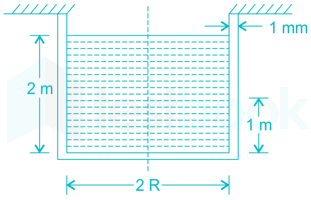
A cylindrical container of radius R = 1 m, wall thickness 1 mm is filled with water up to a depth of 2 m and suspended along its upper rim. The density of water is 1000 kg/m3 and acceleration due to gravity is 10 m/s2. The self-weight of the cylinder is negligible. The formula for hoop stress in thin-walled cylinder can be used at all points along the height of the cylindrical container.

If the Young's modulus and Poisson's ratio of the container material are 100 GPa and 0.3, respectively, the axial strain in the cylinder wall at mid-depth is

  1. AOption (a)

    2 × 10-5

  2. BOption (b)

    6 × 10-5

  3. COption (c)

    7 × 10-5

  4. DOption (d)

    1.2 × 10-4

View answer & explanation

Correct answer

Answer: (a)A.

2 × 10-5

Why this answer is correct

Concept:

Since axial strain is given by σaE−μσcE\frac{{{\sigma _a}}}{E} - μ \frac{{{\sigma _c}}}{E}

Calculation:

Given:

E = 100 GPa, μ = 0.3

Pressure at 1 m depth = 1000 × 10 × 1 = 10000 N/m2

σa=pd4t=10000×24×0.001{\sigma _a} = \frac{{pd}}{{4t}} = \frac{{10000 \times 2}}{{4 \times 0.001}}

= 5 × 10⁶ N/m2  = 5 MPa

σc=pd2t=10000×22×0.001=10×106;Nm2=10;MPa{\sigma _c} = \frac{{pd}}{{2t}} = \frac{{10000 \times 2}}{{2 \times 0.001}} = 10 \times {10^6};\frac{N}{{{m^2}}} = 10;MPa

Axial strain at mid depth

=[5−(0.3×10)]×106100×109=2×10−5 = \frac{{\left[ {5 - \left( {0.3 \times 10} \right)} \right] \times {{10}^6}}}{{100 \times {{10}^9}}} = 2 \times {10^{ - 5}}

Question 48

Two bars of different materials and same size are subjected to the same tensile force. If the bars have unit elongation in the ratio of 2 ∶ 5, then the ratio of modulus of elasticity of the two materials will be

  1. AOption (a)

    2 ∶ 5

  2. BOption (b)

    5 ∶ 2

  3. COption (c)

    4 ∶ 3

  4. DOption (d)

    3 ∶ 4

View answer & explanation

Correct answer

Answer: (b)B.

5 ∶ 2

Why this answer is correct

Concept:

Hooke’s law: As per Hooke’s law, stress is proportional to strain

i.e. σ ∝ ϵ or, σ = ϵ × E

Where, E =  Modulus of Elasticity

For Hooke’s law to be valid:

(a) The material should be homogenous.

(b) The material should be isotropic.

(c) The material should behave in a linearly elastic manner.

Thus for a plane bar with Area ‘A’, Length ‘L’ and Modulus of Elasticity ‘E’,

σ=PA;;and;;ϵ=δLL{\rm{\sigma = }}\frac{{\rm{P}}}{{\rm{A}}};;{\rm{and}};;{\rm{ϵ = }}\frac{{{\rm{δ L}}}}{L}

As per Hooke’s law,

∵ σ = ϵ × E

PA=δLL×E\frac{{\rm{P}}}{{\rm{A}}}{\rm{ = }}\frac{{{\rm{δ L}}}}{{\rm{L}}}{\rm{ × E}}

δL=PLAE{\rm{δ L = }}\frac{{{\rm{PL}}}}{{{\rm{AE}}}}

Calculation:

Given,

Two bars of unit length, i.e L1 = L2

Elongation ratio is 3 : 5, i.e δL1 : δL2 = 2 : 5

Both subjected to same tensile load, i.e P1 = P2

Both have the same size, i.e A1 = A2

Elongation of the first bar:

δL1=P1L1A1E1{\rm{δ L_1 = }}\frac{{{\rm{P_1L_1}}}}{{{\rm{A_1E_1}}}}

Elongation of the second bar:

δL2=P2L2A2E2{\rm{δ L_2 = }}\frac{{{\rm{P_2L_2}}}}{{{\rm{A_2E_2}}}}

Taking ratio,

δL1δL2=P1L1A1E1×A2E2P2L2\frac{{{\rm{\delta }}{{\rm{L}}_1}}}{{{\rm{\delta }}{{\rm{L}}_2}}} = \frac{{{{\rm{P}}_1}{{\rm{L}}_1}}}{{{{\rm{A}}_1}{{\rm{E}}_1}}} \times \frac{{{{\rm{A}}_2}{{\rm{E}}_2}}}{{{{\rm{P}}_2}{{\rm{L}}_2}}}

δL1δL2=E2E1\frac{{{\rm{\delta }}{{\rm{L}}_1}}}{{{\rm{\delta }}{{\rm{L}}_2}}} = \frac{{{{\rm{E}}_2}}}{{{{\rm{E}}_1}}}

∴E1E2=δL2δL1=52\therefore \frac{{{{\rm{E}}_1}}}{{{{\rm{E}}_2}}} = \frac{{{\rm{\delta }}{{\rm{L}}_2}}}{{{\rm{\delta }}{{\rm{L}}_1}}} = \frac{5}{2}

Hence the ratio of modulus of elasticity of the two materials will be 5 : 2

Question 49

The ratio of bulk modulus to Young's modulus for a Poisson's ratio of 0.25 will be

  1. AOption (a)

    13\frac{1}{3}

  2. BOption (b)

    23\frac{2}{3}

  3. COption (c)

    1

  4. DOption (d)

    32\frac{3}{2}

View answer & explanation

Correct answer

Answer: (b)B.

23\frac{2}{3}

Why this answer is correct

Concept :

The relation between E, K and μ

E = 2G (1 + μ)

E = 3K (1 - 2μ)

E=9KG3K+G\text{E}=\frac{9\text{KG}}{3\text{K}+\text{G}}

Where,

E = Young's Modulus of Rigidity = Stress / strain

G = Shear Modulus or Modulus of rigidity = Shear stress / Shear strain

μ = Poisson’s ratio = - lateral strain / longitudinal strain

K = Bulk Modulus of elasticity = Volumetric stress / Volumetric strain

Calculation:

Given:

μ = 0.25, K/E = ?

E = 3K (1 - 2μ)

KE=13(1 − 2μ)\frac{K}{E}=\frac{1}{3(1~-~2\mu)}

KE=13(1 − 2×0.25)=13×0.5=23\frac{K}{E}=\frac{1}{3(1~-~2\times 0.25)}=\frac{1}{3\times 0.5}=\frac{2}{3}

Question 50

The total strain energy stored in a body within elastic limit is termed as

  1. AOption (a)

    resilience

  2. BOption (b)

    proof resilience

  3. COption (c)

    impact energy

  4. DOption (d)

    modulus of resilience

View answer & explanation

Correct answer

Answer: (a)A.

resilience

Why this answer is correct

Explanation:

Strain Energy: 

  • Strain Energy of the member is defined as the internal work done in deforming the body by the action of externally applied forces.
  • Strain energy is given by:
  • Strain;Energy=;12×Stress×Strain×VolumeStrain;Energy = ;\frac{1}{2} \times Stress \times Strain \times Volume

Resilience:

  • Resilience is the total strain energy stored in a given volume of material within the elastic limit.
  • On removal of load, this energy is released.
  • In other words, it is the area under the load-deflection curve within the elastic limit.

Proof resilience:

  • The maximum energy which can be stored in a body up to the elastic limit is called proof resilience.

Modulus of resilience:

  • Modulus of resilience is defined as proof resilience per unit volume. It is the area under the stress-strain curve up to the elastic limit.

50 questions in the full paper