Previous Year Paper

BPSC AE Paper 4 (General Engineering Science) 14 Oct 2022 Official Paper (Previous Year Paper)

Held in 2022

50 questions60 minutes
With answers
Free

Paper last updated:

Practise under exam conditions

Take this paper as a timed mock test. Review your answers after you submit.

Attempt timed test

Questions & answers

Read the paper at your pace. Open an explanation when you need it.

Full Test (50 questions)

Question 1

Two unlike parallel forces are shown in the following figure:

The resultant R can be located by the relation

  1. AOption (a)

    d1 × d2 = F1 ×F2

  2. BOption (b)

    F1 × d2 = F2 × d1

  3. COption (c)

    F1 / d1 = F2 / d2

  4. DOption (d)

    F1 × d1 = F2 × d2

View answer & explanation

Correct answer

Answer: (d)D.

F1 × d1 = F2 × d2

Why this answer is correct

Explanation:

In the provided image, two unlike parallel forces F1​ and F2​ are acting on a body at distances d1​ and d2​ from the resultant force R, and we need to find the correct relation that locates the resultant force.

Moment Balance:

Using the principle of moments, for two unlike parallel forces:

F1 × d1 = F2 × d2​

This equation states that the moment produced by the first force (F1​) around the resultant must be equal to the moment produced by the second force (

F2​) around the resultant.

Question 2

On a ladder resting on a smooth ground and leaning against rough vertical wall, the force of friction acts

  1. AOption (a)

    upward at its upper end

  2. BOption (b)

    toward the wall at the upper end

  3. COption (c)

    toward the wall at lower end

  4. DOption (d)

    downward at its upper end

View answer & explanation

Correct answer

Answer: (a)A.

upward at its upper end

Why this answer is correct

Explanation:

  • When a ladder rests on a smooth horizontal surface and leans against a rough vertical wall.
  • As seen from the diagram, the lower end of the ladder will start moving horizontally due to the gravitational pull of earth towards the ladder.
  • As the surface is smooth, there would be no frictional force on the smooth horizontal surface.
  • But as the ladder moves horizontally, the upper end of the ladder starts moving down and this motion of ladder down will be opposed by a frictional force in the upward direction as the wall is rough.

Question 3

A circular disc rotating with constant angular speed of 5 rad/s, moves along a straight, line. The mass and the radius of the disc are 10 kg and 1.0 m respectively. The total kinetic energy possessed by the disc will be

  1. AOption (a)

    187.5 N-m

  2. BOption (b)

    125 N-m

  3. COption (c)

    62.5 N-m

  4. DOption (d)

    250 N-m

View answer & explanation

Correct answer

Answer: (a)A.

187.5 N-m

Why this answer is correct

Concept:

The total kinetic energy of a rotating and translating disc is the sum of its translational and rotational kinetic energies.

Given Data:

  • Mass of the disc (m m ) = 10 kg
  • Radius of the disc (r r ) = 1.0 m
  • Angular speed (ω \omega ) = 5 rad/s

Step 1: Calculate Translational Kinetic Energy:

The translational kinetic energy is given by:

KEtrans=12mv2 KE_{\text{trans}} = \frac{1}{2} m v^2

Where v=r⋅ω v = r \cdot \omega is the linear velocity of the disc.

Substitute the values:

v=1.0×5=5,m/s v = 1.0 \times 5 = 5 , \text{m/s}

KEtrans=12×10×(5)2=125,N-m KE_{\text{trans}} = \frac{1}{2} \times 10 \times (5)^2 = 125 , \text{N-m}

Step 2: Calculate Rotational Kinetic Energy:

The rotational kinetic energy is given by:

KErot=12Iω2 KE_{\text{rot}} = \frac{1}{2} I \omega^2

Where I I is the moment of inertia of the disc, which for a solid disc is I=12mr2 I = \frac{1}{2} m r^2 .

Substitute the values:

I=12×10×(1.0)2=5,kg⋅m2 I = \frac{1}{2} \times 10 \times (1.0)^2 = 5 , \text{kg} \cdot \text{m}^2

KErot=12×5×(5)2=62.5,N-m KE_{\text{rot}} = \frac{1}{2} \times 5 \times (5)^2 = 62.5 , \text{N-m}

Step 3: Calculate Total Kinetic Energy:

The total kinetic energy is the sum of translational and rotational kinetic energies:

KEtotal=KEtrans+KErot=125+62.5=187.5,N-m KE_{\text{total}} = KE_{\text{trans}} + KE_{\text{rot}} = 125 + 62.5 = 187.5 , \text{N-m}

Question 4

If the tension in the cable supporting the lift moving upwards is twice the tension when the lift is moving down - wards, the acceleration of the lift is equal to

  1. AOption (a)

    g2\frac{g}{2}

  2. BOption (b)

    g3\frac{g}{3}

  3. COption (c)

    g4\frac{g}{4}

  4. DOption (d)

    g5\frac{g}{5}

View answer & explanation

Correct answer

Answer: (b)B.

g3\frac{g}{3}

Why this answer is correct

Concept:

Let lift is moving in an upward direction with acceleration ‘a’.

Tension in the string (T1)  = m(g+a) where m is the mass of lift.

Let lift is moving in a downward direction with acceleration ‘a’.

Tension in the string (T2) = m(g-a)

T1 = 2T2  (given)

m(g+a) = 2m (g-a)

a = g/3

Question 5

Which of the following equipments can be used for construction work like - to clear the site of work, to make the land level, etc.?

  1. AOption (a)

    Scraper

  2. BOption (b)

    Grader

  3. COption (c)

    Excavator

  4. DOption (d)

    Bulldozer

View answer & explanation

Correct answer

Answer: (d)D.

Bulldozer

Why this answer is correct

Explanation:

Scraper:

  • A scraper is used for digging and moving soil over relatively short distances. While it can be used for leveling, its primary purpose is for material removal and hauling.

Grader:

  • A grader is typically used to create a smooth, flat surface after rough grading has been done by other equipment like a bulldozer. It is used more for precision grading rather than clearing a site.

Excavator:

  • An excavator is primarily used for digging and moving large quantities of earth but is not generally used for leveling or clearing a site.

Bulldozer:

  • A bulldozer is ideal for clearing the site, leveling land, and moving large amounts of soil. It has a large, flat blade in front, which makes it perfect for clearing debris and leveling land for construction purposes.

Question 6

Size of a theodolite is specified by

  1. AOption (a)

    the length of telescope

  2. BOption (b)

    the diameter of vertical circle

  3. COption (c)

    the diameter of lower plate

  4. DOption (d)

    the diameter of upper plate

View answer & explanation

Correct answer

Answer: (c)C.

the diameter of lower plate

Why this answer is correct

Explanation:

Important points related to theodolite: 

1. The size of a theodolite is defined by the diameter of the graduated circle of the lower plate. For example, a 25 cm theodolite means the diameter of the graduated circle of the lower plate is 25 cm. The size of the theodolite varies from 8-25 cm. 2. The process of establishing intermediate points, on a given straight line whose ends are intervisible is done with a theodolite is called lining in. 3. Removal of parallax may be achieved by refocusing the eyepiece and the objective. 4. Line of collimation: It is an imaginary line passing through the intersection of the crosshairs at the diaphragm and the optical center of the object-glass and its continuation. 5. Axis of Bubble tube: It is an imaginary line tangential to the longitudinal curve of the bubble tube at its midpoint. 6. Axis of a telescope: This axis is an imaginary passing through the optical center of the object-glass and the optical center of the eye-piece.

Pictorial section of theodolite:

Question 7

Which of the following is not used in total station equipment?

  1. AOption (a)

    Battery

  2. BOption (b)

    Serial cable

  3. COption (c)

    Memory card

  4. DOption (d)

    Alidade

View answer & explanation

Correct answer

Answer: (d)D.

Alidade

Why this answer is correct

Explanation:

Battery:

  • Total stations are electronic devices, and they require a battery to power their operations.

Serial cable:

  • Used to transfer data between the total station and external devices such as computers for further analysis.

Memory card:

  • Used to store large amounts of measurement data directly on the total station.

Alidade:

  • This is a part of older manual surveying instruments, such as theodolites or plane tables, used to sight and measure angles, but is not a part of modern total station equipment.

Question 8

Repeatability of the instrument with respect to a given fixed input is

  1. AOption (a)

    accuracy

  2. BOption (b)

    precision

  3. COption (c)

    resolution

  4. DOption (d)

    sensitivity

View answer & explanation

Correct answer

Answer: (b)B.

precision

Why this answer is correct

Explanation:

Repeatability of an instrument refers to its ability to provide consistent results for the same input under identical conditions over multiple trials. In other words, it's a measure of how well an instrument can reproduce the same measurement for a given input, indicating its reliability in providing the same output repeatedly.

The correct term that defines this characteristic is Precision.

Additional Information

  • Accuracy: Refers to how close the measured value is to the true or accepted value.
  • Resolution: The smallest detectable change in the input that the instrument can distinguish.
  • Sensitivity: The ability of an instrument to detect small changes in the input.

Question 9

LVDT works on the principle of

  1. AOption (a)

    variable resistance

  2. BOption (b)

    variable mutual induction

  3. COption (c)

    variable self - induction

  4. DOption (d)

    variable capacitance

View answer & explanation

Correct answer

Answer: (b)B.

variable mutual induction

Why this answer is correct

LVDT works on the principle of Variable mutual induction.

Linear variable differential transformer (LVDT):

  • LVDT (Linear Variable Differential Transformer) is to convert the rectangular movement of an object to the equivalent electrical signal
  • LVDT is used to measure displacement and works on the transformer principle
  • The LVDT alters a linear dislocation from a mechanical position into a relative electrical signal including phase and amplitude of the information of direction and distance
  • The working principle of the linear variable differential transformer or LVDT working theory is mutual induction. The dislocation is nonelectrical energy that is changed into electrical energy.​

​

  • The inner coil is the primary, which is excited by an AC source.
  • Magnetic flux produced by the primary is coupled to the two secondary coils, inducing an AC voltage in each coil.

​Applications:

  • This transducer can also work as a secondary transducer
  • LVDT is used to measure the weight, force and also pressure
  • Some of these transducers are used to calculate the pressure and load
  • LVDT’s are mostly used in industries as well as servomechanisms
  • Other applications like power turbines, hydraulics, automation, aircraft, and satellites

Question 10

The basic unit in angular measurement is

  1. AOption (a)

    degree

  2. BOption (b)

    minute

  3. COption (c)

    second

  4. DOption (d)

    right angle

View answer & explanation

Correct answer

Answer: (a)A.

degree

Why this answer is correct

Explanation:

The basic unit in angular measurement is the degree.

  • Degree: The degree (°) is the fundamental unit for measuring angles. One full circle is divided into 360 degrees.
  • Minute: A minute (') is 1/60th of a degree.
  • Second: A second (") is 1/60th of a minute or 1/3600th of a degree.
  • Right Angle: A right angle is a specific angle of 90 degrees.

Question 11

 Universal surface gauge is used

  1. AOption (a)

    for flatness testing

  2. BOption (b)

    for layout work and inspection

  3. COption (c)

    for measuring profile of complex surface

  4. DOption (d)

    for measuring surface roughness

View answer & explanation

Correct answer

Answer: (b)B.

for layout work and inspection

Why this answer is correct

Explanation:

Universal Surface Gauge:

  • A universal surface gauge is a versatile instrument used in machine shops and metalworking for precision marking, measurement, and testing.
  • It typically consists of a heavy base, a spindle (also known as a beam or post), and an adjustable scriber or test indicator.
  • A universal surface gauge is a precision instrument used mainly in layout work and inspection in metalworking and machining. Its primary uses include: 
  • Scribing lines parallel to a reference surface.
  • Checking the height of objects.
  • Transferring measurements.
  • Marking out workpieces before machining
  • Its ability to hold various types of measuring instruments and adjust to different positions makes it highly versatile for ensuring accurate and precise measurements in metalworking and machining processes.

Parts and functions of a Universal Surface Gauge:

Base:

  • The base is made of steel or cast iron with a 'V' groove at the bottom.
  • The 'V' groove helps to seat on circular work.
  • The guide pins, fitted in the base, are helpful for scribing lines from any datum edge.

Rocker's arm:

  • The rocker's arm is attached to the base along with a spring and a fine adjustment screw. This is used for fine adjustments.

Spindle:

  • The spindle is attached to the rocker's arm.

Scriber:

  • The scriber can be clamped in any position on the spindle with the help of a snug and a clamping nut.

Question 12

 Mohr's circle construction is valid for both stress as well as the area moment of inertia because

  1. AOption (a)

    both are tensors of first - order

  2. BOption (b)

    both are tensors of second - order

  3. COption (c)

    both are axial vectors

  4. DOption (d)

    both occur under plane stress condition

View answer & explanation

Correct answer

Answer: (b)B.

both are tensors of second - order

Why this answer is correct

Explanation:

Mohr’s Circle:

  • It is a two-dimensional graphical representation of the state of stress inside a body. The abscissa and ordinate of each point on the circle are the magnitudes of the normal stress and shear stress components, respectively, acting on the rotated coordinate system.
  • In other words, the circle is the locus of points that represent the state of stress on individual planes at all their orientations, where the axes represent the principal axes of the stress element.
  • So, from Mohr’s circle, both major principal stress and minor principal stress can be determined. Also, normal stress and tangential stress at any plane can be determined. Even, the maximum stresses can be found out from the Mohr’s circle.
  • Mohr's circle represents the transformation of the second-order tensor.
  • The Mohr circle can be applied to any symmetric tensor matrix, including the strain and moment of inertia tensors

​\(\sigma = {\sigma _y} = \left[ {\begin{array}{*{20}{c}} {{\sigma _x}}&{{\tau _{yx}}}&{{\tau _{zx}}}\ {{\tau _{xy}}}&{{\sigma _y}}&{{\tau _{zy}}}\ {{\tau _{xz}}}&{{\tau _{yz}}}&{{\sigma _z}} \end{array}} \right]\)

The following diagram illustrates how many different kinds of stresses can be found out from the Mohr’s circle:

Question 13

A solid steel shaft of 100 mm diameter and 1.0 m long is subjected to a twisting moment T. This shaft is to be replaced by a hollow shaft having outer and inner diameter as 100 mm and 50 mm respectively. If the maximum shear stress induced in both the shafts is same, the twisting moment T transmitted by hollow shaft must be reduced by

  1. AOption (a)

    T / 4 

  2. BOption (b)

    T / 8

  3. COption (c)

    T / 16

  4. DOption (d)

    T / 12

View answer & explanation

Correct answer

Answer: (c)C.

T / 16

Why this answer is correct

Concept:

Considering the rigidity of shaft, The maximum shear stress induced in the solid shaft of diameter d, to transmit twisting moment T is given by,

τmax;=16Tπd3\tau_{max};=\frac{{16T}}{{\pi d^3 }}

The maximum shear stress induced in the hollow shaft of outer diametr do and inner diameter di to transmit the twisting moment T.

.τmax;=16Tπdo3(1−K4)\tau_{max};=\frac{{16T}}{{\pi d_o^3 (1-K^4)}}, where K is the ratio of outer and inner diameter, K=didoK =\frac{{d_i}}{{d_o}}

Calculation:

Given:

Diameter of solid shaft, d = 100 mm, Outer diameter of hollow shat, do = d = 100 mm, Inner diameter of hollow shaft, di = 50 mm

K=dido=50100=12K =\frac{{d_i}}{{d_o}}=\frac{{50}}{{100}}=\frac{{1}}{{2}}

The maximum shear stress induced in the shaft is the same, so the ratio of a twisting moment of the hollow and solid shaft.

THTS=;(1−K4);=;(1;−;116);=;1516\frac{{T_H}}{{T_S}}=;(1-K^4);=;(1;-;\frac{{1}}{{16}});=;\frac{{15}}{16{}}

Clearly, TH is less than TS and is less by,

 TS−THTS=116;\frac{{{T_S} - {T_H}}}{{{T_S}}} = \frac{1}{{16}};

Hence, the twisting moment T transmitted by hollow shaft must be reduced by 116\frac{{1}}{{16}}.

Question 14

The stresses induced in a shaft due to bending and torsion load are 80 MPa and 30 MPa respectively. The yield strength of the shaft material is 280 MPa. Using maximum shear stress theory, the factor of safety will be

  1. AOption (a)

    2.54

  2. BOption (b)

    3.4

  3. COption (c)

    5.6

  4. DOption (d)

    2.8

View answer & explanation

Correct answer

Answer: (d)D.

2.8

Why this answer is correct

Concept:

The factor of safety using the maximum shear stress theory (Tresca's theory) is determined by calculating the maximum shear stress induced by combined bending and torsion loads and comparing it with the material’s yield strength.

Given Data:

  • Bending stress (σb \sigma_b ) = 80 MPa
  • Torsional stress (τ \tau ) = 30 MPa
  • Yield strength (Sy S_y ) = 280 MPa

Step 1: Calculate Maximum Shear Stress:

According to Tresca's theory, the maximum shear stress is given by:

τmax=σb2+4τ22 \tau_{\text{max}} = \frac{\sqrt{\sigma_b^2 + 4\tau^2}}{2}

Substituting the given values:

τmax=802+4×3022=6400+36002=100002=50,MPa \tau_{\text{max}} = \frac{\sqrt{80^2 + 4 \times 30^2}}{2} = \frac{\sqrt{6400 + 3600}}{2} = \frac{\sqrt{10000}}{2} = 50 , \text{MPa}

Step 2: Calculate Factor of Safety:

The factor of safety (FoS) is calculated as:

Factor of Safety=Sy2τmax \text{Factor of Safety} = \frac{S_y}{2 \tau_{\text{max}}}

Substituting the values:

Factor of Safety=2802×50=280100=2.8 \text{Factor of Safety} = \frac{280}{2 \times 50} = \frac{280}{100} = 2.8

Question 15

A column of length L has one end hinged and other fixed. The cross - section of the column is a circle of diameter D. The slenderness ratio of the column is

  1. AOption (a)

    √2 L/D

  2. BOption (b)

    2√2 L/D

  3. COption (c)

    2 L/D 

  4. DOption (d)

    4 L/D

View answer & explanation

Correct answer

Answer: (b)B.

2√2 L/D

Why this answer is correct

Concept:

The slenderness ratio of a column is used to describe its likelihood to buckle under compressive loads. It is defined as the ratio of the effective length of the column to its radius of gyration.

Slenderness Ratio=Leffectiver \text{Slenderness Ratio} = \frac{L_{\text{effective}}}{r}

Where:

  • Leffective L_{\text{effective}} = Effective length of the column
  • r r = Radius of gyration of the column

Step 1: Determine the Effective Length:

For a column with one end hinged and the other end fixed, the effective length is:

Leffective=L2 L_{\text{effective}} = \frac{L}{\sqrt{2}}

Step 2: Calculate the Radius of Gyration:

For a circular cross-section with diameter D D , the radius of gyration is:

r=D4 r = \frac{D}{4}

Step 3: Calculate the Slenderness Ratio:

The slenderness ratio is calculated as:

Slenderness Ratio=Leffectiver=L/2D/4=4LD2=22LD \text{Slenderness Ratio} = \frac{L_{\text{effective}}}{r} = \frac{L/\sqrt{2}}{D/4} = \frac{4L}{D\sqrt{2}} = \frac{2\sqrt{2} L}{D}

Question 16

The common household glass is

  1. AOption (a)

    soda - lime glass

  2. BOption (b)

    borosilicate glass

  3. COption (c)

    high silica glass

  4. DOption (d)

    lead glass

View answer & explanation

Correct answer

Answer: (a)A.

soda - lime glass

Why this answer is correct

Explanation:

The common household glass used in windows, bottles, and other general applications is soda-lime glass.

Soda-Lime Glass: This is the most widely produced type of glass, accounting for about 90% of all glass manufactured. It is made from silica (SiO₂), soda (Na₂O), and lime (CaO). Soda-lime glass is used in common household items like bottles, jars, windows, and drinking glasses. It is relatively inexpensive to produce and has good chemical stability and durability.

Additional Information

  1. Borosilicate Glass: This type of glass is more resistant to thermal shock and chemical corrosion. It is used for laboratory glassware, kitchenware like Pyrex, and some high-temperature applications. Borosilicate glass has a higher silica content than soda-lime glass and is more expensive to produce.
  2. High Silica Glass: This glass contains more than 96% silica and is highly resistant to high temperatures. It is used in specialized applications such as aerospace and laboratory equipment but is not common in household items.
  3. Lead Glass (Lead Crystal): This glass contains lead oxide, which increases its refractive index, making it highly suitable for decorative items like crystal vases and glassware. Lead glass is not commonly used for everyday household items due to its cost and fragility.

Question 17

Which one of the following timbers is used for sports goods?

  1. AOption (a)

    Mulberry

  2. BOption (b)

    Mahogany

  3. COption (c)

    Sal

  4. DOption (d)

    Deodar

View answer & explanation

Correct answer

Answer: (a)A.

Mulberry

Why this answer is correct

Explanation:

Mulberry wood is brown in colour and is so famous because of its elastic nature. It is strong, tough and elastic also. It can be easily turned and carved. It is used for making sports goods like cricket bats, hockey sticks etc.

Mahogany is reddish Brown in colour and is durable in under-water conditions. It is used in furniture, fancy goods, ornamental panelling etc.

Sal wood is hard, brown and close grained. It is fibrous and good polishing is difficult to achieve but it is good against moist conditions. It is used in railway sleepers, Wagons, Bridges etc.

Deodar tree produces soft timber which is used for several purposes. It is used in cheap furniture, railway carriages, packing boxes etc.

Question 18

Ball bearings are generally made of

  1. AOption (a)

    cast iron

  2. BOption (b)

    malleable cast iron

  3. COption (c)

    carbon steel

  4. DOption (d)

    carbon - chrome steel

View answer & explanation

Correct answer

Answer: (d)D.

carbon - chrome steel

Why this answer is correct

Explanation:

  • The most common chrome steels contain from 0.5 to 2% chromium and 0.1 to 1.5% carbon. The chrome steel is used for balls, rollers and races for bearings.
  • A Nickel-Chrome steel containing 3.25% nickel, 1.5% chromium and 0.25% carbon is much used for armour plates.
  • Chrome nickel steel is extensively used for motor car crankshafts, axles and gears requiring great strength and hardness.

Question 19

The alloy used for manufacture of food processing machinery is

  1. AOption (a)

    Inconel

  2. BOption (b)

    Monel metal

  3. COption (c)

    Duraluminium

  4. DOption (d)

    Babbit metal

View answer & explanation

Correct answer

Answer: (b)B.

Monel metal

Why this answer is correct

Explanation:

Inconel:

  • Excellent for high temperatures and oxidation resistance but over-engineered and costly for food processing.

Monel Metal:

  • Ideal for food processing due to its outstanding corrosion resistance in acidic and alkaline environments, making it safe and durable.

Duralumin:

  • Lightweight and strong but not corrosion-resistant enough for food environments.

Babbit Metal:

  • Primarily used for bearing applications with anti-friction properties; not suitable for food processing due to low corrosion resistance and potential lead content.

Question 20

Copper has FCC structure, its atomic radius is 1.28 Å and atomic mass is 63.5. The density of copper will be

  1. AOption (a)

    8.9 × 10³ kg/mm3

  2. BOption (b)

    8.9 × 103 kg/cm3

  3. COption (c)

    8.9 × 103 kg/m3

  4. DOption (d)

    8.9 × 103 g/mm3

View answer & explanation

Correct answer

Answer: (c)C.

8.9 × 103 kg/m3

Why this answer is correct

Concept:

Theoretical density of a crystal structure:

ρ=nANAVc\rho = \frac{{nA}}{{{N_A}{V_c}}}

N: Number of atoms associated with each unit cell

A: Atomic weight

Vc: Volume of unit cell

NA: Avogadro’s number (6.023 × 10²³ atoms/mol)

Copper has FCC unit cell, thus:

n = 4

Vc = a3

In FCC:

a=22;ra = 2\sqrt 2 ;r

Calculation:

Given, r = 1.28 Å = 1.28 × 10-10 m

a=22×1.28×10−10a = 2\sqrt 2 × 1.28 × {10^{ - 10}}

Vc = a3

A = 63.5 

Vc=(22×1.28×10−10)3=4.74×10⁻²⁹{V_c} = {\left( {2\sqrt 2 × 1.28 × {{10}^{ - 10}}} \right)^3} = 4.74 × {10^{ - 29}} m3

ρ=nANAVc=4×63.56.023×1023×4.74×10−29×1000=8.89×10³kgm3;\rho = \frac{{nA}}{{{N_A}{V_c}}} = \frac{{4 × 63.5}}{{6.023 × {{10}^{23}} × 4.74 × {{10}^{ - 29}} × 1000}} = 8.89 × {10^3}\frac{{kg}}{{{m^3}}};

Question 21

In works management, theory of transactional analysis (TA) is applied to determine the

  1. AOption (a)

    feasibility of project

  2. BOption (b)

    cause of behaviour of personnel

  3. COption (c)

    time taken for each activity

  4. DOption (d)

    best layout

View answer & explanation

Correct answer

Answer: (b)B.

cause of behaviour of personnel

Why this answer is correct

Explanation:

Eric Berne established Transactional Analysis (TA) as a psychoanalytic theory and therapeutic practise in the 1950s. People's communication interactions are referred to as transactions.

Transactional analysis-Is a technique used to help people better understand their own and others behavior, especially in interpersonal communication transactional analysis is the method used to analyze this process of transactions in communication with others. It requires us to be aware of how we feel, think and behave during interactions with others.

Question 22

A PERT network has three activities on critical path with mean time 3, 8 and 6, and standard deviation 1, 2 and 3 respectively. The probability that the project will be completed in 20 days is

  1. AOption (a)

    0.50

  2. BOption (b)

    0.66

  3. COption (c)

    0.84

  4. DOption (d)

    0.95

View answer & explanation

Correct answer

Answer: (c)C.

0.84

Why this answer is correct

Concept:

In a PERT (Program Evaluation and Review Technique) network, the project completion time is modeled using a normal distribution. To determine the probability that the project will be completed within a certain time, we calculate the total mean, standard deviation, and then the Z-score.

Given Data:

  • Mean times of activities on the critical path: 3 days, 8 days, and 6 days.
  • Standard deviations of activities: 1 day, 2 days, and 3 days.
  • Target completion time: 20 days.

Step 1: Calculate the Total Mean Time:

Total Mean Time=3+8+6=17,days \text{Total Mean Time} = 3 + 8 + 6 = 17 , \text{days}

Step 2: Calculate the Total Standard Deviation:

The total standard deviation is calculated by summing the variances (squares of standard deviations) and then taking the square root.

Total Variance=12+22+32=1+4+9=14 \text{Total Variance} = 1^2 + 2^2 + 3^2 = 1 + 4 + 9 = 14

Total Standard Deviation=14≈3.74,days \text{Total Standard Deviation} = \sqrt{14} \approx 3.74 , \text{days}

Step 3: Calculate the Z-Score:

The Z-score is the number of standard deviations the target time is from the mean time:

Z=20−173.74≈33.74≈0.80 Z = \frac{20 - 17}{3.74} \approx \frac{3}{3.74} \approx 0.80

Step 4: Find the Probability:

Using a Z-score table or calculator, the probability corresponding to a Z-score of 0.80 is approximately 0.7881. This means there is a 78.81% chance that the project will be completed in 20 days.

Conclusion: The closest match to the probability is Option 3: 0.84.

Question 23

Depreciation of machines is categorized under the head

  1. AOption (a)

    direct expenses

  2. BOption (b)

    indirect expenses

  3. COption (c)

    administrative expenses

  4. DOption (d)

    indirect material costs 

View answer & explanation

Correct answer

Answer: (b)B.

indirect expenses

Why this answer is correct

Explanation:

  • Expanses of production refers to the total money needed for the production of a particular product.
  • These expanses  are usually classified as direct or indirect costs.
  • Direct costs tend to be variable costs, while indirect costs are more likely to be either fixed costs or period costs.
  • Examples of direct costs are direct labor, direct materials, commissions, piece rate wages, and manufacturing supplies.
  • Examples of indirect costs are production supervision salaries, quality control costs, insurance, and depreciation.

Question 24

 Bernoulli's theorem is applicable for

  1. AOption (a)

    streamline flow

  2. BOption (b)

    turbulent flow

  3. COption (c)

    normal flow

  4. DOption (d)

    perfect incompressible fluid flowing in continuous streams

View answer & explanation

Correct answer

Answer: (d)D.

perfect incompressible fluid flowing in continuous streams

Why this answer is correct

Explanation:

Bernoulli’s Equation is known as the conservation of energy principle and states that in a steady, ideal flow of an incompressible fluid, the total energy at any point of the fluid is constant. The total energy consists of pressure energy, kinetic energy and potential energy or datum energy.

Pw+v22g+z=constant \frac{P}{w} + \frac{{{v^2}}}{{2g}} + z = constant

The following are the assumptions made in the derivation of Bernoulli's equation:

  1. The fluid is ideal i.e. viscosity is zero
  2. The flow is steady
  3. The flow is incompressible
  4. The flow is one dimensional

Question 25

The continuity equation

  1. AOption (a)

    requires that Newton's second law of motion be satisfied at every point in fluid

  2. BOption (b)

    relates the momentum per unit volume for two points on a streamline

  3. COption (c)

    expresses the relation between energy and work

  4. DOption (d)

    relates mass rate of flow along a streamline

View answer & explanation

Correct answer

Answer: (d)D.

relates mass rate of flow along a streamline

Why this answer is correct

Explanation:

Continuity Equation is based on the principle of conservation of mass. For a fluid flowing through a pipe at all the cross-section, the quantity of fluid per second is constant.

The continuity equation is given as ρ1A1V1=;ρ2A2V2{\rho _1}{A_1}{V_1} = ;{\rho _2}{A_2}{V_2}

Momentum Equation – It states that the net force acting on a fluid mass is equal to the change in the momentum of flow per unit time in that direction i.e. Newton’s second law of motion.

Energy Equation – It is popularly known as Bernoulli’s Equation. It states that the sum of potential energy, kinetic energy and pressure energy per unit mass of a liquid is constant at all sections in an incompressible liquid that has a streamlined flow and does not offer any friction.

Question 26

Head loss in turbulent flow in a pipe

  1. AOption (a)

    varies directly as velocity

  2. BOption (b)

    varies inversely as square of velocity

  3. COption (c)

    depends upon orientation of pipe

  4. DOption (d)

    varies inversely as velocity

View answer & explanation

Correct answer

Answer: (a)A.

varies directly as velocity

Why this answer is correct

Explanation:

Turbulent flow – Turbulent flow occurs at relatively larger velocities and is characterized by chaotic behaviour, irregular motion, large mixing and eddies. For such flows, inertial effects are more pronounced than the viscous effects.

  • Mathematically the velocity field of turbulent flow is represented asV=Vˉ+V′V = \bar V + V' or the velocity fluctuates at small time scales around a large time-averaged velocity.
  • Similarly,  P=Pˉ+P′,T=Tˉ+T′P = \bar P + P',T = \bar T + T'etc.
  • Parameter Reynolds number (ρvdμ)\left( {\frac{{\rho vd}}{\mu }} \right) is used to characterize Laminar and Turbulent flow.
  • If Re < 2100 for pipe flow the flow is laminar and if Re > 104 the flow is turbulent.

For Turbulent flow, the velocity or pressure field may not be exactly (Analytically) represented. So we will solve it using dimensional analysis.

   ΔP=ΔP(D,L,V,‾ρ,μ,ε){\rm{\Delta }}P = {\rm{\Delta }}P\left( {D,L,\overline {V,} \rho ,\mu ,\varepsilon } \right)      where ε = Surface roughness


ΔPρV2‾=f(ρvdμ,LD,εD)=f(Re,LD,εD)\frac{{{\bf{\Delta }}P}}{{\rho \overline {{V^2}} }} = f\left( {\frac{{\rho vd}}{\mu },\frac{L}{D},\frac{\varepsilon }{D}} \right) = f\left( {{R_e},\frac{L}{D},\frac{\varepsilon }{D}} \right),  the turbulent flow through the pipe turbulent pressure drop or head loss is a function of the square of velocity.

  • The experimental observations suggest that pressure drop in the pipe flow under turbulent conditions depends upon Reynolds number and surface roughness.

Question 27

Heat transfer takes place as per

  1. AOption (a)

    zeroth law of thermodynamics

  2. BOption (b)

    second law of thermodynamics

  3. COption (c)

    Kirchhoff's law

  4. DOption (d)

    Stefan's law

View answer & explanation

Correct answer

Answer: (b)B.

second law of thermodynamics

Why this answer is correct

Explanation:

The second law of thermodynamics:

According to the Second Law of thermodynamics for natural systems heat always flows in one direction (higher temperature to lower temperature body) unless it is aided by an external factor.

And to measure the direction of flow we use term entropy which can be expressed as


Zeroth law of thermodynamics:

The zeroth law of thermodynamics states that if two thermodynamic systems are each in thermal equilibrium with a third, then they are in thermal equilibrium with each other.

<br>

This law is the basis for temperature measurement.


The first law of thermodynamics:

The first law of thermodynamics states that energy cannot be created or destroyed in an isolated system; energy can only be transferred or changed from one form to another.

The first law of thermodynamics is a restatement of the law of conservation of energy.

i.e., According to the first law of Thermodynamics:

ΔQ = ΔW + ΔU

Additional Information

This is the conclusive point for the given statements

Zeroth law – Concept of temperature

First law – Concept of internal energy

Second law – Concept of entropy/direction of heat flow.

Question 28

A gray body is one whose absorptivity

  1. AOption (a)

    varies with temperature

  2. BOption (b)

    varies with the wavelength of incident ray

  3. COption (c)

    does not vary with temperature and wavelength of the incident ray

  4. DOption (d)

    There is no such criterion

View answer & explanation

Correct answer

Answer: (c)C.

does not vary with temperature and wavelength of the incident ray

Why this answer is correct

The correct option is 3.

Explanation:

When thermal radiation falls onto an object,

  • The radiation will be absorbed by the surface of the object, causing its temperature to change
  • The radiation will be reflected from the surface of the body, causing no temperature change
  • The radiation will pass completely through the object, causing no temperature change
<br>

Absorptivity (α) is a measure of how much of the radiation is absorbed by the body

Reflectivity (ρ) is a measure of how much is radiation is reflected

Transmissivity (τ) is a measure of how much radiation passes through the object.

Each of these parameters is a number that ranges from 0 to 1.

Absorptivity may be a function of wavelength and/or direction, and is related to the emissivity of the region by Kirchhoff's law. The absorptivity is identically equal to unity for black bodies and is independent of temperature and wavelength for gray bodies.

Question 29

According to the first law of thermodynamics

  1. AOption (a)

    mass and energy are mutually convertible

  2. BOption (b)

    Carnot engine is most efficient

  3. COption (c)

    heat and work are mutually convertible

  4. DOption (d)

    mass and light are mutually convertible

View answer & explanation

Correct answer

Answer: (c)C.

heat and work are mutually convertible

Why this answer is correct

The correct option is 3

Concept:

According to the First Law of thermodynamics, “For a closed system undergoing a cycle, net heat transfer is equal to network transfer.”

When heat energy is supplied to a gas, two things may occur:

  • The internal energy of the gas may change
  • The gas may do some external work by expanding

According to the first law of Thermodynamics:

δQ = δW + ΔU

When a process is executed by a system, the change in stored energy of the system is numerically equal to the net heat interaction minus the net work interaction during the process:

ΔU = δQ – δW where U is the internal energy that is introduced by this law.

For the cyclic process: ΔU = 0

∮δQ=∮δW\oint \delta Q = \oint \delta W

The first law of thermodynamics states that for a cyclic process, the cyclic integral of heat is equal to the cyclic integral of work.

ΣQ = ΣW

So, heat and work are mutually convertible.

The second law of thermodynamics introduces the concept of entropy.

Question 30

According to Clausius statement

  1. AOption (a)

    heat flows from hot substance to cold substance

  2. BOption (b)

    heat flows from very hot substance to cold substance

  3. COption (c)

    heat cannot flow from cold substance to hot substance

  4. DOption (d)

    heat can flow from cold substance to hot substance with the aid of external work

View answer & explanation

Correct answer

Answer: (d)D.

heat can flow from cold substance to hot substance with the aid of external work

Why this answer is correct

According to the Clausius statement: 4) heat can flow from cold substance to hot substance with the aid of external work

Explanation:

The Clausius statement of the second law of thermodynamics essentially states that it is impossible to construct a device that operates in a cycle and produces no effect other than the transfer of heat from a colder body to a hotter body.

This implies that for heat to move from a colder object to a hotter object (which is not its natural direction), external work must be supplied (as seen in refrigerators and heat pumps).

Question 31

The air standard efficiency of an Otto cycle compared to diesel cycle for the given compression ratio is

  1. AOption (a)

    same

  2. BOption (b)

    less

  3. COption (c)

    more

  4. DOption (d)

    more or less depending on power rating

View answer & explanation

Correct answer

Answer: (c)C.

more

Why this answer is correct

Explanation:

For the same compression ratio

Otto cycle has more area under the P-V diagram compared to the diesel cycle.

ηotto=1−1rγ−1{\eta _{otto}} = 1 - \frac{1}{{{r^{\gamma - 1}}}}

ηdiesel=1−1rγ−1αγ−1γ(α−1){\eta _{diesel}} = 1 - \frac{1}{{{r^{\gamma - 1}}}}\frac{{{\alpha ^\gamma } - 1}}{{\gamma \left( {\alpha - 1} \right)}}

By little observation, we can understand this from the efficiency formula also,

  • In the formula of Otto and diesel cycle, there is something common, like the compression ratio part.
  • Now think of the extra term in the efficiency formula of diesel cycle, for practical cutoff ratio, this term is always greater than one.
  • The extra term in the efficiency formula of diesel cycle will approach unity when the cutoff ratio approaches unity, which is quite impractical.

Hence, For the same compression ratio, the efficiency of an Otto cycle is higher than that of the diesel cycle.

i.e. ηotto > ηDual > ηDiesel

Question 32

Reaction turbines are used for

  1. AOption (a)

    low head

  2. BOption (b)

    high head

  3. COption (c)

    high head and low discharge

  4. DOption (d)

    low head and high discharge

View answer & explanation

Correct answer

Answer: (d)D.

low head and high discharge

Why this answer is correct

Explanation:

  • Reaction turbines are used for low and medium heads (usually less than 300 m) and for high discharge.


TurbineFlow directionPrinciple of operationHead (m)Specific speed
Pelton turbineTangentialImpulse300 – 20004 – 70
FrancisMixed flow (Radial inward)Reaction30 - 50060 – 400
KaplanAxial flowReaction2 - 70300 – 1100

Question 33

If H is manometric height in metres, Q the discharge in m3/sec and η the overall efficiency of pump and ρ  density of fluid, then power to drive centrifugal pump is equal to

  1. AOption (a)

    ρQH75η\frac{\rho{QH}}{75\eta}

  2. BOption (b)

    ρQHη75\frac{\rho{QH\eta}}{75}

  3. COption (c)

    QHη75\frac{{QH\eta}}{75}

  4. DOption (d)

    QHη75η\frac{{QH\eta}}{75\eta}

View answer & explanation

Correct answer

Answer: (a)A.

ρQH75η\frac{\rho{QH}}{75\eta}

Why this answer is correct

Concept:

The power required to drive a centrifugal pump can be calculated using the formula for power output considering the manometric height, discharge, and overall efficiency of the pump.

P=ρQHη P = \frac{\rho Q H}{\eta}

Where:

  • P P = Power (W)
  • ρ \rho = Density of the fluid (kg/m3)
  • Q Q = Discharge (m3/s)
  • H H = Manometric head (m)
  • η \eta = Overall efficiency of the pump

Conversion to Horsepower (HP):

To convert the power from watts to horsepower (HP), the formula includes a conversion factor:

P=ρQH75η P = \frac{\rho Q H}{75 \eta}

Where 1 HP = 75 kg-m/s.

Question 34

A series combination of three capacitors having capacitance values of 4 μF, 5 μF and 8 μF is connected across a potential of 230 V. The charge on each capacitor is

  1. AOption (a)

    122 × 10-6 C

  2. BOption (b)

    132 × 10-6 C

  3. COption (c)

    151 × 10-6 C

  4. DOption (d)

    161 × 10-6 C

View answer & explanation

Correct answer

Answer: (b)B.

132 × 10-6 C

Why this answer is correct

Concept:

When the capacitors are connected in parallel, then the equivalent capacitance is given by:

Ceq = C1 + C2 + C3 + … + Cn

When the capacitors are connected in series, then the equivalent capacitance is given by:

1Ceq=1C1+1C2+1C3+…+1Cn\frac{1}{{Ceq}} = \frac{1}{{{C_1}}} + \frac{1}{{{C_2}}} + \frac{1}{{{C_3}}} + \ldots + \frac{1}{{{C_n}}}

Also, Q (Coulomb) = C (μF) x V (Volt)

Calculation: 

1Ceq=14+15+18\frac{1}{{Ceq}} = \frac{1}{{{4}}} + \frac{1}{{{5}}} + \frac{1}{{{8}}}

Ceq = 1.74  μF

Since, Q = CV

Q = 1.74 x 230 x 10-6  = 400 x 10-6 coulomb

Now divide this charge equally across the three capacitors. Since the charge is the same for all capacitors in a series, the charge on each capacitor is: Q = 132 x 10-6 coulomb.

Question 35

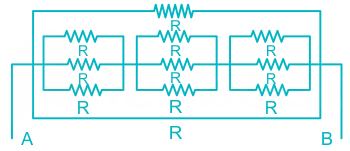
The value of resistance between points A and B is

  1. AOption (a)

    3R

  2. BOption (b)

    R

  3. COption (c)

    R/3

  4. DOption (d)

    R/9

View answer & explanation

Correct answer

Answer: (c)C.

R/3

Why this answer is correct

From the given figure we observe that the three resistors are connected in series whose equivalent will be R/3 Ω.

The circuit can be redrawn as shown in figure:

The three resistors connected in series will add up to R.

Form the figure we can observe that all the resistors of R Ω are in parallel making the equivalent resistance as R/3.

Question 36

The value of resistance of each element in a star network is R/3. Then the value of resistance of each element for its equivalent delta network is

  1. AOption (a)

    R

  2. BOption (b)

    3R

  3. COption (c)

    R/6

  4. DOption (d)

    R/9

View answer & explanation

Correct answer

Answer: (a)A.

R

Why this answer is correct

The correct option is 1

Concept:

<br>

To convert star to the delta,

In a balanced star connected network, all the resistance have equal value.

If a star connected network consists of equal value resistance 'R', then resistance between any two terminals of the equivalent delta circuit is 3R.

Here three equal resistances of R/3 Ω are connected in the star connection.

∴ The resistance between any two terminals of the equivalent delta circuit = R/3 × 3 = R Ω

Question 37

Two coils are connected in parallel and a voltage of 300 volts is applied on the terminal. The total current taken is 30 ampere and the power dissipated in one of the coils is 1600 W. Determine the resistance of each coil and select the appropriate option.

  1. AOption (a)

    10.5 ohm

  2. BOption (b)

    11.11 ohm

  3. COption (c)

    12.16 ohm

  4. DOption (d)

    13.5 ohm

View answer & explanation

Correct answer

Answer: (c)C.

12.16 ohm

Why this answer is correct

According to the data given in the question, we draw the circuit as:

DC source of 300 V is connected so, inductors, L1 and L2 will be short circuited.

Power dissipated in one coil = 1600 W

So, P=V2R1P = \frac{{{V^2}}}{{{R_1}}}

R1=(300)21600{R_1} = \frac{{{{\left( {300} \right)}^2}}}{{1600}}

R1 = 56.25 Ω

The equivalent resistance of the parallel combination will be:

Req=VI=30030=10Ω{R_{eq}} = \frac{V}{I} = \frac{{300}}{{30}} = 10 \rm{\Omega}

Since, R1 and R2 are connected in parallel:

Req=R1∣∣R2=R1⋅R2R1+R2{R_{eq}} = {R_1}||{R_2} = \frac{{{R_1} \cdot {R_2}}}{{{R_1} + {R_2}}}

10=10×R210+R210 = \frac{10 \times R_2}{10+ R_2}

R2=12.16ohmR_2 = 12.16 ohm

Question 38

If equalizer bar is not used in two parallel connected compound DC generators, then.

  1. AOption (a)

    one of the generators may run as a motor

  2. BOption (b)

    both the generators may stop

  3. COption (c)

    one of the generators may stop

  4. DOption (d)

    both the generators may start hunting

View answer & explanation

Correct answer

Answer: (a)A.

one of the generators may run as a motor

Why this answer is correct

The correct answer is option 1

If the equalizer bar is not used in two parallel-connected compound DC generators, the following issue arises:

In compound DC generators, the series field winding carries the load current, which affects the excitation. When two compound generators are operating in parallel, slight differences in their load sharing can cause differences in their excitation. Without an equalizer bar, these differences can cause one generator to become overexcited and the other under excited. This can result in one generator taking a larger share of the load, leading to instability.

Explanation:

  • When the generator with lower excitation is unable to supply its share of the load, it might draw current instead of supplying it, potentially causing it to run as a motor.

Thus, if the equalizer bar is not used, one of the generators may run as a motor.

Question 39

1 - phase transformers having 400 kVA each, when tested by the Sumpner's test (back - to - back test) gave the following results :

W1 in the supply line 8 kW,

W2 in the secondary series circuit, when full load current circulated through the secondaries 12 kW

<br>

Determine the efficiency of each transformer and and select the correct option.

  1. AOption (a)

    94.8%

  2. BOption (b)

    97.56%

  3. COption (c)

    98.56%

  4. DOption (d)

    96.7%

View answer & explanation

Correct answer

Answer: (b)B.

97.56%

Why this answer is correct

Concept:

Sumpner's Test:

The primary winding of the two transformers are connected in parallel and supplied at rated voltage and frequency.

W1 gives the iron losses and W2 gives the full load copper losses of two transformers.


Efficiency = output:poweroutput:power+Iron:loss+copper:lossoutput:power\over output: power + Iron : loss + copper : loss × 100 %

Calculation:

Given:

Since W1​, reads the total iron loss for both the transformers and W2​ the total copper loss for both the transformers,

W1 = 8 kW

W2 = 12 kW

The iron and copper loss for each transformer is  82\frac{8}{2}=4 kW and  122\frac{12}{2}​=6 kW respectively.

The efficiency of each transformer at full load is

η= 400400+4+6400 \over 400+4+6 ​×100

=97.56%

Question 40

Find the value of R for the maximum power transfer to the load.

  1. AOption (a)

    5

  2. BOption (b)

    6.5

  3. COption (c)

    7.7

  4. DOption (d)

    None of the above

View answer & explanation

Correct answer

Answer: (d)D.

None of the above

Why this answer is correct

The question is incomplete, as to evaluate the correct answer it should have been given the circuit diagram. So we have modified the 4th option from 8.1 to None of the above & marked it as correct answer. 

Question 41

Two coils are connected in series and their effective inductance is found to be 20 H. When the connections of one coil are reversed, the effective inductance is 6 H. If the coefficient of coupling is 0.6, then the self - inductance of each coil and the mutual inductance will be 

  1. AOption (a)

    M = 2.5 and L1 = 12, L2 = 3

  2. BOption (b)

    M = 3.5 and L1 = 12, L2 = 3

  3. COption (c)

    M = 3.5 and L1 = 13.09, L2 = 1.91

  4. DOption (d)

    M = 2.5 and L1 = 13.09, L2 = 1.91

View answer & explanation

Correct answer

Answer: (b)B.

M = 3.5 and L1 = 12, L2 = 3

Why this answer is correct

When two coils are connected in series additive polarity, the equivalent inductance is

Leq1 = L1 + L2 + 2M

When two coils are connected in series opposite polarity, the equivalent inductance is

Leq2 = L1 + L2 – 2M

Where L1 and L2 are self-inductances of the coils

M=KL1L2M = K \sqrt {L_1L_2}

M is the mutual inductance 

K is the coefficient of coupling

Calculation:

Given that, Leq1 = 20 H, Leq2 = 6 H, K = 0.6

For additive polarity, 20 = L1 + L2 + 2M.. (1)

For opposite polarity, 6 = L1 + L2 – 2M.. (2)

By solving the above two equations,

We get, M = 3.5 H.. (3)

Also, M=KL1L2M = K \sqrt {L_1L_2}

3.5=0.6L1L23.5 = 0.6 \sqrt {L_1L_2}

L1L2=34.027L_1L_2 = 34.027.. (4)

By solving equations (1), (2), (3) & (4)

We get,  L1 = 12 & L2 = 3

Question 42

A graph of a network has 8 nodes and 5 independent loops. The number of branches of the graph is

  1. AOption (a)

    11

  2. BOption (b)

    12

  3. COption (c)

    13

  4. DOption (d)

    14

View answer & explanation

Correct answer

Answer: (b)B.

12

Why this answer is correct

NOTE: The given diagram has no use to solve this question.

Concept:

Nodal Analysis:

Nodal analysis is a method of analyzing networks with the help of KCL equations.

For a network of N nodes, the number of simultaneous equations to be solved to get the unknowns

= Number of KCL equations

= N - 1

Mesh Analysis:

Mesh analysis is a method of analyzing networks with the help of KVL equations.

For a network having N nodes and B branches, the number of simultaneous equations to be solved to get the unknowns

= Number of KVL equations

= number of independent loop equations

= B - N + 1

Where, B = no of the branch, N = No of node

Calculation:

Given that,

Number of nodes (N) = 8

Number of independent loops (L) = 5

Let the number of branches are B.

We know that,

L = B – N + 1

⇒ 5 = B – 8 + 1 ⇒ B = 12

Question 43

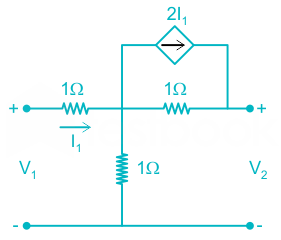
In the two - port network shown below, the h11 parameter (where h11 = V1/I1 when V2 = 0) in ohm is

  1. AOption (a)

    1

  2. BOption (b)

    3

  3. COption (c)

    0.5

  4. DOption (d)

    2

View answer & explanation

Correct answer

Answer: (c)C.

0.5

Why this answer is correct

The circuit can be redrawn as shown in the figure :

Let the voltage across the node be VX

Applying KLC at the node having voltage Vx

I1 = 2 I1 + Vx−01+Vx−01\frac{Vx -0}{1} + \frac{Vx -0}{1}

⇒2Vx = -I1       ...........(1)

Again the current across the 1 Ω resistance connected between V1 & Vx can be written as:

I1 = V1 - Vx ........(2)

Substituting the value of Vx in equation (2) we get

h11 = V1/I1 = 0.5

Question 44

A series R-L-C circuit is connected across a 240 V, 50 Hz supply. When the voltage across capacitor is 250 V, a maximum current of 0.5 A flows in the circuit. Find the capacitance.

  1. AOption (a)

    6.37 μF

  2. BOption (b)

    2.25 μF

  3. COption (c)

    0.47 μF

  4. DOption (d)

    1.58 μF

View answer & explanation

Correct answer

Answer: (a)A.

6.37 μF

Why this answer is correct

Concept:

For a series RLC circuit, the net impedance is given by:

Z = R + j (XL - XC)

XL = Inductive Reactance given by:

XL = ωL

XC = Capacitive Reactance given by:

XC = 1/ωC

Impedance = Resistance + j Reactance

The magnitude of the impedance is given by:

∣Z∣=R2+(XL−XC)2|Z|=\sqrt{R^2+(X_L-X_C)^2}

Application:

Given:

VC=250VV_C = 250 V, f = 50 Hz

Z = R + j (XL - XC)

XC=VCI=2500.5=500X_C = \frac{V_C}{I} = \frac{250}{0.5} = 500  Ω 

XC=12π×f×CX_C = \frac{1}{2\pi\times f \times C}

500=12π×50×C500= \frac{1}{2\pi \times 50 \times C}

C = 6.37 μF

Question 45

A 200 V DC shunt motor develops a torque of 54 N-m at the an armature current 10 A. The torque produced when armature current is 20 A, is

  1. AOption (a)

    54 N-m

  2. BOption (b)

    81 N-m

  3. COption (c)

    108 N-m

  4. DOption (d)

    75 N-m

View answer & explanation

Correct answer

Answer: (c)C.

108 N-m

Why this answer is correct

The correct option is 3

Concept:

<br>

T=K1ϕIa T1T2=Ia1Ia2\begin{array}{l} T = {K_1}\phi {I_a}\ \frac{{{T_1}}}{{{T_2}}} = \frac{{{I_{{a_1}}}}}{{{I_{{a_2}}}}} \end{array}

[ϕ is constant for DC shunt motor]

⇒T2=T1×Ia2Ia1=54×2010=108N−m\Rightarrow {T_2} = {T_1} \times \frac{{{I_{{a_2}}}}}{{{I_{{a_1}}}}} = 54 \times \frac{{20}}{{10}} = 108N - m

Question 46

A synchronous motor and an alternator are delivering about 5% of their rated power at unity power factor. If these machines are loaded to their rated capacity, then their armature currents

  1. AOption (a)

    decrease, motor operates at lagging power factor and alternator at leading power factor

  2. BOption (b)

    increase, motor operates at leading power factor and alternator at lagging power factor

  3. COption (c)

    increase, both operates at lagging power factor

  4. DOption (d)

    increase, motor operates at lagging power factor and alternator at leading power factor

View answer & explanation

Correct answer

Answer: (b)B.

increase, motor operates at leading power factor and alternator at lagging power factor

Why this answer is correct

When both machines are loaded to their rated capacity:

  1. Motor operates at a leading power factor.
  2. Alternator operates at a lagging power factor.
  3. Armature currents increase as they handle more power.
<br>

Explanation: As the load increases to their rated capacity:

  • Synchronous Motor: Synchronous motors can operate at different power factors by adjusting the field excitation. When heavily loaded, over-excited synchronous motors operate at a leading power factor. This helps improve the power factor of the system by compensating for lagging loads.
  • Alternator: When loaded close to full capacity, the alternator typically operates with a lagging power factor (supplying reactive power), as it supplies both active and reactive power to the system.
  • Armature Current: With increased loading, the current in both machines increases because more active and reactive power is transferred through the armature.

Question 47

Power is measured in a three - phase load by two - wattmeter method. The reading of one - wattmeter is 5000 W and the other wattmeter deflects in reverse direction. On interchanging the potential terminals, the second wattmeter reads 1000 W. The total power consumed by the load is

  1. AOption (a)

    5000 W

  2. BOption (b)

    4000 W

  3. COption (c)

    6000 W 

  4. DOption (d)

    1000 W

View answer & explanation

Correct answer

Answer: (c)C.

6000 W 

Why this answer is correct

Concept:

In a two-wattmeter method, for lagging load

The reading of first wattmeter (W1) = VL IL cos (30 + ϕ)

The reading of second wattmeter (W2) = VL IL cos (30 - ϕ)

Total power in the circuit (P) = W1 + W2

Total reactive power in the circuit \(Q=\sqrt{3}\left( {{W}{1}}-{{W}{2}} \right)\)

Power factor = cos ϕ

\(\phi =\text{ta}{{\text{n}}^{-1}}\left( \frac{\sqrt{3}\left( {{W}{1}}-{{W}{2}} \right)}{{{W}{1}}+{{W}{2}}} \right)\)

Explanation:

<br>

In the two-wattmeter method:

  • If one wattmeter shows a negative reading, it means the power factor of the load is less than 0.5.
  • When the potential terminals of the second wattmeter are interchanged, it shows a positive value, giving the correct magnitude of the power it measures.
<br>

Calculation:

<br>

The total Power in a three-phase load using two wattmeter method is: Ptotal = W1 + W2

Where: W1 = 5000 W, W2 = 1000 W (after correcting the reverse deflection by interchanging potential terminals)

Ptotal = 5000 + 1000 = 6000 W

Question 48

The main pollutants emitted from automobiles are

  1. AOption (a)

    carbon monoxide, nitrogen oxides and hydrocarbons

  2. BOption (b)

    carbon dioxide, nitrogen oxides and hydrocarbons

  3. COption (c)

    carbon monoxide, sulphur dioxides and hydrocarbons

  4. DOption (d)

    carbon monoxide, sulphur dioxides and nitrogen oxides

View answer & explanation

Correct answer

Answer: (a)A.

carbon monoxide, nitrogen oxides and hydrocarbons

Why this answer is correct

Explanation:

The main pollutants emitted from automobiles are: Carbon monoxide, nitrogen oxides, and hydrocarbons

  1. Carbon Monoxide (CO):
  • Carbon monoxide is a colorless, odorless gas that is produced by the incomplete combustion of fuels in the engine. It is toxic to humans because it interferes with the oxygen-carrying capacity of blood.
  1. Nitrogen Oxides (NOx):
  • Nitrogen oxides are formed when nitrogen in the air reacts with oxygen under the high-temperature conditions inside an engine. NOx contributes to smog and acid rain and is also a key player in the formation of ground-level ozone.
  1. Hydrocarbons (HC):
  • Hydrocarbons are unburned or partially burned fuel components. They contribute to smog formation and are considered harmful to the environment and human health as they react with nitrogen oxides to form ozone at ground level.

Question 49

The common method adopted for disinfection or drinking water, employed in home application is by using filters and

  1. AOption (a)

    UV radiation

  2. BOption (b)

    chlorination

  3. COption (c)

    ozonization

  4. DOption (d)

    chlorination and ozonization

View answer & explanation

Correct answer

Answer: (a)A.

UV radiation

Why this answer is correct

Explanation:

Many household water purifiers use UV (Ultraviolet) radiation to kill bacteria, viruses, and other pathogens, making the water safe for drinking. Chlorination and ozonization are generally used in larger-scale water treatment plants rather than in home systems.

Additional Information

Disinfection of water:

  • Disinfection may be defined as the process of destruction or inactivation of harmful microorganisms in water either by physical process or chemical process. The physical process includes heating, ultraviolet radiation, etc. and the chemical process includes the addition of disinfectants such as chemicals.
  • Disinfection can be distinguished from sterilization. In the sterilization process, all organisms are usually killed by a physical phenomenon such as boiling for a long period whereas in disinfection disease or illness-causing microorganisms are reduced to such a low level that no infection or disease results when the water is used for domestic purposes including drinking water.
  • Disinfection is an essential minimum treatment requirement for any drinking water and it is the final process in the chain of water purification.

Minor methods of disinfection of water:

  • Treatment with excess lime,
  • Treatment with ozone,
  • Treatment with KMnO4,
  • Treatment with F and Br in the form of pills,
  • By use of sodium hypochlorite (NaOCl
  • By ultraviolet rays, etc.
  • By boiling

Major methods of disinfection of water:

  • Chlorination

Question 50

Taj Mahal is threatened by pollution from

  1. AOption (a)

    chlorine

  2. BOption (b)

    sulphur dioxide

  3. COption (c)

    nitrogen dioxide

  4. DOption (d)

    carbon monoxide

View answer & explanation

Correct answer

Answer: (b)B.

sulphur dioxide

Why this answer is correct

Explanation:

  • The Taj Mahal is threatened by pollution from Sulphur dioxide.
  • Sulfur dioxide reacts with water molecules present in the atmosphere and forms sulfuric acid which precipitates through acid rain and affects the monument by changing its color and creating cracks in the monuments.

Additional Information

  • Acid rain can digest and destroy the outer layer of monuments like the Taj Mahal.
  • The main reason for the presence of sulphur dioxide near the Taj Mahal is the Mathura Refinery which is located near it.
  • It was recently found that there are high levels of suspended particulate matter in the air, caused by factory emissions, dust, and exhaust from construction and automobiles.

50 questions in the full paper