Official Paper

Bihar Jeevika (Accountant) : (19 Nov 2025, Evening Shift) MBT (Previous Year Paper)

70 questions · 80 minutes · with answers · free

Test (70 questions)

1

Which of the following scheme is not covered under the Employees Provident Funds and Miscellaneous Provision Act, 1952.

  1. ((a))

    Employees Provident Fund Scheme 1952.

  2. ((b))

    Employee Deposit Linked Insurance Scheme 1976.

  3. ((c))

    Employees’ Pension Scheme 1995.

  4. ((d))

    Public Provident Fund Scheme 1968.

Show Answer
Answer: ((d))

Public Provident Fund Scheme 1968.

The correct answer is Public Provident Fund Scheme 1968.

Key Points

  • The Schemes framed under the act are
  1. Employees’ Provident Fund (EPF) Scheme 1952.
  2. Employees’ Deposit Linked Insurance (EDLI) Scheme 1976.
  3. Employees’ Pension Scheme (EPS) 1995.
  • EPF Scheme deals with retirement savings.
  • EPS Scheme deals with a post-retirement pension.
  • And EDLI Scheme deals with relief to family members in case of sudden death.

Important Points

Important Features of the Employees Provident Funds and Miscellaneous Provision Act

  • The Act gives effect to the provisions of the Directive Principle as provided in Article 41 of the Indian Constitution.
  • It is a compulsory contributory fund for the future of an employee and his family in case of his death.
  • Applicability of the act
  1. Industries employing 20 and more.
  2. For theatres employing 5 and more.
  3. And other industries mentioned in Schedule I of the EPF Act.
  • Once the act is applied to an establishment it shall remain applicable even if the number of an employed person falls below twenty.
  • It applies to all the employees whose Wages (Basic + DA) is less than 15000 per month.
  • The act and schemes framed thereunder have been structured as self-applying and the employers are responsible to report the compliance of their own.
  • The Schemes framed under it are
  1. Employees’ Provident Fund (EPF) Scheme 1952.
  2. Employees’ Deposit Linked Insurance (EDLI) Scheme 1976.
  3. Employees’ Pension Scheme (EPS) 1995.
  • The aim of these schemes is to inculcate among workers a spirit of saving and encourage employees to save a portion of their present earning for the future.
  • EPF Scheme deals with retirement savings.
  • EPS Scheme deals with a post-retirement pension.
  • And EDLI Scheme deals with relief to family members in case of sudden death.
  • Benefits of the Act
  1. Tax-free savings with interest rate at 8% plus.
  2. If you withdraw you’re PF after 5 years or after maturity then you are not liable for any tax.
  3. Postretirement benefits with full EPF and EPF for a minimum of 10 years’ service.
  4. In emergencies such as death, marriage, loan you can withdraw your PF fund.
  5. In case of loss of income due to unemployment and if you are unable to find a new job for two months then you can withdraw your PF.
  6. EDLI scheme provides relief to family members in case of sudden death.
  7. With Universal Account Number (UAN) now you can transfer EPF from your old to new employer easily.
  • Contribution rates are divided between employee and employer and they are as following
  1. An employee contributes 12% to the EPF account.
  2. Whereas the Employer contributes 13.15% into EPF, EPS, and EDLI.
  3. Also, 0.65% of the 13.15% are charged as EPF admin charges with a minimum of 500 charges. They are paid by the employer
  4. When an employee is 58 plus of age then his EPS contribution is moved to EPF.
  • There are some businesses where employee contribution rate is 10% instead of 12% and employers contribution is also less, they are
  1. They are businesses with voluntary coverage with less than 20 employee strength.
  2. Sick businesses.
  3. A business where financial year loss is greater than or equal to net worth.
  4. Jute, Coir, Brick, Guar gram.
  • There is a provision of the Central Board and Central Provident Fund Commissioner is the CEO of the board.
  • Dispute settlement for the parties is as provided in the Industrial Dispute Act of 1947.
2

Which of the following is not social security scheme?

  1. ((a))

    Production Linked Incentive (PLI) Scheme

  2. ((b))

    Atal Pension Scheme

  3. ((c))

    Pradhan Mantri Vaya Vandana Scheme

  4. ((d))

    Rashtriya Vayoshri Yojana

Show Answer
Answer: ((a))

Production Linked Incentive (PLI) Scheme

The correct answer is Production Linked Incentive (PLI) scheme.

Key Points

  • Social Security Schemes in India
  • Atal  Pension Yojana
  • It was Launched in 2015, the scheme targets unorganized workers like domestic helpers, drivers gardeners, etc.
  • It allows such workers to save for their old age.
  • It is administered by the Pension Fund Regulatory and Development Authority (PFRDA).
  • Pradhan Mantri Vaya Vandana Scheme
  • It is a social security scheme targeting those people who are above 60 years of age.
  • It is implemented by the Life Insurance Corporation of India.
  • It was launched in 2017.
  • Rashtriya Vayoshri Yojana
  • The scheme provides physical aids and assisted-living devices to senior citizens living below the poverty line.
  • It is a centrally sponsored scheme.

Important Points

  • PLI Scheme
  • The Production Linked Incentive (PLI) scheme aims to give companies incentives on incremental sales from products manufactured in domestic units.
  • It also aims to encourage local companies to set up or expand existing manufacturing units. Therefore, It is not a social security scheme. Hence, Option 1 is correct.
  • The Scheme has also been approved for sectors such as automobiles, textiles, pharmaceuticals, IT hardware including laptops, mobile phones & telecom equipment, white goods, chemical cells, food processing, etc.
3

Which state topped the medal tally at the Khelo India Para Games 2025?

  1. ((a))

    Haryana

  2. ((b))

    Tamil Nadu

  3. ((c))

    Uttar Pradesh

  4. ((d))

    Maharashtra

Show Answer
Answer: ((a))

Haryana

The Correct Answer is Haryana.

In News

  • Khelo India Para Games 2025 concludes, 18 national records broken.

Key Points

  • The Khelo India Para Games 2025 concluded at JLN Stadium, New Delhi.
  • 18 national records were broken during the event.
  • The second edition of the Khelo India Para Games saw more than 550 medals being secured by para-athletes.
  • Haryana topped the medal tally with 34 gold, 39 silver, and 31 bronze medals.
  • Tamil Nadu secured second place with 28 gold, 19 silver, and 27 bronze medals.
  • Uttar Pradesh finished third with 23 gold, 21 silver, and 20 bronze medals.
  • More than 1,300 para-athletes participated in the event, competing across six sports: Para Archery, Para Athletics, Para Badminton, Para Powerlifting, Para Shooting, and Para Table Tennis.
4

The Jan Vishwas (Amendment of Provisions) Bill, 2025 proposes replacing minor offences with warnings or monetary penalties under how many offences?

  1. ((a))

    42

  2. ((b))

    67

  3. ((c))

    76

  4. ((d))

    183

Show Answer
Answer: ((c))

76

The Correct Answer is 76.

In News

  • Jan Vishwas Bill 2025 aims at wider decriminalisation, ease of living.

Key Points

  • Introduced in Lok Sabha by Union Minister for Commerce & Industry.
  • Builds on the Jan Vishwas Act 2023 (183 provisions decriminalised in 42 Acts).
  • 2025 Bill targets 355 provisions across 16 Acts under 10 ministries.
  • 288 provisions for decriminalisation, 67 provisions for ease of living.
  • Includes changes in NDMC Act, 1994 and Motor Vehicles Act, 1988.
  • 76 offences: minor violations replaced with warnings/monetary penalties.
  • Graduated penalties for repeat offences.
  • Officers empowered to impose penalties, reducing judicial burden.
  • Automatic 10% hike in fines every 3 years to avoid frequent amendments.
  • Covers laws from 2023 Act like Motor Vehicles, Tea Act, Drugs & Cosmetics.
  • Reflects “Minimum Government, Maximum Governance” principle.
5

The political strategy Struggle-Truce-Struggle or S-T-S came into prominence with a call for [BPSC has deleted this question].

  1. ((a))

    Swadeshi Movement

  2. ((b))

    Quit India

  3. ((c))

    Boycott of Simon Commission

  4. ((d))

    Khilafat issue

Show Answer
Answer: ((d))

Khilafat issue

BPSC deleted this question.

Key Points

  • Reason cited by BPSC:
  • The debate regarding the STS struggle came up during the Civil Disobedience Movement.
  • None of the options is correct.
6

Where is the Agasthiyarmalai Elephant Reserve located?

  1. ((a))

    Andhra Pradesh

  2. ((b))

    Tamil Nadu

  3. ((c))

    Chhattisgarh

  4. ((d))

    Kerala

Show Answer
Answer: ((b))

Tamil Nadu

The correct answer is Tamil Nadu

Key Points

  • Agasthiyarmalai Elephant Reserve has become the 5th elephant reserve in Tamil Nadu.
  • There are 32 elephant reserves in India after this addition.

Additional Information

  • Project Elephant is a Central Government sponsored scheme launched in February 1992.
  • Through the Project Elephant scheme, the government helps in the protection and management of elephants in the states having wild elephants in a free-ranging population.
  • The Ministry of Environment, Forest, and Climate Change provides financial and technical support to major elephant range states in the country through the project.
  • It ensures the protection of elephant corridors and elephant habitats for the survival of the elephant population in the wild.
7

In which year is the Indian Venus Orbiter Mission (VOM) scheduled to be launched?

  1. ((a))

    2026

  2. ((b))

    2027

  3. ((c))

    2028

  4. ((d))

    2029

Show Answer
Answer: ((c))

2028

The correct answer is 2028

In News

  • The Venus Orbiter Mission (VOM), approved by the Union Cabinet, marks a significant step in India's planetary exploration endeavors.

Key Points

  • The mission is scheduled for launch in March 2028.
  • The Indian Space Research Organisation (ISRO) will lead the development and launch of the spacecraft, with the aim of studying Venus's atmosphere, surface, and subsurface conditions.
  • The mission will help scientists gain insights into the evolutionary paths of both Venus and Earth, contributing valuable data to planetary science.
  • With a budget of Rs. 1,236 crore, the mission will involve collaboration between ISRO, Indian industries, and academic institutions, offering opportunities for research and technology development.
8

Where is the Kabaddi World Cup 2025 being hosted?

  1. ((a))

    India

  2. ((b))

    Iran

  3. ((c))

    England

  4. ((d))

    Russia

Show Answer
Answer: ((c))

England

The Correct Answer is England.

In News

  • Kabaddi World Cup 2025 to begin in England.

Key Points

  • The Kabaddi World Cup 2025 will be hosted in England.
  • The men's competition includes 10 teams.
  • The women's competition will involve 6 teams.
  • The competition will last for 7 days and will be hosted in Birmingham, Coventry, Walsall, and Wolverhampton in the West Midlands region of the UK.
  • This is the second edition of the Kabaddi World Cup and the first outside of Asia.
  • At the inaugural edition hosted by Malaysia in 2019, India won both the men’s and women’s crowns.
  • Moreover, this Kabaddi World Cup is different from the one hosted by the International Kabaddi Federation (IKF), whose all editions have been hosted in India.
9

In which year was the International Olympic Committee formed?

  1. ((a))

    1896

  2. ((b))

    1892

  3. ((c))

    1898

  4. ((d))

    1894

Show Answer
Answer: ((d))

1894

The correct answer is 1894.

Key Points

  • The IOC was founded by Pierre de Coubertin in Paris in 1894, marking the revival of the ancient Olympic Games.
  • The IOC is the supreme authority of the Olympic Movement, overseeing the organization of the Summer and Winter Olympic Games.
  • The Olympic Games are held every four years, alternating between Summer and Winter editions.
  • The IOC is guided by the Olympic Charter, which outlines the principles and rules governing the Olympic Movement.
  • The IOC works closely with National Olympic Committees (NOCs) from around the world to ensure the participation of athletes in the Olympic Games.

Additional Information

  • The original Olympic Games were held in ancient Greece from the 8th century BC until the 4th century AD.
  • Indian Olympic Association (IOA): The IOA is the national governing body for the Olympic Movement in India.
  • Asian Olympic Council (AOC): The AOC is the governing body for the Olympic Movement in Asia.
  • The Commonwealth Games are a multi-sport event involving athletes from Commonwealth countries and territories.
  • The Asian Games are a multi-sport event involving athletes from Asia.
10

Which countries have been excluded from the 2026 FIFA World Cup due to separate controversies?

  1. ((a))

    Pakistan, Belarus, and Italy

  2. ((b))

    Russia, Belarus, and North Korea

  3. ((c))

    Russia, Congo, and Pakistan

  4. ((d))

    France, Germany, and Spain

Show Answer
Answer: ((c))

Russia, Congo, and Pakistan

The correct answer is Russia, Congo, and Pakistan.

In News

  • Russia, Congo, and Pakistan have been excluded from the 2026 FIFA World Cup due to separate controversies involving administrative issues, geopolitical sanctions, and third-party interference.

Key Points

  • Pakistan was banned due to administrative failures and the failure to adopt a revised constitution for fair elections in its football federation.
  • Russia remains banned due to geopolitical sanctions following its invasion of Ukraine in 2022, preventing its teams from competing in FIFA and UEFA competitions.
  • Congo was excluded for third-party interference in the affairs of the Congolese Football Association (FECOFOOT).
  • The 2026 FIFA World Cup will feature 48 teams, with these nations missing out due to their respective issues.

Additional Information

  • FIFA's Suspension History
  • FIFA has banned several countries over the years, including Russia, Pakistan, and Congo, for various reasons such as administrative failures, geopolitical issues, and third-party interference.
  • Other countries previously banned include Iraq, Nigeria, Kuwait, and Indonesia for various violations of FIFA's regulations.
  • 2026 FIFA World Cup
  • Hosted by the United States, Canada, and Mexico, with 48 teams participating.
  • The 2026 World Cup will be the first to feature an expanded format with 48 teams instead of the usual 32.
11

What is the name of the recently launched autobiography of Nobel Peace Laureate Kailash Satyarthi?

  1. ((a))

    Flames of Freedom

  2. ((b))

    Light of Hope

  3. ((c))

    Beacon of Change

  4. ((d))

    Diyaslai

Show Answer
Answer: ((d))

Diyaslai

The correct answer is Diyaslai.

In News

  • A special discussion on Nobel Laureate Kailash Satyarthi’s autobiography Diyaslai was held at the Indira Gandhi National Centre for the Arts (IGNCA).

Key Points

  • Diyaslai is an autobiography by Kailash Satyarthi that chronicles his fight against child exploitation and his journey to winning the Nobel Peace Prize.
  • Former President Ram Nath Kovind described Diyaslai as more than just a book, but a movement for child rights.
  • Satyarthi, the son of a police constable from Vidisha, dedicated his life to advocating for child welfare and education.
  • He chose to dedicate his Nobel Prize to the nation, emphasizing his commitment to India’s future.

Additional Information

  • Kailash Satyarthi
  • Born: January 11, 1954, in Vidisha, Madhya Pradesh
  • A social activist known for his work in child labor eradication
  • Founder of Bachpan Bachao Andolan, which has rescued thousands of child laborers
  • Received the Nobel Peace Prize in 2014, jointly with Malala Yousafzai
  • Indira Gandhi National Centre for the Arts (IGNCA)
  • Founded in 1987 to promote Indian art and culture
  • Located in New Delhi
  • Hosts discussions, exhibitions, and research initiatives
12

How many Gram Panchayats are currently functioning in the state of Bihar?

  1. ((a))

    7053

  2. ((b))

    8053

  3. ((c))

    9053

  4. ((d))

    10053

Show Answer
Answer: ((b))

8053

The correct answer is 8053

Key Points

  • Currently, there are 8053 Gram Panchayats functioning in the state of Bihar.
  • The Gram Panchayat is the basic unit of the Panchayati Raj system in India, which is a three-tier system of local self-government.
  • Each Gram Panchayat covers a village or a group of villages and is responsible for the administration and development of the area under its jurisdiction.
  • The number of Gram Panchayats in a state can vary based on the population and geographical area.

Additional Information

  • The concept of Panchayati Raj is included in the Directive Principles of State Policy in the Constitution of India.
  • The 73rd Amendment Act of 1992 granted constitutional status to the Panchayati Raj institutions and provided a framework for their structure and functioning.
  • The Act mandates the establishment of Gram Sabhas, which are assemblies of the electorate in the Panchayat area, to ensure direct participation of the people in local governance.
  • The Panchayati Raj system aims to promote decentralized governance and ensure that local issues are addressed effectively at the grassroots level.
13

What is India's rank in the World Happiness Report 2025?

  1. ((a))

    106th

  2. ((b))

    108th

  3. ((c))

    116th

  4. ((d))

    118th

Show Answer
Answer: ((d))

118th

The correct answer is 118th.

In News

  • India ranks 118th in the World Happiness Report 2025.

Key Points

  • India ranks 118th out of 147 countries in the World Happiness Report 2025.
  • Finland is ranked as the world's happiest country for the eighth consecutive year, followed by Denmark, Iceland, and others.
  • India's highest rank was 94 in 2022 and its lowest was 144 in 2012.
  • The report evaluates happiness based on six key factors: social support, GDP per capita, healthy life expectancy, freedom to make life choices, generosity, and perception of corruption.

Additional Information

  • World Happiness Report - A yearly publication by the UN Sustainable Development Solutions Network that ranks countries based on happiness levels.
  • Factors Influencing Happiness - Social support, GDP per capita, healthy life expectancy, freedom, generosity, and perception of corruption.
14

Who headed the 1915 committee to examine the co-operative movement in India?

  1. ((a))

    Lord Curzon

  2. ((b))

    Sir Edward Maclagan

  3. ((c))

    Lord Irwin

  4. ((d))

    Sir John Simon

Show Answer
Answer: ((b))

Sir Edward Maclagan

The Correct answer is Sir Edward Maclagan.

Key Points

  • Sir Edward Maclagan was an important figure in the history of cooperative movements in India.
  • He headed the 1915 Committee, which was formed to examine the cooperative movement in India.
  • The committee was tasked with studying the functioning and impact of cooperative societies and their role in the development of rural areas.
  • The findings of the committee emphasized the importance of cooperatives as a tool for economic and social upliftment in the country.
  • It laid the foundation for further reforms and development in the cooperative sector, including the introduction of the Cooperative Societies Act.
  • The committee recommended measures to improve the efficiency and expand the reach of cooperative societies in India.
  • Cooperative movements were seen as vital for addressing issues like rural credit shortages and promoting self-reliance among farmers and rural communities.

Additional Information

  • Lord Curzon
  • Lord Curzon was a British statesman who served as the Viceroy of India from 1899 to 1905.
  • He is known for his controversial decision to partition Bengal in 1905, which led to widespread protests and the eventual reversal of the partition in 1911.
  • He played a key role in the establishment of the Archaeological Survey of India to preserve historical monuments.
  • Lord Irwin
  • Lord Irwin, also known as Edward Wood, served as the Viceroy of India from 1926 to 1931.
  • He is notable for signing the Gandhi-Irwin Pact in 1931, which marked a crucial moment in India’s struggle for independence.
  • His tenure was marked by the Civil Disobedience Movement led by Mahatma Gandhi.
  • Sir John Simon
  • Sir John Simon was a British politician and head of the Simon Commission, which arrived in India in 1928.
  • The commission was tasked with reviewing the constitutional reforms in India but faced widespread opposition due to the absence of Indian representation.
  • The protests against the Simon Commission were a significant event in India’s freedom struggle, leading to the demand for Purna Swaraj (Complete Independence).
15

Who was awarded the PEN Pinter prize in 2024?

  1. ((a))

    Malorie Blackman

  2. ((b))

    Salman Rushdie

  3. ((c))

    Margaret Atwood

  4. ((d))

    Arundhati Roy

Show Answer
Answer: ((d))

Arundhati Roy

The correct answer is Arundhati Roy.

Key Points

  • Arundhati Roy is an acclaimed Indian writer and activist, known for her critical views on socio-political issues.
  • She won the PEN Pinter Prize in 2024, a recognition for her literary contributions and her unflinching examination of global and local injustices.
  • Roy's writing is celebrated for its profound impact on discussions of human rights and freedom, particularly concerning Indian-administered Kashmir.
  • The PEN Pinter Prize was established to honor writers who, in the words of Harold Pinter, cast an "unflinching, unswerving" gaze upon the world, which aligns with Roy's literary ethos.

Important Points

  • Arundhati Roy is known for her fearless advocacy and has used her platform to challenge injustices, making her a fitting recipient for this award.
  • Her Works: The God of Small Things, The Ministry of Utmost Happiness, Azadi, Capitalism: A Ghost Story, The Doctor and the Saint: The Ambedkar - Gandhi Debate, An Ordinary Person's Guide to Empire, Walking With The Comrades, The Cost of Living, The End of Imagination etc.

Additional Information

  • Other Nominees:
  • Malorie Blackman, Margaret Atwood, and Salman Rushdie are previous laureates who have also contributed significantly to literature with a focus on social issues.
16

The PRASHAD Scheme, which supports the development of pilgrimage infrastructure, is implemented by which ministry?

  1. ((a))

    Ministry of Culture

  2. ((b))

    Ministry of Home Affairs

  3. ((c))

    Ministry of Tourism

  4. ((d))

    Ministry of Rural Development

Show Answer
Answer: ((c))

Ministry of Tourism

The correct answer is Ministry of Tourism

In News

  • The PRASHAD Scheme (Pilgrimage Rejuvenation and Spiritual Heritage Augmentation Drive) by the Ministry of Tourism aims to develop tourism infrastructure at pre-identified pilgrimage destinations and heritage cities.

Key Points

  • Financial assistance is provided to State Governments and Union Territories (UTs) for infrastructure interventions, carried out in consultation with local administrations.
  • Proposals for infrastructure development are evaluated according to scheme guidelines and procedures established by the Ministry.
  • 46 projects have been sanctioned under the PRASHAD Scheme, including 3 projects in Andhra Pradesh.
  • A total of 29 sites have been identified for development under this scheme, with 2 sites located in Andhra Pradesh.
  • The information was presented by Union Minister for Tourism and Culture Shri Gajendra Singh Shekhawat in a written reply in Lok Sabha on November 25, 2024.
17

What was India's rank on the Henley Passport Index in January 2025?

  1. ((a))

    70th

  2. ((b))

    75th

  3. ((c))

    85th

  4. ((d))

    82th

Show Answer
Answer: ((c))

85th

The correct answer is 85th.

In News

  • India was ranked 85th on the 2025 Henley Passport Index in January 2025.

Key Points

  • Indian passport holders have visa-free access to 57 destinations, including popular tourist spots like Thailand, Indonesia, Mauritius, Sri Lanka, and the Maldives.
  • Six countries share the top spot on the 2025 Henley Passport Index, providing their citizens with the most powerful passports.

The elite club includes four EU member states: France, Germany, Italy, and Spain, along with Asian powerhouses Japan and Singapore.

Japan and Singapore have consistently held the first-place ranking on the Henley Passport Index for the past five years, emphasizing the strength and global access of their passports.

Additional Information

  • The Henley Passport Index reflects a significant increase in the average number of visa-free destinations over the years, reaching 111 in 2025 from 58 in 2006.
  • Notable climbers in the past decade include the United Arab Emirates (UAE), Ukraine, and China, with the UAE rising 44 places to 11th position.
  • Russia has seen a net gain of 24 destinations over the decade, maintaining the 51st place on the index with access to 119 destinations.

Direction: The following pie chart shows the percentage of the population in five villages in a year. Read the chart and answer the following questions.

18

What is the total population of villages A, B and D?

  1. ((a))

    15000

  2. ((b))

    16500

  3. ((c))

    18500

  4. ((d))

    19500

Show Answer
Answer: ((d))

19500

Given:

Total population in five villages = 30,000

VillagePopulation in percentage
A10%
B25%
C20%
D30%
E15%

Calculation:

According to the question,

⇒ Percentage of population of villages (A + B + D) = 10% + 25% + 30%

⇒ 65%

Now, the total population of villages A, B and D = 30000 × 65/100

⇒ 19500

∴ The sum of the population of villages A, B and D is 19500.

19

Direction: A line graph is given below, study the graph carefully and answer the following questions.

Based on the given graph, the difference in the earnings was the highest between which of the two consecutive days:

  1. ((a))

    Tuesday and Wednesday

  2. ((b))

    Sunday and Monday

  3. ((c))

    Friday and Saturday

  4. ((d))

    Monday and Tuesday

Show Answer
Answer: ((b))

Sunday and Monday

Earning on Sunday = 100

Earning on Monday = 500

Earning on Tuesday = 300

Earning on Wednesday = 600

Earning on Thursday = 650

Earning on Friday = 300

Earning on Saturday = 350

∴ The difference in earnings was highest between Sunday and Monday.

Study the data carefully to answer the following questions:

Table represents the number of students studying in five different colleges under different courses.

Total students in a colleges = 24,000

COLLEGESNUMBER OF STUDENTSCOURSES
B.COMB.SCB.AM.A
A70001050175028001400
B5000750125020001000
C6000900150024001200
D400060010001600800
E2000300500800400
20

Find the ratio between the total number of students in B.Com course to the students of M.A course.

  1. ((a))

    1 : 4

  2. ((b))

    3 : 4

  3. ((c))

    4 : 5

  4. ((d))

    5 : 8

Show Answer
Answer: ((b))

3 : 4

Number of students in B.COM and M.A. course.

CollegesNumber of students in B.COM courseNumber of students in M.A course
A10501400
B7501000
C9001200
D600800
E300400
Total36004800

 Required ratio = 3600 : 4800

⇒ 3 : 4

∴ The ratio between the total number of students in B.Com course to the students of M.A course is 3 ∶ 4.

21

Find the difference between the simple interest and the compound interest at an annual rate of 20% on the principal of Rs. 800 for 2 years.

  1. ((a))

    32

  2. ((b))

    20

  3. ((c))

    42

  4. ((d))

    0

Show Answer
Answer: ((a))

32

Given: 

The principal is 800 rupee

Rate is 20%

Concept: 

SI = (P × R × T)/100

CI = P[(1 + r/100)n - 1]

Here, n is the number of terms in the year.

Calculation: 

The simple interest for 2 years

⇒ (800 × 20 × 2)/100

⇒ 8 × 20 × 2

⇒ 320 rupee

Now, Compound interest for 2 years is 

⇒ 800[(1 + 20/100)2 - 1]

⇒ 800[(120/100)2 - 1]

⇒ 800[(12/10)2 - 1]

⇒ 800 × [(144 - 100)/100]

⇒ 352 rupee 

Now, The difference between CI and SI is

⇒ 352 - 320

⇒ 32

∴ The difference between CI and SI is 32. 

<br>

Shortcut Trick

The difference between CI and SI for 2 years is P(r/100)2

The  difference is 

⇒ 800(20/100)2

⇒ 800 × (1/5)2

⇒ 32

∴ The difference between CI and SI is 32. 

Important Points

This short trick works only for 2 years.

22

Rajesh saves 5% of his income after 4 years his income is increased by 25% but his savings remain the same. Then find the approximate percentage increase in his expenditure.

  1. ((a))

    50%

  2. ((b))

    22%

  3. ((c))

    41%

  4. ((d))

    26%

Show Answer
Answer: ((d))

26%

Shortcut TrickLet the income of Rajesh be 100.

IncomeSavingsExpenditure
Initial100595
Final1255120


⇒ Percentage increase in expenditure = [(120 - 95)/95] × 100

⇒ Percentage increase in expenditure = (25/95) × 100 ≈ 26%

∴ The correct answer is Option 4).

Given:

Rajesh saving = 5%

Income increased = 25%

Formula used

Income = expenditure + saving

Calculation

Let income be 100

Given saving = 5% of 100 = 5

Expenditure = 100 – 5 = 95

The income increased by 25%

New income = 25% of 100 + 100 = 125

Saving is the same = 5

Then expenditure = 120

Change in expenditure = 120 – 95 = 25

Therefore, Percentage increase = (25 ÷ 95) × 100 = 26.31% ≈ 26%

∴ Percentage increase in his expenditure is 26%

23

Rajeev and Abhay invest in a business. Profit was divided in 2:3. The profit is divided according to the investment. If Rajeev invested ₹40,000 then the amount invested by Abhay is:

  1. ((a))

    ₹40,000

  2. ((b))

    ₹50,000

  3. ((c))

    ₹60,000

  4. ((d))

    ₹70,000

Show Answer
Answer: ((c))

₹60,000

Given:

The profit ratio of Rajeev : Abhay = 2 : 3.

Rajeev's invested amount = Rs. 40,000.

Concept used:

Amount invested Rajeev to Abhay = Ratio of their Profit

Calculation:

The amount of Rajeev invested Rs. 40000 and amount invested by Abhay is y.

Amount invested Rajeev to Abhay = Ratio of their profit

⇒ 40000/y = 2/3

⇒ y = 40000 × 3/2

⇒ y = Rs. 60000

∴ The amount invested by Q is Rs. 60000.

24

A cycle listed at Rs.20,000 is sold to a retailer at Rs.14,000 after a discount. What is the percent discount given to retailer?

  1. ((a))

    20 percent

  2. ((b))

    10 percent

  3. ((c))

    30 percent

  4. ((d))

    40 percent

Show Answer
Answer: ((c))

30 percent

Given:

The listed price of the cycle = Rs. 20,000

Selling price to the retailer = Rs. 14,000

Formula:

Percent discount = (Discount / Listed price) * 100

Calculation:

To calculate the percent discount, we need to find the discount first.

Discount = Listed price - Selling price

Substituting the given values:

Discount = Rs. 20,000 - Rs. 14,000

= Rs. 6,000

Now, we can calculate the percent discount:

Percent discount = (Discount / Listed price) * 100

= (6000 / 20000) * 100

= 30

Therefore, the percent discount given to the retailer is 30%.

25

The ratio of the number of boys and girls in a school is 12 ∶ 13. If there are 372 boys, then the total number of students in the school is :

  1. ((a))

    775

  2. ((b))

    703

  3. ((c))

    685

  4. ((d))

    603

Show Answer
Answer: ((a))

775

Calculation:

In the school ratio of boys : girls = 12 : 13

Now, 12 unit → 372, 

Then, (12 + 13) = 25 unit  → 372/12 × 25 = 775

∴ The correct answer is 775

26

In an exam, a student got 40 marks and still failed by 20 percent marks. If the passing percentage is 40 percent, then what are the maximum marks of the exam?

  1. ((a))

    160

  2. ((b))

    250

  3. ((c))

    200

  4. ((d))

    180

Show Answer
Answer: ((c))

200

Shortcut Trick

Student's scored percentage = Passing percentage − Failing gap percentage

Scored percentage = 40% − 20% = 20%

Since 20% of the maximum marks corresponds to the 40 marks obtained:

Maximum marks = (40 ÷ 20) × 100 = 200

∴ The correct answer is 200 marks.

Alternate Method

Given:

Marks obtained by the student = 40 marks

Failing gap = 20% of maximum marks

Passing percentage = 40% of maximum marks

Formula Used:

Passing Marks = Obtained Marks + Shortfall Marks

0% 20% 40% (Pass) 100%

Scored Failed by

40 Marks

20% Gap

Max Marks = 100% = 200 Marks

Calculations:

Let the maximum marks be x.

⇒ Passing marks = 40% of x = 0.4x

⇒ Shortfall (Failed by) marks = 20% of x = 0.2x

⇒ Obtained marks + Shortfall marks = Passing marks

⇒ 40 + 0.2x = 0.4x

⇒ 0.4x − 0.2x = 40

⇒ 0.2x = 40

⇒ x = 40 ÷ 0.2

⇒ x = 200

∴ The correct answer is 200 marks.

Additional Information

Concept of Passing Marks

If a student scores 'M' marks and fails by 'X' marks, then Passing Marks = M + X. If they score 'N' marks and get 'Y' marks above passing, then Passing Marks = N − Y.

Fraction Equivalent Strategy

Converting percentages to fractions speeds up calculations. 20% = 1/5 and 40% = 2/5. Here, (2/5)x − (1/5)x = 40 ⇒ (1/5)x = 40 ⇒ x = 200.

Percentage Base Rule

Whenever a percentage is mentioned (like 20% failed marks), it is always calculated on the Total/Maximum Marks of the exam unless specified otherwise.

27

Reeta goes to office from home at a speed of 40 km/h. If she return to home from office at a speed of 60 km/h, then what is her average speed?

  1. ((a))

    44 km/h

  2. ((b))

    52 km/h

  3. ((c))

    48 km/h

  4. ((d))

    50 km/h

Show Answer
Answer: ((c))

48 km/h

Given:

Speed of going = 40 km/h,

Speed of returning = 60 km/h

Concept:

Average speed = Total distance / Total time.

The total distance for the round trip is twice the one-way distance.

Solution:

One-way distance = d

⇒ Total time = d/40 + d/60 = (3d + 2d)/120 = d/24

⇒ Average speed = 2d/(d/24) = 48 km/h

Hence, her average speed is 48 km/h.

28

The length of a train is 150 metres. In 3 seconds, it passes a man travelling at 2 km/h in the same direction as the train. Determine the train's speed.

  1. ((a))

    176 km/h

  2. ((b))

    191 km/h

  3. ((c))

    168 km/h

  4. ((d))

    182 km/h

Show Answer
Answer: ((d))

182 km/h

Shortcut Trick

Relative Speed = Distance ÷ Time = 150 ÷ 3 = 50 m/s.

Convert relative speed to km/h: 50 × (18 ÷ 5) = 180 km/h.

Since both are moving in the same direction, Relative Speed = Speed of Train − Speed of Man.

180 = Speed of Train − 2 ⇒ Speed of Train = 182 km/h.

∴ The correct answer is 182 km/h.

Alternate Method

Given:

Length of the train = 150 m

Time taken to pass the man = 3 s

Speed of the man = 2 km/h

Formula Used:

Distance = Relative Speed × Time

Speed in m/s = Speed in km/h × (5 ÷ 18)

Calculations:

Let the speed of the train be v km/h.

⇒ Relative speed of train with respect to the man = (v − 2) km/h

⇒ Convert km/h to m/s = (v − 2) × (5 ÷ 18) m/s

⇒ Distance covered = Length of the train = 150 m

⇒ Time taken = 3 s

⇒ 150 = [(v − 2) × (5 ÷ 18)] × 3

⇒ 150 = (v − 2) × (15 ÷ 18)

⇒ 150 = (v − 2) × (5 ÷ 6)

⇒ v − 2 = 150 × (6 ÷ 5)

⇒ v − 2 = 30 × 6

⇒ v − 2 = 180

⇒ v = 180 + 2

⇒ v = 182 km/h

∴ The correct answer is 182 km/h.

Additional Information

Relative Speed (Same Direction)

When two objects move in the same direction, their relative speed is the difference of their individual speeds: Srel = S1 − S2.

Relative Speed (Opposite Direction)

When two objects move in opposite directions, their relative speed is the sum of their individual speeds: Srel = S1 + S2.

Speed Conversion Rules

To convert km/h to m/s, multiply the speed value by (5 ÷ 18). Conversely, to convert m/s to km/h, multiply by (18 ÷ 5).

29

 In an election Santosh got 24000 more votes than Mantosh. If Mantosh and Santosh got 30% and 40% of the total votes respectively. Find the total number of votes cast. 

  1. ((a))

    250000

  2. ((b))

    254000

  3. ((c))

    240000

  4. ((d))

    245000

Show Answer
Answer: ((c))

240000

Given:

Santosh got 24000 more votes than Mantosh

Mantosh and Santosh got 30% and 40% of the total votes respectively

Shortcut Trick

10% = 24000

1% = 2400

100% = 240000

Therefore, total number of votes are 240000.

Alternate Method Concept:

Calculation of total votes based on percentage shares of candidates.

Solution:

Let the total number of votes be X

As per the question,

Santosh's votes (40% of X) = Mantosh's votes (30% of X) + 24000

⇒ 40/100 × X = 30/100 × X + 24000

⇒ 10/100 × X = 24000

⇒ X = 240000

Therefore, total number of votes are 240000.

30

Letters of a word have been jumbled up and numbered. Choose the option which gives the correct order of the letters as indicated by the numbers to form the word.

I, A, D, O, H, E, N, S

1 2 3 4 5 6 7 8

  1. ((a))

    3, 2, 5, 6, 8, 1, 4, 7

  2. ((b))

    2, 3, 5, 6, 4, 8, 1, 7

  3. ((c))

    2, 3, 5, 6, 8, 1, 4, 7

  4. ((d))

    2, 3, 5, 6, 8, 4, 1, 7

Show Answer
Answer: ((c))

2, 3, 5, 6, 8, 1, 4, 7

We have checked the each option,

Option (1): 3, 2, 5, 6, 8, 1, 4, 7

32568147
DAHESION

The word formed from jumbled letters is "DAHESION" which is Not a Meaningful word.

Option (2): 2, 3, 5, 6, 4, 8, 1, 7

23564817
ADHEOSIN

The word formed from jumbled letters is "ADHEOSIN" which is Not a Meaningful word.

Option (3): 2, 3, 5, 6, 8, 1, 4, 7

23568147
ADHESION

The word formed from jumbled letters is "ADHESION" which is  a Meaningful word.

Option (4): 2, 3, 5, 6, 8, 4, 1, 7

23568417
ADHESOIN

The word formed from jumbled letters is "ADHESOIN" which is Not a Meaningful word.

Hence, the correct answer is "2, 3, 5, 6, 8, 1, 4, 7".

31

The following question is based on the number series given below.

3 6 17 2 4 8 13 12 14 1 3 6 19

If all the even numbers are dropped from the given arrangement, then which element will be fourth from the right?

  1. ((a))

    12

  2. ((b))

    19

  3. ((c))

    13

  4. ((d))

    17

Show Answer
Answer: ((c))

13

Given series: 3 6 17 2 4 8 13 12 14 1 3 6 19

After deleting even numbers:

3 17 13 1 3 19

Here, 4th from the right is 13 when even numbers from the series are deleted.

Hence, 13 is the correct alternative.

32

If in the word 'DISCOUNT' all the letters are arranged in alphabetical order from left to right, then the position of how many letters will be remain unchanged?

  1. ((a))

    Four

  2. ((b))

    Two

  3. ((c))

    Three

  4. ((d))

    One

Show Answer
Answer: ((d))

One

Given word:

Left 'DISCOUNT' Right

Arranging the letters of the given word in alphabetical order:

There is only one alphabet i.e. O whose position remains unchanged after the arrangement.

Hence, the correct answer is "One".

33

Which letter cluster would replace question mark (?) in the given series?

GO, KM, OK, SI, ?

  1. ((a))

    UG

  2. ((b))

    WG

  3. ((c))

    VG

  4. ((d))

    XG

Show Answer
Answer: ((b))

WG

The positional value of alphabets is;

<br>

Given series;

GO, KM, OK, SI, ? 

The pattern follows in given series is;

Hence, the correct answer is "WG".

34

Mahesh is the father of Riva and paternal grandfather of Vansh. Aakash is the brother of Riva and father of Vansh and Ritu. Ritu is the only daughter of Aakash and Maya. How is Maya related to Mahesh?

  1. ((a))

    Sister

  2. ((b))

    Daughter

  3. ((c))

    Aunt

  4. ((d))

    Daughter-in-law

Show Answer
Answer: ((d))

Daughter-in-law

Preparing the family tree using the following symbol:

Family Tree :-

1) Aakash is the brother of Riva and father of Vansh and Ritu.

2) Ritu is the only daughter of Aakash and Maya.

  • This means Ritu is female as she is the only daughter of Maya and Aakash. Thus Vansh will be male.

3) Mahesh is the father of Riva and paternal grandfather of Vansh.

∴ Here, Maya is the 'Daughter-in-law' of Mahesh.

Hence, the correct answer is "Daughter-in-law".

35

In the following question, select the related letters from the given alternatives.

GREAT : UBESH :: NIGHT : ?

  1. ((a))

    UIGOK

  2. ((b))

    UIGOJ

  3. ((c))

    UIGJO

  4. ((d))

    UIJOG

Show Answer
Answer: ((c))

UIGJO

The pattern followed here is,

Similarly,

Hence, “UIGJO” is the correct answer.

36

Which of the following letter-clusters should replace # and % so that the pattern and relationship followed between the letter-cluster pair on the left side of :: is the same as that on the right side of ::?

: DKR :: PCL: %

  1. ((a))

    = BNQ, % = NFM

  2. ((b))

    = FHT, % = NFJ

  3. ((c))

    = COQ, % = OGH

  4. ((d))

    = BNP, % = NFJ

Show Answer
Answer: ((b))

= FHT, % = NFJ

The logic followed here is :- 

  1. First and third letters → (2) is subtracted from the position value according to English alphabetic series.
  2. Second letter → (3) is added to the position value according to English alphabetic series.

​So,

  • = BNQ, % = NFM ⇒ BNQ : DKR :: PCL: NFM

⇒Here, no similar pattern can be seen.

  • = FHT, % = NFJ ⇒ FHT : DKR :: PCL: NFJ

⇒Here, similar pattern can be seen.

  • = COQ, % = OGH ⇒ COQ : DKR :: PCL: OGH

⇒Here, no similar pattern can be seen.

  • = BNP, % = NFJ ⇒ BNP : DKR :: PCL: NFJ

⇒Here, no similar pattern can be seen.

Hence, the correct answer is "Option - (2)".

37

Six tables labelled, C, D, L, N, P and X are placed in a row facing towards the south (not necessarily in the same order). D is placed second to the left of L. X is placed second to the right of P. N is placed third to the left of D.

How many tables are placed between C and X?

  1. ((a))

    3

  2. ((b))

    1

  3. ((c))

    2

  4. ((d))

    4

Show Answer
Answer: ((c))

2

Six tables - C, D, L, N, P and X (facing towards the south)

  1. D is placed second to the left of L.
  2. N is placed third to the left of D.

  1. X is placed second to the right of P.

After combining statements (1), (2) and (3), we get:

Now, only ‘C’ is left and hence ‘C’ will occupy the vacant position. So, the final arrangement is:

Hence, ‘two’ tables are placed between C and X.

38

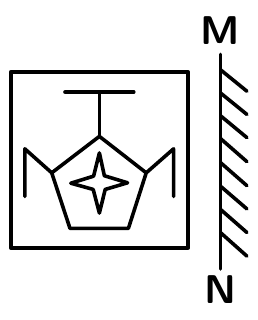
Choose the mirror image for the following figure when the mirror is kept on the MN line.

  1. ((a))

    C

  2. ((b))

    B

  3. ((c))

    D

  4. ((d))

    A

Show Answer
Answer: ((c))

D

The mirror image of the figure when the mirror is kept on the MN line is shown below:

Hence, ‘option 3’ is the correct answer.

39

A series is given with one term missing. Select the correct alternative from the given ones that will complete the series.

28, 31, 35, 41, ?, 63

  1. ((a))

    49

  2. ((b))

    45

  3. ((c))

    56

  4. ((d))

    50

Show Answer
Answer: ((d))

50

Here the logic is:

Hence, 50 is the correct answer.

40

Three statements are given followed by two conclusions numbered I and II. Assuming the statements to be true, even if they seem to be at variance with commonly known facts, decide which of the conclusions logically follow(s) from the statements.

Statements:

All paper are chair.

Some chair are ground.

All cat are ground.

Conclusions:

I. Some cat are chair.

II. Some chair are not paper.

  1. ((a))

    Only conclusion II follows 

  2. ((b))

    Both conclusions I and II follow 

  3. ((c))

    Only conclusion I follows  

  4. ((d))

    Neither conclusion I nor II follows 

Show Answer
Answer: ((d))

Neither conclusion I nor II follows 

Given Statements:

All paper are chair.

Same chair are ground.

All cat are ground.

The least possible Venn diagram for the given statement is:

Conclusions:

I. Some cat are chair - False (Because, No definite relation given between cat and chair, so it can be possible only).

II. Some chair are not paper - False (Because, All paper are chair gives some chair are paper, So, some chair are not paper will be true in possibility only).

So, Neither conclusion I nor II follows .

Hence, the correct answer is "Option 4".

41

An email received by a receiver consists of an attachment. When he opens the attachment, it results in the message being resent to everyone in Microsoft Outlook address book of the receiver. What might be the contents of the attachment?

  1. ((a))

    Freeware

  2. ((b))

    Shareware

  3. ((c))

    Virus

  4. ((d))

    Firewall

Show Answer
Answer: ((c))

Virus

The correct answer is Virus.

Key Points

  • A virus is a type of malicious software designed to replicate itself and spread to other computers through an infected file or attachment.
  • When an infected attachment is opened, the virus can execute its code and perform harmful actions like resending itself to the contacts in the address book.
  • Such viruses can compromise the security of a system, leading to data breaches and loss of sensitive information.
  • Common symptoms of a virus infection include unexpected email activity, system slowdowns, and unauthorized access to files.
  • Antivirus software is essential to detect, quarantine, and remove viruses from affected systems.

Additional Information

  • Freeware
  • Freeware refers to software that is available for use at no cost.
  • It is often distributed without , limiting the ability to modify it.
  • Freeware can sometimes come bundled with adware or other unwanted programs.
  • Shareware
  • Shareware is a type of software that is distributed for free on a trial basis.
  • Users are encouraged to pay for the full version after the trial period ends.
  • Shareware often comes with limited features or usage restrictions until purchased.
  • Firewall
  • A firewall is a network security device that monitors and controls incoming and outgoing network traffic.
  • It establishes a barrier between a trusted internal network and untrusted external networks, such as the internet.
  • Firewalls can be hardware-based, software-based, or a combination of both.
  • They are essential for protecting systems from unauthorized access and cyber threats.
  • Malware
  • Malware is any software intentionally designed to cause damage to a computer, server, or computer network.
  • Types of malware include viruses, worms, trojans, ransomware, spyware, and adware.
  • Malware can disrupt operations, steal sensitive information, or gain unauthorized access to system resources.
  • Preventive measures include using antivirus programs, keeping software updated, and practicing safe browsing habits.
42

What the network interface card contains which the data-link layer protocol use this address to identify the system on the network?

  1. ((a))

    Output addresses

  2. ((b))

    Software addresses

  3. ((c))

    Hardware addresses

  4. ((d))

    Input address

Show Answer
Answer: ((c))

Hardware addresses

The correct answer is Hardware addresses.

Key Points

  • The network interface card (NIC) contains a unique identifier known as the hardware address or MAC address.
  • This address is used by the data-link layer protocols to uniquely identify devices on a network.
  • The MAC address is a 48-bit address that is typically represented as a sequence of 12 hexadecimal digits.

Additional Information

  • Output addresses: This term does not refer to any standard type of network address used to identify systems on a network.
  • Software addresses: This could refer to IP addresses assigned by software, but in the context of the data-link layer, hardware addresses (MAC addresses) are used.
  • Input address: Similar to output addresses, this is not a standard term for identifying systems on a network.
43

Tamper Protection is a feature that prevents unauthorised apps from changing your security settings. Which of the following Operating Systems supports the same? 

  1. ((a))

    Windows 10

  2. ((b))

    Windows XP

  3. ((c))

    Linux

  4. ((d))

    Windows Vista

Show Answer
Answer: ((a))

Windows 10

Explanation:

In the context of the given statement and options, we are discussing the Tamper Protection feature that prevents unauthorized apps from changing security settings. The question asks which of the following operating systems supports this feature. Let us delve into the details of the correct option and analyze the other options to provide a comprehensive understanding.

Correct Option Analysis:

The correct option is:

Option 1: Windows 10

Windows 10 is the correct answer because it includes a feature known as Tamper Protection, which is designed to protect the security settings of the system. This feature is a part of the Windows Security suite and was introduced as part of the broader enhancements to Windows Defender Antivirus. Tamper Protection helps to prevent malicious software and unauthorized users from making changes to critical security features. This includes actions such as disabling antivirus protection, turning off real-time protection, or attempting to change any settings that could compromise the security of the system.

Understanding Tamper Protection:

Tamper Protection is an important security feature in Windows 10 that ensures the integrity of the system’s security settings. When enabled, it provides an additional layer of defense against malware and unauthorized changes by blocking attempts to alter security configurations. This helps maintain a consistent security posture and reduces the risk of security breaches.

How Tamper Protection Works:

  • Real-time Protection: Ensures that real-time antivirus protection remains active and cannot be disabled by malicious software.
  • Security Features: Prevents unauthorized changes to essential security settings, such as disabling Windows Defender Antivirus, modifying security settings, or turning off other important security features.
  • Protection Against Attacks: Helps to protect against sophisticated attacks that attempt to disable security measures and compromise the system.

Enabling Tamper Protection:

To enable Tamper Protection on a Windows 10 system, follow these steps:

  1. Open the Windows Security application.
  2. Go to Virus & threat protection.
  3. Click on Manage settings under the Virus & threat protection settings section.
  4. Toggle the Tamper Protection switch to On.

By enabling Tamper Protection, users can ensure that their security settings remain intact and are not altered by unauthorized applications or users.

Important Information

To further understand the analysis, let’s evaluate the other options:

Option 2: Windows XP

Windows XP does not support Tamper Protection. This operating system, released in 2001, lacks many of the advanced security features found in more recent versions of Windows. While Windows XP did include some basic security measures, it does not have the sophisticated protections against unauthorized changes to security settings that are present in Windows 10.

Option 3: Linux

Linux, as an open-source operating system, has a different security model compared to Windows. While it does offer robust security mechanisms, such as user permissions and access controls, it does not have a feature specifically called Tamper Protection as found in Windows 10. Security on Linux is generally managed through a combination of user privileges, SELinux/AppArmor policies, and other security frameworks.

Option 4: Windows Vista

Windows Vista, released in 2006, introduced several security enhancements over its predecessors, including User Account Control (UAC) and Windows Defender. However, it does not include the Tamper Protection feature that is present in Windows 10. While it aimed to improve security, it did not offer the same level of protection against unauthorized changes to security settings.

Conclusion:

Understanding the security features of different operating systems is essential for ensuring the protection of a system against unauthorized changes and potential threats. Windows 10’s Tamper Protection is a critical feature that enhances the security of the system by preventing unauthorized modifications to security settings. This feature is not available in older versions of Windows, such as Windows XP and Windows Vista, nor is it present in Linux in the same form. Therefore, the correct answer to the given question is Option 1: Windows 10.

44

Which of the following file formats can be used while saving a workbook in MS Excel 2019 that is compatible with all other spreadsheet software programs? 

  1. ((a))

    Portable Document Format (.pdf)

  2. ((b))

    Microsoft Excel Spreadsheet XML (.xlsx)

  3. ((c))

    Microsoft Excel Spreadsheet Beta (.xlsb) 

  4. ((d))

    Comma-separated values (.csv)

Show Answer
Answer: ((d))

Comma-separated values (.csv)

Explanation:

When saving a workbook in MS Excel 2019, it is crucial to choose a file format that ensures compatibility with other spreadsheet software programs. Among the options provided, the correct answer is option 4: Comma-separated values (.csv). Here is a detailed explanation of why this option is the most compatible and an analysis of the other options.

Correct Option Analysis:

The correct option is:

Option 4: Comma-separated values (.csv)

A CSV file is a plain text file that stores tabular data in a simple, text-based format. Each line in the file corresponds to a row in the table, and columns within each row are separated by commas. This format is widely supported by various spreadsheet software programs, including Microsoft Excel, Google Sheets, LibreOffice Calc, and many others.

Applications: CSV files are commonly used for data exchange between different software programs, importing/exporting data to/from databases, and transferring data between different systems or platforms. They are also suitable for simple data storage and analysis tasks.

Additional Information

To further understand the analysis, let’s evaluate the other options:

Option 1: Portable Document Format (.pdf)

PDF files are designed for document presentation rather than data manipulation. While they can be used to save spreadsheet data, they are not suitable for editing or transferring data between spreadsheet programs. PDFs preserve the formatting and layout of the document, making them ideal for printing and sharing static reports, but they lack the flexibility required for dynamic data manipulation.

Option 2: Microsoft Excel Spreadsheet XML (.xlsx)

XLSX is the default file format for Microsoft Excel workbooks. It supports advanced features such as formulas, charts, and formatting options. However, while XLSX files are widely used and supported by many spreadsheet programs, they may not be fully compatible with all software applications, especially older versions or non-Microsoft products. Some features may not be preserved or may be rendered differently when opened in other programs.

Option 3: Microsoft Excel Spreadsheet Beta (.xlsb)

XLSB is a binary file format for Excel workbooks that offers faster loading and saving times compared to the XML-based XLSX format. However, XLSB files are less widely supported by non-Microsoft spreadsheet software programs. This format is more suitable for internal use within Microsoft Excel rather than for data exchange with other applications.

Conclusion:

When choosing a file format for saving a workbook in MS Excel 2019, it is essential to consider compatibility with other spreadsheet software programs. The CSV format is the most suitable option for ensuring wide compatibility and seamless data exchange. While other formats like XLSX and XLSB offer advanced features, they may not be fully compatible with all software applications. PDF files, on the other hand, are designed for presentation rather than data manipulation. Therefore, for maximum compatibility, the CSV format is the best choice.

45

The type of memory which is fast and temporarily stores the data which are immediately required for use is called as:

  1. ((a))

    HDD

  2. ((b))

    ROM

  3. ((c))

    RAM

  4. ((d))

    SSD

Show Answer
Answer: ((c))

RAM

The correct answer is RAM.

Key Points

  • RAM (Random Access Memory) is a type of computer memory that can be accessed randomly; any byte of memory can be accessed without touching the preceding bytes.
  • It is a volatile memory, meaning it requires power to maintain the stored information. Once the system is turned off, all data is lost.
  • RAM temporarily stores data and instructions that the CPU needs while performing tasks, making data retrieval much faster than from a hard drive.
  • There are different types of RAM, including DRAM (Dynamic RAM) and SRAM (Static RAM), each serving different purposes in computer architecture.

Additional Information

  • HDD (Hard Disk Drive)
  • It is a non-volatile storage device that stores data permanently, even when the power is off.
  • HDDs use magnetic storage to store and retrieve digital information using one or more rigid rapidly rotating disks coated with magnetic material.
  • They are typically used for long-term storage of applications, files, and the operating system.
  • ROM (Read-Only Memory)
  • It is a type of non-volatile memory used in computers and other electronic devices.
  • Data stored in ROM cannot be modified easily or at all, meaning it is primarily used to store firmware or software that is rarely changed.
  • ROM retains its data even when the computer is turned off.
  • SSD (Solid State Drive)
  • It is a non-volatile storage device that uses integrated circuit assemblies to store data persistently.Unlike HDDs, SSDs have no moving parts, which makes them faster, more durable, and more efficient.
  • SSDs are commonly used in modern computers for faster boot times and application load times.
46

In which of the following services do users need to log in to a server computer remotely, and then to log out again when the user finishes accessing information on the server computer?

  1. ((a))

    Net Scape

  2. ((b))

    Mozilla

  3. ((c))

    FTP

  4. ((d))

    Mac Web

Show Answer
Answer: ((c))

FTP

The correct answer is FTP.

Key Points

  • FTP (File Transfer Protocol) is a standard network protocol used to transfer computer files between a client and server on a computer network.
  • Users typically authenticate themselves with a username and password, although some servers may allow anonymous access.
  • FTP is built on a client-server model architecture using separate control and data connections between the client and the server.
  • After completing the file operations, users log out from the server.

Additional Information

  • Net Scape: This was a popular web browser in the 1990s.
  • Mozilla: This is a free software community known for its Firefox web browser.
  • Mac Web: This was an early web browser for the classic Mac OS.

 The provided solution clearly explains why FTP is the correct answer and offers additional context for clarity.

47

What is a common sign that a computer might be infected with a virus?

  1. ((a))

    Improved system security

  2. ((b))

    Unusual system slowdowns and unexpected errors

  3. ((c))

    Faster system boot times

  4. ((d))

    Increased hard drive space

Show Answer
Answer: ((b))

Unusual system slowdowns and unexpected errors

The correct answer is Unusual system slowdowns and unexpected errors.

Key Points

  • One of the common symptoms of a computer virus infection is unusual system slowdowns that occur without any apparent reason.
  • Unexpected errors and crashes are also indicative of a potential virus infection, disrupting normal operations.
  • Infected systems may display frequent and unwanted pop-up ads, even when not browsing the internet.
  • Another sign is the presence of unknown programs or processes running in the background, which were not installed by the user.
  • Changes in system settings and the appearance of unfamiliar toolbars in the browser can also indicate a virus infection.

Additional Information

  • Virus Definition
  • A computer virus is a type of malicious software program designed to replicate itself by modifying other programs and inserting its own code.
  • Viruses typically require a host program to function and spread from one computer to another.
  • Common Types of Viruses
  • File Infector Virus: Attaches itself to executable files and spreads when the infected file is run.
  • Macro Virus: Embeds itself into documents and spreadsheets that contain macros.
  • Boot Sector Virus: Infects the master boot record and is activated when the computer is started.
  • Prevention Measures
  • Install and regularly update antivirus software to detect and remove viruses.
  • Avoid downloading and opening email attachments from unknown or untrusted sources.
  • Keep your operating system and all software up to date with the latest security patches.
  • Impact of Viruses
  • Viruses can lead to data loss, system corruption, and unauthorized access to sensitive information.
  • They can also cause significant downtime and financial losses for both individuals and organizations.
48

Which of the following provides icons (or pictures) and menus (list of choices) that users can select with a mouse?

  1. ((a))

    ROM

  2. ((b))

    GUI

  3. ((c))

    FSK

  4. ((d))

    GNU

Show Answer
Answer: ((b))

GUI

The correct answer is GUI.

Key Point Image

Key Points

  • A Graphical User Interface (GUI) is a type of user interface that allows users to interact with electronic devices using graphical icons and visual indicators.
  • GUIs make it easier for users to perform tasks by using windows, icons, and menus, rather than text-based commands.
  • Users can interact with a GUI by using devices like a mouse or a touchscreen.
  • Common examples of GUIs include the interfaces of operating systems like Windows, macOS, and Linux desktop environments.
  • GUIs are designed to be user-friendly and intuitive, reducing the learning curve for new users.
  • They support multitasking by allowing users to open and manage multiple applications simultaneously.

Additional Information Image

Additional Information

  • GUIs often include features such as drag-and-drop, context menus, and toolbars to enhance usability.
  • They provide visual feedback to users, such as highlighting buttons when hovered over or displaying progress bars during operations.
  • Modern GUIs can be customized by users to suit their preferences, including themes, colors, and layout configurations.
  • The first GUI was developed by researchers at Xerox PARC in the 1970s and popularized by the Apple Macintosh in the 1980s.
49

In MS-Excel 2010, click the cell that contains the data that you want to edit and then press ________ key. It starts Edit mode and positions the cursor at the end of the cell contents.

  1. ((a))

    F2

  2. ((b))

    F3

  3. ((c))

    F4

  4. ((d))

    F1

Show Answer
Answer: ((a))

F2

The correct answer is F2.

Key Points

  • Pressing the F2 key in MS-Excel 2010 allows users to enter Edit mode for the selected cell.
  • Once in Edit mode, the cursor is positioned at the end of the cell's contents, enabling easy modifications.
  • This feature is particularly useful for quick edits and data corrections without retyping the entire cell content.
  • The Edit mode can also be activated by double-clicking on the cell but using F2 is a faster keyboard shortcut.
  • F2 is a consistent shortcut in most versions of MS-Excel, ensuring ease of use for frequent Excel users.

Additional Information

  • Edit Mode in MS-Excel:
  • Edit mode allows users to modify the contents of a cell without overwriting the entire content.
  • It is helpful for correcting typos or adding additional data to existing content in a cell.
  • Other Common Keyboard Shortcuts in Excel:
  • Ctrl + C: Copy the selected cell or range of cells.
  • Ctrl + V: Paste the copied data into the selected cell or range.
  • Ctrl + Z: Undo the last action performed.
  • Ctrl + Y: Redo the last undone action.
  • Double-Click Functionality:
  • Double-clicking a cell also activates Edit mode but is less efficient than using F2 for frequent tasks.
  • It is commonly used for quick, one-off edits.
  • Excel Versions:
  • The F2 shortcut is available in most versions of Microsoft Excel, including Excel 2010, 2013, 2016, and later versions.
  • This consistency across versions ensures familiarity for users upgrading to newer Excel versions.
50

Typically __________ is used to send the email carbon copy to multiple recipients, except each recipient can't see who is on the list of other recipients.

  1. ((a))

    Subject

  2. ((b))

    Add text

  3. ((c))

    Bcc

  4. ((d))

    Cc

Show Answer
Answer: ((c))

Bcc

The correct answer is Bcc.

Key Points

  • Bcc stands for Blind Carbon Copy, used in emails to send copies to multiple recipients without disclosing the recipient list to them.
  • When using Bcc, each recipient receives the email as if they are the only ones addressed, ensuring privacy.
  • This feature is commonly utilized to maintain confidentiality among recipients, especially in professional and corporate communications.
  • Bcc is particularly useful when sending a large volume of emails to protect the email addresses from being visible to others.

Additional Information

  • Cc (Carbon Copy) is another email feature that sends copies to multiple recipients, but unlike Bcc, all recipients can see the list of who else received the email.
  • Subject refers to the title or topic of the email, giving recipients an idea of the email content before opening it.
  • Add Text is a general function used in various software applications to input or edit text within a document or form.
  • Using Bcc helps in avoiding spam and unwanted replies from all recipients, as the addresses are hidden.
  • Most email clients such as Outlook, Gmail, and Yahoo Mail support the Bcc feature, ensuring its widespread availability and usage.
51

Which of the following statements is incorrect with respect to the balance sheet?

  1. ((a))

    It is prepared to find out the actual financial position of the firm.

  2. ((b))

    It cannot be prepared without making adjustments for arrears and prepaid expenses.

  3. ((c))

    All types of accounts – real, personal or nominal, are included in this.

  4. ((d))

    It is accepted by the court as documentary evidence.

Show Answer
Answer: ((c))

All types of accounts – real, personal or nominal, are included in this.

The incorrect answer is All types of accounts – real, personal or nominal, are included in this.

Key Points

  • One of the three basic financial statements, the balance sheet is essential to accounting and financial analysis.
  • The balance sheet shows the overall assets of the business as well as how those assets are financed—either through debt or equity.
  • It is also known as a statement of financial situation or a statement of net worth.
  • The fundamental formula Assets = Liabilities + Equity serves as the foundation for the balance sheet.

Important Points

Statement I: It is prepared to find out the actual financial position of the firm

  • This statement is correct because a balance sheet is a list of the assets and liabilities of a company at a particular point in time. It is made using a trial balance that has been altered. By describing the sources of funding and how they were used, balance sheets reveal the financial position of the company.

Statement II: It cannot be prepared without making adjustments for arrears and prepaid expenses

  • This statement is correct about balance sheet because in order for the balance sheet to reflect the amount that is actually prepaid (not yet expired) at the end of the month, if the company releases financial statements at the end of each calendar month, the balance in the account Prepaid Expenses must be changed.

Statement III: All types of accounts – real, personal or nominal, are included in this

  • This statement is incorrect because the balance sheet is a statement that lists the company's assets, equity, and liabilities. It is separated into the sections Assets and Equity & Liabilities. It displays both the personal and real account balances. In contrast, a trial balance is a list of all general ledger account balances. It displays the balances of the personal, real, and nominal accounts and is divided into Debit and Credit columns.

Statement IV: It is accepted by the court as documentary evidence.

  • This statement is correct because the Supreme Court observed that the consideration of balance sheets as a valid acknowledgment of debts for the purposes of the Act cannot be refuted.

Hence, it can be concluded that only statement III is incorrect.

52

Income received in advance appears at ____ side of balance sheet.

  1. ((a))

    Asset side

  2. ((b))

    Liability side

  3. ((c))

    Both asset and liability side

  4. ((d))

    Does not appear in balance sheet

Show Answer
Answer: ((b))

Liability side

The correct answer is liability side. 

  • Income received in advance refers to income or portion of income received in an accounting year which is not earned in the accounting period.
  • It is also known as unearned income or unexpired income.
  • Income received in advance is a liability because the company that received the money has not yet earned it and it has an obligation to render benefit in future.

Additional Information

  • Balance Sheet: It is the summary of the financial balances of an individual firm consisting all the available assets and liabilities of the firm; showing their financial position to the users.
  • Assets- Anything (whether physical or not) that is holding any value in the market in terms of cash and which is owns by the company or any person.
  • Liability- An amount which is borrowed by any individual or a person and to be repaid after a specified period of time.
53

A favourable bank balance implies _______.

  1. ((a))

    a debit balance in the cash book and passbook

  2. ((b))

    a credit balance in the cash book and passbook

  3. ((c))

    a debit balance in the cash book and a credit balance in the passbook

  4. ((d))

    a credit balance in the cash book and a debit balance in the passbook

Show Answer
Answer: ((c))

a debit balance in the cash book and a credit balance in the passbook

The correct answer is a debit balance in the cash book and a credit balance in the passbook.

Key PointsThe word "bank reconciliation statement" refers to a document that is generated to reconcile or add up the discrepancy between the user passbook and the company's cashbook so that the reason for the discrepancy can be identified and fixed.

Important PointsFavourable bank balance means debit balance in cash book as well as credit balance in pass book.

When in BRS, balance as per passbook is given, the impact of all transactions on the cash book must be assessed if a bank reconciliation statement is made using the balance of the passbook, whether it is favourable (credit) or overdraft (debit).

The transactions shall be recorded in the bank reconciliation statement as under:

  • Deduct: All those transactions that have resulted in decreasing in the balance as per cash book
  • Add: All those transactions that have resulted in increasing the balance as per cash book

Hence, it can be concluded that a favourable bank balance implies a debit balance in the cash book and a credit balance in the passbook.

54

Which of the following statements is true in the context of a balance sheet?

  1. ((a))

    An increase in assets always results in an increase in owner’s equity.

  2. ((b))

    Outsiders’ claim against business is a residual claim. 

  3. ((c))

    Assets = Liabilities + Owner's equity is always true.

  4. ((d))

    Losses result in an increase in owner’s equity

Show Answer
Answer: ((c))

Assets = Liabilities + Owner's equity is always true.

The correct answer is Assets = Liabilities + Owner's equity is always true.

Key Points

Accounting Equation:

  • The accounting equation demonstrates that a company's total assets are equal to the sum of its liabilities and shareholders' equity on its balance sheet.
  • Assets are the valuable resources owned by the business.
  • Funding for a company's assets can come from both liabilities and shareholders' equity.

Important Points

  • An important element of the balance sheet and a fundamental accounting principle is the accounting equation. The calculation looks like this:
  • Liabilities + shareholder equity = Assets.
  • This equation shows the balance sheet's structure and lays the groundwork for double-entry accounting, also referred to as double-entry bookkeeping.
  • Every transaction in a double-entry accounting system has an impact on at least two accounts.

Hence, it can be concluded that Assets = Liabilities + Owner's equity is always true.

Additional Information

Statement I:

An increase in assets always results in an increase in owner’s equity, this statement is incorrect because assets increased, liabilities had no effect, owners' equity increased. Assets decreased, liabilities had no effect, owners' equity decreased.

Statement II: 

Outsiders’ claim against business is a residual claim, this statement is incorrect because the term residual claim refers to a stockholders’ right to its share of earnings in a liquidation scenario after all debt obligations have been paid.

Statement IV: 

Losses result in an increase in owner’s equity, this statement is incorrect because losses and expenses lead to a decline in owner's equity. When the Service Revenues account is closed to owner's equity at the conclusion of the accounting year, if a company provides a service and raises its assets, owner's equity will rise.

55

In the Balance Sheet of a Common Size Statement

  1. ((a))

    figure of share capital is assumed to be 100

  2. ((b))

    figure of current liabilities is assumed to be 100

  3. ((c))

    figure of fixed assets is assumed to be 100

  4. ((d))

    figure of total assets is assumed to be 100

Show Answer
Answer: ((d))

figure of total assets is assumed to be 100

The correct answer is Figure for total assets is assumed to be 100

Key Points

Common Size Statement 

  • A common size statement is a type of financial statement analysis and interpretation.
  • It is also called Vertical Analysis.
  • This method examines financial statements by calculating each line item as a percentage of the base amount for the accounting period in question.

Important Points Common Size Balance Sheet

  • The total assets value is typically used as the base value (considered as 100) in the balance sheet common size analysis.
  • The value of total assets on the balance sheet equals the value of total liabilities and shareholders' equity.
  • The common size analysis is used by financial management or investor to compare a company's capital structure to that of competitors.
  • They can draw key conclusions by comparing individual line items to the total assets.

56

The premium on issue of debentures is showed in Balance Sheet under -

  1. ((a))

    share capital

  2. ((b))

    reserve and surplus

  3. ((c))

    secured loan

  4. ((d))

    current liabilities 

Show Answer
Answer: ((b))

reserve and surplus

Introduction:

The premium on the issue of debentures refers to the amount received by a company over and above the face value of its debentures. This extra amount is accounted for in the company's financial statements.


Key Points

:

  1. Share Capital: Represents the equity stake owned by shareholders in the company. The premium on debentures does not fall under this category as it is not related to equity financing.
  2. Reserve and Surplus: This is where the premium on the issue of debentures is recorded. It represents additional funds that are not designated for a specific purpose but can be used for various needs, including the strengthening of the company's financial position.
  3. Secured Loan: Debentures can be secured or unsecured, but the premium received from their issue does not classify as a loan itself.
  4. Current Liabilities: These are the company's debts or obligations due within one year. The premium on issue of debentures does not qualify as a liability.
<br>

Conclusion:

The correct placement for the premium on the issue of debentures is under the "Reserve and Surplus" category in the Balance Sheet. This is because it represents additional funds available to the company, which are not immediately required to be paid back or used.


Additional Info

rmation:

Recording the premium under "Reserve and Surplus" not only accurately reflects the nature of these funds but also strengthens the company's financial statements by showing additional resources available for future use or investment.

57

Leave Travel Concession is a _______.

  1. ((a))

    Tax-free perquisite for one journey per year

  2. ((b))

    Tax-free perquisite for two visits in a period of 4 years

  3. ((c))

    Taxable perquisite

  4. ((d))

    Tax-free perquisite for one journey in a period of 4 years

Show Answer
Answer: ((b))

Tax-free perquisite for two visits in a period of 4 years

The correct answer is Tax-free perquisite for two visits in a period of 4 years.

Key PointsIncome Tax Act, 1951 - Section10 (5): Leave Travel Concession

  • As the name implies, it is an exemption for any compensation or benefits the employee receives from his employer for travel while on leave.
  • Even though it might seem straightforward, there are a lot of things to consider before scheduling a trip in order to qualify for LTA exemption.
  • The income tax code has established guidelines for seeking LTA exemption.

Important PointsConditions for claiming LTC

  1. You must really travel to be eligible for the exemption.
  2. Only domestic travel, or travel within India, is taken into account for exemption. No overseas travel is covered under LTA.
  3. The employee is eligible for the travel exemption whether they are travelling alone or with their family, which includes their spouse, kids, parents who are completely or primarily dependent on them, siblings, and other blood relatives.
  4. Additionally, more than two children of an employee who were born after October 1, 1998, are not eligible for this exemption. There are no restrictions for kids who were born before October 1, 1998.
  5. Additionally, this restriction does not apply in circumstances of multiple births where a child is born on a second occasion after the first.

Eligible LTA Exemption

  1. Only the actual travel expenses, such as the employee's plane, rail, or bus fares, are eligible for the exemption.
  2. No costs like local transportation, sightseeing, hotel stays, meals, etc. qualify for this exemption.
  3. Additionally, only LTA supplied by the employer is exempt.

Leave Travel Exemption

  • TA exemption is available for only two journeys performed in a block of four calendar years.​

Hence, it can be concluded that Leave Travel Concession is a Tax-free perquisite for two visits in a period of 4 years.

58

Continuous examination of books of accounts throughout the year is called

  1. ((a))

    Occational audit

  2. ((b))

    Internal audit

  3. ((c))

    Periodic audit

  4. ((d))

    Continuous audit

Show Answer
Answer: ((d))

Continuous audit

The correct answer is Continuous Audit

Key Points

Continuous Audit

Continual auditing involves an auditor's continuous examination of all transactions throughout the year. Continuous audit, in other words, is when a client's accounts are checked continuously throughout the year or at regular intervals during the financial term. The auditor verifies the accuracy of the financial statements at the conclusion of the financial period and produces a report with minimal delay.

Important Points Features of Continuous Audit

  • It involves detailed examination of all transactions by the auditor.
  • The auditor visits the business concern at frequent intervals, say, weekly or fortnightly or monthly during the period of audit.
  • Continuous audit is done simultaneously with the preparation of accounts.
  • The auditor is constantly engaged in checking the accuracy of the accounts during the whole accounting period.
  • At the end of the financial period, the auditor checks the correctness of the financial statements and submits a report.

Additional Information Internal Audit: An independent service that evaluates an organization's internal controls, corporate practises, processes, and methods is known as internal audit. Internal audits assist in ensuring compliance with numerous laws that apply to a company.

Occasional auditing: Occasional auditing is performed as a one-time event in organisations when routine auditing is not performed. Audits are conducted on a regular basis. Occasional auditing is performed as a one-time event in organisations when routine auditing is not performed.

Periodical audit: Periodical audit is one which is taken up at the close of the financial or trading period when all the accounts have been balanced and Trading and Profit and Loss Accounts and the Balance Sheet have been prepared.

59

Section 80QQB of the Income Tax Act, 1961 deals with _______.

  1. ((a))

    Interest on savings accounts in bank

  2. ((b))

    Profit from export of computer software

  3. ((c))

    Royalty income from patents

  4. ((d))

    Author's royalty income

Show Answer
Answer: ((d))

Author's royalty income

The correct answer is Author's royalty income.

Key Points

  • Section 80QQB: The Income Tax Act of 1961 contains provisions relating to Royalty Income under Section 80QQB.
  • Authors' royalties are included as deductions in this section.
  • The royalty income is subject to taxation under the same heading as other sources of profit and gains.

Important PointsEligible income available as a deduction under section 80QQB

  • Any income earned by an author in the exercise of his profession.
  • Any income earned as a lump sum consideration for the assignment or grant of any of his interest in the copyright of any book being the work of artistic or literary or scientific nature or royalty or copyright in respect of author’s book.
  • Any income received as non-refundable advance payment of royalties or copyright fees.

Conditions to be fulfilled for availing deduction under section 80QQB

  • The individual assessee who is claiming the deduction must either be an Indian resident or an Indian resident who is not ordinarily an Indian resident.
  • The assessee should have authored (with others) a book that discusses a piece of either literary, artistic, or scientific work.
  • Payment for the total should be made in lump sum. However, income (before permitting expenses) that is in excess of 15% of the value of books sold throughout the year should be disregarded if the money is not paid in lump sum payment.
  • When income is earned outside of India, section 80QQB's deduction is only applicable to that portion of the revenue that is brought back to India in convertible foreign currency within six months (or within an extended length of time) after the end of the previous year in which the income was earned.
  • The assessee who is requesting the deduction must obliquely provide a certificate in Form No. 10CCD. The person in charge of paying the income shall properly verify such a certificate in Form No. 10CCD. When submitting an income tax return, the certificate must be included.
  • After the deduction for income under section 80QQB has been taken, no additional deduction for that income under any other provisions of the Act may be claimed in any assessment year.

Maximum amount of allowable deduction

  • The total amount of royalty income;
  • or INR 3 Lakhs.

Hence, it can be concluded that Section 80QQB of the Income Tax Act, 1961 deals with Author's royalty income.

60

One person company is a special type of 

  1. ((a))

    Public company 

  2. ((b))

    Private company 

  3. ((c))

    Holding company 

  4. ((d))

    Subsidiary company 

Show Answer
Answer: ((b))

Private company 

The correct answer is private company. 

  • One Person Company (‘OPC’ for short) is defined under Section 2(62) of the Companies  Act, 2013 which has only one person as a member. Section 3 of the Act indicates that OPC is a private limited company.

Key Points

  • Features of One Person Company: 
  • Private company: Section 3(1)(c) of the Companies Act says that a single person can form a company for any lawful purpose. It further describes OPCs as private companies.
  • Single-member: OPCs can have only one member or shareholder, unlike other private companies.
  • Nominee: A unique feature of OPCs that separates it from other kinds of companies is that the sole member of the company has to mention a nominee while registering the company.
  • Minimum one director: OPCs need to have a minimum of one person (the member) as director. They can have a maximum of 15 directors.
  • No minimum paid-up share capital: Companies Act, 2013 has not prescribed any amount as minimum paid-up capital for OPCs.

Additional Information

  • Public companies- a company that is not a private company.
  • Private companies- ‘a company having a minimum paid-up share capital as may be prescribed and the company which by its articles restricts the right to transfer its shares limits the number of its members to 200 and prohibits any invitation to the public to subscribe for any securities of the company.
  • Holding company - ‘holding company’ in relation to one or more other companies means a body corporate of which such companies are subsidiary companies.
  • Subsidiary company- ‘subsidiary company’ in relation to any other body corporate as a company in which the holding company-
  1. controls the composition of the Board of Directors; or
  2. exercises or controls more than one half of the total voting power.
61

Noting of a bill is done when it is _______.

  1. ((a))

    Dishonored 

  2. ((b))

    Endorsed

  3. ((c))

    Renewed

  4. ((d))

    Exempted

Show Answer
Answer: ((a))

Dishonored 

The correct answer is Dishonoured .

Key Points

  • By "Notary Public," we mean someone who records the minutes of dishonour on the dishonoured bill.
  • The Negotiable Act permits writing on a paper that has been attached to a dishonoured bill, or partially on the dishonoured bill and partially on the paper.

Important Points

Noting: 

  • If a promissory note or bill of exchange has been dishonoured through non-acceptance or non-payment, the holder may request that a notary public note the dishonour on the document itself, a paper that is attached to it, or partially on both.
  • A notary public is tasked with representing a dishonoured bill of exchange to the drawee for acceptance or to the acceptor for payment, depending on the situation, when it is dishonoured by non-acceptance or non-payment.
  • If the bill is dishonoured once more, the notary public makes a note of it on the bill or in a piece of paper that is enclosed. The process of doing so is known as noting.

Hence, it can be concluded that Noting of a bill is done when it is dishonoured.

62

Deduction in respect of donations for scientific research or rural development u/s 80 GGA is available to-

  1. ((a))

    Company

  2. ((b))

    All assessee

  3. ((c))

    Firm

  4. ((d))

    Individual/Firm

Show Answer
Answer: ((b))

All assessee

The correct answer is All assessee

Key PointsSection 80GGA of Income Tax Act, 1961.

Section 80GGA is related with tax deductions on contributions made towards scientific research and rural development.

EligibilityAll Assessees except those who have a source of income from a business or profession.
Conditions- Donation to an approved Scientific Research Association, university, college, or other scientific research organization - Donation made to an approved university, college or other institution for statistical research or research in social science. - Donation to a non-profit
organization or institution that is involved in a rural development initiative that has been authorized. - Donation to a public sector enterprise or a municipal government, or to an organization or institution that has been approved by the National Committee.
Mode of Paymentcheque or a draft or in cash
Amount of DeductionIn cash: Maximum Rs. 10,000 Other Method: 100% Tax deduction
63

Which of the following accounting methods was used first?

  1. ((a))

    Management accounting

  2. ((b))

    Cost accounting

  3. ((c))

    Financial accounting

  4. ((d))

    None of the above

Show Answer
Answer: ((c))

Financial accounting

Correct answer is Financial accounting

Key Points

  • Management accounting = Management accounting is that branch of accounting which provides the financial information and analysis to the internal management so that the informed decisions can be taken for the future growth of the business. Management accounting includes budgeting and forecasting, performance measurement, finding variances and decision making. Management accounting is important for effective decision making within the organization.
  • Cost accounting = Cost accounting is that branch of accounting which involves recording, classifying and summarizing cost for determination of cost of various products or services. Cost accounting ensures to control and reduce the cost and furnish such information to the management so that managers can take informed decisions. Various methods of cost accounting are used like marginal costing, activity based costing, departmental costing, batch costing etc.
  • Financial accounting = It is that branch of accounting which records the financial transactions, summarizes and communicate them to different users for decision making. Financial accounting is the basis of other accounting systems like management accounting and cost accounting. Therefore financial accounting method was first used because all other accounting  methods are based on this.
64

Secretarial audit is an effective tool for:

  1. ((a))

    Internal audit

  2. ((b))

    Efficiency audit

  3. ((c))

    Corporate compliance management

  4. ((d))

    Cost audit

Show Answer
Answer: ((c))

Corporate compliance management

Key Points

Secretarial Audit:

  • A compliance audit is a secretarial audit.
  • It is a component of an organization's overall compliance management.
  • It is a useful tool for corporate compliance management that aids in identifying noncompliance and implementing remedies.
  • The Secretarial Audit makes a determination regarding whether the company, taking into account the size and operations of the organization, has adequate systems and procedures in place to monitor and ensure compliance with applicable rules, regulations, laws, and guidelines.
  • Secretarial auditing assists in identifying non-compliance and carrying out corrective measures.
  • It looks at how well the business follows ethical business principles.

Important Points

The process involved in Secretarial Audit

  • To check compliance with the provisions of various laws and rules/ regulations/procedures, maintenance of books, records etc.,
  • By an independent professional
  • To make sure that the legal and procedural requirements are complied with
  • Also followed the due process.
  • It is essentially a mechanism to monitor compliance with the requirements of stated laws.

Hence, it can be concluded that a Secretarial audit is an effective tool for corporate compliance management.

65

In branch accounting, the direct method is another name for _______.

  1. ((a))

    Bulk Branch Method

  2. ((b))

    Stock and Debtors Method

  3. ((c))

    Final Accounting Method

  4. ((d))

    Debtor Method

Show Answer
Answer: ((d))

Debtor Method

The correct answer is Debtor Method.

Key Points

Branch Accounting:

  • Branch accounting is an accounting system that offers bookkeeping strategies for a company's or business's branches that are established in various locations to increase coverage and sales from the enterprise.
  • Each branch is treated as a distinct entity, and separate books of accounts are kept for each one of the branches separately.

Important PointsMethods of Branch Accounting

  1. Debtors Method/Direct Method
  2. Stock and Debtors Method
  3. Final Accounts method
  4. Wholesale Branches Method
  5. Income Statement System

Direct Method/Debtors Method: 

  • Under this method, the head office keeps separate branch accounts for each branch.
  • It will be ready to determine whether the branch made a profit or lost money.
  • The branch account is a nominal account.
  • This system is sometimes referred to as the direct method of branch accounting.

Additional InformationFormat of Branch Account

Hence, it can be concluded that in branch accounting, the direct method is another name for Debtor Method.

66

In case the assets are listed in order of liquidity, which of the following options should be listed first?

  1. ((a))

    Building

  2. ((b))

    Available Cash

  3. ((c))

    Reputation

  4. ((d))

    Closing stock

Show Answer
Answer: ((b))

Available Cash

The correct answer is Available Cash.

Key Points

  • The balance sheet's primary objective is to show the company's financial situation.
  • As a result, the balance sheet's assets and liabilities should be presented in a way that makes it easy to grasp the firm's financial situation.
  • Assets and liabilities are listed on the balance sheet in a particular order to accomplish this.
  • The marshalling of the assets and liabilities on the balance sheet is known.

Important PointsMethods of Marshalling of Balance Sheet

  • Order of Permanency
  • Order of Liquidity
  • Mixed Order

Order of Liquidity:

  • The current and fixed assets of an organisation are listed in the balance sheet using the order of liquidity method, based on how easily they may be turned into cash.
  • According to how urgently they must be paid, liabilities are presented.
  • The majority of solo proprietors and partnership firms employ this strategy.
  • In case the assets are listed in order of liquidity most liquid assets are mentioned first like available Cash and less liquid assets are mentioned at last like building.

Hence, it can be concluded that in case the assets are listed in order of liquidity, available cash are shown first.

Additional InformationOrder of Permanency:

  • This approach lists assets based on how permanent they are.
  • Particularly, more permanent items are presented first, followed by less permanent assets.
  • Similar to the order of permanence technique, the current liabilities are listed last and the fixed or long-term liabilities are displayed first.

Mixed Order: Liabilities are placed in accordance with the order of permanency, whereas assets are structured in accordance with the order of liquidity.

67

Interest is payable under section _______ for non-payment and deferment of advance tax respectively.

  1. ((a))

    234B and 234C

  2. ((b))

    234A and 234B

  3. ((c))

    234A, 234B and 234C

  4. ((d))

    234A and 234C

Show Answer
Answer: ((a))

234B and 234C

The correct answer is 234B and 234C.

Key Points

  • Under the Income-tax Act, different types of interests are levied for various kinds of delays/defaults.
  • Section 234B and 234C deals with non-payment or short payment of advance tax; and non-payment or short payment of individual instalment or instalments of advance tax (i.e., deferment of advance tax) respectively.

Important PointsSection 234B : Interest for default in payment of advance

  • Interest under section 234B is levied in following two cases: When the taxpayer due advance tax but hasn't paid it, or
  • When the amount of advance tax paid by the taxpayer is less than 90% of the assessed tax (meaning of assessed tax is discussed later).
  • Rate of Interest: Interest rates Section 234B imposes interest of 1% per month or portion thereof for failure to pay advance tax. Simple interest is the nature of interest. To put it another way, the taxpayer is responsible for paying simple interest at a rate of 1% per month or fraction thereof for failure to pay advance tax.
  • Amount liable for interest: The amount of unpaid advance tax is subject to interest under section 234B. Interest is charged on the amount by which advance tax is underpaid if there is a shortfall in payment. The following formula is used to calculate the unpaid/short paid advance tax:

Amount of unpaid/short paid advance tax= Assessed Tax - Advance tax(if any)

Section 234C:  Interest for default in payment of instalment(s) of advance tax

  • Rate of Interest: Interest is charged under section 234C at 1% per month or fraction thereof for failure to pay any instalments of advance tax. Simple interest is the nature of interest. In other words, if an individual advance tax instalment is not paid in full or is paid late, the taxpayer is responsible for simple interest at the rate of 1% per month or fraction thereof.
  • Period of levy of interest Interest: Under section 234C is levied for a period of 3 months, in case of short fall in payment of 1st, 2nd and 3rd instalment and for 1 month, in case of short fall in payment of last instalment.
  • Amount liable for interest Interest:  Under section 234C is levied on the short paid amount of instalment(s) of advance tax.
68

In case the assets and liabilities are shown in the balance sheet in the order of permanency:

(i) The least liquid asset is displayed first

(ii) The least immediate liability is shown last

  1. ((a))

    Neither (i) nor (ii)

  2. ((b))

    (i) only

  3. ((c))

    (ii) only

  4. ((d))

    (i) and (ii) both

Show Answer
Answer: ((b))

(i) only

The correct answer is (i) only

Key Points

  • The balance sheet should display assets and liabilities in either permanent order or liquidity order.
  • This is referred to as balance sheet marshalling.
  • The assets and liabilities are arranged according to how permanent they are in the business.

Important PointsMarshalling of Balance Sheet: 

  • The balance sheet's primary objective is to display the company's financial situation.
  • As a result, the balance sheet's assets and liabilities should be presented in a way that makes it easy to grasp the firm's financial situation.
  • Assets and liabilities are listed on the balance sheet in a particular order to accomplish this.
  • The marshalling of the assets and liabilities on the balance sheet is known.
  • There are three methods of marshalling: i. Order of permanence, ii, Order of Liquidity and iii. Mixed Order.

Order of Permanency: 

  • This approach lists assets based on how permanent they are.
  • Particularly, more permanent assets are displayed first, followed by less permanent assets.
  • Similar to the order of permanence method, the current liabilities are listed last, and the fixed or long-term liabilities are displayed first.

Hence, it can be concluded that the correct answer is only (i).**

Additional Information

  1. Order of Liquidity: The current and fixed assets of an organisation are listed in the balance sheet using the order of liquidity method, based on how easily they may be turned into cash. According to how urgently they must be paid, liabilities are presented. The majority of solo proprietors and partnership firms employ this strategy.
  2. Mixed Order: Liabilities are placed in accordance with the order of permanency, whereas assets are structured in accordance with the order of liquidity.

Mistake Points The commission has marked the answer as Neither (i) nor (ii) but the correct answer should be only (i).

69

Name the audit, that is generally conducted between two annual audit.

  1. ((a))

    External auditing

  2. ((b))

    Standard auditing

  3. ((c))

    Interim auditing

  4. ((d))

    Final auditing

Show Answer
Answer: ((c))

Interim auditing

The correct answer is Interim auditing.

Key PointsAuditing - An official review and verification of a company's financial records is called an audit, or financial audit.

A company's financial statements must be accurate and compliant with legal requirements for them to be audited.

 Important Points

Interim auditing

  • Before conducting any statutory audits, interim audits are conducted to ensure that transactions are recorded accurately and that the company is operating in a way that is compliant with the law.
  • It is an audit carried out between two financial years,
  • Its primary goals are the early detection of hazards and the prompt implementation of corrective actions.
  • Thus, Interim auditing is generally conducted between two annual audit.

Additional InformationExternal auditing - The process of an external auditor, a qualified independent third party, independently evaluating the company's financial accounts, is known as external audit.

Standard auditing - The term "auditing standard" refers to the level of auditing excellence or quality established by the Tax Institute as a standard that auditors of public financial statements must accept and adhere to.

Final auditing

  • An audit that is performed after the financial period has ended and the accounts are prepared is known as a final audit.
  • It continues in a session until all of the audit work has been completed.
  • It is sometimes referred to as an annual or recurring audit.
70

What will be the current classification for ‘goodwill’ and ‘bill discounted but not matured’, respectively?

  1. ((a))

    Intangible asset; current liability

  2. ((b))

    Tangible asset; current liability

  3. ((c))

    Tangible asset; contingent liability

  4. ((d))

    Intangible asset; contingent liability

Show Answer
Answer: ((d))

Intangible asset; contingent liability

The correct answer is Intangible asset; contingent liability.

Key Points

  • An intangible asset called goodwill is created whenever a buyer purchases an existing business organisation for more money than its actual value.
  • A contingent liability is a prospective debt that might materialise based on how a future event plays out.

Important Points1. Goodwill: 

  • An intangible asset connected to the acquisition of a company by another is goodwill.
  • In particular, goodwill is documented when the purchase price exceeds the total of the fair values of all tangible and intangible assets acquired in the acquisition as well as the liabilities taken on throughout the process.
  • Examples of goodwill include the value of a company's brand name, strong customer base, positive customer and employee interactions, and any patents or proprietary technology.

2. Contingent Liabilities:

  • Liabilities classified as contingent may or may not require payment in the future. It is the responsibility of the auditor to ensure that all liabilities, known and unknown, have been entered into the books as of the balance sheet date and are properly displayed as such.
  • As of today, a "bill discounted but not matured" is not a liability. However, if the bill has been paid late, it can become your responsibility. If a discounted bill is not honoured, we are responsible for paying the full amount to the bank where the bill was discounted. As a result, it is a contingent liability.

Hence, it can be concluded that the current classification for ‘goodwill’ and ‘bill discounted but not matured’, is Intangible asset, contingent liability respectively.

Attempt this paper under real exam conditions

Timed interface, section switching, instant scoring, and question-by-question analytics — free.

Start Timed Attempt