National Defence Academy (NDA) · Topic Collection

Quantitative Aptitude PYQs

Arithmetic, number systems, percentages, ratios, profit and loss, time and work, algebra, geometry, mensuration, and trigonometry.

2520 Total Questions21 Official PapersYears: 2015–2025Search in Quantitative Aptitude
Showing questions 1881–1900 of 2520Page 95 of 100
NDA Mathematics 10 Sept 2017 Official Paper (Previous Year Paper)·Mathematics
View full paper

Question 1881

National Defence Academy (NDA) 2017• Mathematics• Mathematics

The order and degree of the differential equation \({\left[ {1 + {{\left( {\frac{{{\rm{dy}}}}{{{\rm{dx}}}}} \right)}^2}} \right]^3} = {{\rm{\rho }}^2}{\left[ {\frac{{{{\rm{d}}^2}{\rm{y}}}}{{{\rm{d}}{{\rm{x}}^2}}}} \right]^2}\) are respectively

  1. AOption (a)

    3 and 2

  2. BOption (b)

    2 and 2

  3. COption (c)

    2 and 3

  4. DOption (d)

    1 and 3

View answer & explanation

Correct answer

Answer: (b)B.

2 and 2

Why this answer is correct

Concept:

  • Order: The order of a differential equation is the order of the highest derivative appearing in it.
  • Degree: The degree of a differential equation is the power of the highest derivative occurring in it, after the Equation has been expressed in a form free from radicals as far as the derivatives are concerned.


Calculation:

Given: \({\left[ {1 + {{\left( {\frac{{{\rm{dy}}}}{{{\rm{dx}}}}} \right)}^2}} \right]^3} = {{\rm{\rho }}^2}{\left[ {\frac{{{{\rm{d}}^2}{\rm{y}}}}{{{\rm{d}}{{\rm{x}}^2}}}} \right]^2}\)

Here, highest derivative = \(\frac{{{{\rm{d}}^2}{\rm{y}}}}{{{\rm{d}}{{\rm{x}}^2}}}\)

So order = 2,

And Power of the highest derivative = 2

Hence, option (2) is correct.

NDA Mathematics 10 Sept 2017 Official Paper (Previous Year Paper)·Mathematics
View full paper

Question 1882

National Defence Academy (NDA) 2017• Mathematics• Mathematics

If \({\rm{y}} = {\cos ^{ - 1}}\left( {\frac{{2{\rm{x}}}}{{1 + {{\rm{x}}^2}}}} \right)\), then \(\frac{{{\rm{dy}}}}{{{\rm{dx}}}}\) is equal to

  1. AOption (a)

    \(- \frac{2}{{1 + {{\rm{x}}^2}}}\) for all |x| < 1

  2. BOption (b)

    \(- \frac{2}{{1 + {{\rm{x}}^2}}}\) for all |x| > 1

  3. COption (c)

    \(\frac{2}{{1 + {{\rm{x}}^2}}}\) for all |x| < 1

  4. DOption (d)

    None of the above

View answer & explanation

Correct answer

Answer: (a)A.

\(- \frac{2}{{1 + {{\rm{x}}^2}}}\) for all |x| < 1

Why this answer is correct

Concept:

  • \({\sin ^{ - 1}}{\rm{x}} + {\cos ^{ - 1}}{\rm{x}} = \frac{{\rm{\pi }}}{2} \Rightarrow {\cos ^{ - 1}}{\rm{x}} = \frac{{\rm{\pi }}}{2} - {\sin ^{ - 1}}{\rm{x}}\)
  • \(2{\tan ^{ - 1}}{\rm{x}} = {\sin ^{ - 1}}\left( {\frac{{2{\rm{x}}}}{{1 + {{\rm{x}}^2}}}} \right), - 1 < {\rm{x}} < 1\)
  • \(\frac{{\rm{d}}}{{{\rm{dx}}}}\left( {{{\tan }^{ - 1}}{\rm{x}}} \right) = \frac{1}{{1 + {{\rm{x}}^2}}}\)


Calculation:

Given: \({\rm{y}} = {\cos ^{ - 1}}\left( {\frac{{2{\rm{x}}}}{{1 + {{\rm{x}}^2}}}} \right)\)

We know, \({\cos ^{ - 1}}{\rm{x}} = \frac{{\rm{\pi }}}{2} - {\sin ^{ - 1}}{\rm{x}}\)

So, \({\rm{y}} = {\cos ^{ - 1}}\left( {\frac{{2{\rm{x}}}}{{1 + {{\rm{x}}^2}}}} \right)\)

\(\Rightarrow {\rm{y}} = \frac{{\rm{\pi }}}{2} - {\sin ^{ - 1}}\left( {\frac{{2{\rm{x}}}}{{1 + {{\rm{x}}^2}}}} \right)\)

We also know that, \({\sin ^{ - 1}}\left( {\frac{{2{\rm{x}}}}{{1 + {{\rm{x}}^2}}}} \right) = 2{\tan ^{ - 1}}{\rm{x}},{\rm{\;}} - 1 < {\rm{x}} < 1\)

\(\therefore {\rm{y}} = \frac{{\rm{\pi }}}{2} - {\sin ^{ - 1}}\left( {\frac{{2{\rm{x}}}}{{1 + {{\rm{x}}^2}}}} \right)\)

\(\Rightarrow {\rm{y}} = \frac{{\rm{\pi }}}{2} - 2{\tan ^{ - 1}}{\rm{x}}\) , |x| < 1

Now, \(\frac{{{\rm{dy}}}}{{{\rm{dx}}}} = \frac{{\rm{d}}}{{{\rm{dx}}}}\left( {\frac{{\rm{\pi }}}{2} - 2{{\tan }^{ - 1}}{\rm{x}}} \right)\)

\(= - 2\frac{{\rm{d}}}{{{\rm{dx}}}}\left( {{{\tan }^{ - 1}}{\rm{x}}} \right)\)

\(= \frac{{ - 2}}{{1 + {{\rm{x}}^2}}}\) |x| < 1

Hence, option (1) is correct.

NDA Mathematics 10 Sept 2017 Official Paper (Previous Year Paper)·Mathematics
View full paper

Question 1883

National Defence Academy (NDA) 2017• Mathematics• Mathematics

The set of all points, where the function \({\rm{f}}\left( {\rm{x}} \right) = \sqrt {1 - {{\rm{e}}^{ - {{\rm{x}}^2}}}} \) is differentiable, is

  1. AOption (a)

    (0, ∞)

  2. BOption (b)

    (-∞, ∞) 

  3. COption (c)

    (-∞, 0) ∪ (0, ∞) 

  4. DOption (d)

    (-1, ∞)

View answer & explanation

Correct answer

Answer: (c)C.

(-∞, 0) ∪ (0, ∞) 

Why this answer is correct

Concept:

  • A function is differentiable at a point when there's a defined derivative at that point.
  • Denominator should not be zero
  • Chain Rule: \(\frac{{\rm{d}}}{{{\rm{dx}}}}\left[ {{\rm{f}}\left( {{\rm{g}}\left( {\rm{x}} \right)} \right)} \right] = {\rm{\;f'}}\left( {{\rm{g}}\left( {\rm{x}} \right)} \right){\rm{g'}}\left( {\rm{x}} \right)\)


Calculation:

Given: \({\rm{f}}\left( {\rm{x}} \right) = \sqrt {1 - {{\rm{e}}^{ - {{\rm{x}}^2}}}} \)

\({\rm{f'}}\left( {\rm{x}} \right) = \frac{{\rm{d}}}{{{\rm{dx}}}}\left( {{\rm{f}}\left( {\rm{x}} \right)} \right)\)

\(= \frac{{\rm{d}}}{{{\rm{dx}}}}\left( {\sqrt {1 - {{\rm{e}}^{ - {{\rm{x}}^2}}}} } \right)\)

\(= \frac{1}{{2\sqrt {1 - {{\rm{e}}^{ - {{\rm{x}}^2}}}} }} \times \frac{{\rm{d}}}{{{\rm{dx}}}}\left( {1 - {{\rm{e}}^{ - {{\rm{x}}^2}}}} \right)\)      \(\left( \because {\frac{{\rm{d}}}{{{\rm{dx}}}}\left( {\sqrt {\rm{x}} } \right) = \frac{1}{{2\sqrt {\rm{x}} }}} \right)\)

\(\Rightarrow {\rm{f'}}\left( {\rm{x}} \right) = \frac{1}{{2\sqrt {1 - {{\rm{e}}^{ - {{\rm{x}}^2}}}} }}\left( { - {{\rm{e}}^{ - {{\rm{x}}^2}}}} \right)\frac{{\rm{d}}}{{{\rm{dx}}}}\left( { - {{\rm{x}}^2}} \right)\)

\(= \frac{{\left( { - {{\rm{e}}^{ - {{\rm{x}}^2}}}} \right)}}{{2\sqrt {1 - {{\rm{e}}^{ - {{\rm{x}}^2}}}} }}\left( { - 2{\rm{x}}} \right)\)

\(= \frac{{{\rm{x}}{{\rm{e}}^{ - {{\rm{x}}^2}}}}}{{\sqrt {1 - {{\rm{e}}^{ - {{\rm{x}}^2}}}} }}\)

Now, at x = 0, f’(x) = 0/0

So, f’(x) is defined for all values of x except x = 0

⇒ f(x) is differentiable on (-∞, 0) ∪ (0, ∞)

Hence, option (3) is correct.

NDA Mathematics 10 Sept 2017 Official Paper (Previous Year Paper)·Mathematics
View full paper

Question 1884

National Defence Academy (NDA) 2017• Mathematics• Mathematics

Match List - I with List - II and select the correct answer using the code given below the lists:

List - I (Function)List - II (Maximum value)
A.sin x + cos x1.\(\sqrt {10} \)
B.3 sin x + 4 cos x2.\(\sqrt {2} \)
C.2 sin x + cos x3.5
DSin x + 3 cos x4.\(\sqrt {5} \)
  1. AOption (a)

    A - 2, B - 3, C - 1, D - 4

  2. BOption (b)

    A - 2, B - 3, C - 4, D - 1

  3. COption (c)

    A - 3, B - 2, C - 1, D - 4

  4. DOption (d)

    A - 3, B - 2, C - 4, D - 1

View answer & explanation

Correct answer

Answer: (b)B.

A - 2, B - 3, C - 4, D - 1

Why this answer is correct

Concept:

Following steps to finding maxima and minima using derivatives.

  • Find the derivative of the function.
  • Set the derivative equal to 0 and solve. This gives the values of the maximum and minimum points.
  • Now we have find second derivative.

I. f``(x) is less than 0 then the given function is said to be maxima

II. If f``(x) Is greater than 0 then the function is said to be minima

  • sin x = cos x when x = π/4


Short trick:

Maximum value of trigonometric function

\({\bf{a}}\;{\bf{sin}}\;{\bf{x}}\; + \;{\bf{b}}\;{\bf{cos}}\;{\bf{x}}\) is \(\sqrt {{{\bf{a}}^2} + {{\bf{b}}^2}} \)  

**Calculation:**​

A) f(x) = sin x + cos x

f’(x) = cos x - sin x = 0 ⇒ sin x = cos x

∴ x = π/4

f’’(x) = -sin x - cos x

⇒ \({\rm{f''}}\left( {\frac{{\rm{\pi }}}{4}} \right) = - \sin \left( {\frac{{\rm{\pi }}}{4}} \right) - \cos \left( {\frac{{\rm{\pi }}}{4}} \right)\)

\(= - \frac{1}{{\sqrt 2 }} - \frac{1}{{\sqrt 2 }}\)    \(= - \sqrt 2 < 0\)

Maximum value gets at x = π/4

\({\rm{f}}\left( {\frac{{\rm{\pi }}}{4}} \right){\rm{\;}} = \sin \left( {\frac{{\rm{\pi }}}{4}} \right) + \cos \left( {\frac{{\rm{\pi }}}{4}} \right)\)

\(= \frac{1}{{\sqrt 2 }} + \frac{1}{{\sqrt 2 }}\)  \(= \frac{2}{{\sqrt 2 }}\)  \(= \sqrt 2 \)

Alternative way:

Use short trick to find maximum value of sin x + cos x

We know maximum value of \({\rm{a\;sin\;x\;}} + {\rm{\;b\;cos\;x}}\) is \(\sqrt {{{\rm{a}}^2} + {{\rm{b}}^2}} \)

∴ Maximum value of sin x + cos x is

\(\sqrt {{1^2} + {1^2}} \)   \(= \sqrt 2 \)

A → (2)

B) f(x) = 3 sin x + 4 cos x

Use short trick to find maximum value of 3 sin x + 4 cos x

We know maximum value of \({\rm{a\;sin\;x\;}} + {\rm{\;b\;cos\;x}}\) is \(\sqrt {{{\rm{a}}^2} + {{\rm{b}}^2}} \)

∴ Maximum value of 3 sin x + 4 cos x is

\(\sqrt {{3^2} + {4^2}} = \sqrt {9 + 16} = \sqrt {25} \)   = 5 

B → (3)

C) f (x) = 2 sin x + cos x

Use short trick to find maximum value of 2 sin x + cos x

We know maximum value of \({\rm{a\;sin\;x\;}} + {\rm{\;b\;cos\;x}}\) is \(\sqrt {{{\rm{a}}^2} + {{\rm{b}}^2}} \)

∴ Maximum value of 2 sin x + cos x is

\(\sqrt {{2^2} + {1^2}} = \sqrt {4 + 1} \)  = √5 

C → (4)

D) f(x) = Sin x + 3 cos x

Use short trick to find maximum value of sin x + 3 cos x

We know maximum value of \({\rm{a\;sin\;x\;}} + {\rm{\;b\;cos\;x}}\) is \(\sqrt {{{\rm{a}}^2} + {{\rm{b}}^2}} \)

∴ Maximum value of sin x + 3 cos x is

\(\sqrt {{1^2} + {3^2}} = \sqrt {1 + 9} \)   = √10

D → (1)

Hence, option (2) is correct.

NDA Mathematics 10 Sept 2017 Official Paper (Previous Year Paper)·Mathematics
View full paper

Question 1885

National Defence Academy (NDA) 2017• Mathematics• Mathematics

If \({\rm{f}}\left( {\rm{x}} \right) = {\rm{x}}\left( {\sqrt {\rm{x}} - \sqrt {{\rm{x}} + 1} } \right)\), then f(x) is

  1. AOption (a)

    continuous but not differentiable at x = 0

  2. BOption (b)

    differentiable at x = 0

  3. COption (c)

    not continuous at x = 0

  4. DOption (d)

    None of the above

View answer & explanation

Correct answer

Answer: (b)B.

differentiable at x = 0

Why this answer is correct

Concept:

We say f(x) is continuous at x = c if

LHL = RHL = value of f(c)

i.e., \(\mathop {\lim }\limits_{{\rm{x}} \to {{\rm{c}}^ - }} {\rm{f}}\left( {\rm{x}} \right) = \mathop {\lim }\limits_{{\rm{x}} \to {{\rm{c}}^ + }} {\rm{f}}\left( {\rm{x}} \right) = {\rm{f}}\left( {\rm{c}} \right)\)

We say f(x) is differentiable at x = c, if

LHD = RHD

\({\rm{LHD}} = \mathop {{\rm{lim}}}\limits_{{\rm{h}} \to {0^ - }} \frac{{{\rm{f}}\left( {{\rm{c}} - {\rm{h}}} \right) - {\rm{f}}\left( {\rm{c}} \right)}}{{ - {\rm{h}}}}\)

\({\rm{RHD}} = \mathop {{\rm{lim}}}\limits_{{\rm{h}} \to {0^ + }} \frac{{{\rm{f}}\left( {{\rm{c}} + {\rm{h}}} \right) - {\rm{f}}\left( {\rm{c}} \right)}}{{\rm{h}}}\)

Calculation:

Given:

\({\rm{f}}\left( {\rm{x}} \right) = {\rm{x}}\left( {\sqrt {\rm{x}} - \sqrt {{\rm{x}} + 1} } \right)\)

Let’s check continuity of f(x) at x = 0

\({\rm{LHL}} = {\rm{\;}}\mathop {\lim }\limits_{{\rm{x}} \to {0^ - }} {\rm{f}}\left( {\rm{x}} \right) = \mathop {{\rm{lim}}}\limits_{{\rm{x}} \to {0^ - }} {\rm{x}}\left( {\sqrt {\rm{x}} - \sqrt {{\rm{x}} + 1} } \right) = 0\)

\(\begin{array}{l} {\rm{RHL}} = \mathop {\lim }\limits_{{\rm{x}} \to {0^ + }} {\rm{f}}\left( {\rm{x}} \right) = \mathop {{\rm{lim}}}\limits_{{\rm{x}} \to {0^ + }} {\rm{x}}\left( {\sqrt {\rm{x}} - \sqrt {{\rm{x}} + 1} } \right) = 0\\ {\rm{f}}\left( 0 \right) = 0\left( {\sqrt 0 - \sqrt {\left( {0 + 1} \right)} } \right) = 0 \end{array}\)

Here, LHL = RHL = f (0) = 0

⇒ f(x) is continuous at x = 0

Now, let’s check differentiability of f(x) at x = 0

\(\begin{array}{l} {\rm{LHD}} = {\rm{f'}}\left( {{0^ - }} \right)= \mathop {{\rm{lim}}}\limits_{{\rm{h}} \to {0^ - }} \frac{{{\rm{f}}\left( {0 - {\rm{h}}} \right) - {\rm{f}}\left( 0 \right)}}{{ - {\rm{h}}}}\\ \Rightarrow \mathop {{\rm{lim}}}\limits_{{\rm{h}} \to {0^ - }} \frac{{ - {\rm{h}}\left( {\sqrt {\left( { - {\rm{h}}} \right)} - \sqrt { - {\rm{h}} + 1} } \right)}}{{ - {\rm{h}}}} \end{array}\)

\(\begin{array}{l} \Rightarrow \mathop {{\rm{lim}}}\limits_{{\rm{h}} \to {0^ - }} \sqrt {\left( { - {\rm{h}}} \right)} - \sqrt { - {\rm{h}} + 1} = \sqrt 0 - \sqrt {0 + 1} \\ \Rightarrow {\rm{LHD}} = {\rm{\;}} - 1 \end{array}\)

Now, \({\rm{RHD}} = {\rm{\;f'}}\left( {{0^ + }} \right)\)

\(\begin{array}{l} = \mathop {{\rm{lim}}}\limits_{{\rm{h}} \to {0^ + }} \frac{{{\rm{f}}\left( {0 + {\rm{h}}} \right) - {\rm{f}}\left( 0 \right)}}{{\rm{h}}}\\ \Rightarrow \mathop {{\rm{lim}}}\limits_{{\rm{h}} \to {0^ + }} \frac{{{\rm{h}}\left( {\sqrt {\left( {\rm{h}} \right)} - \sqrt {{\rm{h}} + 1} } \right)}}{{\rm{h}}} \end{array}\)

\(\begin{array}{l} \Rightarrow\mathop {{\rm{lim}}}\limits_{{\rm{h}} \to {0^ + }} \sqrt {\left( {\rm{h}} \right)} - \sqrt {{\rm{h}} + 1} = \sqrt 0 - \sqrt {0 + 1} \end{array}\)

⇒ RHD = -1

Here, LHD = RHD = -1

⇒ f(x) is differentiable at x = 0

Hence, option (2) is correct.

NDA Mathematics 10 Sept 2017 Official Paper (Previous Year Paper)·Mathematics
View full paper

Question 1886

National Defence Academy (NDA) 2017• Mathematics• Mathematics

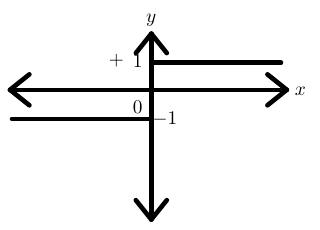
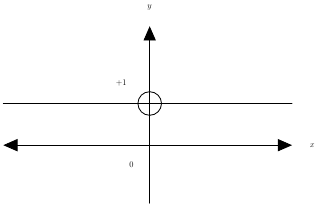
Which one of the following graph represents the function \({\rm{f}}\left( {\rm{x}} \right) = \frac{{\rm{x}}}{{\rm{x}}},{\rm{\;x}} \ne 0?\)

  1. AOption (a)

  2. BOption (b)

  3. COption (c)

  4. DOption (d)

    None of the above

View answer & explanation

Correct answer

Answer: (c)C.

Why this answer is correct

Calculation:

Here, f(x) = y = x/x and x ≠ 0

Now, at y = 1, x ≠ 0

But at x = 0, we get 0/0 (indeterminate form)

So, f(x) = x/x = 1 for all point except x = 0

Hence, option (3) is correct.

NDA Mathematics 10 Sept 2017 Official Paper (Previous Year Paper)·Mathematics
View full paper

Question 1887

National Defence Academy (NDA) 2017• Mathematics• Mathematics

Let \({\rm{f}}\left( {\rm{n}} \right) = \left[ {\frac{1}{4} + \frac{{\rm{n}}}{{1000}}} \right]\), where [x] denote the integral part of x. Then the value of \(\mathop \sum \limits_{{\rm{n}} = 1}^{1000} {\rm{f}}\left( {\rm{n}} \right)\) is

  1. AOption (a)

    251

  2. BOption (b)

    250

  3. COption (c)

    1

  4. DOption (d)

    0

View answer & explanation

Correct answer

Answer: (a)A.

251

Why this answer is correct

Concept:

  • The value of ⌊x⌋ is the largest integer that is less than or equal to x.


Example: [0.23] = 0, [4.2] = 4, [-3.2] = -4

Calculation:

Given: \({\rm{f}}\left( {\rm{n}} \right) = \left[ {\frac{1}{4} + \frac{{\rm{n}}}{{1000}}} \right]\)

To find: \(\mathop \sum \limits_{{\rm{n}} = 1}^{1000} {\rm{f}}\left( {\rm{n}} \right)\)

\(\begin{array}{l} \mathop \sum \limits_{{\rm{n}} = 1}^{1000} {\rm{f}}\left( {\rm{n}} \right) = \left[ {\frac{1}{4} + \frac{1}{{1000}}} \right] + \left[ {\frac{1}{4} + \frac{2}{{1000}}} \right] + \left[ {\frac{1}{4} + \frac{3}{{1000}}} \right] + \ldots + \left[ {\frac{1}{4} + \frac{{1000}}{{1000}}} \right]\\ \Rightarrow \mathop \sum \limits_{{\rm{n}} = 1}^{1000} {\rm{f}}\left( {\rm{n}} \right) = \left[ {0.25 + 0.001} \right] + \left[ {0.25 + 0.002} \right] + \left[ {0.25 + 0.003} \right] + \ldots \left[ {0.25 + 1} \right] \end{array}\)

Now, \(\left[ {0.25 + 0.001} \right] = \left[ {0.251} \right] = 0\)       (∵ greatest integer [0.25] = 0)

Similarly, \(\left[ {0.25 + 0.002} \right] = 0\)

\(\left[ {0.25 + 0.003} \right] = 0\)

.

.

.

\(\left[ {0.25 + 0.75} \right] = \left[ 1 \right] = 1\)

It means, till 750th term the value will come zero

\(\therefore \mathop \sum \limits_{{\rm{n}} = 1}^{1000} {\rm{f}}\left( {\rm{n}} \right) = \left[ {\frac{1}{4} + \frac{1}{{1000}}} \right] + \left[ {\frac{1}{4} + \frac{2}{{1000}}} \right] + \left[ {\frac{1}{4} + \frac{3}{{1000}}} \right] + \ldots + \left[ {\frac{1}{4} + \frac{{750}}{{1000}}} \right] + \left[ {\frac{1}{4} + \frac{{752}}{{1000}}} \right] + \ldots + \left[ {\frac{1}{4} + \frac{{1000}}{{1000}}} \right]\)

Now, last term \(\left[ {0.25 + 1} \right] = \left[ {1.25} \right] = 1\)

So from 750th term till end the values will be 1

\(\therefore \mathop \sum \limits_{{\rm{n}} = 1}^{1000} {\rm{f}}\left( {\rm{n}} \right) = 0 + 0 + 0 + \ldots 1 + 1 + 1 + \ldots + 1\)

So 1 will come: (1000 - 750) + 1(750th term) = 251 times

\(\therefore \mathop \sum \limits_{{\rm{n}} = 1}^{1000} {\rm{f}}\left( {\rm{n}} \right) = 251\)

Hence, option (1) is correct.

NDA Mathematics 10 Sept 2017 Official Paper (Previous Year Paper)·Mathematics
View full paper

Question 1888

National Defence Academy (NDA) 2017• Mathematics• Mathematics

∫ (In x)-1 dx - ∫ (In x)-2 dx is equal to

  1. AOption (a)

    x (In x)-1 + c

  2. BOption (b)

    x (In x)-2 + c

  3. COption (c)

    x (In x) + c

  4. DOption (d)

    x (In x)2 + c

View answer & explanation

Correct answer

Answer: (a)A.

x (In x)-1 + c

Why this answer is correct

Concept:

  • \(\smallint {\rm{f}}\left( {\rm{x}} \right){\rm{dx}} - \smallint {\rm{g}}\left( {\rm{x}} \right){\rm{dx}} = \smallint \left[ {{\rm{f}}\left( {\rm{x}} \right) - {\rm{g}}\left( {\rm{x}} \right)} \right]{\rm{dx}}\)
  • \({\log _{\rm{a}}}{\rm{b}} = {\rm{k}} \Rightarrow {\rm{b}} = {{\rm{a}}^{\rm{k}}}\)
  • Integration by parts:


​\(\Rightarrow \smallint {\rm{u\;vdx}} = {\rm{u\;}}\smallint {\rm{vdx}} - \smallint \left( {\frac{{{\rm{du}}}}{{{\rm{dx}}}}{\rm{\;}}\smallint {\rm{vdx}}} \right){\rm{dx}}\)

Where u is the function u(x) and v is the function v(x)

ILATE Rule: Usually, the preference order of this rule is based on some functions such as Inverse, Logarithm, Algebraic, Trigonometric and Exponent.


Calculation:

To find: \(\smallint \frac{1}{{\ln {\rm{x}}}}{\rm{dx}} - \smallint \frac{1}{{{{\left( {\ln {\rm{x}}} \right)}^2}}}{\rm{dx}} = ?\)

Let, \({\rm{I}} = \smallint \frac{1}{{\ln {\rm{x}}}}{\rm{dx}} - \smallint \frac{1}{{{{\left( {\ln {\rm{x}}} \right)}^2}}}{\rm{dx}}\)

\(\Rightarrow {\rm{I}} = \smallint \left[ {\frac{1}{{\ln {\rm{x}}}} - \frac{1}{{{{\left( {\ln {\rm{x}}} \right)}^2}}}} \right]{\rm{dx}}\)

Put, ln x = t

⇒ x = et                 \(\left( {{{\log }_{\rm{e}}}{\rm{x}} = {\rm{t}} \Rightarrow {\rm{x}} = {{\rm{e}}^{\rm{t}}}} \right)\)

dx = et dt                              (taking derivative)

\({\rm{I}} = \smallint \left[ {\frac{1}{{\ln {\rm{x}}}} - \frac{1}{{{{\left( {\ln {\rm{x}}} \right)}^2}}}} \right]{\rm{dx}}\)

\(= \smallint {{\rm{e}}^{\rm{t}}}\left[ {\left( {\frac{1}{{\rm{t}}}} \right) - \left( {\frac{1}{{{{\rm{t}}^2}}}} \right)} \right]{\rm{dt}}\)

\(= \smallint \left( {\frac{1}{{\rm{t}}}} \right){{\rm{e}}^{\rm{t}}}{\rm{dt}} - \smallint \left( {\frac{1}{{{{\rm{t}}^2}}}} \right){{\rm{e}}^{\rm{t}}}{\rm{dt}}\)        ….

(1) Now, \(\smallint \left( {\frac{1}{{\rm{t}}}} \right){{\rm{e}}^{\rm{t}}}{\rm{dt}} = \frac{1}{{\rm{t}}}\smallint {{\rm{e}}^{\rm{t}}}{\rm{dt}} - \smallint \frac{{\rm{d}}}{{{\rm{dt}}}}\left( {\frac{1}{{\rm{t}}}} \right)\smallint {{\rm{e}}^{\rm{t}}}{\rm{dt\;}}\)         (integration by part)

\(\Rightarrow \smallint \left( {\frac{1}{{\rm{t}}}} \right){{\rm{e}}^{\rm{t}}}{\rm{dt}} = \frac{{{{\rm{e}}^{\rm{t}}}}}{{\rm{t}}} - \smallint - \frac{{{{\rm{e}}^{\rm{t}}}}}{{{{\rm{t}}^2}}}{\rm{dt}}\)

\(= \frac{{{{\rm{e}}^{\rm{t}}}}}{{\rm{t}}} + \smallint \frac{{{{\rm{e}}^{\rm{t}}}}}{{{{\rm{t}}^2}}}{\rm{dt}}\)     …. (2) \({\rm{I}} = \smallint \left( {\frac{1}{{\rm{t}}}} \right){{\rm{e}}^{\rm{t}}}{\rm{dt}} - \smallint \left( {\frac{1}{{{{\rm{t}}^2}}}} \right){{\rm{e}}^{\rm{t}}}{\rm{dt}}\)         (from (1))

\(\Rightarrow \frac{{{{\rm{e}}^{\rm{t}}}}}{{\rm{t}}} + \smallint \frac{{{{\rm{e}}^{\rm{t}}}}}{{{{\rm{t}}^2}}}{\rm{dt}} - \smallint \left( {\frac{1}{{{{\rm{t}}^2}}}} \right){{\rm{e}}^{\rm{t}}}{\rm{dt}}\)          (from (2))

\(= \frac{{{{\rm{e}}^{\rm{t}}}}}{{\rm{t}}} + {\rm{C}}\)

Now, t = ln x

\(\therefore {\rm{I}} = \frac{{{{\rm{e}}^{{\rm{lnx}}}}}}{{{\rm{lnx}}}} + {\rm{c}}\)

\(\Rightarrow {\rm{I}} = \frac{{\rm{x}}}{{\ln {\rm{x}}}} + {\rm{c}}\)        (eln x = x)

Hence, option (1) is correct.

NDA Mathematics 10 Sept 2017 Official Paper (Previous Year Paper)·Mathematics
View full paper

Question 1889

National Defence Academy (NDA) 2017• Mathematics• Mathematics

A cylindrical jar without a lid has to be constructed using a given surface area of a metal sheet. If the capacity of the jar is to be maximum, then the diameter of the jar must be k times the height of the jar. The value of k is

  1. AOption (a)

    1

  2. BOption (b)

    2

  3. COption (c)

    3

  4. DOption (d)

    4

View answer & explanation

Correct answer

Answer: (b)B.

2

Why this answer is correct

Concept:

  • Surface area of cylinder without a lid (A) = 2πrh + πr2
  • Volume of cylinder (V) = πr2h
  • If volume is maximum, then dV/dr = 0

Here, r = radius, h = height


Calculation:

Given: d = k × h,

Where, d = diameter, h = height

To find: k =?

A = 2πrh + πr2

⇒ 2πrh = A - πr2

\(\Rightarrow {\rm{h}} = \frac{{\rm{A}}}{{2{\rm{\pi r}}}} - \frac{{\rm{r}}}{2}\)        (1)

We have,

V = πr2 h

\(= {\rm{\pi }}{{\rm{r}}^2}\left( {\frac{{\rm{A}}}{{2{\rm{\pi r}}}} - \frac{{\rm{r}}}{2}{\rm{\;}}} \right)\)         (from (1))

\(= \frac{{{\rm{Ar}}}}{2} - \frac{{{\rm{\pi }}{{\rm{r}}^3}}}{2}\)

Capacity/volume is maximum so \(\frac{{{\rm{dV}}}}{{{\rm{dr}}}} = 0\),

\(\frac{{{\rm{dV}}}}{{{\rm{dr}}}} = \frac{{\rm{d}}}{{{\rm{dr}}}}\left( {\frac{{{\rm{Ar}}}}{2} - \frac{{{\rm{\pi }}{{\rm{r}}^3}}}{2}} \right)\)

\(= \frac{{\rm{A}}}{2} - \frac{3}{2}{\rm{\pi }}{{\rm{r}}^2}\)

\(= \frac{1}{2}\left( {{\rm{A}} - 3{\rm{\pi }}{{\rm{r}}^2}} \right) = 0\)

⇒ A = 3πr2

Put, A = 3πr2 in equation (1),

\({\rm{h}} = \frac{{3{\rm{\pi }}{{\rm{r}}^2}}}{{2{\rm{\pi r}}}} - \frac{{\rm{r}}}{2}\)

\(\Rightarrow {\rm{h}} = \frac{3}{2}{\rm{r}} - \frac{1}{2}{\rm{r}}\)

⇒ h = r

We know diameter (d) = 2 × r

And given that, diameter (d) = k × h

∴ 2 × r = k × h

⇒ k = 2                 (∵ h = r)

Hence, option (2) is correct.

NDA Mathematics 10 Sept 2017 Official Paper (Previous Year Paper)·Mathematics
View full paper

Question 1890

National Defence Academy (NDA) 2017• Mathematics• Mathematics

The value of \(\mathop \smallint \limits_0^{\frac{{\rm{\pi }}}{4}} \sqrt {\tan {\rm{x\;}}} {\rm{dx}} + \mathop \smallint \limits_0^{\frac{{\rm{\pi }}}{4}} \sqrt {\cot {\rm{x}}} {\rm{dx}}\) is equal to

  1. AOption (a)

    \(\frac{{\rm{\pi }}}{4}\)

  2. BOption (b)

    \(\frac{{\rm{\pi }}}{2}\)

  3. COption (c)

    \(\frac{{\rm{\pi }}}{2\sqrt2}\)

  4. DOption (d)

    \(\frac{{\rm{\pi }}}{\sqrt2}\)

View answer & explanation

Correct answer

Answer: (d)D.

\(\frac{{\rm{\pi }}}{\sqrt2}\)

Why this answer is correct

Concept:

Formulas used:

  • 2sin x cos x = 1 - (sin x - cos x)2
  • \(\smallint \frac{{{\rm{dx}}}}{{\sqrt {{{\rm{a}}^2} - {{\rm{x}}^2}} }} = {\sin ^{ - 1}}\left( {\frac{{\rm{x}}}{{\rm{a}}}} \right) + {\rm{c}}\)


Calculation:

\(\mathop \smallint \limits_0^{\frac{{\rm{\pi }}}{4}} \sqrt {\tan {\rm{x\;}}} {\rm{dx}} + \mathop \smallint \limits_0^{\frac{{\rm{\pi }}}{4}} \sqrt {\cot {\rm{x}}} {\rm{dx}} = \mathop \smallint \limits_0^{{\rm{\pi }}/4} \left\{ {\sqrt {\tan {\rm{x}}} + \frac{1}{{\sqrt {\tan {\rm{x}}} }}} \right\}{\rm{dx}}\)

\(= \mathop \smallint \limits_0^{{\rm{\pi }}/4} \frac{{\tan {\rm{x}} + 1}}{{\sqrt {\tan {\rm{x}}} }}{\rm{\;dx}}\)

\(= \mathop \smallint \limits_0^{{\rm{\pi }}/4} \frac{{\sin {\rm{x}} + \cos {\rm{x}}}}{{\sqrt {\sin {\rm{x}}\cos {\rm{x}}} }}{\rm{\;dx}}\)

\(= \mathop \smallint \limits_0^{{\rm{\pi }}/4} \sqrt 2 \times \frac{{\sin {\rm{x}} + \cos {\rm{x}}}}{{\sqrt {2\sin {\rm{x}}\cos {\rm{x}}} }}{\rm{\;dx}}\)

We know that, 2sin x cos x = 1 - (sin x - cos x) 2

\(= \mathop \smallint \limits_0^{{\rm{\pi }}/4} \sqrt 2 \times \frac{{\sin {\rm{x}} + \cos {\rm{x}}}}{{\sqrt {1 - {{\left( {\sin {\rm{x}} - \cos {\rm{x}}} \right)}^2}} }}{\rm{\;dx}}\)

Let (sin x - cos x) = t

Differentiating both sides, we get,

⇒ (cos x + sin x) dx = dt

\(\mathop \smallint \limits_0^{{\rm{\pi }}/4} \sqrt 2 \times \frac{{\sin {\rm{x}} + \cos {\rm{x}}}}{{\sqrt {1 - {{\left( {\sin {\rm{x}} - \cos {\rm{x}}} \right)}^2}} }}{\rm{\;dx}} = \mathop \smallint \limits_0^1 \sqrt 2 \times \frac{{{\rm{dt}}}}{{\sqrt {1 - {{\rm{t}}^2}} }}\)

\(= \sqrt 2 \left[ {{{\sin }^{ - 1}}{\rm{x}}} \right]_0^1\)

\(= \frac{{\rm{\pi }}}{{\sqrt 2 }}\)

NDA Mathematics 10 Sept 2017 Official Paper (Previous Year Paper)·Mathematics
View full paper

Question 1891

National Defence Academy (NDA) 2017• Mathematics• Mathematics

Let g be the greatest integer function. Then the function f(x) = (g(x))2 - g(x) is discontinuous at

  1. AOption (a)

    all integers

  2. BOption (b)

    all integers except 0 and 1

  3. COption (c)

    all integers except 0

  4. DOption (d)

    all integers except 1

View answer & explanation

Correct answer

Answer: (d)D.

all integers except 1

Why this answer is correct

Concept:

Greatest integer function: It is denoted as [x], it indicates the integral part of real number x which is nearest and smaller integer to x.

For example: [2.4] = 2, [4] = 4, [-3.2] = -4

Note:

  • If n is any integer, then:


\(\mathop {\lim }\limits_{{\rm{x}} \to {{\rm{n}}^ - }} \left[ {\rm{x}} \right] = {\rm{n}} - 1\)

\(\mathop {\lim }\limits_{{\rm{x}} \to {{\rm{n}}^ + }} \left[ {\rm{x}} \right] = {\rm{n}}\)

Continuity: A function f(x) is said to be continuous at a point x = a, in its domain if \(\mathop {\lim }\limits_{{\rm{x}} \to {\rm{a}}} {\rm{f}}\left( {\rm{x}} \right) = {\rm{f}}\left( {\rm{a}} \right)\) exists or its graph is a single unbroken curve.

f(x) is Continuous at x = a ⇔ \(\mathop {\lim }\limits_{{\rm{x}} \to {{\rm{a}}^ + }} {\rm{f}}\left( {\rm{x}} \right){\rm{\;}} = {\rm{\;}}\mathop {\lim }\limits_{{\rm{x}} \to {{\rm{a}}^ - }} {\rm{f}}\left( {\rm{x}} \right){\rm{\;}} = {\rm{\;}}\mathop {\lim }\limits_{{\rm{x}} \to {\rm{a}}} {\rm{f}}\left( {\rm{x}} \right)\)


Calculation:

Given: g is a greatest integer function

f(x) = (g(x))2 - g(x)


So, let g(x) = [x]

∴ f(x) = [x]2 - [x]

⇒ f(x) = [x]{[x] - 1}

Calculating the limit at x = c, where c is an integer

Left hand limit:

\(\mathop {\lim }\limits_{{\rm{x}} \to {{\rm{c}}^ - }} {\rm{f}}\left( {\rm{x}} \right) = \mathop {\lim }\limits_{{\rm{x}} \to {{\rm{c}}^ - }} \left[ {\rm{x}} \right]\left\{ {\left[ {\rm{x}} \right] - 1} \right\}\)

\(= \mathop {\lim }\limits_{{\rm{h}} \to 0} \left[ {{\rm{c}} - {\rm{h}}} \right]\left\{ {\left[ {{\rm{c}} - {\rm{h}}} \right] - 1} \right\}\)

\(= \mathop {\lim }\limits_{{\rm{h}} \to 0} \left( {{\rm{c}} - 1} \right)\left\{ {\left( {{\rm{c}} - 1} \right) - 1} \right\}\)

\(= \mathop {\lim }\limits_{{\rm{h}} \to 0} \left( {{\rm{c}} - 1} \right)\left( {{\rm{c}} - 2} \right)\)

= (c - 1)(c - 2)

Right hand limit:

\(\mathop {\lim }\limits_{{\rm{x}} \to {{\rm{c}}^ + }} {\rm{f}}\left( {\rm{x}} \right) = \mathop {\lim }\limits_{{\rm{x}} \to {{\rm{c}}^ + }} \left[ {\rm{x}} \right]\left\{ {\left[ {\rm{x}} \right] - 1} \right\}\)

\(= \mathop {\lim }\limits_{{\rm{h}} \to 0} \left[ {{\rm{c}} + {\rm{h}}} \right]\left\{ {\left[ {{\rm{c}} + {\rm{h}}} \right] - 1} \right\}\)

\(= \mathop {\lim }\limits_{{\rm{h}} \to 0} \left( {\rm{c}} \right)\left\{ {\left( {\rm{c}} \right) - 1} \right\}\)

\(= \mathop {\lim }\limits_{{\rm{h}} \to 0} {\rm{c}}\left( {{\rm{c}} - 1} \right)\)

= c(c - 1)


For f(x) to be continuous left hand limit = right hand limit and that is only when c = 1.

So, f(x) is discontinuous at all integers except at x = 1.

NDA Mathematics 10 Sept 2017 Official Paper (Previous Year Paper)·Mathematics
View full paper

Question 1892

National Defence Academy (NDA) 2017• Mathematics• Mathematics

The differential equation of minimum order by eliminating the arbitrary constants A and C in the equation y = A [sin (x + C) + cos (x + C)] is

  1. AOption (a)

    y” + (sin x + cos x) y’ = 1

  2. BOption (b)

    y” = (sin x + cos x) y’

  3. COption (c)

    y” = (y’)2 + sin x cos x

  4. DOption (d)

    y” + y = 0

View answer & explanation

Correct answer

Answer: (d)D.

y” + y = 0

Why this answer is correct

Concept:

Eliminating arbitrary constant: Let there be n arbitrary constants in a given differential equation. So differentiate the given equation up to nth order. And from those n equations try to eliminate the arbitrary constants.


Calculation:

Given:

y = A [sin (x + C) + cos (x + C)] ….

(1) Since, we have to eliminate two arbitrary constant, thus we have to get a 2nd order differential equation.

Differentiating equation (1) w.r.t x

⇒ y’ = A [cos (x + C) - sin (x + C)]

Now, again differentiating w.r.t x we get,

⇒ y’’ = A [-sin (x + C) - cos (x + C)]

⇒ y’’ = -A [sin (x + C) + cos (x + C)]

⇒ y’’ = -y

⇒ y’’ + y = 0

NDA Mathematics 10 Sept 2017 Official Paper (Previous Year Paper)·Mathematics
View full paper

Question 1893

National Defence Academy (NDA) 2017• Mathematics• Mathematics

Consider the following

Statements:

Statement I: x > sin x for all x > 0

Statement II: f(x) = x - sin x is an increasing function for all x > 0

Which one of the following is correct is respect of the above statements?

  1. AOption (a)

    Both Statement I and Statement II are true and Statement II is the correct explanation of Statement I

  2. BOption (b)

    Both Statement I and Statement II are true and Statement II is not the correct explanation of Statement I

  3. COption (c)

    Statement I is true but Statement II is false

  4. DOption (d)

    Statement I is false but Statement II is true

View answer & explanation

Correct answer

Answer: (a)A.

Both Statement I and Statement II are true and Statement II is the correct explanation of Statement I

Why this answer is correct

Concept:

Monotonic function: If a function is differentiable on the interval (a, b) and if the function is increasing/strictly increasing or decreasing/strictly decreasing, then the function is known as monotonic function.

First derivative test:

  • If \(\frac{{{\rm{df}}\left( {\rm{x}} \right)}}{{{\rm{dx}}}} \ge 0\) for all x in (a, b) then, f(x) is an increasing function in (a, b).
  • If \(\frac{{{\rm{df}}\left( {\rm{x}} \right)}}{{{\rm{dx}}}} \le 0\) for all x in (a, b) then, f(x) is an decreasing function in (a, b).

For strictly increasing or decreasing:

  • \(\frac{{{\rm{df}}\left( {\rm{x}} \right)}}{{{\rm{dx}}}} > 0\) for strictly increasing.
  • \(\frac{{{\rm{df}}\left( {\rm{x}} \right)}}{{{\rm{dx}}}} < 0\) for strictly decreasing.


Calculation:

Let f(x) = x - sin x

Now, differentiating both sides w.r.t x

⇒ f’(x) = 1 - cos x

We know, -1 ≤ cos x ≤ 1 for all x > 0

⇒ 1 ≥ -cos x ≥ -1

⇒ 2 ≥ 1 - cos x ≥ 0

∴ f’(x) ≥ 0 for all x > 0

Hence, f(x) is an increasing function for all x > 0.

And since, f(x) is an increasing function for all x > 0, then x > sin x for all x > 0.

Hence, both statement I & II are correct and statement II is correct explanation of statement I.

NDA Mathematics 10 Sept 2017 Official Paper (Previous Year Paper)·Mathematics
View full paper

Question 1894

National Defence Academy (NDA) 2017• Mathematics• Mathematics

The solution of the differential equation \(\frac{{{\rm{dy}}}}{{{\rm{dx}}}} = \frac{{{\rm{y}}\phi '\left( {\rm{x}} \right) - {{\rm{y}}^2}}}{{\phi \left( {\rm{x}} \right)}}\) is

  1. AOption (a)

    \({\rm{y}} = \frac{{\rm{x}}}{{\phi \left( {\rm{x}} \right) + {\rm{c}}}}\)

  2. BOption (b)

    \({\rm{y}} = \frac{{\phi \left( {\rm{x}} \right)}}{{\rm{x}}} + {\rm{c}}\)

  3. COption (c)

    \({\rm{y}} = \frac{{\phi \left( {\rm{x}} \right) + {\rm{c}}}}{{\rm{x}}}\)

  4. DOption (d)

    \({\rm{y}} = \frac{{\phi \left( {\rm{x}} \right)}}{{{\rm{x}} + {\rm{c}}}}\)

View answer & explanation

Correct answer

Answer: (d)D.

\({\rm{y}} = \frac{{\phi \left( {\rm{x}} \right)}}{{{\rm{x}} + {\rm{c}}}}\)

Why this answer is correct

Calculation:

Given: \(\frac{{{\rm{dy}}}}{{{\rm{dx}}}} = \frac{{{\rm{y}}\phi '\left( {\rm{x}} \right) - {{\rm{y}}^2}}}{{\phi \left( {\rm{x}} \right)}}\)

\(\frac{{{\rm{dy}}}}{{{\rm{dx}}}} = \frac{{{\rm{y}}\phi '\left( {\rm{x}} \right) - {{\rm{y}}^2}}}{{\phi \left( {\rm{x}} \right)}} = \frac{{{\rm{y}}\phi '\left( {\rm{x}} \right)}}{{\phi \left( {\rm{x}} \right)}} - \frac{{{\rm{y}}.{\rm{y}}}}{{\phi \left( {\rm{x}} \right)}}\)

\({\rm{Let}},{\rm{\;}}\frac{{\rm{y}}}{{\phi \left( {\rm{x}} \right)}} = {\rm{z}}\)     ...1)

\(\therefore \frac{{{\rm{dy}}}}{{{\rm{dx}}}} = \frac{{{\rm{y}}\phi '\left( {\rm{x}} \right)}}{{\phi \left( {\rm{x}} \right)}} - \frac{{{\rm{y}}.{\rm{y}}}}{{\phi \left( {\rm{x}} \right)}} = \phi '\left( {\rm{x}} \right){\rm{z}} - \phi \left( {\rm{x}} \right){{\rm{z}}^2}\)

Now, \({\rm{y}} = \phi \left( {\rm{x}} \right){\rm{z}}\) 

\(\Rightarrow \frac{{{\rm{dy}}}}{{{\rm{dx}}}} = \phi \left( {\rm{x}} \right)\frac{{{\rm{dz}}}}{{{\rm{dx}}}} + \phi '\left( {\rm{x}} \right){\rm{z}}\)

\(\therefore \phi '\left( {\rm{x}} \right){\rm{z}} - \phi \left( {\rm{x}} \right){{\rm{z}}^2} = \phi \left( {\rm{x}} \right)\frac{{{\rm{dz}}}}{{{\rm{dx}}}} + \phi '\left( {\rm{x}} \right){\rm{z}}\)

\(\Rightarrow - {{\rm{z}}^2} = \frac{{{\rm{dz}}}}{{{\rm{dx}}}}\)

\(\Rightarrow - {\rm{dx}} = \frac{{{\rm{dz}}}}{{{{\rm{z}}^2}}}\)

Integrating both sides, we get

\(\Rightarrow {\rm{x}} + {\rm{c}} = \frac{1}{{\rm{z}}}\)      

\({\rm{But\;z}} = \frac{{\rm{y}}}{{\phi \left( {\rm{x}} \right)}}\)     ...(From (1)

\(\therefore {\rm{x}} + {\rm{c}} = \frac{{\phi \left( {\rm{x}} \right)}}{{\rm{y}}}\)

\( \Rightarrow {\rm{y}} = \frac{{\phi \left( {\rm{x}} \right)}}{{{\rm{x}} + {\rm{c}}}}\)

Hence, option (4) is correct.

NDA Mathematics 10 Sept 2017 Official Paper (Previous Year Paper)·Mathematics
View full paper

Question 1895

National Defence Academy (NDA) 2017• Mathematics• Mathematics

If \({\rm{f}}\left( {\rm{x}} \right) = \frac{{4{\rm{x}} + {{\rm{x}}^4}}}{{1 + 4{{\rm{x}}^3}}}\) and \({\rm{g}}\left( {\rm{x}} \right) = {\rm{In\;}}\left( {\frac{{1 + {\rm{x}}}}{{1 - {\rm{x}}}}} \right)\), then what is the value of \({\rm{f\;o\;g\;}}\left( {\frac{{{\rm{e}} - 1}}{{{\rm{e}} + 1}}} \right)\) equal to?

  1. AOption (a)

    2

  2. BOption (b)

    1

  3. COption (c)

    0

  4. DOption (d)

    \(\frac{1}{2}\)

View answer & explanation

Correct answer

Answer: (b)B.

1

Why this answer is correct

Concept:

Composite function: Let f: X → Y1 and g: Y2 → Z be two functions and the set D = { x ∈ X: f(x) ∈ Y2}. If D ∉ ∅ then function h is defined as:

h(x) = g{f(x)} = g o f (x)


Calculation:

Given: \({\rm{f}}\left( {\rm{x}} \right) = \frac{{4{\rm{x}} + {{\rm{x}}^4}}}{{1 + 4{{\rm{x}}^3}}}\) and \({\rm{g}}\left( {\rm{x}} \right) = {\rm{In\;}}\left( {\frac{{1 + {\rm{x}}}}{{1 - {\rm{x}}}}} \right)\)

To find: \({\rm{f\;o\;g\;}}\left( {\frac{{{\rm{e}} - 1}}{{{\rm{e}} + 1}}} \right)\)

So, we know that, \({\rm{f\;o\;g\;}}\left( {\rm{x}} \right) = {\rm{f}}\left( {{\rm{g}}\left( {\rm{x}} \right)} \right)\)

∴ \({\rm{f\;o\;g\;}}\left( {\frac{{{\rm{e}} - 1}}{{{\rm{e}} + 1}}} \right) = {\rm{f}}\left( {{\rm{g}}\left( {\frac{{{\rm{e}} - 1}}{{{\rm{e}} + 1}}} \right)} \right)\)

So, \({\rm{g}}\left( {\frac{{{\rm{e}} - 1}}{{{\rm{e}} + 1}}} \right) = \ln \left( {\frac{{1 + \frac{{{\rm{e}} - 1}}{{{\rm{e}} + 1}}}}{{1 - \frac{{{\rm{e}} - 1}}{{{\rm{e}} + 1}}}}} \right)\)

\(= \ln \left( {\frac{{2{\rm{e}}}}{2}} \right)\)

= ln e = 1

\({\rm{f\;o\;g\;}}\left( {\frac{{{\rm{e}} - 1}}{{{\rm{e}} + 1}}} \right) = {\rm{f}}\left( {{\rm{g}}\left( {\frac{{{\rm{e}} - 1}}{{{\rm{e}} + 1}}} \right)} \right)\)

= f(1)

\(= \frac{{4\left( 1 \right) + {{\left( 1 \right)}^4}}}{{1 + 4{{\left( 1 \right)}^3}}}\)

= 5/5

= 1

NDA Mathematics 10 Sept 2017 Official Paper (Previous Year Paper)·Mathematics
View full paper

Question 1896

National Defence Academy (NDA) 2017• Mathematics• Mathematics

The value of the determinant \(\left| {\begin{array}{*{20}{c}} {1 - {\rm{\alpha }}}&{{\rm{\alpha }} - {{\rm{\alpha }}^2}}&{{{\rm{\alpha }}^2}}\\ {1 - {\rm{\beta }}}&{{\rm{\beta }} - {{\rm{\beta }}^2}}&{{{\rm{\beta }}^2}}\\ {1 - {\rm{\gamma }}}&{{\rm{\gamma }} - {{\rm{\gamma }}^2}}&{{{\rm{\gamma }}^2}} \end{array}} \right|\) is equal to

  1. AOption (a)

    (α - β)(β - γ)(α - γ) 

  2. BOption (b)

    (α - β)(β - γ)(γ - α) 

  3. COption (c)

    (α - β)(β - γ)(γ - α)(α + β + γ) 

  4. DOption (d)

    0

View answer & explanation

Correct answer

Answer: (b)B.

(α - β)(β - γ)(γ - α) 

Why this answer is correct

Concept:

Determinant: If \({\rm{A}} = \left[ {\begin{array}{*{20}{c}} {{{\rm{a}}_{11}}}&{{{\rm{a}}_{12}}}&{{{\rm{a}}_{13}}}\\ {{{\rm{a}}_{21}}}&{{{\rm{a}}_{22}}}&{{{\rm{a}}_{23}}}\\ {{{\rm{a}}_{31}}}&{{{\rm{a}}_{32}}}&{{{\rm{a}}_{33}}} \end{array}} \right]\) then determinant of A is given by:

|A| = a11 × {(a22 × a33) - (a23 × a32)} - a12 × {(a21 × a33) - (a23 × a31)} + a13 × {(a21 × a32) - (a22 × a31)}

Note:

  • If row or column operations are applied, then the value of determinant doesn’t change.


Calculation:

Given:

\(\left| {\begin{array}{*{20}{c}} {1 - {\rm{\alpha }}}&{{\rm{\alpha }} - {{\rm{\alpha }}^2}}&{{{\rm{\alpha }}^2}}\\ {1 - {\rm{\beta }}}&{{\rm{\beta }} - {{\rm{\beta }}^2}}&{{{\rm{\beta }}^2}}\\ {1 - {\rm{\gamma }}}&{{\rm{\gamma }} - {{\rm{\gamma }}^2}}&{{{\rm{\gamma }}^2}} \end{array}} \right|\)

Let’s apply row or column operations to simplify.

Replace C1 → C1 + C2 + C3

\(= \left| {\begin{array}{*{20}{c}} 1&{{\rm{\alpha }} - {{\rm{\alpha }}^2}}&{{{\rm{\alpha }}^2}}\\ 1&{{\rm{\beta }} - {{\rm{\beta }}^2}}&{{{\rm{\beta }}^2}}\\ 1&{{\rm{\gamma }} - {{\rm{\gamma }}^2}}&{{{\rm{\gamma }}^2}} \end{array}} \right|\)

Replace C2 → C2 + C3

\(= \left| {\begin{array}{*{20}{c}} 1&{\rm{\alpha }}&{{{\rm{\alpha }}^2}}\\ 1&{\rm{\beta }}&{{{\rm{\beta }}^2}}\\ 1&{\rm{\gamma }}&{{{\rm{\gamma }}^2}} \end{array}} \right|\)

Replace R1 → R1 - R2 & R3 → R3 - R2

\(= \left| {\begin{array}{*{20}{c}} 0&{{\rm{\alpha }} - {\rm{\beta }}}&{{{\rm{\alpha }}^2} - {{\rm{\beta }}^2}}\\ 1&{\rm{\beta }}&{{{\rm{\beta }}^2}}\\ 0&{{\rm{\gamma }} - {\rm{\beta }}}&{{{\rm{\gamma }}^2} - {{\rm{\beta }}^2}} \end{array}} \right|\)

= -(α - β)(γ2 - β2) + (α2 - β2)(γ - β)

= (α - β)(γ - β){ - γ - β + α + β}

= (α - β)(γ - β)(α - γ)

= (α - β)(β - γ)(γ - α)

NDA Mathematics 10 Sept 2017 Official Paper (Previous Year Paper)·Mathematics
View full paper

Question 1897

National Defence Academy (NDA) 2017• Mathematics• Mathematics

The adjoint of the matrix \({\rm{A}} = \left[ {\begin{array}{*{20}{c}} 1&0&2\\ 2&1&0\\ 0&3&1 \end{array}} \right]\) is

  1. AOption (a)

    \(\left[ {\begin{array}{*{20}{c}} { - 1}&6&2\\ { - 2}&1&{ - 4}\\ 6&3&1 \end{array}} \right]\)

  2. BOption (b)

    \(\left[ {\begin{array}{*{20}{c}} 1&6&{ - 2}\\ { - 2}&1&4\\ 6&{ - 3}&1 \end{array}} \right]\)

  3. COption (c)

    \(\left[ {\begin{array}{*{20}{c}} 6&1&2\\ 4&{ - 1}&2\\ 6&3&{ - 1} \end{array}} \right]\)

  4. DOption (d)

    \(\left[ {\begin{array}{*{20}{c}} { - 6}&2&1\\ 4&{ - 2}&1\\ 3&1&{ - 6} \end{array}} \right]\)

View answer & explanation

Correct answer

Answer: (b)B.

\(\left[ {\begin{array}{*{20}{c}} 1&6&{ - 2}\\ { - 2}&1&4\\ 6&{ - 3}&1 \end{array}} \right]\)

Why this answer is correct

Concept:

Steps to find adjoint of a matrix:

  • Find the minors of the matrix: Ignore the value of current row and column and calculate the determinant of remaining vales.
  • For m11 = a22 × a33 - a23 × a32. Similarly, for every element.
  • Find the co-factor of matrix formed: C = [cij]3 × 3 = (-1)(i + j) × mij
  • Take the transpose of the matrix i.e., CT: Swapping the (ij)th element with (ji)th element.


Calculation:

Given: \({\rm{A}} = \left[ {\begin{array}{*{20}{c}} 1&0&2\\ 2&1&0\\ 0&3&1 \end{array}} \right]\)

To find: adj(A)


Minors for matrix:

m11 = 1 × 1 - 0 × 3 = 1

m12 = 2 × 1 - 0 = 2

m13 = 2 × 3 - 0 = 6

m21 = 0 × 1 - 2 × 3 = -6

m22 = 1 - 0 = 1

m23 = 3 - 0 = 3

m31 = 0 - 2 = -2

m32 = 0 - 2 × 2 = -4

m33 = 1 - 0 = 1

Co-factors: C = [cij]3 × 3 = (-1)(i + j) × mij

\({\rm{C}} = \left[ {\begin{array}{*{20}{c}} 1&{ - 2}&6\\ 6&1&{ - 3}\\ -2&{ 4}&{ 1} \end{array}} \right]\)

So, adj(A) = CT

\(\therefore {\rm{adj}}\left( {\rm{A}} \right){\rm{\;}} = \left[ {\begin{array}{*{20}{c}} 1&6&-2\\ { - 2}&1&{ 4}\\ 6&{ - 3}&{ 1} \end{array}} \right]\)

NDA Mathematics 10 Sept 2017 Official Paper (Previous Year Paper)·Mathematics
View full paper

Question 1898

National Defence Academy (NDA) 2017• Mathematics• Mathematics

If \({\rm{A}} = \left( {\begin{array}{*{20}{c}} { - 2}&2\\ 2&{ - 2} \end{array}} \right)\), then which one of the following is correct?

  1. AOption (a)

    A2 = - 2A

  2. BOption (b)

    A2 = - 4A

  3. COption (c)

    A2 = - 3A

  4. DOption (d)

    A2 = 4A

View answer & explanation

Correct answer

Answer: (b)B.

A2 = - 4A

Why this answer is correct

Concept:

Matrix Multiplication:

  • First make sure the number of columns of first matrix is equal to number of rows of second matrix.
  • Multiply elements of each row of first matrix to elements of each column of second matrix.
  • Let A = [aij]m × p & B = [bij]p × n then AB = [cij]m × n where \({{\rm{c}}_{{\rm{ij}}}} = \mathop \sum \limits_{{\rm{k}} = 1}^{\rm{p}} \left( {{{\rm{a}}_{{\rm{ik}}}}{{\rm{b}}_{{\rm{kj}}}}} \right)\).


Formulas used:

  • Let A = [aij]m × n be a matrix then kA = [bij]m × n where bij = kaij


Calculation:

Given: \({\rm{A}} = \left( {\begin{array}{*{20}{c}} { - 2}&2\\ 2&{ - 2} \end{array}} \right)\)

\({{\rm{A}}^2} = \left( {\begin{array}{*{20}{c}} { - 2}&2\\ 2&{ - 2} \end{array}} \right) \times \left( {\begin{array}{*{20}{c}} { - 2}&2\\ 2&{ - 2} \end{array}} \right)\)

\(\Rightarrow {{\rm{A}}^2} = \left( {\begin{array}{*{20}{c}} {\left\{ {\left( { - 2} \right) \times \left( { - 2} \right) + 2 \times 2} \right\}}&{\left\{ {\left( { - 2} \right) \times 2 + 2 \times \left( { - 2} \right)} \right\}}\\ {\left\{ {2 \times \left( { - 2} \right) + \left( { - 2} \right) \times 2} \right\}}&{\left\{ {2 \times 2 + \left( { - 2} \right) \times \left( { - 2} \right)} \right\}} \end{array}} \right)\)

\(\Rightarrow {{\rm{A}}^2} = \left( {\begin{array}{*{20}{c}} 8&{ - 8}\\ { - 8}&8 \end{array}} \right)\)

\(\Rightarrow {{\rm{A}}^2} = - 4 \times \left( {\begin{array}{*{20}{c}} { - 2}&2\\ 2&{ - 2} \end{array}} \right)\)

⇒ A2 = -4A

NDA Mathematics 10 Sept 2017 Official Paper (Previous Year Paper)·Mathematics
View full paper

Question 1899

National Defence Academy (NDA) 2017• Mathematics• Mathematics

Geometrically Re (z2 – i) = 2, where \(i = \sqrt { - 1} \) and Re is the real part, represents

  1. AOption (a)

    Circle

  2. BOption (b)

    Ellipse

  3. COption (c)

    Rectangular hyperbola

  4. DOption (d)

    Parabola

View answer & explanation

Correct answer

Answer: (c)C.

Rectangular hyperbola

Why this answer is correct

Concept:

  • z = x + iy where x and y are real values and z is complex number.
  • Re (z) = x, imaginary part of z = y.
  • Equation of circle x2 + y2 = r2
  • Equation of ellipse \(\frac{{{x^2}}}{{{a^2}}}\; + \frac{{{y^2}}}{{{b^2}}} = 1\)
  • Equation of Parabola y2 = 4ax, x2 = 4ay
  • Equation of hyperbola \(\frac{{{x^2}}}{{{a^2}}} - \;\frac{{{y^2}}}{{{b^2}}} = 1\)
  • If a2 = b2 then hyperbola is called rectangular hyperbola and x2 − y2 = a2 is the general form of rectangular hyperbola


Calculation:

⇒ Re (z2 – i) = 2

Put z = x + iy

Let’s find the value of z2 – i

⇒ (x + iy)2 - i

⇒ x2 + 2xyi – y2 – i     ...\([{\left( {a + b} \right)^2} = {a^2} + 2ab + {b^2}]\)

Now take real part and imaginary part collectively

⇒ (x2 – y2) + i (2xy – 1)

So the real part (z2 – i)

⇒ Re (z2 – i) = x2 – y2 = 2

⇒ x2 – y2 = 2

So it is a rectangular hyperbola.

NDA Mathematics 10 Sept 2017 Official Paper (Previous Year Paper)·Mathematics
View full paper

Question 1900

National Defence Academy (NDA) 2017• Mathematics• Mathematics

If p + q + r = a + b + c = 0, then the determinant \(\left| {\begin{array}{*{20}{c}} {{\rm{pa}}}&{{\rm{qb}}}&{{\rm{rc}}}\\ {{\rm{qc}}}&{{\rm{ra}}}&{{\rm{pb}}}\\ {{\rm{rb}}}&{{\rm{pc}}}&{{\rm{qa}}} \end{array}} \right|\) equals

  1. AOption (a)

    0

  2. BOption (b)

    1

  3. COption (c)

    pa + qb + rc

  4. DOption (d)

    pa + qb + rc + a + b + c

View answer & explanation

Correct answer

Answer: (a)A.

0

Why this answer is correct

Concept:

Determinant: If \({\rm{A}} = \left[ {\begin{array}{*{20}{c}} {{{\rm{a}}_{11}}}&{{{\rm{a}}_{12}}}&{{{\rm{a}}_{13}}}\\ {{{\rm{a}}_{21}}}&{{{\rm{a}}_{22}}}&{{{\rm{a}}_{23}}}\\ {{{\rm{a}}_{31}}}&{{{\rm{a}}_{32}}}&{{{\rm{a}}_{33}}} \end{array}} \right]\) then determinant of A is given by:

|A| = a11 × {(a22 × a33) - (a23 × a32)} - a12 × {(a21 × a33) - (a23 × a31)} + a13 × {(a21 × a32) - (a22 × a31)}


Formulas used:

  • a3 + b3 + c3 = 3abc, if a + b + c = 0.


Calculation:

Given: p + q + r = a + b + c = 0

To find: determinant \(\left| {\begin{array}{*{20}{c}} {{\rm{pa}}}&{{\rm{qb}}}&{{\rm{rc}}}\\ {{\rm{qc}}}&{{\rm{ra}}}&{{\rm{pb}}}\\ {{\rm{rb}}}&{{\rm{pc}}}&{{\rm{qa}}} \end{array}} \right|\)

\(\left| {\begin{array}{*{20}{c}} {{\rm{pa}}}&{{\rm{qb}}}&{{\rm{rc}}}\\ {{\rm{qc}}}&{{\rm{ra}}}&{{\rm{pb}}}\\ {{\rm{rb}}}&{{\rm{pc}}}&{{\rm{qa}}} \end{array}} \right|\)

Expanding R1,

= pa (ra × qa - pb × pc) - qb (qc × qa - pb × rb) + rc (qc × pc - ra × rb)

= pa(a2qr - p2bc) - qb(q2ac - b2pr) + rc(c2pq - r2ab)

= a3pqr - p3abc - q3abc + b3pqr + c3pqr - r3abc

= pqr(a3 + b3 + c3) - abc(p3 + q3 + r3)

Now we know that, a3 + b3 + c3 = 3abc, if a + b + c = 0.

= pqr (3abc) - abc (3pqr)

= 0

How should I prepare for Quantitative Aptitude in National Defence Academy (NDA)?

Solving previous year questions by topic helps identify recurring concepts, question patterns, and frequently asked sub-topics. Attempt each question, review the step-by-step explanation, and note down key formulas or facts for quick revision before the exam.