IBPS Probationary Officer (PO) · Topic Collection

Quantitative Aptitude PYQs

Arithmetic, number systems, percentages, ratios, profit and loss, time and work, algebra, geometry, mensuration, and trigonometry.

1305 Total Questions38 Official PapersYears: 2021–2026Search in Quantitative Aptitude
Showing questions 501–520 of 1305Page 26 of 66
IBPS PO Prelims Memory Based Paper (Held On: 20 October 2024 Shift 3) (Previous Year Paper)·Quantitative Aptitude
View full paper

Question 501

IBPS Probationary Officer (PO) 2024• Quantitative Aptitude• Quantitative Aptitude

Directions

In the following question, two statements are numbered as Quantity I and Quantity II. On solving these statements, we get quantities I and II respectively. Solve both quantities and choose the correct option.

Ratio of the age of Y and Z is 2 : 3. Present age of Y is 34 Years.

Quantity I: What is age of X, if X is 2 years older then Z?

Quantity II: What will be age of Z if ratio changes to 17 : 10?

  1. AOption (a)

    Quantity 1 > Quantity 2

  2. BOption (b)

    Quantity 1 ≥ Quantity 2

  3. COption (c)

    Quantity 1 < Quantity 2

  4. DOption (d)

    Quantity 1 ≤ Quantity 2

  5. EOption (e)

    Quantity 1 = Quantity 2

View answer & explanation

Correct answer

Answer: (a)A.

Quantity 1 > Quantity 2

Why this answer is correct

Shortcut Trick
Quantity I: Age of Y = 2 units = 34 years ⇒ 1 unit = 17 years. Age of Z = 3 units = 51 years. Age of X = 51 + 2 = 53 years.
Quantity II: Current age of Z is 51 years. If the ratio changes to 17 : 10, the problem implies finding the new age of Z. Assuming Y stays constant (34 years), Z would become 20 years.
Comparing both: 53 years > 20 years.
∴ The correct answer is Quantity I > Quantity II.
Alternate Method
Given: Ratio of age Y : Z = 2 : 3. Present age of Y = 34 years.

Calculations for Quantity I:
⇒ Age of Y = 2k = 34
⇒ k = 17
⇒ Age of Z = 3k = 3 × 17 = 51 years
⇒ Age of X = Z + 2 = 51 + 2 = 53 years
Calculations for Quantity II:
⇒ New ratio Y : Z = 17 : 10
⇒ Since Y is 34, then 17 units = 34
⇒ 1 unit = 2
⇒ Age of Z = 10 × 2 = 20 years
⇒ 53 > 20
∴ The correct answer is Quantity I > Quantity II.
Additional Information
Ratio and Proportion in Ages
When the age of one person is fixed, the ages of others in a ratio are calculated using a common multiplier (k). If A:B = x:y and A is known, then B = (Value of A ÷ x) × y.
Comparison of Quantities
In banking exams, Quantity Comparison involves solving two independent math problems and establishing the mathematical relationship (>, <, =, ≤, ≥) between their results.
IBPS PO Prelims Memory Based Paper (Held On: 20 October 2024 Shift 3) (Previous Year Paper)·Quantitative Aptitude
View full paper

Question 502

IBPS Probationary Officer (PO) 2024• Quantitative Aptitude• Quantitative Aptitude

Prize money of Rs. 10,000 was distributed among 2 girls and one boy.

Quantity I: Ratio of prize money distributed among girl1, girls 2 and boy is 7 : 7 : 6. What is prize amount earned by boy?

Quantity II: What is prize share of boy. IF boy earns Rs. 500 less than both girls who earns equal amount

  1. AOption (a)

    Quantity 1 > Quantity 2

  2. BOption (b)

    Quantity 1 ≥ Quantity 2

  3. COption (c)

    Quantity 1 < Quantity 2

  4. DOption (d)

    Quantity 1 ≤ Quantity 2

  5. EOption (e)

    Quantity 1 = Quantity 2

View answer & explanation

Correct answer

Answer: (e)E.

Quantity 1 = Quantity 2

Why this answer is correct

Shortcut Trick

Quantity I: Total ratio = 7 + 7 + 6 = 20 units. 20 units = ₹10,000 → 1 unit = ₹500. Boy share (6 units) = 6 × 500 = ₹3,000.

Quantity II: Let Boy = x, then each Girl = x + 500. Total: (x + 500) + (x + 500) + x = 10,000 → 3x + 1000 = 10,000 → 3x = 9,000 → x = ₹3,000.

Comparing both: ₹3,000 = ₹3,000.

∴ The correct answer is Quantity 1 = Quantity 2.

Alternate Method

Given: Total Prize Money = ₹10,000. Distribution among Girl 1, Girl 2, and Boy.

Quantity I Calculation:

⇒ Ratio of Girl 1 : Girl 2 : Boy = 7 : 7 : 6

⇒ Sum of ratios = 7 + 7 + 6 = 20

⇒ Share of Boy = (6 ÷ 20) × 10,000

⇒ Share of Boy = 6 × 500 = ₹3,000

Quantity II Calculation:

⇒ Let Boy share be ₹x. Girls share = ₹(x + 500) each.

⇒ (x + 500) + (x + 500) + x = 10,000

⇒ 3x + 1,000 = 10,000

⇒ 3x = 9,000

⇒ x = ₹3,000

Conclusion:

⇒ Quantity I = ₹3,000 and Quantity II = ₹3,000

∴ The correct answer is Quantity 1 = Quantity 2.

Additional Information

Ratio and Proportion

To divide a quantity A in the ratio a:b:c, the shares are [a/(a+b+c)]×A, [b/(a+b+c)]×A, and [c/(a+b+c)]×A.

Linear Equations

When values are compared using more than or less than, setting the smallest value as 'x' usually simplifies the equation.

Comparison of Quantities

Always ensure both quantities are in the same units (₹ in this case) before comparing for equality or inequality.

IBPS PO Prelims Memory Based Paper (Held On: 20 October 2024 Shift 3) (Previous Year Paper)·Quantitative Aptitude
View full paper

Question 503

IBPS Probationary Officer (PO) 2024• Quantitative Aptitude• Quantitative Aptitude

In a pouch there are 5 orange, 3 brown, and 4 red balls. 3 balls are picked at random?

Quantity I: The probability that 2 balls are brown in color and 1 ball is red in color.

Quantity II: The probability that all balls are orange in color.

  1. AOption (a)

    Quantity I < Quantity II

  2. BOption (b)

    Quantity I = Quantity II

  3. COption (c)

    Quantity I > Quantity II

  4. DOption (d)

    Quantity I ≥ Quantity II

  5. EOption (e)

    Quantity I ≤ Quantity II

View answer & explanation

Correct answer

Answer: (c)C.

Quantity I > Quantity II

Why this answer is correct

Shortcut Trick
Total balls = 5 (O) + 3 (B) + 4 (R) = 12. Total ways to pick 3 balls = 12C3.
Quantity I: Picking 2 Brown and 1 Red → 3C2 × 4C1 = 3 × 4 = 12 ways.
Quantity II: Picking 3 Orange → 5C3 = 10 ways.
Since the denominator (12C3) is same, compare numerators: 12 > 10.
∴ The correct answer is Quantity I > Quantity II.
Alternate Method
Given: Orange = 5, Brown = 3, Red = 4. Total = 12. Samples = 3.
Formula Used: Probability P(E) = n(E) ÷ n(S); nCr = n! ÷ [r!(n−r)!]

⇒ n(S) = 12C3 = (12 × 11 × 10) ÷ (3 × 2 × 1) = 220
⇒ Quantity I: n(E1) = 3C2 × 4C1 = 3 × 4 = 12
⇒ P(Quantity I) = 12 ÷ 220
⇒ Quantity II: n(E2) = 5C3 = (5 × 4) ÷ (2 × 1) = 10
⇒ P(Quantity II) = 10 ÷ 220
⇒ 12/220 > 10/220 ∴ Quantity I > Quantity II
∴ The correct answer is Quantity I > Quantity II.
Additional Information
Combination Formula
Used for selection where order does not matter: nCr = n! / [r!(n−r)!]. Note that nCr = nCn−r.
Probability of Compound Events
When multiple independent selections are made, use the product of individual combinations for specific color requirements divided by total possible combinations.

IBPS PO Prelims Memory Based Paper (Held On: 20 October 2024 Shift 3) (Previous Year Paper)·Quantitative Aptitude
View full paper

Question 504

IBPS Probationary Officer (PO) 2024• Quantitative Aptitude• Quantitative Aptitude

Sonia’s income is 4 times the income of Ranjeet. Ram's expenditure is equal to 200 % of Ranjeet's income. If Ram's income is Rs.80,000. Ram's saving is 20,000 more than Sonia’s income. Find the ratio of income of Sonia, Ranjeet, and Ram

  1. AOption (a)

    4 : 1 : 8

  2. BOption (b)

    2 : 4 : 7

  3. COption (c)

    3 : 5 : 9

  4. DOption (d)

    1 : 5 : 6

  5. EOption (e)

    2 : 7 : 9

View answer & explanation

Correct answer

Answer: (a)A.

4 : 1 : 8

Why this answer is correct

Shortcut Trick

Let Ranjeet's income be x.

Sonia's income = 4x.

Ram's savings = Income − Expenditure = 80,000 − 200% of x = 80,000 − 2x.

Given: 80,000 − 2x = 4x + 20,000 ⇒ 60,000 = 6x ⇒ x = 10,000.

Income Ratio = 4x : x : 80,000 = 40,000 : 10,000 : 80,000 = 4 : 1 : 8.

∴ The correct answer is 4 : 1 : 8.

Alternate Method

Given: Ram's income = ₹80,000. Let Ranjeet's income = R.

Formula: Income = Expenditure + Savings

⇒ Sonia's income = 4 × R

⇒ Ram's expenditure = 200% of R = 2R

⇒ Ram's saving = 80,000 − 2R

⇒ According to question: 80,000 − 2R = 4R + 20,000

⇒ 60,000 = 6R

⇒ R = 10,000

⇒ Sonia's income = 4 × 10,000 = 40,000

⇒ Ratio = 40,000 : 10,000 : 80,000

⇒ Ratio = 4 : 1 : 8

∴ The correct answer is 4 : 1 : 8.

Additional Information

Income and Expenditure Relation

Income − Savings = Expenditure. Percentage increases or decreases are always calculated on the base value provided.

Ratio Scaling

Ratios can be simplified by dividing all terms by their Greatest Common Divisor (GCD) to reach the simplest form.

IBPS PO Prelims Memory Based Paper (Held On: 20 October 2024 Shift 3) (Previous Year Paper)·Quantitative Aptitude
View full paper

Question 505

IBPS Probationary Officer (PO) 2024• Quantitative Aptitude• Quantitative Aptitude

A dealer marks a price on goods such that after allowing a discount of 70% for cash, he still make a profit of 20% on goods. Find the marked price of on good which cost him Rs. 145.

  1. AOption (a)

    Rs. 580

  2. BOption (b)

    Rs. 230

  3. COption (c)

    Rs. 480

  4. DOption (d)

    Rs. 350

  5. EOption (e)

    Rs. 100

View answer & explanation

Correct answer

Answer: (a)A.

Rs. 580

Why this answer is correct

Shortcut Trick

Use the direct relationship formula: CP ÷ MP = (100 − D%) ÷ (100 + P%).

CP ÷ MP = (100 − 70) ÷ (100 + 20) = 30 ÷ 120 = 1 ÷ 4.

Given Cost Price (CP) = Rs. 145, which represents 1 unit.

Therefore, Marked Price (MP) = 4 × 145 = Rs. 580. ∴ The correct answer is Rs. 580.

Alternate Method

Given: CP = Rs. 145, Profit% = 20%, Discount% = 70%.

Formulas: SP = CP × (100 + P%) ÷ 100 | MP = SP × 100 ÷ (100 − D%)

⇒ Step 1: Calculate Selling Price (SP) = 145 × (120 ÷ 100) = 145 × 1.2 = Rs. 174.

⇒ Step 2: Calculate Marked Price (MP) using SP and Discount%.

⇒ MP × (100 − 70) ÷ 100 = 174.

⇒ MP × 30 ÷ 100 = 174 ⇒ MP = (174 × 100) ÷ 30 = 17400 ÷ 30 = 580.

∴ The correct answer is Rs. 580.

Additional Information

Marked Price and Discount

Marked Price (MP) is the price printed on an article. Discount is always calculated on the MP to arrive at the Selling Price (SP). Formula: SP = MP − Discount.

Profit on Cost Price

Profit is always calculated on the Cost Price (CP) unless stated otherwise. Formula: SP = CP + Profit.

IBPS PO Prelims Memory Based Paper (Held On: 20 October 2024 Shift 1) (Previous Year Paper)·Quantitative Aptitude
View full paper

Question 506

IBPS Probationary Officer (PO) 2024• Quantitative Aptitude• Quantitative Aptitude

A, B, and C can complete a work alone in 20, 24, and 30 days respectively. They start working together. After 2 days, A leaves the work. Two days after A leaves, C also leaves the work. In how many total days will the work be completed?

  1. AOption (a)

    18.4

  2. BOption (b)

    15.6

  3. COption (c)

    16.4

  4. DOption (d)

    17

  5. EOption (e)

    22.2

View answer & explanation

Correct answer

Answer: (a)A.

18.4

Why this answer is correct

Shortcut Trick

Total Work = LCM(20, 24, 30) = 120 units.

Efficiencies: A = 6, B = 5, C = 4.

Work done in first 2 days (A+B+C) = (6+5+4) × 2 = 30 units.

Work done in next 2 days (B+C) = (5+4) × 2 = 18 units.

Remaining work = 120 − 30 − 18 = 72 units (to be done by B alone).

Time for B = 72 ÷ 5 = 14.4 days. Total days = 2 + 2 + 14.4 = 18.4 days.

∴ The correct answer is 18.4 days.

Alternate Method

PersonDaysTotal WorkEfficiency
A201206
B245
C304

Step-by-step Calculation:

⇒ Work done by A, B, and C in the first 2 days = (6 + 5 + 4) × 2 = 15 × 2 = 30 units.

⇒ A leaves after 2 days. B and C work for another 2 days (2 days after A leaves).

⇒ Work done by B and C in those 2 days = (5 + 4) × 2 = 9 × 2 = 18 units.

⇒ Total work completed so far = 30 + 18 = 48 units.

⇒ Remaining Work = 120 − 48 = 72 units.

⇒ C leaves, so the remaining work is completed by B alone.

⇒ Time taken by B to finish remaining work = 72 ÷ 5 = 14.4 days.

⇒ Total days to complete the work = 2 (initial) + 2 (with C) + 14.4 (B alone) = 18.4 days.

∴ The correct answer is 18.4 days.

Additional Information

LCM Method for Work

The most efficient way to solve Time and Work problems is by assuming the total work as the LCM of individual days to find unit efficiencies.

Efficiency and Time

Efficiency is inversely proportional to the time taken. Total Work = Efficiency × Time.

Leaving Work Midway

If a person leaves 'x' days before completion, add their potential work (Efficiency × x) to the total work and divide by total efficiency.

IBPS PO Prelims Memory Based Paper (Held On: 20 October 2024 Shift 1) (Previous Year Paper)·Quantitative Aptitude
View full paper

Question 507

IBPS Probationary Officer (PO) 2024• Quantitative Aptitude• Quantitative Aptitude

A and B start a business with Rs. 16000 and Rs. 20000. After x months B left the business. After one year total profit is Rs. 3300 and share of A is Rs. 1800. Find the value of x?

  1. AOption (a)

    8

  2. BOption (b)

    10

  3. COption (c)

    9

  4. DOption (d)

    7

  5. EOption (e)

    6

View answer & explanation

Correct answer

Answer: (a)A.

8

Why this answer is correct

Shortcut Trick

Profit ratio A : B = 1800 : (3300 − 1800) = 1800 : 1500 = 6 : 5.

Investment ratio A : B = 16000 : 20000 = 4 : 5.

Time ratio = Profit ratio ÷ Investment ratio.

Time ratio A : B = (6 ÷ 4) : (5 ÷ 5) = 1.5 : 1 = 3 : 2.

Since A stayed for 12 months, 3 units = 12 ⇒ 1 unit = 4.

Time of B (x) = 2 units = 2 × 4 = 8 months.

∴ The correct answer is 8 months.

Alternate Method

Given: A investment = Rs. 16000, B investment = Rs. 20000, A time = 12 months, B time = x months, Total Profit = Rs. 3300, A share = Rs. 1800.

Formula: Profit Ratio = (CapitalA × TimeA) : (CapitalB × TimeB)

⇒ Profit of B = Total Profit − Profit of A = 3300 − 1800 = Rs. 1500.

⇒ Ratio of profits (A:B) = 1800 / 1500 = 6 / 5.

⇒ (16000 × 12) / (20000 × x) = 6 / 5

⇒ (16 × 12) / (20 × x) = 6 / 5

⇒ 192 / 20x = 6 / 5

⇒ 120x = 192 × 5 ⇒ 120x = 960

⇒ x = 960 ÷ 120 = 8.

∴ The correct answer is 8 months.

Additional Information

Partnership Basics

When time periods are different, profit is distributed based on the Product of Capital and Time.

Ratio Conversion

If Capital Ratio is C1:C2 and Profit Ratio is P1:P2, then Time Ratio T1:T2 = (P1/C1) : (P2/C2).

IBPS PO Prelims Memory Based Paper (Held On: 20 October 2024 Shift 1) (Previous Year Paper)·Quantitative Aptitude
View full paper

Question 508

IBPS Probationary Officer (PO) 2024• Quantitative Aptitude• Quantitative Aptitude

Ratio of age of A and B is 5:3. Ratio of age of A after 5 years and Age of B 5 years ago is 3:1. Find age of C if age of C is 10 years older than A?

  1. AOption (a)

    60

  2. BOption (b)

    35

  3. COption (c)

    40

  4. DOption (d)

    45

  5. EOption (e)

    55

View answer & explanation

Correct answer

Answer: (b)B.

35

Why this answer is correct

Shortcut Trick

Ratio of A : B is 5 : 3. Let ages be 5x and 3x.

Equation: (5x + 5) / (3x − 5) = 3 / 1

⇒ 5x + 5 = 9x − 15 ⇒ 4x = 20 ⇒ x = 5.

A age = 5 × 5 = 25 years. C age = 25 + 10 = 35 years.

∴ The correct answer is 35 years.

Alternate Method

Given: Ratio of A:B = 5:3. Age of C = Age of A + 10.

Formula: Ratio = Value 1 / Value 2

⇒ Let A = 5x and B = 3x

⇒ (5x + 5) / (3x − 5) = 3 / 1

⇒ 1 × (5x + 5) = 3 × (3x − 5)

⇒ 5x + 5 = 9x − 15

⇒ 9x − 5x = 15 + 5

⇒ 4x = 20 ⇒ x = 5

⇒ Age of A = 5 × 5 = 25 years

⇒ Age of C = 25 + 10 = 35 years

∴ The correct answer is 35 years.

Additional Information

Ratio and Proportion in Ages

The age difference between two people remains constant over time, which can often be used to simplify ratio-based age problems.

Successive Age Changes

If the current ratio is a:b, then n years later it becomes (ax+n):(bx+n) and n years ago it was (ax−n):(bx−n).

IBPS PO Prelims Memory Based Paper (Held On: 20 October 2024 Shift 1) (Previous Year Paper)·Quantitative Aptitude
View full paper

Question 509

IBPS Probationary Officer (PO) 2024• Quantitative Aptitude• Quantitative Aptitude

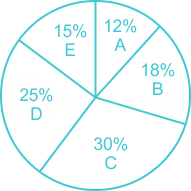
The pie chart shows the percentage distribution of number of students [ Boys + Girls] in five different classes [A, B, C, D and E]. Total number of students in all class together is 1200. Difference between boys and girls [Boys – Girls] in all class together is 200.

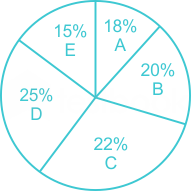
The pie chart shows the percentage distribution of number of boys in same five schools.

Find average number of boys across all five classes. If Class B is removed, the average decreases by k. Find k and the new average.

  1. AOption (a)

    0, 140

  2. BOption (b)

    10, 150

  3. COption (c)

    100, 120

  4. DOption (d)

    50, 130

  5. EOption (e)

    30, 160

View answer & explanation

Correct answer

Answer: (a)A.

0, 140

Why this answer is correct

Common Calculation

Total number of students [ Boys + Girls] in class together is 1200.

Difference between boys and girls in all class together is 200.

Total number of boys in all class together is [1200 + 200] /100 = 700

Number of students in class A is 1200 × 12 /100 = 144

Number of boys in class A is 700 × 18 / 100 = 126

So, Number of girls in class A is 144 – 126 = 18

Similarly, we can calculate others class values also.

ClassTotal number of studentsNumber of boysNumber of girls
A14412618
B21614076
C360154206
D300175125
E18010575

Calculation

Sum of boys = 126 + 140 + 154 + 175 + 105 = 700

Average across 5 classes = 700/5 = 140.

Remove Class B

New sum = 700−140 = 560.

New average across remaining 4 = 560/4 = 140.

So, the average does not change; the decrease k = 140 − 140 =  0

IBPS PO Prelims Memory Based Paper (Held On: 20 October 2024 Shift 1) (Previous Year Paper)·Quantitative Aptitude
View full paper

Question 510

IBPS Probationary Officer (PO) 2024• Quantitative Aptitude• Quantitative Aptitude

The pie chart shows the percentage distribution of number of students [ Boys + Girls] in five different classes [A, B, C, D and E]. Total number of students in all class together is 1200. Difference between boys and girls [Boys – Girls] in all class together is 200.

The pie chart shows the percentage distribution of number of boys in same five schools.

If 40% of the boys in Class B and 50% of the girls in Class B participate in a quiz competition, find the total number of students participate in quiz competition from class B?

  1. AOption (a)

    94

  2. BOption (b)

    86

  3. COption (c)

    55

  4. DOption (d)

    66

  5. EOption (e)

    72

View answer & explanation

Correct answer

Answer: (a)A.

94

Why this answer is correct

Common Calculation

Total number of students [ Boys + Girls] in class together is 1200.

Difference between boys and girls in all class together is 200.

Total number of boys in all class together is [1200 + 200] /100 = 700

Number of students in class A is 1200 × 12 /100 = 144

Number of boys in class A is 700 × 18 / 100 = 126

So, Number of girls in class A is 144 – 126 = 18

Similarly, we can calculate others class values also.

ClassTotal number of studentsNumber of boysNumber of girls
A14412618
B21614076
C360154206
D300175125
E18010575

Calculation

Quiz Competition Participants from Class B

Boys in B = 140

→ 40% participate = 0.40 × 140 = 56 boys

Girls in B = 76

→ 50% participate = 0.50 × 76=38 girls

Total participants from B = 56+38=94

Answer: 94 students

IBPS PO Prelims Memory Based Paper (Held On: 20 October 2024 Shift 1) (Previous Year Paper)·Quantitative Aptitude
View full paper

Question 511

IBPS Probationary Officer (PO) 2024• Quantitative Aptitude• Quantitative Aptitude

The pie chart shows the percentage distribution of number of students [ Boys + Girls] in five different classes [A, B, C, D and E]. Total number of students in all class together is 1200. Difference between boys and girls [Boys – Girls] in all class together is 200.

The pie chart shows the percentage distribution of number of boys in same five schools.

If one student is selected at random from Class D, find the probability that the student is a girl?

  1. AOption (a)

    5/12

  2. BOption (b)

    3/7

  3. COption (c)

    17/39

  4. DOption (d)

    7/19

  5. EOption (e)

    3/17

View answer & explanation

Correct answer

Answer: (a)A.

5/12

Why this answer is correct

Common Calculation

Total number of students [ Boys + Girls] in class together is 1200.

Difference between boys and girls in all class together is 200.

Total number of boys in all class together is [1200 + 200] /100 = 700

Number of students in class A is 1200 × 12 /100 = 144

Number of boys in class A is 700 × 18 / 100 = 126

So, Number of girls in class A is 144 – 126 = 18

Similarly, we can calculate others class values also.

ClassTotal number of studentsNumber of boysNumber of girls
A14412618
B21614076
C360154206
D300175125
E18010575

Calculation

Probability that a randomly chosen student from Class D is a girl

Girls in D = 125

Total in D = 300

Probability P(girl)=125/300 = 5/12​

Answer: 5/12

IBPS PO Prelims Memory Based Paper (Held On: 20 October 2024 Shift 1) (Previous Year Paper)·Quantitative Aptitude
View full paper

Question 512

IBPS Probationary Officer (PO) 2024• Quantitative Aptitude• Quantitative Aptitude

The pie chart shows the percentage distribution of number of students [ Boys + Girls] in five different classes [A, B, C, D and E]. Total number of students in all class together is 1200. Difference between boys and girls [Boys – Girls] in all class together is 200.

The pie chart shows the percentage distribution of number of boys in same five schools.

If 15 boys from Class A are transferred to Class E, and 12 girls from Class E are transferred to Class A, find the new ratio of boys to girls in both Class A?

  1. AOption (a)

    37:10

  2. BOption (b)

    37:11

  3. COption (c)

    39:10

  4. DOption (d)

    31:10

  5. EOption (e)

    37:19

View answer & explanation

Correct answer

Answer: (a)A.

37:10

Why this answer is correct

Common Calculation

Total number of students [ Boys + Girls] in class together is 1200.

Difference between boys and girls in all class together is 200.

Total number of boys in all class together is [1200 + 200] /100 = 700

Number of students in class A is 1200 × 12 /100 = 144

Number of boys in class A is 700 × 18 / 100 = 126

So, Number of girls in class A is 144 – 126 = 18

Similarly, we can calculate others class values also.

ClassTotal number of studentsNumber of boysNumber of girls
A14412618
B21614076
C360154206
D300175125
E18010575

Calculation

Transfer of students between Class A and Class E

Before transfer:

Class A → Boys = 126, Girls = 18

Class E → Boys = 105, Girls = 75

After transfer:

15 boys move A → E

Class A boys = 126 – 15 = 111

10 girls move E → A →

Class A girls = 18 + 12 = 30

New Ratios:

Class A ratio (boys : girls) = 111:30 = 37:10

IBPS PO Prelims Memory Based Paper (Held On: 20 October 2024 Shift 1) (Previous Year Paper)·Quantitative Aptitude
View full paper

Question 513

IBPS Probationary Officer (PO) 2024• Quantitative Aptitude• Quantitative Aptitude

Average marks of 25 students are 60. Marks of two students taken as 72 and 52 instead off 75 and 50. Find difference of old and new average?

  1. AOption (a)

    0.04

  2. BOption (b)

    0.25

  3. COption (c)

    1.25

  4. DOption (d)

    0.32

  5. EOption (e)

    10.25

View answer & explanation

Correct answer

Answer: (a)A.

0.04

Why this answer is correct

Shortcut Trick

Net change in marks = (Sum of Correct marks) − (Sum of Incorrect marks)

Net change = (75 + 50) − (72 + 52) = 125 − 124 = +1 mark

Difference in average = Net change ÷ Total students

Difference in average = 1 ÷ 25 = 0.04

∴ The correct answer is 0.04.

Alternate Method

Given:

Number of students = 25

Old average = 60

Incorrect marks = 72, 52

Correct marks = 75, 50

Calculations:

⇒ Old Total Sum = 25 × 60 = 1500

⇒ New Total Sum = 1500 − (72 + 52) + (75 + 50)

⇒ New Total Sum = 1500 − 124 + 125 = 1501

⇒ New Average = 1501 ÷ 25 = 60.04

⇒ Difference = New Average − Old Average = 60.04 − 60 = 0.04

∴ The correct answer is 0.04.

Additional Information

Average Correction Formula

Correct Average = [ (Incorrect Average × n) + (Correct Value − Incorrect Value) ] ÷ n

Net Deviation Method

Change in Average = (Total Correct Marks − Total Incorrect Marks) ÷ Number of Observations

Weighted Average

When groups of sizes n1 and n2 have averages a1 and a2, Combined Average = (n1a1 + n2a2) ÷ (n1 + n2)

IBPS PO Prelims Memory Based Paper (Held On: 20 October 2024 Shift 1) (Previous Year Paper)·Quantitative Aptitude
View full paper

Question 514

IBPS Probationary Officer (PO) 2024• Quantitative Aptitude• Quantitative Aptitude

What approximate value should come in the place of question mark (?) in the following question?

39.98% of (14.87 × 40.04) - ? = 55.96 × 9.93 ÷ 7.96

  1. AOption (a)

    210

  2. BOption (b)

    170

  3. COption (c)

    190

  4. DOption (d)

    160

  5. EOption (e)

    150

View answer & explanation

Correct answer

Answer: (b)B.

170

Why this answer is correct

Follow BODMAS rule to solve this question, as per the order given below, 

Step - 1: Parts of an equation enclosed in 'Brackets' must be solved first, and follow BODMAS rule in the bracket,

Step - 2: Any mathematical 'Of' or 'Exponent' must be solved next,

Step - 3: Next, the parts of the equation that contain 'Division' and 'Multiplication' are calculated,

Step - 4: Last but not least, the parts of the equation that contain 'Addition' and 'Subtraction' should be calculated.

Since, we need to find out the approximate value,

So, we can write these values to their nearest integers.

Given expression is

39.98% of (14.87 × 40.04) - ? = 55.96 × 9.93 ÷ 7.96

⇒ 40% of (15 × 40) - ? = 56 × 10 ÷ 8

⇒ 40% of (600) - ? = 70

⇒ 240 - ? = 70

⇒ ? = 240 - 70 = 170

IBPS PO Prelims Memory Based Paper (Held On: 20 October 2024 Shift 1) (Previous Year Paper)·Quantitative Aptitude
View full paper

Question 515

IBPS Probationary Officer (PO) 2024• Quantitative Aptitude• Quantitative Aptitude

What approximate value should come in the place of question mark (?) in the following question?

49.96% of 320.05 + 74.96% of 119.97 + √120.99 = ?

  1. AOption (a)

    251

  2. BOption (b)

    261

  3. COption (c)

    271

  4. DOption (d)

    281

  5. EOption (e)

    291

View answer & explanation

Correct answer

Answer: (b)B.

261

Why this answer is correct

Follow BODMAS rule to solve this question, as per the order given below, 

Step - 1: Parts of an equation enclosed in 'Brackets' must be solved first, and follow BODMAS rule in the bracket,

Step - 2: Any mathematical 'Of' or 'Exponent' must be solved next,

Step - 3: Next, the parts of the equation that contain 'Division' and 'Multiplication' are calculated,

Step - 4: Last but not least, the parts of the equation that contain 'Addition' and 'Subtraction' should be calculated.

Since, we need to find out the approximate value,

So, we can write these values to their nearest integers.

Given expression is

49.96% of 320.05 + 74.96% of 119.97 + √120.99 = ?

⇒ 50% of 320 + 75% of 120 + √121 = ?

⇒ (50/100) × 320 + (75/100) × 120 + 11 = ?

⇒ 160 + 90 + 11 = ?

⇒ ? = 261

IBPS PO Prelims Memory Based Paper (Held On: 20 October 2024 Shift 1) (Previous Year Paper)·Quantitative Aptitude
View full paper

Question 516

IBPS Probationary Officer (PO) 2024• Quantitative Aptitude• Quantitative Aptitude

What approximate value should come in the place of question mark (?) in the following question?

[53.98 – {34.97 – (55.98 – 62.97 ÷ 8.99 × 6.96)}] = ?

  1. AOption (a)

    26

  2. BOption (b)

    36

  3. COption (c)

    32

  4. DOption (d)

    22

  5. EOption (e)

    18

View answer & explanation

Correct answer

Answer: (a)A.

26

Why this answer is correct

Follow BODMAS rule to solve this question, as per the order given below, 

Step - 1: Parts of an equation enclosed in 'Brackets' must be solved first, and follow BODMAS rule in the bracket,

Step - 2: Any mathematical 'Of' or 'Exponent' must be solved next,

Step - 3: Next, the parts of the equation that contain 'Division' and 'Multiplication' are calculated,

Step - 4: Last but not least, the parts of the equation that contain 'Addition' and 'Subtraction' should be calculated.

Since, we need to find out the approximate value,

So, we can write these values to their nearest integers.

Given expression is

[53.98 – {34.97 – (55.98 – 62.97 ÷ 8.99 × 6.96)}] = ?

⇒ [54 – {35 – (56 – 63 ÷ 9 × 7)}] = ?

⇒ [54 – {35 – (56 – 7 × 7)}] = ?

⇒ [54 – {35 – (56 – 49)}] = ?

⇒ [54 – {35 – 7}] = ?

⇒ [54 – 28] = ?

⇒ 26 = ?

IBPS PO Prelims Memory Based Paper (Held On: 20 October 2024 Shift 1) (Previous Year Paper)·Quantitative Aptitude
View full paper

Question 517

IBPS Probationary Officer (PO) 2024• Quantitative Aptitude• Quantitative Aptitude

What approximate will come in the place of the question mark ‘?’ in the following question?

[{(5.89)2 + (4.94)2 }× 9.95] ÷ 9.89 = (?)2 – 19.88

  1. AOption (a)

    11

  2. BOption (b)

    16

  3. COption (c)

    9

  4. DOption (d)

    18

  5. EOption (e)

    5

View answer & explanation

Correct answer

Answer: (c)C.

9

Why this answer is correct

Concept used:

Follow BODMAS rule to solve this question, as per the order given below

Calculations:

[{(5.89)2 + (4.94)2 }× 9.95] ÷ 9.89 = (?)2 – 19.88

⇒ [(62 + 52) × 10)] ÷ 10 = (?)2 – 20

⇒ [(36 + 25) × 10)] ÷ 10 = (?)2 – 20

⇒ [61 × 10)] ÷ 10 = (?)2 – 20

⇒ 610 ÷ 10 = (?)2 – 20

⇒ 61 + 20 = (?)2

⇒ 81 = (?)2

⇒ 9 = ?

∴ The approx. value of ? is 9

A candidate must be careful to consider the rules of approximation while solving calculating the approximate values of a given equation. If not done so, the value of the final result (i.e. ?) shall be far away from the required value.

IBPS PO Prelims Memory Based Paper (Held On: 20 October 2024 Shift 1) (Previous Year Paper)·Quantitative Aptitude
View full paper

Question 518

IBPS Probationary Officer (PO) 2024• Quantitative Aptitude• Quantitative Aptitude

What approximate value should come in the place of question mark (?) in the following question?

14.98% of (23.98 × 24.89) - ? = 15.96 × 29.9 ÷ 7.99

  1. AOption (a)

    30

  2. BOption (b)

    20

  3. COption (c)

    50

  4. DOption (d)

    60

  5. EOption (e)

    40

View answer & explanation

Correct answer

Answer: (a)A.

30

Why this answer is correct

Follow BODMAS rule to solve this question, as per the order given below, 

Step - 1: Parts of an equation enclosed in 'Brackets' must be solved first, and follow BODMAS rule in the bracket,

Step - 2: Any mathematical 'Of' or 'Exponent' must be solved next,

Step - 3: Next, the parts of the equation that contain 'Division' and 'Multiplication' are calculated,

Step - 4: Last but not least, the parts of the equation that contain 'Addition' and 'Subtraction' should be calculated.

Since, we need to find out the approximate value,

So, we can write these values to their nearest integers.

Given expression is

14.98% of (23.98 × 24.89) - ? = 15.96 × 29.9 ÷ 7.99

⇒ 15% of (24 × 25) - ? = 16 × 30 ÷ 8

⇒ 15% of 600 - ? = 60

⇒ 15% of 600 - ? = 60

⇒ 90 - ? = 60

∴ ? = 30

IBPS PO Prelims Memory Based Paper (Held On: 20 October 2024 Shift 1) (Previous Year Paper)·Quantitative Aptitude
View full paper

Question 519

IBPS Probationary Officer (PO) 2024• Quantitative Aptitude• Quantitative Aptitude

Total surface area of sphere is 5544 m2. The volume of sphere is 8t. Find the value of t?

  1. AOption (a)

    4851

  2. BOption (b)

    4456

  3. COption (c)

    4578

  4. DOption (d)

    6254

  5. EOption (e)

    4781

View answer & explanation

Correct answer

Answer: (a)A.

4851

Why this answer is correct

Shortcut Trick

Using the relation between Total Surface Area (TSA) and Volume (V): V = (TSA × r) ÷ 3

TSA = 4 × π × r2 = 5544 ⇒ πr2 = 1386. For πr2 = 1386, r = 21 m (Standard circle value).

Volume = 8t = (5544 × 21) ÷ 3 ⇒ 8t = 5544 × 7

t = (5544 × 7) ÷ 8 = 693 × 7 = 4851.

∴ The correct answer is 4851.

Alternate Method

Given: Total Surface Area = 5544 m2, Volume = 8t

Formula Used: Surface Area = 4πr2; Volume = (4/3)πr3

⇒ 4 × (22/7) × r2 = 5544

⇒ r2 = (5544 × 7) ÷ (4 × 22)

⇒ r2 = 63 × 7 = 441 ⇒ r = 21 m

⇒ Volume = (4/3) × (22/7) × 21 × 21 × 21

⇒ 8t = 4 × 22 × 21 × 21 ÷ 1 = 88 × 441 = 38808

⇒ t = 38808 ÷ 8 = 4851

∴ The correct answer is 4851.

Additional Information

Properties of Sphere

A sphere has only one surface, so its Curved Surface Area is equal to its Total Surface Area, given by 4πr2.

Hemisphere Formulas

For a hemisphere: CSA = 2πr2, TSA = 3πr2, and Volume = (2/3)πr3.

Radius and Surface Area Relation

If the radius is doubled, the Surface Area increases by 4 times (22) and the Volume increases by 8 times (23).

IBPS PO Prelims Memory Based Paper (Held On: 20 October 2024 Shift 1) (Previous Year Paper)·Quantitative Aptitude
View full paper

Question 520

IBPS Probationary Officer (PO) 2024• Quantitative Aptitude• Quantitative Aptitude

The pie chart shows the percentage distribution of number of students [ Boys + Girls] in five different classes [A, B, C, D and E]. Total number of students in all class together is 1200. Difference between boys and girls [Boys – Girls] in all class together is 200.

The pie chart shows the percentage distribution of number of boys in same five schools.

Classes A and B are combined to form Group 1, and Classes D and E are combined to form Group 2. Find the ratio of boys and girls together in Group 1 and group 2?

  1. AOption (a)

    3:4

  2. BOption (b)

    2:5

  3. COption (c)

    5:7

  4. DOption (d)

    4:9

  5. EOption (e)

    5:11

View answer & explanation

Correct answer

Answer: (a)A.

3:4

Why this answer is correct

Common Calculation

Total number of students [ Boys + Girls] in class together is 1200.

Difference between boys and girls in all class together is 200.

Total number of boys in all class together is [1200 + 200] /100 = 700

Number of students in class A is 1200 × 12 /100 = 144

Number of boys in class A is 700 × 18 / 100 = 126

So, Number of girls in class A is 144 – 126 = 18

Similarly, we can calculate others class values also.

ClassTotal number of studentsNumber of boysNumber of girls
A14412618
B21614076
C360154206
D300175125
E18010575

Calculation

Group 1 = Classes A + B

Boys = 126 + 140 = 266

Girls = 18 + 76 = 94

Group 2 = Classes D + E

Boys = 175 + 105 = 280

Girls = 125 + 75 = 200

Required ratio = [ 266 + 94] : [ 280 +200] = 360:480 = 3:4

How should I prepare for Quantitative Aptitude in IBPS Probationary Officer (PO)?

Solving previous year questions by topic helps identify recurring concepts, question patterns, and frequently asked sub-topics. Attempt each question, review the step-by-step explanation, and note down key formulas or facts for quick revision before the exam.