IBPS Clerk · Topic Collection

Quantitative Aptitude PYQs

Arithmetic, number systems, percentages, ratios, profit and loss, time and work, algebra, geometry, mensuration, and trigonometry.

1370 Total Questions37 Official PapersYears: 2018–2025Search in Quantitative Aptitude
Showing questions 1061–1080 of 1370Page 54 of 69
IBPS Clerk Mains Memory Based Paper (Held on:28 February 2021 Shift 1) (Previous Year Paper)·Quantitative Aptitude
View full paper

Question 1061

IBPS Clerk 2021• Quantitative Aptitude• Quantitative Aptitude

Match the following column (1) and column (2):

Quadratic equationRelation between Roots
(i) X2 – 4X – 12(a) Twice of the bigger root will be 6 less than 20
(ii) Y2 – 5Y – 14(b) The sum of both the roots will be 4
(iii) Z2 – 11Z + 30(c) Multiplication of both the roots will be 30
  1. AOption (a)

    (i) - (a), (ii) - (b), (iii) - (c)

  2. BOption (b)

    (i) - (b), (ii) - (a), (iii) - (c)

  3. COption (c)

    (i) - (c), (ii) - (a), (iii) - (b)

  4. DOption (d)

    (i) - (b), (ii) - (c), (iii) - (a)

  5. EOption (e)

    None of these.

View answer & explanation

Correct answer

Answer: (a)A.

(i) - (a), (ii) - (b), (iii) - (c)

Explanation not yet available.
IBPS Clerk Mains Memory Based Paper (Held on:28 February 2021 Shift 1) (Previous Year Paper)·Quantitative Aptitude
View full paper

Question 1062

IBPS Clerk 2021• Quantitative Aptitude• Quantitative Aptitude

Direction: Study the given data carefully and answer the following question.

There are 3 cars A, B and C. They can travel some distance with different speed.

Car A: It travels some distance which is \(33\frac{1}{3}% \) more than the distance travelled by Car B.

Car B: It travels at speed of 50 km/hr for \(7\frac{1}{2}\) hours.

Car C: It goes a distance of 400 km at 20% less speed than Car B.

Find the difference between the distance travelled by Car B and Car C.

  1. AOption (a)

    30 km

  2. BOption (b)

    35 km

  3. COption (c)

    40 km

  4. DOption (d)

    25 km

  5. EOption (e)

    27 km

View answer & explanation

Correct answer

Answer: (a)A.

30 km

Explanation not yet available.
IBPS Clerk Mains Memory Based Paper (Held on:28 February 2021 Shift 1) (Previous Year Paper)·Quantitative Aptitude
View full paper

Question 1063

IBPS Clerk 2021• Quantitative Aptitude• Quantitative Aptitude

Direction: Study the given data carefully and answer the following question.

There are 3 cars A, B and C. They can travel some distance with different speed.

Car A: It travels some distance which is \(33\frac{1}{3}% \) more than the distance travelled by Car B.

Car B: It travels at speed of 50 km/hr for \(7\frac{1}{2}\) hours.

Car C: It goes a distance of 400 km at 20% less speed than Car B.

 If the Car A takes 25 hours to travel the distance, then the speed of Car A is how much less than the speed of Car B?

  1. AOption (a)

    30%

  2. BOption (b)

    60%

  3. COption (c)

    50%

  4. DOption (d)

    25%

  5. EOption (e)

    55%

View answer & explanation

Correct answer

Answer: (a)A.

30%

Explanation not yet available.
IBPS Clerk Mains Memory Based Paper (Held on:28 February 2021 Shift 1) (Previous Year Paper)·Quantitative Aptitude
View full paper

Question 1064

IBPS Clerk 2021• Quantitative Aptitude• Quantitative Aptitude

Direction: Study the given data carefully and answer the following question.

There are 3 cars A, B and C. They can travel some distance with different speed.

Car A: It travels some distance which is \(33\frac{1}{3}% \) more than the distance travelled by Car B.

Car B: It travels at speed of 50 km/hr for \(7\frac{1}{2}\) hours.

Car C: It goes a distance of 400 km at 20% less speed than Car B.

If the Car C starts travel first and after 2 hours Car B start travelling in the same direction, then find after how many hours Car B meets Car C.

  1. AOption (a)

    7 hours

  2. BOption (b)

    9 hours

  3. COption (c)

    5 hours

  4. DOption (d)

    8 hours

  5. EOption (e)

    10 hours

View answer & explanation

Correct answer

Answer: (a)A.

7 hours

Explanation not yet available.
IBPS Clerk Mains Memory Based Paper (Held on:28 February 2021 Shift 1) (Previous Year Paper)·Quantitative Aptitude
View full paper

Question 1065

IBPS Clerk 2021• Quantitative Aptitude• Quantitative Aptitude

Direction: Study the given data carefully and answer the following question.

There are 3 cars A, B and C. They can travel some distance with different speed.

Car A: It travels some distance which is \(33\frac{1}{3}% \) more than the distance travelled by Car B.

Car B: It travels at speed of 50 km/hr for \(7\frac{1}{2}\) hours.

Car C: It goes a distance of 400 km at 20% less speed than Car B.

Find the time taken by Car C to travel the distance of 400km.

  1. AOption (a)

    8 hours

  2. BOption (b)

    10 hours

  3. COption (c)

    11 hours

  4. DOption (d)

    9 hours

  5. EOption (e)

    12 hours

View answer & explanation

Correct answer

Answer: (a)A.

8 hours

Explanation not yet available.
IBPS Clerk Mains Memory Based Paper (Held on:28 February 2021 Shift 1) (Previous Year Paper)·Quantitative Aptitude
View full paper

Question 1066

IBPS Clerk 2021• Quantitative Aptitude• Quantitative Aptitude

Direction: Study the given data carefully and answer the following question.

There are 3 cars A, B and C. They can travel some distance with different speed.

Car A: It travels some distance which is \(33\frac{1}{3}% \) more than the distance travelled by Car B.

Car B: It travels at speed of 50 km/hr for \(7\frac{1}{2}\) hours.

Car C: It goes a distance of 400 km at 20% less speed than Car B.

If the Car A takes 8 hours to travel the distance, then find the speed of Car A.

  1. AOption (a)

    70 Km/hr

  2. BOption (b)

    65 Km/hr

  3. COption (c)

    67.5 Km/hr

  4. DOption (d)

    62.5 Km/hr

  5. EOption (e)

    57.5 Km/hr

View answer & explanation

Correct answer

Answer: (a)A.

70 Km/hr

Explanation not yet available.
IBPS Clerk Mains Memory Based Paper (Held on:28 February 2021 Shift 1) (Previous Year Paper)·Quantitative Aptitude
View full paper

Question 1067

IBPS Clerk 2021• Quantitative Aptitude• Quantitative Aptitude

Direction: Study the given data carefully and answer the following question.

There are four persons A, B, C, and D. Each person has different types of denomination.

PersonTotal amount (in Rs.)Denomination
A144050020020
B15252001005
C37105001020
D1250205100


Note: The number of notes of each denomination is the same for each person.

Find the number of notes of each denomination for person C.

  1. AOption (a)

    4

  2. BOption (b)

    3

  3. COption (c)

    7

  4. DOption (d)

    9

  5. EOption (e)

    2

View answer & explanation

Correct answer

Answer: (a)A.

4

Explanation not yet available.
IBPS Clerk Mains Memory Based Paper (Held on:28 February 2021 Shift 1) (Previous Year Paper)·Quantitative Aptitude
View full paper

Question 1068

IBPS Clerk 2021• Quantitative Aptitude• Quantitative Aptitude

Direction: Study the given data carefully and answer the following question.

There are four persons A, B, C, and D. Each person has different types of denomination.

PersonTotal amount (in Rs.)Denomination
A144050020020
B15252001005
C37105001020
D1250205100


Note: The number of notes of each denomination is the same for each person.

Find the average of the amount of denomination of 200 for person A and the amount of denomination of 100 for person B.

  1. AOption (a)

    Rs.250

  2. BOption (b)

    Rs.350

  3. COption (c)

    Rs.450

  4. DOption (d)

    Rs.500

  5. EOption (e)

    Rs.300

View answer & explanation

Correct answer

Answer: (a)A.

Rs.250

Explanation not yet available.
IBPS Clerk Mains Memory Based Paper (Held on:28 February 2021 Shift 1) (Previous Year Paper)·Quantitative Aptitude
View full paper

Question 1069

IBPS Clerk 2021• Quantitative Aptitude• Quantitative Aptitude

Direction: Study the given data carefully and answer the following question.

There are four persons A, B, C, and D. Each person has different types of denomination.

PersonTotal amount (in Rs.)Denomination
A144050020020
B15252001005
C37105001020
D1250205100


Note: The number of notes of each denomination is the same for each person.

By what percentage the total amount of person B is more than that of person D?

  1. AOption (a)

    25%

  2. BOption (b)

    21%

  3. COption (c)

    24%

  4. DOption (d)

    22%

  5. EOption (e)

    23%

View answer & explanation

Correct answer

Answer: (a)A.

25%

Explanation not yet available.
IBPS Clerk Mains Memory Based Paper (Held on:28 February 2021 Shift 1) (Previous Year Paper)·Quantitative Aptitude
View full paper

Question 1070

IBPS Clerk 2021• Quantitative Aptitude• Quantitative Aptitude

Direction: Study the given data carefully and answer the following question.

There are four persons A, B, C, and D. Each person has different types of denomination.

PersonTotal amount (in Rs.)Denomination
A144050020020
B15252001005
C37105001020
D1250205100


Note: The number of notes of each denomination is the same for each person.

Find difference between the number of notes of each denomination for person B and person C.

  1. AOption (a)

    4

  2. BOption (b)

    1

  3. COption (c)

    5

  4. DOption (d)

    2

  5. EOption (e)

    3

View answer & explanation

Correct answer

Answer: (a)A.

4

Explanation not yet available.
IBPS Clerk Mains Memory Based Paper (Held on:28 February 2021 Shift 1) (Previous Year Paper)·Quantitative Aptitude
View full paper

Question 1071

IBPS Clerk 2021• Quantitative Aptitude• Quantitative Aptitude

Direction: Study the given data carefully and answer the following question.

There are four persons A, B, C, and D. Each person has different types of denomination.

PersonTotal amount (in Rs.)Denomination
A144050020020
B15252001005
C37105001020
D1250205100


Note: The number of notes of each denomination is the same for each person.

Find the sum of amount of denomination of 500 for person A and person C.

  1. AOption (a)

    Rs.3500

  2. BOption (b)

    Rs.3000

  3. COption (c)

    Rs.4500

  4. DOption (d)

    Rs.2500

  5. EOption (e)

    Rs.4000

View answer & explanation

Correct answer

Answer: (a)A.

Rs.3500

Explanation not yet available.
IBPS Clerk Mains Memory Based Paper (Held on:28 February 2021 Shift 1) (Previous Year Paper)·Quantitative Aptitude
View full paper

Question 1072

IBPS Clerk 2021• Quantitative Aptitude• Quantitative Aptitude

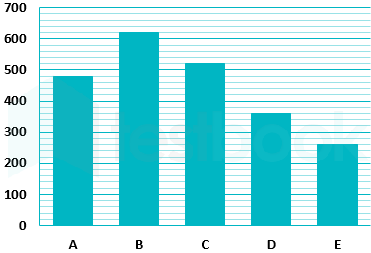
Direction: Read the following bar graph and table and answer the following questions

Following bar graph shows the number of people on which a drug is tested in five centres.

The following table shows the number of persons who developed nausea after taking the drugs

CentreNumber of persons developed Nausea
A40
B80
C110
D75
E30

Note:

(i) 50% of the total volunteers on which the drug is tested in each centre doesn't showed any symptoms.

(ii) Out of the persons who showed symptoms(either Nausea or Placebo) some developed Nausea while remaining developed Placebo.

What is the ratio between the number of persons who developed Nausea in centre C and the number of person who developed Nausea in centre B and E together?

  1. AOption (a)

    2 ∶ 3

  2. BOption (b)

    5 ∶ 6

  3. COption (c)

    1 ∶ 1

  4. DOption (d)

    7 ∶ 9

  5. EOption (e)

    2 ∶ 5

View answer & explanation

Correct answer

Answer: (a)A.

2 ∶ 3

Explanation not yet available.
IBPS Clerk Mains Memory Based Paper (Held on:28 February 2021 Shift 1) (Previous Year Paper)·Quantitative Aptitude
View full paper

Question 1073

IBPS Clerk 2021• Quantitative Aptitude• Quantitative Aptitude

Direction: Read the following bar graph and table and answer the following questions

Following bar graph shows the number of people on which a drug is tested in five centres.

The following table shows the number of persons who developed nausea after taking the drugs

CentreNumber of persons developed Nausea
A40
B80
C110
D75
E30

Note:

(i) 50% of the total volunteers on which the drug is tested in each centre doesn't showed any symptoms.

(ii) Out of the persons who showed symptoms(either Nausea or Placebo) some developed Nausea while remaining developed Placebo.

What is the average number of persons who developed Placebo?

  1. AOption (a)

    157

  2. BOption (b)

    164

  3. COption (c)

    158

  4. DOption (d)

    162

  5. EOption (e)

    132

View answer & explanation

Correct answer

Answer: (a)A.

157

Explanation not yet available.
IBPS Clerk Mains Memory Based Paper (Held on:28 February 2021 Shift 1) (Previous Year Paper)·Quantitative Aptitude
View full paper

Question 1074

IBPS Clerk 2021• Quantitative Aptitude• Quantitative Aptitude

Direction: Read the following bar graph and table and answer the following questions

Following bar graph shows the number of people on which a drug is tested in five centres.

The following table shows the number of persons who developed nausea after taking the drugs

CentreNumber of persons developed Nausea
A40
B80
C110
D75
E30

Note:

(i) 50% of the total volunteers on which the drug is tested in each centre doesn't showed any symptoms.

(ii) Out of the persons who showed symptoms(either Nausea or Placebo) some developed Nausea while remaining developed Placebo.

The number of persons who developed Nausea in centre A, D and E is what percentage less than the number of persons who developed Placebo in centre C and E together?

  1. AOption (a)

    58%

  2. BOption (b)

    65%

  3. COption (c)

    35%

  4. DOption (d)

    42%

  5. EOption (e)

    55%

View answer & explanation

Correct answer

Answer: (a)A.

58%

Explanation not yet available.
IBPS Clerk Mains Memory Based Paper (Held on:28 February 2021 Shift 1) (Previous Year Paper)·Quantitative Aptitude
View full paper

Question 1075

IBPS Clerk 2021• Quantitative Aptitude• Quantitative Aptitude

Direction: Read the following bar graph and table and answer the following questions

Following bar graph shows the number of people on which a drug is tested in five centres.

The following table shows the number of persons who developed nausea after taking the drugs

CentreNumber of persons developed Nausea
A40
B80
C110
D75
E30

Note:

(i) 50% of the total volunteers on which the drug is tested in each centre doesn't showed any symptoms.

(ii) Out of the persons who showed symptoms(either Nausea or Placebo) some developed Nausea while remaining developed Placebo.

What is the difference between the number of persons who developed Placebo in centre C and D together and the number of persons who developed Nausea in the same centres?

  1. AOption (a)

    65

  2. BOption (b)

    80

  3. COption (c)

    110

  4. DOption (d)

    50

  5. EOption (e)

    70

View answer & explanation

Correct answer

Answer: (a)A.

65

Explanation not yet available.
IBPS Clerk Prelims Memory Based Paper (Held on:5 December 2020 Shift 1) (Previous Year Paper)·Numerical Ability
View full paper

Question 1076

IBPS Clerk 2020• Numerical Ability• Numerical Ability

In a mixture, the initial ratio of A and B is 1 ∶ 4, If 25% of the mixture is taken out and 20 litres of B is added, then the amount of B becomes 44 litres then find the initial amount of A.

  1. AOption (a)

    8 litre 

  2. BOption (b)

    6 litre

  3. COption (c)

    5 litre

  4. DOption (d)

    4 litre

  5. EOption (e)

    None of these

View answer & explanation

Correct answer

Answer: (a)A.

8 litre 

Explanation not yet available.
IBPS Clerk Prelims Memory Based Paper (Held on:5 December 2020 Shift 1) (Previous Year Paper)·Numerical Ability
View full paper

Question 1077

IBPS Clerk 2020• Numerical Ability• Numerical Ability

A and B  start a business by investing a capital Rs. 3000 and Rs. 2000. After 6 months, C joins the business with the capital of Rs. 5000 and A doubles its investment. If their profit is Rs. 36000 after one year, then find the difference between the profit of A and C.

  1. AOption (a)

    Rs. 10,000

  2. BOption (b)

    Rs. 18,000

  3. COption (c)

    Rs. 24,000

  4. DOption (d)

    Rs. 8,000

  5. EOption (e)

    Rs. 9,000

View answer & explanation

Correct answer

Answer: (a)A.

Rs. 10,000

Explanation not yet available.
IBPS Clerk Prelims Memory Based Paper (Held on:5 December 2020 Shift 1) (Previous Year Paper)·Numerical Ability
View full paper

Question 1078

IBPS Clerk 2020• Numerical Ability• Numerical Ability

The cost price of the two articles A and B are Rs. 500 and Rs. 600 respectively. If both the articles were sold at the same price and the profit earned by both the articles were 2x% and x% respectively, then find the selling price article A. 

  1. AOption (a)

    Rs. 550

  2. BOption (b)

    Rs. 650

  3. COption (c)

    Rs. 750

  4. DOption (d)

    Rs. 850

  5. EOption (e)

    Rs. 950

View answer & explanation

Correct answer

Answer: (a)A.

Rs. 550

Explanation not yet available.
IBPS Clerk Prelims Memory Based Paper (Held on:5 December 2020 Shift 1) (Previous Year Paper)·Numerical Ability
View full paper

Question 1079

IBPS Clerk 2020• Numerical Ability• Numerical Ability

What value should come in place of question mark(?) in the question?

√289 + √361 – √225 = ?

  1. AOption (a)

    17

  2. BOption (b)

    21

  3. COption (c)

    19

  4. DOption (d)

    23

  5. EOption (e)

    15

View answer & explanation

Correct answer

Answer: (a)A.

17

Explanation not yet available.
IBPS Clerk Prelims Memory Based Paper (Held on:5 December 2020 Shift 1) (Previous Year Paper)·Numerical Ability
View full paper

Question 1080

IBPS Clerk 2020• Numerical Ability• Numerical Ability

What value should come in place of question mark(?) in the question?

25% of 240 + 50 = ?

  1. AOption (a)

    100

  2. BOption (b)

    110

  3. COption (c)

    80

  4. DOption (d)

    120

  5. EOption (e)

    90

View answer & explanation

Correct answer

Answer: (a)A.

100

Explanation not yet available.

How should I prepare for Quantitative Aptitude in IBPS Clerk?

Solving previous year questions by topic helps identify recurring concepts, question patterns, and frequently asked sub-topics. Attempt each question, review the step-by-step explanation, and note down key formulas or facts for quick revision before the exam.