Combined Defence Services (CDS) · Topic Collection

Quantitative Aptitude PYQs

Arithmetic, number systems, percentages, ratios, profit and loss, time and work, algebra, geometry, mensuration, and trigonometry.

2000 Total Questions20 Official PapersYears: 2016–2025Search in Quantitative Aptitude
Showing questions 881–900 of 2000Page 45 of 100
CDS Elementary Mathematics 14 Nov 2021 Official Paper (Previous Year Paper)·Elementary Mathematics
View full paper

Question 881

Combined Defence Services (CDS) 2021• Elementary Mathematics• Elementary Mathematics

ABC is a triangle with sides AB = 6 cm, BC = 10 cm and CA = 8 cm. With vertices A, B and C as centres, three circles are drawn each touching the other two externally.

What is the sum of the radii of the circles ?

  1. AOption (a)

    10.4 cm

  2. BOption (b)

    11.2 cm

  3. COption (c)

    12 cm

  4. DOption (d)

    13 cm

View answer & explanation

Correct answer

Answer: (c)C.

12 cm

Why this answer is correct

Given 

AB = 6 cm, BC = 10 cm, CA = 8 cm 

Calculation 

Let the radii of the circles with A, B and C as centres be r1, r2 and r3 respectively.

According to the given information,

AB = 6 cm = r1 + r3    ----(1)

BC = 10 cm = r2 + r3    ----(2)

CA = 8 cm = r1 + r2     ----(3)

Adding equations (1), (2) and (3),

⇒ 2(r1 + r2 + r3) = 24

⇒ r1 + r2 + r3 = 12 cm 

∴ The sum of of the radii of the circle is 12 cm
CDS Elementary Mathematics 14 Nov 2021 Official Paper (Previous Year Paper)·Elementary Mathematics
View full paper

Question 882

Combined Defence Services (CDS) 2021• Elementary Mathematics• Elementary Mathematics

ABC is a triangle with sides AB = 6 cm, BC = 10 cm and CA = 8 cm. With vertices A, B and C as centres, three circles are drawn each touching the other two externally.

What is the length of the altitude of the triangle drawn from vertex A on BC ?

  1. AOption (a)

    2.4 cm

  2. BOption (b)

    3 cm

  3. COption (c)

    4 cm

  4. DOption (d)

    4.8 cm

View answer & explanation

Correct answer

Answer: (d)D.

4.8 cm

Why this answer is correct

Given: 

AB = 6 cm ase

BC = 10 cm 

CA = 8 cm 

Formula used:

Area of triangle = 1/2 × base × height 

Calculation: 

Area of triangle ABC with base AB = Area of triangle ABC with base BC 

(1/2) × 6 × 8 = (1/2) × 10 × AD

⇒ AD( altitude drawn from A to BC) = 4.8 cm 

∴ The required answer is 4.8 cm.

CDS Elementary Mathematics 14 Nov 2021 Official Paper (Previous Year Paper)·Elementary Mathematics
View full paper

Question 883

Combined Defence Services (CDS) 2021• Elementary Mathematics• Elementary Mathematics

ABC is a triangle with sides AB = 6 cm, BC = 10 cm and CA = 8 cm. With vertices A, B and C as centres, three circles are drawn each touching the other two externally.

If P, Q and R are the areas of sectors at A, B and C within the triangle respectively, then which of the following is/are correct ?

  1. P = π cm2
  2. 9Q + 4R = 36π cm2

Select the correct answer using the code given below :

  1. AOption (a)

    1 only

  2. BOption (b)

    2 only

  3. COption (c)

    Both 1 and 2

  4. DOption (d)

    Neither 1 nor 2

View answer & explanation

Correct answer

Answer: (c)C.

Both 1 and 2

Why this answer is correct

Given: 

AB = 6 cm, BC = 10 cm, CA = 8 cm 

Concept:

Pythagoras theorem: In a right-angled triangle,

Hypotenuuse2 = Base2 + Perpedicular2

Calculation:

We have, AB = 6 cm, BC = 10 cm, CA = 8 cm 

Using Pythagoras theorem,

AB2 + AC2 = 62 + 82 = 36 + 64

⇒ AB2 + AC2 = 100 = BC2

Therefore, Δ ABC is right-angled triangle with ∠A = 90° 

Let the radii of the circles with A, B and C as centres be r1, r2 and r3 respectively.

According to the given information,

AB = 6 cm = r1 + r3    ----(1)

BC = 10 cm = r2 + r3    ----(2)

CA = 8 cm = r1 + r2     ----(3)

Adding equations (1), (2) and (3),

⇒ 2(r1 + r2 + r3) = 24

⇒ r1 + r2 + r3 = 12 cm    ----(4)

From (1), (2), (3) with (4) one by one we get

⇒ r1 = 2 cm, r2 = 6 cm, r3 = 4 cm

Now, Area of sector with centre A (P) = (90°/360°) × π (r1)2  

⇒ (1/4) × π (2)2 

⇒ π, Hence condition 1 is correct 

Now, Area of sector with centre B (Q) = (θ/360)π (4)2

And  Area of sector with centre C (R) = [(90 - θ)/360]π (6)2

The value of  9Q + 4R = 9 × 16πθ /360 + 4 × 36(90 - θ)π/360

⇒ 9Q + 4R = 144π [ θ + 90 - θ]/360

⇒ 9Q + 4R = 36π cm2 Hence condition 2 is also correct

∴ The option 3rd is correct.

CDS Elementary Mathematics 14 Nov 2021 Official Paper (Previous Year Paper)·Elementary Mathematics
View full paper

Question 884

Combined Defence Services (CDS) 2021• Elementary Mathematics• Elementary Mathematics

ABC is triangle in which AB = AC and D is any point on BC.

Which one of the following is correct ?

  1. AOption (a)

    AB2 - AD2 = CD × BD

  2. BOption (b)

    AC2 - AD2 = AD × CD

  3. COption (c)

    AB2 - AD2 = 2AD × BD

  4. DOption (d)

    AC2 - AD2 = 2BD × CD

View answer & explanation

Correct answer

Answer: (a)A.

AB2 - AD2 = CD × BD

Why this answer is correct

Given:

A △ABC in which AB = AC.

Construction:

Draw AE ⊥ BC

Calculation: 

In ΔABE and ΔACE, we have 

AB = AC (Given) 

AE = AE (common) 

∠AEB = ∠AEC = 90° 

So, ΔABE ≅ ΔACE (by SAS congruency) 

then BE = CE

In right angle triangle ABE, 

AB2 = BE2 + AE2    ----(i)

Similarly in ΔADE 

AD2 = DE2 + AE2     ---(ii)

From (ii) and (i), we get 

AB2 - AD2 = (BE2 + AE2) - (DE2 + AE2)

⇒ AB2 - AD2 = BE2 - DE2

⇒ AB2 - AD2 = (BE + DE)(BE - DE)

We know that, BE = CE

So, AB2 - AD2 = (CE + DE)(BE - DE)

AB2 - AD2 = CD × BD

∴ The required answer is option A

CDS Elementary Mathematics 14 Nov 2021 Official Paper (Previous Year Paper)·Elementary Mathematics
View full paper

Question 885

Combined Defence Services (CDS) 2021• Elementary Mathematics• Elementary Mathematics

ABC is triangle in which AB = AC and D is any point on BC.

If AD = 5 cm, BD = 4 cm and CD = 6 cm, then what is AB equal to ?

  1. AOption (a)

    7 cm

  2. BOption (b)

    6.5 cm

  3. COption (c)

    6 cm

  4. DOption (d)

    5.5 cm

View answer & explanation

Correct answer

Answer: (a)A.

7 cm

Why this answer is correct

Given:

A △ABC in which AB = AC.

Construction:

Draw AE ⊥ BC

Calculation: 

In ΔABE and ΔACE, we have 

AB = AC (Given) 

AE = AE (common) 

∠AEB = ∠AEC = 90° 

So, ΔABE ≅ ΔACE (by SAS congruency) 

Then BE = CE = (6 + 4)/2 = 5 cm

DE = 5 - 4 = 1 cm

Now, In ΔADE 

AE2 = 52 - 12        ----(i)

In ΔACE

AE2 = AC2 - 52        ----(ii)

From (i) and (ii), we get 

AC2 - 52 = 52 - 12   

⇒ AC = 7

⇒ AC = AB = 7

∴ The value of AB is 7 cm.

CDS Elementary Mathematics 14 Nov 2021 Official Paper (Previous Year Paper)·Elementary Mathematics
View full paper

Question 886

Combined Defence Services (CDS) 2021• Elementary Mathematics• Elementary Mathematics

ABC is a triangle with AB = 1.6 cm, BC = 6.3 cm and CA = 6.5 cm. Let P and Q be the mid-points of AB and BC respectively.

What is AB2 + 4BQ2 equal to ?

  1. AOption (a)

    41.25 cm2

  2. BOption (b)

    42.25 cm2

  3. COption (c)

    43.75 cm2

  4. DOption (d)

    44.25 cm2

View answer & explanation

Correct answer

Answer: (b)B.

42.25 cm2

Why this answer is correct

Concept:

Pythagoras theorem:

It states that “In a right-angled triangle, the square of the hypotenuse side is equal to the sum of squares of the other two sides“

Calculation:

Given that, 

For ΔABC, AB = 1.6 cm, BC = 6.3 cm and CA = 6.5 cm 

∵ (1.6)2 + (6.3)2 

⇒ 2.56 + 39.69 = 42.25

= (6.5)2

Hence, ΔABC is a right angle triangle. 

Also, given that

AP = PB & BQ = QC

Hence, required value

AB2 + 4BQ2 = AB2 + 4(BC/2)2

⇒ AB2 + 4BQ2 = AB2 + BC2

⇒ AB2 + 4BQ2 = AC2

⇒ AB2 + 4BQ2 = (6.5)2

⇒  AB2 + 4BQ2 = 42.25

CDS Elementary Mathematics 14 Nov 2021 Official Paper (Previous Year Paper)·Elementary Mathematics
View full paper

Question 887

Combined Defence Services (CDS) 2021• Elementary Mathematics• Elementary Mathematics

ABC is a triangle with AB = 1.6 cm, BC = 6.3 cm and CA = 6.5 cm. Let P and Q be the mid-points of AB and BC respectively.

What is AQ2 + CP2 equal to ?

  1. AOption (a)

    AC2

  2. BOption (b)

    1.2 AC2

  3. COption (c)

    1.25 AC2

  4. DOption (d)

    1.5 AC2

View answer & explanation

Correct answer

Answer: (c)C.

1.25 AC2

Why this answer is correct

Concept:

AQ2 + PB2 = AC2 + PQ2

Calculation:

We know that

AQ2 + PB2 = AC2 + PQ2

∵ PQ = AC/2

⇒ AQ2 + PC2 = AC2 + (AC/2)2

⇒ AQ2 + PC2 = (5/4)AC2

⇒  AQ2 + CP2 = 1.25AC2

CDS Elementary Mathematics 14 Nov 2021 Official Paper (Previous Year Paper)·Elementary Mathematics
View full paper

Question 888

Combined Defence Services (CDS) 2021• Elementary Mathematics• Elementary Mathematics

ABC is a triangle with AB = 1.6 cm, BC = 6.3 cm and CA = 6.5 cm. Let P and Q be the mid-points of AB and BC respectively.

What is 12(CP2 -  AQ2) equal to?

  1. AOption (a)

    101.39 cm2

  2. BOption (b)

    111.39 cm2

  3. COption (c)

    121.39 cm2

  4. DOption (d)

    131.39 cm2

View answer & explanation

Correct answer

Answer: (b)B.

111.39 cm2

Why this answer is correct

Concept:

Pythagoras theorem:

It states that “In a right-angled triangle, the square of the hypotenuse side is equal to the sum of squares of the other two sides“

Calculation:

Let,

AB = 2x and BC = 2y

In ΔPBC

PB2 + BQ2 = CP2

⇒ CP2 =  x2 + (2y)2      ----(1)

In ΔAQB

AB2 + BQ2 = AQ2

⇒ AQ2 =  y2 + (2x)2     -----(2)

Hence, the required value

4 × 3(CP2 -  AQ2)

⇒ 4 × 3[ x2 + (2y)2 - { y2 + (2x)2}]

⇒ 4× [3y2 - 3x2]

Take 3 common & 4 inside the bracket 

⇒ 3[(2y)2 - (2x)2]

⇒ 3[(6.3)2 - (1.6)2]

⇒ 3 × (39.69 - 2.56) 

∴  111.39 cm2

CDS Elementary Mathematics 14 Nov 2021 Official Paper (Previous Year Paper)·Elementary Mathematics
View full paper

Question 889

Combined Defence Services (CDS) 2021• Elementary Mathematics• Elementary Mathematics

AB is a diameter of a circle with centre O. Radius OP is perpendicular to AB. Let Q be any point on arc PB.

What is ∠BAP equal to?

  1. AOption (a)

    30°

  2. BOption (b)

    40°

  3. COption (c)

    45°

  4. DOption (d)

    60°

View answer & explanation

Correct answer

Answer: (c)C.

45°

Why this answer is correct

Given 

AB is a diameter of a circle with center O. 

Formula used 

Angle made by diameter in semicircle is always 90° 

Calculation 

Since, chord BP makes ∠BOP at the centre and ∠BAP at A.

⇒ ∠BAP = ½ ∠BOP = ½ × (90°)  = 45° 

∴ The required answer is 45°

CDS Elementary Mathematics 14 Nov 2021 Official Paper (Previous Year Paper)·Elementary Mathematics
View full paper

Question 890

Combined Defence Services (CDS) 2021• Elementary Mathematics• Elementary Mathematics

AB is a diameter of a circle with centre O. Radius OP is perpendicular to AB. Let Q be any point on arc PB.

What is ∠AQP equal to?

  1. AOption (a)

    30°

  2. BOption (b)

    40°

  3. COption (c)

    45°

  4. DOption (d)

    60°

View answer & explanation

Correct answer

Answer: (c)C.

45°

Why this answer is correct

Given 

AB is a diameter of a circle with center O. 

Formula used 

Angle made by diameter in semicircle is always 90° 

Calculation 

Since, chord BP makes ∠BOP at the centre and ∠BAP at A.

⇒ ∠BAP = ½ ∠BOP = ½ × (90°)  = 45° 

Similarly, chord AP makes ∠AOP  at the centre and ∠AQP at Q.

∠AQP  = ½ ∠AOP

⇒ ½ × (90°) = 45° 

∴ The required answer is 45°

CDS Elementary Mathematics 14 Nov 2021 Official Paper (Previous Year Paper)·Elementary Mathematics
View full paper

Question 891

Combined Defence Services (CDS) 2021• Elementary Mathematics• Elementary Mathematics

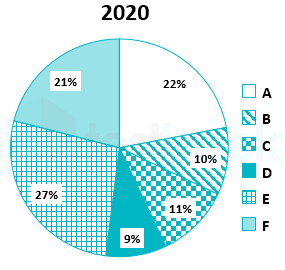
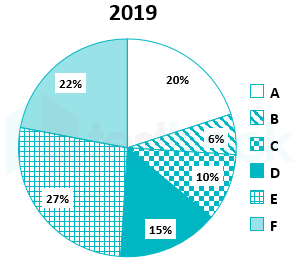
The following Pie-Charts show the percentage of different categories (A, B, C, D, E and F) of employees in a company in the year 2019 and 2020. The total number of employees was 4000 in 2019 and 5000 in 2020.

There are two categories of employees in 2019 whose total strength remained the same in 2020. What are these two categories ?

  1. AOption (a)

    C and B

  2. BOption (b)

    E and A

  3. COption (c)

    E and F

  4. DOption (d)

    C and D

View answer & explanation

Correct answer

Answer: (d)D.

C and D

Why this answer is correct

Given 

Total number of employees in 2019 = 4000 

Total number of employees in 2020 = 5000

Calculation 

For category A, 

Total number employee of category A in 2019 = 20 × 4000/100 = 800

Total number employee of category A in 2020 = 22 × 5000/100 = 1100

For category B,

Total number employee of category B in 2019 = 6 × 4000/100 = 240 

Total number employee of category B in 2020 = 10 × 5000/100 = 500

For category C, 

Total number employee of category C in 2019 = 10 × 4000/100 = 400

Total number employee of category C in 2020 = 11 × 5000/100 = 550

For category D, 

Total number employee of category D in 2019 = 15 × 4000/100 = 600

Total number employee of category D in 2020 = 9 × 5000/100 = 450

For category E, 

Total number employee of category E in 2019 = 27 × 4000/100 = 1080

Total number employee of category E in 2020 = 27 × 5000/100 = 1350

For category F, 

Total number employee of category F in 2019 = 22 × 4000/100 = 880

Total number employee of category F in 2020 = 21 × 5000/100 = 1050

Number of employees in C and D in 2019 = (400 + 600) = 1000 

Number of employees in C and D in 2020 = (550 + 450) =1000 

So clearly see that total of C and D in 2019 and 2020 remain same.

∴ The correct answer is C and D

CDS Elementary Mathematics 14 Nov 2021 Official Paper (Previous Year Paper)·Elementary Mathematics
View full paper

Question 892

Combined Defence Services (CDS) 2021• Elementary Mathematics• Elementary Mathematics

The following Pie-Charts show the percentage of different categories (A, B, C, D, E and F) of employees in a company in the year 2019 and 2020. The total number of employees was 4000 in 2019 and 5000 in 2020.

In which one of the following categories of employees, the percentage change in number of employees in 2020 was maximum as compared to 2019?

  1. AOption (a)

    A

  2. BOption (b)

    B

  3. COption (c)

    C

  4. DOption (d)

    D

View answer & explanation

Correct answer

Answer: (b)B.

B

Why this answer is correct

From Given :

For category A, 

Total number employee of category A in 2019 = 20 × 4000/100 = 800

Total number employee of category A in 2020 = 22 × 5000/100 = 1100

Percentage change = 300/800 × 100 = 37.5% 

For category B, 

Total number employee of category B in 2019 = 6 × 4000/100 = 240 

Total number employee of category B in 2020 = 10 × 5000/100 = 500

Percentage change = 260/240 × 100 = 108.33%

For category C, 

Total number employee of category C in 2019 = 10 × 4000/100 = 400

Total number employee of category C in 2020 = 11 × 5000/100 = 550

Percentage change = 150/400 × 100 = 37.5% 

For category D, 

Total number employee of category D in 2019 = 15 × 4000/100 = 600

Total number employee of category D in 2020 = 9 × 5000/100 = 450

Percentage change = (-)150/600 × 100 = (-)25%

For category E, 

Total number employee of category E in 2019 = 27 × 4000/100 = 1080

Total number employee of category E in 2020 = 27 × 5000/100 = 1350

Percentage change = 270/1080 × 100 = 25% 

For category F, 

Total number employee of category F in 2019 = 22 × 4000/100 = 880

Total number employee of category F in 2020 = 21 × 5000/100 = 1050

Percentage change = 110/440 × 100 = 25% 

From the above calculation

So, Percentage change is maximum for B 

∴ The correct answer is B.

CDS Elementary Mathematics 14 Nov 2021 Official Paper (Previous Year Paper)·Elementary Mathematics
View full paper

Question 893

Combined Defence Services (CDS) 2021• Elementary Mathematics• Elementary Mathematics

The following Pie-Charts show the percentage of different categories (A, B, C, D, E and F) of employees in a company in the year 2019 and 2020. The total number of employees was 4000 in 2019 and 5000 in 2020.

What was the percentage increase of category-E employees in 2020 as compared to that in 2019 ?

  1. AOption (a)

    20%

  2. BOption (b)

    25%

  3. COption (c)

    30%

  4. DOption (d)

    40%

View answer & explanation

Correct answer

Answer: (b)B.

25%

Why this answer is correct

Given:

Total number of employees in 2019 = 4000 

Total number of employees in 2020 = 5000

Calculation: 

For category A, 

Total number employee of category A in 2019 = 20 × 4000/100 = 800

Total number employee of category A in 2020 = 22 × 5000/100 = 1100

For category B,

Total number employee of category B in 2019 = 6 × 4000/100 = 240 

Total number employee of category B in 2020 = 10 × 5000/100 = 500

For category C, 

Total number employee of category C in 2019 = 10 × 4000/100 = 400

Total number employee of category C in 2020 = 11 × 5000/100 = 550

For category D, 

Total number employee of category D in 2019 = 15 × 4000/100 = 600

Total number employee of category D in 2020 = 9 × 5000/100 = 450

For category E, 

Total number employee of category E in 2019 = 27 × 4000/100 = 1080

Total number employee of category E in 2020 = 27 × 5000/100 = 1350

For category F, 

Total number employee of category F in 2019 = 22 × 4000/100 = 880

Total number employee of category F in 2020 = 21 × 5000/100 = 1050

Required Percentage = [(1350 - 1080)/1080] × 100 = 25% 

∴ The correct answer is 25%

CDS Elementary Mathematics 14 Nov 2021 Official Paper (Previous Year Paper)·Elementary Mathematics
View full paper

Question 894

Combined Defence Services (CDS) 2021• Elementary Mathematics• Elementary Mathematics

The following Pie-Charts show the percentage of different categories (A, B, C, D, E and F) of employees in a company in the year 2019 and 2020. The total number of employees was 4000 in 2019 and 5000 in 2020.

There are two categories of employees whose strength increased/decreased by same percentage in 2020. What are the two categories ?

  1. AOption (a)

    D and F

  2. BOption (b)

    C and E

  3. COption (c)

    A and E

  4. DOption (d)

    D and E

View answer & explanation

Correct answer

Answer: (d)D.

D and E

Why this answer is correct

Given 

Total number of employees in 2019 = 4000 

Total number of employees in 2020 = 5000

Calculation 

For category A, 

Total number employee of category A in 2019 = 20 × 4000/100 = 800

Total number employee of category A in 2020 = 22 × 5000/100 = 1100

Percentage change = 300/800 × 100 = 37.5% 

For category B, 

Total number employee of category B in 2019 = 6 × 4000/100 = 240 

Total number employee of category B in 2020 = 10 × 5000/100 = 500

Percentage change = 260/240 × 100 = 108.33%

For category C, 

Total number employee of category C in 2019 = 10 × 4000/100 = 400

Total number employee of category C in 2020 = 11 × 5000/100 = 550

Percentage change = 150/400 × 100 = 37.5% 

For category D, 

Total number employee of category D in 2019 = 15 × 4000/100 = 600

Total number employee of category D in 2020 = 9 × 5000/100 = 450

Percentage change = (-)150/600 × 100 = (-)25%

For category E, 

Total number employee of category E in 2019 = 27 × 4000/100 = 1080

Total number employee of category E in 2020 = 27 × 5000/100 = 1350

Percentage change = 270/1080 × 100 = 25% 

For category F, 

Total number employee of category F in 2019 = 22 × 4000/100 = 880

Total number employee of category F in 2020 = 21 × 5000/100 = 1050

Percentage change = 170/880 × 100 = 19.31% 

From the above calculation

We have seen clearly percentage change in categories D and E are the same from 2019 to 2020. 

∴ The required answer is D and E

CDS Elementary Mathematics 14 Nov 2021 Official Paper (Previous Year Paper)·Elementary Mathematics
View full paper

Question 895

Combined Defence Services (CDS) 2021• Elementary Mathematics• Elementary Mathematics

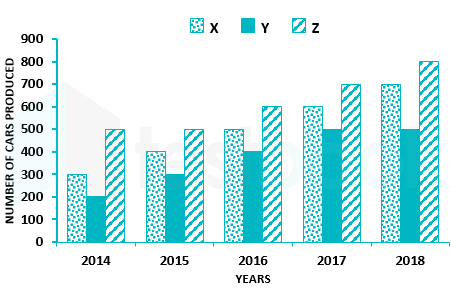
The following Bar-Chart gives the production of cars by three different companies X, Y and Z in different years:

The percentage increase in the total production of cars from 2014 to 2018 was

  1. AOption (a)

    50%

  2. BOption (b)

    100%

  3. COption (c)

    150%

  4. DOption (d)

    200%

View answer & explanation

Correct answer

Answer: (b)B.

100%

Why this answer is correct

From the bar graph, 

Total Production of car in 2014 = 300 + 200 + 500 = 1000 

Total Production of car in 2018 = 700 + 500 + 800 = 2000 

Therefore, Required percentage = \(total production of car in 2018 - total production of car in 2014 \over total production of car in 2014\)

The percentage increase in the total production of cars from 2014 to 2018 = (1000/1000) × 100 = 100% 

∴ The required answer is 100%.

CDS Elementary Mathematics 14 Nov 2021 Official Paper (Previous Year Paper)·Elementary Mathematics
View full paper

Question 896

Combined Defence Services (CDS) 2021• Elementary Mathematics• Elementary Mathematics

The following Bar-Chart gives the production of cars by three different companies X, Y and Z in different years:

Consider the production of each company separately. In how many instances was the percentage increase in production of cars over the previous year’s production greater than 20% ?

  1. AOption (a)

    5

  2. BOption (b)

    6

  3. COption (c)

    7

  4. DOption (d)

    8

View answer & explanation

Correct answer

Answer: (a)A.

5

Why this answer is correct

From the bar graph, 

For Car X,

Production increases of car x from 2014 to 2015 = 100/300 × 100 = 33.33% 

Production increases of car x from 2015 to 2016 = 100/400 × 100 = 25% 

Production increases of car x from 2016 to 2017 = 100/500 × 100 = 20% 

Production increases of car x from 2017 to 2018 = 100/600 × 100 = 16.66% 

For Car Y,

Production increases of car Y from 2014 to 2015 = 100/200 × 100 = 50% 

Production increases of car Y from 2015 to 2016 = 100/300 × 100 = 33.33% 

Production increases of car Y from 2016 to 2017 = 100/400 × 100 = 25% 

Production increases of car Y from 2017 to 2018 = No change 

For Car Z,

Production increases of car Z from 2014 to 2015 = No change  

Production increases of car Z from 2015 to 2016 = 100/500 × 100 = 20% 

Production increases of car Z from 2016 to 2017 = 100/600 × 100 = 16.66% 

Production increases of car Z from 2017 to 2018 = 100/700 × 100 = 14.28% 

The percentage increase in production of cars over the previous year’s production greater than 20% = 2 times for Car X + 3 times for Car Y = 5 Instances.

∴ The correct answer is 5.

CDS Elementary Mathematics 14 Nov 2021 Official Paper (Previous Year Paper)·Elementary Mathematics
View full paper

Question 897

Combined Defence Services (CDS) 2021• Elementary Mathematics• Elementary Mathematics

The following Bar-Chart gives the production of cars by three different companies X, Y and Z in different years:

In which year was the percentage increase in production of cars minimum as compared to its previous year ?

  1. AOption (a)

    2015

  2. BOption (b)

    2016

  3. COption (c)

    2017

  4. DOption (d)

    2018

View answer & explanation

Correct answer

Answer: (d)D.

2018

Why this answer is correct

From the bar graph,  

Total Production of car in 2014 = 300 + 200 + 500 = 1000 

Total Production of car in 2015 = 400 + 300 + 500 = 1200 

Percentage of production increase of from 2014 to 2015 = (200/1000) × 100 = 20% 

Total Production of car in 2016 = 500 + 400 + 600 = 1500

Percentage of production increase of from 2015 to 2016 = (400/1100) × 100 = 400/11 %  

Total Production of car in 2017 = 600 + 500 + 700 = 1800 

Percentage of production increase of from 2016 to 2017 = (300/1500) × 100 = 20% 

Total Production of car in 2018 = 700 + 500 + 800 = 2000 

Percentage of production increase of from 2017 to 2018 = (200/1800) × 100 = 11.11%

∴ The percentage increase in production of cars minimum as compared to its previous year in 2018.

CDS Elementary Mathematics 14 Nov 2021 Official Paper (Previous Year Paper)·Elementary Mathematics
View full paper

Question 898

Combined Defence Services (CDS) 2021• Elementary Mathematics• Elementary Mathematics

The following Bar-Chart gives the production of cars by three different companies X, Y and Z in different years:

In one of the years the percentage increase in production of cars was minimum as compared to its previous year. What was the minimum percentage ?

  1. AOption (a)

    10%

  2. BOption (b)

    \(11 \frac{1}{9} %\)

  3. COption (c)

    \(13 \frac{1}{3} %\)

  4. DOption (d)

    20%

View answer & explanation

Correct answer

Answer: (b)B.

\(11 \frac{1}{9} %\)

Why this answer is correct

From the bar graph,  

Total Production of car in 2014 = 300 + 200 + 500 = 1000 

Total Production of car in 2015 = 400 + 300 + 500 = 1200 

Percentage of production increase of from 2014 to 2015 = (200/1000) × 100 = 20% 

Total Production of car in 2016 = 500 + 400 + 600 = 1500

Percentage of production increase of from 2015 to 2016 = (300/1200) × 100 = 25 %  

Total Production of car in 2017 = 600 + 500 + 700 = 1800 

Percentage of production increase of from 2016 to 2017 = (300/1500) × 100 = 20% 

Total Production of car in 2018 = 700 + 500 + 800 = 2000 

Percentage of production increase of from 2017 to 2018 = (200/1800) × 100 = 11.11%

∴  The minimum percentage is 11.11% (\(11 \frac{1}{9} %\)).

CDS Elementary Mathematics 14 Nov 2021 Official Paper (Previous Year Paper)·Elementary Mathematics
View full paper

Question 899

Combined Defence Services (CDS) 2021• Elementary Mathematics• Elementary Mathematics

Collect all the sequences of five consecutive integers such that their product is equal to one of these integers. Let X be the collection of all possible such sequences. Let P be the smallest integer and Q be the largest integer occurring in these sequences.

How many such sequences of five consecutive integers are possible ?

  1. AOption (a)

    One

  2. BOption (b)

    Two

  3. COption (c)

    Three

  4. DOption (d)

    Five

View answer & explanation

Correct answer

Answer: (d)D.

Five

Why this answer is correct

Given:

There are five consecutive integers.

Their product is equal to one of these integers.

Explanation:

As the product is equal to one of these integers. Therefore,

One of the integers from the collection must be zero, so that product will always become zero.

Hence, various possibilities are

Case:A   -4, -3, -2, -1, 0

Case:B   -3, -2, -1, 0, 1

Case:C   -2, -1, -0, 1, 2

Case:D   -1, 0, 1, 2, 3

Case:E   0, 1, 2, 3, 4

Hence, 5 sequence are possible.

CDS Elementary Mathematics 14 Nov 2021 Official Paper (Previous Year Paper)·Elementary Mathematics
View full paper

Question 900

Combined Defence Services (CDS) 2021• Elementary Mathematics• Elementary Mathematics

Collect all the sequences of five consecutive integers such that their product is equal to one of these integers. Let X be the collection of all possible such sequences. Let P be the smallest integer and Q be the largest integer occurring in these sequences.

What is the arithmetic mean of P and Q ?

  1. AOption (a)

    0

  2. BOption (b)

    1

  3. COption (c)

    2

  4. DOption (d)

    Cannot be determined due to insufficient data

View answer & explanation

Correct answer

Answer: (a)A.

0

Why this answer is correct

Given:

There are five consecutive integers.

Their product is equal to one of these integers.

P = smallest integer and Q = largest integer\

Formula used:

The arithmetic mean of a and b is given by

(a + b)/2

Explanation:

X = {-4, -3, -2, -1, 0, 1, 2, 3, 4}

⇒ P = -4

And Q = 4

Hence, Arithmetic mean

(P + Q)/2 = (-4 + 4)/2

⇒ (P + Q)/2 = 0

How should I prepare for Quantitative Aptitude in Combined Defence Services (CDS)?

Solving previous year questions by topic helps identify recurring concepts, question patterns, and frequently asked sub-topics. Attempt each question, review the step-by-step explanation, and note down key formulas or facts for quick revision before the exam.