Combined Defence Services (CDS) · Topic Collection

Quantitative Aptitude PYQs

Arithmetic, number systems, percentages, ratios, profit and loss, time and work, algebra, geometry, mensuration, and trigonometry.

2000 Total Questions20 Official PapersYears: 2016–2025Search in Quantitative Aptitude
Showing questions 581–600 of 2000Page 30 of 100
CDS Elementary Mathematics 16 April 2023 Official Paper (Previous Year Paper)·Elementary Mathematics
View full paper

Question 581

Combined Defence Services (CDS) 2023• Elementary Mathematics• Elementary Mathematics

Consider the following data for the next two (02) items that follow : 

Class0-3030-6060-9090-120
Frequency4574

What is the mode of the distribution? 

  1. AOption (a)

    60 

  2. BOption (b)

    72  

  3. COption (c)

    75

  4. DOption (d)

    80  

View answer & explanation

Correct answer

Answer: (b)B.

72  

Why this answer is correct

Formula used:

Mode = L + \(\frac{D_1}{D_1+D_2}\times i\)

L = lower limit,

D1 = ​​The difference between the frequency of the modal class and the

frequency of the class preceding the modal class,

D2 = The difference between the frequency of the modal class and the

frequency of the class following the modal class.

i = The class width

Calculation:

Since class 60 - 90 has the highest frequency. Therefore,

Model class = 60 - 90   

L = 60, D1 = 7 - 5 = 2

D2 = 7 - 4 = 3, i = 90 - 60 = 30

Mode = 60 +  \(\frac{2}{2+3}\times 30\) = 72

∴ Mode of the distribution is 72.
CDS Elementary Mathematics 16 April 2023 Official Paper (Previous Year Paper)·Elementary Mathematics
View full paper

Question 582

Combined Defence Services (CDS) 2023• Elementary Mathematics• Elementary Mathematics

Consider the following data for the next two (02) items that follow : 

Class0-3030-6060-9090-120
Frequency4574

If the median (P) and mode (Q) satisfy the relation 7(Q - P) = 9R, then what is the value of R? 

  1. AOption (a)

    6

  2. BOption (b)

    5

  3. COption (c)

    3

  4. DOption (d)

    1

View answer & explanation

Correct answer

Answer: (a)A.

6

Why this answer is correct

Formula used:

Mode = L + \(\frac{D_1}{D_1+D_2}× i\)

L = lower limit,

D1 = ​​The difference between the frequency of the modal class and the

frequency of the class preceding the modal class,

D2 = The difference between the frequency of the modal class and the

frequency of the class following the modal class.

i = The class width,

Median \( = l+ \left[\frac{\left(\frac{n}{2} – cf\right)}{f}\right] × i\)

Where l = lower limit of median class,

n = number of observations,

i = class size, f = frequency of median class,

cf = cumulative frequency of class preceding the median class.

Calculation:

xiFicf
0 - 3044
30 - 6059
60 - 90716
90 - 120420


Since class 60 - 90 has the highest frequency. Therefore,

Model class = 60 - 90   

L = 60, D1 = 7 - 5 = 2

D2 = 7 - 4 = 3, i = 90 - 60 = 30

Mode = 60 +  \(\frac{2}{2+3}× 30\) = 72

Let's calculate the median 

Here, n = 20. (n/2) = 20/2 = 10 

So, the 10th observation will be in class 60 - 90.

Median = \( 60+ \left[\frac{\left(\frac{20}{2} – 9\right)}{7}\right] × 30 \)

Median = 60 + (30/7) = 450/7

Median = P = 450/7

Mode = Q = 72

According to the question, 7(Q - P) = 9R

⇒ 7 (72 - 450/7) = 9R

⇒ 7 (504 - 450)/7 = 9R

⇒  54 = 9R

∴ R = 6

CDS Elementary Mathematics 16 April 2023 Official Paper (Previous Year Paper)·Elementary Mathematics
View full paper

Question 583

Combined Defence Services (CDS) 2023• Elementary Mathematics• Elementary Mathematics

Consider the following data for the next two (02) items that follow : 

Class40-5050-6060-7070-80
Frequency4312

What is the mean of the distribution? 

  1. AOption (a)

    51

  2. BOption (b)

    52

  3. COption (c)

    54

  4. DOption (d)

    56

View answer & explanation

Correct answer

Answer: (d)D.

56

Why this answer is correct

Formula used:

Mean = ∑  (f.x̅) / ∑f

Calculation:

xfx̅  (average)f.x
40 - 50445180
50 - 60355165
60 - 7016565
70 - 80275150
∑f = 10∑ f.x̅  = 560


Therefore,

Mean = (560/10)

∴ Mean = 56

CDS Elementary Mathematics 16 April 2023 Official Paper (Previous Year Paper)·Elementary Mathematics
View full paper

Question 584

Combined Defence Services (CDS) 2023• Elementary Mathematics• Elementary Mathematics

Consider the following data for the next two (02) items that follow : 

Class40-5050-6060-7070-80
Frequency4312

If M is the median; then what is the value of 3M? 

  1. AOption (a)

    \(53 \frac{1}{3}\)

  2. BOption (b)

    60 

  3. COption (c)

    160  

  4. DOption (d)

    180  

View answer & explanation

Correct answer

Answer: (c)C.

160  

Why this answer is correct

Formula Used: 

Median \( = l+ \left[\frac{\left(\frac{n}{2} – cf\right)}{f}\right] \times h \)

Where l = lower limit of median class,

n = number of observations,

h = class size, f = frequency of median class,

cf = cumulative frequency of class preceding the median class.

Calculation: 

xfc.f
40 - 5044
50 - 6037
60 - 7018
70 - 80210
n = 10


n = 10. Therefore n/2 = 10/2 = 5

Therefore, 50 - 60 will be the median class.

Median (M) = \( = 50+ \left[\frac{\left(\frac{10}{2} – 4\right)}{3}\right] \times 10\)

Median (M) = 50 + 10/3 = 160/3

∴ Required value 3M  = 160.

CDS Elementary Mathematics 16 April 2023 Official Paper (Previous Year Paper)·Elementary Mathematics
View full paper

Question 585

Combined Defence Services (CDS) 2023• Elementary Mathematics• Elementary Mathematics

The plinth of a house has an area of 200 square metres. It is rectangular in shape and its length and breadth are in the ratio 2 :

  1. The owner of the house extends the terrace by 1 m on each side. What is the percentage of area that has increased in the terrace relative to the plinth ? 
  1. AOption (a)

    40%  

  2. BOption (b)

    32%  

  3. COption (c)

    20%  

  4. DOption (d)

    15.5% 

View answer & explanation

Correct answer

Answer: (b)B.

32%  

Why this answer is correct

Formula used:

Area of rectangle = length× breadth

Calculation:

Let the length be 2X and the breadth be X. Then, 

Area of plinth = length x breadth

⇒  (2X)*(X)

⇒ 2x2 = 200 sq. m.

⇒ X = √(100)

⇒ X = 10 m.

The dimensions of the plinth are 2X = 20 m (length) & X = 10 m (breadth).

Now, the owner extends the terrace by 1 m on each side. So, the new

dimensions of the terrace are (20 + 2) m (length) and (10 + 2) m (breadth).

Area of new terrace = (20 + 2) x (10+2)

Area of new terrace = 264 sq. m

Increase in area = 264 - 200

Increase in area = 64 sq. m

Percentage increase = (increase in area/area of plinth) x 100

Percentage increase = (64/200) x 100 = 32%

∴ The percentage increase in the area is 32%.

CDS Elementary Mathematics 16 April 2023 Official Paper (Previous Year Paper)·Elementary Mathematics
View full paper

Question 586

Combined Defence Services (CDS) 2023• Elementary Mathematics• Elementary Mathematics

A square sheet of side length 44 cm is rolled along one of its sides to form a cylinder by making opposite edges just to touch each other. What is the volume of the cylinder ? (Take π = 22/7)  

  1. AOption (a)

    6776 cubic cm  

  2. BOption (b)

    6248 cubic cm 

  3. COption (c)

    5896 cubic cm 

  4. DOption (d)

    5680 cubic cm

View answer & explanation

Correct answer

Answer: (a)A.

6776 cubic cm  

Why this answer is correct

Formula used:

Perimeter = Base of cylinder = 2π × radius

Volume of cylinder = π(radius)2 × h

Calculation:

When the square sheet is rolled along one of its sides 

The circumference of the base of the cylinder = Length of the side of the square sheet

Therefore, the circumference of the base of the cylinder = 44 cm

⇒ 2πr = 44

⇒ 2 × (22/7) × r = 44 

⇒ r = 7 cm

The height of the cylinder is equal to the length of the side of the square sheet, which is 44 cm.

Volume = π × radius2 × height

⇒ V = (22/7) × 72 × 44

⇒ V = 22 × 7 × 44

⇒ V = 6776 cm3

Therefore, the volume of the cylinder is 6776 cm3.

CDS Elementary Mathematics 16 April 2023 Official Paper (Previous Year Paper)·Elementary Mathematics
View full paper

Question 587

Combined Defence Services (CDS) 2023• Elementary Mathematics• Elementary Mathematics

The volume of a cuboid is 3600 cubic cm. The areas of two adjacent faces are 225 square cm and 144 square cm. What is the area of the other adjacent face ? 

  1. AOption (a)

    400 square cm  

  2. BOption (b)

    360 square cm 

  3. COption (c)

    320 square cm  

  4. DOption (d)

    300 square cm  

View answer & explanation

Correct answer

Answer: (a)A.

400 square cm  

Why this answer is correct

Shortcut Trick

Relation between Volume (V) and areas of three adjacent faces (A1, A2, A3) is V2 = A1 × A2 × A3.

Given: V = 3600, A1 = 225, A2 = 144.

36002 = 225 × 144 × A3

A3 = (3600 × 3600) ÷ (225 × 144) = (3600 ÷ 180)2 = 202 = 400.

∴ The correct answer is 400 square cm.

Alternate Method

Given:

Volume of cuboid (V) = 3600 cm3

Area of first face (A1 = l × w) = 225 cm2

Area of second face (A2 = w × h) = 144 cm2

Formula Used:

Volume of cuboid = l × w × h

Relationship: V2 = (l × w) × (w × h) × (h × l)

Calculations:

⇒ Let the three adjacent faces be A1, A2, and A3.

⇒ V2 = A1 × A2 × A3

⇒ 3600 × 3600 = 225 × 144 × A3

⇒ 12,960,000 = 32,400 × A3

⇒ A3 = 12,960,000 ÷ 32,400

⇒ A3 = 400

∴ The correct answer is 400 square cm.

Additional Information

Total Surface Area of Cuboid

The total surface area is the sum of the areas of all six faces: TSA = 2(lw + wh + hl).

Diagonal of a Cuboid

The longest rod that can be placed inside a cuboid is its diagonal: d = √(l2 + w2 + h2).

Lateral Surface Area

The area of the four side walls of a cuboid is LSA = 2h(l + w).

CDS Elementary Mathematics 16 April 2023 Official Paper (Previous Year Paper)·Elementary Mathematics
View full paper

Question 588

Combined Defence Services (CDS) 2023• Elementary Mathematics• Elementary Mathematics

The perimeter and the area of a right-angled triangle are 36 cm and 54 square cm respectively. What is the length of the hypotenuse? 

  1. AOption (a)

    12 cm

  2. BOption (b)

    14 cm 

  3. COption (c)

    15 cm

  4. DOption (d)

    16 cm  

View answer & explanation

Correct answer

Answer: (c)C.

15 cm

Why this answer is correct

Given:

The perimeter and area of a right-angled triangle are 36 cm and 54 cm2

Formula used:

The perimeter of a right-angled triangle = Base + Perpendicular + Hypotenuse

Area of a right-angled triangle = \(\frac{1}{2} \) × Base × Perpendicular 

Hypotenuse2 = Base2 + Perpendicular2

Calculation:

Let B , P, and H be the base, Perpendicular, and Hypotenuse of the right-angled triangle

B + P + H = 36

B + P = 36 - H      -----(1)

\(\frac{1}{2} × B× P\) = 54

B × P = 108         -----(2)

H2 = B2 + P2

We know that, (a2 + b2) = (a + b)2 - 2ab

⇒ H2 = (B + P)2 - 2BP

Substituting (1) and (2)

⇒ H2 = (36 - H)2 - 216

⇒ H2 = 1296 + H2 - 2(36)(H) - 216

⇒ 72 H = 1296 - 216

⇒ 72 H = 1080

⇒ H = 1080/72 = 15 cm

∴ The correct answer is 15 cm.

CDS Elementary Mathematics 16 April 2023 Official Paper (Previous Year Paper)·Elementary Mathematics
View full paper

Question 589

Combined Defence Services (CDS) 2023• Elementary Mathematics• Elementary Mathematics

Let X = {x | x = 2 + 4k, where k = 0, 1, 2, 3,...24}. Let S be a subset of X such that the sum of no two elements of S is 100. What is the maximum possible number of elements in S ?  

  1. AOption (a)

    10

  2. BOption (b)

    11

  3. COption (c)

    12

  4. DOption (d)

    13

View answer & explanation

Correct answer

Answer: (d)D.

13

Why this answer is correct

Calculation:

The set X is given by

{2, 6, 10, 14, 18, 22, 26, 30, 34, 38, 42, 46, 50, 54, 58, 62, 66, 70, 74, 78, 82, 86, 90, 94, 98}.

We want to find the maximum size of a subset S of X such that no two elements sum to 100.

The pairs in X that sum to 100 are

(2, 98), (6, 94), (10, 90), (14, 86), (18, 82), (22, 78), (26, 74), (30, 70), (34, 66), (38, 62), (42, 58), (46, 54), (50, 50){

note:

50 appears only once in X }

Therefore, 

To maximize the number of elements in S while ensuring no two elements sum to 100:

  • Choose one element from each of the 12 pairs (but not both)
  • Additionally, include the element 50


The maximum possible number of elements in S = 13

∴ The maximum possible number of elements in S be 13.

CDS Elementary Mathematics 16 April 2023 Official Paper (Previous Year Paper)·Elementary Mathematics
View full paper

Question 590

Combined Defence Services (CDS) 2023• Elementary Mathematics• Elementary Mathematics

The perimeter of a sector of a circle of radius 5.2 cm is 16.4 cm. What is the area of the sector ? 

  1. AOption (a)

    15.6 square cm

  2. BOption (b)

    15 square cm 

  3. COption (c)

    14.4 square cm 

  4. DOption (d)

    14.1 square cm 

View answer & explanation

Correct answer

Answer: (a)A.

15.6 square cm

Why this answer is correct

Given:

The perimeter of a sector of a circle of radius = 16.4 cm

The radius of a sector of a circle of radius 5.2 cm.

Formula used:

The perimeter (P) of a sector of a circle with radius (r) and central angle (θ) is 

P = θr + 2r

Area of sector = (θ/2π) πr2

Calculation:

Using the given values, we have:

16.4 = θ(5.2) + 2(5.2)

16.4 = 5.2θ + 10.4

θ = 6/5.2 ≈ 1.153 radians (rounded to three decimal places)

Area of sector = (θ/2π) πr2

A = (θ/2π)πr2

A = (1.153/2π) × π(5.2)2

A = (1.153 × 5.2 × 5.2)/2 

A = 15.6 cm2 (rounded to one decimal place)

Therefore, the area of the sector is approximately 15.6 cm2.

CDS Elementary Mathematics 16 April 2023 Official Paper (Previous Year Paper)·Elementary Mathematics
View full paper

Question 591

Combined Defence Services (CDS) 2023• Elementary Mathematics• Elementary Mathematics

Consider the following for the next three (03) items that follow :

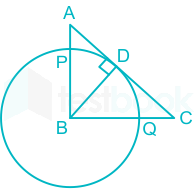
In the triangle ABC, AB = 6 cm, BC = 8 cm and AC = 10 cm. The perpendicular dropped from B meets the side AC at D. A circle of radius BD (with centre B) cuts AB and BC at P and Q respectively as shown in the figure. 

What is the length of QC ? 

  1. AOption (a)

    4.4 cm

  2. BOption (b)

    4.2 cm

  3. COption (c)

    3.6 cm

  4. DOption (d)

    3.2 cm

View answer & explanation

Correct answer

Answer: (d)D.

3.2 cm

Why this answer is correct

Given:

AB = 6 cm, BC = 8 cm and AD = 10 cm

Concept used:

By Pythagoras theorem

AC2 = AB2 + BC2

Angle bisector theorem: An angle bisector of an angle of a triangle divides the opposite side into two parts that are proportional to the other two sides of the triangle.

Calculation:

Now, according to the above concept,

⇒ AB × BC = AC × BD

⇒ 6 × 8 = 10 × r

⇒ 48 = 10r

⇒ r = 4.8 cm

So, BD = 4.8 cm

Now, QC = BC - BQ

⇒ QC = (8 - 4.8) cm = 3.2 cm

∴ The required value of QC is 3.2 cm

CDS Elementary Mathematics 16 April 2023 Official Paper (Previous Year Paper)·Elementary Mathematics
View full paper

Question 592

Combined Defence Services (CDS) 2023• Elementary Mathematics• Elementary Mathematics

Consider the following for the next three (03) items that follow :

In the triangle ABC, AB = 6 cm, BC = 8 cm and AC = 10 cm. The perpendicular dropped from B meets the side AC at D. A circle of radius BD (with centre B) cuts AB and BC at P and Q respectively as shown in the figure. 

If ∠ABD = θ, then what is sin θ equal to ?

  1. AOption (a)

    0.4

  2. BOption (b)

    0.5

  3. COption (c)

    0.6

  4. DOption (d)

    0.8

View answer & explanation

Correct answer

Answer: (c)C.

0.6

Why this answer is correct

Given:

AB = 6 cm, BC = 8 cm and AC = 10 cm

Concept used:

If a perpendicular is drawn from the vertex of the right angle of a right triangle

to the hypotenuse then, AB2 = BC.BD

Calculation:

According to the above concept,

⇒ AB2 = AD × Ac

⇒ 62 = AD ×10

⇒ AD = 3.6 cm

Now, according to the question

⇒ Sinθ = \(\frac{AD}{{AB}}\)

⇒ Sinθ = \(\frac{3.6}{{6}}\) = 0.6

∴ The required value of sinθ is 0.6

CDS Elementary Mathematics 16 April 2023 Official Paper (Previous Year Paper)·Elementary Mathematics
View full paper

Question 593

Combined Defence Services (CDS) 2023• Elementary Mathematics• Elementary Mathematics

Consider the following for the next three (03) items that follow :

In the triangle ABC, AB = 6 cm, BC = 8 cm and AC = 10 cm. The perpendicular dropped from B meets the side AC at D. A circle of radius BD (with centre B) cuts AB and BC at P and Q respectively as shown in the figure. 

What is the radius of the circle ?

  1. AOption (a)

    5 cm

  2. BOption (b)

    4.8 cm

  3. COption (c)

    4.4 cm

  4. DOption (d)

    4 cm

View answer & explanation

Correct answer

Answer: (b)B.

4.8 cm

Why this answer is correct

Given:

AB = 6 cm, BC = 8 cm and AD = 10 cm

Concept used:

By Pythagoras theorem

AC2 = AB2 + BC2

Angle bisector theorem: An angle bisector of an angle of a triangle divides the opposite side into two parts that are proportional to the other two sides of the triangle.

Calculation:

Now, according to the above concept,

⇒ AB × BC = AC × BD

⇒ 6 × 8 = 10 × r

⇒ 48 = 10r

⇒ r = 4.8 cm

CDS Elementary Mathematics 16 April 2023 Official Paper (Previous Year Paper)·Elementary Mathematics
View full paper

Question 594

Combined Defence Services (CDS) 2023• Elementary Mathematics• Elementary Mathematics

Consider the following for the next three (03) items that follow:

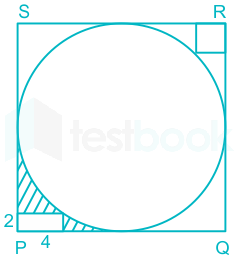
In the figure given below, a circle is inscribed in a square PQRS. A rectangle at the corner P that measures 4 cm × 2 cm and a square at the corner R are drawn.

What is the area of the circle ?

  1. AOption (a)

    100π square cm

  2. BOption (b)

    96π square cm

  3. COption (c)

    50π square cm

  4. DOption (d)

    48π square cm

View answer & explanation

Correct answer

Answer: (a)A.

100π square cm

Why this answer is correct

Given:

A circle is inscribed in a square PQRS

A rectangle at the corner P that measures 4 cm × 2 cm and a square at the corner R are drawn.

Concept used:

By Pythagoras theorem,

AC2 = AB2 + BC2

Area of circle = πr2

Calculation:

According to the above figure,

⇒ OD = (r - 2) cm, CD = (r - 4) cm, OC = r cm

Now, according to the above concept,

In ΔOCD,

⇒ OC2 = (OD)2 + (CD)2

⇒ r2 = (r - 2)2 + (r - 4)2

⇒ r2 = r2 + 4 - 4r + r2 + 16 - 8r

⇒ r2 - 12r + 20 = 0

⇒ r2 - 10r - 2r + 20 = 0

⇒ r(r - 10) - 2(r - 10) = 0

⇒ (r - 10)(r - 2) = 0

⇒ r = 10, 2   [Here we take the radius = 10]

Now, area of circle is

⇒ π × (10)2 = 100π square cm

∴ The required value is 100π square cm.

CDS Elementary Mathematics 16 April 2023 Official Paper (Previous Year Paper)·Elementary Mathematics
View full paper

Question 595

Combined Defence Services (CDS) 2023• Elementary Mathematics• Elementary Mathematics

Consider the following for the next three (03) items that follow:

In the figure given below, a circle is inscribed in a square PQRS. A rectangle at the corner P that measures 4 cm × 2 cm and a square at the corner R are drawn.

What is the area of the smaller square ?

  1. AOption (a)

    50(3 - √2) square cm  

  2. BOption (b)

    25(3 - 2√2) ​square cm

  3. COption (c)

    25(3 + 2√2) ​square cm

  4. DOption (d)

    50(3 - 2√2) ​square cm

View answer & explanation

Correct answer

Answer: (d)D.

50(3 - 2√2) ​square cm

Why this answer is correct

Given:

A circle is inscribed in a square PQRS

A rectangle at the corner P that measures 4 cm × 2 cm and a square at the corner R are drawn.

Concept used:

By Pythagoras theorem,

AC2 = AB2 + BC2

Area of circle = πr2

Diagonal of square = √2a

Area of the square = a2

Calculation:

Z

According to the above figure,

⇒ OD = (r - 2) cm, CD = (r - 4) cm, OC = r cm

Now, according to the above concept,

In ΔOCD,

⇒ OC2 = (OD)2 + (CD)2

⇒ r2 = (r - 2)2 + (r - 4)2

⇒ r2 = r2 + 4 - 4r + r2 + 16 - 8r

⇒ r2 - 12r + 20 = 0

⇒ r2 - 10r - 2r + 20 = 0

⇒ r(r - 10) - 2(r - 10) = 0

⇒ (r - 10)(r - 2) = 0

⇒ r = 10, 2   [Here we take the radius = 10]

So, r = 10 cm

Now, In ΔOAR,

Here the radius i.e. OA = r = 10 cm

Here, OR is diagonal of square i.e. 10√2 cm

⇒ (r + √2a) = 10√2

⇒ 10 + √2a = 10√2

⇒ √2a = 10√2 - 10

⇒ a = \(\frac{10(√2 - 1)}{{√ 2}} \)

Now, area of the small square = a2

⇒ (\(\frac{10(√2 - 1)}{{√ 2}} \))2 

⇒ 50(2 + 1 - 2√2) = 50(3 - 2√2) cm2

∴ The required area is 50(3 - √2) square cm

CDS Elementary Mathematics 16 April 2023 Official Paper (Previous Year Paper)·Elementary Mathematics
View full paper

Question 596

Combined Defence Services (CDS) 2023• Elementary Mathematics• Elementary Mathematics

Consider the following for the next three (03) items that follow:

In the figure given below, a circle is inscribed in a square PQRS. A rectangle at the corner P that measures 4 cm × 2 cm and a square at the corner R are drawn.

What is the area of the shaded region ?  

  1. AOption (a)

    (96 - 25π) square cm

  2. BOption (b)

    (92 - 25π) square cm

  3. COption (c)

    (96 - 16π) square cm

  4. DOption (d)

    (92 - 16π) square cm

View answer & explanation

Correct answer

Answer: (b)B.

(92 - 25π) square cm

Why this answer is correct

Given:

A circle is inscribed in a square PQRS

A rectangle at the corner P that measures 4 cm × 2 cm and a square at the corner R are drawn

Concept used:

Area of square = a2

Area of rectangle = length × breadth

Area of sector = (\(\frac{θ}{{360°}}\))πr2

Calculation:

Now, according to the question,

Area of shaded region = Area of square - Area of sector - Area of rectangle

⇒ Area of shaded region = [(10)2 - \(\frac{90°}{{360°}}\) × π(10)2 - (2 × 4)] cm2

⇒ (100 - \(\frac{1}{{4}}\) × 100π - 8) cm2

⇒ (100 - 25π - 8) = (92 - 25π) cm2

∴ The required area of the shaded region is (92 - 25π) square cm.

CDS Elementary Mathematics 16 April 2023 Official Paper (Previous Year Paper)·Elementary Mathematics
View full paper

Question 597

Combined Defence Services (CDS) 2023• Elementary Mathematics• Elementary Mathematics

Consider the following for the next two (02) items that follow :

In the following figure, a rectangle ABCD is inscribed in a circle of radius r. Given ∠DAE = 30° and ∠ACD = 30°. 

What is the ratio of the area of the circle to the area of the rectangle ?

  1. AOption (a)

    \(\frac{\pi}{\sqrt 2}\)

  2. BOption (b)

    \(\frac{\pi}{\sqrt 3}\)

  3. COption (c)

    \(\frac{2\pi}{\sqrt 3}\)

  4. DOption (d)

    \(\frac{3\pi}{\sqrt 2}\)

View answer & explanation

Correct answer

Answer: (b)B.

\(\frac{\pi}{\sqrt 3}\)

Why this answer is correct

Concept:

If in a right-angle triangle,

The ratio of angle are 30° : 60° : 90°  

The ratio of sides length opposite to the angle = 1 : √3 : 2 

Formula used:

Area of a circle = πr2

Area of a rectangle = Lenght × Breadth

Calculation:

The ratio of sides length opposite to the angle = 1 : √3 : 2 

In an ΔADC, side AC is opposite to the ∠D which is 90° 

We know that, if in the right-angle triangle 

The ratio of angle are 30° : 60° : 90° 

⇒ AD : DC : AC = r : r√3 : 2r

Therefore, the ratio of the area of the circle to the area of the rectangle

(πr2)/(AD × DC) = πr2 / (r × r√3) = \(\frac{\pi}{\sqrt 3}\)

∴ Required ratio is \(\frac{\pi}{\sqrt 3}\)

CDS Elementary Mathematics 16 April 2023 Official Paper (Previous Year Paper)·Elementary Mathematics
View full paper

Question 598

Combined Defence Services (CDS) 2023• Elementary Mathematics• Elementary Mathematics

Consider the following for the next two (02) items that follow :

In the following figure, a rectangle ABCD is inscribed in a circle of radius r. Given ∠DAE = 30° and ∠ACD = 30°. 

What is the area of Δ AEC ? 

  1. AOption (a)

    \(\frac{r^2}{\sqrt 3}\)

  2. BOption (b)

    \(\frac{r^2}{2\sqrt 3}\)

  3. COption (c)

    \(\frac{r^2}{3\sqrt 3}\)

  4. DOption (d)

    \(\frac{2r^2}{\sqrt 3}\)

View answer & explanation

Correct answer

Answer: (a)A.

\(\frac{r^2}{\sqrt 3}\)

Why this answer is correct

Concept:

If in a right-angle triangle,

The ratio of angle are 30° : 60° : 90°  

The ratio of sides length opposite to the angle = 1 : √3 : 2 

Formula used:

Area of a circle = πr2

Area of a rectangle = Lenght × Breadth

Calculation:

If in a right-angle triangle,

The ratio of angle are 30° : 60° : 90°  

The ratio of sides length opposite to the angle = 1 : √3 : 2 

In an ΔADC, side AC is opposite to the ∠D which is 90° 

We know that, if in the right-angle triangle 

The ratio of angle are 30° : 60° : 90° 

⇒ AD : DC : AC = r : r√3 : 2r

Area of ΔAEC = Area of ΔADC - Area of ΔADE

Area of ΔAEC = \(\frac{1}{2}\) (AD × DC) - \(\frac{1}{2}\) (AD × DE)

Area of ΔAEC = \(\frac{1}{2}\) (r × r√3) - \(\frac{1}{2}\) (r × DE)

But, in the ΔADE,

tan 30°  = DE/AD = DE/r

= 1/√3 = AD/r

⇒ AD = r/√3

Area of ΔAEC = \(\frac{1}{2}\) (r × r√3) - \(\frac{1}{2}\) (r × r/√3)

Area of ΔAEC = \(\frac{\sqrt 3}{2}\)r2 - \(\frac{1}{2\sqrt3}\)r2 = \(\frac{3r^2-r^2}{2\sqrt 3}\)

∴ The required area is \(\frac{\pi}{√ 3}\).

CDS Elementary Mathematics 16 April 2023 Official Paper (Previous Year Paper)·Elementary Mathematics
View full paper

Question 599

Combined Defence Services (CDS) 2023• Elementary Mathematics• Elementary Mathematics

Consider the following for the next two (02) items that follow 

In the following figure, a triangle ABC is inscribed in a circle with centre at O. Let ∠POA = x° and ∠OQB = y°. Further, OB = BQ.

What is the relation between x and y ? 

  1. AOption (a)

    x = y

  2. BOption (b)

    2x = 3y

  3. COption (c)

    x = 3y

  4. DOption (d)

    3x = 4y

View answer & explanation

Correct answer

Answer: (c)C.

x = 3y

Why this answer is correct

Shortcut Trick 

in ∠OAQ

∠AOP = ∠OAQ + ∠OQA

x° = 2y° + y°  = 3y° 

Alternate Method 

Given:

∠POA = x° and ∠OQB = y°

OB = BQ

Concept used:

The measure of an exterior angle of a triangle is equal to the sum of the measures of the two non-adjacent interior angles of the triangle.

The angle which forms a straight line is called the 180-degree angle

Calculation:

∠OBA = ∠BQO + ∠BOQ = 2y°

AO = OB = Radius of the circle

So, ∠OAB = ∠OBA = 2y°

So, ∠AOB = 180° - 4y°

Again,

∠AOB = 180° - x° - y°       [As PQ is a straight line]

So,

180° - 4y° = 180° - x° - y°

⇒ x = 4y - y

⇒ x = 3y

∴ The relation between x and y is x = 3y.

CDS Elementary Mathematics 16 April 2023 Official Paper (Previous Year Paper)·Elementary Mathematics
View full paper

Question 600

Combined Defence Services (CDS) 2023• Elementary Mathematics• Elementary Mathematics

Consider the following for the next two (02) items that follow 

In the following figure, a triangle ABC is inscribed in a circle with centre at O. Let ∠POA = x° and ∠OQB = y°. Further, OB = BQ.

If y = 15, then what is ∠ACB equal to ? 

  1. AOption (a)

    30° 

  2. BOption (b)

    40° 

  3. COption (c)

    45° 

  4. DOption (d)

    60° 

View answer & explanation

Correct answer

Answer: (d)D.

60° 

Why this answer is correct

Given:

∠POA = x° and ∠OQB = y°

OB = BQ, y = 15

Concept used:

The measure of an exterior angle of a triangle is equal to the sum of the

measures of the two non-adjacent interior angles of the triangle.

Central angle theorem: It states that for any arc of a circle, the angle formed

by the radii at the center of the circle is twice the angle formed by the arc at

any point on the circumference. 

Calculation:

∠OBA = ∠BQO + ∠BOQ = 30°

AO = OB = Radius of the circle

So, ∠OAB = ∠OBA = 30°

So, ∠AOB = 180° - 30° - 30° = 120°

So, according to the concept,

∠ACB = 120/2 = 60°

∴ ∠ACB is equal to 60°.

How should I prepare for Quantitative Aptitude in Combined Defence Services (CDS)?

Solving previous year questions by topic helps identify recurring concepts, question patterns, and frequently asked sub-topics. Attempt each question, review the step-by-step explanation, and note down key formulas or facts for quick revision before the exam.