Exam Guides
SBI Clerk 2026 Preparation: Prelims to Mains Complete Strategy
Everything you need to crack SBI Clerk 2026 — eligibility, exam stages, state-wise vacancy breakdown, time-section strategies for Prelims, Mains subject deep-dives, computer awareness topics, LPT tips, and a structured mock test plan.
This legacy article was owner-approved for publication. Verify time-sensitive claims against current official sources before acting.

The SBI Clerk (Junior Associate) position in the State Bank of India is among the most sought-after entry-level government banking jobs in India. Offering a starting CTC of ₹11–14 lakhs per annum (including allowances and perks), job security, and a clear promotion pathway, SBI Clerk attracts over 25 lakh applicants annually. With roughly 8,000–13,000 vacancies expected in 2026, this is one of the highest-volume banking exams — but also one of the most competitive.
This guide gives you a complete strategy from eligibility to the final Mains stage, including specialized tips for Reasoning puzzles, computer awareness, and the Language Proficiency Test.
---
| Parameter | Requirement |
|---|---|
| Educational Qualification | Graduation in any discipline from a recognized university |
| Age | 20–28 years (as of April 1, 2026) |
| Age Relaxation | SC/ST: 5 years; OBC: 3 years; PwD: 10 years; Ex-Servicemen: as per rules |
| Local Language | Must know the official language of the state applied for |
| Nationality | Indian Citizen |
Eligibility Criteria 2026
Parameter | Requirement |
|---|---|
Educational Qualification | Graduation in any discipline from a recognized university |
Age | 20–28 years (as of April 1, 2026) |
Age Relaxation | SC/ST: 5 years; OBC: 3 years; PwD: 10 years; Ex-Servicemen: as per rules |
Local Language | Must know the official language of the state applied for |
Nationality | Indian Citizen |
Note: SBI Clerk is a state-specific recruitment. When applying, you choose a state, and vacancies, exam language, and posting are all state-specific. Apply for a state where you know the local language.
---
State-Wise Vacancy Expectations (2026)
Based on the 2023 and 2024 trends:
State | Expected Vacancies (2026) |
|---|---|
Uttar Pradesh | 1,200–1,500 |
Maharashtra | 900–1,100 |
Bihar | 700–900 |
Rajasthan | 600–800 |
Madhya Pradesh | 600–750 |
West Bengal | 500–650 |
Tamil Nadu | 450–600 |
Karnataka | 400–550 |
Other States | 200–400 each |
States with higher vacancies = relatively lower competition per seat. But cutoffs in high-vacancy states (UP, Maharashtra) are still high due to applicant density.
---
Exam Stages
SBI Clerk has 2 stages (unlike SBI PO which has 3):
Preliminary Examination (Qualifying)
Main Examination (Final merit)
Post-selection, there is a Language Proficiency Test (LPT) in the official state language — it is qualifying, not merit-based.
---
Stage 1: Prelims Strategy (20 + 20 + 20 Minutes)
Prelims Pattern
Section | Questions | Marks | Duration |
|---|---|---|---|
English Language | 30 | 30 | 20 minutes |
Numerical Ability | 35 | 35 | 20 minutes |
Reasoning Ability | 35 | 35 | 20 minutes |
Total | 100 | 100 | 60 minutes |
Negative marking: 0.25 marks per wrong answer. Sectional time limits are strict — you cannot borrow time from another section.
English Language — 20 Minutes for 30 Questions
Attempt Order (recommended):
Error Spotting / Fill-in-the-Blanks (fastest — 8–10 questions in 5 minutes)
Cloze Test (10 questions in 6 minutes)
Reading Comprehension (remaining time — 10 questions in 9 minutes)
English Tips:
RC passages in Prelims are usually 300–400 words. Read the questions first, then skim the passage.
Cloze Test: If you can't decide between two options grammatically, choose based on the paragraph's tone (formal/informal, positive/negative).
Error Spotting: Read each underlined clause independently. Errors are almost always in: subject-verb agreement, tense consistency, preposition use, or article use.
Target: Attempt 25–27 questions with 85%+ accuracy. Do not attempt all 30 — accuracy beats quantity.
Numerical Ability — 20 Minutes for 35 Questions
Attempt Order:
Simplification/Approximation (10 questions — aim to solve in 6–7 minutes)
Number Series (5 questions — 3–4 minutes)
Miscellaneous Arithmetic (10 questions — 7–8 minutes)
Data Interpretation (10 questions — 4–5 minutes if DI is simple)
Numerical Tips:
Simplification dominates Prelims. Master BODMAS, fraction simplification, and square root approximation.
For Number Series, look for: difference pattern, ratio pattern, square/cube pattern, and mixed patterns.
DI in Prelims is simpler than Mains — usually single-table or bar chart with straightforward calculations.
Never waste more than 90 seconds on a single arithmetic question. Mark and move.
Reasoning Ability — 20 Minutes for 35 Questions
Attempt Order:
Inequality (5 questions — 2 minutes)
Syllogism (3–5 questions — 3 minutes)
Coding-Decoding (5 questions — 3 minutes)
Blood Relations / Directions (3–4 questions — 3 minutes)
Puzzles / Seating Arrangements (15 questions — 9 minutes)
Reasoning Tips:
Inequalities shortcut: Chain rule — if A > B ≥ C, then A > C is always true. Practice 50+ sets to make this automatic.
Syllogism: Draw Venn diagrams for every combination. With 3 statements, the number of combinations multiplies — practice possibility-based questions specifically.
Puzzles in Prelims are usually 1–2 variable (simpler). Solve the given statements, do not assume extra conditions.
Key insight: In Prelims, complete easy topics first to bank safe marks, then attempt puzzles.
---
Stage 2: Mains — Subject Breakdown
Mains Pattern
Section | Questions | Marks | Time |
|---|---|---|---|
General/Financial Awareness | 50 | 50 | 35 minutes |
General English | 40 | 40 | 35 minutes |
Quantitative Aptitude & DI | 50 | 50 | 45 minutes |
Reasoning Ability & Computer Aptitude | 50 | 60 | 45 minutes |
Total | 190 | 200 | 2 hrs 40 min |
General/Financial Awareness (50 Marks — 35 Minutes)
This is the highest-ROI section in SBI Clerk Mains. Students who prepare GA consistently for 3 months score 35–42 marks here with minimal time spent. Those who ignore it score 15–20, destroying their overall chances.
What to study:
RBI: Monetary Policy, current rate decisions, functions, subsidiaries (DICGC, BRBNMPL)
Banking Schemes: PM-KISAN, PMJDY, PMSBY, APY, Mudra Yojana, PM Fasal Bima
Financial Organisations: SEBI, IRDAI, PFRDA, NABARD, NHB, SIDBI — functions and headquarters
Budget highlights: Fiscal deficit target, GDP projection, major sector allocations
Current Affairs: Last 6 months — appointments, summits, awards, sports
Static: Nationalization dates, bank headquarters, RBI Governors history
Computer Awareness (Part of Reasoning+Computer Section)
SBI Clerk Mains includes Computer Aptitude questions worth approximately 10–15 marks. Unlike specialist IT exams, SBI Clerk tests basic computer literacy:
Key Topics:
MS Word shortcuts: Ctrl+Z (Undo), Ctrl+Y (Redo), Ctrl+F (Find), Ctrl+H (Replace)
MS Excel functions: SUM, AVERAGE, COUNT, VLOOKUP, IF — and their syntax
Operating Systems: Windows basics, file management, task manager
Internet & Networking: Browser functions, IP address, DNS, LAN vs WAN vs MAN, Bandwidth, Modem vs Router
Hardware basics: Input/Output devices, RAM vs ROM, storage types (HDD, SSD, USB)
Database basics: What is DBMS, primary key, relationship between tables
Security: Malware types (virus, trojan, ransomware), firewall, encryption basics
Banking Technology: Core Banking System (CBS), SWIFT codes, IFSC, PIN/OTP, UPI architecture
Study tip: Spend 1 hour daily for 2 weeks on computer topics. These are static — no daily updates needed. Flashcard-based memorization works best.
---
Reasoning: Puzzles and Syllogism Masterclass
Puzzles (3–4 variable types in Mains)
SBI Clerk Mains puzzles involve 5–7 people/objects, 3–4 attributes, and 6–8 clues. Here is the systematic approach:
Read all clues first — identify the definitive/fixed clues (e.g., "A sits at position 1")
Draw the grid — rows = people, columns = attributes. Fill confirmed cells first.
Eliminate by contradiction — use definitive cells to rule out options in other rows/columns
Conditional clues last — handle "If X then Y" clues after fixing as many cells as possible
Time limit: 8–10 minutes per puzzle set. If unsolved in 10 minutes, move on and return later.
Syllogism Shortcuts
Statement Type | Valid Conclusion Rules |
|---|---|
All A is B | Some B is A (always true) |
No A is B | No B is A (always true) |
Some A is B | Some B is A (always true) |
All A is B + All B is C | All A is C (always true) |
Some A is B + All B is C | Some A is C (always true) |
All A is B + No B is C | No A is C (always true) |
For possibility statements: If a definitive conclusion is false, the possibility MAY be true — check carefully.
---
Language Proficiency Test (LPT)
After selection, candidates must pass an LPT in the official language of the state they applied for. This is qualifying (pass/fail) and does not affect the merit list.
What to expect:
Reading a paragraph in the local language and answering questions
Writing a short passage in the local language
Basic conversational proficiency may be tested in some states
Preparation: If you applied for Maharashtra, practice reading Marathi. For UP, practice reading Hindi. Most candidates from the respective states pass easily — the test is designed to ensure the clerk can communicate with local customers.
---
Historical Cutoffs: Mains (General Category)
Year | Maharashtra | UP | Rajasthan | Overall National |
|---|---|---|---|---|
2022 | 88.50 | 84.25 | 77.00 | 75.00–88.50 |
2023 | 90.75 | 86.50 | 79.25 | 77.00–90.75 |
2024 | 93.00 | 89.00 | 82.00 | 79.50–93.00 |
Target: Score 95+ out of 200 in Mains to be safe across most states. For Maharashtra/UP, aim for 98–105.
---
Mock Test Strategy: The 3-2-1 Protocol
The 3-2-1 Protocol is the most efficient mock test approach for SBI Clerk:
3 sectional mocks per week (one per Prelims section, rotating)
2 full Prelims mocks per week (timed, with full 3-hour review)
1 full Mains mock per week (starting Month 2 onwards)
Review discipline: After every mock, spend time only on:
Questions where your answer was wrong but you were confident — concept gap
Questions where you ran out of time — speed gap
Questions where you skipped but later found easy — sequencing gap
Ignore questions that were genuinely too hard. Your improvement comes from fixing the first three categories.
---
YourMockTest for SBI Clerk
YourMockTest provides:
SBI Clerk Prelims & Mains mocks with difficulty matching actual SBI iON interface
State-specific cutoff simulator — enter your state and see projected rank
Computer Awareness flashcard module — 500+ terms with daily revision reminders
GA Current Affairs digest — daily 5-minute banking news capsule
Puzzle practice sets graded Easy → Hard for structured difficulty progression
Start with a free diagnostic test today. With 3–4 months of smart preparation and 20+ mocks, SBI Clerk 2026 is a very achievable target.
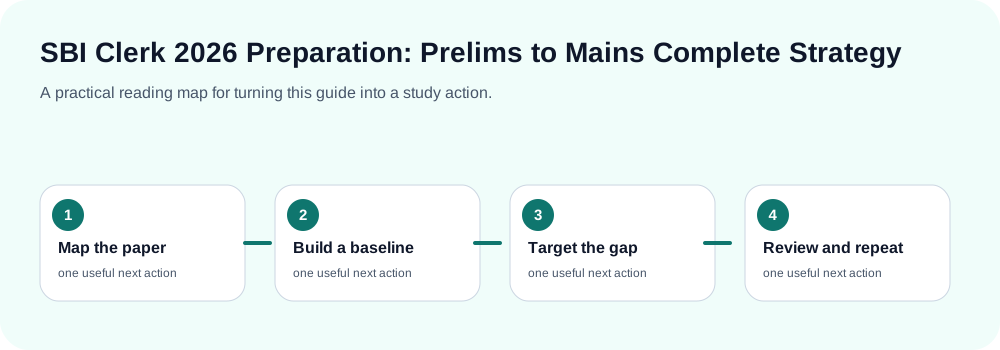
- Map the paperUse the exam pattern and eligibility details in this guide.
- Build a baselineTake a timed diagnostic mock before changing your routine.
- Target the gapChoose one weak section and practise it deliberately.
- Review and repeatLog errors, revise, and retest under time pressure.
Revision note: Published after explicit owner approval; official-source verification remains recommended for time-sensitive claims.
Keep YourMockTest in your Google results
Add us as a Preferred Source to see fresh exam updates and preparation guidance more often in Google Search.
Add YourMockTest as a Preferred Source