Exam Guides
RRB NTPC 2026: Complete Guide for Graduate & Undergraduate Posts
Everything you need to know about RRB NTPC 2026 — exam pattern, CBT-1 & CBT-2 syllabus, CBAT for Traffic roles, zone-wise RRB boards, cutoff analysis, and a proven preparation strategy to crack one of India's most-applied Railway exams.
This legacy article was owner-approved for publication. Verify time-sensitive claims against current official sources before acting.

The RRB NTPC (Non-Technical Popular Category) exam is one of the most competitive and sought-after government recruitment drives in India. Conducted by the Railway Recruitment Boards (RRBs) under the Ministry of Railways, NTPC opens the door to hundreds of thousands of aspirants every cycle. With the 2026 notification expected to announce a significant number of vacancies across Graduate-level and Undergraduate-level posts, now is the ideal time to begin your structured preparation.
---
| Post | Pay Level | Role Description |
|---|---|---|
| Junior Clerk cum Typist (JCCT) | Level 2 | Clerical duties, data entry |
| Accounts Clerk cum Typist (ACT) | Level 2 | Financial records maintenance |
| Junior Time Keeper (JTK) | Level 2 | Time management records |
| Commercial cum Ticket Clerk (CTC) | Level 3 | Ticketing at stations |
| Station Master (SM) | Level 6 | Traffic control, train operations |
| Goods Guard | Level 5 | Train guard duties |
| Senior Commercial cum Ticket Clerk | Level 5 | Senior ticketing/commercial ops |
| Junior Account Assistant cum Typist (JAAT) | Level 2 | Accounts maintenance |
What Does NTPC Mean?
NTPC stands for Non-Technical Popular Category — a broad classification of clerical, supervisory, and operational roles within Indian Railways that do not require a technical engineering background. These positions are the backbone of railway operations, covering station management, accounts, traffic operations, goods handling, and administrative functions.
---
Post Categories: Graduate vs. Undergraduate
RRB NTPC recruitment is divided into two levels based on educational qualification:
Graduate-Level Posts (7th CPC Pay Level 5 & 6)
Post | Pay Level | Role Description |
|---|---|---|
Junior Clerk cum Typist (JCCT) | Level 2 | Clerical duties, data entry |
Accounts Clerk cum Typist (ACT) | Level 2 | Financial records maintenance |
Junior Time Keeper (JTK) | Level 2 | Time management records |
Commercial cum Ticket Clerk (CTC) | Level 3 | Ticketing at stations |
Station Master (SM) | Level 6 | Traffic control, train operations |
Goods Guard | Level 5 | Train guard duties |
Senior Commercial cum Ticket Clerk | Level 5 | Senior ticketing/commercial ops |
Junior Account Assistant cum Typist (JAAT) | Level 2 | Accounts maintenance |
Undergraduate-Level Posts (10+2 Level, Pay Level 2–4)
Post | Pay Level |
|---|---|
Commercial Apprentice (CA) | Level 4 |
Traffic Apprentice (TA) | Level 4 |
Enquiry cum Reservation Clerk | Level 3 |
Accounts Clerk cum Typist | Level 2 |
Junior Clerk cum Typist | Level 2 |
---
Selection Process: Step by Step
The RRB NTPC selection process involves multiple stages:
CBT-1 (Prelims) → CBT-2 (Mains) → CBAT/Typing/Skill Test → DV + Medical
Stage 1: CBT-1 (Computer-Based Test – Preliminary)
This is the first elimination round. The pattern is uniform for all posts:
Subject | Questions | Marks |
|---|---|---|
Mathematics | 30 | 30 |
General Intelligence & Reasoning | 30 | 30 |
General Awareness | 40 | 40 |
Total | 100 | 100 |
Duration: 90 minutes (120 minutes for PwBD candidates with scribe)
Negative Marking: 1/3rd mark deducted per wrong answer
CBT-1 is a screening test — marks are NOT counted in final merit
Shortlisting ratio: 20 times the vacancy count (approximate)
Stage 2: CBT-2 (Computer-Based Test – Mains)
CBT-2 is separate for Graduate-level and Undergraduate-level posts:
Undergraduate Posts CBT-2:
Mathematics: 35 questions
General Intelligence & Reasoning: 35 questions
General Awareness: 50 questions
Total: 120 questions / 90 minutes
Graduate Posts CBT-2:
Mathematics: 35 questions
General Intelligence & Reasoning: 35 questions
General Awareness: 50 questions
Total: 120 questions / 90 minutes (higher difficulty than UG level)
The CBT-2 score is used for final merit ranking.
Stage 3: CBAT – Computer-Based Aptitude Test
Applicable only for Station Master (SM) and Traffic Assistant (TA) posts. This is a unique, proctored test measuring:
Memory & Retention: Candidates are shown information and tested on recall
Spatial Scanning: Pattern recognition and spatial reasoning
Attention & Concentration: Simulating real-world train control environments
Speed & Accuracy: Decision-making under time constraints
⚠️ Minimum qualifying marks in CBAT: 42 out of 100 for all categories (no relaxation). CBAT scores are used alongside CBT-2 in a weighted merit formula.
Stage 4: Typing Skill Test
Mandatory for Junior Clerk cum Typist, Accounts Clerk cum Typist, Junior Time Keeper (and their senior equivalents).
Speed requirement: 30 WPM in English or 25 WPM in Hindi on a computer (no dictation allowed)
This is a qualifying round — marks not counted in merit
---
Zone-Wise RRB Boards and Posting Locations
India has 21 Railway Recruitment Boards, each handling recruitment for specific railway zones. Your posting preference depends on the RRB you apply to:
RRB Zone | States Covered | Key Stations |
|---|---|---|
RRB Mumbai | Maharashtra, Goa | CSMT, LTT, Pune |
RRB Chennai | Tamil Nadu | Chennai Central, Coimbatore |
RRB Secunderabad | Telangana, Andhra | Secunderabad, Vijayawada |
RRB Kolkata | West Bengal | Howrah, Sealdah |
RRB Ahmedabad | Gujarat, Rajasthan | Ahmedabad, Jaipur |
RRB Chandigarh | Punjab, Haryana, HP | Ambala, Ludhiana |
RRB Patna | Bihar, Jharkhand | Patna, Ranchi |
RRB Bhopal | Madhya Pradesh | Bhopal, Jabalpur |
RRB Allahabad | UP (Central) | Prayagraj, Lucknow |
RRB Bhubaneswar | Odisha | Bhubaneswar, Cuttack |
---
Subject-Wise Preparation Strategy
Mathematics (CBT-1: 30q | CBT-2: 35q)
The math section tests intermediate-level arithmetic and algebra. Key topics:
High-priority topics:
Number System: HCF, LCM, divisibility rules, remainders
Percentage & Profit-Loss: Discount chains, successive percentages
Time, Speed & Distance: Trains, boats & streams problems (very frequently asked)
Time & Work: Pipe & cistern problems
Ratio & Proportion, Mixture & Alligation
Simple & Compound Interest
Geometry & Mensuration: Area, perimeter of 2D & 3D figures
Statistics: Mean, median, mode, basic probability
Railway-specific math tricks: > When two trains travel in the same direction, relative speed = difference of speeds. When opposite direction, relative speed = sum. Always convert km/h to m/s (multiply by 5/18).
Practice schedule: Solve 30 math questions daily. Review errors the next morning before new practice.
General Intelligence & Reasoning (CBT-1: 30q | CBT-2: 35q)
Coding-Decoding, Blood Relations, Direction Sense
Series (Number, Letter, Mixed)
Analogy and Classification
Seating Arrangements and Puzzles
Statement & Conclusion / Syllogism
Mathematical Operations
Data Sufficiency (CBT-2 only)
Venn Diagrams, Dice, Cubes (moderate frequency)
General Awareness (CBT-1: 40q | CBT-2: 50q)
GA is the most scoring and most differentiating section for NTPC. Areas to focus:
Railway GK (Always 8–10 questions in CBT-2):
Railway Budget integration with Union Budget (2017 onwards)
India's first Railway line: Mumbai (Bori Bunder) to Thane, April 16, 1853
Fastest train: Vande Bharat Express / Gatimaan Express
India's longest platform: Hubballi (Hubli) – Karnataka (1505m)
Locomotive types: WAP (AC Passenger), WAG (AC Goods), WDP (Diesel Passenger)
IRCTC vs Indian Railways distinction
National Rail Plan 2030
Dedicated Freight Corridors: Eastern (EDFC) and Western (WDFC)
Current Affairs (Last 6 months before exam):
Union Budget highlights, especially rail allocations
New railway lines inaugurated by PM
International sports events, national awards
Science & Technology: ISRO missions, defense deals
Banking & Finance: RBI policy rates, new schemes
Static GK:
Books & Authors, National Parks, UNESCO Heritage Sites
Indian Constitution, Parliament, Judiciary
Periodic Table basics, SI units, fundamental laws
---
Historical Cutoff Analysis
Year | UR (General) CBT-1 | UR (General) CBT-2 (SM) | UR (General) CBT-2 (Goods Guard) |
|---|---|---|---|
2016 (CEN 03/2015) | ~42–50 | ~60–70 | ~55–65 |
2019 (CEN 01/2019) | ~47–55 | ~65–75 | ~60–68 |
2024 (CEN 06/2024 est.) | ~50–58 | ~68–78 | ~62–70 |
Cutoffs vary significantly by RRB zone. RRBs like Mumbai and Chennai have higher cutoffs; RRBs like Muzaffarpur and Siliguri tend to have lower cutoffs due to fewer applicants.
---
3-Month Preparation Plan
Month | Focus | Target |
|---|---|---|
Month 1 | Build fundamentals in Math (all arithmetic chapters) + Basic Reasoning + Start Railway GK | 2 mock tests/week |
Month 2 | Advanced Reasoning + Current Affairs habit (daily 30 min) + Typing practice (if applicable) | 4 mock tests/week |
Month 3 | Full CBT-2 level mocks + Weak area revision + CBAT practice (for SM aspirants) | 1 full mock daily |
---
Career Growth in Indian Railways
A Railway career through NTPC is a long-term investment with structured promotions:
Station Master → Assistant Station Master → Deputy Station Master → Station Superintendent → Divisional Operations Manager
Goods Guard → Senior Goods Guard → Passenger Guard → Chief Guard → Assistant Divisional Operations Manager
Junior Clerk → Senior Clerk → Head Clerk → Office Superintendent → Sr. Office Superintendent
Promotions happen via LDCE (Limited Departmental Competitive Examination) and seniority. Many senior Railway officers started as NTPC-level clerks or station masters.
---
Salary Structure (7th CPC)
Post | Pay Level | Basic Pay | Gross (approx.) |
|---|---|---|---|
Station Master | Level 6 | ₹35,400 | ₹55,000–₹65,000 |
Goods Guard | Level 5 | ₹29,200 | ₹45,000–₹55,000 |
Junior Clerk | Level 2 | ₹19,900 | ₹28,000–₹35,000 |
Commercial Clerk | Level 3 | ₹21,700 | ₹32,000–₹40,000 |
Additional perks: HRA, TA, Medical benefits for entire family, Free Railway passes (for self and family), subsidized canteens, and pension (NPS for post-2004 entrants).
---
Final Tips from Our Experts
Never skip CBT-1 GA — 40 marks is too big to leave on the table. Create a daily 30-minute news reading habit.
CBAT is make or break for Station Master — practice cognitive exercises (Lumosity, memory apps) 3 months before the exam.
Zone selection matters — apply to the RRB zone where you're willing to post; transfers are difficult in early service years.
Mock tests on exam-pattern interfaces — practice on platforms that simulate the actual CBT environment to reduce exam-day anxiety.
Typing test aspirants — 30 WPM is achievable in 6–8 weeks of daily 20-minute practice. Use free platforms or YourMockTest's Typing Test module.
With the right plan and consistent effort, RRB NTPC 2026 is very much achievable — even for first-time government exam aspirants. Start today, and let every mock test bring you one step closer to your Railway career.
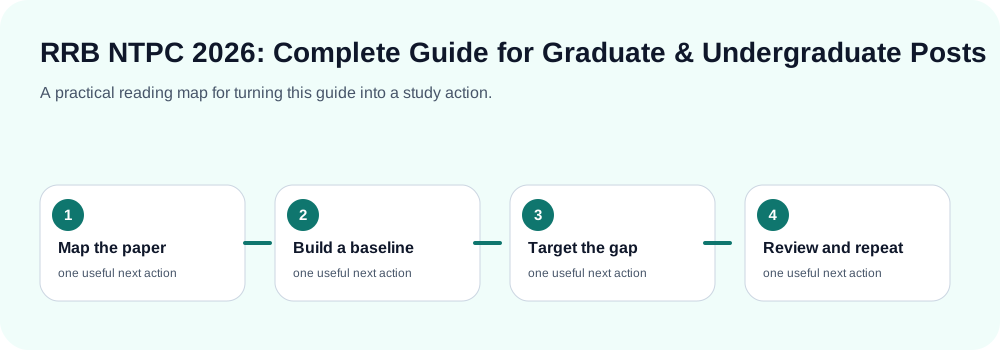
- Map the paperUse the exam pattern and eligibility details in this guide.
- Build a baselineTake a timed diagnostic mock before changing your routine.
- Target the gapChoose one weak section and practise it deliberately.
- Review and repeatLog errors, revise, and retest under time pressure.
Revision note: Published after explicit owner approval; official-source verification remains recommended for time-sensitive claims.
Keep YourMockTest in your Google results
Add us as a Preferred Source to see fresh exam updates and preparation guidance more often in Google Search.
Add YourMockTest as a Preferred Source