Exam Guides
IBPS PO 2026 Target: How to Crack Prelims in 60 Days
A data-driven, phase-wise 60-day strategy to clear IBPS PO Prelims 2026. Includes exam pattern, sectional cutoffs from 2023–2025, subject-wise shortcuts, and a mock test schedule to maximise your score.
This legacy article was owner-approved for publication. Verify time-sensitive claims against current official sources before acting.

The Institute of Banking Personnel Selection (IBPS) Probationary Officer exam is among the most competitive banking recruitments in India, attracting over 12 lakh applicants annually for roughly 3,000–4,000 vacancies across 11 public sector banks. If you are beginning your preparation today with the Prelims roughly 60 days away, you are in exactly the right place. This guide gives you a battle-tested, phase-by-phase plan built on real cutoff data, sectional strategy, and the power of structured mock testing.
---
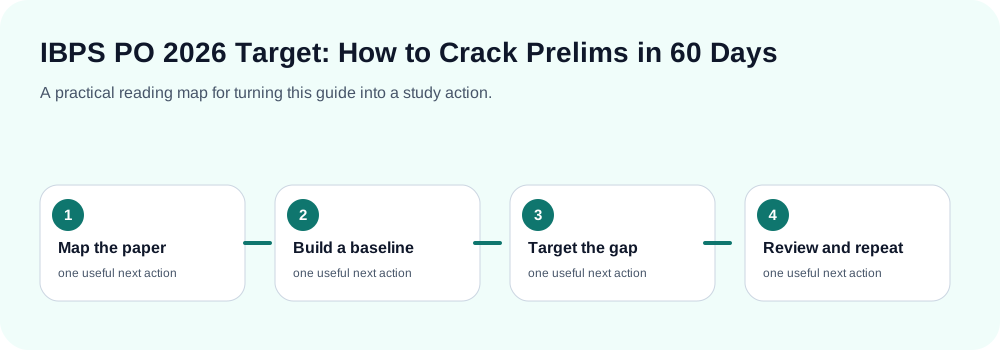
Read the chart as a quick comparison, not as a replacement for the official source or the detailed explanation below.
Understanding the Exam: Pattern at a Glance
IBPS PO Prelims Pattern
Section | Questions | Marks | Time |
|---|---|---|---|
English Language | 30 | 30 | 20 minutes |
Quantitative Aptitude | 35 | 35 | 20 minutes |
Reasoning Ability | 35 | 35 | 20 minutes |
Total | 100 | 100 | 60 minutes |
Negative marking: 0.25 marks deducted per wrong answer.
IBPS PO Mains Pattern
Section | Questions | Marks | Time |
|---|---|---|---|
Reasoning & Computer Aptitude | 45 | 60 | 60 minutes |
English Language | 35 | 40 | 40 minutes |
Data Analysis & Interpretation | 35 | 60 | 45 minutes |
General, Economy & Banking Awareness | 40 | 40 | 35 minutes |
English Descriptive (Letter + Essay) | 2 | 25 | 30 minutes |
Total | 157+2 | 225 | 3 hrs 30 min |
---
Cutoff Analysis: 2023–2025
Understanding historical cutoffs is non-negotiable. They tell you exactly how hard you need to work.
Year | Overall Cutoff (Gen) | English Sectional | Reasoning Sectional | Quant Sectional |
|---|---|---|---|---|
2023 | 62.75 | 8.25 | 10.00 | 8.50 |
2024 | 64.50 | 9.00 | 10.25 | 8.75 |
2025 | 66.00 (est.) | 9.50 | 10.75 | 9.00 |
Key takeaway: You need to clear all three sectional cutoffs first, then the overall cutoff. A 68–72 overall score with all sections cleared gives you a very comfortable Prelims margin.
---
The 60-Day Phase-Wise Plan
Phase 1: Foundation Building (Days 1–20)
This phase is about understanding concepts, not speed. Rushing at this stage creates shaky foundations that collapse under exam pressure.
English Language (Days 1–20)
Read The Hindu editorial daily (15 minutes). Focus on sentence structure, not just vocabulary.
Study Grammar rules: subject-verb agreement, parallelism, modifiers, tense consistency.
Practice 20 Reading Comprehension passages — identify topic sentences, inference questions, and tone.
Learn 10 new vocabulary words daily from context, not rote lists.
Reasoning Ability (Days 1–20)
Master the fundamentals: Seating Arrangements (Linear & Circular), Blood Relations, Directions, Syllogisms, Inequalities.
Solve 3 puzzle sets daily. Aim for 100% accuracy before worrying about speed.
Inequality shortcuts: For coded inequalities, memorize the chain rule — if A > B ≥ C, then A > C is always true.
Quantitative Aptitude (Days 1–20)
Revise tables (1–30), squares (1–40), cubes (1–20), and common fraction-percentage equivalents.
Cover: Percentage, Ratio & Proportion, Simplification, Approximation, Number Series.
Do NOT start DI sets yet — build arithmetic muscle first.
Phase 2: Practice & Speed Building (Days 21–45)
Now you have the concepts. This phase transforms knowledge into exam speed.
Daily Routine in Phase 2:
1 hour: Sectional practice (rotate subjects daily — English → Reasoning → Quant)
30 minutes: Previous year question analysis (identify what type of puzzles/DI appear most)
30 minutes: Revision of weak areas identified from Phase 1
1 Sectional Mock every 2 days (timed, with review)
English Focus:
RC trick — always read the question FIRST, then skim the passage for answers. This saves 90 seconds per passage.
Cloze Test: Eliminate grammatically impossible options first, then choose contextually.
Error Spotting: Read each clause independently. Errors almost always occur in subject-verb agreement or preposition usage.
Reasoning Focus:
Puzzles (3–4 variable): Use a grid-based approach. Never attempt to do it mentally under exam conditions.
Coding-Decoding: Pattern types repeat. Practice 50+ varied sets to recognise patterns instantly.
Direction Sense: Always draw a compass before solving — it eliminates 90% of errors.
Quant Focus:
Simplification: Practise BODMAS under 30 seconds per question.
Data Interpretation: In 35q Quant, expect 15–20 marks worth of DI. Practice Tabular, Bar, Pie, and Mixed DI.
DI shortcut: Convert all data to percentages first. Approximate aggressively — exact calculation wastes time.
Phase 3: Mock Dominance (Days 46–60)
This is the most important phase. Stop learning new topics and start simulating the exam.
Day | Activity |
|---|---|
46–50 | 1 Full Mock daily + 3-hour review session |
51–55 | 1 Full Mock + identify your 3 biggest error patterns |
56–58 | Attempt 2 Mocks back-to-back (stamina training) |
59 | Light revision only — no new mocks |
60 | Rest, light reading of GA notes |
Mock Review Protocol: Never just check your score. For every wrong answer, note: Was it a concept error? A silly mistake? A time-management failure? Classify and fix each category separately.
---
Section-Wise Expert Tips
English Language: The Silent Score-Booster
Reading Comprehension accounts for 10–15 questions. Master it and you've already secured sectional cutoff.
Avoid spending more than 7 minutes on any RC passage with 5 questions.
Para-jumbles: Look for the mandatory first sentence (usually contains a definition or introduces a subject). Then find cause-and-effect chains.
Fillers/Vocabulary-in-context: Eliminate based on connotation (positive/negative tone) before meaning.
Reasoning Ability: The Differentiator
In Prelims, Puzzles + Seating Arrangements typically carry 15–20 marks. Skipping them is not an option.
Time trap alert: If a puzzle is taking more than 8 minutes, skip it and return later. One hard puzzle can destroy your entire section score.
Syllogism: Learn all 6 Venn diagram cases by heart. Possibility-based syllogisms require you to check both possibility directions.
Quantitative Aptitude: Play the Percentages
Attempt Simplification + Approximation + Number Series first (usually 10–12 questions, solvable in 8–10 minutes). Bank these easy marks.
DI sets vary in difficulty. Read the data carefully first — if the dataset is simple (% growth, absolute values), attempt immediately. If complex (compound growth, index-linked), do it last.
Quadratic Equations: Always look for patterns (sum of roots = -b/a, product = c/a). This eliminates trial-and-error.
---
Interview Preparation (Post-Mains)
IBPS PO interview carries 100 marks, with a weight of 20 marks in final merit. Focus areas:
Why banking? — Prepare a genuine, specific answer tied to your interest in financial systems.
Current banking affairs: RBI policy rates, recent bank mergers, NPAs, digital banking initiatives.
Situational questions: How would you handle a fraud complaint from a senior citizen? Think customer-first.
Basic banking concepts: CRR, SLR, Repo Rate, MCLR, KYC norms.
---
Common Mistakes That Kill Scores
Attempting everything — With negative marking, 80 accurate attempts beat 100 guesses every time.
Ignoring sectional cutoffs — Scoring 80 overall means nothing if you score 5 in English.
Zero mock tests — Concepts without simulation is like studying swimming on land.
Skipping GA for Mains — GA is the easiest 40 marks if you stay updated for 3 months.
Not reviewing mocks — A mock without review is a wasted 60 minutes.
---
How YourMockTest Accelerates Your Preparation
YourMockTest offers IBPS PO Prelims and Mains mock tests designed to exactly replicate the actual exam interface used by IBPS. Key features:
Adaptive difficulty engine — Adjusts question difficulty based on your performance patterns.
Sectional analysis — Pinpoints exact topic-level weaknesses (e.g., "You score 40% in Blood Relations but 85% in Syllogisms").
AIR ranking — See where you stand among 50,000+ aspirants taking the same mock.
Cutoff predictions — Real-time cutoff estimates based on aggregated mock performance.
60-day structured plan — Built into the platform so you always know what to study today.
Start with a free diagnostic mock to benchmark your current level, then follow the 60-day plan above. With consistent effort and smart strategy, clearing IBPS PO Prelims 2026 is entirely achievable in 60 days.
Target score: 68–72 marks in Prelims. Anything above 70 keeps you safe across most categories and states.
- Map the paperUse the exam pattern and eligibility details in this guide.
- Build a baselineTake a timed diagnostic mock before changing your routine.
- Target the gapChoose one weak section and practise it deliberately.
- Review and repeatLog errors, revise, and retest under time pressure.
Revision note: Published after explicit owner approval; official-source verification remains recommended for time-sensitive claims.
Keep YourMockTest in your Google results
Add us as a Preferred Source to see fresh exam updates and preparation guidance more often in Google Search.
Add YourMockTest as a Preferred Source