Exam Guides
CDS 1 2026: Crack OTA and IMA/INA/AFA with This Strategy
Complete strategy guide for CDS 1 2026 covering exam pattern for all four academies, English and Mathematics preparation, GK focus areas, SSB interview process, cutoffs, and a 4-month action plan to crack the Combined Defence Services exam.
This legacy article was owner-approved for publication. Verify time-sensitive claims against current official sources before acting.

The Combined Defence Services (CDS) examination is the premier gateway for graduates to receive a Permanent Commission or Short Service Commission in the Indian Armed Forces. Conducted twice a year by the Union Public Service Commission (UPSC), CDS 1 2026 offers opportunities to join four prestigious institutions: the Indian Military Academy (IMA), Indian Naval Academy (INA), Air Force Academy (AFA), and the Officers Training Academy (OTA).
---
| Academy | Educational Qualification | Age (CDS 1 2026) |
|---|---|---|
| IMA (Indian Military Academy) | Bachelor's Degree (any discipline) | 19–25 years |
| INA (Indian Naval Academy) | Engineering Degree (BE/B.Tech) | 19–25 years |
| AFA (Air Force Academy) | Graduation with Physics + Maths (or BE/B.Tech) | 20–24 years |
| OTA (Officers Training Academy, SSC) | Bachelor's Degree (any discipline) | 19–25 years |
What is CDS and Who Can Apply?
CDS is designed for graduates unlike NDA which is for Class 12 students. Key eligibility requirements:
Academy | Educational Qualification | Age (CDS 1 2026) |
|---|---|---|
IMA (Indian Military Academy) | Bachelor's Degree (any discipline) | 19–25 years |
INA (Indian Naval Academy) | Engineering Degree (BE/B.Tech) | 19–25 years |
AFA (Air Force Academy) | Graduation with Physics + Maths (or BE/B.Tech) | 20–24 years |
OTA (Officers Training Academy, SSC) | Bachelor's Degree (any discipline) | 19–25 years |
Gender: Males for IMA/INA/AFA; Both males and females for OTA
Nationality: Indian citizen
Marital Status: Single males for IMA/INA/AFA; Female candidates for OTA must be unmarried/widow/divorcee without children
---
CDS 1 2026 Exam Pattern
The CDS exam has different paper sets depending on which academy you're applying for:
For IMA / INA / AFA (3 Papers)
Paper | Questions | Marks | Duration |
|---|---|---|---|
English | 120 | 100 | 2 Hours |
General Knowledge | 120 | 100 | 2 Hours |
Elementary Mathematics | 100 | 100 | 2 Hours |
Total | 340 | 300 | 6 Hours |
For OTA (2 Papers — No Mathematics)
Paper | Questions | Marks | Duration |
|---|---|---|---|
English | 120 | 100 | 2 Hours |
General Knowledge | 120 | 100 | 2 Hours |
Total | 240 | 200 | 4 Hours |
Marking Scheme
Each correct answer: +0.83 marks (1/3 × 100/40 per question)
Negative marking: -0.33 marks per wrong answer (1/3rd deduction)
Strategic Insight: With only 0.83 marks per question and 0.33 deducted for wrong answers, accuracy is more important than speed in CDS. Attempting 80% questions correctly outperforms attempting 100% with 20% wrong answers.
---
CDS Cutoffs: Historical Data (2022–2024)
Year & Exam | IMA | INA | AFA | OTA |
|---|---|---|---|---|
CDS 1 2024 | 101 | 104 | 116 | 78 |
CDS 2 2023 | 97 | 102 | 112 | 75 |
CDS 1 2023 | 100 | 108 | 118 | 80 |
CDS 2 2022 | 94 | 99 | 115 | 73 |
Key Observation: AFA consistently has the highest cutoff (~115+ marks out of 300) while OTA has the lowest (~75 marks out of 200). Plan your attempt strategy accordingly.
---
English Paper: Detailed Preparation Strategy
The English paper (120 questions, 100 marks) tests graduate-level English proficiency — it is NOT simple and often surprises under-prepared candidates.
Section-wise Breakup:
1. Reading Comprehension (5 passages, ~25 questions)
Passages are dense and academic — from topics like philosophy, science, economics, or literary criticism.
Practise with passages from The Hindu editorial, Hindu Vocabulary app, and UPSC CSE previous year RCs.
2. Grammar and Usage (~35 questions)
Spotting the error in underlined portions of sentences
Fill in the blanks (prepositions, articles, conjunctions, verb forms)
Sentence correction and improvement
Key Grammar Rules to Master: Subject-verb agreement, dangling modifiers, split infinitives, parallel construction, reported speech.
3. Vocabulary (~20 questions)
Synonyms, antonyms from Word Power Made Easy (Norman Lewis)
Idioms, phrases, and one-word substitutions
4. Ordering and Arrangement (~20 questions)
Ordering of sentences within paragraphs
Sequencing of jumbled paragraphs
English Preparation Books:
Objective English – S.P. Bakshi
Word Power Made Easy – Norman Lewis
Wren & Martin for grammar rules
CDS English previous papers (last 10 years): most important resource
---
Mathematics: Elementary But Tricky
Don't be misled by the word "Elementary." CDS Mathematics tests Class 10–12 level concepts with medium-to-high difficulty application questions. The paper has 100 questions for 100 marks in 2 hours.
Topic-wise Distribution:
Topic | Approx. Questions | Weightage |
|---|---|---|
Arithmetic (Profit/Loss, Time-Work, SI/CI, Percentage) | 15–20 | High |
Algebra (Equations, Polynomials, Progressions) | 15–18 | High |
Trigonometry (Identities, Heights & Distances) | 12–15 | High |
Mensuration (2D & 3D figures) | 8–12 | Medium |
Geometry (Lines, Circles, Triangles) | 8–10 | Medium |
Statistics (Mean, Median, Mode) | 5–8 | Low |
Sets, Relations & Logarithms | 5–8 | Low |
Mathematics Preparation Strategy:
Arithmetic is the backbone — 15–20 questions means 15–20 marks. Master:
Percentages → Profit/Loss → Simple Interest/Compound Interest (all interconnected)
Time, Speed, Distance; Time and Work; Pipes and Cisterns
Trigonometry is a guaranteed scorer:
Memorise all fundamental identities (sin²x + cos²x = 1, tan²x + 1 = sec²x, etc.)
Heights and Distances: Standard angles (30°, 45°, 60°) are used in 90% of problems
Mensuration shortcut: The formula sheet is fixed. Learn areas and volumes of all standard shapes — cube, cuboid, cylinder, sphere, cone, frustum.
Recommended Books:
Elementary Mathematics by R.S. Aggarwal
CDS Mathematics solved papers (last 10 years, topic-wise)
---
General Knowledge: Focus Areas for CDS 2026
GK in CDS is comprehensive — unlike other exams, it does NOT favour current affairs overloading. The emphasis is balanced:
Priority Topics:
Defence & National Security (10–15 questions)
Indian Army/Navy/Air Force structure, ranks, and regiments
Operation Shakti, Balakot airstrike, Defence modernisation
DRDO projects: Tejas, Arjun Tank, INS Vikrant, Agni/Prithvi missiles
India's defence treaties and exercises (Yudh Abhyas, MALABAR, Shakti)
Indian History (20–25 questions)
Ancient India: Mauryan Empire, Gupta period, Chola dynasty
Medieval India: Mughal rulers, Maratha Empire
Modern India: Freedom struggle (1857 to 1947), leaders and movements
Post-Independence: Constitutional makers, major events
Polity & Constitution (15 questions)
Fundamental Rights, Directive Principles, Constitutional amendments
Parliamentary procedures, President, PM, Supreme Court powers
Geography (15–20 questions)
Indian rivers, mountains, soils, climate, agriculture
World geography: continents, straits, major rivers, ocean currents
Science & Technology (15–20 questions)
Basic physics concepts, inventions, space science (ISRO missions)
Biology basics: human anatomy, diseases, nutrition
Best GK Sources:
Lucent's General Knowledge (comprehensive one-stop reference)
NCERT History (Class 8–12), Geography (Class 11–12)
Manorama Yearbook for current affairs
Defence news from Indian Defence Review and The Hindu
---
OTA vs IMA: Making the Right Choice
Parameter | OTA (SSC) | IMA (PC) |
|---|---|---|
Commission Type | Short Service (10+4 years) | Permanent Commission |
Post-service Career | Transition to civil sector | Lifelong military career |
Eligible Gender | Male + Female | Male only |
Cutoff | Lowest (~75–80) | Higher (~97–105) |
Preparation Required | 2 papers only | 3 papers (includes Maths) |
Pension | No (unless extended) | Full pension after 20 years |
Choose OTA if: You want to serve ~14 years, explore civilian careers after, or are a female candidate. Choose IMA if: You want a lifelong military career with full pension benefits.
---
SSB Interview for CDS Candidates
SSB carries 300 marks for IMA/INA/AFA and 200 marks for OTA. The 5-day process mirrors NDA SSB but the Interview at CDS level has much higher expectations given your graduate background:
Assessors expect you to speak fluently about your graduation subject
Strong awareness of current affairs, defence policy, and national issues
GTO tasks require leadership initiative more than physical fitness
Key Difference from NDA SSB: CDS candidates are older (22–25 years average) — the assessors expect maturity, decisiveness, and clarity of thought in the personal interview. Know why you want a defence career beyond vague answers like "I love the uniform."
---
4-Month CDS 1 2026 Preparation Plan
Month | Activity |
|---|---|
Month 1 | English: Grammar (Wren & Martin 30 chapters), daily RC practice; GK: History + Polity NCERT |
Month 2 | Maths: Arithmetic + Algebra complete; GK: Geography + Science; Vocabulary: 20 new words/day |
Month 3 | Maths: Trigonometry + Mensuration + Geometry; GK: Defence + Current Affairs compilation; 1 mock test/week |
Month 4 | Full mock tests every alternate day; previous 8-year papers; weak area revision; SSB awareness building |
Daily Schedule Recommended:
Morning: 2 hours GK reading
Evening: 2 hours Maths practice
Night: 1 hour English (grammar + vocabulary)
Weekend: 1 full mock test + analysis
---
Salary and Commission Structure
On commissioning through IMA:
Rank | Level | Basic Pay |
|---|---|---|
Lieutenant | Level 10 | ₹56,100/month |
Captain | Level 10B | ₹61,300/month |
Major | Level 11 | ₹69,400/month |
Lieutenant Colonel | Level 12A | ₹1,21,200/month |
Additional Allowances:
Military Service Pay: ₹15,500/month
Free accommodation (or HRA up to 24%)
Free ration (field areas) or ration allowance
Transport allowance, kit maintenance allowance
Annual leave with travel concession
Full health coverage for family at Military hospitals
With the 8th Pay Commission implementation expected soon, defence salary structures are likely to see a substantial revision upward.
---
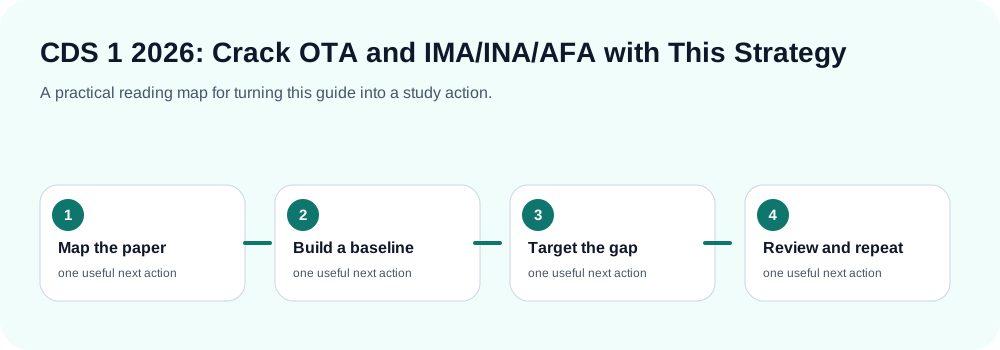
- Map the paperUse the exam pattern and eligibility details in this guide.
- Build a baselineTake a timed diagnostic mock before changing your routine.
- Target the gapChoose one weak section and practise it deliberately.
- Review and repeatLog errors, revise, and retest under time pressure.
Conclusion
CDS 1 2026 is your opportunity to join the most honoured profession in the country. Success requires a balanced preparation across all three papers (for IMA/AFA/INA candidates), with no paper neglected. English and GK are equally decisive as Mathematics.
Start your preparation today on YourMockTest with CDS-specific mock tests, chapter-wise practice sets, and previous year paper analysis to benchmark your performance accurately and close your gaps before exam day.
Revision note: Published after explicit owner approval; official-source verification remains recommended for time-sensitive claims.
Keep YourMockTest in your Google results
Add us as a Preferred Source to see fresh exam updates and preparation guidance more often in Google Search.
Add YourMockTest as a Preferred Source